
XPeng claims its luxury electric SUV boasts the fastest charging rate in the world
Snapshot
- Chinese-built luxury electric SUV
- DC fast-charging 480kW; up to 702km range (CLTC)
- China only for now
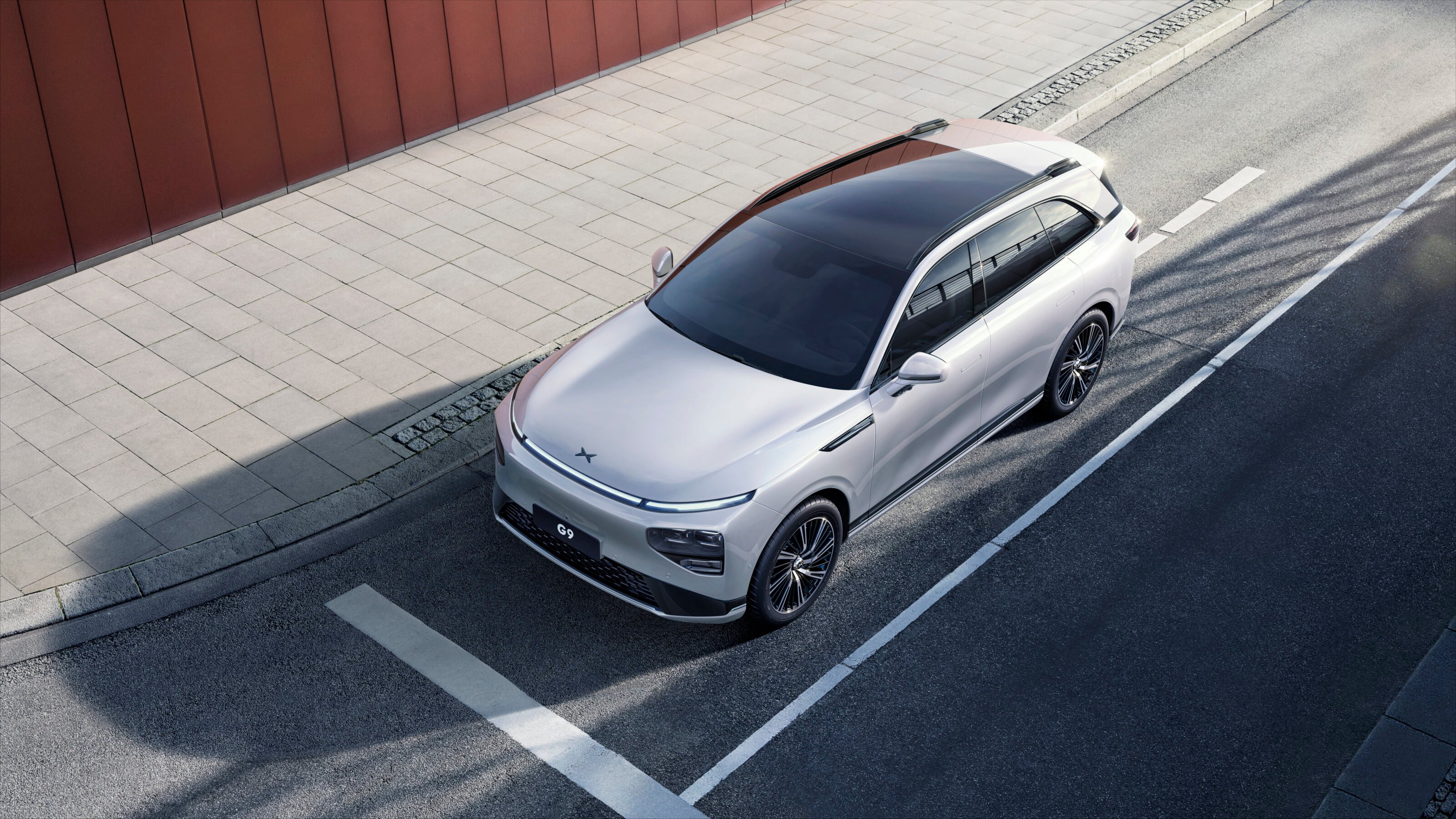
XPeng has announced its new electric luxury SUV, the 2023 G9. The G9 becomes the fourth model in the Chinese EV manufacturer’s range.
As a company, XPeng is only eight years old, so the G9’s claim of 480kW peak DC charging speed and 702km range (CLTC) is impressive.
The peak charge speed means the G9 can add 200km of range in just five minutes… if you’re lucky enough to have access to one of the brand’s 480kW chargers. In the west, the quickest DC fast chargers are around 350kW.
XPeng has no plans to bring cars to Australia, though its global expansion began with the G3 small SUV hitting Norwegian dealerships in January 2021.
Measuring 4.89 metres long with a leather-appointed interior, the G9 is pegged as a cut-price Range Rover in its home market, where it costs between CNY309,000-469,900 (AU$66,255-100,705).
Range, charging speed and power
XPeng sells three configurations of G9 in China: standard range rear-drive, long-range rear drive and performance.
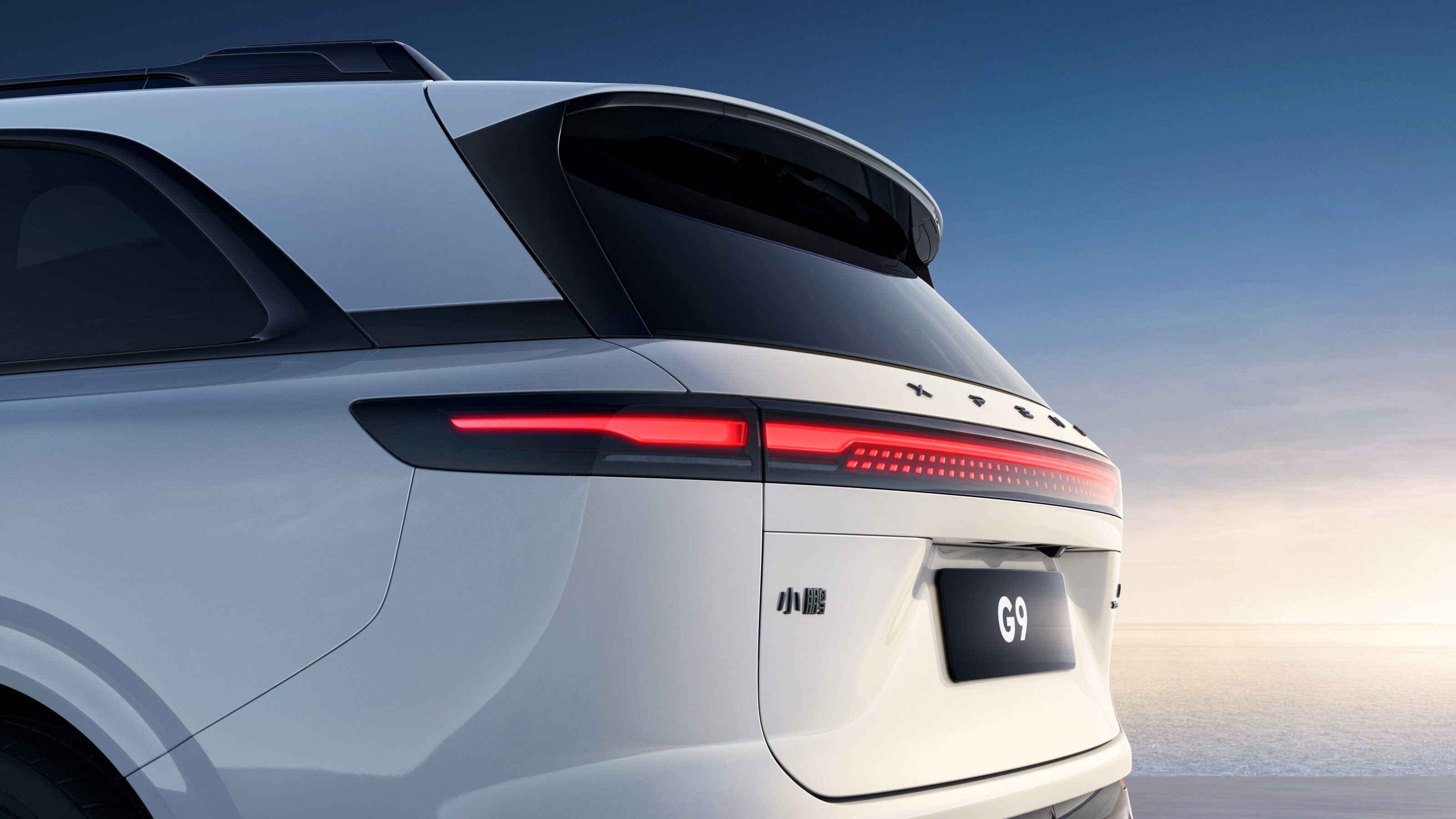
The standard range cars get a single 230kW/430Nm rear-mounted electric motor and 570km range claim. The long range’s 96.0kWh ‘xPower3.0’ battery increases the range claim to 702km.
The G9’s headline 702km driving range figure is derived from the optimistic CLTC protocol. Generally, CLTC figures are between 20-25 per cent higher than WLTP. That puts a WLTP estimation for the G9 long range around 550-600km.
The AWD’s twin electric motors increases outputs to 405kW/717Nm for a 0-100km/h sprint in 3.9 seconds. Range drops to 650km.
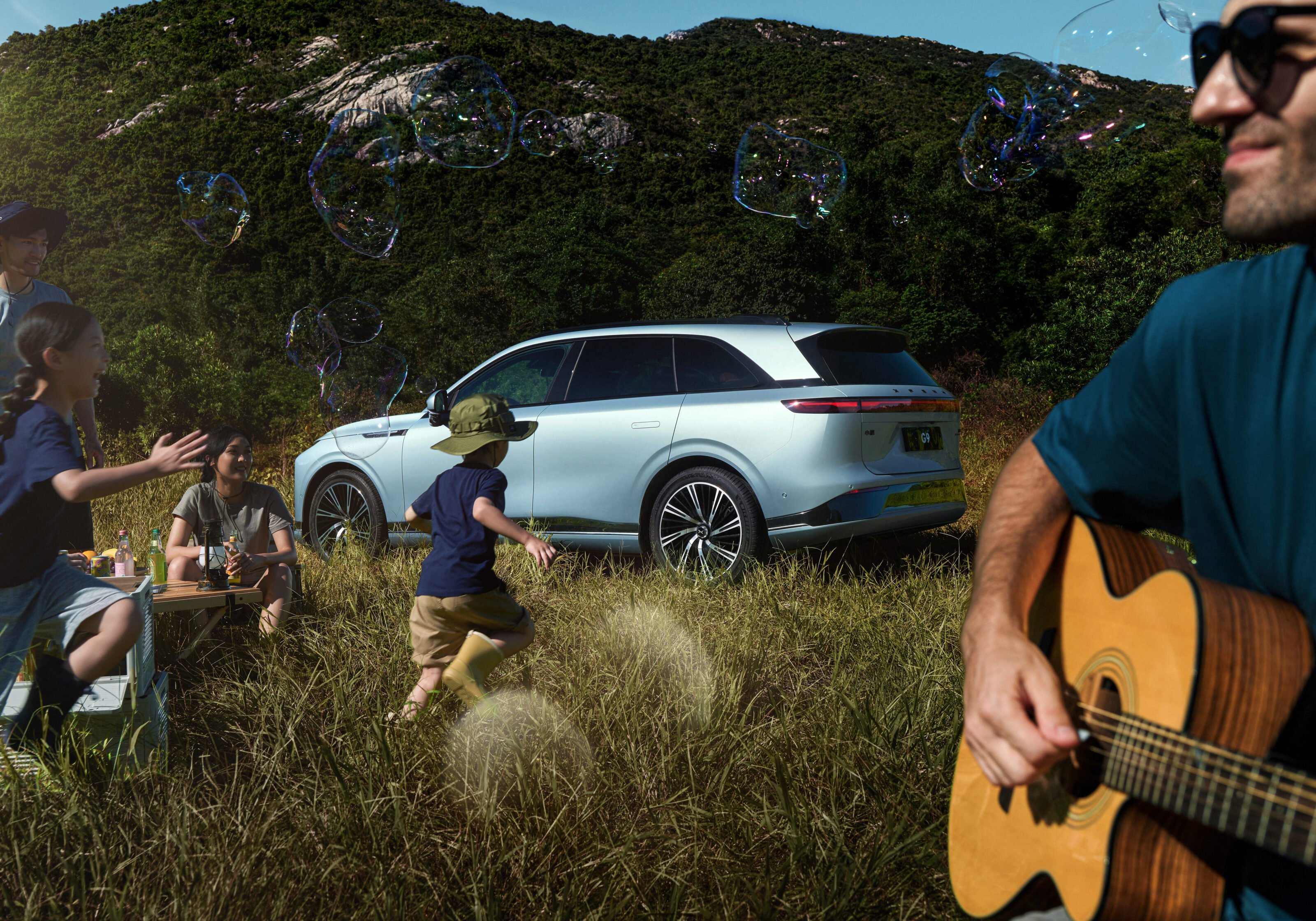
All G9s are built around an 800V electric platform – like Porsche’s Taycan, the Hyundai Ioniq 5 and the Kia EV6 – allowing claimed peak DC fast-charging speeds of 480kW.
The G9 has plenty of driver-assistance tech
XPeng says the G9 has a total of 31 driver assistance sensors to power the adaptive cruise control and lane-trace assist systems. The driver-assistance suite is run by Nvidia Orin hardware.
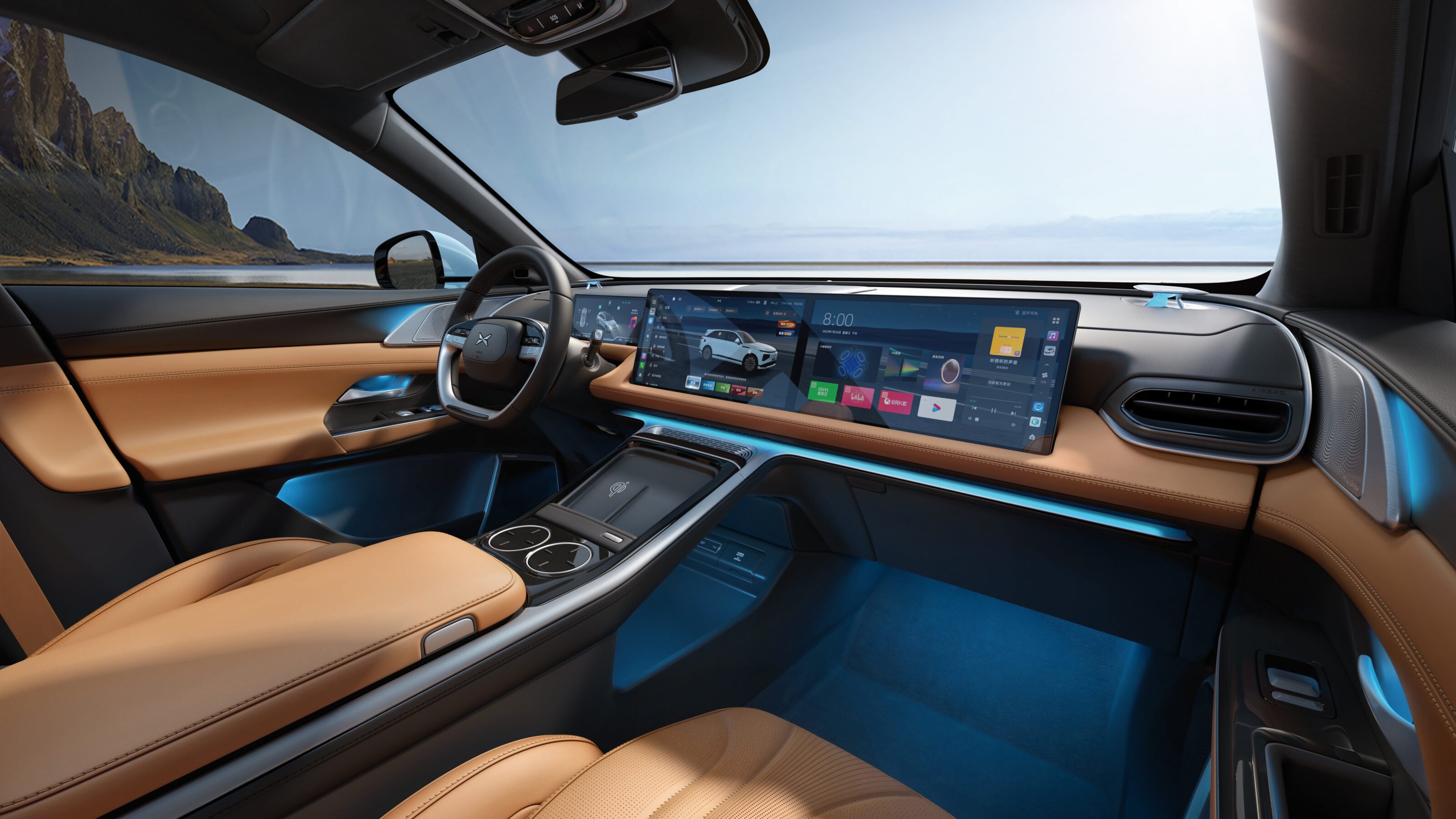
Voice assistance, cargo capacity of 660 litres, a pair of 14.96-inch touchscreens, an 18-speaker Dynaudio sound system and adaptive air suspension feature on the flagship 650X Launch Edition.
The G9 will go on sale in China in the third quarter of this year.
XPeng has not confirmed plans for global sales, but says the G9 has been developed to meet Euro NCAP five-star crash safety criteria and European vehicle certification laws.
The ACCC will be paying close attention to price gouging by major fuel retailers and will “take action” if needed.
Snapshot
- Fuel excise at $0.46/litre from tomorrow
- Thatu2019s a 23.9 cent/litre increase
- ACC says it will be watching retailers
The federal fuel excise will come back in full force from tomorrow, but how will this affect prices at the pump?
To take a simple view, fuel prices will climb universally by 23.9 cents (higher than the 44.2 cents before – as fuel excise is indexed to CPI) as the clock passes midnight, but the equation is unlikely to be quite that simple.
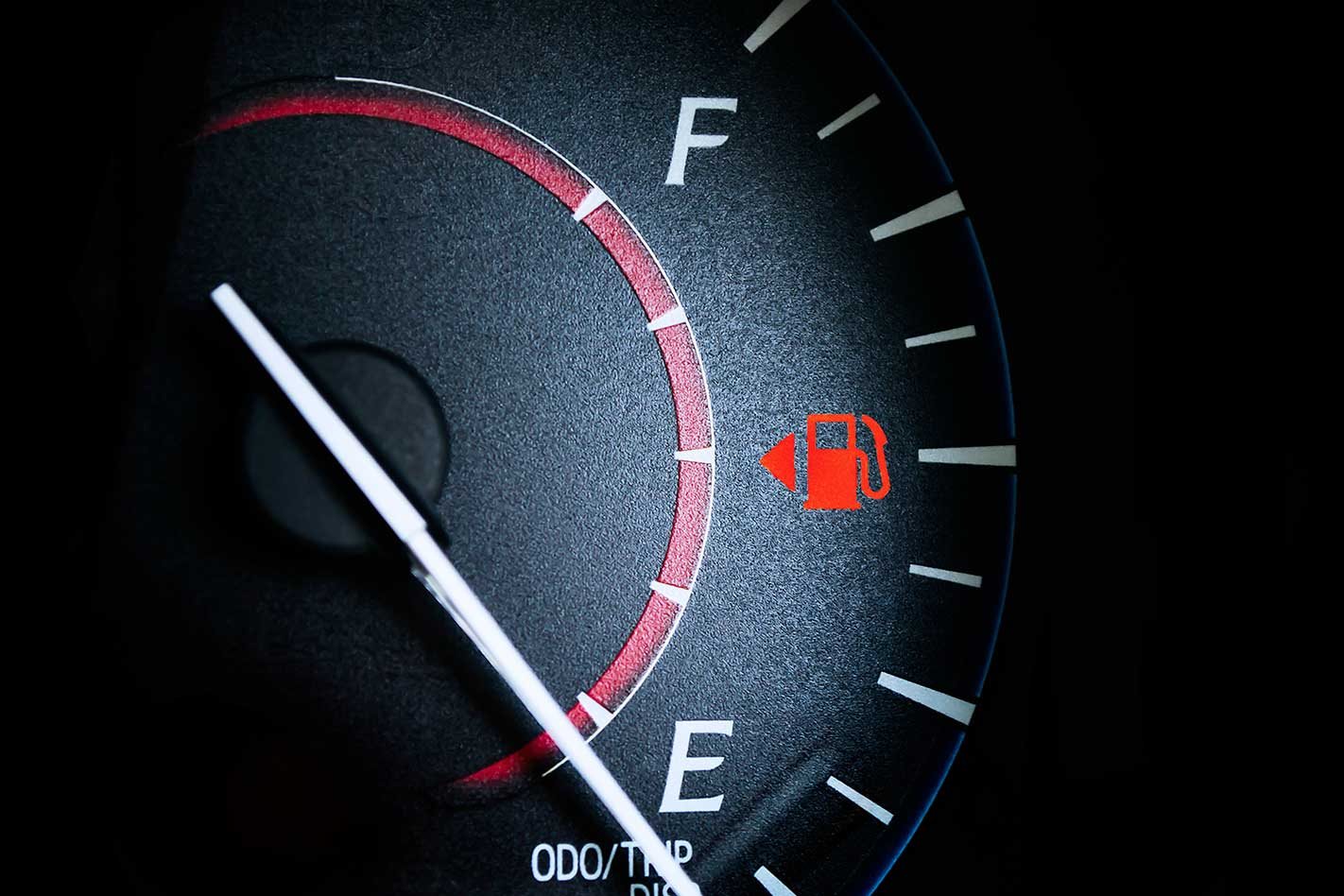
The 46 cents charged on every litre of fuel is a flat tax that forms part of prices. It’s set by the Federal Government and is paid into the Federal Budget.
Above the excise there’s the cost of the raw oil, processing and – crucially at the moment – transport. Though retailers still have the final say when it comes to prices.
This was one concern voiced by the Australian Automobile Association (AAA) when the drop in the fuel excise was enacted by former treasurer Josh Frydenberg in March 2022.
The AAA suggested fuel retailers may not pass the savings on to customers, rather line their pockets with extra earnings. So what’s going to happen next?
How much more will fuel cost?
This is immensely difficult to predict in the current climate. The price of a barrel of crude oil is trending down, yet fuel prices in Australia continue to fluctuate with little warning.
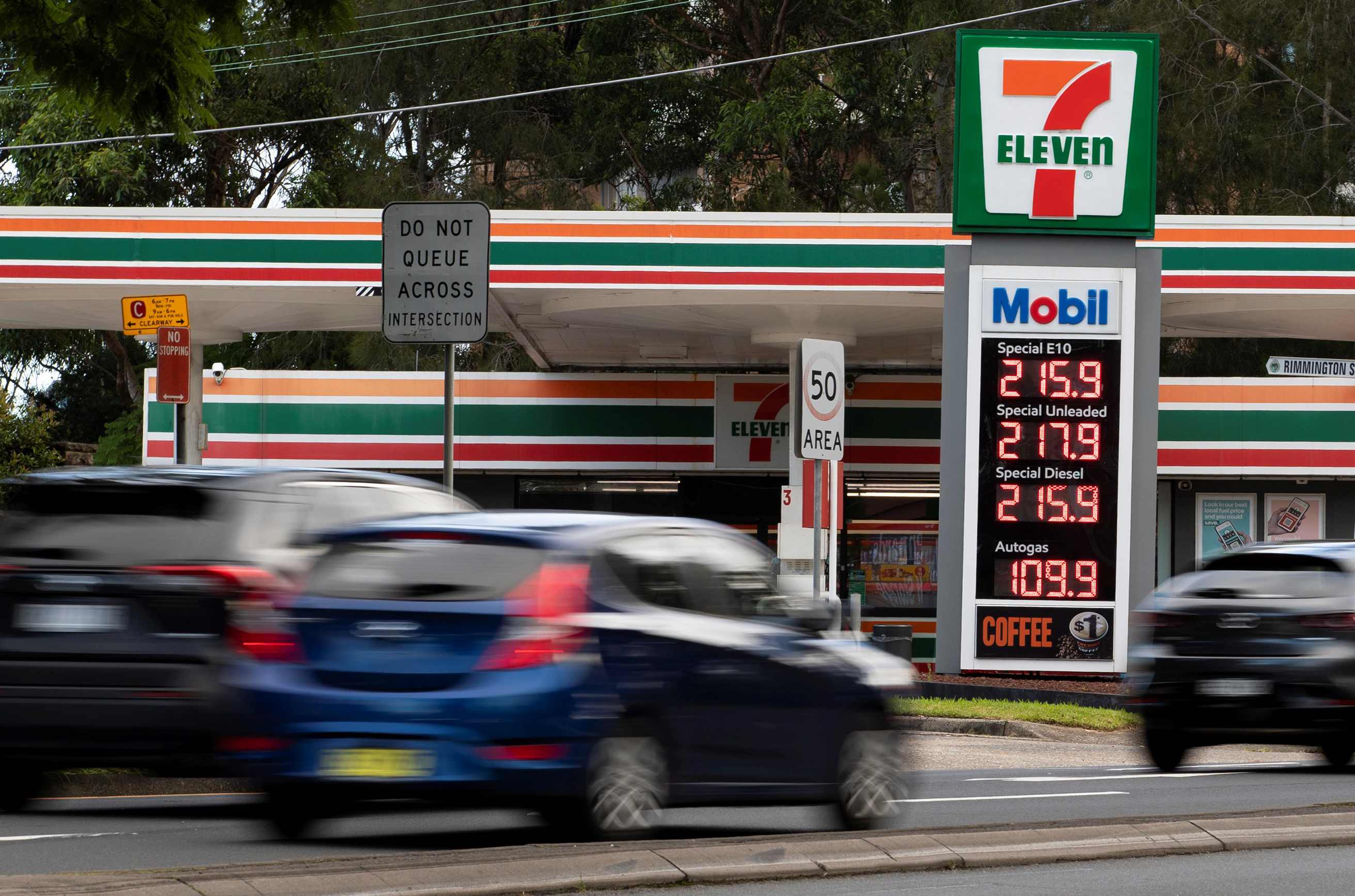
Data from the Australian Institute of Petroleum (AIP) shows that, while a litre of unleaded was six per cent more expensive last week than the week before for retail buyers ($1.635 vs $1.739), the wholesale price actually dropped ($1.523 vs $1.505).
This suggests that retailers could be easing the transition back to the higher federal fuel excise due to hit on Wednesday, though wholesale pricing data has more lag than retail so it’s not a precise calculation.
We can be pretty certain that the price of fuel will continue to rise, potentially returning to – or likely breaking – its March peak of $2.10-2.20/litre for 91 octane in Australia.
But the Australian Competition and Consumer Commission (ACCC) did provide some solace for consumers in a letter distributed to major fuel retailers last week.
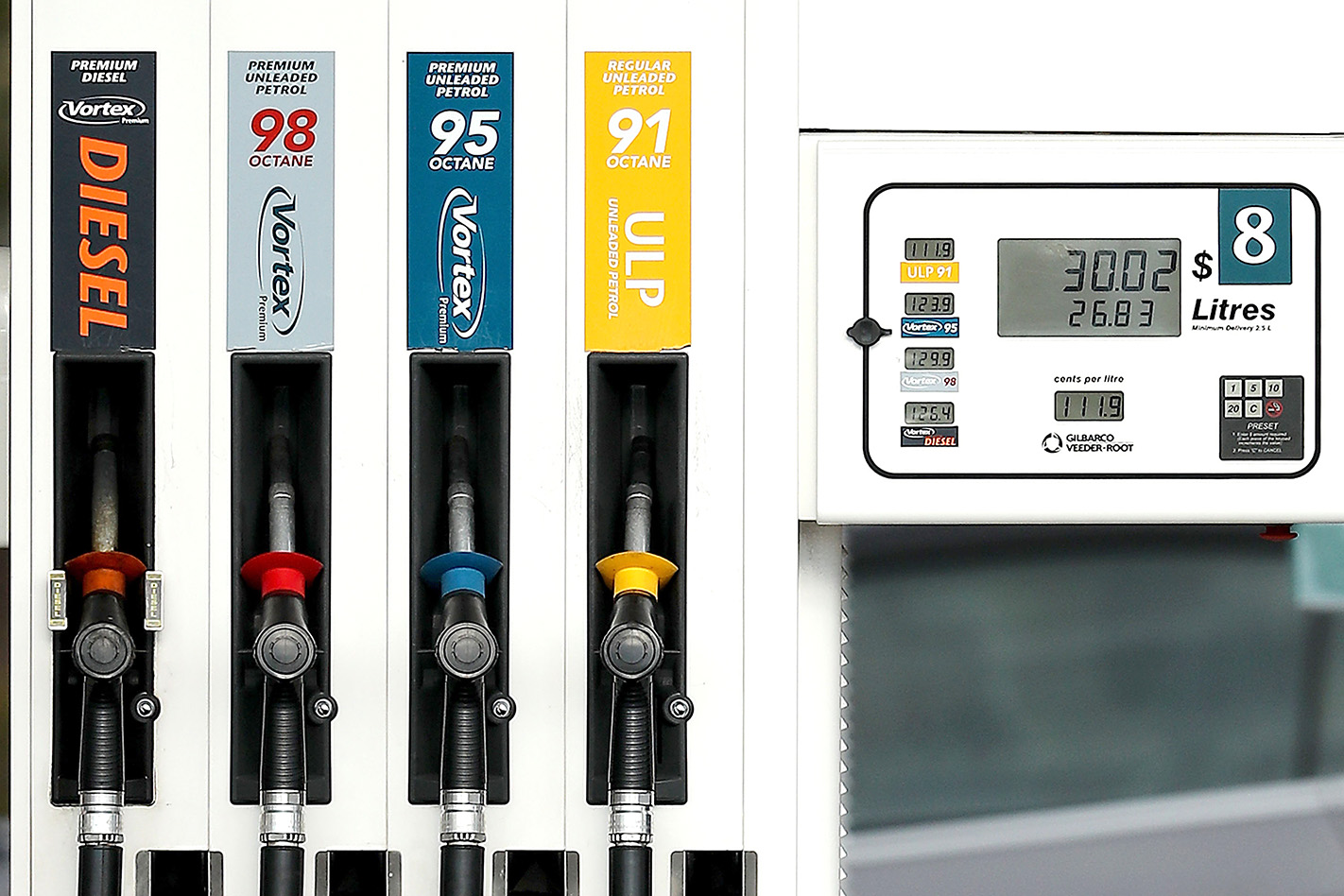
The ACCC said it doesn’t expect “uncharacteristic or abnormal retail price increases in the days leading up to, on the day of, or after the reintroduction of the full rate of fuel excise”.
The consumer watchdog will be paying close attention to price gouging by major fuel retailers and said it will “take action” if needed.
Why was the federal fuel excise cut?
The fuel excise was cut to ease cost-of-living pressures that were skyrocketing amid Russia’s invasion of Ukraine.
Fuel prices peaked in March, shortly before the excise was halved. The cut was pencilled to last six months, with an end date of September 28.
Initially it worked, with the retail price of a litre of unleaded petrol falling sharply in mid-April. Through May and June 2022 petrol prices spiked again before dropping in August. Of late, however, retail prices appear to be on the rise again.
Car manufacturing could be reborn in Australia in the coming years if we were to make electric vehicles here, a senior minister has said.
Minister for Energy and Climate Change Chris Bowen told a global clean energy forum in the US that he wanted to see an EV manufacturing sector set up in Australia which could produce cars for local and international markets.
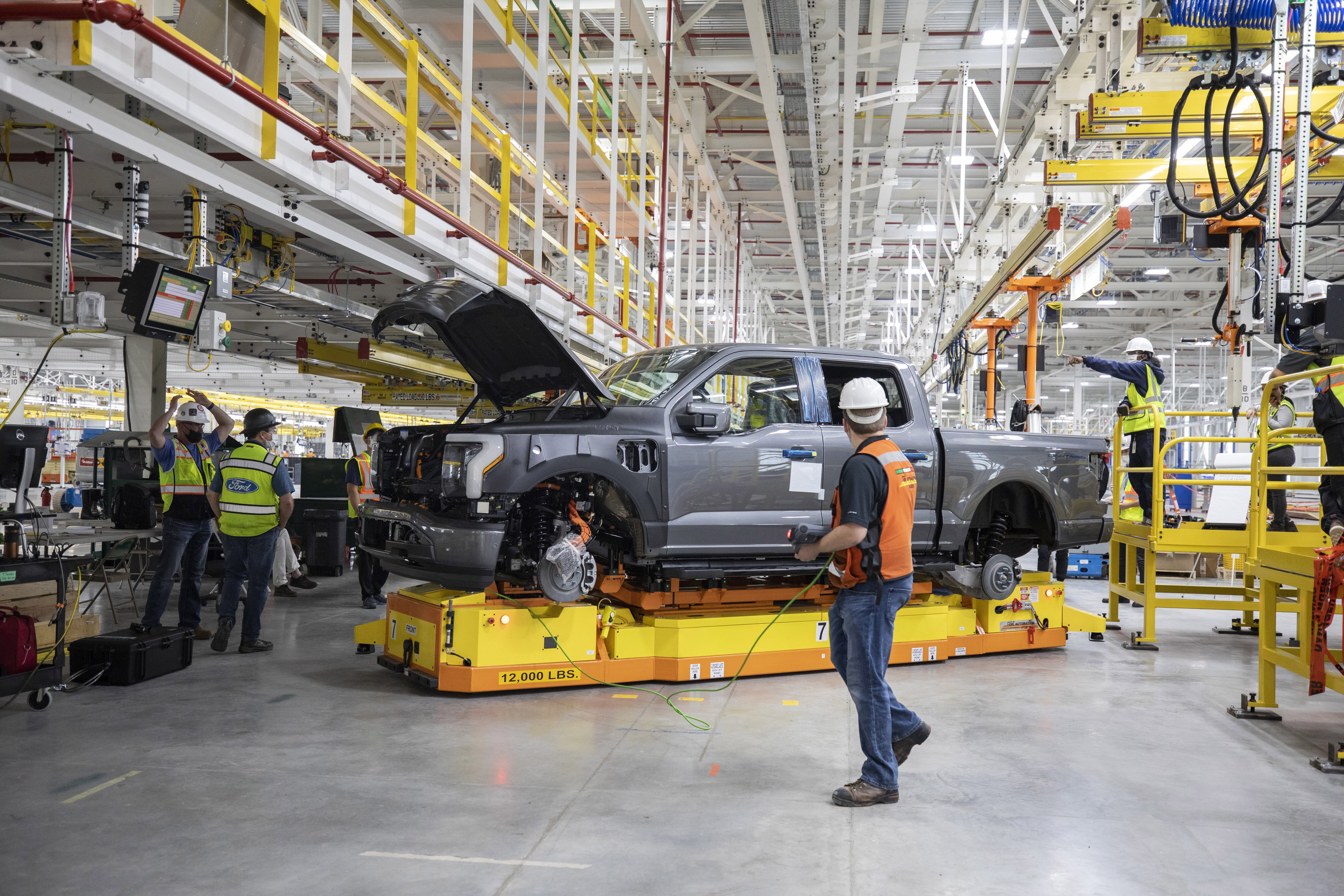
The minister made the comments on a visit to Pittsburgh, Virginia, where he tested Ford’s electric F-150 Lightning ute, which is not currently available in Australia – though its internal combustion engined twin is coming here next year.
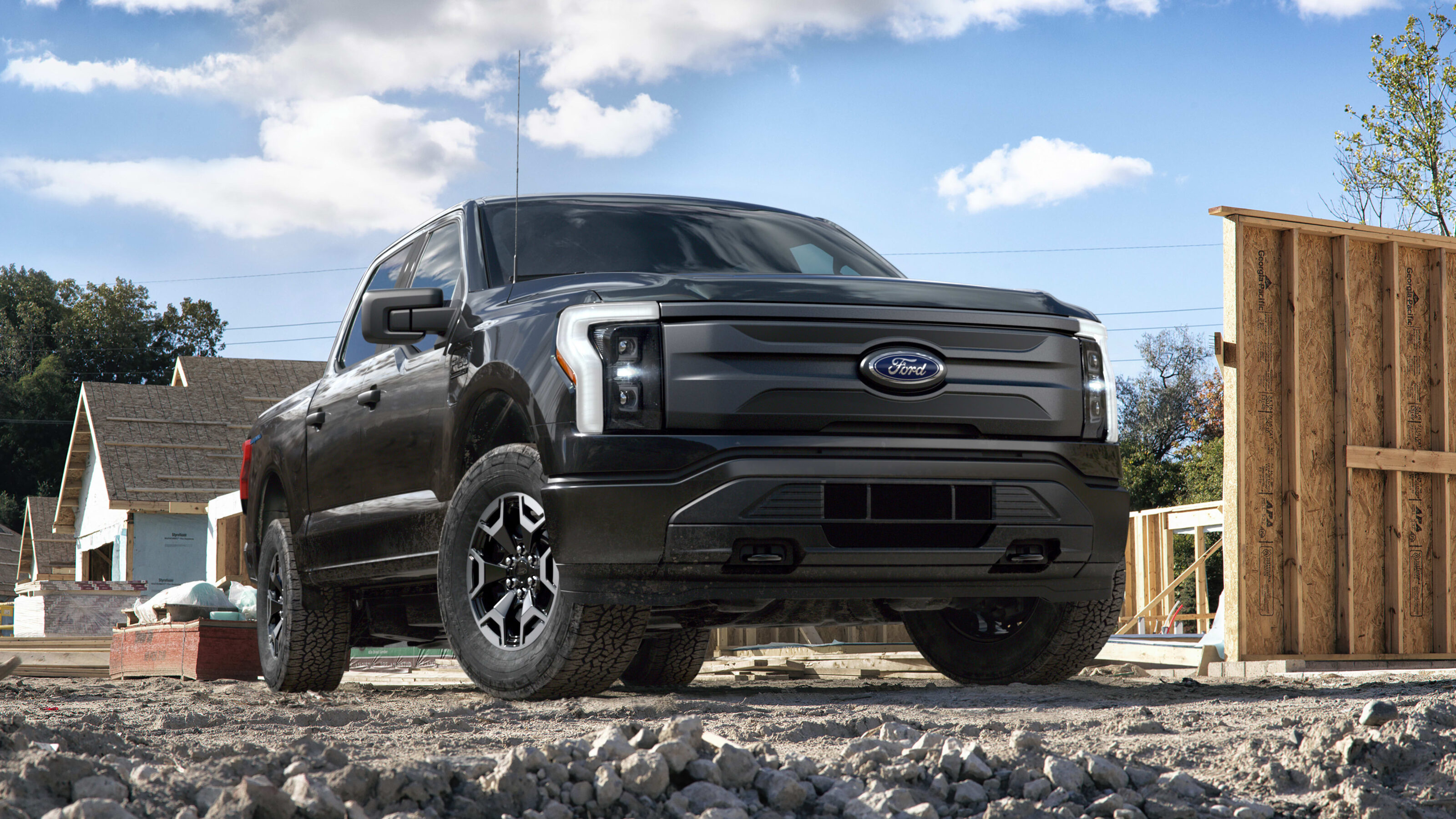
“We can make electric vehicles in Australia. Not only do I think that, so do the electric vehicle manufacturers,” Bowen told The Australian Financial Review.
“There’s work to do to make that more viable in Australia, but the economics of an electric vehicle are a lot different to the economics of making internal combustion engine [cars].”
“We have a range of policies which no doubt will be looked at in due course. I believe we can make key components of electric vehicles and indeed electric vehicles totally in Australia.”
The policies Minister Bowen is no doubt referring to correspond with remarks he made at Australia’s first EV Summit last month where he called the manufacturing of EVs overseas a “lost opportunity”.
Specifically, talk at the summit revolved around battery manufacturing for electric vehicles. Currently, as a nation we dig up all the materials needs for battery production here in Australia – but we send most of them overseas.
Speaking at the event, Chris Bowen said it was a “lost opportunity for jobs and investment” and bringing it home could create 35,000 jobs and $7 billion worth of value across all sectors. He also revealed that, as a result, that is why the Government is implementing a National Battery Strategy and establishing a battery manufacturing facility in Queensland.
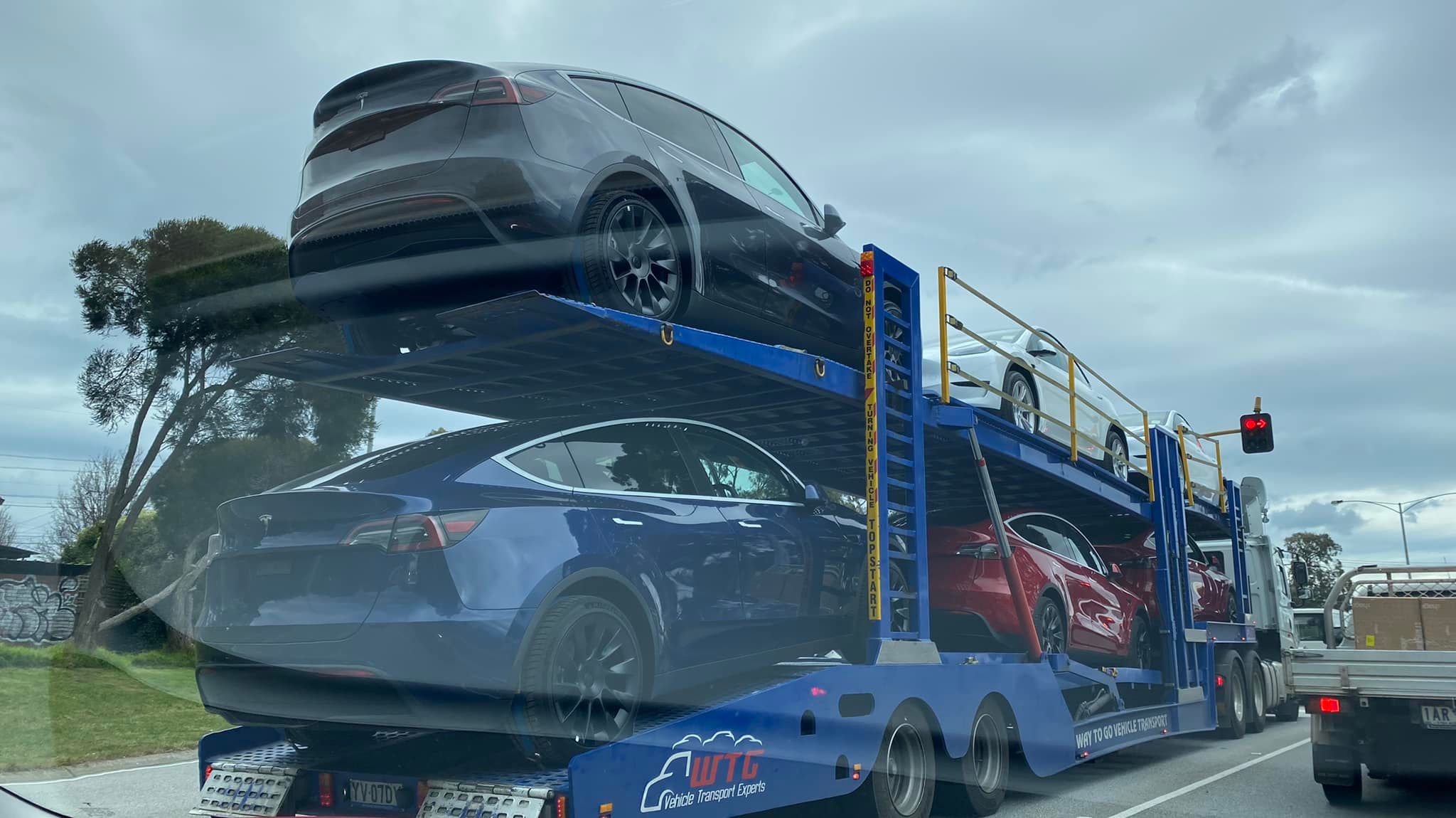
The topic is something Tesla Australia chief Robyn Denholm has long advocated for.
“Last year, Tesla bought a billion dollars worth of minerals. And 70 per cent of those came from Australia but we sent them off-shore to be refined and no value was added. A fraction of that comes back to Australia because of the way we’ve gone about the supply chain.
“It is not just up to Government, it needs to be public-private partnerships because we have the knowhow, we have the technology, we just need the will to actually move forward. It is a very real opportunity for Australia to actually participate in that and become an energy power.”
Earlier this year the US passed the Inflation Reduction Act, which, in part, outlines tax benefits and subsidies for EVs.
Many of these are tied to the origins of the materials, such as whether they come from North America or countries like Australia that it has a free trade agreement with.
Australia’s local car manufacturing industry wrapped up in 2017 when Holden closed up its operations in Adelaide, with Ford shutting up shop in Melbourne the same year and Toyota in 2016.
Snapshot
- New protocol comes into effect January 2023
- Floodwater and child detection tests added
- AEB testing becomes tougher; motorcycle detection required
ANCAP has detailed its updated 2023 safety protocols with a focus on floodwater testing, child alert systems and motorcycle detection – as well as greater penalties for poor performance in AEB testing.
The new criteria will apply to all cars tested by ANCAP from January 2023 and builds on the current protocols that came into effect in January 2020.
Cars tested by the safety body will continue to carry their rating for six years without needing to be reevaluated under the latest protocol.
ANCAP CEO Carla Hoorweg said of the 2023 protocols: “Vehicles, and the safety technologies within them, are continuing to evolve – and our test criteria are too.
“Physical protection in a crash, and the ability to actively avoid a crash, are both essential elements to achieve a high ANCAP safety rating, and this approach will continue from 2023.”
What’s changed for 2023?
ANCAP’s protocols have evolved with a focus on the functionality of active safety equipment commonplace on new cars.
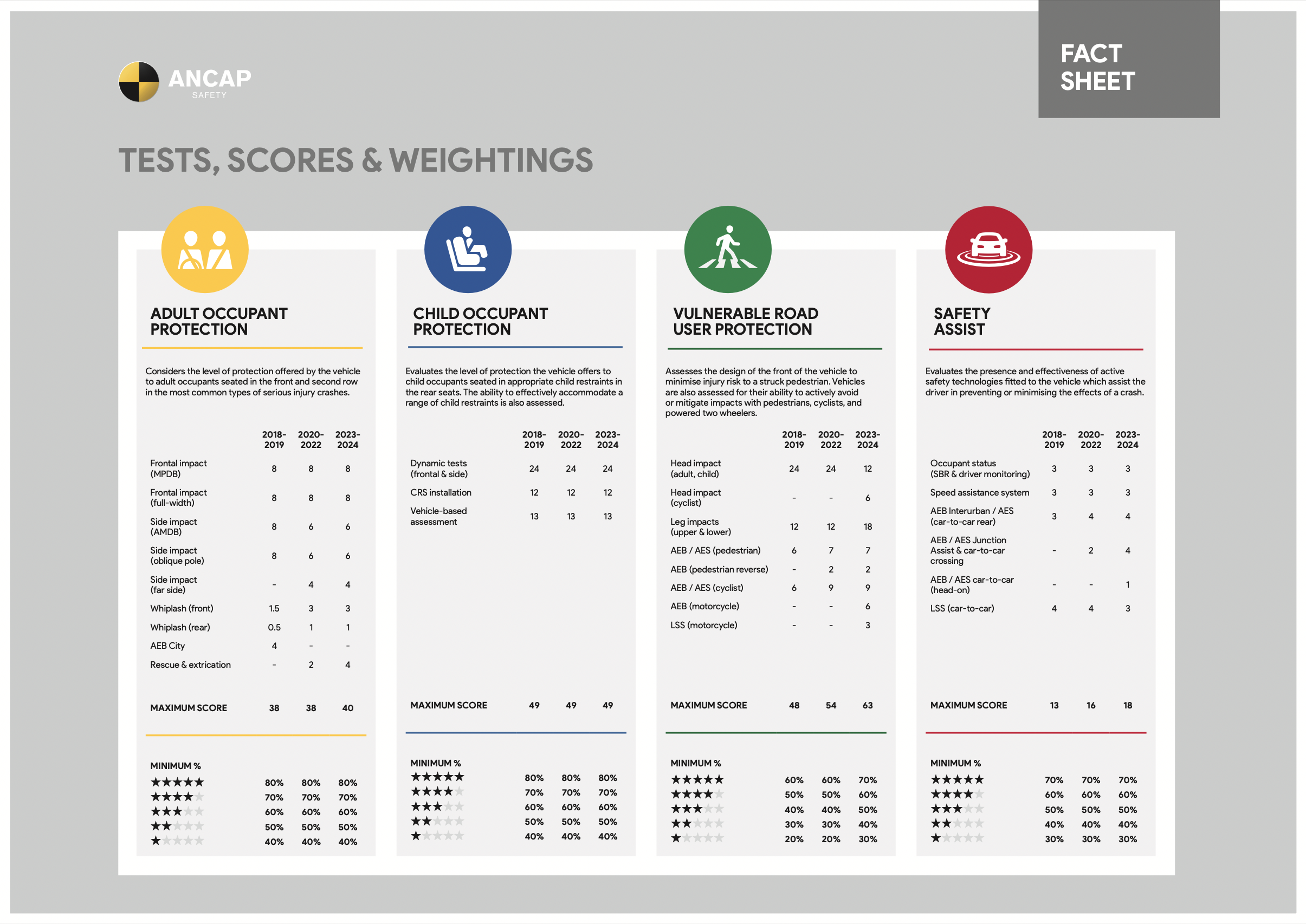
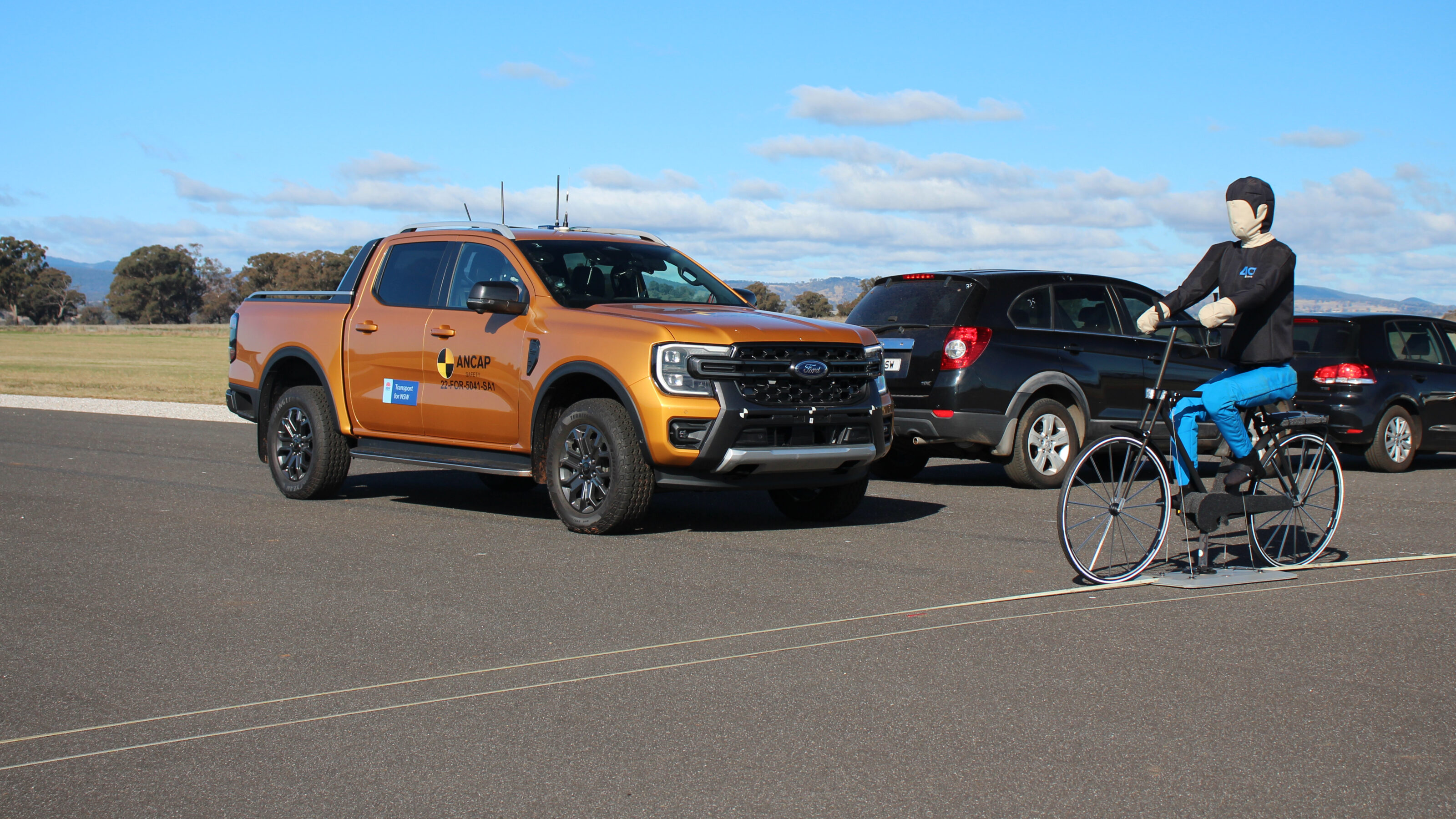
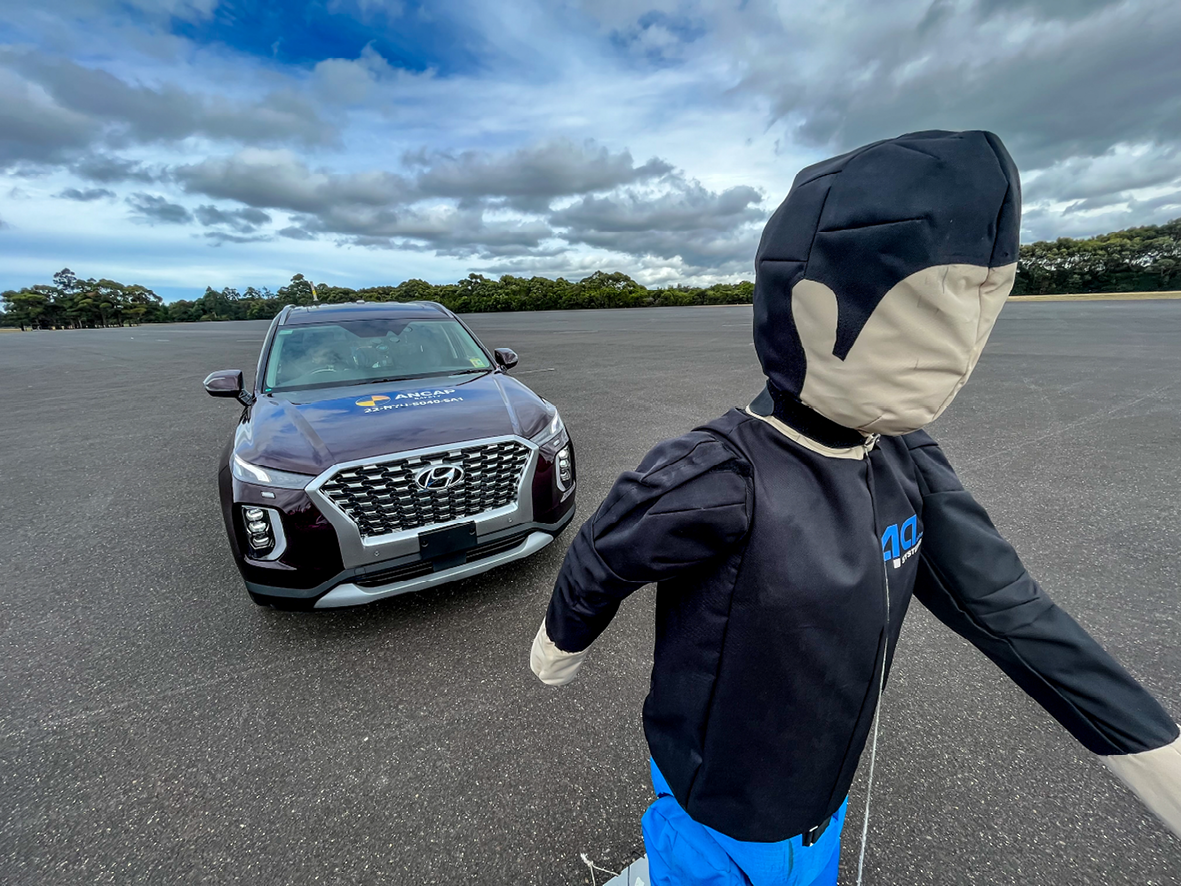
From 2023, new tests will include ‘AEB powered two-wheeler’ assessment that looks at the ability of a car’s AEB system to detect stationary and moving motorcycles.
Blind-spot monitoring systems will also be evaluated on their ability to prevent motorbike side-swipe incidents.
Detecting pedestrians while a vehicle is in reverse now becomes a criteria, as does cyclist junction detection and ‘dooring’ prevention (an audible warning made when a cyclist is detected in a vehicle’s blind-spot while parked or stationary and an occupant attempts to open a door).
The minimum score to receive five stars in the Vulnerable Road User section increases from 60 to 70 per cent. In theory, this would see both the Haval Jolion and Genesis GV60 drop to four-stars in that area if assessed under the new criteria.
Both head-on and cross-junction scenarios have been added to the car-to-car AEB test procedures by ANCAP for 2023. The maximum penalty for poor functionality in this protocol has doubled, from four to a possible eight point deduction.
ANCAP has also introduced a tougher driver and fatigue monitoring protocol from 2023.
Earlier this year Wheels reported on ANCAP’s new criteria for floodwater assessment and child detection, which you can read in detail here.
But as a recap, cars assessed in 2023 will need to demonstrate that their batteries can continue to power electric windows for 10 minutes post-submergence.
Child detection systems that use visual, audible – or a combination of both- warnings to alert the driver to a child’s presence will also be assessed from next year.
“Will a step like this be too brutal, by selling that logo for some numbers?”
BMW, Mercedes-Benz, Bentley, Rolls-Royce, Porsche, Lamborghini and Ferrari have all moved into the intensely popular and explosively profitable SUV space with varying degrees of enthusiasm.
Lotus is the latest brand with an iconic sports legacy to reveal an SUV, under its new Chinese ownership – and outspoken holdout McLaren is expected to follow in the next few years, if only to stay flush and competitive as a sports and supercar brand. (Call it the Porsche Cayenne formula.)
The landslide of esteemed and/or exclusive brands launching SUVs appeared to continue with reports in recent years that Bugatti would enter the fight.
Sometime ago, former Bugatti boss Stephan Winkelmann confirmed Bugatti would deliver an SUV “to be used on a daily basis”, with a different shape and mission to the hero Chiron car.
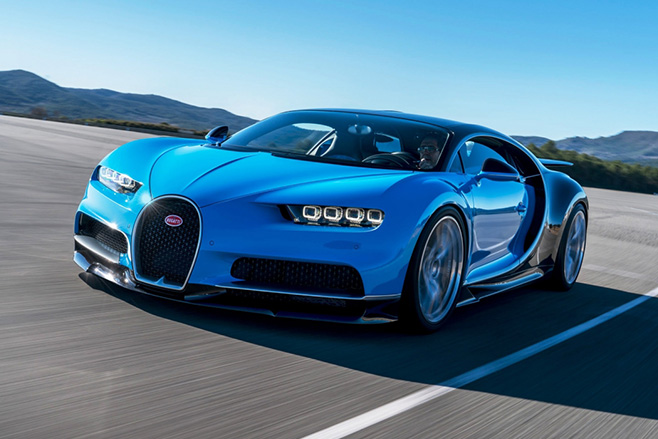
Since then, Bugatti has come under the control of a new partnership between Porsche and Rimac, with the latter holding a controlling stake of 55 per cent stake. You can read about that here.
And, of course, Winkelmann has now returned to Lamborghini, where the SUV formula is doing its job of revenue growth as expected.
Now it seems there will be no Bugatti SUV – or at least, not without maintaining exclusivity – according to an interview with UK mag Autocar.
In the interview, design boss Achim Anscheidt was candid in his view on what an SUV would mean for Bugatti.
“[…] are you starting to sell out the brand? What do you do with this precious logo? Will a step like this be too brutal, by selling that logo for some numbers?”, Anscheidt said.
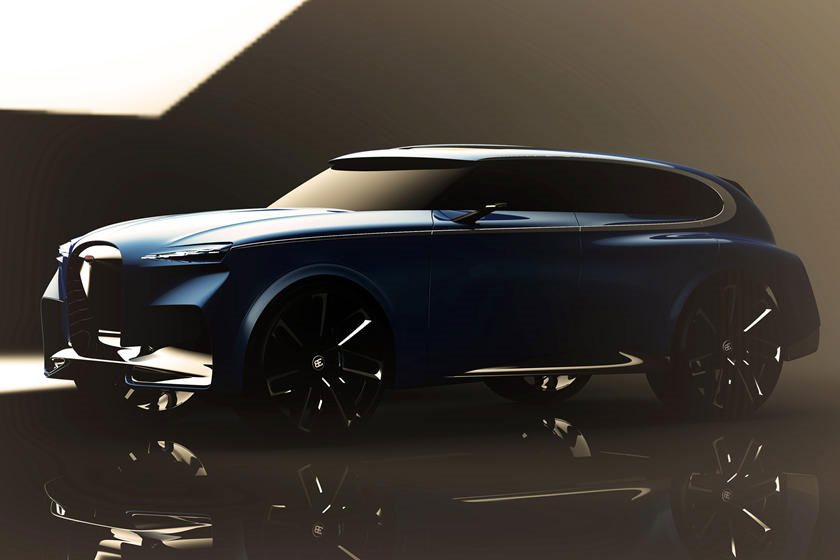
But, where Autocar has headlined its story “Bugatti shelves electric SUV”, the next line in Anscheidt’s quote appears to be less black-and-white.
“If one does [bring out an everyday/second model], I’m always a big fan of balancing this, not to forget the roots of the company or to [create] something more exclusive. This means that if you go into slightly more volumes, you should go more exclusive on the other side, so this remains the core product and it balances this.”
Language barriers notwithstanding, the above suggests Bugatti may still introduce an SUV – but it might retain the brand’s air of ultra-expensive exclusivity rather than debuting as a model intended – in Winkelmann’s words – “to be used on a daily basis”.
For most brands, and any fan with a sense for the realities of capitalism, the SUV has become an unavoidable means to satisfy shareholders.
Whether Rimac can keep the Bugatti brand pure, relying on massive profit margins to keep volume low and steer away from SUVs… time will tell.
“If sold, the plant will not build rebadged versions of the Camry and RAV4”
Snapshot
- Toyota ends Russian manufacturing
- RAV4 and Camry no longer built in St Petersburg
- Sale of facility being considered
Toyota will close its Russian manufacturing facility in St Petersburg, where its RAV4 and Camry are built for the Russian market.
The RAV4 was Russia’s 11th best-selling vehicle in 2021, but in March this year Toyota halted production in St Petersburg citing material and component shortages due to the country’s invasion of Ukraine. The firm has also stopped importing vehicles into Russia.
Although the factory in St Petersburg has been kept ready to reopen for the last six months, Toyota has now made the decision that it will not allow further production.
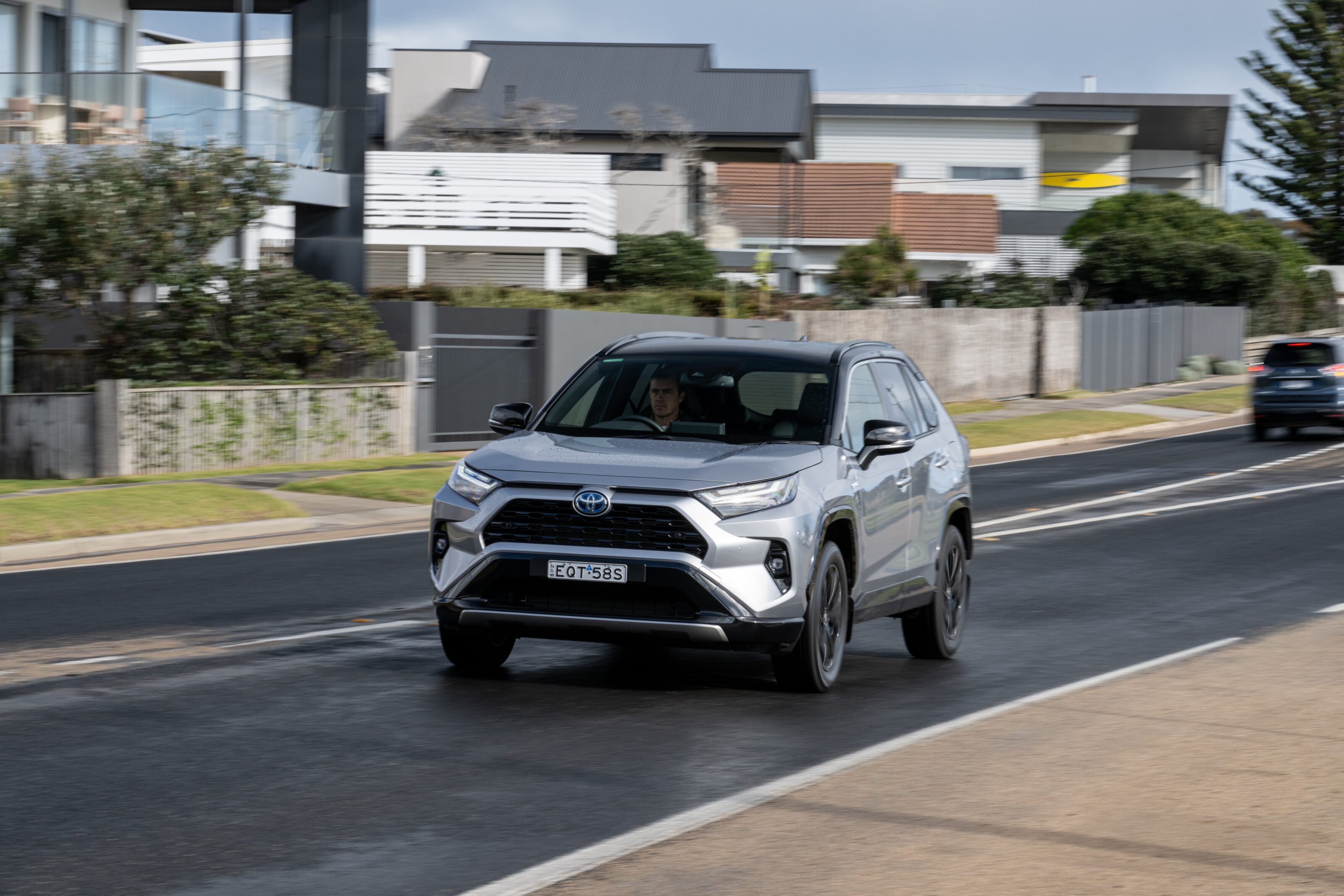
The Japanese marque has considered selling the St Petersburg plant. However, a Toyota spokesperson told Automotive News Europe there won’t be a sudden influx of knock-offs if that happens. “If sold, the plant will not build rebadged versions of the Camry and RAV4,” they said.
Toyota opened its St Petersburg facility in 2007. It had a production capacity of 100,000 units annually, mainly to satiate the Russian market – though exports made their way to Belarus, Kazakhstan and Armenia.
Although the RAV4 was very popular in Russia last year (38,441 sales), in August the company sold just 221 vehicles – 97 per cent down on the same month last year.
Will this affect Australian Toyota supply?
Toyota supply is severely restricted globally, so any facility shut down may have some effect on Australia. Luckily for Aussies, the Russian plant produced cars almost entirely for domestic consumption.
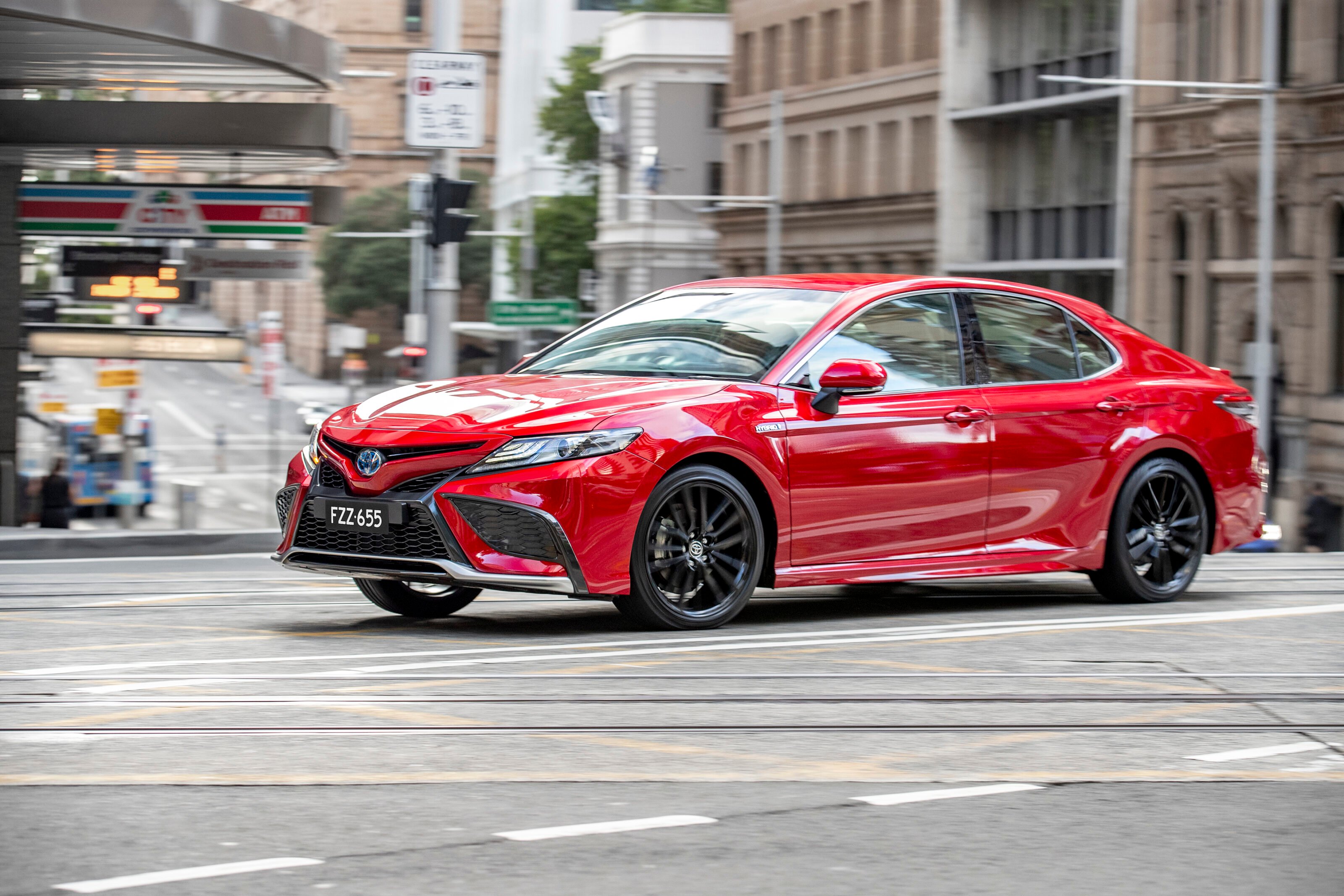
The closure of the St Petersburg plant is therefore unlikely to harm Australian supply of RAV4 and Camry, which are sourced from Japanese factories.
What will happen to Toyota in Russia?
Toyota employs around 2350 people in Russia and around 1900 of those work at the St Petersburg plant. A further 450 are employed in marketing and dealerships.
The Japanese carmaker expects around 2000 workers to leave the company, with the remaining employees staying to support existing Toyota customers in Russia.
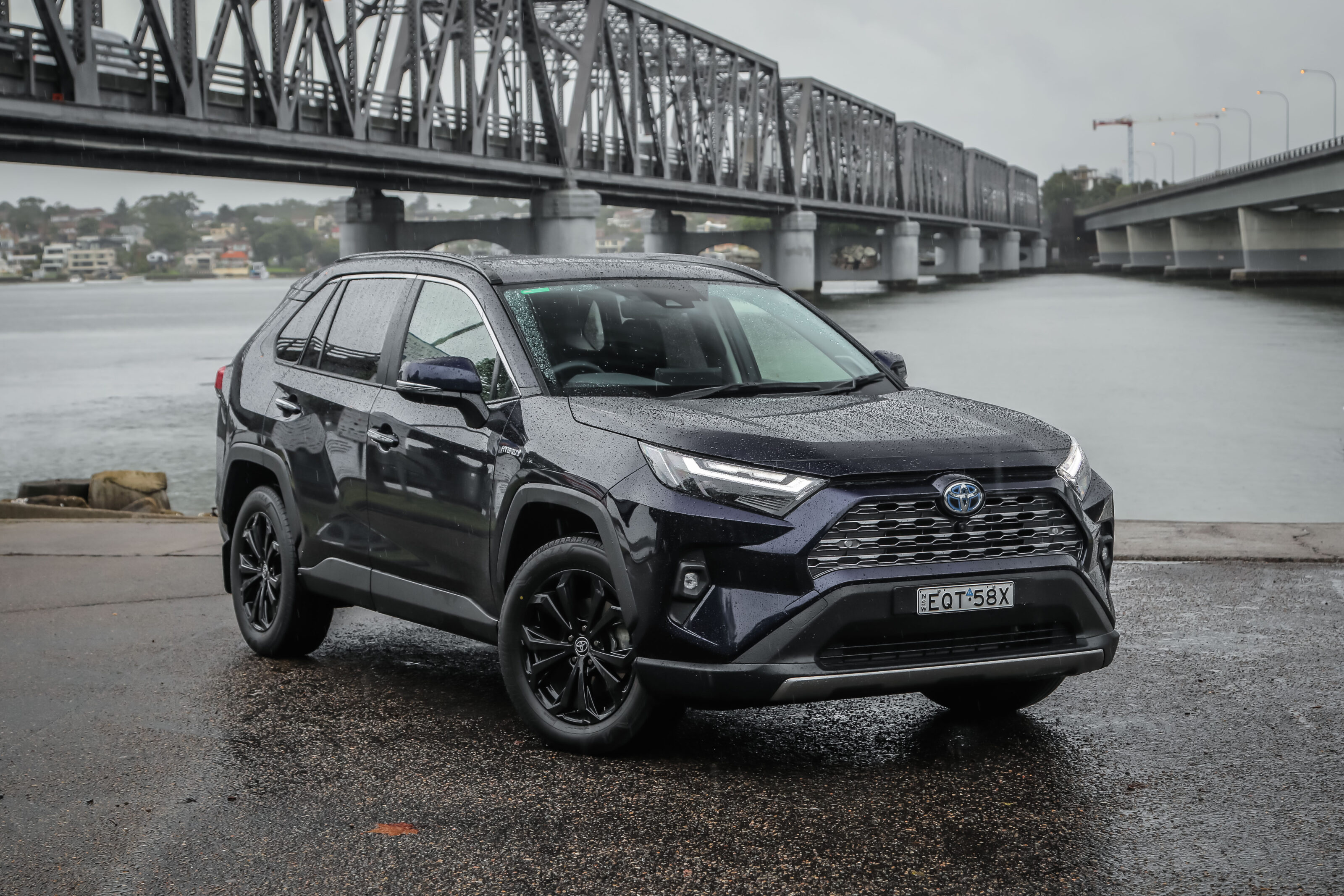
Toyota said workers will be offered new employment and re-skilling opportunities, as well as financial support above Russia’s legal requirements.
It is not the first carmaker to pull out of the Russian market. Volkswagen and Nissan have also announced a stop-sale in the country.
Renault recently sold its majority shares in AvtoVaz – Russia’s most prolific carmaker and owner of Lada – reportedly for one Ruble (AU$0.027) to a Russian science institute with a six-year buy back option.
With Toyota and other mainstream manufacturers out, Automotive News Europe pointed out the gap left open for Chinese manufacturers such as Saic and GWM to capitalise on the Russian market.
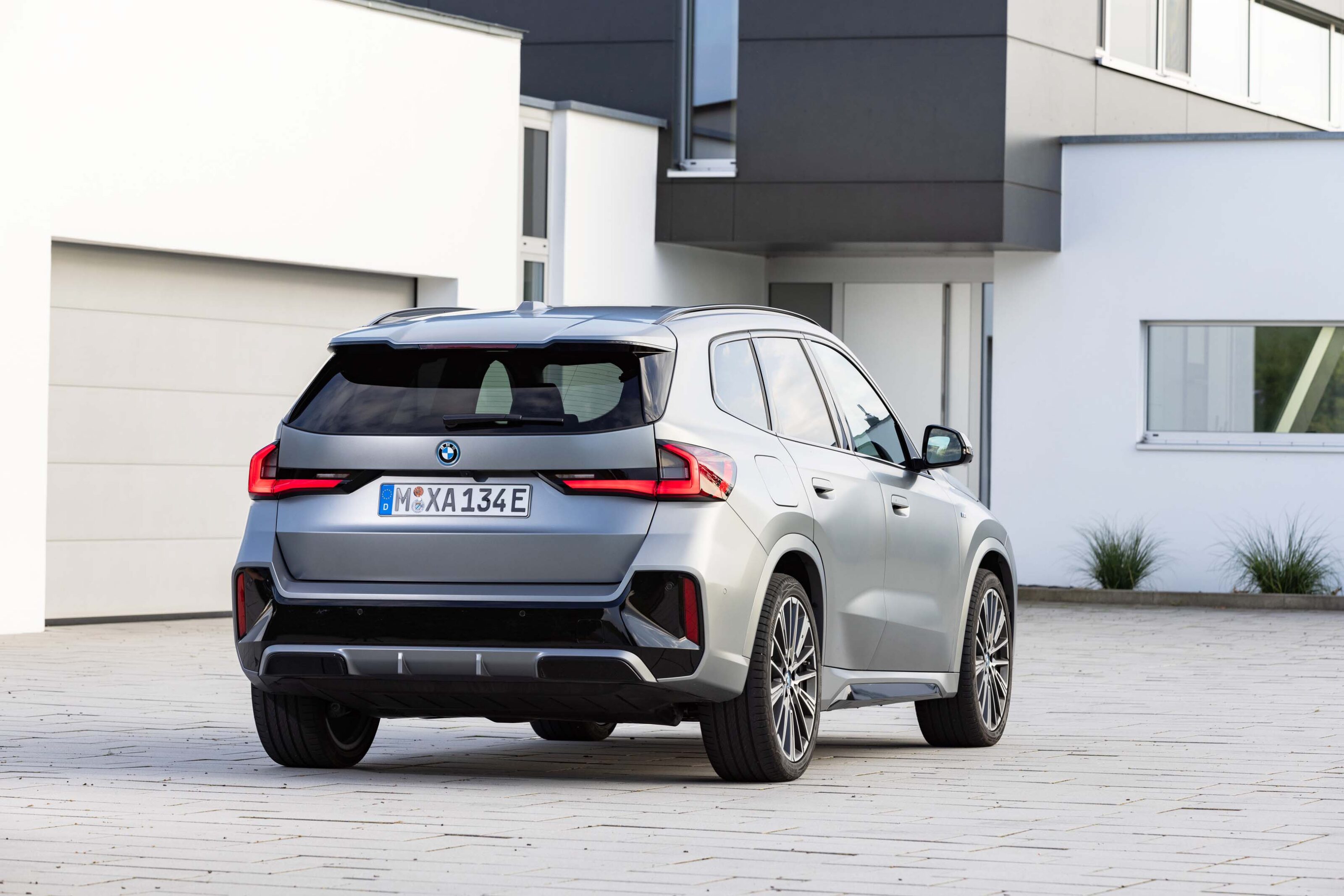
BMW’s smallest SUV is back for a larger, more grown-up third generation. And following into Australian showrooms a few months after pure petrol X1s will be this, the fully electric iX1.
It’s BMW’s third wholly plug-in SUV after the iX3 and ultra-luxe iX, and filters an impressive amount of their technological prowess into a smaller, neater and more affordable package.
BMW expects around a third of new X1 sales to be the fully electric version, but with petrol and EV models coming down the same production line, the factory can be flexible to demand.
June 2023: BMW X1 M35i revealed, Australia confirmed
BMW has unveiled a new flagship in its compact X1 range, expected to be priced above the $82,990 iX1 electric SUV.
Learn all about the performance-focused X1 M35i at the link below, and continue reading here for wider 2023 X1 range pricing and features.
March: New BMW X1 driven in Australia
The new BMW X1 is now on sale in Australia, and we’ve driven it.
October 2022: iX1 Australian pricing revealed
Australian pricing and details for the new 2023 BMW iX1 has been revealed, and you can get all the details at the link below.
STORY CONTINUES: BMW iX1 EV international drive review
Jump ahead
- How much is it, and what do you get?
- How do rivals compare on value?
- Interior comfort, space and storage
- What’s it like to drive?
- How is it on fuel?
- How safe is it?
- VERDICT
How much is it, and what do you get?
While the regular X1 begins at $53,900 before on-road costs, BMW is yet to tell us how much the iX1 will cost.
Looking at European pricing, a starting point of around $80,000 seems likely.
The iX1 launches in with one powertrain, the xDrive30. It’s all-wheel drive, with a motor on each axle providing peak output of 230kW and 494Nm, enough to hustle the car’s 2085kg mass to 100km/h in 5.7secs on its way to a 180km/h top speed.
It packs a 64.7kWh battery capable of up to 130kW charging and BMW claims a driving range of 438km.
Connected to a DC ultra fast charger, the iX1 claims a 10-80 per cent charge time of 29 minutes.
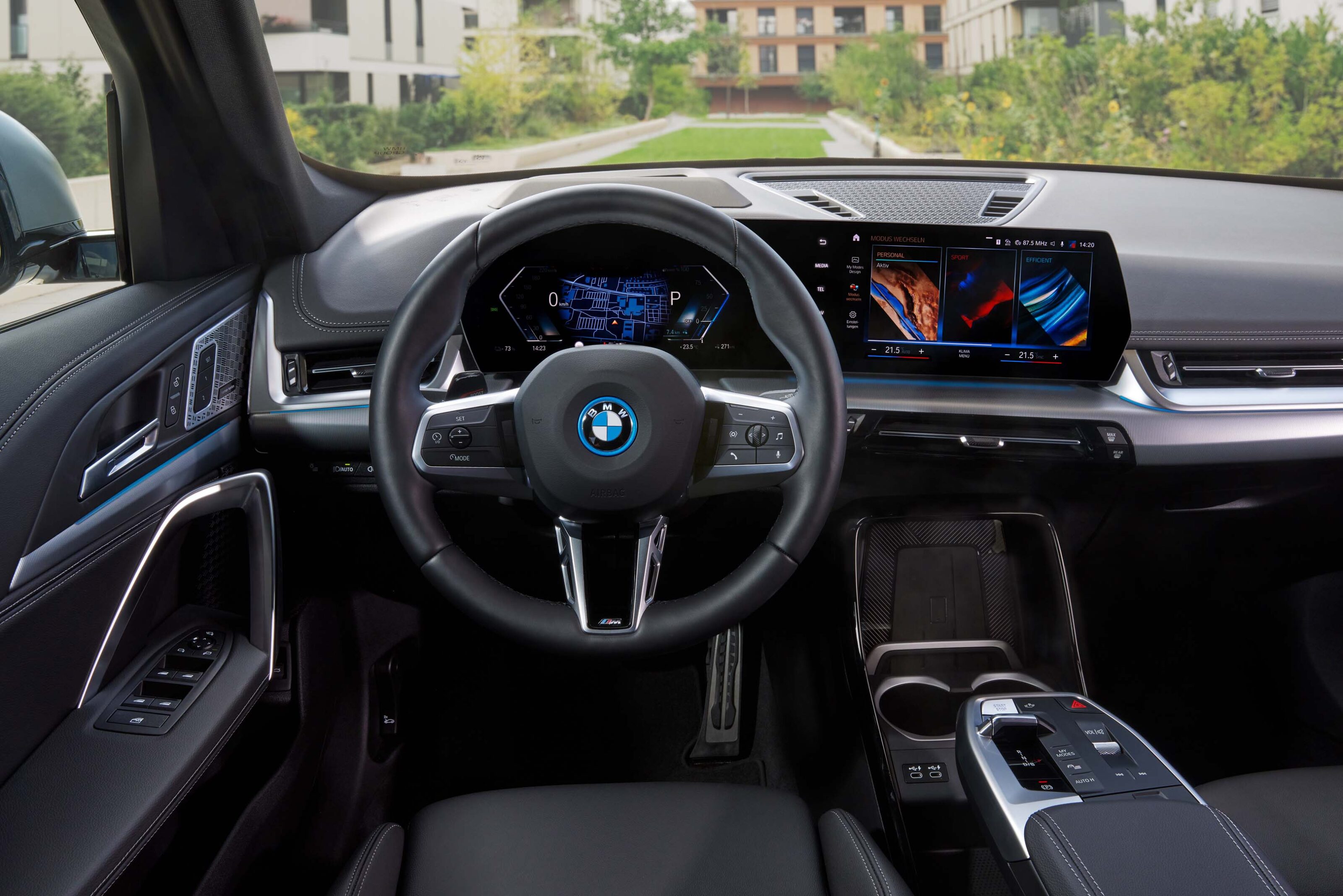
Standard equipment is strong. You get 18-inch alloys as standard as well as M adaptive suspension, park assist and BMW’s lush new curved touchscreen on all models.
Upgrade to M Sport spec and those alloys grow another inch while the exterior gains a black detailing back, the steering wheel is leather-wrapped and you get adaptive headlights plus wireless phone charging.
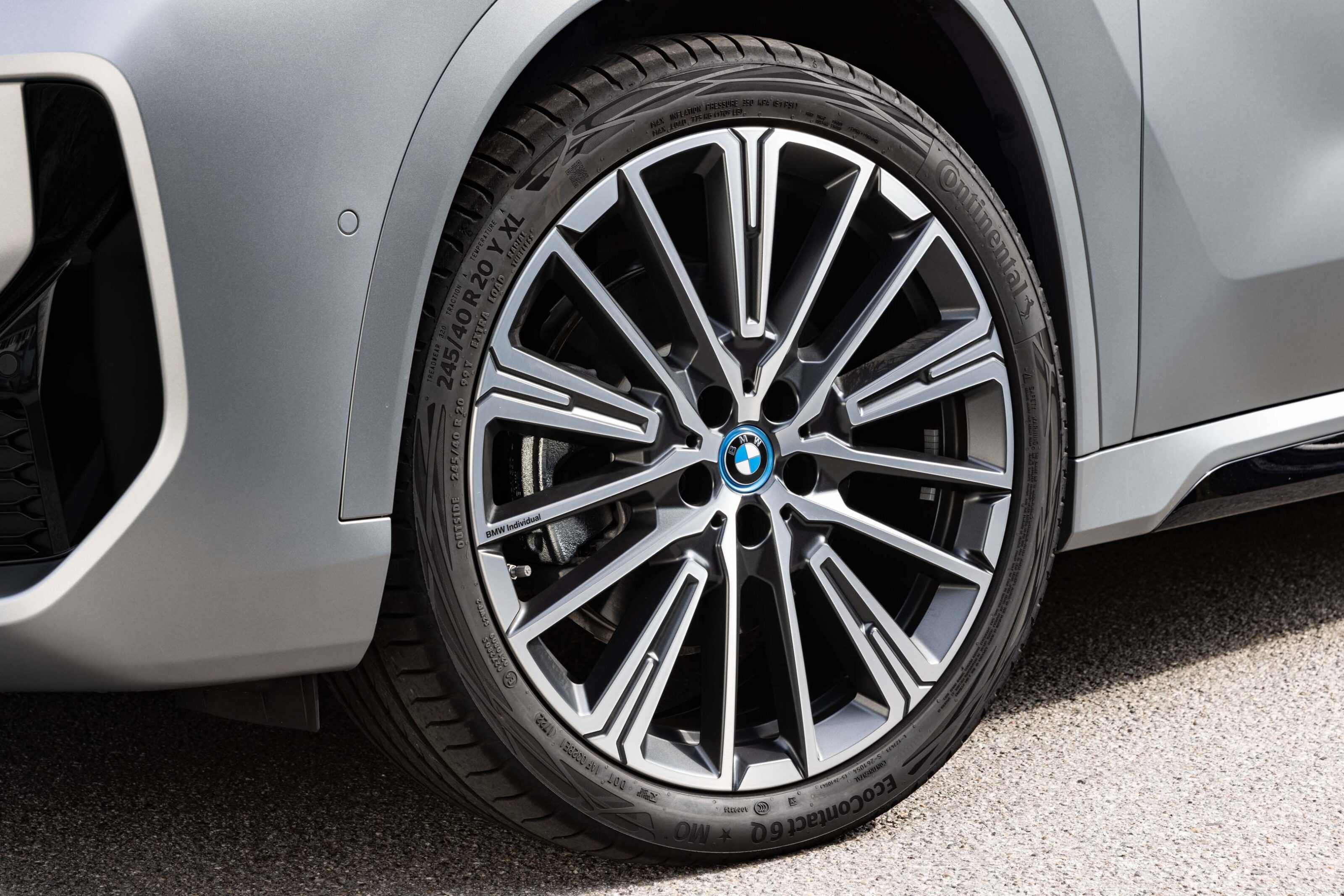
A Technology Plus pack can bring some of the latter goodies to entry-level iX1s, while an M Sport Pro pack brings massive 20-inch alloys and a posh Harman Kardon stereo.
How do rivals compare on value?
If BMW can slot the iX1 under the $80,000 mark then it’ll slot into the electric SUV pack neatly – although most rivals at that price point are larger, with more space, and that’s bound to make the difference for some buyers.
Of our favourite cars among its rivals, the Wheels COTY-winning Kia EV6 will set you back $82,900 in 239kW trim, and it’s also capable of ultra-fast 350kW charging, as is the Hyundai Ioniq 5, which costs $75,900 with 225kW peak output (both before on-road costs).
The smaller Mercedes EQA 250 costs $76,800 with just 140kW, or $84,100 as an Edition 1 with lots more kit on board (both before on-road costs).
A Polestar 2 Long Range AWD looks good value among these – at $73,400 with 300kW – but it trailed the two Koreans in our comparison test. If you can get hold of a Tesla Model Y, these start at $72,300 in base RWD form (both before on-road costs).
UPDATE, October 2022: iX1 Australian pricing revealed
Australian pricing and details for the new 2023 BMW iX1 has been revealed, and you can get all the details at the link below.
Interior comfort, space and storage
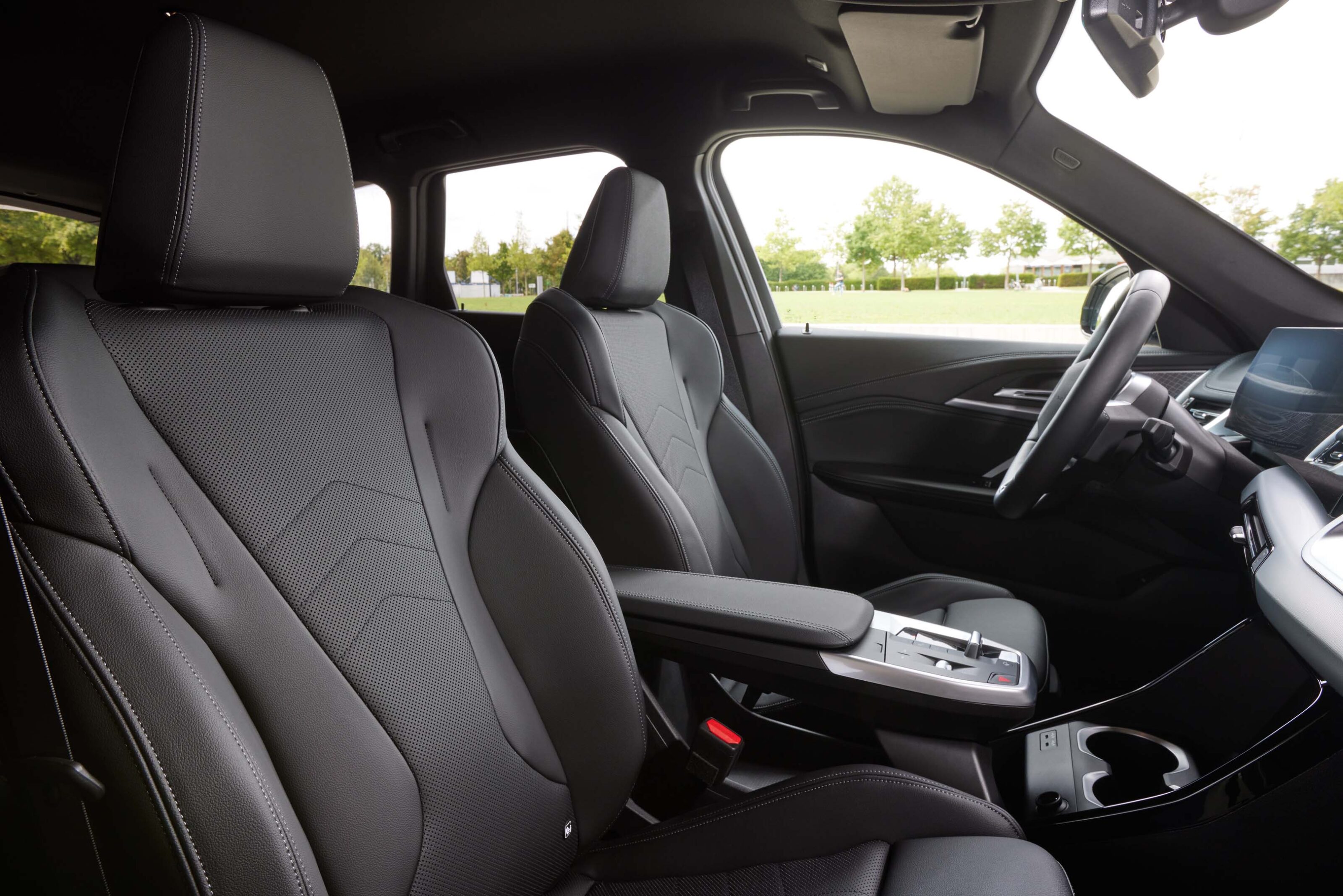
Another 22mm in the wheelbase over the outgoing X1 allows rear seat passengers to enjoy the sort of legroom normally gifted by SUVs a size bigger.
The iX1 shares much with its donor car, which means a brand-new interior. It’s just like what you’ll find in BMW’s premium people carrier, the 2 Series Active Tourer – but as we’re denied that in Australia, the X1 is our first chance to have a poke around.
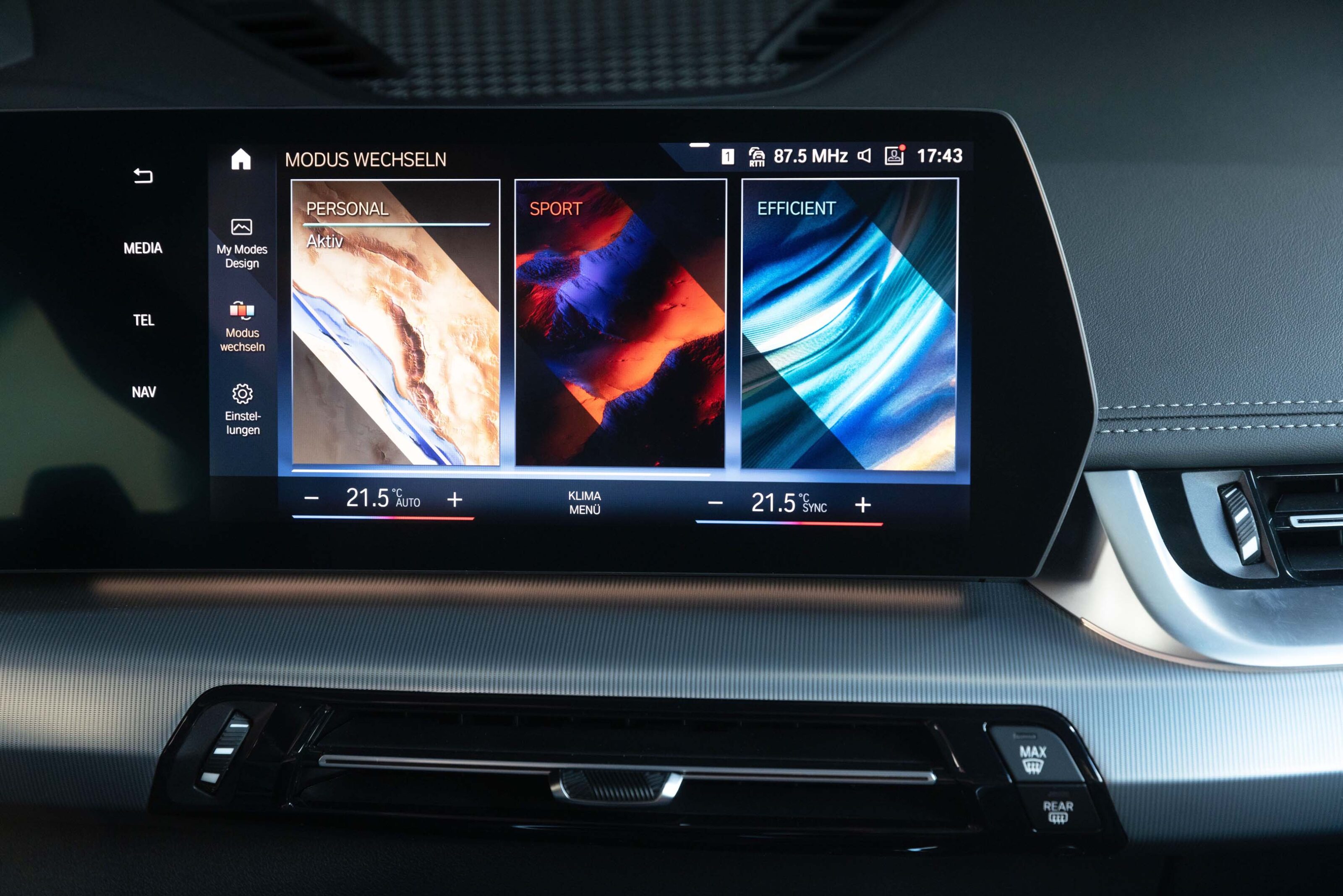
It’s certainly a new direction for BMW. The rotary controller for iDrive is gone, as is the hand-waving gesture control, which didn’t even last a decade in the Munich marque’s interiors. The argument is that the curved touchscreen taking up much of the dashboard is big enough to replace both.
The display is a touch smaller than in other BMWs – it first appeared in the electric iX SUV and i4 sedan – but fits the car nicely. The digital instrument cluster ahead of the driver measures 10.25in, the touchscreen to its left 10.7in and packing the most up-to-date BMW operating system.
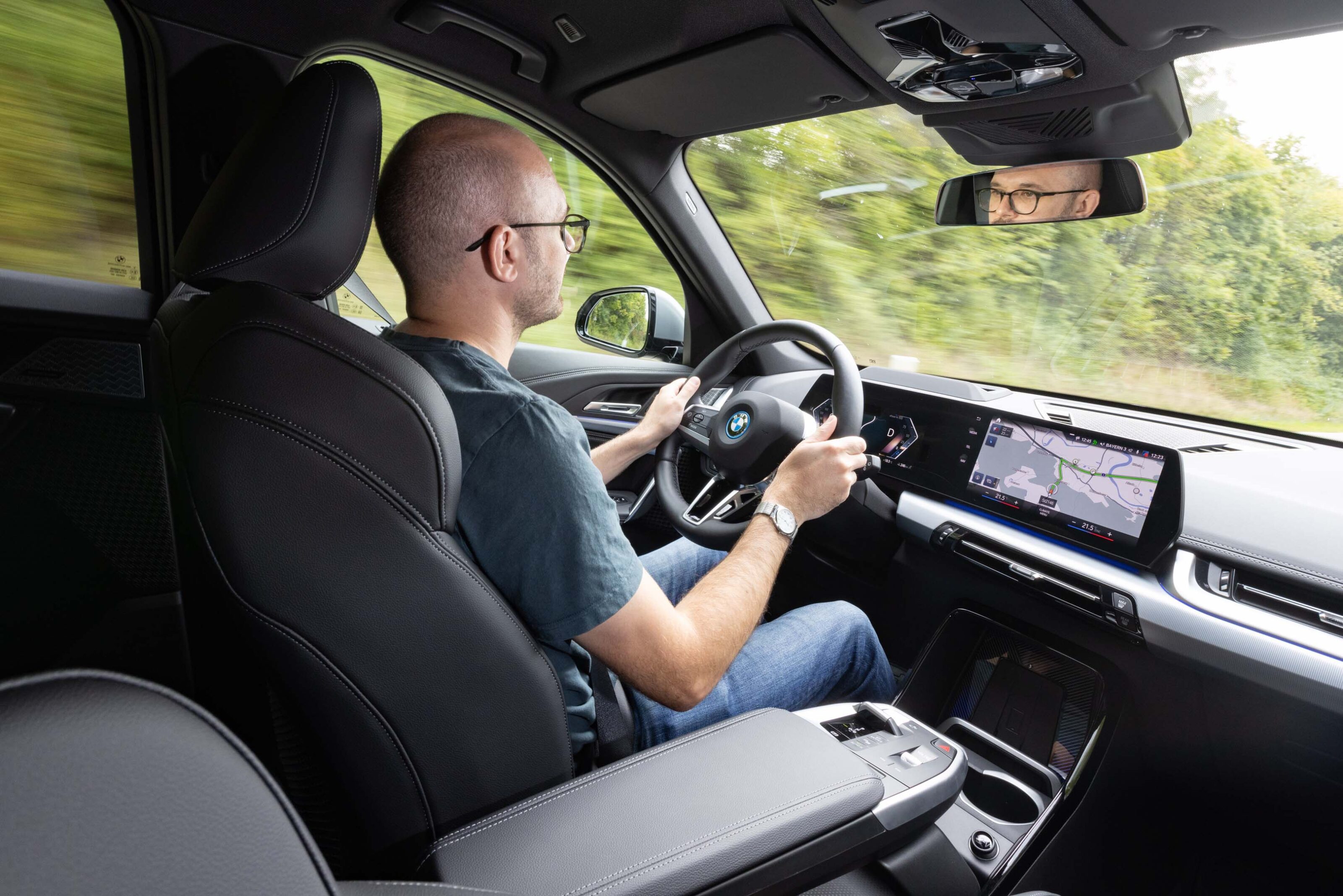
Some of it takes a little patience; the home screen is a confusing array of apps and adjusting something as simple as the height of the optional head-up display is less obvious than it ought to be. But this is where the voice control comes in.
You needn’t worry too much about the orders you bark at it, as saying something like “I’m too warm” will see the temperature drop a degree. And you might just do that on the move because the climate control buttons are among those hoovered up by the new screen.
Tidying up the buttons has helped create more storage space in and around the new ‘floating’ centre console though, while another 22mm in the wheelbase over the outgoing X1 allows rear seat passengers to enjoy the sort of legroom normally gifted by SUVs a size bigger.
In petrol X1s, those rear seats can slide fore and aft by 30mm, as well as recline but packing 300 kilos of batteries into the car erodes a touch of its flexibility and interior space.
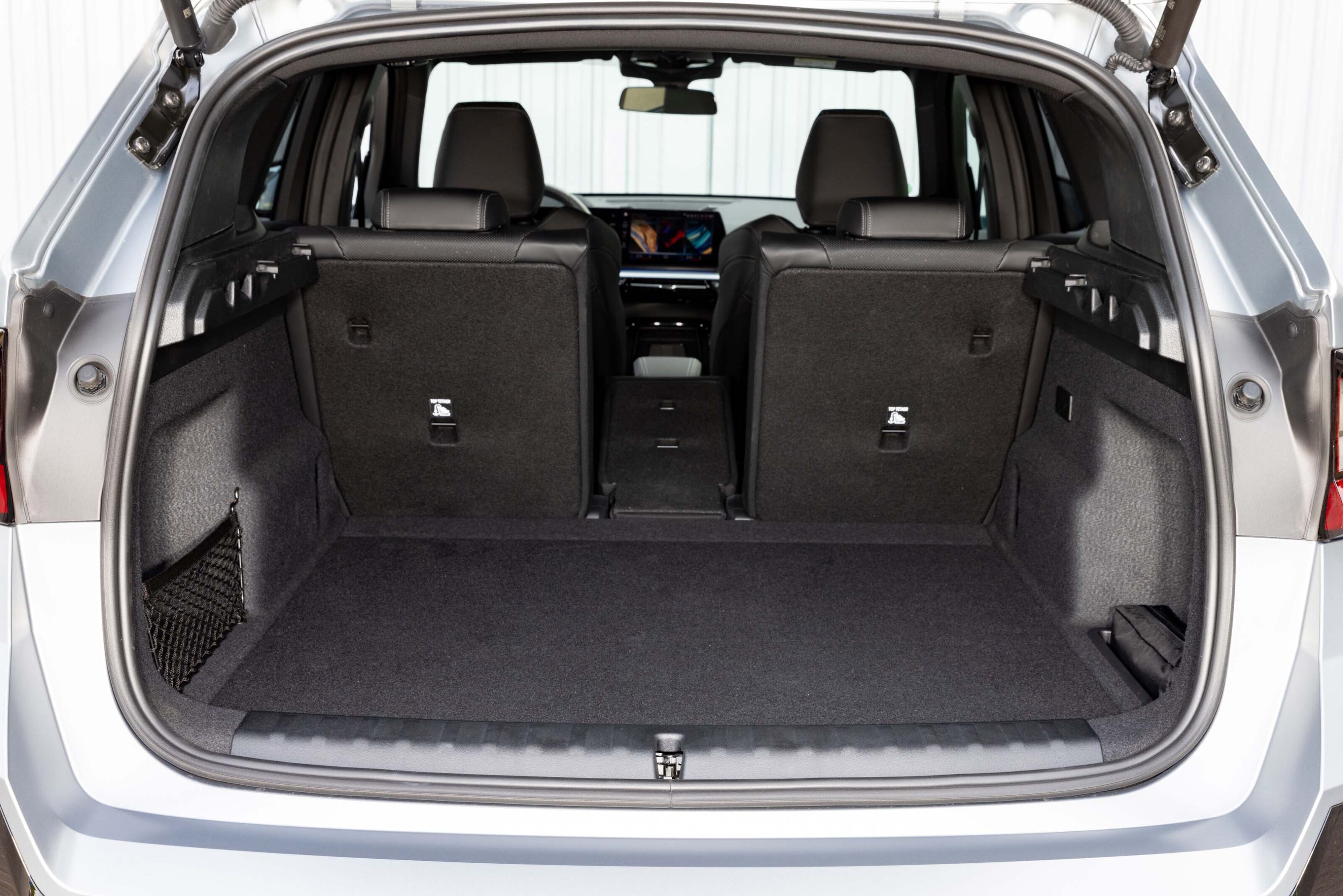
Boot capacity is naturally down a touch here, but still impressive at a seats-up 495 litres and 1495 litres with them folded.
What’s it like to drive?
Much like the X1 it’s based upon, the iX1 delivers neat and tidy handling without being outright fun, though you’ll definitely notice its extra kerb weight in corners.
In truth, the car manages its mass well but it won’t escape you if you happen to try both cars back-to-back.
The suspension had a slightly firm edge on the German roads we sampled the car on, so full judgement on ride comfort will wait until the car arrives on Australian shores.
Sticking with smaller wheels – avoiding the optional 20s at the very least – is probably a good bet.
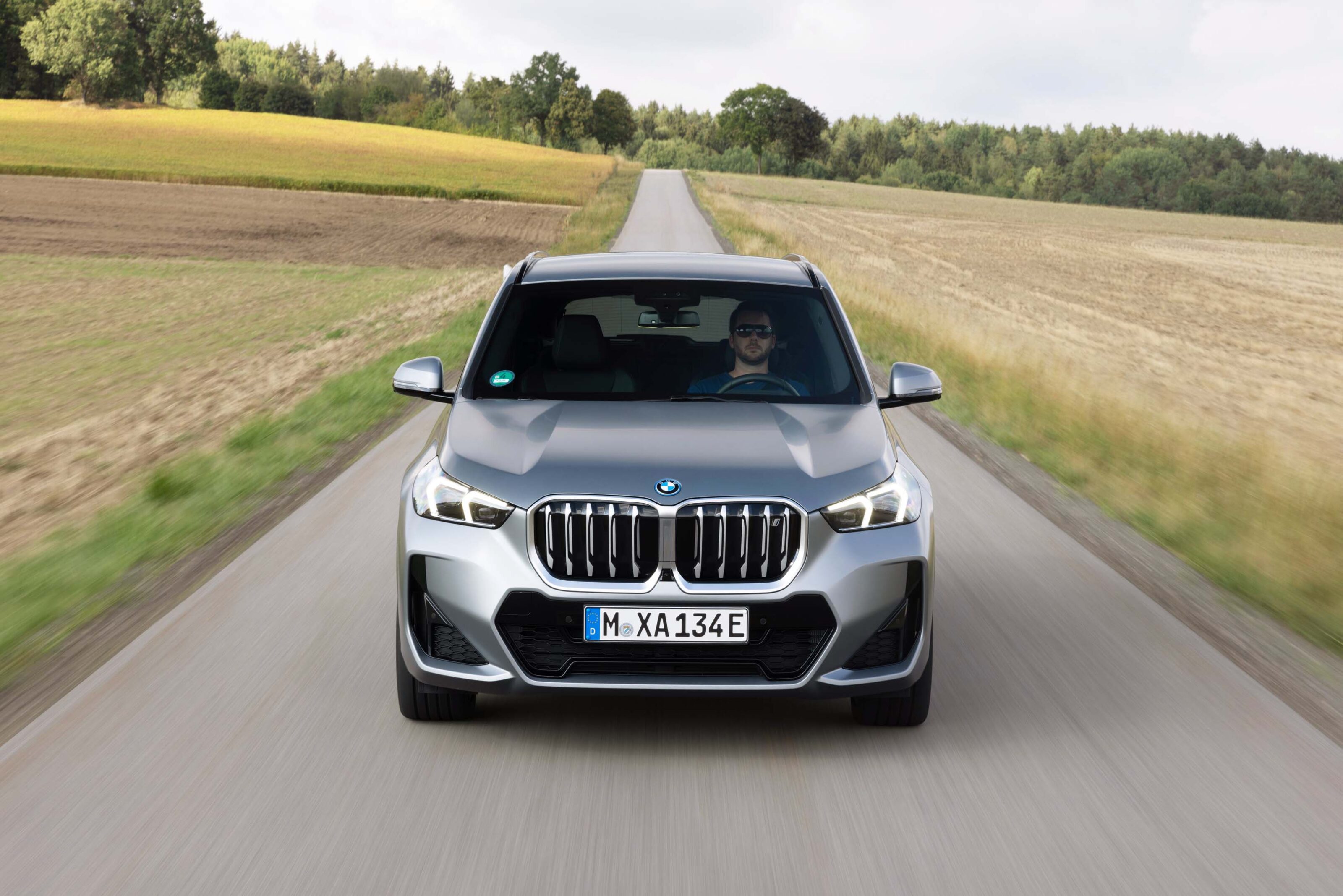
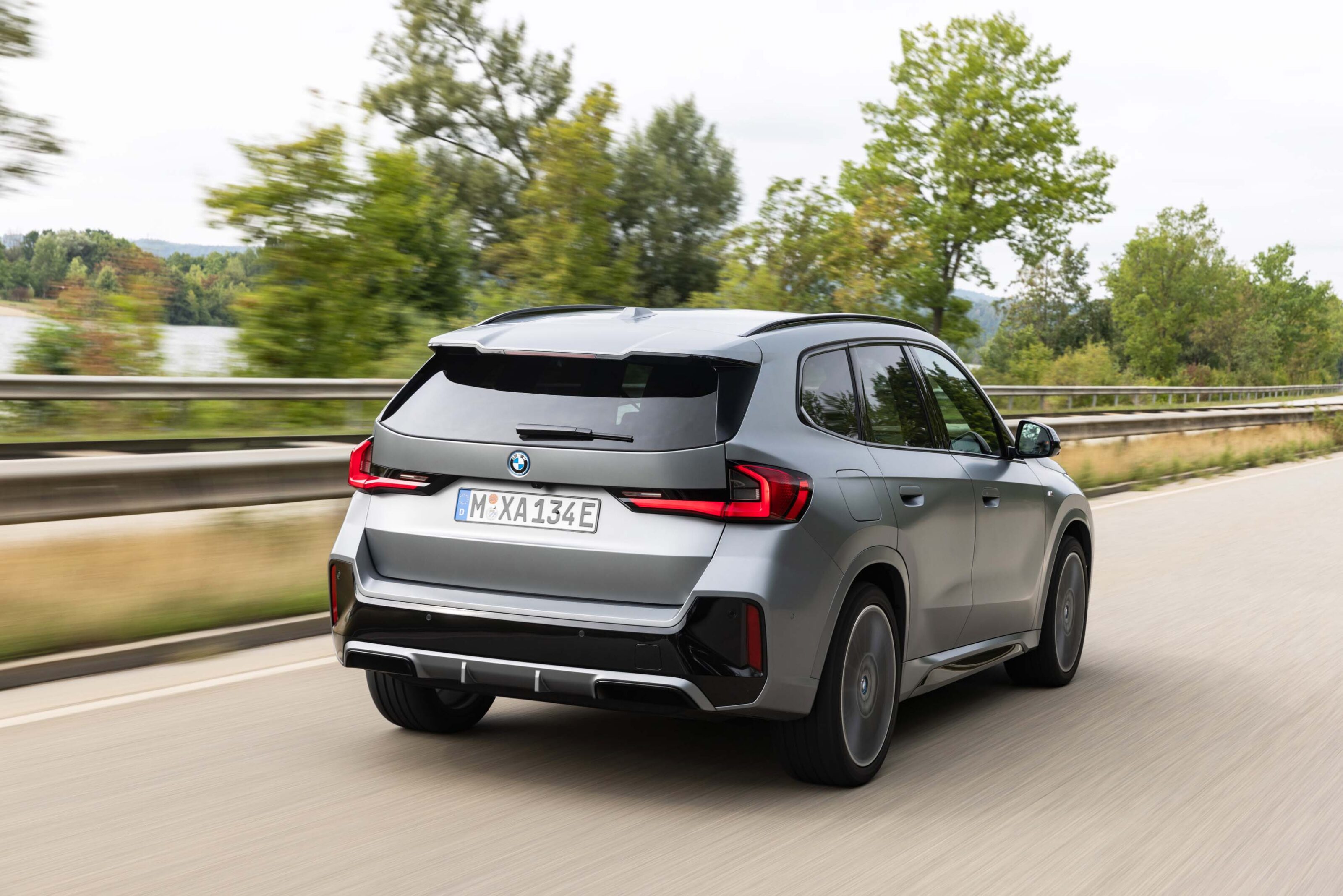
It’s a quick thing, too. While the car favours just its front motor in day-to-day driving, the rear motor comes to life swiftly and smoothly when needed. Even a deliberately clumsy use of the throttle out of a junction has the two motors hook up neatly and just project you smoothly forward. It’s a very eloquent powertrain.
The iX1 comes with lots of extra functions over the stock X1. Its regenerative brakes come with numerous levels of strength as well as an ‘Adaptive’ function that uses the car’s speed, front cameras and sat-nav to vary the level of braking when you come off the throttle.
If you’re at all keen on driving, you’re likely to find it quite off-putting that the car is making its own mind up about something really rather key to the process of getting around. Expecting the car to slow down more than it actually does is not a fun feeling.
It’s a quick thing, too. While the car favours just its front motor in day-to-day driving, the rear motor comes to life swiftly and smoothly when needed.
Luckily, all three of the manually selected levels have their merits and you can slot the transmission from D to B to make the iX1 a one-pedal car that’ll slow right to a stop at junctions just by lifting off the accelerator. It works nicely in town but is best avoided on twisting rural roads.
A smarter function is the battery’s ability to pre-warm itself ahead of charging – so long as you’ve got a charger inputted into the native BMW nav system. In theory, it means the cells will start taking on charge at the quickest possible rate immediately rather than building up to it.
Our drive in the car didn’t last long enough to try that out but it’s a neat step on the long road to making EVs feel just as habitable on long journeys as petrol and diesel cars. The iX1’s nav will also switch to another charging point if it learns the one you’re aiming for is now occupied.
How is it on fuel?
BMW claims 413 to 438km of range from a full charge on the WLTP test cycle, with energy consumption of 18.4 to 17.3 kWh per 100km.
The car will accept up to 130kW from a DC rapid charger, BMW quoting a 10 to 80 per cent charge time of 29 minutes.
As standard, you get 11kW AC charging, meaning 0-100 per cent in 6.5 hours. Optional 22kW AC charging cuts that to 3h45m.
How safe is it?
The latest X1 is yet to be tested by ANCAP, though both of its forebears scored the full five-star safety rating.
Hopefully, the same will ring true for the new X1 and iX1. Park assist is standard, as well as a handful of other active safety systems, though full specs are yet to be confirmed.
VERDICT
The iX1 is immediately more intriguing and likeable than the car it’s based upon.
The stock X1 is a neat and accomplished SUV but one that blends into the crossover crowd a little too easily for a car made by a premium brand usually famed for dynamic sparkle.
But with a quicker and smoother electric powertrain, it’s more notable. Let’s hope BMW prices it right to tackle its numerous Asian and European rivals head-on.
Also…
Now that you’re done reading our first review of the new iX1, be sure to check out our review of its regular companion, the X1. Hit the link below.
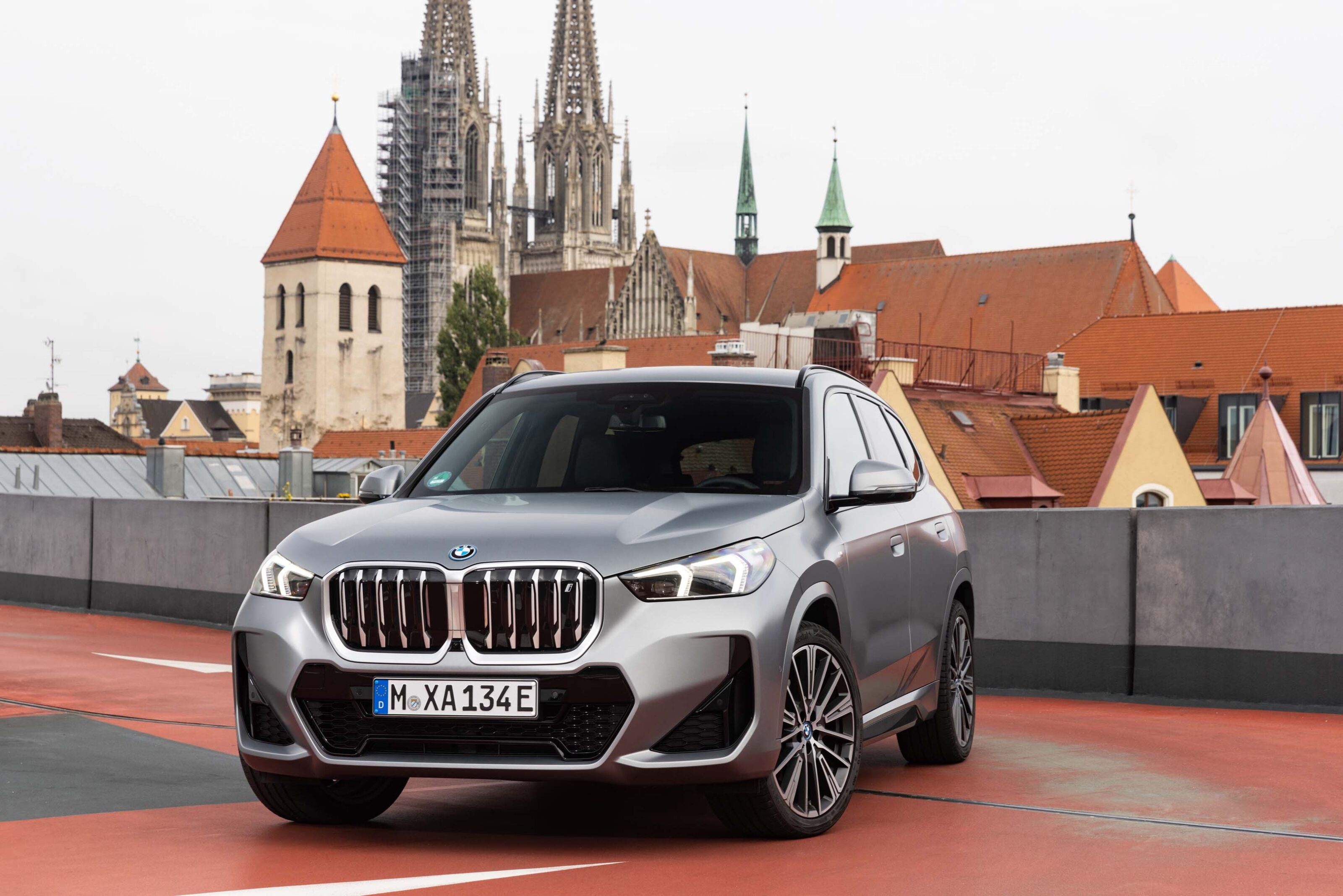
BMW’s smallest SUV has grown up. While the X1 launched in 2009 as a slightly awkward-looking entry point to posh crossover ownership, it’s matured nicely into its third generation.
Its dimensions all but match the original X3, much in the same way a 3 Series now fills the footprint of an old 5.
While we might normally chastise a car-maker for needlessly enlarging its cars, the X1 wears its growth very well, in both styling and practicality.
This is one of the smarter, less controversial BMW designs of recent years, boasting plentiful room and some grown-up technological advances inside.
June 2023: BMW X1 M35i revealed, Australia confirmed
BMW has unveiled a new flagship in its compact X1 range, expected to be priced above the $82,990 iX1 electric SUV.
Learn all about the performance-focused X1 M35i at the link below, and continue reading here for wider 2023 X1 range pricing and features.
March: New BMW X1 driven in Australia
The new BMW X1 is now on sale in Australia, and we’ve driven it. We’ve also driven its electric sibling, the iX1, in Europe. Links to both stories are below.
STORY CONTINUES: BMW X1 international review
Jump ahead
- How much is it, and what do you get?
- How do rivals compare on value?
- Interior comfort, space and storage
- What’s it like to drive?
- How is it on fuel?
- How safe is it?
- VERDICT
How much is it, and what do you get?
The third-gen X1 will launch in Australia later this year with a simple line-up consisting of two turbo-petrol engines.
The X1 sDrive18i kicks things off at $53,900 (before on-road costs).
A 1.5-litre three-cylinder drives the front wheels through a seven-speed dual-clutch automatic gearbox. Peak power is 115kW, enough to hustle its 1.5-tonne frame to 100km/h in 9.2 seconds. Not exactly quick, but enough for day-to-day life.
If performance is more of a concern, you’ll be better served by the $65,900 (before on-road costs) X1 xDrive20i, which has a 2.0-litre four-cylinder driving all four wheels – again, through a standard seven-speed dual-clutch auto – with 150kW yielding a sprightlier 7.1sec sprint time, aided by some mild-hybrid boost.
Much more powerful plug-in hybrid versions, as well as the fully electric iX1, will follow in due course. BMW Australia has opted not to bring over the diesel versions that European buyers get to choose from.
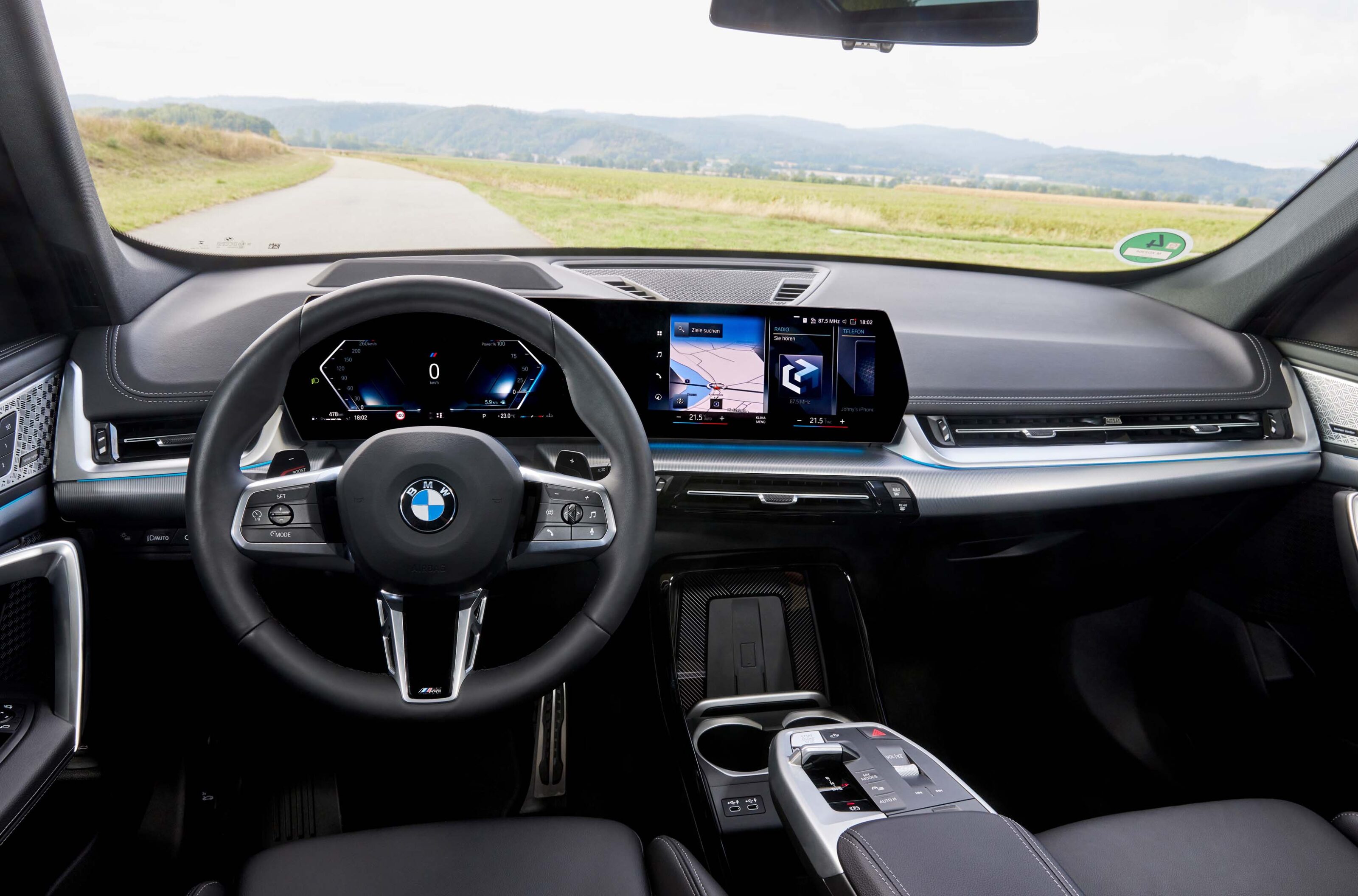
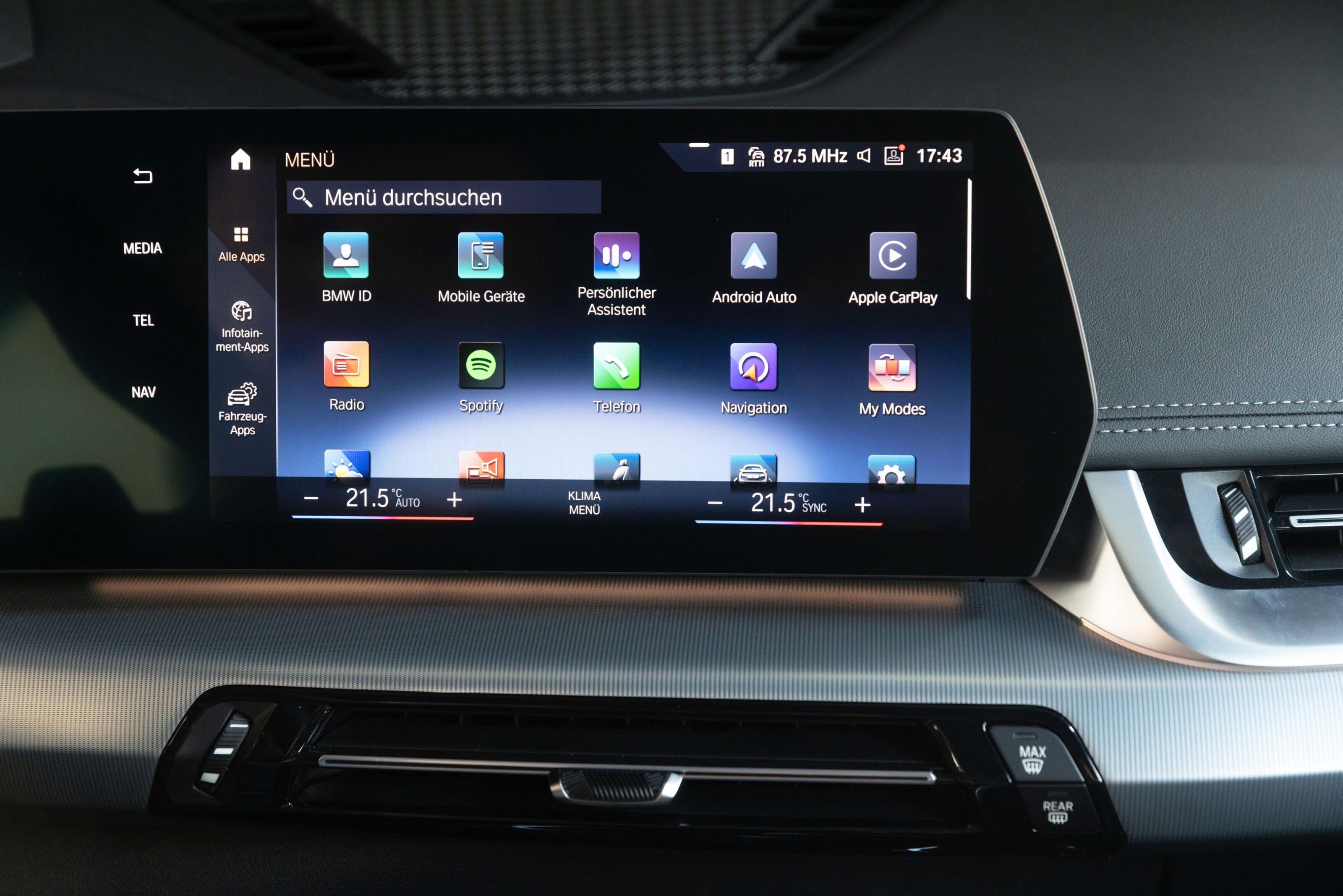
Standard equipment is strong, the X1 benefiting from BMW’s luscious new curved display which runs an up-to-the-minute operating system.
Adaptive headlights, a head-up display and park assist with a whole gamut of cameras help add to the techy feel on board.
There’s no longer such a pervading sense of ‘entry level’ about this car. Upgrading to the 20i brings heated front seats, lane-departure systems and inch-bigger 19in alloys to go with its extra power.
Extra option packs help top up the standard equipment in simple – if slightly pricey – steps.
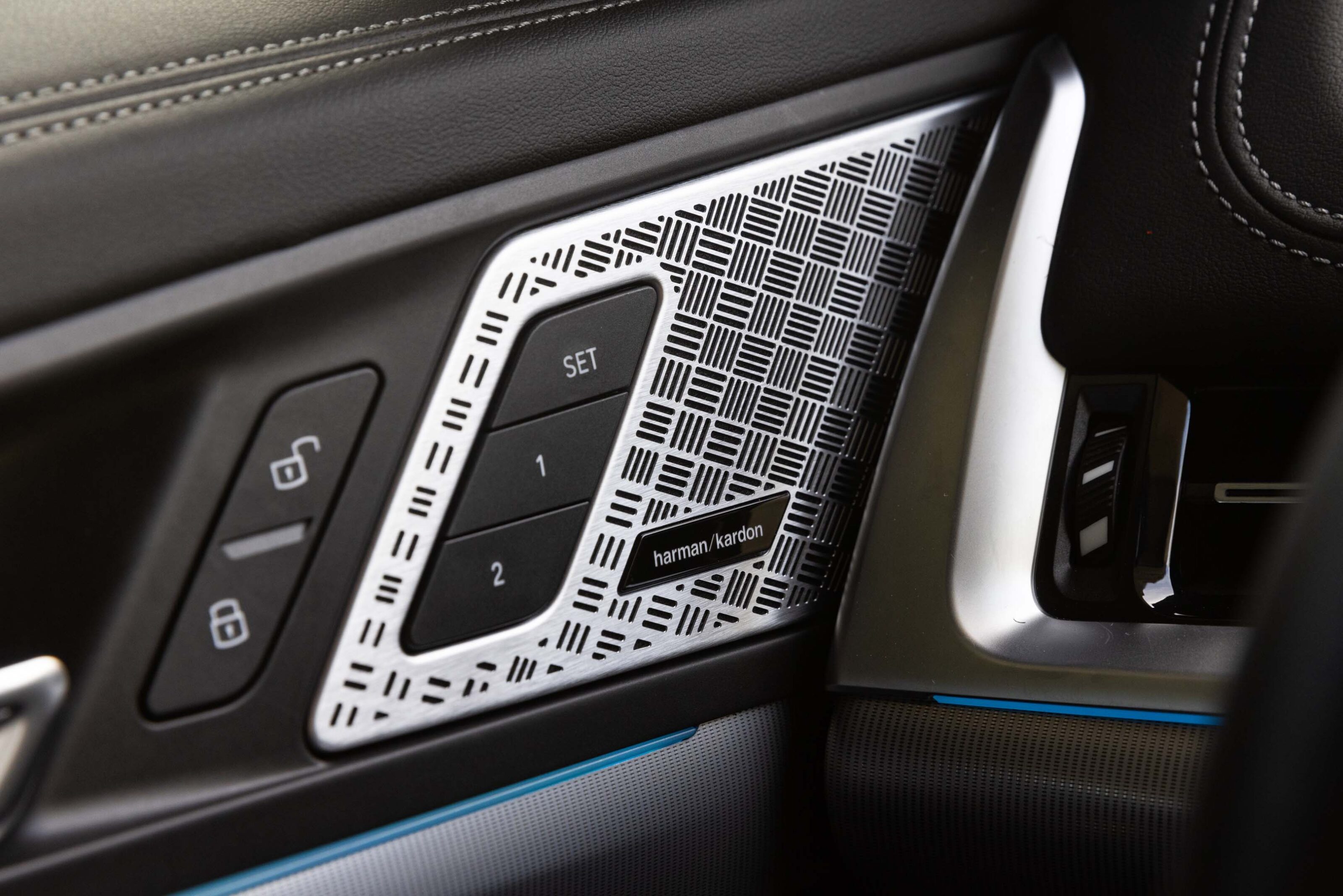
A $3000 M Sport pack for the 20i brings adaptive M suspension as well as a host of styling tweaks – chintzier wheels included – while both versions gain a Harman Kardon stereo, panoramic sunroof and sliding rear seats via an Enhancement pack. Massaging seats also lie among the options to help up the feeling of maturity.
How do rivals compare on value?
A comparable Mercedes GLA will set you back similar money, a 120kW GLA 200 coming in at $60,688 and a 165kW GLA 250 4Matic costing $74,245 (both before on-road costs). You’ve also the option of the slightly larger GLB; it’s roughly a four-grand upgrade but offers a third row of seats for extra family friendliness.
The xDrive20i slightly undercuts a comparable Range Rover Evoque – the $67,200 P200 – while the 131kW Lexus UX250h is a touch less powerful but a decent amount cheaper, starting at $52,025 (both before on-road costs).
You’ll save yet more money if you’re not sold on a premium badge: a Ford Escape, Hyundai Tucson or Kia Sportage with a relatively similar tech spec will set you back less than $50K. The X1 does at least pack most of the kit you’d ever rationally need as standard, though.
Interior comfort, space and storage
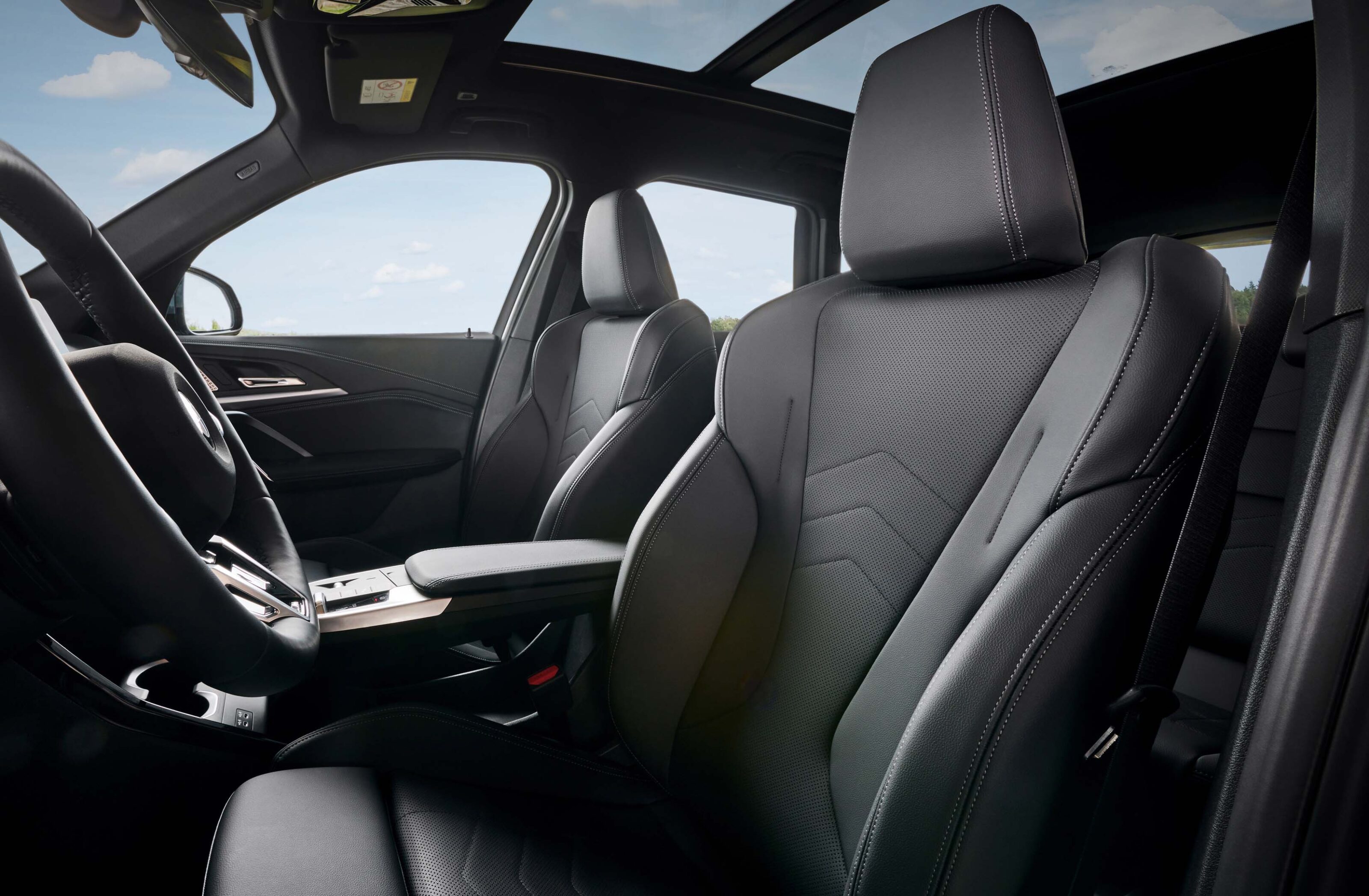
The open-plan feeling dashboard – aided by BMW’s new curved touchscreen and its major spring clean of traditional switchgear – is shared with the 2 Series Active Tourer, a car that doesn’t get to escape Europe for Australian shores.
But the X1 fills the gap nicely – there’s definitely a bit of a late-90s MPV vibe to the interior, which is vehement praise rather than criticism. For years, car interiors have favoured earnest tones and a feeling of cosiness as ‘premium’.
This is BMW claiming back brightness and roominess as a virtue, and while you might miss iDrive’s famous rotary wheel when you first navigate the vast touchscreen, there’s no doubt this is a car well suited to the task at hand.
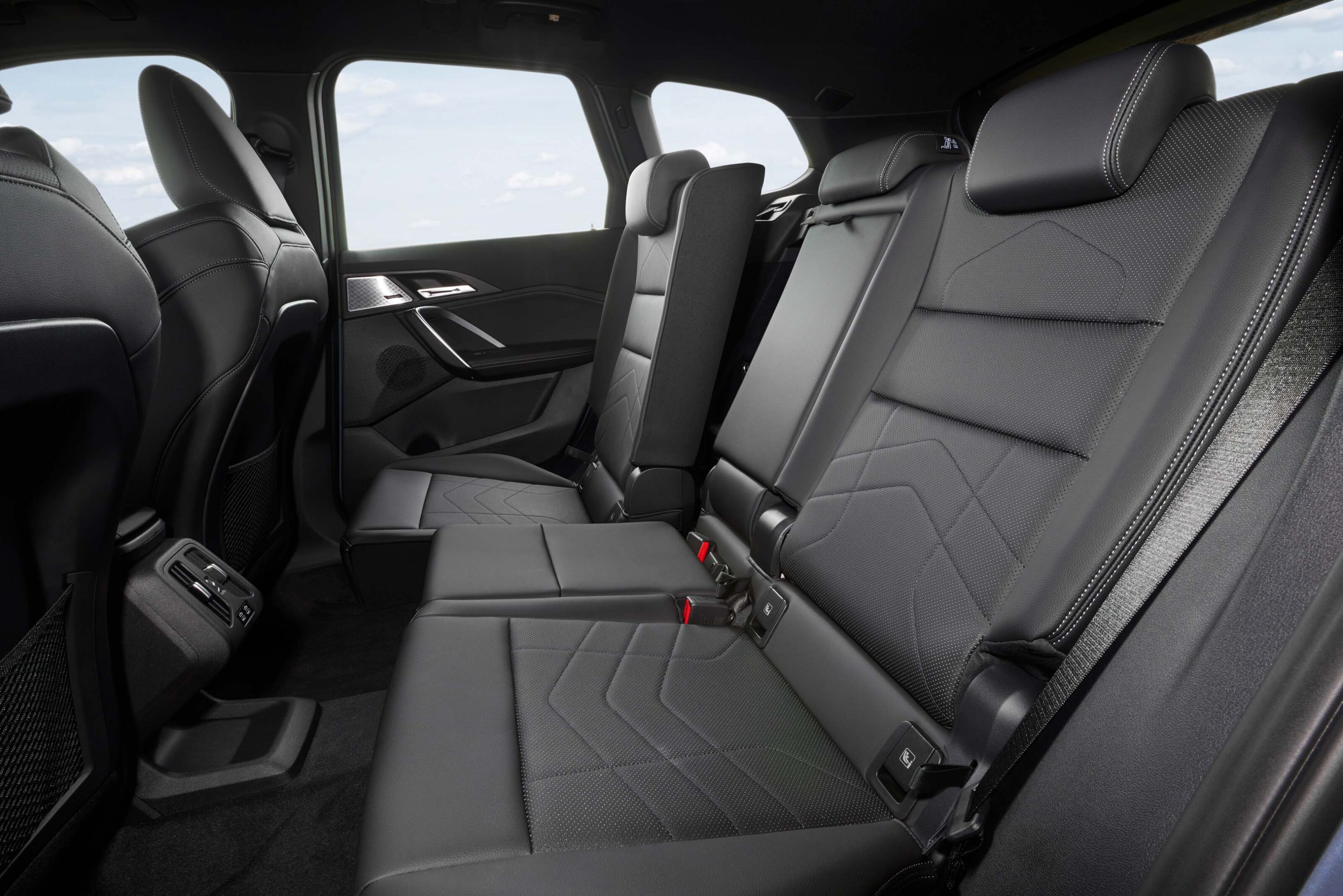
There’s another 22mm in the wheelbase over the outgoing X1, which will be immediately obvious to anyone climbing into the back.
Rear-seat passengers will be basking in the kind of room normally afforded to them by SUVs a size bigger, and those rear seats can slide fore and aft by 30mm as well as recline.
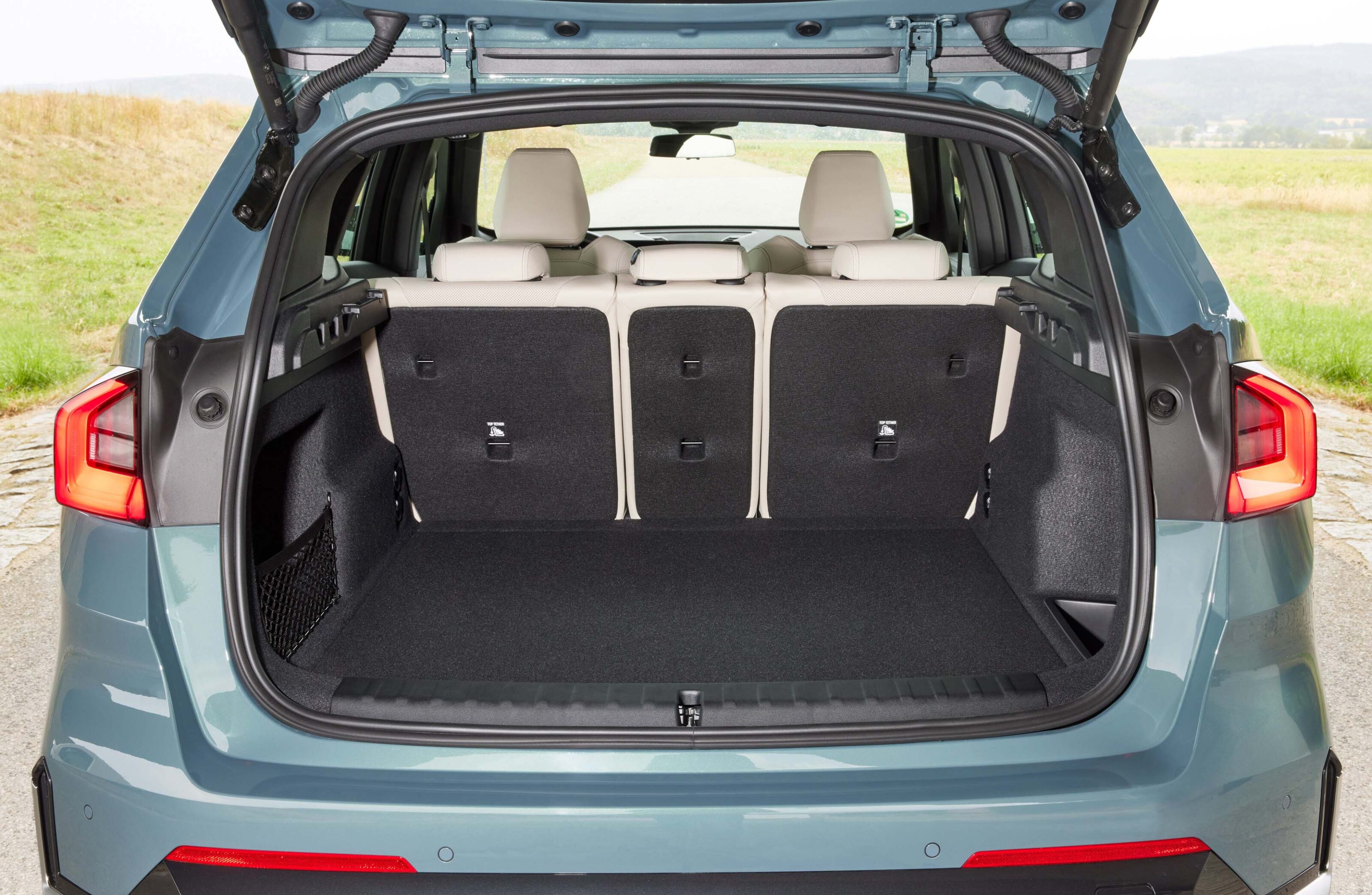
With some inevitability, the battery pack of the iX1 eats away at rear space a little (as well as deleting the seat-sliding mechanism), but nothing fatal. The petrol X1’s boot is 50 litres larger than before, now peaking at 540 litres with the seats up and 1600 litres when they are folded, with an electric tailgate at all spec levels.
The touchscreen hoovers up lots of buttons – climate control included – but if you’re a bit confused by the array of icons on the screen, there’s some pretty natural voice control to take advantage of.
Say “I’m a little warm” and it’ll crank the temperature down. Alongside the gear selector being a small toggle rather than a stick, this contributes to airiness and roominess up front and lots more room for knick-knacks, with a ‘floating’ centre console allowing you to hide some of it away a bit too.
But placing the wireless phone charger upright – so your phone faces outwards into the cabin in a potentially distracting manner – feels like a slightly duff move.
What’s it like to drive?
This is the traditional hunting ground of BMW’s offerings, but it’s where the petrol X1 impresses least.
The seven-speed transmission is rather hit-and-miss at finding the right gear, and there are no paddles on the wheel to help out unless you go for pricey M Sport trim. Which feels very un-BMW.
A vocal and coarse engine in the 20i under high revs is unrefined enough that the diesels offered in Europe are preferable. Mind you, being able to pull the left paddle in M Sport cars for another 14kW of mild-hybrid boost is a nice touch and useful for overtakes.
We’re yet to try the entry 18i but, hopefully, it’ll deliver a little better refinement than the 20i – or compensate for any volume with a more interesting three-cylinder thrum on full throttle.
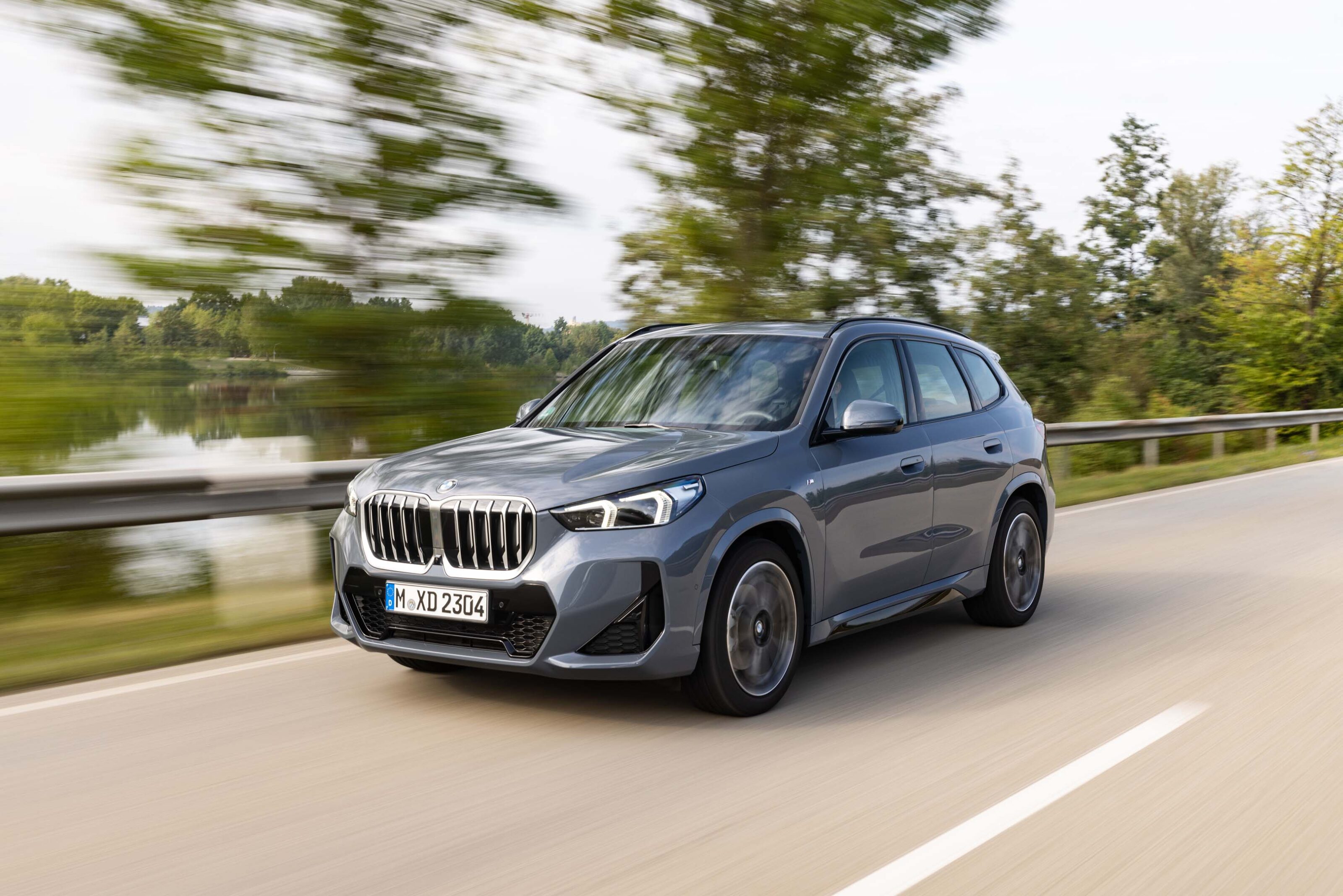
Handling is neat and tidy without providing outright fun. Which is right on the button for the small SUV class.
And it must grate with the likes of the VW Group brands that BMW resisted front-driven cars for decades before rocking up and nailing their dynamics pretty much immediately once profit margins finally dictated a change of heart.
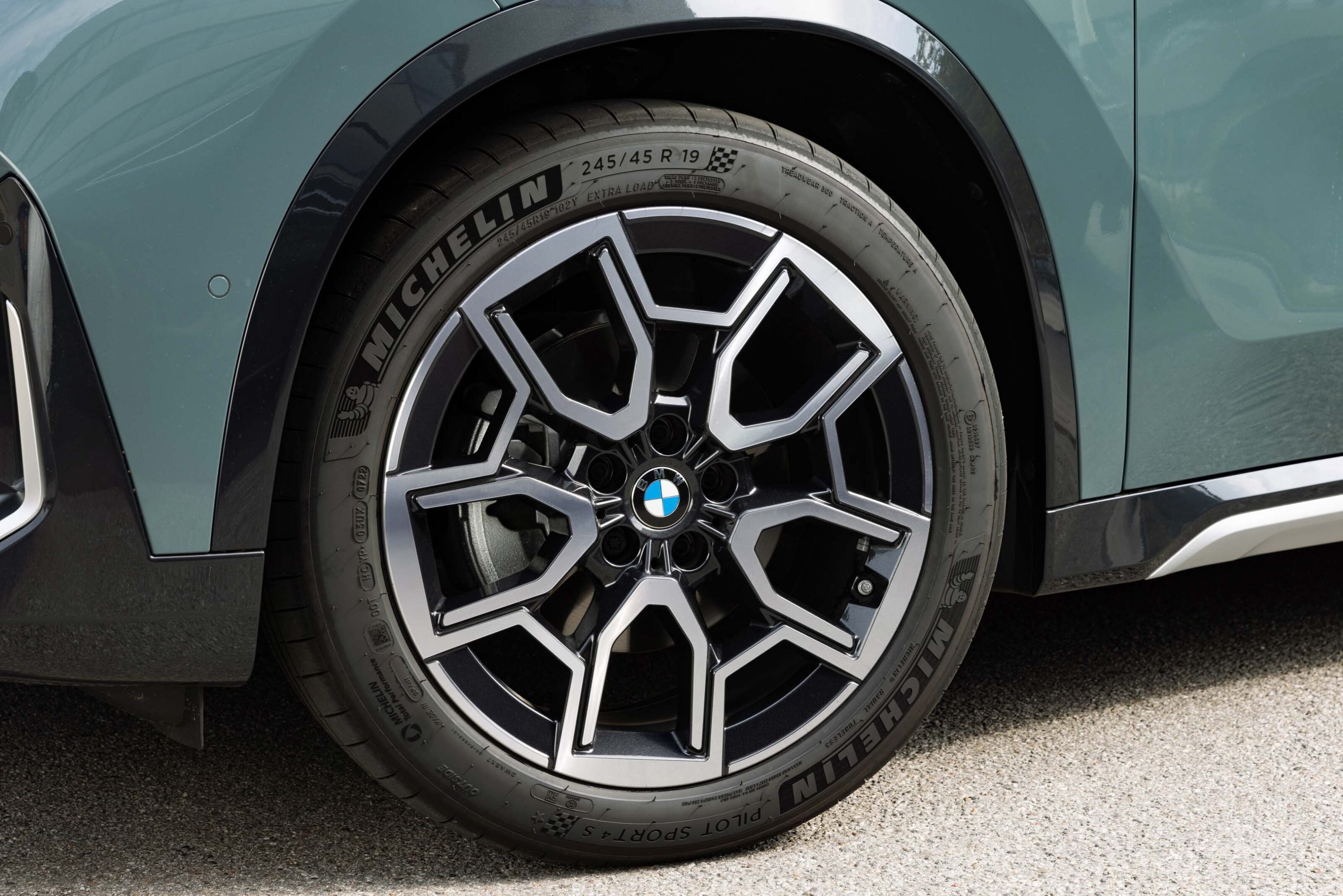
Our final verdict on the X1’s ride quality had better wait until we try it on Australian roads – on well-kept German tarmac it felt accomplished, just with a slightly tough edge when riding on 19s. You can even option 20s, but we probably wouldn’t.
How is it on fuel?
The BMW X1 consumes 95 RON fuel, with the sDrive18i naturally the thriftier of the pair, claiming 6.5L/100km, while the xDrive20i quotes 7.4.
Neither figure is bad, given it’s two seconds quicker to 100km/h and drives both of its axles.
How safe is it?
The latest X1 is yet to be tested by ANCAP, though both of its forebears scored the full five-star safety rating.
Hopefully the same will ring true here. Park assist is standard fit, as well as a handful of other active safety systems, with steering and lane assist functions fitted to the 20i and optional on the 18i.
VERDICT
The X1 is better than ever, without exhibiting BMW at its very best.
We’re used to lavishing abundant praise on the way cars pumped out of Munich drive, but here it’s practicality and a rethinking of interior layout that impress most.
It’s a small SUV that’s no longer so small, to the benefit of how well it’ll slot into everyday life with nary a whimper from anyone on board.
Just don’t expect the dazzling powertrains or incisive dynamics we usually enjoy on propeller-badged products.
Also…
Now that you’re done reading our first review of the new X1, be sure to check out our review of its electric companion, the iX1. Hit the link below.
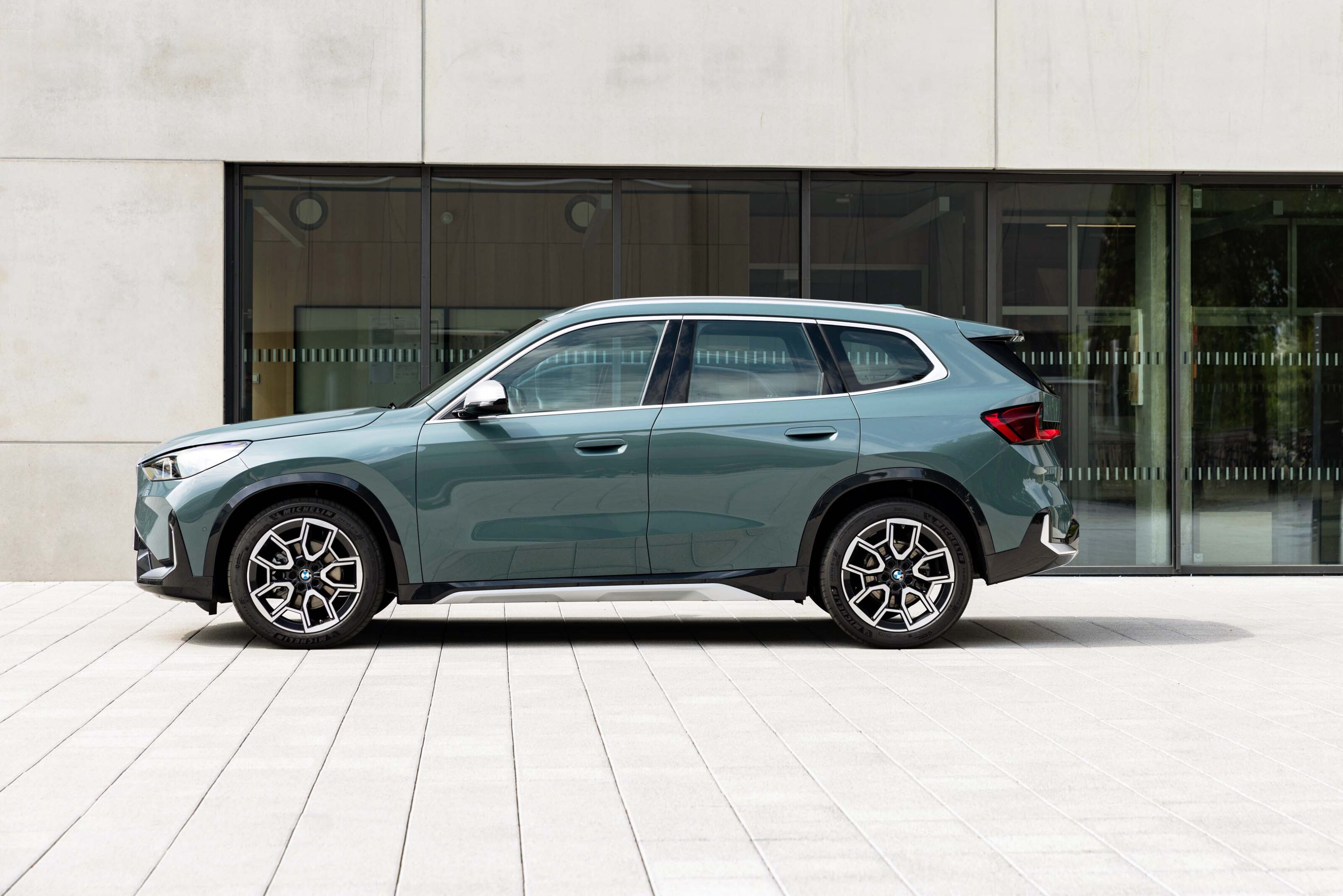
? UPDATE: 2023 G87 BMW M2 revealed early
The internet abhors a strict schedule, so it was only a matter of time before the new 2023 BMW M2 showed up online sooner than the M division would’ve liked.
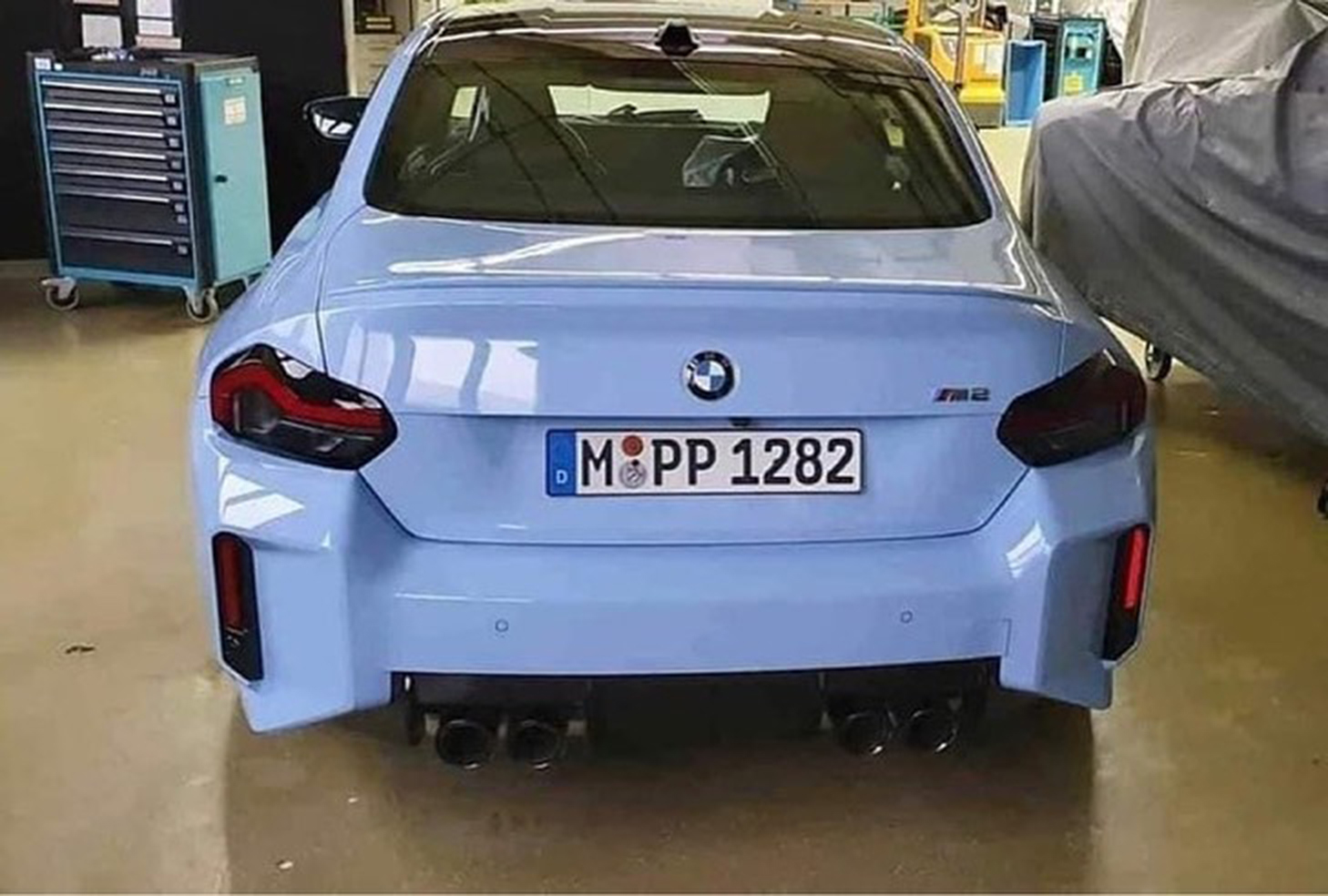
This trio of photos, posted to Instagram over the weekend, reveal what we can expect from the new halo coupe’s styling.
And, while the car pictured has not been confirmed as an actual M2, the details clearly line up with the camouflaged car that BMW has been showcasing in the lead-up to the G87 M2’s October unveiling.
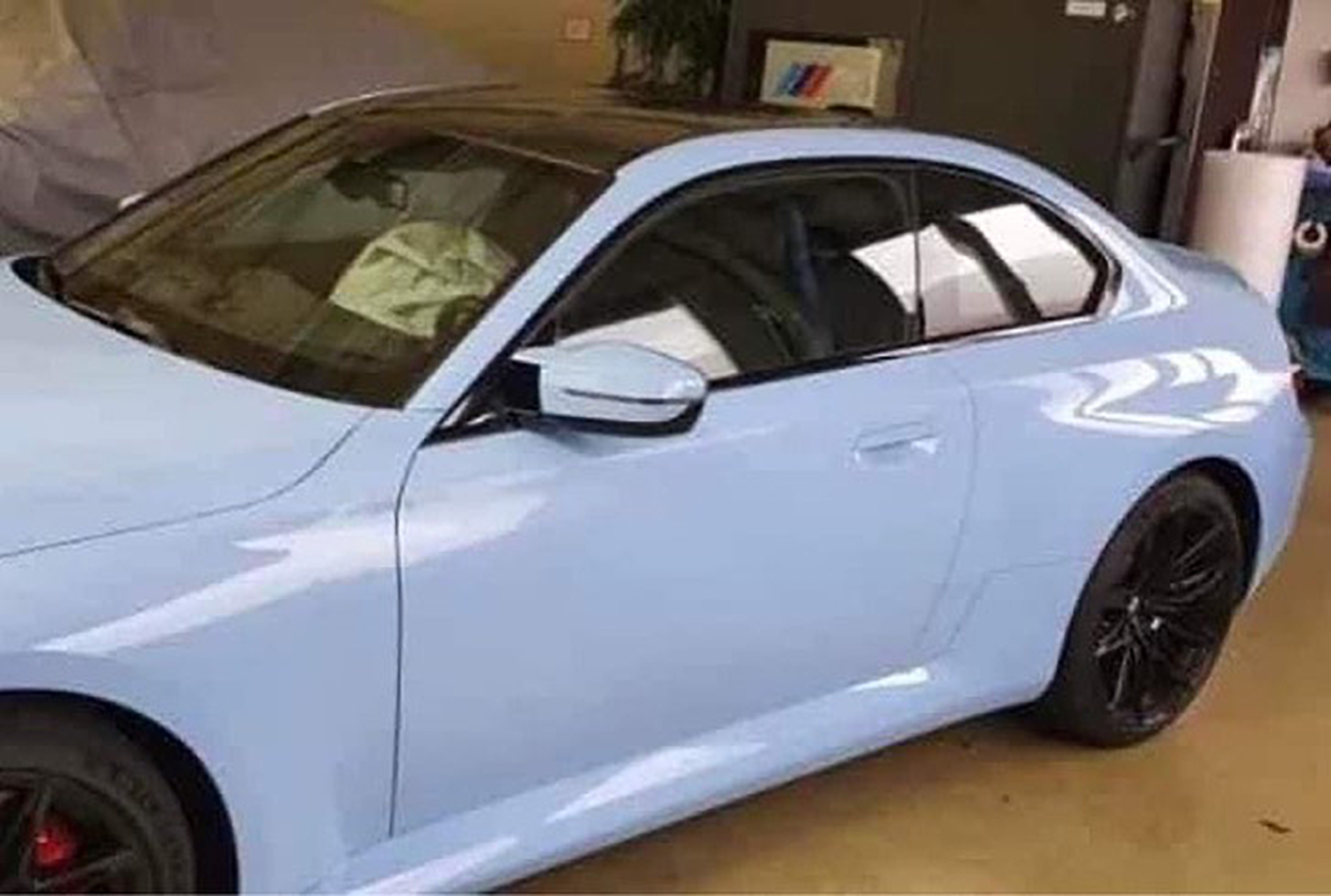
Of course, photos of this type – low resolution ‘potato phone‘ shots captured at unflattering angles and distances – are rarely flattering, but there’s enough here to give buyers and fans an idea of what’s to come.
What do you think of the new M2’s look? I suspect it’ll look much better in the proper marketing photos – and, as always, we can likely expect an element of “I like it more in the flesh than I did in the photos” when it finally hits Australian roads next year.
Tell us your thoughts in the comments below, or join the conversation on our Facebook page!
The story to here
September 7: New official preview shows up on social media
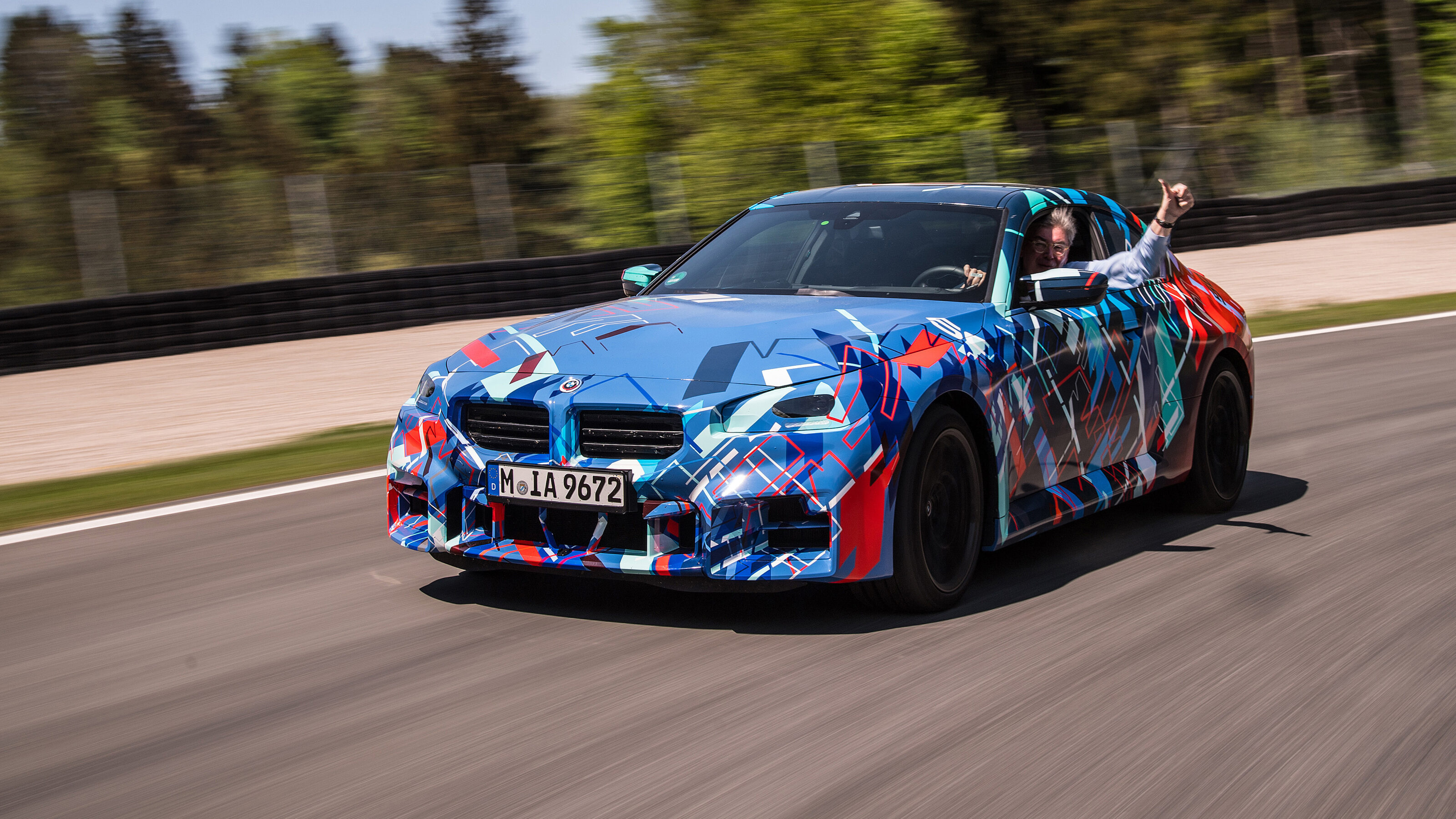
BMW’s M division has posted a fresh preview of its upcoming 2023 M2 hero coupe to social media this week, ahead of what is expected to be a mid October unveiling.
The new video shows little in the way of detail, however, with the lively and colourful camouflage worn by the prototype we drove in June probably offering a better look at what’s to come.
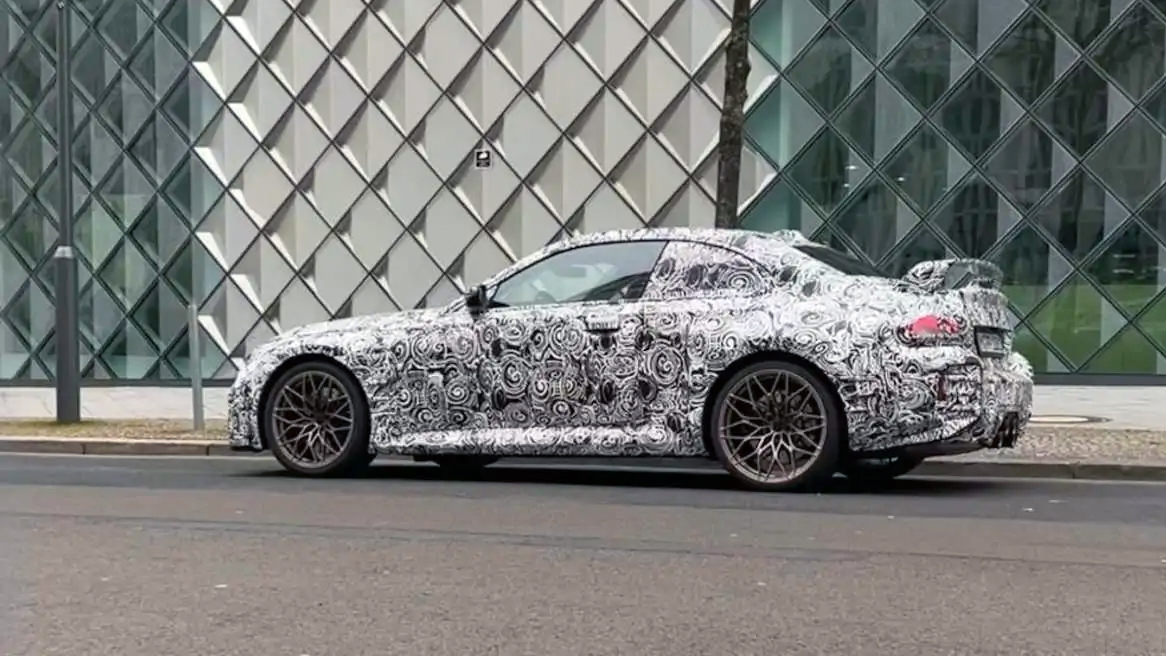
If nothing else, this latest clip gives fans a decent look at the new M2’s proportions, showing potential buyers a tougher set of proportions than those enjoyed by owners of the current M240i coupe.
Catch the teaser in the short clip below, and scroll down for our ongoing coverage on the upcoming new 2023 BMW M2.
https://www.instagram.com/p/CiIT-xeDrnw/
The story to here
May 2022: 2023 BMW M2 teased in sideways, smokey video
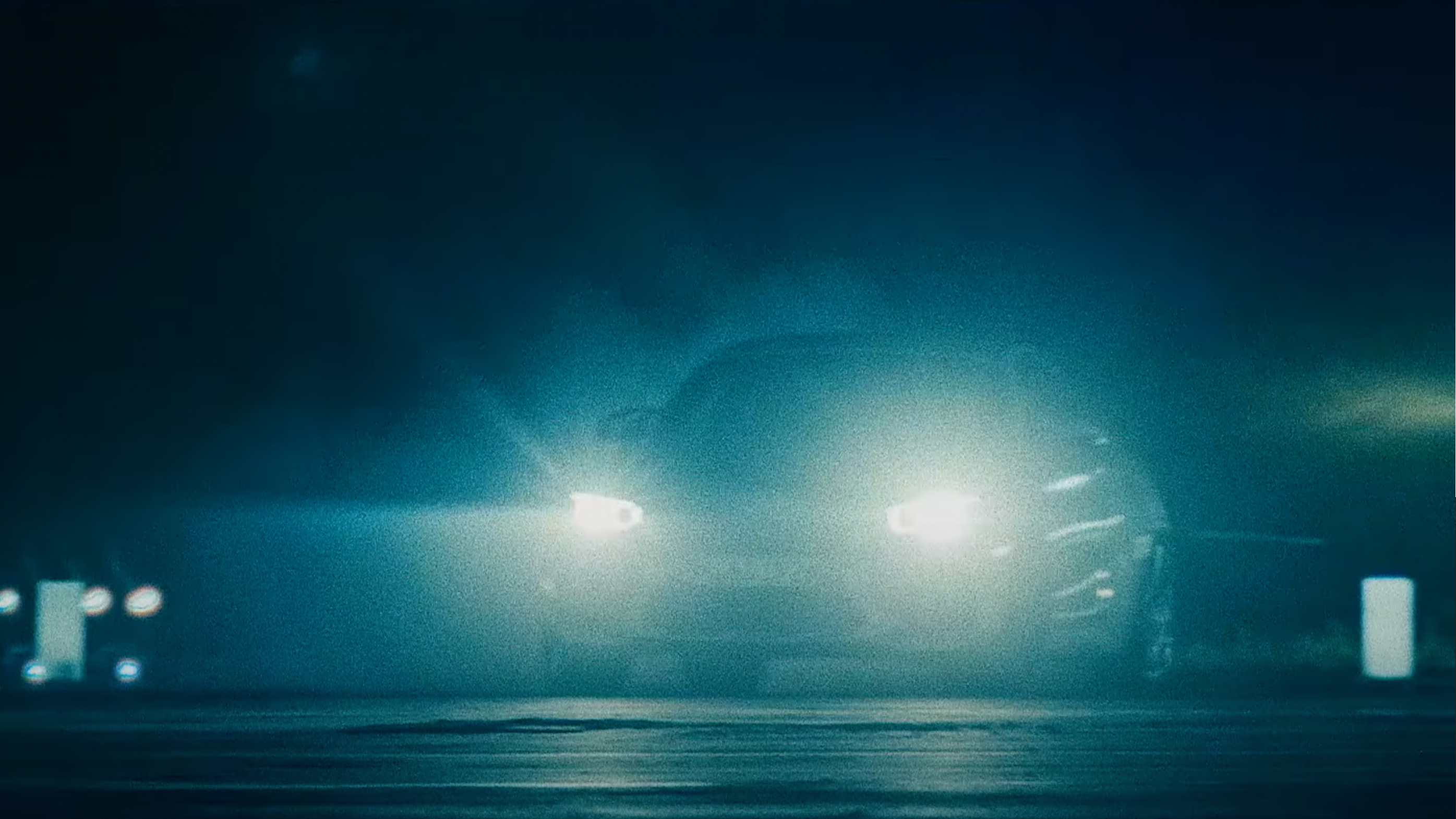
BMW has continued to preview its upcoming, second-generation 2023 M2 coupe, with the rear-wheel-drive sports car shown off drifting in the dark.
Having previously only teased the new M2 in camouflage, the latest BMW video briefly shows its upcoming model going sideways in an industrial area, while also showing a brief shot of its interior – albeit focusing on the driver.
The teaser comes as BMW’s M division marks its 50th year of operations this week, with the manufacturer telling its fans “get the presents” and to “get ready for playtime”.
June 2022: BMW M2 prototype review
We’ve now driven the new M2 on track! It’s still camouflaged, and technically a prototype, but this is your best insight yet on what’s to come.
“Specify this new M2 with the no-extra-cost manual, and you have a fairly-priced instant classic with no waiting list. A no-brainer, really.”
Get the full story at the link below.
The story to here
Teasers from last year have hinted at the M2 scoring a more agressive body than its 2 Series base, as the model was refreshed roughly 12 months ago into its second generation.
It’s tipped power will come from the S58 engine which drives its bigger M3 and M4 stablemates, although a slight detune to “only” 317kW would ensure it doesn’t knock the more established nameplates too quickly.
A manual gearbox for the M2 has been all but confirmed, potentially making it one of BMW’s last performance cars to be sold with a row-your-own ‘box.
Be sure to follow Wheels for more updates on the 2023 BMW M2.
Snapshot
- Twin-turbo inline-six wagon priced from $177,500
- High level of specification as standard
- Coming to Australia Q1 2023
The 2023 BMW M3 Touring has been priced Australia from $177,500 before on-road costs ahead of its Q1 2023 release date.
The Touring is available in Competition trim only with 375kW/650Nm, xDrive AWD system and eight-speed automatic transmission. The M3 sedan and M4 coupe‘s six-speed manual is not available for the Touring.
BMW’s all-paw performance wagon commands a $16,600 premium over an MY22 M3 Competition xDrive sedan.
The Touring’s claimed 0-100km/h sprint is 3.6 seconds – just a tenth behind the sedan – and it will go on to 200km/h in 12.9 seconds before hitting a limited 280km/h top speed.
The M3 Touring will be AWD only, and a direct rival for the Audi RS4 Avant. Sadly, Mercedes-AMG’s next-gen hybrid C63 won’t come to Australia in wagon guise leaving BMW and Audi to fight it out for fastest Labrador hauler.
Inside, the new M3 Touring debuts with the facelifted 3 Series’ 14.9-inch curved central touchscreen integrated seamlessly into a fresh 12.3-inch digital driver’s display.
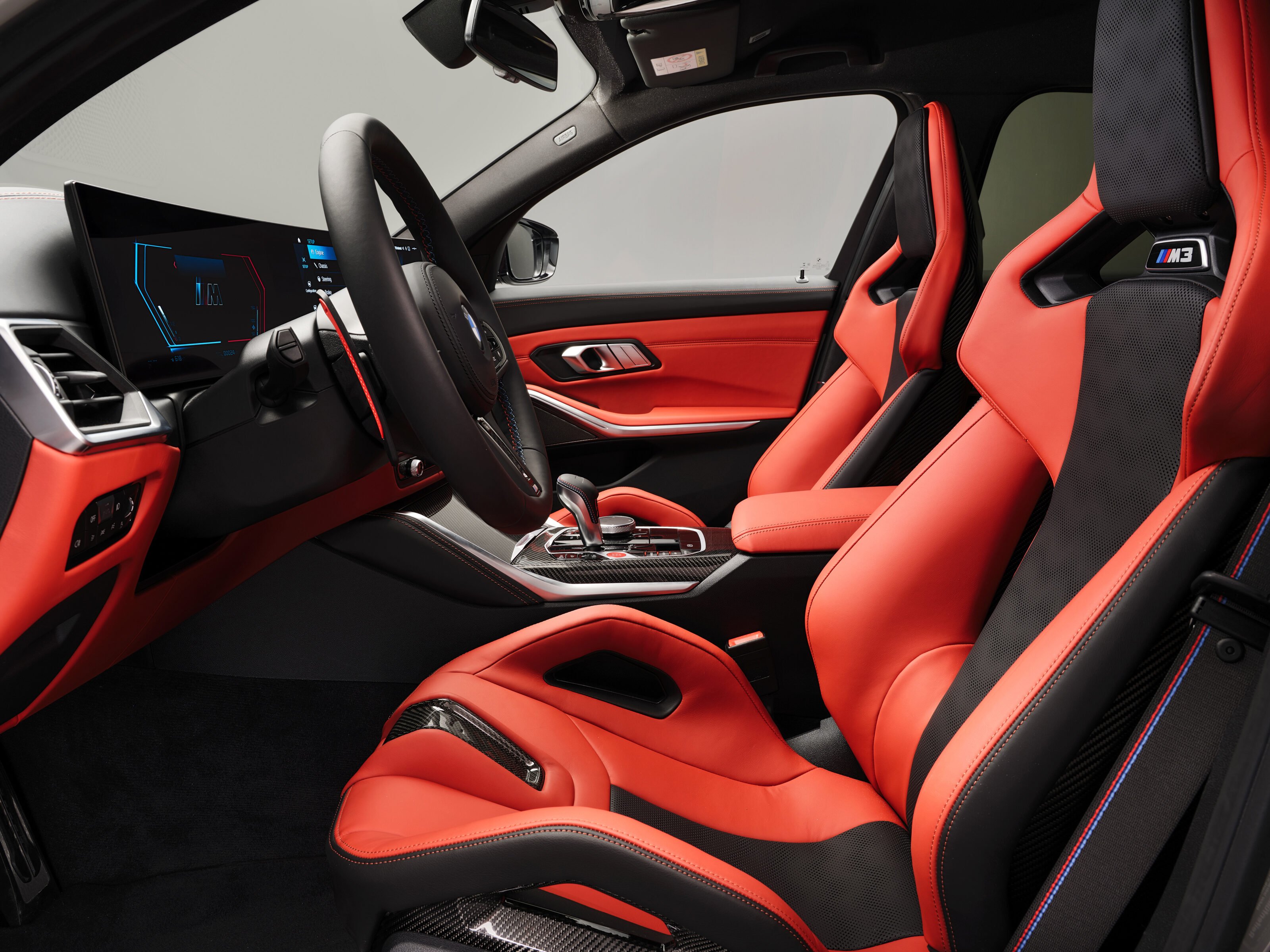
BMW’s M division has developed a new spring and damper tune to better balance the comfort and performance needed for the 2023 M3 Touring. There’s also additional chassis bracing for the front suspension, and beneath the rear body.
BMW M3 Touring features
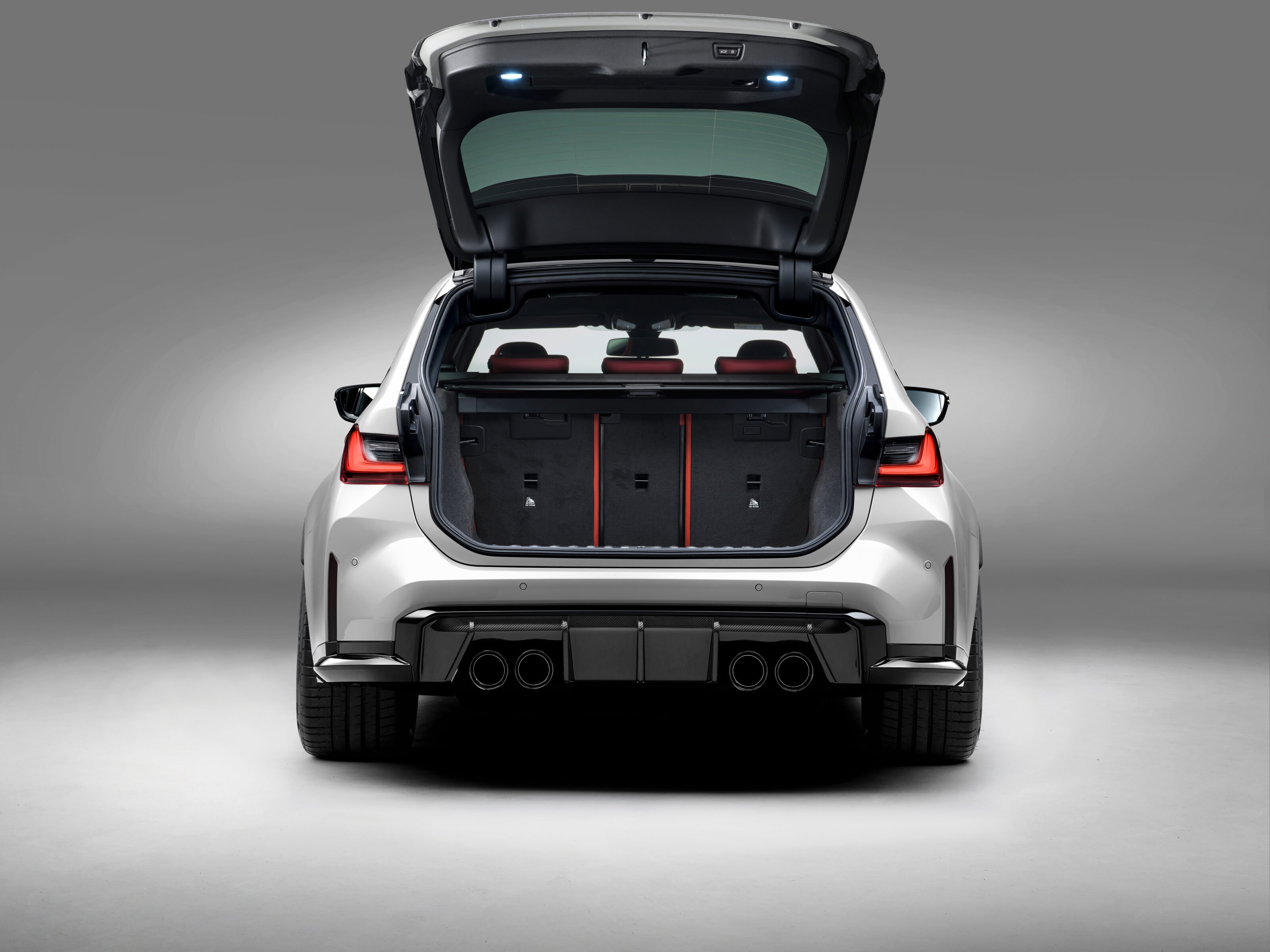
The M3 scores few extra features over the sedan mainly limited to comfort and convenience, such as a heated steering wheel. The Touring also features a cavernous 500L load space with 40:20:40 split-fold seats and standard power tailgate.
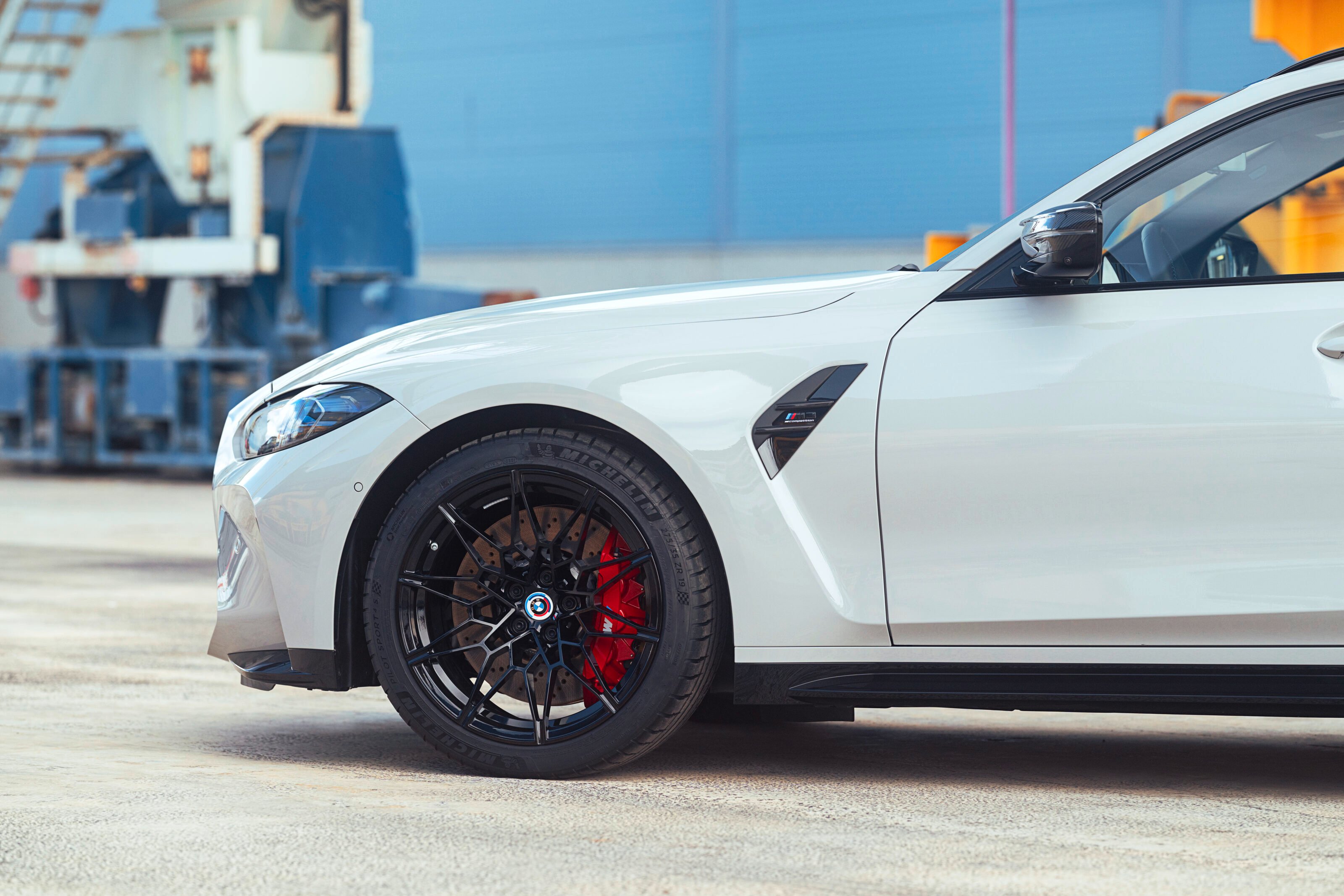
| Staggered 19/20-inch alloy wheels |
| Three-zone climate control |
| Power tailgate |
| Keyless entry and digital key |
| Head-up display |
| Laser headlights |
| Heated M Sport seats with memory function |
| Heated steering wheel |
| u2018Merinou2019 leather upholsteryu00a0 |
| Carbon fibre interior trimu00a0 |
| harman/kardon soundsystem |
| Wireless phone charging |
| 14.9-inch touchscreen |
| Wireless Apple CarPlay and Android Auto |
Options and extras
Those looking to make their M3 Touring a little more special can option one of two option packages. A typically broad selection of paint and leather colours is also on offer.
| M Carbon Experience ($17,500) |
|---|
| M Bucket seats (9.6kg weight reduction) |
| Carbon mirror caps |
| Carbon rear diffuser |
| Top speed increased from 250-280km/h |
| Voucher for level 1+2 BMW advanced driver course |
| M Carbon Ceramic brakes ($16,500) |
|---|
| Six-piston front calipers painted gold |
| 400mm front rotors (+20mm) |
| Single piston rear calipers painted gold |
| 380mm rear rotors (+10mm) |
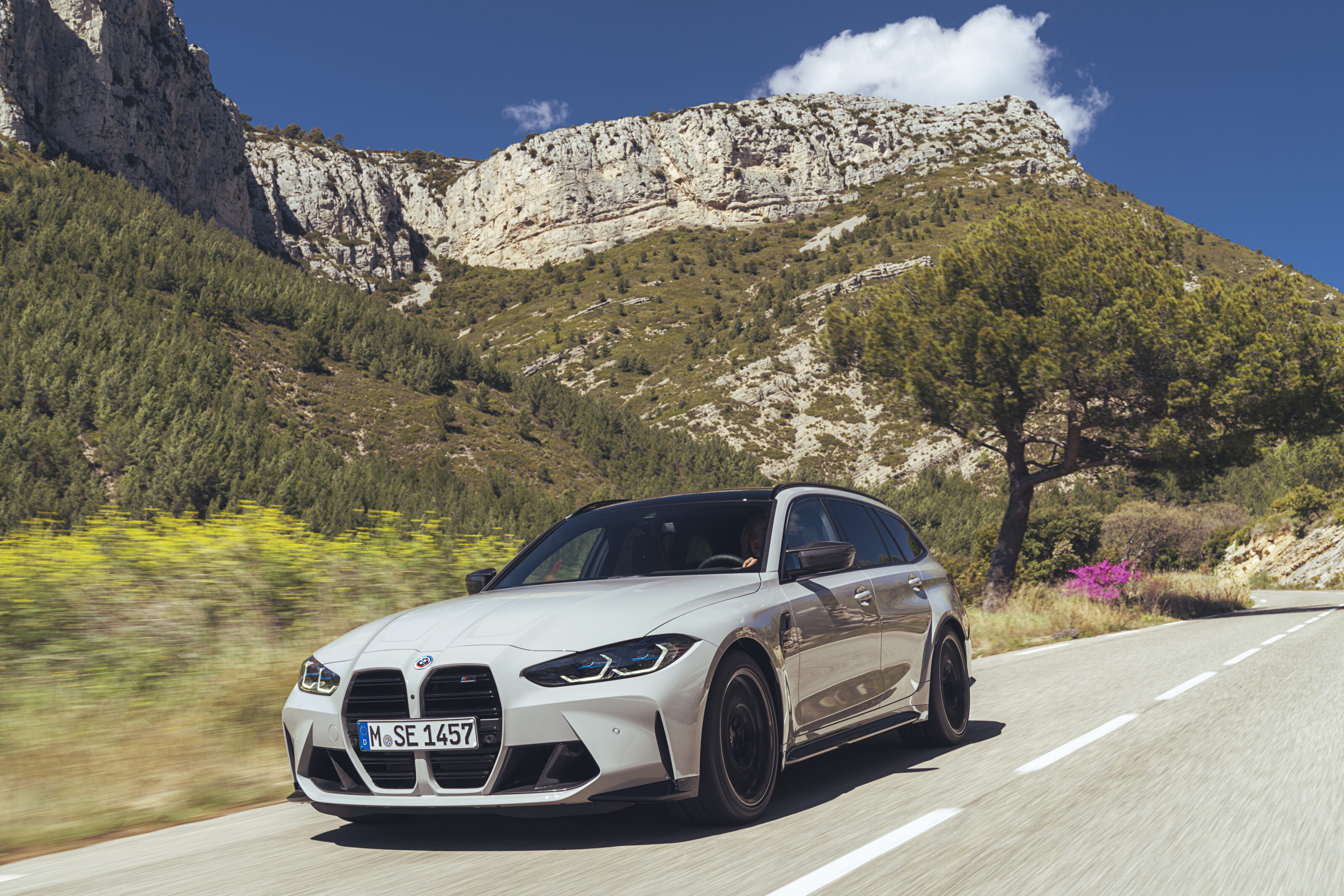
Buyers will be able to choose between a total of nine exterior colours – including Portimao Blue and Skyscraper Grey metallic – for no extra cost.
BMW offers a further seven individual paint colours priced between $2500 for Dravit Grey, up to $7000 Frozen Brilliant White. There are also four no-cost upholstery colours, and four Individual leather options that add $1000 to the price.
2023 BMW M3 Touring powertrain
The heart of the BMW M3 Touring is the ‘S58’ 3.0-litre twin-turbo straight-six developing 375kW of power and 650Nm torque in this trim. This engine features in the regular M3 with 353kW/550Nm, and will power the forthcoming M2.
As standard, the M3 Touring is fitted with BMW’s rear-biased xDrive AWD system and eight-speed torque converter automatic from ZF.
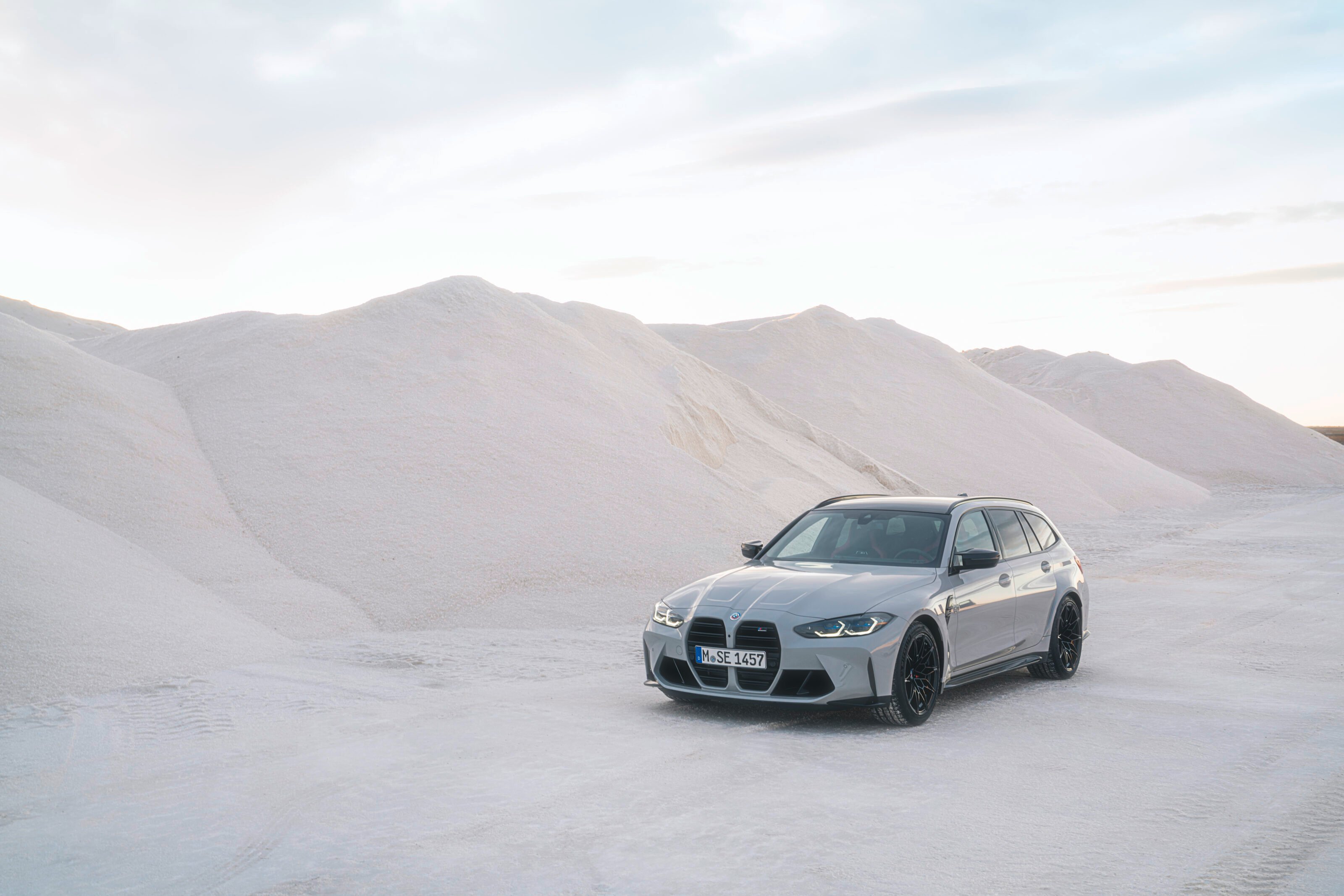
An active locking rear differential on the rear axle helps keep the M3 Touring’s power heading to the tarmac. The rear differential is controlled by the drive mode, with several settings including AWD Sport mode to adjust the M3 Touring’s character.
Just like in the M3 sedan and M4 coupe, disabling the ESC system will lock the M3 Touring into rear-drive only mode with the M Drift Analyser to score your skids.
Like in the sedan adaptive dampers are standard, though the M Division has tuned them specifically for the M3 Touring. You can even dial in your brake feel using the M3’s drive mode settings.
Availability
The 2023 BMW M3 Touring’s Australian release date has not been confirmed by BMW yet. It is expected the five-door M wagon will arrive in the first quarter (between January and March) of 2023.
