
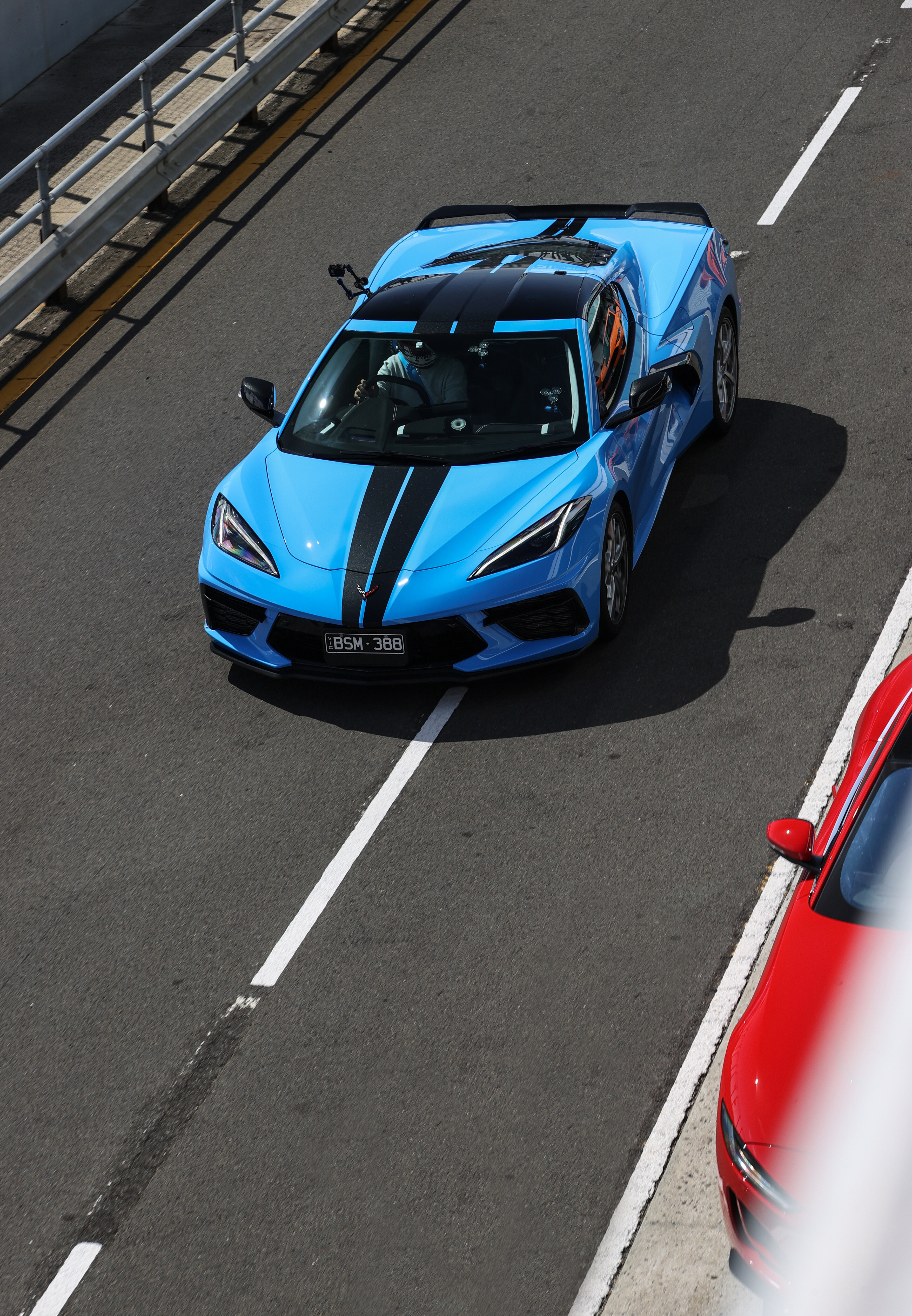
While Porsche’s move to double-wishbone front suspension for the 992-generation 911 GT3 grabbed headlines, it was the Corvette C8 Stingray that featured the most advanced suspension at MOTOR’s Performance Car of the Year 2022 testing.
All Corvettes sold in Australia are fitted with the Z51 Performance Pack as standard – traditionally an optional extra in overseas markets – meaning that the car is fitted with the fourth generation of General Motor’s Magnetic Ride Control dampers. Otherwise known as Mag Ride (MR) 4.0.
GM claims that MR 4.0 is the fastest responding suspension system currently available. Bold claims aside, we can confirm the system is able to give the C8 a fantastic ride compliance matched with supreme body control thanks to its very clever design.

Magnetic Ride Control is in essence adaptive dampers that are, well, constantly adapting.
It functions by having electromagnets paired with magnetorheological fluid inside the shock absorbers themselves. These can then be continually carrying the damper rates of the car.
Accelerometers at each corner of the car are able to read inputs from the road surface up to 1000 times a second, initiating changes in the magnetic charge inside the fluid for an almost immediate adjustment of damper rate.
It’s a no brainer that being able to adjust damper rates on the fly at such a rapid rate allows the C8 to maintain a better hold of the road by maximising each tyre’s contact patch at any given moment.

For the fourth-generation system, GM moved from having position sensors on each corner of the car which would try and calculate roll and pitch, to actual accelerometers that instead measure those factors. More accurate information means the dampers can better adjust to match what is happening.
Another feature for the Corvette was the addition of an Inertial Motion Unit, or IMU, that is again able to measure the car’s true heave, roll, and pitch signals instead of relying on synthesised calculations of these factors.
All of this information and inputs are fed to the Magnetic Ride dampers, which in turn have their own individual controllers that compute the data themselves.
Australians will be familiar with earlier versions of these magnetic dampers from HSVs of yore, but MR 4.0 takes things to a new level.
As a result of the improved fidelity and accuracy of the readings, the C8’s suspension was some of the best in the field at PCOTY 2022.
Snapshot
- Commercial vehicle servicing u2013 five years for the price of three
- T-Cross and Golf Life and Style grades get free servicing for three years
- Offers on the table for owners of used VWs too
Volkswagen Australia has cut the price of its service pack across its range of passenger and commercial vehicles.
Volkswagen Commercial Vehicles says it has reduced prices in response to increased living costs – especially record fuel prices.
“Our commercial owners have been among the hardest hit with rising fuel prices, while customers of new vehicles have been incredibly patient while we work through some supply constraints – this is our way of helping,” said Volkswagen Commercial Vehicles brand director, Ryan Davies.
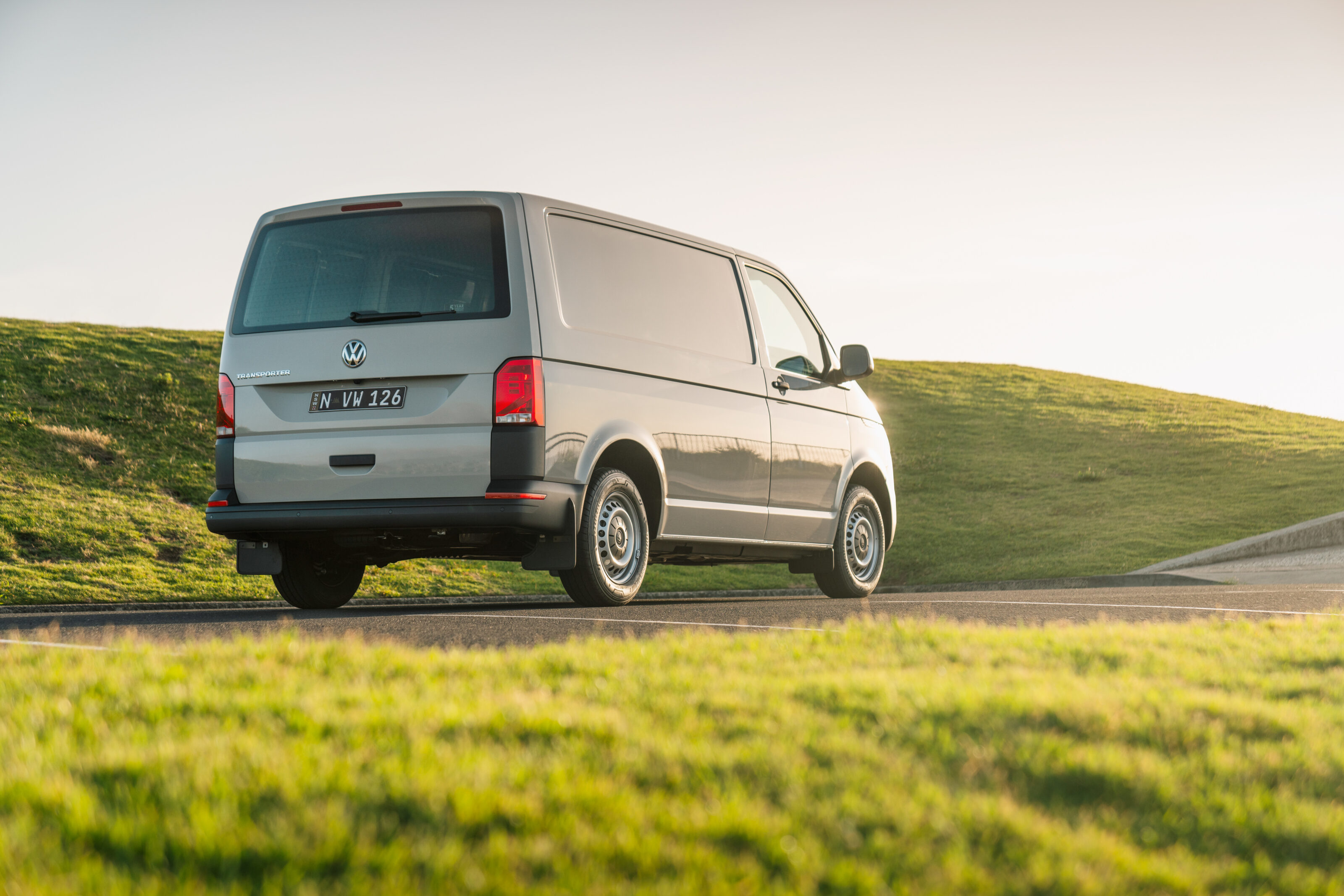
As a result, all commercial vehicles purchased before June 30, 2022, will get Volkswagen’s five-year service pack for the price of a three-year package.
The deal covers the Caddy, Transporter/Multivan, Caravelle, Crafter and Amarok, with some savings of the five-year packs working out to be more than the upfront cost of purchase – as outlined below.
| Model | Price |
|---|---|
| Caddy | $1500 (saving $1448) |
| Transporter/Multivan | $1600 (saving $1739) |
| Caravelle | $1450 (saving $1539) |
| Crafter | $1750 (saving $1621) |
| Amarok (four-cylinder) | $1900 (saving $1761) |
| Amarok V6 | $2050 (saving $1825) |

Volkswagen’s offer also extend to its passenger vehicle arm, with a complimentary three-year care plan now included when owners finance certain T-Cross and Golf variants with Volkswagen Financial Services.
The T-Cross Life and Style grades are covered by the offer if purchased before June 30, 2022, while the Golf Life and R-Line are given the same benefit with the added bonus of a September 30, 2022, cut-off date.
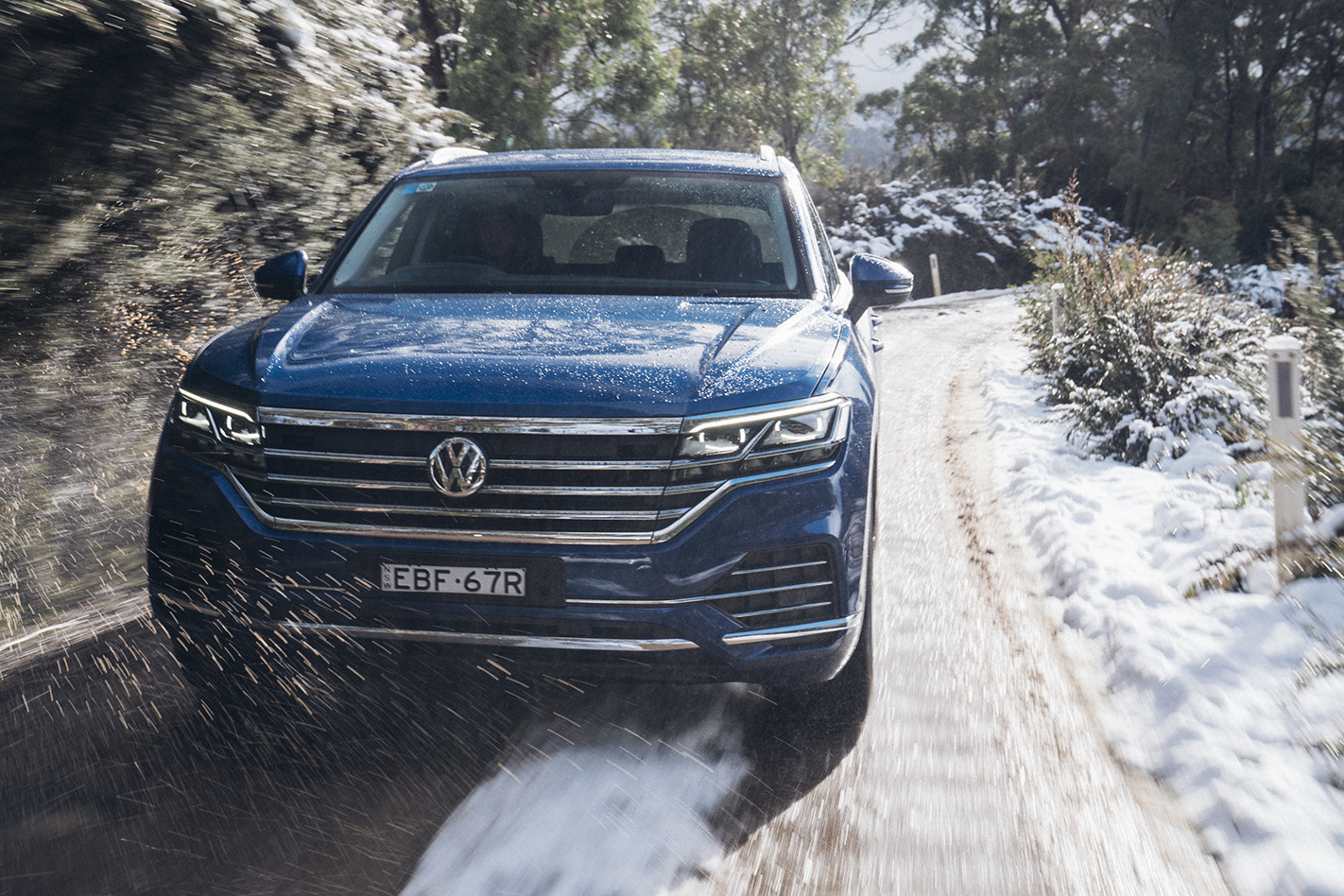
A complimentary five-year care plan also applies to all variants of the Arteon and Touareg, again under the proviso of the vehicle being purchased and financed by June 30, 2022.
Finally, Volkswagen Commercial Vehicles and Volkswagen Passenger Vehicles will nearly double the value of their four-year used vehicle care plans for the first 500 and 1000 customers respectively, introducing four services for the price of two until the end of April.
Available to be purchased for Volkswagen models older than four years with more than 60,000 kilometres on the clock and due for their fourth service, the 4Plus care plan now includes two free essential services, covering maintenance such as a oil and filter replacement and a safety and diagnostic check.
The 4Plus offer can be purchased in conjunction with the aforementioned service packs, covering between seven and nine years of servicing in most cases.
“We are thinking of Volkswagen customers now, as well as since purchasing a vehicle several years ago,” said Volkswagen Passenger Vehicles brand director, Michal Szaniecki.
“To offer the owner of a Golf or Tiguan which is more than four years-old the next four years of servicing from under $250 per service is another demonstration of how cost efficient it can be to own a Volkswagen.”
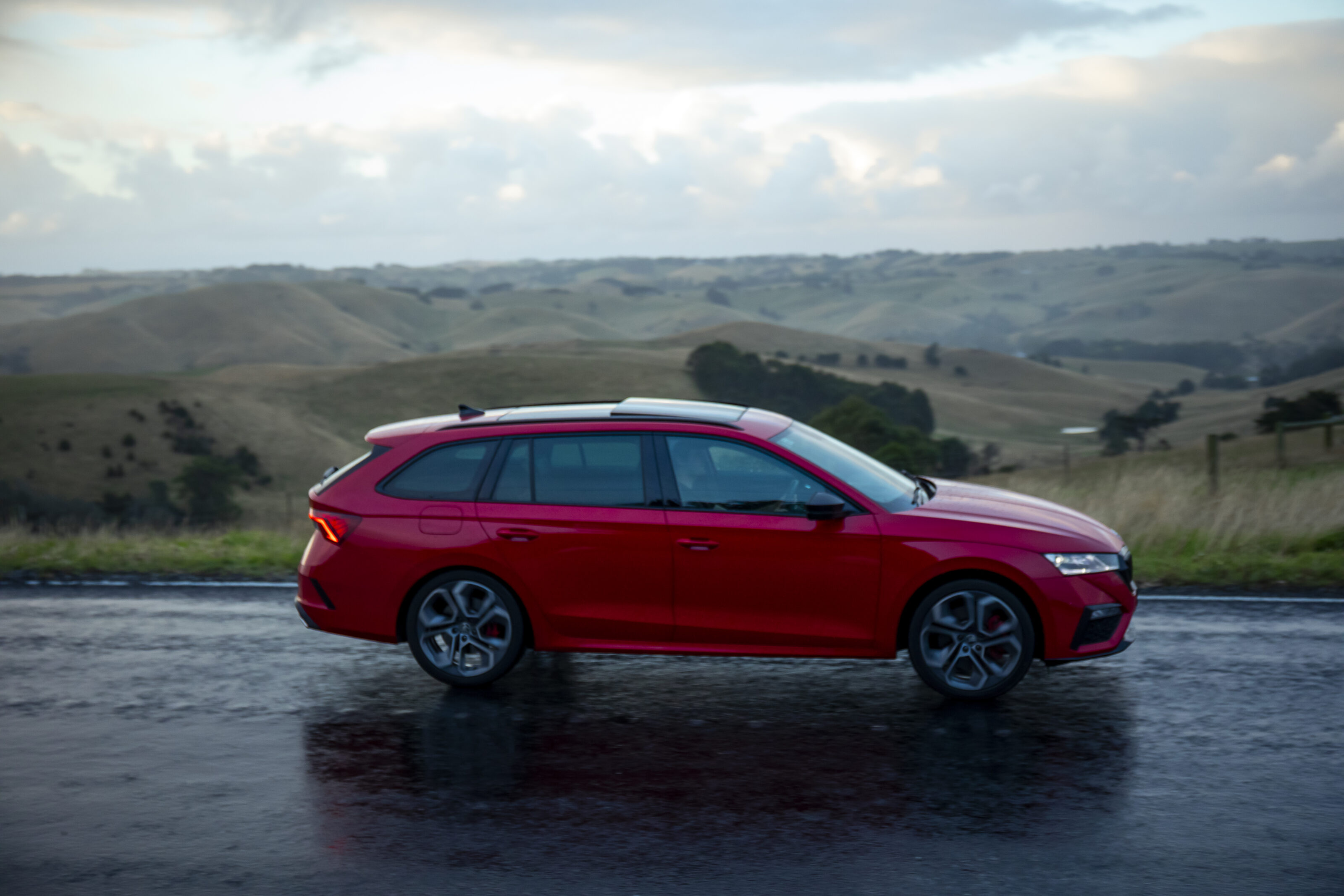
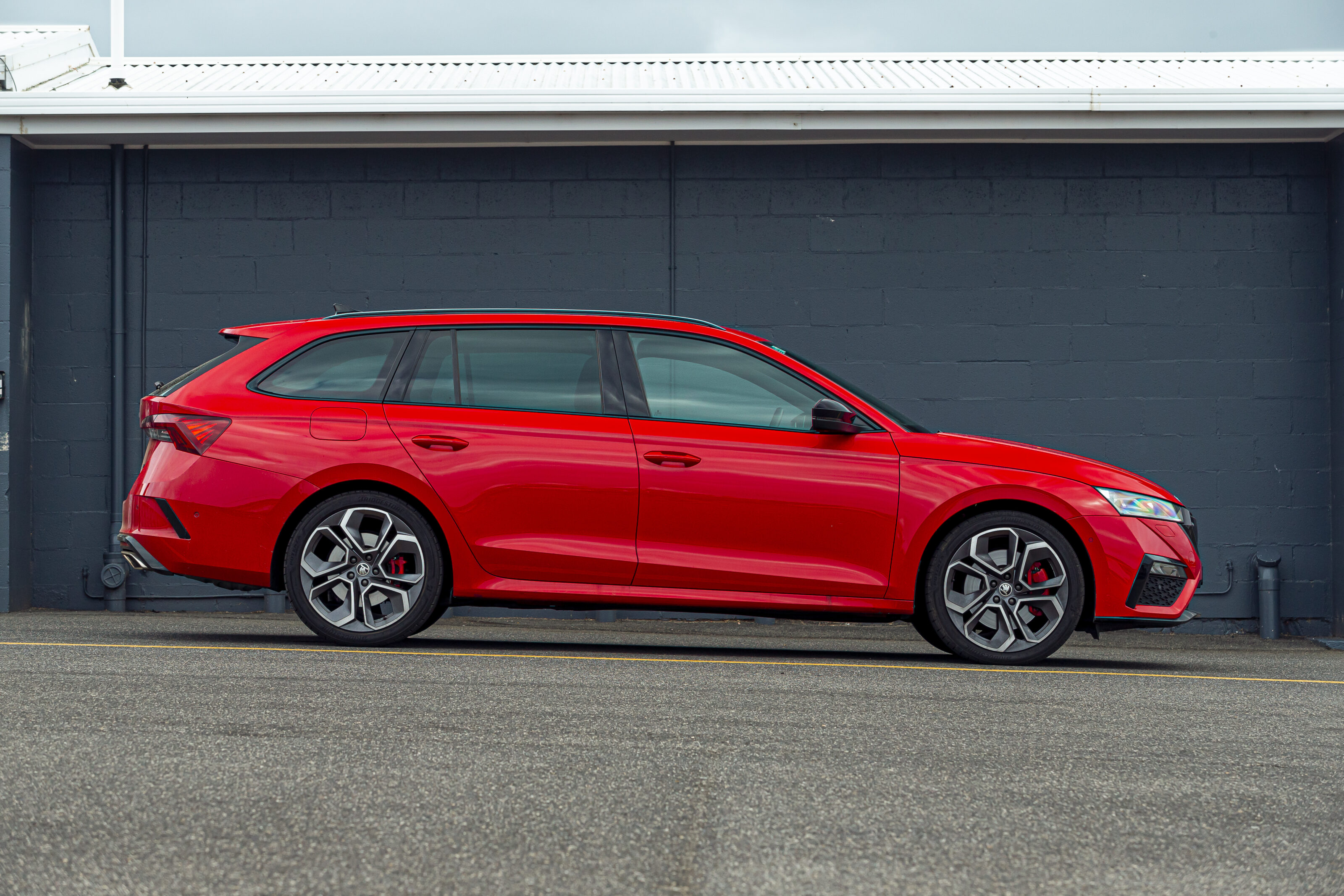
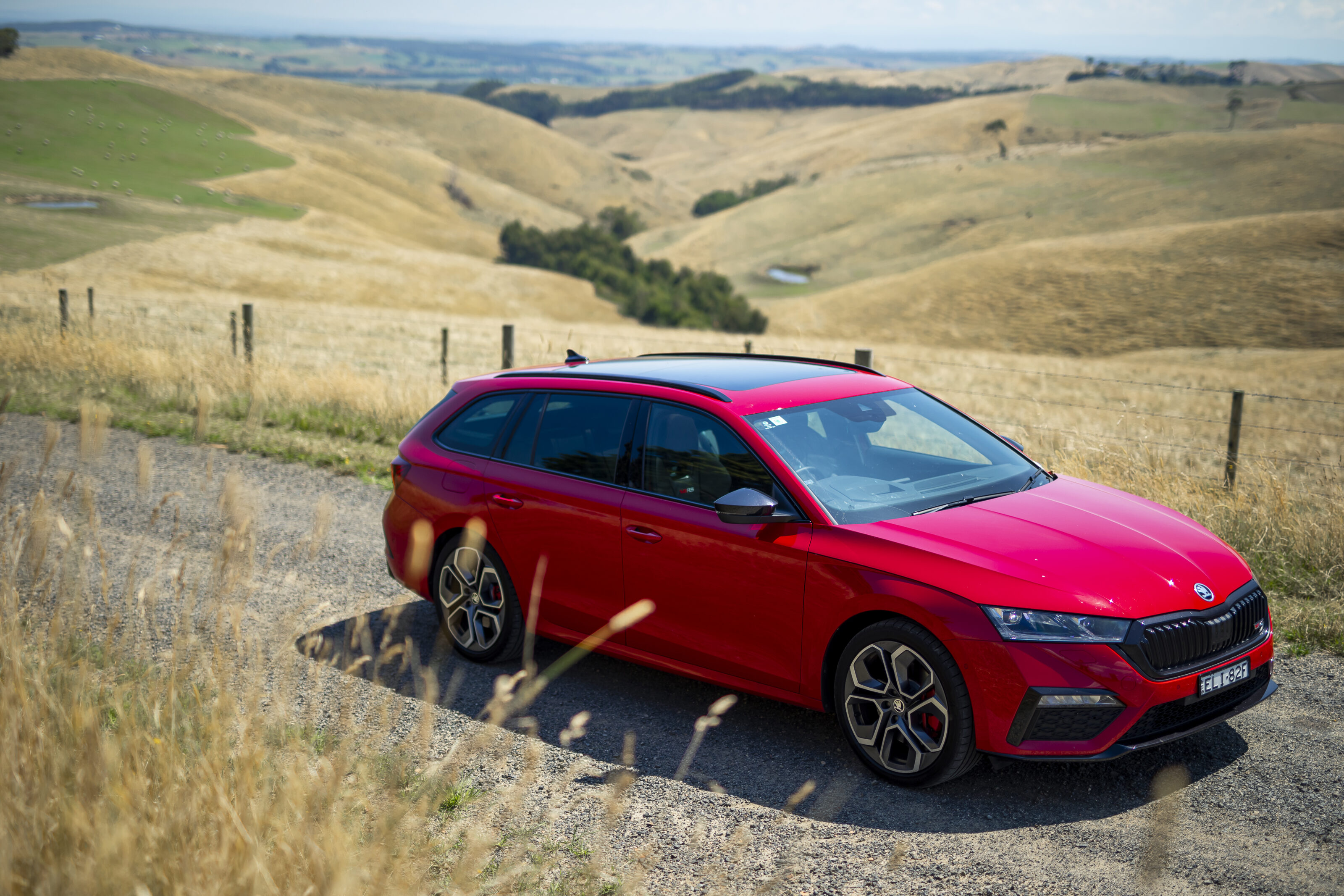
Loads better than expected! The Skoda Octavia RS impressed with its duality to finish ninth at Sports Car of the Year 2022.
Skoda’s local press office may have misunderstood the brief for SCOTY somewhat. The MOTOR team understands that the Octavia RS lives a double life, pairing its daily utility with Golf GTI-rivalling power outputs and widely customisable damping. However, having the Octavia RS arrive for Sports Car of the Year testing with a roof box mounted atop its wagon body wasn’t exactly part of the plan. Thankfully, we were able to glean enough from the online instruction manual to remove the black brick before testing started.
With 15 different levels of adjustability, the Octavia’s dampers perform wonderfully across a frankly vast window of performance that ranges from supple to rigid. However, the core chassis felt overwhelmed on the SCOTY test loop, struggling to hook into corners in a way that inspired confidence.
So much of the Octavia’s chassis character could best be described as benign, which probably answers the brief for its target market. Enright pointed to “softness introduced into most of the major controls. It struggles to convince in this company but works really well as a family wagon with a bit of zip.”
Luffy was impressed with the Octavia’s adjustability on track, however, noting “you have to trail brake into the corner to unsettle the rear just a little bit to help the pointability.” The Czech wagon’s immediacy is somewhat compromised by its Bridgestone tyres. A wider contact patch of more focused rubber would make a smart post-purchase addition if you’re looking to sharpen things.
The seven-speed dual-clutch automatic gearbox is well calibrated and thankfully lacks a propensity for multi-gear hops down ratios as you apply throttle on corner exit. Both up and downshifts failed to perturb the Octavia’s body control whilst cornering. However, judges found the steering to be slow and bereft of much in the way of feedback, even in its sports mode.
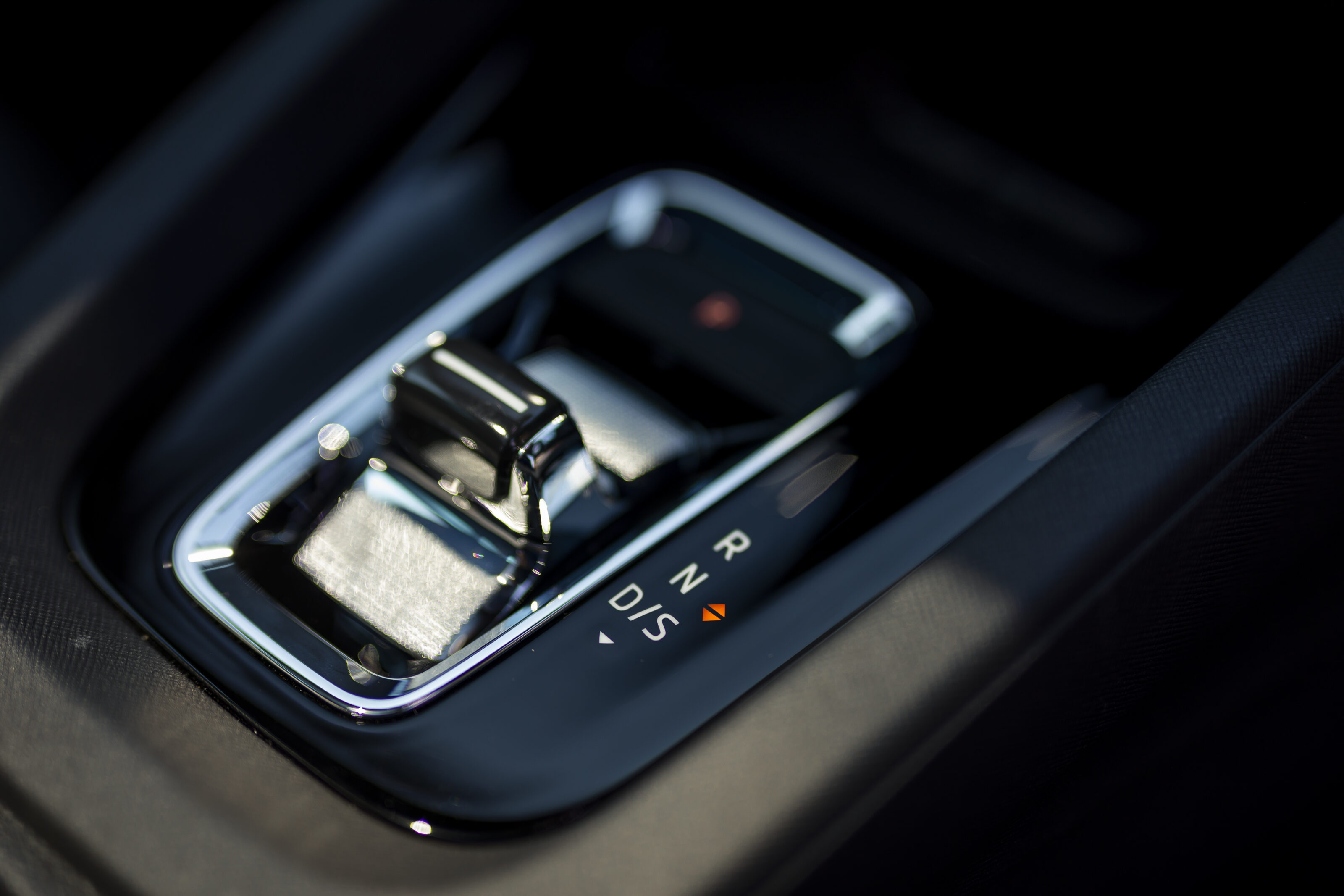
Only on longer radius bends does the Octavia RS really feel fully at home, retaining impressive composure at full throttle through the daunting Stoner corner. Its high-speed stability was impressive, but you’d be forced to concede time through a corner, only to reel it back on the subsequent straight. There were plenty of raised eyebrows exiting the Skoda’s well-appointed cabin after track time, with the wagon’s impressive straight-line speed being a welcome surprise.
Perhaps most telling of Skoda’s true achievement is the fact that nearly every judge proclaimed they’d happily add the Octavia RS to their own garage. Trent summed it up best saying “the Octavia somewhat lives up to the GTI with a boot mentality”. The Skoda’s prosaic silhouette makes it an intriguing Q-car, endowed with a very respectable turn of pace.
If you only have space for one car that must do the daily school run, carry your dog, remain comfortable on a commute, but make you feel that you’ve grown up and not given up, the Skoda Octavia RS is the best car for you in this SCOTY field. That battle isn’t even close.
The judges’ comments
Alex Affat
“This is packaged really intelligently and it’s well optioned. More people should be buying Skodas.”
Ranking: 9th
Andy Enright
“Ninth disguises the fact that everybody here came away with newfound respect for the Octavia RS.”
Ranking: 9th
Trent Giucno
“Narrow tyres hobbled the Skoda on the tighter parts of our road loop. Times at the track were impressive.”
Ranking: 9th
Cameron Kirby
“How would I sum up the Octavia? It’s a family car that can do some performance car things.”
Ranking: 9th
Bernie Quinn
“It’s a nice car but it’s not a sports car. Chassis is safe and secure but offers no real feedback.”
Ranking: 9th
Luffy’s view
A bit of a surprise packet in that it was more fun to drive on the track than the road. I wasn’t expecting that!
The key figures
| 0-100km/h: | 6.43 seconds |
|---|---|
| 0-400m: | 14.32 sec @ 163.07km/h |
| Lap time: | 1:53.93 |
Stealth bomber with a stereo! The Alpina B3 flys under the radar to finish eight at MOTOR’s Performance Car of the Year 2022.
At the end of five days of testing you’d think the five judges would have had their fill. And yet we were all left slightly green with envy as we watched MOTOR’s art director Damien drive off into the sunset behind the wheel of the Alpina B3.
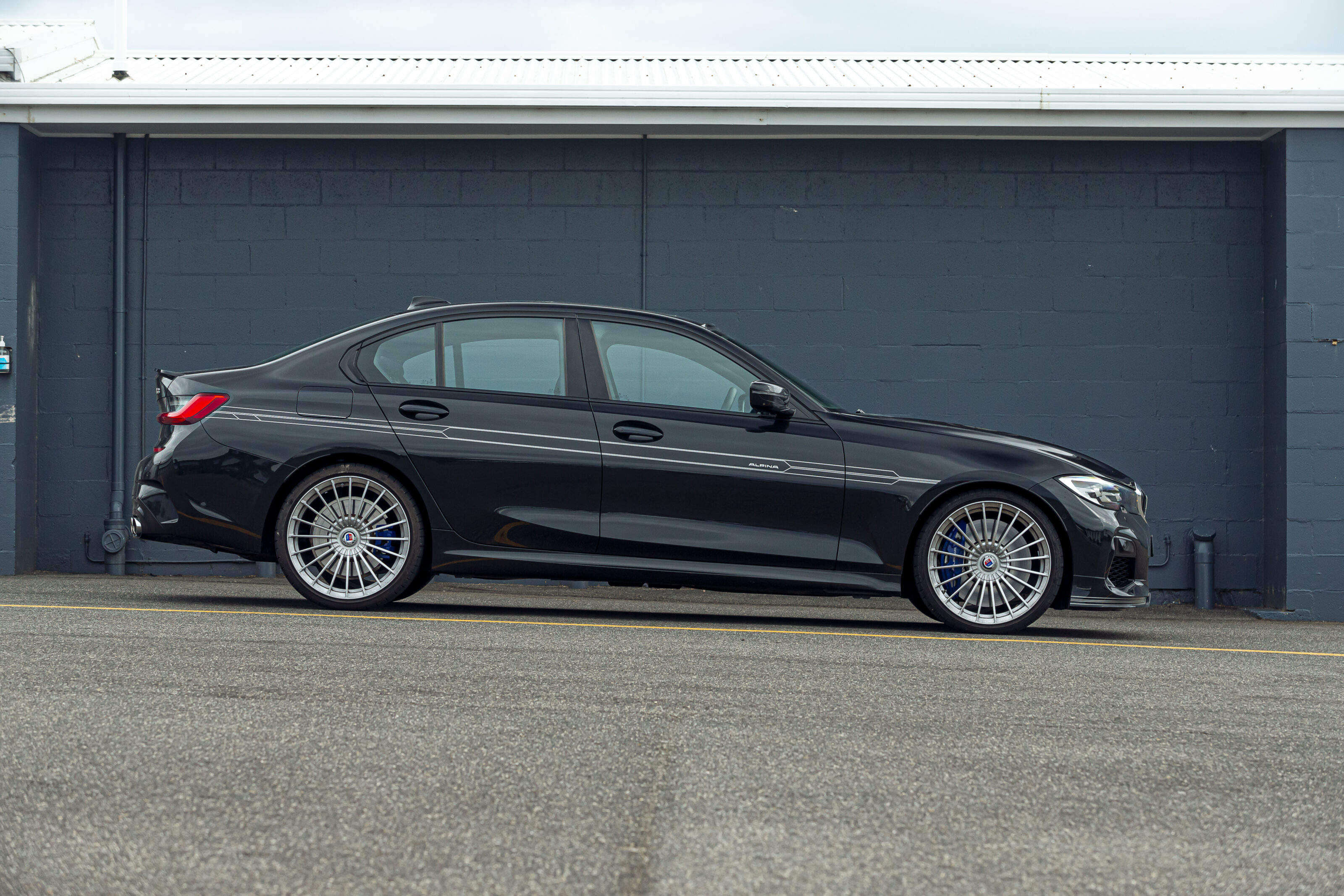
The Alpina arrived at PCOTY 2022 laden with more questions than answers. Would its more discreet personality compared to the M3 be its downfall, or would it prove to be everything people wished from a more refined M product? In the end, the two Bavarians walk entirely divergent paths, something perhaps best illustrated by their finishing places in this year’s competition.
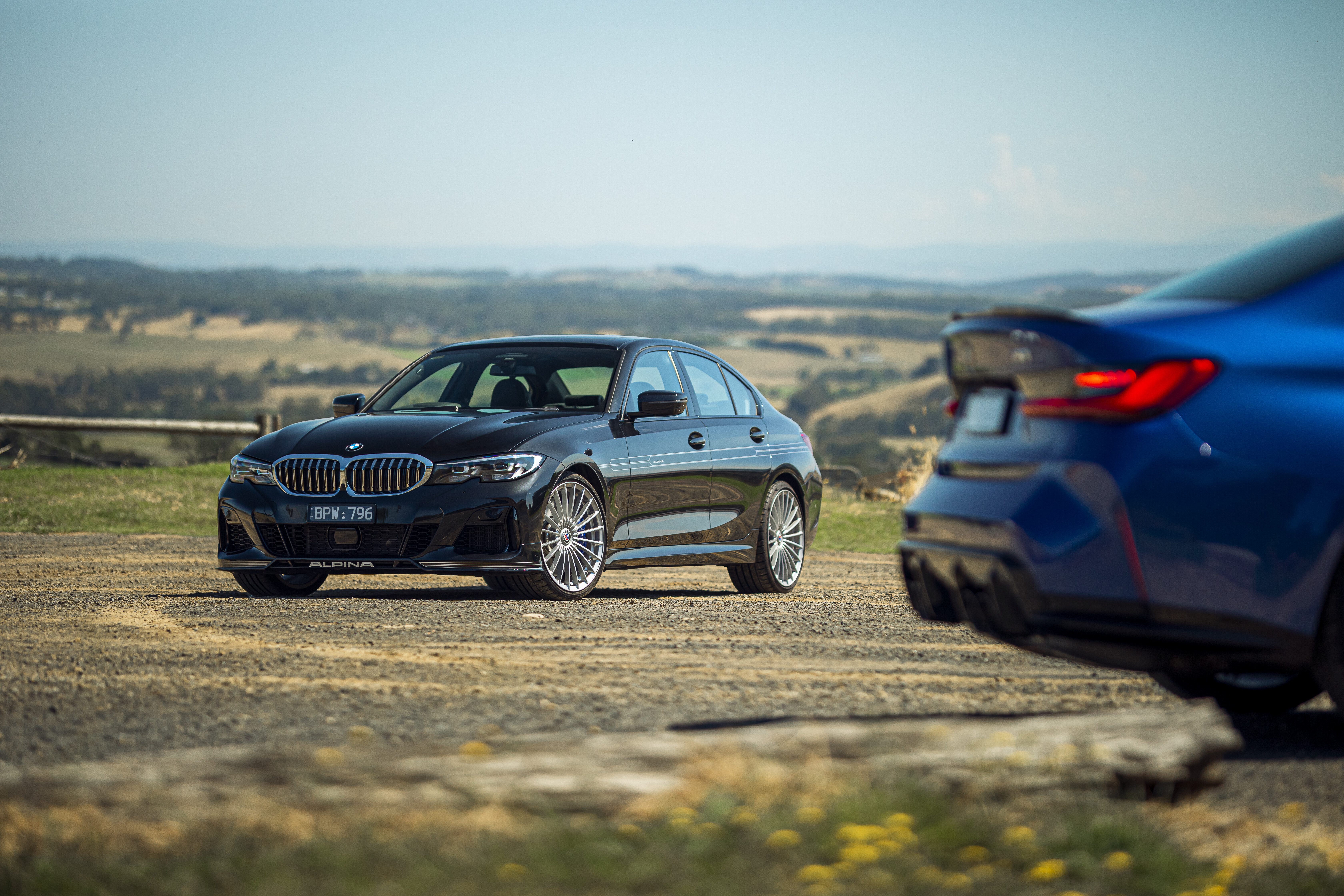
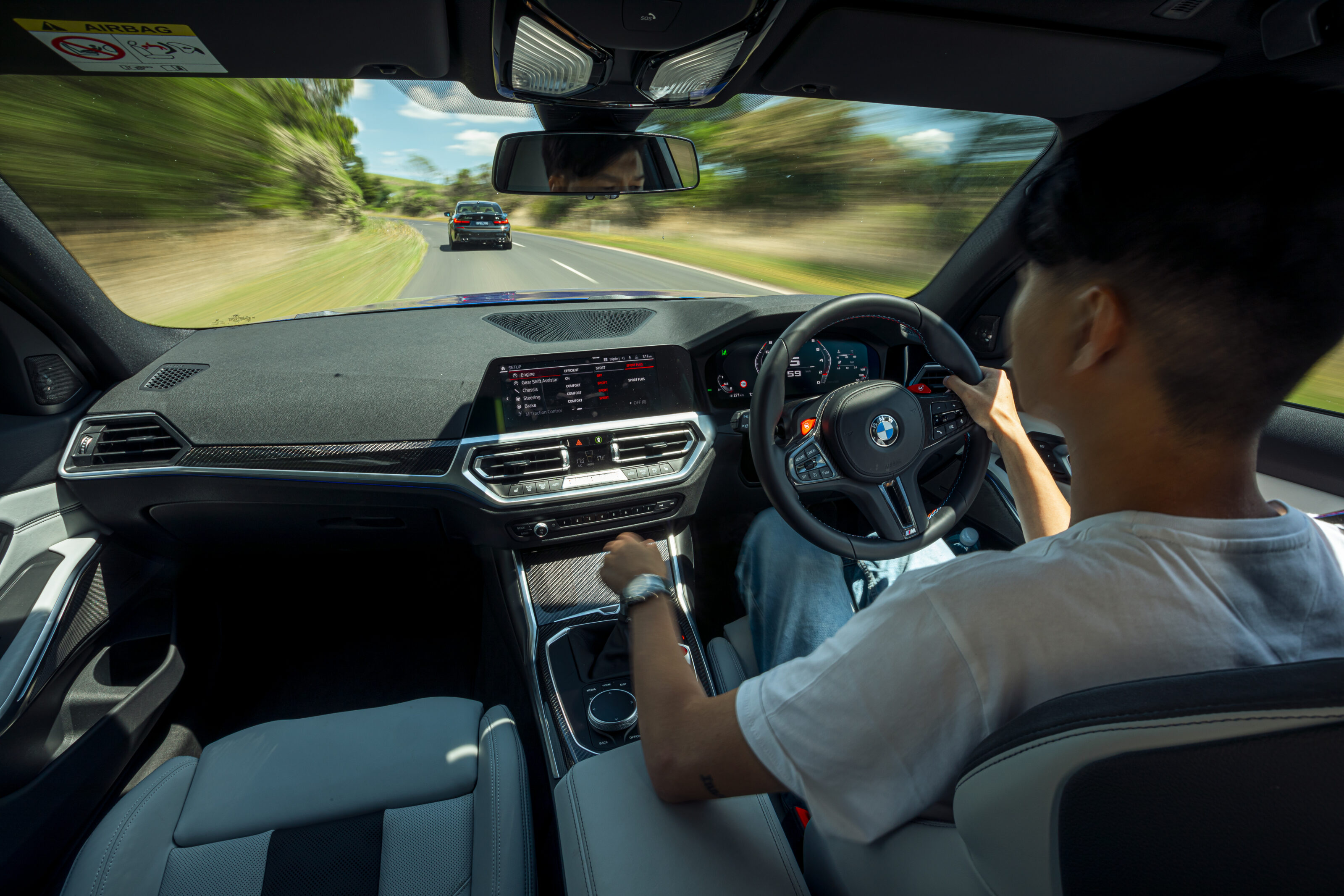
Sharing the same engine and chassis, how can the Alpina and BMW M3’s results be so different? It’s more a result of Alpina’s impressive reworking than anything else. To a layperson, even with the cars side-by-side and driving the cars back-to-back, few would clue into the B3 and M3’s shared lineage.
Designed to demolish the autobahn with a hammer made of pure torque, some expected the B3 to fall short dynamically on our fast test route. Yet it was here that many became enamoured by its subtle and endearing nature. It’s steering isn’t as incisive as the M3, but then you do get all-wheel drive capability. The ZF eight-speed auto is better utilised here than in the Jag, and makes a perfect pairing with Alpina’s version of the S58.
Phillip Island proved to be a mixed hunting ground for the B3. Judges praised its corner exit stability and ability to ride that towering wave of torque but the softer adaptive suspension tune, with a steel-spring set-up, was never quite at home. Worst was the lack of proper seat bolstering that had legs making crashing impacts with both the door card and transmission tunnel. Most exited the B3’s luxurious cabin rubbing their knees in sympathy.
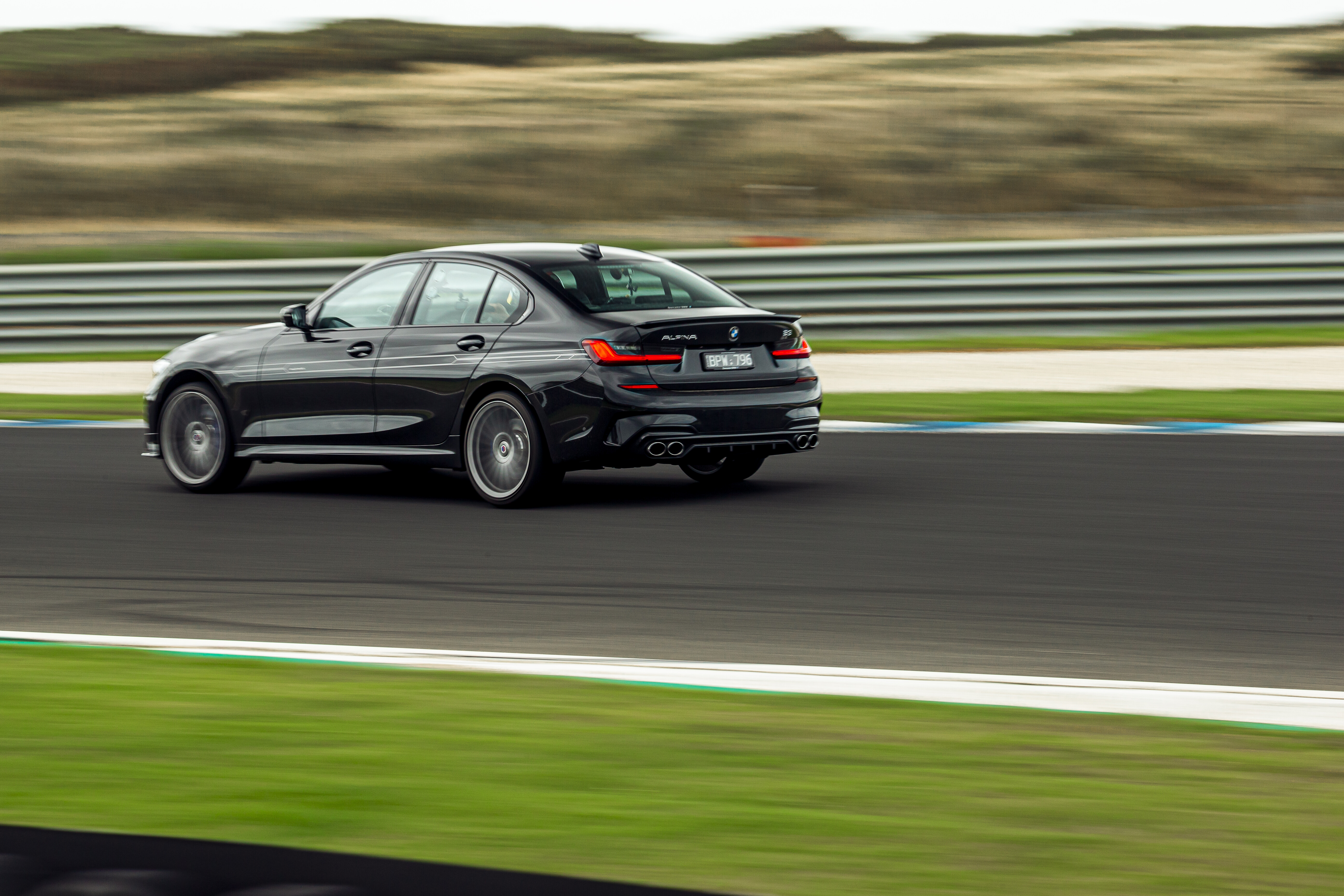
Make no mistake, the B3 is fiercely rapid in a straight line, even giving the 911 GT3 a hurry-up during performance testing. “If you really get after it, the B3 has teeth,” Andy says, adding “you can get on the gas so early in the corner it’s not funny.”
Bernie took a liking to the initial turbo lag feel to the way the engine initially got onto boost – a result of the Alpina-specific turbochargers fitted to the S58 engine – stating “it’s super refined and super fast”. Trent reckoned this was the PCOTY contender that provided the greatest on-road reward for the least amount of work.
Yes, it came eighth, but even being worthy of an invite – an offer not extended to many – puts the B3 in rarefied air. Ask any of the judges which car they wanted to drive home at the end of the best week of the year. And to think we let the crayon twirler escape in it.
The judges’ comments
Alex Affat
“Has its own endearing character and shines as a fast cross-country tourer. Bit too soft for the track.”
Ranking: 8th
Andy Enright
“If the B3 was any lower key, we’d have forgotten where we parked it. Huge thrust and so, so subtle.”
Ranking: 8th
Trent Giunco
“The work that Alpina’s done on the S58’s turbos has given the B3 a rangy, loping gait that the M3 can’t equal.”
Ranking: 7th
Cameron Kirby
“The Alpina is a torque monster. It’s a limousine that delivers the most phenomenal gut-rush.”
Ranking: 8th
Bernie Quinn
“An interstate missile. The engine’s strong with a little bit of old school lag/rush. I don’t mind that.”
Ranking: 7th
Luffy’s view
“It’s all about rotating the B3 as quickly as possible so you can get back onto the throttle and use all of the drive on corner exit.”
The key figures
| 0-100km/h: | 3.87 seconds |
|---|---|
| 0-400m: | 11.82 sec @ 191.91km/h |
| Lap time: | 1:48.71u00a0 |
This week the 2023 Ford F-150 was announced for the Australian market, with the American pick-up set to do battle with the likes of the Chevrolet Silverado and the Ram 1500.
While it’s been 30 years since the F-150 was on sale here, Ford’s F-Series has a long history in Australia, dating back more than 70 years.
The first-generation ‘Effie’ pick-up started in 1948 with the F-1 – an evolution of post-war truck designs – with a number of vehicles being assembled in Australia and utilising locally-built tubs, all powered by a 3.9-litre ‘Flathead’ V8.
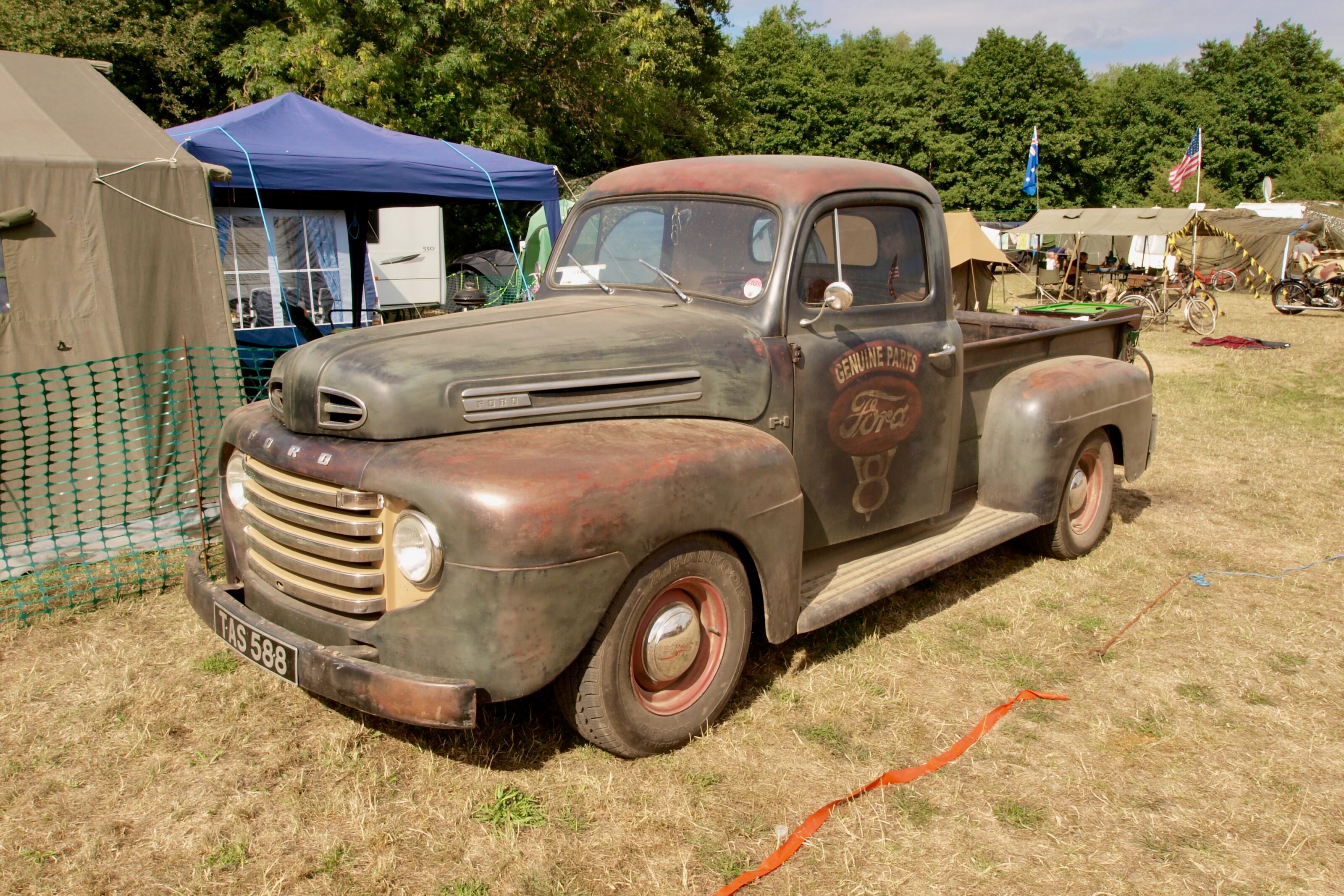
Ford eventually launched the F-100 in 1953, but it would be more than a decade before the model was reintroduced to the Australian market.
While the F-100 eventually gave way to the F-150, it wasn’t the last Effie to be sold here; the F-250 and F-350 models were brought to the country and available to purchase from local Ford dealerships for a five year period up to 2006.
At the time, buyers could choose from a 5.4-litre petrol V8 or a 7.3-litre turbo-diesel V8 depending on the vehicle, available with both rear- and four-wheel drive.
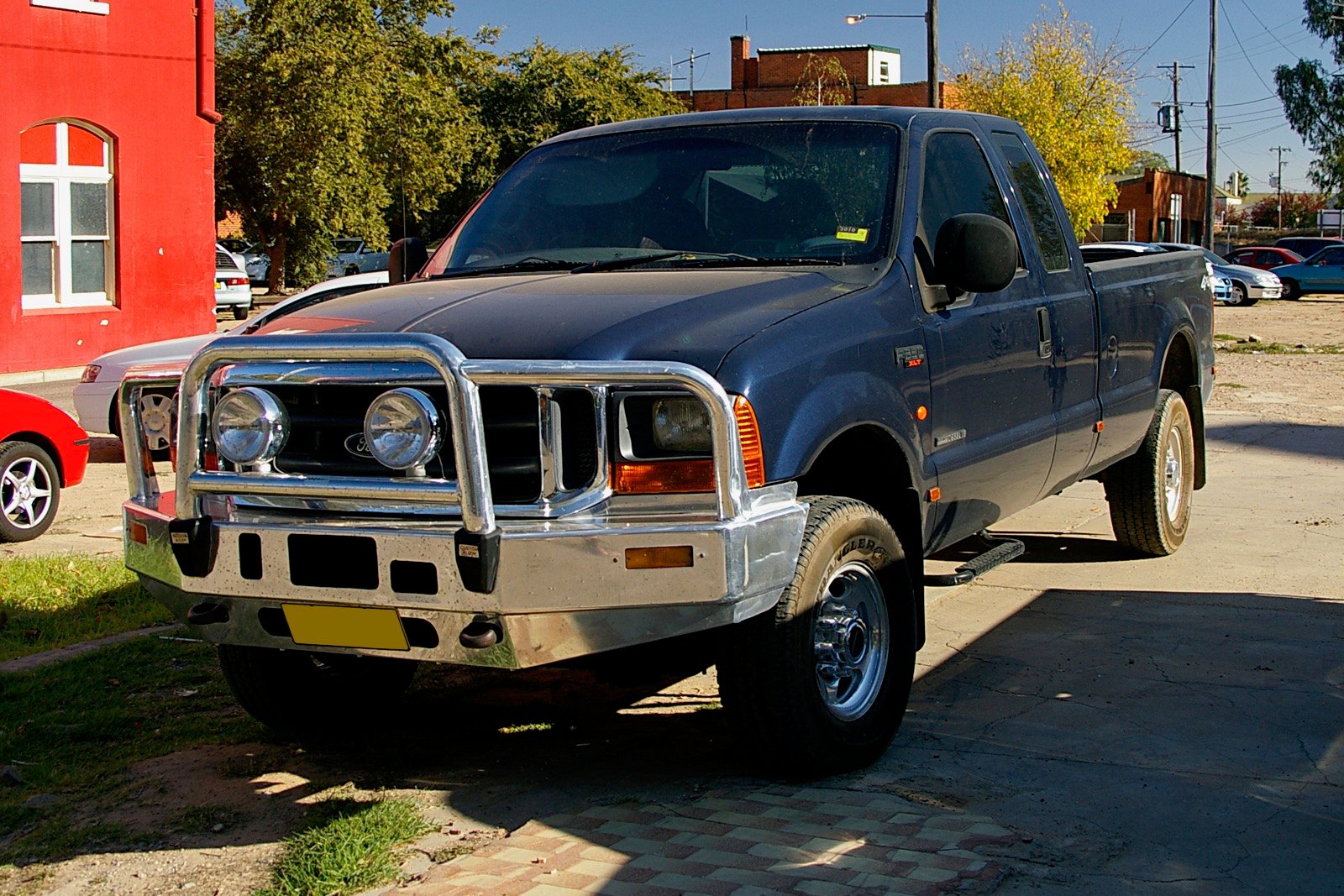
They may end up being the last V8-powered F-Series trucks in Australia, with Ford announcing it’s bringing the 3.5-litre twin-turbo ‘EcoBoost’ petrol V6 engine in the upcoming F-150.
The pick-up is arguably returning to its roots, with the first F-100 brought into the country in 1965 by Ford being powered by a 3.7-litre six-cylinder engine.
It would be around 1971 when the F-100 returned to our shores with a V8, before the ute was axed from Ford’s local line-up 10 years later.
In 1987, Ford Australia reintroduced the full-size pick-up to its range with the F-100’s successor, the F-150.
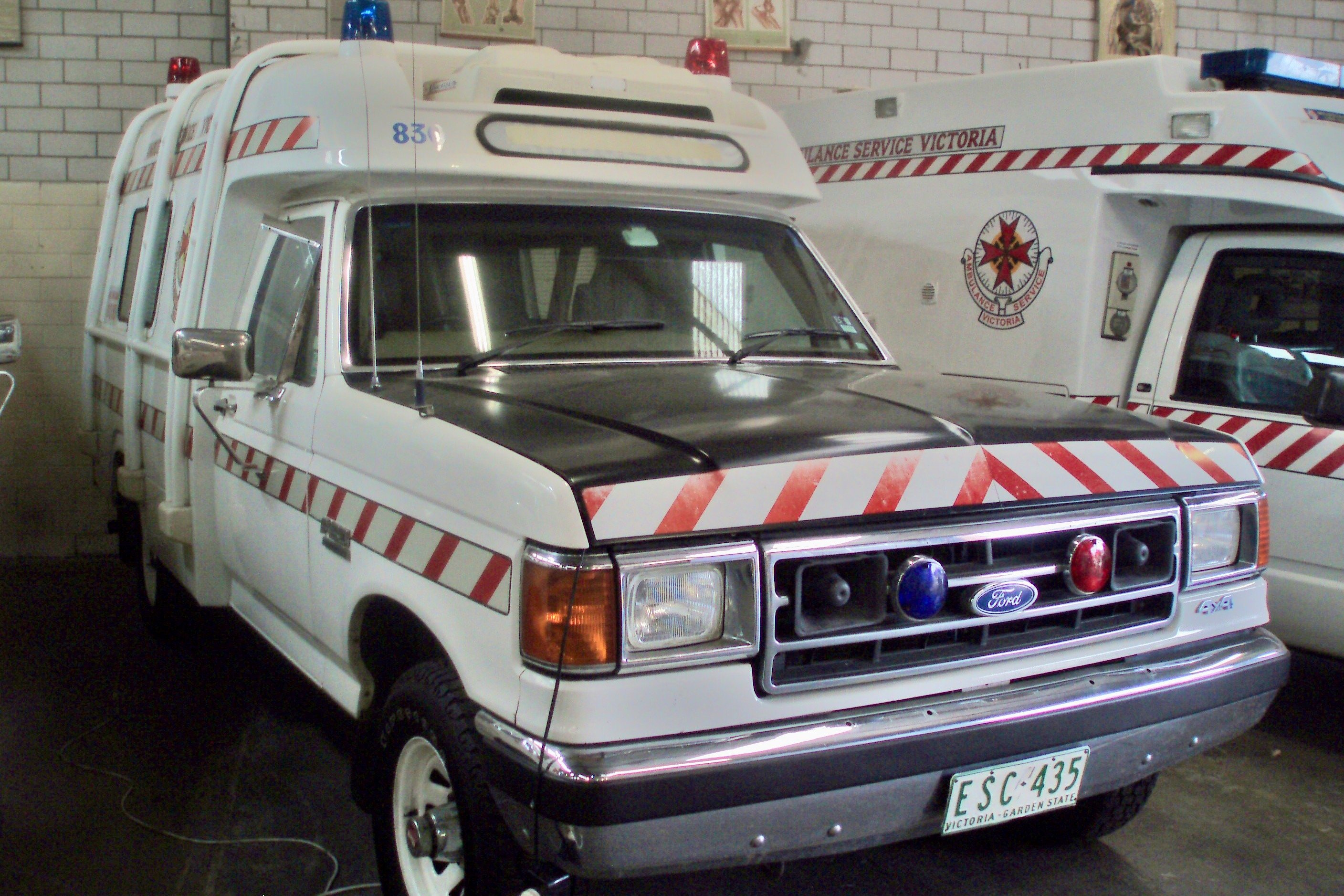
Powered by a choice of either a 4.9-litre six-cylinder or a 5.0-litre V8, both the F-150 and F-250 would end up being adopted by many of the country’s state ambulance services, thanks to the addition of a large custom body similar to those found in the US.
When the F-150 was discontinued in 1993, Holden stepped into the void and brought in the GMC 1500 – a badge-engineered Chevrolet Silverado – which was used by ambulance services before the majority moved to European-style sliding-door commercial vans.
The Ford F-Series has had an on-again, off-again love affair with Australia over the last century. Given the demise of the Falcon ute and the increasing popularity of American pick-ups in recent years, maybe this time the Effie will be here to stay.
Snapshot
- Modern Classics converts an old 911 to run on electric power only
- Drivetrain and batteries sourced from a BMW i3
- Conversion designed and built in Bulgaria
Bulgarian restomodding start-up Modern Classics has provided its own take on what an electric 911 should be, unveiling this zero emissions version of Porsche’s classic model.
While it might look like your “standard” late 1970s/early 1980s 911 Super Carrera (911SC) this particular example has been restored to run on electricity, doing away with its 3.0-litre fuel-injected flat-six engine.
In its place is the same motor as what BMW used in its revolutionary i3, with the Bavarian batteries now sitting up front in what would normally be a 911’s storage compartment.
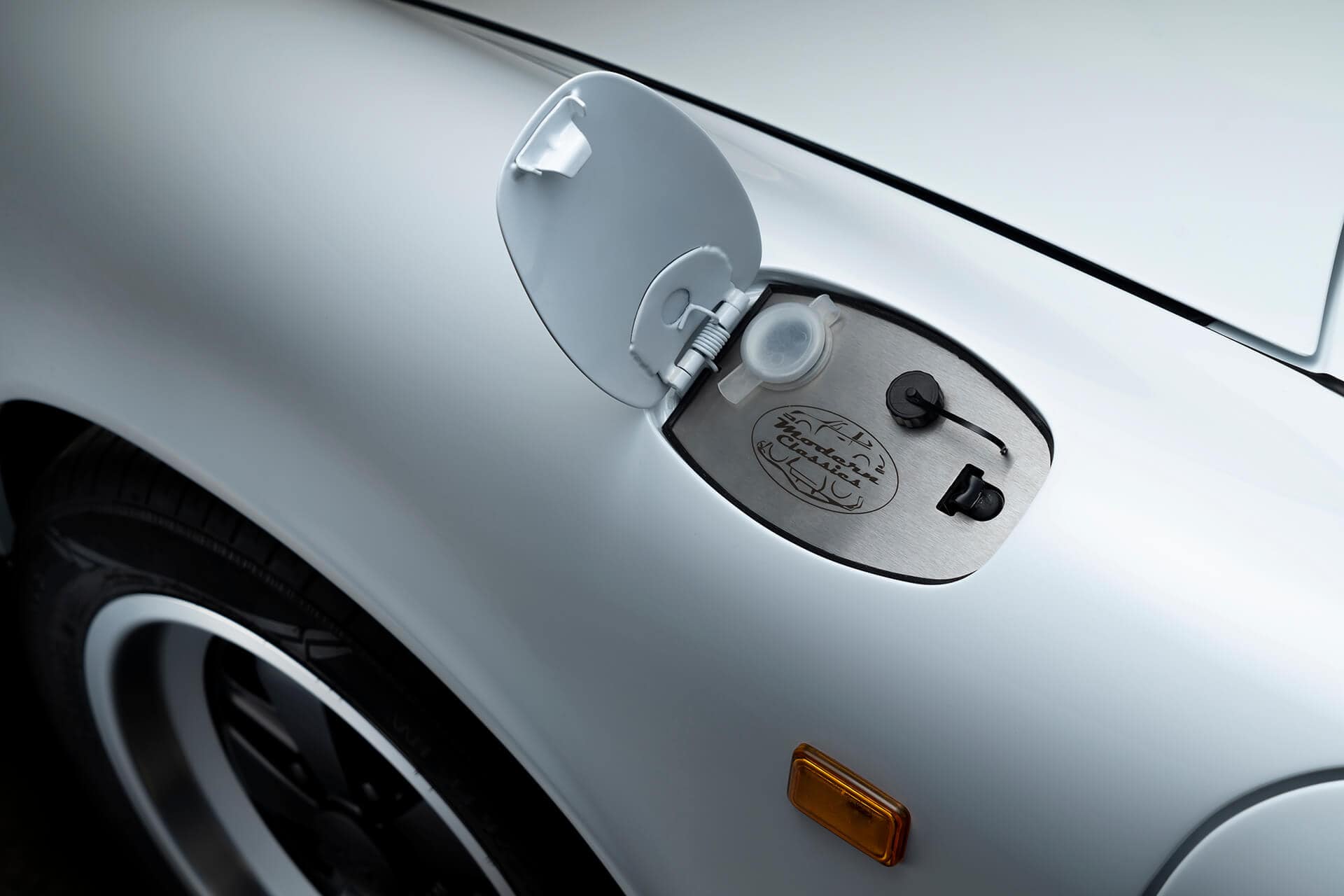
The electric motor’s 135kW and 270Nm outputs aren’t too dissimilar from the car’s original internal combustion engine, although full torque is now available on tap thanks to the delivery characteristics of electric motors.
A 42kWh battery pack provides a driving range of around 250 kilometres and can be recharged via AC charging at 11kW or even DC charging, supported at up to 50kW to allow a 20 to 80 per cent charge in under half an hour.
According to its makers, the Bulgarian-built 911 can complete the 0-100km/h sprint in just 6.8 seconds before continuing on to a limited top speed of 160km/h – more than enough for most roads.
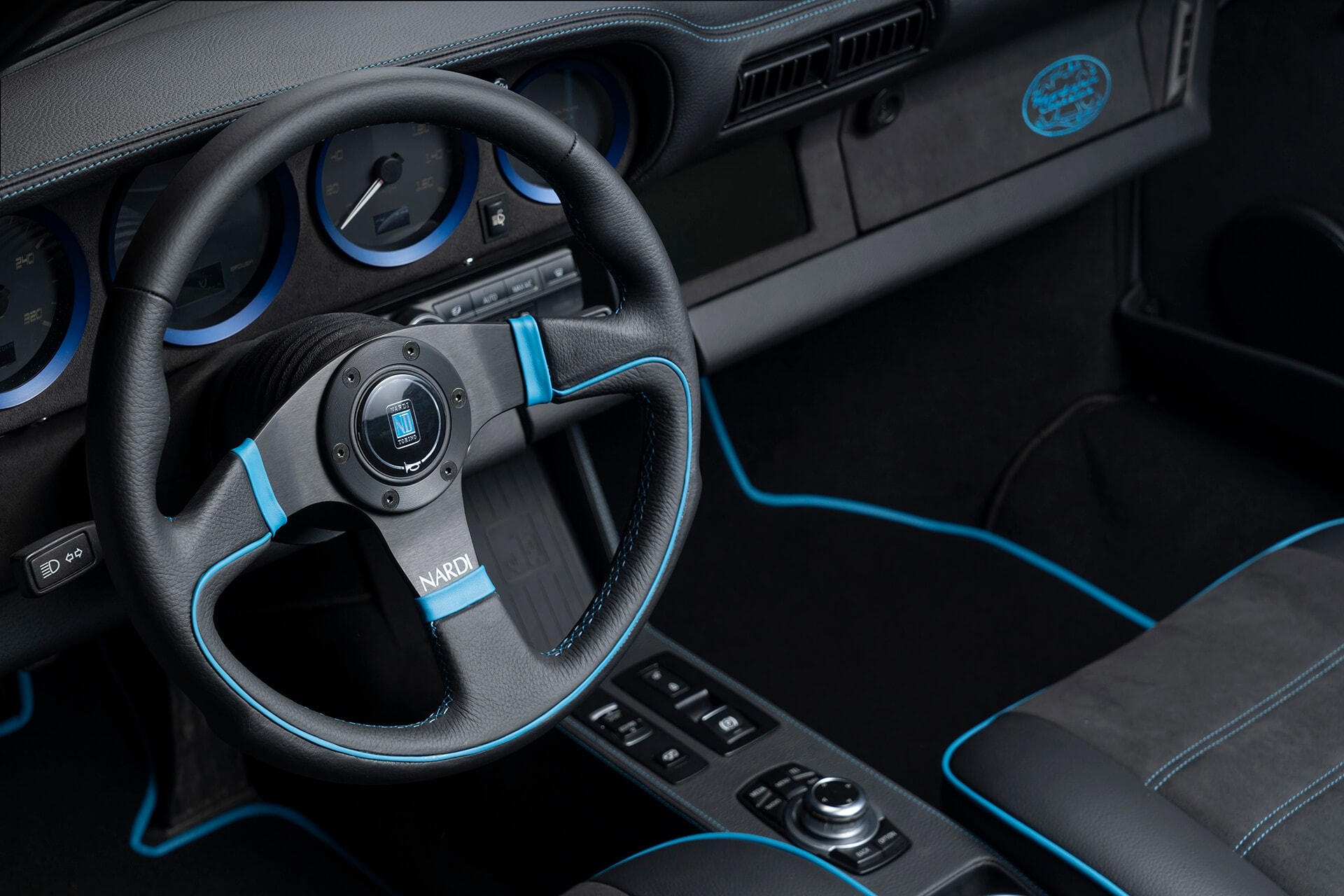
Its interior also borrows elements from the BMW such as the iDrive infotainment controls and window switches, however the period correct-inspired gauges and Nardi steering wheel make sure it doesn’t stray too far from the original vehicle.
No price has yet been disclosed but expect it to well and truly exceed the cost of an unrestored 911 of similar vintage – i.e. in excess of $200,000.
A major service station chain in South Australia will soon accept cryptocurrency for fuel purchases.
According to the Adelaide newspaper The Advertiser, On The Run (OTR) – operators of 170 BP service stations across the state – will begin taking Bitcoin and other cryptocurrencies from July.
Other businesses within the OTR service stations will also make the move, meaning people will be able purchase food and drink from cafes, Subway, Oporto, and Wok In A Box using the payment method.
The announcement is part of a deal with Singapore-based company Crypto.com, and will make OTR the largest bricks-and-mortar retailer in Australia to accept digital currencies.

“Today, we make further inroads in accelerating Australia’s adoption of cryptocurrency,” Crypto.com Asia Pacific General Manager Karl Mohan said in a statement.
“Customers will now be able to pay for goods and services via Crypto.com Merchant Pay at all OTR stores.”
OTR also operates both BP and Caltex service stations throughout Victoria, though it’s not known at this stage whether these stores will also accept cryptocurrencies.
UPDATE, August 15: Australian pricing revealed
Australian pricing for the Maserati Grecale has surfaced online, thanks to a dealer bulletin shared with Wheels Media. Get the full story at the link below.
The story to here
Sign of the times: If you want to be taken seriously as a producer of premium performance vehicles in the 21st century you simply must build …a sporty SUV.
Performance sedans are a dying breed, and sports cars have always been niche products. Sporty SUVs with a premium badge are where the money is these days.
That’s why the new 2023 Maserati Grecale exists.
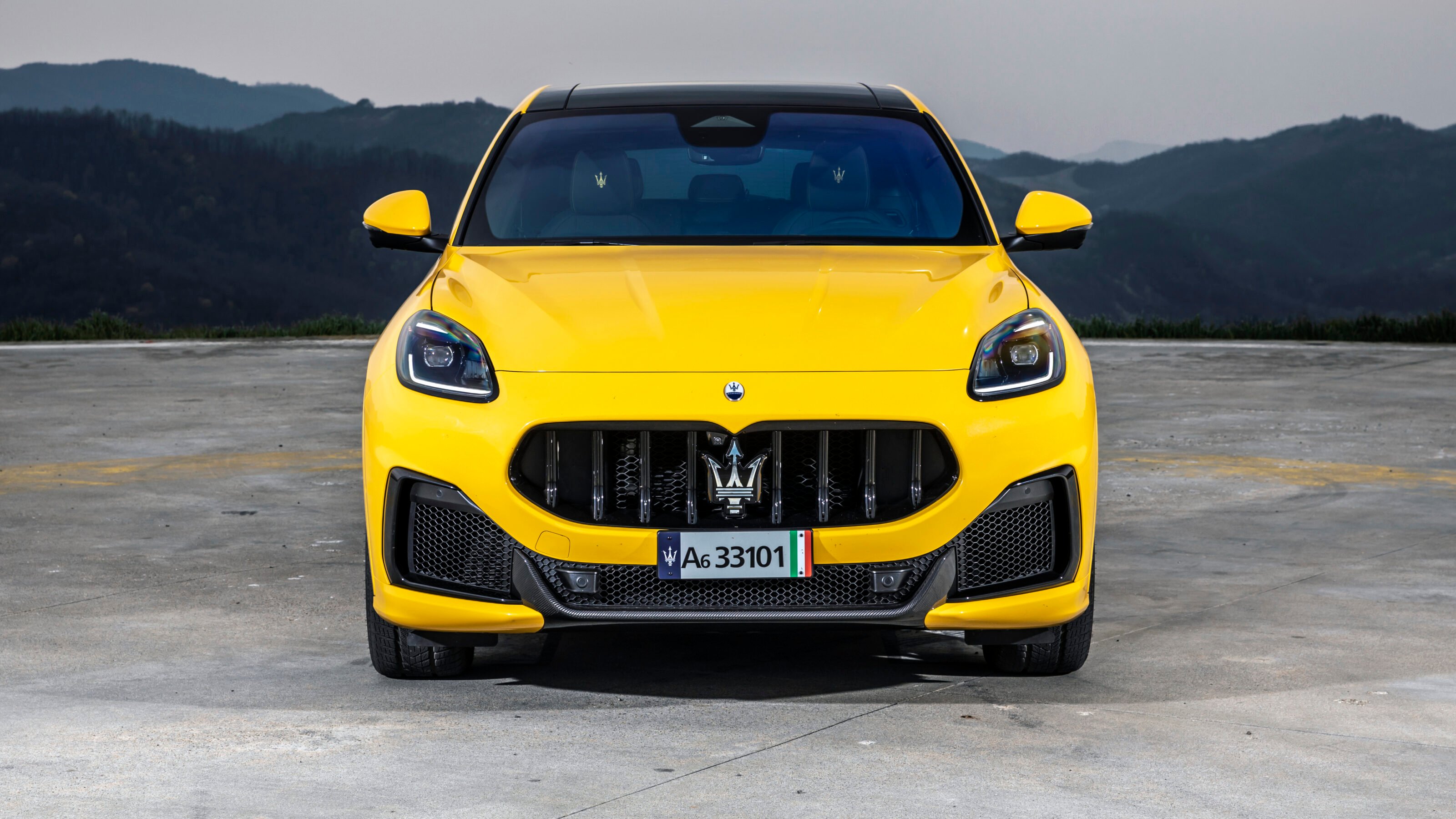
Of course, the Grecale isn’t Maserati’s first SUV. The Levante, launched in 2016, marked the first foray of the legendary Italian brand, famous in the 50s and 60s for fast, continent-crushing gran turismos, into the SUV market. But the smaller Grecale pitches Maserati into a segment dominated by Porsche’s Macan and the performance versions of the Mercedes-Benz GLC and BMW X3/X4, with Jaguar’s F-Pace and Alfa Romeo’s Stelvio squabbling at the margins.
The Grecale is built on a modified version of the Giorgio platform that underpins the Alfa Romeo Stelvio.
The Grecale’s 2901mm wheelbase is 83mm longer than that of the Stelvio, 94mm longer than that of the Macan, and 27mm longer than that of the Jaguar F-Pace. Though noticeably more compact than the Levante, the Grecale is bigger than it looks.
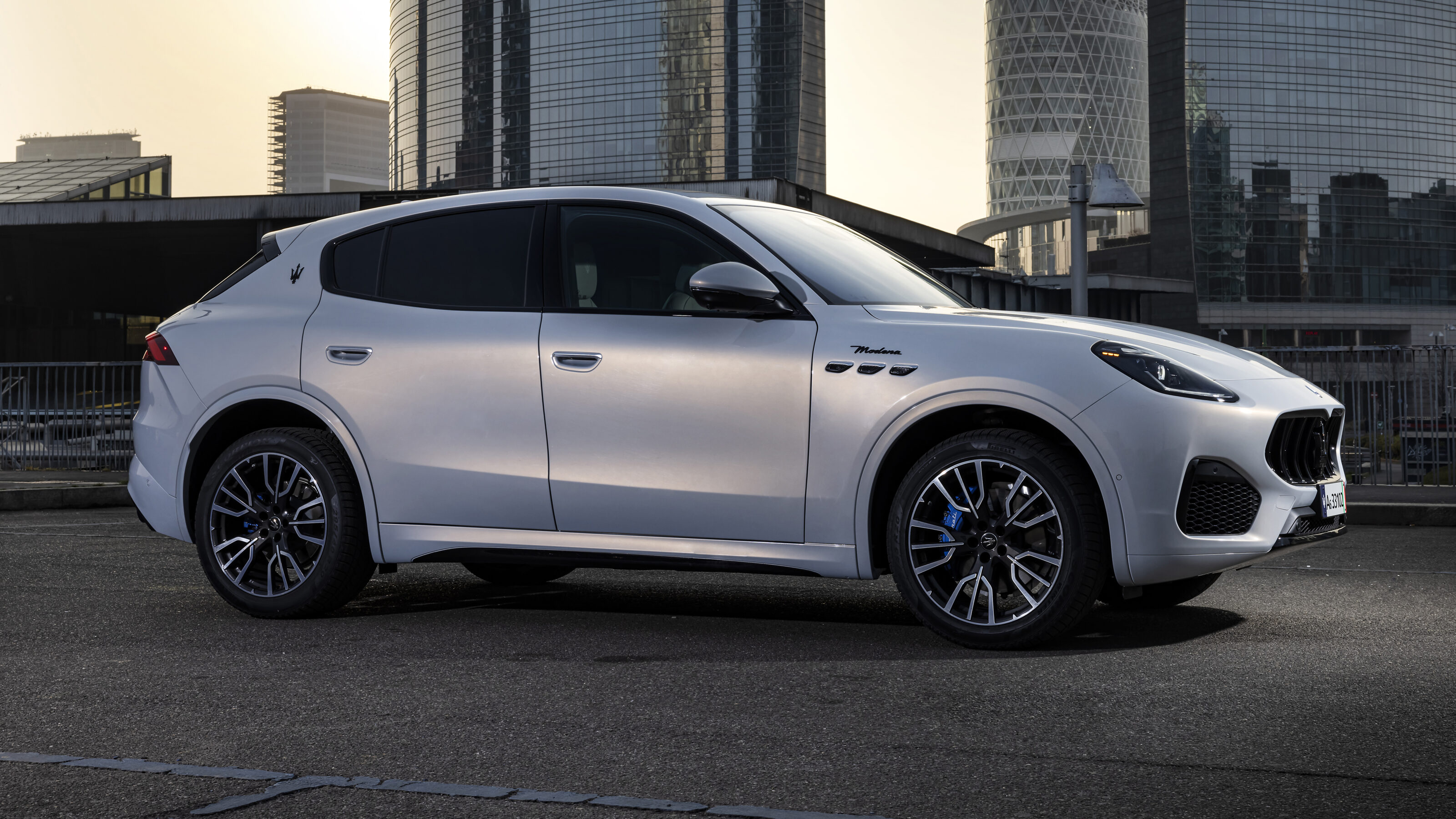
The entry-level Grecale GT is powered by a 48V mild-hybrid version of the 2.0-litre turbocharged four that’s also found in the Alfa Romeo Stelvio. In Grecale GT trim the powertrain makes 221kW at 5750rpm and 450Nm from 2000rpm to 4000rpm.
The mid-spec Grecale Modena shares the GT’s powertrain, but the power output has been boosted to 242kW at 5750rpm, and peak torque of 450Nm is available from 2000rpm to 5000rpm.
Maserati claims the Grecale GT will hit 100km/h in 5.6 seconds and 200km/h in 23.7 seconds on the way to a top speed of 240km/h.
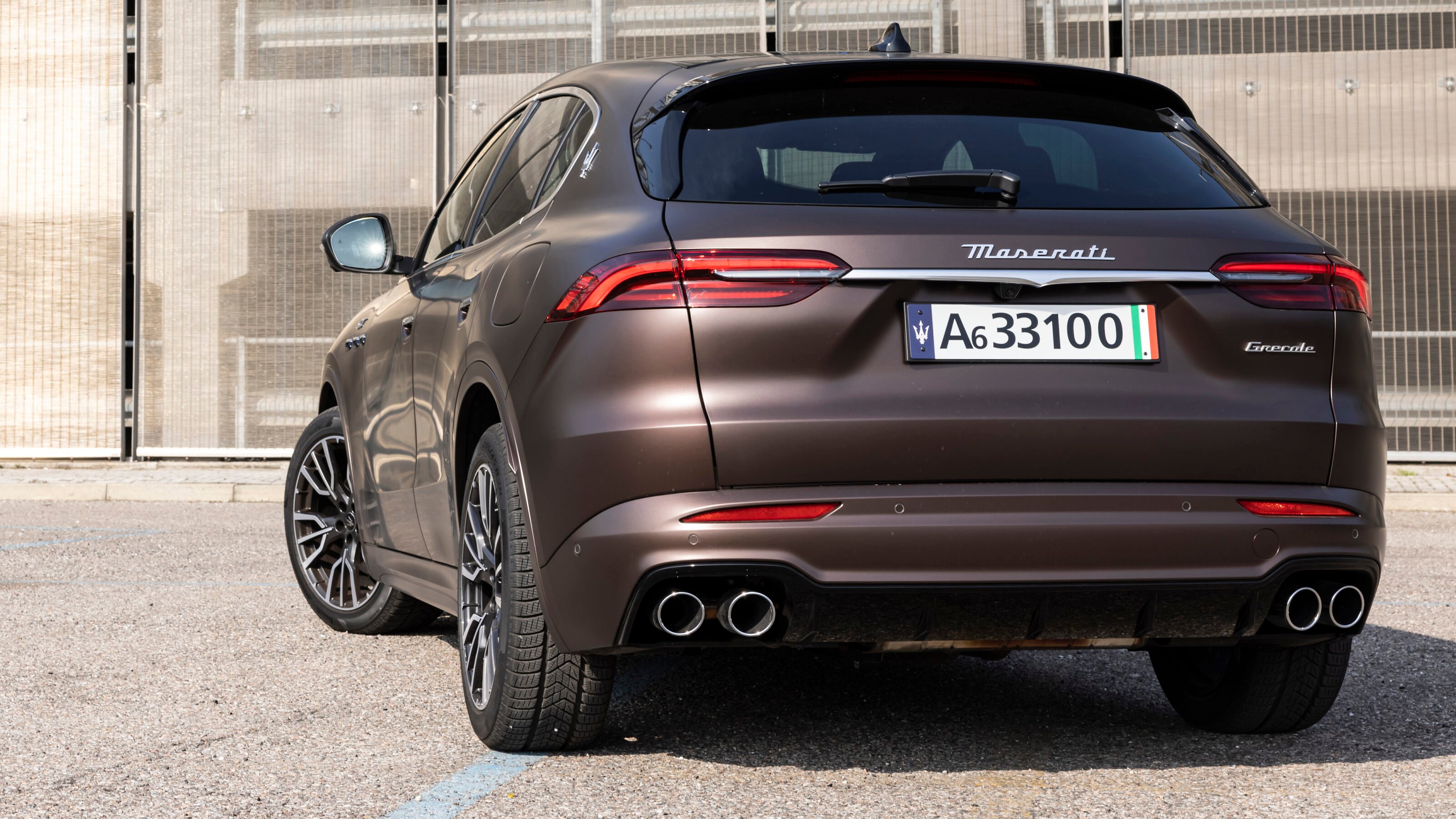
The Grecale Modena will also hit 240km/h but will nail the 0-100km/h sprint in 5.3 seconds and 0-200km/h in 21.9 seconds, Maseratis says.
The halo Grecale is the Trofeo, which packs a detuned, wet-sump version of the Maserati MC20 supercar’s innovative, twin combustion, twin turbo-charged, 3.0-liter Nettuno V6 under the bonnet.
In the MC20 this engine produces 463kW at 7500rpm and 730Nm of torque from 3000rpm to 5500rpm. In the Grecale Trofeo it makes 390kW at 6500rpm and 620Nm between 3000rpm and 5500rpm.
Detuned it may be, but it’s an engine that’s going to get the attention of Porsche Macan GTS buyers. Mercedes-AMG GLC 63 S Coupe, BMW X4 M Competition, Alfa Romeo Stelvio Quadrifoglio and Jaguar F-Pace SVR buyers, too.
On paper, the Grecale Trofeo’s claimed 3.8 second 0 to 100km/h acceleration time and 285km/h top speed puts it right amongst this rambunctious bunch.
But how does it drive?
The short answer: Not like a Porsche Macan. In a good way.
All the Grecales have an eight-speed automatic transmission and a permanent all-wheel drive system that can send 100 percent of the torque to the rear wheels if needed.
The four-cylinder GT and Modena models roll on steel springs and have adjustable dampers. Standard wheel on the Grecale GT is a 19-inch alloy, shod with 235/55 tyres from and rear.
The Grecale Modena gets 20-inch wheels and a staggered tyre setup, with 255/45 items at the front and 295/40s at the rear.
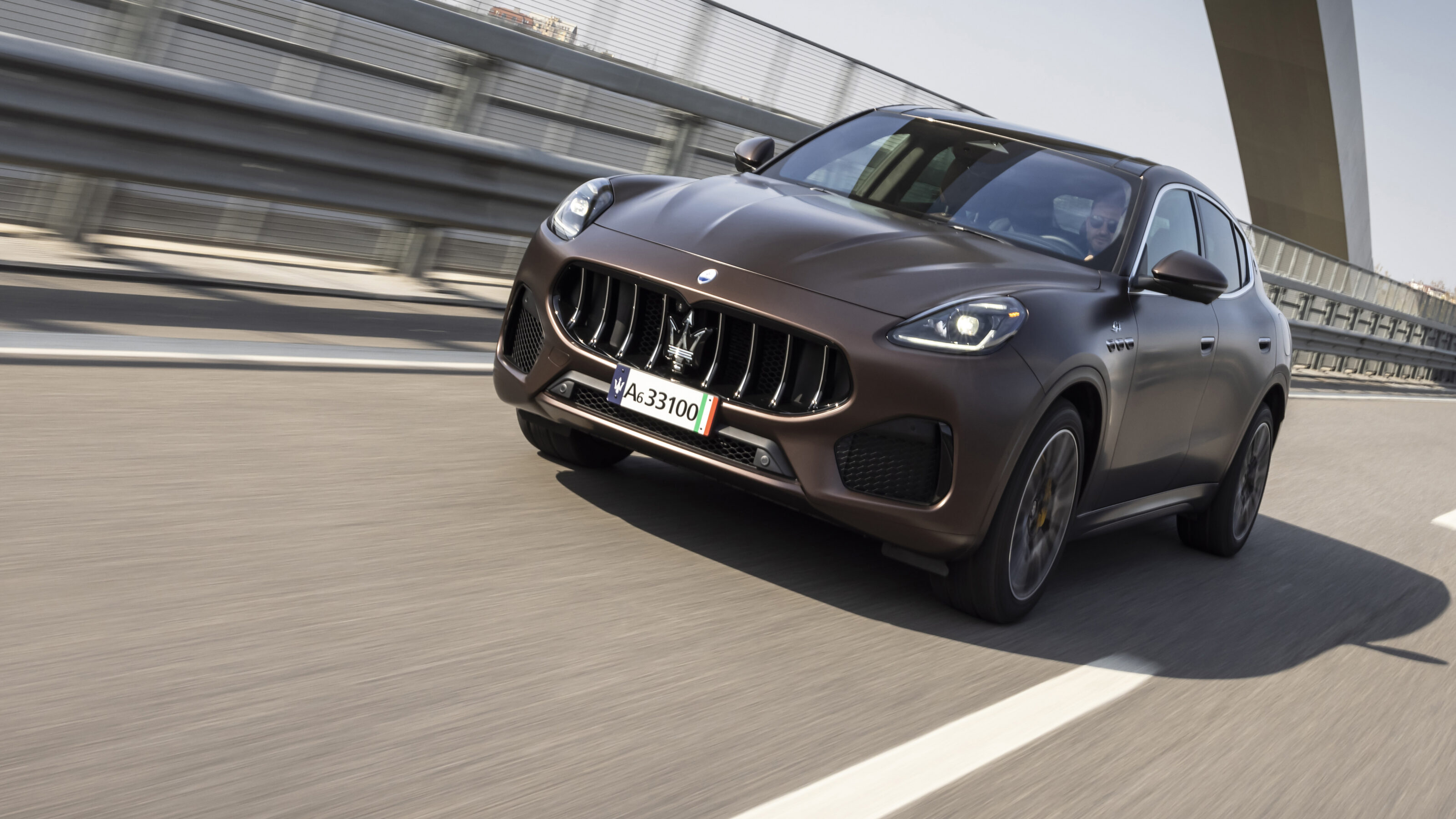
The Grecale Trofeo comes standard with height adjustable air suspension, an electronic rear differential, and bigger brakes than the four-cylinder models. Standard wheels are 21-inch, with 255/40 tyres up front and 295/35s at the rear.
While the steel-sprung, four-cylinder Grecales offer three drive modes – Comfort, GT, and Sport – the air suspension, which is optional on the four-cylinder models, allows the addition of a two-stage Off Road drive mode that raises the ride height 15mm or 30mm.
The Trofeo also gets a unique Corsa mode that sharpens throttle, transmission, and braking responses, dials back the traction and stability control, and activates launch control. Corsa also ups the damper rates from Sport to Hard.
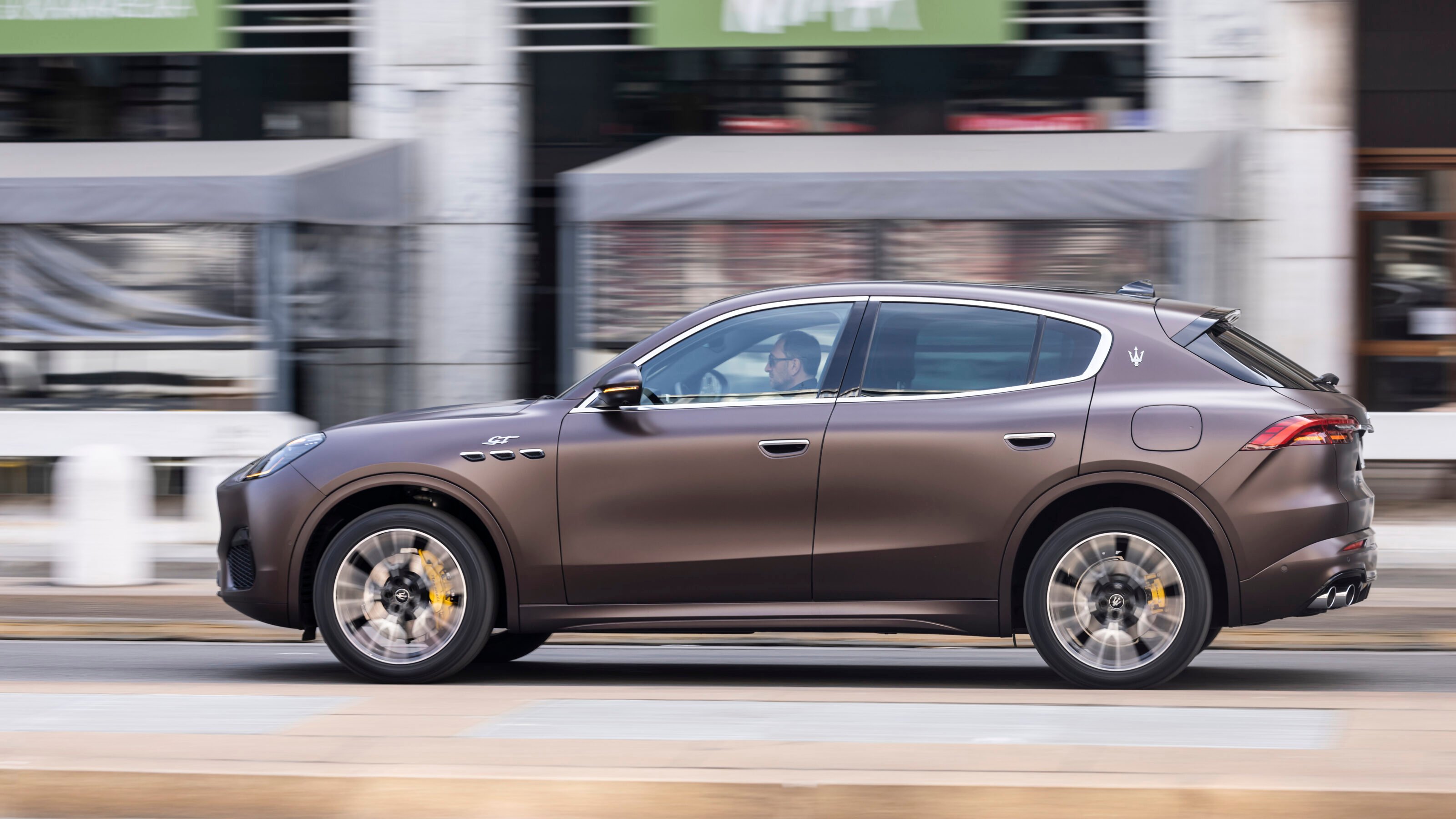
With everything set in the default GT drive mode, all the Grecales feel more compliant than their Macan counterparts.
Even the Trofeo rolls and pitches noticeably when pushed, the bonnet tilting skyward like an old GTHO Phase III’s when you punch the throttle from a standing start, unleashing an edgy snarl and serious thrust from the Nettuno V6.
But the motions are well controlled, and when you really lean on it, the suspension stiffens its sinews and gives you the support you want.
“We wanted the car to communicate its dynamics,” says Maserati validation engineer Frederico de Medio, who openly admits the Grecale’s chassis setup repudiates the German obsession with stiffness. “Too many cars today are too rigid.”
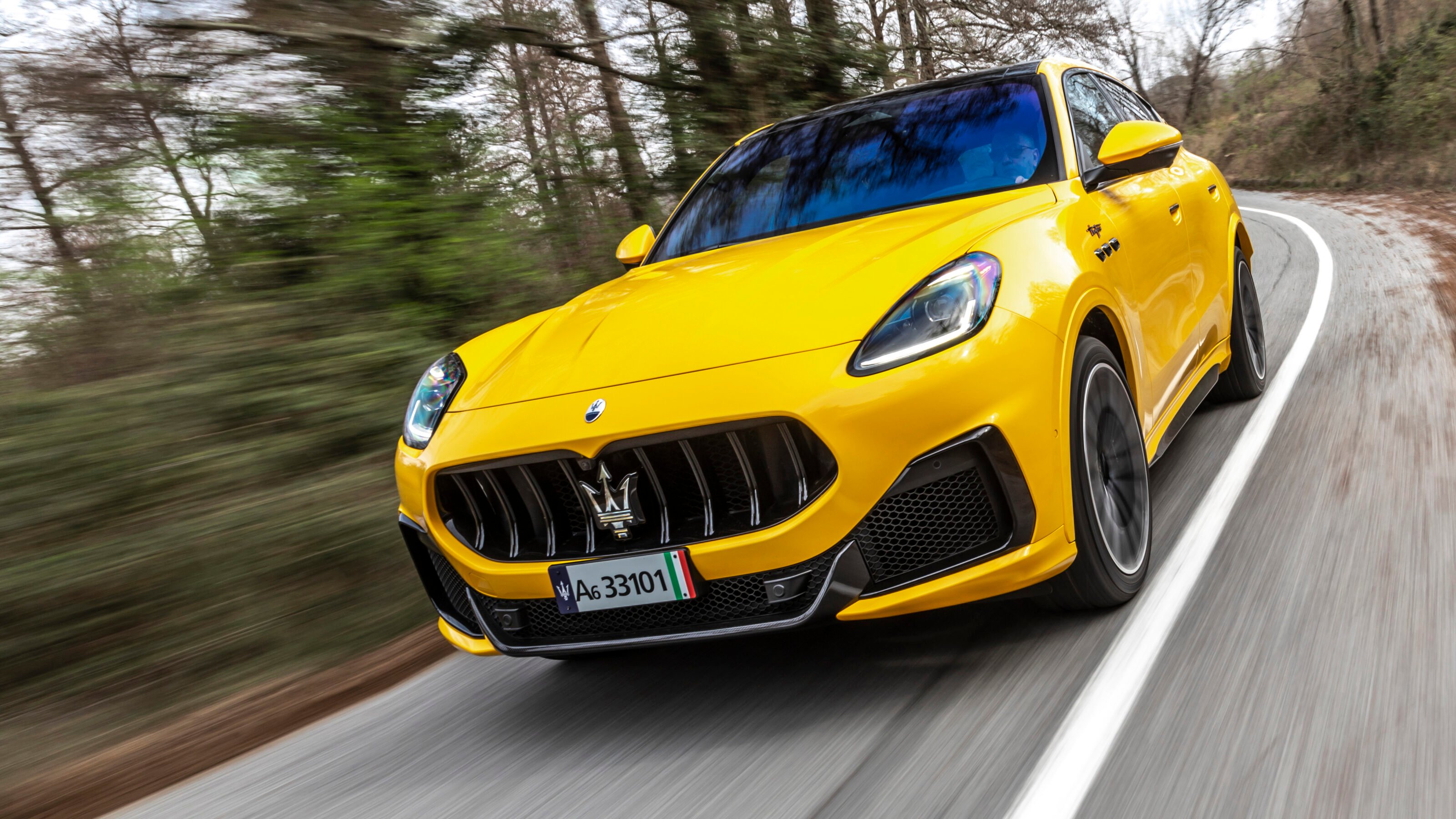
That said, in Corsa mode the Grecale Trofeo’s ride is way too stiff. Fortunately, a button at the center of the steering wheel-mounted rotary drive mode controller allows you to switch damper modes independently of drive modes. In Corsa you can chose between Hard and Sport.
In all the other modes apart from Off Road, you can switch between Sport and the standard damper rates.
The four-cylinder engine powering the GT and Modena models doesn’t have the visceral punch of the Trofeo’s Nettuno V6. Nor does it have the aural appeal, a rapid tick-tick-ticking from the 200psi direct injection system the dominant sound from the engine compartment at cold idle.
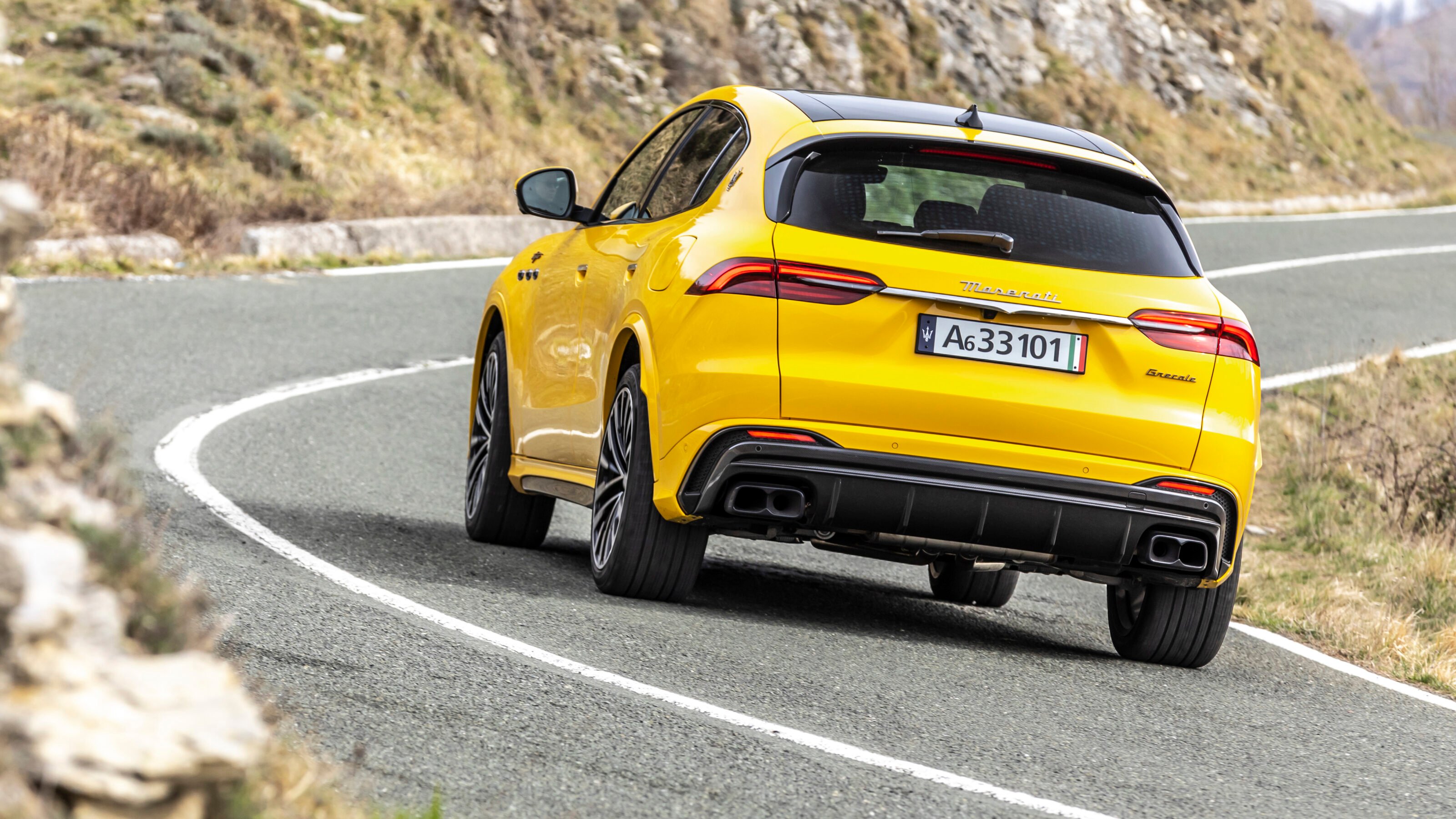
That noise becomes less intrusive as the engine warms, but its character remains more sandpaper than silk. You can’t really feel the mild-hybrid system’s e-booster at work, either, but the power delivery at lower revs is relatively linear and throttle response gets sharper above 3000rpm.
The four-cylinder Grecales feel lighter in the nose than their Macan counterparts, and more responsive to initial steering inputs, though the six-cylinder Trofeo has better overall steering feel, with more consistent weighting.
The smaller Macan might be more agile, but the Grecale, on first acquaintance, arguably strikes a better balance between handling and comfort. However, as our Italian test route lacked any decent winding roads and all the test cars were on soft winter tyres, we’ll reserve final judgement until we’ve spent more time in it on good roads with grippier rubber.
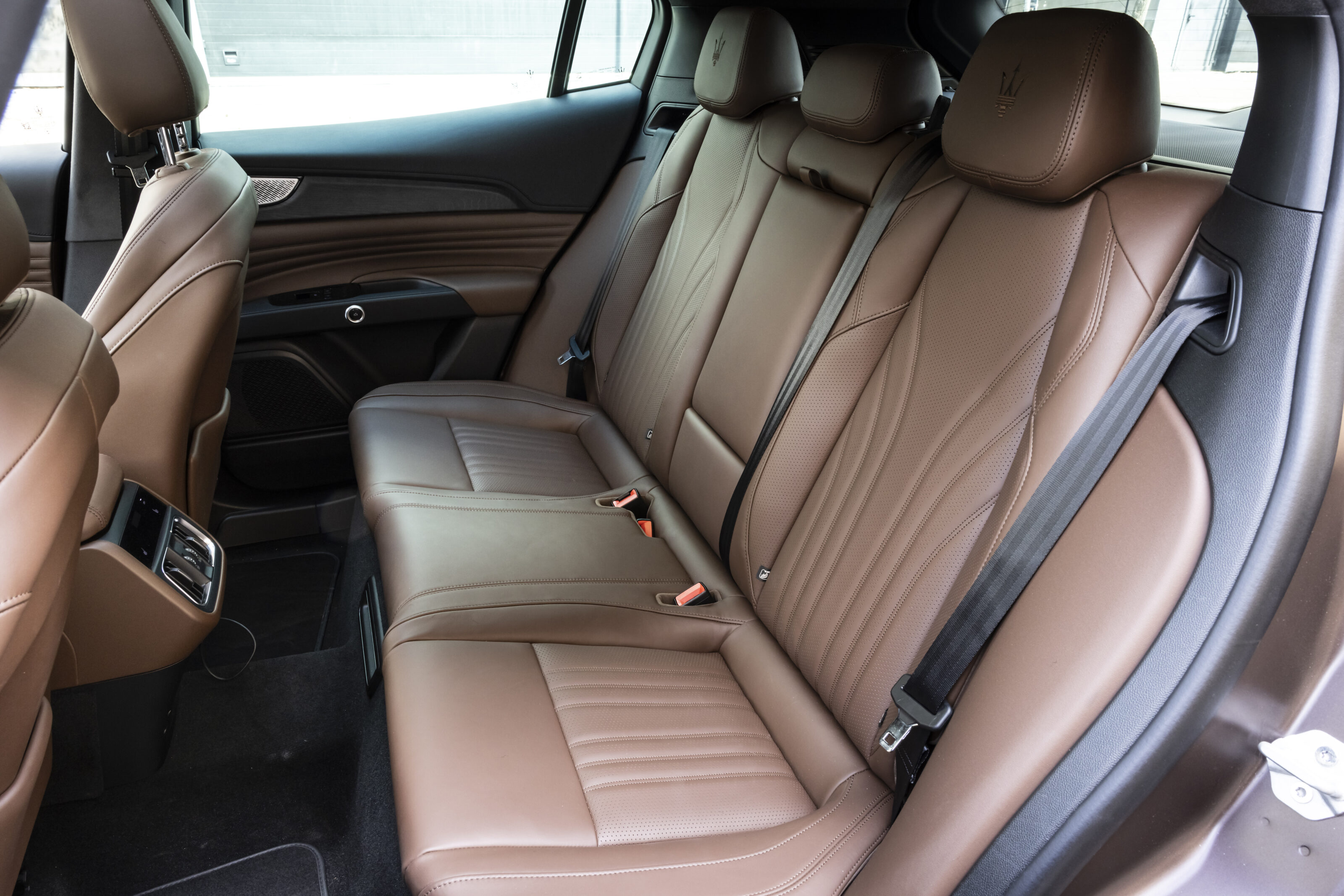
There’s no debate about the Grecale’s superior packaging, however.
Maserati claims both the front and rear seats will comfortably accommodate 99th percentile adults, and there is no reason to doubt that claim: The rear seat leg and head room is truly excellent.
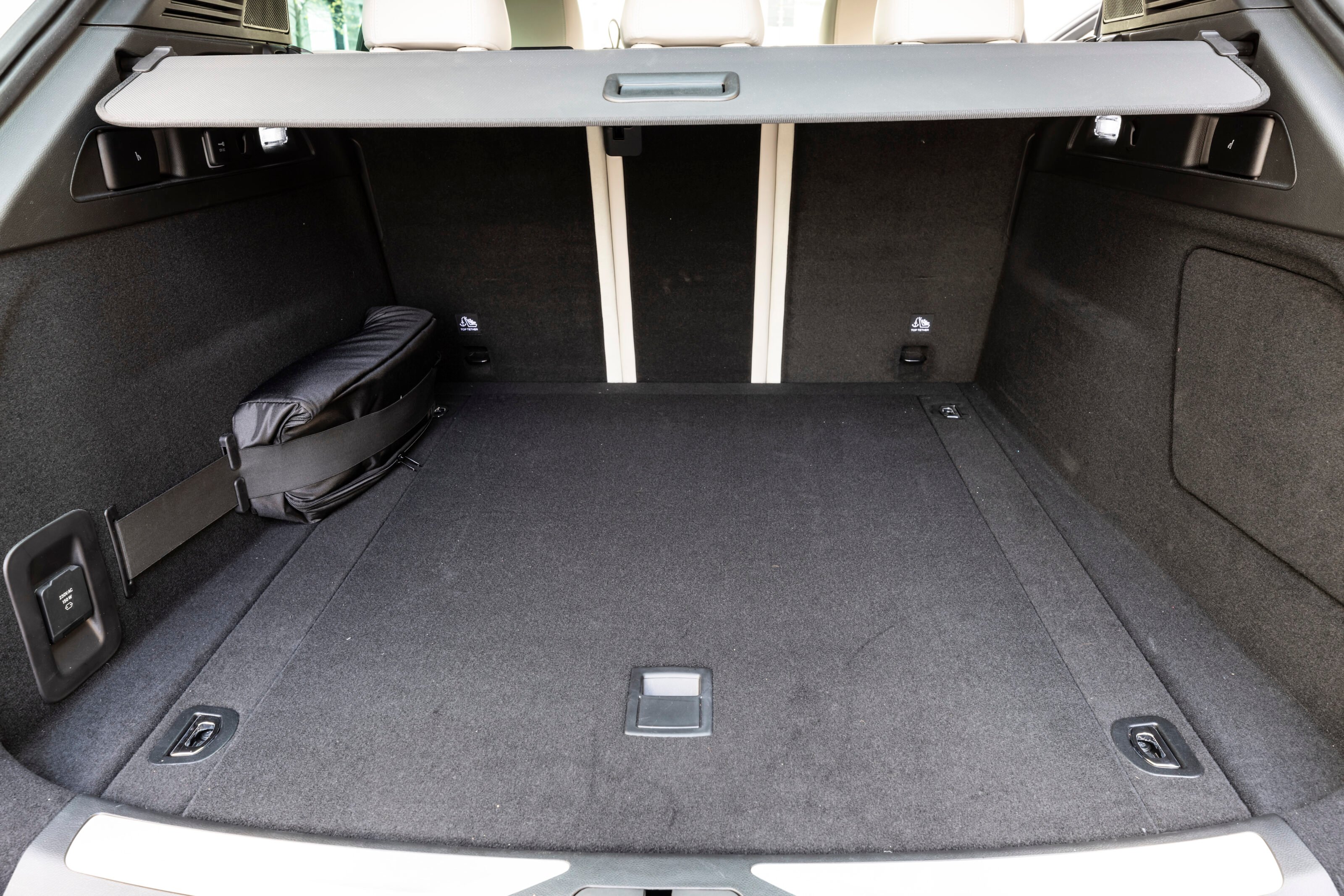
Rear load space – 570 litres in the Trofeo and 535 litres in the four-cylinder models because of the need to package the mild-hybrid system’s battery – is also pretty good.
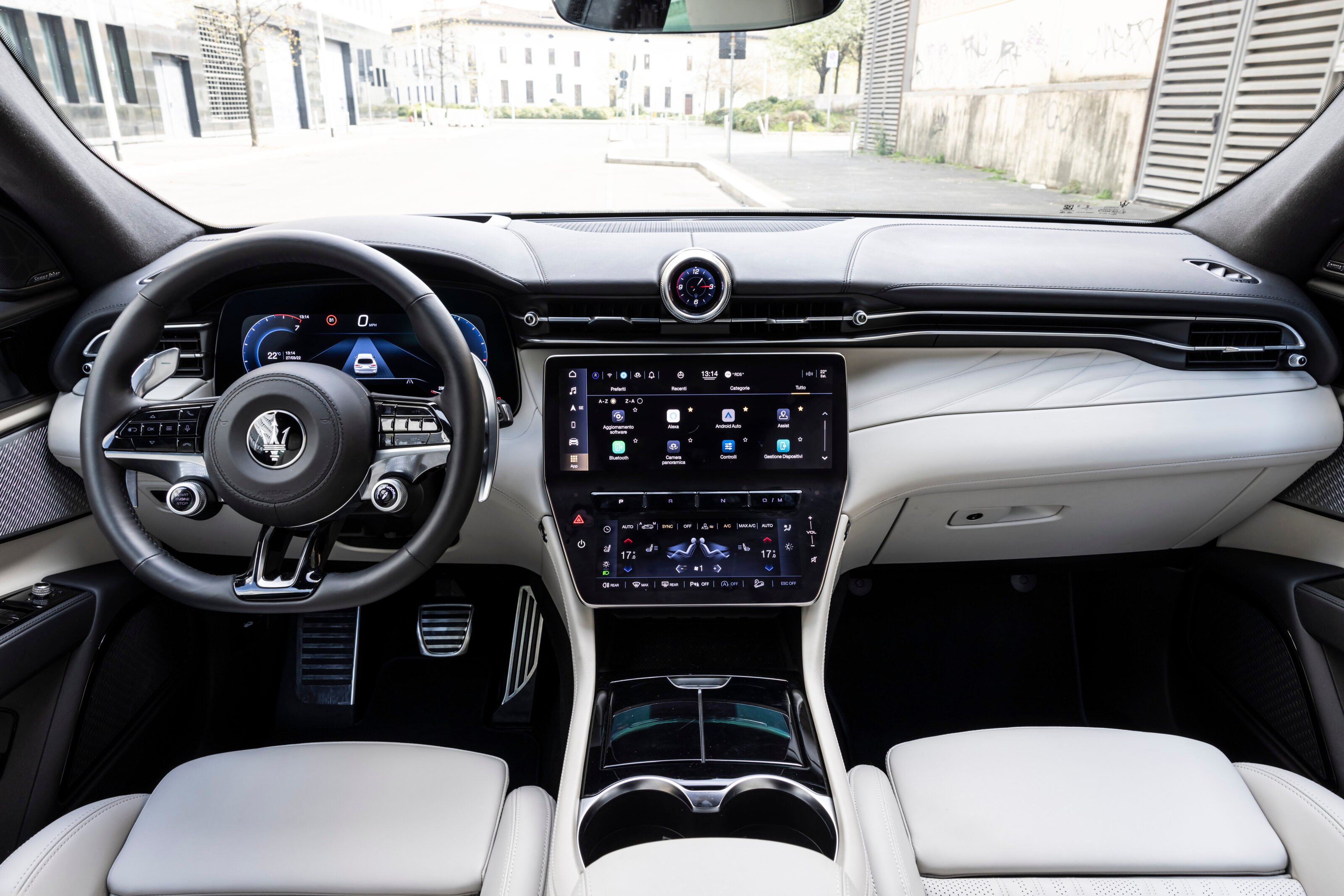
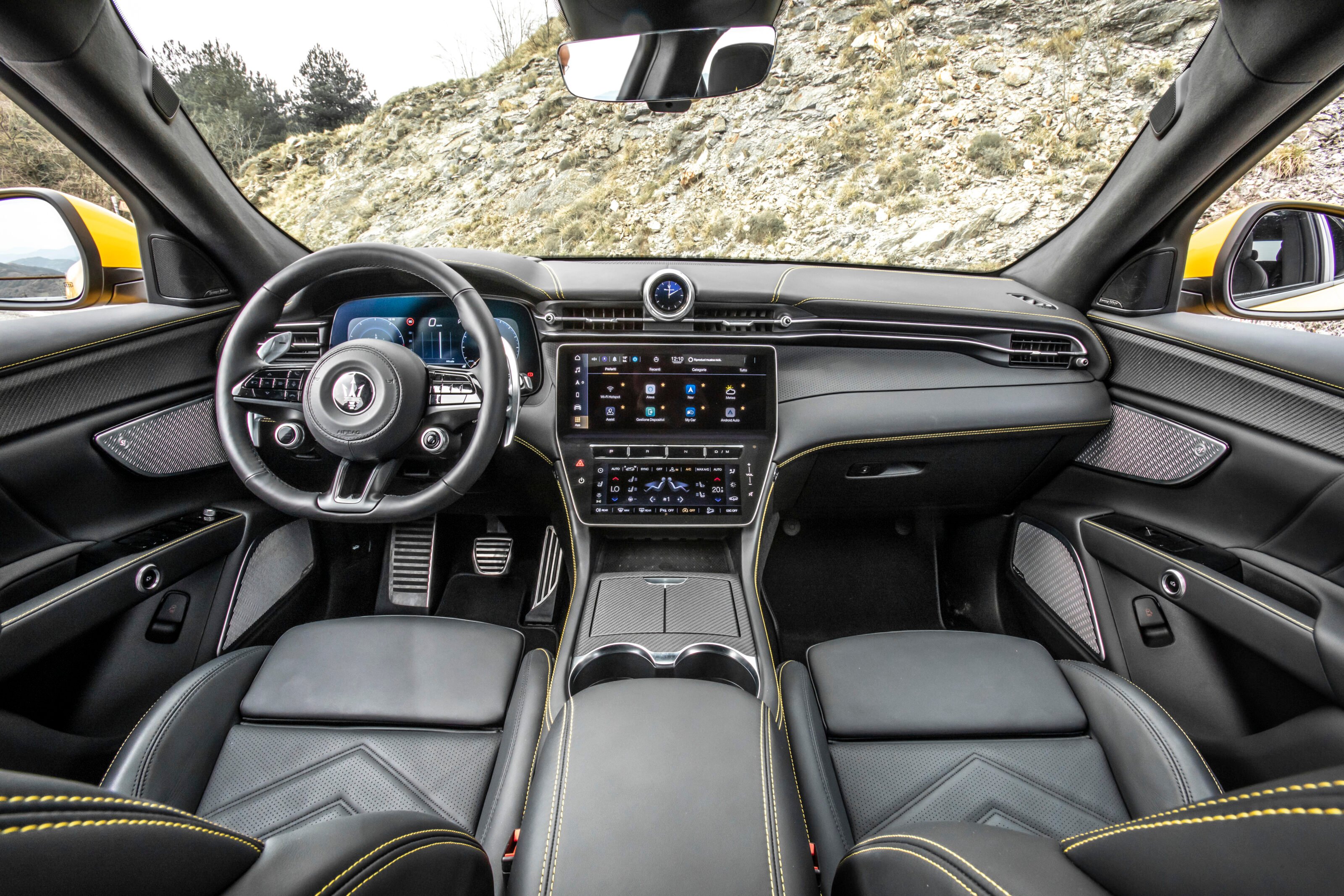
What’s more, the Grecale’s cabin has a touch of Italian fashionista flair to it, even on the entry level models. It also has an impressive array of four screens.
The instrument panel is a configurable screen with crisp and clear graphics. Above the center console is a structure that houses a 12.3-inch touchscreen that controls the nav, audio, phone and vehicle settings; below it is an 8.8-inch touchscreen that controls comfort functions such as the climate control and seat heating and cooling, as well as audio volume.
The two screens are behind a single surface that kinks from the near-vertical alignment of the upper screen to an angle that matches the upward sweep of the center console for the lower screen. Separating the two screens are push button transmission controls.
The fourth screen? It’s the clock at the center of the upper dash, which can be configured between classic analog and digital time displays, and to show performance data such as throttle and brake inputs or g-loads.
VERDICT
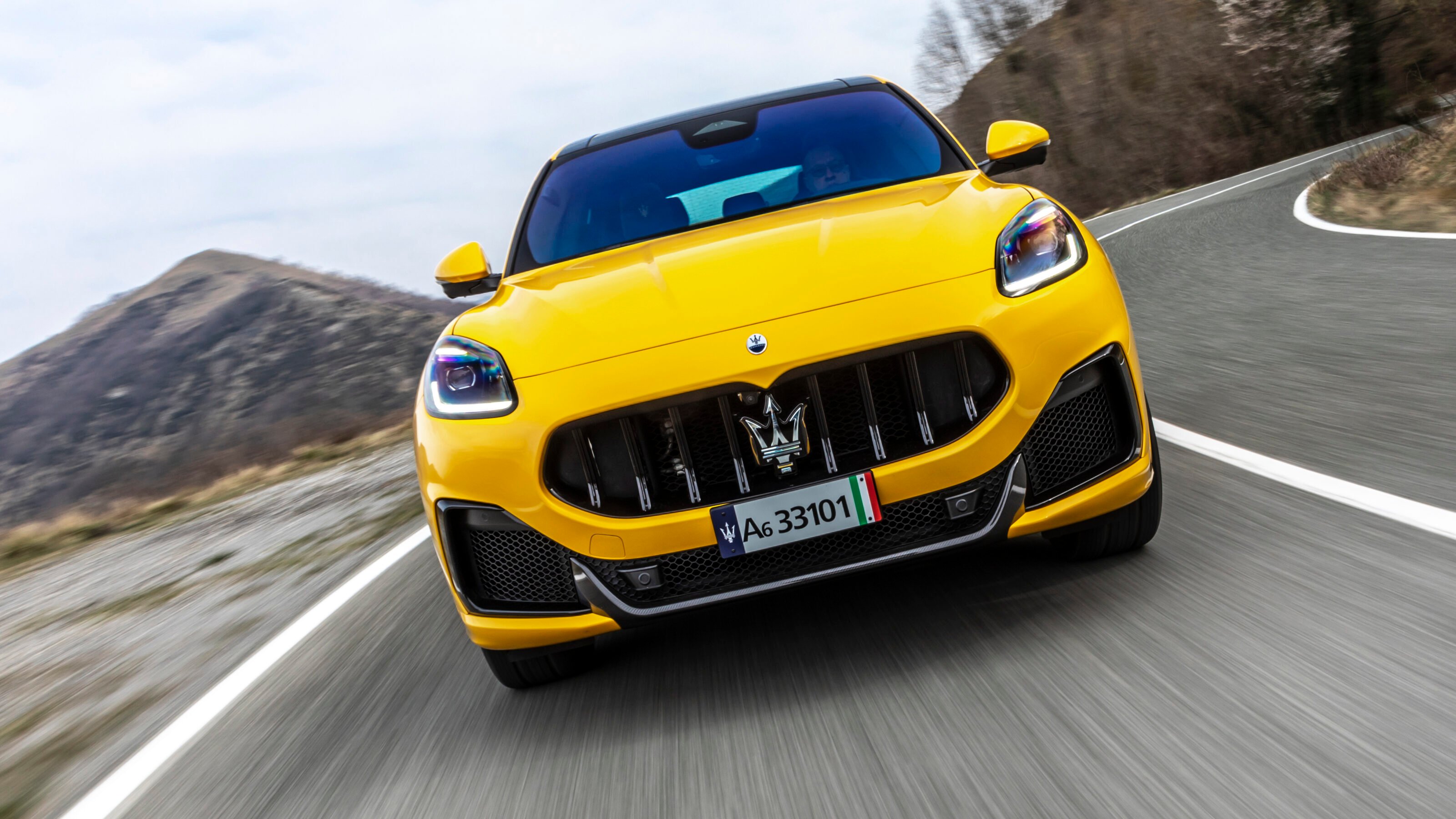
Well-equipped and likely to be competitively priced, the Maserati Grecale is more luxurious than an Alfa Romeo Stelvio, more charismatic than a Jaguar F-Pace, and more exotic than any of the Germans.
The Grecale could be the Maserati that finally brings the legendary Italian brand into Australia’s premium performance vehicle mainstream.
2023 Maserati Grecale Trofeo specifications
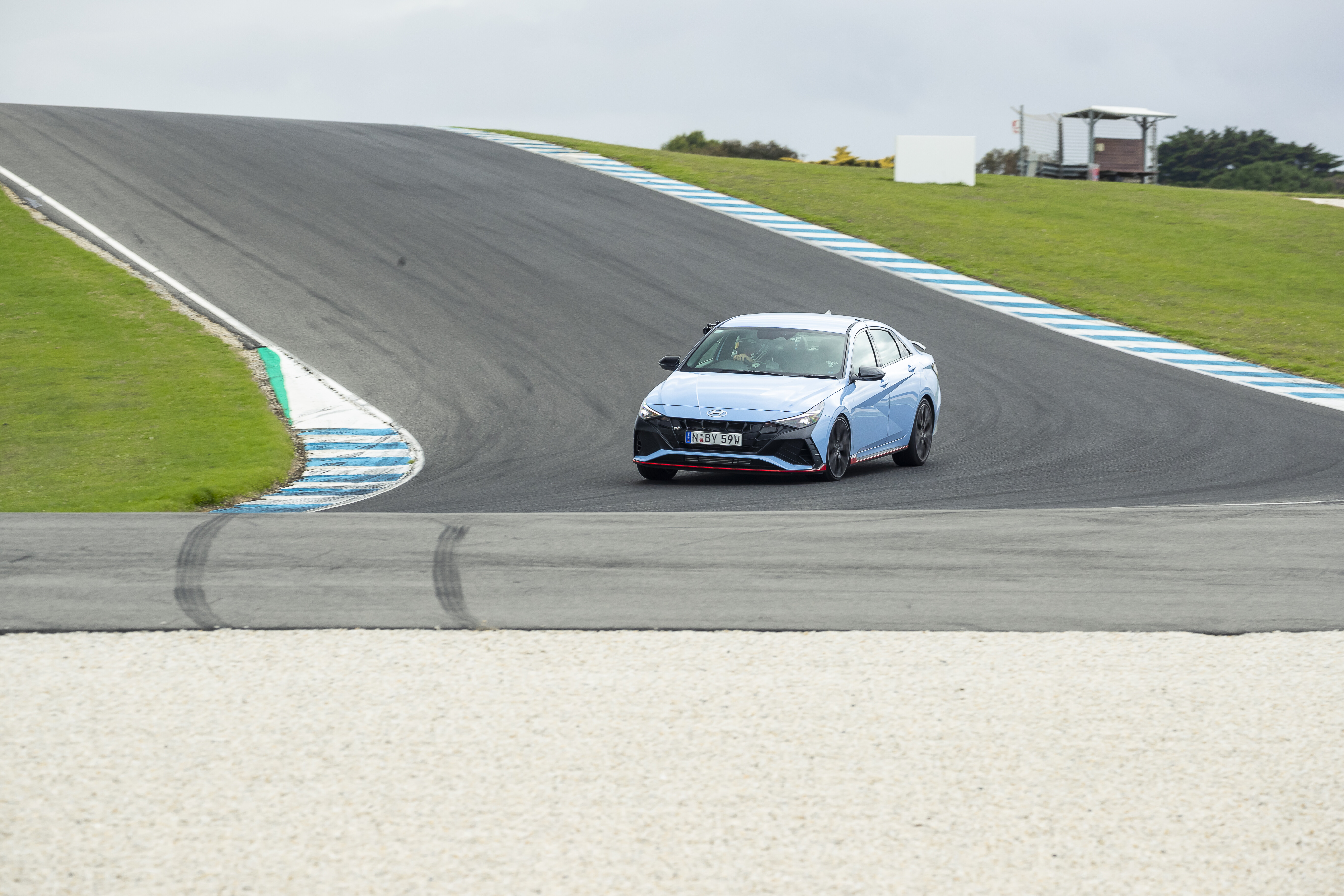
There are three steering settings on the Hyundai i30 Sedan N, and when wicked into its most aggressive mode, it feels about as nervy as Novak trying to get his story straight at Tulla.
Dig into the front end of the i30 Sedan N and there’s a lot of very clever stuff going on. The car features an integrated drive axle, which combines driveshaft and wheel bearings into a single unit, plus there’s a rack-mounted electric motor to power the steering. This system is superior in response to a column-mounted motor as it applies torque directly to the steering gear rather than an auxiliary component.
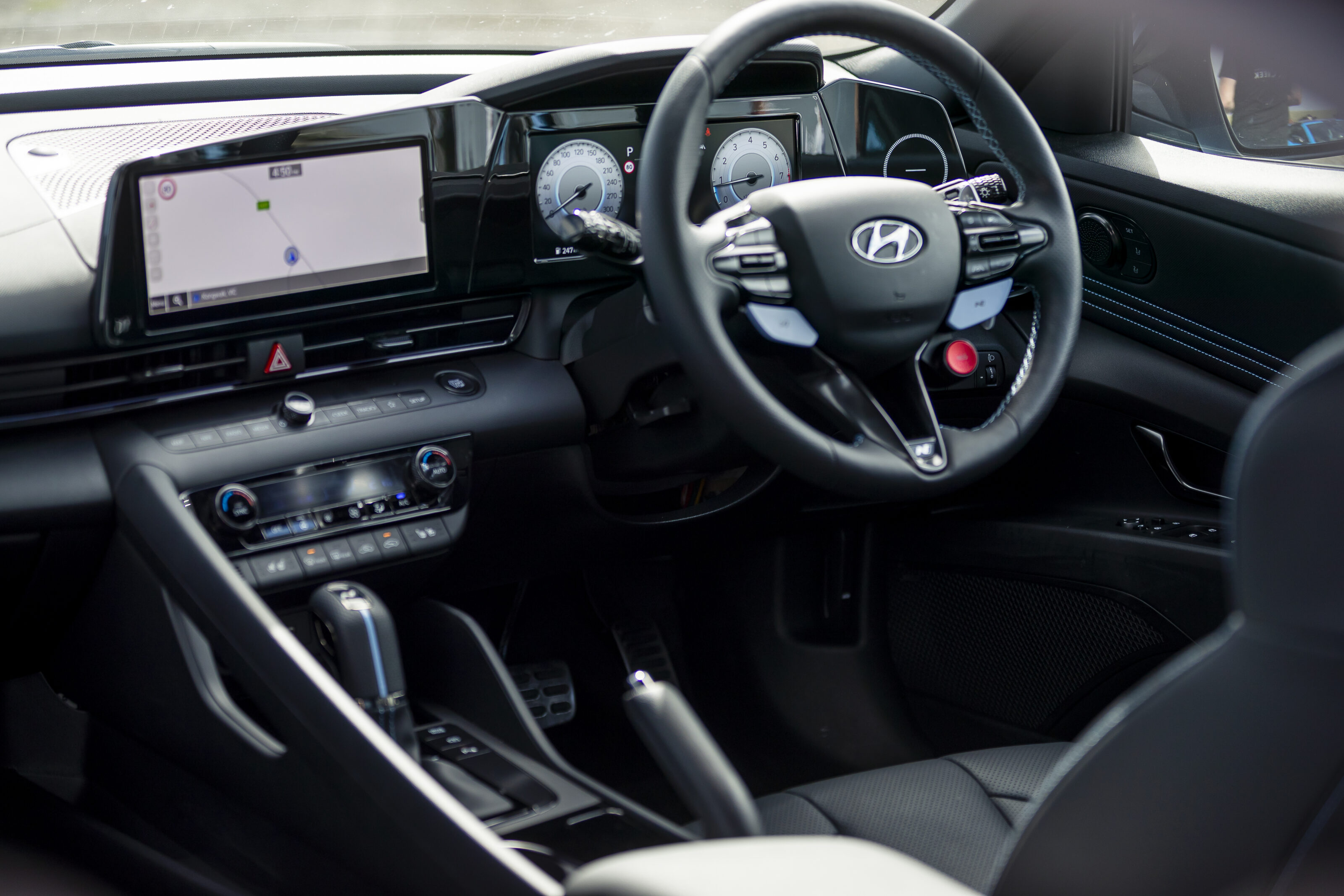
Compared to a standard i30 Sedan base vehicle, the steering ratio has been quickened from 12.9:1 to 12.2:1, which cuts the turns from lock to lock from 2.5 to 2.2. That in itself doesn’t sound notably livewire, the Focus ST recording 2.0 turns lock to lock, but such is the tuning of the variable-rate system that in its most aggressive mode it feels neurotic just off-centre. Dialling it back a notch in the individual drive modes is certainly the go-to.
One clue as to why Hyundai has done this comes from the recently departed boss of Hyundai’s N Division. While presenting the i30 Sedan N at its US launch, Albert Biermann was unrepentant when addressing its more aggressive settings. “You [journalists] have told us N mode is too stiff,” Biermann said. “That it’s unusable; we know that. We will not change, even if you complain more, because our customers love it.”
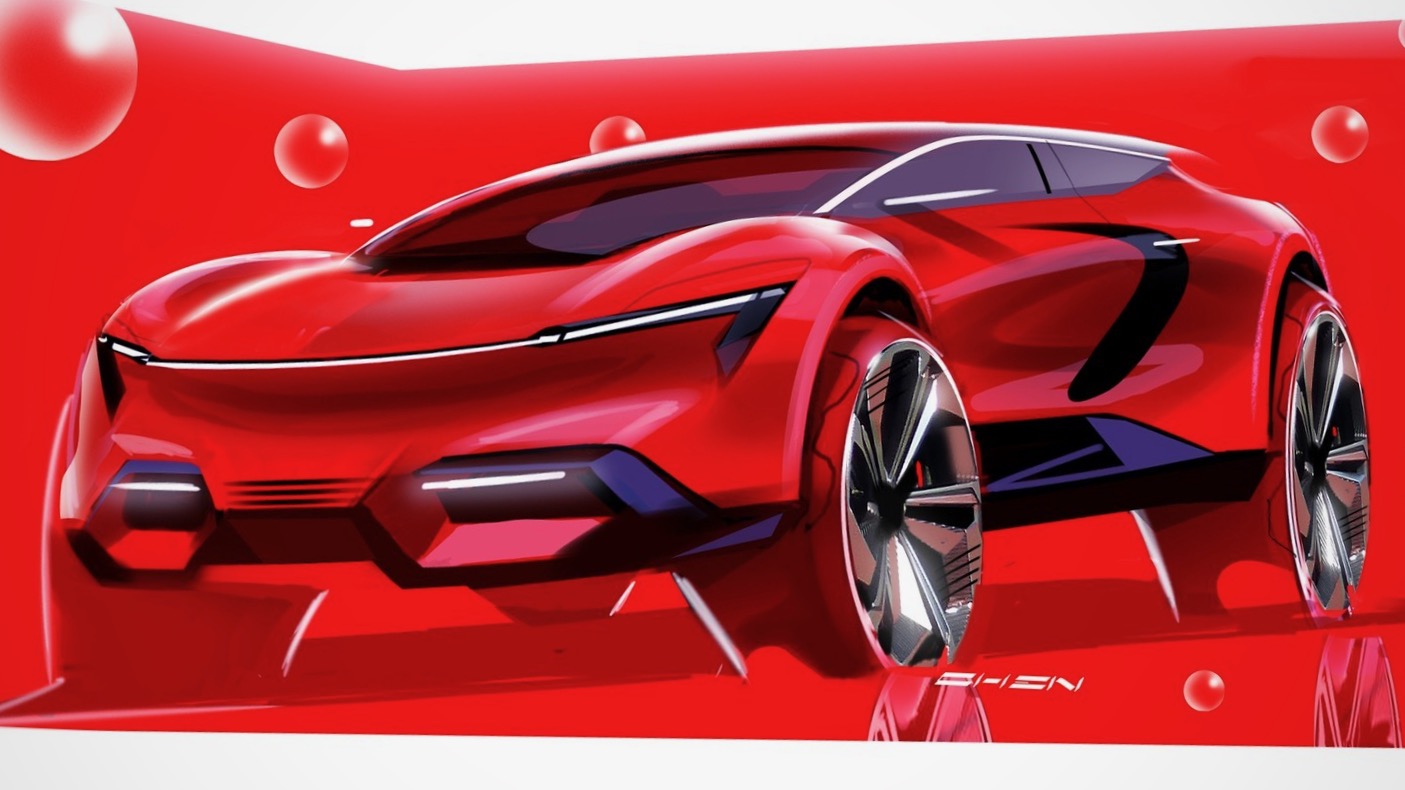
General Motors has teased its Chevrolet Corvette SUV, hinting the much-rumoured model is still in the works.
GM’s design team posted an image on social media of what could very well be a Corvette SUV, but included the hashtag #chevy – indicating the model may be coming from Chevrolet and not becoming its own dedicated sub-brand.
A report from Bloomberg in early 2021 quoted sources who said the Corvette would expand into a family of vehicles, much like the Ford Mustang Mach-E is sold alongside petrol-powered Mustang coupe models.
Those familiar with the matter suggested GM was working on a vehicle which would offer greater interior space, storage and more creature comforts while still delivering the Corvette’s “rakish styling” and high-performance driving.
The design sketch posted this week on Instagram echoes the Corvette’s sleek shape, as well as its signature black side rockers.
“The Corvette brand has unlimited daylight on the upside,” former GM executive Bob Lutz told Automotive News in June 2019.
“If I were [still at GM], what I would do is develop a dedicated architecture, super lightweight, super powerful, Porsche Cayenne-like, only much better and a little bigger, medium-volume Corvette SUV,” Lutz said at the time.

“Target worldwide 20,000 to 30,000 units, and price it starting at US$100,000. Gorgeous interior. No V6 powertrain. No low-end version. It has to be the stellar premium sport-utility made in the United States, and the Corvette brand could pull that off.”
Ford and GM aren’t the only ones with a high-performance flagship SUV. In November 2021, BMW showed off its XM – the most powerful car to ever come from the marque, and the first dedicated vehicle from BMW M since the original M1.
