
Evidence is mounting to suggest both Toyota and Mazda will each be launching a rear-wheel-drive coupe based on the same platform.
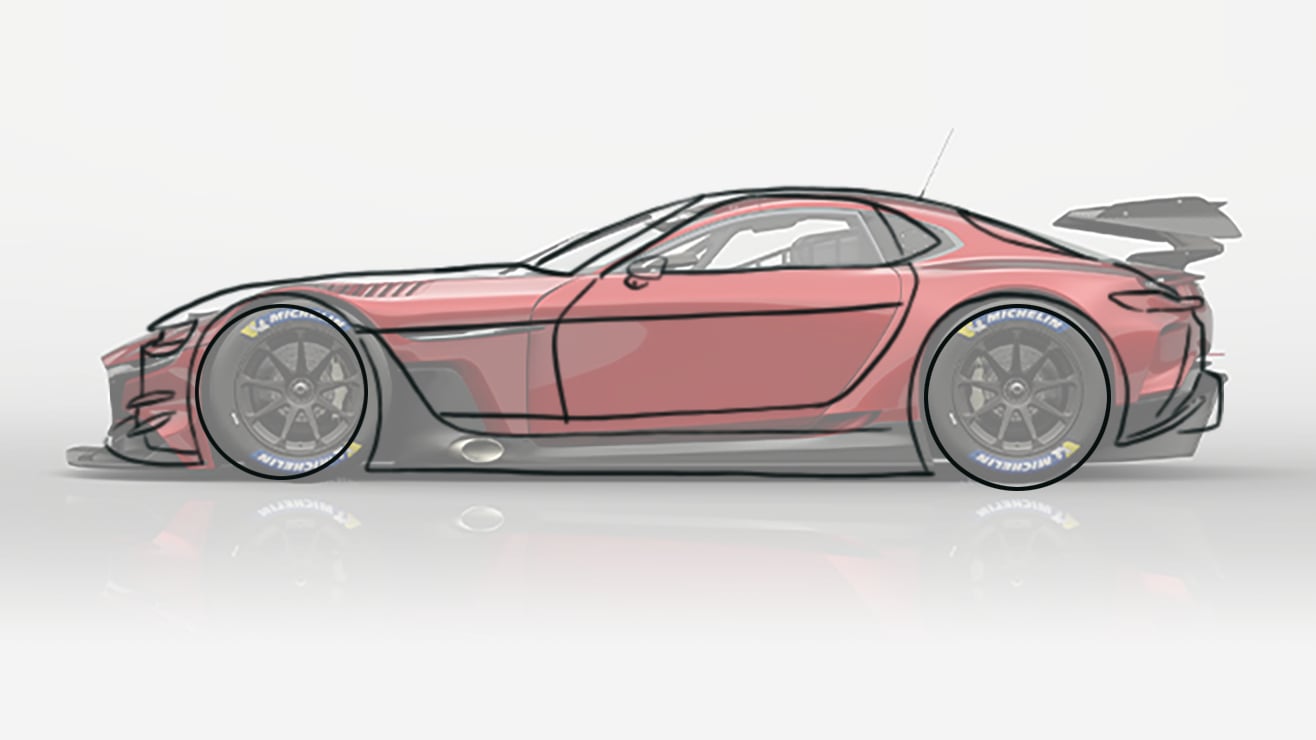
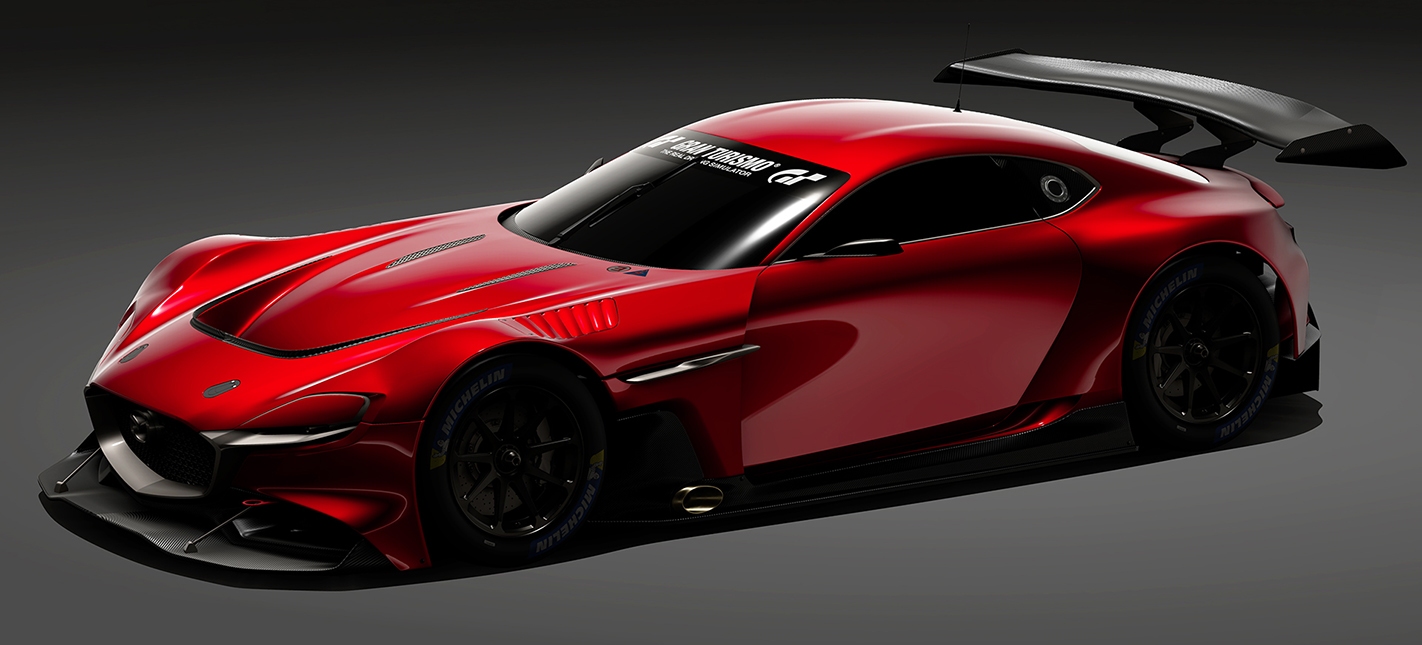
In recent days, Toyota unveiled its GR GT3 Concept racing car, which shares a strikingly similar silhouette to the Mazda RX-Vision GT3 Concept shown in early 2020, based on the RX-Vision concept first revealed in 2015.
Eyebrows were raised when Mazda showed off its racing car concept for Gran Turismo, as it’s not often a brand continues to keep a five year-old concept alive by turning it into a digital racing car.
While Toyota has been tight-lipped about the most recent racing car concept, the GT3 series in which the Toyota GR GT3 Concept is designed for requires the vehicles racing to be derived from a production model.
The Toyota GR GT3 Concept also happens to share a number of similarities with the Lexus LFA successor teased in recent months.
It was back in 2017 that Toyota bought a five per cent stake in Mazda, with the latter understood to have invested in a 0.25 per cent stake in the former.
While there has been no end to rumours regarding Mazda’s next rotary-powered sports car, more recent media stories out of Japan have reported the two carmakers will share an upcoming rear-wheel-drive chassis – which will underpin the upcoming Mazda 6, and could be the basis for the next-gen Lexus IS.
Mazda has been developing a six-cylinder, rear-wheel-drive vehicle for a number of years, as the brand looks to move into the premium segment.
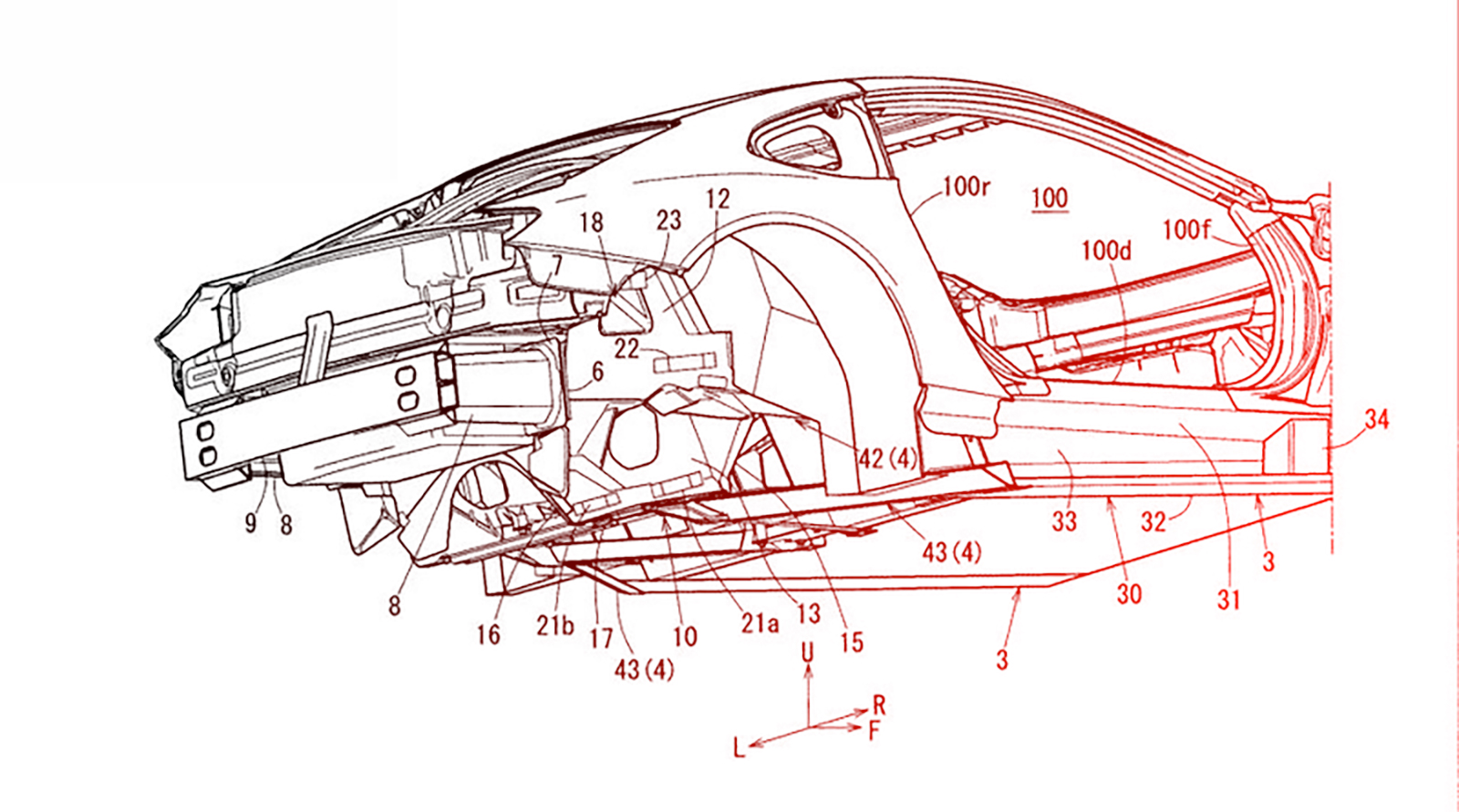
Patent filings have also pointed to the fact that Mazda is developing a rear-wheel-drive coupe, with similar dimensions to the RX-Vision concept from 2015.
Other more recent reports have suggested Mazda may convert the rotary engine to accept hydrogen fuel, which may end up being used in conjunction with a recently-patented hybrid system.
In November, Mazda and Toyota (along with Subaru, Yamaha, and Kawasaki) announced they were joining forces in an attempt to keep the internal-combustion engine alive by using carbon-neutral fuels.
Other oddities have also come to the surface in the past few years. In 2018, Toyota revealed the E-Palette Concept using a Mazda-developed rotary engine as a range extender. In early 2020, US website Jalopnik reported on a rumour it had heard which suggested the Mazda RX-9 would, in fact, use the six-cylinder engine destined for the Mazda 6.
While it’s difficult to decipher fact from fiction, it’s not out of the realms of possibility to suggest Mazda is developing a coupe with the capability to accept both rotary and piston engines – though it is more likely to be one or the other.
There’s certainly plenty of precedent for Toyota to collaborate on a new sports car, though. The auto giant partnered with Subaru on two-generations of the 86/BRZ, and looked to BMW to help create the new Supra.
Which now means there aren’t many sports car models from its past it can borrow from. However, almost a year ago to the day, CarBuzz uncovered fresh trademark filings for the Celica nameplate.
The growing body of evidence suggests there is something bubbling away below the surface between Mazda and Toyota – with the latest GT3 Concept offering the greatest hint – but exactly what will come of it remains to be seen.
Snapshot
- Mercedes-Benz recalls 204 C-Class units made last year
- Potential software issue causes the engine to turn off
- Recall is the fifth for the C-Class since September 2021
Mercedes-Benz has issued a recall notice for its 2021 C-Class, owing to a potential engine software issue.
Affecting just 204 units – a touch under five per cent of the 4603 C-Class vehicles sold last year – the fault causes the car’s engine to turn off without warning, also preventing it from restarting.
If this occurs on the road, it could be potentially dangerous to the occupants and other road users, leaving the vehicle stranded with no way to move out of traffic while also disabling the steering and brakes.
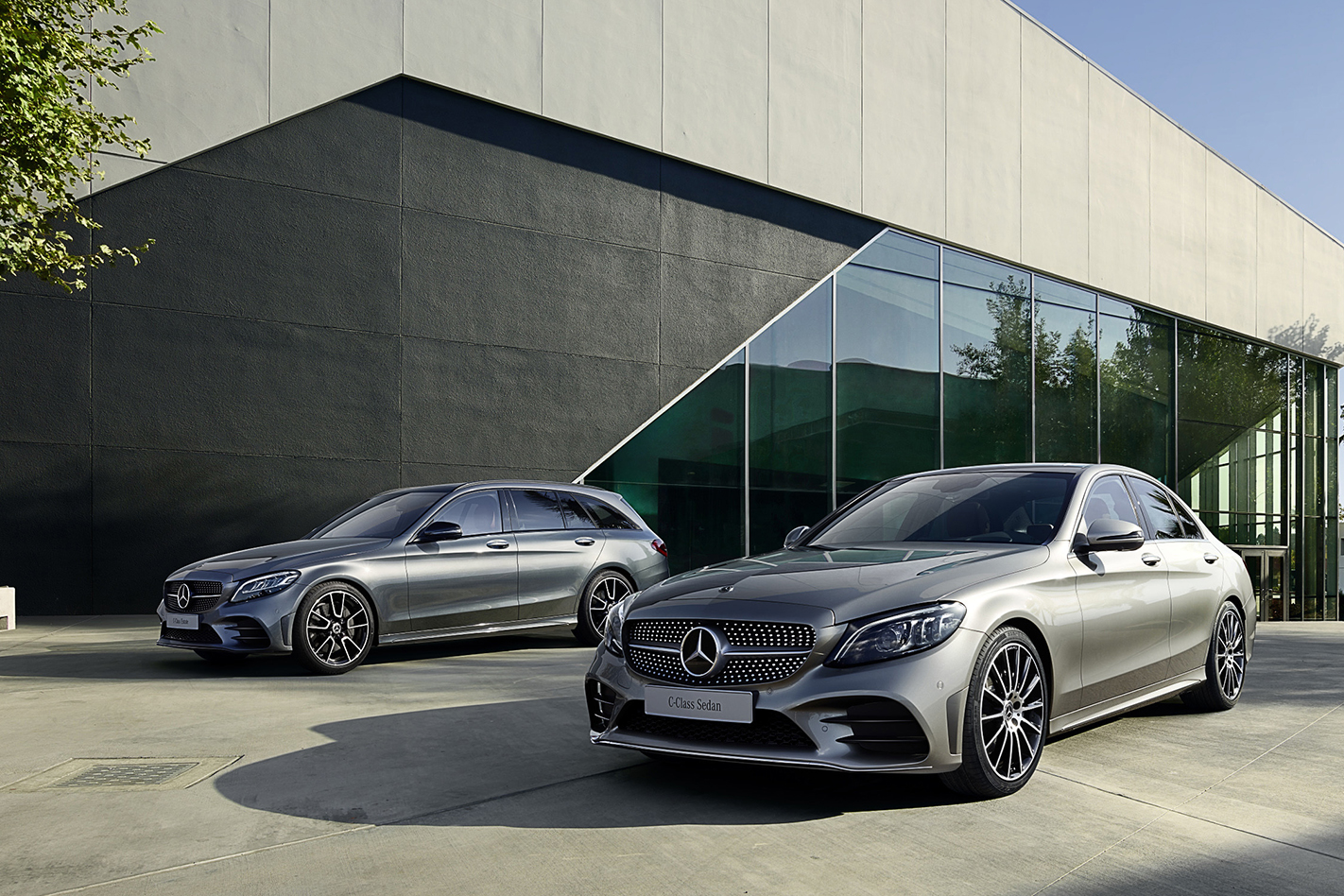
Since September 2021, various generations of the C-Class have been involved in five recalls, stretching from windscreen issues, SOS system failures, infotainment glitches and diesel engine problems.
Mercedes-Benz says it will contact owners to rectify the problem as soon as possible and free of charge at their most convenient dealer.
Alternatively, owners who are unsure as to whether their vehicle is affected can contact Mercedes-Benz’s customer assistance centre on 1300 300 896 or [email protected].
A list of affected VINs can be found here.
Snapshot
- 2022 Porsche Cayenne Platinum Edition revealed
- Limited-edition with satin paint and unique styling
- Priced from $145,000 before on-road costs
The 2022 Porsche Cayenne Platinum Edition has been announced, with the limited model offering special styling and features.
Priced from $145,000 plus on-road costs for the Cayenne wagon and $145,500 for the Cayenne Coupe, the new special-edition variant from Porsche comes standard with a set of 21-inch RS Spyder Design alloy wheels – offered exclusively for the Platinum.
A satin Platinum exterior is offered as standard, but buyers can choose from solid black or white, metallic jet black, Carrara white, mahogany, moonlight blue, and a special Crayon colour also.
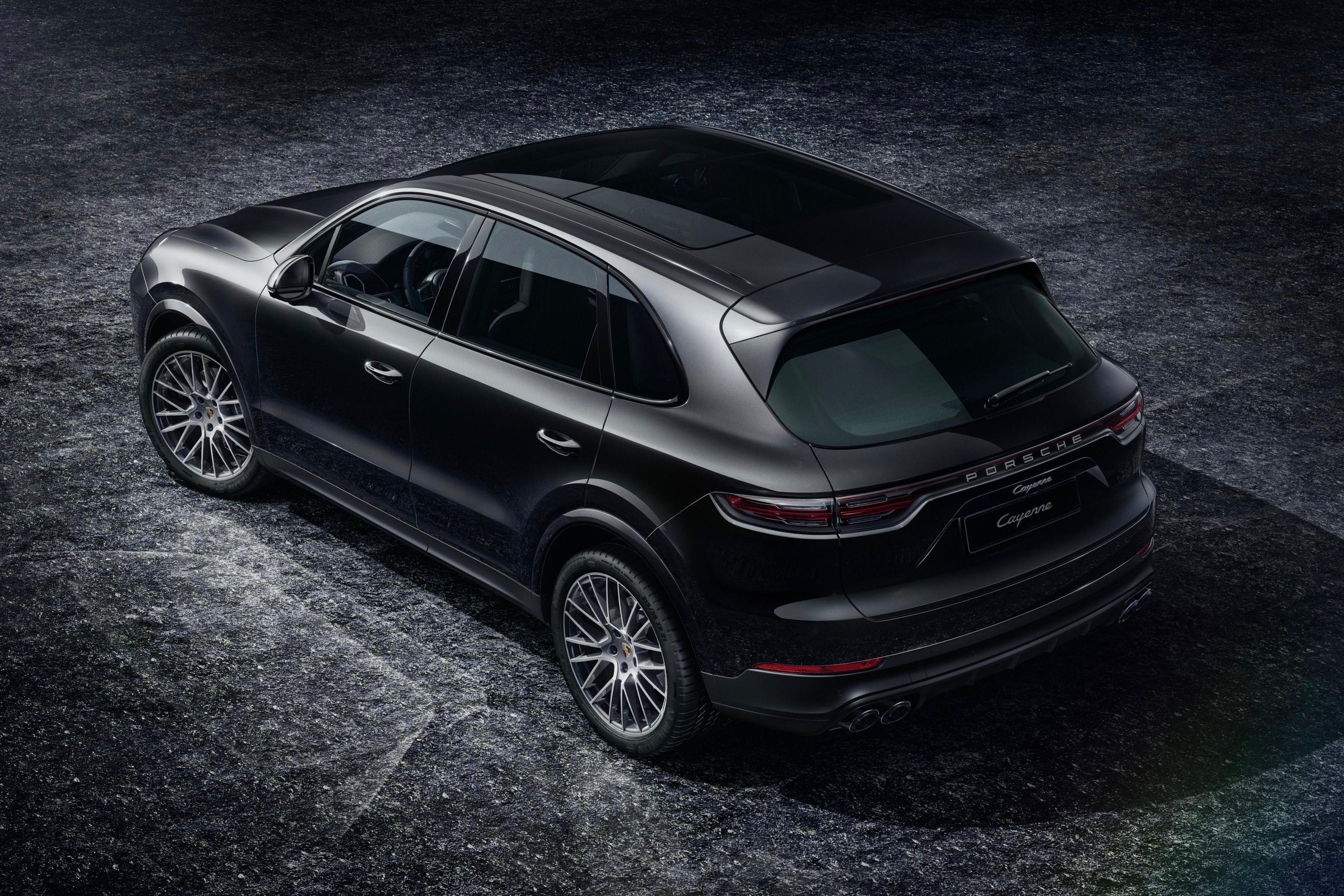
Exterior trims and exhaust tips are finished in black, while air intake slats, ‘Porsche’ lettering in the rear LED light strip, and the rear badge are all finished in satin Platinum.
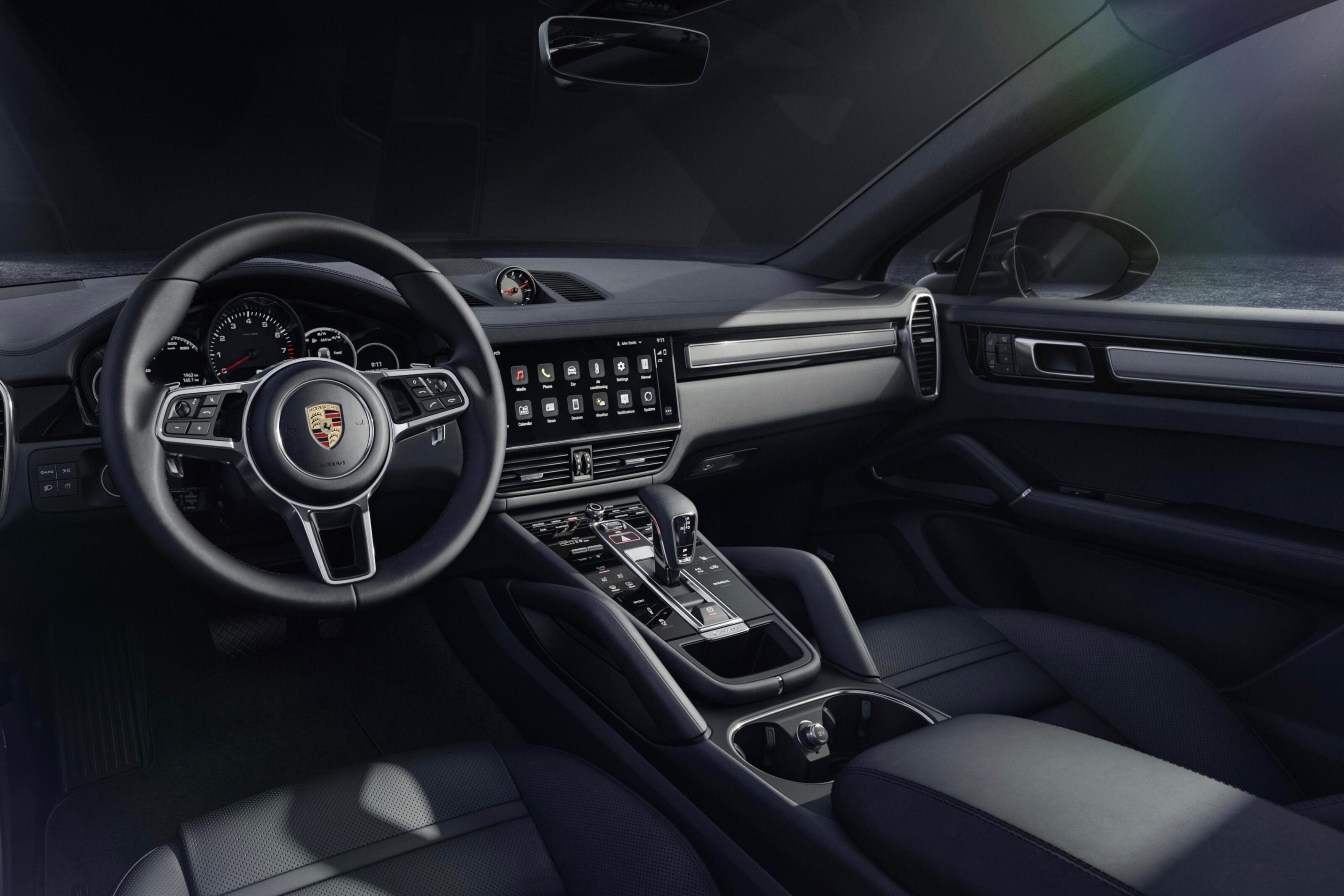
Inside, Crayon seatbelts come as standard, as do brushed aluminium door sills with the ‘Platinum Edition’ logo, as part of the aluminium interior package with silver trims.
Also standard is a panoramic sunroof (already standard on Coupe models), a Bose surround-sound audio system, ambient lighting, 18-way adaptive sports seats with memory, embossed Porsche crest on front and rear headrests, and an analogue dash clock.
The 2022 Porsche Cayenne Platinum Edition is available to order now, with deliveries expected to begin mid year.
2022 Porsche Cayenne Platinum Edition Australian pricing
| Model | Price |
|---|---|
| Cayenne Platinum Edition | $145,000 |
| Cayenne Coupe Platinum Edition | $145,500 |
| Cayenne E-Hybrid Platinum Edition | $160,300 |
| Cayenne Coupe E-Hybrid Platinum Edition | $160,900 |
| Cayenne S Platinum Edition | $172,400 |
| Cayenne Coupe S Platinum Edition | $172,800 |
Note: All prices exclude on-road costs.
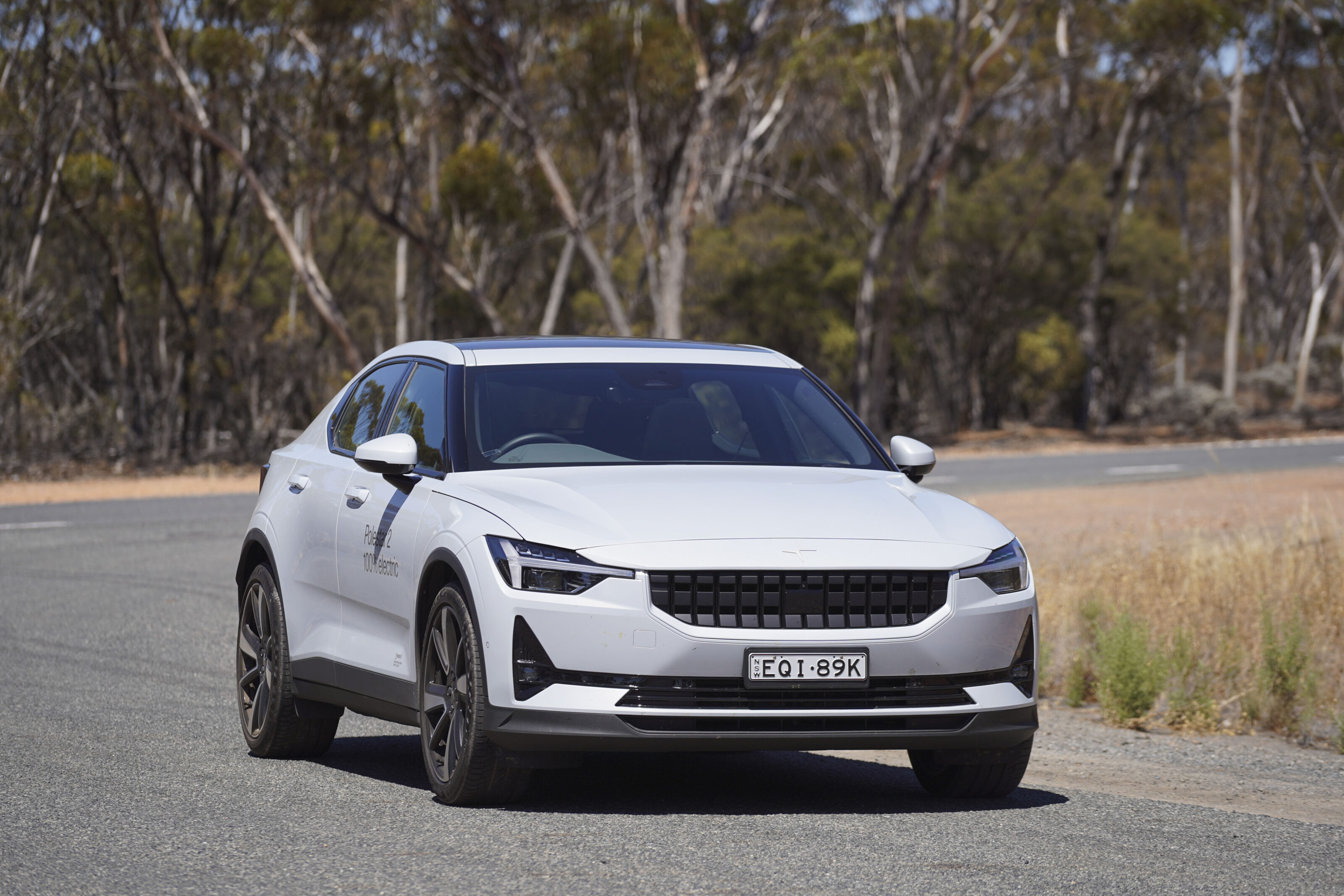
Polestar has become the first manufacturer to use a ground-breaking electric vehicle charging system in Australia, showing off the technology with its Polestar 2 sedan.
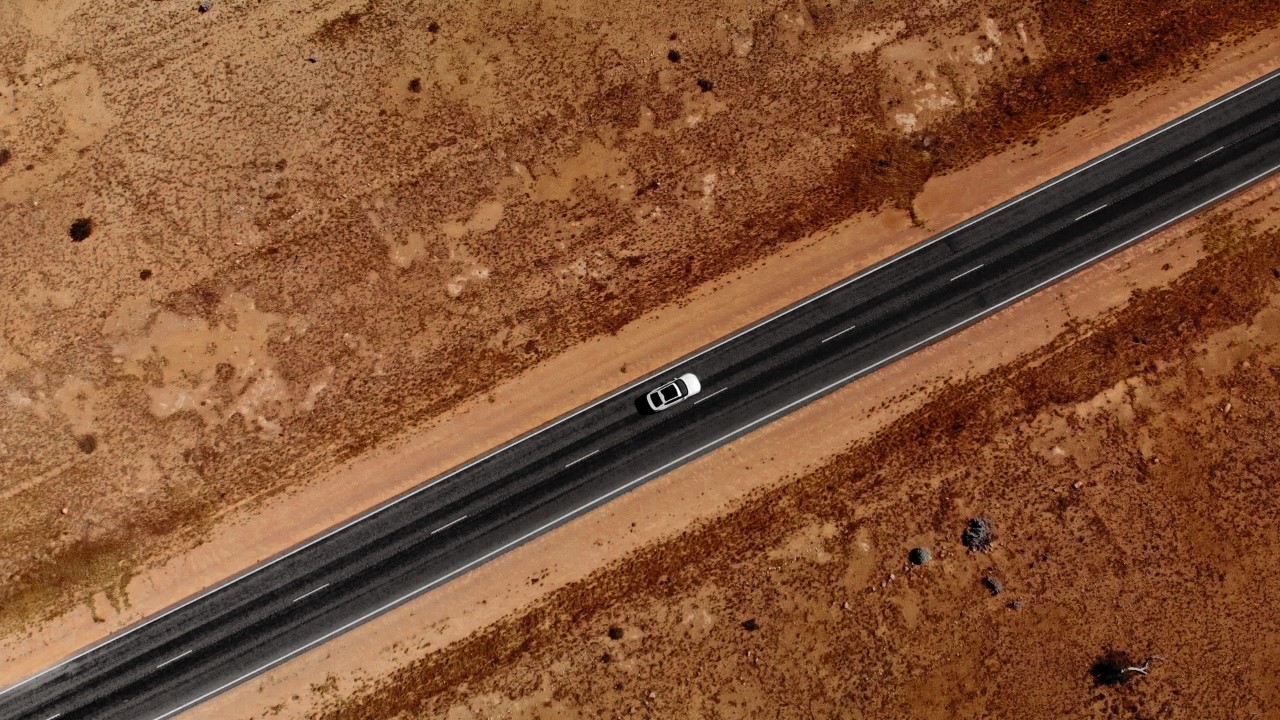
Located at the Caiguna Roadhouse, some 370km east of Norseman and 370km west of the South Australian border, the BiØfil charger is the first in the world to utilise waste vegetable oil for electric vehicle charging, tying up a loose end on the Nullarbor which had prevented a majority of EVs from completing a “lap of the map”.
Running off a generator, the unit is powered by vege oil, totally offsetting its own carbon footprint, allowing the station to run sustainably and off the grid.
Retired West Australian engineer Jon Edwards is the mastermind of the BiØfil system, claiming it is both better suited to the demands of the region as well as being significantly cheaper than solar to recharge EVs.
“The cost of installing an equivalent solar powered EV fast charger is over five times the cost of building the BiØfil fast charging unit,” said Edwards.
“Solar energy would not have been economically feasible for such a low-traffic location, making BiØfil the environmentally friendly interim solution for EVs driving across the Nullarbor right now.”
Edwards has trialled the technology before, running a Tesla Model 3 in tarmac rally events with the BiØfil charger in tow to ensure the car could be topped up between stages.
Samantha Johnson, Polestar Australia’s managing director, praised Edwards and BiØfil for shoring up an EV black hole in crossing the Nullarbor Plain in a sustainable and environmentally responsible way.
“Polestar is thrilled to share its passion for innovation and sustainability with visionaries like Jon Edwards,” said Johnson.
“To turn a waste product into a CO2-neutral charging solution, which connects Australian EV owners from the east with the west, is the sort of ingenuity that has led to so many Australian innovations.”
The Polestar 2 Standard Range Single Motor has a quoted 440km driving range when fitted with its base 64kWh battery pack, increasing up to 540km thanks to a 78kWh pack in Long Range Single Motor trim.
Snapshot
- Electric Taycan outsells 911 in 2021
- Macan and Cayenne outsell everything
- Record year for Porsche deliveries worldwide
Porsche’s pure electric Taycan outsold the 911 sports car in 2021, as the German brand posted the greatest sales in its history.
The company delivered 41,296 Taycans worldwide, compared with 38,464 deliveries of the 59-year-old icon, while Australian deliveries of the electric vehicle totalled 531 compared to the 911’s 428.
The Taycan didn’t merely outsell the 911 because it had a bad year – that 911 total was a new high for the nameplate globally – but it appears more customers wanted the electric sports car.
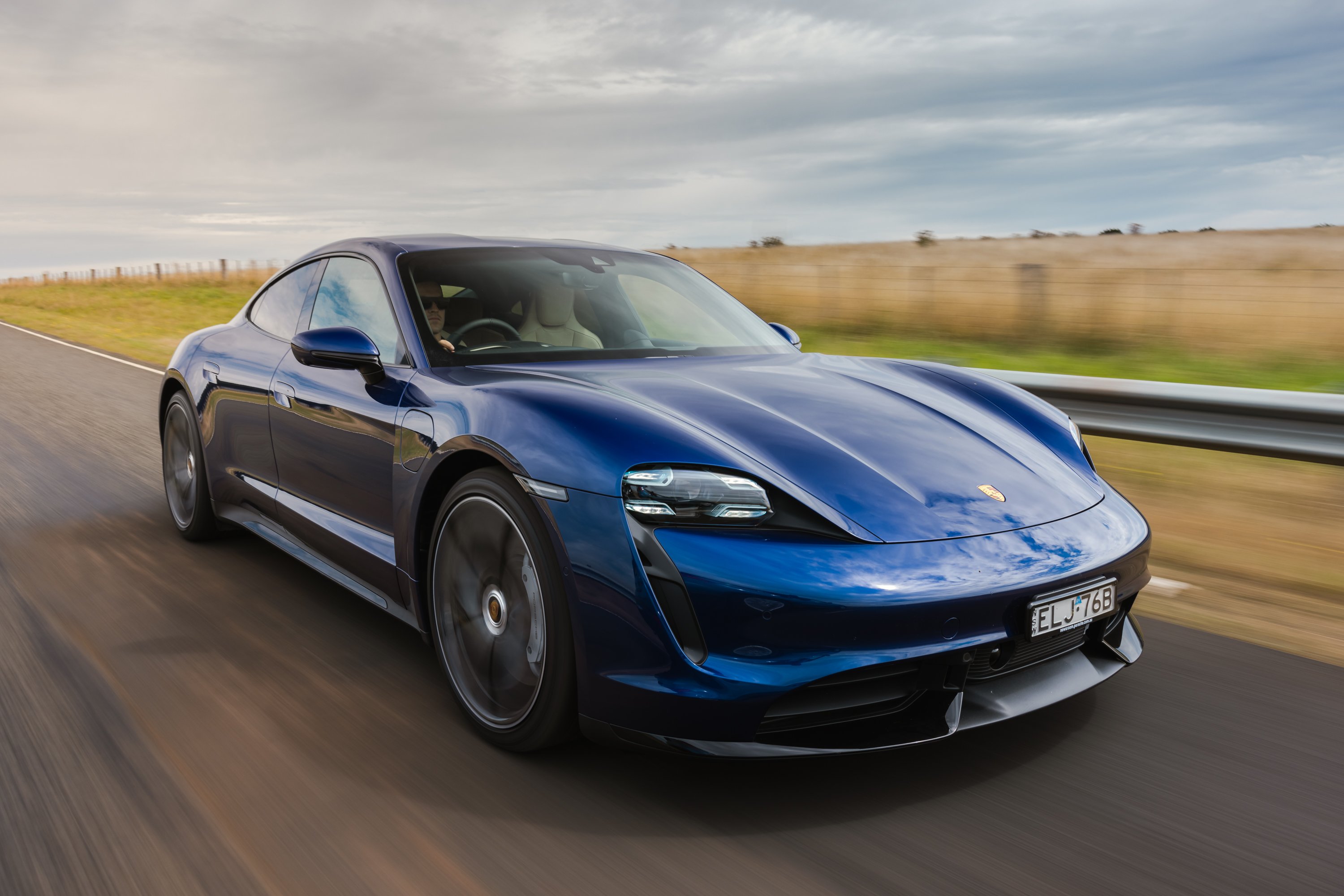
The Taycan benefited from entry-level, rear-wheel-drive versions going on sale, and the first full year of the Cross Turismo bodystyle, whereas the 911 is nearing the end of the first 992 wave (pre-facelift). But is this a sliding-doors moment regardless?
It certainly looks that way. The Taycan is bringing new customers to the Porsche brand, as Porsche CEO Oliver Blume told CAR in 2020.
“They are first movers, very interested in sustainability, innovation and digitalisation,” said Blume.
They are also younger than Porsche’s traditional customer base.
It’ll be fascinating to see if the Taycan continues its lead over the 911 in 2022, or whether it dips back as fresh rivals from Tesla, Mercedes, Lotus and BMW sway tech-loving EV adopters.
Macan the top seller – and going EV
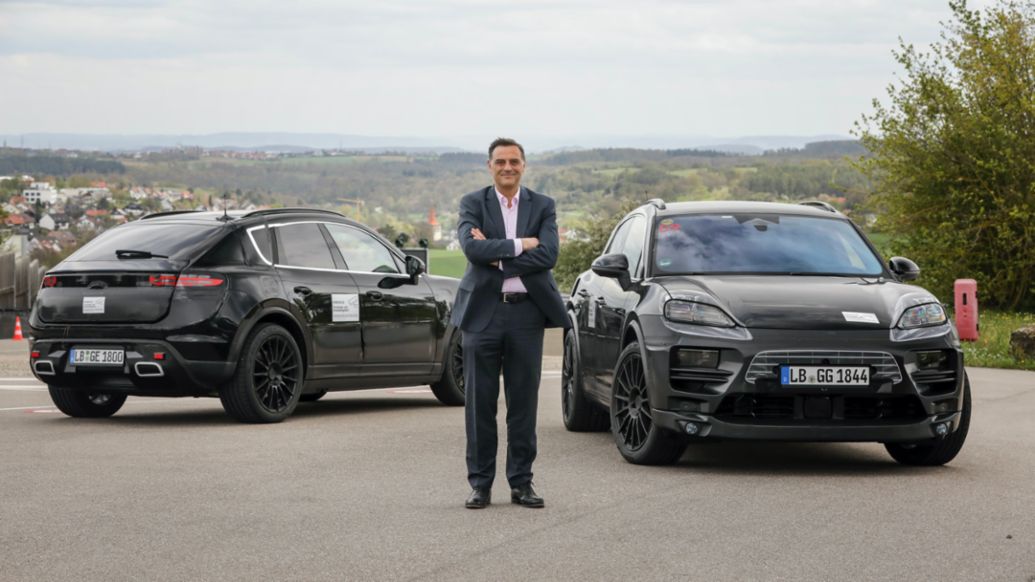
Taycan sales will give Porsche (and its VW group overlords) great reassurance as it embarks on the electrification of its portfolio. The company will become almost entirely electric this decade, with this year’s new Macan the next zero emissions model.
It’ll be sold alongside the existing combustion-engined model during a transition period. The Macan, with 88,362 sales, remained Porsche’s top seller in 2021.
Porsche’s record deliveries totalled 301,915 units, up 11 per cent on 2020 (itself another high, at the risk of sounding like a stuck record). And that’s with some impact from the semiconductor shortage and Covid-19 disruption, says Detlev von Platen, the company’s sales chief.
Nearly 96,000 sales in China ensured Asia Pacific was the biggest region, followed by Europe which just edged out the Americas. Of Europe’s 86,160 units, some 40 per cent were plug-in vehicles. “The overall result is very promising and shows the strategy to further electrify our fleet is working and in line with demand and the preferences of our customers,” said von Platen.
Porsche 2021 deliveries – Global
| Macan | 88,362 |
|---|---|
| Cayenne | 83,071 |
| Taycan | 41,296 |
| 911 | 38,464 |
| Panamera | 30,220 |
| 718 Boxster/Cayman | 20,502 |
Porsche 2021 deliveries – Australia
| Macan | 2328 |
|---|---|
| Cayenne | 837 |
| Taycan | 531 |
| 911 | 428 |
| Panamera | 48 |
| 718 Boxster/Cayman | 256 |
Snapshot
- First details of pure electric 308
- 400kms of driving range, on sale 2023
- Offered as hatchback and estate
Peugeot has revealed first spec details of its electric e-308, to hit the market in 2023 and endow the hatchback and wagon with a full house of powertrains: petrol, diesel, plug-in hybrid and EV.
Whether or not we’ll see the e-308 among Peugeot’s Australian EV line-up remains to be seen, although the brand’s local distributor has at least confirmed we can expect to learn more in the coming months.
The battery electric system is not a straight lift from the established e-208 and e-2008. The e-308’s battery capacity is 54kWh, and the single electric motor delivers a little more punch. Peak power is 115kw (156hp), with 270Nm of torque.
NOTE: Images of the e-308 have not yet been released. The 308 Hybrid is pictured here.
Peugeot e-308 electric range and the tech enabling it
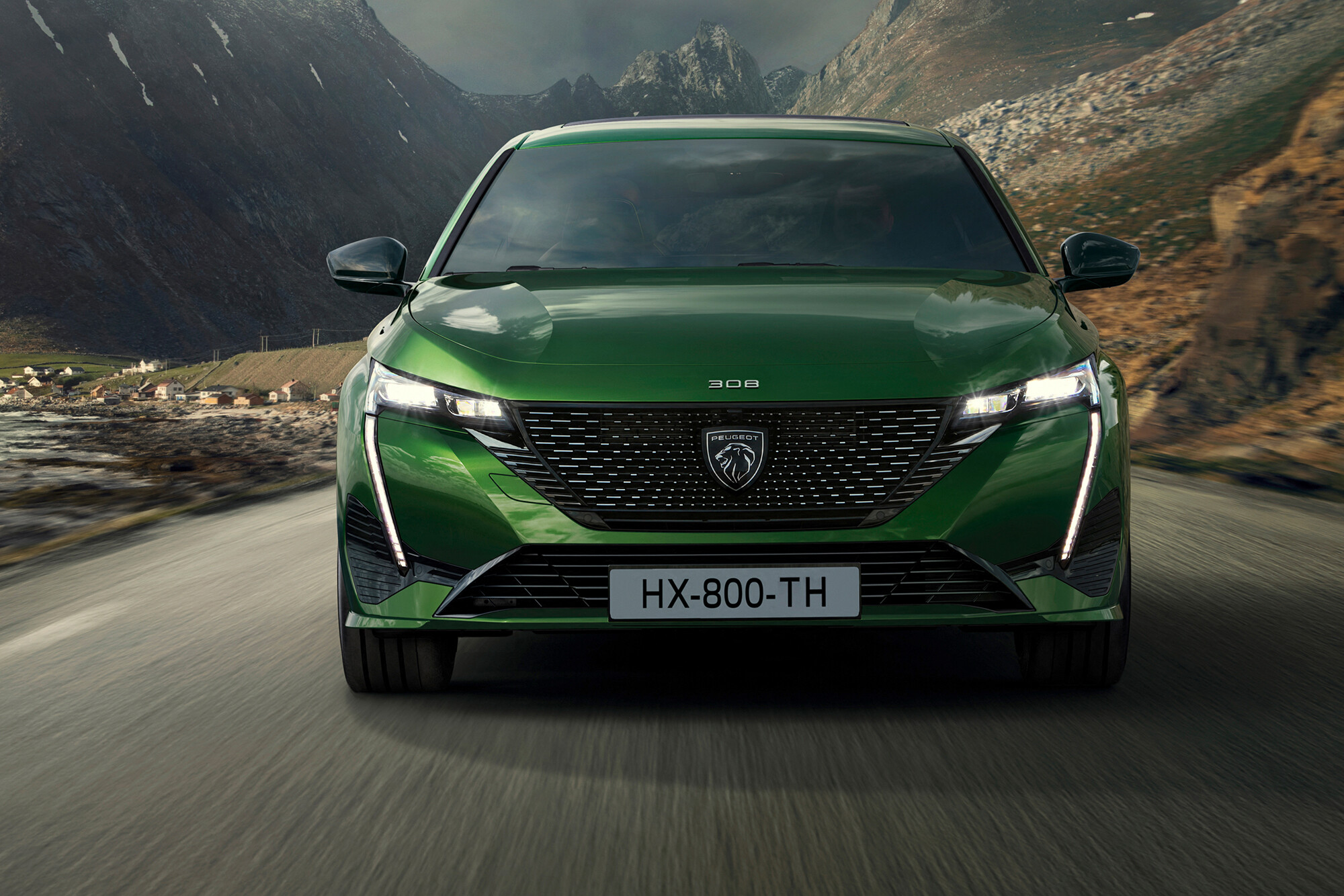
The e-308 is touted as having a driving range in excess of 400 kilometres due to a painstaking programme of efficiency measures.
They include a new NMC battery cell chemistry (with more Nickel and less Magnesium and Cobalt), plus a heat pump to warm the cabin with less drain on the battery. The 308 has a reasonably aerodynamic profile (0.28 coefficient of drag) thanks to an extended flat underbody and rear spoiler.
And crucially vehicle weight is around 1600 kilograms – that’s competitive with Renault’s new electric Megane, and lighter than VW’s ID.3.
Differences with the hybrid go deeper than the skin
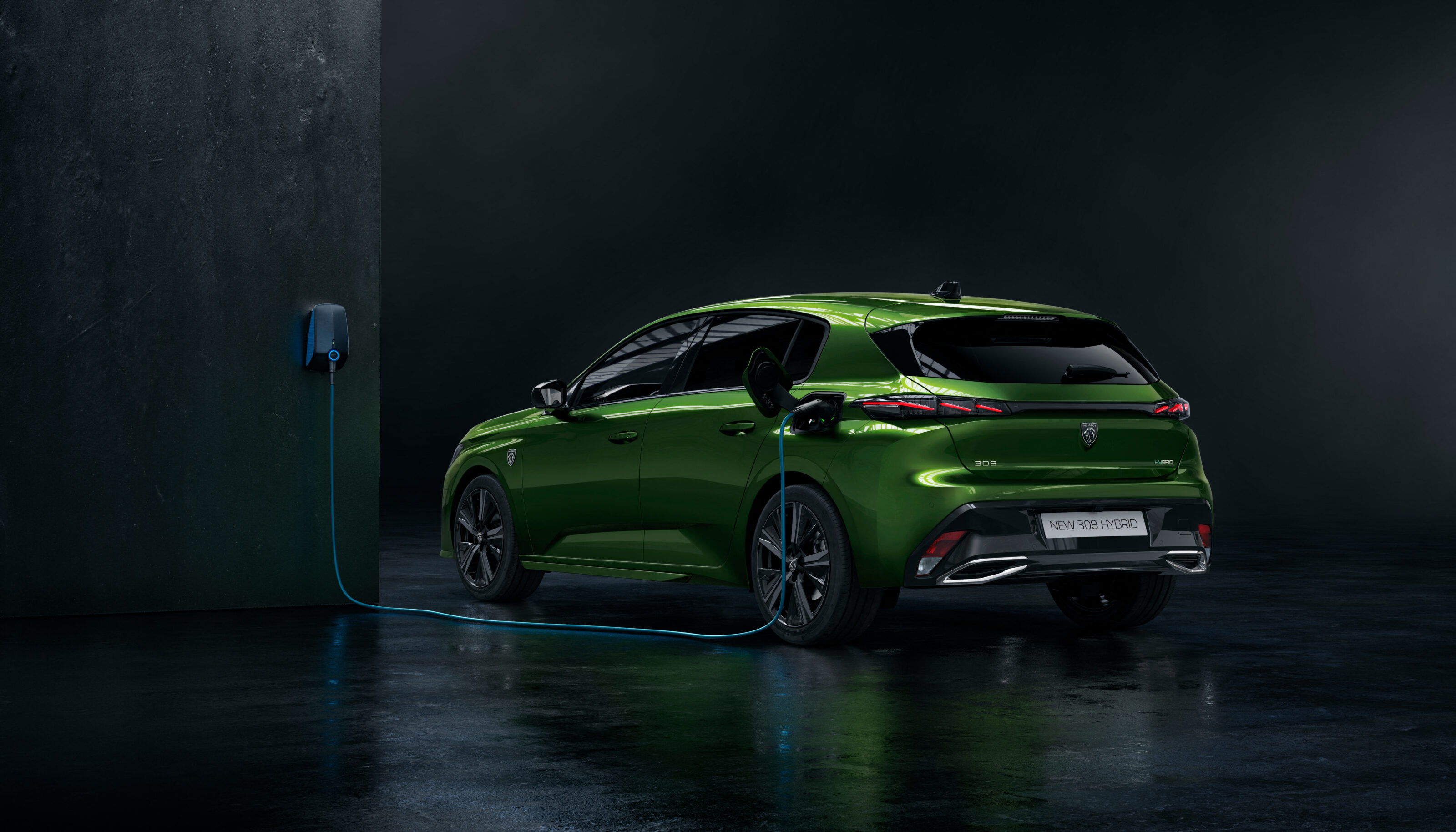
The car pictured here is the 308 plug-in hybrid, though it’ll take keen eyes to spot any changes with the BEV: the most notable one is an ‘e’ badge on the front wings, replacing the lion badge present on some 308 trims.
“Both cars look exactly the same outside and inside,” says Peugeot’s electric platform engineer Remi Seimpere. “The difference is under the floor with a big battery, and the [front] electric motor.”
Batteries are predominantly stowed in two slabs beneath the front and rear seats, with the charging port at the rear. While combustion 308s all have a torsion beam suspension, packaging the fully-electric powertrain requires a revised rear axle design.
Cargo space is the same as the hybrid’s – 361 litres for the hatch, 548 for the SW – though both are down on the combustion models’.
Although Peugeot offers all-wheel drive on the plug-in hybrid 508 and 3008, the e-308 will be strictly front-drive only.
How quickly will the e-308 charge
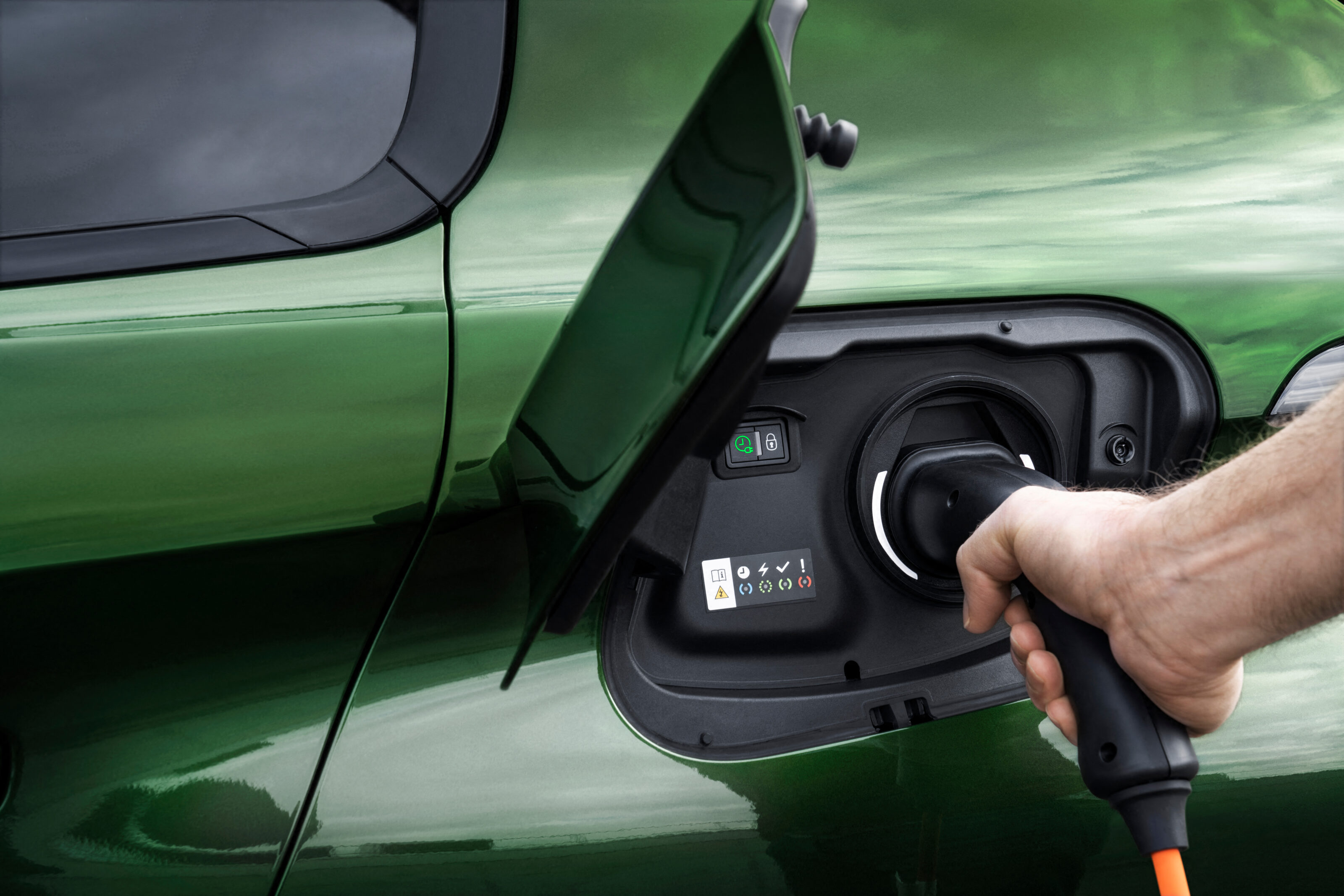
The 400v battery system can charge at up to 100kW DC, which will bestow around 11km a minute and replenish from 10-80 per cent in a claimed 30 minutes. Households with three-phase electricity and a wallbox should be able to fully charge in five hours, though single phase 7kW charging will also be possible.
Can you get the e-308 as an SW estate?

The good news is Peugeot will also offer the SW estate with electric power: it’ll provide a welcome alternative to the MG 5 – one of the few zero emissions wagons on the market.
Peugeot is proud that the 308 range – on the shortlist of seven for Europe’s Car of the Year – will be notable on the market for offering petrol, diesel, plug-in hybrid and EV (though VW’s Golf Mk7 also achieved the full deck).
And Peugeot CEO Linda Jackson thinks such a broad range offers something for every customer.
“As consumers, we’re all on a journey from being all internal combustion engine to eventually all fully electrified. And Peugeot has a real benefit in its multi-energy platform [strategy]. The 308 is the first [contemporary] vehicle able to offer ICE, plug-in hybrid and electric. And I think that’s the right way to assist our customers, and help them move along on this journey.”
Will an electric Vauxhall Astra and DS 4 follow?

The Stellantis group – owner of Peugeot, Vauxhall, Fiat and DS Automobiles among its many brands – has made no secret of its plans to fully electrify the EMP2 platform underpinning the 308. It’s an architecture also shared with Vauxhall’s new Astra and the DS 4.
Vauxhall has confirmed an Astra-e is on the way, and the DS 4 is sure to follow suit. But it looks like Peugeot will be the first to market, likely in autumn 2023 for UK cars.
Will it be available in Australia?
With Peugeot’s line-up of electric vehicles being released thick and fast of late, the e-2008 and e-208 are already under consideration for an Australian launch, while a Peugeot spokesperson wouldn’t provide specifics about the e-308 turning up on local shores.
“We are finalising our plans for the introduction of Peugeot’s first electric vehicles in Australia and hope to have more to share with you in the coming months about our plans across electric passenger, SUV and LCV product offerings,” the spokesperson told Wheels.
This article was first published at Carmagazine.co.uk
Snapshot
- 55 Superb wagons will be used for WA Highway patrol
- Patrol cars will be largely unmodified Sportline variants
- The Superb will join the Kia Stinger on the beat
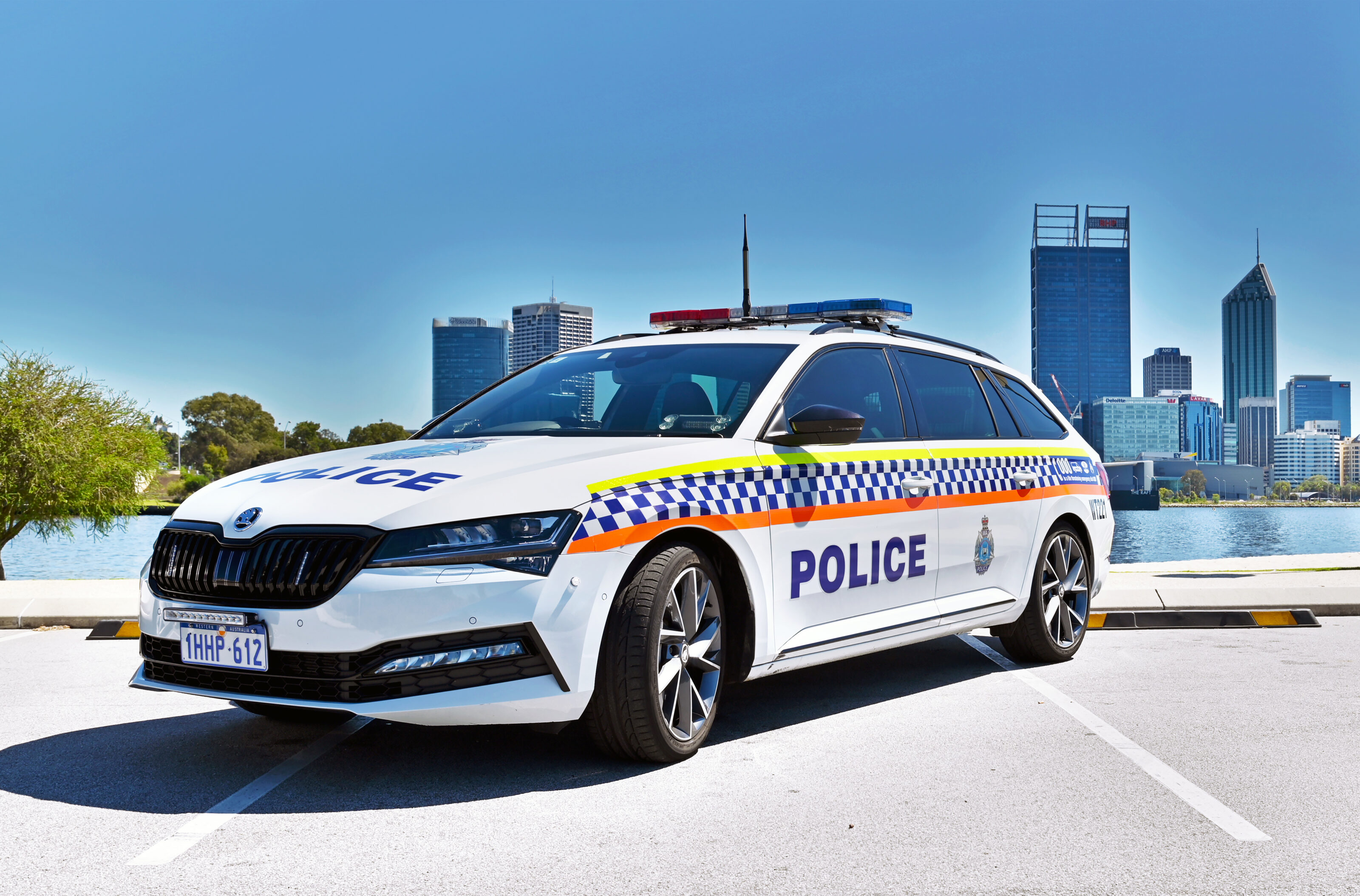
Skoda has joined the growing list of brands to be sworn into police duty in Australia to fill the void left by the demise of the locally built Holden Commodore and Ford Falcon.
The Western Australia Police Force (WAPOL) has ordered 55 Skoda Superb wagons for its Highway Patrol units with a further 10 orders expected.
The Highway Patrol Skoda Superb wagons are largely unmodified Sportline variants, which differ from the civilian model with the removal of the standard Canton subwoofer to accommodate a police-specification dual battery.
They will be powered by the standard 206kW/350Nm four-cylinder, turbocharged petrol engine which drives all four wheels via a six-speed dual-clutch automatic transmission.
Capable of reaching 100km/h from a standing start in 5.8 seconds, the Superb Sportline wagon is 0.6 seconds quicker than the 210kW V6 Holden VF II SV6 Commodore sedan, which it will replace in the traffic enforcement role.
According to WAPOL, vehicles must pass a series of vigorous and extensive tests both on the road and in the garage before they’re considered for police use across one of the world’s biggest police jurisdictions.
Skoda Australia director Michael Irmer said the selection was a resounding endorsement of the Superb.
“To be the car of choice for the officers who serve the great state of Western Australia is an honour,” he said.
WhichCar has contacted Western Australia Police for comment.
As of January 1, 2022, Audi is in full charge of Bentley.
In full charge means exactly that: all major decisions must be coordinated between Crewe and Ingolstadt, no major uni-lateral investment can be made without approval from the HQ, even major intra-group deals need prior consent.
Audi has bottomline responsibility as well as strategic and financial control. Like Lamborghini and Ducati, Bentley is one more satellite and as such does not qualify as completely independent manufacturer.
The Germans can tell the Brits what to do, they can trigger management changes and re-allocate production capacities. The cycle plan proposed by Adrian Hallmark must in other words be signed off by Markus Duesmann.
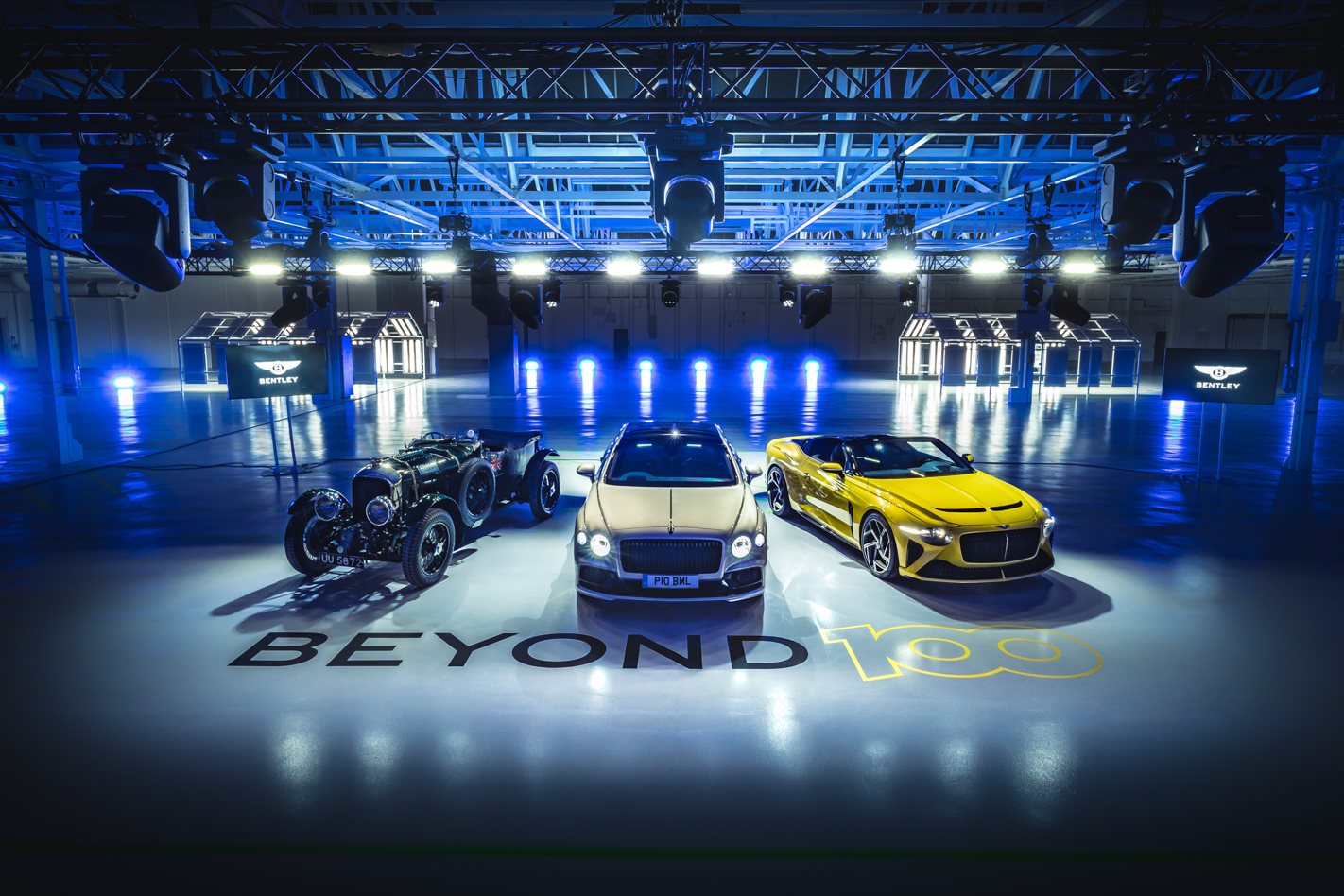
It’s a friendly coexistence, for sure, but the UK marque needs to invite Audi to regular design reviews, stage joint reseacrch and development sessions and map out future game plans in unison.
Up until 2020, when Bentley was still closely connected to Porsche, the Swabian MSB platform was the logical matrix for its passenger cars. From now on though, the modular upscale PPE41/51 and SSP4/5 component sets conceived by Audi make up the DNA of choice.
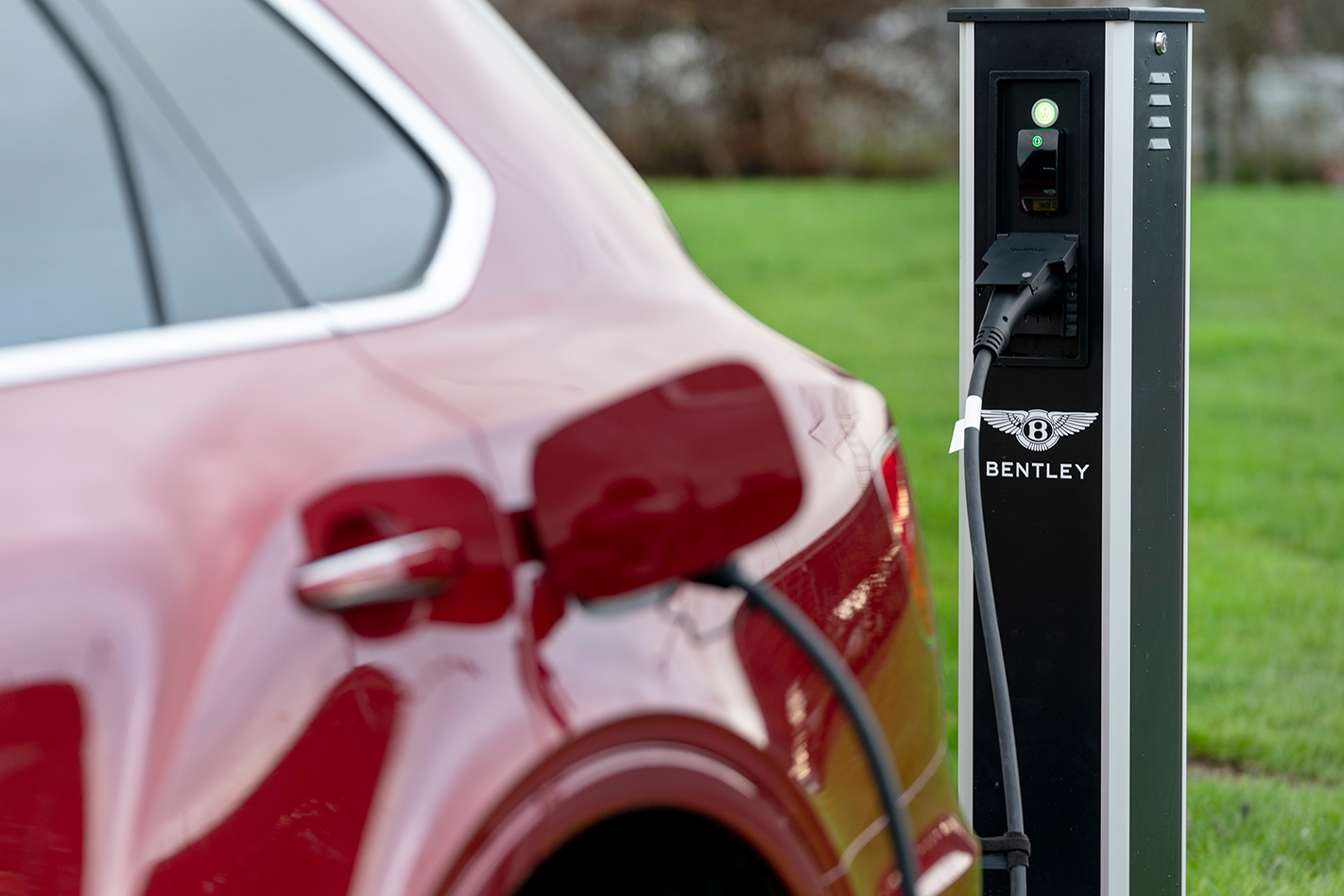
The automotive world is beginning to brace itself for the much tougher Euro 7 emission norm which calls for costly and complex re-engineering measures. While some manufacturers are small enough to be exempt, Bentley must comply – or withdraw its petrol-engined models by 2027.
A source from Audi suggests that this is what will happen because the English patient needs to direct its cash-flow towards other, more urgent problem zones. Unless the deadline gets pushed back again, e-power is the only option. It needs to be implemented across the board which in five years time still includes the current Continental, Flying Spur and Bentayga.
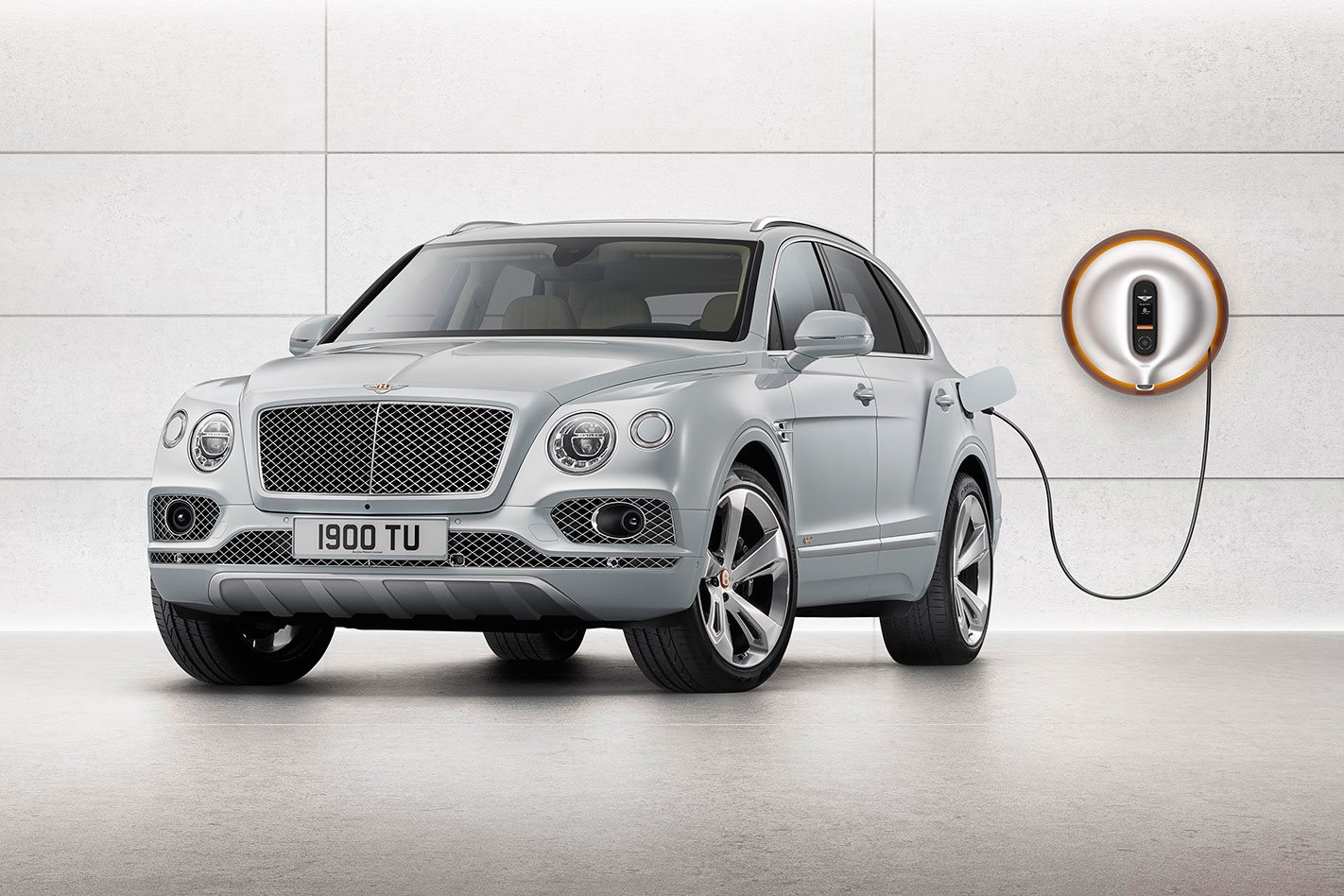
The first all-new Bentley EV should be the D-LUX – out in 2025 – which is destined to eclipse the next Range Rover Velar. In 2026, we are expected to see the E-SUV which challenges the long wheelbase Range Rover.
The Bentayga EV, the plug-in Conti GT and GTC and the zero-emission Flying Spur are all scheduled to roll into the limelight long after EU7 has come into effect.
Question is whether the most conservative clientele in the world is prepared to switch on D-day from petrol pumps to charge points.
- Introduction: Step Brother
- Month Two: Force-fed Fury
- Month Three: Rapid Response
- Month Four: Booty Shaker
- Month Five: Farewell – Honesty Box
Introduction: Step Brother
Newman gets behind the wheel of the classy sibling
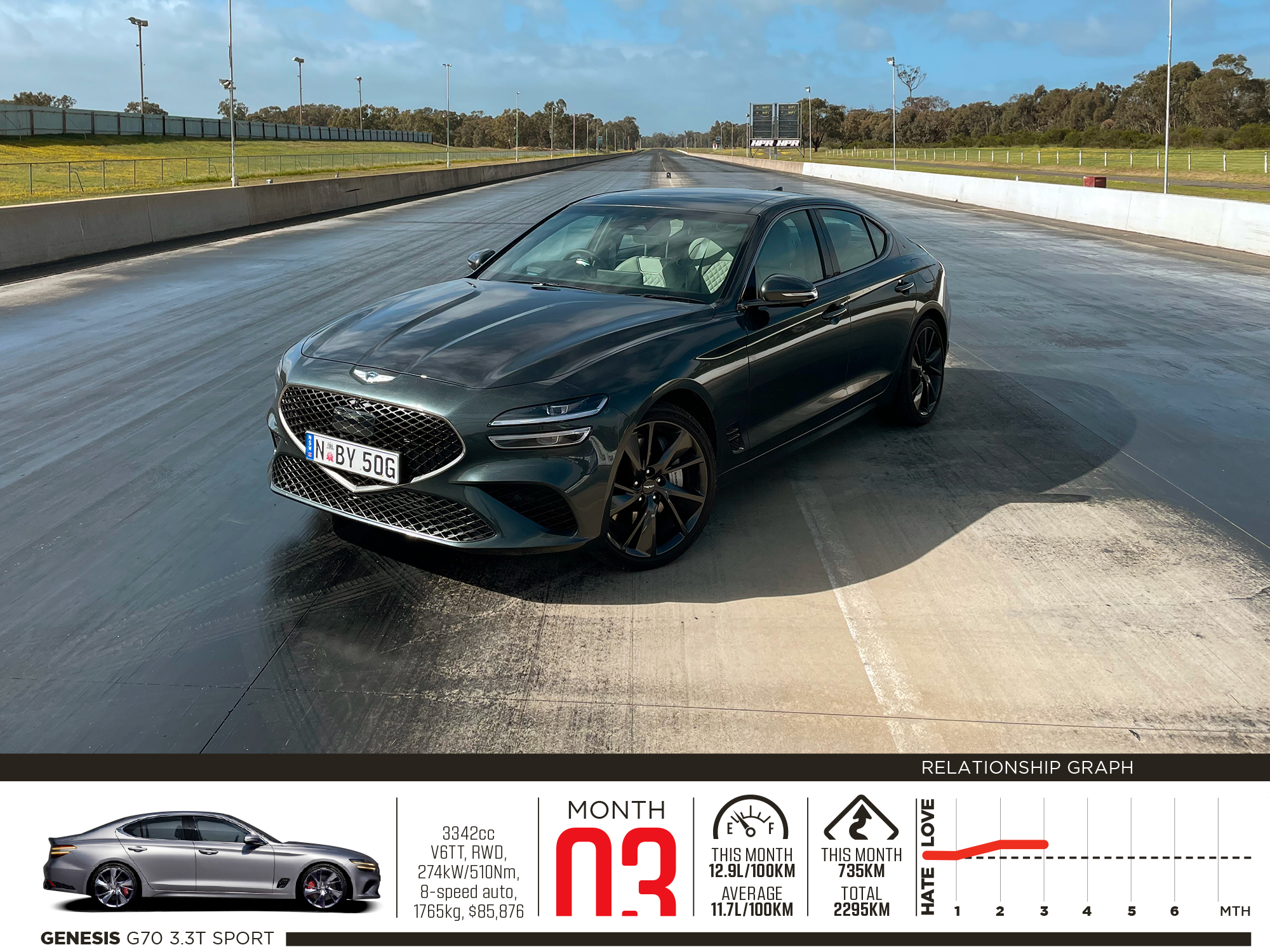
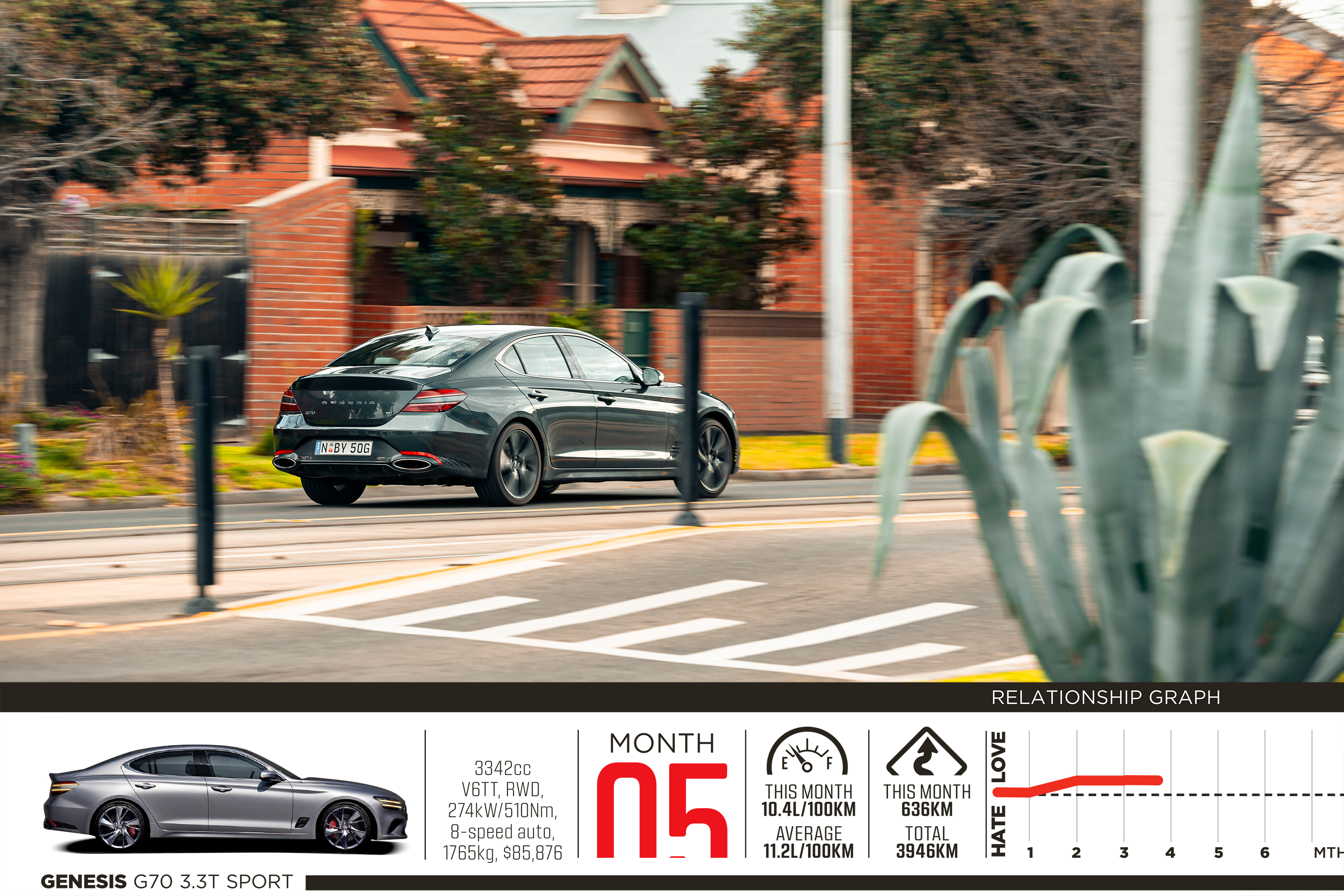
Brothers from different mothers. This is the most accurate description of the relationship between the Kia Stinger GT and Genesis G70. The former has obviously just departed the MOTOR garage so it seemed only fair to compare and contrast its recently facelifted sibling by having it stay for a few months.
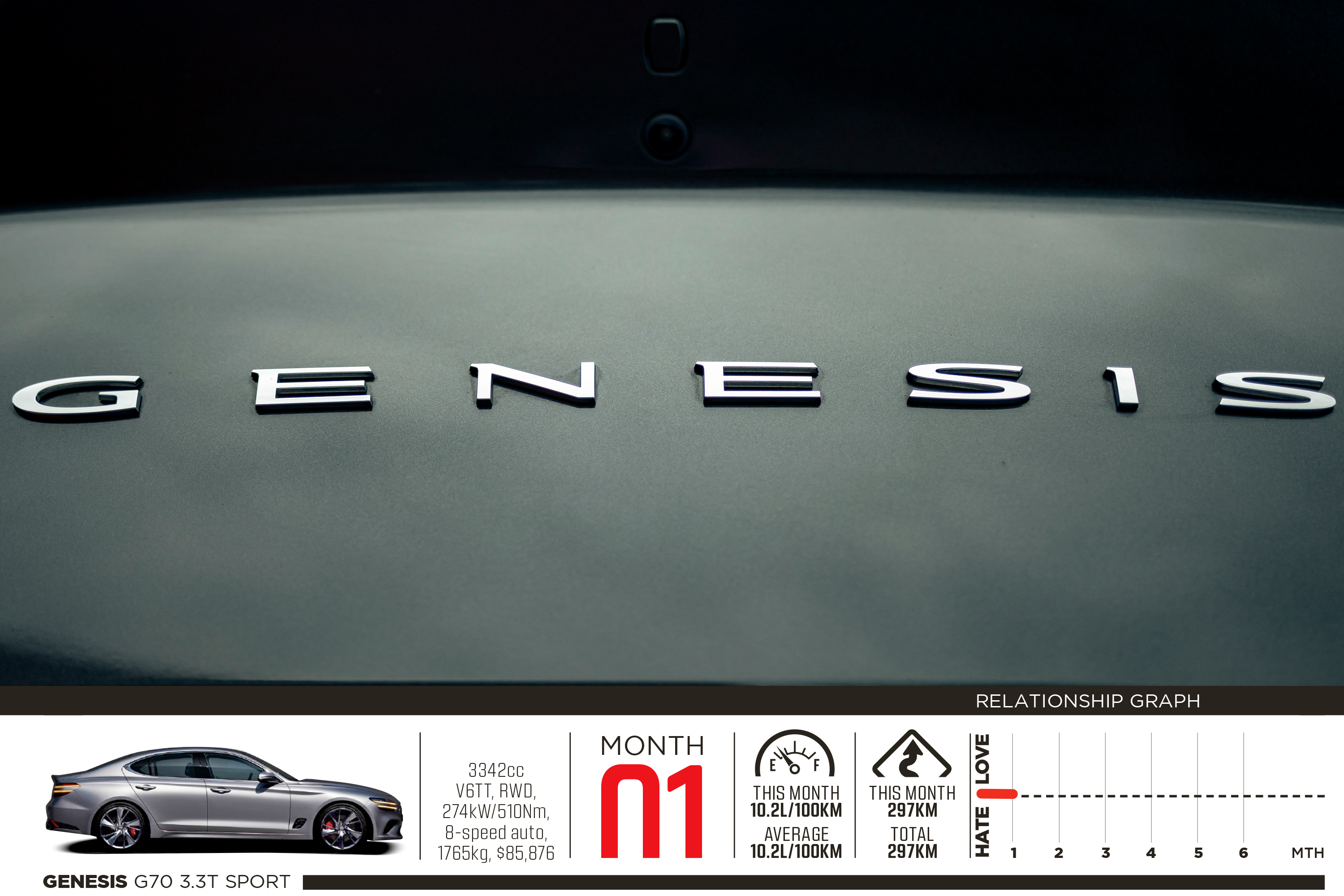
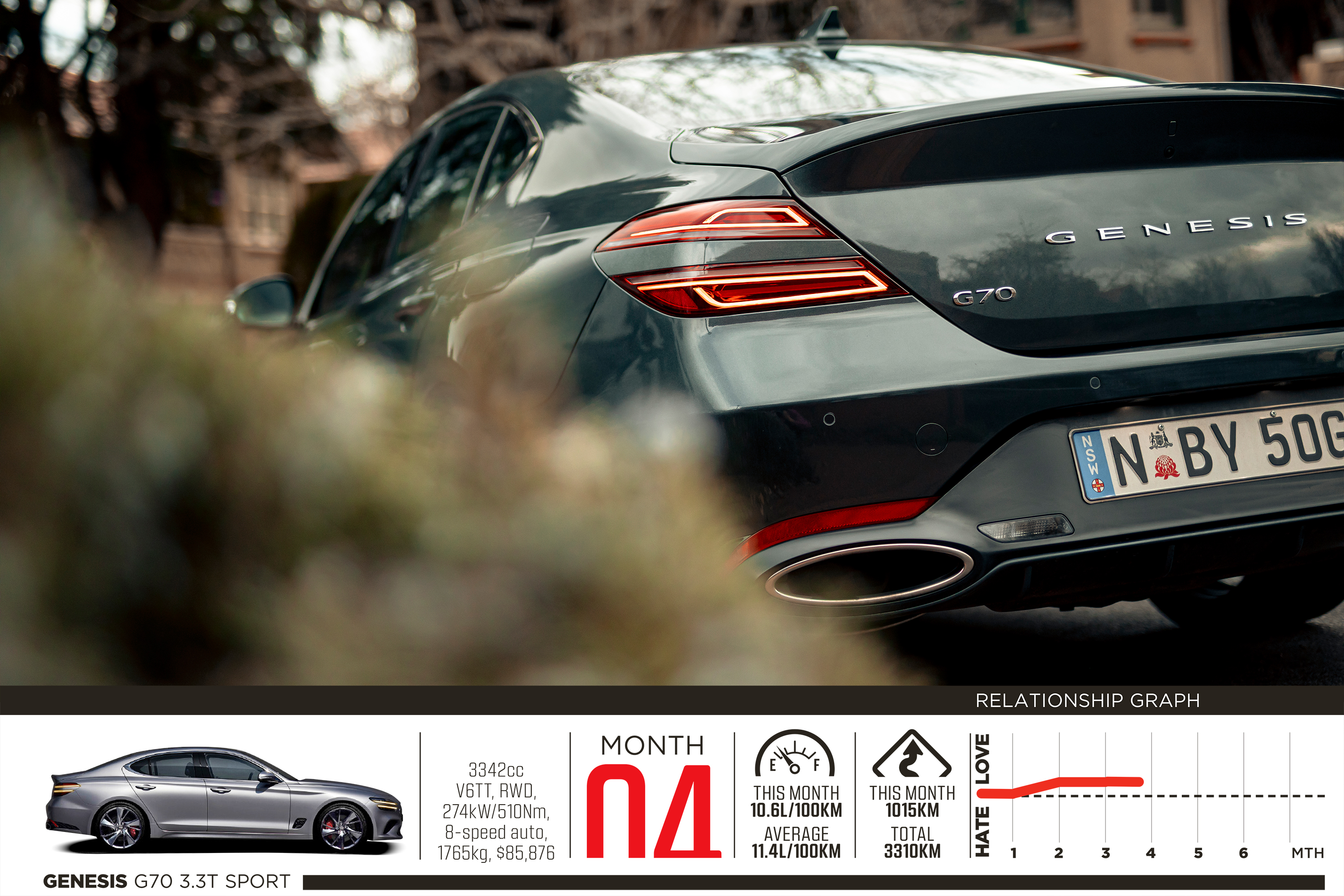
It takes only a cursory glance at the technical data to see the close relationship between the two cars. Both use the same 3342cc twin-turbo V6 producing 274kW at 6000rpm and 510Nm from 1300-4500rpm, tied to an eight-speed automatic with exactly the same ratios (gearbox and diff) and a limited-slip diff. The similarities continue with the chassis, with the wheel sizes (19 x 8.0-inch front; 19 x 8.5-inch rear), tyres sizes (225/40 front; 255/35 rear) and tyre type (Michelin Pilot Sport 4) all identical.
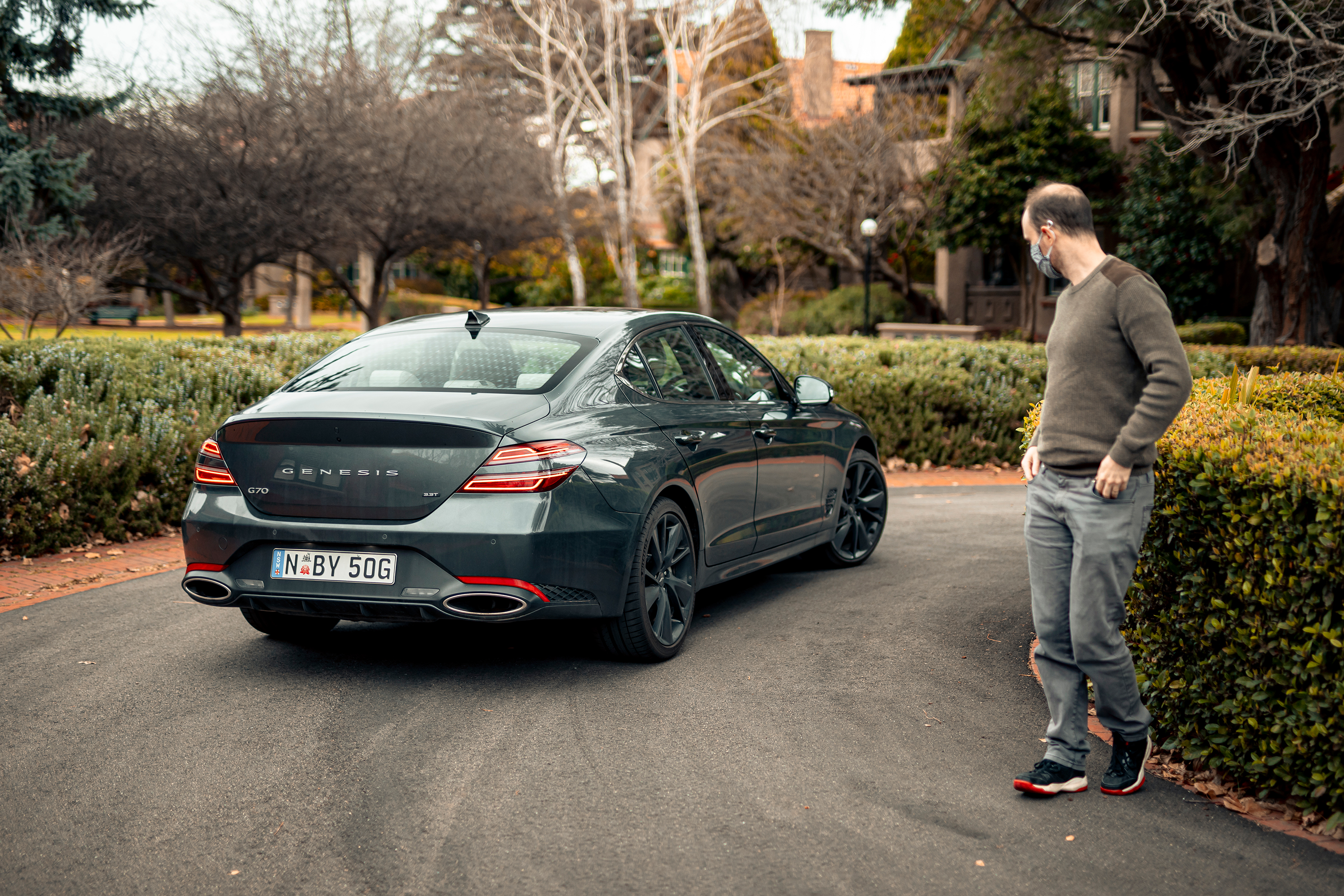
However, the two begin to diverge dimensionally. The Genesis is 145mm shorter in length and 20mm narrower with a 70mm shorter wheelbase, its slightly smaller size presumably responsible for its 28-74kg weight advantage, depending on the specification.
This particular car is the range-topping 3.3T Sport with the optional Luxury Package so we’ll assume it’s towards the heavier side of the ledger, but a trip to the weighbridge could be in order to confirm. Either way, that shrunken wheelbase does result in rear seats that are on the tight side, with marginal leg room and nowhere really to put your feet.
At this point you might be thinking “yeh, yeh, if these cars are so similar, why are you bothering?” Well, whereas the Stinger GT was $63,760RRP/$66,690 driveaway, this flagship G70 asks for $85,876RRP, the Luxury Package accounting for $10,000 of that.
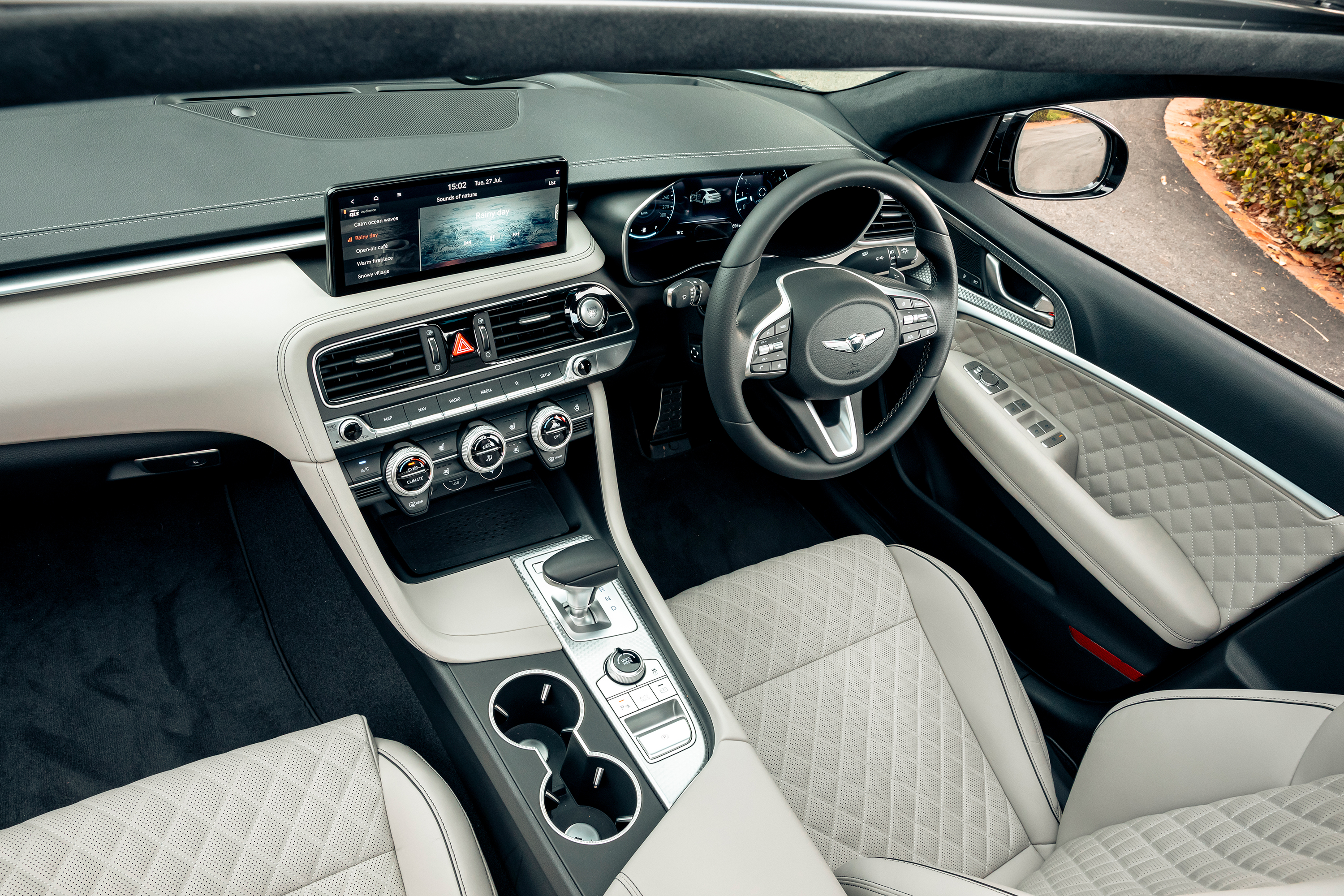
The extra spend includes the Forward Attention Warning safety system, 12.3-inch 3D instrument cluster, head-up display (HUD), 16-way adjustable driver’s seat, heated steering wheel and rear seats, power-operated boot, 15-speaker Lexicon audio system, intelligent front lighting system, acoustic laminated windscreen and front windows, Nappa leather interior, driver’s memory seating, suede headlining and electronic wheel adjustment.
That’s a fair whack of kit, though it’s interesting that quite a bit of it (HUD, heated wheel and wheel adjustment) is standard in the Stinger. The standard equipment list is incredibly lengthy, so let’s just concentrate on what’s new for the 2021 facelift.
An active variable exhaust extracts an extra 2kW, there’s a new Sport+ mode, the airbag count is now 10, there are heated and ventilated front seats, a 10.25-inch central infotainment touchscreen, panoramic sunroof and a whole bunch of active safety gizmos like blind-spot collision avoidance, junction turning assist, safe exit warning, multi-collision braking, lane following assist, rear cross traffic alert and surround view monitor.
In terms of after sales, Genesis is attempting to cover every base, with five years complimentary scheduled servicing (though it’s only valid for 50,000km), as well as a five years/unlimited kilometre warranty, ‘Genesis-To-You’ courtesy vehicle concierge service if you live within 70km of a Genesis dealer and 24/7 roadside assistance.
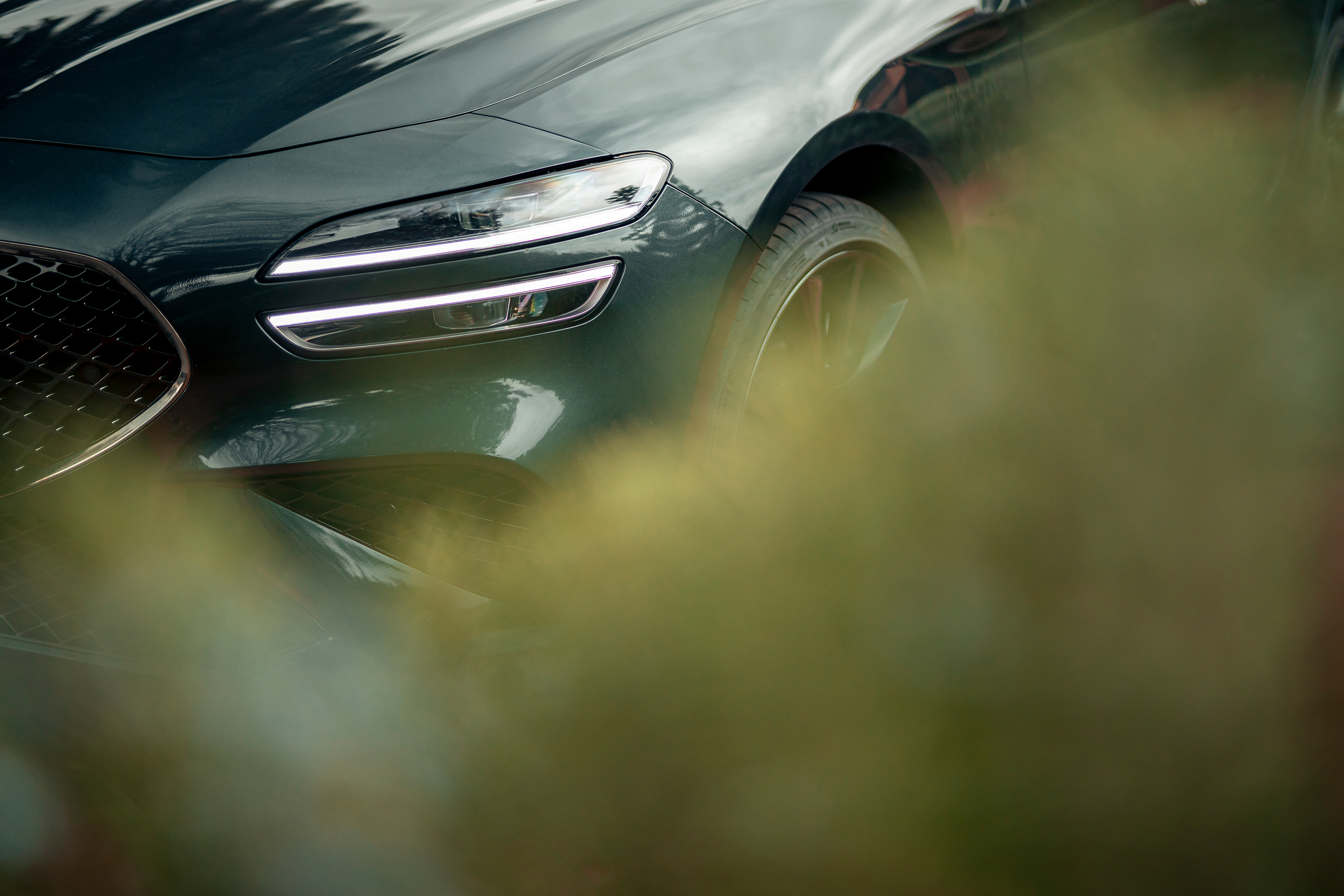
We’ll get to how the G70 drives in future updates but for now I’ll cover arguably the most important aspect of the car, its interior. It’s really swish. Genesis hasn’t so much benchmarked BMW and Mercedes and Lexus as Bentley. That might sound ridiculous but there is clear evidence of British inspiration.
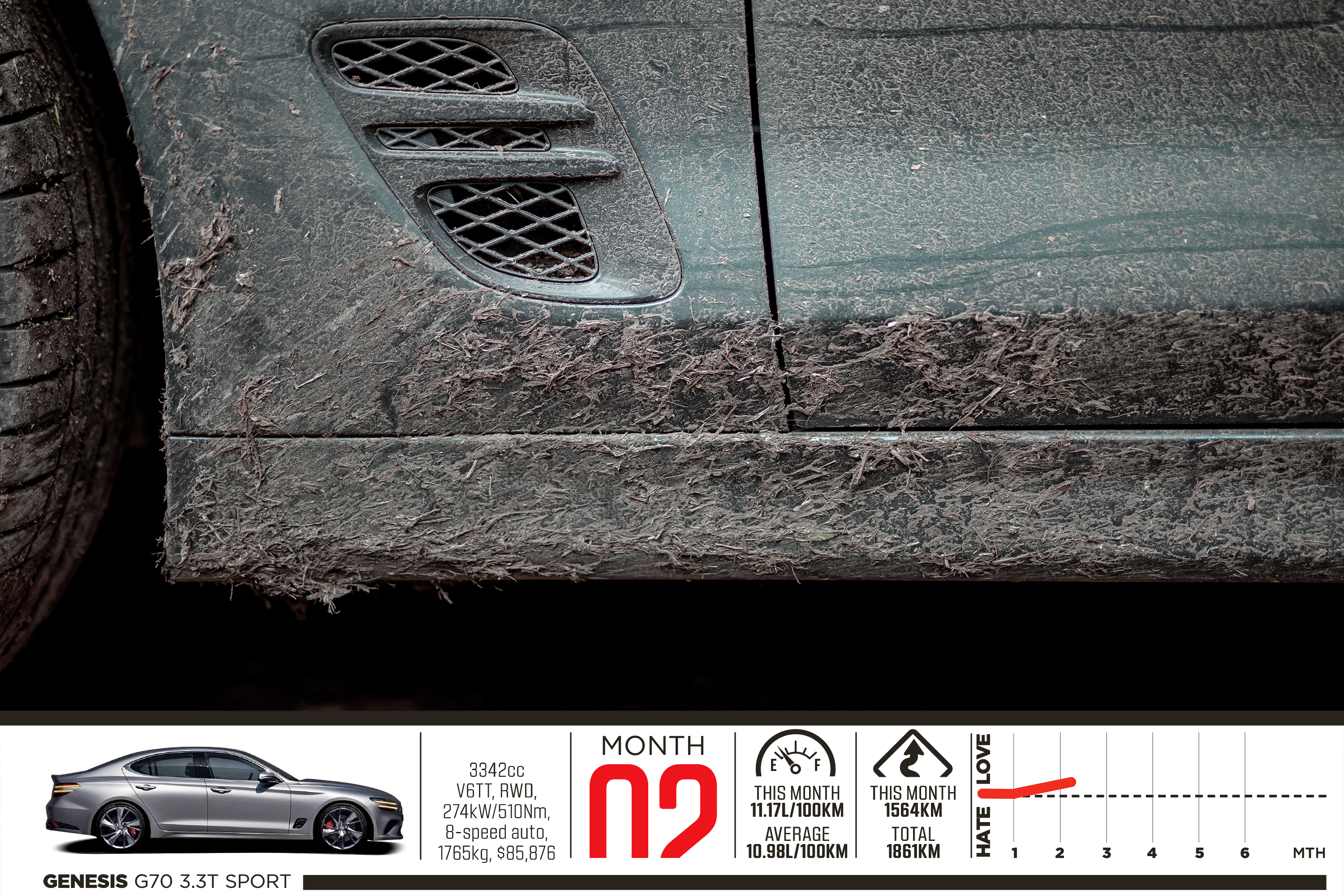
Aside from the badge, which must be one per cent away from having Bentley’s lawyers on the phone, there’s leather-covered everything, diamond-quilted patterns on the seats and doors, and externally there’s even that little vent behind the front wheels. Is the Genesis like a Bentley? No, but by taking inspiration from it the resultant interior feels special for the money.
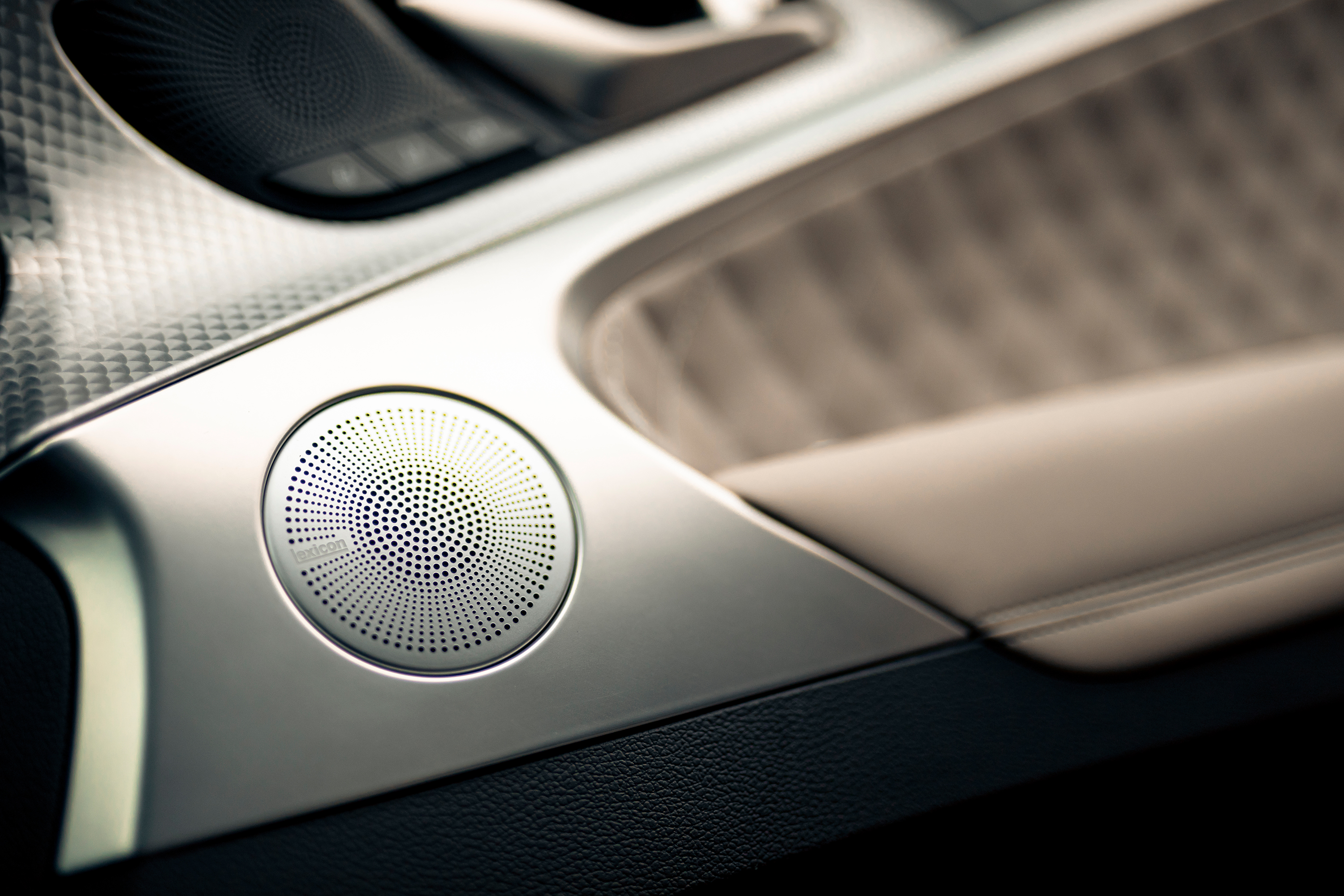
There are a few bits shared with the Stinger, notably the infotainment screen, dash top and centre row of buttons, and its regular vents don’t look as fancy as Kia’s circular ones, but it’s definitely a more special cabin. Of note are the new 3D dials, too, which I absolutely love. Others might be more ambivalent, and of the three styles the funky, Tron-like pale blue/green one is permanently active. So it’s a good start for the dark green Genesis, but can it continue to impress when it hits the road? Find out next month. – SN
Things we love:
- Grunty engine
- Plush interior
- Head-turner
- Getting expensive
- No AWD for Oz
- Brand awareness
Month Two: Force-Fed Fury
Can the twin-turbo Genesis replace an Aussie icon?
Years ago I almost bought a brand-new Mk6 VW Golf GTI. But I didn’t. The thought of sinking $50k on-road (with options) scared me and I opted out of the deal. How does that have anything to do with a Genesis G70 3.3T Sport I hear you ask? Well, it’s what I purchased instead that has road test editor, Scott Newman, flinging me the keys to ‘his’ long termer.
Essentially, saying no to the GTI had me saying yes to a used FG Ford Falcon XR6 Turbo MKI months later. You see where I’m going now, with the rear-drive, twin-turbo V6 Korean being a pseudo replacement for my Aussie icon. Or so the story goes.
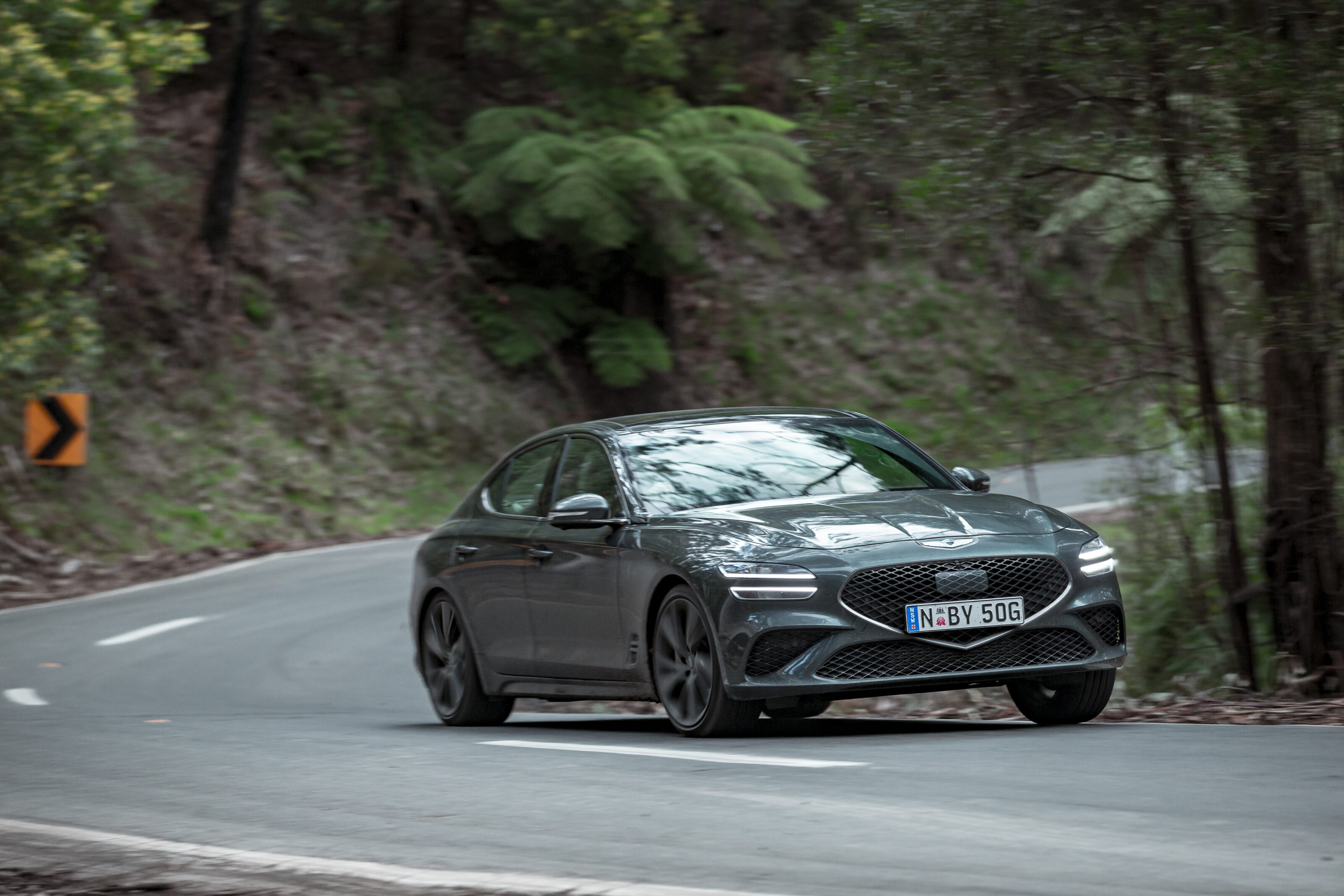
But how true is that narrative? Some time behind the wheel of the daringly styled G70 uncovered a lot.
The 4.0-litre Barra’s lazy nature (8.8:1 compression ratio) pairs well with the Garrett GT3576 turbocharger, offering up 270kW/533Nm – or 586Nm for 10 seconds with overboost. In practice nothing really happens below 2500rpm. Despite it being an impressive application of forced induction, it’s a trip down turbo lag memory lane.
Yet, when it’s on song, the experience is a heady mix of torque and relentless in-gear pace. And it sounds good while doing it, too. The ZF six-speed auto pairs well with the powertrain, so don’t do what I did and opt for the rather agricultural Tremec TR-6060 six-speed manual.
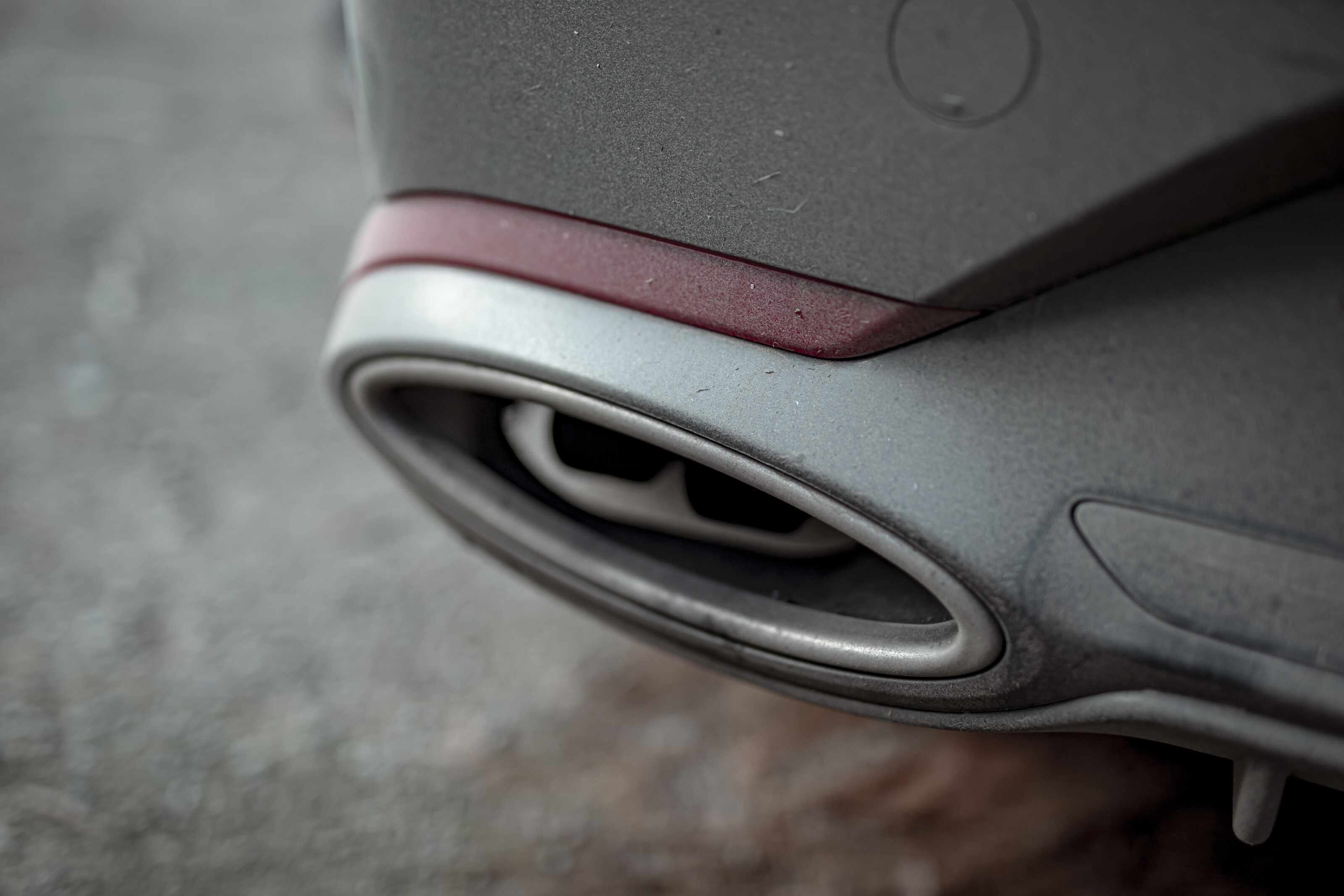
Those engine figures match up well with the G70’s 3.3-litre bent six, which cranks out 274kW/510Nm – especially given both weigh around the 1750kg mark. Yet the G70 feels a lot more immediate, with peak torque on the board from 1100-4500rpm.
The quoted 0-100km/h time of 4.7sec seems plausible by the bum test. The best MOTOR achieved from a six-pot was 4.89sec with a 325kW XR6 Turbo Sprint. The G70’s eight-speed auto is slick, but also best left to its own devices in a sporty mode over using the paddles. Sadly, Sport and Sport Plus don’t uncork the tuneful acoustics that the Blue Oval does.
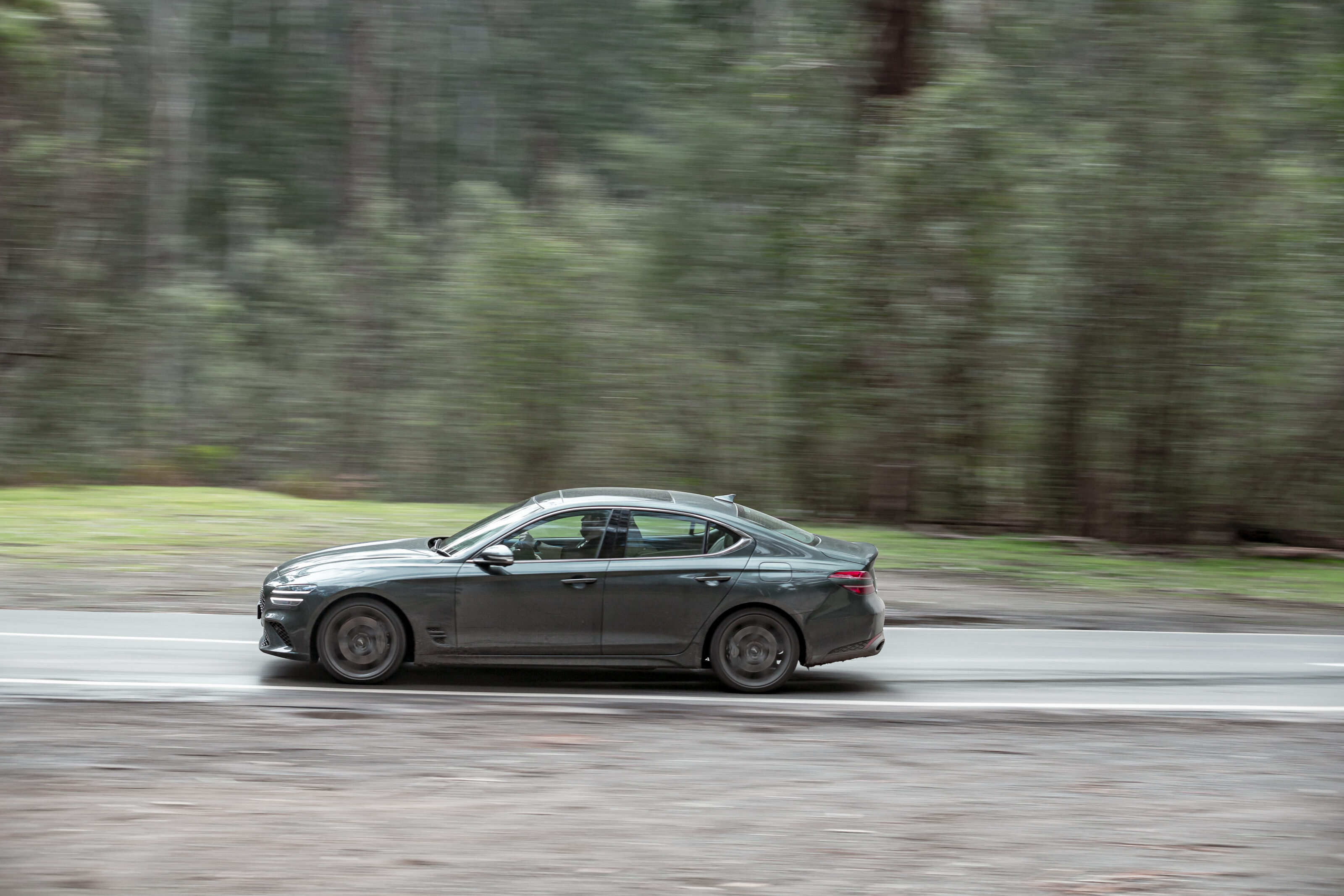
The big difference between the two is size. Those wanting to take swipes at the Falcon would call it a taxi, and at nearly five metres long, it’s easy to see why.
It dwarfs the 4685mm Genesis despite them both having a wheelbase within 3mm of each other. The Korean feels a shed-load nimbler. Truth is, my XR6 Turbo wouldn’t keep pace with the Genesis on a twisty road.
However, it isn’t all sunshine and roses. While I’ll leave the full dynamic assessment to Scotty, it’s safe to say the G70’s front axle is more talkative and skilled than the sometimes-disobedient rear.
Dial in Sport mode and the electronic nannies clamp down on the fun as hard as a Covid lockdown. Yet, Sport Plus lets things run a little too freely, with the breakaway point often coming as a surprise rather than progressively. While decent, it could use more rubber than the 255-section Michelin Pilot Sport 4 tyres at the rear.
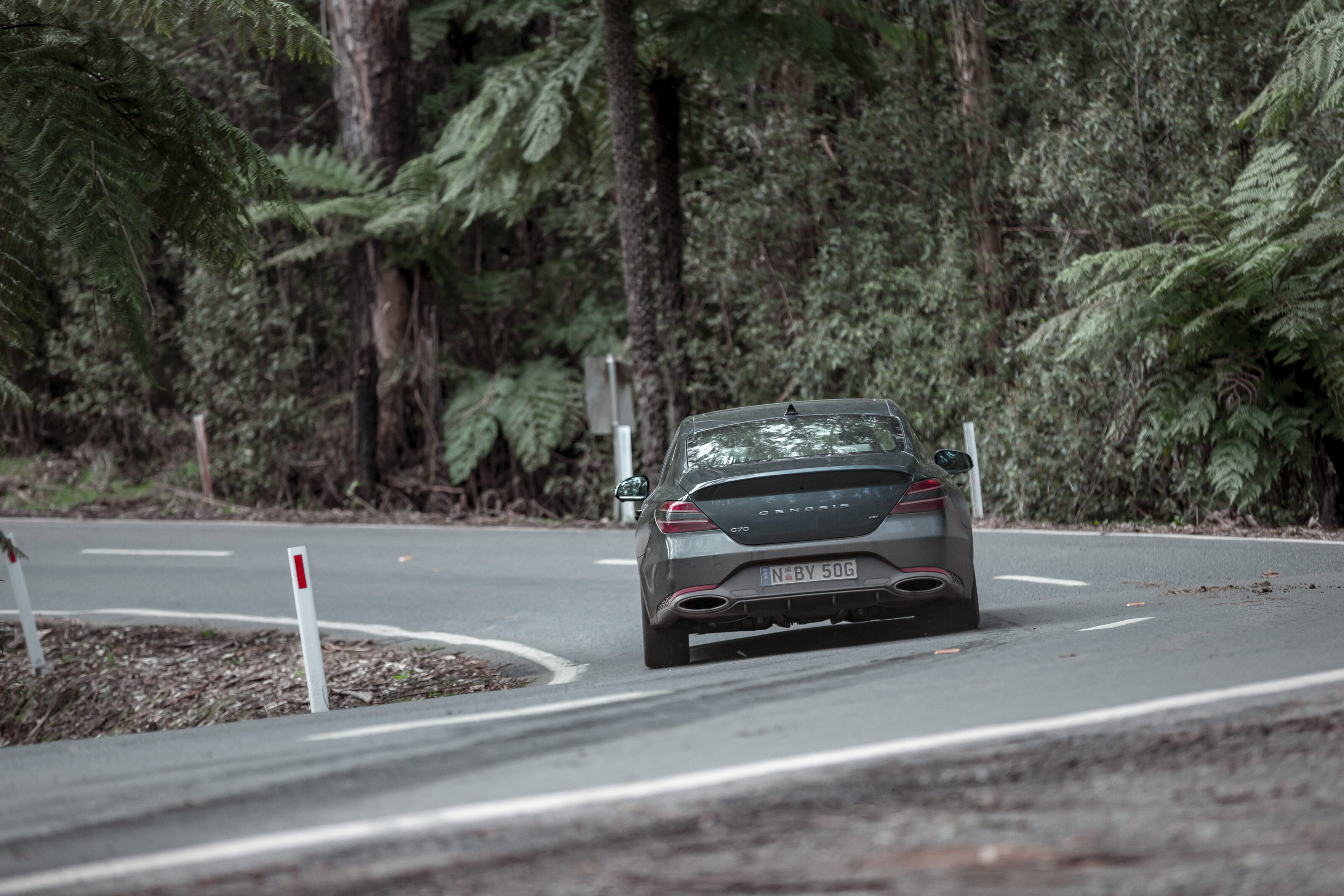
The funny thing is, the Genesis makes more sense when you’re not pushing it. And just like my XR6 Turbo, which I’d originally bought with plans to modify it, the pleasure comes in its long-distance cruising ability.
I can’t help but think the G70 3.3T Sport should be viewed as a luxury car with sporting ability over a performance car with a luxe persona. Overall refinement (despite a rattle coming from the sunroof) and compliant ride in Comfort mode are what have impressed me most.
So, it’s crunch time. Would I buy a G70 3.3T Sport? The short answer is no. And that’s mainly because of the elephant in the room, the Kia Stinger GT. Not only is its size more in line with the Falcon, so is its ethos.
Affordable performance is its USP and while the Genesis adds ample glitz, glam and polish, it also bumps up the price. If you’re after a force-fed, six-cylinder replacement to a boosted Aussie icon, my hard-earned would be with the Kia.
The range-topping G70 feels as if it’s reaching for a demographic that desires up-market smoothness over overt performance. Would I recommend it as a luxury mid-size sedan with enough grunt to outpace the similarly priced German four-pot establishment? And that’s a yes. Back over to you, Mr Newman. Oh, and sorry, I got it a little dirty. – TG
Things we love:
- Gutsy V6
- Straight-line pace
- Comfy cruiser
- Stinger is cheaper
- Unpredictable rear
- Soundtrack
Month Three: Rapid Response
G70 takes to the strip and causes a few furrowed brows
The Genesis brand is built on the pillars of luxury and performance, but what exactly does this mean, and does the G70 hold up its end of the bargain? Luxury is a tough concept to define. The dictionary itself states luxury is “a state of great comfort or elegance, especially when involving great expense”.
Too often, manufacturers equate luxury with gadgetry, as if stuffing an interior with high-resolution screens and the latest technology conveys an atmosphere of beatific calm. No one I know goes to JB Hi-Fi to chill and relax. This is something Rolls-Royce understands very well, in particular the previous-generation Phantom. Its interior was notable as much for what it lacked – noise, complexity and sources of distraction, notably – as much for what it had.
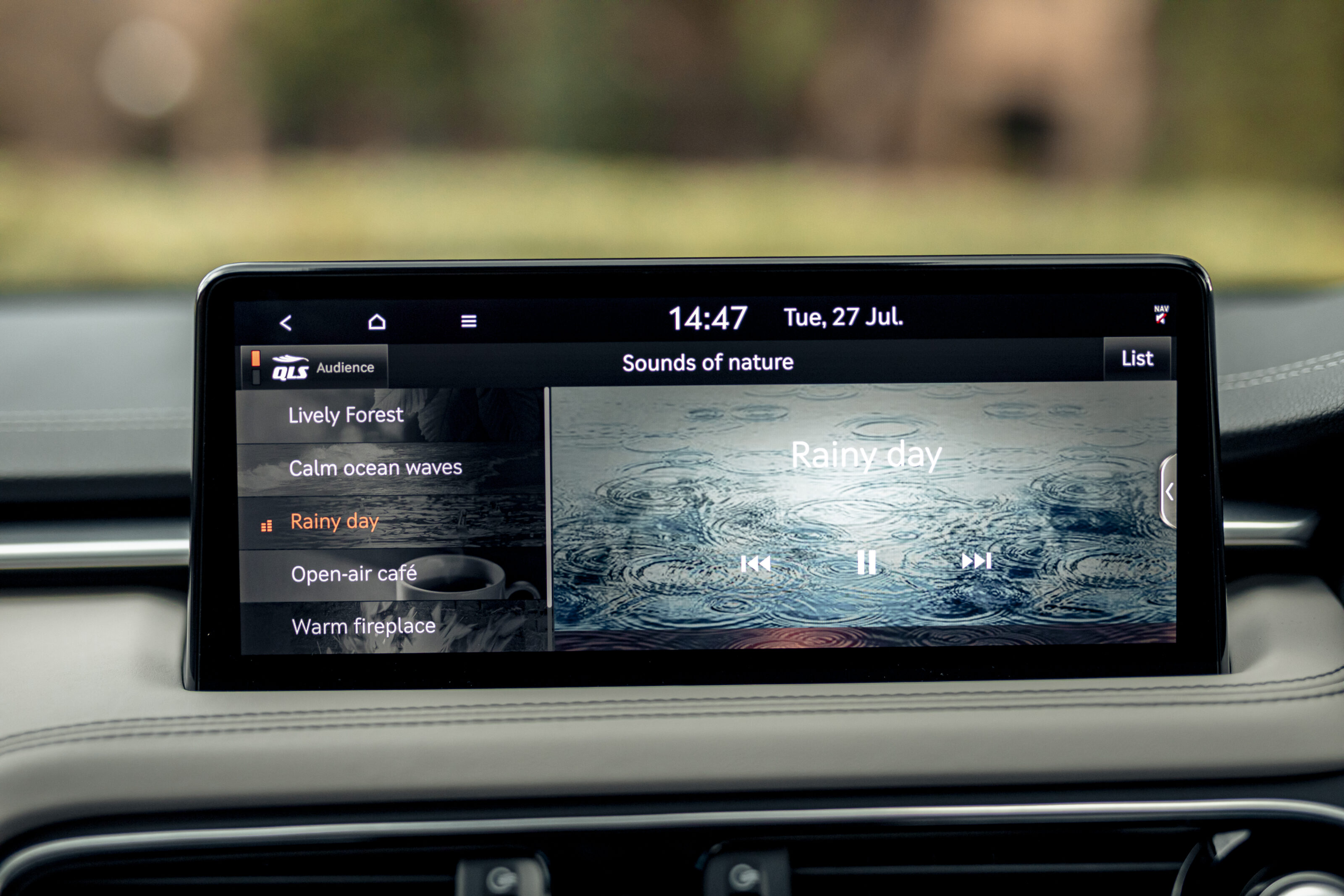
Obviously, the Genesis doesn’t even approach these dizzying heights, but then nor does it involve great expense, being cheaper than a Phantom by about a factor of 12. It does subscribe to a similar philosophy, though. The G70 has its fair share of toys – I’ve already extolled the 3D dials and the fancy Lexicon stereo isn’t too shabby either – but there’s something about the driving experience that is instantly relaxing, and that’s without activating the Sounds of Nature program that instantly transports you to driving amidst deep rainforest or along a deserted beach or through a crowded cafe…
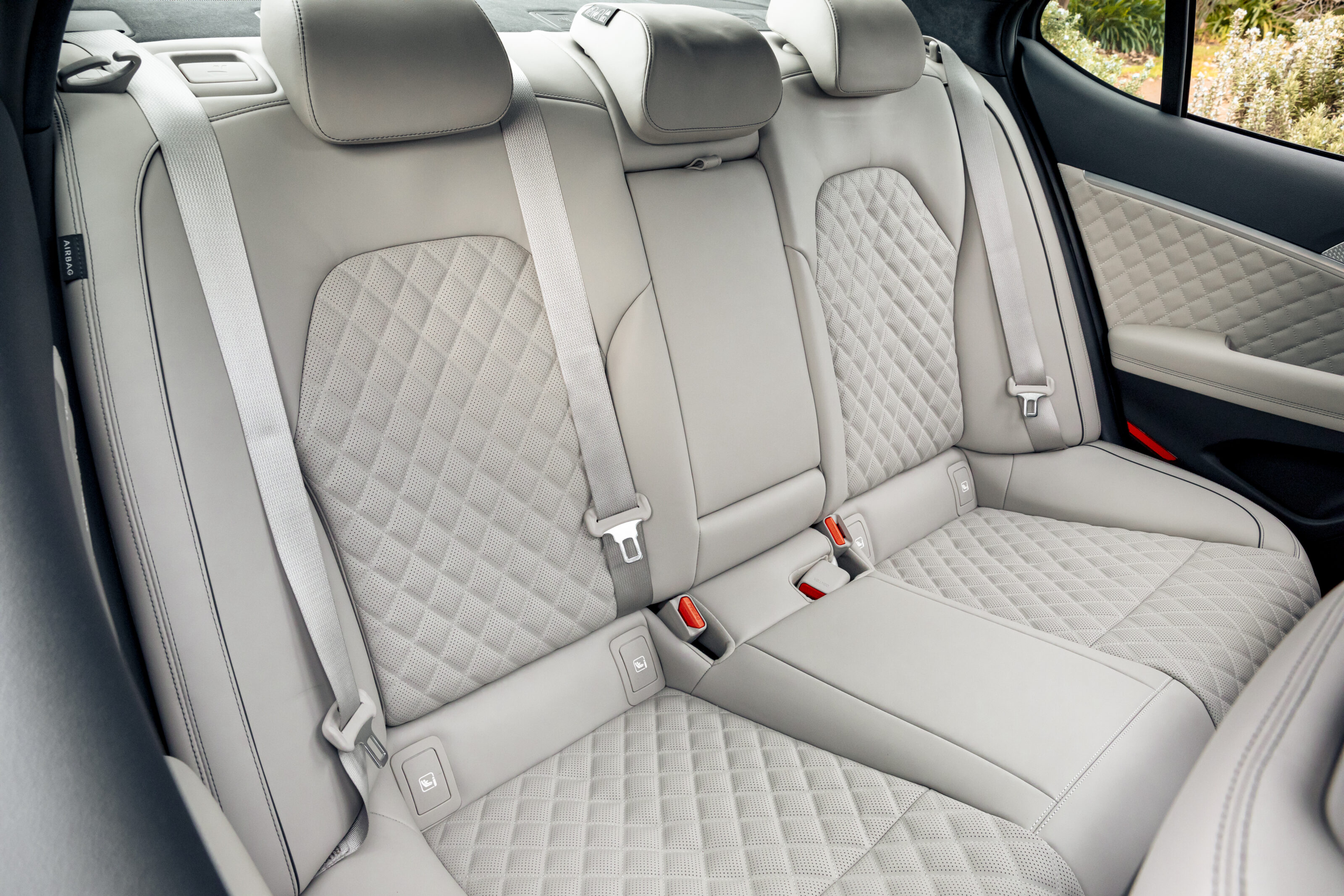
Anyway, the G70 does a good job of creating that state of great comfort – you always seem to just sink a little lower into those diamond-quilted Nappa leather seats – but there are a couple of flies in the fancy ointment. The first of which is the same infotainment system as ‘lesser’ Kia models, specifically the Stinger I just vacated, but unless you’ve literally hopped out of an equivalent Kia product you’re unlikely to notice.
Of more concern is what probably seems like nothing, a minor annoyance at most, but it constantly gives me the irrits. It’s the fuel filler release or, rather, the fact that it’s button-operated. Is this because, as a privileged motoring journalist, I’m constantly driving other cars, the majority of which have the newer, more convenient press-release fuel filler cap? Possibly, but the fact that I’m still constantly getting out of the G70, futilely pressing its filler cap before sighing and returning to press the button suggests otherwise. To be honest it annoyed me in the Stinger, too, but it seems even more incongruent with the Genesis’ more upmarket standing.
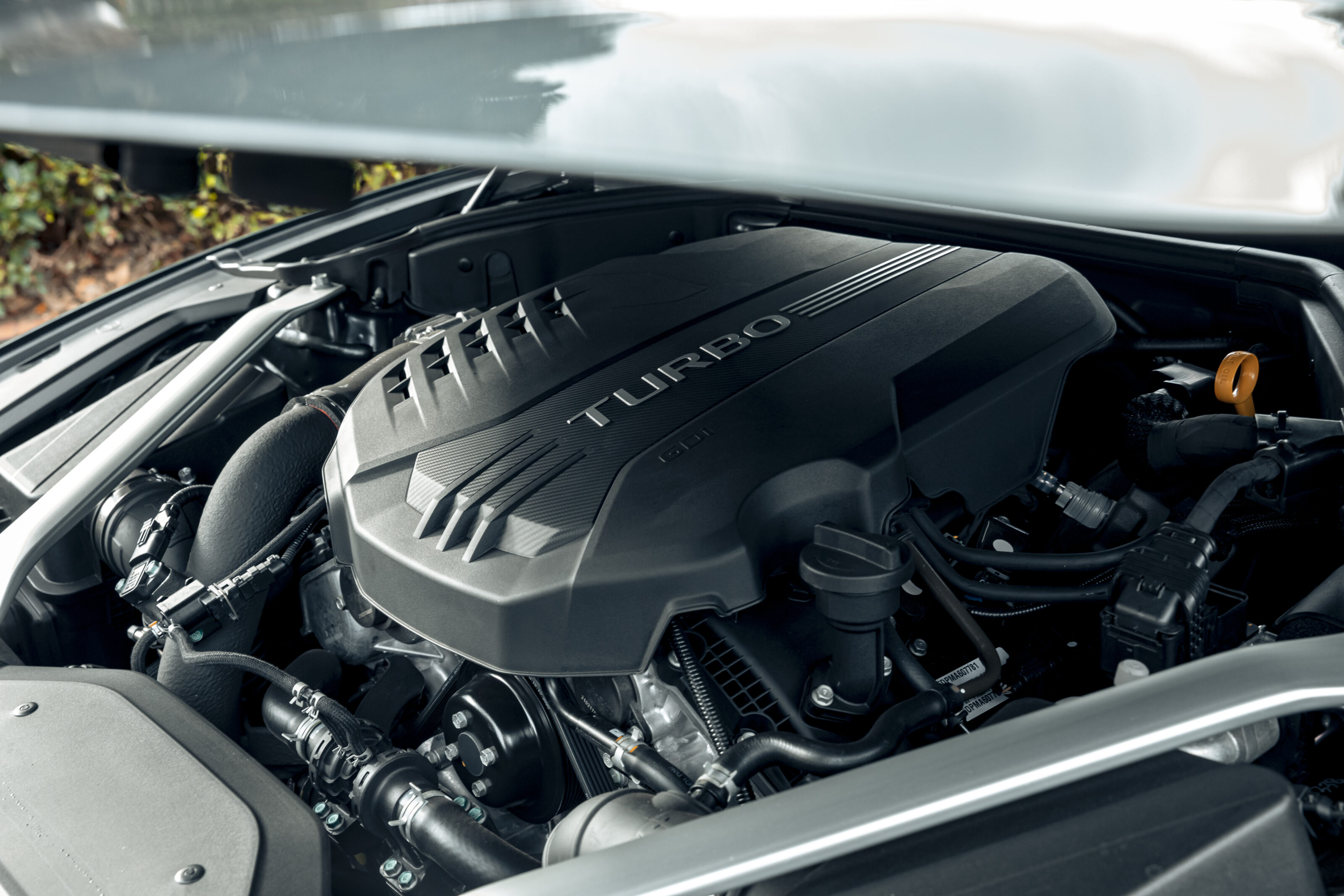
Performance, thankfully, is easier to quantify. The seat of the pants says that the G70’s 3.3-litre twin-turbo V6 is plenty potent, but a recent run in fairly good conditions at Heathcote provided the opportunity to put some data behind the hypothesis. And if you want to watch it in action rather than read about it, then hit up the MOTOR YouTube channel. But I digress.
The G70 has a launch control system but initially I try it the old fashioned way by selecting Sport, turning off the traction control, loading up the brakes slightly and letting it fly. The end result isn’t too shabby: 0-100km/h in 5.2sec and a 13.3sec quarter mile at 175-odd clicks. Weirdly, disabling ESC and activating launch control makes things worse, a lengthy pause from standstill resulting in 0-100km/h in 5.4sec and a 13.5sec quarter.
Even more weirdly, the launch control system seems to dust itself off and sort itself out, as further experimentation – following a scientific process known as “trying it a couple more times” – sees the G70 scooting sharply off the line with strong traction, though it loves to squirm its way down the strip through third and even fourth gear. Nevertheless, the results are impressive, recording 0-100km/h in 4.83sec and a 13.05sec quarter mile – oh-so-close to a 12! – at 176.79km/h.
On a more subjective level, the G70 feels fast. Its rear-end squirminess is part of it, but also the way the ample mid-range torque hits and hits hard. It seems to sound better than its Kia counterpart, too, with a bit more musicality to it, though it’s still no Ferrari V12. Next month we’ll introduce some corners into the equation and see if the G70’s more compact dimensions pay dividends in the bends. – SNThings we love:
- Classy cabin
- It’s quick
- Design restraint
- Fuel filler button
- Odd launch control
- Kia infotainment
Month Four: Booty Shaker
‘Genny’ from the block heads beyond the inner city
Thanks to a combination of lockdowns, travel restrictions and a fairly hectic work schedule, the G70’s use has primarily been limited to urban or daily duties, bar last month’s. This has been instructive in its own way, but finally a chance presented itself to stretch the Genesis’ legs on a proper drive with some decent corners.
A few chances, in fact, and in the last month I’ve driven the ‘Genny’ on track in the wet and the dry as well as on a couple of good roads that proved a stern test of its chassis. To recap, the G70 isn’t just a Stinger with a different badge, but is 145mm shorter in length, 20mm narrower and has a 70mm shorter wheelbase, as well as weighing slightly less. That suggests it should be the more agile of the two, but theory is one thing, practice is quite another.
Let’s deal with the track stuff quickly, before moving on to the more relevant road assessment. To be clear, the Genesis G70 is not in any way a track car, nor is it intended to be.
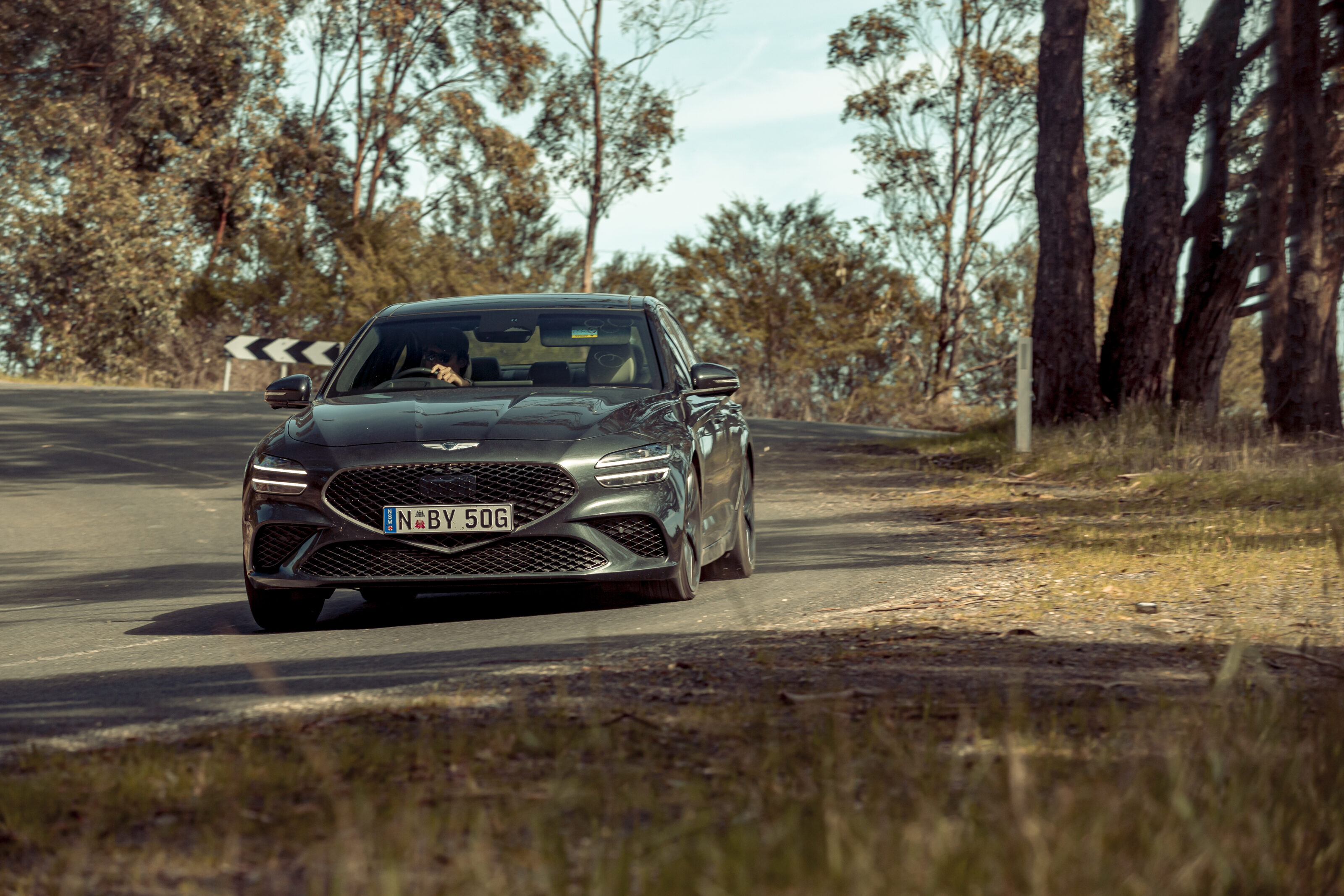
Nevertheless, while filming at Bryant Park hillclimb it seemed rude not to poke the G70 slightly and see what it was like at its limit. In the wet, frankly, it was a bit alarming, but partly due to my own ignorance.
I thought, incorrectly, that the only way to deactivate the ESP system was to select Sport mode rather than the Genesis-specific Sport+ mode, which backs off the traction-control system automatically to a level that’s very nicely judged on the road but still a bit restrictive in an open environment.
Trouble is, in Sport mode the gearbox will still change up automatically and does so a fair way from redline, usually just north of 5500rpm. No great drama in and of itself, but on a wet surface the 510Nm of torque from the 3.3-litre twin-turbo V6 easily spins up the rear wheels in second gear, at which point the transmission grabs third and the wheel speed skyrockets in concert with your heart rate. This, combined with a front end that wasn’t hugely keen on biting into the surface, made for a fairly unsatisfying experience.
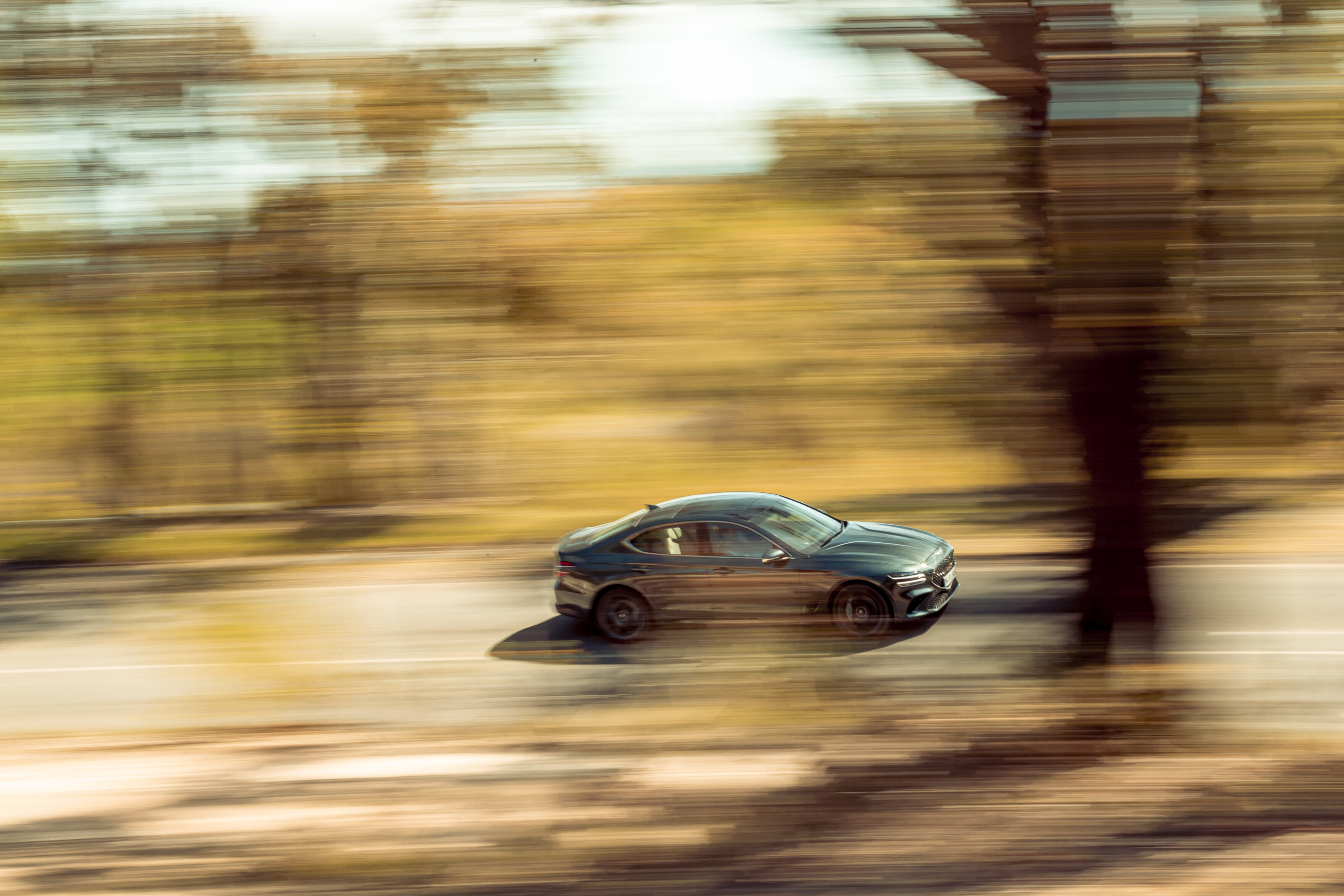
Returning on another day, this time with bright sunshine and the knowledge that selecting Sport+ both allows the ESP to be deactivated and also prevents auto upshifts, led to much more enjoyment. It’s too soft to be truly agile in such an environment and the diff could be a little tighter, but the chassis is both balanced and adjustable – around the low speed confines of Bryant Park, at least – and the engine has more than enough grunt to shorten the straights and lay black lines on the exit of corners.
On the road the situation isn’t quite as clear. The G70 is essentially overpowered, the chassis incapable of deploying the engine’s entire arsenal – this isn’t necessarily a negative. Even if the tyres are hooked up the rear end squirms under full throttle and therefore if the grip is lessened slightly – a patch of dirt, a section of bumps – correction can be required. As a result, the Genesis is always quite involving and lively.
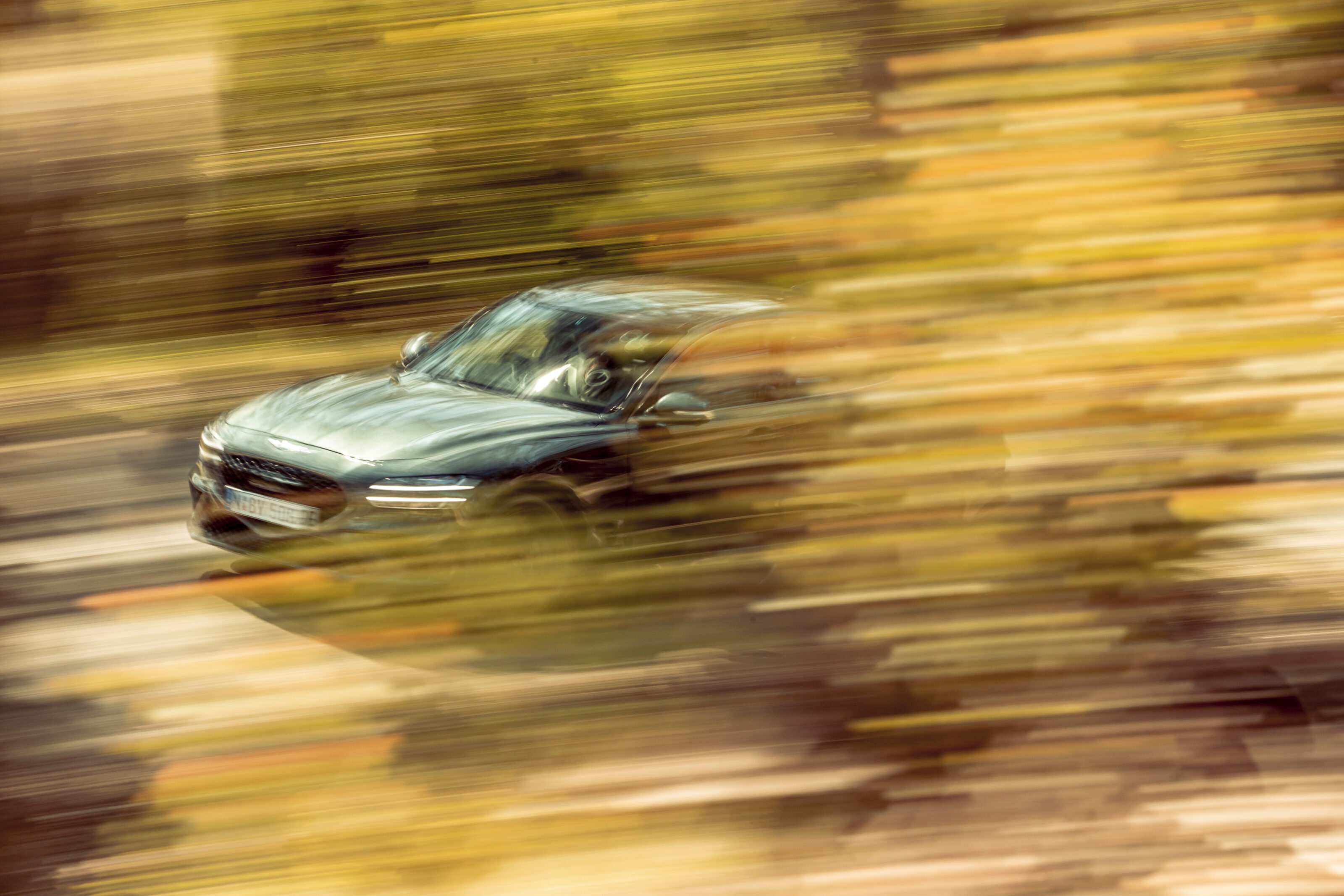
Even though the dampers firm up substantially in Sport+ mode it still exhibits quite a bit of roll and body movement and it’s often the rear that gives up first. It must be said that these assessments are while driving the car in a manner few, if any, G70 owners will, and dial back the effort a little and you can cover ground at an extremely rapid rate.
The steering provides just enough communication to keep you informed and a more judicious use of the throttle (or perhaps go a gear higher than normal) gives the rear tyres a fighting chance. It would be very interesting to sample an overseas-spec all-wheel drive G70, though it might be horses for courses as what it gains in tractive ability it may lose in character?
To be honest, a BMW 330i – the G70’s obvious price rival – is more finely honed and might even be quicker point-to-point, despite its 84kW/110Nm power disadvantage, simply due to its superb balance and the fact you can wring its neck with confidence. What it can’t compete with, though, is the Genesis’ ability to exit a corner with relentless slingshot acceleration – its roll-on acceleration really is mightily impressive. Next month we’ll wrap up our time with the G70 with the good, the bad and the ugly. – SN
Things we love:
- Luxe cabin
- It’s quick!
- Lively rear-end
- Traction issues
- Mode-play
- Early up-shifting
Month Five: Farewell – Honesty Box
Scotty details the good, the bad and the ugly
Time’s up. The Genesis G70 3.3T Sports Luxury has returned to its maker, offering an opportunity to reflect on five months of ‘ownership’. We packed a lot into our time together, from lockdown shopping runs to – once restrictions lifted – cross country blasts with a couple of outings at Heathcote and Bryant Park thrown in for good measure.
In an attempt to summarise the G70 experience I’m going to do my best Clint Eastwood impersonation and play The Good, The Bad and The Ugly. To continue with the movie references, topping the good list is just the vibe of the thing (if you don’t recognise this you’re unAustralian).
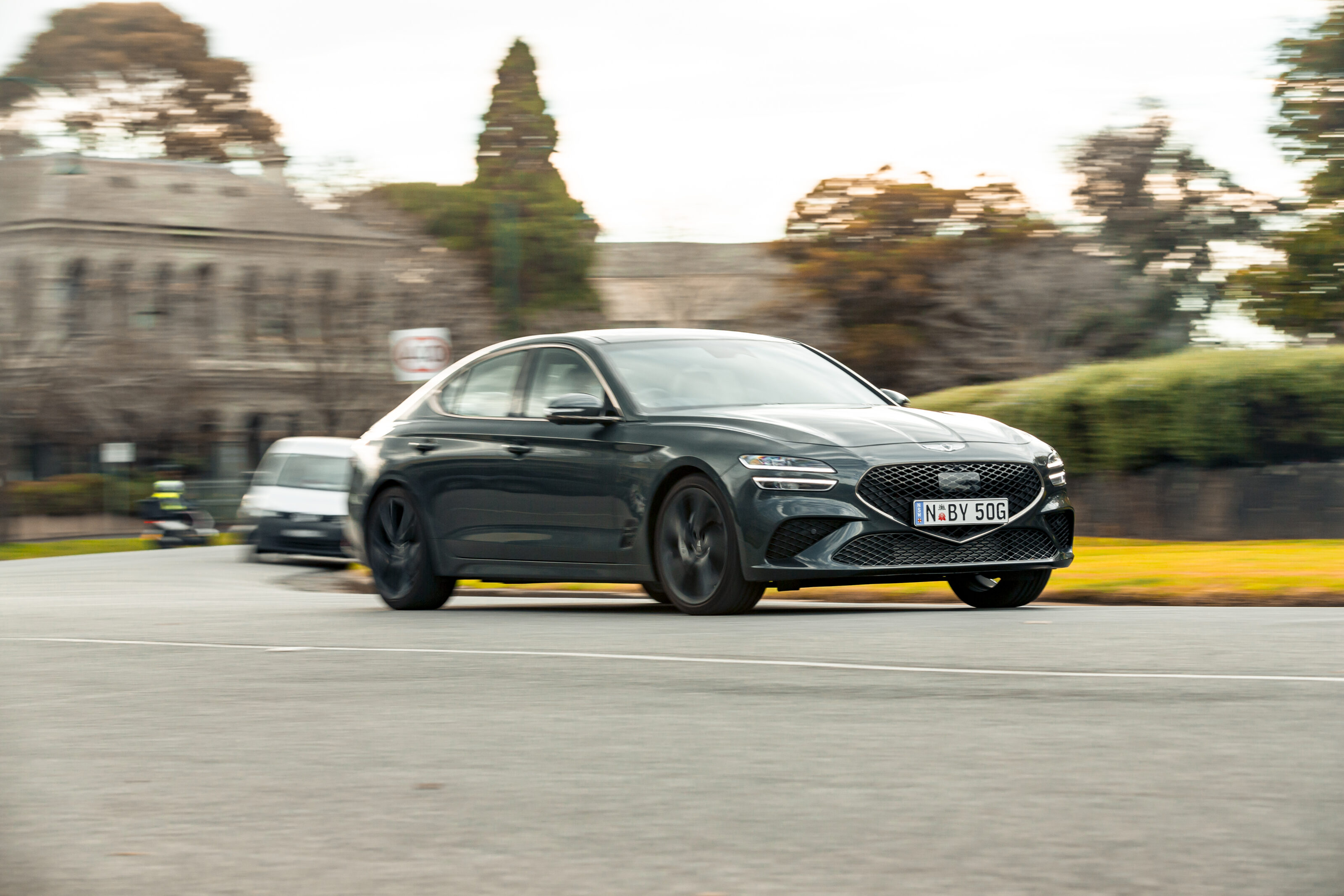
No matter what I’d been driving, sinking into the comfy diamond-quilted seats of the Genesis always promoted a feeling of relaxation. In many ways, that’s job done for a car with luxury pretensions. The design, the material quality and some of the technology all combine to make the G70’s interior a very pleasant place to be. It might not be to everyone’s tastes, but nor am I alone in my views. The photography and video team frequently borrowed the boosted Genesis, even when other options were available, and complaints were few.
While we’re talking positives, the 3.3-litre twin-turbo V6 has ample grunt. I’d be lying if I said I noticed the extra 2kW the now-standard active exhaust extracts, but the G70’s best figures of 0-100km/h in 4.83sec and a 13.05sec quarter mile at 176.79km/h – achieved with the surprisingly effective launch control – show it’s no slouch.
The pairing of the torque curve and a chassis designed for comfort rather than speed makes the G70 a great way to travel long distances in the traditional Aussie style. I’ve long thought that the Kia Stinger and its upmarket Genesis twin should be on the shopping lists of anyone wanting to replace their Ford G6E or Holden Calais, so to put the concept to the test I threw the keys to MOTOR’s XR6 Turbo-owning Trent Giunco. He more or less agreed.
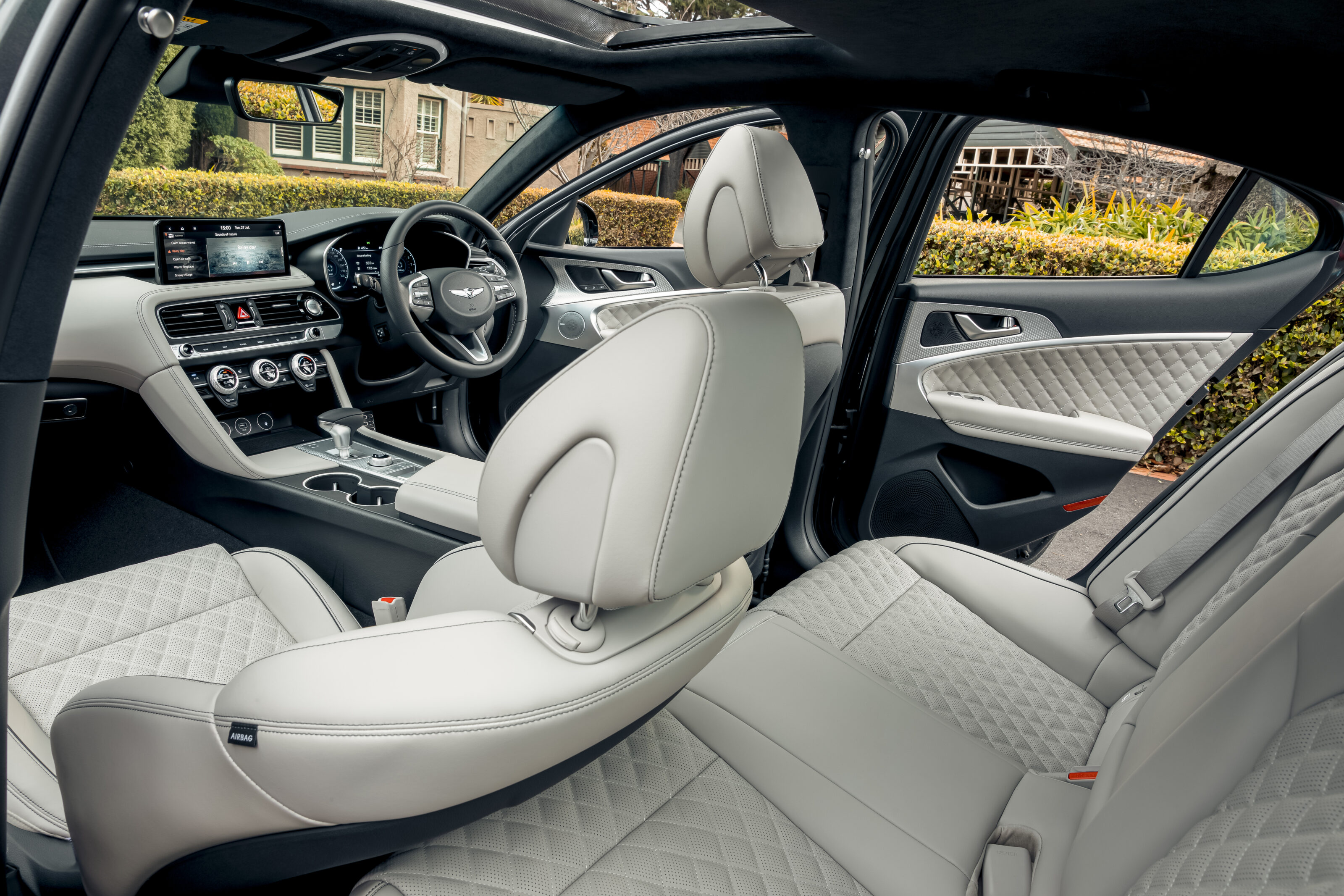
Now let’s switch to the bad. The G70’s biggest shortcoming, especially compared to its Kia sibling, is the lack of space in the rear. Chopping 70mm out of the wheelbase really compromises rear legroom and while a couple of pre-teens are likely to be fine, anyone approaching adulthood will struggle to get comfortable.
Theoretically, this shorter footprint should result in more agile handling, but it’s not really the case. The Genesis handles well, up to a point, where it suddenly becomes lively, the rear end struggling to contain the available grunt. With familiarity it can be driven on just the right side of this limit and is enjoyable to do so, the tail slithering around on corner exit, but the transition from grip to slip can be extremely sudden, especially in the wet.
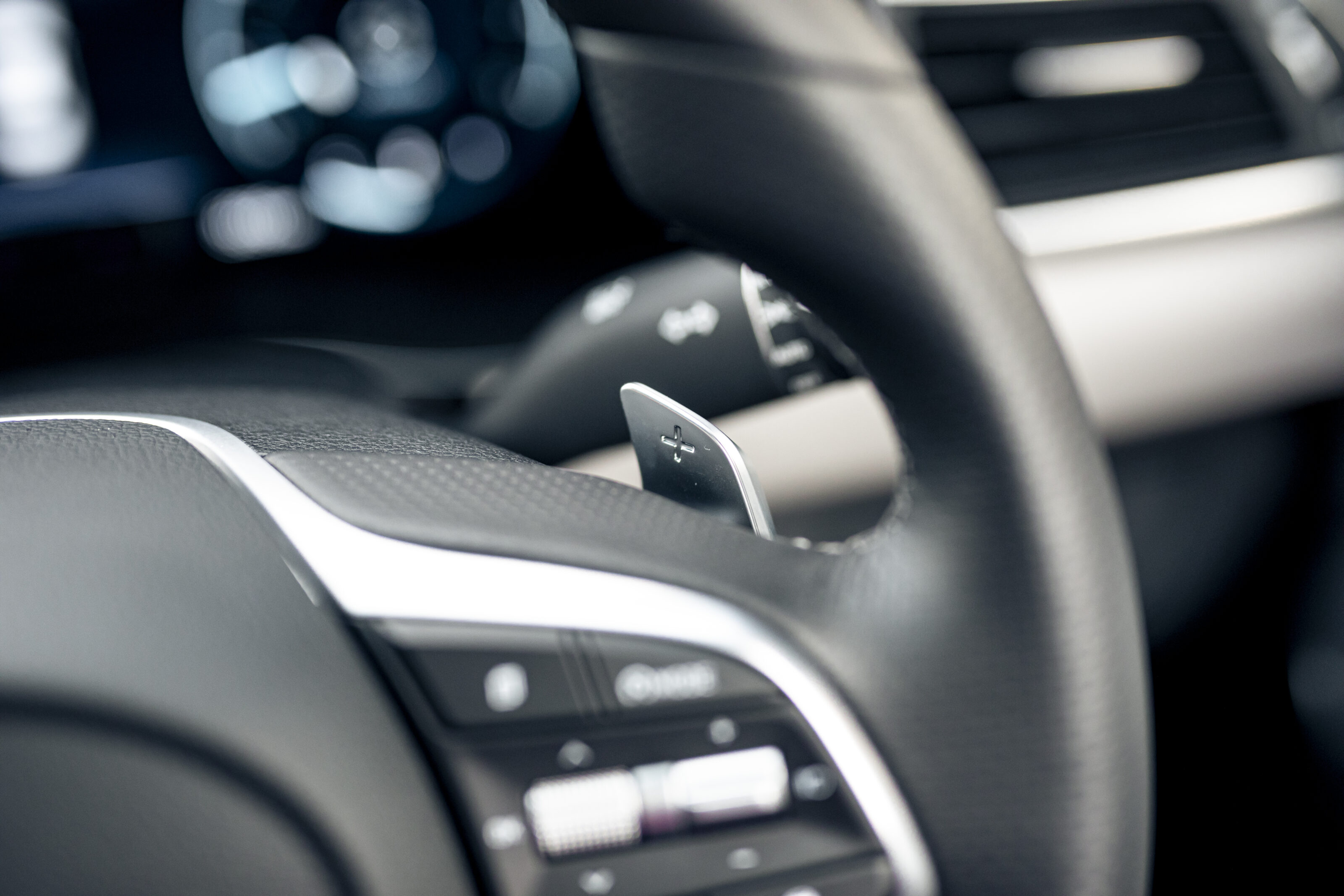
This brings me to the gearbox. After some experimentation I discovered the G70 does have a proper manual mode, but only when the Sport+ drive setting is selected. You can still select gears manually in other drive modes, but the gearbox will override your selections if it feels it prudent to do so. This is annoying and a bit sketchy if you have traction control off, as when the wheels spin it grabs the next gear and sends wheel speed skyrocketing.
As for the ugly, there are three points. The first is that, in common with a lot of Hyundai products, the lane keep assist is poorly calibrated. On numerous occasions – most frequently on Melbourne’s Beach Road – it would make aggressive steering inputs for no reason, resulting in it pre-emptively being turned off for every drive.
The infotainment screen would also occasionally go blank – something that also happened with the same system in the Stinger – forcing a hard restart of the car for it to display again. Of most annoyance, though, was the fact that every phone call made from the G70 required the person to call me back due to their voice echoing badly. A colleague mentioned it might have had something to do with the microphone settings, though these were just in the default settings.
But I don’t want to end on a sour note, as all in all the G70 is an enjoyable car, albeit a niche one. I still think that if you want to replace your luxo Aussie – and the kids have moved on – then it’s definitely worth a look, as Genesis really nails that easy-going comfy performance character. As I mentioned, it’s the vibe of the thing. – SN
Things we love:
- Luxe, comfy cabin
- It’s quick!
- Crushes kays
- Rear legroom
- Unpredictable rear
- Gearbox calibration
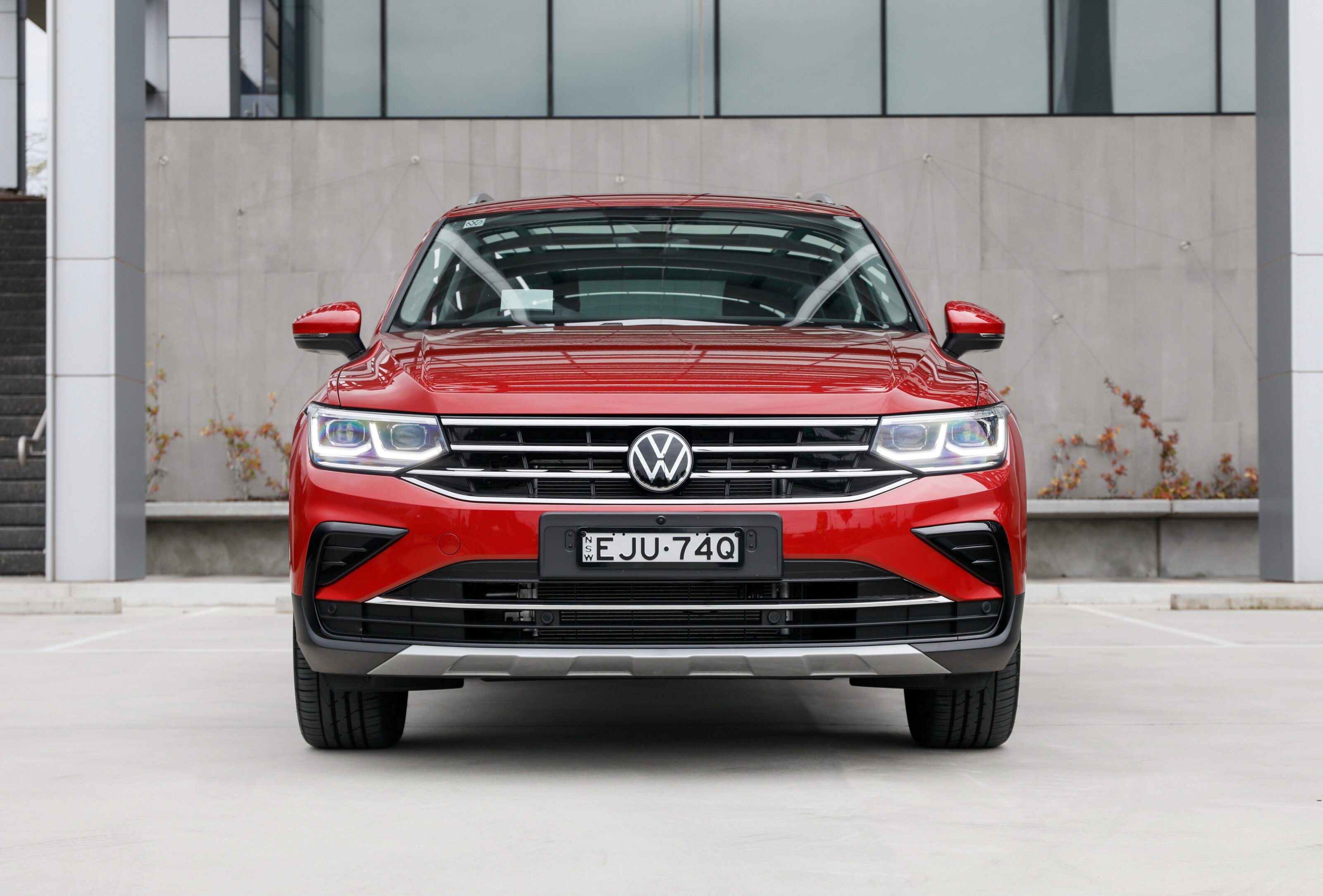
As Volkswagen’s best-selling model in Australia, the Tiguan could well be on its way to taking its Golf sibling’s ‘people’s car’ crown – offering the brand’s famous practicality but combined with an increasingly premium experience and that ever-popular height elevation.
2021 saw a major update for the medium-sized SUV, bringing new design elements inside and out, upgrades to VW’s Digital Cockpit Pro, new haptic feedback touch controls and improved safety features courtesy of the carmaker’s IQ.Drive system. The facelift also brought with it a new diesel powertrain.
For 2022 there’s a $1000 price increase across the range.

We’ll tell you what we love about this car, and not so much, in a moment – but before you fall too hard for it, we should make you aware that Volkswagen has flagged stock shortages with the Tiguan (and others), which may mean a long wait to gets those keys into your hands.
A seven-seat stretched version, the Tiguan Allspace, which is not included in this review, is not impacted by the delays.
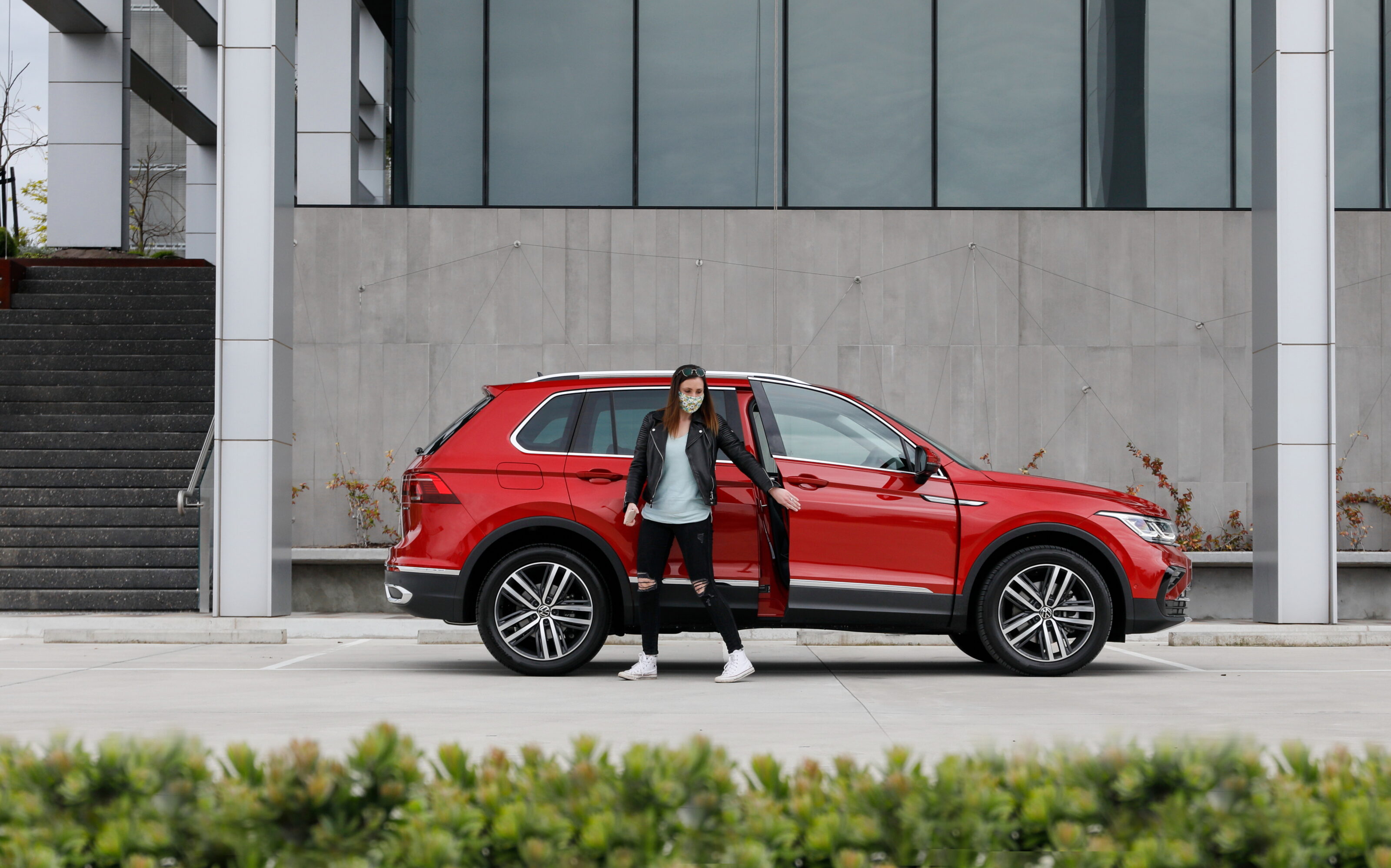
The version tested here is the 2022 Tiguan 147TDI Elegance – sporting Kings Red premium paint, the Sound and Vision Package and a panoramic sunroof.
Pricing
In total there are three trims; the Life, Elegance and range-topping R-Line, each offering two engine options. All-wheel drive and a seven-speed DSG dual-clutch automatic transmission are standard on all but the base 110TSI Life grade, which is exclusively offered in front-wheel drive with a six-speed DSG.
The entry-level Life comes with a 1.4-litre 110TSI turbo-petrol engine or 2.0-litre 132TSI turbo-petrol, while the Elegance and R-Line variants are available with a choice of either a 2.0-litre 162TSI petrol or a 2.0-litre 147TDI turbo-diesel.
The Tiguan 147TDI Elegance we’ve got on test costs $53,290 before on-road costs and options, while the 162TSI petrol will cost $1500 less.
At the base of the range, the Life comes in at $40,590 for the 110TSI and $44,590 for the 132TSI, while the two R-Line grades top it off at $54,790 for the 162TSI and $56,290 for the 147TDI. All prices are before on-roads.
There is a choice of six paint colours (unless you want to pay $800 more to have a metallic or pearlescent effect), with each specification having two interior materials available – both are standard except on the Life, where black Vienna leather seats will cost extra.
While there are optional packages available, it’s worth noting that a lot of premium features come as standard – with only some of the more luxurious attributes off limits without putting in the extra cash.
The interior is where all the fun is on this car. Inside the experience feels very premium – pretty much on par with Audi’s SUV range.
For example, the Luxury Package, which can only be added to the base Life variant for $5000, includes Vienna leather-appointed upholstery, a heated steering wheel, electrically adjustable driver’s seat with memory function, heated front seats and a panoramic electric glass sunroof (the latter can be added to higher grades for $2000).
Meanwhile, the Sound and Vision Package, which can be added to the Elegance or R-Line for $2500 (and has been added to this test car) includes a head-up display, area view camera and Harmon Kardon premium sound system.
All in, the car we have here would set you back $58,290 before on-road costs.
Features
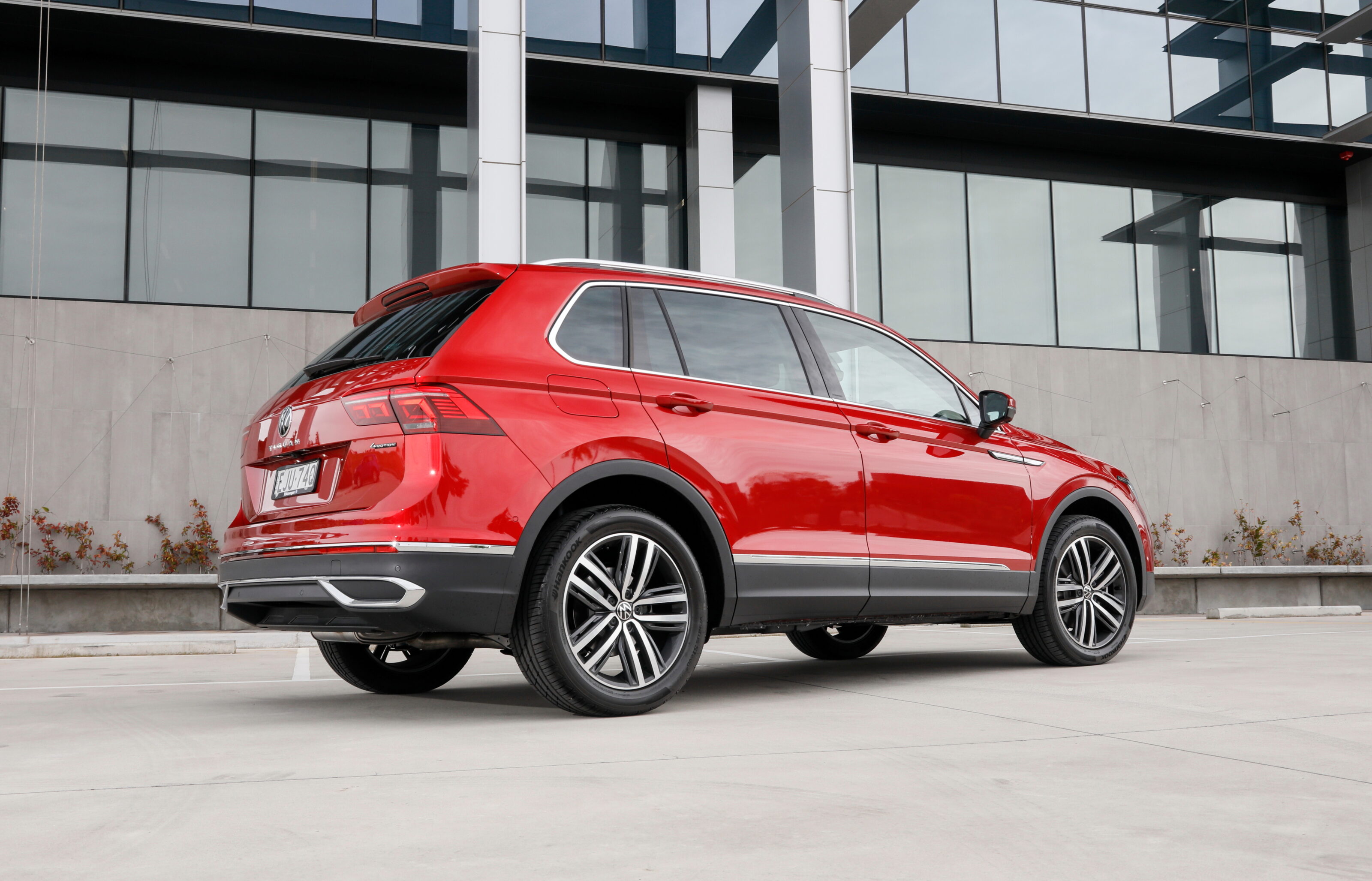
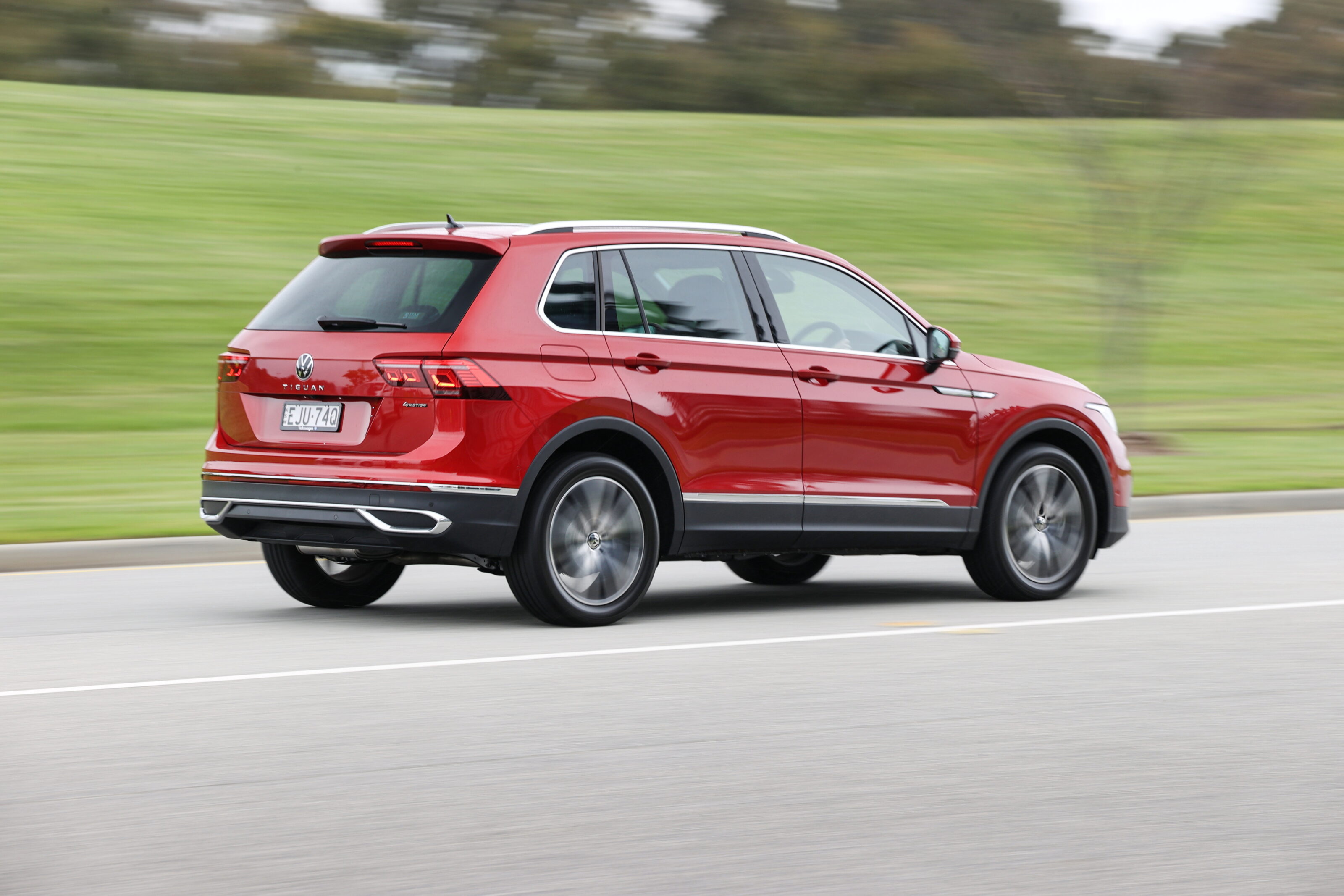
On the outside the 2022 Tiguan Elegance is identical to the previous model year – sporting attractive chrome accents around the grille, lower air intakes, bumper, and window surrounds to name a few, as well as striking lines along the doors and bonnet adding edge and personality.
The rear is a simple affair, but not at all unappealing, and it rides on 19-inch Auckland alloy wheels wrapped in 235/50-profile Hankook rubber.
These tyres also contain Volkswagen’s Airstop ‘viscous mass’ material which, according to the manufacturer, can automatically seal a tyre puncture up to 5mm in depth. The benefit of this is no sudden loss of pressure, with the ability to keep driving safely even if you do suffer multiple punctures.
Measurement-wise, it’s 4509mm in length, with a width of 1839mm and height of 1645mm – its wheelbase remains unchanged too at 2681mm.
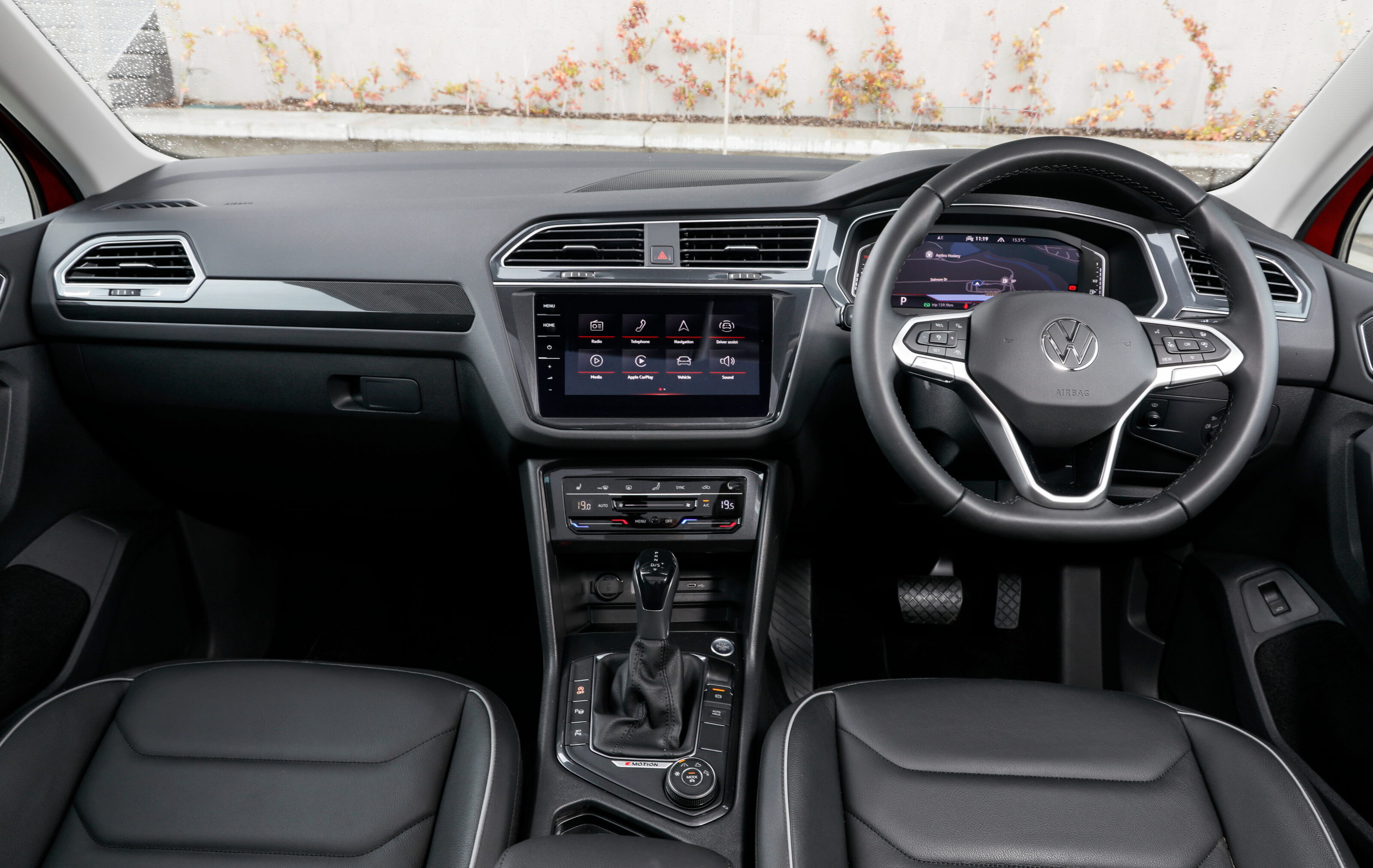
The interior is where all the fun is on this car. Inside the experience feels very premium and – having driven a number of Volkswagen Group products – we’d say is pretty much on par with Audi’s SUV range, just without the higher price tag.
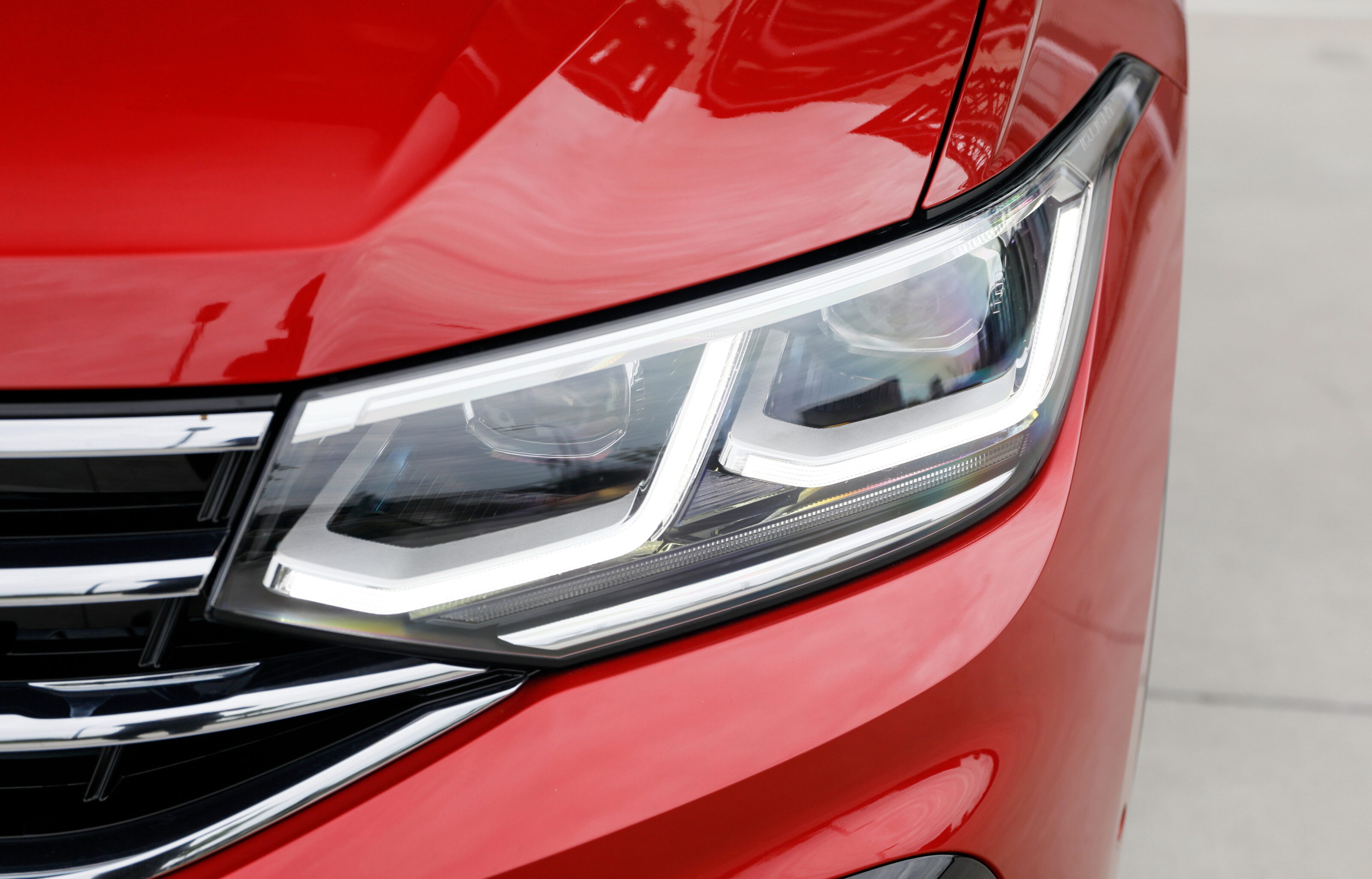
Other standard features for this variant – such as the folding, heated and electrically adjustable (with memory) door mirrors, rain-sensing wipers, matrix LED headlights with dynamic indicators and auto tailgate – also have a touch of Audi class about them.
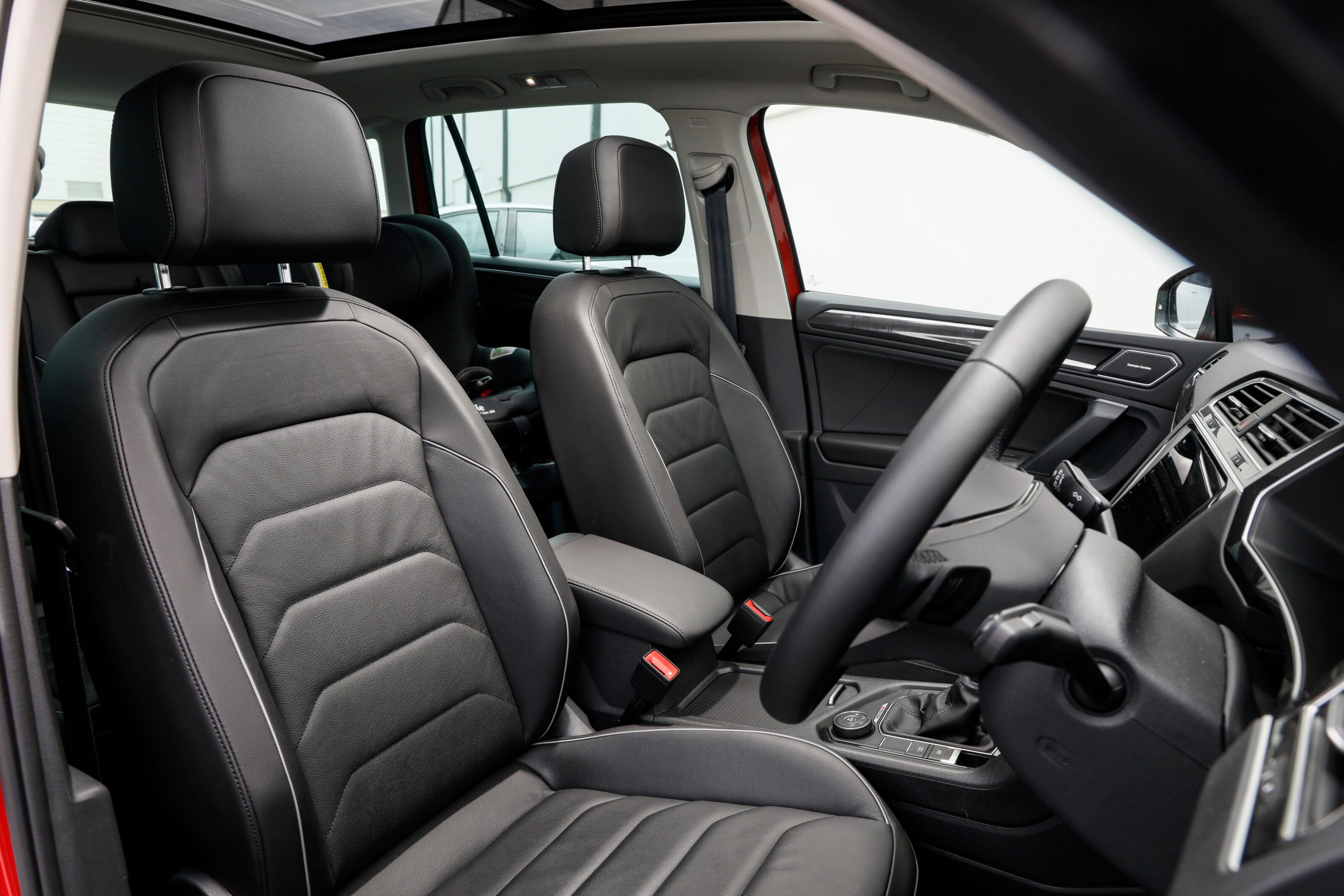
The Vienna leather-appointed trim feels high quality, with the padded dash and tops of the door-cards offsetting the slightly scratchier plastics found below. There are three USB-C ports, two front and one rear, as well as a 12V socket in each row. The driver and front passenger benefit from electrically adjustable heated seats, and the steering wheel is heated too.
It’s hard to imagine that last one coming in handy in many places in Australia, but having lived through many harsh UK winters we know it would certainly be a welcome addition in cooler climates.
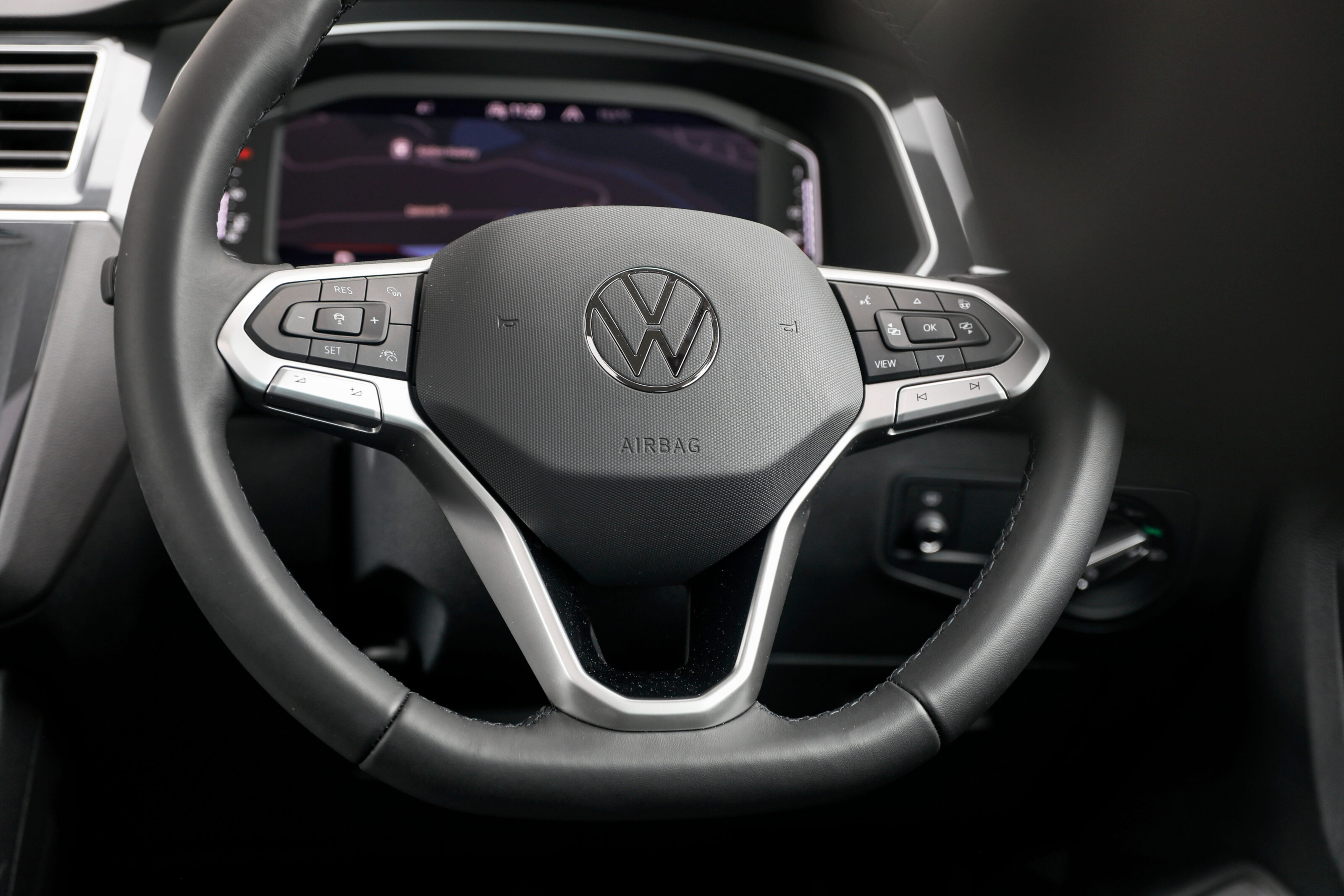
The 9.2-inch touchscreen is clear, crisp and straightforward to operate – as is the 10.25-inch Digital Cockpit Pro – and settings can all be adjusted easily without traipsing through a series of menus plus it comes with wireless Apple CarPlay/Android Auto that exhibited no obvious hiccups in performance.
While the Tiguan comes with wireless smartphone connectivity it does not feature wireless charging, meaning you’ll need to make sure you have a USB-C cable in the car if you need to top up your phone battery.
So many of the creature comforts in this Tiguan come as standard, which is great, but one optional extra we’d definitely tick has to be the panoramic sunroof. It was a big hit with all members of the family, quickly winning over the youngest member as he could suddenly see planes, birds and even the moon on occasion, all big stuff when you’re two.
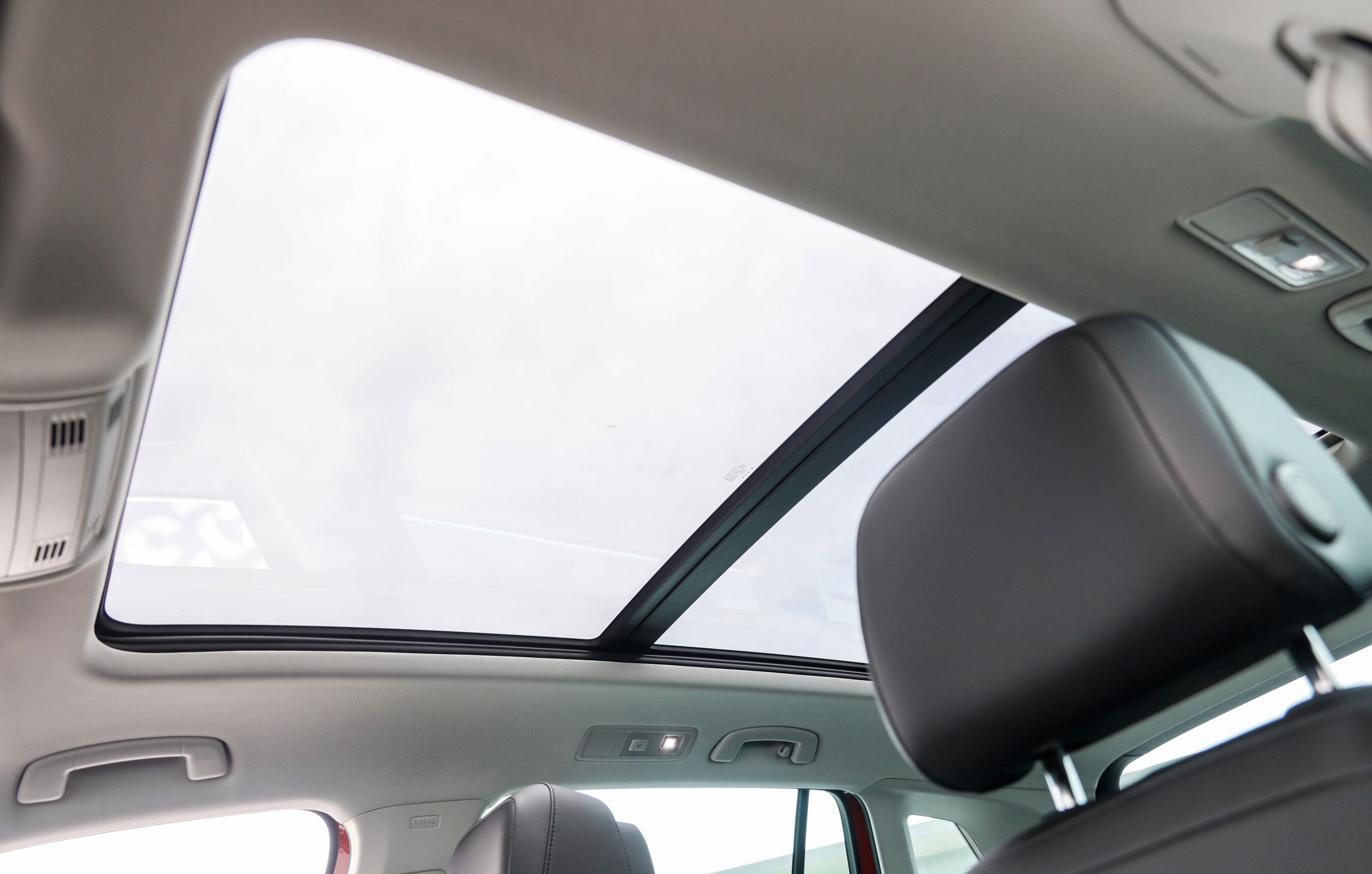
We grown-ups equally loved it too though, as it opened up the space in a way you just don’t appreciate until you have one, making it much airier and light. Thanks to a retractable visor, there is almost no buffeting with the roof open either, even at freeway speeds.
While there is obviously more road noise, you can still enjoy music or hold a conversation without having to nudge the volume up or wear your vocal cords out. It’s a stark difference to the sardine-can sunroofs of yesteryear.
Also added to the test car we have here is the Sound and Vision Package, which brings with it some much-appreciated creature comforts, starting with the head-up display. It’s a very useful addition and is easily adjusted depending on the driver’s height and seating position.
The Harmon Kardon sound system – highly customisable either through presets or via the equaliser on the touchscreen – really elevates the in-cabin experience with rich and textured delivery, and an area-view camera provides handy 360-degree vision for easier parking.
Comfort and space
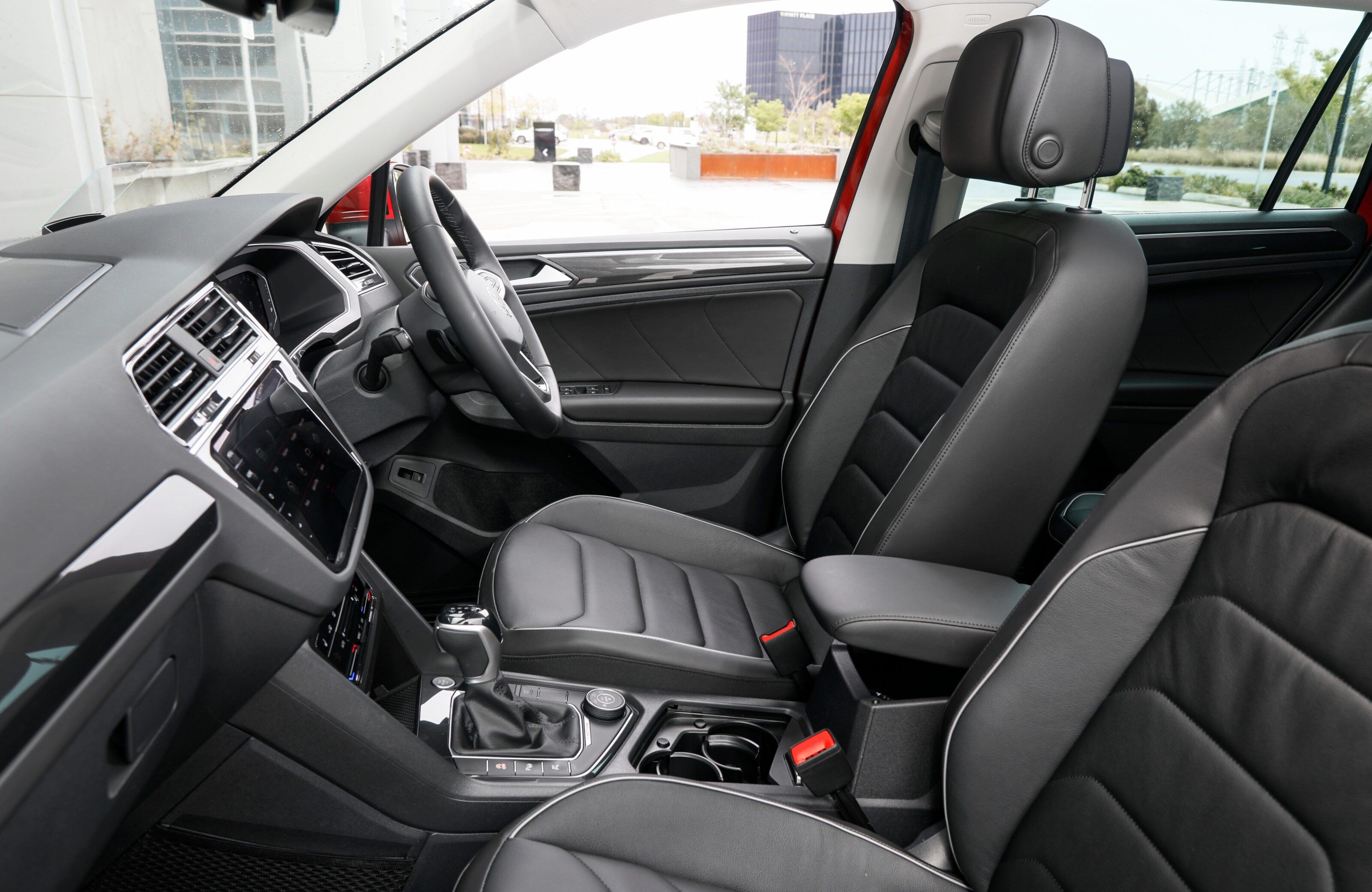
Most of our time with this model was limited to shorter journeys, thanks to Melbourne’s ongoing lockdowns limiting travel, but on the few longer trips we managed, both front and rear rows were perfectly comfortable and we couldn’t see it being an issue for those long weekends away, especially given the driver and passenger also benefit from comfort sport front seats that are electrically adjustable and include three memory settings.
These seats easily allow you to find the perfect position and optimise lumbar support, and while the Vienna upholstery is leather-appointed rather than 100 per cent the real deal, it still feels soft and luxurious.
The front chairs also give more side support for your thighs, while the second row has a flatter design. It isn’t a problem, but more sculpting would just provide that little bit of extra comfort for rear passengers.

When it comes to space, the Tiguan has truly been made with family living in mind and there are pockets of storage absolutely everywhere. From big door bin spaces large enough to accommodate a 1L drink bottle to a central bin and thoughtful phone pouches and map pockets on the seatbacks, there is somewhere to put other essentials, such as toys and snacks, within easy reach of big and little hands.
The second row has also been well catered for, with all-important tinted glass to protect young children’s skin and eyes from harsh sunlight, the same amount of door-bin space as in the front, a central armrest available when the middle seat is down (complete with two additional cupholders) and its own air vents with the option to control temperature and airflow separately through a small digital display.
As mentioned above, one USB-C port and 12V socket allow fast charging for rear occupants as well, and child seats slot in easily thanks to the ISOFIX anchors and wide-opening door apertures.
When it comes to space, the Tiguan has truly been made with family living in mind – there are pockets of storage absolutely everywhere.
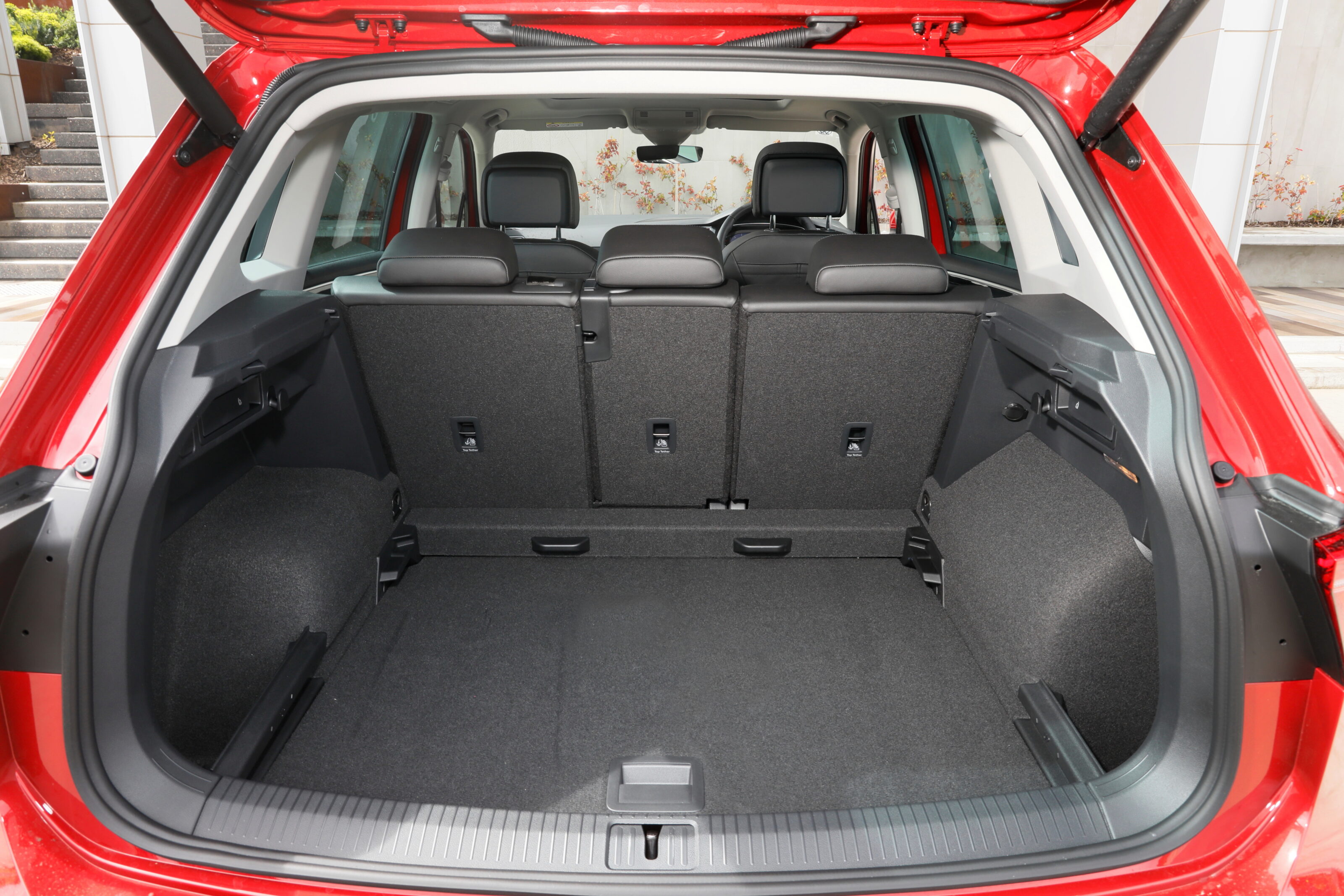
The boot is large enough to take care of all the usual suspects, making easy work of a buggy, back carrier, inflatable stand-up paddleboard as well as a child’s bike and picnic hamper. Here too there are deep pockets of extra storage space on either side, handy for when you have small items to ferry about that you don’t want rolling around all over the place when you’re driving. With the second row lying flat, boot capacity is rated at 1655L or 615L with the seats up.
On the road
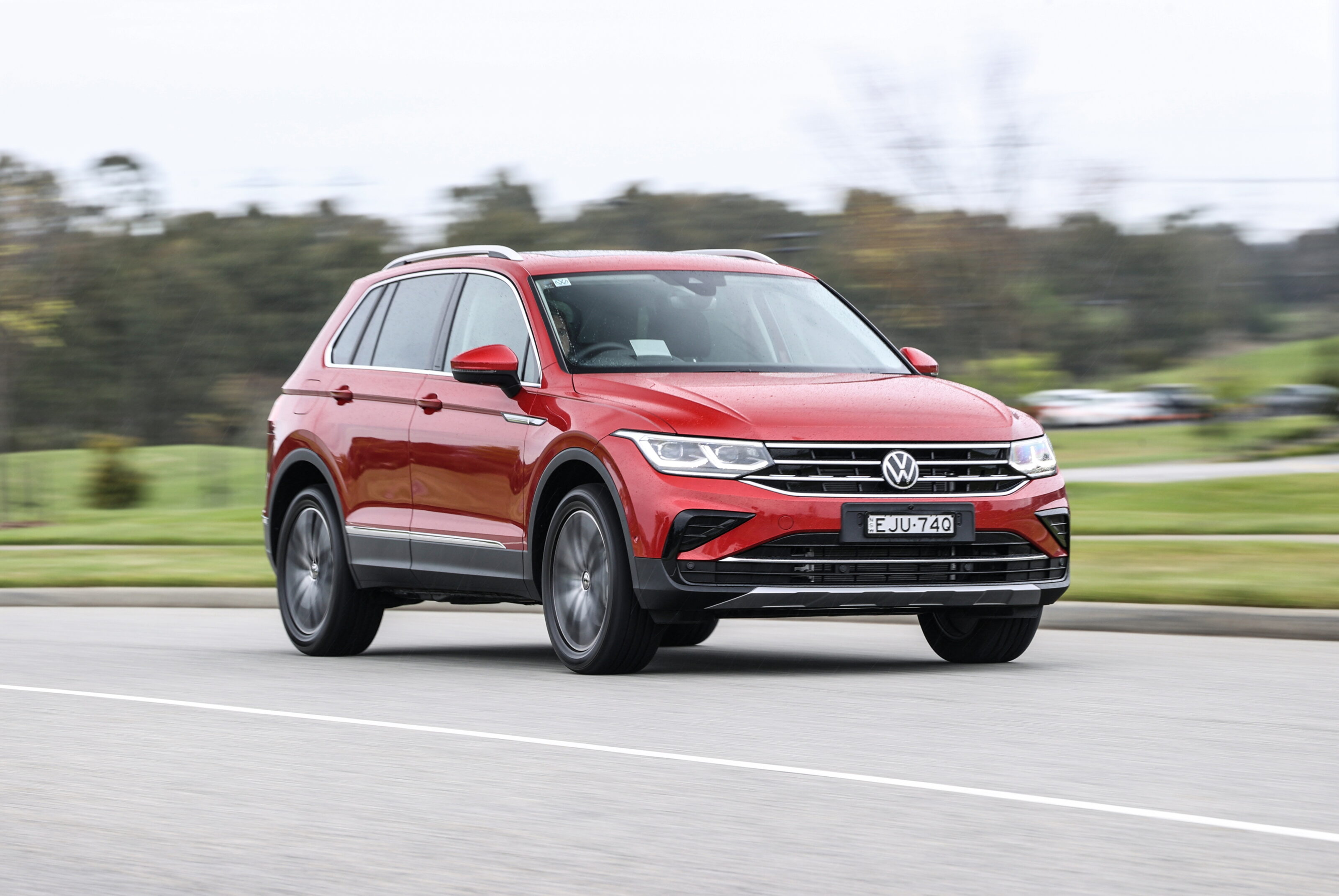
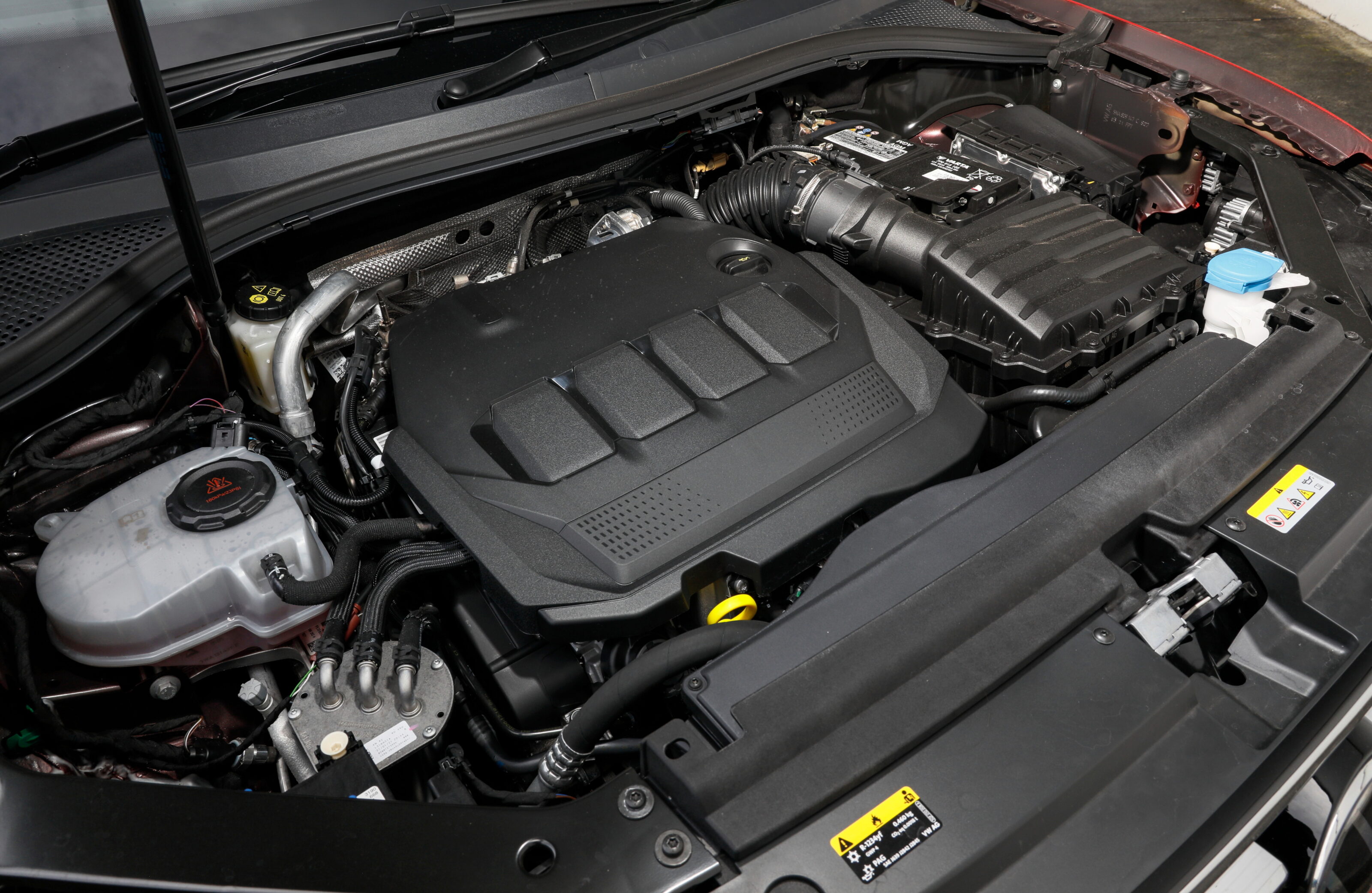
The Tiguan 147TDI Elegance is powered by a 2.0-litre turbo-diesel, mated to a seven-speed DSG (dual-clutch transmission), producing 147kW of power and 400Nm of torque. It has got more than enough oomph to dart around the suburbs and is a perfect match for those lengthier road trips we had all stored up in our ‘Distant Memories’ box.
Its turbocharged diesel engine is pretty punchy and although you might expect it to be noisy too, its rumblings are kept well and truly in check, no matter if you’re on higher-speed roads or just pottering around town. In fact on the freeway, it’s a really docile unit that proves just how far diesel donks have come in terms of refinement.
Wind and tyre noise are kept impressively low too, making for an altogether relaxing drive.
That plentiful spread of torque makes it an excellent cruiser and ensures freeway overtakes and constantly varying speed limits are a breeze to negotiate. You never feel like you’re wanting for more. It’s quick off the line too, not bogging down or showing any noticeable turbo lag.
Cornering is undertaken with ease; it handles well with a decent amount of traction thanks to its all-wheel drive, has well-judged brakes and feels composed with little body roll. Yes, this is a family-sized SUV, but it’s a very capable one at that. Fun to hustle along too, especially in Sport mode.
When you are looking for a more sedate drive, though, the DSG transmission is at times too keen to change down at lower speeds, for example entering a roundabout, when we’re sure it could still hold on to the same gear and make use of the torque on offer. This can make for what is an otherwise smooth and relaxing experience to feel somewhat interrupted.
The rest of the time, it’s business as usual, with super-fast shifts, especially in manual mode.
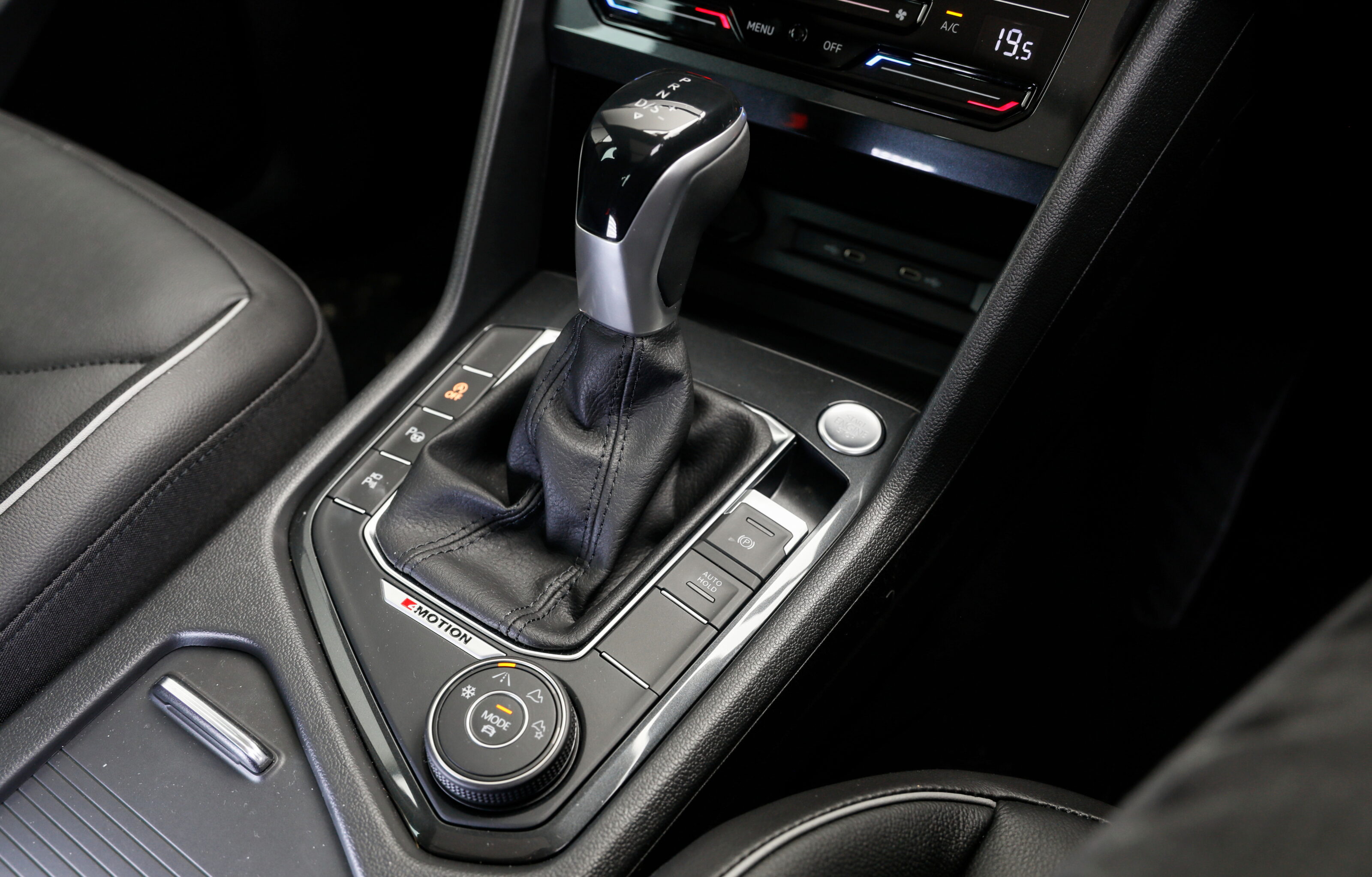
Though the steering isn’t that light, it doesn’t ever feel too heavy either; it feels comfortable and communicative whatever mode you’re in, with the most noticeable difference being in Sport mode where there’s a much heavier sensation. We preferred to keep this particular setting in auto, even when on the twistier roads.
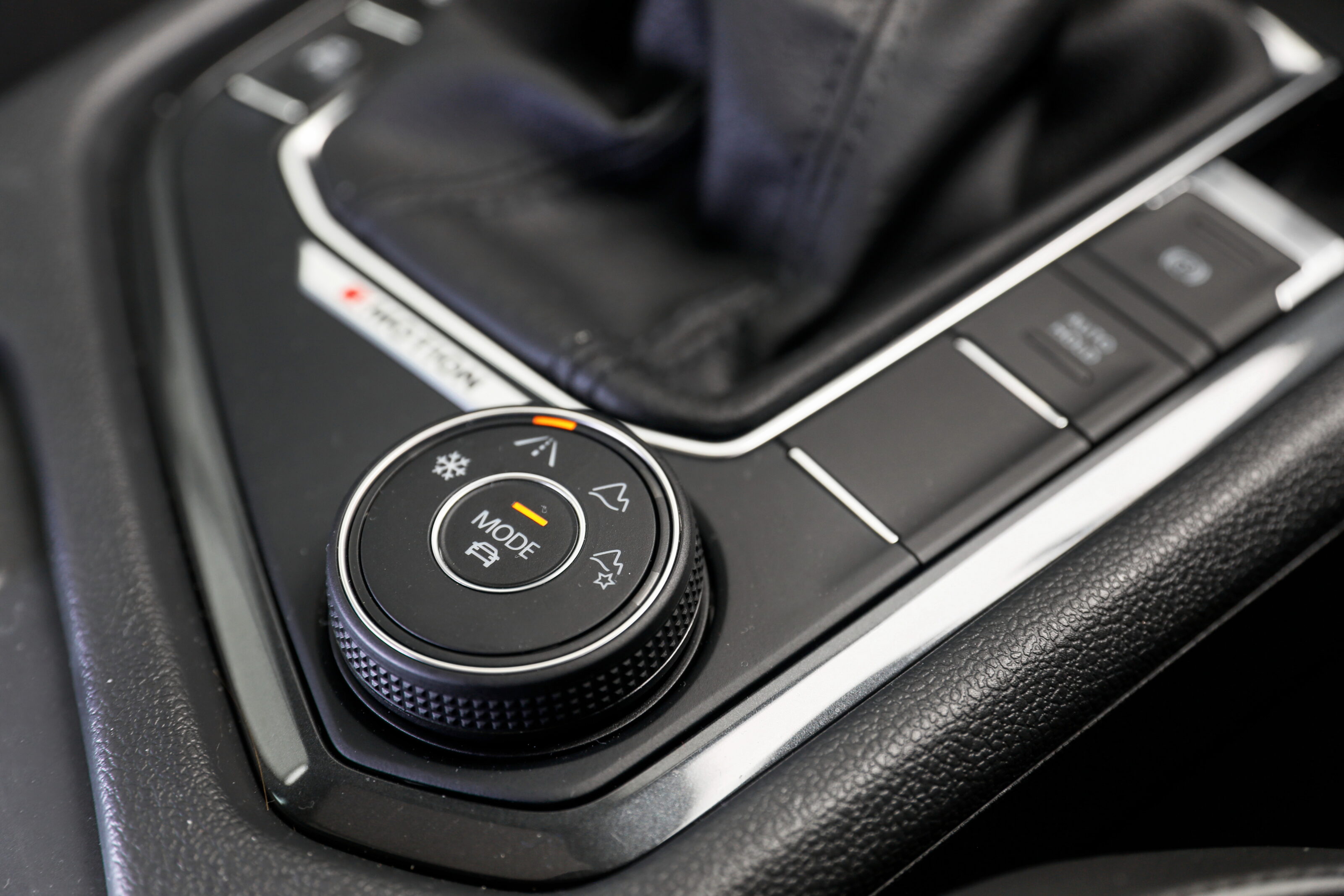
There’s only one obvious area in which this car lets itself down, and that’s the suspension. Despite having VW’s Dynamic Chassis Control (DCC), which electronically adapts the dampers dependent on the drive mode you select, the ride can be very bumpy on all but the smoothest of surfaces, particularly on pothole-ridden roads like the Monash Freeway or other major metropolitan highways.
Even switching to Comfort mode doesn’t seem to make much difference, with some fairly harsh feedback being a common occurrence. It’s not consistently unpleasant but is noticeable if the road surface is poor.
Officially rated at 6.1L/100km on the combined fuel consumption cycle, we’ve found the best fuel economy we could achieve was 5.4L/100km – which is pretty impressive, though during the time we had the Tiguan the performance ranged from this figure up to a high of 6.5L/100km.
Compared to its competitors, on paper, it offers similar results – with the Mazda CX-5 claiming 5.7L/100km (combined) from the mid-spec Touring or GT variants, both of which come with a 2.2-litre diesel engine and six-speed auto transmission.
When it arrived with us it had a full tank quoting 920km – plenty of driving range in the real world and almost enough to get you from Brisbane to Canberra on one fill-up.
There’s only one area in which this car lets itself down, and that’s the suspension. Despite its adaptive dampers, the ride can be very bumpy on all but the smoothest of surfaces.
Putting the Tiguan’s fuel economy figures side by side with the much more popular, segment-leading Toyota RAV4 is trickier, owing to the latter not offering a diesel powertrain. Its 2.5-litre petrol hybrid and 2.0-litre petrol engines (available on both GXL and Cruiser mid-range variants) are rated at 4.8L and 6.5L/100km respectively – though only the hybrid is AWD.
Though it is not the version we have under review here, the Tiguan 147TDI’s turbo-petrol twin, the 162TSI, offers 8.5L/100km combined.
Safety
The Tiguan comes with a host of active and passive safety systems across its line-up – which are all standard with the exception of the 4Motion all-wheel-drive system with hill descent control, which is not available on the front-drive-only Life variant.
Highlights include:
- Travel assist (replaces traffic jam assist)
- Front assist with pedestrian monitoring
- Lane assist with adaptive lane guidance
- Emergency assist
- Adaptive cruise control
- Side assist
- Rear cross-traffic assist
- Park assist
- Front and rear parking sensors
- Driver fatigue detection
- Reversing camera
- 360-degree proactive occupant protection.
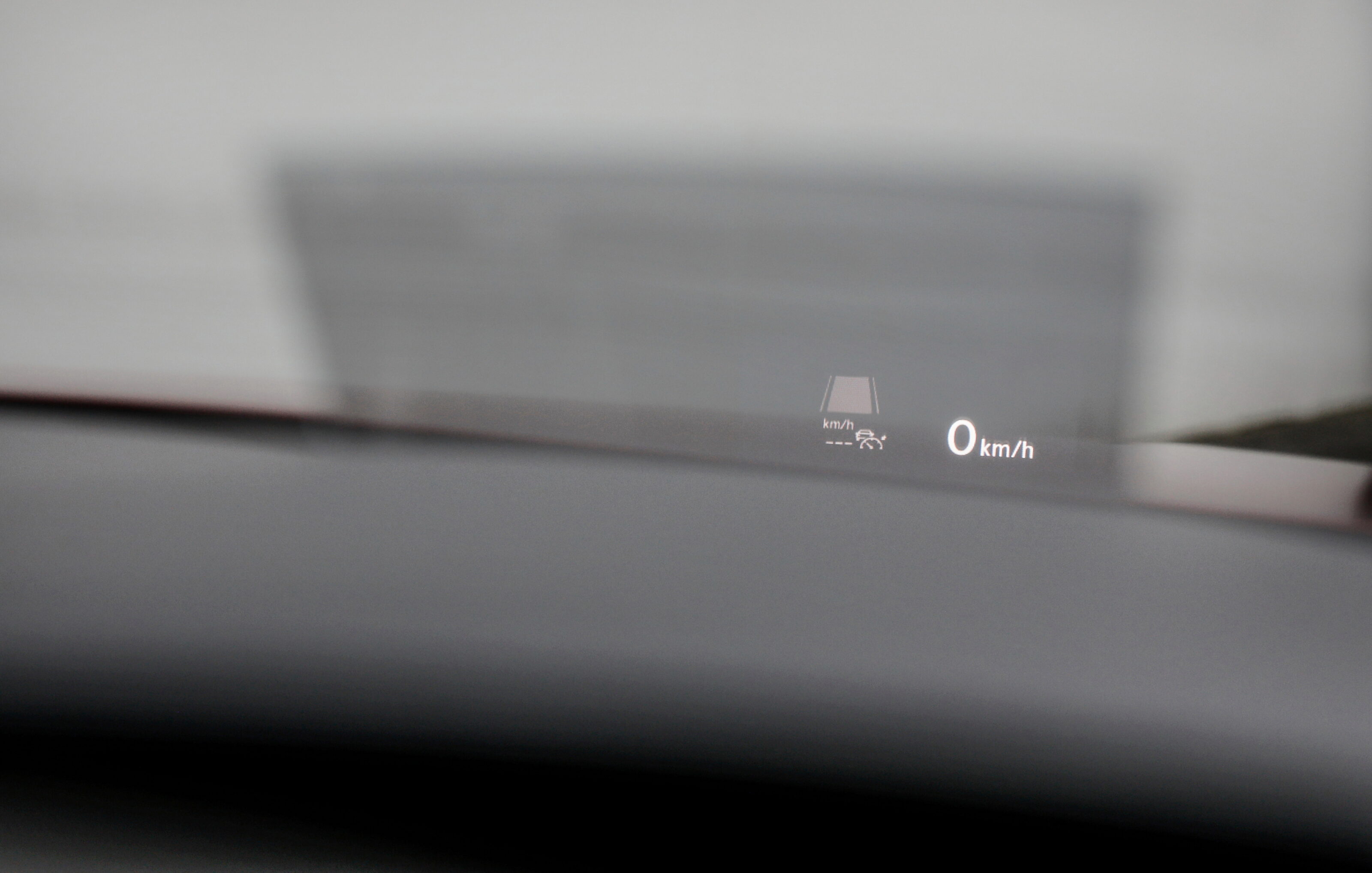
Fortunately, we didn’t have cause to test this, however, the safety features that did present themselves worked very well.
The lane assist gently drew the vehicle back into the middle of the lane if we came too close to leaving it without making any sudden, jerky movements – or using a loud and annoying alarm noise.
Equally, the adaptive cruise control performed so well that we almost didn’t notice it. The controls on the steering wheel are intuitive and not at all fiddly, making it simple to set up without taking your attention away from driving, while the way it adjusts itself based on how fast or slow the car in front is moving is incredibly sophisticated.
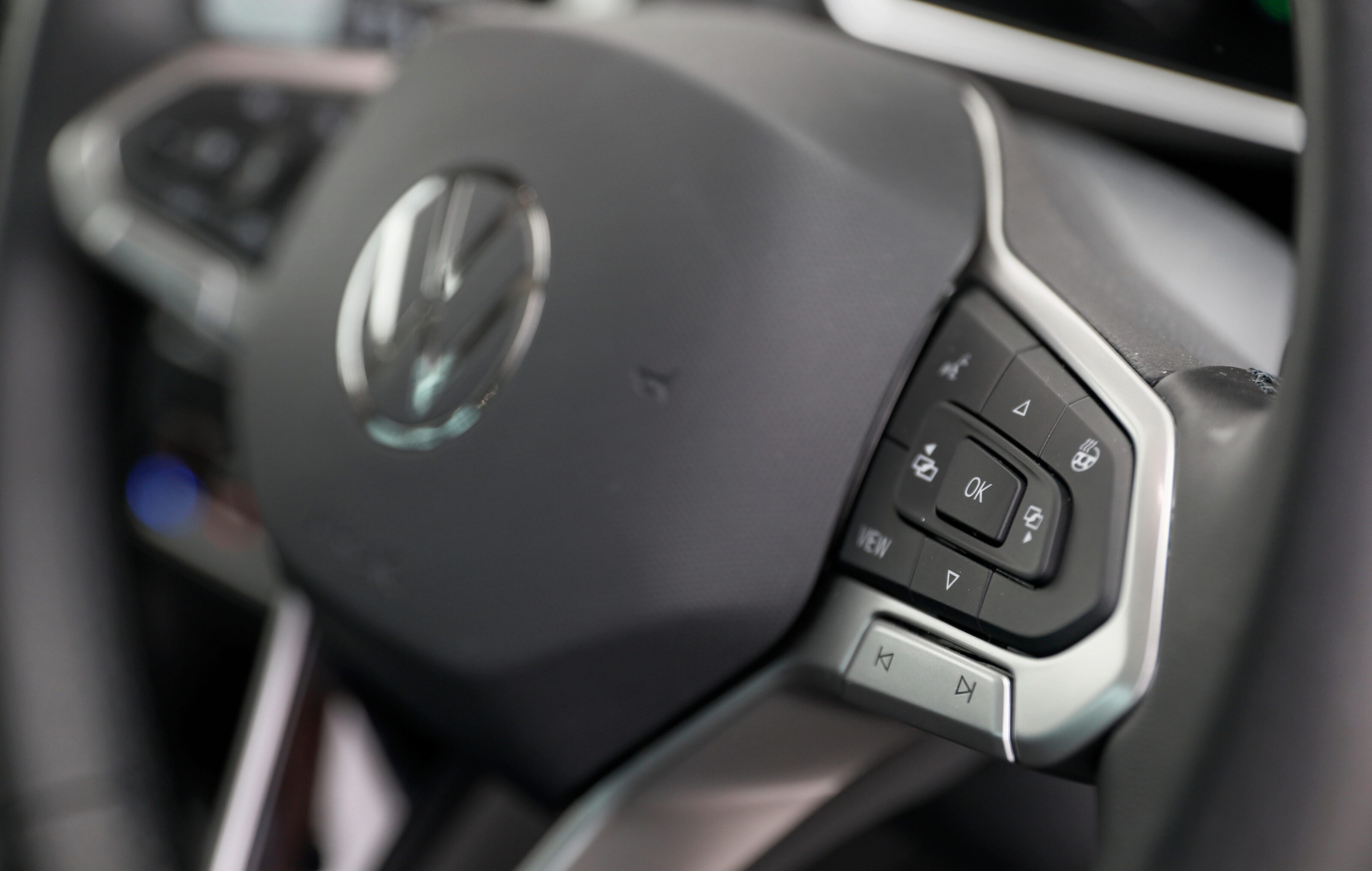
What the Elegance misses out on with this feature is the ability to adjust the speed by increments of 1km rather than just 10km at a time which we would have found useful. This is, however, available on the range-topping R-Line.
The Tiguan has a five-star ANCAP rating, awarded in 2016.
All Volkswagens come with a standard five-year/unlimited-kilometre warranty – with capped-price servicing every 12 months or 15,000km. VW’s three-year care plan will set buyers back $1200, rising to $2400 for the five-year version.
VERDICT
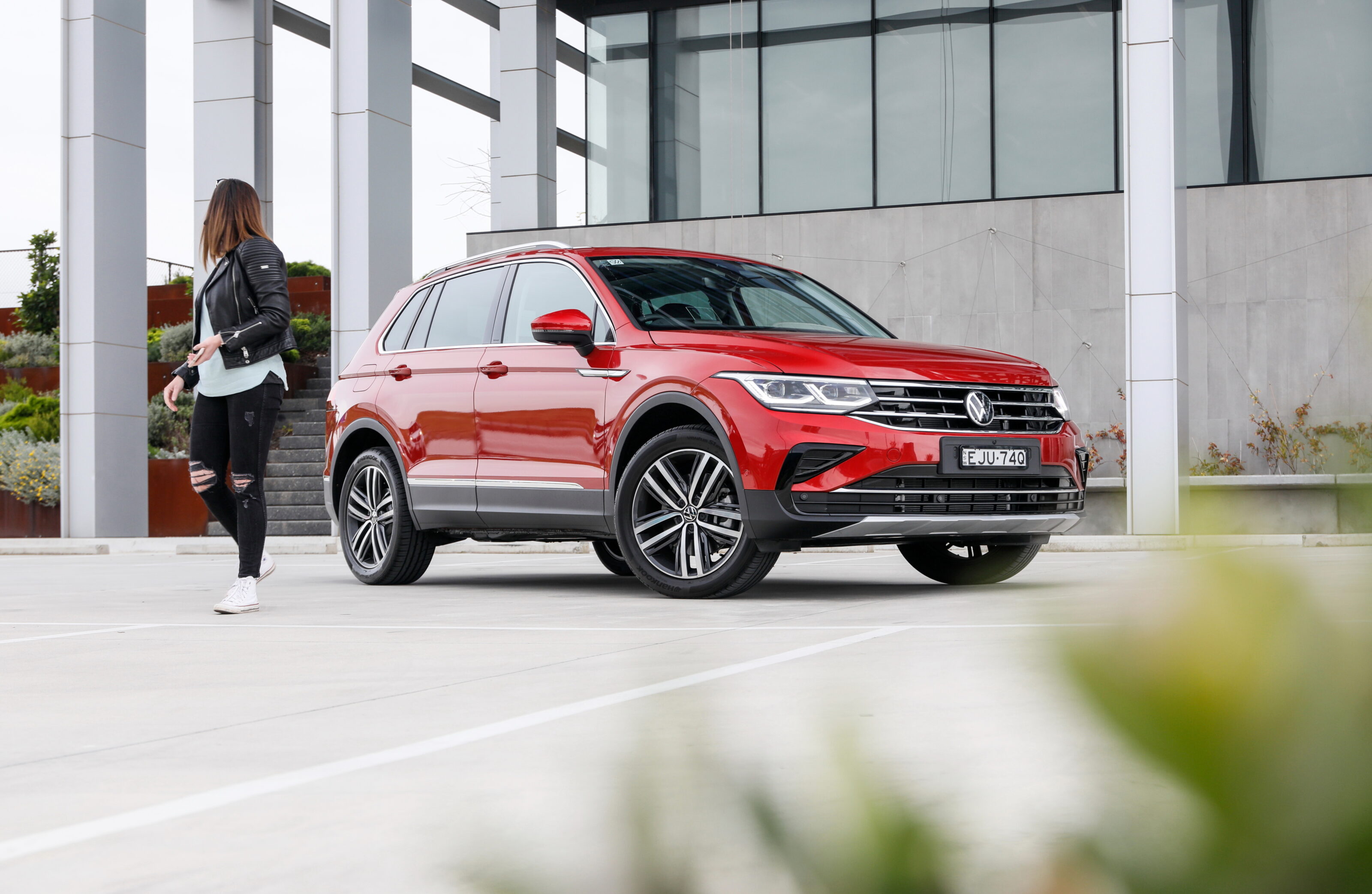
There’s a good reason the Tiguan is not just Australia’s favourite VW, but also the brand’s best-selling vehicle globally – it delivers everything the modern family needs and wants.
It’s an incredibly capable daily driver with impressive fuel economy, oodles of space and practical storage solutions. There are also plenty of finer touches and gadgets that many new-car buyers want, without the hefty price tag of a premium badge.
Out of the Life, Elegance and R-Line variants, we’d stick with the mid-range Elegance 147TDI. It gains several creature comforts over and above the Life, and although many of these can be optioned on the base Tiguan, we really liked the punchy 2.0-litre diesel that unfortunately isn’t available on the lower grades.
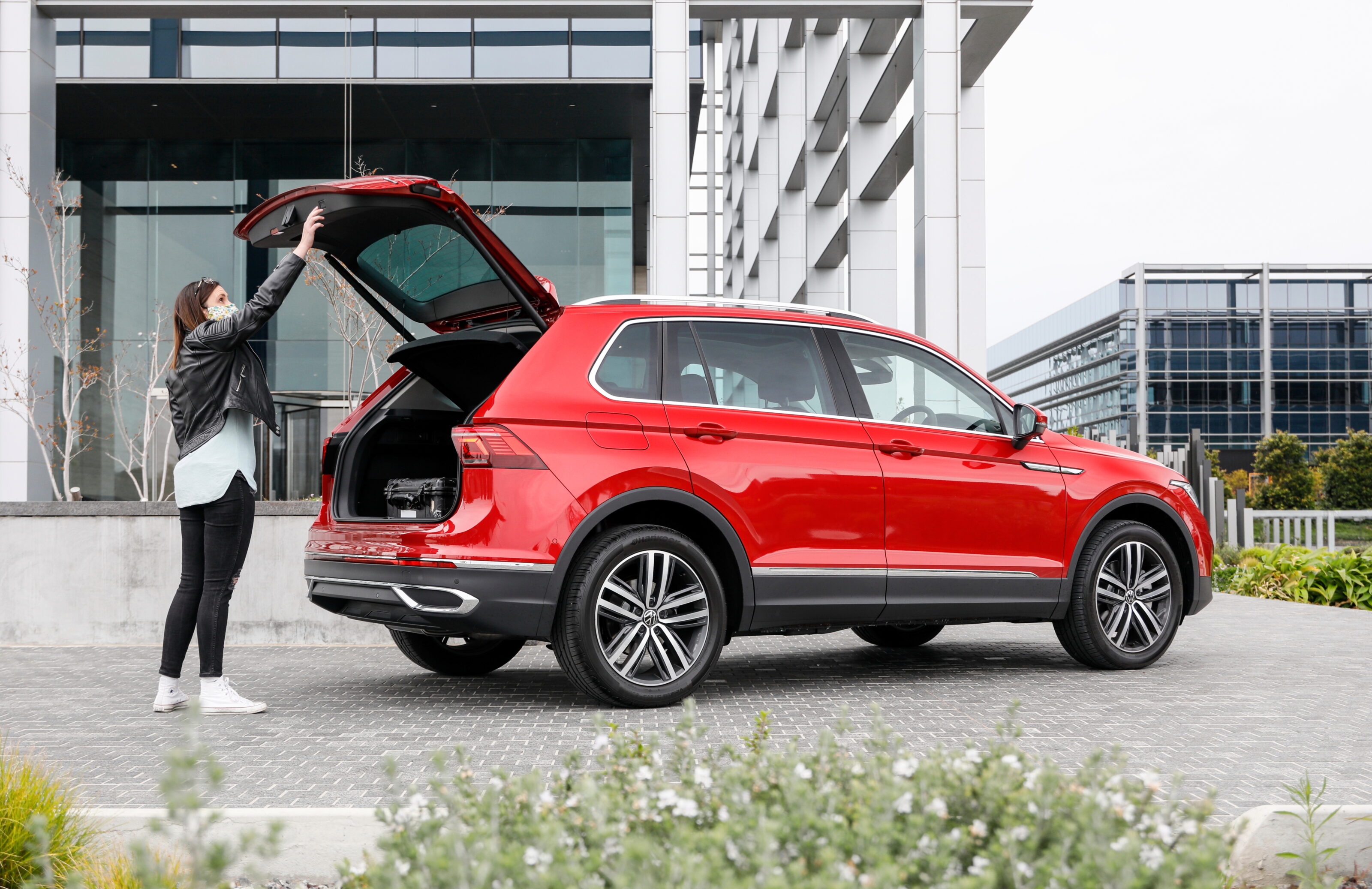
Equally, the added spec the R-Line gains is mostly trim-related and the Elegance doesn’t miss out on any major equipment, so we don’t feel we’d need to upgrade to really enjoy this car.
The Tiguan’s Elegance 147TDI is listed at $53,290 before options (which bumps up our car’s as-tested price to $58,290) and on-road costs.
By comparison, mid-range spec variants from its rivals – the Toyota RAV4 (as a 2.5-litre AWD in either GXL or Cruiser guise) is $47,430/$51,073 and the Mazda CX-5 Touring or GT (both AWD) are $46,081/$52,031 ( all drive-away).
While these competitors are cheaper, they are not necessarily equal on spec (only the range-topping RAV4 Edge variant having an optional sunroof for example) so we’d advise doing extensive research before making any purchase decision.
