
Australia is shaping up as a fertile test market for China as its auto industry opens up to the global market. Chinese electric vehicles in particular are set to change the global automotive landscape as the industry gears up for exports. More desirable vehicles from China, combined with State-based EV incentives here as Australia’s charging network continues to expand, combine to make our low-volume market more attractive.
By 2025, the Chinese auto market plans to be truly open as it begins to export as part of its World Trade Organisation obligations. Goals set out in 2018 included development of its supply chains, greater competitiveness and a focus on EVs to lead the industry by the end of 2020. This also saw the need for development of ‘world-class’ brand identities from the hundreds currently operating domestically.
Tactically, caps on foreign investment have been lifted, while its focus on EVs sees China – which clearly leads the world in battery tech – poised to swoop as many incumbent carmakers struggle to adapt. The industry openly acknowledges the need to consolidate the number of brands in order to be better placed for global expansion.
Privately owned, entrepreneurial-led brands including BYD, Geely and Great Wall Motors, all of which have a presence here, are among those best positioned to exploit Australia as a test market in a similar way that Norway has been used to enter Europe.
BYD passenger cars will go on sale in Australia in 2022 through local importer, Nexport. BYD’s unique Blade batteries are lithium-iron phosphate, as opposed to lithium-ion – meaning they don’t rely on cobalt and nickel, and are supposedly less prone to overheating.
Famed for investors including Warren Buffett, in addition to batteries BYD produces electric buses, garbage trucks and other commercial vehicles. It set up an office in Sydney in 2015, where it’s had several experimental taxis operating.
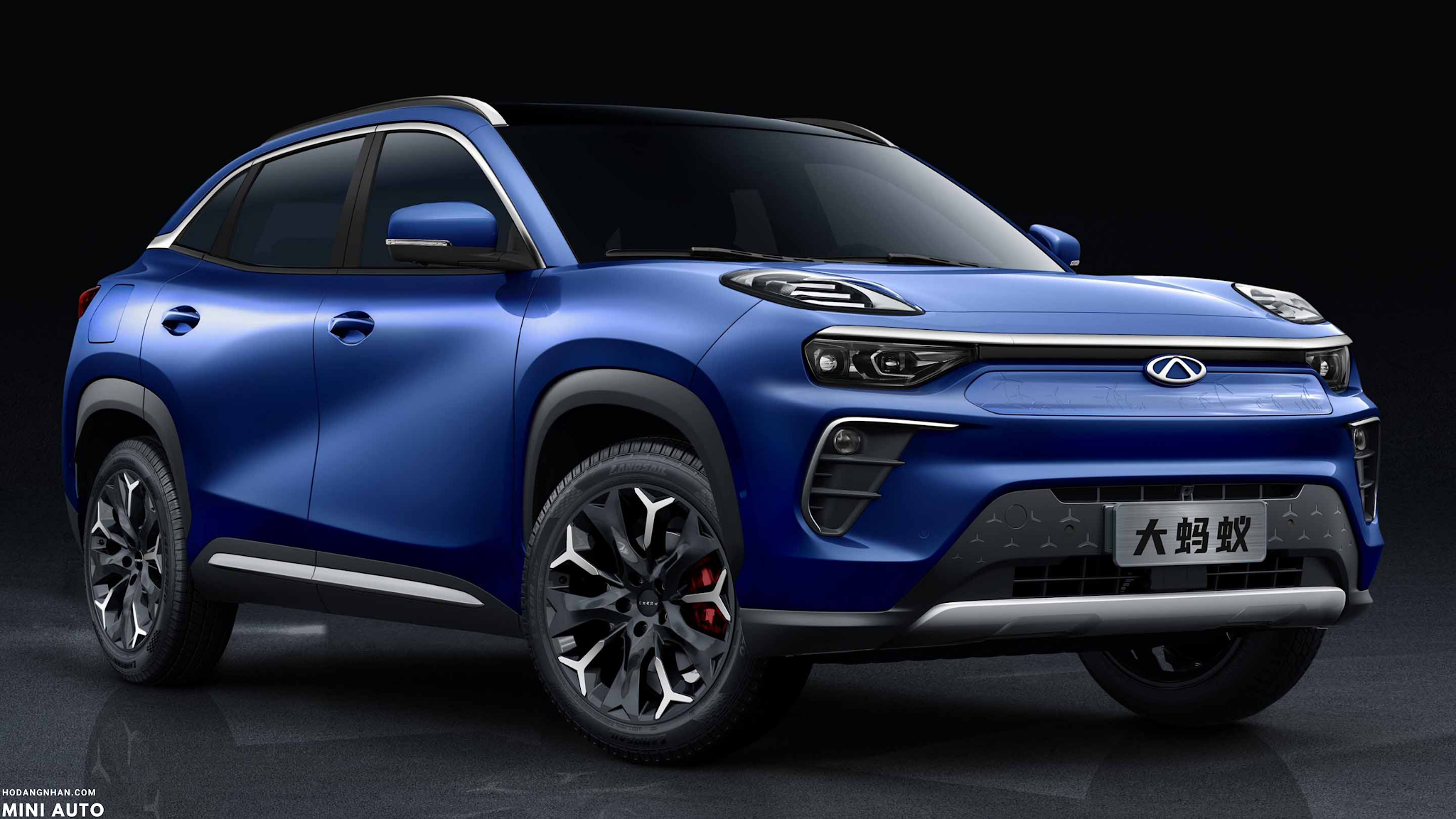
“BYD is a closed eco-system – they make the cells and the cars, and their cell technology is targeted at the entry level to mid-market price point,” says Bill Russo, Founder and CEO of Automobility, based in Shanghai. “BYD could be a player, because they could bring a whole eco-system, and the energy supply chain of Australia would be attractive, not just the market.”
Australia’s relatively tiny volume of 1m annual sales seems trivial compared to China’s market, which sells around double that each month. Also, China’s auto industry has scalability, something that Tesla has taken advantage of by exporting to Europe from China. Yet EV success right now isn’t about sheer volume.
“That’s where we are at globally now with the electrification,” says Russo. “It doesn’t have to be the biggest [market], it has to be the only one that’s growing. When that is the only one that’s growing, then the capital markets start to pivot, rewarding the growth story and penalising the other story. And that’s where ICE is today.”
Norway is a prime example, with ICE vehicles banned from 2025. Despite a market even smaller than Australia’s, significant Chinese brands including NIO and BYD entered the Norway market in 2021, following SAIC’s MG and NIO’s parent company, XPeng, among others.
“There you’ve got a domino effect, where the first domino falls, and the cars of Norway might find their way circulating through the European Union. You’ll see them,” Russo explains. “In Australia, that’s never going to happen.”
Australia’s isolation as an island may not be as attractive as Norway’s roads into Europe, and right-hand drive is also a hindrance. State-by-state EV incentives and varying taxes don’t make entry any simpler, either, but are the start of an inflection point.
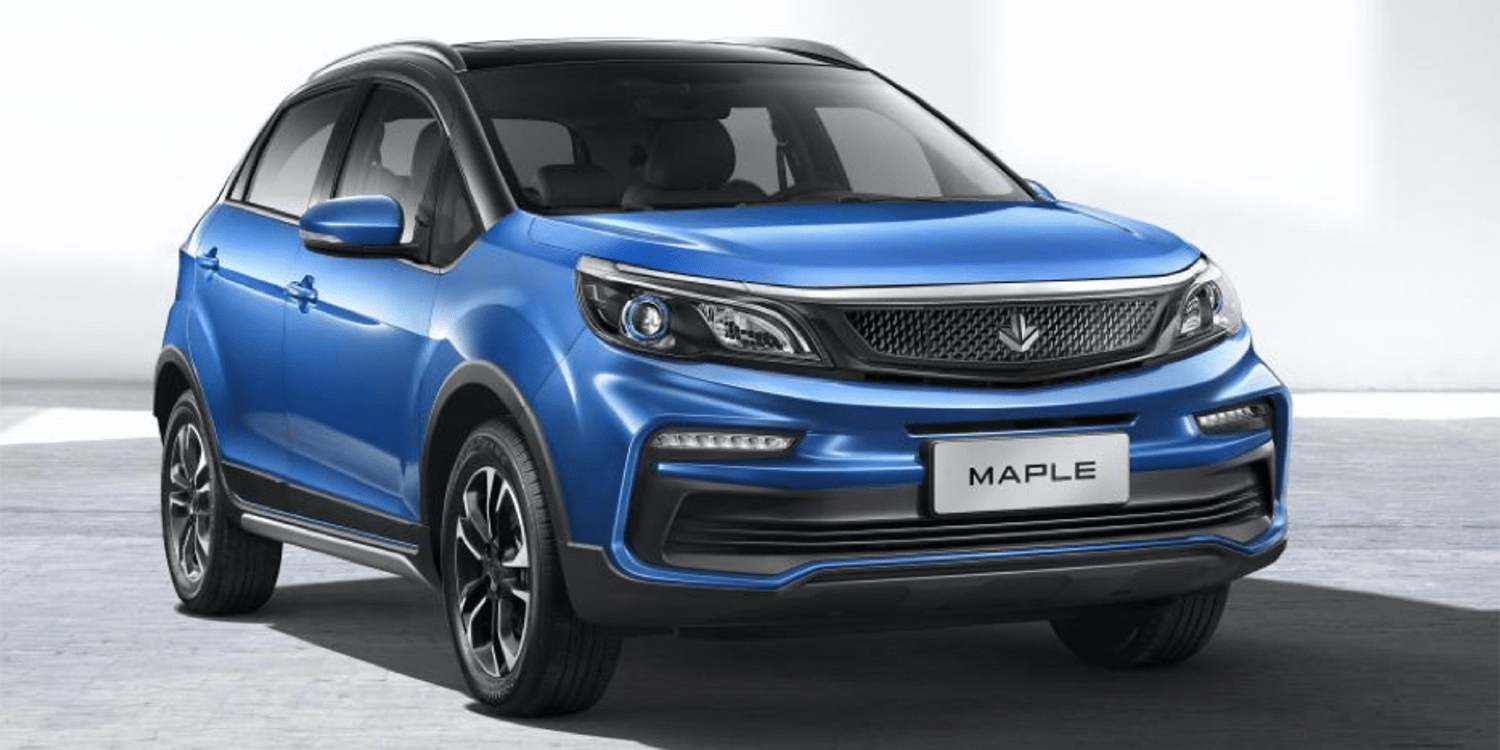
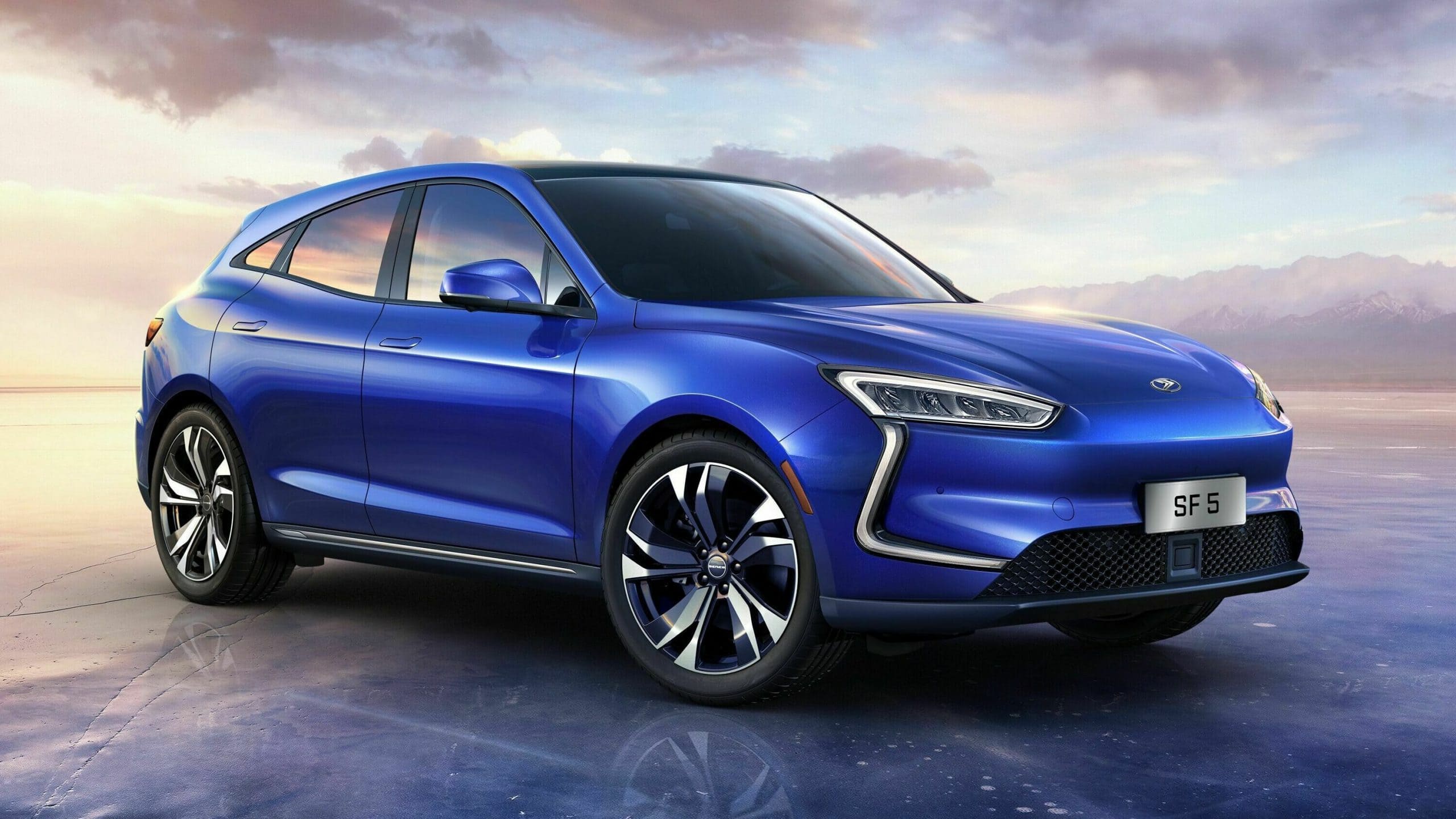
Yet Australia does have upsides. Ours is a mature market that’s a blend of European and US-market tastes. Where Chinese brands may be unable to gain a foothold, such as Central Europe or North America, Australia may serve as the next test bed to set the course for larger Western markets.
“If you hope to be global, you need other examples [beyond Norway] to tout,” says Russo. “Chinese brands need to be able to show that they can not only be present in Western markets, but in markets that are mature. So I think when Chinese companies look to markets like Australia, they’re asking if there is an entry point for them to create enough of a marketable success story that they can sell back to Chinese consumers.”
That entry point may be on the horizon, and it may be BYD that swings the balance. Australia signed an FTA with China in 2015, leading to LDV, MG as well as both Great Wall and its Haval brand entering the local market. BYD’s 2022 arrival – expected to be exclusively EVs – will be another litmus test for Chinese carmakers.
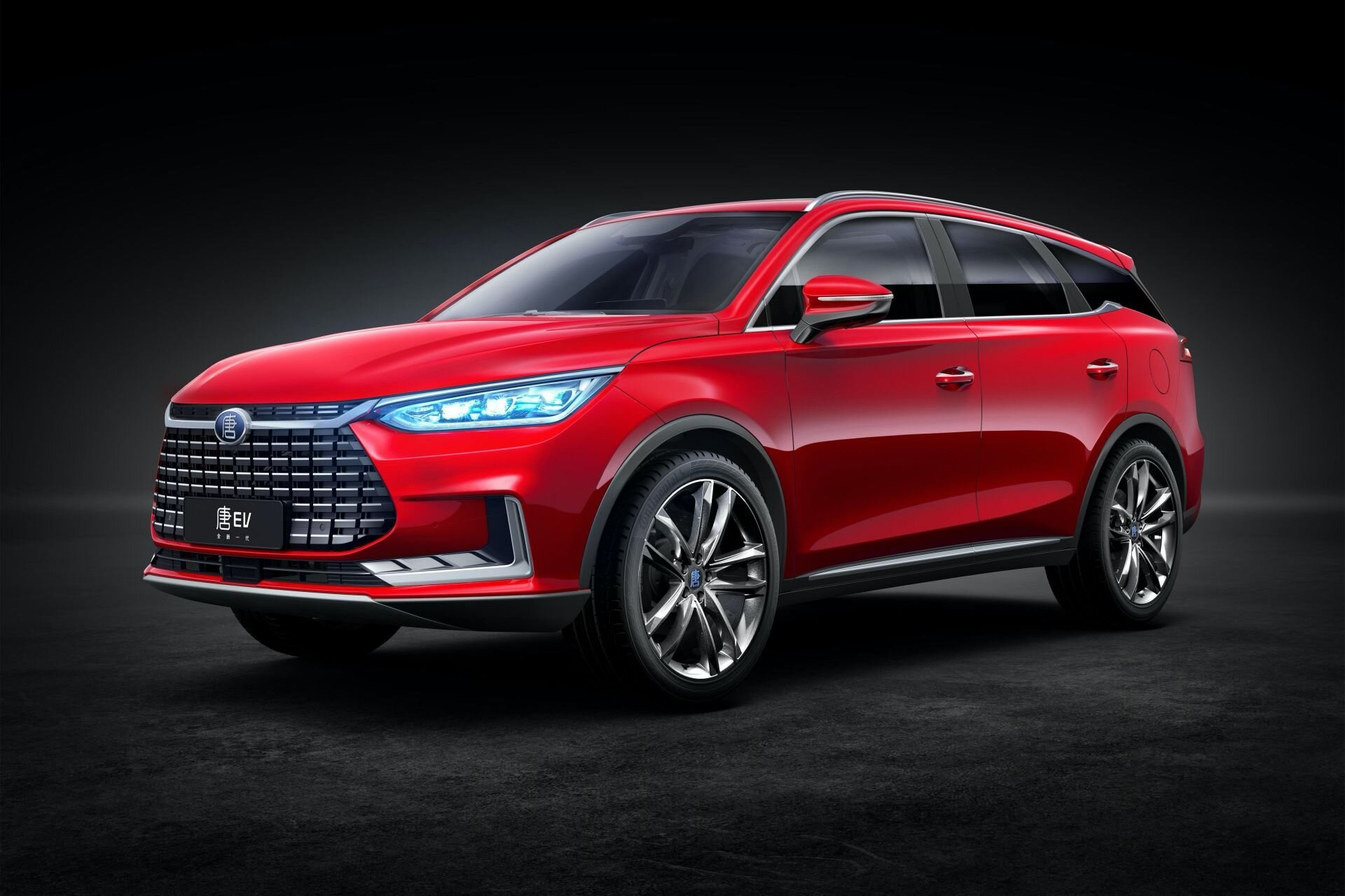
BYD sold more EVs than any other brand in China in September 2021, moving 36,000 units. Its latest model launches, the Tang SUV EV and Han D-segment sedan, were designed under the lead of ex-Audi designer Wolfgang Egger, while the company’s head of interior design is Michele Jauch-Paganetti, ex-Mercedes.
Like BYD, pure EV brands such as Lync & Co, owned by Geely, or its Gen Z-focused Zeekr, will deliver Chinese-made cars pushing desirability and tech. Put simply, they’re being sold on desirability, not cheap and cheerfulness of many underdone Chinese-made cars offered here previously. Another inflection point.
The paradigm shift domestically is well underway, says Russo. “Only a few years ago, if you wanted to find a Chinese brand in a Tier One city in China, you had to get in a taxi or book a DiDi car – not so anymore,” he explains. “Now, EVs are being sold to retail consumers in Tier One cities, because they’re cool. Nio, XPeng – you’re not embarrassed to be an-up-and-coming 20- or 30-something professional in a Chinese electric vehicle.” The challenge is to have Australians feeling the same.
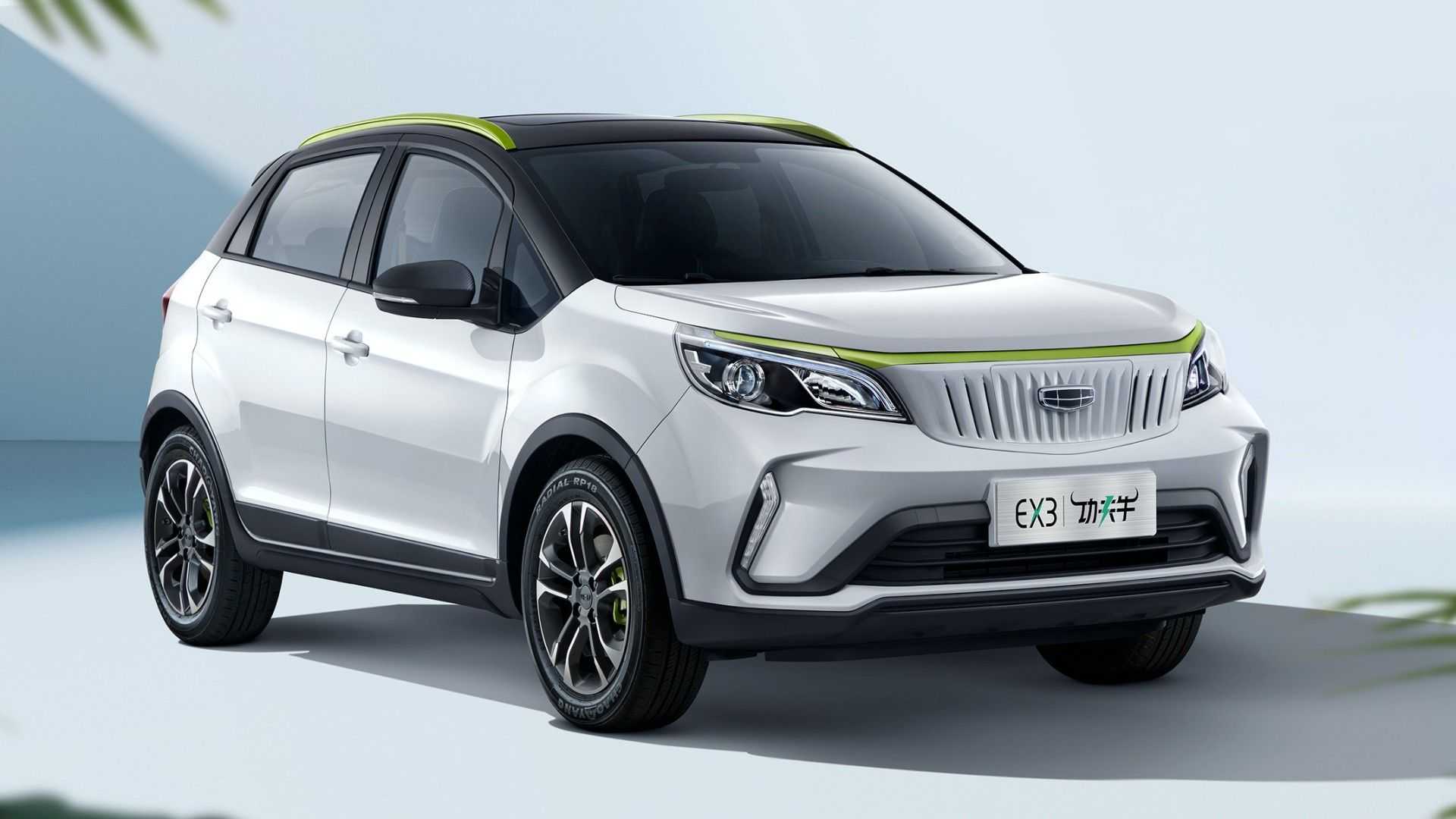
China’s EV Charge
China’s EV market is already larger than Australia’s total new-car market, with 1.105 million pure electric models sold in 2020. That’s been surpassed already this year despite a reduction in subsidies, with a record 1.78 million sold year-to-date by the end of September.
BYD was the best seller of ‘NEVs’ (New Energy Vehicles) which includes hybrid, ahead of EV-only Tesla, while pure EV brands NIO and XPeng broke 10,000 monthly sales in September for the first time.
The Chinese Association of Automobile Manufacturers (CAAM) expects the growth to continue into the final quarter and has tipped NEV sales to hit a record 3,000,000 this year, meaning beyond 2.5 million pure EV sales.
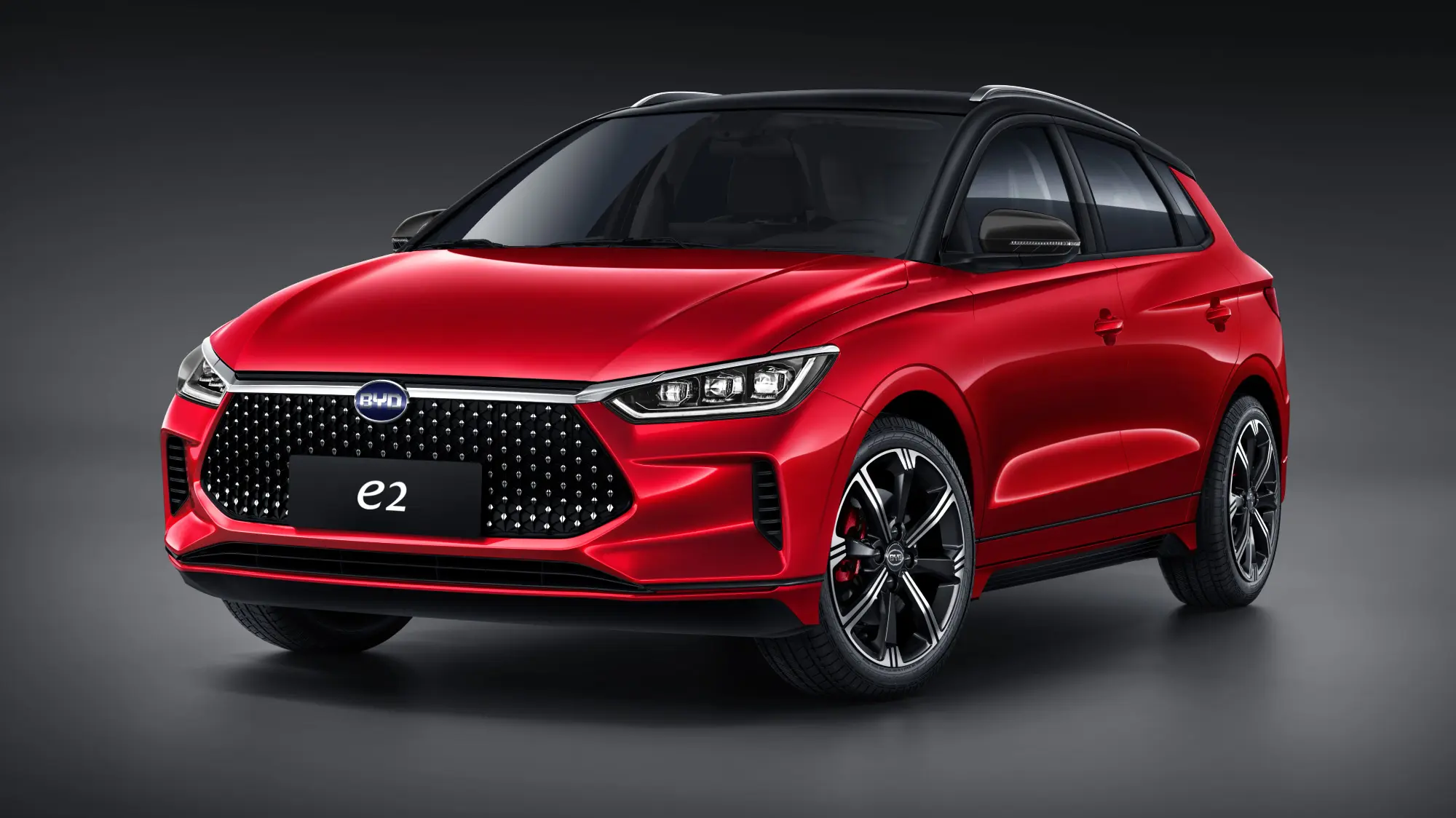
With SUVs accounting for more than half of all vehicle purchases in Australia, the new type of family car is clear.
Manufacturers are keying in on buyer demands, with more and more new car launches consisting of crossover vehicles.
And 2022 is no exception, with our list below showcasing more than 20 SUVs set to launch in Australia in the next 12 months – with just one passenger vehicle that still features jacked-up styling.
Timing issues caused by the global semiconductor chip shortage that plagued the automotive industry in 2021 are set to remain throughout 2022, meaning several vehicles on this list are either delayed beyond initial projections, or could be delayed.
NOTE: To see all the new cars coming to Australia this year, check out our 2022 New Car Calendar story right here.
New family cars arriving in 2022
- Citroen C5 X
- Cupra Ateca
- Cupra Formentor
- Genesis GV60
- Honda HR-V
- Kia Niro
- Mahindra XUV700
- Mazda CX-5
- Mazda CX-60
- Mercedes-Benz EQB
- Mitsubishi Outlander PHEV
- Nissan Pathfinder
- Nissan Qashqai
- Nissan X-Trail
- Suzuki S-Cross
- Tesla Model Y
- Toyota Corolla Cross
- Toyota RAV4
- Volkswagen Tiguan Allspace
- Volvo C40.
Citroen C5 X
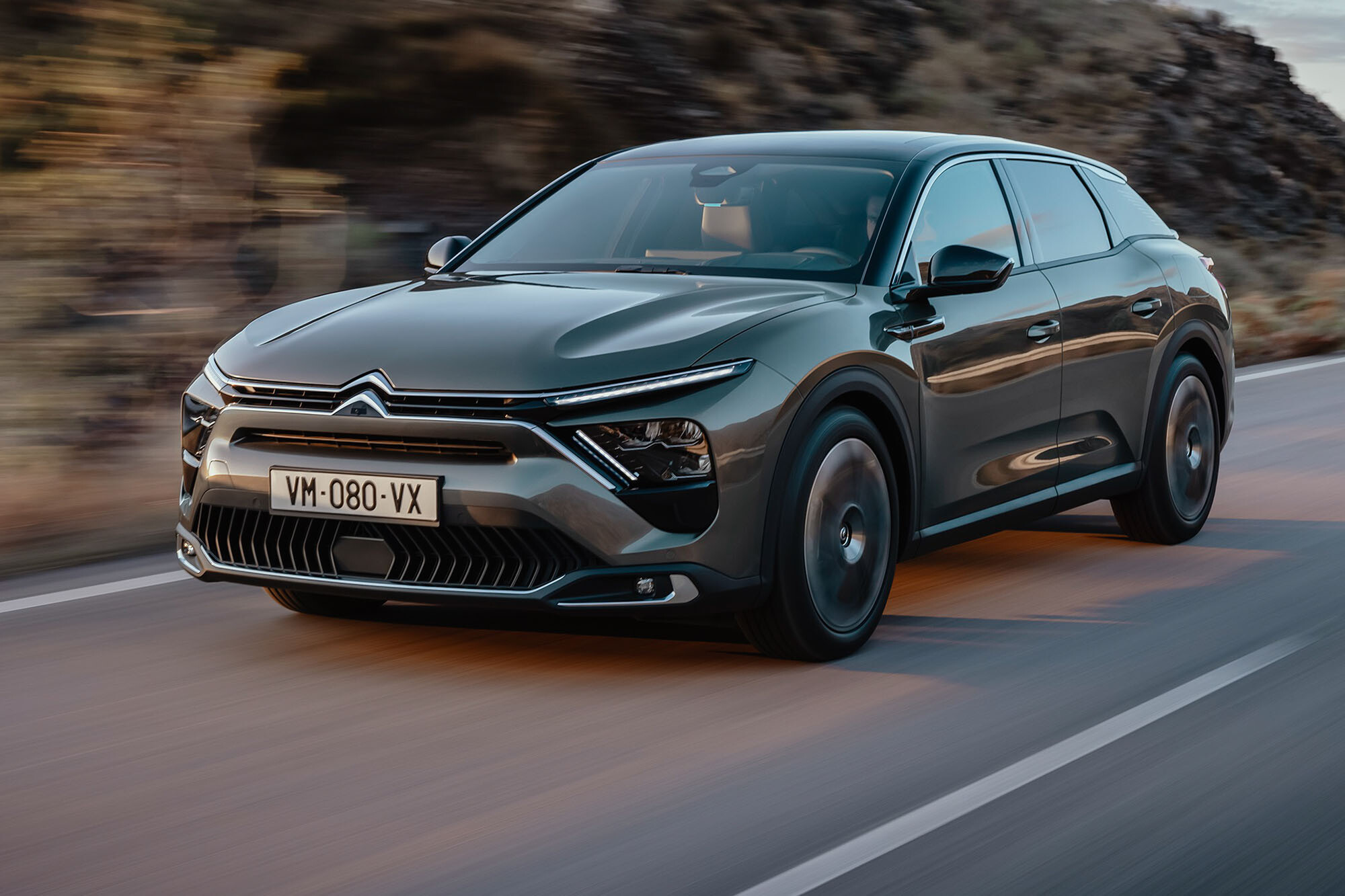
Arriving: Third quarter
According to Citroen, its new C5 X flagship combines “the elegance of a saloon, the dynamism of a station wagon and the elevated stance of an SUV”.
The medium-sized hodgepodge can be chosen with a 96kW 1.2-litre turbo-petrol three-cylinder, a 134kW 1.6-litre turbo, or a 165kW plug-in hybrid (PHEV) version of the 1.6-litre engine used in Europe.
Petrol power is a given for Australia, with the PHEV still under local evaluation.
An arrival in the third quarter has been locked in for the 2022 Citroen C5 X, with further details surrounding pricing and specification expected closer to this date.
Cupra Ateca
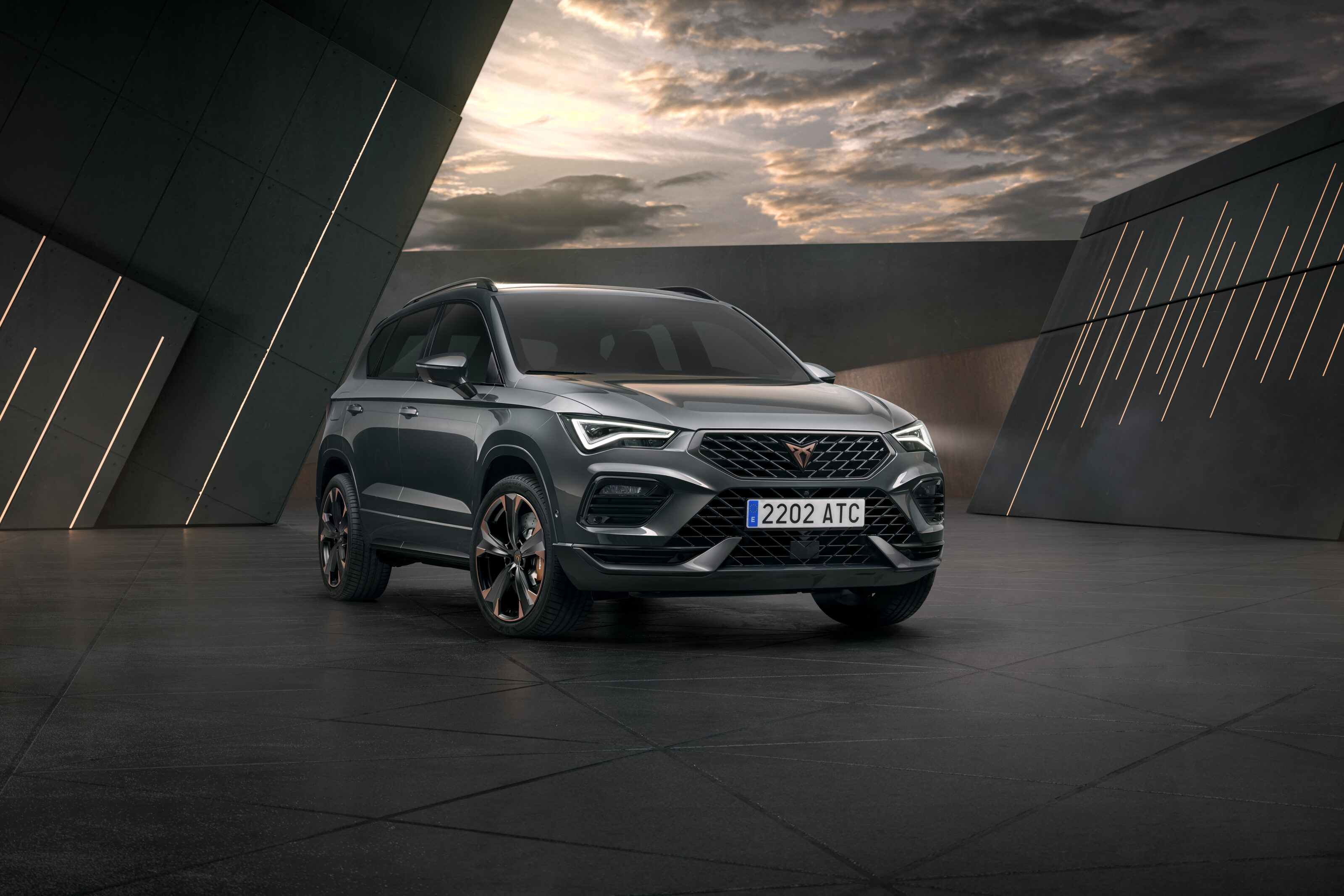
Arriving: Second quarter
The oldest model in the trio of Cupra models, the Ateca mid-size SUV will help to assist with sales as the SEAT performance sub-brand makes itself familiar with the Australian market.
Related to the Skoda Karoq, the Ateca is aimed at family buyers looking for an SUV that can cater to both fun and family-friendly sides. Inside, there is ample room for five and a 485-litre boot.
Exclusively available in Australia with a 221kW/400Nm 2.0-litre turbo-petrol sending power to all four wheels, the Ateca can sprint to 100km/h in less than five seconds.
Full pricing and specification details for the 2022 Cupra Ateca 221TSI 4Drive will be announced closer to the second quarter of the year.
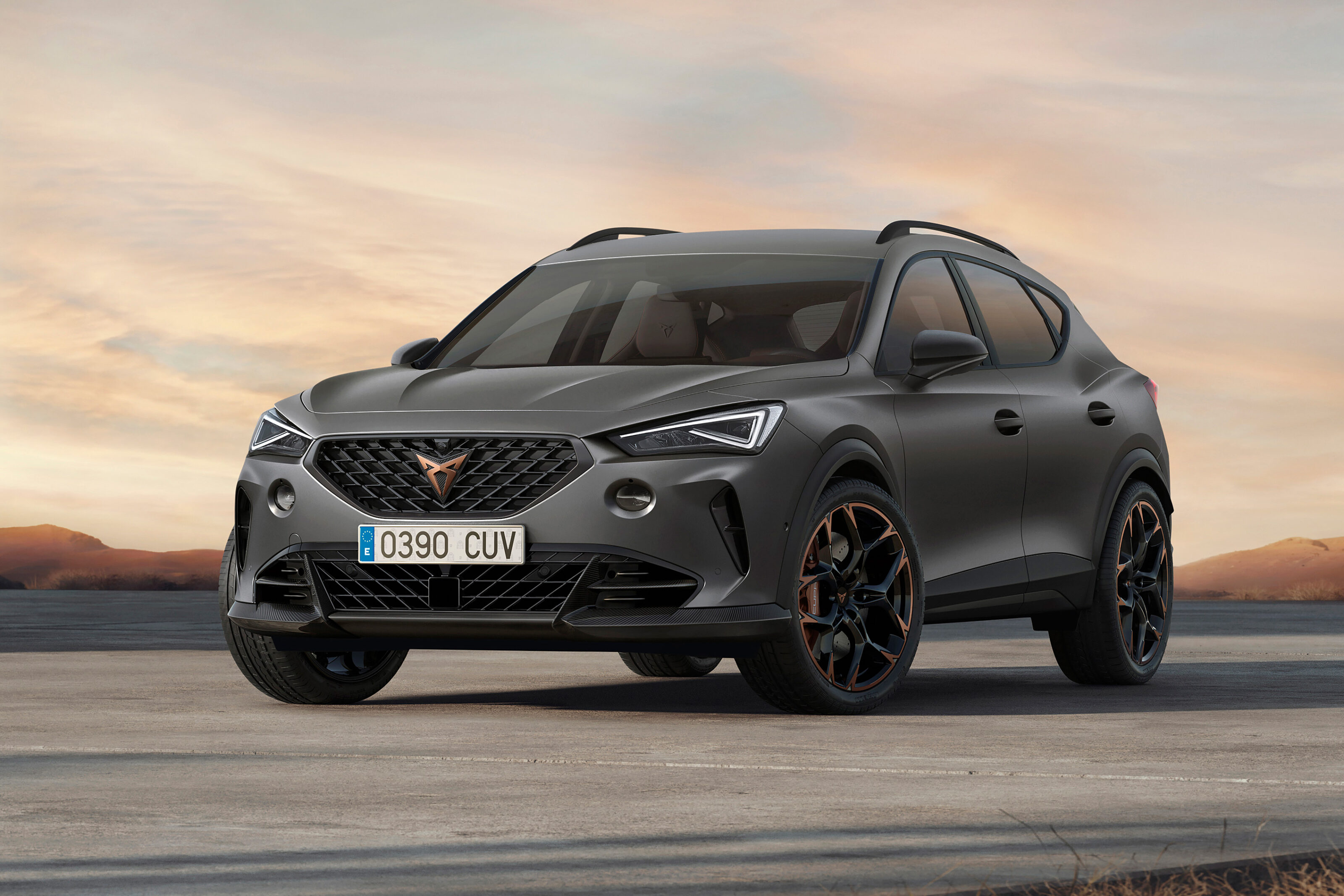
Cupra Formentor
Arriving: Second quarter
The first pure design from Cupra, known as the Formentor, will launch alongside the Ateca and Leon in early 2022.
Three powertrains will be on offer, comprising of a 140kW/320Nm 2.0-litre turbo-four, a 180kW/400Nm 1.4-litre plug-in hybrid (PHEV), and a hotter 224kW/400Nm version of the 2.0-litre mill capable of a 0-100km/h run in 4.9 seconds.
With the aid of a 12.8kWh lithium-ion battery, the Formentor e-Hybrid can travel more than 50 kilometres in electric-only mode, with the PHEV completing the 0-100km/h sprint in a respectable seven seconds.
Each engine will be matched to a seven-speed dual-clutch automatic transmission.
Expect more details surrounding the 2022 Cupra Formentor as we move closer to the brand’s local debut, which is locked in for the second quarter of 2022.
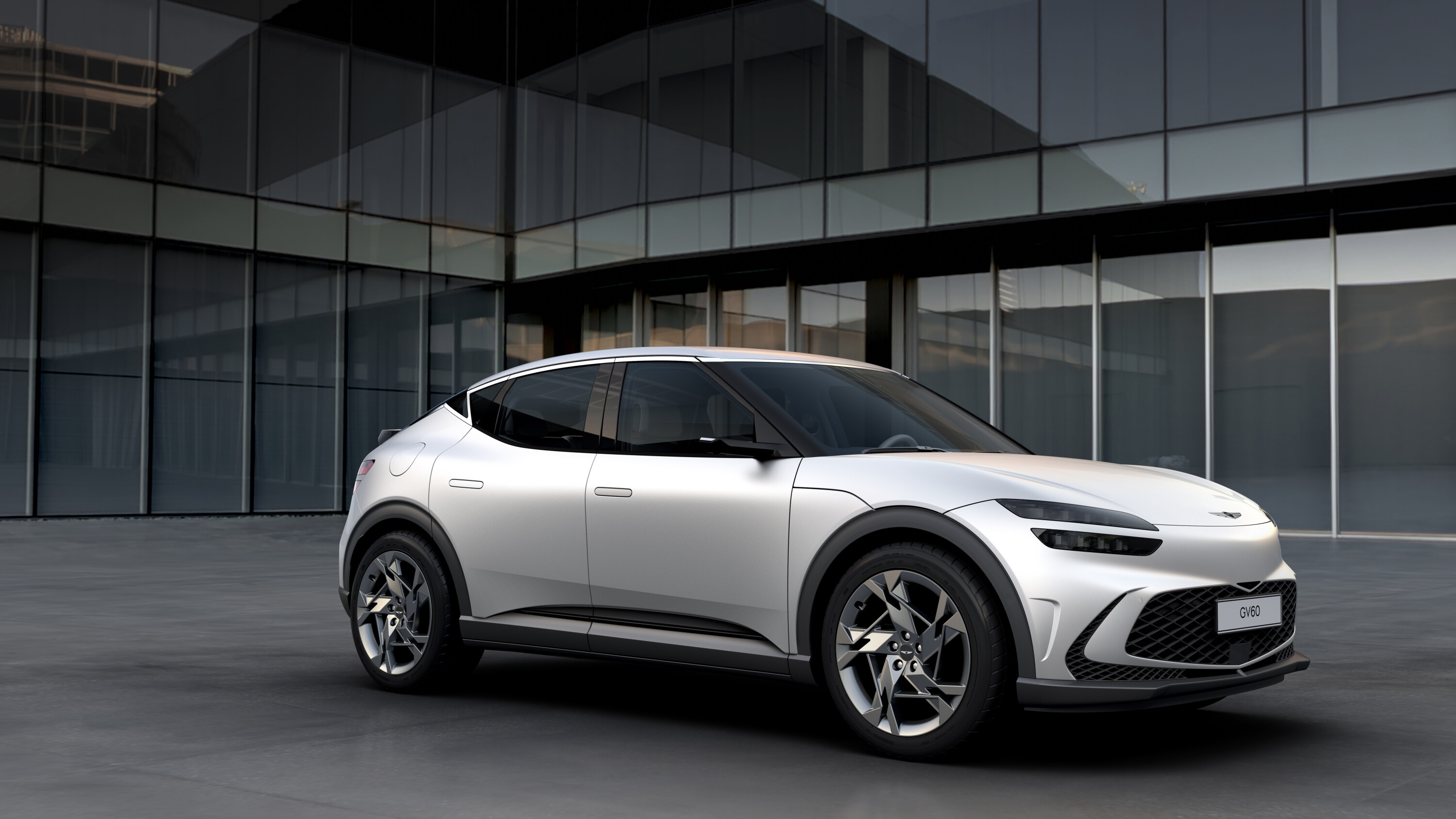
Genesis GV60
Arriving: First half
Meet the first dedicated electric model from Genesis.
Based on the same E-GMP electric architecture as the Hyundai Ioniq 5 and Kia EV6, the Genesis GV60 adopts the brand’s latest design language, headlined by split front and rear lights.
Expect powertrain options to range between a single-motor, rear-drive model with 168kW/350Nm and a dual-motor, all-wheel-drive version with 360kW/700Nm, with up to 480 kilometres of driving range.
Inside, there is a floating centre console, as well as a funky new steering wheel and a crystal sphere gear selector, which can change to a mood lighting system when the car is turned off.
Genesis has confirmed the 2022 GV60 will arrive in the first half of the year, around the same time as the Electrified G80 sedan. Full pricing and specification details will be announced closer to that date.
In addition, another new all-electric Genesis – the Electrified GV70 – will further bolster the family car range of the Korean luxury firm, also in the first half of 2022. You can read more about the GV70 here.
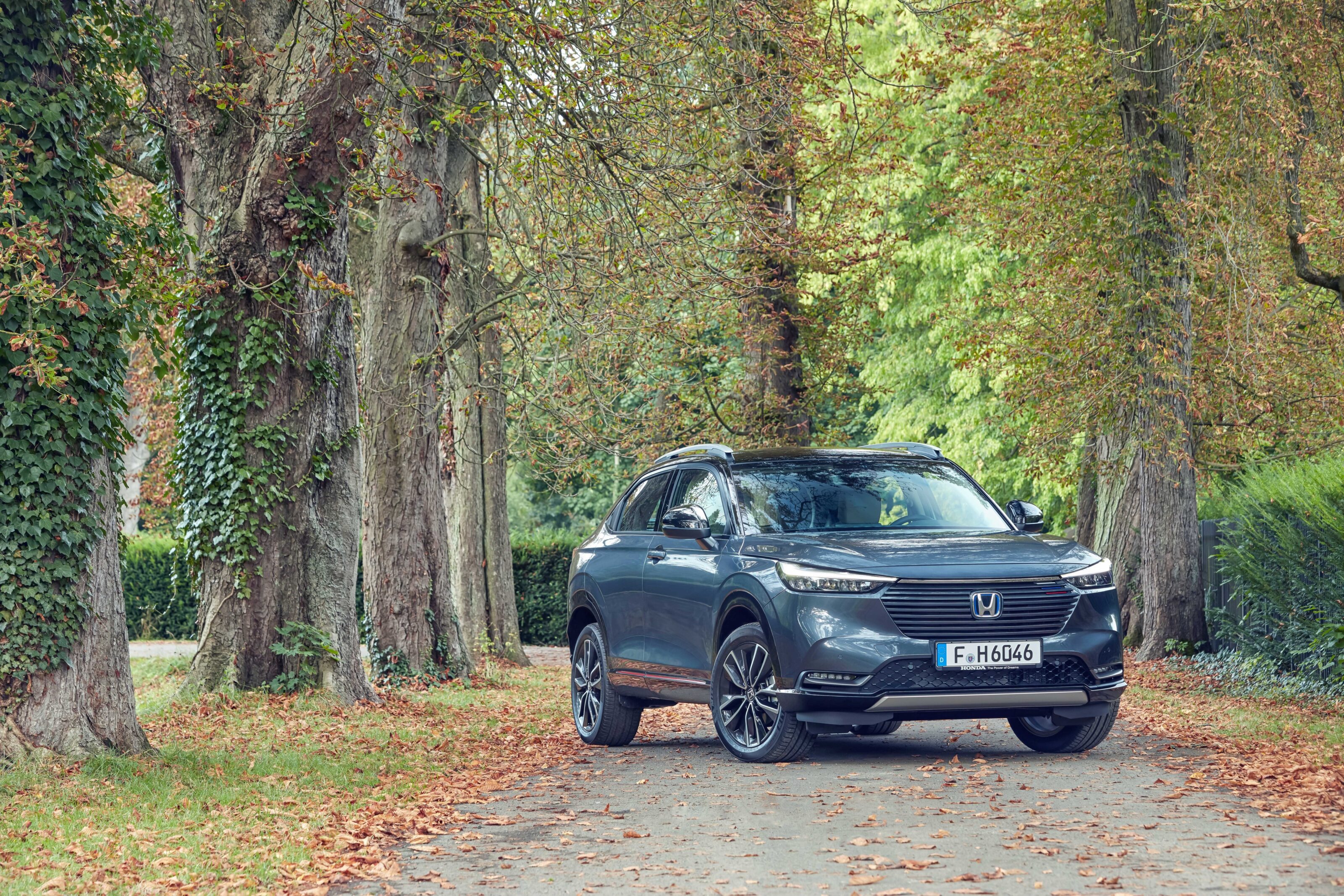
Honda HR-V
Arriving: First half
Yet another small SUV is set to enter a new generation.
The third-generation Honda HR-V is now sourced from Japan, promising a more-refined package to better compete against recent rivals, such as the Mazda CX-30 and the all-new Nissan Qashqai.
More capacious, safer and offering greater flexibility, the HR-V will be offered with the choice of a naturally-aspirated four-cylinder petrol matched to a CVT automatic, or a new e:HEV hybrid powertrain.
Likely shared with the 11th-generation Civic Hybrid, the HR-V e:HEV (don’t say that aloud) combines a 1.5-litre unit with a set of front-mounted electric motors, with a combined power output of 98kW of power and 253Nm of torque.
Average fuel consumption for the hybrid is expected to sit around the 5.4L/100km mark.
The 2022 Honda HR-V will arrive in Australia during the first half of the year, with Honda Australia keen to launch the hybrid version alongside the familiar petrol model. Local pricing and further specs will be announced in the lead-up to launch.
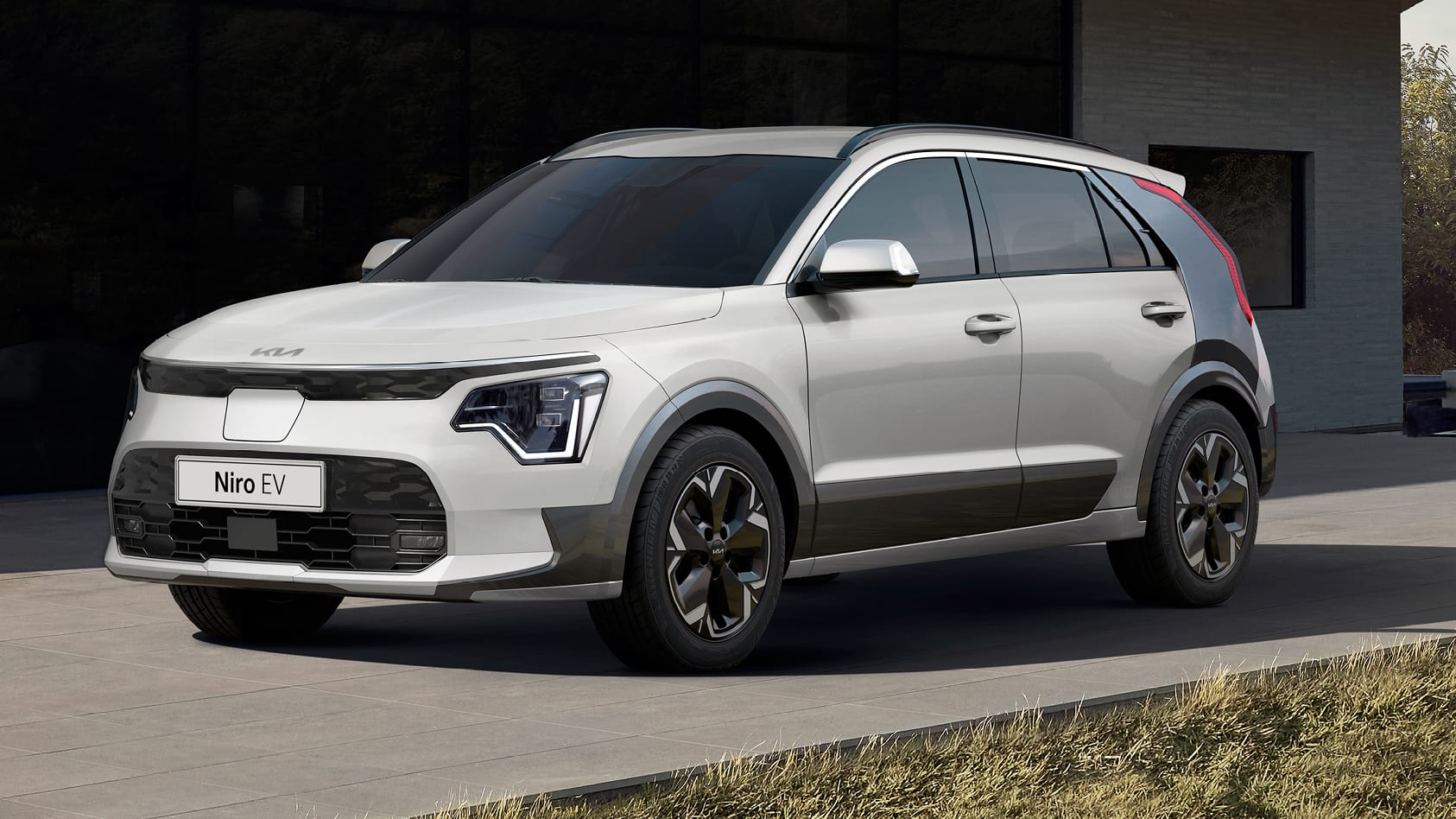
Kia Niro
Arriving: Third quarter
The first-generation Kia Niro first launched overseas in 2016 will be short-lived in Australia, with an ‘all-new’ version set to arrive around 18 months after the nameplate debuted locally.
However, all-new is to be used lightly.
The completely redesigned body is rumoured to sit above carryover powertrains, currently consisting of a 1.6-litre four-cylinder coupled with a permanent magnet synchronous electric motor in either regular hybrid or plug-in hybrid format, and a 150kW/395Nm electric motor in the Niro EV.
Influenced by the EV6 and new-generation Sportage, the updated Niro sports Kia’s fresh ‘tiger-face’ grille design and ‘heartbeat’ daytime-running lights. There is also an interesting design choice for the D-pillar, which has a contrasting colour in comparison to the rest of the body.
Full specifications for the 2022 Kia Niro, both for the global market and Australia, are yet to be announced, but the model is expected to touch down locally in the third quarter of 2022.
Mahindra XUV700
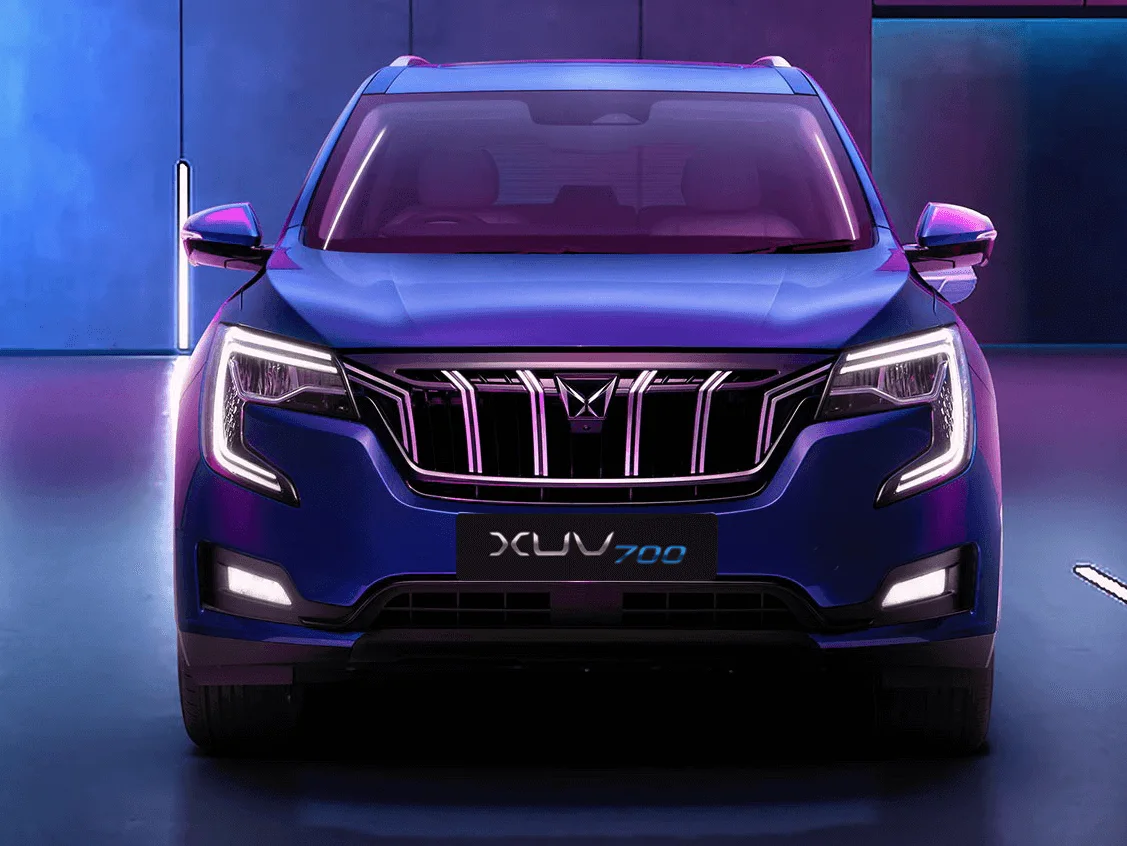
Arriving: Second half
The new Mahindra XUV700 is set for Australia, with the Indian marque confirming it will replace the outgoing XUV500 medium SUV.
Local details are largely unknown, but we can expect a large touchscreen system with built-in Amazon Alexa, a Sony-branded speaker setup, and cabin purification filter technology.
Active safety equipment includes autonomous emergency braking, lane departure warning, lane keep assist, adaptive cruise control, traffic sign recognition and high beam assist.
International powertrain options comprise of a 147kW/380Nm 2.0-litre turbo-petrol, and a 2.2-litre turbocharged diesel engine offered in three states of tune – with the cheapest manual outputting 114kW/360Nm, other manual trims boosted up to 136kW/420Nm and 136kW/450Nm with an automatic transmission.
Both front- and all-wheel-drive configurations are available in India.
Expected to arrive at a higher cost than the outgoing XUV500, which currently starts at $27,990 drive-away, the 2022 Mahinda XUV700 will land in Australia in the second half of the year.
Mazda CX-5 update
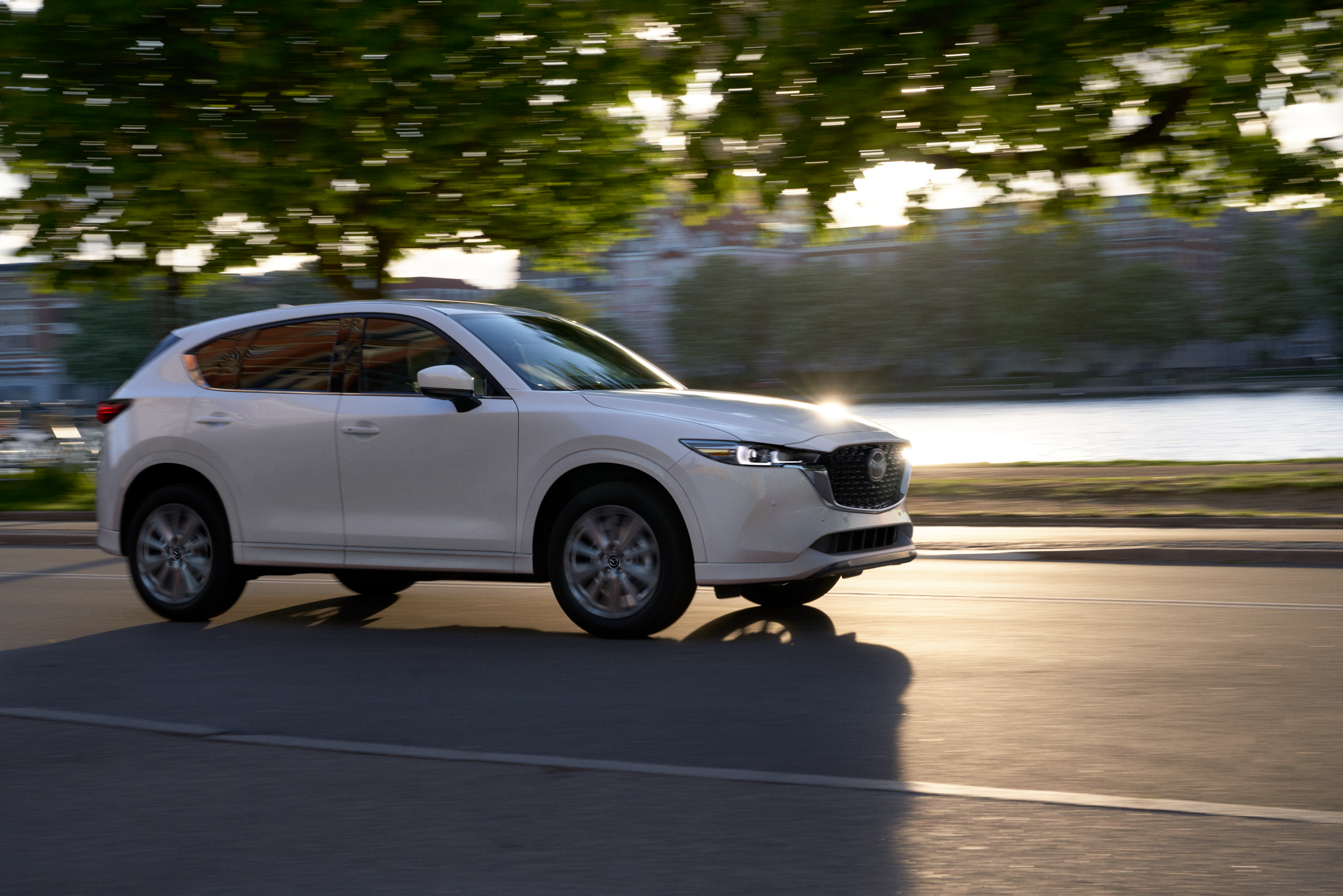
Arriving: March
The updated Mazda CX-5 will touch down in Australia early in the year in a fresh battle against the also-refreshed Toyota RAV4.
First revealed in September, dealer documents seen by Wheels earlier this month have provided our best indication of what is to come for the once top-selling SUV.
A rugged Touring Active variant will be added, while the GT and several AWD trims have been culled from the range, and a new powertrain option is included for the upcoming model-year.
These discontinued options are the CX-5 Maxx petrol AWD, Maxx Sport diesel AWD and Touring diesel AWD.
Each grade will also gain additional equipment, with the range-topping GT SP and Akera variants both picking up a unique look – with gloss black accents on the former, and body-coloured cladding on the latter.
The facelifted 2022 Mazda CX-5 is expected to touch down in Australia in March, with price increases of up to $2000 expected due to the additional standard kit.
More information is expected in the coming weeks.
Mazda CX-60
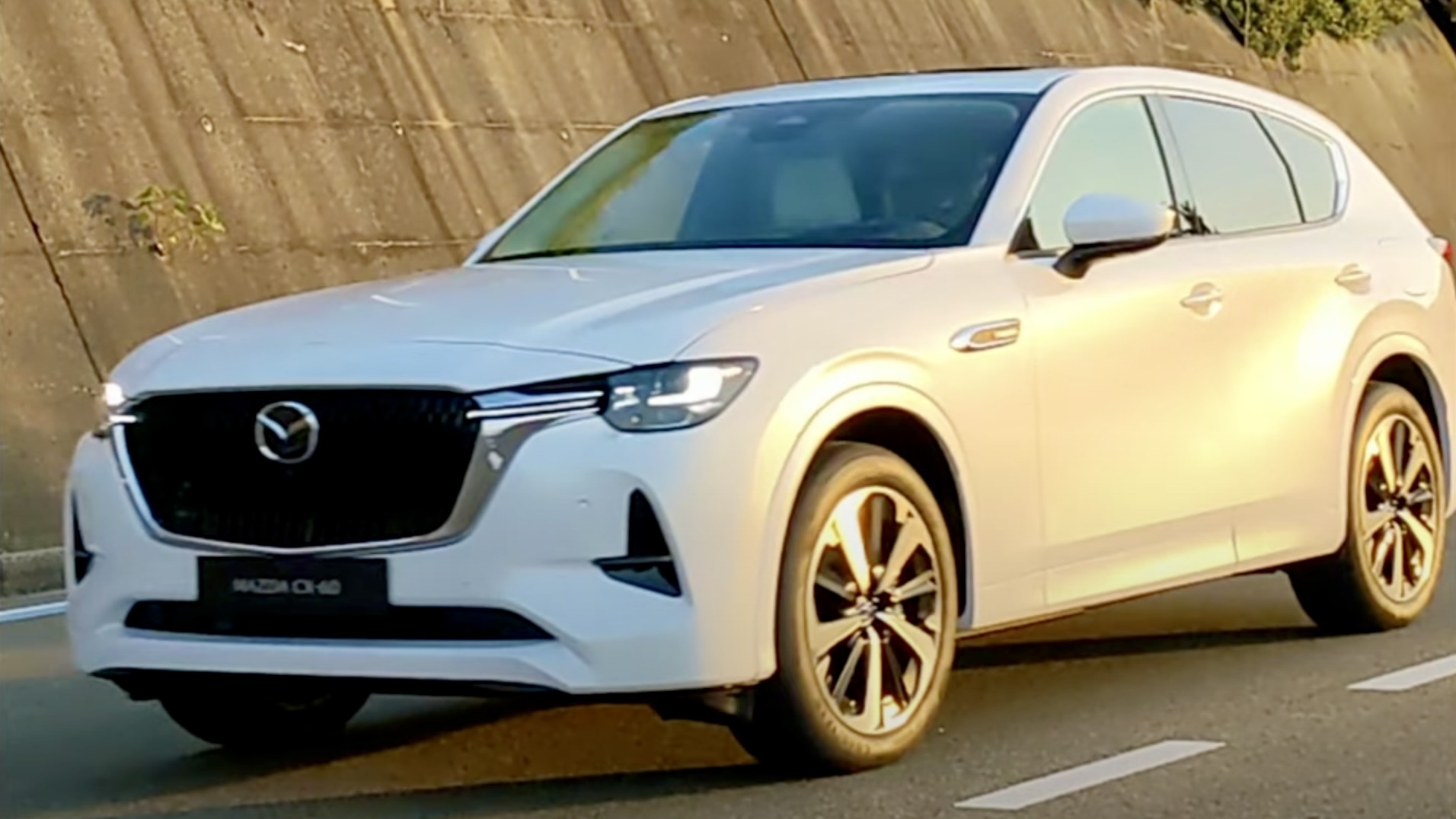
Arriving: Second half
The first Mazda SUV based on a new rear-drive architecture is near.
Positioned between the popular CX-5 and the forthcoming CX-80 seven-seater, the CX-60 will become the brand’s first entrant into premium territory, with eyes set on the likes of Lexus.
Under the bonnet, the CX-60 is slated to offer both four-cylinder and six-cylinder engines – some petrol or diesel, some with mild-hybrid technology.
An eight-speed automatic can also be expected across the range.
Recent leaks have showcased our best look yet at the latest SUV from the Japanese firm, with a long bonnet and core styling similar to the not-for-Australia CX-50 revealed in November.
We can expect to see the 2022 Mazda CX-60 in the coming months – likely around March or April – ahead of its local arrival later in the year.
Mercedes-Benz EQB
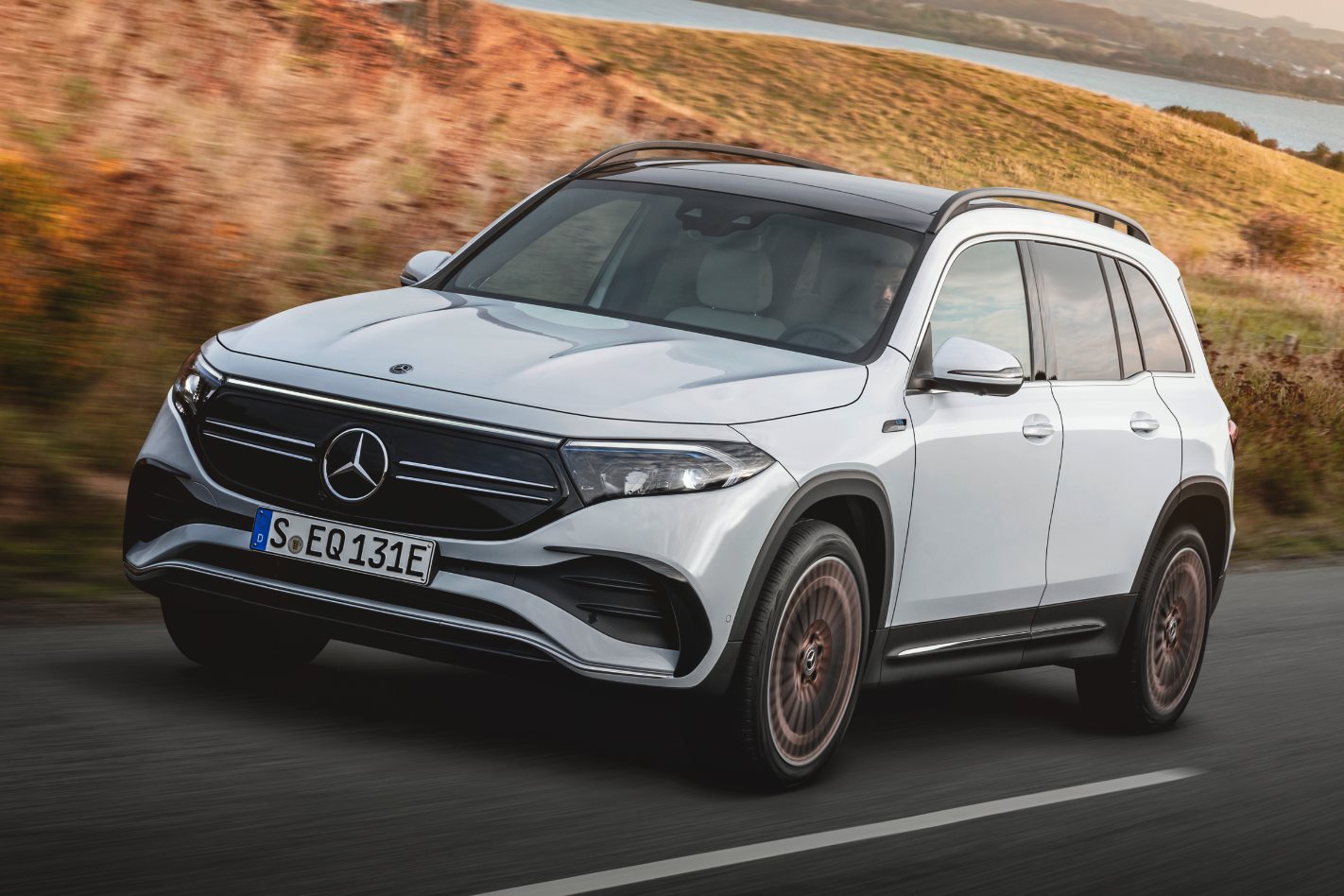
Arriving: Third quarter
What do you get when you stretch the Mercedes-Benz GLA? The seven-seat GLB answered that question back in 2019, and now the same applies to the related EQA and EQB electric SUVs.
An all-electric version of the GLB, the model will initially launch in EQB350 guise, which features a 215kW dual-motor powertrain with all-wheel drive.
The variant has an electric driving range of 419km under the strict WLTP testing standard, with Mercedes-Benz also set to offer a variety of additional powertrains – with battery capacity reaching as low as 66.5kWh.
Thanks to the long 2829 millimetre wheelbase, the EQB can be optioned with three rows of seating, making it capable of carrying seven passengers.
The 2022 Mercedes-Benz EQB350 will arrive in Australia in the third quarter, with pricing and specification to be announced closer to the time.
Additional variants are expected in 2023.
Mitsubishi Outlander PHEV
Arriving: First quarter
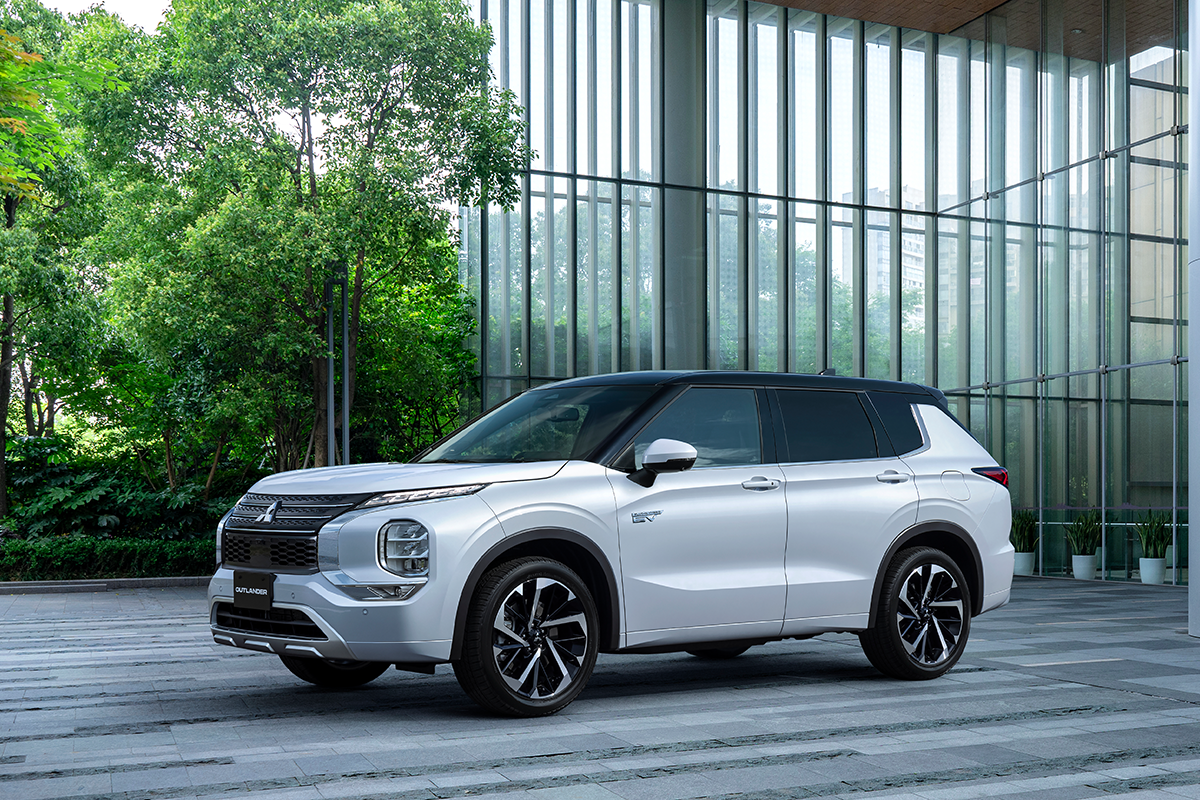
The second-generation Mitsubishi Outlander PHEV will join the range alongside the internal-combustion line-up in 2022.
Boasting more power and a greater driving range than its predecessor, the new Outlander PHEV can now travel for up to 87 kilometres in electric-only mode – a 60 per cent improvement over the current 54km.
This increased capability is the result of a larger battery pack underneath the vehicle, with the previous 13.8kWh unit replaced by a 20kWh pack.
Mitsubishi says the output of the front and rear motors is up by “around 40 per cent” over the outgoing PHEV, which utilised a 2.4-litre engine combined with two 60kW electric motors across the front and rear axles.
Pricing and specification details for the 2022 Mitsubishi Outlander PHEV are yet to be announced, although the previous generation saw the electrified grades come in at around $12,500 more than the regular Outlander.
The new plug-in hybrid model will arrive in the first quarter of 2022.
Nissan Pathfinder
Arriving: Sometime in 2022
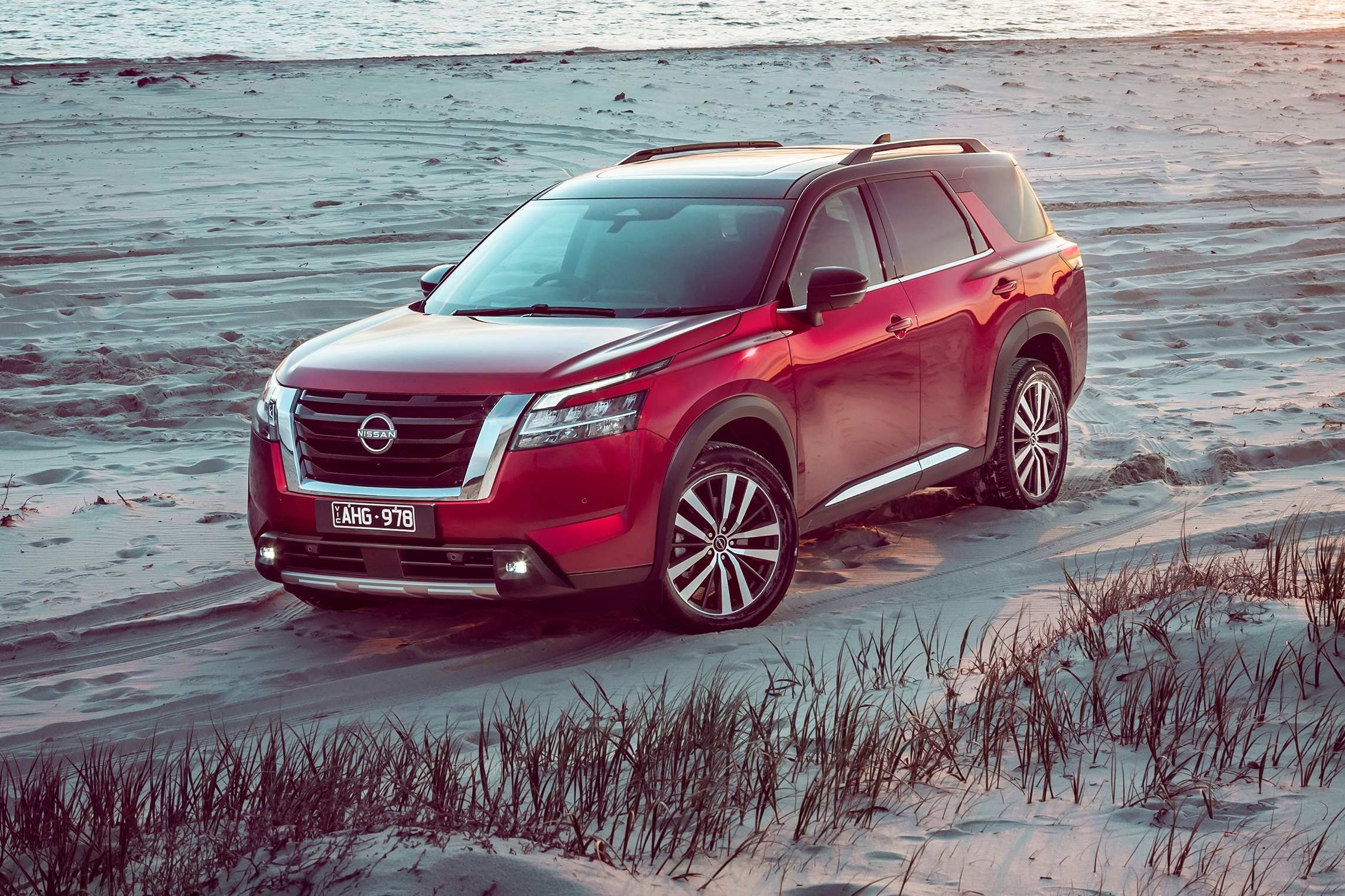
It’s out with the old and in with the new for Nissan Australia in 2022, with a fifth-generation Pathfinder joining the line-up alongside an all-new Qashqai, X-Trail and Z.
The large SUV will land in local showrooms next year with seating for up to eight occupants, available solely with a 3.5-litre petrol V6 engine matched to a new nine-speed automatic transmission.
It’s expected buyers will be able to choose from either front- or all-wheel drive – the latter with 4WD mode with terrain selector for off-road driving – with pricing likely ranging from around $50,000 to $75,000.
Much like the Mazda CX-9 and Hyundai Palisade, buyers can option the Pathfinder with a seven-seater configuration featuring captain’s chairs in the second row, with a removable centre console between.
Technology features include a 9-inch infotainment system with Apple CarPlay and Android Auto capability, wireless smartphone charging, and a 13-speaker Bose sound system.
The 2022 Nissan Pathfinder will be launched in Australia sometime next year, with pricing and specification to be announced closer to its arrival.
Nissan Qashqai
Arriving: First half
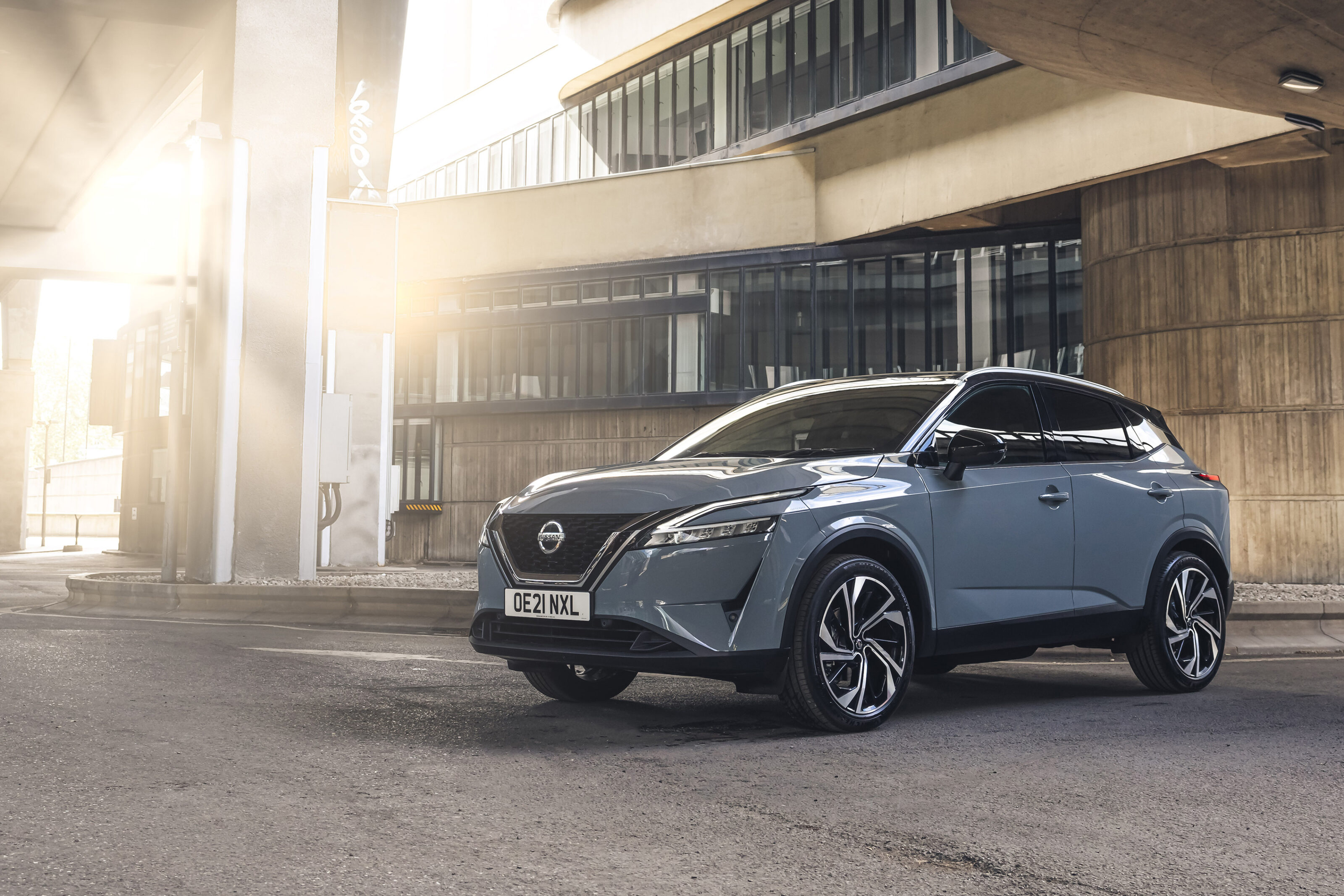
Completely redesigned, the all-new Nissan Qashqai will bring a lighter body and revised powertrain options to the table – with the ageing 2.0-litre mill finally biting the dust.
The first new engine is the 110kW/250Nm 1.3-litre turbo-petrol – found in the outgoing Qashqai in Europe – while buyers can also option hybrid power for the first time.
The electrified powertrain, known as E-Power, features a 1.5-litre turbo that works to power an electric motor driving the front wheels – with a combined system output of 140kW/330Nm.
Launching in the first half of the year with petrol power only, the 2022 Nissan Qashqai will be joined by hybrid variants later in 2022.
Nissan X-Trail
Arriving: First half
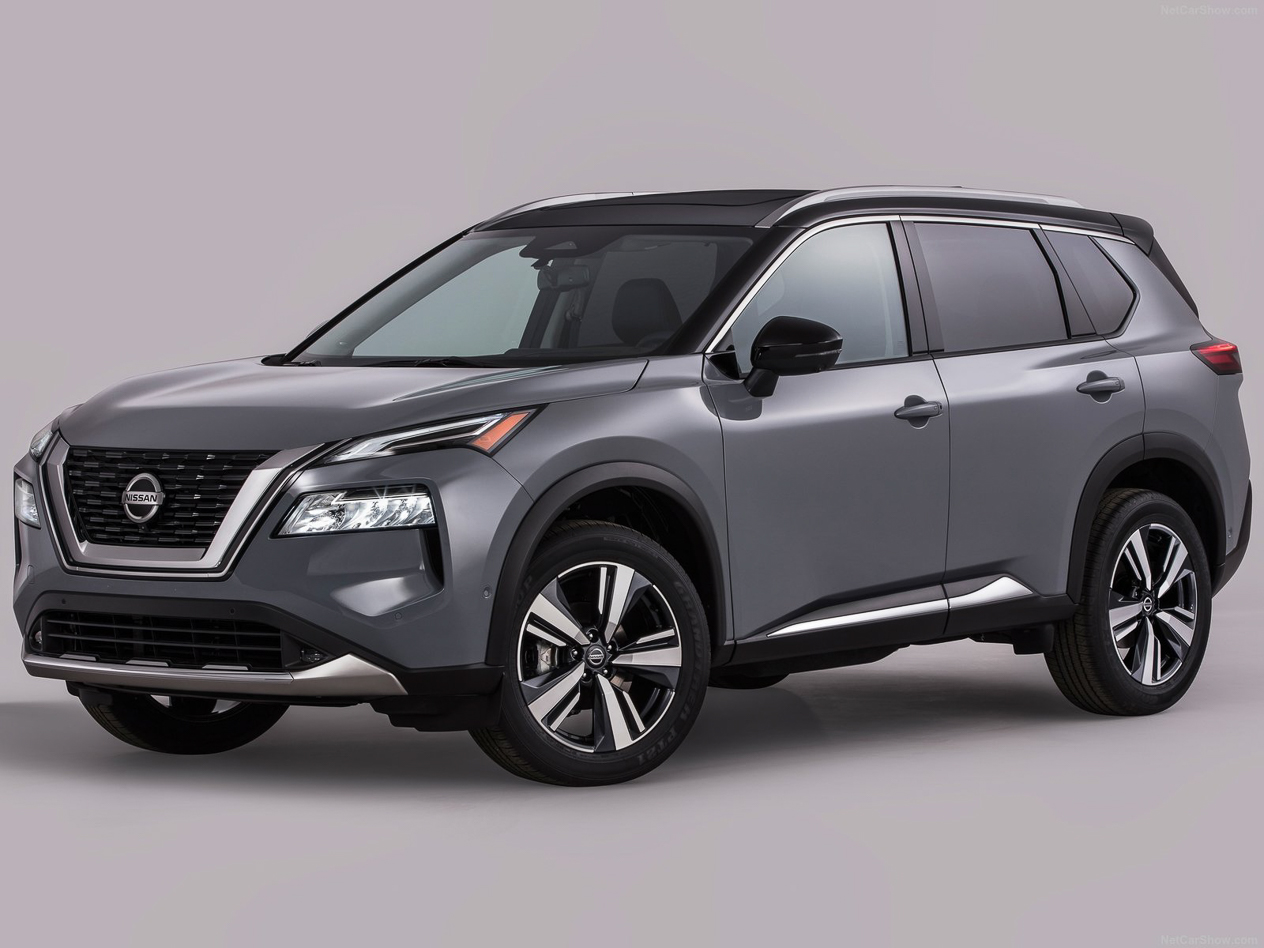
Two years after the fourth-generation X-Trail was revealed overseas, Nissan’s medium SUV entrant will finally go all-new in Australia in 2022.
As before, expect five- and seven-seat options, as well as the same revised 2.5-litre naturally-aspirated petrol mill as its Mitsubishi Outlander stablemate.
However, a fresh powertrain is also coming. Dubbed E-Power, the X-Trail will gain hybrid power to compete against the sought-after RAV4 Hybrid, with a small four-cylinder turbo-petrol charging the battery that exclusively powers the wheels.
The 2022 Nissan X-Trail is slated to touch down in Australia in the first half of the year, with specific timing and pricing to be announced closer to its arrival.
Suzuki S-Cross
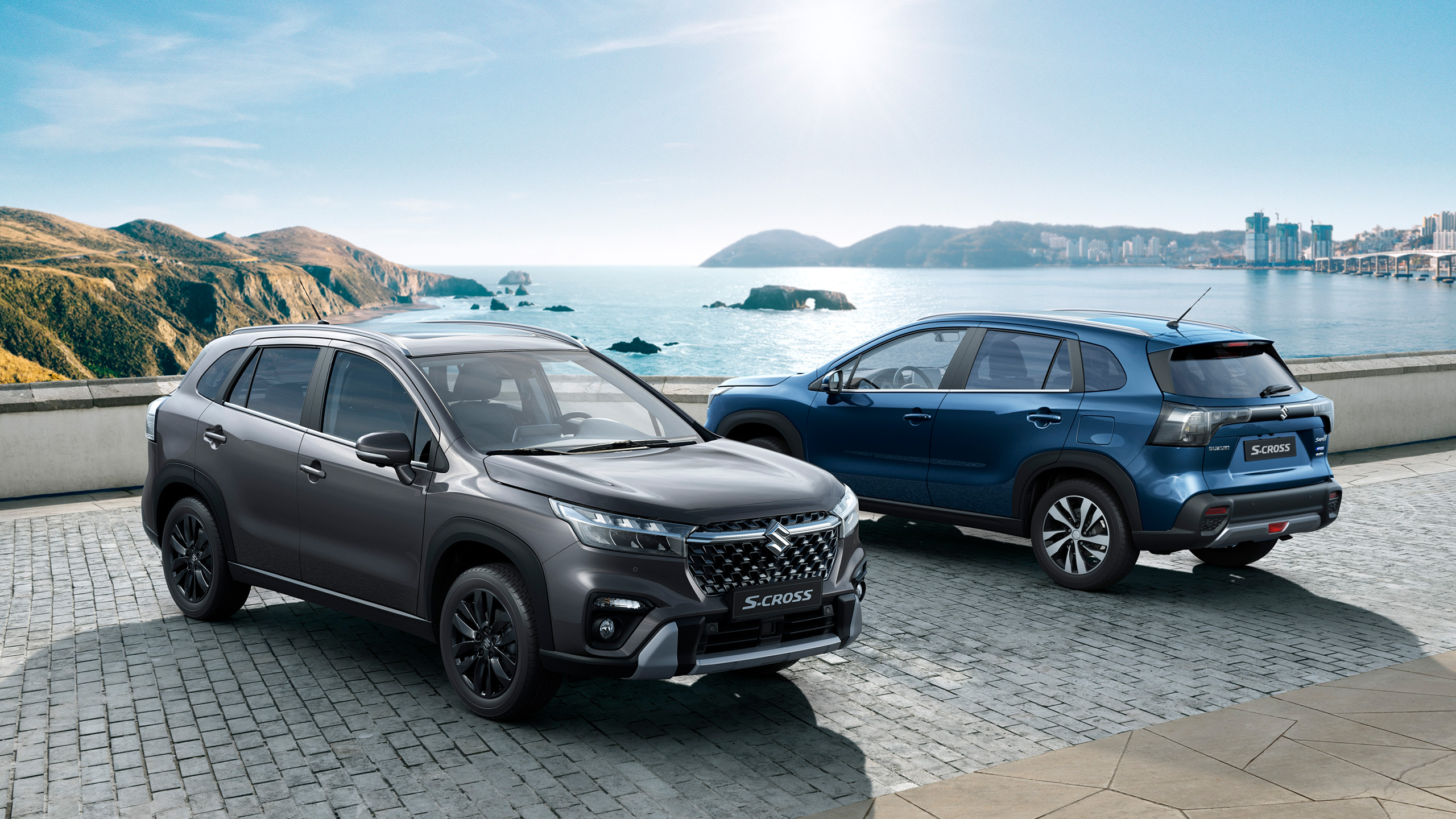
Arriving: Sometime in 2022
The refreshed Suzuki S-Cross sports a fresh new look and updated technology, but retains the same foundations as the outgoing model.
The updated small SUV is expected to retain its 103kW/220Nm 1.4-litre turbocharged four-cylinder engine in Australia.
Suzuki has also added autonomous emergency braking, lane departure warning, lane keep assist, blind-spot monitoring and rear-cross traffic alert – all previously unavailable on the S-Cross.
The new-look 2022 Suzuki S-Cross will arrive in Australia sometime next year, with further details surrounding pricing, features and specific timing to be announced closer to launch.
Tesla Model Y
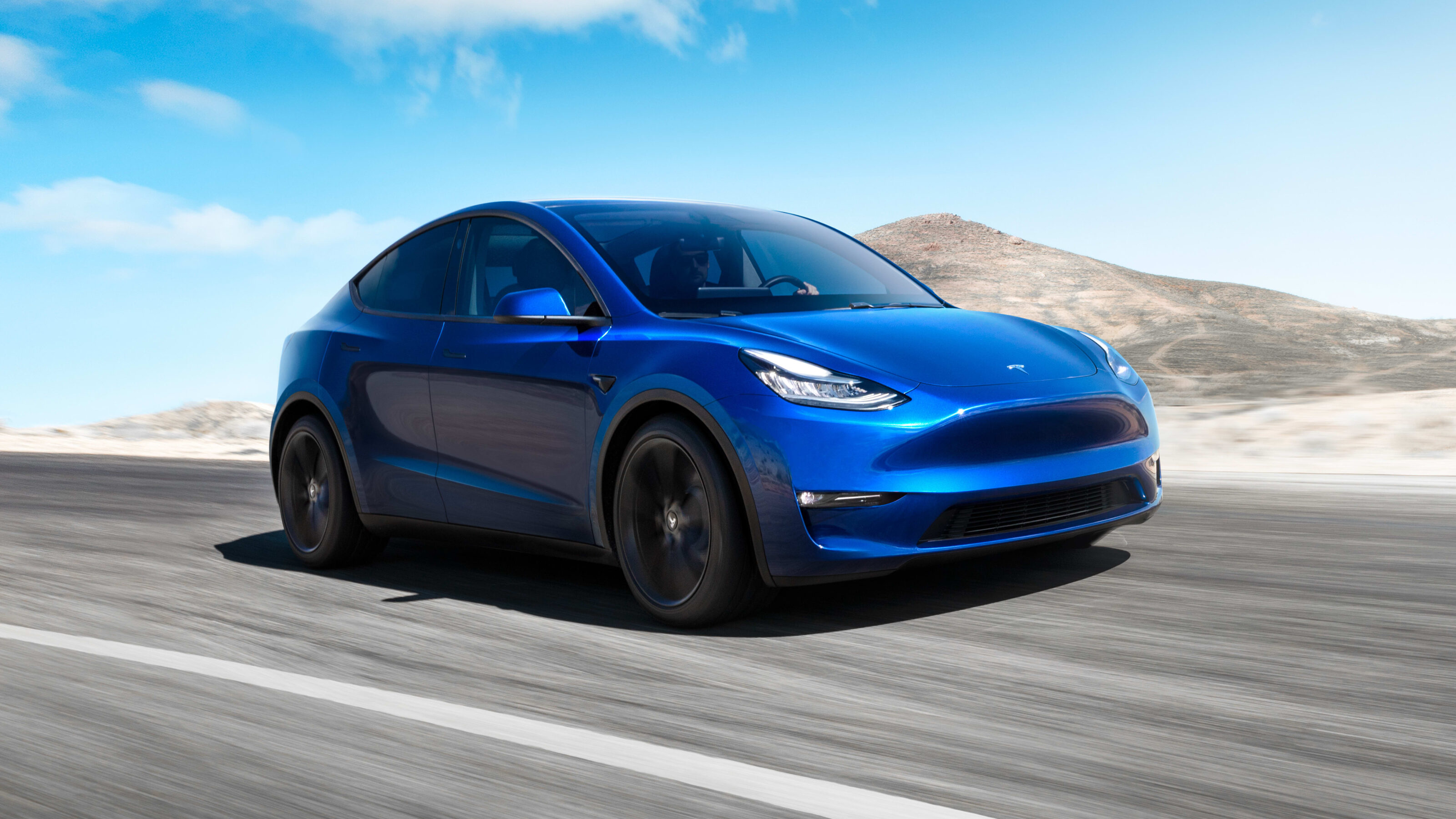
Arriving: First quarter
Coming soon. We’ve been saying it since March 2019, and the Tesla Model Y is still up in the air for the Australian market.
However, pending any further delays, the latest all-electric model from Tesla should touch down in the first half of 2022.
Heavily related to the hot-selling Model 3 sedan, the Model Y is a higher-riding crossover spin-off with greater practicality and room for up to seven occupants.
UK deliveries for the 2022 Tesla Model Y are expected in early 2022, with Australia likely not far behind. Full pricing and specification details are anticipated in the coming months.
Toyota Corolla Cross
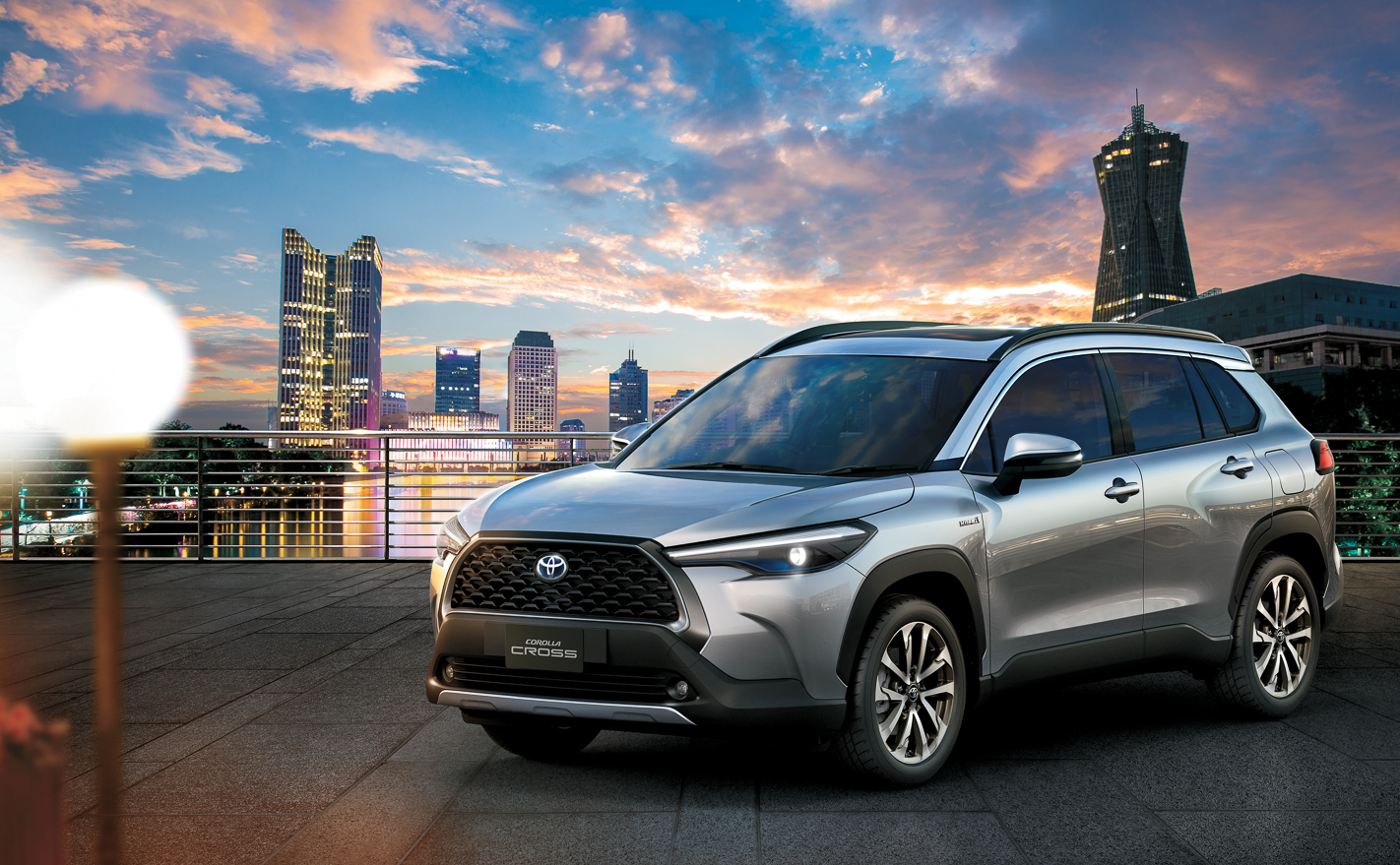
Arriving: Second half
Another year, another new Toyota SUV.
2021 saw the first full year for the compact Yaris Cross, and now another is joining the line-up – the Corolla Cross.
Slotting into the same segment as the Nissan Qashqai, Mitsubishi ASX and Mazda CX-30, the 2022 Toyota Corolla Cross will be positioned near the C-HR and – as its name suggests – the Corolla hatchback.
Toyota has confirmed the Corolla Cross will be offered with its naturally-aspirated 2.0-litre petrol and 1.8-litre hybrid engines in front-wheel-drive configuration, while AWD variants will be powered by a new-to-Australia 2.0-litre hybrid mill.
The small SUV will also pick up Toyota’s latest infotainment system, with wireless Apple CarPlay and Android Auto.
Expect to see the Corolla Cross on local roads in the second half of 2022, with full details to be announced closer to launch.
Toyota RAV4 update
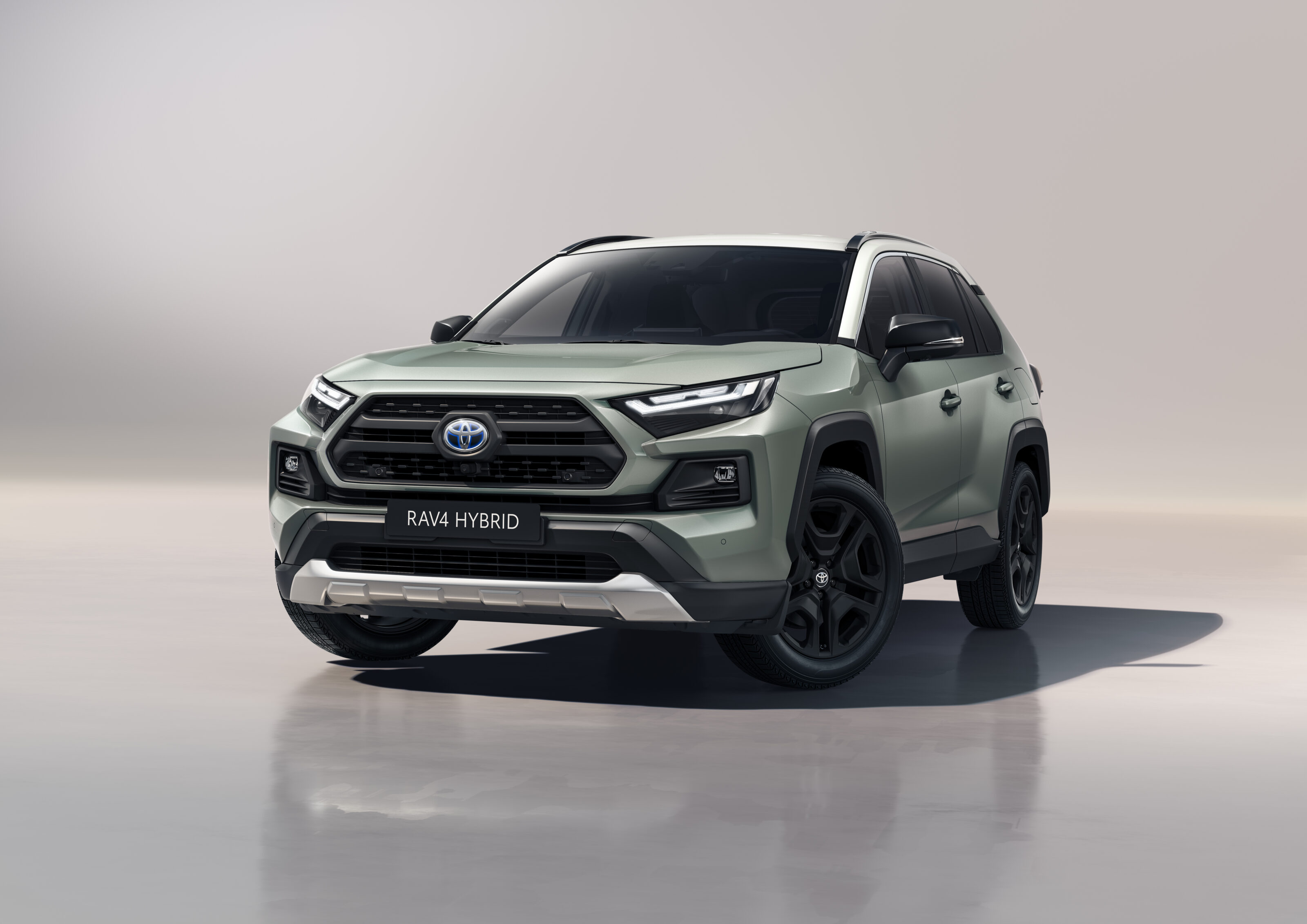
Arriving: February
The popular RAV4 will see the addition of three new hybrid variants for model-year 2022, with Toyota adding a new mid-spec XSE trim and the availability of electrification on the flagship Edge for the first time.
Set to arrive in February, we already know full pricing and specification details for the updated 2022 Toyota RAV4 – read more here.
The new XSE grade slots above the mid-spec GXL, adding blacked-out styling, heated leather seats, ambient lighting and an electric tailgate. The FWD hybrid is priced from $42,825 before on-roads, while the AWD is listed at $45,825.
In addition, all RAV4 models have received a minor facelift – with new projector LED headlamps featuring three clear segments on the hybrid, as well as standard LED fog lamps.
There are also refreshed alloy wheel designs on selected variants, as well as illuminated door switches across the range.
Volkswagen Tiguan Allspace
Arriving: May
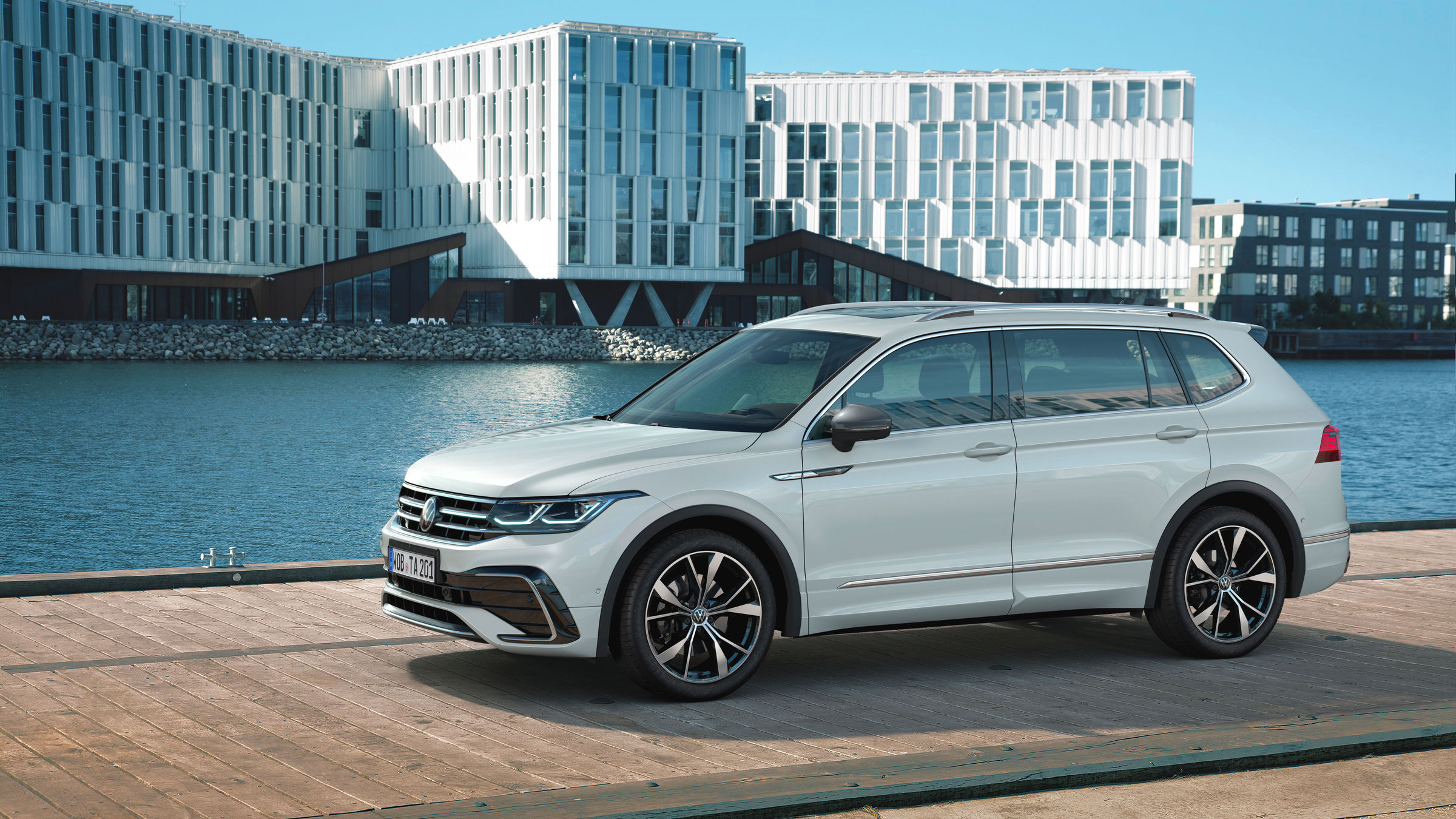
The long-wheelbase Tiguan Allspace will go under the knife in early 2022.
Roughly one year after the smaller Tiguan received identical cosmetic work, the seven-seat Allspace picks up a reshaped front fascia, updated tail-lights and additional technology.
Powertrain options will remain identical to the outgoing model, which includes two turbocharged four-cylinder petrol engines (either 1.4-litre or 2.0-litre) and a 2.0-litre four-cylinder turbo-diesel engine.
However, those keen on the Tiguan R with space constraints are out of luck, with no Tiguan Allspace R planned.
The updated SUV will score a raft of new active safety features and Travel Assist functionality, which enables the car to brake, accelerate and centre itself on the highway at speeds up to 210km/h.
The 2022 Volkswagen Tiguan Allspace will arrive in Australia during May, with pricing and further specs to be announced in the lead-up to its local launch.
Tiguan Allspace news & reviews
Volvo C40
Arriving: Second half
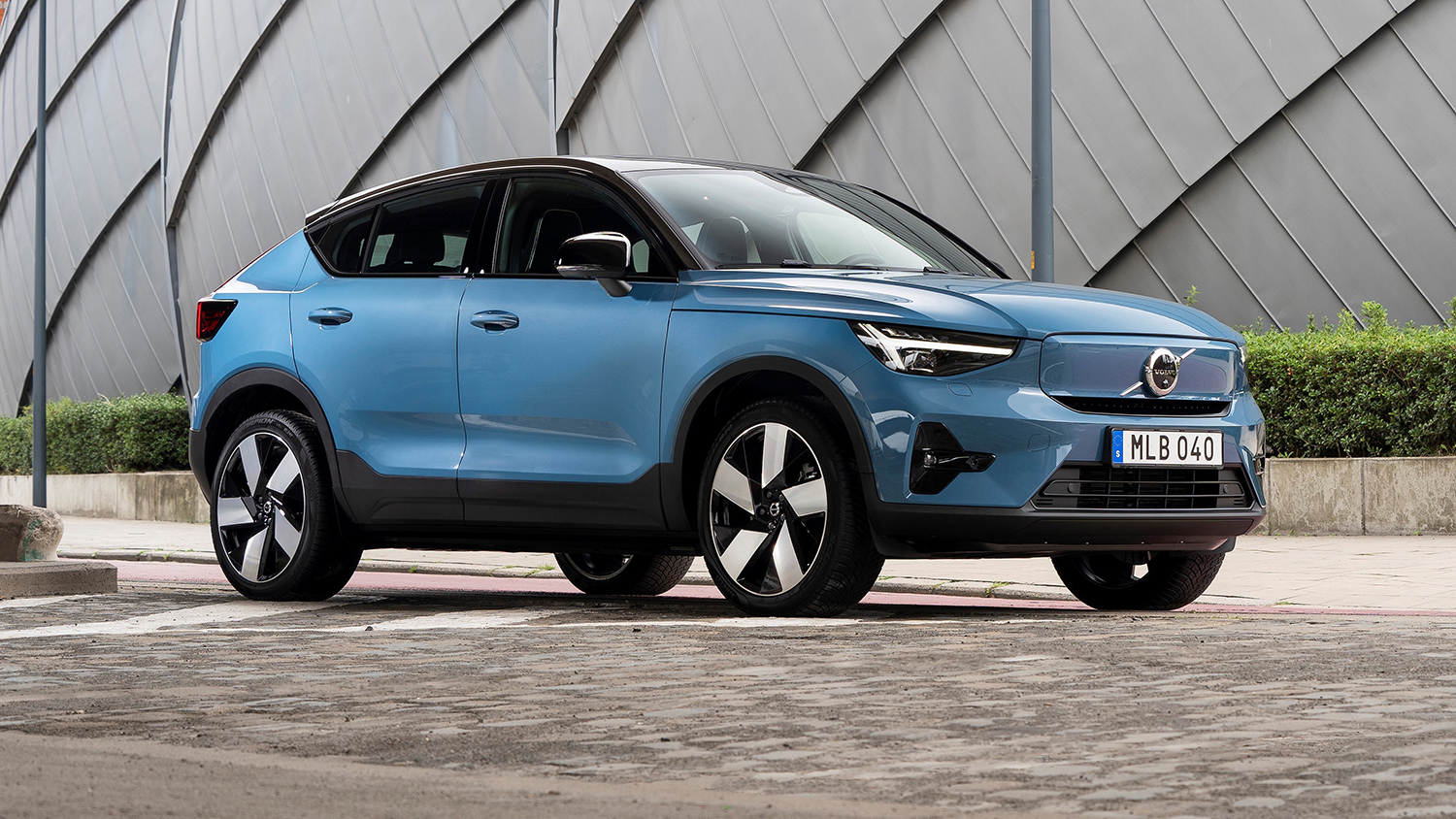
Say hello to the facelifted Volvo XC40 Recharge… without an X or, in this case, the regular SUV shape.
A coupe derivative to the all-electric XC40 P8 Recharge, the Volvo C40 Recharge is the first EV-only model launched by the Swedish marque.
Highlights include the steeply raked roofline, a reshaped front bumper, Volvo’s Android-based infotainment system, and over-the-air software updates.
With identical motors to the electric XC40, the coupe SUV produces 300kW of power and 660Nm of torque, with an 0-100km/h time of just under five seconds.
The C40 Recharge is fitted with a 78kWh battery pack and has an estimated driving range of 420km, according to the stringent WLTP testing standard.
Solely available online, the 2022 Volvo C40 Recharge will go on sale in Australia during the second half of next year.
You have to hand it to BMW; the Bavarian giant really knows its target market when it comes to the Mini. And it plays hardball to get those sales, offering myriad modernised versions of the traditionally British hatch. Compared to the now-departed Volkswagen Beetle, it’s hard to argue that the retro-remake Mini hasn’t been a success.
It’s BMW’s thorough knowledge of its USP that makes the Mini popular. And it doesn’t just subtly lean on nostalgia, it whacks you in the face with it. Even after 20 years and in its third generation, the throwbacks are hard to escape. Its cutesy face has received a nip and tuck to look slightly more aggressive while the Union Jack is proudly displayed within the tail-lights, just in case anyone forgot its heritage.
Proof that there was a Mini niche uncatered for is in the inclusion of this variant, the Cooper S JCW Sport. Essentially, it looks like a full-fat JCW with 170kW and 320Nm, but runs on the skim milk of a Cooper S with 141kW and 280Nm from its BMW-sourced B48 engine. Except for some red accents, it’s hard to tell the two apart. And that’s the point. It gains the JCW aero package, including a chin spoiler, side skirts, oversized rear diffuser with central exhaust and a rear wing. It even runs the same 17-inch alloys and optional stripes.

It’s available as a three-door (like a Cooper should be) and five-door, with the 2.0-litre turbo four-cylinder powering the front wheels through a seven-speed dual-clutch gearbox. However, all this extrovert sportiness comes at a price. And for its $53,200 three-door sticker – before on-road costs – you could buy a sorted hot hatch from another brand, or even the JCW itself. However, Mini has always played in a boutique class of its own where what’s underneath the clamshell bonnet usually plays second fiddle to the statement it projects.
Still, with a 0-100km/h time of 6.7 seconds, the mechanical gubbins aren’t exactly lacking. The 1998cc four-cylinder turbo offers up a meaty 280Nm from as low as 1250rpm and peak power is competitive for the class at 141kW (at 5000rpm). The latter does tend to tail off near the top-end of the rev range, but it is punchy and motivates the 1225kg mass swiftly enough. Three driving modes are available (Sport, Mid and Eco), with the raciest setting delivering a very sensitive throttle calibration. However, it sounds the best in this mode, with a raspy exhaust note and blow-off valve histrionics that’ll make you chortle.

The seven-speed dual-clutch is an amicable companion for the ‘TwinPower’ unit and performs shifts at a faster pace than the torque-converter auto used in the proper JCW. It rev-matches when clicking down the ratios and offers up gears when you want them – most of the time. The steering wheel-mounted paddles fall nicely to hand behind the thick rim of the tiller. What doesn’t work is having the volume ‘up’ control so close to the three o’clock hand position. It’s all too easy to turn the volume up to 11 unintentionally.
Upping the tempo on-road doesn’t yield the type of responses you’d hope for, though. Buying into the Cooper S persona used to mean go-kart handing cloaked in a catwalk-ready body. And despite the Sport mode proudly displaying an image of said go-kart, the experience doesn’t live up to the decal. Let’s be clear; the Mini isn’t a bad handling hatch, it just doesn’t feel as fun as you think it’s going to be – or want it to be.
Mini has always played in a boutique class of its own where what’s underneath the bonnet plays second fiddle to the statement it projects.

Body roll is kept to a minimum and composure is strong through changes of direction but although the steering is quick, it returns inconsistent weighting. If you don’t get the Cooper S JCW Sport moving it will fall into understeer, a fact that isn’t helped by the Pirelli Cinturato rubber. You can engage the multi-link rear axle for a bit of extra rotation, but it requires big inputs from the steering or an aggressive lift of the accelerator. It feels stuck in its shoes without the verve found in the previous R56 generation Mini.
Where it has improved is in terms of ride quality. And surprisingly, this is after BMW removed the electronically controlled dampers, replacing them with a passive set-up. They now use a special valve (a bit like a Ford Fiesta ST) that opens over big compressions. Like its Blue Oval competitor, the idea is that the firmness generates sporty handling with rebound being smartly suppressed most of the time, while the valving quells bigger hits. Admittedly, it isn’t the final word in plushness but it is noticeably more comfortable than the JCW, making it the one to drive daily.

Modern Mini buyers appreciate this fact. And on top of the JCW costume, the interior gains special treatment, too. There is something to be said for feel-good factor – and the Mini has just enough funk and quality to have that measure in its favour. The Cooper S JCW Sport gains goodies like an Anthracite headliner, ambient lighting (changeable via a roof-mounted toggle), Dinamica/leather JCW Sport seats, panoramic sunroof, Harmon Kardon sound system and head-up display. There are also John Cooper Works badges throughout to remind you it isn’t a base Cooper S.
Like the exterior, the interior is unique. Quirky in the extreme. Yet, two decades on and with the aid of kit like BMW iDrive, it all seems to work. Form isn’t blatantly usurping function. High-quality materials abound and the chequered silver inlays are a nice touch. The circular dash design is now offset by a digital instrument cluster, although the rev-counter needle remains analogue if you look closely. The aeroplane-style switches are ergonomic wins and there’s enough adjustment in the driving position for most.
Like the exterior, the interior is unique. Quirky in the extreme. Yet, two decades on, it all seems to work.

Infotainment is now taken care of via an 8.8-inch touchscreen display, its rectangular shape juxtaposing the circular housing and barcode-style mood lighting. In terms of mirroring, wireless Apple CarPlay is standard, but those using Android will be left disappointed. As will those who prefer big phones, as they won’t fit in the wireless charging pad located oddly in the centre armrest. Either could be equally as frustrating depending on what smartphone you have.
Practicality has never been the reason you buy a Mini, especially a three-door with its 72mm shorter wheelbase than the five-door. Realistically you aren’t going to be ferrying rear-seat passengers often. And if you do, they’d better be small and nimble as entry and egress is hampered by a relatively tight opening, while legroom in the back is limited. The fact that there aren’t any charging ports or air vents back there is a sure sign this will be extra cargo capacity. Reflecting the diminutive dimensions is a 211-litre boot, which does expand to 731 litres with the rear seats folded.

This new Cooper S addition has all the show, but none of the extra go. Which means the equation doesn’t quite add up in a performance sense and the $50K spend will get you behind the wheel of tastier options. However, for those buying into the dream and the associated storyline, that won’t matter. The Mini Cooper S JCW Sport was made for them by decisions from within BMW’s marketing team. It’s their perfect slice of kitsch.
2021 Mini Cooper S JCW Sport specifications
Early in his career, Australian cricketing legend Mark Waugh was nicknamed ‘Afghan’, a reference to the 1979 Soviet invasion of Afghanistan referred to as the ‘forgotten war’. It’s a moniker that could equally apply to the 2021 Hyundai i30 N manual.
Just as M Waugh followed in the footsteps of his twin brother Steve (the forgotten Waugh, geddit?), the three-pedal version of the new i30 N has been somewhat lost in the kerfuffle surrounding its dual-clutch sibling.
This is a shame, as there’s a lot more to the updated version of Hyundai’s hot hatch than just a new gearbox. Let’s get the bad news out of the way first: the i30 N is no longer a sub-$40K (before on-roads) bargain, the range now starting at $44,500.
A Premium pack costs an extra $3000 and adds lightweight bucket seats that shed 2.2kg, an Alcantara/leather interior, rain-sensing wipers, front parking sensors, rear privacy glass, heated front seats and steering wheel and an electro-chromatic rear-view mirror. Add another $1500 and you’ll score a panoramic sunroof.
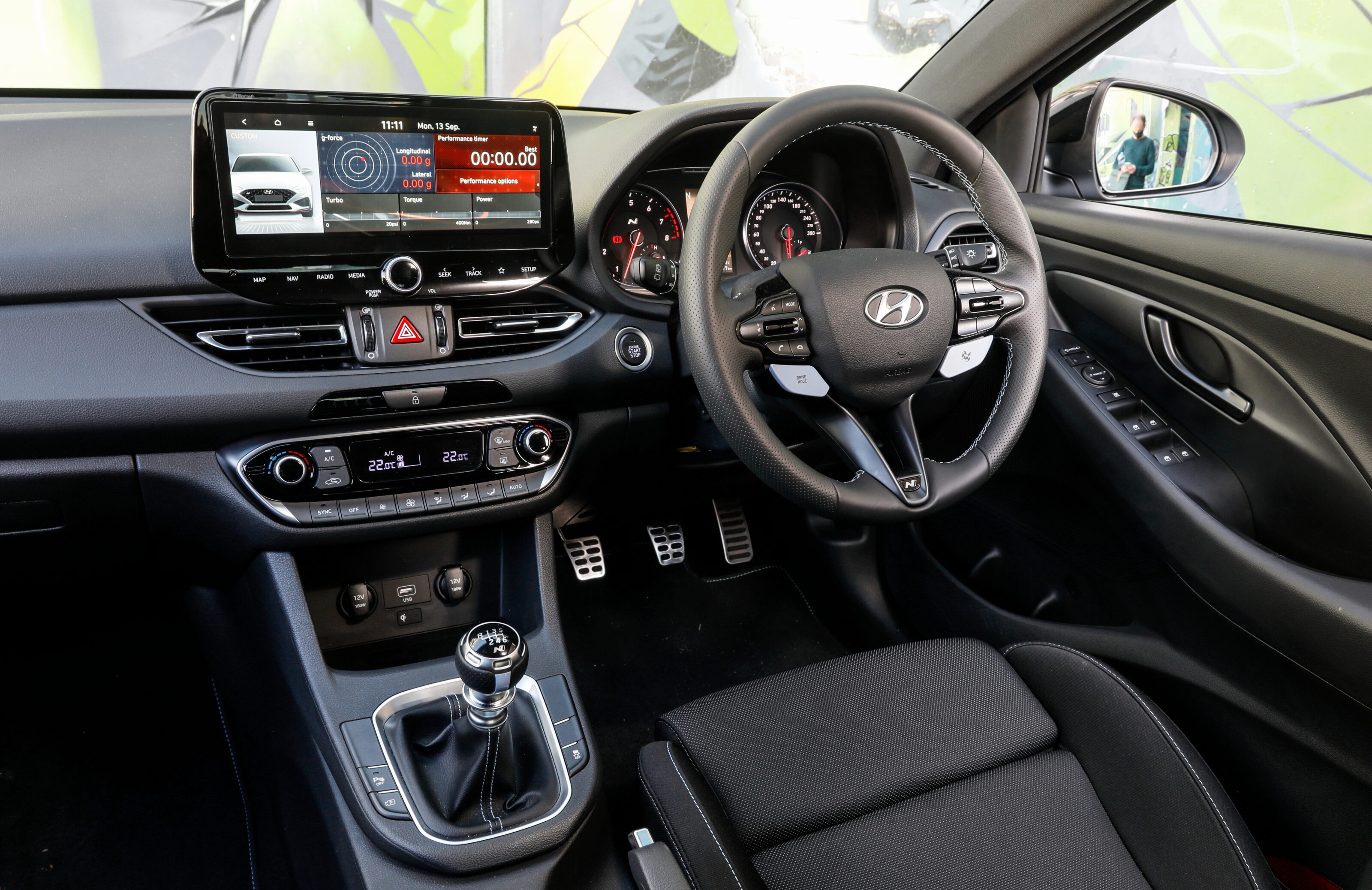
Hyundai has thrown in some extra equipment to help offset the increased price, including standard keyless entry and go, wireless phone charging, a new 10.25-inch infotainment system, blind-spot collision warning, lane following assist and rear cross-traffic alert.
This in addition to existing kit like digital radio, dual-zone climate, smartphone mirroring, all the usual active safety gear (AEB, forward collision assist, lane keep assist). What’s interesting, though, is that unlike the facelifted standard i30, the N has retained its analogue instruments and a manual handbrake. Perfect!
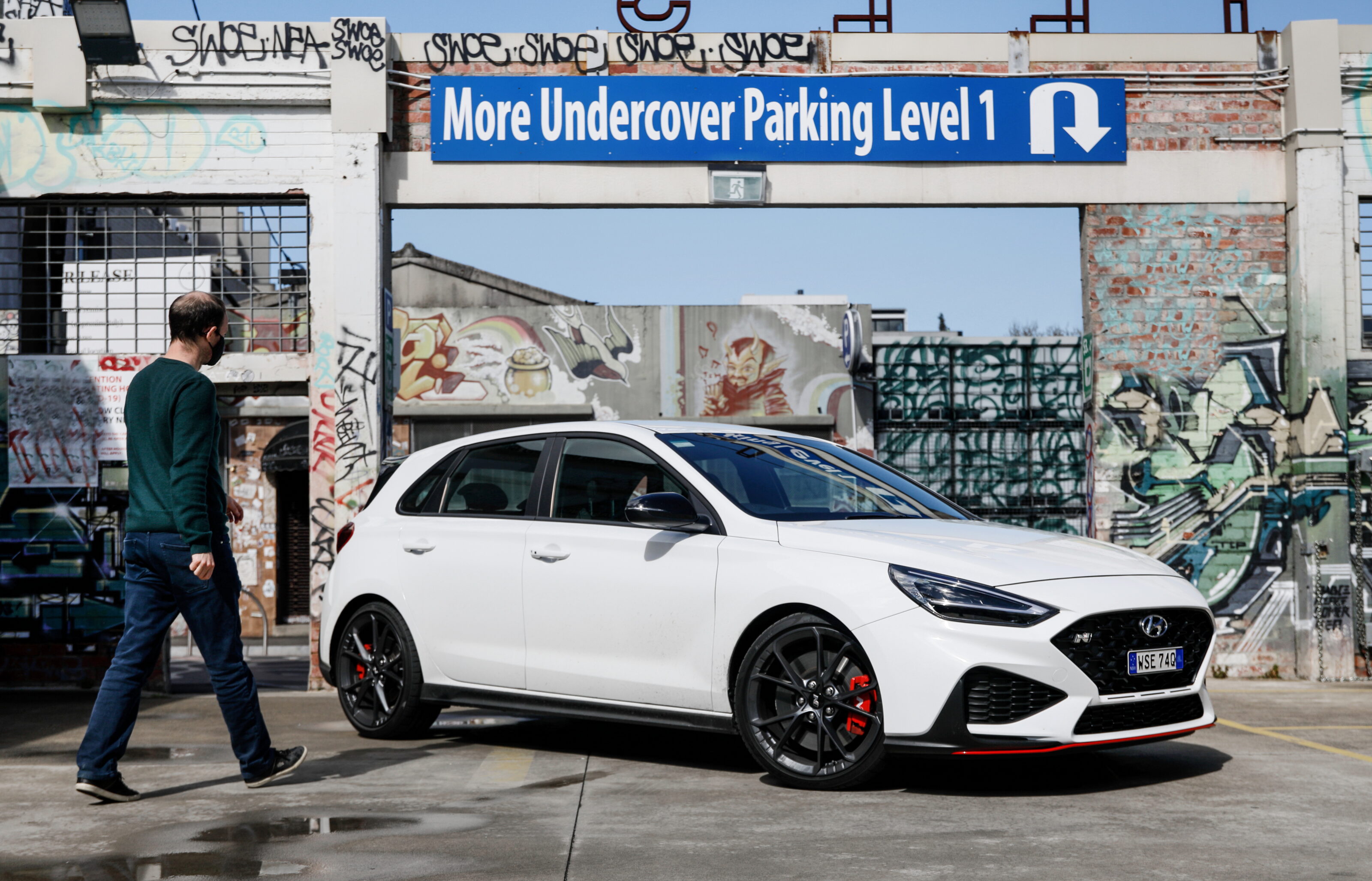
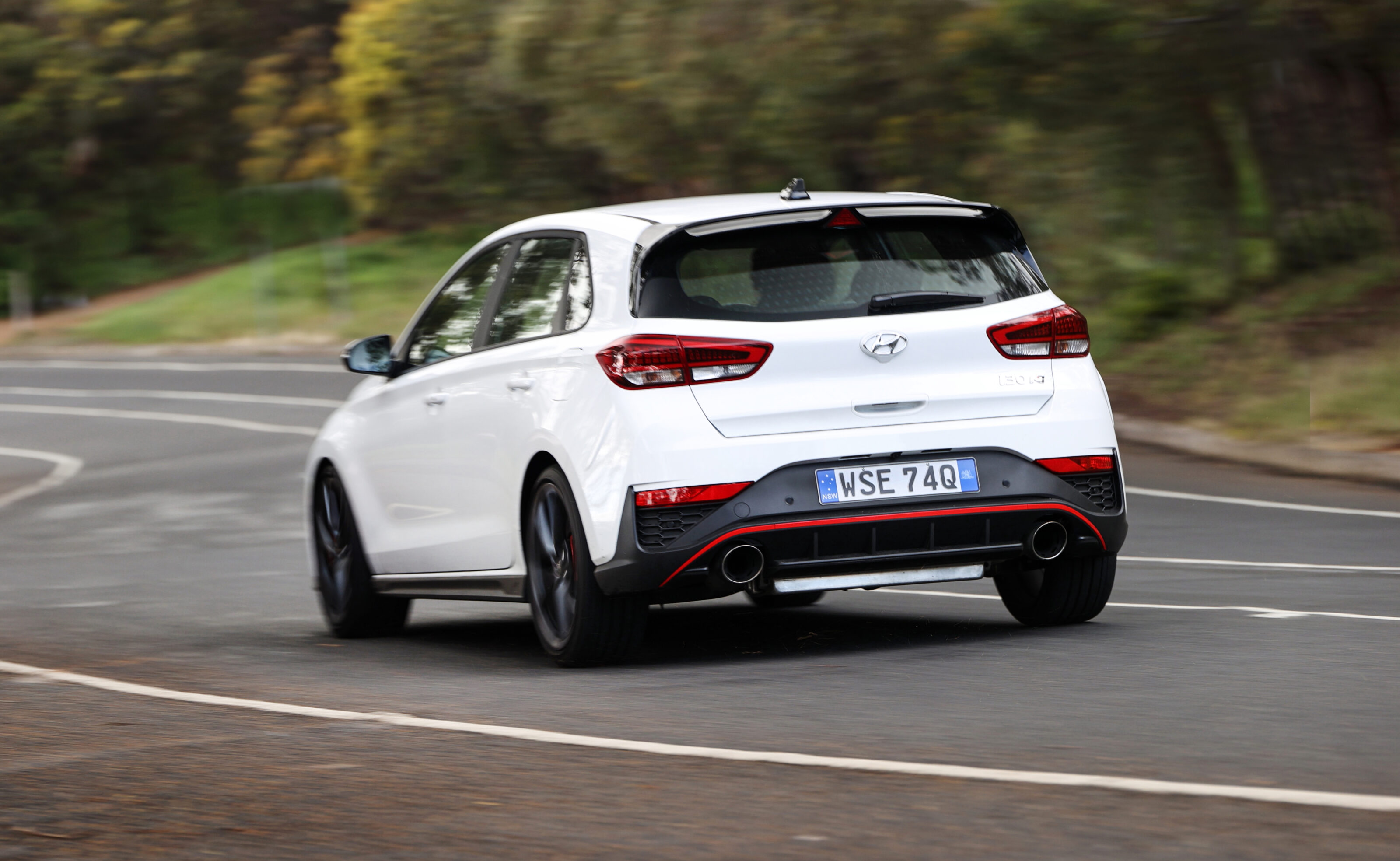
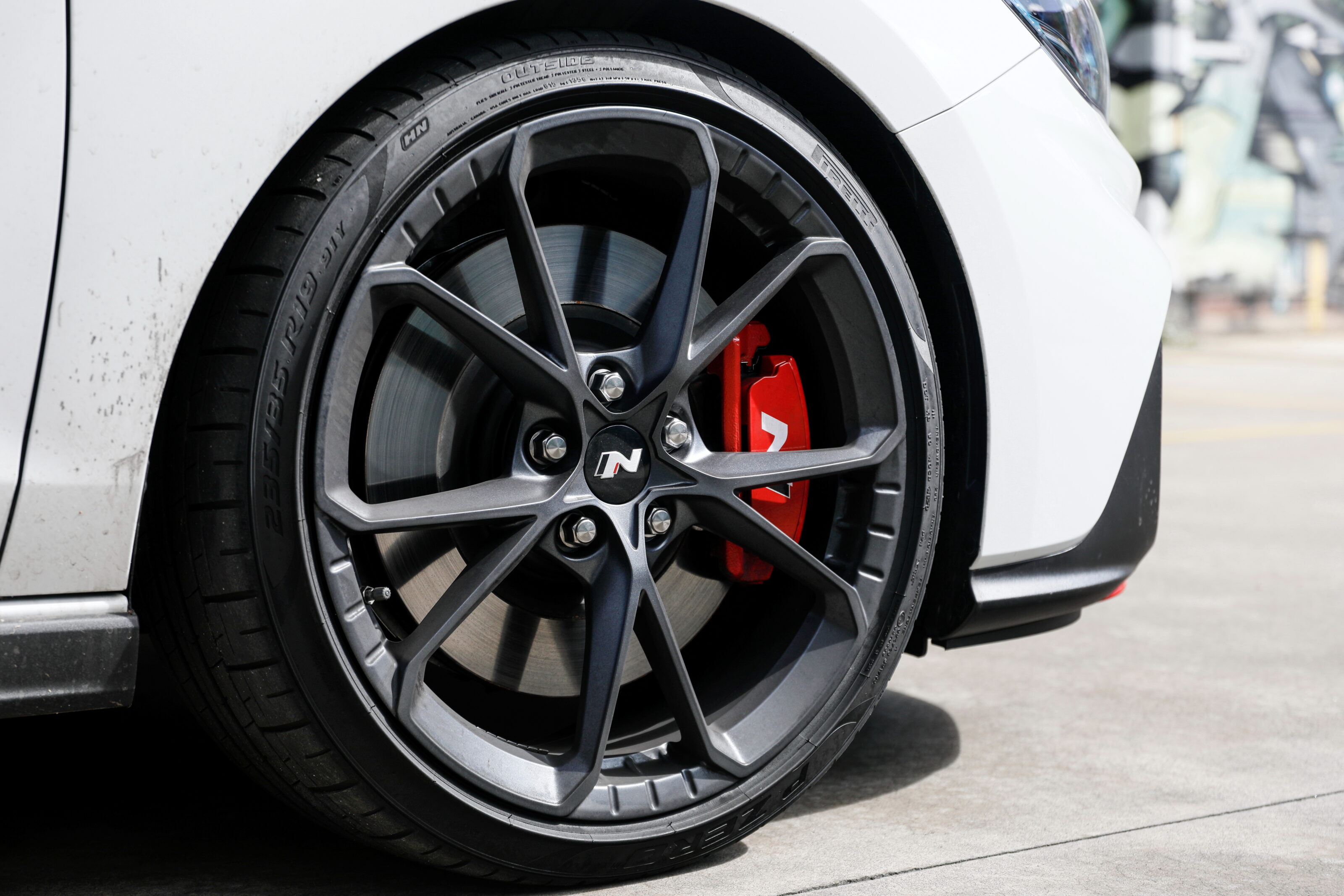
A facelift front and rear has made the i30 look sharper and more aggressive, while the new 19-inch alloys don’t only look great but also save a whopping 14.4kg in unsprung weight thanks to their forged single-piece construction.
It’s one of many detail changes Hyundai has made to improve the performance and handling of its flagship hot hatch. Under the bonnet the 2.0-litre four-cylinder scores a new turbocharger and intercooler setup to produce 206kW at 6000rpm and 392Nm from 2100-4700rpm.
Those figures may only be improvements of 4kW and 39Nm (14Nm if you include the old car’s overboost function) but the changes were intended to offer more power across more of the rev range and they’ve undoubtedly worked.
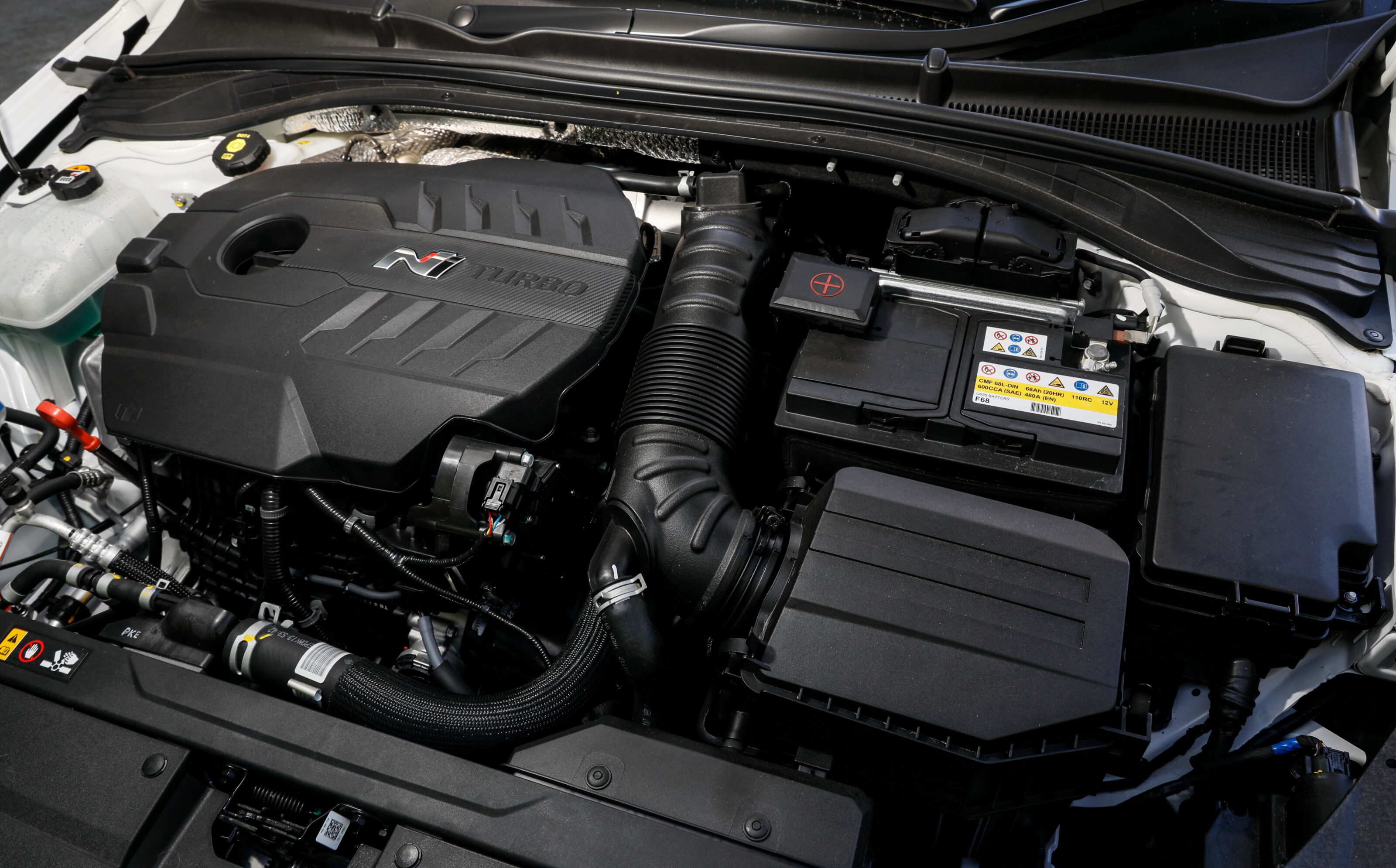
Mid-range torque is massive – floor the throttle at 3000rpm in second gear and your head will snap back into the headrest and the power doesn’t feel to tail off as sharply above 6000rpm as it did before.
Hyundai claims it’s 0.2sec quicker to 100km/h than before at 5.9sec, but the fact that traction control no longer cuts in with ESP off is likely to be just as much to thank as the extra power. It sounds suitably angry, too, doing its best rally car impersonation with plenty of pops and bangs in the full-wick N mode.
Mid-range torque is massive – floor the throttle at 3000rpm in second gear and your head will snap back into the headrest.
The manual has also been improved. There’s nothing in the press material, but having spent six months with the previous generation car the shift now feels slightly more positive with none of the occasional ‘catching’ between gears that afflicted the old ’box.
As good as the new dual-clutch is, the manual still has a lot of appeal, with spot-on ratios and the option of heel-toeing downshifts yourself or having the computer software do it for you. It works brilliantly, but still feels a bit like cheating.
If anything, the chassis has actually received greater changes than the powertrain. Hyundai’s local suspension team has got its hands dirty once again with revisions to the springs, bushings and damper calibrations, while new geometry includes an increase in front camber from 0.8 to 1.7 degrees.
Combine this with bigger front brakes, the rotors now 360mm instead of 345mm with cooling ducts mounted to the lower control arms, and one of the best-driving hot hatches has become even more entertaining and capable.
This new i30 N is about as good as this class of car gets. It’s the way the weighty yet communicative steering feeds plenty of information as to how the front tyres are faring under load, the way the aggressive diff actually pulls the nose towards an apex with the application of throttle, the firm, virtually indefatigable brakes, the way the rear moves enough to help the car rotate but without ever sapping driver confidence.
A number of drive modes are available but the easiest avenue is to set up the ‘N Custom’ mode, which is now done via a strange spider’s web type display in the centre screen. At first glance it’s confusing but in practice, it’s quite cool.
This new i30 N is about as good as this class of car gets. It’s the way the weighty steering feeds information, the way the aggressive diff pulls the nose towards an apex, the way the rear helps the car rotate without sapping confidence.
I personally found steering in Normal (Sport adds unnecessary weight), all the drivetrain in maximum attack and dampers in Sport the best bet, though the beauty of a customisable mode is you can find your own favourite combination of settings.
Sport is the best catch-all setting for quick road driving. The dampers can run out of travel through larger compressions but don’t allow the car to lose composure. Sport+ adopts an iron-fist approach to body control but is best restricted to super smooth roads or circuits as it’ll rattle your teeth out over bumps.
Switch back to Comfort and while the i30 N doesn’t quite have the magical compliance of the now-defunct Civic Type R, it still offers a more than acceptable level of ride comfort. Its biggest shortcoming is probably the level of road and tyre noise on certain surfaces, but at slower speeds day-to-day there’s little to complain about.
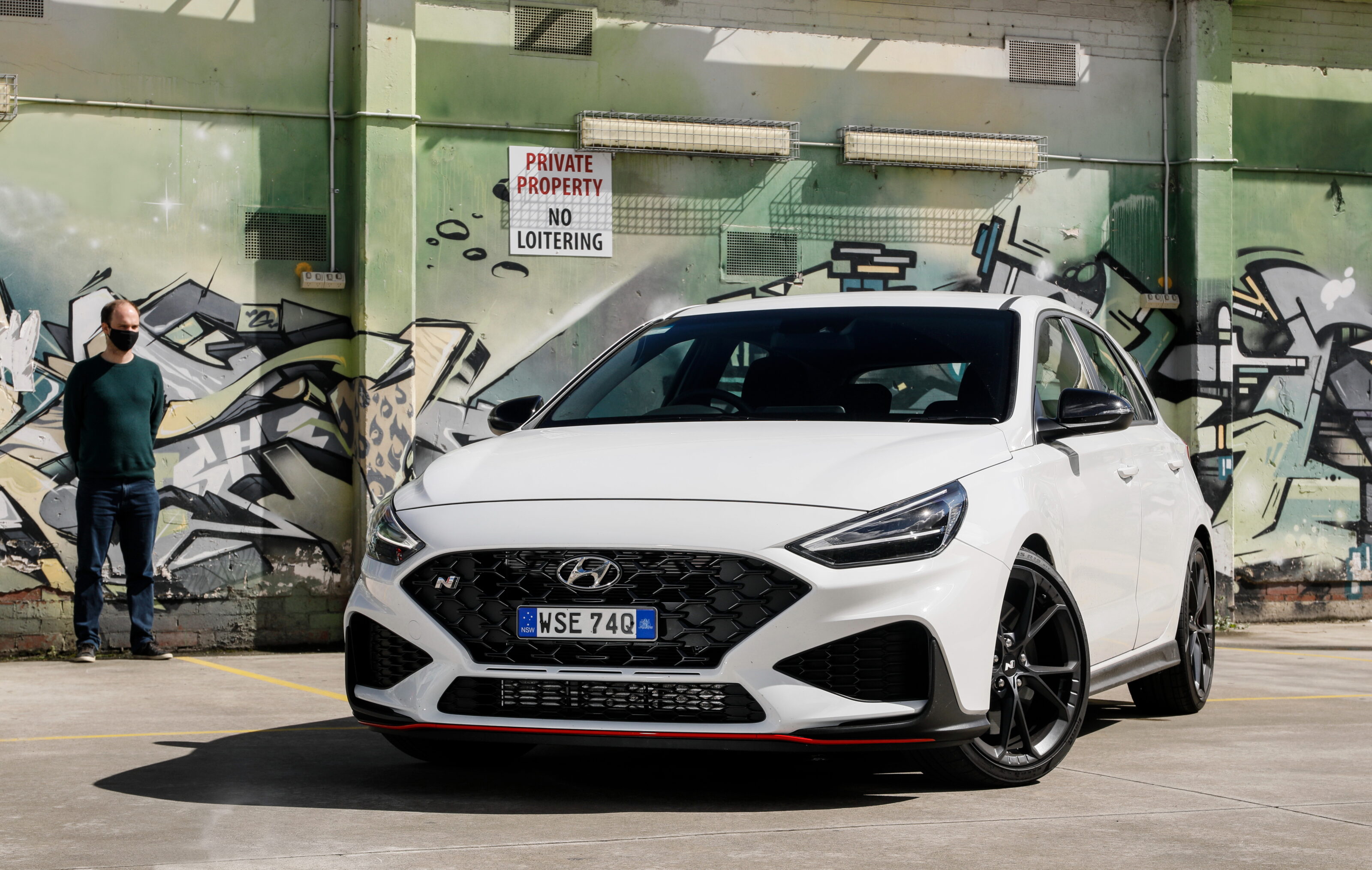
Inside the i30’s basic origins are obvious with plenty of hard, coarse grain plastic on the dash and centre console, but even the standard seats are comfortable and supportive, the 10.25-inch infotainment screen is relatively responsive and easy to navigate and the addition of standard keyless entry/go is very handy.
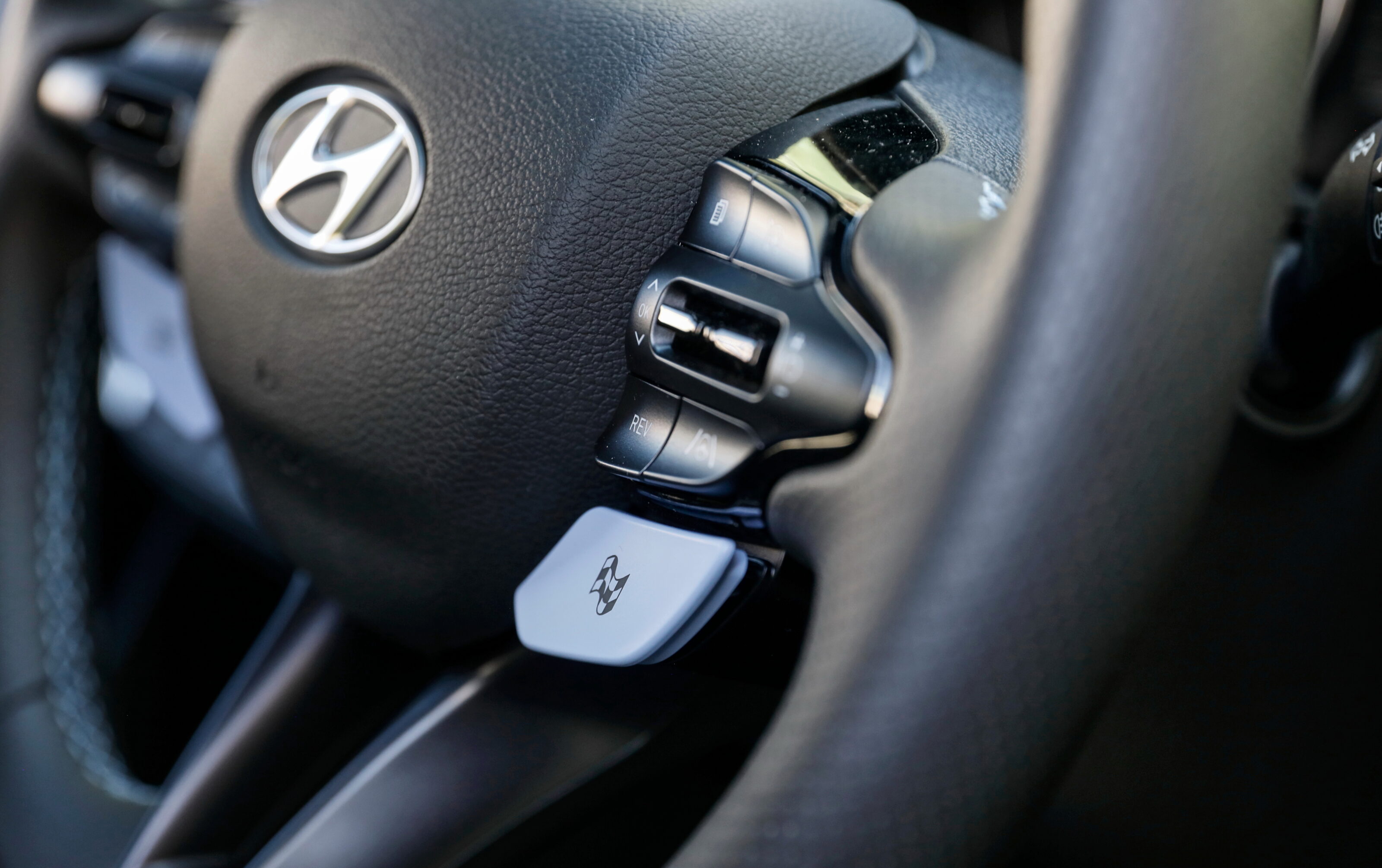
A highlight is the steering wheel, with helpfully long paddles and a pair of Performance Blue quick select N buttons. It’s a car for drivers, though, with a sparse rear environment offering a pair of air vents but little else.
The extent to which the new i30 N improves on its already impressive predecessor comes as a bit of a surprise. Incremental gains, for sure, but it’s a quicker, sharper, more involving driving tool. Like Mark Waugh, it might be living slightly in the shadow of its more famous sibling, but it’s still one of the all-time greats.
2021 Hyundai i30 N manual specifications
Grudge Match
Bully boys, Integra and Mégane, pull on their gloves and jump in the ring with king Rex
This feature was first published in MOTOR magazine’s January 2005 issue
The wipers are flailing and only just holding their ground against the rain. The cambered blacktop flips in and out of the mountain’s folds.
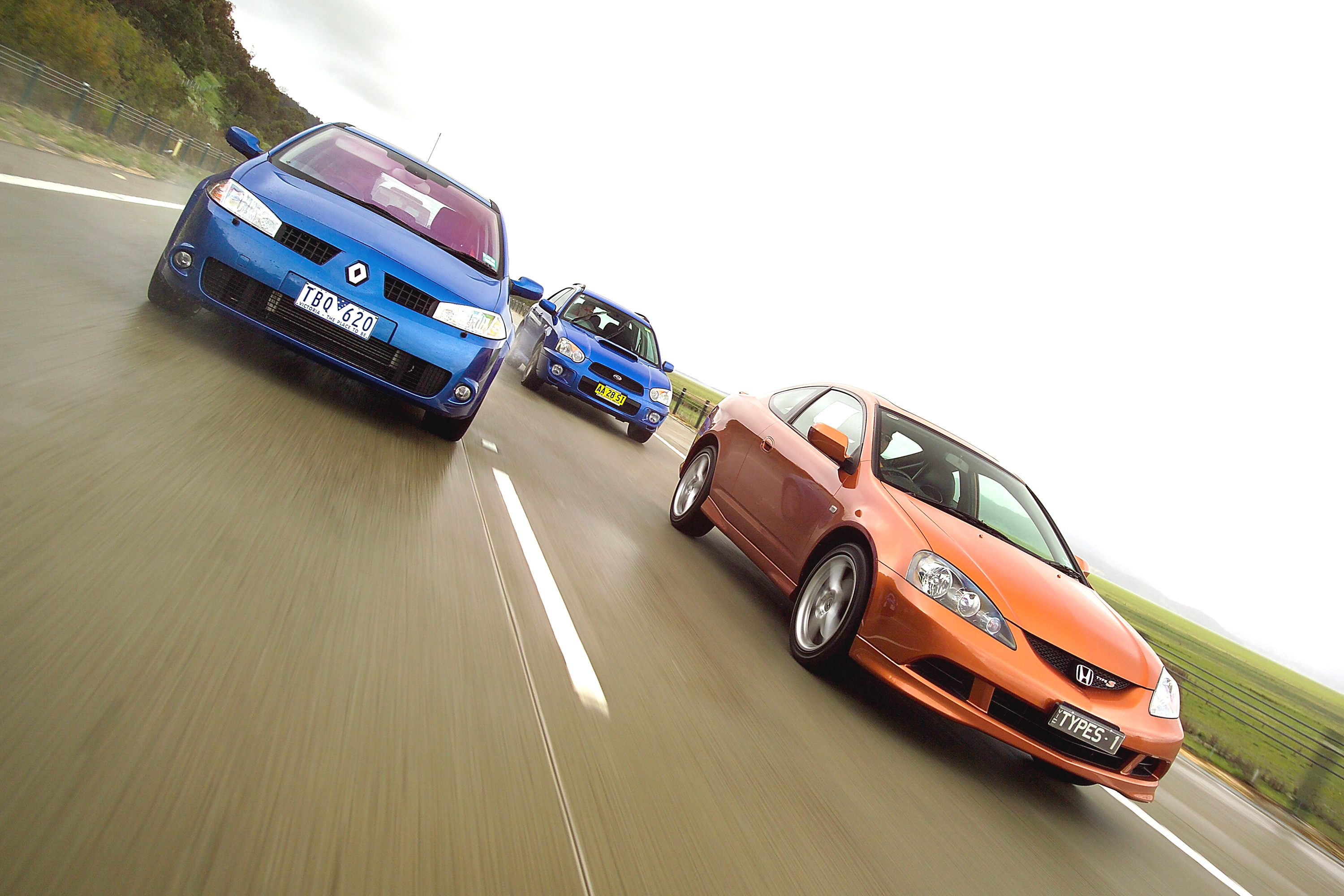
According to the legend, this is Rex country and this is definitely Rex weather. It’s a long-held myth that Subaru’s giant-killer does its best work in the wet. But Honda’s Integra Type S and Renault’s Sport Mégane 225 might finally be the cars to test the myth’s validity.
The WRX is quick, for sure, but extracting the last drop of potential from the flat-four all-paw is a task that’s neither pleasant, nor recommended for the mild of talent or meek of commitment. However, there are few cars more adjustable on the throttle than Subaru’s hairy-chested legend.
And yet there’s something about the WRX that, on this day, just won’t go away. It’s bronzed, two door, screaming its 8500rpm tits off and it’s a scream that’s well within earshot. It’s not gaining, but it’s not losing ground, either. It’s just always there.
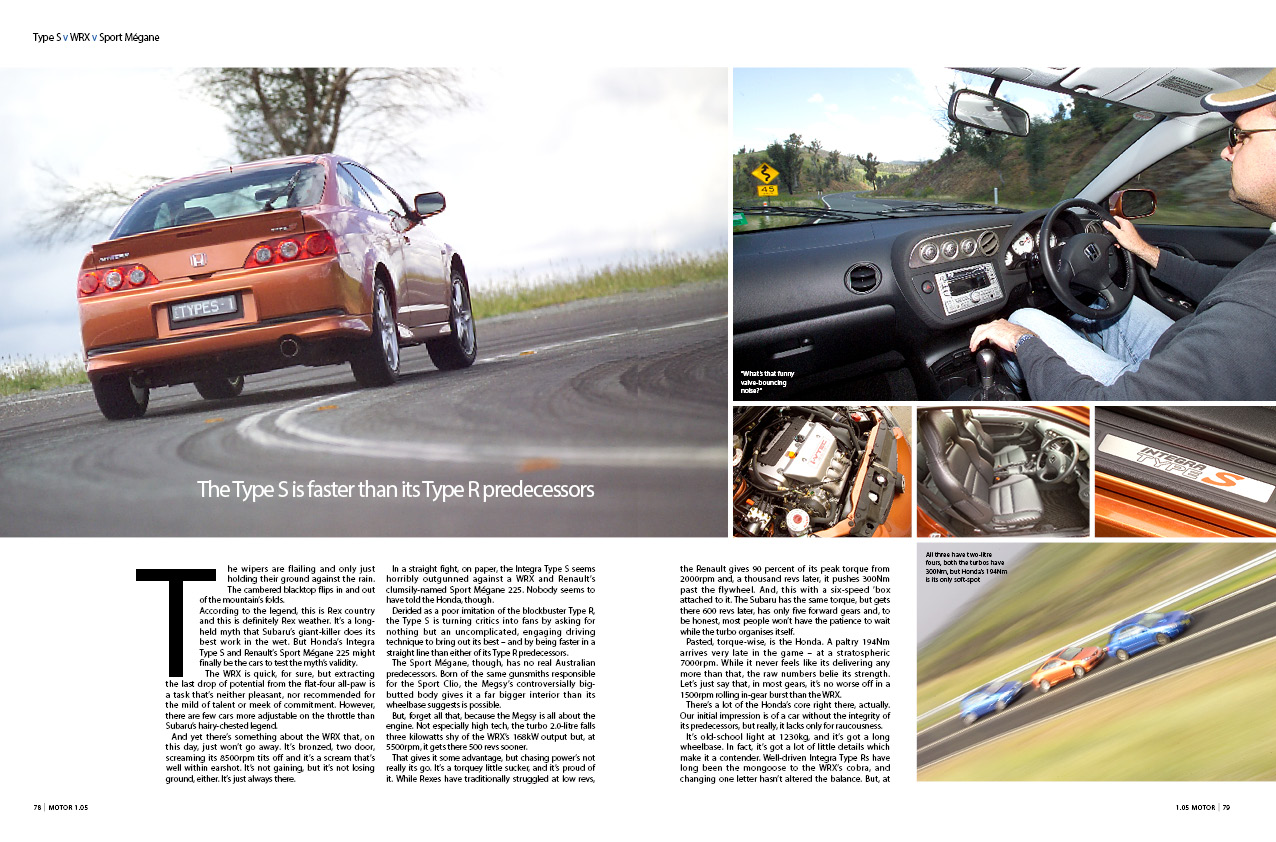
In a straight fight, on paper, the Integra Type S seems horribly outgunned against a WRX and Renault’s clumsily-named Sport Mégane 225. Nobody seems to have told the Honda, though.
Derided as a poor imitation of the blockbuster Type R, the Type S is turning critics into fans by asking for nothing but an uncomplicated, engaging driving technique to bring out its best – and by being faster in a straight line than either of its Type R predecessors.
The Sport Mégane, though, has no real Australian predecessors. Born of the same gunsmiths responsible for the Sport Clio, the Megsy’s controversially big-butted body gives it a far bigger interior than its wheelbase suggests is possible.
But, forget all that, because the Megsy is all about the engine. Not especially high tech, the turbo 2.0-litre falls three kilowatts shy of the WRX’s 168kW output but, at 5500rpm, it gets there 500 revs sooner.
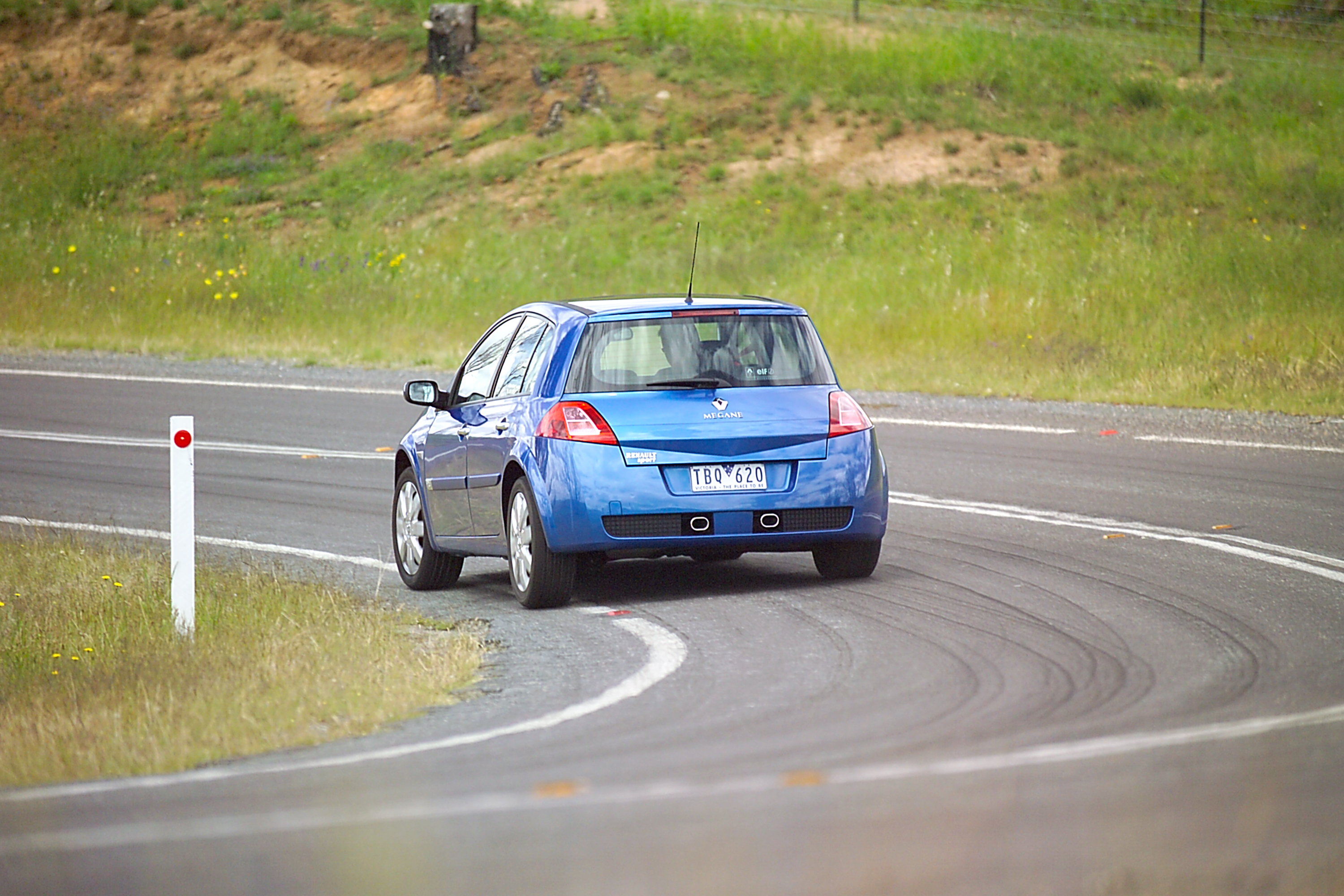
That gives it some advantage, but chasing power’s not really its go. It’s a torquey little sucker, and it’s proud of it. While Rexes have traditionally struggled at low revs, the Renault gives 90 percent of its peak torque from 2000rpm and, a thousand revs later, it pushes 300Nm past the flywheel. And, this with a six-speed ’box attached to it. The Subaru has the same torque, but gets there 600 revs later, has only five forward gears and, to be honest, most people won’t have the patience to wait while the turbo organises itself.
Pasted, torque-wise, is the Honda. A paltry 194Nm arrives very late in the game – at a stratospheric 7000rpm. While it never feels like its delivering any more than that, the raw numbers belie its strength. Let’s just say that, in most gears, it’s no worse off in a 1500rpm rolling in-gear burst than the WRX.
There’s a lot of the Honda’s core right there, actually. Our initial impression is of a car without the integrity of its predecessors, but really, it lacks only for raucousness.
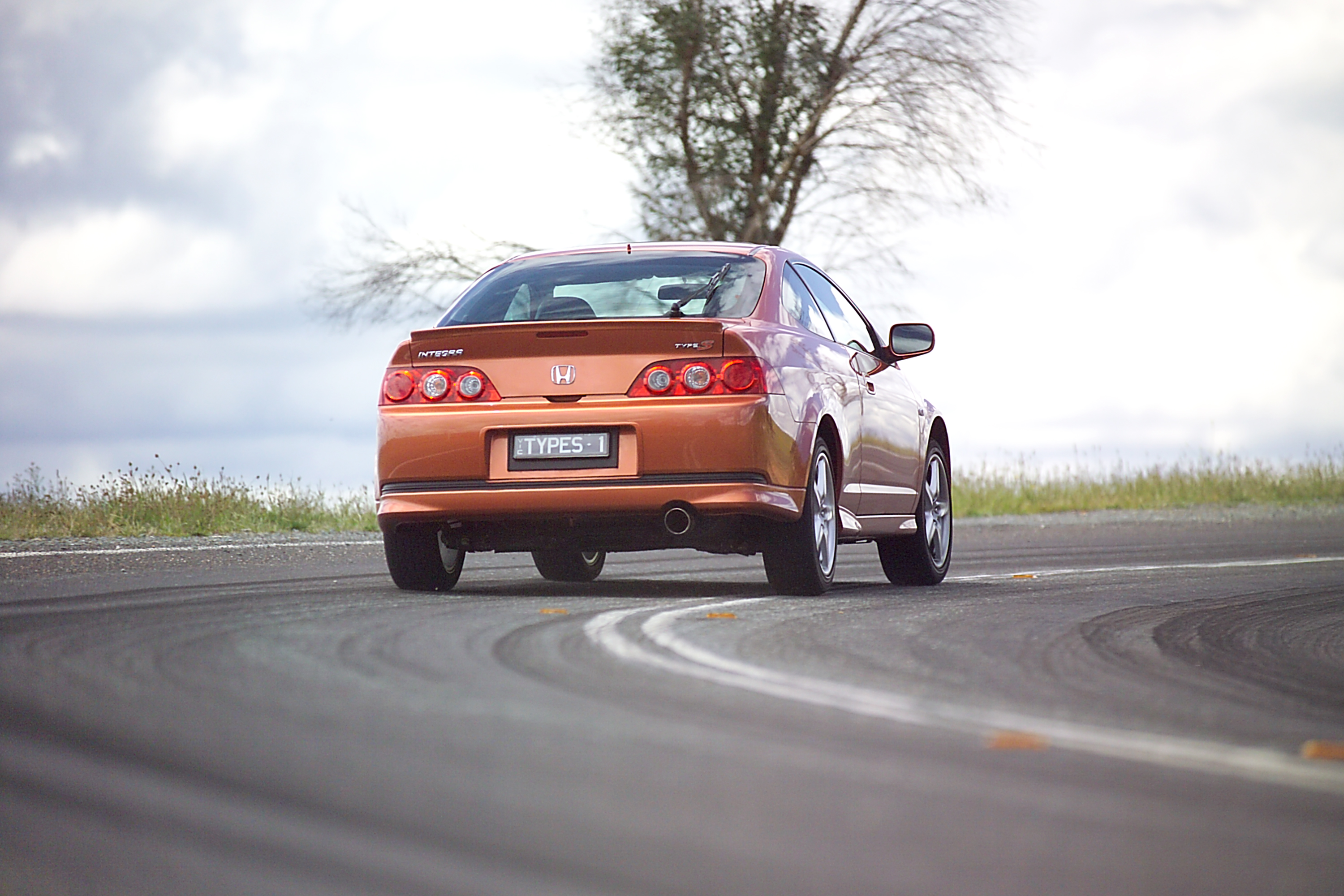
It’s old-school light at 1230kg, and it’s got a long wheelbase. In fact, it’s got a lot of little details which make it a contender. Well-driven Integra Type Rs have long been the mongoose to the WRX’s cobra, and changing one letter hasn’t altered the balance. But, at similar money to the Honda, and at similar output to the Rex, has Renault come up with a bigger, bolder Sport Clio to tip the scales?
Well, no. What it has come up with is the Commodore SS of hatchbacks. It’s got a superbly compliant ride, it’s luxurious with fabulous seating, it’s well appointed, it’s got bags of easily accessible grunt in a straight line and it rarely seems like it’s caught in the wrong gear. It just doesn’t have the Clio’s chassis poise.
Up to eight-tenths, the Sport Mégane is a pretty pleasant thing, left in taller gears to hiss in deep-boosted effort. Push harder than that, and the chassis package begins to unravel at the seams.
The soft-sidewalled Continentals don’t do its handling precision any favours, and the shockingly intrusive skid control system doesn’t help, either. You can turn it off, but above 50km/h it defaults back on again. It’s open to debate as to whether its job is to save the driver or to save corporate embarrassment should enthusiasts find out just how disappointingly short of the class benchmarks the Mégane’s chassis engineering stopped.
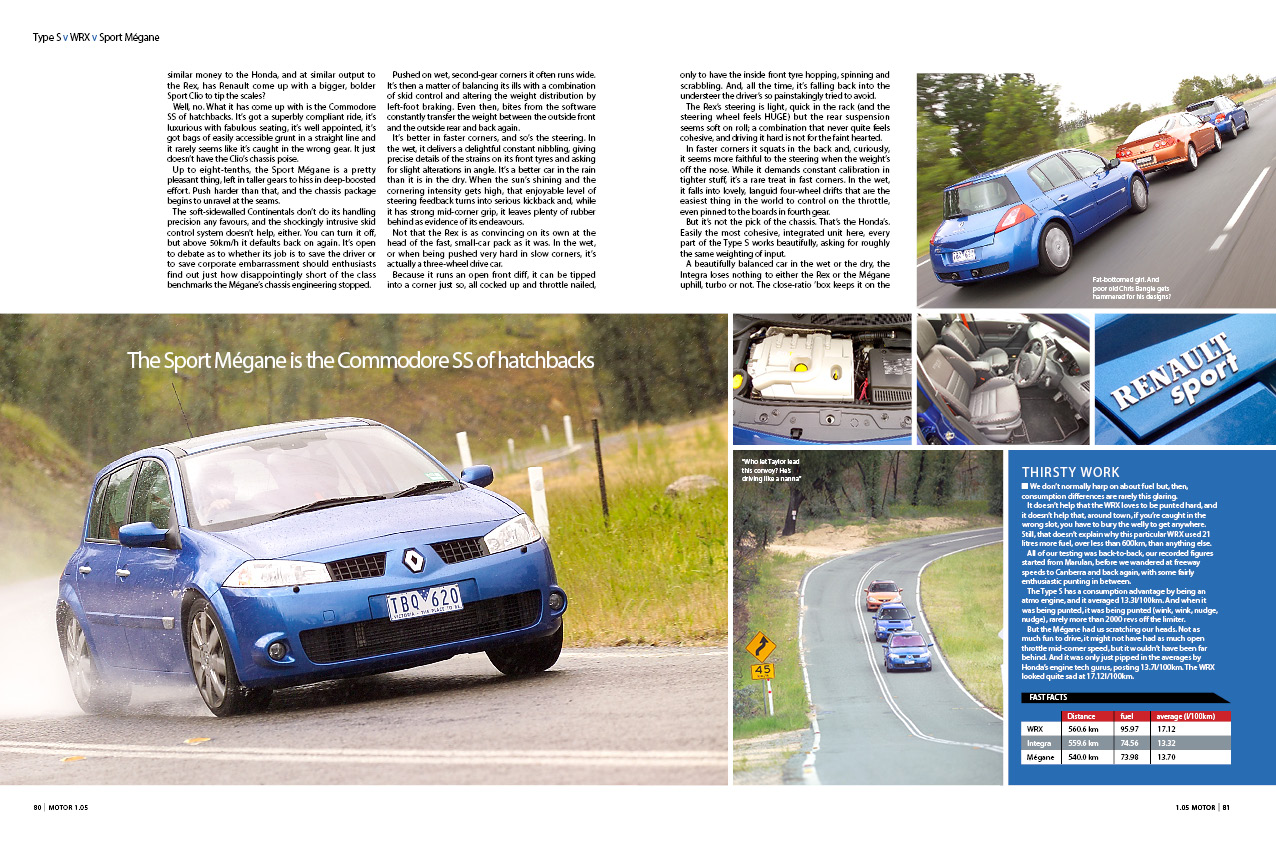
Pushed on wet, second-gear corners it often runs wide. It’s then a matter of balancing its ills with a combination of skid control and altering the weight distribution by left-foot braking. Even then, bites from the software constantly transfer the weight between the outside front and the outside rear and back again.
It’s better in faster corners, and so’s the steering. In the wet, it delivers a delightful constant nibbling, giving precise details of the strains on its front tyres and asking for slight alterations in angle. It’s a better car in the rain than it is in the dry. When the sun’s shining and the cornering intensity gets high, that enjoyable level of steering feedback turns into serious kickback and, while it has strong mid-corner grip, it leaves plenty of rubber behind as evidence of its endeavours.
Not that the Rex is as convincing on its own at the head of the fast, small-car pack as it was. In the wet, or when being pushed very hard in slow corners, it’s actually a three-wheel drive car.
Because it runs an open front diff, it can be tipped into a corner just so, all cocked up and throttle nailed, only to have the inside front tyre hopping, spinning and scrabbling. And, all the time, it’s falling back into the understeer the driver’s so painstakingly tried to avoid.
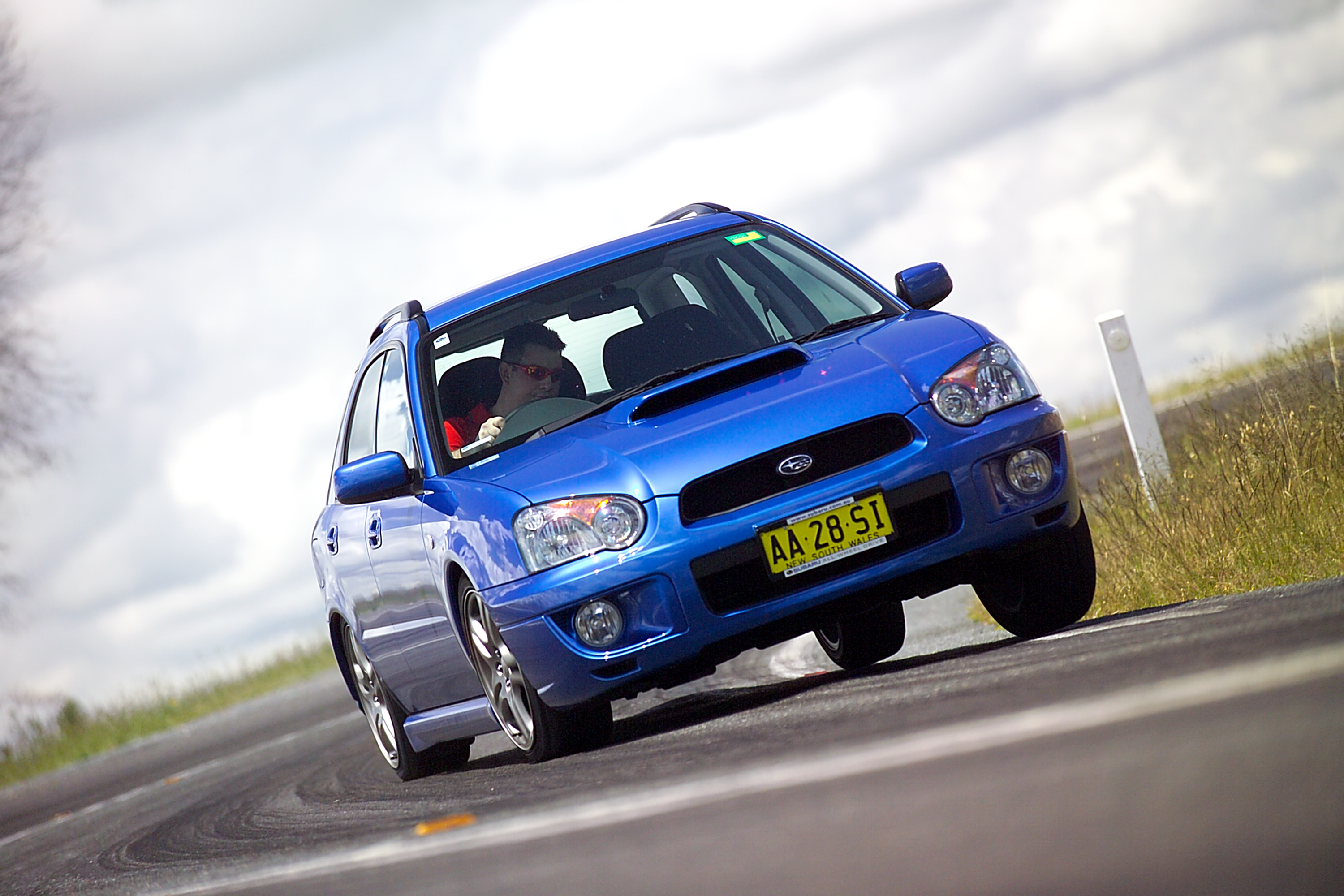
The Rex’s steering is light, quick in the rack (and the steering wheel feels HUGE) but the rear suspension seems soft on roll; a combination that never quite feels cohesive, and driving it hard is not for the faint hearted.
In faster corners it squats in the back and, curiously, it seems more faithful to the steering when the weight’s off the nose. While it demands constant calibration in tighter stuff, it’s a rare treat in fast corners. In the wet, it falls into lovely, languid four-wheel drifts that are the easiest thing in the world to control on the throttle, even pinned to the boards in fourth gear.
But it’s not the pick of the chassis. That’s the Honda’s. Easily the most cohesive, integrated unit here, every part of the Type S works beautifully, asking for roughly the same weighting of input.
A beautifully balanced car in the wet or the dry, the Integra loses nothing to either the Rex or the Mégane uphill, turbo or not. The close-ratio ’box keeps it on the big cam (are you listening, Toyota?) at every shift and its scream, which used to be blood curdling, is now muffled (thanks to sound deadening).
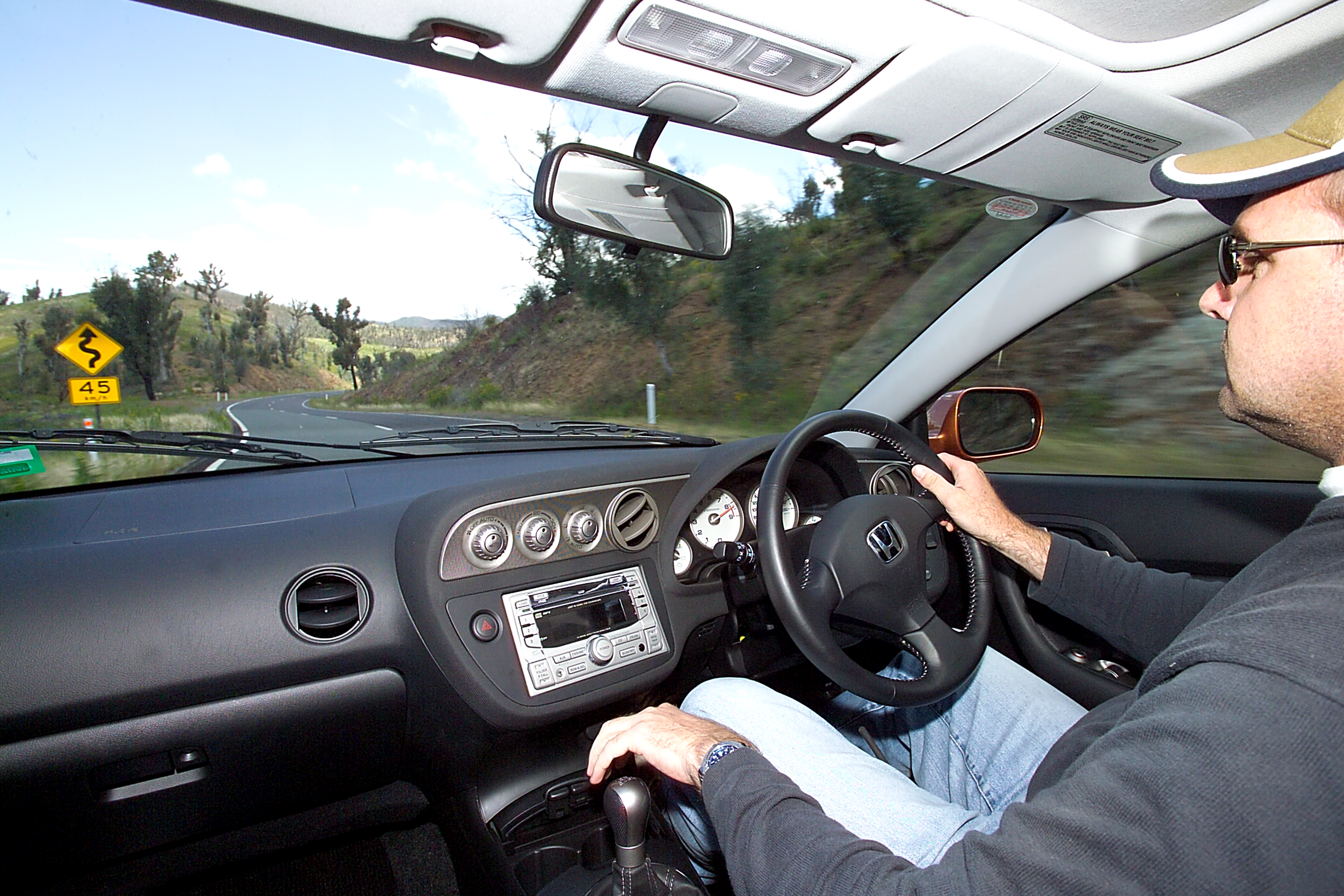
But, on the whole, it makes up for its torque deficit by being more nimble than either of its rivals. A lot more nimble. It picks metres on both of them with its ability to carry turn-in speed, and while it might not crunch them in a mid-corner static state, it nails them in adjustability. You can put it anywhere you like, change its stance mid-corner, tighten its line with the merest hint of lift-off and it gets out of wet second gear corners better than either of them.
It just point-blank refuses to fall into debilitating understeer and it only loses out on the downhill third gear corners, where the turbo tearaways suffer less from their power-down issues.
The steering is delightfully meaty and, WRX-like, it’s very quick in the rack. Unlike the Subaru, though, that steering speed feels far more in proportion to the way the rest of the car reacts to its yawing, and it’s got steering resistance just off-centre as well.
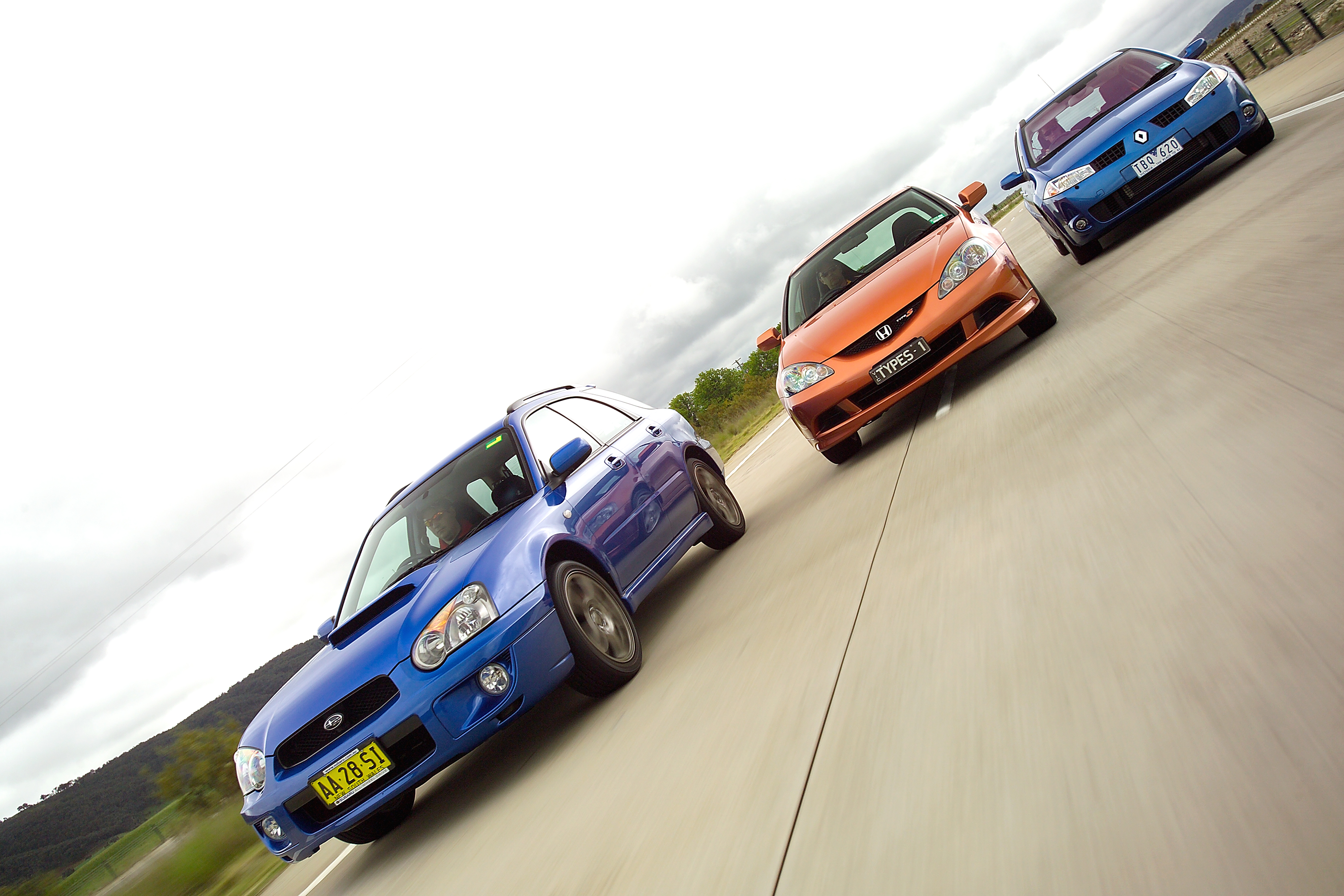
What you have when you punt a Type S hard is a willing, happy, unpretentious cohort. It’s forever suggesting you give it little adjustments via the throttle, brake and steering and there’s bundles of feedback. It’s always inviting you to snap its gearbox up or blip out another heel-toe downshift to keep the engine on song. While that all sounds a bit demanding, it successfully manages to make it all hugely involving and entertaining, and it’s so friendly in its nature that it never becomes hard work. It’s just how it asks you to drive it to access its best.
The Honda, surprisingly, has got the best brakes, too. They look like crap (c’mon, Honda – open-spoked 17s offer a great view of the caliper and you give it an unpainted, cast jobbie?), but they do the job. They’re helped in no small way by hauling in 130kg less than the Renault and a full 180kg less than the WRX, but they belie their simple nature.
They’ll all fade if they’re punted too hard for too long, but the Honda will struggle least and come back earliest. Because of its understeer tendencies, you tend to use the WRX’s picks to help it turn, either trailing a bit of brake to the apex or giving it a big left-foot hit or two. Either way, it heats up earlier than the Integra or Renault, its brake pedal is rock hard and there’s little pedal feel to it. Even when it’s got bad fade, it’s still hard and, once it’s started fading, you’re never quite sure of how much power is actually down there. Spooky.
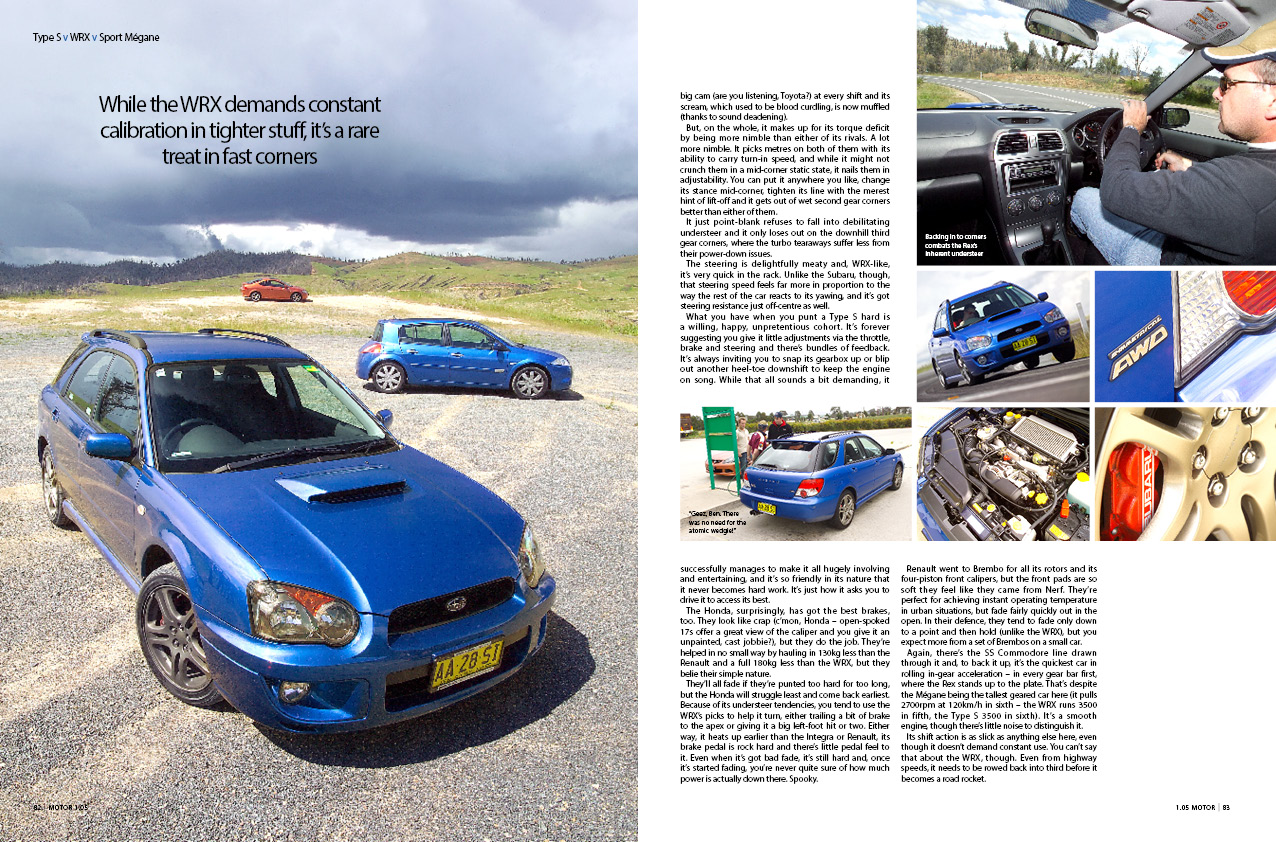
Renault went to Brembo for all its rotors and its four-piston front calipers, but the front pads are so soft they feel like they came from Nerf. They’re perfect for achieving instant operating temperature in urban situations, but fade fairly quickly out in the open. In their defence, they tend to fade only down to a point and then hold (unlike the WRX), but you expect more from a set of Brembos on a small car.
Again, there’s the SS Commodore line drawn through it and, to back it up, it’s the quickest car in rolling in-gear acceleration – in every gear bar first, where the Rex stands up to the plate. That’s despite the Mégane being the tallest geared car here (it pulls 2700rpm at 120km/h in sixth – the WRX runs 3500 in fifth, the Type S 3500 in sixth). It’s a smooth engine, though there’s little noise to distinguish it.
Its shift action is as slick as anything else here, even though it doesn’t demand constant use. You can’t say that about the WRX, though. Even from highway speeds, it needs to be rowed back into third before it becomes a road rocket.
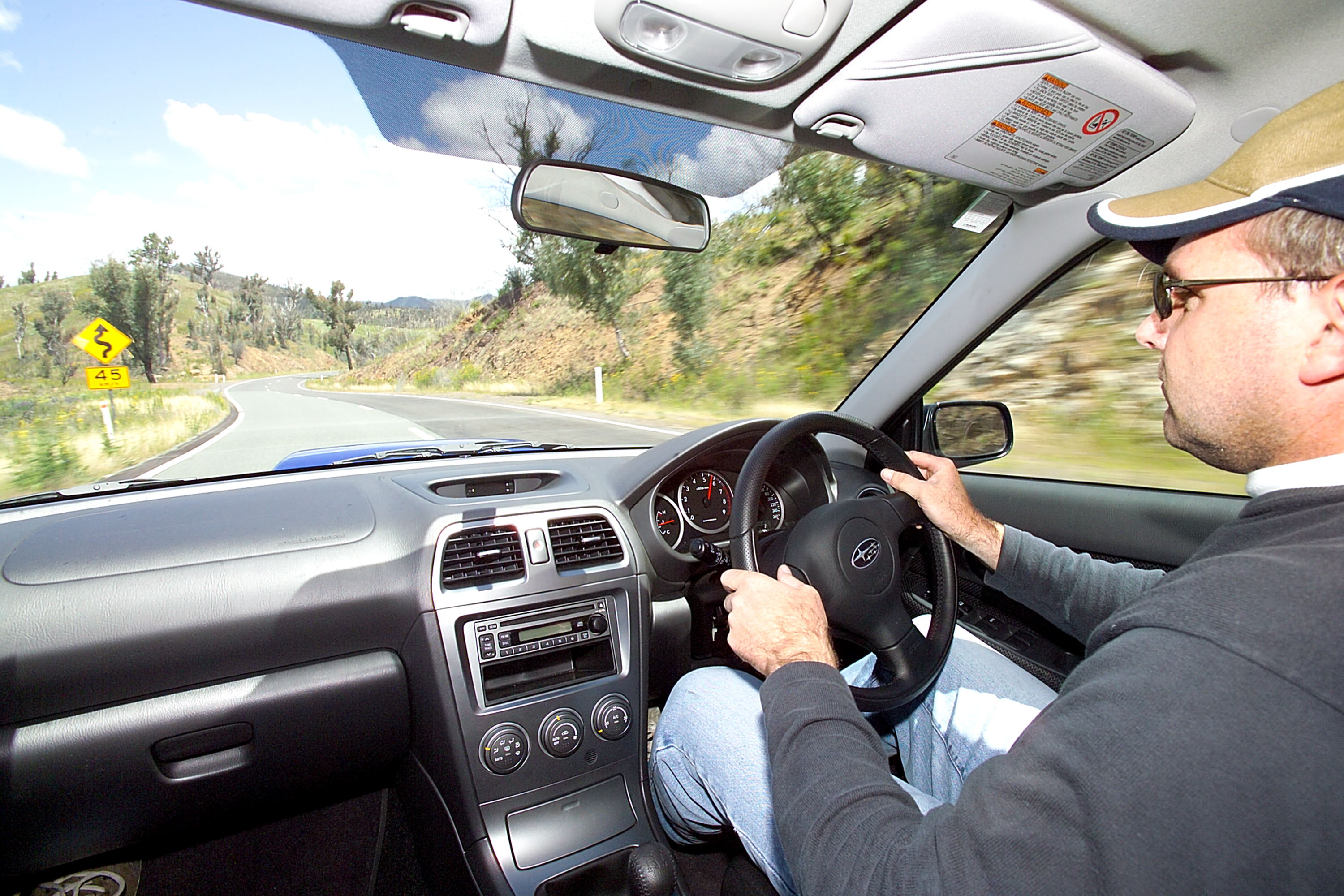
Subaru still fits the WRX with brilliant seats while the Renault’s pews are just gorgeous. And they offer plenty of grip too. Honda’s seats aren’t as supportive, with 6 x outer knee bruises to prove it, but they are a better, more liveable compromise than the super sporty and hard Recaros in previous models.
It packs a lot of engineering into the WRX, Subaru, and the trade-off on interior trim levels is starting to show. In this company, a single-DIN, single in-dash CD player with only average sound quality isn’t really where the par mark lives anymore. Honda gives it up with a beaut’ double-DIN in-dash six-stacker and a dash look that you just want to touch.
Standard on the Renault are nerdy things like a chromatic mirror, auto headlights-on and rain-sensing wipers, though a lot of its other controls are less natural to negotiate. Luxurious the Sport Mégane 225 might be, and the grip is actually there; it’s just not a graceful or pleasant exercise to get at it. It’s a bloody nice car, but has a cumbersome chassis and is out of its depth trying to scythe through the hills with a pair of rivals as sharp as these.
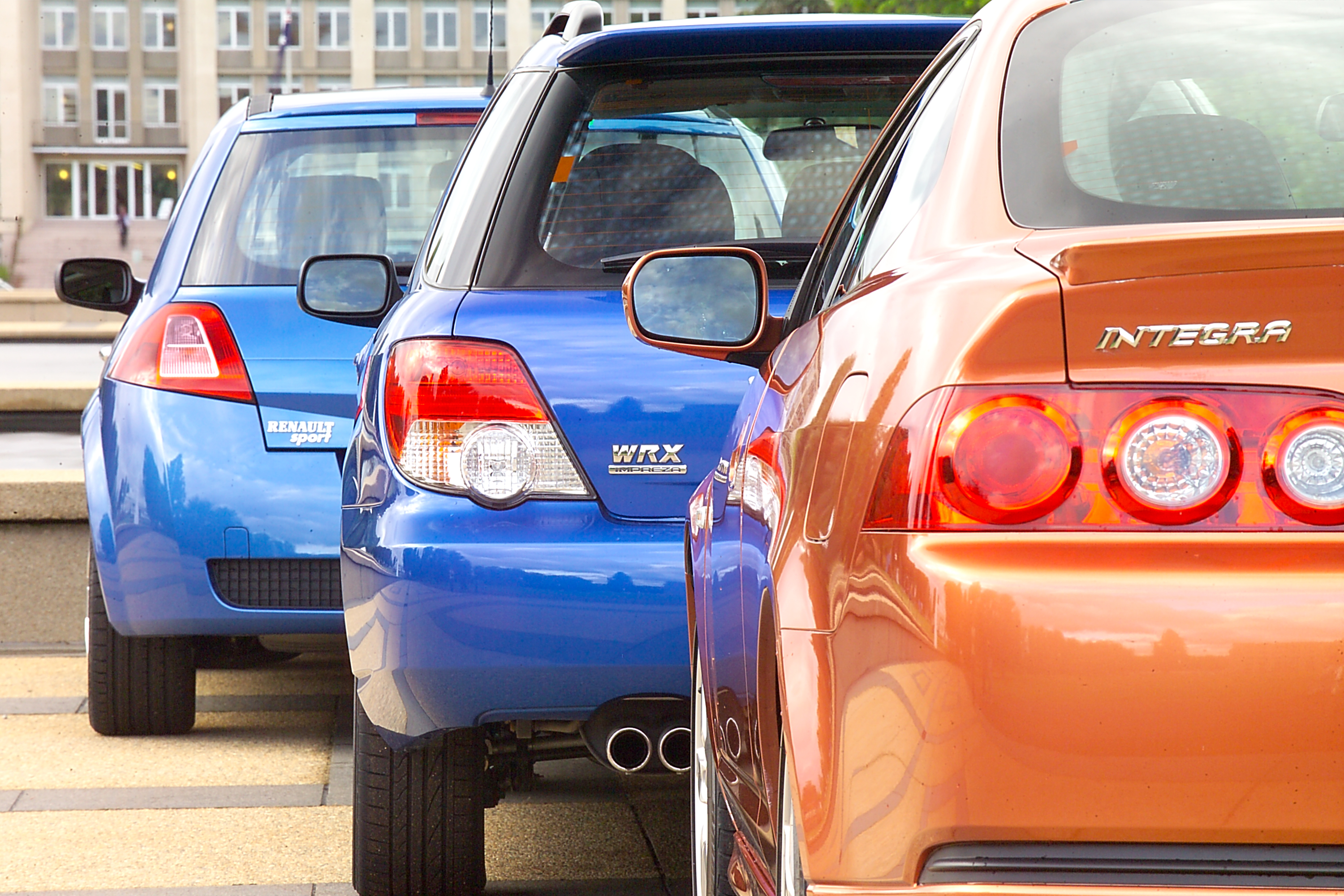
The WRX is still a benchmark car, and it’s more often imagined fighting against V8s than other fours. However, against the relative scalpel that is the Type S, it has nowhere to run and nowhere to hide.
OK, the Type S is less extravagantly feral than the Type R was. But, on balance, the Type S is a better car. A better car, too, than the WRX and it easily has the Sport Mégane 225’s measure. It might not be as fast as either of them, but it’ll run them close in the corners, it’s easier on its tyres (and insurance), and it’s the car that’ll make you smile the most.
Imagine a state-of-the-art supersonic fighter jet being produced and its maker being told, “You have to sell 500 to the public before you can fly it”. That may sound ludicrous, yet it’s not far off what happened for the genuinely iconic, unorthodox and unstoppable 1973 Lancia Stratos HF Stradale. A mid-engined, compact spaceship penned by a Lamborghini designer and powered by a free-revving Ferrari engine, it was utterly gobsmacking – and a political struggle from the start.
This was not an existing road car modified to the extreme – the Stratos was created with the sole purpose of winning the newly instituted World Rally Championship (WRC). The result of Lancia’s motorsport ambition, the road version existed purely because it was mandated by FIA Group 4 regulations. Otherwise, this was a corner carving, hump jumping, snow, dirt and gravel king created from inception to take rallying by storm.
Competition had always been in Lancia’s psyche, Vincenzo Lancia a racing driver himself when he and engineer Claudio Fogolin formed the company in 1906. Yet with debts mounting, the struggling brand faced its second bankruptcy in as many decades before rival Fiat bought it in 1969.
While its new owners looked to reinvigorate the brand, there was immediate tension between the individuality of ‘La Lancia’ and corporate pragmatism of Fiat. It festered with the Stratos project, objectors wondering how a low-volume sports car would help return Lancia to profitability. That was before the oil crisis…
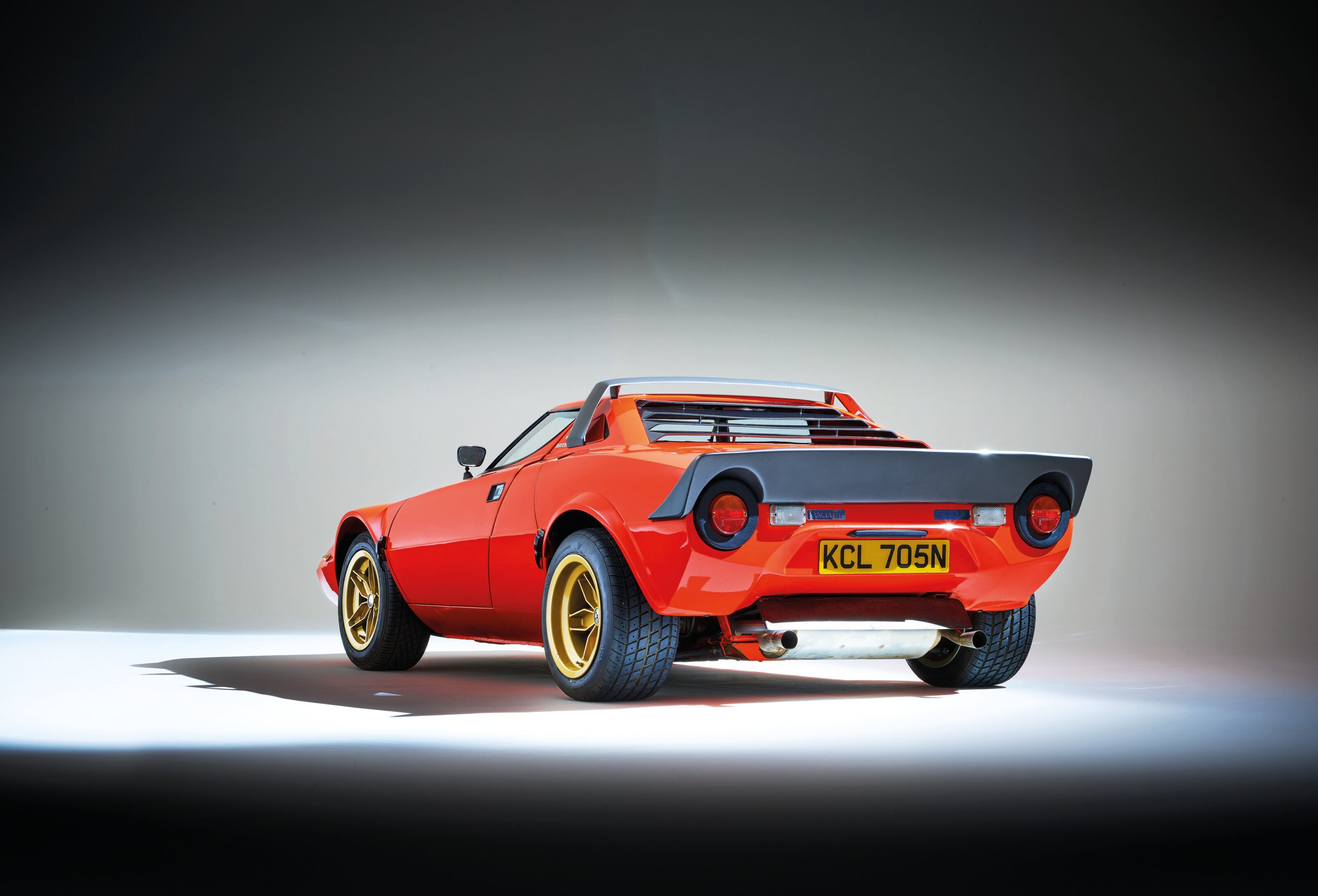
Across town Bertone was looking for a way into Lancia, too, as another rivalry was bubbling. Keen to steal a march on Pininfarina, Bertone’s Marcello Gandini, who gifted the world the Lamborghini Miura and then the Countach, daringly produced the wondrous, oh-so-seventies Stratos Zero concept.
The sparkling orange Stratos Zero stunned the 1970 Turin show with its dramatic, low nose and impossible wedge. Legend has it that Nuccio Bertone drove the 840mm-high Zero concept to Via Vincenzo Lancia – and straight under Grattacielo Lancia’s boomgate. It wasn’t just a ticket under the boomgate: it was Bertone’s expensive bid to design the Stratos HF (High Fidelity). It worked.
The brief for the Stratos HF was clear: win rallies. Initially, Fiat wanted Lancia to build a rally car that was intentionally heavy and sturdy, with high ground clearance and no need for a top-speed beyond 150km/h. Yet Lancia competition boss, Cesare Fiorio, demanded its new rally competitor be gifted with speed. The Stratos had to be fast on the smooth asphalt of Corsica, the dry dust and mud of Kenya’s Safari Rally, and carve through the bitter snow of Sweden.
Gandini worked swiftly, and the Stratos HF Concept was ready for the 1971 Turin show. The world had never seen such a wild, bold Lancia: finished in Day-Glo red with gold alloys, its aggressive posture and radical wedge profile saw a constant-radius front windscreen coalesce with its tapering side windows. The design barely changed for the production version, shown 12 months later.
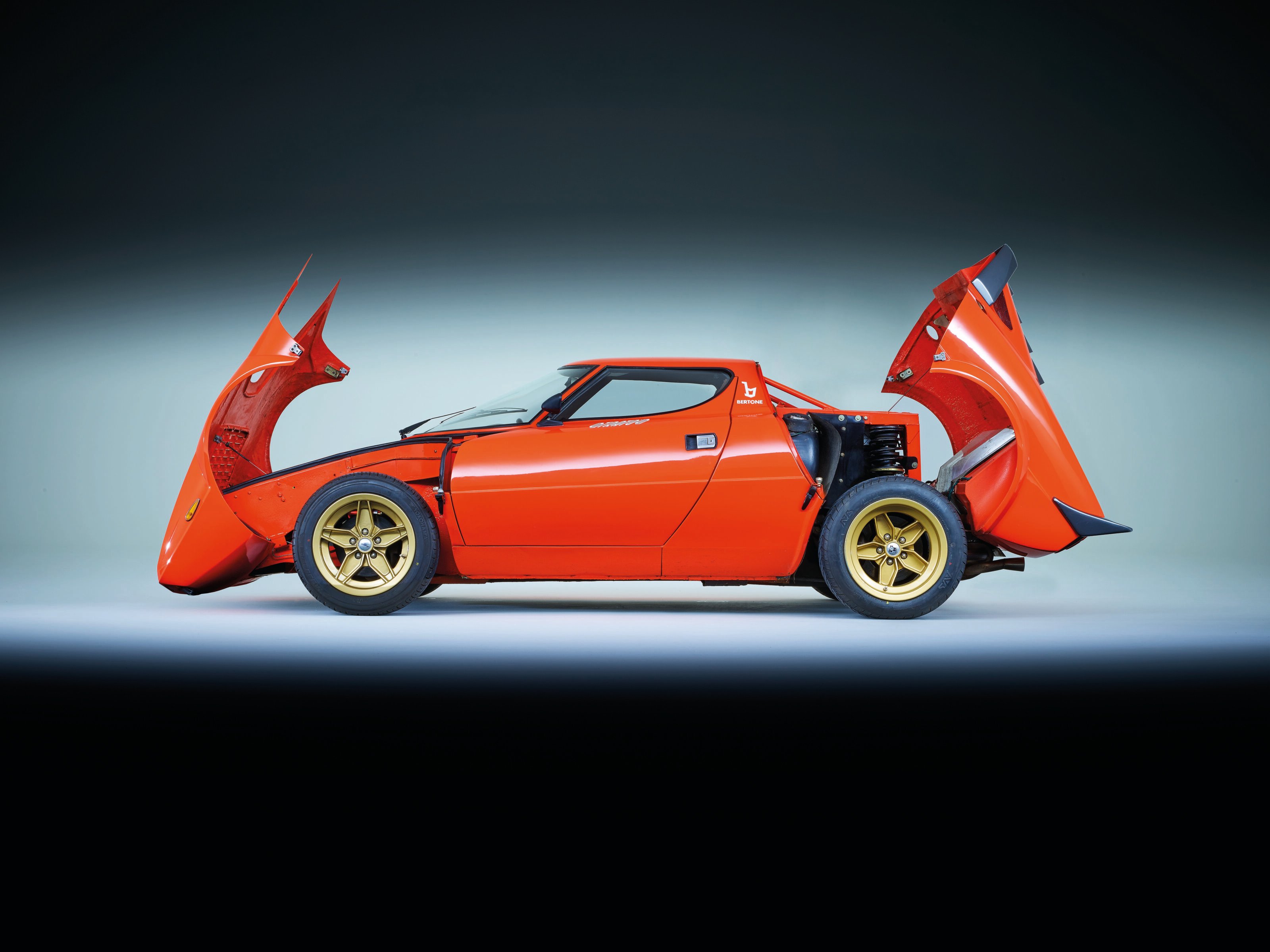
Literally a clean-sheet design, the Stratos’s compact proportions saw a central bulkhead anchor two seats and a mid-mounted engine for clever packaging that delivered inherent manoeuvrability and minimal weight. At 3710mm, it was shorter than the diminutive Alpine A110, the stumpy 2180mm wheelbase was a massive 220mm less than the then-new Mk 1 VW Golf, and 160mm less than a Dino’s. It was low, too, sitting only 45mm higher than the out-of-this-world Countach.
Former Wheels editor, Ian Fraser, writing in CAR in 1979, described the “amazingly compact” Stratos as, “One of Bertone’s most outstanding designs and a classic from the outset … Sleek from any angle, it exudes purposefulness”. Fraser was writing after buying his very own Stratos at the encouragement of fellow scribe, Georg Kacher, such was the Lancia’s impact on even hard-nosed journalists.
Underneath the lightweight fibreglass body – chosen over aluminium for cost and superior rally repairability – was an ultra-stiff steel monocoque with front and rear subframes. Designed by the legendary Gian Paolo Dallara with brilliant engineer Mike Parkes, it included an integrated roll-cage and front and rear clips, again for easy access to the Stratos’s mechanicals.
Suspension saw anti-roll bars at each end, with double-wishbones up front and upright MacPherson-type adjustable rear struts, chosen for greater travel and ease of changing wheel sizes. It was reinforced by significant underbody protection. Developed by legendary test driver, Claudio Maglioni, this was no beefed-up road car but an out-and-out competition monster.
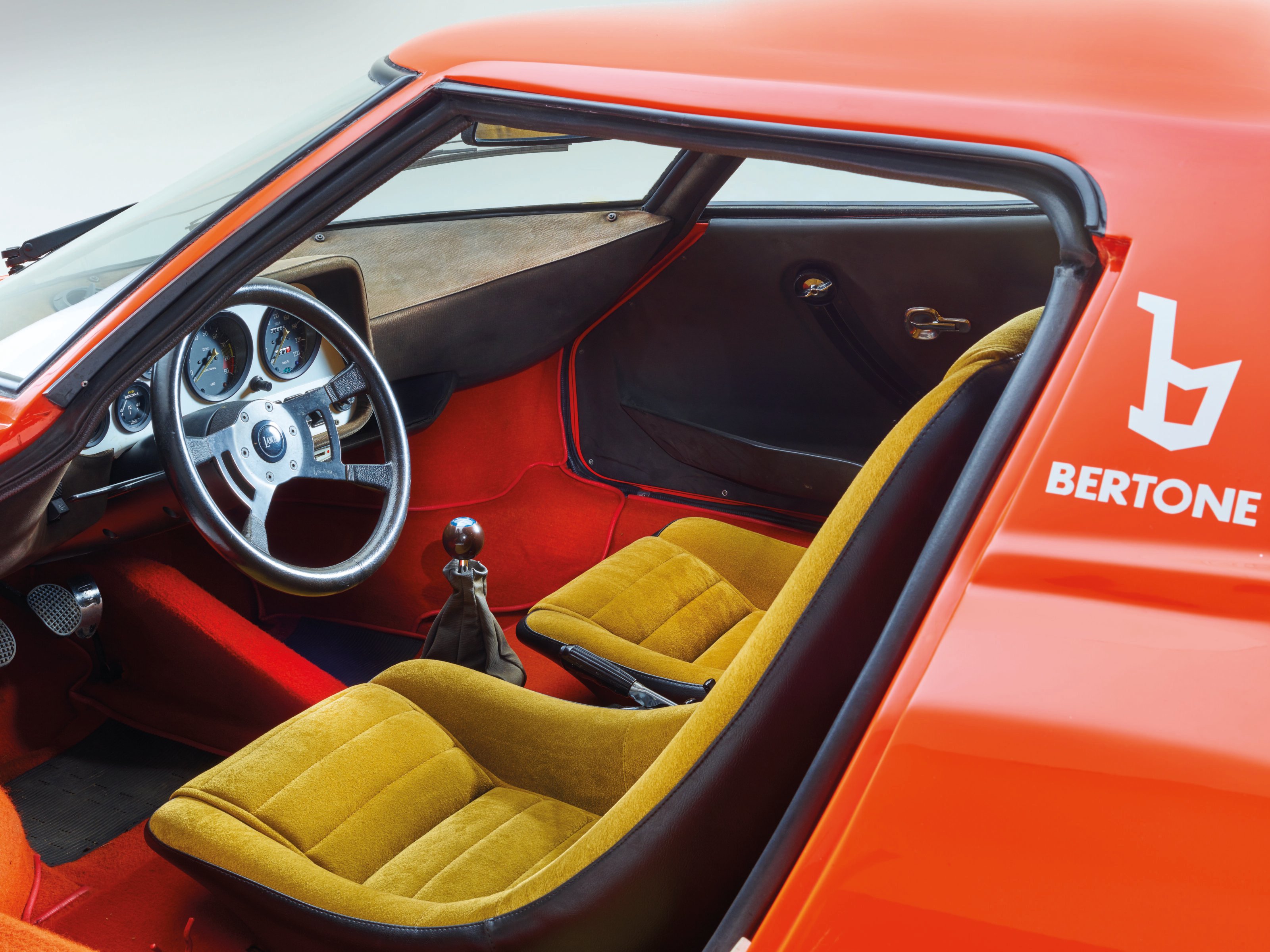
Opening the rear clip to reveal the glorious Dino V6 is typically a two-person job. Yet on the production car’s debut at Turin, a powerplant was still to be secured. The Dino V6 was desired for its compact size, light weight and power, Gandini designing the Stratos HF for the Dino V6 and synchromesh five-speed dogbox from the beginning. Yet politics almost scuttled it – and the entire Stratos project with it.
Fiat owned the keys to Ferrari’s road-car business, and while chief Umberto Agnelli somewhat supported the Stratos project, many key Fiat executives remained opposed. It’s suggested that Ferrari, too, saw the Stratos as a showroom rival to the Dino 246GT. This saw progress stalled by both Fiat and Ferrari whenever possible when it came to supplying the Dino V6.
Ironically, Lancia, the company responsible for the world’s first production V6, and first five-speed, was looking for exactly that. What’s more, legendary Lancia engineer, Vittorio Jano, was instrumental in developing the Dino engine Lancia was now being denied.
The drawn-out political battle ended when Lancia MD, Ugo Gobbato, played his masterstroke: asking Maserati to supply engines instead, to which it agreed. Shocked, the move promoted Fiat’s about-face to fully support the Stratos and reluctantly supply Dino engines. After all, Maserati – owned by Citroen – was outside the Fiat family following the dissolution of the Fiat/Citroen partnership. Ferrari’s Dino 246GT production was winding up, too.

Mounted transversely between the Stratos’s chassis rails ahead of the rear axle, the 2418cc twin-cam V6 ran triple 40mm Webers and a two-valve-per-cylinder head. Officially, it delivered a published 190CV (187.4hp/140kW) at a raucous 7400rpm, with four-valve heads ‘available upon request’ upping power to 280hp/209kW (or more, depending on what you read) as it spun to as much as 9000rpm.
Two Stratos raced in Group 5 were turbocharged for more than 520hp (388kW). Keep in mind that the world’s first mid-engined sports car, the Miura, had only appeared in 1966.
During development years earlier, the engine’s 65-degree angle was chosen by Jano for improved induction layout, balance and ignition timing with its vee-twin phasing. It used a cast-iron block teamed with aluminium alloy heads, with the gearbox positioned below the block ahead of the limited-slip diff to spread the Stratos’s 980kg, with around 60 percent weight over the driven rear wheels.
Amid the politics, Lancia painfully watched the French Alpine team dominate the 1973 World Rally Championship as Stratos road car production finally kicked off. The popular total figure of 492 Stratos built is still debated.
Cars weren’t numbered sequentially, with Bertone’s records showing only 141 shells built at the time of homologation in October 1974. Rumour has it that the FIA inspected a batch of several hundred Stratos in front of Lancia’s Chivasso facility before lunch. Of course, after lunch, a ‘second’ batch was ready and waiting out back…
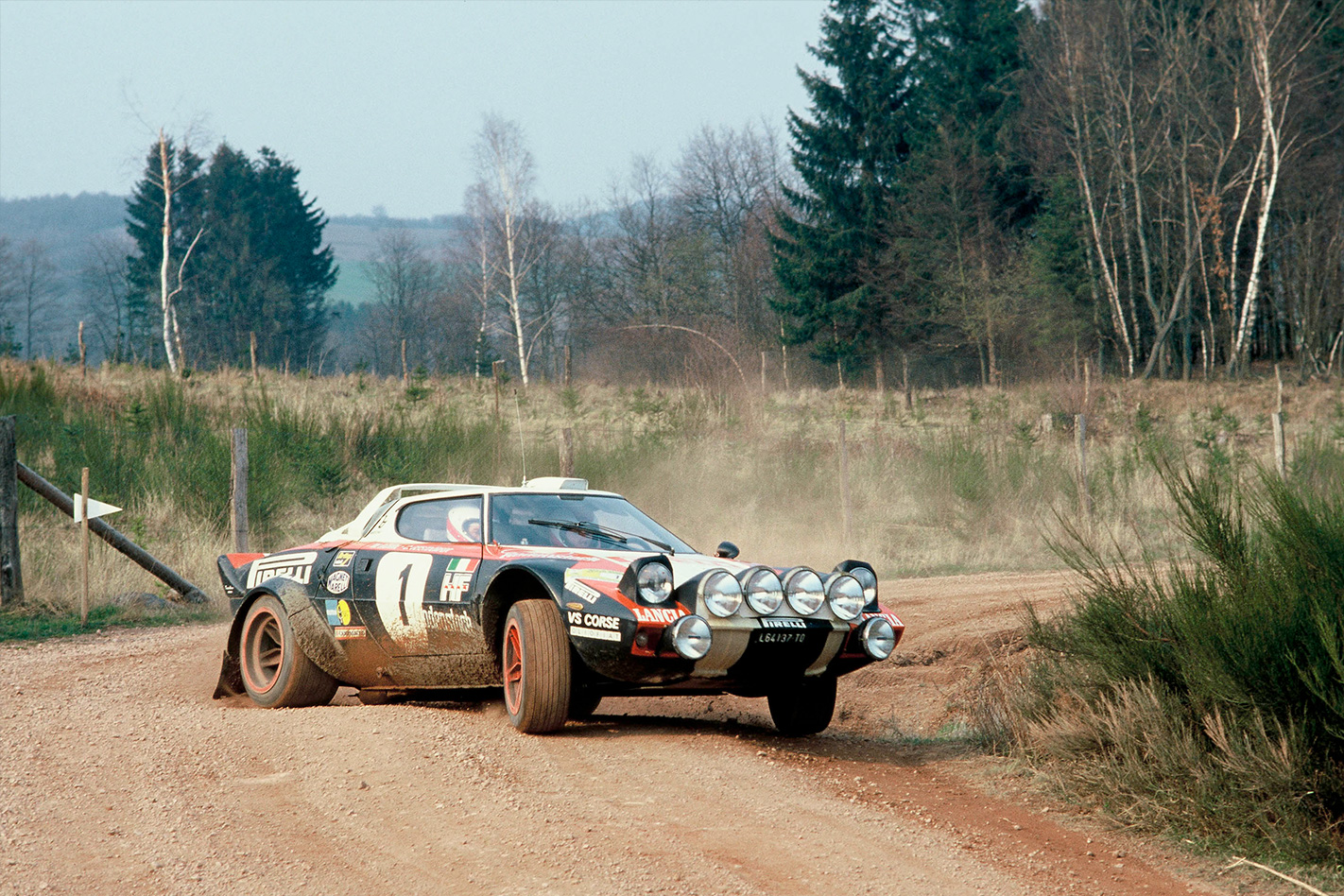
As a road car, the Stratos HF remained incredibly responsive yet surprisingly civilised. “For the sheer sports car that it obviously is, the Stratos copes remarkably well with the imposed role of gentle tourer,” Fraser reported. The interior was utilitarian, with firm bucket seats and a clear and simple dash.
Rally-critical temperature and pressure gauges were centralised, offsetting the speedo and rev-counter. Also pointers to its rallying genesis was space for additional (re: competition) switchgear and helmet-sized door pockets. There’s actually a decent boot too, with the spare alloy up front in familiar Gandini layout.
The Stratos competition package was initially challenging to sort, with the rear suspension – which failed on its first two competition outings – demanding fine-tuning. It evolved into an adaptable and responsive road car with excellent body control matched with sharp steering and that tractable, smooth Dino V6.

It was formidable to its opponents but could also be to the person behind the wheel. To drive it truly fast, it demanded intense concentration with slight steering inputs and throttle balance that only a few could summon. Forward vision was excellent – rearward, not so. Yet it’s first and foremost a rally car.
To say the Stratos was a success is to say pasta is popular in Italy. It amassed an unprecedented trophy cabinet and earned Lancia the first of three consecutive World Rally Championships in 1974. It won the Targo Florio that year, too, and would win the Tour de France five times and Giro d’Italia twice to also be a circuit-racing success.
In 1975 the iconic green, white and red Alitalia livery with yellow wheels appeared, one of rallying’s most popular pin-ups, the colours worn as the Stratos won the Monte Carlo rally in ’75, ’76 and 1977. Even after the factory withdrew support, the Stratos kept winning with privateers into the early 1980s.
Nothing could stop the incomparable Stratos, whether an oil crisis or bitter Fiat execs. Unimaginable today, it was a masterpiece of determined, unorthodox thinking. It rewrote the rallying rulebook, permanently altering the sport while redefining performance cars along the way. The Lancia Stratos HF left an indelible stamp on automotive history that few, if any, can hold a candle to. The struggle was worth it.

Lancia Locale
Legendary the world over, the Stratos was a rare sight on Australian stages. Rally legend and Bathurst winner Colin Bond drove a Stratos as the Zero car at Rally Australia, but never competed. Ron Marks and co-driver Graeme Gillies campaigned a yellow Stratos in several events, including the highly regarded Southern Cross Rally in 1976 and ‘78, as well as the Castrol International Rally in Canberra. Their best posted result was a fourth the Warana Rally in Queensland, 1976.
Copy, Paste
Only a handful Stratos HFs have made it to Australia. With prime examples fetching beyond $1 million, more affordable replicas are available if you don’t consider this sacrilege. The ‘New Stratos’, with 25 built by Manifattura Automobili Torino (MAT), is priced similarly to a genuine Stratos given its Ferrari F430 donor car. Hawk Cars and LB Specialist Cars produce kit versions in the UK using Alfa, Toyota and Ferrari engines. Strictly POA, used examples have changed hands for around £70k.
For many, Christmas is a time of celebrating family – and ours is as diverse and varied as it gets in the automotive world.
We’re lucky enough to reach our audiences across WhichCar, Wheels, MOTOR, Street Machine, and 4X4 Australia titles, publishing news, reviews, and feature stories from enthusiasts for enthusiasts.
But while the writers are the ones get the glory, our photographers and videographers are the ones tasked with bringing our words to life.
Across those five titles we have more than 180,000 followers on Instagram, who collectively liked our posts more than 1.3 million times in 2021 alone – most of which came from Street Machine fans!
Here’s our top 10 Instagram posts for 2021, with the most popular posts taken from all five titles, as voted by you.
10. M3 cop car
The new addition of an M3 to Victoria Police’s Highway Patrol fleet ruffled some feathers in December, but some people didn’t realise the vehicle was actually a loan from BMW Australia.
https://www.instagram.com/p/CXetIxdLsdE/
9. RIP Sabine
The news that rocked the global car community – Sabine Schmitz died of cancer back in March at just 51 years of age. She was a hugely talented and fearless driver who knew the Nürburgring like the back of her hand, as well as being a joy to watch on Top Gear. Clearly our audience felt it as deeply as we did.
https://www.instagram.com/p/CMg_2cNHWXO/
8. Blown V8 on Patrol
Vogue Industry’s Harrop-supercharged Nissan Y62 Patrol turned out to be one of the most popular vehicles posted on 4X4 Australia’s Instagram page this year, no doubt thanks to its tough and sinister looks, perfectly captured on the beach.
https://www.instagram.com/p/CTv3Xx1j1LB/
7. On top of the world
This 2014 Toyota N70 HiLux was a contender for the Ryobi 4X4 of the Year for 2021, proving that a clean dual-cab HiLux build is still one of the most popular off-road vehicles for Aussies.
https://www.instagram.com/p/CWUqkfFrGox/
6. Zed ain’t dead
The 2022 Nissan Z has got everyone excited at the prospect of a new Zed car. We published a gallery of images when the car was revealed in August, showcasing the production car’s wonderful design.
https://www.instagram.com/p/CSsxtNzhEq_/
5. Track Edition on track
Want to drive a Lexus RC F Track Edition at 10/10ths on a circuit? Scott Newman gave us a first-hand look at what’s required to wrestle a high-performance V8 coupe around Bryant Park at full noise – and what a noise!
https://www.instagram.com/p/CVm3dwwl8mL/
4. Sliding ‘Stang
Another track video, but this time it was the RTR Mustang Spec 3, with so much power it could barely drive in a straight line. The stunning work by our videography team made this the most popular post from MOTOR in 2021.
https://www.instagram.com/p/CWcQx6mtaP9/
3. Stevo’s walkaround
Apparently you all couldn’t get enough of the Lexus RC F. Following the video at Bryant Park, Mike Stevens gave a walkaround of the vehicle before handing back the keys to the car for good. Given the rarity of the Track Edition, it’s no wonder so many of you appreciated getting up-close and personal with the RC F.
https://www.instagram.com/p/CUwKIzuhK23/
2. Frankenstein FG
A raised-up FG Falcon ute that does 11-second runs? We loved seeing Kyle Breed’s ingenuity and uniqueness in his build – and so did you. This workshop ute got the thumbs-up from more than 8300 Street Machine fans, taking it straight to second position in this top 10.
https://www.instagram.com/p/CXRzxnzNI1_/
1. Fire-breathing Kingswood
It was February when we published a short video of this Holden HQ Kingswood wagon with four bottles of NOS in the boot. The glorious sound from that V8 and the fire-spitting exhaust clearly resonated with our audience, making it the most popular post on Instagram for 2021.
https://www.instagram.com/p/CLypVGvCEKU/
Bonus: Taste the rainbow
One of our favourites from the news team was the Mazda NA MX-5 shot by Alastair Brook, showcasing the timeless design of the convertible, as well as its hugely fun personality.
https://www.instagram.com/p/CXAuUYNL4L2/
We’ve loved it on the road and it’s reset front-wheel drive records on the drag strip, but how does the new Hyundai i30 N DCT stack up on track?
To find out, we have a day at Bryant Park and a DriftBox with which to record the data. It’s the first front-wheel-drive car we’ve run in MOTOR’s new track series and it’ll be interesting to see if it can do any giant-killing as Bryant Park tends to be a natural hot hatch habitat.
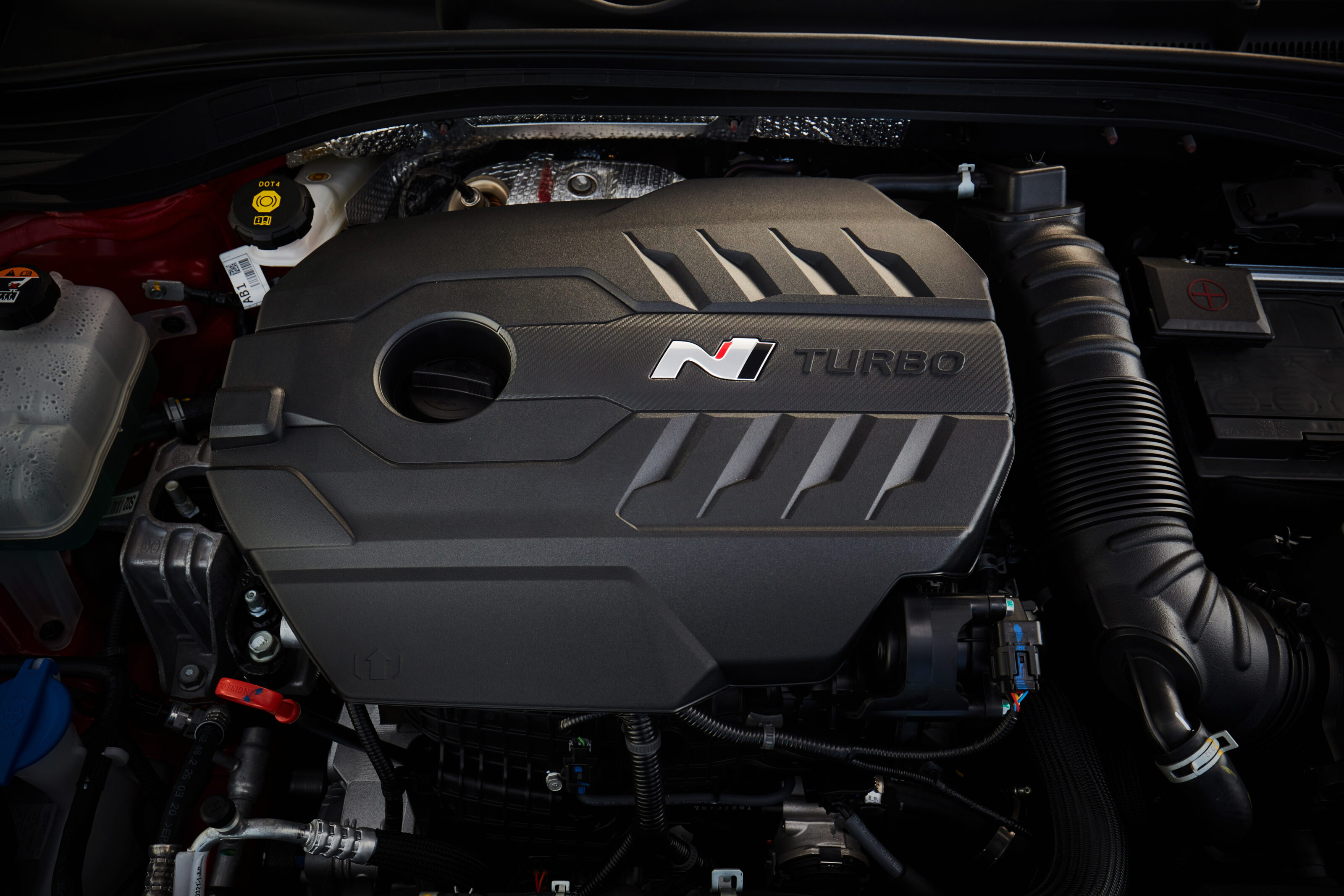
You’re probably familiar with the new i30 N’s specs so let’s be brief: an extra 4kW/39Nm from the 2.0-litre turbo four-pot, an eight-speed dual-clutch gearbox, bigger front brake rotors, lighter wheels and retuned suspension. All things that bode well for increased track performance.
First things first, the uprated engine is incredibly strong, way stronger than the relatively mild increased outputs suggest. The torque jump is carried right across the rev range and the new i30 N will pin your head back into the seat in the lower gears under acceleration.
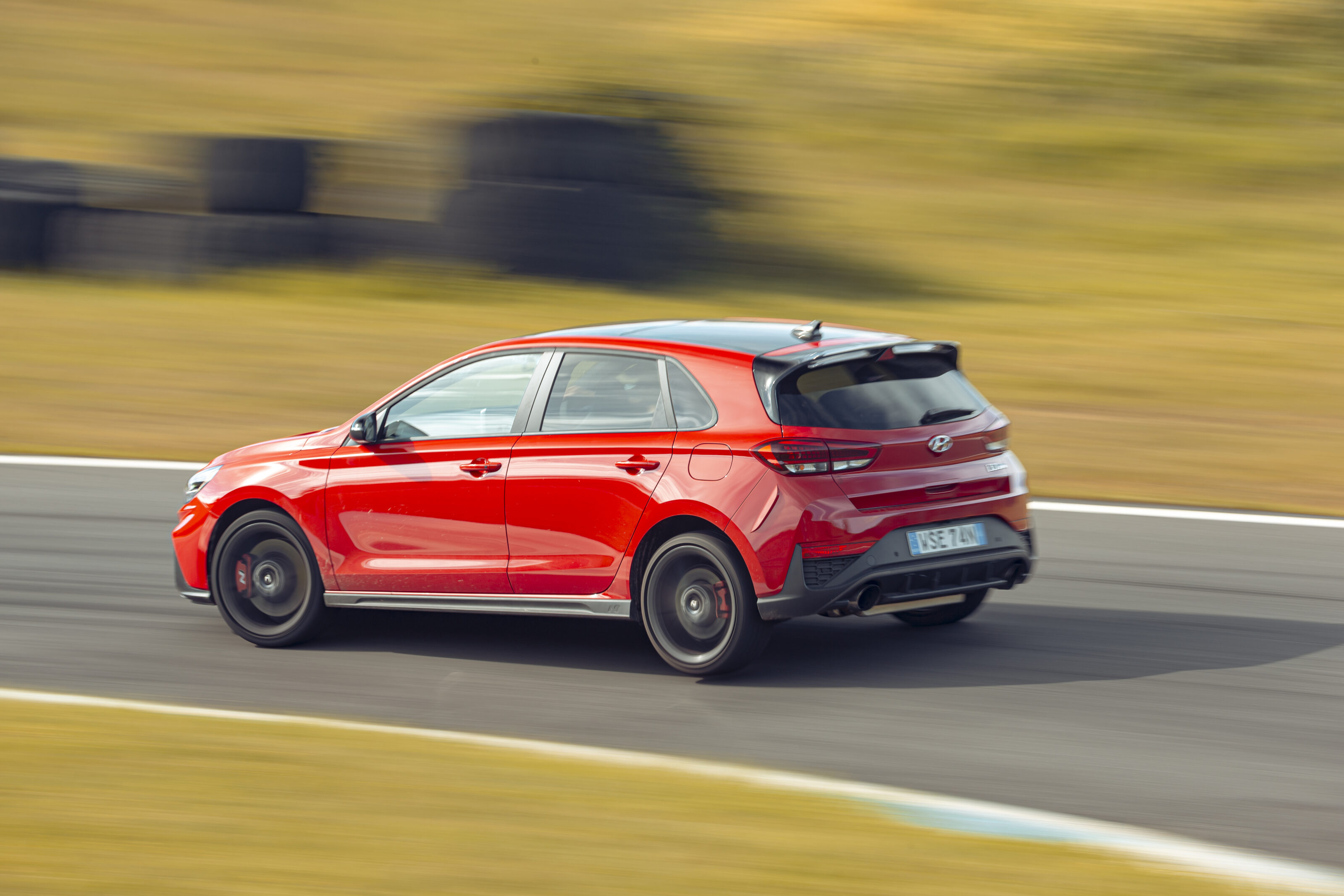
It also sounds incredibly angry, with a really hard-edged note and vicious cracks and bangs on the overrun. The eight-speed dual-clutch is a great match, though the six-speed manual is certainly no hardship either, with super quick shifts and well-chosen ratios. Purists will scoff, but you don’t really lose much in terms of involvement by choosing the dual-clutch.
That’s primarily because there’s plenty to concentrate on, even without shifting a lever around. The tyres need temperature, especially at the rear, with plenty of oversteer if you go charging into corners straight away but with a bit of warmth, the balance is primarily front-led but with just enough movement from the rear to help out.
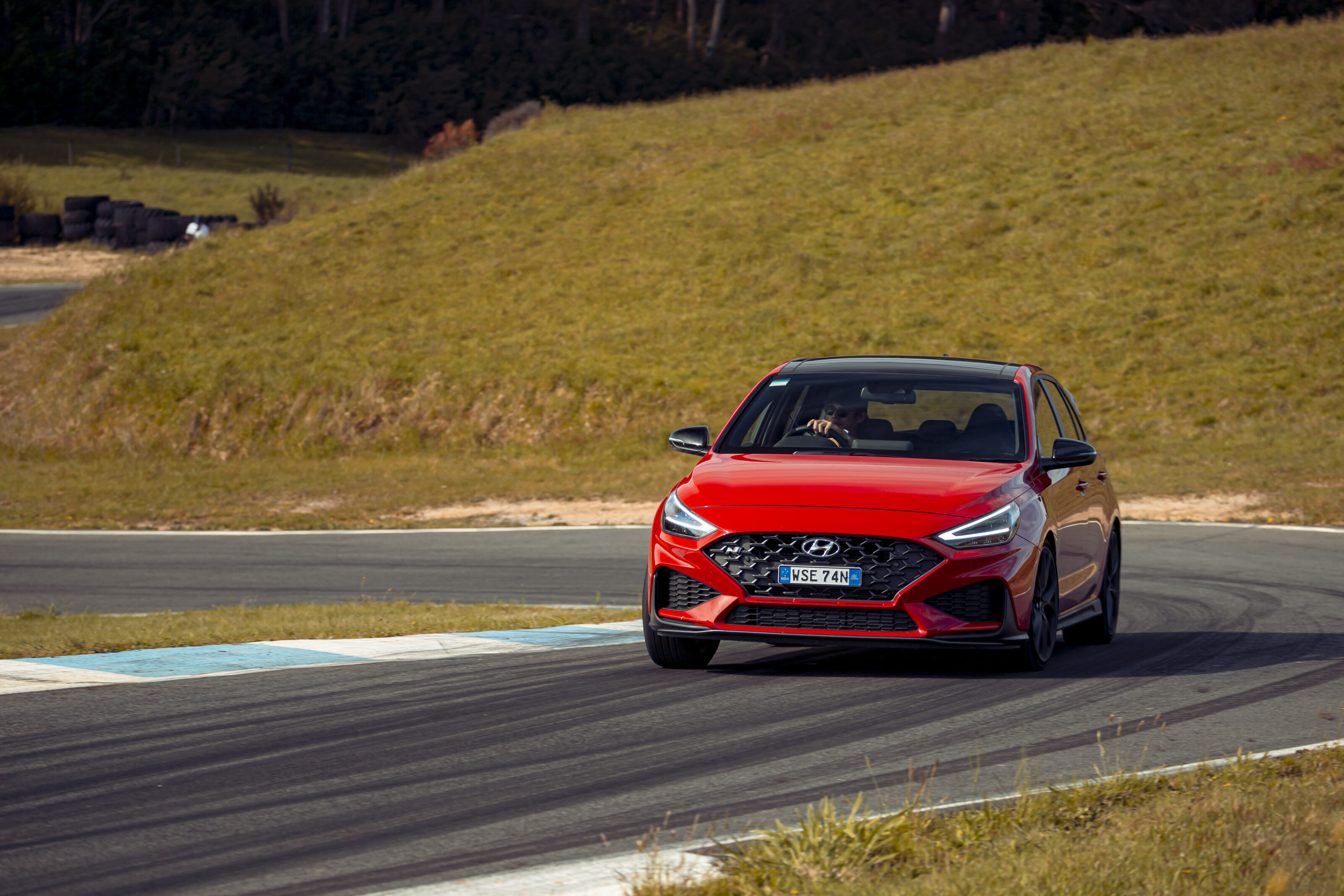
A word for the brakes. The specifications aren’t anything special, with plain old single-piston calipers front and rear, but they resist punishment remarkably well and provide great pedal feel.
Equally, there’s tremendous communication through – quite weighty – steering that allows you to finely judge the slip angle of the front tyres. There is some torque steer, and the limited-slip diff will drag both front wheels wide if you’re brutal with the throttle, but it also provides great traction.
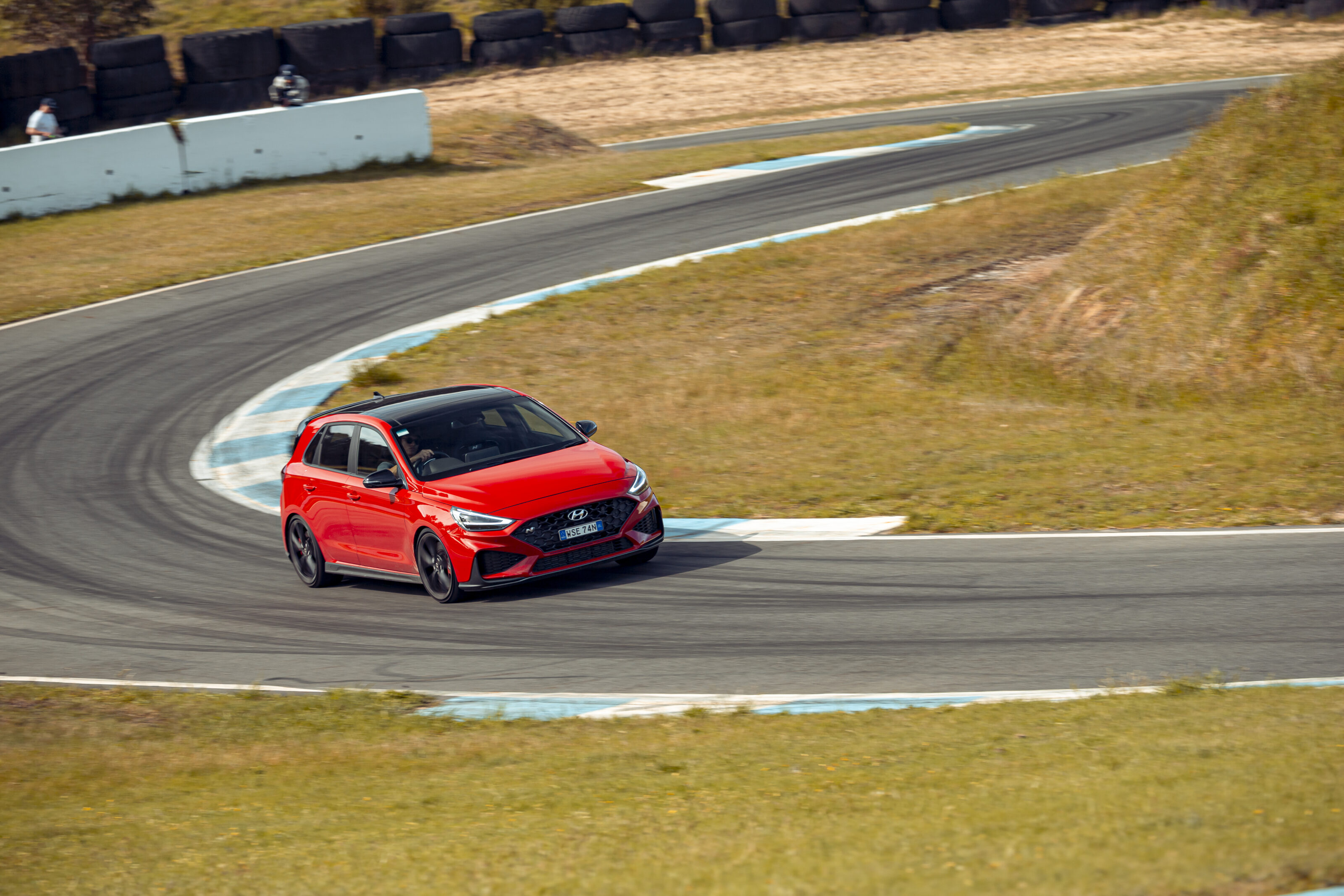
With a bit of right-foot sensitivity, adding throttle actually drags the nose into the apex rather than away from it thanks to the clever diff shuffling power to where it’s needed most. It makes a big difference in being able to commit to a corner and yet still get back on the accelerator.
All this has been happening in the standard N mode, activated by pressing the chequered flag button on the steering wheel, but pressing that button again activates N Custom mode (or holding it down deactivates the ESC completely).
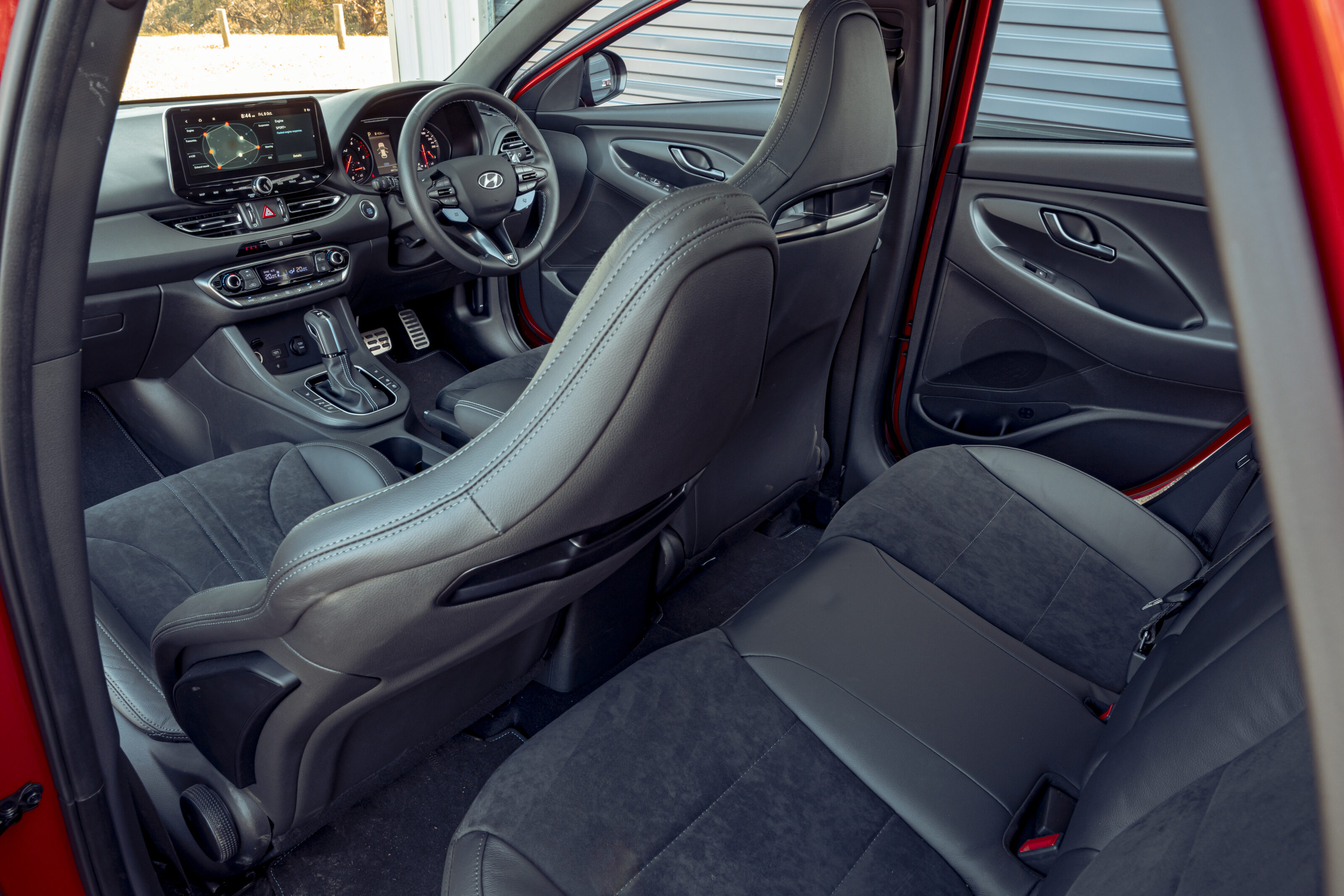
This mode allows the car’s various mechanical pieces to be altered individually through a spider-web-style screen in the centre console, where you’ll also find a lap timer and launch control. It’s more helpful on the road than on track, where having everything wicked up to maximum attack seems to be the way to go.
The only thing left to do is to attempt a lap time and it must be said that the i30 N’s 1:08.7sec isn’t quite as quick as I thought it might be. To be honest, it struggled slightly with front-end grip – the front tyres were possibly a little past their best – necessitating a slight delay when reapplying throttle.
Nevertheless, it’s a quick, incredibly capable and extremely entertaining hot hatch and one we can’t wait to unleash on a faster circuit.
Leaderboard
| RTR Ford Mustang: | 1:06.0sec |
|---|---|
| Audi RS5 Coupe: | 1:06.7sec |
| Lexus RC F Track Edition: | 1:06.8sec |
| Hyundai i30 N DCT | 1:08.7sec |
| MINI Cooper JCW: | 1:11.8sec |
2022 Hyundai i30 N DCT Specifications
| Body: | 5-door, 5-seat hatch |
|---|---|
| Drive: | front-wheel |
| Engine: | 1998cc inline-4cyl, DOHC, 16v, turbo |
| Bore/stroke: | 86.0 x 86.0mm |
| Compression: | 9.5:1 |
| Power: | 206kW @ 6000rpm |
| Torque: | 392Nm @ 2100-4700rpm |
| Weight: | 1466kg |
| Power/weight: | 141kW/tonne |
| Transmission: | 8-speed dual-clutch |
| Suspension: | Struts, coil springs, adaptive dampers, anti-roll bar (f); multi-links, coil springs, adaptive dampers, anti-roll bar (r) |
| L/W/H: | 4455/1795/1419mm |
| Wheelbase: | 2650mm |
| Tracks: | 1573/1564mm (f/r) |
| Steering: | Electrically assisted rack-and-pinion |
| Brakes: | 360mm ventilated discs, single-piston calipers (f); 314mm solid discs, single-piston calipers (r) |
| Wheels: | 19 x 8.0-inch (f/r) |
| Tyres: | 235/35 R19 (f/r); Pirelli P Zero HN |
| Price: | $52,000 + ORC |
The Superbowl may lay claim to the most expensive and grandiose commercials each year, but Christmas is always a fun time for feel-good and sometimes funny videos from carmakers.
This year is a little different. Due to widespread stock shortages across the new-car industry, a number of car manufacturers have opted to spend less on their Christmas advertising, according to industry analysts.
“We will not be promoting the holiday season as we have been,” Vice President of Cadillac Rory Harvey told Reuters, pointing out vehicle stock is currently at a third of normal levels.
But while there are fewer companies making Christmas videos this year, there are still some floating around. While some are great, others are better to poke fun at – like a bad joke shared at the dinner table. Here are the best – and worst – Christmas-themed car videos of 2021.
Hipster Santa
We weren’t joking when we said car companies were spending less. Audi has literally recycled its Christmas video from 2020 – taking down the original version and updating it to remove the camouflage wrap from Hipster Santa’s Audi RS E-Tron GT, now that the model has been fully revealed. Don’t believe us? Here’s a link to the original.
A Waltz at Christmas
German humour at its best, with Academy Award-winner Christoph Waltz trying to avoid being dragged along to BMW’s Christmas party at the company’s iconic Four Cylinder building. Australian YouTuber Supercar Blondie makes a cameo, as does British celebrity Alexa Chung.
Fastest Tree in the West
US performance tuner Hennessey started a tradition back in 2019 by trying to find out which vehicle can get your Christmas tree home the quickest.
John Hennessey tried to beat the 291km/h record set by a 756kW Jeep Grand Cherokee Trackhawk SRT by using his own personal 559kW Porsche 911 Turbo S, but failed in this video released earlier in December.
Rather than accepting defeat, John borrowed his wife Hope’s 596kW Audi RS6 wagon and had another go.
Click here to watch the video on YouTube.
Holiday Ride
Fair warning – this short film is a tear-jerker. Chevrolet really tugged on the heart strings with this one, pointing out that the holiday period can be difficult for some. But there is a lovely message of hope and love, delivered via a 1966 Chevy Impala.
Santa’s Stratos Sleigh
Trust British auction house Girardo & Co to come through with the goods. The storyline may be lacking, but when you have Santa absolutely ripping it in a Lancia Stratos rally car – with some impressive drone shots to boot – it’s easy to forgive the plot holes.
Keep an eye out for a cameo by a Subaru Impreza WRCar.
Click here to watch the video on YouTube.
Bonus: Christmas Harris
Collecting Cars co-founder and Top Gear presenter Chris Harris pokes fun at the recent social media trend of roof-mounted Christmas tree delivering, while giving a quiet nod to competitors over at Girardo & Co.
The Victorian-based Auto Innovation Centre has torn down a new Toyota LandCruiser 300 to give us a first look at its bare bones and individual parts.
It might be hard to see the highly anticipated 300 series model in such a state, given production delays have foreshadowed the LandCruiser’s arrival and would leave some buyers anxious for delivery of theirs. But it’s for a good cause.
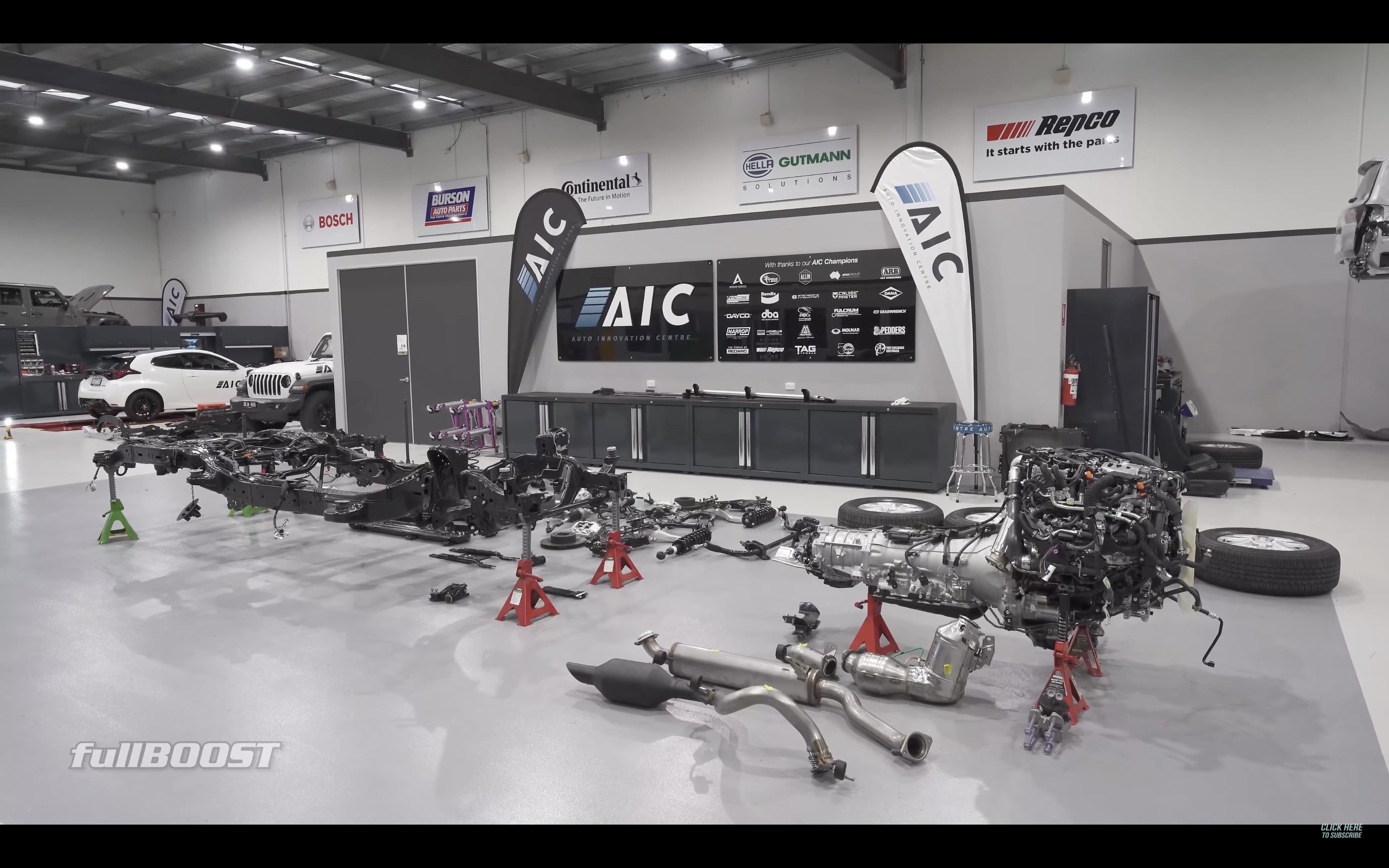
Created in the wake of Australia’s deceased automotive manufacturing industry, the Auto Innovation Centre (AIC) supplies high quality data on new vehicles to local firms intending to develop aftermarket products for popular makes and models.
In this LandCruiser 300’s case, the AIC has torn down the new vehicle – with less than 20 kilometres on the clock – to its bare components so they can be laser scanned, weighed and measured.
“We got people developing draw systems, fit-out kits, floor mats,” AIC employee Luke Truskinger says in the video. “There are all sorts of things, so we are just scanning absolutely everything anyway.”
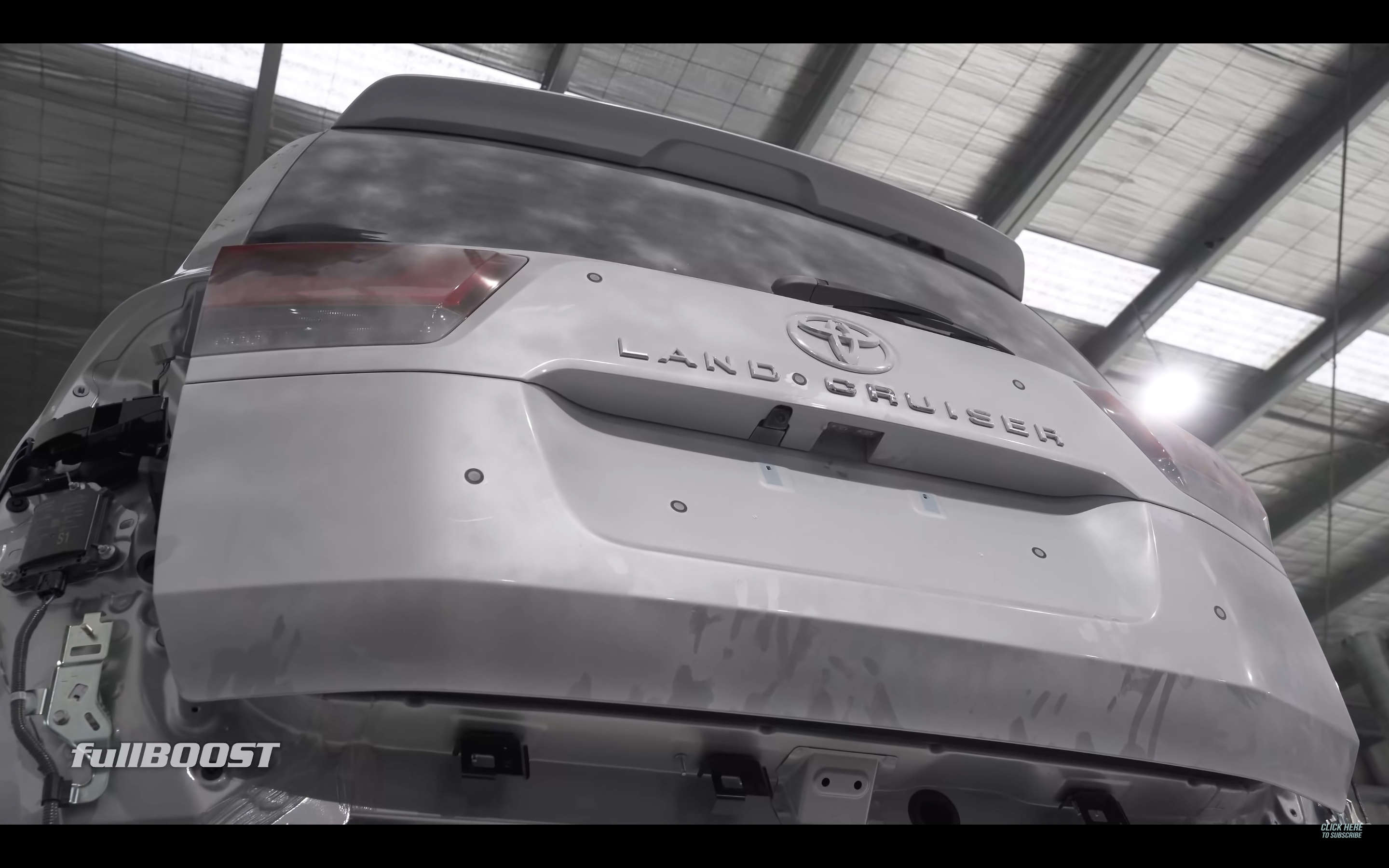
“[There are] big calls for roof racks, for wheels, suspension, GVM upgrades, and interior parts already. We got a massive list of stuff we got to do.”
In the process, we get a close look at what makes the new LandCruiser tick – especially underneath.
Truskinger beckons us to the LandCruiser’s body-in-white, pointing out how the front guards and bonnet are aluminium. He also brings us around to the passenger side of the engine bay, where you can see the intricacies of the new model’s side intake system.
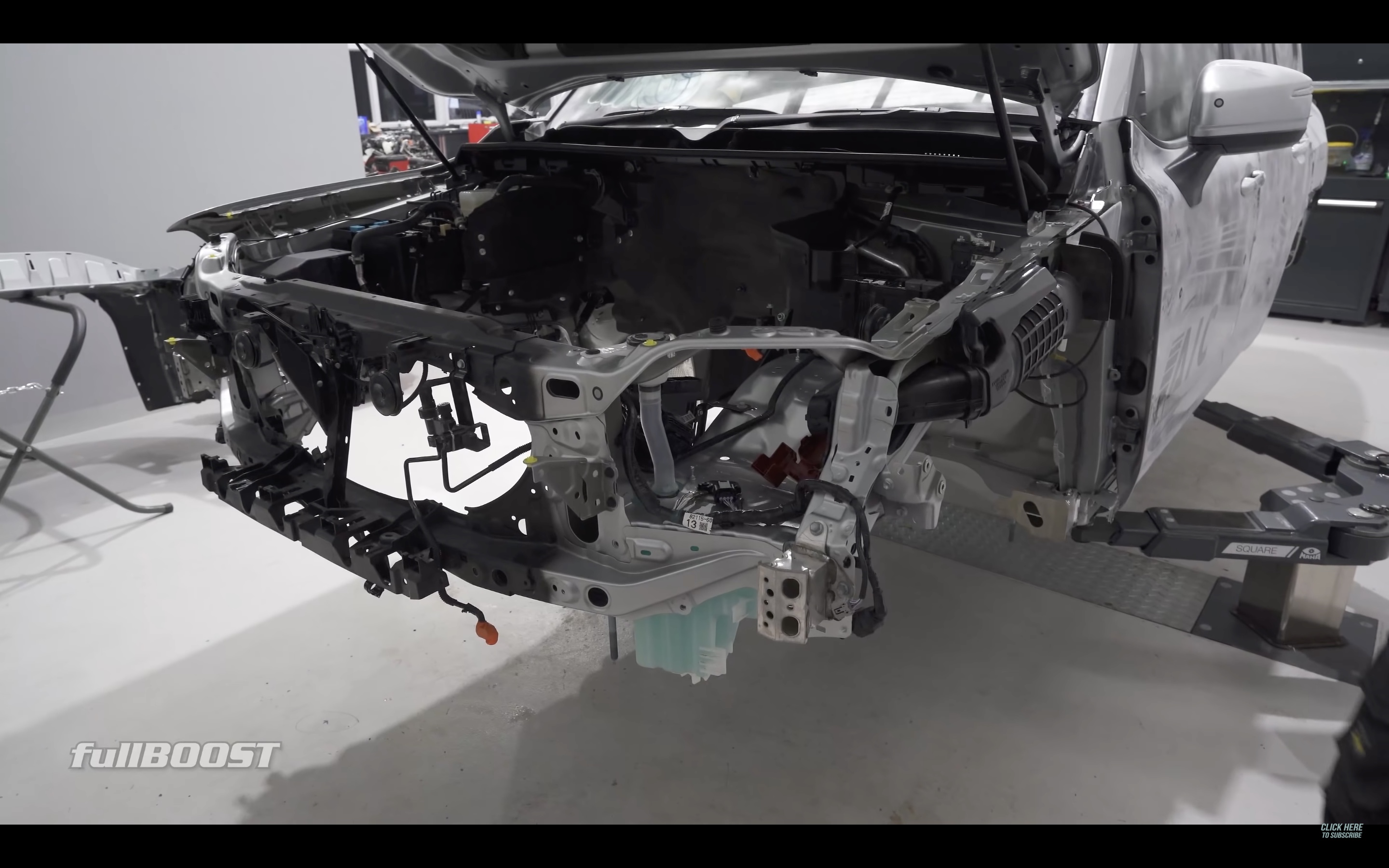
The crew at AIC also have extracted the LandCruiser 300’s new diesel engine, which has downsized from the old 4.5-litre turbo V8 to a 3.3-litre twin-turbo V6 while adding a 10-speed automatic transmission.
With its hot-vee packaging of the turbos, the video lends a great opportunity to see where all its associated bits lie and how Toyota configures the system.
From here it gets even nerdier, with Truskinger pointing out how many transmission breathers there are. This level of detail continues throughout the rest of the video.
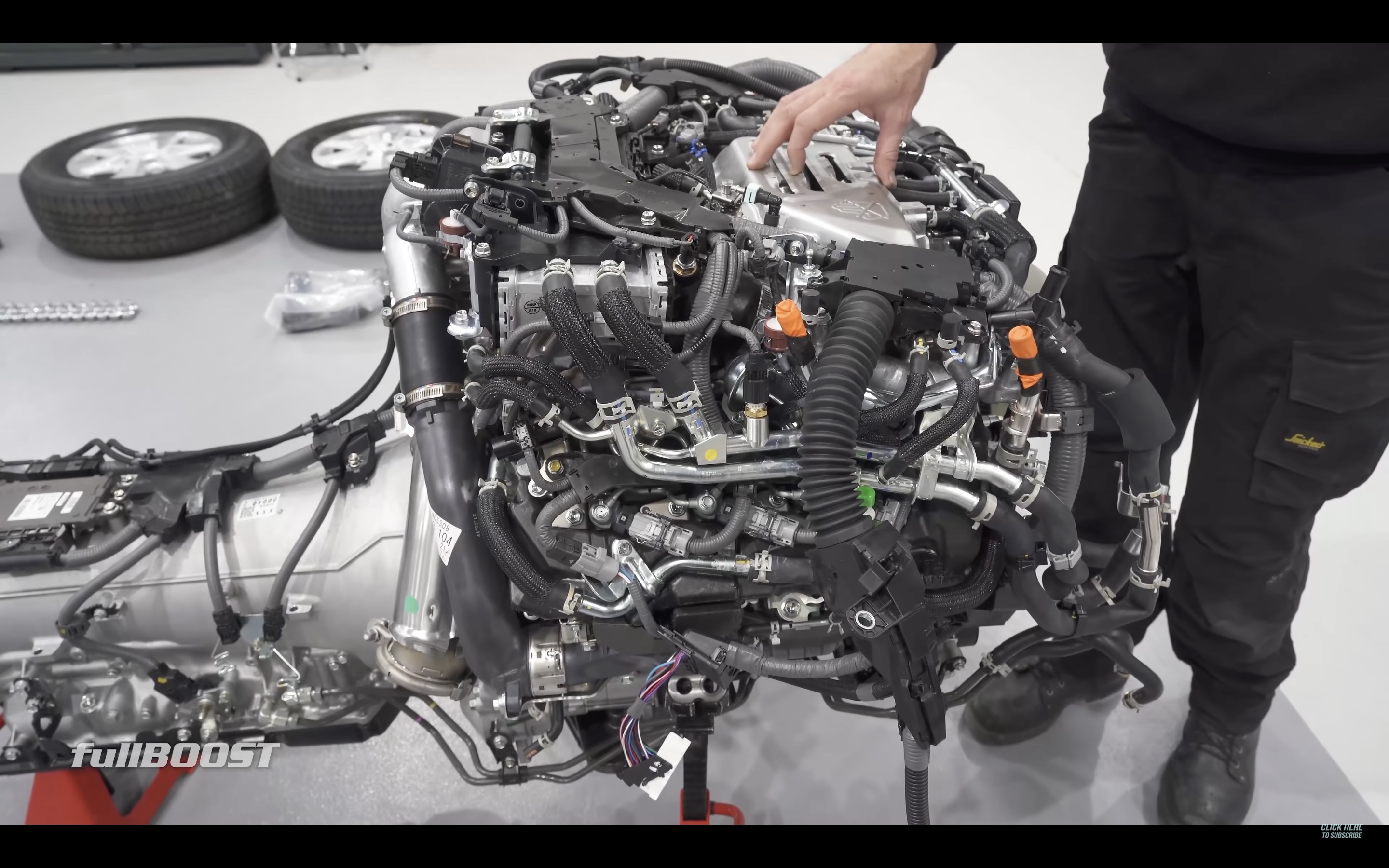
So, if you have 20 minutes spare, watch on to learn more about the new LandCruiser’s wheels, chassis, suspension, drivetrain and more – including where a bolt is missing from this early production-run example. It’s worth it.
