
2021 has been a big year for car content with so many launches, auctions and breaking news stories hitting the homepage.
The past 12 months have been highlighted by semiconductor shortages, production pauses and the on-going pursuit from manufacturers to bring electric vehicles to the market.
To look back over the last year, we’ve compiled our top-five list of stories which were read more than any others on the website.
Toyota LandCruiser 300 Series dual-cab ute imagined
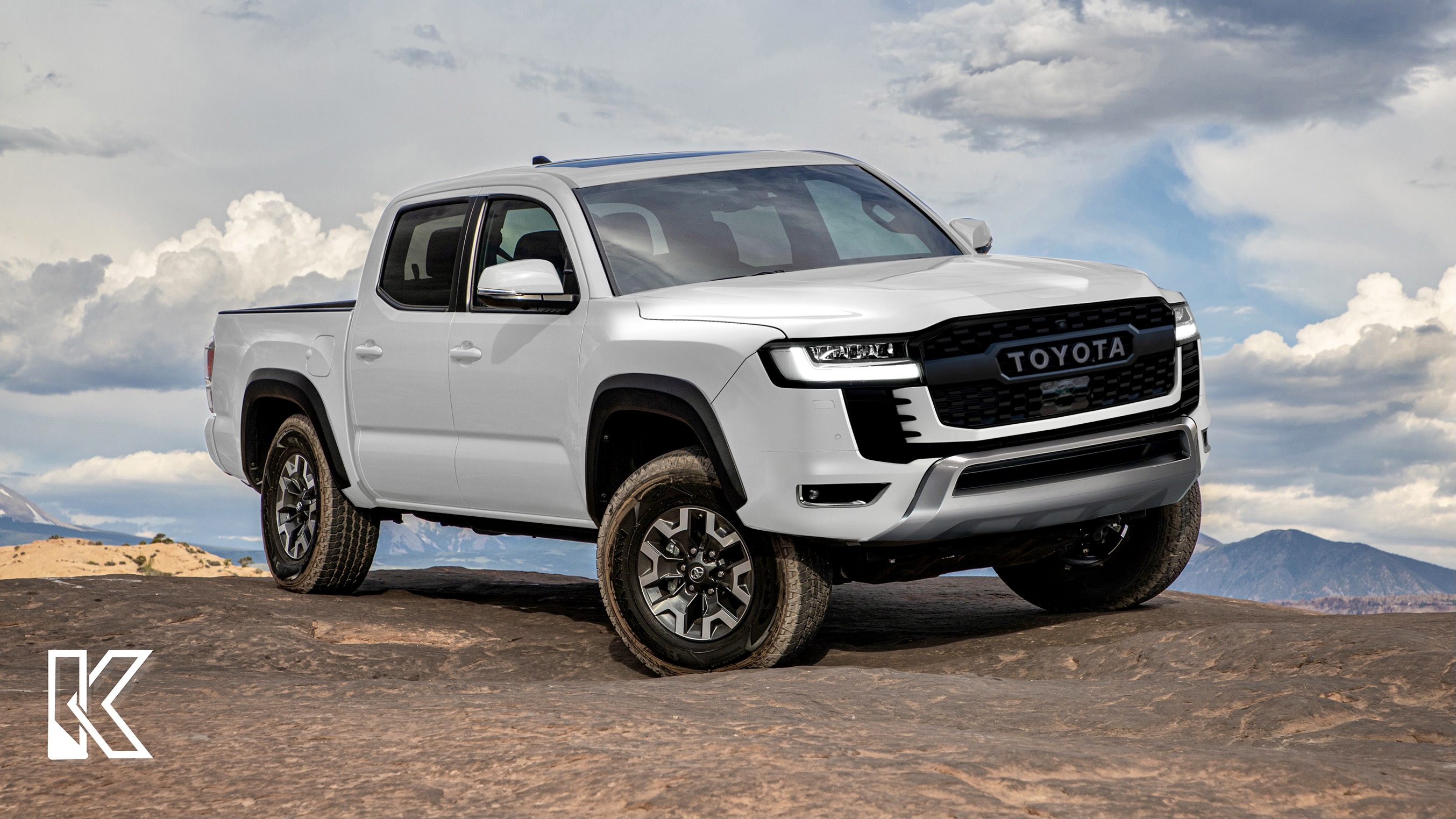
The highly-anticipated launch of the Toyota LandCruiser 300 Series was mind-boggling, with four of the top six articles this year coming due to the fourbie’s launch.
From its reveal in June to the pricing and specs being announced later in August, it seemed like the most popular car of the next few years would be the latest Landie.
However, in a market such as Australia, which loves a dual-cab, the combination of the two nearly broke the WhichCar internet, coming in as our top story this year.
Combined with how much interest people took in the new Toyota Tundra, we reckon the Japanese manufacturer would be able to give everyone million dollar bonuses if LandCruiser-related clicks were anything to go by.
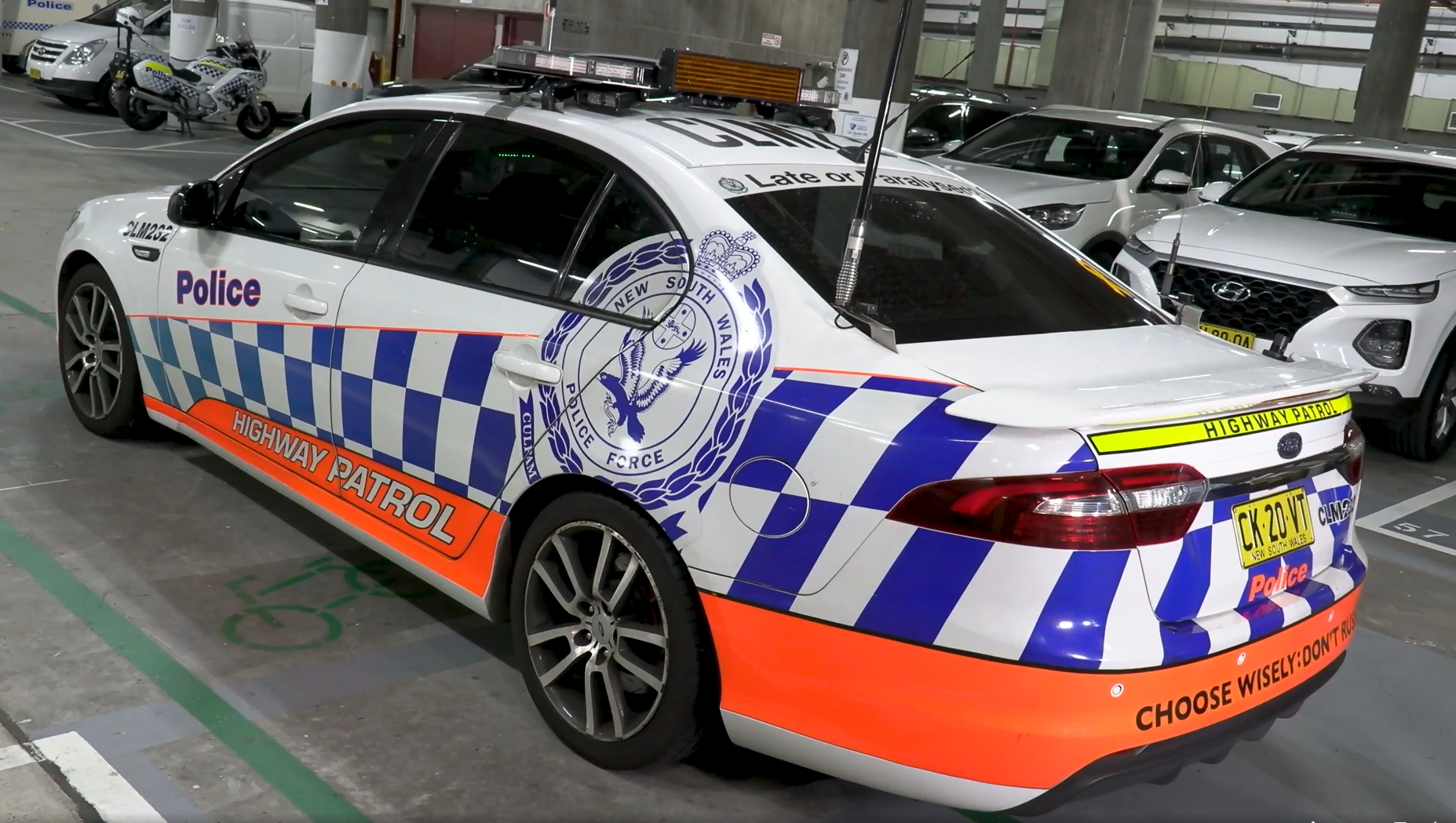
Last-ever Highway Patrol XR6 Turbo sells at auction
“Kick her in the guts, Barry.”
“She’s the lllast of the vvv…. oh wait.”
Despite the boys in blue in the NSW Highway Patrol being just about the last thing any of us want to see, the final Ford Falcon XR6 Turbo to be owned by the plod going up for auction seemed to set tongues wagging.
An FG-X with the stonking Barra under the bonnet, the last-ever Highway Patrol XR6 Turbo was sold at auction for $94,500, more than the XR6 Turbo Sprint build #1, which took $92,500 in 2016.
Just 86,165 kilometres were amassed in its life on the force, serving around Surry Hills, Port Macquarie and the Victorian border, meaning the 270kW engine is probably only just starting to wear in.
While all cop-spec XR6 Turbos received FPV-spec, four-piston Brembo brakes, they also unfortunately inherited the basic 18-inch wheels from the original F6 Typhoon, partially to deal with the rough roads of Australia.
The XU-1 Torana auction record has been smashed again
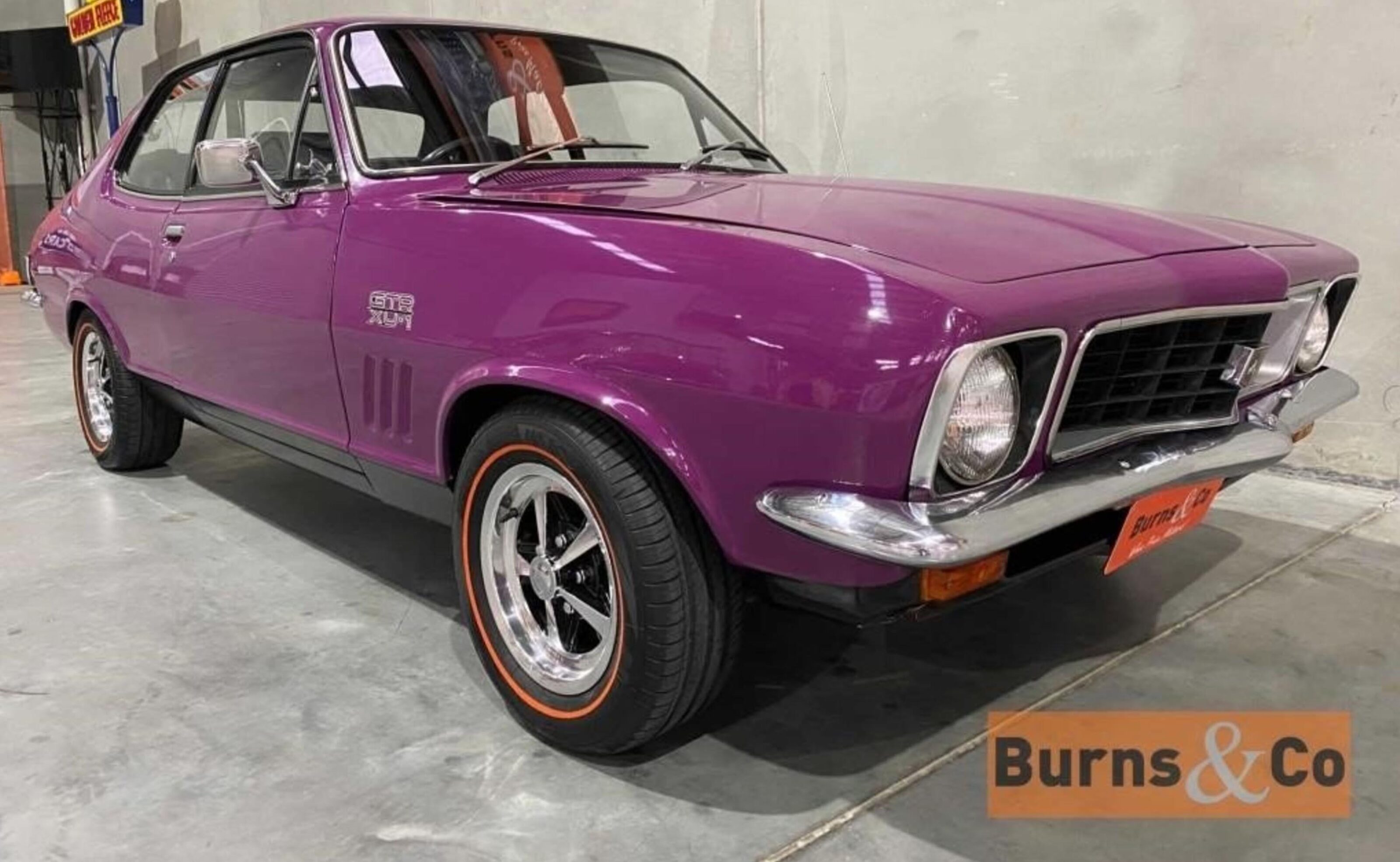
As with the aforementioned LandCruiser 300 Series, one bite of the Holden Torana cherry didn’t suffice, with two auction stories rating highly.
In May, a 1972 LJ Torana GTR XU-1 broke the road-going model’s auction record with a sale price of $295,000 at Burns & Co Auctions, more than $100,000 more than the previous best.
However, this was surpassed by $53,000 in August when a Purr Pull 1973 LJ GTR XU-1 set the new auction record at $348,000.
Starting out in life as a Holden engineering vehicle, the former test mule retained the original six-banger, close-ratio M21 four-speed and limited-slip diff it was fitted with once Holden sold it.
Despite having 91,710 miles on the clock, its documented history as one of the Lion and Stone’s former test cars ensured its place in the year’s auction highlights.
The 10 greatest 4x4s of all time

“Yo dawg, we heard you like lists so we put a list in yo list!”
For a country as open and barren as Australia, it’s no surprise 4x4s resonate strongly with the local population, all but selling the dreams of escaping the day-to-day grid.
Although some of the best fourbies on this list could be described by some as agricultural or utilitarian, there’s a reason why they’re successful – they won’t let you down when you need them the most.
Perhaps it shouldn’t be a shock that Australian buyers still flock towards 4×4 dual-cab utes and SUVs in droves, as modern technology bridges the gap between ruthless reliability and uncompromising comfort.
Fast and Furious Supra breaks record at auction

There’s only one thing that matters more than clicks… family.
No, not really, although the late Paul Walker’s iconic Toyota Supra from the first Fast and Furious film grabbed your attention when it went up for auction in June.
Sold at Barrett-Jackson’s Las Vegas auction for US$555,000, the car become the most-expensive Toyota Supra ever on account of it being used for multiple interior and exterior shots, backed by extensive documentation.
The twin-turbo 2JZ-GTE actually has a four-speed automatic behind it rather than the manual seen in the film, although with the popularity of Supras in drag racing, having the two-pedal would probably help this to become a 10-second car.
Snapshot
- BMW set for WEC and IMSA assault in 2023
- Fourth confirmed manufacturer for new LMDh class
- Last Le Mans victory came in 1999
UPDATE, December 23, 2021: BMW has teased its LMDh challenger which will take on Le Mans in 2023, with its distinctive design language a clear influence.
As has become commonplace of late, the render features a huge pair of kidneys where the radiator inlets would be, reminiscent of BMW’s road car range – which seems to be expanding in every direction.
It’s unlikely such a design will be retained for competition, as we can only imagine it adds quite a bit of drag, however the LMDh cars are set to run on a spec chassis with manufacturers given the freedom to create visual designs which reflect their road cars.
Below is a throwback by the German marque to its last success at Le Mans, giving the V12 LMR a modern spin, whilst retaining its iconic, sleek design.

The story to here

June 12, 2021: Nearly 25 years after taking glory at Circuit De La Sarthe, BMW will again attempt to conquer the 24 Hours of Le Mans, announcing it will enter a car in the new LMDh (Le Mans Daytona hybrid) class which is set to debut in 2023.
Recently appointed boss of BMW’s M division, Markus Flasch, shared a photo of the company’s 1999 V12 LMR prototype with the caption: “We are back. Daytona 2023”.
The new LMDh regulations will be applied to the World Endurance Championship (WEC), which Le Mans is a round of, as well as the IMSA Sportscar Championship in the United States, its flagship event being the season-opening Rolex 24 at Daytona.

LMDh was born out of the spiralling costs and departure of major manufacturers like Porsche and Audi from LMP1, essentially leaving Toyota to dominate the WEC over the past few years and allowing the Japanese marque to win Le Mans three years in a row.
So far confirmed as competitors to BMW in LMDh will be; Audi, Porsche and Acura (Honda’s North American arm), while the Le Mans Hybrid (LMH) class, which only runs in WEC events but competes for outright victories with LMDh, will feature; Toyota, Alpine, Scuderia Cameron Glickenhaus, Peugeot, ByKolles and Ferrari.
Though so far unconfirmed, it is likely BMW’s challenger will be based on a hybrid powertrain, utilising a 50kW unit on the rear axle with a choice of internal combustion engines available, and teamed up to create a maximum combined power of 500kW.
BMW’s first success at Le Mans came in 1995 when its S70/2 V12 engine powered a McLaren F1 GTR to victory, waiting just four more years for its first factory victory.
BMW competed in the GTE class at Le Mans from 2018 to 2020 with the BMW M8, but recorded no victories, also recently bowing out of the all-electric Formula E series to focus on other motorsports projects.
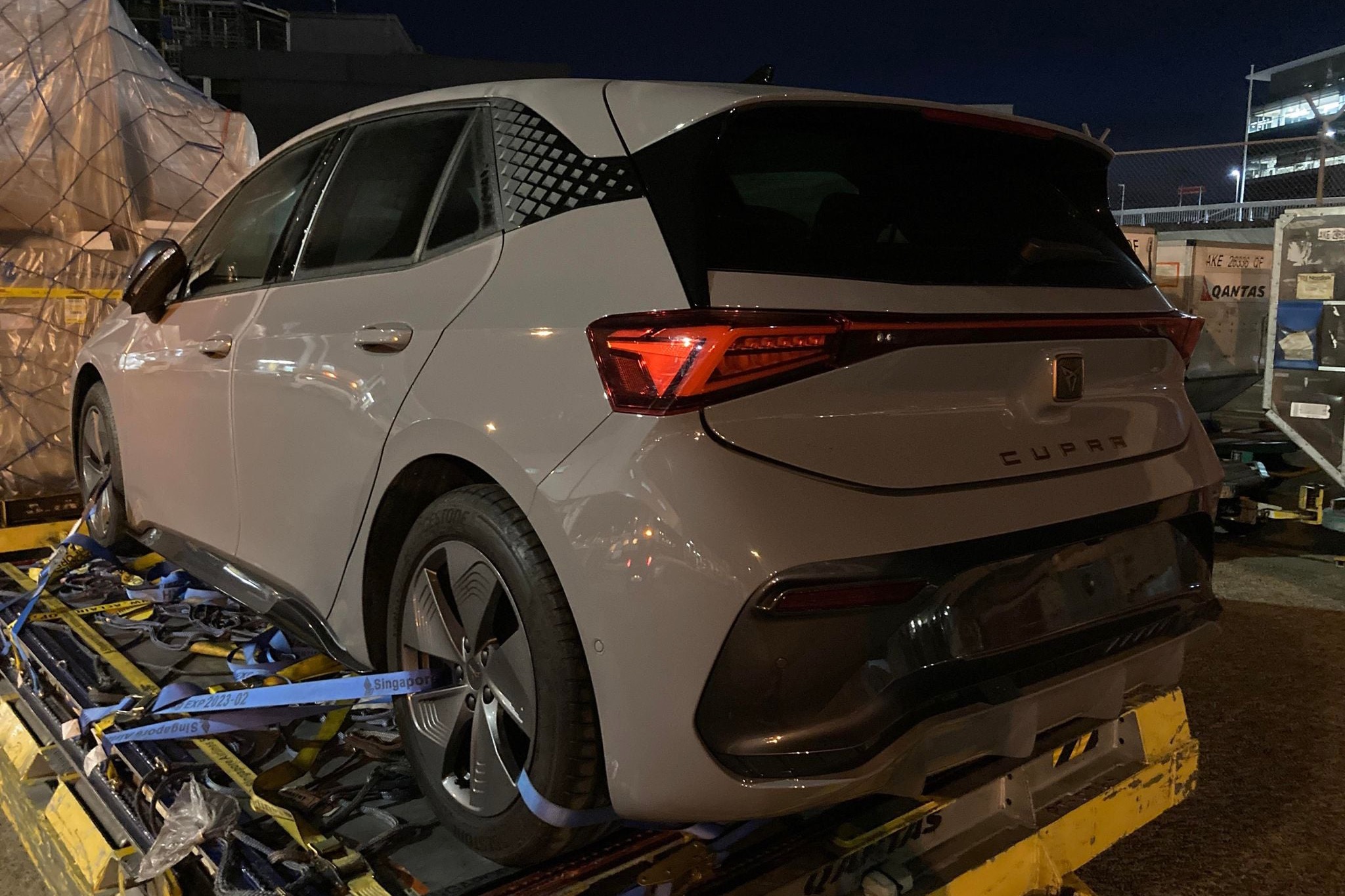
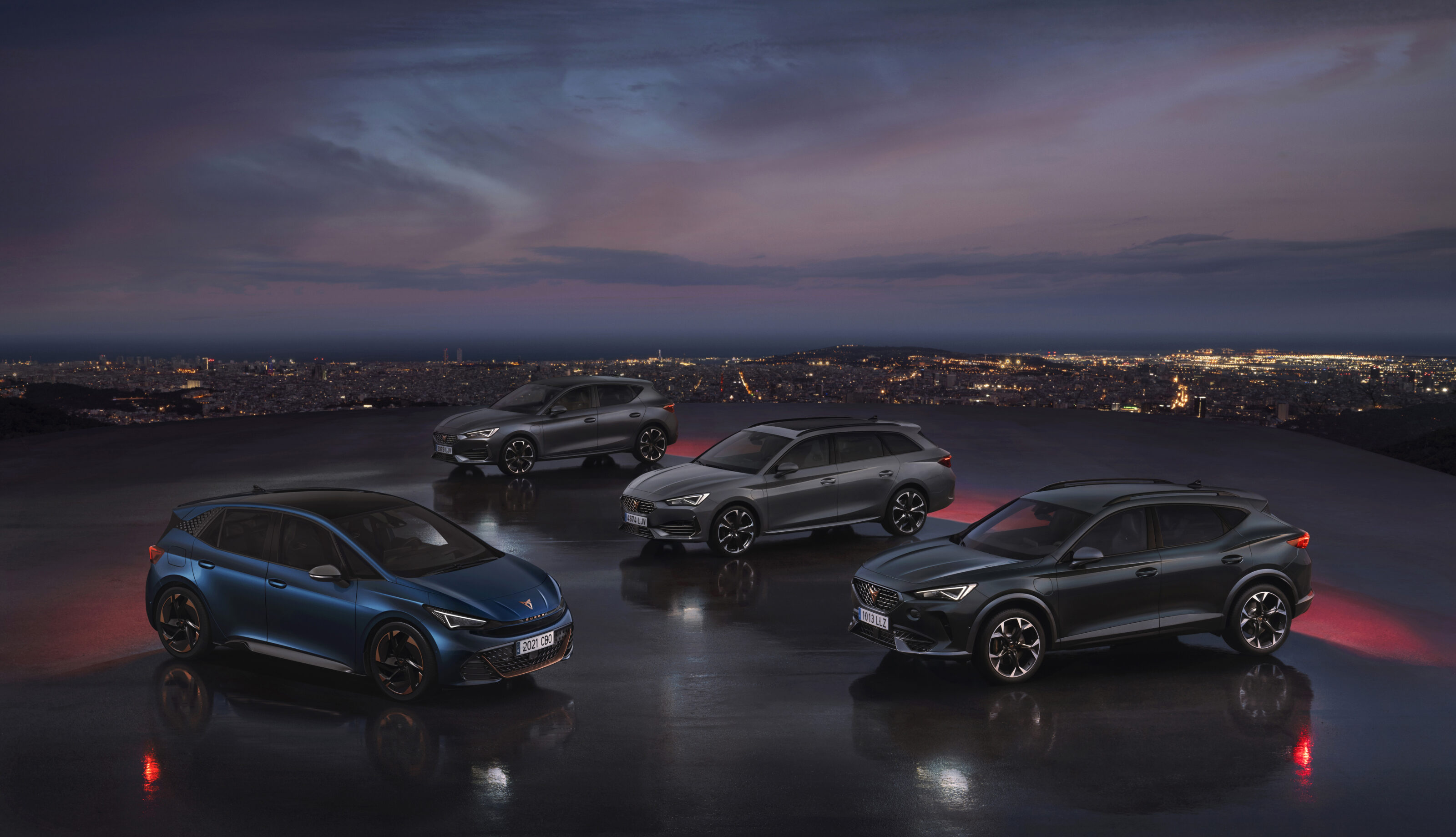
The all-electric 2023 Cupra Born has arrived in Australia for local evaluation.
An eagle-eyed worker at spotted the Born at Sydney Airport after being flown in by Volkswagen Australia, ahead of the launch of the Cupra brand in 2022, with these images posted to Facebook group All Electric Vehicle Parts Australia.
The Born will be one of four models within the Cupra line-up – and the first fully-electric Volkswagen Group vehicle to be offered locally – using a 58kWh battery to feed a 150kW/310Nm electric motor powering the rear axle.
UPDATE, December 2022: Australian Born pricing announced
Cupra has confirmed Australian pricing and features for its Born electric hatch. Get all the details at the link below.
Story continues…
While the Cupra Australia website outlines the Born’s performance figures, along with a claimed 0-100km/h of 7.3 seconds, its driving range of 424km (WLTP cycle) has yet to be confirmed.
Additional battery options will be added to the range in the future – with promises of up to 548km of driving range on a single charge – along with an e-Boost pack which bumps the hatchback’s power figures up, with performance on par with Volkswagen Golf GTI models of recent years.
“Cupra wants to be the first European brand with an affordable EV,” said Volkswagen Group Australia spokesperson Paul Pottinger said earlier this month.
“There’s potential for it to start at the price of the current Golf GTI. It will certainly be considerably less than the cheapest Tesla.”
With the Tesla Model 3 priced from $59,900 before on-road costs, and the Volkswagen Golf GTI costing just over $53,000 plus on-road costs, it suggests the Cupra Born could come in under $55,000 when it arrives late next year.
The Born will join the Formentor, Leon, and Ateca when the Spanish brand makes its Australian debut in 2022, with the electric hatch slated for arrival in the fourth quarter.
Snapshot
- Subaru WRX STI Performance Concept provides glimpse at future STI model
- Electric STI E-RA Concepts showcase company direction
- Concept aimed at completing a lap of the Nu00fcrburgring in under 400 seconds
UPDATE, January 14, 2022: Subaru has taken the covers off multiple vehicles at this year’s Tokyo Auto Salon, from its WRX STI preview to the STI E-RA concept.
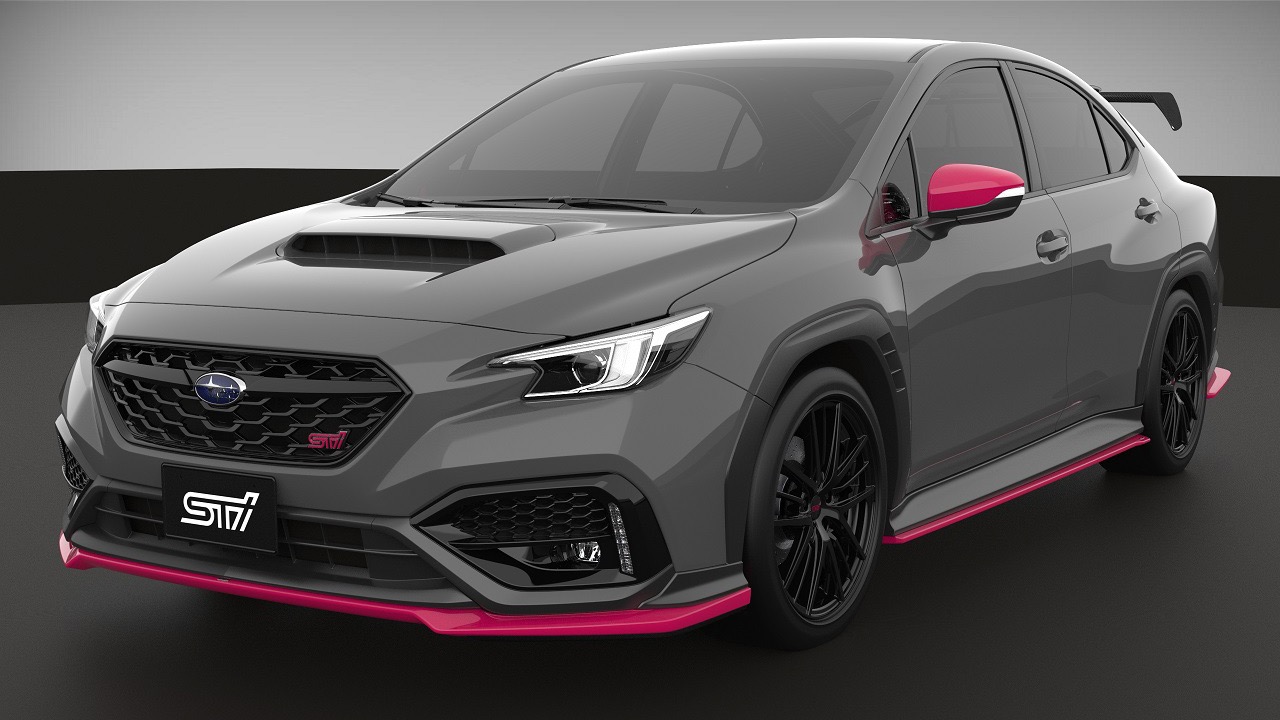
The WRX S4 STI Performance hints at what the next-generation flagship variant of its WRX sedan will look like, having recently moved to the fifth-generation WRX platform last year. It will be the first time an STI-grade WRX has been powered by anything other than Subaru’s EJ engine since the model’s inception in 1994.
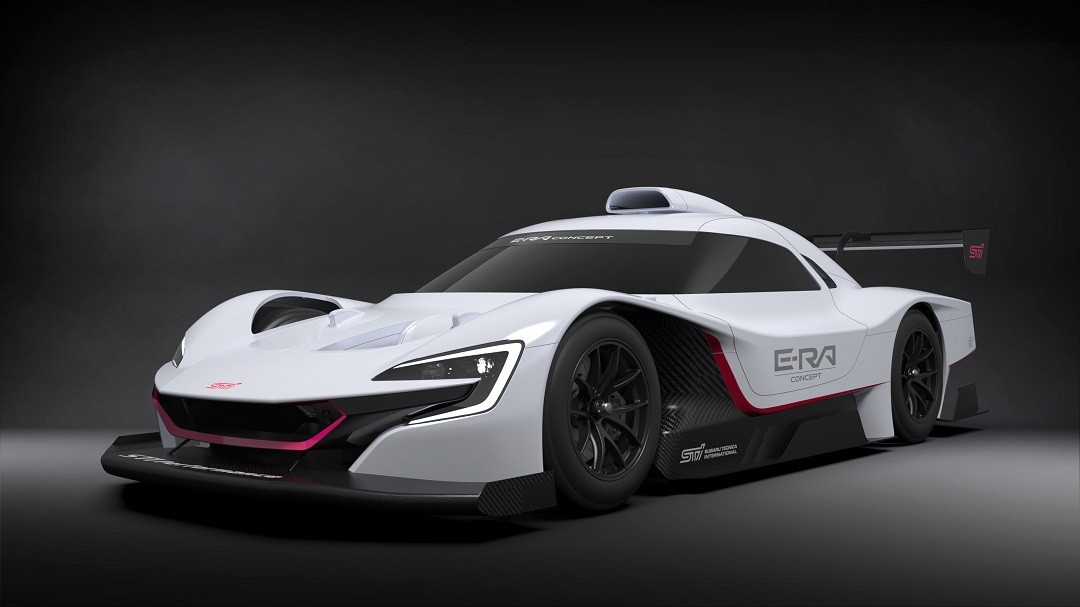
While the WRX is a continuation of Subaru’s past, the STI E-RA is a look into the manufacturer’s future, making use of four electric motors (one on each axle) to produce up to 800kW – or roughly one WRX’s worth of power to every wheel.
Powered by a 60kWh battery pack, Subaru’s ultimate aim is for the STI E-RA (or Electric Record Attempt) to take on the Nürburgring Nordschleife course, targeting a lap time of six minutes and 40 seconds around the fabled course.
Although it’s been made as a one-off concept for now, Subaru noted the systems within the STI E-RA could lend it to be homologated for motorsports purposes in the future, potentially dropping into the Japanese Super GT category if it ever goes all-electric.
The story to here
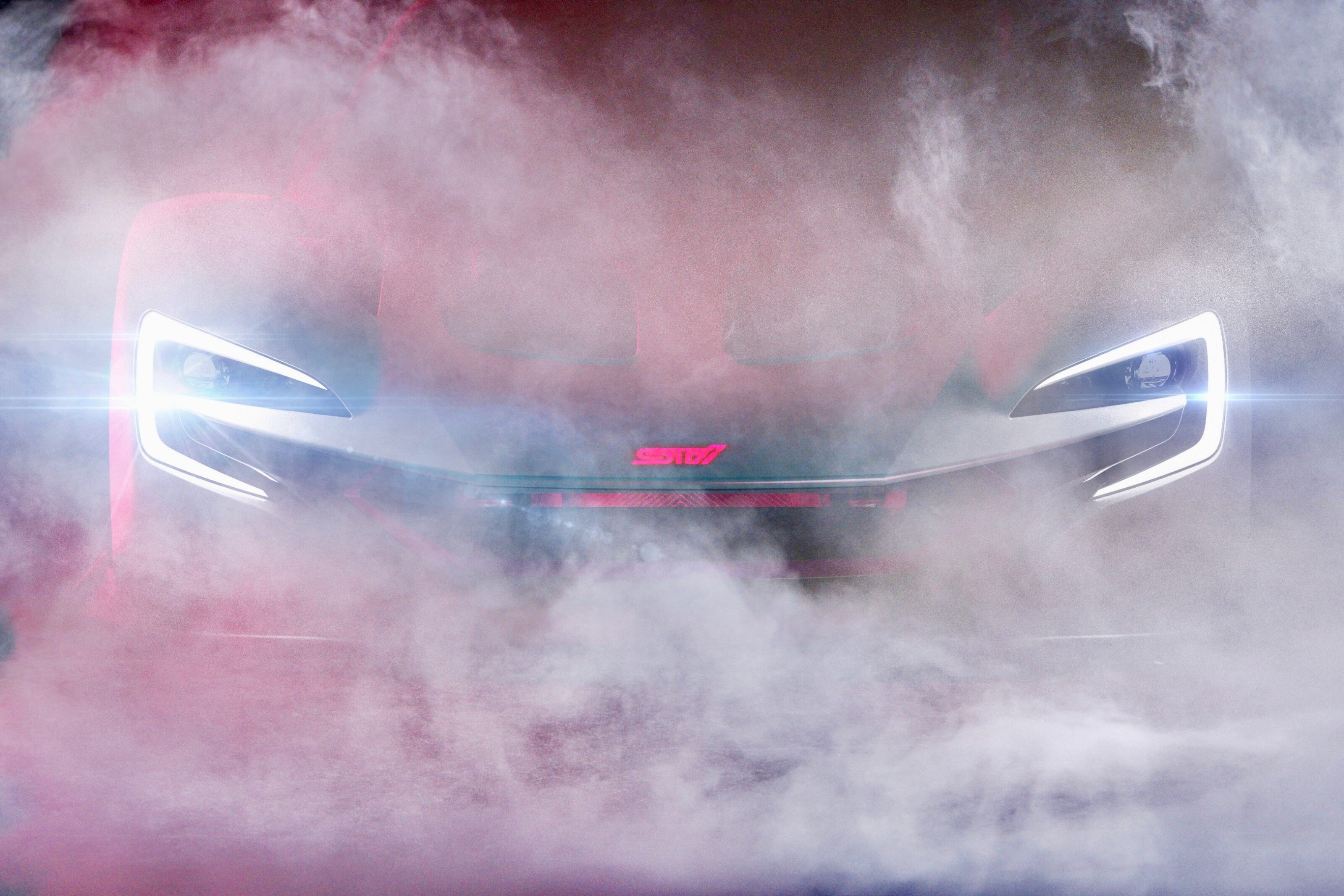
December 24, 2021: The 2022 Subaru WRX STI Performance has been previewed ahead of its debut as a concept car at the Tokyo Auto Salon next month, alongside an all-electric performance car.
Subaru announced it would show the WRX S4 STI Performance Concept with the STI E-RA Concept – an electric vehicle which is expected to be some kind of racing prototype from the engineers at Subaru Tecnica International.
While it’s worth noting the ‘STI Performance’ package isn’t the high-performance WRX STI we’ve been waiting for, but rather a styling package combined with a sports exhaust, it does give us our best look at what we can expect when the full-fat WRX STI is officially unveiled next year.
More details of the battery-powered STI E-RA Concept will also be revealed in the coming weeks, but the vehicle will likely form the direction of Subaru’s future electric performance models, with technology trickling down from its motorsport campaigns.
“STI is showcasing the STI E-RA CONCEPT developed in a new project launched with an aim of gaining experience and practice in new technologies in the world of motorsport which is making its way toward a carbon neutral era,” the company said.
Also set to debut is a Subaru WRX STI Performance wagon – badged as the Levorg in its native Japan – and a BRZ STI Performance. Like the WRX, the two models will gain styling updates and minor modifications from the STI Performance catalogue.
The Tokyo Auto Salon opens on January 14, 2022. Stay tuned to MOTOR on Facebook and Instagram to get the latest news.
Two Korean juggernauts in the Australian car market regularly go head-to-head in the sales charts and it never ceases to amaze me how weird this is: Hyundai and Kia are essentially the same company. Hyundai and Kia essentially fight over the same turf, with one gaining ascendancy in one segment while trading places in others.
One of the more common things I see from folks in the comments both here and at other motoring sites is, “Remember when this publication hated Hyundai/Kia?” I certainly don’t, having been a reader of Wheels since I were a lad, but do remember fair criticism of earlier product. Recently, not so much. They’re on fire, basically, dropping new product that impresses with clockwork regularity.

Both of these companies have been on our shores now for well over two decades (Hyundai has been here longer) and in 2021 released their newest challengers in the mid-size SUV market, both well overdue in this hyper-competitive space.
The two are bold, strikingly original designs hiding a common platform, common engines and similarly equipped interiors. Seems like the internal competition has delivered the kind of results customers want.
Two Korean juggernauts regularly go head-to-head and it never ceases to amaze me how weird this is: Hyundai and Kia are essentially the same company
Pricing and Features

We’re up in the top end of both ranges here. The most recent release, the Kia Sportage is only available to us in the entry-level and top-end, so we’ve gone with the flagship for now. Entry-level models are rarely the biggest sellers in the range, so we might come back to the mid-spec machines early in a future comparo.
The Sportage GT-Line starts you off at $49,370 before on-road costs and Kia generally has drive-away deals to tempt you, in this case, $51,990. Prices are most definitely up over the previous model.
Hyundai’s Tucson N-Line starts at $51,000 plus on-roads, so there is an appreciable gap in pricing.

For your more-than-half-ton, Kia supplies you a Sportage with 19-inch alloys, an eight-speaker stereo, dual-zone climate control, reversing camera, around-view cameras, keyless entry and start, adaptive cruise control, LED lighting (including headlights, daytime running lights and fog lights), digital dashboard, electric heated front seats, panoramic sunroof, power tailgate, auto wipers, wireless phone charging and a full-size alloy spare.
The Tucson’s specification is pretty much the same. The differences are, therefore, minute, like the Tucson’s seat material has more fake suede, deployed as inserts rather than behind your shoulders. It’s that close. The digital dash is slightly smaller at 10.25-inches versus Kia’s 12.3-inch, but they’re not so different that you’d notice.
Both share basically the same media system, a 12.3-inch screen with the excellent new version of the conglomerate’s infotainment
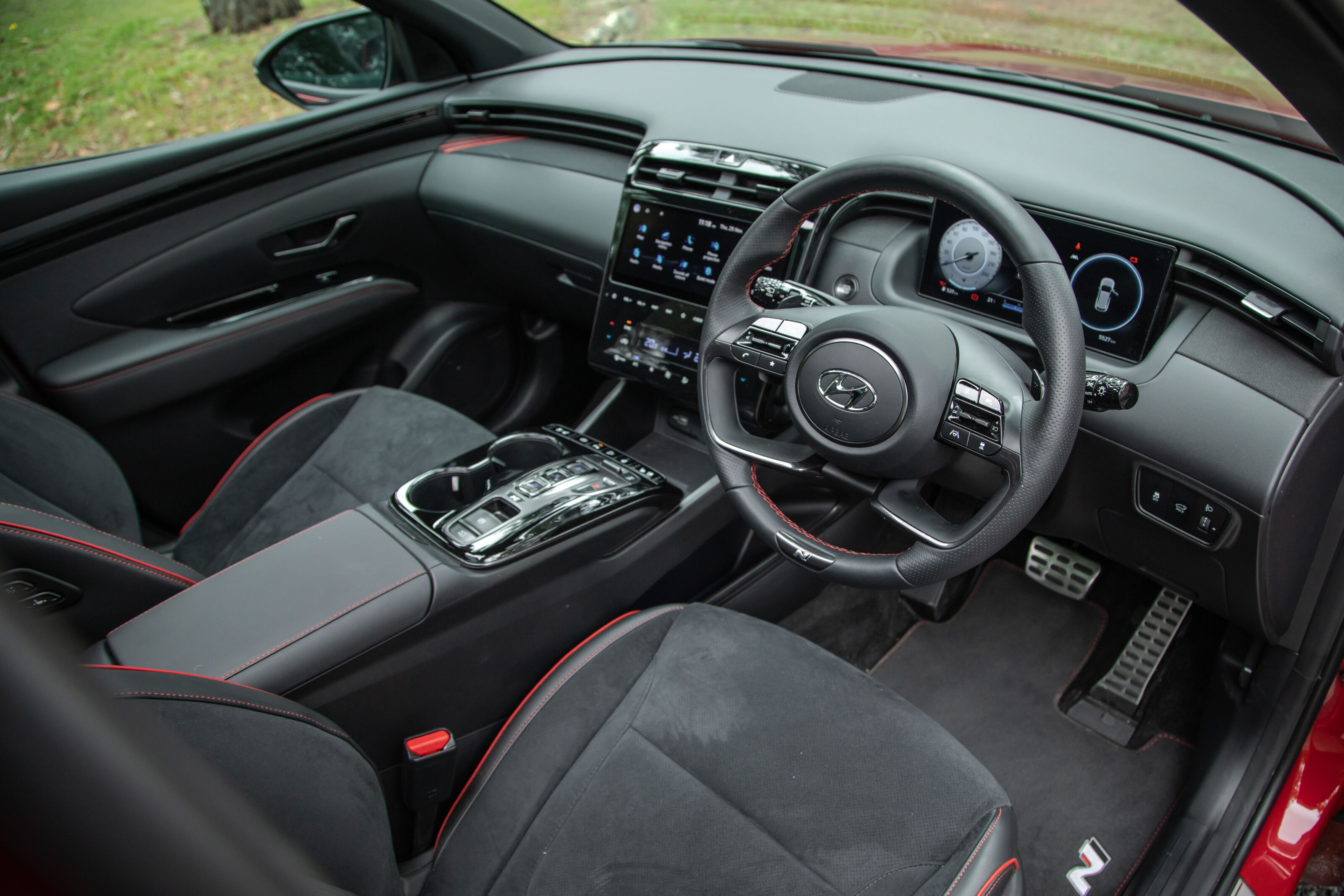
Both share basically the same media system, a 12.3-inch central screen with the excellent new version of the conglomerate’s infotainment software. It includes all sorts of features and functions including quiet mode, gentle babbling brook sounds and more detailed settings for climate control than already offered by the physical controls. The system includes DAB+ digital radio, wired Apple CarPlay and Android Auto.
Safety across the two is also extremely close. So close it’s identical. You get the usual package of airbags plus the centre airbag to help stop heads clashing in side impacts. The usual ABS, stability and traction controls, lane departure warning, lane-keep assist, speed-limit recognition, tyre pressure monitoring, blind-spot monitoring, reverse cross-traffic alert, forward and reverse auto emergency braking and forward and reverse collision warning.

The Sportage and Tucson both score safe exit warning, speed limit assist and the very clever blind-spot view monitor that replaces the left or right dial in the dashboard with an image of what’s going on down the side of the car corresponding with which indicator you’ve activated. It’s very clever and very useful.
The Kia wins here purely because it’s cheaper, by a handy couple of thousand dollars.
Comfort and Space

As you’d expect, the two are neck and neck for interior space but the designs are quite different. The Sportage’s cabin is a little more restrained and classy while the Tucson’s is very forward-looking and a bit more adventurous.
The Kia’s front seats are very comfortable and quilted in fake leather. There are some very nice materials and the shapes of the passenger side air vents vaguely echo the boomerang LEDs on the nose of the car. A thin strip of red reminds you you’re in the GT-Line. The centre console is clothed in a glossy piano black and I’m not entirely sure it’s not going to mark up horribly. The cup holders are quite clever, with a little button that pops out a semi-circular restraint to hold a cup in place. You can push them back in if you’re storing other items in there.
Frustratingly, there is a lot of grainy, scratchy plastic where it matters. The door cards, the lower dash and parts of the console all have it and it’s a bit horrid. Thankfully, it’s lifted by a quite nice strip of fake wood that starts in the doors and runs across the dash.

Hyundai’s approach to the interior is quite different. Despite the N-Line pack, the steering wheel is still the dodgy-looking (to me, anyway) four-spoke design and the centre console is a big slab of piano black covered in buttons. It doesn’t look as good as Kia’s centre stack. Between the seats, the console also hosts two cup holders but they’re a bit more cramped than the Sportage’s.
The Hyundai counters Kia’s rotary dial with a row of transmission selector buttons. It’s a slightly less coherent design than the Kia’s but perfectly easy to use. There is also less of the scratchy plastic and there’s a very fetching fabric strip in the dash that reminded us of the VF Commodore’s. The Hyundai also has a stash space between the seats under the console, which is very handy.
The Hyundai counters Kia’s rotary dial with a row of transmission selector buttons. It’s a slightly less coherent design than the Kia’s but perfectly easy to use
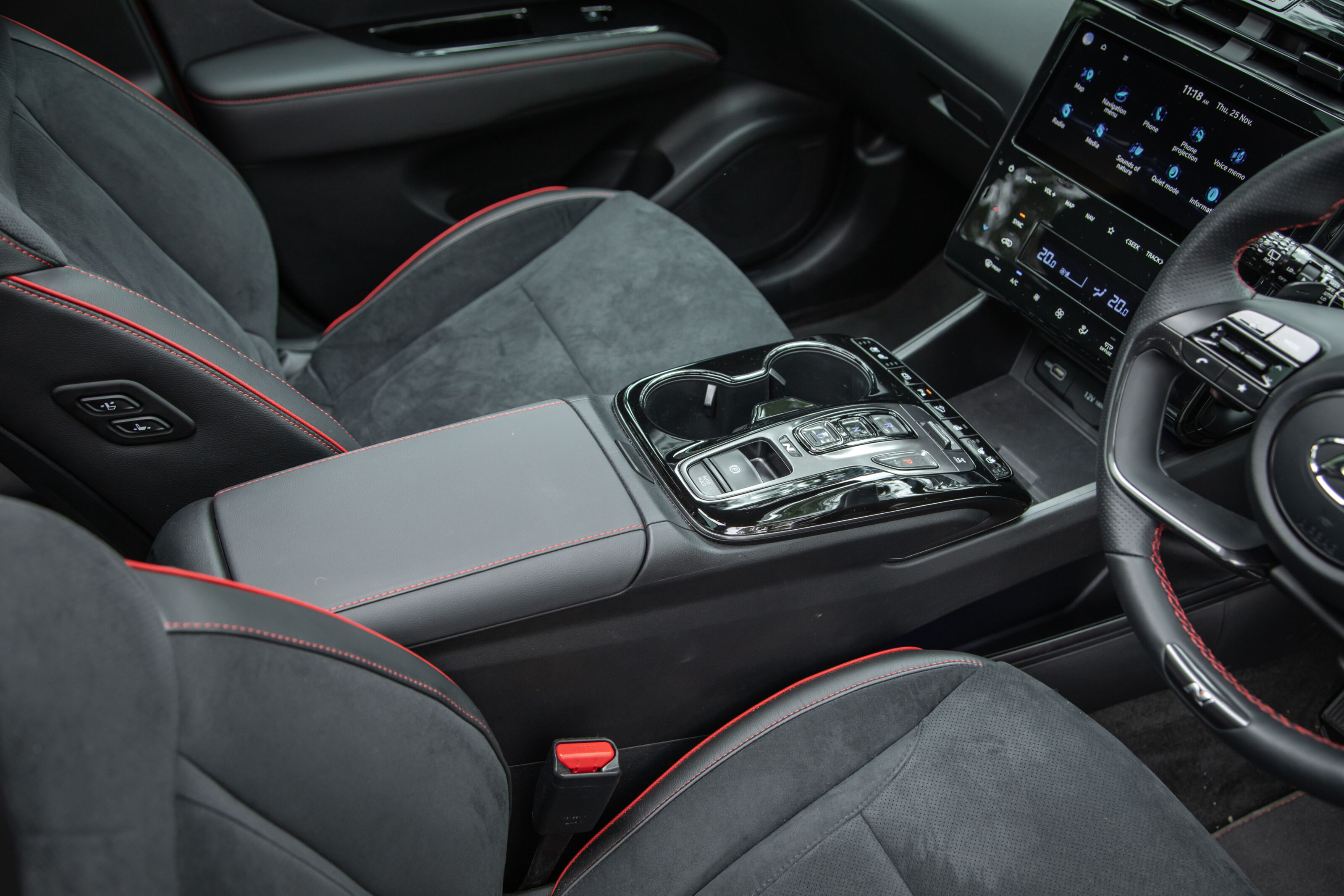
Both feature two USB ports front and rear but there’s a key difference. The Kia sports one of USB-A and USB-C up front alongside a 12-volt socket, while the rear ports are USB-C built into the sides of the front seats. What look like tablet holders in the seatbacks are actually coat or bag hooks, so that’s a slight disappointment until you realise how useful they would be. The Hyundai has two USB-A ports in the rear of the console beneath the air vents. That seems to upset people, so one imagines that one of each type would settle the aggro.
With the sunroof cover slid back, both are bright and airy cabins and my minor quibble about the Hyundai’s overall coherence doesn’t change the fact that both brands have delivered an impressive cabin experience. The Kia takes a close win here, with a better overall look and feel, easier to use controls and, purely subjectively, the lovely curve of the double screen setup feels improbably expensive.
On the Road

The engine bay is where things are fundamentally identical. Here you’ll find the same 1.6-litre turbocharged petrol four-cylinder featured through the various models in both ranges. It’s not the most inspirational or refined of engines, but nor is it anywhere near the worst. Given there are two other engines to choose from in both Tucson and Sportage, it will be well worth your while to drive them back to back before making a decision.
In both cars, you get 132kW at 5500rpm, which is a little peaky for a modern turbo engine, but there you go. Torque is a fair 265Nm available between 1500 and 4500rpm. So it’s a pretty flexible kind of engine to go with a less-than-stellar seven-speed dual-clutch automatic. Again, it’s not a bad transmission, but it’s not among the best around, such as VW’s.

Before we get into the nitty-gritty, it’s worth mentioning that the Tucson’s N-Line pack does nothing for performance; it’s purely styling unlike, say the i30 N-Line. It’s also not to be confused with the harder-edged sportiness of the i30 N and Kona N. The spec is Highlander with a $1000 wheels and bits and pieces pack and is available up and down the range.
As you might expect, the virtually identical engine and gearbox combination delivers – most of the time – the same kind of experience. As I’ve already said, that seven-speeder could be better and it’s mildly perplexing that the conglomerate’s eight-speed transmission isn’t offered in these flagship products. It fits across the engine bay of an i30 so would fit here too. Perhaps the 1.6-litre engine won’t play nice with it.
The dial swings back towards the Sportage in the chassis. While the Hyundai’s is undoubtedly a little sharper, you do have to sacrifice ultimate ride quality

In general usage, it’s mostly happy to do what’s asked of it, but the Kia’s is noticeably laggier in Normal mode and the more you ask of it, the more hesitant it becomes. It’s probably something an owner would learn to live with, but jumping between the two cars on the same day you realise the Hyundai’s calibration appears better. More responsive, a bit more eager to please. The Hyundai has the edge here.
The dial swings back towards the Sportage in the chassis. While the Hyundai’s is undoubtedly a little sharper, you do have to sacrifice ultimate ride quality. I had to chuckle a bit when I wrote that because honestly, they’re both so good. It’s just that the Kia is a little more settled in more situations. In the city it’s more comfortable – and you really only work that out when you’re back-to-back – and out on the open road, the Kia handles undulations and flowing bends really well. As does the Hyundai, it’s just that the Kia is slightly better and feels better enough to notice.

The pair of them suffer from the same overly-pushy lane-keep assist system which is mostly fine on fast, straight roads but annoying on back roads. You’ll quickly learn where to turn it all off.
It’s not just the suspension, though, the steering in the Kia feels ever-so-slightly more convincing. What makes the Kia’s slender win here impressive is that the previous Sportage, as good as it was, could never get this close to the previous Tucson.
Ownership

It gets a bit spicy here. Hyundai offers a five-year warranty with unlimited kilometres while Kia offers seven. Both have irritatingly short 12 month/10,000km service intervals but do feature capped-price pay-as-you-go servicing and pre-paid plans.
Hyundai’s lifetime capped-price servicing plan goes, well, for as long as the car will last. The first five services are capped at $319, with the sixth jumping to $385, the seventh $640 and then dipping back into the $300-$450 for a few more after that. The total over seven services is $2620 or an average of $374 per service.
If you dial it back to five services, it’s fairly simple – $319 per service. Not as cheap as a RAV4, but few companies do servicing as cheaply as Toyota, unless it’s free. Which nobody does at this level except for promotional purposes.
Kia charges more for maintaining the same engine, hitting you for $3988 over seven years or an average of $570 per year. So while Kia’s warranty is longer, servicing is costlier.
VERDICT

This was an incredibly close thing – the tiny gap in the scores has not been engineered. It’s not just because they’re mechanically virtually identical, it’s also because both companies have worked extremely hard to catch up to the broader opposition and that has meant two companies are also battling it out with each other.
There’s so little to separate them that it has come down to things like transmission calibration (where the Hyundai wins) and cabin ambience (a slender win to the Kia).
Admittedly, I wouldn’t have either of these with the turbo-petrol, because of that dual-clutch transmission. I’d either spend extra for the diesel or accept the smoother, slower 2.0-litre front-wheel-drive. Or live in hope the eight-speed twin-clutch replaces this old dry-clutch unit before taking the plunge on the turbo-petrol, but really, I’d like to see something a bit more modern like the hybrids we don’t yet get.
Either way, it’s so close as to be a technical win for the Kia, but it’s really a draw. It’s going to come down to subjective things like styling, interior feel and driving dynamics.
In other words, take your pick – both deserve your attention.
SCORING
Kia Sportage GT-Line 1.6T: 8.5/10
Safety, value and features: 8.5 Comfort and space: 8.5 Engine and gearbox: 7.5 Ride and handling: 8.5 Technology: 9.0
Hyundai Tucson Highlander N-Line 1.6T: 8/10
Safety, value and features: 8.0 Comfort and space: 8.0 Engine and gearbox: 7.5 Ride and handling: 8.0 Technology: 9.0
2022 Kia Sportage 1.6T & Hyundai Tucson 1.6T specifications
| Hyundai Tucson Highlander N-Line | Kia Sportage GT-Line | |
|---|---|---|
| Body:u00a0 | Five-door five-seat medium SUV | Five-door five-seat medium SUV |
| Drive: | AWD | AWD |
| Engine: | 1.6-litre turbocharged petrolu00a0 | 1.6-litre turbocharged petrolu00a0 |
| Transmission: | 7-speed dual-clutch auto | 7-speed dual-clutch auto |
| Power: | 132kW @ 5500rpm | 132kW @ 5500rpm |
| Torque:u00a0 | 265Nm @ 1500-4500rpm | 265Nm @ 1500-4500rpm |
| Bore stroke (mm): | 75.5 x 89.0 | 75.5 x 89.0 |
| Compression ratio:u00a0 | 10.5 : 1.0u00a0 | 10.5 : 1 |
| 0-100km/h:u00a0 | 8.0 sec (estimate) | 8.0 sec (estimate) |
| Fuel consumption:u00a0 | 8.1L/100km (combined) | 7.2L/100km (combined) |
| Weight: | 1656kg (tare) | 1643kg (tare) |
| Suspension: | MacPherson strut front/multilink rear | MacPherson strut front/multilink rear |
| L/W/H:u00a0 | 4640mm/1865mm/1665mm | 4660mm/1865mm/1680mm |
| Wheelbase: | 2755mm | 2755mm |
| Brakes:u00a0 | mm ventilated disc front / mm solid disc rear | 305mm ventilated disc front / 300mm solid disc rear |
| Tyres:u00a0 | 235/55R19 Nexen Roadius | 235/55R19 Nexen Roadius |
| Wheels:u00a0 | 19-inch alloy wheels (full-size spare) | 19-inch machined alloy wheels (full-size spare) |
| Price:u00a0 | $51,000 + ORC/DA | $49,370 + ORC |
- Welcome: Straight outta SunderLand
- Update 1: Get a Grip
- Update 2: Humble Pie
- Update 3: Hazards of Juke?
Welcome: Straight outta SunderLand
Price as tested: $37,219 This month: 397km @ 9.0L/100km
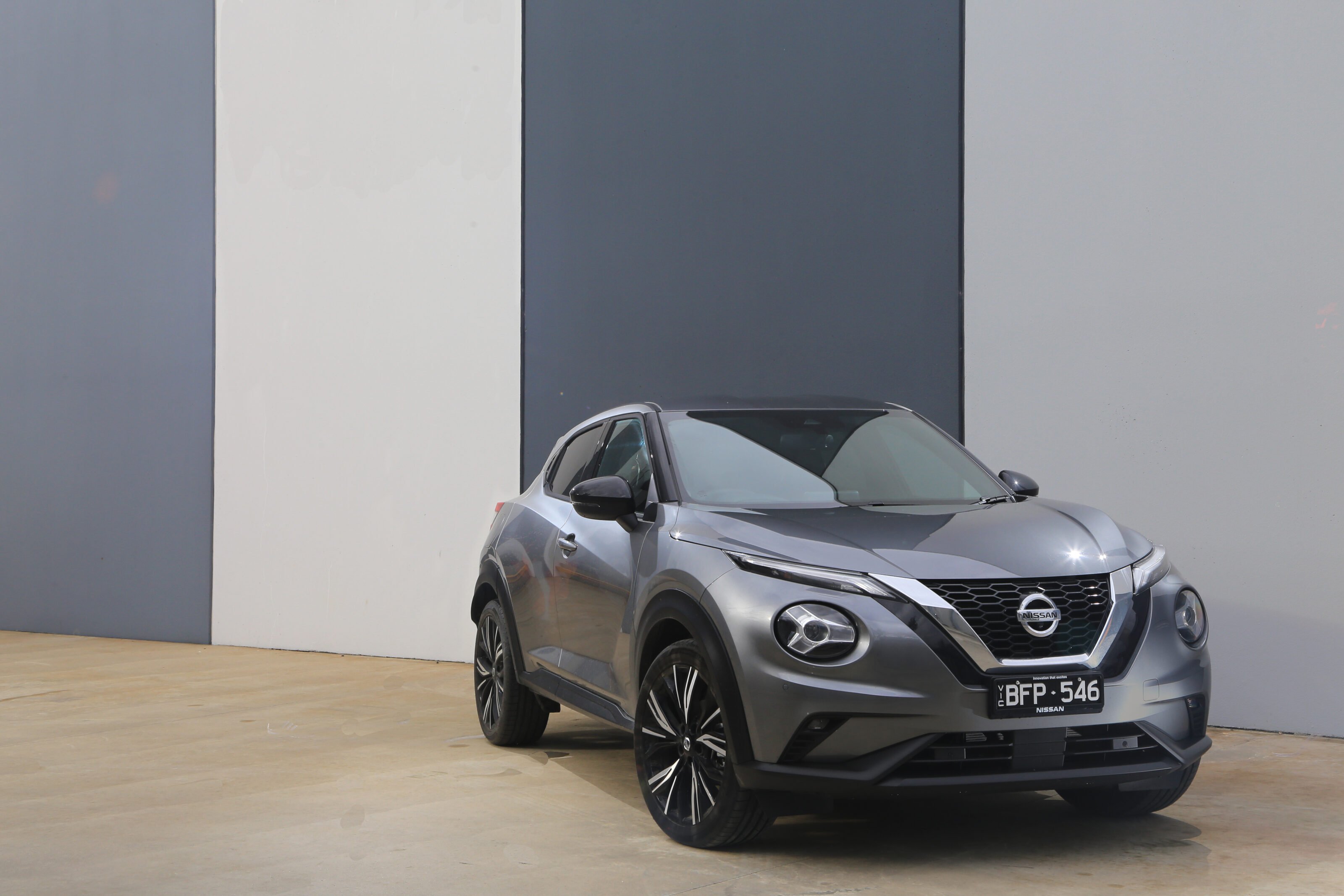
As welcomes go, this one was a doozy. New Nissan Juke delivered, start the ignition and a fault flashes up on the dial pack. The radio cranks up playing ‘What Have I Done To Deserve This?’ by the Pet Shop Boys. I can tell that this relationship is probably going to be eventful.
The fault – a glitch in the stop/start system – clears itself after a run around the block and a reboot of the car. Prior to driving the new Juke, I wasn’t sure I’d get on with one. I knew that Byron Mathioudakis would bag me mercilessly after we’d done likewise to him when he proclaimed, not entirely without merit, that the first Juke was one of the most influential cars of the 2010s.
After attending the local launch, I was more encouraged. Although I did have a guilty penchant for the old 160kW Juke Nismo RS, I’d never been able to shake the impression that it was, at best, a 0.75 trick pony.
This latest car felt a good deal more mature in its execution without losing the puppyish verve of the original. Yes, it only has 84kW to send 1274 kegs of British-built baby SUV up the road, but it still has some pep to it. To get the most out of the Juke, you need to switch it into ‘D-Mode’, which my partner has a rather uncharitable nickname for. You can guess at that.
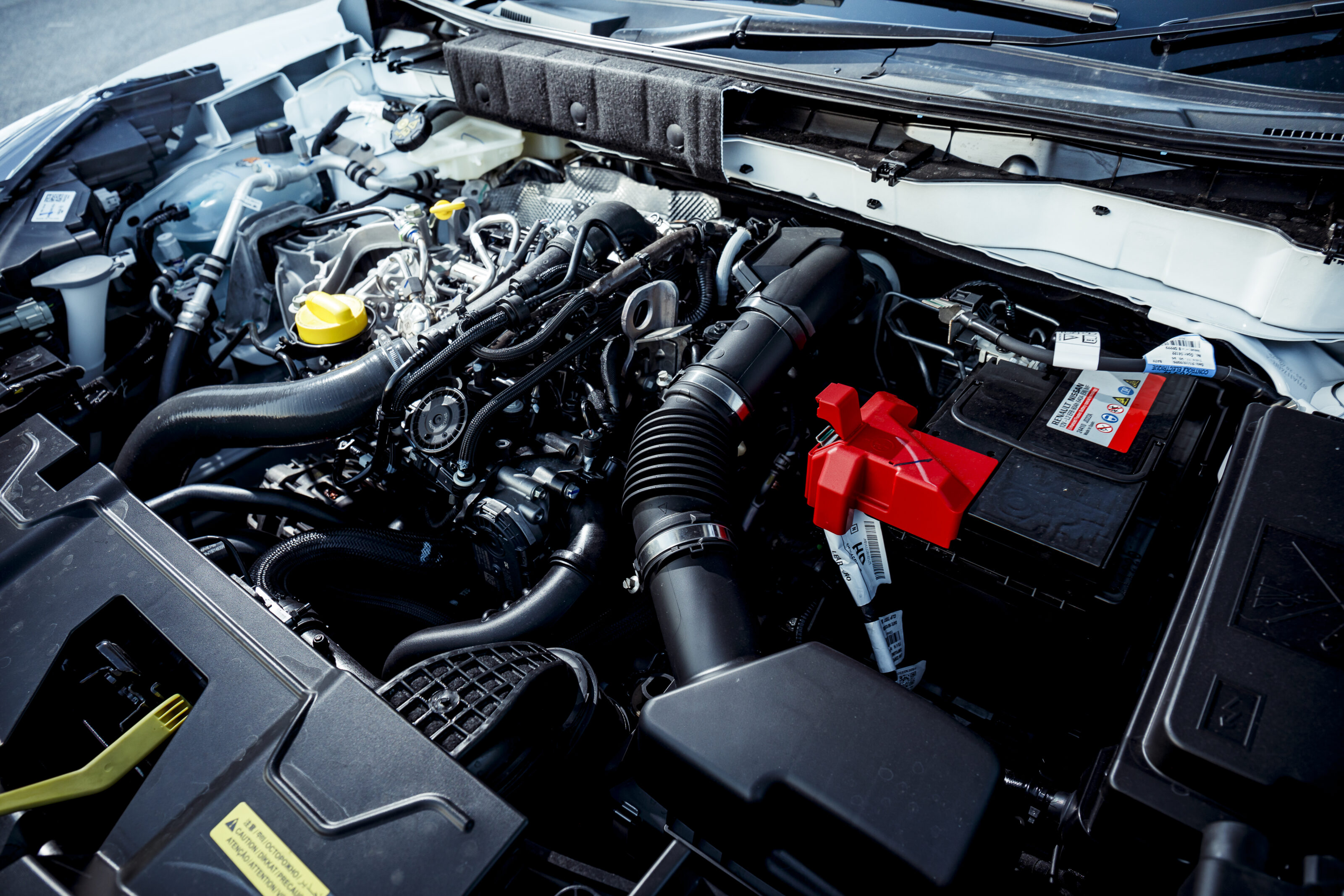
This sharpens the throttle and steering and makes the auto ’box more aggressive. You’ll have to get used to the neurotic throttle map when you pull away, but after that it’s all good. The best part is that it loses the standard mode’s propensity to slot the dual-clutch ’box into seventh at the earliest opportunity.
My car is the Ti trim, which is the range topper and comes equipped with Bose Ultra-Nearfield speakers in the headrests. There’s a setting on the centre display which allows you to adjust the degree to which these speakers offer a surround-sound effect. Adjust it when the music’s playing and it feels like a scarf of sound enveloping you.
The rest of the cabin is a very welcome surprise to those of you who might associate Nissans with fairly rudimentary materials and design. The dash top is covered in Alcantara, the sports seats are supportive, the driver’s seat is manually height adjustable and can be set reasonably low. The passenger seat gets no such height adjustment, which seems a bit of a miss in a range-topper with a list price of $36,490, and as a result, taller passengers may have to recline a little further than usual.
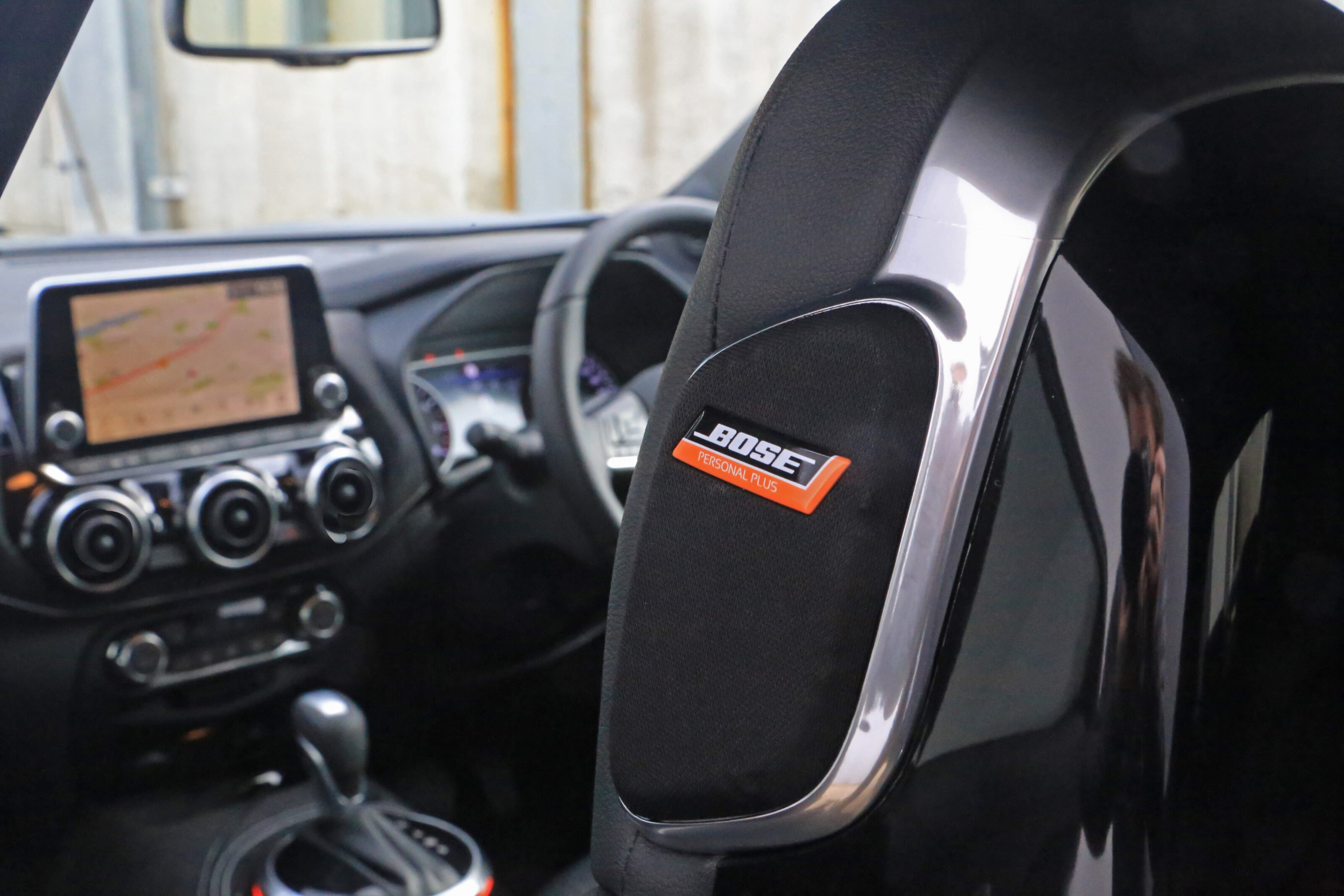
The standard-fit sat-nav is excellent, although the 8.0-inch touchscreen can occasionally require a couple of stabs to register a command. It runs a port of TomTom Maps & Live Traffic, so it’ll be able to route you around major snarl-ups. If you prefer, there’s also Apple and Android mirroring.
All Jukes run on passive suspension and the ride on the Ti, with its 19-inch alloys, is firmish. Overall body control is very good, but it can jiggle along tetchily on inside lanes that have been heavily trafficked by trucks.
It also runs out of suspension travel quite sharply if you hit a pothole, as I discovered on a recent drive. So savage was the report through the cabin that I pulled over straight away to check if I’d damaged the wheel in a fairly innocuous series of three ripples caused when a truck had braked and deformed the hotmix on what must have been a 40+ degree Celsius day.
The Juke is fun to drive, though, and part of that fun comes with the knowledge that with just 999cc at your elbow, everything becomes a giant-killing opportunity. I reckon that any vehicle that can raise a grin is off to a good start, even if that has meant that my fuel consumption is standing at exactly 9.0L/100km against an ADR figure of 5.8L. It’s becoming clear that D-Mode has a lot to answer for.
Update 1: Get a Grip
This month: 1069km @ 6.9/100km
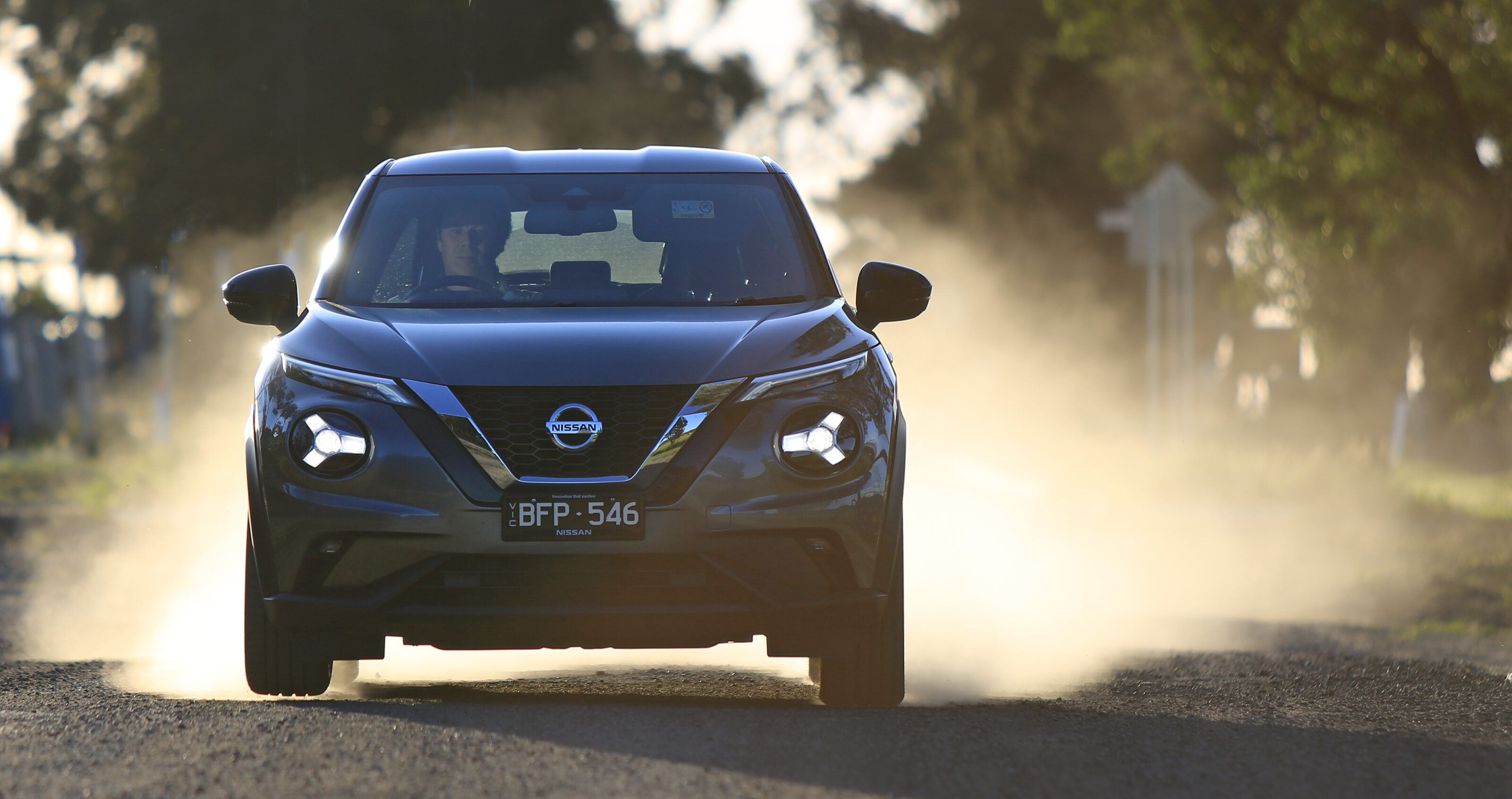
I don’t know about you, but I tend to do something fairly irrational whenever I get into a front-wheel-drive SUV. Because they have a modicum of extra ride height, I always feel compelled to drive them off road. I know, I know, this really needs to be filed under ‘Unsmart Things Done’ but there it is. The Juke is no exception.
There’s a track near my house that, for a short 100-metre pitch, climbs at a genuinely unnerving gradient. It has recently been regraded with fresh gravel, so on the face of it, the Juke’s odds of climbing it looked about on par with Clive Palmer’s chances of conquering Mount Midoriyama.
Undeterred, I vowed to get a good run at it and just bully the Juke up, but as I rounded the preceding corner with some verve, a dog walker forced me to jump on the picks. It was then a case of scrambling up at little more than walking pace.
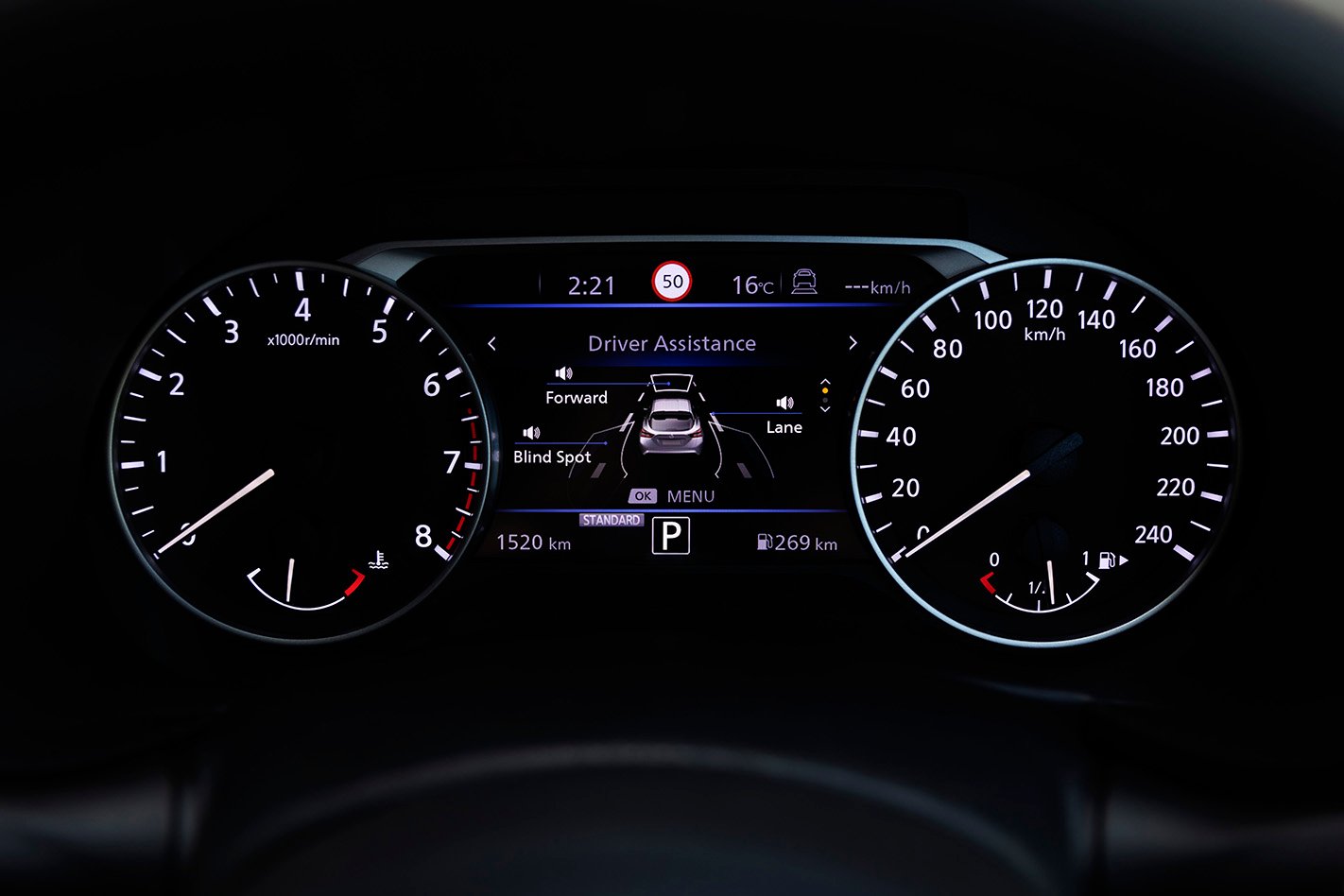
The traction control light started strobing like crazy as the front rubber scrabbled for purchase. At one point, the throttle pedal went ‘dead’, the Juke deciding that there was zero grip available at that instant. I started steering the car gently from left to right as I’d seen a Land Rover instructor do.
This only had the effect of pebble-dashing the dog walker, who had rather unwisely decided to watch this ungainly endeavour.
Against all odds, however, the combination of doggedly determined traction control, the 225/45 R19 Hankook Ventus front boots and a ground clearance of 172mm (compared to the 137mm of a Toyota C-HR or the 155mm of a Mazda CX-3) saw the Juke crest the bumpy rise. Curiosity sated, I don’t think I’ll make this part of my normal test route for the little Nissan. I expected to cop a bit of a spray in return from the dog walker but, to my relief, he was doubled up with laughter at my dubious route selection.
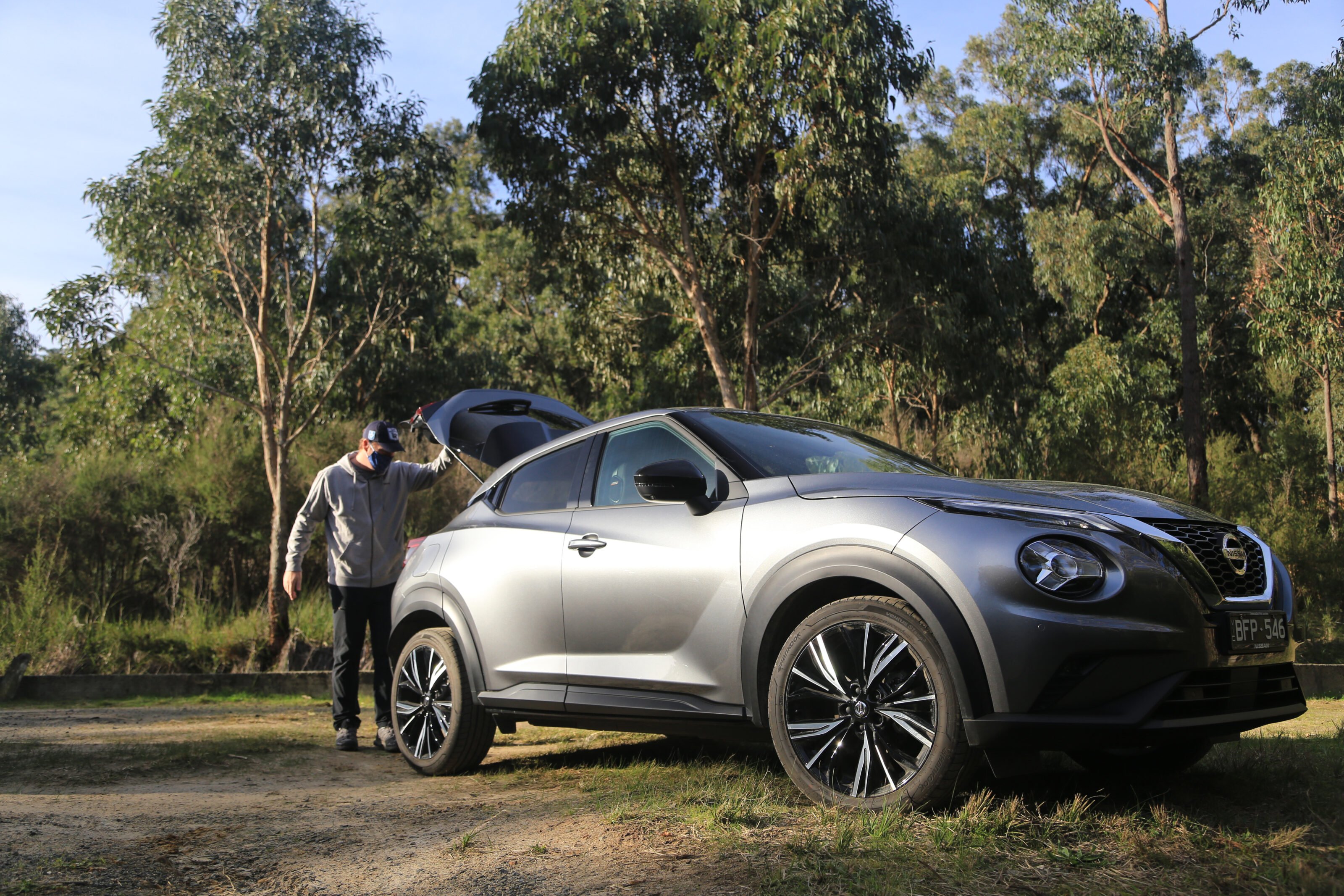
Otherwise, I’m still slightly shocked at how much I like this Juke Ti. Yes, there are some idiosyncrasies to overcome, such as the jerky cold-start process which can see it kangaroo truculently for the first 100m in the morning or the long-winded series of button-presses (thumb the starter, wait for the infotainment to boot up, OK the touch screen, switch into Sport, and kill the idle-stop) which is a two-handed affair as none of these buttons are anywhere proximate to each other, but these are very minor grumbles.
Even when there have been some more ostensibly exotic vehicles parked in the garage, the Juke still gets a run. Out on the road, the combination of just enough low-end turbo torque, strong body control, decent ride quality and enjoyable steering weighting is still more than enough to paint a big grin on my face. The tiny engine has also yet to become tiresome. Onwards and upwards, then.
Update 2: Humble Pie
This month: 156km @ 9.6L/100km
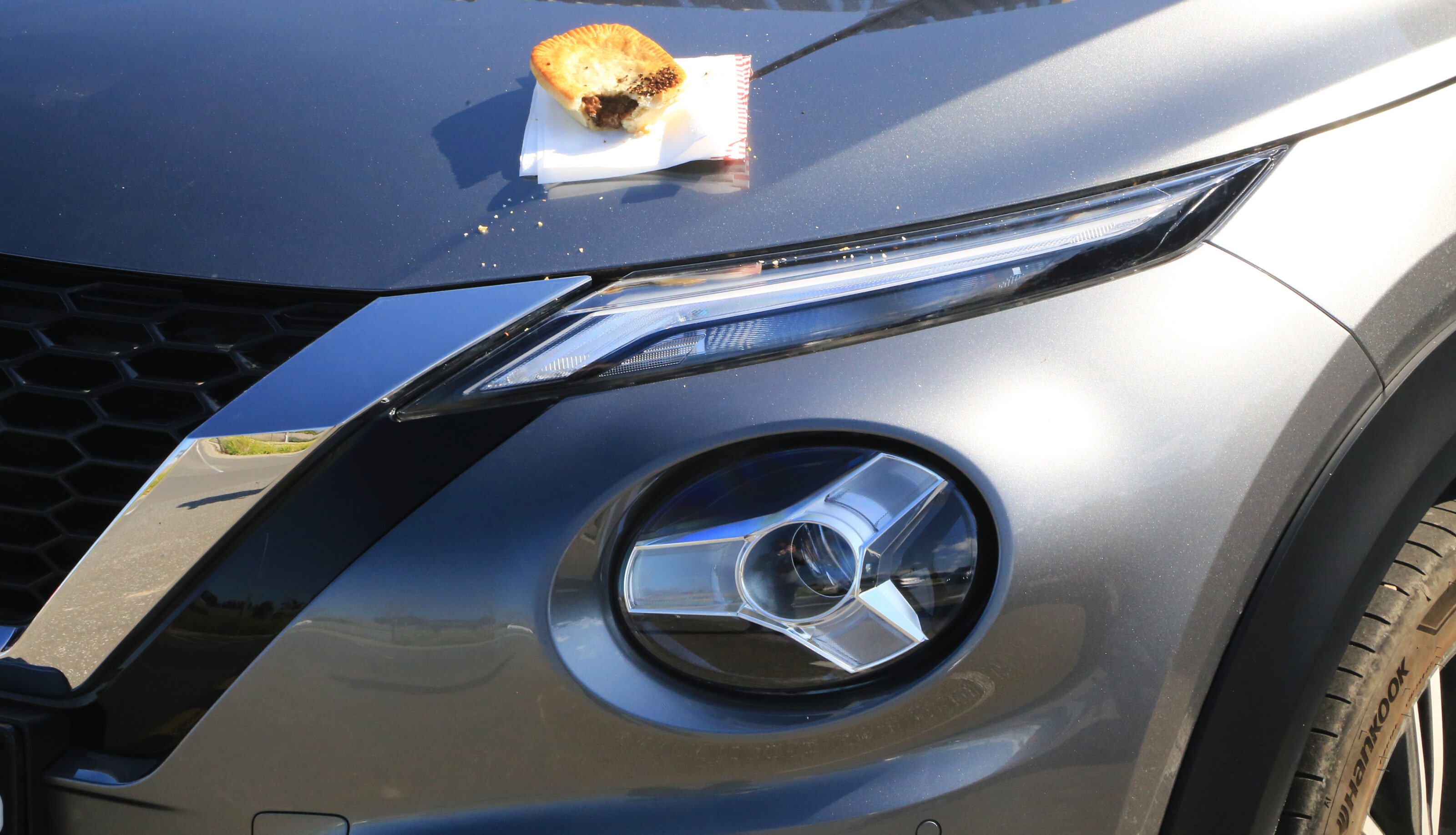
A piffling 156km. That’s my total for this month of Stage 4 lockdown here in Melbourne. The Juke genuinely hasn’t strayed beyond a five kilometre radius of my home, despite the temptation of deserted roads and nor has it broken curfew. That paltry figure has come about schlepping backwards and forwards to the shops, occasionally taking the back road to grab the groceries just so I don’t forget what going round a corner feels like.
Driving briskly for short distances is never a recipe for stellar fuel consumption and the figure has tiptoed up to close to double digits this month. These sorts of journeys only throw into focus the Juke’s staccato throttle pedal feel upon cold starts. Nevertheless, the fact that I want to drive the little Nissan and will accept virtually any domestic request for shopping as an excuse is a good sign. I still love its puppyish feel.
It’s also given me the opportunity to do a little research and, after much deliberation, I have come to the conclusion that a pie is pretty much the worst take-away food item you can consume in your car. Tell me if you think I’m wrong, but the inevitable explosion of flaky pastry and the constant risk of dripping beefy brown magma into the nether reaches of the centre stack make the humble pie a liability when grabbing lunch.
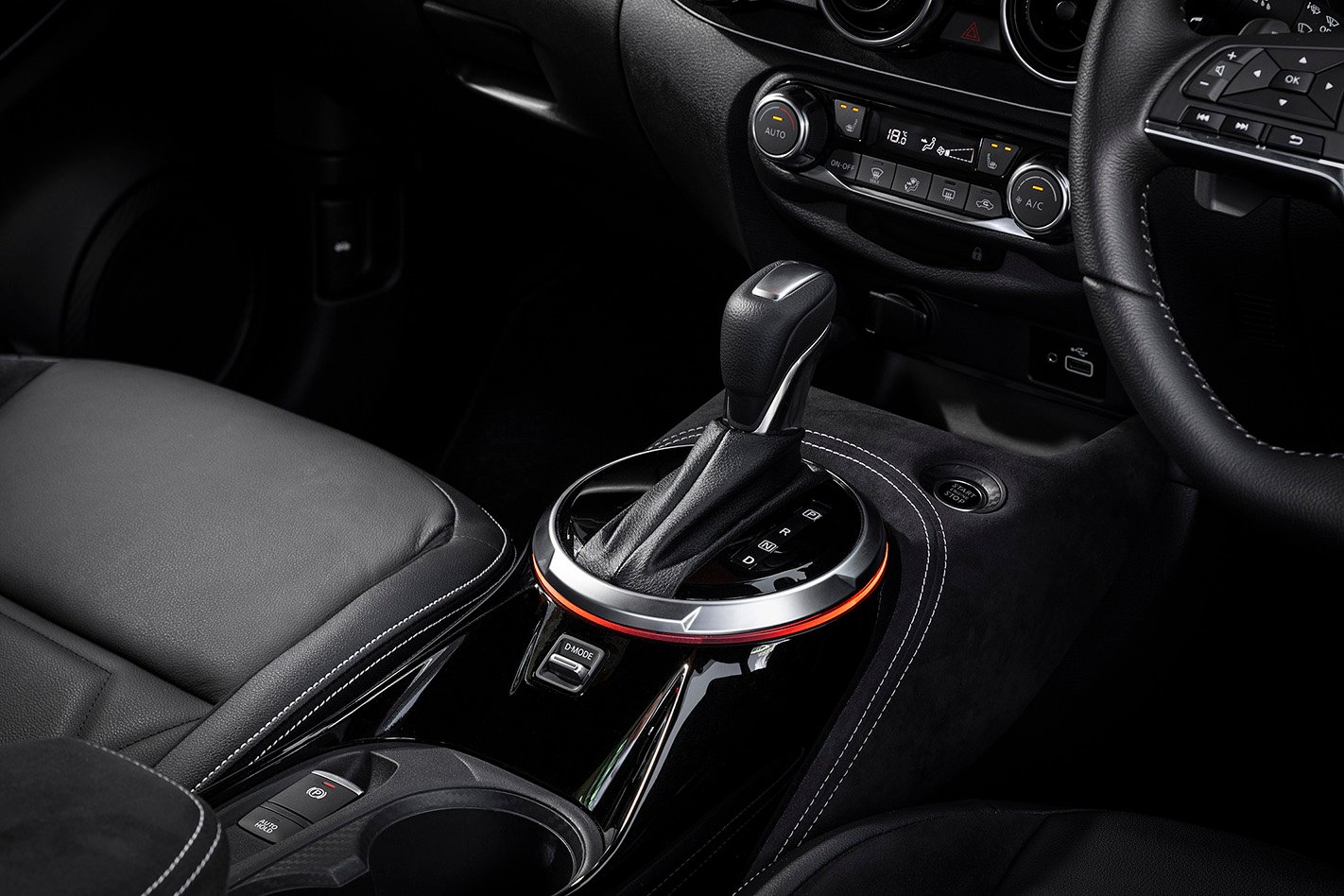
The Juke’s particularly bad, because the electric handbrake button seems to be a magnet for pastry bits and trying to prise them out of the well beneath the switch just turns it into a greasy mess. At this point I’ll acknowledge that eating in cars is a big no-no for most, but, you know, unprecedented times, unprecedented things. Pies and Alcantara trim also make a horrible combo, especially if you were tempted by the luridly-hued curry chicken option. Never do this. It’ll result in hours of remedial cleaning.
I’ve now taken to standing next to the Juke to eat a pie. I was halfway through a pepper steak number last week when the local constabulary arrived and began taking issue with my lack of apparent mask. I’m not proud to confess that I lost my composure mid-mouthful and merely succeeded in blowing a fine spray of pastry at them as I remonstrated, whereupon they picked secondhand shortcrust detritus out of their moustaches, reconsidered their positions and continued on their way.
Fully re-energised on cow, lard and righteous anger, I went the twisty way back home again, like a big rebel, loving the Juke’s crisp low-end pick-up, tidy body control and punchy brakes. Yes, I smashed all the groceries to smithereens in the process, but doesn’t that just give me an excuse to go for another drive?
Update 3: Hazards of Juke?
This month: 469km @ 8.0L/100km Total: 2091km @ 8.0L/100km
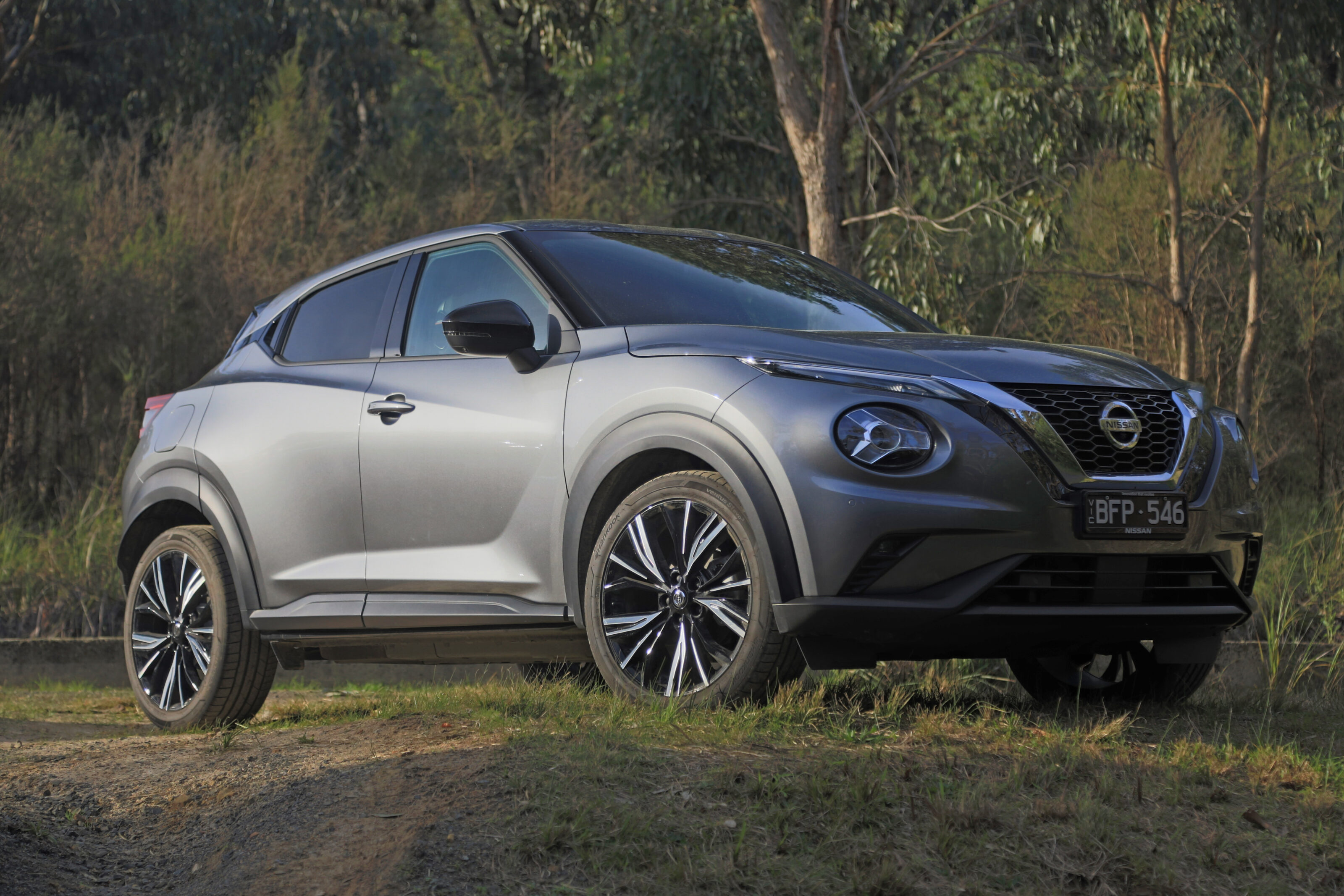
I’m calling it. The last long-termer I’ve run for Wheels is my favourite. That list includes a McLaren 570GT, a Range Rover Velar and a Kia Stinger GT, so there’s some talent in the back catalogue. I guess that’s the thing about pleasant surprises. The mark they leave behind is always that much more enduring.
As Victoria has battened down the hatches, the Nissan Juke Ti has shone. Woolies, Coles, Bunnings click and collect, the sneaky long route through the hills and paddocks to the furthest point of the 5km arc, rain or shine, battered with bulldust, bouncing up the gravel-road corrugations to gain a distant view of the beckoning ocean – the Juke has been uniformly eager to please. Rarely do you find a car this much fun this easy to get on with.
I nearly did a little remodelling of the Juke’s front end recently when, on a late-night recce looking for a spot to exercise, a wet wombat waddled out onto the track in front of the Nissan. A hard brake and gentle swerve manoeuvre saw vombatus ursinus disappear out of view and I steeled myself for the inevitable doof, but when I stopped the car, it was merely blinking dopily and wondering why its fur was now caked in dust and grit. The stability control had kicked in when it felt the Juke deviate from the line on the loose stuff, but it was an enabler in this instance, allowing me to safely steer without ploughing straight on or swinging the rear end wide.
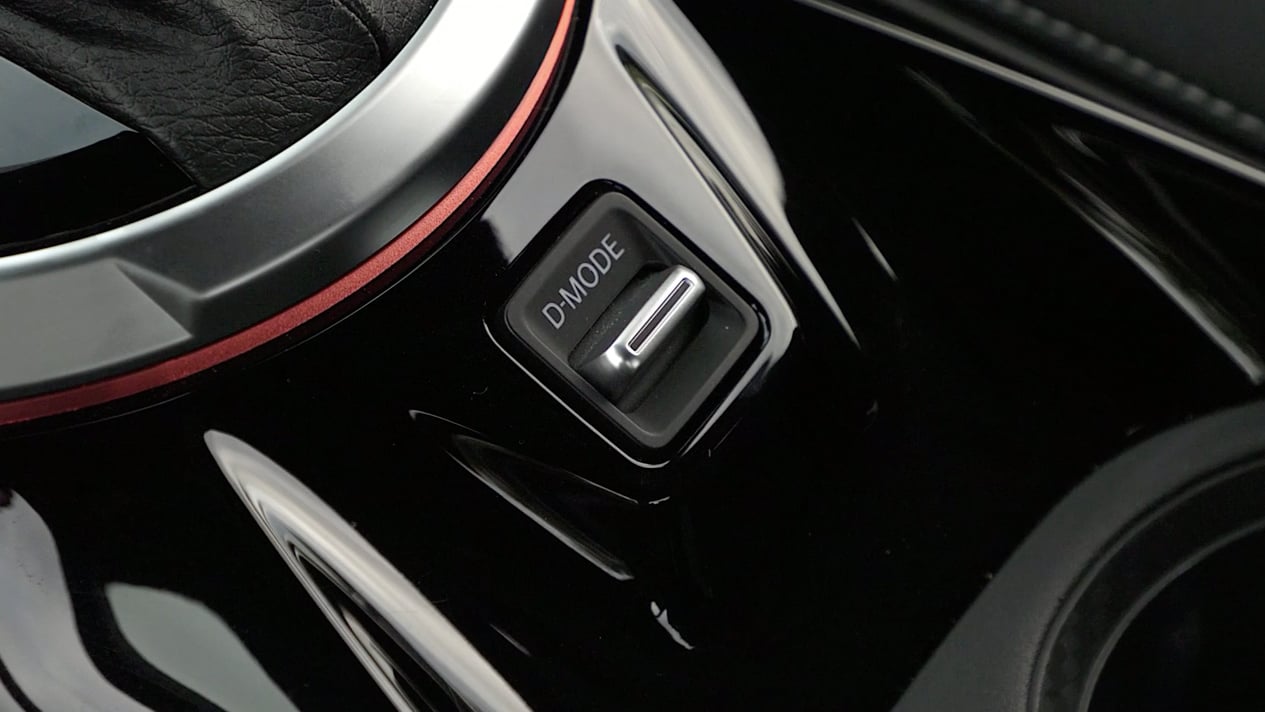
While it’s true that I haven’t loaded the Juke to the gunwales, or taken it for a big drive, most Jukes will see local, low-demand use, and it earns a solid recommendation from me. The ergonomics are brilliant, the driving position excellent, materials quality in the cabin is decent, and the infotainment system well up to par. The Bose headrest speakers deliver a cocooning feel to the sound quality and I still love the way clicking into D-Mode instantly makes the car feel all sinewy and immediate.
A glowing report is one thing, but would I put my money where my mouth is? Sadly not at this price. As much as I’ve enjoyed the Juke Ti, I just can’t get past the fact that in spite of its talents, this is ostensibly an 84kW 1.0-litre compact hatch on stilts. A 155kW Toyota RAV4 hybrid is almost identically priced and offers a lot more car for the money. But the fact that you can get the mechanically identical Juke ST for $28K is a different story.
Haggle hard on one of those and you could quite easily convince yourself of its value proposition. And you’d need no real effort to justify one in terms of sheer everyday likeability. I’d call that a win.
UPDATE, November 2022: New-gen Prius unveiled
Toyota has revealed its new-generation Prius hybrid, revealing what is surely the most stylish iteration yet of what has historically been an awkwardly styled line of cars. Alas, this is also the first generation of Prius that won’t come to Australia. Get all the details at the link below.
Story continues
It’s hard to believe that it has been 20 years since the Toyota Prius first went on sale around the world, including Australia, and quickly became synonymous with lower-emissions driving.
A lot has happened since, with Tesla becoming a household name and legacy brands gradually embracing the electric future with battery electric vehicles that mostly made the Prius and other hybrids seem a little ho-hum.
The Prius is now in its fourth generation, which is nearing the end of its life cycle. A fifth-generation model is slated for the 2023 model year.
But given every other soft-road Toyota passenger vehicle in Australia, from the Yaris to the Kluger, is now available with hybrid variants, why would anyone still want a Prius? Surely it’s no longer the green status symbol it once was.
With this year’s Prius sales unlikely to reach 100 units – behind a number of pure-electric models and Toyota’s slowest seller unless you count the lease-only, hydrogen-powered Mirai – I jumped into a range-topping i-Tech version to find out what it still has to offer.
Pricing and ownership
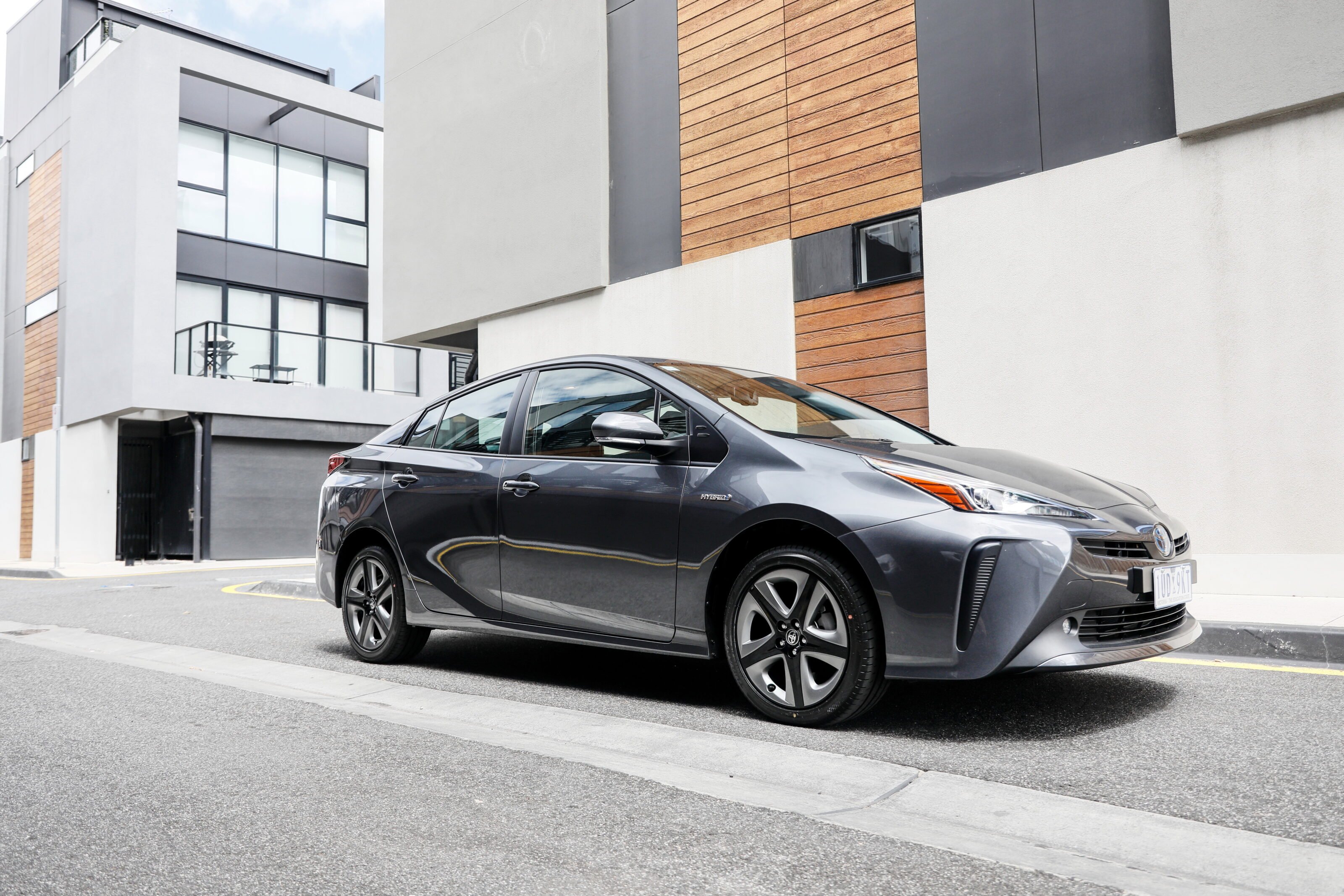
The current Toyota Prius range was last updated in 2019 and consists of the eponymous entry-level variant the upper-spec Prius i-Tech, which retail for $38,365 and $45,825 respectively (before on-road costs).
Each has the same 1.8-litre four-cylinder engine coupled with an electric motor for a combined 90kW and an official combined fuel consumption of 3.4L/100km.
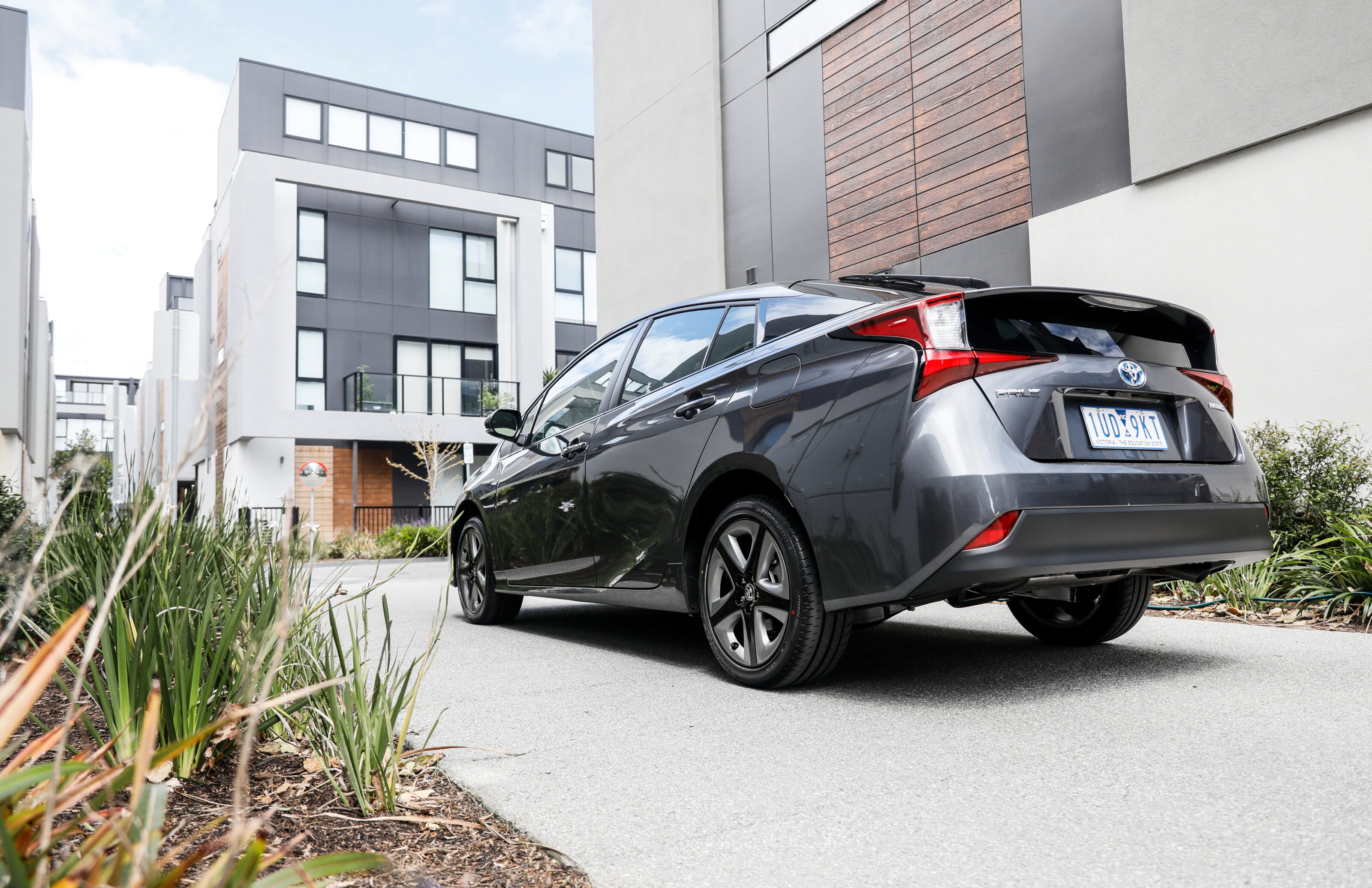
Interestingly, hybrid Corolla variants feature the same powertrain and 1400kg kerb weight but an official fuel consumption rating of 4.2L/100km, which says something for the Prius’ more aerodynamic form.
As far as real-world fuel economy is concerned, our test car sipped fuel at a rate of 3.2L/100km in urban areas but sometimes nudged 5.0L/100km on freeways. After 156km across a range of driving conditions, I averaged 4.7km/100km with the fuel gauge barely moving from the full position.
Service intervals for the Prius are a frequent six months or 10,000km, whichever comes first, with each visit to a Toyota service department capped at $205 under the Toyota Service Advantage scheme.
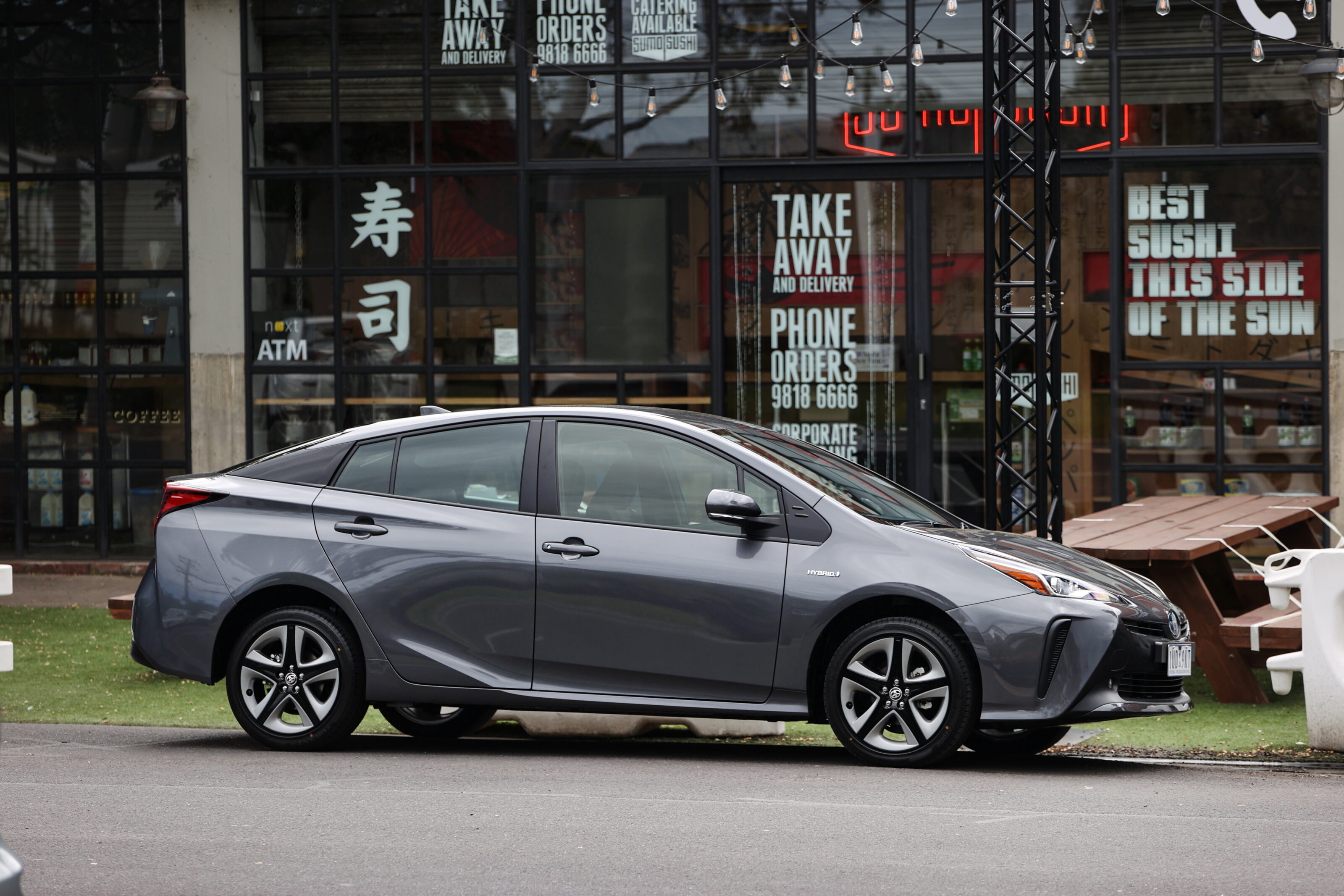
The Prius is covered by Toyota’s five-year, unlimited-kilometre warranty and seven-year anti-corrosion cover.
Features
The Prius has a generous standard features list, which includes a power-adjustable driver’s seat, head-up display, 7.0-inch touchscreen, satellite navigation, Apple CarPlay/Android Auto, AM/FM/DAB+ radio, 10-speaker JBL premium audio system, wireless phone charger, climate control air-conditioning, keyless entry/start, auto-dimming rearview mirror and 15-inch alloy wheels.
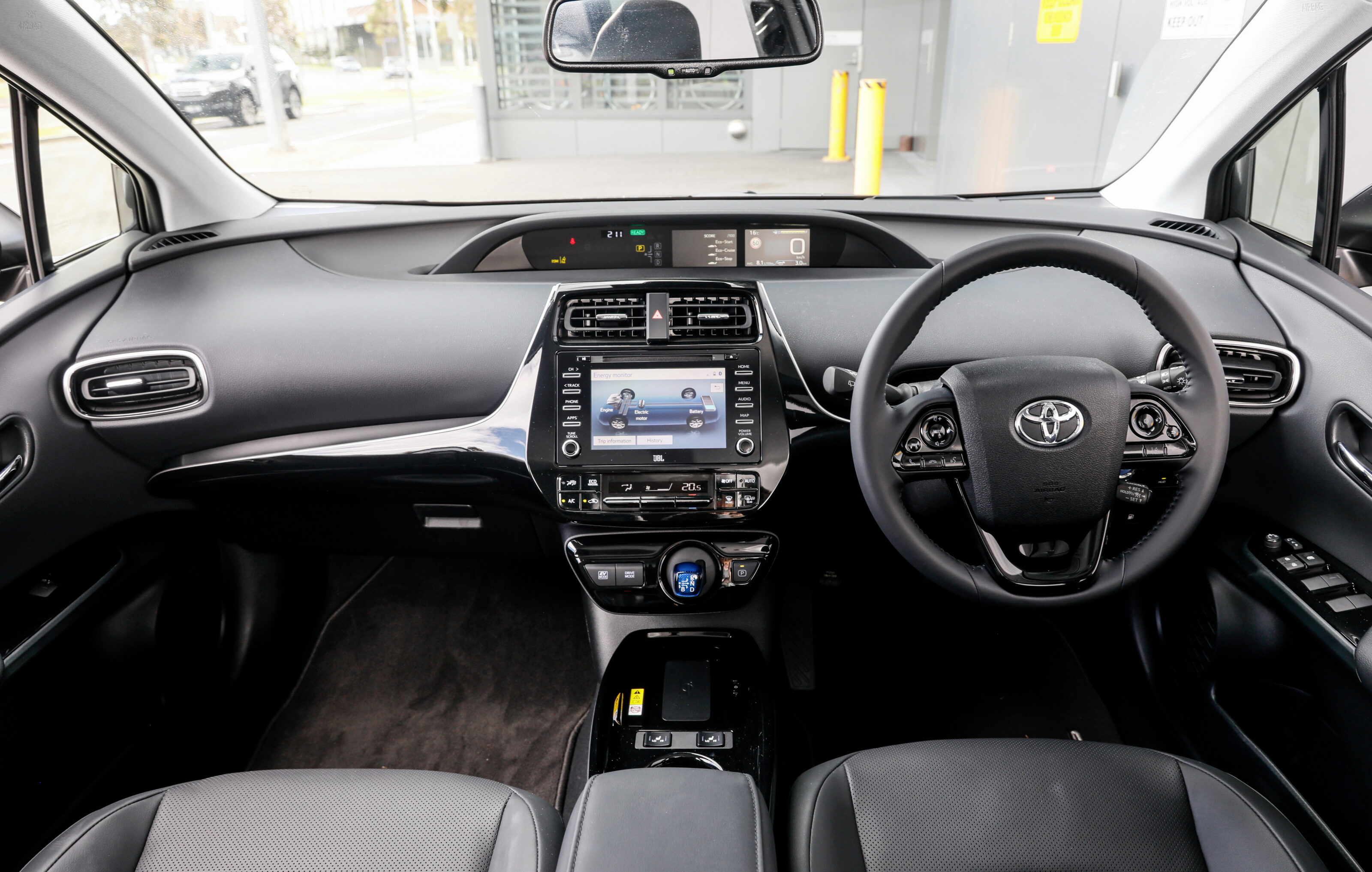
Spending a substantial $7460 more on the Prius i-Tech brings pleasantries such as leather accented seats, heated front seats, power-operated tailgate and smarter looking 17-inch alloys. Rear-cross traffic and blind-spot monitor are added to the safety suite, which we’ll go into below.
Extra-cost options are confined to premium paint, meaning you’ll have to pay an extra $600 if you want one of the other six hues over the standard Glacier White.
Space and comfort
The fourth-generation Prius has been around since 2016 and in March 2019 it received a facelift that brought more conventional-looking front- and rear-end treatments including sleeker LED headlights and rear combination lights.
The interior design was also tweaked with improved ergonomics, new cloth upholstery in the entry-level variant and a substantially upgraded multimedia system that brought Apple CarPlay and Android Auto smartphone mirroring.
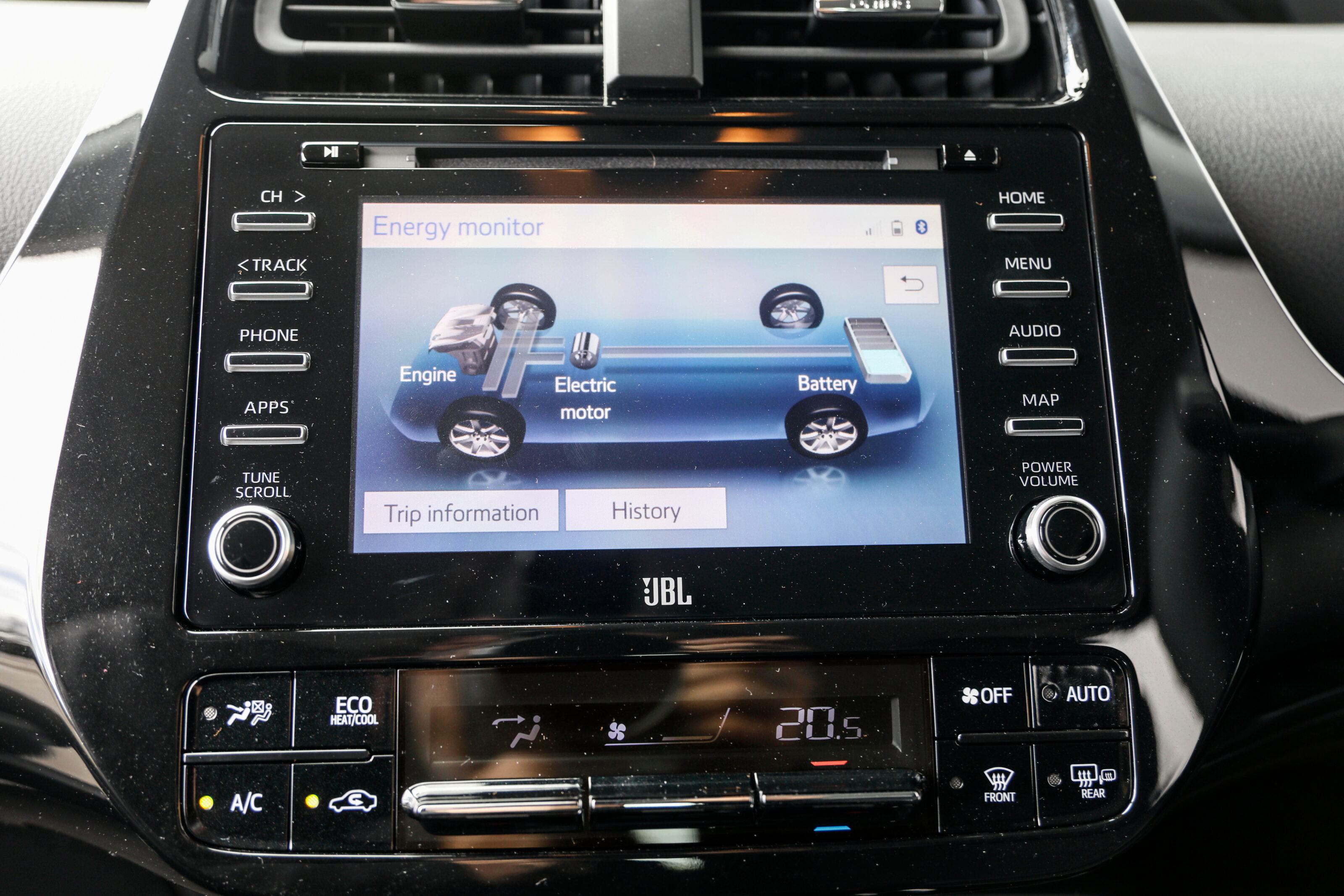
The satellite navigation system features SUNA live traffic alerts but I preferred using Waze or Google Maps for real-time info. These also have sharper graphics than Toyota’s interface, which still looks like a shareware download from someone’s Geocities site.
That said, the in-built system does hook up to the head-up display (HUD) that shows the directions within your eye line.
The HUD also allows you to check your speed without having to look toward the centre of the dashboard where the gauge cluster is mounted above the central air vents and touchscreen.
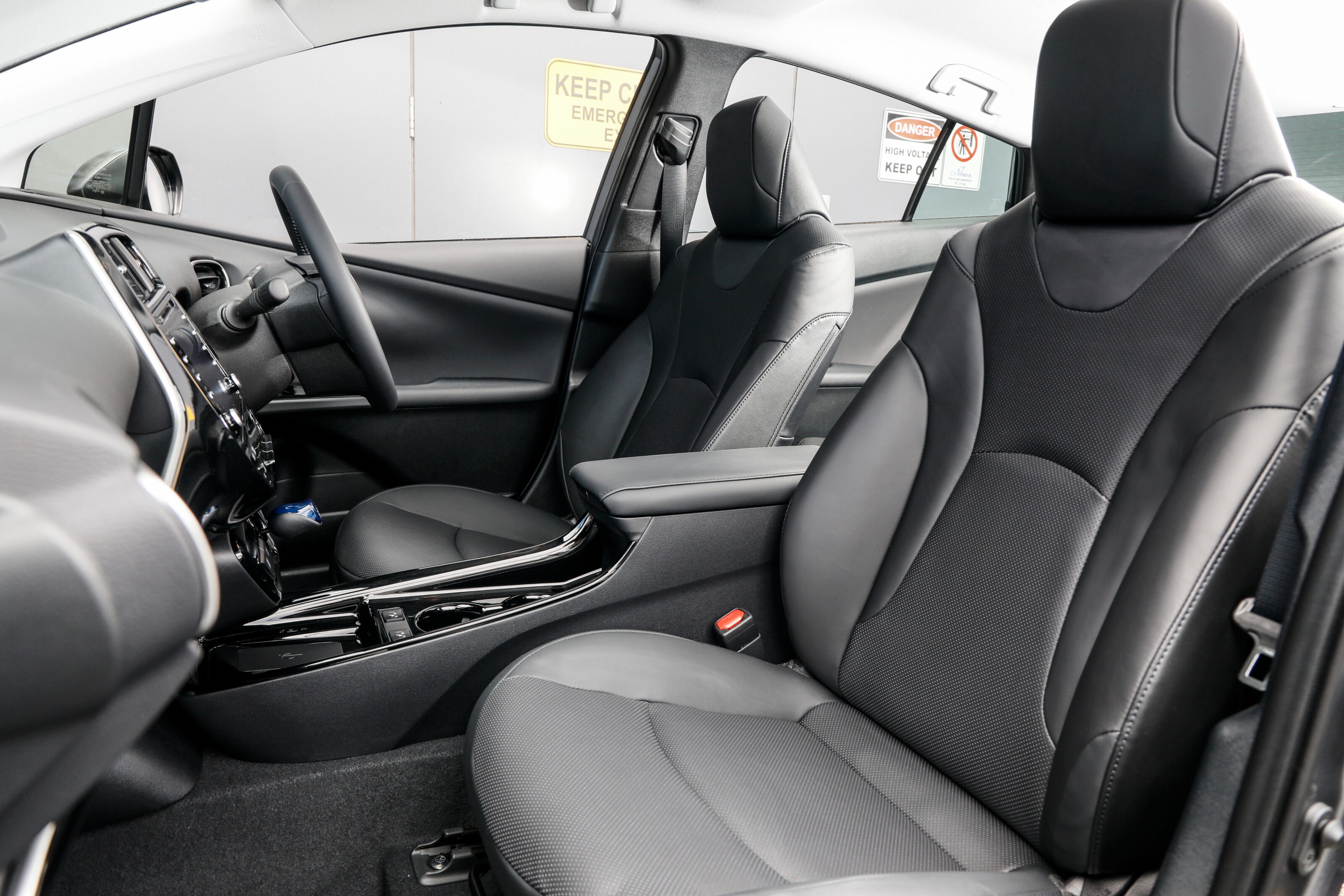
Toyota also redesigned the centre console to incorporate two cup holders, seat heating switches and a wireless phone charger. It’s clutter-free, with the milk-float-like gear shifter protruding from the lower part of the dashboard fascia below the air-conditioning controls.
The leather-appointed front seats are comfortable but could do with a little more upper-thigh support and once seated, there is good frontal vision despite the deep dashboard top that sees you sitting about a metre back from the lower part of the windscreen.
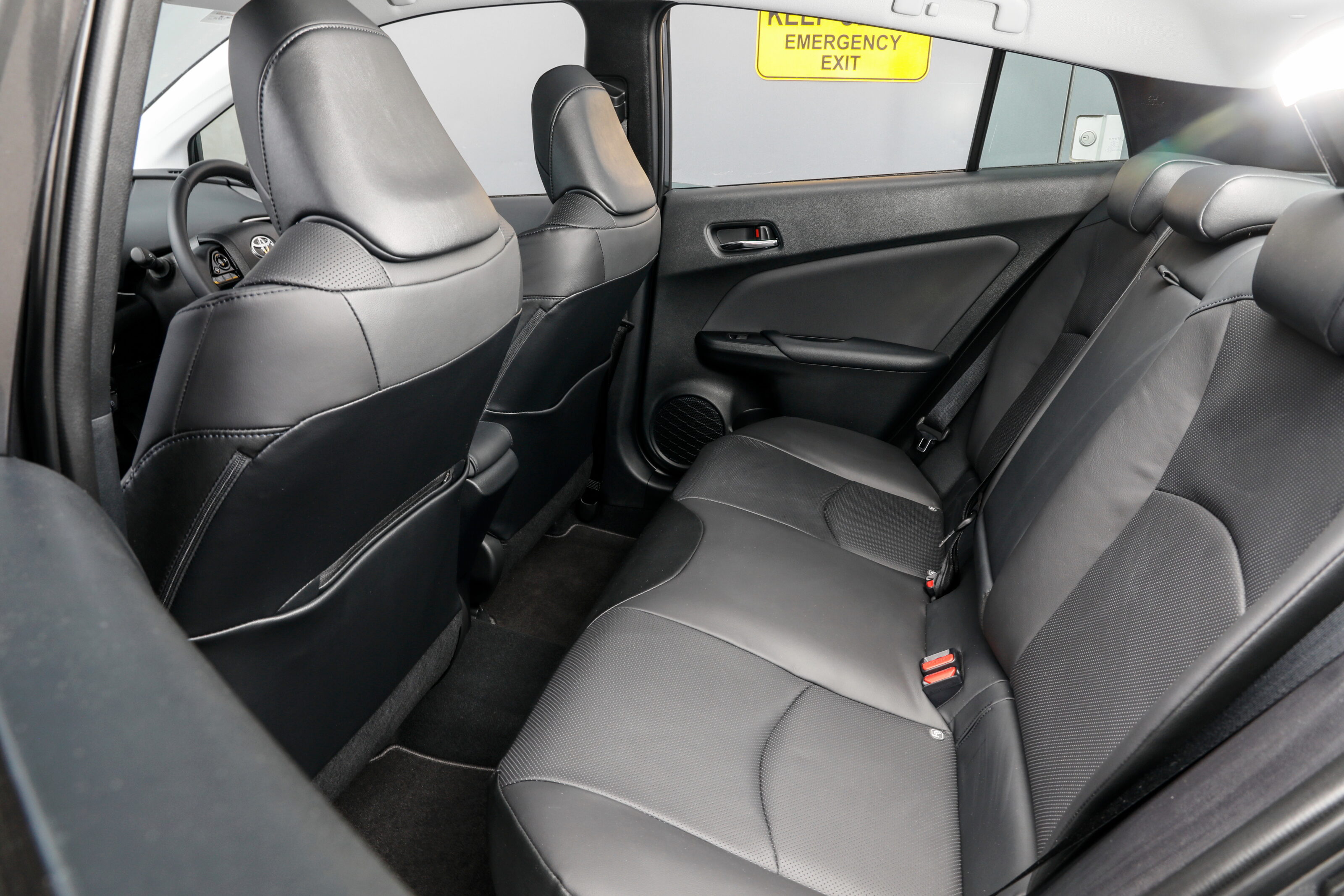
It’s behind the front seats where the Prius provides its own niche – filling the size gap between the Corolla and Camry.
The Prius has considerably more legroom than the Corolla, though this is undermined a little by the low swept-back roofline that can compromise headroom. And there isn’t much back there for passengers apart from a 12-volt socket, bottle holders in the doors, map pockets and a fold-down armrest with cup holders.
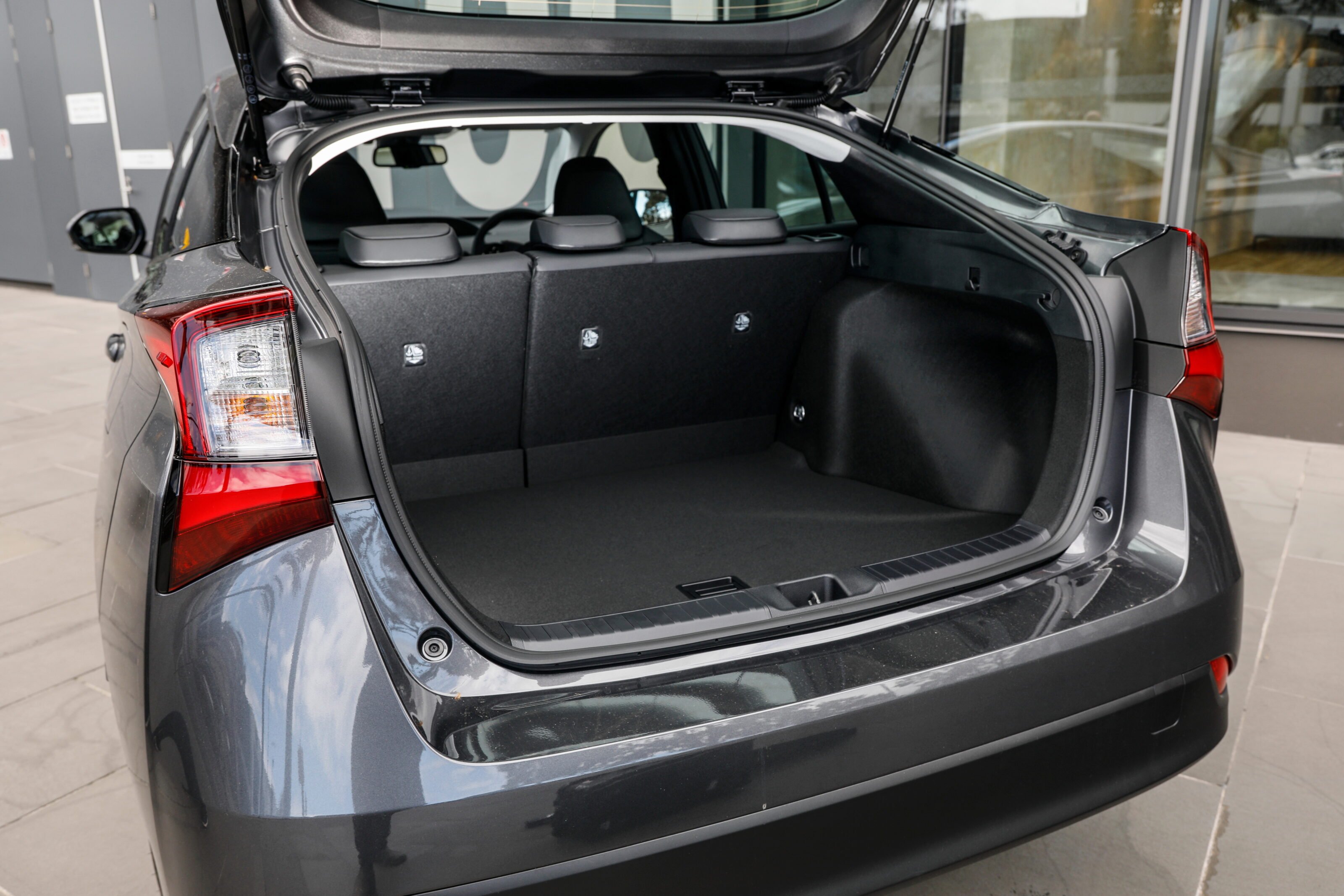
The boot space is a medium-SUV-like 502 litres, which is more than double the Corolla hatchback’s measly 217-litre cargo area. Folding down the 60:40 spilt rear seatbacks brings up to 1507 litres in which to carry stuff.
The long tailgate lifts very high, creating an aperture about the same size as the boot floor, which makes it easy to load bulky items.
On the downside, there is no spare wheel under the boot floor, just a goo kit to seal the tyre enough for you to take it to a repairer.
On the road
The Prius is powered by a 72kW/142Nm 1.8-litre four-cylinder Atkinson Cycle petrol engine that is coupled with an electric motor, resulting in a total maximum power output of 90kW, which is sent to the front wheels through a continuously variable transmission (CVT).
Despite the additional oomph, it feels underpowered and the engine screams into life when you put the foot down hard, not helped by the CVT.
It has a Sport driving mode that helps bring the revs up so you get closer to peak power quicker, but it still feels a little heavy.
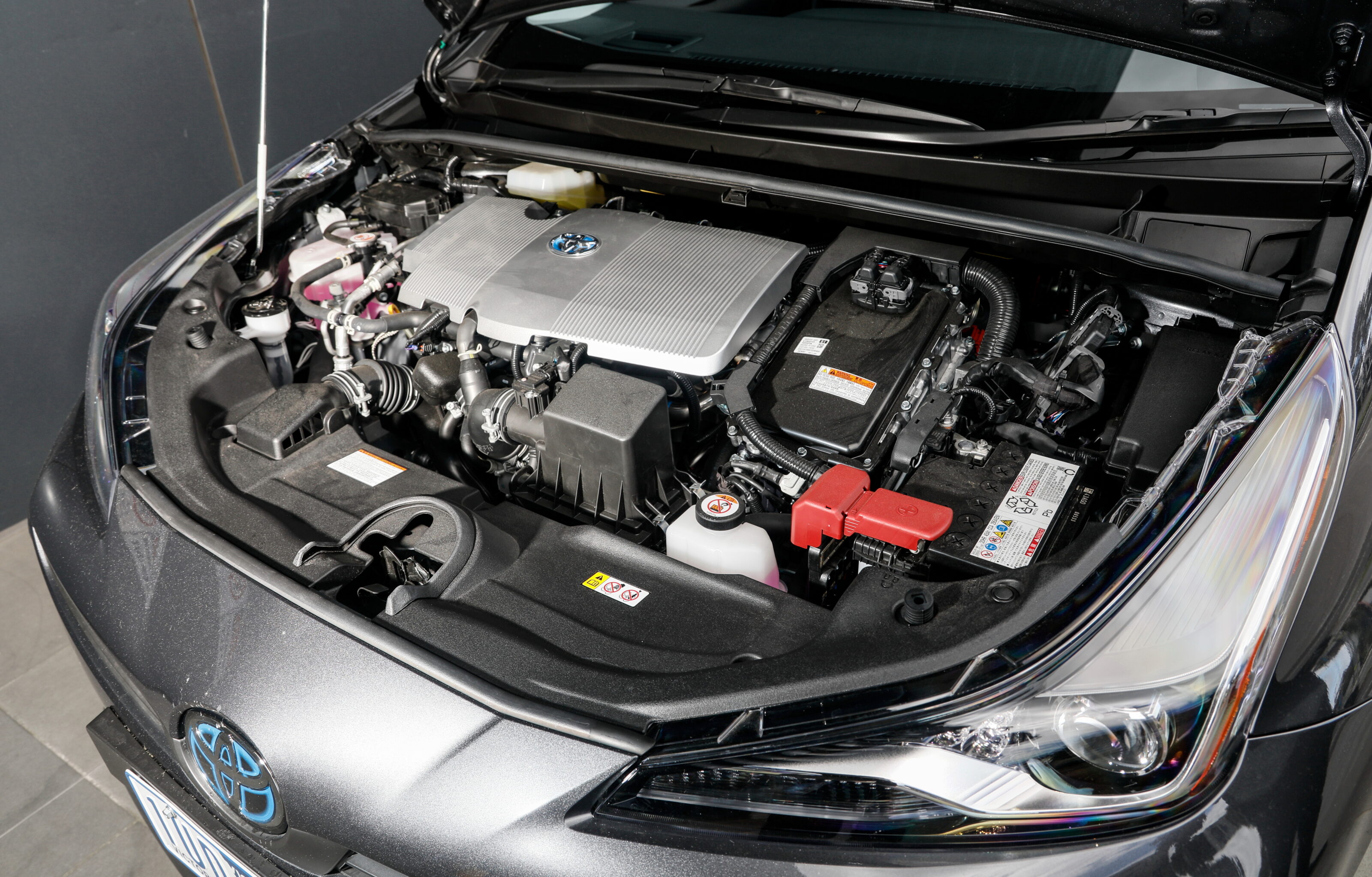
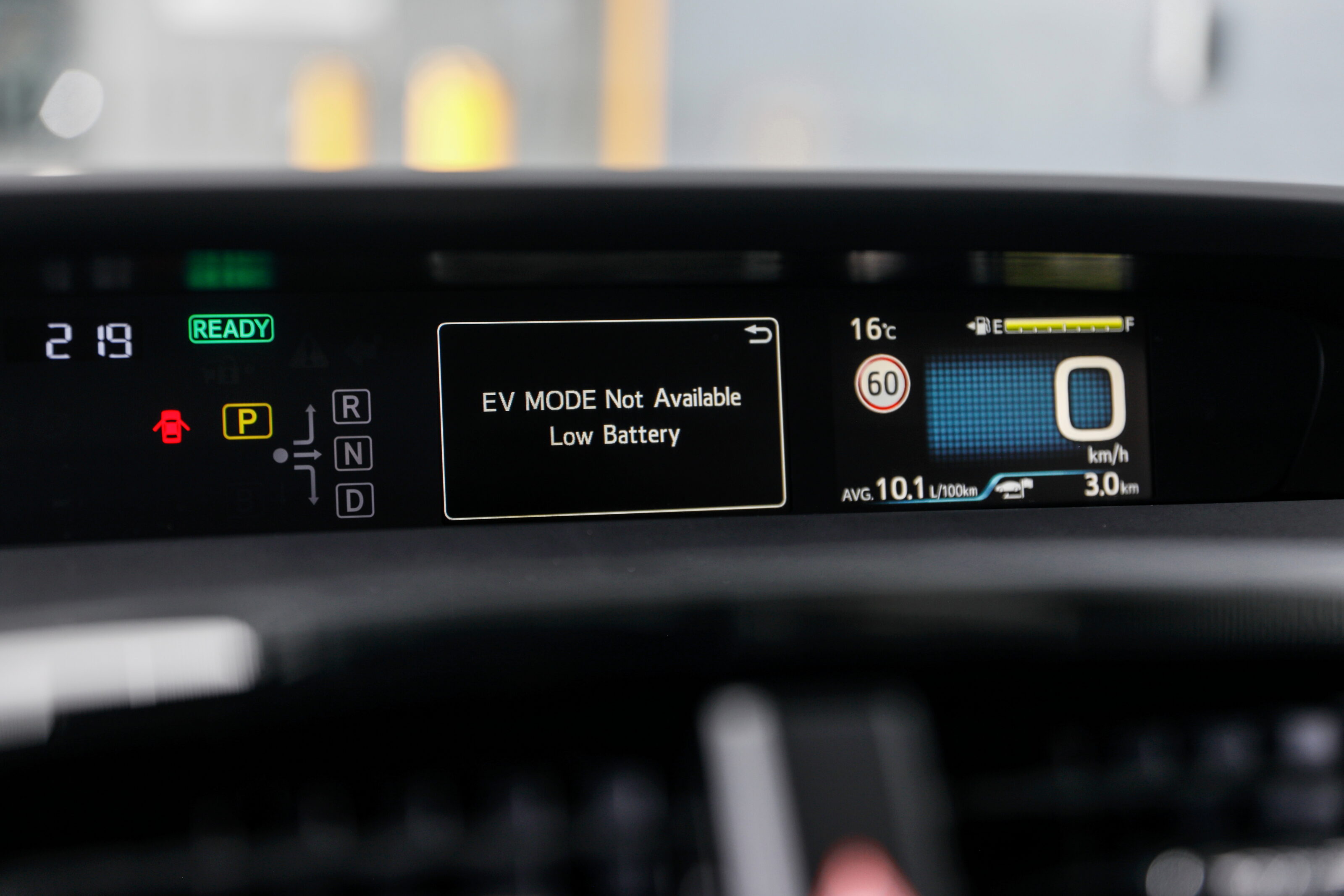
There is also an EV mode that allows you to drive on the battery power alone for short distances, but its operation seems to have more conditions than a weekend rental agreement for a Ferrari – the battery has to be almost fully charged and you can barely travel more than walking pace.
It seems a bit gimmicky to me and not worth the effort.
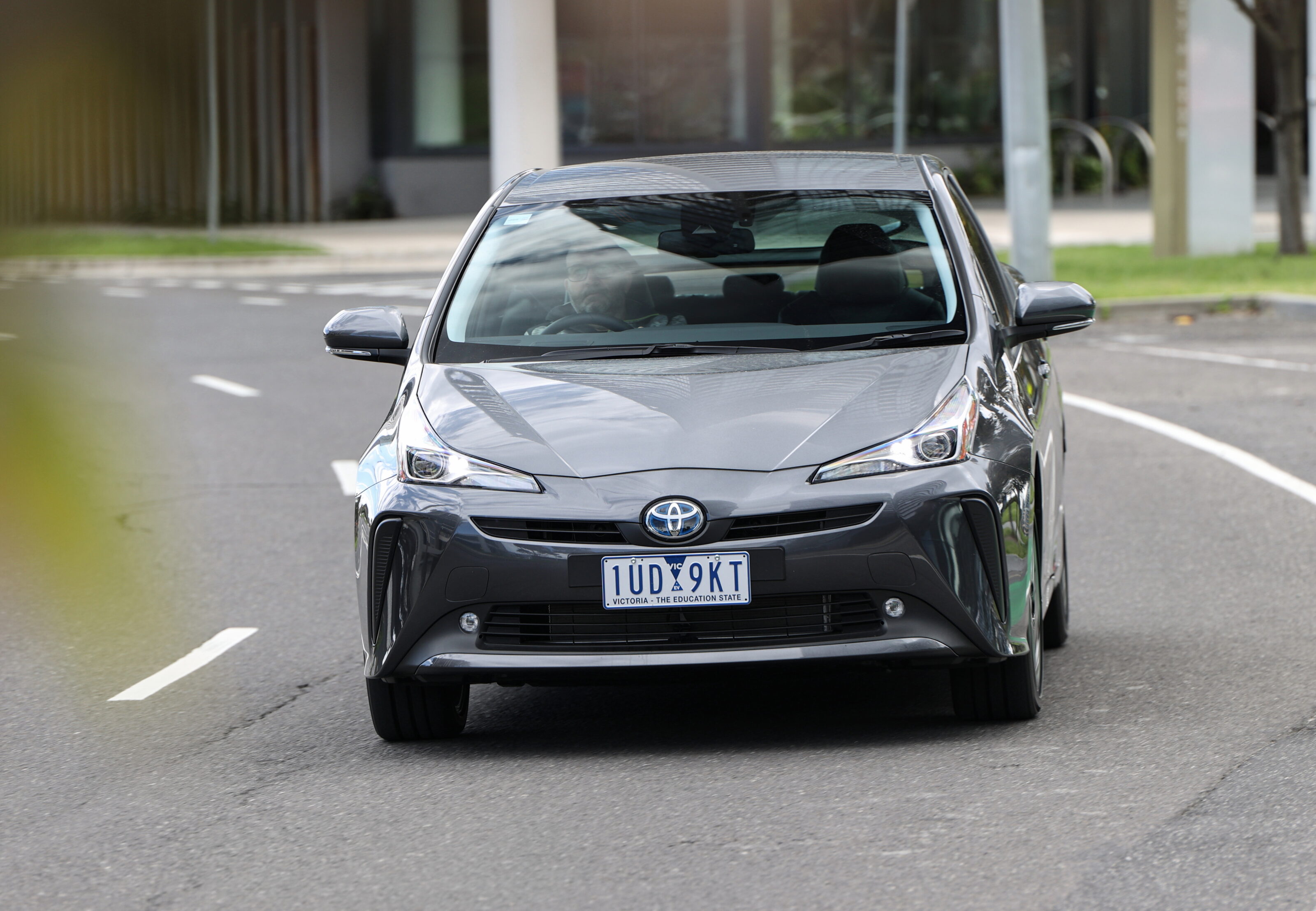
Once on the move, the handling feels rather prosaic. I took the Prius up Melbourne’s Dandenong Ranges where the speed limit on most roads is just 70km/h and I can’t say I was comfortable travelling around that speed on some of the twistier sections.
The steering offers little feel between your hands and tyres, and the car itself feels quite front-heavy, though the suspension does a good job of limiting body roll.
Like the Corolla, it rides on MacPherson strut front and double-wishbone rear suspension that works as a Jack of all trades and master of none – the ride is generally comfortable but susceptible to jarring over bigger bumps and potholes.
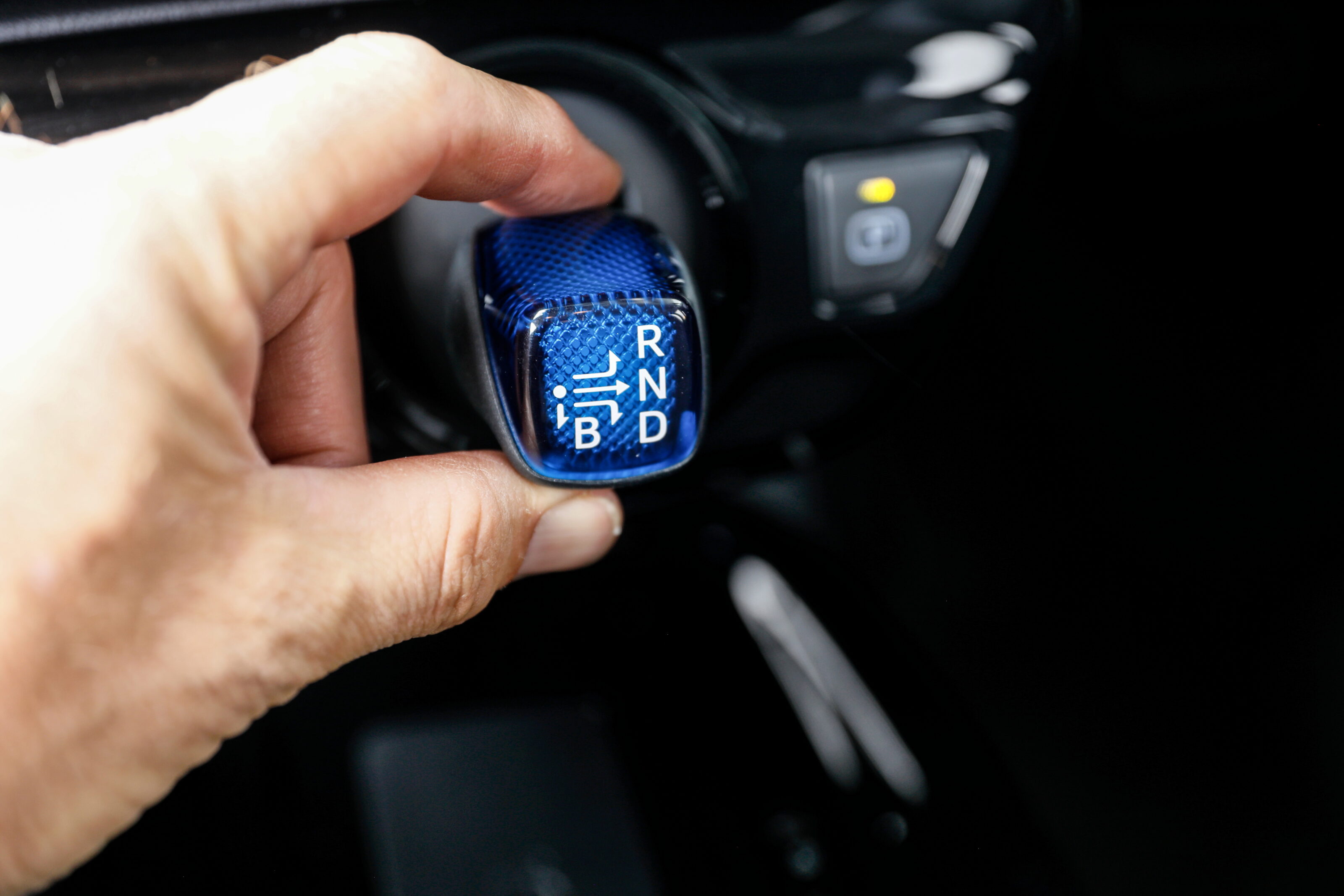
One thing I do like is the B setting on the gear shifter that beefs up the regenerative braking.
The stopping force isn’t as strong as the regenerative braking you get with a pure electric car but was enough to allow for one-pedal driving when coming back down the Dandenongs, thus saving me having to apply the actual brakes.
Once back from the hills, I found the Prius to be in its element around town and when highway cruising, where it offers a comfortable and quiet ride.
Safety
The Toyota Prius features Toyota Safety Sense that includes adaptive cruise control, forward collision warning, lane departure alert with steering assist, road-sign recognition, auto high beam, a reversing camera and seven airbags. Autonomous emergency braking is also included, but it lacks pedestrian and cyclist detection.
The Prius has a five-star ANCAP safety rating that was awarded in 2016.
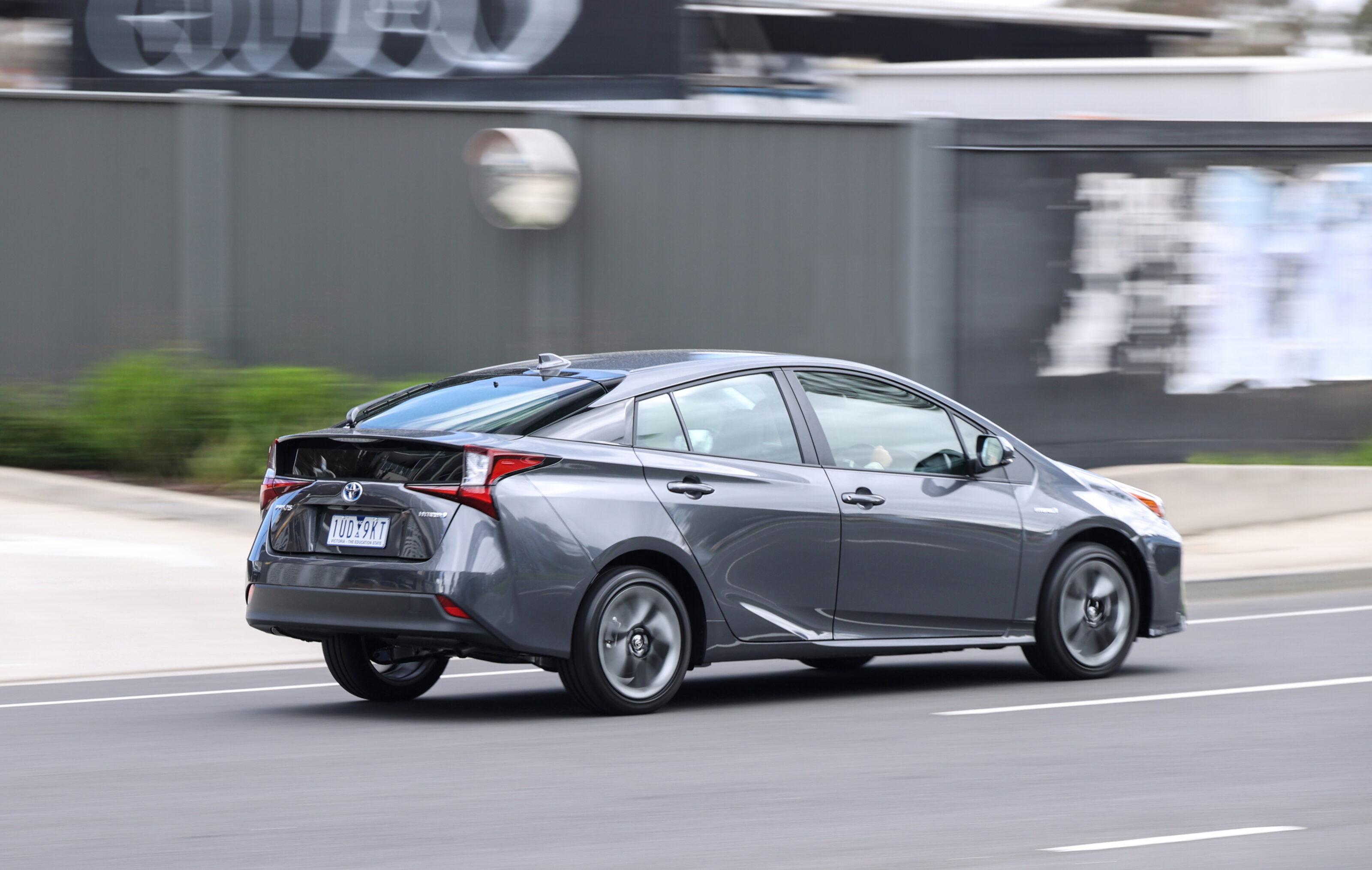
VERDICT
Apart from its excellent fuel economy and relatively quirky looks, I wish I could say there was something that still sets the Prius apart from its siblings to justify its hefty price tag.
Its frugalness, roomy rear seat and large boot space make it a great taxi, which probably accounts for most of its sales in 2021. But for the private buyer, its price range is a little high compared to the other Toyota hybrids, including the identically powered top-spec Corolla ZR that retails for $34,695 before on-roads and offers a more enjoyable driving experience.
Sure, the Prius is more practical than the Corolla, but anyone seeking a Toyota hybrid with a bigger boot has the Camry and four Toyota hybrid SUVs to choose from, not least the big-selling RAV4 Cruiser Auto eFour that comes with superior equipment levels, more power and part-time all-wheel-drive for just $600 more.
And if you’re sold on the liftback design, there is always the similarly sized and shaped but fresher Hyundai Ioniq, which is available with hybrid, plug-in hybrid and EV variants, most of which are more affordable than the Prius i-Tech.
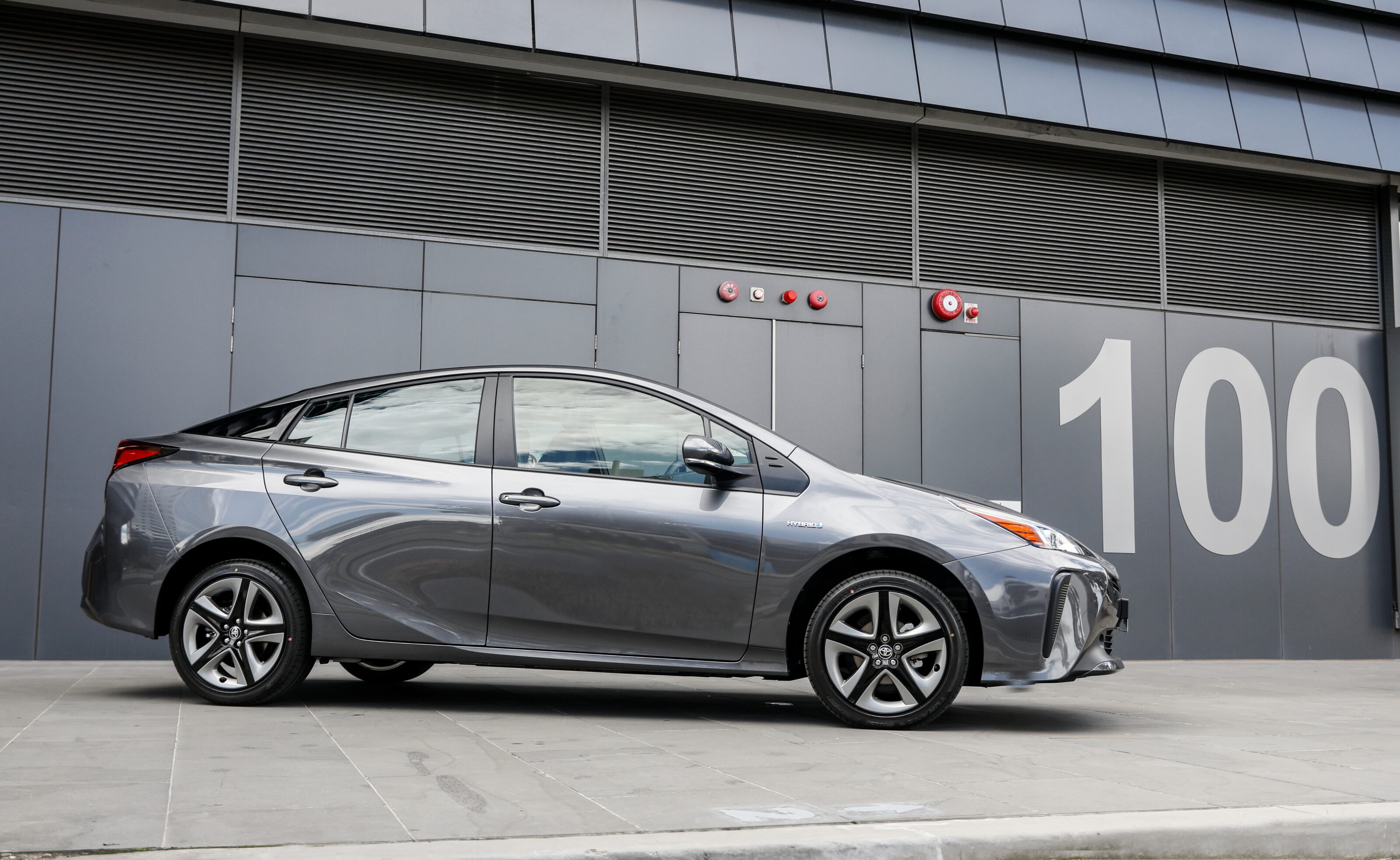
Toyota Prius i-Tech specifications
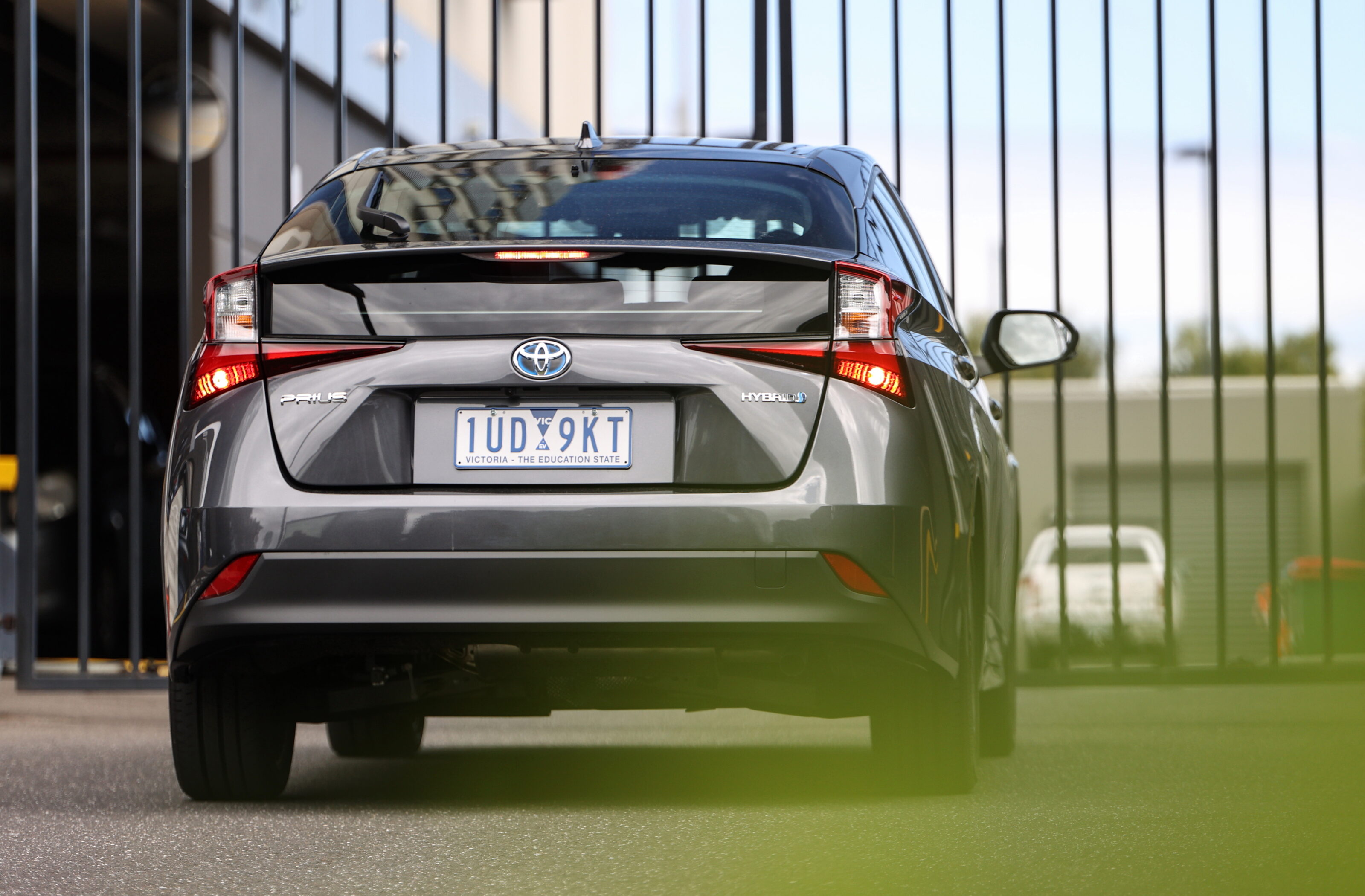
The United States National Highway Traffic Safety Administration (NHTSA) has opened yet another investigation into Tesla – this time for its Passenger Play video game feature.
Available to around 580,000 US-delivered vehicles produced since 2017, the function allows those in the passenger seat to play games on the central touchscreen and was rolled out as an over-the-air update earlier this year.
According to Automotive News, the safety investigation has been opened to determine whether the system, “may distract the driver and increase the risk of a crash,” as earlier failsafes such as the vehicle needing to be in park have now been removed.
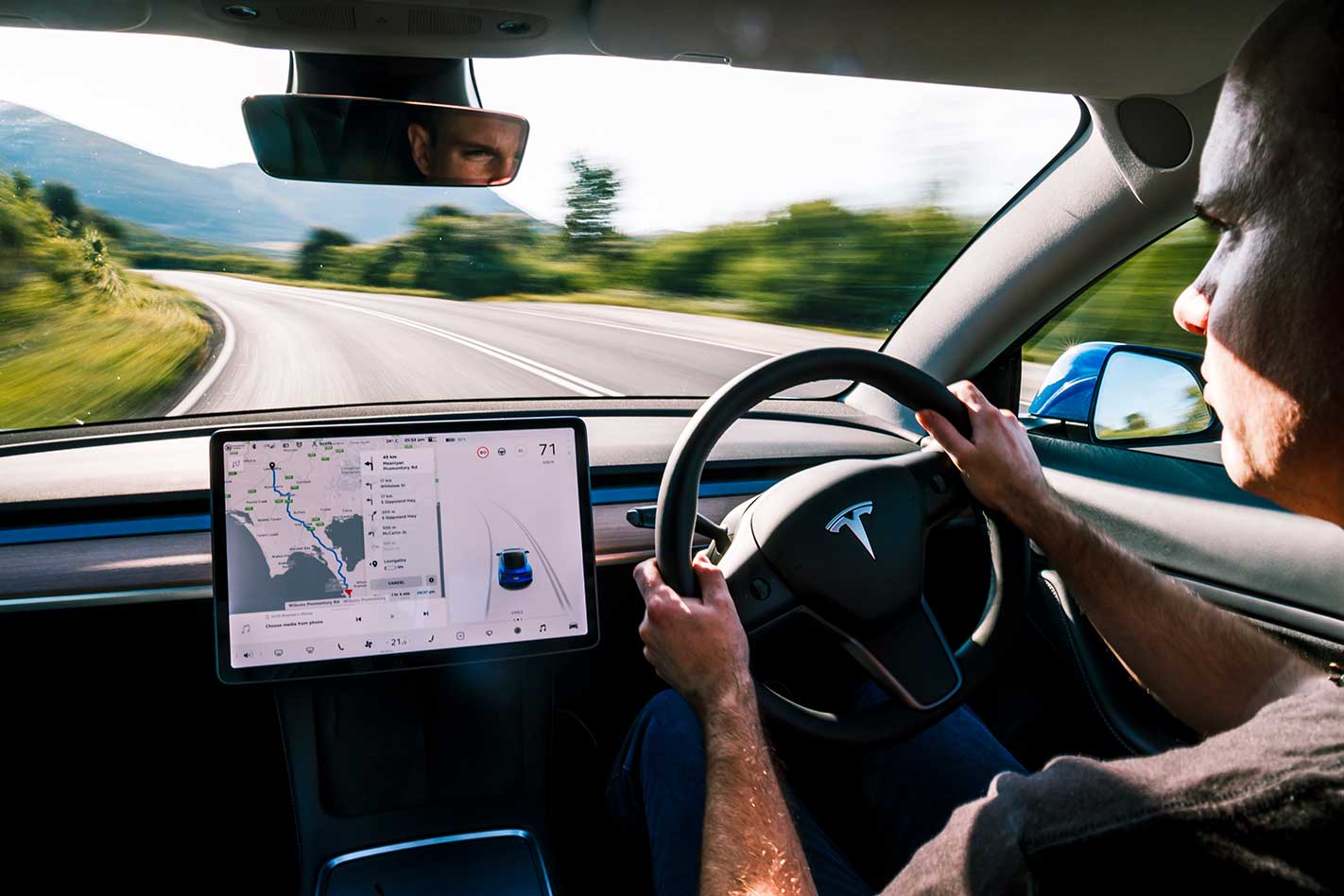
While Tesla allegedly includes warnings for the games, which warn “playing while the car is in motion is only for passengers”, the NHTSA still seems unsatisfied about the manufacturer’s approach and will likely want the aforementioned failsafes to be reinstated.
The NHTSA is currently investigating Tesla over its Autopilot system after 11 crashes were recorded involving parked law enforcement vehicles while the system was engaged, although it is believed there are more than 765,000 Tesla-made vehicles on the road in the US alone.
It’s not clear as to how governments will regulate in-car app usage in the future as autonomous vehicles become the new norm, although when Tesla’s Full Self-Driving costs an extra $10,000, not everyone is able to take their hands off the wheel just yet.
Snapshot
- Kia recalls 165 Carnivals
- Faulty door locking mechanism attributed as fault
- Owners encouraged to contact Kia
Korean manufacturer Kia has recalled its 2021 Carnival over a potentially faulty rear door mechanism.
Affecting just 165 MY21 and MY22 units, the fault can be found in the right-hand sliding door, preventing it from latching properly and being stuck in its “open” position.
This could potentially lead to the door opening while driving, causing a greater risk of injury to its occupant.
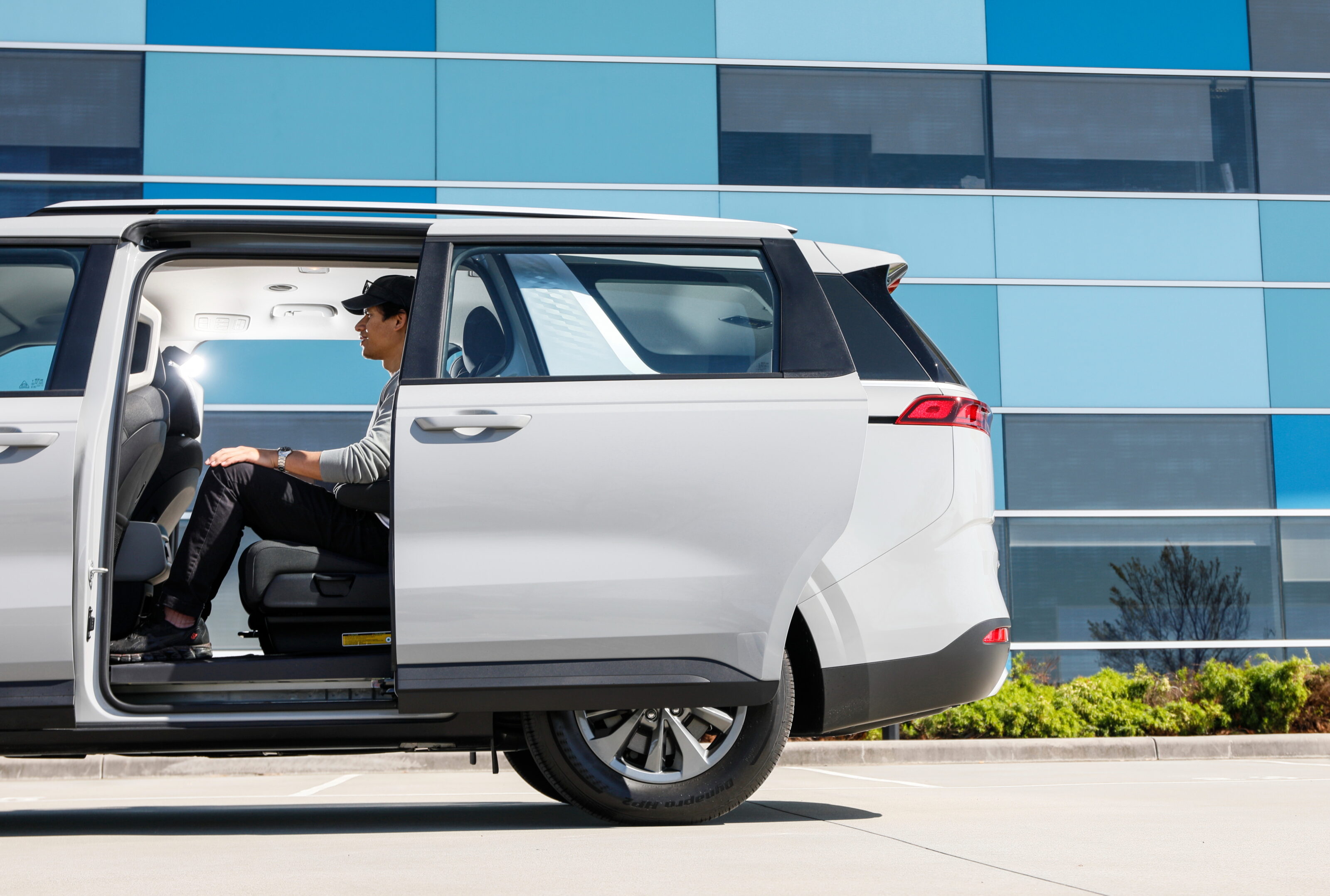
Kia is encouraging any owners to contact their nearest dealer to arrange an inspection and repair, free of charge.
Alternatively, those who are unsure as to whether their vehicle is affected can contact Kia’s Australian customer service line on 131 542 or [email protected]
A list of VINs for affected vehicles can be found here.
The South Australian Government has launched a $1 million trial with electric vehicle charging infrastructure company Jolt Charge, which will examine the impacts of battery-powered vehicles on the electricity grid.
Jolt will use its network of 21 fast-chargers across metropolitan Adelaide to assess consumer behaviour in relation to electric vehicle (EV) charging.
The State Government hopes to use the data to better understand energy usage, with the idea to use incentives to help manage the daily peaks and troughs.
“Trials like this are critical in helping us better understand how to make EVs more accessible through a network of public fast-charging options, as well as how charging incentives can help balance the load during high-supply periods,” Jolt founder and CEO Doug McNamee said at the announcement.
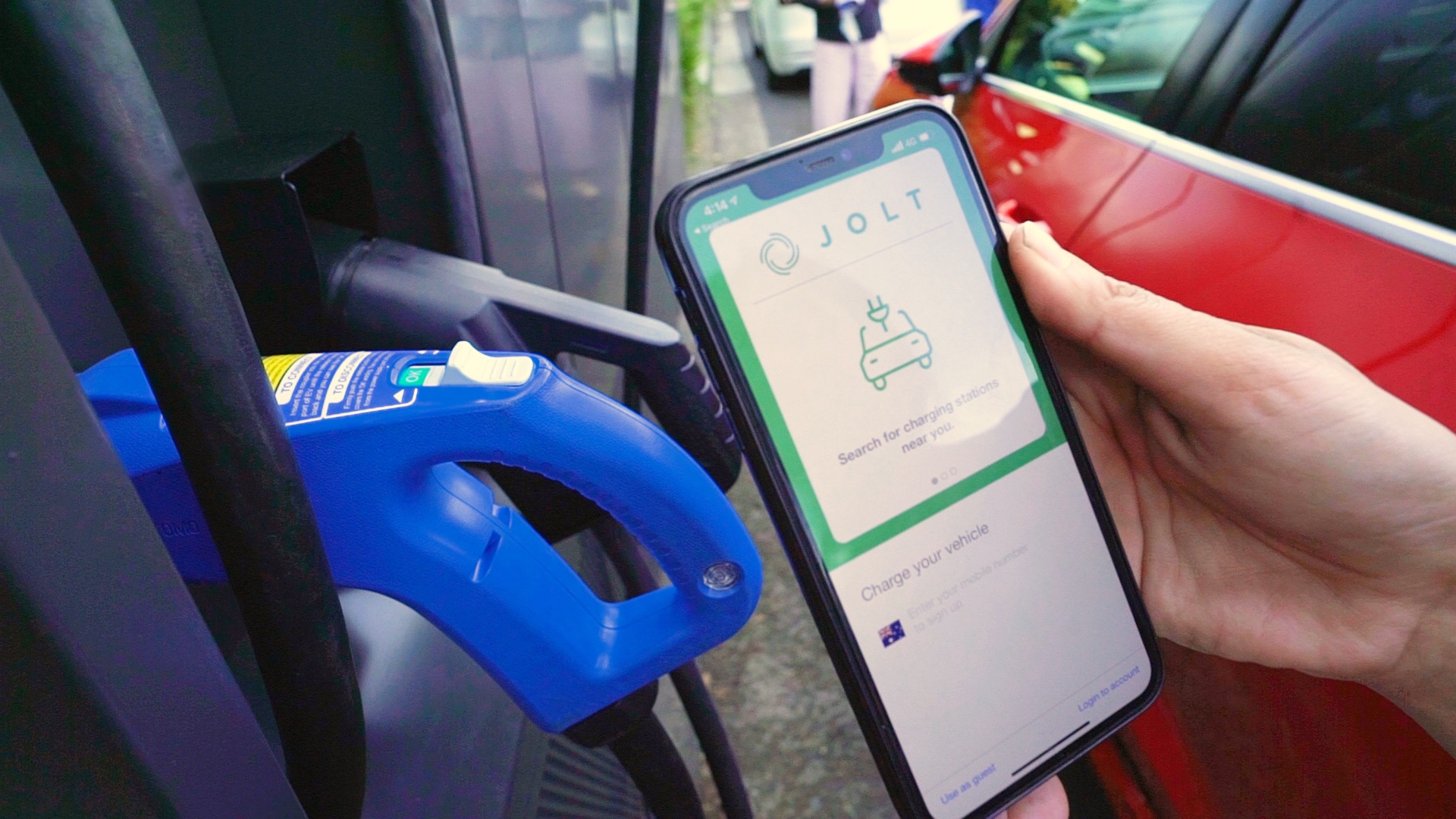
Jolt will also be upgrading its mobile app so users can receive notifications telling them of incentives and optimal charging periods, while screens at the company’s fast-chargers will let drivers know when there’s free charging, as well as helping to encourage other road-users to buy EVs.
The $1 million government grant will also see Jolt install additional 50kW DC fast-chargers in the cities of Charles Sturt, Marion, and Port Adelaide Enfield.
