
Snapshot
- 206kW/394Nm four-pot remains with eight-speed DCT
- Sedan N-specific bodykit and wheels standard
- First Hyundai to come from factory with Michelin Pilot Sport 4S tyres
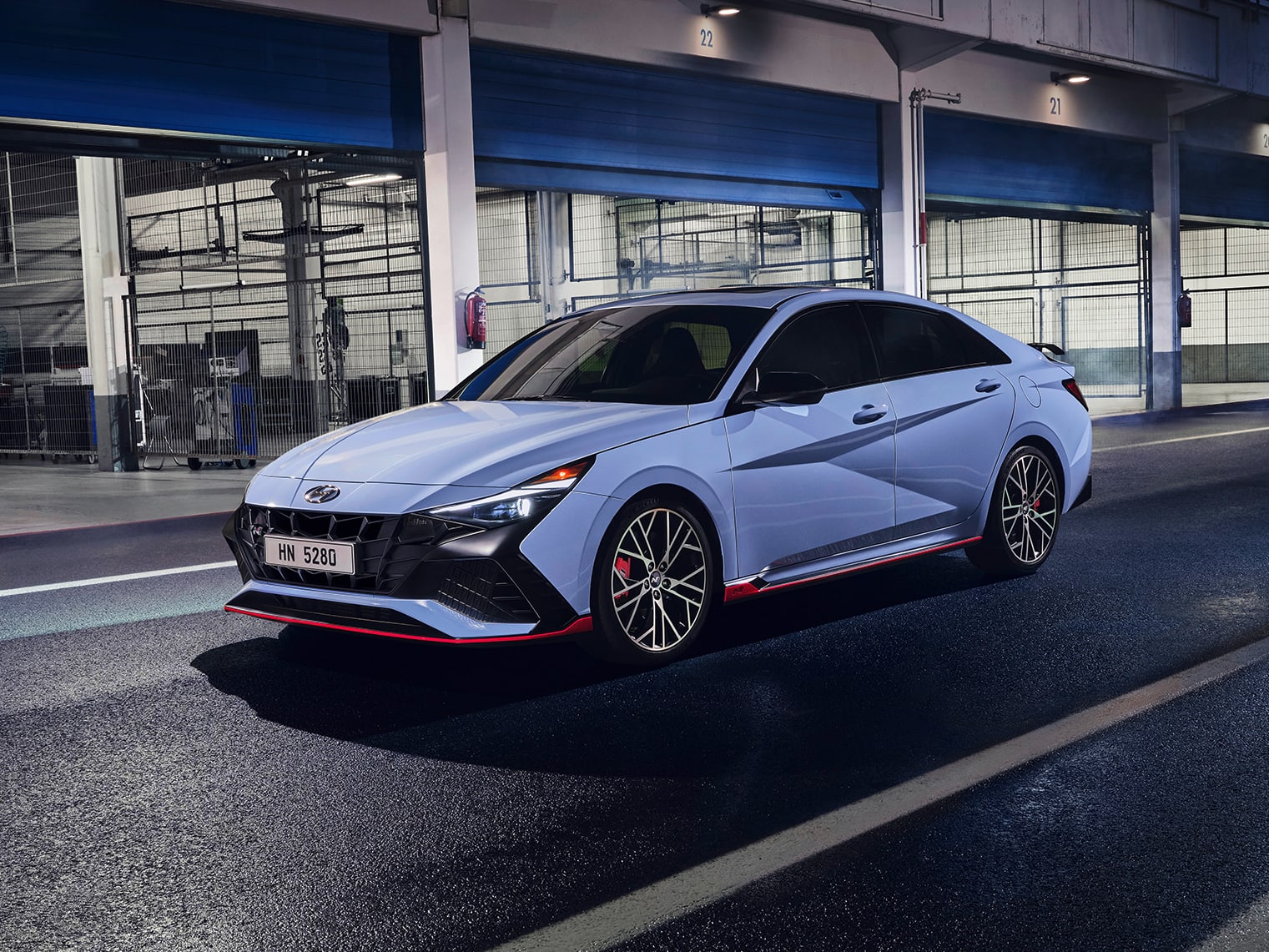
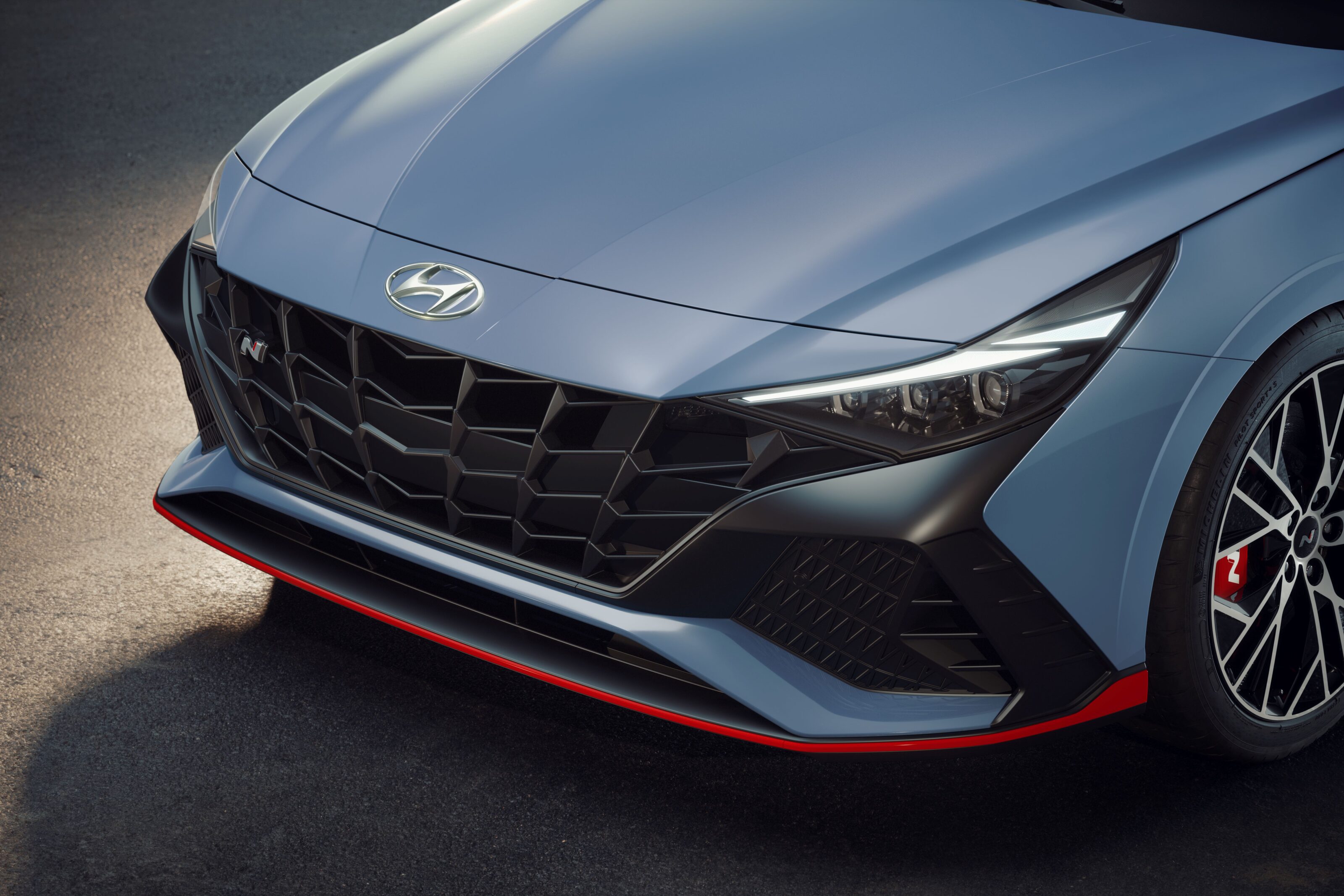
Hyundai has lifted the covers on the new i30 Sedan N, joining the i30 N Hatch as the South Korean manufacturer’s answer to European hot hatches and sedans.
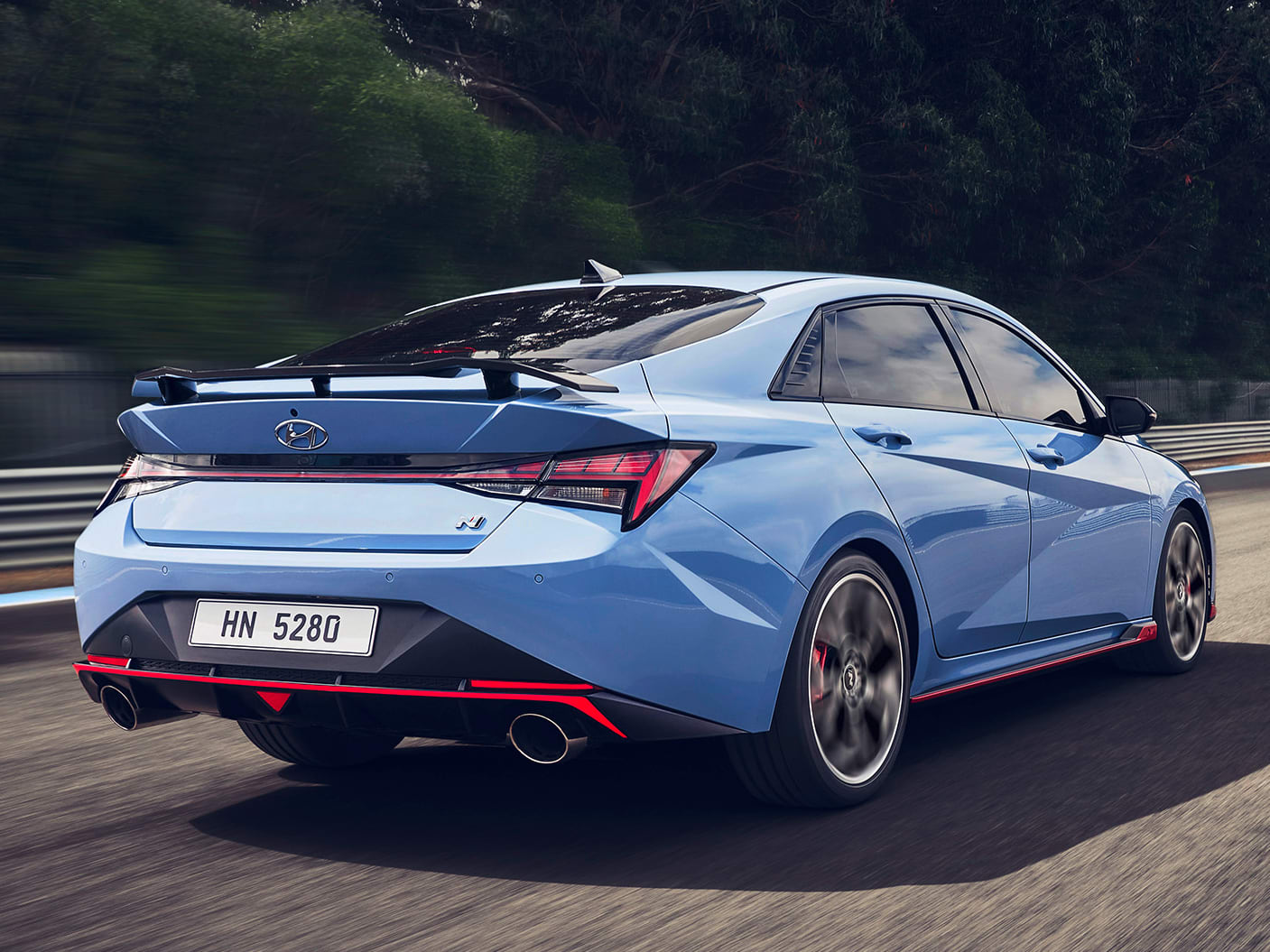
The i30 Sedan N’s launch comes off the back of the updated i30 N Hatch’s release last month, scoring much the same equipment but with more traditional sedan portions and a rear wing on the boot.
While no pricing has yet been released for the spiced-up sedan, the regular i30 Sedan range is normally anywhere between $270 to $1470 more than the hatchback equivalent depending on spec, meaning the list price of the Sedan N could range from $48,000 to $55,000 before on-road costs.
Features
As could be expected, a lot of the equipment in the sedan is carried over from the hatchback and while Hyundai hasn’t provided details about whether a premium variant will be available, the base Sedan N gets a wide range of features as standard:
| 19-inch wheels with Michelin Pilot Sport 4S 245/35 tyres |
| LED daytime running lights |
| LED headlights and front indicators |
| LED taillights |
| LED side repeaters in mirrors |
| N-exclusive side skirts with red strips |
| Rear spoiler |
| Rear diffuser |
| Active variable exhaust |
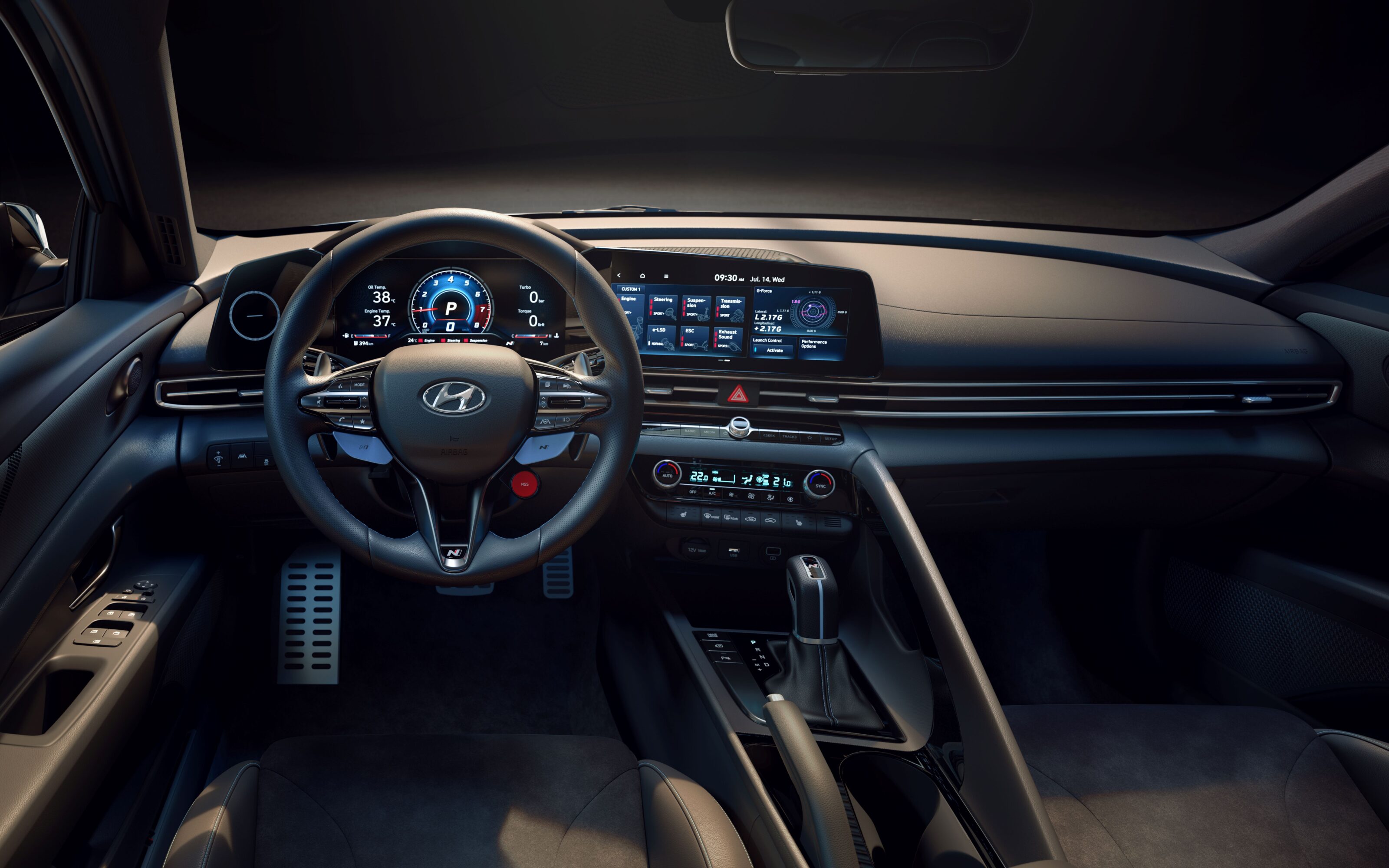
| N-exclusive interior styling |
| N sound equaliser with adjustable engine sounds (whine, throat and bass) |
| Sports front bucket seats |
| Electronic controlled suspension |
| Leather-appointed steering wheel |
| 4.2-inch TFT colour supervision cluster |
| Temporary space saver spare wheel |
| 10.25-inch infotainment system with satellite navigation system |
| N performance driving data system with g-force, RPM, torque and lap time recording |
| DAB+ digital radio |
| Apple CarPlay and Android Auto |
| Cruise control |
| Rev matching function |
| Dual-zone climate control |
| Power folding exterior mirrors |
| Smart key and push-button start |
| Wireless charging pad |
Engine and drivetrain
The formidable T-GDI 2.0-litre four-pot turbocharged engine has found a home in the front of the i30 Sedan N, making the same 206kW and 392Nm as the hatch and again being mated to the same eight-speed, wet-dual-clutch transmission to send power to the front wheels.
Also carrying over is the three N Performance modes available with the dual-clutch ‘box, dubbed N Grin Shift (NGS), N Power Shift (NPS) and N Track Sense Shift (NTS) respectively.
In NGS mode, a 7kW increase in power comes thanks to an increase in boost from the 52mm turbocharger, allowing the i30 Sedan N to complete a 0-100km/h sprint in 5.3 seconds, one-tenth of a second faster than the hatch.
Helping control the lump of power and torque being sent to the front axle is the N Corner Carving Differential, essentially an electronic limited-slip diff which sends power to whichever wheel can deal with it the best at any given moment.
Dimensions
Given the Sedan N doesn’t feature any ludicrously pumped out guards or an elongated front splitter, dimensions stay the same as the regular four-door, standing at 4675mm in length, 1825mm wide and 1430mm high with a wheelbase of 2720mm.
Warranty and servicing
In line with the rest of Hyundai’s range, the i30 Sedan N will be covered by a five-year/unlimited kilometre warranty which still includes non-competition track driving.
Three service packs are available through Hyundai when purchasing an i30 Sedan N, giving buyers a discount over the duration of the service package.
| Three-year/30,000km | $924 |
| Four-year/40,000km | $1,335 |
| Five-year/50,000km | $1,643 |
Availability
Hyundai expects the i30 Sedan N to arrive in the fourth quarter of 2021, a few months after deliveries of the i30 N Hatch begin at the end of July.
While the used market may have gone nuts in recent times, it pays to keep our ear to the ground looking for the hidden gems of the performance car world.
The C209-generation CLK 63 is one we unearthed recently, and were surprised that this thumping V8 coupe had somehow slipped under the radar.
Despite costing more than $200K when new, the going rate for a CLK 63 today sits at about $45K; making it one of the cheapest ways into owning the revered M156 6.2-litre V8 (although an ML63 can be had for about half that, again).
It’s that glorious V8 that proves the centrepiece of the CLK 63, and will be something to be cherished into the future. With the C63’s future promising downsized powerplants and electrification, the M156 is already regarded as a desirable watermark for a bygone era of motoring.
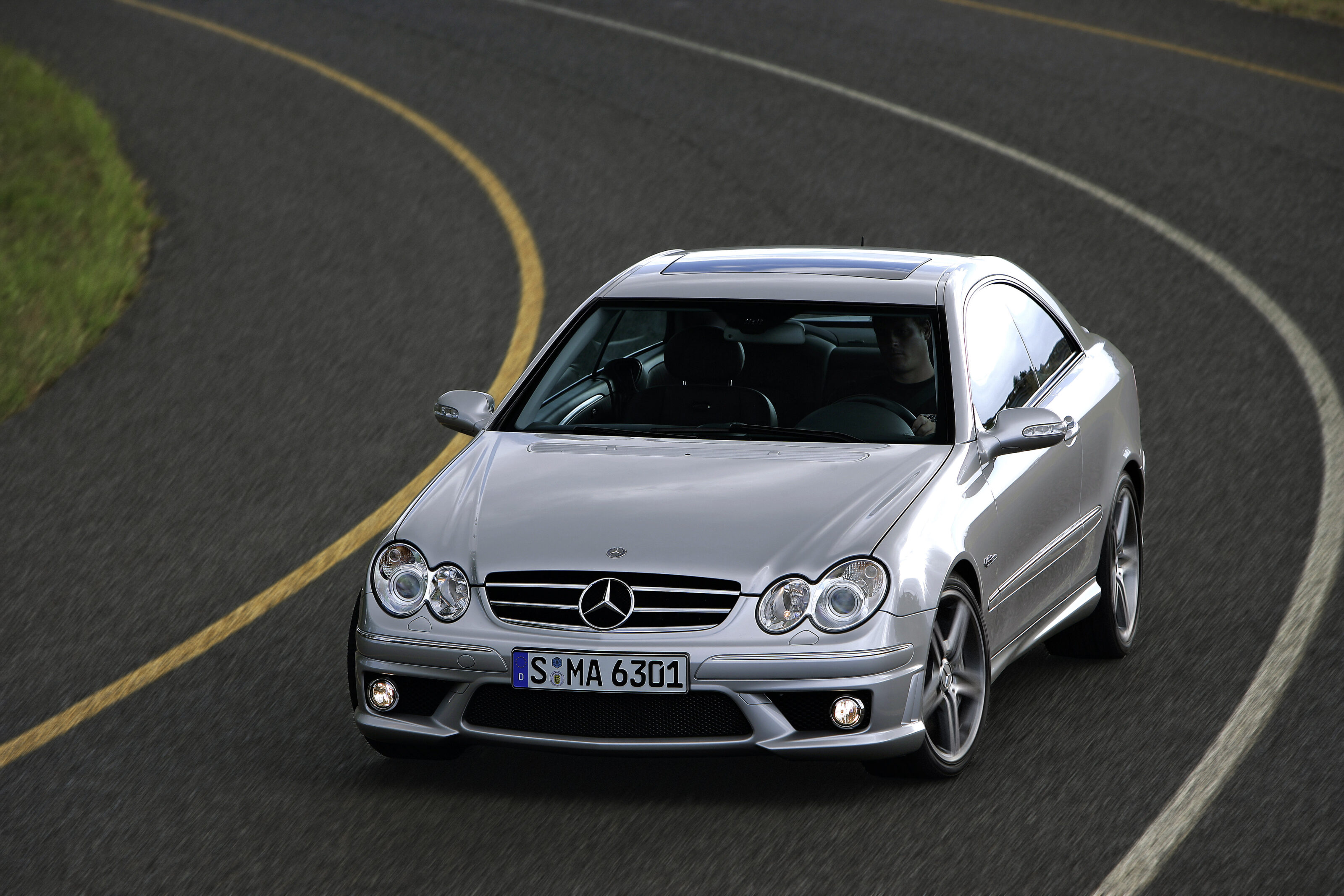
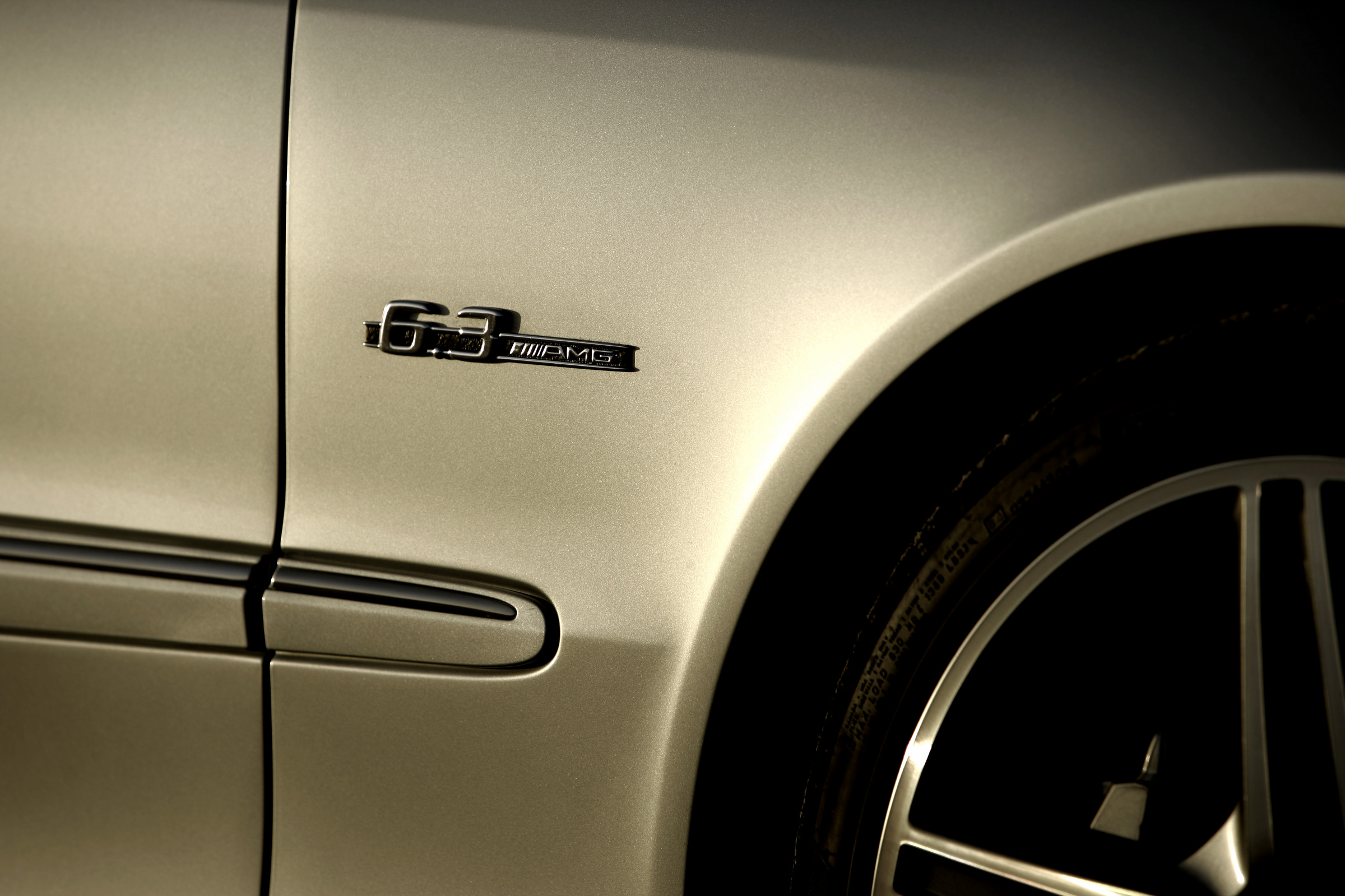
In a historical sense, the M156 also represents the first engine wholly designed by Daimler’s then-new subsidiary, Mercedes-AMG; whose design was led by Bernd Ramler – famed designer of the Carrera GT’s 5.7-litre V10. We should point out that, while Mercedes-Benz erroneously badges the cars as 6.3-litres, the M156’s actual 6208cc displacement was rounded up as a historical nod to Benz’s first V8: the 6332cc dry-sumped, forged internal, single-cam M100.
Quoted at 354kW and 630Nm when new, the C209 CLK 63 can hold its own amongst current performance cars – clocking 100km/h in about 4.5 seconds.
Peak power is reached at 6800rpm, and peak torque at 5000rpm. Rev cut-out kicks in at a dizzying 7200rpm, which is impressive for a V8 of this size.
Fuel economy isn’t fantastic, in fact under hard use the big V8 can drink upwards of 20L/100km. But the C209 made real strides in development, replacing the old recirculating ball steering with a rack-and-pinion system, as well as introducing a three-link front suspension design and an aluminium multi-link rear.
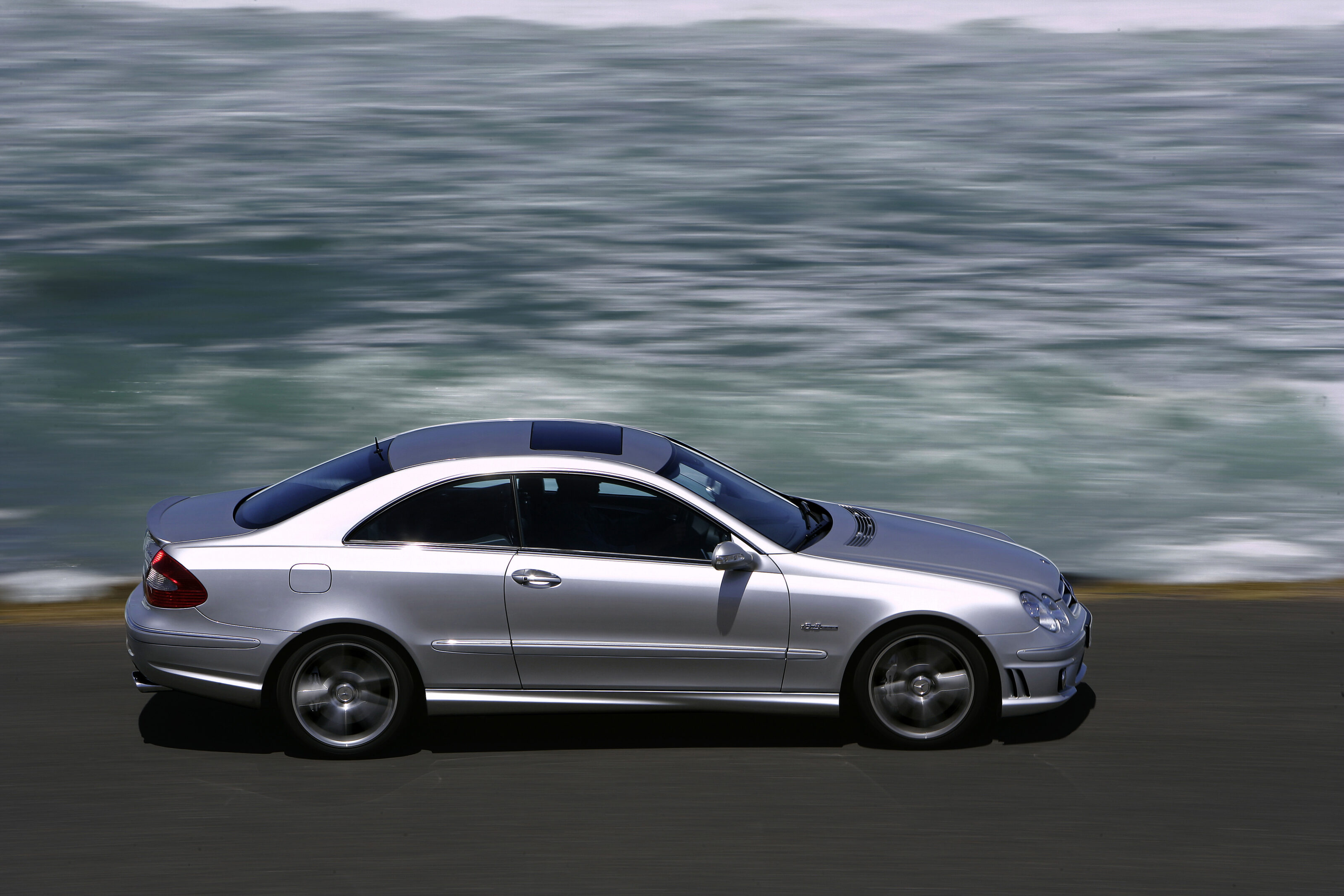
“The 354kW CLK 63 can still hold its own against today’s crop of performance cars”
It may not be scalpel sharp dynamically, but in the frame of a muscular grand tourer, the CLK 63 makes a lot of sense as a secondhand weekend vehicle.
With a rising tide facing much of Benz’s increasingly popular back catalogue, the C209 CLK 63 will surely be hot property in the future as Benz’s quad-headlight era of cars increasingly moves into the limelight.
Essential Checks
In the Market
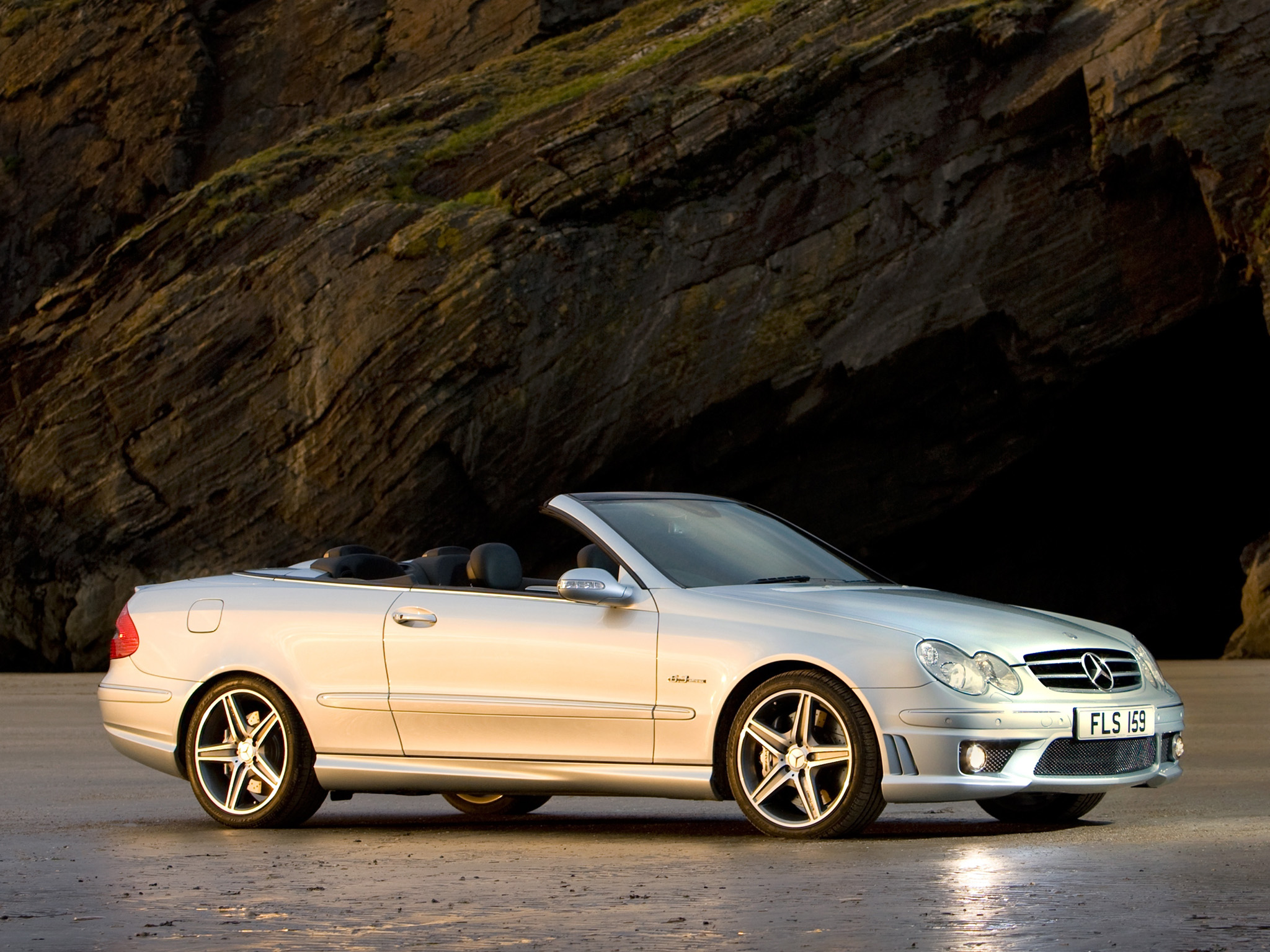
Available in coupe and cabriolet configuration, the CLK was positioned above the C-Class it was based on, and somewhere below the E-Class of the time. Production numbers for the standard CLK 63 are a little hazy, however, there were also 800 Black Series’ produced, and a further 100 of the widebody DTM Edition cars.
You’ll struggle to find either of the latter mentioned vehicles on the local market, with only 120 Black Series produced in RHD, and just 32 delivered to Australia. The value prospect loses its shine in this space, with just one Black Series observed on the market for an eye-watering $495,000.
Body & Chassis
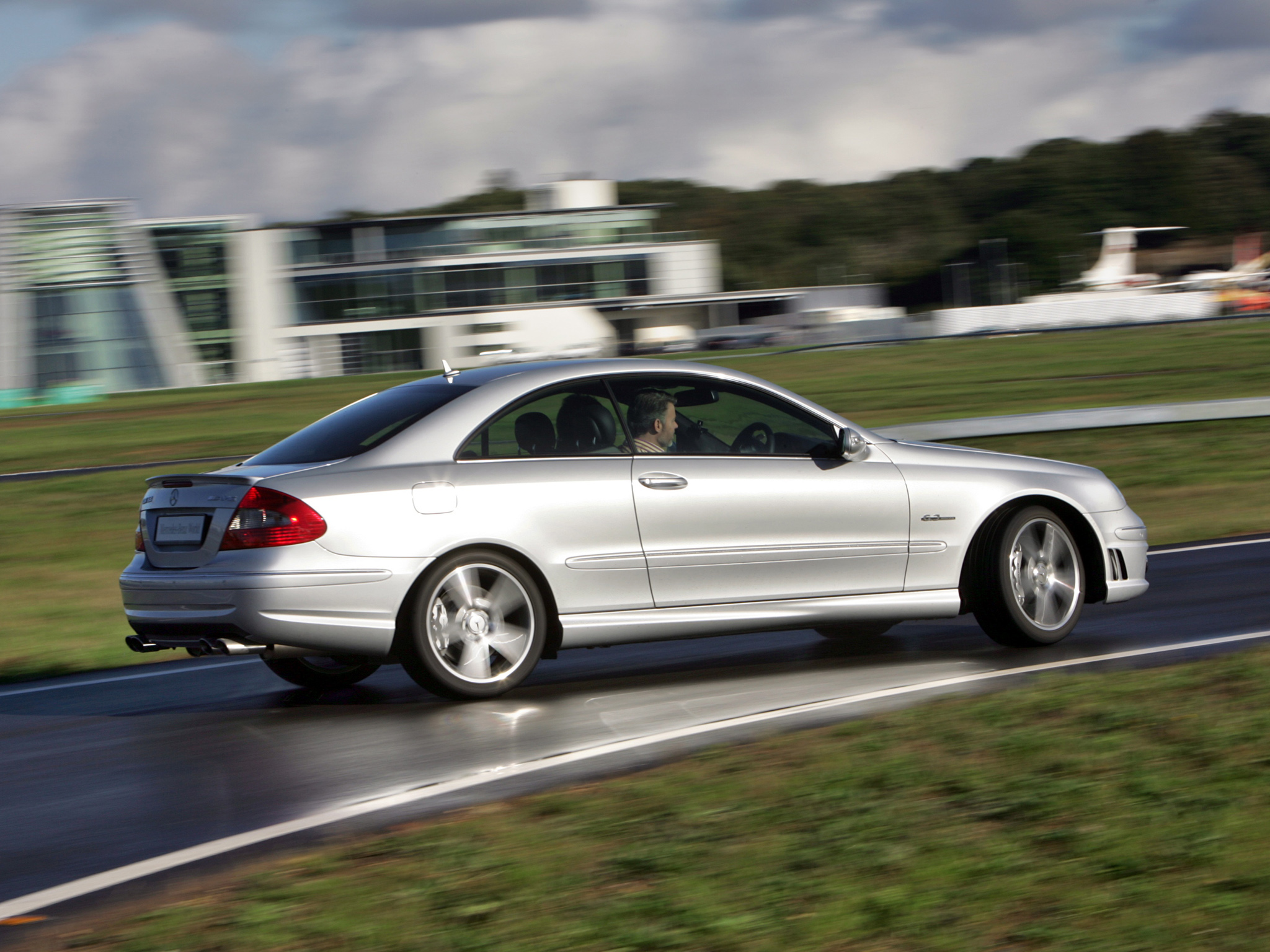
Of the few CLK 63s currently on the market, all bear similar odometer readings which work out to a rather sympathetic 7500-odd kilometres per year. Likely enthusiast-owned since new, it is fair to assume that most CLK 63s have lived rather pampered lives. You should still inspect for rust and corrosion to the rear wheel arches, doors and boot.
Keyless entry is also known to malfunction, as has the third brake light. Electro-hydraulic roof mechanisms on the cabriolet have also been known to play up if the hydraulic fluid level drops due to seals which begin to perish around 10 years of age.
Engine & Transmission
The M156 V8 is generally regarded as a durable and reliable engine, however, there were known issues afflicting early iterations.
The most widely reported issues pertained to cylinder head bolts which were corroded and stretched by coolant in the engine. Despite the possible head lift, the head bolts could also break down and release damaging metal shavings into the engine – possibly leading to terminal failure in a worst-case scenario. Valve lifters were also known to seize and cause damage and wear to the camshaft.
Mercedes-Benz eventually came up with a fix, replacing the bolts and valve lifters with uprated units. Issues usually arose around the 160,000km mark and you should be able to verify your engine number with Mercedes-Benz as to whether or not your vehicle has received the upgrades.
Suspension & Brakes
Despite examples on the market retaining reasonable odometer readings, an inspection by a marque specialist is recommended as roll-bar end-links and control-arm bushings were known to wear out prematurely.
Elsewhere, owners (likely with heavy right foots) have reported accelerated tyre wear. Inspect for noticeably uneven wear, as a full set of Michelin Pilot Sport 4 S tyres will set you back about $1200; comprising a pair of 225/40 18s up front and 255/35 18s out back.
Interior & Electronics
The odd rattle can afflict the 209-series cars, often caused by windows that no longer seal due to faulty regulators.
Non-functioning AC is often caused by a faulty stepper motor, or broken plastic arms which control the vents. These are costly dash-out jobs, and an audible ‘click’ from behind the dash upon ignition should be a red flag.
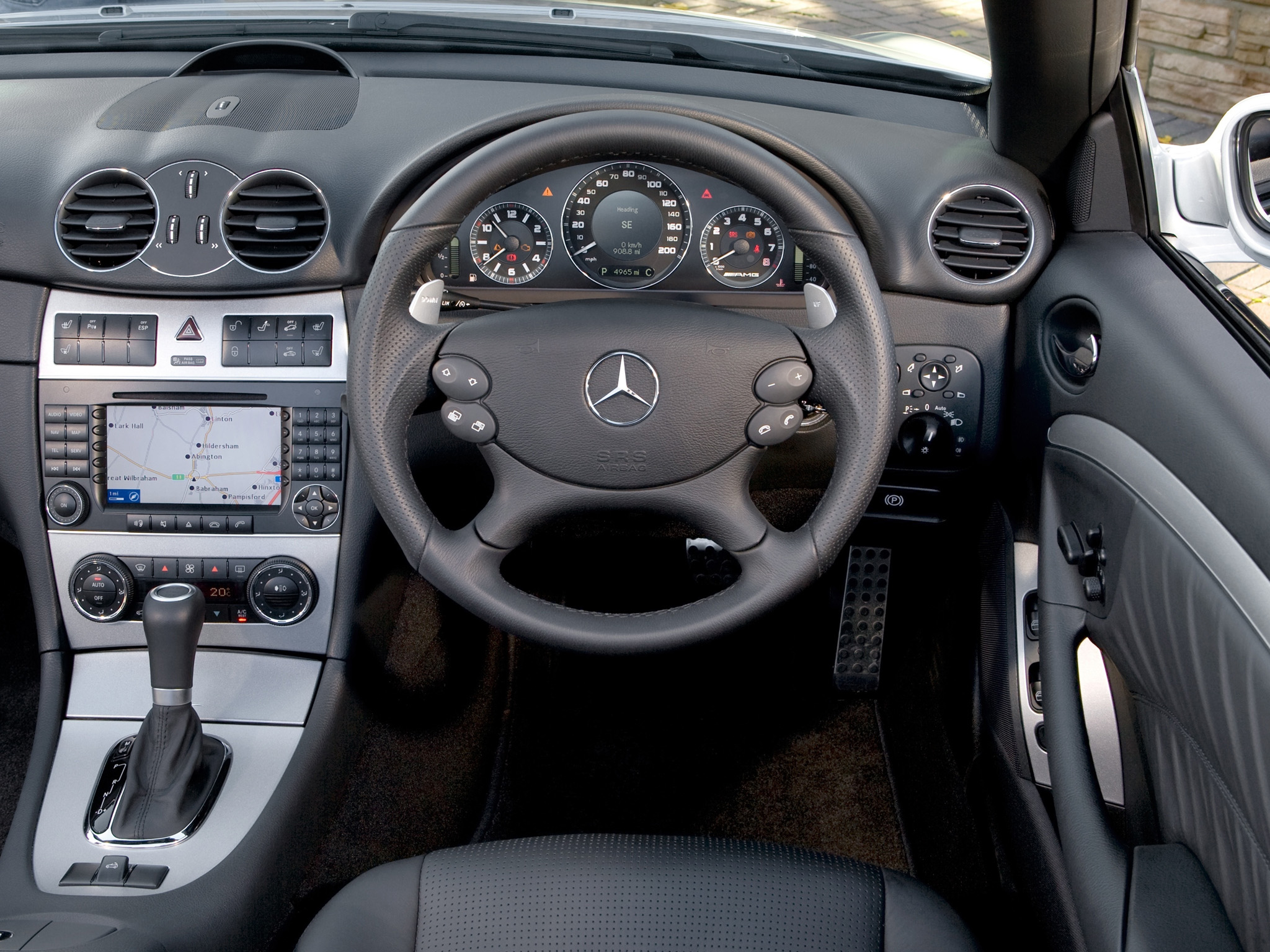
Mercedes-AMG CLK 63 specs
Body: 2-door, 4-seat coupe Engine: 6208cc V8, DOHC, 32v Power: 354kW @ 6800rpm Torque: 630Nm @ 5000rpm Transmission: 7-speed automatic Weight: 1755kg Used Range: $40,000-$45,000
Three other options you may consider
- BMW E92 M3 Another Icon Buyer alumnus, the E92 generation M3 similarly trades on its characterful V8, a 4.0-litre in this case. Bottom of the market is lineball at $40-45k, although there are far more examples to choose from out there.
- Audi S8 V10 The S8 may not cut the same sharp and exotic silhouette as the svelte pillarless CLK, but how can you say no to a Lamborghini-sourced 331kW 5.2-litre V10, with room for five of your mates. This is sharp buying at $45k!
- Mercedes-AMG W204 C63 If the CLK’s V8 tickles your fancy, but you’re in need of more doors (or another smaller coupe), the popular W204 C63 is readily available in plentiful numbers, with prices beginning at $40k. The mileages are generally much higher, though.
Snapshot
- Astra confirmed to be released as a five-door hatch or wagon
- Hybrid power will feature in the range for the first time
- Platform shared with other Stellantis products
UPDATE, JULY 14: Opel has officially revealed the next-generation Astra, set to feature hybrid power for the first time in the model’s 30-year history.
The Astra ‘L’ will share the same EMP2 platform as other small hatchbacks within the Stellantis group’s model range, namely the upcoming Peugeot 308 and Citroen C4.
Confirming previous speculation (below), the new Astra will be available in Europe with one of two hybrid power units plus the option of three internal combustion engines, one diesel and two petrol powered.
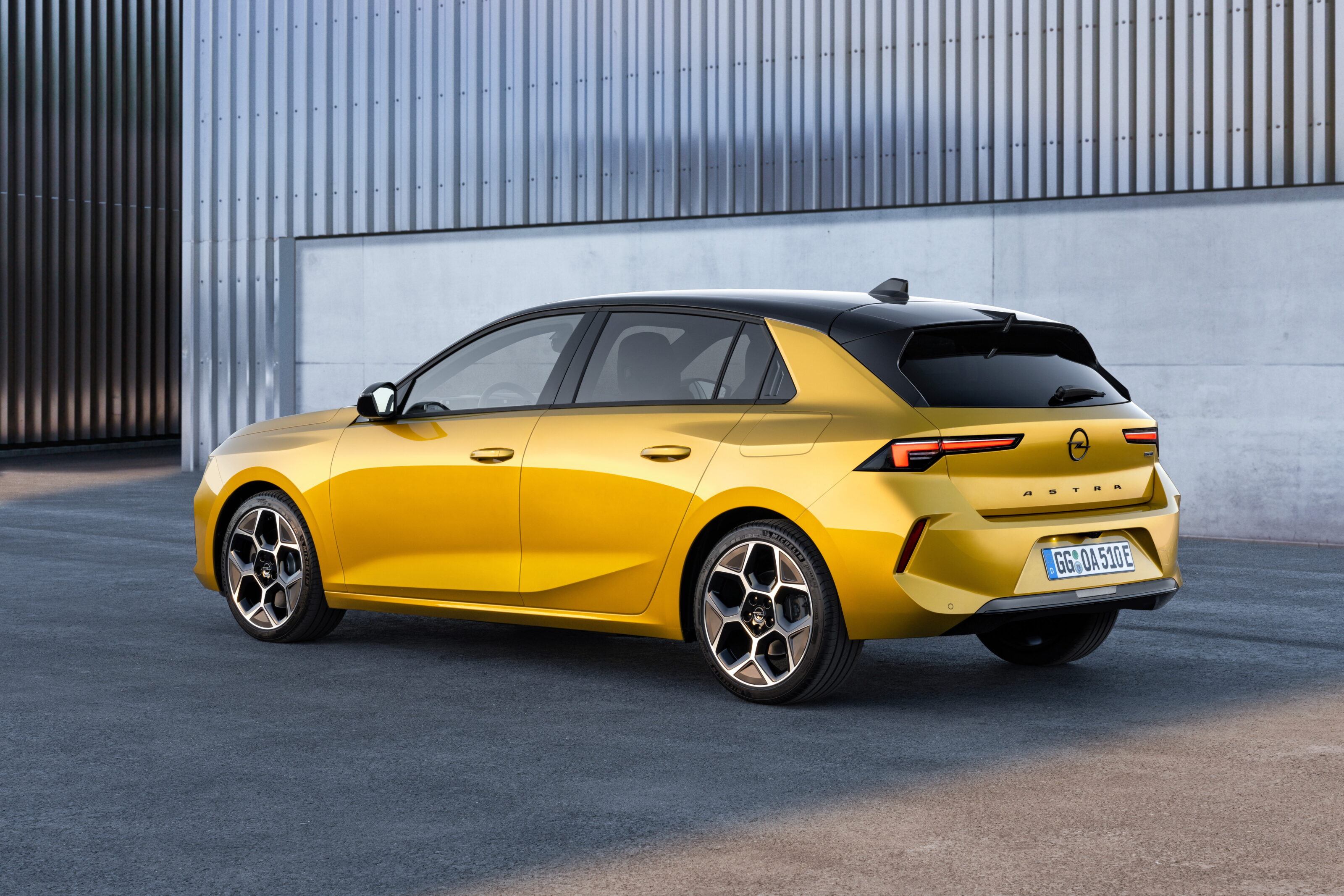
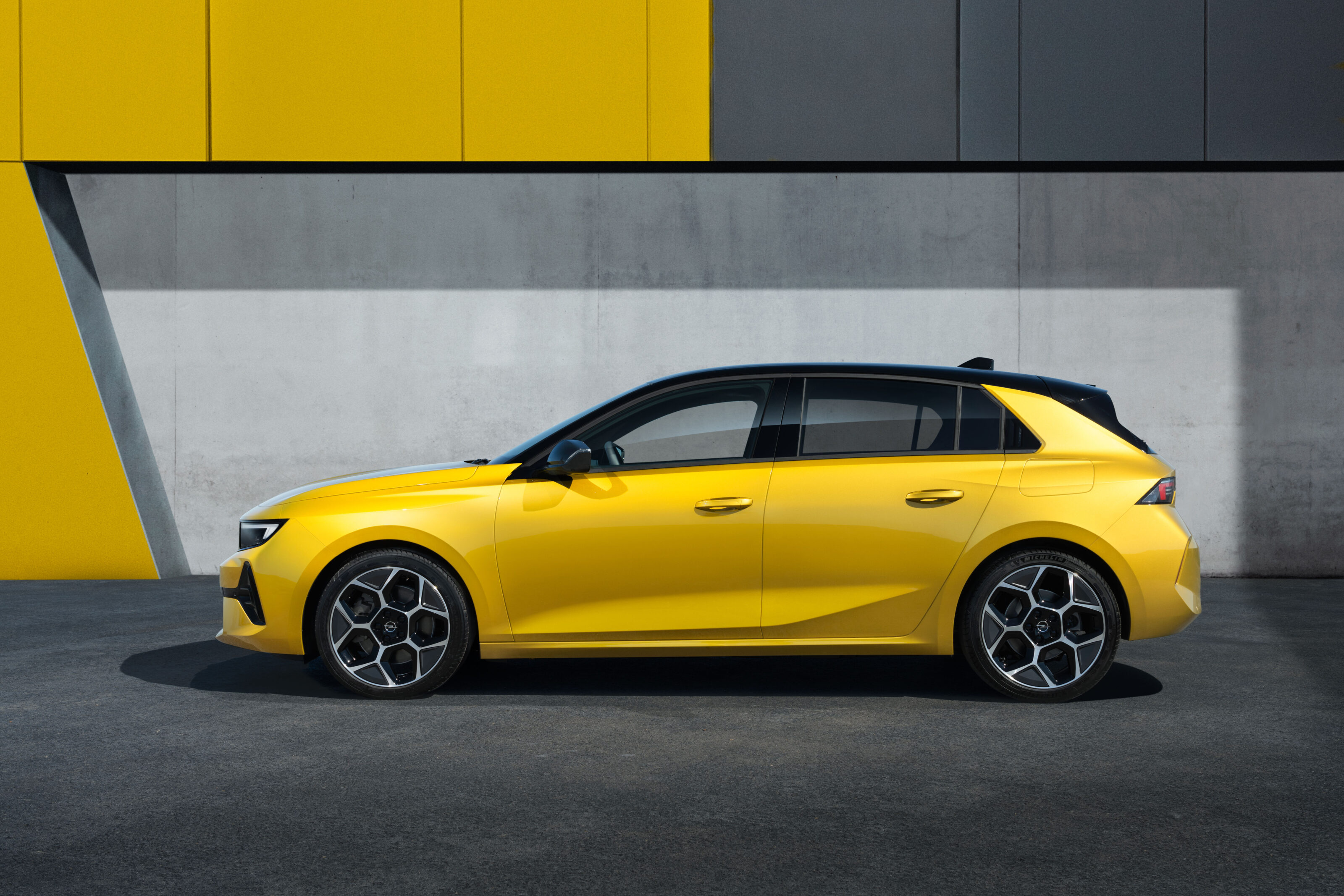
Adopting the new Opel/Vauxhall ‘Vizor’ design language, the Astra features sharp lines through its bodywork, giving it a more aggressive look than the car it replaces.
Measuring at 4374mm in length, 1860mm in width and 1470mm high with a wheelbase of 2675mm, the new Astra features a boot which can hold 422 litres with the back seats up.
Read below to see the previously confirmed details of the new Astra.
The story to here
JUNE 9: Vauxhall has teased the striking, new-look Astra which is joining the 2022 fleet with hybrid power for the first time, sparking somewhat of a revolution for the former General Motors-owned marque.
Coming under the ever-growing umbrella of Stellantis since the start of 2021, the new Vauxhall/Opel Astra is likely to share the same underpinnings as the upcoming Peugeot 308, meaning a revival of the VXR nameplate might be in order for a performance variant.
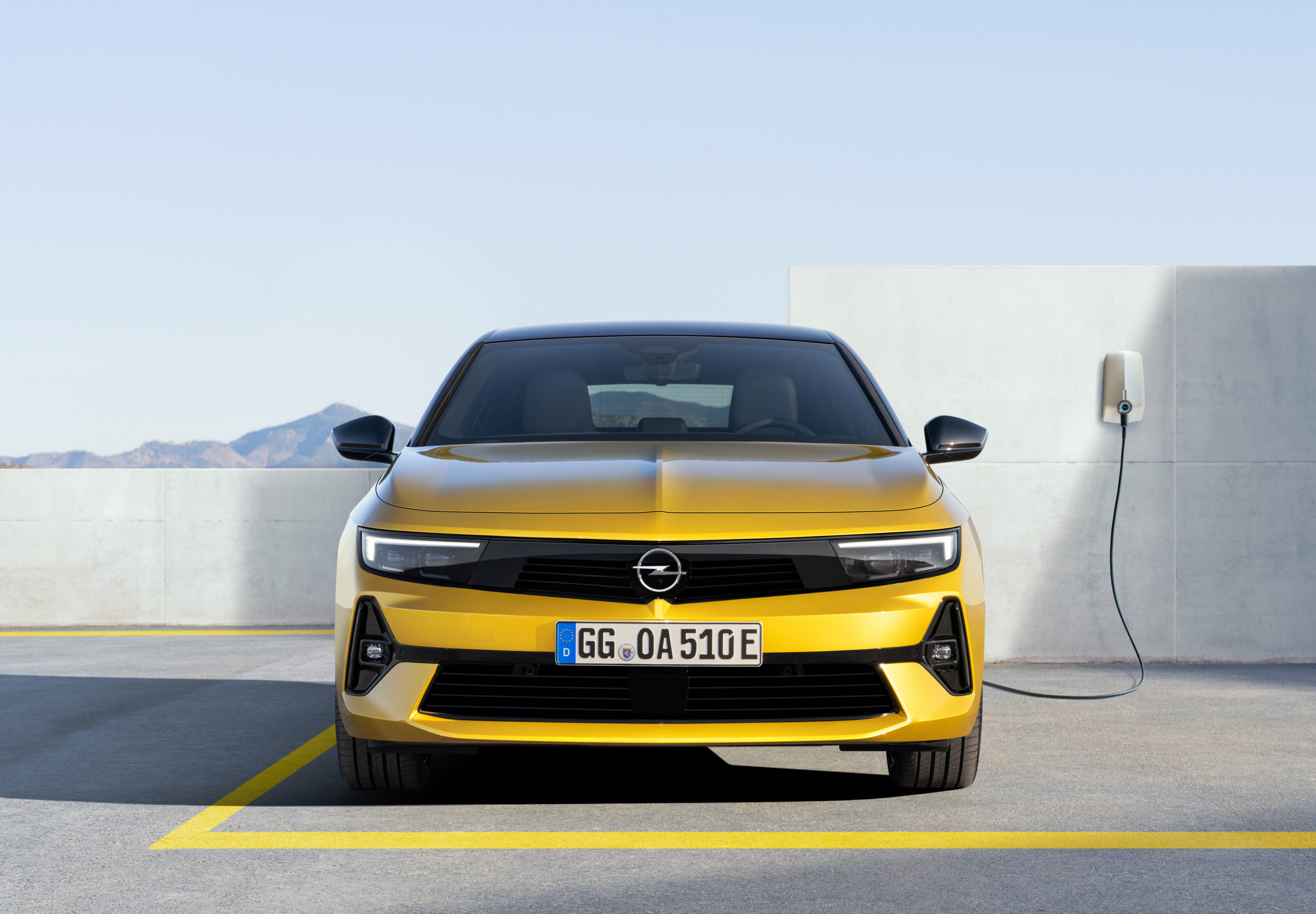
Going off the specs of the 308, the hybrid Astra will likely feature an electric motor producing 81kW with a 12.3kWh battery pack, working alongside one of two petrol engines capable of producing either 110kW and 132kW and mated to an eight-speed automatic transmission.
As well as the hybrid options, the Astra will have the same internal combustion engine options as the Peugeot – two 1.2-litre three-pot petrol powertrains delivering 80kW or 95kW respectively, plus a four-cylinder diesel variant, putting out 95kW.
In the case of the Peugeot, the 95kW petrol engine can be mated to either an eight-speed auto or six-speed manual but all other combustion engines will be available with the manual stick only.
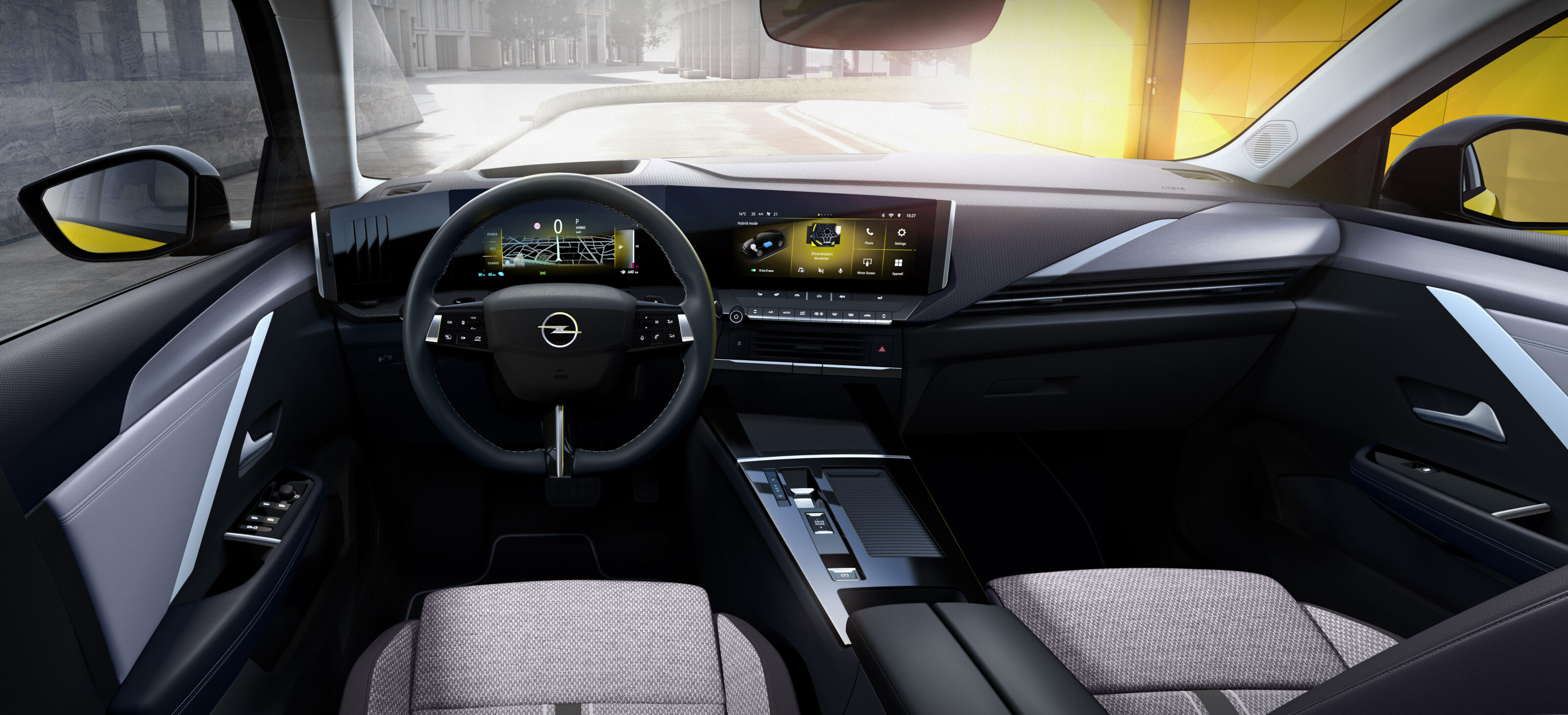
The new Astra reflects the new Vauxhall design language named ‘Vizor’, first seen on the Mokka crossover upon which the Astra looks to share a lot of interior equipment.
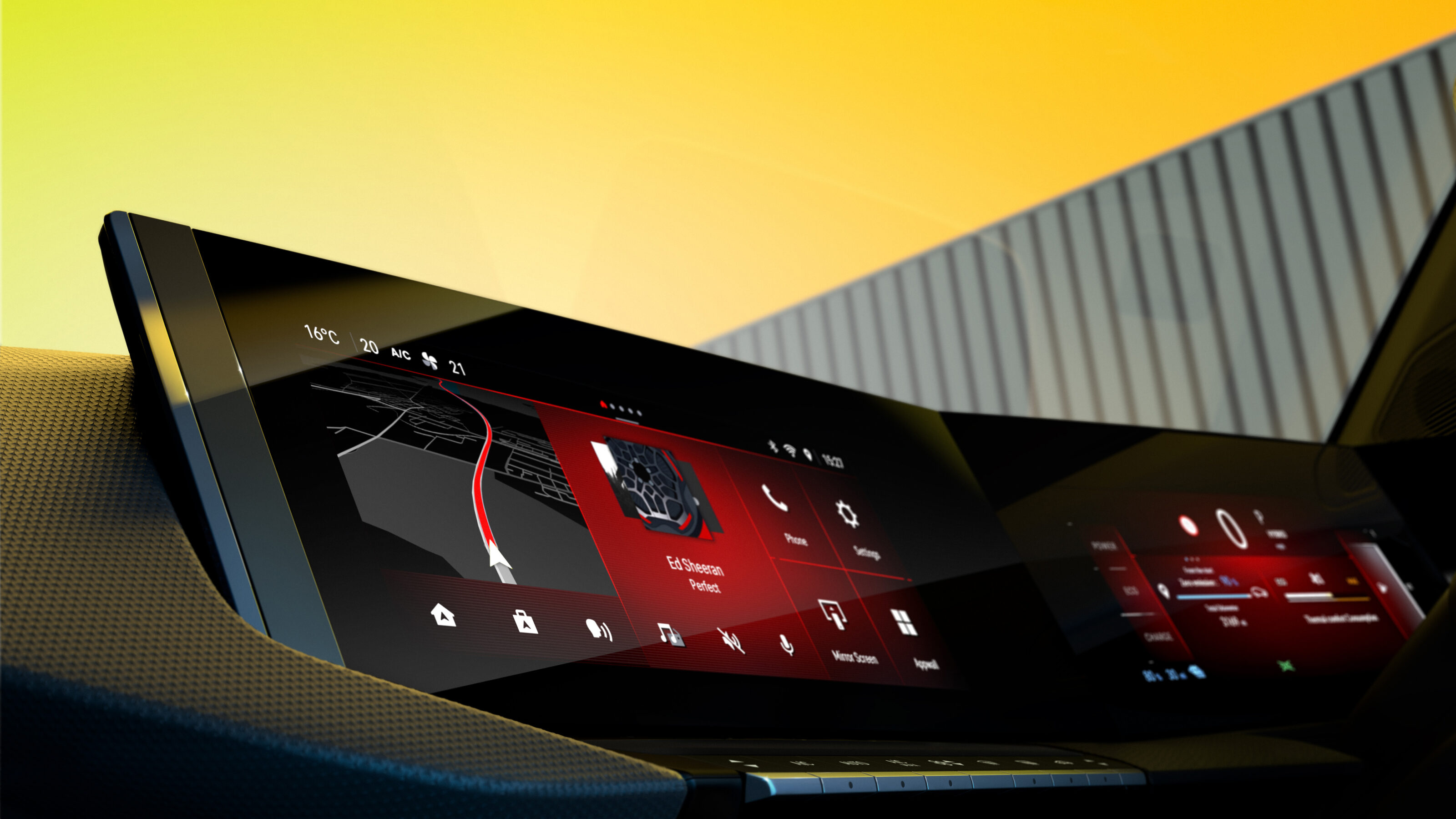
Features such as a 12-inch digital dash and 10-inch infotainment screen will likely be standard equipment, both aimed towards the driver, which has been redesigned compared to the 308.
According to Vauxhall, the Astra will be available as a five-door hatchback or sports tourer wagon, signalling the death of Astras of the past which included three-door variants, often seen in the VXR line-up.
Though unconfirmed for Australia at this stage, WhichCar will provide more updates in the future on the Astra including the possibility of the car coming Down Under.
Light city cars are not in good health. The Honda Jazz has been axed, along with the restyled Renault Clio, while the Ford Fiesta survives solely on our appetite for the ST variant. Worryingly, these are only the segment’s recent casualties.
All of it only makes the Citroen C3‘s survival more intriguing when you consider the French hatchback found 49 buyers in 2020 – a figure representing less than one per cent of the total light car market.
Despite the grim data, Citroen remains optimistic about the C3 – perhaps because it remains a sales success worldwide – and has powered up the third-generation model with a styling refresh and equipment upgrade.
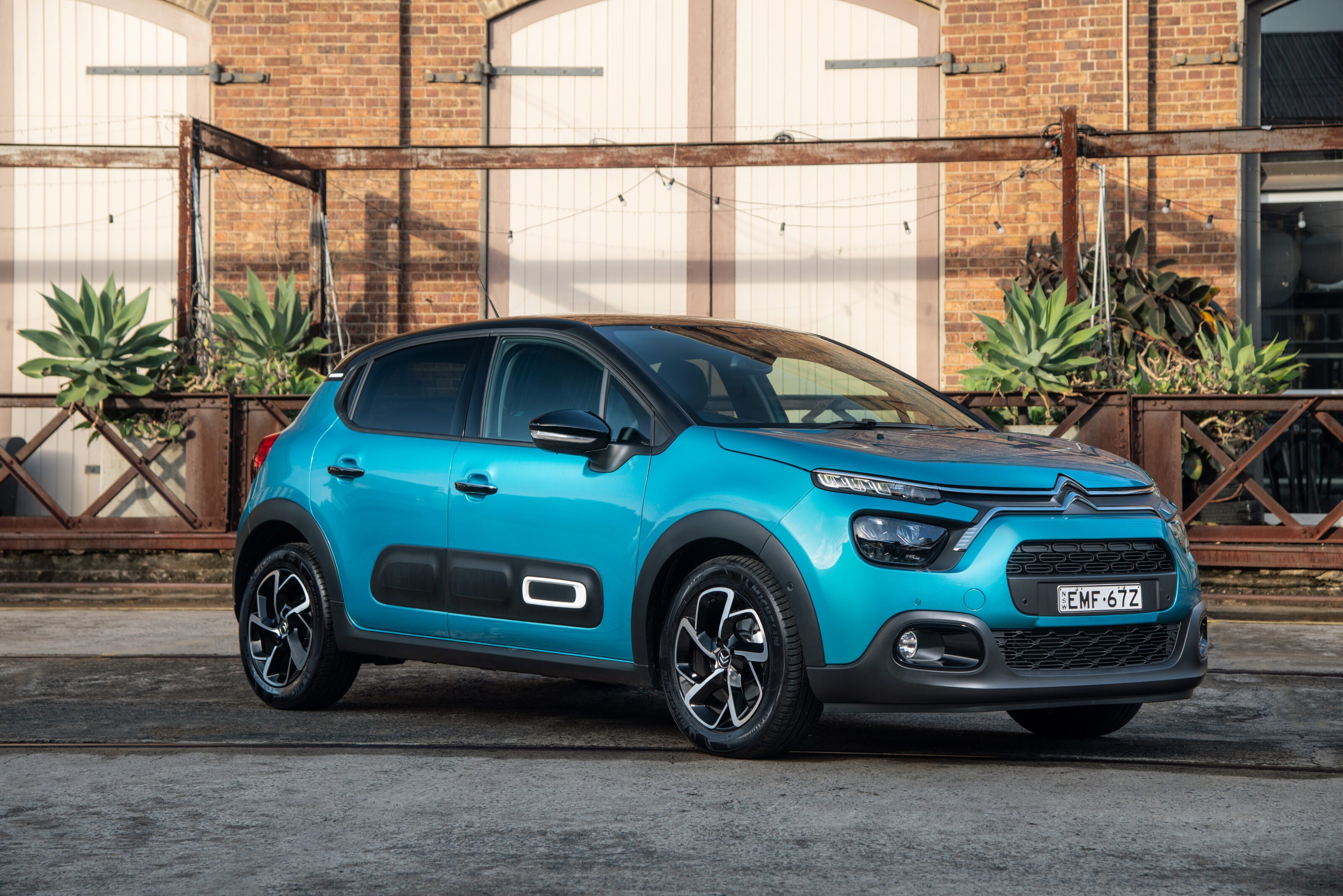
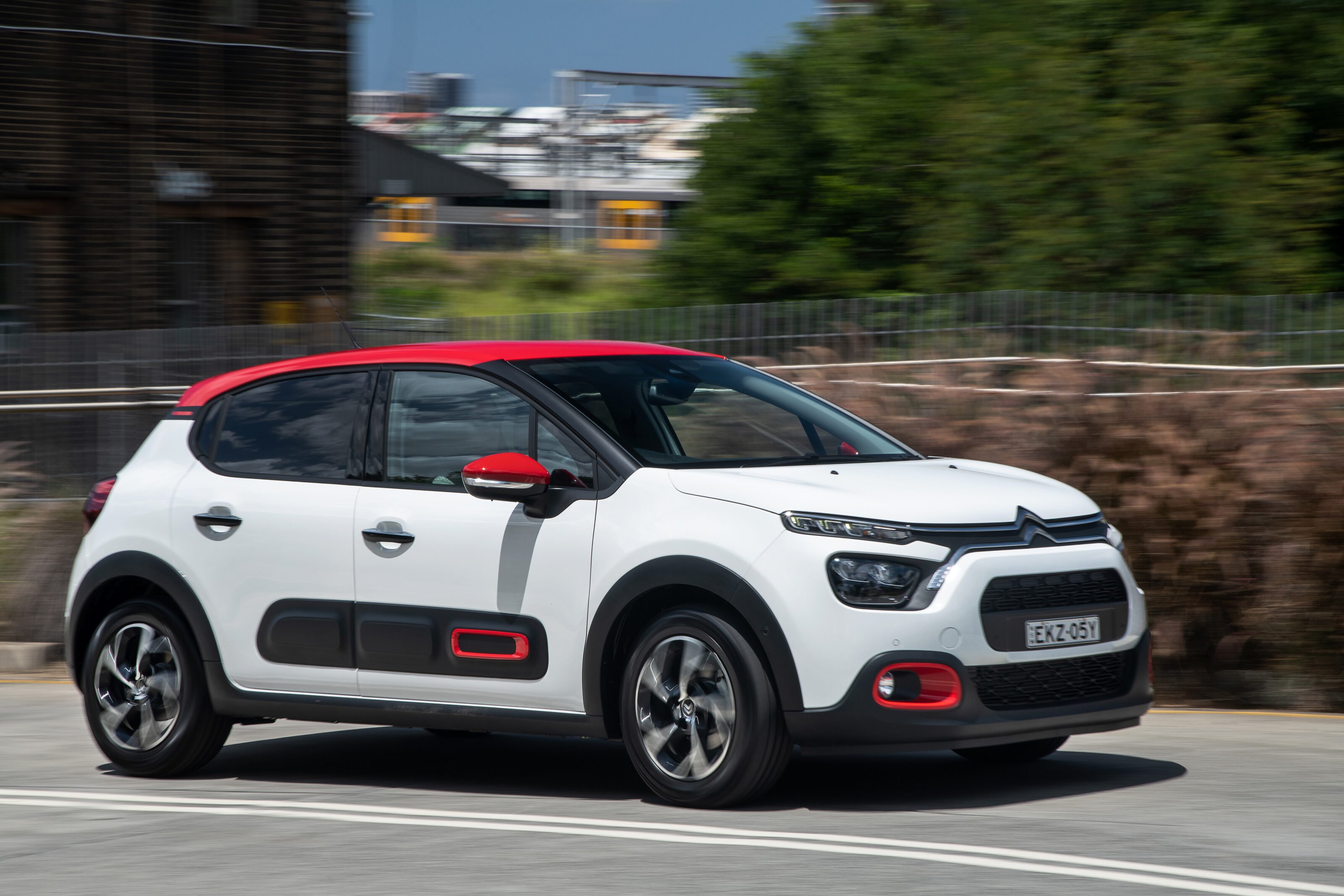
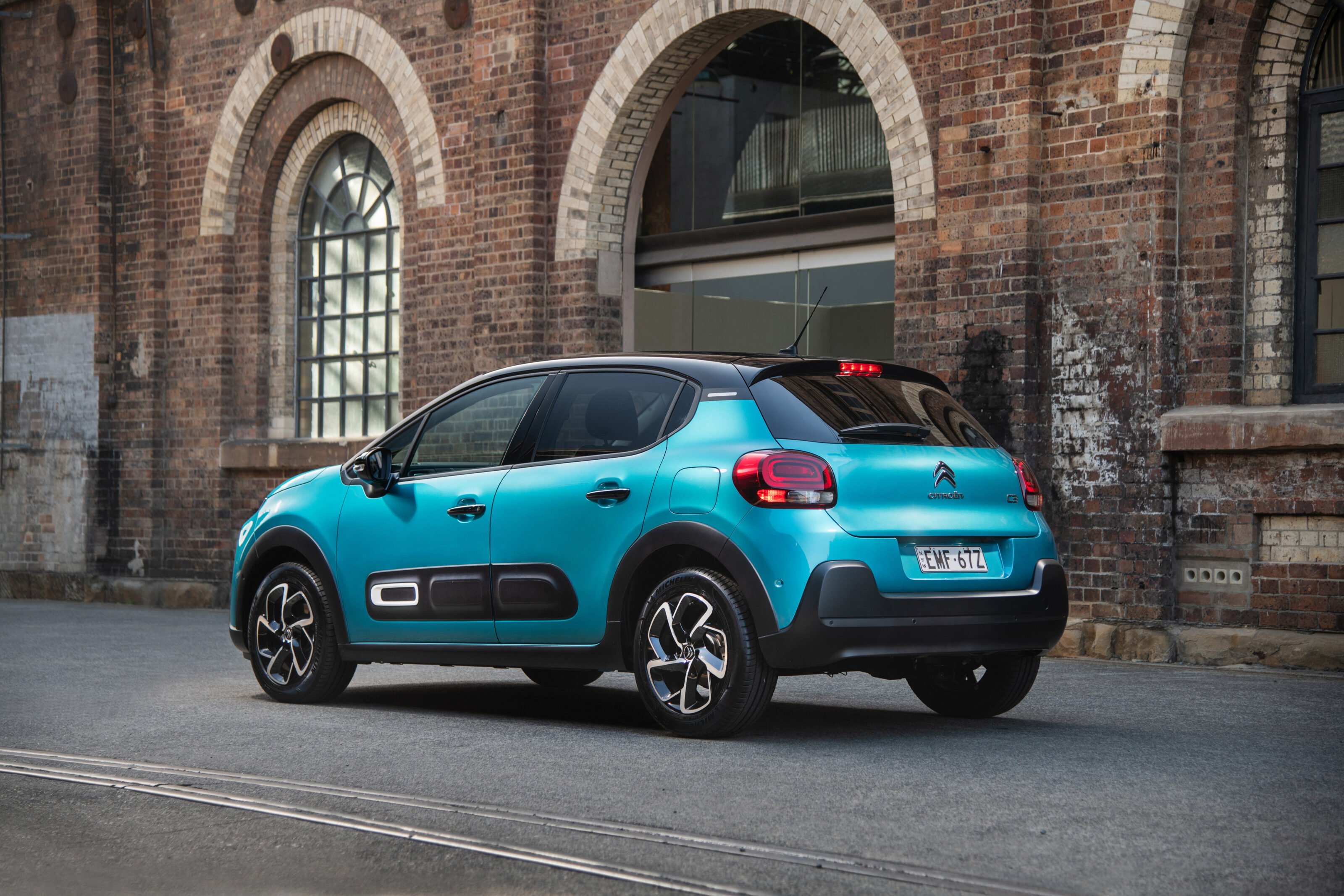
Scanning the new Citroen C3 exterior shows that designers have left its unmistakable look well alone. So much so that its chunky, haphazard styling – heavily influenced by the innovative C4 Cactus – can hide the changes.
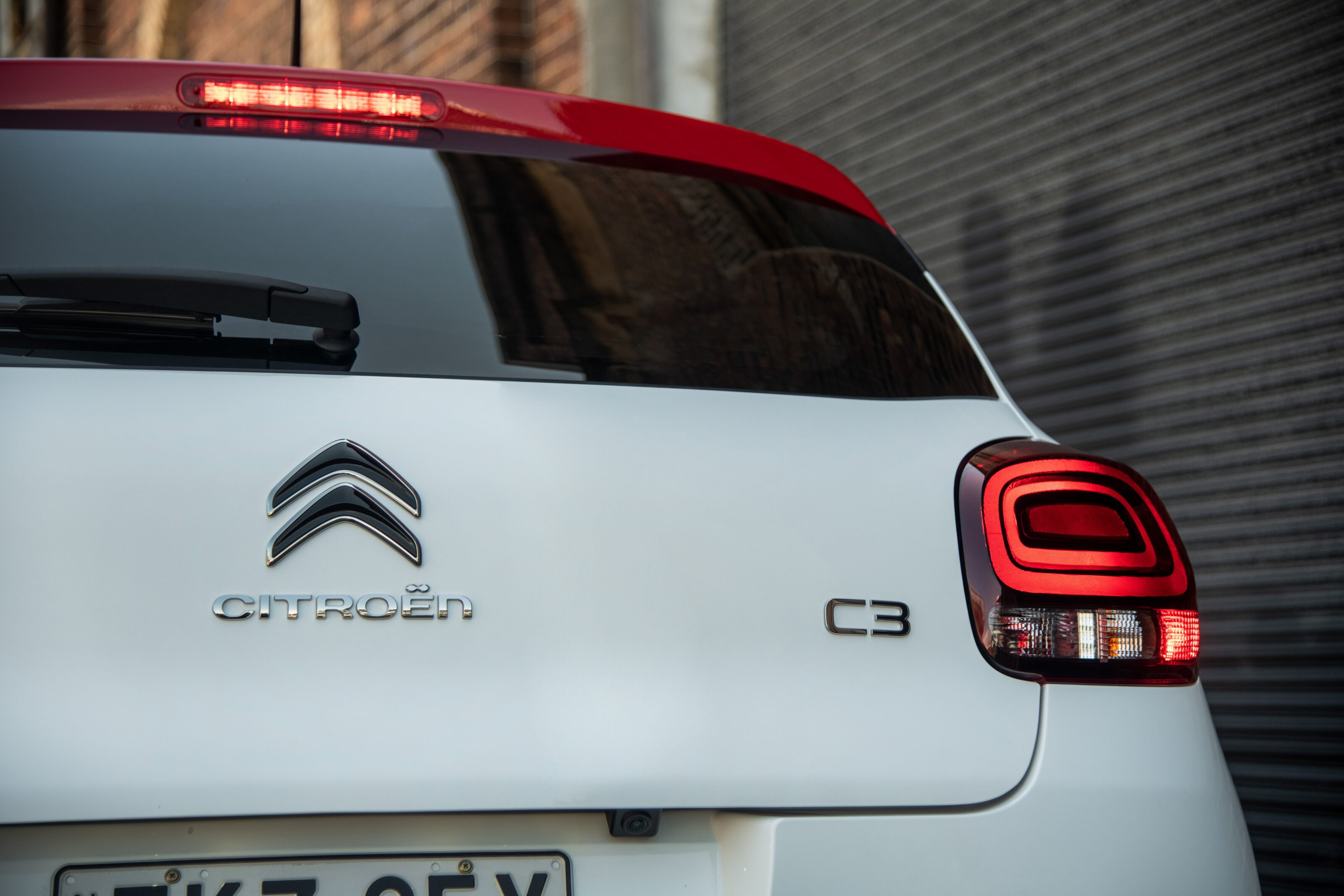
For instance, the lower blade on the front badge now drops into the headlight housings, opposing the upper edge in an X shape. That central radiator grille, as well, is now more trapezoidal-shaped, while the air bumps – Citroen’s trolley-friendly plastic elements – house three cushions. That’s down from seven.
Other tweaks include new-look 16-inch wheels, named Helix. And the eagle-eyed will notice a pattern on the rear pillar where the floating roof colour meets with the body paint. As we said, blink and miss most of these things. They do little to differentiate the new version from the old.
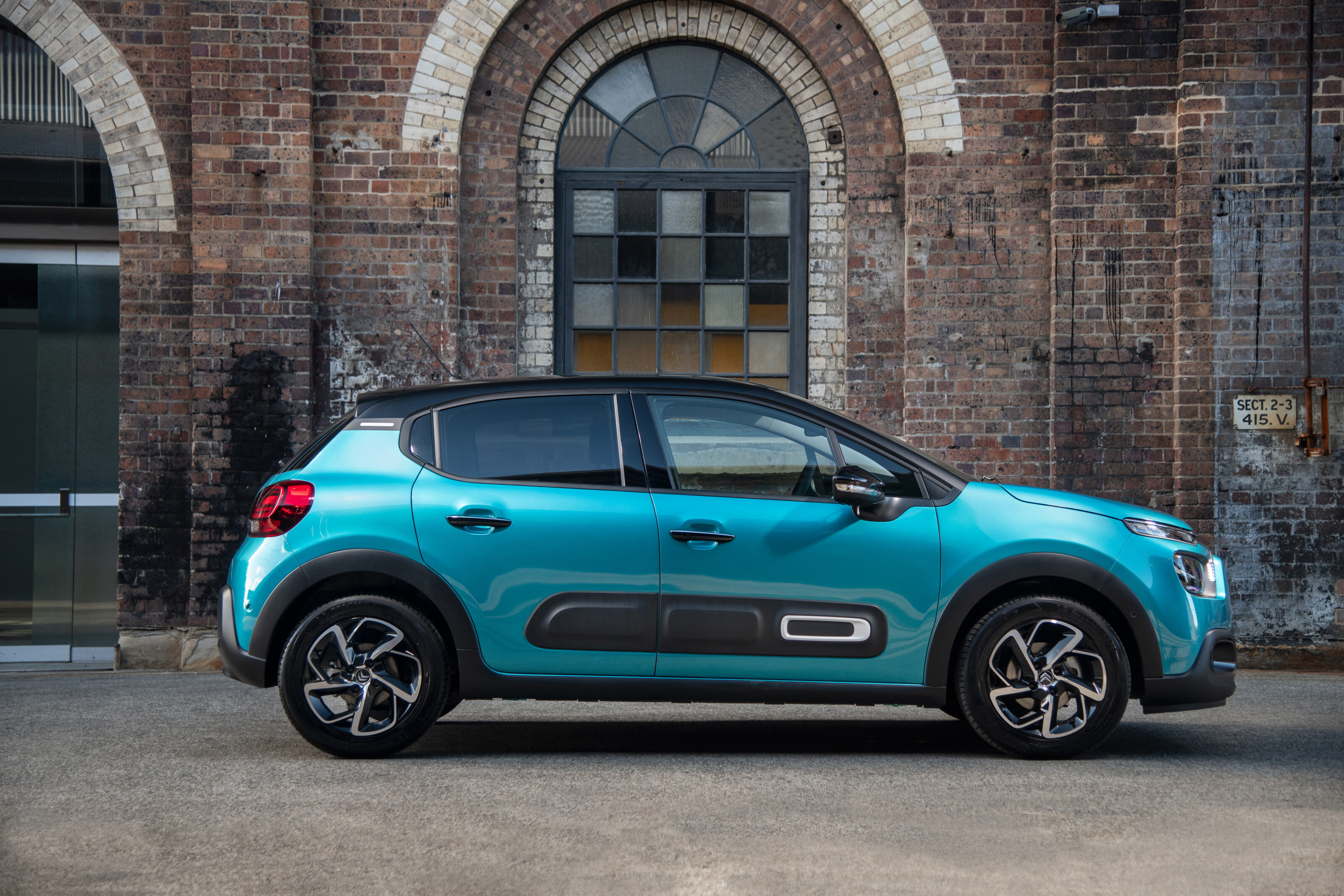
The C3 cabin remains a mix of surprise and delight with some typical quirks thrown in
Either way, the C3 provokes in more ways than one. Everyone will have an opinion on its style and it’s not always positive, that’s for sure. But then there’s its price. At $28,990 before on-roads, it’s positioned upmarket from mainstream rivals like the Mazda 2, Volkswagen Polo and Toyota Yaris and offered solely as an automatic.
You’ll need $33,155 to drive one away from a dealer in Victoria. That’s about $2100, $4179 and $7900 clear of the Mazda 2, Toyota Yaris and VW Polo, respectively, in similar trim or grades. The premium grows when you compare against rivals from value brands like MG, Kia or Suzuki.
Citroen’s five-year unlimited-kilometre warranty with scheduled servicing goes some way to softening the blow. However, it’s hardly exceptional since Toyota, Mazda and Volkswagen all match the coverage.
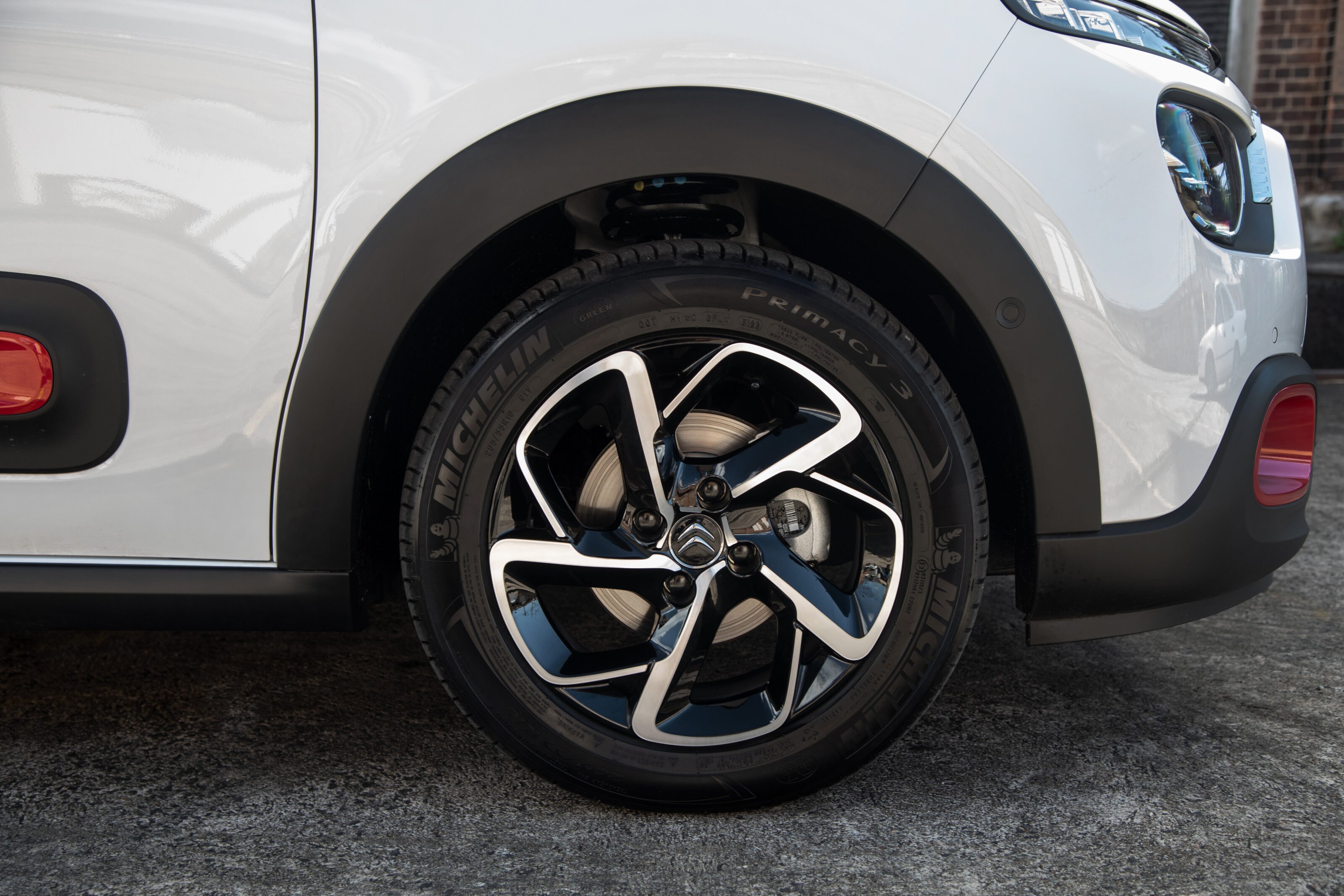
Citroen has been steadily building up specification on the C3 over the last couple of years. In 2019 it added much-needed autonomous emergency braking and keyless entry/start. Now the C3 also scores front parking sensors.
It is worth mentioning that the C3 lacks the safety tech you’d find in a top-spec Mazda 2 GT. For instance, Citroen’s AEB only works at low speeds, and the cruise control lacks radar-based distance control. There is blind-spot monitoring and lane departure warning, however.
Despite Citroen basing the C3 on the PF1 platform, which traces back to the 90s, ANCAP rated the C3 high on crash safety in 2017, with admirable 88 per cent and 83 per cent scores in adult and child occupant protection respectively. But lacking AEB at the time, which also affected its pedestrian safety, hurt its overall safety rating, which remains four stars.
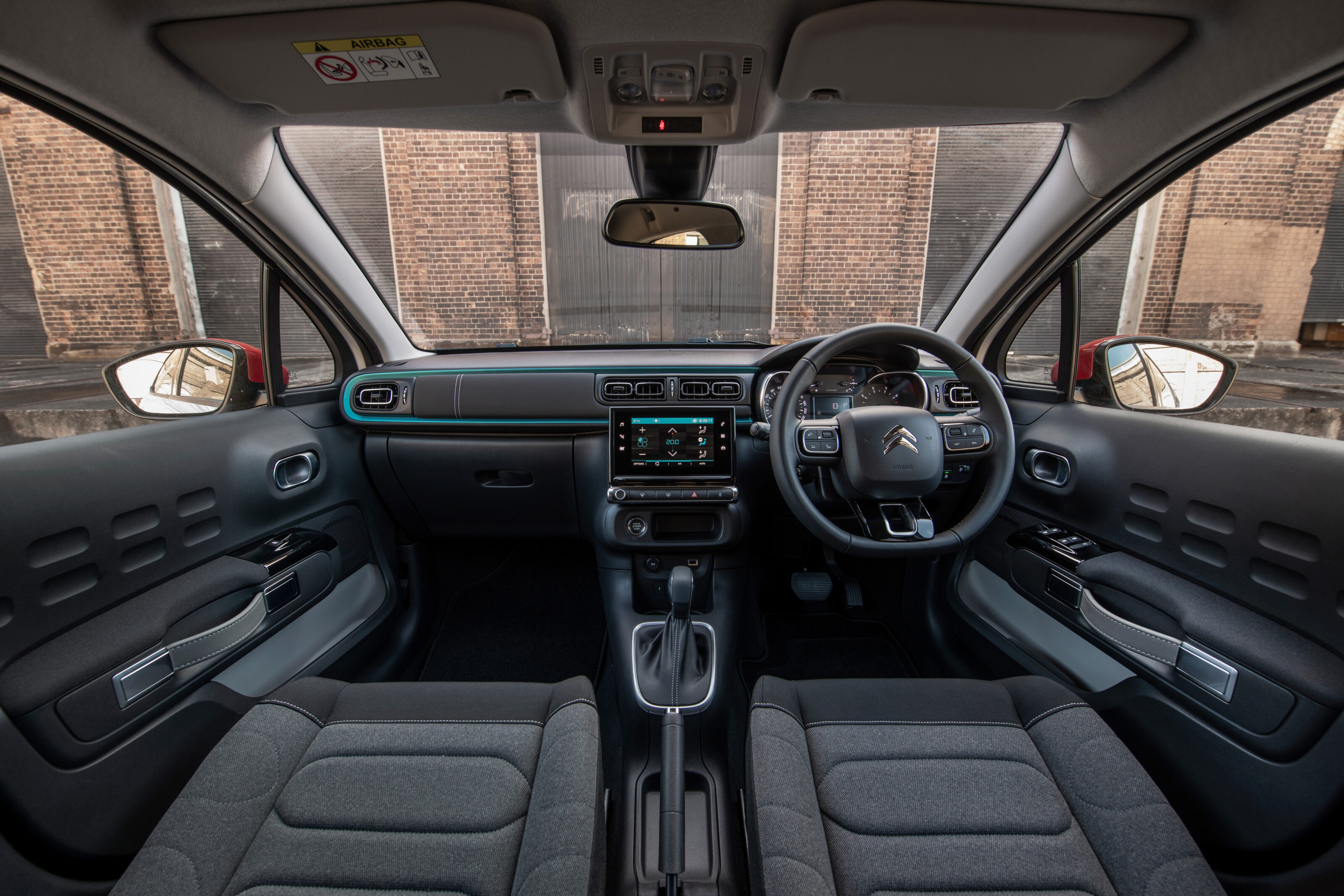
Citroen packs six airbags, two each for front passengers and another for each outboard rear occupant. Downsides to the C3’s sturdy crash-resistant frame are thick B-pillars that hamper over-the-shoulder visibility. Meanwhile, those glass A-frames behind the side mirrors also obscure small objects.
Safety gripes aside, the cabin remains a mix of surprise and delight with some typical quirks thrown in. Squircles adorn the vents and steering wheel. And while there is a lot of hard plastic, touchpoints like the door armrests feature nice cloth padding, while the handles look pinched from a Coach overnight bag. It’s youthful. A new Emerald interior trim also lays a teal-coloured ring in the dash.
The fact there’s only enough room for one armrest between the front seats speaks to the car’s purpose. It’s a narrow fit and built for navigating city streets. And while the tall windscreen combats any feeling of claustrophobia, it’s tight up back for even an average-sized adult.
The rear seats are okay and the front pews now feature padding 15mm thick, supposedly up from just 2mm. They’re supportive and comfortable, making inside a nice place to be overall. Only small cupholders or the gear lever that is obscuring the automatic transmission’s shift pattern let it down.
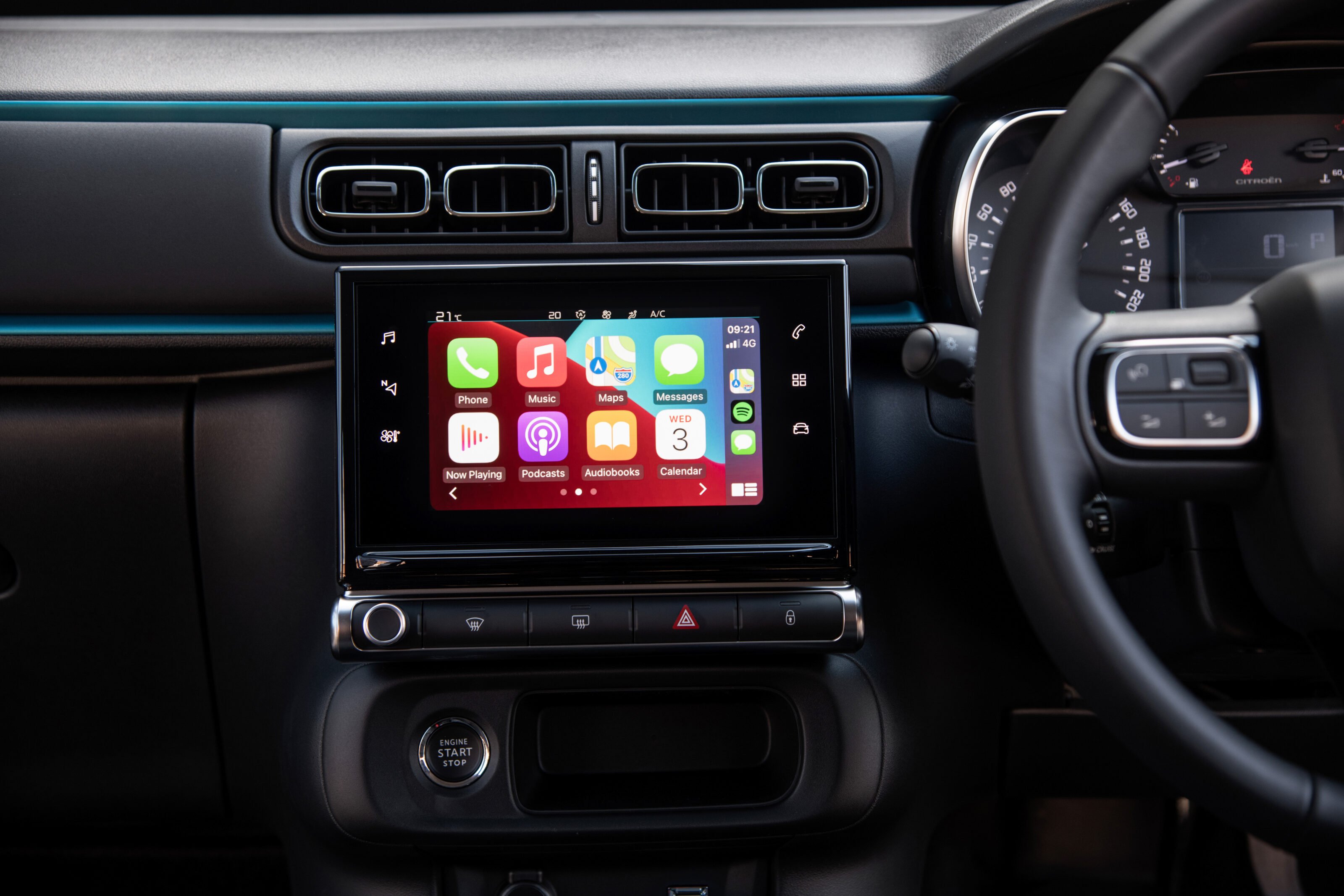
A large infotainment screen remains the centrepiece. Its crisp, colour-rich display follows the lead of other Citroen and Peugeot models and embeds heating and ventilation functions within its pages, which can prove annoying if you need the temperature controls quickly but the upside is it rids the centre stack of buttons for more storage cavities.
The infotainment software is responsive enough and comes with smartphone mirroring technology. The centre LCD screen in the dash uses basic graphics but suits the analogue layout nicely. Annoyingly, however, it will display notification messages in front of your digital speed without any way to delete them.
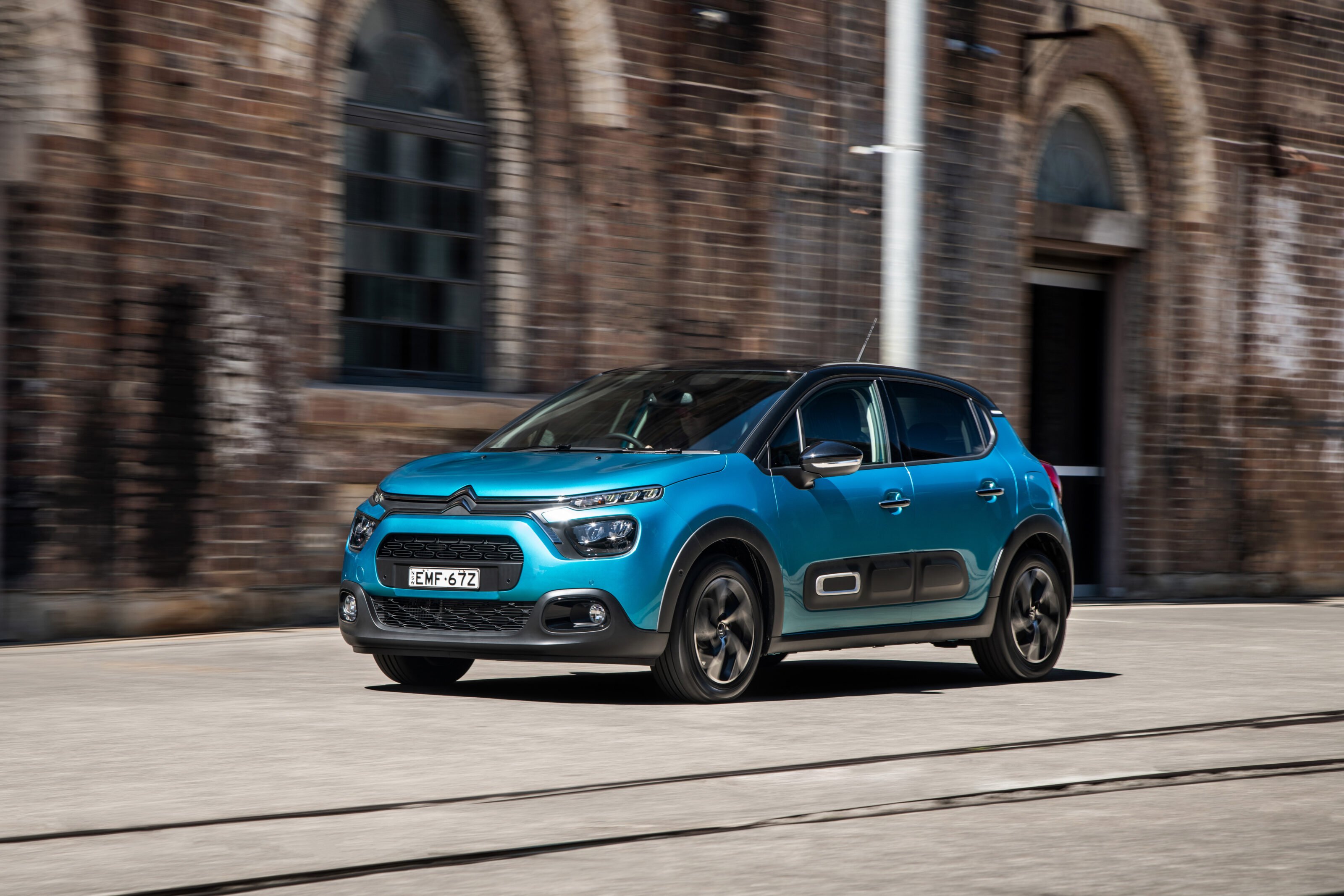
Out on the road, cloth seats set a comfortable posture. The pedals are close together, but the gear lever, handbrake and steering wheel feel natural. At your disposal is only one powertrain, a Euro-6-compliant 1.2-litre turbocharged three-cylinder petrol offering 85kW and respectable 205Nm. It drives the front wheels through a six-speed automatic.
Citroen’s three-banger codenamed ‘HN04’ is a joy, bellowing with an off-beat rort on full-throttle as it gladly runs past its 5500rpm indicated redline. It’s only a shame that you’re never having as much fun as it seems, given the C3 is claimed to reach 100km/h in 10.9 seconds.
Despite the C3’s modest 1090kg kerb weight, acceleration slows as you near 100km/h. It doesn’t help that the transmission is a bit dull, either. It operates fine when you’re ambling around town, behaving obediently without hiccup, but it’s ultimately quite slow.
Citroen says the C3 is good for 188km/h, which won’t matter unless you’re planning a jaunt up the Sturt Highway. A fuel consumption figure of 4.9L/100km on the combined cycle is more relevant, which should equal about 918km of range on its 45-litre fuel tank. You could theoretically squeeze more than 1000km from it on the highway based on Citroen’s claimed highway consumption figure. But keep in mind the C3 is fussy at the bowser and demands 95 RON.
The C3 should also handle long trips comfortably on its front strut and rear torsion-beam suspension. Large-profile Michelin tyres add absorbency to the setup that is stiff at slow speeds, but is more compliant over bumps at higher speeds. The nicely weighted steering is also a cut above the chassis, which can’t quite deliver the precision to match its levels of grip.
Overall, the C3 is a refreshing take on the city hatch – injecting vibrancy and fun into its exterior and interior. The engine is charming, while the chassis follows up with a comfortable ride and decent handling.
However, for all its personality, the C3 is not as customisable as you would expect. The only box to tick on the specification sheet is metallic paint for $690 and we could only choose between six colour combinations on the brand website. As a result, it scales an overwhelming amount of choice down into a less intimidating buying process.
But the C3 is not at risk of boring anyone. From the jazzy interior door handles to the sofa-like seating, innovative air bumps and splashes of colour throughout the cabin and exterior, every drive is an event.
And that’s what you should keep in mind when comparing the C3 against rivals from the mainstream. It’s a breath of fresh air, in some respects, against the clinical Volkswagen Polo, austere Mazda 2 or mild-mannered Toyota Yaris. While, on the other hand, it could be seen as a cheap entry point into European luxury among Audi A1s, Mini three-doors or Fiat 500s.
Sure, it’s not the most convincing buy in either scenario at its price, but Citroen should sell more. Individuality shouldn’t be so rare, even in a segment as small as this.
2021 Citroen C3 specifications
| Body | five-seat, five-door hatch |
| Drive | front |
| Engine | 1199cc inline-3cyl, DOHC, 12v, turbo |
| Power | 81kW @ 5500rpm |
| Torque | 205Nm @ 1500rpm |
| Fuel consumption | 4.9L/100km |
| Weight | 1090kg |
| Power/weight | 74kW/tonne |
| Transmission | six-speed automatic |
| Suspension | struts, dampers, coil springs (f); torsion bar, dampers, coil-springs (r) |
| L/W/H | 3996mm/2007mm/1490mm |
| Wheelbase | 2539mm |
| Tracks | 1489mm/1486mm |
| Steering | Electrically assisted rack and pinion |
| Brakes | ventilated discs, single-piston calipers (f/r) |
| Wheels | 16 x 6.5-inch |
| Tyres | 205/55 R16 |
| Price (before on-roads and options) | $28,900 |
A return to rotary engines for Mazda has been put on hold, with the Japanese manufacturer saying it has shelved its plans to bring back the Wankel – for now at least.
According to international publication Automotive News, Mazda’s planned reintroduction of the rotary engine as a driving range extender for its electric vehicles has stopped due to spiralling productions costs associated with the technology.
Initially aimed at being fitted to the MX-30 crossover from 2022, it is understood the driving range extender models were mainly targeted at the European and North American markets, though Mazda Australia’s marketing director, Alastair Doak, previously told Wheels the local arm had signalled its intention to receive the updated model.
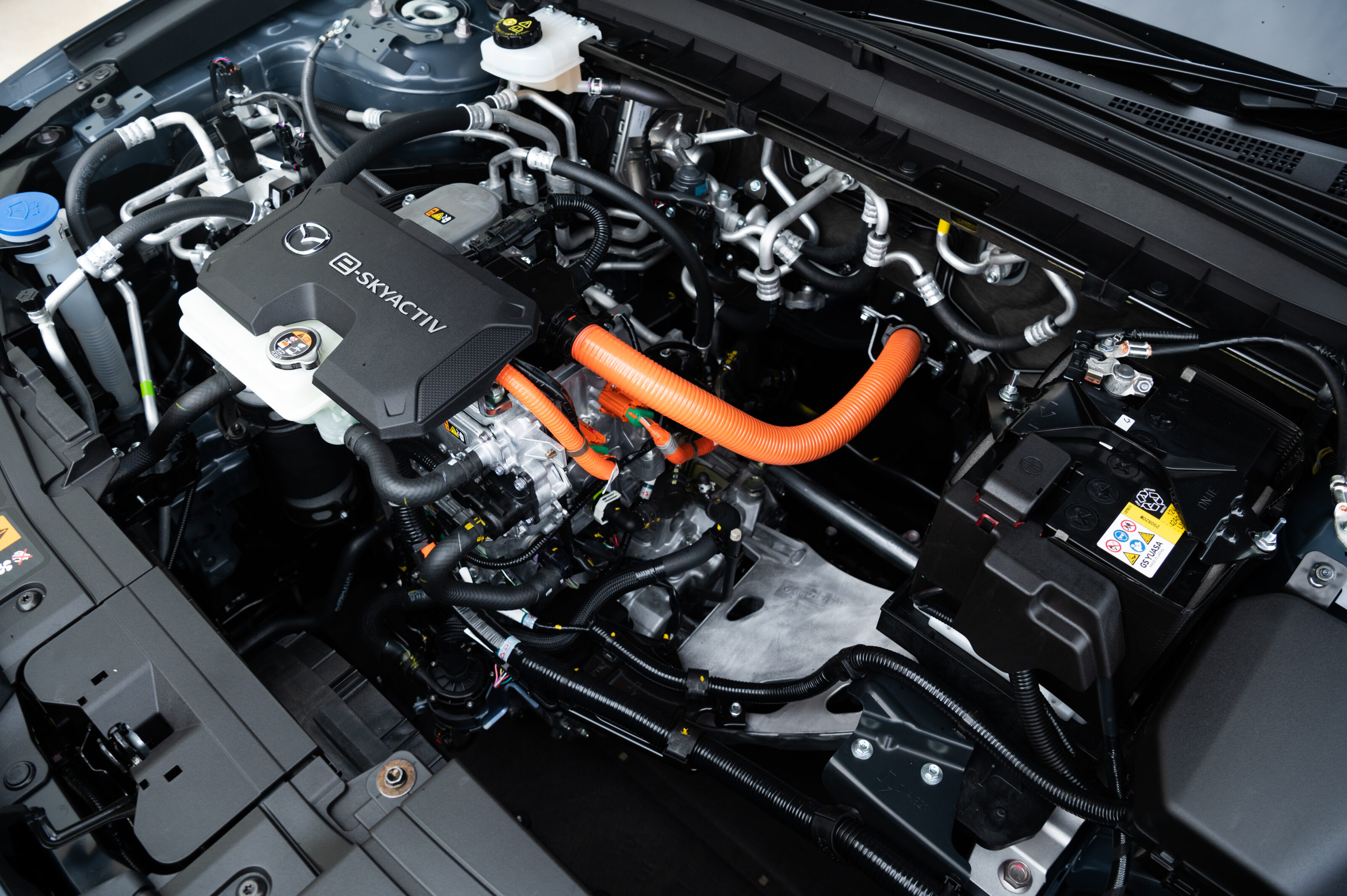
In an interview with Automotive News, a Mazda spokesperson, Masahiro Sakata, said the company was still interested in using the rotary but was unsure on timing.
“We are still considering using rotary engine as a [driving] range extender, but the timing of its introduction is undecided,” said Sakata.
In Australia, the MX-30 is either available as a 2.0-litre, four-cylinder petrol with 24-volt mild-hybrid assistance or as a dedicated electric vehicle with a 107kW motor and 35.5kWh battery pack, giving the vehicle a WLTP tested range of 200km.
While the petrol-powered MX30 starts at $33,990 and tops out at $40,990, the MX-30 EV begins at $65,490 before on-road costs – close to double the price of its internal combustion engine siblings.
Snapshot
- Nissan Leaf to feature Canto alert system
- New 2021 Leaf goes on sale in Europe
An update to the popular Nissan Leaf will soon see it come with a sound system designed to simulate traditional car noises in a bid to tackle fatalities associated with road users not realising an electric vehicle is approaching.
The incoming 2022 Nissan Leaf is fitted with a new Acoustic Vehicle Alerting System (AVAS) nicknamed ’Canto’ by its developers, specifically designed to transmit artificially simulated driving sounds, alerting people to the presence of a fully-electric vehicle.
The Japanese marque made the announcement as the new Leaf goes on sale in Europe.
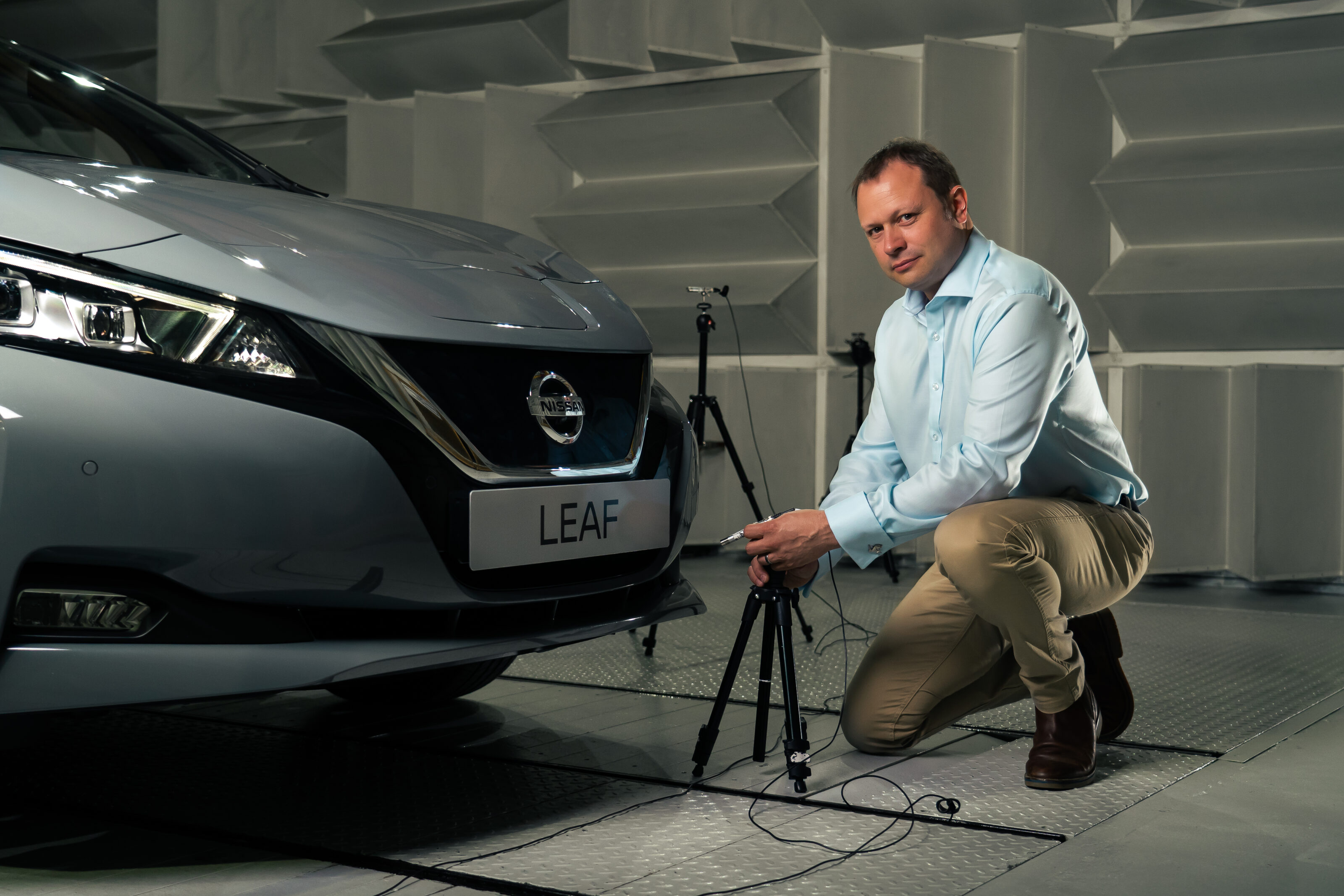
Fully compliant with the new European regulations, the AVAS builds on the alerting sound already incorporated in the first-generation Nissan Leaf.
“Customer safety is paramount, not only for those behind the wheel, but those surrounding the car as well,” said Marco Fioravanti, regional vice president, product planning for AMIEO (Nissan’s way of saying Africa, Middle East, India, Europe (including Russia) and Oceania).
“As the world becomes more and more electrified, this sound will soon become part of the soundscape of our roads as Nissan’s signature EV sound moving us closer to our goal of a zero-fatality driving experience.”
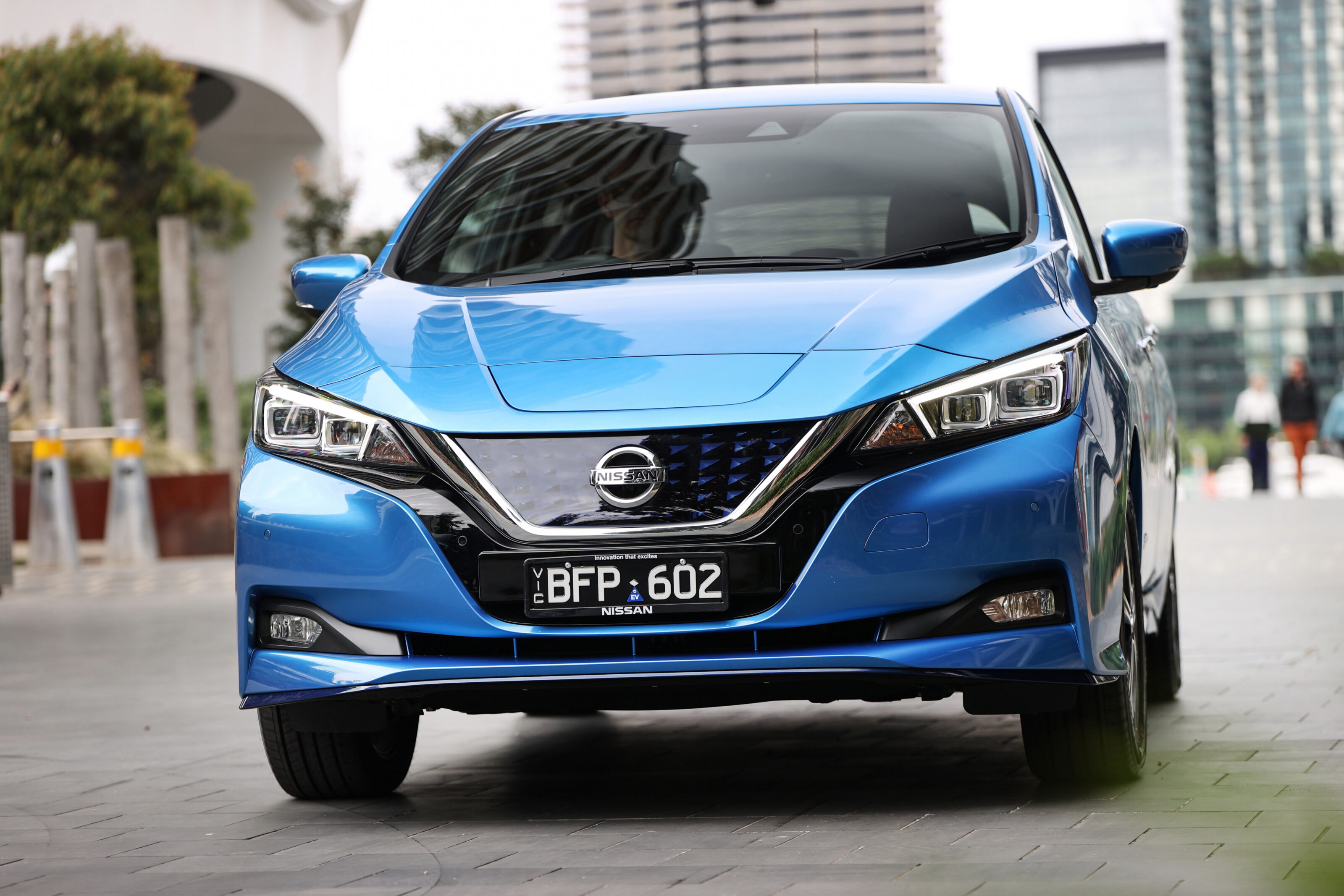
As well as adding AVAS to the Leaf’s safety suite, the updated model’s assistance aids include blind spot intervention and an intelligent rear view mirror as standard.
By being quieter than internal combustion engines, fully-electric motors are considered zero-emission not only in terms of CO2, but also noise pollution.
‘Canto’ has been created by sound designers and engineers at Nissan in Japan, and locally adapted for Europe at Nissan Technical Centre Europe using a spectrum of sonic palettes. The sound has been purposely composed to ensure it varies in tone and pitch depending on whether the vehicle is accelerating, decelerating, or reversing.
Automatically activated when travelling at speeds up to 18mph (29km/h), Nissan claims ‘Canto’ complements its surroundings and is clearly audible, without being too alarming to pedestrians, residents and passengers.
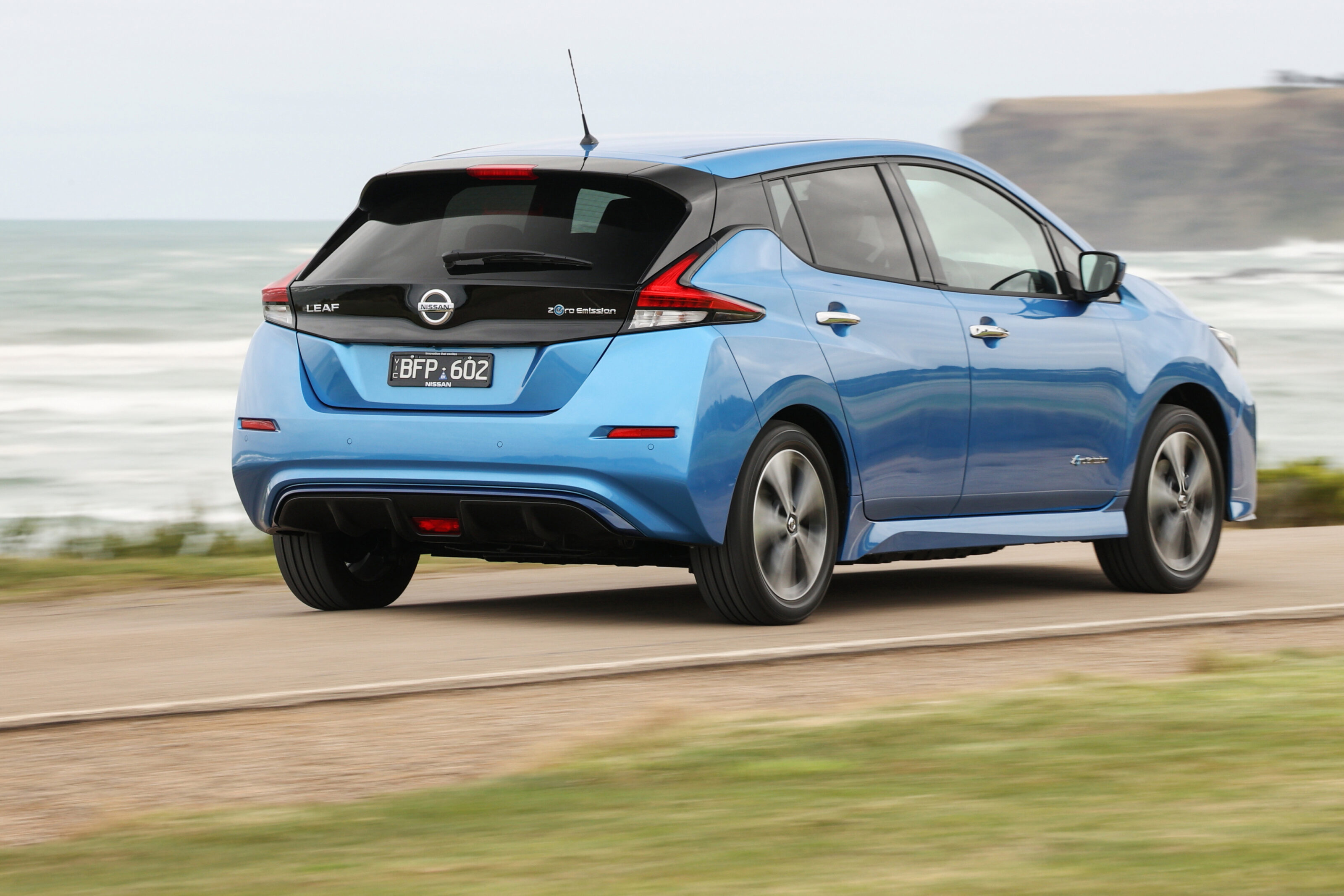
“After engineering the ‘Canto’ sound, we installed it to the 2021 Leaf to enable us to carry out both subjective and objective evaluations to better match the expectations of the European customer,” said Paul Speed-Andrews, noise and vibration development manager at Nissan Technical Centre Europe.
“It was important that we not only created a sound that aligned with the new regulations, but also matched Nissan’s brand image. We have always been pioneers in safety and innovation and it is great to know we are helping to shape the future of electrification,” he added.
Following the recent unveiling of EV36Zero, a £1billion (AU$1.85bn) flagship EV hub, Nissan continues its efforts in Europe to achieve carbon neutrality.
Back in April, Nissan introduced a new range-topping e+ variant of its electric Leaf hatchback equipped with a more advanced battery pack that squeezes in more than 50 per cent of additional capacity.
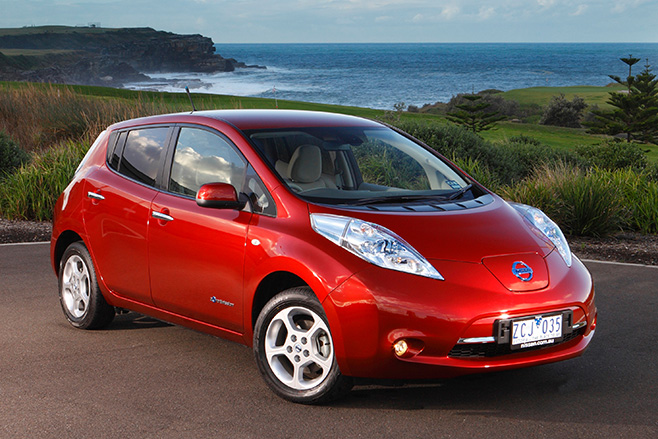
For the e+ model, the Leaf’s battery pack grows from 40kWh to 62kWh with corresponding improvements to charging times, power and torque outputs, as well as range.
For their advancements, the higher-density battery and upgraded systems add $10,500 to the Leaf’s bottom line for a new starting price of $60,490 before on-road costs.
Leaf fans who can’t stretch to the enhanced Leaf e+ are still offered the original 40kWh version for $49,990 before on-road costs.
Nissan Australia has confirmed all Leaf and Leaf e+ models coming to Australia in 2022 will be fitted with the Canto alert system.
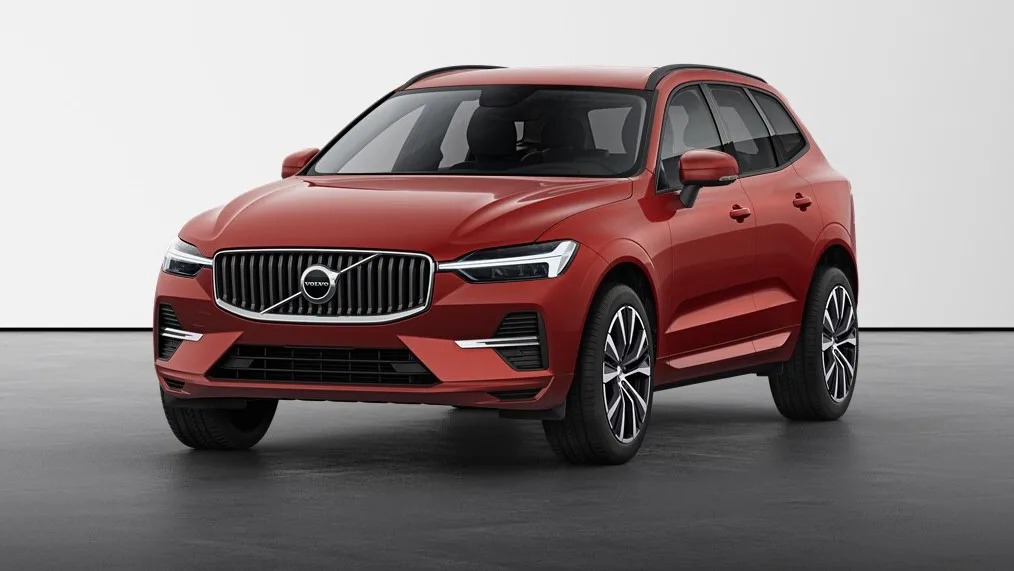
UPDATE, JULY 13: The Volvo XC60 has undergone its first facelift since the second generation SUV’s introduction in 2017, scoring extra tech as the diesel engines are dropped from the range.
Power now comes from a range of petrol units with either forced induction or mild-hybrid assistance while the dedicated hybrid system remains in the range-topping Polestar Engineered variant, the only vehicle in the range not to score updated equipment according to Volvo Australia’s website.
Price adjustments have been made alongside the update with an increase coming for the Momentum and Inscription variants, while cost of the R-Design has dropped slightly – though not as much as the Polestar Engineered version which has had its price slashed by over $4600 due to it not receiving the aforementioned updates.
2022 Volvo XC60 Pricing (before on-road costs)
- XC60 B5 Momentum – $67,990 (+$3000)
- XC60 B5 Inscription – $73,643 (+$1653)
- XC60 B6 R-Design – $78,258 (-$732)
- XC60 T8 Polestar Engineered – $95,353 (-$4637)
The story to here
MARCH 11: A new Google Android-based infotainment system is bound for 2022 Volvo XC60s, which will also receive the mildest of design tweaks and updated safety tech.
The 2022 update was initially revealed to the European market, but WhichCar has since confirmed the new XC60s will arrive in Australia “around July 2021”.
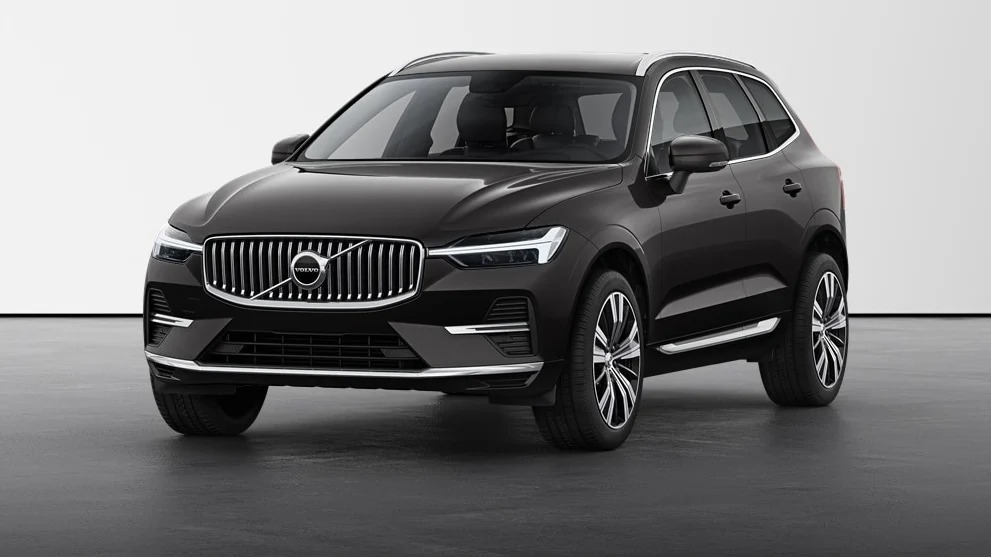
Android infotainment replaces Volvo’s old system, though the new software is still housed in the signature portrait-mount 9.0-inch screen.
It allows for a user-friendly experience for those well-acquainted with Google’s OS and offers Google-based Digital Services apps for things like personal assistant and Maps navigation.
The Android-powered infotainment system will be able to display native in-car apps offered through the Google Play store, meaning navigation apps like Waze can be downloaded straight to the car’s system.
The infotainment also provides access to Volvo’s dedicated app and controls the wireless phone charging system.
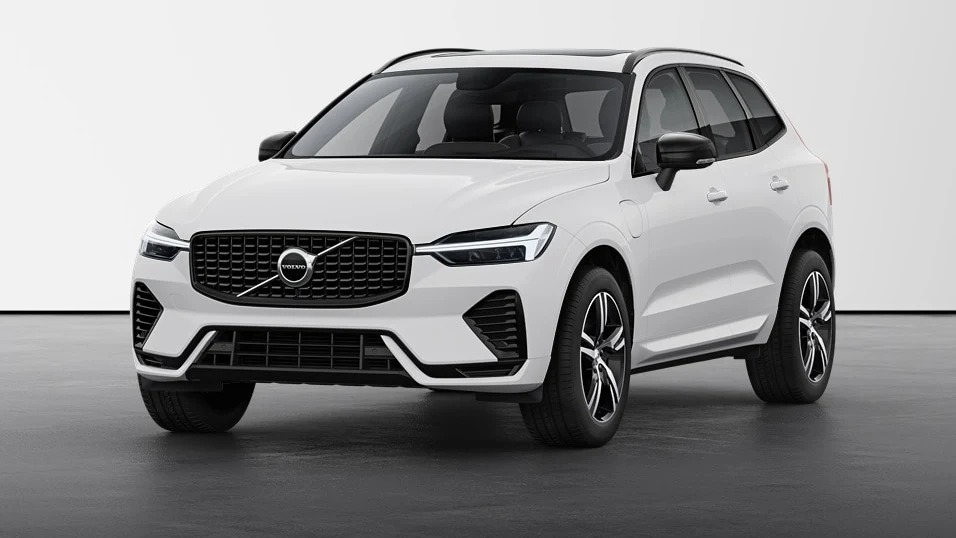
Apart from the new-design infotainment software, 2022 models also receive the company’s latest Advanced Driver Assistance Systems. It uses ultrasonic sensors, radars and cameras to facilitate semi-autonomous driving through the Pilot Assist function.
New XC60s will also receive slightly different looks. Bumpers and grilles have been slightly modified, while new interior trim options and colour palettes are available. Though you’d have to be a trainspotter to spot the differences.
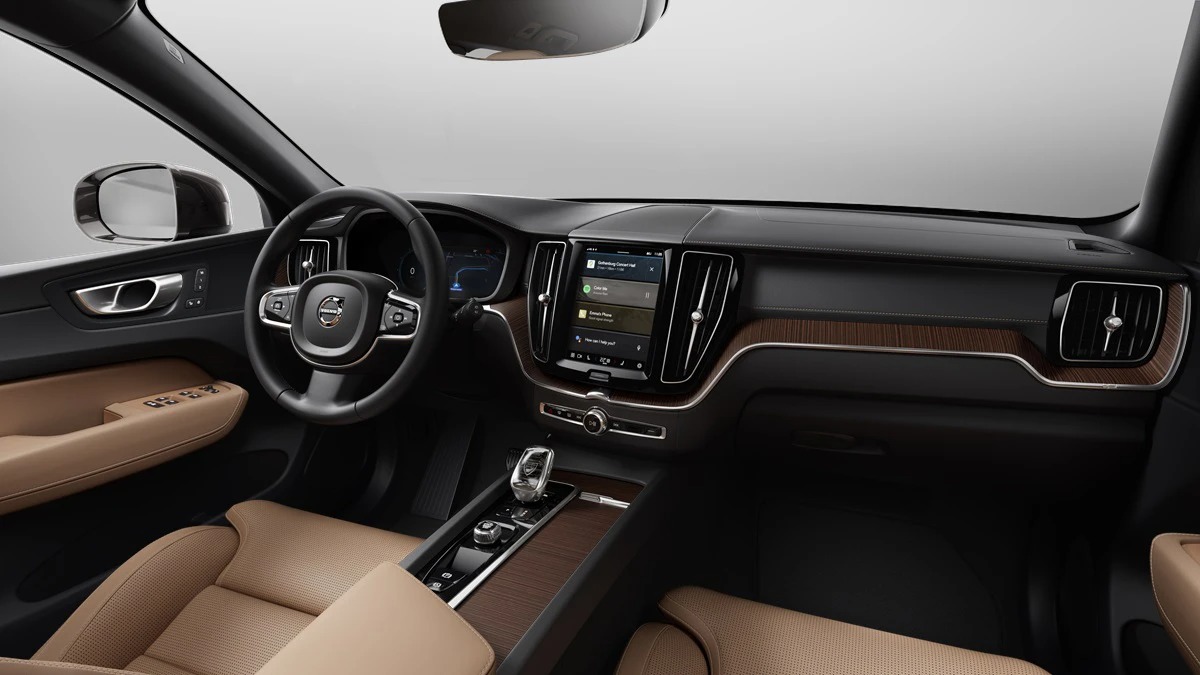
No changes were detailed regarding the engine line-up, though Volvo’s 2030 electrification strategy will see the XC60 range drop diesel variants in favour of mild-hybrid and plug-in hybrid petrol four-cylinder engines later this year.
Updated 2022-specification Volvo XC60s will first go on sale in Europe in late May, before being made available to Australians from July 2021.
Snapshot
- Volvo now has a 49.5 per cent share in Polestar
- Previously the company had a 50 per cent stake, but lost it earlier this year
- Polestar 2 confirmed for Australian delivery late 2021
Volvo has announced it has acquired more shares in its electric performance off-shoot Polestar – increasing its stake back up to almost 50 per cent.
The new investment means the parent company now owns 49.5 per cent in the premium electric vehicle company.
Until earlier this year, Volvo controlled half of Polestar’s shares, but due to a “private placement” lost a large stake in the company which it is only now regaining.
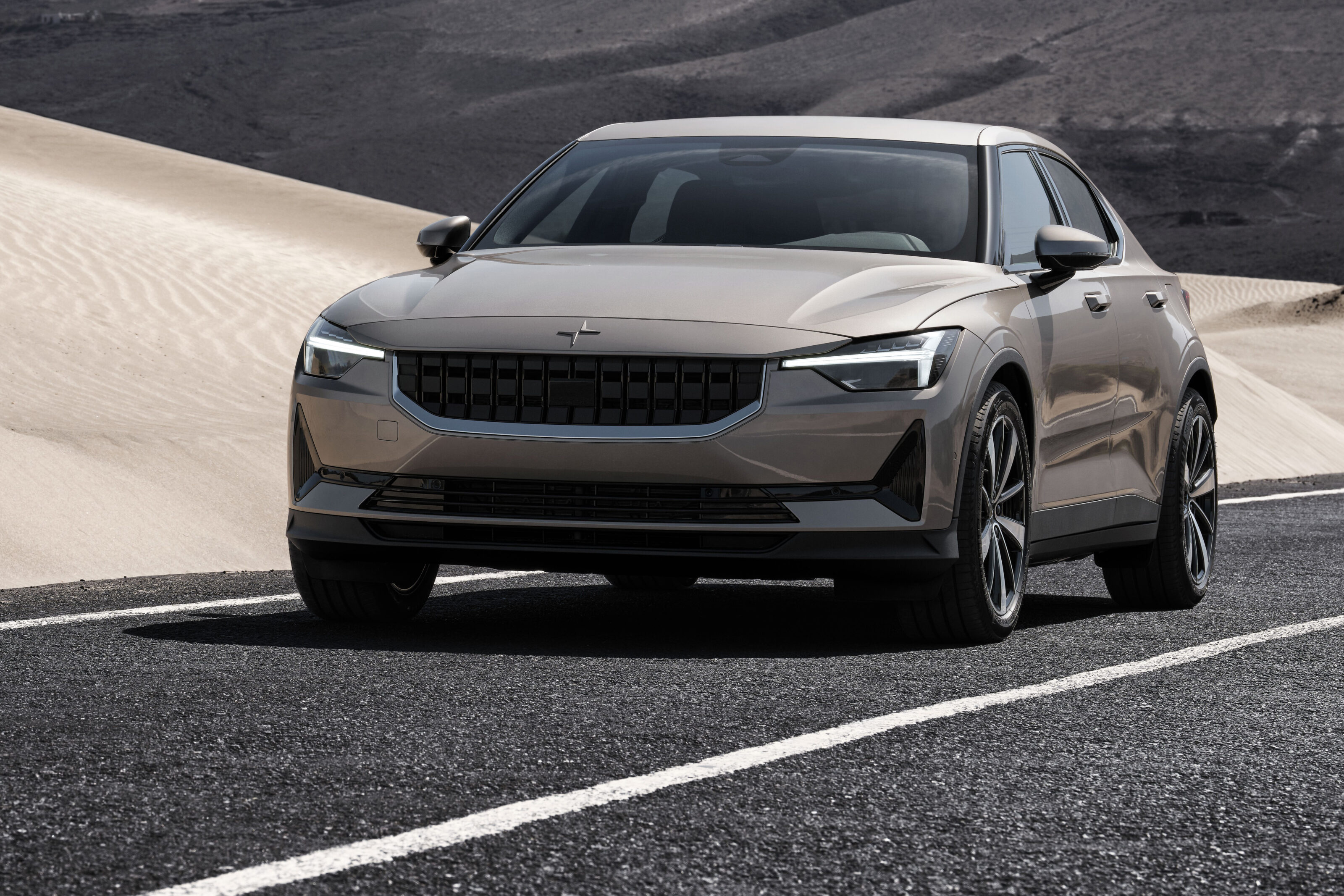
Volvo is acquiring its additional portion from PSD Investment – the private investment company of Eric Li, chairman of both Volvo Cars and its parent Zhejiang Geely Holding Group. PSD Investment will remain the second largest shareholder in Polestar.
Despite branching off from Volvo in 2017, Polestar still utilises many of the manufacturing capabilities of the larger manufacturer – though the former says it has no further plans to up its shares in the latter.
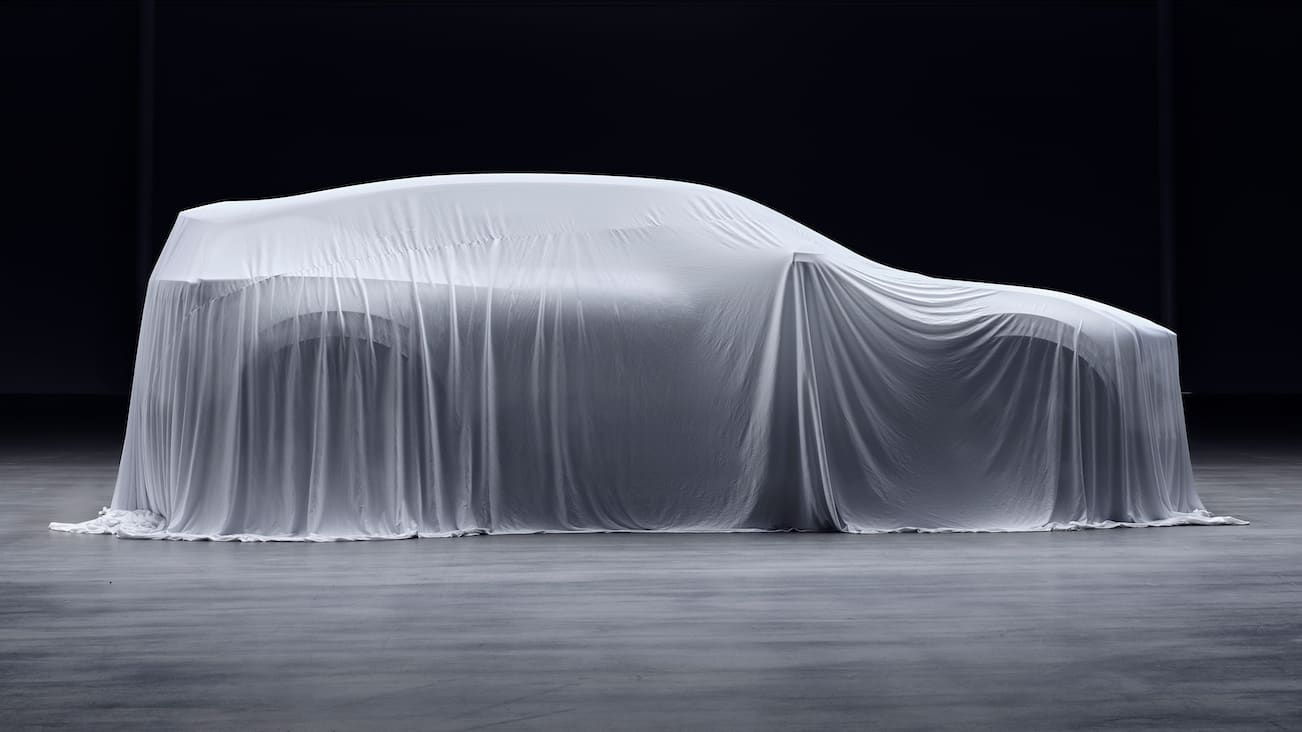
The Polestar 3, which is based on Volvo’s next generation electric architecture, will be built at the parent company’s plant in Ridgeville, South Carolina next year, and by mid-decade it expects to be producing models in Europe too.
It marks the first time since the acquisition of Polestar by Geely that the specialist vehicles will be made outside of China – the Polestar 1 and 2 being assembled at factories in the country since 2017.
Polestar became a dedicated EV brand in 2019 after the release of the Polestar 2.
The Polestar 2 electric vehicle – a coupe-like five-door liftback with a raised SUV stance – will make its Australian debut just before this year is out. The Polestar 1 never made it to our shores.
Polestar’s Australian launch will come roughly one year after it launched in the US, where customer deliveries of the Polestar 2 began in December 2020 – a few months later than intended, thanks to Covid-19.
When it arrives, Australian buyers will be directed primarily to the Polestar website to initiate the sales and test-drive experience, although physical ‘Polestar Spaces’ will also be established – and the entire operation will run separately to the Volvo business.
“Polestar sees considerable potential in the Australian market, which is why it will be one of the first markets to launch as part of the company’s Asia Pacific expansion,” said Polestar Australia boss Samantha Johnson at an event in May.
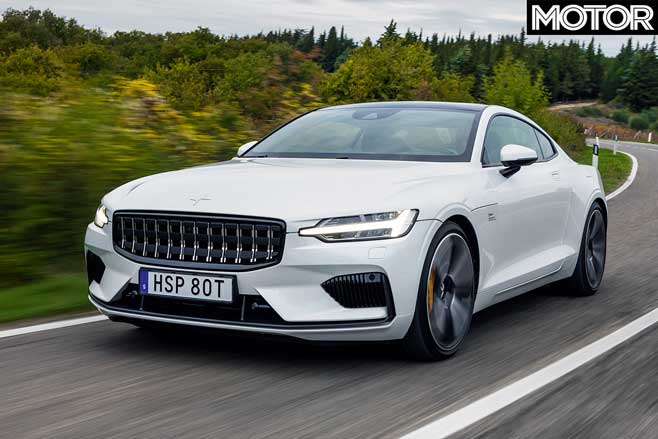
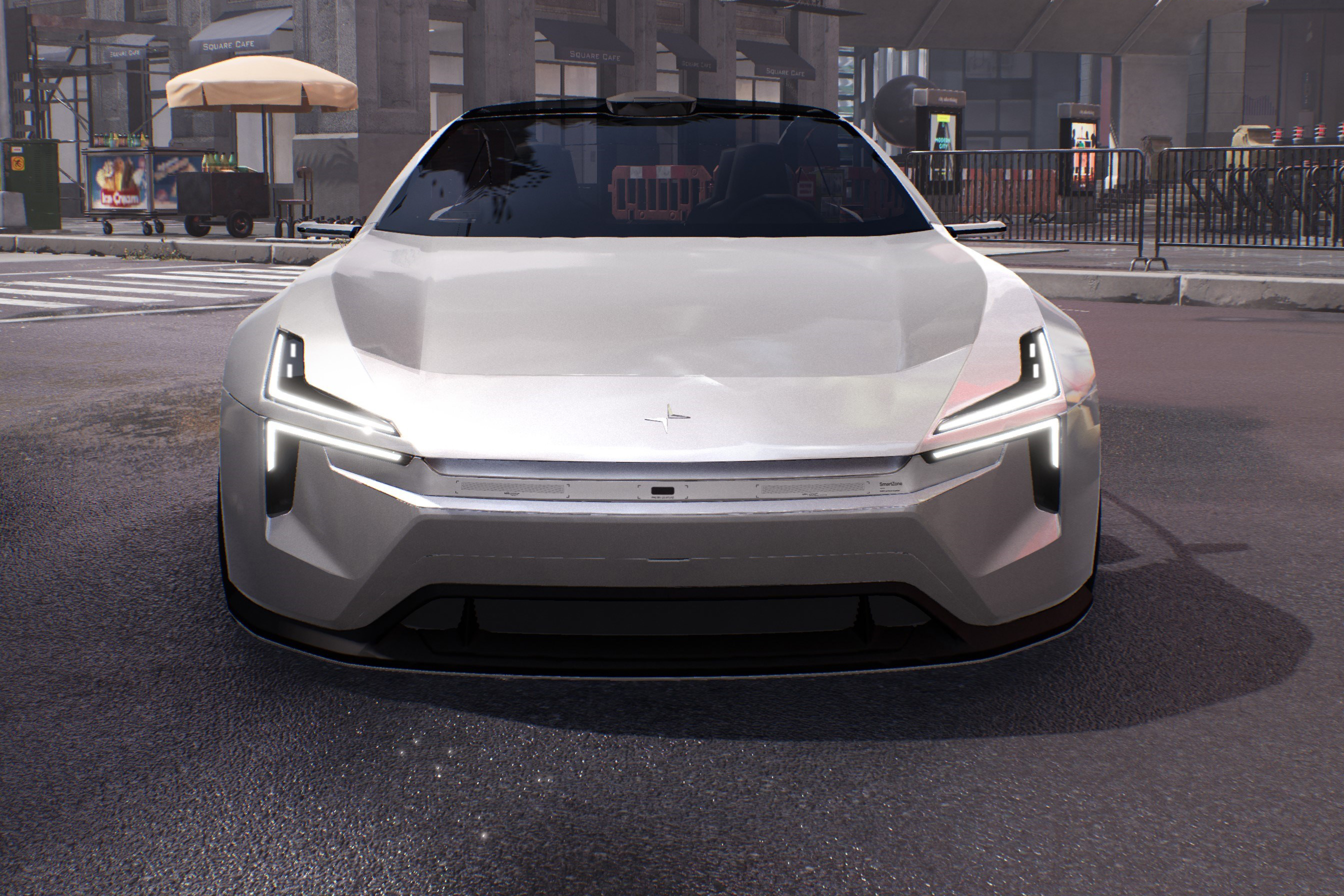
A Precept concept vehicle, revealed in February 2020, has also been confirmed for future production, with a new video series offering fans a look behind the scenes at how it is conceived and crafted.
Australia has been instrumental in the rise of the Polestar brand. In 2010 the tuning house released a blue Polestar-badged version of the C30 small hatchback to gauge interest in a performance-honed Volvo, with Australia later picked as the first test market for the 2015 introduction of the Volvo S60 sedan and V60 Polestar wagon, a $100,000 hardcore version of the S60 T6 and V60 T6 which started with a tuned turbo-six before adopting a high-boost turbo 2.0-litre four in 2017.
Snapshot
- Sportback models offer fresh styling for the Q5 and SQ5 models
- Prices start at $77,700, range up to $110,900
- Deliveries to begin in August
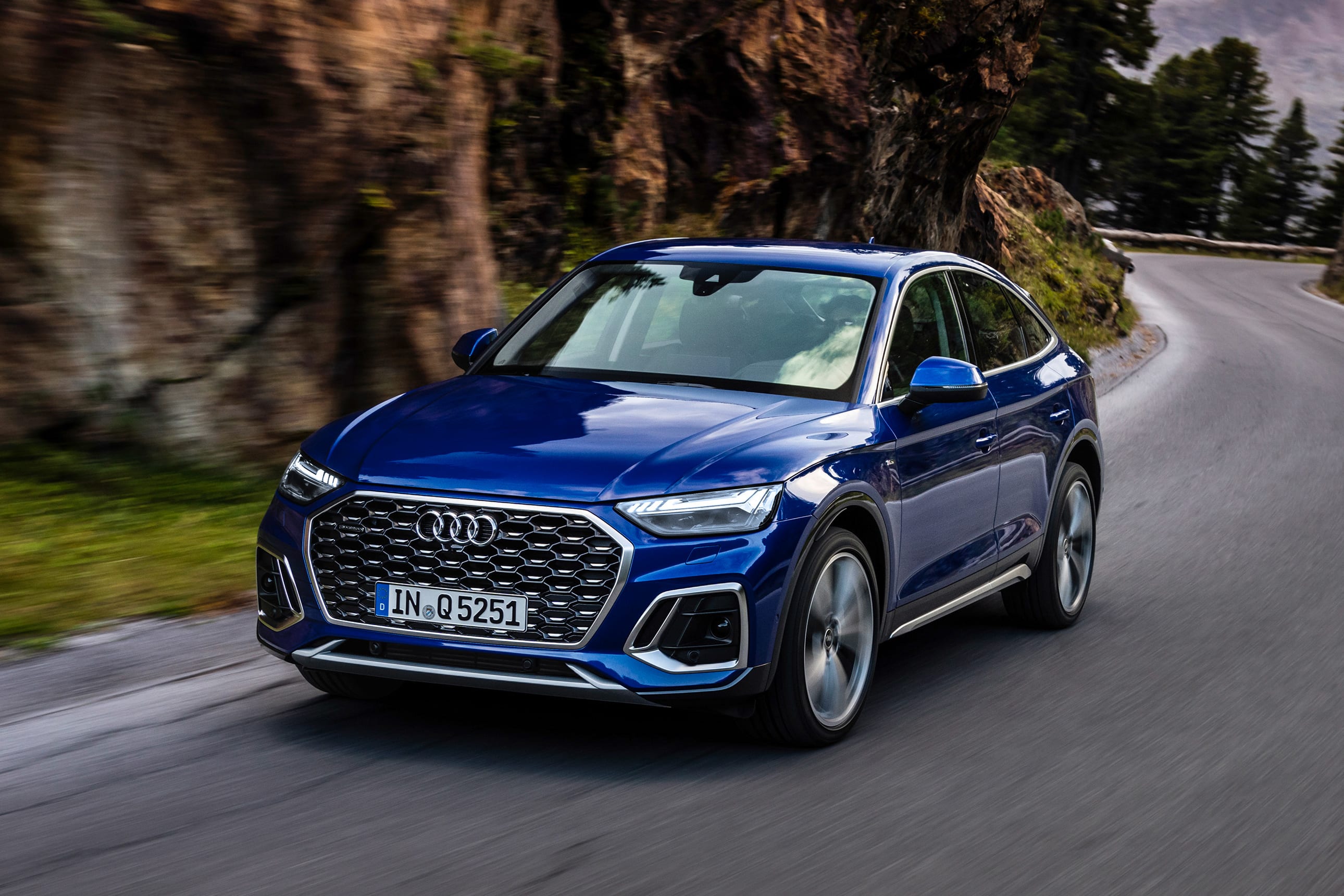
Audi Australia is preparing showrooms to take delivery of the new Q5 Sportback range ahead of its August arrival locally, joining the standard Q5 and SQ5 line-up.
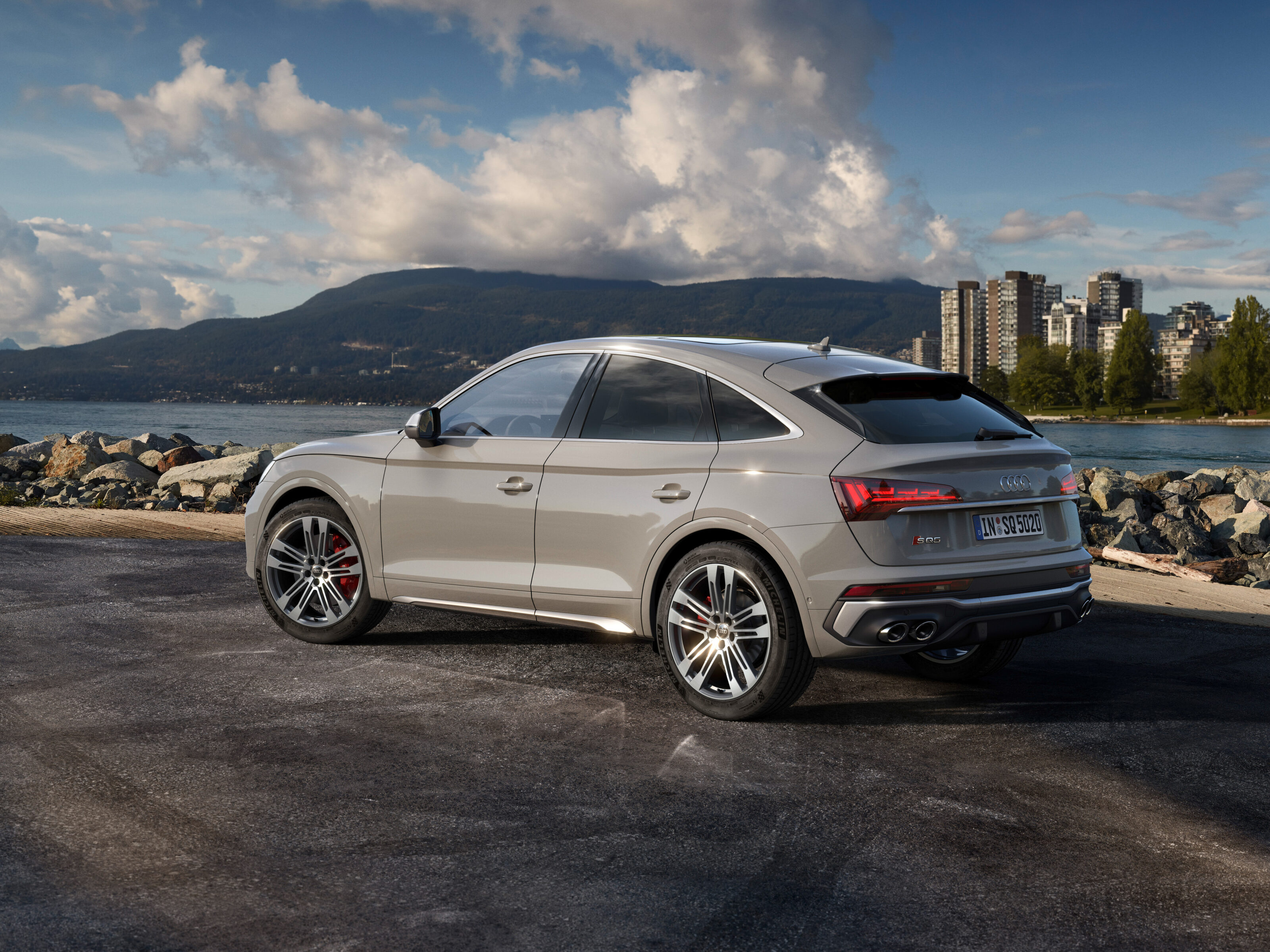
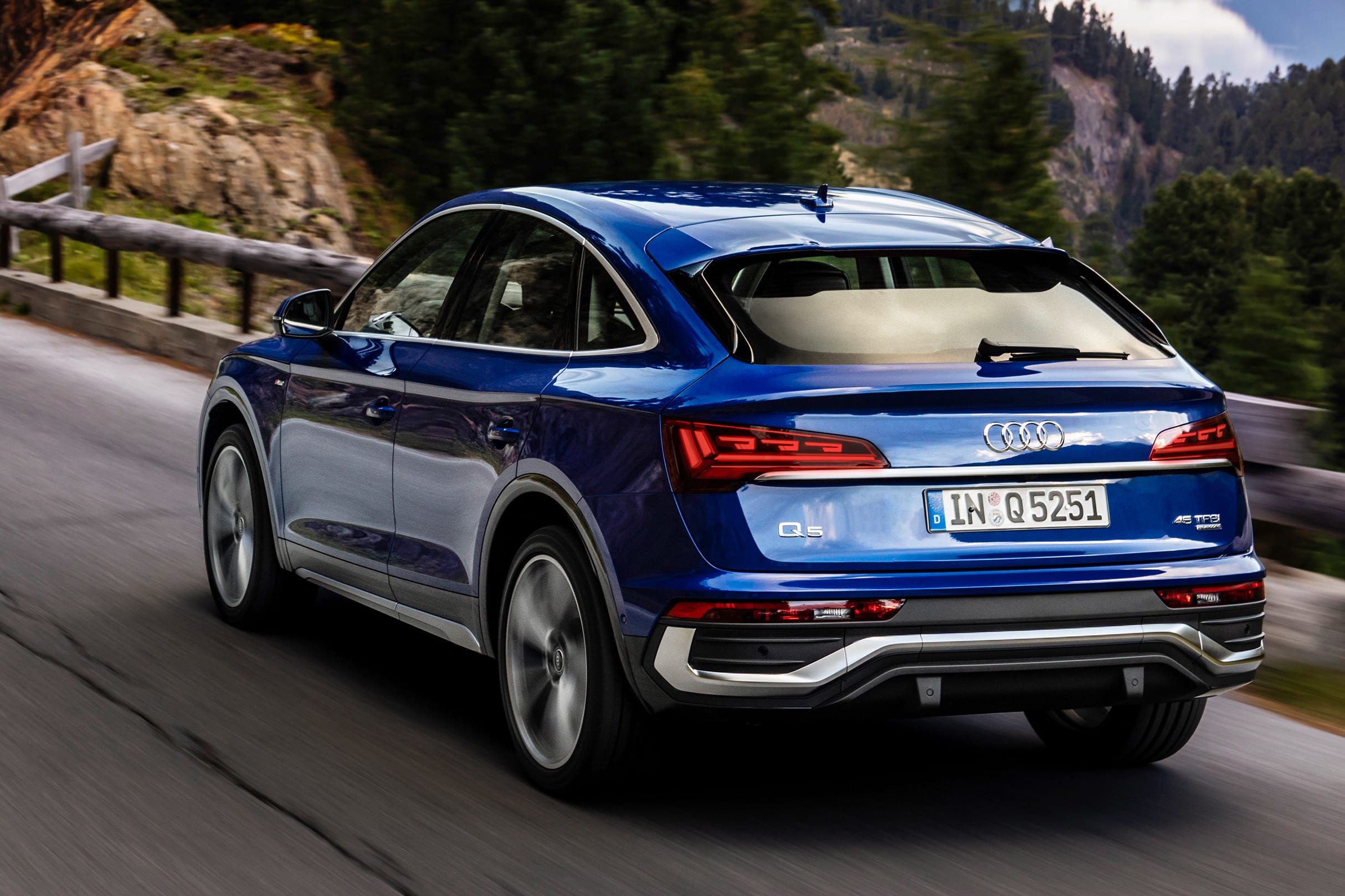
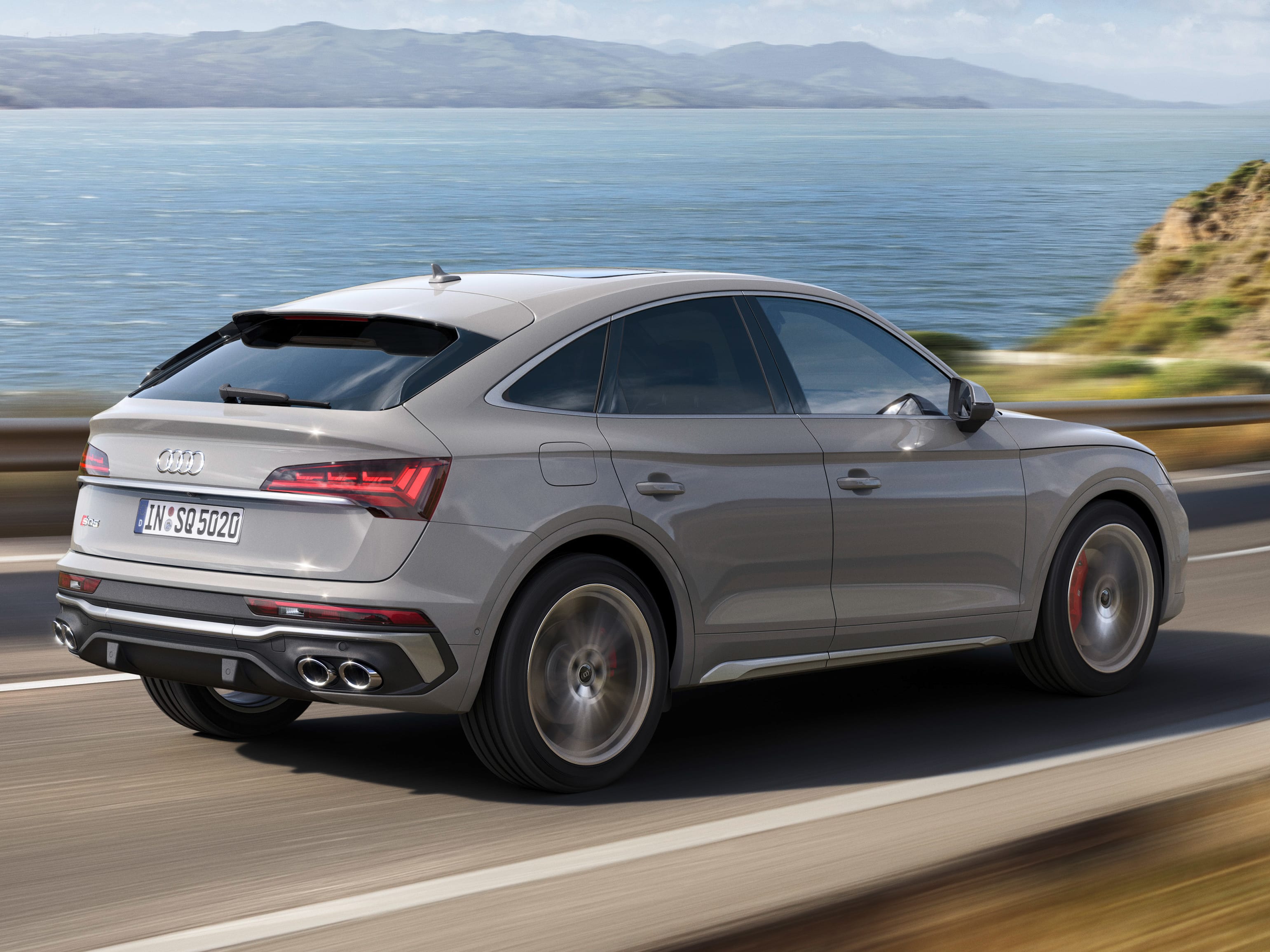
The Sportback is underpinned by the same platform as the existing Q5 but features a sharper, more aggressive rear design, available in three trim options at a starting price of $77,700 before on-road costs.
Despite the angular back end, the Sportback only loses 10 litres of boot storage space over the normal Q5, now standing at 510 litres of space.
Pricing
While the Q5 Sportback range is mechanically identical to the regular Q5, the cosmetic changes have justified a price increase over the existing cars with the biggest jump coming for the SQ5, now $6000 more than the traditional five-door equivalent.
All prices are before on-road costs.
| Q5 Sportback 40 TDI quattro S line | $77,700 |
| Q5 Sportback 45 TFSI quattro S line | $86,300 |
| SQ5 Sportback TDI | $110,900 |
It’s worth noting, the S line trim isn’t available with the current Q5 apart from in the 50TDI, a variant which is a step down from the range-topping, $104,900 SQ5.
Features
The 40 TDI quattro S line is the entry-level trim of the new Q5 Sportback range, providing a base on which the other two variants are modelled. It includes standard equipment such as:
| Five-spoke 20-inch alloy wheels |
| LED daytime running lights, OLED rear lights |
| Sports seats |
| Heated and folding mirrors with auto dim/dip |
| Aluminium trim inserts |
| Gloss black accent surfaces |
| S line door sills |
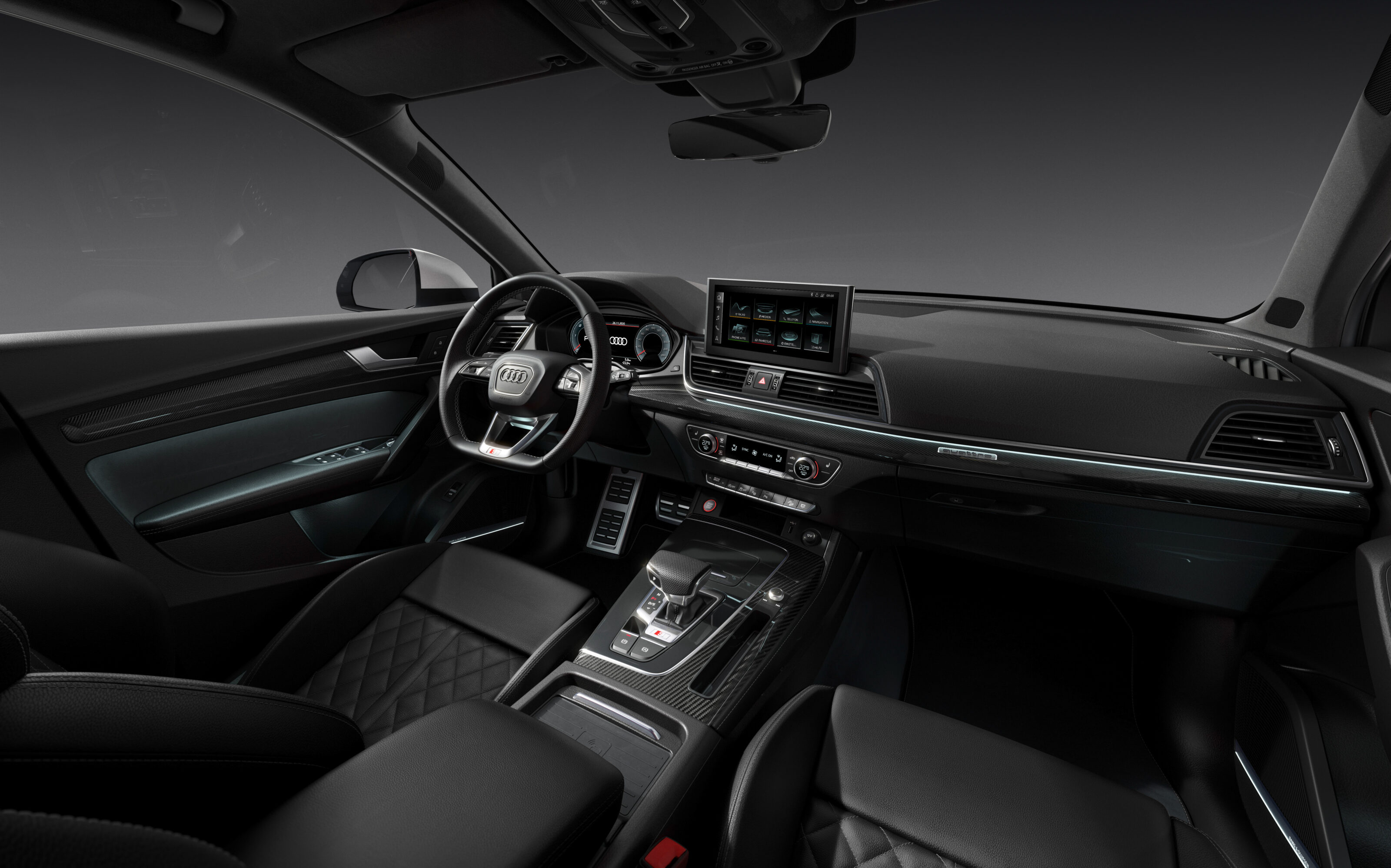
| Virtual cockpit |
| 10.1-inch touchscreen infotainment screen with two simultaneous bluetooth connections, DAB+ radio |
| Android Auto and wireless Apple CarPlay |
| Wireless phone charging, four USB ports (two in rear) |
| Audi connect plus with online traffic, weather conditions, fuel prices, parking information, destination send-to-car and Google Maps |
| Service request and emergency call through MyAudi smartphone app |
On top of this, the 45 TFSI quattro S line scores:
| Audi Sport five-V-spoke 20-inch alloy wheels |
| Matrix LED daytime running lights |
| Diamond stitched Nappa leather upholstery with contrast stitching |
| Brushed matt aluminium inserts |
| Rear bench seat with ability to slide and recline |
Finally, the top-of-the-range SQ5 TDI gains over the 45 TFSI:
| Vertical brackets on front air inlets |
| Matrix LED headlights with automatic high beam, dynamic indicators |
| 21-inch turbine wheels |
| Adaptive damping |
| 19-speaker Bang and Olufsen sound system |
| Ambient lighting quilted Nappa leather sports seats |
All variants are available in a selection of nine exterior colours, with different combinations of interior trim also on offer.
Audi offers a Comfort Package for the 40 TDI and a Technik Package for the 40 TDI and 45 TFSI but has not yet revealed the details or pricing of what is included with these options.
Engine, drivetrain and fuel economy
Mild-hybrid technology features across both Q5 engines, each fitted with 12-volt systems to assist with fuel economy and low-end torque.
The 40 TDI is powered by a 2.0-litre, four-cylinder turbocharged diesel engine, making 150kW of power and 400Nm of torque. WLTP tested fuel consumption of 5.4L/100km means the 40 TDI can go over 1200km on a single, 70-litre tank of fuel, though obviously not at its top speed of 222km/h.
Petrol power is only available in the 45 TFSI, another 2.0-litre, four-cylinder unit which develops 183kW and 370Nm from its mild-hybrid assisted engine. It’s claimed 0-100km/h sprint times are down to 6.3 seconds from the TDI’s 7.6 second marker.
As the range-topping variant, the SQ5 makes the most power and torque thanks to its 3.0-litre, V6 turbo-diesel engine which also features 48-volt mild-hybrid assistance. This bumps the figures up to 251kW and 700Nm, with peak torque available from 1750rpm.
A 0-100km/h time of 5.1 seconds is claimed for the SQ5, as is the WLTP tested fuel consumption figure of 7.1L/100km, while CO2 emissions stand at 186g/km.
Both Q5 variants are mated to a seven-speed dual-clutch automatic gearbox, while the SQ5 delivers its power through an eight-speed torque-converter auto – all featuring Audi’s Quattro all-wheel-drive system.
Safety
Retaining the five-star ANCAP safety ratings of the Q5 and SQ5, the Sportback range benefits from a range of safety tech on-board to protect its occupants, including:
| Eight airbags |
| Autonomous emergency braking |
| Pedestrian detection |
| Attention assist |
| Side assist |
| Active lane assist (with lane change warning) |
| Exit warning |
| Hill descent control |
| Cross traffic assist rear |
| Hold assist |
| Park assist |
| Parking system plus with reversing camera |
| Tyre pressure monitor |
| 360-degree cameras |
| Adaptive cruise control with traffic jam assist (45 TFSI and SQ5) |
Warranty and servicing
The Q5 and SQ5 Sportback models are sold under Audi’s three-year/unlimited kilometre warranty in Australia, with five-year service plan packages available for both, setting buyers back $3140 for the Q5 and $3170 for SQ5.
Availability
Audi expects deliveries to begin for the Q5 and SQ5 Sportback in August this year.
Kia’s persistence with small cars in the face of the SUV tidal wave is commendable and shrewd. As other makers – let’s call them heavyweights with a nervous disposition – abandon the segment or go completely berserk with the pricing, Kia stays the course. Staring them down. Growing market share. Selling cars.
Each of its small car offerings – and I’m bracketing micro, light and small under that umbrella – has a performance-oriented version, too, to drag in the [insert preferred gender here]-racers who don’t want that gutless SUV. There’s the Picanto GT I enjoyed quite recently, the Cerato GT that also amused me and the third of the Gangnam Triumvirate (Kia’s head office is in Gangnam, that’s not a lazy, outdated cultural reference) is the Goldilocks Rio GT-Line.
Bigger wheels, firmed-up suspension and the Picanto GT’s three-cylinder, the Rio GT-Line undercuts the Swift Sport by a very comfortable margin while also giving Kia’s small car buyers yet another choice.
Pricing and Features
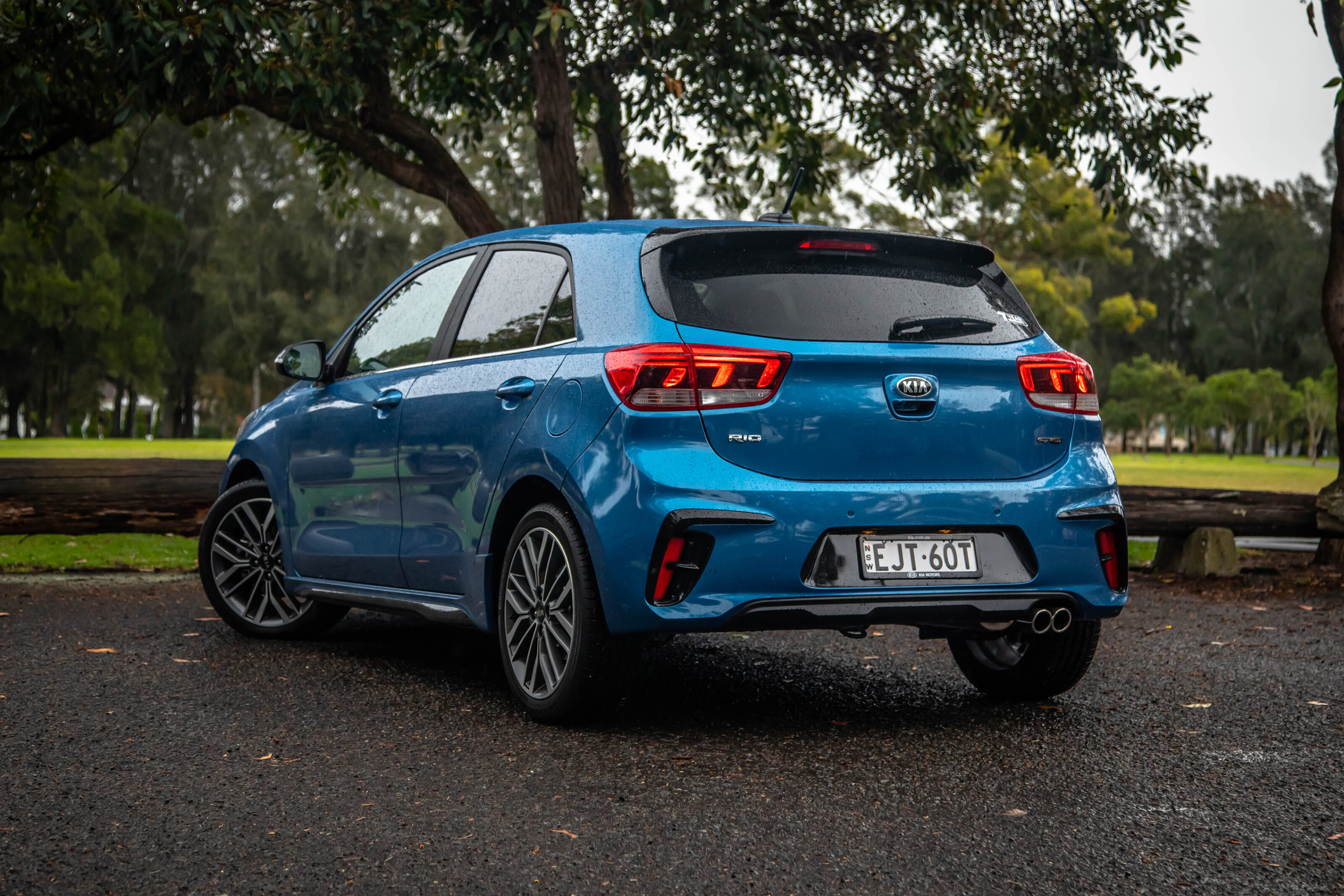
The GT-Line lands on your driveway at the drive-away price of $25,990, easily two grand cheaper than a manual Swift Sport and four grand beneath the six-speed auto, both of which are before on-roads. There’s not much else in the segment and really, the two cars aren’t comparable for a variety of reasons. A Swift Turbo is probably closer to the mark, but it’s not as sharp to drive.
Curiously, the Rio GT-Line is also much more affordable than the higher-riding Stonic GT-Line that is quite obviously a Rio in SUV fancy pants, so it’s a bit of a mystery to me as to why you wouldn’t save the money and take the hatchback. If you do, you can feel smug about that.
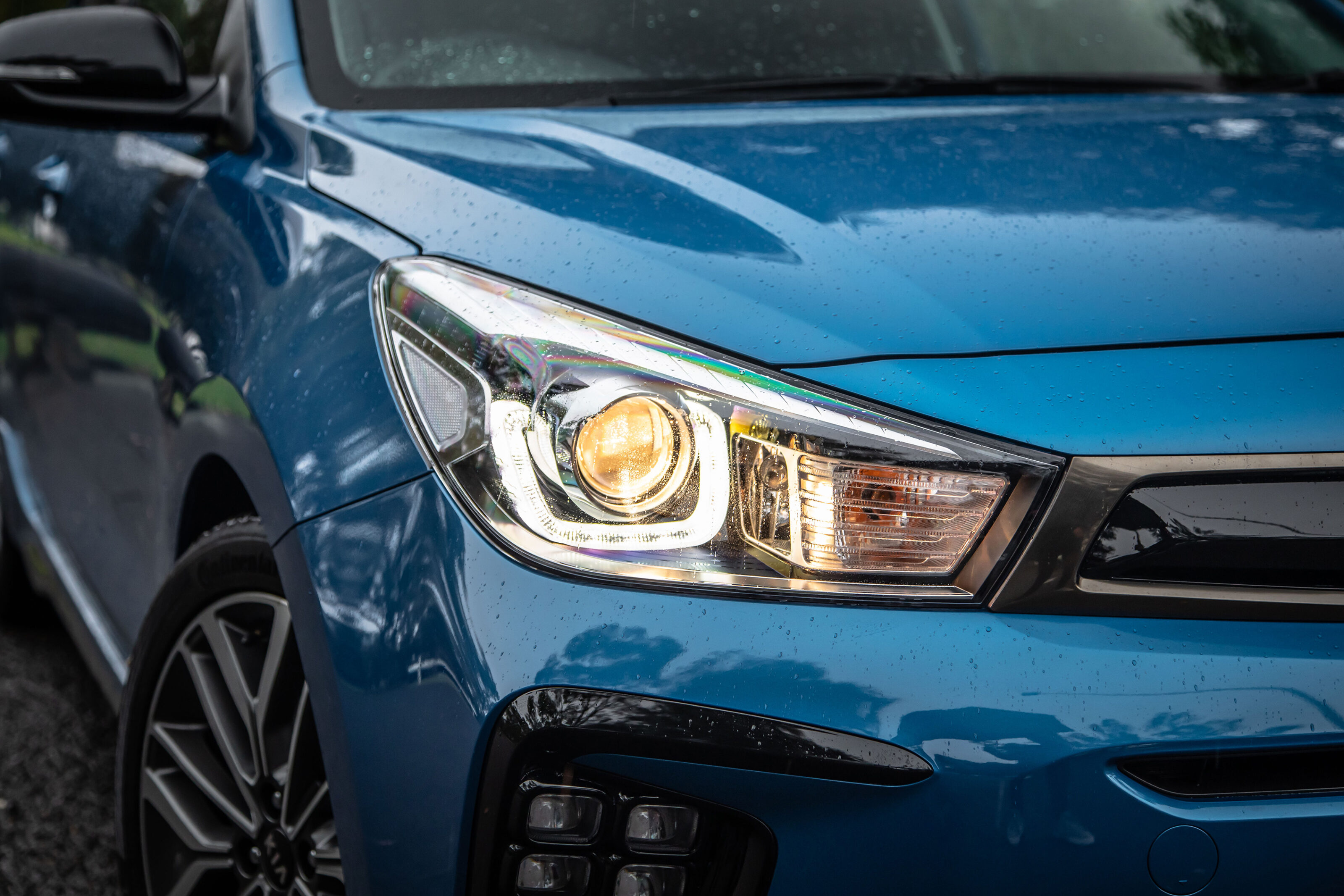
Rio GT-Lines come with neat cloth trim on slightly sportier seats, climate control, 17-inch alloys, GT-Line body kit, remote central locking, auto LED headlights, reversing camera, rear parking sensors and alloy sports pedals.
Kia’s persistence with small cars in the face of the SUV tidal wave is commendable and shrewd. As other makers abandon the segment, Kia stays the course.
The 8.0-inch touchscreen hosts wireless Apple CarPlay and Android Auto. That’s the good news. While I don’t have Android and can’t comment, the CarPlay connectivity needs some work. Every two or three times I got into the car it just wouldn’t connect and couldn’t be fixed on the fly. Annoying. On top of that, the screen needed a good stab for it to respond, which was distracting.
It’s a nice cabin, though. While not as good as Kia’s more recent efforts, it looks good and feels fine in most places. I quite like the vertically oriented air vents and the big touchscreen throws its tech weight around to lift the cabin ambience, along with the white piping, some nice textured materials and satin finishes.
The Rio’s five-star ANCAP rating from 2017 comes courtesy of six airbags, the usual braking and slippery stuff mitigation and forward AEB (high and low speed), lane-keep assist, blind-spot monitoring, forward collision warning, as well as two ISOFIX points and three top-tether points.
You can choose from six colours but five of them cost a very stiff $520 extra.
Comfort and Space
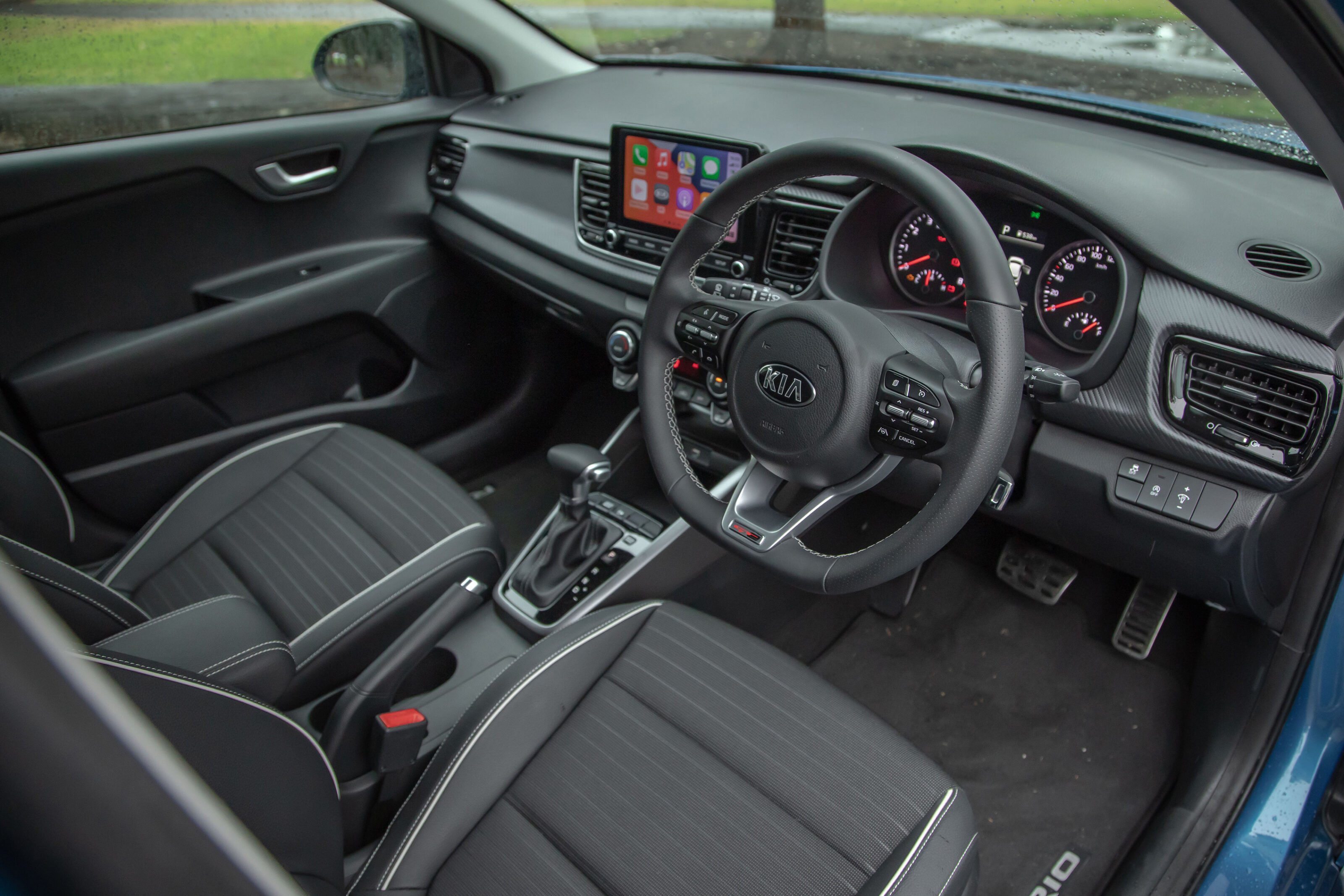
It’s a small car, so you don’t have a lot of room to play with. It has five doors, so access to the adequate back row is easy enough but you’ll literally be up against it if the driver has any height on them at all. Three across the back might trigger a trip to The Hague for the driver if it’s for any long period of time, but the seating itself is comfortable. It’s a bit sparse, apart from the USB port for charging.
All four passenger doors have bottle holders but the lack of rear armrest means just the two cupholders up the front. Under your elbow in the front is a small bin and forward of the shifter you can precariously place your phone while it charges from either the two USB ports or the 12-volt port.
The boot is a handy 325 litres – that’s good for this segment – and expands to nearly 1000 litres with the seats down. It’s not a flat floor, of course, but the room is usable. Underneath the boot floor is a space-saver spare.
On the Road
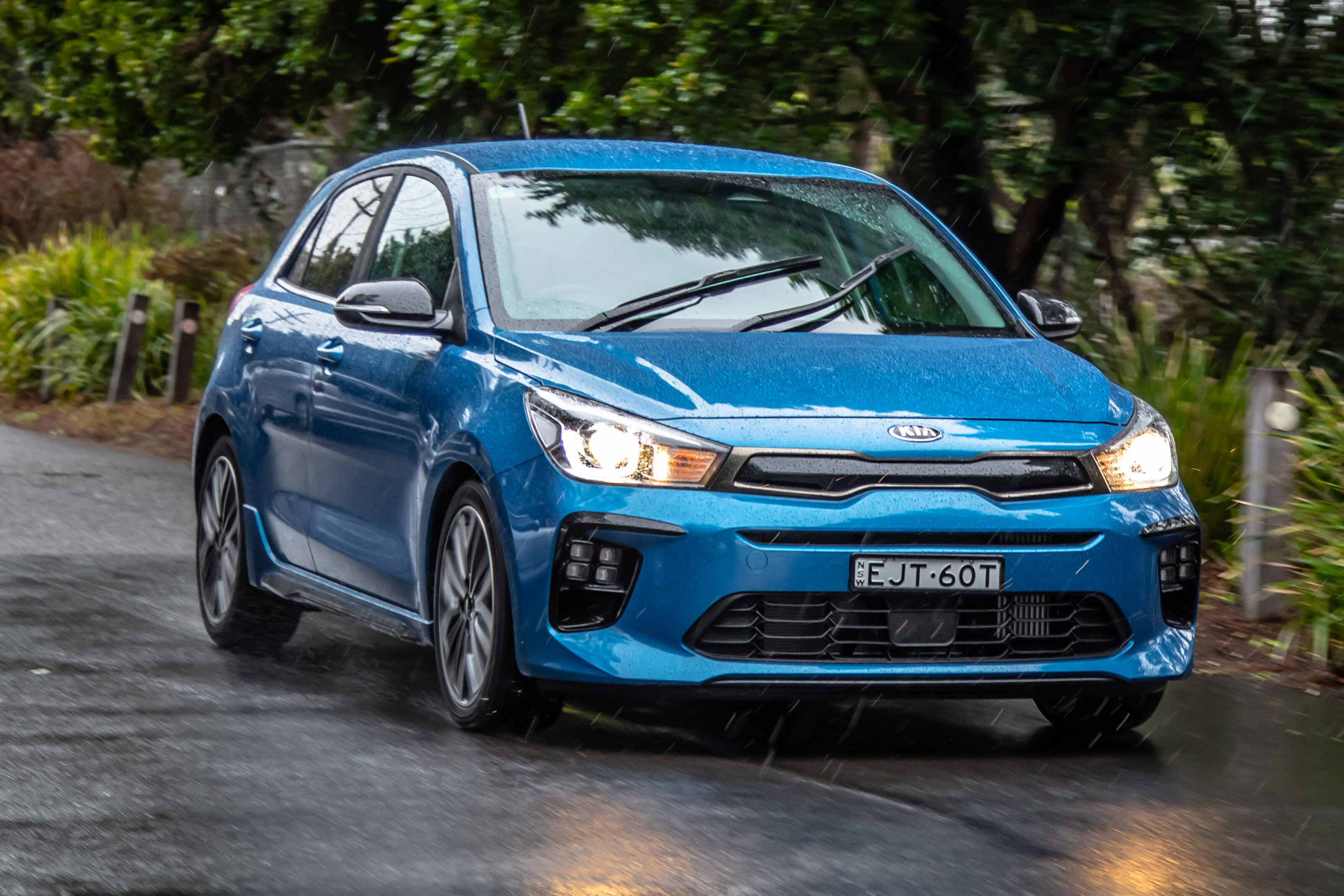
The Picanto GT’s 1.0-litre three-cylinder petrol presents itself here in the same 74kW/172Nm setup, with the former available at 4500rpm and the latter from 1500-4000rpm. Some of you are about to hit the comments with, “This clown hasn’t done his homework, it’s 88kW.” Well, it used to be, but since mid-2020 (I will forgive you for missing this during last year’s absolute cluster), power is down to 74kW for a string of reasons involving Europe, mild hybridisation, 48-volts and, presumably, two priests, one young and one old.
A hot hatch it isn’t, but that’s why it’s called GT-Line, I guess. The firmer damping is immediately obvious and the steering seems a bit more chipper – if still completely lacking in feel – than the basic car’s setup. Because it weighs next to nothing it’s a genuinely chuckable car, with decently sticky Continental tyres holding on gamely before the inevitable, gentle understeer. The ride is a bit rugged over less than perfect surfaces, so you’ll have to think about how much you can cop. It’s better than the just-replaced Cerato GT and no worse than the Picanto, apart from the racket from ridges and rubber speed bumps.
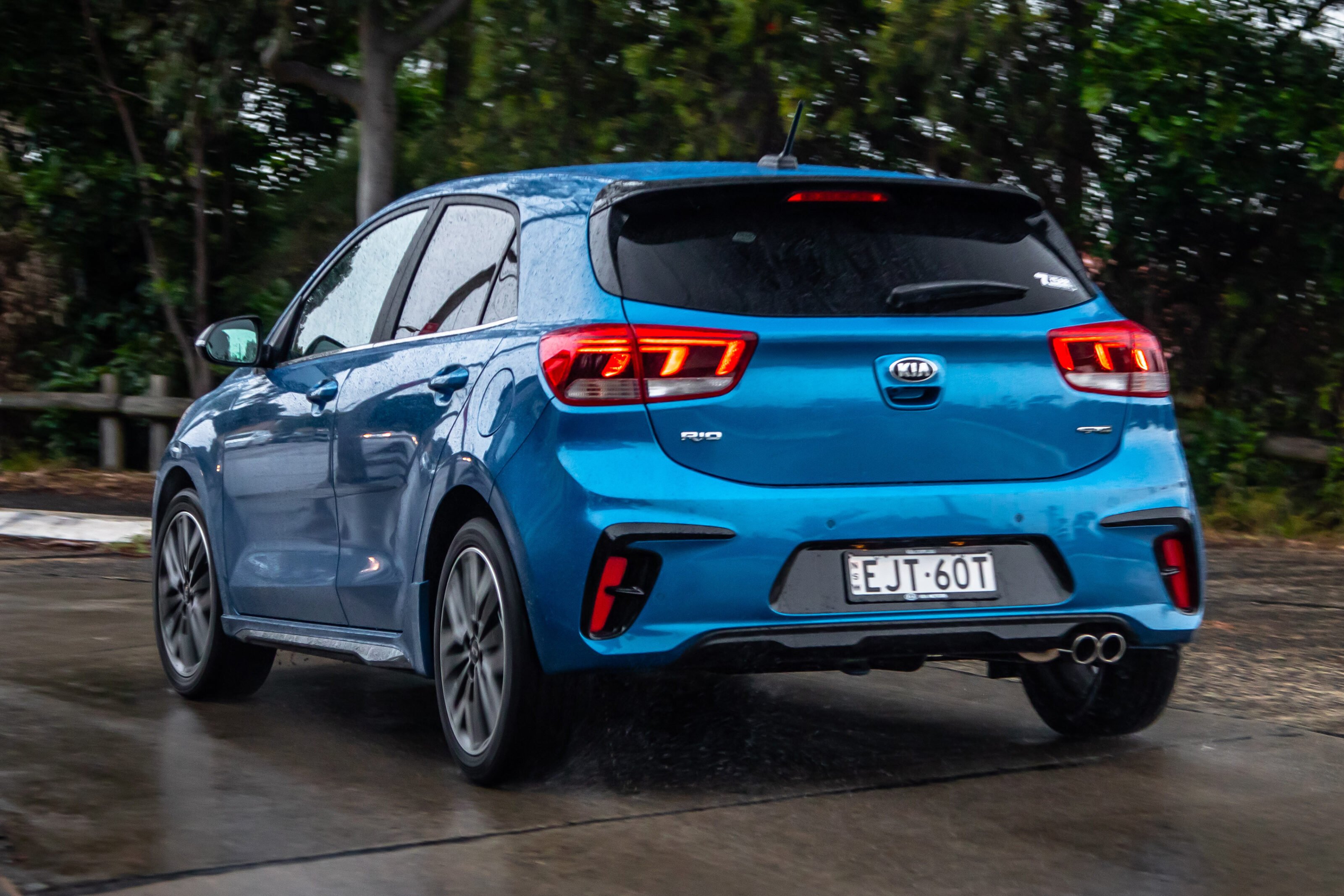
The tyres and rear torsion beam ensure a fair bit of noise gets into the cabin, but it’s not excessive. There aren’t many super-quiet cars at this level and the quiet ones contain a lot of German words and much higher prices. The best noise that does reach your ears is the enthusiastic growl of the three-cylinder. It’s fizzy and fun and it would be even better with paddle-shifters to keep it where you want it.
And that’s the thing – the engine is somewhat let down by the seven-speed dual-clutch auto. That shouldn’t come as a terrible shock to anyone as it’s not great in any of the Kia and Hyundai cars in which you’ll find it. It dithers off the line and can be a bit clunky when the engine wakes from sleep. I found it indecisive in traffic but once you’re on the freeway, it’s quick to make up its mind.
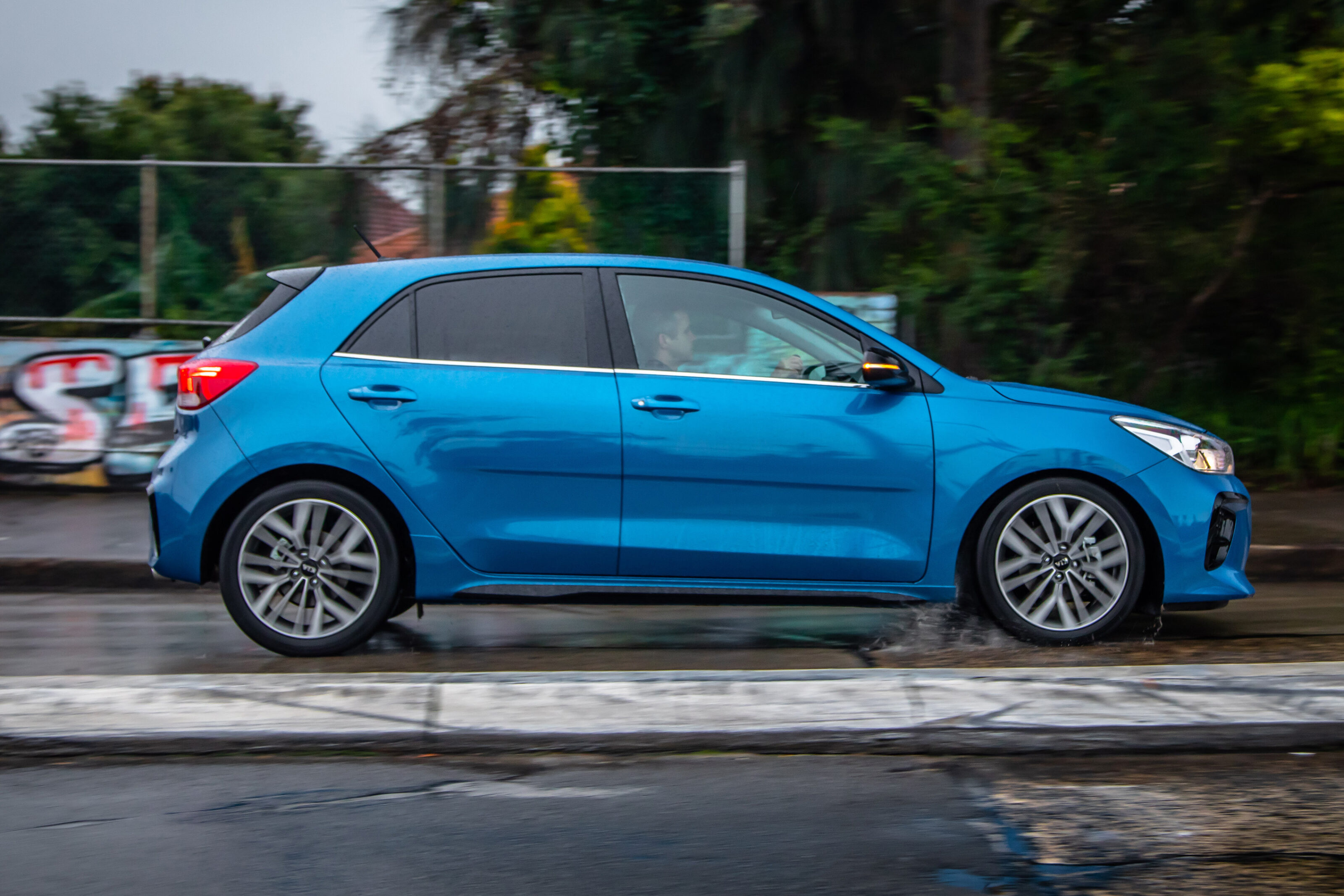
Hilariously, I had to give up trying to back up a hill into a parking space – admittedly it was steep – because the dual-clutch transmission just did not want to play ball. It was trying – I could smell it. I’m willing to believe that there was something wrong with this particular car because I’ve never had that before and this is my third run in the Rio GT-Line in as many years. Worth checking if you have a steep driveway or you live in Tamarama or something.
Probably the biggest issue is the propensity for the long front overhang to scrape on even gently sloping driveways. You’re not hitting anything important – Kia has thoughtfully fitted a tough plastic skirt that cops a hammering – but it got old pretty quickly.
Kia rather optimistically says you’ll use 5.3L/100km on the combined cycle. In a week of varied driving I got an indicated 7.2L/100km, which did involve some feverish inner-city searches for a parking space when I was running late for, well, everything.
Ownership
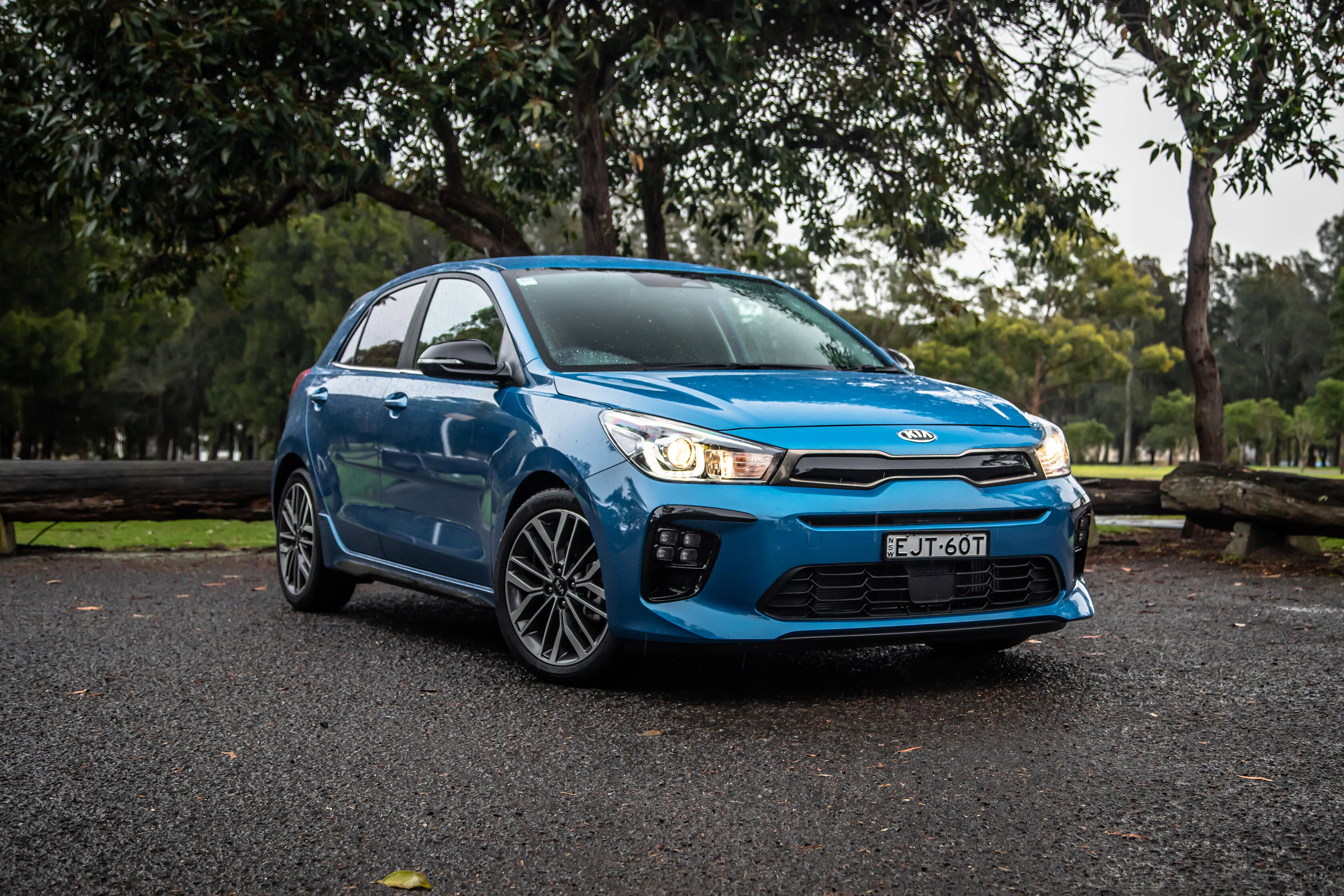
Kia’s ever-thoughtful and wildly popular seven-year warranty and roadside assist package endures and it’s a genuine reason to buy this car.
You also get a seven-service capped-price guarantee that will last for seven years if you cover fewer than 10,000km per year. The turbo engine is a pricey thing to service, though, with costs moving around from $283 to as high as $704. It seems the combination of DCT and turbo pep is responsible for the high fees. Over the seven services, you’ll pay $4299 or an average of just over $470 per pitstop.
VERDICT
The Rio GT-Line is good fun and if it’s fun you’re after, it’s fun you’ll get. It will cheerfully stay with its smaller sibling, the Picanto GT, while offering more space, a bit more comfort and a bit more style over the more basic Rios. It’s starting to feel old, though, which it is.
It’s old-school fun though, with a handy chassis that will keep you smiling on a backroad drive or when you round up a dozing SUV in traffic. The character of the engine goes right through the car, keeping you on your toes and watching for gaps and opportunities.
It’s not the best warm hatch – and yes, that’s a shrinking market – but it’s definitely a lot of fun, which is absolutely the point of it.
2021 Kia Rio GT-Line Specifications
| Body | five-door hatch |
| Drive | FWD |
| Engine | 1.0-litre three-cylinder turbo-petrol |
| Transmission | seven-speed twin-clutch |
| Power | 74kW @ 4500rpm |
| Torque | 172Nm @ 1500-4000rpm |
| Bore stroke (mm) | 71.0×84.0 |
| Compression ratio | 10.0:1 |
| 0-100km/h | 11 sec (estimate) |
| Fuel consumption | 5.3L/100km (combined) |
| Weight | 1176kg |
| Suspension | McPherson struts front / torsion beams rear |
| L/W/H | 4070mm/1725mm/1450mm |
| Wheelbase | 2580mm |
| Brakes | 280mm ventilated disc front / 262mm solid disc rear |
| Tyres | 205/45R17 |
| Wheels | 17-inch wheels (full-size steel spare) |
| Price | $25,990 drive-away |
