
Snapshot
- EQA350 4Matic adds all-wheel-drive to the line-up
- Acceleration closer to hot-hatch territory
- The compromise? Shorter driving range
New 2021 Mercedes-Benz EQA 350 and EQA 300 electric SUV variants have been revealed today, following January’s global debut of the EQA 250.
It’s the EQA 350 that will be of interest to Australian buyers, joining the EQA 250 as a new top-shelf option for those seeking more power and the security of all-wheel drive.
The EQA 250 will be the first to touch down, with first deliveries due in June, while the EQA 350 4Matic will be here “before the end of the year”. Specific timing, and pricing, is still to be confirmed.
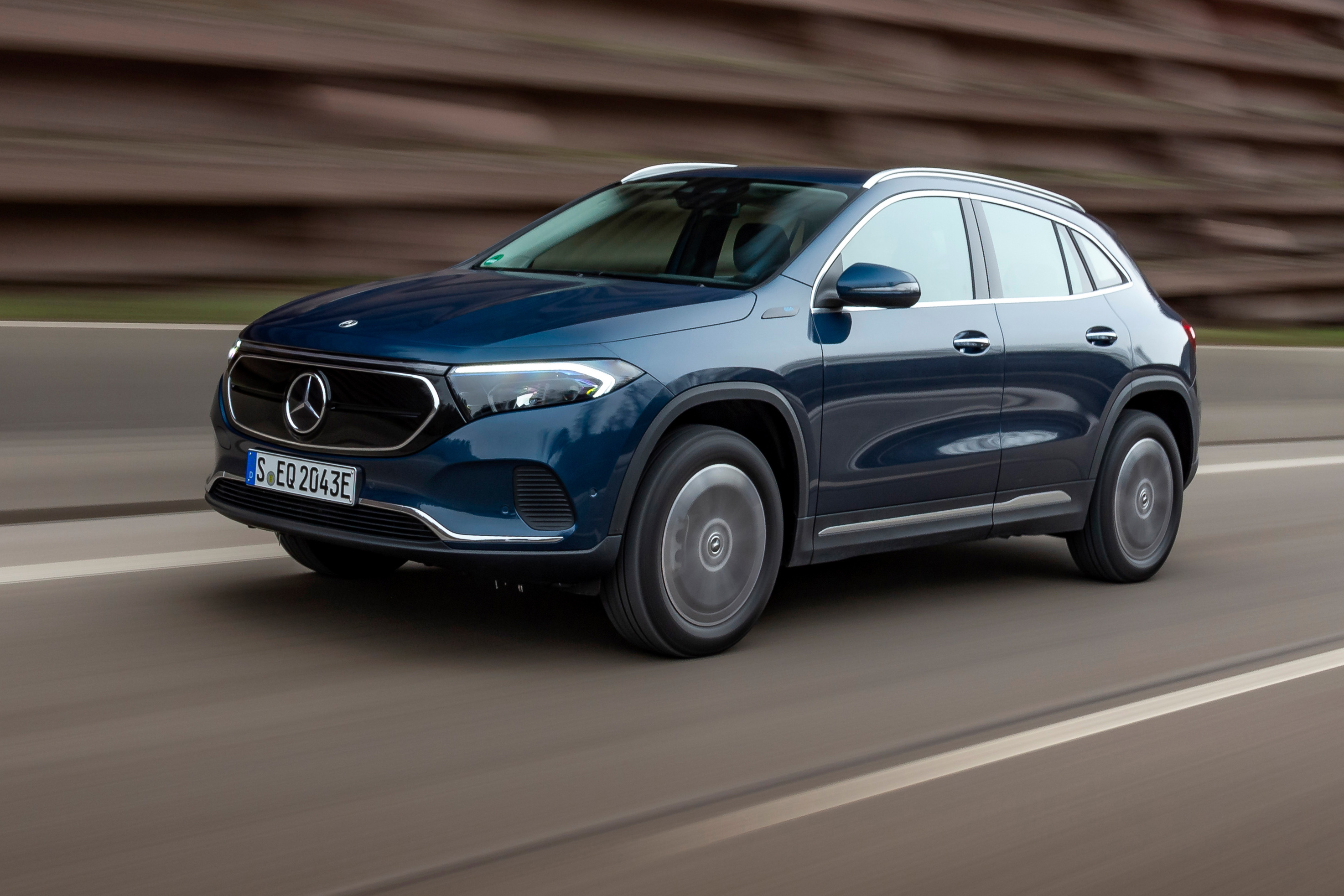
In 250 form, the EQA features a 140kW/375Nm motor sending power to the front wheels. Mercedes-claims a driving range of 480 kilometres and a 0-100km/h time of 8.9 seconds – not hot-hatch territory, but relatively quick.
That entry-level variant is priced from $76,800 before on-road costs – nearly $65,000 cheaper than the big EQC electric SUV. You can read more about EQA 250 pricing and features here.
For buyers seeking more of (almost) everything, the EQA 350 4Matic will pack the same 66.5kWh battery pack as the EQA 250, but unlike that front-wheel-drive model, the 350 4Matic will feature two electric motors – one at the front axle and one at the rear.
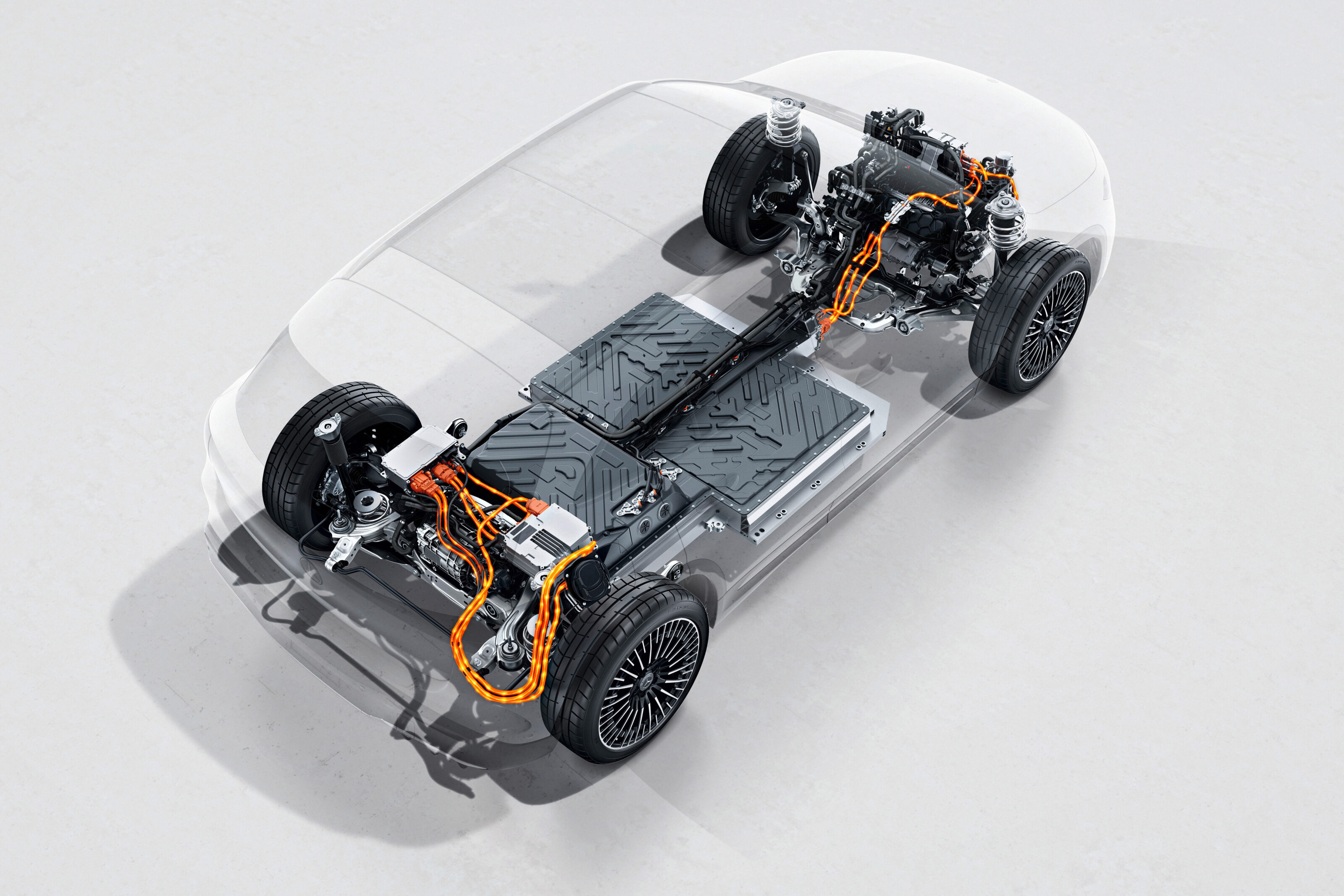
As a 4Matic all-wheel-drive system, power demand between front and rear is controlled 100 times per second.
This combination will offer a hotter 215kW and 520Nm, with a claimed 0-100km/h time of six seconds flat.
That time still falls short of the petrol-powered Mercedes-AMG A35’s 4.7-second run, but the sensation of electric acceleration should leave most buyers satisfied.
As is often the case with more performance-oriented variants, the EQA 350 4Matic has a shorter driving range than the EQA 250, claimed at 409-432 kilometres on the WLTP test cycle.
The EQA 350 4Matic’s maximum charging capacity is 100kW through a DC connection, and Mercedes claims 80 per cent capacity will be achieved in 30 minutes.
When will the EQA350 4Matic come to Australia?
Exact Australian timing for the EQA350 4Matic is still to be revealed, but a debut later this year is confirmed.
Local pricing will be revealed closer to launch. In Germany, the EQA 350 4Matic is priced at the equivalent of AU$87,250 – but buyers there also benefit from a 5000 euro (AU$7755) federal government ‘environmental bonus’ subsidy.
Further details on the EQA 350 4Matic will come later this year. Until then, you can learn more about the EQA 250 at our links below.
Nissan Australia has recalled 73 of its Navaras over an issue with its child restraint system.
The fault identified involves the system’s top tethers on the 2015 D23 Navara which “may not be strong enough to keep a child seat securely fastened and may break during an accident”.
According to Product Safety Australia, if the tethers break or the child seat is not securely fastened, the child may not be adequately restrained in their seat during an accident, which could cause serious injury or death.
Nissan has compiled a list of the affected vehicles’ VINs.
Owners should contact their preferred Nissan dealer to organise for the top tethers to be replaced, free of charge.
For further information, contact the Nissan Customer Service Centre on 1800 035 035 (Monday to Friday, 8:30am to 6:00pm AEST) or visit: https://www.nissan.com.au/find-a-dealer
Talking points
- 718 Boxster and Cayman now come with metallic paint and Power Steering Plus as standard
- 911 and Cayenne score new PCM MIB3
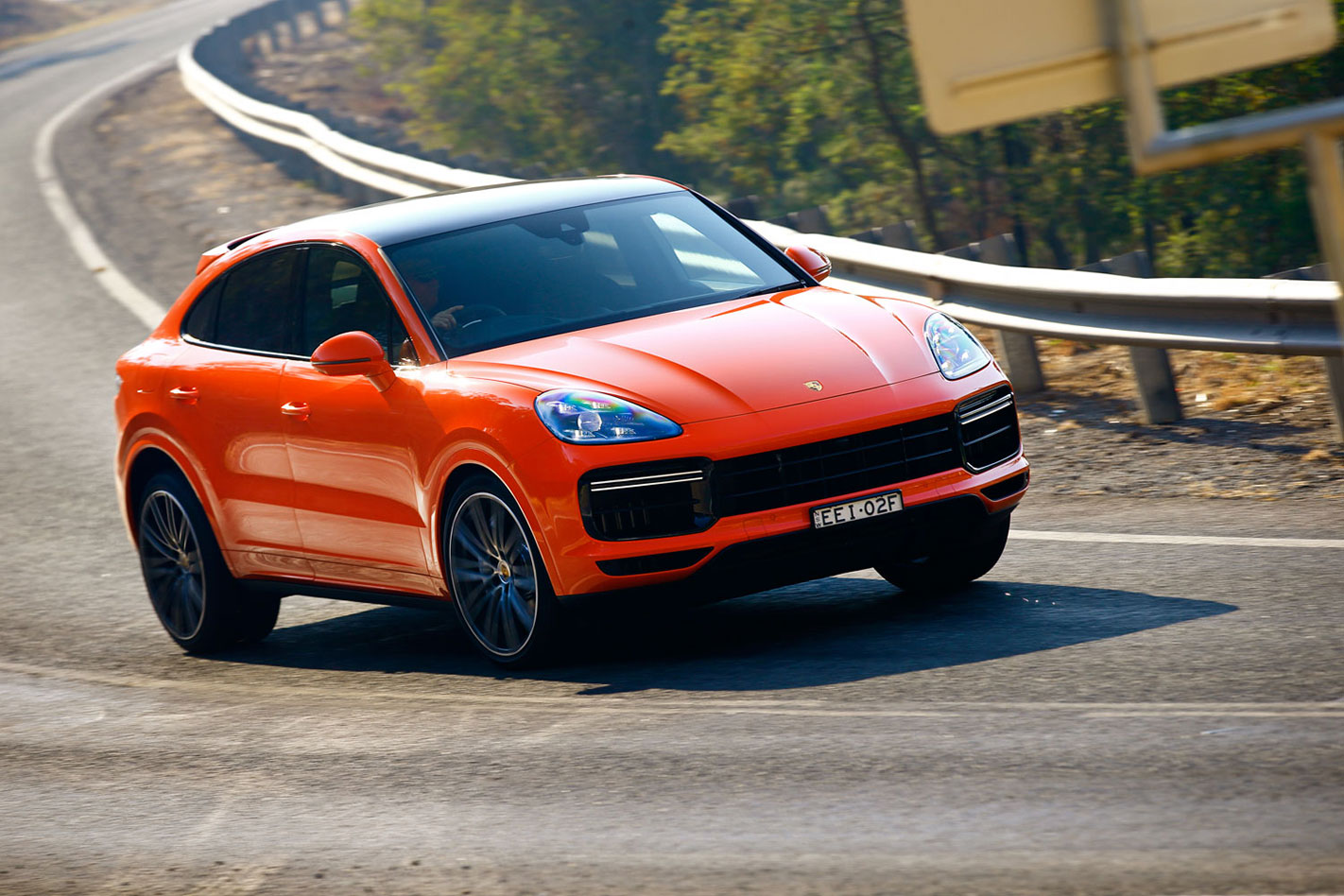
Porsche has announced details about 2022 model year updates for its 911, 718 Boxster and Cayman, and Cayenne range.
The biggest update for both 911 and Cayenne is the introduction of the automaker’s latest Porsche Communication Management (PCM) system.
The infotainment will now utilise the MIB3 version of Porsche’s PCM, which we’ve previously seen on the Stuttgart firm’s all-electric Taycan.
Porsche’s Dynamic Light System (PDLS) comes as standard on the Cayenne and Cayenne E-Hybrid too, and Adaptive Cruise Control (ACC) is now standard across the entire Cayenne and Cayenne Coupe range.
Active Lane Keep Assist is now a no-cost option on the top-shelf Cayenne Turbo and Turbo S as well.
For the 718 Boxster and Cayman, Porsche has made previously optional features such as metallic paint and Power Steering Plus standard across all variants.
These updates have, however, come at an extra cost, with all three models witnessing price rises across the board.
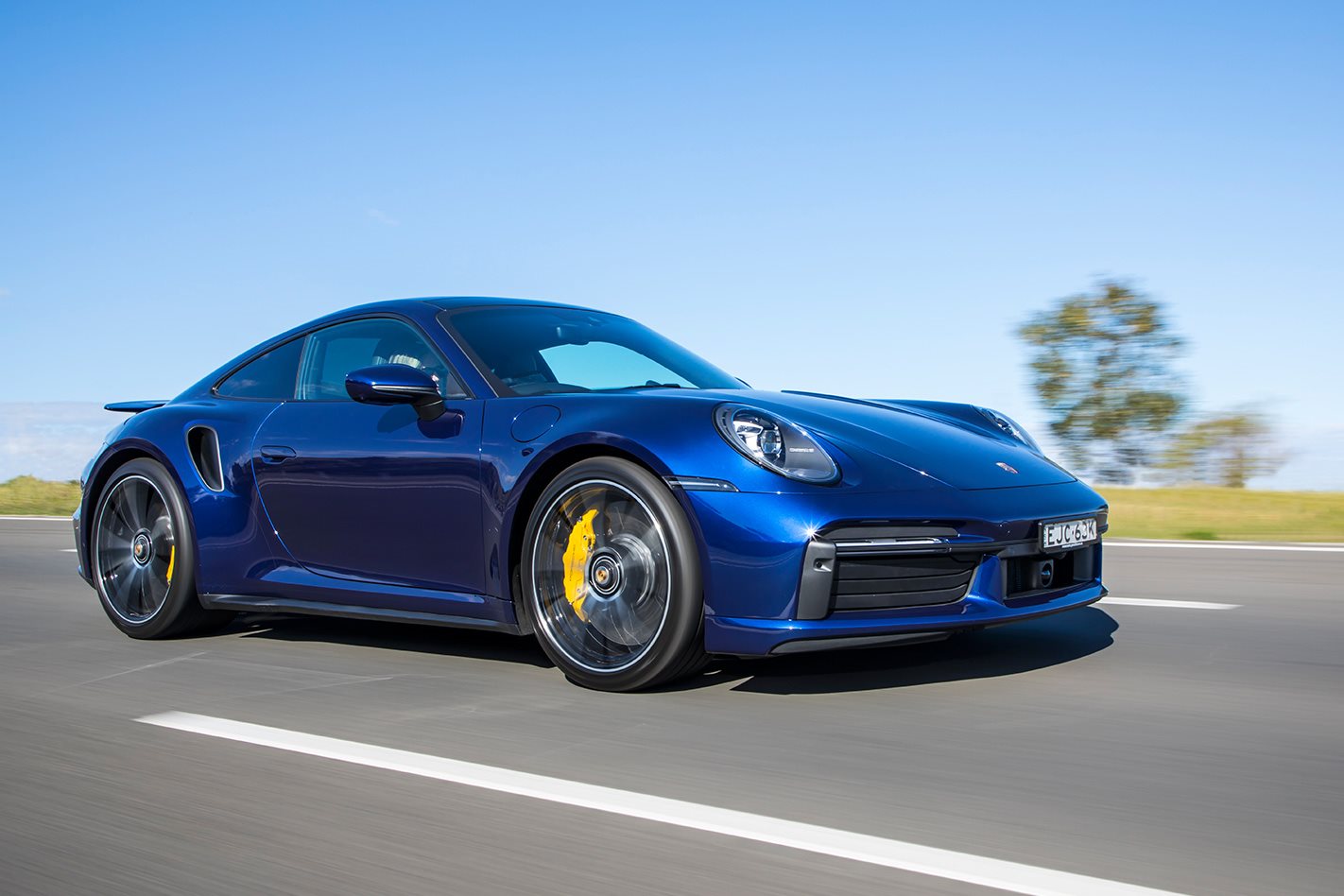
The base 992 911 Carrera now retails for $241,300, which is $5000 dearer than the previous model year car.
Likewise, the cheapest Cayenne now costs $128,200 (up $6900), while the entry-level 718 Boxster and Cayman will set prospective buyers back $118,800 (up $2900) and $116,000 (up $2900), respectively.
The price changes took effect on May 1 2021, and are frankly unsurprising given many other brands in the Aussie market are updating prices as well.
Below is a full list of prices for the 2022 Porsche 911, 718 Boxster and Cayman, and Cayenne:
Porsche 718 Boxster
Porsche 718 Boxster $118,800 (6-speed manual) $120,732.50* (7-speed PDK)
Porsche 718 Boxster S – $142,400 (6-speed manual), $146,980 (7-speed PDK)
Porsche 718 Boxster GTS 4.0 – $178,000 (6-speed manual), $183,390 (7-speed PDK)
Porsche 718 Boxster 25 Years – $187,300 (6-speed manual), $192,690 (7-speed PDK)
Porsche 718 Spyder – $200,700 (6-speed manual), $205,280 (7-speed PDK)
Porsche 718 Cayman
Porsche 718 Cayman – $116,000 (6-speed manual), $117,932.50 (7-speed PDK)
Porsche 718 Cayman S – $139,600 (6-speed manual), $144,180 (7-speed PDK)
Porsche 718 Cayman GTS 4.0 – $175,200 (6-speed manual), $180,590 (7-speed PDK)
Porsche 718 Cayman GT4 – $210,200 (6-speed manual), $214,780 (7-speed PDK)
Porsche 992 911
Porsche 911 Carrera Coupé – $241,300 (8-speed PDK)
Porsche 911 Carrera 4 Coupé – $258,400 (8-speed PDK)
Porsche 911 Carrera Cabriolet – $263,000 (8-speed PDK)
Porsche 911 Carrera 4 Cabriolet – $280,200 (8-speed PDK)
Porsche 911 Targa 4 – $280,200 (8-speed PDK)
Porsche 911 Carrera S Coupé – $279,600 (8-speed PDK)
Porsche 911 Carrera 4S Coupé – $296,800 (8-speed PDK)
Porsche 911 Carrera S Cabriolet – $301,300 (8-speed PDK)
Porsche 911 Carrera 4S Cabriolet – $318,500 (8-speed PDK)
Porsche 911 Targa 4S – $318,500 (8-speed PDK)
Porsche 911 GT3 – $369,700 (6-speed manual), (7-speed PDK)
Porsche 911 Turbo Coupé – $405,000 (8-speed PDK)
Porsche 911 Turbo Cabriolet – $425,800 (8-speed PDK)
Porsche 911 Turbo S Coupé – $481,700 (8-speed PDK)
Porsche 911 Turbo S Cabriolet – $502,600 (8-speed PDK)
Porsche Cayenne
Porsche Cayenne – $128,200 (8-speed ZF)
Porsche Cayenne E-Hybrid – $148,000 (8-speed ZF)
Porsche Cayenne S – $167,400 (8-speed ZF)
Porsche Cayenne GTS – $198,300 (8-speed ZF)
Porsche Cayenne Turbo – $250,600 (8-speed ZF)
Porsche Cayenne Turbo S E-Hybrid – $296,200 (8-speed ZF)
Porsche Cayenne Coupé – $139,100 (8-speed ZF)
Porsche Cayenne E-Hybrid Coupé – $156,400* (8-speed ZF)
Porsche Cayenne S Coupé – $176,900 (8-speed ZF)
Porsche Cayenne GTS Coupé – $202,100 (8-speed ZF)
Porsche Cayenne Turbo Coupé – $262,300 (8-speed ZF)
Porsche Cayenne Turbo S E-Hybrid Coupé – $299,900 (8-speed ZF)
Talking points
- 992 GT3 Cup Car set for Aussie debut at The Bend
- 4.0-litre flat-six engine now produces 380kW
- Porsche says new GT3 Cup Car will be one per cent quicker than its predecessor on the track
The 2021 Porsche 992 911 GT3 Cup Car has officially landed Down Under, and it’s already headed to the racetrack.
The latest homologation racer from the Stuttgart firm will be shown to local customers for the first time at this weekend’s OTR Supersprint race meeting at The Bend Motorsport Park in South Australia.
The Bend will also play host to round two of the Porsche Paynter Dixon Carrera Cup Australia.
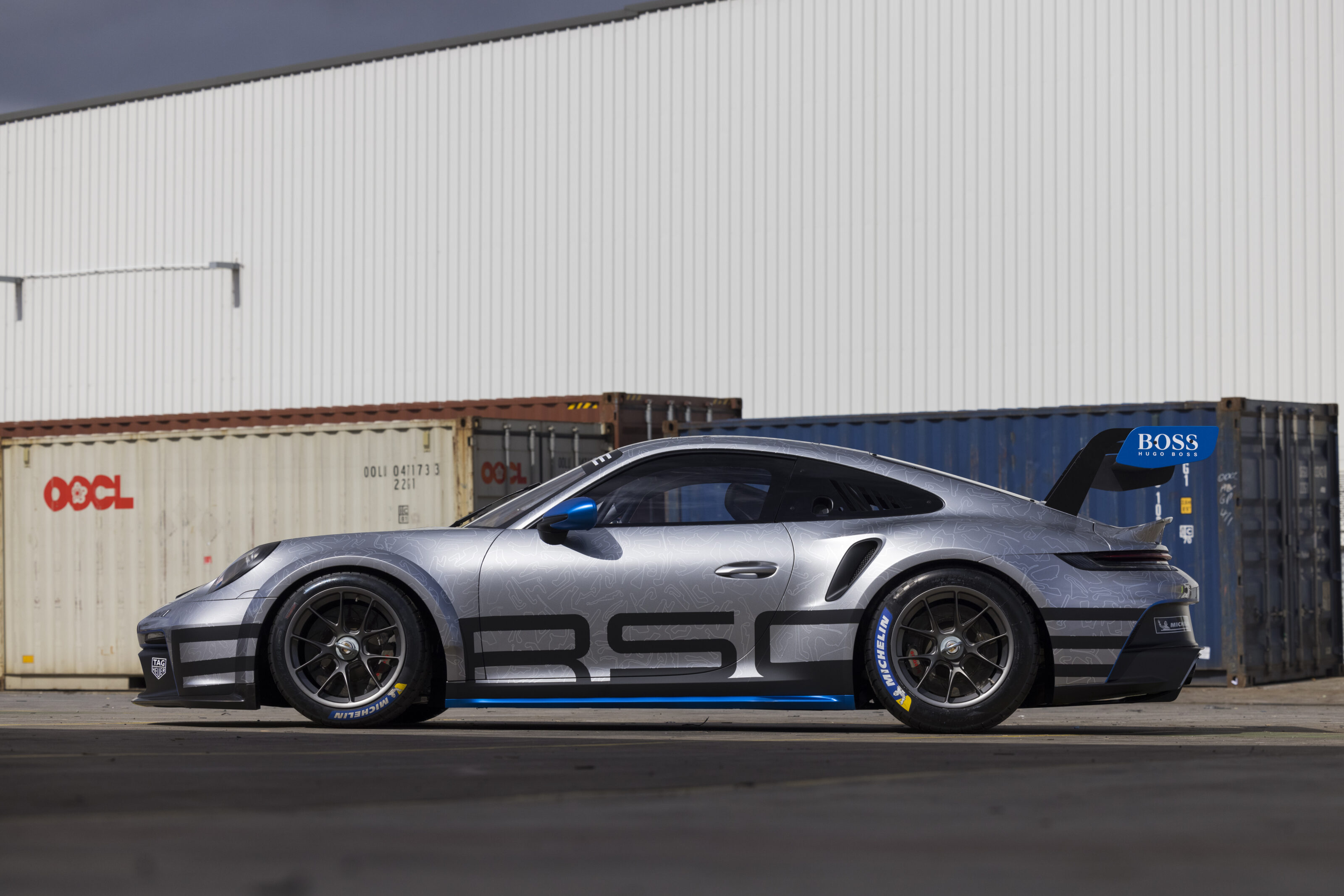
The new GT3 Cup has, according to Porsche, already garnered a huge amount of interest from buyers in both Australia and New Zealand, ahead of its local introduction in the Carrera Cup Australia series in 2022.
“We’ve been overwhelmed by the interest shown in the new 992 GT3 Cup car to date and we are currently assessing all of the expressions of interest we’ve received from motorsport customers across Australia and New Zealand,” said Troy Bundy, Porsche Cars Australia’s Head of Motorsport.
“Given the quality and calibre of the drivers interested, the 2022 grid will be one of the strongest in the series history.”
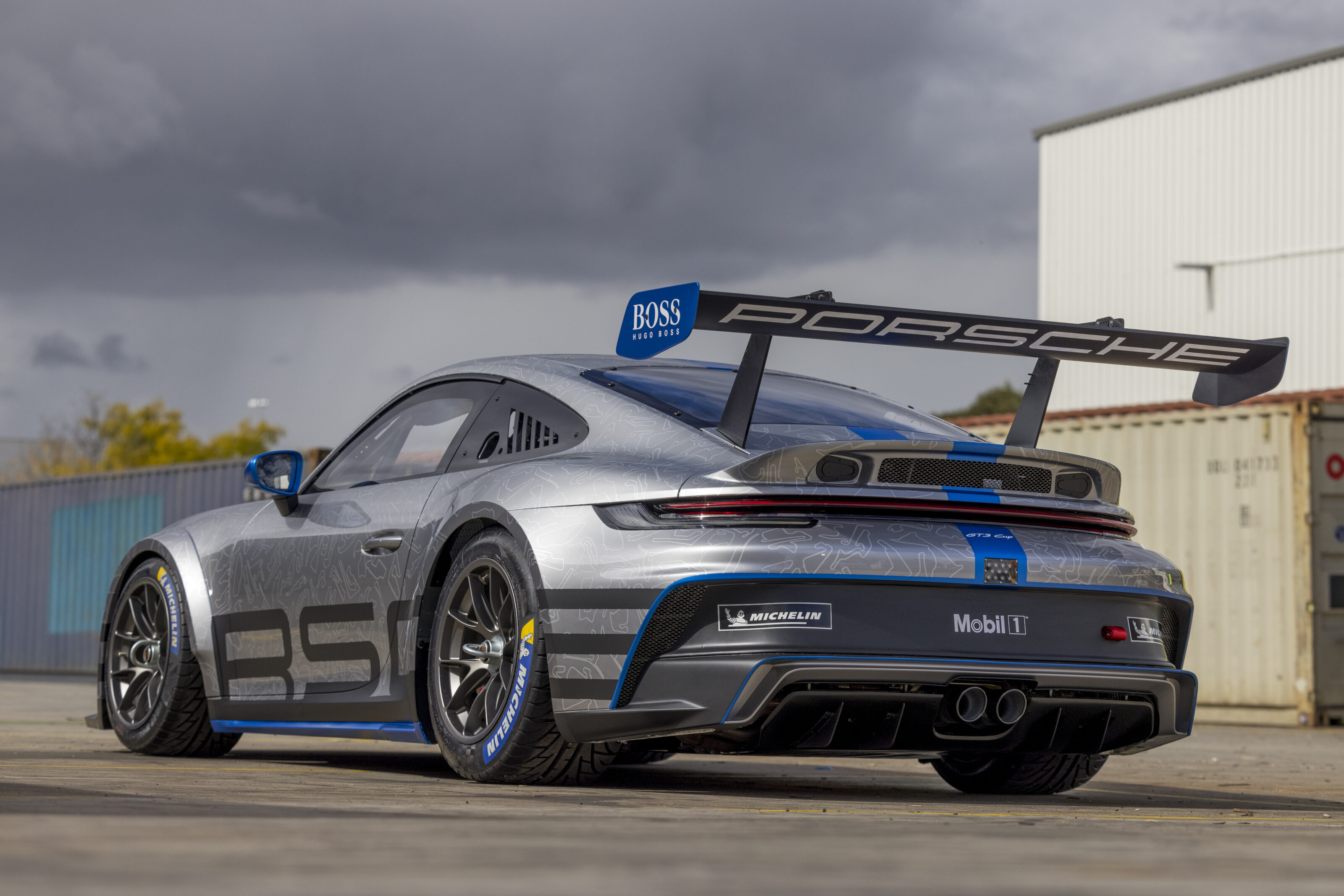
Elsewhere around the globe, the 992 is already being campaigned in several different motorsport classes, including the Porsche Mobil 1 Supercup.
Aside from pumping out 380kW (19kW more than its predecessor), the new 992 GT3 Cup also sports, for the first time, a double-wishbone front suspension, just like the road-going 992 GT3.
These updates equate to a race car that, Porsche says, will be at least one per cent quicker around the track than its predecessor.
The 992 Cup Car has also been designed to run on synthetic fuel, which will drastically decrease overall emissions on the track.
UPDATE, January 2023: New HiLux GR Sport revealed
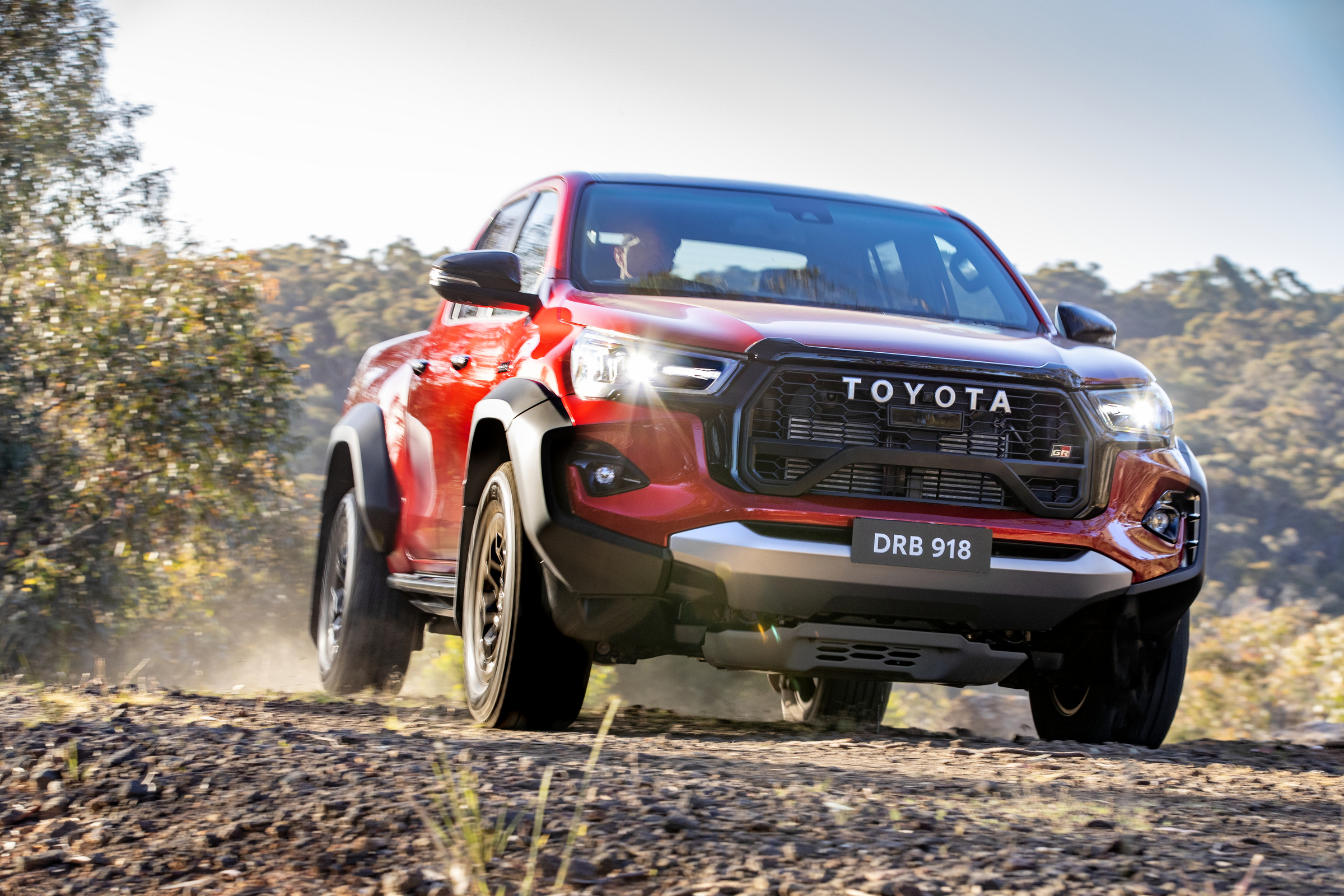
It’s no full-bottle high-powered GR HiLux, but the new 2023 HiLux GR Sport does get more power and torque than the regular model – making it a rival, of sorts, to the Navara Warrior and Ranger Raptor. In the meantime, we’ll keep hoping for a proper performance upgrade in future GR HiLux. Details below.
The story to here
The 2022 Toyota Hilux GR Sport performance off-road ute is merely months away from an official global unveiling.
Snapshot
- Toyota HiLux GR Sport will serve as top-shelf variant for HiLux range
- Will compete against models like Ford’s Ranger Wildtrack
- Off-road-tuned suspension and tyres expected
According to a report from Creative311, Toyota’s in-house skunkworks Gazoo Racing has gone about massaging more off-road performance from the popular moniker, as well as adding some novel aesthetic features.
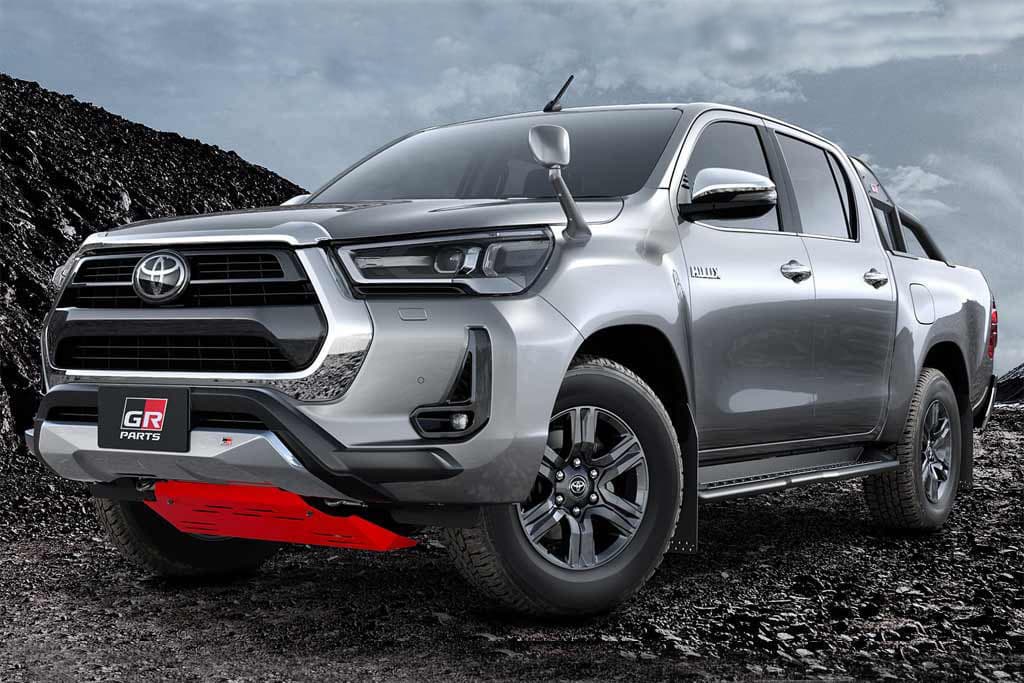
Changes are said to include a bespoke set of 18-inch alloy wheels wrapped in knobbly 265/60 profile tyres, body-coloured flared wheel arches, revised suspension and a unique front grille design.
Pictured top of story: the 2019 HiLux GR Sport, before the current facelifted HiLux debuted
Inside, the GR Sport will score brushed metal sports pedals, powered front seats, a 360-degree reverse camera and GR-branded trim pieces such as a newly designed handbrake and gear-selector boot.
The sporty HiLux is also expected to have a full suite of safety features that include adaptive cruise control, lane-keeping assist, autonomous emergency braking, and driver attention and speed sign monitoring.
Power is rumoured to be unchanged, so expect to see the same 2.8-litre four-cylinder turbo-diesel powertrain found in current variants, which will still produce 150kW and 500Nm.
According to reports, the HiLux GR Sport is expected to be unveiled on Toyota’s home soil in October 2021.
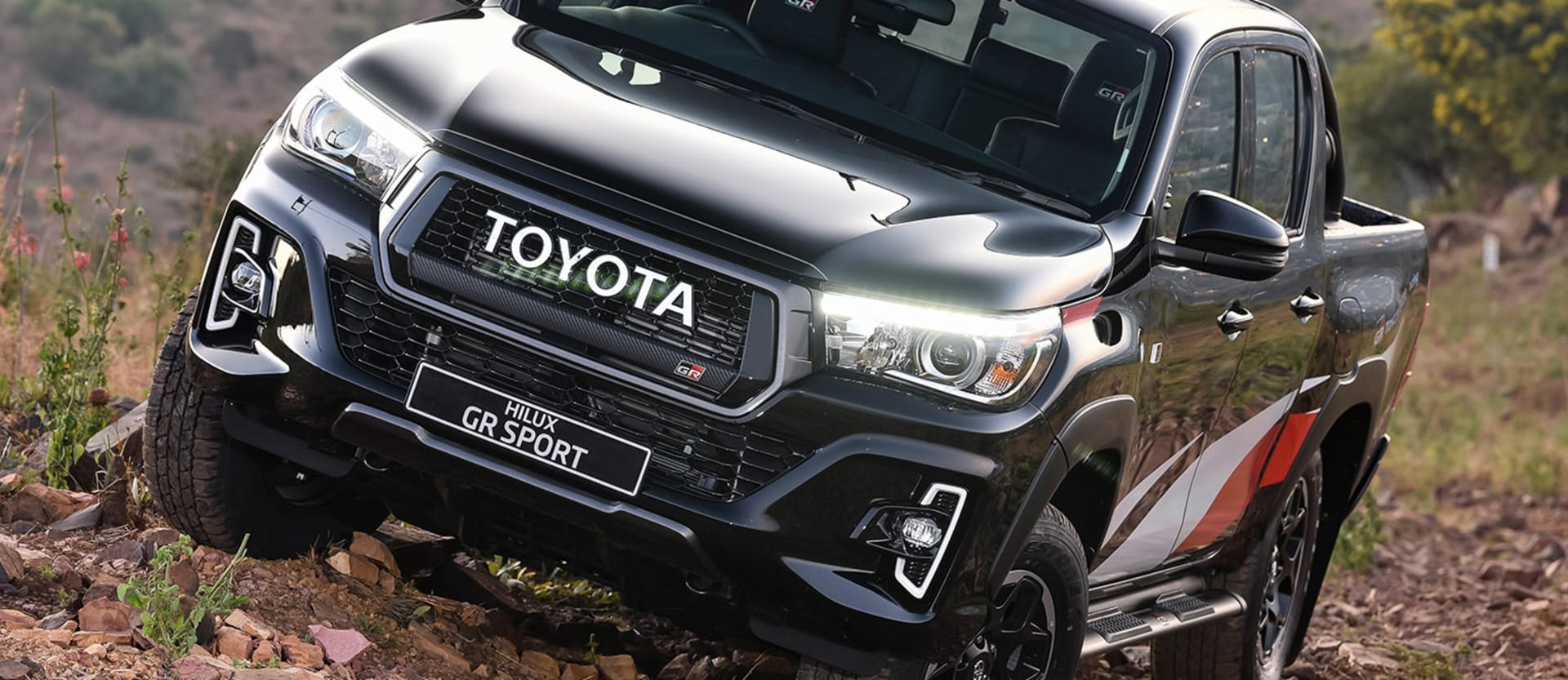
Will the Toyota HiLux GR Sport be coming to Australia?
A representative from Toyota’s local arm has told WhichCar: “It’s [the HiLux GR Sport] not on our radar at the moment, but if it becomes available globally, we’d definitely be interested in it.”
Be sure to watch this space as WhichCar brings you all the latest updates on Toyota’s sporty new HiLux GR Sport.
Consider this. On December 14th 1972, Gene Cernan stood at the base of the ladder of the Apollo 17 lander, gazed across the Taurus-Littrow valley for a moment, and then climbed into the lunar module. He was the last human to walk on the Moon.
It’s now almost 10 years since the last Space Shuttle flight and nearly 18 years since the last commercial supersonic flight. The spirit of possibility and vaulting ambition seems to have been vanquished, a zenith reached long ago. Within the aerospace sector at least, the bean counters have given the visionaries one hell of a flogging.
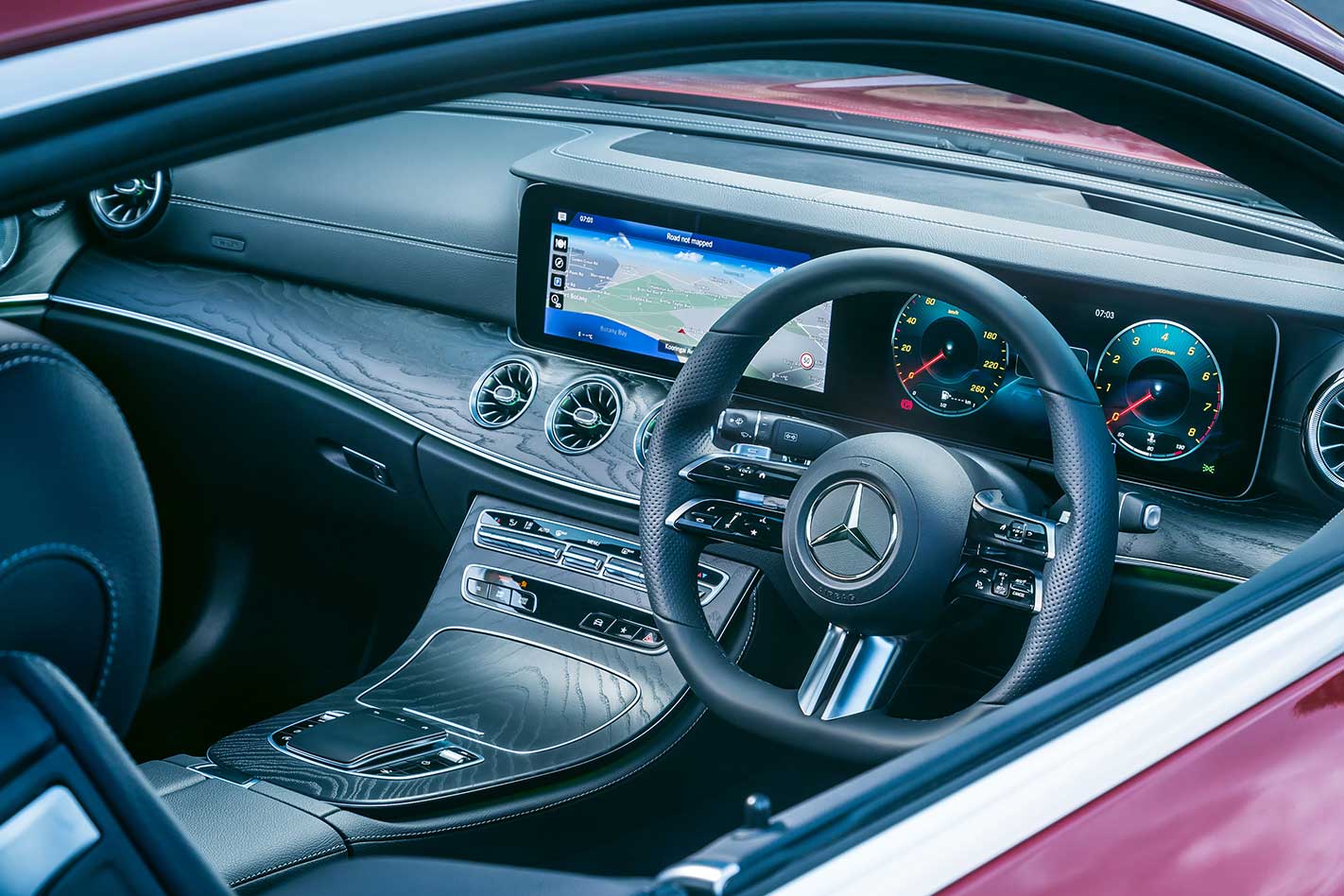
Budgetary constraints are an integral aspect of vehicle development too. Does anybody think that a MacPherson strut or a torsion beam are there for dynamic excellence? Or that swapping physical heating and cooling controls for a touchscreen delivers a better user experience? Of course not. It’s simple cost-cutting.
Yet there is a distinction to make here. Unlike the development processes that aerospace projects undertake, which are inspected through endless committees and devolved to the lowest bidder, the automotive sector can and does indulge in absolute fantasy.
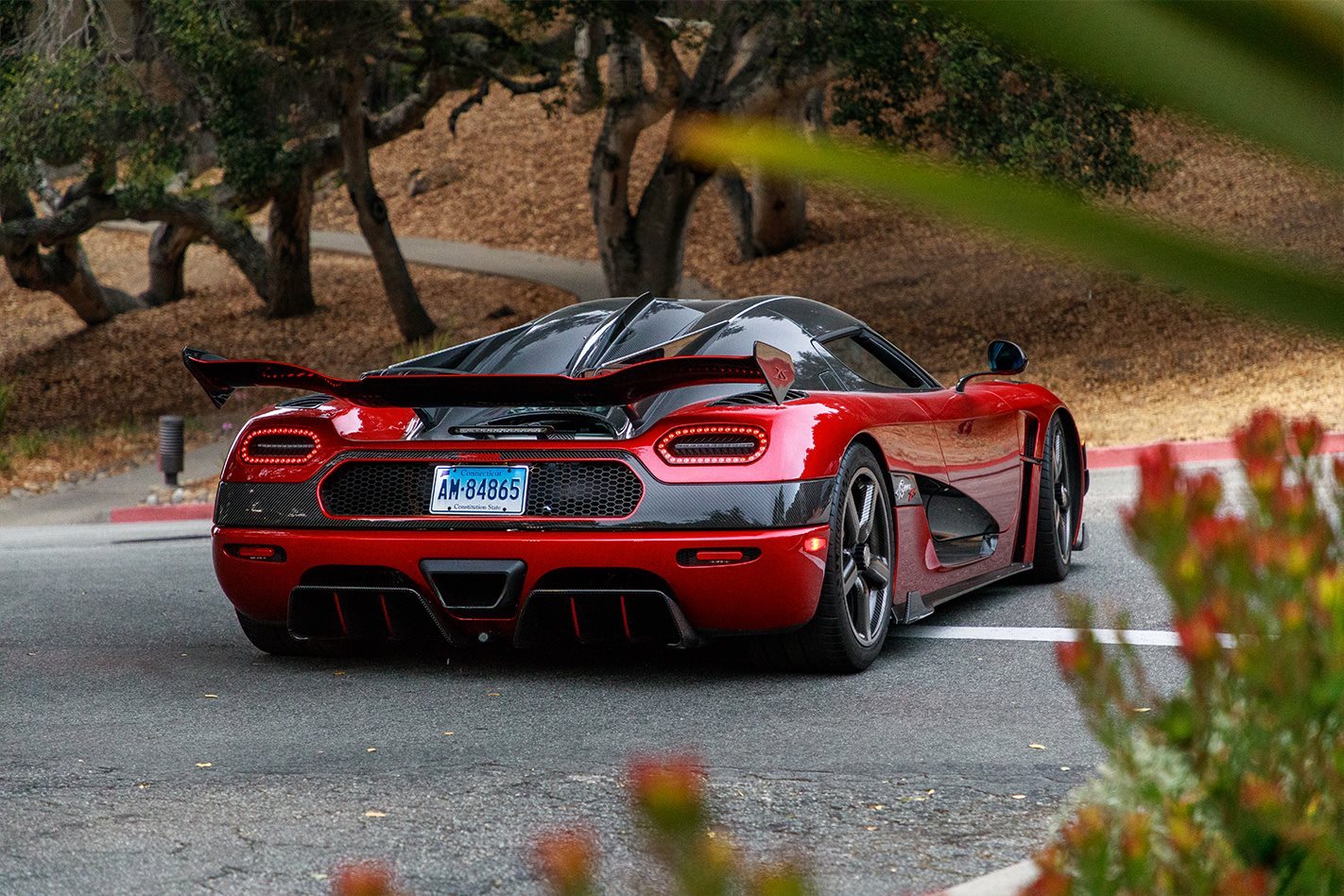
You just need to be able to pay for it. That’s why as irrelevant as companies like Koenigsegg, Bugatti and Rimac are to most of us from the perspective of a consumerist decision, they provide a fascinating insight into what happens when the shackles of cost are unholstered and pure engineering reigns.
What’s more, unlike the busted myth that is trickle-down economics, trickle-down tech is something we can and do benefit from. LED headlights debuted on the Audi R8 supercar. You now see them as standard-fit items on a Suzuki Ignis. The Porsche 959 introduced the active differential, a version of which you can now get on a Golf GTI. Side airbags arrived on an E38 BMW 7 Series limo and now they’re on, well, pretty much everything.
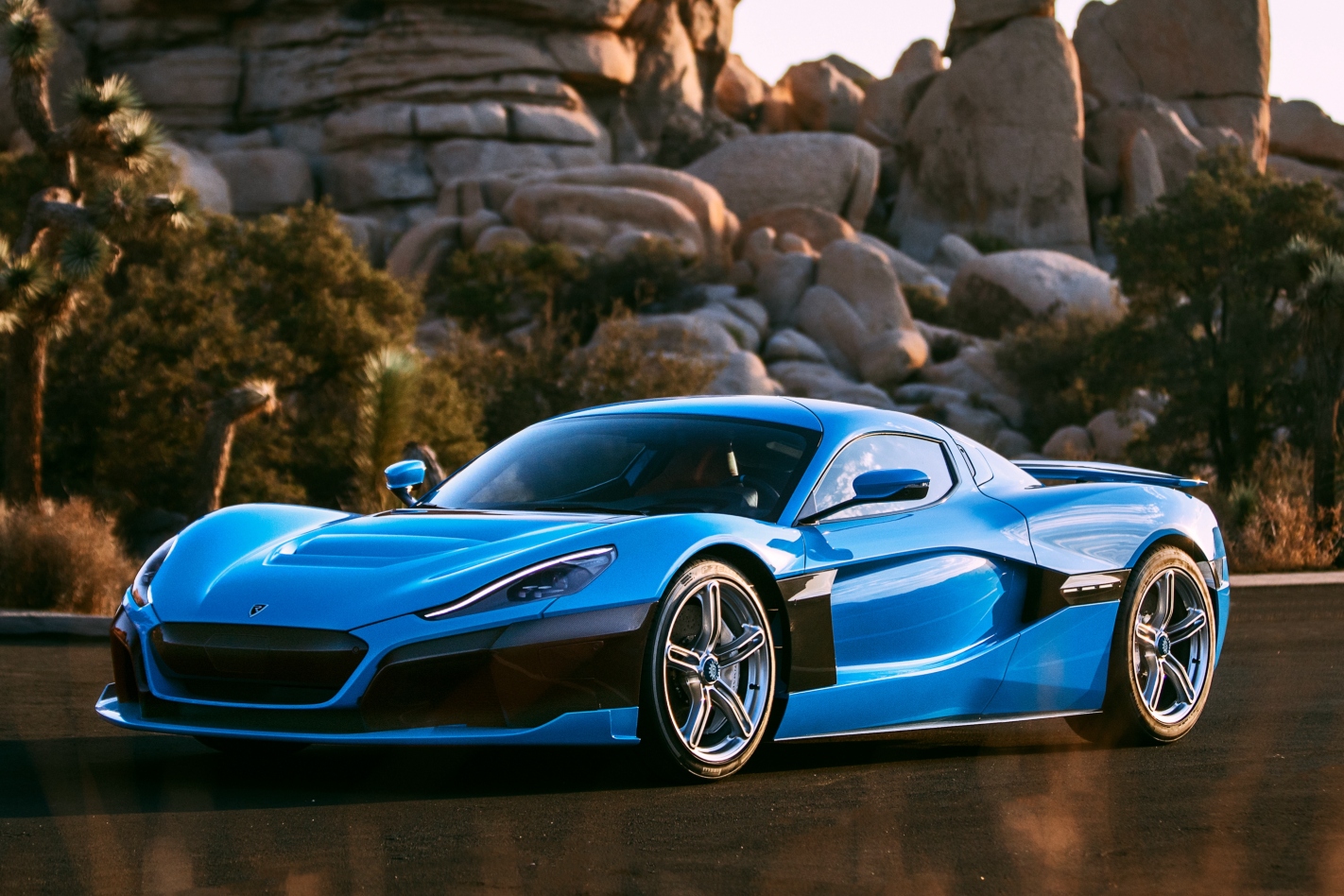
The battery tech that Rimac is working on now could well filter through into your daily driver. We could be driving our future hybrids via a licensed version of Koenigsegg’s crazed nine-speed, seven-clutch Light Speed Transmission. That’s why while we’ll always bring you the cars you and I may well buy, we’re certainly not going to ignore the cars that made us all dream. We’re in a golden age of performance cars right now and it’s one the like of which will never be repeated.
MOTOR will continue to celebrate the dreamers, the creative geniuses and those just too damn cussed to accept the status quo.
Doomscrolling our way through 2020 might have led us to believe that these are the end of days, but keep the faith. Here in the world of performance cars things have never been more vibrant. We can all raise a glass to that.
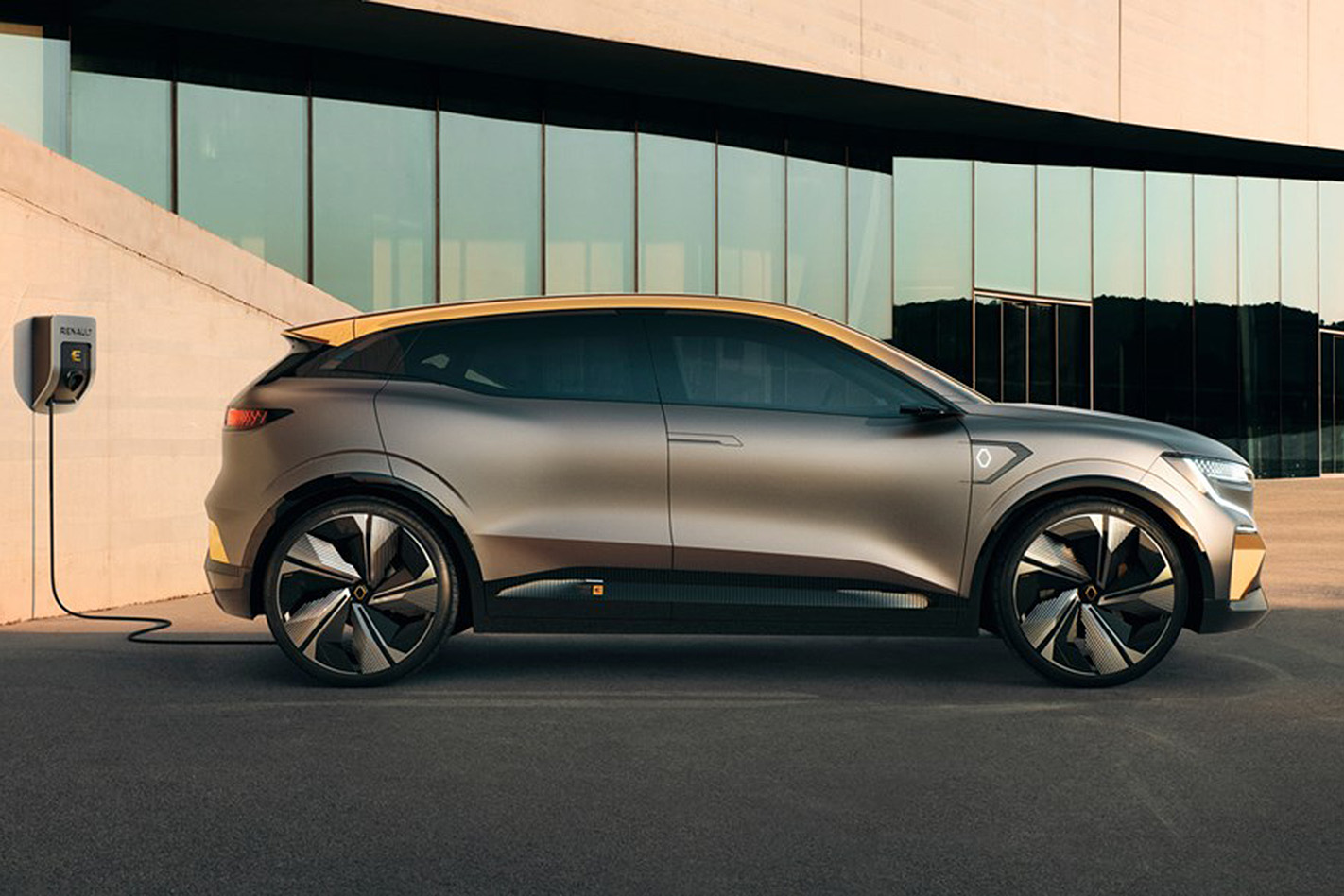
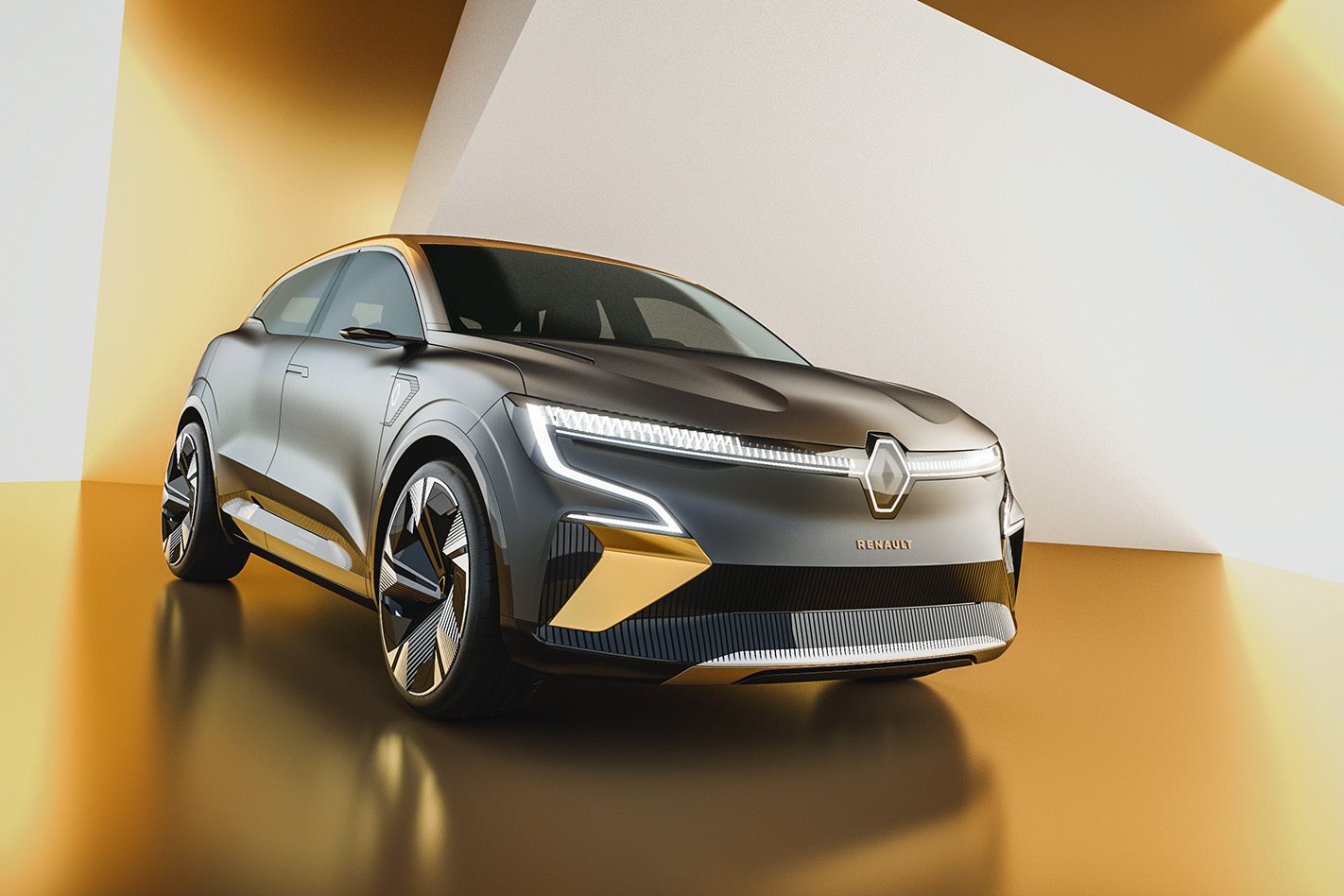
Renault has teased images of the interior of its first fully-electric SUV – the Megane E-Tech Electric.
The Megane E, which was revealed in concept as the Megane eVision last year, is expected to be fully revealed later this year, with a launch likely to occur in the first half of 2022.
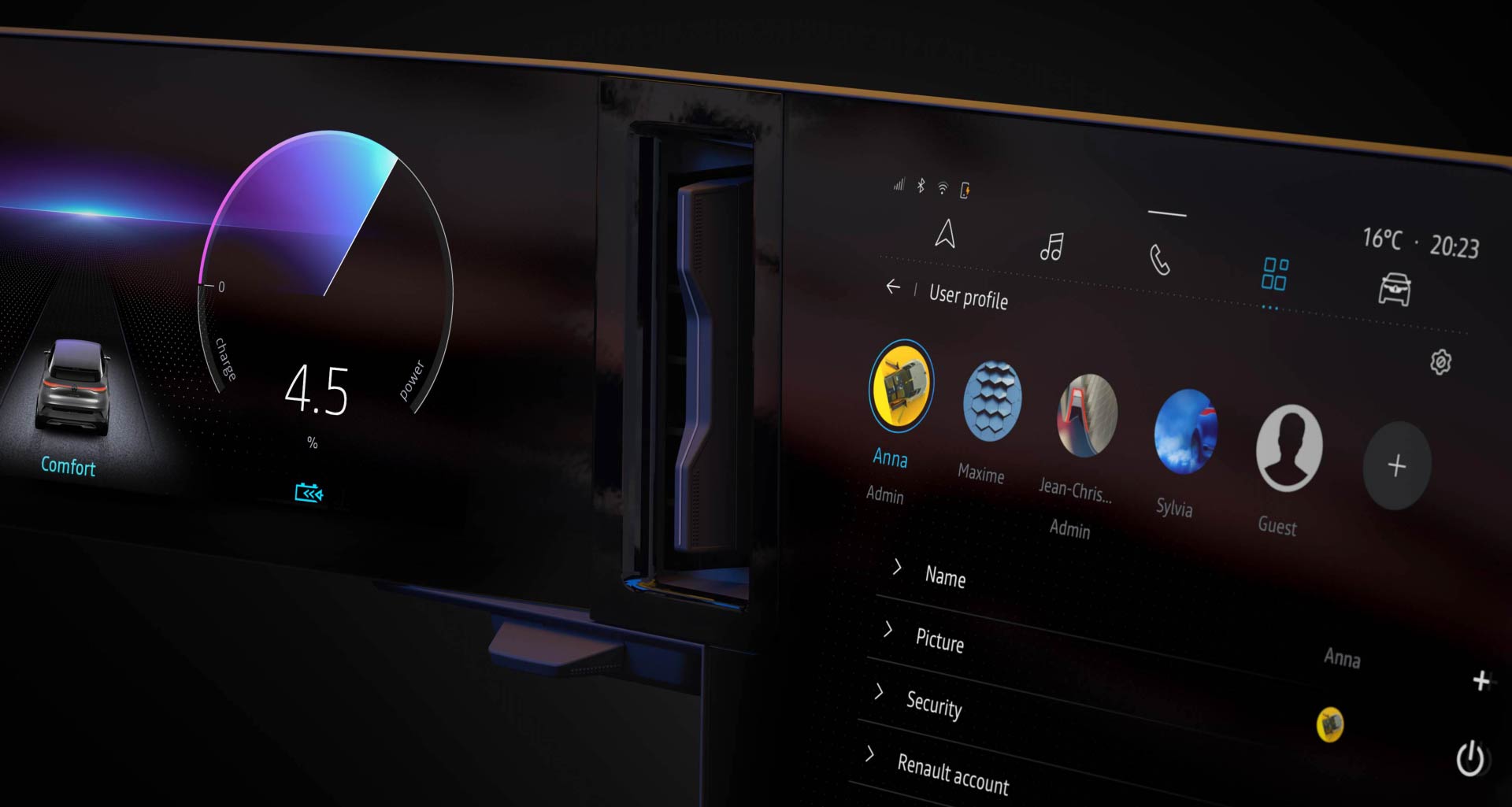
The images, revealed at a press conference held in France on Thursday, gave us our first glimpse of the interior of the reborn Megane, featuring more storage, an L-shaped infotainment suite, and a large central display linked to a wide digital instrument panel.
The new look of the Megane, according to Renault, is based on “redesigned lines, spaces, and materials that embody a new era”.
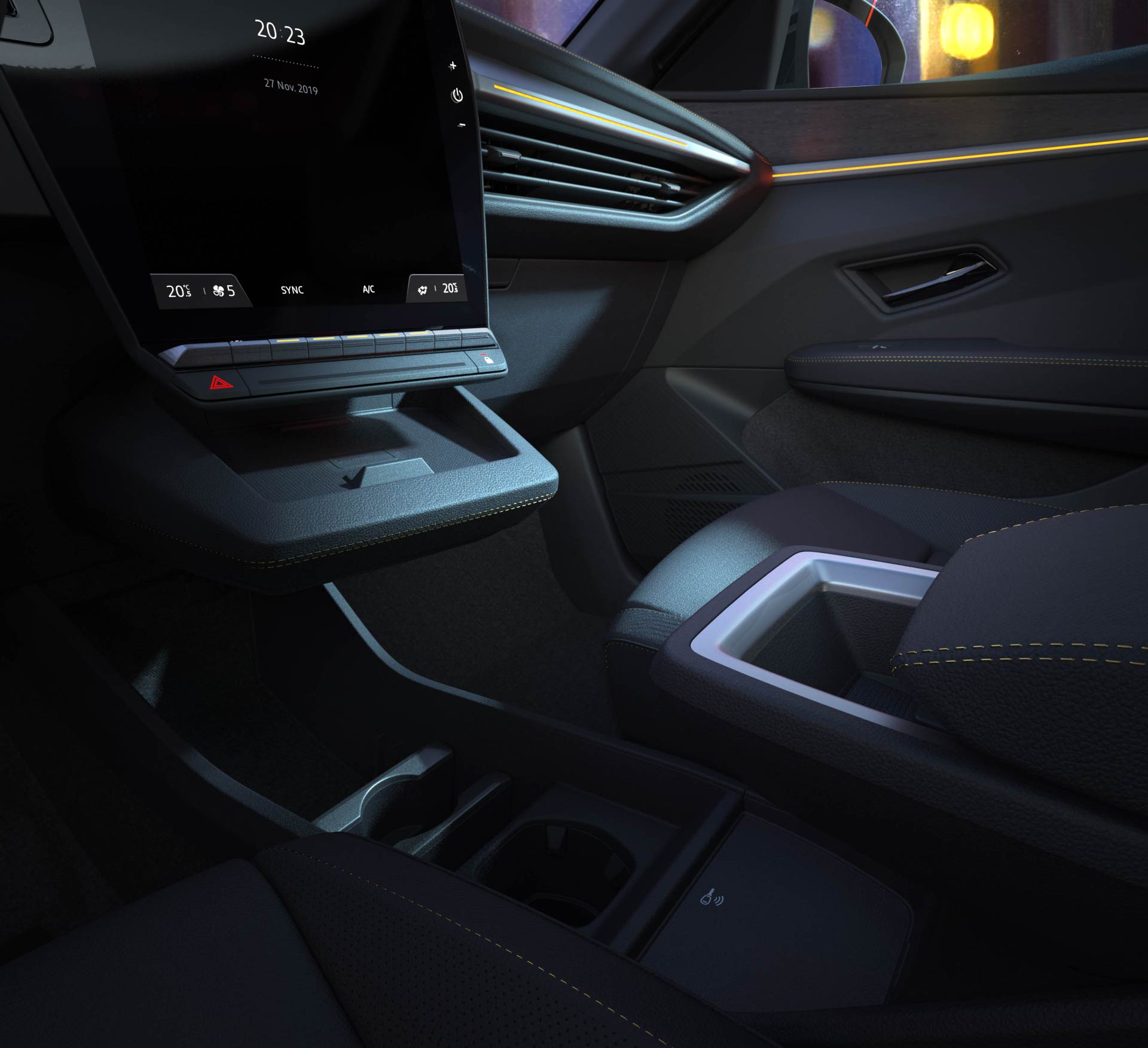
The Megane E-Tech Electric will wear the brand’s revamped logo and will sit on the Renault-Nissan Alliance’s CMF-EV platform.
New Renault boss, Luca de Meo, said at the debut of the new concept last year that the platform has “broken the rules of size, use and design”.
He added that “a whole family of new vehicles will be based on this new platform”, and that’s not just from Renault. Given it’s an alliance platform, the architecture has already debuted under the Nissan Ariya SUV.
Designer Gilles Vidal also surprised viewers on Thursday with a sneak peek at the rear-end of the near production prototype, which showcased its taillights and the new-look badge.
According to Vidal, we can expect to see “substantial changes” for the interiors of new Renaults from now on, starting with the Megane.
The Renault Megane E-Tech Electric contains a 60kWh battery pack under the floor and a single 160kW e-motor with 300Nm of torque driving the front wheels.
Its claimed driving range is around 450km on a single charge (WLTP).
It’s also said to sprint from 0-100km/h in less than eight seconds. Not exactly the hot speeds we’ve come to hear about with EVs, but a Renault Sport version could be on the roadmap.
An on-board charger will allow 7kW AC single-phase charging from a wall-box. However, the only charge time Renault has revealed so far is that the electric Megane will be able to reclaim 200 kilometres of range in 30 minutes when rapid charging at its maximum of 130kW DC.
While a full reveal of the new electric Megane is expected later this year, a spokesman for Renault Australia told WhichCar there was no news yet on whether we can expect to see it Down Under.
At the beginning of 2021, the new boss of the French marque, Luca De Meo, announced the company’s new business plan – dubbed “Renaulution” – will see Renault launch seven new all-electric vehicles by 2025.
In 2021, with the recent release of Arkana and Captur E-TECH Hybrid and the Megane Sedan E-TECH Plug-in Hybrid overseas, the Renault brand now has an EV range of six E-TECH hybrid and plug-in hybrid vehicles.
During Thursday’s press conference at Boulogne-Billancourt, the carmaker revealed more about its push towards “sustainable mobility”.
Renault aims to be the greenest car brand in Europe by 2030, with nine out of every 10 cars sold electrified.
In addition, it wants to move toward recycling 120,000 of its vehicles (including EVs) every year, and use almost 80 per cent of strategic recycled materials in its new batteries – a feat which would make it the world’s leading automotive manufacturer based on recycled materials being used in the production of new vehicles.
It’s incredible to think just six years and a generation separates the striking all-new fourth-generation Hyundai Tucson and the frumpy second-generation model known here as the ix35.
The intervening years saw the third-generation Tucson offer up sharper looks that made people look twice at Hyundai’s medium SUV offering and helped cement the brand’s top-three status in Australia.
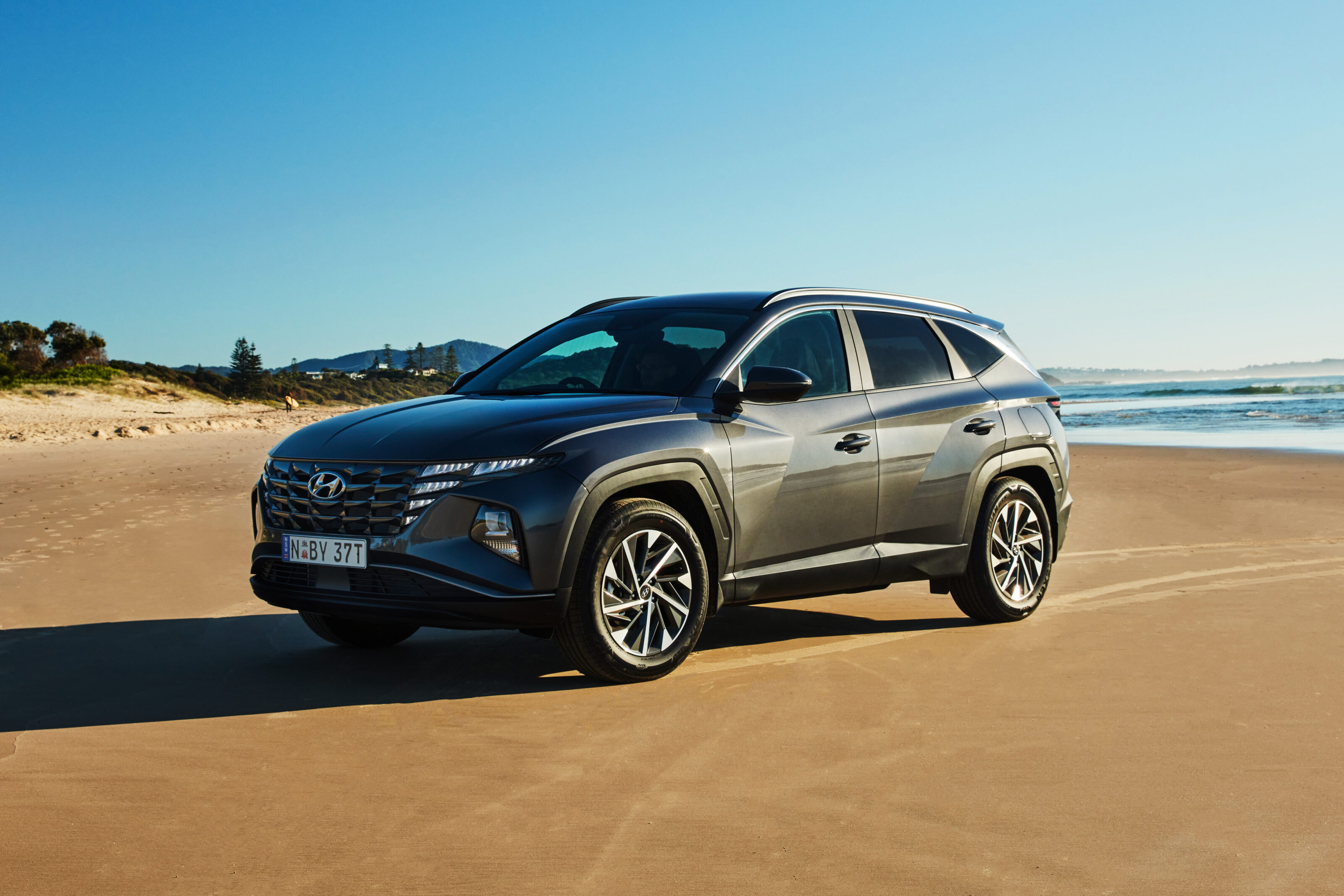
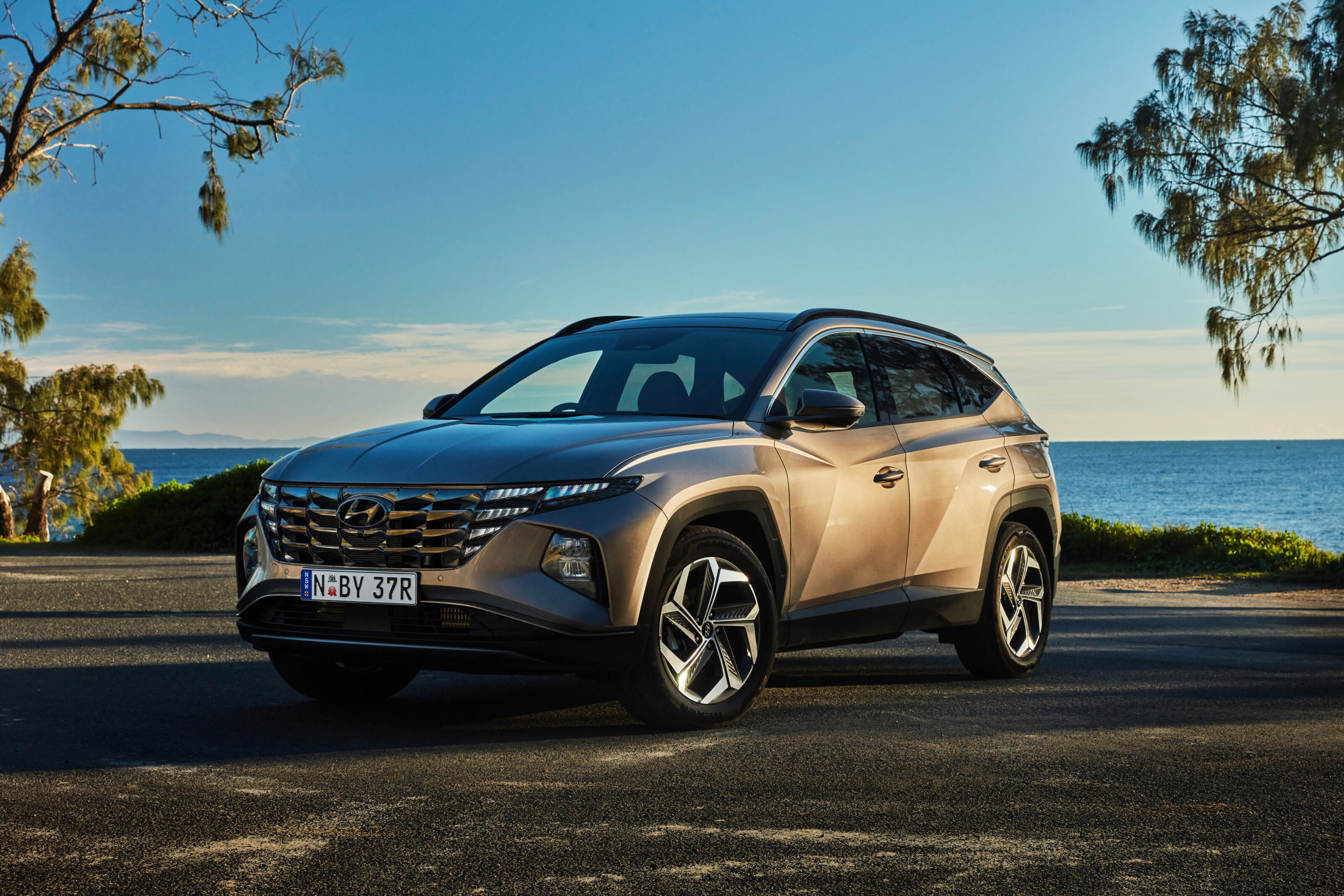
And the 2021 Tucson has honed the aesthetic even further, being the first model to exhibit Hyundai’s Sensuous Sportiness design language that brings more angles than an origami swan including a sharp shoulder line, bulging wheel surrounds and bold character lines including a distinctive Z-shape on the back door.
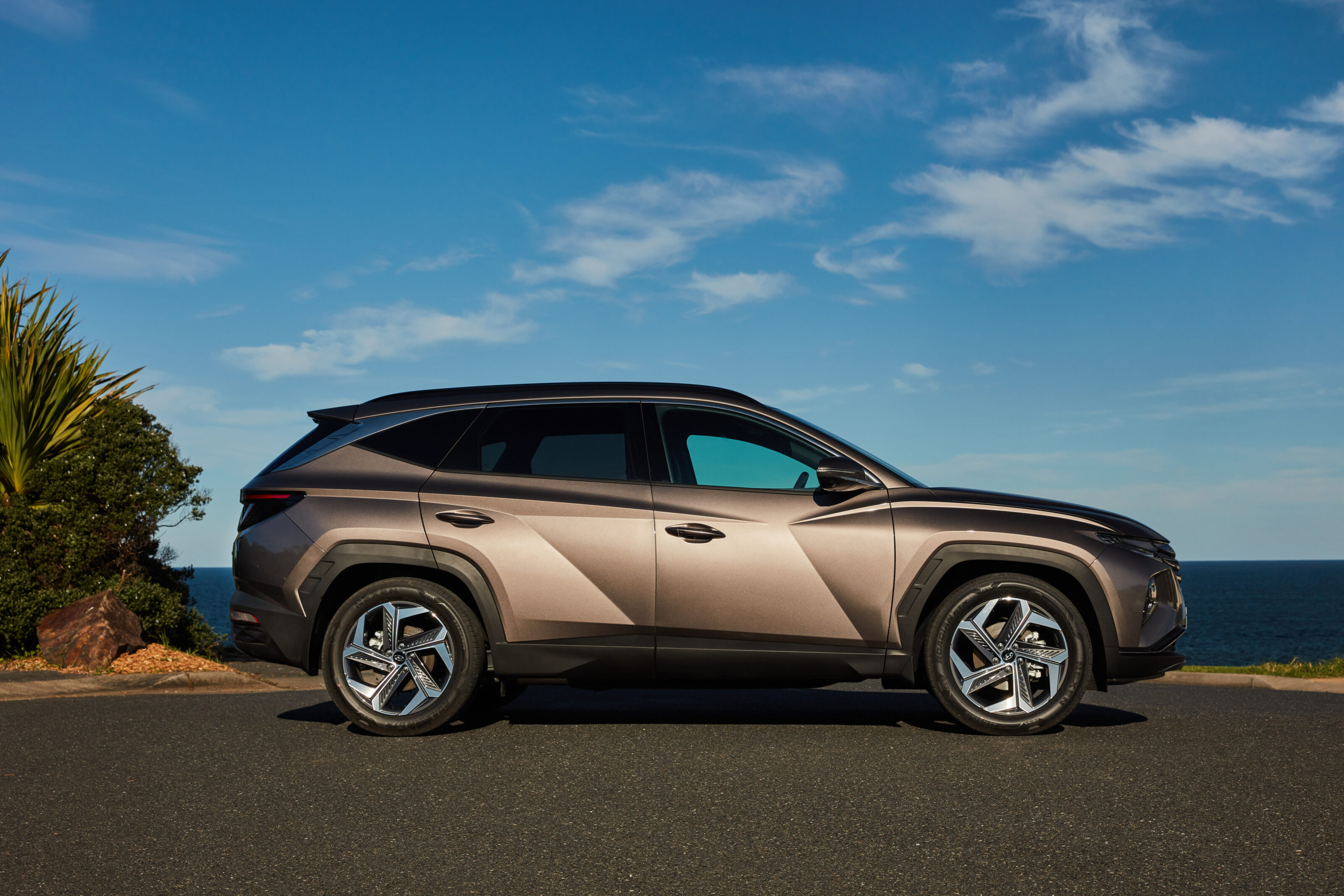
Then there’s the cascading parametric grille with embedded daytime running lights and turn signals that are only visible when turned on and a full-length LED taillight signature.
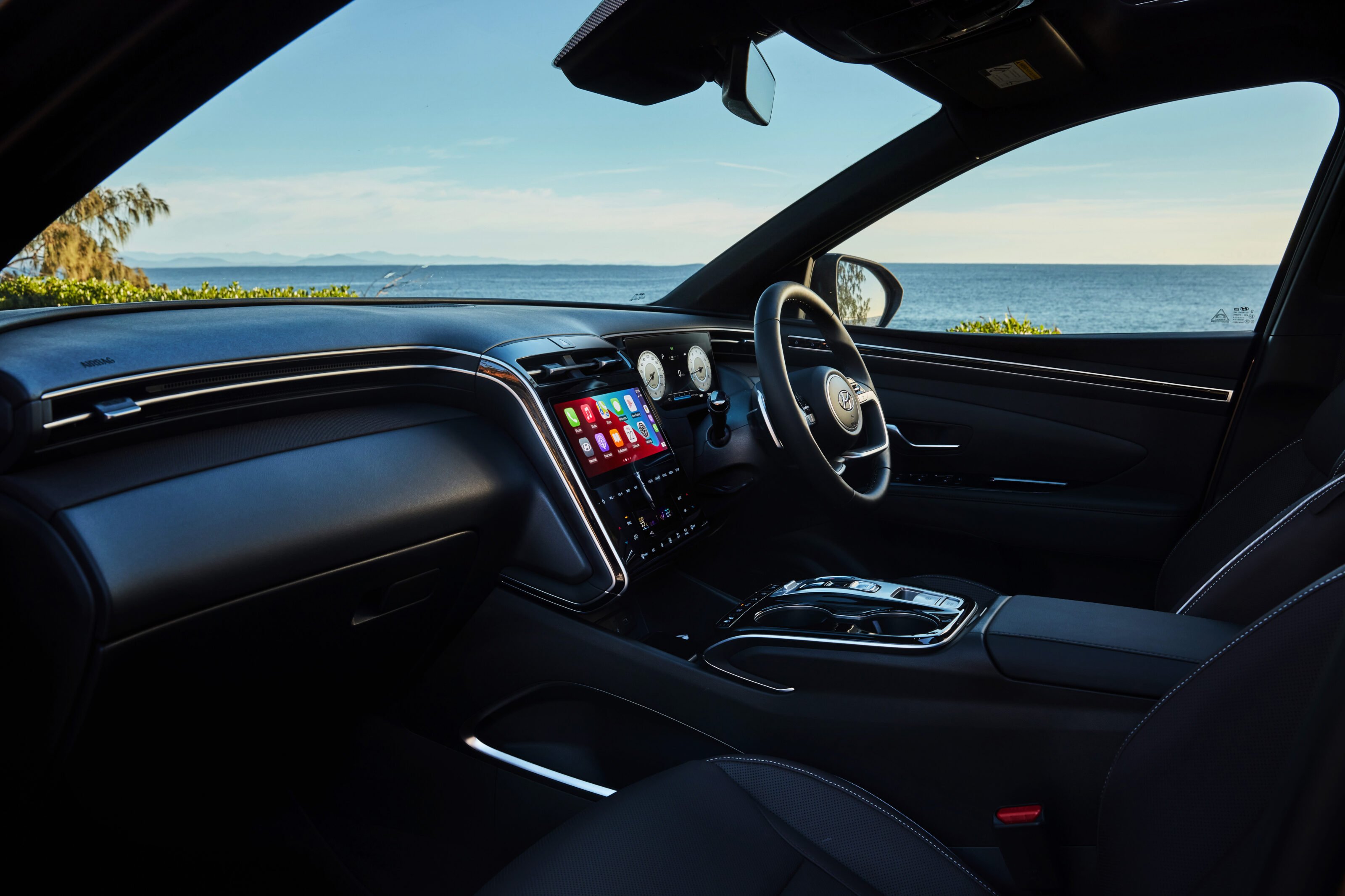
Inside, the Tucson has a crisp new interior and plenty of standard kit including active safety technology that’s new to the mainstream medium-SUV segment.
“The engines sitting upfront of the Australia-bound Tucsons are a not-so cutting-edge mix of four-cylinder powertrains…”
However, the engines sitting upfront of the Australia-bound Tucsons are a not-so cutting-edge mix of four-cylinder powertrains including a 1.6-litre turbocharged petrol with a seven-speed dual-clutch auto and a 2.0-litre turbo-diesel with eight-speed torque converter automatic – both of which drive all four wheels.
Then there’s this 2.0-litre naturally aspirated petrol with a six-speed auto that drives the front wheels only and was the only powertrain available at launch and is available in all three spec grades including the eponymous base spec, the Elite and range-topping Highlander that is the focus of this review.
What is the Hyundai Tucson Highlander FWD like to live with?
Tucson pricing starts at $34,500 before on-road costs for the entry-level model that’s only available with the 2.0-litre petrol FWD drivetrain. It comes with a decent standard features list including a centre airbag between the driver and front passenger, wireless phone syncing, tyre pressure monitor, drive-mode selector, softer trim materials, four USB ports, auto-folding door mirrors and 17-inch alloy wheels.
Then there’s additional advanced driver assistance such as the segment-first blind-spot collision avoidance plus rear cross-traffic collision avoidance, intelligent speed-limit assist, leading vehicle departure alert, adaptive cruise control with ‘Stop & Go’, and camera- and radar-based AEB that also works to prevent or mitigate collisions at intersections.
Priced from $39,000, the mid-spec Elite adds leather upholstery, heated front seats, the 10.25-inch infotainment screen, multi-air climate control and 18-inch alloys.
The Elite is also available with both AWD drivetrains, the 1.6-litre turbo-petrol priced at $43,000 and the turbo-diesel $45,000.
Finally, the Highlander brings the full enchilada and is also available with all three powertrains, with pricing starting at $46,000 and other powertrains attracting the same respective $4000 and $6000 premiums as the Elite.
These prices bring a panoramic sunroof, hidden DRLs within the dark-chrome grille, LED taillights that run across the width of the car, LED ambient lighting, heated front and rear seats, ventilated front seats, BOSE premium audio, powered front seats with driver’s memory settings, heated steering wheel, powered tailgate, 360-degree camera, multi-terrain mode, blind-spot view monitor on the digital dashboard, remote parking, parking collision avoidance assist and 19-inch alloy wheels.
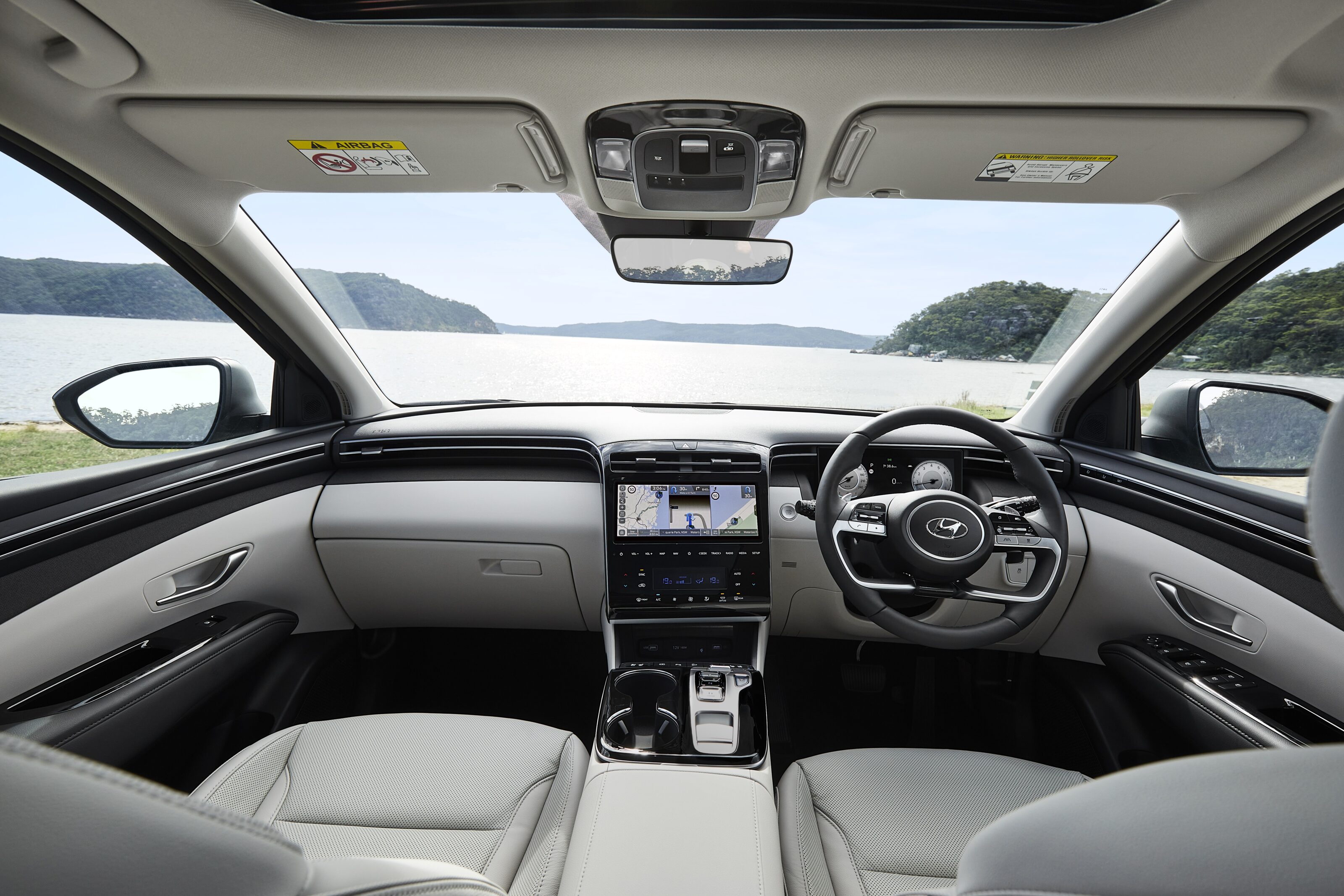
If someone is won over by the Tucson in a showroom it’s likely to be when they slide into the cabin. The floating touchscreen look seems consigned to history with the monitor part of an attractive glossy head that flows down to the centre console.
This allows for the dashboard top to be totally free of clutter and I reckon Hyundai’s designers took inspiration from the Toyota Tarago by the way it curves into the door cards to provide a greater sense of space.
The fit and finish are excellent and you won’t find any hard plastics up front higher than the door armrests, even in the entry-level Tucson. In the Highlander, it looks very premium indeed, particularly with the light grey or brown trim that are a $295 option over the standard black leather.
The front seats are comfortable and apart from getting the pedal and steering wheel reach right I barely had to play around with the power settings to find a relaxed driving position.
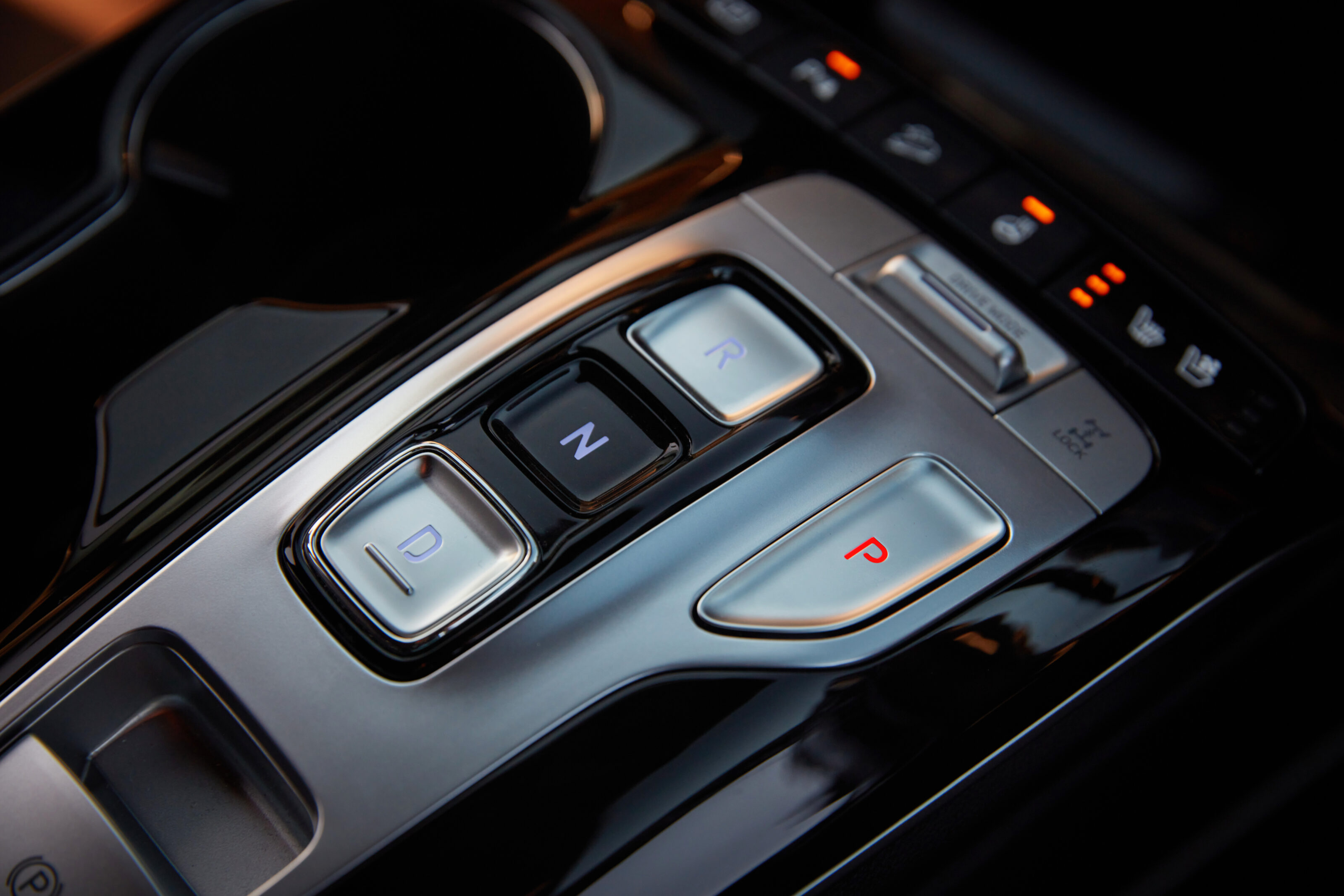
Like the dashboard, the elevated centre console has no protruding clutter with even the shift-by-wire gear buttons sitting flush into the fascia. There’s a decent-sized storage bin, two cup-holders and a wireless phone charging pad that’s slightly tilted to allow for ventilation underneath and prevent the device from overheating.
The rear seats are also comfortable. The Tucson’s 2755mm wheelbase brings plenty of leg and knee room and there’s a nice gap under the front seats to fit your feet. Despite the swept-back roofline and sunroof, headroom isn’t too bad either.
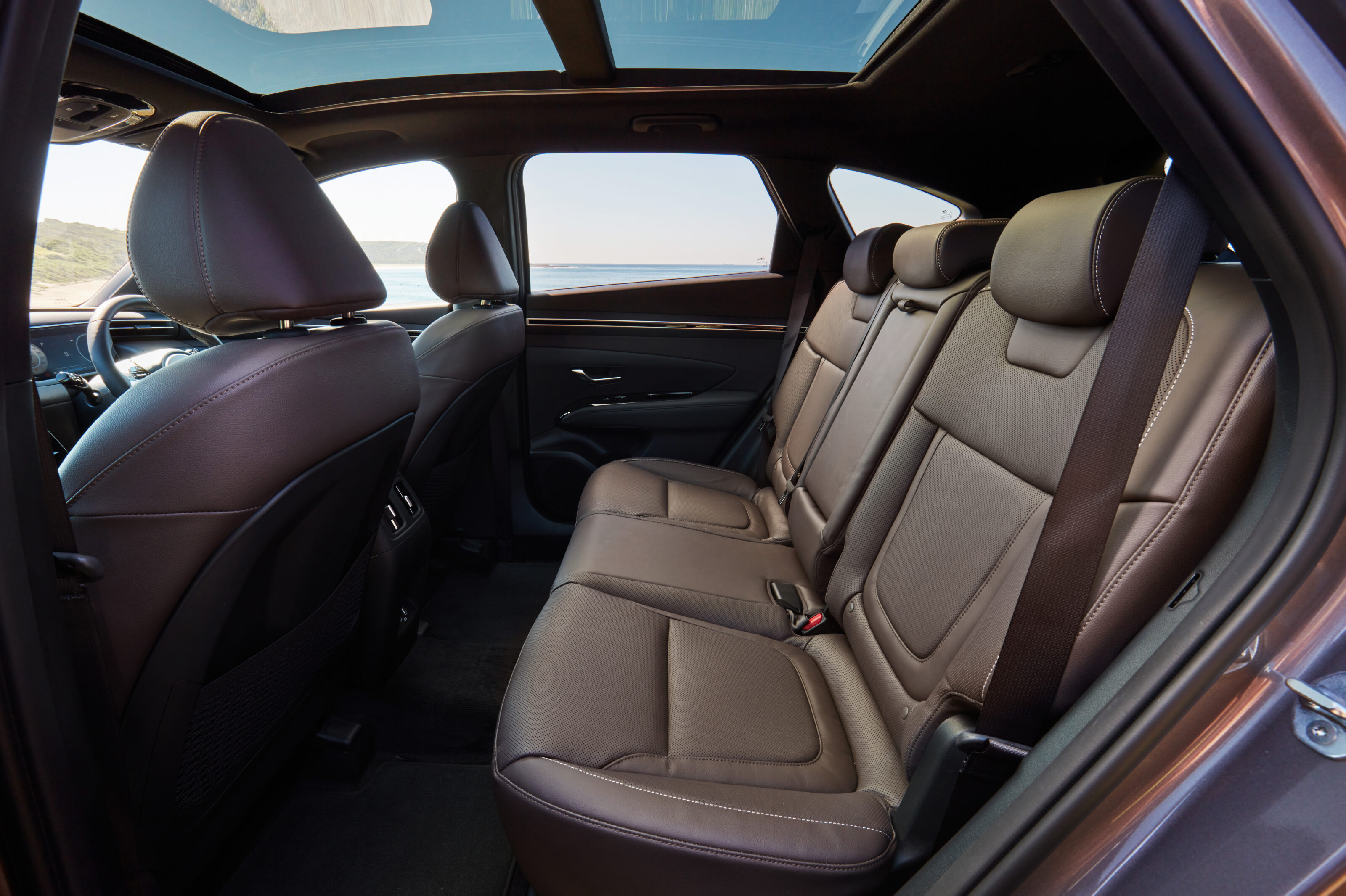
Fitting three adults across the bench might be a bit of a squeeze, but whoever cops the middle will be pleased to see the Tucson has a very shallow transmission tunnel that allows for reasonable legroom.
You’ll have no issues fitting three younger people across the back and if you need to put them in child seats there are ISOFIX anchor points at the outboard seats and three top tethers.
With two rear passengers, there’s a fold-down centre armrest with two cup holders. Other rear storage options include map pockets behind the front seats and pokey little door bins designed to take a bottle. Rear seat passengers also get their own air vents and there are two USB sockets.

With the rear seats up, the boot holds 539 litres, making it one of the biggest in a medium SUV. The Tucson has a full-sized spare wheel under the boot floor, so it compares well with the Toyota RAV4 that holds 542 litres with the optional full-sized spare.
Folding the Tucson’s rear 60:40-split seatbacks down brings up to 1860 litres.
The 2.0-litre engine has an official combined fuel economy figure of 8.1L/100km and will happily consume cheaper 91RON unleaded.
Service intervals are every 12 months or 15,000kms, whichever comes first, with each scheduled service costing $319 for the first five years.
Hyundai also provides a complimentary first service at 1500km as well as free roadside assist for the first 12 months and its five-year/unlimited-kilometre warranty.
What is the Hyundai Tucson Highlander FWD like to drive?
The previous model Highlander was only available with the turbocharged petrol and diesel AWD powertrains, but Hyundai has opted to provide the more affordable 2.0-litre front-driver as an option for people who fancy all the premium trappings but aren’t too fussed about performance.
But even if performance is down the bottom of your list there will be times when you’ll find the new SmartStream MPI engine wanting, particularly when tackling hills.
Curiously, the new 115kW/192Nm 2.0-litre donk produces 7.0kW and 13Nm less power and torque than its predecessor while bringing nothing obviously new in terms of technology.
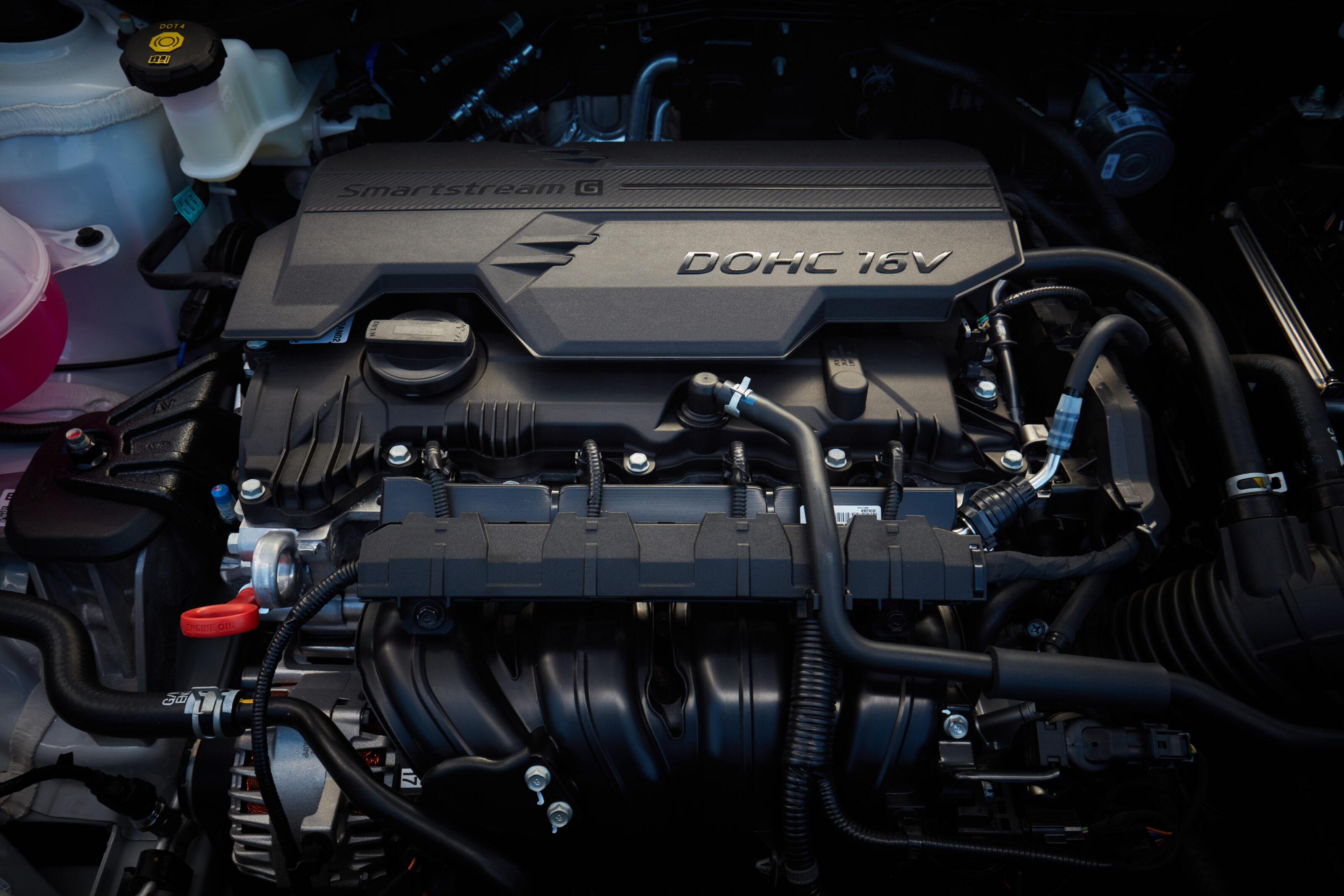
This isn’t really an issue when driving around town, despite the new Tucson being a little heavier than before, but plant the right foot to negotiate a hill or to overtake, and, to quote Shakespeare, ‘doth protest too much, methinks’.
Reaching 2500rpm in quick time catches the six-speed auto napping and it seems to have trouble finding the right gear, making the engine scream at about 3500rpm for a few seconds before either finding the right cog or, if the pedal is still touching the floor, continuing up the power band to reach peak torque and power at 4500rpm and 6200rpm respectively.
To its credit Hyundai let us drive this car over some challenging and hilly roads between Sydney and Orange where this is more of an issue than driving around town, but expect entering a freeway to be a little loud.
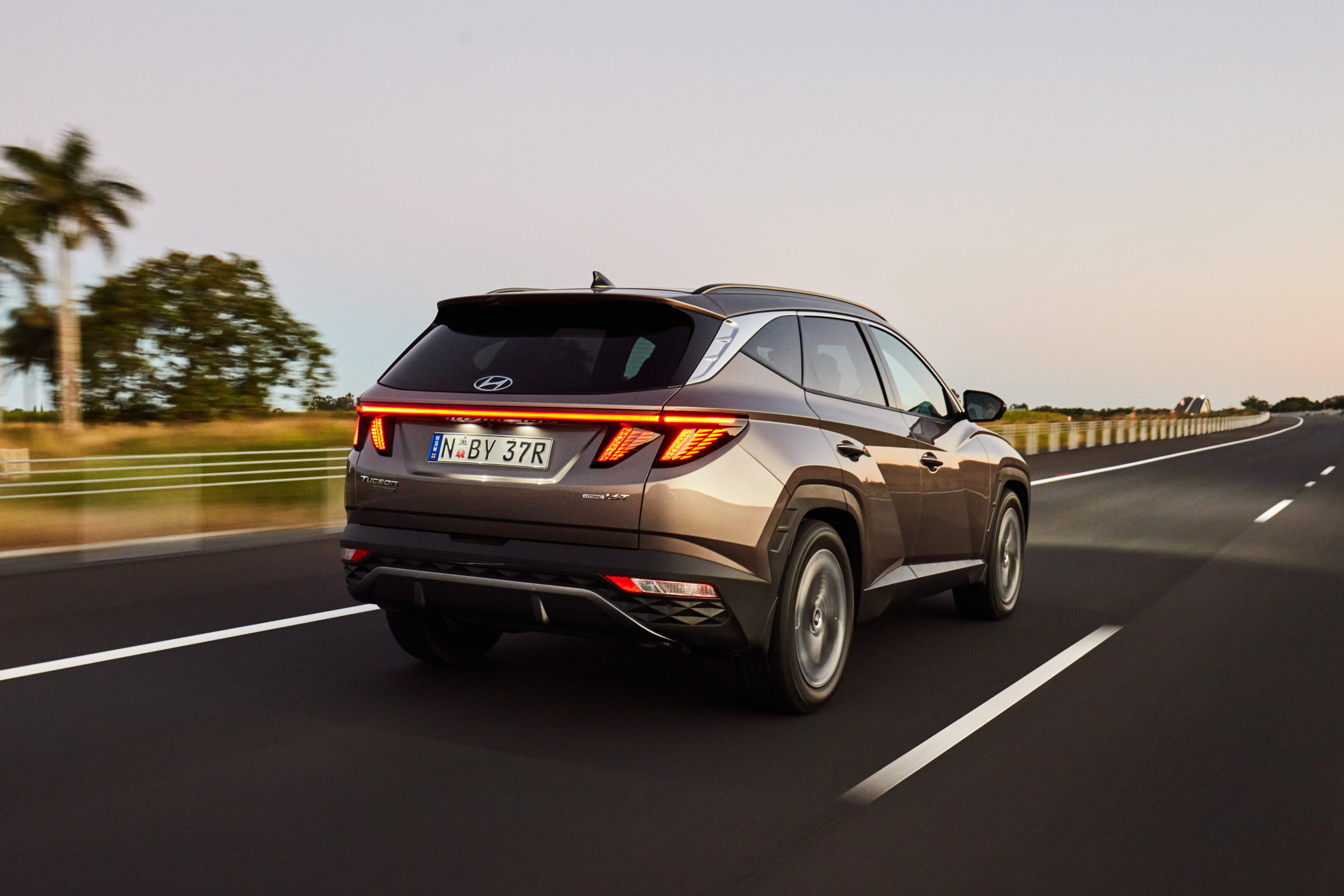
There are four drive modes; Eco, Normal, Smart, and Sport that helps you break through that barrier quicker on the way to peak power bands.
This can be overcome on flatter surfaces by being a little gentler on the throttle, but it’s pretty hard to avoid when faced with hills.
At lower speeds or once the six-speed auto decides to settle into gear, the 2.0-litre engine seems quite happy and is pretty quiet even at highway speeds.
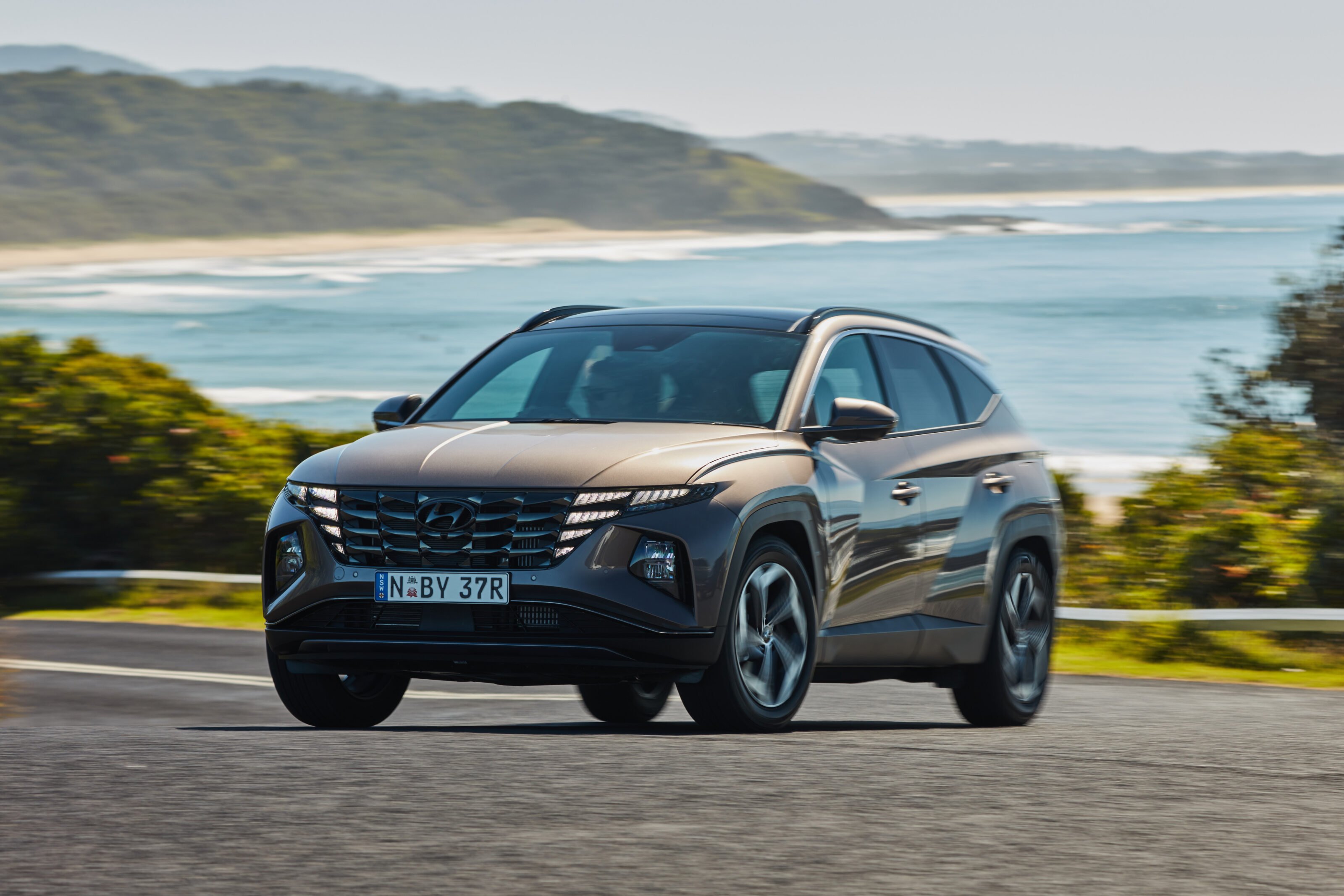
Ride and handling are pretty good despite the Tucson’s new chassis and suspension not being subject to the Australian tuning program bestowed on most of its siblings.
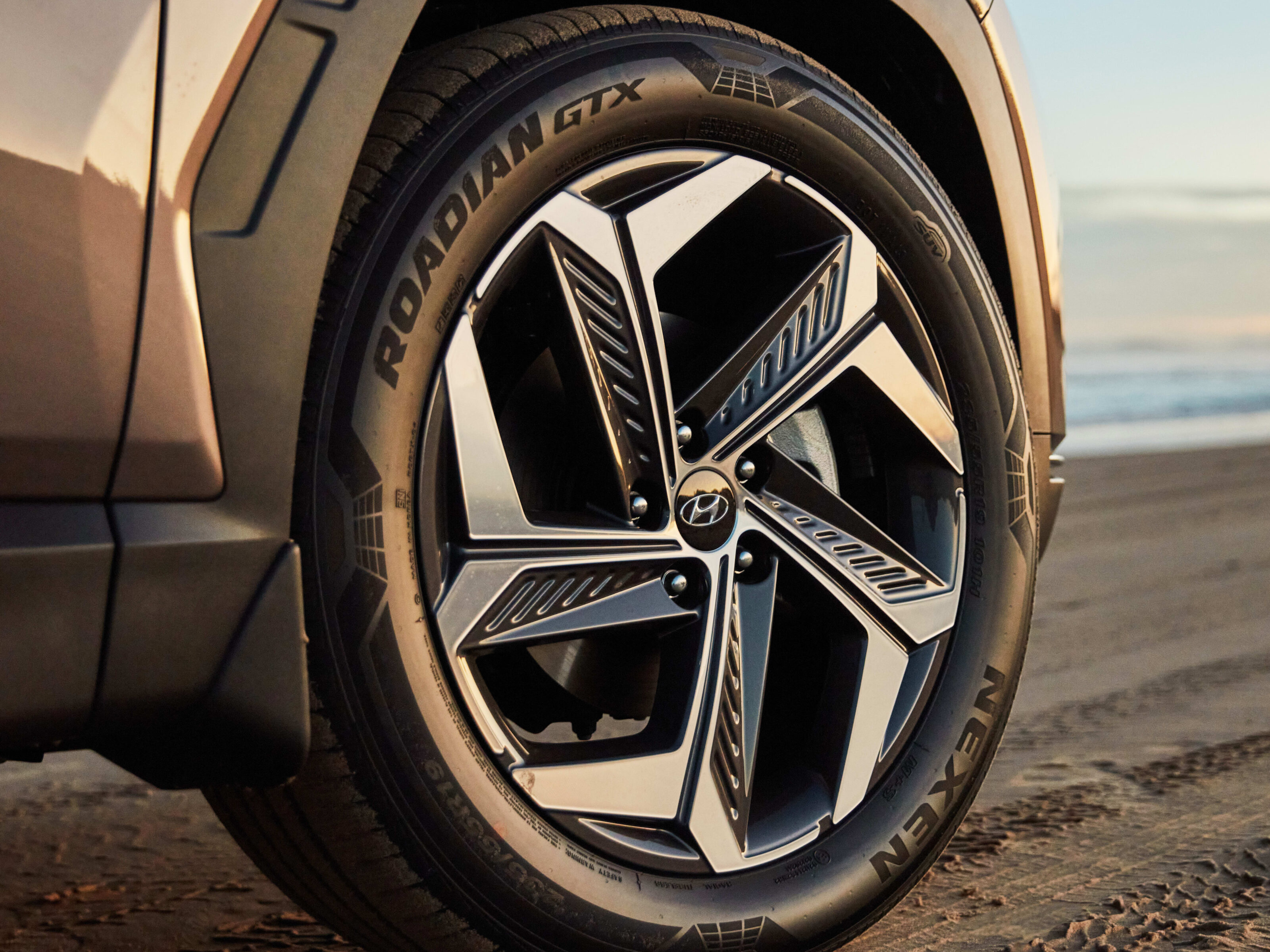
Even so, the ride feels composed on all surfaces including gravel, even on the Highlander’s 19-inch wheels shod with 235/55 R19 Nexen Roadian GTX rubber.
The rear multi-link suspension absorbs big bumps well but could get a little busy on continuous smaller imperfections that are common on rural highways.
Lateral movement is well contained on bends and there is good front/rear compliance, while the column-mounted power steering felt light but direct.
Even with power only going to the front wheels, there were no issues with traction on gravel and during heavy rain and at no time did I find myself wishing for all-wheel drive.

What is the Hyundai Tucson Highlander FWD like for safety?
According to Hyundai, the Tucson is the first medium SUV to come equipped with blind-spot collision avoidance tech that actively prevents you from cutting off a vehicle coming up your side. The Highlander also features a segment-first blind-spot view monitor on the digital gauge cluster and a remote smart parking assistant that can navigate its way out of a tight parking spot without you having to squeeze into the driving seat first.
It’s also the first Hyundai to feature intelligent speed limit assist that, when set, detects a speed sign and ensures the vehicle doesn’t exceed that limit.
Another Hyundai first is a centre airbag to separate the driver and front passenger during an accident, which also makes it the brand’s first model to come with seven airbags.

Other cutting-edge active safety features include parking collision avoidance assist that detects pedestrians as well as vehicles and hard obstacles, autonomous emergency braking (Hyundai calls it Forward Collision Avoidance) that detects cars and pedestrians and will partially apply brakes at speeds up to 180km/h or fully brake at up to 85km/h.
The auto braking also works at junctions and is complemented by rear cros-traffic collision avoidance that brakes if it detects a vehicle coming from the side when reversing.
There is also Safe Exit Assist system that uses radar sensors on either side of the rear bumper to detect road users approaching from the rear and will issue an audible alert and a warning on the digital instrument cluster if anyone opens the door when something is approaching.
The 2021 Hyundai Tucson has yet to be awarded an ANCAP safety rating.
The Verdict
The 2.0-litre, six-speed automatic powertrain runs contrary to Hyundai Australia’s ‘tomorrow’s car today’ marketing campaign for the all-new Tucson.
However, it does come with plenty of new technologies and creature comforts to set a new standard in the medium-SUV segment that should see it do well against the likes of the Toyota RAV4 and Mazda CX-5.
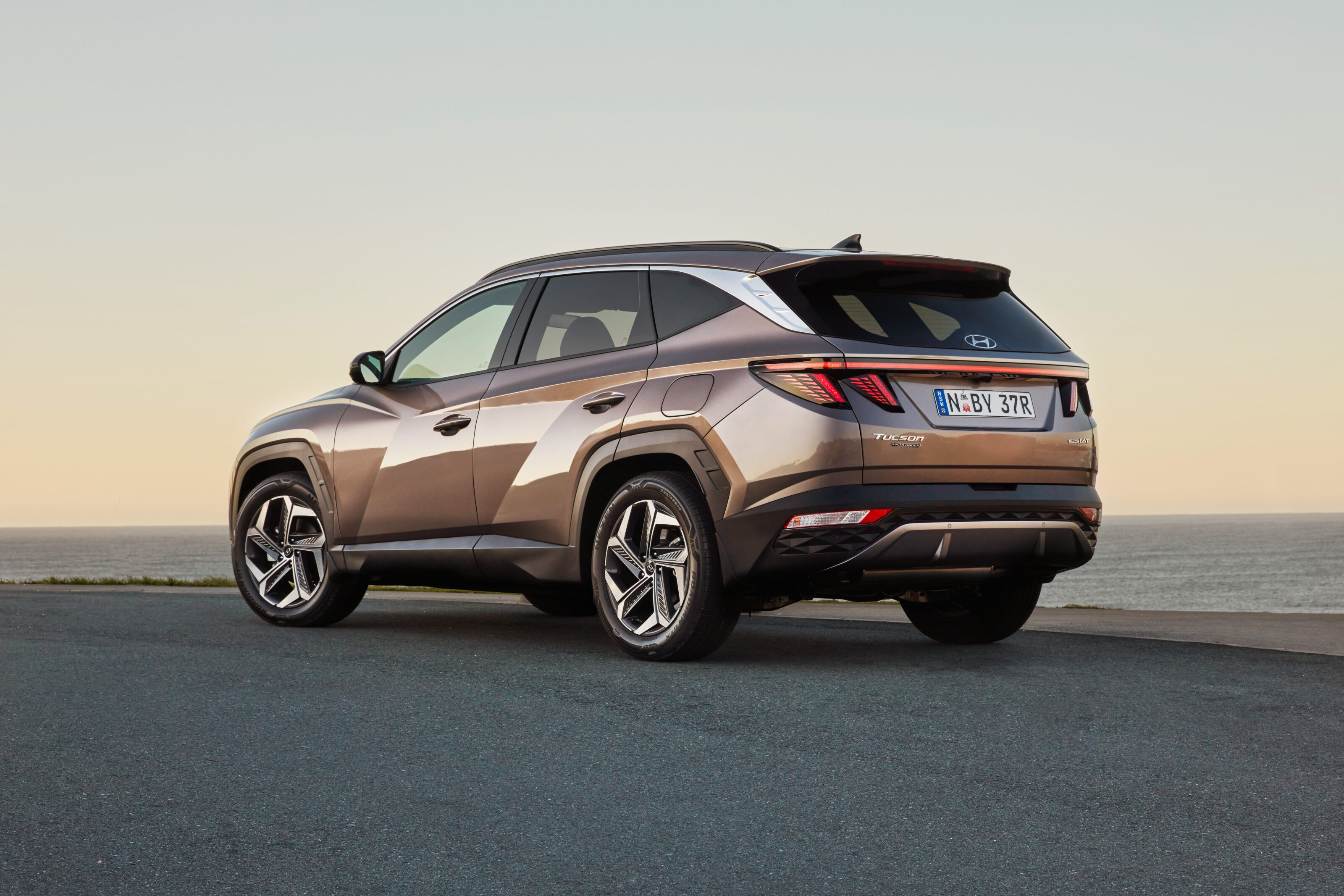
As with the previous model, the FWD 2.0-litre petrol won’t be the pick of the bunch but in the Highlander, it does offer a good way of getting into a premium-equipped and styled SUV for less than $50,000.
If you’re happy to go with this powertrain it’s worth noting that an N-Line package will be available in mid-2021 for all three variants that will bring the digital gauge cluster, LED front and rear lights, leather and suede seats, 19-inch wheels and exterior garnish to the entry-level and Elite variants for an additional $3500 and $2000 respectively, which make them well worth a look.
Model Hyundai Tucson Highlander FWD specifications
Body: 5-door, 5-seat SUV Drive: FWD Engine: 1999cc 4-cyl, 16v Power: 115kW @ 6200rpm Torque: 192Nm @ 4500rpm Fuel consumption: 8.1L/100km (combined) CO2 emissions: 184g/km Compression ratio: 10.8:1 Weight: 1530kg Transmission: 6-speed automatic Suspension: MacPherson strut/Multi-link L/W/H: 4630/1865/1665mm Wheelbase: 2755mm Tracks: 1620/1627mm Brakes: Front ventilated discs (305mm) / Rear solid discs (300mm) Tyres: 235/55 R19 101H Nexen Roadian GTX Wheels: 7.5Jx19 Price: From $46,000
Snapshot
- VinFast’s Australian executive has resigned
- Port Melbourne R&D centre to be restructured
- Lang Lang proving ground and engineering teams unaffected
Vietnamese car manufacturer VinFast is believed to be initiating a significant restructure of its Australian operations today.
Wheels has spoken with several sources close to the company, but beyond acknowledging a change is occurring, none were able to confirm any details of the move due to its confidential nature.
While details are thin on the ground, Wheels understands a number of teams are being restructured and/or being made redundant, and that a high-ranking Australian executive has resigned.
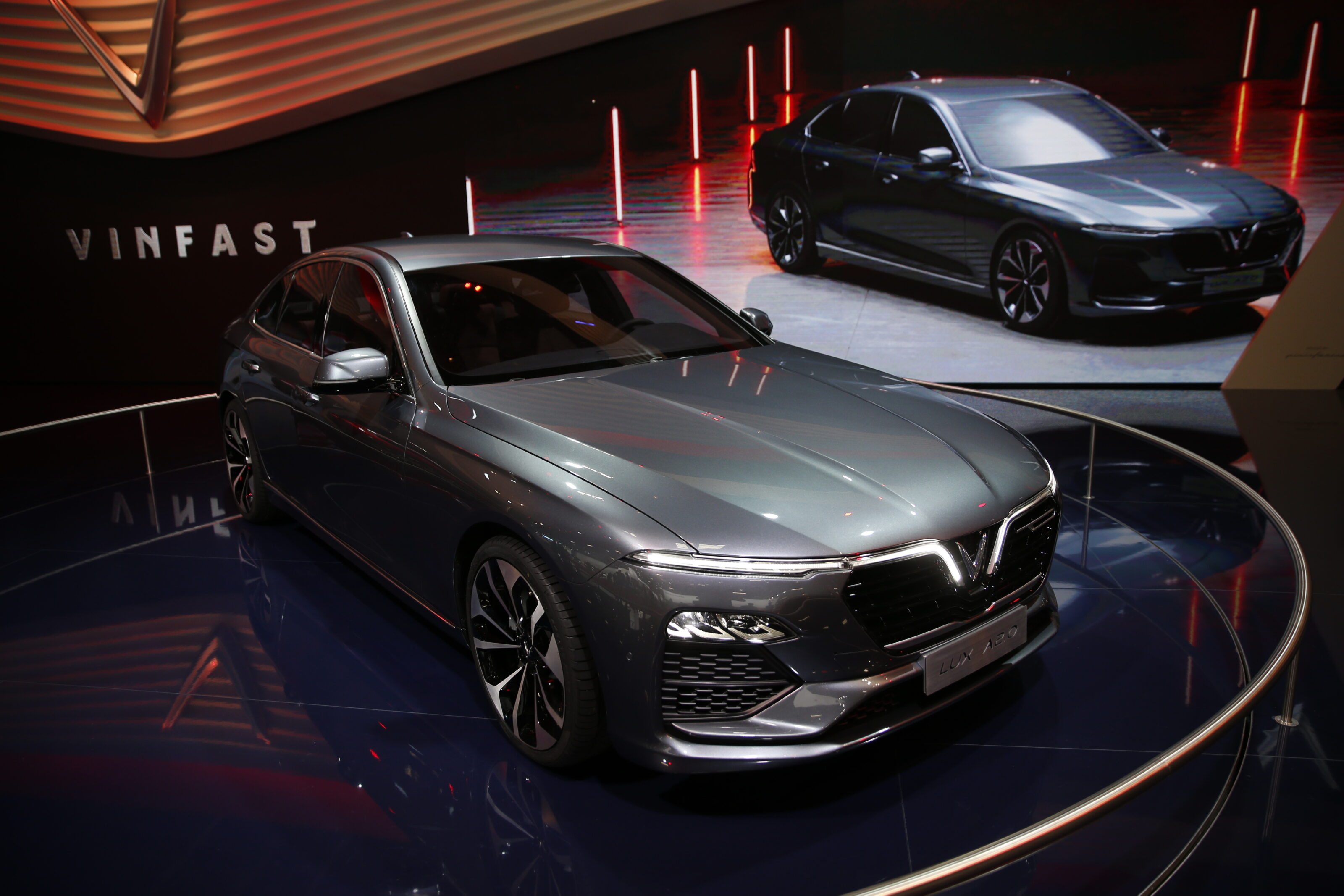
The news comes roughly a year after VinFast made a multi-million dollar investment in Australia which saw it establish a new local head office and purchase the Lang Lang proving ground from GM Holden.
Last year – in the wake of Holden’s departure from Australia – the Vietnamese company started an Australian research and development arm, dubbed Automotive Technology Institute 2, which moved into a purpose-built facility in Melbourne.
The team were tasked with focusing on developing new models for VinFast, along with internal combustion and battery-electric powertrains. Roughly 100 people are thought to be employed by VinFast at the facility, with many being former Ford Australia, Toyota, JLR and Holden workers.
The man in charge of VinFast’s local operations, former Holden executive Kevin Yardley, is understood to have recently resigned from his position.
While the details of the restructure are yet to be revealed, Wheels understands there are a number of redundancies.
Currently, the Lang Lang proving ground that VinFast purchased from General Motors for a rumoured $20 million (which is still largely staffed by ex-Holden employees) is safe and unaffected by the restructure.
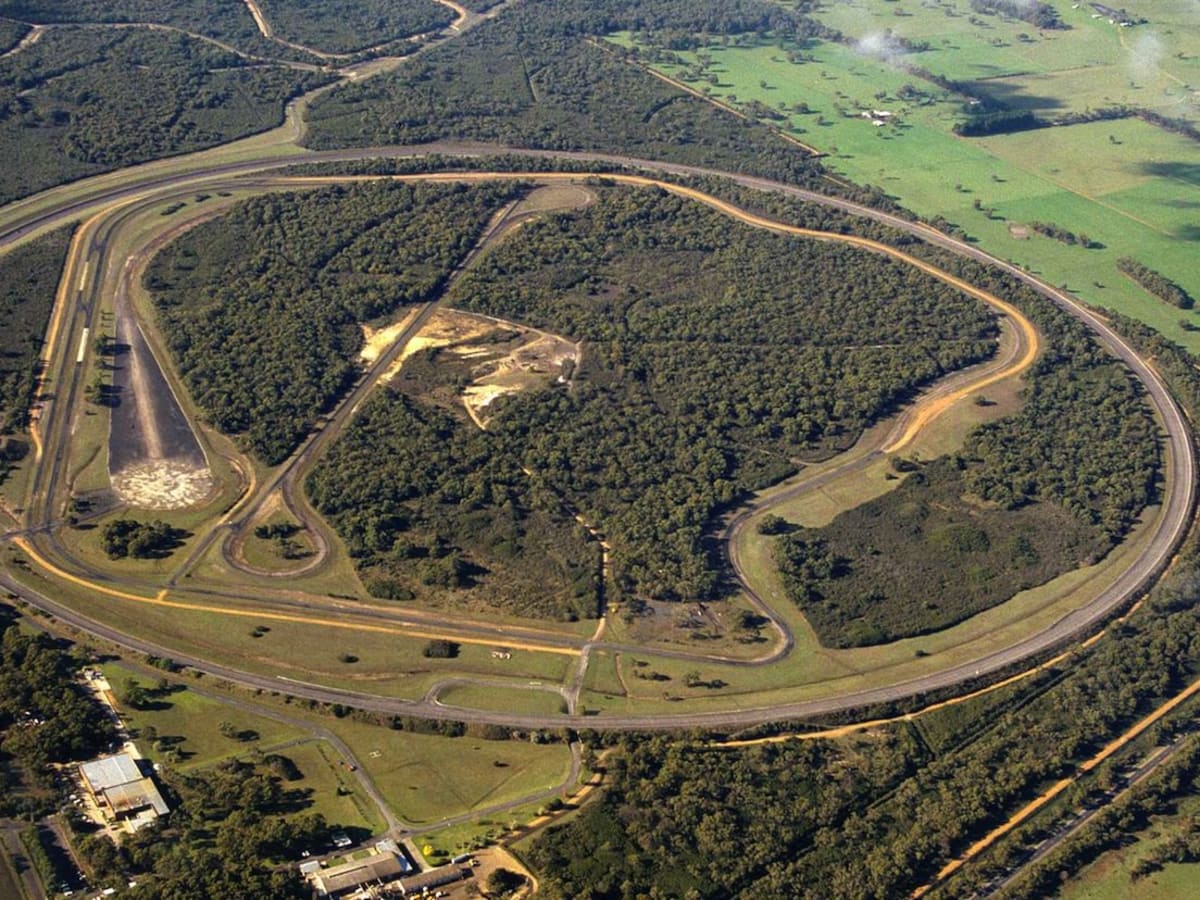
The first fleet of VinFast’s development vehicles are due to begin their testing and development programmes at the proving ground, with Australian engineers set to continue their work developing vehicles for international markets.
Currently VinFast has no official plans for selling vehicles in Australia.
VinFast launched three new models for international markets earlier this year, of which the Australian arm is understood to have played some part in the development.
VinFast is owned by Vingroup, Vietnam’s largest private business, with assets totalling $35 billion. Of that figure, a reported $3.5 billion has been invested into VinFast. Vingroup was founded by Vietnam’s richest man and former instant noodle magnate Pham Nhat Vuong.
STORY DEVELOPING
The facelifted 2022 Subaru Forester is on its way Down Under – but don’t expect any big surprises.
The popular mid-size SUV – 5006 of which have found homes with Aussies this year so far – has had its first proper update since the current model came to our shores in 2018.
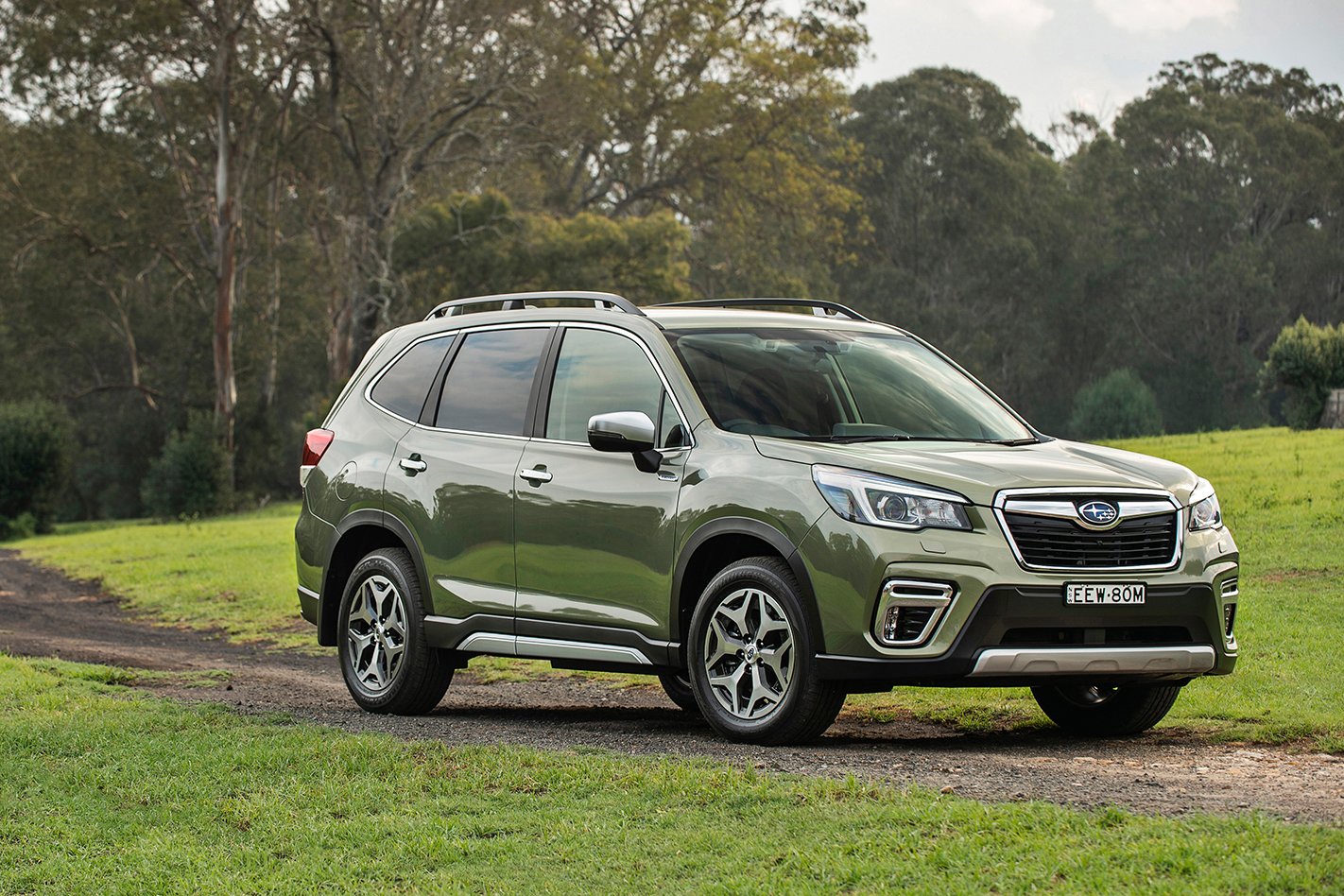
While little is currently confirmed about the new-look Forester, images obtained by Japanese website Car Sensor suggest exterior changes will be limited. The radiator grille’s hexagonal motif has been swapped out for a honeycomb pattern, and adaptive LED headlights added.
The facelifted Subaru also appears to sport larger black cladding around the wheel arches, and new alloy wheel designs.The Japanese report makes no mention of the vehicle’s interior but does allude to the addition of intersection support for its autonomous emergency braking system.
The SUV’s suspension and steering system is rumoured to be on the cards for an upgrade, with reports suggesting “improved ride quality and handling” despite there being no change in the powertrain.
A spokesman for Subaru Australia told WhichCar the Forester will continue to feature either a 2.0 litre hybrid or 2.5 litre four-cylinder petrol engine, the latter capable of producing 136kW/239Nm. In Japan, as well as the 2L hybrid, there’s also a 130kW/300Nm 1.8-litre turbo petrol four-cylinder on offer.
The spokesman also told us the 2022 Subaru Forester is expected around October, with more details available at local launch soon.
While the company claims not to be anticipating delays due to the global semi-conductor shortage issue, it also said it is in “constant contact” with the factory in Japan so can update information for the Australian market as needed.
