
The 2021 Mercedes-Benz EQT people mover concept has been teased by the German automaker just weeks before its global unveiling on May 10.
Believed to be in a close-to-production-ready state, the EQT will be the carmaker’s first fully electric people mover and could go on sale as early as 2022.
It is also thought the EQT will be based on the underpinnings of the new combustion-engined Mercedes-Benz T-Class, which is being jointly developed by Renault, Nissan, and Mitsubishi.
The collectively designed chassis architecture will serve as Renault’s new Kangoo, and will also provide the base for Nissan and Mitsubishi’s next small-sized van.
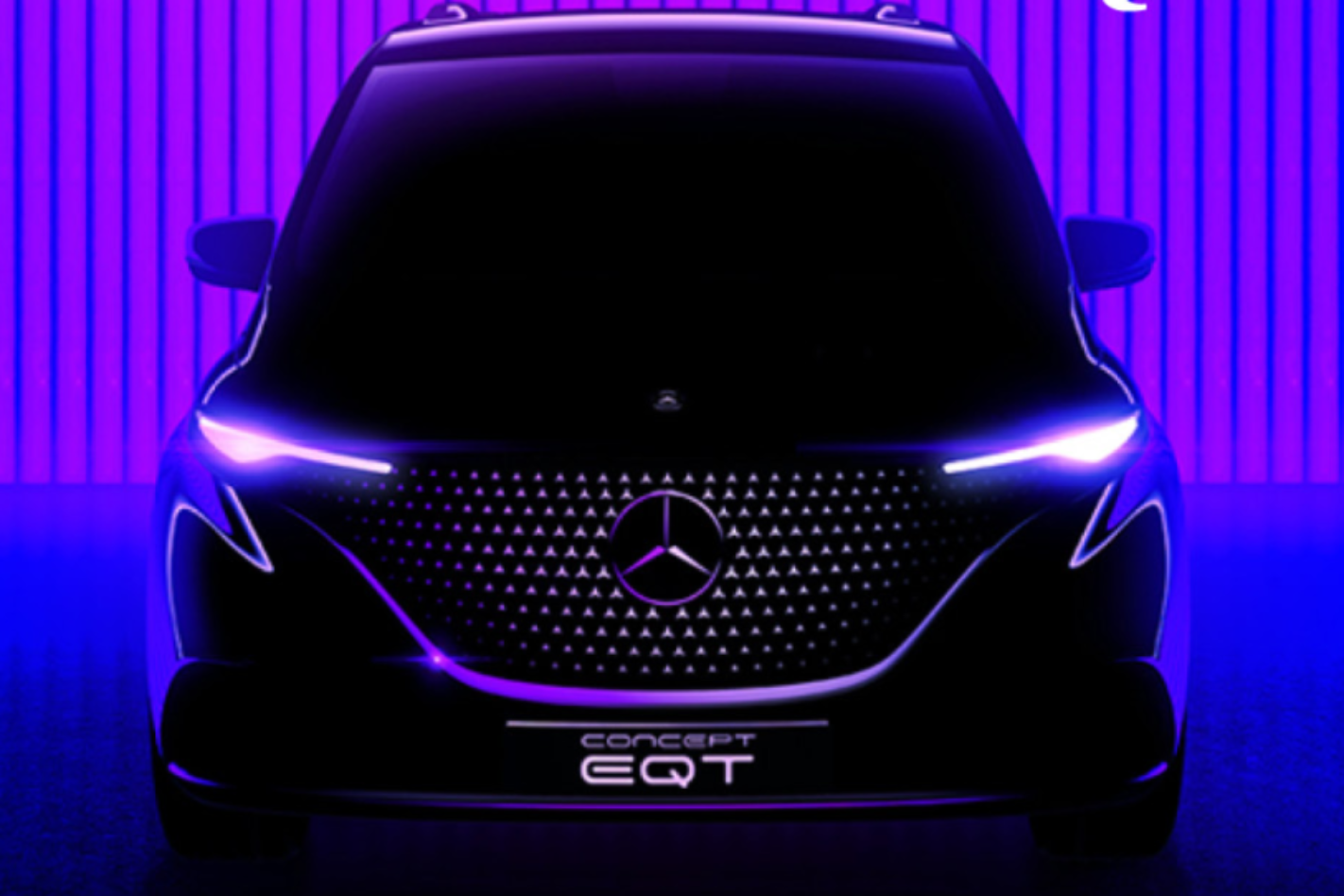
Judging from the single teaser image, the EQT will stylistically carry the same design language as the rest of Mercedes’s electric EQ range, with slim, aggressive headlights and a large star pattern chrome grille.
Inside, expect to see a variant of Mercedes’s MBUX infotainment system, and potentially the same large 12.3-inch dual-screen digital dash found on other Benz products.
There’s no word yet as to what sort of battery pack the new EQT concept will have, nor is there mention of drive-type, power or driving range.
However, with the global launch of the van just a few weeks away, we won’t have to wait long to find out.
Be sure to watch this space as WhichCar brings you all the latest updates on Mercedes-Benz’s new electric people mover.
MORE: All Mercedes-Benz stories
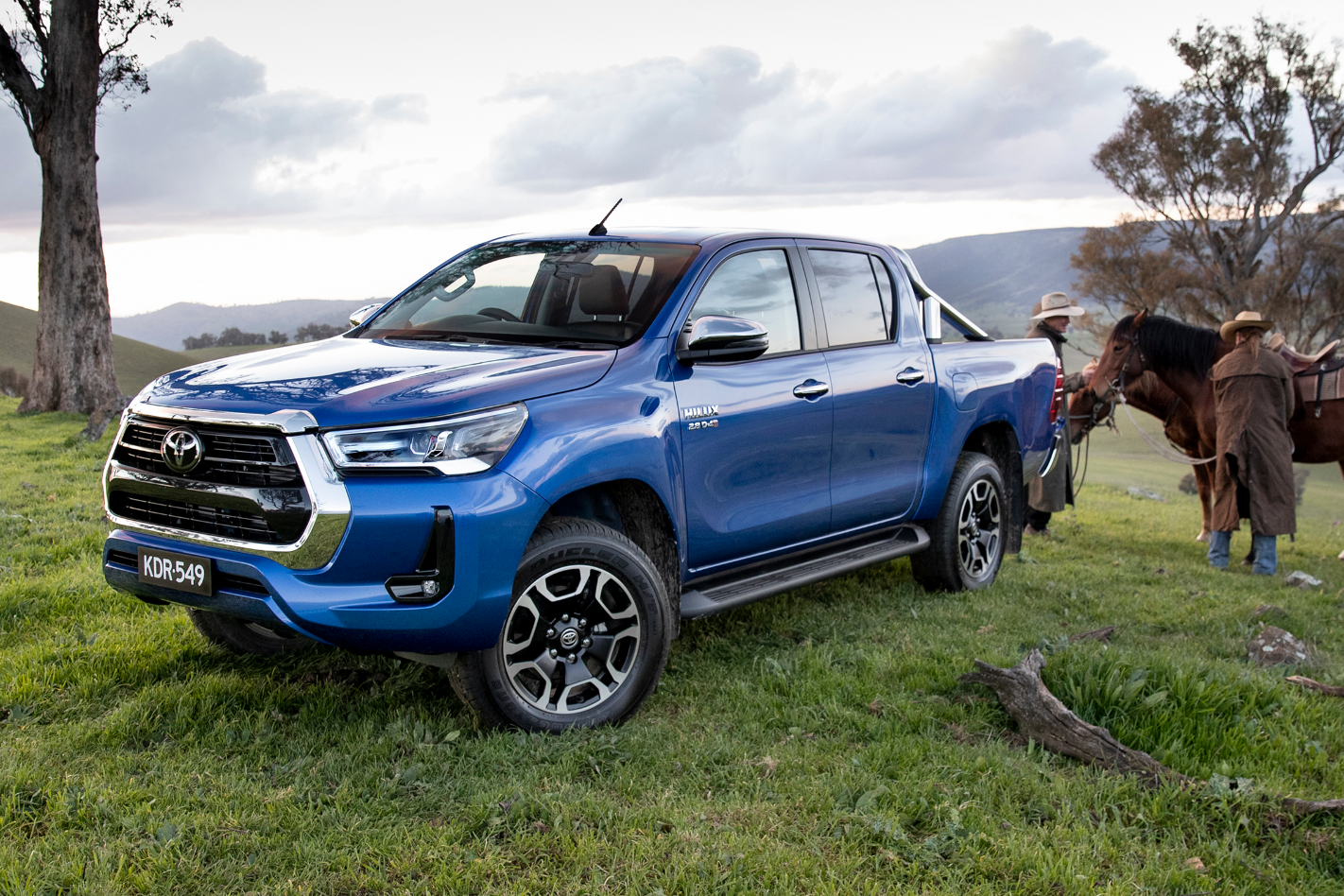
Toyota Australia is recalling 683 HiLux utes built between May and October 2020, due to three faults being identified.
The first fault, which the Japanese automaker says affects all 683 examples, was identified with the vehicles’ wiring harness.
According to Toyota, the wiring harnesses insulation may wear over time due to vehicle vibrations when driving, and this could lead to the harness coming into direct contact with a battery clamp.
If that happens, there is a potential for a short circuit to occur, which may lead to power loss or even a fire.
The second fault impacts 633 examples of the 2020 HiLux and involves the ute’s roller cover.
Toyota says the roller cover and 12V accessory socket may stop working due to a lack of over-current protection.
This could lead to internal components of the Dark Current Unit (DCU) being damaged if the affected vehicles’ batteries are disconnected or reconnected.
The final fault is to do with the Roller Cover Electronic Control Unit (ECU) software and is said to only impact 281 examples of the work ute.
The ECU issue may cause the roller cover to suffer from abnormalities in its operation, which could cause the cover’s motor to overheat and damage itself.
Toyota Australia will be contacting all owners of affected vehicles via SMS, email and/or mail and asking them to make a time to book their vehicle in with an authorised Toyota dealer.
The carmaker also asks that owners keep their contact details up-to-date with Toyota so it can effectively reach out to all involved parties.
Faulty vehicles will be inspected and repaired free of charge to owners, with the fix estimated to take between 30 and 90 minutes, depending on what faults are identified.
Anyone wanting more information can contact the Toyota recall campaign helpline on 1800 987 366.
MORE: HiLux stories MORE: All Toyota stories
Mercedes-Benz Australia has issued a recall for 719 of its 2020-registered C-Class, GLC and all-electric EQC.
According to the German automaker, a defect has been identified with the vehicles’ steering control unit.
As a result, the steering wheel wiring harness may be damaged and susceptible to increased moisture build-up.
If that happens, Mercedes says there’s a potential for the wiring harness to short circuit, which could result in the loss of electric power steering assistance or could even start a fire.
Mercedes is asking that all owners with a 2020 C-Class, GLC or EQC make contact with their preferred authorised dealer for a no-cost inspection and repair if required.
The Stuttgart firm’s local arm has also created a full list of all the affected vehicles’ VIN numbers, which can be viewed here.
To find your preferred dealer visit: https://www.mercedes-benz.com.au/passengercars/mercedes-benz-cars/dealer-locator.html
MORE: All Mercedes-Benz stories
In 1989, Porsche’s sales had dipped to just 15,000 units, and by 1995 the 993-generation 911 was its last surviving model. Common wisdom holds that the Cayenne SUV saved the company in 2002, but the model that actually started the turnaround arrived 25 years ago this year in 1996, in the shapely form of the Boxster.
The Boxster now feels almost as integral to the Porsche model range as the 911, and there’s no shortage of reference points to ground it in Stuttgart’s back catalogue, so it’s easy to forget just how radical it seemed when the first-generation 986 launched a quarter of a century ago.
It switched Porsche’s affordable sports car strategy from a front- to mid-engined layout and both influenced the upcoming water-cooled 911 (the 996) and helped make it far more affordable to produce, thus safeguarding Porsche the company.
There was no small amount of pressure on the team behind it, so the Boxster’s silver anniversary is a chance to learn more about the 986’s development first-hand.
Grant Larson is the American who designed both the concept and production car under the guidance of his boss Harm Lagaay. He remains with Porsche to this day. Period R&D boss Horst Marchart pitched the idea of an affordable mid-engined model in the first place, and is now retired.
Porsche sales had plummeted from around 40,000 units a year to that low of 15,000 in 1989, as recession bit, its cars fell out of favour and the management team fluctuated and lacked clear direction. The 928 was ageing and expensive, and the 944 – and the 968 that replaced it in 1991 – wasn’t meeting sales expectations.
The costly-to-produce 993 was planned to have been complemented by the 989 [a four-door 911 that foretold the Panamera and was being developed under Ulrich Bez, later boss of Aston Martin], but then Horst Marchart was appointed to the supervisory board.
For Marchart there was a neat circularity to starting the Boxster project, as he’d originally joined Porsche in 1960 during 911 development. Later he moved to external third-party Porsche projects (Porsche worked on everything from hot Seat Ibizas to the Mercedes 500E) before eventually returning to the mothership in 1988 to become head of overall vehicle development.
“Three years later [in 1991] I was appointed a board member, but before that I had to tell the supervisory board what I wanted to do. The 928 was above the 911 in pricing, people weren’t purchasing them, and then the 989 was even above the 928 and 911,” he explains.
“We had to find the way to sell at least 30,000 units a year again. My idea was to go back to the roots. We didn’t have the Boxster yet, I just told the board we’re going to take the 911 and come up with a new car, which will have the identical front end, and what we are going to vary is the mid-engined concept.
“Of course that’s easier said than done, but we got it done.”
There was some internal resistance. Marchart recalls not everyone being convinced they were backing the right horse, and a senior employee suggested they should just do a more affordable two-seat version of the 911 instead, a kind of slightly different twist on the old 912 formula. The board, however, quickly approved Marchart’s concept.
The four-door 989 project was canned, and so a new strategy was developed, whereby the next 911 (the water-cooled 996) and the mid-engined Boxster were developed in tandem, with the two always intended to share around 50 per cent of parts to save costs (Porsche saved 30 per cent on the 911’s bill of materials) without compromising the 911’s technical specification – or halo status within the brand.
Porsche simultaneously re-organised the way it operated to improve efficiencies and internal communication – not just each department working largely in isolation, as had previously been the case, but in co-operation.
“When we started these two model lines, we set up 21 teams in development, but these were cross-functional teams from all departments,” explains Marchart.
Porsche also learnt lessons from the development processes and prototype tooling used by Japanese manufacturers, after a trip to Japan with management consultants McKinsey.
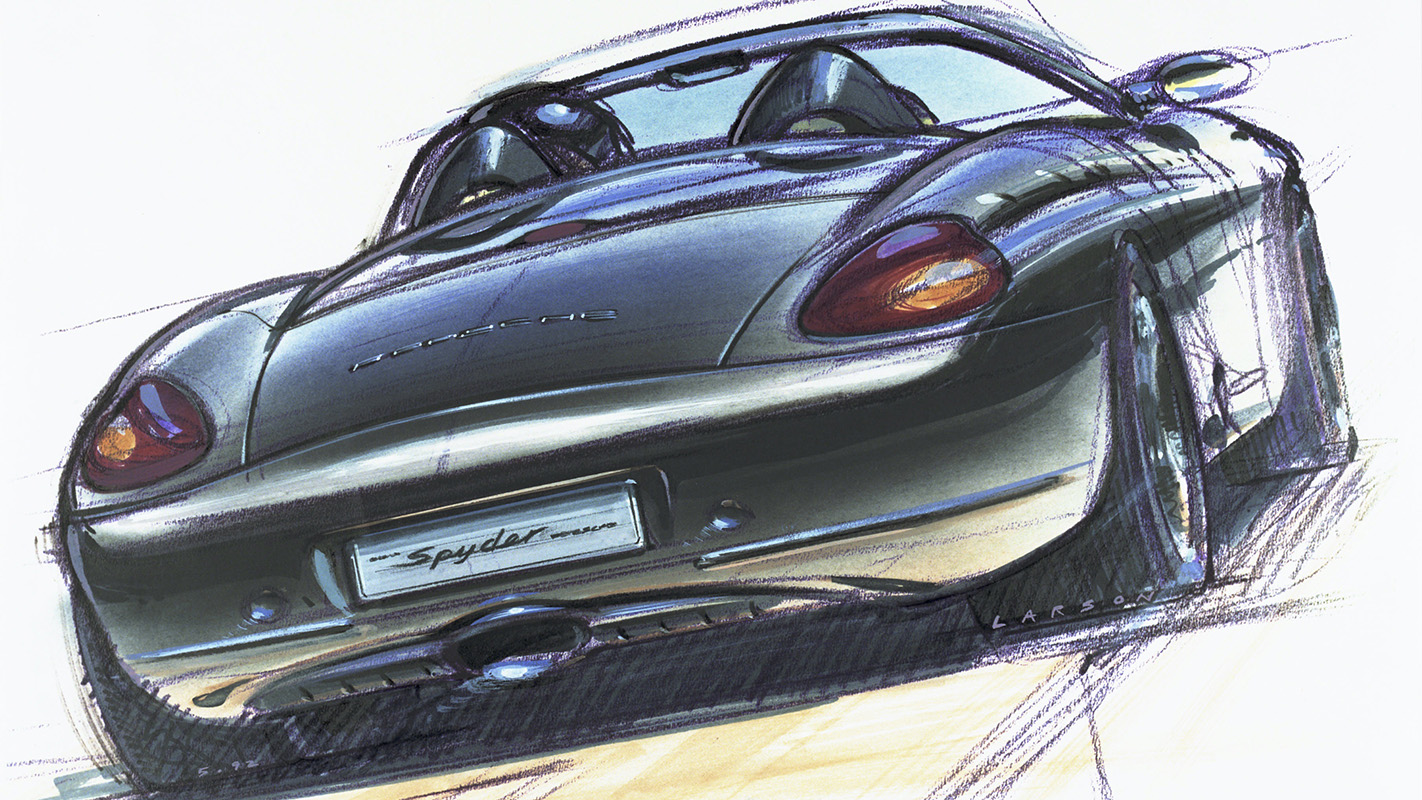
Grant Larson designed both the Boxster Concept and production car. He arrived from Audi aged 32 in 1989, after hearing that both Ulrich Bez and Harm Lagaay were leaving BMW to begin new projects at Porsche – even if Porsche’s reputation for conservatism preceded it.
“As a designer you always look at places where things are going on – at that time it was Japan, and there was less in Europe, and the least was happening at Porsche, which was known as a company that just facelifts a model for decades. My first project was a 944 facelift, which became the 968, as well as the 989,” he recalls.
“When we first started the Boxster we were a bit down, because the 989 had just been cancelled, around the middle or fall of 1991, but we knew something new was coming with the idea of the Boxster, and of course together with the 911 this was an exciting moment for us.”
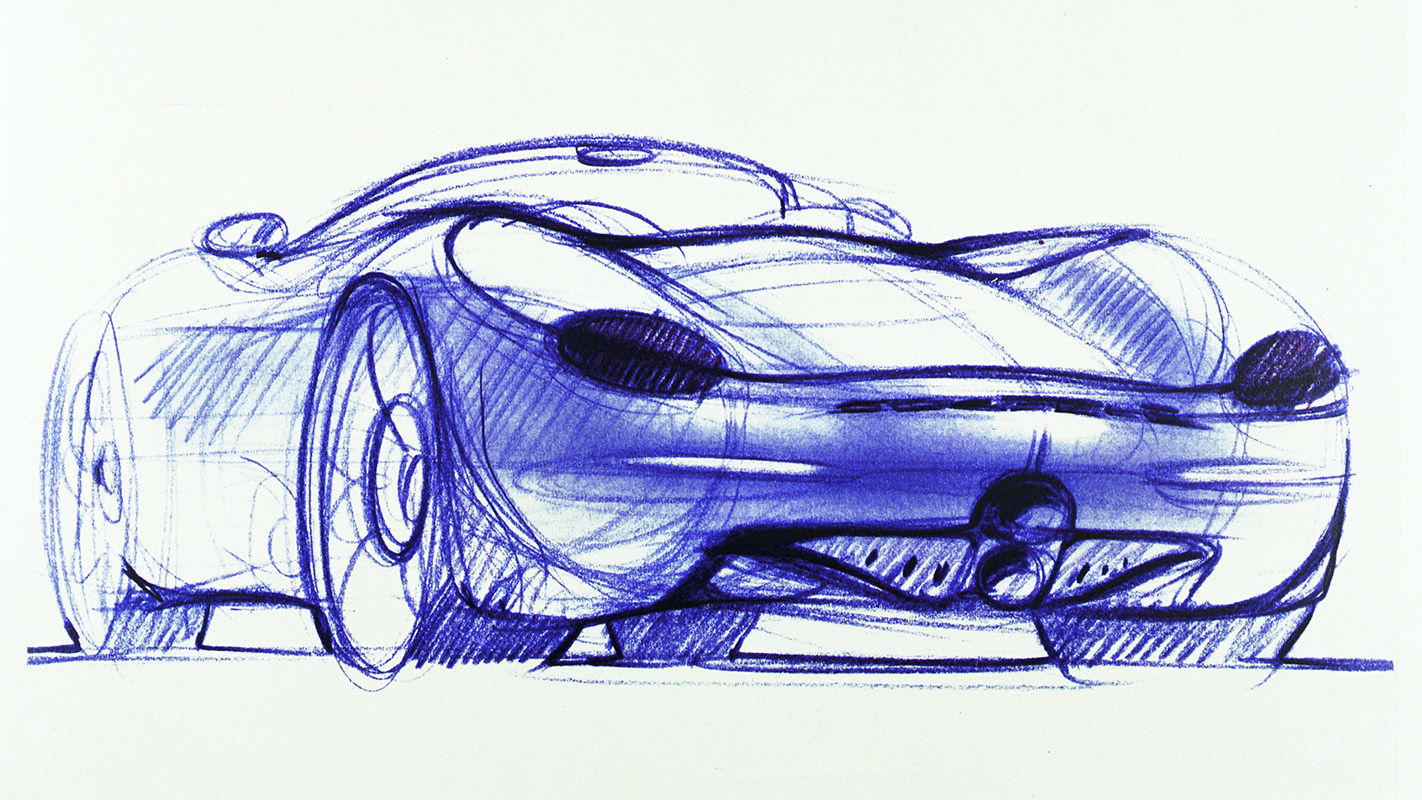
Larson looked back at Porsche mid-engined models for inspiration, including the 550 that raced in the 1950s and its successor, the 718 RSK, though he also acknowledges the wedgier 914. The design process was more analogue back then for all car companies, but Porsche’s clay modelling was particularly artisan – rather than using coordinates, the clay modeller worked freehand from Larson’s sketches.
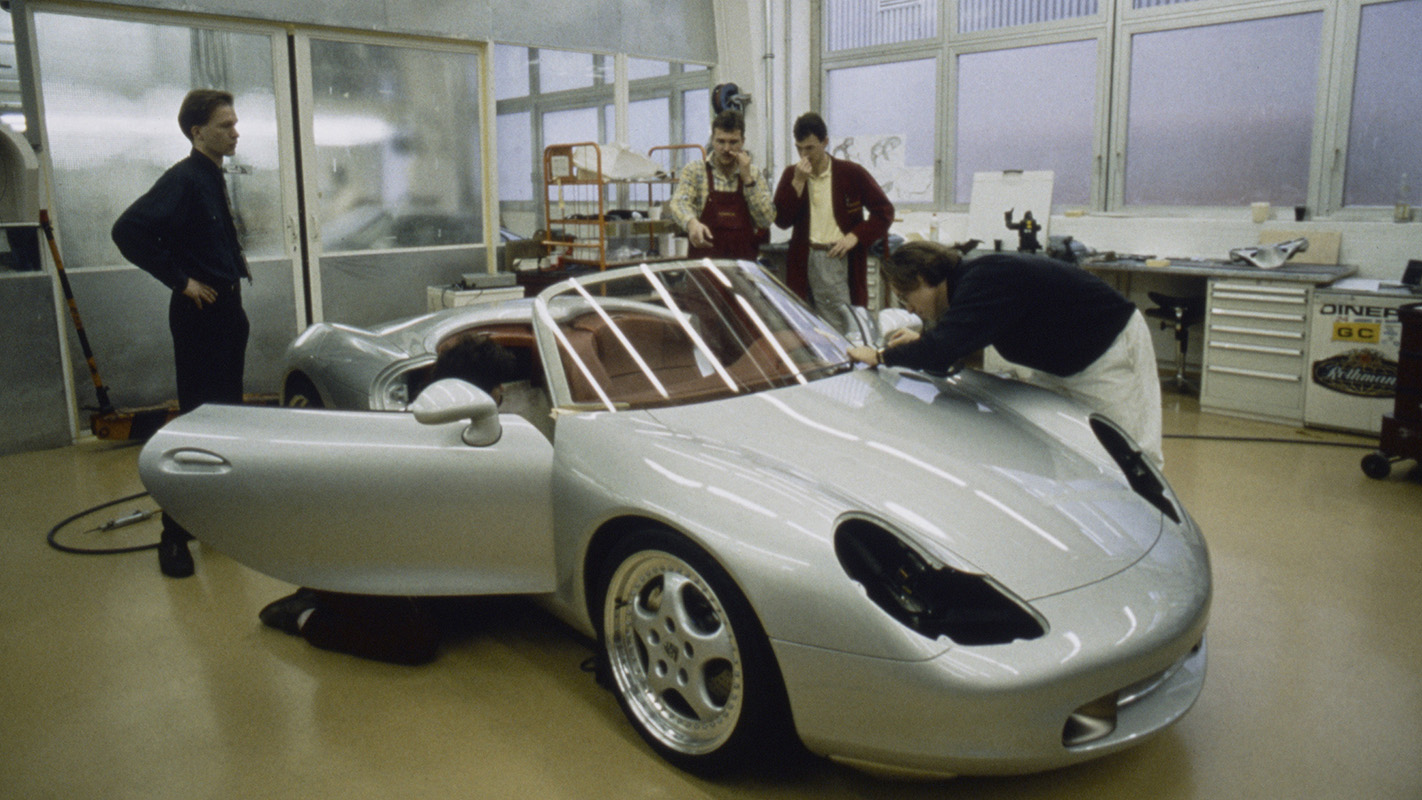
“I was really lucky to have an older gentleman, Peter Müller, with a lot of experience in clay modelling,” Larson recalls with barely concealed fondness. “He just said ‘give me a sketch’, so I plastered the walls with all these drawings, and of course talked to my boss, we put little red dots on each of the areas that we thought could become the new Boxster.
“And this guy looked at the drawings, and started sculpting the clay model with this thing that looked like a cheese grater and the car just sort of blossomed from his hands – not only from my sketches, but from his hands.”
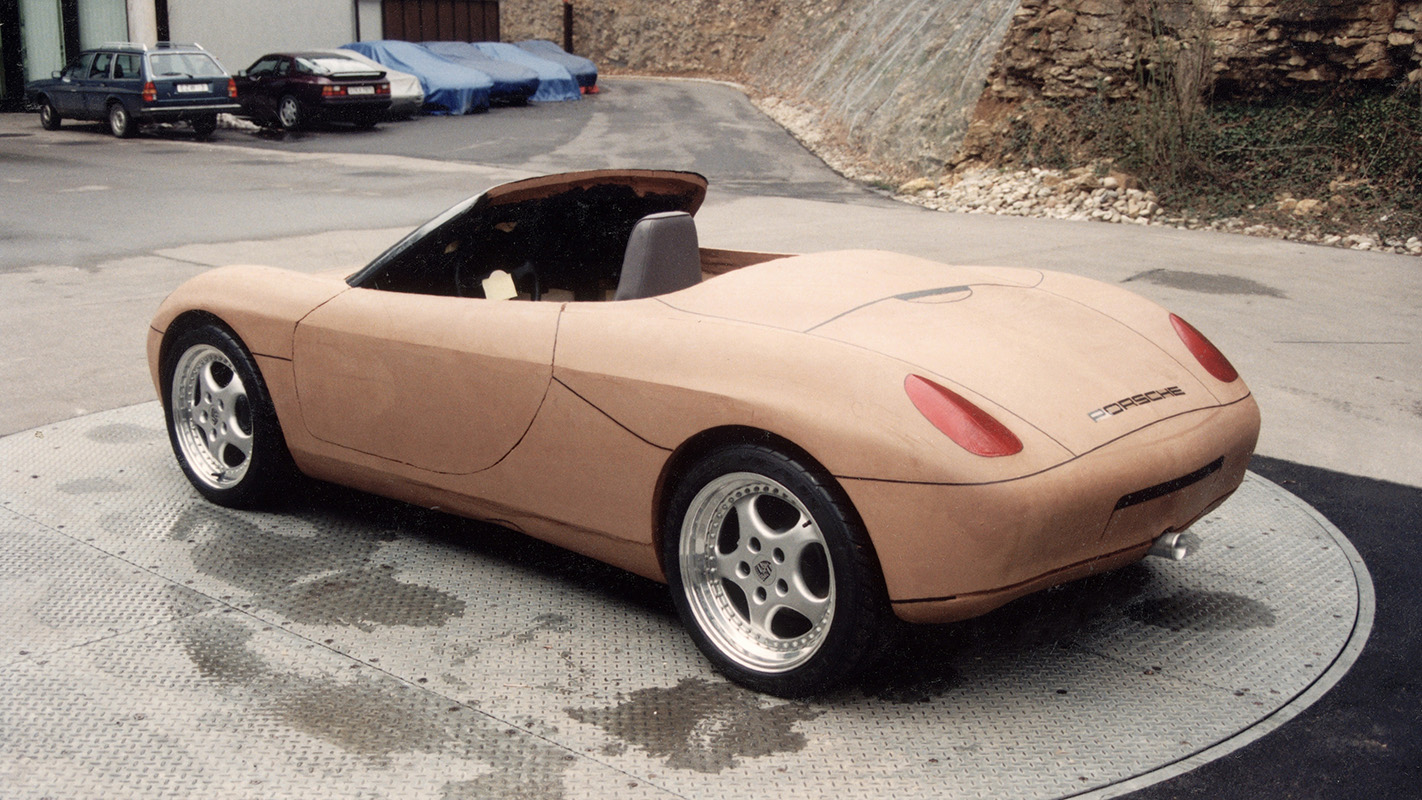
Larson describes the Boxster Concept as having typical mid-engined proportions – longer wheelbase, cab-forward design, sculpted fenders, low bonnet and low rear deck, plus sculpted sides that, at that point, weren’t constrained by the production realities of carrying over 911 doors. He’s particularly happy with the central exhaust, a wry nod to the original 550’s pea-shooter exhaust.
The concept interior was developed with Stephan Stark. “The idea was to bring more body colour into the car and have driver-oriented seating, so the car is basically asymmetrical with a tighter seating position with side bolsters that hold your hips,” elaborates Larson.
“There are all kinds of wonderful details – one of the most famous are the moving ventilator fans, which unfortunately didn’t make it into production.”
The Boxster Concept was revealed at the Detroit motor show in January 1993, because back then Porsche was exporting 60 per cent of production to the US, and needed to gauge reaction in its most crucial market. It went down a storm with potential buyers, journalists and the wider public alike.
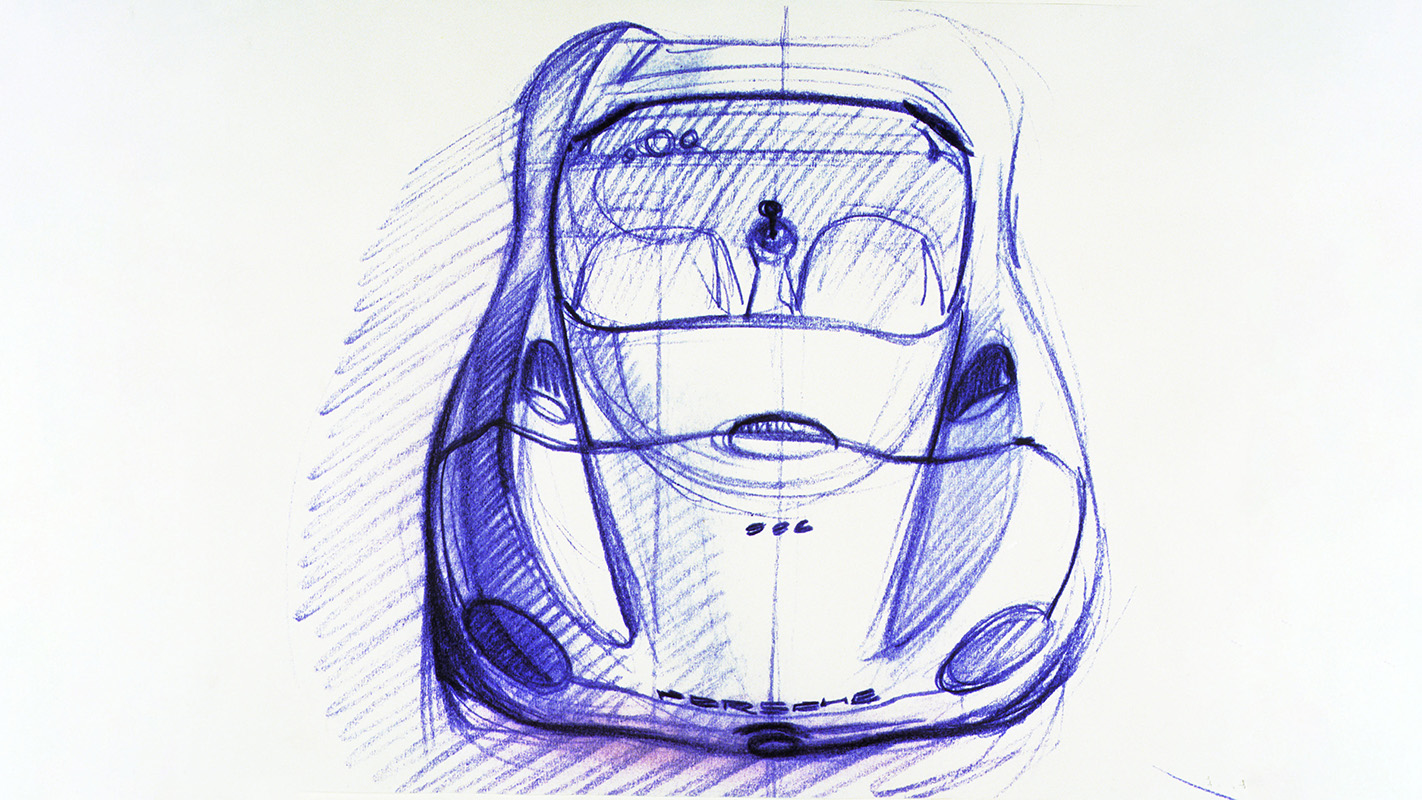
The design was scaled up around 10-15 per cent for production, which Larson downplays as ‘no big deal’, to provide more luggage space front and rear, and to accommodate radiators that came from the 996.
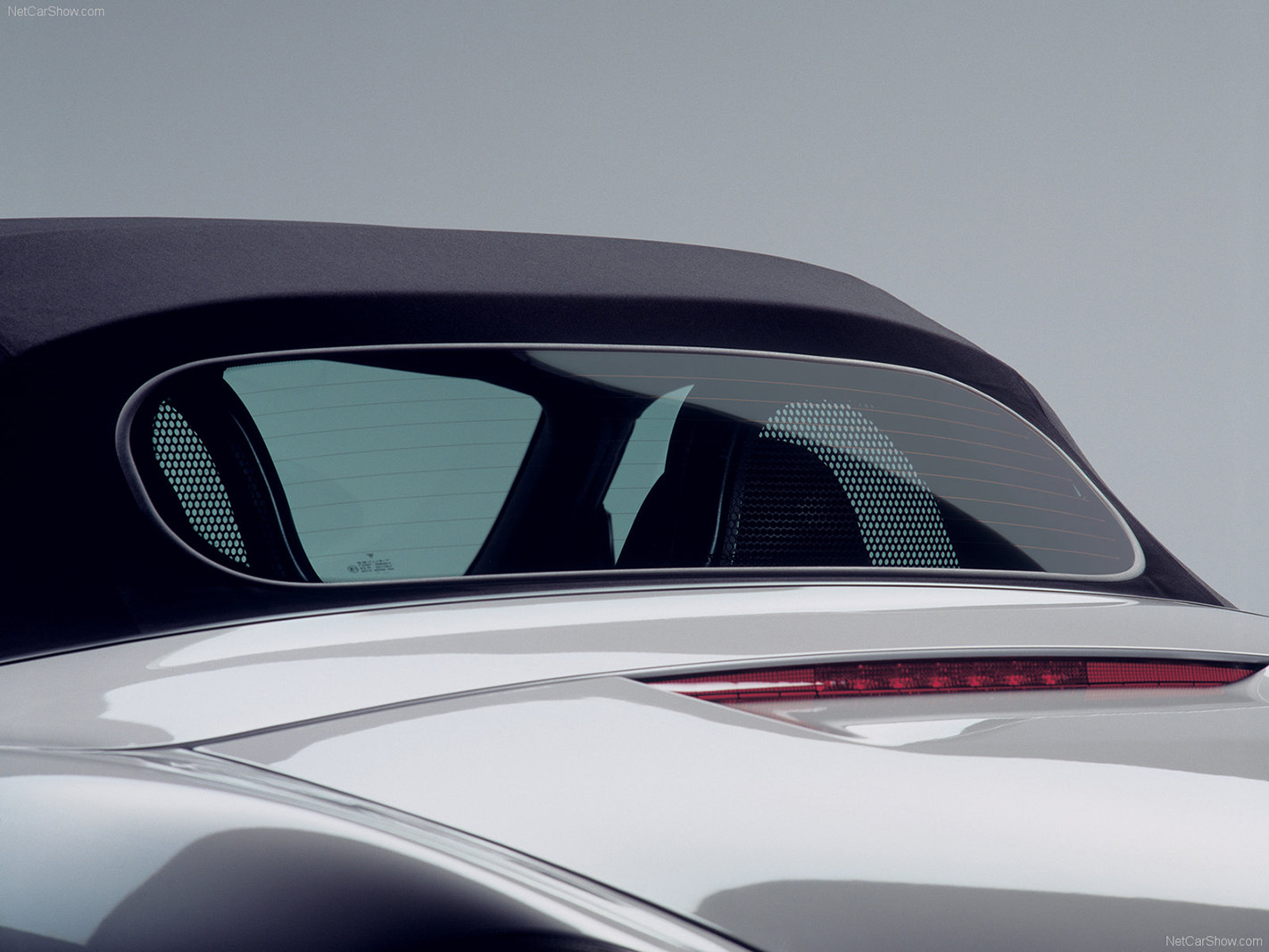
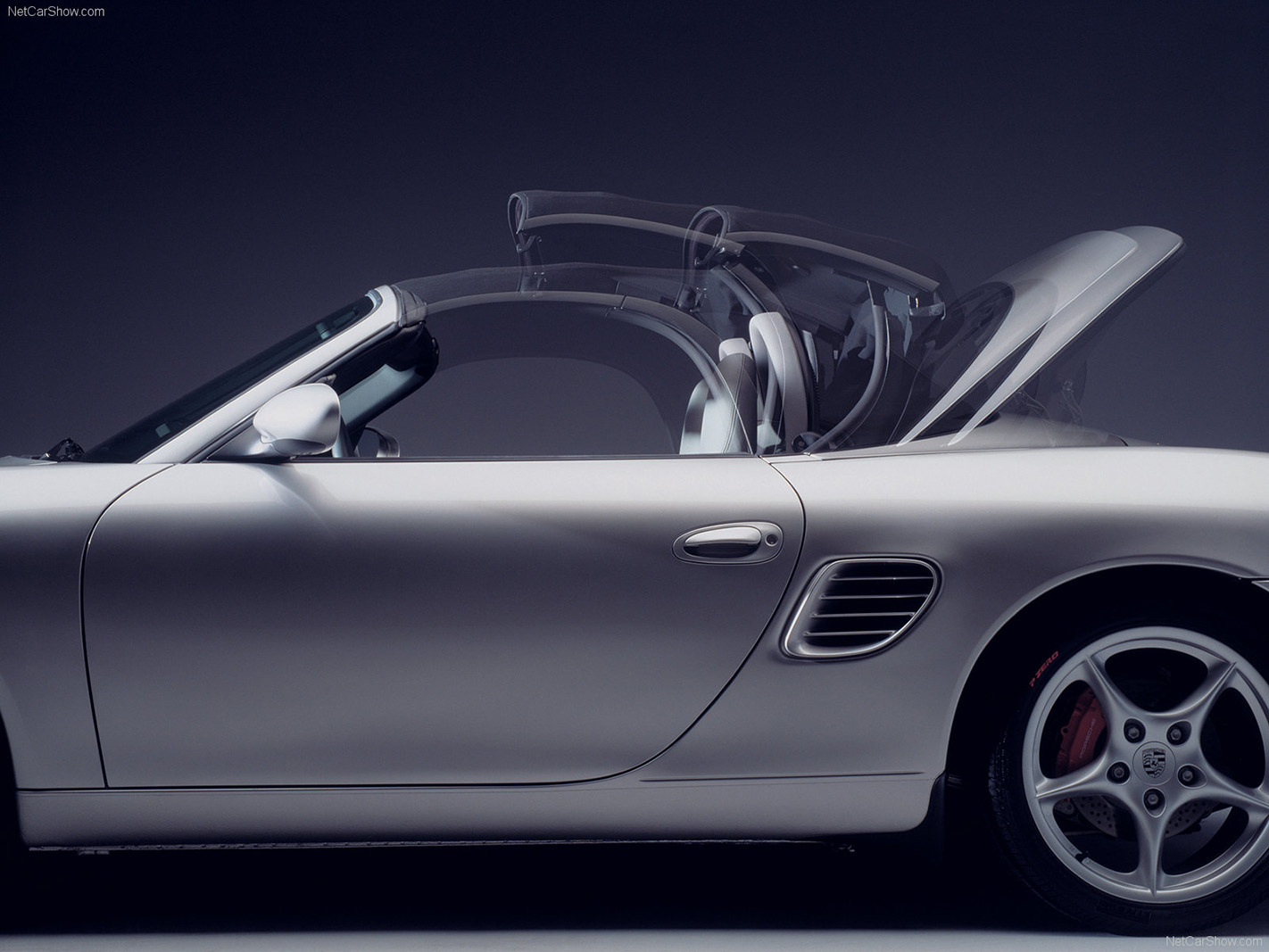
Roll-over hoops and a fabric hood were required, and air intakes were also moved up from the side skirts to the body sides.
The concept name – a portmanteau of ‘boxer’ and ‘roadster’ – was retained, and Marchart jokes it too was developed in-house, saving money on consultants.
Porsche initially planned to use an aluminium bodyshell, but the short time-scales meant it stuck with the steel structures with which it had more experience. Plans for a four-cylinder engine were even quite advanced.
“I was not too happy about that idea, but we definitely wanted to have a different output between these two models [the Boxster and 911],” recalls Marchart.
Thankfully the engineers had package-protected for six cylinders and when Audi submitted its quote for supplying engines, Marchart and his cost-savvy CEO Wendelin Wiedeking calculated it would be more cost-effective for Porsche to develop a flat-six shared with the 911, albeit turned through 180 degrees.
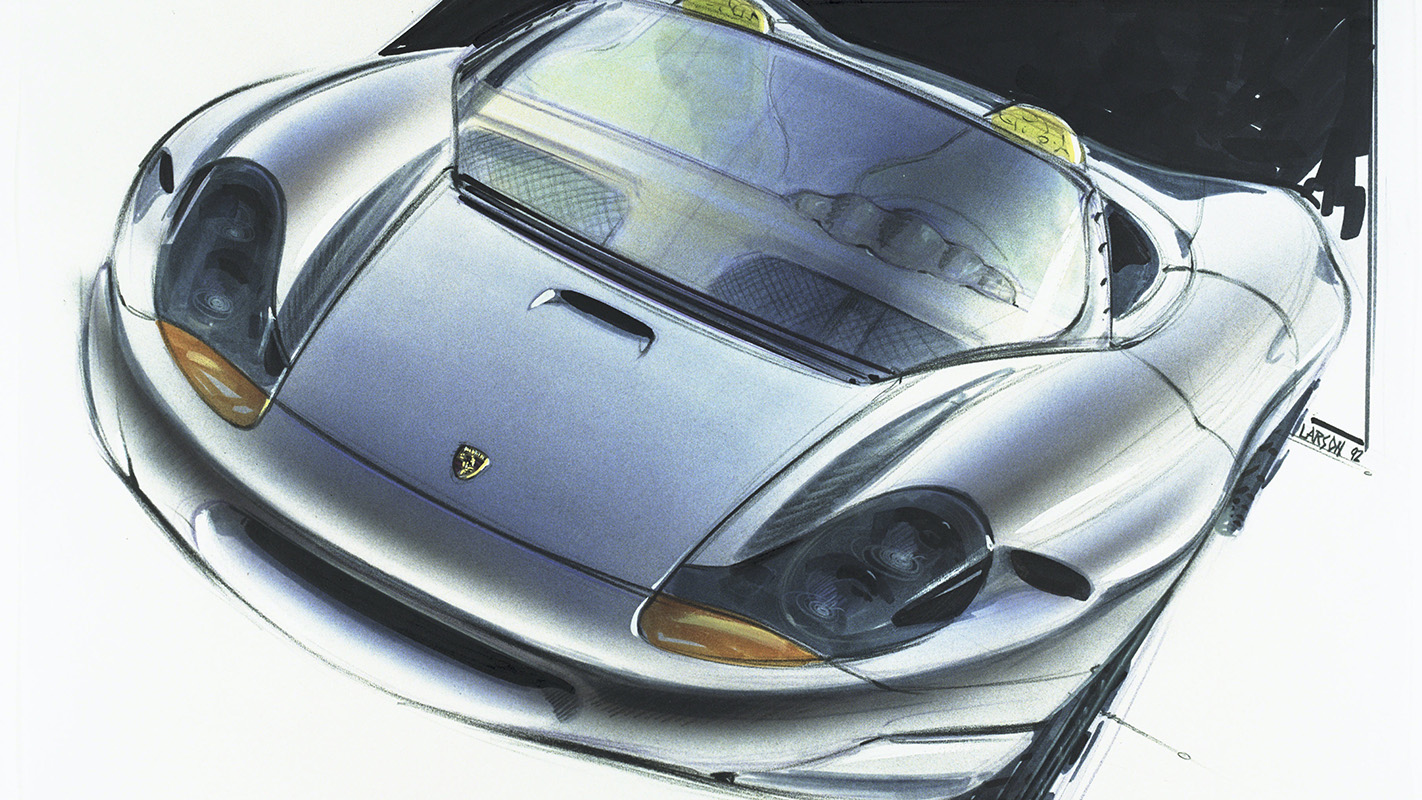
It would be Porsche’s first entirely water-cooled flat engine, the 959 supercar already having water-cooled heads. Having six cylinders also gave it a USP over the BMW Z1, another Ulrich Bez project, and the Mercedes-Benz SLK, which was on sale four years before a six was plumbed in.
In fact, it would take almost 20 years before the 718 Boxster switched to four cylinders, and we all know how well that went down, in large part because the M96 set such a benchmark.
The Boxster’s much lower price point and inherently better balanced chassis meant the new six-cylinder powerplant had to be de-tuned to save the 911’s blushes. “We knew from the beginning that the Boxster would be the faster car if it had the same power as the 996, that’s why the Boxster performance is lowered a little,” says Marchart.
The final specification of the new M96 engine was 2.5 litres for the Boxster with 150kW, versus a displacement of 3.4 litres with 220kW for the 911. But Marchart is frank in revealing this wasn’t always enough to mask the Boxster’s strengths.
“In curvy passages where the full power of the car is not required, the Boxster was able to convince, even compared to the 911,” he says, before giving the 911 a get-out-of-jail card by adding that “sometimes it is up to the driver which is fastest in the end.”
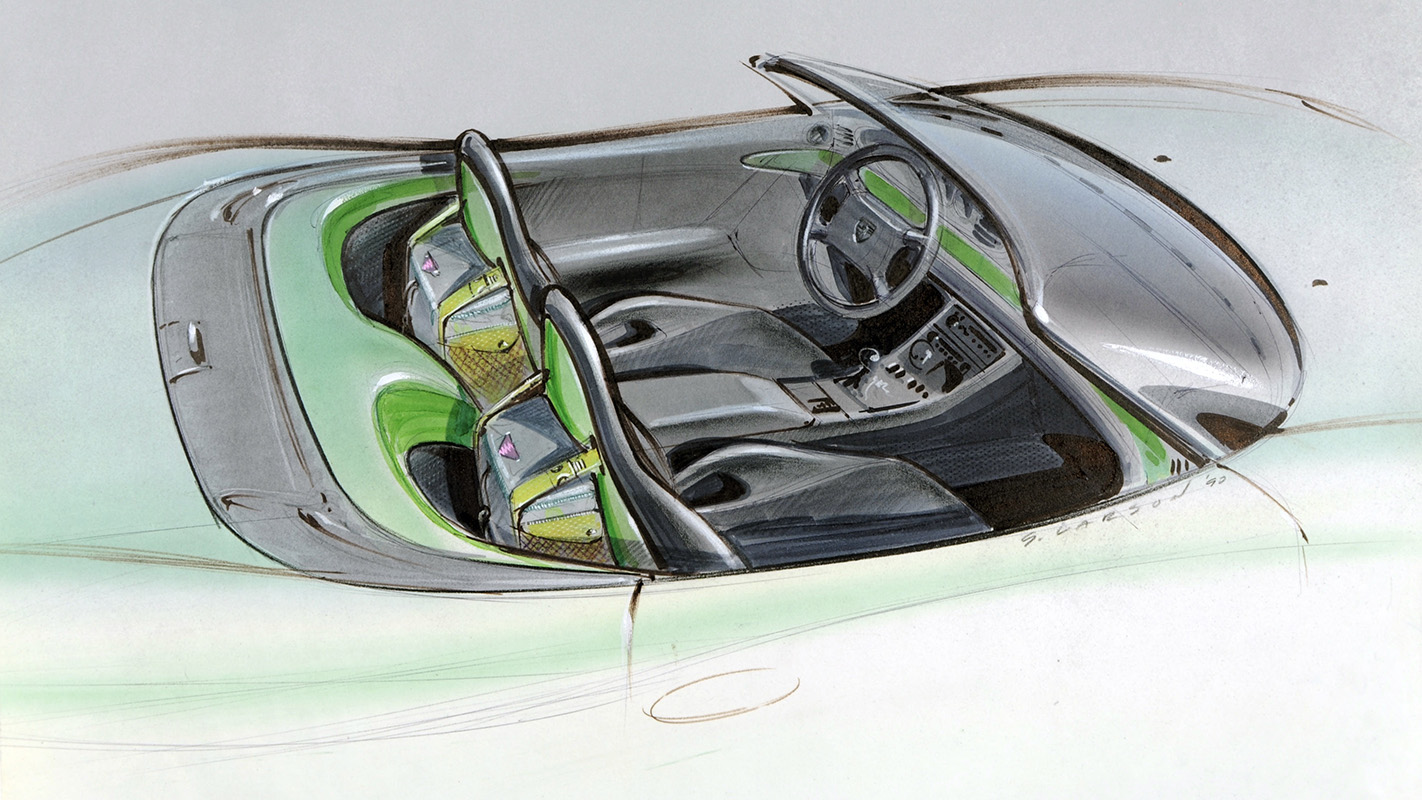
The bonnet, doors, wings and the position and rake of the (slightly lower) windscreen were always going to be shared between 911 and Boxster for production.
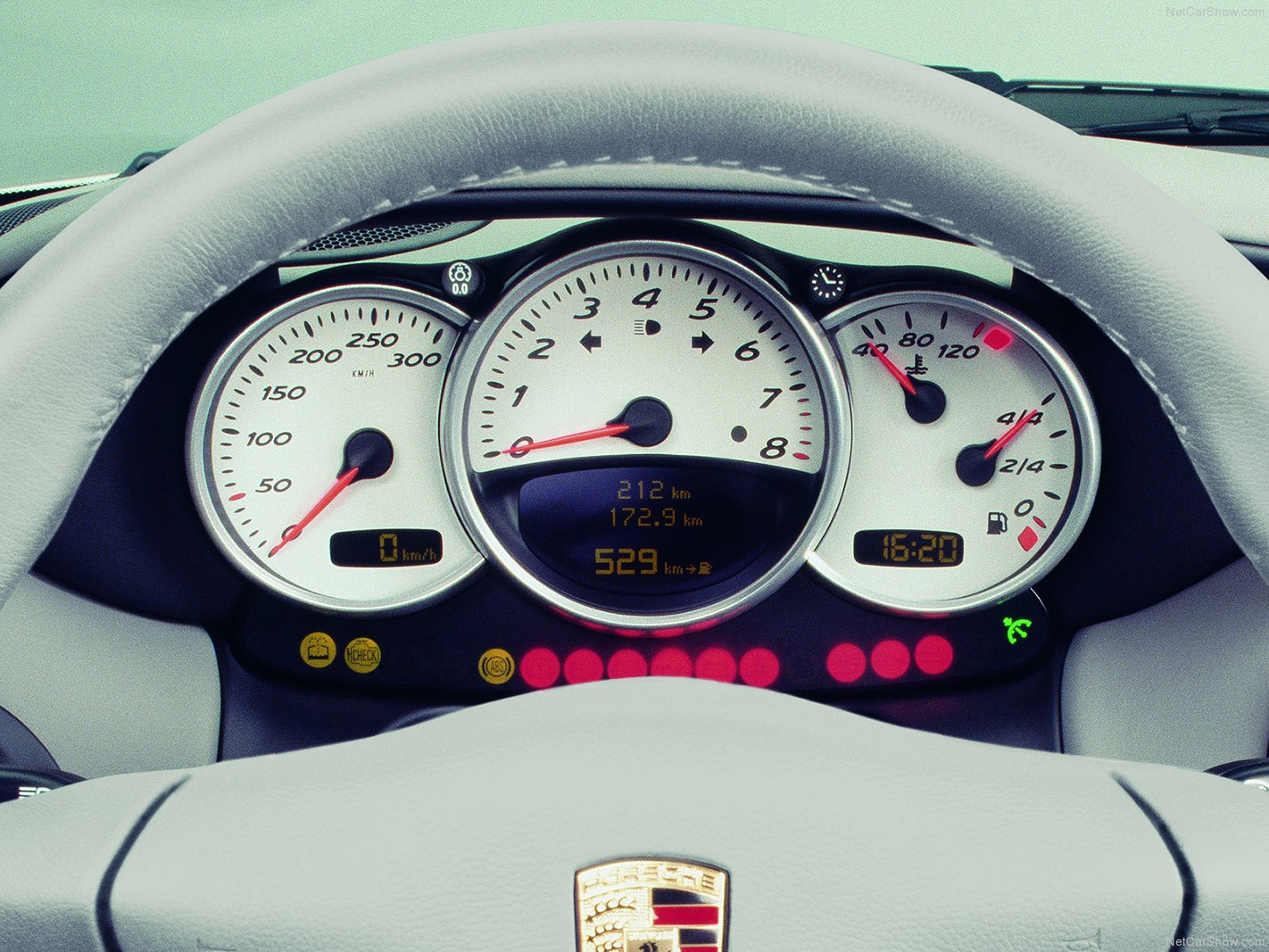
Other shared elements included the front suspension, and an interior that was largely similar, with the Boxster most obviously differentiated by having three rather than five dials in its instrument binnacle, and a more playful typeface.
But Porsche was still struggling to balance the books and was making some of its demoralised workforce redundant during Boxster development. Then, late in the process, the design team learnt that the Boxster’s (simpler and cheaper to produce) modular headlamps would be adopted wholesale for the 911, and the Boxster would use the 911’s front bumper, meaning the two designs would appear identical when viewed from the front.
The design team successfully fought the shared front bumper, though the first 996 911 did famously share the Boxster’s ‘fried-egg’ headlamps, prior to the 996.2 facelift, and the similarity between the two designs did prove to be controversial.
Throughout development, Marchart remembers just how hard employees worked, with some clocking out of work then coming back in to give up free time (at one point he faced a fine of around 50,000 Euros for irregular working practices), while Larson sums up the pressure both he and the wider design team faced.
“You think ‘how are we going to have a hit?’ because you have the responsibility of resurrecting the company,” he remembers.
“It was very important for us to make the best out of this opportunity and we put ourselves under a lot of pressure.”
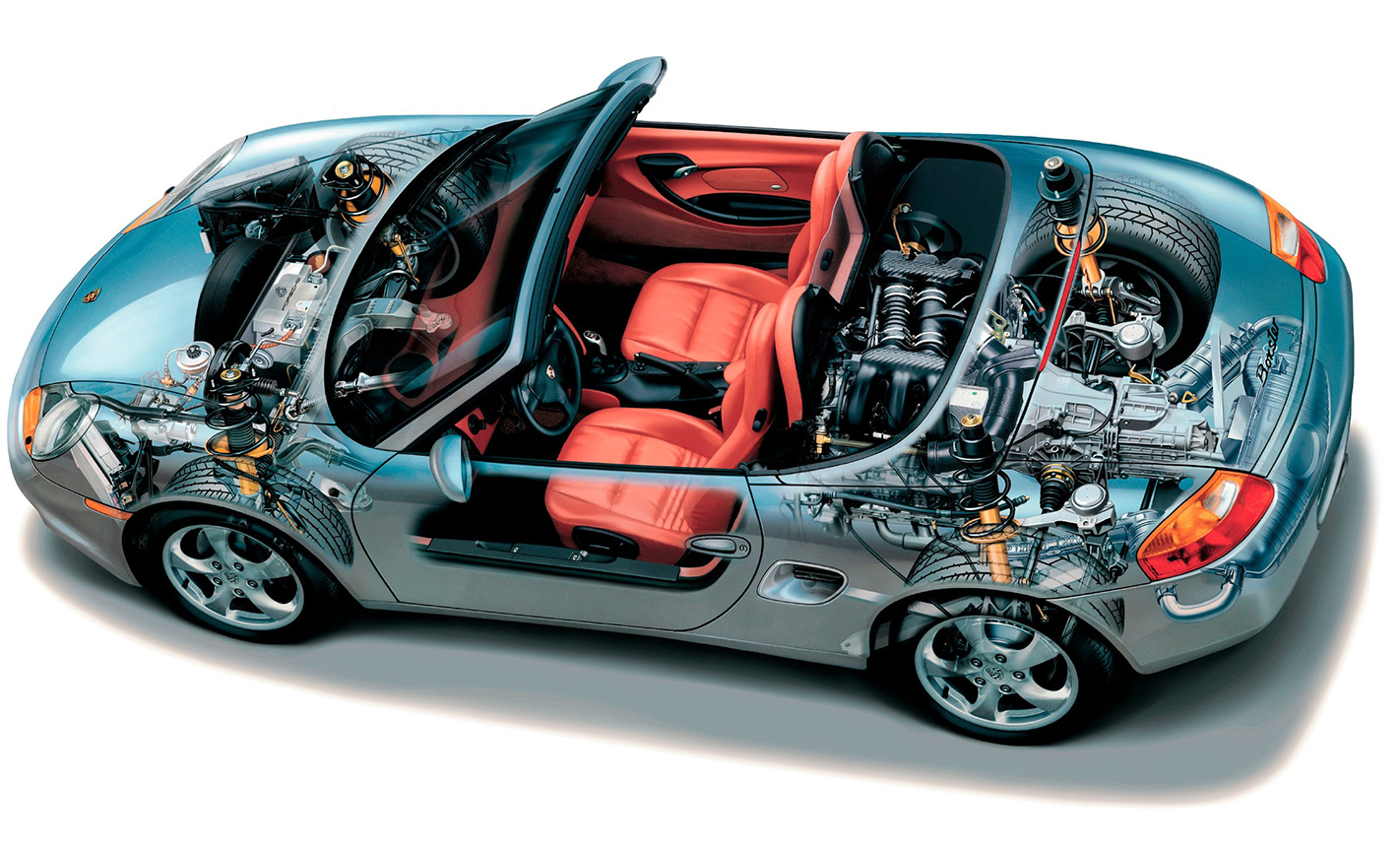
It certainly paid off: the Boxster did the business from its launch in 1996, and shifted an impressive 164,874 units until the second-generation 987 replaced it in 2004, outselling the 911 and only eventually being toppled by the Cayenne SUV.
“We had two model lines [with the Boxster joining the 993 911], which we felt would allow us to recover, and then one year later we launched a 911 [the 996] and then with the recovery of the economy we felt that we were out of the woods gradually,” recalls Marchart.
Twenty five years on, the Boxster might be a permanent fixture in the Porsche line-up, and still widely respected, but in the intervening years and with the success of the SUVs, many of us have forgotten just how crucial it was in kickstarting Porsche’s renaissance. And that very fact shouldn’t be forgotten.
Three interesting Boxster facts
- Some 986s were built in Finland. Check the 11th digit of the VIN; if it’s a U, then it’s built in Uusikaupunki, while S stands for Stuttgart
- Famous for its air-cooled engines in 911s, the 986 Boxster was the first non-front-engined Porsche to be water cooled
- Part of the reason behind the 718 going to a four-pot turbo is packaging as the plumbing required for the 911’s boosted flat six doesn’t fit
The benefit of sunny side up headlights
The Boxster’s ‘fried-egg’ headlamps might have been controversial, but they were pivotal to the cost-cutting masterplan, as designer Grant Larson explains.
“The modular headlamp was very important, as we were looking more and more at saving costs, and that saved us a lot of money, not only because of getting all the functions in one element, but also to make it very easy and faster to produce – especially faster to produce because time on the production line was also money.”
The headlamps were not initially intended to be shared with the 996 911, but cost pressures meant they were eventually adopted.

Fresh air and cooling headaches
Switching to water cooling nearly scuppered the Boxster’s rush to production and entire design – the idea was to have radiators in front of each front wheel, and suitable units were sourced for prototypes, but the supplier later said they were unable to make full production volumes.
“We had to come up with some new idea and design it as well and that was a really big issue,” recalls Marchant. “We feared we would have to do the entire styling over again because we would have been forced to change the front end, but thankfully we resolved the problem with the standard radiator and additional cooling concept.”
How the Boxster allowed Porsche to explore new and daring designs
Grant Larson explains the Boxster’s design mission, from past to present.
“Our goal was always to use the Boxster to take bigger developmental steps, as far as design and styling goes, whereas the 911 has always been very successful with its evolutionary track.
“So that’s our plan for the future, to take bigger and more daring steps. I have a pretty good idea as to what the next generation Boxster looks like because it’s on the measuring plate in our studio.”
The Boxster family tree
986: 1996 – 2004
A sales saving grace for the company. Design inspired by 356 and 550 – crowned PCOTY champion in 1998
987: 2005 – 2012
Did away with 996 911-style headlights and gained a revised interior. Big news is the addition of the Spyder
981: 2012 – 2016
Standard Boxster gains new 2.7-litre flat six. New 3.4-litre GTS variant added to sit below 3.8-litre Spyder
718: 2016 – present
Introduced controversial four-cylinder turbo engines to the range. Acoustics aside, they are effective
Celebrating 25 years
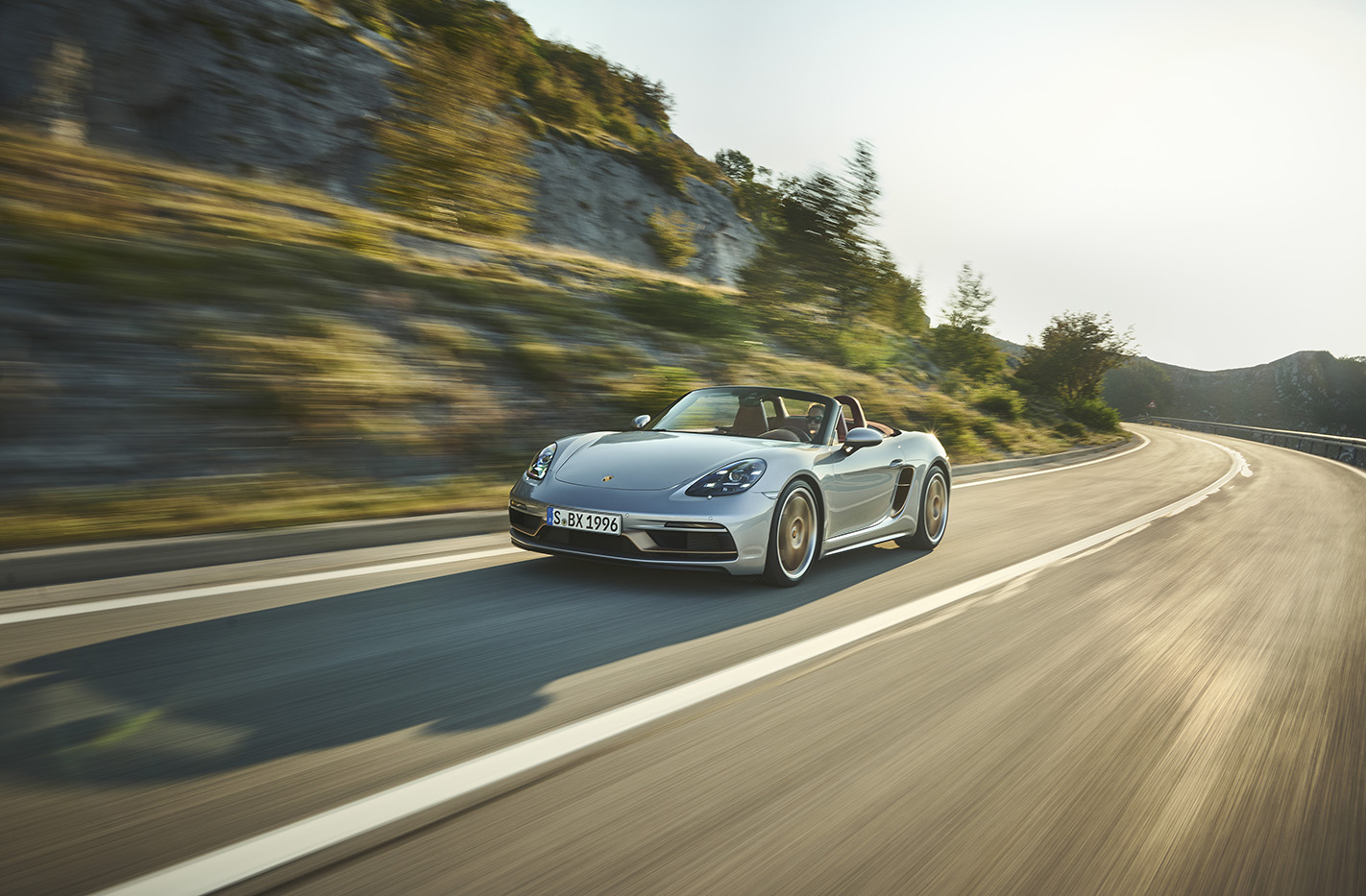
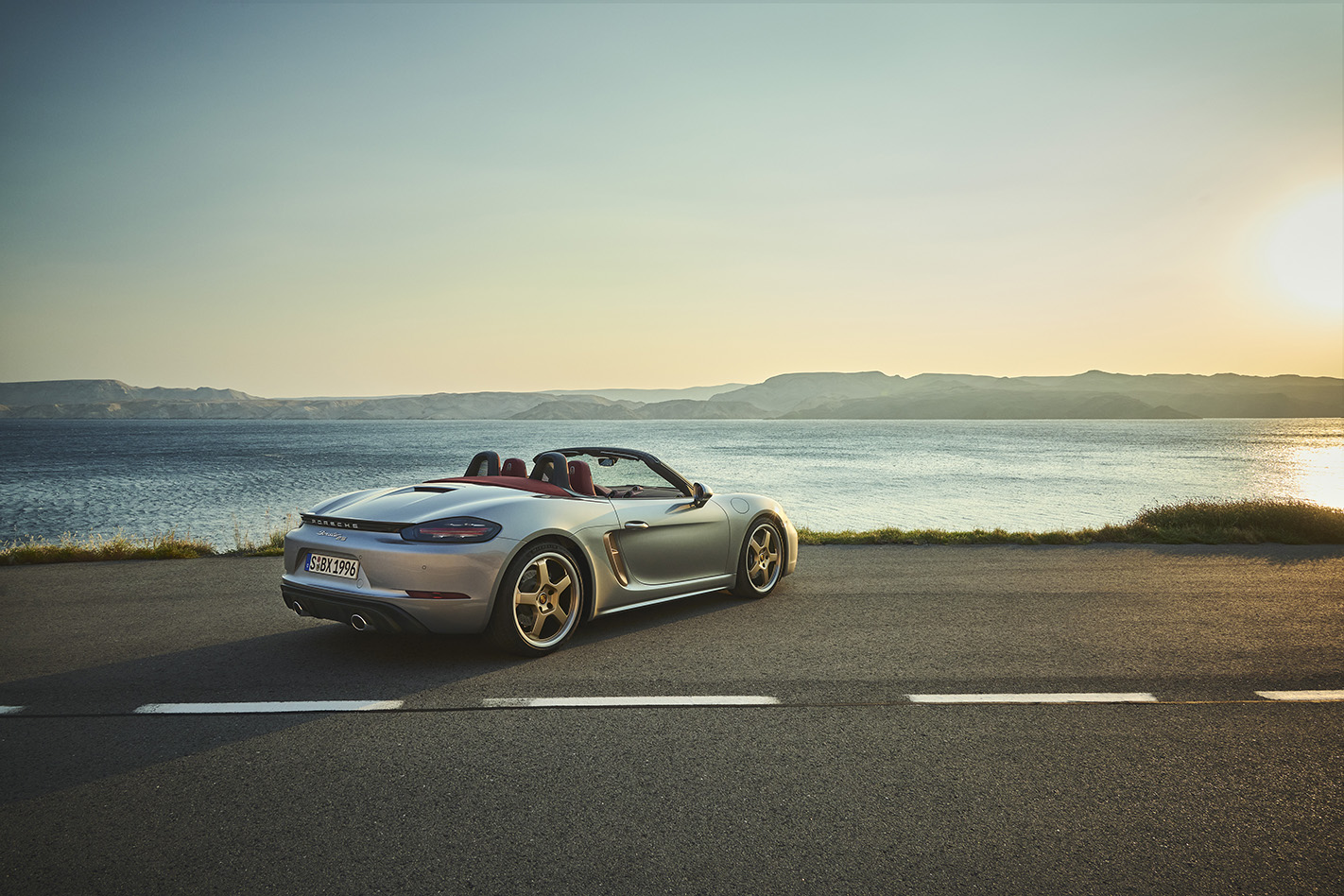
To celebrate its quarter century, Porsche has given the Boxster some retro love. Taking inspiration from the original 1993 concept car, the aptly named Boxster 25 Years wears distinctive two-tone gold (Neodyme) 20-inch wheels.
Just 1250 examples will be available, and all are based on the Boxster GTS with the choice of a seven-speed PDK or six-speed manual.
It’s virtually mechanically unchanged, so the mid-mounted 294kW 4.0-litre flat six remains and sends its grunt to the rear wheels. Adaptive sport suspension and a mechanical LSD is standard. Inside the Bordeaux Red cabin harks back to the ’93 concept, with ‘Boxster 25’ motifs featuring on the folding roof, heated steering wheel and door-sill trims.
Deliveries begin in April to those who get in quick and stump up $183,900.
MORE: Boxster news and reviews MORE: All Porsche stories
UPDATE, April 23: The 2021 BMW iX3 is now available to pre-order, with BMW Australia announcing the electric mid-size SUV will be landing in the country in the fourth quarter of 2021.
Customers can put down a $500 deposit through BMW’s website, and specify their desired car in collaboration with their preferred authorised dealer before the quarter four delivery.
Local pricing is still to be confirmed, with the local launch of BMW’s newest electric vehicle said to be a few months away.
July 15, 2020: It’s been a long time between drinks from BMW’s first i3 and i8 duo back in 2014 to today’s flourishing EV landscape, but BMW’s electric mojo is back with another battery powered vehicle added to the fold – 2021 iX3 electric SUV.
It’s the first fully electric SUV from the German car maker but instead of a wildly different body akin to the Mercedes-Benz EQC and Audi e-Tron, BMW has kept it’s approach understated and based on the X3 SUV.
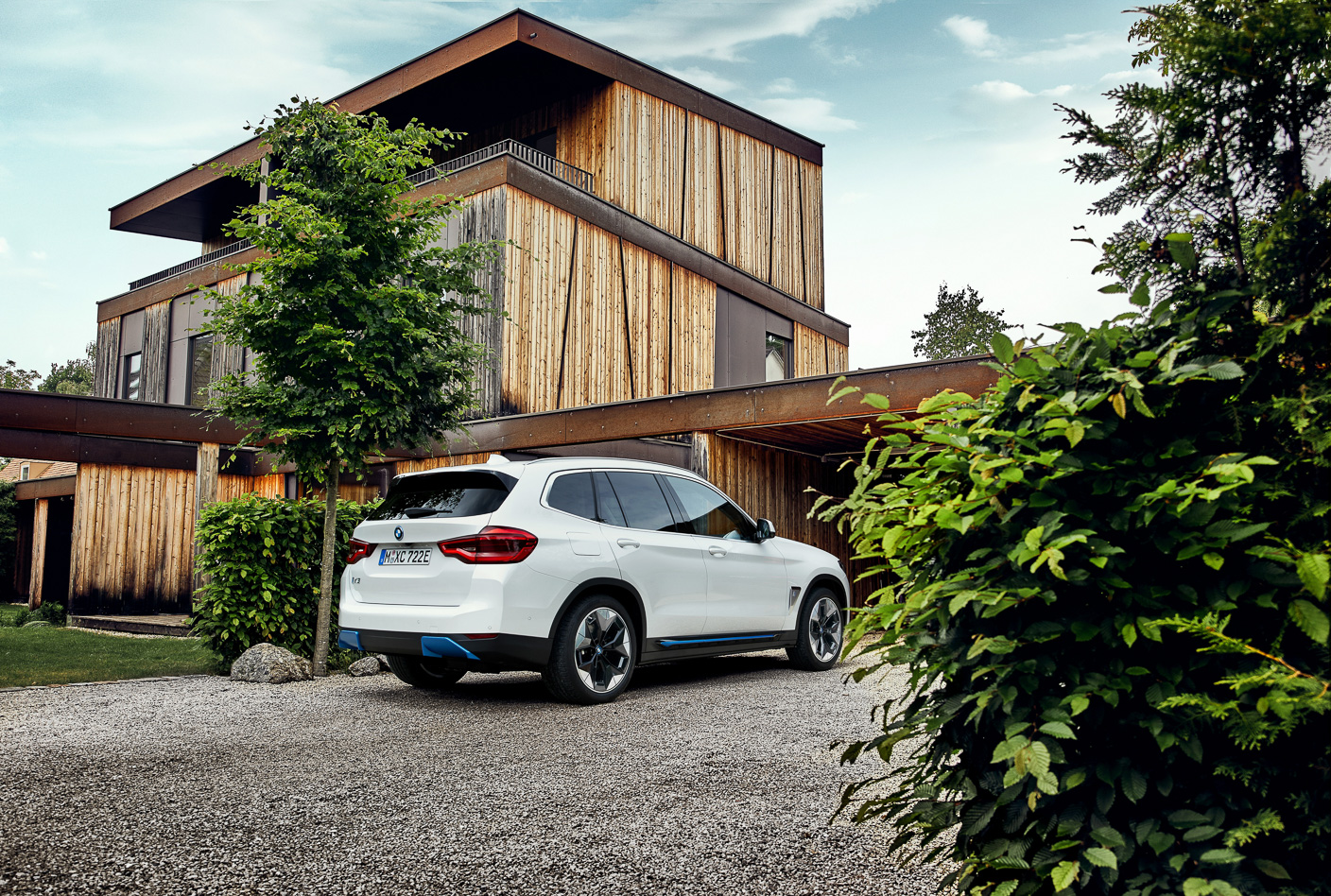
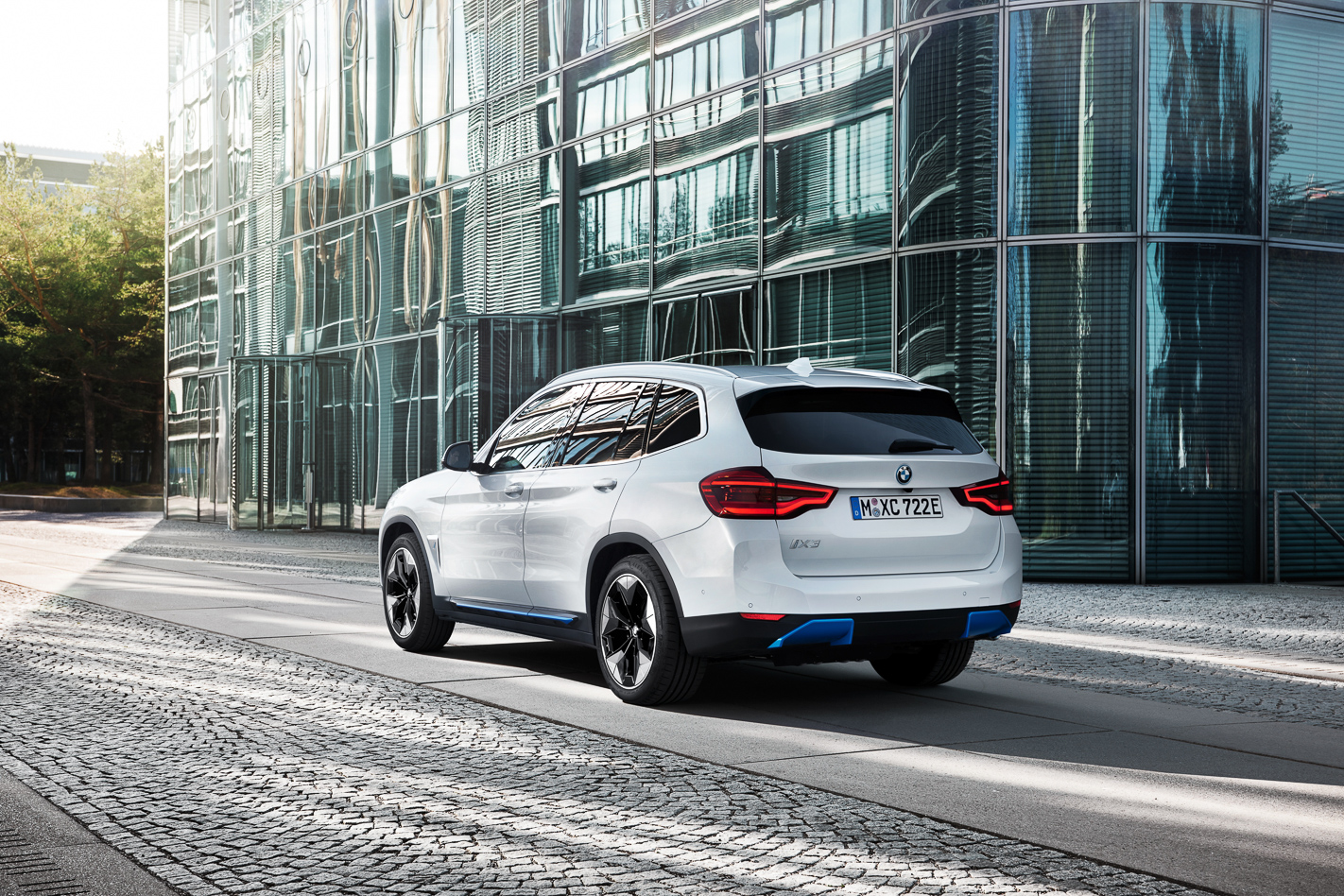
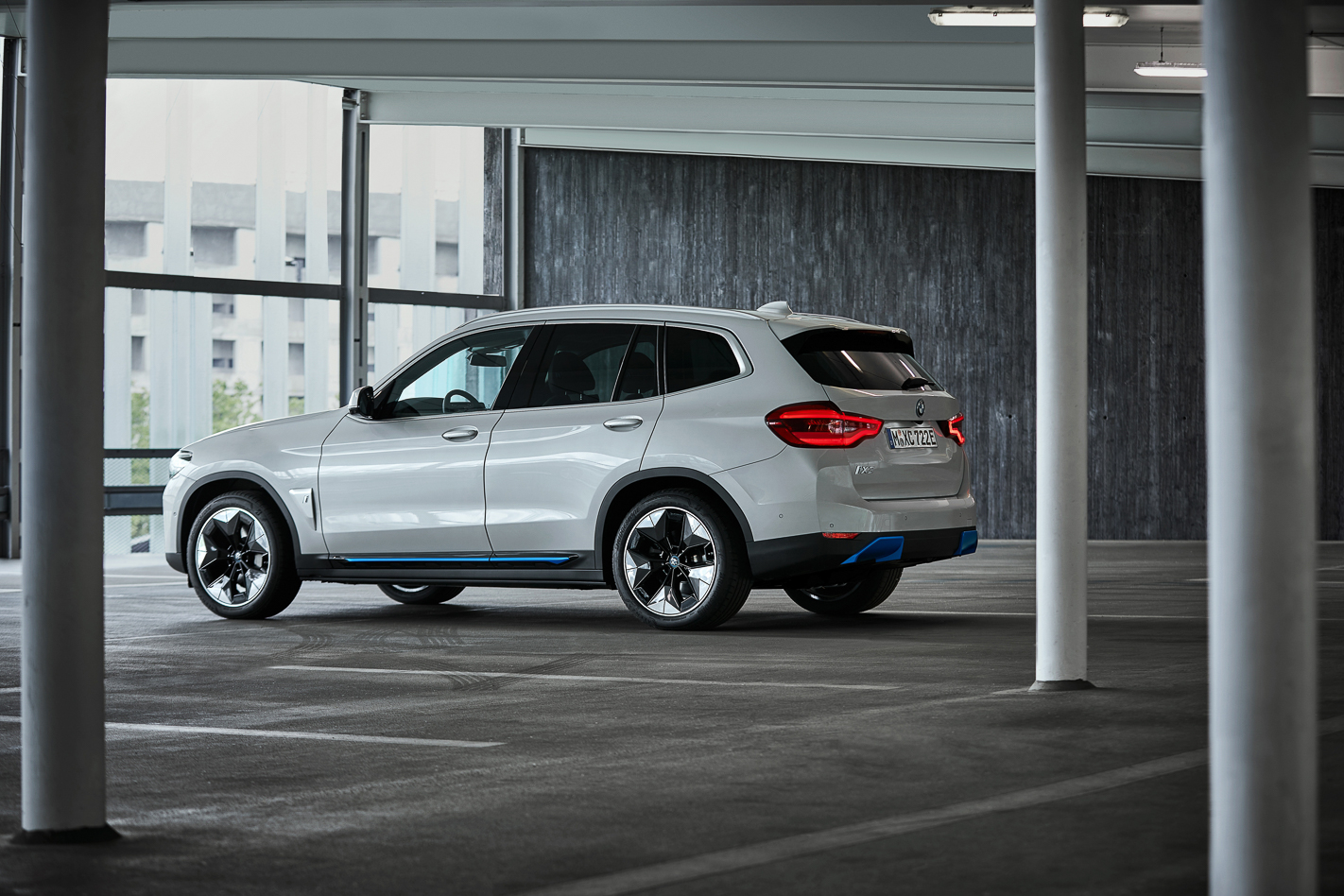
There are relatively few changes from the regular X3, but the iX3 does get a covered-off front kidney grille, fewer air intakes, some radically-aerodynamic wheels and, in-keeping with the BMWi branding, blue accenting on the exterior.
The company has stopped short of sharing interior photos of the iX3 but expect it to look wholly similar to the petrol/diesel powered car it takes as a canvas.
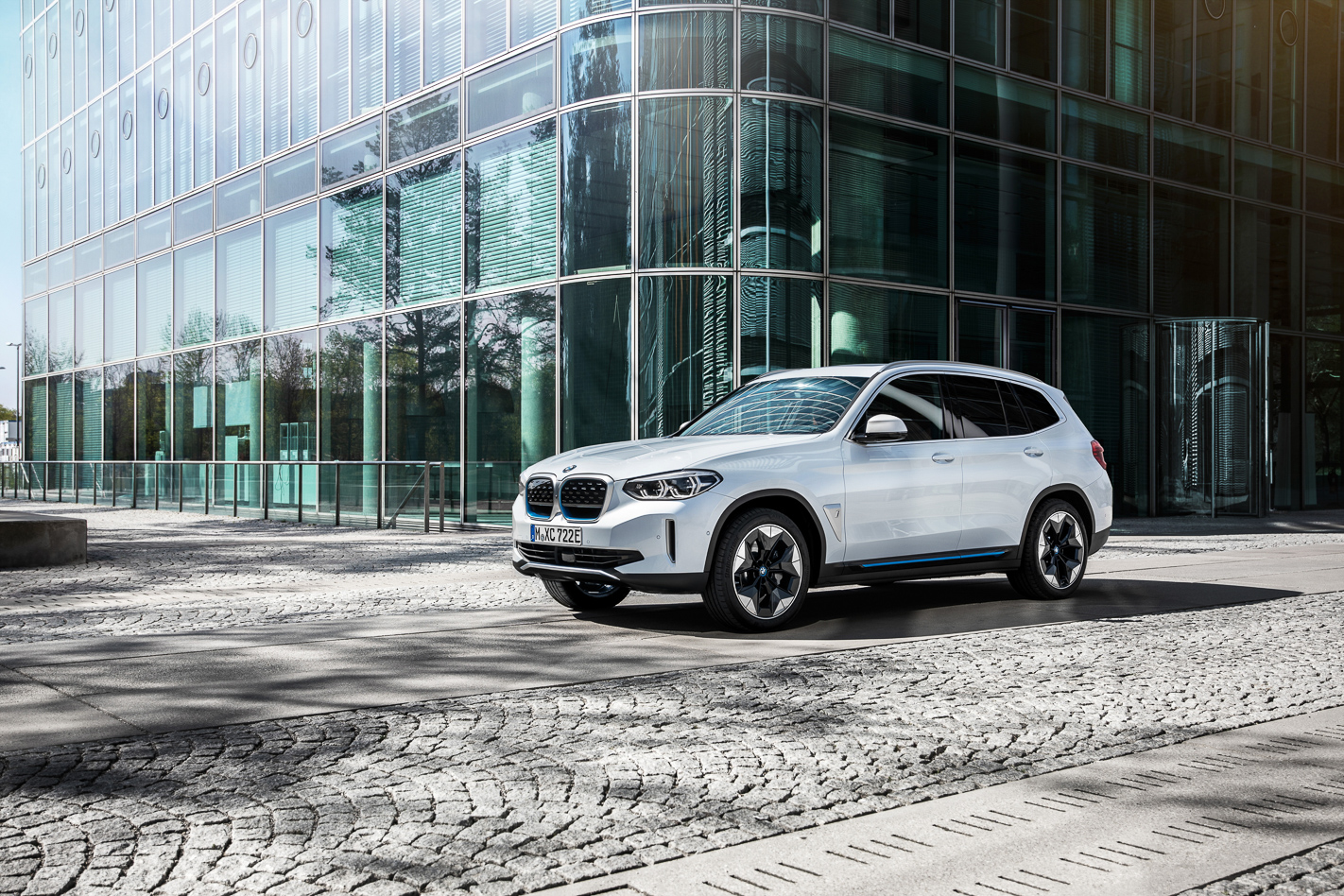
The iX3 will arrive in Australia mid-2021, bringing an 80kWh electric powerplant to the tune of 210kW and 400Nm and a 6.8-second 0-100km/h sprint. BMW says it’ll provide an impressive 460km range, as determined on a WLTP test cycle. Using fast-charging, the iX3 is capable of receiving 80 percent charge in 34 minutes.
The 80kWh battery sends power to a single motor at the rear axle for exclusively rear-wheel drive. It’s a different approach to some of its competitors, which use multiple motors for all-wheel-drive.
This key difference could drive the price down in comparison to its rivals, but confirmation will have to wait until local pricing and specification are revealed.
Interestingly, the brake regeneration system can pair to the navigation to identify areas in which coasting or energy recuperation is favourable. For example, approaching a roundabout will ensure the energy regeneration is maxed, while freeway driving will ensure ‘coasting’ is engaged more often, so the vehicles doesn’t unexpectedly slow down at high speeds.
Also new to BMW is active sound generation, which takes the place of conventional drivetrain noises.
Turning on the car is announced through a short sound composition, while changes in acceleration load will be marked by gently filtered acoustic responses designed by BMW’s sound engineering team and legendary composer Hans Zimmer.
A greater range of sounds will be available later.
In comparison to the otherworldly i3 and i8 electric cars which wowed the world with their futuristic designs and cabins, the iX3 remains fairly familiar to conventional cars.
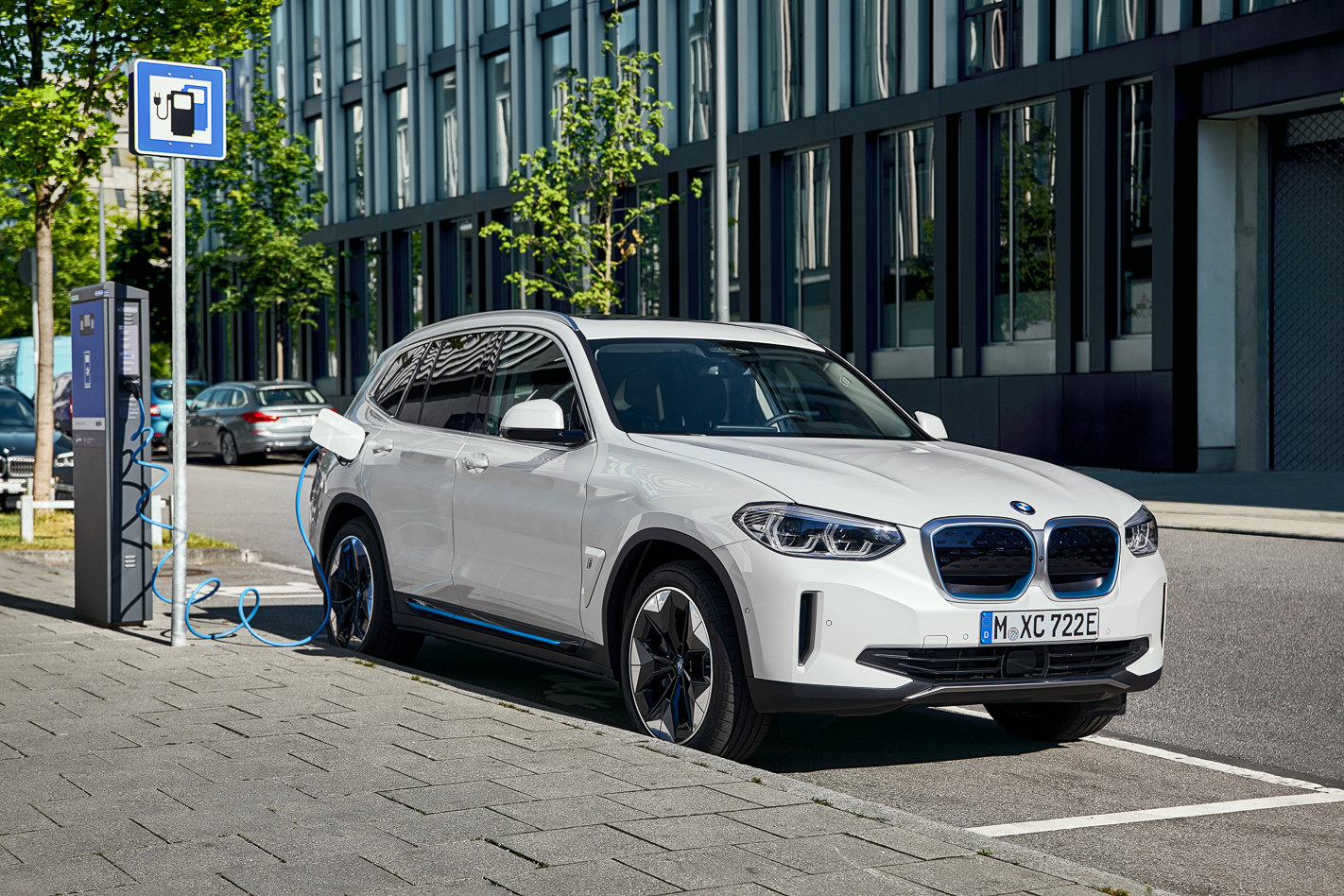
Interior space will be largely unchanged over the X3, while the same 510-litre boot carries across to the iX3 too.
Pricing and specification are expected closer to a local launch date.
American legacy brand Cadillac has announced it will be a pure EV manufacturer by 2030.
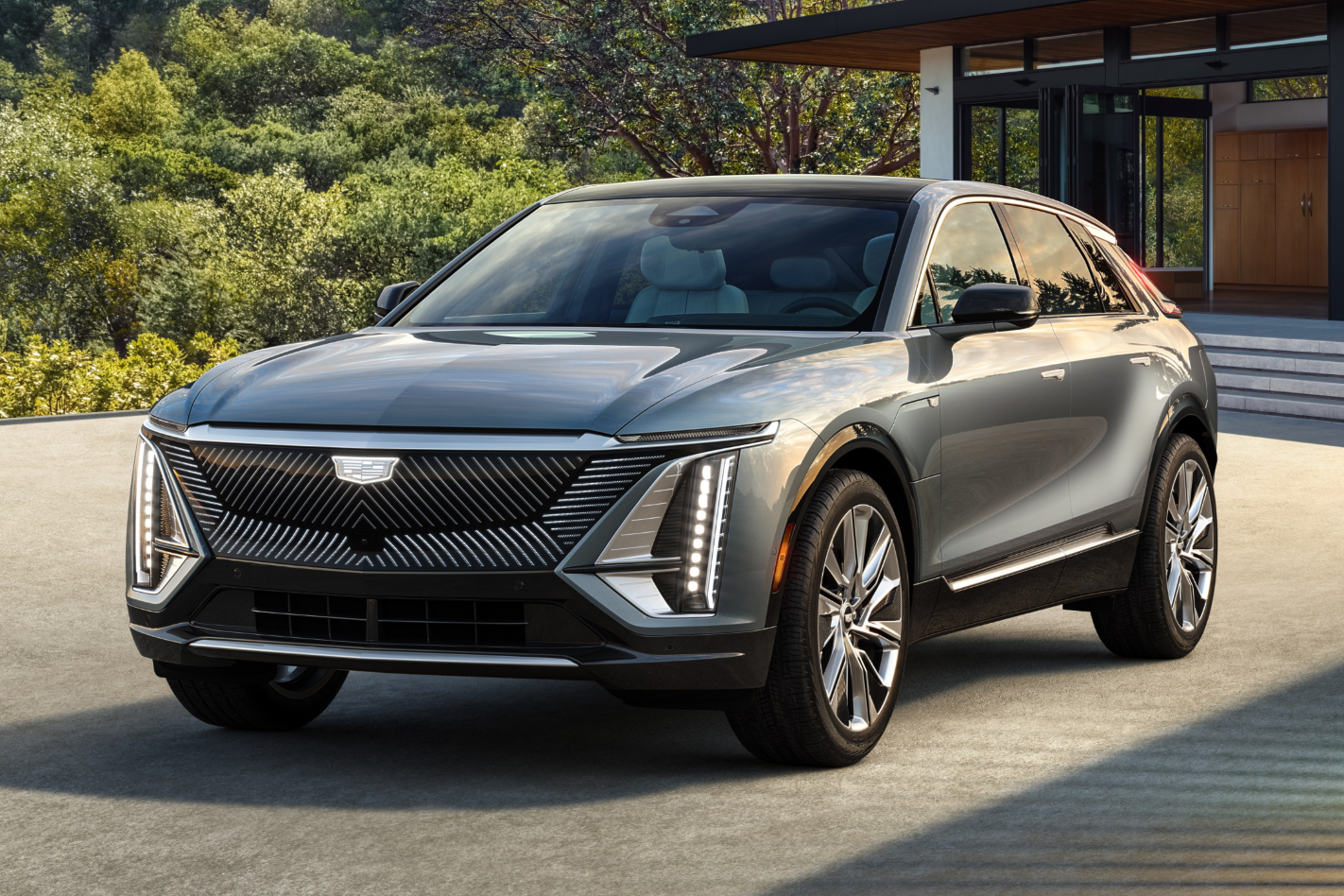
The revelatory statement was made during the official unveiling of the automaker’s first all-electric vehicle, the 2023 Cadillac Lyric SUV.
Speaking to the press, Rory Harvey, global vice president of Cadillac, said the Detroit firm is finished with internal combustion engines, and that last year’s Escalade would be the final Cadillac ever to be unveiled with a conventional motor.
“We will be leaving this decade as an EV brand as things stand today,” Harvey said during the online launch.
“We will not be selling ICE vehicles by 2030.”
The news comes just months after Cadillac’s parent company, General Motors, announced it plans to only sell electric vehicles by 2035.
GM also stated in January that it wanted to be completely carbon-neutral across all of its products and manufacturing facilities around the world by 2040.
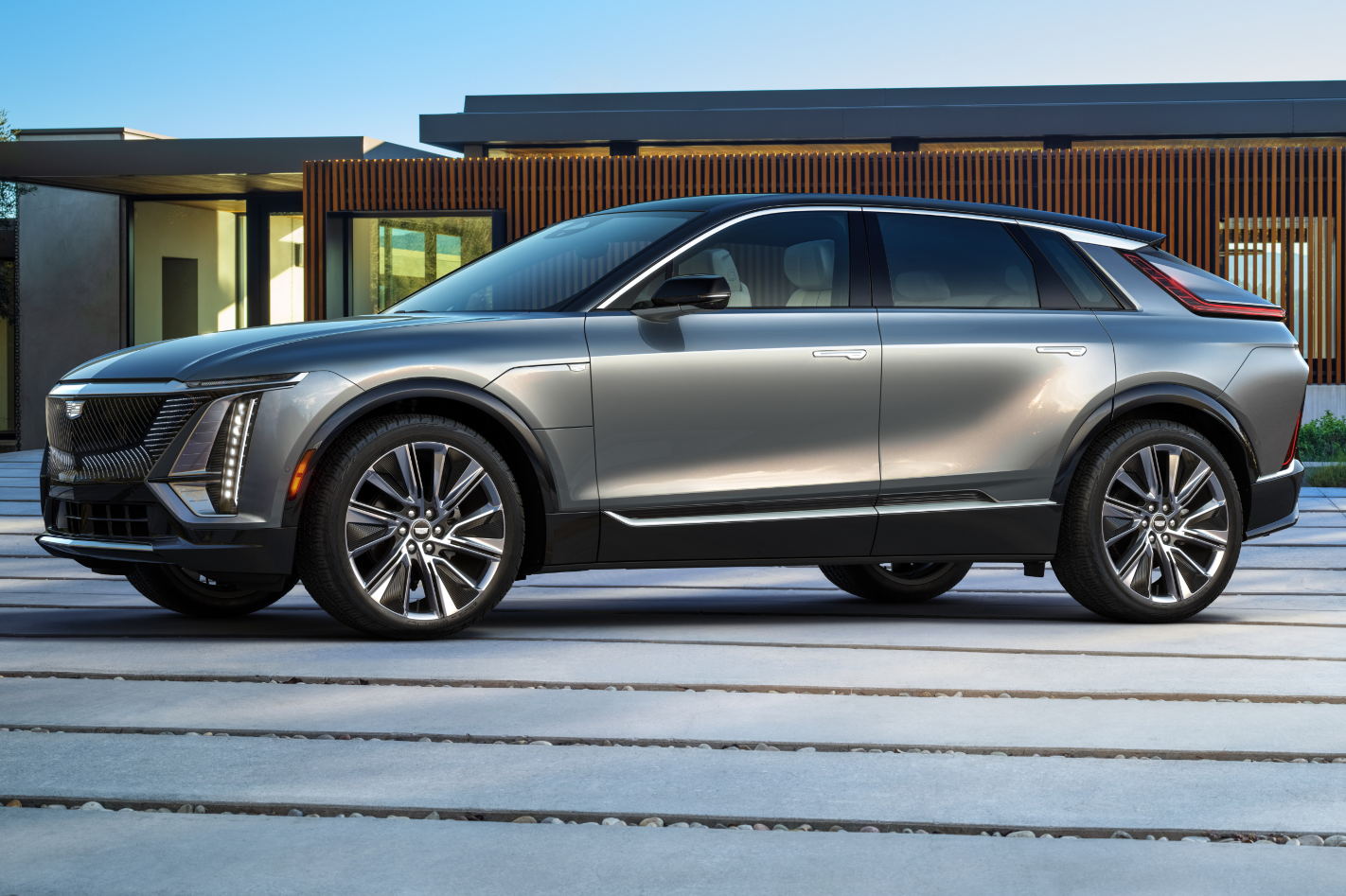
The Cadillac Lyriq promises to be an exciting product for the ailing marque, which has been suffering a gradual, but noticeable, decline in the American car market over the last few decades.
Based on GM’s new Ultium battery architecture, the angular, sleek-looking SUV is powered by a 100kWh lithium-ion battery pack sends power to a rear-mounted electric motor.
Power is rated at 256kW and 440Nm, and the Lyriq has a claimed driving range of 483 kilometres from a single charge.
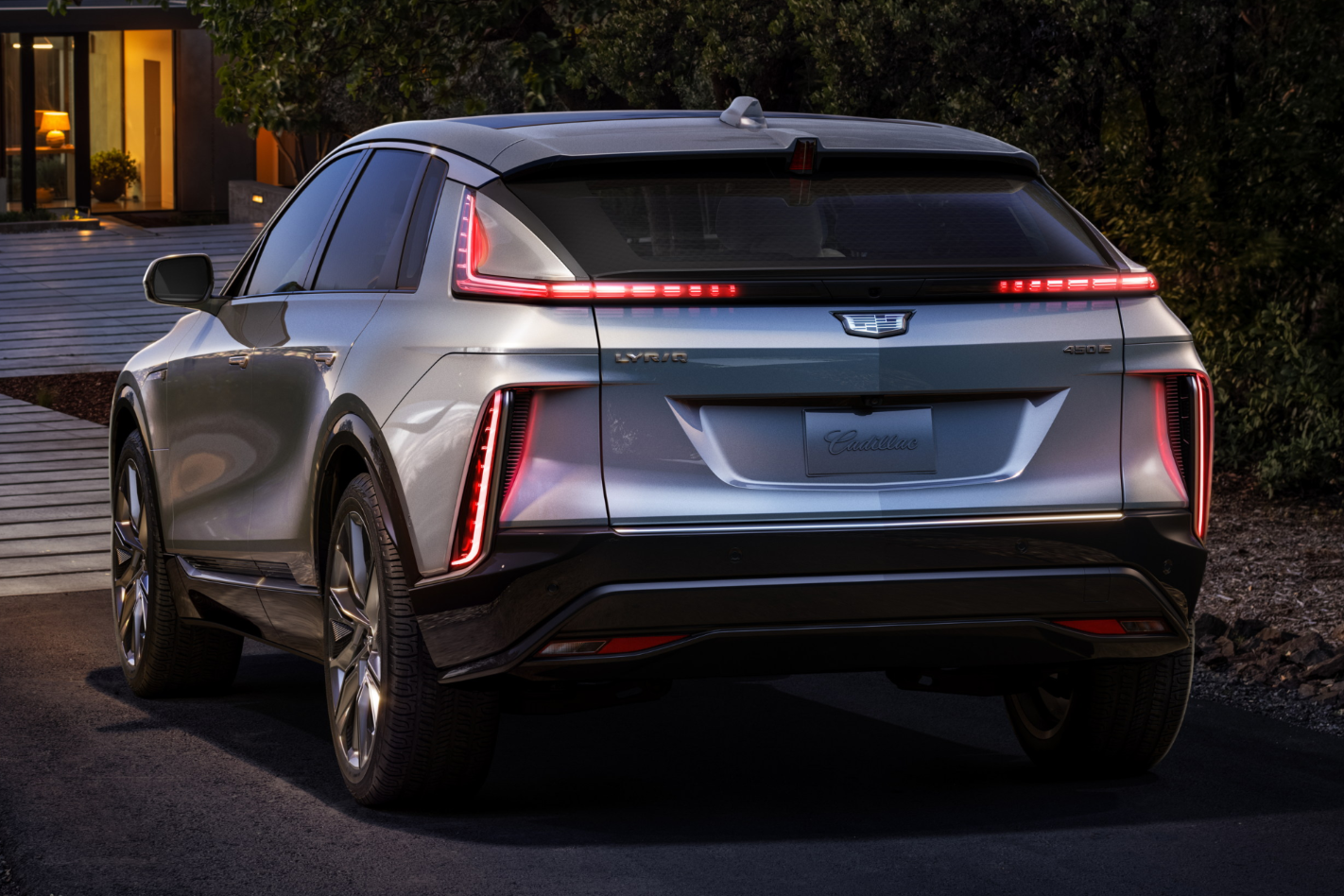
This new EV could be just what the automaker needs to catapult itself back to the forefront of the automotive industry and take it to the likes of EV upstart Tesla.
MORE: All Cadillac stories
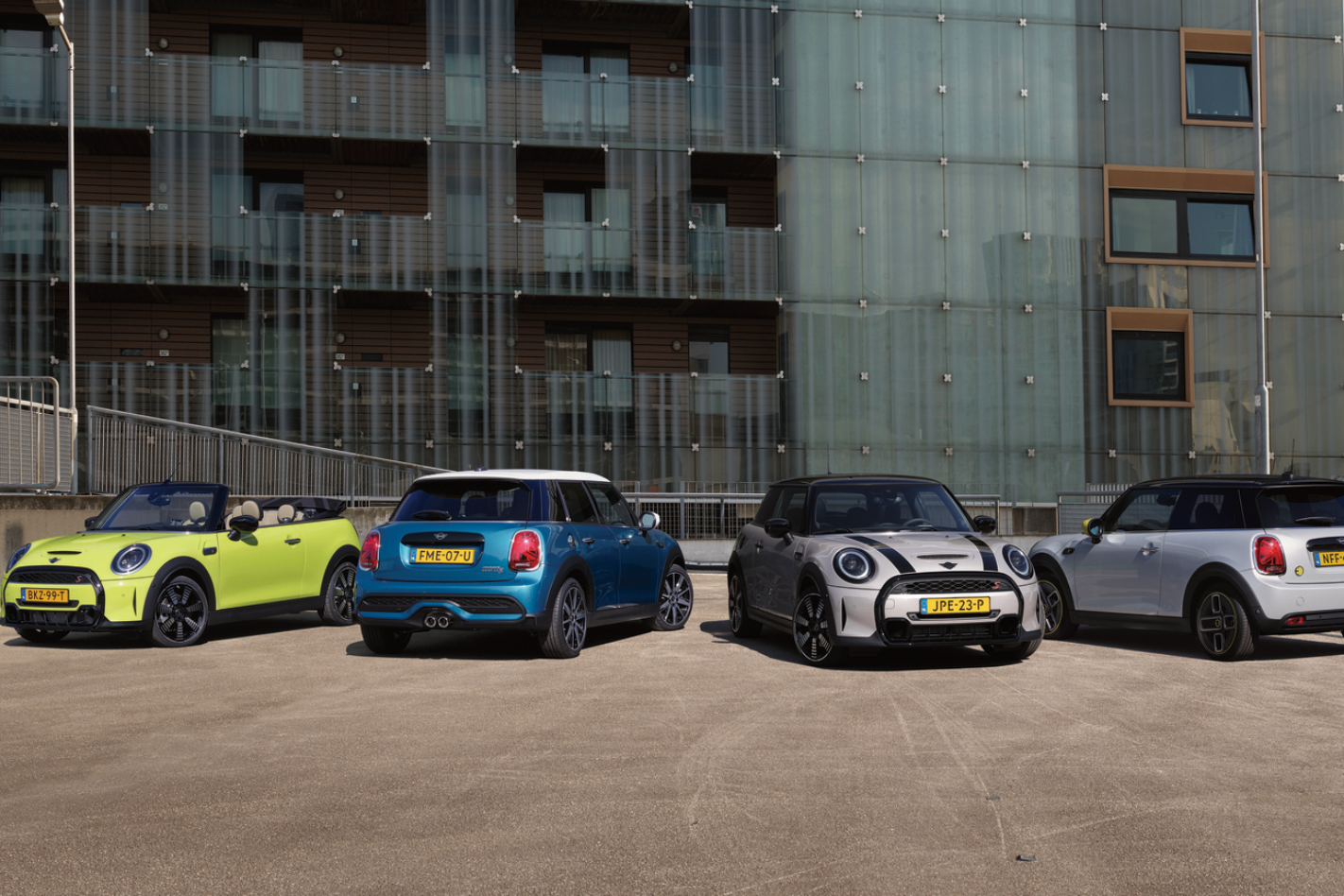
The 2021 Mini hatch and convertible refreshed range will be landing in Australia in the middle of the year, bringing with it new trims, more features and increased sticker prices.
All together there are 11 3-door hatch, six 5-door hatch, and nine convertible variants to choose from.
Classic, Classic Plus, and Mini Yours are now the three available trims for the baseline Mini Cooper three-door hatch.
The Cooper S can also be had in Classic and Mini Yours, as well as a JCW Sport trim.
The John Cooper Works (JCW) remains at the top of the tree in terms of performance and comes in Classic, Mini Yours and Essential specification.
Separately, the all-electric Mini Cooper SE three-door hatch can now be chosen as either a Classic or Mini Yours version.
Both the Cooper Exclusive and Cooper Signature trims no longer exist.
Cooper in more detail
Powering all three variants of the Cooper will be Mini’s familiar 1.5-litre TwinPower Turbo four-cylinder petrol engine, producing 100kW and 200Nm.
As standard, drive will be sent to the front wheels through a dual-clutch seven-speed transmission.
0-100km/h is taken care of in a claimed 8.2 seconds for the three and five-door hatch, while the convertible is said to take 8.8 seconds. Fuel economy is rated at 5.6-6.0l/100km on the combined cycle, depending on the model.
The entry-level Classic three-door has received a price increase to the tune of $2350, while the five-door is now $1850 dearer, and the Mini Yours is more expensive than both the outgoing Exclusive and Signature specifications.
On the outside, the Classic trim scores two choices of 16-inch alloy wheels, LED headlights and taillights, four exterior colours, three roof/mirror cap designs and two bonnet stripe options.
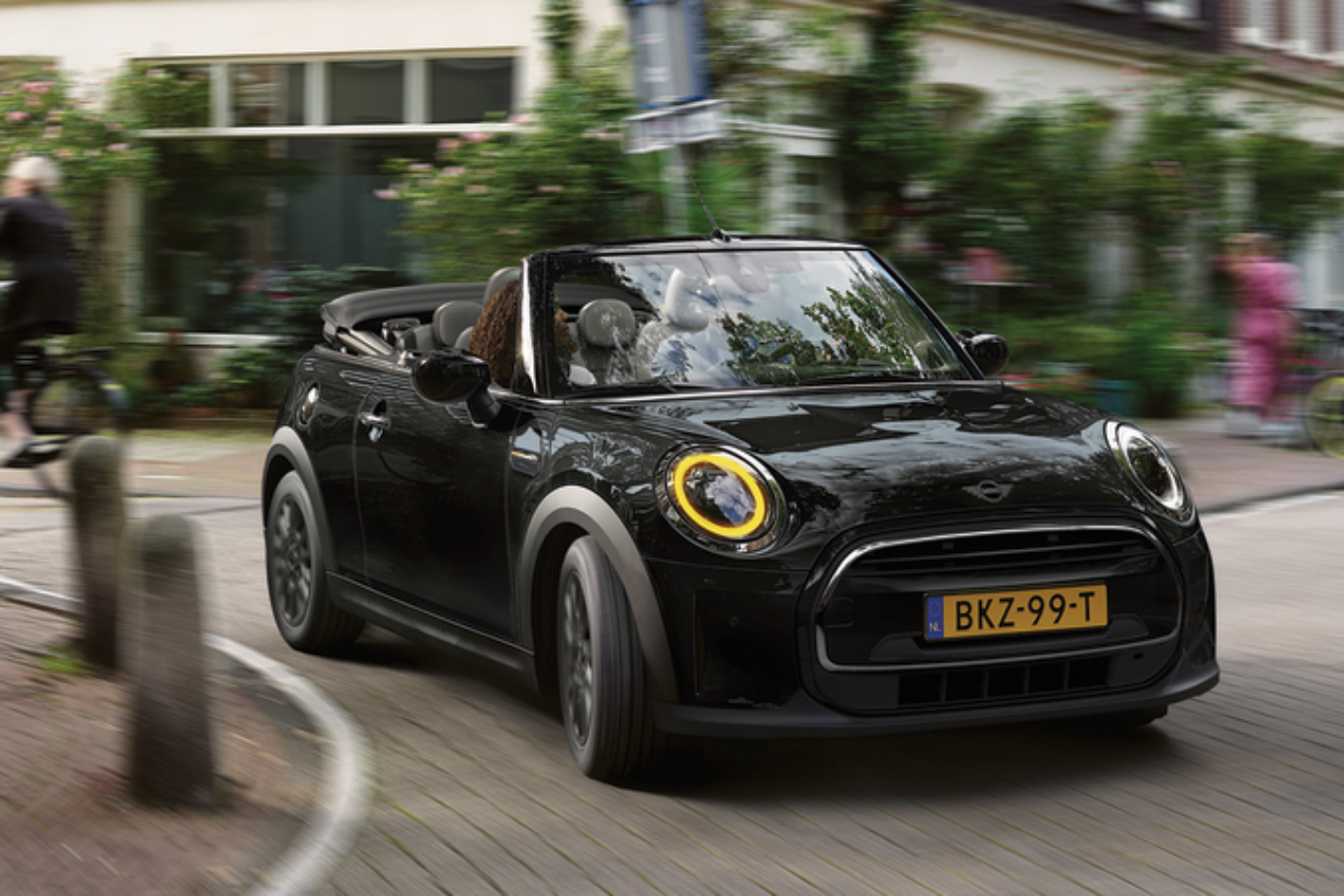
On the inside, the Classic trim is fitted with cloth/leatherette seats, piano black interior, rearview camera, front and rear parking sensors, parking assistant, adaptive cruise control with stop/go function, lane departure warning, digital dash, an 8.8-inch infotainment display, wireless phone charging, and wireless Apple CarPlay.
The Classic Plus adds more wheel and colour options, different driving modes (sport, mid, green), comfort access, leatherette sports seats with heating, front row panorama sunroof, and Harman Kardon sound system.
The Mini Yours brings even more wheel options, Nappa leather steering wheel, anthracite headliner, leather lounge seats in carbon black, chequered silver interior trim, ambient lighting, Mini Yours floor mats and Mini Yours exterior badging.
Cooper S
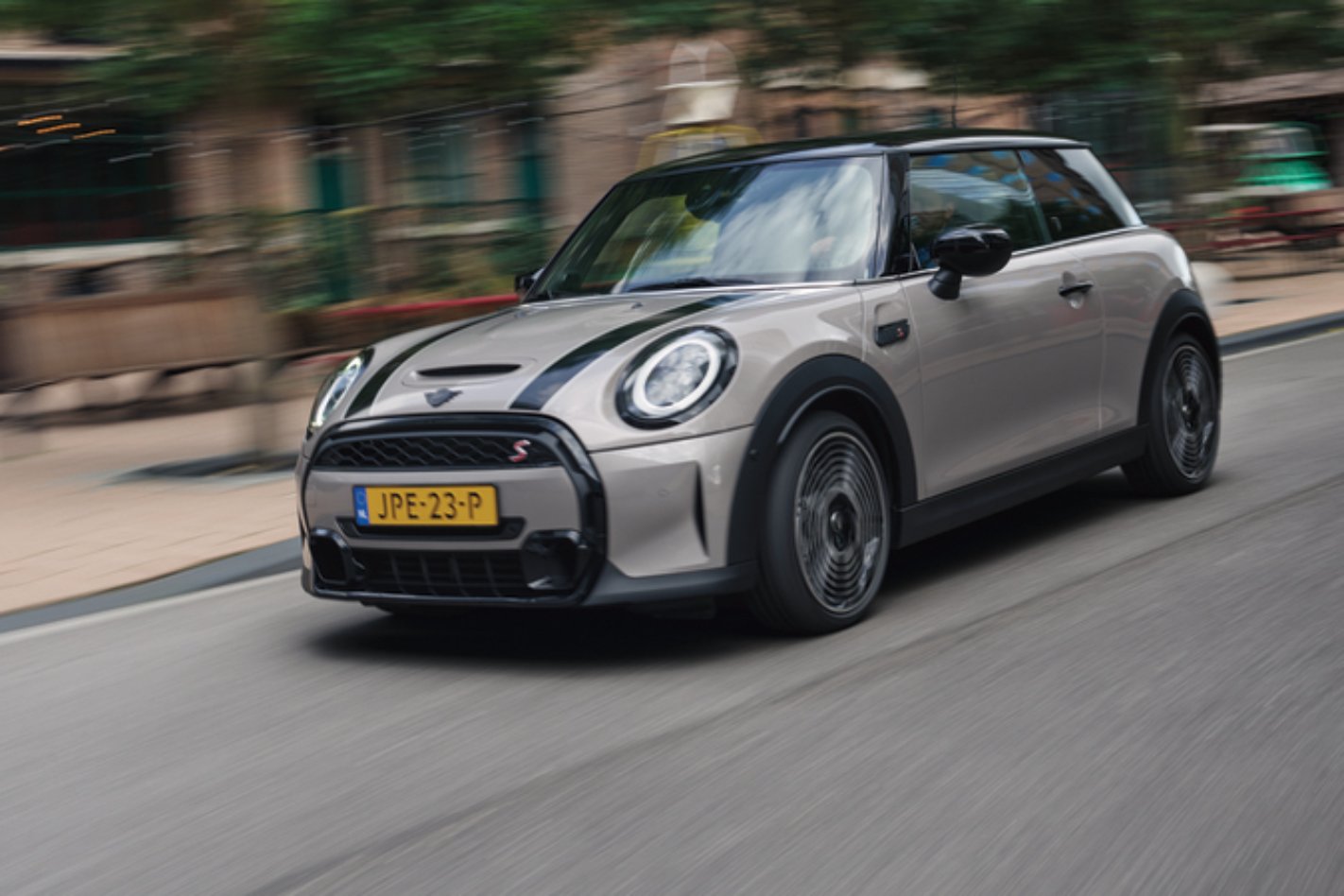
Sitting above the standard Cooper is the Cooper S, available in Classic and Mini Yours, as well as a JCW Sport trim.
It comes in three-door, five-door hatch, or convertible guise.
RRPs have risen across the S line-up too by as much as $600 depending on the model.
These faster Coopers come equipped with the same turbocharged 2.0-litre TwinPower four-cylinder petrol engine found on the pre-facelift models.
The turbo four-banger produces the same 141kW and 280Nm, translating to a three and five-door hatch 0-100km/h time 6.7 seconds, while the convertible takes 7.1 seconds. Fuel economy ranges from 5.8l-6.1l/100km on the combined cycle.
Building on the features of the base Cooper hatch, the Cooper S Classic comes as standard with several wheel and paint options, leatherette sport seats, Nappa leather steering wheel, and three driving modes (sport, mid, green).
The Mini Yours Cooper S adds leather chester or leather lounge interior upholstery and floor mats, Mini Yours exterior badging, panoramic sunroof, sun protection glazing, Harman Kardon sound system, head-up display and concierge services.
Those looking for a more aggressive Cooper S can option the JCW Sport trim, which scores a JCW aero package, adaptive suspension, and Dinamica/Leather JCW sport seats.
John Cooper Works
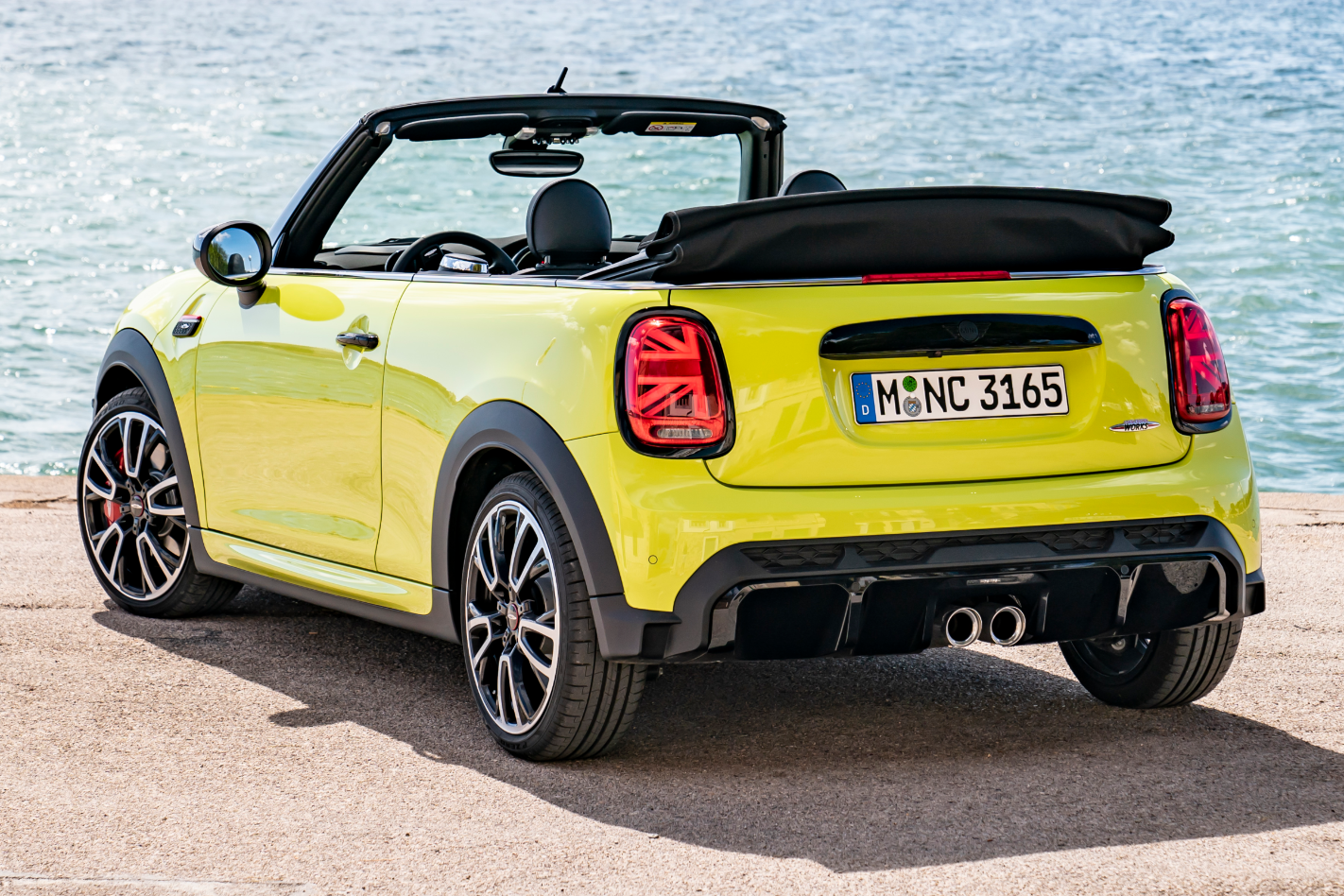
Rounding out the internal-combustion-engined Minis is the most performance-oriented variant – the John Cooper Works (JCW).
These fastest Minis haven’t been able to outrun price increases either, with the hatch up by $950 and the convertible commanding $980 more.
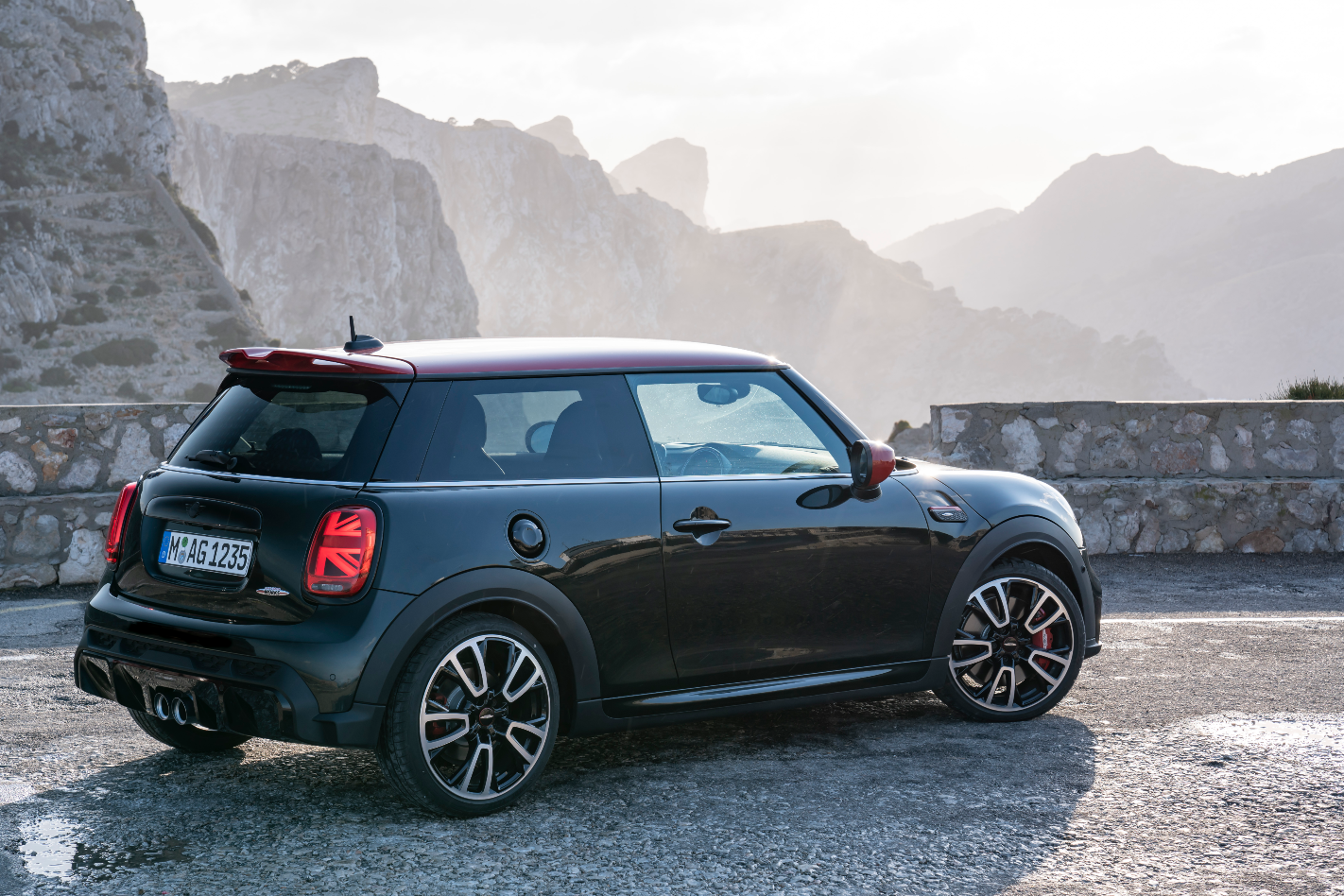
JCW models are limited to the three-door hatch and convertible body styles and are driven by a hotted-up version of the Cooper S’s turbocharged 2.0-litre four-pot, which is mated to an eight-speed torque-converter automatic transmission with a launch control function.
Power jumps to 170kW and 320Nm, with the hatch capable of sprinting from 0-100km/h in 6.1 seconds, and topless JCW taking 6.5 seconds. Fuel economy for both is a claimed 6.3l/100km.
JCWs have three different flavours – Classic, Mini Yours, and Essential – and like the rest of the Cooper range, each offers a different personality.
The JCW Classic gets everything you’ll find on the Cooper S Mini Yours as standard, and adds leather heated sports seats in Mini’s Cross Punch design and JCW sport brakes.
However, the JCW Classic doesn’t get the panoramic sunroof or sun protection glazing, which is reserved for the JCW Mini Yours trim, as are adaptive LEDs.
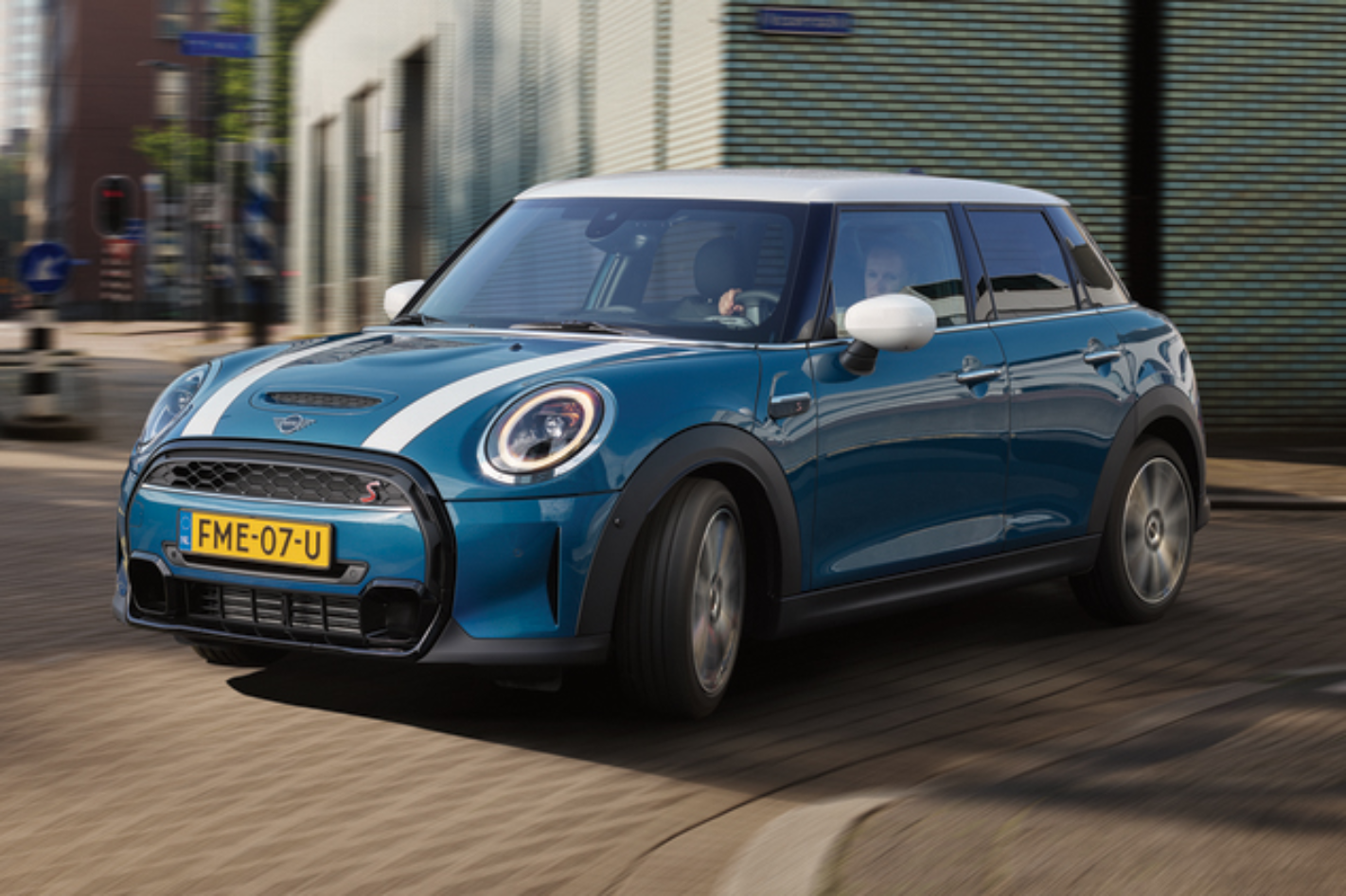
The JCW Essential is the back to basics, ‘no frills all thrills’ alternative for the hottest hatch and convertible in the Cooper range.
It does away with things like the adaptive suspension for a fixed-rate sports spring and damper set-up, and the simpler, less-plush dinamica/leather JCW Sports Seats.
Cooper SE Electric hatch
Finally, the all-electric Mini Cooper SE three-door hatch is now offered in two different trims – Classic and Mini Yours.
The SE Classic is roughly $1000 more, while the new Mini Yours commands an entirely new price point of $62,825.
Both get the same 33kWh battery pack and electric motor combo as 2020’s Cooper SE, producing the same 135kW and 270Nm.
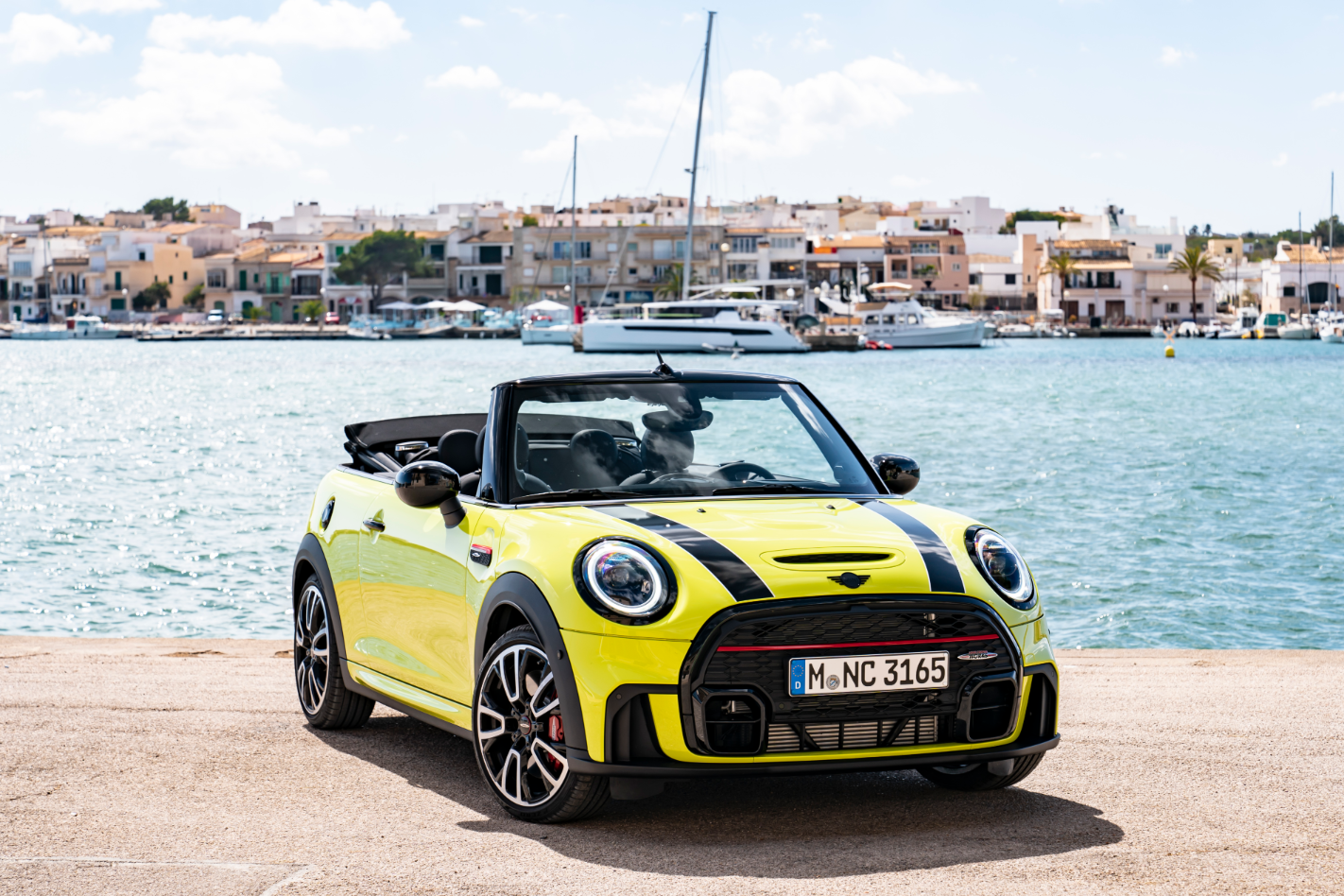
Driving the front wheels through a one-speed transmission, the SE can go from 0-100km/h in 7.3 seconds and offers a driving range of roughly 230 kilometres from a full charge.
Charging times depend on the type of charger, with Mini quoting approximately four hours to charge to 80 per cent with an alternating current (AC) of 7.4 kW, 2.5 hours with an AC of 11kW, and 36 minutes using a direct current (DC) of 50kW.
The SE Classic scores most options across the range as standard, while the Mini Yours additionally gets the anthracite headliner, ambient lighting, panoramic sunroof, sun protection glazing, Harman Kardon sound system, and head-up display.
Mini Australia has confirmed to WhichCar it is accepting orders for the new Mini Cooper Hatch and Convertible range now, with deliveries expected by the middle of 2021.
2021 Mini hatch and convertible prices:
Mini Cooper 3-door hatch:
Mini Cooper S 3-door hatch:
Mini John Cooper Works 3-door hatch:
Mini Cooper SE 3-door hatch:
Mini Cooper 5-door hatch:
MINI Cooper S 5-door hatch:
Mini Cooper convertible:
Mini Cooper S convertible:
Mini John Cooper Works convertible:
MORE: Mini Cooper Hatch stories MORE: Mini Cooper Convertible stories MORE: All Mini stories
If you’ve never driven above 110km/h, got behind the wheel of a proper performance car or experienced the thrill of a track day, you just don’t know what you’re missing out on.
Up until last week, I’d ticked all those boxes, but always knew there was more to driving than the average journey from A to B.
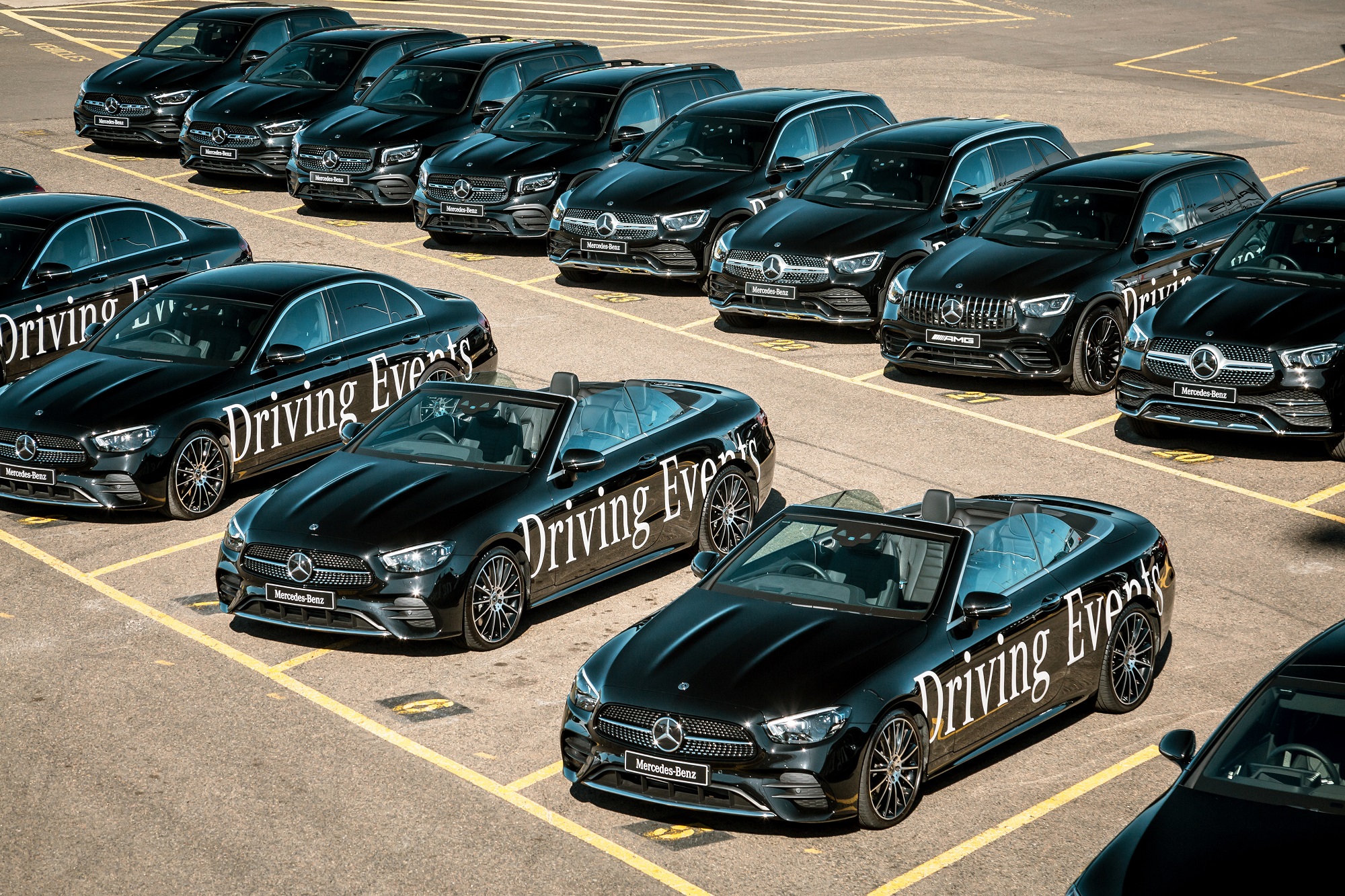
So, when I was offered the chance to head to Sydney Motorsport Park to join one of Mercedes-Benz’s reinstated Driving Events for 2021, I jumped at the opportunity to push my driving skills beyond their fairly tame limits and get a taste of what it’s like to learn proper car control.
Developed for a wide range of skillsets, from newbies like me to seasoned gearheads, the Accelerate program showcases the best of what Mercedes-Benz has to offer on, and off, the track, giving you the opportunity to explore some extraordinary cars and their impressive capabilities in a safe environment.
The program aims to teach you about the brand (of course), its latest technology and how it works, and to take you out of your comfort zone in some seriously fun ways.
Kicking off proceedings, we ran some laps in the C63 S for an introduction to just what’s involved in Mercedes-AMG performance driving, including up-to-date advice on how you should be holding the wheel and where your eyes should be looking, to ensure you have control over the car when you need to brake at high speeds.
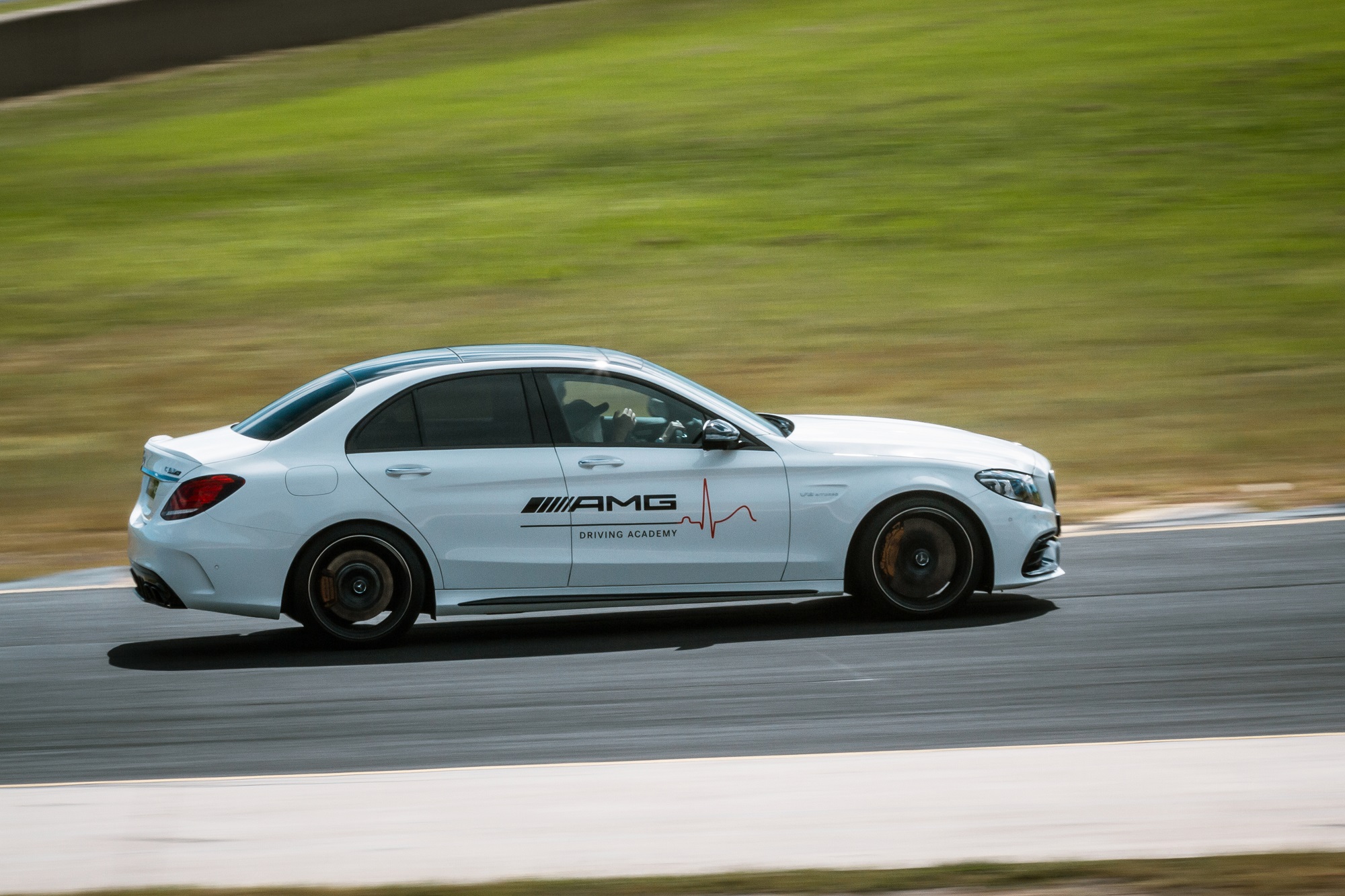
The basic premise is – forget what you know about keeping your hands at 10 and 2. That’s old news. New cars and new technology have changed the way we need to drive. Having your hands instead at 9 and 3 gives you more leverage to turn the wheel quickly without your arms getting in a tangled mess.
The other key skill I learned is vision training – looking further down the track as far as you can, at where you want to go rather than at the bend or the car in front. And yes, that means, God forbid, lowering your seat.
Most accidents on the road are front to rear, and that’s what this lesson was all about – how to avoid an accident and learn good practices on the circuit which you can transfer over to normal road driving.
Next up was heading into uncharted territory for us every-day drivers, and that meant going up and down steep dirt tracks in a GLS 400 D 4Matic, an experience designed to show the AWD capabilities of a modern car off-road.
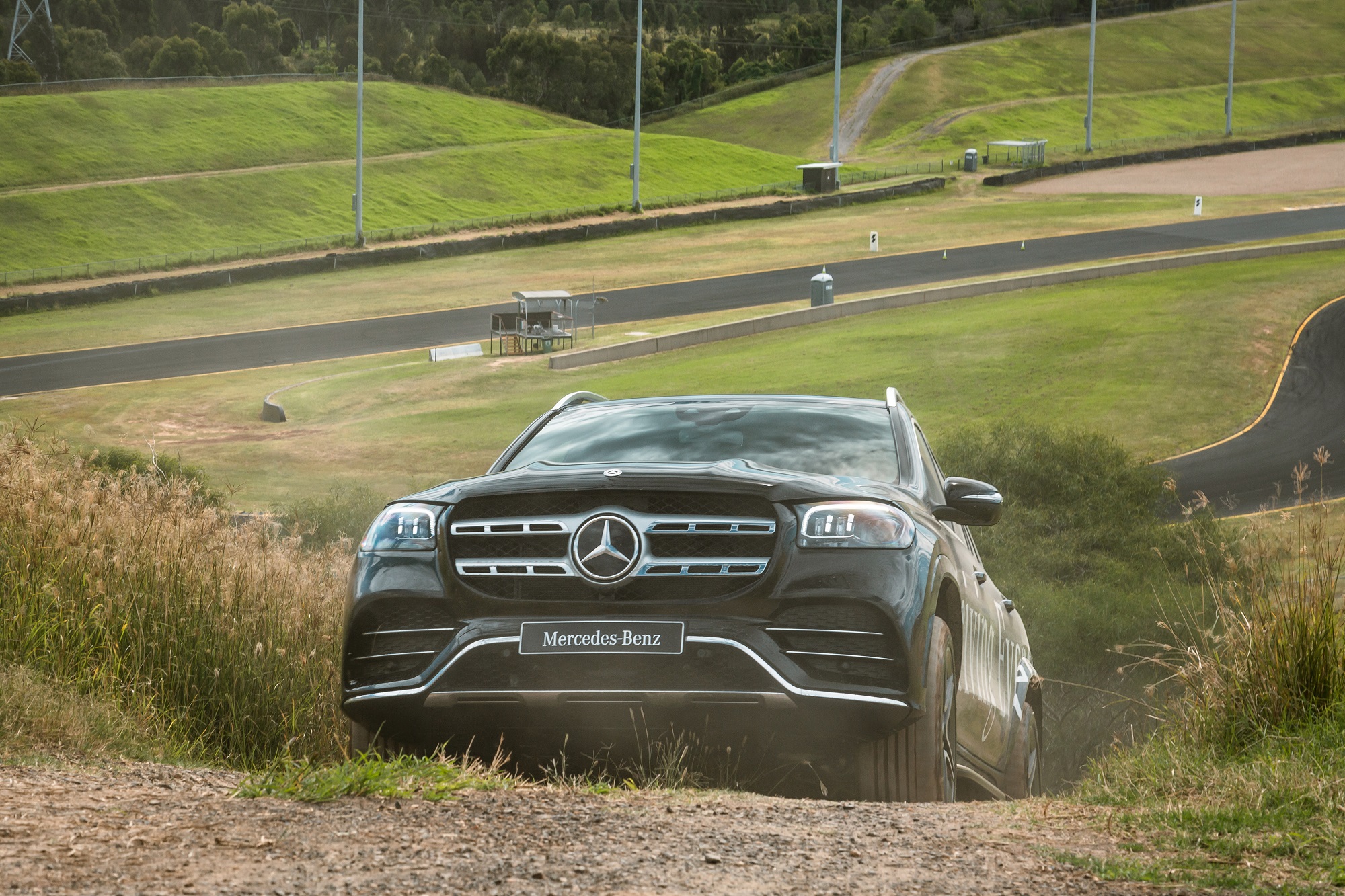
Relying on the vehicle’s technology (front and rear cameras and downhill speed regulator) to essentially take over the driving was somewhat terrifying, but also incredibly impressive.
I can honestly say I’ve never reversed uphill (at least not one quite so steep!) in an SUV, but the GLS was so remarkably rock-steady at what felt like that moment on a rollercoaster where it hangs at the top before the heart-stopping drop, that you’d be forgiven for thinking it was glued to the surface.
Why would you ever need to reverse uphill? Well, so my instructor told me, in the Victorian high country when you’re off-roading, if you don’t have a chainsaw on hand to cut up that fallen tree, then knowing how to go back up the hill you’ve just come down is essential.
Another first for me was a trip in an electric car, the EQC 400 4Matic. For a long time, I’ve quite liked the idea of driving electric but haven’t quite been ready (or had the cash) to make the leap while the infrastructure is still coming into its own.
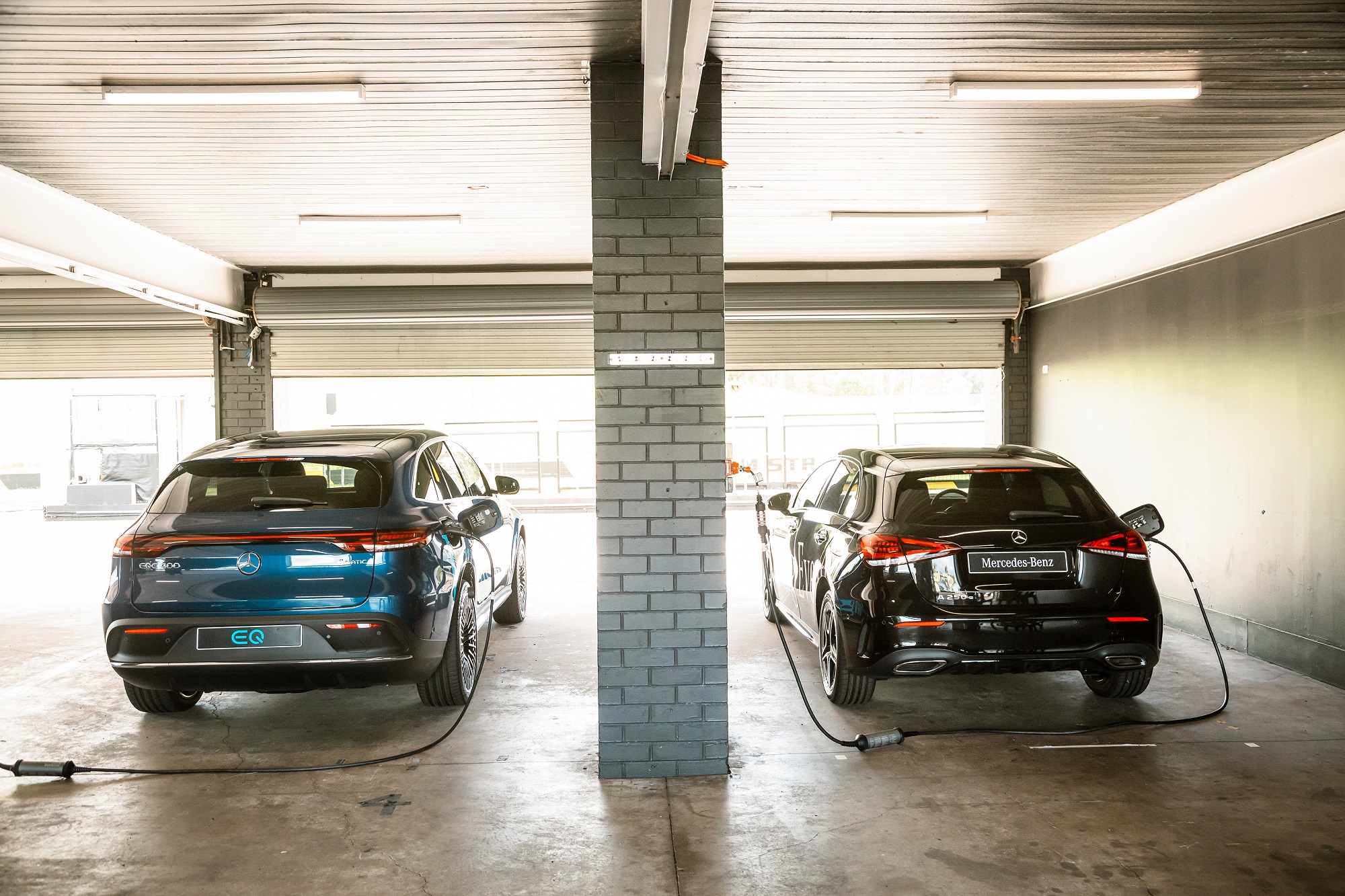
While we ran a few laps, my passionate instructor described how every time you brake, the electricity is harvested back into the battery, thus recovering otherwise lost energy, and how that then becomes part of your ‘single-foot’ driving style.
It’s a completely different discipline to braking in a conventional car, but one that you soon pick up quite naturally.
Mercedes-Benz has already pledged not to develop any more internal combustion engines for its line-up, and other manufacturers are following suit, so getting to know how an all-electric vehicle works is no bad thing.
After trying out the EQC, it was then my turn to have a crack at a very different vehicle – the AMG GT R V8 BiTurbo. Wow, was that fast. It’s not easy for the performance figures of 430kW and 700Nm to make much meaningful impact on paper, but feeling it surge to 170km/h so rapidly is enough to change your perspective.
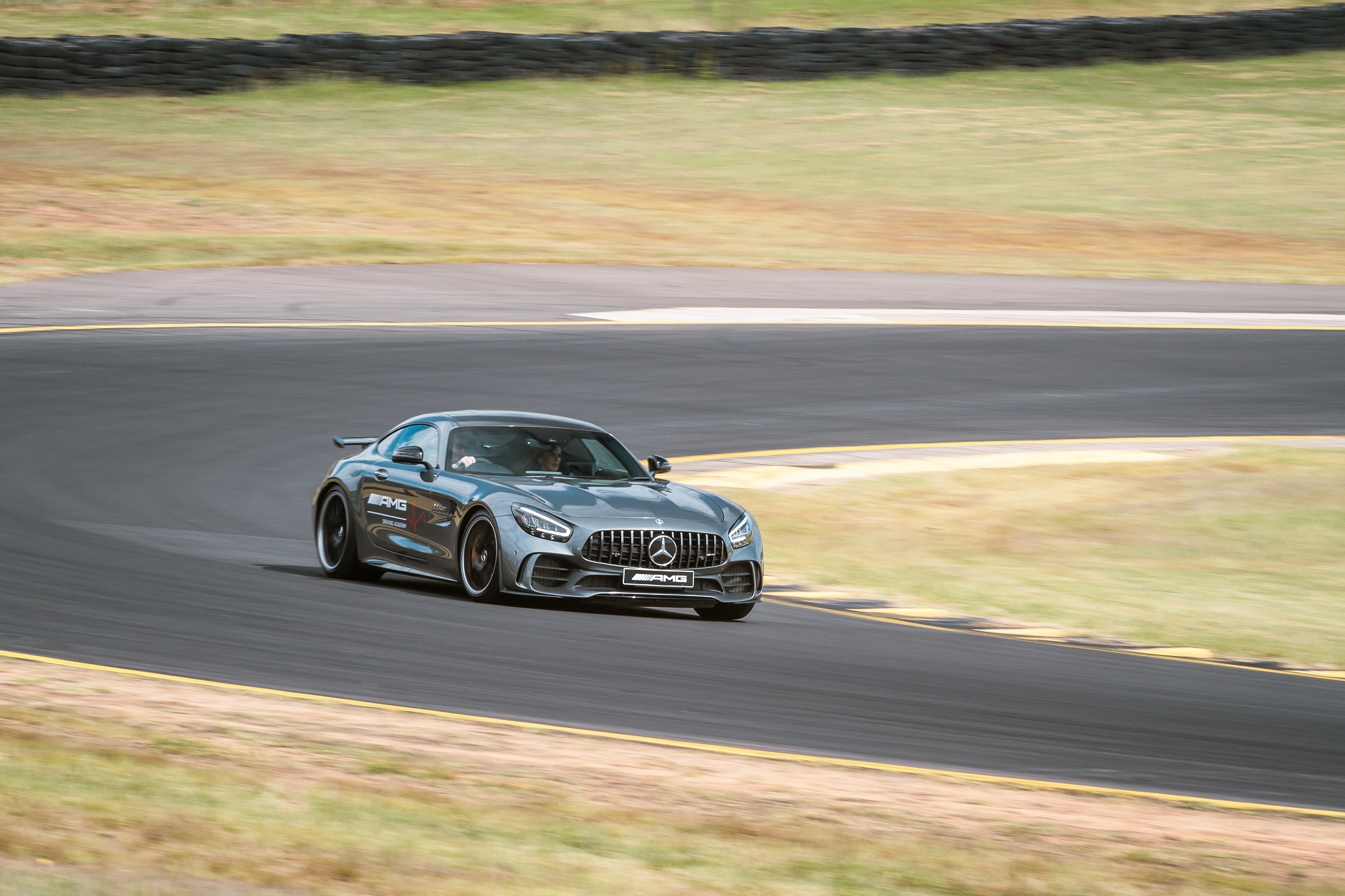
Never could I have imagined driving such a boisterous performance car capable of 0-100km/h in a claimed 3.6 seconds, but this experience gave me the confidence I needed to get behind the wheel with no fear – safe in the knowledge that a professional driving instructor was by my side, guiding and encouraging me the whole time.
Driving at the speed limit, you never really get a sense of what any car, let alone a beast like the GT R, is capable of, but with the team of instructors – many of whom are racing drivers – guiding you safely through it, this experience gives you exactly that.
Driver training is a good eye-opener when it comes to discovering your own limitations.
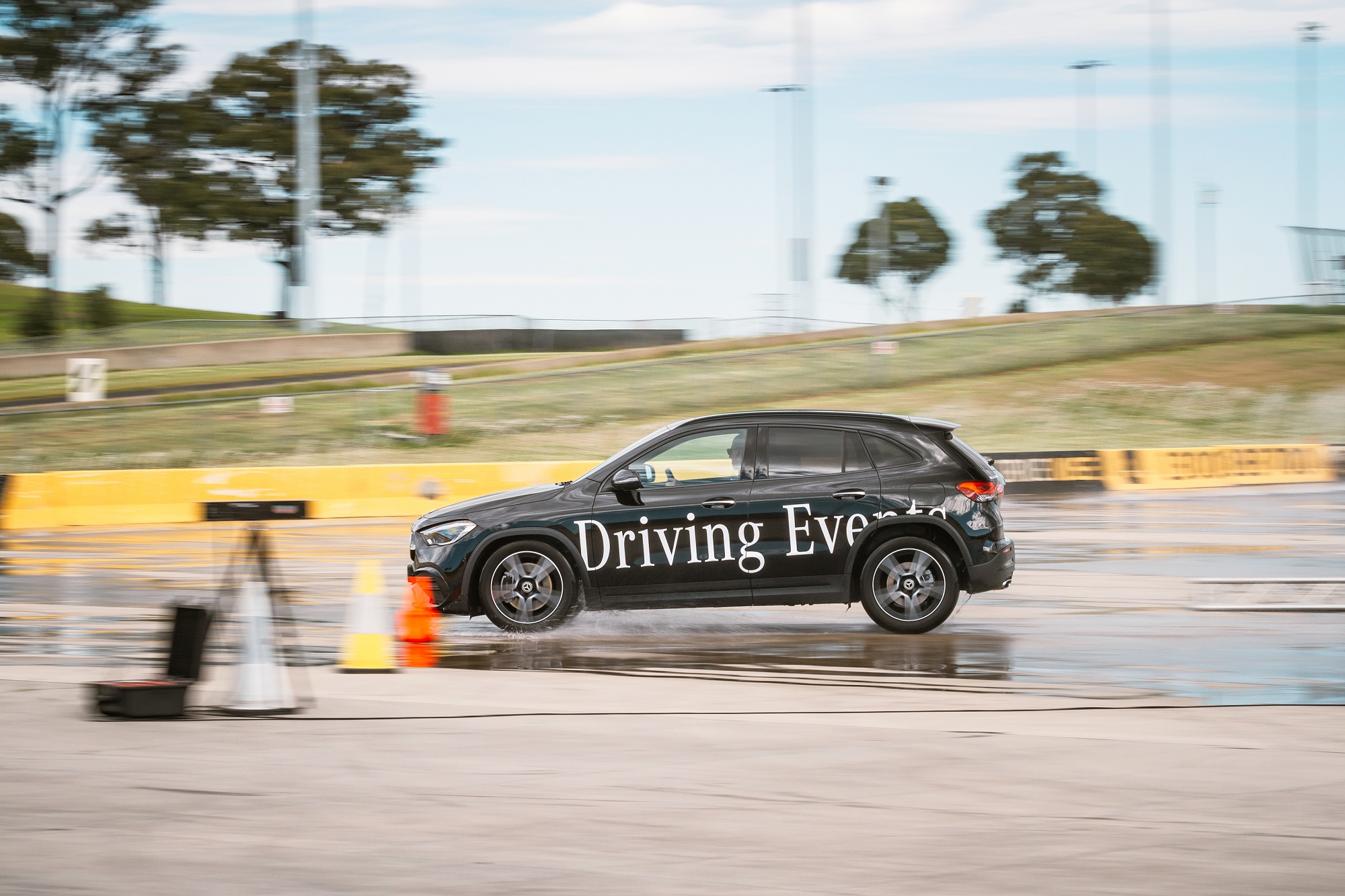
Next it was over to the skidpan to simulate a ‘brake and swerve’ or emergency lane change – a key skill to have in a world of distractions – in a GLA 250 4Matic. After that, we looped a figure of eight around some witches’ hats in an E300 to test its handling in the wet.
Rounding off the morning was a chance to ‘drive the range’, as Merc calls it. And for me that meant having a quick go in a C-Class cabriolet, A250 E plug-in hybrid, S450 L, and C300.
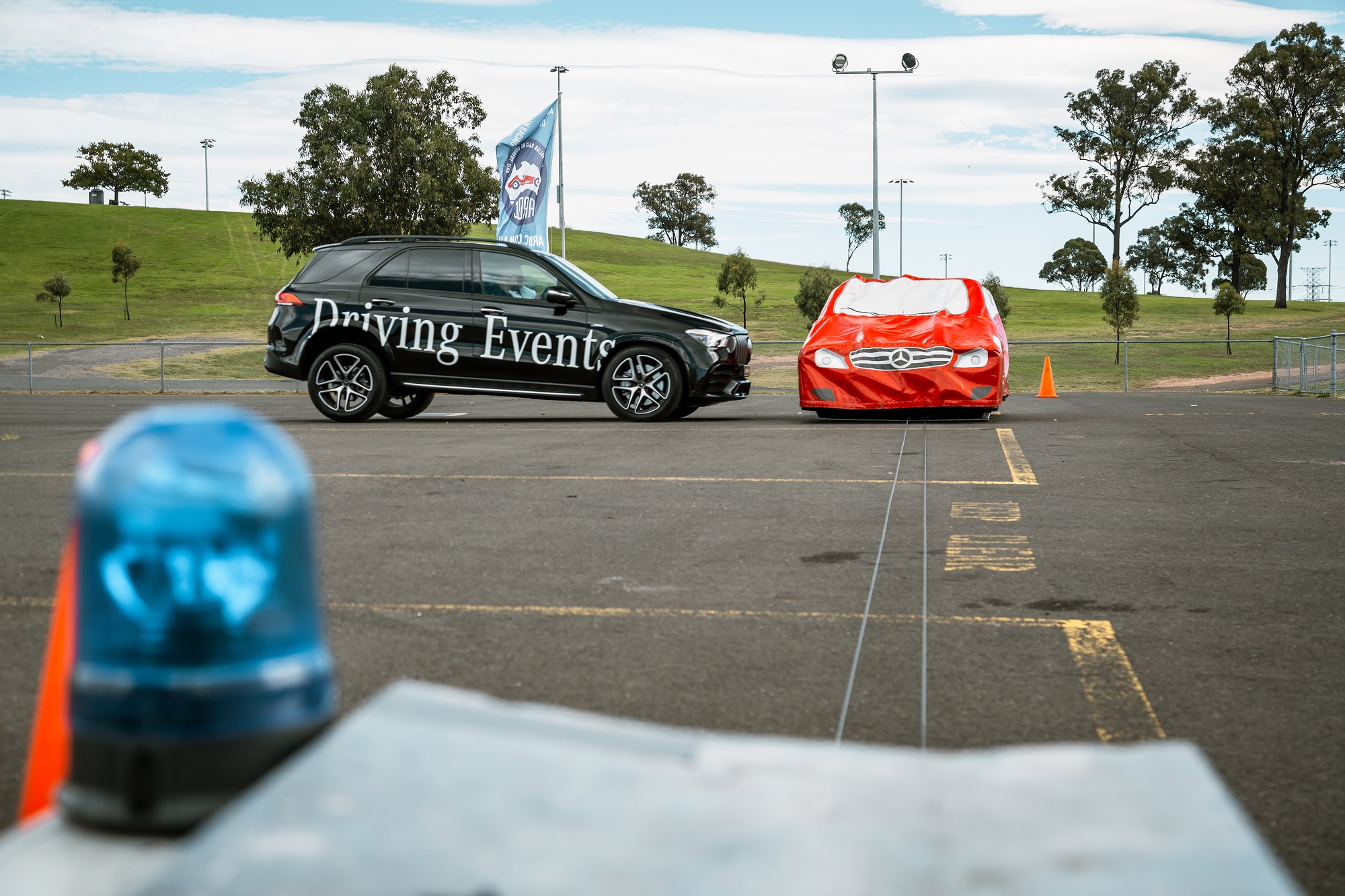
Perhaps the most impressive part of the day for me though was a demo of the new safety features in an AMG GLE 53 4Matic+.
I’m lucky to have never been in a car crash, but this showed me just how clever vehicles have become at helping us to avoid everyday accidents.
A walkthrough of the safety systems Mercedes refers to as its ‘Assistance Packages’ demonstrated the benefits of ‘normal brake assist’, ‘cross-traffic assist’ and ‘pedestrian detection’, and then we did it all again using ‘Active Cruise Control’ – testing these aids in a way most people wouldn’t normally get the chance to when buying a new car.
These days, the new car buying process often simply boils down to choosing what colour it comes in, the size of the touchscreen or what wheels you can get, but the value of learning about the various safety systems on offer and how they work in practice that days like this give you is more than worth the money.
But why specifically go on driver training with Mercedes-Benz?
Well, I was invited, of course. But for regular buyers? Peter Hackett, Chief Driving Instructor for Mercedes-Benz Australia and New Zealand, says it’s all about the one-to-one experience.
“We’re very proud of the personalisation – our instructor-to-student ratio is one instructor to one or two students at the most. That’s a big change for us – it used to be one to three, which makes our level of tuition quite high.
“And, I believe, we have the largest range of vehicles in Australia including AMG, off-road, EVs, the S-Class and the C-Class available. Our technology offering is unique in Australia, too.”
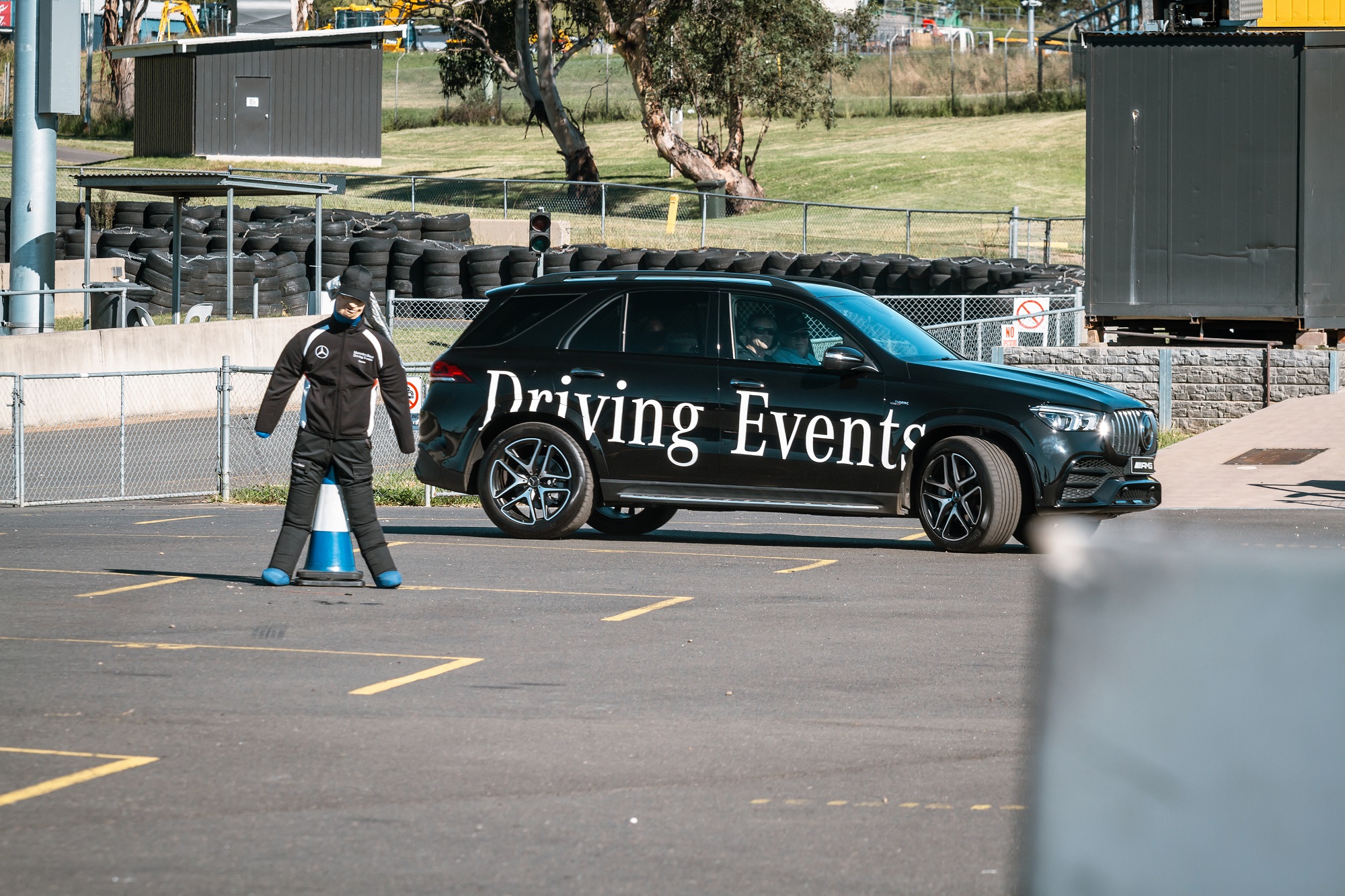
In large part, the Mercedes-Benz Driving Events are for the brand’s customers, but Peter says the experience is for anyone looking to improve their driving skills or to get to know more about their vehicle.
“We want people to go away thinking, ‘wow I didn’t know cars could do that, or this car could do that, or I could do that’. We don’t necessarily want super-experienced drivers who just want to cut laps in an AMG GT R.”
This event was particularly special for everyone involved, as it was the first time since the COVID-19 pandemic rocked the world last year that it has been possible to do such a thing.
Forget luxury cars – isn’t it a luxury enough these days to sit next to someone you don’t live with, in a vehicle, without both having masks on and the windows down?
“It’s fantastic to be back,” Peter adds. “It’s that interaction, that personalisation of a program like this, that we’ve missed. We’ve had so many incredible cars released in the time we weren’t able to show them off, so to be back here and to see the smiles on people’s faces as they experience the new technologies is something we’ve waited a long time for.”
Details
The half-day program costs $550 (including morning tea and lunch) and is split into three sessions all lasting about an hour each.
It grants access to the best cars in the three-pointed star’s range, along with personalised tuition from professional racing drivers, present on the day as instructors.
The program is also open to anyone with a valid probationary or full driver’s licence, whether or not you hold the keys to a Merc.
How can I get involved?
The Driving Events are held twice a year in the Eastern states, with visits to South Australia and Western Australia in between, at:
New South Wales – Sydney Motorsport Park
Queensland – Mount Cotton Hillclimb
Victoria – Sandown International Motor Raceway
South Australia – Mallala Motorsport Park
Western Australia – Barbagallo Raceway, Wanneroo
To find out more, speak to your local Mercedes-Benz dealer or visit the website here.
What is the Toyota Mirai?
This is the second generation of Toyota’s pioneering hydrogen fuel-cell vehicle (FCEV), which is considerably bigger than the previous model and seems two generations down the track in terms of technology and refinement.
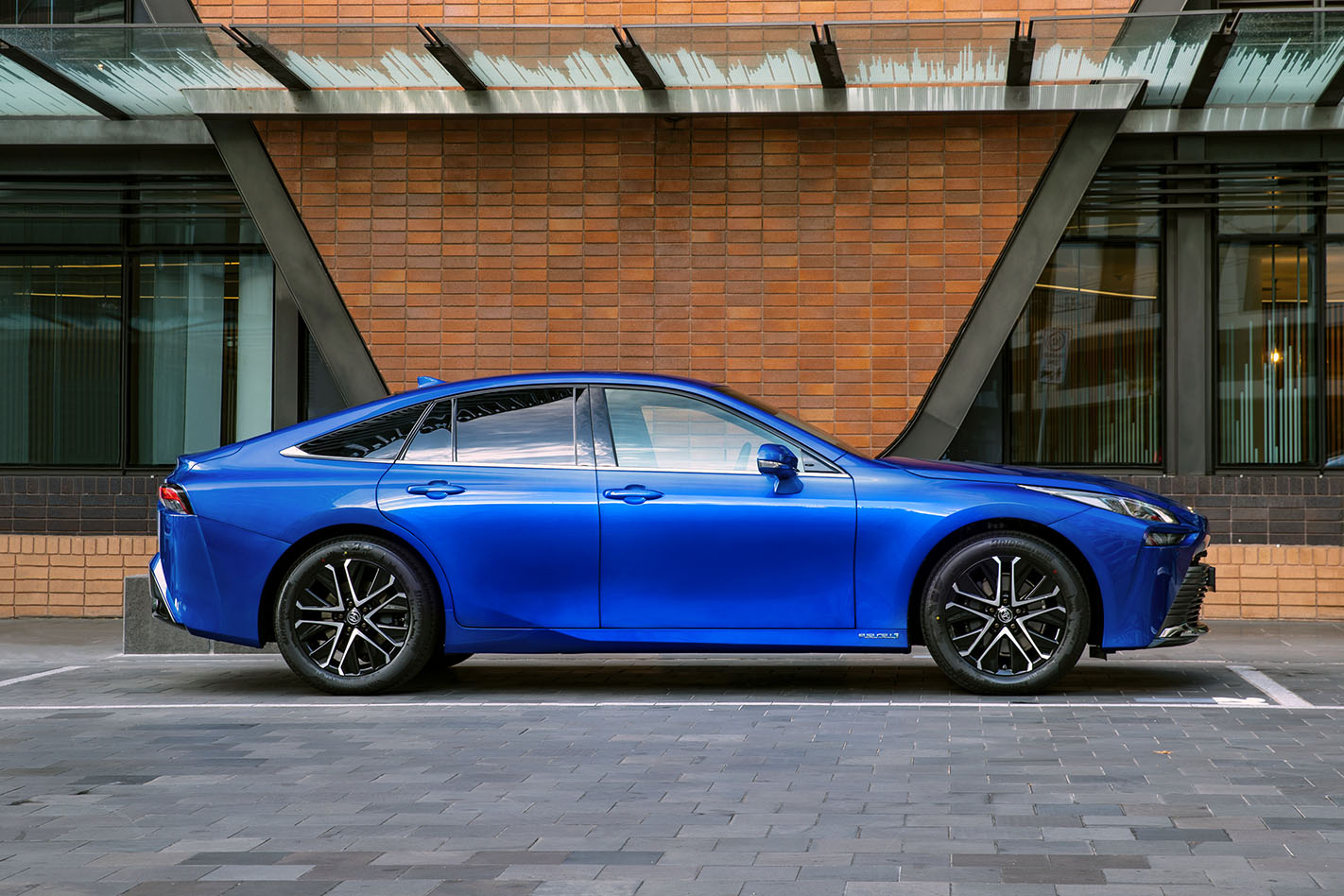
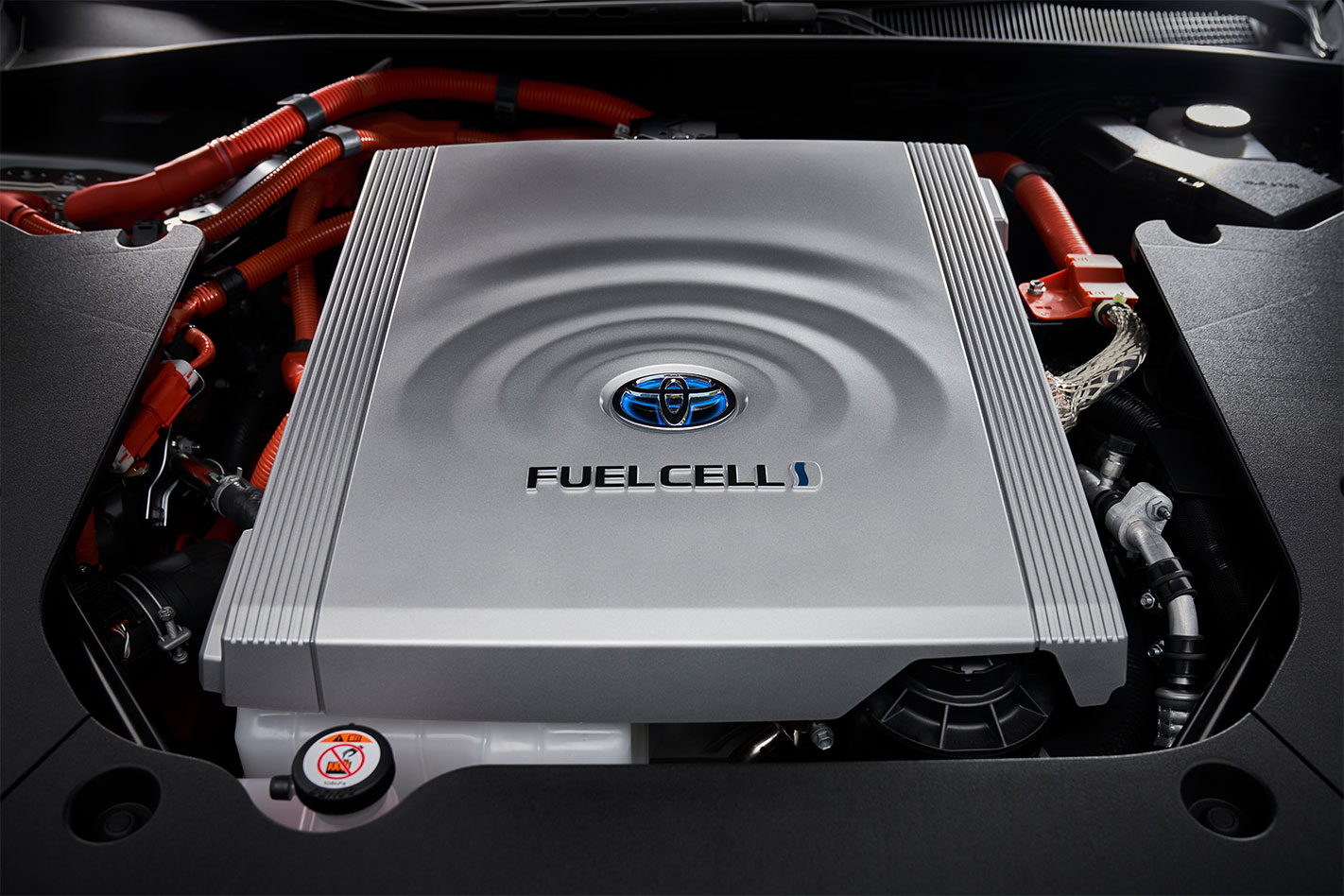
It is driven by a 134kW/300Nm motor powered by electricity that’s created by combining air and hydrogen in a 125kW fuel cell located under the bonnet.
Unlike the first Mirai, which was a gawky-looking medium sedan that was styled in keeping with the Prius of its time, the new Mirai is a large, elegant car that’s roomier than a Camry and looks as though it belongs in a Lexus showroom.
Like the Hyundai Nexo FCEV, the Mirai cannot be bought outright but is available to the public through a leasing program aimed at environmentally conscious organisations. So far just 20 will be made available in Australia.
What is the Toyota Mirai like to live with?
The Mirai has a premium feel to it and comes well equipped, with the standard feature list including an 8.0-inch digital instrument display, 12.3-inch infotainment screen displaying satellite navigation, 360-degree parking monitor, and Apple CarPlay/Android Auto connectivity. There’s also a 14-speaker JBL sound system, dual-zone air-conditioning, keyless entry/start, LED exterior lighting, 19-inch alloy wheels and Toyota ‘Safety Sense’ advanced driver assistance system.
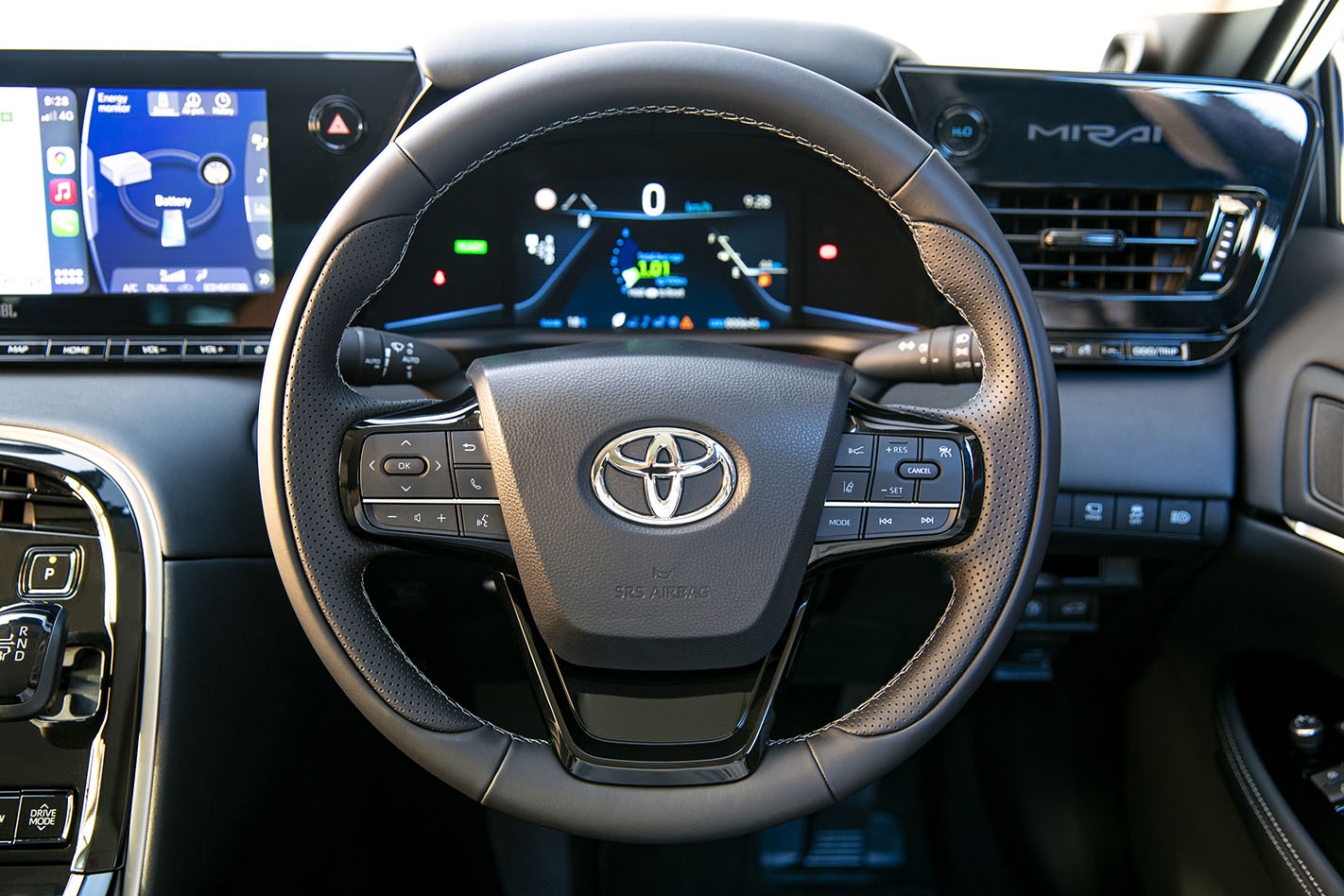
On a Camry-like dashboard, the large touchscreen tilted toward the driver atop a neatly laid-out row of buttons that allow you to control infotainment functions without having to touch the screen and delve into menus.
The synthetic leather front seats are power adjusted and very comfortable with loads of elbow room between them.
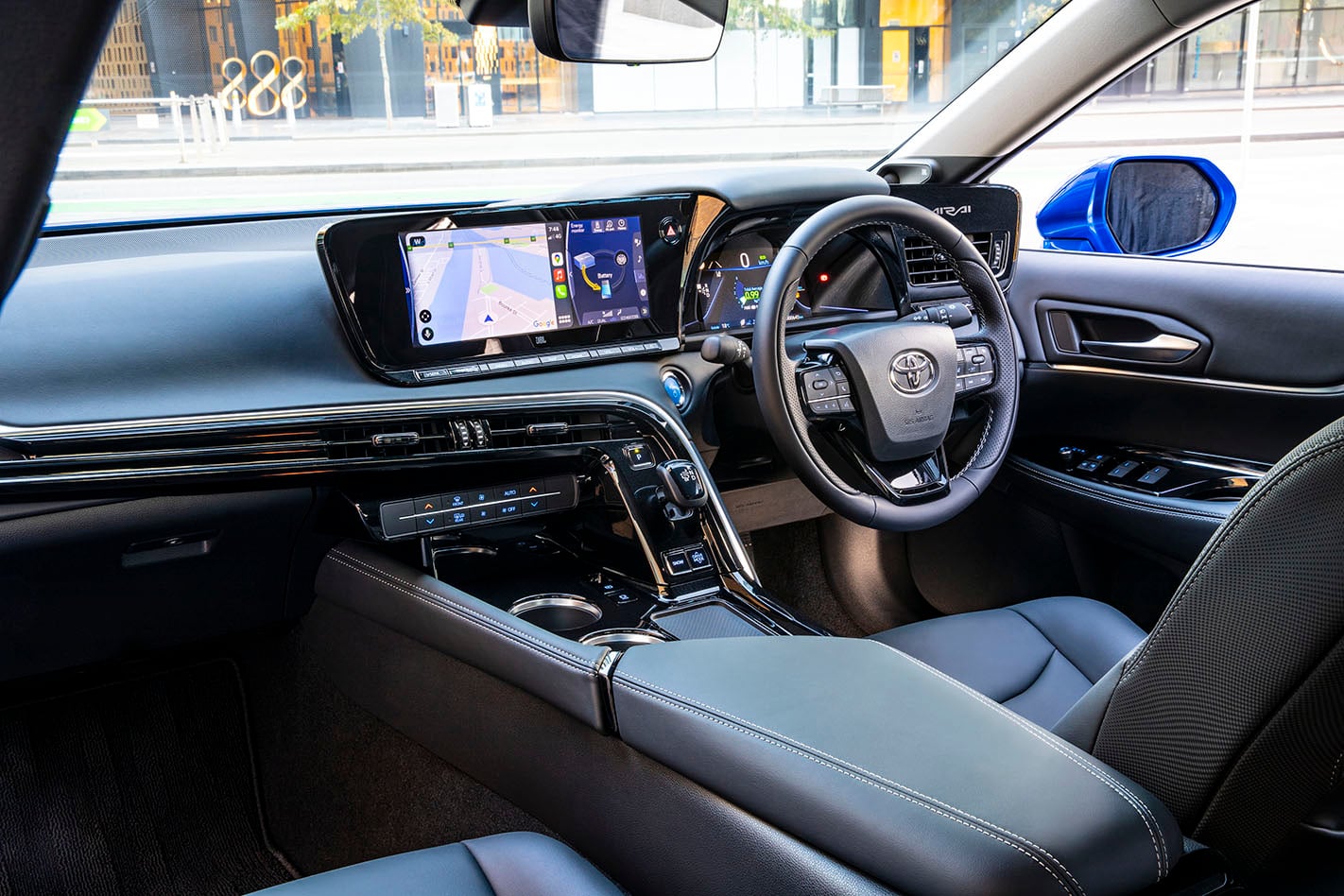
The space between them is filled by the centre console that has a handy-sized storage bin topped by a stitched synthetic leather padded armrest, along with a wireless phone charger and cup holders.
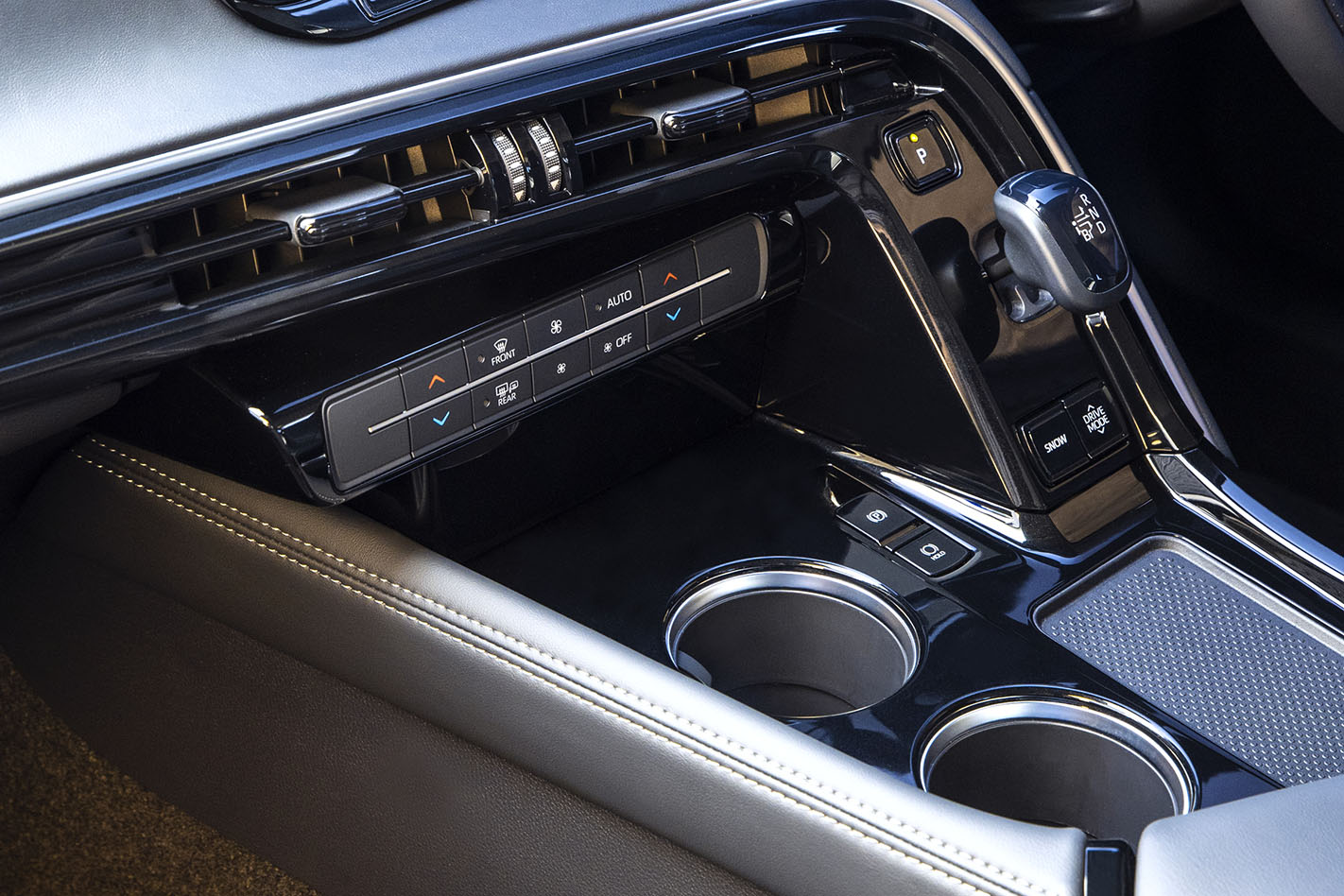
Protruding from a rising panel that bridges the console and the dashboard fascia is the gear selector, which helps to free up space. The multi-direction shifter is similar to the one found in the Prius in that it is a little unconventional and looks like it belongs in a milk float. You soon get used to it, but I’d prefer something a little simpler.
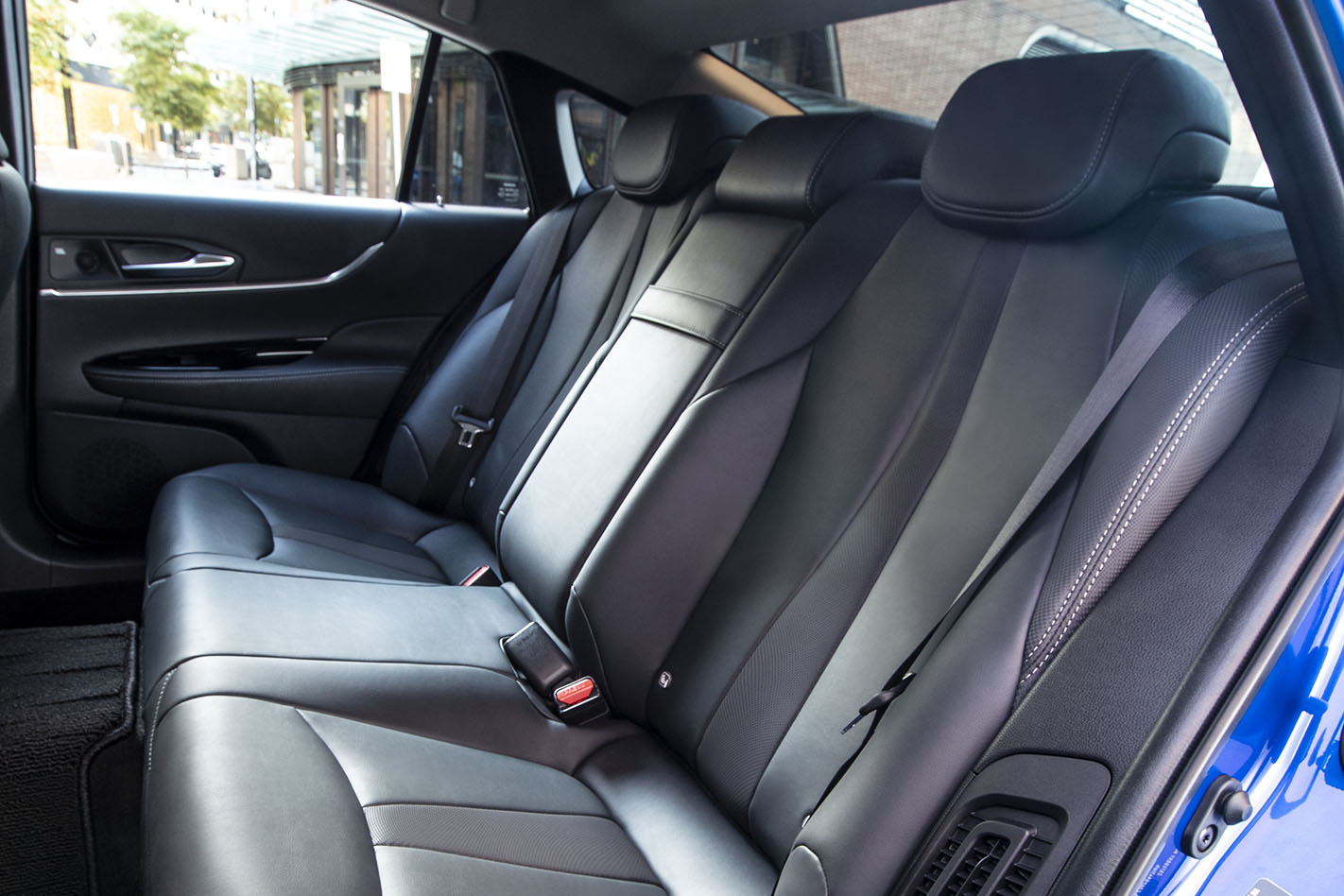
The Mirai’s 2920mm wheelbase brings plenty of space to the rear seats and while they’re very comfortable, its five-seater designation should come with an asterisk.
You see, unlike the Nexo, which has an almost flat floor at the back, the Mirai has a huge bump running through the centre, like a transmission tunnel but bigger, to accommodate one of the hydrogen tanks. This almost renders the centre seat useless to anyone over the age of seven with legs.
Another hydrogen tank at the rear compromises boot space, which at just 272-litres is 9.0-litres less than the Toyota Yaris light hatchback and about half that of the Camry.
What about the cost of running a Mirai?
It will cost $1750 per month for three years to lease a Mirai, with that price also including free hydrogen with the catch being that, so far, there aren’t too many places to top up apart from Toyota’s own hydrogen centre at Altona in Melbourne’s west.
With a 650km WLTP range this obviously limits where you can travel but for somewhere like Melbourne, which just became the second city in Australia to open a public hydrogen refuelling station after Canberra, it’s a very handy way to enjoy emissions-free driving.
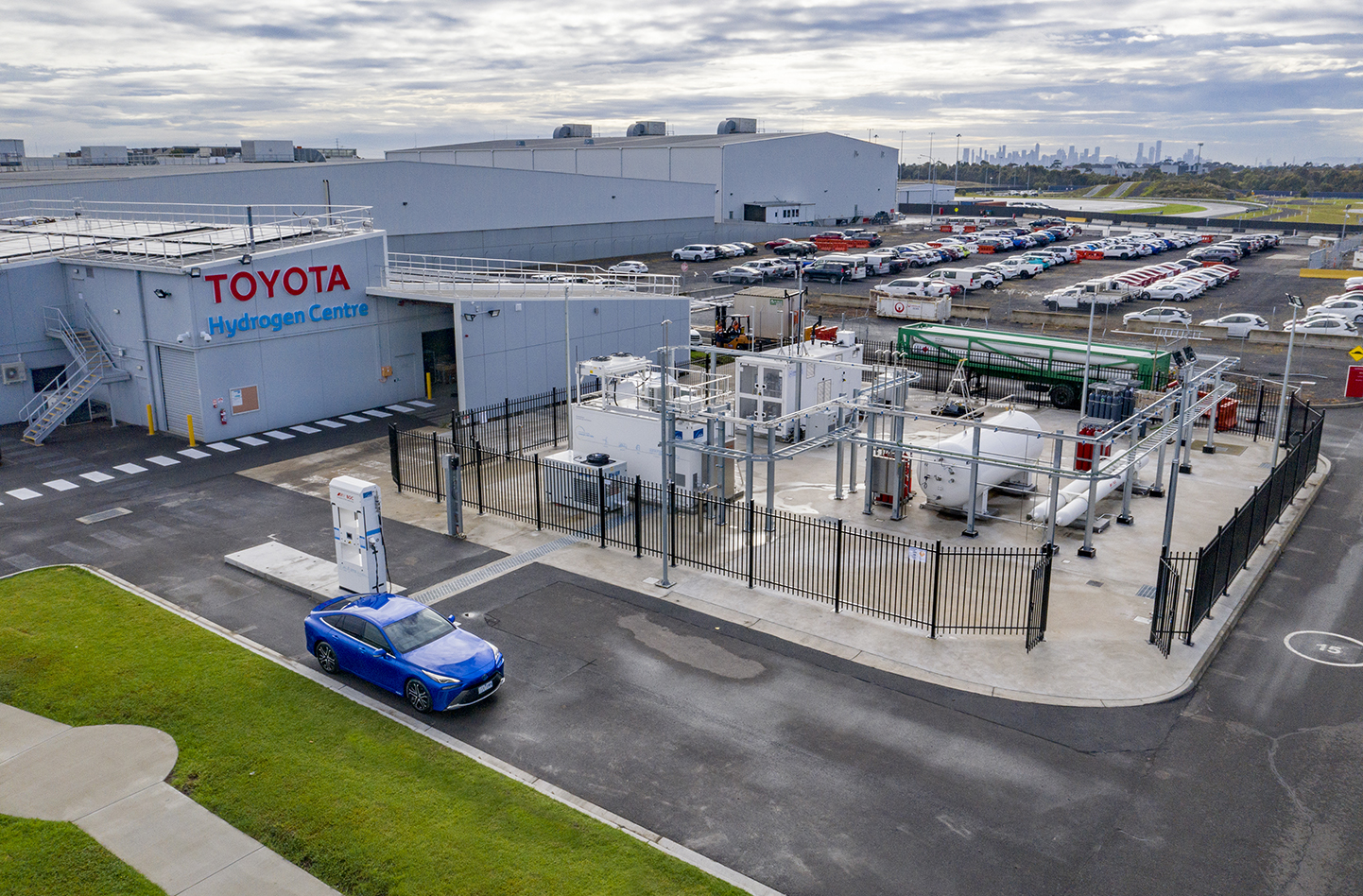
Not only is the range significantly longer than most battery-electric vehicles on the market, refuelling only takes about five minutes and isn’t too different to filling a car up with petrol or diesel – it’s actually a little easier as the nozzle locks into the car’s fuel port which means you don’t have to hold onto it. Instead of litres, compressed hydrogen is measured in kilograms and the Mirai’s three tanks take up to 6kg combined.
According to its official fuel consumption rating, the Mirai consumes 0.7kg per 100km.
Servicing the Mirai costs $2639 for the duration of the lease, with payment required upfront at the start of the loan period.
What is the Mirai like to drive?
As with its interior comfort, the new Mirai feels considerably more refined on the road than its predecessor, and you can certainly feel the additional power.
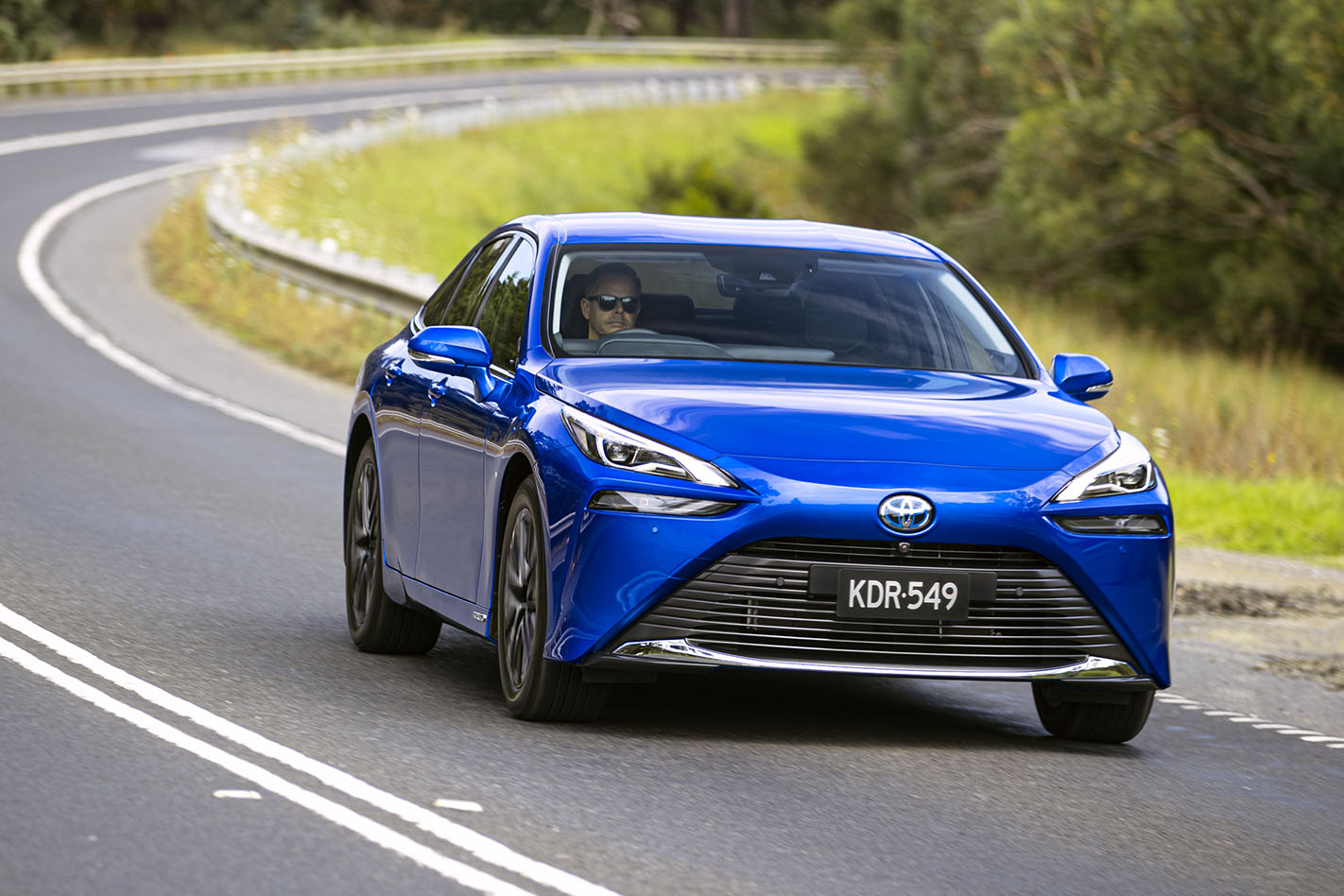
Its powertrain, consisting of a 128kW, 330-cell polymer electrolyte fuel cell and 134kW/300Nm motor that drives the rear wheels, has similar output to a six-cylinder petrol engine and performs and handles accordingly.
And while it doesn’t have that head jerking take-off like a battery electric vehicle (BEV), it does take off instantly, helped by a 1.2kWh lithium-ion battery pack taken from the Toyota hybrids that can feed power directly fed to the electric motor for a bit of extra boost when required.
Three drive modes consist of Eco, Normal and Sport. Sport brings 0-100km/h acceleration of 9.2 seconds on its way to a top speed of 175km/h, which is a fraction quicker than a Camry.
Interestingly it’s just 0.4 seconds quicker than the first-generation Mirai, but having driven both down a straight from zero to 100km/h at Toyota’s Altona test track the newer version seemed much punchier and more spirited.
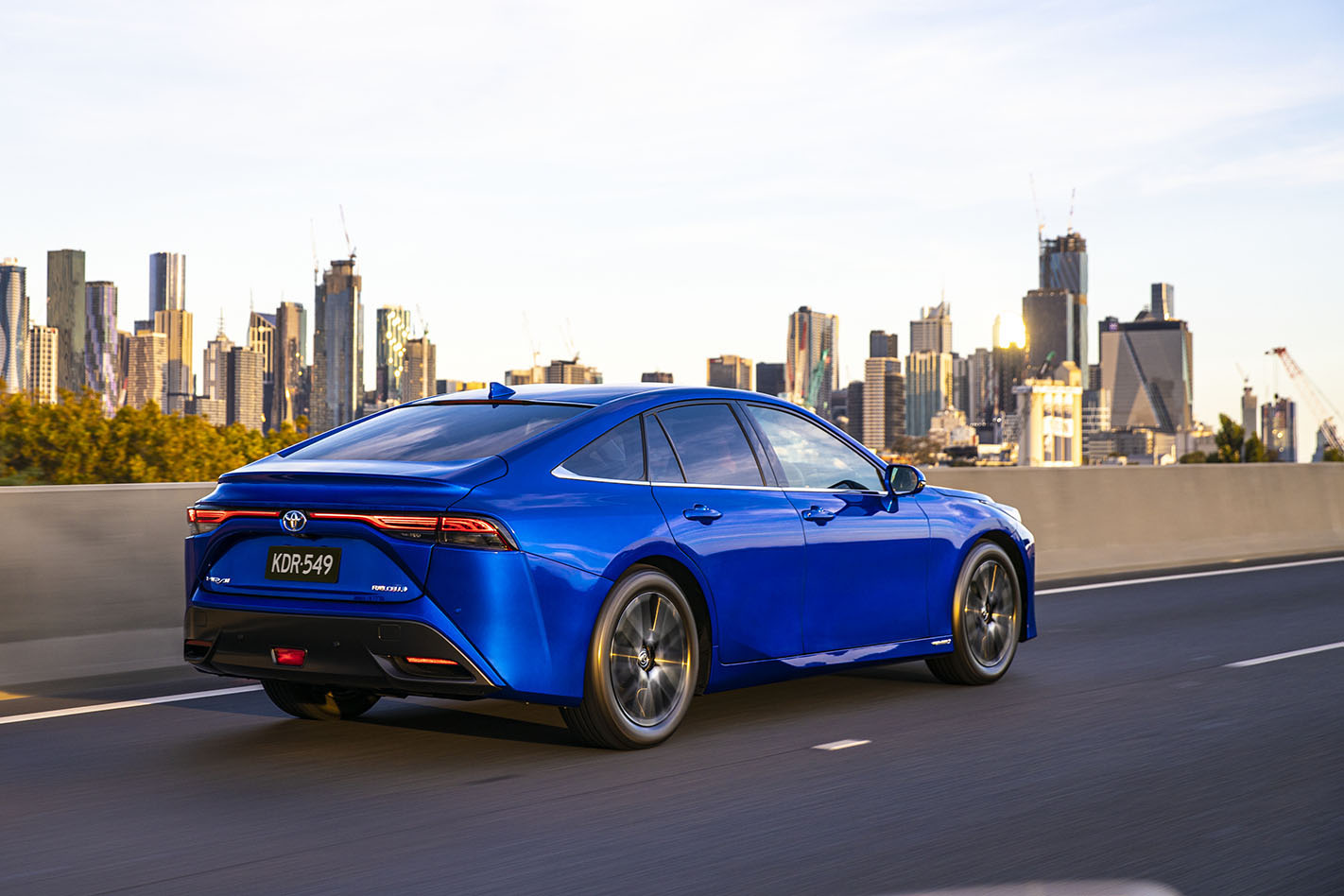
Like a turbo engine, it gets to highway speeds effortless and seamlessly through the two-step transaxle transmission and there’s plenty of instant power in reserve for when you need it, such as when overtaking.
As well as no lag when you put the foot down it’s pretty satisfying knowing that when you do fang this thing the only emissions coming out of the tailpipe will be water and purified air.
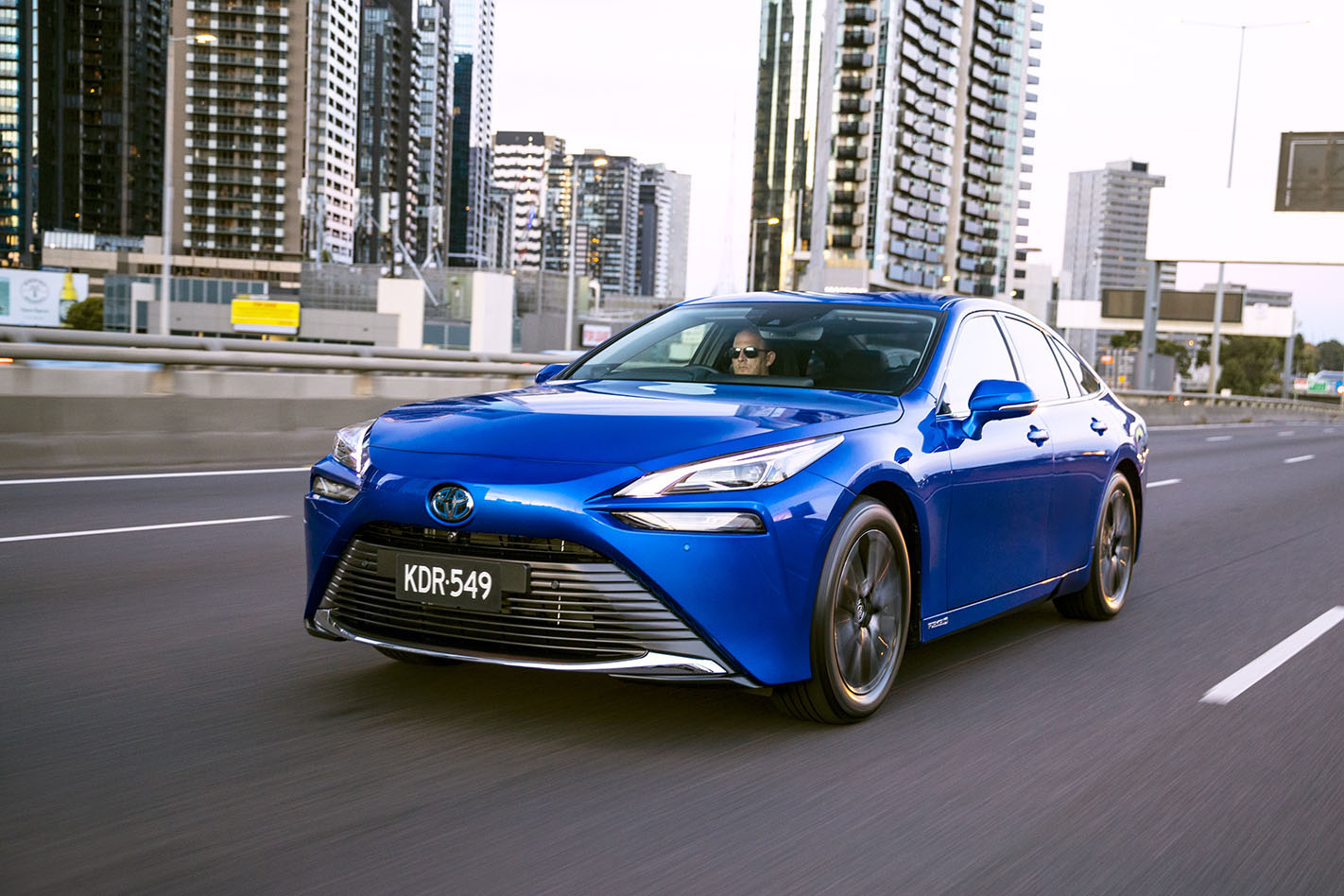
The Mirai’s ride feels smooth on the front and rear multilink suspension and 19-inch Bridgstone Turanza rubber, though our time with the Mirai was rather brief so I never got to try it on anything too rough.
That also meant, apart from a slalom run at the Altona test track, we didn’t put its handling through its paces either, but it felt as composed as any other large rear-wheel-drive sedan, with the electrically-assisted steering feeling well weighted and direct.
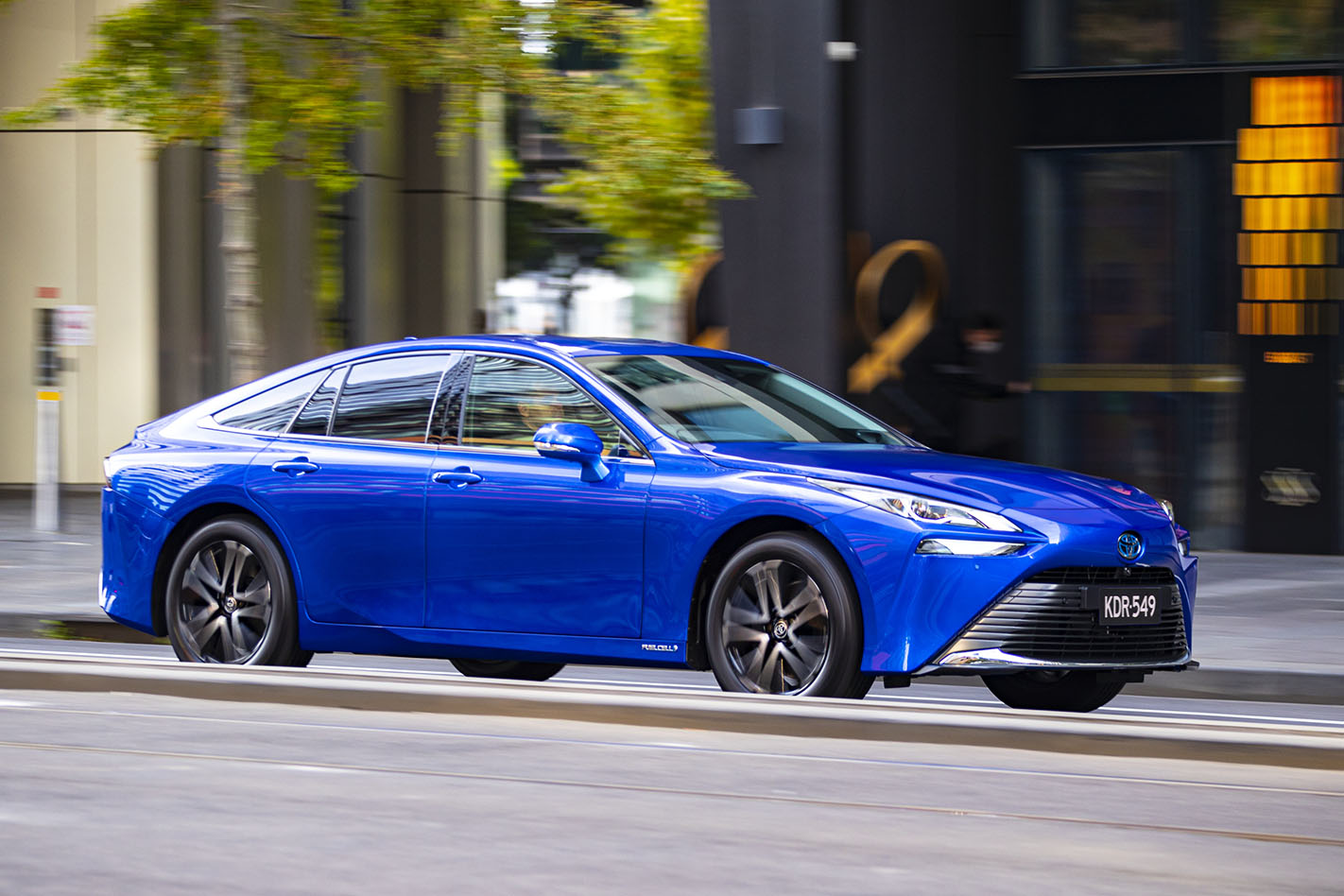
Rear vision is a little obscured, but there is a 360-degree camera monitor to help with parking.
All in all, it’s a very pleasant and comfortable car to drive and be in.
What is the Toyota Mirai like for safety?
The Mirai comes with Toyota’s Safety Sense advanced driver assistance suite that includes autonomous emergency braking with pedestrian and cyclist detection that will also stop to prevent or mitigate a collision at an intersection.
It also has all-speed adaptive cruise control, lane-keeping assist, lane departure alert and emergency steering, and speed sign assist that will warn you if you’re speeding.
Other safety features include rear-cross traffic alert, blind-spot monitoring, auto high beam that provides optimum vision at night without dazzling other drivers, and seven airbags.
The hydrogen storage tanks are extremely strong with a three-layered structure comprising glass fibre reinforced plastic, carbonfibre reinforced plastic and a polyamide resin liner.
Because only about 11,000 Mirais have been built worldwide, the second-generation Mirai is unlikely to be tested by ANCAP, EuroNCAP or US safety authorities.
The Verdict
While the first Mirai did much of the groundwork to make FCEVs suitable for everyday use, this new generation model is still very much a pioneer that will help determine once and for all if hydrogen will be a suitable alternative fuel for passenger vehicles.
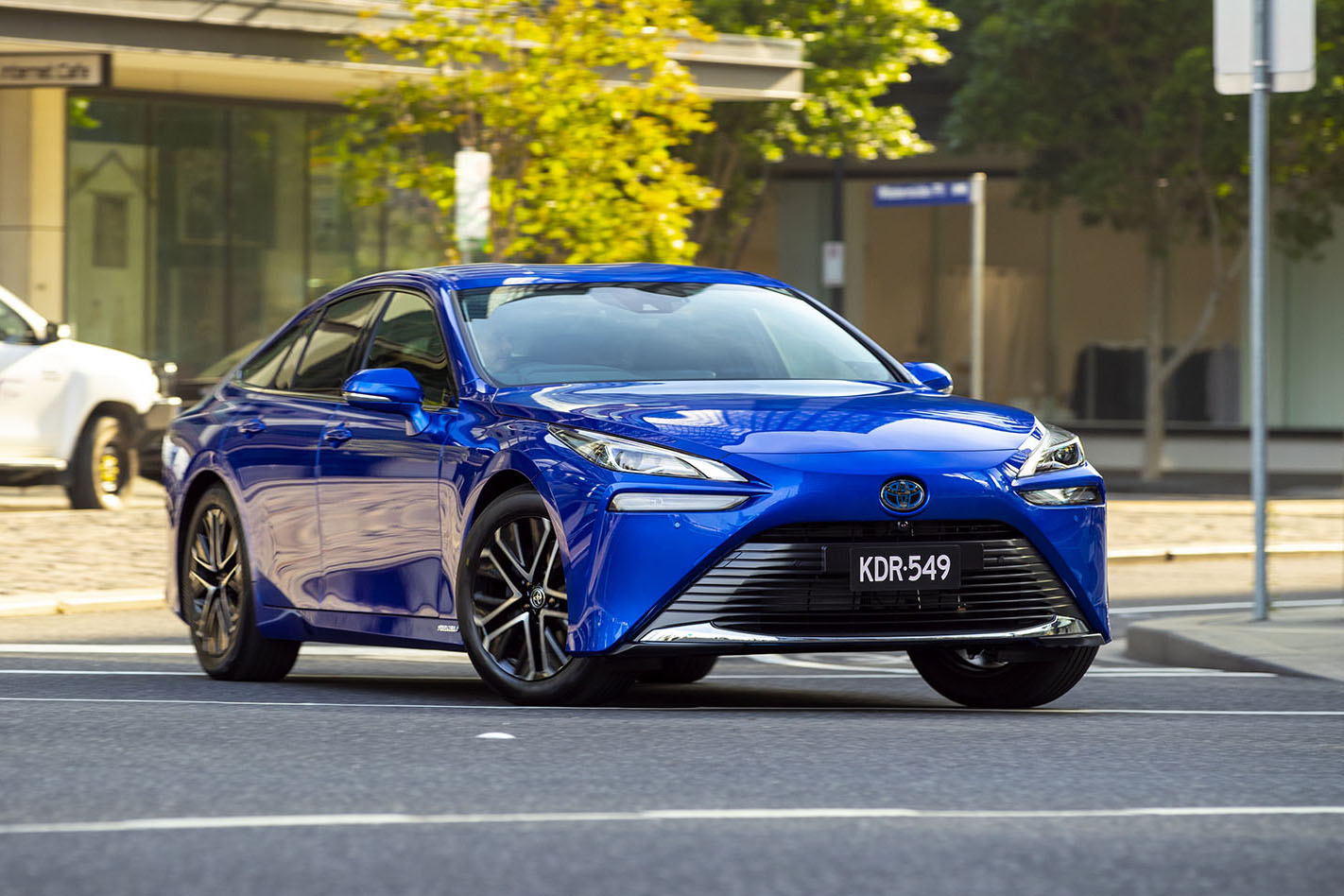
But this is no concept car – it’s everything people expect from a Toyota with a hint of Lexus in its styling and comfort levels and, putting the current lack of hydrogen stations aside, would make for a great, clean daily driver.
Apart from the scarcity of hydrogen filling stations and a very small boot, it seems to present few compromises compared to ICE or BEV vehicles.
The good news is that even the EV-phobic federal government is seriously looking at green hydrogen as a future fuel for a range of applications including mining and public transport, a byproduct of which should be cheaper vehicles and the proliferation of refuelling stations.
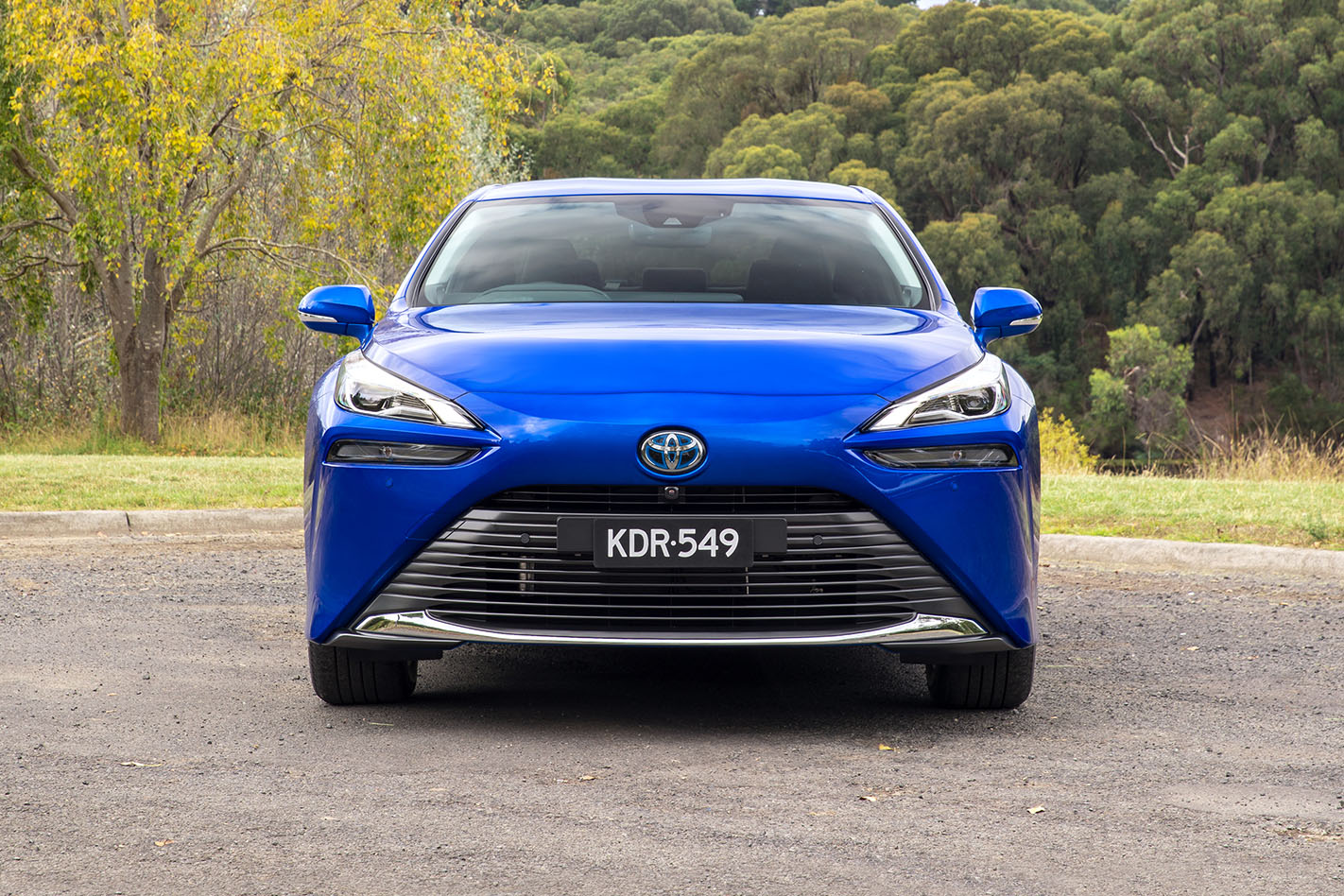
Such is Toyota’s confidence in the growth of hydrogen that it’s expecting Mirai to be viable enough to be sold directly to the public within three years.
I, for one, am looking forward to that.
2021 Toyota Mirai specifications
Body: 5-door, 5-seat large sedan Drive: RWD Motor: Permanent magnet synchronous motor Combined Power: 134kW Torque: 300Nm Fuel cell:125kW Battery 1.2kWh Lithium-ion Polymer Fuel (hydrogen) consumption: 0.7kg/100km (combined) Weight: 1900kg Transmission: Transaxle – three-axis, two-step speed reduction gear Suspension: Front/rear multilink, stabiliser bar L/W/H: 4975/1885/1470mm Wheelbase: 2920mm Tracks F/R: 1610/1605mm Brakes: Front/Rear ventilated/discs with regenerative braking Tyres: 235/55 R19 Bridgestone Turanza Wheels: Alloy 19-inch Price: $1750 per month (lease only)
Some of the world’s leading car manufacturers, automotive groups and environmental bodies have teamed up to blast the Victorian Government’s proposed tax on electric vehicles calling it: “the worst electric vehicle policy in the world”.
An open letter published today, which urges crossbench MPs to vote against the bill when it comes before Parliament, says the Andrews Government’s proposed tax is the only stand-alone electric vehicle tax in the world, and risks putting Australia even further behind the rest of the world in its uptake of electric cars.
The letter, addressed to the Victorian parliament – calling on it to vote against the state’s “regressive electric vehicles tax” – was signed by a number of automakers and industry bodies including Hyundai, Volkswagen, Uber, Jet Charge, the Electric Vehicle Council, Environment Victoria and the Australia Institute.
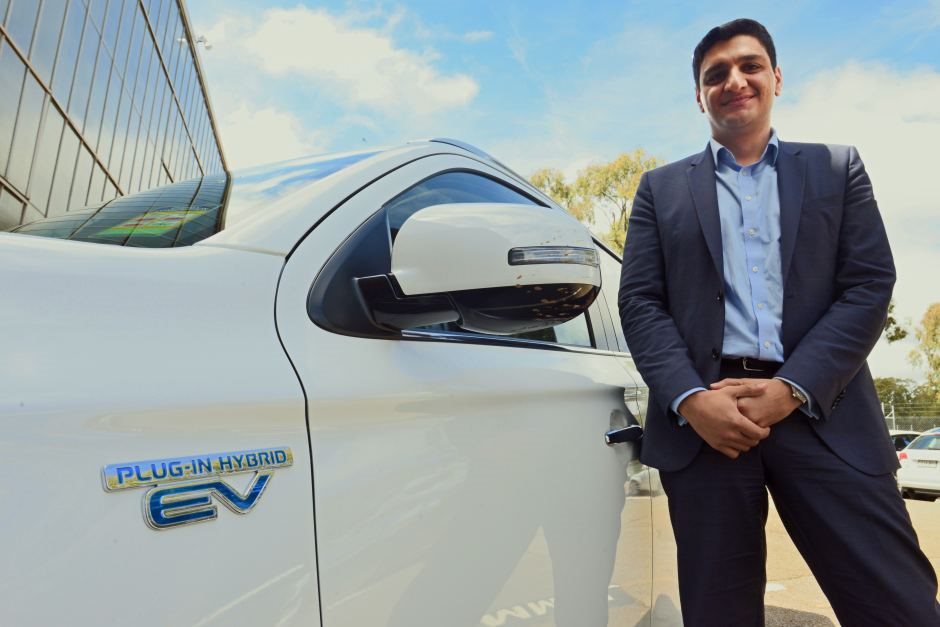
If the bill is passed it will mean Victorian drivers will miss out on the most efficient and affordable electric vehicles.
“Victoria is already massively behind comparable jurisdictions in the US, the UK, and across Europe. This tax will exacerbate the yawning gap,” said Behyad Jafari, CEO of the Electric Vehicle Council.
“Far from being on track to achieving net zero emissions by 2050, emissions from transport are rising in Victoria. This is the wrong time to tax zero emissions vehicles.”
“Every other state has either ruled out doing something similar at this early stage and SA, the one who’s closest [to Victoria’s proposed tax], has delayed any introduction until after its next state election as its parliament has said it will reject implementing the charge as well.”
As announced in the 2020-21 Victorian Budget, a distance-based charge will apply for Victorian registered zero and low emission vehicles (ZLEVs) from July 1, 2021, with a 2.5c/km charge applying to electric and other zero emission vehicles, including battery-electric and hydrogen vehicles, and a 2.0c/km charge will apply to plug-in hybrid-electric vehicles.
According to the Government, electric vehicle owners will pay on average an additional $330 a year in distance-based road usage charges and plug-in hybrid-electric vehicles owners will pay an additional $260 a year – though this figure does not seem to take into account the petrol excise that PHEV drivers also pay.
Treasury forecasts suggest the new tax, the first of its kind in the country, will raise $30 million over four years.
The letter adds: “Going it alone will mean Victoria has the worst electric vehicle policy in the world.
“No other jurisdiction has introduced such a targeted levy on the cleanest vehicles on the road without significant incentives to balance it out.
“This new tax means the world’s manufacturers are far less likely to send Victorians their best, most affordable, zero emissions vehicles. That makes things much harder for Victorian families who want to buy and drive electric.”
Ellen Roberts, National Director of Solar Citizens, said the Victorian Government is already helping households to install cleaner solar energy so it should be doing the same when it comes to getting Victorians to invest in electric transport.
“Just like rooftop solar, we want to see electric vehicles become more affordable for everyday Australians. But this tax on cleaner vehicles will just jam on the handbrake,” Ms Roberts said.
Of the 22 submissions made on the controversial EV tax bill, only two have been in favour – the Victorian Government and Infrastructure Partnerships Australia.
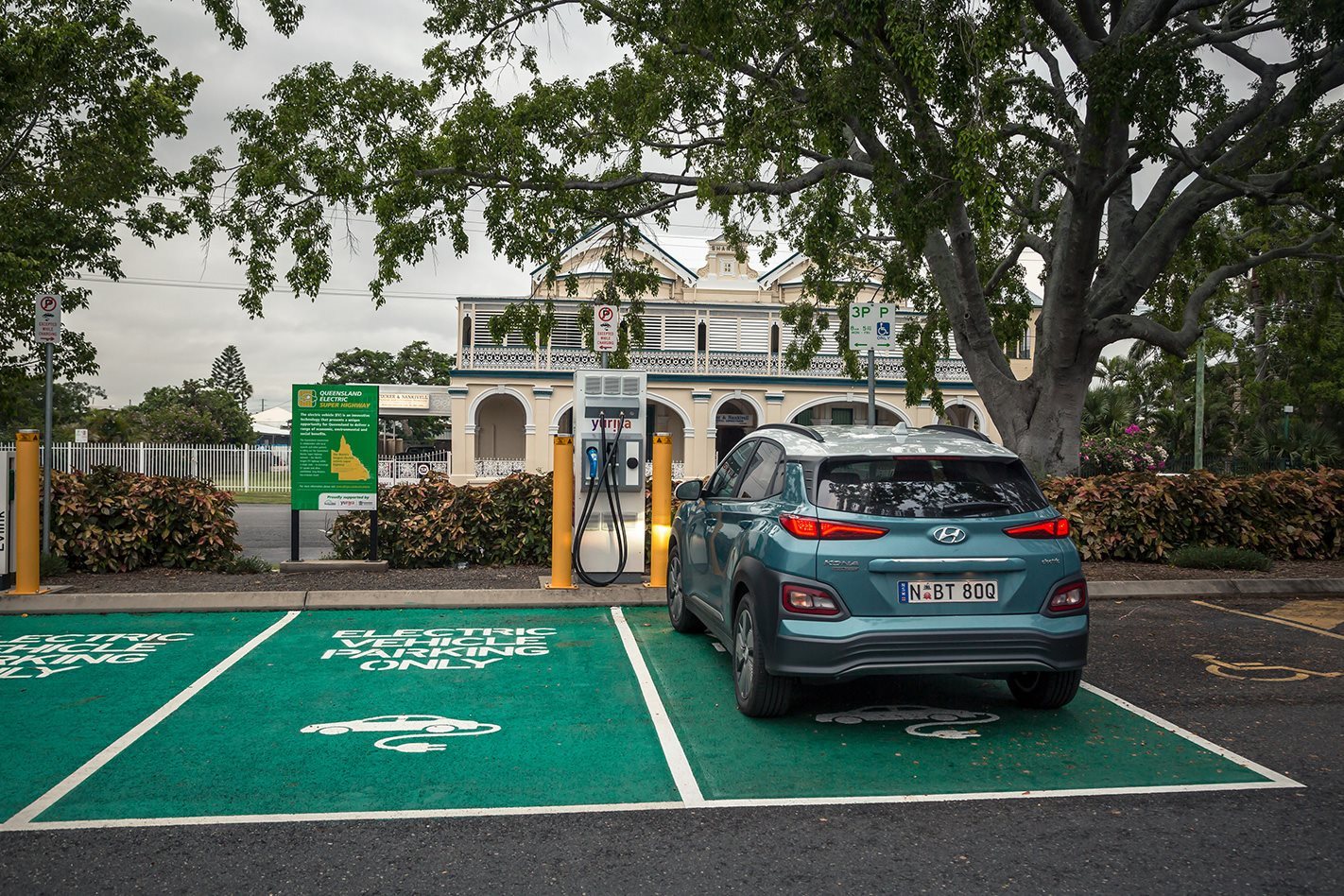
The group behind the open letter claims it opposes the proposed bill because the State Government has “not done proper consultation” ahead of announcing the plans and it “penalises electric car owners because [their vehicles] don’t consume petrol”.
Richie Merzian, Climate and Energy Program Director at the Australia Institute, said: “It is somewhat disingenuous to suggest that roads are funded by the fuel excise, as those funds are collected by the Federal Government and go towards general revenue. If the State Government is looking to increase revenue, there are far better ways to go about it that don’t disincentivise the use of electric vehicles.”
Michael Bartsch, Managing Director of Volkswagen Group Australia, added: “Volkswagen does not ask for incentives to import zero emission vehicles, rather for the abandonment of such disincentives as this ill-conceived anomaly of a tax.”
Defending the policy last month, Victorian Treasurer Tim Pallas said: “These reforms ensure all motorists pay their fair share to use our roads while we continue to incentivise the use of zero or low emissions vehicles.
“Introducing a road usage charge now, before take-up increases substantially, ensures that everybody pays a fair and sustainable charge for the use and the wear and tear on our road network and that means safer roads.”
According to The Age, Mr Pallas has been negotiating with Tesla and Nissan, who did not sign the open letter, on how to make their electric models more accessible in Victoria.
WhichCar has contacted Mr Pallas for comment on today’s letter.
