
Classic Wheels

Gallery 1
First published in the October 1971 issue of Wheels magazine, Australia’s best car mag since 1953. Subscribe here and gain access to 12 issues for $109 plus online access to every Wheels issue since 1953.
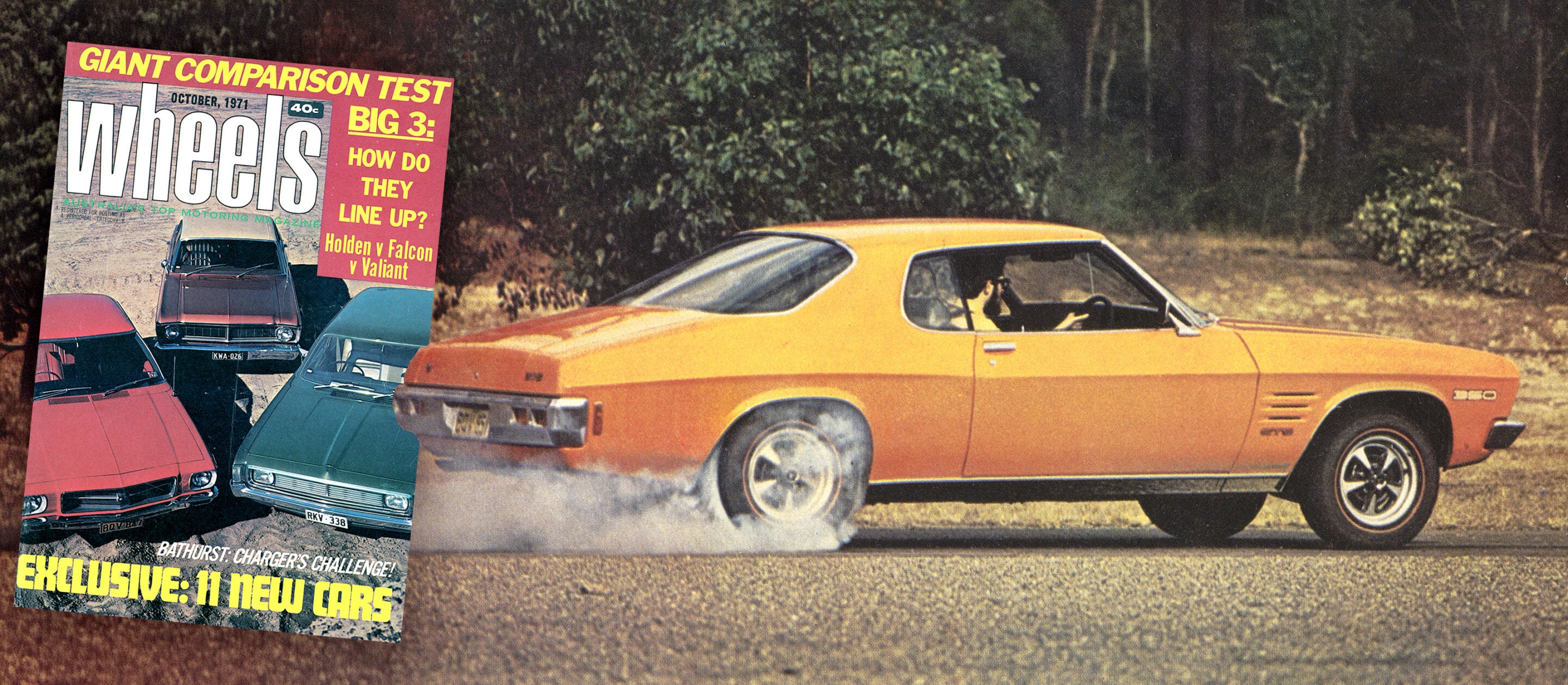
HQ Monaro 350 is a better car than HG 350 ever was.
The contentious points in the HG model that journalists and owners complained about have, with one or two exceptions, all been dealt with competently and the result is a fine high performance machine.
And yet something is missing. It’s something the old car had in abundance. Something which is entirely subjective and something we can only put under the heading of – character.
1
The HQ is a vastly superior car, make no mistake about that. But the old 350 was more than just a car. It was GMH’s nose-snub at the international General Motors’ edict of “no-racing”. It was a brute, subject to symphonic transmission tunes, uncomfortable at ordinary speeds, overbearing, a real masochist’s machine.
But it saved everything for those who drive quickly and intelligently. It made all the right engine noises, handled superbly above the speed limits and ran straight and true at two miles a minute in a fashion normally reserved for Italian exotic cars. It was an uncompromising production version of a genuine road racing machine. Carol Shelby would have understood, his first Shelby Mustangs were like that, before Ford added the effeminate touches.
Now the GM board room has got at the big Monaro. The engine’s rich bellow has gone, the ride is soft, the transmission is quiet and the handling is easier even if the roadholding is worse. But ultimately the new 350 is in a no-where-land between the luxury of the new LS 350 and the sportiness of the old model.
But for all but one tiny per cent of a percentage of buyers HQ 350 is a better car and you can be sure there will be a sizeable increase in its overall share of the very healthy Monaro sales charts.
1
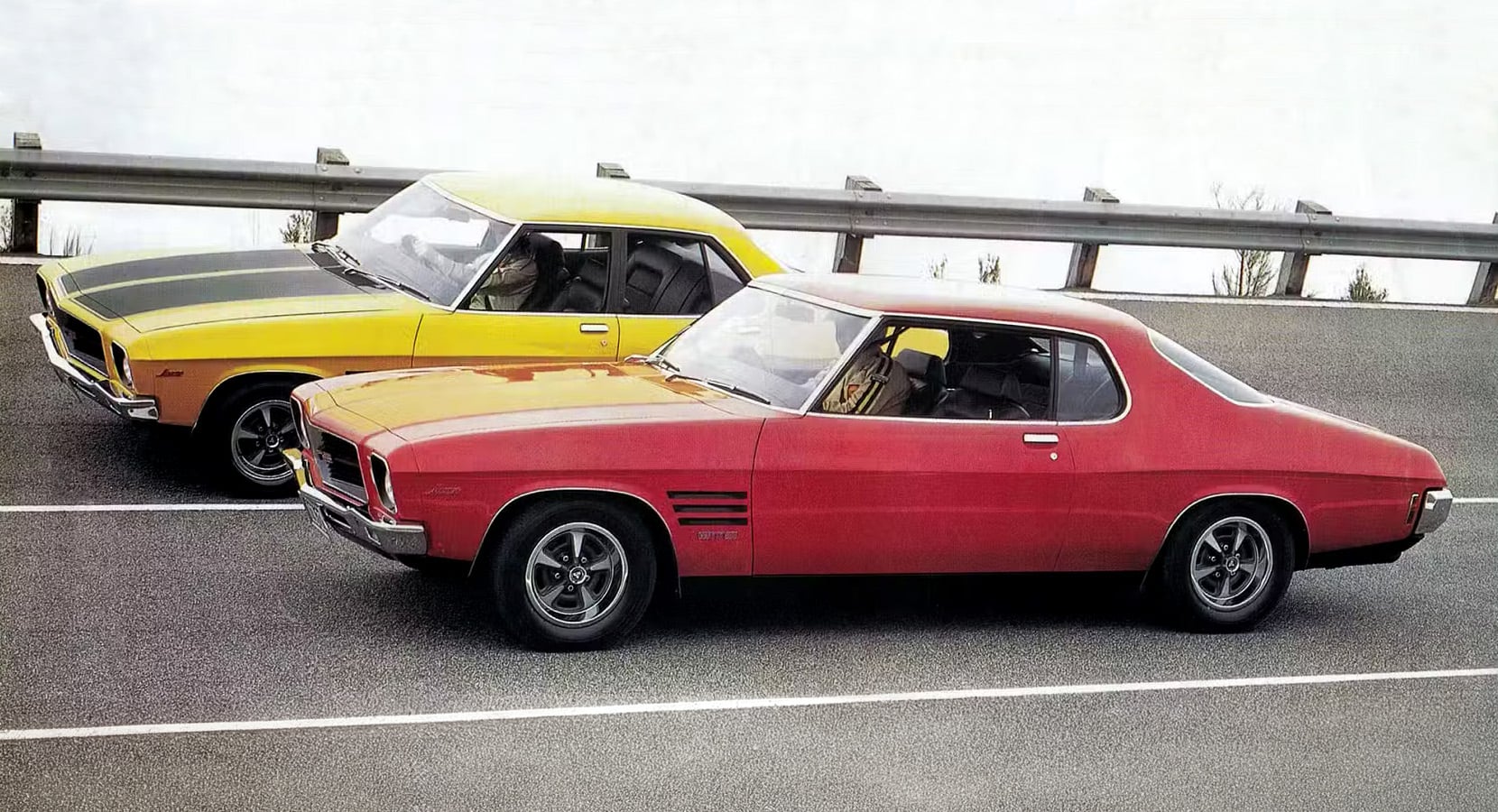
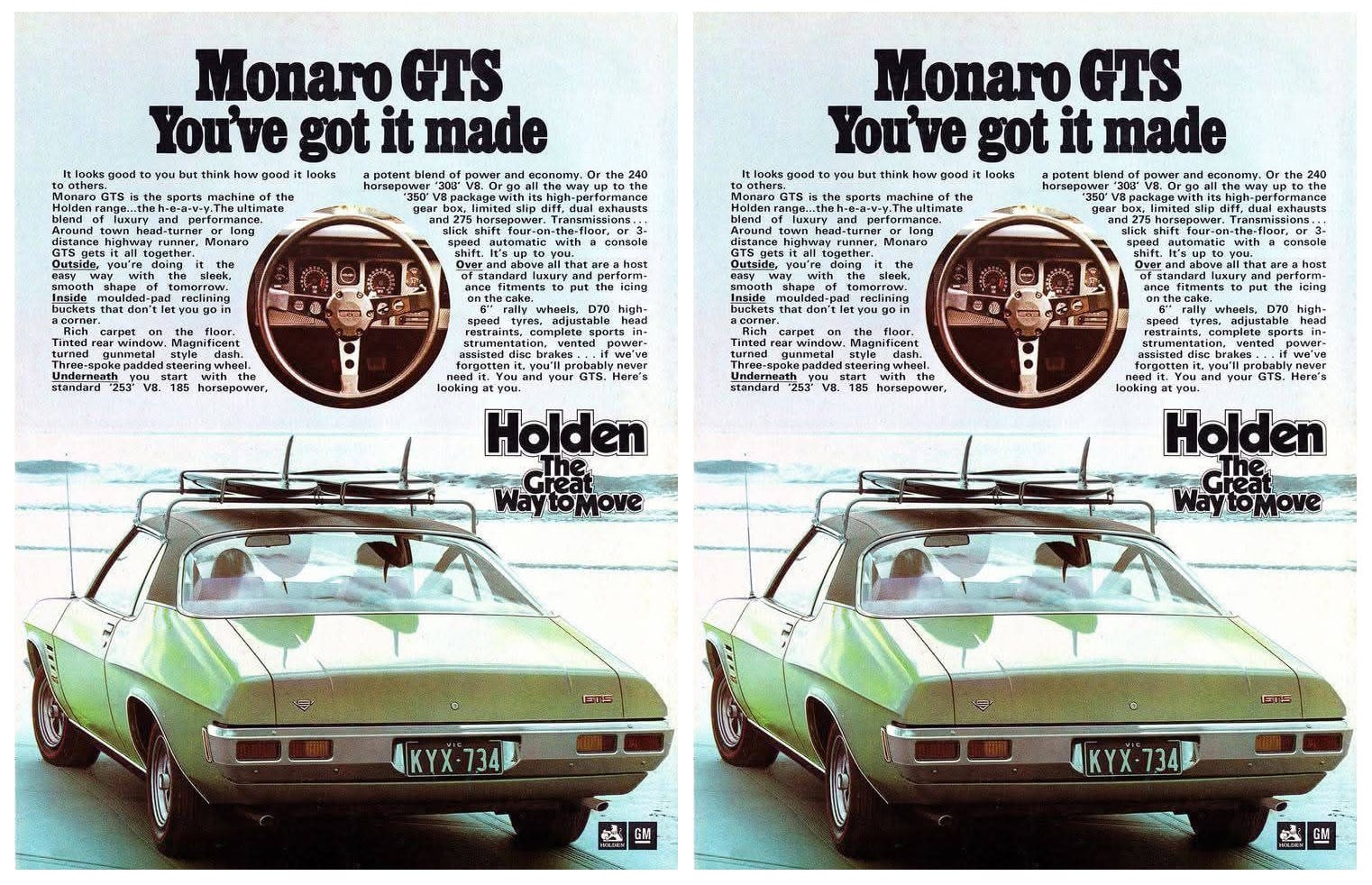
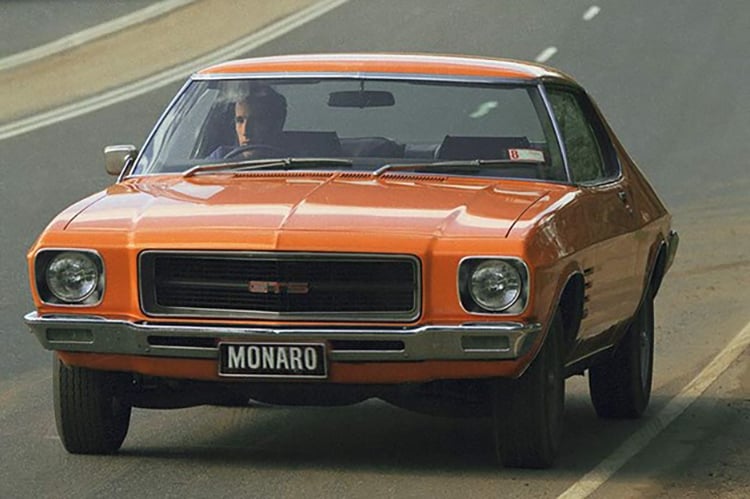
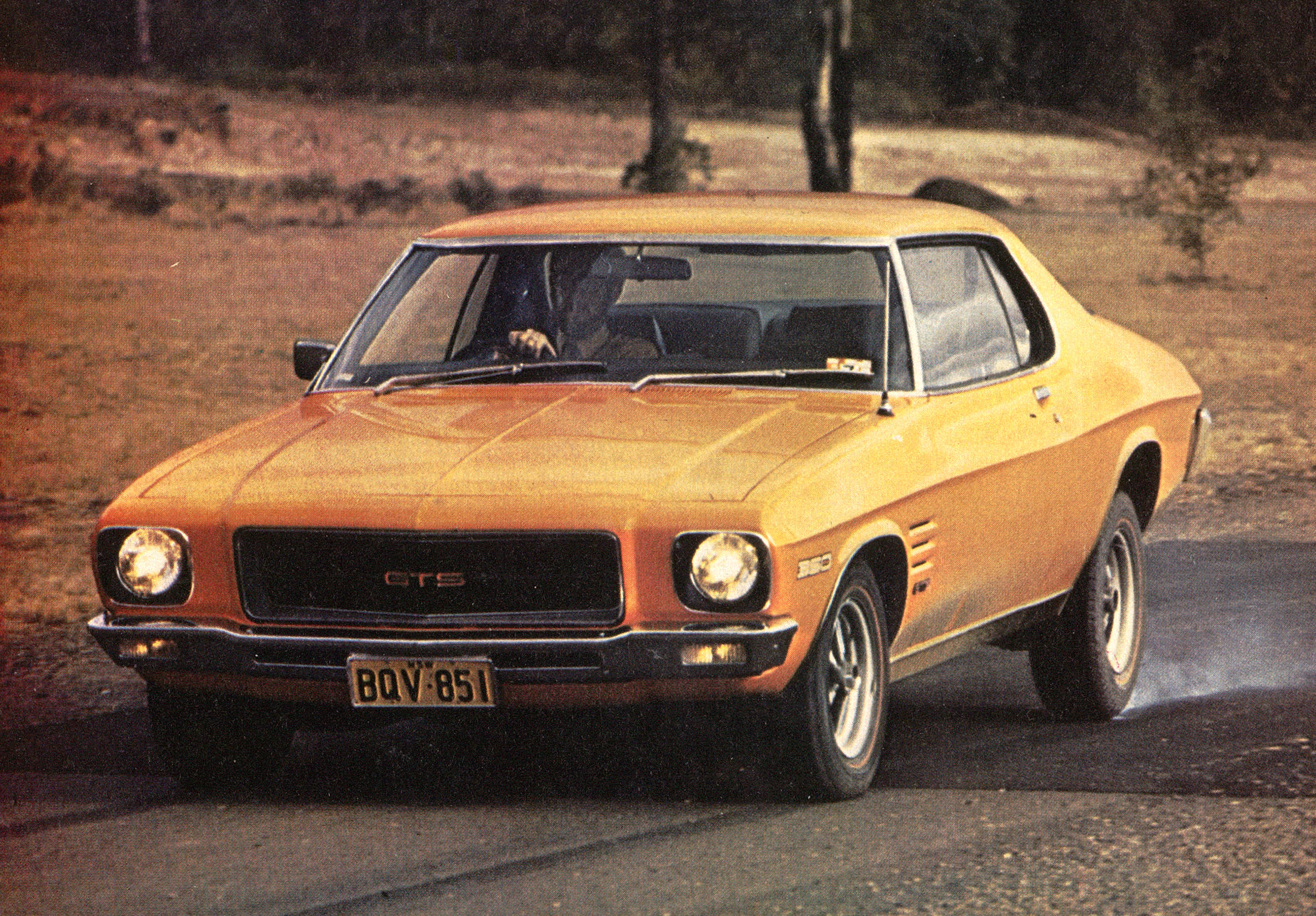
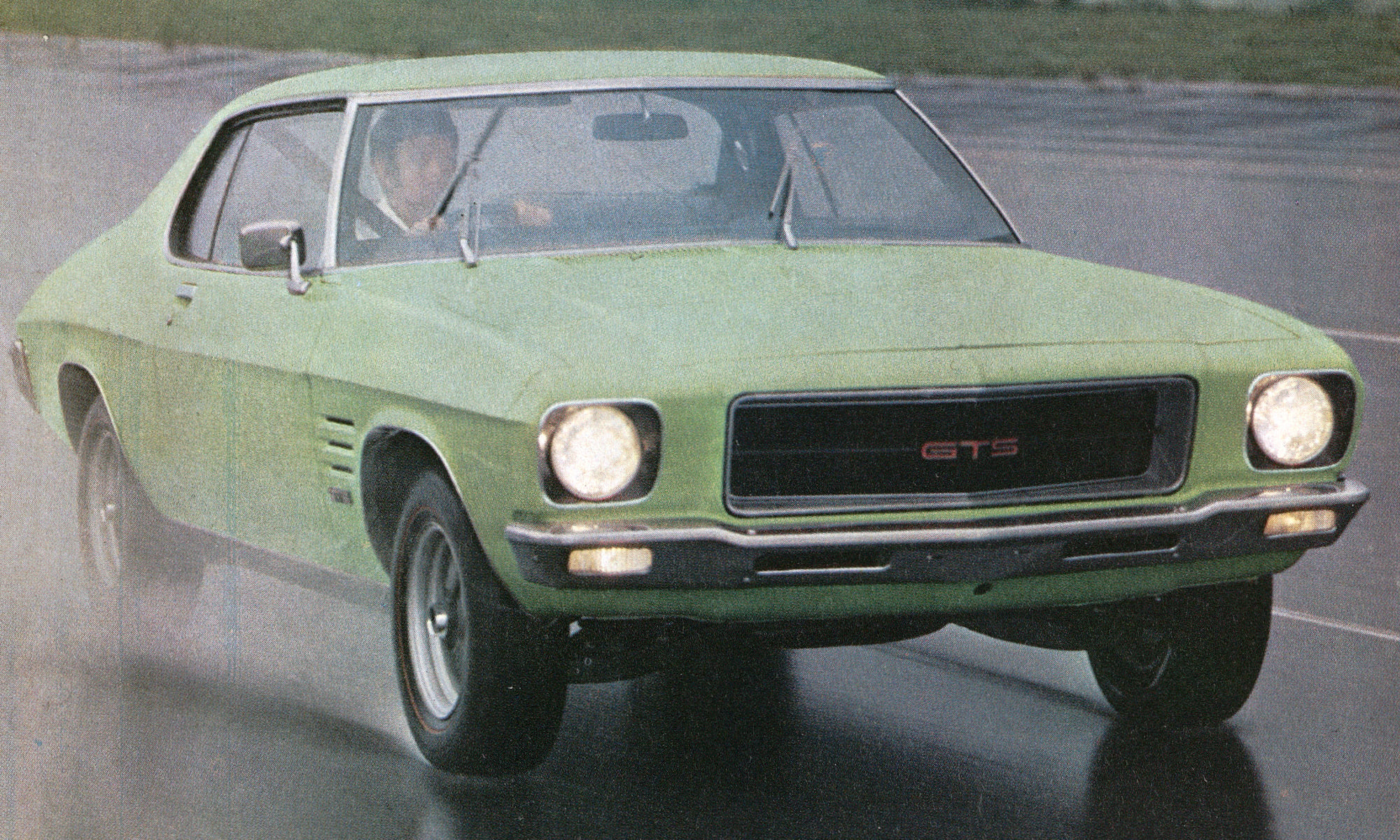
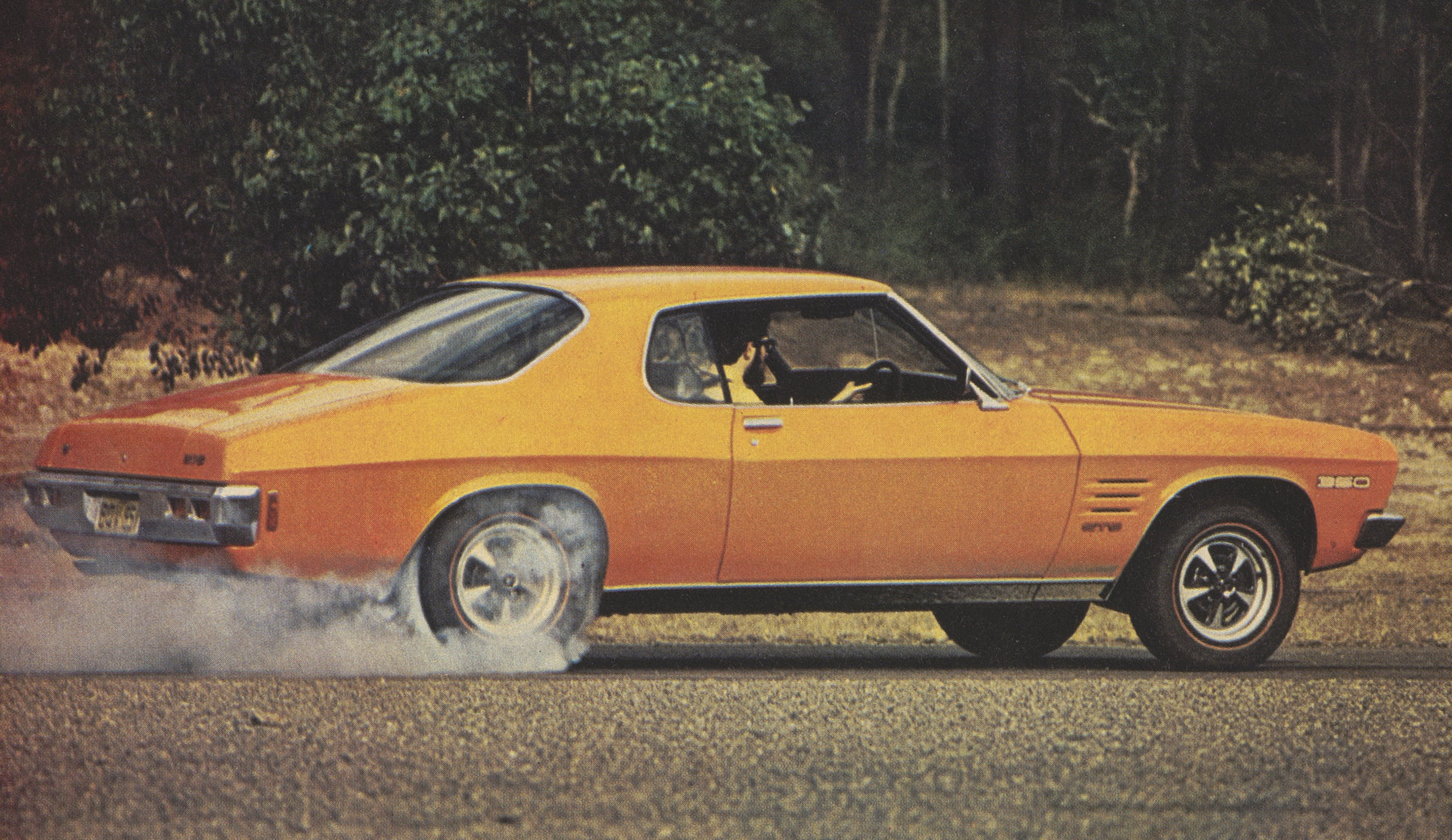
If GMH had never built the old 350 the HQ would have seemed the greatest car the company could ever sell in Australia. And forgetting the “Command Performer” the HQ 350 is a damned fine motor car. It has all the performance anybody could ever want, it is quiet, smooth, fairly comfortable and built around the best looking body to come from a large Australian car manufacturer.
Where the old Monaro body was an obvious compromise between the four-door sedan and a genuine coupe the new car looks as if it was designed first. So instead of being a two-door version of the sedan it is the sedan which ·is a four-door version of the Monaro.
The lower roofline of the Monaro and the beautifully integrated rear window blend so well with the overall styling it is hard to suggest any areas which could be improved. The wider wheels and big radial ply tyres, fitted to the test Monaro, give it the wide track look which is missing from the sedans.
The only problem with the styling is that stones thrown up on to the lower edges of the curved body are likely to chip off most of the paint in that region. Nasco is going to do a great trade in mudflaps for the HQ range. Even with its great looks GMH is deliberately shifting the sports emphasis away from the Monaro range to the Torana XU-1. The “S” in GTS is rather smaller than it was.
1
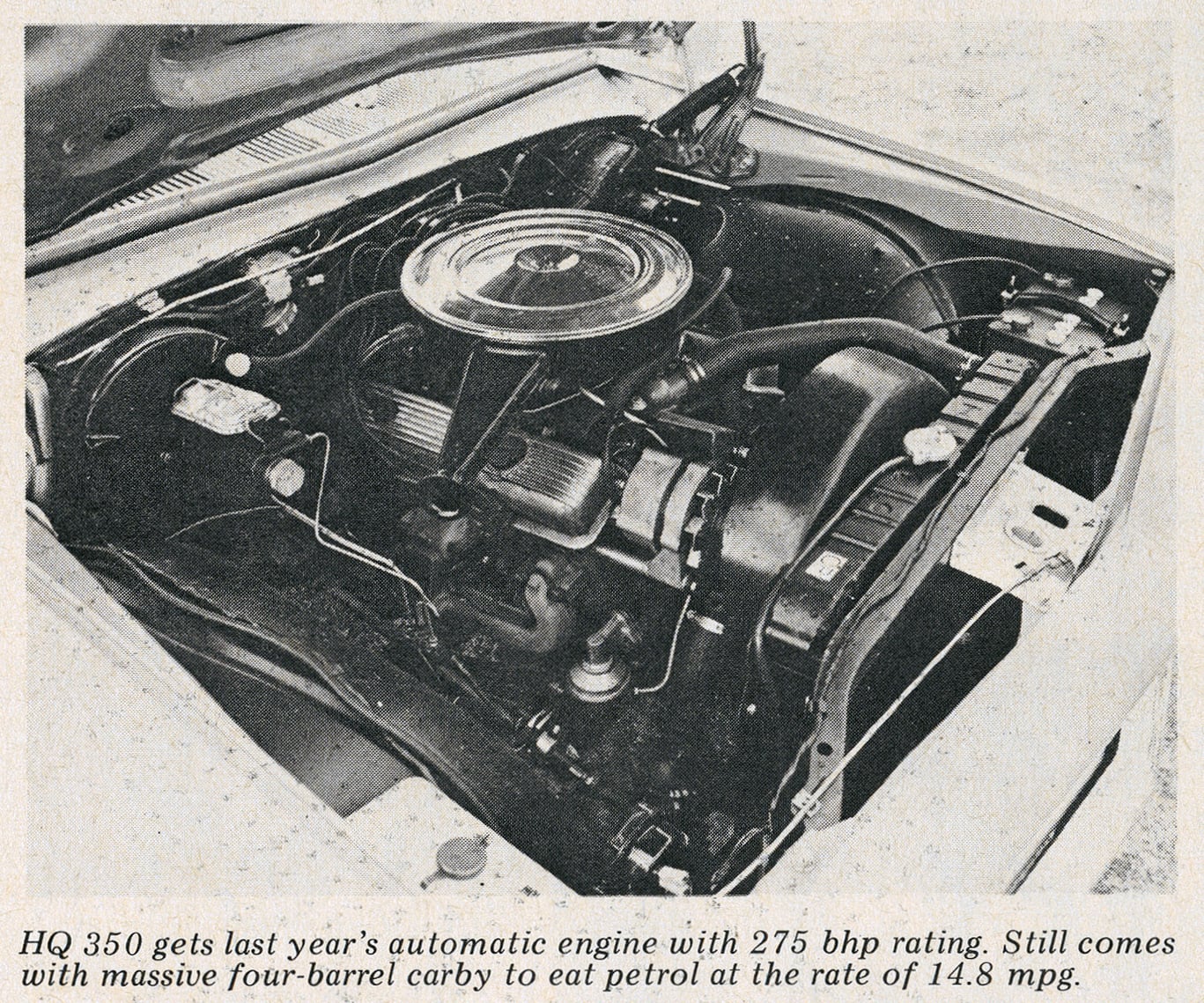
As part of this plan, the new 350 gets the old 350 Automatic engine, which is rated at 275 bhp, compared with the old manual car’s 300bhp. The performance drop is small really until you get above the ton – the difference to 100mph is marginal and the top speed has dropped about five mph to a 122mph average although it will pull 125 one way.
Above 100 there isn’t the lift of old when you boot the car in fourth gear. This is academic really for few people will ever want or need more acceleration than this Monaro offers.
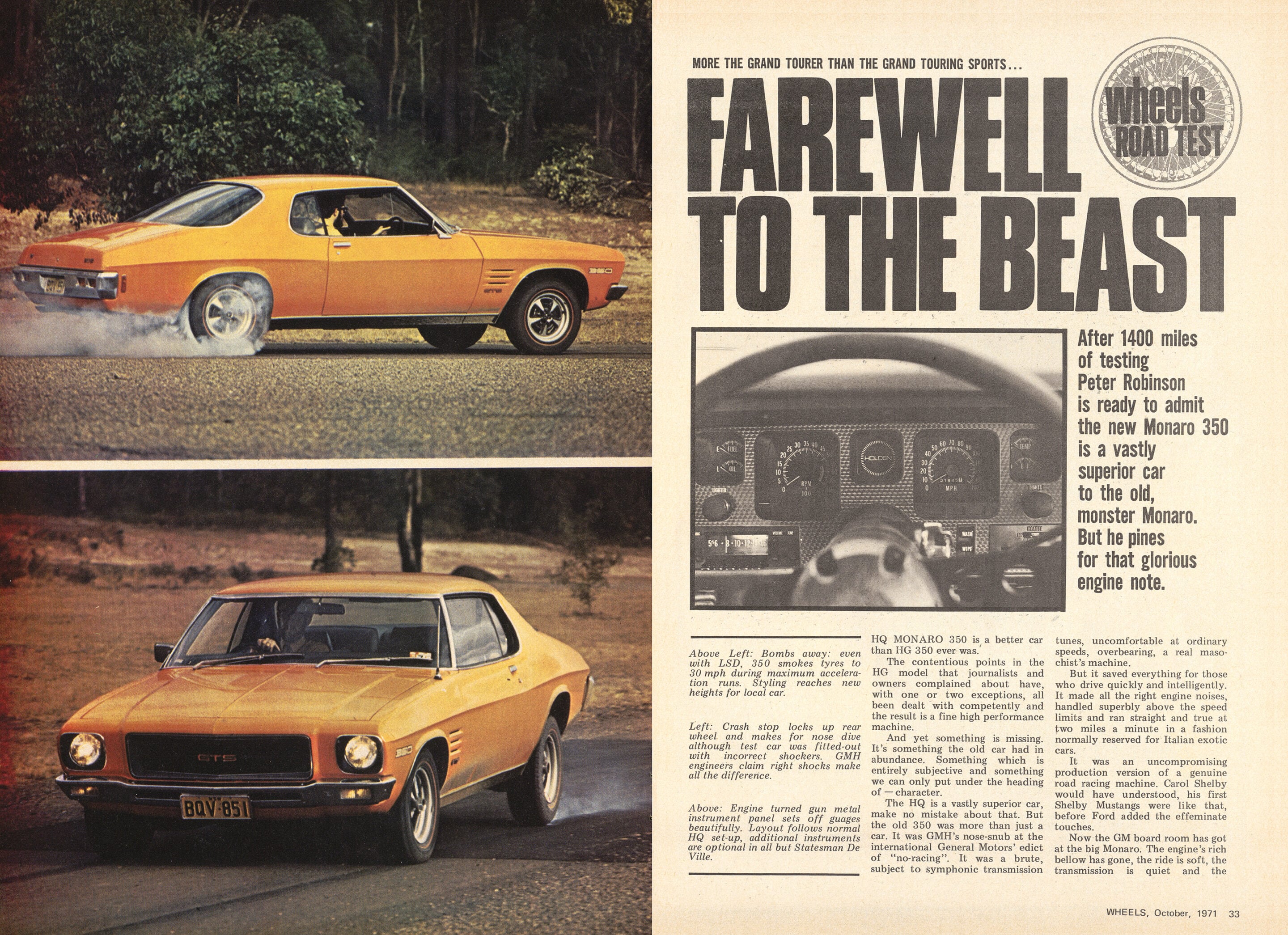
Our best standing quarter-mile time of 15.7 seconds required savage treatment with wheelspin and axle tramp up to 30mph. Smoother driving with less wheelspin and slightly slower shifts took this to 16 seconds dead but the difference in wear and tear on the car was enormous.
The engine is redlined at 5500rpm but it will run out beyond this in the indirects. For a big V8 it is a high-revving engine with a very smooth flow of power from as low as 500rpm in fourth. In fact, it can be used as a two-gear car around town.
1
To get to the maximum speed requires a build up over three miles but 5000rpm (just under 125mph) is possible in fourth so there is no chance of over-revving the engine in top gear. Cruising at 100mph is a perfectly relaxed 4000rpm.
What really limits the Monaro’s value as a track car, for series production racing anyway, is the fitting of the standard Holden 16.5 gallon petrol tank instead of the 25 gallon tank used on all previous 350 Monaros. With the average fuel consumption during our 1400 mile road test working out to only 14.8 mpg – in racing conditions and during our performance testing it dropped to around 11 mpg – the touring range is inadequate considering the 350’s ability to put away the miles.
A full tank can be only two hours’ driving and to make things worse the fuel gauge reads in the red danger area when only 12-13 gallons have been used. It’s a brave man who will take a punt on reaching the next town before filling up.
And then there is the car’s handling and roadholding. The softer, almost European type ride has been won at the expense of roadholding. It is a compromise most Monaro owners will be willing to pay to get rid of the harsh, bump-ridden, truck-like ride of the old car. Certainly at town speeds the new 350 is so smooth and relaxing it is hard to believe it has any association with the old model at all and up high the stability and firmness are just right.
1
But such is the grip provided by the rear suspension and tyres that it is only possible to break the tail loose on tight corners with full throttle acceleration in first or second gears. In every other condition it is the front wheels which run wide and a 60mph bend taken flat out in third sends the front end into the opposite lane. No amount of steering lock will combat the vast understeer, lifting off the accelerator tightens up the corner a little but the car is so stable it doesn’t even require an oversteer correction. Fiddling with the tyre pressures doesn’t alter the basic characteristics.
The old Monaro was a virtual neutral-steer car in such conditions. The new found understeer which is evident in the entire HQ range, might make things safer for the average driver, but, together with the lower power output and the small petrol tank, effectively kills the Monaro as a race car.
Everyone will appreciate the new gearbox though. It’s a fully imported American Muncie close-ratio box – where the old one moaned and sang on the over-run it is virtually noiseless. The shift is better, too, although it is still notchy but it is set-up so that the actual change is angled away from the horizontal movements of old. It is rather like a heavier version of the Escort Twin Cam change.
1
If the old Monaro fell down anywhere from a competition point of view it was in braking. The brakes always seemed just adequate for the car’s performance and tended to pull after a couple of quick stops. We expected great things of the new 11-inch vented discs. In normal driving they are more pleasant to use with a very progressive feel, but a single stop from 100mph had our test driver wondering if the car was going to pull up at all from 20mph. Fade is a very real problem with the present brake linings.
In crash stops, too, the rear axle tramps and if the brakes are applied in anything but a straight line the tail starts to follow the front around. Nose dive is also one of the penalty’s which must be paid for the softer suspension.
In theory, the sophisticated rear suspension should, with its upper and lower control arms and coil springs, be free from any tramp but we are dubious about its ability to absorb the punishment it is likely to get with the 350 manual. The problem won’t occur with any other engine/transmission combination, there just isn’t enough power or torque, but during a full-blooded acceleration run the right rear shock absorber, which is mounted behind the axle and spring assembly, fractured.
In all of GMH’s testing this never happened and the company’s engineers were disturbed at our findings, to say the least. It turned out our Monaro was the first 350 built and because of some mistake on the assembly line it was fitted with the wrong shock absorbers.
1
The tramp was caused because the Kingswood shockers fitted simply ran out of travel and began rebounding with the inevitable result. The Monaro 350 shockers have another 1.4 inches of travel and are slightly firmer and, according to GMH engineers, this cures all the tramp problems. Time prevented us from conducting any further tests on the car but we intend making exhaustive tests soon and will report back in a future issue.
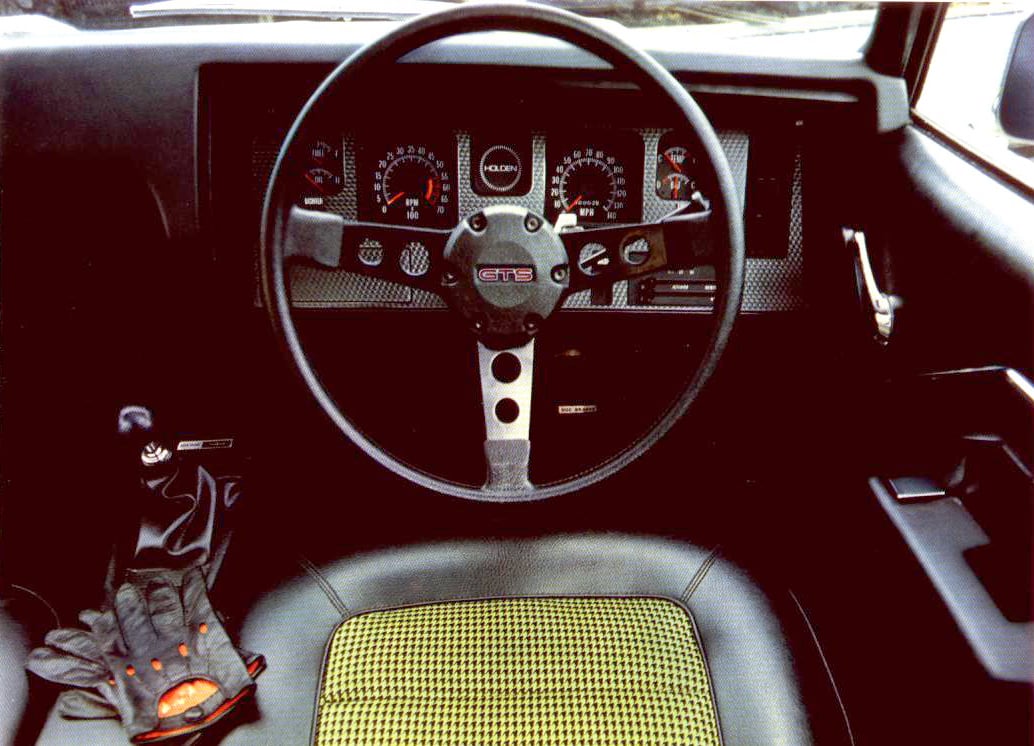
Like everything else about the car the interior is all-new. It is exciting visually and dramatic enough to deserve the often used “jet-plane like” tag.
The instruments and controls are set into an engine-turned gun metal panel. Numerical calibrations have been deleted from the minor gauges but the 140mph speedometer and 7000rpm tacho are set-up for rapid read-out.
Indirect lighting, from the padding above, shows up the controls but it lacks the subtle brilliance of the old, behind the instruments lighting. The basic interior layout follows the pattern set by all the HQ models. The thin rim and sharp spokes of the old sports steering wheel have been replaced by an impressive three-spoke wheel with a thicker diameter, oval-shaped, rim which is much more pleasant to use. However, at the straight ahead two of the spokes hide the radio (with the standard transistor markings instead of the actual stations) and heater controls.
1
Sadly the driving position isn’t as good as before. The new bucket seats, which look just great, are mounted too low and too close to the steering wheel. Tall drivers can find a reasonable position by reclining the squab a little but shorter people will discover that to reach the pedals they will be too close to the wheel.
The cushion is too soft on its leading edge and lacking in padding at the base of the squab so there is a tendency to slide forward. The squab itself is much taller than before for added shoulder support but its adjustment is no longer infinite and there is a lack of real lateral support.
After spending some time in a Kingswood with reclining buckets we have no hesitation in saying they were more comfortable, and better placed in relation to the steering wheel and controls, than those on the 350.
The pedals are slightly offset to the right but the brake and accelerator are correctly located for heel and toe changes. Most drivers will find the gear lever requires a long reach, especially if they try for a long arm driving position. The console luggage bin, even further forward of the gearlever, is almost impossible to use when belted in.
The lower roofline and more sharply raked windscreen of the Monaros places the driver further away from the control panel so, where on the Kingswood all the controls are easy to reach, those on the Monaro require a deliberate reach. Strangely the Monaro windows require 5.75 turns while those in the Kingswood need only four turns. There is still no headlight flasher or trip meter – both are considered essential on the cheapest European GT cars but GMH has yet to come around to this idea.
1
Visibility, of course, is excellent through the wide windscreen and huge side windows and the two rear vision mirrors keep the driver informed about happenings rearward. There is very little wind noise except from around the external mirror and none of the whistle which comes from the old style quarter vents. Above 60mph the wipers, which cover virtually the entire screen, make a slight swishing noise which develops into a booming sound at 110 as the right hand blade approaches the windscreen pillar and begins to lift off. This would make an interesting study in aerodynamics.
The new flow-through ventilation system is excellent once the car is moving but it doesn’t work in conjunction with the fan. Stop-start traffic in hot weather requires a lowered window. The heater, too, does a fine job but the distribution set-up favours the driver’s left and passenger’s right leg.
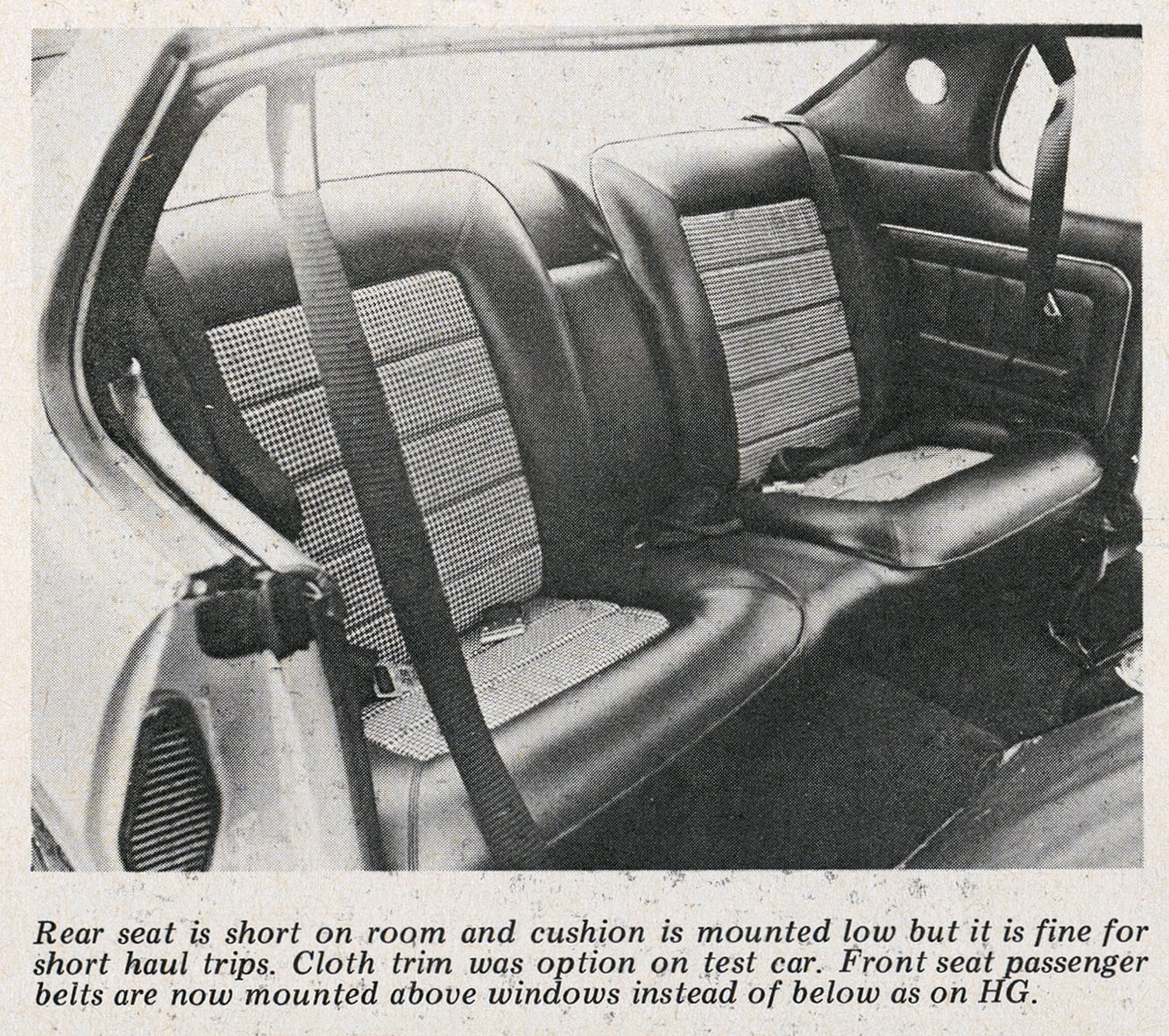
There is room enough in the back seat for two adults, but only on short journeys, unless they can come to some arrangement with those up front. The rear seat cushion is short and close to the floor for reasonable head room. The big rear window is tinted to prevent sunstroke.
Two old Monaro problems – propping doors and water leaks around the rubber window seals – again reared their ugly heads in our 350. The massive doors are so long and heavy you can see the hinges quiver under pressure when the doors are opened. But the car as a whole feels enormously strong and solid.
2
So the HQ Monaro makes it as an all-round high performance car with built-in pose value. As a comfortable, quiet, GT car it comes much closer to the very successful Falcon GT concept and as a town car it leaves the old Monaro way behind.
But the edge has gone off the handling and performance. Rumours of a 400 cube mill for a Bathurst special have been heard, but it is just a tale, nothing more.
With the suspension fiddled to give neutral steering, the old 350 engine and the current Kingswood seats the Monaro would have all the charm of the old car with the superb ride and beautiful body styling of the new.
Follow WhichCar/Wheels on Google
Click the button below to make WhichCar by Wheels a preferred source for your news.

We recommend
-
 Classic Wheels
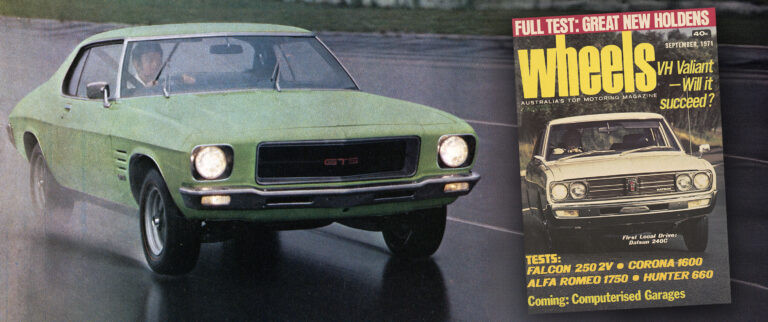
From the Wheels archive: The best Holden ever!
Wheels gushed over the all-new HQ Holden in September 1971, declaring it 'far and away the best Holden ever'.
-
 Classic Wheels
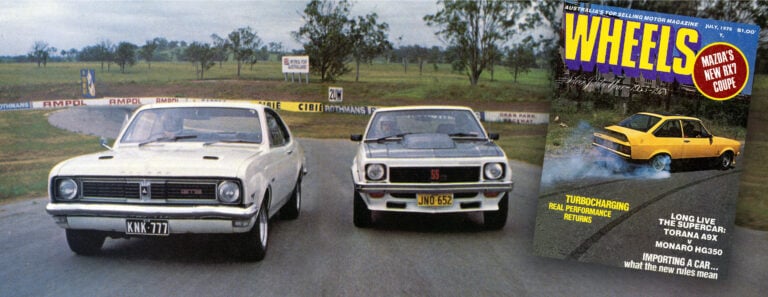
From the Wheels archive: Torana A9X vs Monaro 350 in a battle for the ages
Wheels' July 1978 issue saw Bill Tuckey pit the legendary Holden Monaro 350 GTS against The General's newest road warrior, the Torana A9X.
-
 Classic Wheels
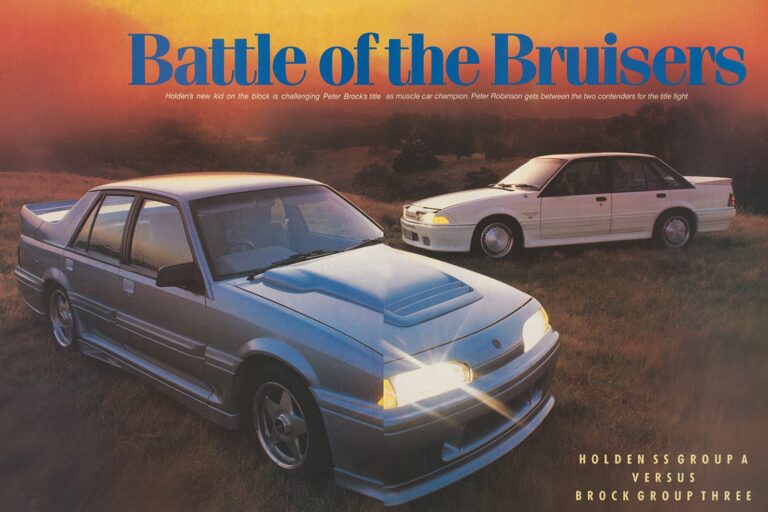
From the Wheels archives: Holden SS Group A vs HDT Brock Group Three comparison review
From the March 1998 issue of Wheels, Peter Robinson gets between the two contenders for the title fight as Holden’s new kid on the block challenged Peter Brock’s title as muscle car champion.
