Reviews

Gallery 1
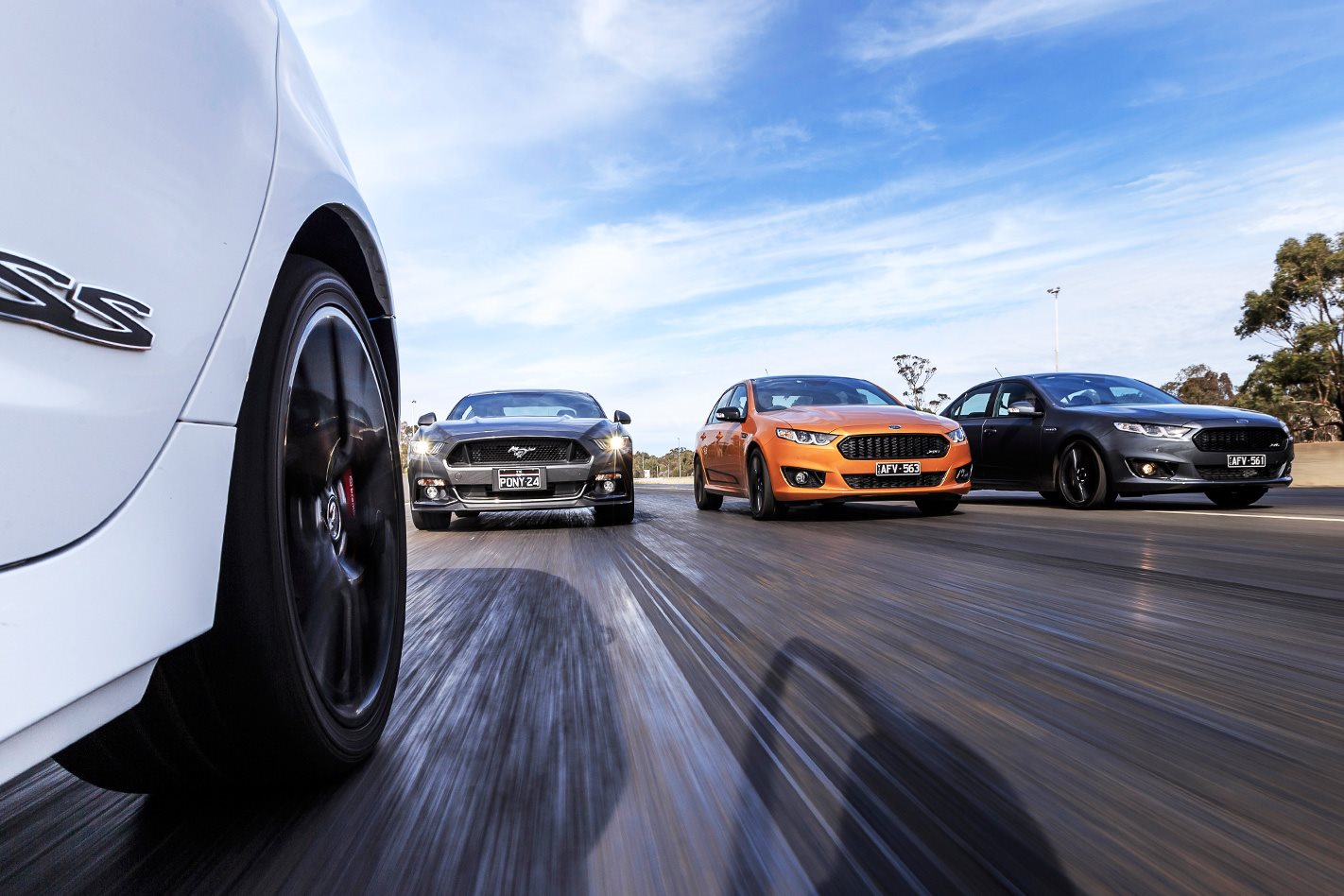
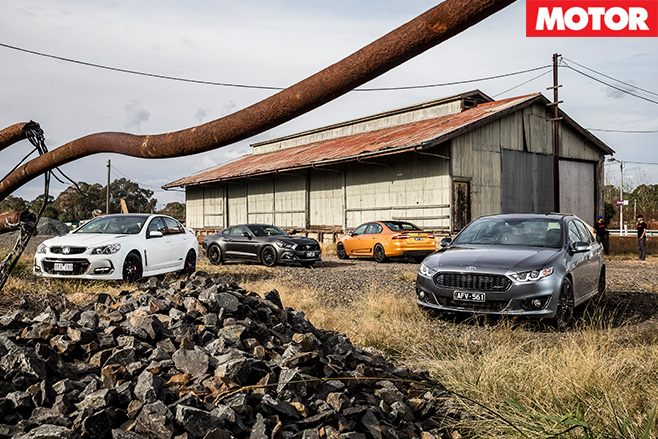
Doesn’t look like a fair fight, does it? I mean, three Fords against a single Holden.
Or what about a single six-banger shaping up to three V8s. Or maybe three cars with nooses around their necks (and the hangman reaching for the lever) versus the one car with a real production future.
Or maybe we should just cut the crap; disregard the dogma, elbow the emotions and can the cultural cringe. And in the process realise that here are four cars with stickers between the mid-$50Ks and $60K that can kick some serious butt, in terms of both straight line grunt and G-force production. And we know you lot have been looking forward to this one…
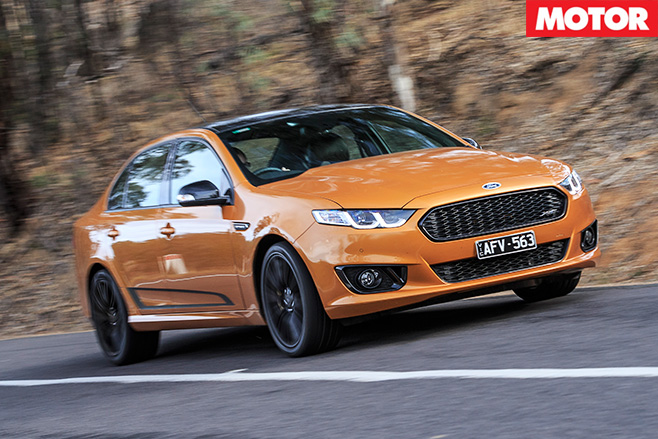
Okay, for a start, the Ford Mustang is the odd man out with just two doors and limited rear seat space. All the others have fairly extreme rear seat dimensions and will cope with the sort of pudgy-arsed teens that I keep seeing in shopping malls, little eyes glued to smart phones. On the other hand, the Stang’s two-door profile and sweeping roofline makes it the looker of this bunch, although you’ve still got to credit the Commodore’s big-car visual balance and the upscale aggression of the Aston-esque snout on the Fords.
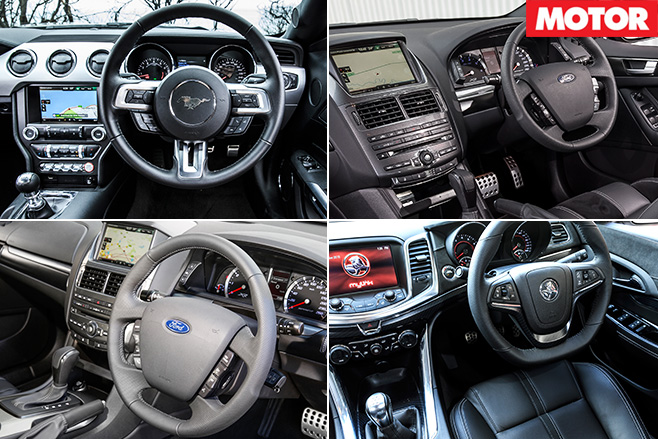
But jump straight into the Falcon XR6 Sprint and you can still see where Ford has cut the meter out of this thing. It’s plain and plasticky-looking and even though some bits that were fake-chromed in the previous XR6 are now black, that doesn’t seem to help. In fact…
The Falcon XR8 Sprint is a more of the same but thankfully that daft starter button of the V8 FPV stuff has been flung. But it’s still clearly related to the base Falcon and there’s the same, plasto-clack noise from the gear shifter and the same hard plastics that suggest that new grille cost a lot of development money. The SS?
1
Well, it’s more sumptuous in a way, but it’s also incredibly busy with multiple surfaces and textures and w-a-y too much cod-chrome. But it is the nicest to sit in with the most logical relationship between wheel, pedals and seat, although the Mustang ain’t bad either.
Stone last are the two Aussie Fords which, even with the lower seat of this latest model, still perch you too high relative to the steering column. And the roof. There’s a fairly big equipment gulf, too, with the Fords missing out on safety stuff like blind spot monitoring, although they do get a reversing camera.
But the local Henrys also miss out on some really basic kit, including shift paddles for the automatic gearbox and even something as stone age (these days) as a left footrest. The Commodore SS-V is the real luxo-schmoozer with autonomous emergency braking, blind spot spotto, powered chairs and even a very useful head-up display.
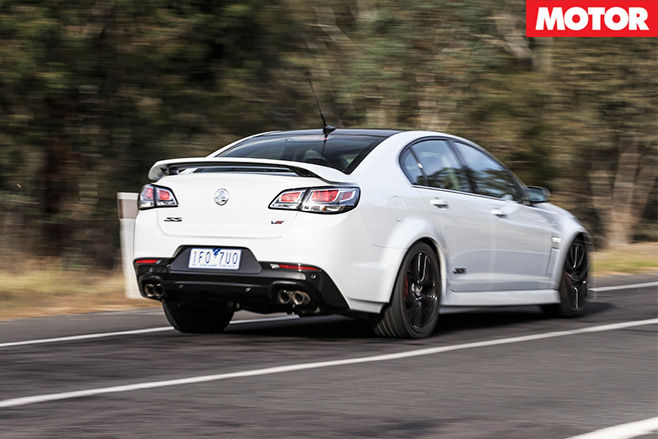
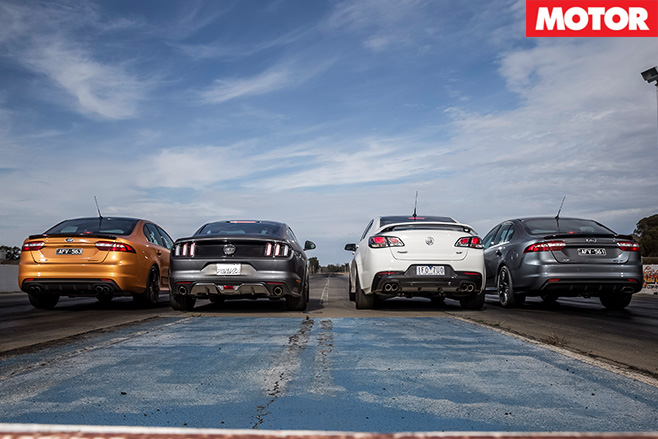
Now, when you look at the spec sheets, you might think there’s a big spread of performance times against the stopwatch. Well, you’d be wrong. It’s not that there’s not variation in outputs, but the fact remains that the biggest hitters had the biggest problems in getting off the line. And as any drag racer will tell you: if it won’t 60-foot, it won’t be quick. Which, more or less, is why all four were within two or three tenths across the 400m.
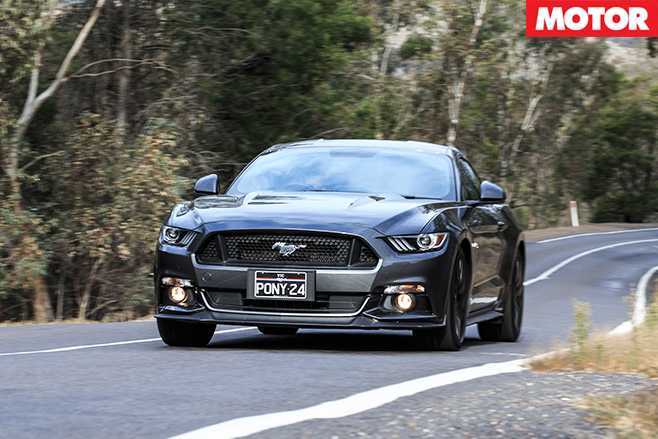
Looking at the Mustang, with its 306kW against the Commodore’s 304, you can see why the pair was neck-and-neck at the 400m mark, even if a relative lack of grip did play against the Mustang a tad. But thanks to short gearing and a clutch that could be juggled to mask that grip deficit, the GT could still be hustled down the strip in 13.38 seconds with only a slight graunch from first to second to spoil your day.
The SS-V was next and with its relatively soft (stay with us) atmo power delivery and spanking top end rush, it wasn’t the hardest to beat into submission. But forget the launch control; it’s a waste of time and you’ll do better with a keen ear and some right ankle control. It’s also worth mentioning that the rear bags on this car were – ahem – past their prime. In the end, the Commy rattled off a 13.33.
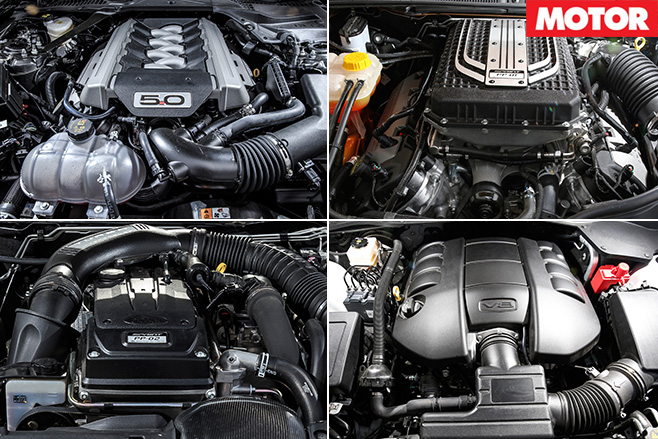
The XR8 Sprint was second quickest with 13.22, despite having five supercharged litres at its disposal. Meaning of course, that the smallest engine, the turbocharged four-litre of the XR6 Sprint was champeen on the day with a 13.12, even though it gives away a full 30kW (when both are overboosting) to the XR8. So what’s going on?
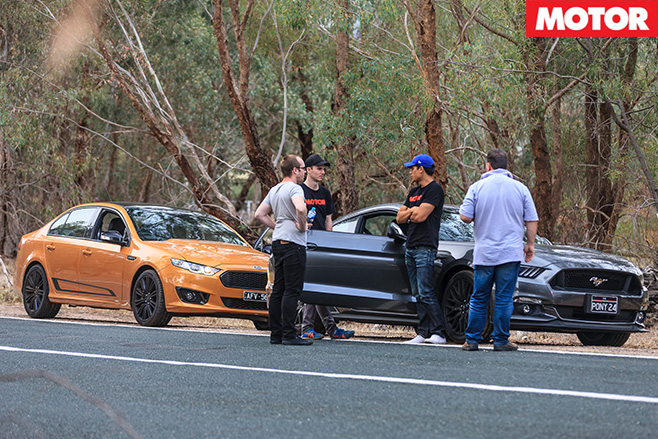
The XR6, meantime, is simply easier to hook up, largely because the power delivery and tiny amount of turbo lag involved gives the rear tyres half a chance to keep up. Or so it seemed. The shot was to stall it up to about 1800rpm and short-shift slightly to make the bulk torque. The specific boost map for each gear in the ZF ‘box also helps here from the seat of the pants.
Now, if you don’t believe us, take a peek at the terminal velocities. You can pretty much always look at a slow time with a high terminal and deduce that the time has been lost in the launch. And that’s why the XR8’s 180.95km/h trap speed suggests it would trump the XR6 (180.39km/h) in grippier circumstances.
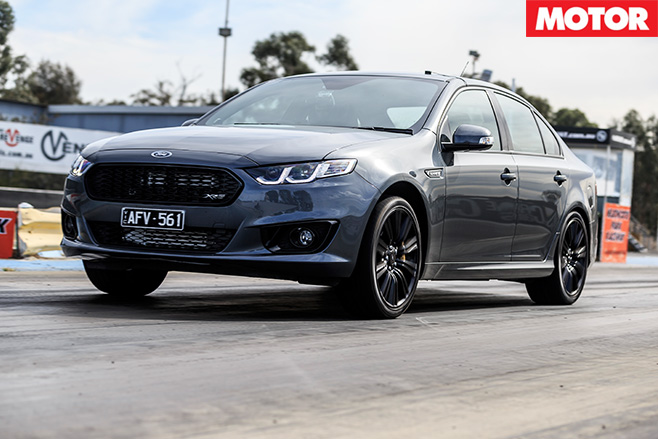
In pretty much any circumstances beyond the dragstrip, this means that both Aussie Fords are noticeably quicker; they get up and haul out of corners quicker, they overtake with more authority and they’re just ballsier all ’round. They’re also way more likely to be phoning up 1300 ESP for a chat. Again, if you don’t believe us, check the 80-120km/h roll-on times: 3.2sec for the Mustang, 3.5 for the Holden and 2.8 for each Sprint which, even though the latter were both autos versus two manuals, tells the tale.
But how fast is fast enough? To be honest, the Mustang feels adequately stompy and more like a six litre than a five, as well as offering up a pretty refined sound and feel. And the SS-V hardly feels like a slacker, either, what with that swelling top-end rush and a rhythm section that leaves the others here for dead.
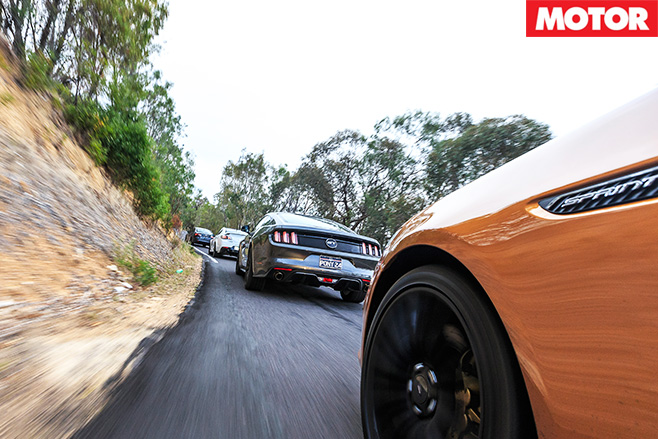
What we’re dealing with here, of course is a potted history of torque. While the GT makes a commendable 530Nm peak, the SS-V can muster a full 570Nm. And while that figure is almost line-ball with the XR8 and XR6 (575 and 576Nm respectively) when Mr Overboost comes a-knockin’, both Falcons suddenly blurt out 650Nm and at much lower revs than the atmo pair. Simples.
Things, however, change when you turn off the straight, smooth bits and head for the patchy, bendy stuff that we call the real world. Suddenly, the Mustang comes alive with steering that is tight and right. Changing the steering setting from Normal or Comfort to Sport only seems to add weight and reduce feedback, so we’d stick with the other settings and let the wheel do some talking. And when you do, the ‘Stang starts to become very easy to place accurately.
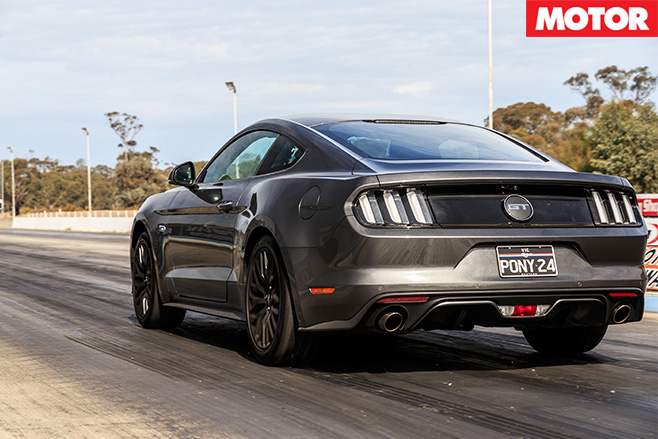
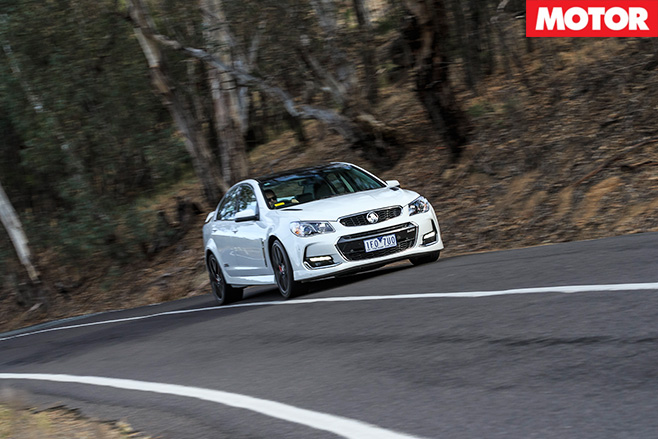
That said, the GT can’t match the Holden for driver involvement. Not only is the SS-V the most natural steerer here, it also soaks up the dross more effectively with a greater degree of suppleness that doesn’t appear to come at the expense of ride or damping control. It simply feels like it would be the easiest car with which to thread the needle.
And even though it’s a big, wide car, it doesn’t feel that way on the road, even at speed. There’s more rear-end compliance, a little more squat and, as a result, more power-down, too. It’s one thing having mucho torque, it’s another thing entirely to be able to paste them Newtons to the deck.
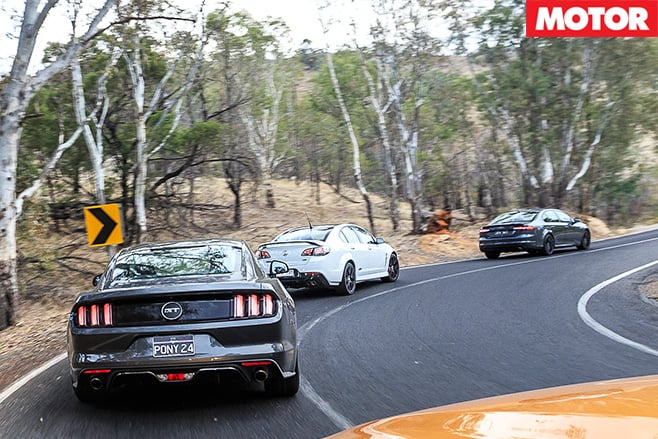
As such, the ride in the XRs is choppier and stiffer and it’s worse in the XR8, the front of which has to cope not only with its own shortcomings, but also the mass (23kg more than the six) of that blown V8. There’s a degree of steering fidelity missing from either Falcon, too, and although they point pretty hard, they don’t inspire the same confidence nor offer the same accuracy.
Braking? Geez, local cars have come a long way, haven’t they? Six-pot fronts and four-pot rears from the house of Brembo adorn the three Aussies, while the big Yank gets six-potters on the front and a single-piston rear combo. If you can make any of them fade, you’re not just being cruel, you’re being clumsy too.
The subject of money proves that these guys all watch each other pretty closely, because on an auto-versus-auto basis, there’s just over seven grand from cheapest to dearest. And we’re only using the automatic versions for comparison because there’s no manual XR6 Sprint on offer.
But even with the slushbox, that car is great value at $54,990, just $500 more than the manual SS-V Redline. Add a self-shifter to that car and you’re looking at $57,690, still short of the $57,490 Ford is asking for the manual Mustang GT. The XR8 Sprint is the priciest at $59,990 with a clutch pedal and $62,190 without.
If you’re buying any of these cars (but particularly the Aussie trio) for their collectability status down the line, then you can make up your own mind about which is going to be the keeper. That’s not something we’ve set out to do here. But if you’re after a big car that can pull some dragstrip numbers as well as be an entertaining drive on a proper country road, then the Commodore SS-V comes into its own.
No, it doesn’t have the roll-on stomp of either Falcon and it isn’t as sexy as the Mustang, but it’s almost as quick on the strip thanks to better mechanical grip and it’s less of a handful on your favourite back road. And should the dragstrip suddenly become a racetrack, then our money would be on the SS-V anyway.
The numbers
0-100km/h, 0-400m: all hail the XR6!
| u00a0 | Mustang GT | XR8 Sprint | XR6 Sprint | SS-V Redline |
| 0-10km/h | 0.45 | 0.39 | 0.47 | 0.31 |
| 0-20km/h | 0.95 | 0.82 | 0.89 | 0.84 |
| 0-30km/h | 1.36 | 1.25 | 1.32 | 1.27 |
| 0-40km/h | 1.83 | 1.70 | 1.76 | 1.64 |
| 0-50km/h | 2.27 | 2.15 | 2.19 | 2.13 |
| 0-60km/h | 2.73 | 2.63 | 2.60 | 2.62 |
| 0-70km/h | 3.41 | 3.37 | 3.16 | 3.19 |
| 0-80km/h | 3.90 | 4.00 | 3.78 | 3.80 |
| 0-90km/h | 4.54 | 4.64 | 4.39u00a0 | 4.49u00a0 |
| 0-100km/h | 5.20 | 5.26 | 5.01u00a0 | 5.19u00a0 |
| 0-110km/h | 6.13 | 5.87 | 5.62u00a0 | 5.99u00a0 |
| 0-120km/h | 6.97 | 6.72 | 6.44u00a0 | 6.89u00a0 |
| 0-130km/h | 7.86 | 7.73 | 7.48u00a0 | 7.82u00a0 |
| 0-140km/h | 8.79 | 8.74 | 8.53u00a0 | 8.78u00a0 |
| 0-150km/h | 10.02 | 9.75 | 9.57u00a0 | 10.11u00a0 |
| 0-160km/h | 11.21 | 10.77 | 10.66 | 11.32u00a0 |
| 0-170km/h | 12.47 | 11.83 | 11.82u00a0 | 12.72u00a0 |
| 0-180km/h | 13.84 | 13.10 | 13.07u00a0 | N/Au00a0 |
0-400m | 13.38sec @ 176.61km/h 80-120km/h (3rd-6th) 3.2/4.4/6.4/13.7sec 100-0km/hu00a0 34.8m | 13.22sec @ 180.95km/h | 13.12sec @ 180.39km/h | 13.33sec @ 174.12km/h |
SPEED IN GEARS | 67km/h @ 6600rpm | 69km/h @ 6200rpm | 69km/h @ 6200rpm | 75km/h @ 6600rpm |
2nd | 101km/h @ 6600rpm | 122km/h @ 6200rpm | 122km/h @ 6200rpm | 110km/h @ 6600rpm |
3rd | 146km/h @ 6600rpm | 188km/h @ 6200rpm | 188km/h @ 6200rpm | 152km/h @ 6600rpm |
4th | 187km/h @ 6600rpm | 230km/h @ 5680rpm | 230km/h @ 5680rpm | 227km/h @ 6600rpm |
5th | 246km/h @ 6600rpm | 230km/h @ 4330rpm | 230km/h @ 4330rpm* | 230km/h @ 4750rpm* |
6th | 264km/h @ 4600rpm* | 230km/h @ 3440rpm* | 230km/h @ 3440rpm* | 230km/h @ 3810rpm* |
7th | N/A | N/A | N/A | N/A |
As tested by MOTOR: Heathcote Dragway, 10am, 24 degrees, dry. Driver: Scott Newman. *Manufacturer’s claim
1
SPECS
| u00a0 | FORD FALCON XR8 SPRINT | FORD MUSTANG GT |
| Body | 4-door, 5-seat sedan | 2-door, 4-seat coupe |
| Drive | rear-wheel | rear-wheel |
| Engine | 4951cc V8, DOHC, 32v, supercharger | 4951cc V8, DOHC, 32v |
| Bore/Stroke | 92.2 x 92.7mmu00a0 | 92.2 x 92.7mm |
| Compression | 9.3:1 | 11.0:1 |
| Power | 345kW @ 5750rpm (400kW on overboost) | 306kW @ 6500rpm |
| Torque | 575Nm @ 2220-6250rpm (650Nm overboost) | 530Nm @ 4350rpm |
| Power/Weight | 184kW/tonne | 176kW/tonne |
| Transmission | 6-speed automatic | 6-speed manual |
| Weight | 1872kg | 1739kg |
| Suspension(F) | A-arms, coil springs, anti-roll baru00a0 | struts, anti-roll bar |
| Suspension(R) | multi-links, coil springs, anti-roll bar | multi-links, anti-roll bar |
| L/W/H | 4950/1868/1493mm | 4784/2080/1381mm |
| Wheelbase | 2838mm | 2720mmu00a0 |
| Tracks | 1583/1598mm (f/r)u00a0 | 1582/1655mm (f/r) |
| Steering | hydraulically-assisted rack-and-pinion | electrically-assisted rack-and-pinion |
| Brakes(F) | 355mm ventilated/drilled discs, 6-piston calipers | 380mm ventilated discs, 6-piston calipers |
| Brakes(R) | 330mm ventilated/drilled discs, 4-piston calipers | 330mm ventilated discs, single-piston calipers |
| Wheels | 19.0 x 8.0-inch (f); 19.0 x 9.0-inch (r) | 19.0 x 9.0-inch (f); 19.0x 9.5-inch (r) |
| Tyre sizes | 245/35 R19 (f); 265/35 R19 (r) | 255/40 R19 (f); 275/40 R19 (r) |
| Tyre | Pirelli P Zero | Pirelli P Zero |
| Price as tested | $62,190u00a0 | $57,490 |
| Pros | Supercharged grunt; fitting farewell to Falconu00a0 | Supermodel looks; great engine; tidy chassis |
| Cons | Not quite as sweet to drive as the XR6 | Could do with a little more bark and bite |
| Star Rating | 4/5 | 4/5 |
| u00a0 | HOLDEN COMMODORE SS-V | FORD FALCON XR6 SPRINT |
| Body | 4-door, 5-seat sedan | 4-door, 5-seat sedan |
| Drive | rear-wheel | rear-wheel |
| Engine | 6162cc V8, OHV, 16v | 3983cc inline-6, DOHC, 24v, turbocharger |
| Bore/Stroke | 103.25 x 92.0mm | 92.3 x 99.3mm |
| Compression | 10.7:1 | 8.76:1 |
| Power | 304kW @ 6000rpm | 325kW @ 6000rpm (370kW on overboost) |
| Torque | 570Nm @ 4400rpm | 576Nm @ 2750rpm (650Nm on overboost) |
| Power/Weight | 170kW/tonne | 179kW/tonne |
| Transmission | 6-speed manual | 6-speed automatic |
| Weight | 1793kg | 1818kg |
| Suspension(F) | struts, coil springs, anti-roll bar | A arms, coil springs, anti-roll bar |
| Suspension(R) | multi-links, coil springs, anti-roll bar | multi-links, coil springs, anti-roll bar |
| L/W/H | 4939/1898/1474mm | 4950/1868/1493mm |
| Wheelbase | 2915mm | 2838mm |
| Tracks | 1593/1590mm (f/r) | 1583/1598mm (f/r) |
| Steering | electrically-assisted rack-and-pinion | hydraulically-assisted rack-and-pinion |
| Brakes(F) | 355mm ventilated discs, 4-piston calipers | 355mm ventilated/drilled discs, 6-piston calipers |
| Brakes(R) | 360mm ventilated discs, single-piston calipers | 330mm ventilated/drilled discs, 4 piston calipers |
| Wheels | 19.0 x 8.5-inch (f); 19.0 x 9.0-inch (r) | 19.0 x 8.0-inch (f); 19.0x 9.0-inch (r) |
| Tyre sizes | 245/40 R19 (f); 275/35 R19 (r) | 235/35 R19 (f); 265/35 R19 (r) |
| Tyre | Bridgestone Potenza RE050A | Pirelli P Zerou00a0 |
| Price as tested | $54,490u00a0 | $54,990 |
| Pros | Awesome engine; top-notch chassis | Probably the best Aussie Ford ever |
| Cons | Interior material mismatch; outgunned at strip | A little more noise would be nice; sold out |
| Star Rating | 4.5/5 | 4/5 |
Follow WhichCar/Wheels on Google
Click the button below to make WhichCar by Wheels a preferred source for your news.