
The Federal Government has revealed it was not consulted about General Motor’s decision to axe the iconic Australian brand and cease sales and operations in Australia and New Zealand.
An angry Prime Minister Scott Morrison said Australians will be fuming after Holden allowed its business to “wither away” after years of receiving taxpayer-funded subsidies.
Mr Morrison said General Motors’ decision to axe Holden and cease operating in Australia proved the ineffectiveness of government propping up industry.
But Australian Council of Trade Unions (ACTU) Secretary Sally McManus said the Morrison Government is finishing the job of closing the Australian car industry that the Abbott Government started.
“The Morrison Government has made it clear that it will never fight to protect local jobs, and this is the result. An iconic Australian brand shutting its doors after 160 years,” Ms McManus said.
“The announcement marks a sad day for many Australians who took pride in the Holden brand as an icon of Australian ingenuity, something the Morrison government has never understood or valued.”
Earlier, Industry Minister Karen Andrews told a press conference she was disappointed that the government was advised about the decision just an hour before Holden announced it to the public earlier today.
“I don’t think it’s acceptable to make this decision without any communication with the government,” Ms Andrews said.
Ms Andrews was at pains to point out that GM’s decision to axe the Holden brand was not due to any Australian government decisions, but made no mention of the events that led to the end of local vehicle manufacturing.

“Holden is walking away from Australia … we will ensure Holden is held up to account and that it will keep to its promises and obligations.”
Asked if she was concerned about Ford Australia following Holden’s lead, the minister said she would soon be on the phone with Ford Australia to see what its intentions are.
Ford Australia released a statement a short time later saying its staff members were saddened to hear the news that Holden will cease operations, and that it will continues to invest in its Australian operations while helping the parent company develop vehicles for more than 180 markets around the world.
The Minister said she believed there was still a future for Australia’s automotive industry, pointing to HSV’s success and the opportunities generated by electric and hydrogen fuel cell vehicles.
She said she would speak to any manufacturers looking to exploit such opportunities in Australia, but did not say if the Morrison Government would expand what little incentives there are to encourage electric vehicle sales and ownership.
MORE HOLDEN NEWS
Holden departure will cost $1.6 billion
Ford: we will miss you, Holden
What now for Corvette in Australia?
The news that the Holden brand is to be retired as General Motors withdraws from right-hand drive markets begs the question: what now for the right-hand drive Corvette?
While GM’s halo sports car was never going to be branded a Holden – according to US outlet Autoweek the favoured name is simply ‘Corvette’ – the widespread and established dealer network was going to prove pivotal in distributing the car.
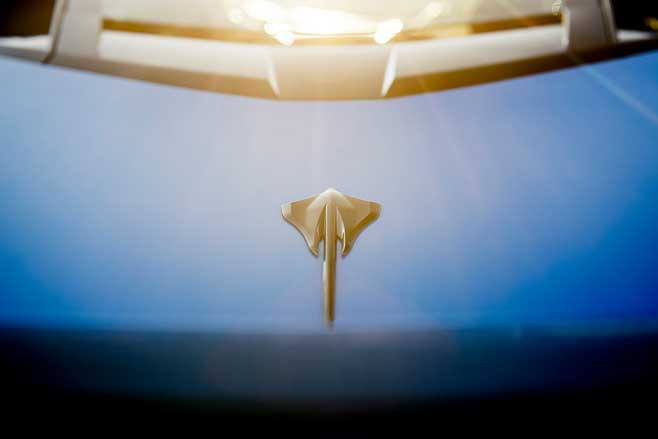
The signs are not encouraging. Chief Engineer for the C8 Corvette, Tadge Juechter, has admitted “We’re taking a little bit of a bet [in Australia]. We’re dipping our toe in the water for right-hand drive and we’ll see how it goes.”
While considerable time and money has been invested in creating the tooling for right-hand drive Corvettes, it is a drop in the ocean relative to the amounts involved in pulling out of right-hook markets globally, General Motors reporting it “expects to record total cash and non-cash charges of US$1.1billion” with “net cash charges of approximately US$300m.”
In addition, it’s unlikely – though not confirmed – right-hand drive production of the C8 Corvette has begun yet. Australian deliveries were not expected to start until very late Q4 2020 or Q1 2021 as Chevrolet concentrates on fulfilling left-hand drive demand, a process that was delayed by union-led industrial action.
READ MORE
- Holden’s factory closure statement
- Why did Australia fall out of love with Holden?
- Two years on from Holden’s factory closure
- The best performance Commodores
- Clay modelling at Holden’s design studio
- Holden halts production of Commodore and Equinox
- How Holden shaped a nation
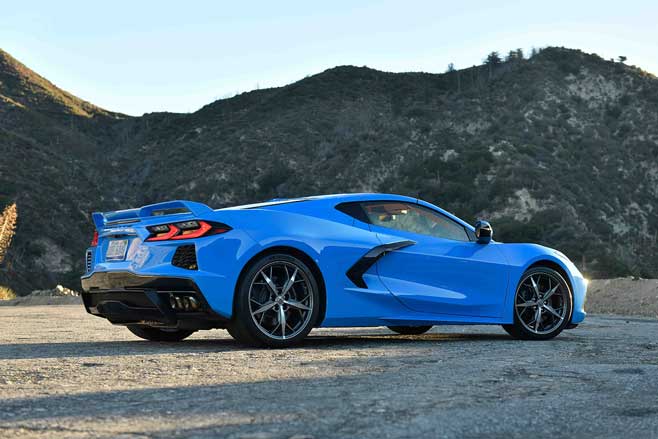
There is, however, hope. According to a General Motors statement “The company will focus its strategies for the market on the GM specialty vehicle business” and “In markets where we don’t have significant scale, such as Japan, Russia and Europe, we are pursuing a niche presence by selling profitable, high-end imported vehicles – supported by a lean GM structure.”
It’s currently unclear which models the speciality vehicle business will encompass but the Camaro and Silverado models currently converted by HSV seem a safe bet. The good news is it seems Corvette will also be covered, GM’s International Operations Senior Vice President Julian Blissett saying in a press conference that the intent is there will be no change regarding right-hook Corvette: “Corvette right-hand drive will still exist and still keeps being developed.”
Blissett and Holden General Manager Kristian Aquilina both confirmed there is a future for GM in the Australian and New Zealand markets but also stated that announcements regarding its future would be made in due course and that any presence would be “minimal”.
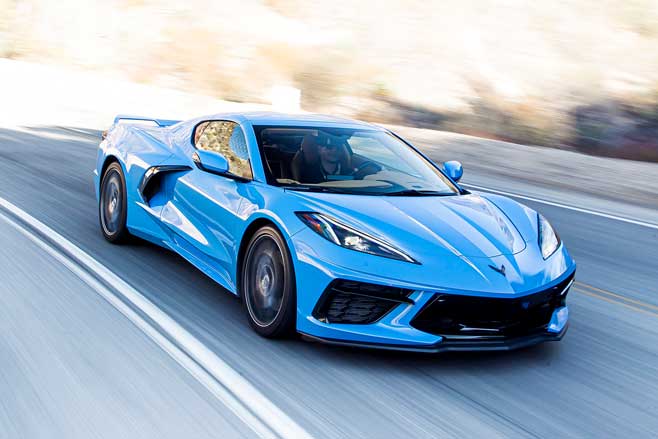
So what now for the right-hand drive Corvette? As it currently stands the C8 Corvette will still make its way to Australia in late-2020/early-2021 offered through the newly established General Motors Specialty Vehicles, but how many and from what dealers and at what price is still unclear.
We’ll bring you more news as it comes to hand.
Picture this. You’ve just bought a brand-new Ford Mustang GT with a naturally aspirated V8, but you think the 339kW/556Nm outputs aren’t quite enough.
So you take the ’Stang to your local Ford dealership in the US for the fitment of a factory Ford Performance Roush supercharger kit – and never drive it again.
This is what happened to Mustang owner, Mark Grage, who purchased his car from Loveland Ford in Colorado. The iconic pony car had just 266 miles (428km) on the clock.

According to The Drive, Grage’s freshly supercharged Mustang V8 was crashed by a dealership employee while performing a routine test drive once the modifications were made.
Harry Johnston, the general manager of the Ford dealership, told the US publication that all vehicles fitted with a supercharger kit require a test drive to iron out any issues after installation. The full-time technician in question reportedly lost control and crashed.
Johnston went on to say that the technician in question no longer works for the dealership and was cited for careless driving by police.
After a viral Facebook post and a battle to sort out insurances, Grage wasn’t left out of pocket or without a Mustang in his driveway.
“We made the customer whole, paid his loan, and all incidental expenses that would have had anything to do with that car and the fact that it was wrecked.
“He actually walked out of the store with plus money as opposed to what he [had invested in] the car, and he bought another new car from us,” Johnston said.

Oh, and if you’re wondering, that car was another Mustang, a Shelby-tuned 2016 example that had just been received at the dealership on trade-in.
As they say, all’s well that ends well, right?
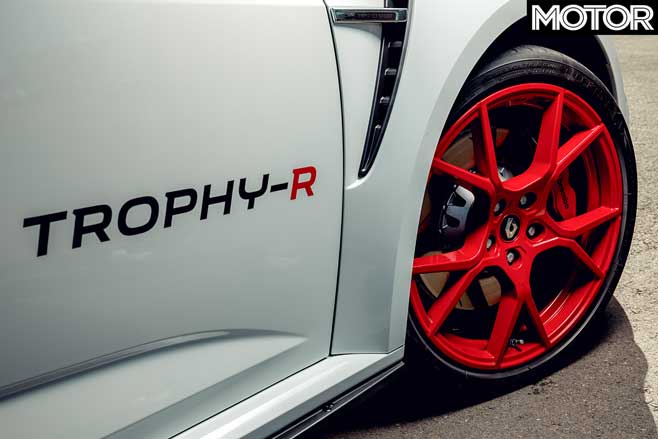
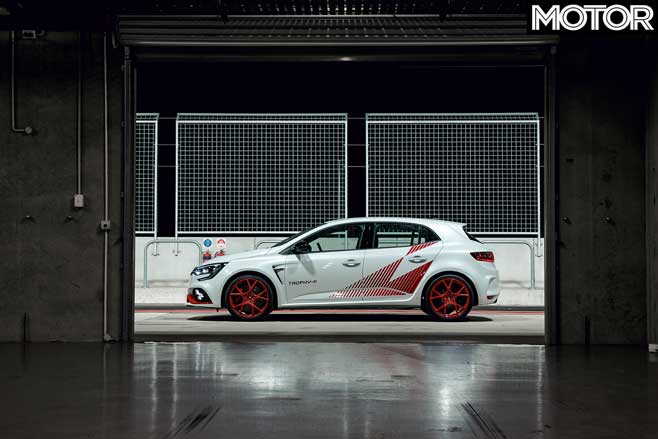
The most satisfying thing about redemption is seeing it unleashed on those who deserve it most. And that’s what we anticipated for the Renault Megane Trophy-R after remembering how the regular Megane RS fell flat at PCOTY last year.
There’s no doubting the Trophy-R has changed the Megane RS for the better. Fifth place underscores that. But it’s not the stratospheric leap you would expect after learning its modifications.
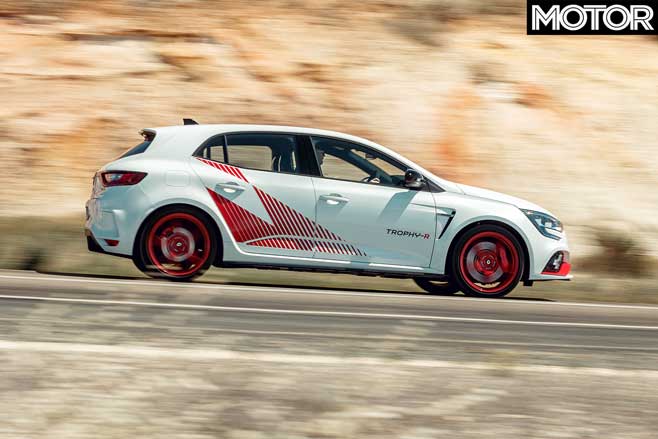
Renault Sport has worked hard to restore the hatch’s reputation and turfed out the Megane RS’s rear seats before replacing its battery, rear diffuser, bonnet, windows and exhaust with lightweight versions. Meanwhile, adjustable Ohlins dampers join a bespoke rear torsion beam arrangement that ditches Renault’s controversial 4Control system. Power is up as well, thanks to a ceramic ball-bearing turbocharger that lifts outputs from 205kW/390Nm to 221kW/400Nm.
Inside, Sabelt racing bucket seats hold you tight in the bare-bones cabin, while that raspier Akrapovic exhaust system growls with a hard edge and sounds as if the wastegate is piped directly into the cabin.
On-track performance left some of us cold, despite being where it should excel. Tame racing driver Michael Almond noted it moved around under brakes, others thought the racing seats did little to improve the interface with the controls, and some weren’t sure if ditching the rear-steering improved much. Tyre grip, when hot, is also insanely high, which smothered some chassis adjustability.
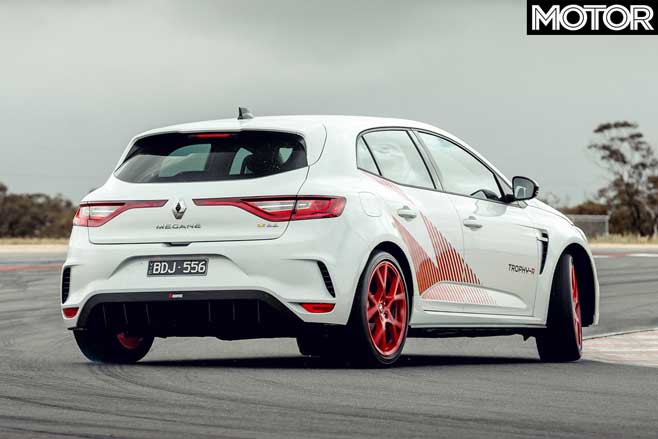
Then there’s the $74,900 price, which is so dear it’s hard to think it could really be $23,000 better than a Honda Civic Type R – or that much faster. The short answer is no, it’s not. But there’s brilliance at work here.
The steering’s more linear and the car feels so natural when it changes direction. Few could have outrun it on our road loop, and it scored a podium on one judge’s card (yours truly) for its enthusiasm and sure-footed speed.
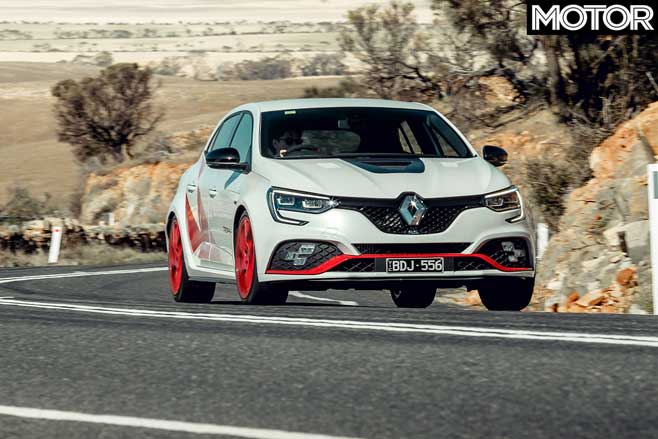
Of course, living with the Trophy-R would prove challenging. It fidgets over road imperfections and invites tyre noise. Not everyone’s convinced the six-speed manual makes a solid case for preservation in the twin-clutch age, either.
As for those rear doors, a tyre rack in place of the rear bench at least keeps them relevant. So, while the Trophy R misses out on total redemption, its place further up the board this time marks some much-needed progress.
The Numbers
2020 RENAULT MEGANE RS TROPHY-R SPECS: Engine: 1798cc inline-4, DOHC, 16v, turbocharger Drive: front-wheel Power: 220kW @ 6000rpm Torque: 400Nm @ 3200rpm Transmission: 6-speed manual Weight: 1281kg Power/Weight: 168kW/tonne 0-100km/h: 5.66sec 0-400m: 13.60sec @ 175.31km/h The Bend lap time: 1min 37.8sec Price: $74,990
Judge’s Rank
Dylan Campbell – =8th “Not a fan of the controls. Would be better with the twin-clutch auto.”
Louis Cordony – 3rd “All is forgiven, Renault Sport. The Trophy-R is a ripper.”
David Morley – =5th “A five-door car with two seats? Is it just me?”
Scott Newman – =5th “Hardcore front-drive track car works better on road than track. Go figure.”
Tim Robson – 8th “Kinda silly, but right up my alley. Dynamite chassis, but needs a more gonflé engine tune.”
PCOTY 2020 Scoring
| Judges | DC | LC | DM | SN | TR | Total |
| Performance/20 | 15 | 15.5 | 16 | 15.5 | 18 | 80 |
| Dynamics/20 | 16 | 16 | 17 | 18 | 17 | 84 |
| Accessibility/10 | 7 | 9 | 8 | 9 | 6 | 39 |
| Liveability/10 | 7 | 4 | 5 | 5.5 | 5 | 26.5 |
| Value/10 | 7.5 | 2.5 | 6 | 4 | 4 | 24 |
| X Factor/10 | 6.5 | 7.5 | 7 | 8 | 4 | 33 |
| Total/80 | 59 | 54.5 | 59 | 60 | 54 | 286.5 |
- A ride across London in Ford’s new EV
- Up to 595km range, 0-100km/h in less than four seconds
- First impressions of Ford’s new EV
Instead, you have Michigan’s idea of what a global, premium electric vehicle should be – a rakishly-styled SUV with impressive if not ground-breaking performance, space for all the family and the second-longest all-electric range on the market.
Ford hasn’t handed us the keys just yet, but this week it allowed us an extensive prod and poke around a near-production model, as well as a short passenger ride across Central London.
First impressions are of a car that looks smaller than its 4.7-metre length, stuffed with retro styling cues that – perhaps surprisingly – work very well when translated to an SUV.
Whisper it so the purists don’t hear, but the Mustang Mach-E actually looks rather good – and attracts more than its share of glances, photos and head-turns on our journey.
How short was your ride in the Ford Mustang Mach-E?
Short enough that it’s nearly impossible to draw any conclusions on how the Mach-E rides or handles outside of the sub-70km/h confines of Marble Arch and its surrounding roads.
The experience began in an underground car park where Ford had coned off a small area for a scant few seconds of full throttle. There isn’t an EV on the market that doesn’t deliver a satisfying surge of acceleration from a standstill, and the Mach-E joins that crowd.
It’s certainly quick, with 0-100km/h dealt with in less than five seconds, but it doesn’t feel as though it’ll rearrange your face in the same way a Tesla would. Power outputs range from 192 to 216kW for single-motor variants, and 216 or 251kW for dual-motor all-wheel drive cars. A GT-badged car will arrive later with 346kW, claiming a sub-four-second 0-100km/h sprint.
The Mach-E has three driving modes. They’re named Whisper, Engage, and (try not to cringe) Unbridled. Comfort, Normal, and Sport, please come back – all is forgiven. You’ll also find a simple toggle for regenerative braking, called One-Pedal Mode. It’s a shame this won’t be more controllable.
A brief wiggle – calling it a slalom would be too generous – proves that the steering wheel is at least attached to the front wheels, and then it’s out onto London’s crowded streets for a brief slog through traffic.
Suspension tuning is firm, but not overly so – it’s more ST-Line than full-fat ST – but big squashy American-style seats with wide bases isolate your bum from everything that the springs don’t.
Refinement is decent, too; it’s not Mercedes EQC levels of isolation, but it’s easily on a level with Tesla here. However, no matter how hard we listen, we can’t hear the ‘distinctive but emotional’ sound we’ve been promised from the drivetrain – an interesting response to EU regs requiring EVs to make *some* noise at low speeds so pedestrians don’t walk in front of them.
What’s the Ford Mustang Mach-E like inside?
Our test ride is in a very pre-production model, with a big ‘STOP’ button atop the dashboard, a totally frozen infotainment system and mismatching stitching. Luckily, there’s a static car set up a short walk away so we can have a proper look around.
As with most electric cars, the skateboard-style battery compartment under the floor means it’s more of a step up than you might expect. But once ensconced in the cabin, the floor’s totally flat, and there’s ample space in all four seats.
The dashboard is, of course, dominated by that huge portrait infotainment screen. It’s 15.5 inches on the diagonal and controls the vast majority of the car’s functions – though, unlike the Tesla Model 3, driving data is presented on a secondary display behind the steering wheel.
The central screen is slick to operate but it’s disappointing to see how many menus and sub-menus you need to wade through in order to control basic driving functions. A couple of dedicated functions for these would be simpler, and more in keeping with the ‘Mustang’ part of ‘Mustang Mach-E’.
There are buttons dotted around the cabin, too, which is slightly disappointing as they appear to be lifted directly from the common Focus. The rest, though, feels impressively high-quality – and the full-width speaker bar on the dashboard is a really interesting touch, and one whose power we appreciate when the door chimes come on at full volume…
Verdict
Too early to tell, of course – and while all Ford Mustang Mach-Es will be built in Mexico, European models will have a bespoke chassis tune and suspension set-up to make them more suitable for our roads.
Australian cars aren’t due for a while yet, and while there’s no official word around a localisation program for our market, it’s not out of the realms of possibility that the Mach E will lap the You Yangs once or twice.
Purely based on what we’ve experienced here, the Ford Mach-E is a good-looking EV with a headline range that feels nimble and quick on the roads. The interior impresses, as do the looks.
And the promotion has obviously worked – even before the car’s officially available, Ford’s sold out of the initial run of First Edition models – and the people buying them are on average 10 years younger than normal.
If the price tag is right and Ford can pull off the same trick it’s been doing for many years (namely, making its normal models drive with more dynamism than they rightly deserve) this could be an EV well worth watching. Will it be worthy of the Mustang name, though?
This article was first published at Carmagazine.co.uk
Be honest. Your favourite ex-girlfriend was not the willowy blonde or the brainy brunette, was it? Nope, we all know it was the redhead with a gun licence. She was edgy. She could surprise you and she could bloody well scare you. She reminded you that you were alive. For now. May I present the four-wheeled version.
It’s not that the Lotus Exige Sport 410 isn’t gorgeous to look at because it is, with that three-quarter scale Le Mans thing going on. Nor is it lacking when it comes to going fast or keeping you, er, entertained. But it does make my palms just a little sweaty at times.
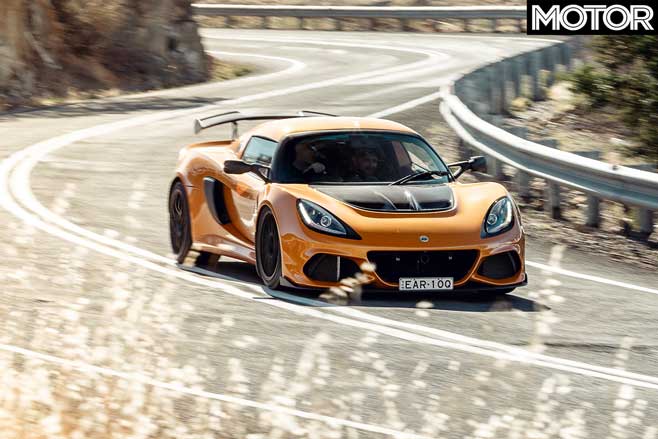
Mainly I worry about what would happen to me if I had to get out of the bastard in a hurry. I’m hemmed in by the seat, the high, wide sill and the pitifully small door opening. Instant nightmare.
But the car’s manners at the limit would also play on my mind a little. It didn’t, for instance, seem to want to carry the corner speed I was expecting of it. The brakes were strong but lacked feel and feedback, and the steering tends to load up. That’s fine if you’re expecting it, but not so good if it starts to wind up just as you realise you’re somehow in too deep. That’s when the gun-toting redhead emerges.
But you have to love this thing. The exposed gearshift is pure porn. The driving position feels like your toes are brushing the back of the front number-plate. The yowl from the blown V6 is tantalising, and with just over 1100kg for 306kW to manhandle, the Exige can leave Dodge City like few others. Hell, even the price-tag isn’t outrageous given that you’re buying a mid-engined quasi-supercar.
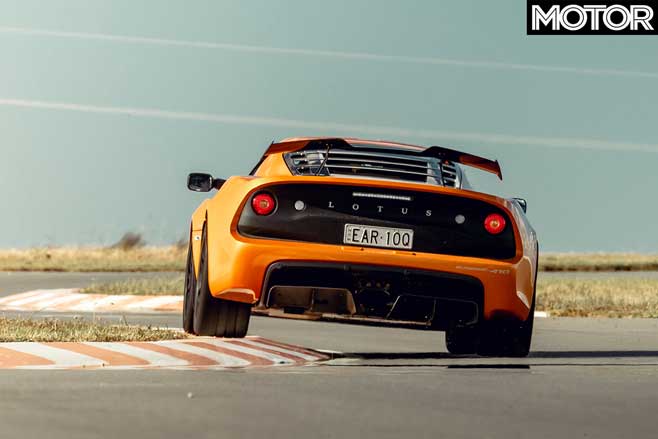
So why did it finish down in sixth? Mainly because of that lap-time thing (oh, and the general ergonomics, of course). True, it was third-fastest around The Bend, but it trailed the AMG and 911 by a good chunk. The concern there being that, as such a track-focused car (the most focused of this group, surely), it should have been closer to P1.
Working out what went wrong is a simple case of looking at the lap-time V-max. At 230km/h, the Exige is a full 15km/h down on the GT63. That lack of corner speed is the key here, as it simply denies the Lotus the ability to spring onto the main straight with as much pace.
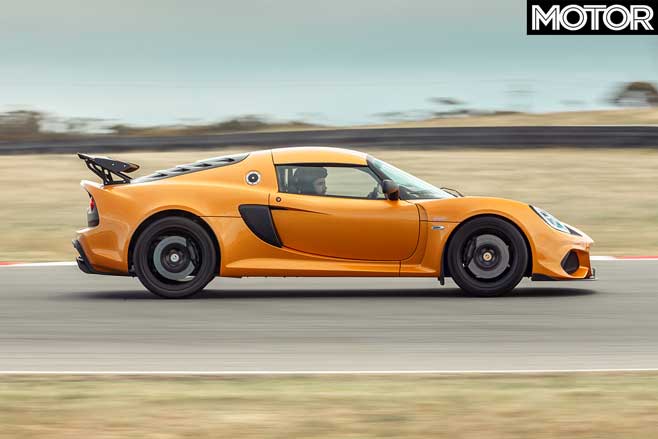
The other figures produced were better. Nought to 100 in 3.9 is going some, and so is a quarter-mile time so close to a 12-dead it isn’t worth arguing over. And 31.8m to haul up from 100 is astounding. Welcome to the world of redheads. And get yer hands in the air.
The Numbers
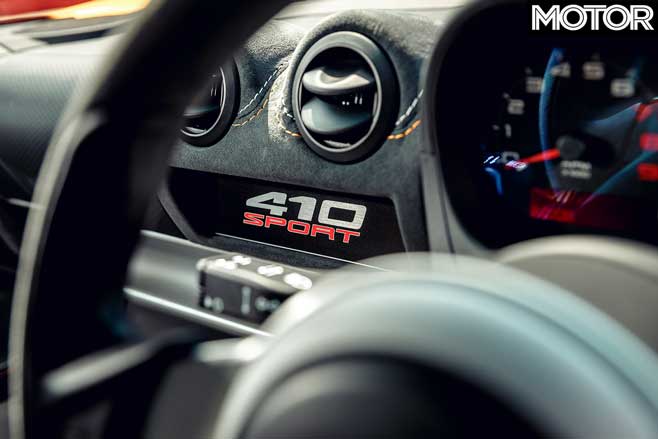
2020 LOTUS EXIGE SPORT 410 SPECS: Engine: 3456cc V6, DOHC, 24v, supercharger Drive: rear-wheel Power: 306kW @ 7000rpm Torque: 420Nm @ 3000-7000rpm Transmission: 6-speed manual Weight: 1108kg Power/Weight: 276kW/tonne 0-100km/h: 3.91sec 0-400m: 12.07sec @ 192.68km/h The Bend lap time: 1min 33.7sec Price: $159,990
Judge’s Rank
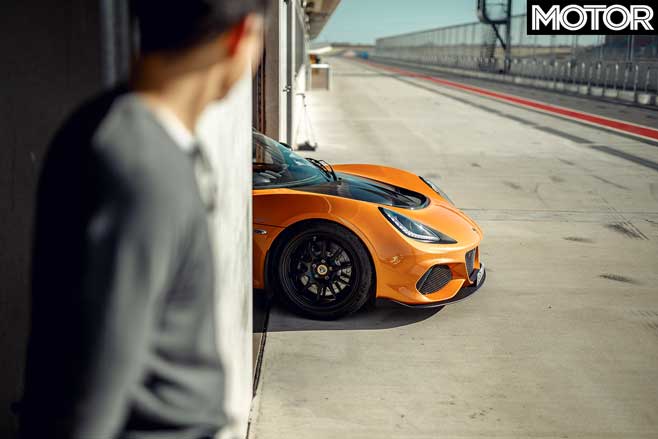
Dylan Campbell – =8th “The things you enjoy most about this car, might not be what you expected.”
Louis Cordony – 6th “It’ll make you laugh. It’ll make you cry.”
David Morley – 5th “Loved it, but couldn’t live with it. Bigger doors for bigger blokes next time, Lotus.”
Scott Newman – =5th “A pure driving experience, but not as fast or as fun as it should be.”
Tim Robson – 5th “Compromised and largely pointless, but so what? What a noise and what a show.”
PCOTY 2020 Scoring
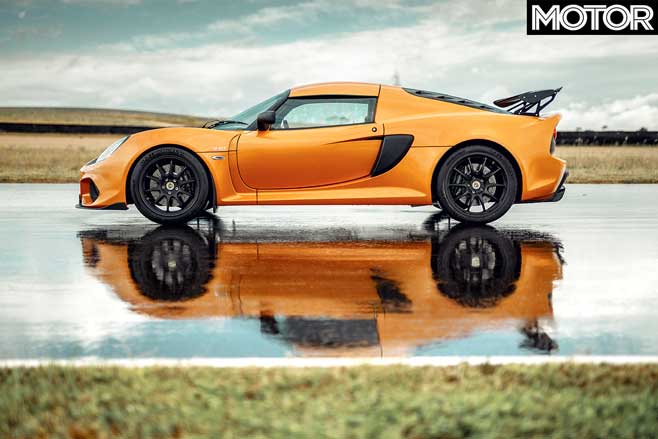
| Judges | DC | LC | DM | SN | TR | Total |
| Performance/20 | 17.5 | 18 | 18 | 17 | 18 | 88.5 |
| Dynamics/20 | 14.5 | 11 | 18 | 17 | 17 | 77.5 |
| Accessibility/10 | 6 | 5 | 7 | 5 | 8 | 31 |
| Liveability/10 | 6 | 2.5 | 2 | 5 | 2 | 17.5 |
| Value/10 | 8 | 3.5 | 4 | 7.5 | 4 | 27 |
| X Factor/10 | 7 | 7.5 | 10 | 8.5 | 8 | 41 |
| Total/80 | 59 | 47.5 | 59 | 60 | 57 | 282.5 |
WHAT DOES Citroen have to do to catch a break in Australia? Famous as an early pioneer of front-drive, monocoque construction, aerodynamics, and hydropneumatics for superior suspension, steering and braking, the brand has been present here for most of its 100-year history – and in this magazine since August 1953 (only our third issue). Additionally, assembled in Melbourne for a time, the DS’s beauty has proven transcendental and tough alike, inspiring the Concorde while conquering rallies – including 1968’s gruelling London to Sydney marathon (until it crashed near the finish line). Yet Aussies choose to ignore such illustrious and inclusive heritage and instead treat Citroens with uncertainty and even suspicion. Just last year, it managed only 494 sales, against Mercedes’ 40,000 and 217,000 Toyotas.
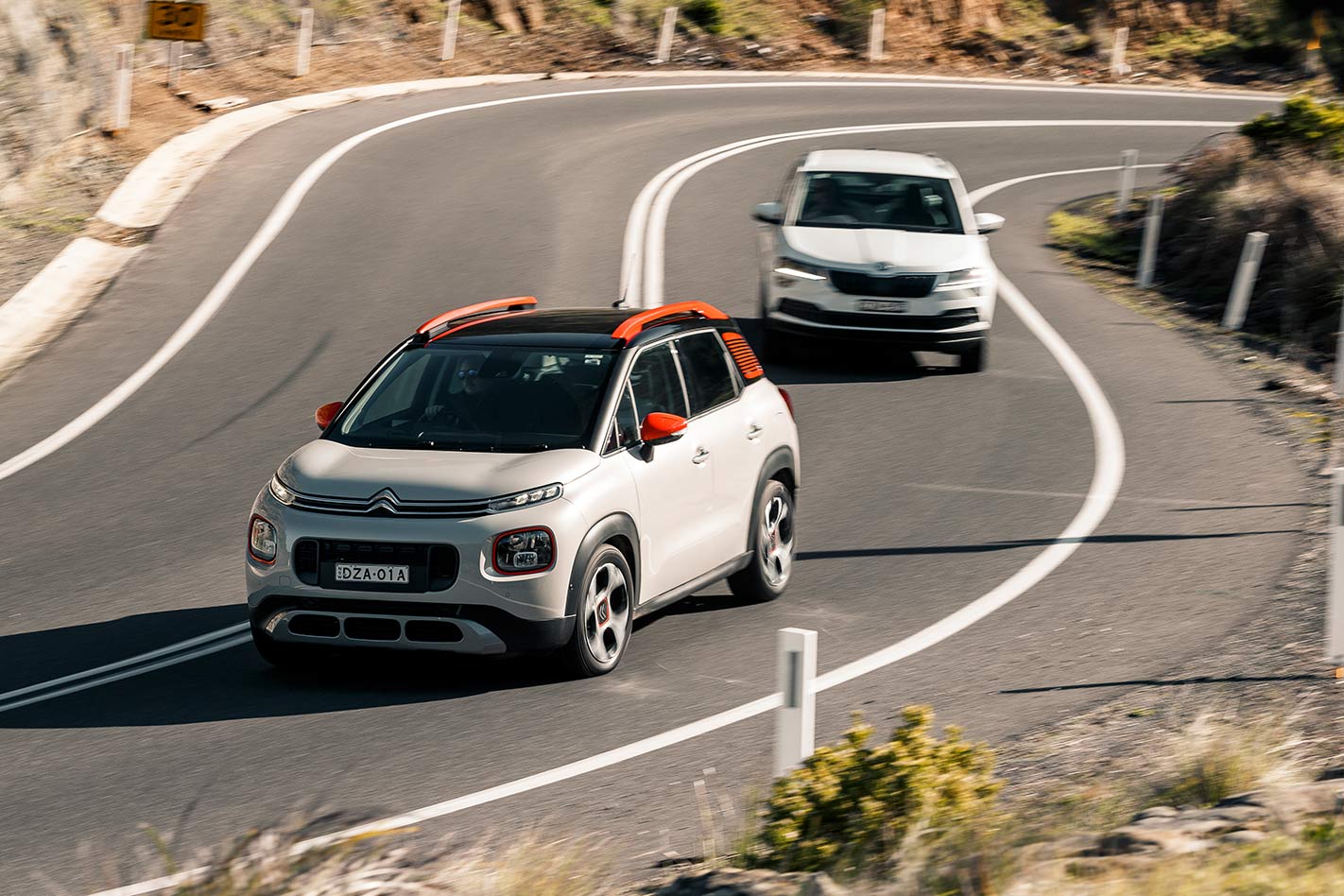
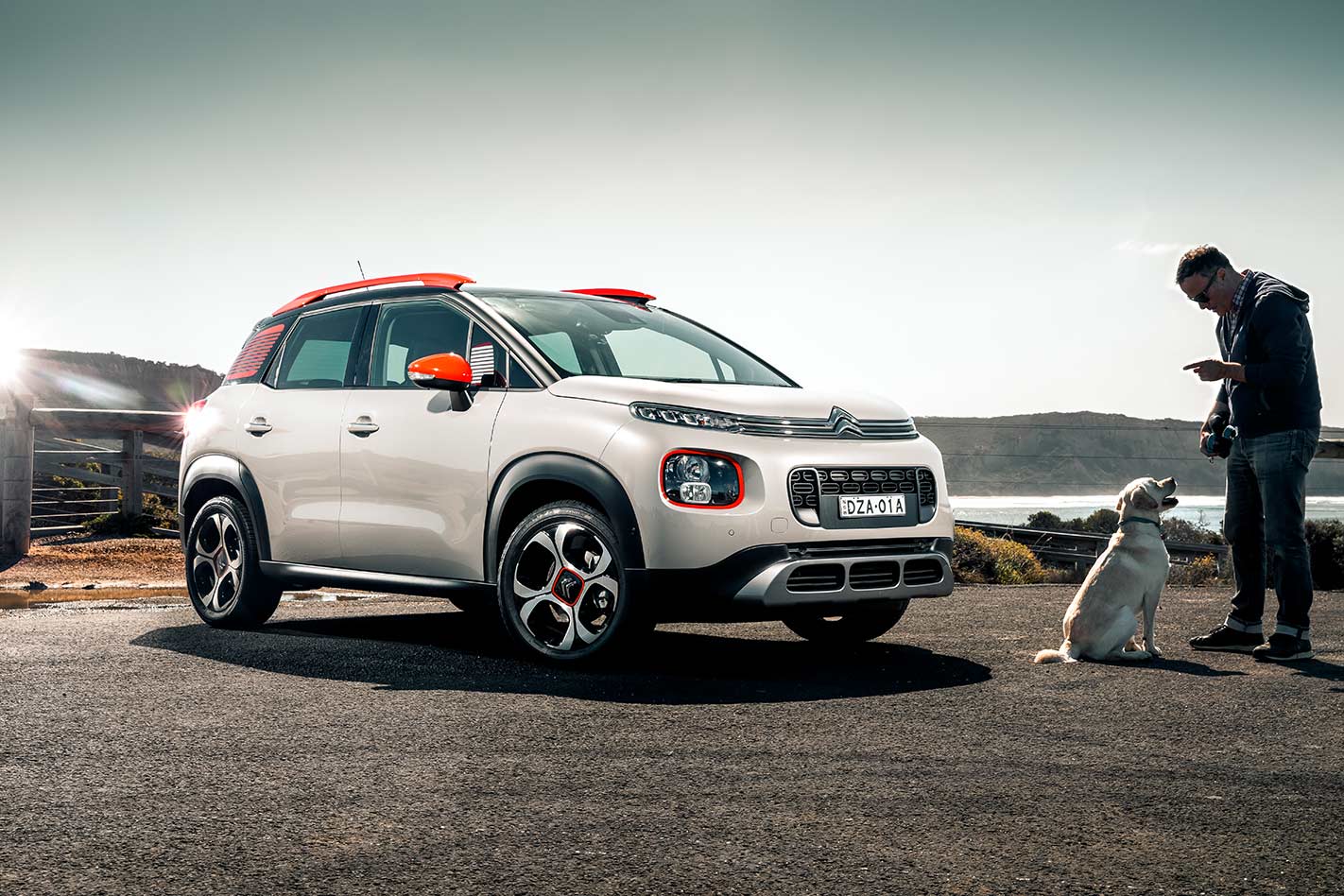
Maybe the box-fresh C3 Aircross will break through. Based on the pretty C3 supermini, it is distinctive but not divisive, thrusting the Spanish-built bijou crossover into a happening segment for the first time … that is, if you ignore the Mitsubishi ASX-derived C4 Aircross of 2012 (which almost everybody did).
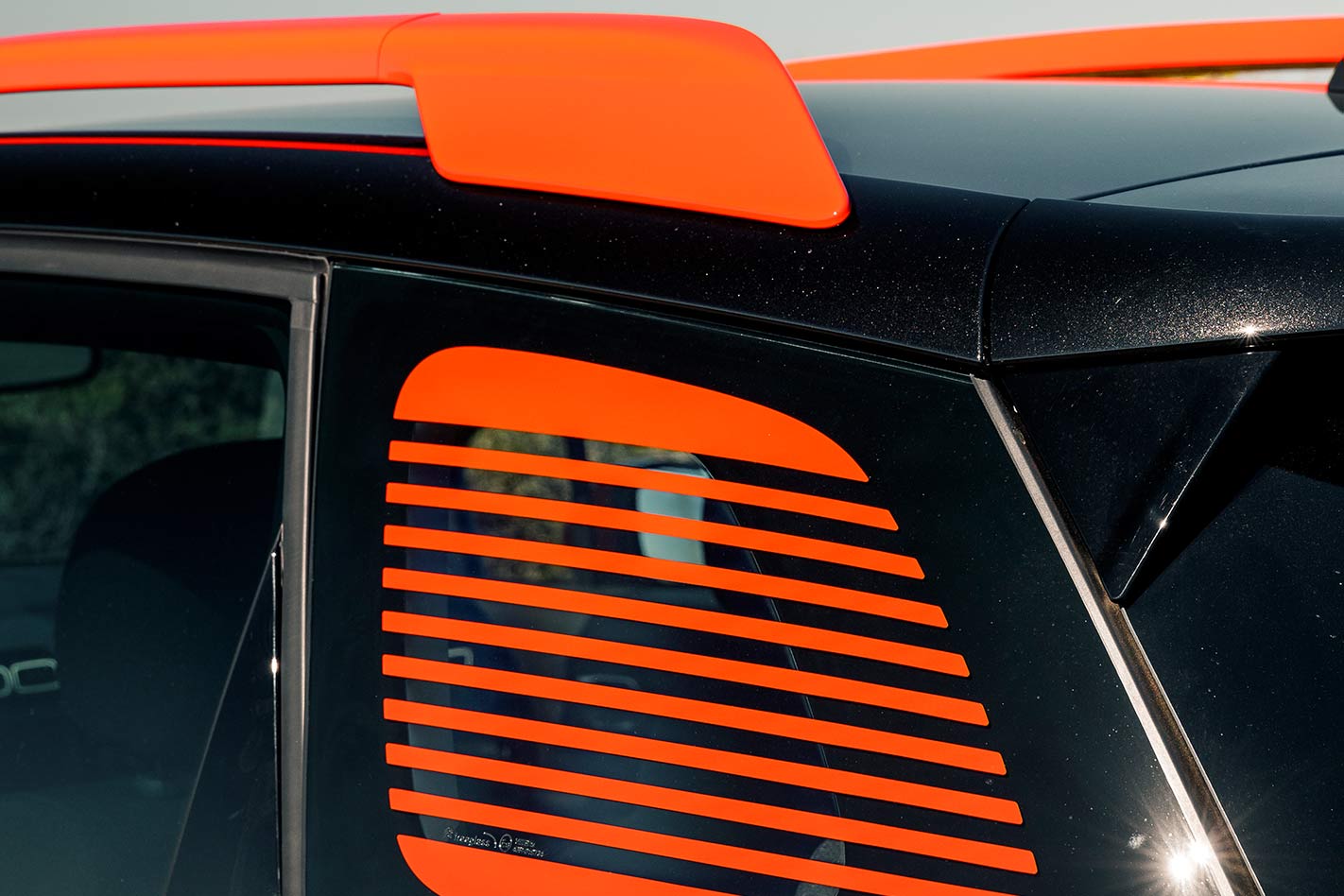
Priced from a steep $32,990, the Aircross resides between the $20-something-K mainstream ASXs and $45K-plus premium Volvo XC40s of this world, but it comes loaded with gear like AEB, blindspot monitoring (BSM), lane-departure warning (LDW), Apple CarPlay/Android Auto, aerial-view camera, auto on/off lights and wipers, climate control, DAB+ digital radio, keyless entry/start, a head-up display (HUD), sat-nav, self-parking and a Qi wireless phone charger. Fancy paint with some flamboyant detailing – as per our example – is the only option.
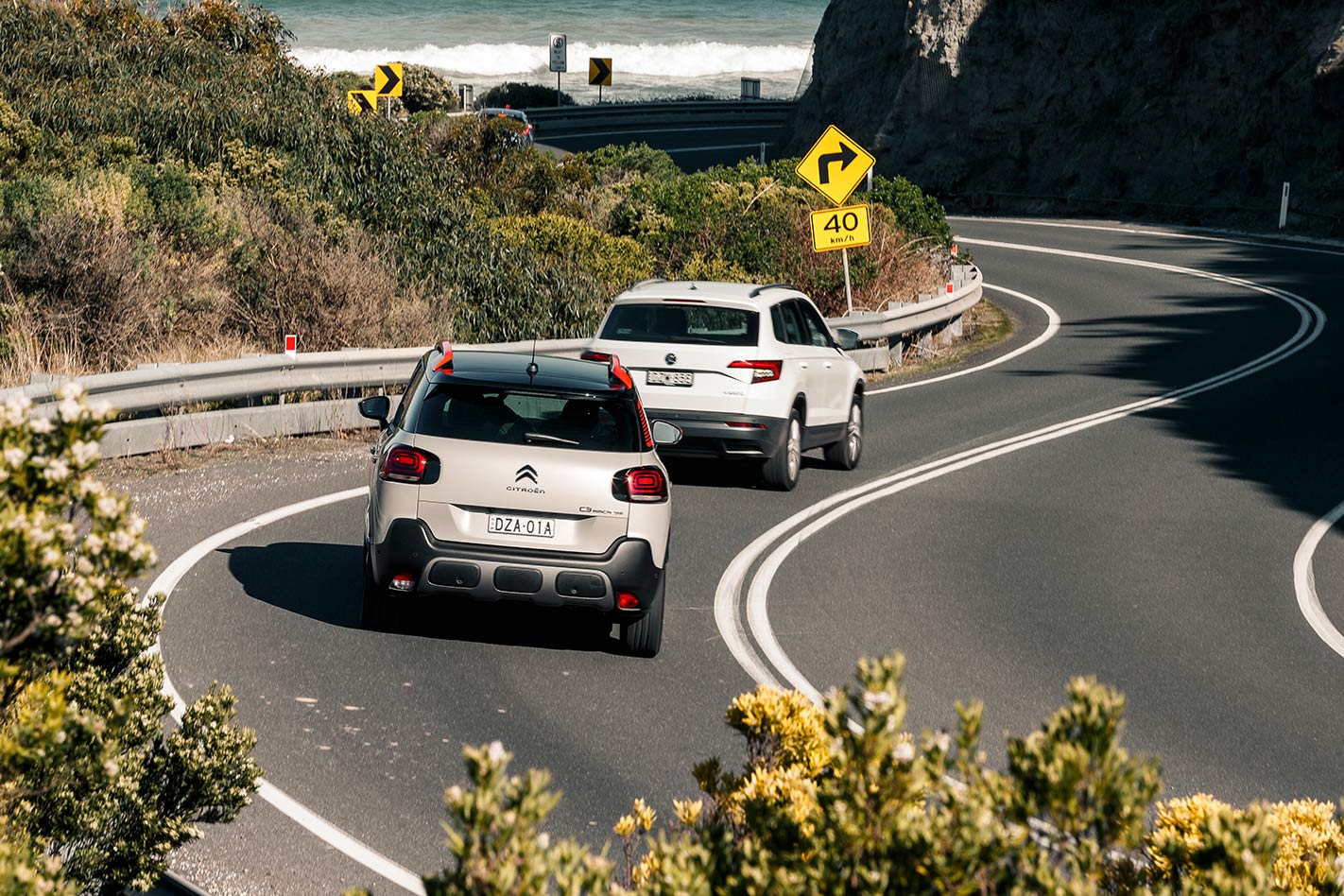
Here’s another, and at $700 less to boot: Skoda’s Karoq 110TSI with dual-clutch transmission (DSG), from $32,290. Visually less peculiar than the likeable, ironically Citroen-esque Yeti it usurps, the smartly coiffured Czech adopts the Golf 8’s MQB architecture, though ditches the rear multi-link of its predecessor for a torsion beam (matching the Aircross).
Where the standard Karoq cannot match its French foe is in a menagerie of acronym-addled gadgets (namely BSM, LDW, GPS, QI, HUD, DAB+ and auto parking), though the base instead boasts adaptive cruise and auto high beam. Note ours heaves with $9K’s worth of loot, equalling the Citroen’s haul (bar HUD) while adding LED lights, (vinyl-ish) leather, heated front seats (powered for the driver), a larger 9.2-inch touchscreen, upgraded audio, digital instrumentation, 18-inch alloys and more. Grand total? $41,590. For fairness, we’re overlooking most of these extras.
Still, there’s no ignoring the Skoda’s more expansive cabin. An outstretched hand span longer and a matchbox wider, size-wise the visibly lower Karoq resides in a real sweet spot, being roomy enough for smaller families yet compact enough for tight-spot scenarios. Dimensionally, think 2000’s Subaru Forester.
Furthermore, the Karoq’s dash presentation would do Volkswagen’s posher marques proud, defined by a textured, layered simplicity that’s invitingly functional. Along with room for five, key highlights include a fine driving position, effective ventilation, supportive seating, bountiful storage and abundant vision. This Skoda serves to please.
We also brought along an actual basic Karoq for a reality check … and guess what? While not as opulent as our bling box, the fabric trim feels softer and warmer, the standard analogue dials are crisper, and, even in touchscreens, eight inches is still larger than average. We’d forgo most of the options.
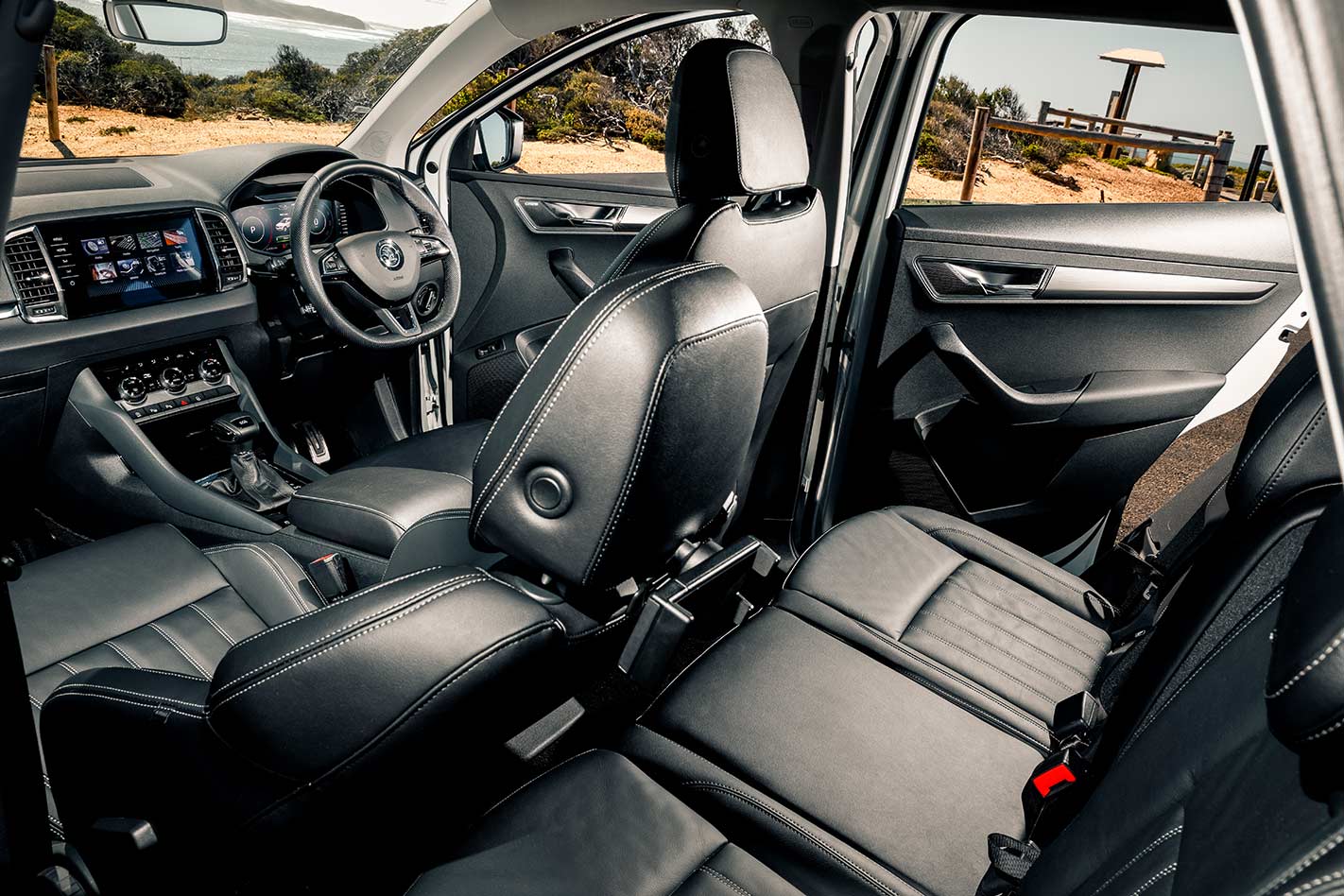
Plus, no SUV offers the immense versatility of the trick VarioFlex rear seat trio that individually slide and recline as required. They’re easy to remove too, unlike the fixed (for Oz only, to comply with our vexing design rules) Citroen’s. Sure, each is heavy to lift, but all that exertion results in a nifty two-seater van configuration. Enter Sandman, 2020-style.
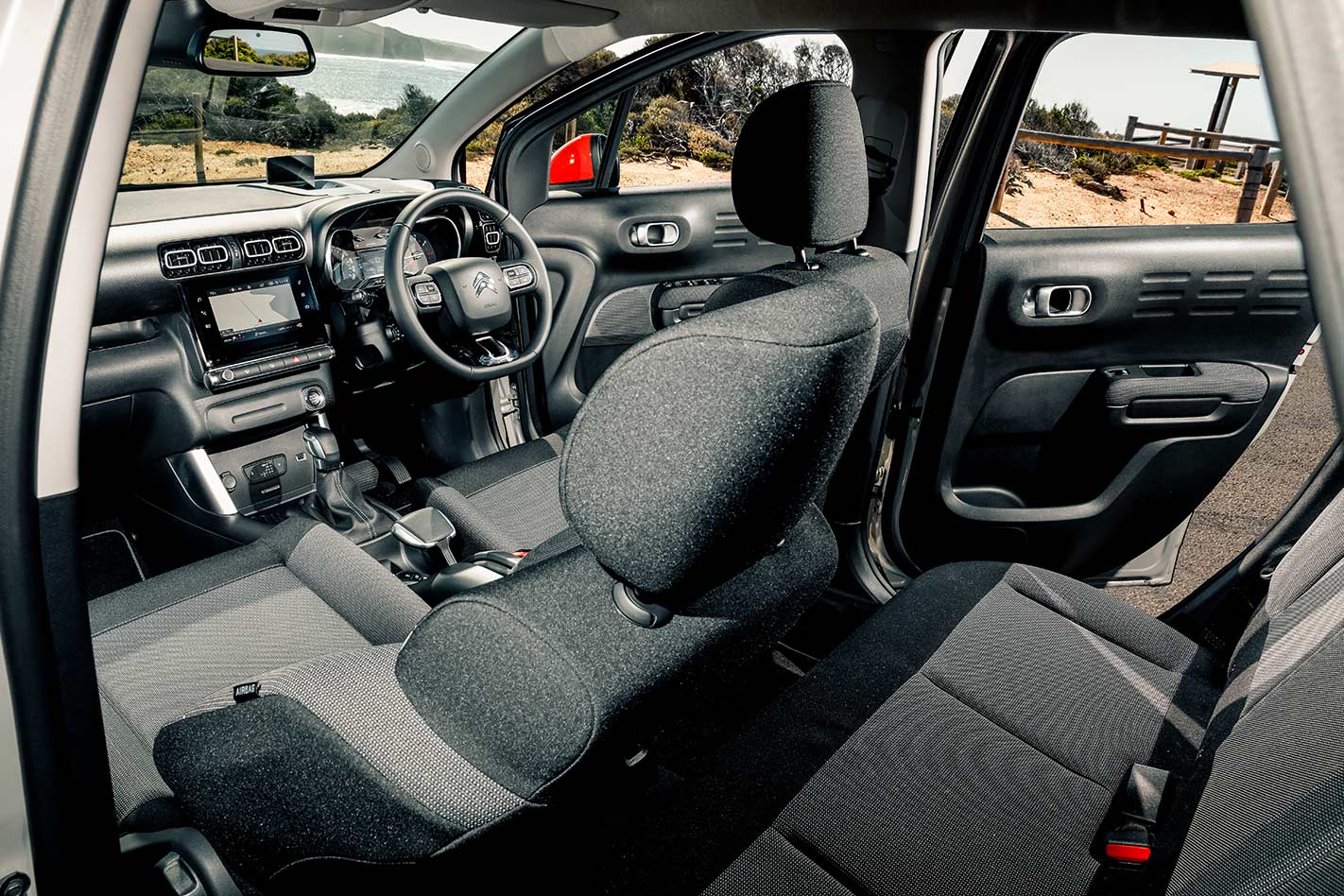
In contrast, the Aircross’s cabin is noticeably narrower and somewhat toylike, though there’s plenty to drink in and enjoy.
Yes, the Citroen is slightly more hemmed-in inside, though canny cab-forward packaging, that lofty ceiling and deep glass conspire to provide a sense of light and space, in a way that the similarly mini Mazda CX-3 cannot. Minimalist in layout, the fascia is cohesive, the touchscreen improves with familiarisation, the seats feel instantly sumptuous and the satellite-pod instrumentation is chic.
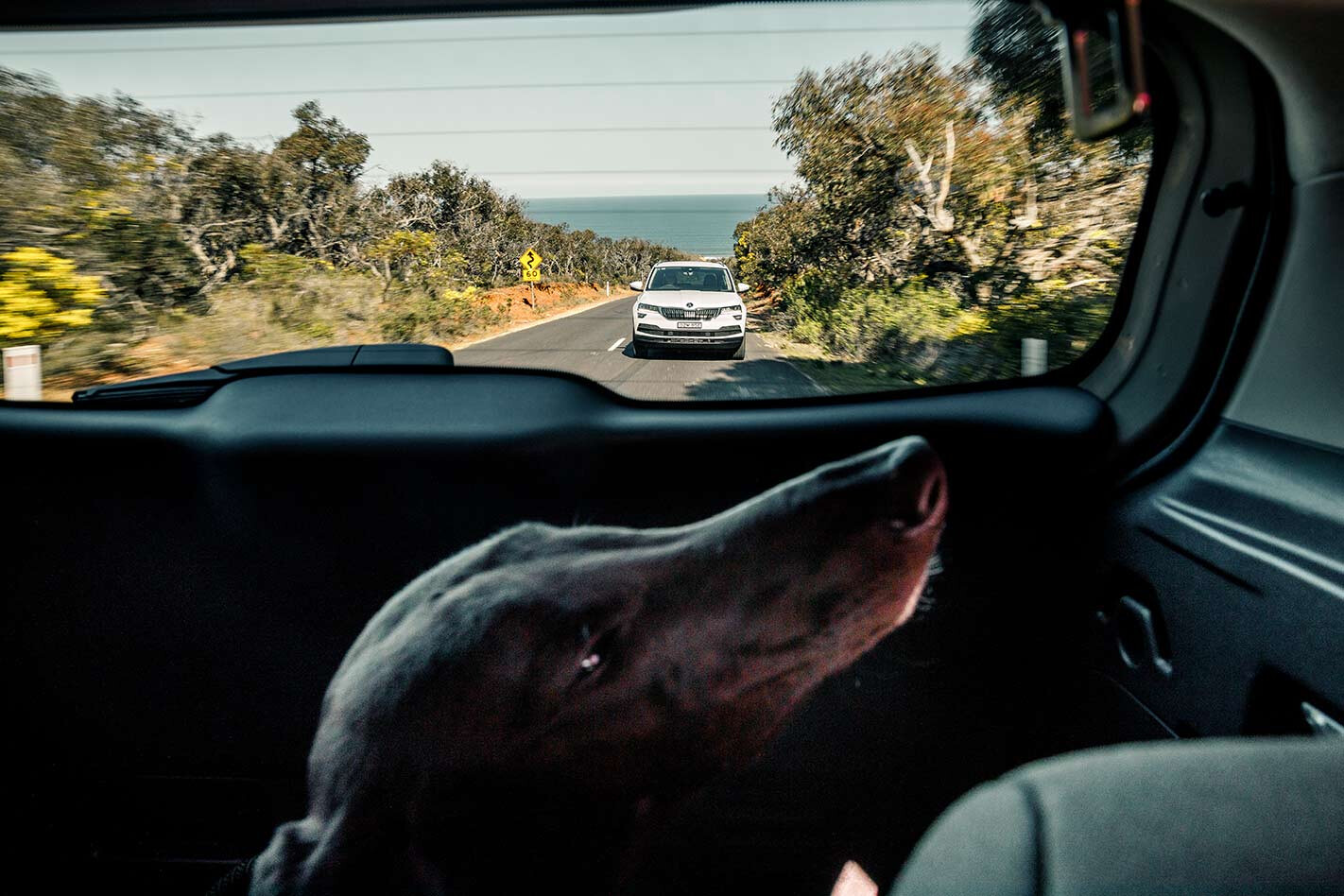
But there’s no overlooking acres of hard, shiny plastics, a near-useless glovebox, paltry single cupholder, scattered switchgear (try finding the ‘Sport’ button quickly) and vision-hindering windscreen pillars. And while the rear comfortably seats two, the back lacks flair, face-level vents, a centre armrest, cupholders and adequate storage. The boot, too, is miles smaller. Advantage, Karoq.
That said, the Citroen claws back ground in two areas important to many compact SUV-buying urbanites: low-speed driveability and ride comfort. The former first. Under the Aircross’s snub bonnet is a thrummy and throaty 1.2-litre three-pot turbo triple, driving the front wheels via a Toyota-supplied six-speed torque-converter auto – a pairing that’s proved remarkably robust in many PSA models.
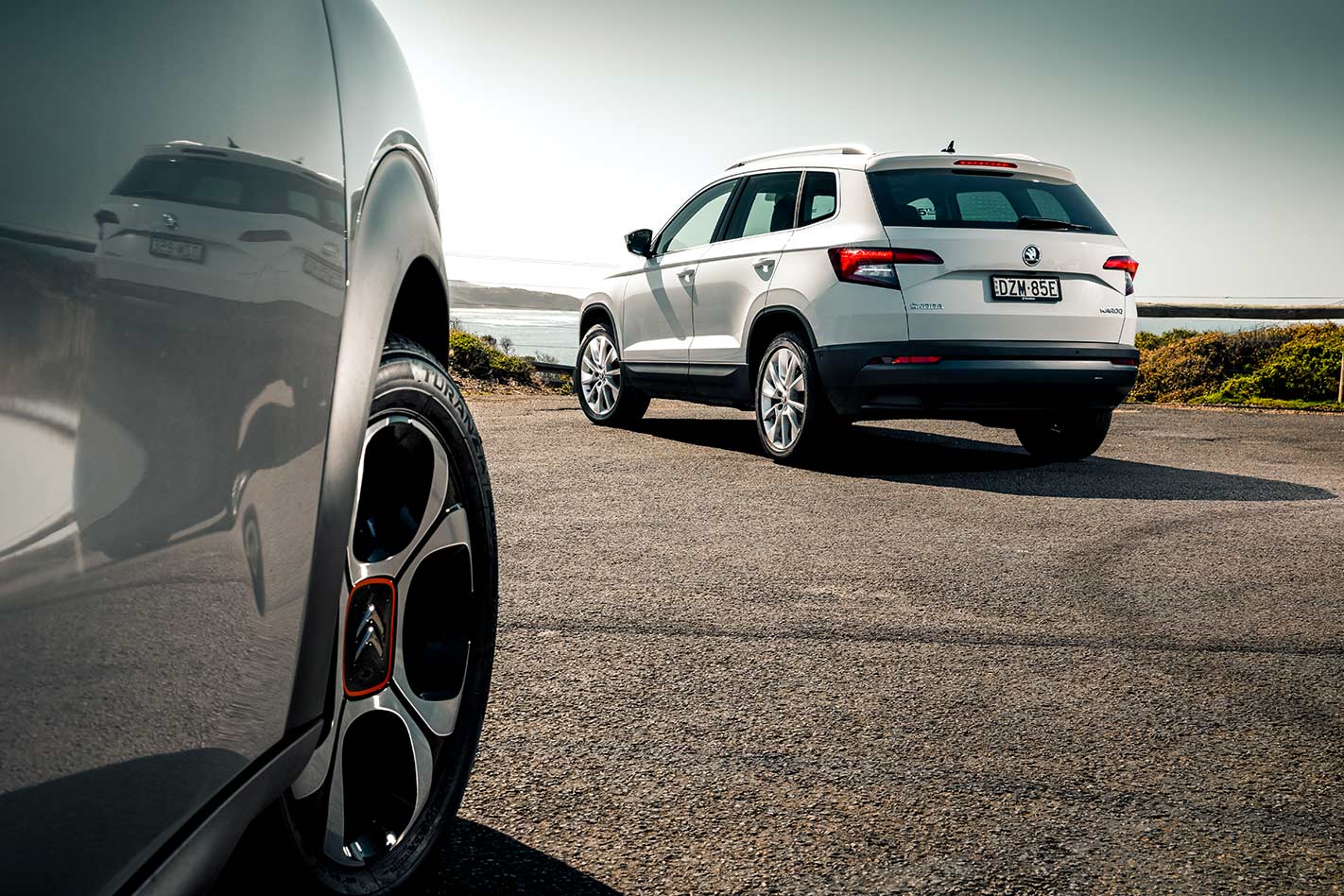
Though 81kW and 205Nm are ho-hum outputs, a trifling 1203kg – some 200kg shy of the Skoda – boosts the power-to-weight ratio, for snappy off-the-line acceleration and punchy mid-range throttle response. Perfect for darting through traffic or clean starts on steep hills. Vocal but never intrusive, the Citroen’s a lusty little livewire.
The opposite applies to the Karoq, which shines out on the open road. Armed with a 110kW/250Nm 1.5-litre four-cylinder turbo and seven-speed DSG combo, the 110TSI front-driver majors in providing a broader bandwidth of performance with maximum efficiency, minimum fuss and welcome refinement. The upshot can be less-than-smooth progress in heavy traffic or when crawling over inclines, as the DSG can feel laggy and even jerky. Frustrating for drivers desiring instant oomph.
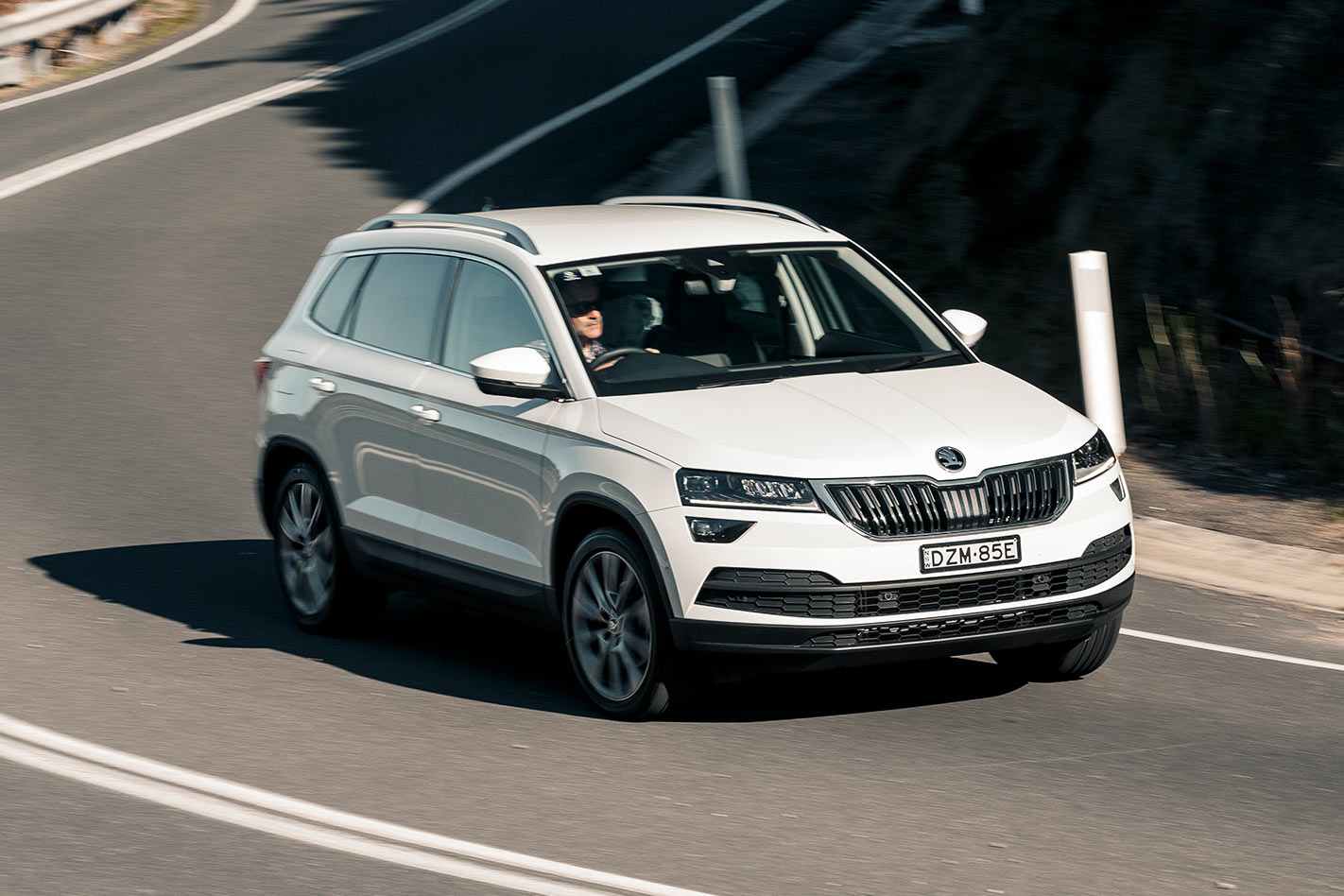
Inevitably this means the Skoda trails the terrier-like Citroen up to 50km/h, but the 110TSI’s deeper lungs reel it in beyond that, by 1.4 seconds at 100km/h and a yawning 4.9s past 140. And though the Aircross pulls briskly between 80 and 120, it cannot catch the strident Karoq. Size matters here. Additionally, the Skoda proved only 0.3L/100km thirstier overall. Impressive.
Still, the Citroen keeps up in bends, thanks to quick steering and a planted, predictable chassis that soaks up the bumps with far more aplomb than a lightly laden Karoq. But, again, as speeds rise, the situation reverses, with the Aircross’s handling feeling a tad nervous blasting over zig-zag roads, often requiring two bites at the helm to maintain a chosen line. There’s also more body movement and less rebound control.
The 110TSI, meanwhile, glides on through such stuff with reassuring fluid finesse, its steering weighting up agreeably for a more controlled connection between car and driver. The Golf DNA is obvious here. Additionally – and even on bigger 18s – a loaded Karoq settles down and soaks up rougher surfaces almost as well as the plush Citroen, minus the lean.
Ultimately, the Karoq is a more refined and grown-up experience, eschewing the Yeti’s quirky nature for formidable all-round competence that’s as polished as it is practical.
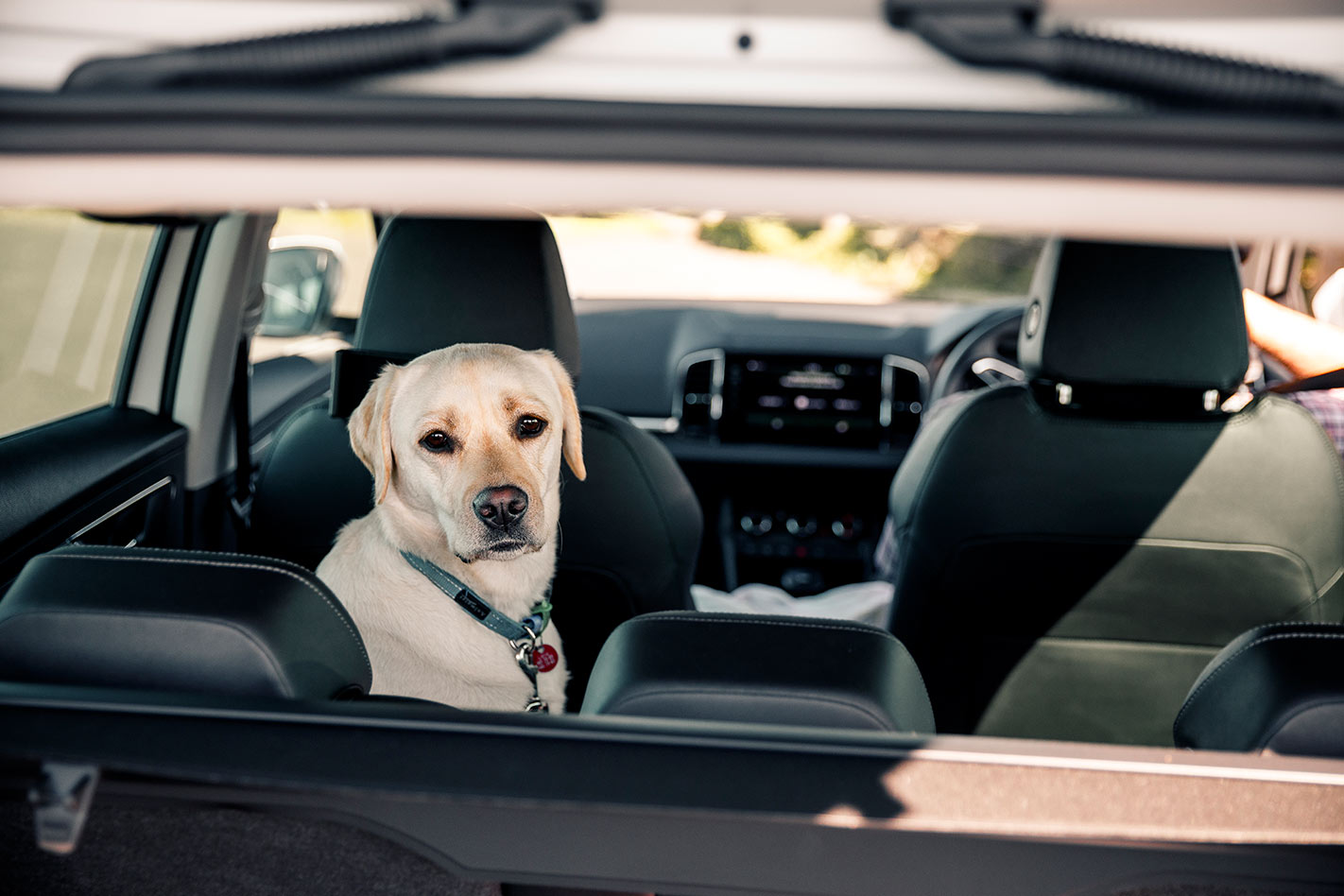
The slick powertrain and firm suspension are much more harmonious away from the rigours of cut-and-thrust commuting, but then that’s where the charming C3 Aircross soars, lacking for little and giving much more than its diminutive numbers suggest.
So, while the Skoda is palpably more complete, the French car nails the city SUV brief with characteristic, charismatic chutzpah. We cannot imagine consumers finally flocking to dealerships, but it deserves to be that elusive thing after a century here – successful Citroen in Australia.
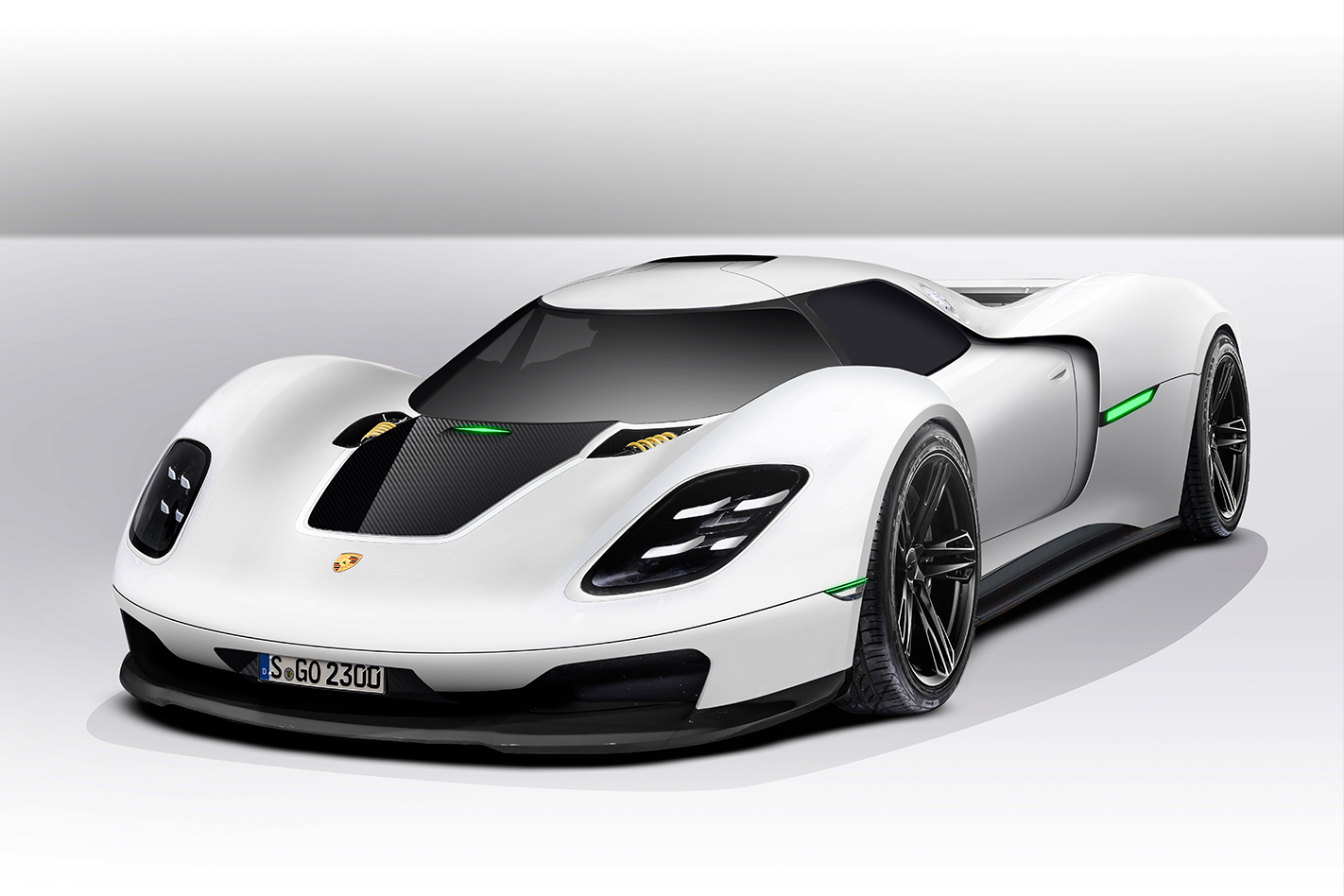
Porsche has reaffirmed plans for a hypercar to crown its line-up – and, in a bid to provide a clear link between its motorsport activities and road cars, it could use a hybrid driveline originally developed in an aborted Formula 1 engine program. However, the Aston Martin Valkyrie rival remains at a conceptual stage, with an introduction unlikely before 2023 at the earliest.
High-level sources at the German car maker’s Weissach technical centre confirmed that a definitive production go-ahead for the successor to the 918 Spyder is dependent on a decision from Porsche’s board on whether to commit to a pure electric or hybrid drivetrain for the new hypercar. This is in keeping with comments made by Porsche chairman Oliver Blume last year.
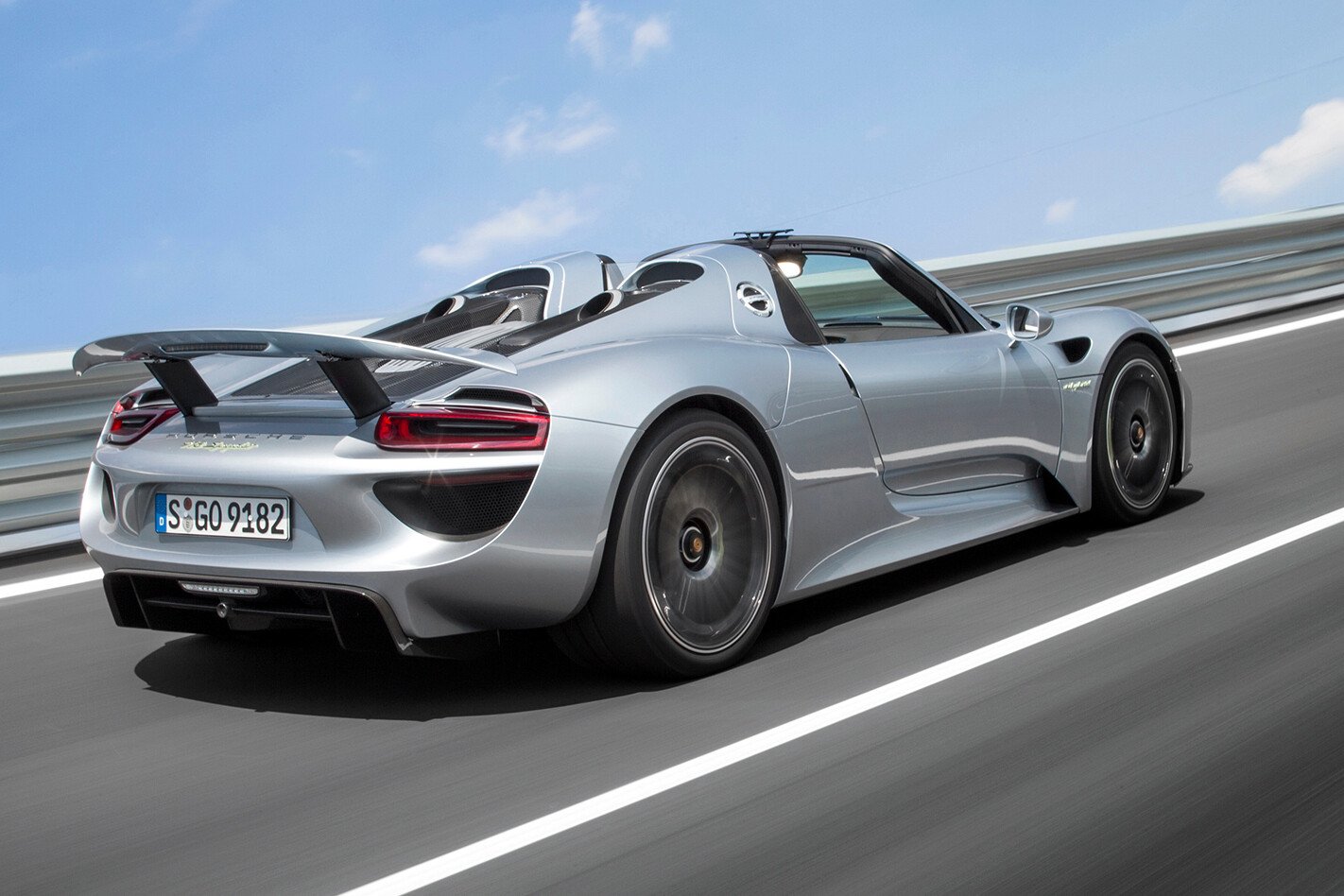
Initial plans for the car, first hinted at by Blume at the Geneva motor show in March, were based around an advanced pure-electric drivetrain with the potential to significantly outperform Porsche’s newly unveiled 99X Formula E race car. However, these plans have apparently been wound back after an internal study concluded that solid-state battery technology, which was to have provided Porsche’s future flagship with what’s described as “newfound standards in EV weight, efficiency and range potential”, is not progressing as quickly as originally expected.
The technology will not be available in the sort of production quantities required to underpin the new model until the second half of the next decade.
Instead, Porsche is claimed to be pursuing an alternative plan based around an advanced plug-in petrol-electric hybrid drivetrain originally developed by Porsche Motorsport for an aborted return to the F1 grid as an engine supplier.
If the alternative drivetrain plan comes to fruition, the new Porsche hypercar will compete head-on with the Mercedes-AMG One, which is also underpinned by F1 drivetrain tech.
There are also suggestions that it could provide Porsche with a contemporary driveline package under both Le Mans’ new Hypercar and IMSA’s DPi regulations.
Last year, Porsche’s head of motorsport, Fritz Enzinger, revealed that the company had committed a 40-strong team of engineers from its LMP1 operations to a development program for a six-cylinder engine and hybrid drive system as long ago as 2017 – two years after the 918 Spyder ceased production.
The new Porsche engine was originally conceived around a capacity of 2.0 litres as a replacement for the V4 unit used by Porsche’s Le Mans-winning 919 race car. However, the focus of the program was subsequently switched to an F1 specification with a capacity of 1.6 litres.
Although Porsche ultimately decided to sidestep F1 and enter Formula E, development of the V6 engine continued up to today. That’s because, according to Enzinger, an F1 engine adapted for the durability needed for road use and without the complex and expensive MGU-H (motor generator unit – heat), which is used to harvest electrical energy from heat from the exhaust, would “also be interesting for a supersports car”.
He said: “At the end of 2017, we received an order to further develop a highly efficient six-cylinder engine, despite the LMP1 withdrawal – not only on paper but as hardware.”
Enzinger said Porsche’s new V6 is “complete and running on the test bench”. He also authenticated reports that it is being used for “analysis with regard to series production relevance”.
Secrecy surrounds the specification of the hybrid component of the new driveline, although it has been conceived to use a powerful electric motor.
Speaking about Porsche’s hypercar plans at the Frankfurt motorshow, the brand’s head of electric vehicle projects, Stefan Weckbach, said: “Our target is always, no matter what car we’re doing, to have the sportiest car in the segment.”
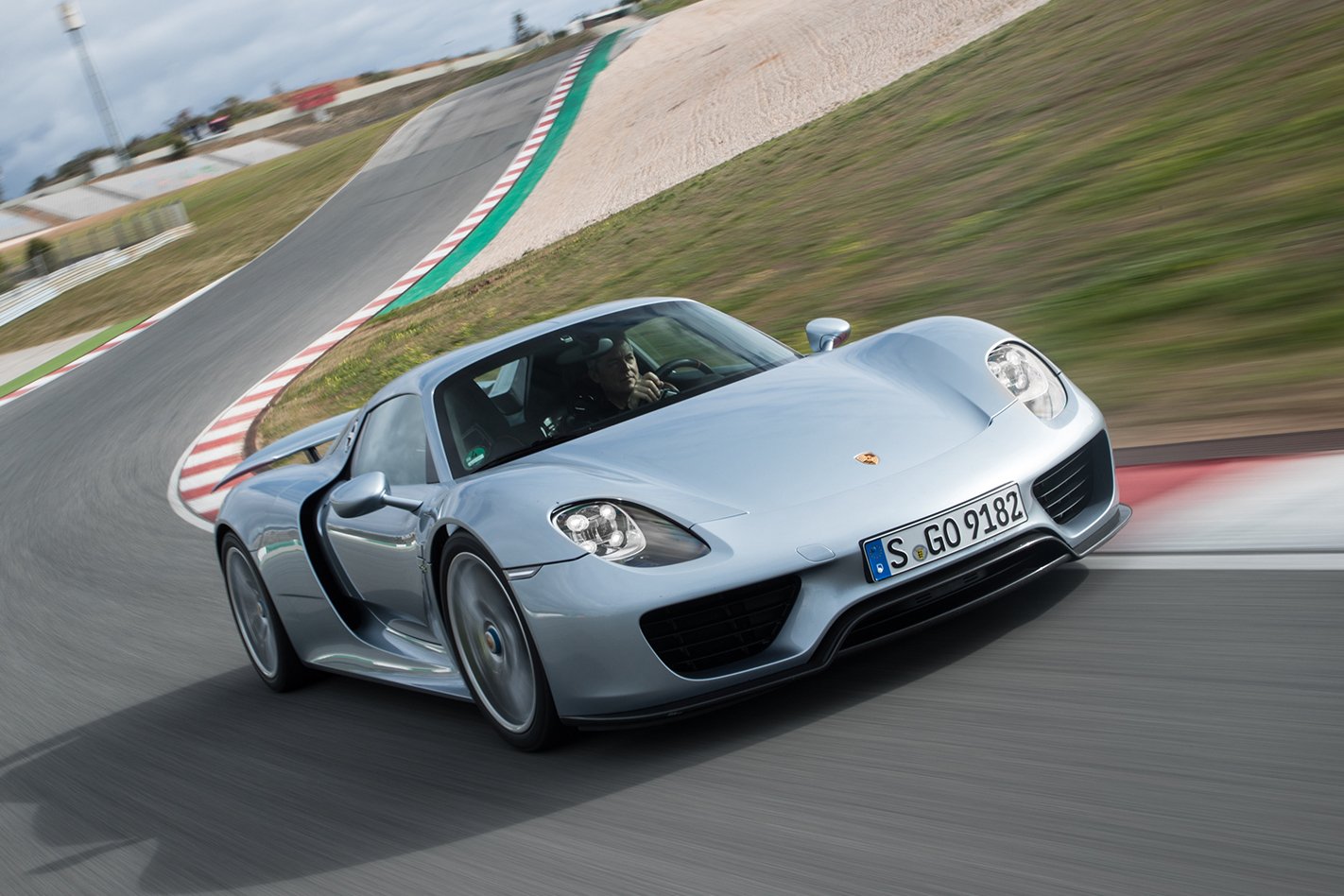
Weckbach also suggested the electric side of the new Porsche driveline could benefit from technology being developed by a partnership between the German car maker and Rimac.
Following the purchase of an initial 10 percent shareholding in the Croatian-based electric supercar maker in 2018, Porsche recently upped its stake in Rimac to 15.5 percent, indicating that it plans a closer relationship with the company behind the highly acclaimed Concept_One and C_Two hypercars. “We see potential for future co-operation with this company. That is why we raised our stake,” Weckbach said.
Rimac, whose C_Two hypercar is powered by an electric-drive system that delivers up to 1408kW, has quickly made a name for itself as a leader in electric motor and power electrics technology. As well as with Porsche, it has established engineering programs with Aston Martin, Jaguar and Renault, among others. In May, Hyundai and Kia jointly invested€€80 million (A$129m) in Rimac in a deal to collaborate on electric vehicle development.
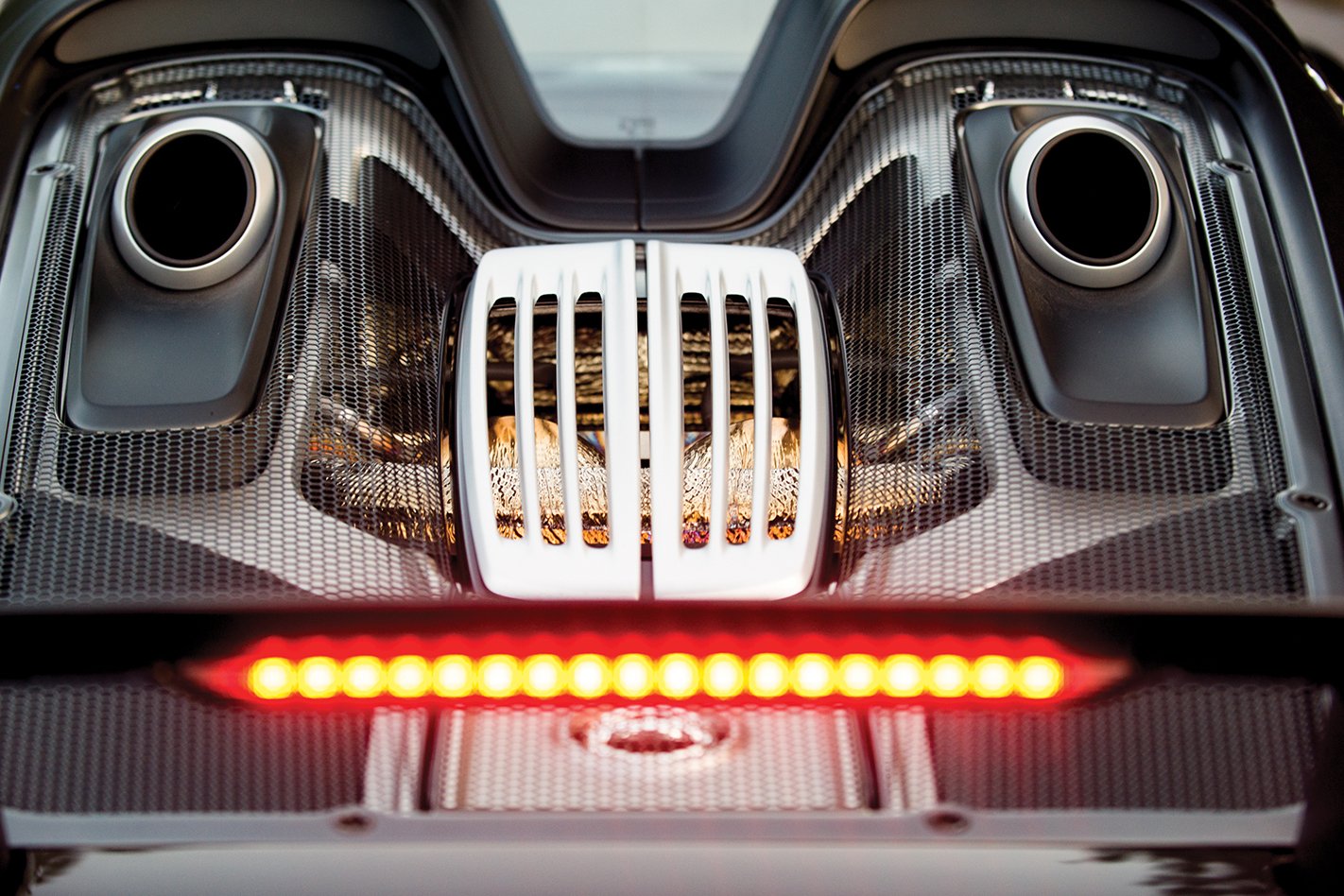
Whether Porsche plans to apply Rimac’s technology to a pure-electric powertrain or hybrid drivetrain with its next hypercar remains to be seen.
“If it is all electric, it might be an approach, though it might be a Porsche engine as well,” said Weckbach, who signalled that his personal choice would be a hybrid driveline.
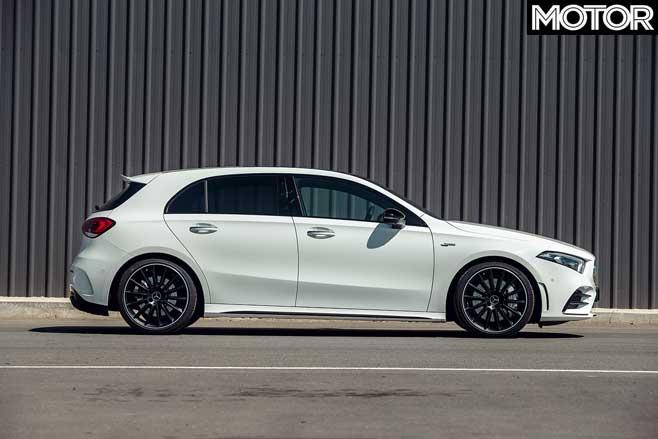
As far as a reckoning goes at PCOTY for the Mercedes-AMG A35, seventh might seem rather unfair.
There’s nothing wrong with this new contender from Affalterbach. In fact, after driving the A35 it’s obvious that it acquits itself remarkably well for what it’s meant to be – a bridge between the regular A-Class range and incoming A45. And yet that might be its exact problem.
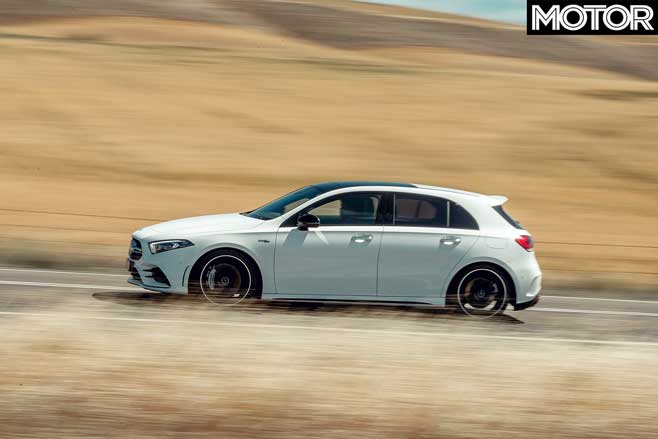
While a 2.0-litre turbocharged four driving all four wheels through a twin-clutch auto is the right recipe for hot-hatch thrills, it is clearly set up to invite a good thrashing without ever spooking or surprising you.
From the excellent driving position in the AMG Performance seats, friendly suspension balance and adequate turbo push, it has the right tools to get on with enjoying your favourite road or local track. Add to the recipe strong, feelsome brakes and an obedient quick-shifting transmission and you would often get out of the car knowing full well it would be happy to go another five or six rounds of whatever road you had just driven.
But while some details about a car stick in your mind long after you drive them, like an engine ravenous for revs or a chassis that rewards palm-drenching commitment, it’s a struggle to recollect any similar character-defining memories when we look back on the Mercedes-AMG A35. It does everything reasonably well so that nothing really stands out. And that shows on the scoreboard.
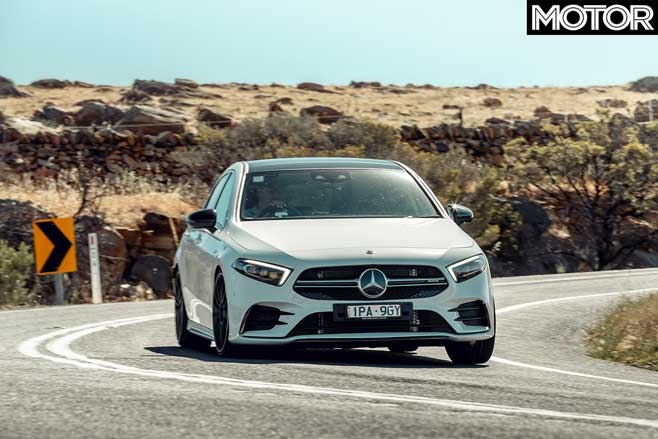
Judges marked the A35 well for accessibility but didn’t think it had much X-Factor. That was clear in some areas than others, like its toned-down exhaust note and lower straightline velocities. Race driver Michael Almond noted it would start to push through high-speed corners at the limit.
Sure, it could boogie if provoked, as DC demonstrated for some excellent brake-oversteer photography, but that requires a fair degree of commitment you would struggle to find space for anywhere other than The Bend.
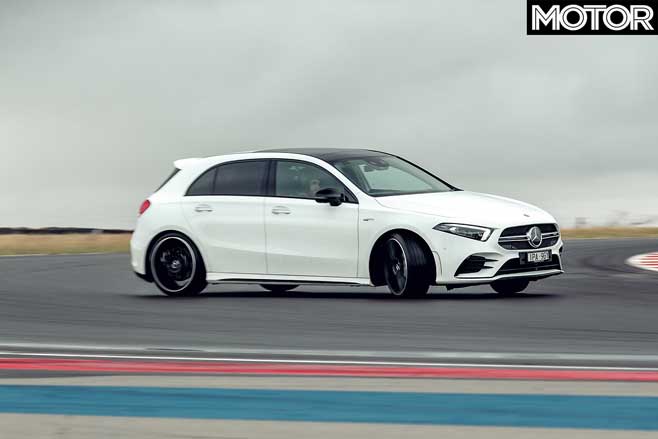
For transport it’s a fine place to sit. However, some judges struggled to justify its value at $67,200 in such a competitive hot-hatch market. If you want something austere, fun and safe, a VW Golf R is just as good.
Still, we’re happy the A35 exists. Mercedes-AMG already cracked the hot-hatch segment wide open with its original A45 and, since its successor is planned to be just as mad, as well as capable, it’s nice to know we now have more choice in the AMG sales yard.
The Numbers
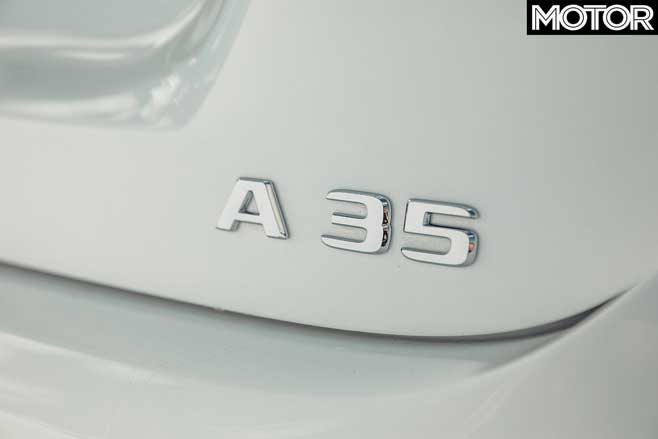
2020 MERCEDES-AMG A35 SPECS: Engine: 1991cc inline-4, DOHC, 16v, turbocharger Drive: all-wheel Power: 225kW @ 5800rpm Torque: 400Nm @ 3000rpm Transmission: 7-speed dual-clutch Weight: 1555kg Power/Weight: 145kW/tonne 0-100km/h: 4.86sec 0-400m: 13.16sec @ 170.50km/h The Bend lap time: 1min 39.7sec Price: $67,200
Judge’s Rank
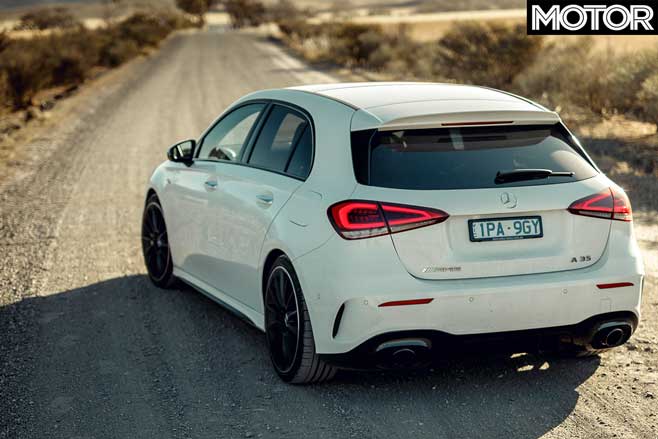
Dylan Campbell – =6th “Skilful blend of performance and comfort. A Mercedes-Benz Golf R.”
Louis Cordony – 7th “Nails its brief, but is an almost forgettable drive.”
David Morley – 10th “Flew slightly under the radar for me. And too expensive given the competition.”
Scott Newman – 8th “Expertly engineered to fill a gap, but it was one that needed filling. Excellent daily.”
Tim Robson – 7th “A trendy accountant. No visual aggression, but a handy little thing.”
PCOTY 2020 Scoring
| Judges | DC | LC | DM | SN | TR | Total |
| Performance/20 | 14 | 12.5 | 15 | 13 | 14 | 68.5 |
| Dynamics/20 | 15.5 | 12 | 15 | 15 | 15 | 72.5 |
| Accessibility/10 | 8 | 6.5 | 8 | 9.5 | 8 | 40 |
| Liveability/10 | 9 | 6.5 | 7 | 7.5 | 8 | 38 |
| Value/10 | 8 | 5 | 5 | 6 | 7 | 31 |
| X Factor/10 | 7.5 | 4 | 5 | 6 | 3 | 25.5 |
| Total/80 | 62 | 46.5 | 55 | 57 | 55 | 275.5 |
Generally we tend to look to the rest of the world when it comes to television, but Australia has produced a tonne of entertaining car commercials over the years complete with our requisite humour, culture and colloquialisms.
Here are some of our favourites over the years.
Talk about repeated word association… This ad is probably one of the reasons why Australians hold Holden so closely to their hearts. Foot-ball, meat pies, kan-ga-roos and Holden cars! Good luck trying to get that out of your head.
Ford was desperate to compete on the world stage with its Fairlane Ghia in the 90s, likening it to the best of the world in every aspect.
So delightfully ’70s. What happened to the humble jingle?
Nissan has never been more epic than this ad. If only it could inject this kind of excitement into their range of SUVs!
Before they became fully hektik skid sleds, Calais Turbos were marketed as World Class Luxury.
Work hard, play hard with a Holden ute.
Who can resist the ‘Hey Charger‘ call…
This one just reminds us of what we’ve sacrificed with the loss of local manufacturing. Sad sign of the times.
You might be surprised to hear the “Oh What a Feeling, Toyota” slogan was used throughout the 1980s, shown here in this Corolla ad that also features a floating robot.
You could never get away with this kind of advertising in this day and age.
Do you have a favourite Aussie car commercial? Let us know in the comments below.WATCH NEXT: Best car commercials of Super Bowl 2020
