
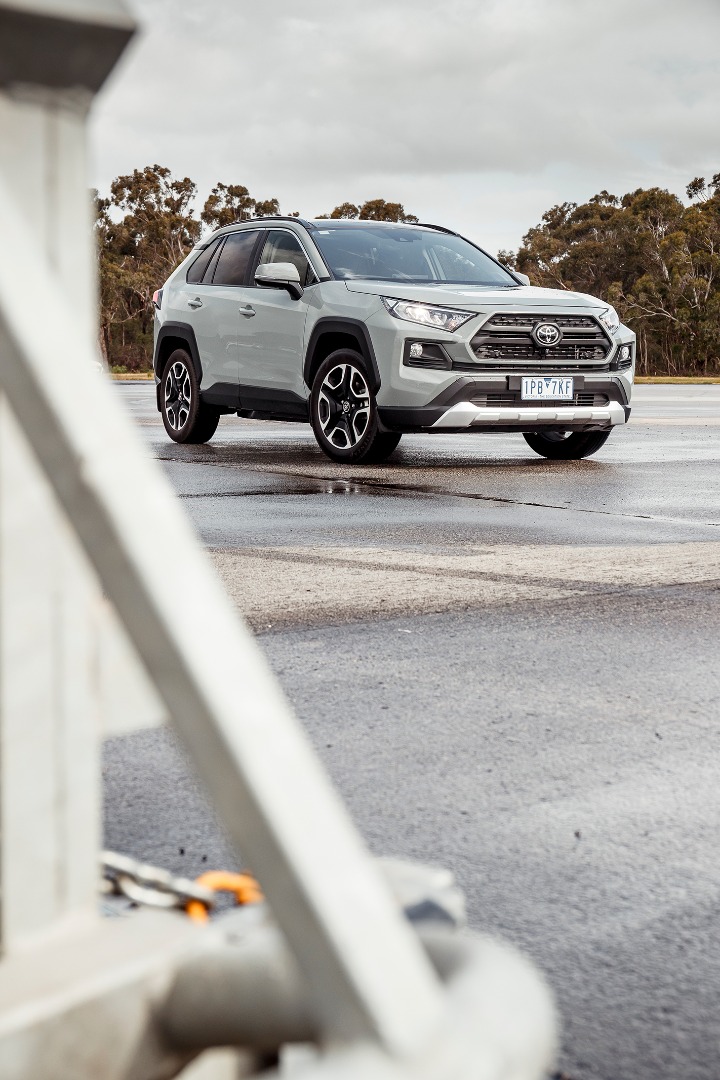
Few 2019 models have improved as much as the new RAV4. In fact, Marie Kondo would be proud at just how much of the old RAV4 was thrown out with the advent of this new fifth-generation.
As with every one of the company’s latest monocoques, it adopts the Toyota New Global Architecture, offering a longer, wider and stronger platform with a lowered powertrain and passenger cell (bringing packaging benefits and an improved centre of gravity), yet slightly greater ground clearance. Substantially larger in almost every dimension, the unashamedly blocky RAV4 is now a properly spacious five-seater, offering easy entry/egress, an excellent driving position, great seats and generous storage.
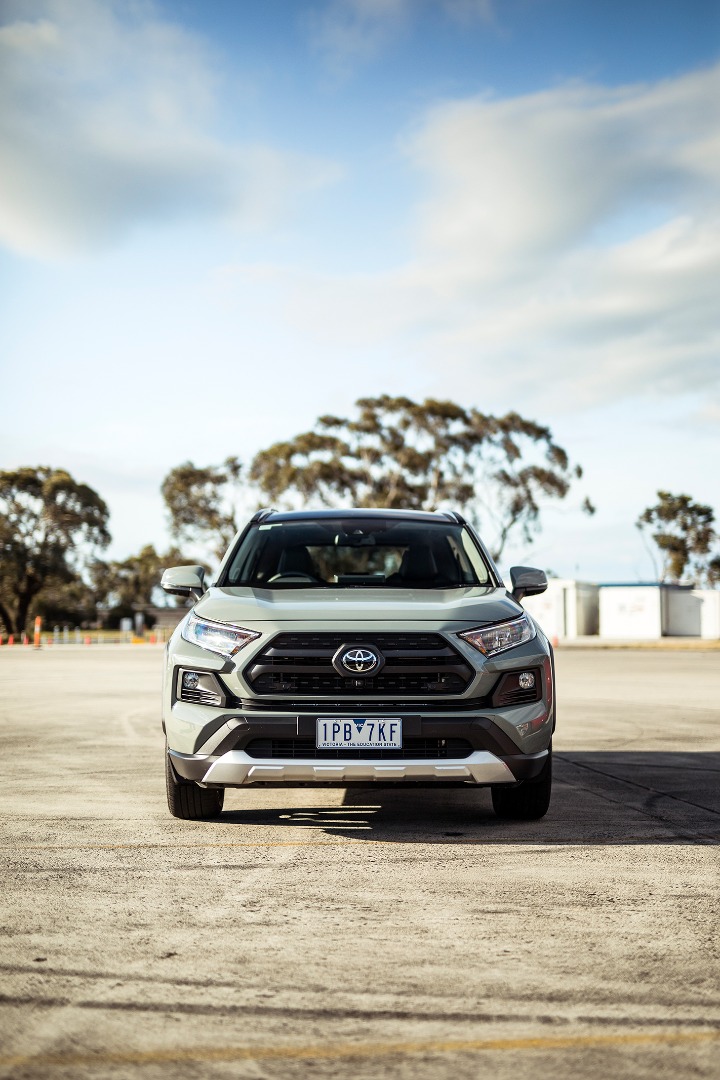
As for active safety, Toyota joins the class-leading CX-5 in democratising driver-assist technologies like AEB, rear cross-traffic alert, adaptive cruise control, auto high-beam, pedestrian/cyclist detection, and lane-keep assist. And even the base GX brings front parking sensors, rear air vents, reclining rear backrests with a centre armrest, digital radio and speed-sign recognition. All from $31K, redefining medium-SUV value.
The RAV4 also zigs and zags like no previous version could. There’s a direct feel and connection to its steering, without being too sharp or heavy, for precise handling. Better still, the jittery ride and road noise intrusion have been greatly reduced – especially in the loping GX on 17-inch alloys – partly due to the more rigid body and redesigned suspension.
Where the RAV4 really strives to push mainstream medium SUV segment boundaries is in the advent of electrification availability, ditching the problematic turbo-diesel option.
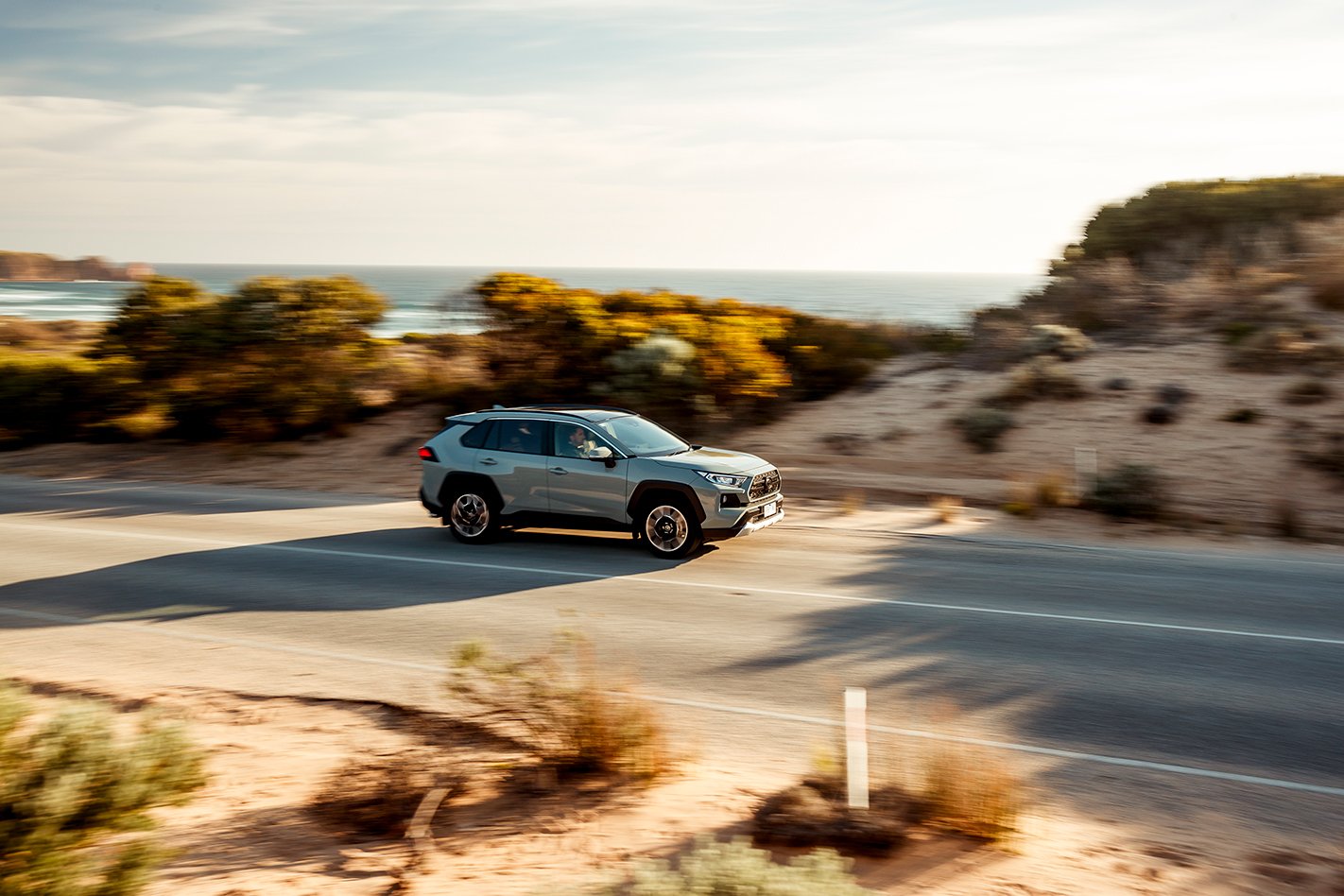
Based on the petrol-electric hybrid system first seen here in the 2001 Prius, there’s nothing revolutionary about Toyota’s decades-old tech. However, it’s only a $2500 option on all variants except the outdoorsy Edge, meaning Aussies can now drive a family-sized petrol-electric SUV from under $36K.
The 131kW/221Nm 2.5-litre four-cylinder petrol and 88kW/202Nm electric motor combine to provide a thrusty peak output of 160kW on front-drive models, while the optional (for $3000) E-Four version’s secondary, rear-axle-mounted 40kW/121Nm electric motor delivers 163kW all-up, as well as an efficient and lightweight all-wheel-drive layout.
Yet even without the help of either hybrid system, the regular FWD RAV4 also presents a compelling case. Its freshly minted 127kW/203Nm 2.0-litre four-pot is a vocal bit of kit when you’re up it, but its deep-lunged, revvy nature and Toyota’s new CVT result in a palpably more muscular (and economical) entry-level engine option, further magnifying the RAV4’s egalitarianism.
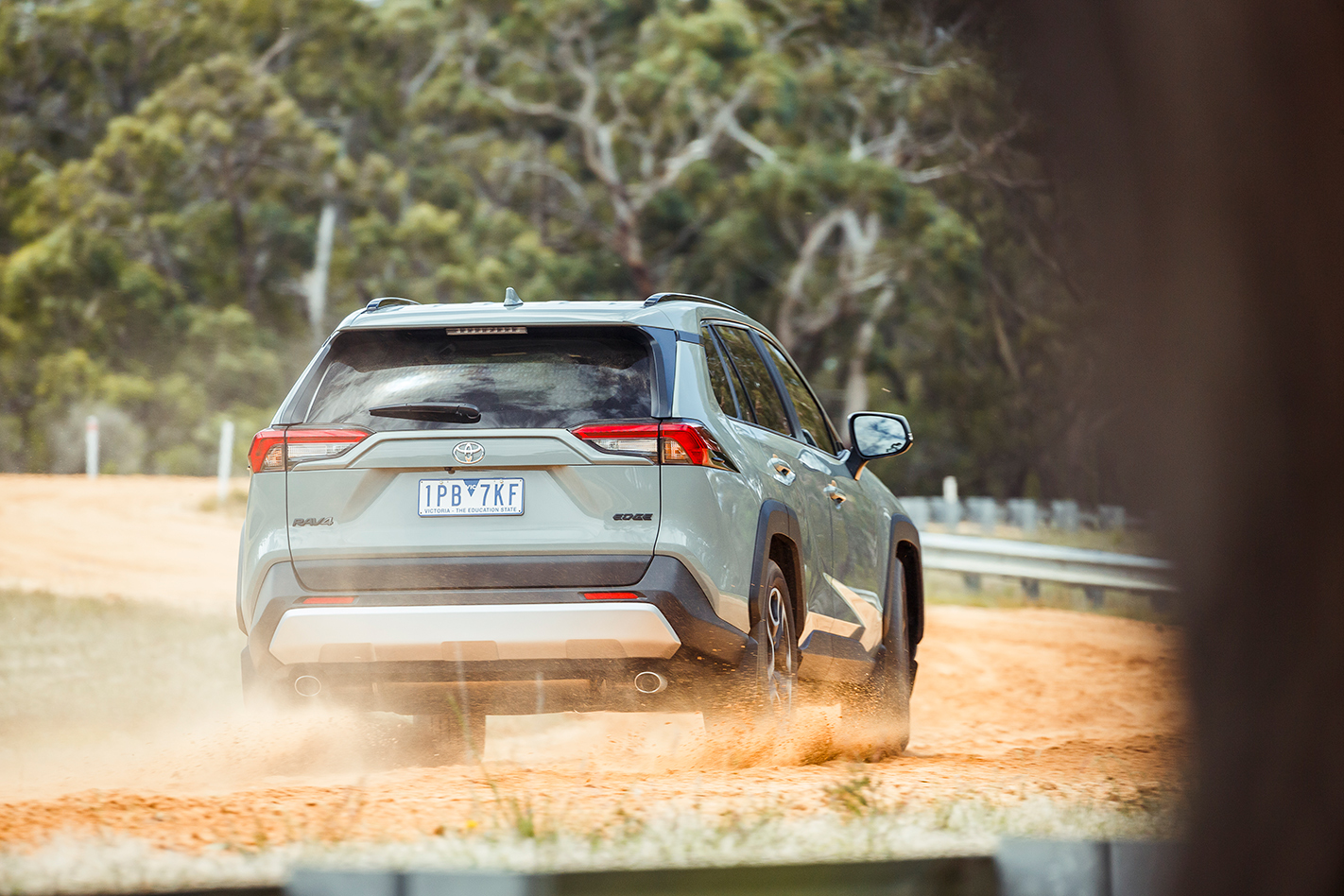
Against expectations, the weakest powertrain is the 152kW/243Nm 2.5-litre atmo four in the aforementioned Edge. It employs a conventional eight-speed auto to drive its mechanical AWD system, which sounds like the best combination in theory, but the heavier Edge has neither the mid-range brawn of the hybrid nor the sparkling vigour of its 2.0-litre sibling. Considering its $48K pricing, we’re struggling to see where the Edge’s value lies. At least the plastic orange detailing and Matchbox car-style alloys stand out.
Not so good is the ESC calibration on all RAV4s. Though ultimately effective, the electronic nannies interfere with a heavy hand. The low-friction Bridgestone Alenza tyres (on everything except the Edge) aren’t ideal for low-grip surfaces, yet they pull up with exemplary haste in the dry. They’re susceptible to coarse-surface road roar, however, which almost drowns out the wind noise coming from the hefty door mirrors.
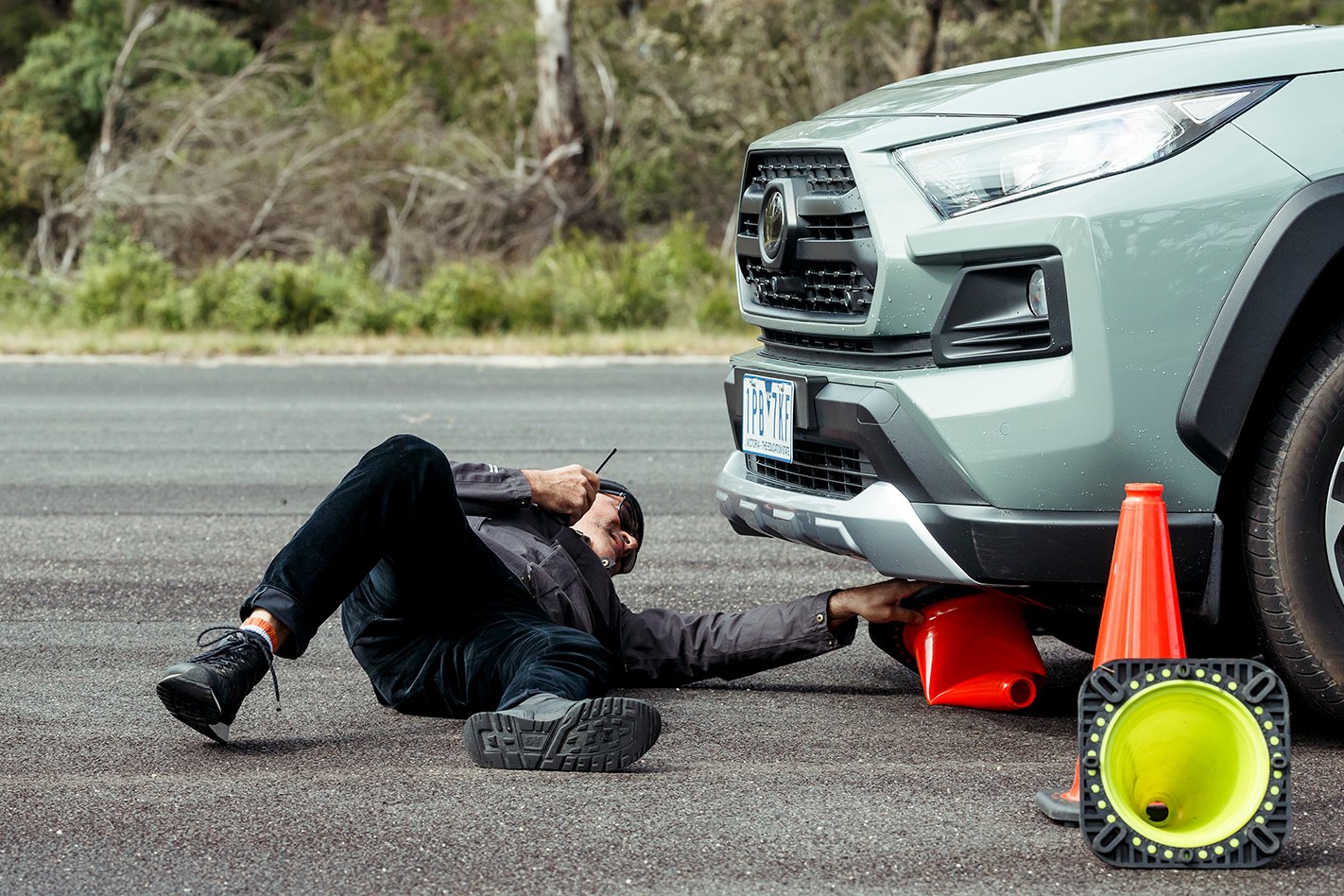
While far from perfect, the new RAV4 represents a stunning comeback. Exceptional packaging, fluent dynamics, impressive safety and, most laudably, the widespread availability of hybrid tech ensures that few cars can touch the Toyota for value.
The reborn RAV4’s journey ends here. But what a turn-around.
THE JUDGES’ COTY SCORECARD
Function: 3.4
Efficiency: 3.8
Safety: 3.2
Technology: 3.5
Value: 3.9
TOYOTA RAV4 SPECS
BODY
Type: 5-door SUV, 5 seats
Boot capacity: 580L
Weight: 1515 – 1745kg
DRIVETRAIN
Layout: Front-engine (east-west), FWD/AWD
Engines: 1987cc 4cyl (127kW/203Nm); 2487cc 4cyl (152kW/243Nm); 2487cc 4cyl (131kW/221Nm); + front electric motor (88kW/202Nm); + rear electric motor (40kW/121Nm);
Transmissions: 6-speed manual; CVT automatic; e-CVT automatic; 8-speed automatic
OTHER
Tyres: 225/65R17 – 235/55R19
ADR81 fuel consumption: 4.7 – 7.3L/100km
CO2 emissions: 135 – 199g/km
Crash rating: 5 stars (ANCAP)
Prices: $30,990 – $47,490
This week on WhichCar TV, Dan Gardner and Emma Notarfrancesco take the road less travelled – well, by the likes of normal people, anyone – as they venture into the ultra-rarefied air that surrounds one of the most luxurious cars on the road, the Rolls Royce Wraith Black Badge.
And yes, of course there are kebabs involved. What are we… savages?
Episode two will also peel back the foil lid on arguably the most comprehensive car assessment program in the country, Wheel’s Car of Year.
Revealed in all its lounge suit/cocktail dress glory at the recent Australian Motoring Awards, Car of the Year is a week-long deep dive into exactly what makes a car worthy of the most prestigious prize in Aussie motoring.
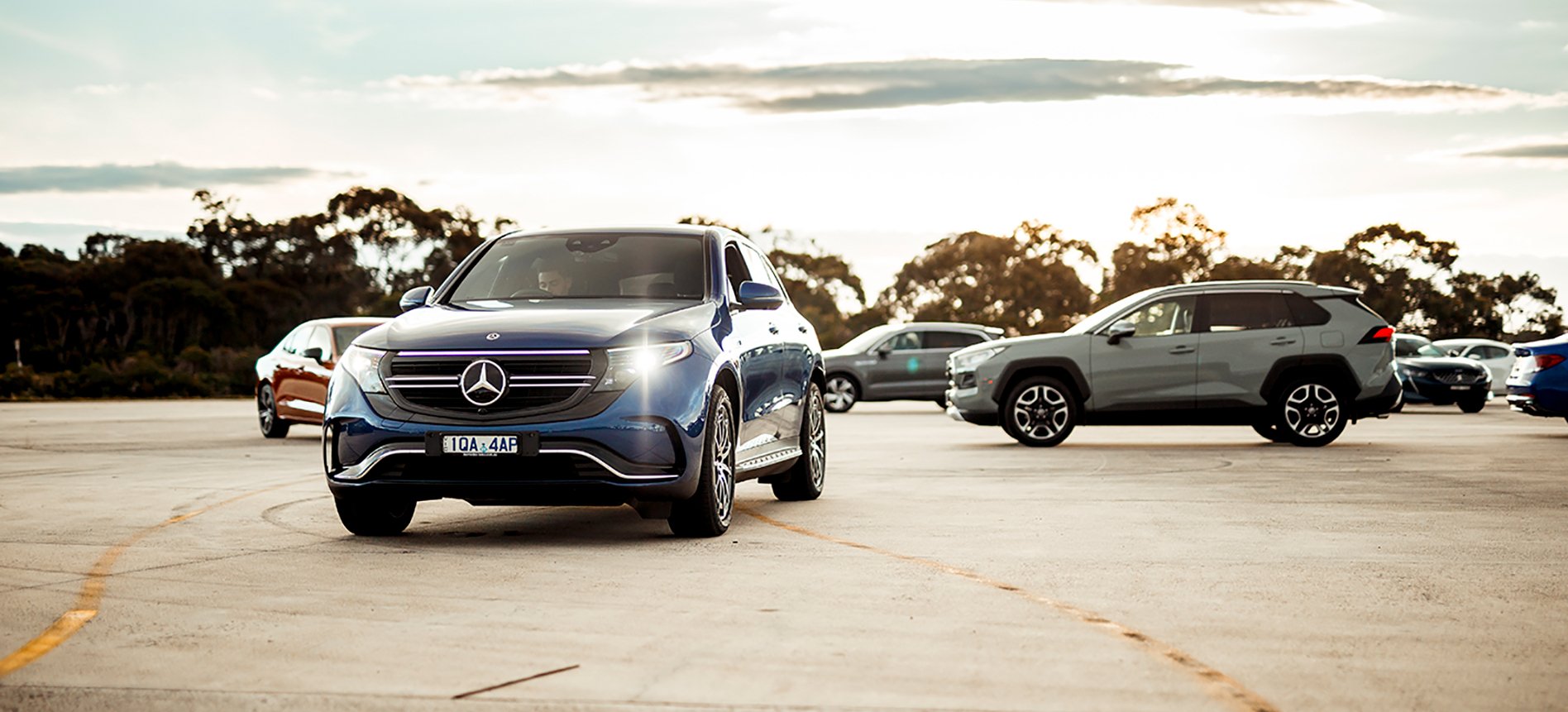
There are smiles, there are quarrels. There is dust, and there is smoke. And at the end of it all, only one car can stand tall as the 2020 Wheels Car of the Year.
There’s our new Continental Car Lab section, too, which aims to bust some of the enduring fables permeating in the automotive world. This week, Dan answers the age-old question… can you go faster in forward gear or reverse?
For season two, we’re also offering an amazing prize for our viewers. How does a trip to the Maldives sound? Pretty awesome, right? The competition is open NOW so make sure you tune into WhichCar TV on Channel Ten at 4pm AEDT.
And, if for some reason you can’t (and it had better be a good reason!) then there’s a host of ways to catch up on the show, check out behind-the-scenes stuff and find out more about the cars Aussies want to buy.
For example, our weekly podcast, our Facebook page and our YouTube channel are standing by 24/7.
WHAT
WhichCar TV episode two
WHEN
4pm Sunday February 2
WHERE
Channel 10
FIND THE HOSTS ON INSTAGRAM
Daniel Gardner (@octanedan)
Emma Notarfrancesco (@emmanotarfrancesco)
Alex Inwood (@clutchkickalx)
MISSED THE SHOW?
Sixteen years ago, Australia fell hard for the Mazda 3. More than just a sales success, it joined the Toyota RAV4 SUV in embodying the changing landscape of Australian motoring – one that would swiftly ensure the glory days of the Holden Commodore and Ford Falcon were numbered. Such transformative cars don’t come along very often.
However, our relationship with the 3 has been complicated. While each evolution – from the Ford Focus-based BK original to the wholly Mazda-engineered ‘SkyActiv’ BM series of 2014 – brought specification and safety improvements, abundant noise and refinement issues always undermined it. Four generations on, though, Hiroshima is finally listening. Benchmarking the class-redefining Volkswagen Golf, Mazda claims the latest 3 delivers a profoundly quieter, higher-quality, lighter yet stronger, more engaging, safer and more advanced proposition. In emulating the Germans, the 3 has moved upmarket: the old base Neo is gone, bumping up the entry price by $4000.
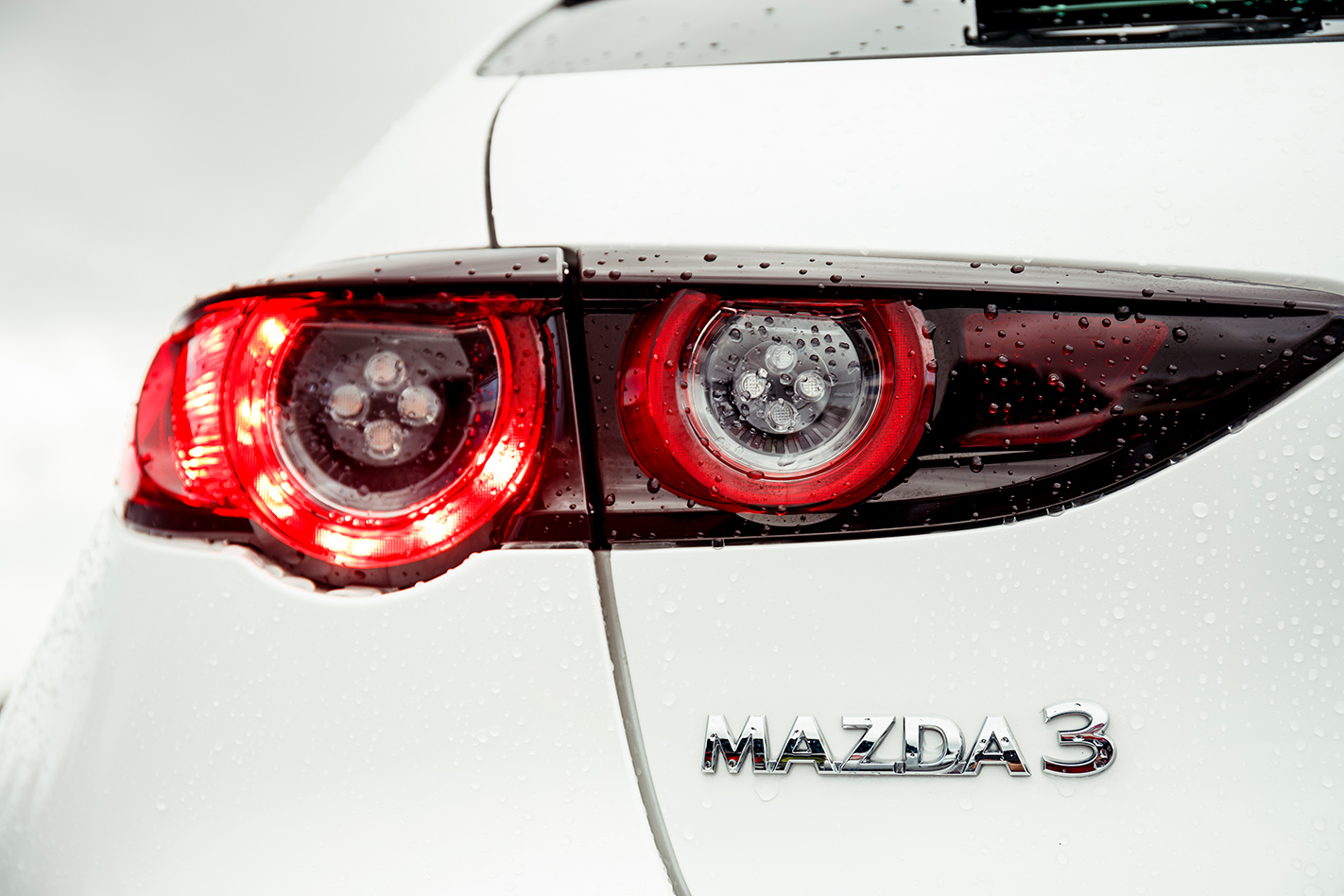
Still, even in much more expensive company on COTY, you can see where the 3’s value lies. Whether talking about the sculpted hatchback or suave sedan, Mazda’s exterior surfacing is first class. Obsessive detailing permeates many of the touchpoints inside, from the wheel to the gorgeous instruments. However, functionality issues do arise. The five-door’s sloping roofline and small back-door apertures hindered entry and egress for our taller judges while the shallow window line hurts vision out. And the hatch’s cargo space is a disappointing 295 litres. That’s 40 litres less than that of the smaller Audi A1.
Has chasing refinement come at a cost in other areas? Let’s start with the elephant in the room – the decision to ditch the multi-link rear suspension. Said to cut noise paths and improve coming electrification packaging, it’s true that the 3 no longer aurally assaults with incessant interior noise. Our decibel tests show the sedan in particular now nearly matches some premium fare. Some bumps do break through the newfound quietude, especially over craggy lower-speed surfaces, but with reduced ride jitteriness. Peugeot’s 308 is cited as the inspiration for how to make a torsion beam back-end work. There’s also pleasing progress at the pointy end, too, thanks to the beautifully positive and tactile steering tune which helps get the best from the precise, fluid handling. “Lovingly polished dynamics,” as one judge summed it up.
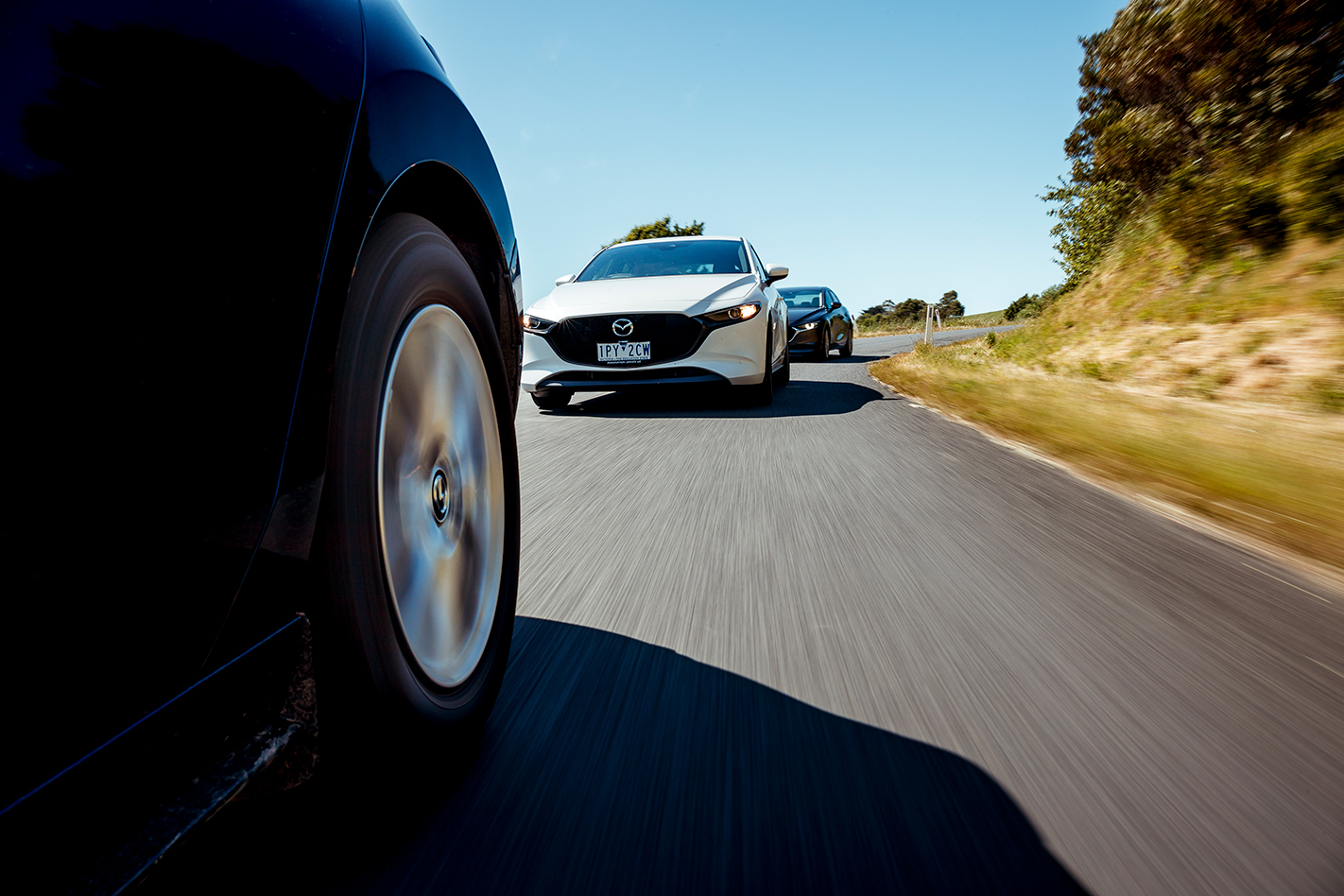
However, they were less enthusiastic about the 3’s engines. The largely carryover 2.0-litre can feel sleepy at first, even lazy (at Lang Lang no petrol car was more lethargic), and needs plenty of noisy, boomy revs to really wake up. In the six-speed auto, ‘Sport’ holds each gear for what seems like an eternity but the manual mode (with a correct pull-back upshift/push forward downshift) reveals the 3’s true sporty intentions.
The 2.5-litre performed better, drawing from a deeper well of torque, making it considerably more relaxed and responsive across the board. With four passengers, the G25 will actually lope along effortlessly. No big technological leaps forward mechanically, then, but effective nonetheless, especially away from the proving ground. If only the promised SkyActiv-X supercharged compression-ignition combustion engine had been here to match the chassis advancements.

Mazda has delivered a mainstream small car that is richer and more rewarding than more expensive premium alternatives, including the Mercedes-Benz A-Class. The 3 has come of age at last. But it doesn’t represent a leap forward against the Golf 7.5 which, we have to note, it now matches in price. In any other year, Mazda’s sweet 16-year-old nameplate might have entered the winner’s circle, but for the new decade, a model with greater vision, scope and inspiration has stepped up instead.
THE JUDGE’S SCORECARD
Function: 3.6
Efficiency: 3.1
Safety: 3.4
Technology: 2.9
Value: 3.6

MAZDA 3 SPECS
BODY
Type: 4-door sedan / 5-door hatch; 5 seats
Boot capacity: 295 – 444L
Weight: 1316 – 1388kg
DRIVETRAIN
Layout: Front-engine (east-west), FWD
Engines: 1998cc 4cyl petrol (114kW/200Nm); 2488cc 4cyl petrol (139kW/252Nm)
Transmissions: 6-speed manual; 6-speed automatic
OTHER
Tyres: 205/60R16 – 215/45R18
ADR81 fuel consumption: 6.1 – 6.6L/100km
CO2 emissions: 146 – 154g/km
Crash rating: 5 stars (ANCAP)
PRICES
$25,240 – $38,240
Those interested in the superbly engineered but excruciatingly titled Bentayga now have another variant to consider, the Bentayga Speed.
All the hallmarks of a modern Bentley Speed model are there, such as increased power from the W12 engine (up from 447kW to 467kW) and a honed chassis tune, including firmer suspension and new settings in Sport mode that sharpen up the mapping for the engine, transmission and innovative 48-volt active roll control system. Carbon-ceramic brakes are available too.
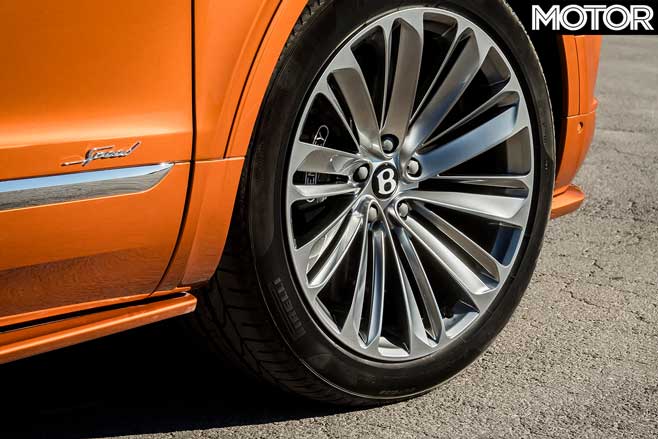
Visually, you will probably notice the tail spoiler first, which brings some presence but only at the price of making an already ugly exterior uglier still. But there are also smoked headlights, body-coloured side skirts, bespoke (and massive) 22-inch rims, a darkened grille and Speed badging.
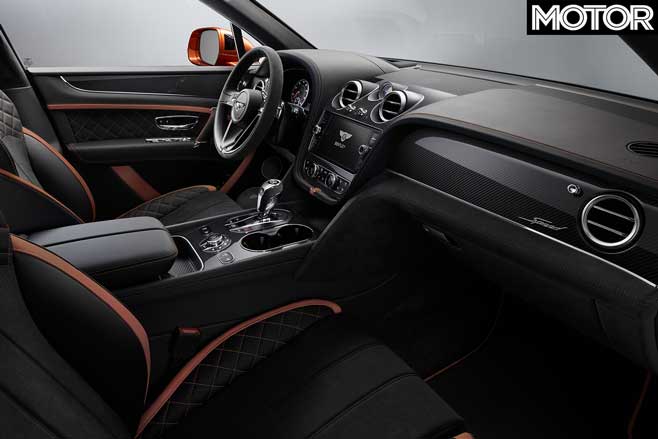
Meanwhile, the interior has been turned into a suede fetishist’s delight with all the Alcantara that has landed therein. It really shouldn’t work at all in such a car but somehow it does, and really well. Anyway, if you don’t like it, Bentley will do yours with leather at no extra cost.
Talking of which, the Bentayga Speed lobs in Australia with a price of $491,000, a fair old step up from the previous range-topper, the $427,300 Bentayga W12 that continues with the less-powerful engine spec.
If you like this kind of car, and I concede that’s a mighty big ‘if’, you will likely love the Bentayga Speed. Forget the claim that it’s the world’s fastest SUV unless you consider a top speed 1km/h higher than that of the Lamborghini Urus a deal sealer. Nor should you concern yourself with its 3.9sec 0-100km/h time because it’s a scant tenth quicker than the non-Speed Bentayga, which was already plenty quick enough for a car weighing the same as a couple of base-spec VW Golfs.
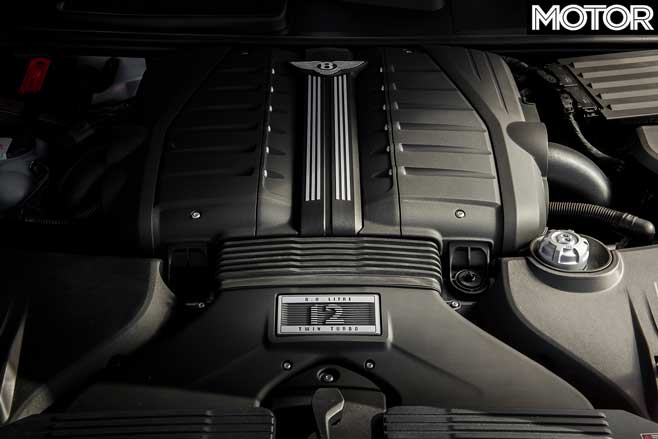
Instead, feel the performance: yes, the Speed now has the same engine that the non-Speed Continental GT has had all along (how confusing is that going to be when the actual Conti Speed turns up?), but it’s a wonderful motor, with a thundering voice and a bellyful of torque.
Finally, Bentley’s modern 12-cylinder engine is starting to acquire the same level of character as its ancient pushrod V8, and the Bentayga is all the better both for it, as well as the exceptionally deft interactions with its ZF gearbox.
The suspension changes are all for the good too. The firmer settings have done no harm to the Bentayga’s always peachy ride quality and some might find they even prefer an additional degree of body control given how much body there is in need of controlling.
Best of all, Bentley’s engineers have settled for merely a slightly sporting feel, which fits very well the character of both the car and the company.
This is no sports car and nor does it try to be, yet it handles far better than anyone has a right to expect.
If you’re not into big, expensive and luxurious SUVs, not only will the Bentayga Speed fail to change your mind but it will also more likely entrench your position.
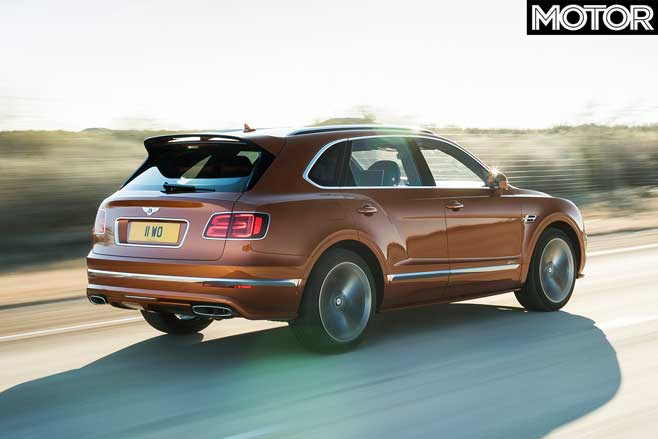
If you are so inclined, however, be advised that you can judge for yourself the worst aspects of this car simply by looking at these pages. If you can face or even like its appearance, and if you don’t mind driving a car called a Bentley Bentayga, the rest of the news is entirely good – apart, of course, when you have to drop another hundred dollars of unleaded into it, which will be quite often.
While Bentley is still struggling to get its head around what kind of style to present to the outside world, the substance is better than ever.
Of course, the Bentayga comes from the same stock as the Audi Q8, Urus and Porsche Cayenne, but the virtue of a meal lies not only in its ingredients but also the skill of the chef. And the truth is, this strong, silent, comfortable and cosseting big Bentley is as good an example of its art as exists out there at present.
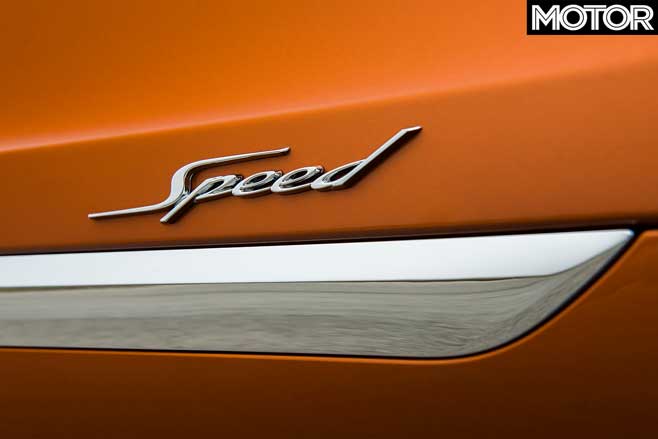
BENTLEY BENTAYGA SPEED SPECS Engine: 5950cc W12, DOHC, 48v, twin-turbo Power: 467kW @ 5000rpm Torque: 900Nm @ 1750-4500rpm Weight: 2515kg 0-100km/h: 3.9sec (claimed) Price: $491,000
Likes: Thundering 12-cylinder engine; sharpened chassis; high level of luxury; transmission Dislikes: Even less attractive than the regular model; massive weight; fuel consumption
Rating: 4 out of 5 stars
I’m guessing it was restless nights all round as Australia sweated through an oppressively hot Friday and a very stuffy sleep last night. I for one slept like a log – so kind of you to ask – still recovering from a few whiskeys too many at the AMAs after-party on Thursday night. Some hangovers, though, are worth it.
MORE Huge red-carpet gallery from the AMAs
What an incredible night it was, too, as the Australian Car Industry gathered to celebrate its Automotive Oscars. More than 260 industry and agency heavyweights enjoyed the gala event hosted by the mighty WhichCar Network as we revealed the winners of Australia’s most coveted new car awards.
The industry’s esteem for the Australian Motoring Awards was on show all night, and if you were one of the seven guests rude enough to do a no-show – we know exactly who you are – then not only did your mother not raise you well, you missed out. Big time!
The night started in the Victoria Pavilion’s soaring Atrium Bar (air-conditioned of course) surrounded by heritage cars like the doughty Willys Jeep, the stunning 993-series Porsche 911 Turbo, the 1960s classic Renault R8 and one very sultry Alfa Romeo 4C – all inaugural winners of each publication’s top award.
The best of the industry, all in one room. Nobody does it like Bauer
Once guests had replenished liquids lost to the 39-degree day outside, grazed on canapes, wandered through the FCAI’s Future of Mobility display, and caught up with industry colleagues, it was through to the Victoria Pavilion proper where the night’s festivities quickly got underway.
I’ll not bore you with a blow by blow of the night; if you were there you saw it all, and if you were not, then you can see it in cinemascope brilliance right here, because we filmed it for an upcoming episode of WhichCar TV on Channel Ten. Studio Ten were there and captured the proceedings too: check it out.
Suffice to say four car brands shared the silverware on the night, Jeep’s Wrangler taking out the 4X4 of the Year, Porsche’s 911 won Performance Car of the Year, the Tesla Model 3 won Australia’s Coolest New Car, and the Mercedes-Benz EQC won the Wheels Car of the Year.
Mercedes-Benz EQC takes out COTY, one of two all-electric winners at the AMAs. Sign of the times?
I’m sorry to report there was no bad behaviour on the night. There was also nobody from Holden, MG or Suzuki in attendance. I’m not saying those two things are linked.
I’d like to end with a word of thanks. The WhichCar Network is honoured to host the Industry’s Night of Nights, and we are humbled by the strong support the industry shows through its attendance on the night and our ongoing relationship throughout the year.
Thanks again to everybody who joined us, and to our partners Continental, FCAI, DiDi and Calibre, who helped to make the 2020 Australian Motoring Awards such a fantastic event. I for one had an absolute ball and I trust you did too. Let’s do it all again next year, only bigger!
Stay safe, and we’ll see you next week!
Glenn Butler Editor
The winners…
2020 Wheels Car of the Year
2020 WhichCar Style Award winner
The 2020 4×4 Of The Year is…
It’s the 2020 Motor Performance Car of the Year!
Considering talk that the RACV is pushing for Victoria to follow in the footsteps of its New South Wales neighbours regarding passing distances for cyclists, we got thinking about some road rules that might catch you unawares. If you haven’t heard, motorists must be at least one metre away from a cyclist when passing, and 1.5 metres when exceeding 60km/h. While this may not always seem possible (there’s not a lot of room on our roads as it is) the legislation does permit drivers to cross the centre dividing line or drive on a flat dividing strip, if it is safe to do so.
You’re stuck at the front of the traffic lights during peak hour and suddenly you hear a siren creeping up behind you. An ambulance is trying to get past, so you creep forward through the red light to give them space to get through. You’re doing the right thing, right? WRONG! This is actually illegal, though you probably won’t get booked because emergency services are in a hurry. But if you cause an accident or activate a red-light camera, you’re at fault.
On the flipside of that, if you don’t get out that way of the emergency service vehicle, you’re also in trouble. Ouch.
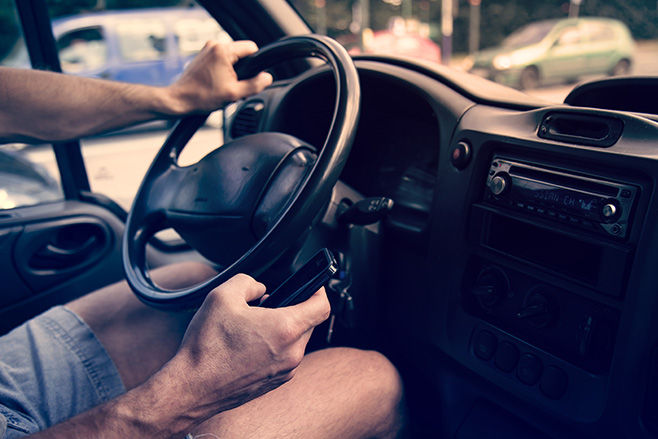
By now, we’re all very aware that using a phone while driving is illegal and carries hefty consequences. But did you know that even just touching your phone or holding it in your lap while driving is illegal? The laws vary between states: in NSW, you can use your phone while the car is parked securely with the engine running; in Victoria, your car must be off and the keys out of the ignition.
You’ve grabbed a banana for breakfast as you’re running out the door. You finish it in your car and have nowhere to put it, so, naturally, the best place for it is surely out the window and into a garden bed so it can break down. Well, we suggest you get a bin for your car, because throwing anything out the window is illegal.
If you get caught reversing down a one way street, you’re in for a bit of trouble. Just because the nose of your car is facing forward, doesn’t mean you’re not travelling in the wrong direction.
Fog lights are not to be used at any other time outside of fog or low-visibility weather.
And, contrary to popular belief, running a yellow light is not okay by the law. If it is deemed you had enough time to stop before the light turned red, then you can be booked and the consequence is equal to that of running a red.
Here in Australia, we like to drive with the windows down and our elbows resting on the seal. We also like to wave to our friends and neighbours as we’re driving away. But this needs to stop, you guys. It’s illegal to have any part of the body outside of the car at any time while driving. So either keep it inside, or start using that air-con.
On that note, if you’re beeping your horn for any other reason than a warning, you could be facing a fine for “improper use of a horn”.
Ever been on a long road trip and needed a nap and reclined the seat while a passenger? Well, if you’re seatbelt doesn’t sit firmly across your body you may as well not be wearing one, according to the police.
You wouldn’t drive with kids on your lap, and the same applies for pets. Keep them on the floor or properly and safely restrained to prevent getting pulled over.
Did you know that driving barefoot is illegal, even though it can be quite beneficial in being able to feel the pedal!
Indicating is the law. Cars have the flashing lights for a reason. If you fail to indicate when merging or turning a corner and get caught, then you had better hope the police pulling you over aren’t having a bad day.
Did you know about all of these? If there’s any other road rules we’ve missed, leave them in the comments below and we’ll add them!
Wheels first drive review
Overall Rating

5 0 5
Plus & Minus
WHAT IS THE MERCEDES-BENZ GLB?
GLB is an all-new SUV from Mercedes-Benz. Intended to slot between GLA and GLC, the newcomer is actually very close to GLC size. Based on the second generation of the front- and all-wheel-drive MFA architecture, the GLB shares tech with the current A-Class and CLA.
WHY WE’RE TESTING IT
The international launch of the GLB in the south of Spain provided our first chance to get to know this seven-seat SUV.
THE WHEELS REVIEW
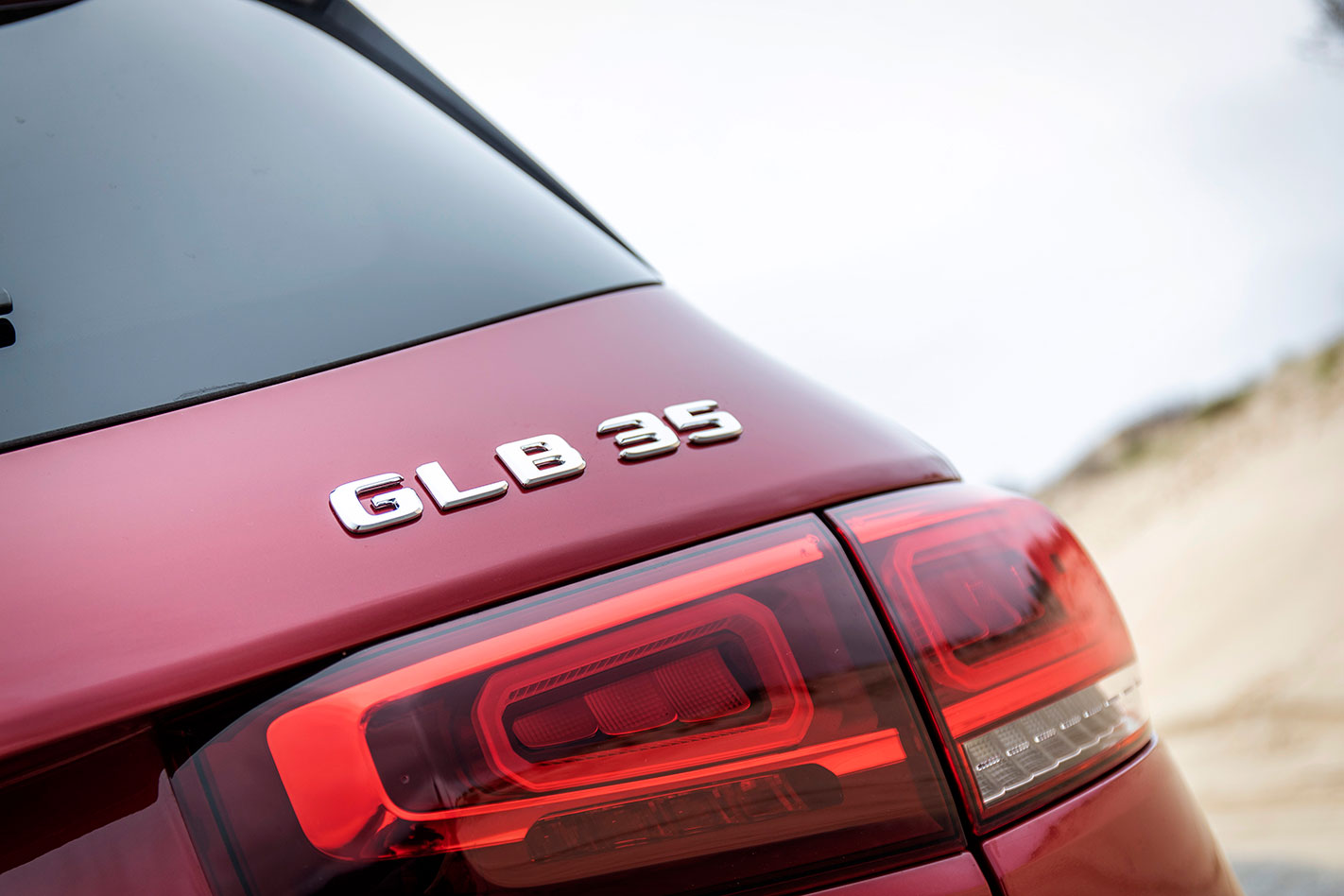
Few sporty SUVs are as well resolved as the GLB 35. Quick and clever, this compact all-wheel-drive wagon delivers a convincing combination of performance and practicality. That’s a rare achievement.
The Mercedes-AMG GLB 35 tops the GLB line-up, which will reach Australia around June or July next year. First to arrive will be the Mercedes-Benz GLB 250 4matic. This all-wheel-drive mid-range variant will be quickly joined by the base-grade front-drive GLB 200, and the GLB 35.
GLB, as the name suggests, is intended to fill the gap between Mercedes-Benz’s existing small GLA and medium GLC SUVs. But the newcomer isn’t a precise in-betweenie fit. While the GLB is built on the second generation of Stuttgart’s MFA architecture, same as the new A-Class and CLA, its wheelbase is a neat 10cm longer.
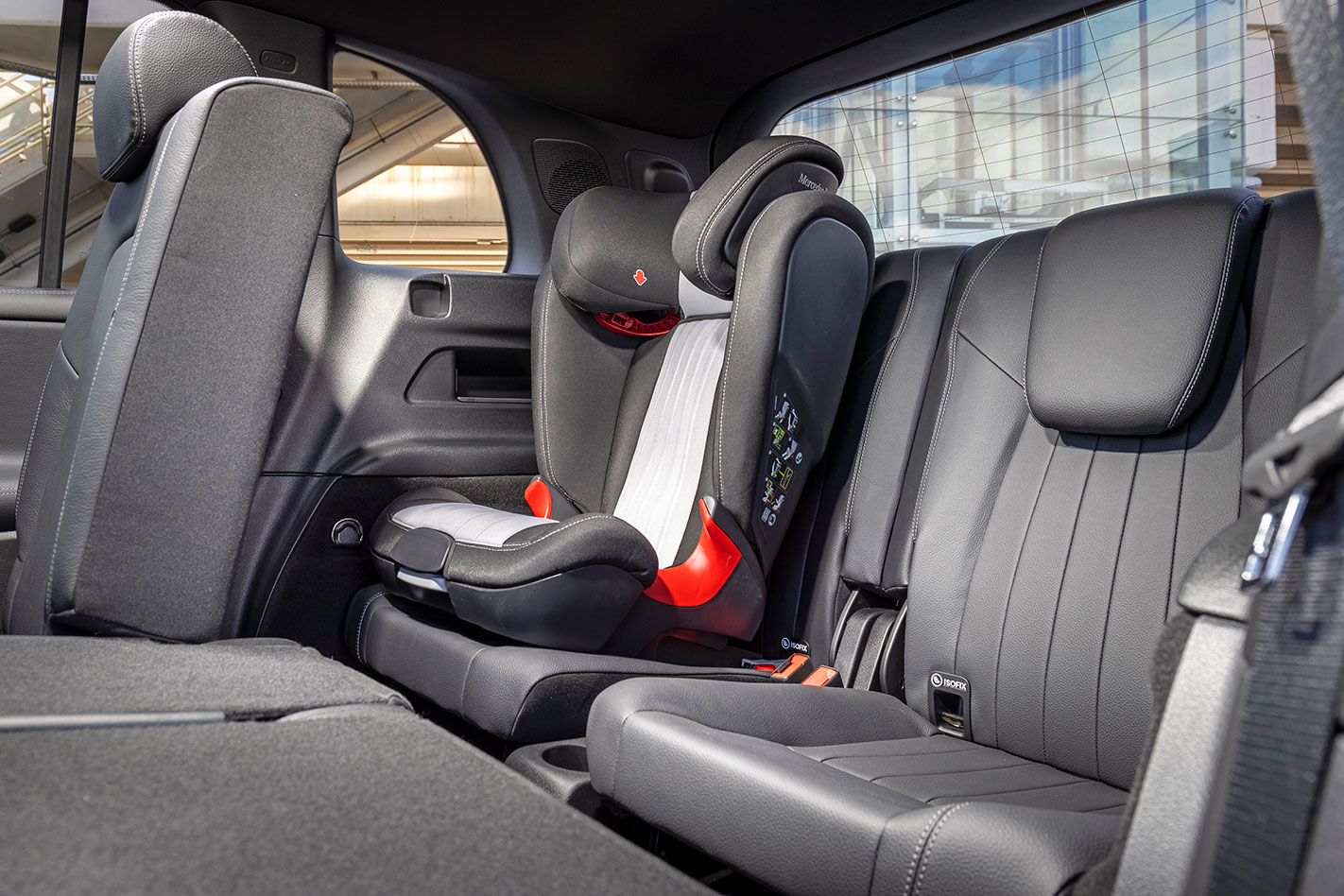
This means the GLB is close to the GLC for length and wheelbase, while standing taller. And it’s way bigger than the soon-to-be replaced GLA. The GLB is the size it is for a reason. The Chinese market expressed a strong desire that it should have seven seats, and Mercedes-Benz decided to give them what they wanted.
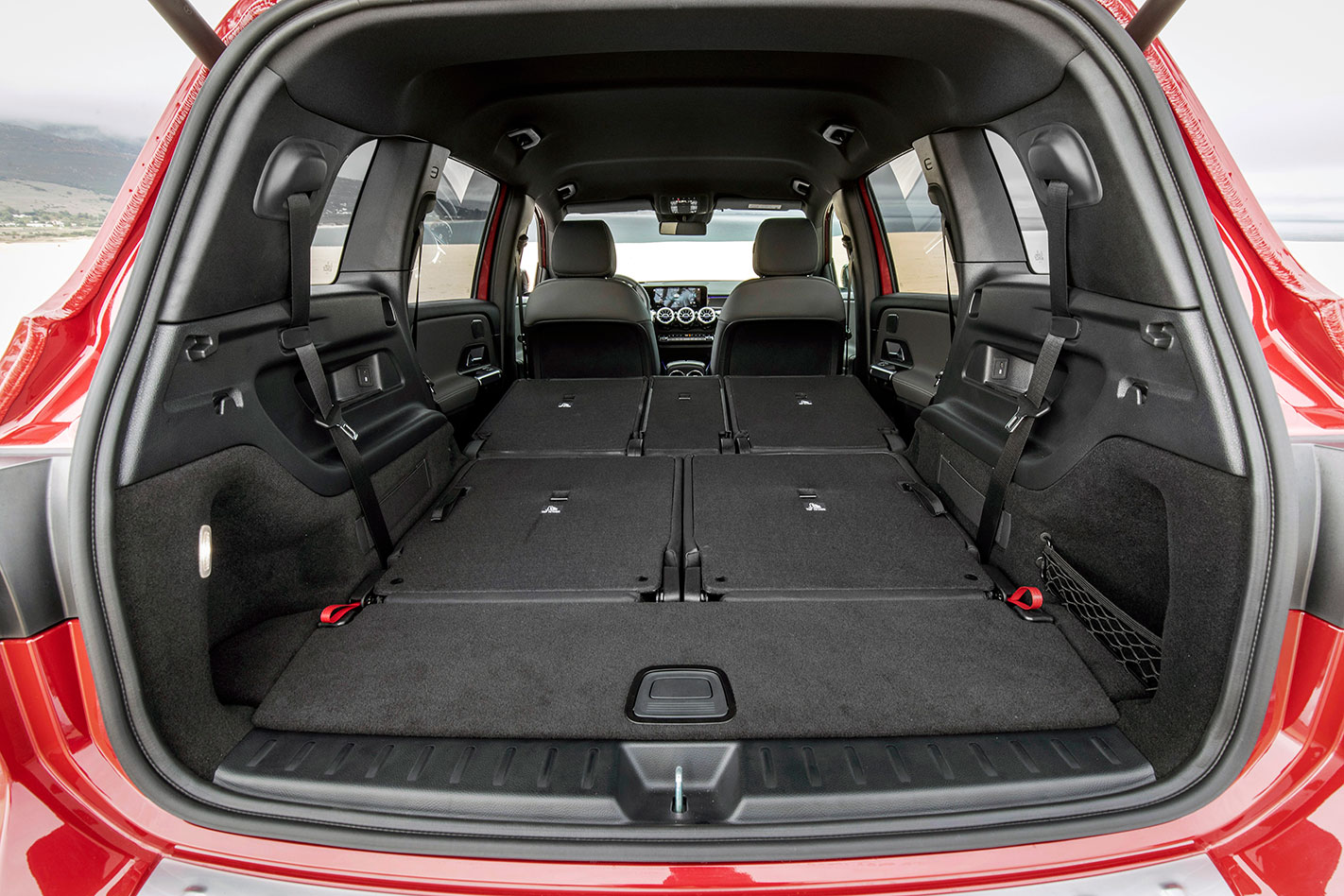
The individually folding pair of seats that make up the third row are not tiny and cramped. They will accommodate adults without a problem. With the seven-seat interior comes a centre bench with 140mm of fore-and-aft adjustment, plus extra curtain airbags. The backrest folding split is 40/20/40, while the slider mechanism divides the seat 60/40. The angle of the centre-row backrests is also adjustable.
While the GLB also will be built in five-seat form at Mercedes-Benz’s plant in Aguascalientes, Mexico, the seven-seat interior is likely standard across the range in Australia. With the local launch of the GLB so far off, Mercedes-Benz Australia is still some way from finalising details of specification and pricing.
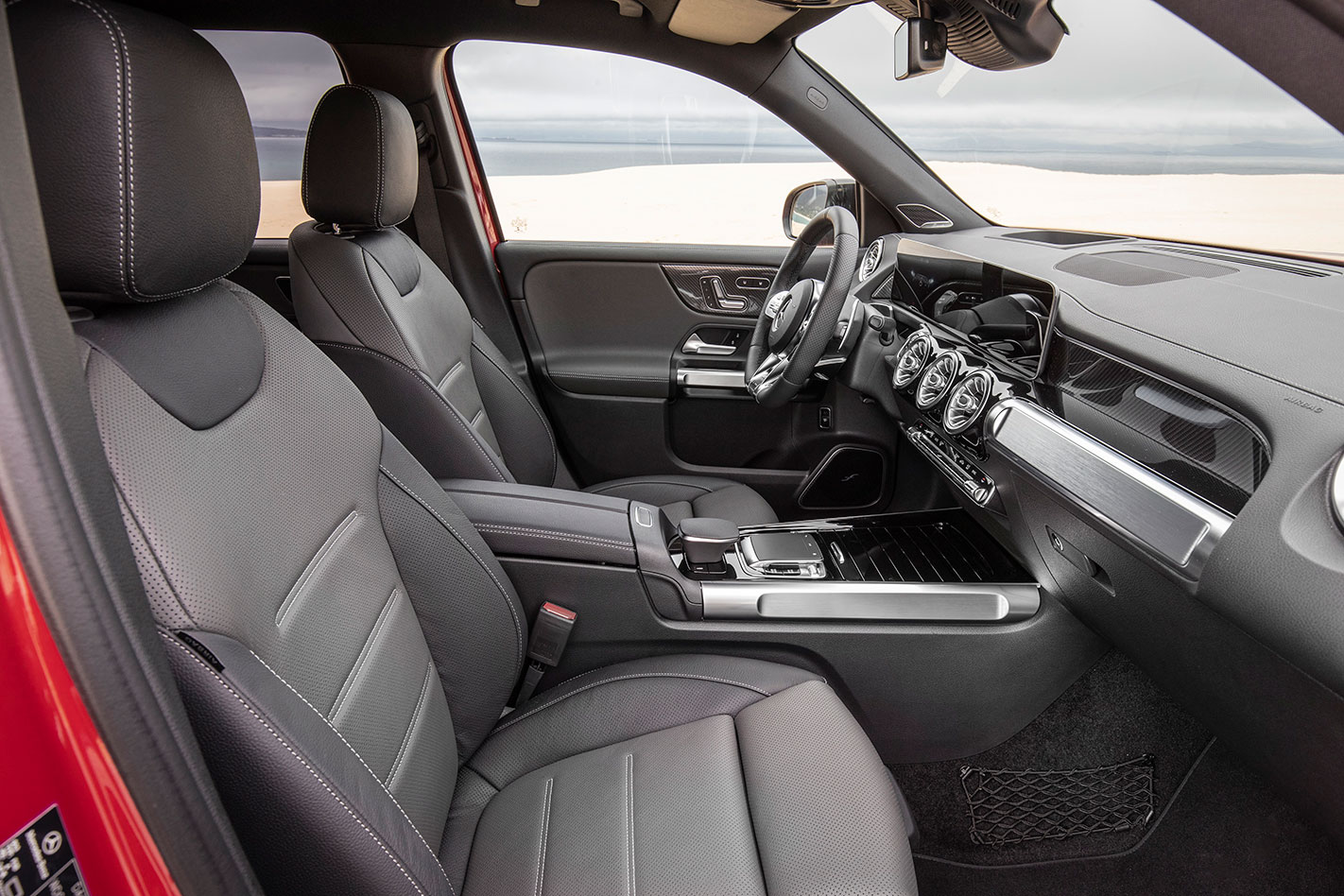
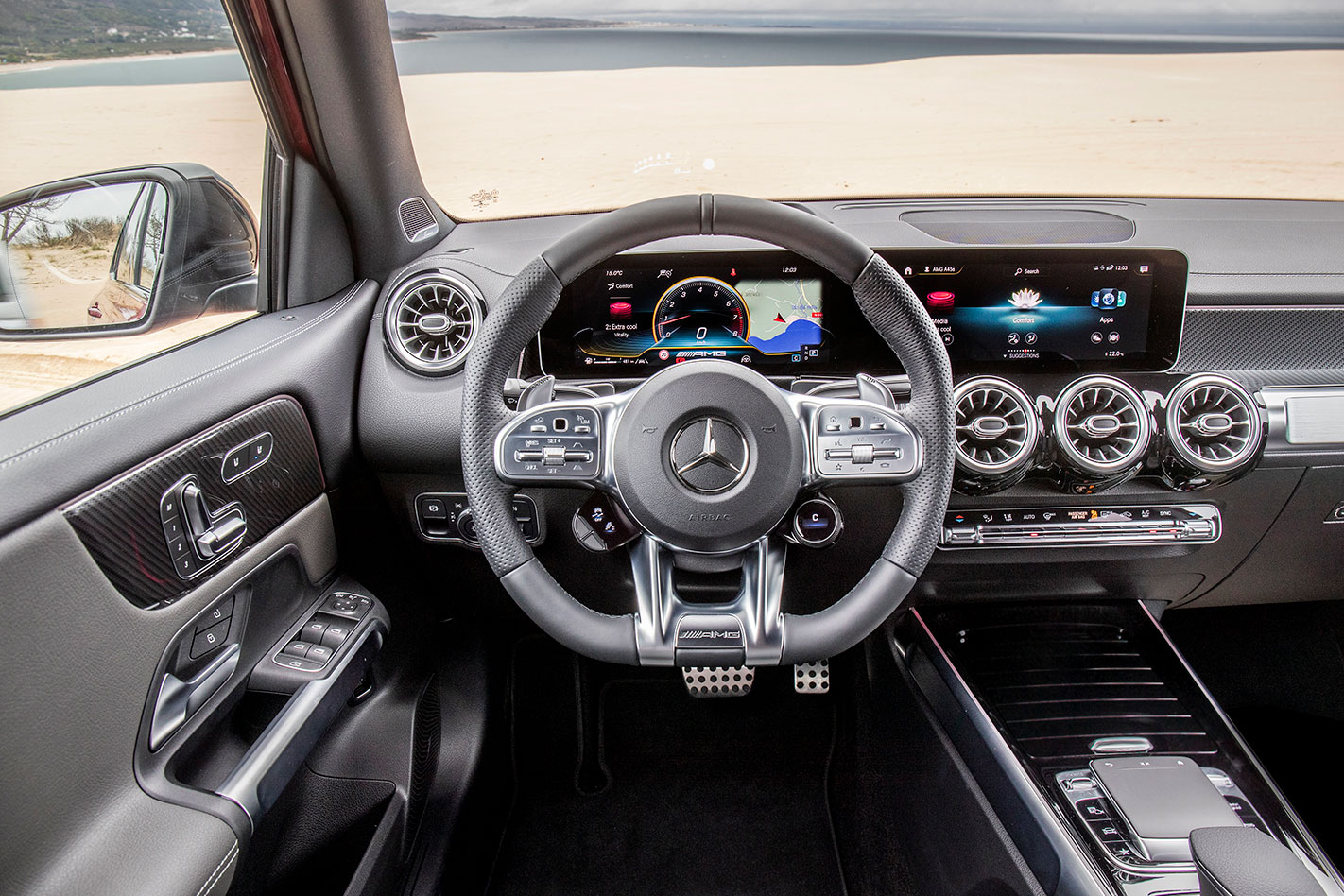
From the front seats the view contains both familiar and fresh elements. The widescreen display of instrumentation and infotainment won’t surprise anyone who has been inside a current A-Class, except the screen is set into a ledge carved into the chunky, SUV-style dash.
Making room for seven seats has rendered the exterior of the GLB a little boxy. The upright shape, with its deep windows, means visibility from the driver’s seat is better than average in this age of chubby pillars and swoopy rooflines.
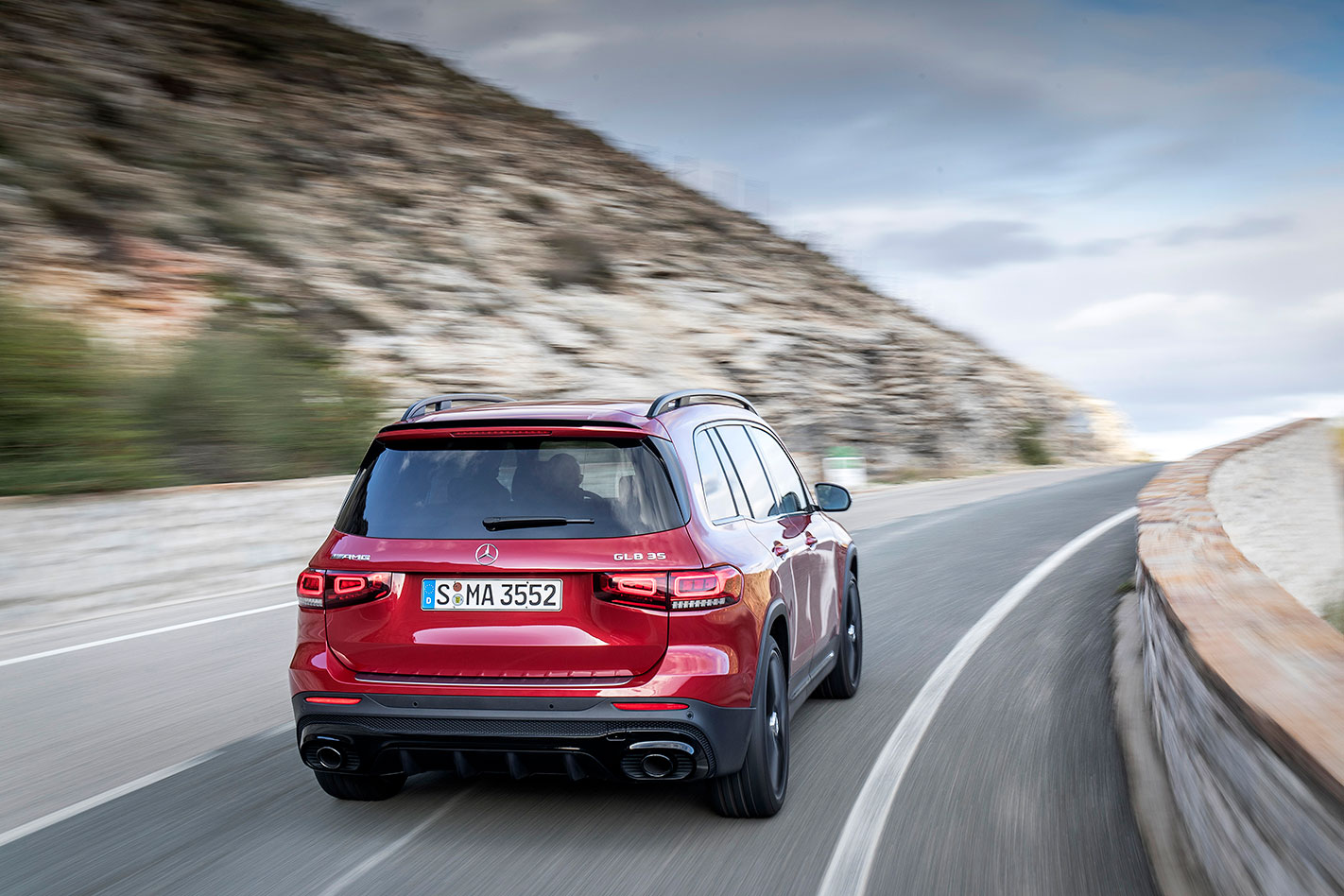
So the GLB is persuasively practical, but the real magic is in the way this new SUV drives.
Ride comfort was a priority during chassis development, in line with the GLB’s keep-the-whole-family-happy mission. The GLB 250 was superbly smooth on the lumpy roads of southern Spain, site of the international launch. The test cars were equipped with the adaptive dampers likely to be standard in the GLB 250 for Australia, and in Comfort mode the SUV has a soft, loping ride that’s only slightly degraded by switching to Sport mode.
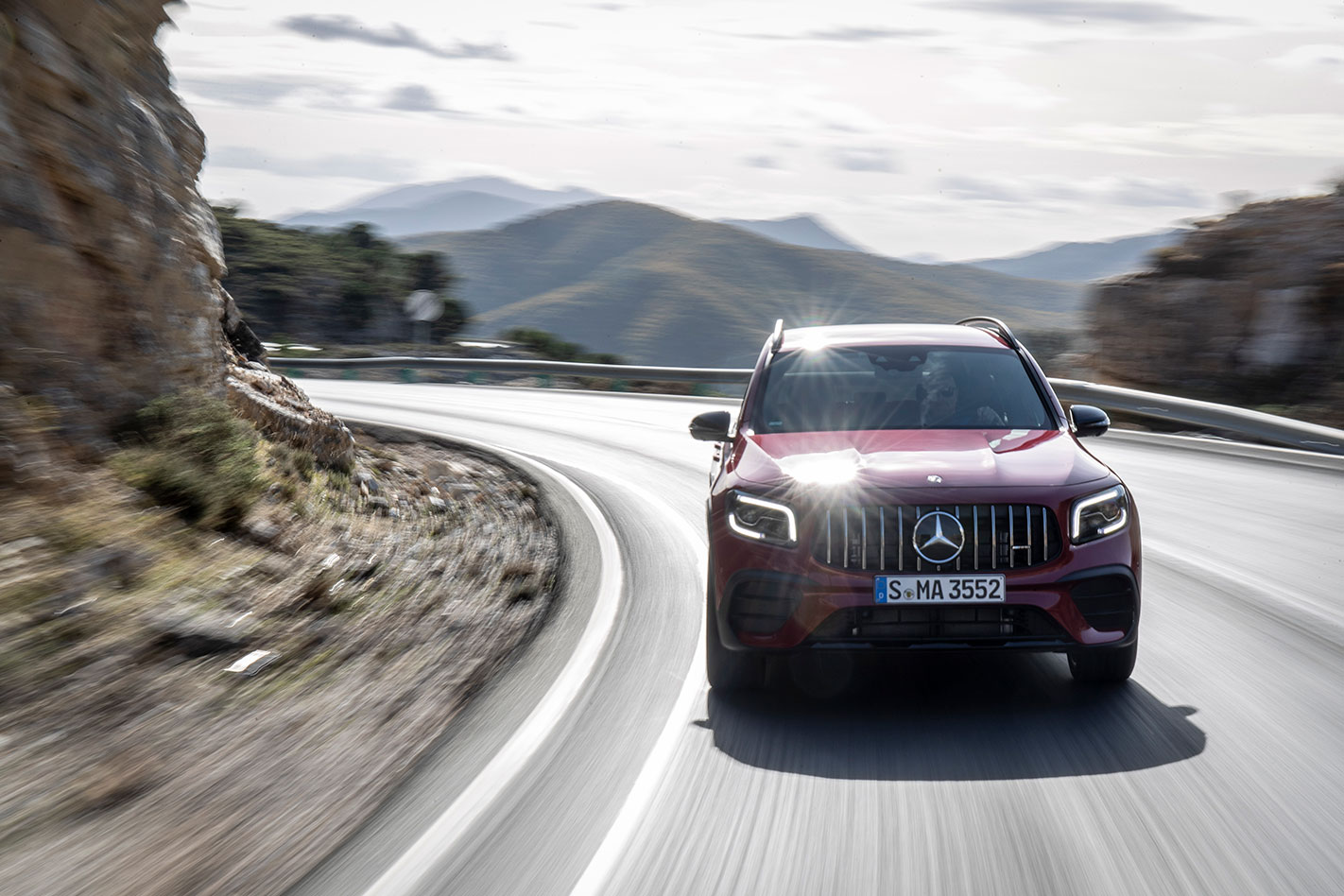
Work with the relaxed cadence of the suspension, and the GLB 250 reveals unexpected dynamic depths. Until the points at which understeer sets in, the Mercedes-Benz is a fluid and faithful handler. The steering lacks anything much in the way of feel, but the chassis can be counted on to deliver predictable responses.
Performance from the GLB 250’s 165kW 2.0-litre turbo four is way better than adequate for a family-focused SUV, but the software calibration of the eight-speed double-clutch transmission makes it indecisive at times.
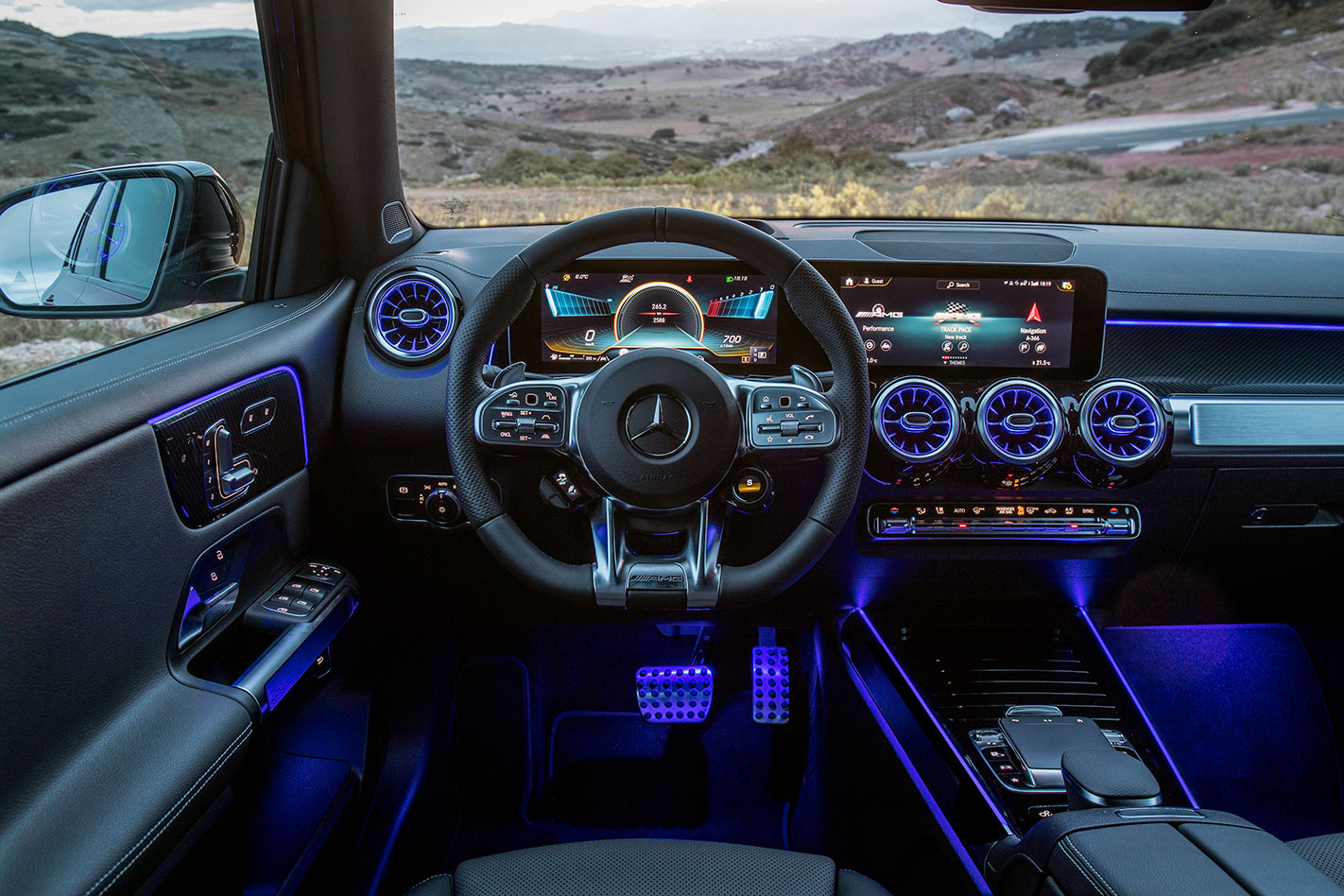
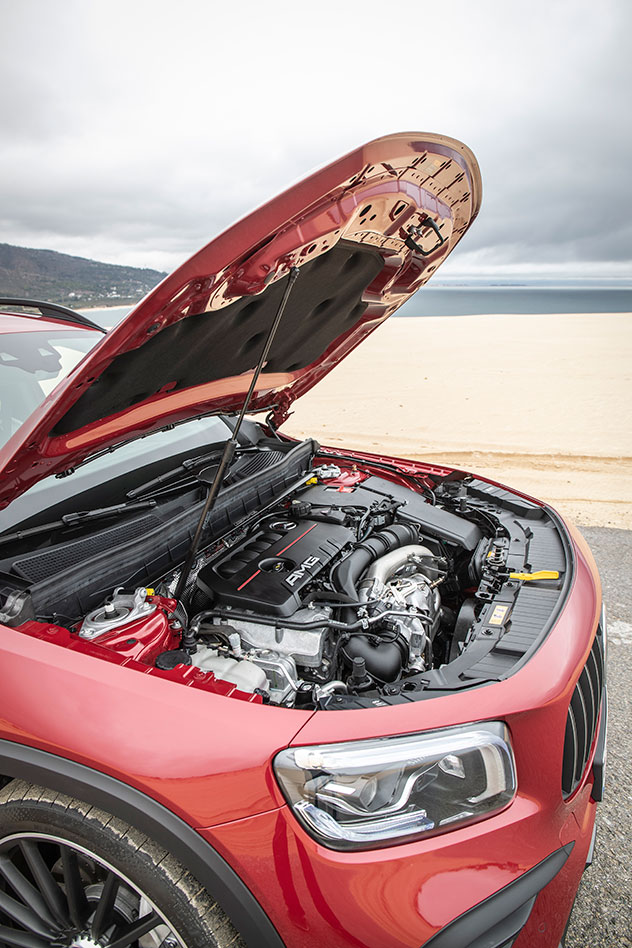
The Mercedes-AMG version amps up the GLB experience. The GLB 35’s 225kW 2.0-litre turbo four is basically the same engine as in the GLB 250, but AMG’s ministrations add a dose of intensity. The official 0-100km/h claim is a believable 5.2 seconds, which is a cracking pace for a seven-seat SUV.
More engineer love seems to have been given to the transmission calibration of the eight-speed double-clutch in the GLB 35; it’s much more likely to pick the right gear at the right time, though it’s still not flawless.
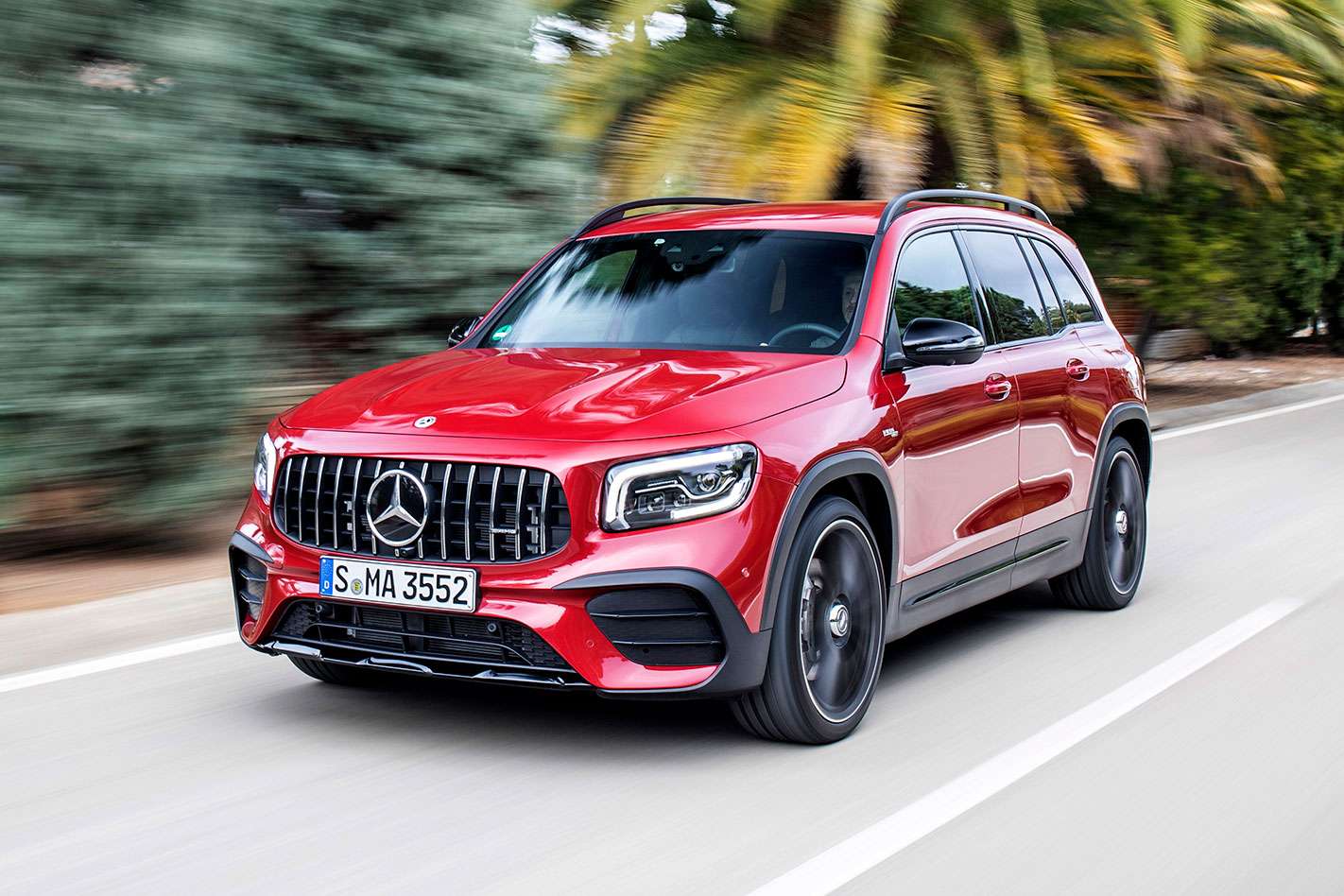
There’s a lot of AMG-specific hardware in both the front and the rear suspension of the GLB 35. Compared with the GLB 250 it has different steering knuckles, front suspension arms, rear wheel carriers and a direct-mounted rear suspension subframe. Bigger brakes front and rear are also fitted. But these changes don’t radically alter the dynamic character.
All GLB 35s at the launch event wore the biggest available rubber. The 21-inch tyres and the chassis upgrades deliver sharper steering and extra front-end bite. The wider contact patches also bring a noticeable increase in tyre noise, especially on coarse-surfaced roads.
Though it’s not as quiet and refined as the GLB 250 as a consequence, AMG’s changes to the GLB 35 do deliver the kind of stellar handling – for an SUV – they were undoubtedly aiming for. Even more impressive is that the GLB 35’s ride is also outstanding for a sporty SUV. Yes, the ride is firmer, but it’s nowhere near harsh. Even switching from Comfort to Sport mode of the standard adaptive suspension doesn’t turn the GLB 35 into a bucking disgrace.
On the subject of modes, the Mercedes-AMG offers a broader range of options than Mercedes-Benz-badged versions of the GLB. As well as the expected – in an AMG – Sport+ and pick’n’mix Individual modes, the GLB 35 has a new Slippery mode specially engineered for driving in low-grip conditions.
Sport+ was the natural choice for sinuous sections of the Spanish drive route. In this mode, the GLB 35 is a high-rise all-wheel-drive hot hatch. The AMG-programmed 4matic system does a great job of apportioning the engine’s hefty torque between the axles, and there’s next to no scrabbling or scrubbing.
While the steering is weighty, there’s not a great deal of road feel through the wheel. Still, the GLB 35’s responses to inputs are quick, accurate and reliable, and the big brakes don’t wilt under pressure.
Given the need to position the GLB between near-equivalent GLA and GLC models, smart guesses on price would be around $65,000 for the GLB 250 and about $85,000 for the GLB 35.
RIVALS
Land Rover Discovery Sport, Volkswagen Tiguan Allspace, Skoda Kodiaq
PRICE AND SPECS
Model: Mercedes-Benz GLB 35 4matic Engine: 1991cc 4cyl, dohc, 16v, turbo Max power: 225kW @ 5800-6100rpm Max torque: 400Nm @ 3000-4000rpm Transmission: 8-speed dual-clutch Weight: 1600kg 0-100km/h: 5.2sec Economy: 7.6L/100km Price: $85,000 (estimated) On sale: July 2020
Sign-up here to get the weekly Wheels highlights
Second Opinion: MOTOR feature review

Motor focuses exclusively on high-performance cars, offering a heart-stopping, hair-raising blast into the world of prestige and performance culture.
Yet another small performance SUV? Well, how does AMG’s newest stack up? By: James Disdale
These days, no self-respecting SUV line-up is complete without a high-performance halo model, and the Mercedes-AMG GLB35 is no exception.
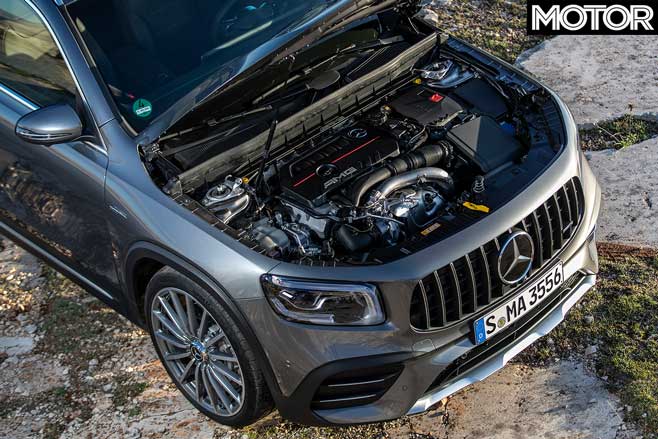
Thanks to its A-Class underpinnings, adding some spice to the GLB was a fairly straightforward process – the same 225kW turbocharged 2.0-litre four-cylinder engine and eight-speed dual-clutch auto found in the A35 hatchback, and a derivation of the familiar 4Matic four-wheel drive system, which in this instance can run a torque split from 100 per cent front-wheel drive to 50/50.
Significant suspension changes from the standard GLB include bespoke steering knuckles and control arms up front, and tougher rear hubs designed to take higher cornering loads. The springs and dampers are stiffer, while adaptive dampers are an option (fitted to our test car). There’s also new speed-sensitive electrically assisted steering and larger AMG brakes (350mm front and 330mm rear).
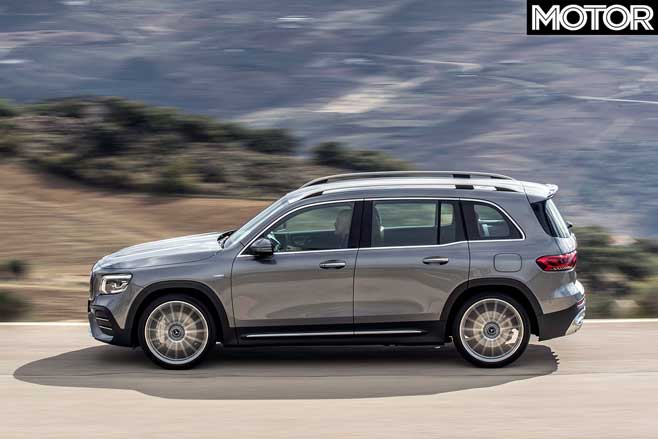
Externally are the usual AMG calling cards, including multi-spoke 19-inch alloy wheels (20s and 21s are available) and a bodykit that runs to a deeper front splitter, twin-exit exhausts, new rear bumper and prominent tailgate spoiler.
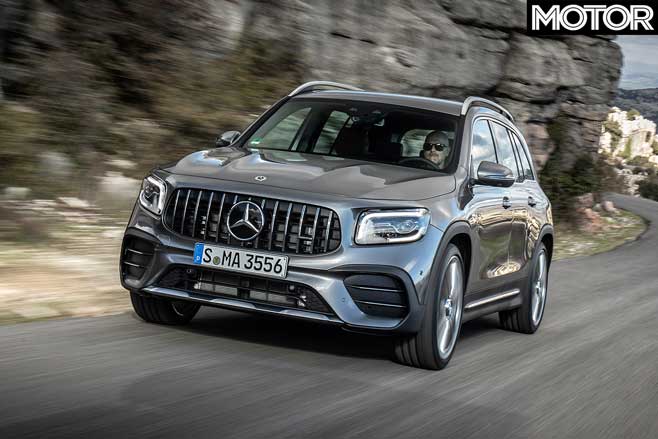
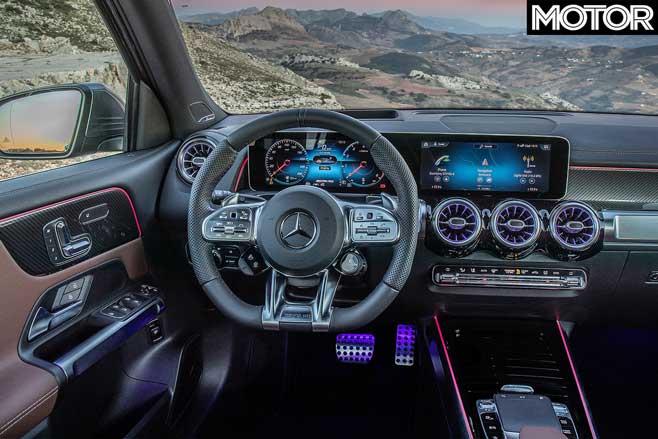
A similar AMG interior makeover includes the frankly bewildering AMG Dynamic Select driver modes, delivering numerous combinations of separate throttle, gearbox, driveline, steering and stability control settings. It’s all too easy to disappear down the rabbit hole as you delve deeper and deeper into various sub-menus.
Otherwise, the cabin is pretty much standard GLB, with the same versatile, if a little cramped, seven-seat layout, along with a high standard of fit and finish, with only scratchy plastics used lower down distracting from its premium appeal.
The Mercedes-AMG GLB35 is essentially a heavier, higher and longer A35. It’s fairly rapid in a straight line and reasonably grippy and composed – for an SUV. It’s not characterful or engaging, but the combination of raised driving position, muscular engine, four-wheel drive traction and (relatively) compact dimensions means you can make quick progress over give-and-take roads.
As in the A35, the 2.0-litre turbo is effective rather than exciting, a rich seam of torque meaning there’s no thrilling rush to the redline but rather a sense of relentless acceleration. The engine is smooth enough too, while the muted growl and occasional burble from the exhausts on the overrun deliver just enough sporting intent, and the dual-clutch gearbox fires home ratios quickly and slickly, responding to the wheel-mounted paddles with admirable crispness.
As you’d expect, traction is impressive (on dry roads there isn’t the merest chirrup of wheelspin) and the brakes bite progressively and powerfully.
Guide the car through a series of corners and there’s greater heft to the steering than in the standard GLB, even in Comfort mode, while body movements are more tightly controlled, both vertically and in roll.
Grip is strong, while torque vectoring helps keep the nose locked on your chosen trajectory and encourages the car to subtly rotate into a corner. So the GLB35 feels remarkably agile, even if it responds a tad more lazily than the A35, particularly through rapid changes of direction.
This is an eight-tenths sort of car, one that’s happier being driven briskly but within its limits. You wouldn’t drive a GLB 35 just for the hell of it; it’s ultimately too high, large and heavy for that, plus there’s little in the way of communication and adjustability. Yet it can cover ground with surprising alacrity, that aforementioned mix of visibility, power and traction allowing you to pick apart sinuous roads with clinical efficiency.
A corollary of the improved suspension and damping control is a marginally firmer ride, the larger-wheeled GLB 35 thudding over sharper imperfections and introducing more roar on coarse surfaces. Still, the rest of the car is fairly refined, with low levels of wind and mechanical noise, while over longer and smoother undulations the car rides with greater suppleness.
However, if you can live with five seats but still want a family car that can carry a similar amount of luggage, goes even harder and handles with real verve and engagement, it’s hard to look beyond the far more affordable and equally four-wheel drive Volkswagen Golf R Wagon.
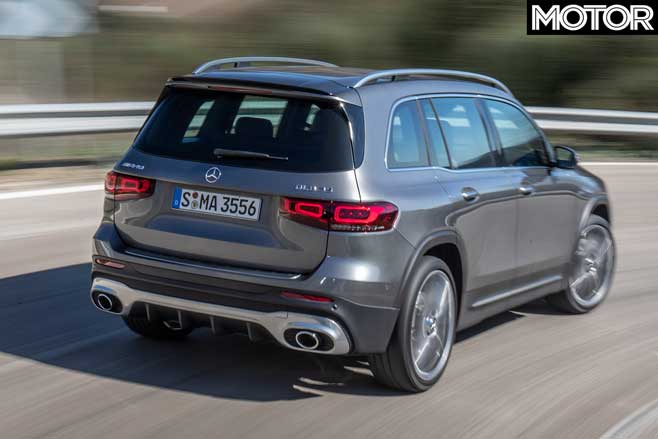
BENTLEY BENTAYGA SPEED SPECS Engine: 1991cc inline-4, DOHC, 16v, turbo Power: 225kW @ 5800-6100rpm Torque: 400Nm @ 3000-4000rpm Weight: 1600kg 0-100km/h: 5.2sec (claimed) Price: $85,000 (est)
Likes: Flexible, practical interior; handling and agility; performance; all-paw traction Dislikes: Overall mass, which could affect brake performance; feel-free steering; high price
Rating: 3.5 out of 5 stars
Sign-up here for your free weekly MOTOR report
In standard guise the Shelby GT350 is a fairly impressive machine, its 5.2-litre flat-plane ‘Voodoo’ V8 producing 392kW and screaming to an 8250rpm redline.
For US performance outfit Fathouse Fabrication, however, this is merely the start. It offers a range of packages that turn the track-focused Mustang into a twin-turbo, tyre-frying monster.
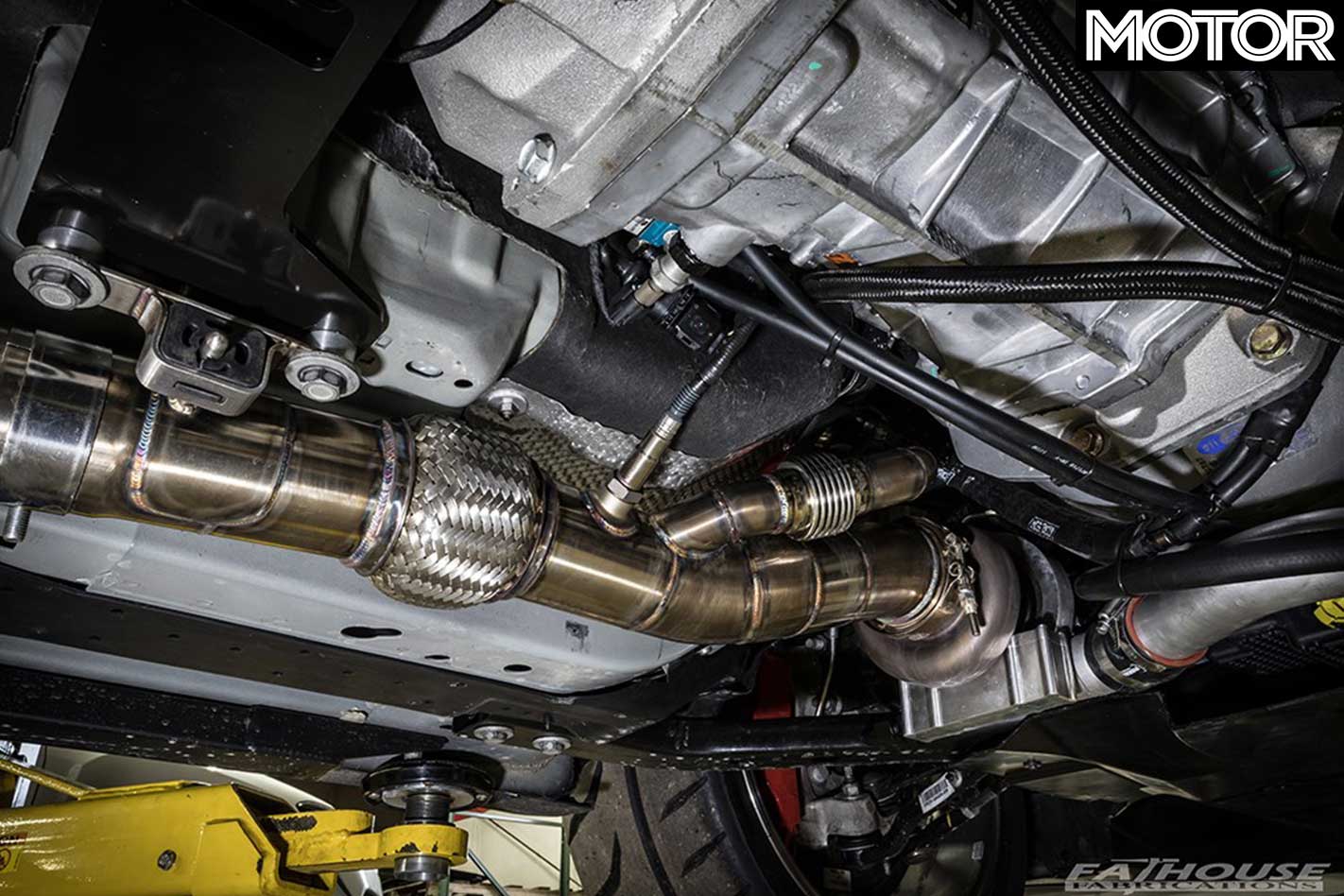
The only real limit to the level of power provided is the size of your wallet, the twin-turbo kits kicking off at US$24,999 for the 800R and reaching to the price-on-application 1400R that comes with drag slicks and a parachute.
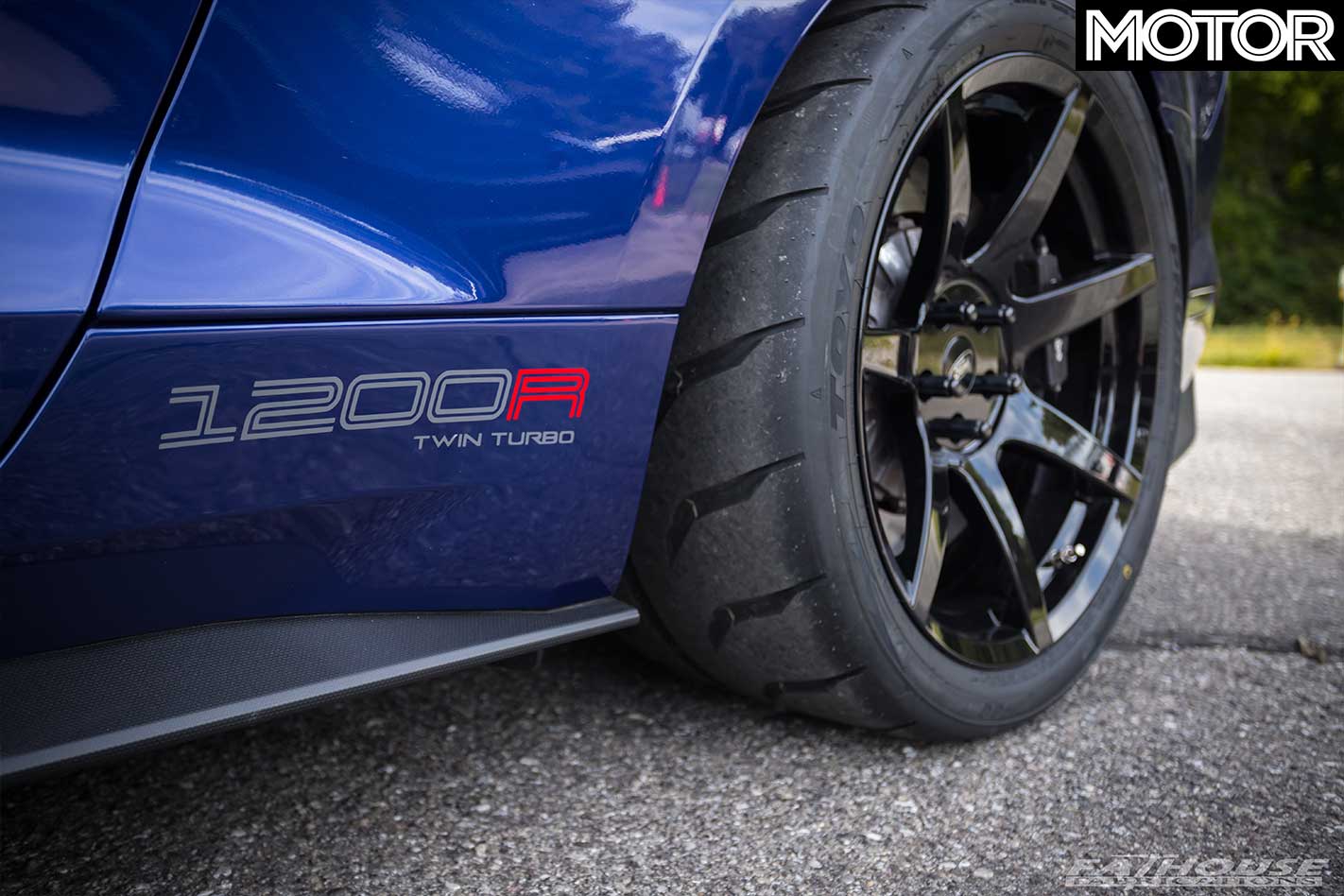
One step down is the 1200R, offered as a turn-key package for $84,999 on top of the donor vehicle cost. The list of upgrades is incredibly comprehensive, but the result is 559kW at the wheels on standard fuel, rising to more than 900kW at the wheels on E85 or race fuel. Check out the video below to see a 1200R bellowing out 990kW at the wheels.
Unsurprisingly, at this power level even an engine as well-engineered as the Voodoo needs a major overhaul. It’s strengthened with Darton sleeves, block supports, billet rods, oil pump and crank gears, forged pistons and an upgraded valvetrain.
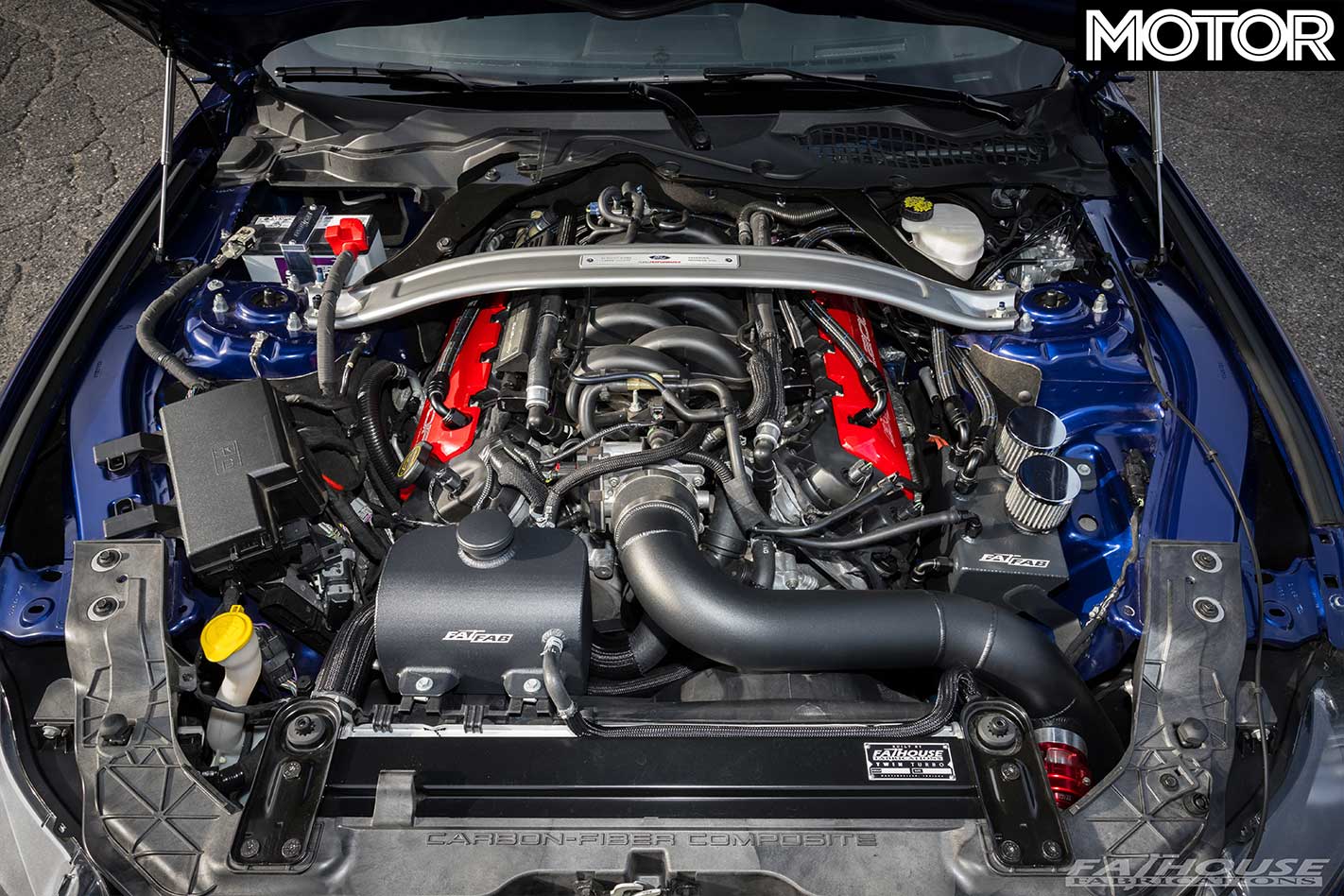
The whole show is controlled by the MoTeC M150 ECU, which has the capability for boost-by-gear and boost-by-drive-mode, launch control, flat shift, anti-lag, flex fuel and nine-stage traction control.
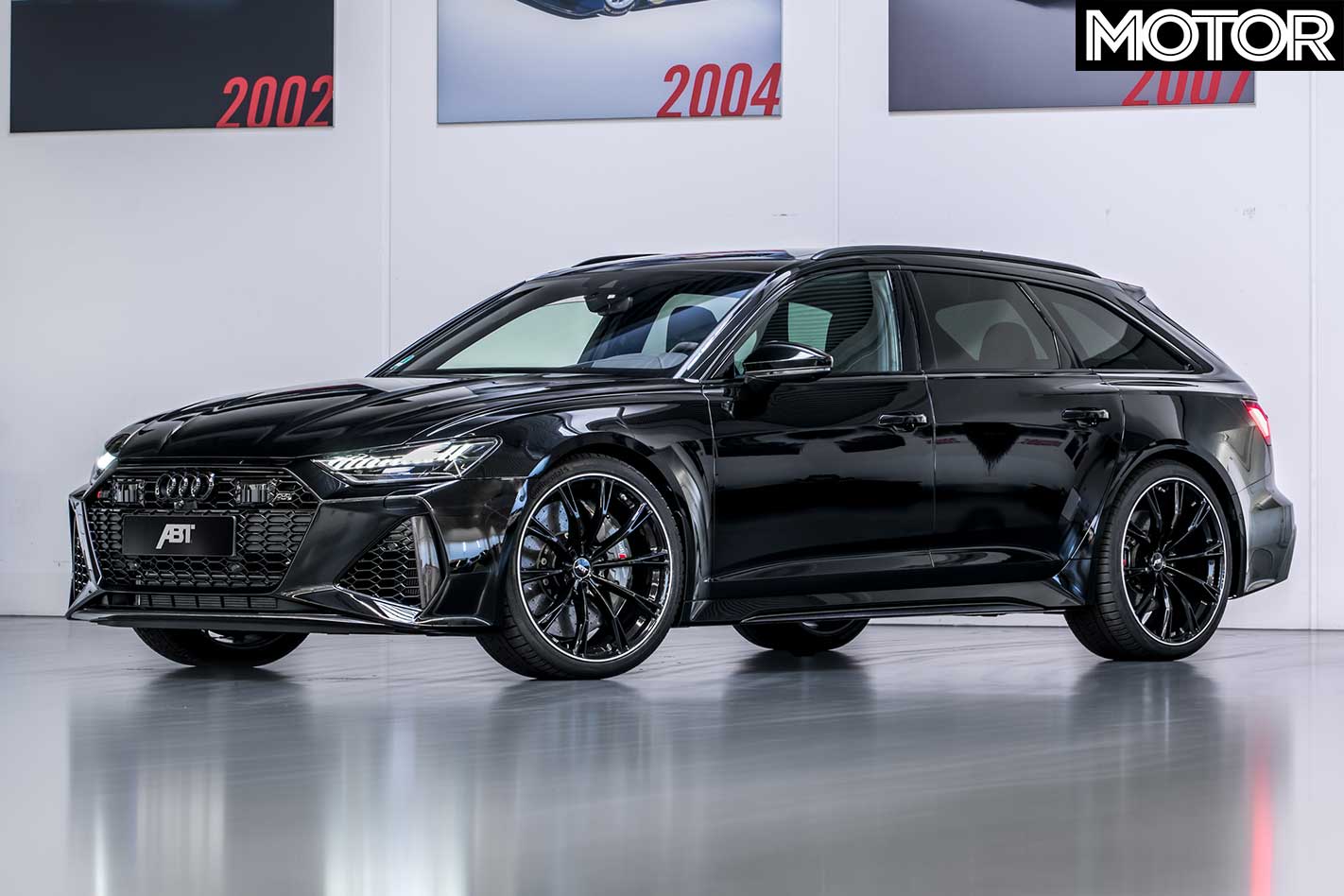
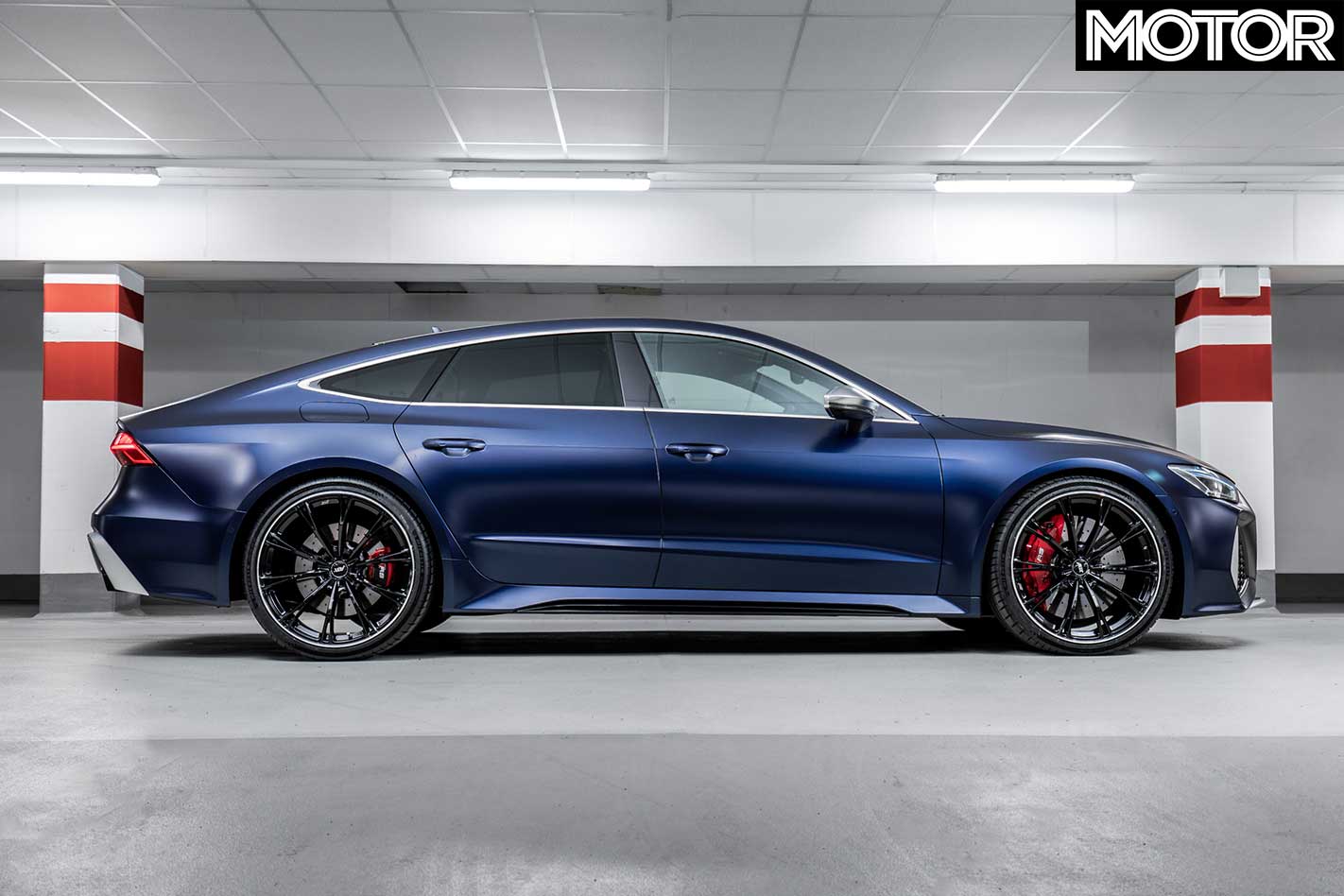
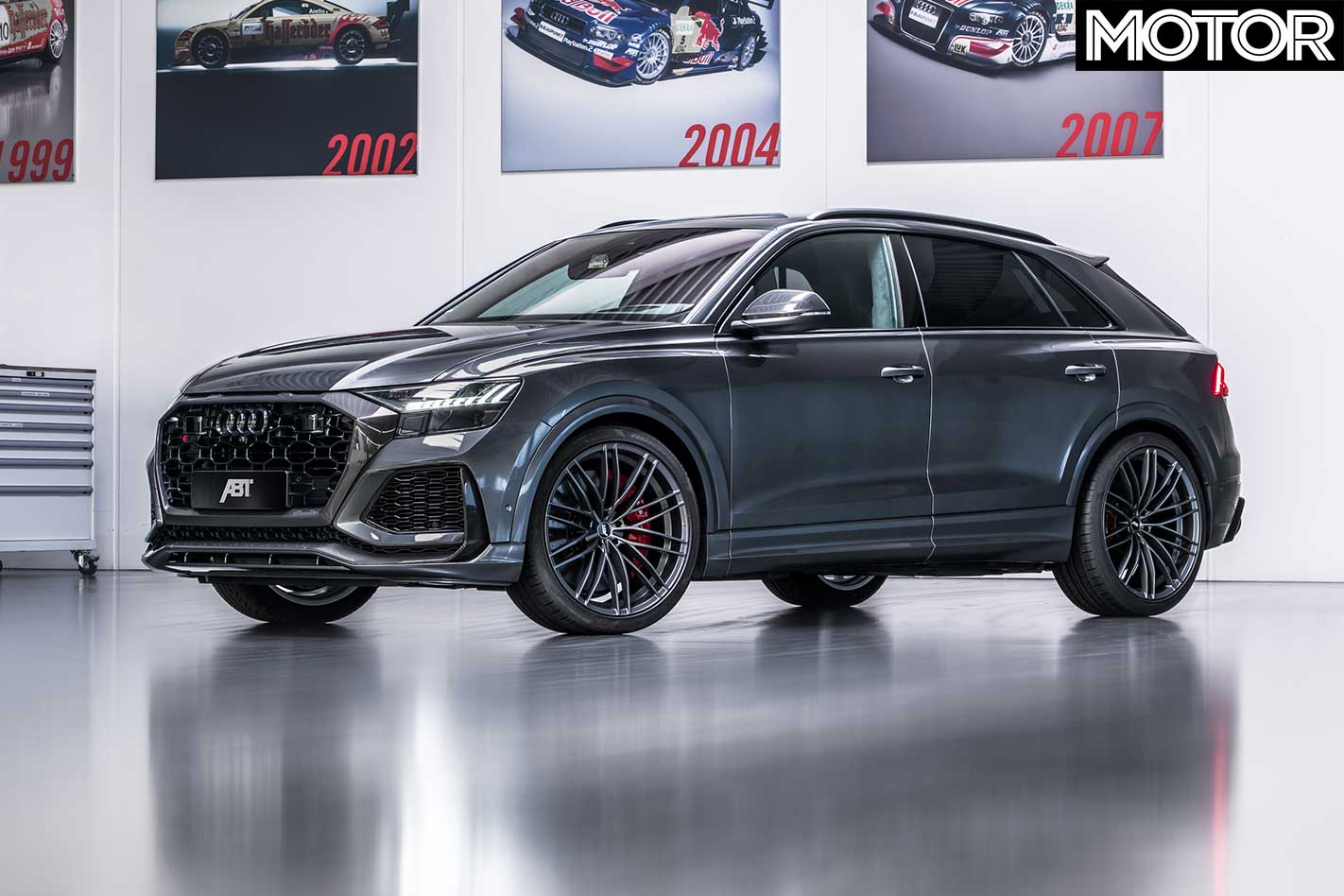
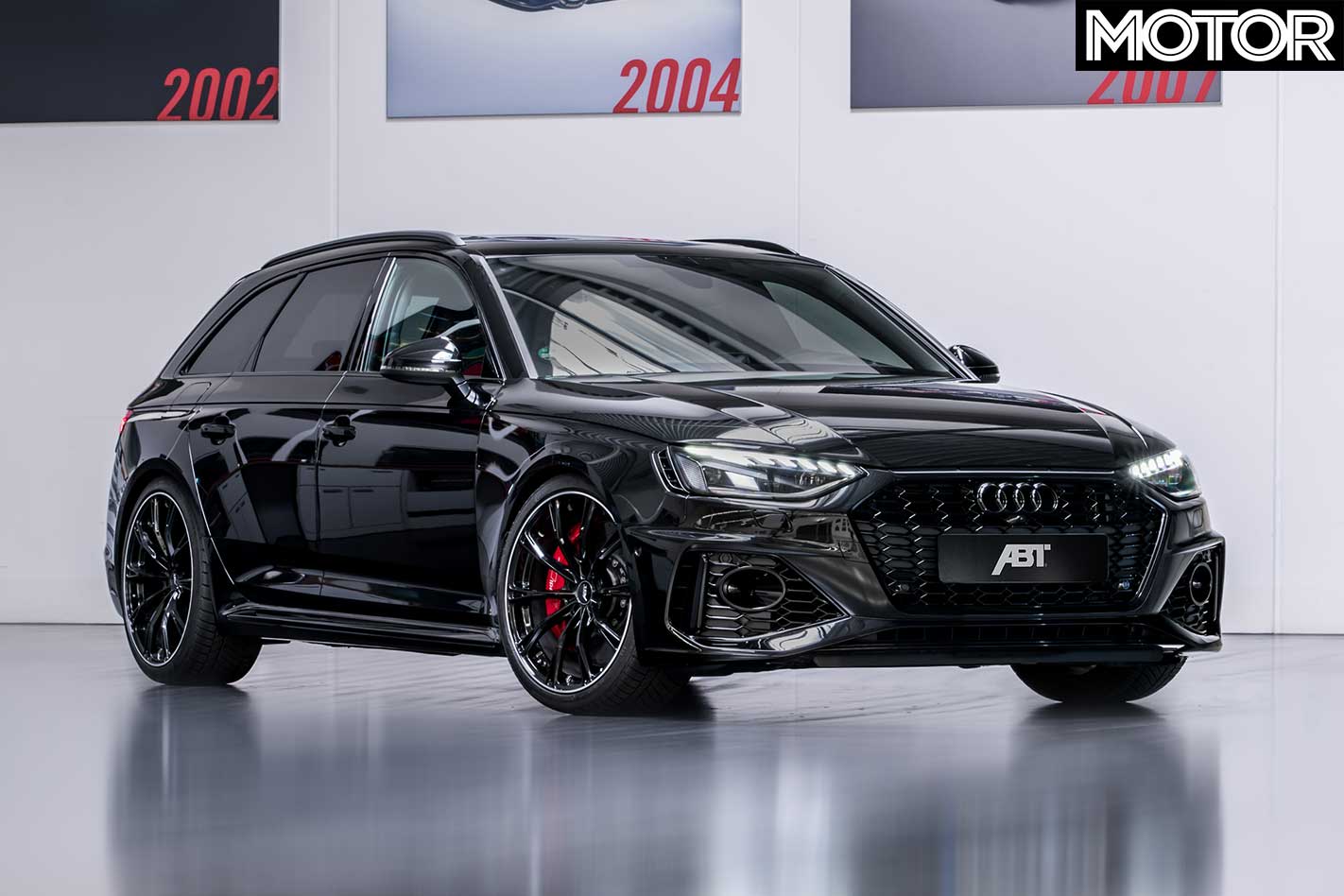
German tuner ABT has turned up the wick on Audi’s latest twin-turbo V8 RS models.
Despite having only just hit the market, the Audi RS6, RS7 and RS Q8 are now all available with a hefty helping of horsepower courtesy of ABT’s Power Performance Upgrade unlocked through use of ABT’s engine control unit.
The dust is still settling after the 2020 Australian Motoring Awards – and the WhichCar Weekly team are definitely still a little dusty themselves – but they reconvene to review the biggest night on Australia’s automotive industry diary.
Each year, 4×4 Australia, Motor Magazine, WhichCar and Wheels Magazine hand out their most coveted awards at our glitzy and glamorous party, with all the key automotive executives in attendance.
All going to plan, the night is an opportunity to let our hair down and hang out with the people we see throughout the year off the clock and off the record. But behind the scenes, there is a massive amount of work that goes into deciding which were the best cars to roll out in 2019.
Scott, Andy and Dan chat about the winners, runners-up and the downright silly things that happen in the course judging, as well as the processes each of our motoring hubs go through to crown just one car with their top trophy.
If you’re on the go, you can find WhichCar Weekly on all manner of podcast apps including iTunes and Podbean. Please rate, subscribe and leave a review! You can also follow the day-to-day happenings of the WhichCar team on Facebook, Twitter and Instagram @whichcarau.
Listened to the show? Help us out:
Leave a note in the comment section below.
