
HOLDEN has unveiled a radical new concept car – the 1000kW ‘Time Attack Concept’ racer built to commemorate the 50th anniversary of the Lion Brand’s first victory at Bathurst.
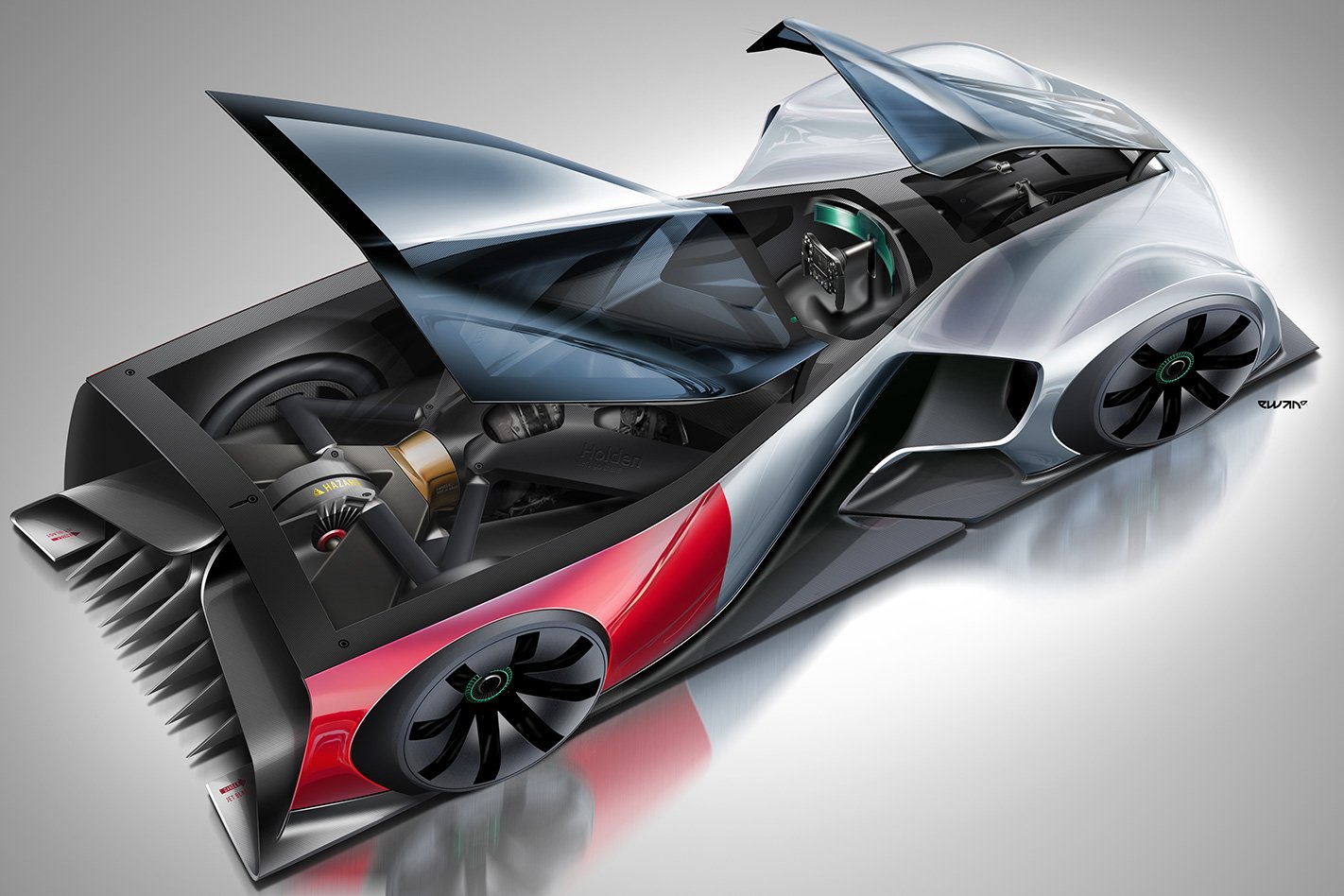
Designed entirely in-house by GM Holden’s Design and Engineering team in Australia using virtual simulations, the concept looks as though it’s headed for space-orbit rather than an event like the World Time Attack Challenge in Sydney.
Holden envisages the Time Attack Concept racer as a one-lap-wonder destined to set a blisteringly quick pace and then hit the pits, a complete opposite of the endurance of the Bathurst 1000 on Sunday.
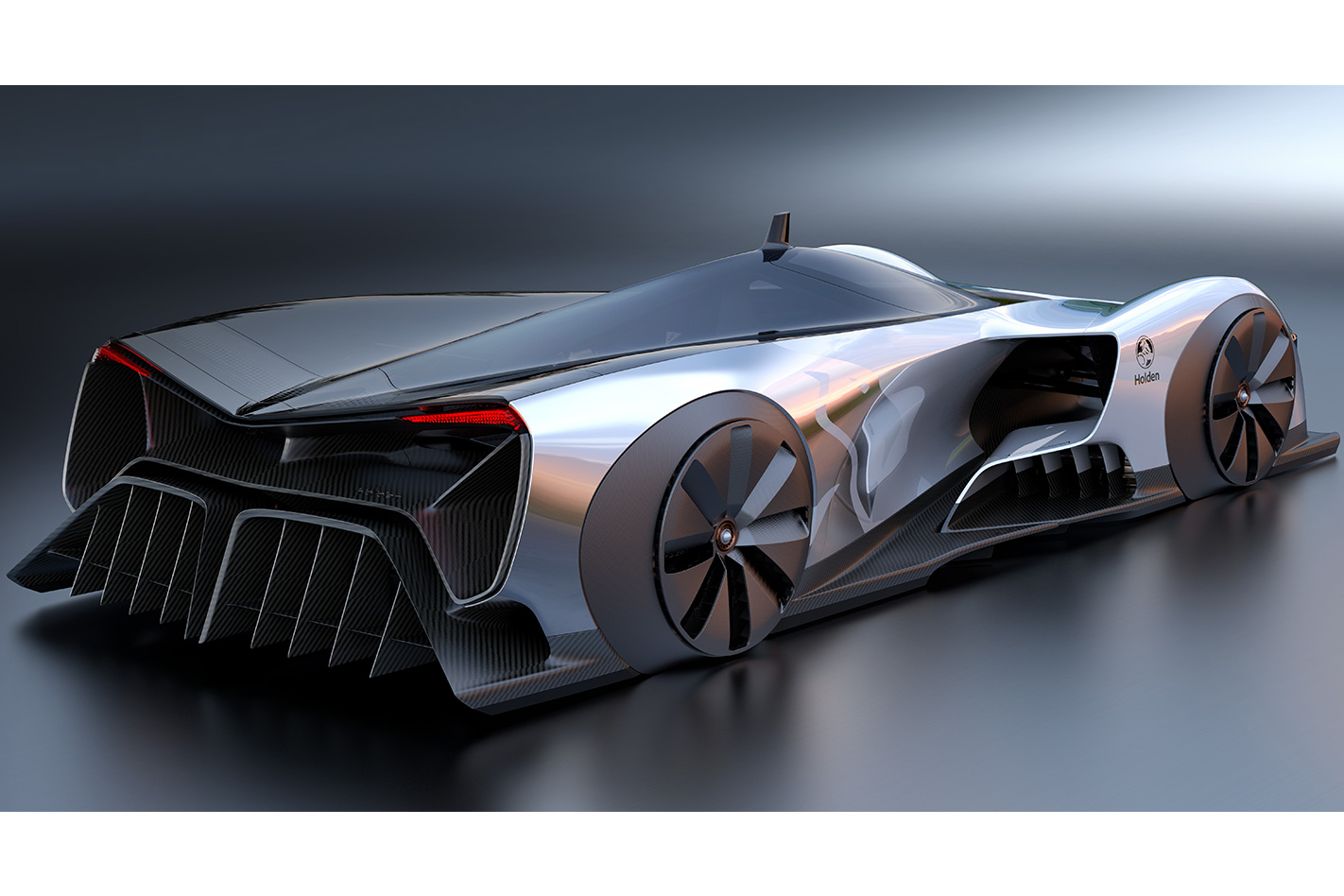
GM Holden’s Design Director Richard Ferlazzo set the challenge to his team to create a futuristic race car which utilised the latest technology from around the world and was suitably impressed when Lead Designer Ewan Kingsbury proposed the Time Attack Concept.
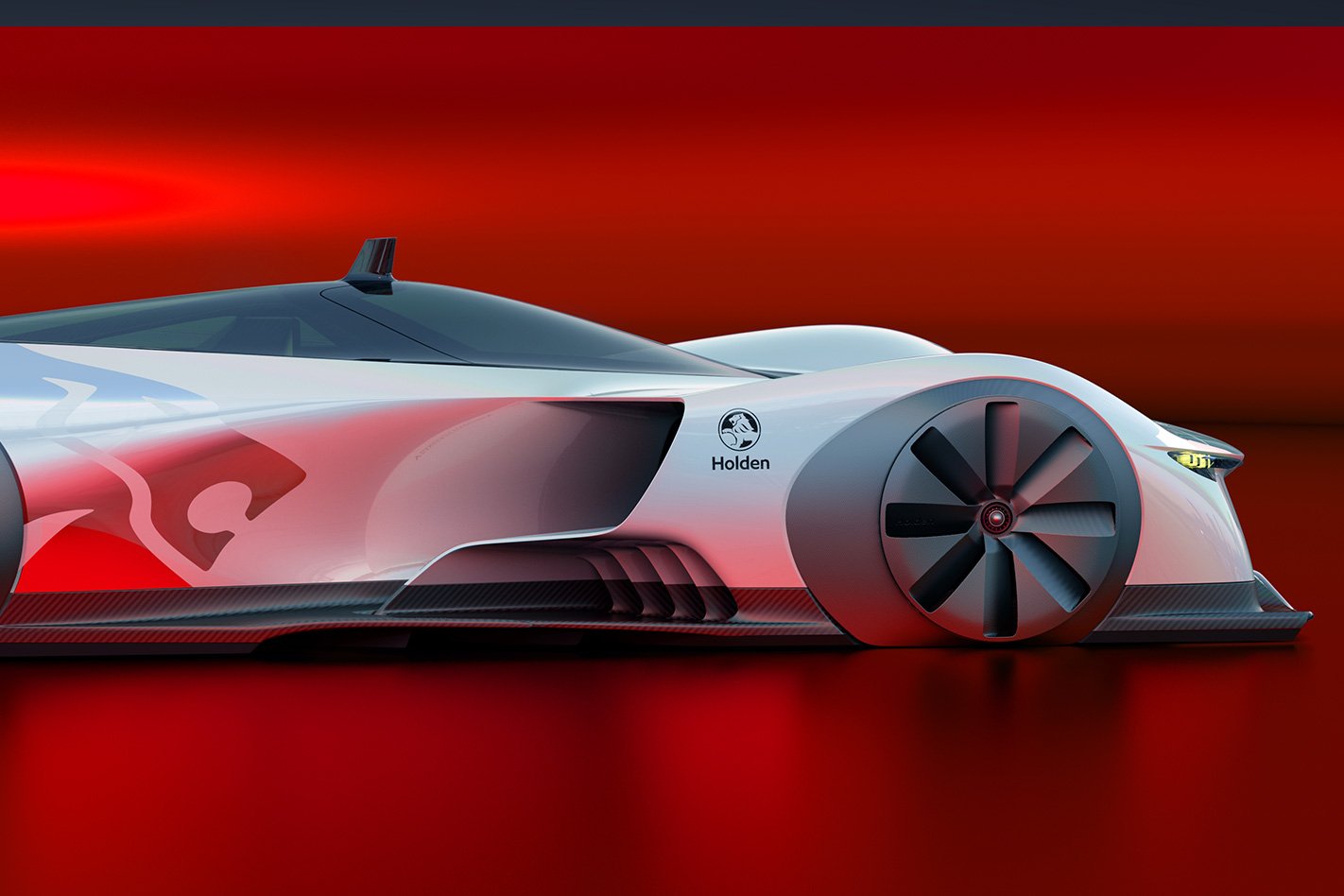
“Concepts are always meant to push the boundaries but are even more impactful when they are feasible and this concept is plausible as an advanced racer of the future,” said Ferlazzo.
“Ewan perfectly captured the essence of what we wanted to achieve; an expressive, futuristic design which also displays innovative engineering solutions.”
The carbonfibre composite chassis utilises a honeycomb core design to provide extra strength and rigidity, enabling the car to achieve a maximum lateral g-force of 6.5G.
The pilot of this spaceship will be equipped with an augmented reality helmet which projects 3D graphics onto the visor showing essential technical information in addition to the racing line and braking markers.
Holden are clearly serious about this being a preview to the future of race cars.
“Automotive design and engineering remains a core strength and competitive advantage for Holden and Australia,” Ferlazzo says.
“You can see from the extremely detailed approach to incorporating the advanced technology in our Time Attack Concept racer that this is more than just a visual exercise.
“Holden’s recent announcement of the expansion of 150 new engineers to our Advanced Vehicle Development team means we have the talent, resources and technology to continue delivering to that charter.”
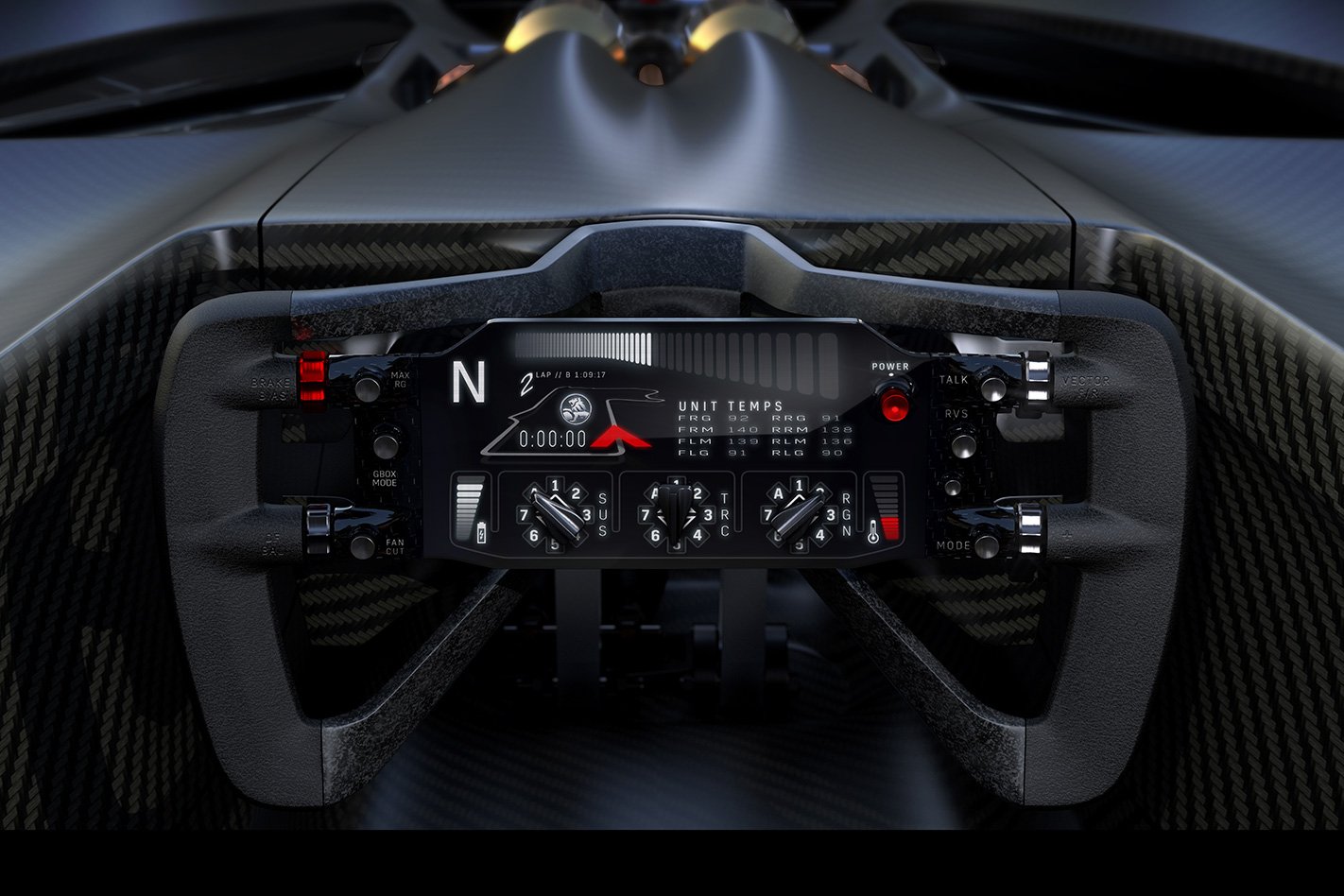
The final design was digitally rendered into a 3D model, in collaboration with Holden’s engineering team.
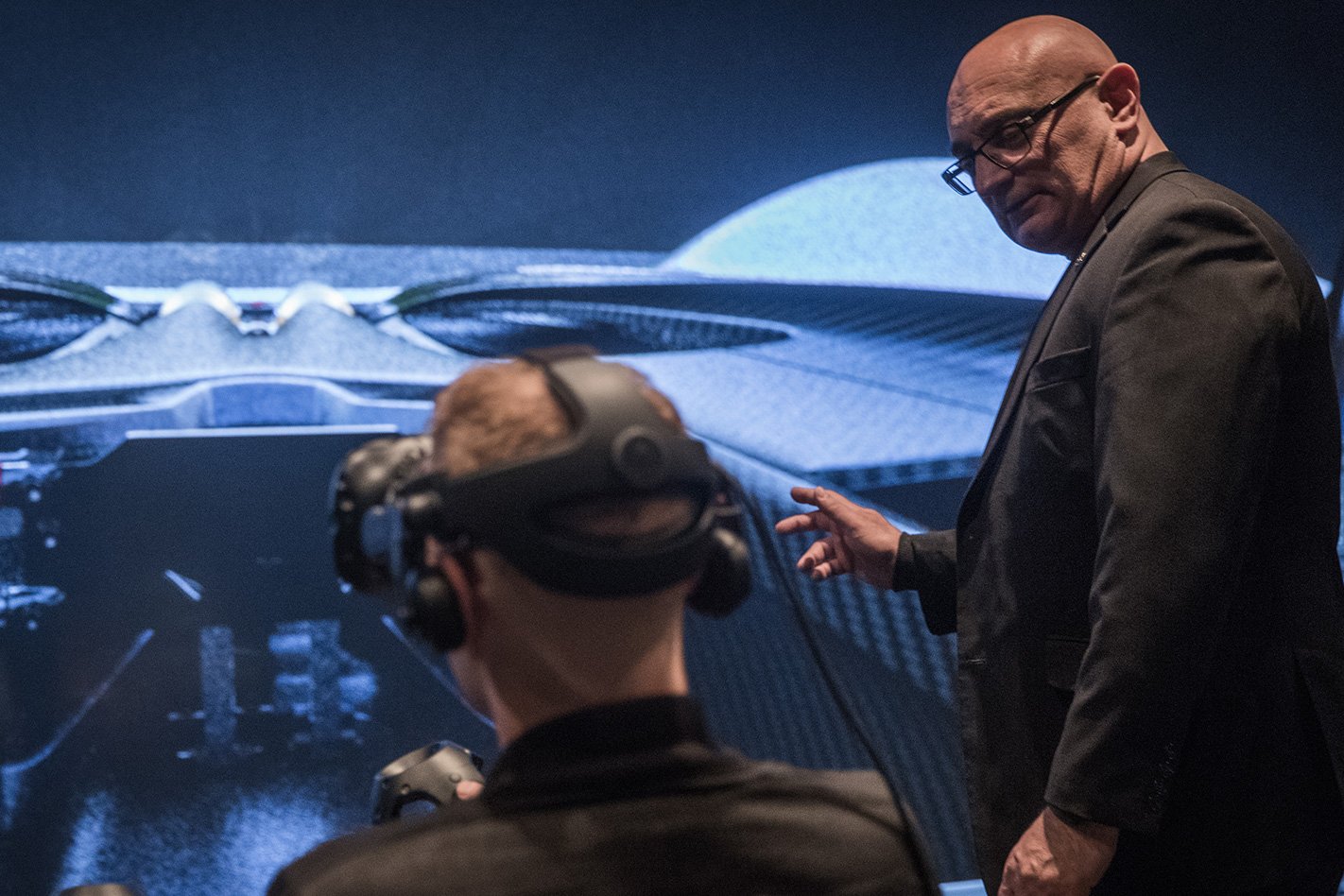
Richard Ferlazzo explains: “The technology we employ today has transformed the way we design cars. We have the ability to simulate a car’s appearance, technology and dynamics in convincing animations, which enables us to deliver better designs in a shorter time.”
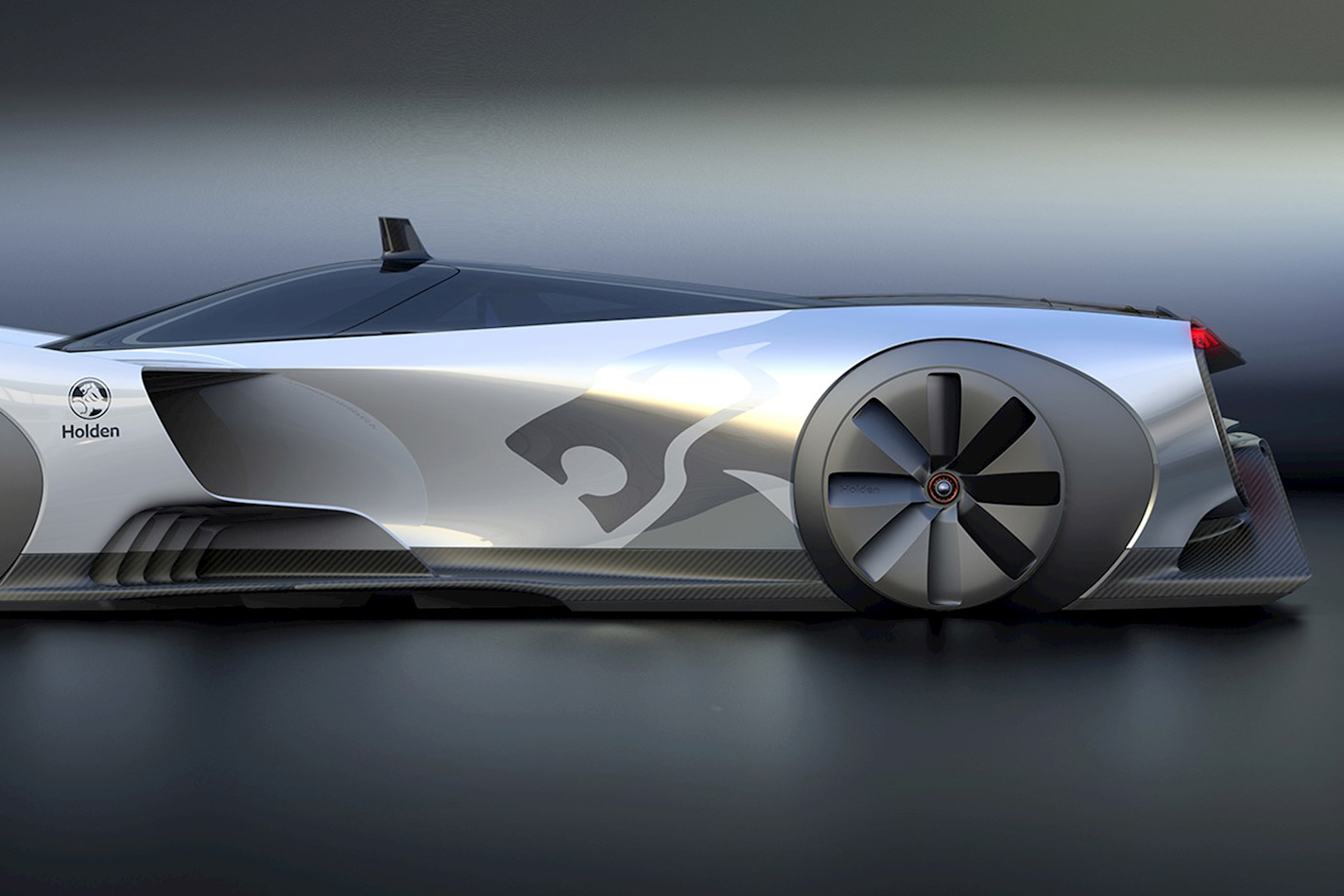
Ever since motor shows left Australian shores in 2012, Holden has struggled to show off its design creations citing “the cessation of motor shows in Australia” as a reason for its diminutive involvement in pushing the design envelope.
“However, with the realism and detail achievable through modern technology, I felt we could still deliver uniquely Holden concepts via virtual technology and digital media,” said Ferlazzo.
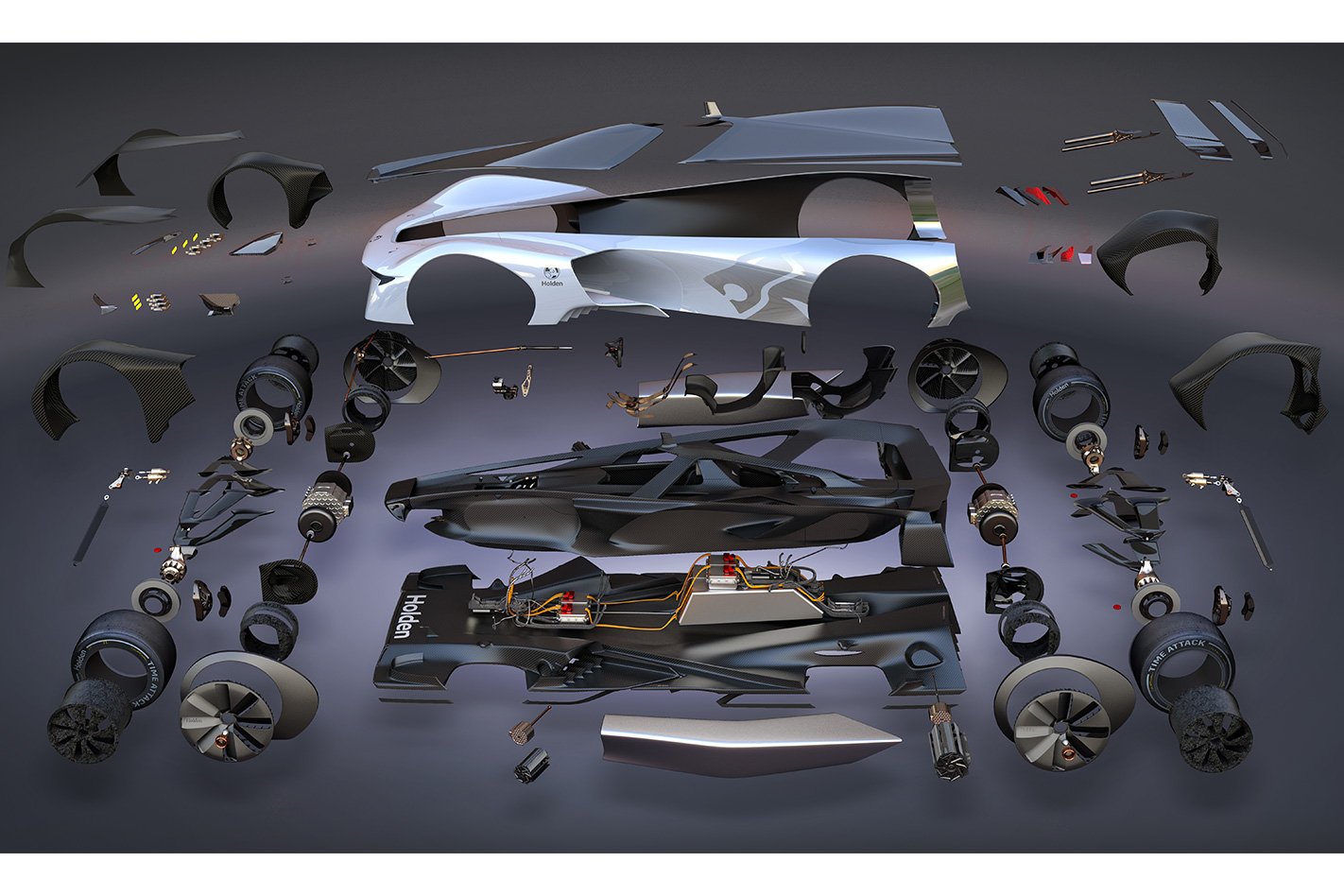
SPECS
Performance: Simulated Mount Panorama Lap Time: 1:29.30 0-100km/h: 1.25 sec Top Speed: 480km/h Maximum Lateral G-Force: 6.5G Maximum Braking G-Force: 6G
Weight: 900kg (without driver)
Powertrain: 250kW Axial Flux Permanent Magnet Electric Motor Drives x 4 (Inboard mounted) Total output – 1000kW (1Megawatt) 3240Nm Total Motor Torque 5000RPM Maximum Revolutions Enables full programmable Torque Vectoring Traction Control at each corner
Gearboxes: 3-Speed Planetary Automatic Shift Gearboxes x 4 Ratios 1st 2.97:1, 2nd 1.7:1, 3rd 1:1 First gear ratio enables 9620Nm total axle torque at launch Gearbox casing integrated into Chassis structure
Power Source: Reconfigurable Graphene Hybrid Power Pack 1MW power output, 90MJ Usable Charge Capacity Fast Recharge: Fully recharged in 90 seconds (1000kW, 800V, 1250A)
Chassis: Carbon Fibre composite with cellulose Honeycomb Core Full Integrated safety cell and crash structure, utilising stressed powertrain components
Suspension: Carbon Fibre Double Wishbone all-round, aerodynamically engineered profiles Titanium CNC’d Uprights with bushed underbody mounts Pushrod / bellcrank activated Hydraulic Active Suspension Actuators. Computer controlled programmable ride height adjustment, anti-dive, anti-squat, anti-roll Electric Power Steering
Body: Carbon-Fibre/Kevlar Composite panels with Polycarbonate Graphene Coated Upper
Underbody: Full Carbon Fibre / Kevlar Composite quad-venturi underbody, with flexible co-moulded membranes at Body and Chassis junctions Underbody is structurally mounted to Suspension uprights at all 4 corners, enabling full aero load to be applied directly to each wheel Torsional twist capability enables underbody to maintain consistent relationship to ground even with extreme road camber change
Wheels: 310/700 R18 Slick tires all round Carbon Fibre Composite Rims Active Wheel Fairings support low drag or brake cooling positions Wheel Fairing supported by a Kevlar/Elastane woven skin enabling consistent low drag performance whilst supporting full wheel steering and suspension movement
A send-off is always a bittersweet moment. It can be a time to pause and reflect – or, in the case of some, it’s an excuse for a party, a final fling. Peugeot went with the latter to send the current-gen 208 GTi off with a bang.
The limited-run (just 20 units) Edition Definitive by Peugeot Sport is the result. It’s essentially the 208 GTi 30th Anniversary Edition with different clothes, Autonomous Emergency Braking (a first for any GTi model) and a $33,990 price tag. And while that’s a $2000 saving over its forebear, the French baby hot hatch isn’t cheap.
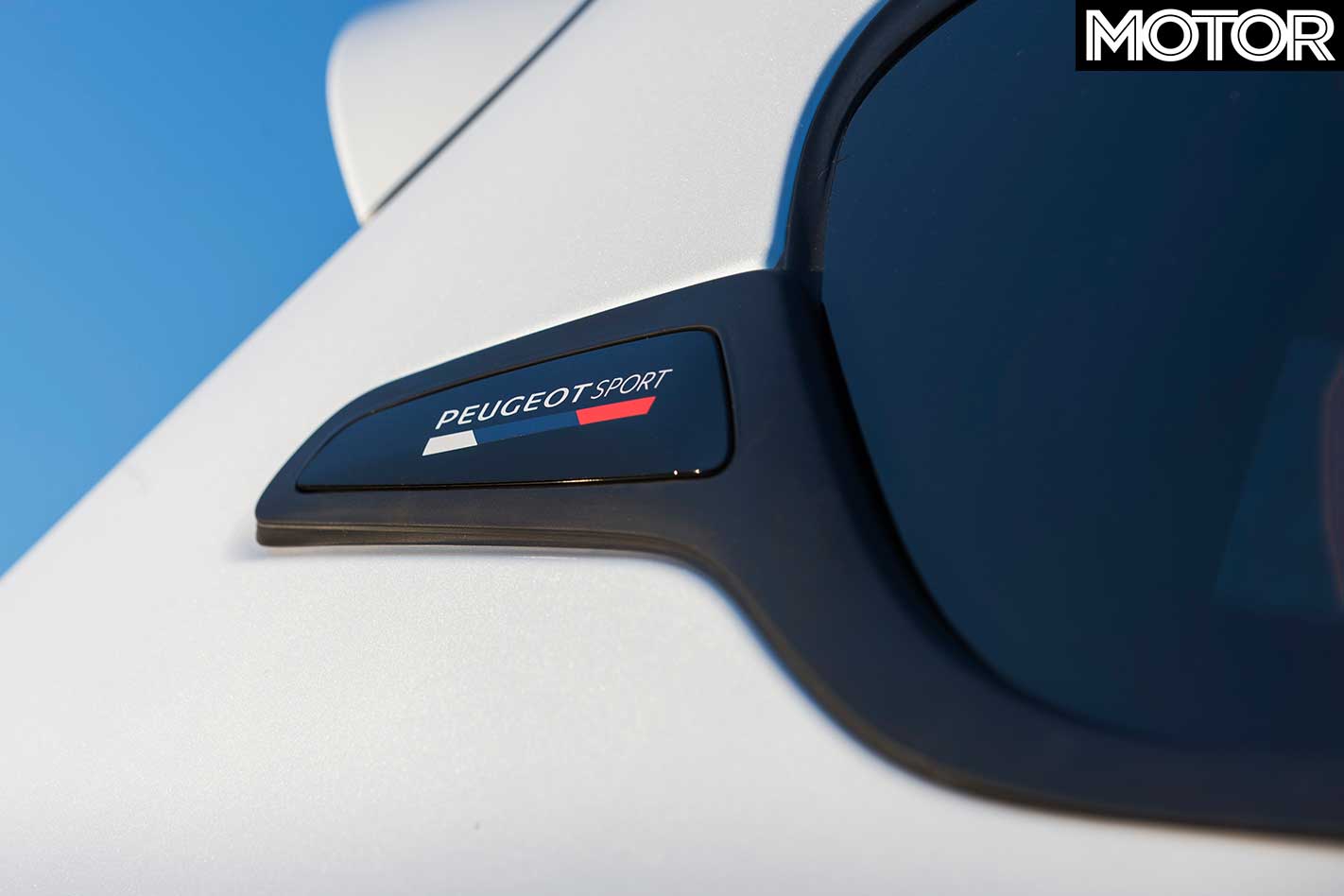
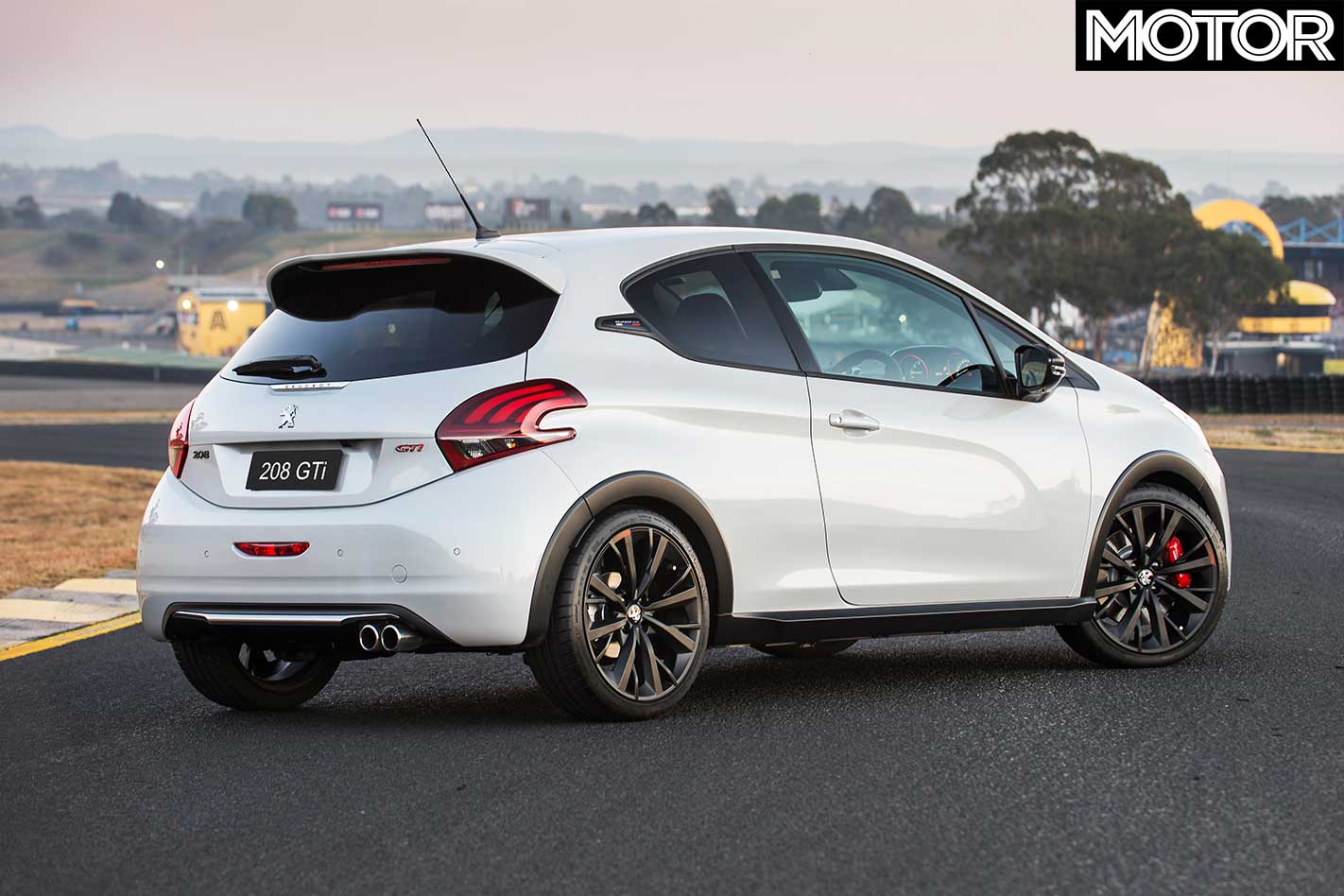
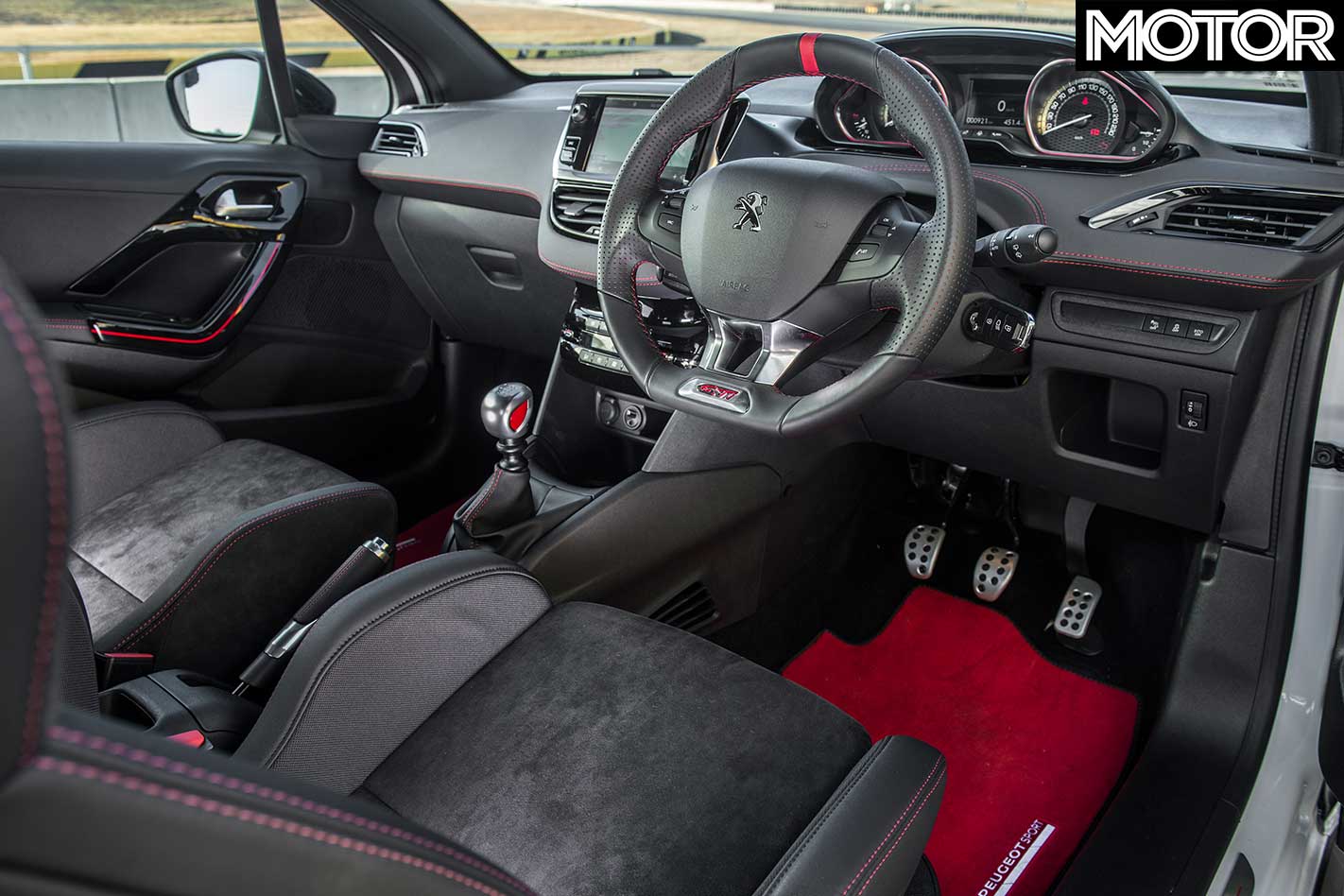
It’s hard to argue against the muscular, nugget-esque design. Matte-black accents and the 18-inch wheels add muscle to the diminutive silhouette. You can have it in any colour you like, too – as long as it’s Pearl White. On the inside there are heavily bolstered Peugeot Sport seats, red stitching and red floor mats – tres 205 GTI, indeed.
The venerable 1.6-litre four-cylinder turbo (Prince engine co-developed with BMW) has 153kW and 300Nm. It lugs 1185kg, resulting in a 0-100km/h time of 6.5 seconds. Kept in its sweet spot, the four-pot is a strong, tractable unit.
Getting that grunt down is made easier by the addition of a mechanical, Torsen LSD and grippy Michelin Pilot Super Sport rubber. Traction is rarely an issue and the front end vehemently holds its line on pristine tarmac with lock and throttle applied. On the run the 208 is deceptively quick and the muted soundtrack only adds to that sensation. More aural muscle, please.
The six-speed manual is long in throw, but it’s decent to use. And while the clutch take-up point is high, the brake pedal is soft. Yet, with 323mm front discs and Brembo calipers, the stopping power is never in question.
The small steering wheel is deceptive. It fools you into thinking the rack is quick. It’s not. And largely lacking feel.
Velvety smooth winding roads bring out the best in the Pug. With wider tracks (22mm front, 16mm back) and a bespoke suspension tune (10mm lower), the final-edition 208 really gets stuck in. But be aware of the rear-end, it can quickly go from nice to naughty.
Ultimately, ride quality and damper control is where the GTi ED falls down on really craggy surfaces. There’s not enough compliance to quell movements over rutted roads, meaning the 208 hops and skips over bumps. Hit a significant pothole mid corner and it will chuck the already playful rear sideways – and in dramatic fashion.
Has the limited edition 208 GTi outstayed its welcome? Kind of, but then, in the right conditions, it remains a bit of a party trick – especially in Edition Definitive guise. So until next time, bon voyage, little Pug.
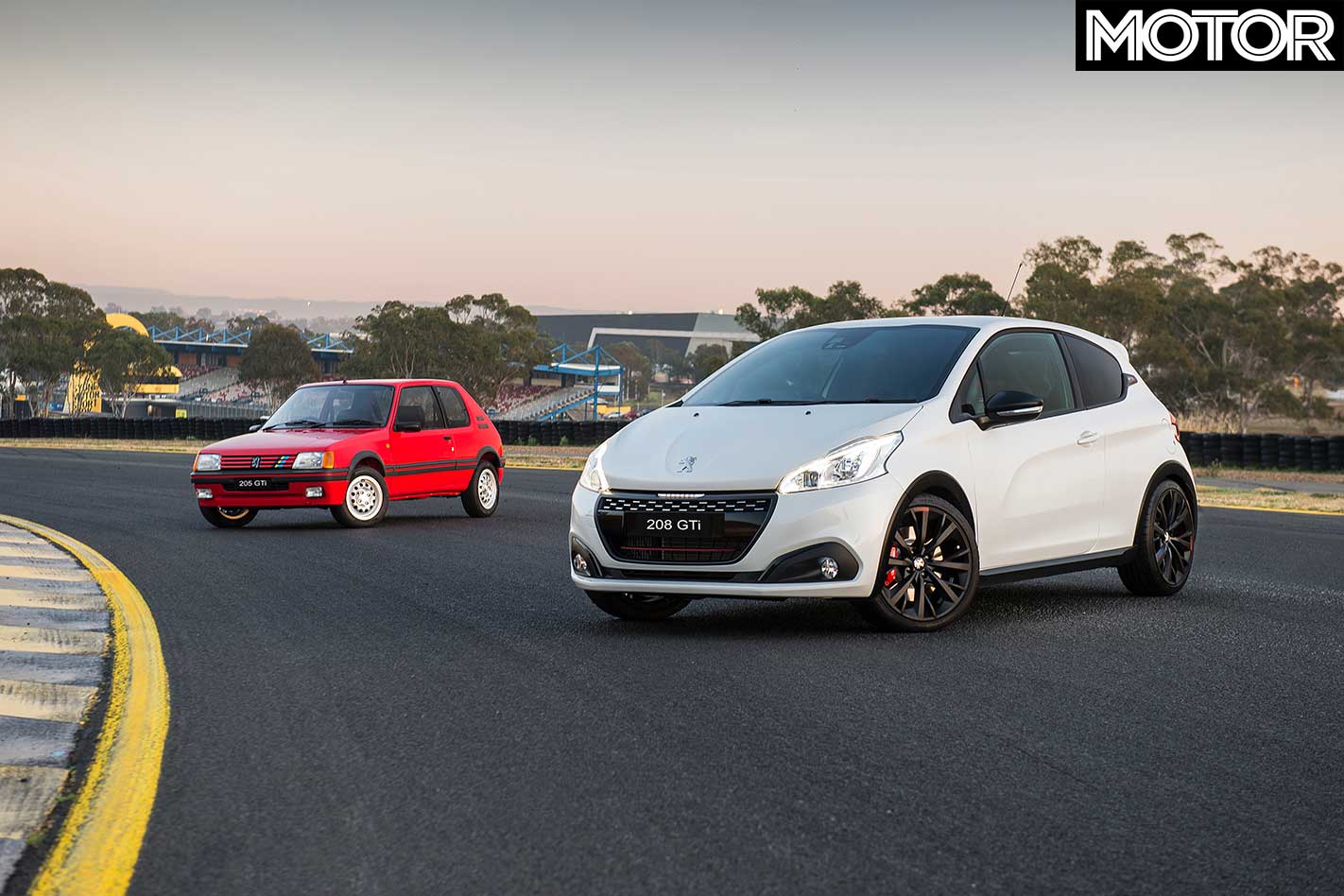
2018 PEUGEOT 208 GTI EDITION DEFINITIVE SPECS Engine: 1598cc inline-4, DOHC, 16v, turbo Power: 153kW @ 5800rpm Torque: 300Nm @ 1700rpm 0-100km/h: 6.5sec (claimed) Weight: 1185kg Price: $33,990 (driveaway)
Like: Boosted 1.6-litre four-pot; loads of grip; mechanical LSD hooks up nicely; muscular design Dislike: Ride quality is harsh on most roads; ergonomic flaws; getting too old and expensive? Rating: 3.5 out of 5 stars
KIA’S breakthrough rear-wheel-drive performance car is at risk of becoming a one-hit wonder if sales in key markets fall short of targets.
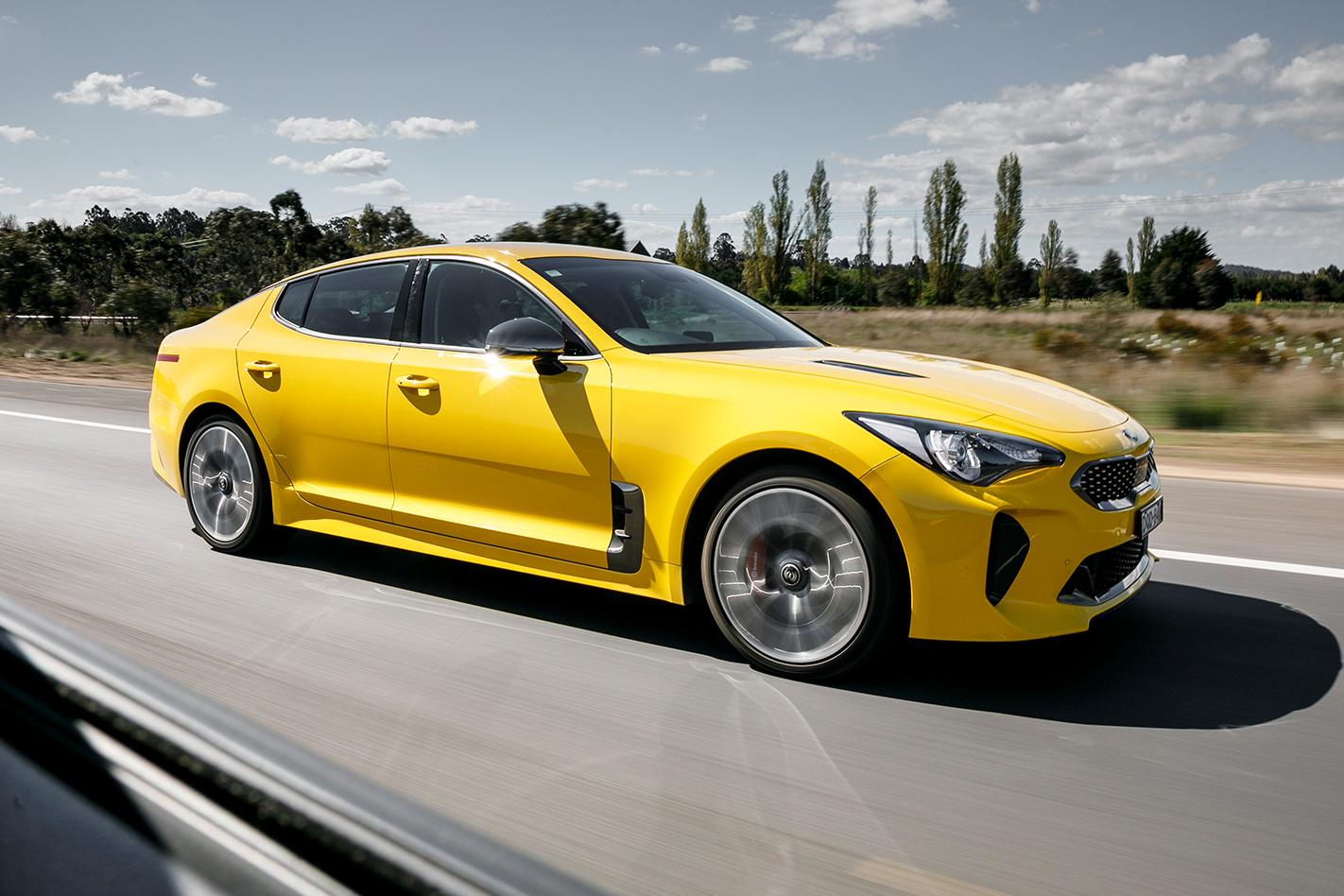
Speaking to Australian media at the Paris motor show, Kia’s head of design Gregory Guilliame acknowledged the Stinger’s achievements as a brand ambassador, but cautiously admitted a second generation of the stylish four-door coupe will only happen if it is a widespread sales success.
“Whether there will be a replacement is too early to say,” said Guilliame.
“We are in a company that even if they understand the potential value of this brand-building object, we still have to be economically successful with that vehicle. It’s very, very difficult in Europe with a car like that.
“Marketing guys in Europe understood that from day one and still put a lot of money into communicating the car. There are parts of the world where it can work. Time will tell, it’s still a bit early but America needs to do volume. They need to sell the car.”
Stinger has found relatively strong support from Australian buyers, though supply constraints at a factory level have limited its sales. There’s currently a three-month waiting period on all V6-powered variants in Oz. In Europe, however, it’s a very niche choice, and American buyers are still warming up to it.
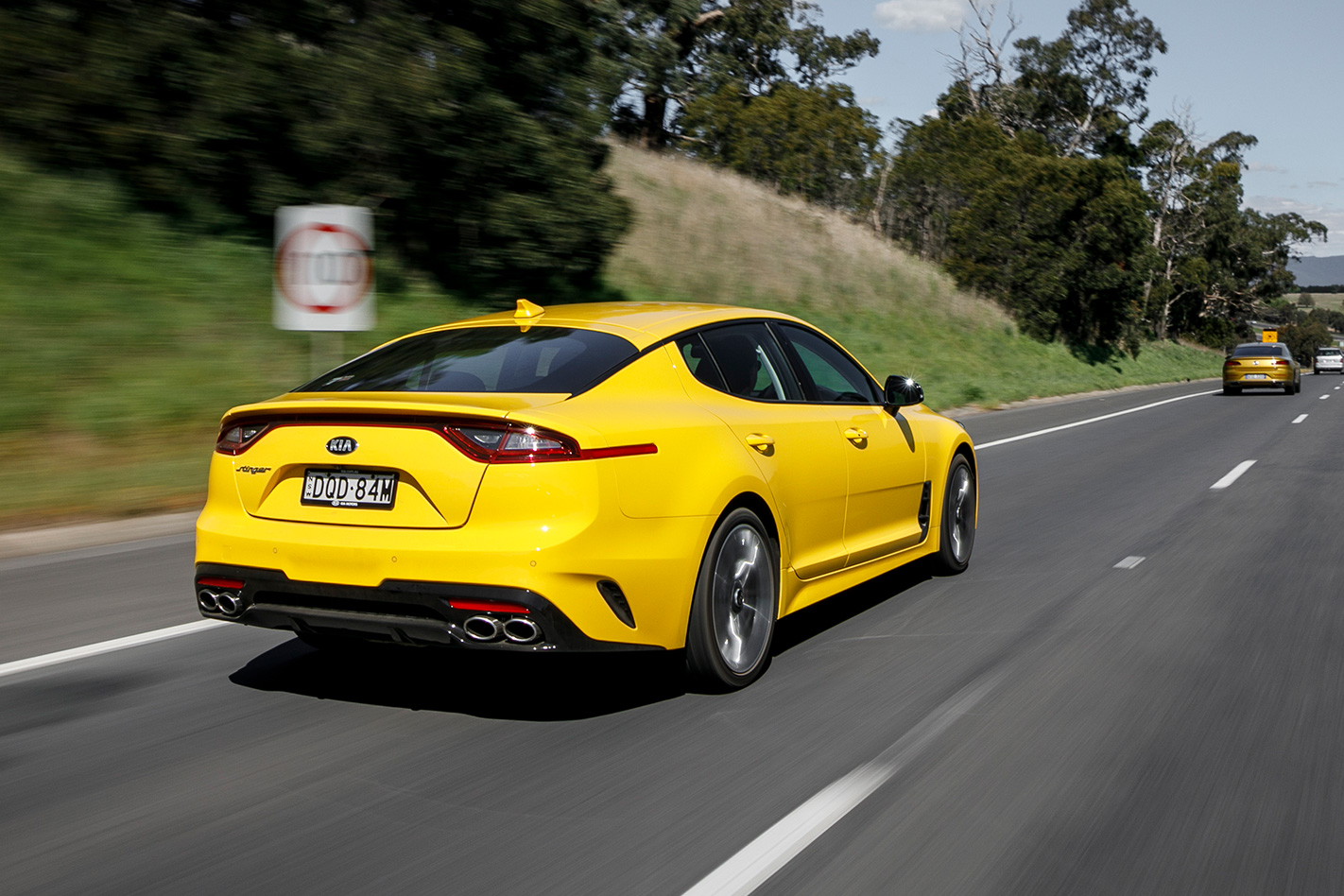
Kia hasn’t been shy in the past about trying something once and backing out. It dipped its toe in the sporty three-door hatchback space with the original ProCeed GT, only to ditch that format and apply the badge to a five-door liftback unveiled at the Paris show this week.
Coupes and three-doors have proven reliable ways to build enthusiasm around a brand, but they’re often expensive for a mainstream company to develop and rarely sell in big numbers. Guilliame is proud of Kia’s boldness to do it at all.
“Yesterday, for the first time I was in Paris in a Stinger. There were kids everywhere, and all I was hearing outside was ‘Look at the Kia!’ This is brand building. Those kids, in 10 or 15 years they’re buying a car. They might remember the day they saw that Stinger on a small street in Paris.
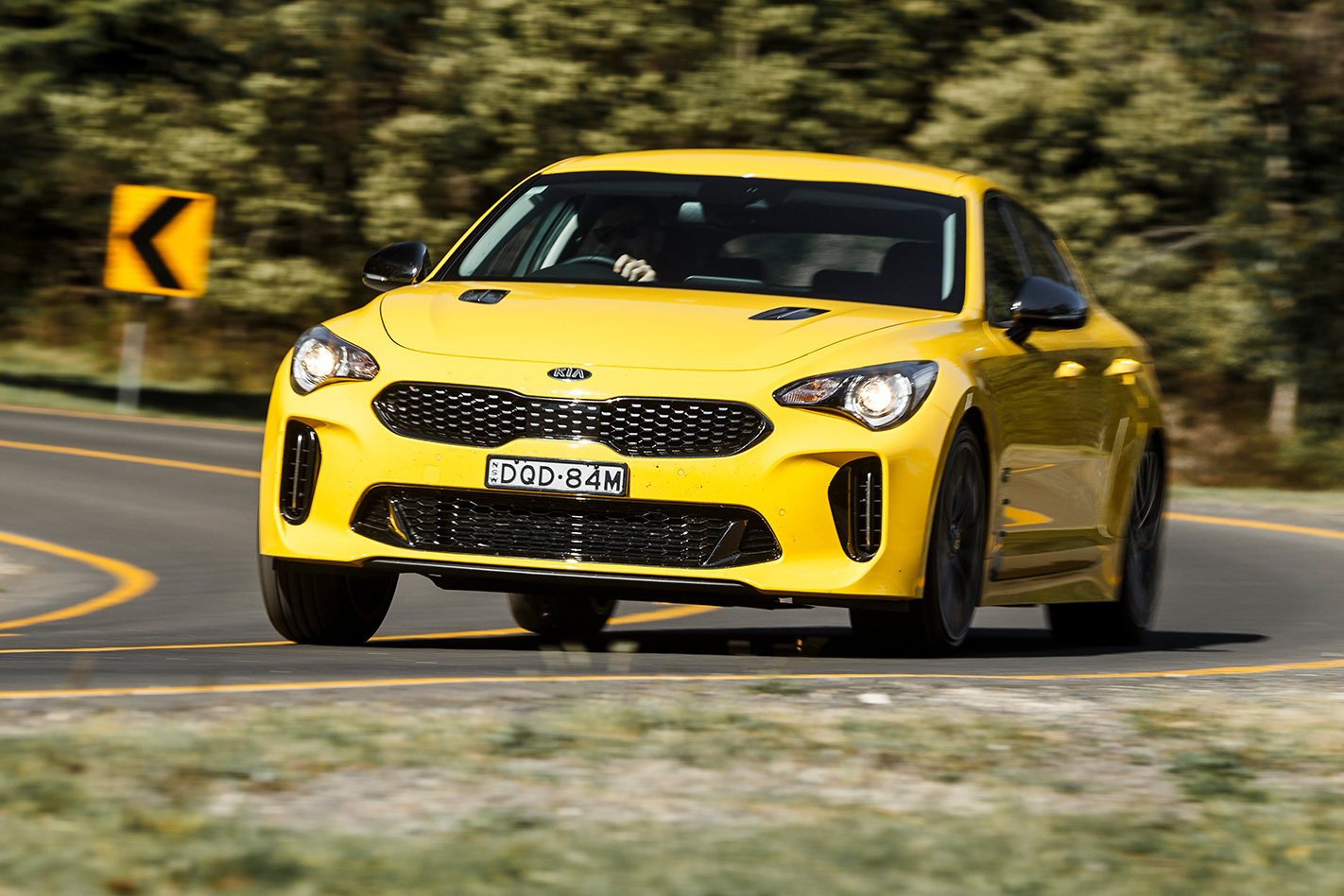
“I think [for] Kia, it was the best thing they could do to build the Stinger. I think it was definitely the right thing to do. “
That said, Guillame understands business case realities, having led the design team tasked with reinventing the ProCeed after the original version failed to sell.
“ProCeed was always our little baby. It was the one we were looking forward to because it’s the most emotional, the most dynamic, the most young at heart. We were doing alright in our volumes but still not enough to justify the investment, so it was actually canned. It was up to us to find the answer valid today to carry on those values.”
The Frenchman was then earnest when asked if the pressure to make every product a sales success posed the danger that cars generally could become boring.
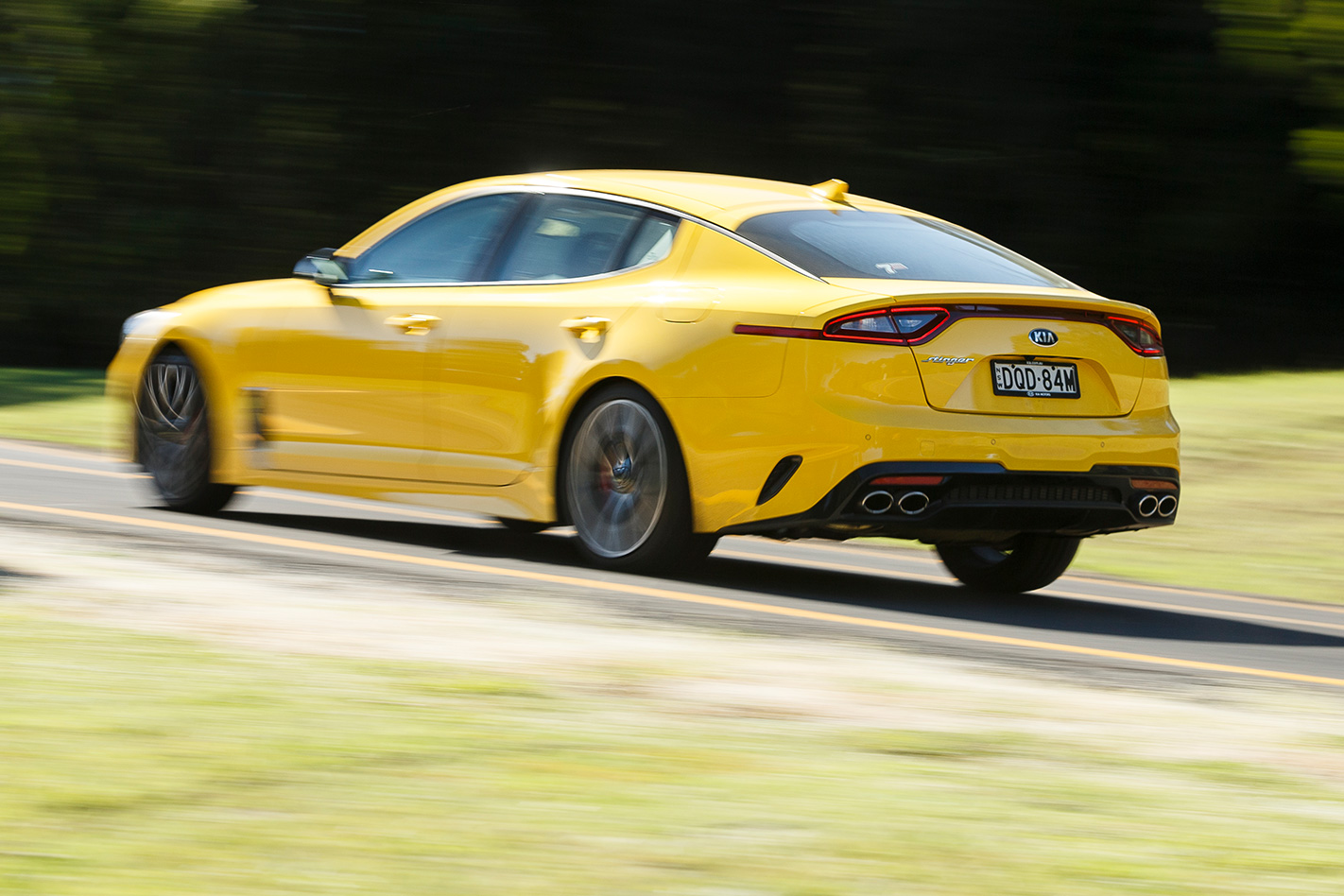
“I don’t know if it’s a danger, but what I really hope is that in the future we can still all be passionate about cars,” he explained.
“I hear a lot of things, you know. ‘People don’t like cars. People just want to be in a box and driven around.’ I don’t believe it. I think that might be the answer in some environments, but that doesn’t mean there’s not moments where you enjoy being in a car and driving.
“I think there won’t be one answer. There’s never been just one answer with cars. So I hope we stay like that.”
Coupe to cabrio – it’s a popular mid-life facelift for a sports car. Audi’s TT, Holden’s Astra and Peugeot’s 206 have all been successful, popular, stylish tin-tops that have benefited from some air in the hair. Now, almost a year after its debut, Nissan’s 350Z has lost its head.
This review was originally published in MOTOR’s January 2004 issue
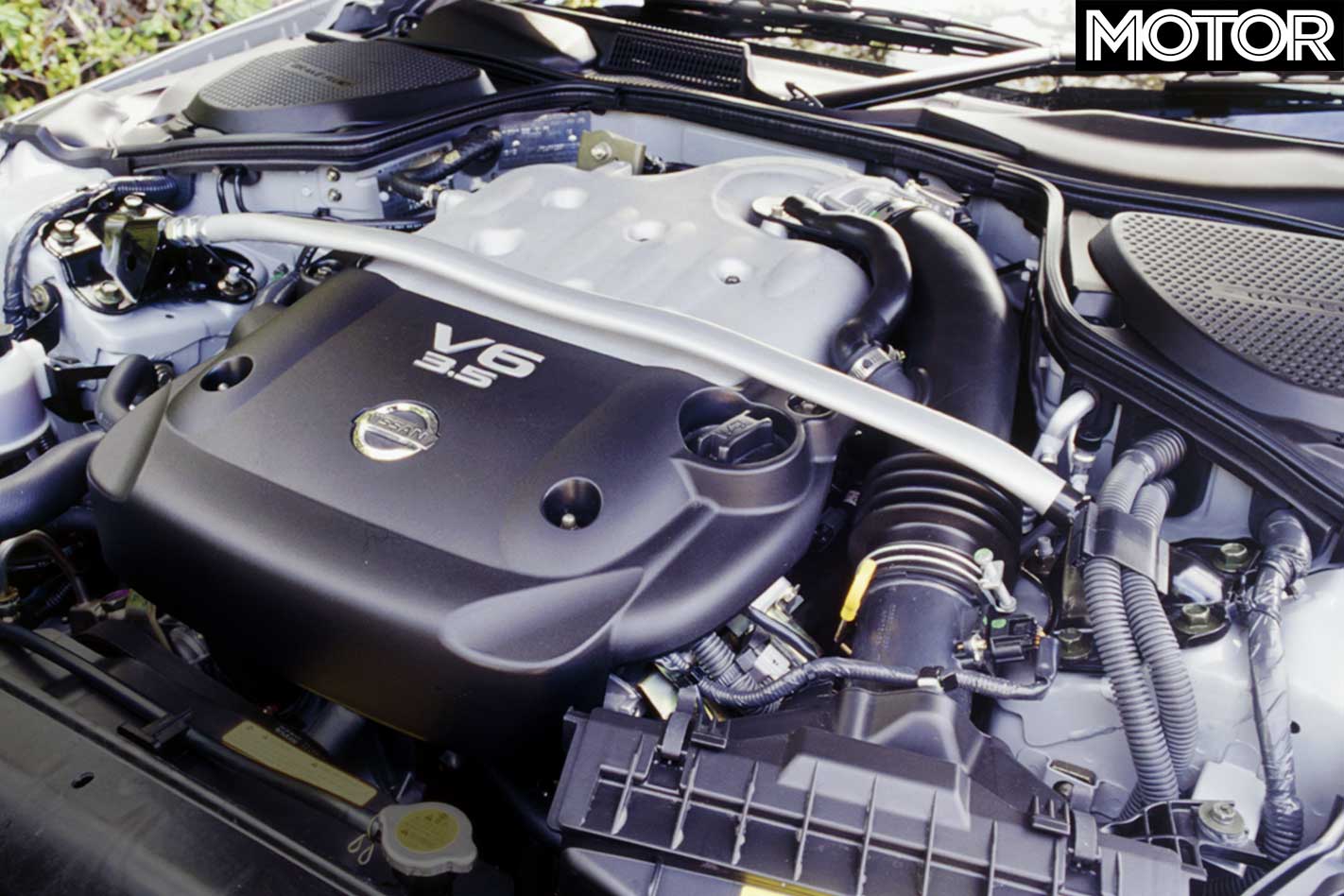
The 350Z roadster adds exactly ten grand to the Touring coupe’s base price, but it’s not all down to the electric roof mechanism. Unlike the coupe’s Touring or Track specs, the Roadster is available in one mix-and-matched mid-spec offering: it gets the up-spec Track’s 18-inch alloys and 225/45 tyres, but the base-spec Touring’s smaller twin-piston caliper brakes.
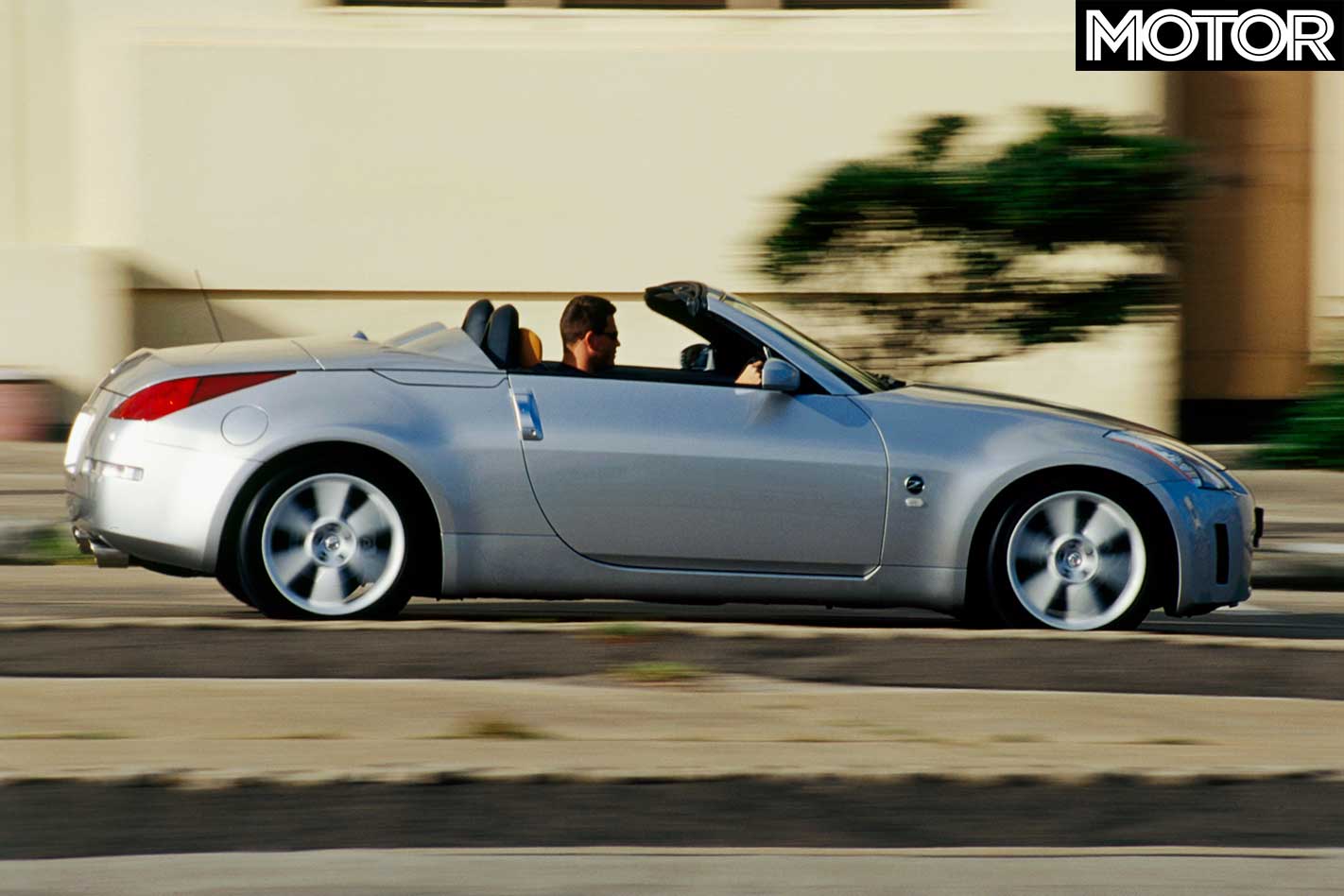
Mechanically it’s the same, but the power-to-weight ratio does suffer slightly due to an extra 95kg of electric roof mechanism and bracing. It’s a small price to pay, because cabrios are traditionally slow boulevard show ponies anyway: a 6.5sec 0-100km/h is close, but 15.1sec at 151km/h for the 400m is about half a second and 10km/h off the coupe. Far from slow, but speed isn’t always the point.
In fact, why not fork out the extra $2800 for the 4kg heavier five-speed slusher with manual shift? Who cares about quarter miles when you’re admiring your own top-down Saturday morning reflected smugness in shop windows?
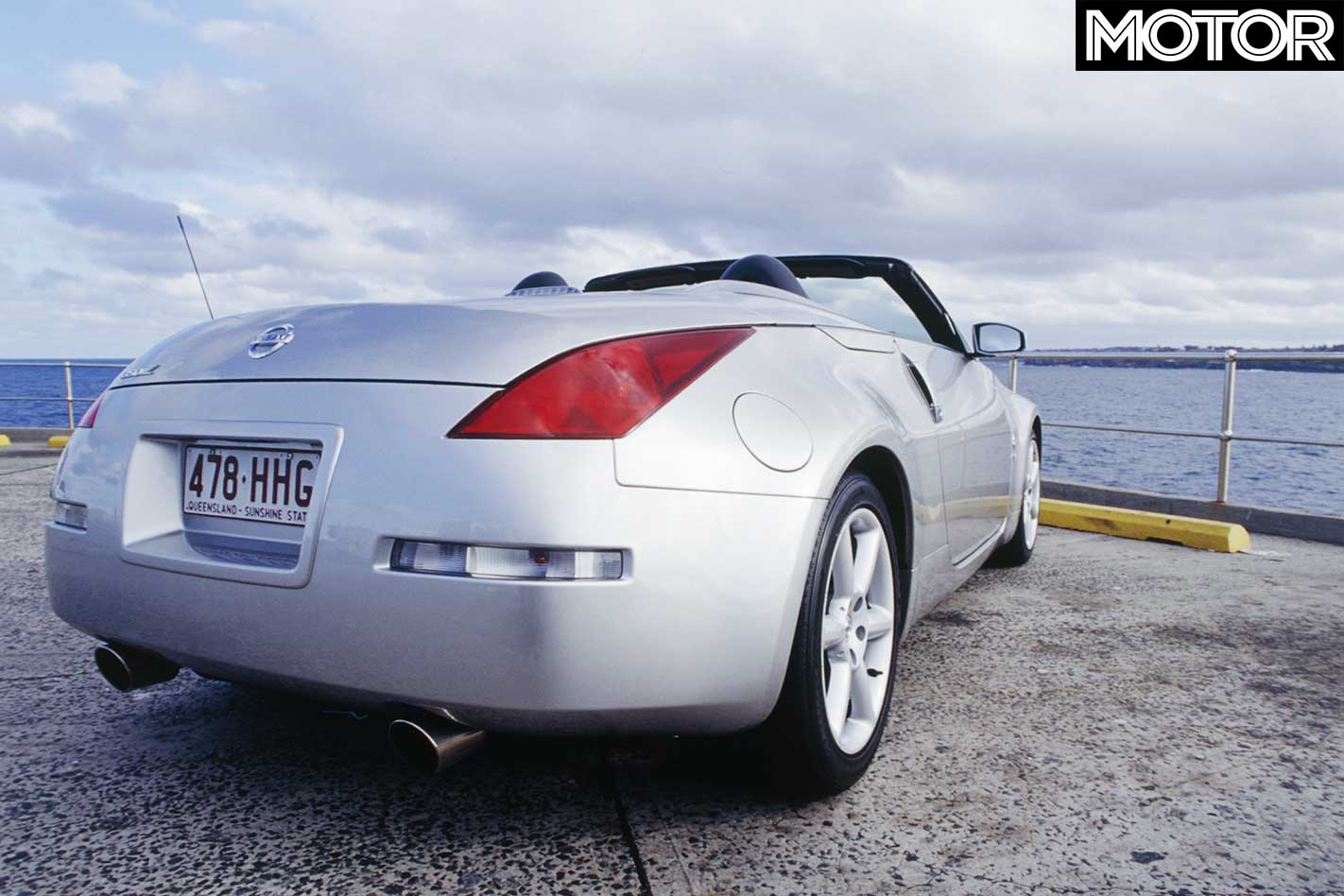
Don’t worry too much about messing the hair, either, because the cabin’s fairly well protected from the elements; the low seating position, high windows, styled speedster cover and a rear glass wind-blocker all help to keep wind effect down.
With roof raised – a process that takes just 16.5 seconds, including a slight nudge in the head from the folding roof – rear vision is reduced, and while it’s all sealed tight, there is a high amount of wind noise that a few layers of canvas just can’t suppress.
Chassis stiffness is impressive, with just the slightest shake over very rough roads. Thank the extra bracing, with a V-bar connecting the sills and an A-shaped crossbar reinforcing the front end. Stronger door openings and a triple member added to the seating area all add up to a stiff little chassis.
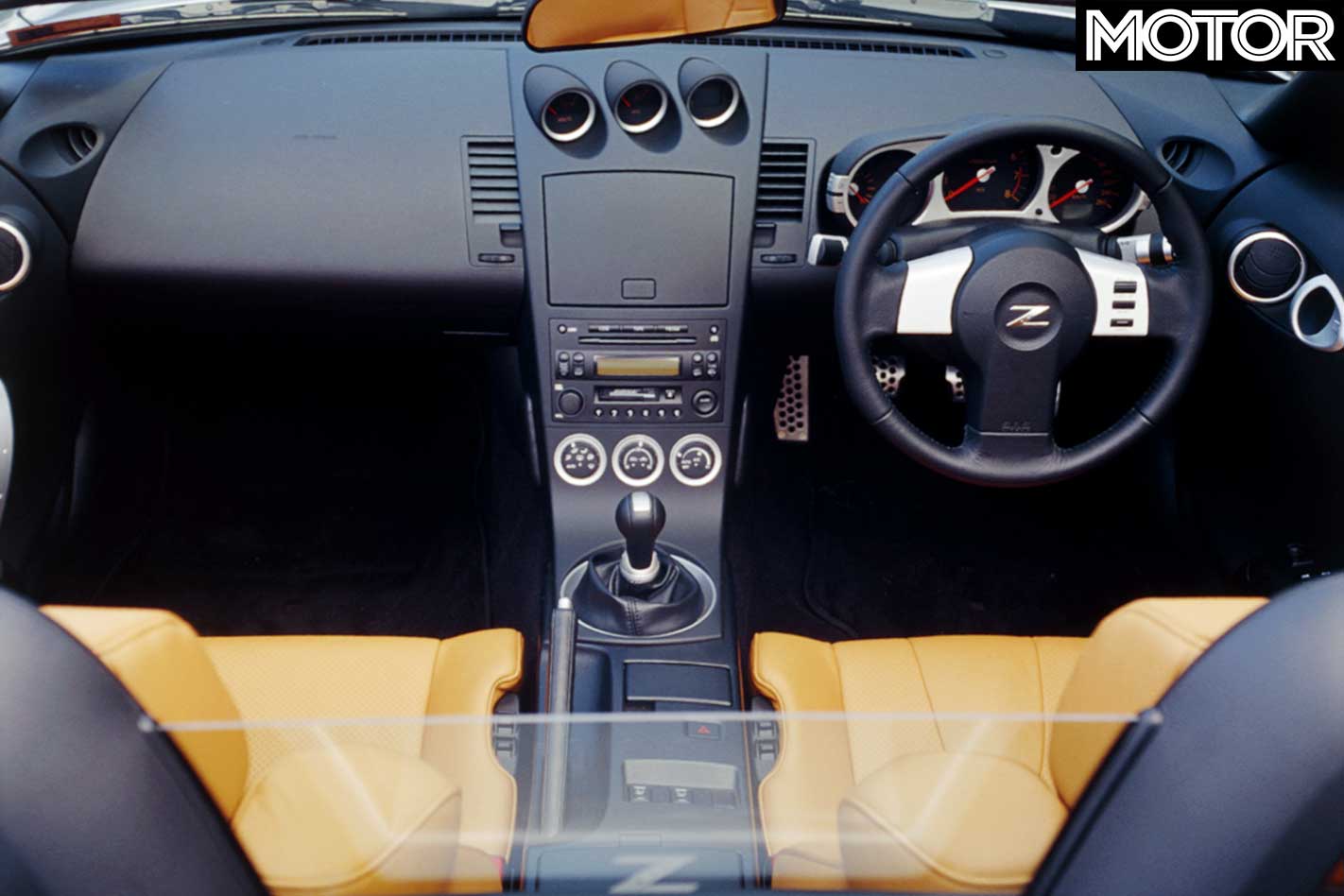
But it’s the little things that count with the Zed roadster. Like the improved operation of the dash console lid, the padded centre console and the driver and passenger knee pads. The Track coupe’s firm suspension has also been addressed in the roadster, with softer damper settings so it’s noticeably more tolerant of ripples and bumps.
The synopsis for any roadster is simple: retain all the good characteristics of the coupe while introducing as little compromise as possible. The Zed roadster shows how it’s done.
FAST FACTS 2004 Nissan 350Z Roadster Engine: 3.5-litre DOHC 24-valve V6 Power: 206kW Weight: 1548kg Drive: rear-wheel Price: $69,990
Just in case you think the whole idea of globalisation sucks bad, consider this: without a globalised General Motors conglomerate, this car simply wouldn’t have happened. Not in this form, anyway.
This review was originally published in MOTOR’s December 2006 issue
In a nutshell, the new WM Holden Statesman and Caprice wouldn’t be anywhere near as resolved as they are, were it not for exports. Local volumes could never have justified the $190 million Holden tipped into the big fella, on top of the billion dollars already spent on the VE.
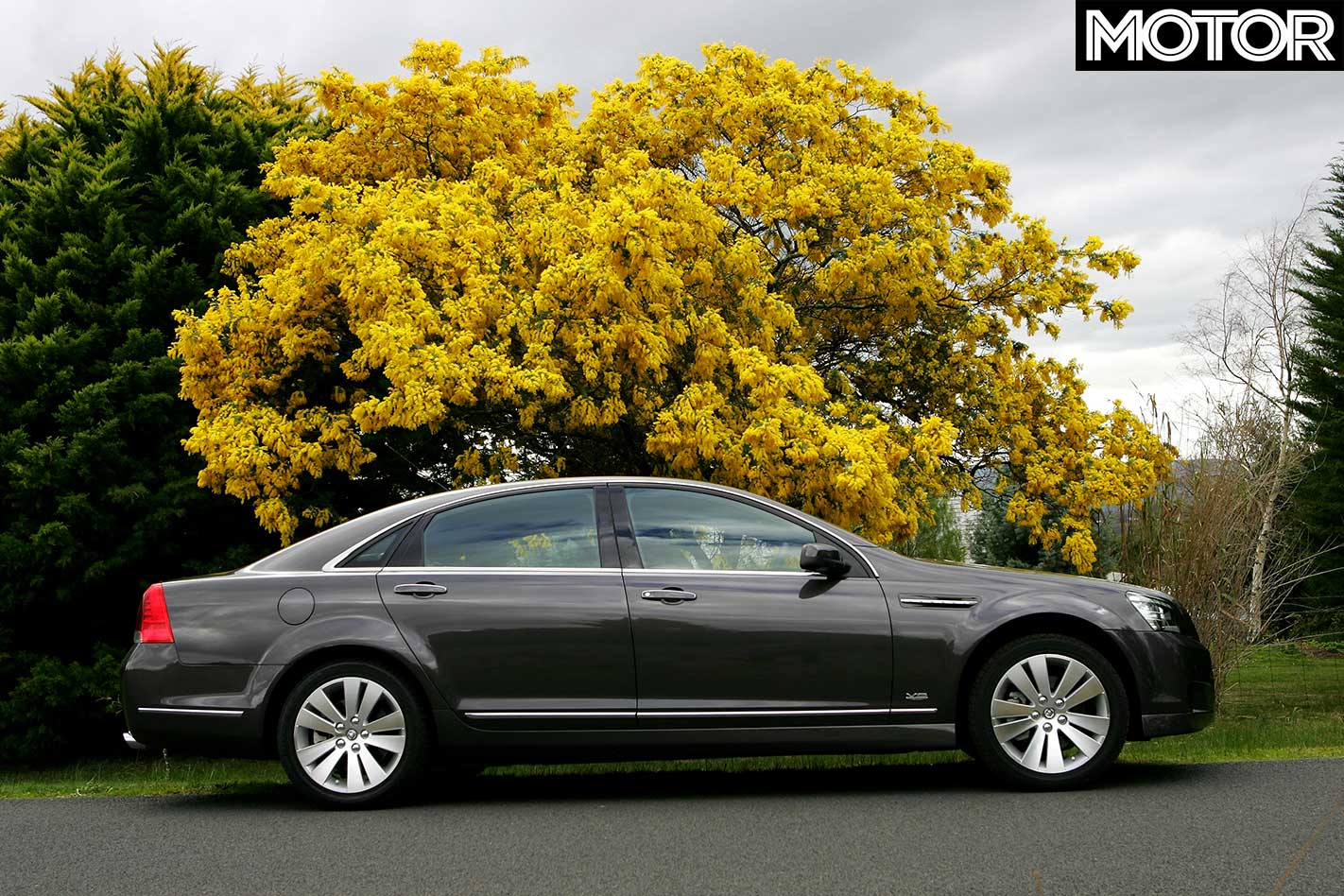
As it is, only the WM’s front doors and windscreen are shared with VE – everything else is long-wheelbase-specific in an attempt to both differentiate the Statesman and Caprice from the Commodore, as well as arrive at a legitimate luxury car in terms of appearance and accommodation.
There are 60 WM-specific body panels alone, and that’s before we even get to the interior and trim items. And in that department, only the glovebox lid and fusebox cover are shared with the short-wheelbase stuff.
The pressing itself might be different, but the WM has stuck with the VE’s pioneering (for a full-size Holden) one-piece side stamping that aids both panel fit and structural rigidity. But bolted to the longer floorpan are more or less VE carry-overs in terms of front and rear suspension and steering gear.
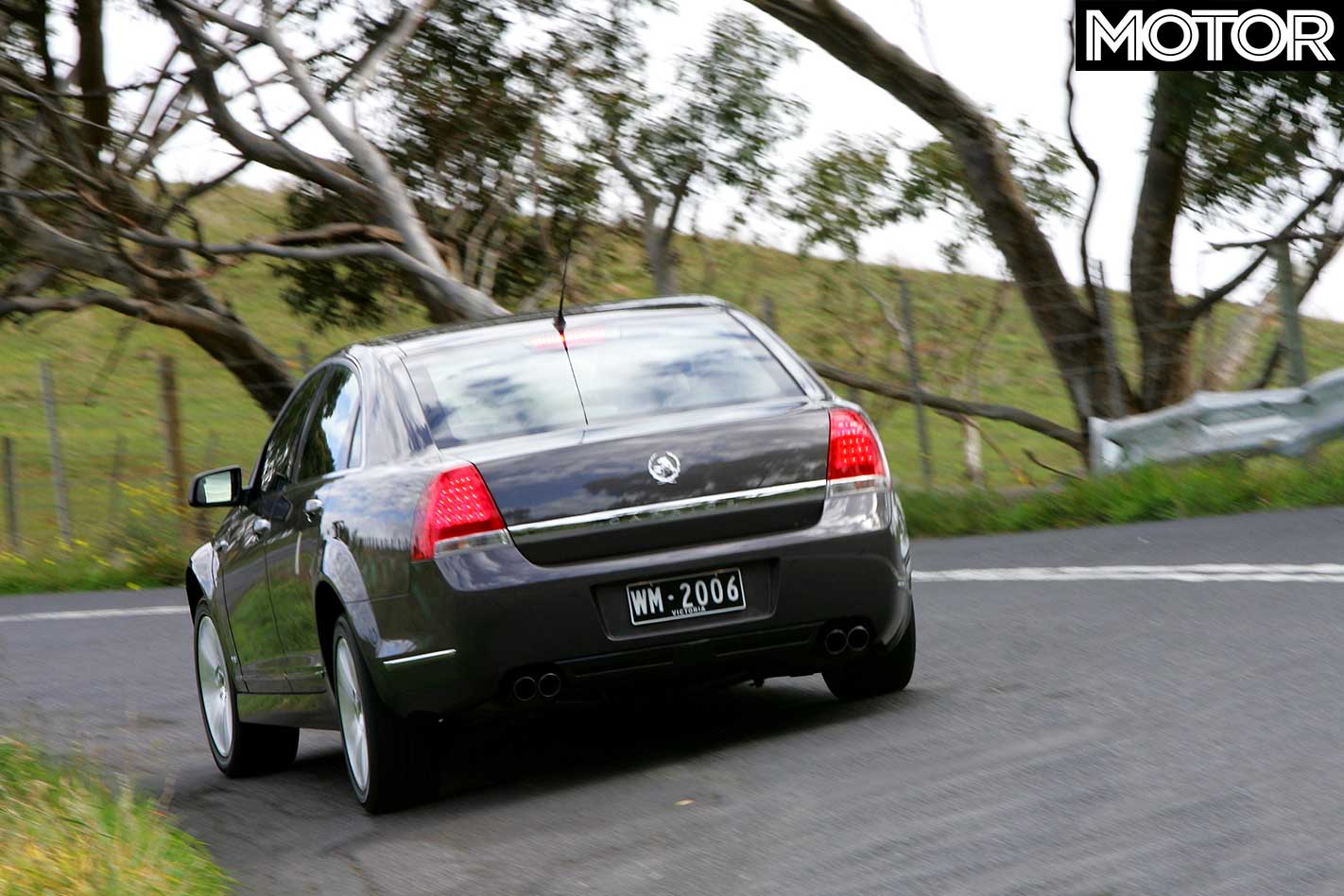
How much longer is it? Try 94mm more wheelbase, which means the WM is also 71mm longer between the axles than the outgoing WL, as well as 21mm taller and wider across either track (33mm front, 41mm rear). Surprisingly, despite its obvious bulk, the WM is also 31mm shorter than WL.
Marketed as the comfort-oriented model, the Statesman is available in two main forms, the 195kW V6 with five-speed auto and the Gen IV 6.0-litre V8 punching out the same 270kW as the VE short-wheelbase stuff.
Of potentially more interest to MOTOR readers is the Caprice which, like in the old WK/WL range, is positioned by Holden as a more performance-slanted, youthful approach to a big luxo. Again, a V6 is available, but the V8 is the headline act.
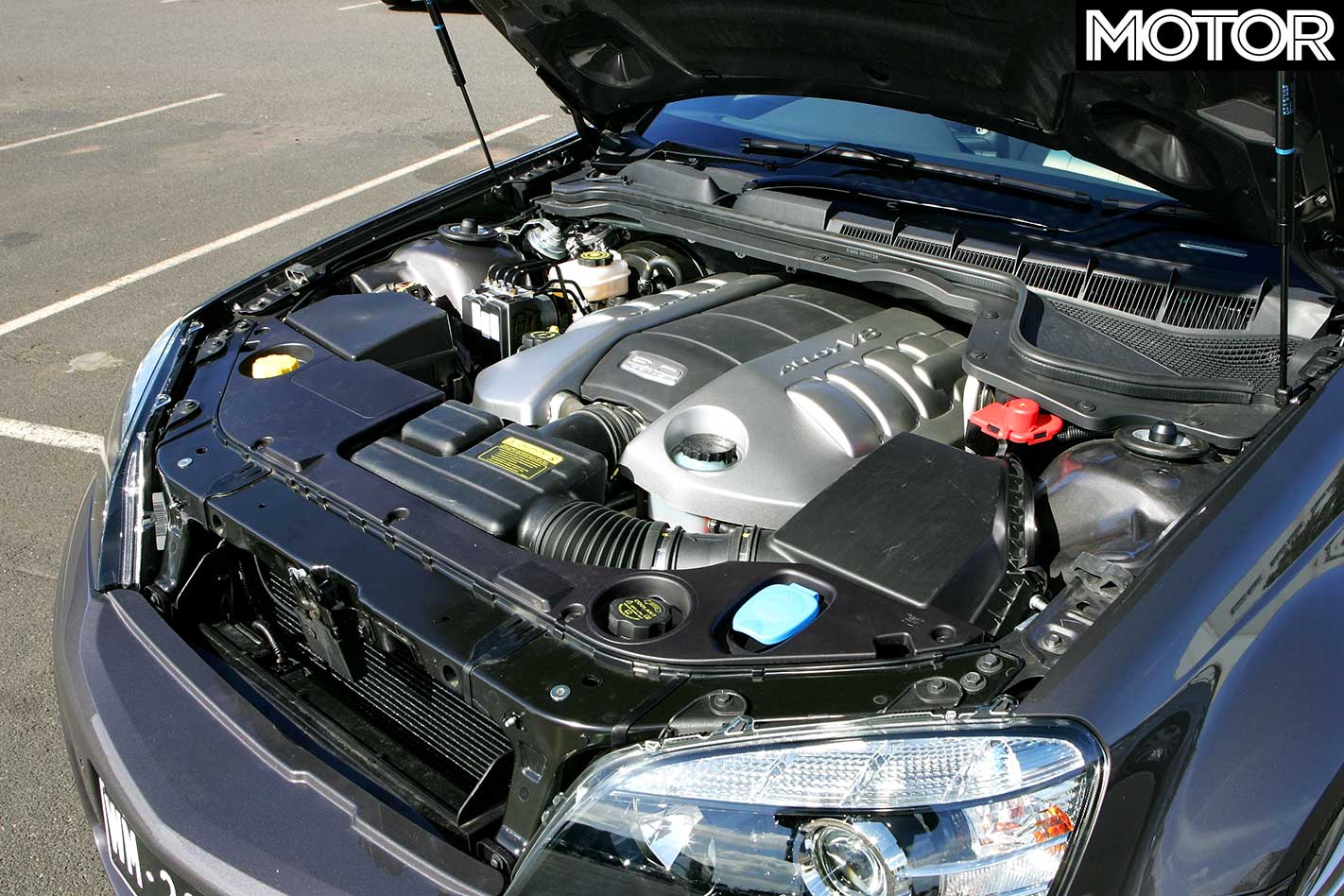
Along the way, you also get the best-equipped local car ever with an impressive line-up of safety gear. Bargain on six airbags (which includes full-length side-curtain bags), ESP, brake-force distribution and brake assist, traction control, front and rear park-assist, and active front headrests, as well as stuff like leather, eight-way electric front seats, bluetooth phone compatibility, rain-sensing wipers and even puddle lights in each exterior mirror.
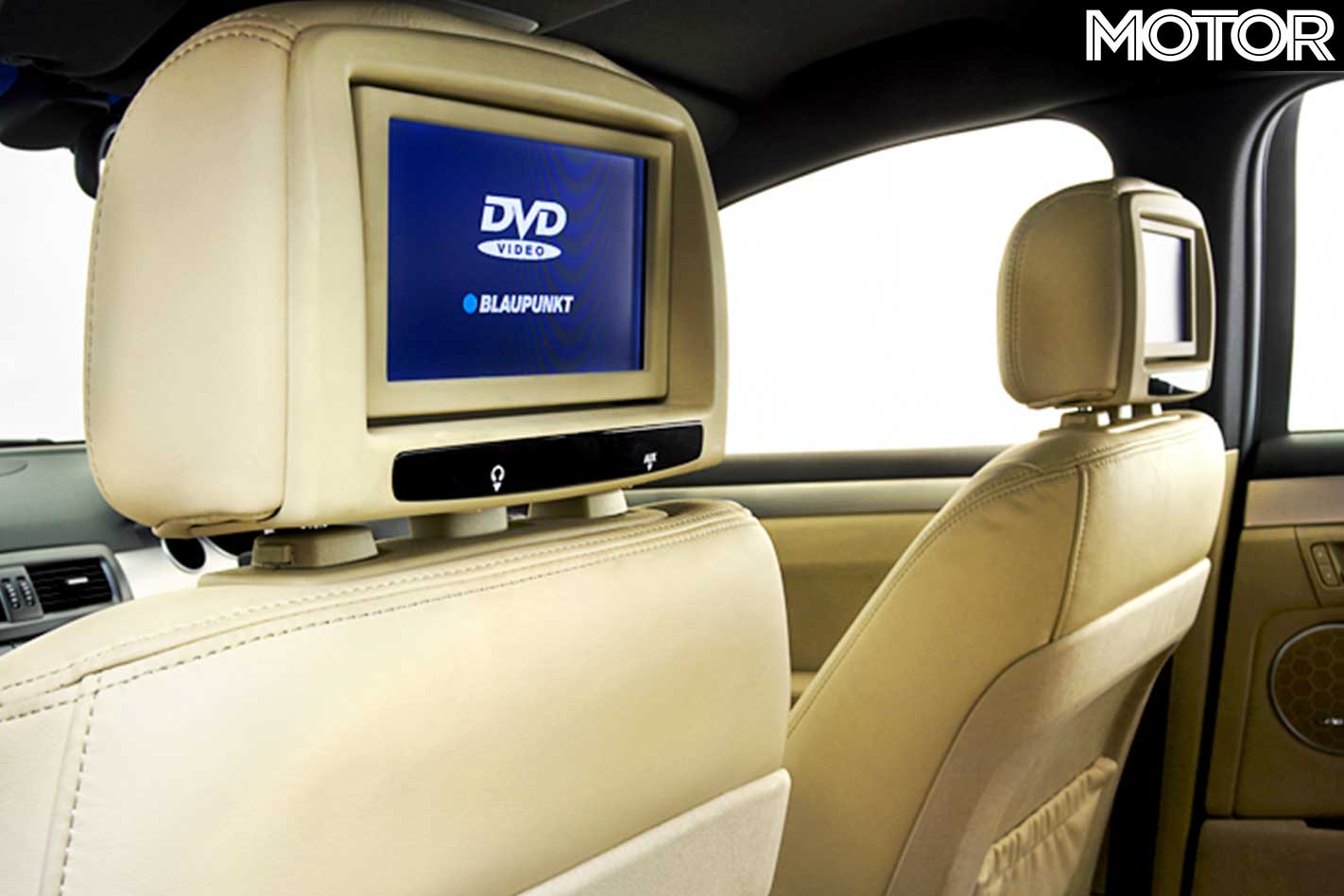
The Caprice adds a fair bit to that lot, too, with 18-inch alloys, soft-touch leather, colour LCD screens in each front headrest, a monster Bose sound system, xenon headlights, tri-zone climate control and even on-board tyre-pressure monitoring.
Visually, the Caprice gets a sportier front fascia with a black mesh insert, plus a sports steering wheel and sports front seats. The major mechanical difference is a specific suspension tune, but it’s only the dampers that are altered – the Statesman and Caprice share spring rates and ride height.
But what about the $64,000 question: does a car that’s been designed for export customers in far-flung countries still cut it in Australian conditions? Well, yeah, actually.
The V8 engine is a real sweetie in the Caprice and while there’s just enough soundtrack, it’s nicely refined and only really starts to feel like it’s working when you’re revving it as hard as it’ll go. The six-speed auto can be caught on the hop, sometimes kicking down to first when second would have done, but the shifts themselves are smooth and assured.
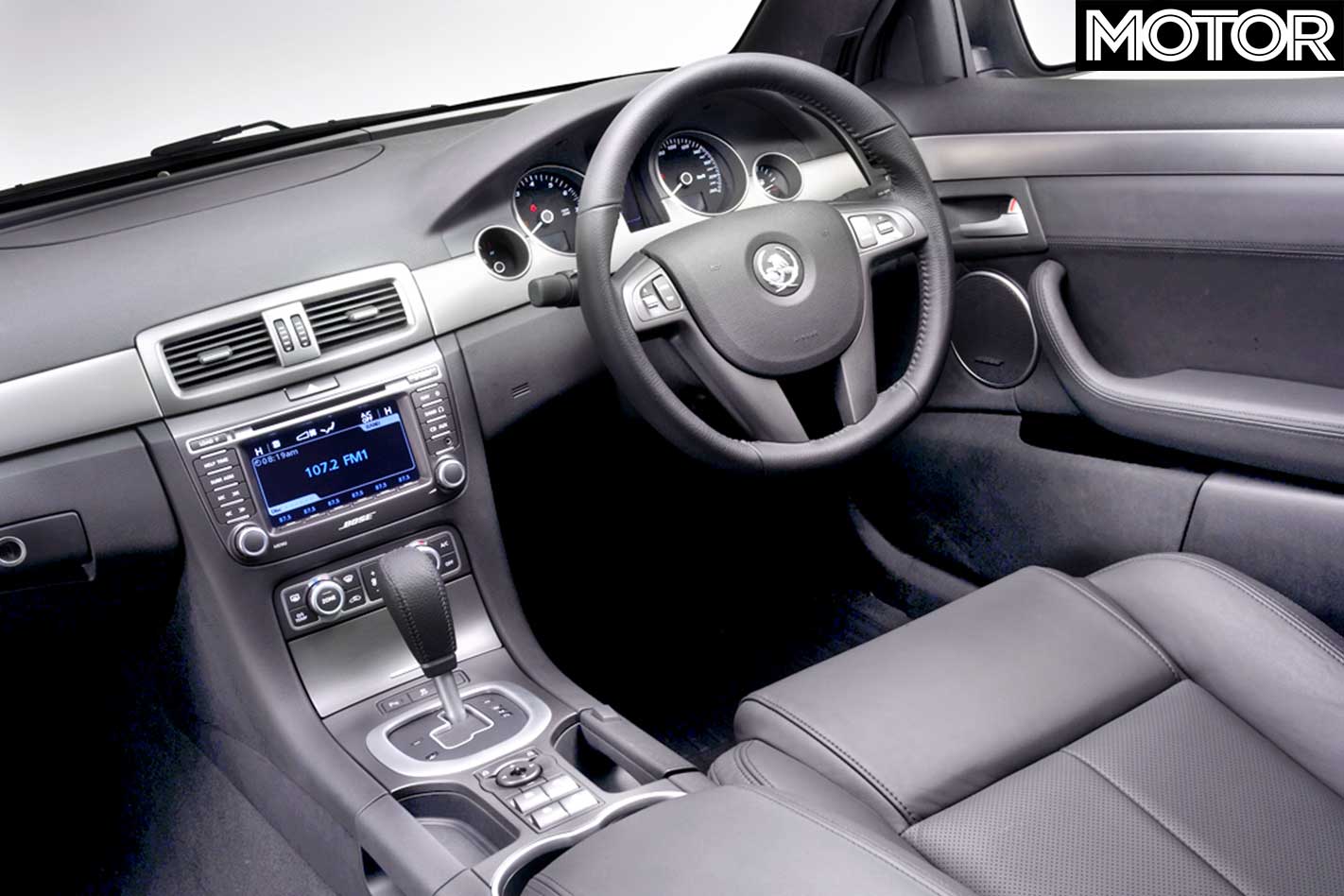
The ’box doesn’t seem overly enthusiastic about following instructions via the manual mode, but any car this big and heavy (try 1890kg for a V8 Caprice) is probably best left to its own devices, anyway.
Perhaps the biggest surprise (and the biggest hint that Aussie blokedom wasn’t the only consideration) is how softly the Caprice, even with its sportier damper settings, is set-up. Okay, the pay-off is a superb ride, but there seems to be a slight lack of suspension control. Bumps that should only intrude once can have a second half-life and you can get the Caprice to porpoise a little if you’re deliberately savage on the throttle.
The plush factor has also robbed the VE platform of some of its steering feel and accuracy, too, and you better believe that when you get nearly two tonnes of bouncy Caprice sliding around. You wanna be right on your game. Then again, cars like the Caprice are supposed to be a bit like that, aren’t they?
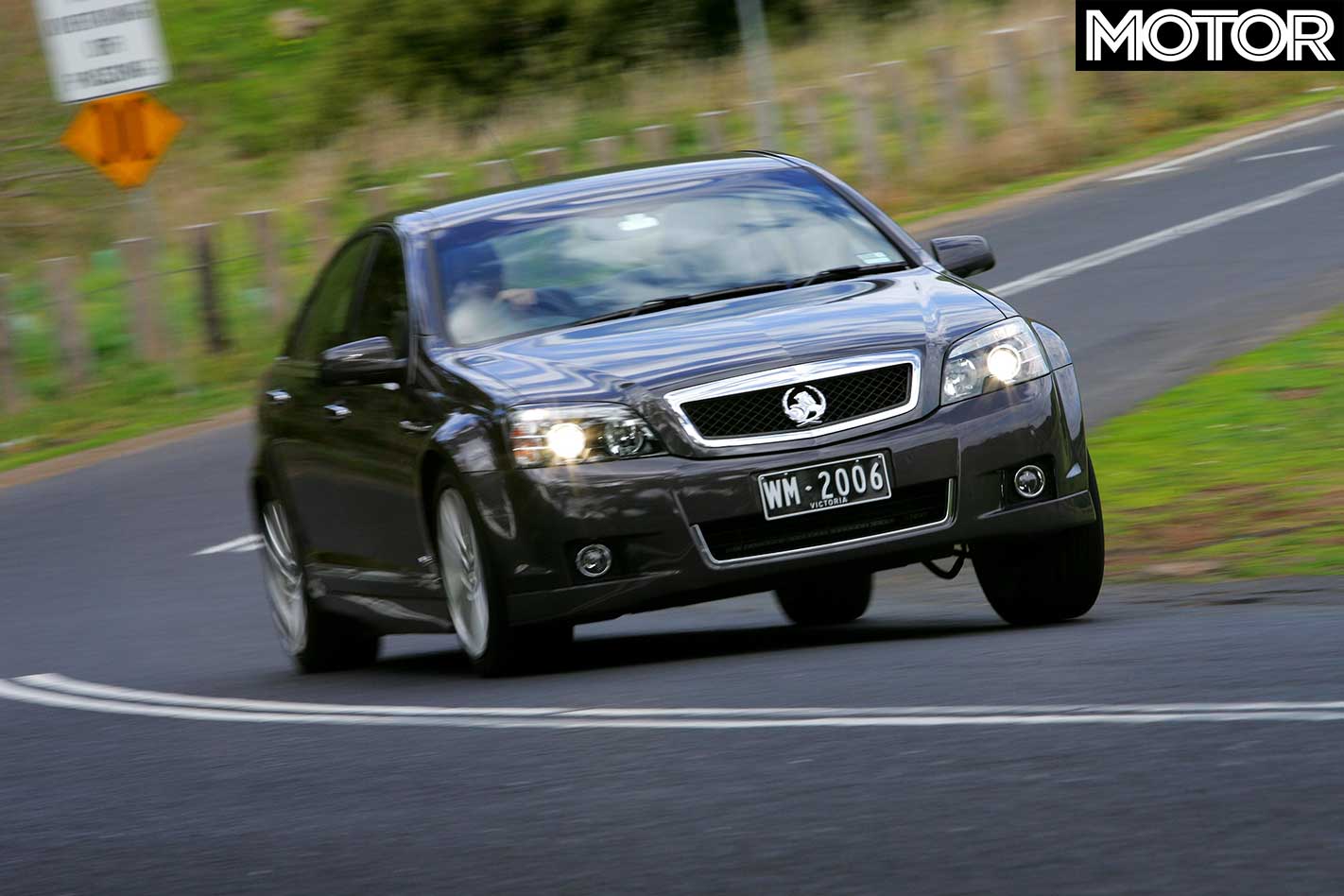
In the go department, that big V8 does the job. Plant the clog, she buggers off. That is all.
Dollars? Um, not cheap, though better value than before. The V8 Statey is $62,990, while the Caprice you’d want (the V8) is $69,990; again, not a giveaway alongside the $10K-cheaper Chrysler 300C Hemi that gave the previous Holden flagship such a kicking.
Should make for an interesting rematch, no?
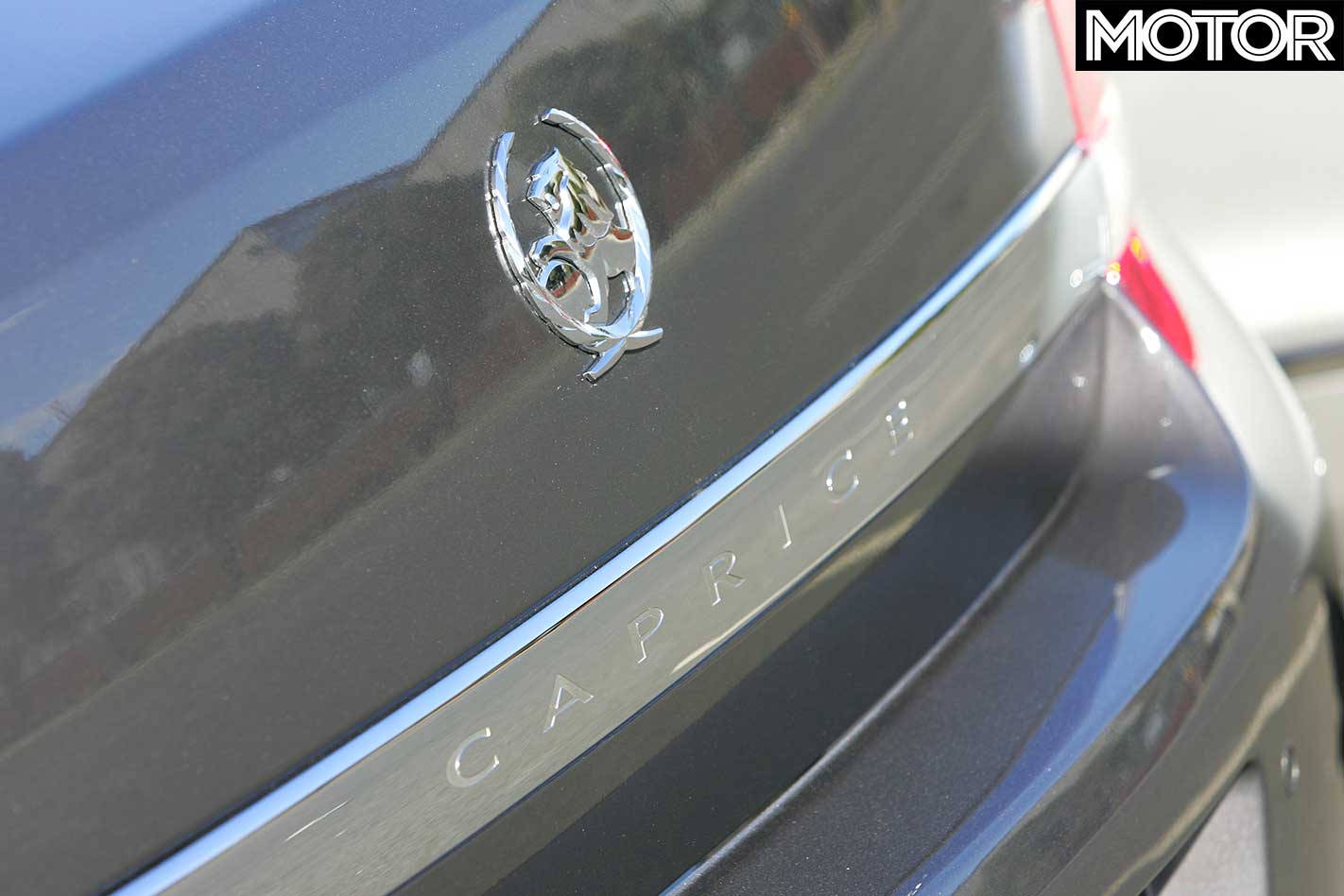
FAST FACTS 2006 Holden Caprice Engine: 5967cc V8, OHV, 16v Power/Torque: 270kW/530Nm Weight: 1890kg 0-100km/h: 5.7sec (estimated) Price: $69,990
If you can’t decide between the sensible and the ‘fun’ choices when buying a hot hatch, there’s one that ticks both of those boxes at the same time.
It’s the Mini Cooper S, and it’s just landed locally with a revised (but not more powerful) engine, and a more ‘British Patriot’ design motif.
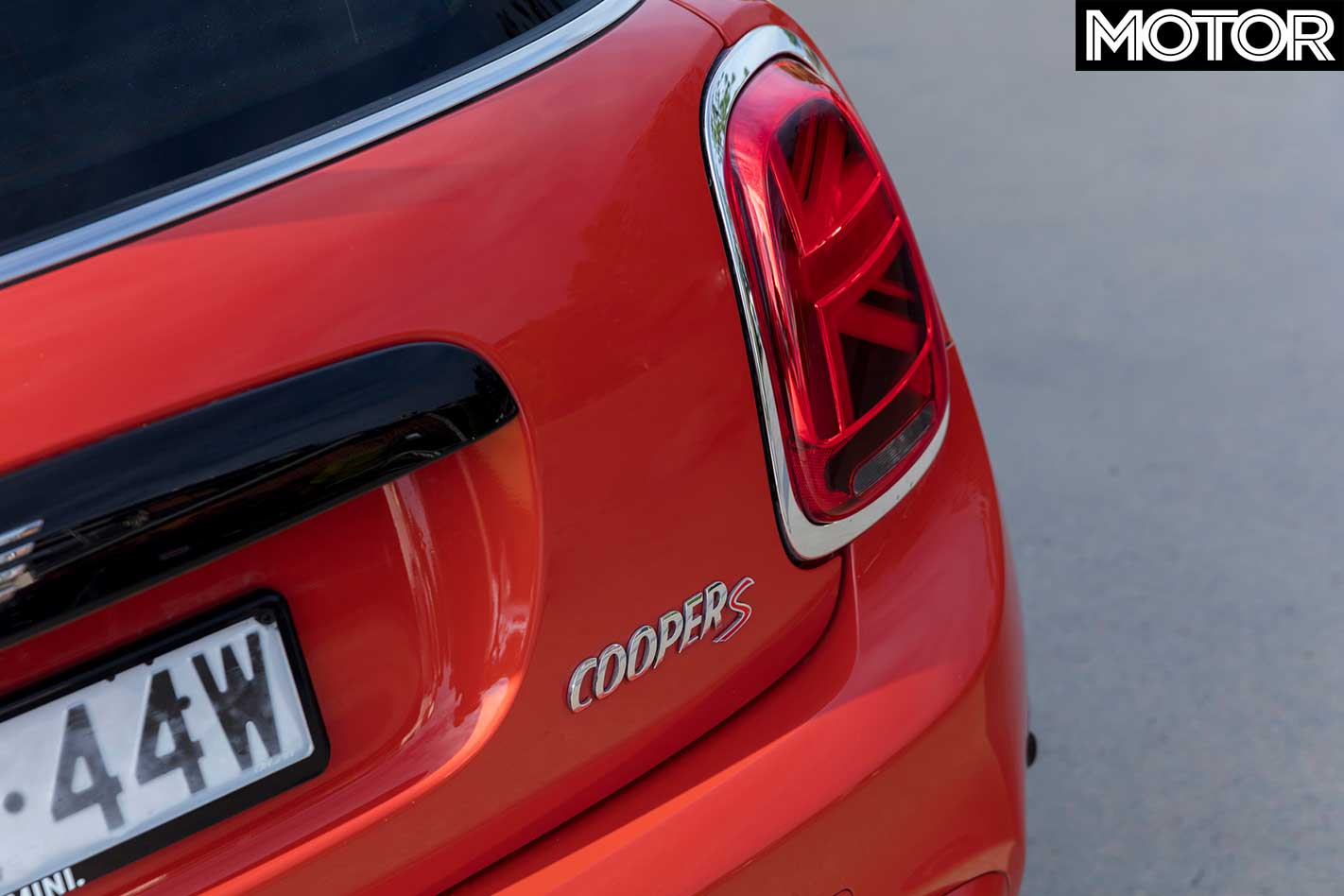
That engine still makes 141kW, but it feels eager and its power delivery is where you need it thanks to its 7-speed dual-clutch, between 4000 and 6000rpm where the needle hangs out while you’re booking it in third.
Quick but smooth (and non-argumentative) shifts are almost enough to lure a proper enthusiast away from the manual, as it feels more like a very fast torque-converter than a DCT.
Underneath is a chassis that’s fun to toy with on a twisty road, especially with a dab of mid-corner braking for some playful rotation.
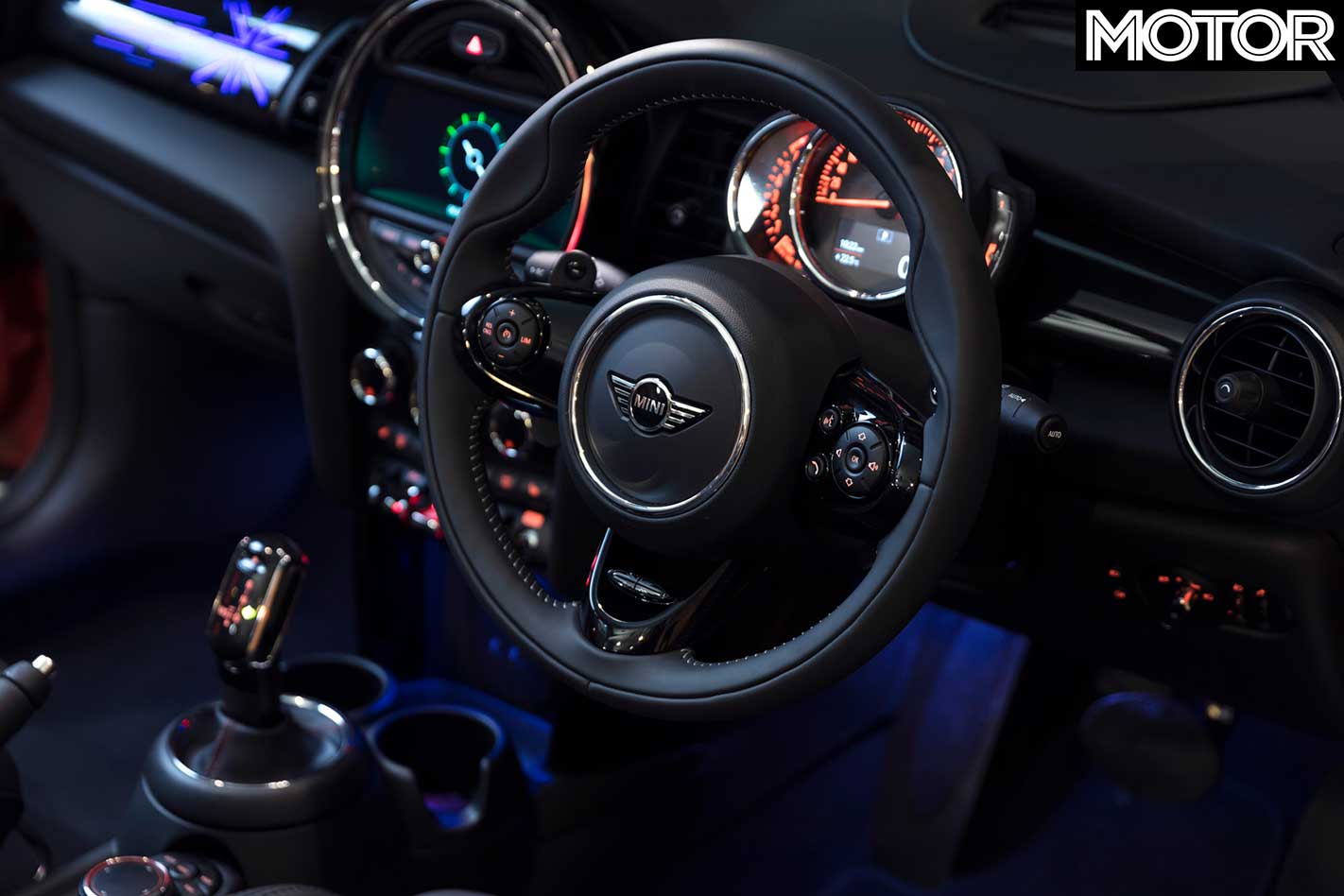
The Mini remains relatively light given the pudginess of some of its rivals, and its feels it in almost every way aside from the steering.
Even before switching to Sport Mode, something you’ll want to do out on the twisties, the steering feels artificially heavy, becoming worse in the more aggressive setting.
Each element of the car deserves individual adjustability, as can be done in the JCW.
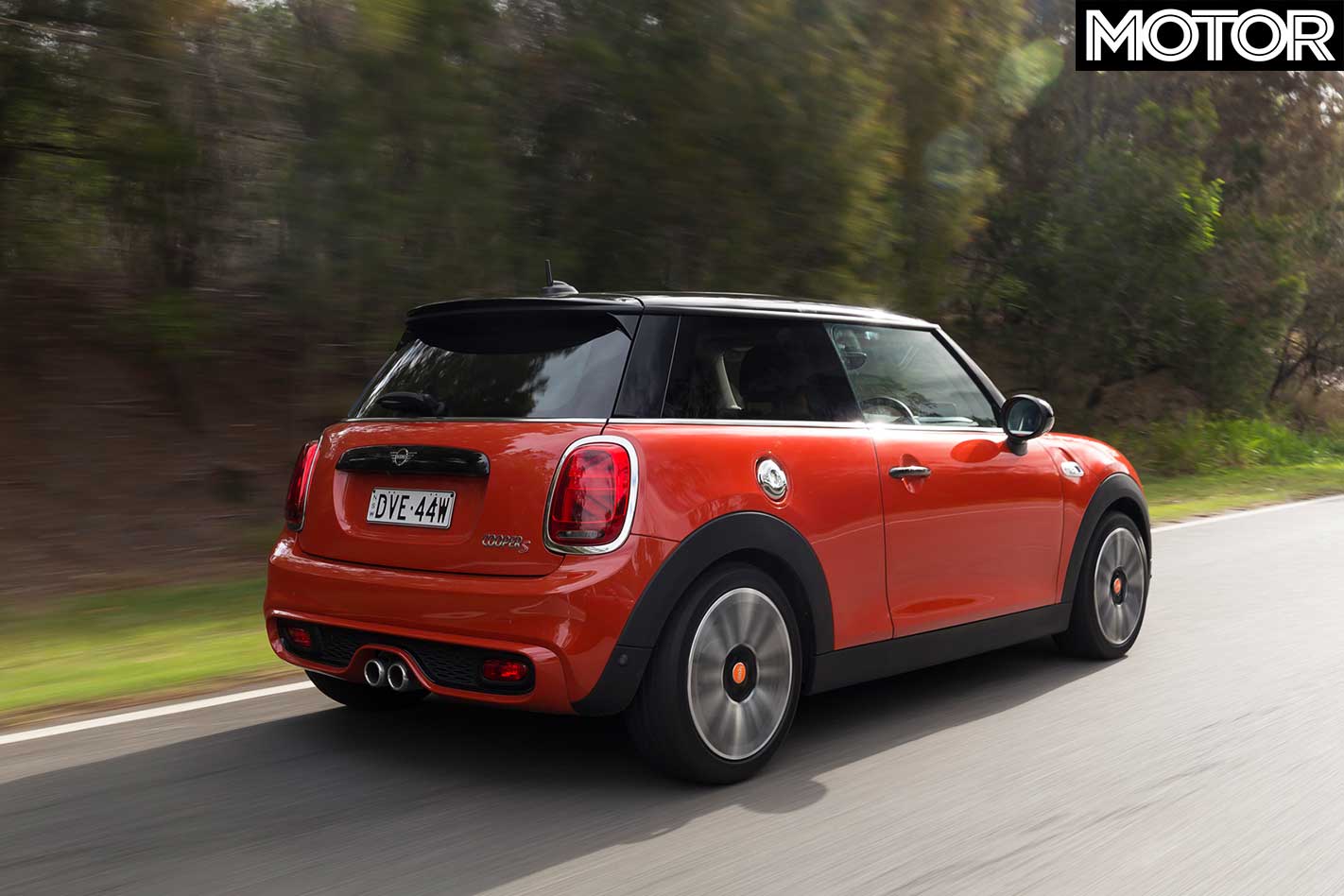
But for $42,700 ($39,900 with a manual ‘box), the Mini is a pretty good deal. Its interior is quite sleek if speced well (as black as possible is a good choice), and the amount of fun you can have with the car is more accessible than something like a Golf GTI, which is usually more mature in most hands.
The biggest thing that’ll likely turn most away is the ‘image’ that comes with the cute Mini, especially now that it’s got Union Jack tail lights – a motif which comes into the cabin and spreads to seemingly every surface.
If you can look past those flags, or even enjoy them, the Cooper S is a blast.
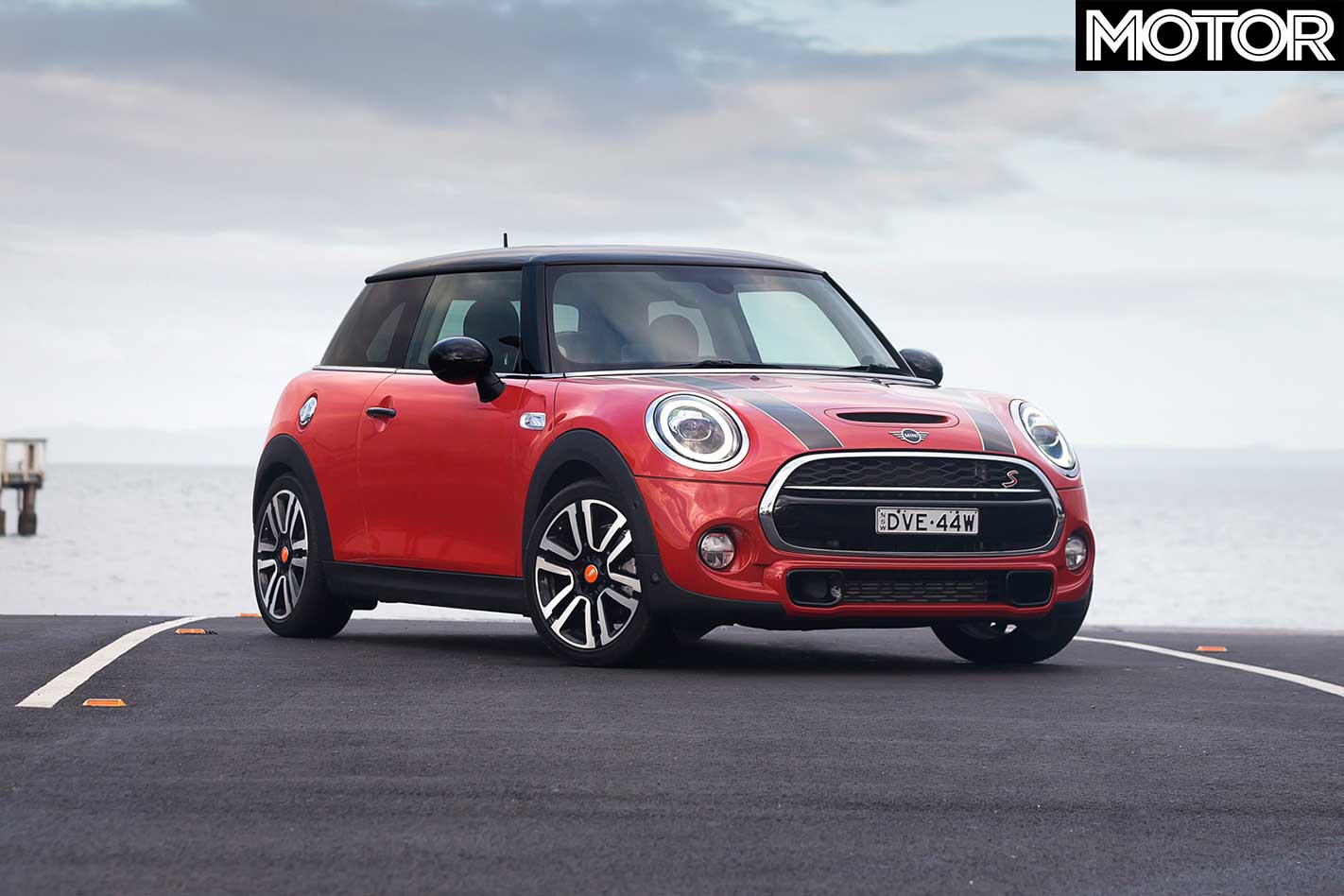
2018 MINI COOPER S SPECS Engine: 1998cc inline-4, DOHC, 16v, turbo Power: 141kW @ 5000-6000rpm Torque: 300Nm @ 1250rpm 0-100km/h: 6.8sec (claimed) Weight: 1235kg Price: $39,900 (6/m) – $42,700 (7/dct)
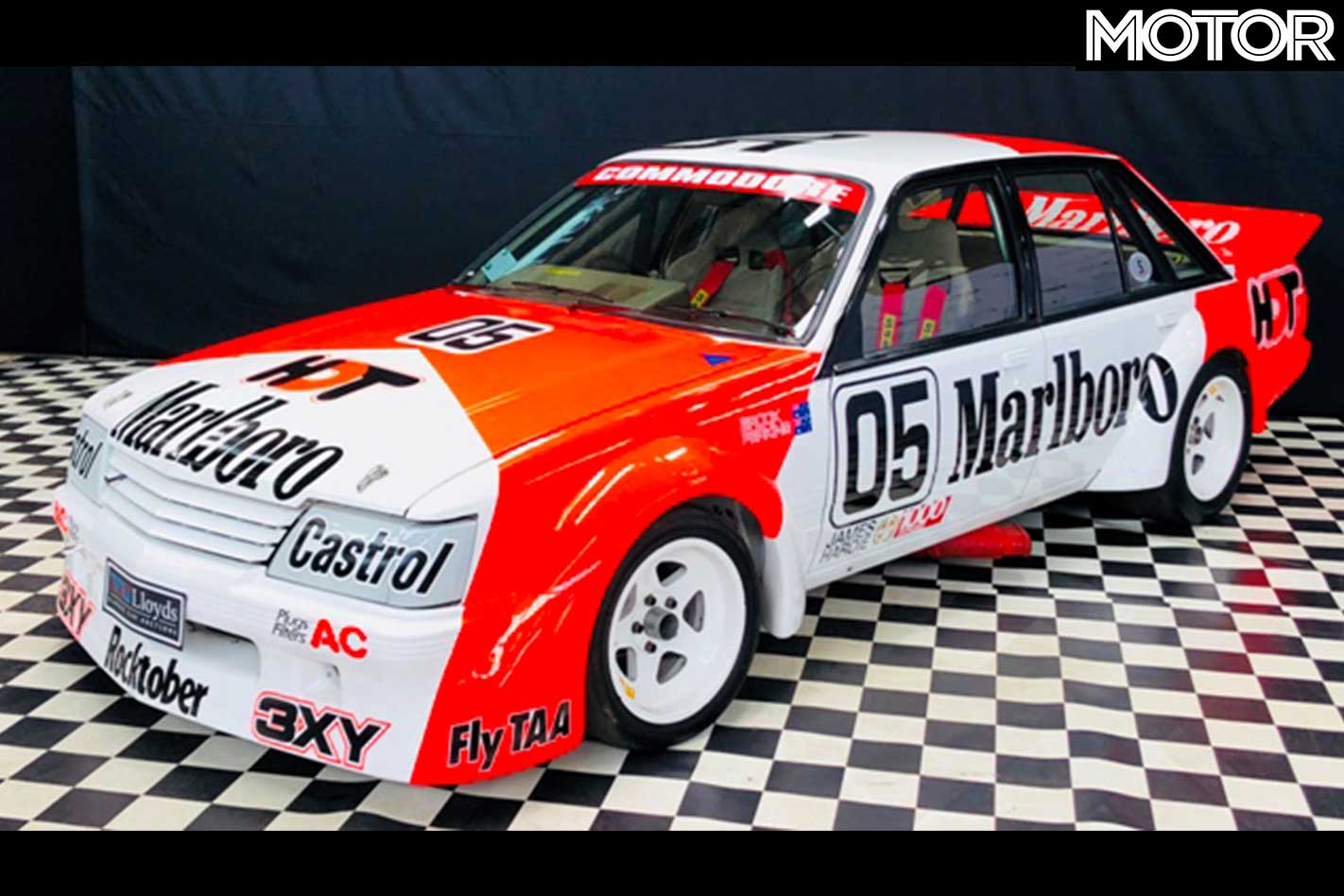
One of the most recognisable Peter Brock race cars to exist, the Bathurst-winning VH Commodore SS, is up for grabs in a Lloyds Online auction.
It’s part of the selling-off of the HDT collection (formerly owned by Peter Champion) of Brock’s race and road cars set to wrap up on Saturday, timed to coincide with ‘Bathurst Weekend’.
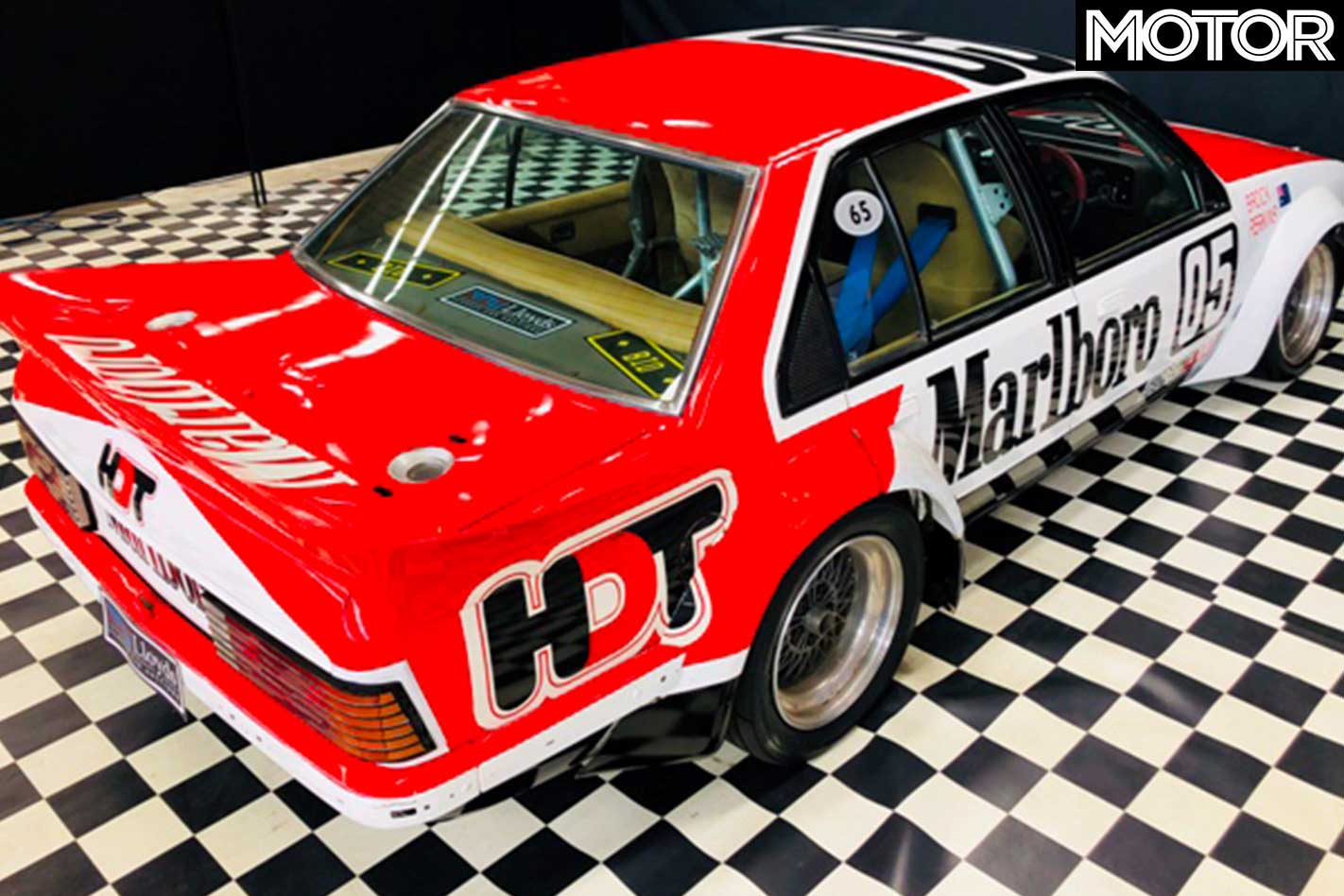
As the time of writing, the bid for the VH is astronomically high – higher than the famous ‘Big Banger’ VK which was expected to be the biggest item on the lot list.
The bid, a whopping $1,610,000, is almost a full million higher than the $625,000 bid placed on the ‘Big Banger’ VK Commodore – currently the second highest price for a car in this auction.
This VH is claimed to be the car which won the Bathurst 1000 in both 1982 and 1983, while the VK is also the original, Champion says.
“This is one of two cars in our country to have won The Great Race twice,” Champion says of the VH.
“It’s a very special car to me as well, because I was fortunate enough to be invited to England in 2010 to do the Goodwood event.”
Peter recalls a strange coincidence this particular car had caused while competing at Goodwood:
“While I was doing that event, I had an accident over there which earnt me the Spirit of Goodwood.
“There are only two Australian’s to win the Spirit of Goodwood, and Brocky was the other guy.”
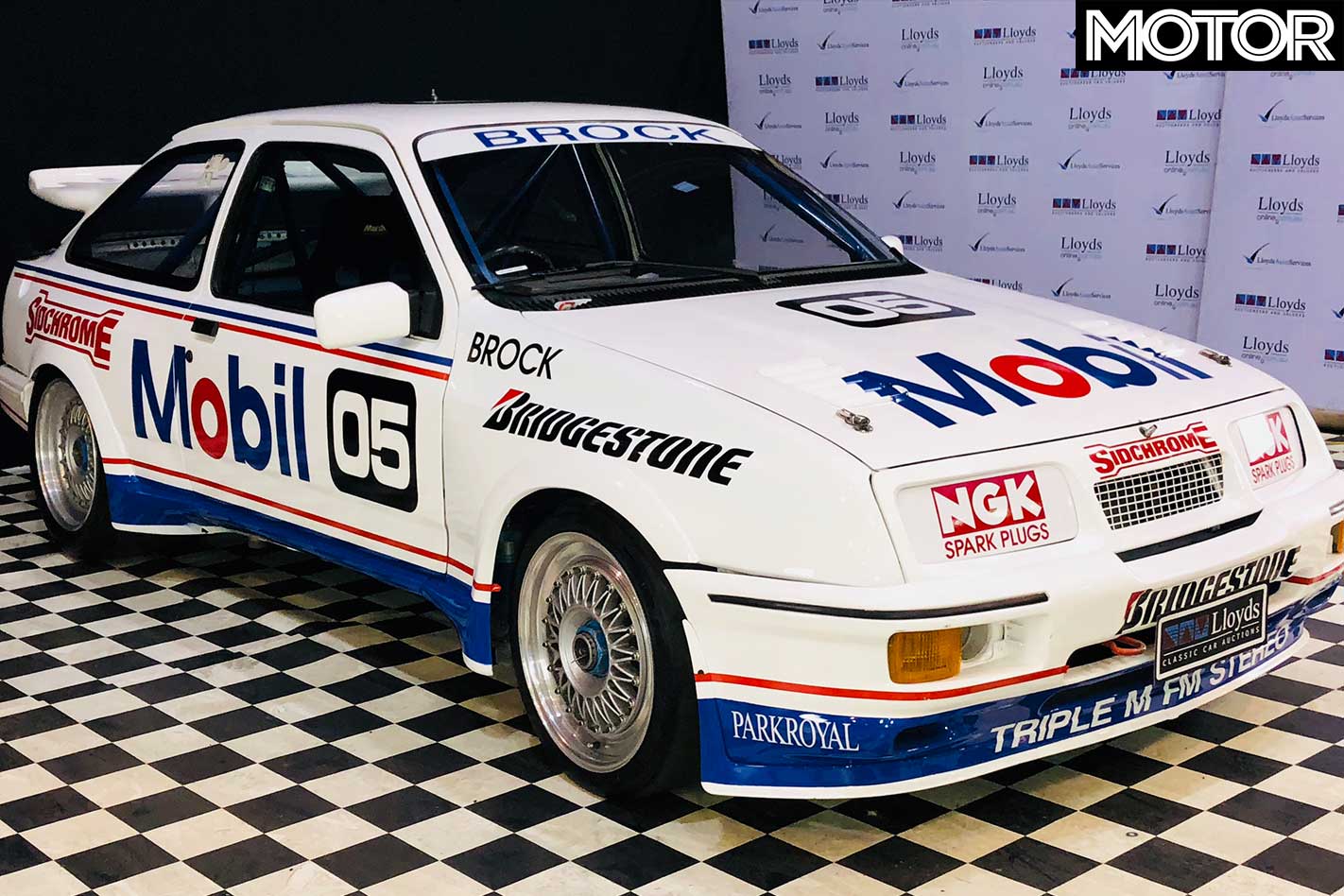
Also featured in the auction is a Ford Sierra RS500 which, while believed to be Brock car by Lloyds, there’s contention that it may not be genuine. The listing is the only race car in the auction without a video featuring Champion talking about the car.
The auction will end just after 8pm on Saturday October 6. You can see the full lot list and check out the bids at Lloyds’ website.
Lexus has introduced a new, aggressively styled version of its flagship LX SUV for those who think the gigantic Toyota Landcruiser 200-based 4X4 wagon isn’t already audacious enough.
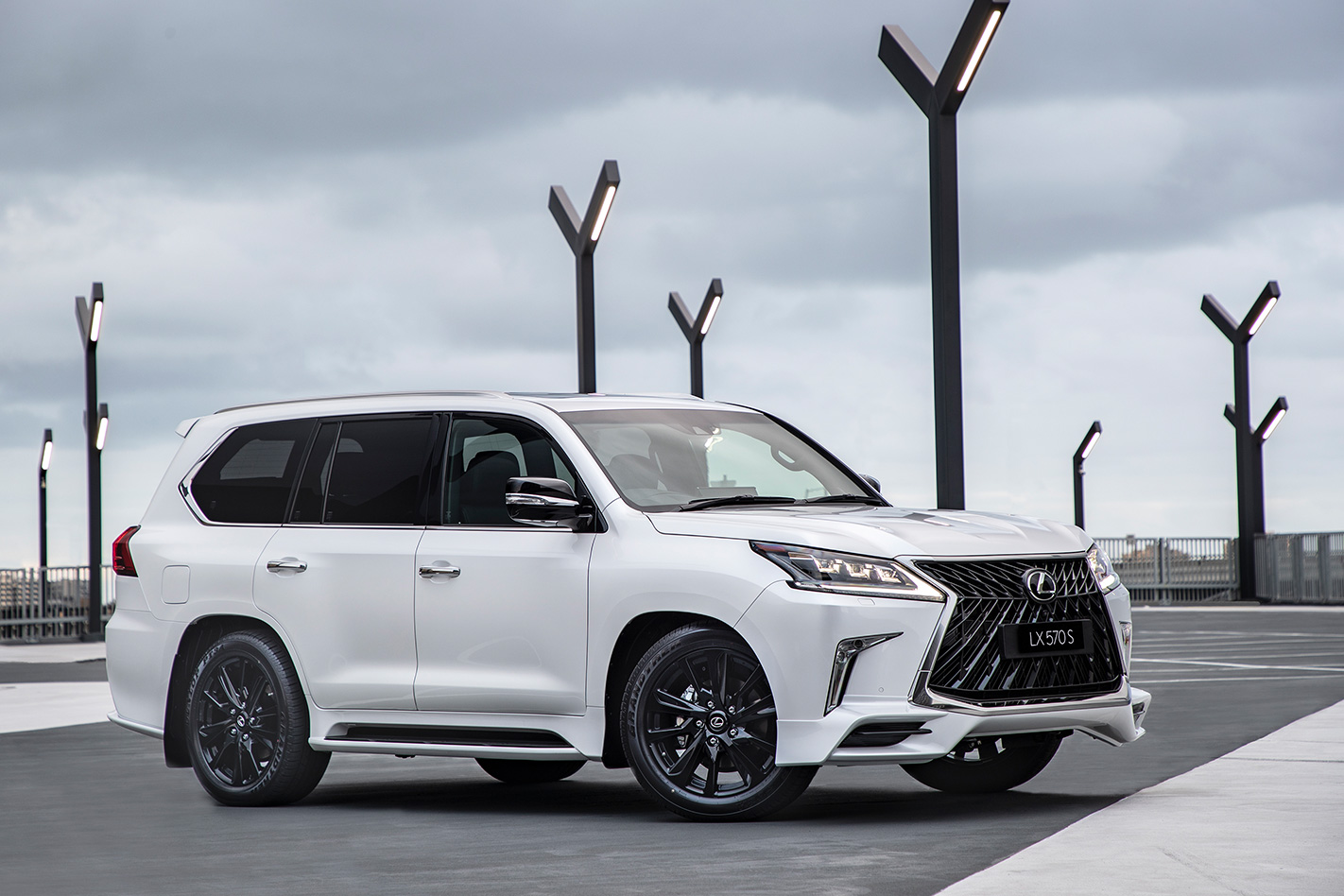
The updated Lexus LX 570 S features bold exterior bling including front and rear bumper skirts, gloss black 21-inch forged alloy wheels, exclusive sports mesh patterned grille and puddle lamps in the exterior mirrors that project “LX S” branding on the ground.
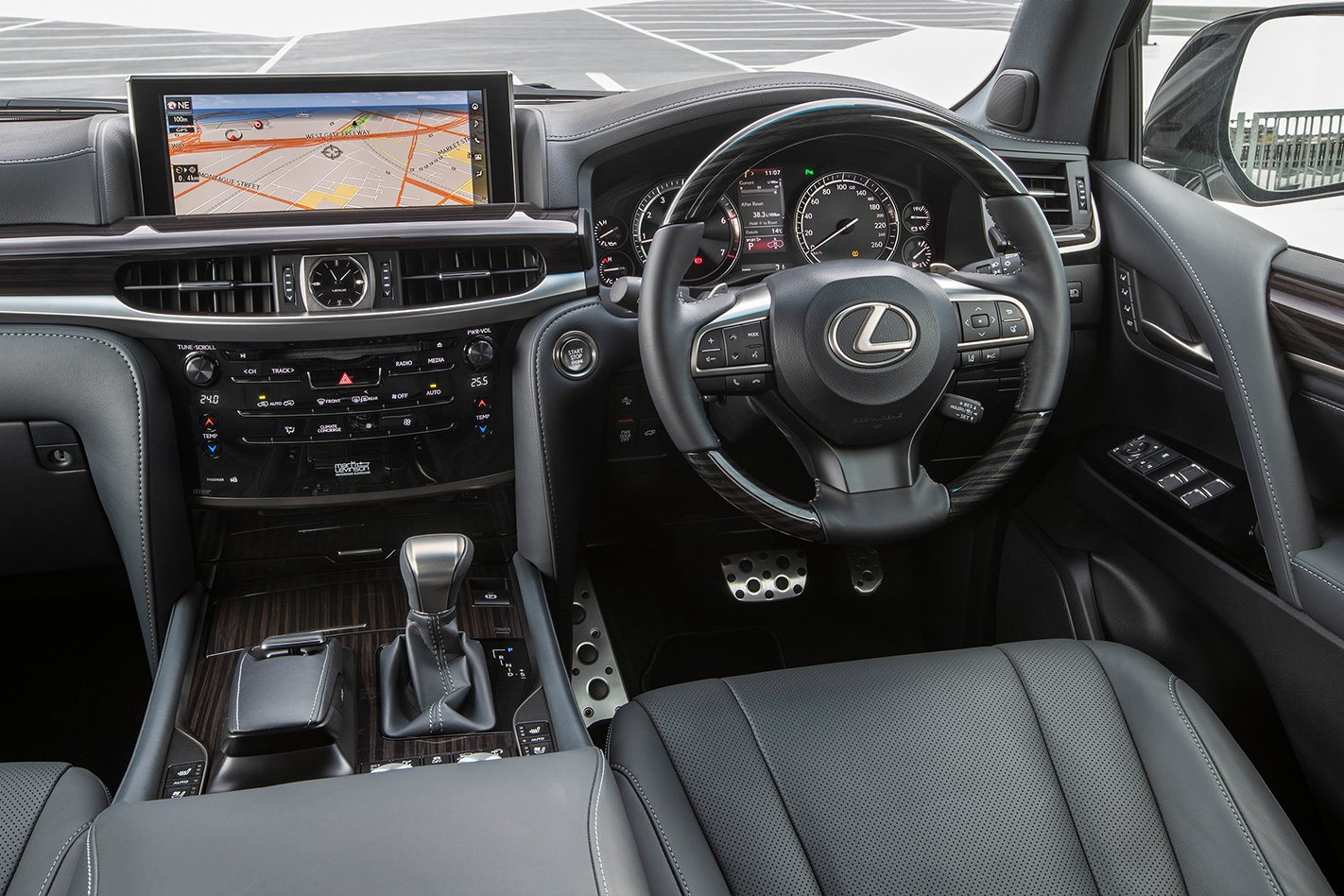
Its capacious interior meanwhile gains alloy pedals, and semi-aniline perforated leather trim available in black or an exclusive rich burgundy hue named Garnet. Two exterior colours are available – Sonic Quartz and Starlight Black.
The LX 570 S’ sporty aesthetics are matched by improved handling with a front performance damper that, according to Lexus, enhances the big-wagon’s body rigidity and steering stability.
Priced at $168,089, the 5.7-litre V8 petrol LX 570 S will set you back an extra $25,300 over the standard LX 570, and shares its impressive features list that includes Lexus Safety System + active safety with autonomous emergency braking, active cruise control and head-up display, blind-spot monitor and rear cross-traffic alert.
Other standard equipment includes a 12.3-inch high-definition screen, satellite navigation, four-zone climate control, four-camera multi-terrain monitor and panoramic view monitor, heated steering wheel, and ventilation and heating for the front and outboard second-row seats.
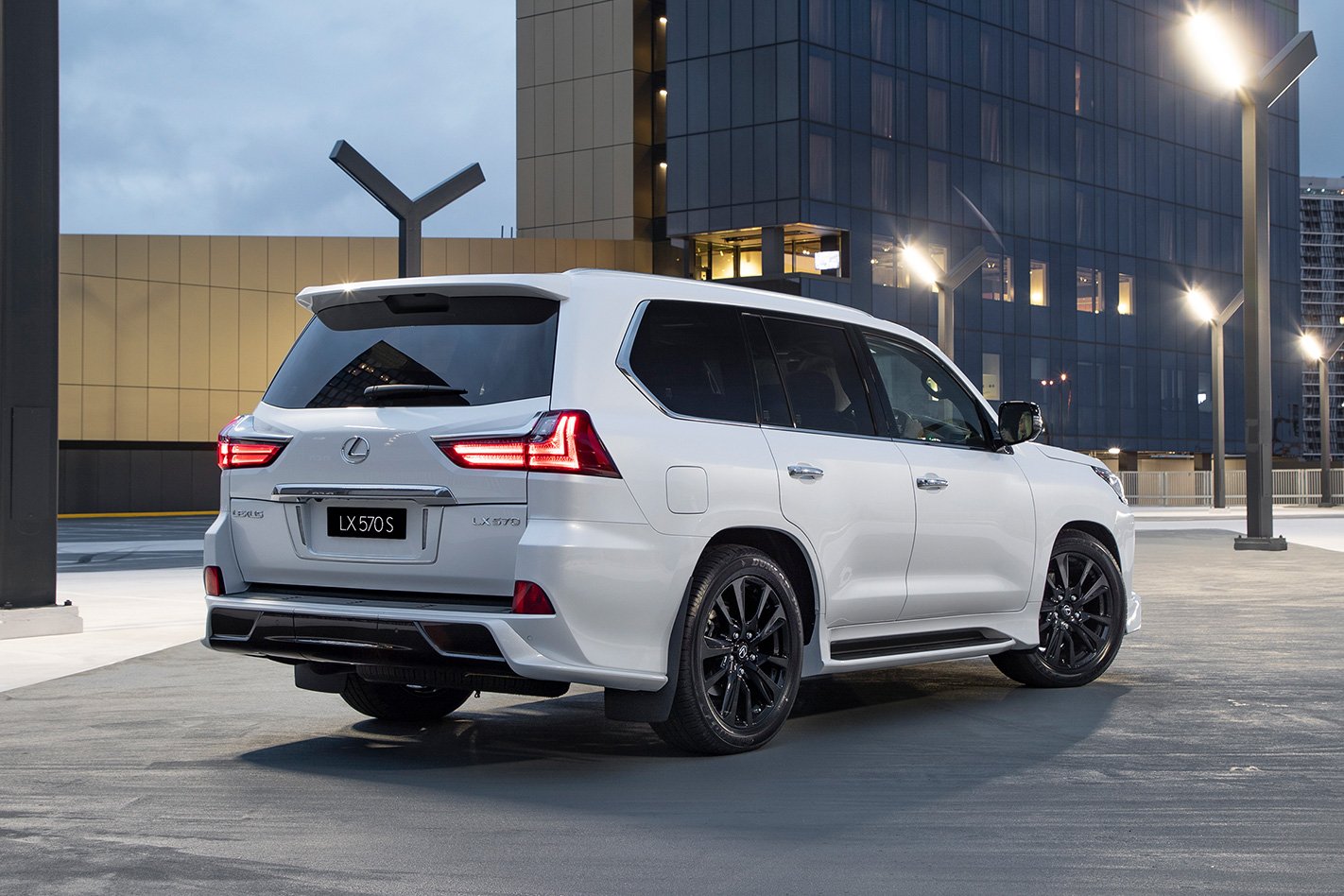
The Lexus 570 S is now available at Lexus dealerships.
2019 Lexus LX pricing
- LX 450d – $134,500
- LX 570 – $142,471
- LX 570 S – $168,089
Toyota has treated its terrain-conquering 200 Series Landcruiser to a technology update which adds new driver assistance systems to the most popular GXL, while the flagship Sahara donates some of its technology to the mid-range VX.
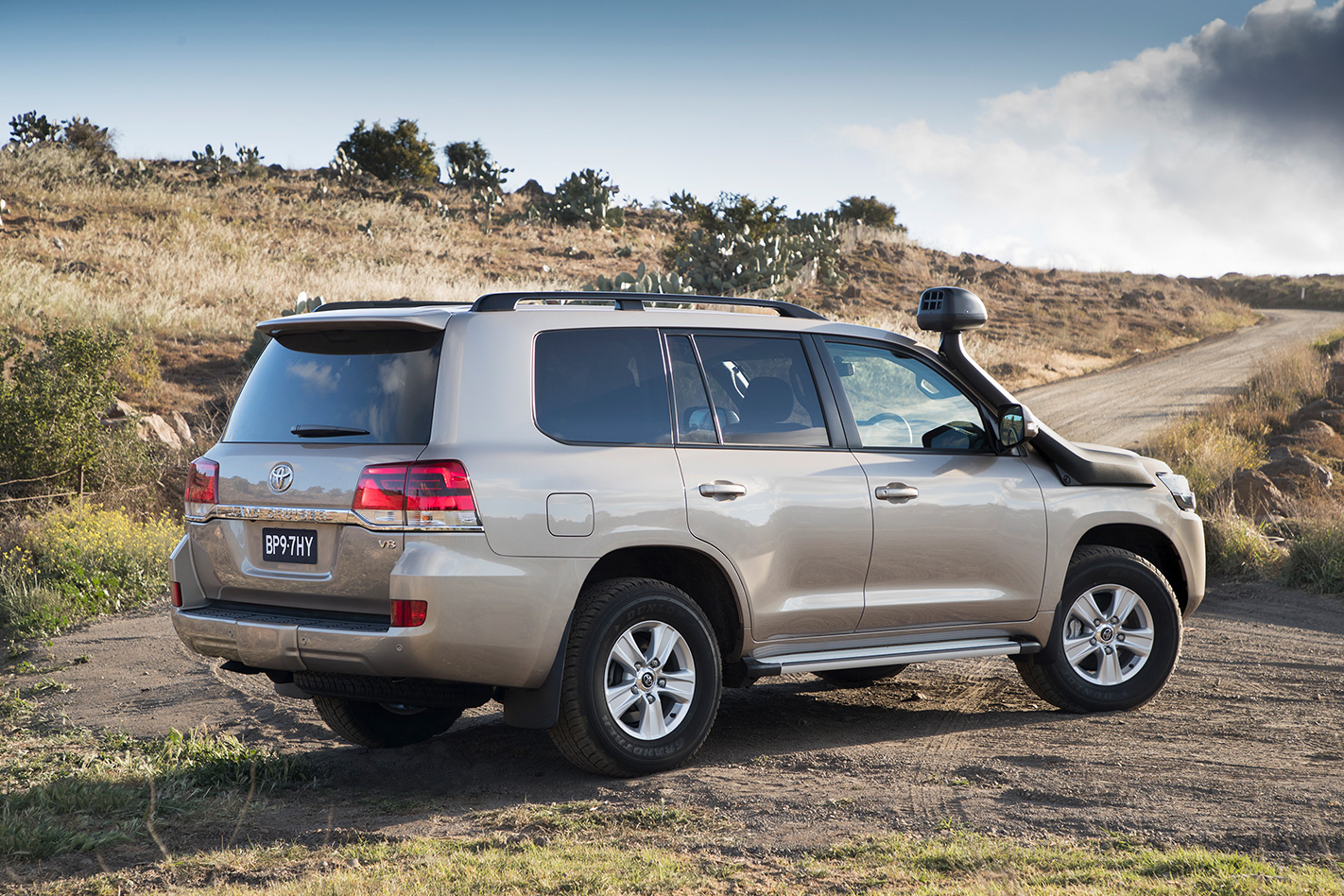
The extra kit brings a modest price rise across the board, with the GXL now sitting at $83,200, while the enhanced VX grade moves up to $94,890 for the 4.6-litre V8 petrol, or $99,990 for the 4.5-litre turbo V8 diesel. Entry-level GX and Sahara variant specifications are as before, though prices move up slightly to $78,190 and $115,230 respectively.
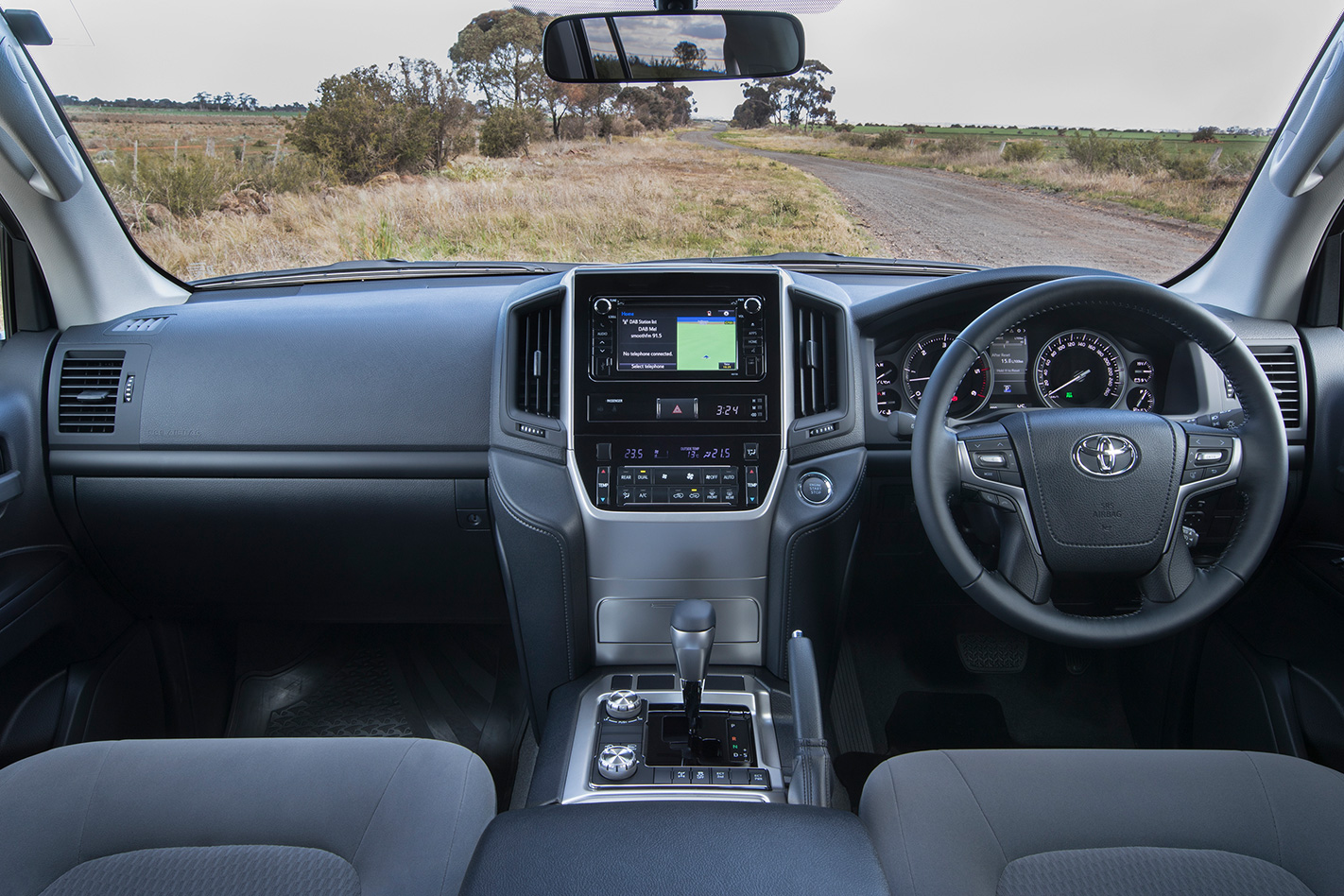
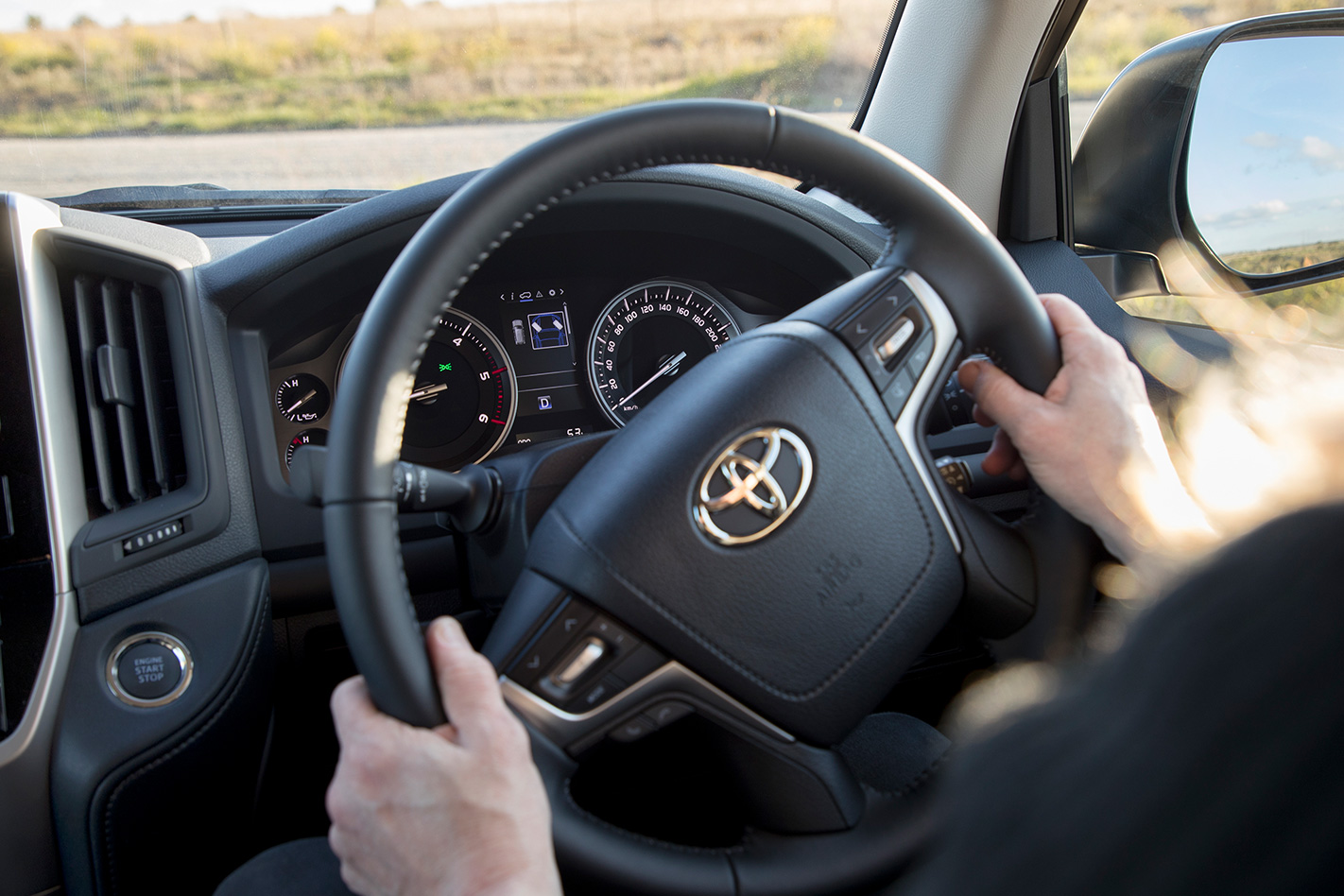
New for the GXL are front and rear parking sensors with audible and visual warnings, for use both when parking and off road to avoid obstacles. Object proximity is displayed in a new 4.2-inch MID screen which slots in between the tachometer and speedo, and also presents other vehicle information to the driver including fuel consumption, range, eco driving rating, gear selector position and vehicle status warnings.
The GXL also gains a leather-trimmed steering wheel and switches for controlling the stereo, Bluetooth-connected phones and the new MID screen.
For the VX, Toyota has borrowed a dusting of driver assistance systems previously only offered on the Sahara. A blind spot monitor warns the driver if another vehicle is obscured by the Landcruiser’s blind spot, while rear cross traffic alert warns if a vehicle is approaching as the driver reverses out of a parking space, for example.
The suite of VX tech updates is completed by a new four-camera multi-terrain monitor, which uses cameras on each side of the vehicle to produce a 360-degree bird’s eye view of the vehicle.
Objects and hazards surrounding the Landcruiser are displayed by a central 9.0-inch screen, along with the position of each wheel, guide lines and a predicted line of travel. The system even includes a camera that monitors the underside of the vehicle while the transmission is in low-range for spotting potentially damaging objects.
Beyond the VX and GXL updates, it’s business as usual for the Landcruiser 200 range. Power is sent to all four wheels via a high and low range six-speed automatic transmission, petrol versions have 227kW and 439Nm, while the diesel is the torque champion with 200kW/650Nm.
“The Toyota Landcruiser has been an Australian favourite since it first arrived here, regularly praised for its comfortable and extremely competent ability to get to the most remote corners of the country and back,” said Toyota Australia sales and marketing vice president Sean Hanley.
“Part of that ability comes from its advanced technology to assist drivers whatever the terrain they come across and the upgrades we are introducing for the mid-range GXL and VX models, further aids that assistance”.
PRICING
- Toyota Landcruiser GX V8 diesel – $78,190 (+$300)
- Toyota Landcruiser GXL V8 petrol – $84,480 (+$1280)
- Toyota Landcruiser GXL V8 diesel – $89,580 (+$1280)
- Toyota Landcruiser VX V8 petrol – $94,890 (+$1480)
- Toyota Landcruiser VX V8 diesel – $99,990 (+$1480)
- Toyota Landcruiser Sahara V8 petrol – $115,230 (+$400)
- Toyota Landcruiser Sahara – $120,330 (+$400)
Ford Australia is holding a speed comparison ‘lap battle’ between three of its race cars this weekend at Bathurst.
The cars which will hit The Mountain for a flat-out hot lap are the Ford GT IMSA racer driven by Ryan Briscoe, Ford’s Mustang GT4 race car which makes its Aussie debut, and the 23Red Racing FG X Falcon Supercar.
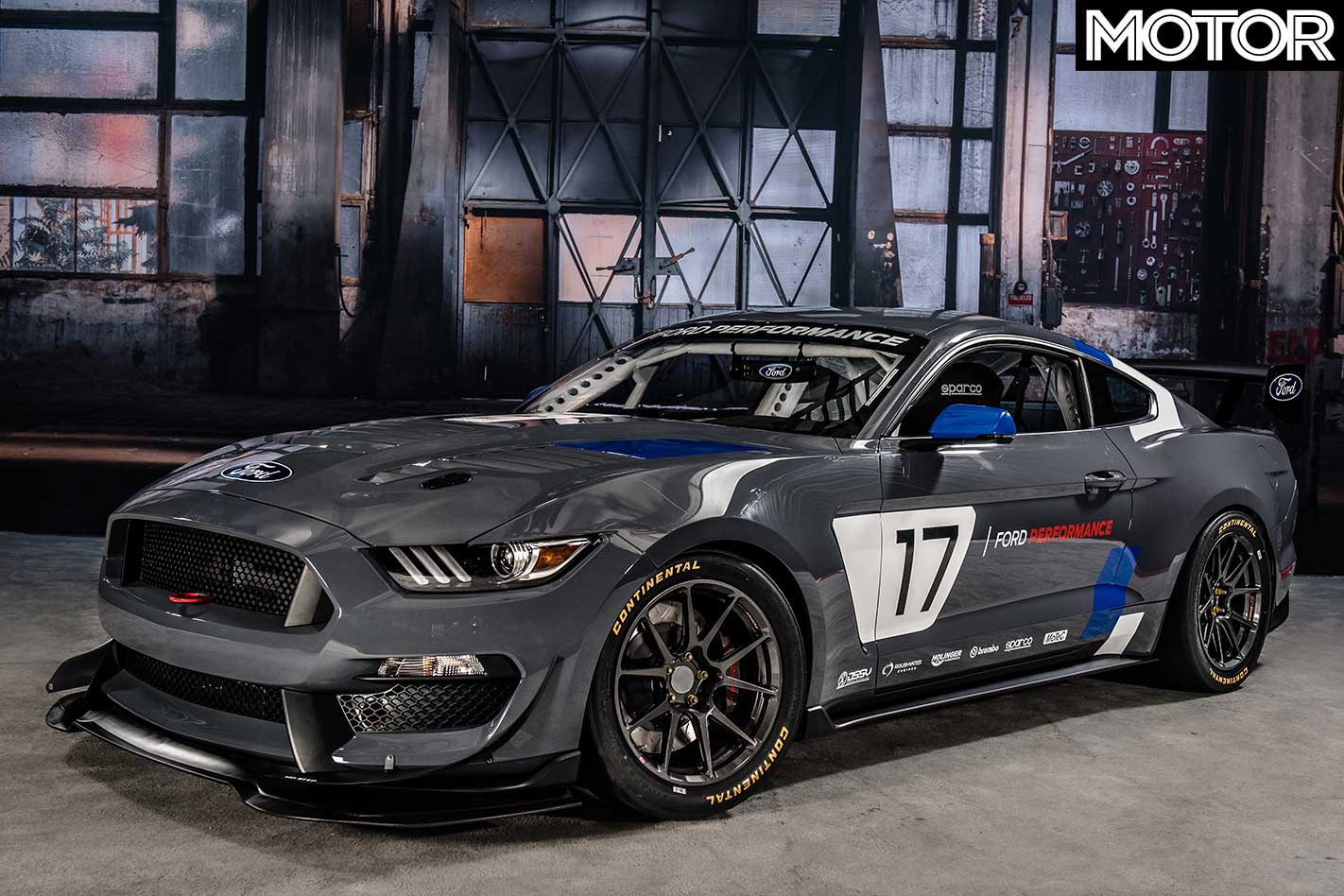
The effort from Ford to mark this year’s Bathurst 1000 as a special event for the brand comes as the Blue Oval begins its transition from racing Falcons to Mustangs in the Supercars series.
“Falcon’s legacy at Bathurst is remarkable, and we know fans around the country, regardless of their allegiance, acknowledge this,” says Supercars CEO, Sean Seamer.
“From the sheer emotion of the 2006 race, which became the first of the three Falcon wins in a row, to Dick Johnson’s Tru-Blu XD and the mighty XY Phase III GT-HO, the Falcon has left an indelible mark in the history of this Great Race.”
With the Falcon claiming 14 of the 19 wins Ford has chalked up at Mt Panorama, Fords drivers will have their last chance to add another to that list.
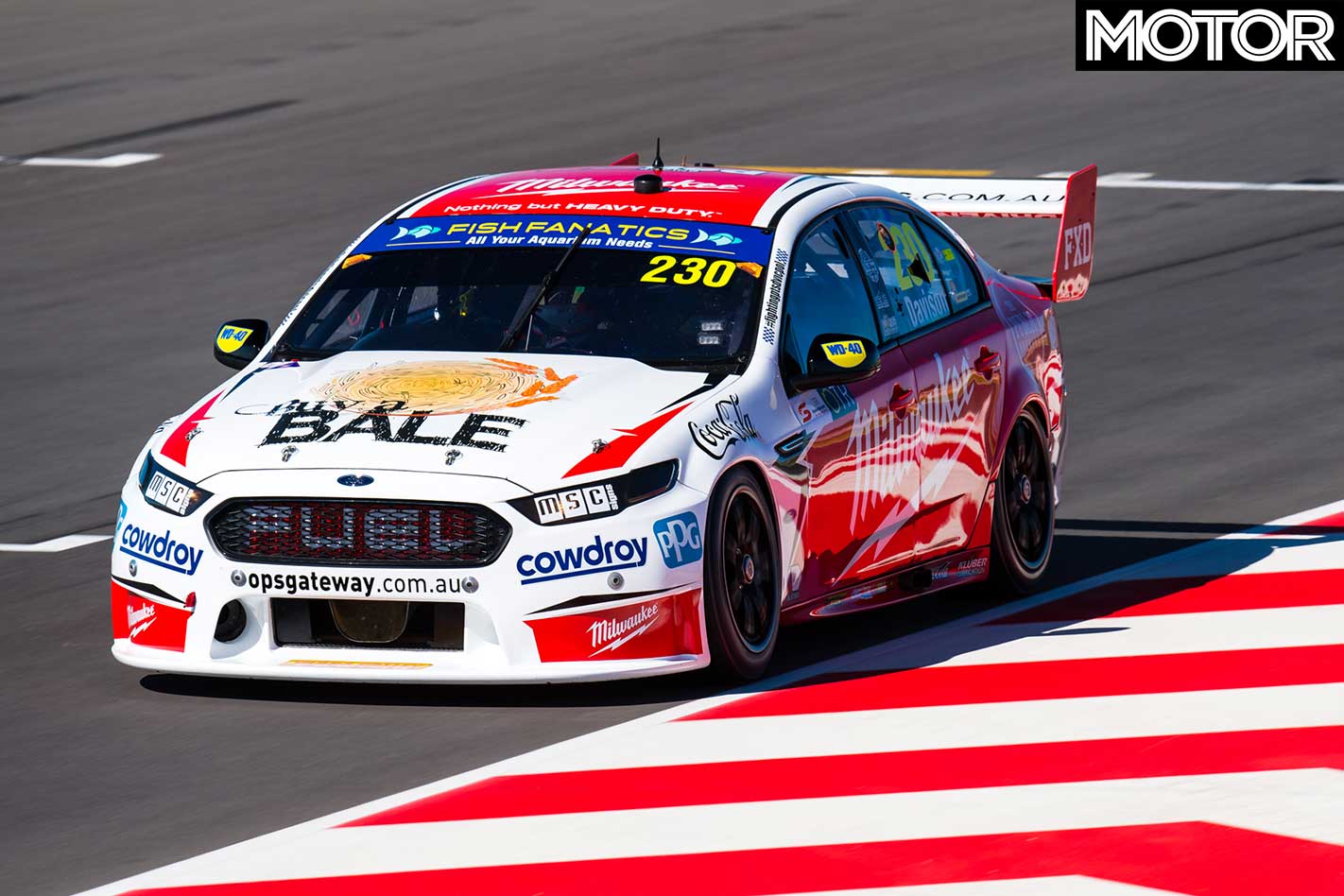
“Getting an opportunity to pilot this car around Mount Panorama is massively exciting,” D’Alberto says.
“We’re making the change to Mustang in Supercars for 2019, so to be getting a run in that iconic shape around Bathurst a year early is a privilege.
“Allan Moffatt’s Trans-Am Mustang was a monster, and the GT4 is the modern version of that, so I can’t wait to feel and hear its thumping V8 bellowing up and down the Mountain.”
Davison echoes D’Alberto’s sentiments.
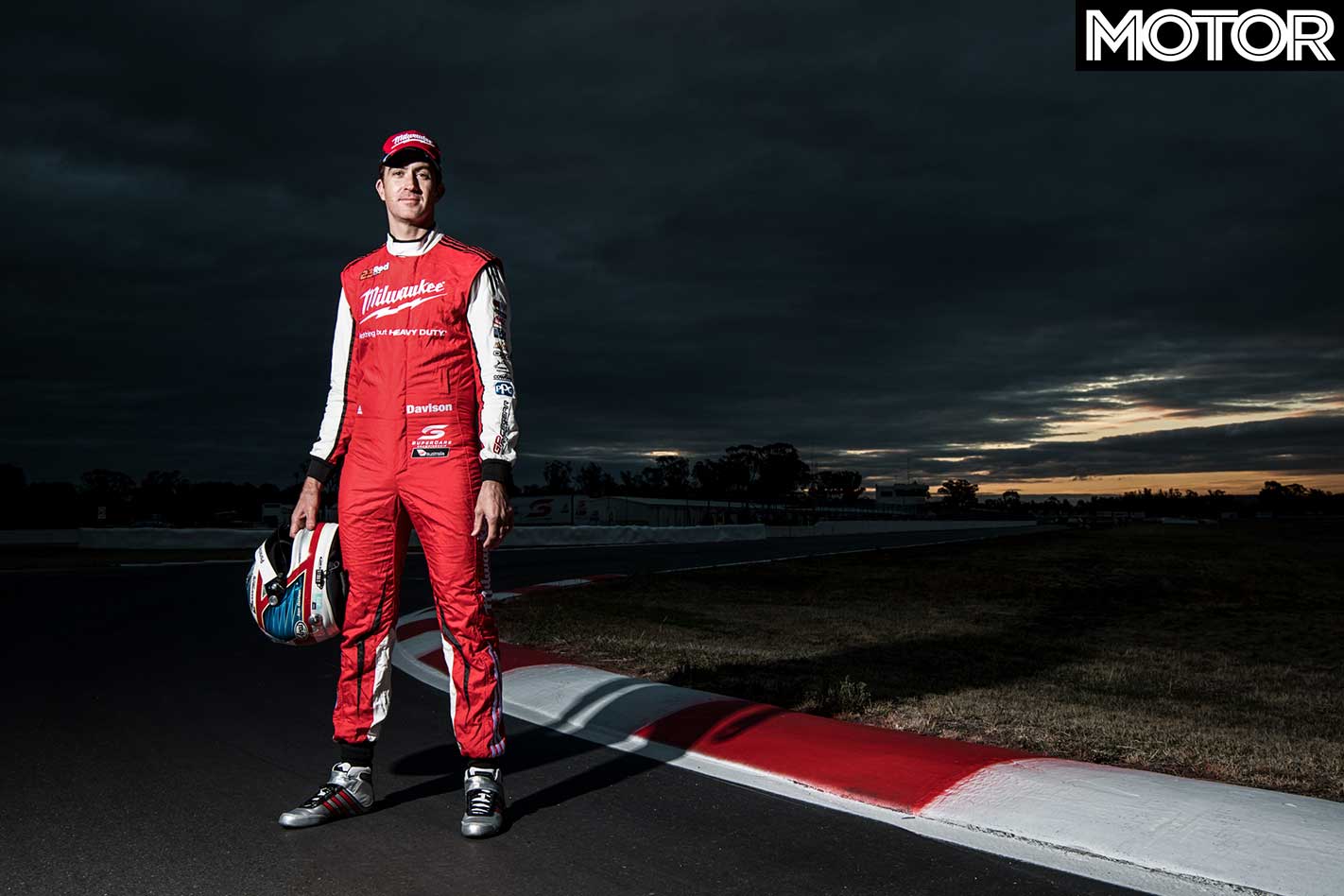
“It’s a great opportunity for our last Bathurst with the FG X Falcon to put it up against some of the fastest Fords in the world,” says Davison. “I feel really lucky – it’s an absolute privilege to be part of.”
The action at The Mountain has already kicked off, with the support series and practice sessions having started this morning.
