
An image of what is believed to be the last Holden Commodore built in Australia has emerged on Facebook today, more than a week before the official end of Holden’s Australian manufacturing operations.
A Holden spokesperson told MOTOR that Holden is unable or not ready to confirm the legitimacy of the photo at this point.
“Officially we’re still manufacturing until the 20th of this month. At this point we can’t confirm anything or give any details about the photo.”
The picture appeared on an event page called ‘Last day of Holden manufacturing in Australia’, along with the caption: “It’s happening right now in Body Shop…”
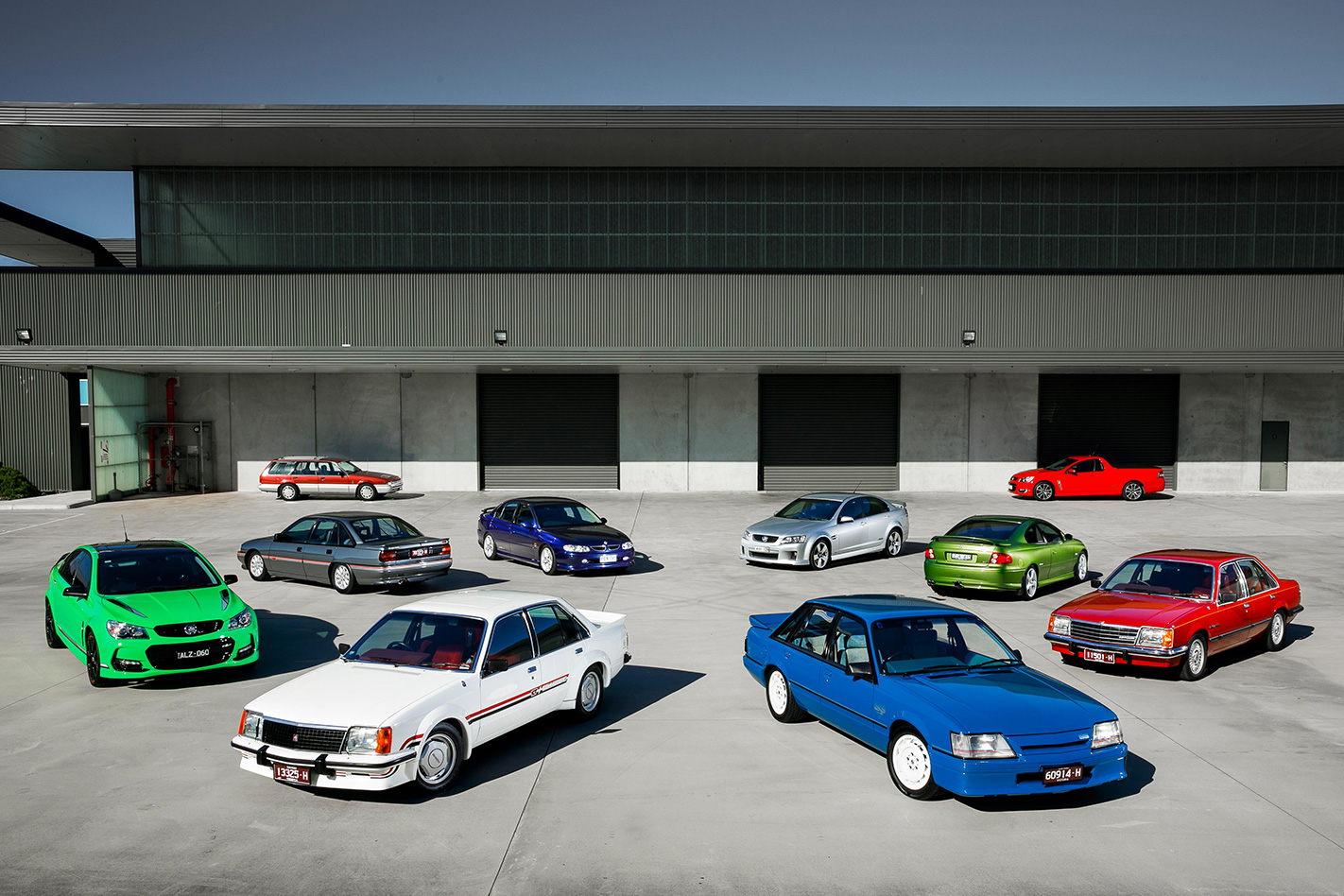
Comments on the original Facebook post suggest that Holden workers and former employees believe that the image is genuine.
We also don’t know what the last Commodore will be, though it won’t be a special edition Motorsport Edition or Magnum ute, though it wouldn’t be out of the question for it to be a Director, as MOTOR understands some Director customers have been told their vehicle will be completed on October 18th.
Over the next week, and up until October 20, Holden will wind down manufacturing until it ends its 69-year-old car manufacturing operations in Australia.
After that, HSV will be the sole vehicle manufacturer in the country.
A FERRARI SUV is no longer a matter of speculation – it’s now inevitable.
The revelation comes as Fiat Chrysler Automobiles (FCA) CEO Sergio Marchionne told reporters at the New York Stock Exchange that Maranello’s portfolio of vehicles is set to expand with a new high-riding model.
Marchionne referred to a potential Ferrari crossover as an ‘FUV’, and said the company has moved beyond merely considering building an SUV to actively deciding on production numbers – a process which will reportedly take about 30 months.
“We’re dead serious about this,” Marchionne explained.
“We need to learn how to master this whole new relationship between exclusivity and scarcity of product, then we’re going to balance this desire to grow with a widening of the product portfolio.”
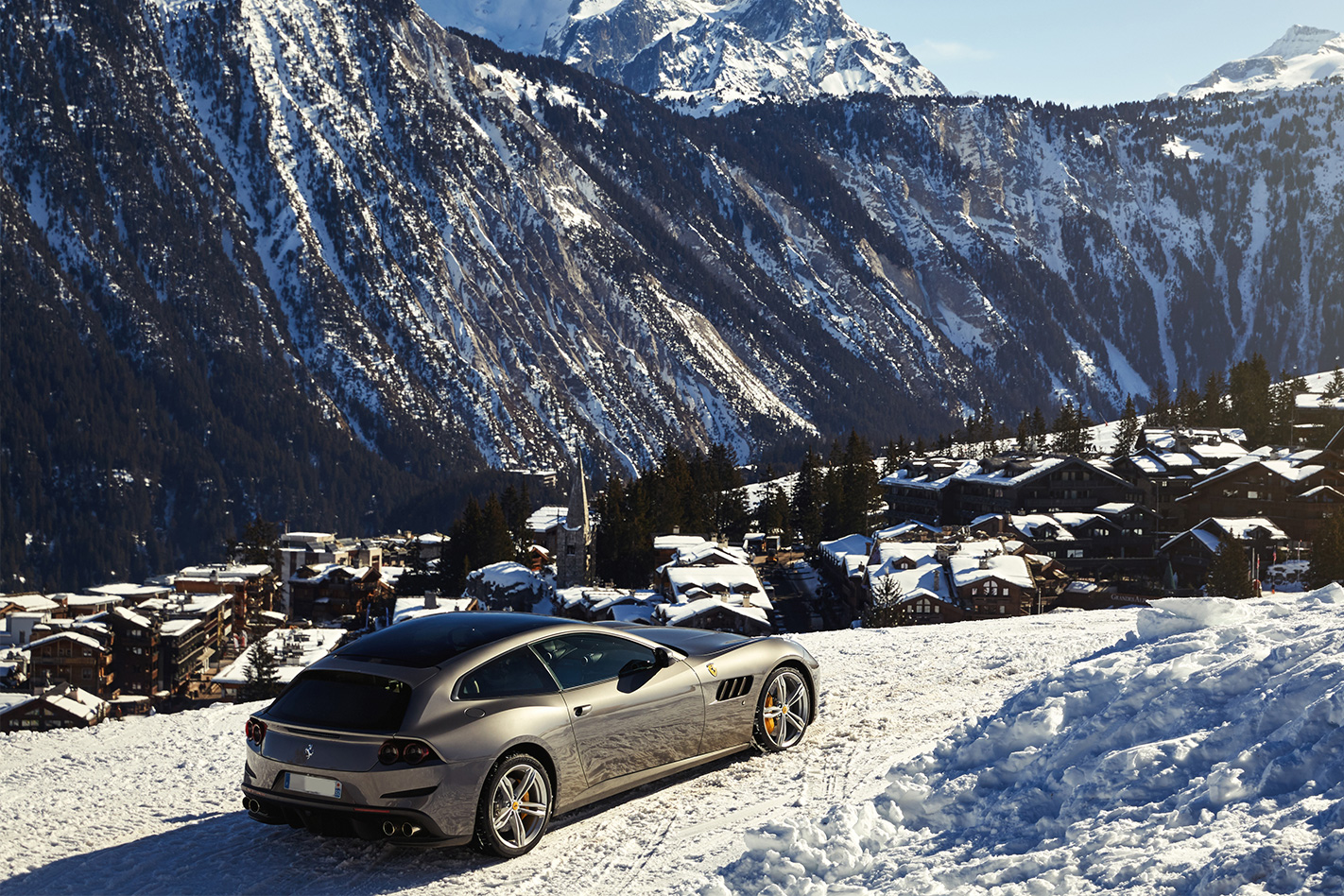
However, the commercial reality is that SUVs are now a fixture across the full spectrum of the motoring world. Bentley, Porsche, Rolls-Royce, BMW and Mercedes-Benz are all currently producing, or in the process of producing, high-end SUVs with strong sales figures to boot. Even Aston Martin is getting in on the game with its DBX.
It’s likely a Ferrari SUV wouldn’t have any trouble selling, no matter how much it annoys brand purists.
Ferrari’s decision to keep numbers limited to boost exclusivity is a smart strategy, giving them a chance to test the waters with a tight-knit group of customers with their first high-riding product. It’s also a strategy that’s been a central part of the company’s business model for decades, and has worked well to keep its sports cars desirable throughout their production runs.
Wheels’ sister site in the UK, Car, reports the internal project code for the ‘FUV’ is F16X, with a similar design to the GTC4Lusso four-seater.
Speculation suggests a Ferrari SUV will retain sporty coupe styling, with eight cylinders under the bonnet instead of the classic V12.
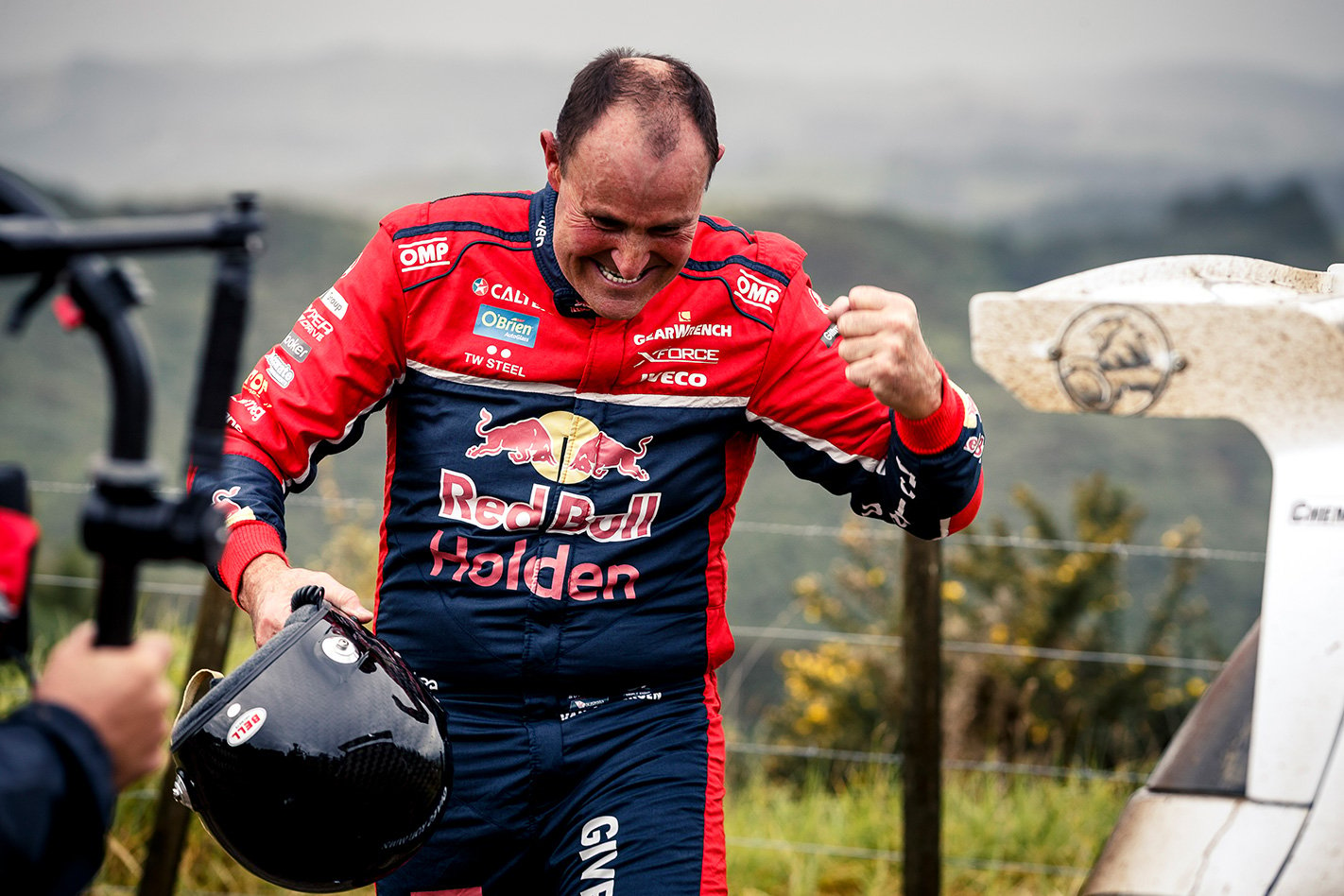
ROBERT van Gisbergen dances around the Holden Barina rally car and leaps into the air so high there’s no way you would believe the bloke’s got a serious back injury.
“F__king awesome,” he shouts into the drizzle.
It’s an emphatic reaction made even more startling because he’d been so low-key just seconds before.
Then he’d been playing down any chance he had of matching his son’s speed in the Barina. His son just happens to be Shane van Gisbergen, the 2016 Australia Supercars Champion and perhaps the best racing car driver going around in Australasia right now.
“It’s pretty close,” Shane had said as the Barina cooled, tinking and tonking, mud and spray camouflaging its signwritten sides.
They had just driven the AP4-spec four-wheel drive Barina up and down a driveway on the family property at Manukau south of Auckland, competing against the stopwatch and each other.
It’s a match-race the two of them have staged ever since Shane was old enough to throw a leg over a quad, and it’s been conducted in the past in everything from a front-wheel drive Corolla station wagon to a Mitsubishi Lancer Evo rally car. And in all those years, Shane has never beaten his father. Sure, Robert sets a time and Shane had gone faster, but then Robert has always gone faster again on the same day.
The seeds for today’s match-up were sown at Homebush last December when Shane wrapped up his first Supercars championship, and father and son embraced tearfully after the race.
“My dad is a racer himself,” Shane had explained. “He has been a great influence and he has sacrificed a lot.”
To celebrate the achievement of this shared dream, the first driveway shoot-out between the two of them for five years became the second part of a video shot by Shane’s team, Triple Eight Race Engineering, and sponsor, Red Bull.
At Norwell, Shane had set a time and Robert then had a crack. Incredibly, after just 12 laps in the 650 horsepower monster, he got within six tenths of his son’s best effort.
“It was pretty impressive to just jump in a car that took me a few years to master,” says Shane. “Okay, it’s Norwell, it’s a small track, but it’s still pretty awesome. They are not an easy car to drive.
“If he had a proper go, or he was 10 years younger, you’d almost train him up for Bathurst.”
Shane says that with a quiet laugh, but there’s also pride tinging on awe. If there’s a rival Shane van Gisbergen truly respects, it’s his father.
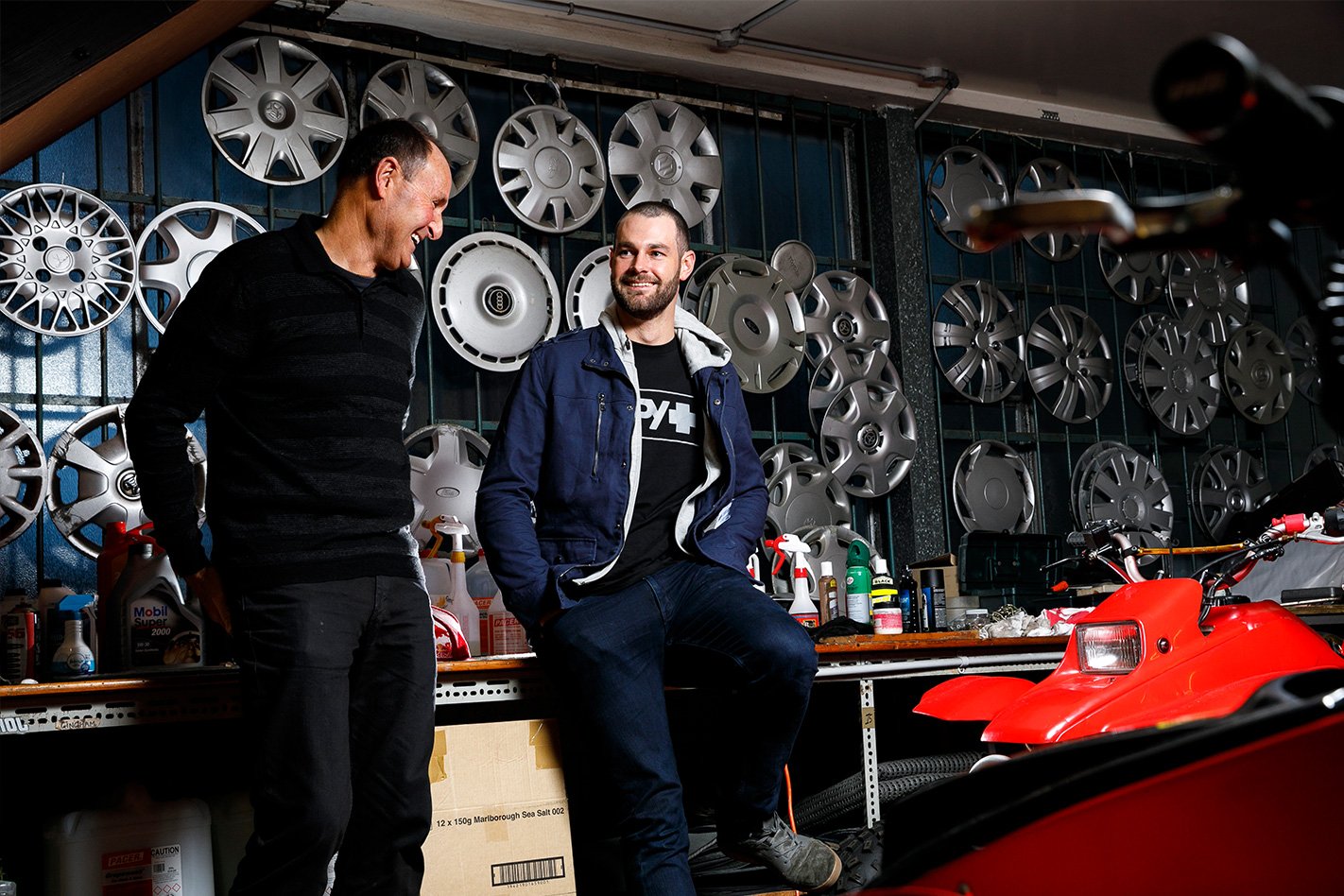
There’s nothing new or rare about fathers and sons who share a passion for motorsport, but there’s something that distinguishes the relationship between Robert and Shane.
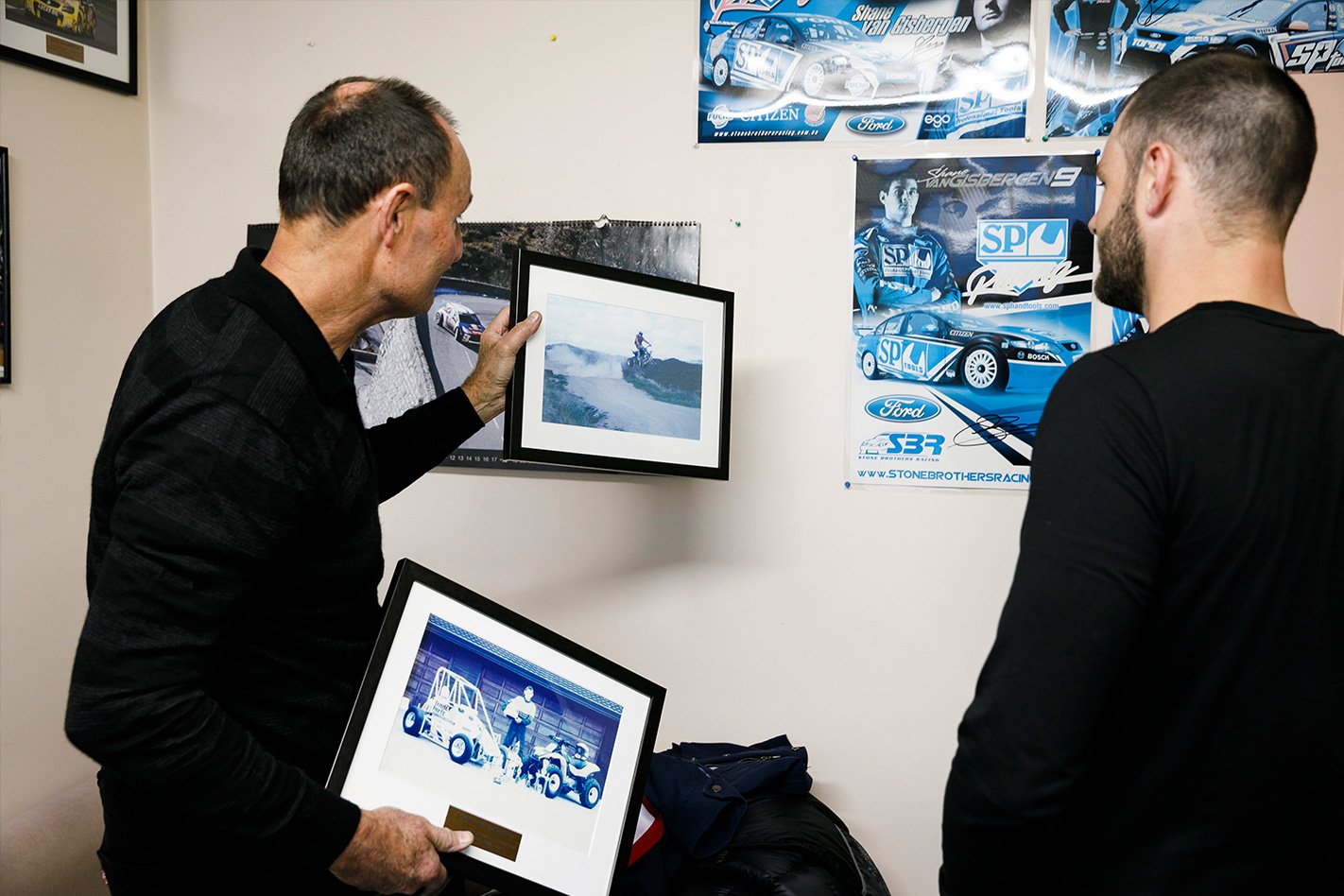
Shane was literally born, raised, and completely immersed in petrol-head heaven. From as early as he can remember he was watching his dad race, his dad was helping him, or they were going head-to-head; quads, go-karts, cars, simulators, radio-controlled cars, slot cars. They’ve tested each and all of them and Robert has beaten his son plenty of times.
“I think he is a better natural driver, he picks things up quicker than me. I have to work at it,” says Shane. This from a bloke whose 2016 Bathurst co-driver, Alex Premat, says he has the talent to be a Formula 1 driver… if he wasn’t built like a lumberjack.
Shane started racing a quad when he was six and quarter midgets at Western Springs speedway by the time he was nine. Then it was karts, Formula Vee, Formula Ford, the Toyota Racing Series, and, 10 years ago, Supercars. He was just 17.
“I didn’t know he was going to be driving a Supercar. It didn’t come across my mind at all. We just had fun together,” recalls Robert.
“That’s why I race, because it’s fun and enjoyable,” adds Shane. “Everything I have gone and done, we have gone and done it because we enjoyed it.”
“He loved passing and he loves passing. When he was nine-years old in quarter midgets he loved passing cars, just outside and inside, and he learned not to hit them,” recalls Robert. “He’d watch and learn how others behaved, find their weaknesses.”
He still does. Shane’s ability to place his car and make a pass is the best in Supercars.
Robert is more than a petrol-head, he’s a perfectionist. He admits he is wound up far tighter than his son, who inherits a more relaxed demeanour via his mother Karen. The quads and cars Robert prepared for his son to race were always perfectly presented and fast.
After all, winning is clearly part of the fun.
“For me as a so-called car salesman to be able to get a race-winning car set-up, I was rapt,” says Robert. “I just wanted to beat those full-time engineers and race hot-shots. I worked it out myself – I got a bit of help from my mates – but that was my goal.”
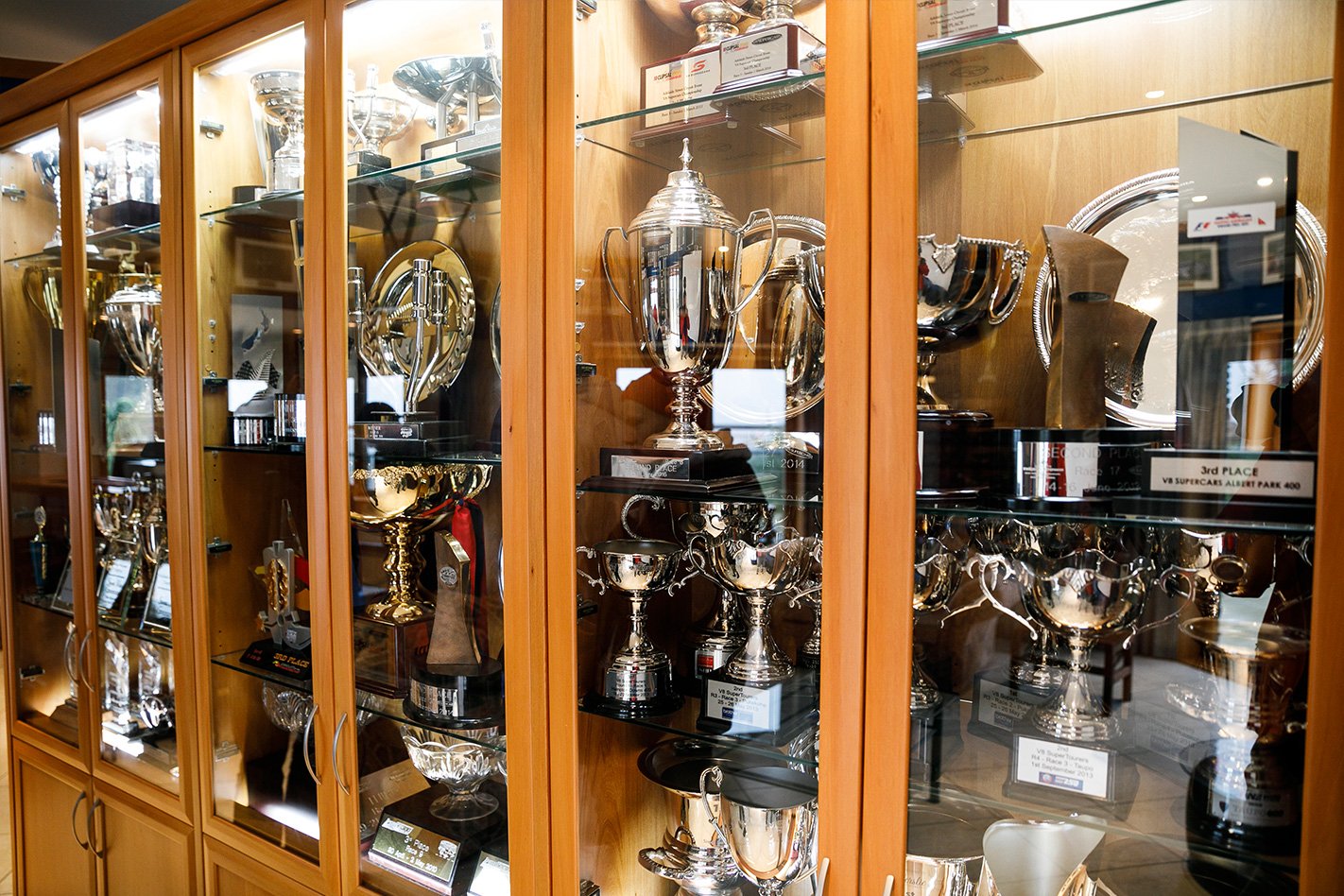
His engineer Grant McPherson, who has also worked with elite Supercars drivers Will Davison, Mark Winterbottom, and Craig Lowndes, says Shane is the best he has engineered in terms of studying the data to get the best out of himself and the car.
“He knows what he wants from the car, and he is pretty good at communicating it,” McPherson said in 2016. “We just have to make sure we can give it to him to his liking.”
The message ‘No mistakes’ is taped on Shane’s fridge at his Gold Coast apartment and in his locker in the race transporter. It is his father’s mantra passed down. That’s exactly what he delivered during his run to the Supercars title.
While his team-mate, Jamie Whincup, the six-time series champion, made a succession of errors, van Gisbergen displayed almost flawless, blazing speed.
But Shane does make mistakes, and he does not cope with them well. When he crashed on oil while leading in Tasmania early in 2016, he refused to talk to waiting journalists post-race. He is, for the media, undoubtedly, one of the most opaque personalities to deal with. No driver loves PR and press work, but Shane can just be contrary. At Bathurst last year a New Zealand TV journalist asked him what it would mean to win the Great Race. “300 points” came the reply.
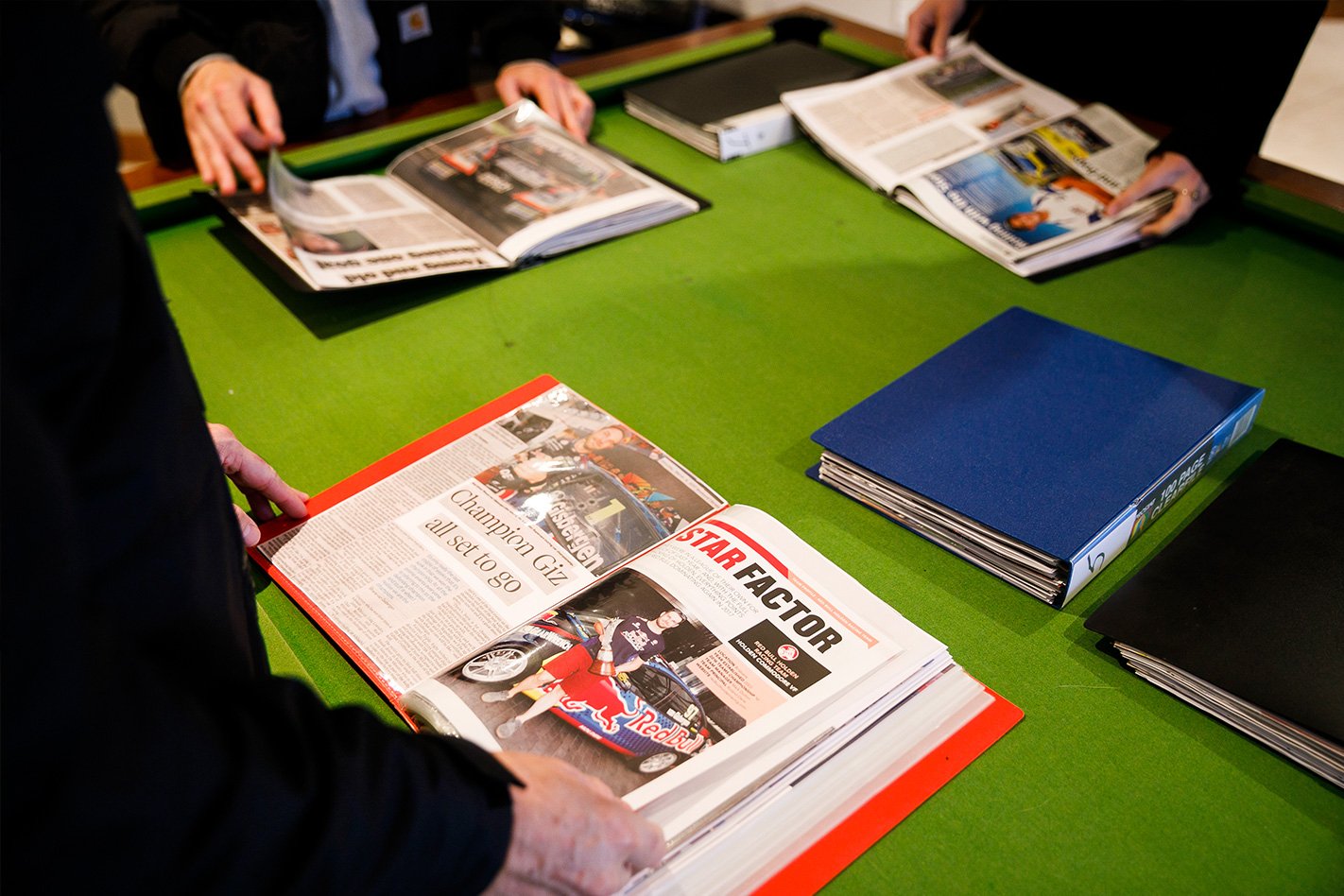
In-car cameras have made it clear just how much influence Robert has had over Shane’s driving. Rivals took note when footage first showed Shane dialling the brake balance fore-aft to tackle different corners.
Some drivers already did it, but nowadays every driver in Supercars has to do it.
Shane got the idea from his father.
“I used to always drive the rally car on bias,” Robert explains. “To me each corner has got a different brake attitude and when I was rallying on the fast stuff I’d adjust the bias and when I came to some tight, windy stuff I’d wind it again. I was always trying to maximise what I had in my rally car.” The arrival of Fox’s multiple cabin cameras curtailed another van Gisbergen trick, driving in socks to improve pedal feel. Robert used to insist that no cameras pointed into the footwell for that very reason.
“I did it for years,” Shane laughs.
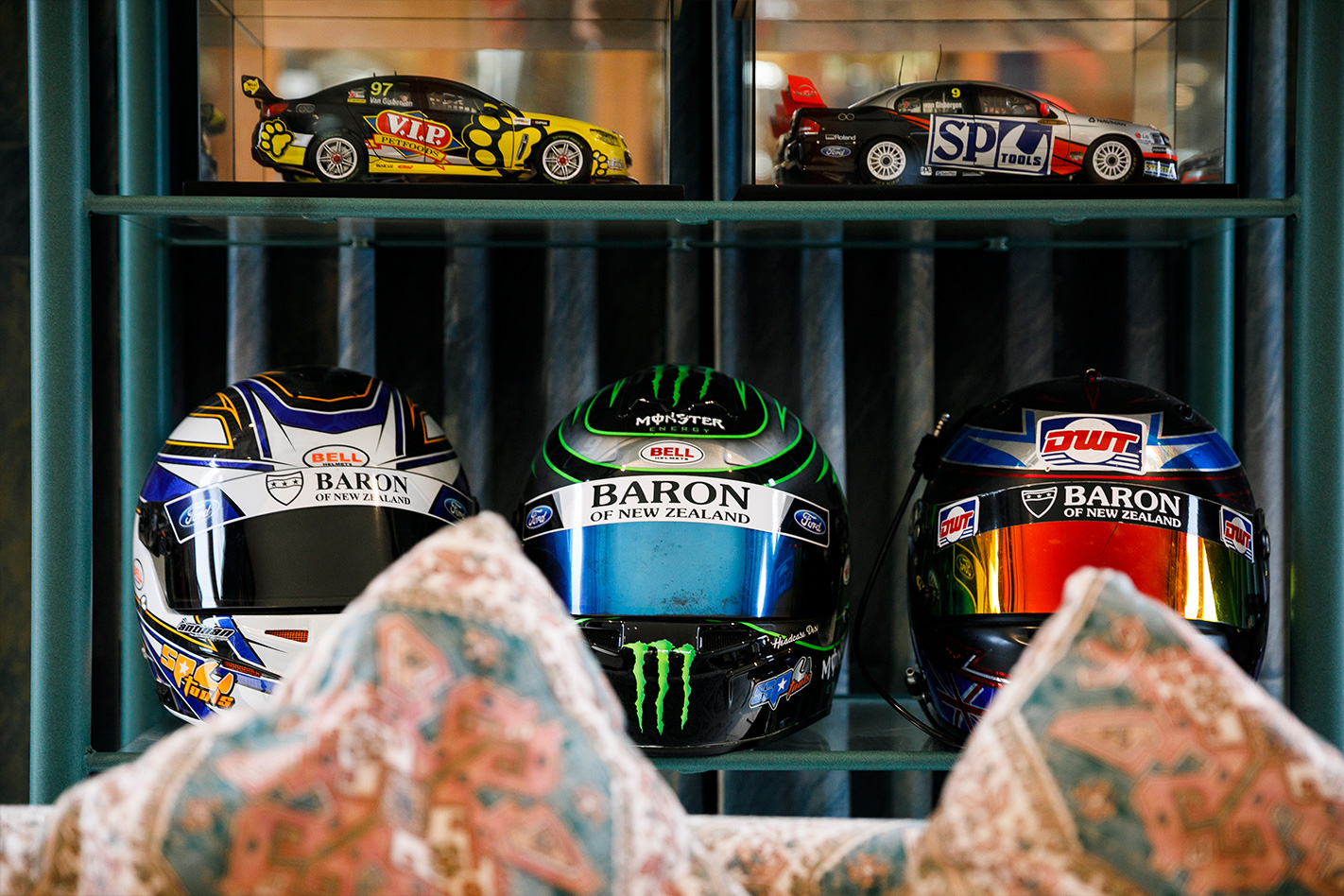
Robert is a Ford fan. A Blue Oval flag flutters outside the house. He rallied Escorts until about five years ago when he broke his back while operating a bobcat on his property. He’s nearly recovered and is building up a Mk2 Escort to go rallying once more. Needless to say, Shane’s success as a Holden driver is a bone of contention. The driveway starts behind the family home, curls deeply downhill between a bank on one side and pine trees and a drop-off on the other, to a small paddock and stables. It then does a 180 and comes straight back up the same hill to the finish line. It’s maybe 1.5km all up. Robert taught Shane and his mates to drive here, educating them in the gentle art of drifting.
“We used to have the fence just there and we just kept taking it out, so we had to move it back,” explains Shane as we take a slow lap of the course.
“Every Wednesday we used to have race night. On the big nights there would be 30 people here, then there would be a barbecue afterwards. There were some big crashes.”
As the rain has bucketed down, the driveway surface has been churned to the consistency of molasses by practice laps. Kiwi legend Greg Murphy owns the Barina, and he seems, ahem, apprehensive about what’s about to transpire.
Watching Robert and Shane practice is to watch an exercise in egg shells. The car slithers, slips and slides, braps, brays, and growls and hunts for traction. Robert gives a fence a whack, but nothing serious.
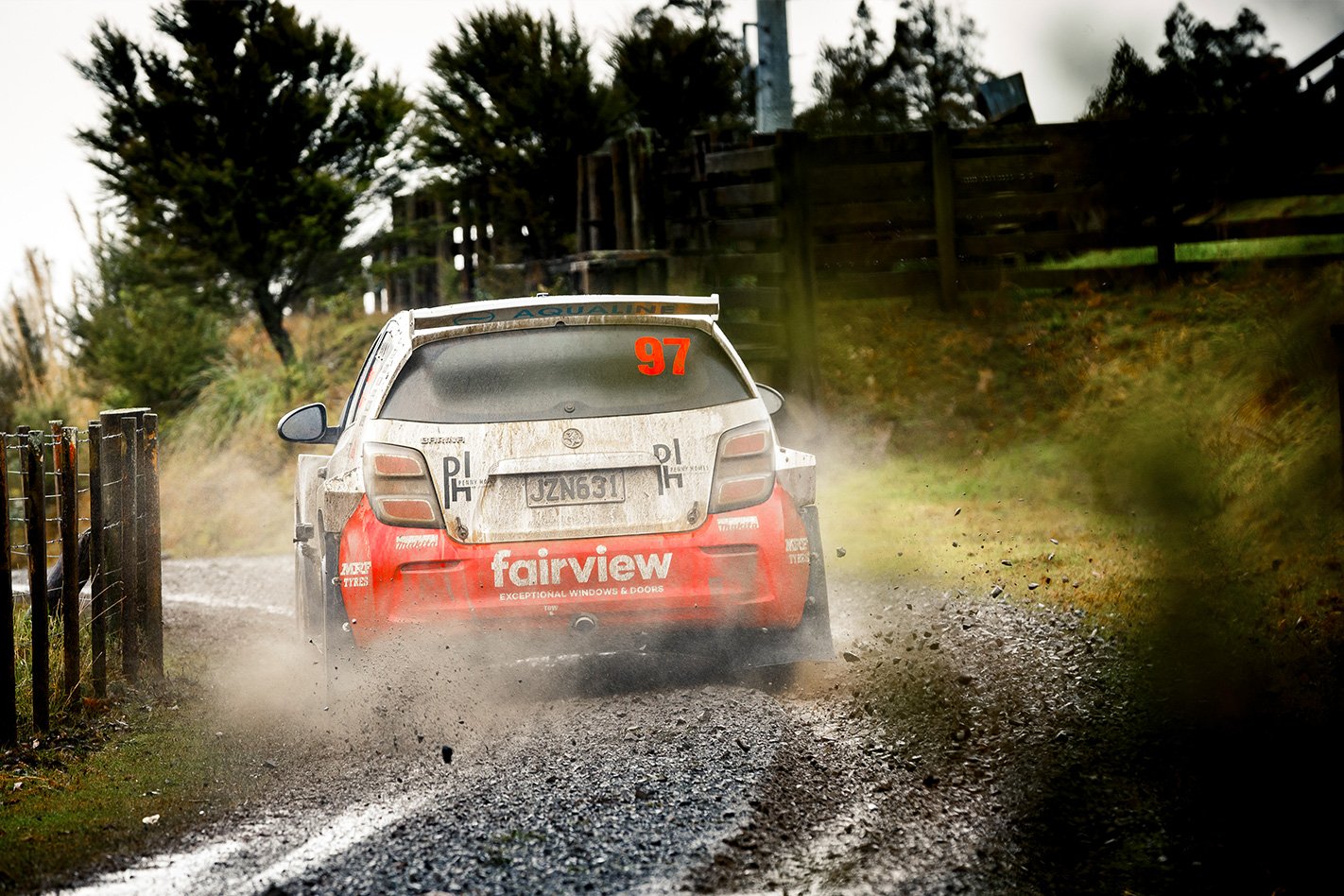
This is a cool little device. It’s powered by a 1.8-litre version of the Astra VXR’s turbo engine, produces 260kW/556Nm at the flywheel and sends it to all four wheels through a six-speed Sadev gearbox, with Aussie Supashock suspension.
“The car is brilliant,” enthuses Robert. “The thing is I am used to pulling 9000rpm and this thing here you just pull a gear and it’s a tractor. It just pulls.”
Adds Shane: “It’s so muddy out there yet it sticks brilliantly when you get on the throttle with the four-wheel drive.”
The build-up to the showdown takes ages. Filming and photographing goes on and on. Robert is getting tense. His competitive instinct is huge and there’s a race to be won. Shane is more relaxed, more likely to laugh when the director calls for a steely stare down the barrel.
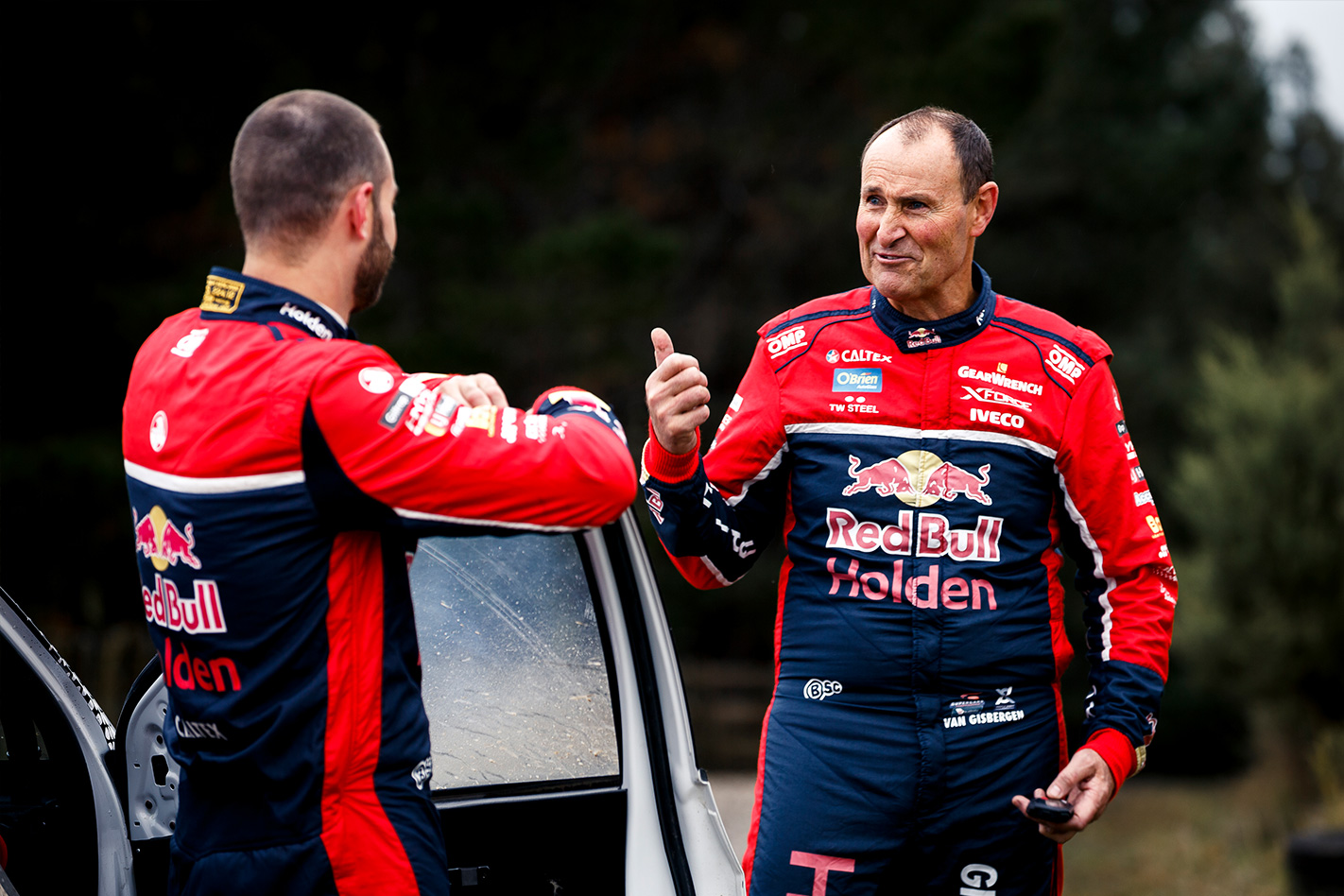
And then, when it happens, it’s all over in minutes. A warm-up run, then the real thing. Shane goes first with Robert timing. It’s hard to see much once the car leaves the line until it appears through the trees, swivelling around and headed back uphill.
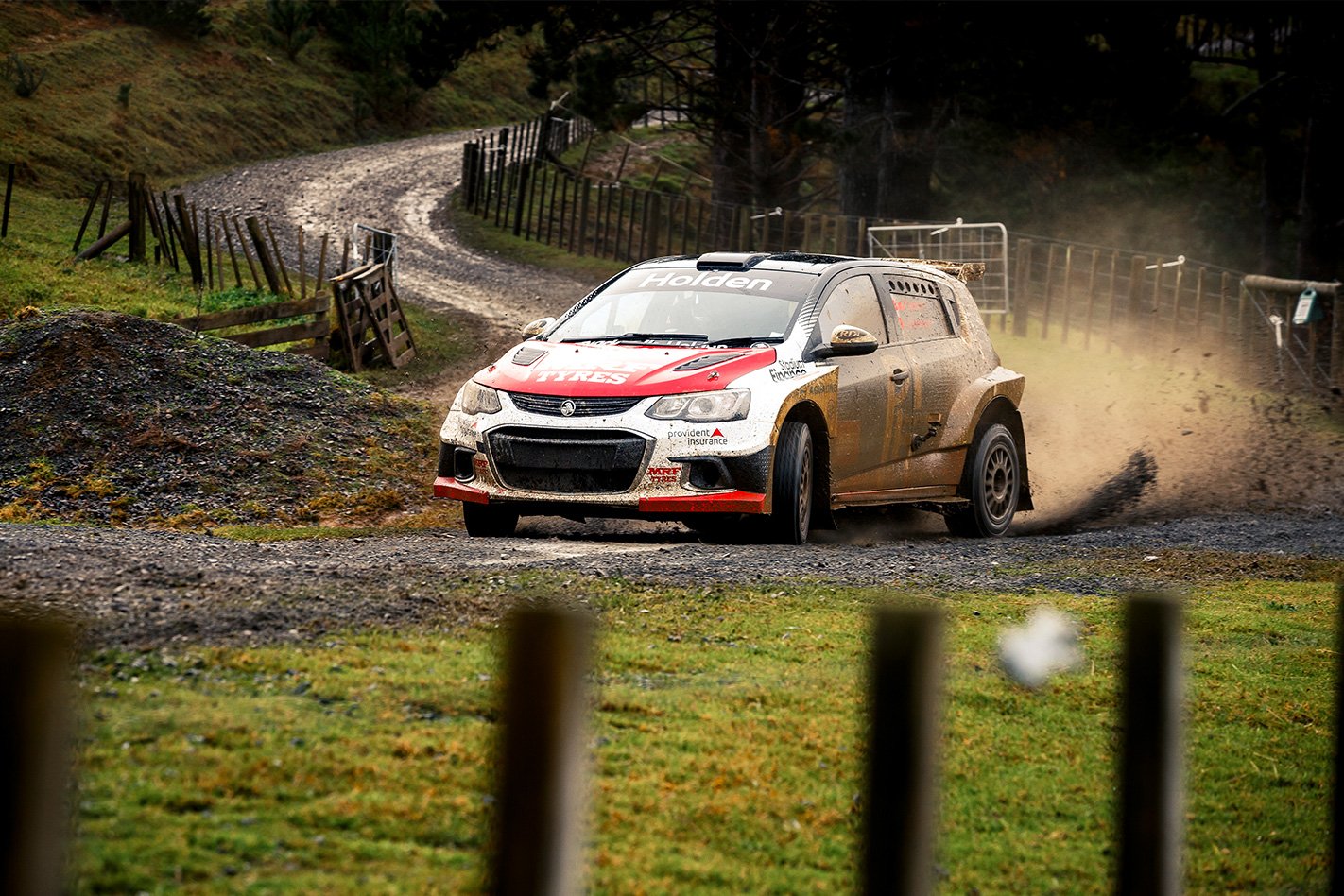
“The road got slipperier and slipperier,” he reports. “I think my run was alright.”
Then its Robert’s turn. He completes his practice run without fuss. Then he’s off from the flying start.
We listen to the rise and fall of the throttle and then he bursts back in view. Shane looks at the stopwatch and smiles.
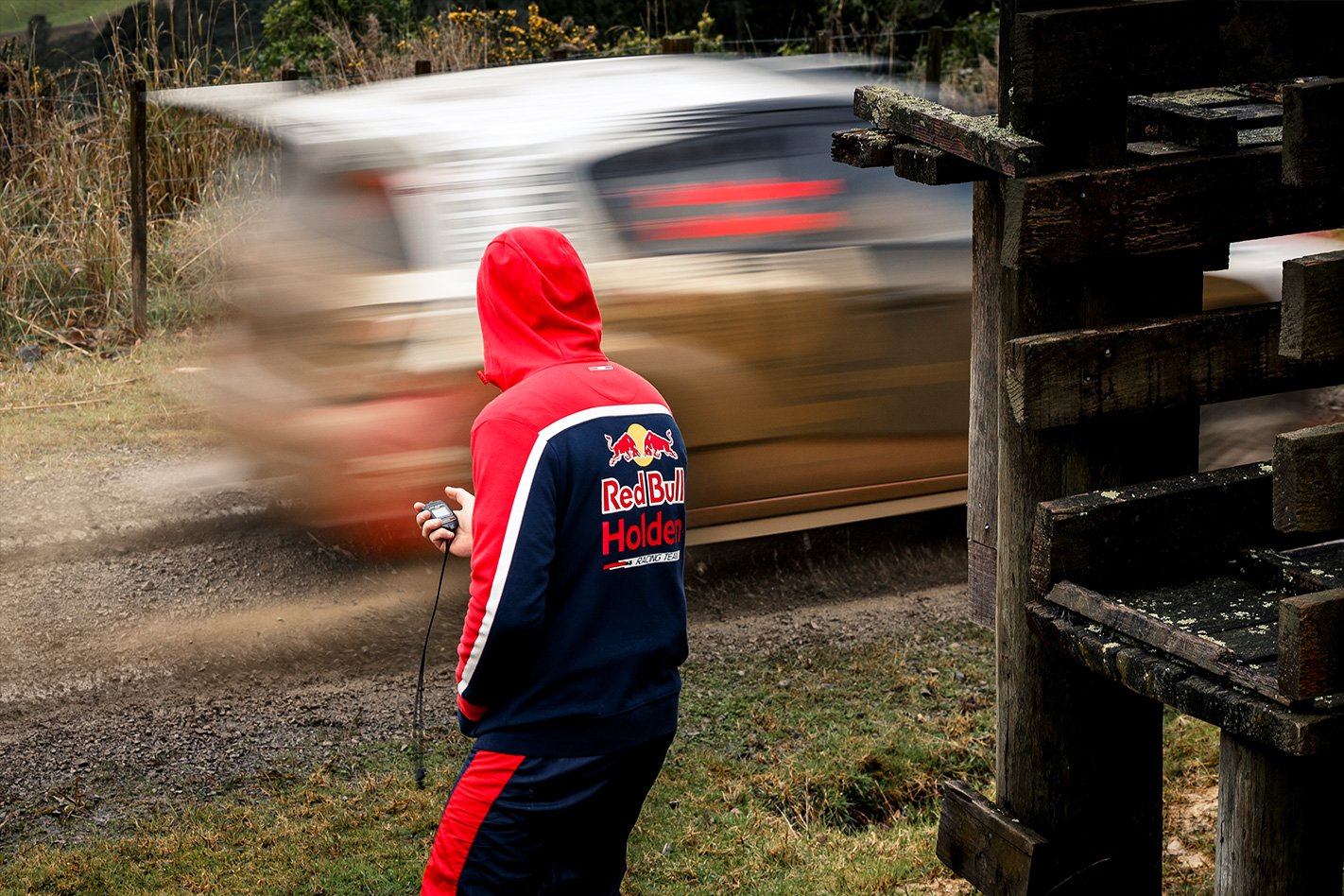
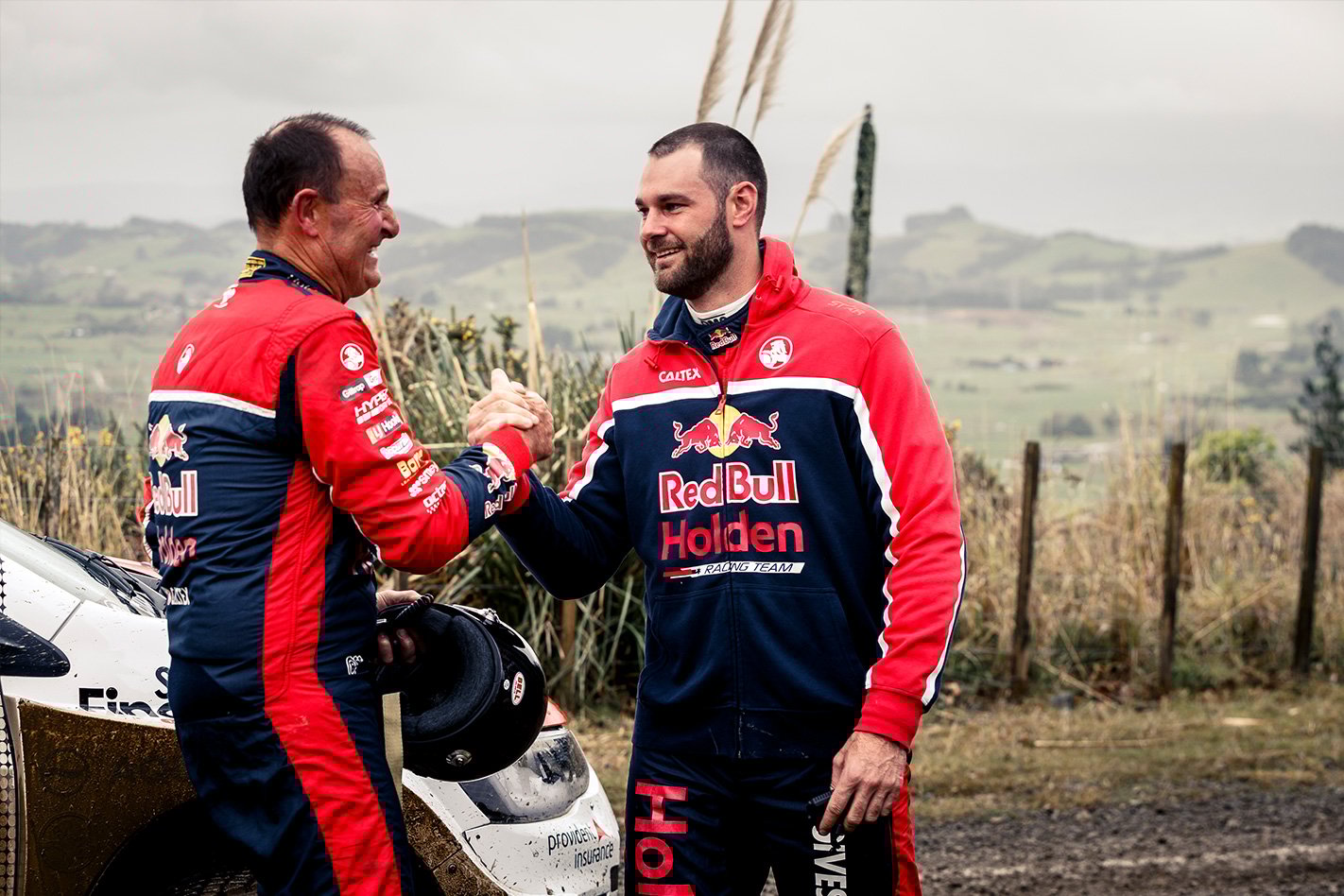
Robert does his dance and his leap. He’s lost the overall challenge by three tenths but he’s elated to have retained his driveway crown.
“I’m pretty proud of that crown,” he smiles. “That was a good day. It was close, very close. Shane had a bit of an off on his money run and went out of the tracks. But he’s been pretty impressive all day.”
And then there’s a pause and a thought. “I won’t win it next time.”
Shane is not sure about that: “Dad is a pretty awesome driver.”
Like father like son.
Fans of affordable performance cars take note: Suzuki’s pint-sized Swift Sport hot hatch is locked in for a local debut in the first quarter of 2018.
Making its first public showing at last month’s Frankfurt Motor Show, the 2018 Swift Sport promises to blend the fun-to-drive character of the outgoing model with a more potent powertrain, with the Swift Sport nameplate transitioning to turbo power for the first time.
Motivated by a 1.4-litre turbocharged inline four borrowed from the Vitara and boosted to outputs of 103kW and 230Nm, the new Swift Sport boasts a 3kW improvement in peak power and a massive 70Nm increase in maximum torque.
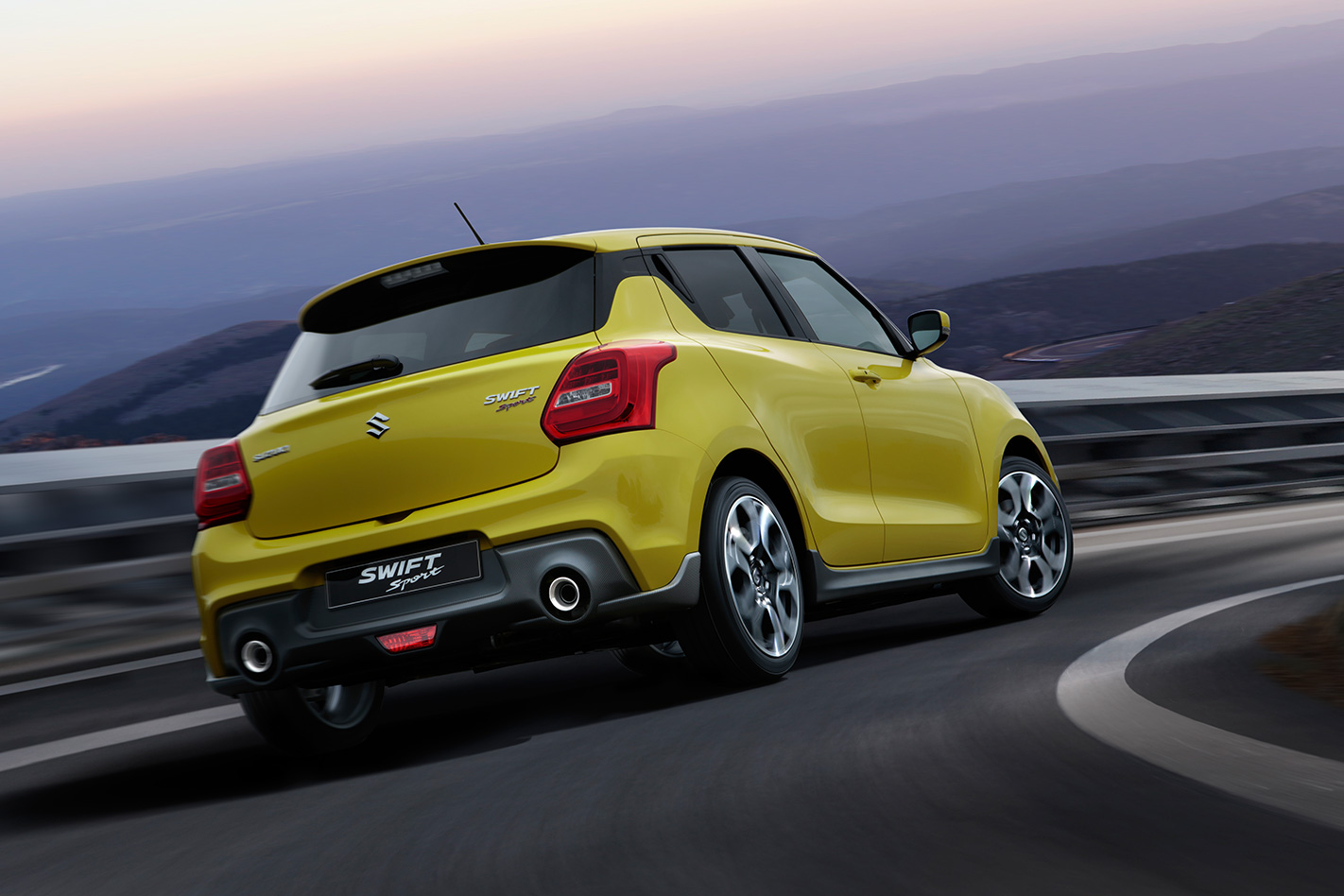
The power increase may be modest, but the sizable torque increase is the real headline. Coupled with the Swift Sport’s featherweight 970kg frame (90kg lighter than its predecessor), performance should be, well, swift.
Besides being lighter than its predecessor, the new Swift Sport’s completely revised chassis also boasts greater torsional rigidity to improve handling performance, while suspension hardware has been engineered to increase stability without utilising rock-hard springrates.
Relative to the outgoing car, the 2018 Swift Sport measures 20mm longer in its wheelbase, 15mm lower in overall height and 40mm more width between the left and right wheels – dimensions which all increase its road contact “footprint” and lower its centre of gravity.
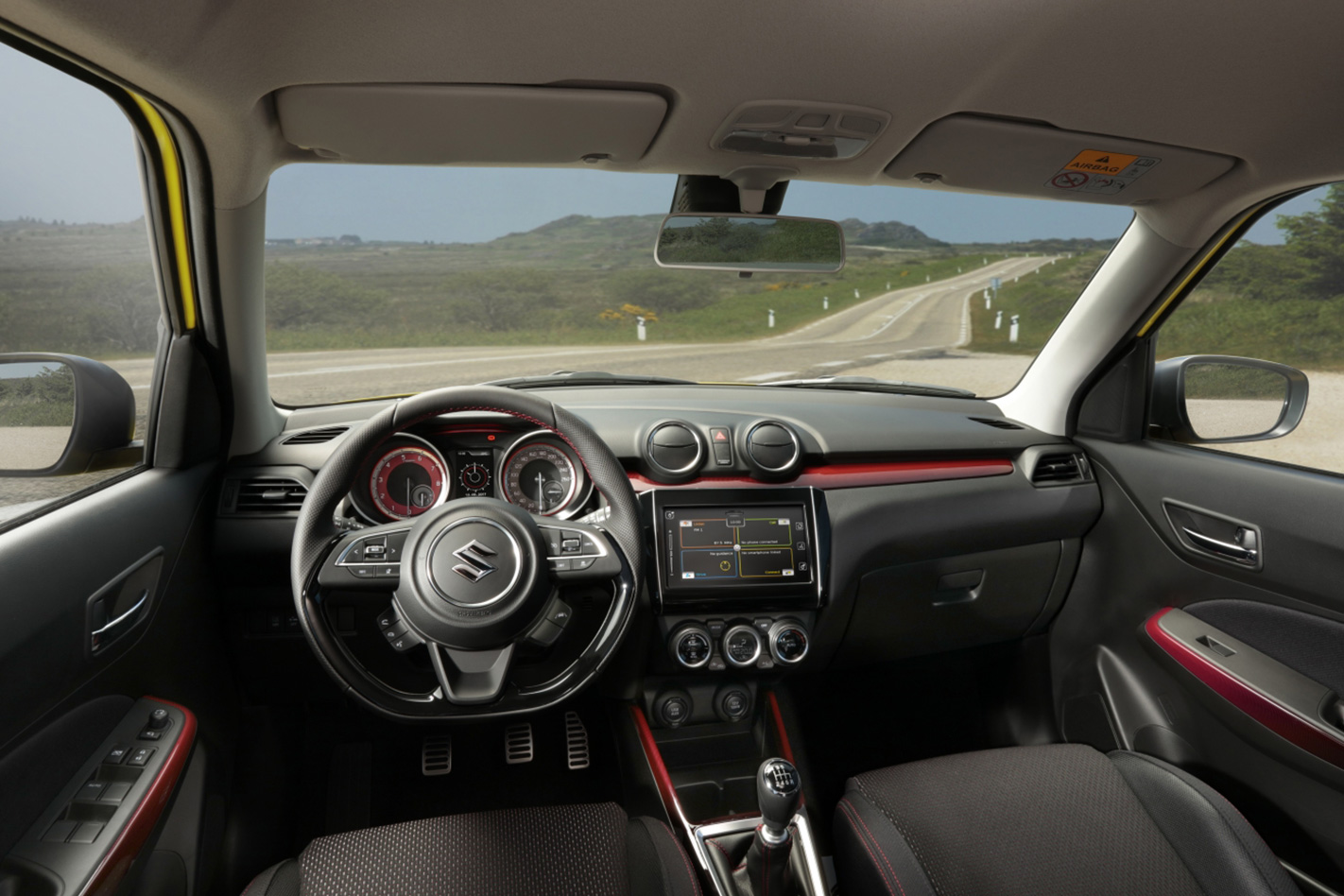
As with the previous model, the new Swift Sport will be available with both six-speed manual and automatic transmissions. Those opting for the auto will no longer have to put up with the last Swift Sport’s snoozy CVT gearbox either – for the all-new 2018 model, the auto option brings a more enjoyable six-speed transmission.
Precise specifications have yet to be announced, but Suzuki Australia promises it will arrive with a “long list of advanced tech and safety”. Full pricing and local specs will be announced closer to the 2018 Suzuki Swift Sport’s arrival early next year.
WHAT purports to be the final Holden Commodore to be built in Australia has been photographed by workers at the Elizabeth plant in South Australia and posted to social media.
The single photo appearing on Facebook shows a VF Commodore chassis, accompanied by a sign stating: “Last Holden manufactured in Australia October 2017”.
The image emerged in online discussion concerning an event titled “Farewell to Holden Manufacturing in Australia”.
An accompanying caption for the image claims “It’s happening right now in Body Shop…”.
It is unclear what the specification of this vehicle will be when it rolls off the production line.
Holden has not released details or announced the exact completion date of the last vehicle, though the final day of operations at the Elizabeth plant will be October 20.
Wheels contacted Holden to verify the authenticity of the photo.
A Holden spokesperson responded: “Nothing we can confirm and no additional details we can provide at this stage, unfortunately.”
It is understood the Elizabeth plant in South Australia will continue to produce Holdens until the final shutdown date.
The closure of Holden’s vehicle manufacturing plant at Elizabeth will signify the end of an unbroken streak of vehicle manufacturing in Australia, dating back 69 years to 1948.
A similar photo surfaced last year showing the last Ford Falcon Ute to be produced in the country, several months ahead of the Broadmeadows factory shutdown. Ford Australia denied the authenticity of the photos at that time.
Holden built its last V6 engine at the Port Melbourne facility in November of last year.
THE internet has created several new species over the years.
There’s the Airbnb-er, which couldn’t exist before the worldwide web because it had nowhere to roost. And then you have your dull-as-each-other co-dwellers who never would have got together were it not for, ahem, dating sites. (And, apparently, DTF does NOT stand for Deferred Till Friday.)
Dickheads with an opinion have always been a reality, but the internet has spawned a race of Super Trolls and bred them with the Keyboard Warrior for a more unpleasant hybrid than the first Prius. Most of those species I can avoid (largely by never going near a dating site or online forum), but there’s one new species that I can’t seem to shake.
I speak of the Online Seller; a critter who comes in all shapes and sizes, but one who seems possessed of a common denominator of giving me the irrits. It’s not that I’m a rabid consumer. My version of shopping best-practice involves working out what I want, discovering where it’s sold and then visiting that location for a simple, quick hostage exchange.
I give them the money. They give me the stuff. Nobody gets hurt. But online shopping? Vastly more likely to end in tears, I’m afraid. Now, you would think an online store or hub would have a vague idea of how to conduct itself within the confines of Australian consumer law. Apparently not.
So, I emailed the website and politely – no, really – gave them 12 hours to have the money back in my account or I’d be having a chat with the ACCC. Took them six hours. Mind you, I still didn’t get my pizza. Why didn’t I just ring the pizza joint direct? Because, thanks to its affiliation with this particular web-hub, it doesn’t advertise its phone number.
You either deal through the hub or, short of visiting in person and having to pick your way through the sleeping druggies in the doorway, not at all. The other type of online seller is the home-tattooed flanno-hanger selling his car through a website. Here are a few tips for this, kids. Don’t tell porkies in the ad.
If the thing is a bald-tyred, defected shitter (which is why you’re selling it) don’t advertise it as an ace-condition, low-kay, 10-outa-10, minter. ’Cos it won’t take me more than a few seconds in your driveway to rumble you. And then I’ll be sad and unhappy that I’ve driven for an hour to look at it and you.
Seems to me that ‘online sale’ equals a licence to bullshit. But a dunger car is, if you know what you’re looking for, hard to cover up. Bogans, for instance rarely, if ever, manage to scrape off all the dead Yokohama from the rear wheel arches. Bundy Rum stickers always seem to leave a shadow after they’ve been removed and a welded-up diff does not equal ‘grandpa spec’.
“Tell you what,” said the last dickhead trying to sell me a (barely) rolling tribute to skipped maintenance, “I’ll throw in a couple of DVD players if you give me cash”. “Nah, mate, I reckon they’d fall through the rust holes in the floor before I got home.” “Ah well,” he says, “never hurts to ask”. Turns out he was wrong.
AFTER the superb Elise SC drew a collective cheer from our squad of judges at Queensland’s first round of Performance Car ’08, we were drooling at the thought of the harder-core Exige S PP at Round Two.
This Performance Car Of The Year article was first published in MOTOR Magazine November 2008.
You see, some of us had already driven a car of the same spec in a comparison with a go-kart in July, and found it to be a razor-sharp track tool – even on an unflattering go-kart circuit. But the Exige S PP we were given this time around didn’t seem as willing to work with the driver as the first Isotope Green car we had.
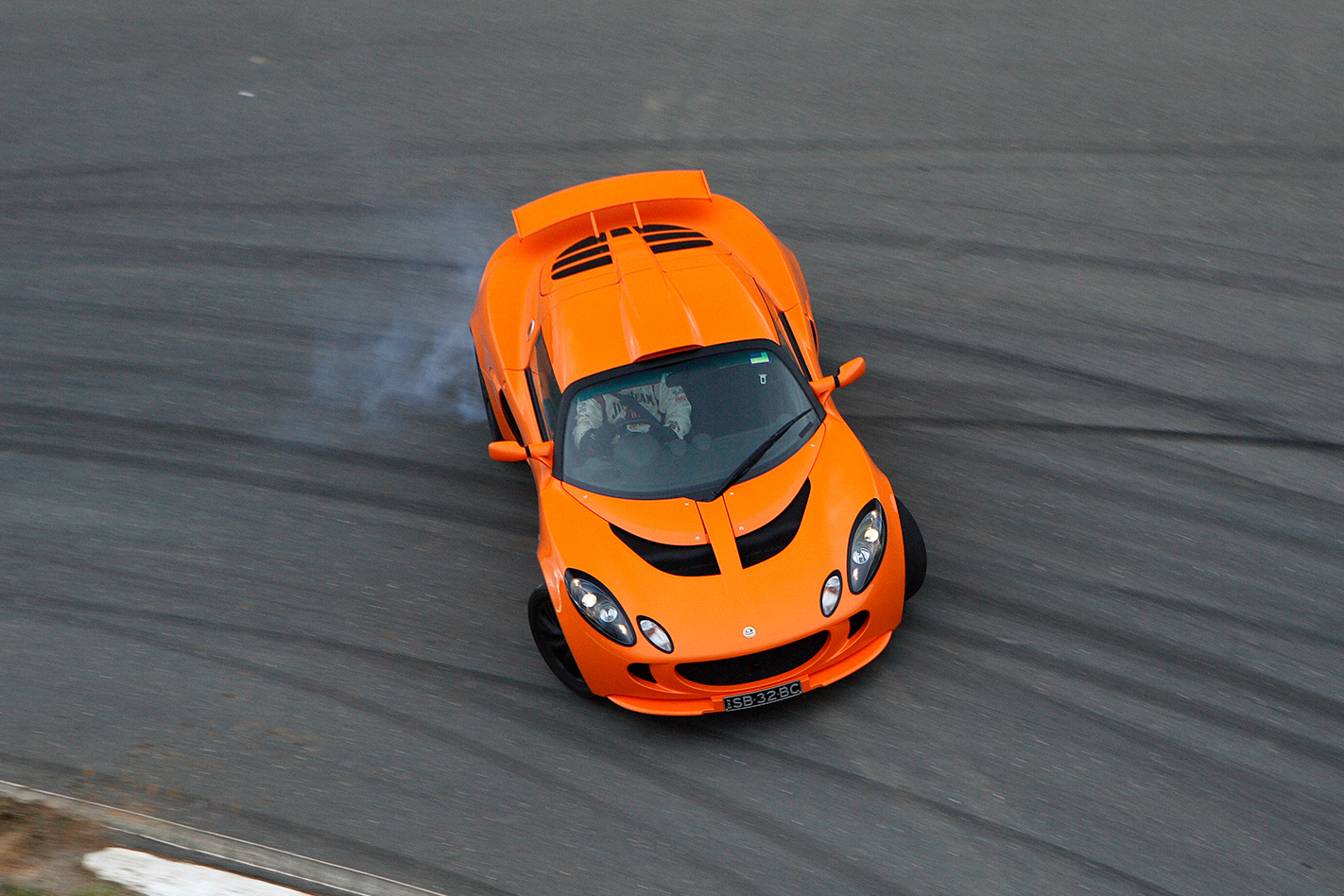
The Exige had to be driven with smoothness and precision around Wakefield Park, where the Elise SC seemed less threatening to the driver at Lakeside and could be hustled around with gusto. We expected the Exige S PP to be fastest of all, but Luffy’s best lap of a 1:08.1 only placed the Exige S PP in second spot, four-tenths shy of the M3 M-DCT.
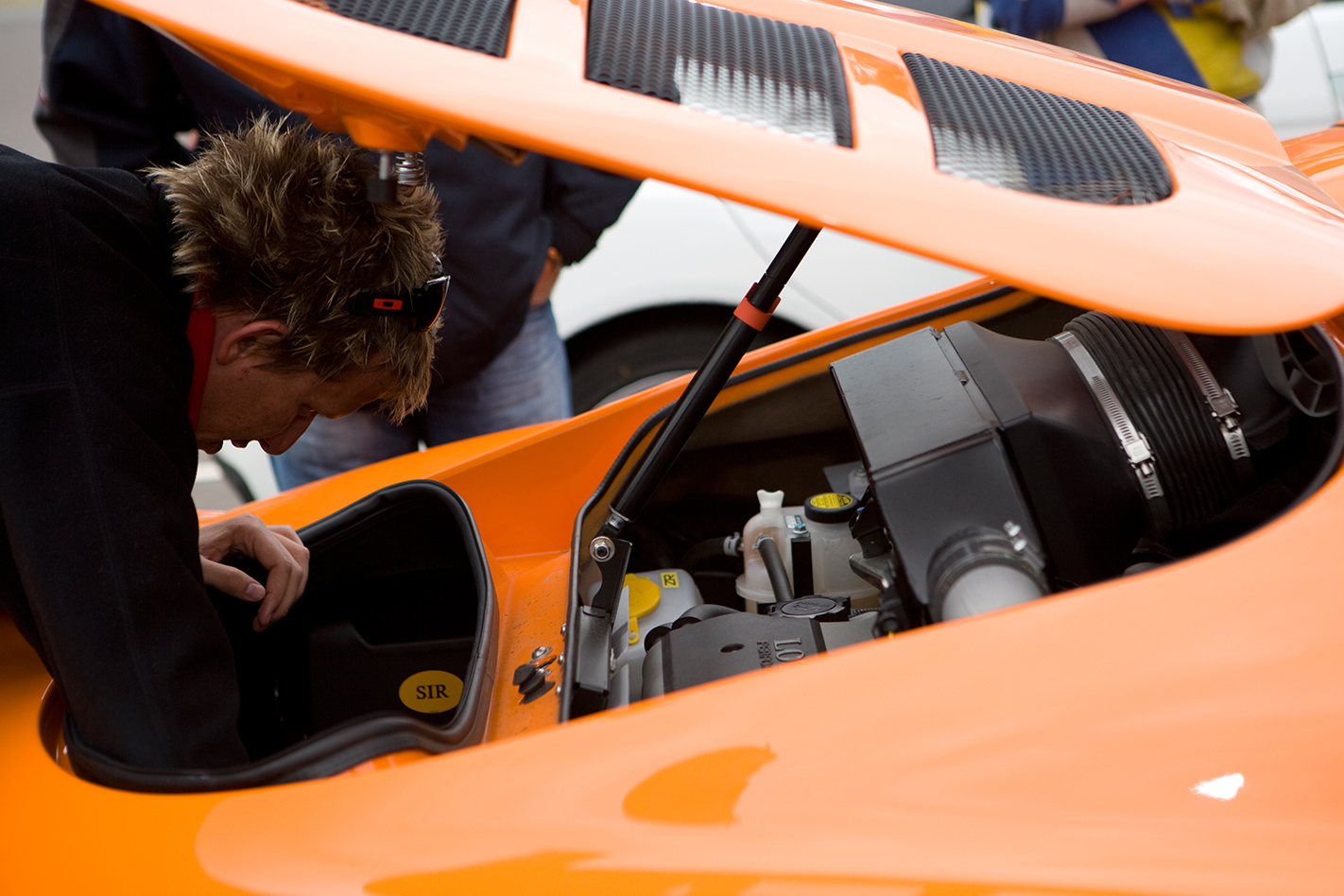
The Exige S PP’s brakes were sensational, too. There wasn’t a heap of feel through the pedal until you were really firmly into it, but the relentless retardation they provided was stunning. A lot of touring cars don’t brake that well. So, where did the Exige S PP lose time to the M3?
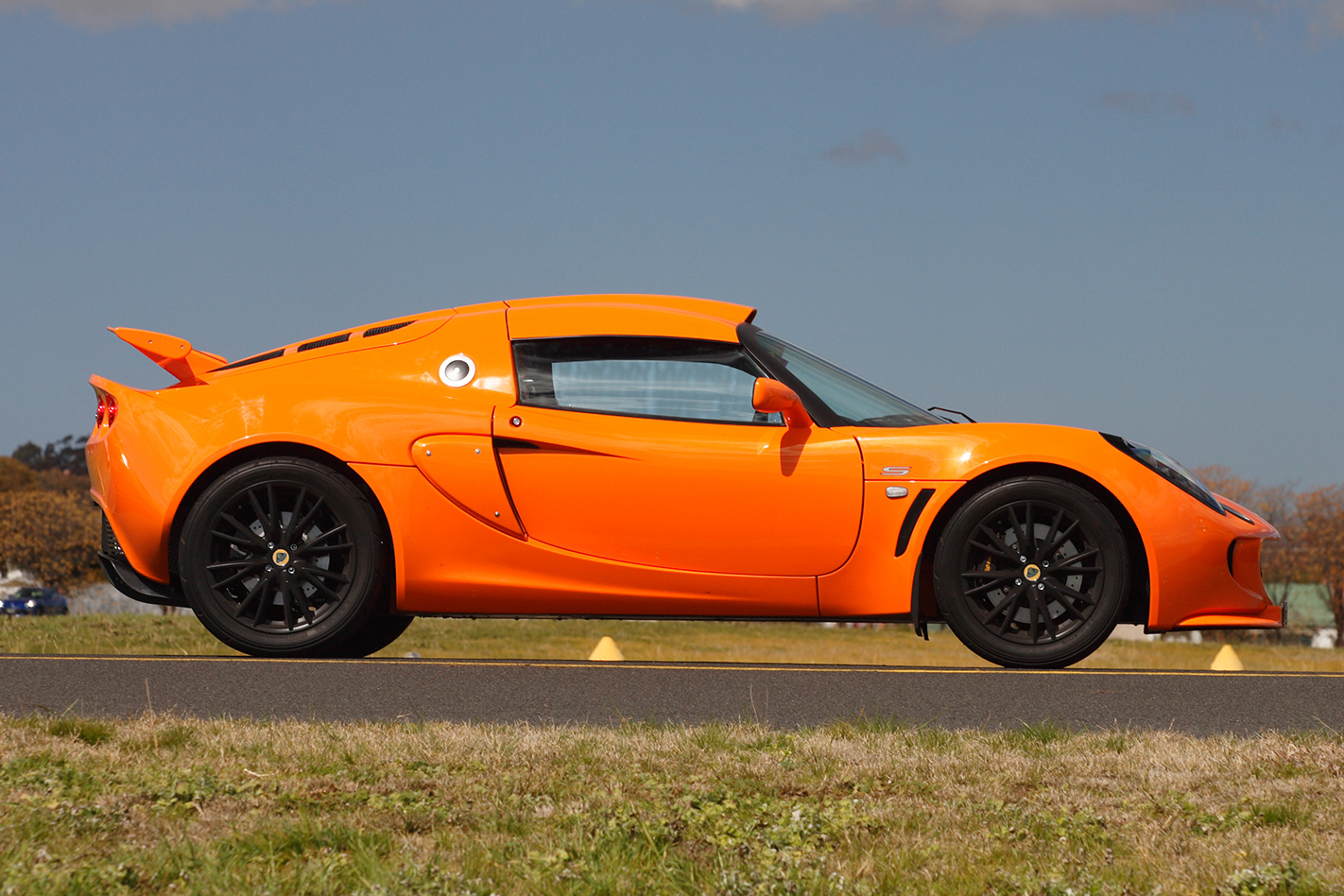
The M3 clocked a resounding 5.27 and from there, things only got worse for the Exige S, and further explained some of its deficit around Wakefield Park. It lost a total of over to the M3 in the sprint to 200km/h, and even the slowest of the Aussies, the FPV GT-P, beat it by two seconds to the double ton.

“I reckon it’s a proper performance car … it’s uncompromising,” said Morley. And while we all agree, it shouldn’t be forgotten that the humble Elise SC offers 97 percent of what Exige S PP does, for around $25k less. And it’s a better road car to boot…
The Bugatti Chiron recently amazed us all with a run from a stand-still to 400km/h and back to stationary in a blistering 41.96 seconds.
It only took 3112m, and a very long, smooth, straight stretch of road.
However, Sweden took it as a challenge, and the Koenigsegg Agera RS has stepped up to the plate.
In just 37.28 seconds, driver Niklas Lilja took the Agera from 0km/h to 403km/h and back to a stop. He only needed 2535m of Danish airfield to do it.
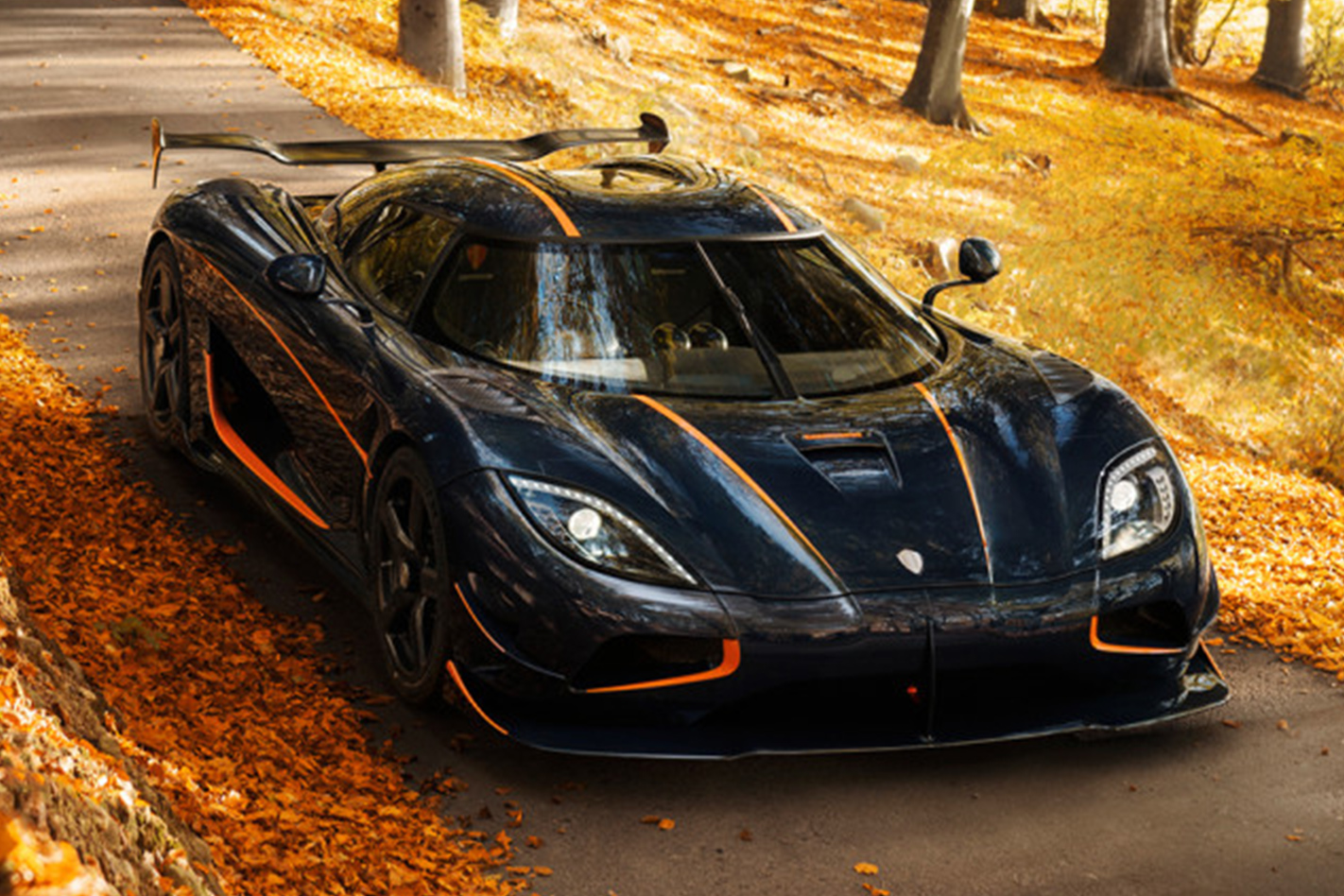
While the Bugatti’s 1103kW1600Nm eclipses the Agera’s ‘modest’ 1000kW/1371Nm, the Chiron weighs in at 1995kg. At 553kW per tonne, that’s not bad at all.
But the Koenigsegg’s kerb weight of just 1395kg means it has a ratio of 717kW per tonne. As a ‘real world’ reference point, a Holden Commodore SS-V Redline has 170kW per tonne, while HSV’s W1 has 250.
Part of the Koenigsegg’s weight-saving is thanks to its 5.0-litre twin-turbo V8 only weighing 189kg in total.
There’s one more reason Agera RS owners will be smiling, but it’s not just because of the record. While Chiron numbers have been capped at 500, there will only ever be 25 Agera RSs, as long as Christian von Koenigsegg keeps his promise.
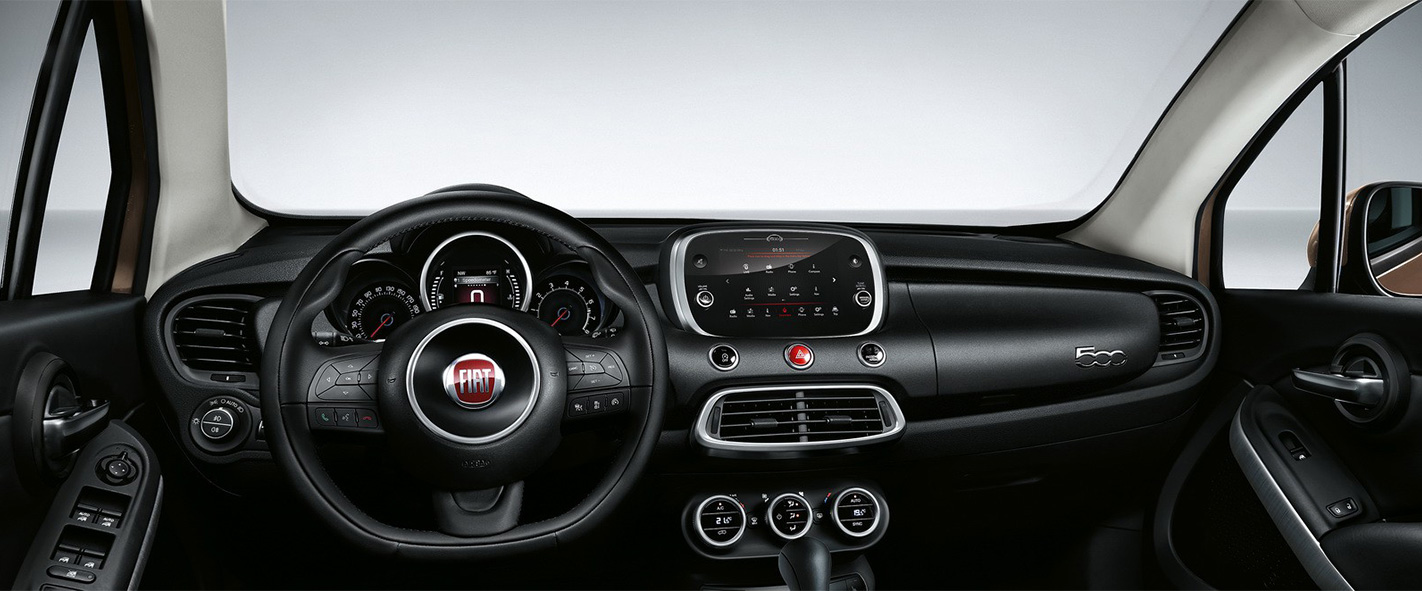
Fiat’s 500X has received minor updates for the 2018 model year, including a choice of new paint colours, and a subtle interior tweak to keep the compact SUV looking fresh in a consistently competitive segment.
Revealed today for the US Market, it is understood the updated Fiat 500X will arrive in Australia from the first quarter of next year.
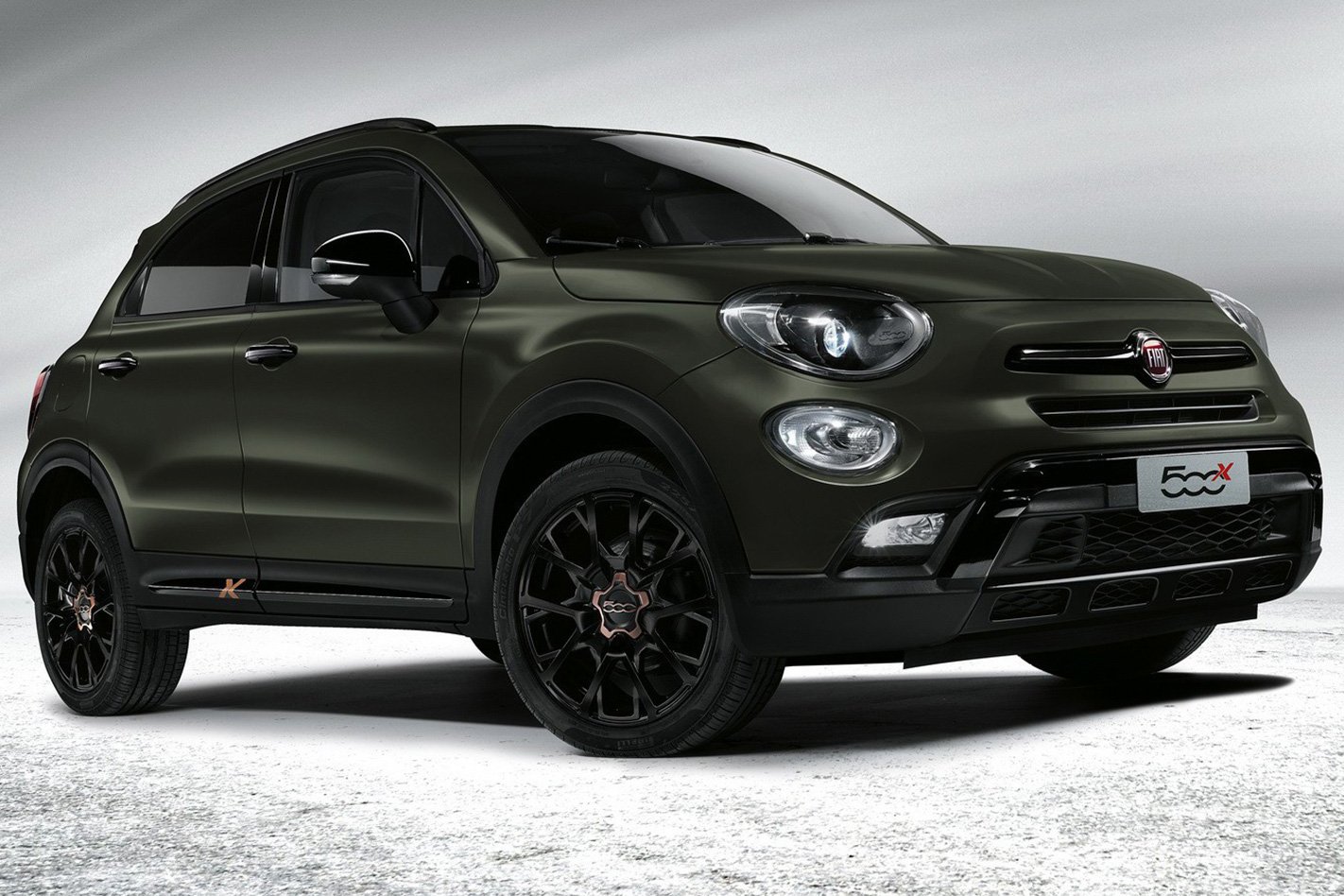
Exterior revisions are limited to the addition of two new colours for the 500X: Donatello Bronze, and Alpi Matte Green.
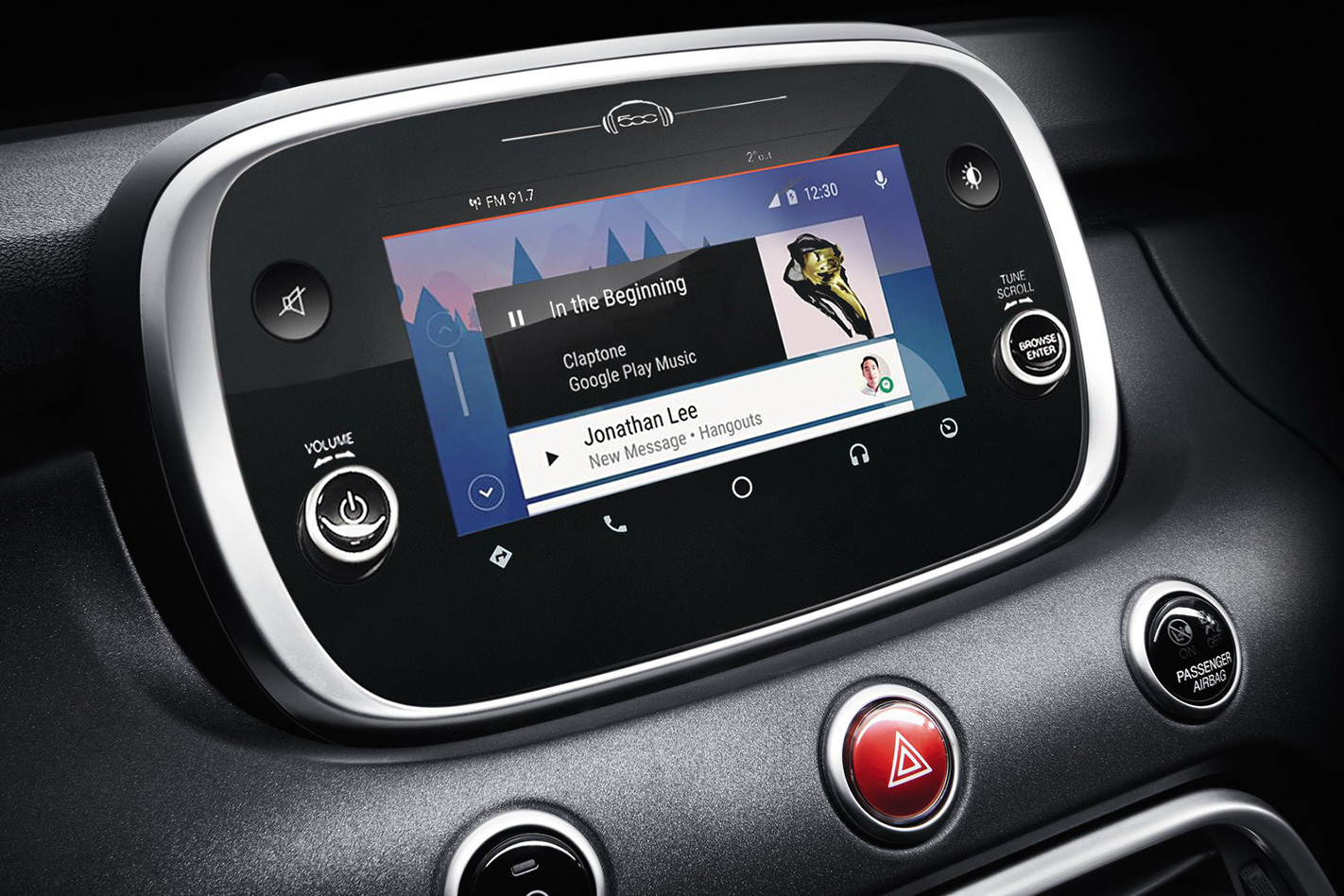
Inside, the subtle updates include the introduction of a new 7.0-inch Uconnect touchscreen infotainment system, which is compatible with both Apple CarPlay and Android Auto.
North American customers can option a TomTom 3D navigation system, along with Uconnect Live net-based services. It is not clear if this will be available for Australian buyers.
Pricing and specification for the updated 2018 500X in Australia will be revealed closer to the launch date.
The current Fiat 500X line-up has four variants: Pop, Pop Star, Lounge, and Cross Plus. All are powered by a 1.4-litre four-cylinder engine. The Pop and Pop Star have 103kW and 230Nm at their disposal, while the Lounge and Cross Plus make 125kW and 250Nm.
The Pop badged 500X starts at $25,500 driveaway for the manual, and $30,000 driveaway for the semi-automatic.
Pop Star variants cost an additional $2,000 over the auto Pop, while the Lounge costs $37,000. As the flagship of the range, the Cross Plus carries the highest premium of $38,000.
Living in the UK, but want a little slice of Oz to remind you of home? How about a BA Falcon-based FPV GT-P?
We’ve come across one up for sale in the UK for the relatively low price of £5,400, which translates to around $9100 Australian. It’s only got 154,XXXkm on the clock, which strikes us as pretty standard for a 15-year-old car.
It’s about as Aussie as Aussie gets (short of something Barra or Holden 5.0 powered), and is actually listed as able to be shipped back home.
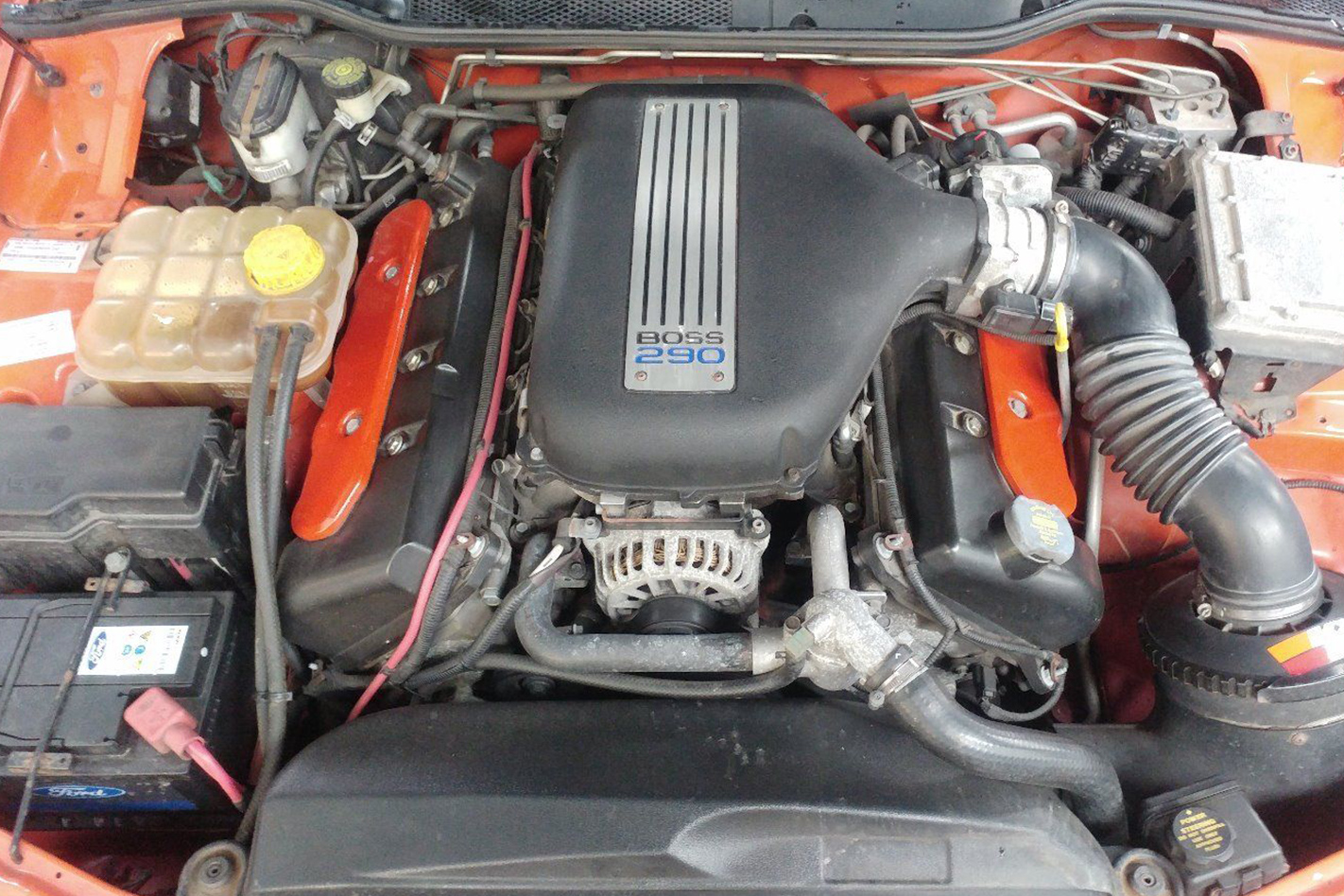
This gives it a claimed 324kW to play with rather than its bone-stock but seriously impressive 290kW, as the Boss 290 engine would suggest.
Also on the list of overhauled components are the LSD, the six-pot Brembos on the front, and the clutch has been replaced with a performance clutch.

The ad’s on eBay UK here, so if you’re interested you’ve got five days from publishing.
Oh, and the plate comes with the car. Just imagine the ‘7’ is a ‘T’.
We found only one for sale from Queensland on TradeUniqueCars, but it’s sporting only 22,000km on the clock and is priced at $44.5K, so the UK-based car could also spark the interest of someone looking to pick up a marginally cheaper project.
