
The 100 Australian-delivered Nissan Skyline R32 GT-R models will soon be easier to repair properly, as NISMO will begin re-producing replacement parts for Godzilla.
The recent announcement flew under the radar for most, but the question of what would be available in Australia almost definitely popped into the mind of GT-R owners.
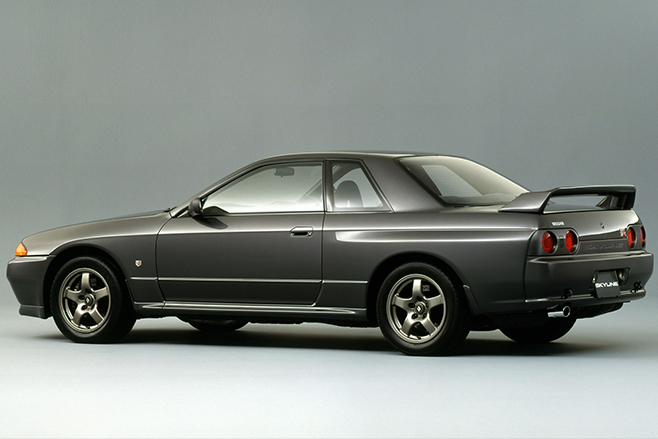
In the original internal bulletin from 1991, which was supplied by Nissan Australia to MOTOR (after redacting any private information about the 100 models), six pages of completely unique parts are listed that were used for Australia’s GT-Rs instead of those found on the JDM models.
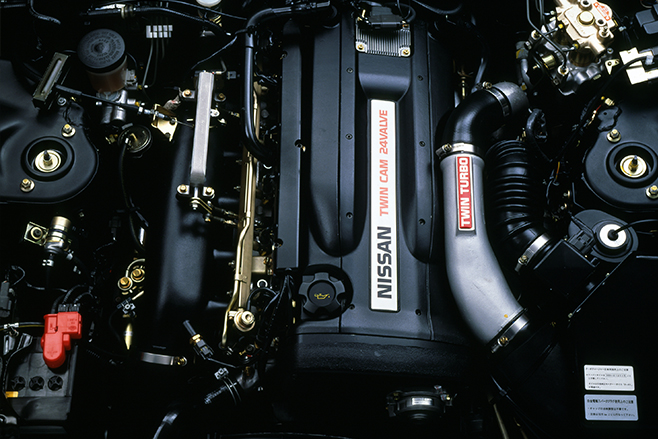
It then proceeds to detail everything from the 25 oil cooler parts that differ, to muffler parts, and even licence plate brackets.
The front windshield is also unique, according to the document.
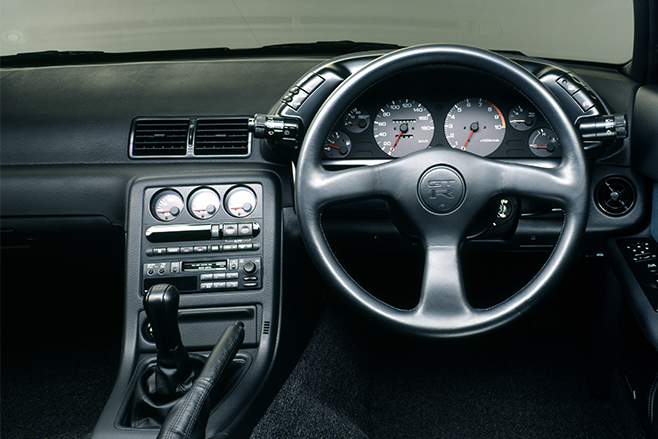
And that’s fair enough when you realise there are over 100 parts which are unique to Australian GT-Rs.
If you’re currently looking for a “plate-transfer case cooler pipe mounting lock”, the best course of action would be to ask Nissan and see what they can do for you.
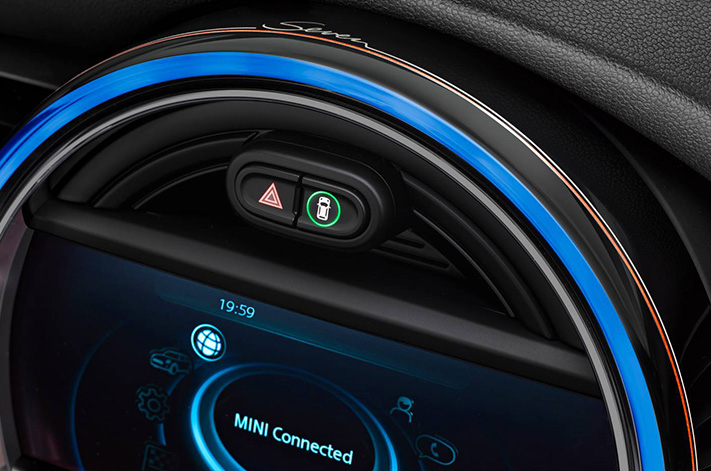
The 2017 Mini Seven special edition hatchback has arrived in Australia and it comes with a bunch of extra design features for a marginal price hike.
Available in either three-door and five-door Cooper hatch form in diesel, petrol and high-output Cooper S guise for a $2000 premium, Mini Seven buyers will be getting $7000 worth of extra equipment and features.
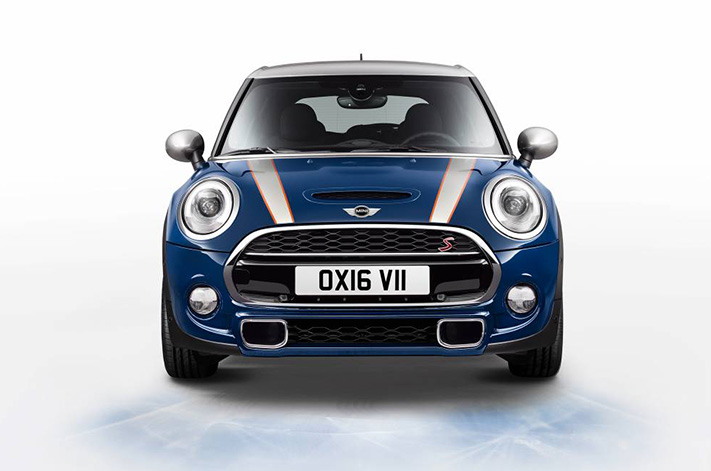
As we reported when the Seven edition was revealed last year, it comes with four extra colour options: Lapis Luxury Blue, Midnight Black, British Racing Green and Pepper White.
Melting Silver is the colour of the roof and mirror caps as well as the bonnet stripes, which are finished with Malt Brown pinstripes.

17-inch two-tone alloy wheels are fitted to the Cooper and Cooper D while the Cooper S gets 18-inch Mini Yours Vanity alloys, a panorama glass roof and the same rear-spoiler spotted on the John Cooper Works model.
Inside, the Cooper S gets black leather covered seats and steering wheel, while the Cooper and Cooper D offer a combination of cloth/leather upholstery in black with brown detailing. All special edition models get ‘Seven 7’ branding on door sills and centre console. The emblem is also featured on chrome side scuttles.

A Multimedia Essentials package, which includes navigation, visual boost multimedia interface, reversing camera and Bluetooth, is also included in the package.
This special edition is currently available in Australia, but only up until the end of July 2017.
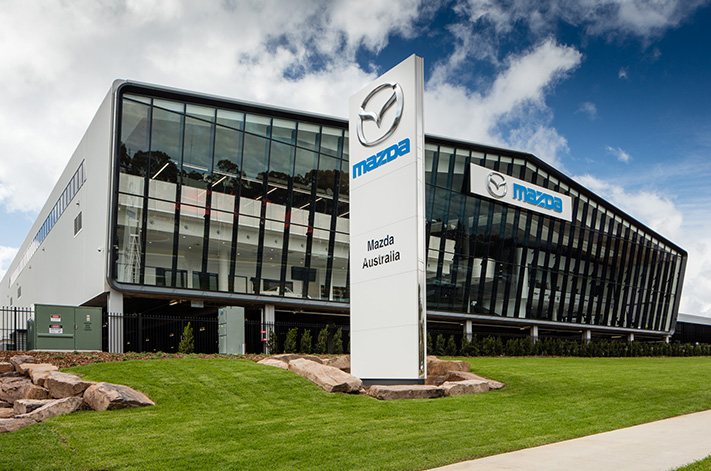
A trio of Australia’s favourite carmakers are keeping company among the top 15 most reputable businesses on red dirt, as identified by the annual AMR Corporate Reputation Index.
Mazda was the highest ranked car brand sitting overall in position two of the top 60, Toyota was close behind in fourth place, while Hyundai rounded out the three most trusted car brands in 15th place. All three earned recognition as ‘Strong’ performers among 26 organisations that scored the same result.
The top award was taken out by Air New Zealand and the only business to be rated ‘Excellent’.
Reputation is determined through consumer surveys and research in partnership with the Reputation Institute. The report looks at Australia’s top 60 businesses each year.
Just two other car makers were assessed in the list of 60 companies, with Ford and GM Holden sitting at positions 32 and 34 respectively, earning the reputation rating of ‘Average’.
No car brands appeared in the list of 10 companies that were deemed to have a ‘Weak’ reputation.
Mazda earned extra praise for having scaled the ladder three places since last year’s survey, Hyundai remained in its unchanged spot, while Toyota slipped two places. Holden climbed one place while the Blue Oval fell by two positions.
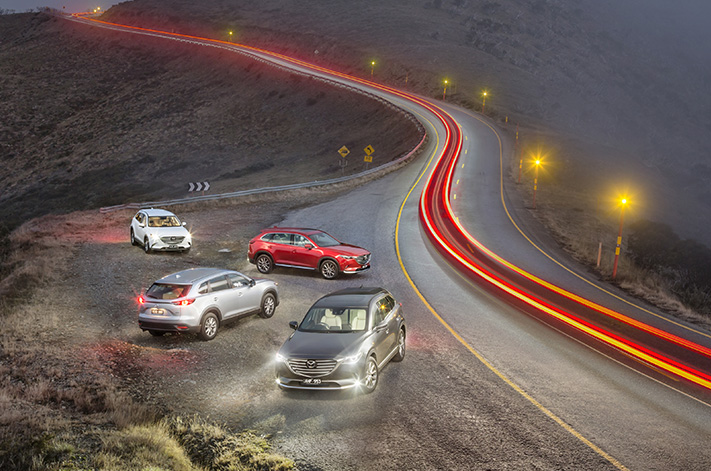
In addition to reputation, each brand was measured against seven “drivers” including products and services, innovation, workplace, citizenship, governance, leadership and financial performance.
Interestingly, the report highlights that its key focus of reputation is not exclusively pegged to company profitability with airline Qantas slipping one place to 5th overall, despite a record year of profit in 2016.
South Korean electronics giant Samsung’s result is more cut and dried, dropping from 3rd to 14th place almost certainly as a result of the battery fire crisis that plagued the company last year.
The 60 companies under the spotlight are sourced from the IBIS World Top 200 Company list, but where other performance reports use information provided by the organisations, the AMR survey relies on direct consumer insight.
All reputation survey results are weighted to ensure they represent appropriate gender and age groups, says AMR.
THE 2017 Volkswagen Golf range will add an R-badged wagon to the line-up as part of the strong-selling model’s half-step generational leap, the carmaker has revealed.
The most basic version of the VW Golf 7.5 will go up slightly in price when it arrives here in July, rising $1150 to start from $23,990 for the 110TSI hatch fitted with a six-speed manual. Pitch in a seven-speed dual-clutch DSG transmission and that price jumps $2500.
However, at the top end of the range, prices for the 213kW/380Nm all-paw R-badged variants will hold steady, ranging from $52,990 for the six-speed manual and from $55,490 for the dual-clutch auto.
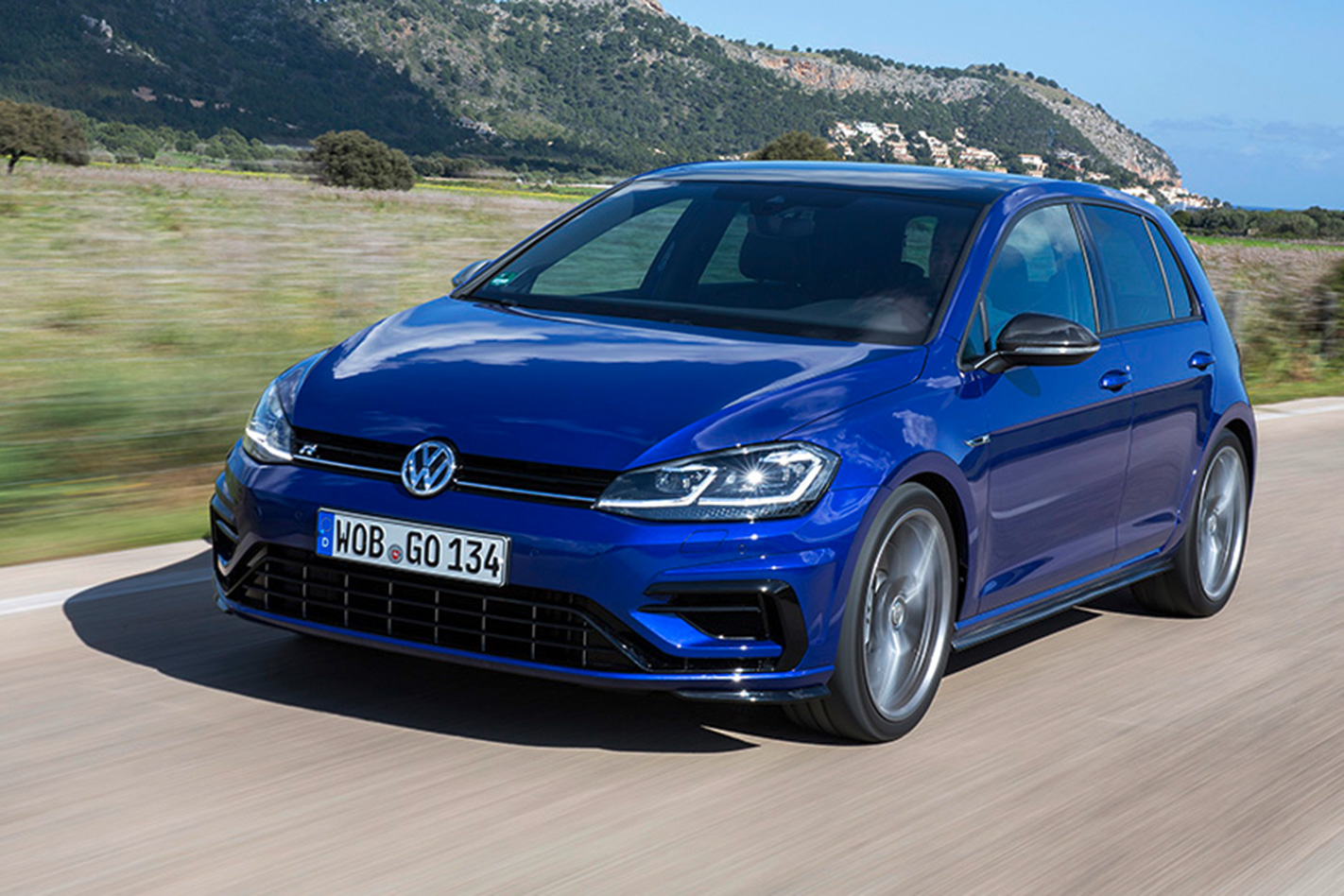
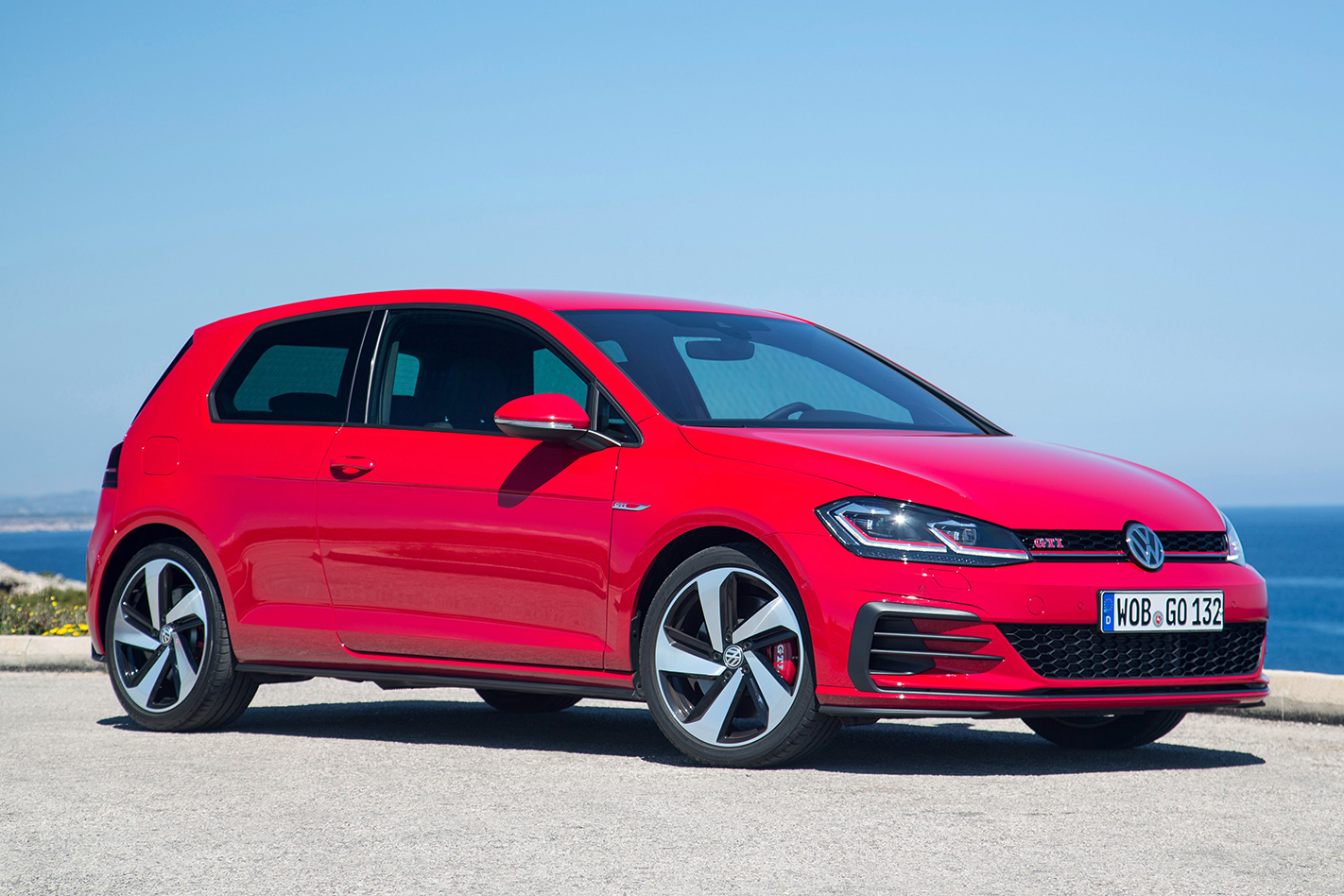
Pricing for the 169kW/350Nm GTI has risen by $150 to start from $41,490 for manual versions and $43,990 for the dual-clutch autos. If more performance with fewer doors is more your bent, the 180kW/370Nm GTI “Performance Edition 1” is priced from $47,990. Get your order in quickly, though; just 150 of the hardcore, dual-clutch-only three-door hatchbacks will come here.
The GTI jumps to a bigger 9.2-inch multifunction screen and 18-inch alloys that tie in with the adaptive suspension system and selectable drive mode that sharpens responsiveness. That extra spend on the three-door includes carbonfibre wing mirror skins, an amped-up 400W audio system, and slick-looking 19-inch alloys.
Other familiar variants in the Golf line-up swallow small price rises of between $650 and $1500.
The facelifted Golf range will sell with VW’s more advanced automatic emergency braking – it can avoid a secondary crash once the first one has happened – as standard, a mandatory requirement to gain a top five-star rating via Australia’s crash safety watchdog. It will also monitor drivers for signs of fatigue and throw up a warning if needed.
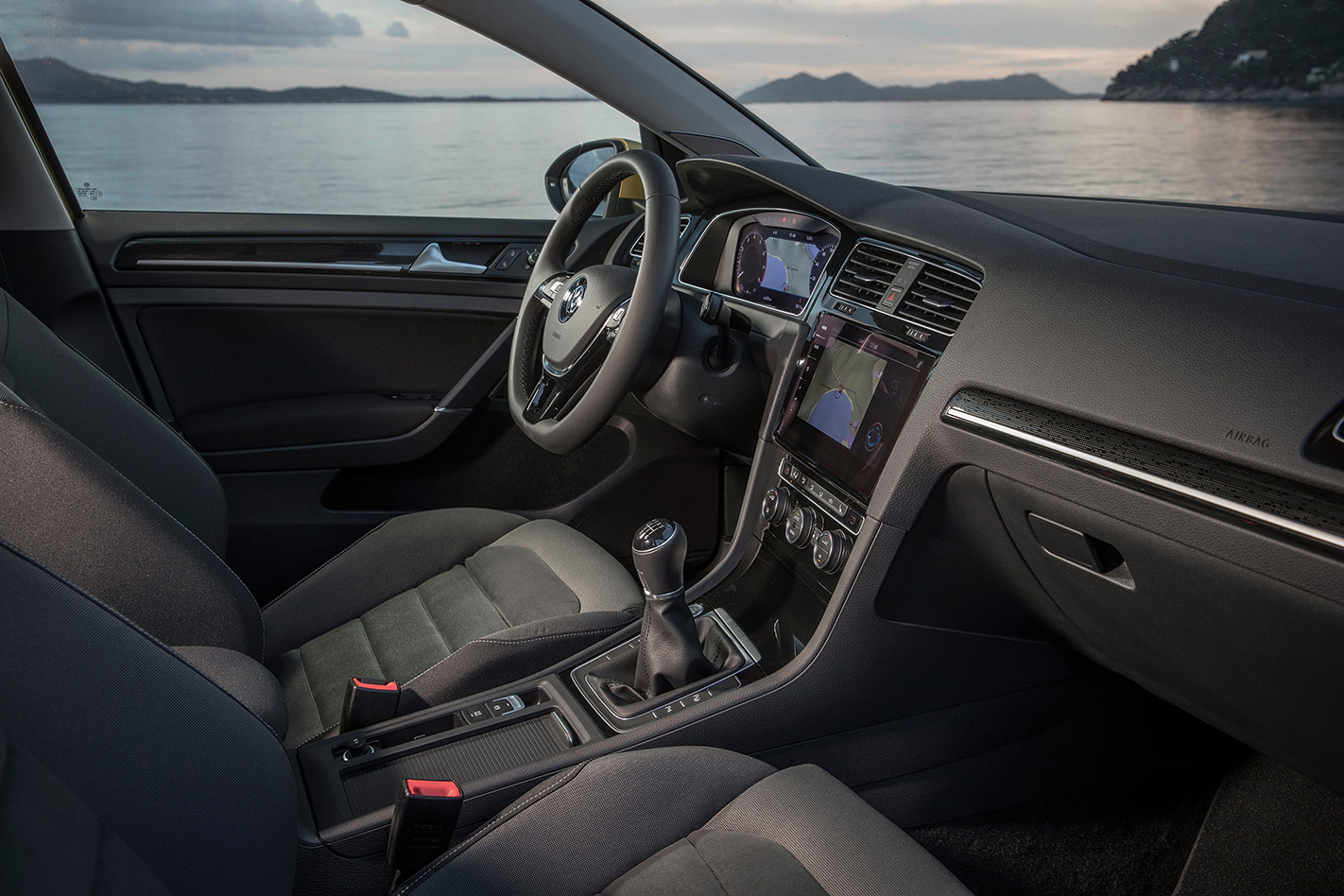
Stepping up to Trendline adds auto wipers and headlights, car park-friendly front and rear parking sensors and a glare-reducing rear vision mirror, while wagons will add black roof rails and a luggage net for the boot.
Highline variants add the first taste of leather trim on more heavily bolstered and heated front sports seats, dual-zone air-con, LED headlights, a sunroof and fog lamps.
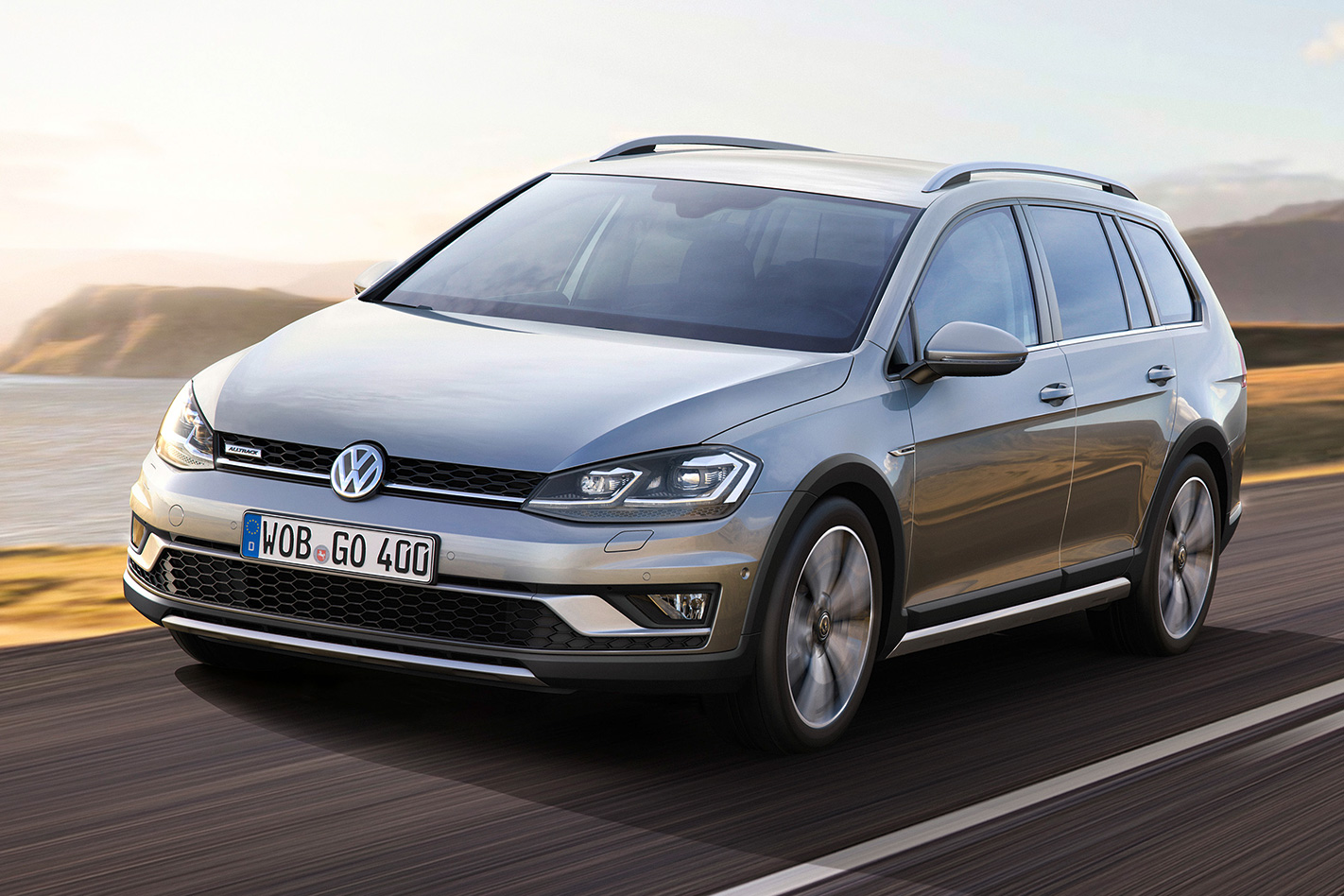
Meanwhile, the jacked-up, SUV-styled Alltrack expands from one to three models, with one using a diesel engine borrowed from the Skoda Octavia RS under its bonnet. It is badged the 135TDI and priced from $40,990, sending drive to all four wheels via a 135kW/380Nm four-cylinder turbo-diesel.
2017 VOLKSWAGEN GOLF PRICING
HATCHBACK 110TSI (man) $23,990 110TSI (auto) $26,490 110TSI Trendline (man) $24,990 110TSI Trendline (auto) $27,490 110TSI Comfortline (auto) $28,990 110TSI Highline (auto) $34,490 110TDI Highline (auto) $36,990 GTI (man) $41,490 GTI (auto) $43,990 GTI Performance Edition 1 (auto) $47,990 R (man) $52,990 R (auto) $55,490
WAGON 110TSI Trendline (auto) $28,990 110TSI Comfortline (auto) $30,490 110TSI Highline (auto) $35,990 110TDI Highline (auto) $38,490
ALLTRACK 132TSI (auto) $34,490 132 TSI Premium (auto) $38,490 135TDI Premium (auto) $40,990
What stands out?
Four-wheel disc brakes, rear parking sensors, five doors and a punchy powertrain help the tiny Kia Picanto rank among the best buys in a city hatchback. The stylish Picanto also has an auto gearbox standard, a seven-year warranty, and a five-star safety rating.The car covered in this review was replaced by a third-generation Picanto early in May 2017.
What might bug me?
Monitoring the speedo on long drives. Cruise control is not available on the Picanto, even as an option.Perhaps sore thighs, on long drives. The Picanto’s front seat cushions don’t support you well enough to ensure comfort over long distances.Perhaps motion sickness, on rough roads. The Picanto’s suspension is set up for comfort, which is fine about town. On the open road, the way the body pitches over bumpy surfaces might induce queasiness.Having to stop to adjust the multimedia system. To set up and use it, you have to take your eyes and hands off the job of driving the car. That is dangerous when moving, and so best done when parked.
What body styles are there?
Five-door, five-seat, hatchback only.The Picanto drives its front wheels, and is classed as a micro car.
What features do all versions have?
Full instrumentation – a speedometer, tachometer (which tells you how fast the engine is spinning), petrol gauge, and trip computer.An AM/FM radio, a CD and MP3 player, and four speakers. Bluetooth phone connectivity, with audio streaming and steering-wheel mounted controls. A USB input, and a 12-volt power outlet.Air-conditioning, with a pollen filter. Power-opening windows (with driver’s auto up-down), and power-adjusting exterior mirrors.Height adjustment for the steering wheel, driver’s seat and driver’s seatbelt. A driver’s foot rest. Fabric seat upholstery.Headrests in all five seating positions. Seat belt reminders on all seats.A rear window defroster with timer. A rear-window wiper and washer system.Automatic transmission.A space-saver spare wheel.Electronic stability control, which helps you control the car if it skids. (Every new car must have this feature).Six airbags. (For details of where they are placed, please open the Safety section).The Picanto is offered with a seven-year, unlimited distance warranty, and fixed-price servicing for that period.
Which engine uses least fuel, and why wouldn’t I choose it?
Only one engine is available with the Picanto, a 1.2-litre, twin-cam, four-cylinder petrol unit, driving the front wheels via a four-speed automatic transmission. It returns 5.3L/100km on the official test (city and country combined).This is a smooth yet punchy powertrain combination, taking advantage of the Picanto’s low (994kg) weight to provide a fine balance between performance and fuel economy.In a real-world comparison conducted for the July 2016 issue of Wheels magazine, a Picanto with this engine averaged 7.5 litres/100km, a litre less than an accompanying Holden Spark but 1.4 litres more than the other micro car reviewed, a Suzuki Celerio.The four-speed auto is the only transmission available: you can’t have a manual.
What key features do I get if I spend more?
There is only one Picanto variant, the Si, and it is very well equipped for the money.Options are limited to metallic paint and alloy wheels (which typically will be lighter and will look nicer than the standard plastic-trimmed steel wheels).There is a range of dealer-fit accessories, such as floor mats and bodywork stripes. Otherwise the Picanto is a one-size-fits-all proposition.
Does any upgrade have a down side?
Only one colour – Clear White – is a solid colour and so does not add to the price of the car. The rest are considered metallic (or premium) paints, and cost extra.
How comfortable is it?
The Picanto is generally more comfortable than it looks. For starters, at about 1.48 metres it is fairly tall, and the doors open wide, so that it is easy to get in and out of. Once inside, head room is generous. If there is nobody sitting behind, both front seats slide back far enough for even long-legged people to fit easily.The dashboard is a solid and coherent design, offering very clear instrument markings (especially at night), obvious and uniform placement of all controls, and very direct access to ventilation outlets and storage compartments.The driving position puts everything within easy sight or reach, aided by a seat-height adjuster and a tilt-adjustable (only) steering column.However, the driver’s seat-height adjuster moves the base up on an unusual backward tilt. And support from the front seat cushions may be insufficient to keep your legs ache-free over long distances.Otherwise, all outboard seating positions are comfortable for a car of this size and price. Note that the sheer narrowness of this city car means that the centre-rear position is best reserved for slight people, such as young children. All five positions have headrests and inertia reel seatbelts.The Bluetooth phone connectivity and audio streaming is confusing to figure out and fiddly to operate – to the point of being dangerously distracting if attempted when driving, since the menu requires concentration. It would be best done when the car is stationary – or leave it to the passenger to pair the driver’s media device. Note, also, that sound quality is on the poor side.Vision out is good, though. And the standard reverse parking sensors take the guesswork out of backing into tight spaces.Wind, road, and tyre-noise intrusion are commendably low – again, for a car at the Picanto’s price point – underlining the pleasing level of refinement that has been engineered into it.
What about safety?
The Picanto comes with six airbags: dual front (for the driver and front passenger), and side and head-level curtain items that protect the upper bodies of occupants front and rear against side impacts.There are the mandatory anti-lock brakes and electronic stability control. And the Picanto has disc brakes on all four wheels (some city cars have inferior, but cheaper, drum brakes at the rear).Daytime running lights make you more visible to other road users. Rear parking sensors make it less likely you will reverse over someone.However, no reversing camera is offered, even as an option.Autonomous emergency braking is not available on the Picanto.The Australasian New Car Assessment Program (ANCAP) has awarded the Picanto five stars for safety, its maximum.
I like driving – will I enjoy this car?
The short answer is yes. But it’s a qualified yes.Despite being tied to a relatively old-fashioned four-speed automatic gearbox (when most micro cars have a more modern and efficient CVT auto), the Picanto’s 1.2-litre four-cylinder petrol engine is a sweetie.Zippy off the mark and punchy darting through traffic, the Picanto has an eager and energetic feel about town. Yet it is also flexible and refined enough to cruise comfortably out on the open road.Some forward planning is necessary for fast overtaking, but for such a small city car, the performance is pleasingly lively.Additionally, unlike any other car of its type, the gearbox has the facility for the keener driver to slide the indented gear lever down from D for drive into 3, 2, or L. The gearbox will hold each lower ratio right up to the rev limiter, or downshift under manual control as quickly as required.Another unexpected surprise is the Kia’s sporty handling. Steering is sharp and roadholding precise. Whether nabbing tight parking spots (in no small part due to a compact turning circle), or racing along a mountain road, the Picanto feels up to it.Note, however, that some drivers might find the keenness to change direction makes the car feel a tad too nervous, even though electronic traction and stability systems intervene early and effectively to keep everything under control.Enthusiasts ought to revel in this city car’s dynamic maturity.Finally, a note about ride comfort. Around town, the suspension’s ability to absorb bumps is commendable. But at speed over less than smooth roads, the Kia can feel bouncy and unsettled.
How is life in the rear seats?
The rear seat area is snug. Yet, despite its diminutive proportions, the Picanto offers some comfort here, due to a thoughtfully angled backrest. Plus, there’s space for feet to tuck under the front seat, and enough ceiling height to clear heads.However, knee room is very limited for long-legged passengers, the cushion is set a bit too low for adequate thigh support, and squeezing a third person in between would be stretching friendships.Deep side windows that wind all the way down offer additional ventilation if needed.While there are no door pockets to store stuff in, map pockets behind the front seats are provided, as are overhead grab handles for passengers to hold when the driver discovers how much fun the Picanto can be through corners.
How is it for carrying stuff?
A fairly large glovebox (that’s illuminated), front door bins with provisions for bottles, a lower console area with retractable clamps for cups, and two map pockets behind the front seats, offer storage inside the cabin.Beyond the map pockets, there is nowhere else for rear-seat passengers to put stuff in or on, however.At 200 litres with the rear seatbacks upright, the cargo area is on the large side for this class of car.The rear seatback split-folds and the rear seat cushion tips forward, to provide a low extended cargo area measuring a handy 605 litres.The tailgate is smartly shaped for easy loading, too.The spare wheel beneath the boot floor is a space-saver, and limits your recommended speed to 80km/h when fitted. But it boosts cargo space, and so is arguably a good choice for a car of this size.
Where is it made?
Every Kia Picanto is made in South Korea.
What might I miss that similar cars have?
The ability to display some smartphone apps (including mapping) on a dashboard-mounted touchscreen, and control them from there (or by voice) via Apple CarPlay or Android Auto. The Holden Spark offers this, for example, as does the Suzuki Ignis micro-SUV.Cruise control. This convenience item, which will hold a set speed automatically on the highway, is available in the Spark and the Ignis.A reversing camera: though small and agile, with rear sensors providing audible approximation to objects behind, a camera that let you see where the car was heading while being reverse parked would be handy. This too is an option on the Spark.Autonomous Emergency Braking, which can sense that you are about to plough into a car ahead, and will warn you and – if you don’t react – apply the brakes automatically. This is available on some slightly bigger cars –it is standard on the Mazda2, for example.And perhaps a manual gearbox, so that you can make more of the Picanto’s sporty performance and involving handling. Many alternative city cars offer manual transmission – among them the Spark, Mazda2, Suzuki Celerio or Ignis, Mitsubishi Mirage, and Fiat 500.
I like this car, but I can’t choose which version. Can you help?
Only one variant of this Picanto is offered in Australia, the generously equipped Si automatic.
When did Kia replace this Picanto?
A mostly new, third-generation, Picanto replaced this car early in May 2017.The new Picanto brought a revised body, suspension and steering, a more comfortable cabin, a 7.0-inch touchscreen, support for Apple CarPlay and Android Auto, and cruise control, among other changes. It retained this car’s engine but offered a manual gearbox, with the auto optional.Although it arrived in Australia only in April 2016, the Picanto reviewed here had been on sale elsewhere for four years.
What stands out?
The Audi A4 is a talented and luxurious mid-size sedan. It is beautifully trimmed, very fuel-efficient, and swift, and it’s available in front-wheel or all-wheel drive. Automatic braking is standard among a big – and innovative – range of active safety features.
What might bug me?
The failure of friends to notice you have the latest A4. Although attractive and contemporary, the current A4 looks a lot like its 2008-2015 predecessor, underlining Audi’s unrelenting evolutionary design philosophy.Thumps from sharp bumps, especially at city speeds. On standard suspension, the ride on all A4s is firm – and especially if you order a bigger wheel and tyre package. If you think this would bother you, a solution is to order the Adaptive suspension. Its electronically controlled dampers soften the response to sharp hits.How much you paid for your A4, after adding the options you wanted. There is a vast number of options available, and they can add tens of thousands of dollars to the price.Driving under 80km/h on your space-saver spare tyre until you can fix your full-sized flat.Drivers born and bred on traditional automatic gearboxes may need to approach the A4’s DSG dual-clutch gearbox with an open mind. The DSG transmission is essentially an automated manual gearbox – albeit a highly sophisticated one – and sometimes it won’t match the smoothness of a conventional automatic when starting from rest.
What body styles are there?
Four-door sedan, and a five-door wagon named the A4 Avant.Some A4s drive their front wheels, while others drive all four wheels. The A4 is classed as a medium car, higher priced.The wagon is available only with a 2.0-litre turbo-petrol engine, but you can have it in FWD or AWD (quattro) form.
What features does every Audi A4 have?
Part-leather upholstery (it’s a mix of leather and vinyl), offset by aluminium inlays on the dashboard and doors. Leather facings for the steering wheel and gear lever. Ambient interior lighting (which illuminates the cabin softly at night.)Sports front seats, which are contoured so as to hold you in place when cornering. Power adjustment for the driver’s seat, including adjustment for lower-back (lumbar) support.Three-zone climate control air-conditioning, which allows the driver, front passenger and rear passengers to set temperatures independently.Reach and height adjustment for the steering wheel, from which you can operate the auto transmission, audio system and cruise control.An 8.3-inch central screen with a fixed rotary controller known as MMI Touch. This offers satellite navigation, radio, CD and DVD play, and 10GB music storage. There are two USB ports, Bluetooth audio and phone streaming, and a smartphone interface that supports Apple CarPlay and Android Auto (which mirror your smartphone display on the screen and allow you to control the phone from there).Headlamps that rely on efficient and long-lasting LEDs, and which switch on automatically when it’s dark. Windscreen wipers that operate automatically when it’s wet.The ability to tailor how immediately the car responds to the accelerator pedal, how directly it steers, and how fiercely the air-conditioning works, for your driving conditions. Audi Drive Select offers Comfort, Sport and Eco fuel-saving modes (and you can configure them together or individually).Eight airbags. Electronic Stability Control (every new car must have this feature).Active safety features include Autonomous emergency braking, Exit warning, Cross traffic assist, Blind spot warning, and Attention assist (which warns you to take a break). For more on these systems, and for the placement of airbags, please open the Safety section below.Additionally there are front and rear parking sensors, and a reversing camera.Front-wheel drive cars have 18-inch alloy wheels, while the quattro models begin with 19-inch alloys. There are tyre-pressure monitors, and a space-saver spare wheel.The A4 is offered with a three-year, unlimited kilometre warranty.
Which engine uses least fuel, and why wouldn’t I choose it?
By far the most frugal engine in an A4 is the only diesel, the turbocharged 2.0-litre four-cylinder that powers the 2.0 TDI quattro. It consumes just 4.6 litres/100km on the official test (city and country combined).In most driving conditions, this performance-orientated diesel pulls at least as hard as any engine in an A4, with a considerable 400Nm of seamless, tree-lugging twisting action available. This makes the A4 diesel ideal for towing or grand touring, especially as it brings you the extra road-grip of all-wheel drive.One reason you might not choose this engine is that when refuelling, diesel bowsers can be dirty to handle. A second is that Volkswagen Group, which owns Audi, remains notorious for the September 2015 diesel emissions scandal, which may adversely affect resale of any of its diesel cars, regardless of whether its engine contravened a regulation. (VW Group says its latest diesels, including that in the Audi A4, all comply.)A third reason could be that you want to pay less for an A4. If you would be happy with front-wheel drive, you could pay at least $10,000 less for a 1.4 TFSI, the least costly A4, or $5000 less for the 2.0 TFSI, whose maximum power output matches the diesel’s. And both these turbocharged petrol engines are almost supernaturally quiet compared with the diesel.Each consumes about 5.4 litres/100km on the official test, with the 2.0 marginally better – a hugely impressive feat considering its significant (and welcome) performance advantages over the 1.4. While the 1.4 TFSI feels sprightly and smooth in normal driving, add a full load of passengers and a steep hill – or overtaking opportunity – and you may wish it did more when you pressed the accelerator.The driving enthusiast’s pick is the petrol engine in the most expensive A4, the all-wheel drive 2.0 TFSI quattro. It feels measurably stronger than the front-drive 2.0 in all conditions, and still uses only 6.3 litres/100km.All A4 engines use stop/start technology, which extinguishes the engine at idle to save fuel and cut emissions. They start instantly when you press the accelerator to drive away.All A4s come with a seven-speed dual-clutch transmission (dubbed S-tronic in Audi-speak). These cannot match the fluid take-off from rest that you get from conventional or CVT automatics, but the rest of the time they are extremely smooth – and they save fuel.
What key features do I get if I spend more?
The 1.4 TFSI comes with the features common to all A4s. Spend more for a 2.0 TFSI, 2.0 TDI quattro or 2.0 TFSI quattro and you get a more powerful engine (as described above), all-wheel drive (in the quattros), and some different equipment. You can also order the 2.0 TFSI or TFSI quattro as a wagon.The 2.0 TFSI brings you keyless entry and start (so that you can unlock the car and drive away without taking the key from your pocket or bag). A foot-operated sensor opens the boot hands-free. The front passenger joins the driver in having powered seat adjustment, and digital reception is added to the radio.Either the 2.0 TDI quattro or the 2.0 TFSI quattro get you, in addition, a memory for the driver’s seat adjustment and for the external rear-view mirrors (so that you can restore your preferred settings quickly after a companion has driven the car). A better sound system in these includes a subwoofer. And both drive all four wheels.Most of these extra features can be added to the less costly versions at extra cost. And as usual with an Audi there is a vast array of additional extra-cost options, some available individually and others combined in packages.The most helpful of these is Adaptive suspension, which comes in either comfort or sport form, the former also lowering the car by 10mm and the latter by 23mm. Either way, no A4 should be without these electromagnetically adjusting dampers – they complete the car.(There is also a Sports suspension option, which lowers the car 20mm but does not have the Adaptive dampers.)Full leather upholstery is an extra-cost option on an A4, and Audi offers several choices (including the soft Nappa variety). You can also get heating and ventilation for the front seats.The Technik Package brings you Audi’s virtual cockpit, introducing an expansive, 12.3-inch high-res colour display, in the instrument binnacle ahead of the driver, that replaces conventional dials. Multi-configurable, it is like a desktop for important vehicle functions, including sat-nav mapping, audio, and climate control. In addition, a head-up display projects speed and other information onto the windscreen, so that you can read it without taking your eyes from the road.You can also add active driving aids, an area where the A4 excels, with Assistance Package Tour. The most outstanding element here takes the lengthy title Adaptive cruise control with stop and go including traffic jam assistant. This brings you radar-guided cruise control, which maintains a set distance to the car in front. Stop and go will control your speed automatically in stop-start traffic, while Traffic jam assistant will gently steer the car for you in those conditions.A sunroof, rear-seat entertainment tablets, and a wheel upsize to 20-inches diameter are among other choices. Matrix headlights shine into corners and (automatically) dip only a part of their high beams for oncoming drivers, continuing to illuminate outer parts of the roadway. Parking Assistance provides hands-free help with perpendicular and parallel parking.
Does any upgrade have a down side?
The bigger the wheel and tyre package, the harder the ride gets – particularly on standard or (optional) Sports suspension.Be aware that the Sports suspension option does not bring you the desirable, electronically controlled, Adaptive dampers. To get these, you need to order either the Adaptive sport suspension or the Adaptive comfort suspension.Only two colours – white and black – are solid and come at no extra cost. The other 13 are metallic and cost extra.
How comfortable is the A4?
Slim pillars, deep side windows, and a low-slung, flowing dashboard layout afford an airy and inviting cabin ambience – and that’s before taking in the A4’s almost fanatical attention to detail. Every surface appears to be painstakingly presented, offering tactile as well as visual satisfaction.Yet the Audi also majors in practicality, thanks to acres of space on excellent front seats, plenty of rear-seat room (even for three broad adults across), storage places galore, and a big boot that extends well beyond the standard 480 litres with the split/fold backrest folded.The standard analogue instrumentation layout is arguably the better choice, for its sheer simplicity and beauty. But the arcade game-style multi-faceted display of the optional Virtual cockpit is a fresh take on things.More points are scored by the fabulously simple ventilation system, combining brilliant design and fuss-free operation, as well as the MMI central-screen menu system, which puts almost all vital vehicle control aspects within an easily learned interface.(Note, however, that while even the base 1.4 TFSI is well equipped, many of the really dazzling cabin accoutrements you see in press photos cost extra, including the lush wood finishes, Alcantara upholstery, and coloured ambient lighting.)When fitted with Adaptive suspension, the A4 soaks up most bumps with sufficient smoothness, matching the silken powertrains – while also containing body movement to a bare minimum. There’s also very little wind noise, though coarse bitumen occasionally causes tyre drone to invade the hushed cabin.With the standard suspension set-up, the ride seems that little bit busier and unsettled on anything less than smooth roads.
What about safety in an Audi A4?
Every A4 arrives with eight airbags – dual front (for the driver and front passenger), a side airbag for each outer occupant that protects the upper body against side impacts, and side-curtain airbags that do the same for their heads.Autonomous Emergency Braking is standard, operating up to 85km/h. If the camera-based system concludes that a frontal collision is likely – typically with another car that has slowed suddenly, but also with a pedestrian – it warns you and, if you do not react, will initiate a full emergency stop automatically.There is also a blind-spot warning, which tells you if you are about to change lanes into another car’s path, and rear cross-traffic assist, which tells you if you are about to reverse into another car’s path. Attention assist warns you to take a break if it thinks you’re tired.Audi pre-sense rear monitors cars behind you, and intervenes in a range of ways to protect you if it concludes you’re about to be rear-ended – including flashing your hazard lights to wake up the approaching driver.Audi A4s also come with an Exit warning, which flashes an alert if you are about to open a door while other vehicles are approaching from behind.And there is a standard reversing camera (with 360-degree coverage), and parking sensors front and rear.This standout package can be augmented with active driving aids from the optional Assistance Package Tour. Its radar-based cruise control brings automatic partial braking at highway speeds. Among other features are turn assist (which acts at intersections to inhibit your turning right dangerously into oncoming traffic), and avoidance assist (which helps you steer around a car ahead that has suddenly come to a halt).The Australasian New Car Assessment Program (ANCAP) has awarded the A4 its top rating, five stars.
I like driving – will I enjoy this car?
The A4 has been engineered to take the hard work out of driving – and nowhere is that more evident than in the powertrains.Every one of the four-cylinder engines on offer – from the new 1.4 TFSI to the 2.0 TDI quattro – is Teflon-smooth in the way its performance is delivered, aided by an equally sweet dual-clutch transmission.Be careful, however, because even the least powerful A4 is deceptively fast in the way the sweet-spinning four-pot turbo keeps the car gliding along in near silence. There’s a zingy mechanical refinement that’s quite addictive.To keep up with the BMW 3 Series dynamically, the Ingolstadt engineers have also dialled in pleasingly responsive steering that’s neither too heavy nor remote in feedback, even if keen drivers may wish for a bit more feel for the road.The result is quite eager and confident handling, while the chassis safety systems help ensure that the A4 remains four-square planted even when hustled quickly through tight turns. In wet or otherwise slippery conditions, this is especially so of the quattro AWD versions.The A4 benefits from the Adaptive suspension option not only because of its cushier ride but also from the tauter body control the system brings.
How is life in the rear seats?
The latest A4 boasts the biggest cabin among premium medium cars, and is 17mm longer inside than any previous version. Rear legroom has increased more than that. Combined with firm but supportive outboard seat cushions, this allows a pleasant and roomy back seat experience. At a pinch a third adult will fit, though optioning a sunroof may result in a scalp scraping the ceiling.Assisting the airy ambience back there are deep side windows, rear- climate control outlets with a temperature display and adjuster for rear passengers, and receptacles in the door cards for phones and other paraphernalia.
How is it for carrying stuff?
In-car storage is looked after by a moderately large felt-lined glovebox, pockets in all four doors, nets behind the front seats, and a fairly deep centre console.The A4 sedan’s boot is rated at a very class-competitive 480 litres, rising to 965 litres with the 40/20/40 split/fold rear backrest folded.There is a luggage net and tie hooks to help secure loads in the boot, which has a low loading lip. A foot-operated remote lid release and opener – optional on the 1.4 TFSI and standard on other A4s, including both wagons – adds convenience should you have your hands full approaching the car.A4 wagons offer 505 litres behind the rear seats, and 1510 litres with the seats folded.
Where does Audi make the A4?
All Australian-bound Audi A4s are made in Germany.
What might I miss that similar cars have?
Perhaps rear-wheel drive, if you are an enthusiast driver. Despite the sporty bias, the A4 does not offer a rear-wheel drive only configuration, meaning that drifting and oversteer manoeuvres are not easily executed. Among rear-drive alternatives are the BMW 3 Series, Infiniti Q50, Jaguar XE, Lexus IS, and Mercedes-Benz C-Class.The A4 is not quite in the same league as the class-leading Jaguar XE for steering feel or ride comfort – even fitted with the Adaptive suspension option.You might wish for more all-round performance in something very like an A4. That is available from a sportier version of the A4 that Audi calls the S4, a car that shares many A4 features but produces much more grunt – with a turbocharged V6 petrol engine – and delivers it to all four wheels.Alternatively, you might like an A4 tailored to handle snowy or gravel roads a little more comfortably. Audi offers that in the A4 allroad, which rides a bit higher and also drives all four wheels.
Are there plans to update the Audi A4 soon?
This ninth-generation A4 (designated by Audi the B9 series) was new from the ground up when it made its global debut at the Frankfurt Motor Show in September 2015 – so we are not likely to see a facelift until late 2018 at the earliest.The B9 A4 allroad arrived in September 2016, and the S4 in February 2017.
I like this car, but I can’t choose which version. Can you help?
If easy overtaking with a full load is important to you, then avoid the base 1.4 TFSI because it simply does not have sufficient grunt.Gutsy A4s start with the 2.0 TFSI. Every 2.0-litre engine on offer is remarkable for its strong performance, smooth operation, and impressive efficiency. But the more you spend, the more compelling each attribute becomes.That adds up to a good argument for choosing the all-weather security and effortless ease of the swift 2.0 TFSI quattro – with Adaptive dampers, of course.
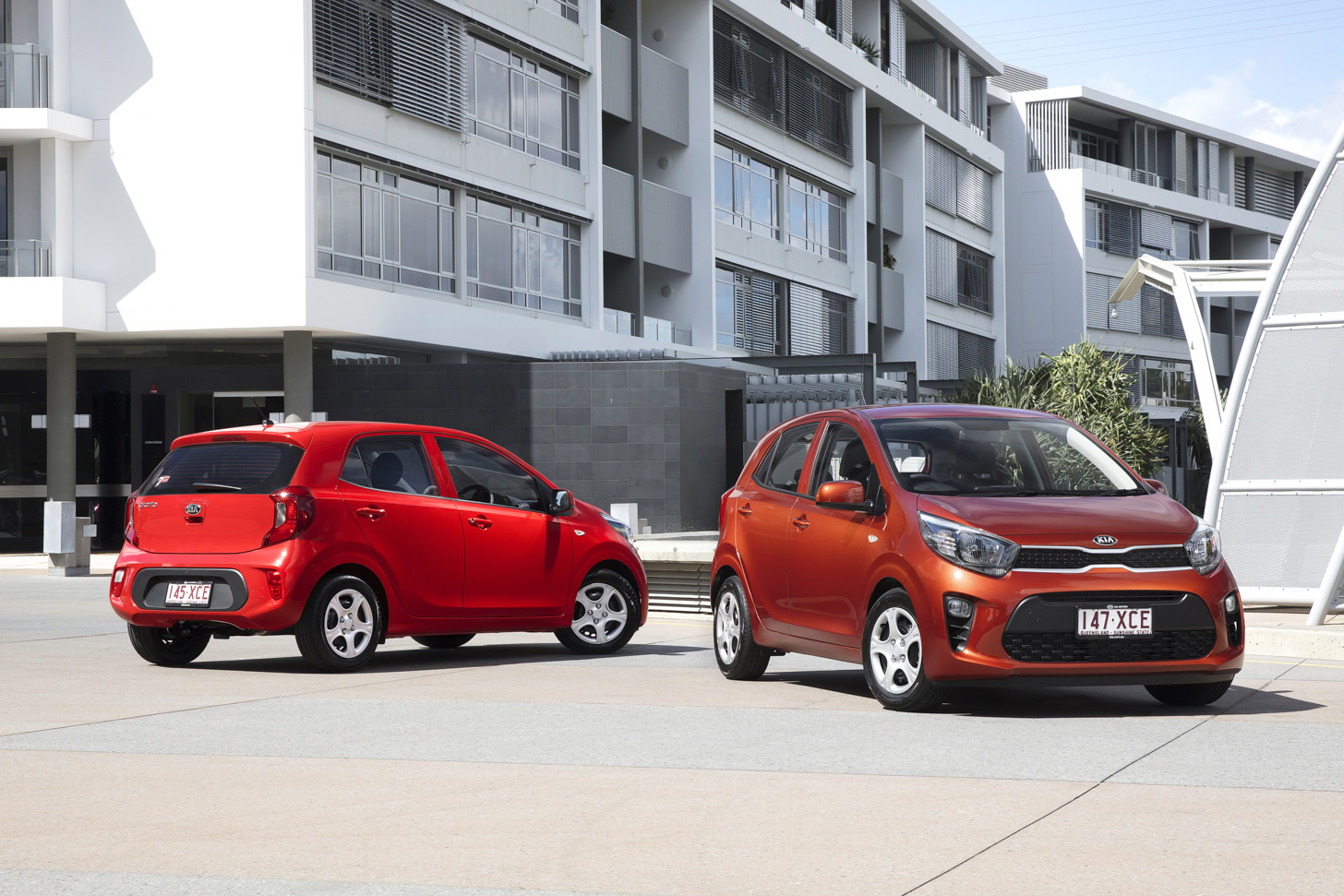
WHAT IS IT Third iteration of Kia’s smallest car, the 2017 Picanto follows the template set by the previous-gen model that arrived a year ago, albeit with all-new underpinnings, more equipment and a more sophisticated interior.
Still offered in a single model grade and with a carry-over 1.2-litre petrol engine, the new Picanto range now offers a manual variant that Kia Australia reckons is ripe for bargain-hunters, while the auto, which rises in price by $700 compared to the outgoing model, now offers substantially more standard equipment than before while still undercutting popular models like the Mazda2 and Honda Jazz
WHY WE’RE DRIVING IT Though the greasy bits up front may be carry-over tech, the rest of the Picanto is all-new. As a sub-Rio-sized hatchback, the Korean carmaker’s local arm reckons the Picanto is the perfect gateway to Kia ownership for those just starting to get behind the wheel – or an attractively-priced city car for older motorists looking to downsize.
Suzuki Celerio, Mazda2, Honda Jazz, Holden Spark.
THE WHEELS VERDICT The old Picanto was not without charm, and in the brief 12-month period it was on sale here that charm – as well as its commendable value-for-money proposition – translated into segment-leading sales. Not bad for a car which was already five years old by the time it arrived.
With the baton now passed to a new-generation model, the Picanto has evolved into something which still satisfies the requirement for value and compact form factor, but adds more tech and slightly more space to create something that’s a lot more usable than you’d expect for its size.
PROS – More interior space, value for money, winning suspension tune
CONS – Four speed auto lets down the team, increased fuel consumption
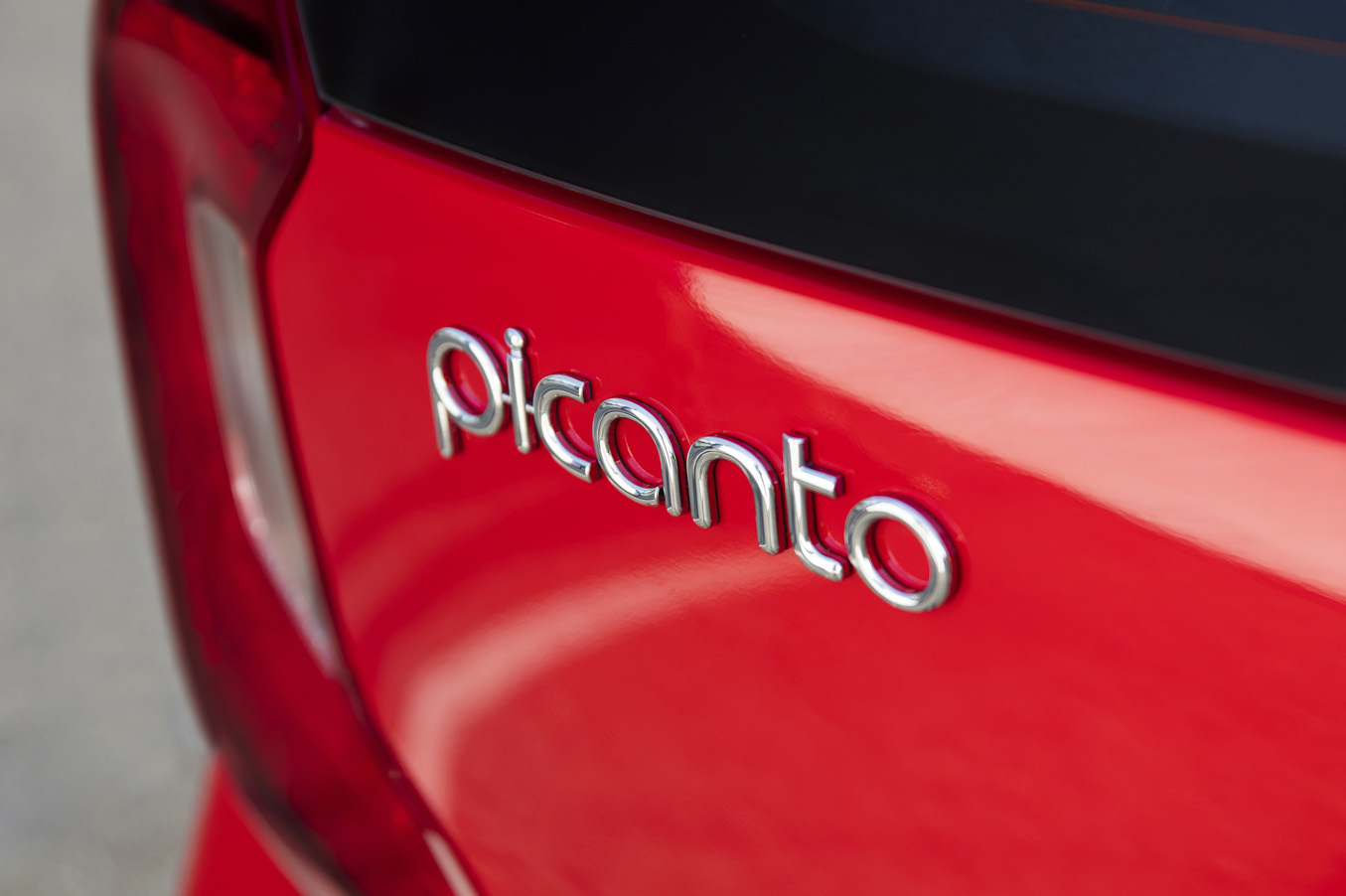
AS FAR AS toe-in-the-water exercises go, Kia Australia’s experiment with launching the pint-sized Picanto last year was a success.
With just one model grade, one engine and one transmission on offer, Picanto buyers weren’t exactly spoiled for choice. That said, Kia’s staff clearly have an aptitude for reading the market, as Picanto sales rose quickly to give it top spot in the normally price-sensitive sub-light hatchback market. A $14,990 drive-away price and industry-leading seven-year warranty certainly helped.
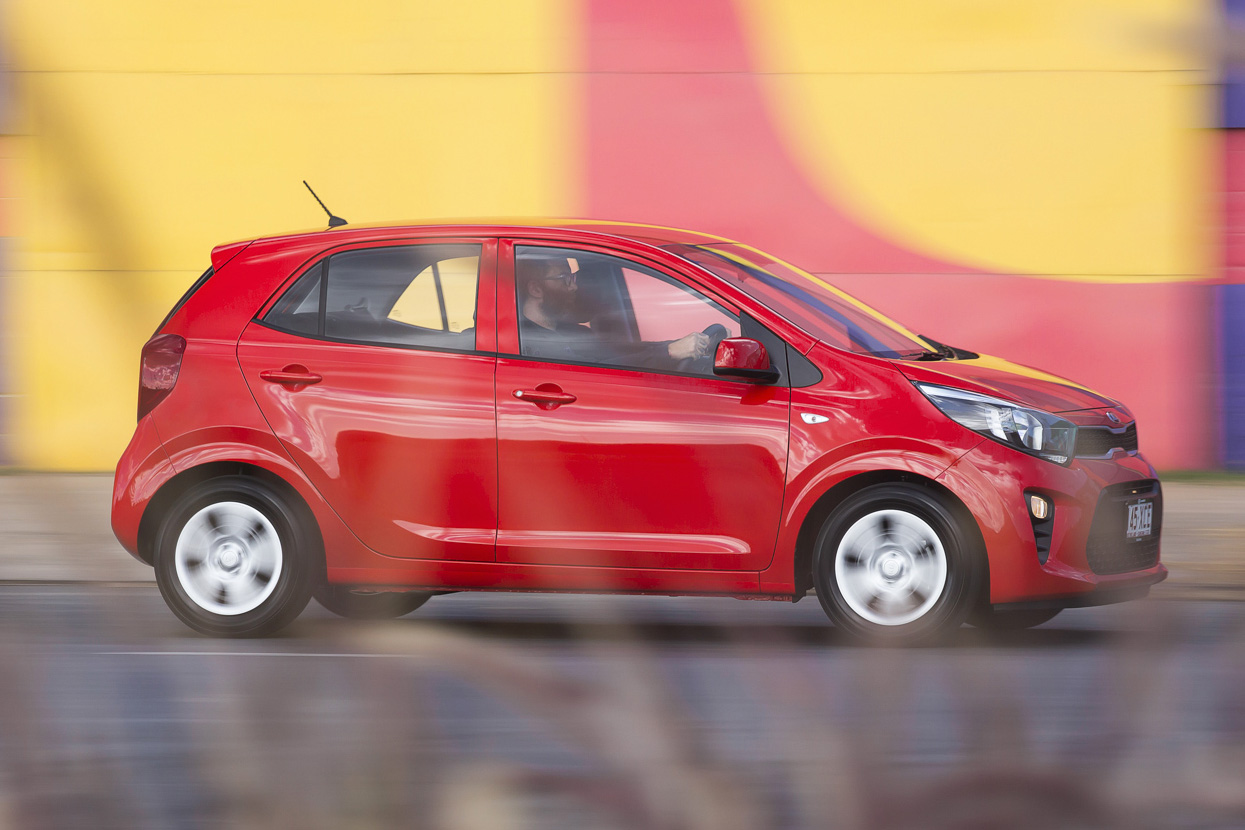
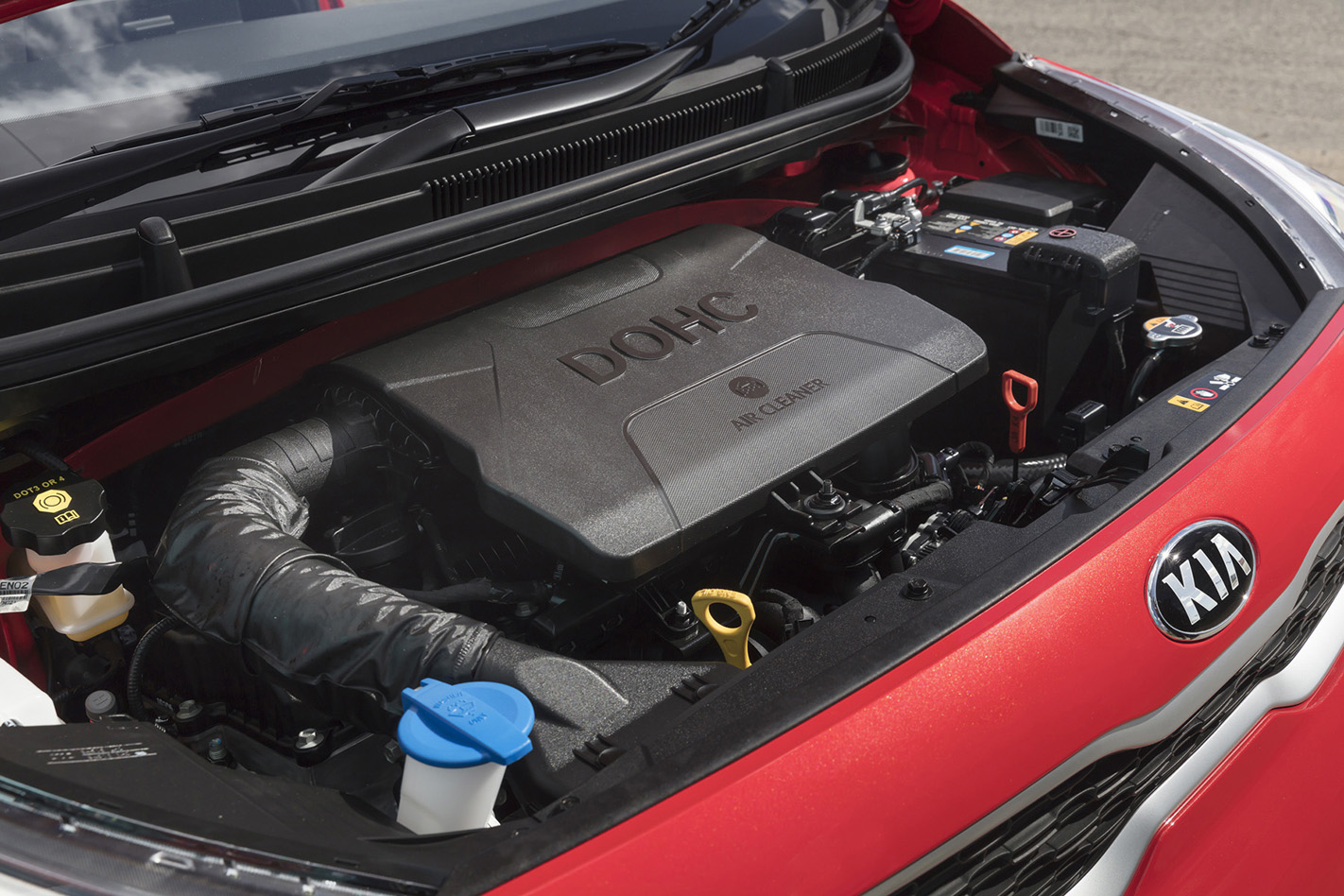
The 1.25-litre atmo petrol four and four-speed auto are carry-over technology, but everything else, from the platform underneath, the suspension at both ends and the interior and bodywork on top, are all entirely new.
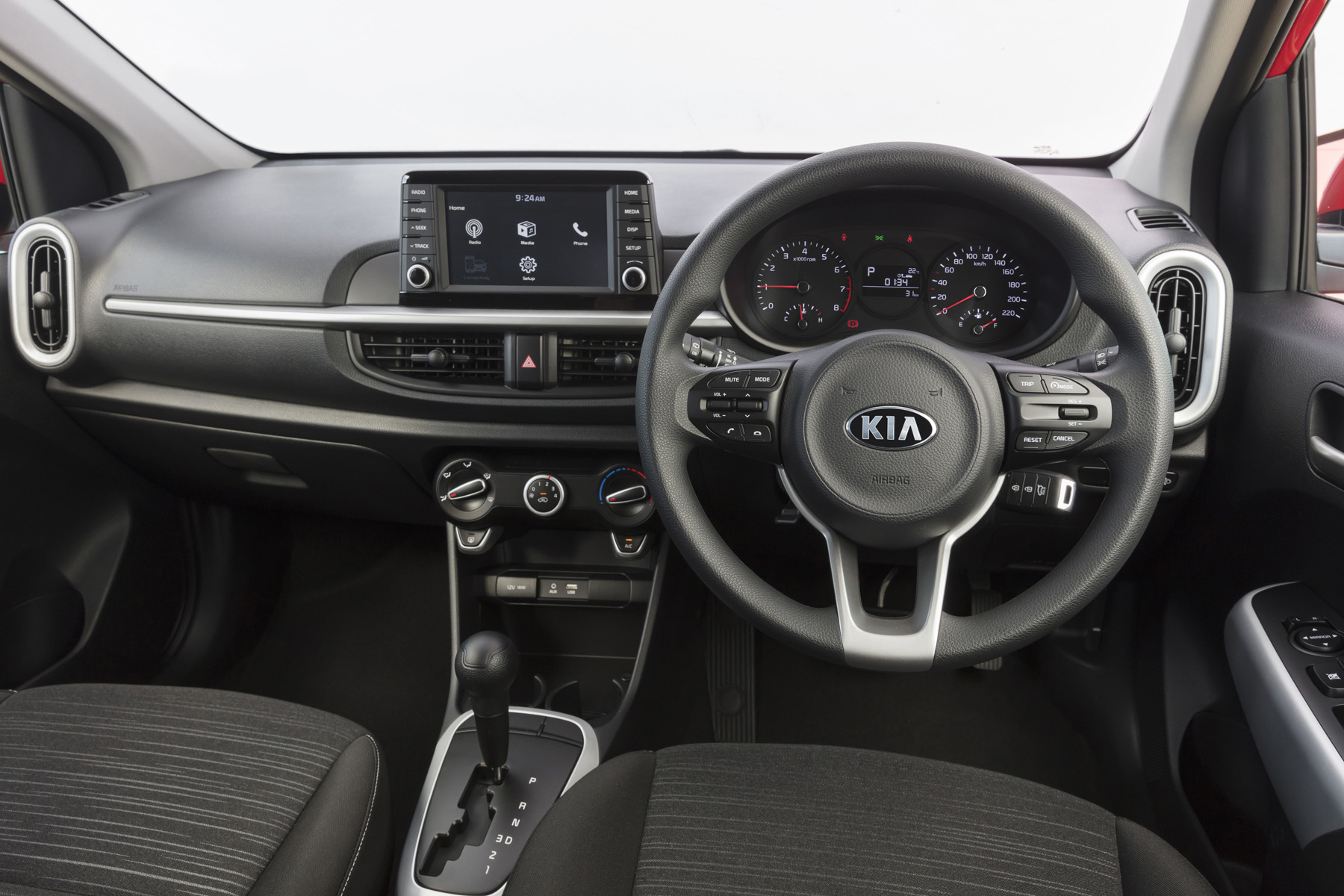
Convenience features like cruise control and dusk-sensing headlamps are now standard, as is a sizeable 7-inch colour touchscreen display that sits atop the dash in a tombstone-style housing. Integrated sat nav is still missing from the Picanto’s spec sheet, but the provision of Android Auto and Apple CarPlay smartphone mirroring means you can still put map data up on that screen if you have the right phone.

That up-spec aspiration also flows through to the rest of the interior. The almost toy-like dashboard of the previous gen has been swapped for slicker-looking and more mature furniture. It actually boasts some design flair too, with neat crosshair air vents linked by a thick silver bar to give it some visual width.
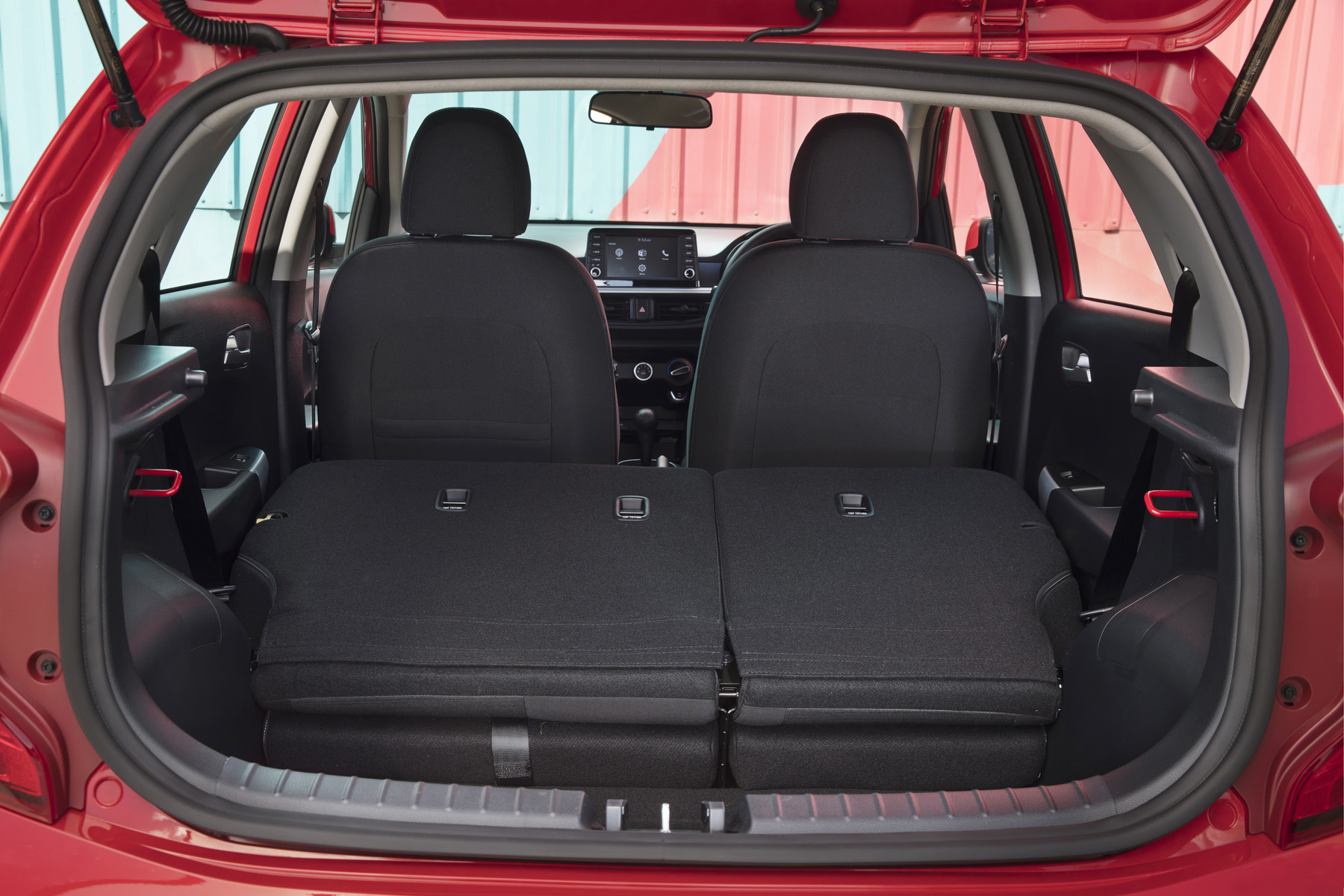
Those in the back seat are robbed of 2mm of headroom, but every other dimension either grows or stays the same. The backrest angle has also been reclined, yielding a more natural posture that should deliver better comfort for your backseaters over long distance drives.
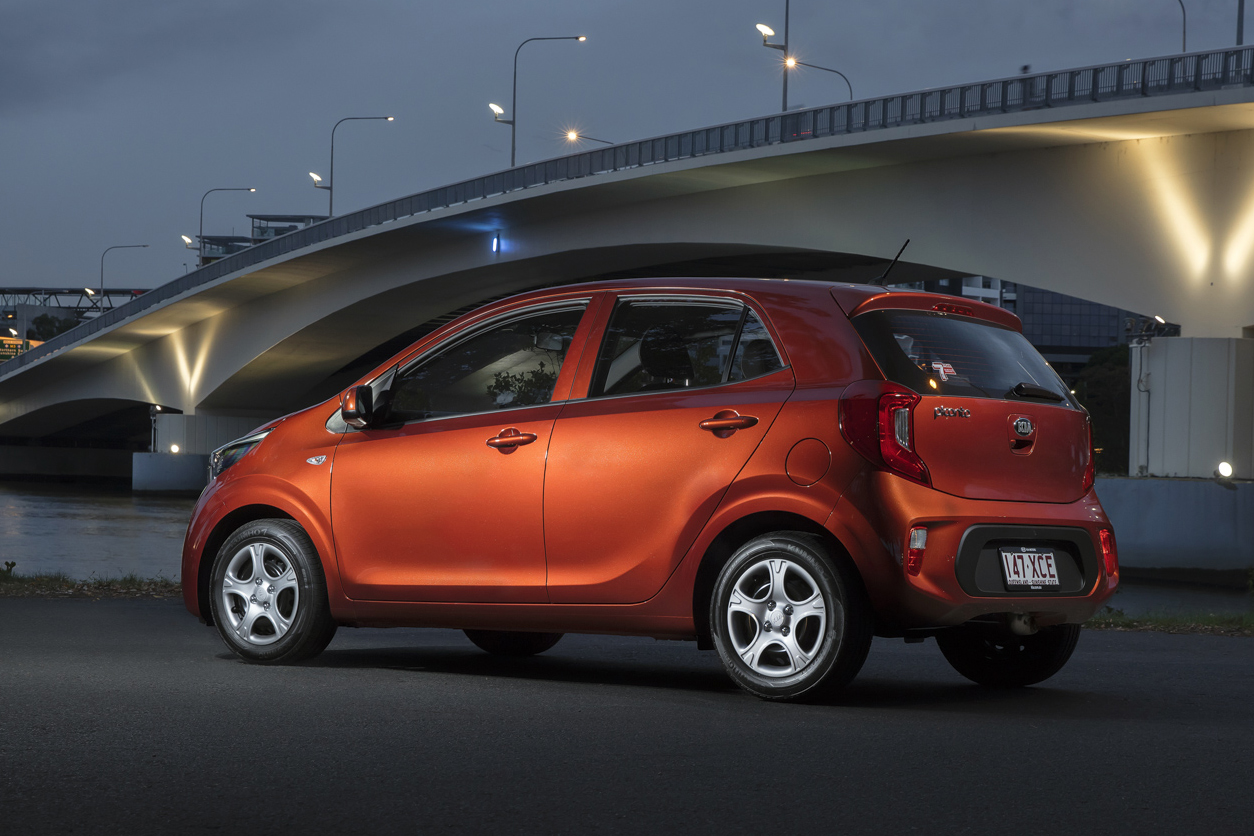
And while the engine remains a willing, if not especially powerful, unit, it’s the transmissions that could use some attention. Four-speed autos are fairly old-hat these days, and an extra gear or two would help the Picanto make the most of its modest powertrain stats. The manual is a little more versatile in that regard, but a spongy and vague clutch pedal lets it down.
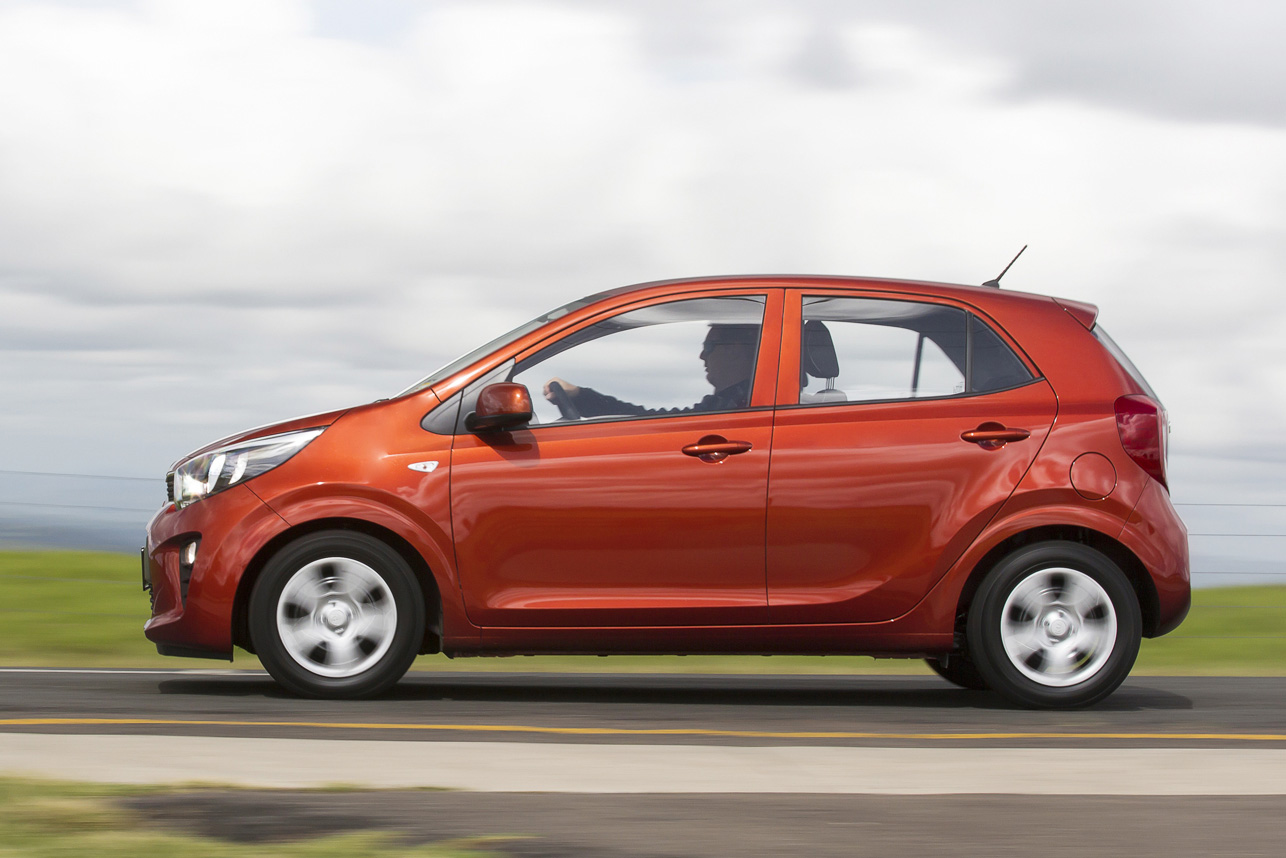
The electric power steering was also fettled for Aussie tastes. A faster rack ratio was already built in to reduce the amount of wheel-twirling required when parking at Woolies, but it also boasts a nice light weighting and good on-centre feel. It feels stable and secure at speed as well, something compact cars don’t always excel at.
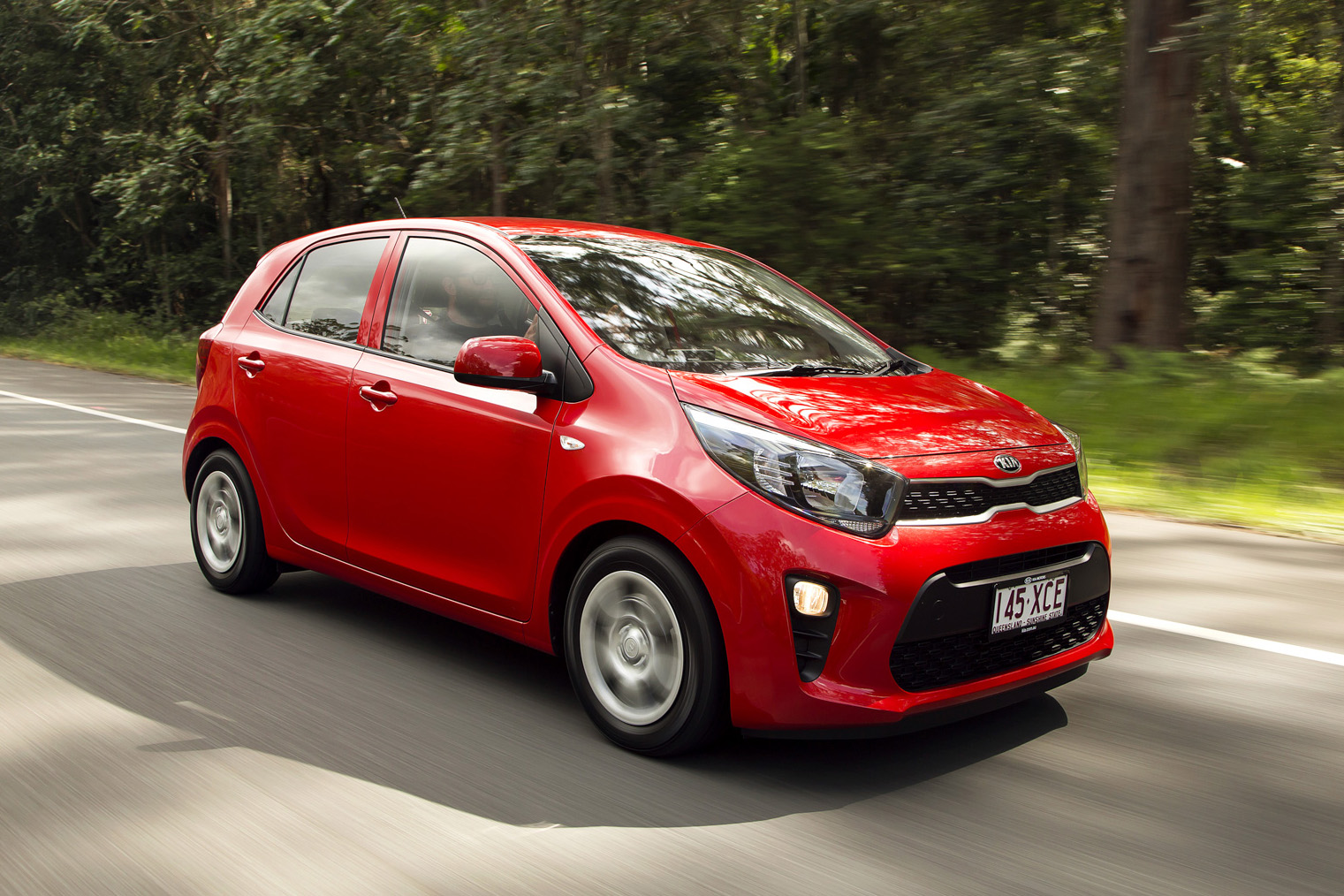
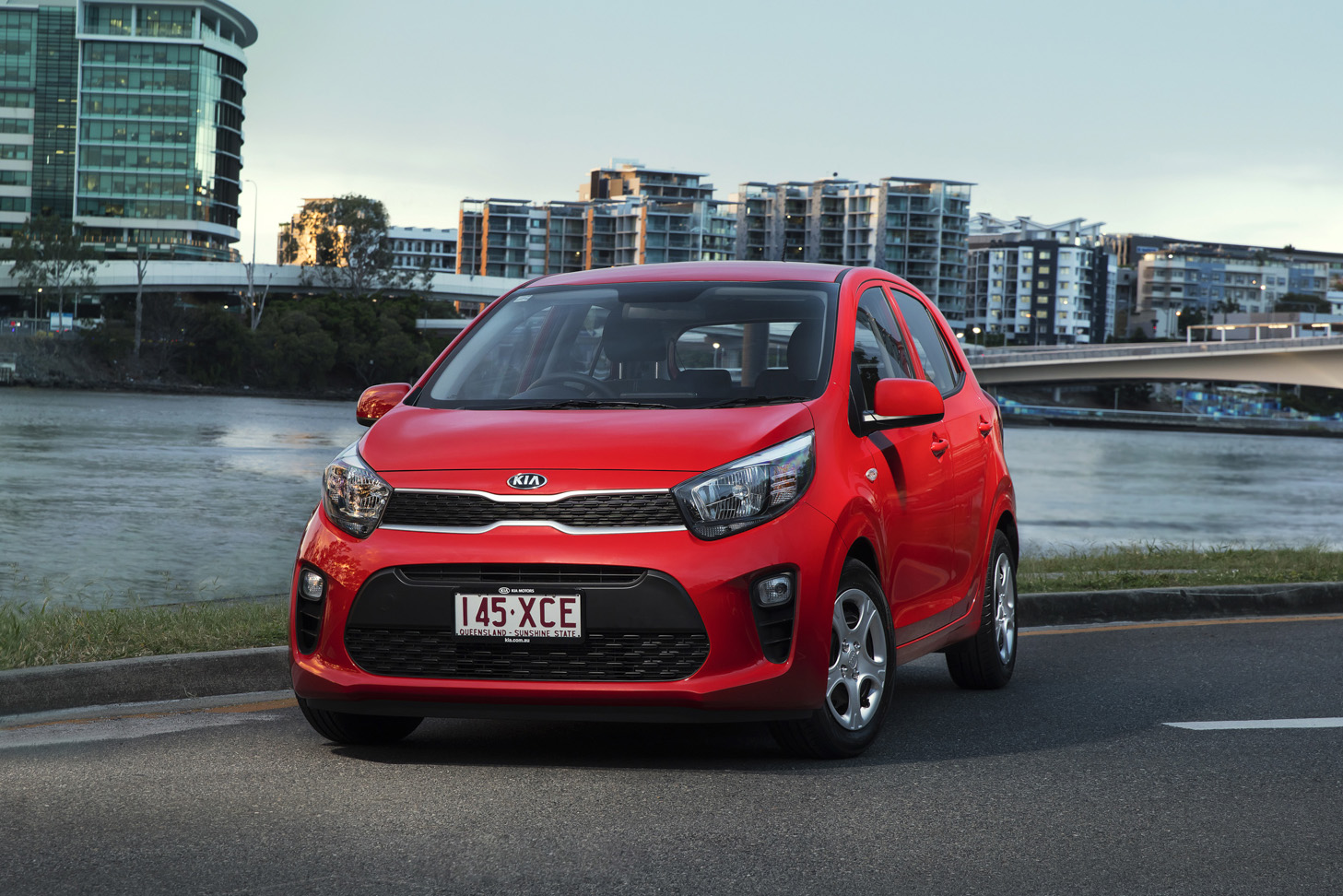
Roughly 12 months after the arrival of the current Picanto micro-hatch, Kia Australia has launched an almost entirely new model into local showrooms.
This time around, however, the Picanto offering is a little meatier. While its predecessor was only sold in a single configuration and purely as an automatic, the new Picanto features an entry-level manual option to give buyers two transmissions. The range structure is still composed of a single model grade, but specification levels have been boosted to a level well above that of the outgoing Picanto.
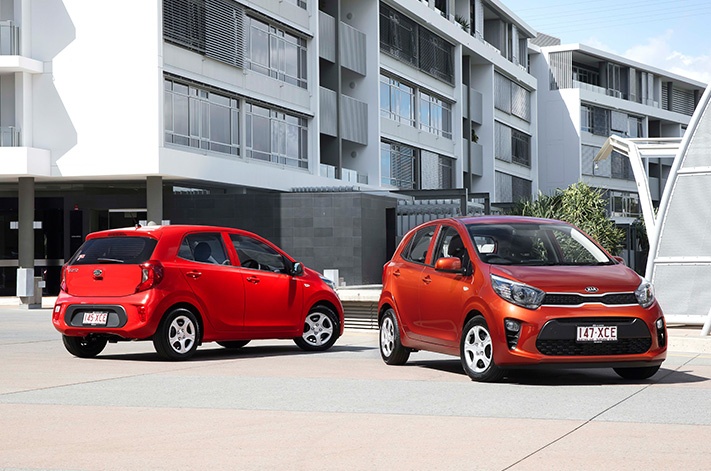
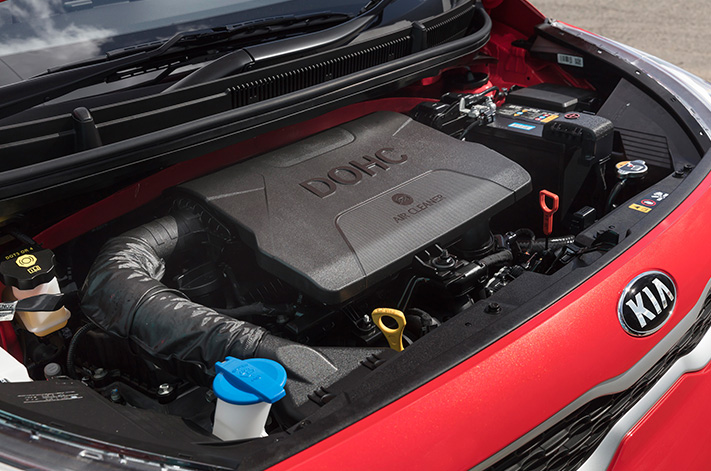
The 1.2-litre engine and four-speed automatic carry over unchanged, with four speeds and 62kW/122Nm at the driver’s disposal. The manual, new for 2017, is a basic five-speed. Fuel economy worsens slightly, with the automatic now consuming an average of 5.8L/100km compared to the 5.3L/100km of the lighter 2016 model.
The platform, however, is entirely new. Thanks to the more flexible platform and revised placement of bulky components like the engine and suspension – and coupled with a modest 15mm wheelbase stretch – the 2017 Picanto boasts a roomier cabin without growing its external ‘footprint’.
Front seat passengers benefit the most, with more headroom and legroom available. Backseaters aren’t forgotten however, with a less-upright backrest improving comfort. Second row headroom drops by 2mm, but all other key interior dimensions are either the same or have grown.
The rear seats are split 60/40, and fold down to expand the 255 litre boot capacity (55 litres bigger than the outgoing model) to a useful 1010 litres.
Cabin design has been dramatically updated with a tombstone-style 7.0-inch touchscreen infotainment display being the centrepiece. There’s no integrated sat-nav, but like the Holden Spark the Picanto allows drivers to bring-their-own navigation via Apple CarPlay and Android Auto smartphone mirroring.
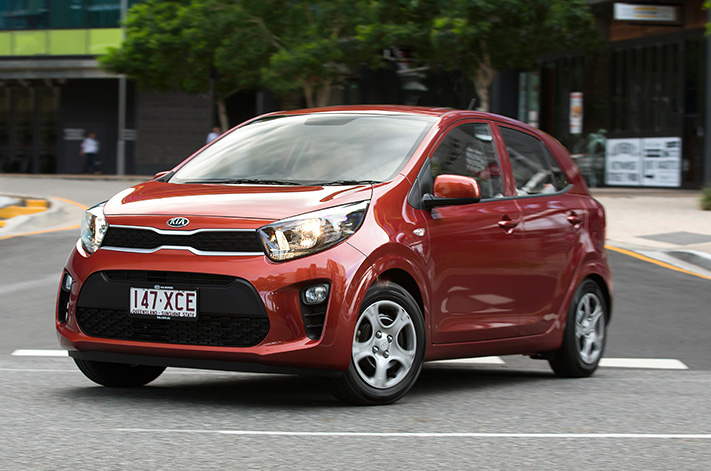
Passenger comfort is also improved through sound deadening and insulation material. Foam-injected chassis rails, a thicker firewall insulator, revised door seals, an optimised engine air intake and careful engineering to the car’s structure all help the new Picanto’s cabin feel more refined and less noisy out on the road.
The Picanto’s new bodyshell features more use of high-strength steel to improve crash performance, while brake torque vectoring and a reversing camera are added to the Picanto’s already-standard stability control, traction control, ABS and rear parking sensors.
Pricing: Kia Picanto manual – $14190 RRP Kia Picanto automatic – $15,690 drive-away
TELL ME ABOUT THIS CAR
This is the third-generation Kia Picanto, the Korean carmaker’s cheapest car. Retailing at $14,190 for the new-to-Australia five-speed manual or priced at an attractive $15,690 drive-away for the four-speed automatic, the Picanto is pitched at elderly drivers looking to downsize, or young drivers searching for an affordable first car.
STRENGTHS
More spacious interior. By rethinking the Picanto’s mechanical layout and stretching the wheelbase, Kia has given the new-generation model more interior space without changing the car’s on-road ‘footprint’ – its overall width and length. Most of the gains translate into better front seat legroom and 55 litres more boot space, for a total of 255 litres.
Agile handling. Thanks to Kia Australia’s efforts to engineer an Aus-specific suspension tune (something the previous Picanto didn’t get), the 2017 Picanto holds onto the road well for something that rolls on eco-biased tyres with relatively low grip. A faster steering rack ratio for the 2017 model also helps.
Ride comfort. Not only does the new Picanto handle well, it boasts a comfortable ride too. It’ll iron out all but the most serious bumps in an unfussed manner and remains especially complaint and composed over undulating highways.
Modern interior design. With the inside of a car being where many people spend a great chunk of their day, good cabin design is vital. The 2017 Picanto doesn’t disappoint, with interior styling that looks a lot more premium than that of the car it replaces.
High-set infotainment display. The Picanto’s ‘tombstone’ infotainment display isn’t just on-trend from a design point of view, but it also offers ergonomic benefits by putting key information closer to the driver’s line of sight. Measuring seven inches across and being a full-colour touchscreen, it’s easy and intuitive to use.
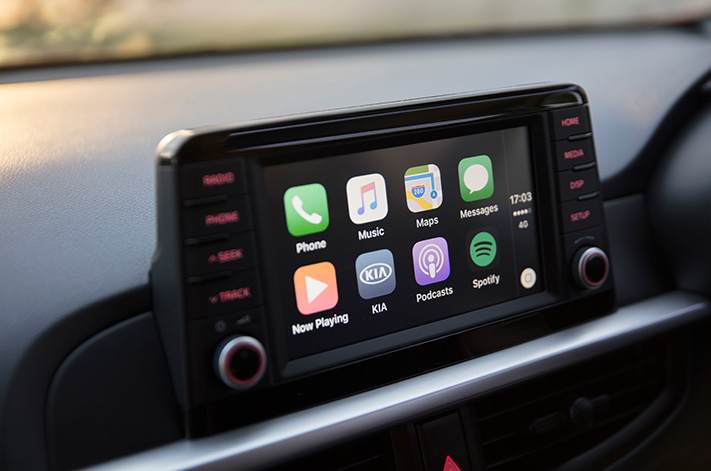
Smartphone mirroring. The best way to make the most of that screen is to exploit the Picanto’s standard-issue smartphone mirroring capability, which allows high-featured apps on a compatible smartphone to be interacted with via the car’s touchscreen. Besides an array of phone, internet search and audio streaming options, it also allows satellite navigation info to be displayed on the screen
Healthy standard equipment levels. The Picanto may not be the cheapest car in its segment, but with standard-issue cruise control, reversing camera, smartphone mirroring, rear parking sensors, dusk-sensing headlamps, power windows all around (auto-down on the driver’s) and the aforementioned 7-inch screen, the Picanto packs plenty of gear for its price.
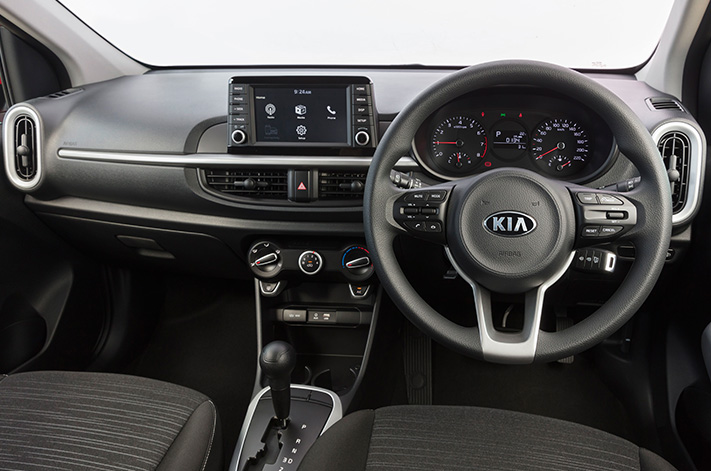
Improved sound suppression. The 2017 Picanto’s cabin is quieter than before thanks to a range of measures designed to cut noise transmission, mostly taking the form of extra sound deadening material throughout the car.
WEAKNESSES
No AEB. Though available in the European market, Kia Australia has yet to equip the Picanto with autonomous emergency braking technology. That may come in a future model update, however.
Higher fuel consumption. An increase in kerb weight and frontal area coupled with zero mechanical changes to the engine and transmission means the 2017 Picanto burns more fuel than the outgoing model. Combined-cycle economy for the four-speed auto variant is a claimed 5.8L/100km, which is half a litre more than the old car.
Four-speed auto. It may be reasonably intelligent for a four-speeder and admirably resistant to hunting though the ratios, but the Picanto’s four-speed is fairly outdated by modern standards. With wide gaps between each gear, it also requires the engine to work harder than it should during every day driving, and if there were an extra two ratios on board we’ve no doubt driveability and fuel economy would benefit.
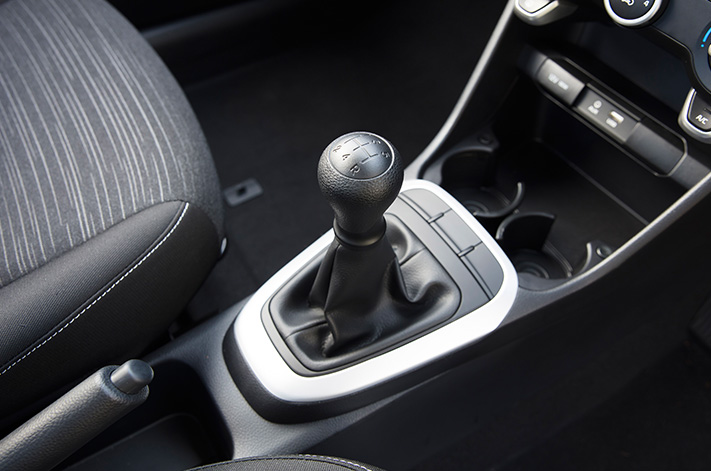
Iffy clutch feel on manual. Opting for the manual may get you a more versatile spread of gear ratios – five of them in fact – but it also comes with a soggy-feeling clutch pedal that can be difficult to get used to.
With just 62kW of power and 122Nm of torque, the Picanto’s engine can feel a touch breathless, especially if you need to push hard with a full load of passengers or when faced with a steep hill. If you need to overtake on a single carriageway country road, plan your moves carefully.
Coarse chip road noise. The Picanto may have more sound-deadening insulation than before, but on coarse-chip highways it’s still beset by substantial tyre noise.
WHAT RIVALS SHOULD I CONSIDER
The Holden Spark is perhaps the closest rival to the Picanto, but at a similar price point it can’t quite match the Kia’s level of standard equipment. The Suzuki Celerio and Mitsubishi Mirage are other options in the sub-light hatch segment.
Hyundai will spiritually revive its Tiburon and Coupe models, but with a big-power twist – a three-door i30 N Coupe in the style of the Renault Sport Megane has now been confirmed, complete with 202kW 2.0-litre turbo and a limited-slip differential (LSD).
The manual-only i30 N five-door will debut at September’s Frankfurt motor show with an Aussie launch for the two-tier 184kW or 202kW Golf GTI rival pinned for late this year or early 2018. However, a swoopy version, tagged a ‘fastback’ by the brand, will now follow.
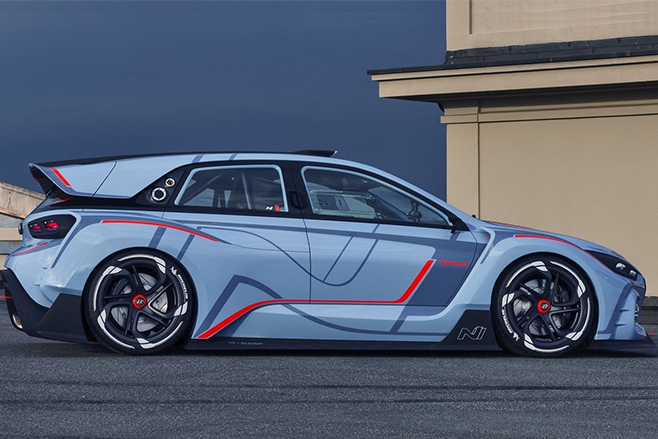
“It [hot hatchbacks] is a very important segment in Australia, the joy of driving, the joy of design.
“The fastback version, it’s mainly a difference in proportion, [the hatch] is more oriented to family and the fastback is more coupe so it has a lower profile, more so elegant/sporty.
“We are quite unique in the market to go for this [fastback] variant and especially also to speak about the SR now which is available, the N version, the fun to drive aspect is something new to many [Hyundai] customers I think, and the joyful design should be complemented with joyful driving.”
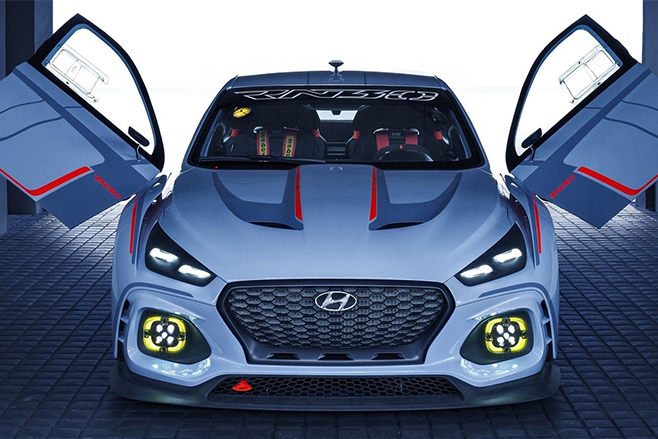
“I’m very proud that Albert Biermann joined our company and he’s very active on the N version and there’s a lot of testing,” Burkle added.
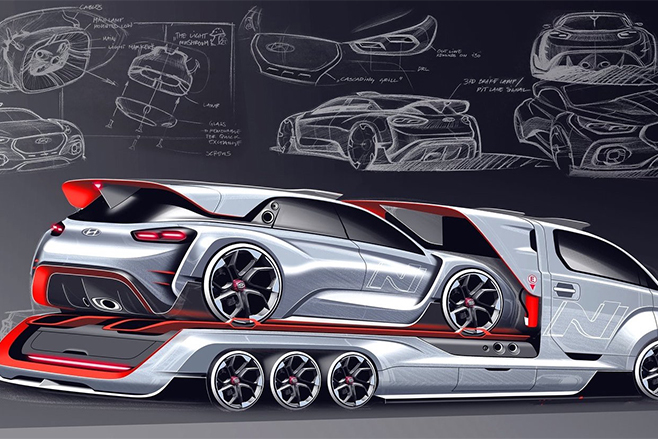
“For example normally the spoiler is just this [short] part but aerodynamically this is also important because the air stream should have been clear, it should jump off the car and not create turbulences,” he said of the relation between RN30 and production i30 N.
“The sharp edge is continuing around and it also gives a lot of character to the car.”
The i30 N will get multi-mode suspension, a front LSD in the top model, sticky Michelin tyres and either a 184kW or 202kW 2.0-litre turbo tune. It will initially be six-speed manual only, with a seven-speed dual-clutch to be added in 2019.
