
HOLDEN is preparing to flesh out its broadest small-car range in years with the forthcoming German-engineered, American-styled, Korean-built and Australian-tuned Holden Astra sedan.
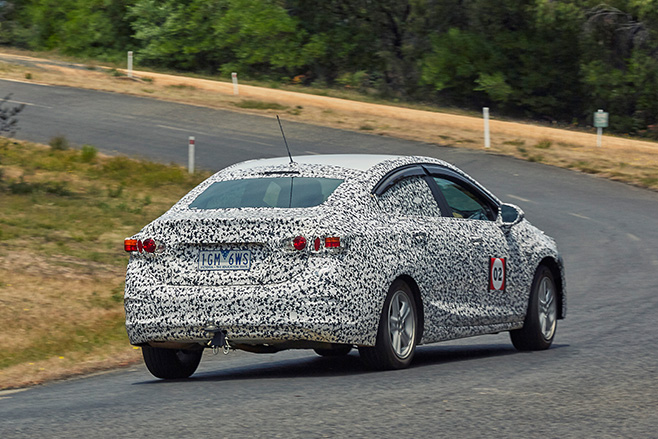
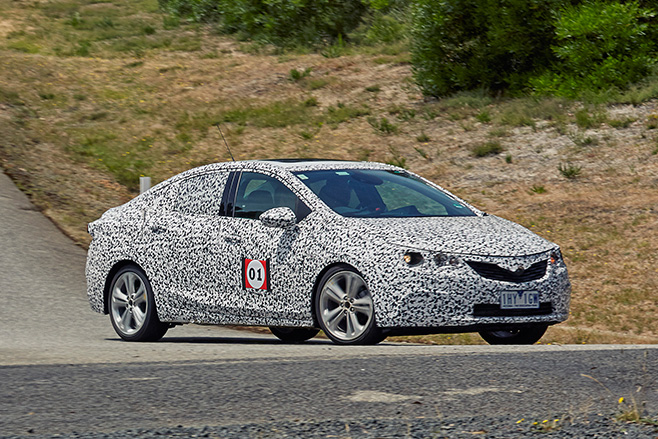
WHAT IS IT? Essentially the new-generation Holden Cruze (to be badged Astra in Australia, featuring its own front bumper and grille) at “65 percent IV [Integration Vehicle]” stage, meaning it’s covered in camouflage and is still undergoing calibration and fine-tuning prior to its May on-sale date.
WHY WE’RE TESTING IT? Because Holden wants to trumpet its ongoing local design and tuning influence on global GM product. And because the Astra sedan is expected to be an important part of the nameplate’s overall success, soon to be bolstered by an Astra wagon and eventually by a new-generation GTC coupe.
MAIN RIVALS A heap of small hatches and sedans from Australia’s biggest-selling category – the small-car class – though it’s the Toyota Corolla, Mazda 3, Hyundai i30/Hyundai Elantra and Volkswagen Golf that register most strongly on Holden’s salesnetwork radar.
PLUS: Fluid dynamics; plusher ride than Astra hatch; competitive room; capable drivetrain; lower pricing than equivalent hatch models MINUS: No autonomous emergy braking for Australia; won’t get the gutsier 1.6 turbo-petrol or any diesel engines; not quite the German-designed hatch’s equal for exterior and interior styling panache
THE WHEELS REVIEW IT SEEMS Holden has finally learned from its mistakes of the past. In any other market, this stickered-up sedan would be wearing a Chevrolet bowtie and a Cruze bootlid badge, but come its official arrival in Aussie showrooms in May, this Korean-built four-door will become the Holden Astra sedan, bringing it into line with other D2-platformed Astra variants and creating Holden’s most cohesive small-car line-up in almost 15 years.
Not since the big-selling TS Astra of 1998-2005 has Holden been able to field a small-car range as broad and as competitive as its current line-up. Back in ’05, Aussies lapped up 34,218 Opel-sourced Astras, but once the sizzle vanished (sporting and convertible variants) and the low-rent, Daewoo-sourced Viva arrived to confuse customers, small-car buyers started to evacuate Holden showrooms. Just like they did in the ’80s when the original Nissan-sourced Astra made not a hint of visual sense alongside the Holden-built Gemini of the day.
Holden claims Australia will be the only market to receive both the sporty Astra hatch (and, soon, a wagon) as well as the more comfort-oriented Astra sedan, giving it a broader flavour spectrum than Chevrolet’s identical-bar-the-derriere Cruze hatch and sedan siblings.
GM’s Aussie outpost is also keen to play up its involvement in the new sedan’s chassis tune, one that has been standardised for all D2-platform sedans sold in the Middle East, South Africa, South-East Asia, and Asia Pacific.
While there’s definitely been an emphasis in making the sedan ride more comfortably than its sportier hatch alternative, Holden’s chassis engineers aimed to retain as much of the Astra hatch’s trademark handling excellence and steering crispness as possible.
Holden has modified the hatch’s steering calibration slightly for the sedan, in keeping with its more even ride/handling bias, and there’s been local input into the sedan’s ESC tune, torque-vectoring overlay, and trailer sway control. And as with the hatch, the new model’s D2 architecture achieves a weight loss of up to 120kg compared with its thick-limbed Cruze predecessor.
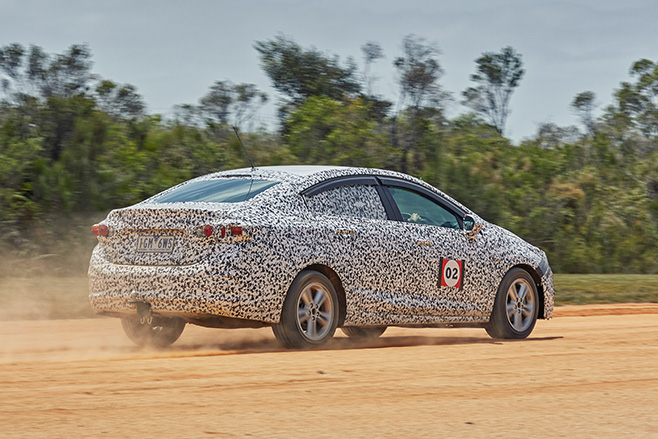
So how does Astra sedan drive? Given the camouflaged cars we’re having a strafe in – a lower-grade sedan (either base LS or mid-spec LT) wearing Hankook Kinergy 205/55R16s and a top-spec LTZ on Kumho Ecsta 225/40R18s – are “65 percent IV cars” (meaning Integration Vehicle, roughly 65 percent towards full sign-off), it’s impossible to say for sure, but the dynamic flavour is definitely there.
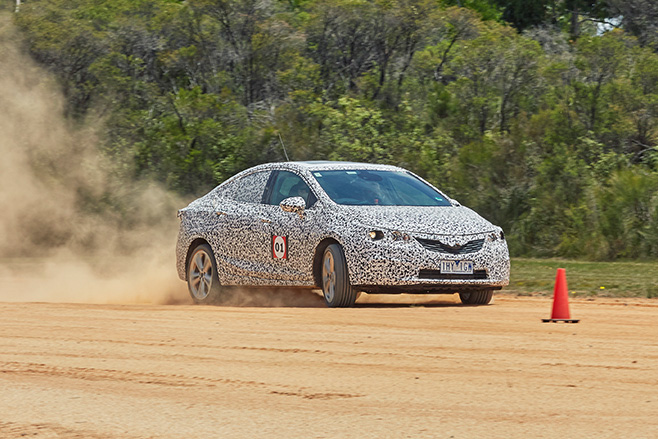
Out on the road, the drive impression is even more positive. A calmer, more absorbent ride – particularly wearing 16s – endows the sedan with a real dynamic point-of-difference over the almost aggressively sporty hatch, which will be appreciated by country buyers. And the LTZ’s 18-inch Kumhos seem to transmit less road noise than an RS-V hatch’s 18-inch Continentals.
Drivetrain-wise, the sedan range will be a one-size-fits-all proposition, relying solely on the gutsy, refined 110kW 1.4-litre direct-injection turbo-petrol four from the Astra R hatch. Base sedans will be available with a six-speed manual transmission (and 245Nm from 2000-4000rpm), while the top-spec LTZ will be six-speed auto only (channelling 240Nm from 2400-4800rpm).
Disappointingly for sedan fans, there will be no sporting replacements for the old Cruze SRi and SRi-V 1.6 turbo variants, though with the new car’s sizeable weight loss, the 1.4T delivers slightly stronger performance, a broader working range and much-improved refinement.
About the only thing missing from the auto sedan are steering wheel paddles and a dedicated sport mode, though Holden’s transmission calibration and the 1.4T’s strong torque manage to make most enthusiastic cornering situations reasonably effective when leaving the tranny in D.
Yet despite the lack of AEB, Holden is expecting a five-star result when ANCAP crash-tests the Astra sedan.
Holden is also promising slightly cheaper pricing for each sedan variant relative to its hatch equivalent. At base level, that means the Astra LS manual sedan should undercut the $21,990 manual Astra R hatch, while the automatic LT and LTZ sedans will sit below their more powerful $27,240 RS auto and $31,740 RS-V auto hatchback stablemates.
With a German-designed Astra wagon also on the way, as well as new-gen GTC Coupe further down the track, Holden is secretly hoping its vast Astra line-up will pick up some of the sales volume slack when it loses the rear-drive V8s that still make up 30 percent of its Commodore mix.
But at least this time it has a consistent nameplate. And even if GM flogs Opel to the French (Peugeot-Citroen) that won’t change the destiny of the Chevrolet Cruze, I mean Holden Astra, sedan.
SPECS Model: Holden Astra LTZ sedan Engine: 1399cc 4cyl, dohc, 16v, turbo Max power: 110kW @ 5000-5600rpm Max torque: 240Nm @ 2400-4800rpm Transmission: 6-speed automatic Weight: 1364kg (US) 0-100km/h: 8.3sec (estimated) Economy: 6.0L/100km (estimated) Price: $30,000 (estimated) On sale: May
THE smallest Rolls-Royce motor car ever made will help bring a smile to the faces of children facing surgery, the carmaker has announced.
The Rolls-Royce SRH – the acronym stands for St Richard’s Hospital where it will ply the corridors – is a tiny, one-seat electric car crafted specially for children. It will ply the hospital’s corridors lined with street signs, helping to reduce child patient stress on the way to surgery, the carmaker said.
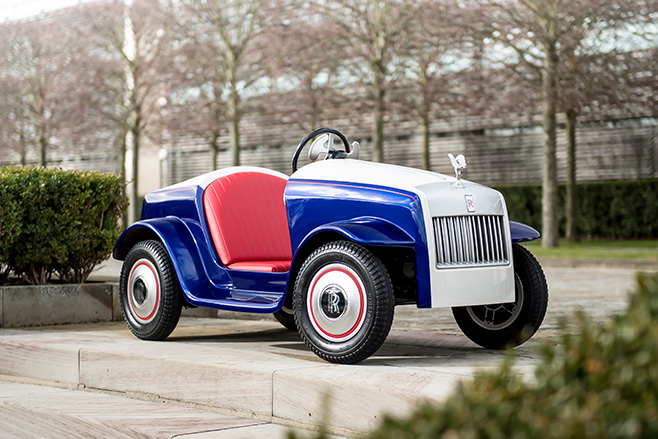
The one-off car built as part of the carmaker’s “Bespoke Manufacturing” program, the electric Roller has a two-tone paint-scheme of Andalusian White and Salamanca Blue, and is finished with a hand-applied St James Red coachline.
As well, there’s a two-tone steering wheel, seats and self-righting wheel centres colour-matched to the St James Red coachline.
The SRH has a top speed of 16km/h, powered by a 24-volt gel battery. A more sedate setting of just over 6km/h is also available at the flick of a switch.
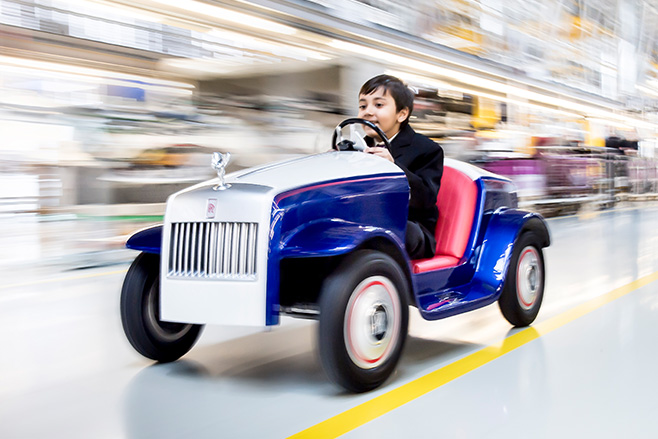
Elements of the car, such as the grille-mounted Spirit of Ecstasy figurine and paddle controls, were designed using the same 3D printing methods used to develop the bits for road-going vehicles.
The car was presented to two children overnight at the Rolls-Royce production facility at Goodwood, where they were able to drive long the production line where the real cars are made.
“I am immensely proud of what the team has achieved,” Rolls-Royce SRH project leader Lawrie Mewse said.
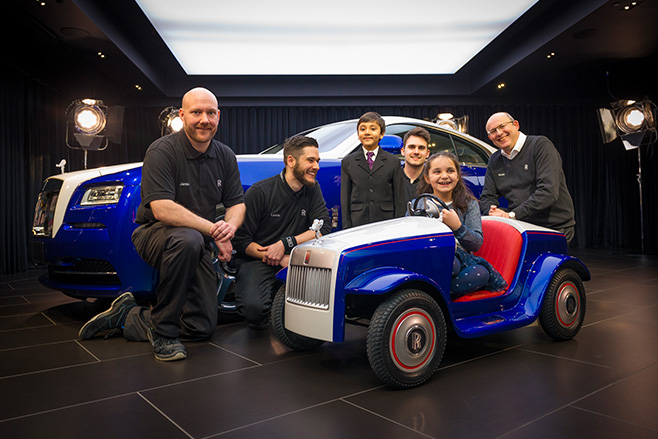
“This project showcases the amazing skills and technology that exist in the Bespoke Manufacturing team and across every area at the home of Rolls-Royce here at Goodwood.
“However, the most important thing is giving back to the local community and having a positive impact for children and their parents during their time in hospital.”
Generally speaking, when booking PCOTY contenders we always try and secure each car’s ‘ultimate’ specification.
This usually pays dividends for everyone – the faster, more focused variants are what people want to read about and tend to perform better in the overall rankings. When it comes to the new R8 V10 Plus, however, Audi has made a delicious meal but left it in the oven too long.
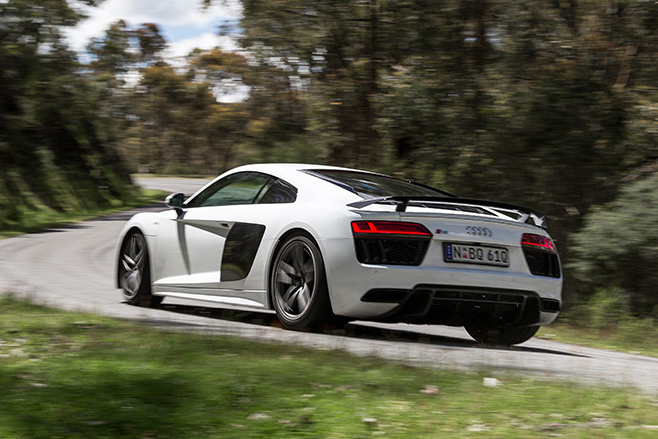
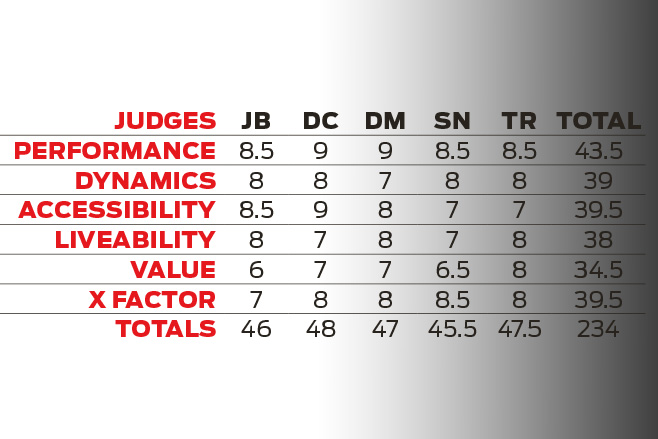
Car buyers come in all shapes and sizes, which makes Audi’s decision to fit heavily reclined fixed-back seats unfathomable. It wasn’t much of an issue for Robbo, which must mean he has a Plus-sized figure (sorry Robbo…), but Morley, DC and I hammered the R8 on liveability. If you can’t get comfortable in a car, it doesn’t really matter how good it is to drive.
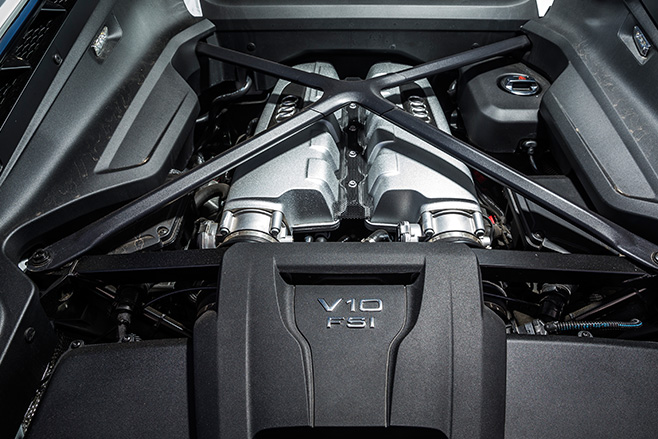
Thankfully, Audi will fit regular seats to your Plus for no extra charge, but it won’t fit the adaptive dampers that are standard on the normal R8 V10. The Plus’s circuit-focused setup might eradicate roll on the racetrack, but it’s spine-jarringly stiff on the road – when a Nissan GT-R feels luxurious in comparison, things have gone too far.
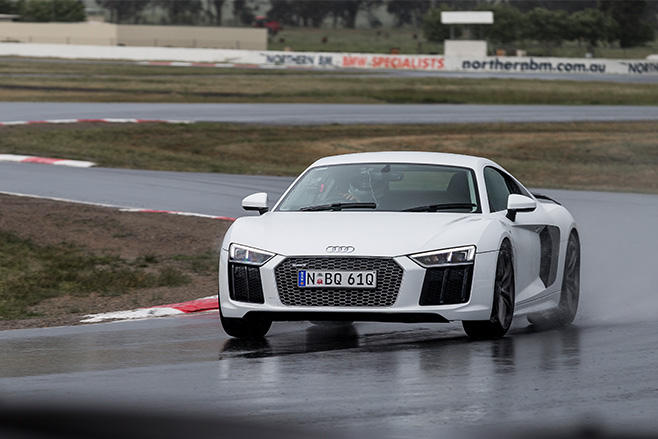
To be fair, the Plus is brilliant on track. It didn’t matter whether Winton was damp or drenched, the all-wheel drive Audi inspired huge confidence and could be driven harder than any of the other supercars. Unfortunately, on the road the quattro system felt to pull, rather than push the car. The old R8’s beautiful rear-biased setup has been replaced by one that is more secure, but ultimately less fun.
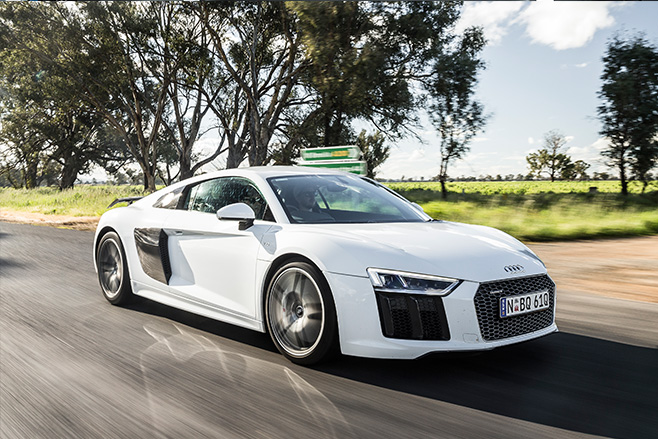
THE NUMBERS 0-100km/h: 3.18sec (2nd) 0-400m: 10.93sec @ 209.58km/h (2nd)
DYLAN CAMPBELL: 9th Would have finished further down if it had any other engine.
SCOTT NEWMAN: 9th Stunning looks and drivetrain spoiled by ride and stupid fixed-back seats.
TIM ROBSON: 5th Such an accomplished machine right across the board. My personal fave.
JOHN BOWE: 3rd Its looks don’t buzz me, but a very useable everyday supercar.
THE next-gen Volvo XC60 will include cutting-edge technology that will allow the mid-size SUV to steer itself out of danger, the Chinese-owned Swedish carmaker has revealed.
Volvo says the technology leap will make the Audi Q5, BMW X3, Range Rover Evoque and Lexus NX-fighting XC60 one of the safest cars on the road.
“We have been working with collision avoidance systems for many years and we can see how effective they are,” Malin Ekholm, the senior director at Volvo Cars’ Safety Centre, said.
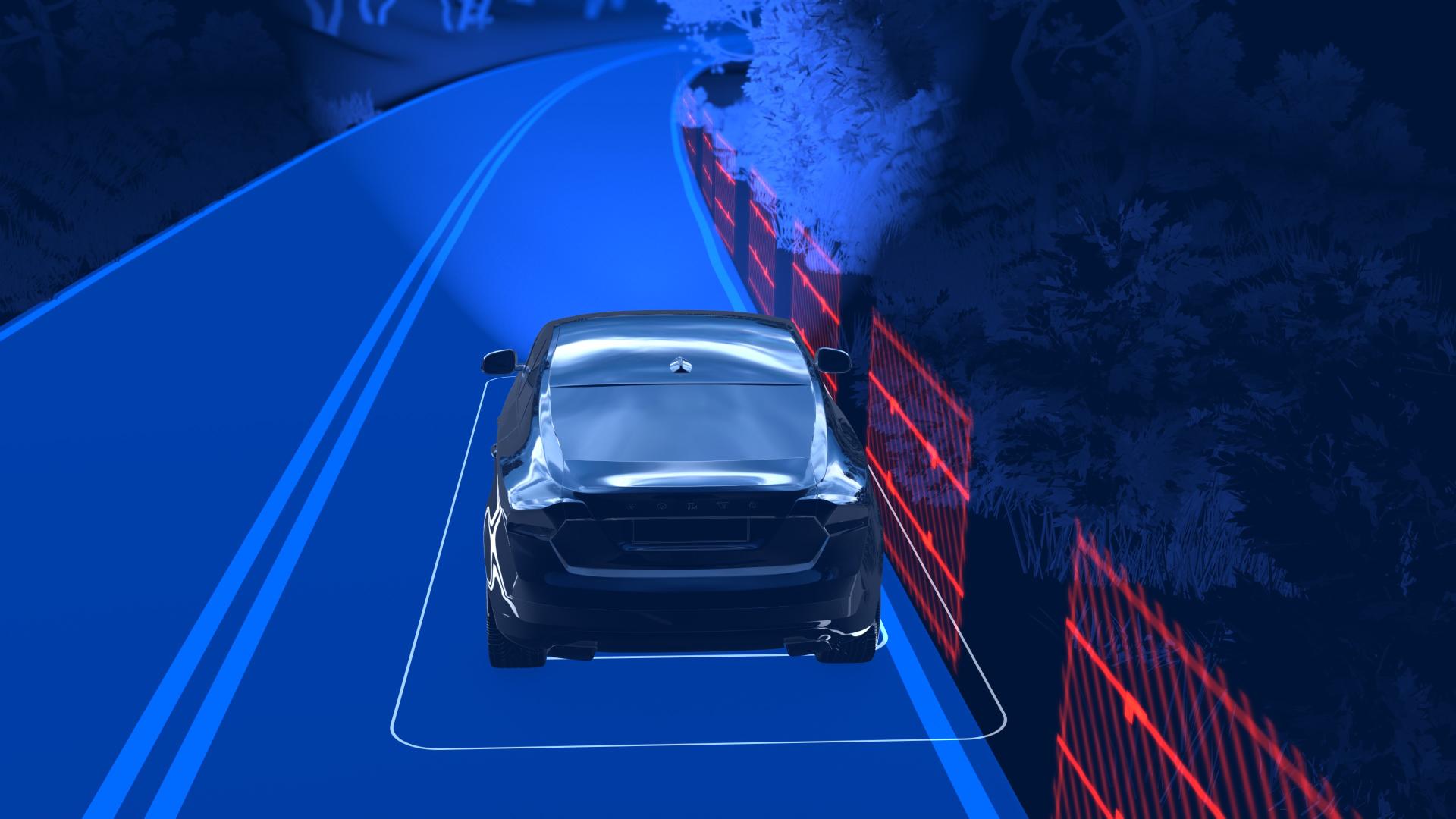
“In Sweden alone we have seen a decline of around 45 per cent in rear-end frontal crashes thanks to our collision warning with autobrake system,” he said.
“With the XC60 we are determined to take the next step in reducing avoidable collisions with the addition of steering support and assistance systems.”
The news comes as the carmaker has released yet another teaser ahead of the second-generation XC60’s pending unveiling at next week’s start of the Geneva Motor Show, revealing a unique LED tail-light design that will become a signature of the SUV’s rear.
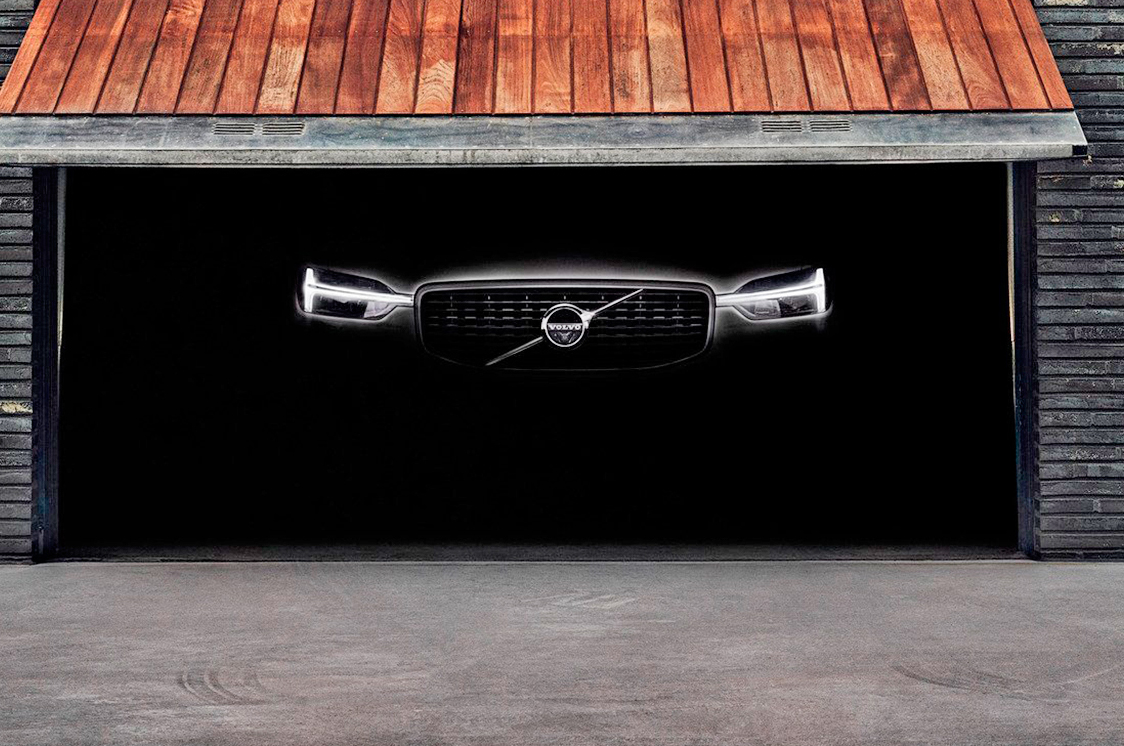
Once unveiled, we’re expecting to confirm the new Volvo XC60 will share the XC90s Scalable Product Architecture (SPA) platform, which in turn underpins both the new S90 sedan and V90 estate.
This will be the first 60-series Volvo to be built on the SPA, with the all-new S60 and V60 to follow suit. 2018-Volvo -XC60-side -drivingThe powertrain line-up will follow the format established by the XC90, with a family of turbocharged four-cylinder petrol and diesel “Drive-E” motors working on their own or as part of a “Twin Engine” hybrid system. These include the punchy T6 2.0-litre straight four that’s both turbocharged and supercharged, and found in 235kW/400Nm form in the XC90.
The T8 Twin Engine may also feature on the XC60 as a performance flagship model, and essentially marries the T6 powertrain to an electric motor/battery combo with plug-in charging capability. In the XC90, the T8 setup takes fuel efficiency from 8.5L/100km to a tee-totalling 2.1L/100km, and provides up to 40km of electric-only range.
Engines from the current XC60 may also carry across to the second-generation model, including the turbo-only versions of the T6, T5 and diesel D4 and D5.
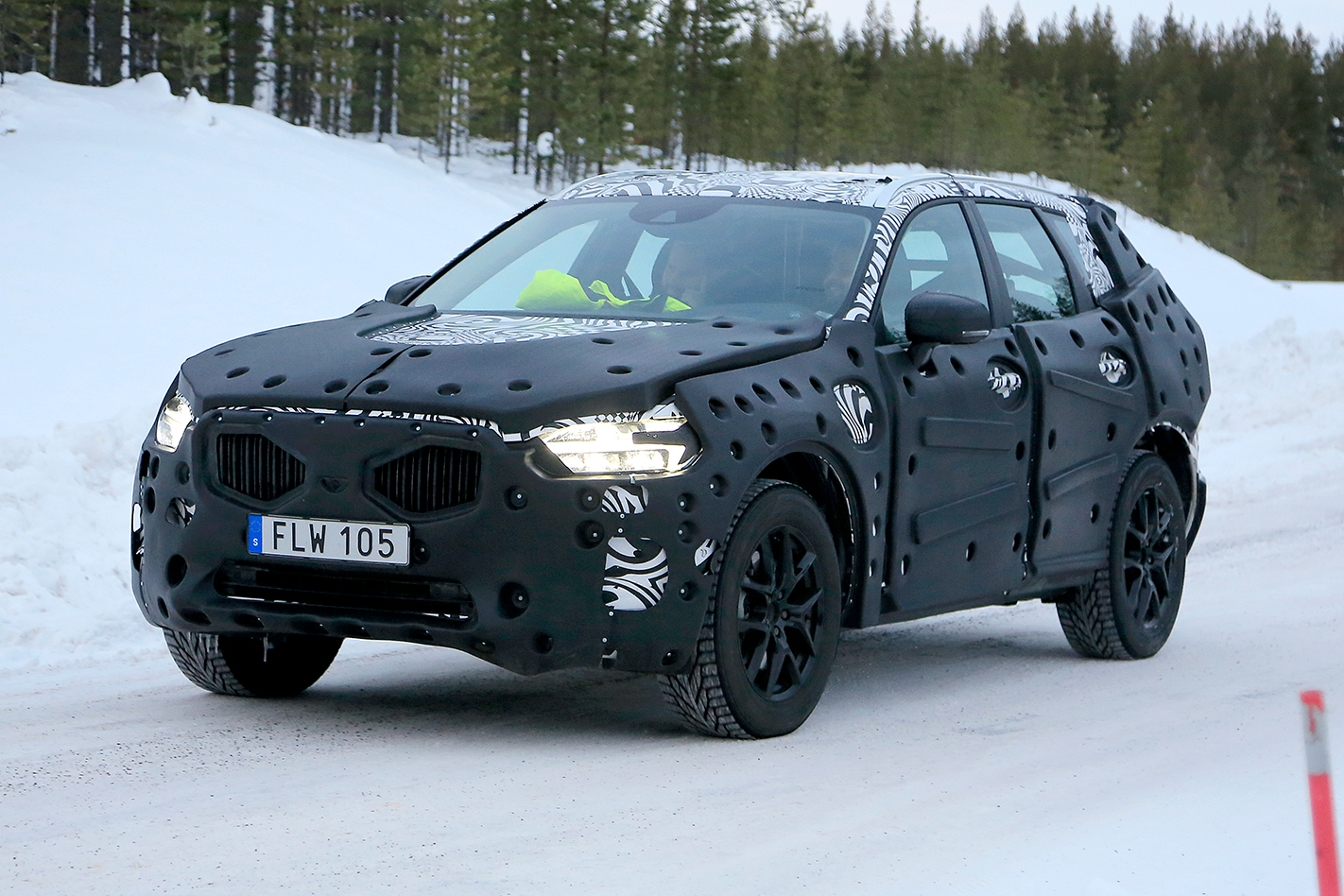
Interior design cues are also expected to be taken from the XC90, including the uncluttered dashboard and vertical-oriented touchscreen display. Technology wise, it is likely to become one of the safest cars in its segment thanks to an array of active safety features comprising the acclaimed IntelliSafe system.
While not confirmed, it’s believed it will be able to drive itself in city traffic or up to certain speeds.
The all-new XC60 is expected to launch globally late 2017 with the new Volvo S60 and V60 sedan and wagon models to follow soon after. And if it’s as a big an improvement over the current model as the all-new XC90 was to its forbear, it should give its German rivals a decent run for their Euro.
Volvo has a long history of safety firsts. In the late 1950s it invented the three-point lap-sash seatbelt, and in the 1970s the rearward-facing baby capsule. It was also the first manufacturer to introduce side airbags in a car.
It was also the first carmaker to recognise the dynamic instability that comes from the higher centre of gravity built into SUVs, developing specific roll-over protection mechanisms that are now built into all its cars.
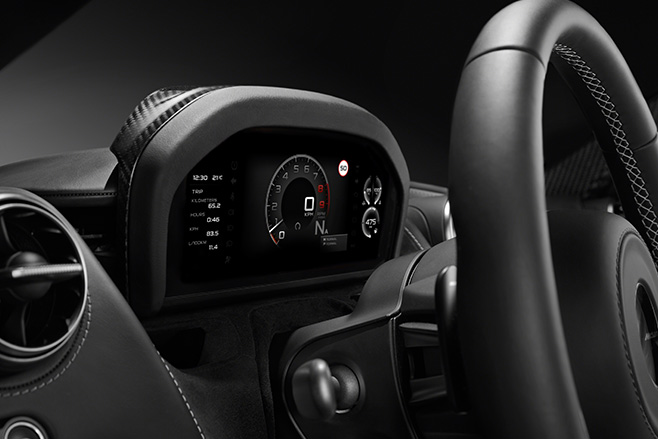
McLaren’s brand-new mid-level supercar has been unceremoniously leaked ahead of its first public showing at the Geneva Motor Show next week – and on the same day as an official teaser of the 720S’ trick new shape-shifting dashboard was released.
That means we now have a good idea of what to expect of the first second-generation ‘Super Series’ model from the British supercar specialist, both inside and out. While the full details are still top-secret, the wow factor is already incredibly high.
The “Folding Driver Display” alone is cool enough. A fairly standard electronic instrument panel (well, standard for upper-echelon sports cars like this) sits behind the steering wheel, displaying a digital speedo, rev counter ribbon (or a trad analogue tacho clock if you prefer), diagnostic displays and shift lights. Nothing unusual there.
Someone’s also a fan of their set of French Curves. We’ve seen the 720S in camouflaged form before, but these leaked images courtesy of Bloomberg are our first solid peek at its bodywork, and there’s nary a straight line to be seen.
The styling language is ultra-organic and recalls the McLaren P1 hypercar strongly, from its mesh-filled rear bumper cutout, thin LED tail light bars to its semi-gullwing doors. Meanwhile the clamshell rear wing not only provides huge surface area for a vital aerodynamic element, but is also a visual nod to the 675LT.
Take a close look at the doors themselves, and you can see just how elaborate and intricate the aero-optimised bodywork of the 720S really is.
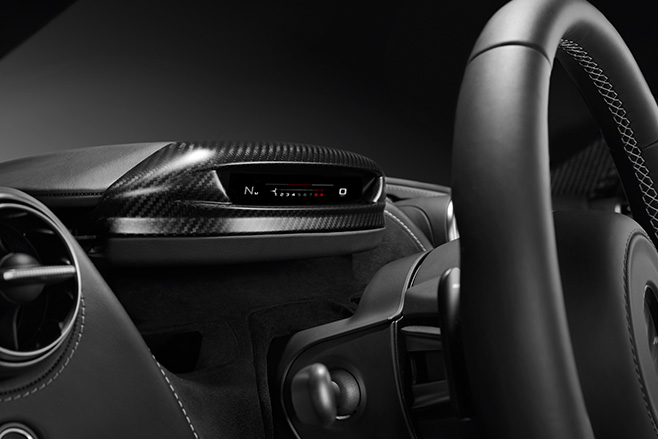
Mounted just behind the carbon cell will an enlarged version of McLaren’s existing 3.8-litre twin-turbo V8, now measuring 4.0 litres in displacement and churning out 720 metric horsepower – or 530kW in a more sensible metric. For your reference, the 675LT makes 496kW while a Ferarri 488 GTB cranks out 492kW.
Performance stats for the 720S are going to be mega, but we won’t know the true magnitude of its capabilities until March 7 when the doors swing open at Geneva. Check back then – unless the full slew of info happens to get leaked.
Can’t contain your hunger? Then enjoy the below video showing a 720S prototype being drifted with no mercy by McLaren’s chief test driver.
Talk about one way to end a Euro trip.
Vauxhall’s been flogging HSV sedans and Maloos in England for some time, but local manufacturing’s demise means our Aussies won’t travel abroad for much longer.
However, video of HSV’s Maloo R8 LSA belting around Silverstone Circuit reveals the supercharged monsters will at least leave a few fans in their wake.
Fans that now include Tiff Needell, if you don’t mind a name drop. On camera for Evo UK, the famed motoring presenter and racecar driver brought along our 400kW and 671Nm workie to a track day.
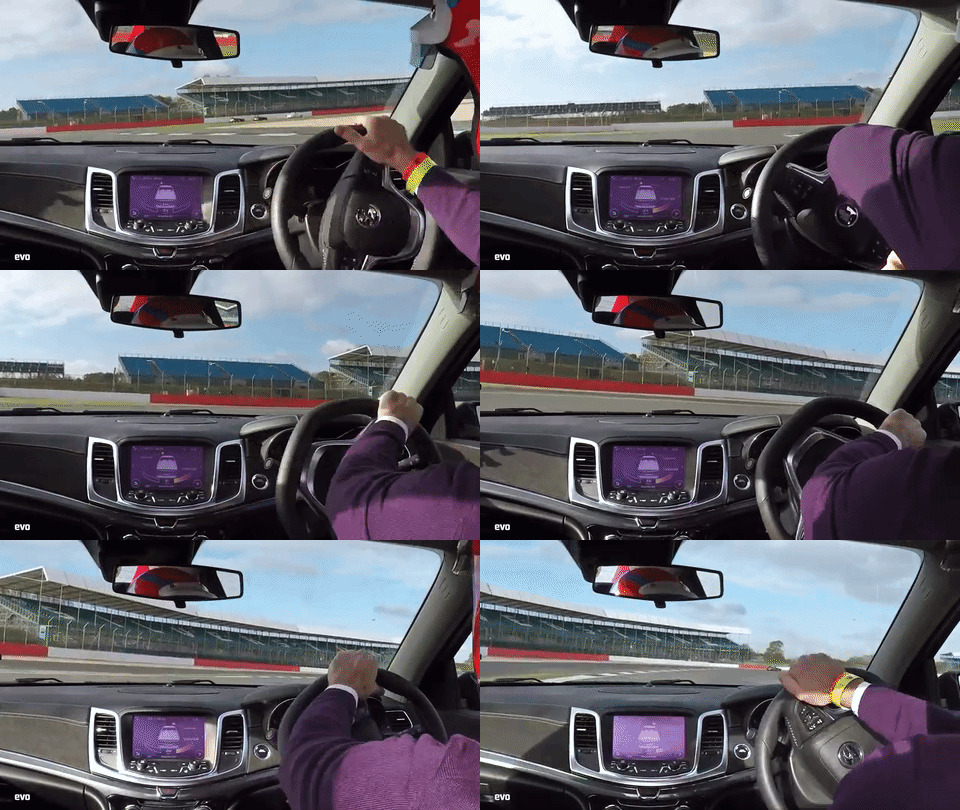
Despite damp and washy weather, the Maloo’s rear-wheel drive and blown 6.2-litre V8 don’t seem to phase the race veteran. Then again, why should it. He’s raced at Le Mans 14 times in everything from a Jaguar XJ220 to a Porsche 956.
He’s so comfortable, in fact, that he gets right into exotics on the first lap, disposing of Porsche 911s, before moving up the ranks and finding a Lamborghini Huracan GT3 to bother.
As well as unlocking its tremendous grunt he’s also at home exploiting its rear wheel drive chassis, linking corners on the lock stops between battles with the day’s crop.
if you’re looking for a review of the Maloo, you’ll be disappointed. But his few comments are energetic, the loveable Maloo charming Tiff.
And while friends in high places won’t be enough to save the Commodore from the history books this September, at least it’s garnering the global respect it deserves.
Australian-made Holden models spanning three decades have dominated the first Shannons classic car auction for the year, with a pale yellow 1968 HK Monaro GTS 327 ‘Bathurst’ coupe topping the charts and landing a $302,000 winning bid.
The GTS 327 homologation special used a small-block V8 borrowed from Corvette and a four-speed manual teamed with rear-wheel drive and a limited-slip differential to attempt to trump the Falcon GT at Mount Panorama. It did, winning the Hardie-Ferodo 500 in 1968.
From the same year, a silver mink Monaro GTS 186S coupe landed $92,000 and, from a half-decade later, a HQ Monaro GTS 308 manual sedan saw $60,500 after the 600-strong crowd went silent at the event held in Melbourne earlier this week.
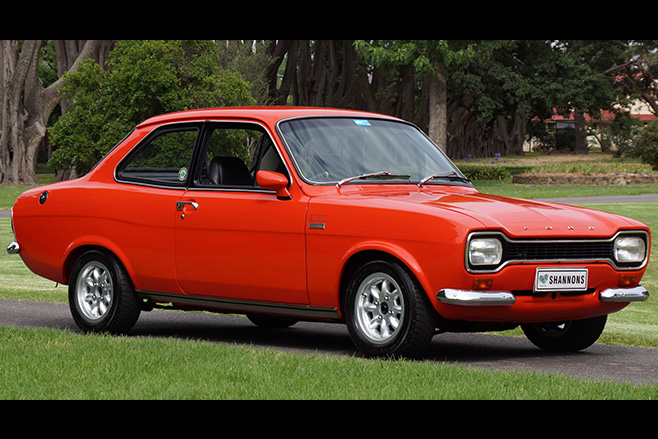
That price was just $1K more than a 1973 HQ Monaro GTS 308 manual impeccably finished in tangerine orange.
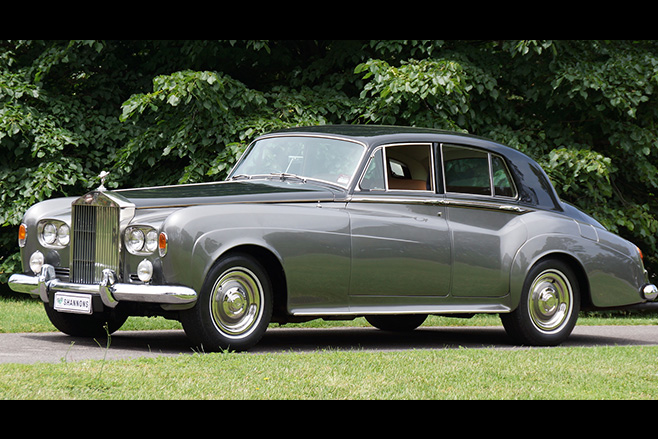
Blue Oval fans could save a little extra cash with a 1969 XW/XY Fairmont GT ‘replica’ selling for $55,000 and a 1965 XP Falcon coupe for $33,000. A cool little 1972 Escort Twin-Cam GT eclipsed both locals, selling for a staggering $72,000.
Shannons’ next classic car auction will be held on May 8 in Melbourne.
THIS week, Carlos Ghosn, Nissan’s CEO and Chairman, announced his decision to step down from the helm of the Japanese manufacturer, effective April 1 this year. His right-hand man Hiroto Saikawa will take over, but why is Ghosn’s departure significant?
Masterminding the Renault-Nissan Alliance is perhaps his greatest legacy, and his career is regarded as a prime example of how a modern CEO of a global auto manufacturer should operate. Ghosn transformed two automakers from economic basketcases into one motoring powerhouse.
Ghosn’s life story could easily fill a book – and it already has – but here’s the Wheels abridged version of why Carlos Ghosn commands hefty respect in the auto industry.
BEGINNINGS
Born in Brazil to parents of Lebanese extraction, Ghosn spent his early life and schooling at opposite ends of the globe before graduating university in Paris with a Bachelor of Engineering tucked under his arm, and fluency in Arabic, English, French an Portuguese.
Stable employment at French tyre brand Michelin gave Ghosn strong roots in Europe, before he was sent back to South America to become Chief Operating Officer of Michelin’s then-unprofitable South American branch. Within two years he had Michelin South America solvent again, and a reputation for turning money-losing operations around had been cast.
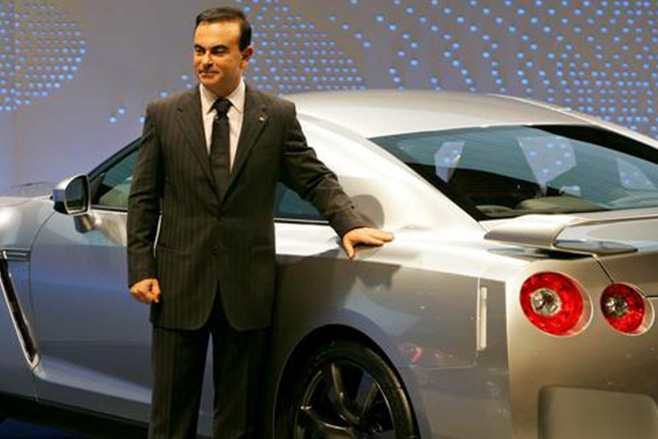
Eventually Renault knocked on Ghosn’s door dangling an Executive VP role that would put him in charge of, among other things, research, engineering, powertrains, manufacturing and purchasing. Like Michelin South America before it, the Renault of the mid-1990s was in steep financial strife – yet with Ghosn’s guiding hand, the French automaker got back in the black in 1997.
The experience earned him the nickname that would define his style: “Le Cost Killer”. It would also prepare him well for his most challenging task yet – reviving the flat-lining Nissan brand.
NISSAN
By the end of the 1990s a combination of wasteful corporate behaviour and the impact of the Asian financial crisis had destroyed Nissan’s balance book, putting it 2 trillion yen in the red (AU$42.5 billion in today’s money). Global sales and market share were plummeting as well.
Nissan’s long-standing practice of sourcing parts from thousands of small-volume suppliers – many of them small family enterprises scattered across Japan – was partly to blame for Nissan’s huge overheads, as was the proliferation of Nissan-badged products that competed against each other in the showroom. The bulk of these models were sold only in the Japanese domestic market, further reducing their ability to pay back the cost incurred by their design and development. Out of the 43 model lines Nissan had in 1999 only four were actually profitable, and Nissan was haemorrhaging money at an astonishing rate.
Development lead times were another bugbear. Cars would often launch in the Japanese market over a year – sometimes more – before going on sale in other countries, by which time the cars were no longer competitive. Nissan’s brand image was suffering.
Ghosn would change that. The Renault-Nissan Alliance officially came into being in March 1999, with the French automaker purchasing a 36.8 percent stake in Nissan.
But though Renault’s ownership of Nissan would eventually rise to 43.4 percent, the deal between the two companies was not a traditional merger or acquisition. Nissan also holds a 15 percent share of Renault, with the cross-ownership encouraging the management of both companies to work in the best interest of the other.
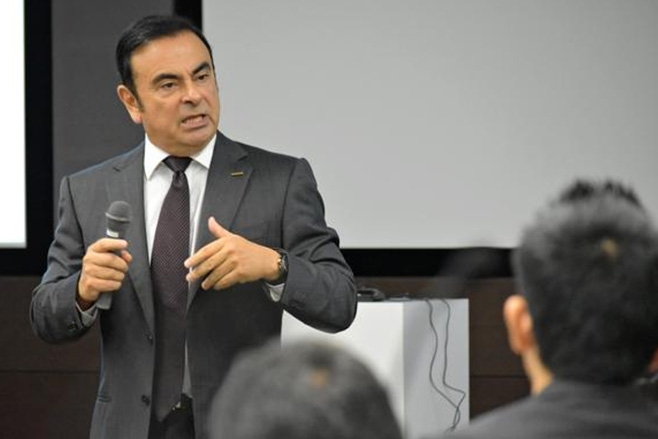
Not that they would have much choice anyway: Ghosn was appointed both CEO and Chairman of the Renault-Nissan Alliance, in addition to being top dog at Renault and Nissan.
Being a foreign head of a Japanese company as old as Nissan came with its own set of cultural challenges, but it also afforded Ghosn the liberty to disregard traditions and customs that got in the way of doing business. The parts supply network was one of the first areas to get shaken up, with the total number of suppliers being slashed from 1145 to around 600.
Rapid product changes and the arrival of more expatriate executives from Renault heralded more changes for Nissan. Three assembly plants and two engine factories went to the gallows as well, resulting in around 20,000 layoffs.
But at the end of 2001, Ghosn’s Nissan Revival Plan had worked. Not only had the Japanese automaker returned to profitability, but the company had achieved its highest yearly profit of all time by the end of the 2001 fiscal year. Overall debt had also dipped to its lowest level in 24 years.
Nissan has since gone from being 2 trillion yen in debt to having 1.5 trillion yen in cash, while its employee headcount has doubled since the period after Ghosn’s factory cuts. In pure business terms, the Nissan Revival Plan has been near miraculous.
The turnaround was a success, with much of the credit going to Ghosn. Nissan had to wave goodbye many workers as factories were shuttered, but the result was a company that was stronger than before. And despite the pain and sacrifice, Ghosn earned the respect of the Japanese for helping preserve one of the country’s industrial icons – so much so, a comic book in Japanese manga style was published about him.
In the years since, Nissan’s strength also proved to be a crutch for Renault. Platform and powertrain sharing helped both companies achieve economy of scale, while both companies still enjoy some degree of independence. Drive comparable Nissans and Renaults back-to-back, and there’s still a profound difference in flavour.
Ghosn was also the driving force behind the development of the 350Z and the Nissan R35 GT-R, prestige projects that weren’t necessarily profit-makers, but helped inject some much-needed desirability to the Nissan badge to aid its recovery.
While the Daimler-Chrysler merger – which was formalised in 1998 – fell apart in 2007, Ghosn’s strategy of pursuing an alliance rather than an outright merger had more longevity. According to Ghosn, with a greater emphasis on collaboration rather than ownership, both Nissan and Renault would enjoy greater health in the long term than if one had acquired the other outright.
Many industry watchers agree.
THE FUTURE
Carlos Ghosn, the multi-lingual, multi-cultural business maestro, may be exiting the corner office at Nissan, but he’ll retain top slot at both Renault and the Alliance. He’ll also be keeping a keen eye on Mitsubishi Motors as its Chairman, a position he’s held since Nissan acquired a 34 percent stake in the company in October last year.
Like Nissan before it, Mitsubishi has been struggling in recent years. The general expectation is that Ghosn’s knack for performing business miracles will be repeated once more. Watch this space.
“What’s the worst that can happen?”
“Quite a lot actually…”
I’m chatting with Tim Willis from BWA Auto, both of us running our eyes over the curves of the $314,000 Tesla Model S P100D, which has just been strapped down to the only dyno of its kind in Australia.
The plan was simple, take the most powerful electric car available in Australia, put it on a rolling road, and reveal the power and torque outputs behind its ridiculous performance.
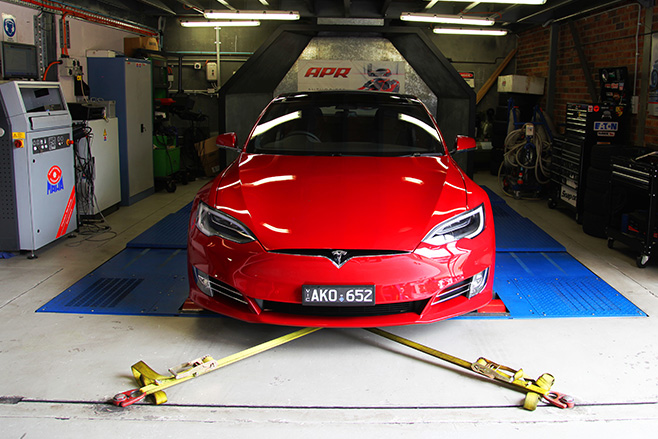
So while we had the keys to the P100D for two weeks (you will be seeing more from our time with this car in the coming days), we decided to put it to the test.
But, dyno testing a Tesla is not the work of a moment. Thankfully, BWA Auto in Sydney is equipped with a rig capable of managing high output electric cars and extracting accurate figures. A time was booked, technicians in Germany were consulted overnight, and now I was preparing for the moment of truth with Tim beside me.
Tim and the BWA Auto crew began by consulting colleagues in the UK who had previously attempted to test a Tesla, and were warned the process could take up to two days. We didn’t have that luxury, with my schedule meaning the Model S was going to be on the Hume barrelling towards Melbourne in 24 hours.
With those issues adapted to and out of the way, a total of 11 passes were completed, each remarkably consistent. In the end the P100D put up surprisingly little resistance to our meddling.
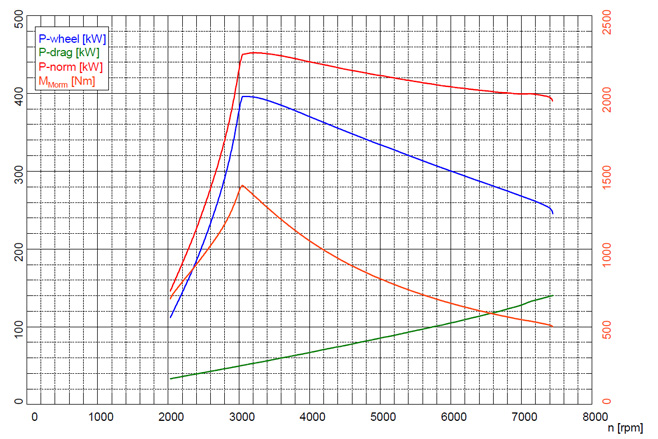
The best of the runs resulted in 394kW at the wheels, and a staggering 1406Nm. Ludicrous figures (pun intended), and more than enough to explain its bonkers acceleration.
The BWA Auto guys and two representatives from Maha (the dyno manufacturer) were adamant about the accuracy of the figures.
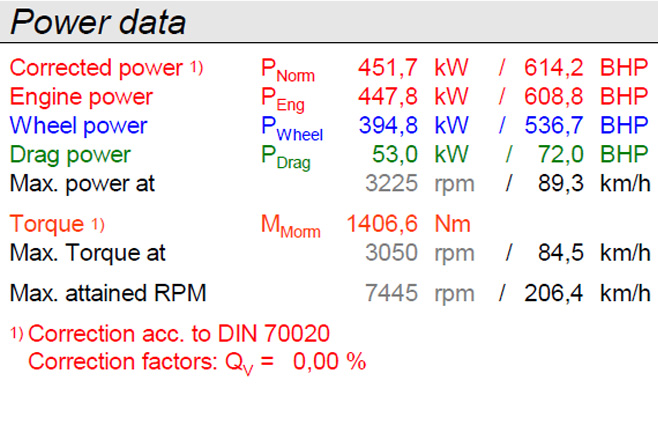
The torque number, on the other hand, is as close as possible to what those two motors actually churn out combined, in a real-world on-road scenario.
The dyno graph also makes for fascinating viewing, with the instant power delivery from the equivalent of zero rpm drawing a straight, almost vertical line as Tim moves to full throttle, and then a slow taper as the car rolls to a stop.
In the end, it was a fascinating experience that tested the limits of the dyno, and highlighted the incredible power that makes the Tesla such a straight-line monster.
LAND Rover has revealed details of its fourth-addition to the growing Range Rover family, the Range Rover Velar.
Launched at a special event in London ahead of next week’s Geneva Motor Show debut, the Velar will slot into the line-up between the Range Rover Evoque and Sport.
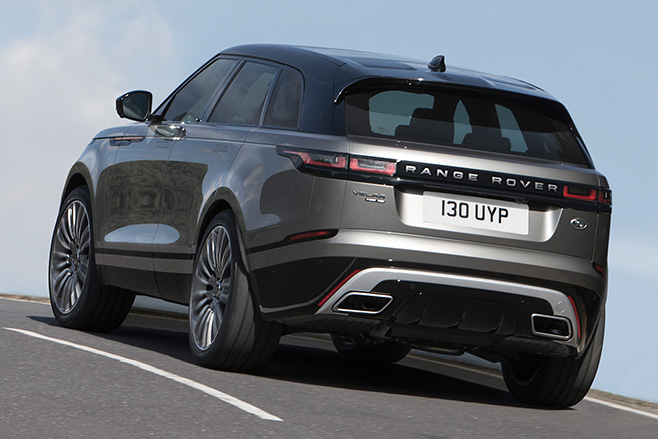
While the Velar is related to the Jaguar F-Pace, underpinned by the same technology, it’s expected to have better off-road ability given the brand’s reputation, and that it’s built on the same aluminium iQ platform as the Range Rover Sport.
It features Range Rover cues such as a floating roof and box-like lines, but unlike its tougher looking siblings, the Velar has a smoother, sleeker design, giving it better aerodynamics and a more slimline appearance.
Add in chrome trim, sloping roofline, laser LED headlights, copper-coloured details on the front bumper and flush doorhandles, and the Velar stands on its own four tyres as one of the most stylish and aerodynamic Range Rovers yet.
“The new Range Rover Velar brings a new dimension of modernity to our brand while reinforcing our total commitment to design and engineering excellence,” said Land Rover chief design officer Gerry McGovern.
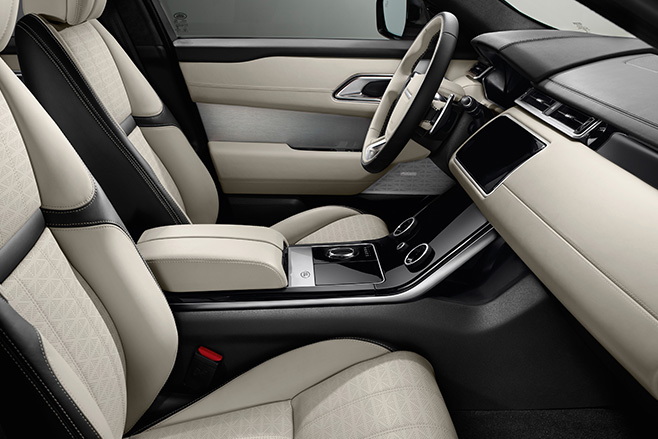
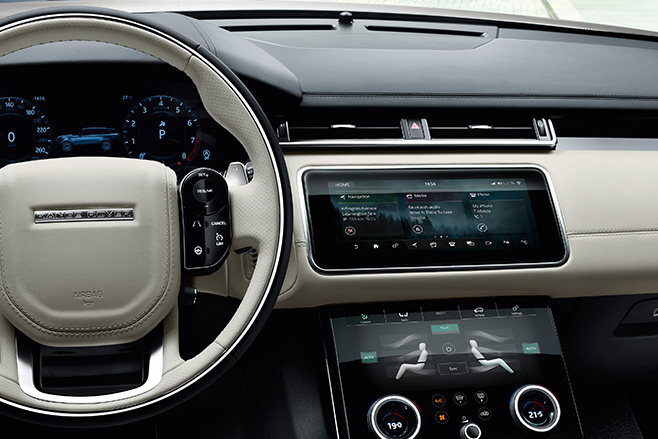
Inside the Velar, there are two high-definition 10-inch touchscreens to make usability as easy as possible and offer a less distracting experience for drivers having to navigate their way around a single-screen system.
Designed with a modern, sophistication, the Velar offers a “sustainable, premium textile seat material” over leather, and a range of trims and colour schemes.
The Velar will come with five engine offerings: two four-cylinder diesel engines with 132kW and 177kW, a new four-cylinder 184kW petrol engine and a 280kW supercharged V6 petrol engine. Joining the line-up later in the year will be a 221kW version of the four-cylinder petrol engine. No announcements have yet been made as to which will make their way to Australia.
Sales are expected to start midway through this year, with the range stretching from $70,300 to $135,000 for the top-spec model.
