
Say hello to McLaren’s next-generation supercar.
Images have leaked online six weeks ahead of the cars unveiling at the Geneva Motor Show. Known internally at McLaren as the P14, the car is the successor to the the McLaren 650s supercar.
The single image appears to be taking at a preview viewing of the car for potential owners, or McLaren engineers.
The shot reveals a sharp new front end and nose for the Super Series model, along with what appears to be more aerodynamic styling along its flanks.
No technical details have officially been released by McLaren, however the Woking manufacturer did tease the P14’s new carbon-fibre chassis (known as the Monocage II structure) earlier this year.
Autocar reports the P14 will retain McLaren’s signature dihedral doors, and will be powered by a developed version of the company’s turbocharged V8, seen in other models.
It is expected the engine’s capacity will be increased from 3.8-litres, and power will be more than the 496kW produced by the McLaren 675LT. If so, the car’s 0-100km/h sprint time could be sub-three seconds, with a top speed in excess of 329km/h.
The leaked images first appeared on @woppum’s Instagram account. However, he attributes the photograph as being taken by @godspeed.edc. The image no longer appears on @godspeed.edc’s timeline.
The car was filmed driving in the UK late last year. In the footage, you get a better look at the P14’s newly redesigned rear, which despite the camouflage, heavily resembles that of the McLaren P1 hypercar.
The P14 will compete against Ferrari’s 488 GTB, which is capable of 0-100km/h in three seconds flat, due to a 3.9-litre twin-turbo V8 producing 493kW and 760Nm wedged behind the headrests.
McLaren has confirmed the P14 will be officially unveiled at the 2017 Geneva Motor Show, which will be held on March 9-19.
THE Porsche Panamera 4 E-Hybrid is about to join the sports car maker’s more fuel-efficient line-up, rounding out its grand tourer line-up.
WHAT IS IT? A petrol-electric version of the second-generation Panamera, powered by hybrid tech inspired by the super-exotic 918 Spyder.
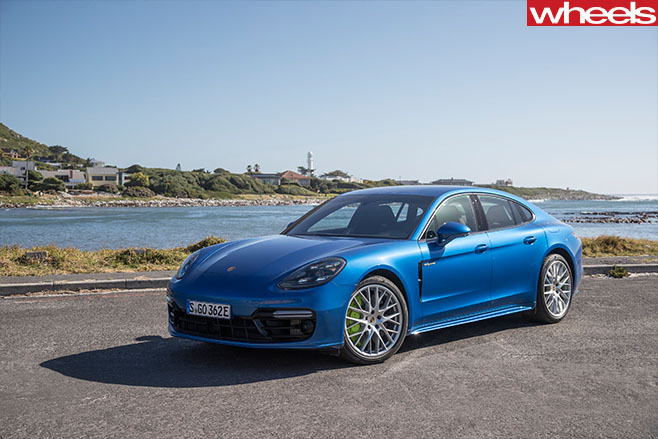
WHY WE’RE TESTING IT The international launch in South Africa was an opportunity to sample Porsche’s new plug-in and play system well ahead of the Panamera 4 E-Hybrid’s arrival in Australia.
MAIN RIVALS Heavyweight German hybrids like the BMW 740e and Mercedes-Benz S500e, perhaps also top-end versions of the Tesla Model S such as the P90D.
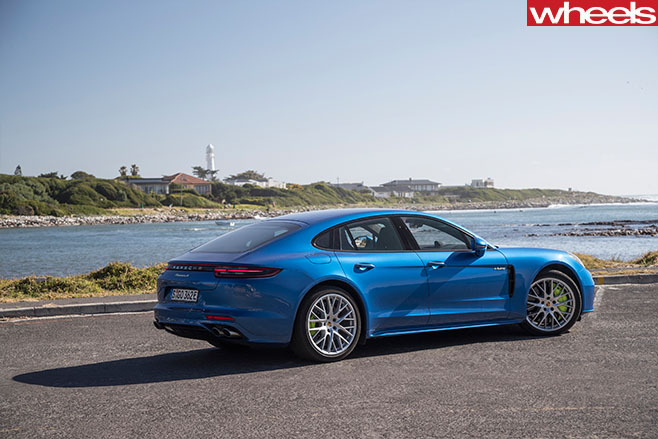
THE WHEELS VERDICT This is a plug-in hybrid with some real driver appeal to go with its eco cred.
PLUS: Performance; useful electric-only mode; agile (for its size); 911-ish looks MINUS: Size; cost; wind noise; powertrain refinement needs work
THE WHEELS REVIEW HERE’S the plug-in petrol-electric Panamera that Porsche really wanted to build. The S E-Hybrid model, introduced in 2013 for the mid-cycle update of the 2009 Panamera Gen I, was a mash-up of components borrowed from other Volkswagen Group brands. Its engine, for example, was an Audi-sourced supercharged 3.0-litre V6. The first Panamera Gen II hybrid, on the other hand, is all Porsche’s work.
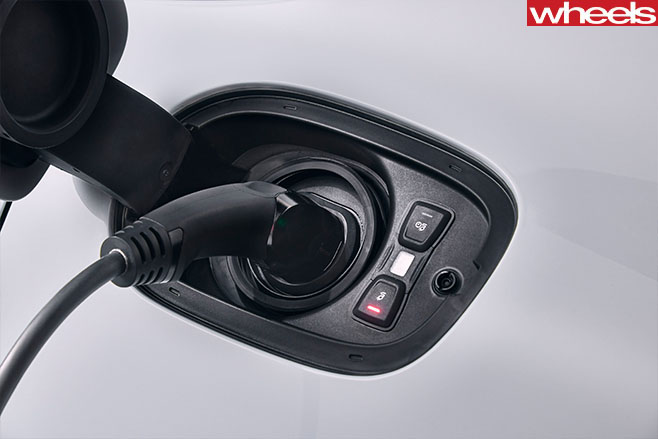
Called 4 E-Hybrid, it will arrive in Australia in the third quarter of this year, around six months after the February 2017 launch of the core Panamera models. It has a Porsche co-developed engine and the company’s new eight-speed dual-clutch transmission. And the operating strategy of the car’s hybrid powertrain draws on expertise earned during development of the 918 Spyder.
The 4 E-Hybrid’s engine is a 243kW twin-turbo 2.9-litre V6. It’s a product of KoVoMo, the clunky German name for a program for Porsche and Audi to jointly develop a new generation of V6 and V8 petrol engines. Maximum output is 243kW.
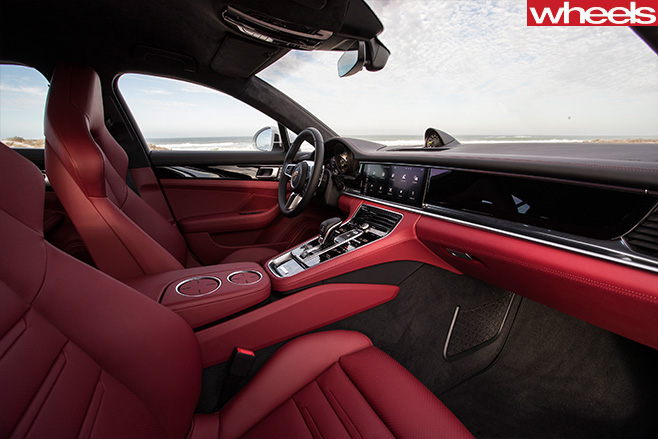
Between the engine and the 100kW electric motor in the front end of the dual-clutch transmission is another clutch. With this clutch engaged both the engine and motor work together. When it’s disengaged, the 4 E-Hybrid becomes an EV. All-wheel drive remains a constant throughout. In Sport and Sport Plus driving modes, the internal combustion engine runs full time. In Hybrid Auto mode it stops and starts, while in E-Power the Panamera runs electric.
Maximum system outputs – with the turbo engine and electric motor working together – are 340kW and 700Nm. These are hefty increases over the Panamera 4. Despite its extra 300kg, the 4 E-Hybrid is much quicker; Porsche claims a 0-100km/h time of 4.6sec, nearly a full second better than the Panamera 4.
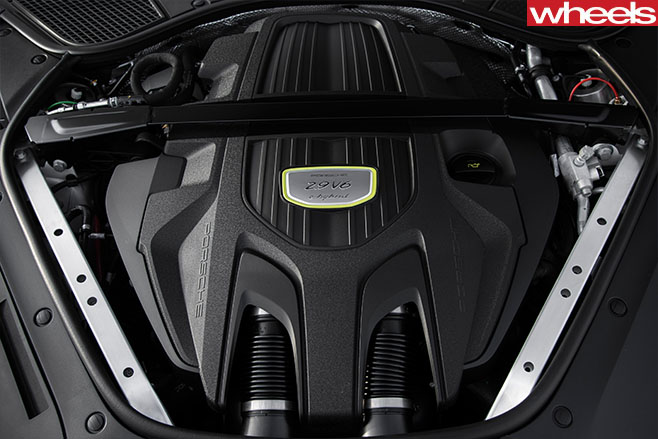
It’s especially responsive at low revs, where the hefty boost of the electric motor is obvious. And E-Power mode is surprisingly strong; the motor delivers 400Nm from 0-2300rpm. Keeping up with urban traffic isn’t a problem. Top speed in this mode is limited to 140km/h.
The 4 E-Hybrid now and then made a jerky shift and the blended braking system was hard to modulate precisely at low speed, but otherwise this car is pure Panamera Gen II. It feels big, especially in width, but agile. It’s refined, though prone to high-speed wind noise around the front windows. Cargo space is very nearly the same, despite the 14kWh Li-ion battery pack beneath its floor that delivers a 50km electric driving range. Only the 4 E-Hybrid’s bright green brake calipers give the game away.
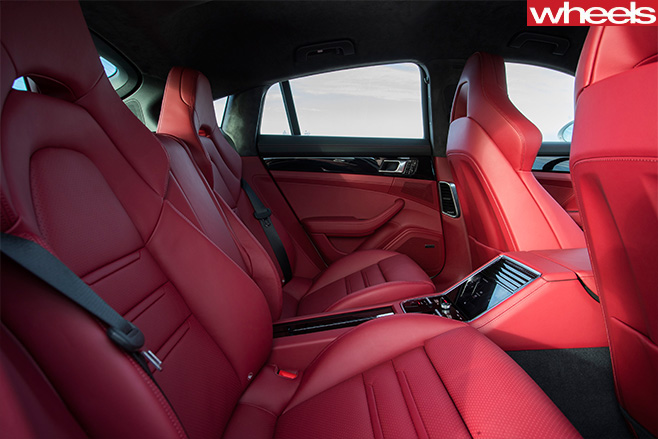
The 4 E-Hybrid will sell for $242,600, around $40,000 less than the rear-drive S E-Hybrid it effectively replaces. In terms of price it slots neatly between the new Panamera 4 and 4S, though its performance is much closer to the latter than the former.
Running silent
The ability to freely enter zones where internal combustion driving is restricted or banned is one of the main reasons for customers in Europe to choose a plug-in hybrid. This is why the 4 E-Hybrid has E-Hold and E-Charge modes. Menu-selectable when in Hybrid Auto, these let the driver choose to preserve existing battery range or to recharge.
SPECS Model: Porsche Panamera 4 E-Hybrid Engine: 2894cc V6, dohc, 24v, biturbo Motor: Permanently excited synchronous Max system power: 340kW @ 6000rpm Max system torque: 700Nm @ 1100-4500rpm Transmission: 8-speed dual-clutch auto Weight: 2170kg 0-100km/h: 4.6sec (claimed) Economy: 2.5L/100km (European combined cycle) Price: $242,600 On sale: Third quarter 2017
SOME of the latest crash avoidance systems on popular cars can be fooled by the high-riding design of utes and SUVs, according to an exclusive Wheels assessment conducted as part of our 2017 Car of the Year testing.
During testing, the autonomous emergency braking systems on some new cars failed to recognise the higher rump of a ute – closer in height to many popular SUVs – potentially leaving drivers exposed in common nose-to-tail crashes these systems are designed to avoid.
The revelation comes after extensive independent testing at the Ford Proving Ground in conjunction with Insurance Australia Group.
Cars from Jaguar, BMW and Volkswagen worked almost flawlessly when driven at a regular sedan test target at between 10 and 25km/h, reinforcing the usefulness of AEB systems.
However, each failed to consistently identify a ute target that simulates the rear-end style of cars that account for more than half of all new vehicle sales in Oz.
The head of IAG research, Robert McDonald, said it appeared some carmakers were optimising their AEB systems to pass the Euro NCAP test rather than trying to detect a wide variety of real-world scenarios.
The Euro NCAP testing of AEB employs a target ‘vehicle’ that extends to ground level, made of a soft material designed not to damage test vehicles at impact speeds up to 50km/h. But the target also includes various reflectors and other materials to ensure it works with sensors typically used in AEB systems. According to Euro NCAP, the target “is developed to have the radar signature, reflectivity and visual signature comparable to that of a ‘C’ segment vehicle”.
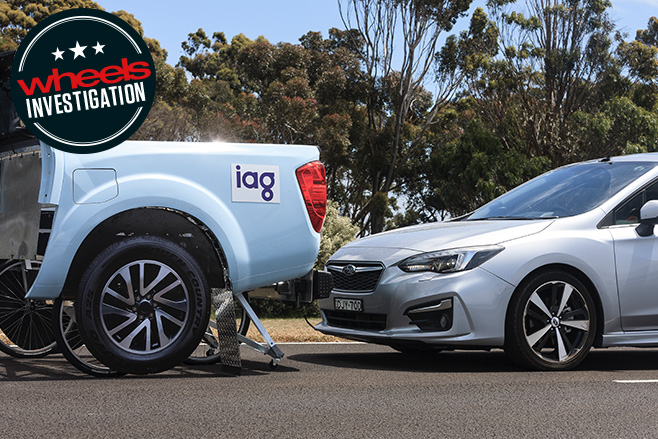
“We know the European target vehicle doesn’t represent a ute very well,” McDonald told Wheels. “The height and the shape is a challenge for some AEB systems.”
McDonald said IAG had just added a ‘ute’ target vehicle because “we think they’re more representative of the average vehicles that are in Australia”.
In an era of increased crash avoidance technology – aligned with the development of autonomous technology – he said it was important to ensure cars could respond to a wide range of often challenging real-world scenarios. “We welcome the adoption of AEB by Australian carmakers and want to encourage the further sophistication of the technology.”
Half of the 28-strong COTY 2017 field had at least one model fitted with AEB. All 14 of those vehicles were tested against the sedan and ute target vehicles, with most accurately detecting and reacting to the sedan. But at least seven of the 14 tested failed to detect the ute at least once.
In defending the AEB performance of the Jaguar F-Pace and XF, Jaguar questioned the validity of IAG’s target vehicles, suggesting they may not represent real vehicles. “In conjunction with our supplier we have conducted a series of 15 ‘classification’ runs in a Jaguar F-Pace at various speeds against a Nissan Navara pick-up truck and in all cases the system successfully classified the vehicle as a ‘target’ and would have initiated braking,” Jaguar said in a statement.
McDonald, meanwhile, said cars that struggled to pick multiple objects often used only one method of detection, such as radar or cameras. By contrast, the Mercedes-Benz E-Class uses five multi-range radars, stereo cameras and 12 ultrasonic sensors, while the Volvo S90 pairs radar and camera technology to detect objects as diverse as caravans, boats, buses, trucks, bikes, pedestrians and large animals.
Full COTY results and AEB testing will be published in the February issue of Wheels and on Wheelsmag.com.au on February 2.
Call me weird (again) but I like offbeat things. I like asymmetry like offset racing stripes.
I like Andie MacDowell’s slightly crooked, ever-so goofy smile. I like the stray, extra drumbeat at the start of Times Like These by the Foo Fighters. And I absolutely love the ropey, lopey idle of a big-inch V8 with a lumpy great cam jammed up its valley.
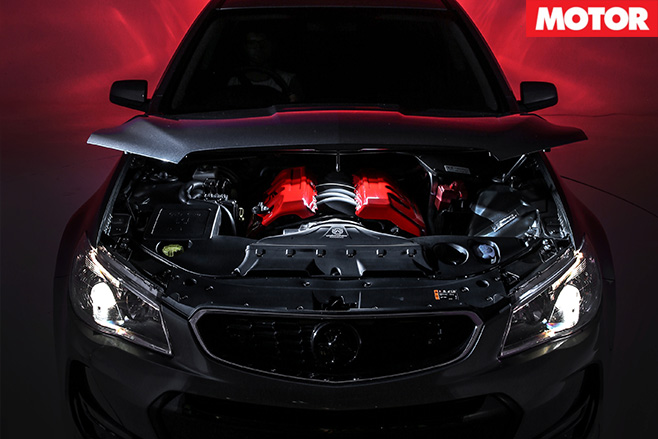
Is there any better noise an idling engine can make? Don’t think so. So you’ll forgive me if I’m perhaps prematurely attracted to Walkinshaw Performance’s (WP) latest attack on sense and the senses.

Enter WP’s 407 package which, as the name suggests, takes a normally aspirated 6.2-litre LS3 V8 and cams it to the point where it’s capable of 407kW at the flywheel at max-yowl. It’s available as an aftermarket kit and you can apply it to your new HSV or even the current 304kW VF Series II Commodore SS. Start with a second-hand car; doesn’t matter, the results will be the same – 407kW at 6250rpm.
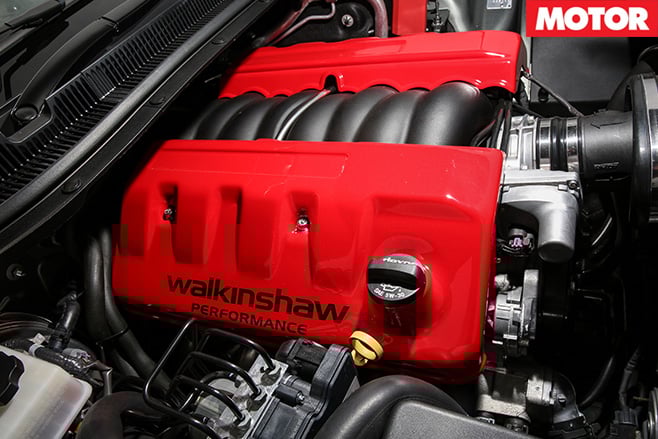
And since the supercharged LSA V8 in the HSV big-hitters only claims 400kW and 671Nm, I wanted to know how the hell a tune (rather than a pump) could create such a transformation.
So I asked Walkinshaw Performance’s Richard Jong the difficult questions. “Our W375 package was popular when we launched it a few years ago [in 2011],” he told me. “But now, some of those same people are looking for a bit more. But not all of them want to go down the supercharged path, so we developed the W407 package.”
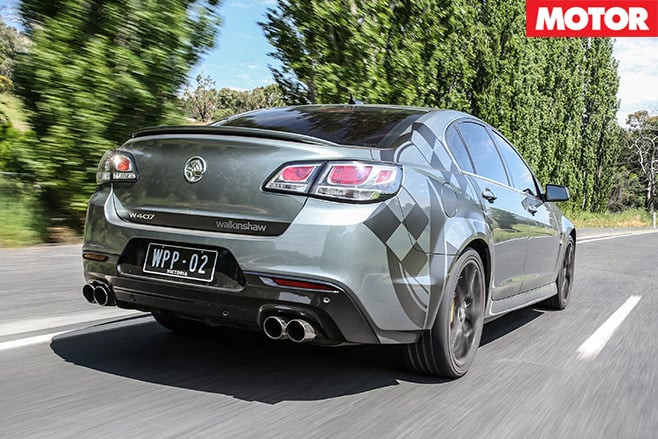
Of course, you’re already starting from base-camp with the 375 stuff which equals a set of ceramic-coated headers, high-flow cats and a three-inch cat-back set of pipes. There’s an over-the-radiator cold-air intake and the ECU is re-flashed to suit the 407’s temperament.
Even so, it’s a big old jump considering the lack of forced induction. So, 103kW from a revised camshaft, intake and exhaust, then? “Yep,” said Jong. No other changes? “Nope.” What gives?
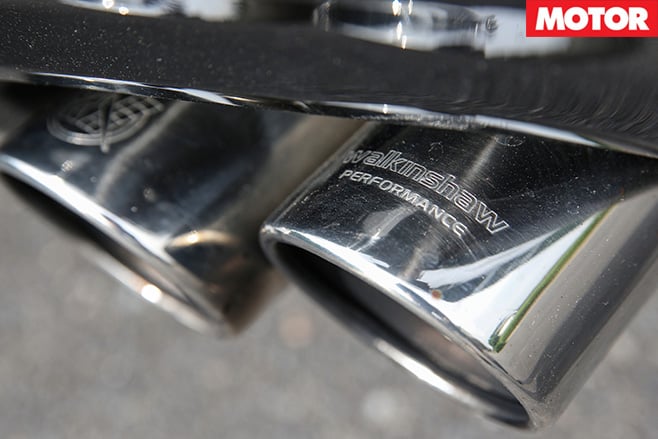
And boy, can you ever. Pick it, that is. Yes, I’ve heard lopier idles, but none that’s being sold as a kit through an outfit like Walkinshaw Performance. Whether you’re gazing into the engine bay, sitting inside the car or standing behind those bazooka tailpipes, there’s absolutely no mistaking the signature jig of a lumpy stick. Okay, by Summernats standards, it’s relatively tame, but still…
Traditionally, of course, the big problem with big camshafts has been a fall-off in low-end torque; a situation that doesn’t recover until you’re up into the revs and, as they say in pubs and man caves everywhere, on the cam. Except this time around, we’re starting with 6.2 litres of injected V8, so if there’s any drop-off in off-idle performance, it’s one of those dead-set first-world problems you hear about on TV.
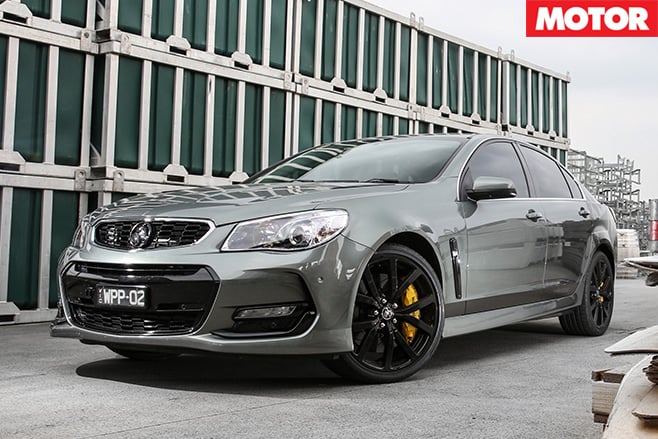
In a manual, you’d disguise that with a bit of clutch slip initially, but by the time the clutch was all the way home, I reckon you’d be in the same boat. Most people will deal with it. I certainly could.
Now, back to that slightly softer off-idle power-curve: I think it might actually be working in the W407’s favour. Stay with me. Traditionally, these things have been pigs to launch hard, even at a dragstrip. But the W407 just walked up to the start line, allowed me to select Sport mode in the tranny and then cannoned away from the tree like a bought one.

To the point where I reckon it records a quicker time than the on-road feel suggests. Our best was a 12.9-second run with a terminal of 181.4 and 0-100 in 4.8. Which means, of course, it can’t stay with the HSV Clubsport R8 LSA which, with its supercharged 400kW plant, gets it across the quarter in 12.5 and to 100 in 4.5.
The difference there, of course is possibly the blown R8’s lower torque and power peaks, but when you look at the terminal speeds (181.4 plays 184.8) maybe it’s closer than you think.

Of course, while the 407’s torque curve might lack the down-low meat-and-spuds of the LSA engine, the point of sacrificing some of that bottom-end jolt is to improve the top-end fizz. But since this is a relatively subtle camshaft, it shouldn’t be too dramatic. And that’s precisely how it feels.
There’s an appreciable increase in whup-ass as the tacho passes about 3000 and, from 3500 onwards, it’s really putting in. The engine definitely has a harder edge to it than the rather mellow 304kW tune in the VF SS. Oh, it’s still a sweet revver and never what you’d call harsh, but the rounded edges of the stocker’s power pulses have grown shoulders.

Next-door neighbours making scrunched-up, unhappy faces is one thing, of course, but eventually even you might tire of the racket. This won’t happen in the first few days of ownership, but eventually you might want to listen to the stereo or something. In blare-mode, the exhaust is just on the verge of droning at freeway speeds if you’re even slightly into the power, say, when going up a long hill.
The other thing you may learn to hate is the stink of unburned PULP at idle. This is all to do with the increased valve overlap on the W407 camshaft (we think) but it remains that if you’re standing down-wind of an idling W407, a sensitive nose will know all about it.

That, however, and every other so-called compromise of this package I could easily deal with on a day-to-day basis. I still have a niggling feeling that this is not 407kW-worth of shunt, but that probably says more about me and my suspicious mind than anything about the car itself. Because beyond that, I absolutely dug the thing.
I reckon the tune is absolutely spot on for the punter with an extra ten-large ($9990, to be exact) to hurl at their new SS-V and the changes turn it into a big sweetie of a thing with a bit of attitude, rather than some grumpy mongrel that wants to eat you.
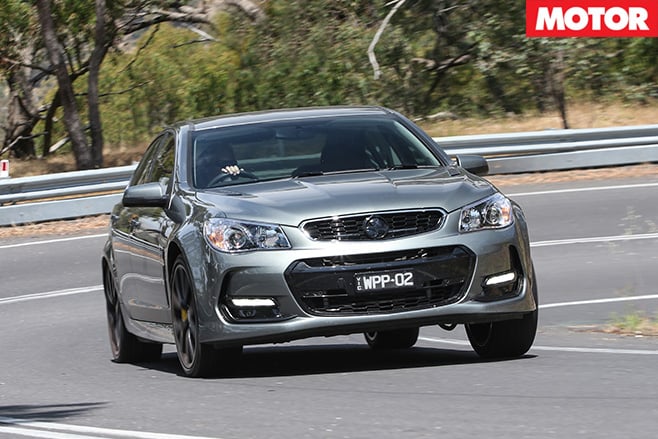
The other thing that occurs to me is that this engine proves that modern electronic management can make what would have been a problem child in the old days into something that is just a bit cheekier and playful, without being headed for Juvenile Hall every time you fire it up. I guess we already knew that much, but to have it confirmed in the metal is always satisfying.
And finally, it’s nice to see an old-school tuning method get results. It’s too easy in this Playstation world to forget that you can manipulate the fuel and spark tables up to a point, but for real results, you gotta go deeper in. Because if it was easy, we’d all be doing it.
SPECS body 4-door, 5-seat sedan drive rear-wheel drive engine 6162cc V8, OHV, 16v bore/stroke 103.1 x 91.9mm compression 10.7:1 power 407kW @ 6250rpm torque 695Nm @ 4950rpm power/weight 227kW/tonne transmission 6-speed automatic weight 1793kg suspension (f) struts, coil springs, anti-roll bar suspension (r) multi-links, coil springs, anti-roll bar L/W/h 4964/1898/1471mm wheelbase 2915mm tracks 1593/1590mm steering electrically assisted rack-and-pinion brakeS (F) 355mm ventilated discs, 4-piston calipers brakes (R) 360mm ventilated discs, single-piston calipers wheels 19.0 x 8.5-inch (f); 19 x 9.0-inch (r) tyre SIZES 245/40 R19 (f); 275/35 R19 (r) TYRE Bridgestone Potenza RE050A price as tested $67,680 (based on SS-V Redline auto) PROS Old-school charm on idle; increased performance; price of kit CONS Lacks crackle of SS; low-speed behaviour; doesn’t feel like 407kW STAR RATING 4.5/5
WALKINSHAW W407 0-10km/h 0.4 0-20km/h 0.8 0-30km/h 1.2 0-40km/h 1.6 0-50km/h 2.0 0-60km/h 2.5 0-70km/h 3.0 0-80km/h 3.6 0-90km/h 4.1 0-100km/h 4.8 0-110km/h 5.6 0-120km/h 6.4 0-130km/h 7.2 0-140km/h 8.1 0-150km/h 9.0 0-160km/h 10.2 0-170km/h 11.4 0-180km/h 12.7 0-400m 12.9sec @ 181.4km/h 100-0km/h 35.9m SPEED IN GEARS 1st 58km/h @ 6000rpm 2nd 99km/h @ 6000rpm 3rd 153km/h @ 6000rpm 4th 203km/h @ 6000rpm 5th 240km/h @ 6000rpm* 6th 240km/h @ 4100rpm*
Introduction: Bubbly Personality
The thing that annoys my wife most isn’t my laziness (that’s what she calls it, at least; I call it relaxing) or my reluctance to mow the grass. It’s not even my tendency to leave dirty laundry on the floor. It’s how I park. Or to be more exact, it’s where I park.
I’m quite fussy about where I leave a car, especially in underground shopping centre car parks. My biggest pet peeve is emerging from the shops to discover someone has opened a door onto our car, or clipped it with a trolley. It’s infuriating.
So, to avoid this, I park as far away from other cars as possible, preferably next to a cement pole. This drives the wife bonkers. “Are you sure this spot is okay?” she asks innocently, before storming off in a huff. Sometimes she’s so mad she refuses to speak during the 2km hike to Coles.
Happily, though, we haven’t had an episode like this in weeks because my new long-termer – this bright yellow Citroen Cactus – is largely impervious to such parking mishaps thanks to the ‘airbumps’ fitted to its flanks. These act like giant strips of bubble wrap, so instead of skulking around a car park’s far reaches, the Citroen’s body armour means I now aim for pole position instead. And where I once rejected parking spots if they showed even the smallest potential risk, anywhere will do for the Cactus.
Does that spot look a little tight? No worries. Oh no, that one’s next to the trolley return shoot. Who cares. Honestly, it’s changed my whole outlook on life. Instead of glaring at trolley-wielding shoppers and mentally shouting, “Stay away from my car, you morons!”, I find myself hoping they’ll lose control and ram the Cactus just to see what happens.
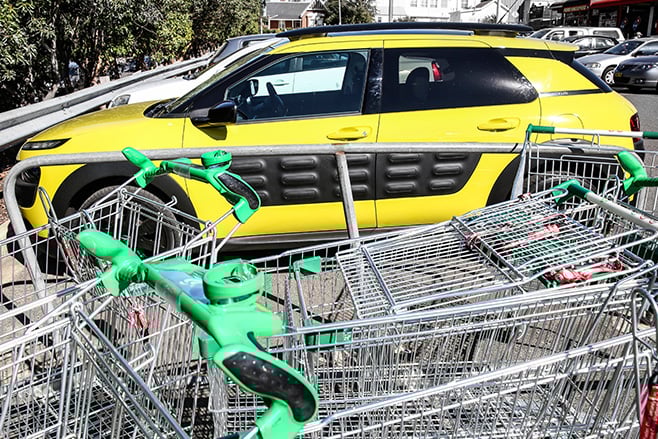
I even know what I’m going to say when they do. “Oh my goodness, I’m so sorry!” they’ll screech, mortified. “It’s okay, you careless duffer,” I’ll reply, “that’s what these bumps are for.” And then I’ll ram the Cactus again just to prove the point.
The Citroen has improved my life in other ways, too. I no longer need to visit petrol stations twice a week, for instance. Regular readers will know my previous long-termer was an HSV Clubsport LSA wagon that, while excellent in almost every way, didn’t so much drink fuel as guzzle it. The Citroen, on the other hand, seems to have a bottomless tank.
My Cactus has the 1.2-litre three-cylinder petrol engine, paired with a five-speed manual transmission, and so far it’s been so frugal that
I’ve only fuelled it once over an entire month. And don’t confuse this efficiency with languid performance; the 81kW/205Nm three-pot is a peach.
And then there’s the design. Some of my friends hate it, but to my eye the Cactus looks brilliant with its quirky round edges and concept-car DRLs. I love the cabin, too, especially the supremely comfortable lounge-like front seats.
However, there have been annoyances, even at this early stage.
There’s no tilt adjustment on the steering wheel, for example, so the driving position feels a little off. And the reversing camera takes twice as long as it should to engage.
And I’m already starting to resent the clumsiness of the central touchscreen that controls everything from phone connectivity to the climate control.
Yet none of these foibles have dulled the Cactus’s initial shine. As the first properly bonkers Citroen in ages, it dares to be different. And I like that. So does the wife.
Update 1: Thorny Issues
Alex starts to get prickly over his Citroen Cactus. Annoyances and niggles that were initially quite minor rise to the fore, now that the honeymoon period has lapsed.
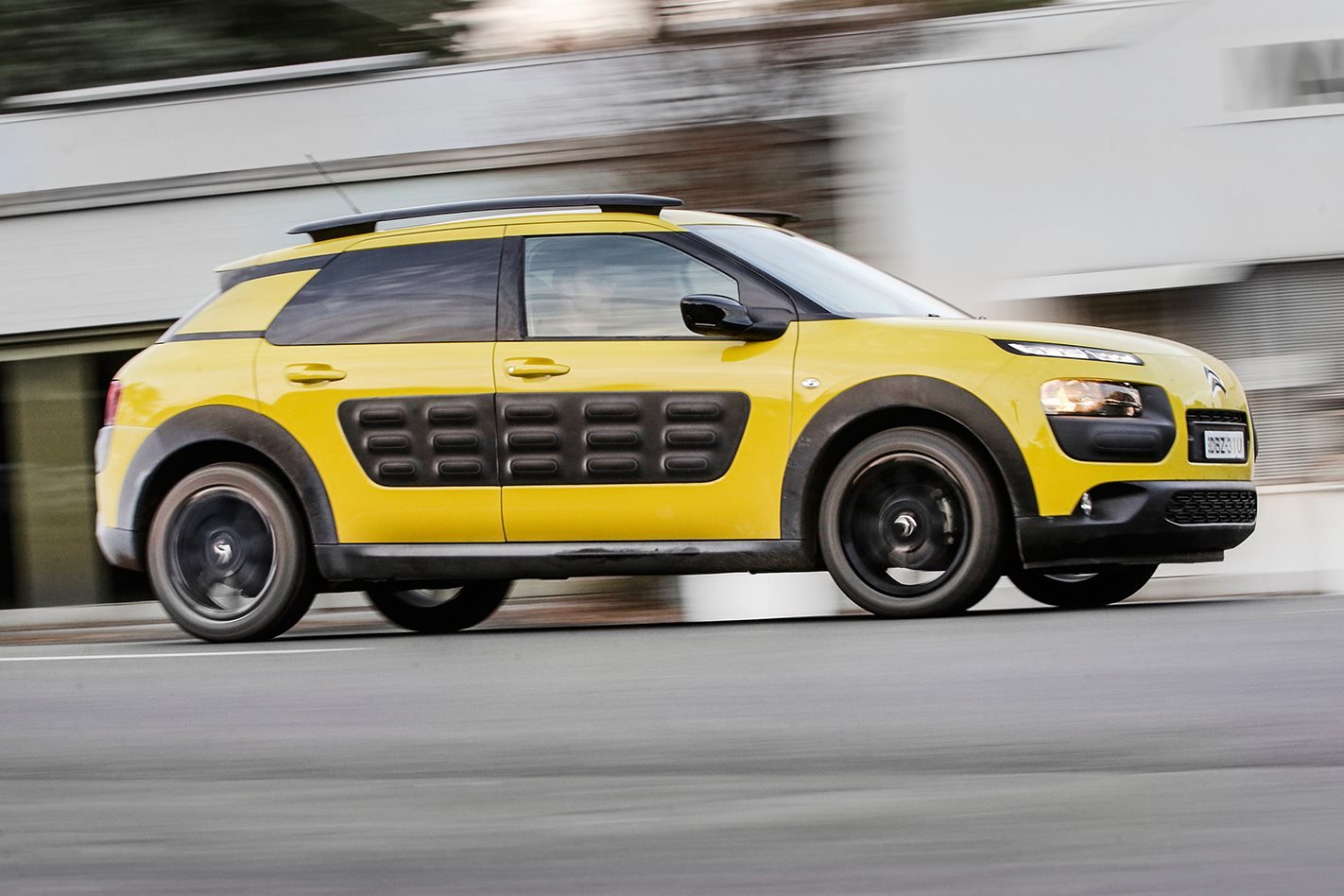
Isn’t it funny how quickly annoyances that were once easily dismissed as small and trivial can manifest into niggles capable of spawning white-hot rage.
Take my Citroen Cactus for example. When it was shiny and new, I didn’t care that its central touchscreen was a bit slow and clunky. Or that it doesn’t have one-touch electric windows, or that its damping isn’t perfect, or that its reversing camera activates at the speed of global warming. And can you blame me? When a car looks this interesting and has an interior this quirky, of course I’d focus on the bigger-picture positives.
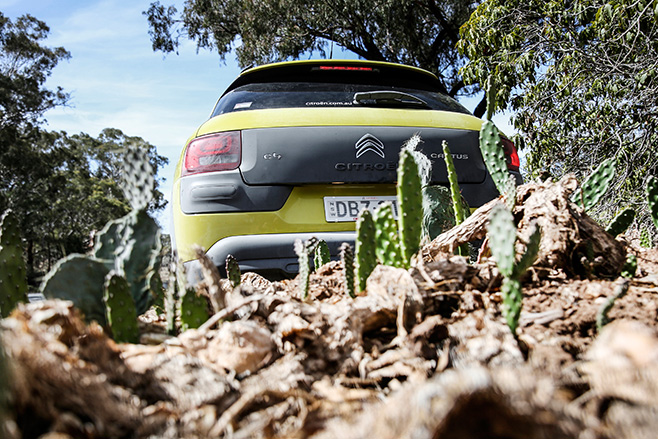
But now we’ve spent eight weeks together, I’m afraid my affection for the shiny yellow Cactus has lost some of its sheen. The touchscreen is of particular annoyance because, unlike the majority of cars, which have physical buttons for important functions, the Citroen’s screen controls everything. Well, everything of significance. Feel like adjusting the temperature? Prepare to dive into the digital menus. Want to change the radio station or turn off the idle-stop? Better start jabbing.
Admittedly, the Cactus isn’t alone in having the infotainment system control most functions, and it wouldn’t be such an issue if the touchscreen worked seamlessly. But sometimes it’s so unresponsive you may as well be fingering your nose.
At least the upside of having fewer buttons is a beautifully stylish and uncluttered dash.
The rest of the interior is also a triumph of design, and clever packaging means it’s not only pleasing to the eye but comfortable and practical, with plenty of handy storage cubbies. I especially love the soft cloth seats, which feel like my grandfather’s lounge chair.
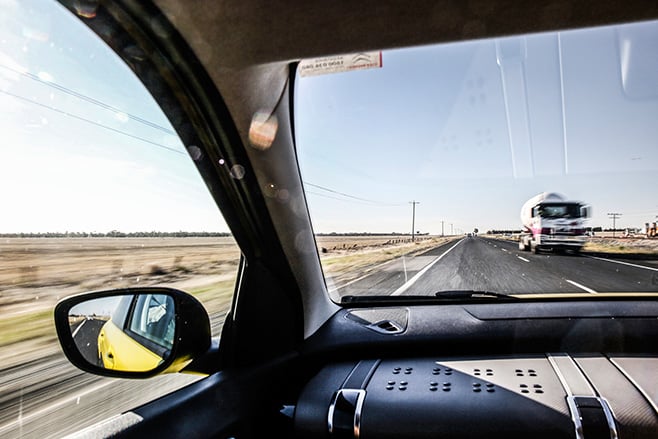
The other shining positive that’s bubbled to the fore is the Citroen’s brilliant turbo triple. I admit stepping out of an HSV Clubsport, which had five times the capacity, was quite an adjustment, but the more I drive the Cactus the more the little 1.2-litre three-pot warms my heart. Outputs of 81kW and 205Nm don’t scream eager performance on paper, but in practise it’s lithe, responsive and wonderfully elastic – factors helped by a 1020kg kerb and leggy gearing. And then there’s the rorty thrum, which only adds to the Cactus’s perky personality.
What I’m yet to explore in detail is the dynamics. Our time together has so far been limited mostly to the freeway, but that’s about to change. Car of the Year testing starts next week and the Cactus is part of this year’s field.
Fashion fail
If the cliche ‘Happy wife, happy life’ holds true, then the Cactus isn’t doing me any favours. Turns out it doesn’t have a vanity mirror for the passenger, which I’ve learned is an unforgivable oversight. The driver does get a mirror, complete with a light, but when I pointed this out it only seemed to make her madder. She’s also not entirely enamoured with the Citroen’s looks, and nor are some of my friends, who bandy about words like “try-hard” and “cutesy”. But what do they know? I reckon the Cactus looks great.
Update 2: Conclusion
The Citroen Cactus’s concept-car styling is a brave breath of fresh air in today’s same-same market, although we could do without the bug splatter.
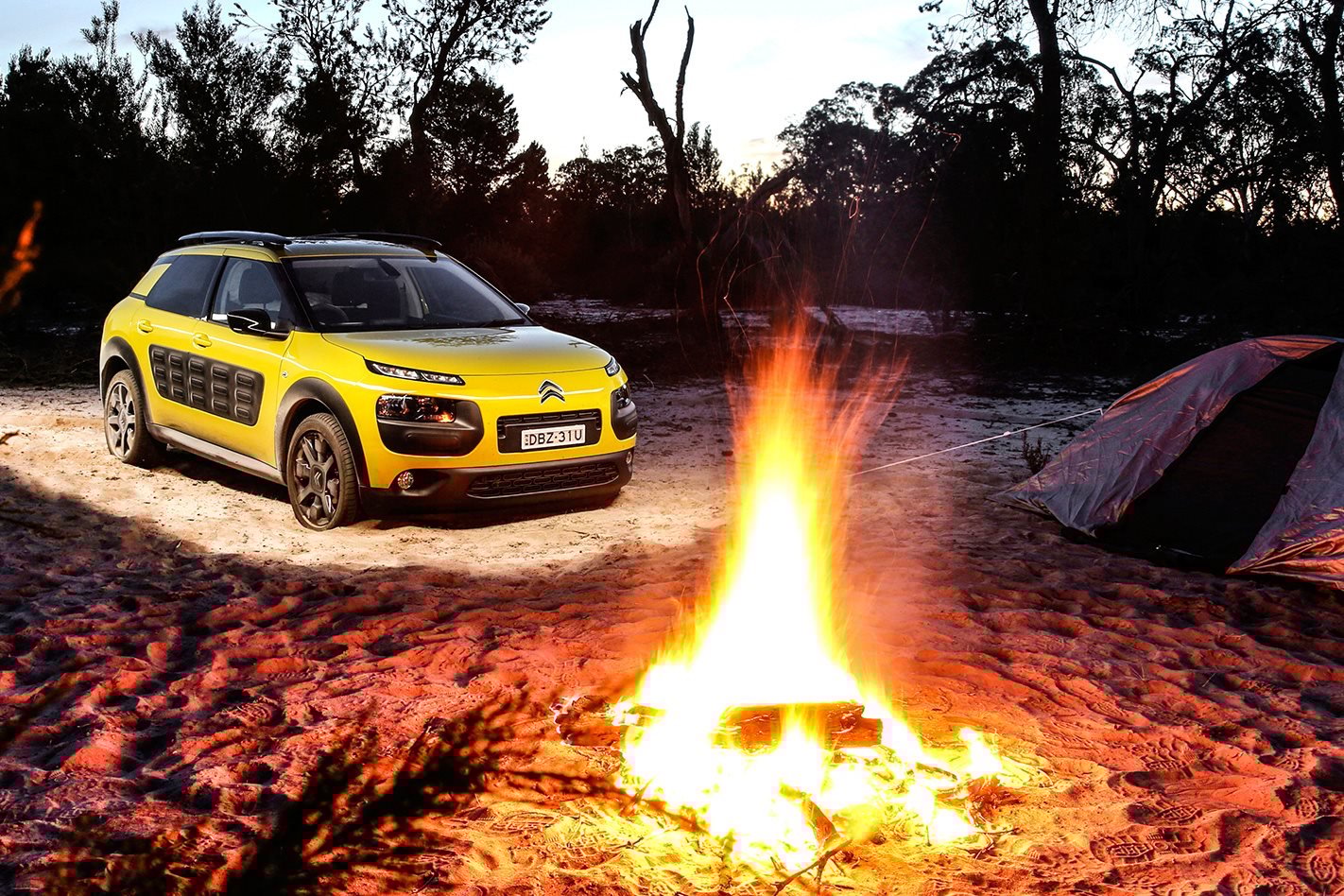
AND just like that, it was gone. Having left for a global launch in Portugal with our bright-yellow Citroen Cactus parked firmly on my street, I arrived back to find an empty space, the car having been whisked away by the Wheels crew and returned to Citroen.
Turns out someone wanted a yellow Cactus with the sweet-shifting manual and perky 1.2-litre petrol triple so desperately that Citroen sold mine from under me. I’m told it was destined to be someone’s Christmas present which was great, as long as they didn’t mind a few bugs and flies. When it left, the Citroen’s nose was covered in them, its last journey in my care having been a frantic four-up last-minute dash from Melbourne to Mildura to attend a family funeral.
With nothing larger at hand, I’d crammed the wife, my sister, her boyfriend and the family dog into the Cactus for the 1200km round trip and, despite my wife’s “you’re kidding me, right?” glare as we all stood on the footpath and prepared to climb in, we fitted with ease. In fact, despite the occasional lob of dog spit, I’d say all four (or five) of us were supremely comfortable.
A lot of this is down to the Citroen’s lounge-like seats, which have soft cushions and, in the second row, offer excellent under-thigh support. There’s an impressive sense of space, too, helped by the low window line and huge, single-piece panoramic roof, which is a must-have $1250 option.
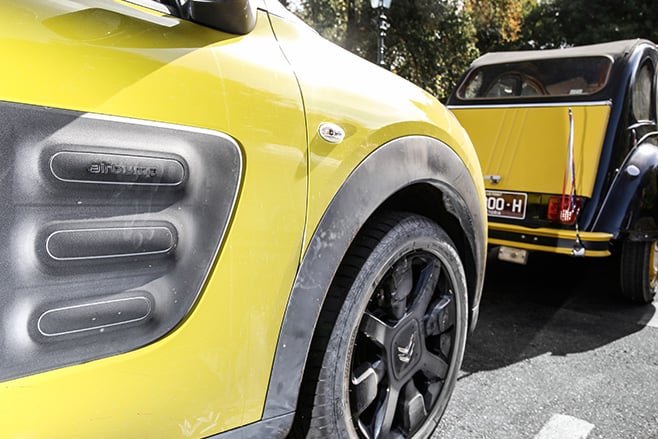
Stretching the Cactus’s legs on the freeway deepened my affection for its charming drivetrain. With the cruise set to 110km/h, it loped along with refined grace, yet was elastic enough to deliver swift and decisive overtakes around the many trucks littering the dual-carriageway, sometimes without needing to change down from top.
Long stints at three figures also reinforced the engine’s excellent economy, though not by as much as I’d expected. After months of returning fuel readings in the high fives and low sixes in heavy city traffic, I’d hoped the Cactus would sip substantially less on the open road. But with four (or five) bodies on board and its square, bug-catching front end punching a hole in the air, the best it achieved was 5.6L/100km.
Less desirable was an annoying amount of road noise on coarse-chip surfaces, and the steering, which wandered at freeway speeds and needed constant correction to remain in the centre of the lane.
Still, the ease with which the Cactus chewed up the country miles cemented the depth of its ability, both as a frugal city runabout and surprisingly spacious long-distance hauler.
It’s not perfect, of course. I’ve complained about the finicky touchscreen before, and the decision to only offer the 1.2-litre petrol with a manual transmission is terribly short-sighted in auto-fixated Australia.
For now, the only auto Cactus available is the 1.6L diesel, which uses a slow and jerky semi-automated six-speed. Little wonder then, that Citroen only sells a handful of Cacti each month.
Yet somehow the Citroen’s personality overcomes these faults. Its quirky, concept-car styling is a brave breath of fresh air in today’s same-same market and I hope the new owners appreciate it as much as I did, bugs and all.
We’re going to take a stab here: as an enthusiast, the undiluted sound of multiple open throttles and unmuffled exhaust pipes is music to your ears.
We’re also going to guess that, a bit like your mainstream car buyer, you despise excess wind rustle, tyre roar and suspension noise entering your car’s cabin.
There, with ever-tightening exterior noise regulations, you have the reason for the rise of the synthesised engine noise system.
But not all fake induction and exhaust sound systems are created equal. Let’s group them into two camps – those that are good, and those that are evil.
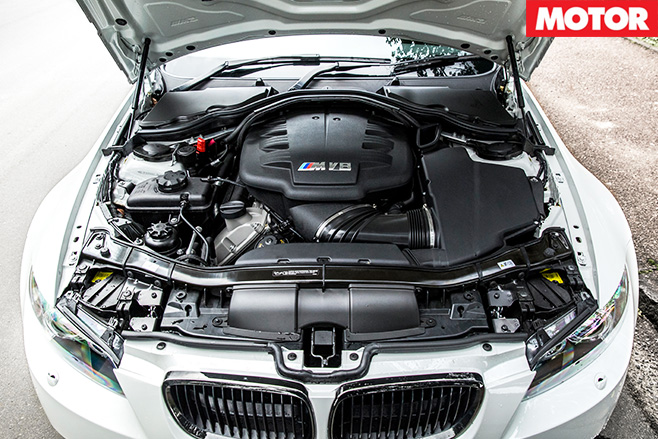
That out of the way, let’s focus on the good. In the Lexus LFA, Toyota 86/Subaru BRZ, Porsche’s Boxster, Cayman and 911, and HSV variants equipped with the brand’s bi-modal intake system, the induction note is real, but it has been acoustically amplified in a diaphragm before being channelled into the cabin. As synthesised sounds go, this is good.
Of course, within each categorisation, there are subtly different approaches. Renault’s R-Sound Effect app offers a menu of race and road cars and plays a recording of your selected car through the speakers in-sync with your throttle input. This takes the gimmicky angle. A Clio doesn’t rev as hard as, say, a Nissan GT-R, so the six-pack soundtrack sounds more like a Nissan Altima.
BMW’s Active Sound system is more difficult to accept, because howling, atmo M models used to be some of the best-sounding cars on the road. Now they play a backing track to the driver – a pre-recording of the car’s exhaust from the outside. It sounds fake. And it is.
The Lexus LFA’s system, which directs a V10 symphony into the cabin, is good, because it takes one of the sweetest road-car soundtracks ever, amplifies it and sends it to the driver, without any electronic intervention. This, in our books, makes such a system much more than a necessary evil.
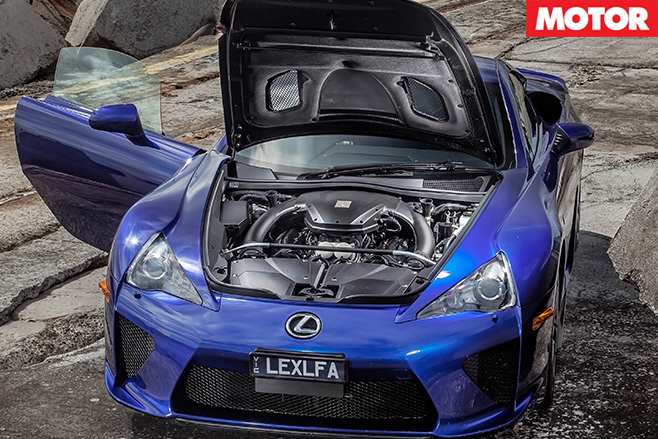
Today’s car buyer demands refinement with character, and electro-noise systems are how their makers have delivered them. In other words, if you don’t like it, you have only got yourself to blame.
Synthesised induction sound systems have only been common for around a generation or so. If, when it comes to induction sounds, you prefer to keep it real, do like us and look at cars released pre-2008. Or delve deep into the carby-era for aural inspiration.
1. INDUCTION FIDDLINE For the LFA, Lexus engineers made the V10’s induction plenum chamber vibrate like a violin body to enhance the tonal quality of the intake note. Resin construction replaced aluminium when it was found to deliver the desired vibration.
2. FINE BODIES Not only did they increase response, individual throttle bodies allowed Lexus more precise control of the intake air, and thus the resulting exhaust pressure waves. Emission rules almost ruled out the use of the bodies altogether, though.
3. HEAD STRONG Equal-length headers crispen the note, feeding it through twin sub-mufflers into a main muffler. Above 3000rpm this muffler forces the gases through a single chamber that changes the note’s quality to deliver the signature F1 scream.
4. PIPE MASTERS It was found that 10mm changes to the length of the connecting pipe between the exhaust’s dual banks altered the “chords and disharmony” of the exhaust note. The howl produced by the final length “makes the air tremble,” Lexus says.
5. DRILL BIT Crudely, Lexus describes the means of getting engine noise into the cabin as “drilling holes in the bulkhead”. Yamaha, however, tells of a four-component ‘sound conveyance device’, complete with a ‘dragon eye’ sub-path, that richens the note.
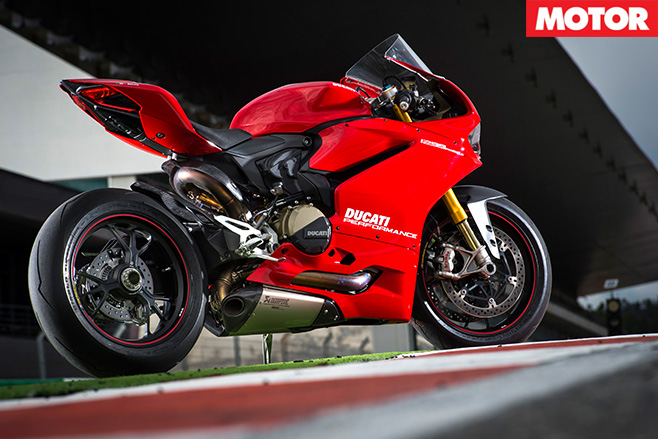
HEAR ME COMIN’
THE two-wheeled brigade has sworn by this motto for decades, but it could soon carry into the car world. Whether for bikes or cars, there’s truth in their loud-pipes logic. A vehicle that a fellow road-user, or pedestrian, can hear coming is safer than a quiet one.
High-performance cars in need of a bit of high-tech sound augmentation is one thing, but pure electric cars have uncovered a new need for synthesised sound. Given the average electric car whirrs along with little noise, artificial car sounds – they could be fake engine noises or a more utilitarian warning – could become a necessity rather than just an affectation of today’s over-refined performance cars.
QUICK question: who’s the current holder of the Peter Brock Trophy?
If you’ve answered Will Davison or Jonathon Webb, most recent winners of the Bathurst 1000, you’re talking about a piece of Johnny-come-lately tinware. The real Peter Brock Trophy dates back more than 40 years, and marks a similarly sizeable achievement in its field of motorsport.
It’s just that the motorsport is a lot smaller.
The Peter Brock Trophy is one of the golden gongs in Australian 1:24-scale slot car racing. The annual, stand-alone race, held in recent years at King Willy’s Raceway in Melbourne, has been fought over since 1974. In the first year, Brock personally presented the trophy at Melbourne’s Quikslot track.
The list of winners reads like a who’s who of the Open Group 7 category, in which the aero-bodied ‘wing cars’ reach actual speeds of 180km/h. Among the most successful is four-time winner and former full-time professional slot car racer Wayne Bramble.
In 2016, Wayne’s son Cody (24) joined the winners’ list; the first father-son victory. For Cody, the Peter Brock Trophy means more than his two national titles in 2013 and 2016.
“My father had told me stories about how Peter Brock used to come to the race and hand out the trophy,” Cody says. “The first time I went to Melbourne for the race, when I was 16, I could not do one lap on the track without crashing. Ever since then I was determined to win the trophy. I went every year, won a couple of the lower classes, but it took me 10 years to win Group 7, the Peter Brock Trophy race.”
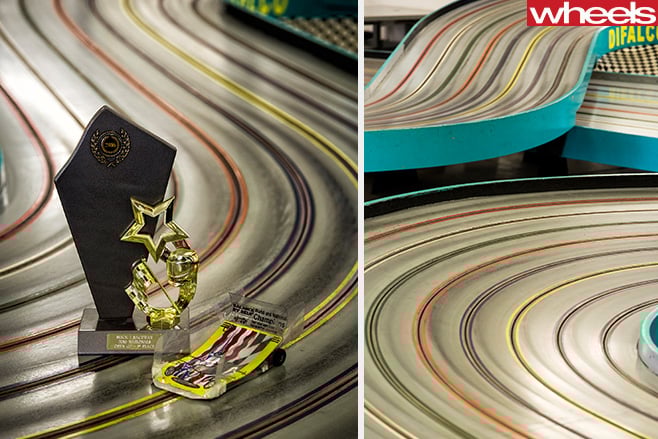
“It’s a 155-foot [47.25m] track and the cars are doing two-second laps [averaging 85km/h],” Cody explains. “You’re lifting off the throttle four times a lap. It’s hard to win on that track because there’s always a lot of accidents, you’re constantly on the lookout for a pile-up or cars on your lane.”
Cody sure has the genes for it. “My dad started racing when he was nine. He’s 61 now. He’s raced all kinds of classes, he was the number one in wing cars here in the early 1980s, so he moved to the US to pit himself against the best in the world.”
Wayne ended up being a sponsored, professional slot car driver, travelling the US and the world for Camen Products. Twice national Group 7 champion (most recently in 2011), Wayne is also the only Australian driver to have won a World Championship (1989). “He was a pro driver from 1985 till about 2002, lived in the US for 30 years,” Cody says. “He was making real good coin, too.”
Cody, by day a truck driver for The Smith Family charity, got the slot car bug when he was eight, living in Michigan. “It was just a local race for 1:24 sedans – flexi-cars, as they’re called – and I ended up coming second. Been doing it ever since.
“Once my father backed off from his racing, that’s when I learned more about putting chassis together, building motors, airbrushing bodies, all that stuff. I enjoy all that more than the racing, really. But all the tracks we race on now, set-up isn’t as much a factor. It’s turning into a horsepower hobby.”
It’s no secret that Toyota’s engineers are busy cooking up a spiritual descendant of the dearly-departed Supra sports car, but rumours that ToMoCo’s neo-Supra may be marketed under Toyota’s nascent Gazoo sub-brand are definitely a surprise.
What’s Gazoo? Good question. Unless you follow Toyota’s factory racing efforts in the Japanese Super GT series and, more recently, WRC, Dakar and the World Endurance Championship, odds are the name Gazoo doesn’t mean much to you. Toyota wants to change that.
Gazoo wants to be to Toyota what AMG is to Mercedes – a home-grown sub-brand specialising in performance-tuned versions of vanilla-spec Toyotas. Up until now, however, the only road cars bearing the Gazoo name have been confined to the Japanese domestic market.
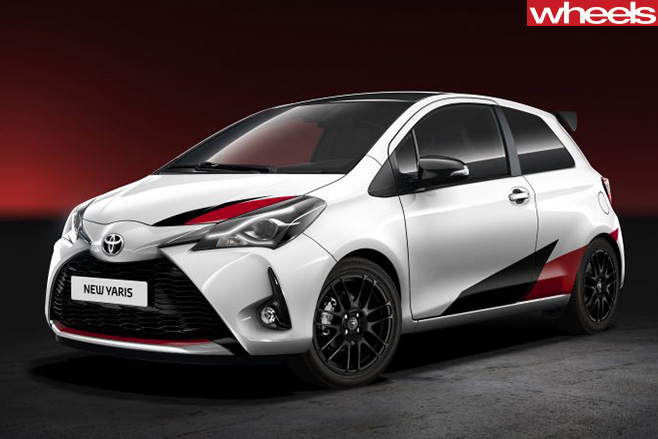
Which means zilch for us, because Toyota’s Yaris hot hatch ain’t coming to Australia. Boo.
According to UK mag Autocar, the Gazoo-tuned Yaris will be followed by the Supra’s successor, which will take position as the high-performance halo car for the Gazoo brand. Will there be a non-Gazoo version? At this point that detail is unclear, though Autocar quotes Gazoo boss and Toyota powertrain Chief Koei Saga as being gung-ho about establishing a global road car range bearing the Gazoo name.
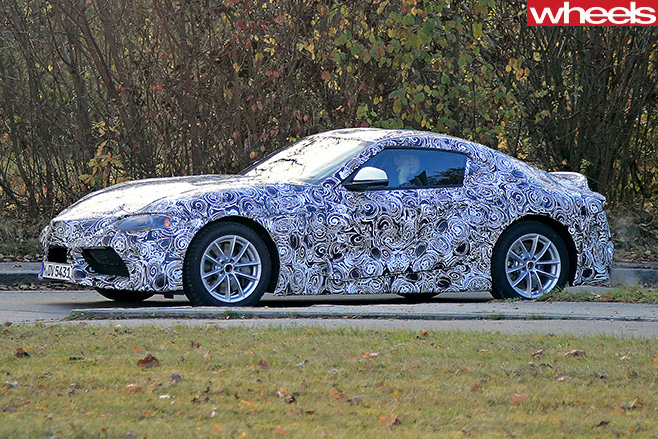
This is all speculative at this point, however. Toyota has yet to confirm its plans for the incoming sporty coupe, though expect all to be revealed later this year (potentially at the Tokyo Motor Show in October) ahead of an on-sale date sometime in 2018.
Toyota may have made the suspension of its facelifted 86 range softer than before, however a new Toyota Racing Development (TRD) package has now also been released to stiffen and lower the chassis for more dynamic handling.
Thanks to an increase in body rigidity, Toyota was able to soften the dampers of the 2017 86 in order to improve its ride quality without impacting on the outgoing model’s handling.
Above the standard car, though, a new TRD Lowering Spring Set is now available that claims to “offer a more aggressive stance as well as a lower centre of gravity.”
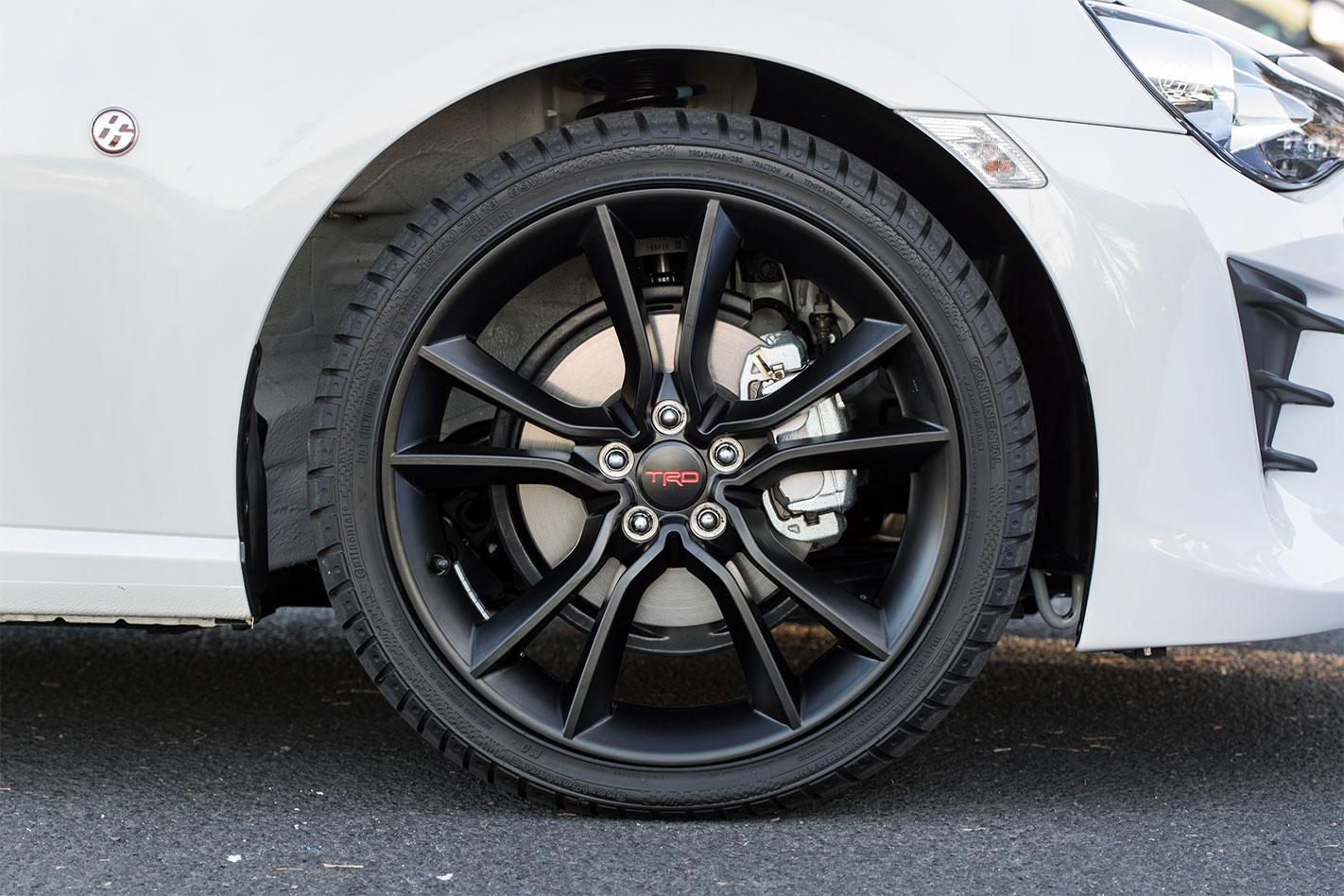
Buyers are recommended to pick the spring set in conjunction with an even more expensive TRD Sway Bar priced at $740 plus dealer fitting. According to the brand it “will help reduce bodyroll during hard cornering, improving handling and grip.”
“By transferring the force from the outer to inner spring it ensures an equal compression during cornering, therefore reducing roll,” it explained.
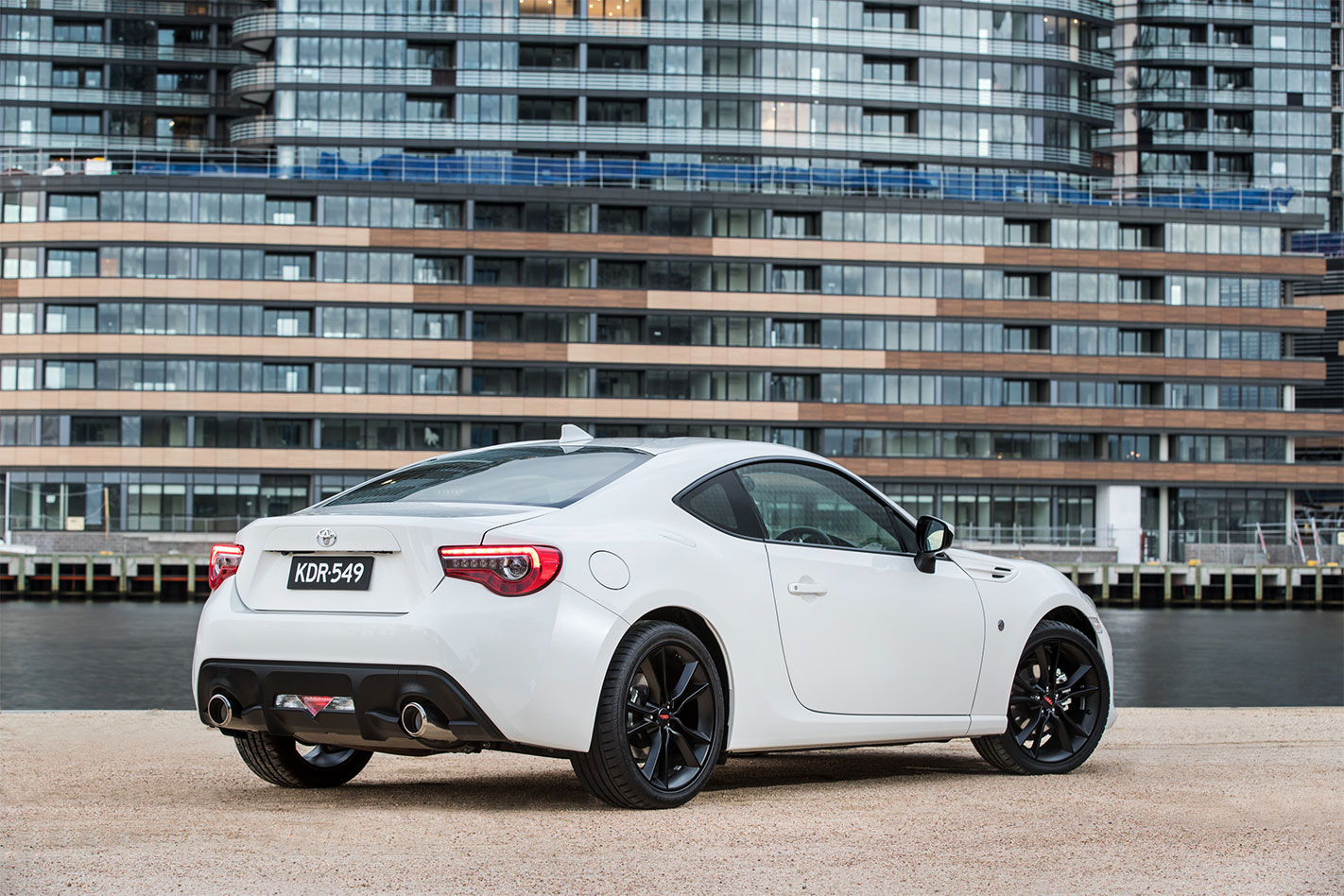
On a $30,790 (plus on-road costs) 86 GT, the upgrades ask for just under $3000 before fitment costs are applied.
Toyota Australia points out that although the TRD chassis accessories have been released with the facelifted 86 range, the additions are compatible with every 86 launched since 2012 as an opportunity for the 18,000-plus local owners to upgrade their vehicle.
Ford has declared a US$4.6 billion (A$6.1b) global profit for 2016, down by $2.8 billion ($3.7b) from the previous year.
But it wasn’t all bad, with the company’s total annual revenue up $2.2 billion to $151.8 billion.
The reduced annual profit, compounded by an $800 million loss in the fourth quarter, was due to a combination of factors including the reassessment of staff pensions, a safety recall over a door hatch affecting 1.5 million cars and the costs associated with pulling out of its small-car factory in San Luis Potosi, Mexico.
However, it was still enough for 56,000 union workers in the US to receive a $9000 profit-sharing bonus, which is far cry from the days of the Global Financial Crisis when the company just managed to stave off bankruptcy.
Ford’s earnings report lists a global market share of 7.6 percent, down a tenth from 2015.
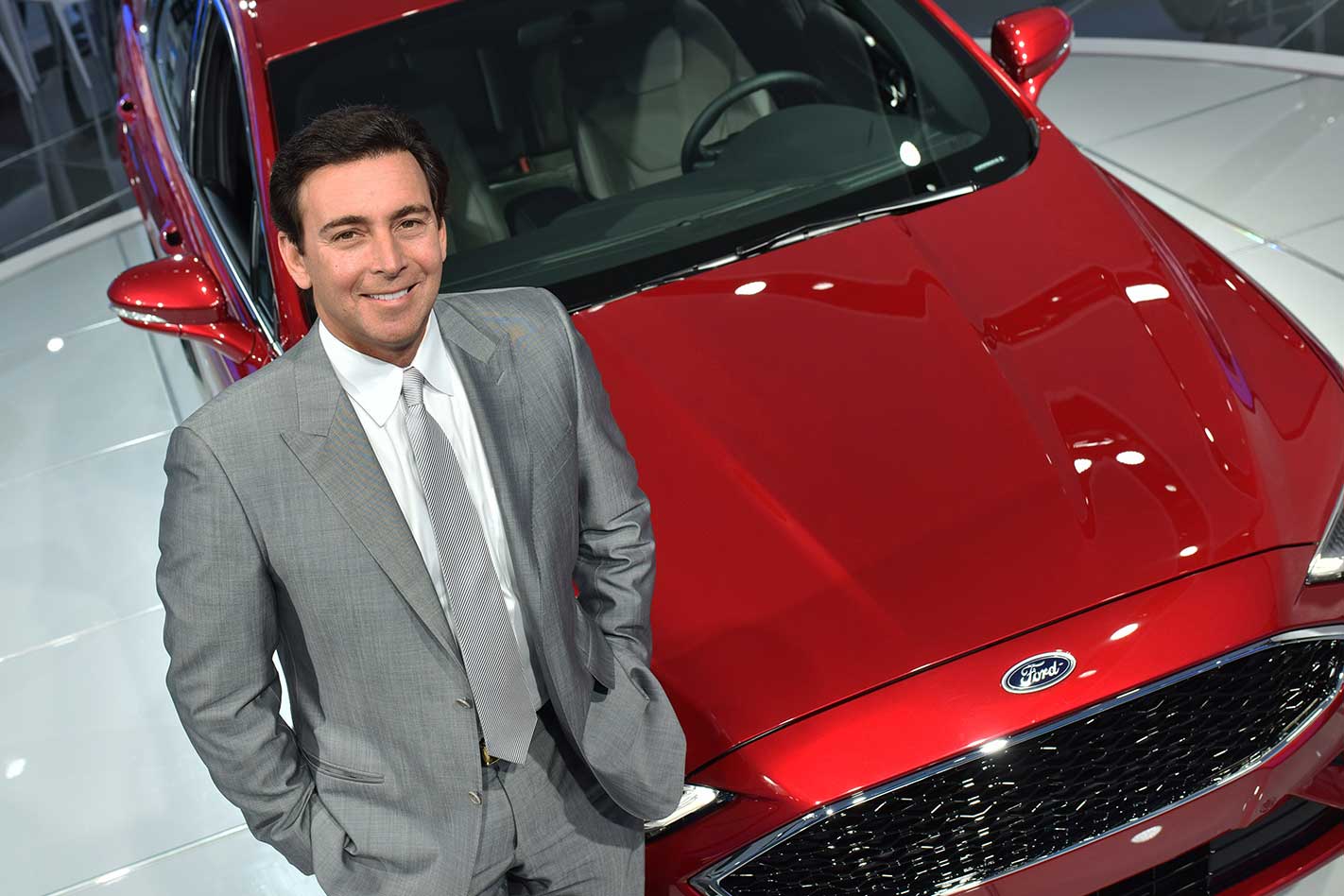
In North America the company enjoyed a 7.3 percent market share on the back of strong pick-up truck sales and pre-tax profit of $9.4 billion.
Ford’s European and Asia-Pacific markets posted their best and second best pre-tax profits respectively.
The company expects profit for its Asia Pacific market, which includes Australia, to “improve year over year, due to favourable volume and mix” particularly in China.
The South American, Middle East, and African markets all took hits because of unstable economies and other external factors.
Australia for some reason falls in the African market and while there were no specific numbers for Ford Australia in its final year of production, the company’s market share here was 6.9 per cent. Local sales were up 15.3 percent over 2015 with 81,207 cars sold.

“This year, we’re focused on building on our strengths, transforming underperforming parts of our business and investing in the emerging opportunities that will provide even more profitable growth in the future,” said Fields.
Meanwhile Fiat Chrysler Automobiles reported a net profit of $1.92 billion up from just $99.4 million in 2015.
The turnaround was due mostly to more profitable model mix helping arrest a dramatic sales decline in the North American market.
The result means 40,000 FCA union workers will receive a $5000 bonus.
