
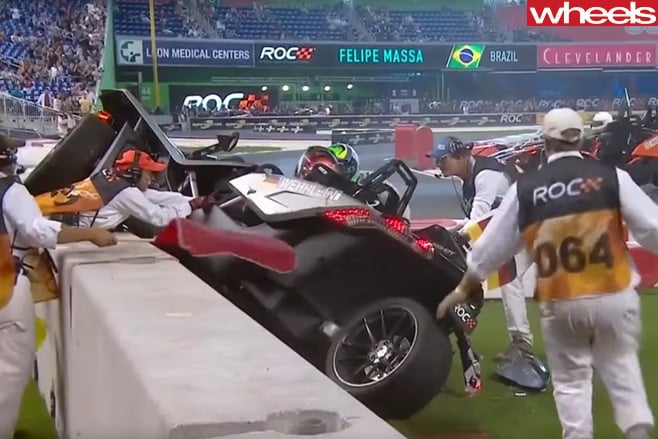
Formula One driver Pascal Wehrlein was advised to sit out of the Race of Champions Nations Cup rounds after an epic flip in a Polaris Slingshot three-wheeler.
Wehrlein under-steered the Polaris Slingshot, hitting the central barrier and forcing the three-wheeled vehicle into competitor Felipe Massa’s lane at Miami’s Marlins Park. The collision with Massa’s Slingshot caused Wehrlein and his passenger to flip into a side barrier.
Luckily, no one was seriously injured. In true display of sportsmanship, Massa jumped straight out of his car to assist his fellow F1 driver out of the wreckage.
The Polaris Slingshot is fitted with a rollover cage, and both Wehrlein and his passenger managed to escape unscathed. However despite minimal injury, Wehrlein was advised by doctors to drop out of the Nations Cup as a precaution.
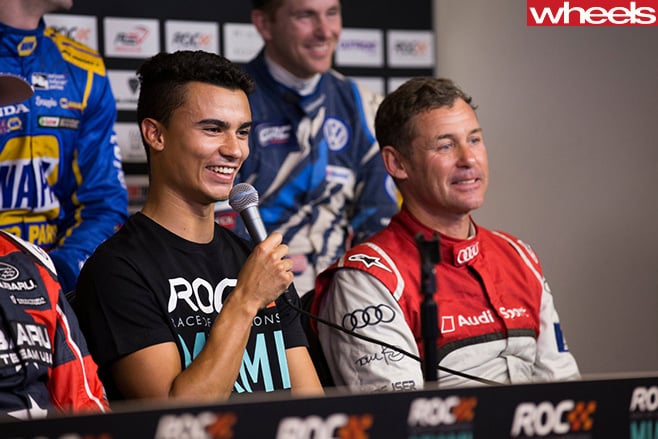
“So while I’m sad to be missing out on all the action, I send my best wishes to my team-mate Sebastian Vettel and the rest of the competitors here in Miami and I wish them another exiting day’s racing.”
The German-born F1 driver, who drove for Manor Racing last year, is preparing to suit up with the Sauber Formula One team for 2017.
“I started on the wrong foot but it helped me to take it a bit more seriously. Today I just wanted to get some more time on the track. I found the rhythm straightaway and it felt pretty good,” Vettel said.
“It obviously worked out well but of course it would have been nicer to share this victory with Pascal.”
The headline number for Ford is growth of 17 percent, at least quadruple that of its key competitors.
It’s the first time in some 12 years that Ford sales have grown. That growth has come from the Ford Ranger ute, which accounts for 45 percent of Ford sales. With the exception of Mustang, every Ford passenger car – Focus, Falcon, Fiesta – is down, as are Territory and EcoSport. Thankfully, the relatively fresh Ford Everest is doing modest numbers and putting a positive spin on its SUV family. Mustang was close to being Ford’s top-selling passenger car in 2016, which is an indication of how poorly others performed.
RANK: 5TH 2016 SALES: 83K 2016 YTD results: 74,741 sales, up 16.5%, 6.9% market share 2017 FORECAST: 79K RANKING: 5th 79,000 sales (down 5%), 6.6% market share GRADE: B
Opportunities
As we’ve said before, Ford’s opportunities lie with anything that isn’t a Ranger. It has an almost unhealthy reliance on the ute, which will come under increasing pressure as competition ramps up over the next few years. And while Ford’s focus has been on natural demand rather than discount deals, the hard truth is that sales of Focus are dismal and EcoSport has bombed in what is a booming small-SUV segment. So Ford has to work out a way to make those fire. An updated EcoSport and the revival of the Escape name (why was it ever shelved?) should help with SUVs, as will an expanded Everest family.
Challenges
The end of local manufacturing will gouge a massive chunk out of Ford sales; up until the October shutdown of the Broadmeadows plant, Australian-made cars accounted for 19 percent – almost one in five – of Ford sales. Without a direct replacement for Territory (an expanded Everest family will partially fill the void) or Falcon (buyers could look at Mondeo), there is more downside than up for Ford in 2017. The challenge will be eking more out of existing models.
Summary
A much-needed resurgence for Ford in 2016, but off the back of only two models. Storm clouds are gathering again for a company that struggles to sell anything but Rangers and Mustangs, so expect some of those gains to be wiped out in 2017.
THE WORLD Rally Championship held its first round of the season over the weekend, and it was a doozy.
The WRC has consistently been a brilliant spectacle, but for myriad reasons hasn’t been able to attract the attention from fans it deserves.
Well, if you were someone who had tuned out previously, it’s time to come back to the world of anti-lag, frightening speeds, gobsmacking talent.
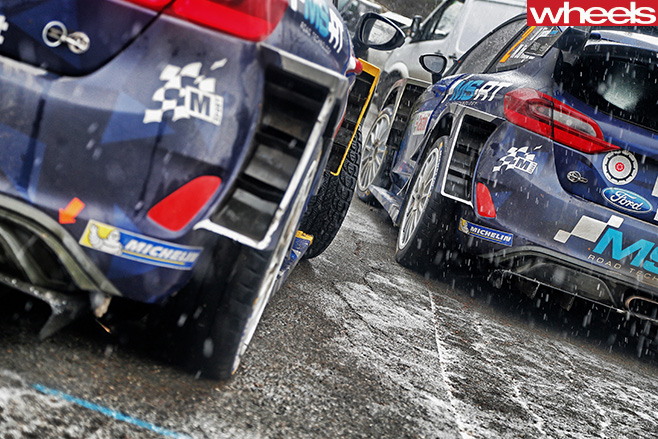
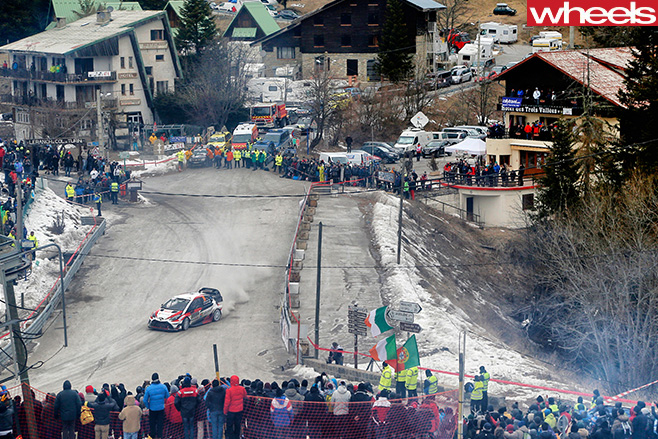
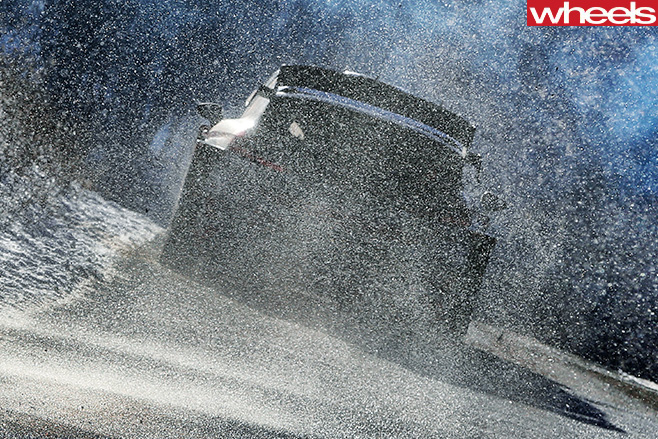
Anticipation and uncertainty were thick in the air at the start of the rally, mainly due to the new-for-2017 specifications, which allow for much faster, wider, and louder cars. Our friends at Motor have a rather comprehensive breakdown of WRC regulations on their website.
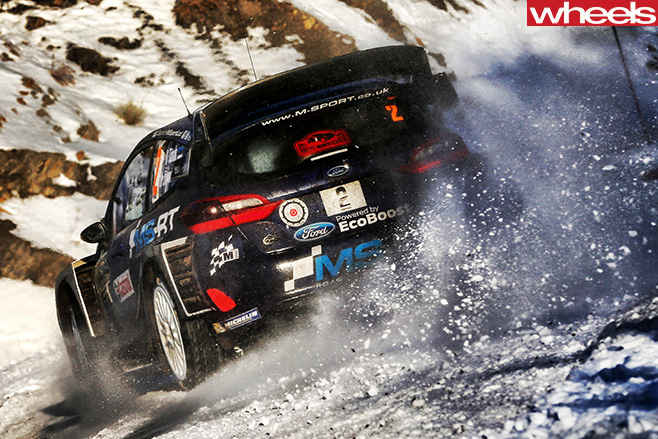
Defending champion Ogier ended up winning the Monte Carlo Rally for a fourth-time straight, but that belies this epic showdown, held on snow, ice, and tarmac over three days.
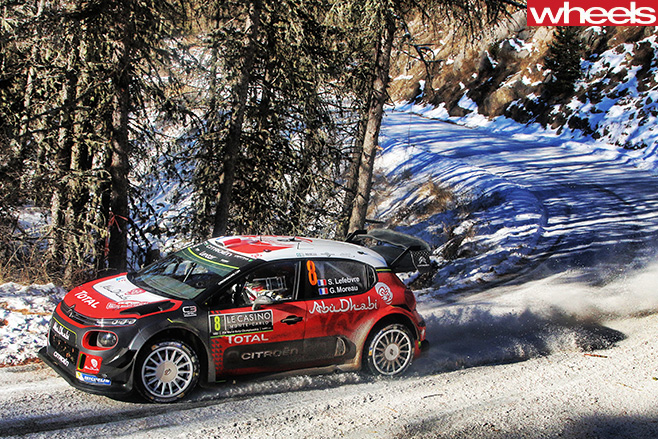
Then it was Belgian Thierry Neuville who took the lead, dominating the field in his i20, before his suspension broke on Saturday afternoon.
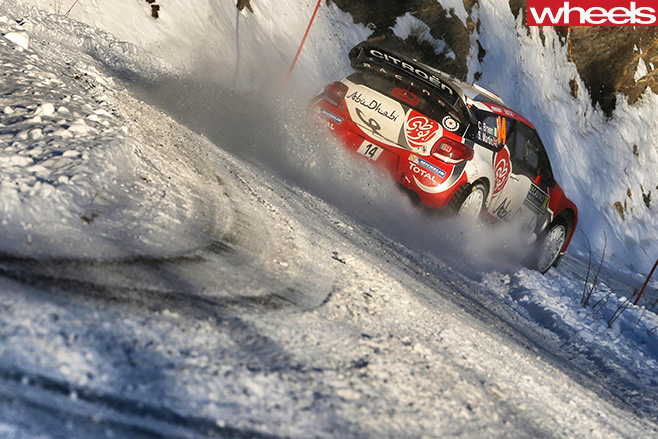
Chris Meeke had looked to be a podium contender, but was taken out of contention when a road car struck his WRC racer on one of the transit routes back to service.
If this wasn’t enough to convince you WRC should now be a part of your motorsport diet, Red Bull TV is showing the entire season live, free and on demand online – and they have some bloke named Mark Webber commentating.
Do yourself a favour, and get on it!
KIA has revealed local details of its fourth-generation Rio city car, which now offers crucial technology upgrades, sharper handling and a greater emphasis on quality as it takes the fight to the Mazda 2, Volkswagen Polo and Ford Fiesta.
Larger, more spacious and more comfortable than the model it replaces, the new-gen Rio is also now also available with Apple CarPlay and Android Auto for the first time, yet prices remain unchanged across the line-up.
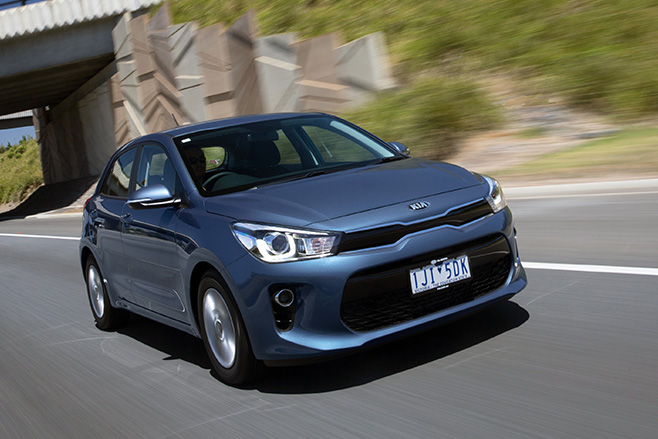
Starting at $16,990 for the base Rio S in six-speed manual transmission trim, the range tops out at $22,990 for the SLi with a four-speed automatic. Even sharper drive away deals are also being offered at dealers across the country.
Currently offered with a single engine option, every Rio in the three-tier range (S, Si and SLi) is powered by a carryover 1.4-litre four-cylinder engine producing a modest 74kW/133Nm.
The engine remains virtually unchanged from the previous-gen car, though has undergone efficiency improvements to see a minor official fuel consumption gain from 6.3L/100km to 6.2.
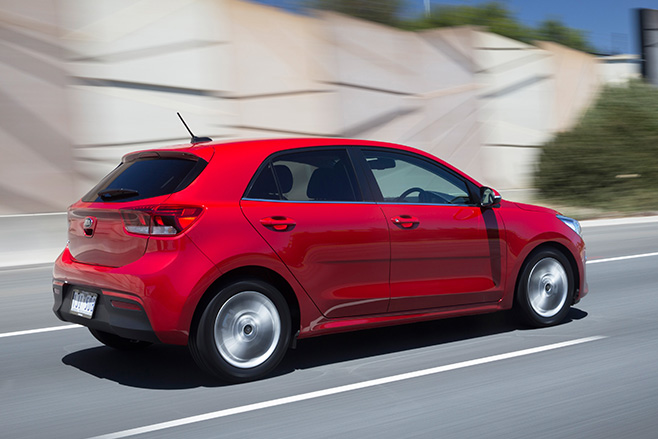
A more powerful and more efficient 1.0-litre three-cylinder engine is tipped to join the Rio line up in the near future, with Kia Australia currently evaluating the business case for a range-topping Kia Rio GT variant.
The GT will also add crucial safety upgrades, including the addition of Autonomous Emergency Braking. This potentially life-saving technology is currently absent from the new-gen Rio range.
“AEB wasn’t developed for the 1.4-litre engine,” Kia Australia product planner Roland Rivero told WhichCar.
“It’s strictly available on the 1.0-litre. At this stage we’ve added a lot of passive and active safety features to the Rio, but AEB is something we want in the future, absolutely.”
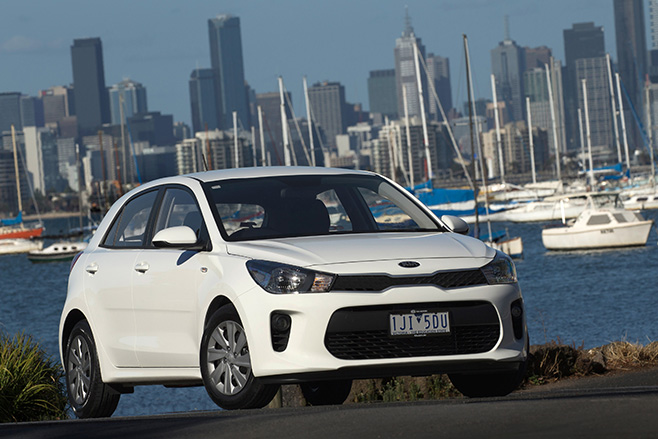
Like most of Kia’s model range, the new Rio has undergone extensive local suspension tuning to improve the comfort of its ride on lumpy Australian roads.
It’s inside, though, where the Rio’s improvements are felt most. Rolling on a wheelbase that’s now 10mm longer (overall length is up 15mm), the Rio’s cabin is now roomier and more comfortable.
Leg and shoulder room has increased in both rows, while boot space has also grown to 325 litres, which is amongst the best for this class.
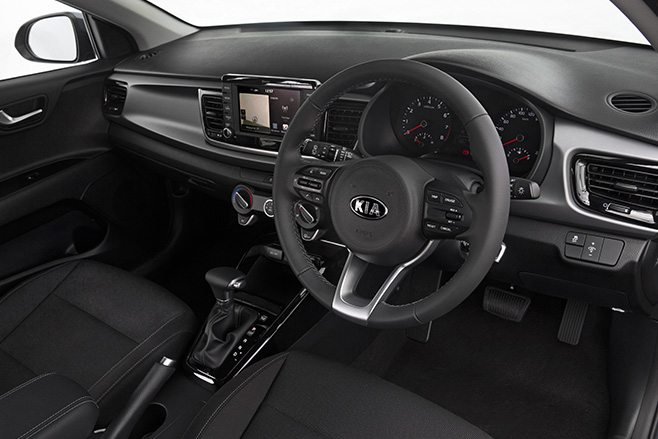
A redesigned and more-upmarket cabin imparts a distinct European feel, and standard equipment includes a 7.0-inch ‘floating’ central touchscreen, reverse parking sensors, reversing camera, keyless entry, automatic headlights and power windows. Si grades and above add satellite-navigation, digital radio and cruise control.
Kia Rio pricing
S manual: $16,990 S auto: $19,090 Si auto: $21,490 SLi auto: $22,990
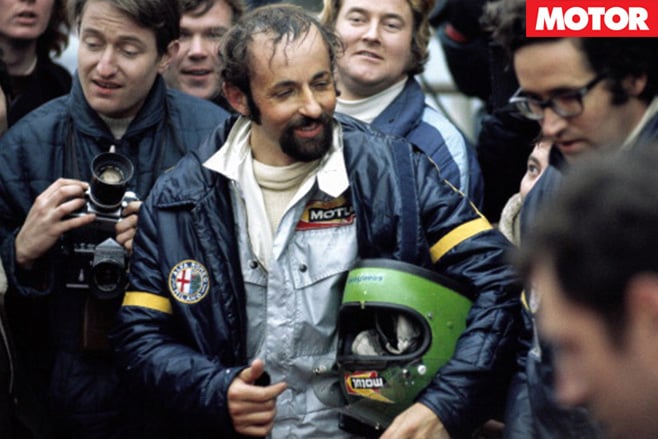
Any racer will tell you their helmet is much more than just a hard-hat. For some, like the wearers of these nine iconic designs, it even defines their persona.
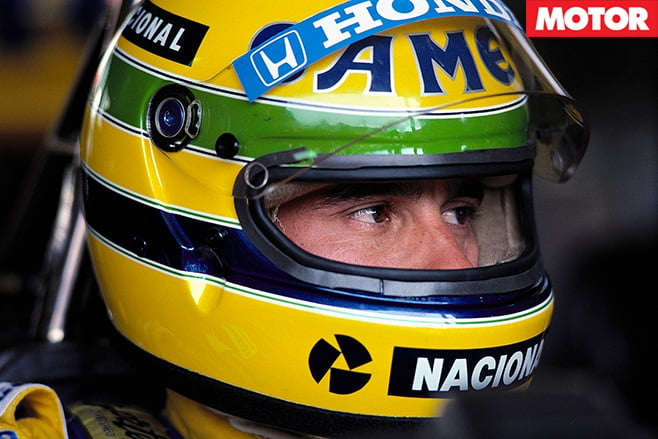
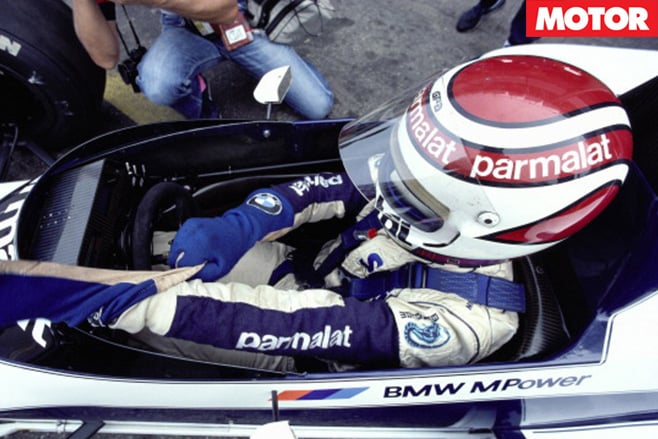
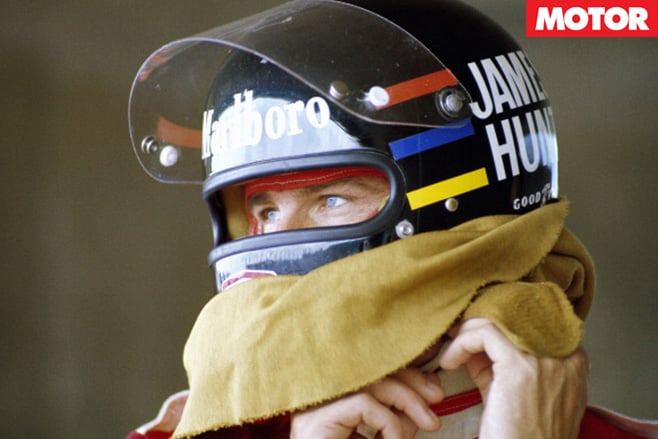
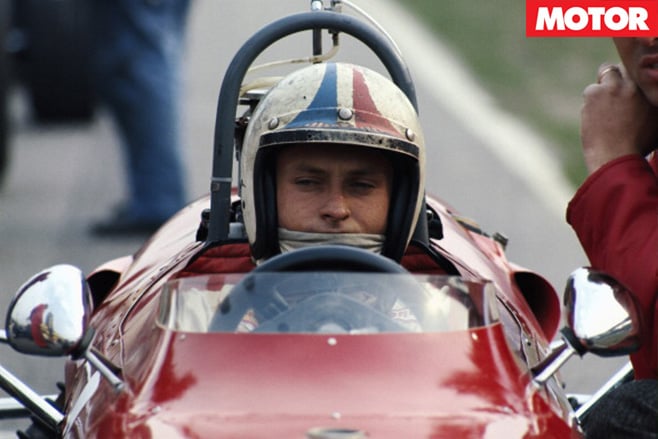
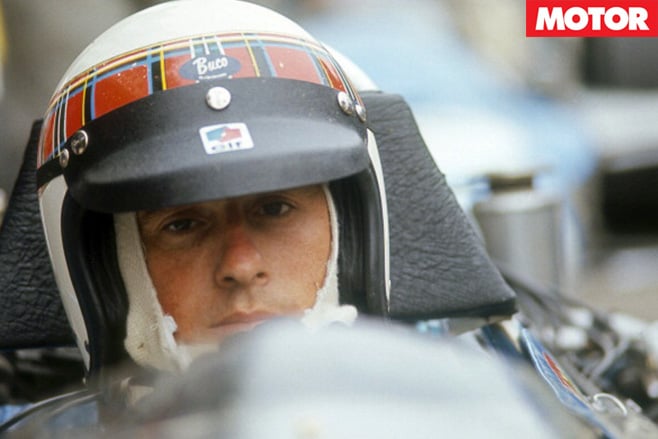
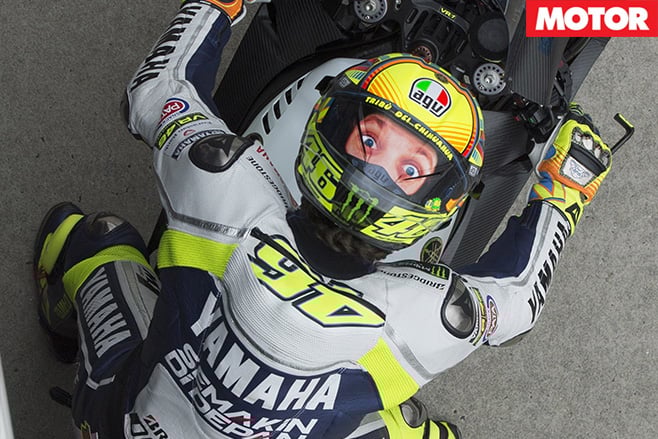
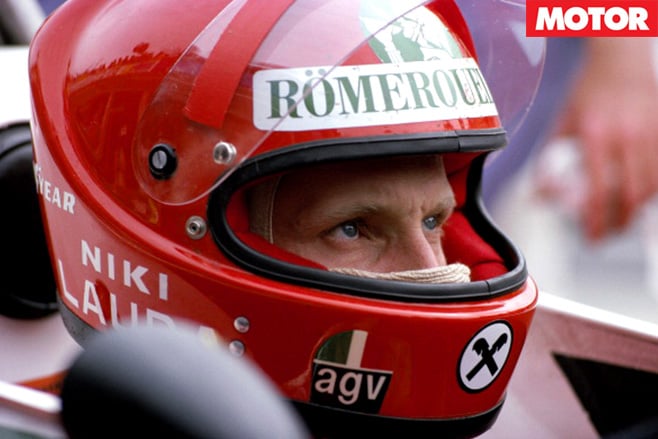
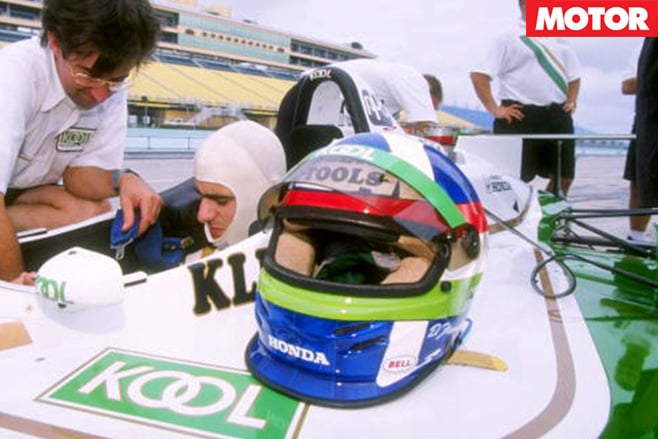
A long weekend in the F12 and the SLS Black? Now, that’s an adrenaline-pumping fantasy. And we’re about to make it a reality.
This article was originally published in the November 2013 issue of MOTOR.
The high-end products from Maranello and Affalterbach share a remarkably similar DNA: potent front-mid-mounted engine, slick seven-speed dual-clutch transaxle transmission, riveting carbon-ceramic brakes, striking aluminium-intensive two-seater coupe bodies.
Although Ferrari is in this league again, fielding a mighty V12 that develops nearly 100kW more than the German V8, the SLS SMG is 25 kilos lighter and aerodynamically even more efficient. Against the stopwatch, the F12 Berlinetta has a slight edge, but performance is not the decider in this shootout. What matters more are style and character, accessibility and response, adaptability and balance.
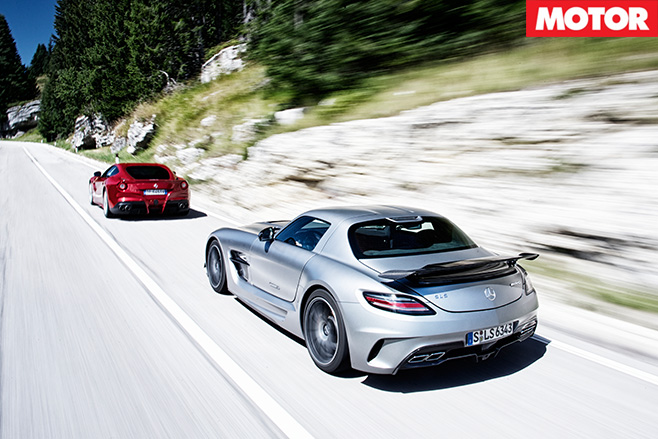
We could have tested these sophisticated sledgehammers on the Salzburgring or in Varano. However, a late summer loop across the alps from Bavaria through Tyrol to Northern Italy seemed like a more exciting, multi-faceted proposition. After all, the chosen route would include Vmax blasts on the autobahn, a handful of breathtaking passes guaranteed to change the passenger’s complexion from rosy to ivory, enough second-gear corners to kick up Michelin stock a fraction, and plenty of quiet, mercifully radar-free backroads.
However, what slowed our 1009kW convoy at times was the inevitable holiday traffic – and far too many fuel stops. After only 320km, the Ferrari’s red warning LEDs cried out for a refill for the first time. And the Mercedes was almost equally thirsty. At the pumps, 26L/100km (SLS) to 30L/100km (F12) were the rule, not the exception to it. Where the ubiquitous 130km/h speed limit was strictly enforced, the numbers improved to 14 and 16L/100km respectively.
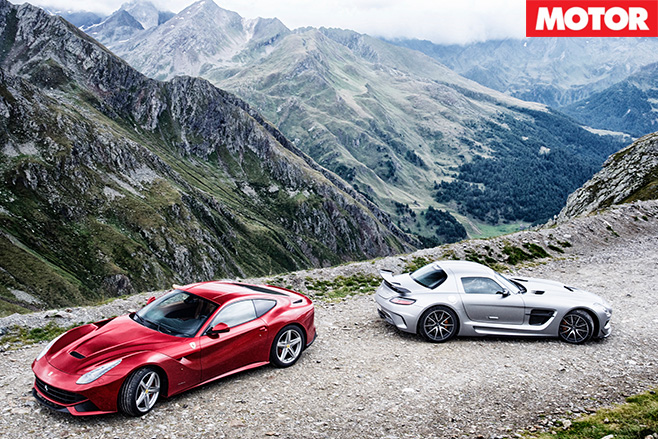
The SLS Black Series that went on sale in Europe in June was inspired by the race-winning GT3, and it shows, especially when you opt for the pricey aero kit fitted to the test car. Eye-catching add-ons include tailor-made wheels, carbon-fibre flics to support the deep front spoiler, four chromed tailpipes embedded in a chiselled diffusor, and a tall fixed rear wing which absolutely hates automatic carwashes.
Although the presentation is about as subtle as a Lady Gaga video, it does the job by significantly enhancing grip and downforce. Like the new CLA-class, the SLS relishes the wow effect it has on bystanders and other drivers.
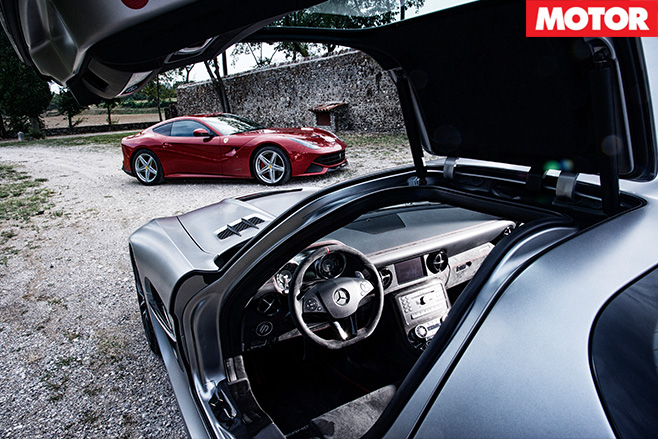
Unlike the Challenge Stradale, Scuderia and Speciale, the F12 Berlinetta does without provocative livery. The first Ferrari designed in-house by Flavio Manzoni rather than Pininfarina looks butch enough for a supercar, but at the same time it is strikingly chic and even more space-efficient than the larger 599 GTB it replaces. In contrast to the extrovert SLS and its martial wing-work, the F12 conceals its aerodynamic efficiency well.
Thanks to a complex and clever airflow concept that incorporates various subtle ducts and scoops, the spoilerless F12 actually generates twice as much downforce at 200km/h as its predecessor. When you drive it at the limit of adhesion from mountaintop to valley floor, two flaps in the front air dam open to cool down the brakes.
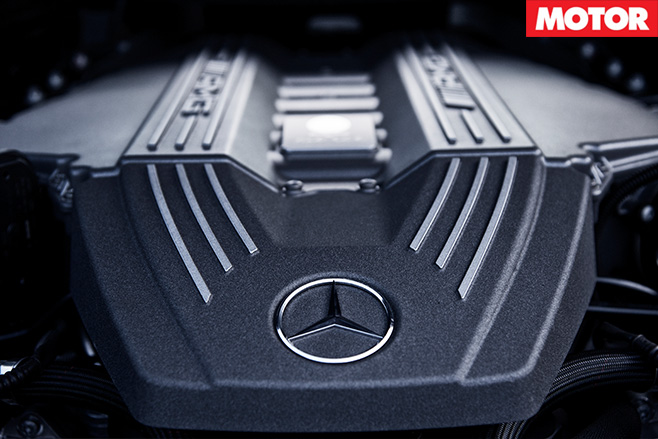
Maximum speed may not be a priority in North America, but it’s highly relevant in the old world, where plain-clothes repmobiles typically cruise at 200km/h. The 464kW Black Series can do 317km/h, which is actually 1.6km/h slower than the 420kW base model and the 435kW GT.
How come? Because this version is geared for more low-end grunt and even stronger mid-range acceleration. Thanks to a revised valvetrain, hotter camshafts, free-flow intake system and larger-diameter exhaust, the higher-revving 6208cc unit gains 30kW in power while the maximum torque is actually down from 650 to 635Nm.
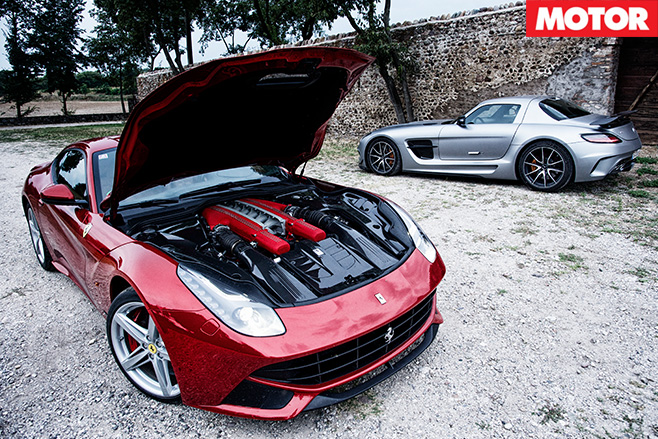
Due to traffic and weather, we never saw more than 290km/h in either vehicle, which is why the flat-to-the-horizon duel between red and silver was a dead heat most of the time. At any speed, the AMG car is noisier, more nervous and less well tied down on imperfect bitumen.
Although both vehicles use the same Getrag gearbox, different applications apply. In the Benz, you can choose from four shift programs labelled Comfort, Sport, Sport Plus and Manual. In the Ferrari, you have five manettino settings – Wet, Sport, Race, ASR off and ESP off – plus an auto mode.
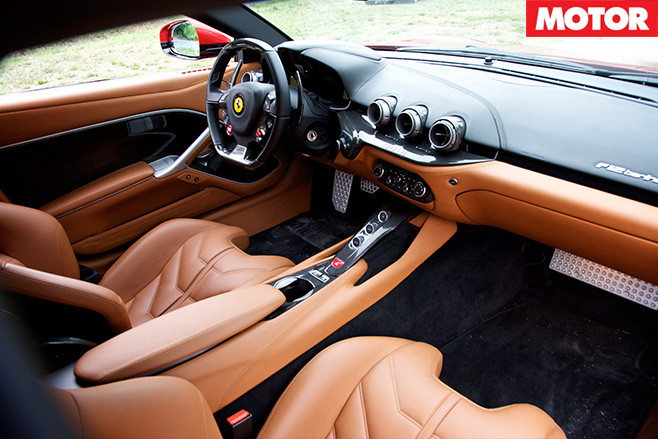
Those who prefer to let the car select the appropriate cogs might as well forget the Ferrari and zoom in on the SLS, period. In Sport-plus, the mighty Merc is eerily good. Sure, this gearchanging wizardry is 100 percent electronic, but the angry blat-blat that mimics heel-and-toeing, the perfectly timed lift-off misfire and the clutch-slip-induced kick in the butt that accompanies pedal-to-the-metal upshifts makes it a soundtrack worthy of the next Fast and the Furious.
After weaving our way through the metal maze on the A8 from Munich to Innsbruck, and meandering through a marathon cycling contest all the way to the end of an idyllic green snake better known as the Ötz Valley, the time has finally come to let the two crackerjacks off the leash.
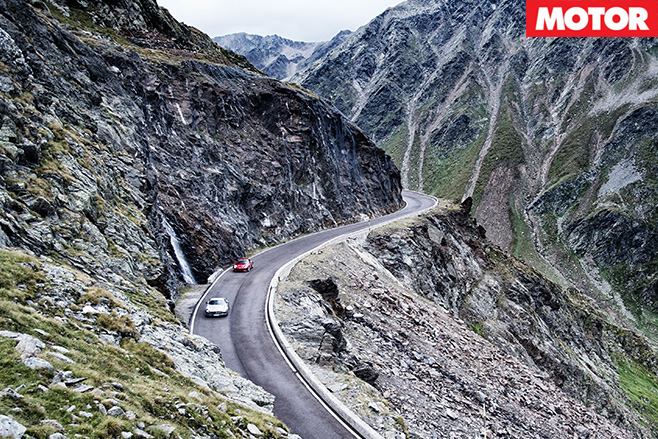
The Ferrari is better prepared for these treacherous conditions. Its Pilot Sport SUP road tyres hang on longer, snap-oversteer is less pronounced, and even with traction control switched off enough of that underlying confidence-inspiring creaminess shines through. The quicker steering, more compliant suspension and wider 20in rubber all help. Both cars have chip-controlled limited-slip diffs which distribute the torque efficiently between the rear wheels. And there is torque aplenty: the V8 has 635Nm at 5500rpm, the V12 690Nm at 6000rpm.
During off-season, we would have criss-crossed south through the Dolomites where legendary passes like Stelvio, Pordoi, Rolle and Falzarego beckon. But right in the middle of Ferragosto, when the whole of Italy is taking at least three weeks off, it was wiser to divert to more remote twisties like the Altopiano Dei Sette Communi and the Catena Dei Lagorai.
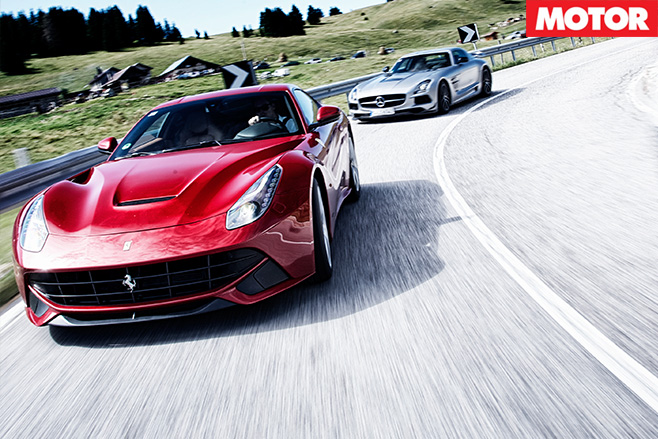
The Ferrari feels more at home in this beautiful but constrained habitat. Its steering is half a lock quicker, its turning circle is marginally tighter, its eye-catching body sits on a less squirmish wheelbase which eclipses the SLS by 40mm. Redlined at 8700rpm, the V12 does not only produce more top-end go than the V8, which expires at 8000rpm, it also serves a slightly larger portion of low- to mid-range grunt.
To qualify for the tiny Black Series badge, the chassis of the big bad Benz received a more muscular set-up with two-stage damping, firmer elastokinematics for better yaw suppression, a fatter anti-roll bar in the front for further reduced bodyroll, lightweight wheels, less power assistance for the otherwise unchanged steering, a wider track and bespoke tyres. This recipe works wonders on a circuit, but is to a certain extent counterproductive in the real world dotted with crests, dips, potholes, cattle grids and railway crossings.
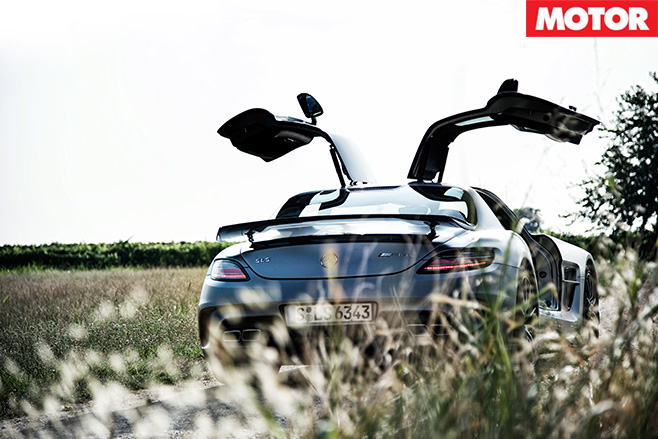
Where the SLS Black goes through teeth-grinding crash-bang-wallop motions, the Ferrari permits quantifiably more wheel travel, more generous shock absorber compression and rebound, and more body movement along both axes. The effect is a level of transparency and control the silver warrior on German plates cannot match.
Germany is autobahn paradise, Austria picture-postcard homeland, and Italy all that plus fast-car-friendliness. When you get stopped by a policewoman for trespassing in triple-digit speed territory on a rural throughway and the first question the lady asks is “Which car wins?”, you know for certain that you’re in Italy.
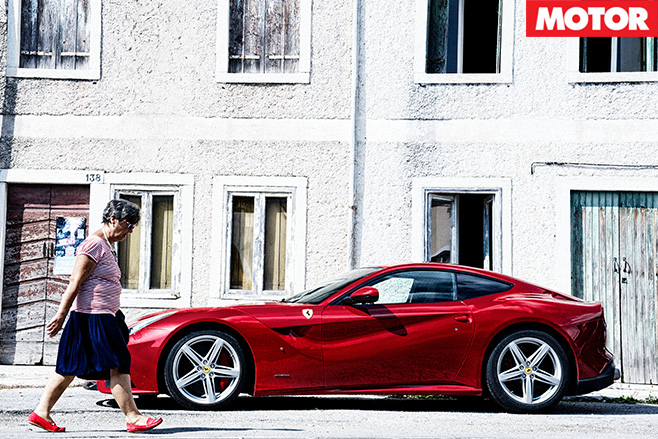
While the F12 soundtrack is composed primarily by flaps, valves, blades and actuators, the AMG engine is more of an exercise in acoustic technotronics. In both cars, ample perforation ensures that driver and passenger hear loud and clear what makes passersby cheer.
Where the great alpine amphitheatre opens up and the wide plains begin to spread their colourful blanket, the crisp and cool alpine air fuses with a misty warmth that pushes northwards from the Adriatic Sea. In the heart of the Veneto Province, we aim South and head for Vicenza, now travelling on much smoother, faster roads.
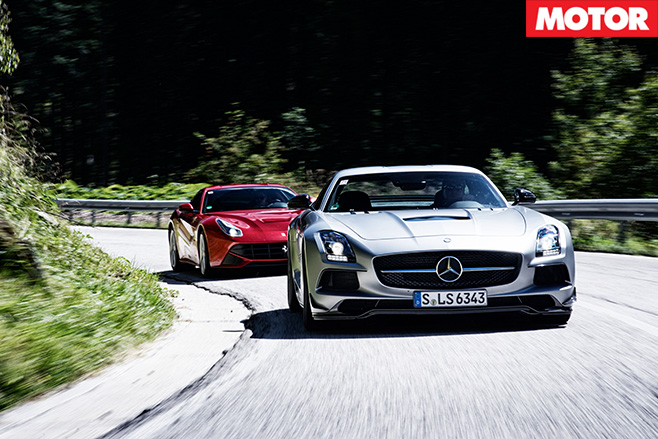
But every time their young eyes check the rear-view mirror, my face still looms large at the wheel of the SLS. There is no doubt about it: on the road, rather than the track, the broad-shouldered SLS AMG Black Series can keep up with every step the F12 takes. And while the Ferrari won’t shine unless whipped through its ratios, all it takes for the Benz on steroids to play grandmaster grunt is a firm stab at the throttle.
Miraculously, the autostrada from Piovene to Vicenza is as deserted as a supermarket carpark at midnight. But this short 32km feeder stretch to the busy A4 turns out to be a rough bit of blacktop with yawning expansion joints, ankle-deep aquaplaning grooves and a glistening surface polished by many summer suns.
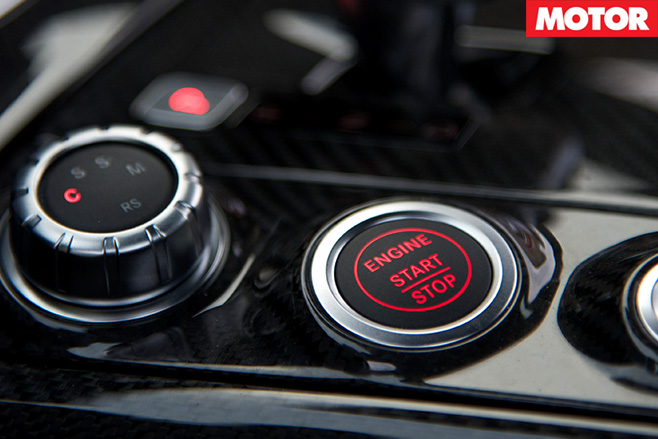
What this multilink kickback layout quite obviously lacks is a larger measure of compliance and a rear axle that works in sync with you rather than against you. On the racetrack, this uncompromising attitude rarely fails to satisfy. On 24/7 bitumen, it generates rather too much excitement for body and mind.
The F12 irons out these physical idiosyncrasies with aplomb. Unlike the SLS, which feels portly by comparison and has relatively heavy steering and muscle-building brakes, the Ferrari can be perceived as a wiry lightfoot with quick reflexes and sharp handling defined by consummate ease … up to a point. You see, even after three days, we felt the F12 steering was a bit light, especially when you wind on more lock, and the brakes are hyper-sensitive.
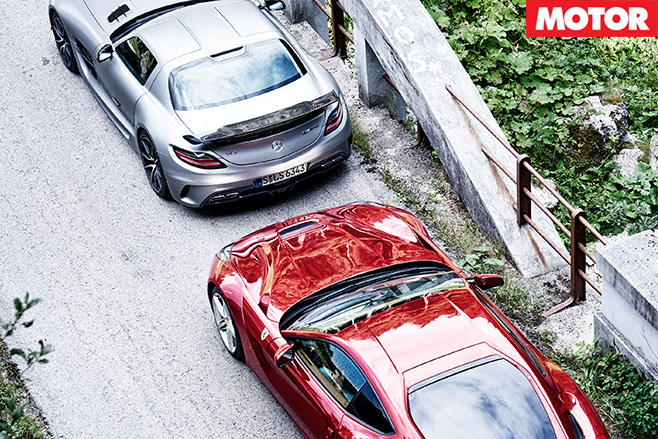
In Italy, where a litre of five-star fuel can cost A$3, or as much as a bottle of perfectly quaffable red, filling up these two behemoths seriously dents most travel budgets. But those who can afford an F12 or an SLS Black will probably not bat an eyelash, having forked out almost A$700K and around A$640K respectively for their evocative playthings (sans extras).
If you plan to use your car as a daily driver and aren’t interested in racing it, save yourself some money and buy the regular AMG SLS. But if you’re looking for a seriously fast and competent track-day special, and you want the enhanced street cred the go-faster package might provide, this special SLS will generate more smiles per slides, guaranteed.
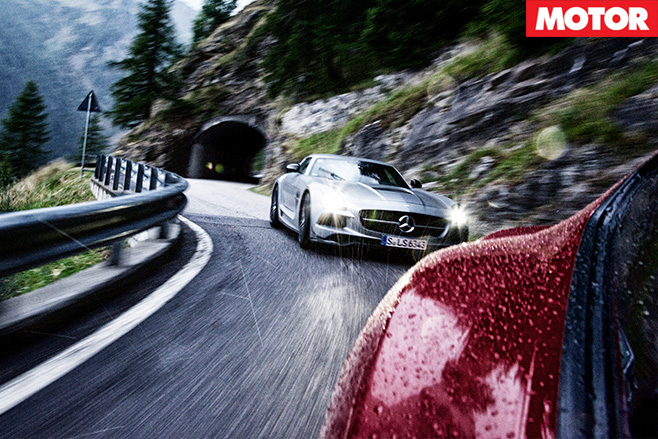
Why? Well, the Ferrari looks and feels more special, it goes faster and rides better, it is softer-edged and yet every bit as hardcore as the SLS Black in terms of handling, roadholding and performance. Downsides? The infotainment is not quite up to date, the transmission needs more sparkle in auto mode, ‘tip out’ triggers excessive engine braking, while a smooth take-off and a fluid crawling pace are not this car’s forte. Exactly the same applies to the SLS, so Getrag had better get its DCT in order, fast.
Having said all that, the gullwing fields a more compelling gearbox software, it is every bit as entertaining at the limit, the sat-nav deserves full marks, while the steering, brakes, chassis and drivetrain form a cohesive whole. But the Black Series is harshly sprung and damped, it is a little too eager to put up a fight when pushed, and its shirt-sleeved composure is provocatively in line with its jazzy demeanour.
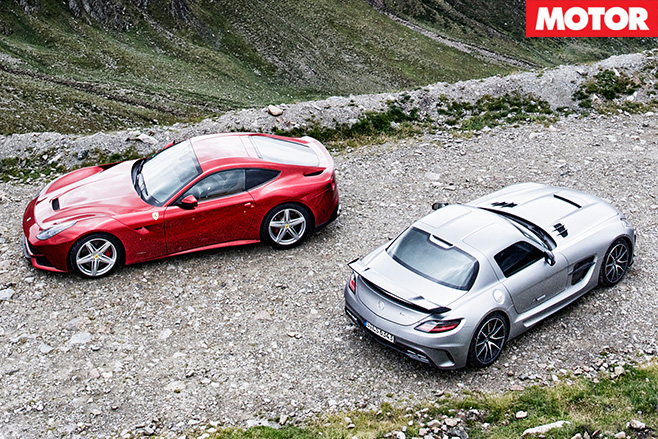
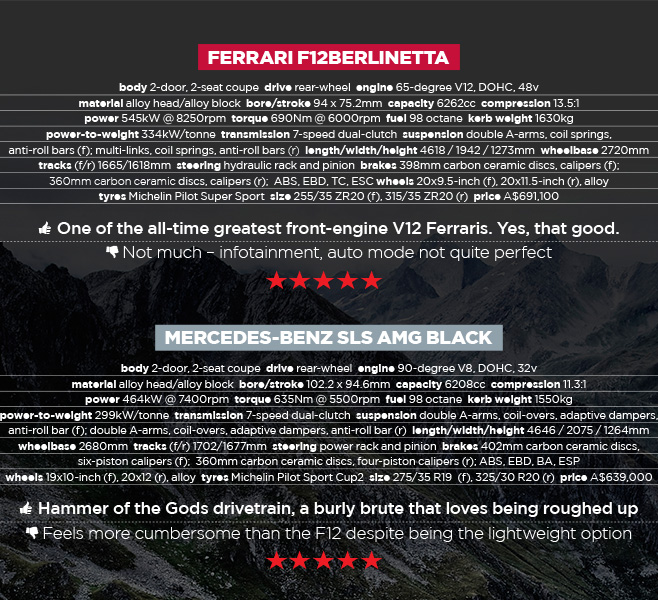
Paul Newman, known and loved as a talented movie star, was also a seriously good racing driver.
He won four sports car Club of America National Championships, won the 24 hours of Daytona and, perhaps most famously, finished second in the 1979 Le Mans 24-hour race, sharing a Porsche 935 with Rolf Stommelen and Dick Barbour.
These were not short-stint celebrity drives, but the real deal. So good was Newman that his flair and passion for motor racing almost sidelined his acting career. The bloke who starred in films such as Hud, The Sting, Cool Hand Luke and Butch Cassidy and the Sundance Kid eventually forced movie producers to work around his racing schedule.
Read Howard Walker’s classic story, as published in the July 1995 edition of Wheels.
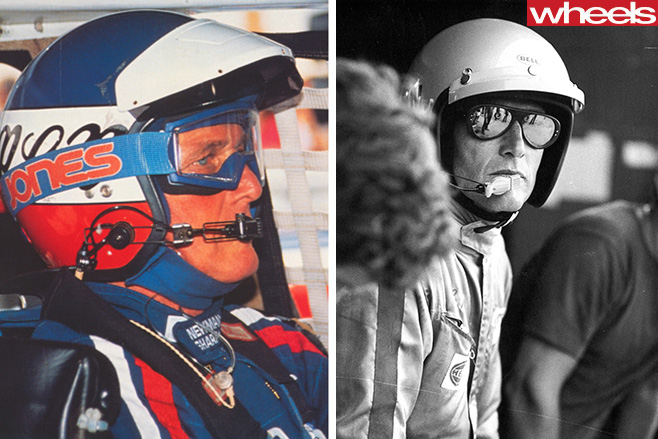
Newman became hooked on motor racing in 1968 while he was making Winning, a not-so-good racing movie that co-starred his wife, Joanne Woodward, and Robert Wagner. To better understand drivers and racing, Newman signed up for Bob Bondurant’s race school and learned enough to fall in love with the sport. It was, he said, “The first thing that I ever found I had any grace in”. Three years later he started racing professionally and only retired in 2008, just months before he died. A year earlier he took pole position in his last professional race at Watkins Glen.
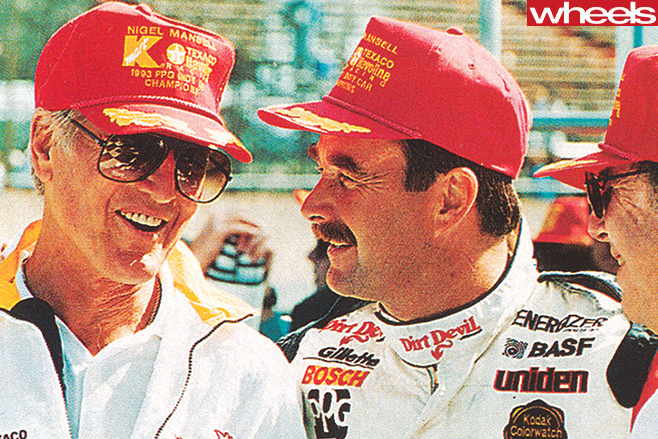
Walker persisted and asked Newman how Daytona compared with his other racing achievements and, especially, Le Mans. “He pauses. Looks down to the ground. Pushes his baseball cap to the back of his head. Half a minute goes by. Finally he answers. Slowly. ‘It’s got to be close to the top. Or the closest thing I can think of.
Le Mans was great for me, but winning is winning and I’ll take that any time.”
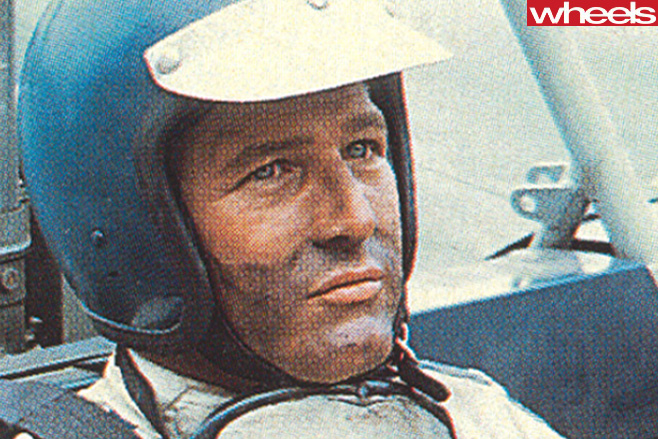
In 2015 comedian Adam Carolla made a terrific documentary of Newman’s racing career: Winning: the racing life of Paul Newman. In it Carolla discovers that Newman personally sponsored Willy T. Ribbs, “a young black driver at a time when racist animosity for other drivers was palpable”. In 1991 Ribbs became the first black driver to compete in the Indianapolis 500. When Newman’s 28-year-old son Scott died after an accidental drug overdose in 1978, Carolla relates that all Newman wanted to do was get into a racing car “and think about nothing but the next corner”.
Want to read more classic tales? Visit the Wheels Archive – simply log in here using your existing MagShop account or create a FREE account and select this article from the homepage.
Don’t have a MagShop account?

Have a MagShop account?

Mitsubishi is more practised at facelifts than the busiest Hollywood plastic surgeons.
In one small way that’s a good thing, helping to stave off a sales slump on some models and allowing Mitsubishi to post growth in 2016. But it’s the Mitsubishi Pajero Sport that is waving the sales flag for Mitsubishi, more than countering a dip across existing models other than ASX, which continues to do well courtesy of sharp pricing and a late-year facelift that added more bling to a proven formula in what is a booming SUV sub-segment.
RANK 6TH 2016 SALES: 73K 2016 YTD results* 66,616 sales, up 3.7%, 6.2% market share 2017 forecast: 71K RANKING: 6th; 71,000 sales (down 3%), 5.9% market share GRADE B-
Opportunities
Mitsubishi has suffered heavily from the post-GFC R&D cutbacks and some poor decisions at the Japanese head office to focus on electric cars when the world wasn’t ready for them (or, at least, not ready for weird-looking eco-hatches like the i-MiEV). So the main opportunity in 2017 is more updates, more equipment, sharper deals and more marketing. Speaking of which, expect an update on the Mitsubishi Triton in 2017, while a full year of the expanded Pajero Sport range should yield decent results. Oh, and the Outlander PHEV gets a decent update early in the year.
Challenges
Maintaining interest in a range that’s among the oldest on the market. With the exception of Triton and Pajero Sport, the Mitsubishi garage is looking old and feeling tired. A new Lancer would be good given the thoroughly underwhelming current car. But none of that is on the horizon and the best Mitsubishi has to look forward to is some fresh product from Nissan as part of the recent buyout. Until then, it’s up to the dealers to sharpen those pencils…
Summary
A respectable result in 2016 given the tools it had to work with, but Mitsubishi is fighting largely on price with an ageing model line-up, something that will create bigger challenges in the future.
The standard Lamborghini Murcielago LP640 has been one of the world’s fastest production cars since the day it first rolled out of the black gates in Sant’Agata.
But today, it’s been made to feel ordinary, and by none other than Lamborghini itself. Somewhere inside the glass-fronted Lambo brains trust, someone thought the heaviest hitter in the Lamborghini story needed more muscle. And speed. And grip. And, to further minimise the slim chances of anybody mistaking the Murcielago for anything close to subtle, they wanted to make it even more obvious in traffic, too.
So they’ve given it more engine, more orange, more black, more wing, more carbonfibre and less of anything you might use in daily life, all in the singel-focused pursuit of transforming the ultimate Murcielago into the, umm, ultimate Murcielago.
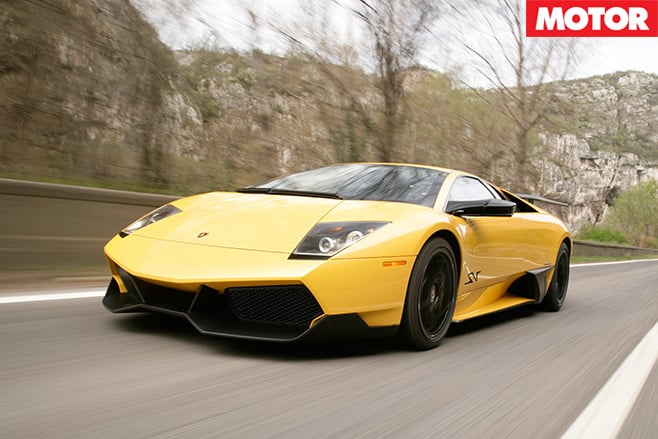
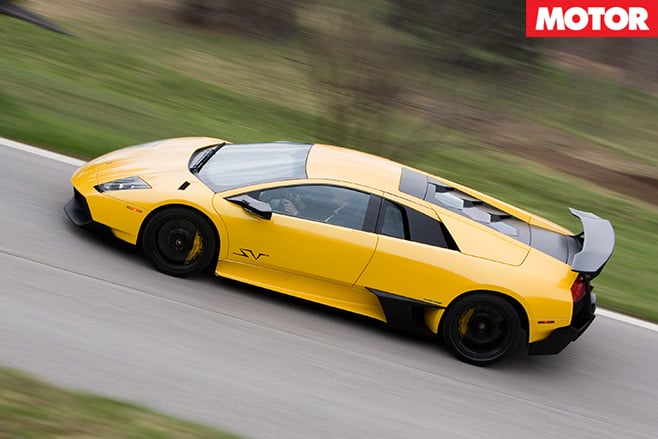
Clearly, it’s not the retiring-with-a-good-book type. Bright orange with a massive rear wing, a deep front splitter and the letters ‘SV’ plastered along the doors, it’s not meant to hide anywhere.
Of course, orange isn’t the only colour you can have yourself an SV in. They also come in shades of white, grey, yellow or, of course, black or, for the price of a mid-sized Japanese car, they will paint it matte-black or matte-white for you. None of which seem to be demonstrably less showy than the stock agent’s orange.
You could be forgiven, then, for thinking it might be a bit of a Look-At-Me sticker and paint special, but it would be a big mistake to sell it that short. There’s 20 Pferdestärke more engine, of course (hence the 670, which equates to 493kW), but it is only a small part of the SV story.
More important is what is not here. While the Murchie’s 471kW never had real problems moving its 1665kg, the easier way to even-greater speed is to shed anything not deemed totally necessary, and that includes mechanical as well as cabin pieces.
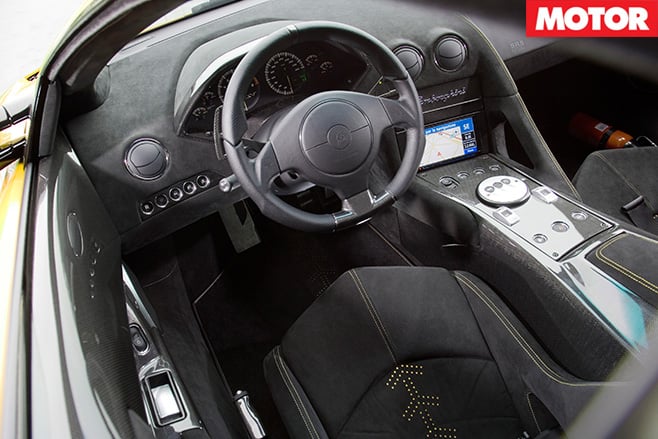
The carpet has been jettisoned and the march of carbonfibre throughout the interior (it smothers the transmission tunnel and the floor) is stopped only by the lightweight Alcantara layered across both the dashboard and roof. Even if you do not like the cockpit’s Spartan appearance, you just cannot argue againts the benefits of 34kg in weight savings.
But some of the other areas of attack are just as impressive. Losing the motors for the pop-up rear spoiler shaves 13kg, while the front and rear quarter-panels are now carbon, too. Even the casing for the rear brake light is carbon.
Then the engineers got serious. Replacing the tubular steel chassis with something lightweight was beyond the budget, but they have modified it heavily. They have recalculated for the increased loads the extra speed and grip would generate and changed to a freshly developed, high-strength steel which also shaves 20kg from the standard car.
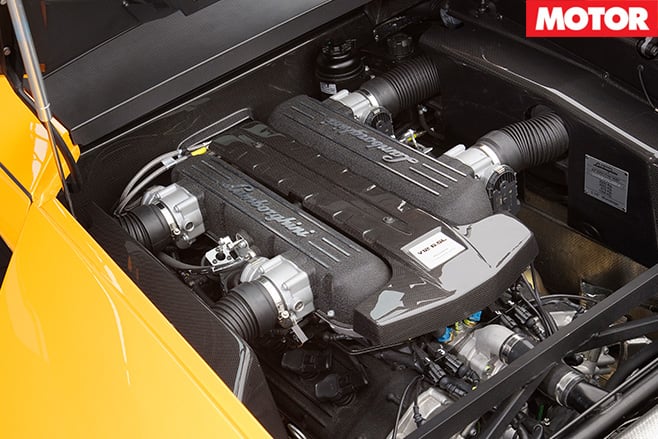
They’ve even poked around inside the engine bay, chopping away at brackets here and trimming whizzing bits there until they successfully turfed out 33kg, mostly courtesy of a new lighter, louder exhaust system.
That will be a sad day because, while its exhaust emissions are pretty awful, its noise and vibrations and all-pervading timbre changes are awesome, playing on your back, backside, legs, hands, feet and your ears as well.
Fire the engine on the SV and there’ll be a high, whizzing sound followed by the loud, urgent bark of the 12 pots catching fire. Then you’ll find much the same pump-drive-dominated whirr playing just over your shoulder – until you blip the accelerator pedal and hear the four giant throttle bodies hiss open. If anything, they seem louder than the standard Murcielago and you can feel them open by the way it tries to twist the chassis under torque.
The chrome-gated six-speed manual is standard, but our test car had the optional E-gear paddle shift gearbox fitted, which is a no-cost option. As soon as you pluck a gear, though, the thin-seated SV feels different. It is somehow smoother and there are fewer vibrations running into your spine, but it is no quieter. It feels slightly stronger at around-town speeds, too, because you need less throttle to motivate it than you do in the regular model.
The brutal V12 rises in revs to around 5000rpm and then you release the brake pedal and the world just turns stupid. Instead of a stripped-bare show pony, the SV explodes, with all four of the enormous Pirelli Corsas evaporating in a smoke cloud. The throttle bodies are wide open now, and the intake roar is as loud as the exhaust’s ripping, metallic, angry blast.
You actually have to come off the throttle a touch because, as one American tester found, it will wheelspin basically all the way through 400 metres in first and second gears if you don’t. Enough power? You’d better believe it.
It’s a difficult balance, though. Get it wrong and you’ll either come off too much and bog the thing down or you won’t come off enough and then nobody will see you for the blue cloud of smoke. Get it right, though, and the SV is vicious, bursting to 100km/h in a genuine 3.1 seconds. I saw the data logger, so you can make it move even faster than Lamborghini’s 3.2-second claim.
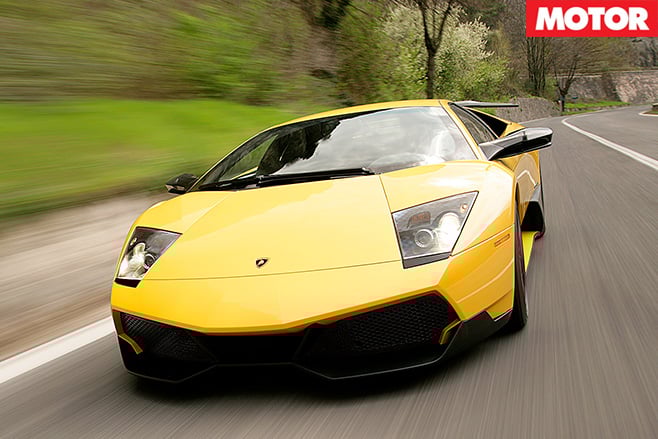
The boffins have fiddled with the intake system, including massaging the V12’s inlet timing and increasing its valve lift, while the exhaust also helps in picking up the extra 22kW at 8000rpm. But, crazy as it sounds, the Murcielago’s V12 hasn’t ever really been about power.
Like the standard V12, the SV’s engine is strong on torque and though its 660Nm peak hits at a high 6500rpm, it is never really lacking for twist anywhere across the rev range and nobody should feel limp-wristed for short shifting the V12 to stay in the torque band.
The updated engine is very free and has all but eradicated all of those wonderful tremors and nuanced harmonics, replacing them with raw urgency and a lovely squirting sound to back up the added feeling of aggression to its entertaining elasticity.
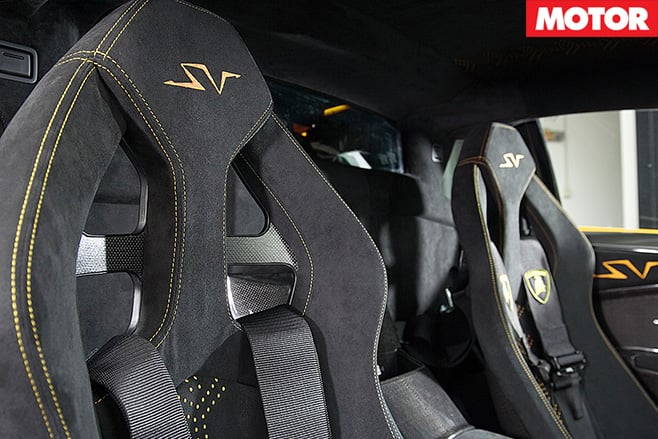
The real benefits of this car are immediately obvious the instant you turn it into a corner. Because it’s so much lighter and it has been developed so comprehensively, it just feels like an entirely different animal.
Compared to the stock Murcielago, the steering is simply wonderful. The standard car’s steering is not light and not communicative, even though it is accurate. This one is just brilliant. It is beautifully weighted and has actual feedback – more, even, than the Gallardo – and keeps you informed at high and low speeds about what is going on under those massive 18-inch P Zero Corsas.
But that is only part of the reason why the SV is very fast and very stable. We are now talking about a car that is so incredibly agile and inspires more confidence from its driver in the front half of a corner than any Murcielago before it. Actually, more than any Lamborghini before it.
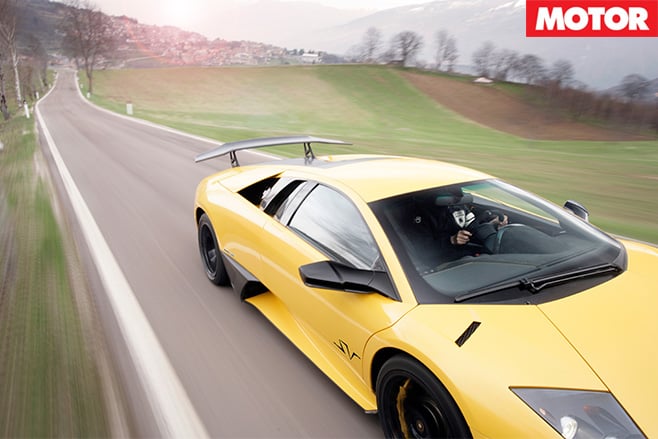
Usually, it will understeer early on, then you feel the weight move across the rear axle and you know it is set and ready to fire the viscous-coupling centre-diff into all-wheel-drive action. Sometimes it will come in with a bit of drift from the rear, but the monster rear boots catch it back up before you get bitten.
And, in the 380mm carbon-ceramic anchors with their six-piston calipers both front and rear, the Murcielago has found a set of brakes that feel firm and strong every time you go near them, but are still flexible enough to let you balance the car on the left pedal.
But it’s at higher speeds that the SV shows its true brilliance. The wing and the front splitter actually work, and you can feel them pressing the tail and nose firmly into the ground you’re covering with immense ferocity. Long, tricky double-apex corners are dispatched with assurance and you know that as long as you keep feeling that squishing thing from both ends of the body that it is not going anywhere.
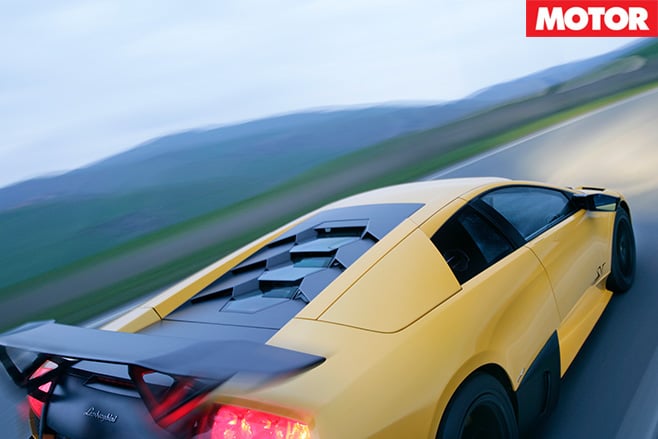
SPECS Body 2-door, 2-seat coupe Drive all wheels Engine 60-degree V12, DOHC, 48v material alloy heads/alloy block Bore/Stroke 88.0 x 89.0mm Capacity 6496cc Compression 11.0:1 Power 493kW @ 8000rpm Torque 660Nm @ 6500rpm Fuel/Tank 98 octane/100 litres Kerb Weight 1565kg Power-to-weight 315kW/tonne 0-100km/h 3.2sec (claimed) TOP SPEED 337km/h (claimed) Transmission 7-speed sequential Suspension double A-arms, coil springs, anti-roll bar (f); double A-arms, coil springs, anti-roll bar (r) Length/Width/Height 4705/2058/1135mm Wheelbase 2665mm TrackS (f/r) 1635/1695mm steering power rack and pinion Turning Circle 12.6m Brakes 380mm carbon-ceramic ventilated discs, six-piston calipers (f&r); ABS, TC Wheels 18 x 8.5-inch (f); 18 x 13.0-inch (r), alloy Tyres Pirelli P Zero Corsa size 245/35ZR18 (f), 335/30ZR18 (r) on sale Last quarter 2009 Price $850,000 (estimated)
Positives:Best-ever Murcie, with brilliant grip, poise and predictability Negatives: Extrovert styling a matter of taste; dated electronics Rating: 10/10
Nissan (again) relied heavily on SUVs.
It dropped some of its passenger cars (Pulsar hatch and Mirage) and, despite a very expensive race program, sales of the underwhelming Altima continue to fall. Nissan Qashqai and X-Trail did the heavy lifting, albeit off the back off cashback and finance deals, but the new Navara hasn’t fired as expected.
RANK 7TH 2016 SALES 67k 2016 YTD results*55,413 sales, up 3.0%, 5.7% market share 2017 forecast: 64k RANKING: 7th; 64,000 sales (down 4%), 5.3% market share GRADE C
Opportunities
Navara is arguably Nissan’s biggest opportunity – but only if the recently arrived update is well received. Ute sales are booming and Nissan missed out (down 15 percent), so it needs to again lean heavily on a vehicle that once outsold all rivals except Toyota Hilux. Also expect an update to Pulsar sedan, which should help kick along below-par sales. X-Trail and Pathfinder should also get 2017 updates, helping reignite interest in models that sell more on size and price than driving manners.
Challenges
Maintaining sales with fewer cars. The company has to learn how to settle into natural sales demand with fewer models. In some ways the smaller line-up will help because it focuses attention better, but the reality is the current Nissan line-up is largely underwhelming. Hopefully those planned updates can solve some of those issues.
Summary
If it wasn’t for a broad range of SUVs, Nissan’s pain would be a lot more acute. Next step is lifting the substance across its range.
