
Dodge is planning arguably the craziest US muscle car ever made, and Hollywood actor Vin Diesel appears to have inadvertently shown it to the world.
Dubbed the Challenger Demon, the car is based on the wild 527kW Hellcat but around 90kg lighter, possibly more powerful and with a host of upgraded components including new brakes, wheels, seats and body panels.
Dodge has set up a website for the car called ‘If you know you know’ (whatever that means) and is releasing a series of 12 teaser videos in the lead-up to the Demon’s debut at this year’s New York Motor Show in mid-April.
However, it seems that Vin Diesel might have possibly rained on its parade. During a Facebook video of Diesel thanking crew on the upcoming Fast and Furious 8 film, a pair of pumped up Challenger bodyshells sit in the background and it appears these are Demon prototypes.
While we can’t be sure, careful examination of Dodge’s latest official teaser video, which you can see below, shows the new bonnet scoop, five-spoke wheel design and flared wheel arches to be consistent with the cars in Diesel’s video, while there also appears to be a Demon badge on the front guards.
If this is the case – and it certainly seems likely that Dodge would want to place its halo muscle car product in one of the world’s biggest movie franchises – then we suspect ol’ Dominic Toretto will be receiving a firm rap on the knuckles, as it’s rather undone Dodge’s carefully constructed PR plan.
Unless, of course, the Diesel video was part of the elaborate plan? We’ll bring you more news on the Demon as soon as we have it.
Buyers of the Holden Commodore SS will now score more equipment but for a higher price as fresh MY17 updates go to market in this final year of VF Series II production.
Although the $60K-plus limited edition Magnum ute, Motorsport sedan and Calais-based Director limited editions have stolen the limelight this week, Holden quietly slipped in other changes to the Commodore lineup that results in a 6.2-litre V8 LS3-model price hike.
The Commodore SS is now $2500 more expensive than before, starting from $47,490 plus on-road costs with either six-speed manual or automatic transmission. It does, however, usurp the previously-$48,490 Commodore SS-V, adding its 19-inch alloy wheels, head-up display and satellite navigation – but not leather trim, chrome beltline, and clear tail-lights.
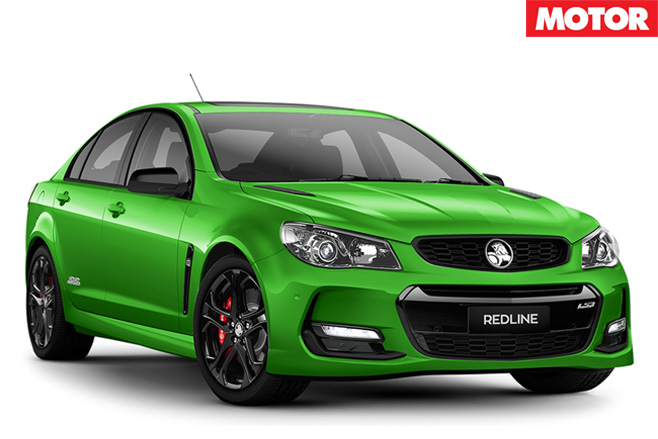
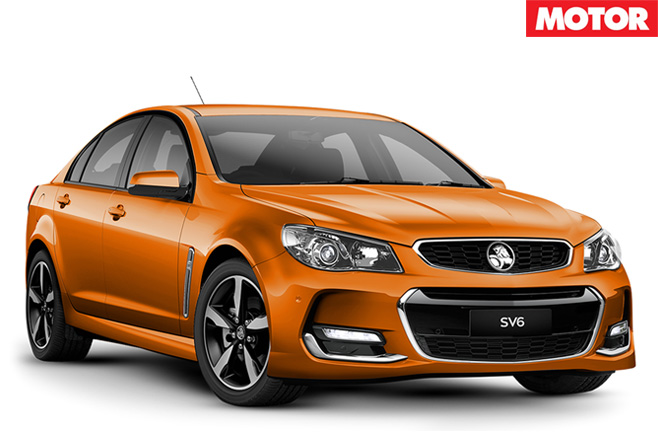
Some Like It Red Hot – a deeper red than the carry-over sports-and-Evoke-only Red Hot – is replaced by a bright orange called Light My Fire in both Commodore SV6 (pictured below), SS and SS-V Redline, as is Prussian Steel Grey by a new Son of a Gun Grey metallic (SS pictured above) across the range.
Regal Peacock Green is no longer available in the SV6 or SS, but is retained for Calais and Calais V – both of which also drop the Empire Bronze metallic colour. Heron White, Nitrate Silver, Slipstream Blue and Phantom Black continue in every VF Series II model grade.
There is no change to the price of the base, fleet-spec Commodore Evoke or its 3.0-litre V6, but the Calais sedan rises by $1250 to $42,540 plus on-roads and the Calais Sportwagon is the only other model grade (joining SS-V Redline) to have been ditched from the range.
It leaves the Calais V as a $48,750 V6-engined and $56,750 V8-engined flagship duo, each $760 costlier than before.
The MY17 Commodore changes will see out the locally built range when production in Elizabeth, South Australia, ends on October 20 this year.
Watching racecars is fun, with all that metal and carbonfibre tearing around a circuit at terribly fast speeds. But some find the inside story more interesting.
If that sounds like you, we’ve handpicked a string of clips that do one simple thing: stow you in the cockpit of a racecars being driven incredibly fast with skill.
We’re dubbing it our Best of Onboard series. And the first instalment takes us to Mount Panorama, early 2016.
It’s the Bathurst 12 Hour enduro, qualifying, and you’re strapped in with René Rast.
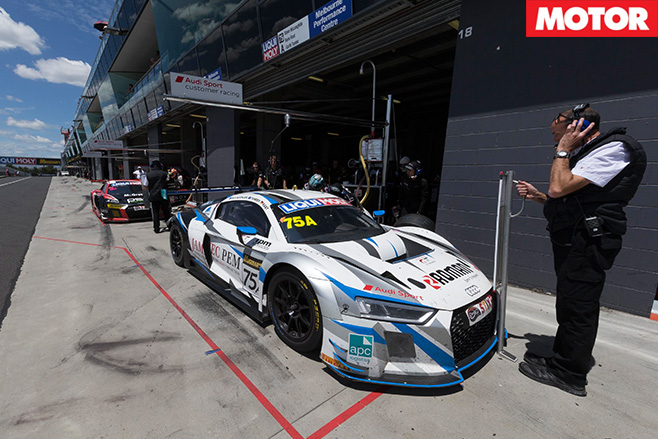
He’s also a weapon in the firm’s R8 GT3 LMS car. And despite his global portfolio, he calls Bathurst “one of the best tracks on this planet”.
Such enthusiasm would explain how he pushed the #75 Jamec Pem R8 LMS in last year’s qualifying session to a stunning 2:01.840 lap.
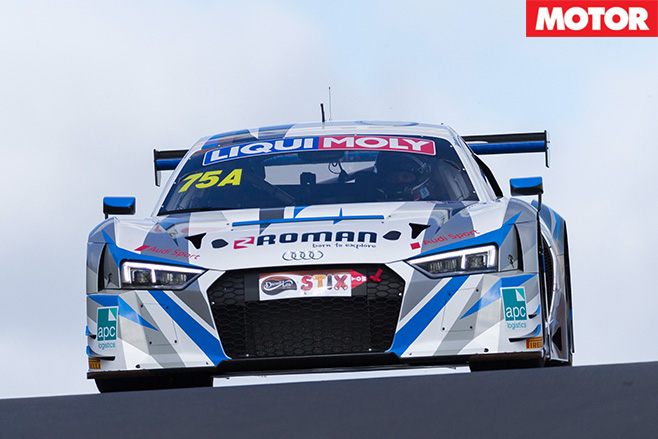
Tucked up in the top-left corner of view is data like brake pressure and throttle application. Rarely are you treated to such specialised information, which help tell what exactly he does and when.
His team didn’t take the gong. That went to the Tekno McLaren in end. But Rast cemented himself the second person to dip under 2:02 at Bathurst in a tin-top, and the first star of our Best of Onboard series.
It was a year of rebuilding for Volkswagen after the shock of the emissions cheating scandal, which required many meetings with government departments and rolling out updates for diesel engines.
Sales slumped, too – down 6.7 percent to the end of November after a similar drop in 2015 – predominantly due to its small cars, Volkswagen Polo and Golf. Volkswagen also spent plenty of time focusing on after-sales service, an area that desperately needed attention.
RANK: 8TH 2016 SALES: 58K 2016 YTD: results*52,006 sales, down 6.7%, 4.8% market share 2017 forecast: 63K RANKING: 8th; 63,000 sales (up 8.6%), 5.3% market share GRADE: A-
Opportunities
Get ready for a big year for Volkswagen in 2017. A full year of the new Volkswagen Tiguan should alone account for decent sales growth. Then there’s the updated Golf (Golf 7.5), which should reignite interest in the brand’s top-seller. And the V6 Amarok’s solid start in the sales race should build momentum throughout the year, with more variants planned to capitalise on healthy demand. Throw in the improved customer service and Volkswagen is a brand that should be on the up.
Challenges
Volkswagen’s “premium for the people” positioning means it won’t be fighting hard on price, something that potentially limits the scope of its growth. But at the same time Volkswagen can benefit from the luxury push into mainstream markets. Great driving dynamics, quality interiors, increasingly healthy equipment lists and European lineage mean Volkswagen is one of the best-positioned to convince someone shopping a Mercedes/BMW/Audi to at least consider one of its wares.
Summary
It’s been a character-building year but Volkswagen has risen to the challenge, acknowledging some of its failings along the way. Next step is to capitalise on some excellent new arrivals.
This is it, folks…. Over the top!
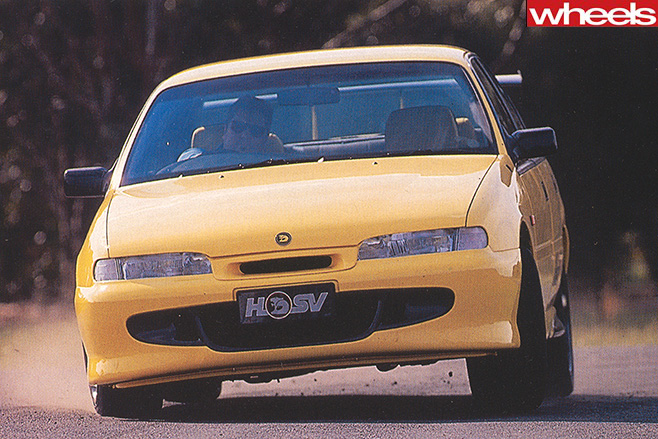
HSV’s eye-popping GTS-R is an exclamation mark – a fairly large, very fast, brightly coloured exclamation mark. Unlike the dark-hued Senators and steely silver Mantas hot Holden HSV boss John Crennan likes to think don’t look out of place in the corporate car park, the screaming yellow GTS-R, with its full-face rear wing and carbon fibre inserts, is an in-your-face muscle car with a Schwarzenegger swagger.
If the new GTS-R says one thing loud and clear it’s that Holden Special Vehicles is still in the Excitement business – just in case you’d forgotten. That wouldn’t be easy of course, because HSV has a history of spine-tingling eight-cylinder adrenalin pumps like the VL and VN Group A SS siblings, the Clubsport series and the latter-day GTS models developed from VP, VR, and VS donor cars. In particular, the 5.7 litre, 215kW GTS 215i is unquestionably the best-performing, best-driving supersled ever produced here. Until the GTS-R, that is.
Well, actually, that’s only just the case because the GTS-R is essentially a GTS with attitude. Though the regular GTS 215i bulges in all the right places, it keeps a relatively low profile and doesn’t go out of its way to attract attention – until you floor the testosterone dispenser. But the GTS-R shows its intent in ways that leave nothing to the imagination. It might not be spoiling for action, but it wears all the signs that it’s ready, willing and able.
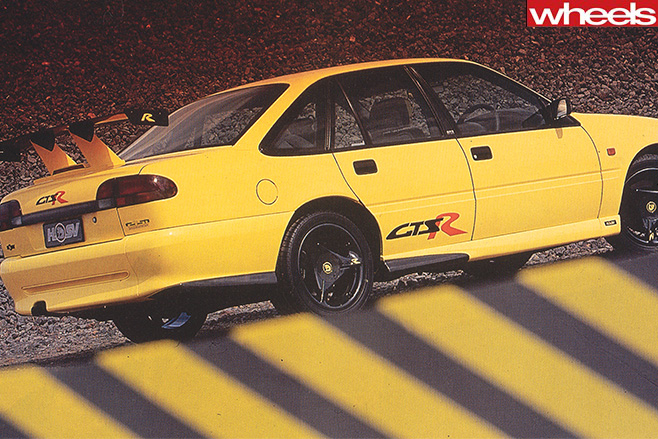
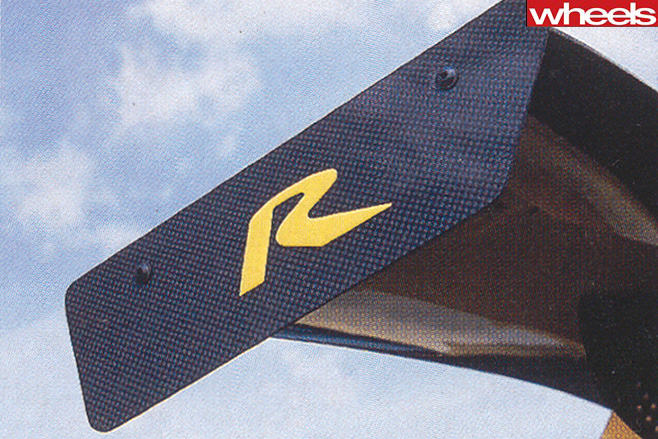
Somewhere between lemon and buttercup, the paint is eye-catchingly distinctive, all the more so in contrast with its starkly dark carbon fibre highlights. Paint colour apart, the most retina-wrenching feature is the high flying, centre mounted rear wing, obviously modelled after the HRT race car’s. Though its angle of attack is adjustable, the aerofoil doesn’t provide anywhere near as much downforce and drag as the racer’s. That’s deliberate because you can have too much of a good wing thing on a road car, to the detriment of performance and handling.
Note that the wing’s endplates carry the same R signature added elsewhere to the GTS motif. When standing alone, however, the R (for Racy or Radical or both?) is raised above the surrounding surface. But in its suffix role (on the lower door panel, for instance), the R lies flat and ‘GTS’ stands proud. There is also new yellow-on-black HSV corporate badging for nose, tail and wheel caps.
Like the wing and endplates, the GTS-R’s front bumper air-intake insert, side skirt finishers, rear applique (between the reversing lights) and wheel caps are produced in carbon fibre by HSV’s kissin’ cousin; Holden Racing Team. HRT’s new composites and plastics department is gaining prominence, using materials, technology and processes developed in conjunction with the CSIRO.
The bean counters are still checking the bills, but Crennan expects the GTS-R to cost around $75k, or at least $12,500 more than the regular GTS 215i. Some of that pays for the engineering and development invested in getting the GTS-R from brainstorm to production line. But the price also includes not only the usual HSV buyers’ perks, such as the owner’s compendium and personal owner/factory contact, but also VIP treatment which extends to a free flight to Melbourne with handover at HSV’s works, a plant tour, a good nosh at the increasingly renowned Tom’s Cafe, and a swish new GTS-R jacket of exclusive design.
Once you’ve torn your eyes from the GTS-R’s paint and external features, you’ll notice the black wheels are the regular GTS threespokers wearing the standard Bridgestone 235/45 ZR17 Expedias. Visible behind the alloys are HSV’s premium brakes: twin-piston calipers up front; singles at the rear and ABS all round. The GTS-R’s suspension comes straight from the 215i, as do the steering, the six-speed manual ‘box and the acclaimed Hydratrak diff.
HSV has left the mighty 5.7 litre engine unchanged for the GTS-R, though a newly developed exhaust system offers less back pressure than before and should loosen a bit more grunt here and there. However, the specs still read 215kW at 4800rpm and 475Nm at 3600. In this trim you can expect the GTS-R to return standing 400m times in the high 14sec bracket and zip to 100km/h in about 6.6sec, based on times we’ve turned in at Lang Lang with a regular GTS 215i.
Top speed should be on the business side of 240km/h, although whether the GTS-R reaches the 246km/h we’ve achieved with the regular GTS depends on how much downforce you dial in on the rear wing. The choice between top speed and ultimate traction is entirely your own…
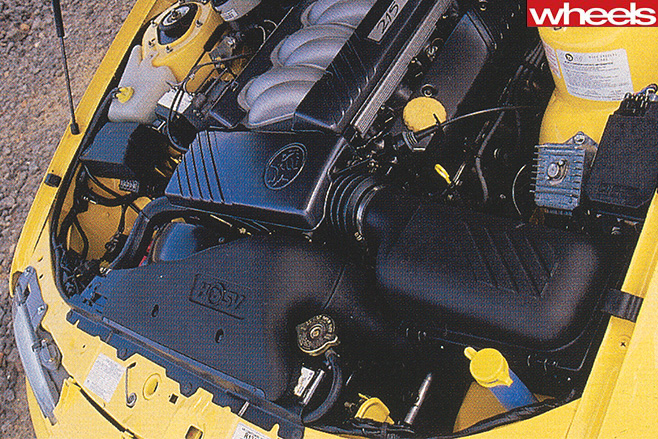
Though the blueprinted Before and After performance figures aren’t publicised, they are officially charted at HRT and that documentation accompanies the engine back to HSV and thence to the owner. The actual improvement varies from engine to engine, but HRT suggests an average improvement of between 10 to 15kW.
HSV’s own Correvit numbers- run, like ours, two up and over the same piece of road as we used for the regular GTS 215i earlier in the year- show the blueprinted engine shaves almost half a second off the standard 215i’s standing 400m, bringing it down to about 14.4sec. Zero to 100km/h takes just a shade over six seconds. We’ll wait until we have the opportunity to confirm those numbers ourselves (a blueprinted GTS suffered a mechanical problem before we were able to conduct performance testing, and the GTS-R on these pages, which was completed just hours before we collected it, is fitted with a regular 215kW V8). But if the figures stand up, a blueprint engined GTS-R should be the fastest Aussie musclecar ever built.
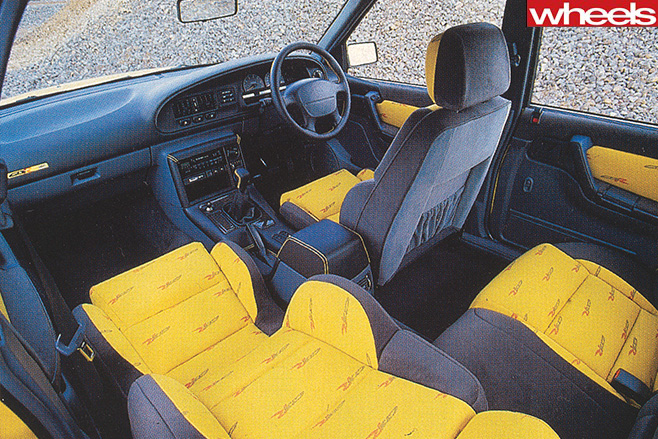
Mechanicals aside, the cabin gets its share of the GTS-R treatment too. The main feature is the heavy, triple-layer fabric for the seats’ centre inserts. Specially produced in Germany, the cloth has a yellow-ish hue and is decorated with a widespread pattern of a dark GTS motif overlaying the R in red.
Seat side panels are described as ‘blue graphite’, or grey-ish by any other name. The theme is repeated on the door trims while the upper and lower instrument panels are grey on grey. HSV experimented with a blinding yellow steering wheel and gear lever boot, but had second thoughts. There’s a fine line between over the top and off the edge…
And there you have the inside and outside story. While most of the changes are cosmetic, they’re sufficiently bold and distinctive to give the GTS-R a magnetic individuality. Yes, it’s over the top, but it’s also possible, viable and wholly ADR legal – a ride on the wild side which won’t leave you without a safety net. Combined with the strictly limited production run, that makes the GTS-R’s collectability as sure as sunrise. And as emphatic as!
There was a time towards the end of last decade when it looked as though the dual-clutch transmission would take over the world.
The popularity of the automatic gearbox was – and still is – on the rise, and the double-clutch seemed to deliver everything a driver might miss from a manual, and the convenience of a slush-box, without any of the inefficiency or the inherent lack of sportiness.
Curiously, though, in the years that followed, the car industry took divergent paths for best power delivery, such as the CVT and robotised manual. Mercedes-Benz, meanwhile, largely stuck with the traditional auto.
Now, the average auto by this time was much less a ‘slusher’ than those that had gone before. High-percentage lock-up torque converters have minimised loss reductions to bring the auto much closer to the manual in terms of efficiency.
This could certainly be said for Merc’s world-first seven-speed automatic, the 7G-Tronic, which had the ability to lock up the converter in every ratio.
This, though, wouldn’t be quite enough for a high-performance car, where crisp, immediate tip-in response is a must – certainly not in the context of AMG’s dual-clutch Porsche and BMW M rivals.
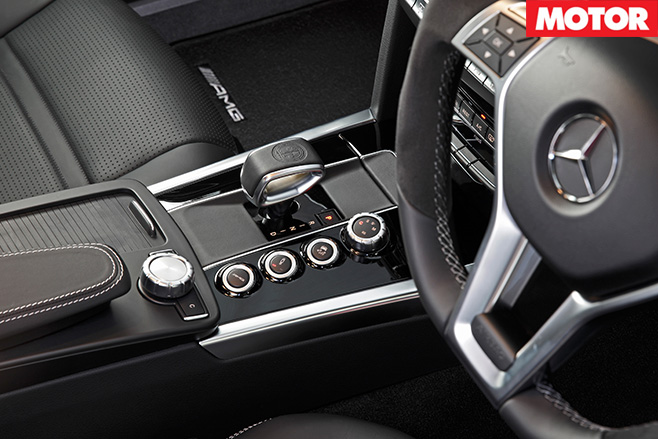
The reasons Mercedes took this path are manifold. The dual-clutch gearbox had by this stage proven itself to be less than bulletproof and, in low-speed manoeuvring in particular, less than smooth, with some brands, installations and calibrations being better than others.
Like any good auto, the wet-clutch-equipped 722.9 transmission (as Merc calls it) has refinement and shift smoothness sorted, and with the benefit of decades to prove the design principle, should deliver long-term durability, too. As long-established Benz pillars, these two qualities were hugely important.
The start-up clutch would give it dual-clutch-beating initial response, and the multiple lock-ups would ensure low in-gear transmission losses, too.
Then there are the distinct driving benefits a conventional auto offers. The dual-clutch auto, by design, is a sequential transmission. That is, you have to go up and down the ratios in their numerical sequence. Granted, the typical double-clutch auto’s shift speed means it doesn’t take long to slip through a few ratios. The auto, however, makes it possible to skip directly to your desired gear ratio, provided the road and engine speed parameters line up.
Incidentally, Merc claims the MCT takes 0.1sec to shift, which is about five times quicker than a good manual gearshift, but about twice as long as a supercar-grade dual-clutch gearbox.
TransMission
Merc-AMG gears up
1. AUTO START General Motors gave the world the first mass-produced automatic with 1939’s Hydra-Matic. Meanwhile, in a nod to its old-school origins – or more likely for practical reasons – the 7G-Tronic transmission is built at the Mercedes-Benz Stuttgart-Untertuerkheim plant in Germany, the site of the original Daimler-Benz production facility.
2. WELL-OILED MACHINE The Mercedes-AMG MCT swaps the conventional torque converter for a multi-plate wet clutch. The unit consists of several stacked clutches in an oil bath, and allows features you can’t have with a conventional auto, such as double-declutching and a Race Start launch control mode, which revs the engine and lets the clutch out sharply to optimise standing-start acceleration.
3. SMOOTH STARTER Along with a conventional auto’s smoothness and durability benefits compared with a dual-clutch auto, the MCT offers a pair of reverse gear ratios. With the extra ratio, the Comfort mode sees the transmission start in second in both forward and reverse, allowing the sort of relaxed, slip-free starts that would otherwise be difficult in Benz’s big-capacity, high-torque turbo machines.
4. BY THE NUMBERS Since you asked, the ratios inside the Merc-AMG MCT gearbox’s lightweight magnesium case are 4.377, 2.859, 1.921, 1.368, 1.00, 0.82, 0.728, and 3.416 and 2.231 in reverse. These don’t change from model to model; only the final-drive ratio does.
The list of car launches that take place in each year is a lengthy one, but only a small proportion are eligible for COTY contention. Here’s how we cull the non-starters.
OF THE hundreds of vehicles Wheels journalists test every year, only the best earn a Car of the Year guernsey.
Choosing nominees for testing from the wide range of eligible cars is a long and difficult process, with the final line-up determined by the magazine’s chief road-testers.
The choice for most of the nominees is obvious if they make significant generational improvements, or reset class benchmarks. The process gets tricky when it comes to eligible cars whose gains are less apparent, or if the breadth and ability of the entire range is unclear. Due to the sheer volume of new cars released each year, Wheels simply can’t test each variant of every new car before COTY.
In some cases the Australian release timing of new models falls so close to the December 1 cut-off that no Wheels road-tester has driven them. A wildcard nomination can be granted if it’s agreed they are significant enough or have sufficient promise.
Once Car of the Year nominees are chosen, variants within the range are hand-picked to provide judges with the broadest spread of a range’s credentials and to balance different trim, drivetrain and bodystyle options. Wheels also endeavours to include the volume-selling variant.
It was all about crossovers for Subaru in 2016.
Between the top-selling Subaru Forester and Outback, and the still-popular XV, high-riding soft-roaders accounted for almost three-quarters of Subaru sales. There were various ups and downs, with the mild drop-off in Impreza sales towards the end of its life countered by demand for the newly arrived Levorg. Add it all up, though, and it was a memorable year for Subaru, which at the end of November was poised to post a new sales record for the brand.
RANK: 9TH 2016 SALES: 47K 2016 YTD results: 43,110 sales, up 7.8%, 4.0% market share 2017 forecast: 50K RANKING: 9th; 50,000 sales (up 6%), 4.2% market share GRADE: A-
Opportunities
It’s all about the new Subaru Impreza and its crossover XV stablemate for 2017. Having arrived just before Christmas, Subaru will be looking to boost sales of its new small car, but it’s the XV that holds the most hope. The higher-riding version of the Impreza hatch with revised bumpers for more visual aggression typically outsells the Impreza by about two-to-one. The new XV – complete with active safety gear, better refinement and a classier interior – arrives mid-year, providing a second-half springboard to boost sales. The loyal Outback market should continue to flock to what is a good car, while the WRX should benefit from a refresh before it’s phased out, leading to some run-out deals. Then there’s an updated BRZ, which will breathe some sales life into the low-volume 86 lookalike.
Challenges
Fending off the competition will be Subaru’s biggest challenge. It has some great cars, but the competition is more intense than ever, so it’s a matter of maintaining momentum on existing models and forging ahead with new arrivals. The small-car market has some excellent rivals, for example, one of which will be an updated Volkswagen Golf mid-year.
Summary
A solid result from a brand with a loyal customer base and a good reputation. But Subaru has to keep the throttle mashed to maintain momentum.
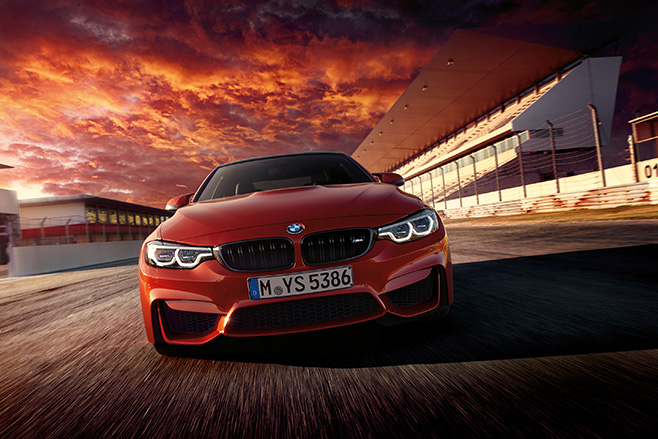
A new set of LED lamps is the highlight (no pun intended) of BMW’s latest update for the BMW 4 Series coupe, convertible and Gran Coupe family. Joining the now-standard bi-LED headlights (or optional adaptive LED headlights) are new LED tail lamp graphics, two new paint colours and four new wheel designs.
Sport and Luxury-grade models have been gifted with lightly tweaked front bumper plastics and the rear bumper fascia has been recontoured to match, but sheetmetal is unchanged for the 2017 model year. You can, however, now opt for one of two fresh paint hues: Sunset Orange or Snapper Rocks Blue.
Greater changes are afoot inside the updated 4 Series range. BMW’s latest generation of its high-end Navigation System Professional has been fitted, with new tile-style graphics and a sleeker interface that brings the 4 Series’ infotainment system into line with that of the new 5 Series and BMW 7 Series.
A reconfigurable all-electronic ‘Multifunctional Instrument Display’ is also available.
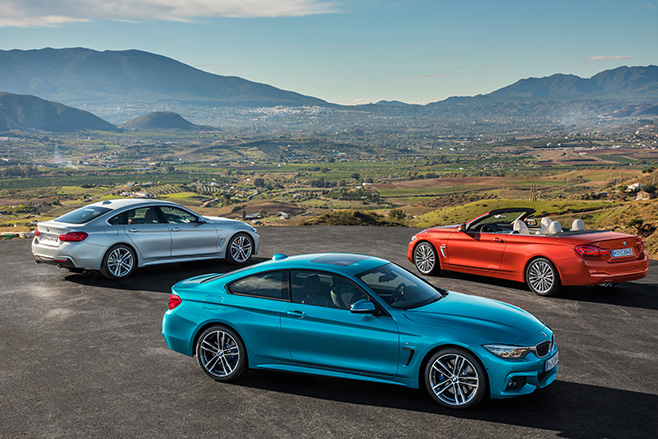
The cabin is also jazzed up with a double-stitched dash top, more premium-looking electroplated switchgear feel and the restrained application of chrome and piano black highlights. The basic design and layout, however, carries over with no changes.
More meaningful mechanical updates have been carried out beneath the skin. A revised suspension tune brings firmer springs and dampers for not only the standard fixed-rate suspension, but also for the optional M Sport and electronically-adjustable Adaptive suspension. BMW says the firmer undercarriage results in greater stability and more communicative steering without compromising ride comfort.
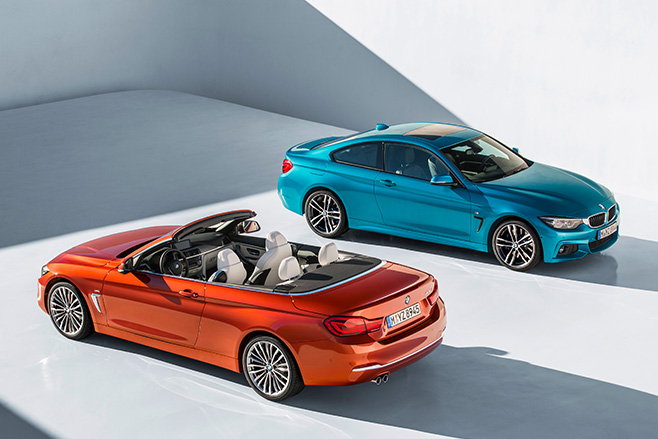
It’s a modest update for the 4 Series range, which sees no changes applied to powertrains or transmissions. Power outputs and fuel economy are identical for the full range of petrol and diesel engines – which encompass a 135kW turbo petrol four-cylinder in the entry-level 420i to the flagship M4’s potent 317kW turbo petrol inline six.
Due to roll out in Europe towards the end of March, expect the updated 4 Series to arrive locally sometime in the second half of the year.
Is the Brock-developed Calais Director as good as everyone hoped it would be? Peter Robinson reports it’s even better.
First published in the October 1985 issue of Wheels magazine, Australia’s most experienced and most trusted car magazine since 1953.
WHAT a tempest we raised. The stream of letters continues unabated, and even Peter Brock himself saw fit to voice his objections to the findings of our now infamous Brock Versus Europe comparison in the May issue.
 Driving Velvet Thunder – October 1985
View this article in its original format in the archive.
The accusations flowed. We were incredibly biased and totally subjective; the choice of cars for the comparison was invalid. Thr supporters of Brockmobiles came out of the woods to stand up and be counted. The local hero and his cars have many followers; many of them demanded a rematch using a Calais Director as the weapon.
We still stand by our May findings, based on the cars we drove for that test. We concede, certainly, that the Group Three tested was a hard-working mule and that, of course, the Director would have made for a fairer, closer contender in the Executive Express fightout. We knew that. The problem was that, at the time of doing the test, a Brock Director was a rare beast indeed and it seemed unlikely to join Holden’s fleet. So, after the original Group Three test car was stolen, we were forced to make do with what was available. But biased- from the magazine that wrote of the HDT SS VH Commodore in 1982, “if it’s not the best sports sedan for the money in the world, I’ll stand rooted,” – no way.
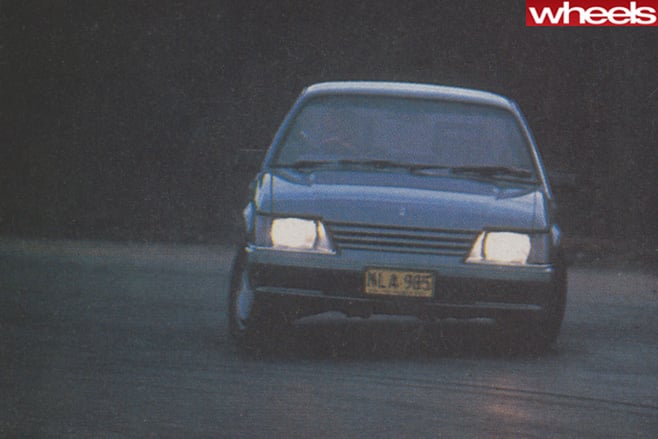
And that, gentlemen, is what has come out of the giant playpen that is the Holden Dealer Team car-building operation. This is quite a car, by any standards, for it will run with the best four-door sedans in the world, in any performance test devised. Yet it can be idled around in fifth gear from well below 1000rpm before stretching its long legs to 4600rpm, and that is 237km/h. Don’t ask where, but we can now reveal that Holden’s digital speedometer stops working at 192 km/h and refuses to read anything higher. The tacho, however, continues on and at 3.30am on a deserted road it climbs and climbs, taking the Director beyond even the 228km/h we recorded from the Phase Three GTHO Falcon back in 1971. Until now that was the fastest four-door sedan Australia had ever produced.
We began with a VK Calais with the hi-performance VS engine and manual transmission. List price, $22,373. Take that up to Director level for another $5296 and you have a $27,669 Holden Commodore. We wanted to go further and ordered the Borg WamerT5 gearbox both for its taller gearing, with the long 0. 73 overdrive cog, and for its shorter first gear. The price of an extra ratio is not cheap at $2850, but the benefits go far beyond just another gear with which to play around.
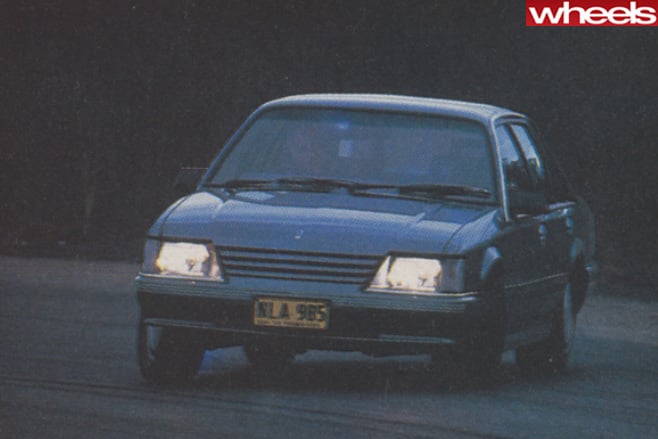
The long-range 90-litre tank ($332) was considered mandatory if the car was to have a respectable touring range; a Cobra alarm system ($585) seemed like a good idea to protect GMH’s investment; and for high speed work at night we ordered up 130/90W headlights which require a new relay and wiring harness and so cost $93. And, at dealer level, we opted for the sports exhaust system that the HDT says gives an extra 37 kW or thereabouts and certainly sounds much more potent than the standard system that is shared with the EFI six.
Eventually we drove away in $32,274 worth of Commodore, sceptical that any amount of Brock magic could justify more than doubling the base car’s price. We were disappointed in our choice of colour – the Spindrift, a darkish metallic blue, was just too bland – but immediately impressed by the quality of the T5’s gearchange. What a pleasant surprise, and so vastly superior to the notchy, stiff change produced by Holden’s old and noisy M21 box it’s a shame the five-speeder isn’t standard equipment. Movements between ratios are small and firm, yet the change is lighter and far more precise, while the clutch seems less heavy than on the Holden Commodore Group Three and is more progressive.
Fifth gear is there to be used, and despite the knowledge that it is very tall it feels quite logical, natural even, to change up from fourth at 60 km/h, barely over 1000rpm, and we learned quickly that it would even pull from 500 rpm without protest, such is the immense torque of this engine. What joy to have a five-speed box on the end of a large capacity V8! And the car is so much quieter; it is only when starting up, as the engine bursts into life, that it sounds like Brock’s Group A racer, that the occupants inside the car are aware that this isn’t any old six cylinder Calais. Unless they wind down the windows, of course, for then there is the constant, mostly subdued bent-eight burble that informs the knowing that this car is truly potent.
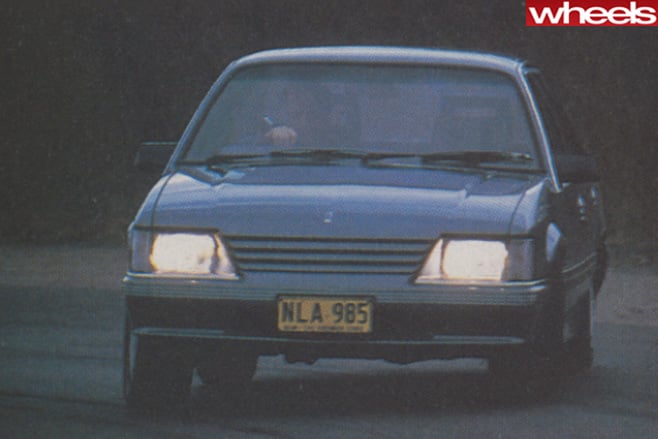
The customers, those buyers for whom money seems no object when it comes to the purchase of the ultimate Commodore, are going to find the changes to the suspension only emphasise the marvellous dual character that makes the Director so appealing.
On the one hand it can be motored around the suburbs, taken shopping or to pick up the kids after school, without intimidating the driver or drawing unwanted attention. Lazy drivers will love the way it encourages changing up early, bypassing a couple of ratios on the way to fourth, and the car has the torque to be left in fourth down to a crawl.
And yet the thunder is only a down-change and a floored accelerator away. Holden’s bent eight is transformed into a responsive, free revving, and surprisingly smooth engine by throwing off the standard exhaust system that is shared with the EFI six. This single pipe set-up not only strangles the power output but produces a nasty stifled exhaust note that is completely at odds with the image Holden has been promoting for the V8. The sports exhaust allows the engine to breath properly so that the Calais electronic tacho’ s red line of 5600rpm is realistic and 300 or 400rpm below the point where the hydraulic valve lifters begin to pump up. On our engine 6000 was achievable in fourth gear …
This is not a brutal engine in the manner of the GT HO Phase Three, but rather an engine with seemingly endless torque and the ability, more pronounced than in any other Holden bent eight we’ve tested, to rev cleanly and quickly to the redline. A tickle of the accelerator is more than enough in most driving situations; press a little harder and change up between 2500 and 3000rpm and you will leave the traffic behind. Push deep into the relatively short throttle travel and you will find that this is the fastest accelerating four-door sedan sold in Australia.
Yet it doesn’t feel as quick as the Group Three, nor as boy-racer, because it has a refinement and composure that has been lacking in all previous Brock Commodores. So deceptive is the car that we anticipated a standing 400m time of mid-15s yet we couldn’t have been more wrong. Our first run, heavy on wheelspin but clean and quick, stopped the computer read-out at 14.85 seconds. Second run, with marginally less wheelspin, dropped this to 14.78 and still we felt it would go faster.
Third attempt was perfect: wheelspin to about 40 km/h, the tail not getting twitchy the way it had on the first go, the clutch biting home quickly and smoothly and the gear changes swift and sure with the change from third to fourth coming only moments after we crossed the end of the 400m. Time: 14.64 seconds. A fourth run produced 14.84, by which time the tyres and road surface seemed to have given of their best.
Perhaps even more impressive were the in-gears times for they showed that while this engine was marginally slower down low it was clearly quicker in both the mid and high rev ranges. Even so, the Director staggered us by pulling from 30km/h in fifth gear and achieving a 30-60km/h time of 9.9 seconds to make the BMW, Volvo and even the mighty Saab seem totally lacking in flexibility by comparison. Yes, the Holden does have a huge capacity advantage; but then it does make the most of it, so who is going to argue?
Let it be said, once more, that the Calais Director with five-speed gearbox is exactly the car we should have had against the Europeans. All our letter writers can bask in the glory of being right.
Perhaps at this point we should sort through the confusion surrounding Holden bent eights. The present 4.9-litre small-valve automatic develops 117kW at 4400rpm and 328Nm of torque at 2800 rpm. Codenamed LV2, it is the base engine until the V8 is converted to run on lead-free fuel around the middle of ’86.
The old V5H V8, used in manual versions of the Commodore, gave 129kW at 4400 rpm and 347Nm at 2800rpm. The 4.9 engine fitted to Group A Commodores for street use gives 134kW at 4400rpm and 328Nm at 3200rpm but this engine has the standard exhaust system and for those customers – read most – who want to retain the acceleration of the old Group Three the sports exhaust option takes this to 196kW at 5200 and 419Nm at 3200rpm in blue-printed form. That’s with the wild-for- street-use Wade 169 cam.
Our engine, smooth and quiet as it is but with the standard camshaft timing (as used by Brock in his race car, which also has the exhaust option), gives 170kW at 4800 rpm and 417Nm at 2800. A compromise, we believe, that is ideal for everyday motoring.
In GM-speak the engines are given code names. The VT referred to the old five-litre engine; VA is the 4.9 auto, VB the 4.9 manual and VC the Group A, while those engines with the big-valve heads have a B cast into the heads (but it can be at either end of the engine). To add to the confusion the first of the 4.9 engines all came with the big valves but from July production – and in order to build the required 5000 identical engines for racing purposes – the bent eights got small valves although all of the ’85 1/2 Group Three and Director engines are converted to big-valve specs by the HDT.
The full-blooded acceleration runs induced a nasty vibration in first and second gear that we felt came from the tailshaft. Be warned that unless the constant velocity joints are dead straight such a vibration is common with the five-speed box. The rubber centre joint for the tailshaft is quite soft and this contributes to the trouble. We complained of the problem at the first service and it had been cured when the car returned, so it is obvious that the problem has been solved.
BorgWarner’sT5 box does more than anything else to transform the Commodore, not only by providing an additional ratio but by improving the quality of the gearchange. It’s not light and rubbery in the manner of many small Japanese cars but positive and precise, a touch notchy perhaps, and completely in character with the car. The ratios are wider than those of the old M21 box with a lower first and virtually identical second, third and fourth ratios while fifth is tall beyond anything Holden has ever offered before. With the same final drive ratio of 3.08 and on the P6 Pirellis – the spec in which we ran the performance figures – fourth gear is 39.4km/h per 1000rpm compared to the Group Three’s 37.6km/h on the P7s, and fifth 53.3. Changing over to P7s reduces the fifth gear ratio to 51.5km/h per1000 rpm.
If, on most counts, it seems the Director answered most of our criticisms of the Group Three, it took no more than a respectable drive to realise the massive 235/60 Pirelli P6s were indeed too big for the car. Over bumps, when the car was loading up in hard cornering, the top of the tyre touched the guards.
More importantly, the steering was very sensitive at the straight ahead and the car felt as if it needed constant corrections to maintain a straight line. The tramlining we complained of in the previous car wasn’t present but the nervousness of the steering meant the car became tiring to drive and any corner seemed to require a series of small bites at the wheel rather than one smooth movement.
Ideally we wanted 225/60 tyres but the new Pirelli 600 is still a few weeks away; so the P7s were tried. Ride comfort suffered hardly at all, despite their low profile – which is a tribute to the Commodore’s suspension – but there was evidence of tramlining over bumps, especially under brakes. The steering, however, had lost the over-sensitive feel apparent on the P6s and cornering was far more accurate and progressive.
Basically this Calais will do exactly as the driver wishes. Our photographs prove it can be made to oversteer if too much power is applied in a slow corner in second gear and ultimately it will always be the tail end that moves out first. But this is such a potent machine with such enormous reserves of roadholding that it has towering point-to-point ability. If bumps may provoke the rear axle into tiny sideways movements under power they do nothing to upset the Director’s overall poise and balance.
One fault that has come to light is that when fully loaded the tail drops sufficiently for the steering to become disconcertingly light and the handling suffers accordingly. This is most obvious on the P6s, where it was felt through the steering, but is still apparent on the P7s.
Only wind noise, that bane of the Australian car, prevents the Calais from becoming the ultimate long-distance touring machine. Strangely the noise that seems too loud at 120km/h doesn’t increase noticeably until around 180km/h so it is only the difference in roar from around the A-pillars between 100-120km/h that creates the impression of excessive wind noise. As expected, the tyres hum over certain surfaces.
What are we to make of this car? We’ll let the figures speak for themselves and only say that if we could throw away the instruments – whether they be the horrid square dials in the base Commodores or the digital affair in the Calais – and reduce the wind noise then there would be no other sporting sedan in the world that could touch the Director, at least in Australian conditions. The status quo has returned.
Seeing red
How angry were readers in the wake of the “Brock versus Europe” story that appeared in the May 1985 edition? Here’s one of the letters in full, sent in by Warwick Armstrong.
***
To the editor,
I believe your four-way road test of the Saab, Volvo, BMW and Brock (WHEELS May) was biased and subjective. Before you get your exercise jumping to conclusions, I am not pro-Holden or pro-European. I have owned a wide variety of cars including BMWs, Peugeots, VWs, a Fiat, two Minis, a Renault, a Honda and various Fords and Holdens. My present car is a 1981 Brock Commodore.
The comparison was strange in that you compared the base-line Brock with cars costing up to $16000 more. I can buy the Brock as tested and have enough left over to buy an Alfa 33. The fact that the three Euros are much cheaper in their home country is irrelevant. Surely the buyer’s value for dollar here in Australia is what should be under test.
From my experience the person who buys a Brock is after power and handling at an affordable price. Even if the prospective Brock buyer could find the considerable amount of extra cash (approximately $300-$400 extra per month for leasing), he would end up with much less power and inferior handling. The Euros have undoubtedly superior finish and in some circles more prestige, but none of them has the blend of room, handling and power that the Brock offers, despite the massive price difference.
You also play down the real performance gap between the Brock and the Euros. The BMW is incredibly slow and can only perform under Australian highway conditions by constant gear changes. Most of the people who can afford these cars are past enjoying “rowing” a car along and wringing its neck to get what is then only mediocre performance. For example, in the common 100-130 km/h overtaking range, the Brock is faster in top than the BMW can manage in third.
In fact, the BMW is only marginally faster in fifth from 100-130 than the little Toyota Corolla tested in the same issue.
The Saab has far better performance than the BMW but still requires a gear change down to fourth to match the Brock in the common highway 100-130 km/h acceleration bracket and is a full second slower to 100 km/h. All these performance differentials would, of course, be dramatically increased with a full load. I can’t imagine what the BMW would be like with mum, dad and the kids and a full boot!
The Saab is also very small in comparison with the Brock which itself is only just comfortable for four 1.9m occupants. The Saab would be quite uncomfortable, having 35mm less overall legroom and 130mm less front shoulder room. On top of this it has only two doors – a pain.
Many people buying a Brock expect it to handle a heavy trailer: or perhaps a caravan, which it will do with ease because of its massive torque. Can you imagine the Saab taking off uphill on a rainy night with a load of passengers?
The Volvo appears to be a nice car for older, more sedate drivers who are more interested in luxury than performance or handling. It in no way comes up as a car that a person desiring the Brock’s all-round abilities would even consider. You show the Brock as having a rev limit of 5000rpm and therefore a top speed of 188km/h. The Brock has a rev limit of 5500rpm which converts to 206km/h. My Brock will easily exceed 5500 in top and has a conservative top speed of 210km/h.
The whole comparison is unreasonable. The Brock is simply the fastest, best-handling, family-sized sedan around. You have to pay much more than the $37-41,000 of the three Euros to buy any car which will outperform and out-handle it, especially in the give and take overtaking situations experienced on Australian highways. It makes no claim to be a luxury car. It is what it is and the three Euros cannot match it at its game.
A more reasonable comparison would be the Brock Director which is based on the more luxurious Calais which has higher quality interior trim and fittings, is far quieter and much more likely to be considered by the prospective Euro buyer. I’m sure you would find it a more suitable machine in this European company, and it’s still $7-11,000 less.
You have compared the wrong car, made basic rev/speed mistakes and have made little of the areas of performance, handling and room where the Brock has superiority, yet you have criticised it in areas about which it makes no claims. It is obvious that you set about to “knock the Brock “.
Warwick Armstrong, Grenfell NSW
PRICE AND OPTIONS
Make Holden Model Calais Director Base Price $27,669
Five-speed gearbox $2850 Automatic transmission $466 Power steering stnd Airconditioning stnd Alloy wheels stnd Metallic paint stnd Sunroof $1627 Stereo radio/cassette stnd Price as tested $32,274
