
THE 10th incarnation of Mitsubishi’s iconic AWD hero is pitted here against the company’s demanding proving ground road loop … with no prisoners required.
First published in the November 2007 issue of Wheels magazine, Australia’s best car mag since 1953.
THERE’S a crackle of Japanese from the two-way radio in the left hand of the safety marshal. With a flourish of the long light wand in his right, he signals ‘Go’. Our own little piece of Mitsubishi’s vast Tokachi Proving Ground, on Japan’s big northern island of Hokkaido, is clear and open for business. Despite its ‘Cross-Country Track’ designation, this circuit duplicates a sinuous, bitumen-covered mountain road.
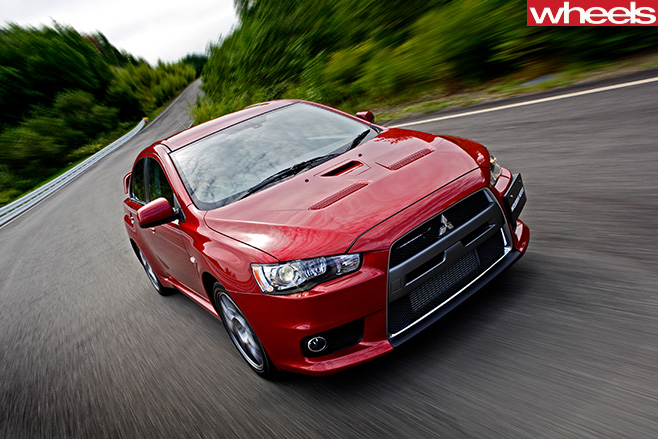
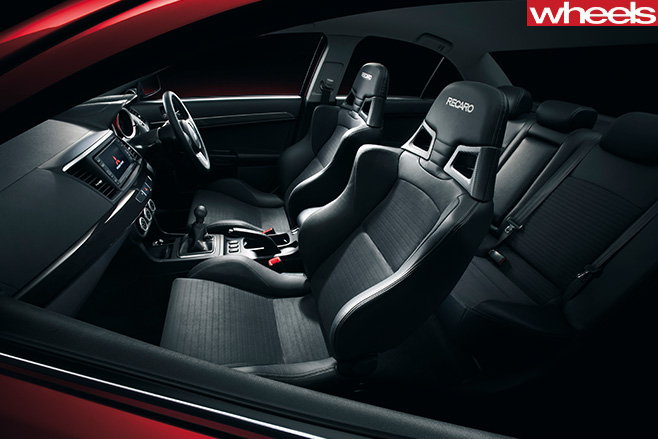
With Mitsubishi’s new 2.0-litre turbo four by now into the meaty middle of its rev range, the lunge to the redline is properly Evo-urgent. And there’s nothing soft about the SST’s upshift as the tacho needle kisses 7000rpm. The change is quick, the pressure of the Recaro against my back easing for only an instant.
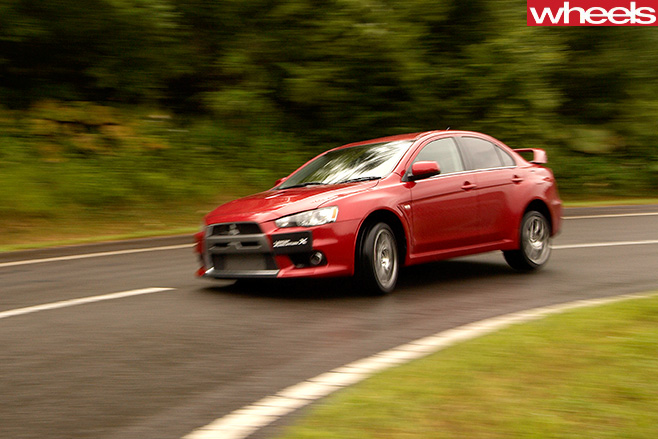
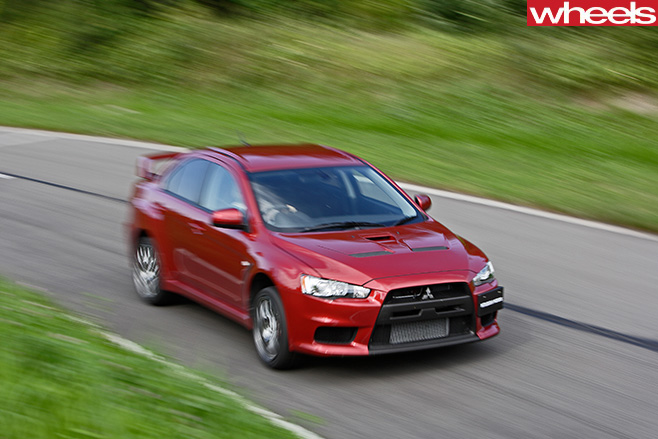
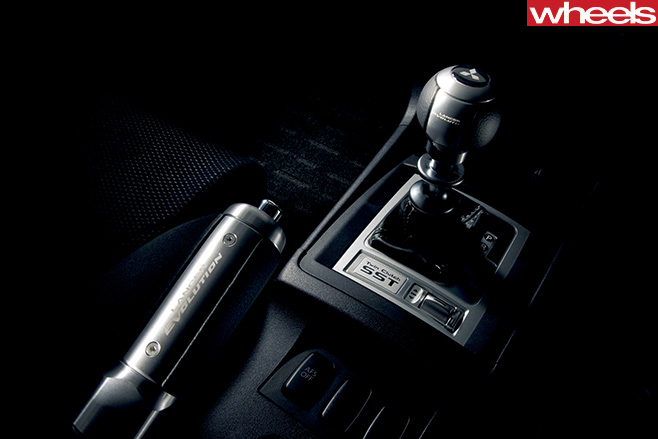
The short uphill straight that follows leads to a tight right. My hard brake application is accompanied by a series of perfect, computer- orchestrated downshifts. Just brilliant. A heel ’n’ toe expert couldn’t do any better.
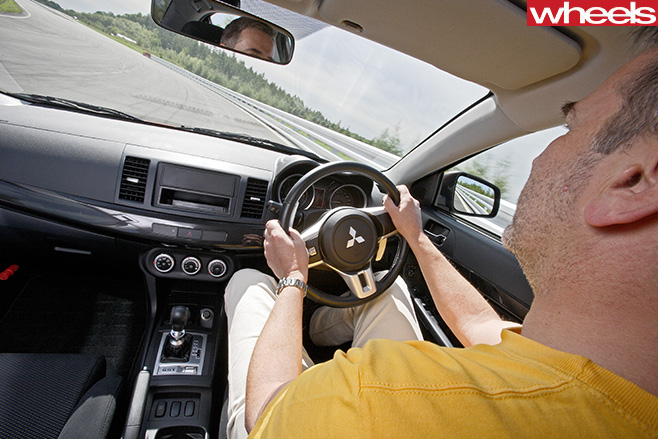
I keep the throttle nailed as the Evo bucks and skitters, adding to the collection of black smears on the rippled bitumen. In my peripheral vision, in the info panel between the instrument’s major dials, I can see the display flashing furiously. It’s telling me the car’s standard electronic stability program is working hard. Although I know the system is manipulating throttle and brakes to keep the Evo heading in the direction I want, the second-gear acceleration is smoothly ferocious.
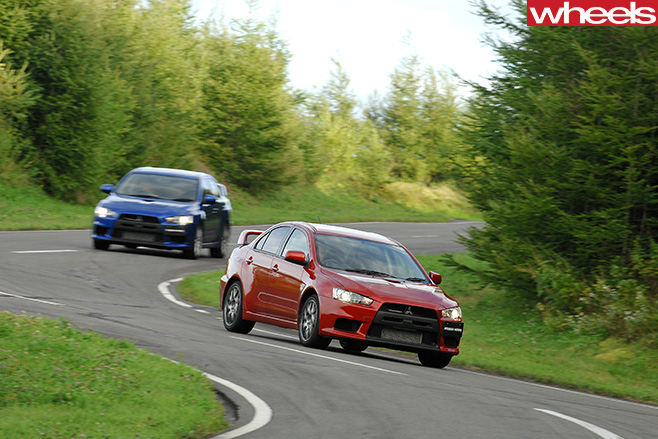
The next section is tight and technical, a serpentine succession of uphill curves. Left, right, left, right, left. The last, at the crest of the climb, is awkwardly off camber. And the second left-hander has a sight line seemingly designed to tempt too-early throttle application.
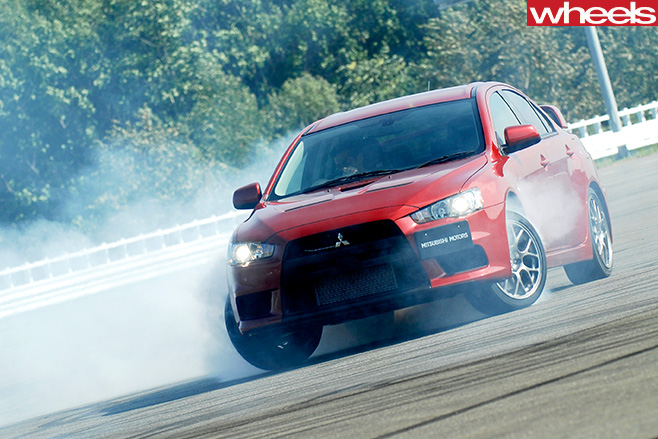
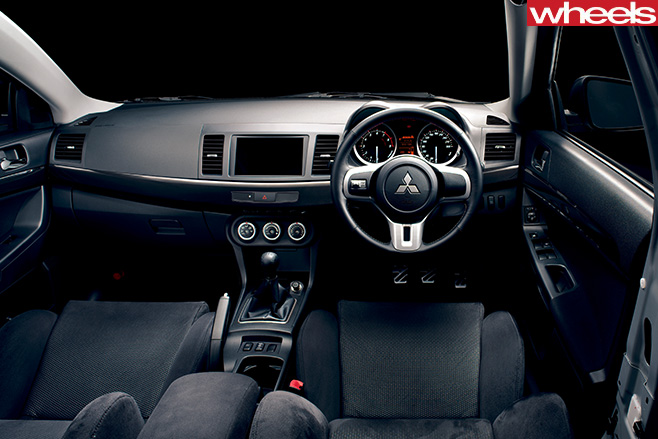
Mitsubishi labels its switchable ESP system ASC, for active stability control, and I haven’t touched the button at the right-hand end of the dash before starting this lap. One brief push disables the system’s authority over the throttle. I’ve tried that, and squealed sloppily – and slowly – through this challenging section. Get on the gas too early just once, and you lose momentum through all the remaining corners.
At the technical presentation in a function room at our hotel in Obihiro the previous night, we were told that the Evo X’s S-AWC system was worth 1.5 seconds on a 2.4km lap. S-AWC stands for super all-wheel control. It earns its ‘Super’ by adding ESP to the existing suite of electronically controlled technologies – ACD (active centre differential), AYC (active yaw-control rear differential) and ABS. Diagrams showing with and without steering-input traces for dry bitumen and packed-snow driving were produced to prove the system reduces the need for wheel twirling.
Out of the section’s final, off-camber corner, is the scary part of this track. It’s fast. And dangerous. This is a proving ground, not a racetrack, so there’s no run-off, no Armco. Instead, there are raised, grass-covered banks either side. We’ve been sternly told a 120km/h limit applies to this specific section. Later I learn a journalist from one of the earlier groups through this program crashed on this track – I’m betting it happened somewhere along here.
It snakes gently at first, inviting increasing pressure on the accelerator. Avoid the suspension-testing lumps on the left, early, and before you know it, you’re north of 150km/h.
And now we’re heading for its nasty bit. It’s a quick left, slightly downhill in and a little uphill out. It’s reasonably comfortable at a around 130km/h, despite the unsettling series of waves in the track that the proving ground designers have installed here.
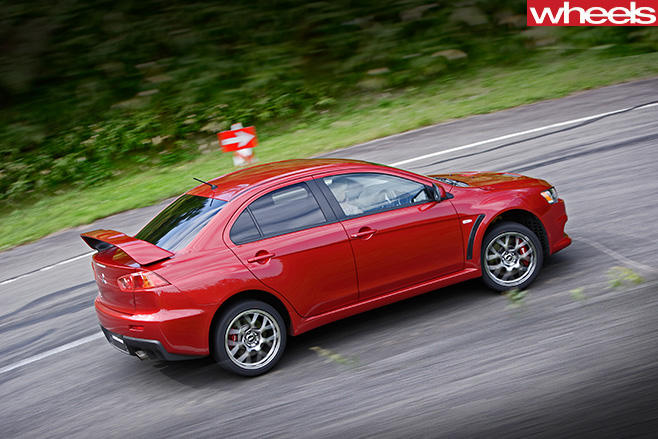
The Evo X I’m driving is equipped with Mitsubishi’s ‘High Performance’ option. The package includes forged BBS wheels instead of the standard Enkei rims, saving a little under one kilo per corner. Tyre size is the same for both BBS and Enkei wheels, at 245/40R18. Other key ingredients are Bilstein dampers and Eibach springs. On this track, which lacks the kind of harsh and informative impacts found on real roads, it’s hard to feel any difference between the optioned red Evo X
Likewise the brakes. We’re about to arrive at the corner that demands the most of the Evo’s left pedal. The road opens again after the lumpy left, but the speed gained here needs to be washed away smartly for a very tight left-hand hairpin.
While all Evo Xs are fitted with chunky Brembo brake calipers, the High Performance package also adds compound front discs. Although the same diameter as the standard one-piece iron items, their aluminium centres save more than one kilo per piece. Again I’m hard-pressed to feel any significant difference between the standard equipment and the optional discs.
Running into this hairpin, the SST rips smartly down through the gears, giving me first for the exit. It’s closely followed by a short slalom through three close-packed descending second-gear corners, finished by a treacherous downhill right-hand hairpin.
Jabbing left, right, left with the steering, followed by a stab on the brakes for the following hairpin, is a severe test of stability. The Evo X is brilliantly neutral, even though you can sense the inclination of the road and the nose-down attitude of the car combining to unload the rear tyres.
I leave the Evo X at the end of the queue of cars waiting for their next lap. Cool drinks are available from the nearby refreshment tent, so I choose a small bottle of Evian, find a folding chair in the shade, swallow a quenching slug of water, and start to make notes.
I look up to see another journalist is settling into the idling Evo X with SST and High Performance option package. The safety marshal cocks an ear to his radio, waves ‘Go’ to the first car in line, and it moves one place closer to its next lap. I wonder if the car’s new pilot will return as impressed by the car’s purposeful sophistication as I am right now?
How much will the Evo X cost?
Australian dollar prices of the Evo X will range between $60,000 and $70,000. While the line-up is still to be confirmed, Mitsubishi Australia has firm ideas on what it wants. The preferred plan is for a basic model that offers a choice between five-speed manual and six-speed SST transmissions, and an SST-only range-topper with the full set of mechanical and appearance upgrades. The most likely Australian on-sale date is early April next year, although there remains a slim chance of a March arrival.

SPECS
Mitsubishi Lancer Evo X
Body: Steel/aluminium, 4 doors, 5 seats
Drivetrain: front-engine (east west), all-wheel drive
Engine: 1998cc inline 4cyl, dohc, 16v, turbo
Power: 206kW @ 6500rpm
Torque: 422Nm @ 3500rpm
Transmission: 5-speed manual or 6-speed twin-clutch SST
Size (l/w/h): 4495/1810/1480mm
Wheelbase: 2650mm
Weight: 1520kg
0-100km/h: 4.9s man / 5.2s SST (claimed)
Price: $60,000 to $70,000
On sale: April 2008
Subaru’s served up its latest Impreza on an all-new platform, but the WRX and WRX STI haven’t been treated to the same overhaul.
Instead, Subaru’s revealed both performance models with ‘optimised’ dynamic packages, revised styling, and more safety tech for the new model year.
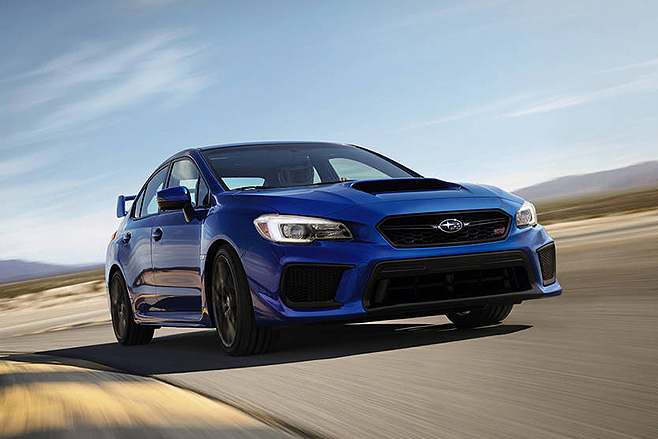
The range-topping WRX STI rolls on new 19-inch wheels. The largest ever wheel used by a WRX, and the new wheel size allows the fitment of larger front six-piston Brembo calipers.
They’re complemented by new monoblock two-pot Brembo calipers up back, along with new pads and slotted discs feature all round.
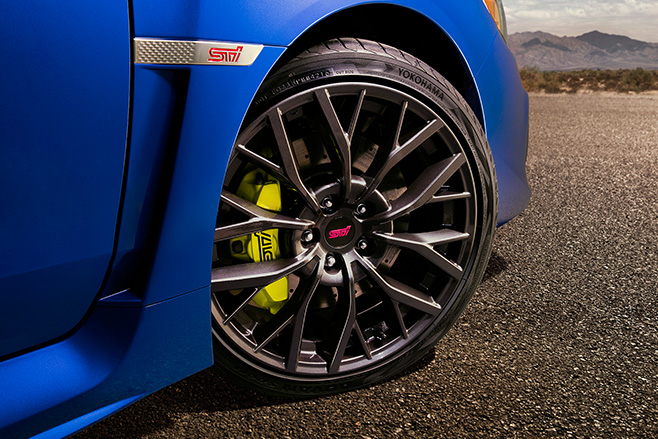
Inside, the WRX STI’s seatbelts are now finished in red, while electric powered front Recaros are an option for the first time in both models.
The glass in the front doors of both cars has also been thickened to cut outside noise.
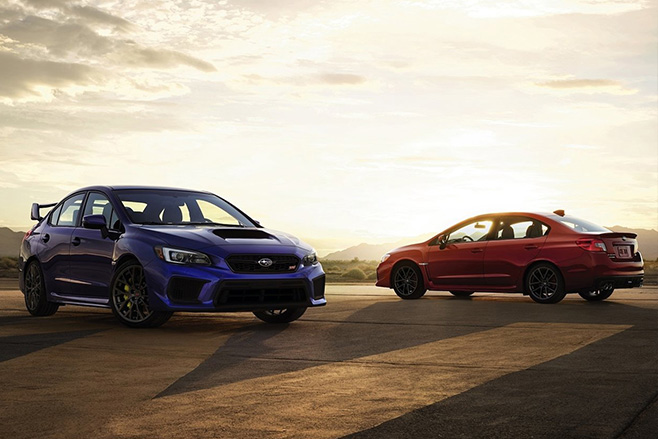
The WRX STI’s adjustable centre differential system’s also been looked at, which is now fully electronically controlled.
Each car’s engines have been left untouched. As the WRX STI carries over the old 2.5-litre turbo four-cylinder boxer and the WRX a 2.0-litre dual-injected unit.
There are also a slew of new safety and assistance features. Swivelling headlights, a new collision avoidance monitor, and auto-handbrake system debut on certain variants.
Subaru Australia says it’s in the process of finalising specification and can’t confirm when the car will arrive down under.
Subaru WRX STI vs Mitsubishi Lancer Evo: The final showdown
LEXUS hopes to redefine the upper-luxury sedan segment like the 1990 LS 400 original did when the all-new Lexus LS 500 lands in Australia early next year.
According to Lexus Australia general manager, Peter McGregor, the Japanese flagship will once again push boundaries in terms of design, dynamics and driveability, as well as the expected customer service, quality, comfort, refinement, and value.
“It resets the benchmark for us,” he told journalists at the Detroit Motor Show this week. “If you go back to when we started Lexus some 25 years ago, the LS shook the industry up… and I think this fifth-generation vehicle has the ability to do the same thing again. Not only in terms of styling – very faithful to the 2015 Tokyo Motor Show concept car – but with the coupe design still having the interior space of a three-box sedan.
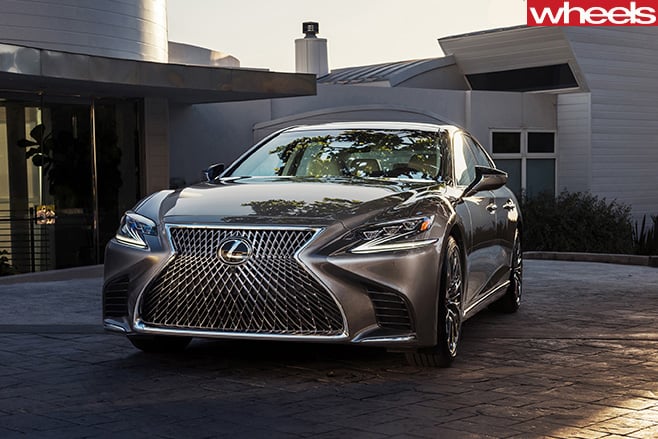
Mr McGregor revealed that the LS will usher in a new level of aftersales care, though would not elaborate on what that would be, since it is still being formulated.
“While we did launch a new customer experience with Lexus (in 1990), the gap between ourselves and our competitors has closed somewhat,” he admitted. “So over this year, we’re also focusing on what we need to do to lift our standard of customer service within the Lexus franchise, outside of just the product… there’s not too much I can say about that at this stage, as it is a work in progress, so watch this space.”
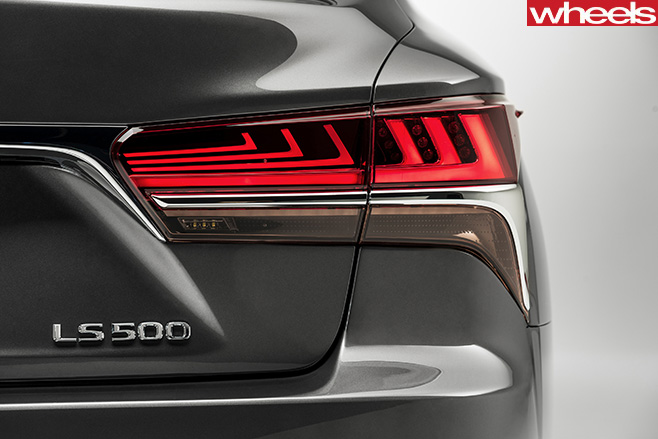
“We haven’t even started talking about pricing with this car with Toyota Motor Corporation (TMC) in Japan,” Mr McGregor said. “But every Lexus model we bring in we aim to be competitive with. We will be looking at the market place, at our own situation, the competitive benchmarks, and we’ll be setting the price to be competitive to be our objectives, whatever they may be.
“This is not going to be a high volume segment, but we do know that when we see a new product come into this segment that has the advances that this product has, that the market does embrace it, and it does very well.”
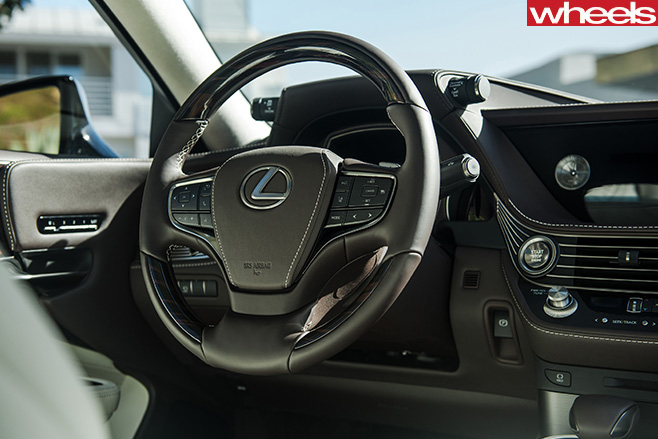
“It is unusual for Lexus to develop a new range of engines and not see them go through a number of products,” he said.
“We would consider any model or driveline that we think would enhance our customer needs. And if we believe there would be a customer demand for that in Australia, then we would certainly put our hand up with TMC and ask for that product.”
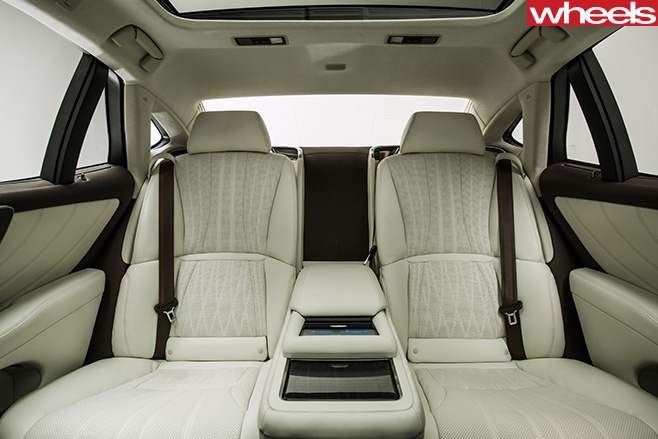
“If you go back at look at the range of hybrid vehicles that we offer, it’s probably one of the best in the industry, especially in terms of vehicle-by-vehicle in our range, there is usually always a hybrid engine,” he explained.
“I know our parent company is keeping track with technological advances and the investment that goes into R&D, and with some of the partnerships that we have announced on the international stage talk about the possibility of what might happen in the future. You will see us keep up with what we need to keep up with.”
Whether any of this is enough to upset the sales status quo remains to be seen, as the LS has lately languished well behind the competition and so has plenty of ground to make up.
Last year, Germany dominated the Upper Large over-$100,000 segment in Australia, with the Mercedes-Benz S-Class taking a 35.8 percent slice (312 sales) and the 7 Series 33.6 percent (293 sales); the remaining third was carved up between the Maserati Quattroporte (7.2 percent/63 sales), ageing A8 (6.4 percent/56 sales), Porsche Panamera (4.8 percent/42 sales), Jaguar XJ (4.1 percent/36 sales), Bentley (three percent/26 sales) and then LS down in eighth place (2.3 percent/20 sales).
THE Tesla Model S has helped shape Lexus’s new luxury flagship, the Japanese luxury carmaker has revealed.
LS chief engineer Toshio Asahi name-checked the Tesla liftback as one of the products influencing what the fifth-generation limousine would look, drive, and behave like – particularly in terms of its sleeker design and newfound dynamic athleticism, as well as future semi-autonomous driver-assist technology yet to be announced for the range.
Asahi, speaking at the Detroit Motor Show, said the new LS that will replace the decade-old current series in the first quarter of next year was also shaped by the usual benchmarks since its development program kicked off in 2011.
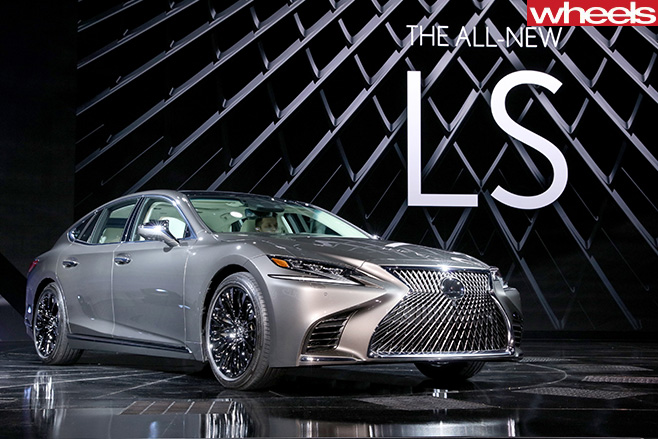
“We also benchmarked the Tesla’s autonomous technology for that, as well as the Mercedes E-Class’ system.
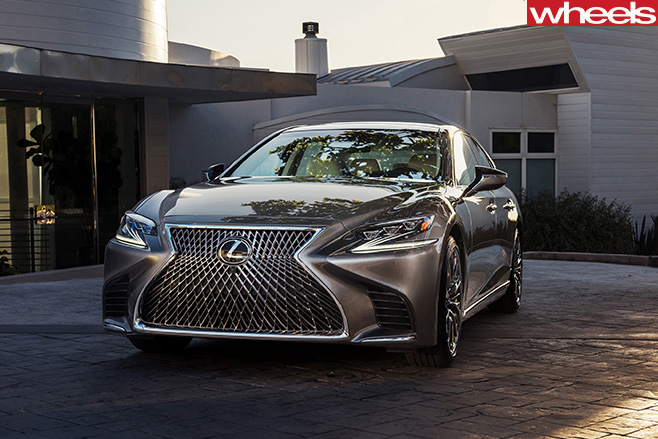
“We also wanted to incorporate more emotion and excitement – not only in terms of driving pleasure, but also in the design… that will put it beyond its competitors.”
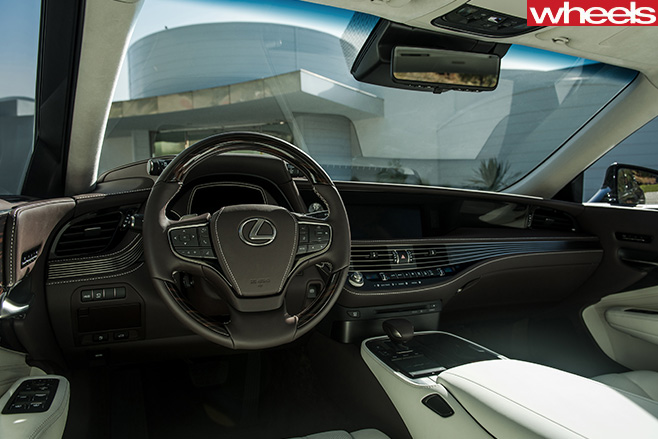
So far, Lexus has only confirmed the 3.5-litre twin-turbo V6 for the 2018 LS, delivering 310kW and 600Nm to the rear wheels via a class-first 10-speed torque-converter automatic transmission.
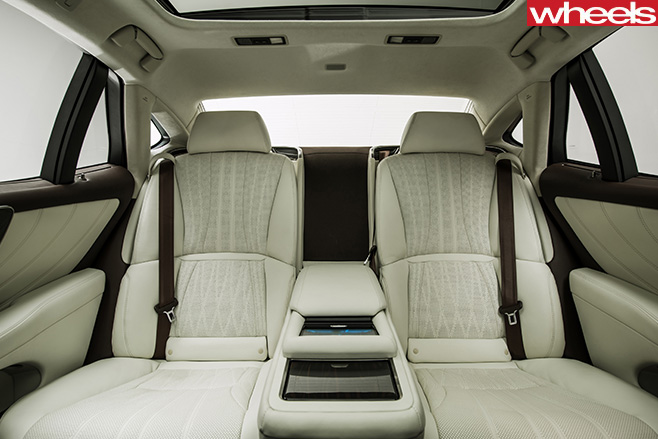
“As you know, the GA-L platform was initially used for the LC, and now with this LS, so it does have flexibility,” Asahi said.
“Strictly speaking, from a platform point of view, that (the LC’s V6 hybrid and V8 fitting into LS) would be feasible.”
More information on the new LS will be revealed closer to its Australian launch
The jury may still be out on whether the UK voting to leave the European Union was a good idea or not, but Brexit has done wonders for Caterham’s Australian pricing.
Thanks to the devaluation of the UK Pound as a result of the vote, Caterham has managed to slash the prices of its Seven range by between $4000-$13,400, vastly improving its value-for-money equation. The full list of reductions can be seen below:
| Model | New Price | Old Price | Reduction |
| Seven 275 | $64,000 | $69,850 | $5,850 |
| Seven 275 S | $69,900 | $83,300 | $13,400 |
| Seven 355 | $76,600 | $86,900 | $10,300 |
| Seven 355 R | $94,800 | $99,800 | $4,000 |
| Seven 485 S | $103,700 | $114,400 | $10,700 |
| Seven 485 R | $114,900 | $127,000 | $12,100 |
Caterham has endured a tough time in Australia. The high cost of meeting Australian Design Rules and the low number of vehicles sold pushes prices up, however the entire range was inadvertently ruled to be illegal in recent times, causing significant headaches for the Australian importer.
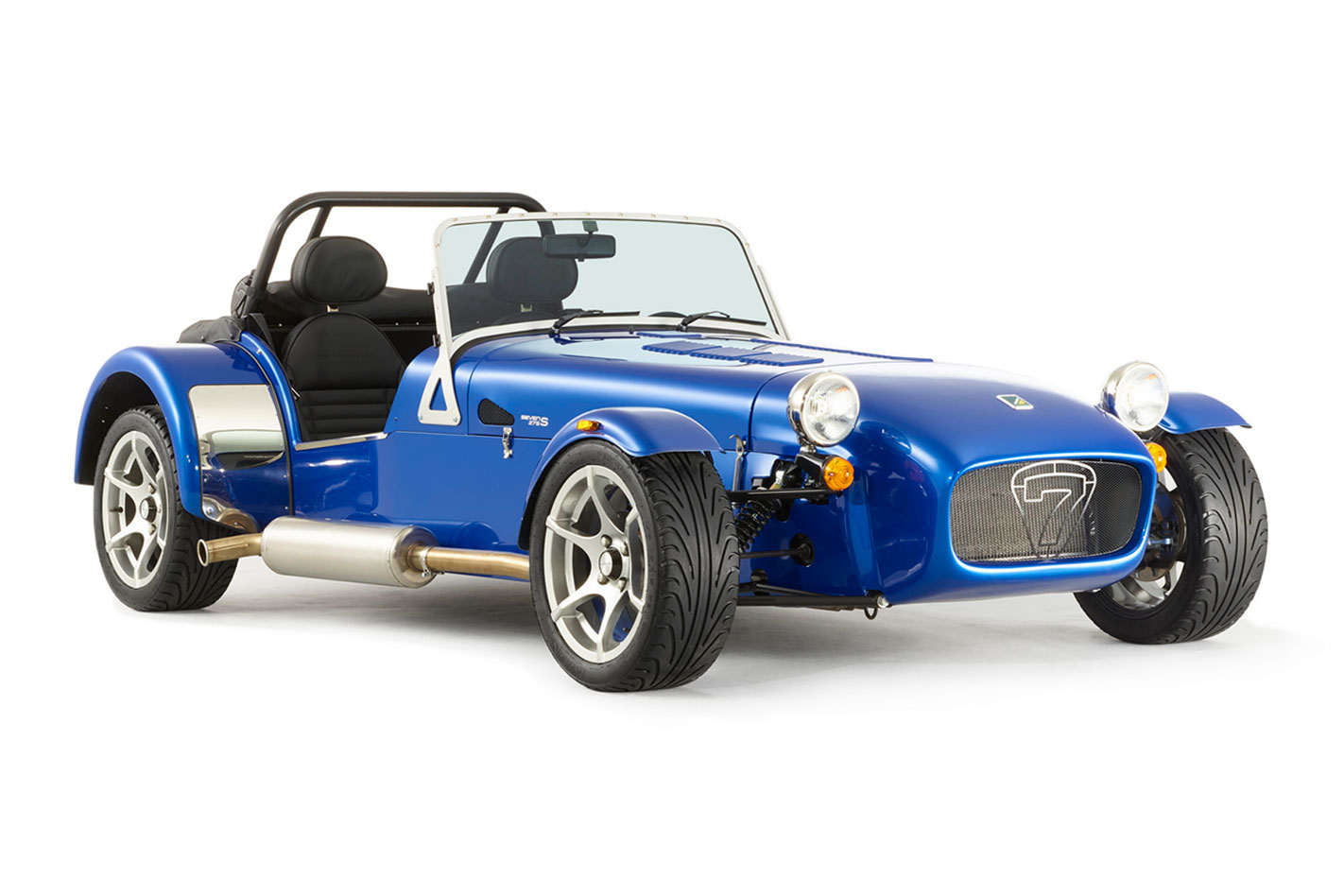
Unfortunately, this exemption was mistakenly removed and attempting to get it reinstated took many months work, though thankfully this has now taken place.
Caterhams require an extraordinary amount of compromise, however they also deliver a truly unique driving experience, one that every enthusiast should try at least once. The good news is, the experience is now cheaper than ever.
Beyond the 400m timing point, at the top end of Sydney Dragway’s strip, lays asphalt free of sticky surface prep. It’s the perfect venue for our first discipline: the slalom test.
A test which is the most telling for dry, real-world agility and grip under severe change of direction. A key indicator, then, for ‘performance’.
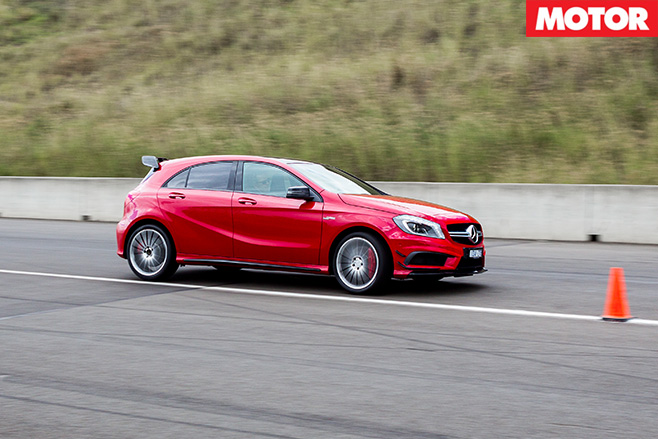
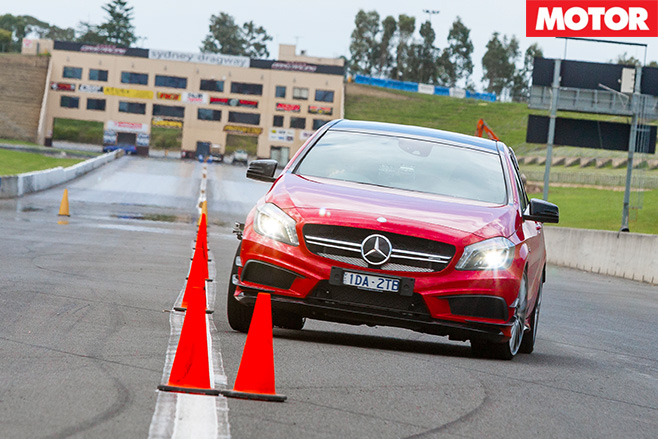
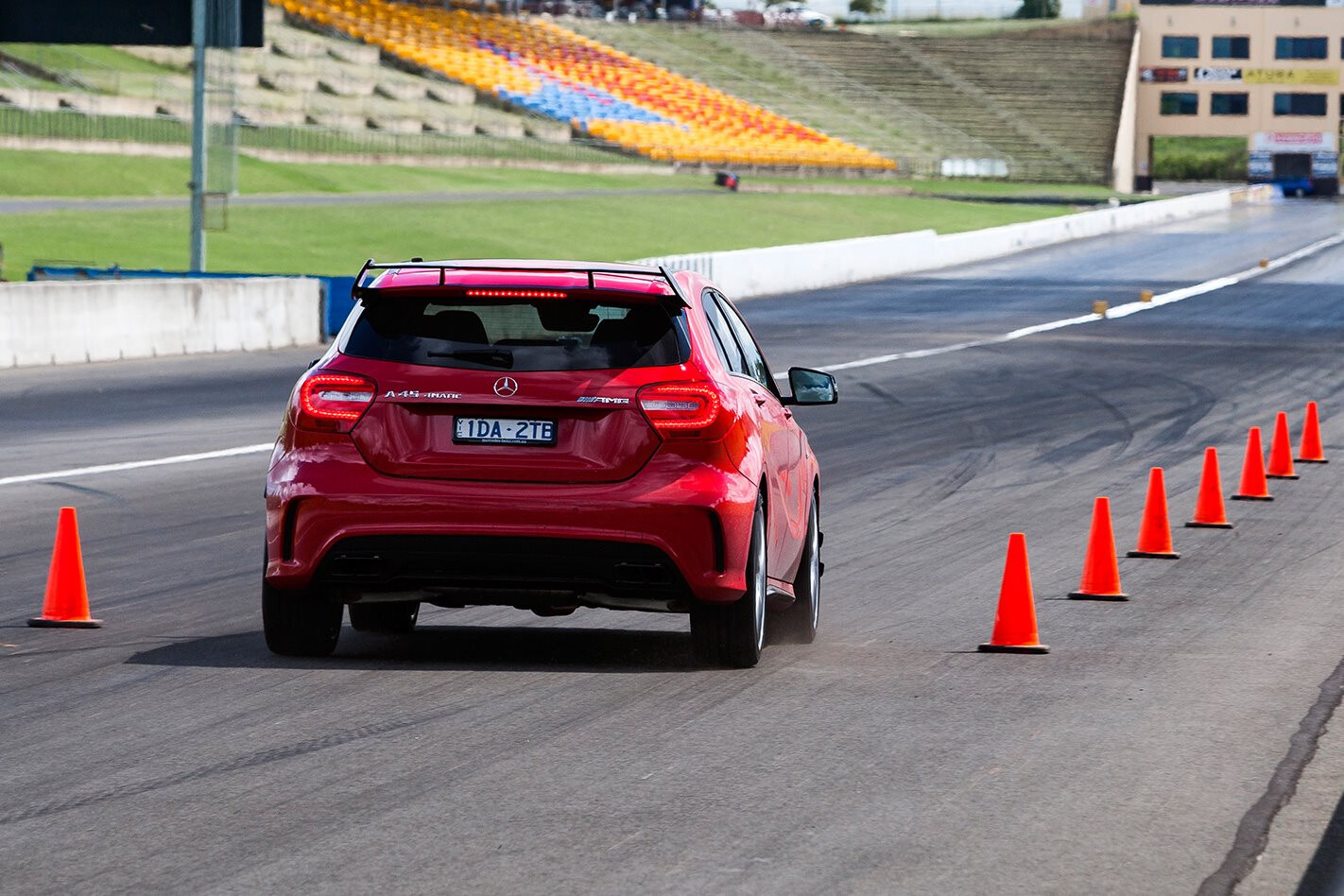
The frequency of the cones is somewhat ‘tuned’ to the AMG so that, from a 50km/h flying start, even the grippiest competitor tyre won’t allow the hot hatch to hit its rev-limiter in the held second gear, a practice that removes potential variables of gear-changing from the timed result.
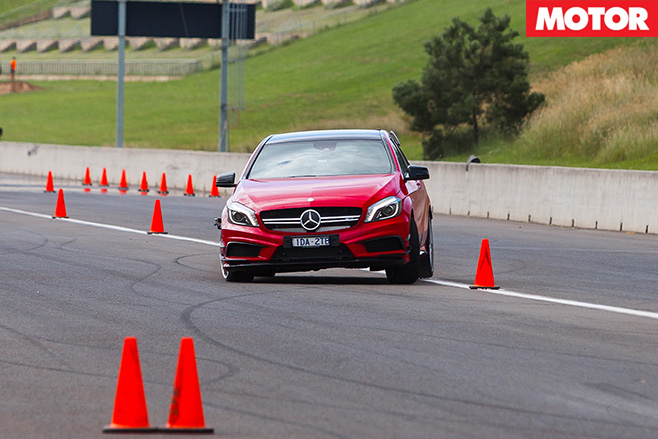
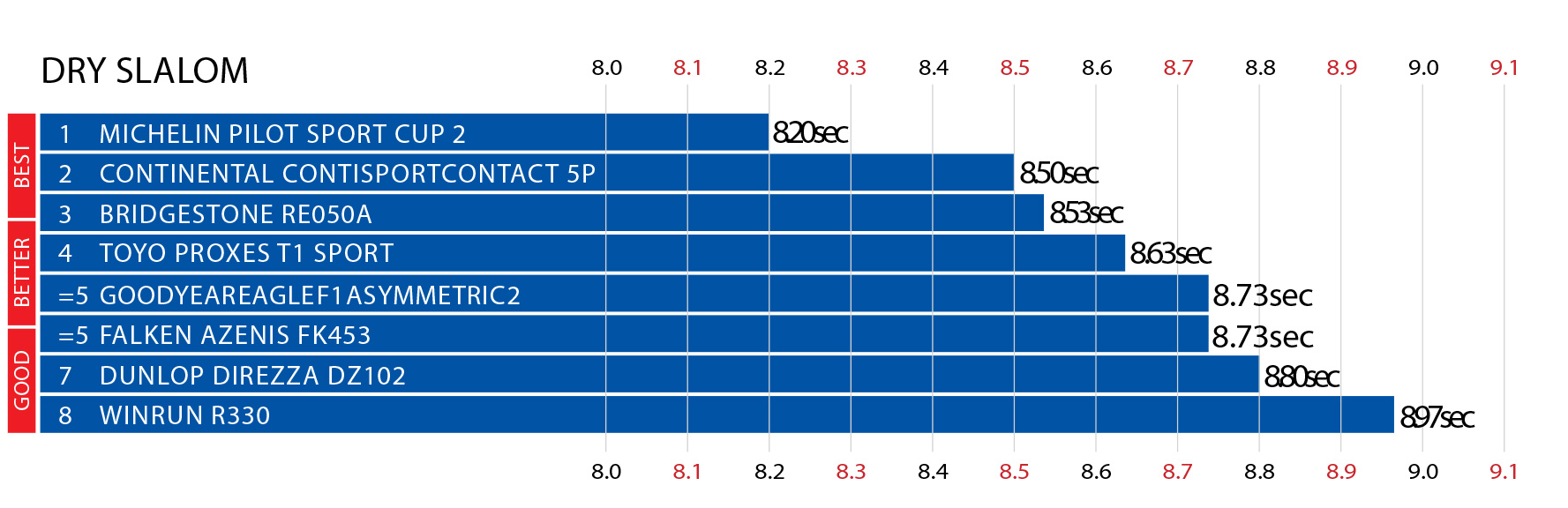
Feedback-wise, Luff focuses on three key areas: initial turn-in, loaded front-end grip and lateral rear-end load. And there was one tyre conspiring a superior combination of all three to record an untouchable 8.2sec: the Michelin Pilot Sport Cup 2. It was a full 0.3sec quicker than any rival.
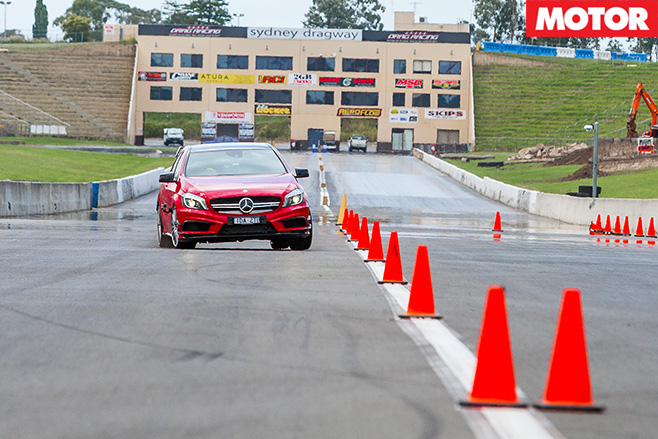
It was an extremely close battle between the second-quickest competitors. The Continental ContiSportContact 5P clocked a quick 8.5sec, while the Bridgestone RE050A nailed an impressive 8.53sec time.
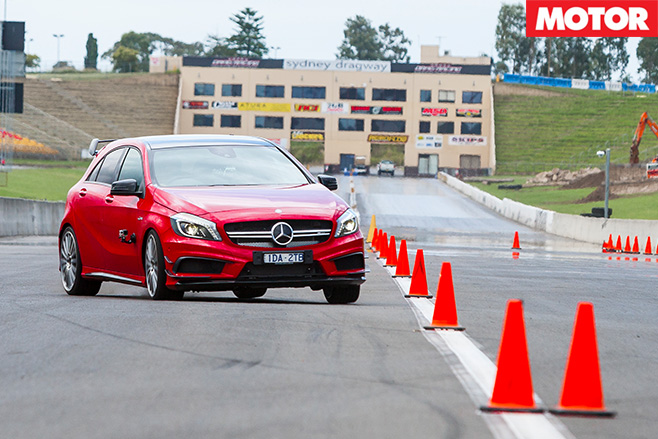
The Toyo Proxes T1 Sport, with its 8.63sec, was no slouch either. Luff was moved to praise the Toyo’s all-round consistency in the dry cut-and-thrust.
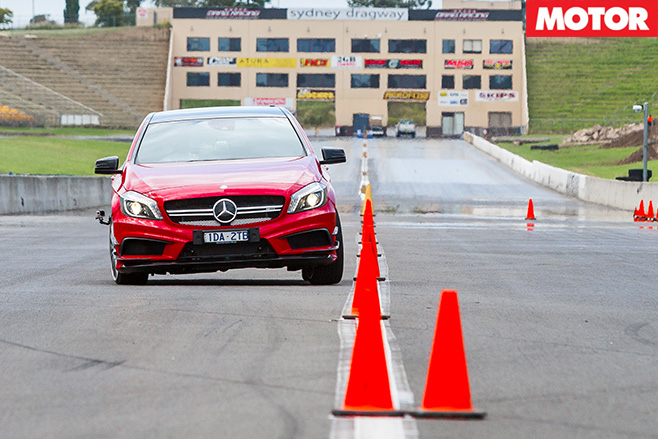
Not quite as happy with the Slalom’s fierce direction changes was the Dunlop Direzza DZ102 – its 8.8sec time reflected as much. “It just feels ‘harder’ than most,” Luff explains. Indeed, its extremely durable 460 tread wear rating was the highest of the field.
“The Winrun really can’t match the outright grip levels of most of the field,” was Luff’s initial take on the Chinese tyre’s performance.
THANKS TO: SYDNEY MOTORSPORT PARK AND SYDNEY DRAGWAY These truly are the best facilities in Australia to do a real-world tyre test and we’re grateful we get invited back each year. The Australian Racing Driver’s Club offers plenty of sharply-priced opportunities to track your street car, which should be a regular must for every MOTOR reader. Check out ardc.com.au.
MORE MOTOR TYRE TEST 2015
 DRY BRAKING
The spread of braking distances, across this field of eight competing tyre models, spans a whopping 8.52 metres!
 MOTOR TYRE TEST 2015
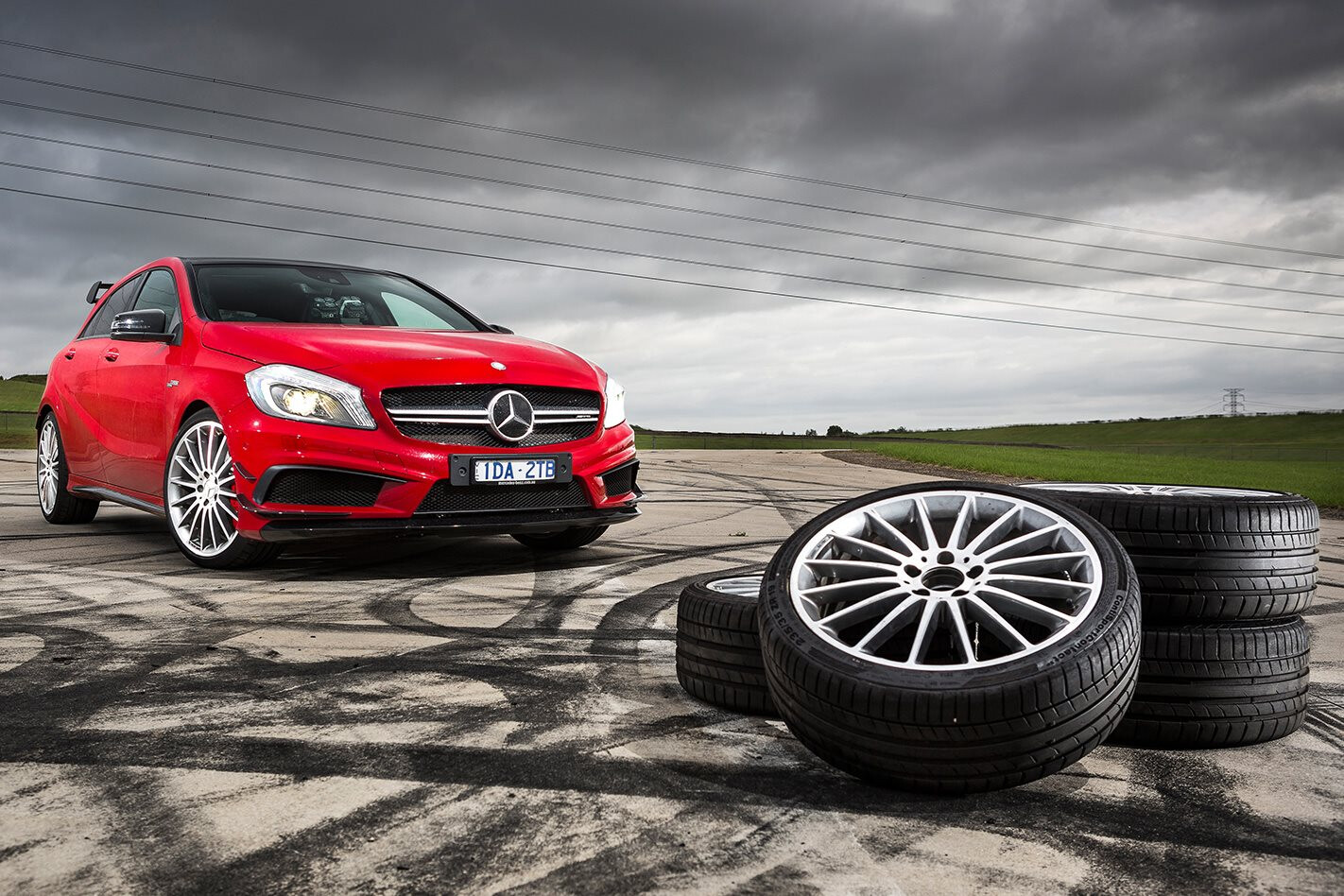
Our ultimate grip test again proves that while they may look the same, the levels at which these rings of sticky stuff perform are vastly different.
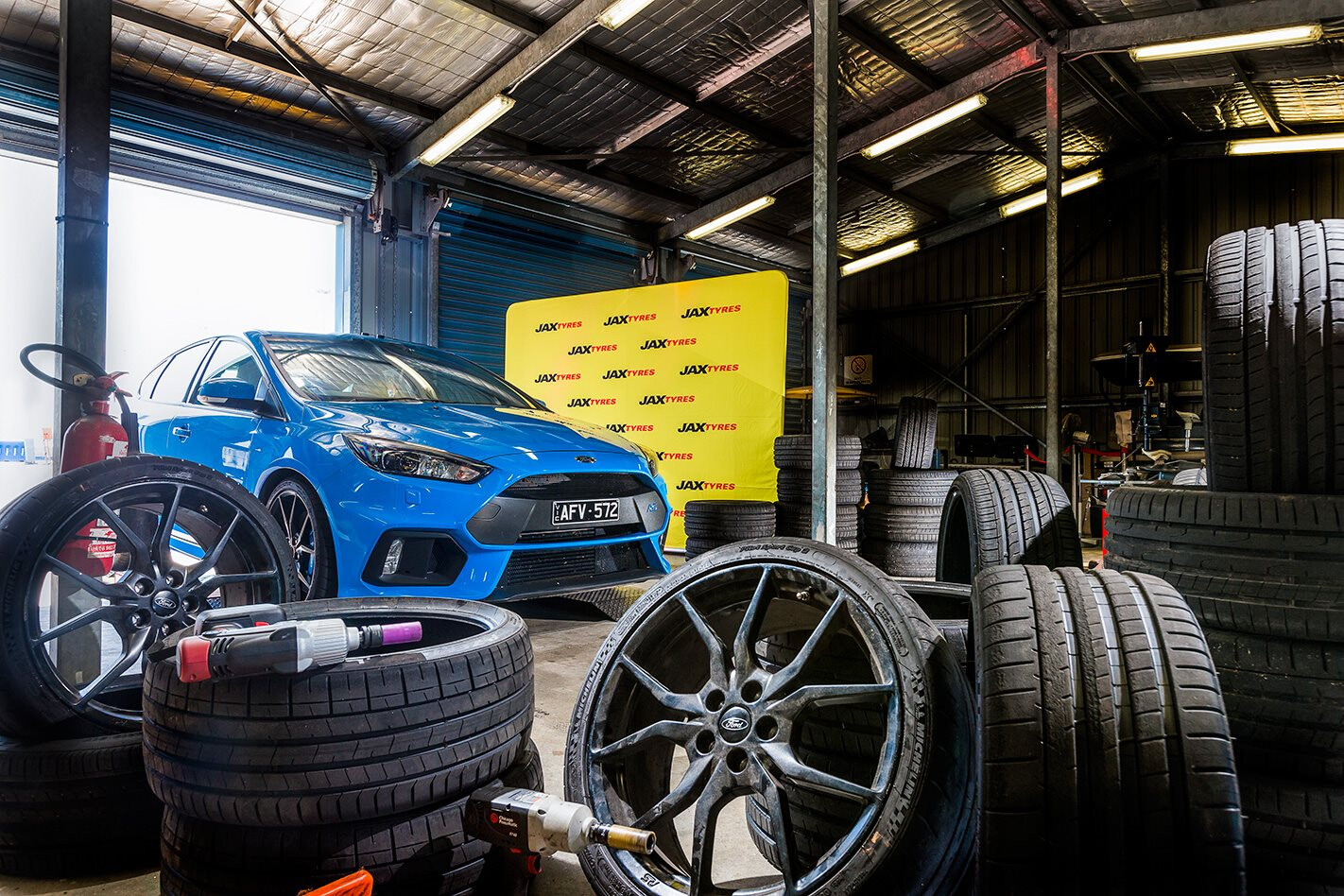 MOTOR TYRE TESTS
The quest to find the best high performance tyres in Australia.
Cadilllac will offer customers the ability to park up to 18 new cars in their driveway every year, with its new ‘Book by Cadillac’ ownership scheme structured more like a mobile phone plan than a vehicle purchase.
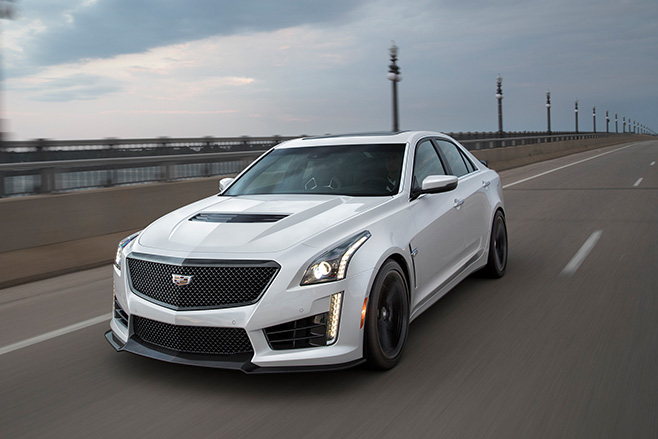
The Book by Cadillac service, launched by the US luxury brand in New York this week, costs $US1500 ($A2010) a month. Under the terms of the service, customers can access up to 18 Cadillac-badged vehicles a year for up to 30 days at a time. The exception is the CTS-V performance sedan, which will be limited to a loan of just five days – so Cadillac can share more of the performance car love around.
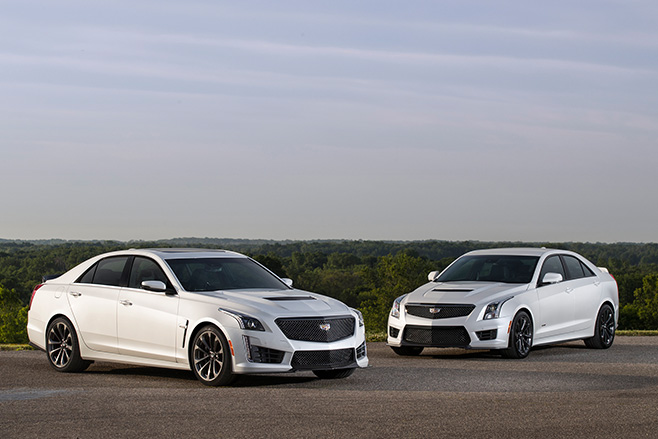
But the best bit is that Cadillac will deliver the car to customers, fully detailed and with three-quarters of a tank of fuel on board. At the end of the loan period, they will come and pick it up, and even swap it for a different one.
Included in the monthly price are most of the running costs associated with owning a car, including registration, insurance, maintenance and repairs. There’s no limit on the number of kilometres users drive the cars, either.
“Book by Cadillac is an innovative new option targeted at a growing class of luxury drivers searching for access to various cars over time, depending on their individual needs, coupled with a hassle-free white-glove exchange,” Uwe Ellinghaus, Cadillac’s chief marketing officer, said.
Under the scheme, users will be able to book their car via a smartphone app. As soon as they pick it up, they can then book the next one.
“Members can just as easily take to the winding roads in a performance V Series and enjoy a back-mountain winter ski trip in an Escalade in the same week,” Cadillac said.
“Alternatively, they can keep an SUV during the winter months and switch to a performance sedan during the summer, with each vehicle picked up and delivered to their doorstep.”
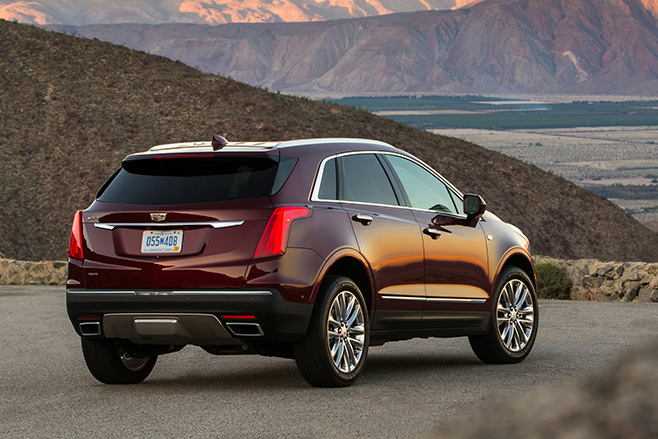
Cadillac is on Australia’s radar, with company executives saying in 2015 that GM’s luxury brand would arrive here by 2019.
Holden’s Lang Lang proving ground has hosted some of the development of the Cadillac CT6, a Holden Commodore-sized four-door sedan, including a twin-turbo version of the high-performance 3.6-litre V6.
The Cadillac CT6 is expected to arrive in Australia as a replacement for the extended-wheelbase Holden Caprice, which ends production later this year.
Cadillac has committed to maintaining a range of rear-drive models that will focus more on driver engagement and enjoyment than fuel savings.
TOYOTA has confirmed it will kill off the Aurion nameplate later this year when local manufacturing of the V6-engined car and the closely related Camry ends.
Wheels reported last year that a V6-engined version of the Japan-built, next-generation Camry would replace the Aurion, bringing four- and six-cylinder models back within the same Camry-badged line-up.
According to Toyota Australia sales and marketing managing director Tony Cramb, the move was a response to slowing sales in the medium and large car segments – suggesting that supporting two separate nameplates would be unsustainable.
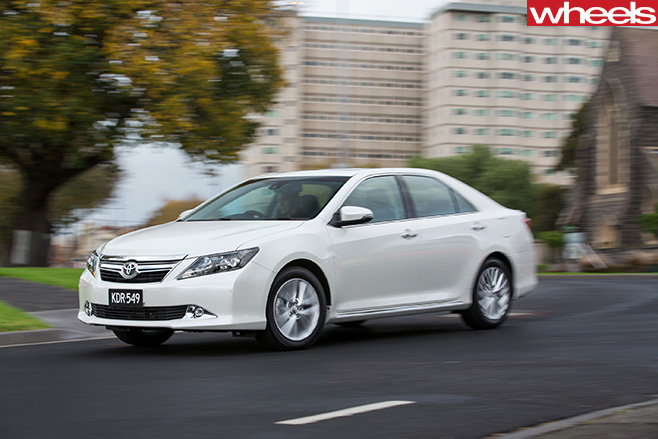
Rejecting the notion that the Aurion was a sales failure, Cramb said the decade-old decision to split the V6 from the four-cylinder Camry was the correct one as the large car segment was still king, and the first and second most popular vehicles on sale were the Holden Commodore and Ford Falcon.
“The Aurion has been wonderful for us,” he said. “We’ve sold over 100,000 Aurions during its life, and it’s done an amazing job, but it was probably launched at a different time in the Australian automotive industry in terms of timing, and it had a particular job… but the market is changing and we’re changing with it.”
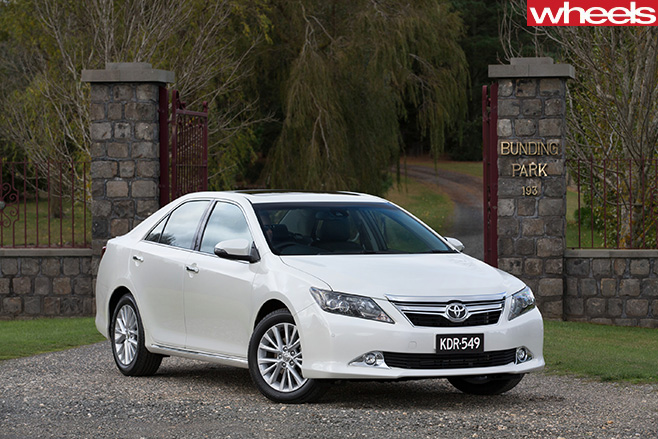
It attracted more than 22,000 buyers in its first full year on sale.
But spiralling fuel prices, plummeting large-car sales, and a mass migration to SUVs eroded the Aurion’s success, with sales falling from 19,562 units in 2008 to just 3833 registrations last year. Even the rebodied second-generation Aurion (based on the Mk6 Camry) from 2012 could not arrest the decline.
In contrast, the four-cylinder Camry has hovered between 23,000 and 27,000 sales a year over the same period.
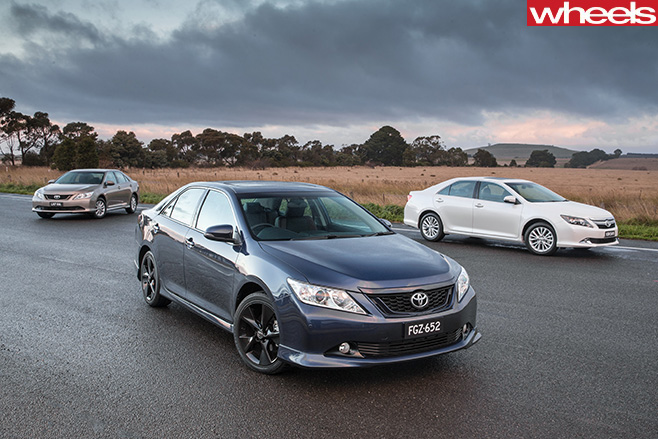
Toyota has a history of trying to separate four-cylinder and V6 Camrys. Before the Aurion’s arrival, it marketed the six-pot Vienta for nine years from 1993. There was also the failed Avalon, a sort of super-sized Camry developed primarily for the US market in the mid-1990s, but manufactured at Toyota’s Altona plant (replacing local Corolla production, ironically), from 2000 to 2006.
TOYOTA’S decision to quit Australian carmaking will hurt the sales of one of its most popular models, the carmaker has admitted.
The Toyota Camry was the brand’s third best-selling car in 2016, the strongest-selling mid-size car and Australia’s overall sixth bestseller. However, its popularity was buoyed by special deals and the ‘buy Australian’ policy of many of the government, fleet and business buyers that favoured it.
With the carmaker about to close the door on more than half a century of local manufacturing late this year, Toyota has sounded fears that some of the buyers who once queued up for the locally made Camry will shop elsewhere once the Japan-made version arrives to replace it.
“I think sales will come off from where they are at the moment,” Toyota Australia sales and marketing executive director Tony Cramb told journalists at the Detroit Motor Show this week.
“So it’s fair to say we’re selling more now than would ordinarily be sold in Australia. We’re merchandising aggressively at the moment in order to meet that commitment to local manufacturing.”
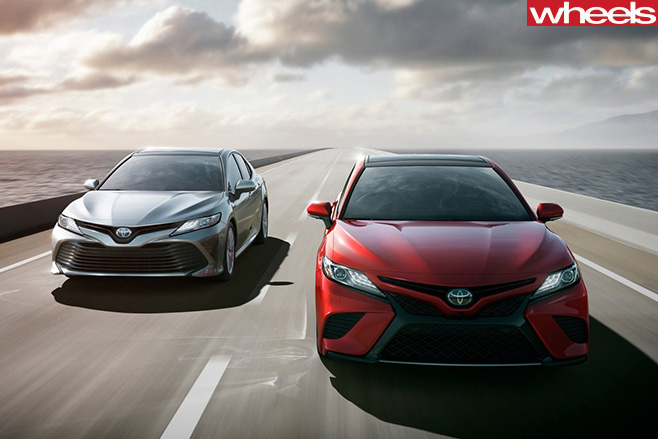
The Camry that will replace the Australian-made version will bring an all-new design with more contemporary styling, improved space, and potentially better driveability and dynamics. It is built on Toyota’s all-new TNGA platform that also underpins the Prius hybrid and the new Corolla hatchback.
Cramb said Toyota was confident the Camry would remain a strong fleet favourite because it would have much more going for it than the previous versions, while remaining an affordable and dependable family car.
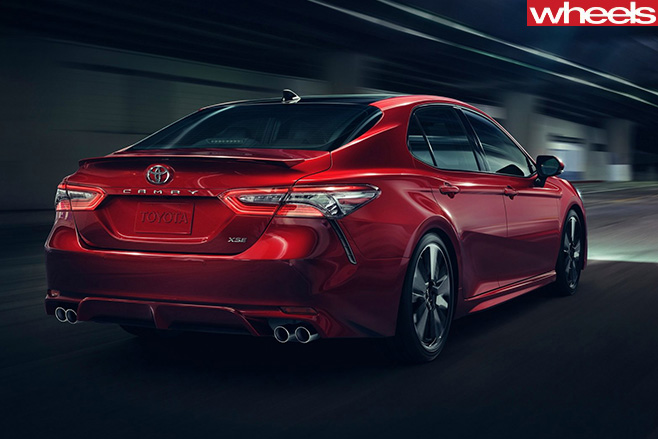
“Obviously buying policies will change after we are no longer a local manufacturer. So we were getting special treatment from various government authorities particularly, and some larger Australian companies would give us preferential treatment as a local manufacturer. Those things change over time.
“But still, truthfully, you have to earn your place in fleet, and it becomes a very commercial decision for most fleets. And this car will be perfectly suited.”
The Camry’s 26,485 sales in 2016 (or 30,318 when the V6-engined Aurion’s numbers are included) represent a 4.2 percent fall over 2015’s results, and were double the rate of contraction for all medium car sales in Australia under $60,000.
The Aurion performed even worse, with an 11 percent slide over the previous year (3833 versus 4306), in a large-car class that shrunk by 9.6 percent.
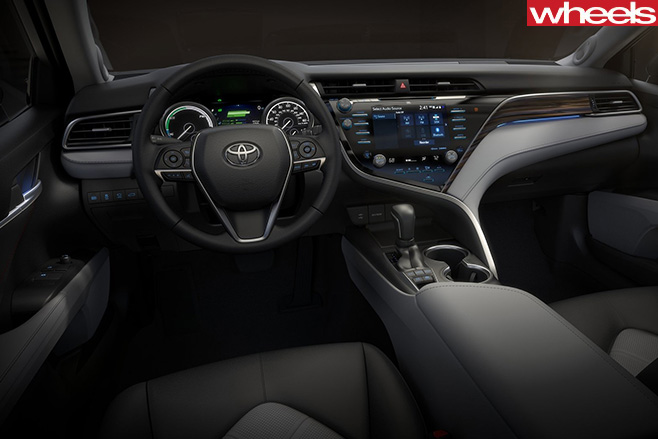
Launched in 1983 as a fully imported five-door liftback, the original Camry was the first front-drive Toyota sold in Australia, pitched as a premium-priced alternative to the more mainstream rear-drive Corona.
A second-generation Camry replaced the Corona on the Australian assembly line from 1987 (except for the Mk2 V6 version), finally stealing the title as this country’s bestselling mid-sizer from the influential Mitsubishi Magna when the third-gen ‘wide-bodied’ version surfaced in 1993.
In its near 35-year history, more than 900,000 Camrys and its derivatives have been registered in Australia, including 960,000 four-cylinder models, 169,000 V6s, and 42,000 hybrids.
What stands out?
The BMW X5 is a luxuriously equipped large SUV with up to seven seats. You can choose from a big range of excellent petrol and diesel engines, and most X5s drive all four wheels. City-speed auto braking is standard. The X5 xDrive 40e, a petrol-electric hybrid that you can charge from home powerpoints, offers near-silent short trips.
What might bug me?
That adults and even teenagers can’t stay comfortable in the third-row seats. Those optional sixth and seventh seats are suitable only for children aged about nine and younger. For bigger people, the rearmost seating is short on leg room and hard to get into.How bulky it feels in the city. The X5 is a big and heavy vehicle, and it does not feel nimble when you are driving around town.If you have optioned wheels of 20-inch diameter or bigger, that the ride is rougher and noisier than you had hoped for from your luxury SUV. On these wheels, with their matching low-profile tyres, you’ll find bumps and road noise take the serenity out of the driving experience.Dealing with a puncture in remote places. Every X5 but one has run-flat tyres and a space-saver spare tyre. Run-flat tyres allow you to keep driving after a puncture. The catch is, you are not supposed to drive faster than 80km/h, nor further than 80km. If a replacement tyre is further away (or if the run-flat tyre is badly damaged), you can fit the skinny space-saver spare wheel. However, it too is suitable only for speeds under 80km/h.The exception is the xDrive 40e plug-in hybrid, which has run-flat tyres but no spare. (Its battery pack occupies the spare-wheel well.)
What body styles are there?
Just the one, a five-door SUV-style wagon.The original X5 was praised for its smart, crisp exterior styling. The current version, while larger and possibly more pleasing to residents of the United States where it is built, has met less admiration elsewhere.The X5 is classed as a large SUV, higher priced.
What features does every BMW X5 have?
Satellite navigation, displayed on a 10.25-inch central colour screen. A 20GB hard drive for storing music and other media. Digital radio, and Bluetooth connectivity for phone calls and audio streaming.A reversing camera. (In all but the two least costly models, this offers top and side views as well as a view out the back.) Front and rear parking sensors.An interior trimmed in leather. Power adjustment for the front seats and exterior mirrors (with memory position for the driver, so that you can touch a single button to restore your preferred set-up).Cruise control. Headlamps that switch on automatically in low light, and windscreen wipers that operate automatically when it rains.Dual-zone climate control (which allows different temperatures on either side of the cabin). A power-opening tailgate, which can be foot-operated from a sensor below it.Runflat tyres, which allow you to drive up to 80km on a flat tyre (in cities, that should get you to a tyre shop). On all but the xDrive 40e plug-in hybrid, a space-saver spare wheel and tyre.Driving Assistant, a camera-based active safety package that includes a lane departure warning and city-speed autonomous braking.Electronic stability control, which can help the driver control a skidding car. All new cars must have this feature.Eight Airbags (for details of where they are placed, and for more information on other X5 safety systems, please open the Safety section below).All X5s are covered by a three-year, unlimited distance warranty.
Which engine uses least fuel, and why wouldn’t I choose it?
BMW offers a very big range of diesel and petrol engines for the X5. And in May 2016 it added a plug-in hybrid drivetrain with the xDrive 40e (it teams a petrol engine with an electric motor whose battery can be charged from household power outlets).Of the diesel and petrol cars, the least costly X5 – the sDrive 25d – uses least fuel, its 2.0-litre, four-cylinder turbo-diesel consuming 5.3 litres/100km on the official test (combined cycle).The same engine powers the all-wheel drive xDrive 25d. It provides perfectly acceptable performance for most drivers in most driving conditions.Nevertheless, the most popular engine in an X5 is the bigger and more powerful 3.0-litre diesel fitted to the xDrive 30d. It offers muscular acceleration from low speeds, and effortless overtaking and towing. And it uses only slightly more fuel on the official test, at 5.9 litres/100km. (Like most cars, the xDrive 30d needs more fuel in the real world: expect 8 or 9 litres/100km.)A still more powerful, and slightly thirstier, variant of this 3.0-litre diesel is offered in the xDrive 40d.If you are one of the few people who want even more performance from a diesel X5, you may be interested in the X5 M 50d. Its 3.0-litre engine is boosted by no fewer than three turbochargers, delivering stupendous performance and an engaging sound (unusual for a diesel), while containing fuel use to just 6.6 litres/100km.One reason you might not want a diesel X5 is that you don’t want to deal with oily diesel fuel and greasy diesel fuel pumps. For you, the X5 is offered with three petrol engines.The least costly petrol X5 is the xDrive 35i, whose 3.0-litre turbocharged six cylinder brings you fine, silky smooth performance. Ultimately an xDrive 35i will be slightly quicker than an xDrive 30d, with the greater willingness to spin hard that is typical of a petrol engine, but with a little less grunt for towing.Then there is the xDrive 50i, powered by a 4.4-litre V8 engine running two turbochargers. It’s a serious performance vehicle, and is thirsty in day to day running.The most expensive – and quickest – model in the X5 range is the X5 M. It also uses a 4.4-litre, twin-turbo, V8 petrol engine, but one that is significantly reworked and upgraded to deliver extremely high performance and an equally eye-widening fuel bill. On the official test it consumes 11 litres/100km, but it’s easy to use twice as much fuel with enthusiastic driving.If you expect you will use your X5 largely for short trips around town, and you need only five seats, you might have good reason to bypass all of the conventional diesel and petrol engines and choose instead the petrol-electric plug-in hybrid X5, the xDrive 40e. For round trips shorter than about 25km you can drive an xDrive 40e using no petrol at all, relying instead on its electric motor and battery, which you can recharge fully at home in about five hours. On long trips in the country, however, where you will be driving mainly on its paired 2.0-litre, four-cylinder, turbo petrol engine, it is likely that fuel use will greatly exceed the 3.3 litres/100km attributed to this car from the official test: expect to use more like 10 litres/100km. Performance will be comparable with the xDrive 30d and xDrive 35i.
What key features do I get if I spend more?
The least expensive X5, the sDrive 25d, drives its rear wheels only, as indicated by BMW’s naming convention: sDrive means a single pair of driven wheels. All other X5s are xDrive models, which means all-wheel drive. Therefore, the first thing you get by spending more on an X5 is the better traction on wet, muddy or otherwise slippery surfaces that AWD brings.Step past the least costly AWD model, the xDrive 25d, and spend more for an X5 and the main thing you get is a more powerful petrol or diesel engine, or hybrid drive – as outlined above. However you also get some more equipment, and different wheels.The xDrive 30d brings you a head-up display, which projects a speedo and other useful driving information onto the windscreen in your field of vision. It also brings you wheels an inch bigger at 19 inches, shod with tyres of a slightly lower profile (this is mainly a cosmetic change).Paying a bit more for an xDrive 35i (or any of the four more expensive X5s) brings you, in addition, smart-key entry, which unlocks the doors when you grab the handle (provided that the key is nearby, perhaps in a pocket or bag). You also get a nicer sounding, and louder, sound system from Harman Kardon.The xDrive 50i and the M 50d run 20-inch wheels, with tyres of a lower profile again that are wider, for increased grip. These also bring you a more comprehensive active safety package called Driving Assistant Plus, which includes active cruise control and highway-speed automatic braking. (You can order Driving Assistant Plus on other X5s as an option.)Popular options include the M Sport package, which gets you (among other things) 20-inch wheels and Adaptive M suspension. This suspension sits the car closer to the road to improve its cornering ability. It also adjusts the ride automatically for your driving conditions, using computer-controlled damping. As well, you get some external visual bling, nicer interior trim, and more supportive sports front seats.There is also an Adaptive Comfort suspension option available for the 40d and the four models priced below it. This also uses computer-controlled dampers, which react on the move to reduce the intrusion of bumps and ruts. In this case the suspension is tuned to emphasise comfort rather than performance. Air springs at the rear level the car when it’s heavily loaded or has a trailer attached.Two cosmetic option bundles, Pure Experience and Pure Excellence, can greatly lift the interior and exterior appearance of your X5. You choose from an extensive sample palette of leathers, other materials and finishes.A folding third row of seats, extending seating from five to seven, is an extra-cost option on all but two X5s. The exceptions are the the X5 M and the plug-in hybrid xDrive 40e, on which it is not available.
Does any upgrade have a down side?
The performance oriented Adaptive M suspension upgrade, combined with the big 20-inch wheels from the M Sport package, makes the car less comfortable over bumpy roads. And the big wheels and tyres are more susceptible to damage from rocks when driving off sealed surfaces. The larger tyres will also cost more to replace, and will not accept snow chains.Optioning the third row of seats means you lose the space-saver spare wheel, and must rely on only the run-flat tyres in the event of a puncture.The X5 M and xDrive 40e plug-in hybrid do not offer third-row seating: they are five-seaters only.Metallic paint is standard only on the two most expensive X5s. On the others, it is an extra-cost option.
How comfortable is the X5?
The commanding driving position, excellent adjustability of seat and steering wheel, abundant space and premium cabin finishes immediately make any X5 feel welcoming and very comfortable.On the move, the X5’s ride comfort – its ability to isolate occupants from poor road surfaces – depends heavily on the suspension package and the wheel and tyre combination fitted.In standard form, the least expensive models – the sDrive 25d and xDrive 25d – are the most comfortable, thanks to their smaller wheels and higher profile tyres, which have greater sidewall depth that helps absorb bumps.If comfort is a priority, consider the Comfort adaptive suspension option and avoid ordering the 20-inch wheels.In all other respects, the X5 is extremely comfortable. Wind noise is moderate, and tyre noise at highway speeds is not intrusive. The standard front seats are adequate for people of average build or smaller.However everyone – and especially those of larger frame – will appreciate the sports front seats (standard on some versions and an option on others). These adjust to provide extra under-thigh support, which is always welcome on long trips, and they also bring better side support, to locate your upper body more securely through corners.The diesel engines, while noisier than their petrol counterparts, are not loud or intrusive in the X5. On trips around town the plug-in petrol-electric hybrid xDrive 40e is especially comfortable, because its ability to run on just the electric motor makes it exceptionally, almost eerily, quiet.
What about safety in a BMW X5?
All BMW X5s deliver a strong standard safety story, and there’s an array of optional safety equipment.Every X5 is equipped with six airbags: frontal and body-protecting side airbags for the driver and front passenger; and side-curtain airbags that protect the heads of outer occupants in the first two seat rows from side impacts. (The curtain airbags do not protect passengers in the optional third-row seats, however.)Also standard is an active protection system that sees the car prepare itself (closing windows and sunroof, and tensioning seat belts) if it detects that a crash is imminent at any speed. If you use maximum braking, rear brake lights flash and the hazard lights activate – reducing the chances of a rear-end collision from the tailing car.Every X5 also has a camera-based Driving Assistant package that includes an autonomous partial-braking system which works at speeds up to 60km/h. If it detects an obstacle in front – typically a sharply slowing car – it will warn you and if necessary will initiate braking automatically, but it will not apply maximum braking. There is also a lane-departure warning, which alerts you if you have begun to drift out of your lane (a sign of fatigue).Among safety-related options available at extra cost is Driver Assistant Plus – a camera-and-radar based system that works over a longer range and at highway speeds. It offers active cruise control, which will maintain a safe distance to vehicles in front. And it offers forward collision warning and full auto-braking at speeds up to 210km/h.Also optional is lane-change warning, which alerts you to vehicles alongside in a blind spot via a light on the exterior mirror and a vibration through the steering wheel.Other safety-related options include headlights that dip automatically for oncoming drivers, and that turn with the steering wheel to shine into corners. A Night Vision system picks out with a spotlight roadside pedestrians or animals you may not otherwise see.
I like driving – will I enjoy this car?
Yes. All X5s turn into corners with authority and deliver generous grip, giving you plenty of confidence on country roads.However this is a large, heavy SUV. So while even the least costly X5s have enough urge to take you anywhere you need to go, the more powerful variants – from the xDrive 30d up – are a better match for the car’s size and weight, and offer a skilled driver much more entertainment. They also feel more responsive in stop-start urban driving, and more effortless in hilly open-road driving.Another caveat is the steering. Despite having three levels of assistance to select from, it never provides the very high level of feel you get with some other big premium SUVs.More generally, the X5 is always going to be hamstrung by weight and its high centre of gravity when it comes to true driving enjoyment. It won’t reward you in the same way that a BMW sports sedan does. But considering what it is and what it’s capable of, there is driving enjoyment to be had.The all-wheel-drive system fitted to all but one X5 helps the car maintain traction on muddy, snowy or otherwise slippery sealed roads, on gravel roads, and on well-maintained tracks. The X5 does not have the ground clearance, underbody protection or low-range gearing needed for rough off-roading, however. And if you were to get a flat tyre while off the beaten track, you would have to struggle home on the skinny space-saver spare.
How is life in the rear seats?
Very comfortable – which is not surprising, given the car’s size and its luxury positioning. Rear-seat passengers enjoy generous leg room, useful grab handles and ample storage.Even a middle passenger in the second seat row won’t find conditions too cramped or arduous. Very effective ventilation outlets provide ample airflow. Individual temperature controls for outer rear passengers (called four-zone climate control) are available as an extra-cost option on any variant, and are standard on the M 50d and X5 M.Two 12V power outlets in the rear console let the kids keep phones and other devices charged over long trips.As an extra-cost option, BMW also offers rear passengers two 9.2-inch high-resolution screens that are linked to a DVD drive. It will also connect with a games console, USB drive, and headphones.You can have two folding third-row seats in any model but the X5 M and xDrive 40e, but they are an extra-cost option. And over long distances they will be comfortable only for pre-teens.
How is it for carrying stuff?
Excellent: this is an X5 strength. Even with the second-row seats occupied, there is enough boot space (630 litres, in all but one model) to accommodate most of what a family needs for a long weekend away.Fold the seats (they split 40/20/40 and lie almost flat) and the cargo space is enlarged to a vast 1720 litres, so that a man’s racing bicycle, or a serious trip to Bunnings, will easily be swallowed.The loading height of the boot is higher than that of a comparable car-based wagon (such as BMW’s own 535i Touring), which many people prefer when loading bags and groceries.The model with less boot space is the xDrive 40e, due to the battery pack it hides under the luggage area. This raises the boot floor by 40mm (not really noticeable), and cuts the seats-up cargo compartment to 500 litres – still ample for most people.A foot-triggered, hands-free opener for the powered tailgate is standard on all X5s.Legal towing capacity is 2700kg if the trailer has its own brakes – about the norm for a road-oriented big SUV. The X5 could easily tow a jet-ski, a single horse float or a camper trailer, for example.
Where does BMW make the X5?
All X5s are built at BMW’s plant in Spartanburg, Carolina, USA.
What might I miss that similar cars have?
Perhaps a more extensive suite of active driving aids. This third-generation X5 is essentially a rebody of the model before it, rather than a clean-sheet design. Some similarly priced but more recently developed alternatives offer the driver more assistance – for example, the Volvo XC90 and Audi Q7.More accommodating third-row seats. Both the XC90 and the Q7 offer third-row seats with more room and easier entry than the X5.Better ride comfort. The Q7 has a more compliant ride over poor surfaces, especially on its optional air suspension.You may also find the BMW’s standard interior a little dour compared to the more designer-ish Audi. But you can dress it up with material and trim options.
Are there plans to update the X5 soon?
In 2015, BMW made digital radio and internet functionality standard across this third-generation X5 range. A more extensive upgrade is possible in 2017.However, an all-new X5 has been seen undergoing tests in prototype form. This fourth-generation X5 is expected for 2018.A bigger seven-seat SUV, designated the X7, is likely to debut soon after the new X5.
I like this car, but I can’t choose which version. Can you help?
Easy: The X5 xDrive 30d has more than ample performance, is frugal with fuel, and costs a lot less than the faster xDrive 40d. It is the best-selling X5 in Australia, for good reason.The second-best seller is also worth careful consideration. It is the least expensive X5, the sDrive 25d. Plenty of people find this rear-drive variant provides perfectly acceptable performance, and the lower price might give you more freedom to tailor the car to your tastes with options.
