
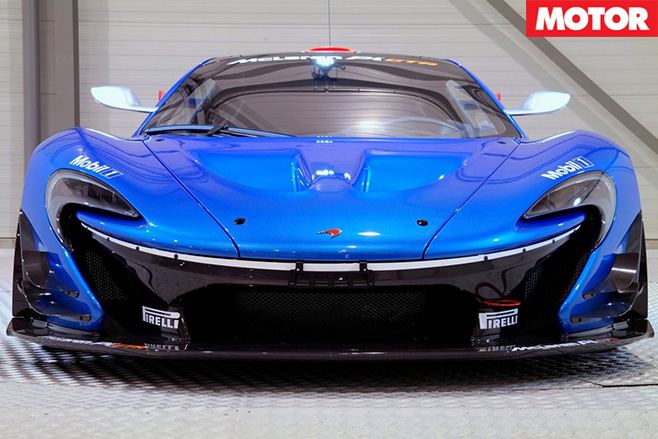
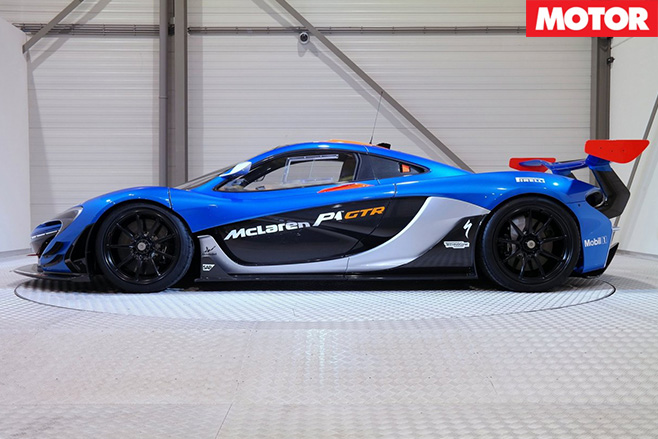
Stop searching for a used Porsche 911 GT3 RS. Right now, you can buy a 2016 road-legal McLaren P1 GTR.
The description doesn’t divulge why it’s bobbed up on the James Edition, but with only 245km on its odometer maybe someone tired of it very quickly on the milk-run. Either way, this won’t happen often.
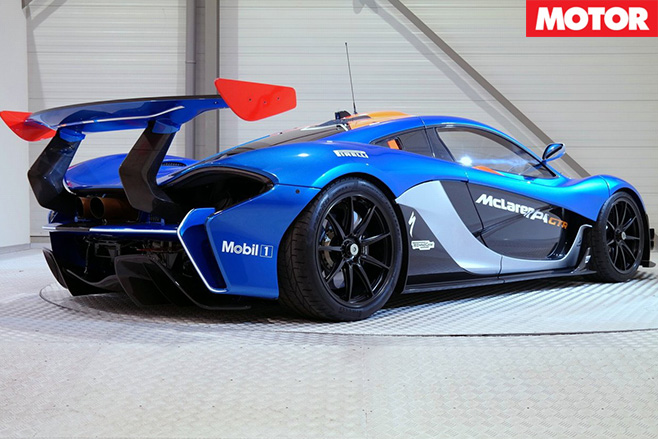
This made them exceedingly quick, but not very road legal, which must have disappointed a few of its customers because McLaren quickly had six GTRs built for road-use.
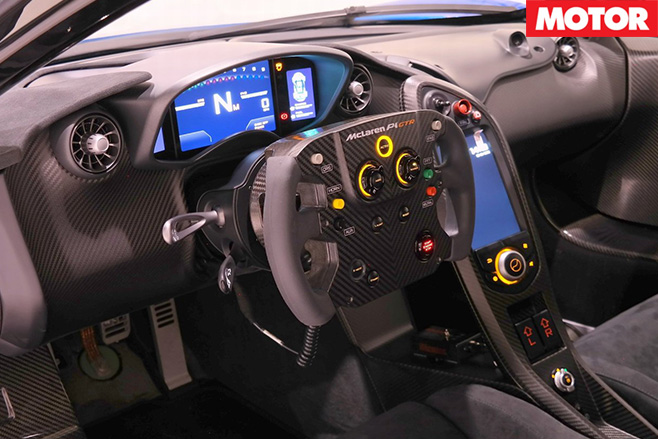
However, while the P1 GTR squeezed 735kW from its hybrid-V8 drivetrain, it’s not clear whether build #009 is packing all of its original watts.
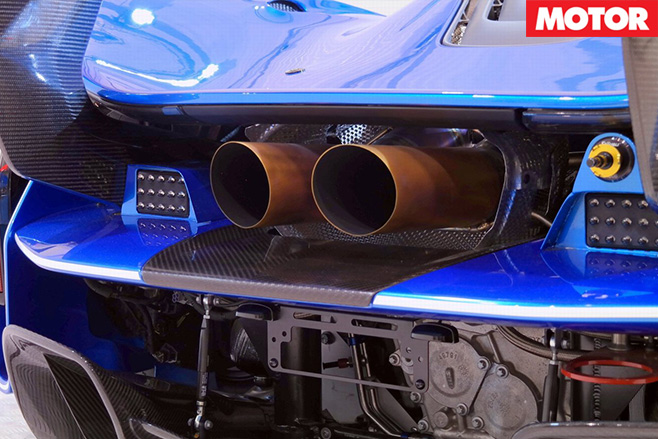
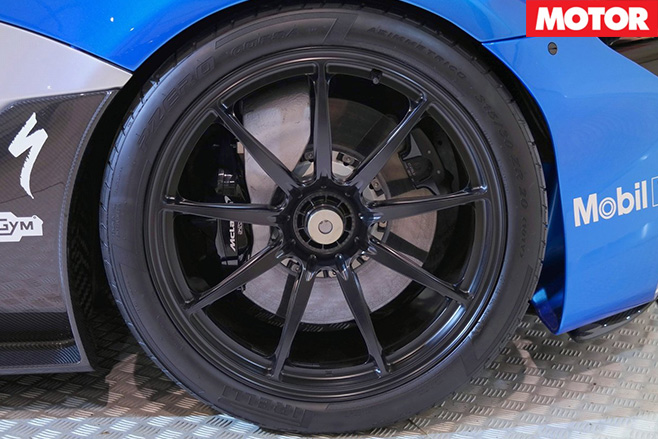
Again, with a short sales blurb, we can’t be sure it’s engine received the full street treatment. But you can see from pictures its packing road seatbelts, steel brakes, and treaded tyres.
You’ll also have to fly pretty far for the pleasure, as it’s currently located in the Netherlands and reported to be registered in the United Kingdom.
YOU might want to think again the next time a smartphone connects to your car’s Bluetooth system. The US road safety watchdog has identified mobile devices, including phones, as one of a number of ways that hackers will one day attempt to break into your car.
The National Highway Traffic Safety Administration overnight released a document titled Cybersecurity Best Practices for Modern Vehicles, calling on carmakers to treat the digital security of cars as highly as they do the crash safety.
It warned the amount of technology linking cars with the internet was potentially opening the door to cyberattacks, and that carmakers needed to think carefully about what they allowed to plug into the car’s delicate electronics – some modern vehicles have more than 60 computers controlling them, all talking to each other via a spiderweb of cables.
It’s this in-car network that hackers can target via an internet connection to the outside world that comes from either an in-built SIM card that connects to the mobile phone network, or a connected smartphone. Concerns have also been raised about in-car Wi-Fi hubs that share a smartphone’s data connection with other users in or near the car.
“The automotive industry should consider that consumers may bring aftermarket devices (e.g., insurance dongles) and personal equipment (e.g., cell phones) onto cars and connect them with vehicle systems through the interfaces that manufacturers provide,” it said.

“The automotive industry should consider the incremental risks that could be presented by these devices and provide reasonable protections.”
Smartphones have already been identified as a potential way for car hackers to gain access to the electronic brains of cars. Last year, a Queensland-based online security researcher was able to hack into any Nissan Leaf in the world via a web-based interface that allowed owners to log in remotely and check the battery charge status of their vehicle. He was able to play around with the settings of a car parked in the United Kingdom, sparking a global shutdown of the service while Nissan rushed to patch the loophole.
In July last year, the NHTSA forced the recall of 1.4 million Fiat Chrysler vehicles in the US – its first ever to fix a software vulnerability – after hackers remotely logged into a Jeep Cherokee’s electronic nerve centre and played around with the engine, steering and brakes.
The NHTSA said the software hack, via the SUV’s connection to the mobile phone network, represented “an unreasonable risk to safety”. Cars in Australia were not vulnerable to the hack.
The guidelines recommend that carmakers follow a similar system already used in the information technology industry to identify and patch potential hacks.
Before you get into a panic, though, the chances of a hacker breaking into your car are very small. In most cases they’ve only electronically broken into a car if they’ve had weeks or months of time playing with it in the driveway to work out how.
Keen motor racing fans may have noticed Tony Longhurst’s return to competition this year.
The two-time Bathurst 1000 winner raced his old BMW 318i Super Tourer at the Silverstone Classic in August (and won both races) before joining the Toyota 86 Racing Series and Carrera Cup championship back in Australia.
But there’s more to Longhurst’s return than just a bit of weekend fun. “It’s been planned,” explains the 58-year-old Queenslander. “I had a burn in the Marc car at Eastern Creek three or four months ago, was able to pick up a drive in the little Toyota 86s, then the Porsche, but that’s all planned for getting miles under my belt for [Bathurst].
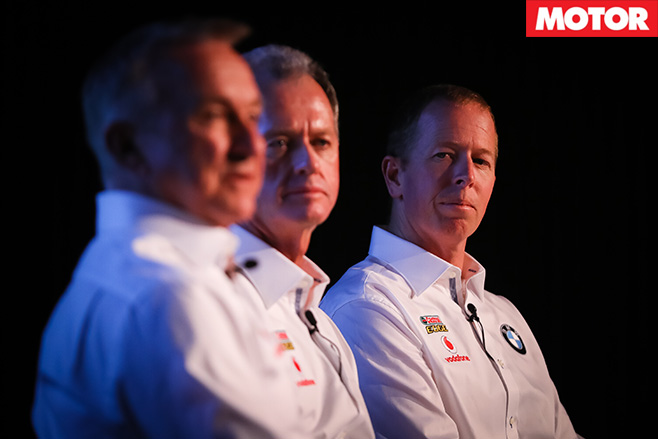
Despite a relative lack of recent race experience, Longhurst is confident he’ll be raring to go by the time the 2017 Bathurst 12-Hour rolls around. “Any circuit we go to in Australia you’ve done a million laps there so you don’t have to think about the circuit, but in race conditions you seem to have a sixth sense, you know where the cars are and what to do, it all comes back to you very quickly.”
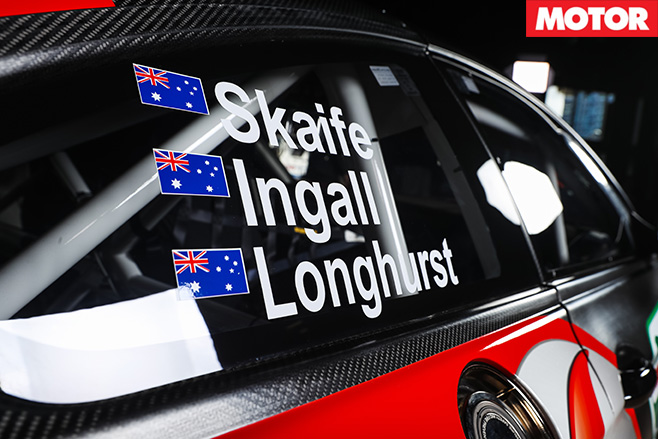
Of the three drivers, Longhurst has the strongest association with the BMW brand, driving for Team JPS in the Australian Touring Car Championship from 1985-87, then returning for 1991-93 seasons and winning the 1994 Australian Super Touring Championship.
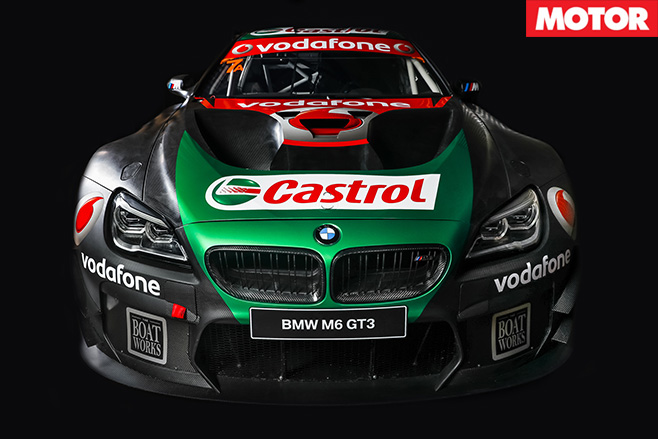
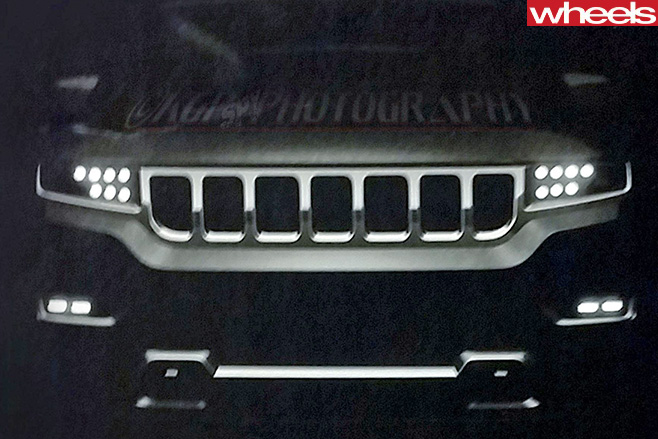
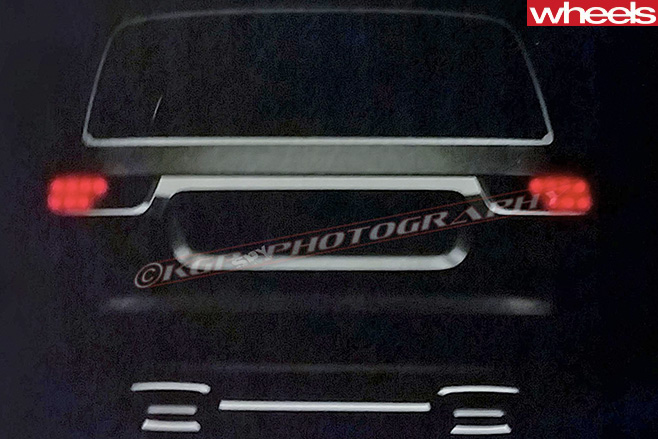
Pictures have surfaced of Jeep’s highly-anticipated mega-SUV, with blurry teaser images of the Jeep Grand Cherokee-dwarfing car being snapped at a recent Jeep dealer conference in the USA.
The full image shows what appears to be Jeep’s future lineup, with the upper-large SUV – which is expected to wear the Grand Wagoneer name – capping off a five-car lineup that includes the Jeep Renegade, the all-new JL Wrangler, the Cherokee mid-sizer and the Grand Cherokee.
The recently-revealed Compass is conspicuously absent.
Only the nose and tail of each car is shown, and shadows obscure some details. However, if the images are all to scale – and they appear to be – then the Grand Wagoneer is going to be absolutely gigantic.
In Australia its most obvious rivals would be the 200-series Toyota LandCruiser and Y62 Nissan Patrol. However musings from Fiat-Chrysler’s global executives indicate that Jeep may position the Grand Wagoneer as a more upmarket proposition.
Rather than Toyota and Nissan, the big Jeep could instead battle the Audi Q7, Mercedes-Benz GLS and Range Rover.
But where does that leave us? Appetite for hulking seven-seat offroaders is strengthening in the premium segment, with sales in the luxury Large SUV and Upper-Large SUV segments growing by 18.9 and 55.1 percent respectively this year.
With Manley on the record as saying a six-figure-plus pricetag as being realistic for the Grand Wagoneer, Jeep could be in a good position to tap into some of that local demand.
However, Jeep Australia declined to comment on the Grand Wagoneer when queried by Wheels, and with a right-hook version still yet to be confirmed there’s still no clarity on whether it will come to our shores.
Honda is increasing its stake in alternatively powered vehicles, announcing it wants two thirds of its global car sales to be hybrid engine, fuel cell or all-electric by 2030.
Honda chief executive Takahiro Hachigo told Automotive News the automaker is planning to increase its alternative-powered car sales from both the Honda and Acura brands.
The plan, which includes delivering more than 1 million green cars in the US by 2030, seems ambitious when you consider the company is on track to deliver fewer than 5000 hybrids this year; however numbers will steadily rise with new hybrid models to be introduced within the next few years.
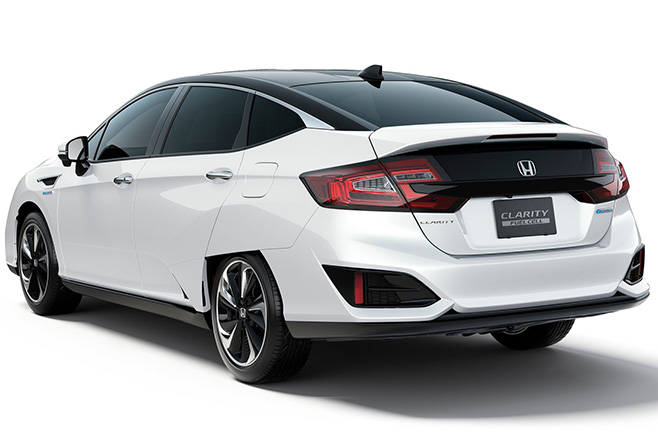
Honda has also been a pioneer with hydrogen fuel cell vehicles and has taken the next step with that technology with the launch of the 2017 Clarity sedan in the US, which the carmaker claims has the best range of any non-hybrid electric vehicle of 589 kms.
“The zero-emissions family road trip is no longer science fiction”, said American Honda’s VP of the Environmental Business Development Office, Steve Center.
“Not only does the Clarity Fuel Cell fit five passengers and refuel in three to five minutes, it offers customers a driving range on par with gasoline-powered cars.”
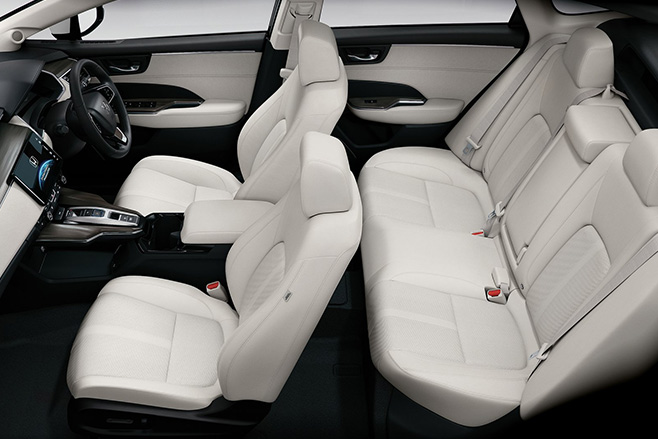
The fuel cell powertrain was made as compact as a V6 engine and all fits under the bonnet allowing for a spacious cabin that seats five adults comfortably – unlike hybrids and EVs, fuel cell vehicles don’t have batteries stored along the chassis.
Also making the Clarity more commercially viable is the expected price tag of around US$60,000 when it goes on sale in California later this year.
While there are no plans to sell the Clarity in Australia, its success or failure in California will be closely watched with Toyota and Hyundai testing similar technology here.
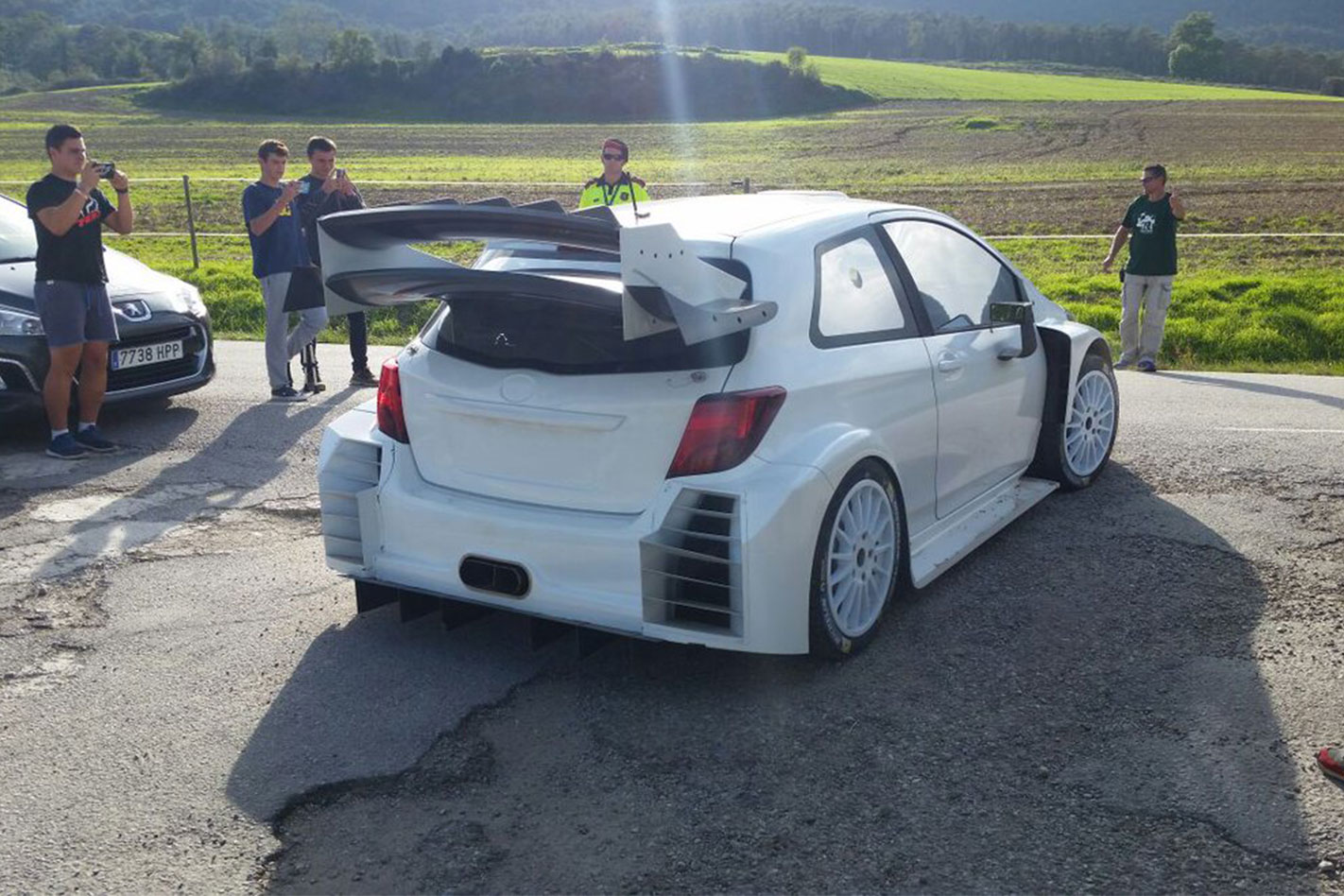
Toyota’s wild Yaris WRC has appeared in tarmac trim for the first time and it’s crazier than ever.
Spied by Colla Verglas in what’s believed to be one of its first tarmac tests, the Yaris sports one of the biggest rear wings in motor racing and enormous vents in the back of its swollen wheelarches.
The change in WRC regulations for 2017 were aimed at producing more spectacular cars but it looks like the Toyota team has spent a few too many hours watching old Group B documentaries.
It’s not known whether this is the Yaris’s final form, but with the homologation deadline for next year’s cars only days away it would be unusual for it to change radically.
As per the regulations, powering the Yaris WRC is a 1.6-litre turbo four-cylinder producing around 280kW courtesy of a larger 36mm inlet restrictor (up from the current 33mm), fed to all four wheels through a six-speed paddle-shift gearbox and active centre differential.
Toyota appears to have a few tricks up its sleeve with the engine, the Yaris emitting a raucous, angry bark that sounds harsher and more aggressive than similar units from Hyundai, Citroen or Volkswagen.
Team boss Tommi Makinen has been handling a lot of the early development work and has downplayed 2017 as a learning year for the team ahead of a championship challenge in 2018.
The first round of the 2017 WRC season takes place in Monte Carlo on January 20-22.
But will anybody be watching?
The future of motorsport is a sensitive topic for many racing fans. With smaller engines and hybrid powertrains becoming the norm, the future seems bleak. Long gone are the days where motorsport was home to gaz-guzzling, fire-breathing beasts with little care or thought for fuel economy and market relevance.
People have come to yearn for the ‘good old days’ of motorsport where the drivers where rough, the cars hard to tame, the tracks fearsome, and the racing hard.
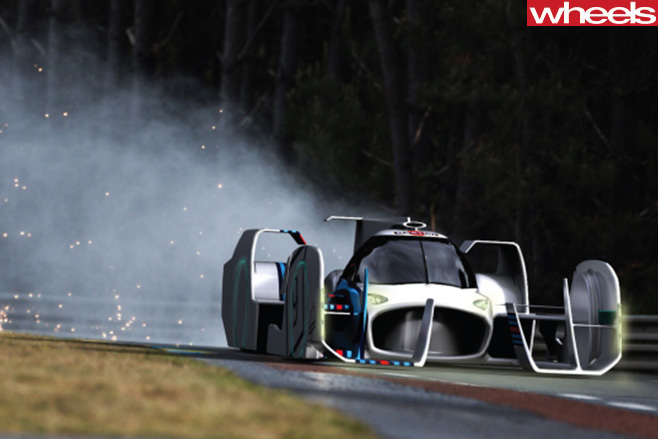
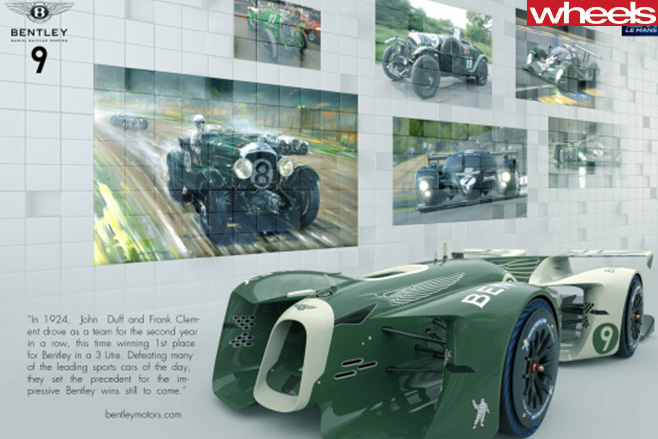
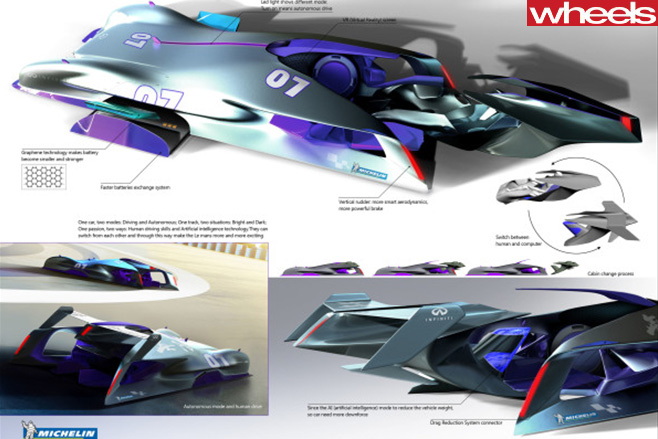
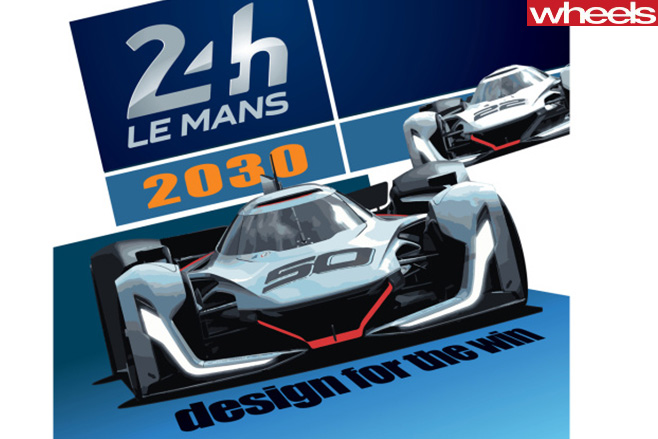
Tyre giant Michelin challenged entrants of this year’s Michelin Design Challenge, to imagine the Le Mans Racers of 2030.
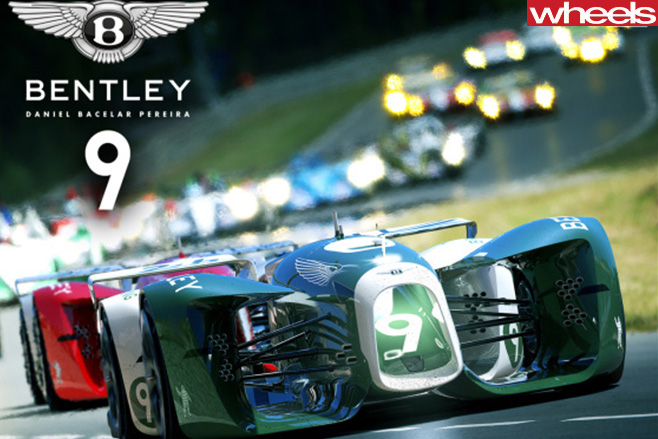
The end result is some spectacular looking concepts which would certainly make for great watching tearing around the Circuit de la Sarthe.
However, competitors also took into account adapting technology into their designs, with some bringing in the idea of a robot doing part, if not all, of the driving duties.
For me, hell yes. I grew up in the era of Robot Wars (for the uninitiated, that’s a television show where home-made robots would fight to the death in a display of glorious carnage), so the thought of watching a bunch of programmed cars careen into each other appeals immensely.
Taking the driver out of the equation means the carnage can be viewed guilt free.
So we put it to you. Would you watch a driverless race series in 2030? Can the appeal of techno-carnage outweigh the lack of having a skilled driver behind the wheel?
New details on Aston Martin and Red Bull Racing’s new hypercar have surfaced, promising a contender that will smash current road-car records to pieces.
According to Adrian Newey, Red Bull’s chief technical officer and joint-architect of the car, the incoming ‘001’ will blast to 320km/h in around 10 seconds.
For comparison, a $260,000 Audi RS7 Performance can only just scratch 200km/h in that time.
Newey revealed these startling details to The Wall Street Journal during a lengthy chat held with Mark Reichmann, Aston Martin’s chief designer, and the car’s project engineer Dan King.
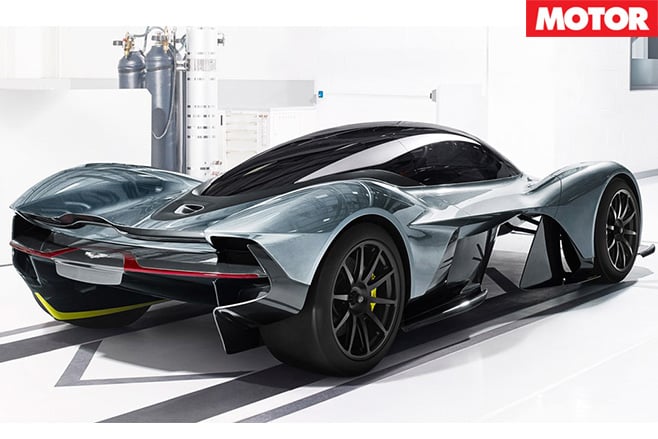
That’s more than twice what Dodge’s Viper ACR manages, the current title holder for road car downforce, and importantly allows it to generate four g of lateral acceleration in corners.
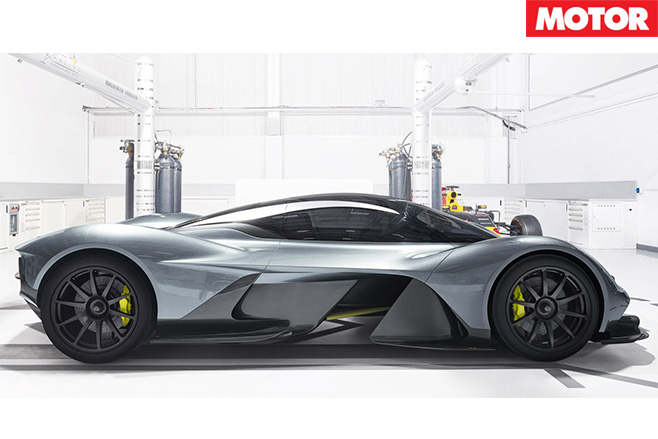
That’s not all, though, as the car’s weight will boast a perfect one-to-one horsepower weight ratio. And, thankfully, it’ll use a high-revving petrol V12 to do so.
Only 175 cars will be made, 150 of them street legal and the other 25 for tracks only.
However, while it’ll be the fastest street-legal car it’ll be close to being the most expensive as well. It’s bandied the ‘001’ will command up to US$3m (AU$3.9m) when it’s released in 2019.
Source: The Wall Street Journal
IT’S A tough crowd when a V8 Mustang is the slowest car in the field. Granted, 0-100km/h in 5.35sec and 13.4sec for the quarter mile are a shade slower than the best times we’ve managed in Ford’s new muscle car, but, nonetheless, they left the Mustang stone motherless last on the $50K-$100K drag strip.
Thankfully, this 21st century Pony Car has many more tricks up its sculpted sleeves than just straight-line pace. The new Ford Mustang delivers a swift uppercut to anyone harbouring preconceptions about American cars by having a seriously good chassis under it.
So, while it may have trailed the pack in a straight line, it more than made up for it around Winton with a cracking 1:37.1 lap which placed it fourth outright and the fastest V8.
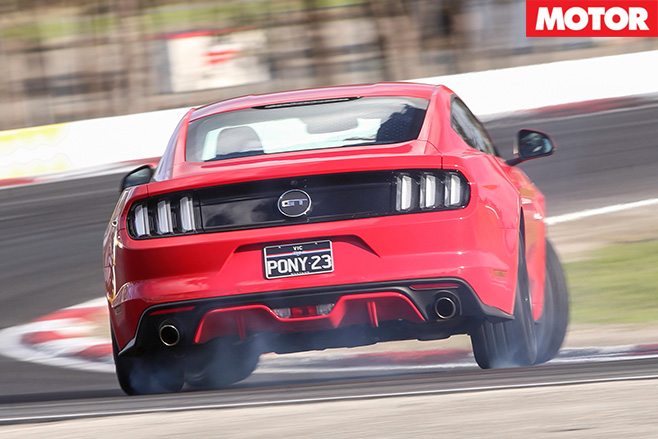
The brakes are brilliant, firm underfoot and fade-free, but it’s the ease and confidence with which the Mustang can be driven on the limit that makes it so enjoyable. There were some complaints about the steering and there’s no doubt it could offer a more direct line of communication with the front end, but the V8 turns in more eagerly and resists understeer better than its four-cylinder sibling.
This combination of talents had the mighty Mustang second for Editor Campbell, third for Morley, Luffy and myself, and king of the hill for Cordony. Sure, we’re speaking relatively here – it’s no Lotus Elise – but for a big two-door muscle car, the Mustang is a very entertaining partner.
Unfortunately for Ford, subjective assessment only makes up 20 per cent of the Bang For Your Bucks formula, and while the Mustang was laying down solid numbers, its competitors were generating exceptional ones. In a less competitive year the Mustang might’ve been a podium contender, but against the finest and fittest of 2016, it just wasn’t fast enough.
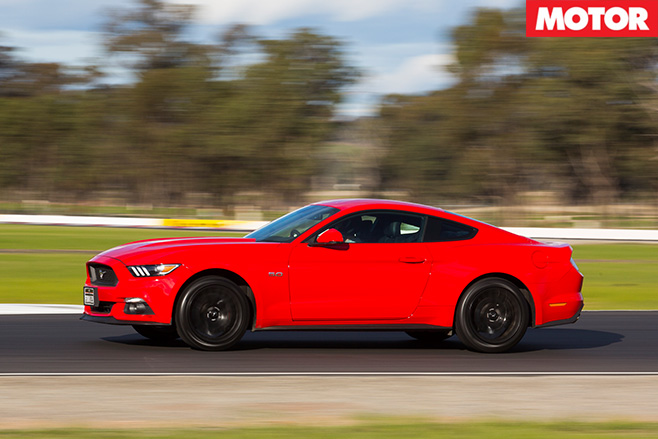
JUDGES’ COMMENTS 03. David Morley “Better than any stock Falcon we’ve ever track-tested.”
02. Dylan Campbell “Drive it on track and you’ll fall for it like a sack of cement, too.”
01. Louis Cordony “Ford’s fused genuine sportscar fun into its muscle icon’s genes.”
03. Scott Newman “If this is representative of the modern muscle car, sign me up!”
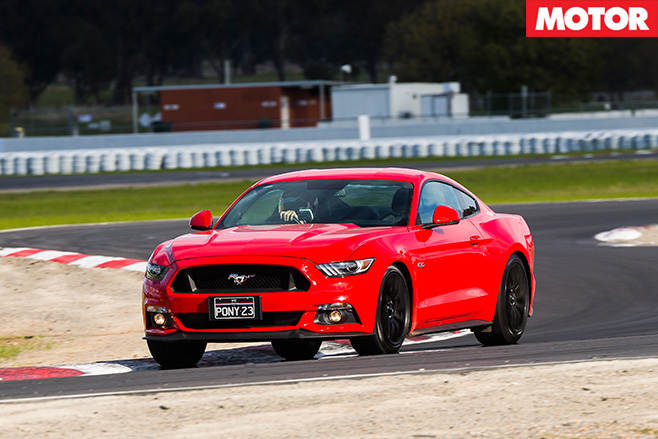
SCORES Price: $57,490 Bang Index: 75.6 Bucks Index: 123.0 BFYB Index: 146.6
WARREN LUFF SAYS 03. “On the limit you want it to be a little more locked down and stable”
“A muscle car is meant to have a V8. You notice the extra weight up the nose of the car, through the sweeper you notice more understeer and the overall nature is quite soft in the way it is sprung.
“The steering is just too light and doesn’t give you that feedback. It’s surprising how much mid-corner grip it’s got for such a big car, but it just doesn’t give you the confidence to push it.
“They could definitely take a lesson from the Europeans in how to give good steering feel and provide the driver more in terms of when they’re behind the wheel.”
Want more? Check out the rest of 2016 Bang For Your Bucks.
The new Audi R8 loses its head, and we test if it remains as brilliant as ever.
WHAT IS IT? The soft-top variant of the second-generation Audi R8 supercar. Shares the fundamentals – aluminium and carbonfibre spaceframe chassis and 5.2 litre V10 engine – with VW Group brand sibling Lamborghini.
WHY WE’RE DRIVING IT We know the coupe – in both standard and Plus guises – is a sizzling drive. So by what degree do the Spyder’s compromises – less rigidity and more weight – affect this ability? Oh, plus the drive program took in some magnificent roads in the hills above Spain’s Costa Brava, so churlish to say no.
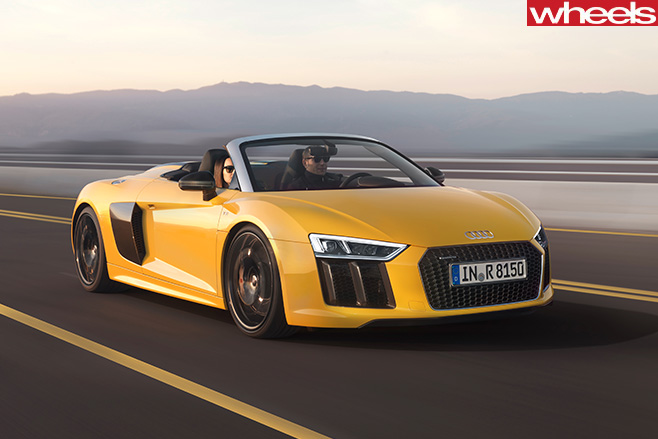
THE WHEELS VERDICT Capable of delivering outstanding supercar duality of character: hushed cruiser with the roof up; barking, corner-blazing animal when the opportunity presets itself.
PLUS: Engine sound and response; dynamics; chassis stiffness; refinement; cabin quality and design. MINUS: Mild low-speed transmission shunt; dozy kickdown when not in dynamic mode.
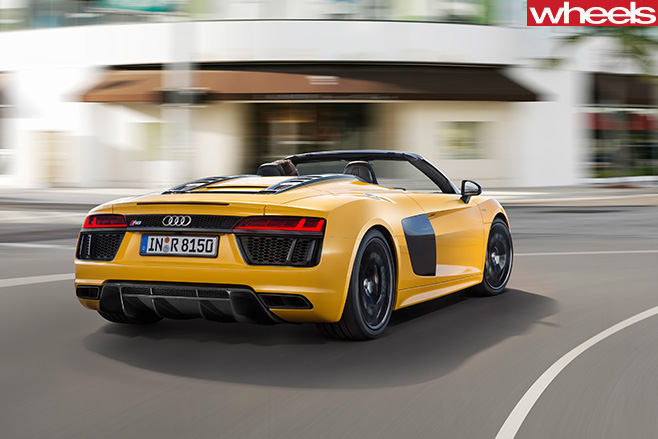
That figure is the number of seconds it takes the Spyder to transition from hushed, almost coupe-quiet cruiser, to barking, belching backroad blitzer. A mere 20, and it’s happy to do it at up to 50km/h, with the press of one button for the roof, and one button to remap all key vehicle parameters to ‘stun’.
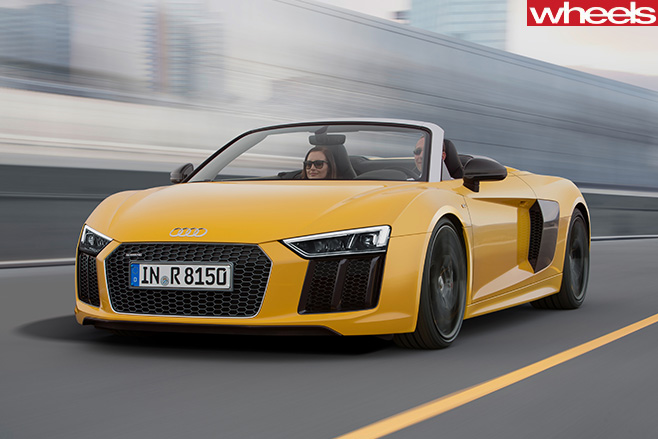
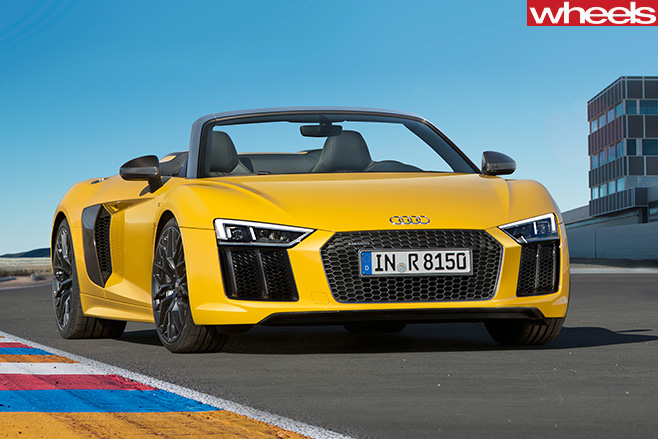
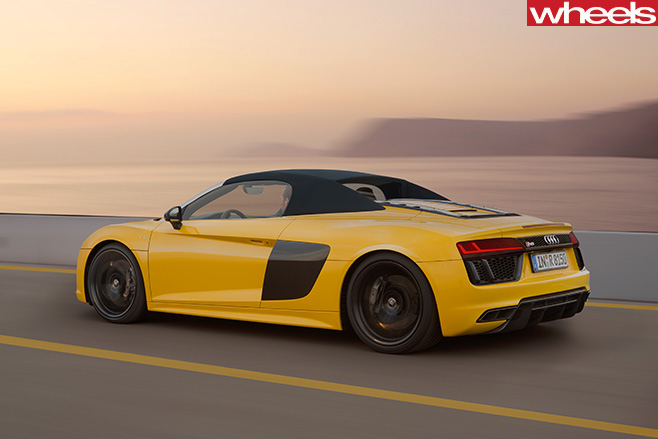
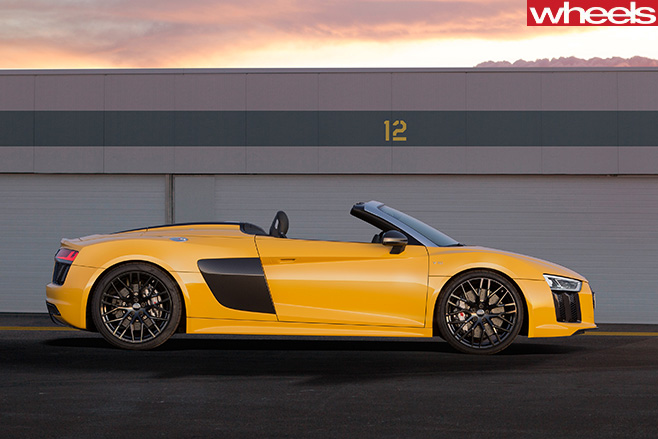
In a crowded segment bristling with talent, the R8 Spyder makes its case not on raw numbers, but surely with what really matters to buyers: sublime quality, shedloads of accessible performance, a thrilling engine note, but also the ability to chill out and catch a few rays on days off.
SPECS Model: Audi R8 Spyder Engine: 5204cc V10 (90 degree), dohc, 40v Max power: 397kW @ 7800rpm Max torque: 540Nm @ 6500rpm Transmission: 7-speed dual-clutch Weight: 1795kg (EU; with driver) 0-100km/h: 3.6sec (claimed) Fuel consumption: 11.7L/100km Price: $388,500 On sale: mid 2017
