
First published in the October 2012 issue of Wheels magazine, Australia’s best car mag since 1953.
They each pack enough firepower to shred the treads, but only one can truly lay claim to being Australia’s fastest car.
FOUR POINT something. That’s all I want the Vbox display to spit out after numerous, often-frustrating runs at Eastern Creek’s sticky dragway in the new, hard-core FPV GT R-Spec.
Only once have I managed to muscle an Aussie-built car under the five-second bracket – a 4.99 fluke in an HSV GTO Coupe about six years ago. The best I’ve managed from an FPV was a 5.00 in a 310kW F6 auto. As for best-ever Aussie car acceleration data, Wheels’ Jonathan Hawley once ripped a 4.7sec 0-100km/h out of a 7.0-litre, 375kW HSV W427 on his way to a 12.8sec 0-400 metre pass. That was in August 2008, and nothing, especially not FPV’s supercharged but traction-limited GT, has since come close.
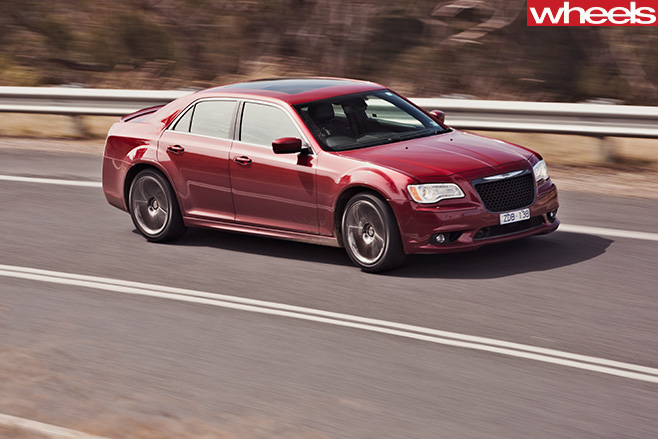
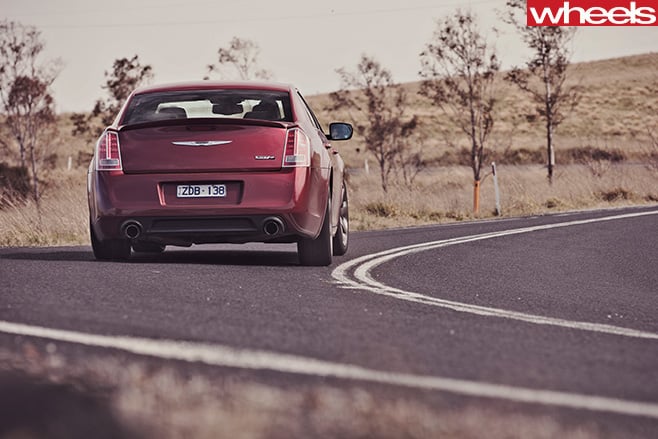
Prior to testing the FPV, either as a way to build tension or to prolong the disappointment if the R-Spec couldn’t do the number, I first run the Chrysler 300 SRT8 (they’ve dropped the C) and HSV’s Clubsport R8.
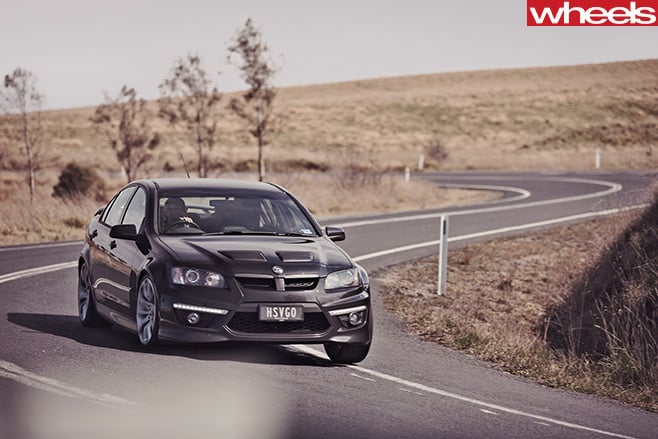
The six-speed manual Clubsport R8, which in HSV 25th Anniversary guise now gets the 325kW V8 once reserved for the GTS, takes a great deal more finesse to launch, either using the Competition Mode launch control or when flying solo. Curiously, the launch control function doesn’t deliver either consistency or fast times so our quickest runs are with everything switched off. Despite all that power, torque and capacity, you ride a knife’s edge of revs to avoid bogging the engine down, or overwhelming the rear tyres. A dozen frustrating runs, split between both myself and fellow tester Dan DeGasperi, leaves the Clubsport’s best on the day at 5.3sec to 100km/h and 13.4sec 0-400m.
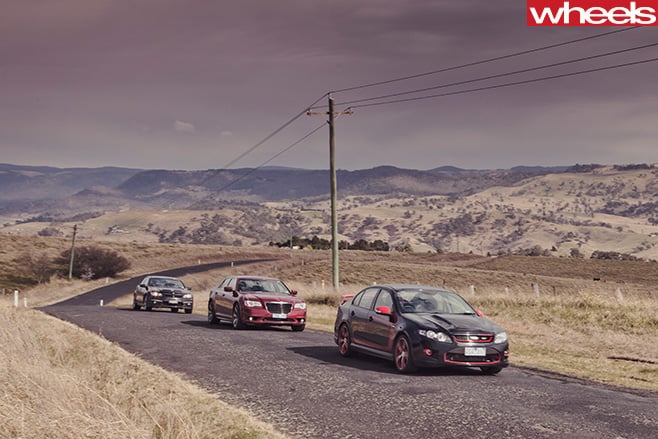
The R-Spec’s launch control engages only when stability and launch control is on, though the car does launch hard with ESC switched off. Depress the clutch, engage first gear and apply wide-open throttle. The whine of the supercharger is barely audible as the V8 booms and stutters with the revs settling to around 3200rpm. Drop the clutch, and the ECU massages torque but there’s still some wheelspin, though the extra bite from the wider tyres is immediately noticeable as first is swallowed in a blur of serious thrust. Second needs to be muscled home and, despite ESC being active, there’s a burst of wheelspin as the supercharger applies its blowtorch again. The crossgate shift to third is hit and miss (I miss three times in eight runs) but get it right and there’s another staccato chirp from the rear Dunlops. There’s a final protest from the tyres as fourth is needed just before the 400-metre timing marker.
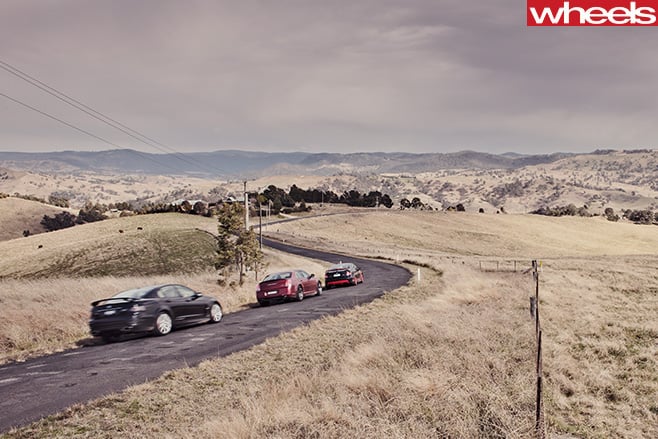
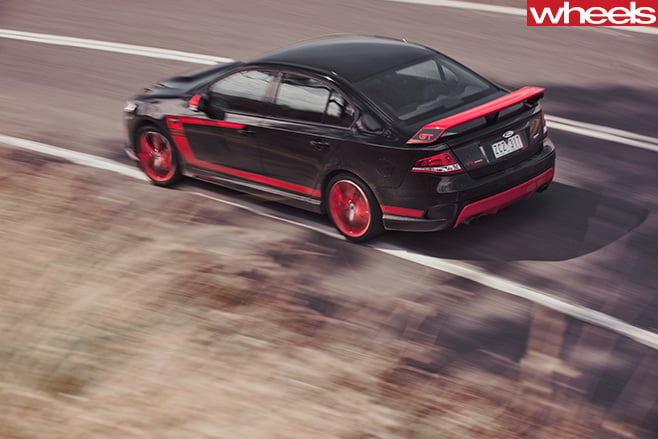
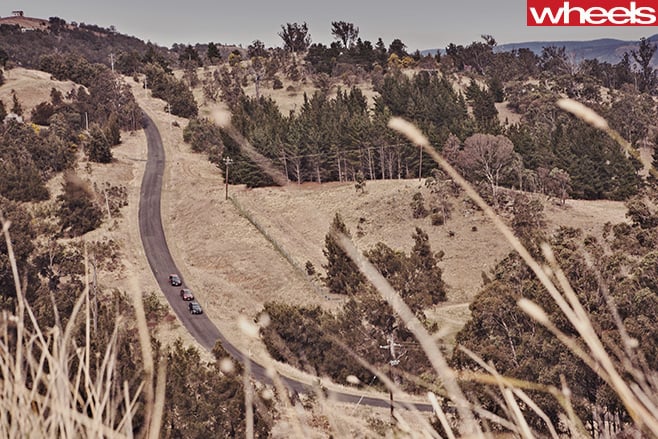
Not only are these changes designed to deliver faster times at the strip, but they are about making the R-Spec a pointier, better-controlled muscle car on backroads and racetrack. FPV says the changes and associated R&D work cost $4 million. Though there’s no official word yet, the company will obviously look to amortise that cost over more than the 350 R-Specs it plans to build (most of which will be sold by the time you read this).
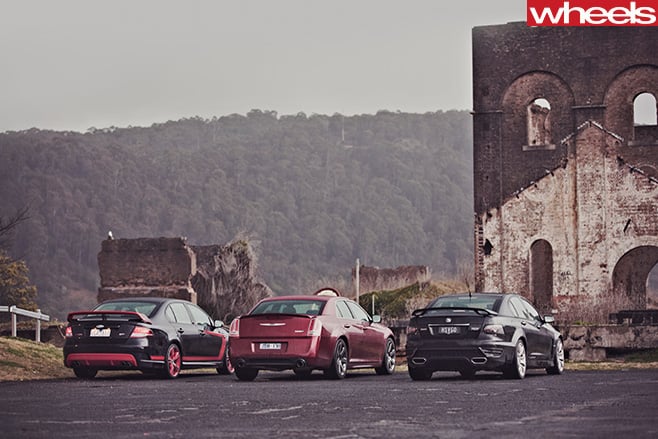
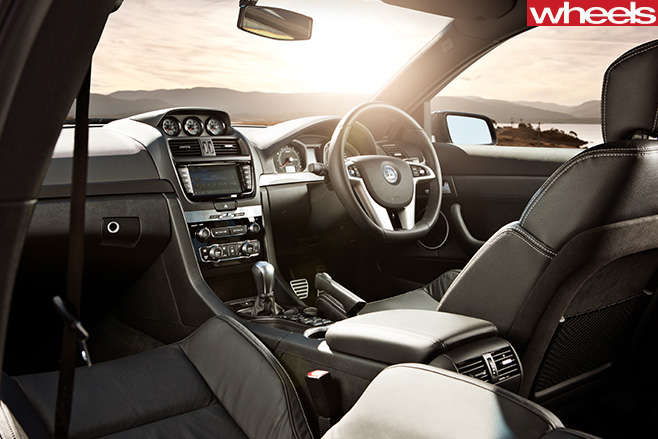
Some may question why FPV’s biggest gun is being matched against the $71,500 Clubsport R8 but there’s a simple, non-conspiracy-theorist explanation. Until HSV announces its plans for a 25th-anniversary GTS model (expected mid-October), the now-325kW Clubsport R8 is the brand’s biggest hitter. Fitted with 20-inch wheels, bi-modal exhaust and HSV’s Enhanced Driver Interface (EDI) system, the R8 lacks only the GTS’s superb Magnetic Ride Control suspension, relying instead on good old-fashioned steel springs and hydraulic dampers.
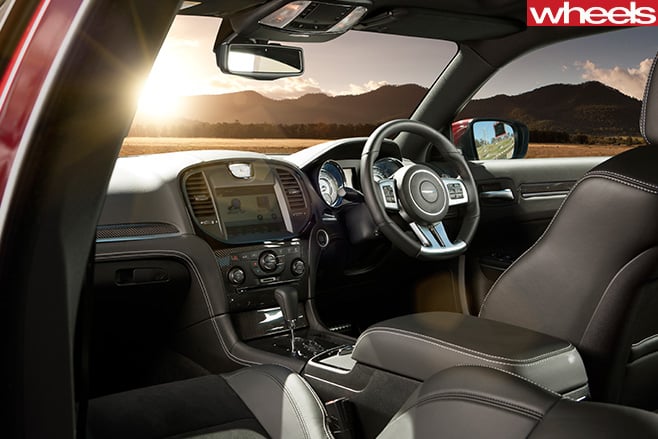
The previous-generation SRT8 was an aloof handler with a brittle ride and while the new car is hardly the last word on involvement, it rides with real aplomb. And it exudes a level of refinement that frankly embarrasses the two locals. When cruising, and regardless of road surface, there’s minimal engine or road noise, which tricks you into thinking you’re not going quick – you are. The steering is still numb and the wheel on our test example moaned softly as you turned hard to the right. With 245/45 ZR20 Goodyear Eagle F1 Supercar tyres at both ends, the SRT8 actually has the narrowest rear tyres on test. The Chrysler’s refinement and lack of feedback hinders your ability to detect the onset of under- or oversteer. Really push and there’s some rack rattle over mid-corner bumps.
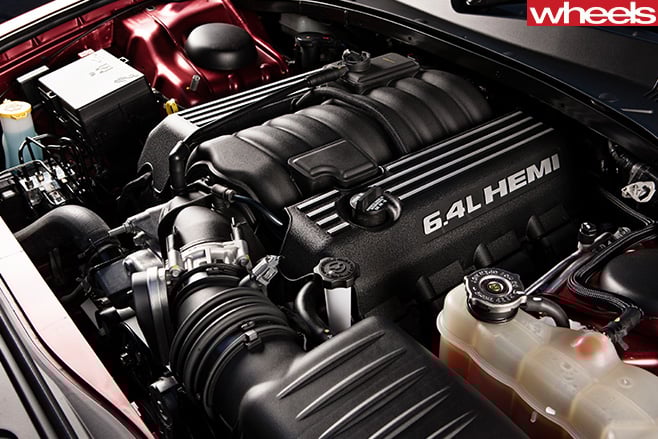
Get deep into the rev range and the once-mute Hemi finds its voice. Disappointingly, though, the big V8 lacks the throttle response of the Aussie pair but the five-speed auto isn’t the handicap you might expect. Actually, it suits the cruisey, bruisey nature of the Chrysler. The new eight-speed auto will address the slow shifts (both up and down), and a wider spread of ratios will allow the engine to make better use of its torque.
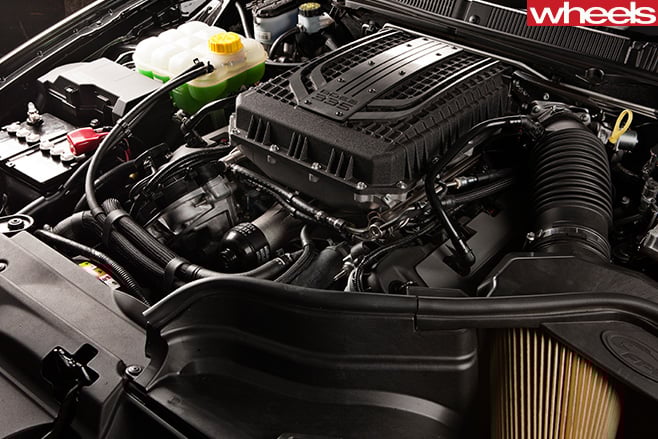
Thankfully, that monster supercharged V8 can cover the many deficiencies of the gearbox and the three-four plane is all you need on anything but the tightest roads. The supercharger whine comes on strong from 2500rpm with maximum torque (nominally 575Nm) available across a plateau from 2200-5500rpm. FPV admits that the blower will overboost and the true torque figure is in the 600s. And the autokW at 5750rpm also feels a bit modest.
The firmness of the rear needs to be recognised and treated with caution when cornering on anything but smooth tarmac. Striking a mid-corner bump with either the loaded outside, or unladen rear tyre has the big Falcon skipping sideways. And at 1855kg, that’s a lot of Falcon to catch.
The suspension changes make the R-Spec’s steering keener, but it still can’t match the fluid feedback from the HSV’s steering.
Don’t get me wrong, the R-Spec is a devastatingly fast car and can cover ground at lock-me-up speeds. But it lacks any sort of precision or finesse and feels old-school and aftermarket. Of course, none of this will matter to those who will insist the GT is the best car, or those who’ll lock theirs away hoping for a big payday in a decade’s time. And that’s fine. But the brash FPV makes me wonder whether either the Aussie car enthusiast or Aussie hotshop has moved on since the days of flares, panel vans and the Hardie Ferodo 500.
The Clubsport, the least powerful and slowest car here in a straight line, remains the most engaging on a twisty road – and I’d wager would not give away much, if anything, to the R-Spec on a racetrack.
There’s proper feedback from the HSV’s slightly too-large steering wheel and you can lean on either end with confidence. And the linear power delivery of the 6.2-litre V8 allows you to measure out exactly one Newton metre less than what the rear 275/30 R20 Bridgestones can handle.
The R8’s V8 crackles and booms on the overrun and at night you can see the flash as the occasional flame pops from the exhausts. It sounds 50kW stronger than its 325kW output and the crisp throttle response cannot be matched by the Chrysler and FPV. In turn, the HSV can’t match the SRT8’s bigger-capacity punch through the mid-range, nor can it keep up with the seismic shove of the FPV. The six-speed manual shifts faster than the manual in the R-Spec and with significantly less effort.
So the HSV wins, by being fast enough, and because it’s got a proper, playful chassis; a virtue that the improved R-Spec still lacks. If the salivating XR6 Turbo owner reads this result, I suspect I might get spat on again. This time he’ll mean it.
Engine rooms
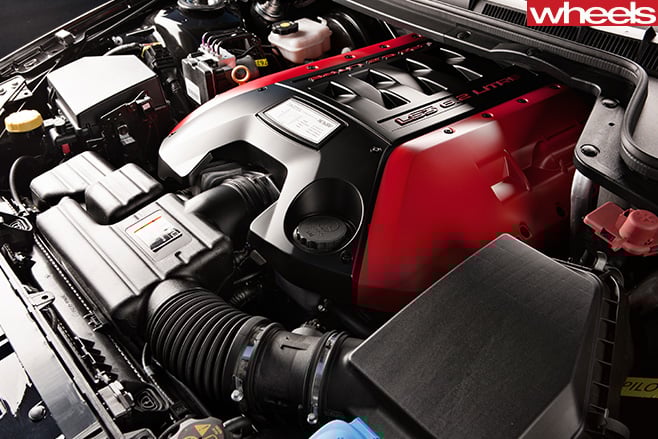
Two big-capacity atmo V8s and one smaller blown engine, but three distinct characters. The 6.2-litre pushrod HSV revs hard; the supercharged 5.0-litre FPV V8 has a linear mid-range; the 6.4-litre Hemi SRT8 feels reluctant through the middle revs. Chrysler claims the Hemi is 6424cc, but if you work out swept capacity from the supplied 103.9mm bore and 94.5mm stroke, you get 6410cc. Curious.

HSV CLUBSPORT R8
Price as tested: $71,990
Engine: V8 (90°), ohv, 16v
Capacity: 6.162 litres
Transmission: 6-speed manual
Power: 325kW @ 6000rpm
Torque: 550Nm @ 4600rpm
Power to weight: 179kW/tonne
O-1OOkm/h: 5.3sec
Fuel consumption: 13.5L/100km (ADR81/02)
NCAP rating: 5 stars (ANCAP)
Plus: Fluid steering; crisp throttle response; balanced handling
Minus: Interior feels very dated; not super fast; taut ride
Verdict: 8.0/10
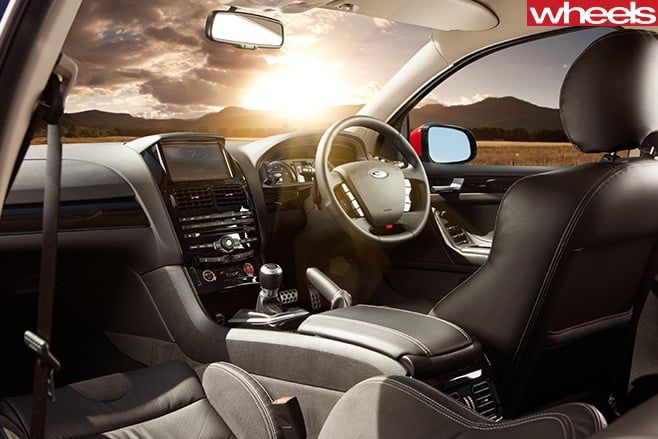
FPV GT R-SPEC
Price as tested: $76,990
Engine: V8 (90°), dohc, 32v, supercharged
Capacity: 4.951 litres
Transmission: 6-speed manual
Power: autokW @ 5750rpm
Torque: 575Nm @ 2200-5500rpm
Power to weight: 181kW/tonne
O-1OOkm/h: 4.6sec
Fuel consumption: 13.6L/100km (ADR81/02)
NCAP rating: 5 stars (ANCAP)
Plus: Fastest-accelerating Aussie car ever; sweet supercharger whine
Minus: Updated chassis still lacks finesse; firm ride; interior quality
Verdict: 7.0/10
CHRYSLER 300 SRT8
Price as tested: $66,000
Engine: V8 (90°), ohv, 16v
Capacity: 6.410 litres
Transmission: 5-speed automatic
Power: 347kW @ 6100rpm
Torque: 631Nm @ 4150rpm
Power to weight: 183kW/tonne
O-1OOkm/h: 4.8sec
Fuel consumption: 13.0L/100km (ADR81/02)
NCAP rating: 5 stars (NTSB)
Plus: Interior design and quality; refinement; surprising pace
Minus: All controls lack feedback; interior and boot not hugely spacious
Verdict: 7.0/10
How the mighty have fallen. The reigning Bang For Your Bucks $0-$50K champion, not to mention two-time defending outright winner, languishes in fifth place in 2016.
Simply put, in the most potent BFYB field ever, the feisty Fiesta just wasn’t fast enough. The 1.6-litre Ecoboost four remains a great engine, rorty and revvy, but with 134kW/240Nm (147kW/290Nm on overboost) it was left badly outgunned in comparison to this year’s heavy hitters.
Its figures were relatively strong – bizarrely, its 6.97sec 0-100km/h and 14.93sec 0-400m times were identical to those recorded in 2015 – but not enough for Ford’s baby to escape the drag strip wooden spoon. It struggled to shed speed too, taking further than any other $0-$50K competitor to stop from 100km/h.
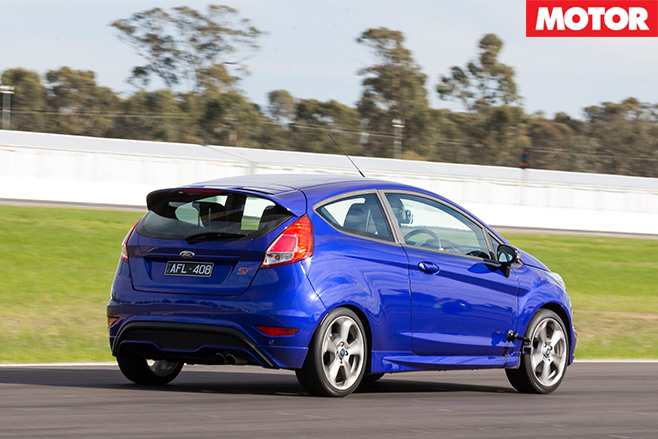
Personally, I found it a little less overtly playful than in previous years, but the way it feels constantly on the edge of oversteer in faster corners, perfectly using all four tyres, remains a highlight among the current crop of front drivers. The Fiesta’s enthusiasm to be punted hard is reflected in the judges’ scores: Morley, historically one of the Fiesta’s strongest proponents, the only one to place it lower than third.
Unfortunately, this enthusiasm doesn’t translate to the stopwatch, the Fiesta clocking the field’s slowest lap time, its 1min45sec a measly 0.1sec better than last year, despite the theoretically faster track layout. The Fiesta ran first, but any fears a slightly dusty track hurt its lap time were dispelled when Luffy tried again later in the day, only to go 0.5sec slower.
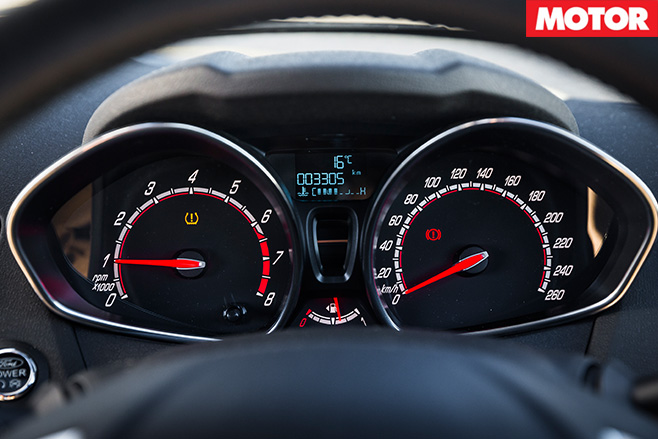
Regardless, the Fiesta ST would have had to go a lot quicker to keep up with its main price rival, the VW Polo GTI (which appears a few pages further on), and its fall from grace brings into sharp focus the relentless pace of performance car development.
While the Fiesta remains an incredible bargain at $25,990, that’s only the case for a couple more months as from September 2016 a smattering of extra equipment lifts its price to $27,490. Unfortunately, there are no mechanical upgrades as part of this mid-life facelift; does Ford have enough up its sleeve in future to put its pocket rocket back on top?
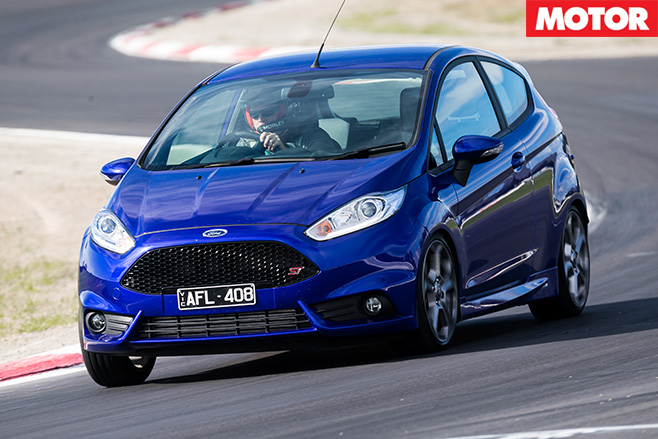
JUDGES’ COMMENTS 06. David Morley “Still a fabulous thing and I’d have one in a heartbeat.”
02. Dylan Campbell “Same old show? Nope, the most fun front-driver here. By a long shot.”
03. Louis Cordony “Sharp, agile and rorty, but no longer an absolute standout.”
02. Scott Newman “Still great fun, but a knife in a gun fight this year.”
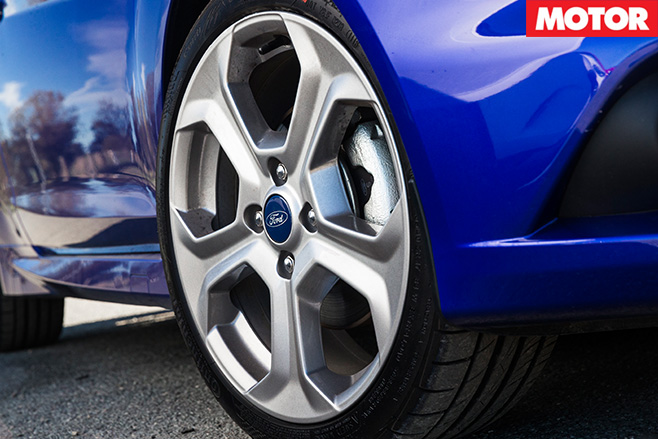
SCORES Price: $25,990 Bang Index: 57.9 Bucks Index: 150.9 BFYB Index: 151.9
WARREN LUFF SAYS 02. “From a driver’s point of view it does everything you want it to”
“It’s such a fantastic little hot hatch, it’s such a fun car on the limit.
“Probably its limiting factor is brakes. After two laps around here the pedal is starting to go long and it’s a little bit disappointing, but the engine and chassis are great and it slides about a bit in the rear.
“The electronics don’t cut back in, so in that sense it’s a true hot hatch. It’s just great fun.”
Want more? Check out the rest of 2016 Bang For Your Bucks.
Wheels pitches 10 of the biggest sellers in the medium-to-large car segment to see which is the best of the current crop. Here’s number 1, the Volkswagen Passat.
Can’t wait to see the final score? Jump to the verdict now.
SCHADENFREUDE, or deriving pleasure from somebody else’s misfortune, could have been invented for Volkswagen’s current situation.
After two decades of growth, awards and adulation, the twin cracks of unreliability and scandal have undermined the former German golden child’s reputation. But competitors will be smiling on the other side of their corporate faces when they realise how consistently accomplished Volkswagen’s latest Passat 132TSI Comfortline is.
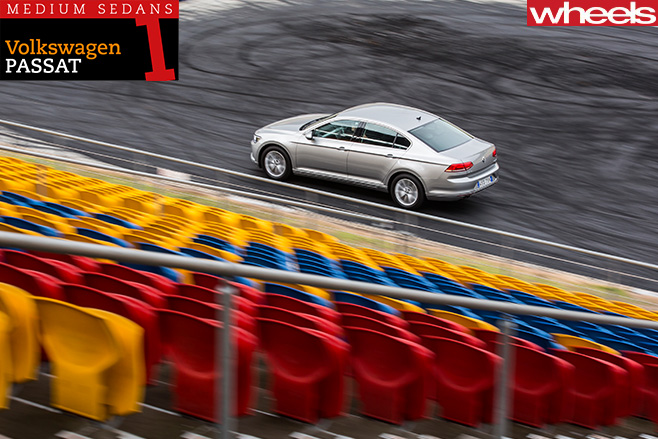
Such efficiency is remarkable, but equally so is the Passat’s silken delivery. Its 1.8-litre turbo-petrol and seven-speed dual-clutch combo, while not explosively eager off the blocks, provide turbine-smooth punch for easy and effortless motoring.
Someone suggested the Passat’s ultra-planted chassis deserves to swap engines with the related Superb’s 162kW 2.0-litre turbo tearaway, due to the Volkswagen’s superior ability in stringing together corners with unflappable calm, poise and control.
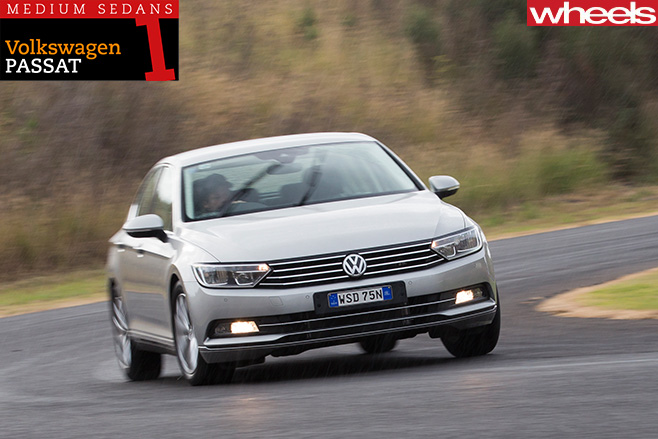
The Passat’s steering feels somewhat light initially (especially after a stint in the feelsome Mondeo), but welcome extra weight at higher speed infuses a hard-driven 132TSI with imperious roadholding confidence and capability, backed up by its lightweight agility, resulting in serious point-to-point pace.
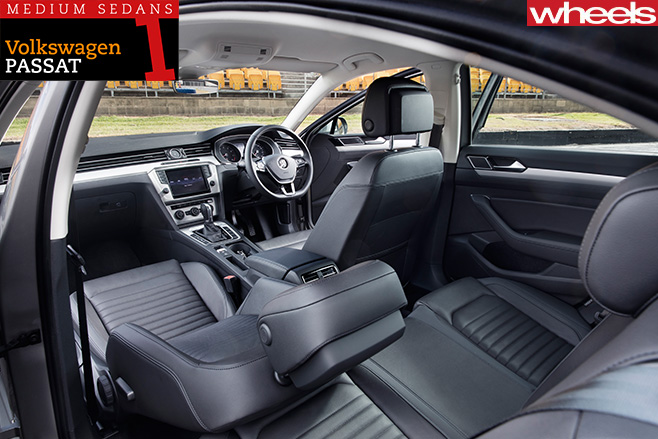
Passat’s classy cabin offers up more praise, thanks in part to plenty of space front and rear, along with liberal lashings of sensual materials and slick metallic trim throughout, while lush leather sports seats also rate highly. Perfectly positioned, you can drink in the dashing instruments, slick wheel, handy central touchscreen, climate switchgear and face-level full-length vents while thinking, in terms of ambience, you could be in an Audi. Design, on the other hand, is rather pedestrian seeing Passat’s fascia is just like an upscaled Volkswagen Golf’s, lacking in originality.
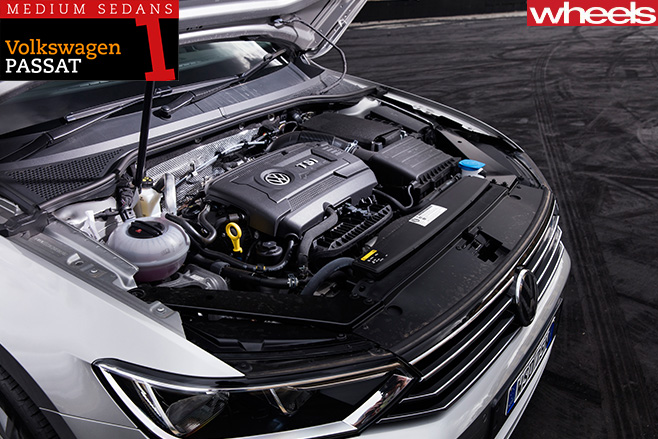
Hit a few bumpy sections, however, and some of that serenity slips away, raising an eyebrow or two as well as a few rattles – a malady not helped by a slightly busier and louder ride than expected. This is quite a disappointment, given the smaller wheels compared to the supremely cushy Mondeo. The VW’s suspension simply lacks the Ford’s suppleness.
In the broader scheme of things, the 132TSI Comfortline rarely puts a wheel wrong. What it lacks in visual panache is more than made up for by prodigious talent at every single turn. Literally.
So snigger at Volkswagen’s troubles all you like; this car’s completeness is as indisputably colossal as it is colossally indisputable. While not quite as brilliant as a base Golf, the Passat deserves to be the future-model benchmark for every rival product planner, and at the top of every buyer’s shortlist.
Want to compare the field? Check out all the Family sedan finalists.
 SPECS
SPECS
Price: $40,690 *Includes metallic paint ($700)
Engine: 1798cc 4cyl, dohc, 16v, turbo
Power: 132kW @ 5100-6200rpm
Torque: 250Nm @ 1250-5000rpm
Transmission: 7-speed dual-clutch
Dimensions (L/W/H/W-B): 4767/1832/1456/2791mm
Weight:1450kg
Cargo capacity: 586 litres
Tyres: Continental ContiPremiumContact 5 215/55R17 94W
Test fuel cons: 7.9L/100km
0-100km/h: 7.7sec
0-400m: 15.7sec @ 149.1km/h
80-120km/h: 4.9sec
3yr resale: 48%
Plus: Smooth; quick; efficient; composed; comfortable
Minus: Not quite as dynamically polished as it could be
Verdict: 8.5/10

IS VOLKSWAGEN on the cusp of productionising this low-slung, gullwinged EV sports car?
Some corners of the motoring media are saying “maybe”, but as much as we’d love to see Germany’s auto giant bolster its battery-powered EV efforts with a gorgeous, well-proportioned coupe, we’re throwing cold water on this one… and more than pinch of salt for good measure too.
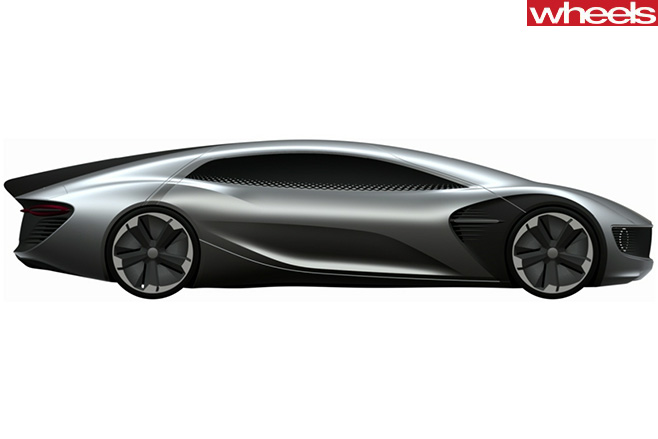
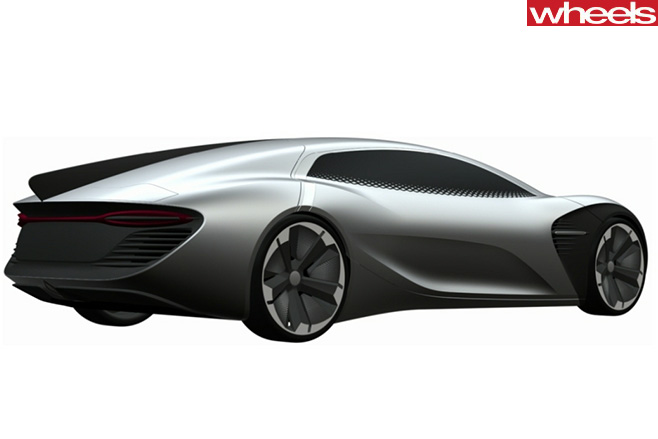
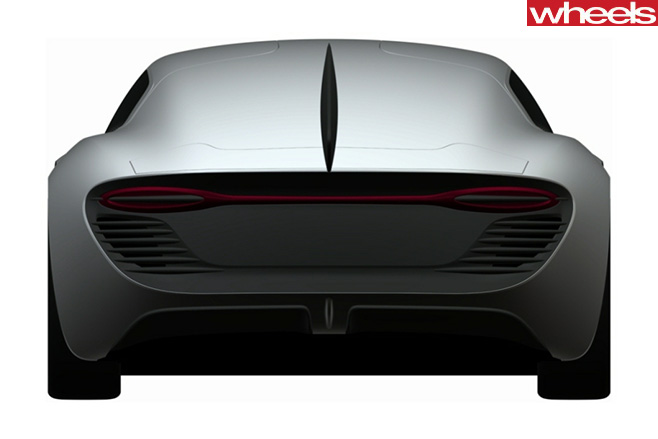
The relative scarcity of cooling apertures and absence of tailpipes suggests this machine is purely electric – or even a fuel-cell hybrid – which meshes with Volkswagen’s plans to roll out a new series of battery electric cars starting from the end of this decade. A performance car is expected to be part of that electron-munching family.
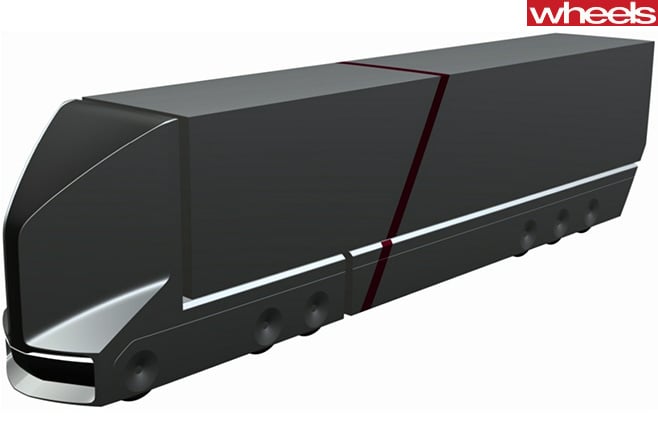
For instance, how about this driverless semi-trailer:
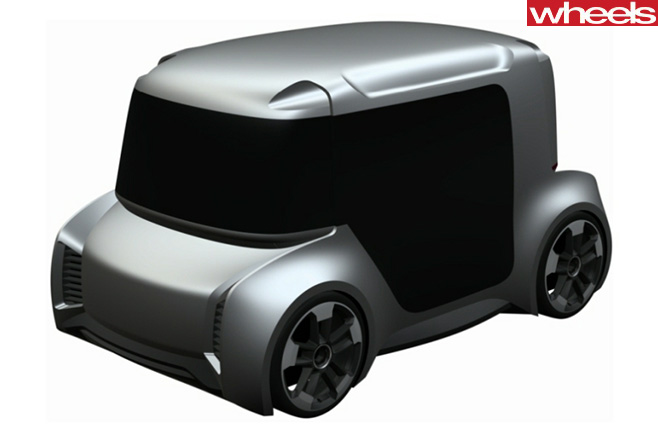
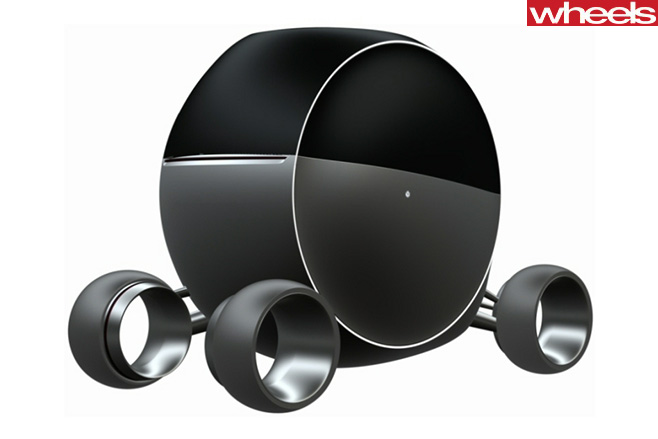
There’s also the small inconvenience of the car in question not having a windscreen. We assume it’s autonomous as a result, or a red herring – or just the product of a car designer’s fertile imagination about what cars may look like in the distant future. Note the emphasis.
Nissan S13 Silvia devastates tin-top record at Sydney Motorsport Park.
How fast do you think a 20-plus-year-old four-cylinder Nissan Silvia S13 could lap Sydney Motorsport Park?
Before you make your guess, remember that the record for a 484kW 5.0-litre V8 powered Supercar is 1:30.9123.
Did I mention the Silvia has to do it on road-legal tyres, while the V8 Supercar has racing slicks?
Well, you may want to sit down for this, but the aforementioned Silvia has lapped Sydney Motorsport Park in face melting 1:22.192.
Let that sink in for a little bit. If the Supercar and Silvia started the lap at the same time, over the course of a single 3.93-kilometre flying lap, the V8-powered touring car would be over 8-seconds behind.
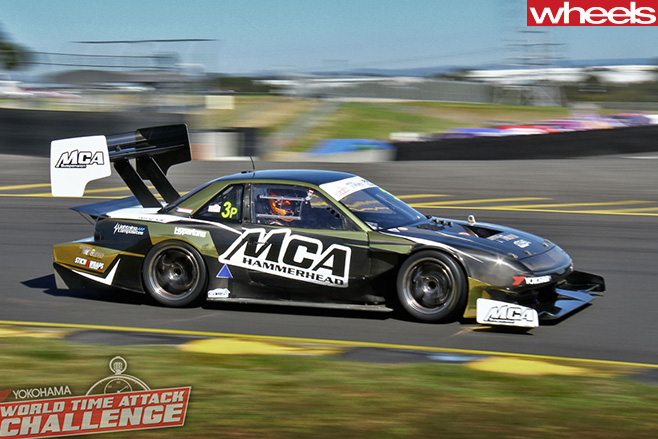
Designed to meet the incredibly loose Pro Class regulations, this Silvia has enough aero to shame an airport, and its four-cylinder engine packs a serious punch.
The 1:22.192 laptime was achieved by regular Supercar driver, Tim Slade, and shattered the old tin-top lap record of 1.23.777 which was put down by the Tilton Interiors Evo at last year’s WTAC by Garth Walden.
The S13 earned itself the nickname “Hammerhead” due to the large aero extensions on the front bumper.
I can hear the critics already, complaining that this car would never be capable of sustaining that time over a number of laps, and couldn’t race door-to-door. But that is missing the point.
This is a car, built in the shed of Murray Coote, with Australian engineering nous, that is closer in terms of laptime to an A1GP open-wheel race car, then a V8 Supercar.
To get a real sense of the speed this car is capable of, watch the on-board from Slade’s record smashing lap above. It almost appears sped up in parts, but we assure you it isn’t!
Today feels like Christmas, graduation day and every birthday rolled into one.
We’re on the Nürburgring – not the Green Hell, aka the Nordschleife, but the immaculate Grand Prix track. And we have not one Aston Martin, but two. We nicknamed them King and Kong, but Jekyll and Hyde would work just as well.
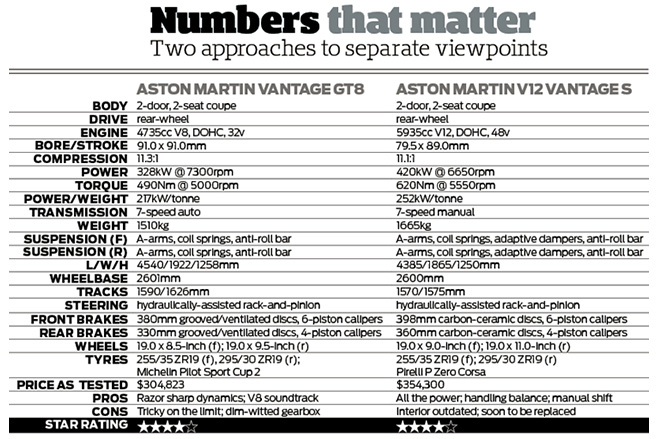
Both were born up here in the Eifel Mountains where Wolfgang Schuhbauer, AM’s deputy research and development chief, hones Aston Martin road cars and prepares others for motor racing careers. Lined up in front of AM’s futuristic prototype garage/workshop and showroom, is today’s twosome: a green Vantage GT8 with loud lime accents and an orange-over-white V12-engined wonder, the V12 Vantage S.
When Merc-AMGs shift faster, Ferraris handle better, McLarens are quicker, Porsches have more traction and Audi R8s last longer, why on earth would you want to spend supercar money on two virtually evolution-free eight-year old sports cars? Well, for a few reasons. Launched in 2005, and updated in 2008, the Vantage is a right looker even after all this time.
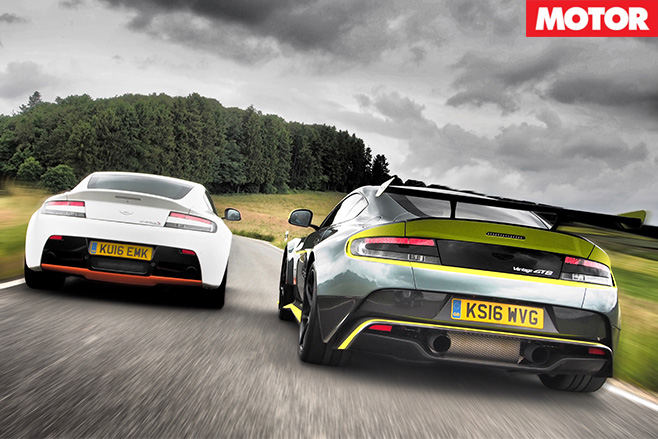
Our green machine is based on the entry-level Vantage, whose centrepiece is a 4.7-litre DOHC V8. Aston Martin has built the GT8 as a limited-edition tribute to its GTE racer. And as with any racecar, weight has been made the number one enemy. Carbon-fibre panels and seats, and a lithium-ion battery, help it shed 80kg from the regular V8 Vantage, no mean feat considering its part-aluminium construction. But owners can take that figure to 100kg by ticking the box for polycarbonate side and rear windows, a carbon fibre roof, and magnesium wheels.
With optional titanium exhaust or not, a freer-flowing system helps the V8 find another 7kW to help it muster 328kW at 7300rpm. Torque is equally lofty, the carried-over 490Nm delivered at 5000rpm. With 1510kg to shift, it takes 4.4sec to hit 97km/h before reaching an estimated 305km/h top speed.
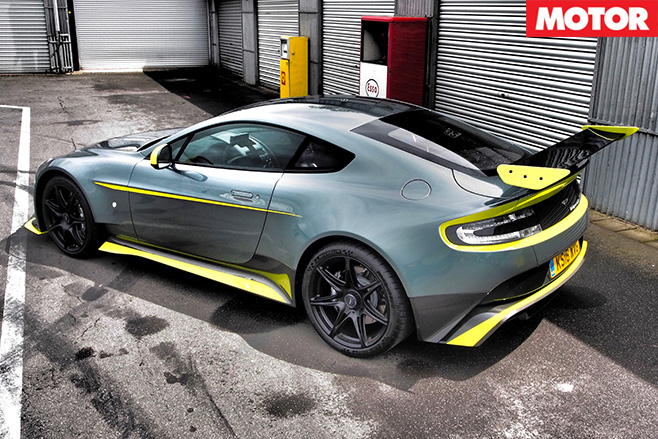
Performance isn’t the decisive factor here, though. What separates them is the way they sound, respond to throttle, decelerate, and hold the road. “We wanted to move these two models as far apart as possible,” explains Schuhbauer. “That’s why they look different and feel different.”
The GT8 is, according to Herr Schuhbauer, “a focused track tool which makes it very clear that performance is its top priority.” One stab at the starter button confirms this. First, there is thunder. Every time you blip the throttle, the engine sounds like some dirty air has triggered a vulgar misfire.
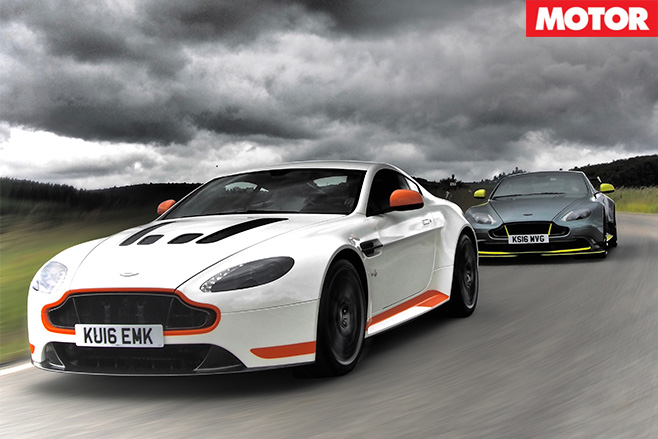
The V12 S is quieter yet no less addictive, and benefits from a new manual gearbox. It’s the first time since 2013 the maker has mated its Vantage’s V12 to a manual. Graziano, the transmission’s manufacturer, actually developed it from the car’s mid-mounted seven-speed automatic. This means that, with seven cogs, the shift pattern sports a dog-leg, making it very useful for the work we planned for it today.
Rowing through gears on road reveals Aston has rediscovered the charm of purity. In earlier Vantages, DIY-transmissions were hampered by sticky shifts, an indifferent action and odd gearing that blocked the path to top gear. But our stubby suede lever moves in speedy and short throws, the feedback is reassuring and the double H-gate is more intuitive than the shift pattern suggests. It’s not exactly a precision instrument, but it’s an improvement and not taken for granted.
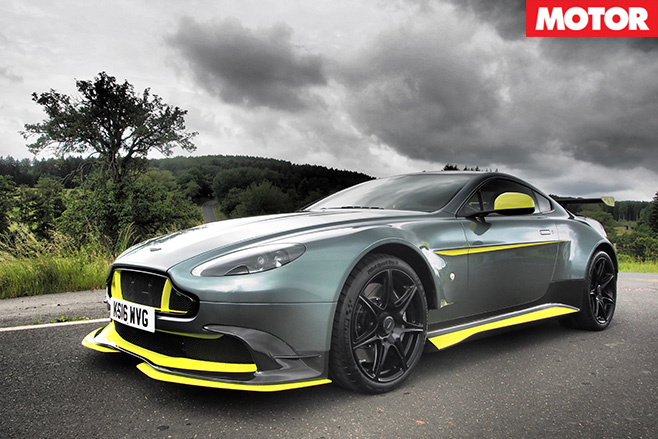
As our test route changes from road to track, there’s no need to deactivate DSC in either car. The in-between stability control setting provides a long enough leash to keep drama from becoming tragedy. However, both are hardcore driving machines, not luxury sports cruisers like the new DB11, so it pays to remember the handling is defined by a strong rear-wheel bias.
And while that means courage is required to breed confidence – asking you to turn in later, carry more speed into corners, and keep revs up as you toe the thin line between grip and slip – their behaviour diverges at the absolute limit. The GT8 being the more capable but more frightening machine.
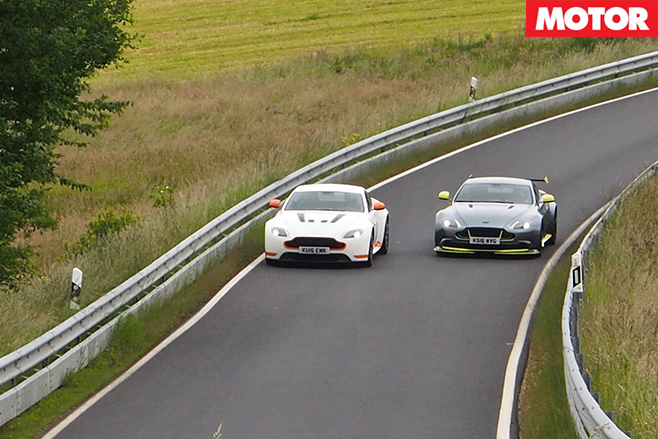
The GT8 runs on shaved hard-compound Michelin Pilot Sport Cup 2 rubber. When cold, take proper caution. Because on rainswept blacktop it’s hard work to inject them with any heat, and on the low-friction GP circuit their ruthless breakaway behaviour can scare you witless.
Our green machine also feels different in hand, literally. Both cars use a hydraulic steering rack, and at only two and a half turns from lock-to-lock, neither is slow to change direction. On public roads, however, the GT8’s direction-finder is relatively heavy. Its quick action is overshadowed by average response, and the self-centering motion is largely your responsibility.
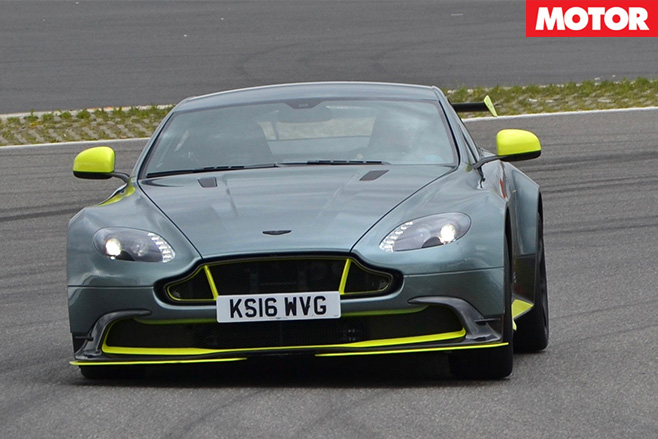
In contrast, the V12 S is a much more composed and friendlier machine to use. Whether on track or road, the steering trades the GT8’s sharpness and involvement for a wonderful lightness and fluidity. The Pirelli P Zero footwear found on the V12 has a completely different attitude, too. They warm up more quickly and breakaway much more smoothly. Heat can become an issue when you feel like donning the Ricciardo outfit, but it’s not a problem for blasts on the open road.
Interestingly, despite costing less, it’s the V12 S that has the fancier brakes. Its carbon ceramic discs are drilled, ventilated, and wouldn’t look small on a truck. They also deliver on their impressive looks, being progressive, strong, and full of stamina. The GT8 makes do with smaller steel rotors, but they’re no less impressive in feel or feedback.
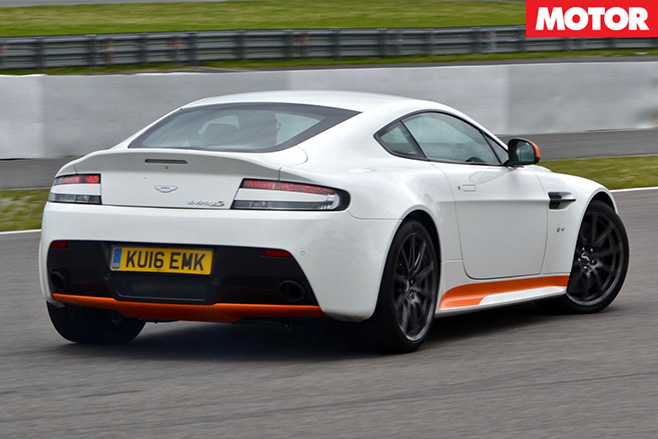
If you are in the market for a track-focused plaything and not keen on the popular 911 GT3, try and find one of 150 sold-out GT8s. It’s an instant collectible, one Aston Martin fans will stare at in awe, what with its€€1500 (AUD$2200) carbon-fibre badges (each!), even pricier magnesium centre-lock wheels or the hugely expensive exterior carbon-fibre pack complete with side strakes, bonnet louvres and black grille.
Understatement is certainly not a phrase to be used in conjunction with the GT variant. The fixed rear wing would rival a Qantas jet’s, the low-flying triple-decker front spoiler is wince-inducing over speed humps and the lime accents are blindingly bright. If that’s not flashy enough, though, a GT8 convertible can exhibit you to the public strapped into its devil-black racing buckets.
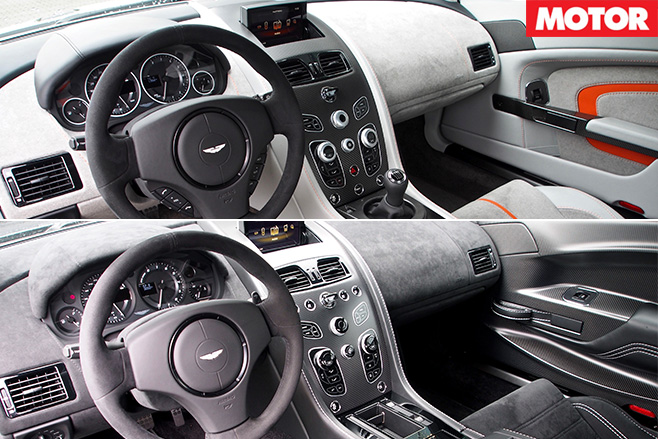
Having said that, the Vantage 6.0-litre V12 is a much more accessible piece of kit. It’s also better balanced, more forgiving and less of a hooligan in attitude and appearance.
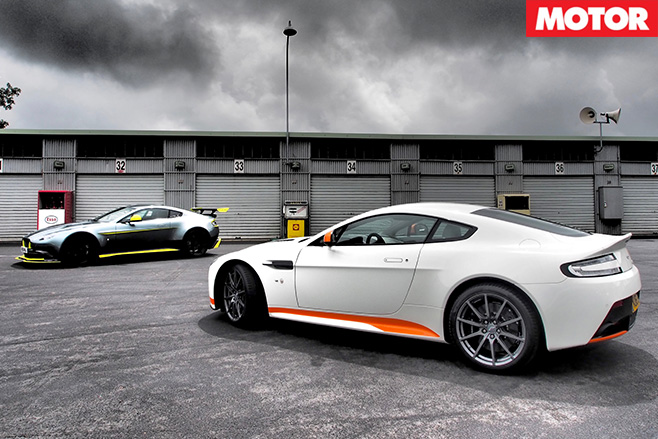
But honestly, if it were our money, we would either grab one of the first DB11 coupes or put our name down for the Vantage replacement out at the tail end of next year.
The compact-luxury-SUV segment is still a relatively young one, having been created in 2009 with the introduction of the BMW X1.
Audi followed in 2011 with the Q3 and Mercedes-Benz another two years after that, with the GLA. Infiniti’s GLA-based cousin, the QX30, was released recently, though even with a Volvo XC40 due in 2018 this remains a class as compact as the vehicles themselves.
The German trio of the X1, Q3 and GLA continue to play out an intense battle in showrooms, with the BMW – the first to appear in second-generation form – leading the way at the time of writing.
Here, WhichCar provides a guide to any changes planned or expected for these models during the next 18 months to help you pick the perfect timing for buying one.
An all-new version of the Q3 is likely for 2018, though there’s still more to come from the first generation that debuted in 2011.
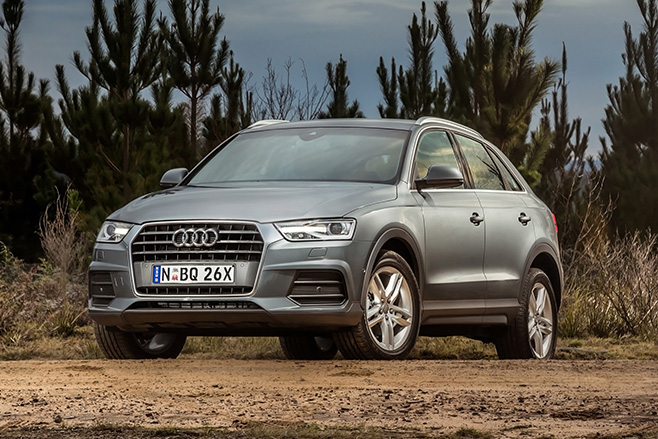
The fastest version of all, the RSQ3 Performance, landed in early October, bringing extra performance and goodies over the regular RSQ3. Taking its 2.5-litre turbocharged five-cylinder from the latest RS3 hot-hatch, power and torque climb to 270kW and 465Nm (up 20kW and 15Nm, respectively). The 0-100km/h acceleration run is also quickened by four-tenths to an impressive 4.4 seconds.
A new S-Line Competition package will be part of what is expected to be the current Q3’s final update that includes some visual tweaks, though it’s not due here until the second half of 2017.
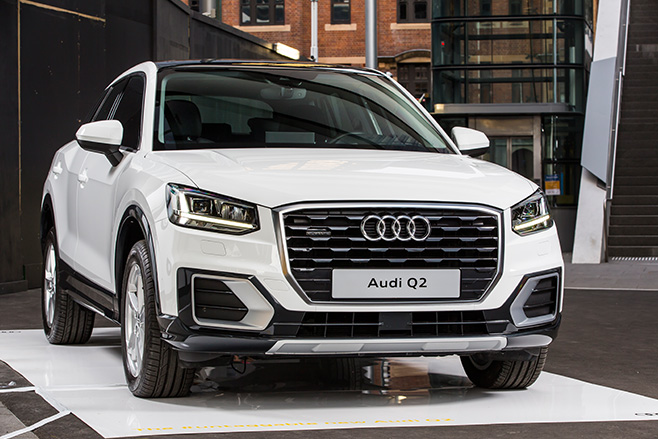
If the Q3 is too big for you, even at just 4.3 metres long, a new, 20cm-shorter Q2 model goes on sale in February. The extra length of the more angularly designed SUV is mainly found in the bumpers, so interior room is less affected than boot space (down 50 litres compared with the Q3).
Pricing should start below $40,000, making the Q2 Audi’s most attainable SUV yet.
The first X1 was a compact SUV for drivers, especially the rear-wheel-drive variants. BMW moved to a front-wheel-drive-based platform for its replacement, released in late 2015, to create a more practical package, with all-wheel-drive versions again available. Sales have surged since.
X1’s newness means no significant updates are on the cards for the foreseeable future. However, a new spin-off model called the X2 is anticipated for late 2017 or early 2018. BMW unveiled a concept previewing the X2 at the recent 2016 Paris motor show. It will be a sportier, coupe-style (but still five-door) version of the X1 in the vein of the X3/X4 and X5/X6 relationships.
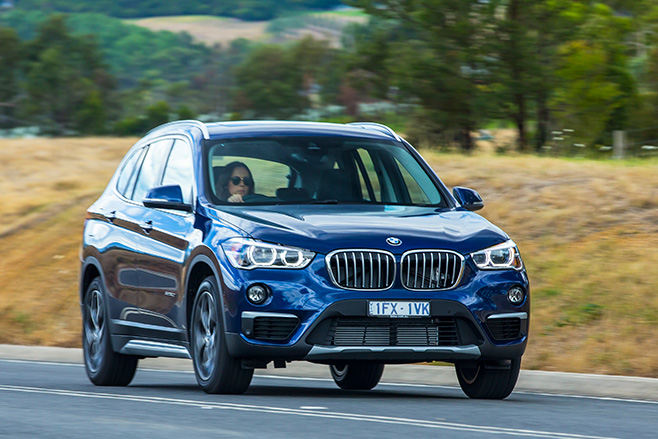
If the X4 and X6 are any guide, the X2 would be expected to feature the sportier of the X1’s 2.0-litre petrol or diesel turbo engines, as well as extra equipment to help justify a premium over the X1 that currently starts at $49,500.
The GLA could be viewed as more of a high-riding A-Class hatchback than a purpose-built compact SUV like its rivals, yet that has had no bearing on its popularity since arriving in 2014.
Its first update happens in 2017. It’s too early for official images or details, though we can expect similar changes to related models such as the A-Class and CLA sedan.
That would mean subtle design tweaks such as new bumpers, colours and alloy wheels for the exterior, and new trim and a slimmer, 8.0-inch tablet infotainment display for the interior.
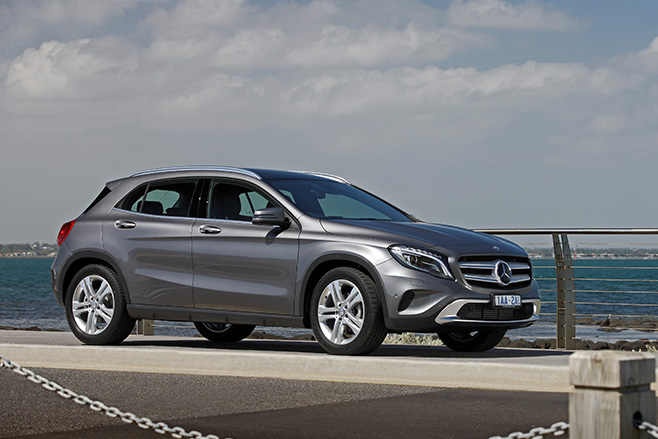
The GLA currently has the fewest engine options of any of the compact Mercedes models, with just three. It’s unknown whether Mercedes-Benz Australia will expand the line-up, though the potential for new options includes a 135kW GLA220 4Matic petrol all-wheel drive and a higher-performance diesel in the form of a GLA220d that sends 130kW to either the front wheels or, optionally, all four wheels.
What is certain is that the GLA45 AMG flagship will receive the upgraded 2.0-litre turbocharged four-cylinder already seen in the A45 and CLA45, which boosts power by 15kW to 280kW.
The GLA range is currently priced from $48,900.
Car lovers and enthusiast media have widely panned the fourth-generation Renault Sport Clio for being not enough a chip off the old block. We speak about its three-door, nat-atmo predecessor with a glint in our eyes, because god, was it good.
Not to say the new Clio RS is a dud – it’s a more useable, comfortable and probably better car – it’s just a bit boring by comparison. Credit to Renault for creating this, then: an update aimed at bringing more fun.
The RS220 gets more poke (15kW/20Nm), quickened twin-clutch auto gearchanges, tweaked chassis to make it more lively, more aggro seats and even shorter travel on the column-mounted shift paddles. And on track, the changes absolutely make for a better mousetrap.
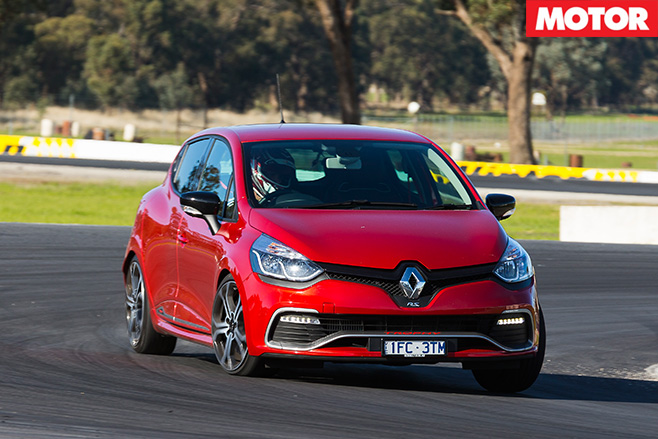
Interesting, but you wouldn’t call your mates over to tell them about it. But it immediately feels stronger and more energetic, to the point traction is just starting to become an issue. The gearchanges are noticeably faster, too, in a welcome way, with a nice twin-clutch exhaust pop on upchanges.
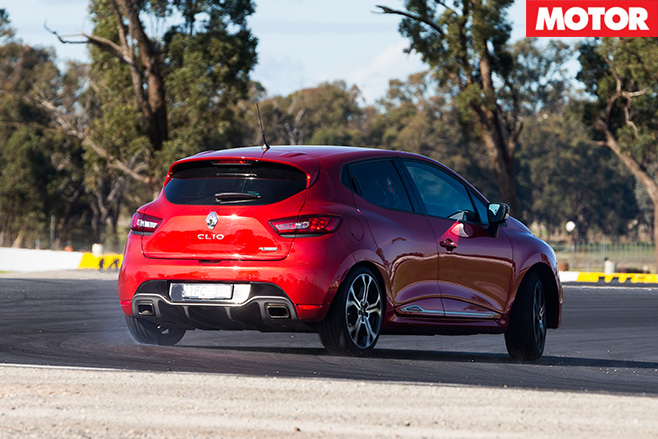
The chassis changes have made it an even bigger laugh on-track, more lift-off oversteer-y than the ‘regular’ Renault Sport Clios. Back it in all day, now a little easier, too, thanks to a poofteenth-quicker steering rack. Renault Sport still knows how to do a chassis, clearly.
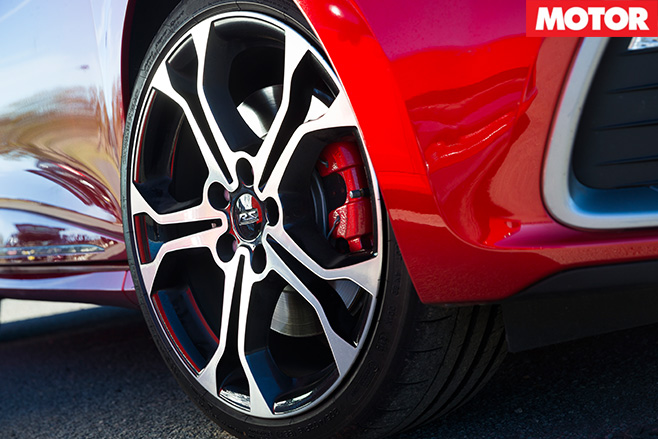
But still it was pipped by the VW Golf GTI, a car just $1000 more expensive. And that’s where the Clio starts falling down: it’s also the most expensive fourth-gen Clio RS so far. Sure, its $39,000 gets you a lot of equipment, but it’s big money for a Fiesta-sized car and really put paid to the Clio RS220’s hopes of a repeat win. Remembering its $29K, lower-spec sibling won the $0-$50K class at Bang For Your Bucks 2014.
The numbers tell the performance story of lots of grip – quickest in class, in fact, through Turn Nine (probably no small thanks to those pricey-but-sticky Michelin Pilot Super Sports) – but not quite enough grunt nor brakes. Fast, and an entertaining handler, but for $39K, not fast enough.
JUDGES’ COMMENTS 09. David Morley “Kind of didn’t do it for me. And what’s with the fixed paddles?”
05. Dylan Campbell “The best Clio RS of this generation but still so difficult to love.”
05. Louis Cordony “Its abilities run deep, but asks a pretty penny for the pleasure.”
08. Scott Newman “Improved drivetrain, but feels less than the sum of its parts.”
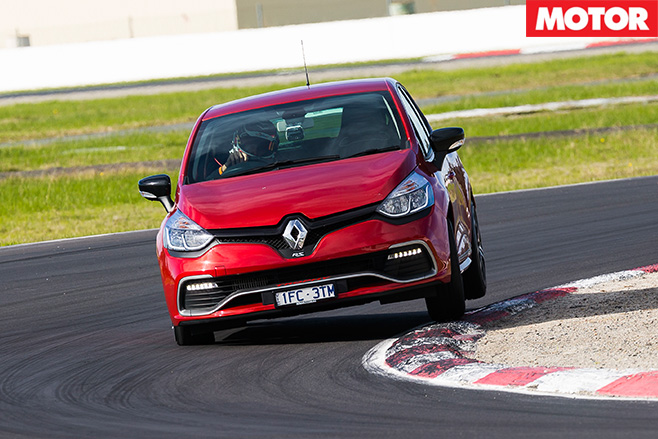
SCORES Price: $39,990 Bang Index: 91.9 Bucks Index: 98.1 BFYB Index: 142.2
WARREN LUFF SAYS 07. “It’s a really fun car on the limit with that traditional lift-off oversteer”
“Like the Fiesta ST, you can back-off and have that old school hot hatch lift-off oversteer.
“The engine is really good, but the gearing is probably not well suited for this circuit. Also with the shift paddles staying on the steering column and not following the steering wheel, you’re coming off some of the second gear corners and trying to find where the lever is – but that’s probably more circuit specific to Winton.
“But it’s certainly a good fun car and I’m surprised at the time it did.”
Want more? Check out the rest of 2016 Bang For Your Bucks.
The Lexus RX range has been expanded slightly with the addition of two model grades to the entry-level Lexus RX 200t, coinciding with a recent price bump across the rest of the range.
Previously only available in base Luxury trim, the four-cylinder RX 200t, the most affordable model in the RX’s three-powertrain family, can now be had in mid-spec F Sport and high-grade Sports Luxury configuration, with equipment levels matching the RX 350 F Sport and RX 350 Sports Luxury.
That sees features like sports front seats, electronically-adjustable dampers, a 12.3-inch infotainment screen, 15-speaker Mark Levinson audio, auto high beam and colour head-up display become available on the $86,840 RX 200t F Sport, along with a top-down camera view and sportier bodykit.
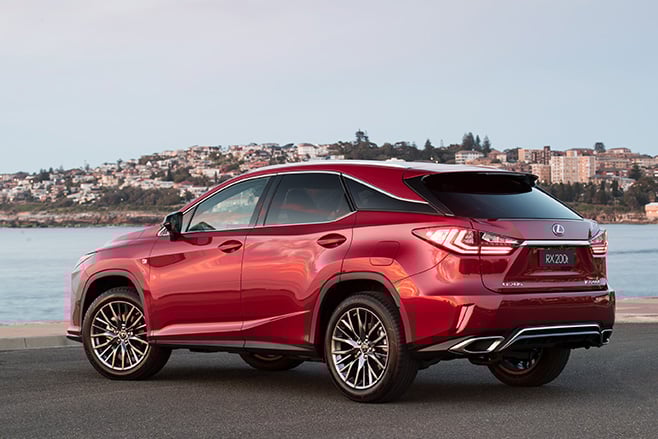
Stepping up into the $92,990 RX 200t Sports Luxury brings two-tone alloys, power-folding heated rear seats, 14-way adjustable front seats, alloy and wood interior trim and a leather and wood steering wheel.
All RX models receive LED headlamps, 20-inch alloys, heated and ventilated power front seats, keyless entry and ignition, a wireless phone charger, rear parking sensors, rain-sensing wipers, active cruise control, auto emergency brake, LED headlamps and a power tailgate.
The arrival of the F Sport and Sports Luxury grades to the RX 200t model expands the total number of RX variants to nine, and gives Lexus a more fleshed-out four-cylinder SUV range to combat 2WD four-cylinder diesel competitors from Germany like the Mercedes-Benz GLE 250d and BMW X5 sDrive 25d.
Powered by a turbocharged 2.0 litre petrol four-cylinder, the RX 200t variants boast 175kW of power and 350Nm of torque, taken to the front wheels exclusively by a six-speed automatic transmission. Fuel economy is a claimed 8.1L/100km.
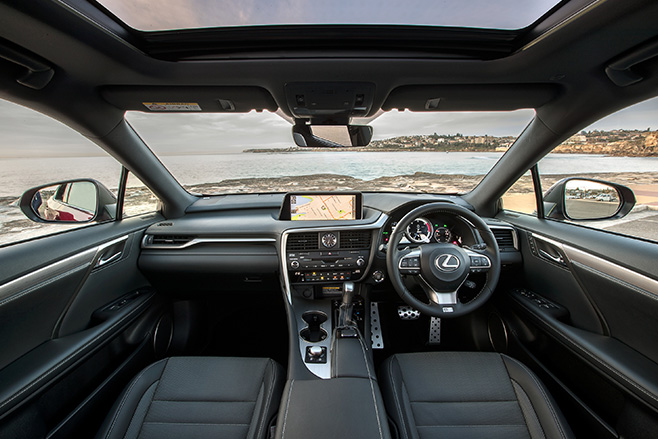
The RX 350 features an identical specification lineup to the RX 200t, but swaps the turbo four for a naturally-aspirated 3.5-litre petrol V6 with 221kW and 370Nm. An eight-speed auto delivers drive to all four wheels, and combined-cycle fuel economy comes in at 9.6L/100km.
At the top of the tree is the hybrid Lexus RX 450h, which hooks up an efficiency-optimised version of the 3.5-litre six to an electric assistance motor, with a total output of 230kW. Thanks to its petrol-electric hybrid system, the most powerful RX variant is also the most frugal, with a claimed average consumption of 5.7L/100km.
Pricing
The RX’s model mix rejig comes on the back of a slight price increase that was applied across the range last month. The price of entry jumped $1824 for the RX 200t Luxury, while the biggest increase was for the RX 450h Sports Luxury – that model’s retail price increased by $2655.
| Model | Price |
| RX 200t Luxury | $74,540 |
| RX 200t F Sport | $86,840 |
| RX 200t Sports Luxury | $92,990 |
| u00a0 | |
| RX 350 Luxury | $81,710u00a0 |
| RX 350 F Sport | $94,010 |
| RX350 Sports Luxuryu00a0 | $100,160 |
| u00a0 | |
| RX 450h Luxury | $90,160 |
| RX 450h F Sport | $102,460 |
| RX 450h Sports Luxuryu00a0 | $108,610 |
1. The Mazda6 comes in four models – Sport, Touring, GT and top of the range Atenza.
2. All bar the Sport come in either petrol or diesel variants.
3. Buyers can choose between sedan or wagon body styles.
4. The Mazda6 Atenza Diesel 6-speed automatic sedan, tested here, costs from $48,240 (plus onroads).
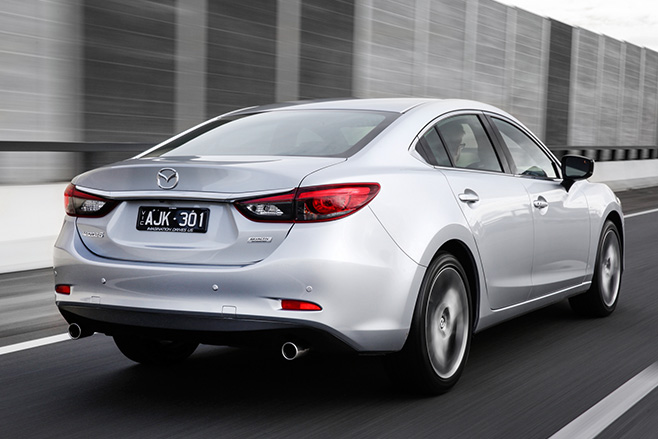
5. It has a 2.2-litre in-line four cylinder turbo diesel engine delivering 129kW and 420Nm.
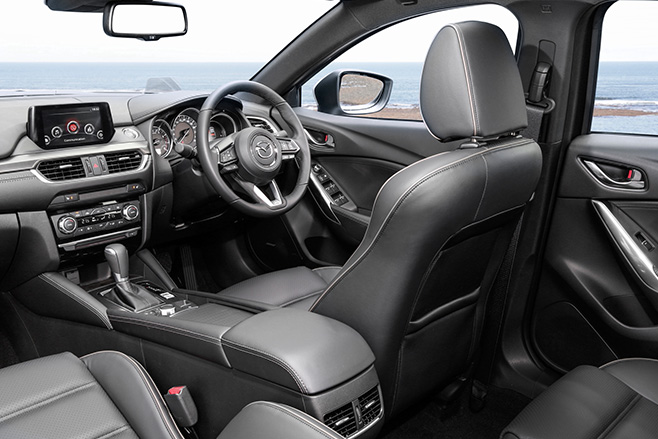
6. Black nappa leather is standard on all Atenza models, with white leather an option.
7. The Atenza is equipped with heated front and rear seats.
8. The boot is a capacious 474L with the seats up. Curiously, there are no specs offered for how big this boot is when the seats are folded down. For families wanting more cargo space the wagon offers 506L of storage.
9. It’s quiet in the cabin thanks to Mazda’s new sealing and noise absorption improvements.
10. The auto-folding wing mirrors tuck away nicely when parked.
11. Plenty of active safety gear like blind-spot monitoring, which alerts drivers to unseen obstacles via a beep light on the side mirror, is standard.
12. Shod with low profile tyres, the 19-inch alloys are more performance based making the ride a little uncomfortable on long trips
13. As you’d expect from a diesel, fuel consumption is a reported low 5.4L/100km. The reality over more than 600km of inner city and freeway driving was 7.0L/100km.
14. Mazda offers neither Apple CarPlay nor Android Auto connectivity.
