
Argentina meets Italy meets America. What could possibly go wrong?
AMONG the storied stable of Italian thoroughbred supercars – Ferrari, Lamborghini, Maserati et al – it’s often forgotten that there have been as many Italian supercars with breeding somewhat less thorough.
Logic suggests that crossing Italian style and motor racing experience with an affordable, under-stressed American V8 engine should produce an affordable, high-performance workhorse. Or, perhaps, a crude, compromised and badly built bastard. One could say either about the cars of Alejandro de Tomaso.
Born in 1928 in Buenos Aires, Argentina, de Tomaso’s family wealth enabled him to buy a Bugatti Type 35 at just 17. Racing success encouraged him to move to Italy to join the OSCA factory in Modena. In another astute move, he married American heiress and racer Elizabeth ‘Isabella’ Haskell, whose family controlled Rowan Controller Company, a vast US auto industry supplier.
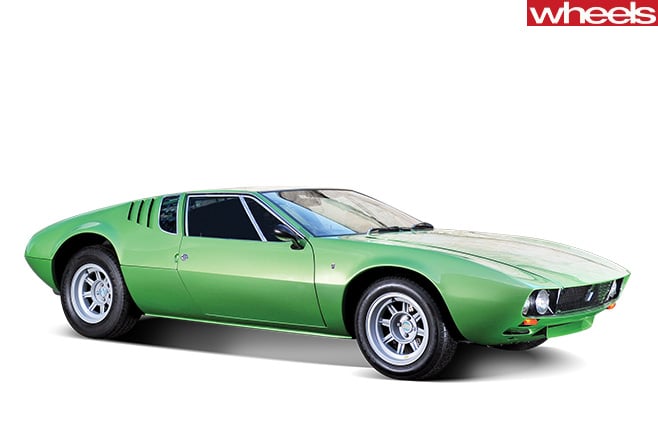
Carroll Shelby engaged de Tomaso to develop the chassis for a V8-engined sports-racing car to replace the Cobra, powered by Shelby’s HiPo 289 V8 that later appeared in the Ford Mustang GT350, with bodywork by Shelby employee Pete Brock (no relation). But Shelby, distracted by the Ford GT40 program, ditched his plans to build 50 examples.
De Tomaso took the prototype (dubbed De Tomaso 70P) to Ghia with a proposal to turn it into a concept road car. Ghia had just the thing in the form of a muscular coupe design by new recruit Giugiaro. The resulting Ghia-badged Mangusta with distinctive gullwing engine covers was shown at the Turin motor show in 1966, with an equally handsome Spyder concept appearing later.
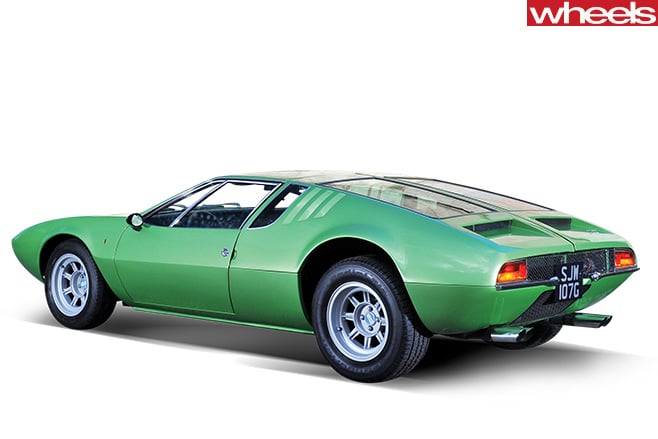
A marketing push in the US secured about 300 orders for the Mangusta. It listed at $US11,500, when a Ferrari Daytona GTB/4 cost $19,500 (and a Corvette just $5600). Production began at Ghia in 1967, with US versions being fitted with a lazier Ford 302 V8.
Early criticism of the car’s handling prompted freelance chassis engineer Gian Paolo Dallara (creator of the Lamborghini Miura) to tweak track and tyre widths, but the car suffered fundamental chassis flexing. The problem lay in the central backbone, not in the innovative use of the engine as a stressed member.
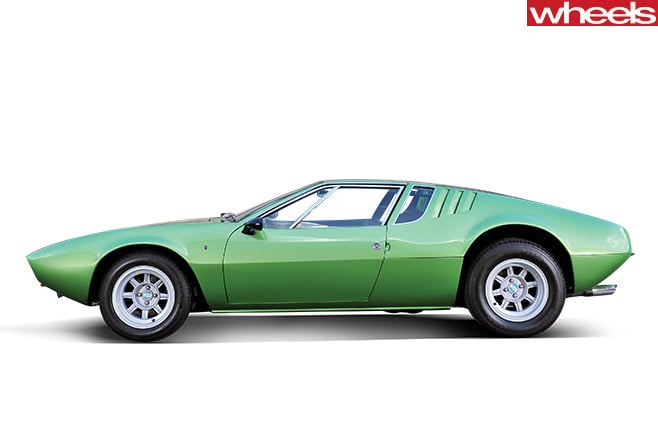
During this era of frenetic trans-Atlantic bed-hopping, the Mangusta succeeded in getting the attention of Ford, which hatched plans for a new Italo-American cross-breed, the Pantera.
The Cleveland show
EUROPEAN cars bore Shelby’s 4.7-litre High Performance V8, making 228kW at 6200rpm and 405Nm at 4800rpm. Cars bound for the US instead copped a detoxed 4.9-litre Cleveland V8, developing 165kW and driving through a five-speed ZF transaxle shared with the GT40. Euro cars did 0-100km/h in low-sixes and 400m in 15 seconds; Yank cars were almost a second slower to 100km/h.
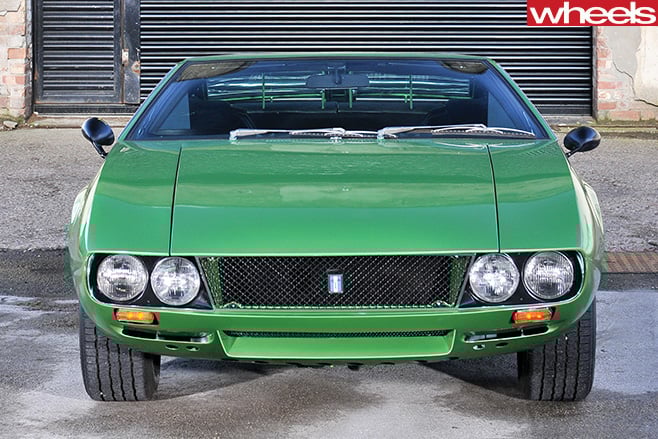
THE Mangusta’s pressed-steel backbone chassis branched into a Y-section that innovatively employed the engine as a stressed member. Steel tube sub-structures comprised the front and rear wishbone suspensions, with coil springs. A rear-heavy (68 percent) bias and bendy backbone gave the 1185kg (in US-spec) Mangusta notoriously hairy handling.
What a cockpit
INCREDIBLY low-slung interior wasn’t known for abundant space, nor imaginative cockpit design, but it certainly delivered an authentic Italian supercar experience at an affordable price. Signature gullwing engine covers actually enhanced rear vision, compared with the conceptually similar (and only three inches lower) Ford GT40, and housed luggage compartments alongside the engine and full-sized spare wheel behind it.
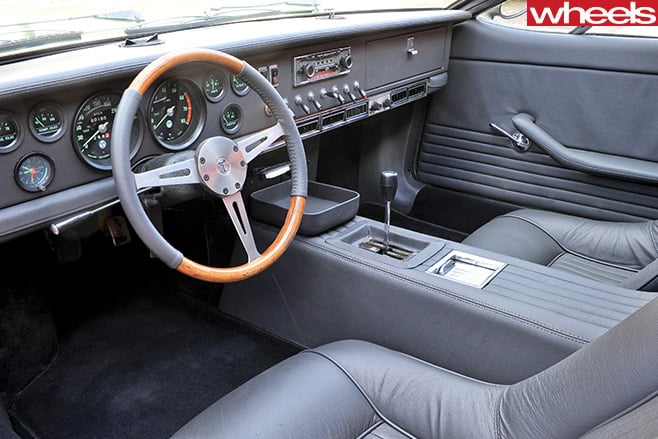
1. Maser messiah
Alejandro de Tomaso owned Maserati from 1976-93 and revived the near-dead marque with the cost-efficient but cantankerous Biturbo model family
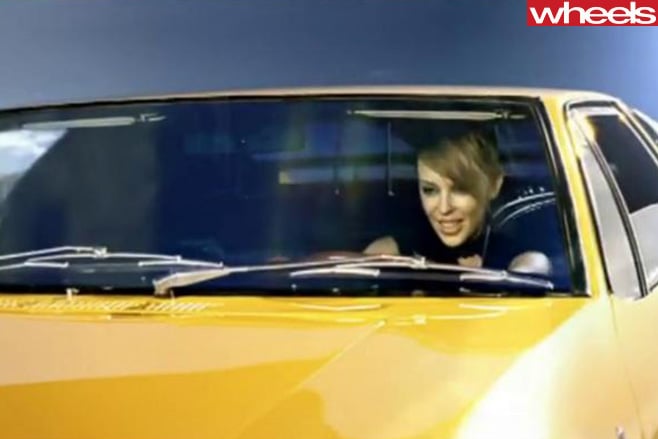
2. Kylie’s car
A Mangusta appeared in the original Gone in 60 Seconds (1974) and stars in Kylie Minogue’s Can’t Get You Out Of My Head video
An early product of Alejandro de Tomaso’s family-promoted appointment to Ghia was the 1967 Ghia Rowan, an electric city car concept
4. Eight is great
Setting aside scary handling, cramped cockpit, lousy build quality and rust, Mangusta beats Italian V12s hands-down on servicing costs
5. Cobra curse
Mangusta is Italian for mongoose, an animal that notably kills cobras; de Tomaso chose it to wind-up friend and rival Carroll Shelby
The fast fleet; Nine of the best
Want more? Check out the rest of 2016 Bang For Your Bucks.
The leaves have fallen off the trees. The skies are grey all day long. Early morning windscreens are covered in ice. Must be time to dust off the Driftbox, load 19 or so cars on to transporters and head for lovely Winton in central Victoria.
Yep, it’s Bang For Your Bucks time again. For many MOTOR readers, BFYB is the main event of the motoring year. We’d all love to drive the latest and greatest supercars that will drop bombs on each other in a few months at PCOTY, but the reality is those of us who have not worked hard enough at being born rich (thanks Gina) are, effectively, budget bound. That’s where the BFYB equation comes into things: how fast can you go without having to rent out the spare bedroom as a meth-lab?
These 12 months have been a bit of a champagne year and a quick glance at any of the contenders would have most revheads stopping for a second look. Obviously, the big local hitters are here, but for the last time as a club.
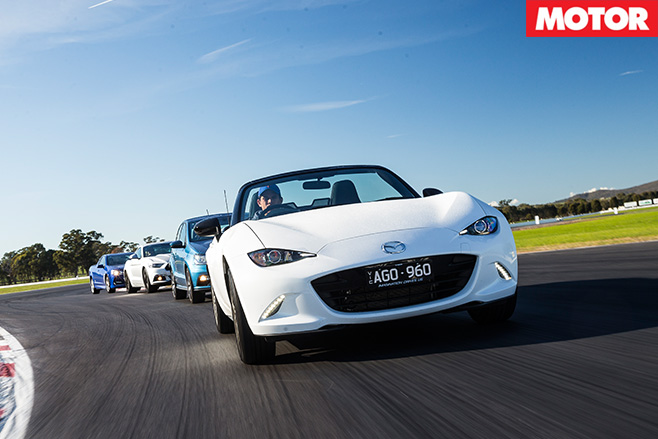
Our $100K cap hasn’t ruled out some of the tastiest Euros, either. Audi’s brand-new hot-shots are present and accounted for in the form of the TTS and the RS3 Sportback, which promises to be practical but potent with that crazy five-cylinder engine. The cheapest AMG you can buy – the A45 – is also here, this time with a power hike and revised suspension.
There’s also a pair of BMWs, starting with the reigning over-$50K champ, the M135i, and another that has been deemed ballsy enough to carry the M-badge into a new market segment. Where the proper M-stuff used to stop at the M3, the new M2 aims to extend the M-ness down the price ladder as well as expunge the bad memories of 2011’s 1M, which was somehow less than the sum of its parts, not to mention more expensive than the M2.

The judges
More gavel, less gravel

LOUIS CORDONY
Judging newbie Louis managed to squeeze in track testing 19 cars between humiliating initiation rituals

DAVID MORLEY
Fresh from a failed audition as Arnie’s replacement in Terminator 6, Morley was left with no choice but to return to the madhouse

WARREN LUFF
Two days before BFYB Luffy was racing a McLaren 650S GT3, so we started him in the Fiesta ST to help him ease back into it

DYLAN CAMPBELL
The power of command having gone to his head, ‘Dictator Dylan’ decreed only his right side was to be photographed

SCOTT NEWMAN
Looked like he had just got Megan Fox’s phone number when Chrysler said please return the 300 without rear tyres
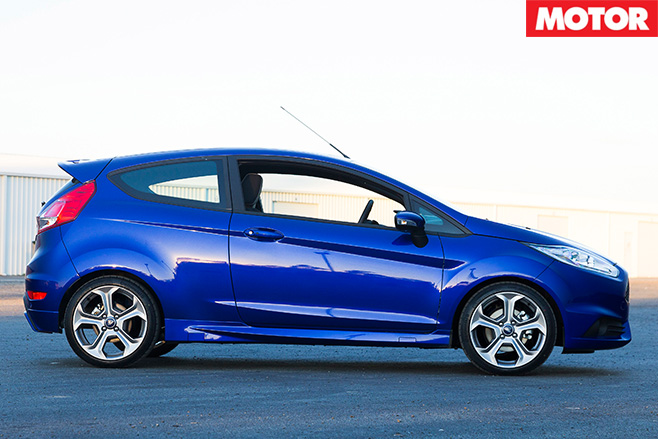
Let’s begin with the reigning sub-$50K (and overall) champ: Ford’s character-filled Fiesta ST. The problem for the little Fordy this year is its performance has remained the same while the competition has all taken steps forward. Okay, it’s still well below thirty grand, but will it have enough oomph when we crunch the numbers in the BFYB abacus?
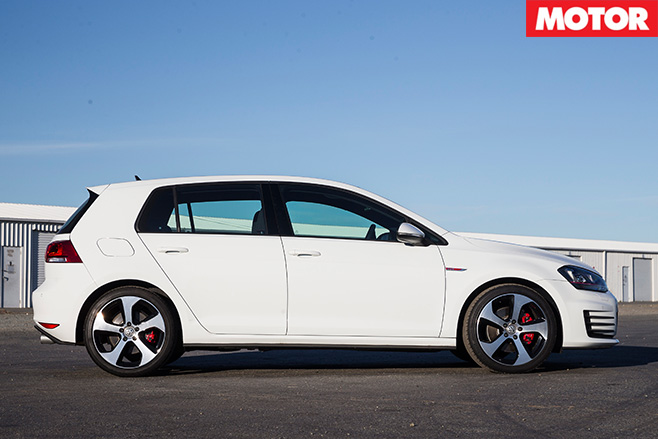
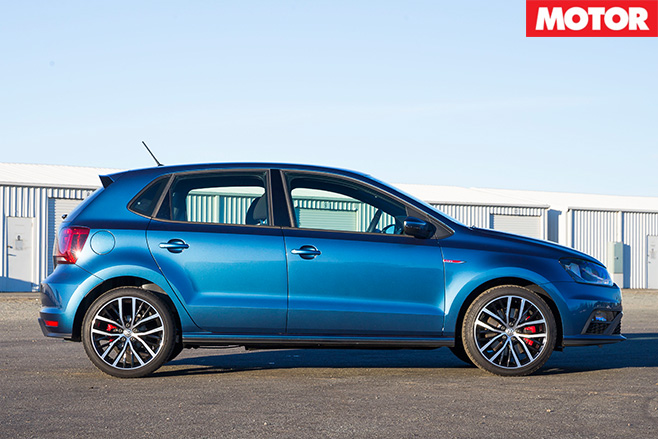
The opposition has never been sharper. There’s the revised VW Polo GTI, itself a two-time BFYB winner in its previous generation, which is now fitted with adaptive dampers as standard. Also from VW is the Golf GTI, this time in Mark VII, base-model form – a first for BFYB. Don’t forget that it’s the Golf GTI that has been setting the hot-hatch benchmark for a decade now, so let’s have less of that base-model cringe, shall we?
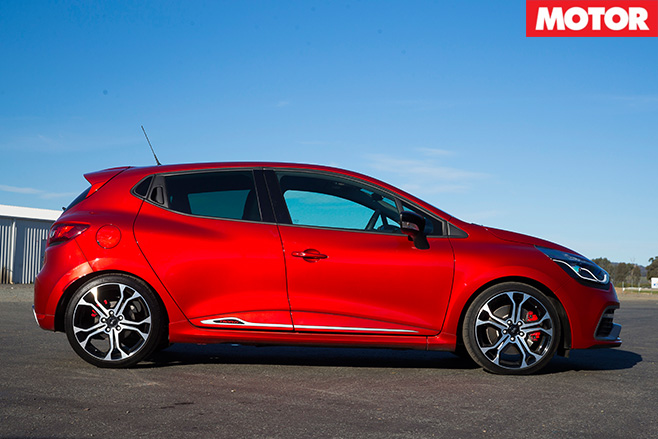
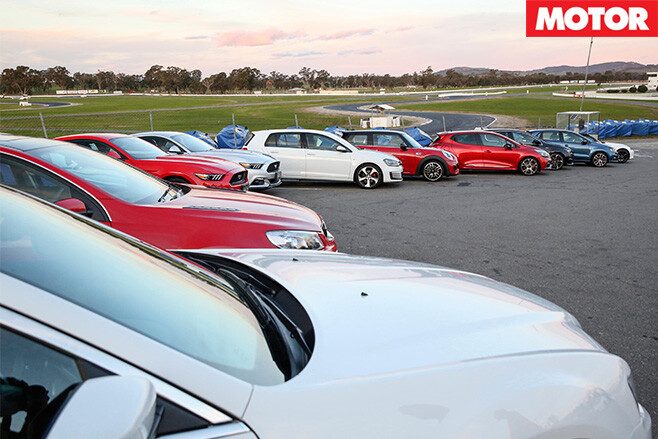 Renault’s Clio Sport has muscled up with the advent of the Trophy 220 edition, following the lead of its big brother the Megane Trophy with a revised suspension tune, more grunt and better seats. There’s also a new tune for the double-clutch gearbox, aimed at making a sharper tool.
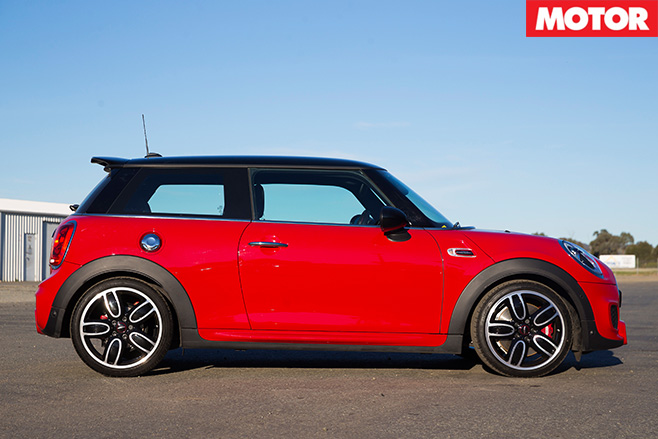
Plenty of Mini Coopers have had a crack at BFYB over the years, so it makes sense that the latest JCW version would get a guernsey, too. With 170kW, two litres and razor-sharp suspension, it’s the most focussed new-gen Mini yet.
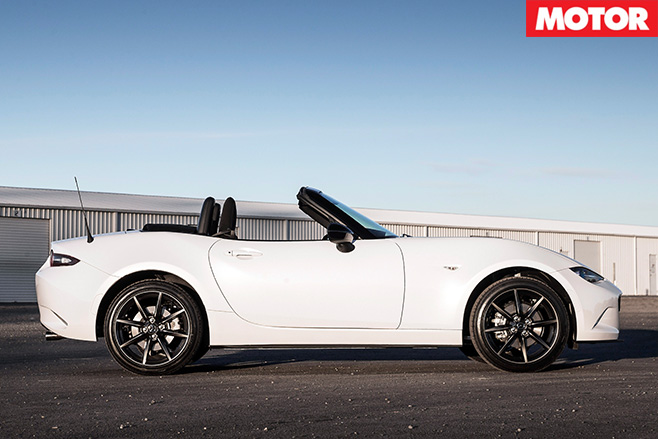
While we all fell in love with the new 1.5-litre ND MX-5 at PCOTY last year, with the 2.0-litre version of the MX-5 finally on sale, the ‘big block’ got the nod for Bang. The Mazda’s 118kW might not sound like much, but surely, any advance on the 1.5-litre version’s brilliance has to put it in with a shot.
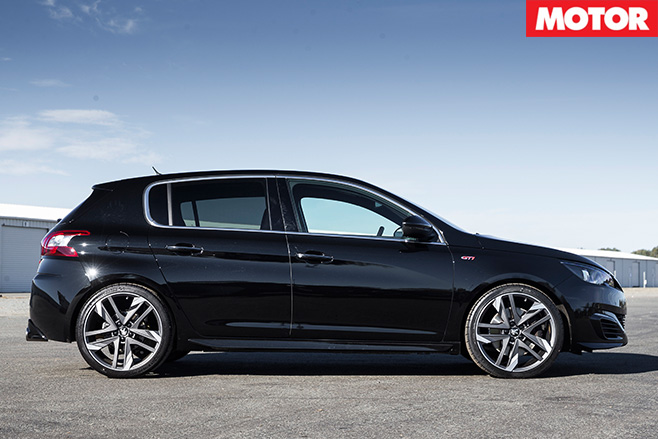
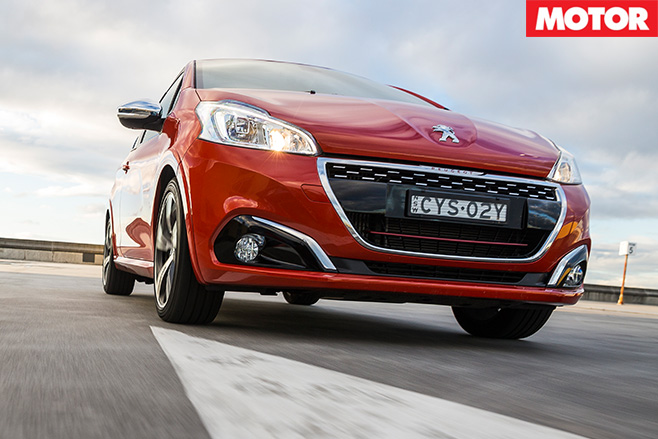
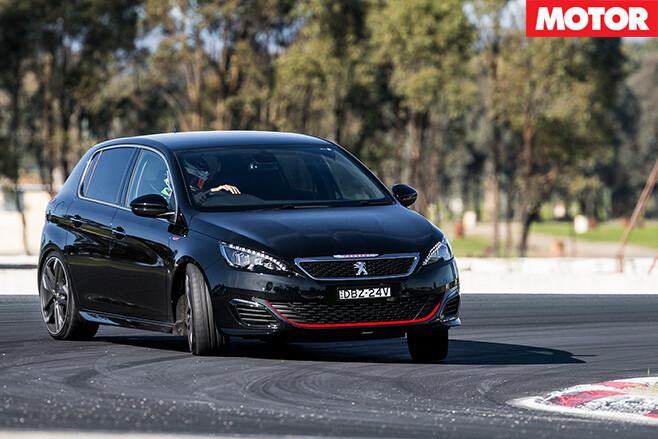 You’ll also recall we had the Peugeot 308 GT at BFYB last year, but this time, the more serious GTi 250 version was a walk-up start. It doesn’t have the tricky diff or bigger brakes of the 270 version, but it does have the sticky Michelins from that car as an option. With 184kW from just 1.6 litres, it promises to be some kind of hand-held flare.
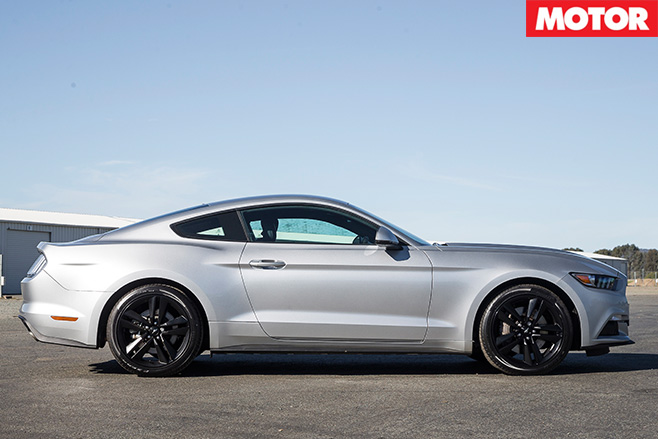
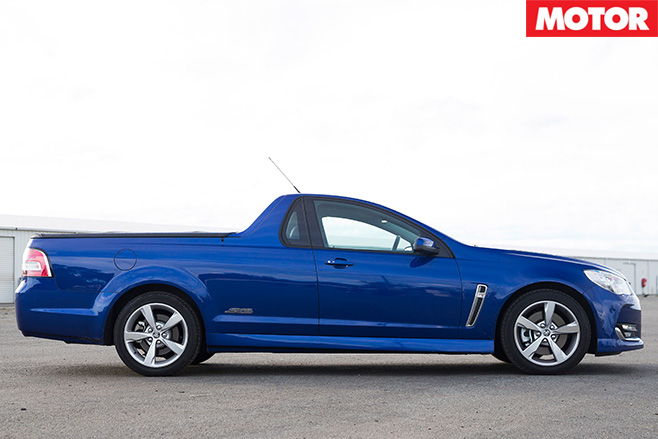
Wildcards? You want wildcards? Okay, how about these two? Thanks to the marketing departments at both Holden and Ford, there’s a big hitter from each camp that sneaks in below the $50,000 category cut-off. Actually, both the Commodore SS Ute and the Mustang Ecoboost easily make the financial cut which shows you just how much car you can get for reasonable money these days.
They’re both new models too, and even though the Holden Ute is ‘just’ a facelift of the VF series, it’s a big enough upgrade that the vehicle itself is hugely improved by wearing the VF II tag. For a start, the rather good 6.0-litre V8 is now a 6.2-litre unit, capable of 304kW and no less than 570Nm of torque. Significantly, the Ute also gets the luscious new soundtrack engineered by Holden for the VF II and if it isn’t the best sounding two-door ever to haul a hay-bale, we’ll go hee-haw.
 When it comes to the Mustang Ecoboost, I know what you’re thinking: what the hell is a Mustang doing with a four-cylinder engine? What you have to remember is that four-banger ’Stangs have been a reality in the US since the fuel crisis of the late-’70s led to the Mustang 2 with its piddly four-pot.
By which I mean, Americans ‘get’ a Mustang with four cylinders AWOL. But before you dismiss it out of hand, check the stats: a meaty 233kW of power and 432Nm. That would have been enough to see off pretty much any local V8 built before the turn
How it works
The formula for success
| Acceleration, 0-100km/h | 10% |
| Braking, 100-0km/h | 10% |
| Acceleration, 0-400m | 10% |
| 400m terminal speed | 5% |
| Acceleration, 80-120km/h | 5% |
| Outright lap time | 25% |
| Maximum apex speed | 10% |
| Lap maximum speed | 5% |
| Judges’ ranking | 20% |
Determining a Bang For Your Bucks winner is easy – every car earns a score, highest score wins. How we calculate that score is a little more complex. We split the field into two categories ($0-$50K and $50-$100K) as it gives a clearer indication of each car’s performance relative to its closest price peers. However, we also award an overall winner, incorporating data from the entire field.
 As the name suggests, the score is made up of performance (Bang) and price (Bucks). Comprising 40 per cent of the final score, price is the easy bit. The field has an average price (this year, for all 19 cars it was $55,795) which is given the indexed value of 100. If a car is cheaper than the average it’ll score greater than 100 (remember, high scores are good), if it’s more expensive, its Bucks score is less than 100.
The Bang score makes up 40 per cent of the overall score and is determined exactly the same way, there are just more criteria – listed below right. A lap time says a lot more about a car’s total performance than its ability to simply stop from 100km/h, so the various criteria are weighted. The data is collated in a huge Excel spreadsheet and after deploying various mathematical formulas to balance each car’s respective results on the track, we arrive at a ‘field performance average’.
Again, this average is given the indexed value of 100 and cars faster than this score higher than 100, cars slower than this score less than 100. The ‘Bang’ and ‘Bucks’ scores are then combined in a 60:40 weighting to become the final BFYB score, though the final scores are all divided by two to make the numbers look a bit nicer.
 Here’s a simple example using two cars and one performance criteria. Car A does 0-100km/h in 5.0sec and costs $75,000, Car B manages 0-100km/h in 10.0sec and costs $25,000. For our Bang score our ‘field performance average’ is 7.5sec, which is indexed to 100. Therefore, Car A’s Bang score is 75 [(7.5/10) x 100] and Car B’s is 150 [(7.5/5) x 100].
Likewise, our average price, indexed to 100, is $50,000. Therefore, Car A’s Bucks score is 200 [(50,000/25,000) x 100] and Car B’s is 66.7 [(50,000/75,000) x 100]. Applying a 60:40 weighting to both scores gives a Car A a final BFYB score of 200 [(1.6 x 75) + (1.4 x 200)/2] and Car B a score of 166.7 [(1.6 x 150) + (1.4 x 66.7)/2]. There you go, Car A offers more bang for your buck than Car B.
Obviously, changing any of the criteria weightings will have an effect on the results. Every year we re-evaluate the formula and look for potential improvements, however it’s remained largely the same since 2008. It remains so for 2016 – we think the current formula offers a good balance between rewarding an exceptionally fast car while still giving the budget offerings a shot.
Fast tracked
Winton Raceway
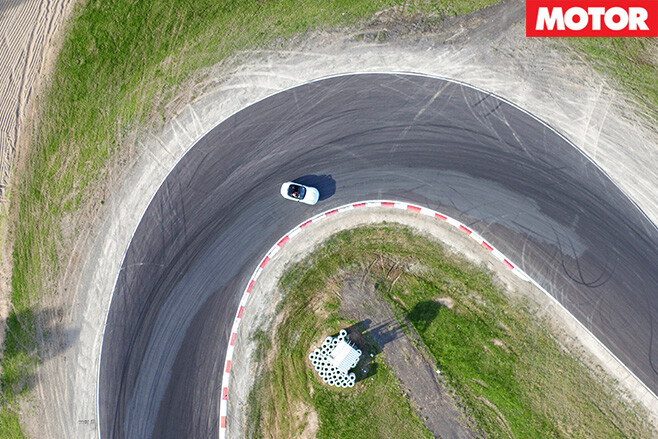
It’s the same old Winton but with a completely new surface. Winton’s 3.0km liqourice strap is dressed in sticky new tarmac following a recent $1 million injection from the local government to bring the track up to global standards. The layout is unchanged, however the reprofiling of some corners, along with the smoother surface, should mean lap times will tumble compared to previous years.
Want more? Check out the rest of 2016 Bang For Your Bucks.
TELL ME ABOUT THIS CAR
The S90 is a large luxury sedan and the largest four-door in the Volvo showroom, replacing the S80 as the brand’s flagship model. It is available with five different engines configurations, all of which are 2.0-litre four-cylinders. The Volvo S90 is priced from about $80,000 and runs well over $100,000, depending on how many options you choose.
STRENGTHS
- Safety. Volvo has long been about safety and the S90 is no different. As well as good passive safety features (including airbags and a strong body structure) the S90 has a long list of active safety features. It can warn of other vehicles in its blind spot and partially steer the car on a freeway. It also has a system that counter-steers and applies the brakes if it senses the car is about to run off the road. And the auto braking system now incorporates software that not only recognises humans and other vehicles but also responds to large animals, such as horses and cows.
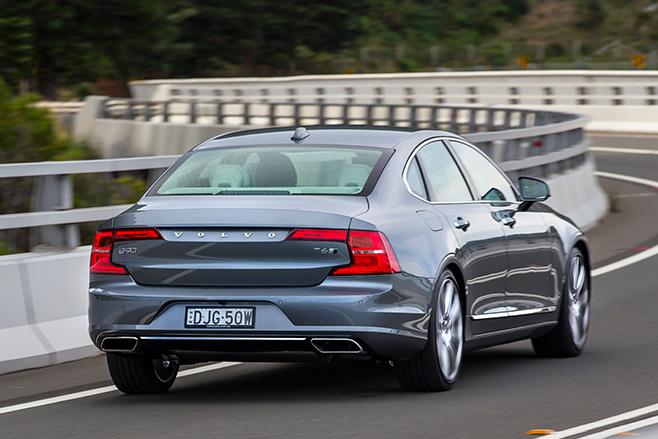
- Performance. The 2.0-litre four-cylinder turbo diesel in the D5 has plenty of pull across its rev range. Combined with a decisive eight-speed automatic transmission and the tricky PowerPulse system (which uses stored compressed air to spin the turbo up, reducing so-called turbo lag) it makes it feel more powerful than the numbers in the brochure may suggest.
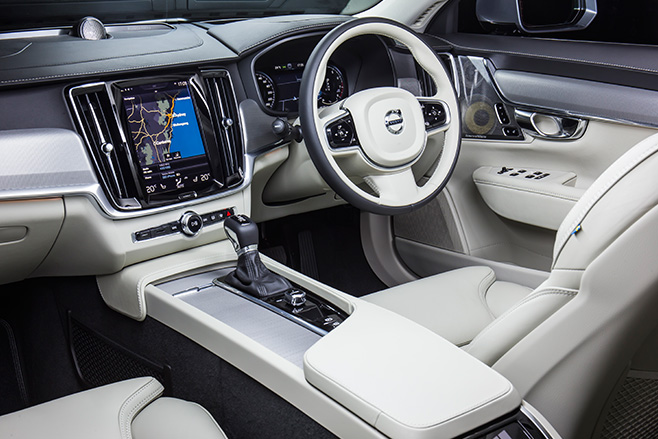
- Design. With the exception of the rear-end – which has very distinctive tail lights – the S90 is a stylish machine. The headlights include “Thor’s hammer” LED daytime running lights (lights that stay on during the day to make the car more visible) while the concave grille helps create a unique look. But it’s inside where the S90’s design works best. There are plenty of high quality materials (real metal, wood and leather, for example) as well as a simplistic but functional layout that doesn’t overload the driver with buttons or controls.
- Steering and general control. Volvo has done a great job of adding some decent weight to the S90’s steering, while ensuring it is still easy to use when doing U-turns or parking. It adds confidence on longer corners, ensuring it is an engaging car to drive. And, when fitted with grippy Pirelli tyres as our car was, the S90 hangs on nicely if you’re pushing on.
WEAKNESSES
- Value. Okay, so nothing with a six-figure price tag is likely to win any awards for outstanding value, but the S90 has stepped up in price significantly over the S80 it replaces in the Volvo line-up. Plus, it’s missing some features you might expect on a luxury car like this; things like digital radio, smart key entry and Apple CarPlay connectivity.
- Comfort on some surfaces. Our car was running on optional 20-inch wheels (the Inscription comes standard with 19s) with very little air between the wheel and the outside of the tyre, so it was prone to the occasional thud into bumps with a sharp edge. It’s by no means uncomfortable, but takes the shine off an otherwise comfortable driving experience.
- Carrying five people. Like most rivals, the middle seat in the rear sits proud of the more cosseting outer seats. But it’s the large transmission tunnel on the floor that makes life most difficult for anyone stuck in the centre.
The popular cars in this segment are predominantly from German manufacturers. The Mercedes-Benz E-Class (a new model arrived in mid-2016) and BMW 5-Series (a new model arrives in 2017) head the field, with Audi’s A6 also putting up a good fight. Others to consider include the Jaguar XF and Lexus GS.
A dry-sump flat-six that can rev to 8800rpm, a lofty rear wing that contributes 224kg of downforce at 300km/h and semi-slick tyres more or less pinched off the 918 Spyder hypercar. And I’m just glad it has a demister.
Contrary to popular ridicule, and the experience of those living in Melbourne, it rains nearly twice as much in Sydney each year. They wouldn’t make very good fortune tellers but the Bureau of Meteorology has some excellent records which show that, in the last 160-odd years, those closest to the tropics have received 1164 median millimetres every year, the southerners 644mm.
But the real clincher is Sydney’s 103.9 average annual “clear” days to Melbourne’s comparatively abysmal 48.6, and while we have cherry-picked sexy-looking statistics here, rainfall aside the general data does attest to Melbourne being a colder and cloudier place.
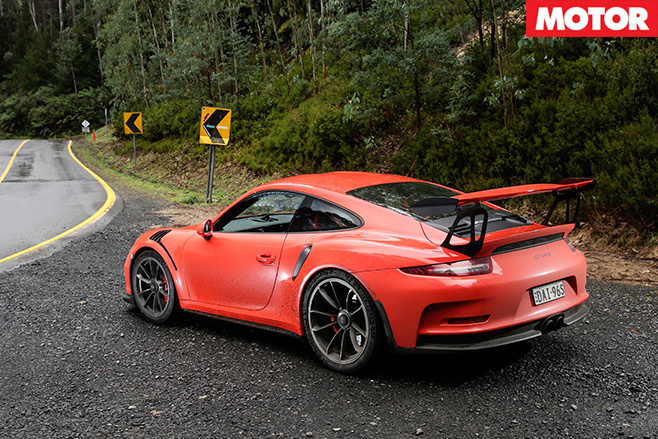
Though the conditions for our test were mostly cloudy there was never any risk of us being missed. Headlights on or off, the 911 GT3 RS magnetically attracts eyeballs everywhere it goes in its ($5990 extra) Lava Orange paintjob. And in the city it can’t help but look permanently lost, like one could pull up next to you at any moment, wind its window down, the befuddled driver enquiring which way to the nearest racetrack.
We weren’t sure what to expect of this car. Last year we were blown away by the 991 911 GT3 such that, in our cross-country 11-car shootout in the Victorian alps, it pipped Mercedes-AMG’s stonking new GT S hero coupe to become our reigning Performance Car of the Year. When so many cars have a great engine, or a great chassis, or great steering, but rarely all of them at once, it seemed the 911 GT3 did – its howling flat-six nat-atmo engine and sweet-handling chassis wooing all present. (Except ex-editor Tim Robson, who voted the AMG GT S ahead of it, but no-one’s infallible.)
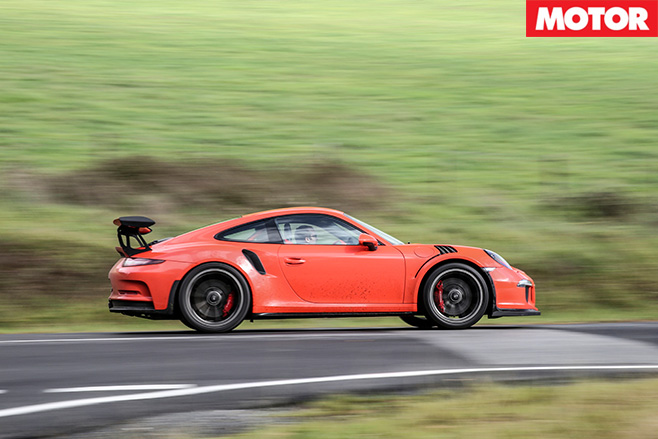
So you can imagine our reaction when we first read of the RS with the same specification tyres as the 918 Spyder hypercar (dimensionally at least – though both Michelin Pilot Sport Cup 2 they’re a slightly different compound), a car 214kg heavier with its hybrid gear and having to deal with 75 per cent more power. Putting them under a 911 seemed overkill, but nothing bespeaks the balls-out philosophy of this car more.
Of course, MOTOR has history with not only the GT3 but the RS. The previous generation car was something truly special – easily forgiven for its gaudy stickers thanks to three pedals, 3.8 litres of flat-six pumping 12.0:1 compression at 8400rpm, good for 331kW and 430Nm and making the rudest noise in the process. A car that weighed 1370kg and yet was more than the sum of its parts. It was our 2010 Performance Car of the Year.
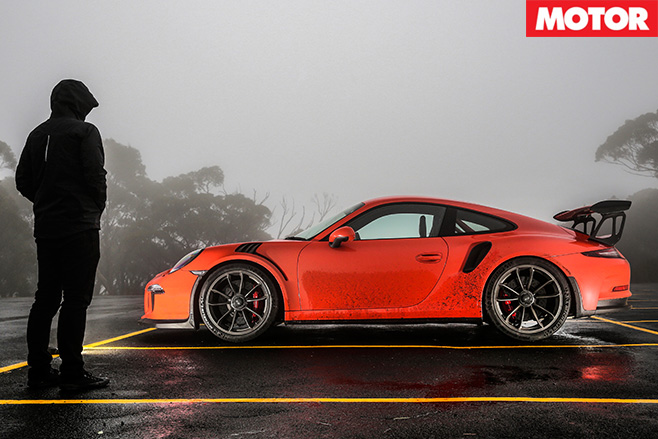
Gaping vents on the front guards pump enormous quantities of air, contributing to the car’s special aerodynamic tricks (121kg at the front at 300km/h for a total of 345kg downforce). And an equally extreme price, starting from $387,300, nearly 100 large more than the normal GT3.
Delve deeper and you see where your money is going. The engine is stroked from 3.8 to 4.0 litres, power up from 350kW to 368kW and torque, 440Nm to 460. Any MOTOR reader worth their salt should have just twigged that some of those specifications sound very familiar indeed – it can’t be just coincidence the GT3 RS has a 4.0-litre nat-atmo flat-six making 368kW and 460Nm, exactly the same as the greatest 997 911 there ever was, the GT3 RS 4.0 whose Mezger race engine was famously pinched from the GT3 R and RSR race cars and adapted for road use. Both cars are made by the same person after all, Porsche’s motorsport boss Andreas Preuninger.
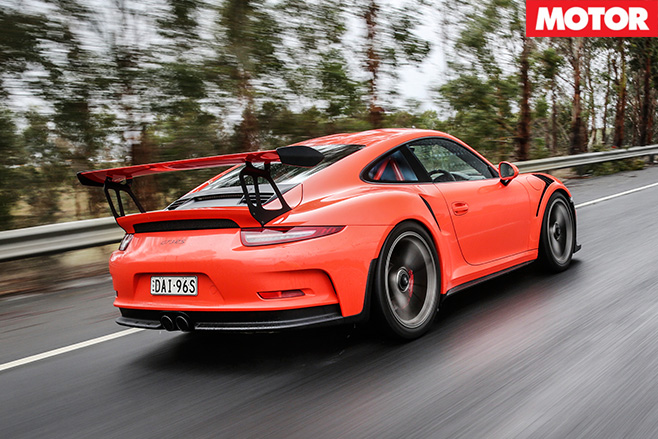
With a ’Ring lap time of 7:20sec (23 seconds slower than a 918, but seven seconds quicker than the RS 4.0 and eight seconds quicker than a Carrera GT) Porsche claims the RS is also five seconds quicker than the base GT3. Which works out to be $18K per second – for when time truly is money.
The RS proves, too, you don’t need two atmospheres to go fast down the strip, Porsche claiming 3.1sec to 100km/h and a 11.2sec quarter mile, and worth remembering Porsche is the kind of company to use, for their claimed performance figures, the slowest of perhaps 50 runs at the test track, rather than the fastest.
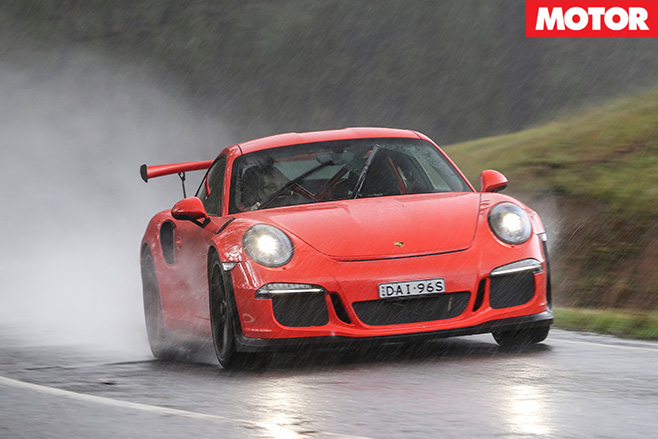
Instead, for all our efforts to build heat into those huge rear tyres, wheelspin was always in abundance. And while we’re happy to pass the buck to Porsche for supplying a car with very tired rear bags, 0-100km/h in 3.7sec on dead rubber and an 11.6sec quarter at 201km/h is still plainly ludicrously fast for a car built mostly for corners. We’ve heard, too, of this exact car dipping under the threes – on fresher rubber.
Even at the best of times those same Pilot Sport Cup 2s are not made for the wet, let alone after they’ve been through god-knows how many ham-footed journalists who aren’t paying Michelin’s invoices. And so our very damp time with the 911 GT3 RS was at the very least, exciting.
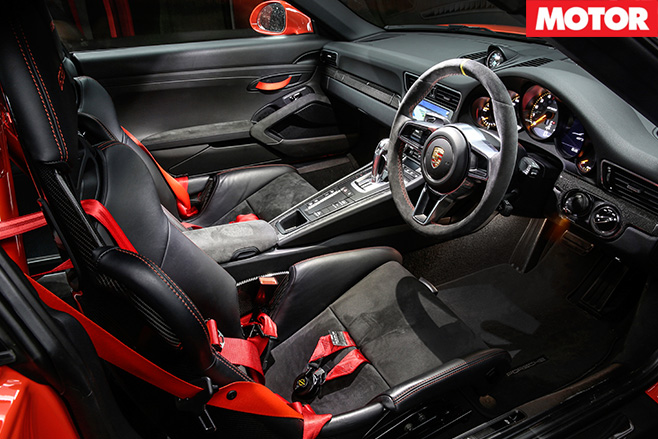
The GT3 RS spurns reversing cameras or even sensors, you’d think to save weight (there is a sticker for the front badge after all) although curiously it still has headlight washers (to help the weight distribution?). Rear visibility is passable despite looking through a body-coloured four-point cage and half-a-metre-high rear wing.
The big tacho’s last yellow increment is 8400, 600 less than GT3. And in the centre stack of buttons the one marked “Pit Speed” – unique to RS – is in my books the chintziest thing you’ll find in any Porsche and that’s saying something, as Porsche doesn’t do glitter. (The button is like a separate cruise control you can set up to 88km/h.) But otherwise you could be in a GT3, bar the RS-specific coloured canvas tabs for interior door grabs.
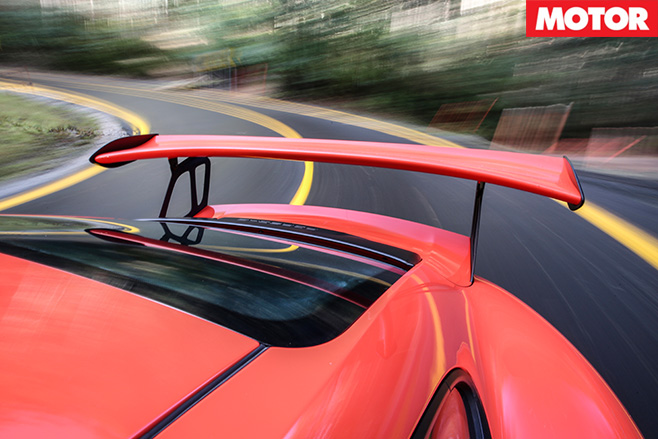
The RS is remarkably civil around town. It rides well most of the time, surprising considering the 35-profile tyres (30 rear) and the fact you can barely fit a finger between the rear wheel and the guard. Some people could daily drive this car. Put earplugs and an inflatable doughnut cushion in the glovebox and you’d be eternally prepared for a short-notice interstate track day.
When it’s raining, as we found, you don’t drive the 911 GT3 RS quite so much as you transport it. Up and down our chosen road for photography, it was very, very dicey. We will save you the bore of driving such a car in the wet but suffice to say, by the end of it, we had next to no clue how much lateral grip the tyres had and a millimetre-precise knowledge of available traction.

But career through enough corners in the dry to build some heat and those same tyres could be called bipolar. Fortunately for MOTOR, the heavens cleared just long enough, and over just enough corners, that we could unleash the RS in all its fury. And we were both lost for words and tempted to be never seen again.
In first gear you are thrust into your thinly-padded seat in a way that makes watching the tacho for second gear difficult and the limiter easily snagged. Dry traction is enormously strong and of course the RS will easily accelerate to speeds not fit for publishing. Its acceleration, for a nat-atmo 4.0-litre six-cylinder engine, is nothing short of spectacular.
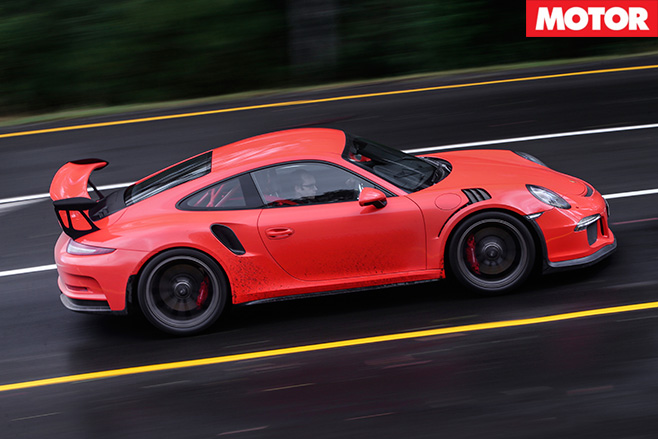
It sounds serious, too, like a Carrera Cup car missing all its sponsor stickers. It’s symphonic, screaming at 8400rpm, a high-tempo, rich and distinct, yet serious-sounding flat-six bark. A car for tunnels, for sure.
Perhaps it won’t surprise to say this is one car with the chassis to match its engine. The suspension performance is incredible, the car so composed and calm at speeds well beyond 110km/h. Over bumps at speeds that other cars would be breaking a sweat, the RS feels like it’s shrugging its shoulders. It’s fertiliser for your confidence. Stability at seemingly any speed is one of its core handling themes and though we punted through precious few fast corners to make a definitive call, the aero would absolutely play a leading part.
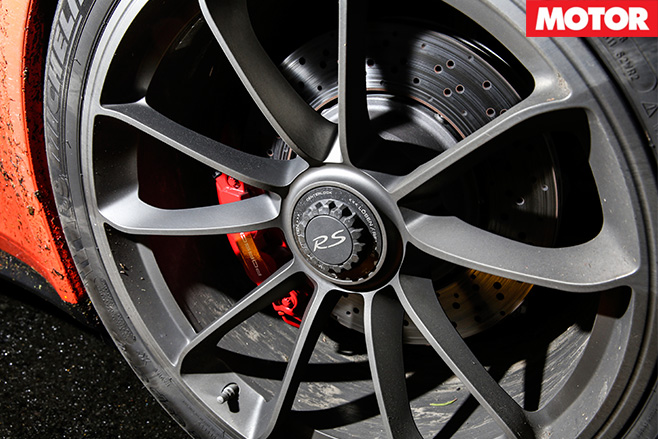
Our time in the dry with the GT3 RS, whether 100 kilometres or a thousand, was always going to feel too brief, but a theme emerged quickly: one of enormous performance that would take time to properly tap. You go into a corner and think, yep, I estimate this is going to be eight tenths and in fact it’s six.
There is so much performance left in the car that you really have to unpeel it slowly over time. The amount of speed you can carry into corners in particular, helped by the all-wheel steering and those 918-sized wheels and tyres, is plain cheeky.
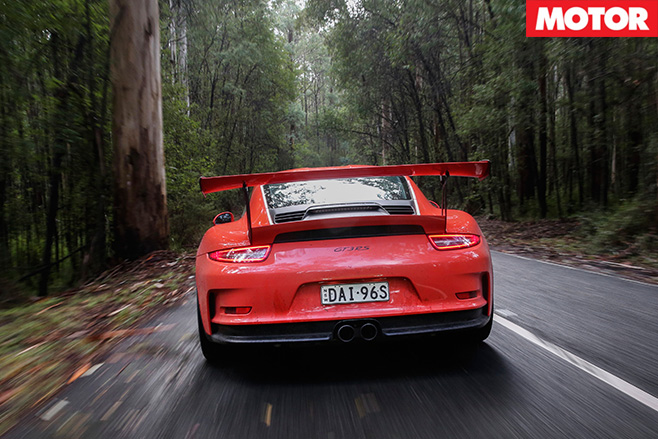
Without driving it again in the dry, it’s truly a hard one for us to place this car in the annals of 911 greatness. Personally as a motoring journalist I am often asked what is the best car I’ve ever driven and my standard answer has been the Ferrari 458 Speciale.
But it’s no longer an unthinking response; the RS had the potential to pip it, I felt, if only we got to drive it more. And given we were the last press booking in Australia, with all cars sold, we mightn’t ever know. Although it’s particularly lucky for the cars on our 2017 Performance Car of the Year shortlist. This car is a winner right here.
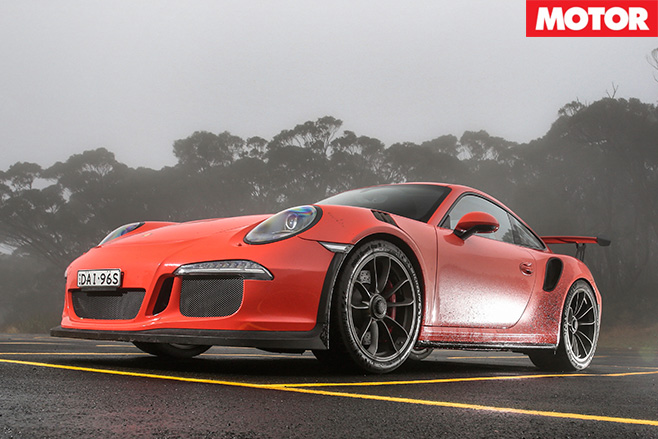
And not least because of the windscreen wipers. They’re pretty excellent, too.
5 OUT OF 5 STARS
LIKE: Everything – power, brakes, electronics, chassis, noise. It’s almost perfect DISLIKE: Best enjoyed in the dry, and over shorter distances
SPECS Body: 2-door, 2-seat coupe Drive: rear-wheel Engines: 3996cc flat-6, DOHC, 24v Bore/stroke: 102.0 x 81.5mm Compression: 12.9:1 Power: 368kW @ 8250rpm Torque: 460Nm @ 6250rpm Power/weight: 259kW/tonne Transmission: 7-speed PDK Weight: 1420kg Front suspension: struts, coil springs, anti-roll bar Rear suspension: multi-links, anti-roll bar L/W/H: 4545/1880/1291mm Wheelbase: 2457mm Tracks: 1587/1557mm (f/r) Steering: electrically-assisted rack-and-pinion Front brakes: 380mm ventilated/drilled discs, 6-piston calipers Rear brakes: 380mm ventilated/drilled discs, 4-piston calipers Wheels: 20 x 9.5-inch (f); 21 x 12.5-inch (r) Tyres: 265/35 ZR20 (f); 325/30 ZR21 (r) Michelin Pilot Sport Cup 2 Price as tested: $412,970
Wheels pitches 10 of the biggest sellers in the medium-to-large car segment to see which is the best of the current crop. Here’s number 5, the Kia Optima.
Can’t wait to see the final score? Jump to the verdict now.
IT WAS just over five years ago that Kia’s trendily styled but dynamically dire Optima finished dead last in an 11-car Wheels Medium Megatest. Yet here we have the latest Optima GT sitting proudly at number five, just one position behind Skoda’s lauded Superb and two ahead of the well-liked Mazda 6. That’s the level of improvement Kia has wrought with this all-new car.
Sharing its underpinnings, 2805mm wheelbase and peachy-keen 180kW 2.0-litre turbo-petrol four with Hyundai’s Sonata Premium, the Peter Schreyer-penned Optima is a more visually interesting proposition than its Korean blood brother.
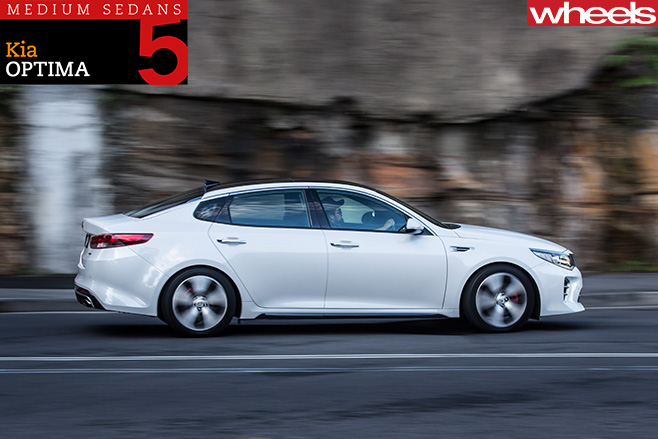
In so many ways, the Optima and its Sonata cousin are so alike it’s uncanny. Voluminous 510-litre boots, similarly opulent and accommodating rear seats, and real-world performance and fuel economy so close to identical it’s almost freaky.
What really advances the Optima GT’s cause are its tyres – expensive 235/45ZR18 Michelin Pilot Sport 3s. Having so much more grip to play with enables the Optima to properly capitalise on the urgent performance it offers. Doesn’t matter if the surface is wet or dry, the Optima gets its power to the ground with far more confidence than the Sonata, let alone the axle-tramping Skoda, and that’s important in a turbo-boosted, family-focused front-driver.
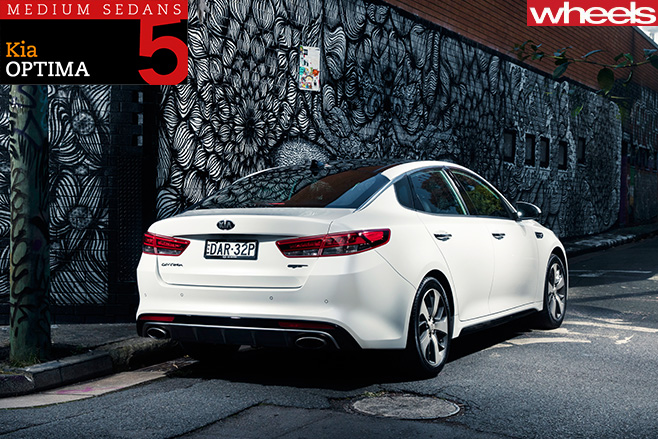
What the Kia ultimately lacks is finesse. Until there’s quite a bit of lock wound on, the steering feels rather wooden and disinterested, and even though it enthusiastically favours its outside-rear wheel once pointed into tighter corners, the transition is rather abrupt and lacking in fluency.
The flipside is a smooth, reasonably level and relatively sophisticated ride compared to many of its rivals, though again without the sweetly damped finesse it deserves. That said, what the Optima lacks in rough-road composure – especially compared to something like the unflappable, if unrefined, Camry – it makes up for in overall smoothness and quietness.
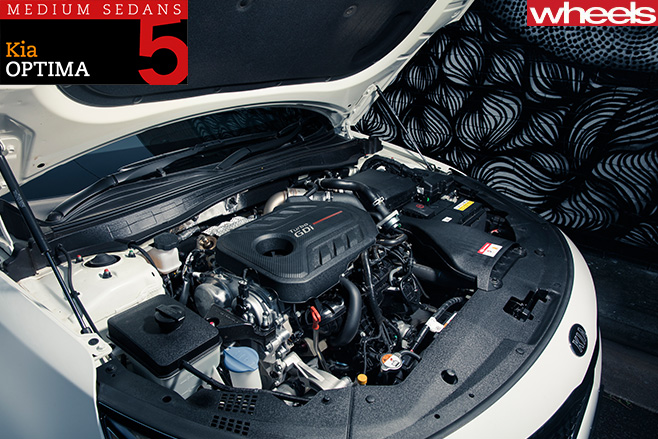
With a colourful, beautifully built interior, more performance and grip than most people could ever want, as well as a market-leading seven-year warranty, suddenly paying $45K for a Kia sedan seems like value. It isn’t exciting, or brimming with personality, or stunningly beautiful to look at, but there’s an honesty to the Optima GT that somehow makes it more impressive the more time you spend with it. NP
On the wagon
Like seven of the other cars in this test, Kia’s latest-gen Optima is available in wagon form, though not in Australia just yet. Unveiled at the Geneva Show in March for a European on-sale later this year, the handsome Optima SW shares the sedan’s engine line-up, as well as its overall length, though it’s 15mm taller and accommodates 552 litres of cargo space underneath a retractable blind. Kia Australia is currently evaluating the SW, but is yet to make a decision.
Want to compare the field? Check out all the Family sedan finalists.
 SPECS
SPECS
Price: $45,940 *Includes moonroof ($1950)
Engine: 1998cc 4cyl, dohc, 16v, turbo
Power: 180kW @ 6000rpm
Torque: 350Nm @ 1400-4000rpm
Transmission: 6-speed automatic
Dimensions (L/W/H/W-B): 4855/1860/1455/2805mm
Weight:1650kg
Cargo capacity: 510 litres
Tyres: Michelin Pilot Sport 3 235/45ZR18 98Y
Test fuel cons: 11.0L/100km
0-100km/h: 6.9sec
0-400m: 14.9sec @ 155.2km/h
80-120km/h: 4.3sec
3yr resale: 46%
Plus: Slick cabin; performance; equipment; excellent tyres
Minus: Dynamics and ‘Drive Mode’ calibration still need work
Verdict: 7.0/10
Mark Webber has announced he is to retire from full-time racing at the end of the 2016 World Endurance Championship season.
The nine-time Grand Prix winner and 2015 World Endurance champion has decided to call it a day on his long and successful career while still at the top of his game, following advice from legends Jackie Stewart and Niki Lauda who did exactly the same.
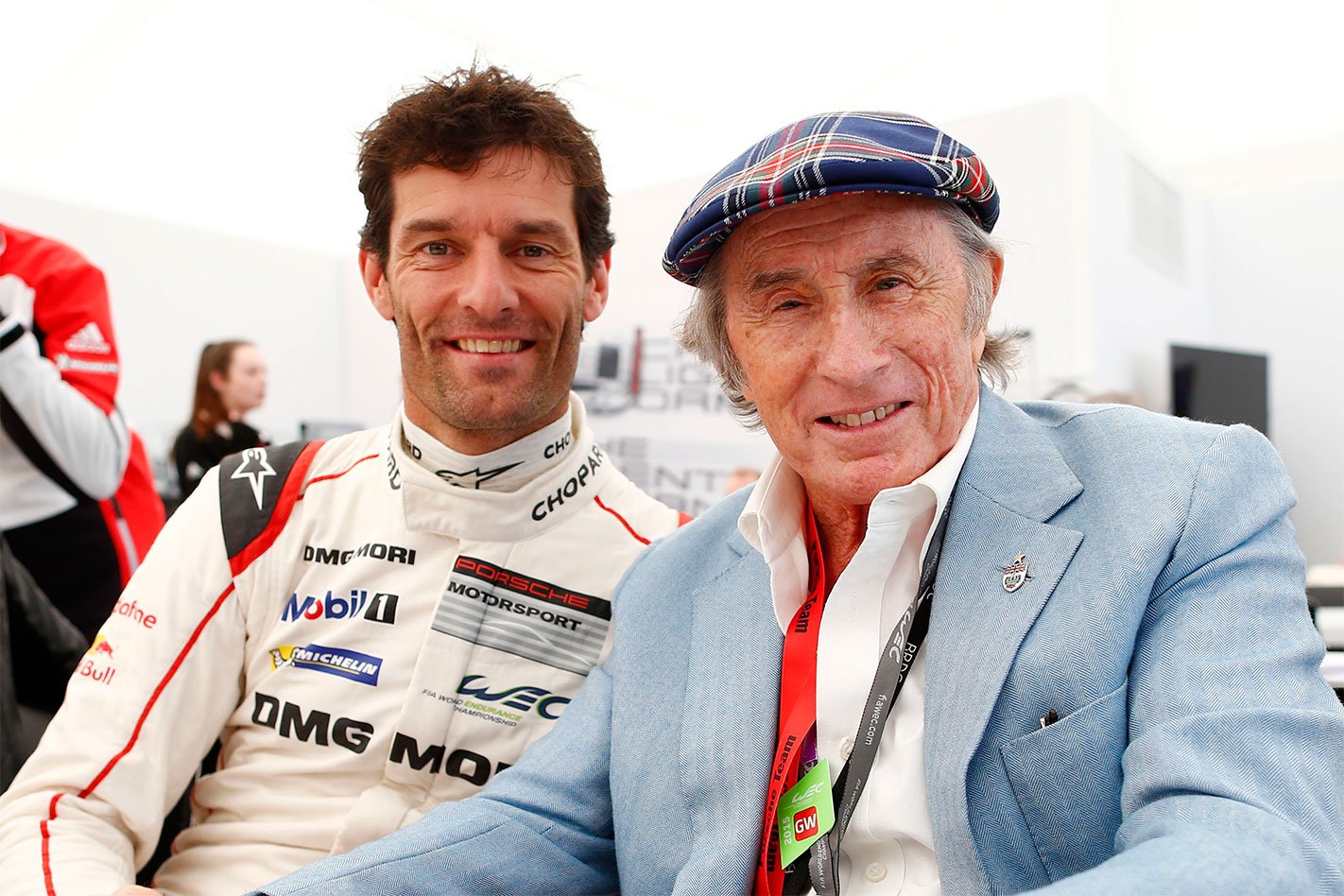
Webber is one of Australia’s most successful motor racing exports, starting his professional career as a Mercedes sports car driver in 1998 before his infamous airborne accidents at Le Mans in 1999 caused the German marque to cancel its program.
Switching to F3000, his big break came in 2002 with with Minardi team, owned by fellow Aussie Paul Stoddart. Initially only contracted for the first three races, a sensational fifth place at the season-opening Australian Grand Prix led to Webber being retained for the whole year.
Despite sustaining a horrific leg injury during the off-season, Webber took his first win during the 2009 season, following it up with eight more over the course of the next four seasons. His best championship result was third in 2010 (where he missed the title by just 14 points), 2011 and 2013.
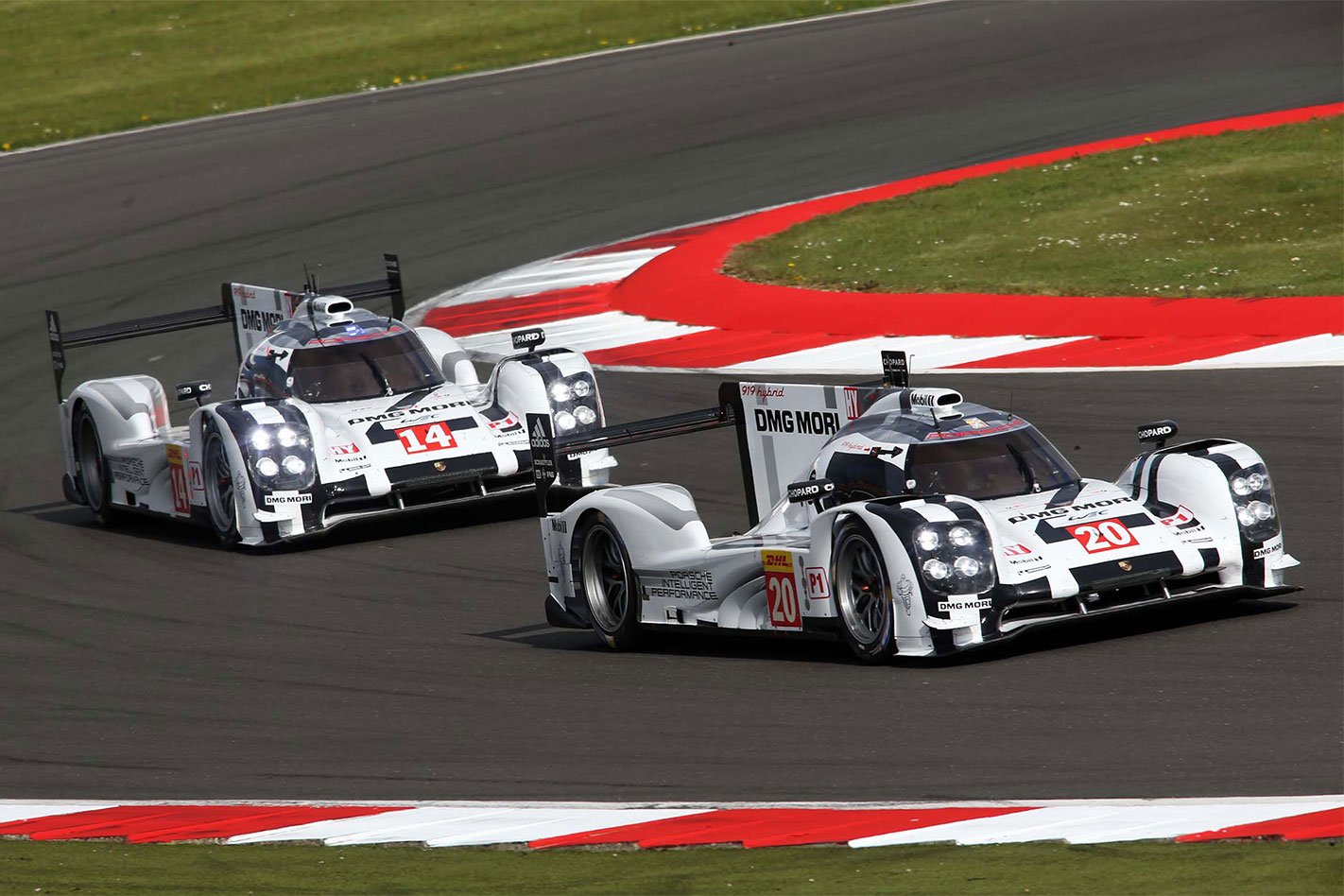
Following his retirement from F1, Webber switched to Porsche’s LMP1 program in 2014, teaming up with Brendon Hartley and Timo Bernhard to win the 2015 World Endurance Championship.
First published in the August 2014 issue of Wheels magazine, Australia’s best car mag since 1953.
With Mark Webber announcing he will be hanging up his helmet at the end of 2016, go back to when we tagged along to his return to Le Mans as a factory Porsche LMP1 driver.
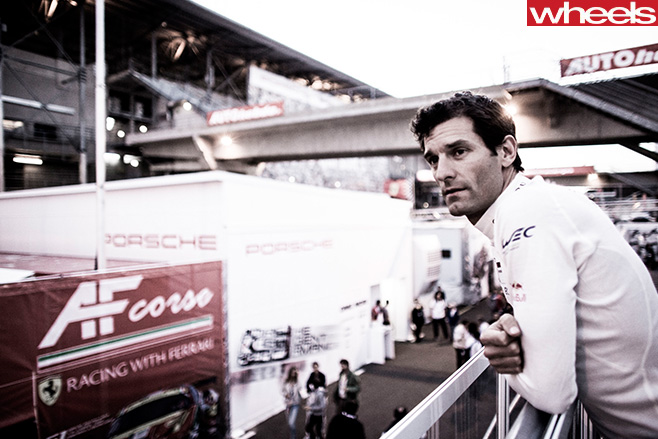
MARK Webber is exhausted. Thin shoulders slumped, his trademark stubble black on gaunt cheeks, the last quadruple stint at Le Mans has taken its toll. But his voice tells the real story.
The famous pit-lane clock says it’s noon on Sunday, 15 June, and with three hours left in the world’s greatest endurance race, Webber’s white Porsche 919 is leading. It’s shaping up to be a fairytale; one of the great wins that would see Porsche – the most successful team in Le Mans history – taste victory in its first year back since 1998. And Webber knows it.
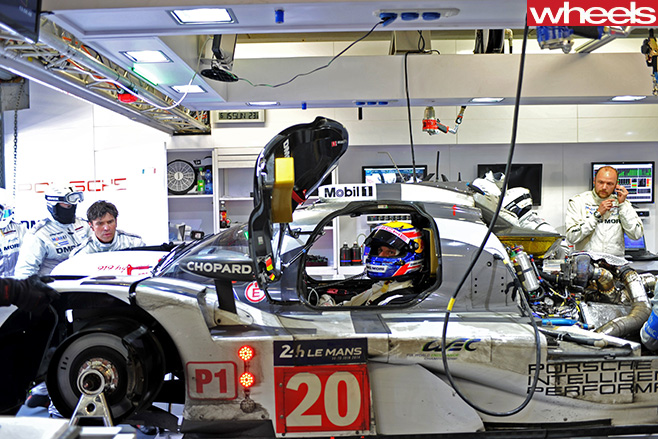
Not since Brock and Perkins crashed out for Team Australia in 1984 has Le Mans promised so much for Aussie fans. New cars, new rules and an F1 superstar ushered in a new era at the iconic enduro, with a bareknuckle brawl between Porsche, Audi and Toyota spawning one of the bloodiest and most exhilarating races in decades. Pity fairytales almost never come true.
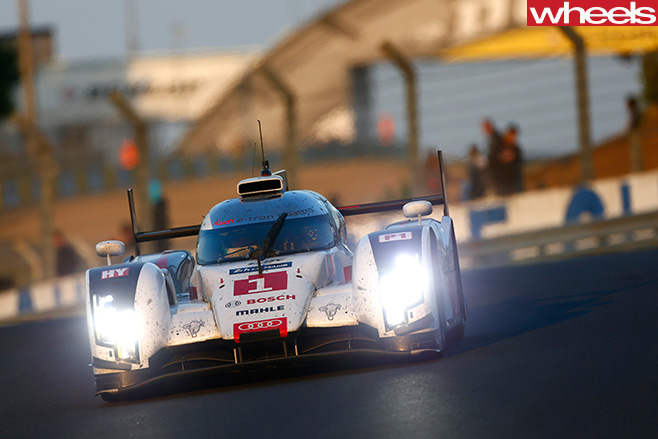
“I’m feeling great, mate,” he says, clear eyes channelling the full force of his personality. “It’s going to be a hell of a race. Make sure you get out the back and see these cars fly. They’re phenomenal.”
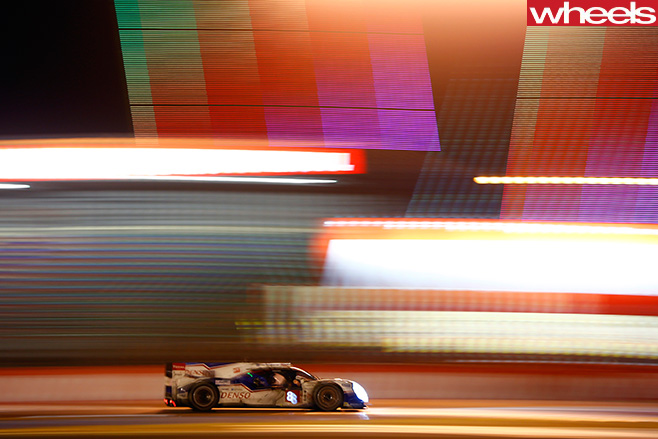
“It’s like the weight of the world has been lifted from his shoulders,” says Webber’s dad, Alan. “The whole family is happy and he’s got some balance back. It was hard there for us at Red Bull.”
It’s a transformation Alan credits to Webber’s new environment at Porsche. Mark’s partner, Ann, agrees.
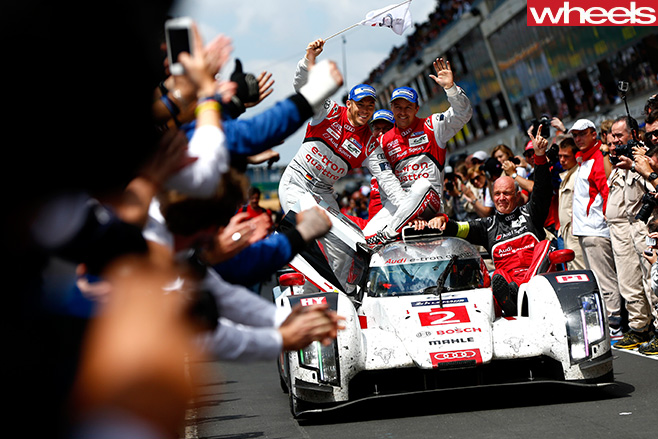
Webber’s struggles at Red Bull, particularly against German teammate Sebastian Vettel and the team’s ruthless talent scout Helmut Marko, are well documented. But Ann says that, despite Mark’s stony public face, the negativity had taken a toll. “His final years in F1 were pretty hard for him in a way because it just wasn’t enjoyable. None of us enjoyed it, none of us wanted to even go. I mean, Mark did; don’t get me wrong, he loved getting in the car and racing it. It was all the other bullshit that goes with F1 that he didn’t have the time for.”
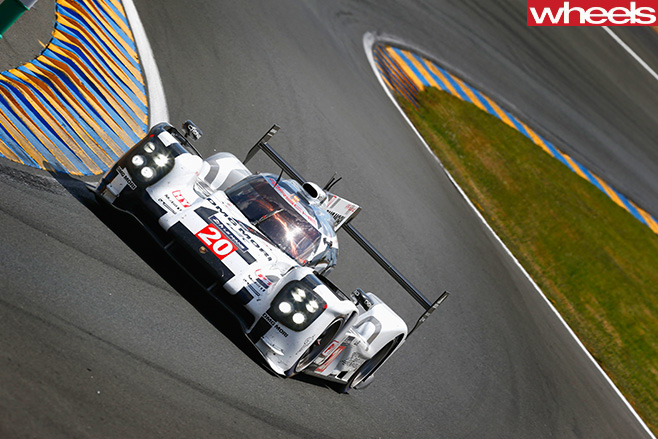
Porsche is so determined that it is prepared to race a car it freely admits is the most complex it has ever built. Powered by a 2.0-litre turbo V4 mated to two hybrid systems, Porsche’s 919 produces 557kW, weighs just 870kg and, in five laps of the 13.6km circuit, generates enough energy to power an average household for a day.
The 919 is a world apart from those cars raced by Toyota and Audi. The Japanese car runs an atmo 3.7-litre V8 mated to a supercapacitor-fed electric motor to produce 741kW, while the Audi is different again, using a heavy 4.0-litre diesel boosted by a single, small electric motor for a combined output of 520kW.
New rules for 2014 place a heavy emphasis on hybrid tech, allowing for these widely different philosophies. The result, as we witness this year, is great racing.
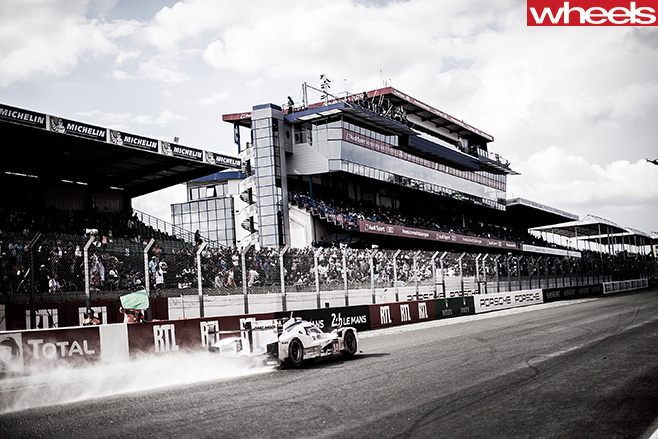
But don’t think this lack of noise means a lack of speed. Set on the sandy, patchwork plains of western France, 200km west of Paris, Le Mans is a speed Mecca. LMP1 cars reach 340km/h on the famous Mulsanne Straight. Through the corners they’re brutal, rounding up GT cars like startled sheep at a dog show. The closing speeds between the different classes is frightening; the front-runners start lapping the rear of the field after just five laps. Imagine F1 cars racing at Bathurst against V8 Supercars on a track three times as long and you can start to understand the spectacle.
The edges of the circuit are littered in a colourful, classless cluster of tents where Ferraris, Mercs and Jags split soggy pieces of turf with beaten up Ford Fiestas. Rich and poor alike share barbeques and beers by the carton, but it’s a crowd that has none of the tribal animalism so common in Australia.
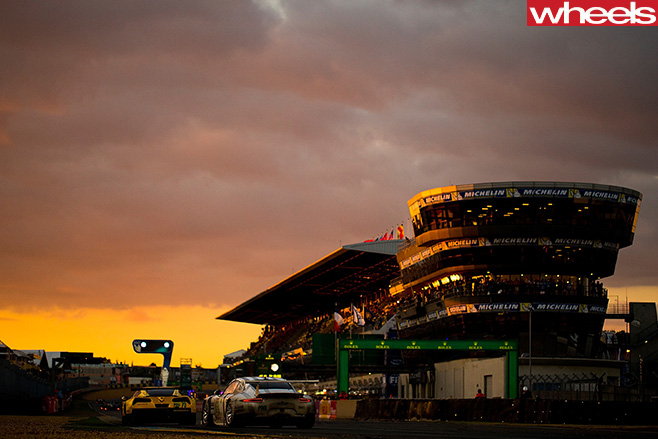
And it was here, after hiking through lush fields to stand on a bank at the famous Arnage corner at sunset, gravel crunching underfoot and the ripe smell of camp toilets burning my nose, that I first saw that things were going wrong for Webber’s #20 Porsche.
To save time, Porsche decided to start clocking quadruple stints. The drivers would spend close to four hours in the car, 760km without a break. That’s two and half F1 races, in pitch blackness, with only a brief respite every 14 laps to refuel.
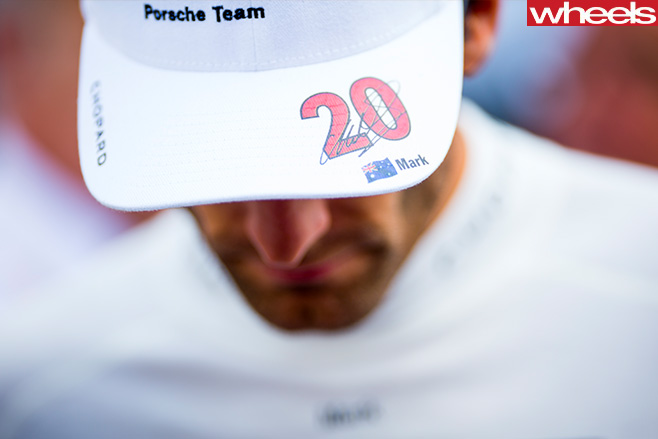
As taxing as it was, the four-shift tactic worked. In a classic case of tortoise beating hare, the Porsche took the lead 14 gruelling hours later. Electrical failure scuppered Toyota’s chances at midnight, meaning only the two remaining Audis could spoil Porsche’s fairytale.
The first sign of trouble was an unscheduled stop to change a puncture. Webber, barely recovered from that last quadruple stint, was thrown back in to get it home. Then the #20 Porsche imploded. “It looks like the engine has got a bit tired in the end,” Webber laments after the race, beer in hand. “There was a noise in the engine, so we had to stop.
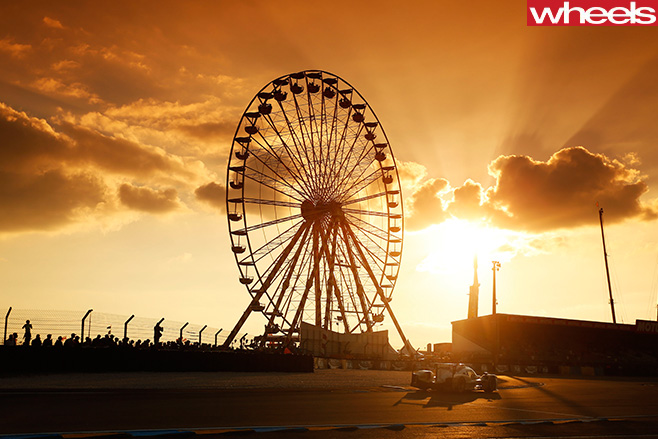
The failure effectively gifted another win to Audi, its 13th success at the world’s toughest circuit endurance race. But the predictability of the result belies the titanic struggle of the previous 24 hours. With new cars and therefore little data to fall back on, the 2014 race was a brutal dogfight of human and mechanical endurance, with each manufacturer literally speeding into the unknown.
It was an old-school Le Mans that saw every team hit trouble. Audi handled it the best.
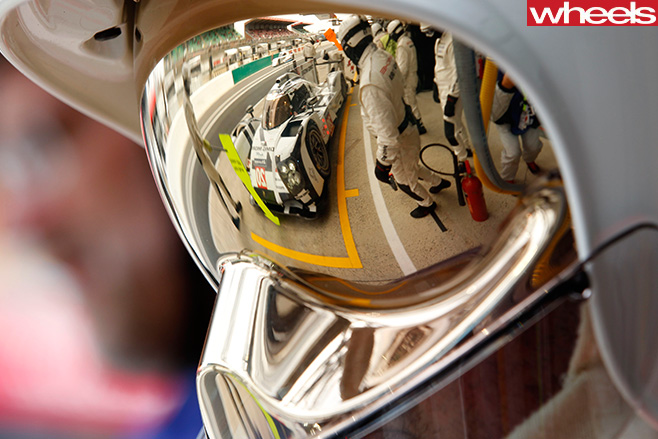
“Three times here now,” says the journalist. “Are you starting to think this place is a bit of a bugger to…”
“Very typical Aussie question that, mate,” Webber attacks, spitting the last word with venom, a hard finger stabbing the air. “You’re asking if it’s a hoodoo circuit? Rubbish! We had a f–king good day out there today. There’s no embarrassment; we’re proud. We made our presence felt, but you’ve got to graft, mate, you’ve got to graft.
“This place is five and a half Bathursts in one go and of course I want to win it outright. That’s what I’ll do in the next few years. It’ll just take hard work and discipline to get there.”
You might not have considered a compact hot-hatch before.
You should. Not just because there’s a first time for everything, but because the biggest thing that strikes you when you see this lot lined up is just how much performance you get for the money these days.
Forget about the dinky-toy reputation; there’s nothing dinky about a small hatch these days. Fact is, they have as much, or more, front-seat space than, say, the first Aussie-made Camry of the 1980s that was sold – and accepted by the market – as a family car.
You can forget everything you thought you knew about performance in small hatchbacks. The facts can’t be ignored, every one of these alleged tiddlers would hose a GT Falcon of the 1970s across the first 400m of hotmix and, presumably, beyond. They’ll return remarkable fuel economy if you let them, they’re all well equipped, built to a high standard and are as practical as any other hatchback ever has been. And they’re cheap!
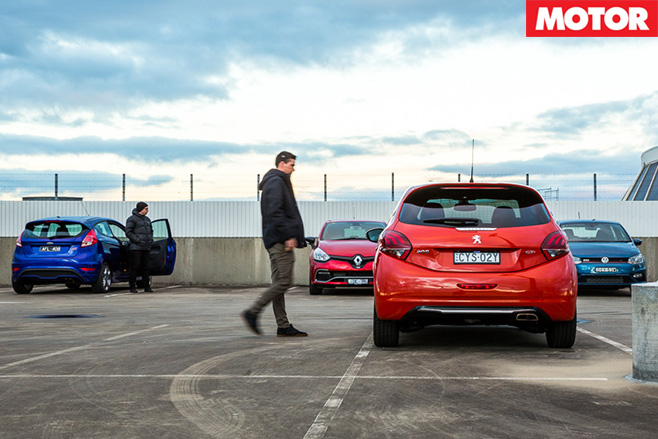
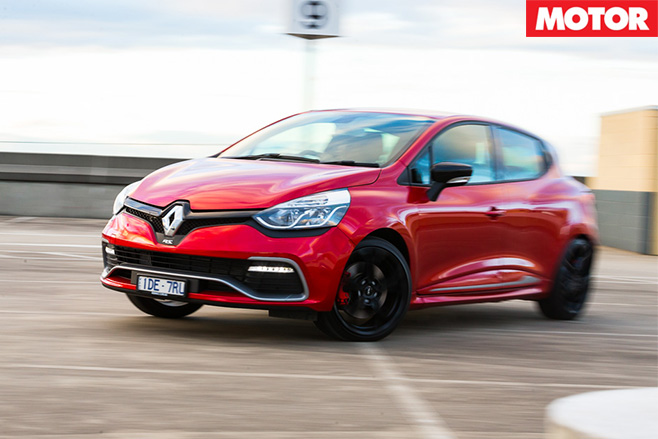
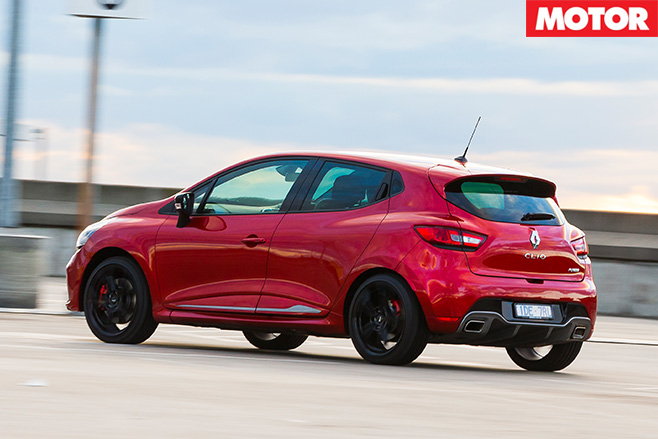
So what have we got here? Let’s start with the Renault Clio Sport. At $30,000 it’s the second most expensive car here. Mind you, it’s a four-door, so that’s where some of the extra gold goes, but it still looks like a two-door with those hidden rear door-handles. It’s also the only one here with a double-clutch transmission (a six-speed).
But we can’t let it off the hook completely, there’s no three-pedal option – it’s a double-clutch or nothing. With 1.6 litres and, like the rest of them, a turbo huffing away as well, the Renault is good for 147kW and 240Nm at a low 1750rpm.
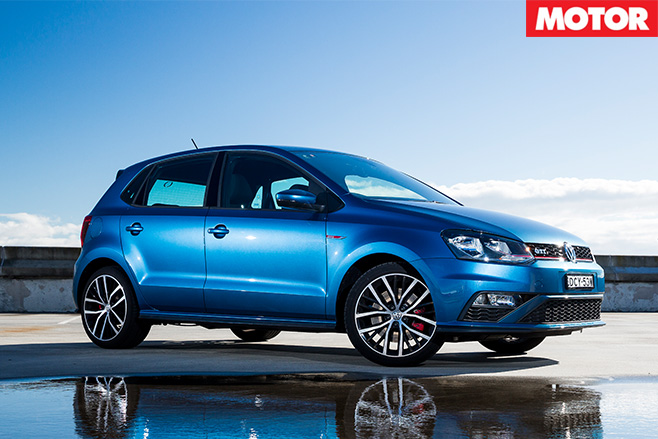
Last year, the VW Polo GTi ditched the twin-charged 1.4-litre engine and moved to a full 1.8 litres with a turbo. The result is 141kW and the most torque of this bunch: 320Nm. With the move to the bigger engine also came the option of a conventional six-speed manual tranny. At $27,490, it’s a neat $1500 more than the cheapest car here, the Fiesta ST. It’s also the retro king with that, um, eye-catching tartan interior.
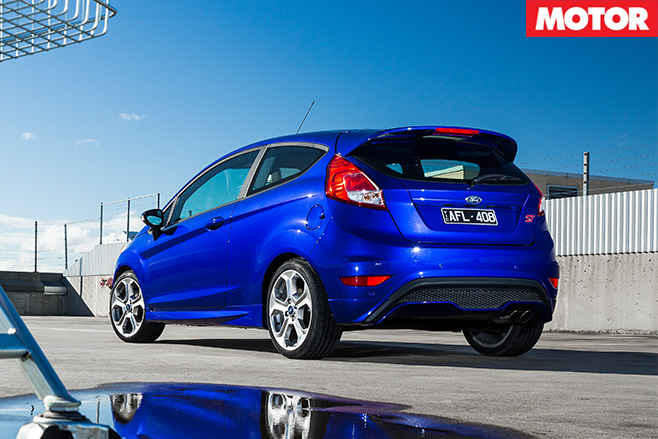
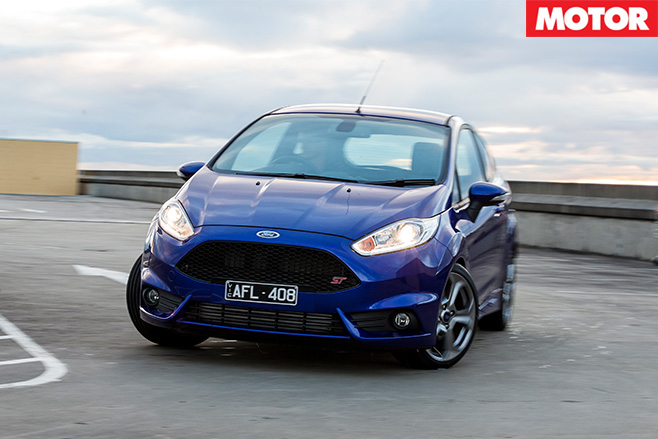
Which leaves us with a car that has never failed to bring a twinkle to our eyes here at MOTOR: the remarkable Ford Fiesta ST. The price as we went to press was still $25,990, but it won’t be for long, so get in quick if you’re in the market. The 1.6-litre turbo is still good for 134kW and 240Nm, with 147kW and 290Nm available for bursts thanks to the overboost function – it’s still a crackerjack little engine.
It wasn’t that the ST boosted up too quickly and lost traction, it just never really felt as strong at the top end and wringing it right out in each gear was harder work. The Clio crossed the line third with 7.1sec and 15.1sec at 151.6km/h with the Peugeot just ahead with 6.8sec and 15.0sec at 155.0km/h.
Which means the Polo GTi was the only one to break into the 14s; a 14.9sec at 155.3km/h, in fact, and a 6.8sec 0-100 time. What that doesn’t tell you is that the Polo feels torquier than the others and it’s only the VW’s tall second and third gearing that meant it didn’t go faster on the strip. It was only j-u-s-t getting into fourth gear at the 400m mark, so shorter cogs would see it well into the mid-14s we reckon.
The Peugeot and Fiesta each gets a gust of wind up its skirt as you rev them up, giving that lovely turbo-motor impression of being blown along by a stiff tail-wind; which, if you think about how a turbocharger works, they are.
The Clio, meanwhile, is more or less in the same camp as the VW with a more linear delivery and a flatter torque curve overall. That’s also what makes the VW and the Renault feel the most grown-up of the four, with less of a teenager’s temperament and demeanour.
It’s worse when you back to back it with either the VW or the Peugeot because they both ride smoothly with loads of balance up their sleeves. It’s actually quite difficult to pick whether it was the Polo or the 208 that rides best; I reckoned it was the Pug, editor Campbell gave the nod to the VW. That suggests the difference is no more than the seat foam density in each because you’d make roughly two-and-a-half Campbells out of one me.
Either way, there’s more or less nothing between them, although the Polo does feel a bit more substantial in the way the body feels absolutely tight over the worst craters. One thing’s for sure, the Polo GTi has the best combination of steering weight, feel and accuracy. Though it’s not as twitchy as some, it never feels lazy or slow to turn.
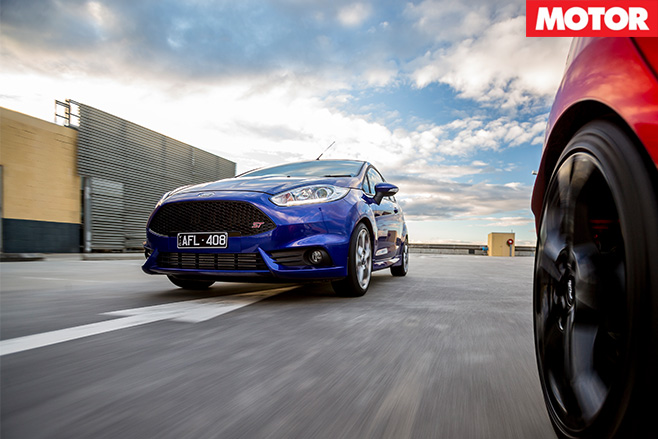
If you’re into a sensitive – let’s call it slightly twitchy – chassis, then the Fiesta ST will be the one that does it for you. If you’re not that person, then the Ford then becomes the car most likely to cart you off if you lose concentration for a nano-second. Point of view, I believe they call it.
Little cars like these aren’t as lightweight as they used to be, but even so, there are no porkers among them, so they should stop pretty hard. Three of them do. The Clio pulled up from 100km/h in 36.1m, but it actually braked better on the second stop with a bit of heat in the rotors.
Which leaves us with the Peugeot which, as I write this, is still rolling to a stop from 100. Not only was its stopping distance disappointing with a best of 40.6 metres (and that on its second stop), but the pedal felt mushy and totally uninspiring. For what is such an otherwise dynamic package, this is odd to say the least.
When it comes to the peak-hour shuffle and the freeway-drone which, even though we don’t like to admit it, is where we do the bulk or our driving these days, the hatches shake themselves out in a different order again. Both French cars have tall top gears with the Peugeot reading 2300rpm at 100km/h and the Clio registering 2400rpm on its illegible-in-strong-sunlight tacho.
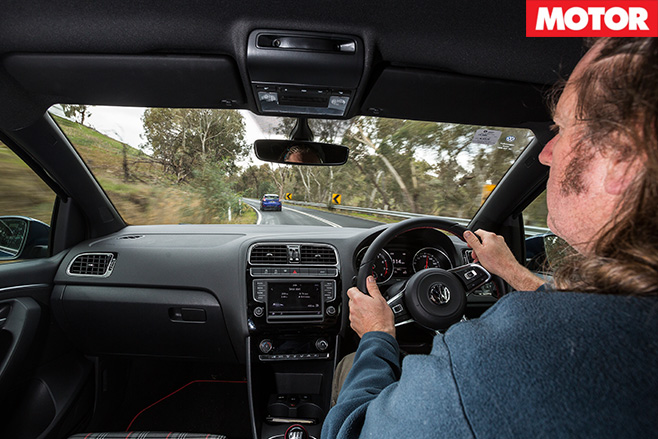
Volkswagen wins the slick-shifter award on your way to sixth gear, while the Fiesta has the rortiest engine note. The Clio’s shift paddles are a source of annoyances on a twisty run because they’re fixed to the steering column and don’t move with the wheel.
There are other things about the Clio’s interior that seem to exist purely to annoy you. The gear selector feels flimsy and brittle, while the ergonomics could only be French and include a cruise-control master switch between the centre-console that has to be disabled before the RS mode can be engaged. Sacre bleu! Merde!
Personally, I don’t find it too bad, because I’m long in the body and therefore sit high in a car. But Luffy, who is a good inch or two taller than me and possesses a more conventional torso:leg ratio, can’t read ’em. Fads come and go, but I really can’t see this one catching on.
By contrast, the Polo is so logical it’s almost boring. It has also been aped by plenty of other manufacturers over the years, so it’s starting to look a bit generic. But it works with heel-clicking efficiency and feels like a quality thing. The seats, tartan though they may be, are supportive and proportioned to suit a Germanic frame.
But you’ll forgive it because the standard Recaros are just lovely (even if you have to climb over the bolster to get out again) and the vision out is brilliant. In fact, the two three-doors (the Fiesta and 208) have by far the best view to the rear and side.
In the final wash-up, there’s a lot more to like about all these little hatches than there is to dislike. The first one to be eliminated from our short-list, however, would be the Clio. The double-clutch gearbox is less satisfying than it should be and it lacks that last little percentage of driver involvement. And those ergonomics prove that being different isn’t always better.

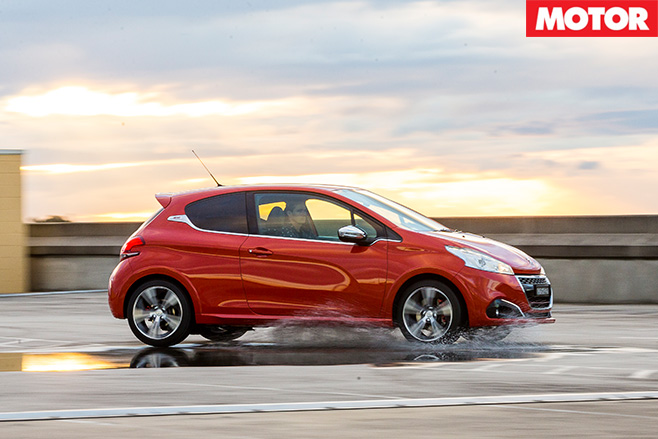
The top step of the podium comes down to the Peugeot and the VW. Ultimately, despite its terrific engine, refined feel and ultra-capable suspension, the Peugeot’s weedy brakes, loony dash layout and big price-tag play against it.
Leaving, of course, the all-but-flawless Polo GTI to claim the silverware. Which kind of sounds like it’s a default-winner by doing fewer things poorly, but that’s really not the case. The VW is capable, fast, well built, practical and a true bargain among bargains.
IN DETAIL
Peugeot 208 GTi
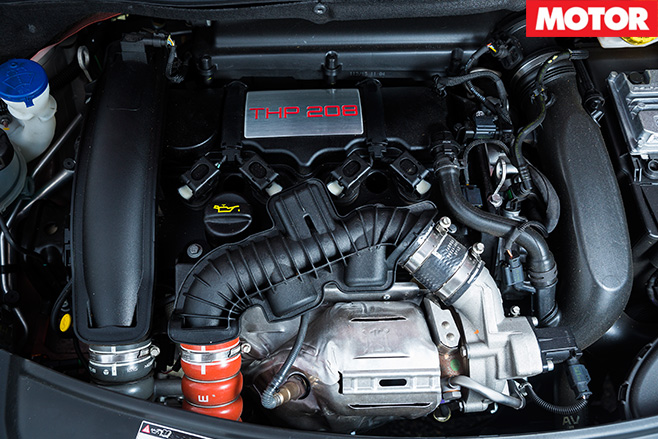
LIKE: Great ride/handling mix; plush interior DISLIKE: Weak brakes; confronting driving position; it’s expensive
SPECS Body: 3-door, 5-seat hatch Drive: front-wheel Engine: 1598cc inline-4, DOHC, 16v, turbo Bore/stroke: 77.0 x 85.8mm Compression: 10.5:1 Power: 153kW @ 6000rpm Torque: 300Nm @ 3000rpm 0-100km/h: 6.8sec (as tested) 0-400m: 15.0sec @ 155.0km/h (as tested) Power/weight: 131kW/tonne Transmission: 6-speed manual Weight: 1160kg Suspension(F): struts, coil springs, anti-roll bar Suspension(R): torsion beam, coil springs, anti-roll bar L/W/H: 3973/1739/1460mm Wheelbase: 2538mm Tracks: 1482/1492mm (f/r) Steering: electrically-assisted rack-and-pinion Brakes(F): 302mm ventilated discs, single-piston calipers Brakes(R): 249mm solid discs, single-piston calipers Wheels: 17.0 x 7.5-inch (f/r) Tyre sizes: 205/45 R17 (f/r) Tyre: Michelin Pilot Exalto Price as tested: $30,990
VW Polo GTI
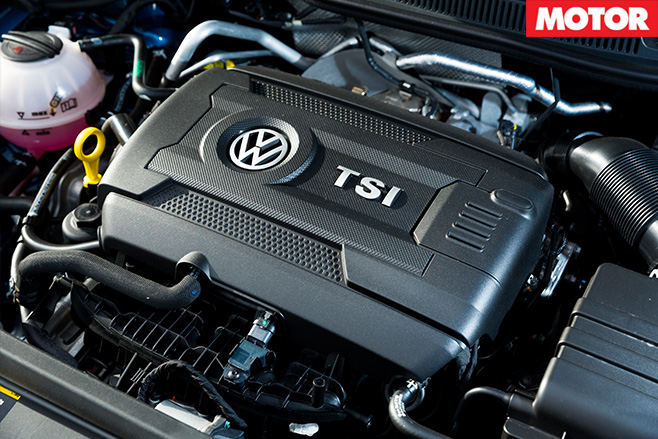
LIKE: Grunty engine; slick-shifting box; decent ride DISLIKE: Interior feels its age; torque can overwhelm traction
SPECS Body: 5-door, 5-seat hatch Drive: front-wheel Engine: 1798cc inline-4, DOHC, 16v, turbo Bore/stroke: 82.5 x 84.2mm Compression: 9.6:1 Power: 141kW @ 4300-6200rpm Torque: 320Nm @ 1450-4200rpm 0-100km/h: 6.8sec (as tested) 0-400m: 14.9sec @ 155.3km/h (as tested) Power/weight: 114kW/tonne Transmission: 6-speed manual Weight: 1234kg Suspension(F): struts, A-arms, coil springs, anti-roll bar Suspension(R): torsion beam, coil springs, anti-roll bar L/W/H: 3983/1682/1443mm Wheelbase: 2470mm Tracks: 1447/1441mm (f/r) Steering: electrically-assisted rack-and-pinion Brakes(F): 288mm ventilated discs, single-piston calipers Brakes(R): 260mm solid discs, single-piston calipers Wheels: 17 x 7.5-inch (f/r) Tyre sizes: 205/40 R17 (f/r) Tyre: Bridgestone Potenza S001 Price as tested: $27,490
Ford Fiesta ST
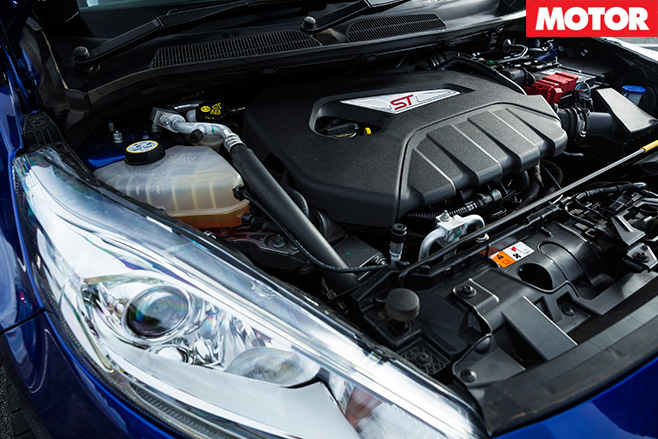
LIKE: Awesome chassis; value; Recaro seats DISLIKE: Will bite if provoked; ride can be firm
SPECS Body: 3-door, 5-seat hatch Drive: front-wheel Engine: 1596cc inline-4, DOHC, 16v, turbo Bore/stroke: 79.0 x 81.4mm Compression: 10.1:1 Power: 134kW @ 5700rpm (147kW on overboost) Torque: 240Nm @ 1600-5000rpm (290Nm on overboost) 0-100km/h: 7.5sec (as tested) 0-400m: 15.3sec @ 152.7km/h (as tested) Power/weight: 112kW/tonne Transmission: 6-speed manual Weight: 1197kg Suspension(F): struts, coil springs, anti-roll bar Suspension(R): torsion beam, coil springs, anti-roll bar L/W/H: 3982/1978/1456mm Wheelbase: 2489mm Tracks: 1492/1481mm (f/r) Steering: electrically-assisted rack-and-pinion Brakes(F): 278mm ventilated discs, 2-piston calipers Brakes(R): 253mm solid discs, single-piston calipers Wheels: 17 x 7.0-inch (f/r) Tyre sizes: 205/40 R17 84Y (f/r) Tyre: Bridgestone Potenza RE050A Price as tested: $25,990
Renault Clio RS
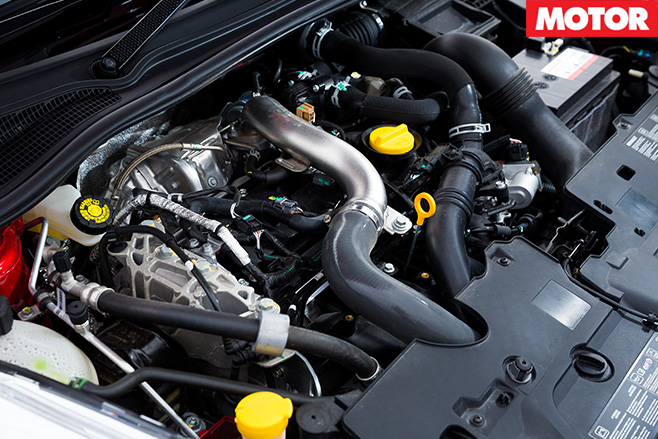
LIKE: Strong brakes; five-door practicality DISLIKE: Lacklustre transmission; jittery back-road ride
SPECS Body: 5-door, 5-seat hatch Drive: front-wheel Engine: 1618cc inline-4, DOHC, 16v, turbo Bore/stroke: 79.7 x 81.1mm Compression: 9.5:1 Power: 147kW @ 6000rpm Torque: 240Nm @ 1750rpm 0-100km/h: 7.1sec (as tested) 0-400M: 15.1sec @ 151.6km/h (as tested) Power/weight: 120kW/tonne Transmission: 6-speed dual-clutch Weight: 1218kg Suspension(F): struts, coil-springs, anti-roll bar Suspension(R): torsion beam, coil springs, anti-roll bar L/W/H: 4090/1732/1432mm Wheelbase: 2589mm Tracks: 1504/1500mm Steering: electrically-assisted rack-and-pinion Brakes(F): 320mm ventilated discs, single-piston calipers Brakes(R): 260mm solid discs, single-piston calipers Wheels: 17.0 x 7.5-inch (f/r) Tyre sizes: 205/45 R17 (f/r) Tyres: Goodyear Eagle F1 Asymmetric 2 Price as tested: $29,990
THE 2017 Honda CR-V has just been revealed, showing a mid-size SUV that has more tech, space and the first turbocharged engine to ever power the popular SUV.
The fifth-generation CR-V has been completely redesigned and sports an aggressive look including a sharper front-end, sleek headlights surrounded by wing-shaped LED daytime running lights, and chunkier wheel arches. The rear looks more like a European SUV with a shorter overhang and twin exhaust pipes.
The reengineered 2017 Honda CR-V is built around a new, stiffer chassis that should further improve ride and comfort. It also has a longer wheelbase meaning a more spacious cabin that Honda claims has the best rear legroom in its class.
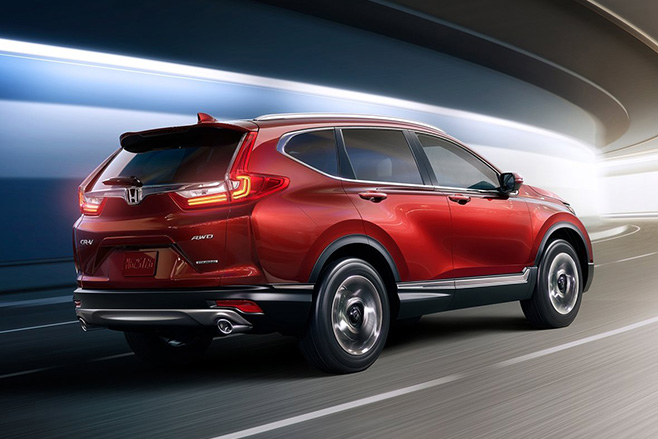
Despite the extra length the CR-V will still only be available as a five seater.
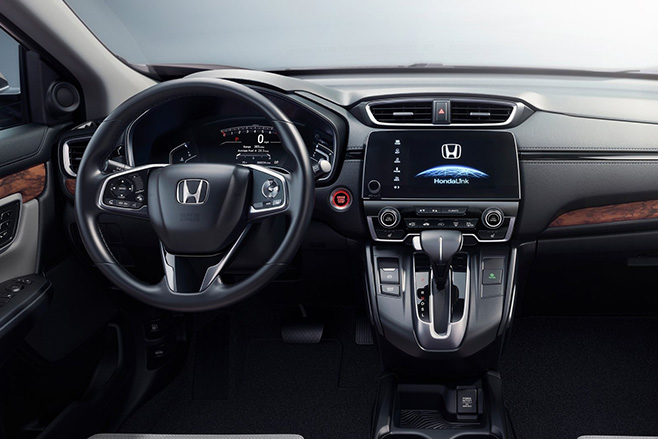
The “more premium interior” features upgraded materials throughout, including a soft-touch instrument panel and a high-resolution seven-inch TFT touch screen in the centre of the panel. It integrates Apple CarPlay and Android Auto and is now loaded with Garmin-based satellite navigation.
The radio unit even features a volume control knob, a simple touch that anyone who has driven a late-model Honda would appreciate – in some other models the carmaker has replaced it with virtual controls accessed via the touchscreen.
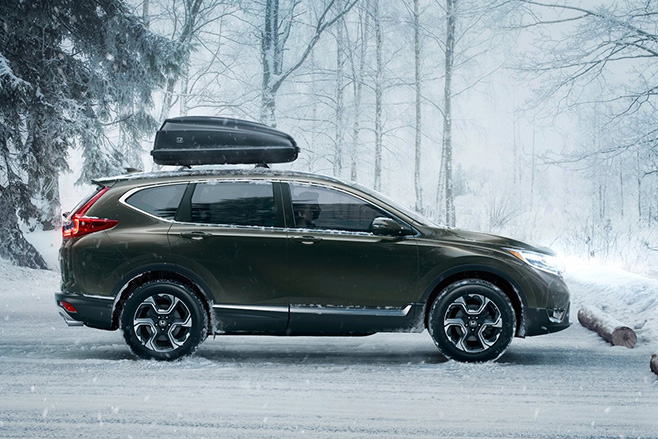
‘Honda Sensing’ driver assist technology will be standard on some models and includes collision mitigation braking with forward collision warning and pedestrian sensing capability, an adaptive cruise control system that works at low speeds, and a more advanced lane keeping assist system. Blind spot monitors, a function that stops you from reversing out into oncoming traffic and auto high beam headlights are also being introduced.
Comfort and convenience features available in the 2017 CR-V range include remote engine start, dual-zone climate control, heated side mirrors, electric parking brake, rear USB charging ports, hands-free tailgate and heated front and rear seats.
Honda has so far only provided engine details specific to the car’s US launch. These include a 140kW 1.5-litre twin-cam, direct-injected and turbocharged four-cylinder engine and the naturally aspirated 2.4-litre twin-cam unit available in current CR-V 4WD models.
It’s unclear if the turbo will be available across front- and all-wheel-drive variants.
The Honda CR-V will arrive in Australia in the first half of 2017. Its extra space and sharper styling should give it an edge against rivals such as the Mazda CX-5, Nissan X-Trail, Hyundai Tucson and Mitsubishi ASX.
Local specifications and pricing are expected to be released closer to launch date.
