
The 70 unique trim and colour combinations across five model ranges – Ferrari 488 GTB (coupe), 488 Spider, F12berlinetta, California T and the just-revealed LaFerrari Aperta – will be limited to one of each car.
That means only 350 people around the world were lucky enough to snap one up, with Ferrari confirming every car has an order against it.

Many of the 70 anniversary liveries based on race cars so feature race numbers worn in the day and include:
- “The Stirling”, which includes a deep blue finish, celebrates the 1961 Tourist Trophy win by Stirling Moss in a 250 GT Berlinetta.
- “The Steve McQueen”, with a polarising brown exterior hue and camel interior as a homage to the 1963 250 GT Berlinetta Lusso given to the legendary actor by his first wife.
- “The Schumacher” based on the 2003 Formula One car raced to a world championship by Michael Schumacher, who was severely injured in a skiing accident late in 2013 and has not been seen in public since.
- The White Spider, a tribute to the 375 MM Pinin Farina Spider.
- The Green Jewel, a green scheme based on the 365 P2 from Le Mans competition.

View all 70 liveries at the Ferrari 70 website.
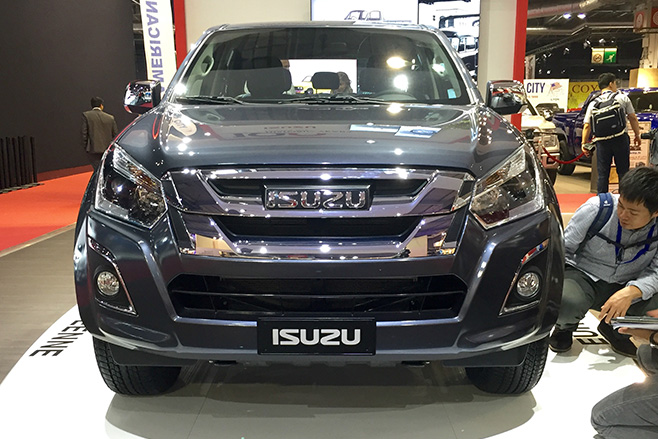
An updated Isuzu D-Max will arrive in Australia in early 2017 sporting a fresh exterior look, an updated interior and a revised turbo diesel engine.
The local facelift will mirror the European-spec D-Max revealed at the Paris Motor Show overnight, though Australian-delivered models will not get the all-new, 120kW/360Nm 1.9-litre Euro 6 compliant diesel engine.
Speaking to Wheels at the D-Max’s Parisian debut, Keiichi Yagai, Isuzu sales manager for regions including Australia, said Aussie models will instead make do with a more efficient, Euro 5 certified version of the existing 3.0-litre four-cylinder turbo diesel engine.
D-Max in Aussie trim currently produces 130kW and 380Nm with the 3.0-litre oiler. Yagai could not say whether these outputs would change after efficiency improvements were made.
However, he did confirm the D-Max’s early 2017 Australian launch and the absence of the 1.9-litre engine.
The downsized diesel uses a variable geometry turbocharger and less componentry than the 3.0-litre, making it more reliable and requiring less maintenance. It is also lighter, quieter, more economical and kinder to the environment.
Introduced with the 1.9-litre diesel in Europe are a new, Isuzu-developed six-speed manual gearbox and a six-speed automatic. It is unclear whether the new transmissions can be adapted to the 3.0-litre for Australia.
Exterior styling changes for the refreshed D-Max include a bigger, bolder front grille, redesigned headlights with LED daytime running lights, new bumper bars and restyled alloy wheels.
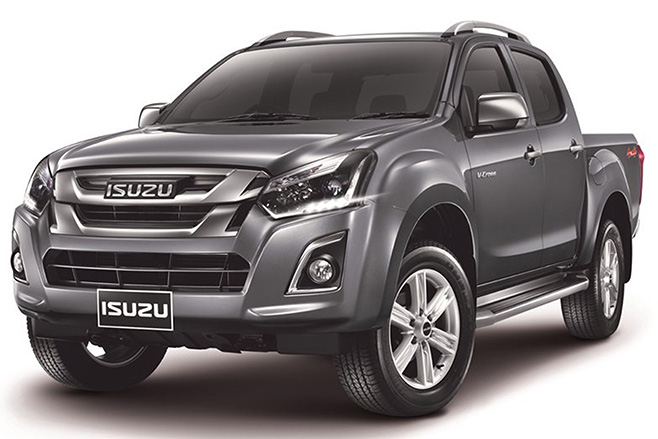
Changes to the interior include a new instrument display, better fabric on the seats and door panels and a less upright seat back in dual cab models with a second row. Hill start and hill descent assist functions are now standard, along with keyless entry and start in high-spec models.
Sporty variants of D-Max known as the X-Series have been developed by Isuzu in Thailand, featuring body kits and unique styling add-ons. X-Series models were initially only for sale in Thailand, where D-Max is made, though the special editions are now being sold in Central America and the Middle East, and should perform well in showrooms around Australia if made available here.
Isuzu may bring the new diesel engine to Oz when a next-generation ute is introduced, though that is still some time away. The next-gen D-Max will be sold by Isuzu and rebranded for sale in Australia by Mazda, badged as the Mazda BT-50.
Australia is the third largest market for the D-Max worldwide, after Thailand and Saudi Arabia.
Hyundai is already talking of expanding its N performance family – even before the first i30N has been revealed.
Speaking at the 2016 Paris Motor Show after revealing the RN30 concept car – a radical interpretation of a track-focused Hyundai i30 performance hero – the man in charge of performance cars at Hyundai indicated there was plenty more to come.
Albert Biermann, the former BMW M chief, told Wheels he would love to see a “really hot Tucson” and that the Veloster has “a lot of potential” for the N treatment.
But he tempered his comments by saying there were currently no concrete plans for either and that the focus was on launching the N sub-brand in 2017 with the i30N, a five-door hatchback set to rival everything from the Volkswagen Golf GTI and Subaru WRX to the Renault Megane RS and Peugeot 308 GTI.
“First we need to grow some place with the i30 N car,” said Biermann. “Then we need to see how this is going. If this is really growing fast then that is a good indication, then of course we can provide more.
“We cannot go from zero to 100 like this [clicking his fingers], that doesn’t work. So we better go step by step and… see what’s going on and then we make our next step.”
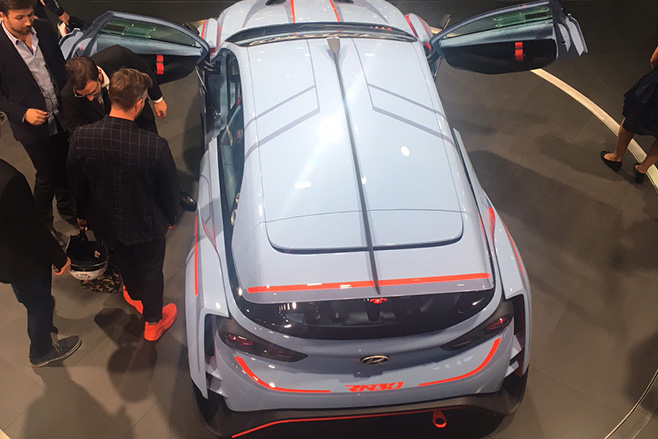
Biermann was initially talking of expanding the planned two-tiered i30N range – one more road-focused model and a higher output track-focused car with an electronic limited slip differential, more aggressive tyres and adjustable suspension – to include a four-wheel drive model with close to the RN30 concept’s 280kW of power.
But he later touched on other models that could get the N performance treatment.
One obvious option would be the Hyundai Tucson, which plays in the big (and growing) mid-sized SUV segment, something with broad appeal, especially in the US market.
“I would love to make a really hot Tucson but nobody wants it right now,” he said. “There is no plan to do that [now].”
He was critical of current go-fast SUVs, hinting there was more scope to do something more special.
“Those treatments that you can see out there, those high performance SUVs is just to make a lot of money. They’re not so much sophisticated as the [high performance] coupes or sedans. It’s always good to make a lot of money and sooner or later we might make it but there’s no plan now.”
He also said the i20 – a car no longer offered in Australia – would be an obvious choice for the N hot hatch treatment.
And the Hyundai Veloster coupe got a mention, too.
“That’s a really characterful car, it’s one of my favourites, I like it a lot… it has a lot of potential.”
JUST like an Audi Q7, only smaller. That’s the easiest way to describe the new version of Audi Australia’s vital mid-size SUV, which isn’t only lighter, smarter and aiming to be much safer than before, but is the first in its segment to offer air suspension as an option.
It’s also larger, has a roomier cabin and bigger boot, yet has shed up to 90kg via its lightweight MLB underpinnings that should also ensure sharper handling.
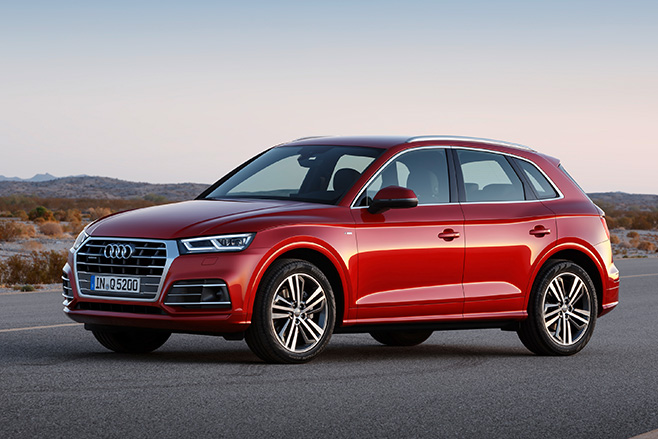
The turbocharged 2.0-litre version of the Q5 will also add a front-wheel-drive variant for the first time, to go with its broad engine range. Initially, five engines will be available in Europe (four TDI diesels and one TFSI petrol), but Australia is expected to offer a 2.0- and 3.0-litre diesel, plus a 2.0-litre TFSI petrol with 185kW.
An even more powerful SQ5 version will follow. Gearboxes are all new, and include a seven-speed dual-clutch version, and an eight-speed Tiptronic auto for the high output 3.0 TDI.
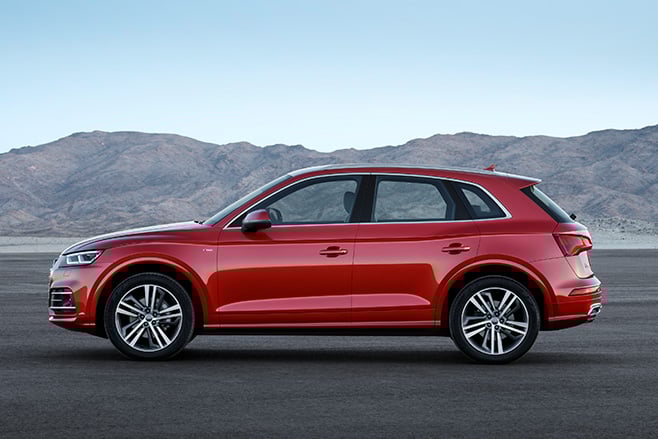
Design-wise, the Audi Q5 takes heavy inspiration from the larger Q7, and has a bold, angular front grille and LED headlights.
Inside, things are much mote upmarket than before with improved materials and the addition of Audi’s 12.3-inch virtual cockpit digital display.
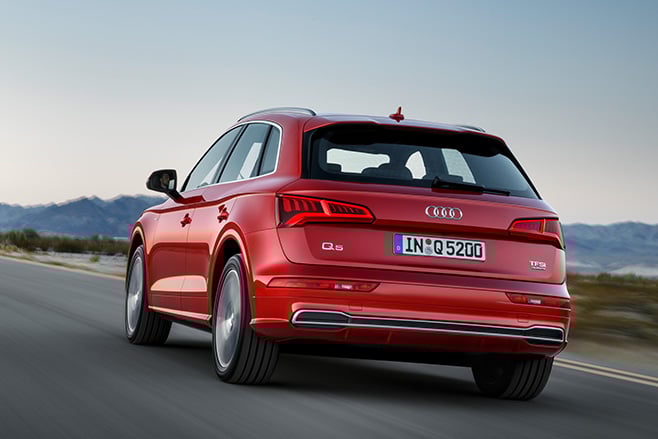
It’s also heavy on the tech, with Audi execs claiming the Q5 is available with “around 30 driver assist systems, which is the benchmark for this segment”.
Active safety systems include adaptive cruise control, cross-traffic assist, blind-spot monitoring, road sign recognition and autonomous emergency braking.
A longer wheelbase ensures one of the most spacious cabins in its class, with more shoulder and knee room than its predecessor. The 40:20:40 folding second row can also slide, and when in its forward-most position, boosts luggage space to a sizeable 610 litres.
IT MIGHT have been shown in production guise at Paris, but Renault’s first ever tradie ute could still be years away from hitting Aussie roads.
In fact, Renault has revealed the Alaskan pickup isn’t even confirmed to come to Australia.
Speaking to Wheels at the Paris Motor Show, Renault’s senior vice-president of Asia-Pacific, Gilles Normand, said there was no timeline for when the Alaskan would hit Aussie roads.
“I know that there is very strong appetite for that car in Australia and right now they are getting ready to develop a right-hand drive application, so it’s under development,” he said. “For the time being there is nothing concrete for the Asia-Pacific with that vehicle.”
Renault Australia is also in the dark, and wouldn’t even offer a ballpark date for the Alaskan’s arrival Down Under.
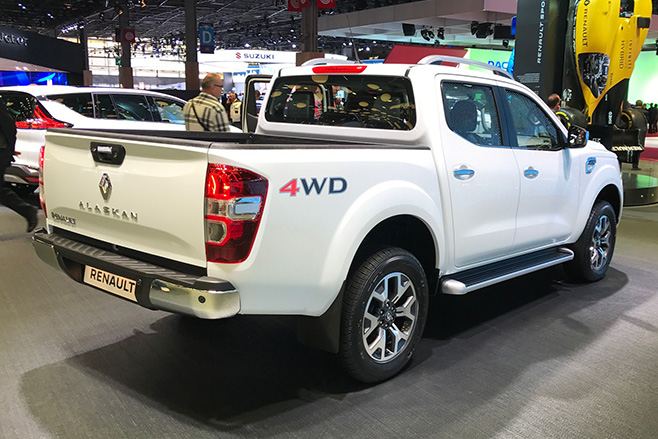
Production delays are behind the Alaskan’s slow appearance, with other markets tipped to receive the dual-cab ute before Aussie production even starts.
“The issue is being able to communicate when we’ll get our stock and where we sit in the sequence of markets. It’s just finalising when we ready to go,” said Renault Australia boss Justin Hocevar.
“With Koleos, for example, we were one of the first markets in the world to get it and they haven’t even launched it in Europe yet. There will be other markets that will launch Alaskan and we’ll be sitting there eagerly champing at the bit, but our time will come.”
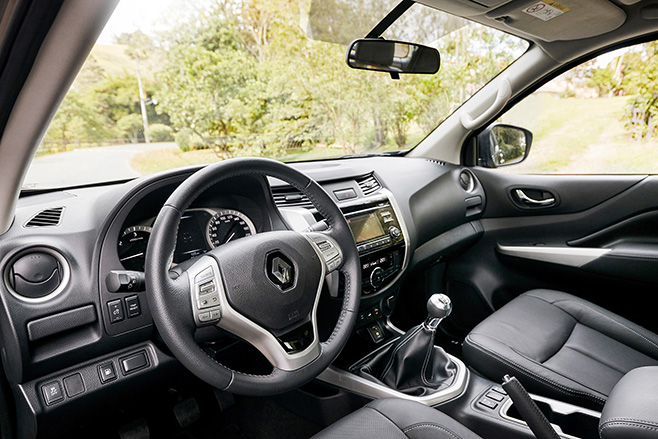
It’s a frustrating wait for Renault Australia, especially given the Alaskan’s huge sales potential. Hocevar believes the Alaskan – which, similar to the upcoming Mercedes-Benz GLT trade ute, is based on the Nissan Navara – could become the brand’s best-seller Down Under.
“If I look at the segment, it has a very good possibility of being that,” he said. “The ute market is a growing segment and an important segment from a profitability point of view for a carmaker in Australia. If we could have had one yesterday, it would have been ideal.”
Hocevar also clarified Normand’s suggestion that the Alaskan isn’t confirmed for Australia.
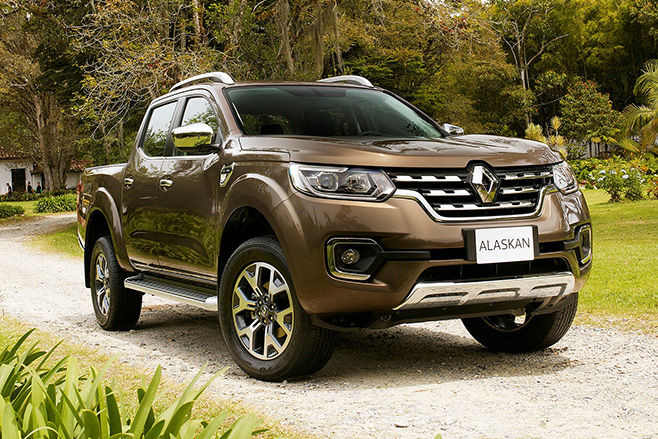
“Technically he’s correct,” said Hocaver. “Until you’ve got your final contracts, it hasn’t been confirmed. But this has been a project that’s been a long-time in the making. Australia has always been an important part of the business case. It’s an important model for us.”
As for the Alaskan’s Aussie spec, equipment and drivetrain options, Hocevar said it was still too early to talk specifics, but he ruled out any local suspension or chassis tuning.
AUDI wants to sell you a car that you can drive while reading a book. Or while checking your emails. You can probably even have a nap.
And you could be able to buy it in less than 12 months’ time.
The German company has revealed that the new version of its Audi A8 flagship limousine (pictured), due for release in 2017, will be equipped with what Audi engineers call “Stage Three” autonomous systems, which will allow drivers to take their eyes, and hands, off the steering wheel for indefinite periods of time.
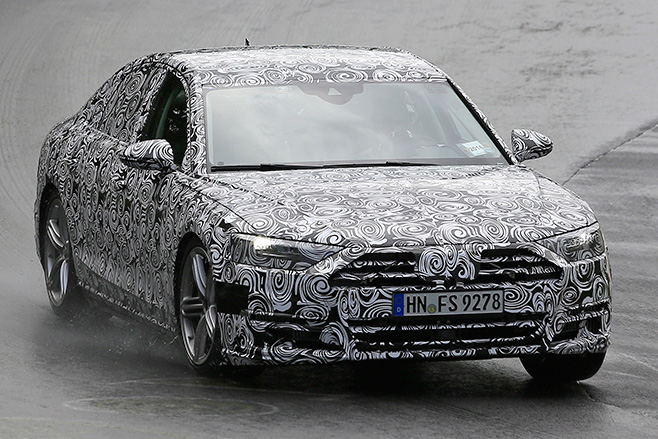
“Next year we will open the next chapter in the industry,” said Audi’s board member for sales and marketing, Dietmar Voggenreiter (pictured, above). “We will open the chapter of autonomous driving in a new way.
“It is the situation where the car takes over totally and you can take your hands off the wheel and drive along the highway while checking your emails, your apps or read a book.”
The new system will be a step beyond the autonomous technology currently offered by Tesla and Mercedes-Benz, which can already steer, brake and accelerate the car automatically. But Audi’s system will initially only work up to speeds of 65km/h. Expect that speed restriction to rise once the system is rolled out.
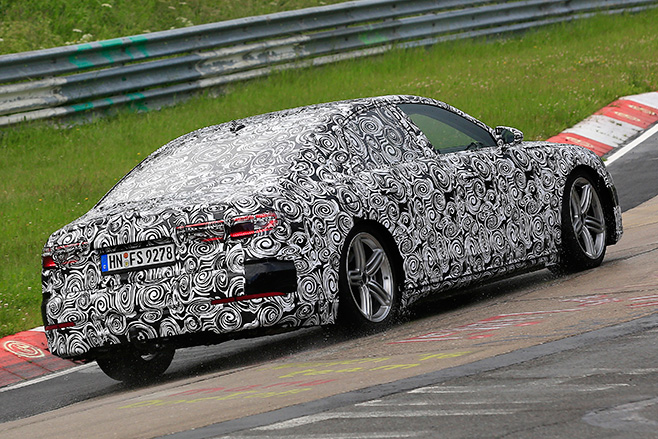
With Stage Three ready for production, Voggenreiter revealed Audi is already imaging an autonomous driving future where cars won’t have steering wheels or pedals.
“That is Stage Five autonomous driving,” he said. “We are working on this technology, but today it is not easy to predict if it is 2025, 2030 or 2040 when we will see this technology in the market.”
Voggenreiter also said that like Volvo, Audi will take legal responsibly if one of its cars crashes while its autonomous mode is engaged.
“If you take over the responsibility and let people take their eyes of then road, then you are responsible,” he said. “For sure if we allow you to read emails or whatever, then we are responsible.”
Voggenreiter said the degree of responsibility could differ from country to country, depending on legislation.
“One fact, what we have to clarify is the legal situation in some countries. For example, in the US we have clear legislation rules and a definition of who is responsible in each situation in which driving mode. So for America, this [Audi taking responsibility] is the right answer.”
Yet despite its willingness to accept the blame for crashes, Audi says its autonomous technology will make roads safer.
“The number of accidents will go down,” said Voggenreiter. “So insurance will be cheaper. If the car detects a situation, in a construction area for example, and says there is a risk, it will ask the driver to take over control once again. This will give you 10, or 15 or 20 seconds of time to regain control.”
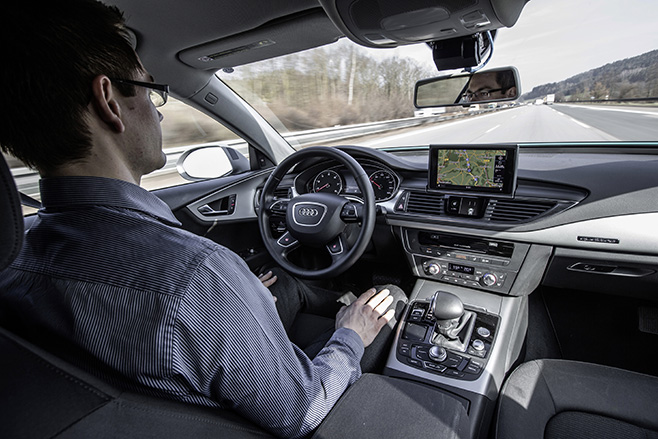
The biggest question mark surrounding Audi’s autonomous rollout is how it will work in Australia. With the A8 due to be revealed internationally next year, it could arrive Down Under by late 2017. However 2018 is more realistic.
How Audi’s autonomous tech will conform to Australian legislation is yet to be decided.
“This is a question that’s really hard for me to give a clear answer,” said Voggenreiter. “In the US we see a clear trend, in China there are a lot of discussions. In Europe we are a bit more conservative, but it’s really hard to predict if the Australian government will be the fastest one after America.”
Audi Australia admits that working out the A8 system’s legalities will be a “challenging conversation to have”.
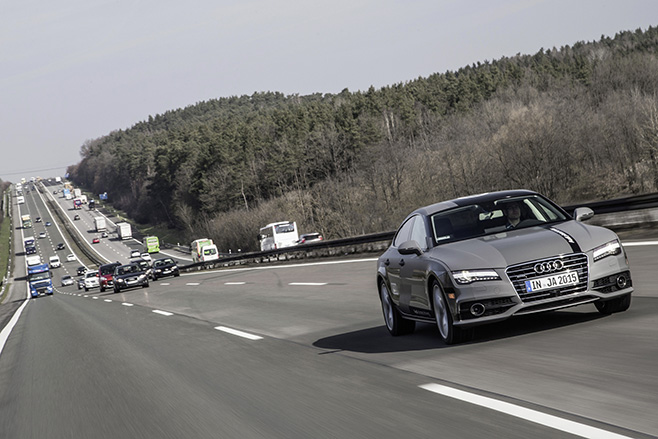
Audi has already trialed its autonomous driving in the real world. Its concept piloted car, an Audi A7 Sportback nicknamed “Jack”, used its latest test to show how it could interact more naturally with its surrounds. This including things a real driver would do, such as leaving a larger lane gap to a truck while overtaking on the freeway.
TELL ME ABOUT THIS CAR
It’s a limited-run V8-powered Australian sports sedan than makes HSV ownership suddenly more affordable than it’s been since the company launched its VFII update late last year. The engine lacks a supercharger but, as a package, this car is hugely persuasive.
STRENGTHS
- The engine. Reworking the LS3 V8 to produce 340kW – a healthy 36kW more than the Holden Commodore VFII SS – makes the Clubsport R8 SV Black feel ultra-lively and eager on the road. Torque remains at 570Nm, same as the SS, and this is ample for sedate cruising, while still allowing great flexibility and easy overtaking ability without needing to work the engine hard.
- It sounds brilliant. Accelerate hard from low revs and there’s a rich burbling induction note that grows in volume as engine speed rises. Further up in the rev range there’s a distinctive “choof” sound as the HSV exhaust valve opens up, unleashing a fast-paced and angry V8 exhaust note. We think it sounds better than any supercharged LSA HSV, and may just be the best-sounding V8 Commodore on sale today.
- It handles superbly for a large sedan. Its suspension tune is firmer than that of the Commodore SS, meaning the HSV Black sits a bit flatter in hard cornering, and allows the front end to grip a bit harder, thanks also to wider front rubber (255mm front tyres versus the SS’s 245s, and sticky Continental ContiSportContact 5 Ps versus the more cost-focused Bridgestone Potenza RE050As on the SS).
- The brakes, supplied by AP Racing, are outstanding, with great pedal feel, and a strong, reassuring bite to haul the car down hard from high speed with great authority.
- The greedy V8 thirst when driven hard.
- Wide tyres and very firm suspension can make around-town ride a bit thumpy and restless.
- Some plastics and trim feel either cheap or less than premium.
The Ford Falcon XR8 Sprint comes closest on size, engine, performance and price. It manual form it’s priced around $6k cheaper than the Holden, yet its supercharged 5.0-litre V8 does out-perform the Clubsport R8 SV Black’s engine (albeit by a tiny margin.) However, it’s widely accepted that the HSV is a more cohesive, more thoroughly developed vehicle; faster on a track and better to drive on the road.
First published in the November 2009 issue of Wheels magazine, Australia’s best car mag since 1953.
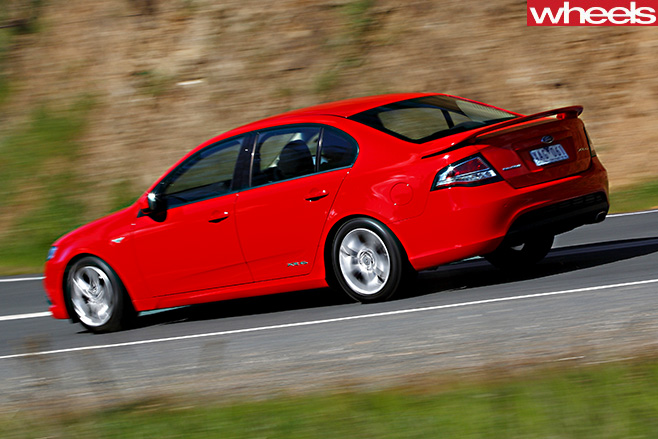
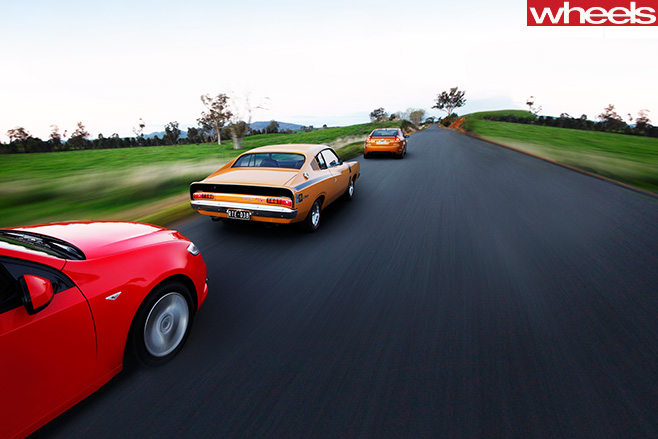
Ron Stephenson floors the throttle of his ‘Hot Mustard’ Charger R/T E38 and with a crackling, braying snarl it belts off down the Murray River Road. Peter McKay is after him in the Commodore SV6, while I’m left spinning rear wheels in the Falcon XR6.
Damn, that Charger has some grunt! The E38 is nearly 40 years old; this particular example is the second one ever built, and Ron recently knocked back $200,000 for it. But that’s not going to stop him giving his gorgeous car a good thrashing.
We close up as the corner approaches where photographer Brunelli is waiting for a line-astern convoy shot. It’s immediately obvious that there’ll be no holding back as far as Ron’s concerned… He’s cranking the Charger in, wheels splayed, body rolling, rear-end wiggling. The pace is on.
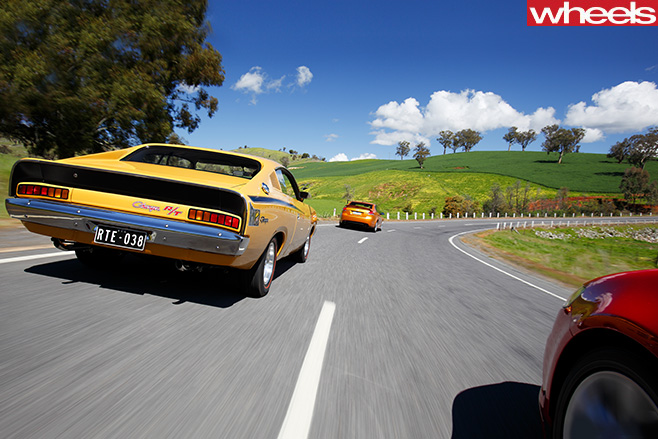
Indeed, when the E38 appeared as part of the original VH Charger range back in 1971, the performance the Aussie Chrysler engineers managed to extract from its overhead-valve in-line 4.3-litre six seemed the result of sorcery.
Fed by three Weber side-draught, twin-throat carbies, the Hemi six-pack punched out a heady 210kW and 431Nm. The car ran 0-100km/h in 6.4sec and 0-400m in 15sec. The following year the four-speed R/T E49 went even faster, and for two decades nothing else built in Australia could beat it.
And the E38’s outputs still embarrass the best naturally-aspirated hot-six efforts from Ford and Holden. Only the MY10 Commodore’s new LLT direct-injection High Feature V6 can match it, and even then only for power, not torque.
Instead, think of the E38 as the Old Bull, watching from on-high as the young up-and-comers go head-to-head. Its position in the pantheon cannot be challenged. What we want to know is whether spirit and can fire our emotions in anything like the same way.
So Ron, a 57-year-young plumber has made the trek up the Hume from Melbourne in his beautifully restored E38. The XR6 has also come north, while McKay has liberated the SV6 from Holden’s Sydney press test fleet and made the trip south. Our meeting place is Albury, just north of the NSW/Vic border, from where blacktop runs in an enticing tangle eastwards, and where McKay once raced.
Previously, the SV6 has been the XR’s bunny in a straight line. But it’s now pushed 15kW ahead of the Falcon’s 4.0-litre in-line six and narrowed the torque gap, albeit to a still substantial 41Nm.
Crucially, it’s also now mated to GM’s new 6L50E six-speed auto, replacing the five-speed 5L40E option. So it matches gear-for-gear our XR6, equipped with the excellent ZF six-speed.
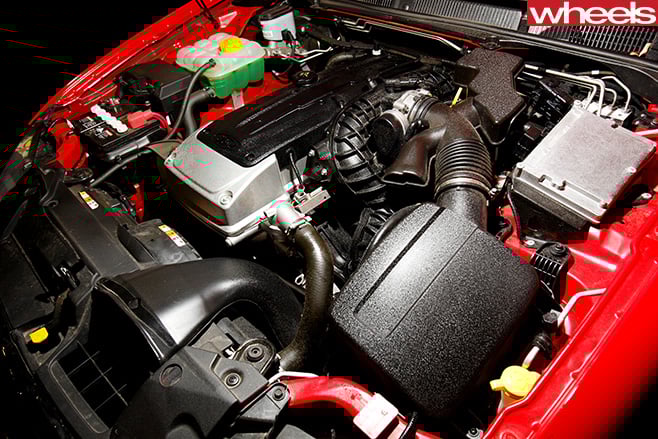
These are the best times Wheels has extracted from an FG XR6 by several tenths, so it’s a good ’un. And a familiar experience too, the big engine sounding a tad harsh as it approaches its 6100rpm cut-out, yet staying smooth and slurring into the next gear.
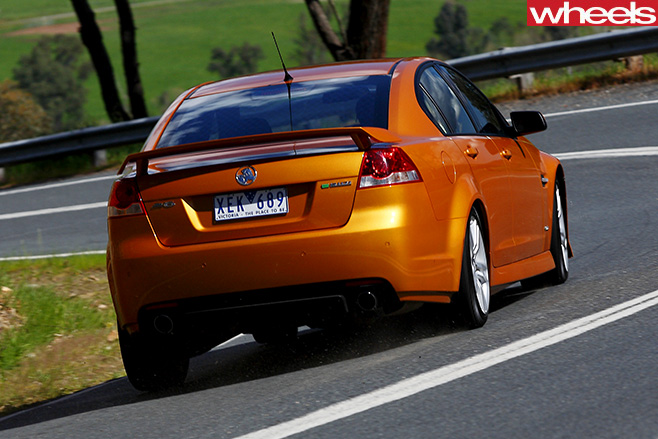
Meanwhile, Holden’s new six feels friskier, lighter, sexier. It revs harder than the Falcon engine, as the HF engine always has, cutting off at a heady 6750rpm. The hoarseness of old is gone, replaced by a soundtrack from the new induction and dual exhausts so well orchestrated you wish it was louder.
Our car was hindered by a slight throttle dead-spot which didn’t help its standing starts, but that wasn’t an issue in the rolling 80-120km/h test and helps explain why the Holden was faster.
So while DI can’t quite get the SV6 on terms in a straight line, there’s no arguing it gives it an economy advantage. Holden claims a 10 percent cut to 10.1L/100km, lining it up directly against the ZF-equipped XR.
After more than 1000km it actually undercut that figure, logging an exceptional 9.4L/100km, a clear litre more frugal than the Falcon. There’s a rider in that figure because the Holden did slightly more freeway running than the XR6, and with a lighter load onboard.
But it’s the only clear advantage emerging as the day progresses. We proceed at a brisk pace, a bright collection rolling on blacktop that wends its way through a blazingly green landscape dotted with full dams and weatherboard farmhouses.
Regularly, McKay and I swap between the Falcon and Commodore and each time we compare notes and agree just how closely these two align. Both are fast, brilliantly damped, invigorating, involving, inspiring.
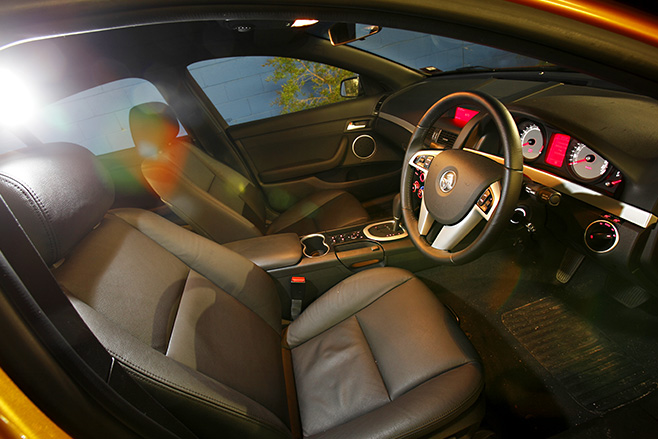
But the Falcon still has fractionally better body control, slightly crisper steering, a better meshed drivetrain (the Holden’s new six-speed is prone to hyperactivity on varying throttle and inclines), and better brake feel and power.
Move away from the drive experience and still the pros and cons balance out.
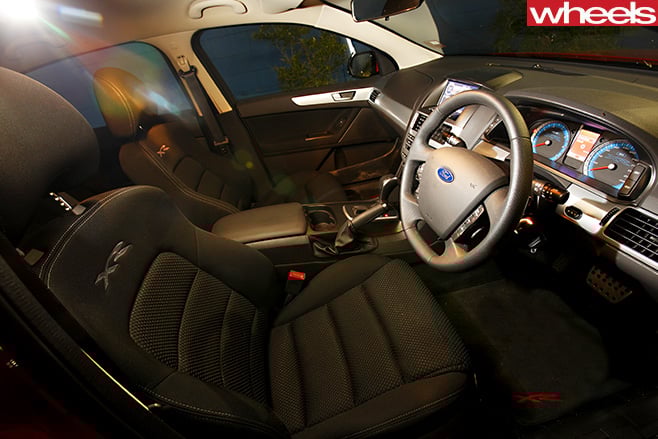
The Falcon is cheaper until you option the ZF; the Commodore gets side curtain airbags standard; the Falcon looks classier inside; the Commodore’s duller presentation is more legible; the Falcon’s front seat is better bolstered but sits too high; the Falcon’s boot is bigger but the Commodore’s is better-shaped. Looks? The updated VE remains familiar because the only external changes are new SIDI and Ecoline badges. The FG is newer yet also familiar, an elegant, chiselled evolution of what went before. And so it goes.
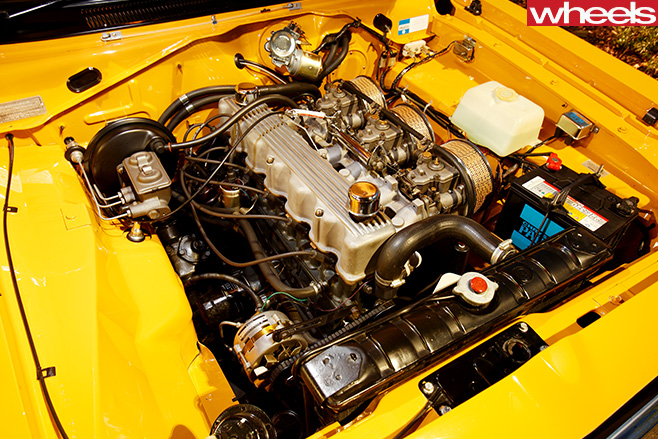
Yet through it all that engine is an absolute gem; no hiccups, no tantrums. Also no cam phasing, no variable valve timing, no direct injection.
Nothing but an eagerness to devour the road ahead. And a shedload of hydrocarbons spewing out the dual exhausts.
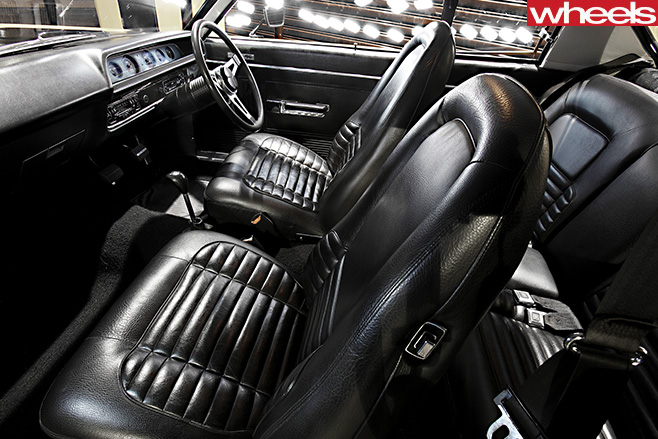
I know exactly what he means. Just riding in the Charger, I’m a kid again, travelling in dad’s HT on his country rounds. The seat sinks like a Tontine, the dashboard is flat, the radio has numbers and lines on its screen, the gearlever sticks out of the transmission tunnel – there’s no centre console. There’s an ashtray and a glovebox, but no grab-handles, no cupholders, no iPod input and no airbags. Virtually everything I touch is metal.
Compared with the refined, quiet, oh-so-accessible Ford and Holden, the Charger is simply at a lower, rawer state of evolution. Yet, as they have improved so the newer cars have moved together, narrowing their differences.
But like every comparison test, this one has its moment. Those crucial few minutes when a bunch of fractured thoughts meld into one unshakeable, irrefutable truth.
Brunelli’s camera is tucked away for now and the E38 is tinking and tonking in the shade. McKay and I eye off the delicious set of corners that curl downwards both ways from a hooking, rough-edged, off-camber turn. It’s time to up the tempo.
Stability control is off, tyre adhesion is being tested harder, cut-outs are being hit. We each run as hard as we dare both ways in both cars. And we emerge eyes shining, talking over each other like excited kids.
“The faster you go the better the Falcon gets,” says McKay lucidly, and accurately, when the babble finally subsides.
The Ford’s trump card is steering that gets more refined as the pace increases. At the same commitment levels, the Commodore starts to lose its connection.
The XR turns in with a smidgen of understeer, sits flat mid-corner and can then be booted out, rear tyres gripping or drifting at the mercy of your right foot.
The SV6 rolls more, lurching in that signature VE way, yet it too has terrific, controllable grip. The widest gap is braking performance. Neither system is state-of-the-art, but the Ford offers more feel and power, the Commodore’s pedal squishes under initial pressure before reassurance arrives.
The Falcon is so cohesive you forget its size; it’s alive in the way it simply shouts at you to go harder. And you know it’s got the depth of talent to back up the talk. You get in grinning, get out laughing aloud. The Holden is slightly more reserved, not as encouraging. You get in smiling, get out smiling.
Don’t be under any misapprehension about the SV6. It’s the best six-cylinder Commodore we’ve ever driven and in some ways – refinement, economy and safety equipment – it out-performs the XR6. But we’re here to find out which of these two most accurately, passionately reflects the Charger’s spirit and fire.
Ron goes for a quick drive – in terms of both time behind the wheel and acceleration rate – and comes back approving of our gut-feel: “It’s very hard to say one is better than the other. But the XR has got the toe; it’s the one that feels more like the Charger six-pack.
“But,” he adds, eyes twinkling, “put the steering and another gear from these things into a Charger and it would probably eat them alive!”
While not destined to become an Aussie automotive icon like the Charger, there’s no doubt 40 years from now someone will love their old FG XR6 just the way Ron loves his R/T E38.
Spirited, exciting and excitable, it’ll certainly deserve it.
Infiniti finally has a sports sedan to give its German rivals a run for its money.
WHAT IS IT? The new flagship of Infiniti’s Q50 line-up. A premium mid-size sports sedan intended to go head on with BMW’s 340i, Audi’s S4 and the Mercedes-Benz C43 AMG.
WHY WE’RE DRIVING IT It debuts Nissan’s new VR30 engine, a 3.0-litre twin-turbo powerhouse that is capable of giving this segment a clip behind the ears. There’s also new suspension and steering tech that warrants investigation.
MAIN RIVALS BMW 340i, Mercedes-Benz C43 AMG, Audi S4, Lexus IS350 Sports Luxury
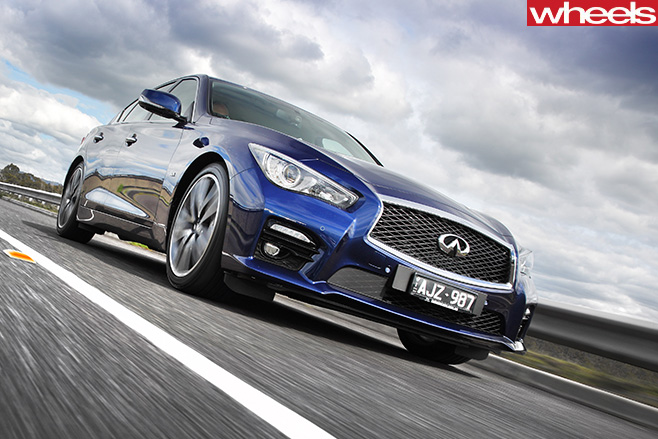
PLUS: Super zesty V6, swift performance, mostly sorted chassis, well equipped, cabin quality, well priced MINUS: Steer-by-wire improved, but no match for a decent conventional rack; no limited-slip diff, over-eager ESC with no sports setting
THE WHEELS REVIEW The most noteworthy aspect of the new Infiniti Q50 Red Sport is not that it’s fitted with version 2.0 of the company’s controversial, no-one-else does-it, ‘by-wire’ steering. It’s sure not the new-to-Q50 two-mode electronically adjustable dampers. It may not even be the new twin-turbo 3.0-litre V6, which cranks out a class-leading 298kW and 475Nm.
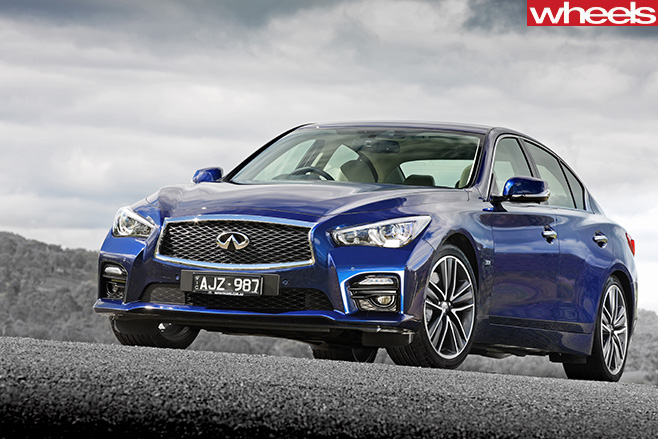
And that it’s actually quite a likeable sports sedan, if ultimately a just little underdone in a couple of key areas.
Let’s start with that engine. It’s an extensive redevelopment of the venerable VQ-series Nissan V6, now with twin turbos blowing through a pair of water-to-air intercoolers.
It runs variable cam timing, direct-injection, and that attention-grabbing power figure: Not quite BMW M3 territory, but not far short, and better than BMW, Mercedes-Benz and Audi manage from 3.0 litres without wand-waving from their respective tuning divisions.
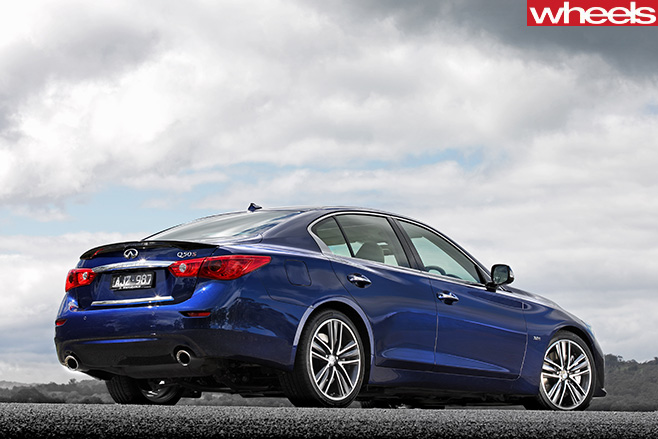
The seven-speed torque convertor auto does a mostly agreeable job of allowing you to deploy it effectively, auto-blipping on downshifts via magnesium paddle shifters, or responding intuitively to your right foot if your leave it in Sport.
The only bum notes are that it auto-upshifts in manual model, instead of holding your chosen gear, and the software occasionally denies you a downshift even though your road speed says the revs could handle it.
It’s all pretty engaging, though, and doesn’t turn to porridge when you point it at a corner via the improved steering.
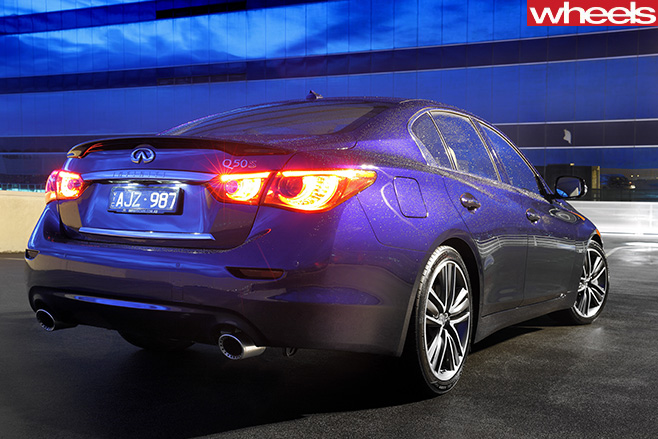
It does that with some success, and is quick at just 2.1 turns lock to lock, but still has way too many modes – five – including the patently ridiculous ‘response’ setting for each. I went looking for the one called “non-contrived chassis engineer’s choice” but failed to find it.
At least the various modes can be individually configured, allowing sharp powertrain mapping and steering without the sports suspension, which can feel a bit stiff and toss-prone on lumpy Aussie backroads.
What ultimately stops the Red Sport rising to true, sub-AMG or M Division sports sedan greatness, though, is the lack of a limited slip diff and no sports mode for the ESC.
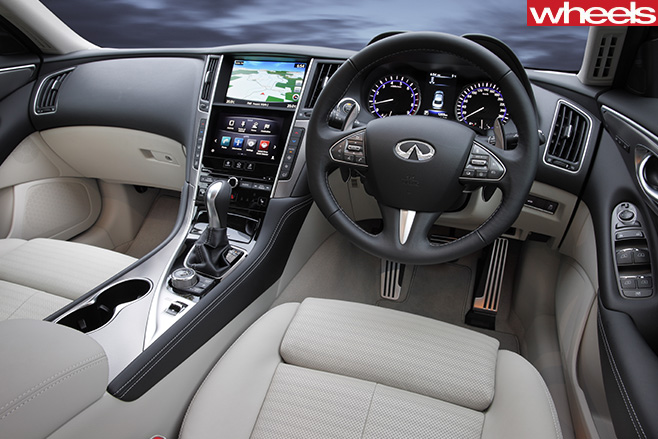
The extra shame is in the fact that, with 245/45 R19 Dunlops all round, the Red Sport actually feels a little under-tyred at the rear, which could easily work in its favour from an involvement point of view if the ESC had a bit more latitude.
So what we’re left with, in sports sedan terms, is an eight-tenths car; albeit at a seven-tenths price compared to the Euro opposition. Not such a bad deal when viewed in that light.
SPECS Model: Infiniti Q50 3.0tt Red Sport Engine: 2997cc V6 (60degree), dohc, 24v, twin-turbo Max power: 298kW @ 6400rpm Max torque: 475Nm @ 2200-5200rpm Transmission: 7-speed automatic Weight: 1784kg 0-100km/h: 4.8sec (estimated) Fuel consumption: 9.3L/100km Price: $79,900 On sale: Now
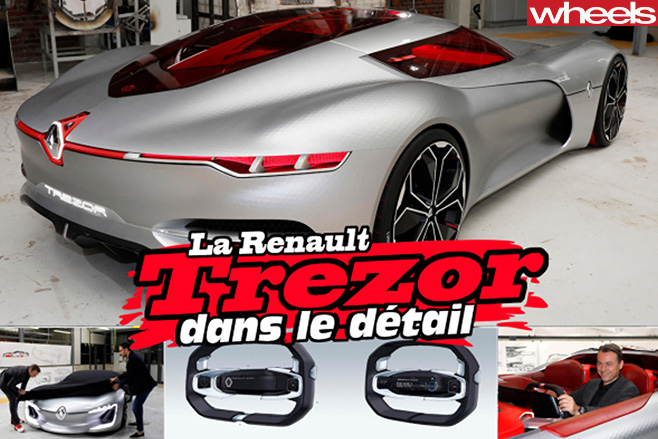
Renault appears to have an instant classic on its hands, with the full reveal of its self-driving Trezor concept at Paris exceeding expectations.
The all-electric 4.7m-long brutish coupe with its forward opening canopy is powered by the motor used in the Renault Formula E car, which pumps out 260kW/260Nm and pushes it from 0-100km/h in under 4.0secs.
The motor is powered by two batteries, each of which has its own cooling system, optimised by the variable-geometry air intake incorporated in the bonnet.
The Trezor also incorporates a brake-operated energy recovery system, courtesy of the Rechargeable Energy Storage System (RESS) technology developed for Formula E racing.
But when it comes to wow-factor, the Trezor is all about looks. For all the technology it promises, plenty has gone into its design, which according to the French carmaker’s chairman and CEO Carlos Ghosn is “the primary reason people buy a Renault”.
This concept car embodies the new design philosophy Renault introduced on its DeZir ‘falling in love’ concept in 2010 before inspiring the lines of the then-new Clio in 2012. But that’s about where any similarities between the hatch and Trezor end.
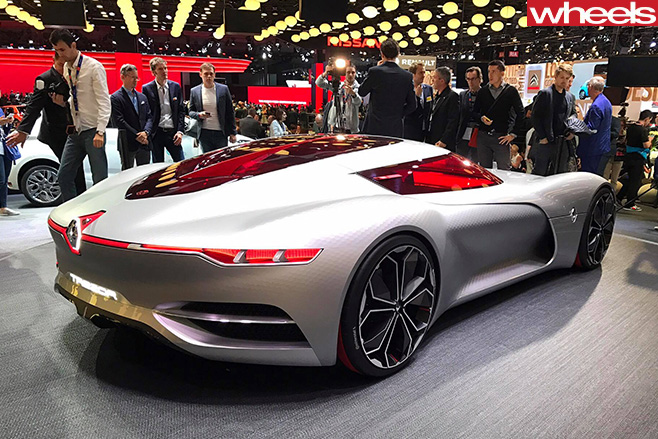
It’s difficult to comprehend why you’d want full autonomy in a car like this, but that capability is in line with the company’s vision of how autonomous cars can make travelling safer and more enjoyable, while allowing motorists to optimise how they use their time.
When the car is in autonomous mode, the exterior lighting signature changes and extends to the side and rear logos to indicate to other road users that driving has been delegated.
Inside, the octagonal steering wheel extends in width to give the now redundant driver a panoramic view of the dashboard. In this mode, the Trezor allows occupants to use their time on a journey to stay connected. The driver and passenger are able to immerse themselves in a shared universe, perhaps by watching a film or playing games.
Of course being a concept means the idea is still way ahead of ability and while Renault’s target is to make completely safe and affordable ‘hands-off / eyes-off’ technology available for its mainstream vehicles, that’s still a long way off.
“No, I wouldn’t say we have (the technology),” vice-president of corporate design Laurens van den Acker told Wheels magazine. “Everyone is working on it, but to have something that is safe, fool proof and if you fall asleep puts you safely on the side of the road, that’s years away.”
Van den Acker concedes that even when the technology becomes available he’d be lying if he said every element of the Trezor concept would make it to production.
“But what you’ll see is the essential shapes, the forms, the proportions, cars that are brimming with emotion if you will. I really like the lighting signature which is very much 3D, very much an extension of what we have planned.
“But the textures, and the detailing in the body will be very, very tough to do. And I hope some of the interior will survive. Everyone is working on how to integrate the screens in the car so this could be very interesting.”
Whether or not it gets anywhere near production is another matter, with van den Acker admitting it’s not based on any existing platform.
“No it’s not based on anything, it’s a pure dream for young kids so it ends up on their bedroom wall.”
