
TELL ME ABOUT THIS CAR
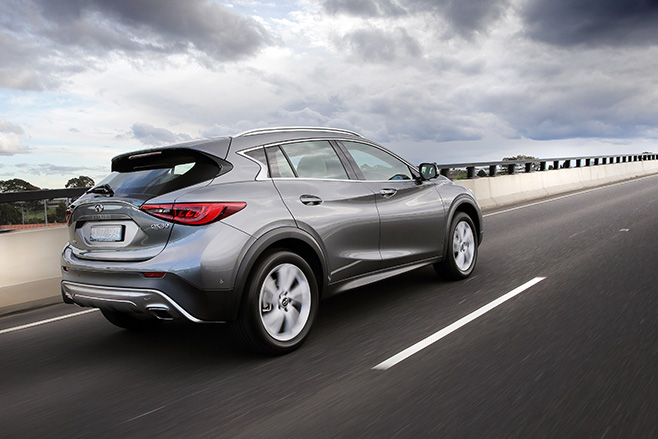
The Infiniti QX30 is a higher-riding, all-wheel-drive variant of Infiniti’s recently launched Infiniti Q30 premium compact front-drive crossover. Like that car, it shares its platform, drivetrain and some interior architecture with the Mercedes-Benz GLA. It’s intended for buyers who occasionally drive on firetrails, or in snowy conditions.
STRENGTHS
- All-wheel drive provides extra traction on slippery surfaces, allowing the car to feel more controllable.
- The QX30 rides 30mm higher than its Q30 sibling, which provides a little extra clearance to potentially negotiate rocky terrain, and may make entry and egress marginally easier.
- Extra body cladding at each end of the car provides more protection against rocks, sticks or anything else off-road that may damage the bodywork.
- The 2.0-litre turbocharged engine provides strong acceleration, while the seven-speed dual-clutch transmission shifts quickly and responds well to either paddle shifters or the driver’s throttle inputs.
- The tall seventh ratio sees the engine turning over at just 1700rpm at 100km/h, which can make for very an economical cruising speed. The car’s combined consumption is 6.9L/100km, which is commendable, albeit 0.6 higher than the Q30, due mostly to the extra weight and drag of the all-wheel-drive hardware.
- The interior imparts a sense of high quality and premium finishes.
- The car is offered with a four-year warranty, one more than Mercedes-Benz.
WEAKNESSES
- The Infiniti brand is relatively new to Australia, so the dealer network is not nearly as extensive as that of the premium European brands.
- The lack of brand awareness may impact on resale value.
- The extra ride height and tyres designed to handle both bitumen and mud means the handling is not quite as sharp and assured as that of the Q30. This is only relevant to hard-driving enthusiasts, however.
- Lack of a reversing camera on the entry-level GT model. (It makes do with beeping sensors.)
- Lack of the latest Apple CarPlay and Android Auto connectivity, meaning your phone’s functionality cannot be displayed on the car’s multimedia system.
- Tight for space in the back with four adults onboard.
Most obvious is the car on which the Infiniti is based; the Mercedes-Benz GLA. If a high power output is not a priority, consider the entry-level GLA 180. If you want the performance offered by the Infiniti, you’ll need to look at the GLA 250, which starts $3K higher at $59,000. Otherwise the Audi Q2 is worthy of consideration; it’s due in February next year and has been well received in Europe. Great equipment, connectivity and cabin quality, and, by all accounts, a lively, engaging drive. Finally, there’s the BMW X1 – roomy and well-engineered, but starts from around $60K for a comparable mechanical spec to the QX30, and needs expensive options to bring it in line in terms of features.
The all-new Holden Astra will be reaching our shores in December with more gear than the current model and a significantly cheaper starting price of price of $21,990.
Offered in three grades; entry level Astra R, the RS and the RS-V; the first of the 2016 European Car of the Year are set to arrive in Australia December this year.
The Astra underwent several surgical procedures with a clean-slate design, weight reduction and new styling cues, as well as the addition of new technology. Featuring IntelliLux LED Matrix headlamps, more active safety tech like rear-view camera available as standard, turbocharged engines and Apply CarPlay and Android Auto.
The Astra R features a 1.4-litre turbocharged four-cylinder petrol engine which will produce 110kW of power and 240Nm of torque. It’ll also be equipped with 17-inch alloy wheels, a 7-inch touch screen compatible with car-projecting technology, a Rear View Camera with Rear Park Assist and digital radio.
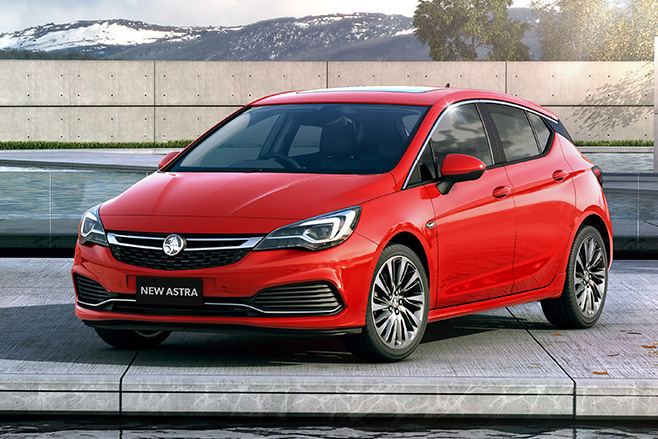
With a price tag of $21,990 for the manual and $24,190 for the automatic, the new base-model Astra (currently the GTC) will get a $5000 price-chop.
The mid-tier RS and top-spec RS-V will feature a 1.6-litre turbocharged engine, claiming 147kW and 300Nm. For $26,490 (or $28,690 for the auto), the RS will add push-button start, advanced park assist, side blind spot alert and forward facing camera for automatic emergency braking, forward collision alert and lane keep assist. Unfortunately you’ll have to wait until March 2017 for the 1.6-litre automatic to arrive in showrooms.
The top of the range RS-V gains 18-inch alloy wheels, heated steering wheel and leather seats, an 8-inch colour touchscreen with phone connectivity and satellite navigation. As a cost option, the RS-V will also be available with Holden’s IntelliLux LED Matrix headlights which automatically adapt the strength of the headlight to your driving conditions. It’ll wear a price of $30,990 for manual or $33,190 for the automatic.
The VXR will remain in the line-up having only launched last year, and will top the price list at $39,990.
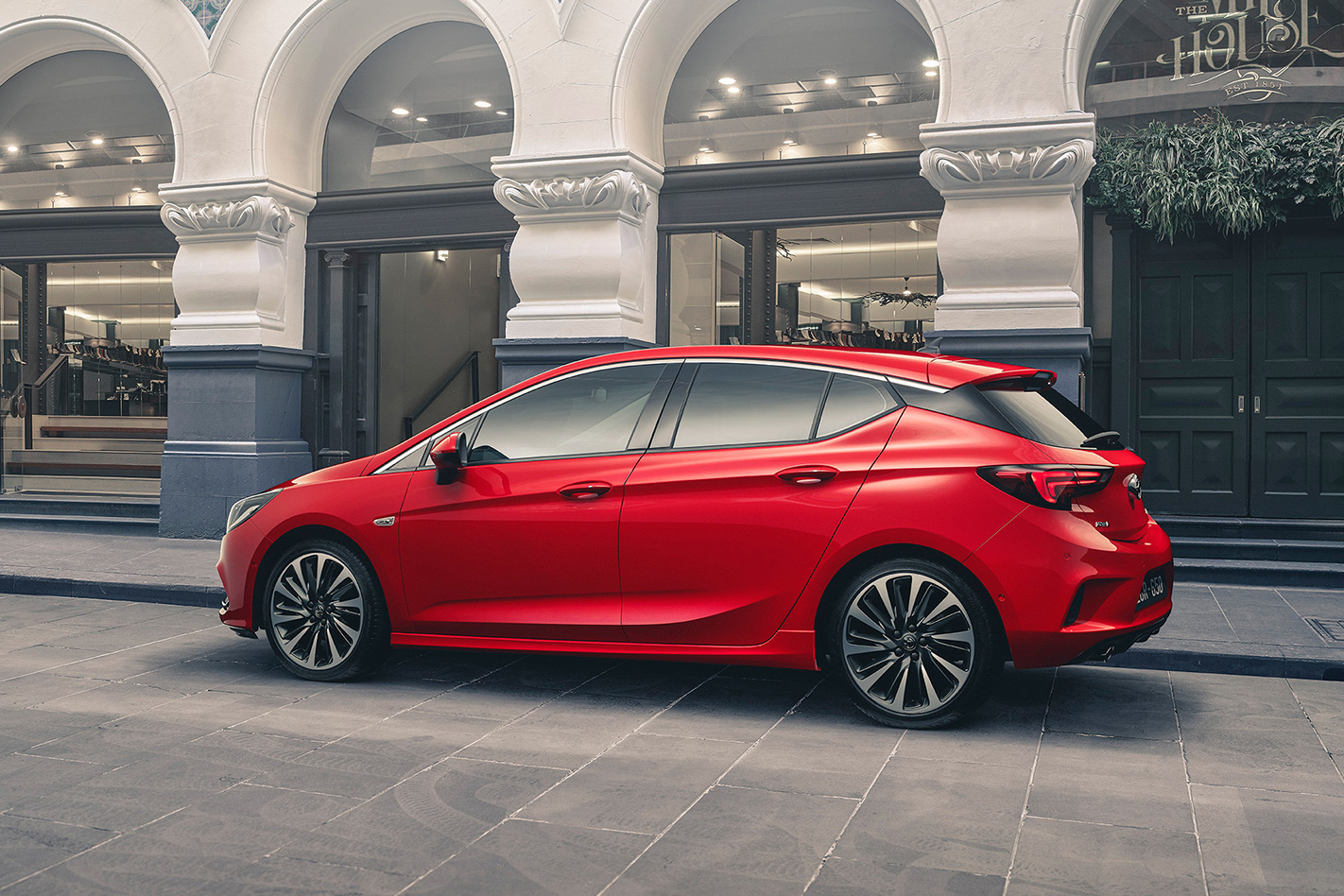
“It’s incredibly exciting to see the first all-new Holden Astra built and ready to ship,” said Holden Executive Director of Sales, Peter Keley.
“Astra’s premium European design oozes quality and style, and with Australian input and extensive global testing, you can be sure it will deliver the performance and refinement Holden has built its reputation on.”
Holden’s Director of Vehicle Performance, Ian Butler, said the European-made car has been adapted to suit the Australian roads.
“Holden and Opel share very similar D.N.A. but we still made sure our engineers were involved in developing Astra and settling targets, right from the start of the program,” he said.
“We’ve engineered our own unique Australian chassis input which, when combined with the new 1.4-litre and 1.6-litre turbo petrol engine options, we’re confident will excel on the variety of road surfaces in Australia.”
Marquez takes Aragon ahead of Lorenzo and Rossi
The Honda ace is now further ahead in the world title fight
Marc Marquez has ended MotoGP’s amazing sequence of producing eight different race winners in a row, to take victory in the Aragon MotoGP.
Some Marquez magic was required in the early going after the Repsol Honda star dealt with a huge moment when he almost dropped his bike on lap three while trying to run away from the field. He slipped down to fifth before fighting his way back to the front, overtaking Yamaha’s Valentino Rossi with 12 laps remaining.
It was Marquez’s fourth win of 2016.
As the laps ran down, team-mates Valentino Rossi and Jorge Lorenzo battled over second place, which ultimately went in Lorenzo’s favour when the Italian ran wide after making a pass with two laps to go.
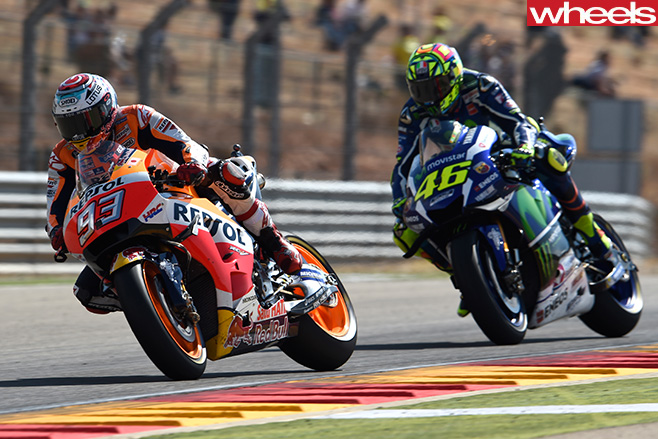
With four races remaining, Marquez has now moved 52 points clear of Rossi in the title race. “It was an important victory, but nothing is finished yet. I said yesterday that something can always happen in a race, and it was a miracle that I didn’t crash today when I almost lost it in turn 7. That was when I decided to relax a little and go back to my mentality from practice of riding precisely and braking in the right places. All this made for a more entertaining race, with many overtaking moves at the start, and a second part in which I was able to open a gap to Valentino, which was important. He had gone several races gaining points on us, and we wanted to stop that trend, because otherwise it would boost his morale and perhaps create doubts for us.”
The Ducati camp had a shocker at Aragon, the best of the Italian bikes being that of Andrea Dovizioso in 11th.
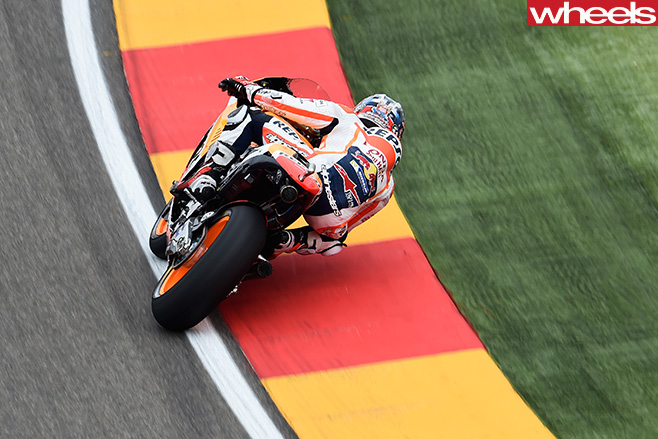
In Moto2, Britain’s Sam Lowes (Federal Oil Gresini Moto2) took a stunning win, converting pole position into a dominant Sunday performance. Alex Marquez and Marc VDS teammate Franco Morbidelli filled the minors.
Aussie Jason Doyle charges to speedway title lead
Doyle and Holder score Down Under one-two in Sweden
Aussie ace Jason Doyle is the first to admit that at the start of 2016 no-one gave him much of a chance of winning the FIM Speedway World Championship. He was a gritty yet unfashionable rider amongst a field of stars.
But after heading home a huge Aussie one-two at the Swedish round in Stockholm on Saturday – amazingly his third grand prix win in a row – the Newcastle-born racer has charged to the lead in the world championship.
Doyle has surged to a five-point advantage in the GP series after leading home NSW’s Chris Holder, a former world champion.
“I still have a long way to go, but to win three GPs in a row is unbelievable,” said Doyle, whose modest ways contrast with his serious on-track aggression.
Just two rounds remain including the finale in Melbourne, and Doyle is in blistering form. The best form of his life.
He is intent on continuing to silence his doubters all the way to the title decider at Melbourne’s Etihad Stadium, where he’ll have a huge home crowd urging him on, hopefully, to the title.
“Anything is possible,” Doyle told the official GP website. “I had no pressure on myself when I first came into the world championship. Going into this year, no-one was giving me the opportunity to become world champion. It might happen and it might not. But right now, the dream is still alive.”
Next weekend’s penultimate round in Torun, Poland, will be crucial for Doyle with wily American superstar Greg Hancock just five points back and stung by his recent slump.
The final at Melbourne’s Etihad Stadium is set for October 22. By rights, the joint should be packed.
Early V8 Supercars join Muscle Car Masters
Brock VP heads the early 1990s V8s at SMP
Ford Falcon and Holden Commodore V8s from the early 1990s era of the two-make 5.0-litre touring car and V8 Supercar competition are now considered old enough to be part of the wildly popular Muscle Car Masters show held annually at Sydney Motorsport Park, and this year set for October 29-30.
Some historically significant cars from the era will take to the circuit in a range of spirited demonstrations, among them and maybe the most interesting of all being the 1993 Mobil 1 Racing Commodore VP formerly driven by Peter Brock.
Other machines set to tweak old memories of a couple of decades ago include cars built and raced by Perkins Engineering, Glenn Seton Racing, Tony Longhurst Racing and John Faulkner Racing – in all around 20 cars are expected to be on track.
Former ‘Castrol Cougar’ Melinda Price is due to drive an ex-John Briggs Supercheap Auto Falcon while Glenn Seton’s 1997 Australian Touring Car Championship-winning Ford Credit Falcon EL is also due on-track in the hands of owner Noel Willoughby.
Further cars competing in the Australian 5.0-Litre Touring Car Association sessions will be revealed closer to the event date, including a few recently restored machines that have not been seen publicly for some years.
The 2016 Muscle Car Masters will feature an all-star racing line-up of Historic Group A and C Touring Cars in the Heritage Touring Cars class, Australian Trans-Am, Group N Historic Touring Cars and Group S as well as a new Sports Racing Car Invitational demo category featuring ‘big banger’ sports cars, sports sedans and Can-Am machines.
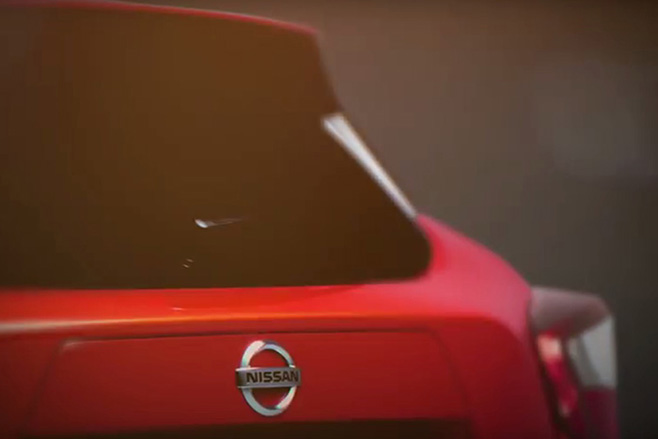
THE 2017 Nissan Micra has been teased in a series of images confirming the Toyota Yaris fighter will be in for a significant makeover when it appears at the Paris Motor Show this week.
The images of the all-new 2017 Nissan Micra show a glimpse of its front and rear lights and part of the brand’s V-motion grille.
The goggle-eyed headlights of the current Nissan Micra have been replaced by a slicker version which isn’t quite the teardrop shape as forecast through renderings based on a test car spotted in Spain earlier this year band the Sway concept unveiled in Geneva last year.
Nissan embedded the images in a 12-second video that shows the just two views, but cycles through a range of colours and ends with the words: “A revolution is coming …”
Micra’s revolution from bland bubble car already seemed obvious with the prototype’s sloping roofline and wider, more sporting stance given to it via the new CMF-B platform that also underpins the Renault Clio.
The change can’t come quick enough for Nissan. The K14 Micra will be the fifth generation of its internationally successful but ageing small car, which was last updated in 2010.
It was a big seller in its class but was unlikely to maintain that success against revamped competitors such as the Volkswagen Polo, Mazda 2 leading Nissan Australia to drop it from its range in April this year.
Even if the new Micra does take the small-car world by storm, don’t expect it to reach our shores until late in 2018, with Nissan Australia admitting 2015 that we’ll be two about years behind Europe in receiving the new model, if at all.
Here’s a sneak peek at what you’ll find in MOTOR’s November issue.
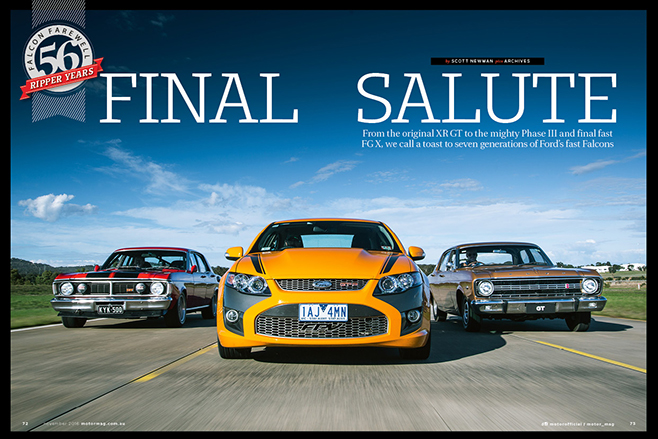
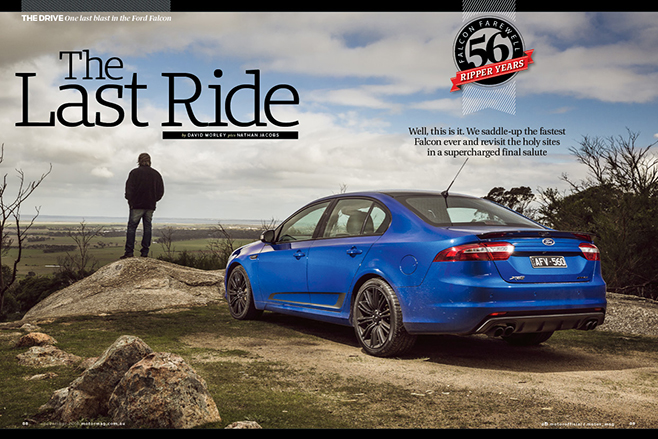
On stands this Thursday the issue celebrates the Ford Falcon’s 56 years in Australia with a plethora of special content.
Kicking that off is a 15-page photo-packed feature recapping the greatest moments to define seven generations of Falcons.
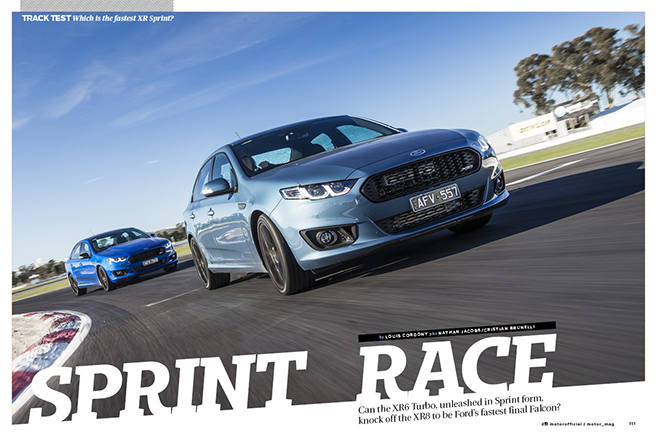
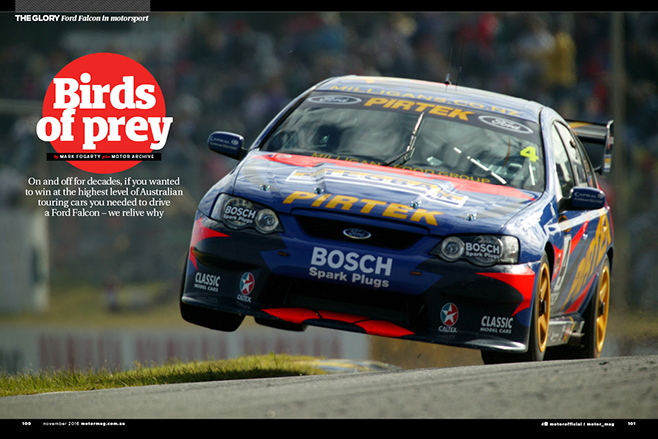
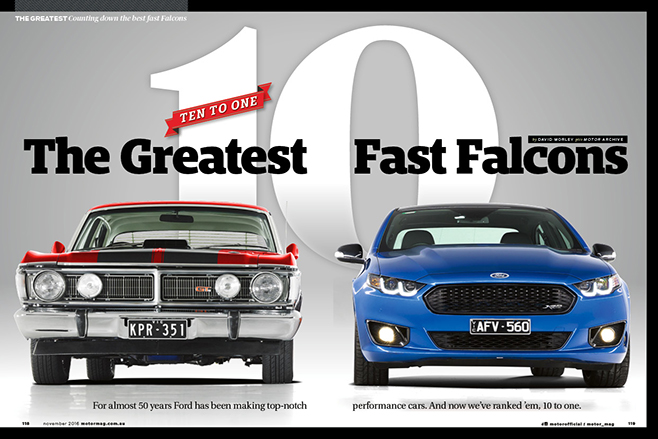
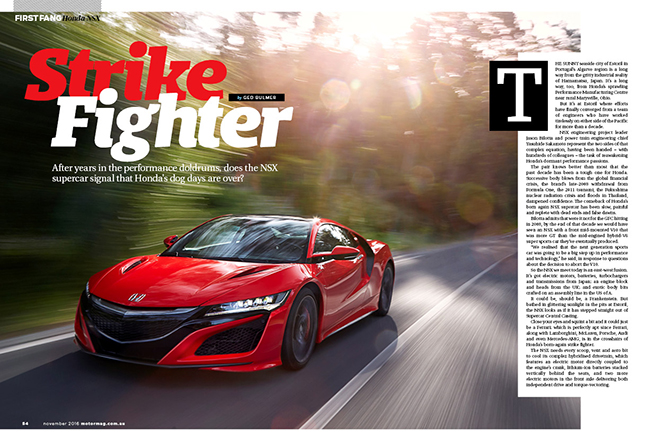
If Honda’s twin-turbo V6 hybrid is anything to be reckoned with, it’ll need to prove it to something like McLaren’s 570 GT. We have the two face-off in the hills of Lisbon.
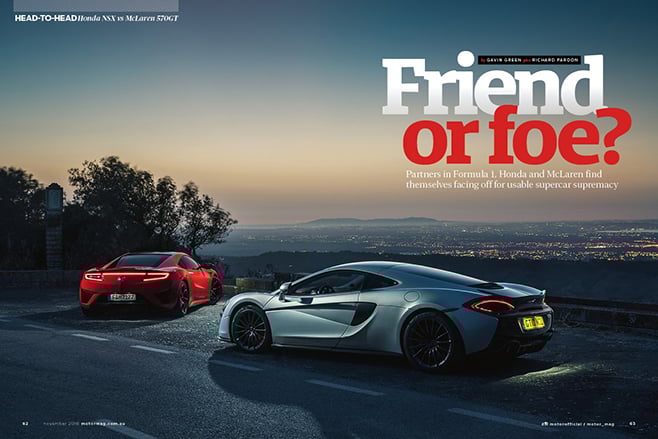
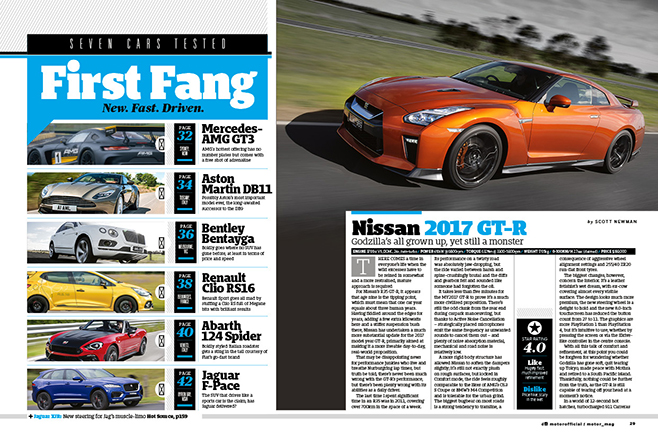
As for our garage, it’s goodbye to our Chrysler’s 300 SRT which leaves us with a question to answer, while our SS-V Redline Ute meets its roided-up, more expensive HSV twin.
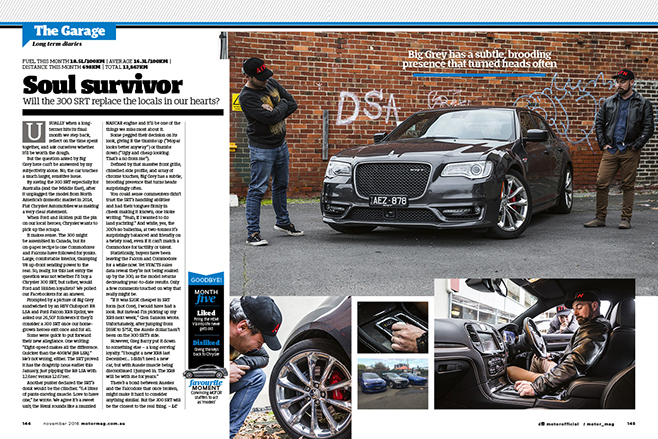
Find it in stores on iPad or Zinio when released this Thursday, September 29.
Four-wheel-drive utes have never been more popular. While you’d think that’s because of the mining and building booms, around half are sold to private buyers. With about a dozen dual-cab utes on the market it can be difficult to tell them apart in terms of appearance, performance and functionality, so Wheels gathered the eight biggest sellers and put them through their paces – on and off road – to see which was the best.
1. Volkswagen Amarok TDI420 Dual Cab
Sophisticated performer that loves to get its hands dirty
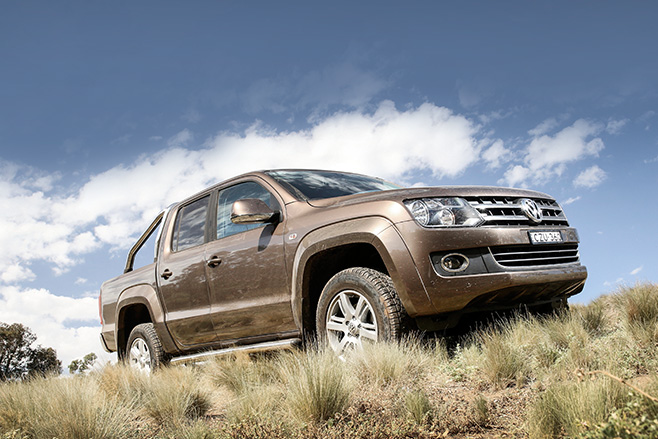
PLUS: Class benchmark for comfort, refinement, driveability and liveability MINUS: Mechanically complex; lack of dealers; service costs
The Amarok shows that refinement has a place in the blue-collar ute world whether it’s off-road or on building sites. It has all-round polish, from its hardworking 2.0-litre twin-turbo four-cylinder diesel engine to the interior presentation. Off the road, Amarok’s full-time 4WD system manages the rough stuff well despite the lack of a low-gear transfer case and found traction to complete the ‘hell-climb’ with minimal wheelspin.
Verdict: 8/10
2. Ford Ranger XLT Double Cab
A facelift and added refinement sets it apart from its Mazda twin
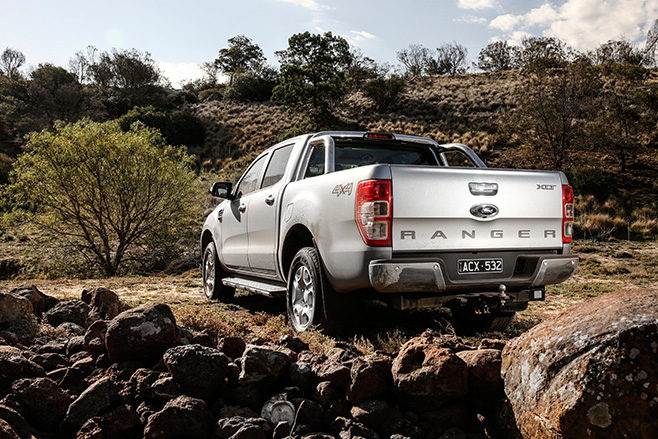
PLUS: Slick steering; spacious cabin; grunty five-cylinder diesel; on- and off-road polish MINUS: Pricey; relatively thirsty
The Australian-engineered Ford Ranger shares almost everything with its twin under the skin, the Mazda BT-50. However, while the BT50 still looks the same, the Ranger has had a recent facelift to give a more desirable ‘Yank truck’ interior, electric power steering system and new injectors that bring more refinement to the 3.2-litre five-cylinder turbo diesel engine. It has no real issues off road, and while not quite as accomplished as the Toyota Hilux it should take you just about anywhere you’d expect with a standard road-going 4×4.
Verdict 7.5/10
3. Mazda BT-50 XTR Dual Cab
Not as refined as its Ranger cousin, but still good value
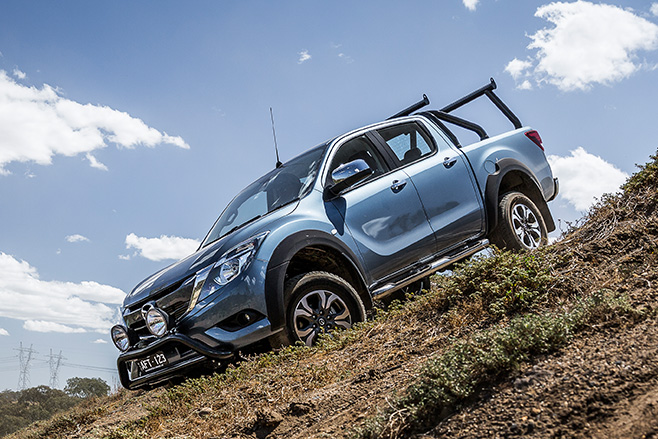
PLUS: Engine willing to rev; auto will hold gears; quick steering MINUS: Noisy, chuntering idle; no steering reach adjustment; firm damping bucks over undulations
This is one of the rare segments where Mazda doesn’t have a stranglehold over Ford, even though the BT-50 shares plenty of genetic material with the big-selling Ranger. While it lacks the Ranger’s much lauded updates, including its more rugged looks and better handling, it is about $5000 cheaper and still a very capable jack of all trades. It won most of its points off-road, lapping up the dizzying torture test, feeling nice and solid over ruts and corrugations.
Verdict 7.5/10
4. Toyota Hilux SR Dual Cab
The class icon is a great off-roader but lacks the polish of ever-improving rivals
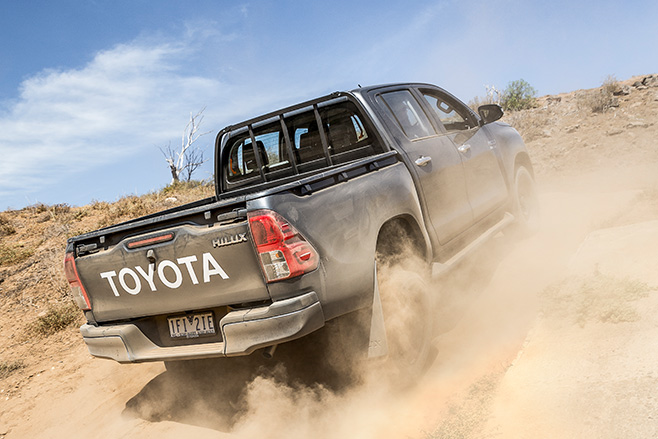
PLUS: Functionality; off-road performance; dealer network; ‘unbreakable’ reputation MINUS: Stiff, jarring ride; flawed cabin; neither quick nor frugal
Toyota’s venerable Hilux has become synonymous 4WD utes, earning a reputation of reliability and even indestructability. So much so that Toyota seems to be resting its laurels in the face of ever-improving opposition. Compared with the standard-setting Amarok, the all-new Hilux has a stiff and bouncy ride, its all-new four-cylinder 2.8-litre turbo diesel is neither fast nor frugal, and it lacks refinement inside that the fluoro brigade now expects. Not surprisingly its strength is on the rough stuff – it loves steep climbs and its traction control knows when to let go.
Verdict 7.0/10
5. Nissan Navara ST Dual Cab
Great on paper with lots of new tech, but let down by heavy steering
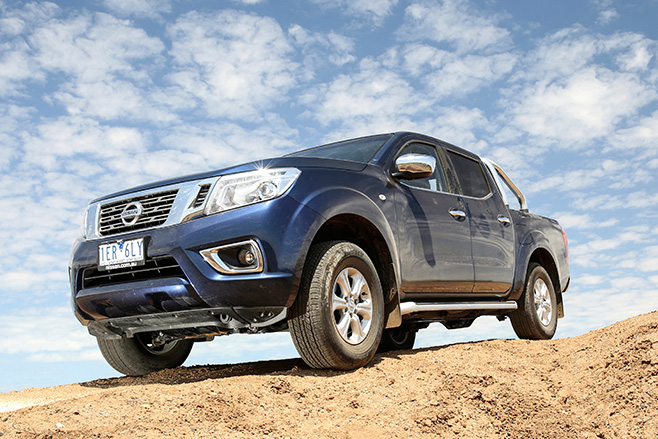
PLUS: Potent, efficient engine; off-road nous; coil-sprung rear brings good on-road handling MINUS: Vague and heavy steering
The Nissan Navara looks good and comes with a four-cylinder 2.3-litre twin-turbo diesel engine, coil springs instead of leafs, and a rear diff lock. It has plenty of creature comforts and extras, including self-levelling LED headlights, LED running lights, side steps and 16-inch alloys. It is happy in the rough despite having one of the lower ground clearances in the field. The Navara’s biggest letdown is the heavy and vague steering.
Verdict 6.5/10
6. Mitsubishi Triton GLS Double Cab
Not the best off-roader but still a good buy in terms of equipment and value
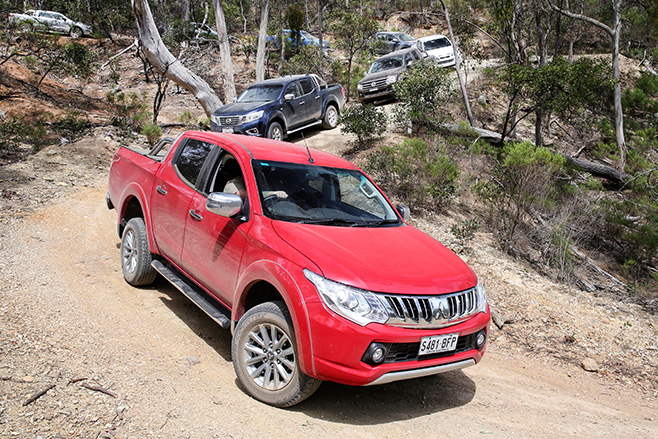
PLUS: Punchier and roomier than before; long warranty; value MINUS: Electronic diff not standard; limp steering; busy ride
The value-for-money Triton wins point for its suite of extra features including hill-start and trailer-stability assist, dual-zone climate control, HID headlights, LED driving lights and a sporty styling package with 17-inch alloy wheels in a neatly presented package. But while the 2.4-litre turbo diesel engine is paired with a beefy five-speed auto provides adequate torque, and it’s nicely equipped, it’s not the best drive on or off roads.
Verdict 6.0/10
7. 2015 Holden Colorado LTZ Crew Cab
Cheap interior, off-road inadequacies and thirsty engine make the wait for the newer model worth it
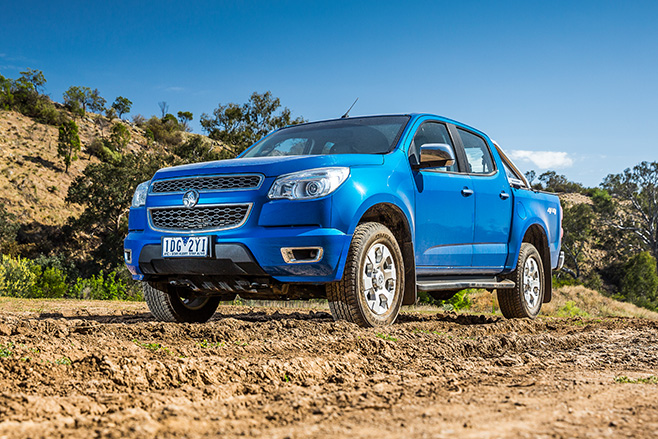
PLUS: Largest engine capacity so high torque; comparatively swift MINUS: Gruff engine; wobbly on-road dynamics; chintzy interior
It’s worth pointing out that Holden has released a newer version of the Holden Colorado since this test, and it’s a good thing too. The things that let this older version of the Colorado down include cheap interior plastics that scream cost cutting and the 2.8-litre four cylinder diesel turbo with a serious drinking problem, necking 9.1L/100km combined. A lack of rear diff lock didn’t help in extreme dirt and it found itself wanting on the steeper climbs. On the road it provided a comfortable enough ride and was the fastest of the eight, but it was also pretty loud.
Verdict: 5.0/10
8. Isuzu D-Max LS-U Crew Cab
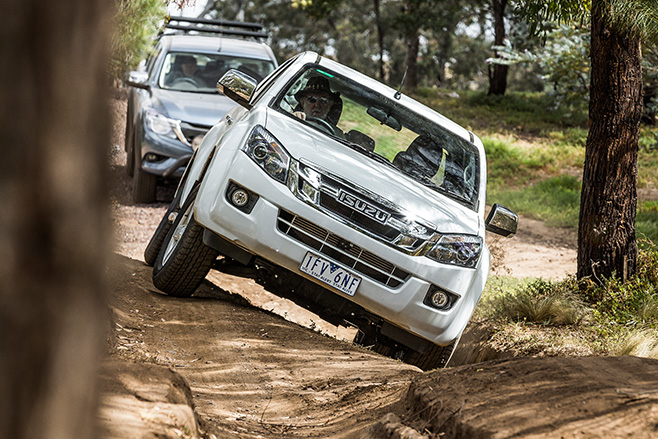
Old-school ruggedness comes with a dated interior and performance.
PLUS: Honest appeal; mostly good ride; proven drivetrain MINUS: Basic cabin; lacks refinement; engine, auto lacks responsiveness
This shares a body and chassis with the 2015 Holden Colorado as well as the same neither here nor there rating. It comes with its own tried and tested engine and Aisin gearbox that provide truck-like reliability, but lack refinement. The interior is also very workmanlike but standard kit includes six airbags, projector headlights and front fog lights, LED tail-lights, aluminium side steps and extra chrome trim. The steering is a little heavy and road noise excessive and off road it suffers from not having a standard locking diff, like the Colorado. On the plus side it has generous ground clearance, an inner-guard engine air intake and a pair of front recovery hooks as standard.
Verdict: 5.0/10
Read the full comparison review of Australia’s best 4×4 dual-cab utes at WheelsMag.com.au
Infiniti adds to its volume-chasing Q30 range, with a high-riding, all-wheel drive variant that brings off-road potential.
WHAT IS IT? A higher-riding, all-wheel-drive variant of Infiniti’s recently launched Q30 premium compact front-drive crossover. Like that car, it shares its platform, drivetrain and some interior architecture with the Mercedes-Benz GLA.
WHY WE’RE DRIVING IT Infiniti is desperate to build a brand presence in Australia, and a model in this segment is the company’s best hope of improving sales, even if they are likely to remain tiny against the likes of Mercedes and Audi.
RIVALS Mercedes-Benz GLA, Audi Q3, Audi Q2, BMW X1
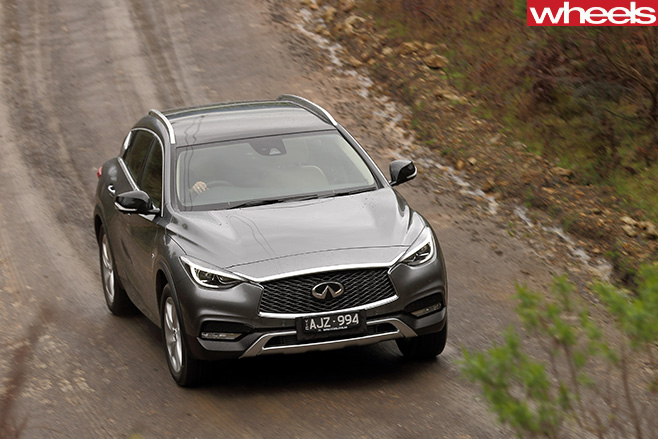
PLUS: Rides with more compliance than Q30; can theoretically better handle unmade roads MINUS: Higher ride height and SUV tyres means slightly mushier handling; commands a premium of around $4K over regular Q30
THE WHEELS REVIEW THERE are plenty of things capable of causing sleepless nights to executives of Mercedes-Benz, BMW and Audi, but it’s unlikely Infiniti’s presence in Australia is one of them. Nissan’s luxury arm is a sales minnow in this country, selling just 574 cars last year. Mercedes moves a similar number every week.
But optimism runs deep at Infiniti, and the company is confident that this QX30 model, combined with its Q30 sibling, will bolster local sales to the tune of 30 percent.
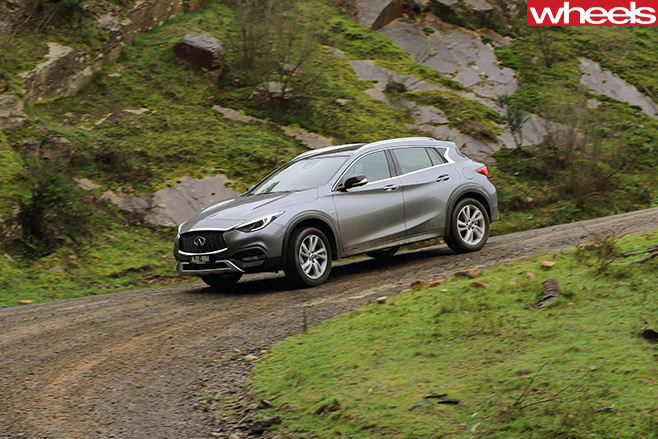
There are two spec levels to choose from: the entry-level GT, at $48,900, or the top-spec GT Premium at $56,900. Both are powered by the gutsiest (sub-AMG) petrol engine Merc offers in the GLA; the 2.0-litre turbo punching out 155kW/350Nm. Both are capable of sending 50 percent of torque rearward on that blue-moon occasion where the fronts are incapable of finding traction. In terms of value, that pricing puts both models around $4k more expensive that the lower-riding, front-drive equivalents in the three-tier Q30 range. So far, so predictable.
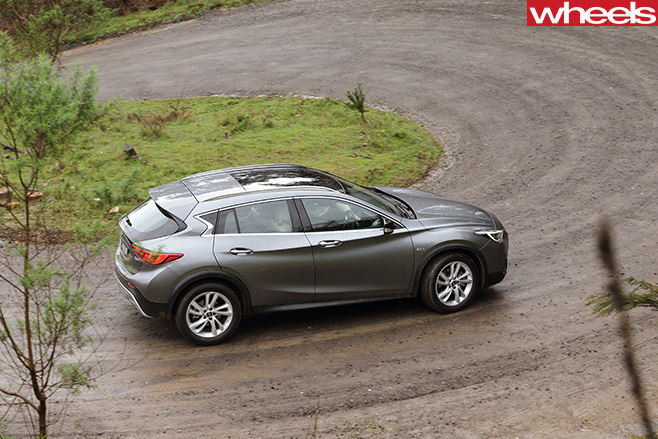
But enough of the sideways glances at the GLA; more relevant is what the QX30 gains over the Q30, and whether that extra $4k is money well spent. We drove the QX30 on sealed roads and fire trails in Victoria and found torque steer was still evident when belting it on dirt despite some drive being sent the rears. Secure and predictable, yes, but it was hard to imagine the regular Q30 being troubled in these conditions.
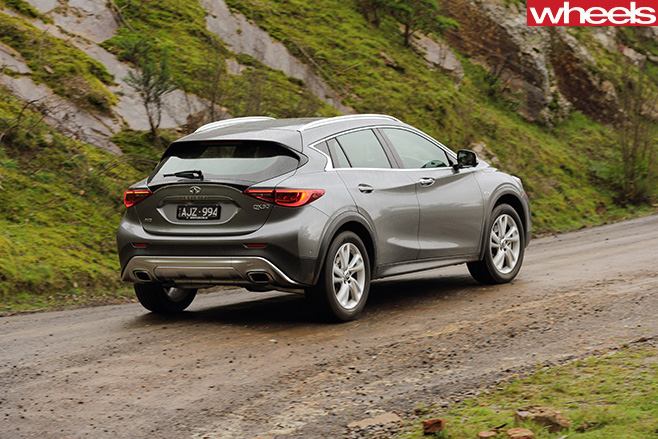
So there’s no doubting the QX30’s core competency, but is that enough? Even in this more affordable end of the premium market, a car purchase is still an emotive buying decision; one influenced by a complex matrix involving perceptions of quality, implied status, brand association and intangible feel-good factors. Which is where the QX30 starts to drift off course. It’s well engineered, well equipped, and, against Benz’s GLA, appears reasonable value. The question is whether that’s enough to tug at the heart strings, which, in this business, tend to be connected to the pen that signs the purchase agreement.
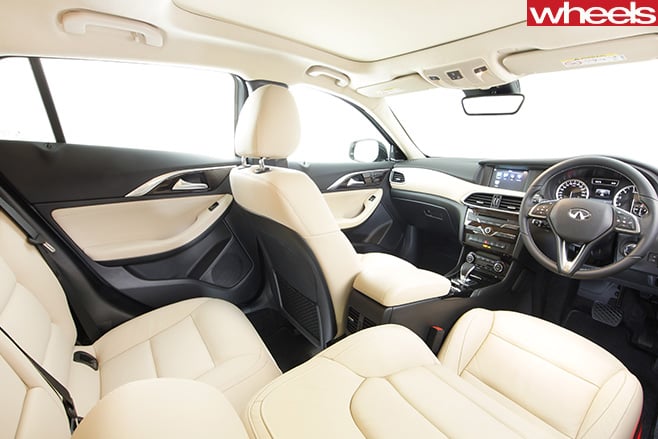
In stark contrast to Mercedes-Benz and the other premium Euros, Infiniti limits options for the QX30 to just one: metallic paint for $1200.The most notable lifts in equipment for Premium over GT are the Nappa leather, electric seats, dual-zone climate, intelligent cruise, lane departure and blindspot warning, park assist and rear camera, and fixed glass roof.
SPECS Model: Infiniti QX30 GT Premium 2.0t Engine: 1991cc 4cyl, dohc, 16v, turbo Max power: 155kW @ 5500rpm Max torque: 350Nm @ 1200rpm-4000rpm Transmission: 7-speed dual-clutch Weight: 1566kg 0-100km/h: 7.8sec (estimated) Fuel consumption: 6.9L/100km Price: $50,990 On sale: now
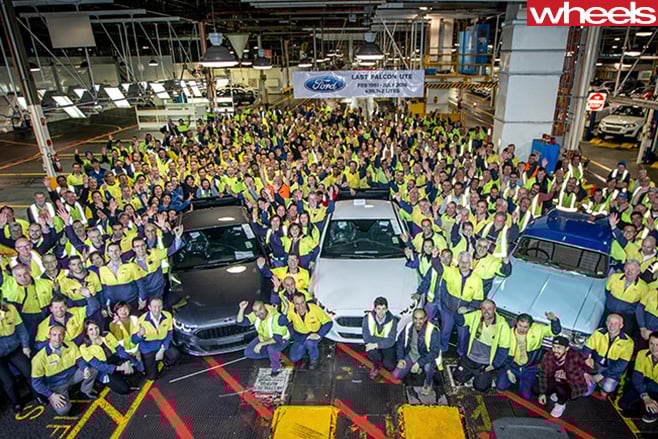
TODAY hurts. Ford has officially signed off the last two engines to come off its Geelong production line, turning off the key on more than 90 years of history that has passed through the site.
The engines, an imported 5.0-litre V8 that’s modified here and fitted with a Harrop supercharger, and a 4.0-litre in-line six-cylinder – the most Aussie engine the carmaker builds – were commemorated in a line-off ceremony at the Geelong Powertrain Operations today.
A single image posted to Twitter shows the two engines mounted on the end of the Geelong assembly line, bearing a placard reading “Proudly built in Geelong 26 September 2016 Geelong Powertrain Operations”. Both engines are signed off with “A job well done!”
Ford Australia said the last engines were part of a staged shutdown of its Australian carmaking operations, which included the last Falcon ute rolling off its Broadmeadows production line on July 29.
“We’re obviously working towards the end of production and to support that there will be different milestones that happen along the way including the end of engine production. But all our employees will be with us until October 7, that’s when we’ll pay tribute to them on that day.”
Sherwood wouldn’t be drawn on Ford’s intentions for the engines, refusing to say whether they’re destined for use in the last Falcons to roll down the production line, or to be preserved as museum pieces.
“I’m not going to comment on that, our focus is on October and the end of local manufacturing on October 7. As I said there will be milestones along the way, and there have been already, but we really want to pay tribute to our employees and our manufacturing history on October 7.”
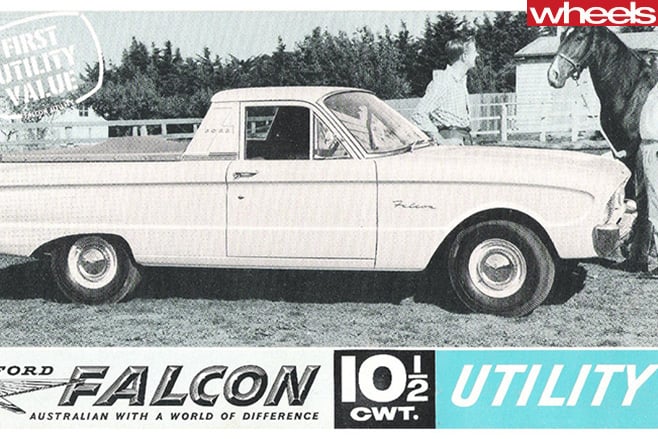
In November 1982, Ford announced it would halt V8 production, saying it would be replaced with an electronic fuel injection version of the in-line six. According to Ford, the EFI engine “offered virtually the same performance as the 4.9-litre V8 but with substantial savings in fuel consumption”. It was to prove a big mistake, handing rival carmaker Holden a big marketing advantage.
FALCON ENGINES THROUGH TIME 1960: 144 cubic inch, 6cyl, ohv 1962: Pursuit 170c.i. introduced 1964: 200 Super Pursuit engine introduced 1966: 289c.i. V8 introduced as an option; 144c.i. deleted 1968: 302c.i. 4.9-litre V8 introduced; 289c.i. V8 deleted; 3.1/3.6-litre sixes introduced 1969: 351c.i. 5.8-litre V8 introduced 1970: 200/250c.i. 3.3/4.1-litre sixes introduced 1976: Crossflow heads introduced on sixes 1980: Alloy head introduced 1982: Alloy head II introduced; V8 deleted 1984: Electronic engine control IV introduced 1988: Inline sixes re-engineered for ohc 1991: 5.0-litre V8 returns 1992: 4.0-litre six introduced; XR6 joins range with Tickford-modified 4.0-litre in-line six 1994: 4.0-in-line six uprated to 157kW 1999: Ford Tickford Experience-tuned sixes, Windsor V8 2000: Engine service intervals increased from 10,000km to 15,000km 2001: Windsor 5.0-litre V8 deleted 2002: Turbo 4.0-litre in-line six introduced; “Boss 260” 5.4-litre dohc V8 introduced 2004: FPV F6 Typhoon features 270kW turbo in-line six 2005: Major changes to the in-line six for BF Falcon 2006: Six-cyl engine’s thermal management overhauled for faster warm-up and better fuel use 2008: XR6 Turbo gains more torque; 310kW turbo in-line six FPV F6 introduced 2010: XR8 discontinued due to emissions controls; FPV introduces 315kW Miami supercharged 5.0-litre V8 2014: 2.0-litre four-cyl introduced for Falcon; 5.0-litre V8 returns; XR6 Sprint gains 325kW turbo six
MERCEDES-AMG has taken advantage of the fog of publicity ahead of the Paris Motor Show to cheekily troll its fans and the motoring press with teaser pictures of a toy.
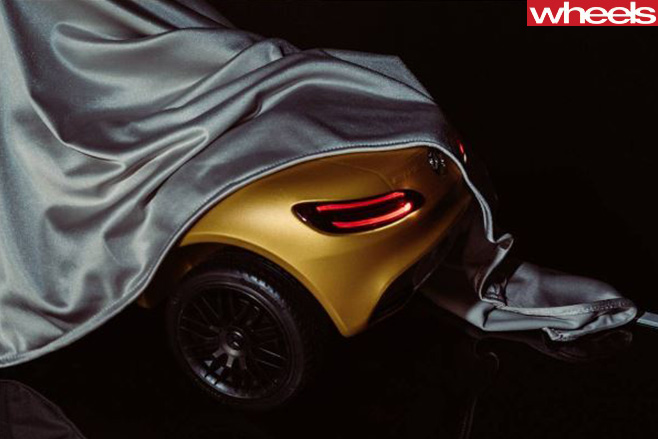
The company showed pictures of the partially revealed rear and grille of what appeared to be a new high-performance SUV on its Instagram site at the weekend with the words “A little big something is about to be revealed – soon.”
This fooled a few followers and a couple of high-profile UK motoring sites, who speculated that “Mercedes-AMG is preparing an electric surprise for the 2016 Paris motor show” in a story which has since been deleted.
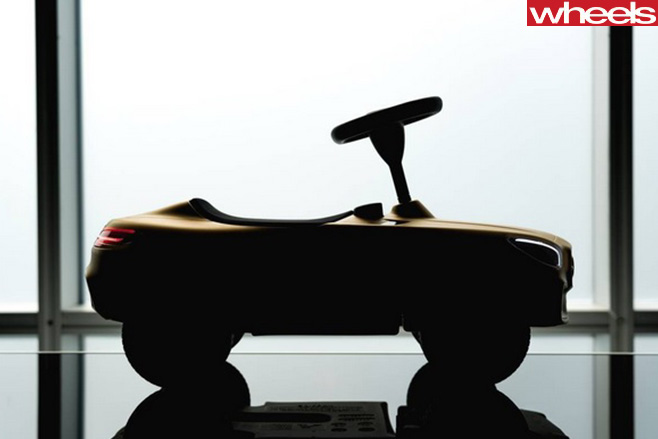
This was confirmed when AMG released a follow-up pic showing a silhouette of the little Noddy Car for the kid with everything, complete with LED running lights.
Best thing about this gag is that the toy, as well as being the most affordable AMG you can buy, is a more attractive prospect than AMG actually making an electric soft roader coupe.
The GT and GT C Roadster lose the roof, to be replaced with a retractable soft-top.
The GT roadster’s twin-turbo V8 engine will push you from 0-100km/h in 4.0-seconds, while the GT C, which gets a 60kW boost of power over the standard 350kW version, does the sprint in 3.7-seconds.
Chevrolet’s Equinox mid-size SUV will be on sale with a Holden badge late in 2017.
Holden has confirmed the Honda CR-V, Kia Sportage, Mazda CX-5, Mitsubishi ASX and Nissan X-Trail fighter unveiled in the US last week will form part of its more premium showroom push.
The announcement follows closely on the news that the Holden Acadia, a large SUV that will arrive here in 2018 to take the fight up to the likes of the Mazda CX-9, Nissan Pathfinder, Hyundai Santa Fe and Kia Sorento will arrive in 2018.
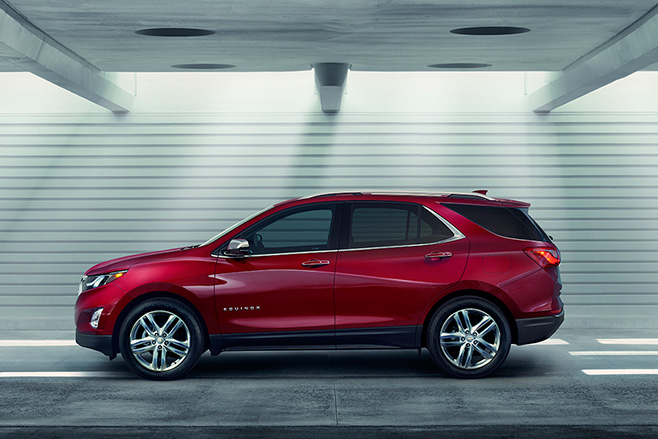
Holden is flagging that it is preparing to give its showrooms a more premium feel once local Commodore manufacturing ends late next year, shaking off a long legacy of stumping up cheaper Korean fare as its volume models.
As well as the two SUVs, Holden will soon add an Opel-sourced, Euro-styled Astra hatchback to its range, replacing the lacklustre locally made Cruze hatch with a product wearing a more refined and premium aura.
The Equinox and Acadia will join the Holden Trailblazer – a seven-seat version of the Colorado trade ute – and a facelifted version of the Holden Trax in the carmaker’s post-Commodore SUV line-up.
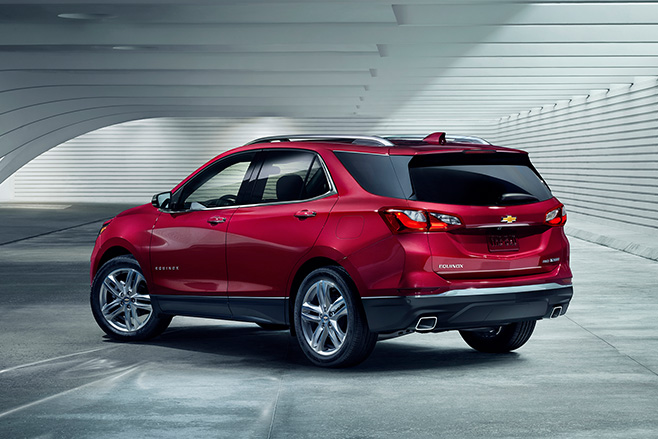
The Chevrolet Cruze-based Equinox was revealed in the US last week featuring three turbocharged engines. The smallest engine is a 1.5-litre petrol unit producing 127kW, and returning fuel use figures of about 8.0L/100km.
There’s also a turbocharged 2.0-litre petrol engine producing about 188kW and using around 8.4L/100km, and a 1.6-litre diesel producing about 101kW. There’s no fuel use estimate for the diesel, but it does have a stop-start system that will switch off and automatically restart the engine if you’re stopped in traffic.
The 2.0-litre version will be paired with a nine-speed automatic transmission.
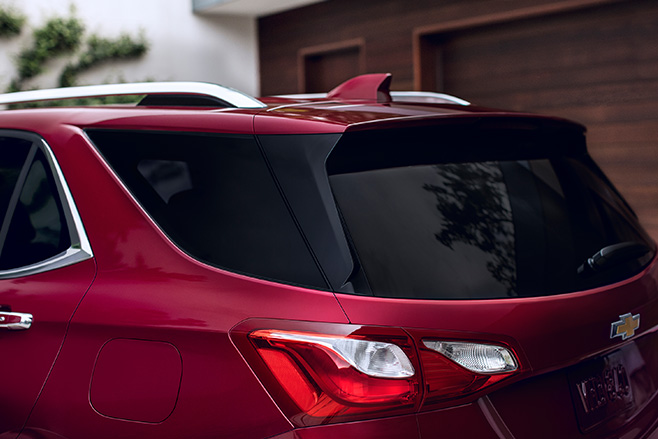
The Holden Equinox features similar styling to that of the US-market Chevrolet Cruze, and the US-styled but Korean-made Holden Malibu.
Halogen headlamps are standard across all trim levels, while more expensive models will feature LED taillamps.
The Equinox’s dashboard is similar to that of the Peugeot 208 in that it is well below the driver’s line of vision – what Chevrolet calls “down and away”. It potentially means a head-up display will be standard across the range so that the driver doesn’t need to look too far from the road to check the speed.
The entertainment unit will feature either a seven- or eight-inch touchscreen with Apple CarPlay or Android Auto compatibility.
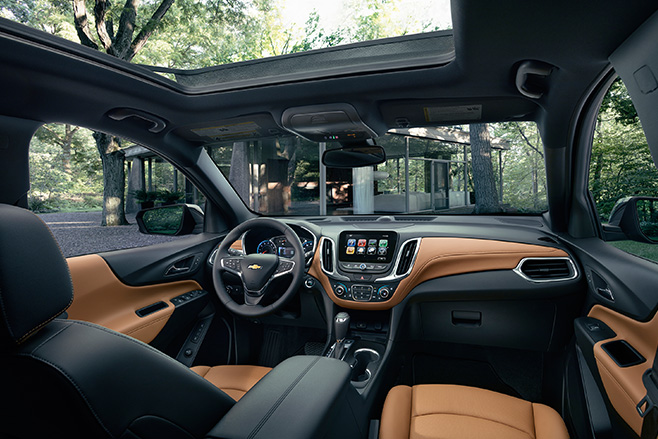
For paranoid parents, the Equinox will even have a system GM calls “Teen Driver” that allows a parent to “set controls and review an in-vehicle report card in order to encourage safer driving habits, even when they are not in the vehicle”.
The version of the Equinox sold in the US will even include low-speed emergency braking that will help to either prevent or minimise a rear-end crash with the car in front.
The Equinox is Chevrolet’s second-best selling product globally, outsold only by the Silverado pick-up truck.
