
Porsche has opened the doors on a state-of-the-art engine plant in Zuffenhausen, responsible for production of its all-new twin-turbo V8.
Constructed over the last two years at a cost of 80 million euros, the plant employs 400 people and produces around 200 engines every day.
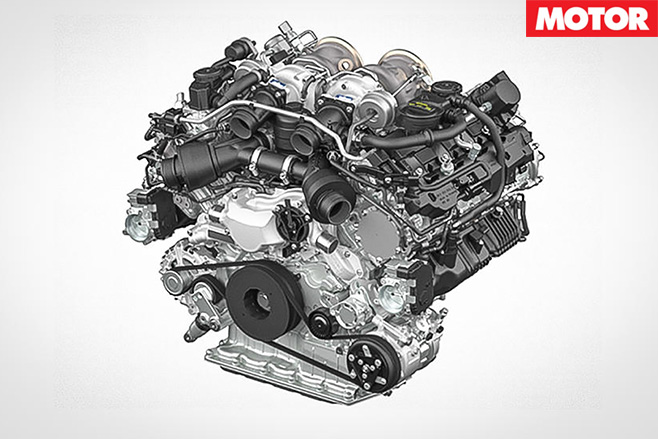
The 4.0-litre twin-turbo V8 is currently only installed in the 2017 Panamera Turbo, where it produces 404kW/770Nm, though those totals are expected to increase to 447kW/800Nm when the Turbo S arrives.
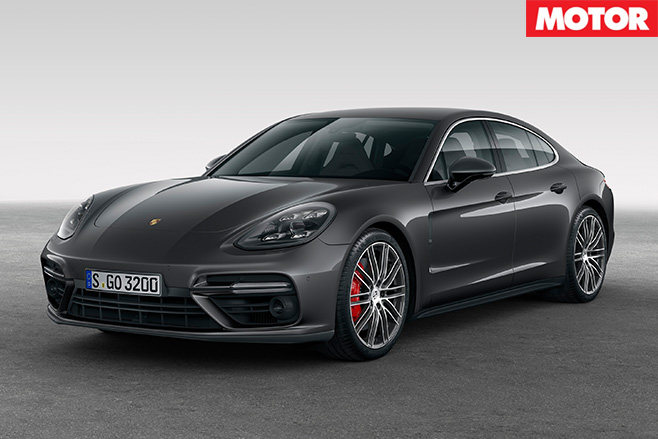
Zuffenhausen plays an important role in the history of Porsche, as it’s where the very first 356 production cars were built in 1950.
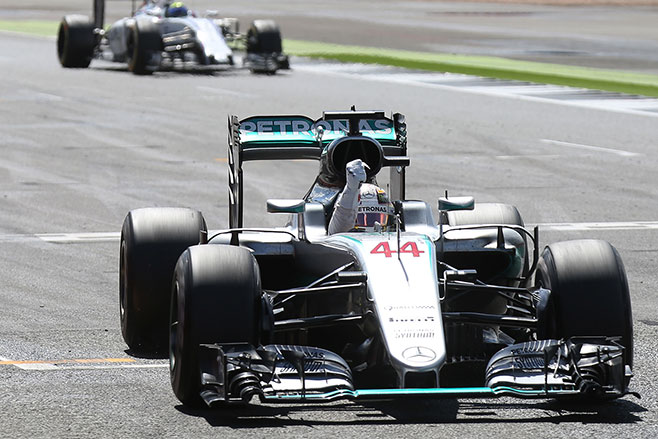
LEWIS Hamilton has cut Mercedes teammate Nico Rosberg’s world championship lead to a mere point after the Briton charged to a crushing win in a lively British Grand Prix.
In changeable track conditions, pole man Lewis Hamilton led every lap in a grand prix that started under the safety car in wet conditions, but then dried out.
It was Hamilton’s fourth win in his home grand prix.
If Rosberg wasn’t dispirited enough watching Hamilton bag a dominant win, his mood would have slumped further when stewards demoted him from second to third for illegally receiving technical advice over his radio.
Rosberg also had other problems extending beyond the Red Bull threat led by Max Verstappen, who was impressive again, overtaking the German around the outside of the attention-getting Beckett’s.
As the track dried, drivers came in for intermediates. And, later, slicks…
Hamilton’s only concern came when he slid on a greasy wet patch but was able to continue without losing ground.
On a dry track, Rosberg was finally able to catch and overtake Verstappen, but those positions were later reversed by the stewards.
The penalty related to a mechanical issue that surfaced late in the race. Engineers advised Rosberg to reset systems in his Mercedes and also avoid using seventh gear.
He fought on to cross the line ahead of Verstappen in second, but was then given a post-race 10-second penalty.
Rosberg pointed out after the race that the issue was critical and that he was stuck in seventh gear and likely to stop on track.
He must also be wondering where the hell his massive early season points lead has gone.
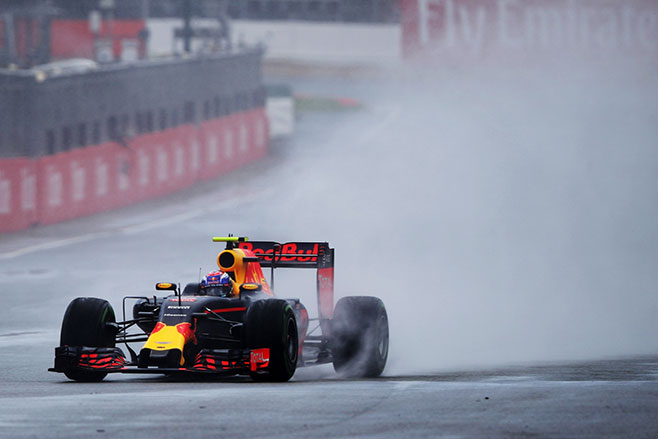
Bored, apparently.
After starting alongside Versappen on the second row, the Australian was never quite in the hunt.
“I think for the team and for the points it was really good,” Ricciardo said after his fourth-place finish the race.
“Obviously we gained a bit on Ferrari which is nice, but for me it was lonely and a bit boring. We lost a lot of time with the virtual safety car and that was just bad luck. This was out of our hands and there’s nothing we could have done different. It just came at the wrong time for me and we lost the position to Perez and then more than 10 seconds behind the leaders. Then not stopping again for the rest of the race you can’t catch this much. When the pace in the front is what it is you can get a tenth here or there but not half a second per lap. I was ready for a battle and some action today, but unfortunately it wasn’t given to me. It is what it is now and hopefully Budapest works better.”
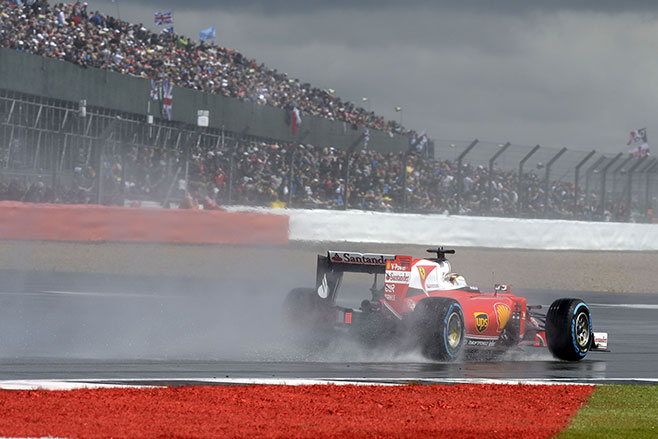
Vettel was another spinner at Abbey, and was classified 10th after copping a five-second penalty for helping the Williams of veteran Felipe Massa off the track.
Qualifying revealed that Mercedes still holds sway with Hamilton and Rosberg locking out the front row. But Red Bull is clearly improving, with Verstappen and Ricciardo barely separated in third and fourth, and ahead of the Ferraris.
Heading into Silverstone, after another controversial incident with Rosberg, Hamilton said he was strongly opposed to Mercedes introducing team orders to the F1 title fight because it robbed fans and, for the drivers, took the joy out of racing.
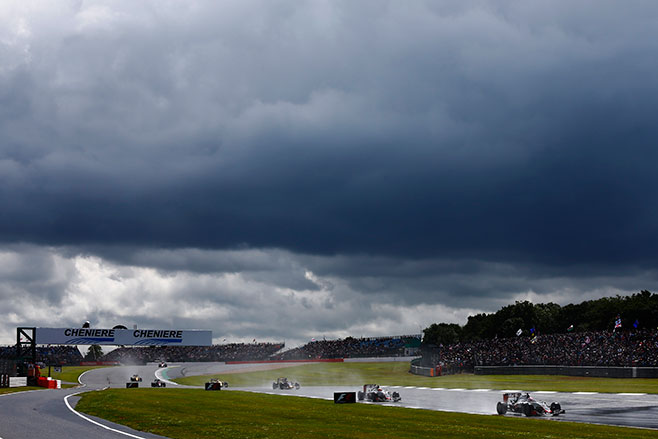
Mercedes will be happy that the team orders issue didn’t arise at Silverstone. Hamilton was simply too far ahead.
Red Bull Racing dominates Townsville Supercars round
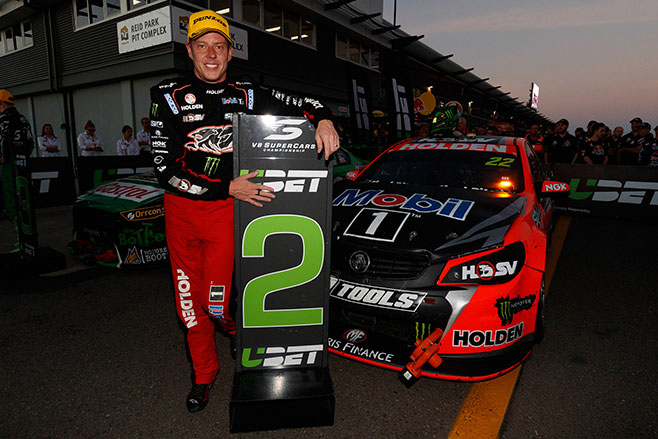
IT WAS a Red Bull double act on the streets of Townsville at the weekend with the energy drink’s two drivers sharing the spoils in the twin 200km races – Jamie Whincup winning on Saturday with Shane van Gisbergen triumphing a day later. The overall round winner was the Kiwi, with the Giz also taking a second place in the earlier race.
Ominously for the rest, Whincup and van Gisbergen now own the top two places in the championship.
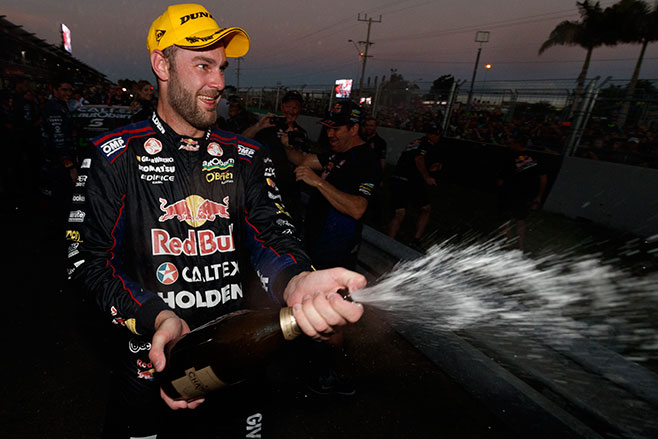
But Whincup nailed the restart for the two-lap dash to the chequered flag.
“The car was fantastic,” said Whincup. “I am rapt with the result. Like always, you have got to have quick cars to win races and we had two rockets today so a big well done to the engineers.
“The cars were consistent, it was a great day. There has been plenty of frustration going on behind the scenes. But there’s no need to worry about that now.”
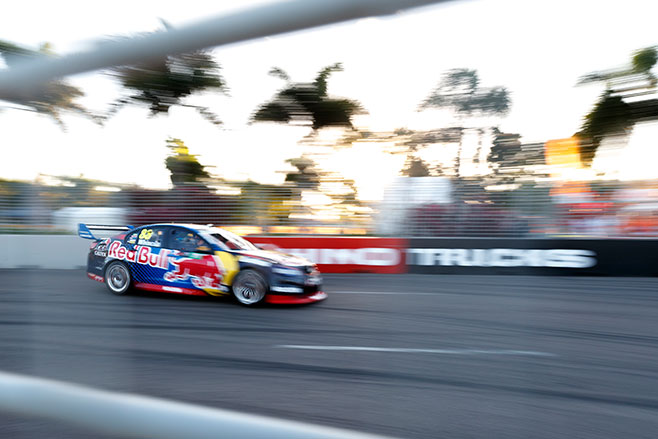
Still, Courtney and HRT teammate Garth Tander revealed some decent car pace, and hinted that even better things are not far away.
On Sunday, though, van Gisbergen won his third race of the year from a rejuvenated James Courtney, who benefited from a late safety car called in eight laps from the end. The HRT driver was one of a few who gambled on the upped pace offered by fresh tyres. The frontrunners chose to stay out on old rubber while Courtney slipped to ninth at the stop but then went on a hard charge to pip Winterbottom for second. Whincup was fourth.
Van Gisbergen managed his tyres rather well and had some rubber to play with right to the flag. “I was a bit worried after the safety car but had heaps of grip – I’m so stoked,” van Gisbergen said.
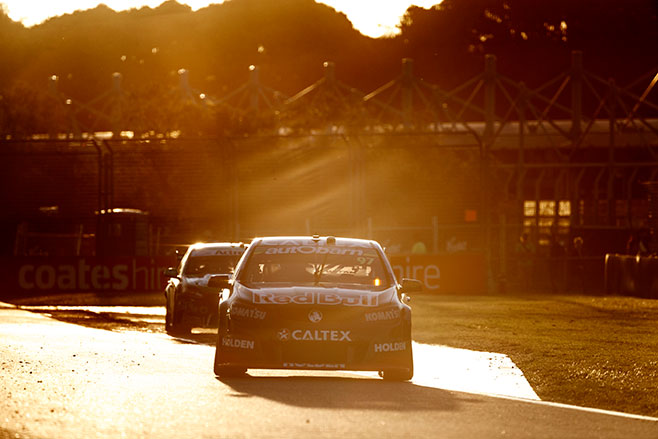
Crowd fave Craig Lowndes took 10th after struggling with his tyres throughout.
The Townsville weekend was also laced with speculation about the future of HRT and its drivers, whose contracts end this year. HRT still doesn’t know if it will benefit from factory Holden support next year, with the carmaker expected to reduce its financial commitment, but to what extent isn’t known yet.
Perhaps seriously, perhaps cheekily, Courtney told news agency AAP he’s considering several alternatives next year and may even take his family overseas to ply his craft. “Just weighing it up; it’s a big move for the family,” he said.
Want more Motorsport news?
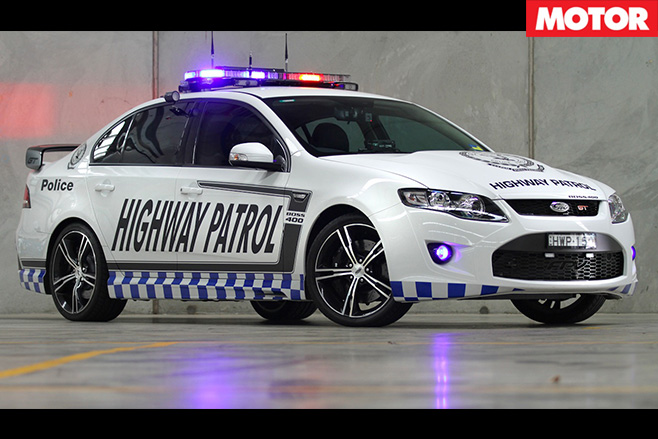
Every motorist dreads seeing a Highway Patrol (HWP) car – that is unless you’ve just purchased either a Ford Falcon XR6 Turbo or Holden Commodore SS in its afterlife, because they come up cheap at auction.
Typically a HWP car spends anywhere from one to three years being flogged on the road, notching up around 80,000km before then being flogged at auction, the most recent of which MOTOR attended in Sydney.
The hammer came down at $17,750 (plus around $500 in fees in all cases) for an early-2013 XR6 Turbo with 86,000km on its odometer. Bidding stopped at $18,750 for an early-2014 model with 85,000km, while the latest FG X commanded a jump – $25,500 for an early-2015 with 82,000km and $30,250 for a late-2014 with 62,000km on the clock.
The cheapest netted $20,000 for an early-2013 Commodore SS with 85,000km – but it was a lone VE Series II among a sea of newer VF Series I models. No further arms were raised beyond $23,600 for a late-2014 model with 93,000km while $26,000 bought an example of the same age but with 68,000km on the clock.

Of course beyond the condition and kilometres, these models have also been sitting beside freeways idling for most of their life beyond short bursts of acceleration to catch Old Mate doing 115km/h in a 110km/h zone.
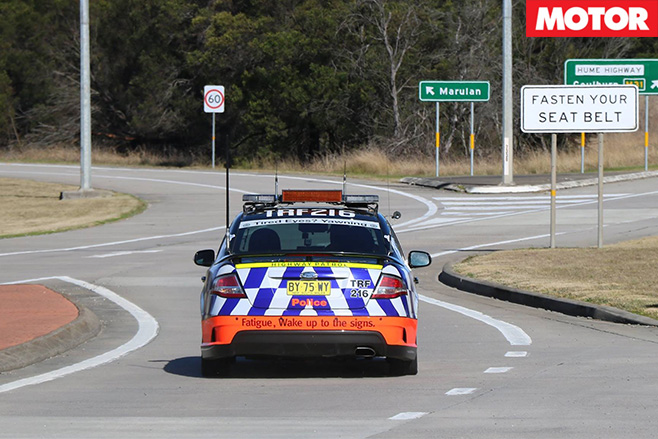
There are some quirky features that give a nod to the cars’ previous life, too. The Commodores include a ‘speed trap’ readout in their trip computer display, but the vehicle needs a speed radar installed to function. They also get a single button mounted between the front maplights that switches off all dashboard lights except the speedometer.
An ex-HWP car isn’t the perfect performance choice, but when an 18 month-old XR6 Turbo drops almost half its purchase price, still has a warranty and delivers 5.4-second 0-100km/h performance for around $25K, it’s tough to argue the toss.
All photographs from NSW Police Force.
Special edition Citroen C5 sedans and wagons are coming to Australia as a final send off to the French brand’s lauded, but ageing, hydropneumatic and Hydractive suspension technology.
Citroen’s mid-size C5 is the last car on sale to feature the innovative system first debuted in the 1954 Citroen Traction Avant, and most famously used in the lightyears-ahead-of-its-time 1955 Citroen DS.
Ten of the last C5s will be fitted with a 133kW/400Nm 2.0-litre turbo diesel engine never previously offered in Australia. Unique ‘BlueHDi’ badging and twin tailpipes will distinguish the flagship models, which have already been snapped up by diehard Citroen lovers.
A further 52 final vehicles will come with a 120kW/340Nm 2.0-litre turbo diesel engine. The 62 vehicle total – 25 sedans and 37 wagons – recognises the number of years hydro-pneumatic suspension has been offered.

Australians have bought almost 10,000 Citroens featuring the iconic suspension technology across models including DS, CX, GS, BX, XM, Xantia, C5 and C6.
Hydro-pneumatic suspension uses fluid-filled and nitrogen-filled systems in tandem to create an incredibly supple suspension with ride height adjustability and superior ride comfort. It was invented by Frenchman Paul Mages who joined Citroen in 1936 at the age of 17.
Other manufacturers – including Rolls-Royce, Maserati, Mercedes-Benz and Peugeot – have recognised the brilliance of the invention and licensed it for their own vehicles over the years.
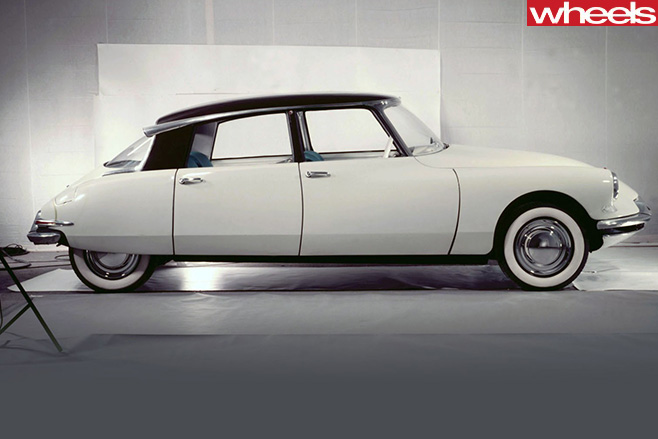
“While it’s sad to see both C5 and the hydro-pneumatic suspension system leave Australian shores, Citroen fans should rest assured that comfort will remain a top priority with a range of new vehicles being developed under the Citroen Advanced Comfort program,” said Citroen Australia boss Kai Bruesewitz.
Citroen CEO Linda Jackson warned previously that the landmark suspension had reached the end of its life. “Hydraulic suspension will cease because it is an old technology,” she said, before emphasising Citroen’s commitment to prioritising ride quality in future models.
“Comfort suspension is 100 percent part of our DNA.”
Car buyers aren’t hungry for the emissions-free cars manufacturers are being forced to produce.
For the second time in a week I’m hearing a senior car industry exec explain that customers are a problem. They’re human handbrakes, preventing smooth acceleration towards a safer, more sustainable future for those who make cars… and those who use them.
Dieter Zetsche doesn’t put it exactly this way, of course. His position as head of Mercedes and chairman of Daimler means he has a view from on high, and the language is equally elevated.
We’re in a large room in a modest little chateau in the south of France. It’s a bright and beautiful spring day outside, but it’s clear Zetsche sees difficulties, perhaps danger, ahead.
“Everybody knows that we have to go towards emissions-free driving,” he says. At the same time, the age of the digital, connected, autonomous car is arriving. “When you combine the two, you certainly can get quite a substantial change in our business, in our markets.”
And times of rapid technological change are often unkind to established names. Sceptical, conservative, demanding customers only add to the difficulties. There’s a “big discrepancy”, Zetsche notes, between market demand and regulatory requirements. Daimler, he says, is spending much more on development of electric drivetrains than autonomous driving technology.
“So far, people are not telling us: ‘Why don’t you finally come up with an electric car? I want it so badly.’ They are asking us why we can’t deliver more AMG vehicles. At the same time we have like 95 gram CO2 in 2020 for the car fleet in Europe, and this is not fitting perfectly well together.”
Consumer negativity also dominates discussion of autonomous technology, even though it has the potential to massively reduce road deaths. “You’re getting questions: ‘Well, do you forget about the fun of driving?’ But the majority of people are curious.
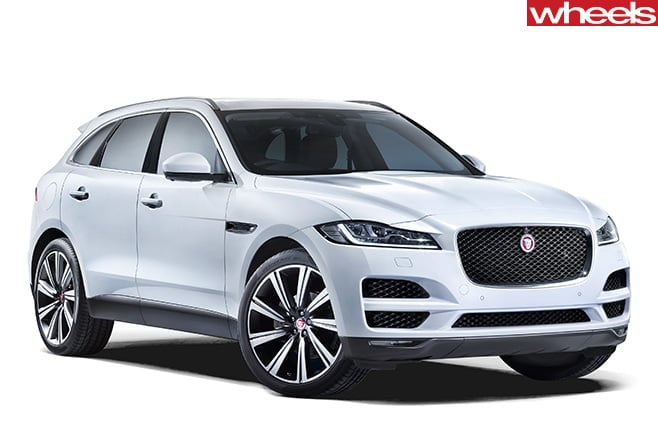
Less than a week earlier it was Jaguar’s design director describing customer influence on company strategy. The sun is setting over the Adriatic Sea lapping our island hotel on the coast of Montenegro as Ian Callum talks about the decision to go ahead with Jaguar F-Pace, the company’s first SUV.
They’re less aerodynamic and heavier, he acknowledges, without explicitly mentioning their inherently higher fuel consumption. “So there’s a whole issue of, is it the right car for the world at this time?”
“But, you know, at the end of the day customers decide,” Callum continued. “And it was very clear to us when we asked around the world, particularly in China and the US, that this is what people wanted. Very, very clearly. So we produced it.”
It seems the Car of the Future may be ready some time before the Customer of the Future exists to buy it.
More Jag SUVs
Expect more of where the F-Pace came from as Jaguar listens to the voice of its customers. “If it’s successful, then clearly we’ll think about doing more,” says Ian Callum. And the Jaguar design chief is confident of success.
“I think it’s going to be the best-selling Jaguar ever,” Callum predicts.
TELL ME ABOUT THIS CAR
When SUVs came into existence in the 1990s I thought the ‘S’ part was a silent letter. How can any high-riding family wagon with off-road pretensions also be Sporty? Fast forward to today and we’re surrounded by SUVs from Porsche, BMW, Mercedes, Audi, Range Rover and others that would show a 1990s sports car the fast way around a racetrack. It’s astonishing how car company engineers with big brains and bigger budgets can make two tonnes of family wagon hustle like a high-performance athlete.
Jeep’s reputation is built on rugged off-road ability, but even this iconic American brand is keen to emphasise the Sport in Sport Utility Vehicle. The Jeep Grand Cherokee is a large, luxurious family wagon with serious off-road cred, and the $90K SRT version has a potent V8 engine and sportier suspension designed to make this SUV fast on the road as well.
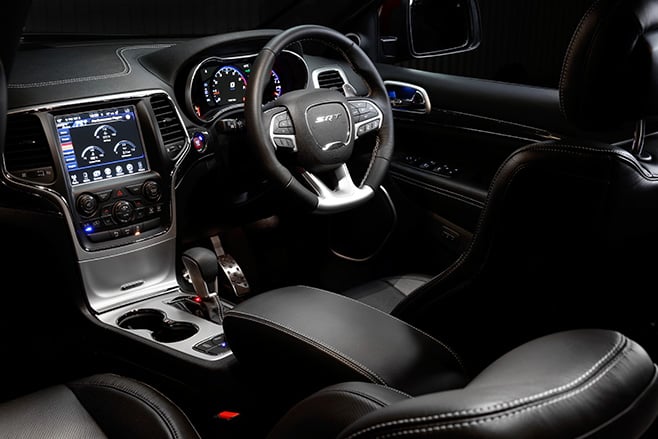
Then there’s the Jeep Grand Cherokee SRT ‘Night’ Edition, which takes everything the standard SRT has and adds a few choice performance and visual enhancements to make it a truly special, and very menacing monster SUV.
STRENGTHS
- Only 128 examples of the $97K Night edition will be imported to Australia. So if exclusivity is your thing, act quickly. The ‘Night’ pack includes darkened windows, satin black alloy wheels, and black badging. Inside you get black leather with silver stitching, a stonking stereo and panoramic sunroof.
- The SRT Night edition packs the same thunderous 6.4-litre V8 engine as the standard SRT, but it gets a trick ‘Launch Control’ system which helps this automotive heavyweight power down the quarter mile drag strip in just 13.1 seconds – that’s faster than a Porsche 911 from a decade ago!
- It’s surprisingly accomplished at pounding down twisty roads at pace, if that’s your thing. The big engine gives this wagon real zest for speed, the steering is light and direct, and the suspension does a good job resisting bodyroll and delivering dynamic zeal.
- The Grand Cherokee is a roomy beast, with plenty of space for adults and luggage. It’s also luxurious inside: full leather, loads of fancy features and a thumping Harmon Kardon stereo.
- It also has a ‘Valet’ mode, which hobbles this powerful beast so the local hotel valet won’t be tempted to take your pride and joy on a cross-city joyride.
- You might think the injection of all this muscular performance would hamper the Grand Cherokee’s considerable off-road skills. Think again; it’s still one of the best vehicles for tackling the great beyond, though you may want to change the tyres for something more mud friendly, and make sure there are petrol stations at suitable intervals…
- …because that big 6.4-litre V8 engine is thirsty, even though Jeep boasts it has ‘Fuel Saver Technology’. According to official figures, the Grand Cherokee SRT Night will consume 14L/100km; we wouldn’t be surprised if real-world driving exceeded that. Performance doesn’t come free after all.
- The ride is definitely on the sporty side of luxurious. For the Jeep’s suspension to control such a high, heavy body, it necessitates compromises with ride quality. This means you will feel the bumps and joins in the road, and are better off not taking a sip of coffee when you approach a speed hump.
- A responsive accelerator pedal is usually a good thing, but the Grand Cherokee SRT Night takes that a bit too far. It is overly sensitive initially, which can lead to aggressive lurching away from a standstill. Better to employ a ballerina’s deft touch – initially – for a smooth yet still speedy getaway
- At 2336kg the Grand Cherokee SRT Night is a heavy car. Jeep says this model gets some lighter suspension components, but unfortunately they don’t help the bottom line because all that extra equipment negates any weight saving.
For the price? No. None of the European SUV brands can match the Jeep’s size and space and serious pace. If you’re willing to accept a smaller cabin, the Audi SQ5 and Jaguar F-Pace have sub-$100K models with decent performance. If you want the same size in a Euro, then you’ll have to put up with a far less potent dynamic package.
Adaptive suspension can often throw up more questions than answers: is the premium over standard dampers too much? Which fifty shades of sport settings do I choose for a particular road? Is there a cure for nail biting?
Even Volkswagen Australia seems unsure, having launched the facelifted Polo GTI without the Sport Select suspension available overseas. Three months later it, umm, err, uhh, okay, yes, included it as standard for no extra cost. That makes the first question easy to answer.
The second is a cinch, too, because the MY16 Polo GTI has just one button on its dashboard labelled Sport. Press it and the 141kW/320Nm 1.8-litre turbo four-cylinder makes a deeper growl, while steering weight becomes heavier and the suspension gets its hard on.
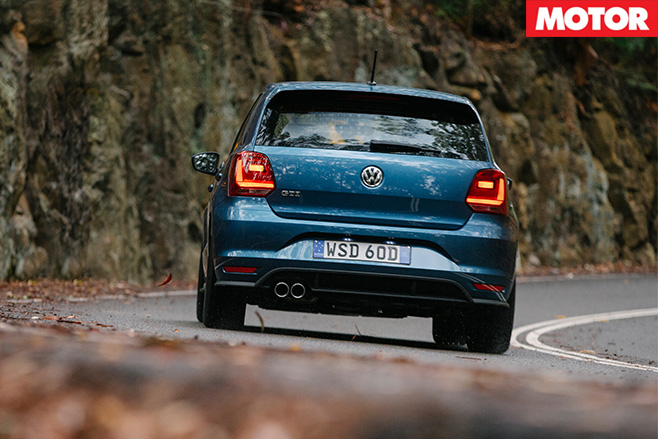
With 40Nm more torque than a 1364kg Mk6 Golf GTI, this 1234kg hot-hatch feels every bit as quick as its 6.7-second 0-100km/h claim. And we’re pleased to report the fast-but-boring hatch bit is an illusion, too.
In corners the smallest VW GTI feels transformed, with its excellent 17-inch Bridgestone Potenza rubber now backed by a Sport stability control mode and extended electronic diff lock function. Playing Polo is no longer the frenetic game of managing wheel-spin on corner exit it was with the pre-facelift twincharger.
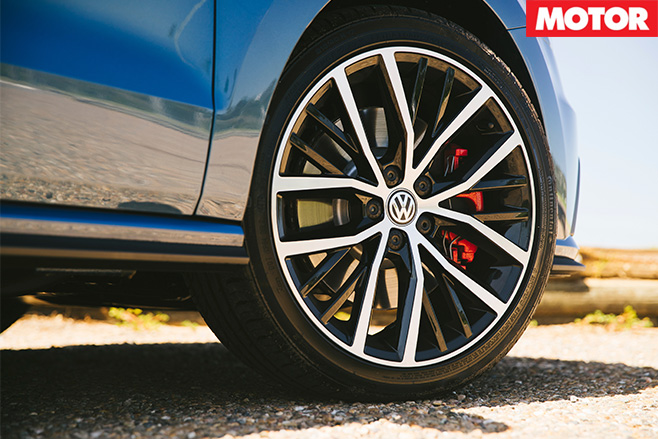
It isn’t during hard punting that the Volkswagen loses out, but rather around town. The cabin feels semi-premium (now with rear-view cam and brilliant Apple CarPlay/Android Auto mirroring tech), however the silly-high driving position and loose steering are a world away from the snug, pointy Ford that rewards during every sprint to the shops.
It’d be ace to have the firmer steering (which at least stabilises the on-centre) and deeper soundtrack with the softer suspension… but that would require another mode.
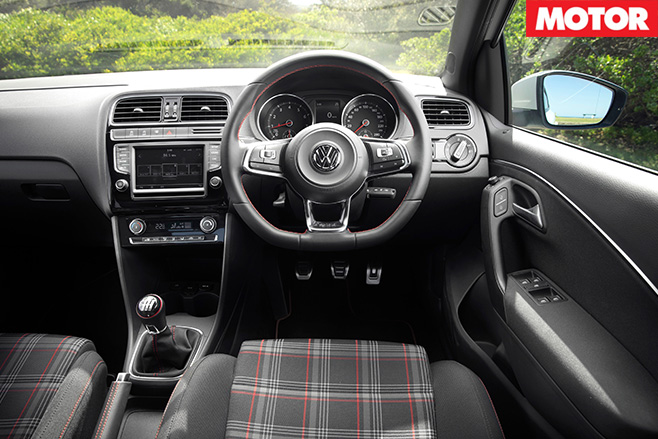
4 OUT OF 5 STARS
LIKE: Grunty engine, adaptive dampers a big plus DISLIKE: Steering lacks on-centre feel, high driving position
SPECS Engine: 1798cc inline-4, DOHC, 16v, turbo Power: 141kW @ 4300-6200rpm Torque: 320Nm @ 1450-4200rpm Weight: 1234kg 0-100km/h: 6.7sec Price: $27,490
Petrol bowsers have never been more confusing things. Do you need 91 octane fuel or 95 or 96 or 98? What’s the difference anyway?
The different numbers are all about how stable a fuel is once it’s inside the engine. If you compress petrol enough, eventually it will explode. And even though compressing petrol and then exploding it is how car engines work, this process needs to happen in the correct sequence of events. If the explosions happen randomly, they can be at the wrong time and cause major damage to the engine.
An engine needs controlled, properly timed explosions. So, the higher the octane number (its octane rating) the less likely that particular grade of petrol is to explode under pressure. That means high performance engines (which tend to compress their fuel more to get a bigger bang) can run on it without those unexpected explosions and, therefore, without damage.
Which do you need? The best tip is to look inside the fuel-filler flap or the owner’s handbook. You should be able to find the car-maker’s recommended octane rating for your engine there. Will using the expensive, 98-octane stuff in a car designed to run on 91 make more power? Sorry, nope.
Some high-octane fuel has cleaning qualities, which can improve the efficiency of older, dirty engines that have run on regular unleaded for years. A tank of high-octane petrol every once in a while can be worth spending the extra few bucks for.
Co-developed with Toyota, the all-new and fabric-roofed BMW Z5 will only be soft on top…
THE FIRST tangible evidence of BMW’s sports car tie-up with Toyota has been snapped near Munich in the form of the Z4 convertible replacement. From these spy-snaps, it’s the lauded Porsche 718 Boxster, Alfa Romeo 4C, and maybe even Jaguar F-Type firmly in its crosshairs.
Known internally as the G29, the new-from-the-ground-up BMW Z5 is set to surface sometime late next year at the earliest in Europe, with the completely different looking J29 Toyota Supra version said to follow suit not long afterwards. We hear that, unlike the open Bavarian two-seater, the Japanese version will be rebodied as a 2+2 coupe.
Long, low, and wide, the BMW Z5 roadster eschews the BMW Z4’s retractable folding hardtop for the more preferred soft-top variety, bringing with it a lower centre of gravity as well as fewer kilos. The result – we hope – is newfound lightness and alacrity; two virtues missing from the existing German convertible.
Perhaps this will help elevate the BMW above unflattering show-pony comparisons with the Mercedes-Benz SLK and Audi TT. We’ll have to wait and see about that.
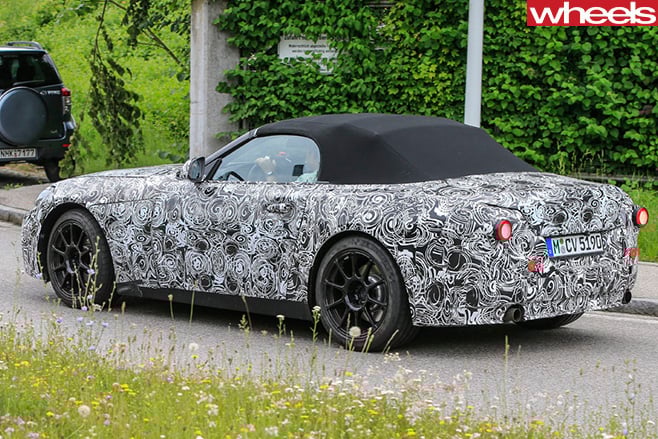
Of course, whichever modular powertrain is employed, all will be mounted longitudinally up front, behind the axle to help optimise weight distribution, and driving the rear wheels via either a six-speed manual or eight-speed ZF-supplied gearbox. That long nose silhouette – a BMW roadster trademark since the Z3 landed 20 years ago and carried over through two generations of Z4 folding hardtop convertibles (as well as the achingly lovely original M and first Z4 coupes) – is clearly evident in the spy shots.
BMW hasn’t even officially confirmed that the Z5 name will be used, but it is obvious that development is well advanced. Don’t expect to see anything in Australia before late 2018, though we have a hunch that prices may undercut the existing BMW Z4’s $80,000 to $120,000 range.
Meanwhile, the J29 Supra (if that’s what it will be called) will be the first grown-up sports coupe since the classic A80 Supra succumbed in 2002, sitting above our 2012 Car of the Year-winning Toyota 86.
Bring ‘em all on, we say.
Have spy pics of your own? We’d love to see them. Just email them to [email protected]
US drifter Ryan Tuerck is building one wild Toyota 86 for the US drift series, powered by a F136 4.5-litre V8 from the Ferrari 458.
With its light weight and agile chassis, the 86 is a natural choice for drifters, but few retain the standard 147kW/205Nm FA20 2.0-litre flat-four.
To endow the Toybaru with enough urge to turn the treads at high speed, engine swaps range from the 2JZ-GTE 3.0-litre twin-turbo six from the old Toyota Supra to a NASCAR V8.
Tuerck’s project is possibly the most ambitious yet, however, due to the need to adapt the engine from a mid- to a front-engined layout.
Just how this is going to be accomplished is still unclear, as the preview video uploaded to social media shows only the bare engine sitting in the 86’s empty engine bay.
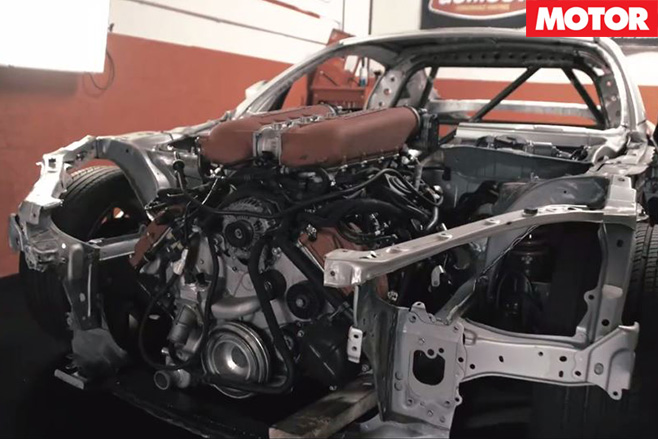
In the regular 458 it produced 419kW/540Nm, however in the 458 Speciale that increased to 445kW produced at an incredible 9000rpm.
