
This weekend’s Canadian Grand Prix looms as the defining moment in Daniel Ricciardo’s F1 career.
By his own admission, Daniel Ricciardo is miles from winning a Formula 1 world title. After six years in the premier motorsport category, the smiling Australian has amassed a grand total of three GP victories.
Or, as he puts it; “I’m 27 very soon and I don’t even have anything close to a world title and I believe I should have something like that very soon.”
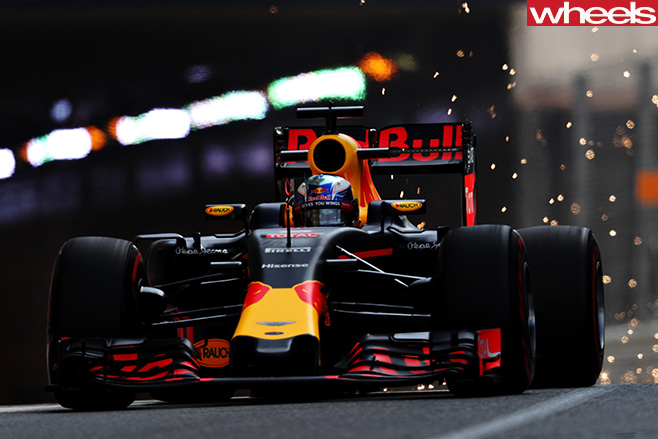
Each of Ricciardo’s wins arose from situations where the Silver Arrows had shot themselves in the foot, leaving victory there for the taking. While they weren’t won on outright speed, his trio of triumphs were achieved through a combination of tenacity, ingenuity, and Red Bull’s strategic prowess.
Perhaps the icing on the cake, Ricciardo achieved glory in situations where his four-time world champion teammate – and Aussie F1 fan enemy number one: Sebastian Vettel – couldn’t.
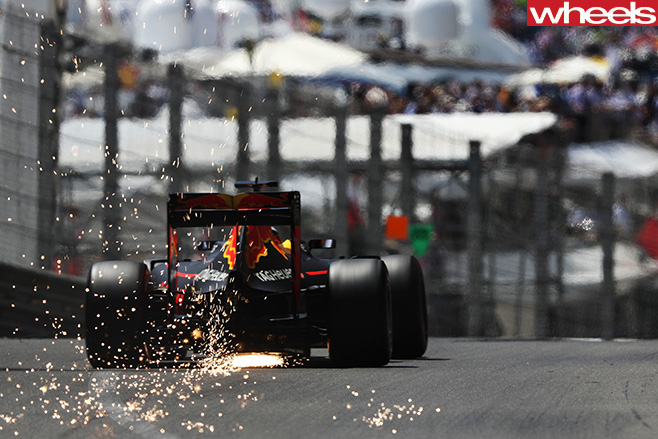
Fast-forward through a year of woefully underpowered Renault misery to 2016; two seasons since Ricciardo’s eventful maiden victory on the streets of Montreal.
This weekend, he returns to Canada off the back of two missed opportunities at race wins in Spain and Monaco respectively. Both were bona-fide chances at victory: the Aussie was leading the race, had it all under control, only for schoolboy errors from Red Bull pit-lane mechanics to stuff his race worse than a Christmas turkey.
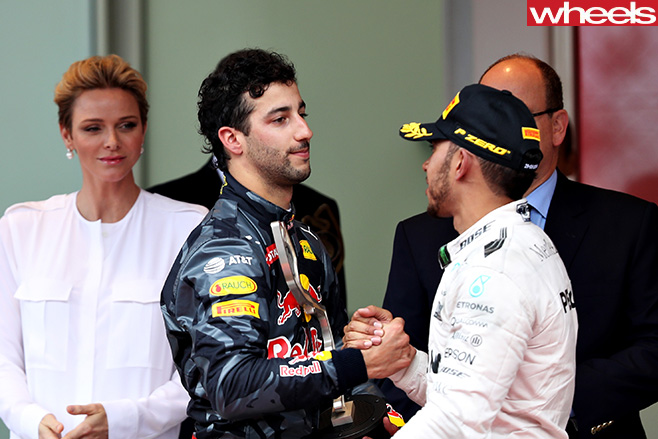
It’s an unfortunate reality for Ricciardo, who returns to Circuit Gilles Villeneuve with his third teammate in as many years – this time sharing the team garage with uber-hyped Dutch wunderkind Max Verstappen.
Christian Horner and Red Bull’s pit-wall brains trust may have gambled and lost on a Ricciardo victory in Spain, but the team won big time, with Verstappen breaking through to record his maiden F1 win in his debut drive for the squad.
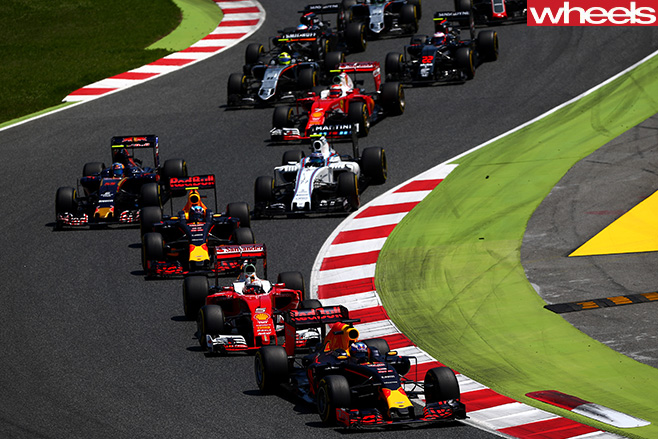
Adding to the pressure on Ricciardo, argue conspiracy theorists, will be the cautionary tale of what happened to Red Bull’s last Australian F1 star, Mark Webber. Webber learned the hard way where the team’s allegiances fell when he and his younger, more marketable, more Helmut Marko-friendly, teammate at the time – Sebastian Vettel –went down to the wire in their battle for the 2011 championship.
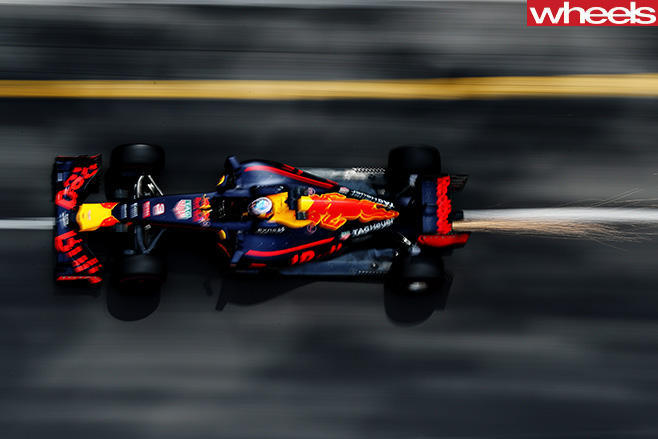
There is no better place to do it than the same hallowed ground on which he first tasted victory champagne in F1. So come on Ricciardo, let the Honey Badger reign supreme, and bring home the victory we all know you deserve!
Forget the familiar looks, this brilliant new Audi R8 brings significant technical improvements and user-friendliness while retaining a howling V10 soundtrack
WHAT IS IT? One of our favourite supercars, redone. This new R8 mightn’t look that different, but under that slightly sharper and more angular body sits a lighter and stiffer chassis infused with carbonfibre. There’s a new tech-heavy interior, too, and extra electronics in the chassis to boost the sense of fun and speed. What hasn’t changed is the R8’s cylinder count, with Audi’s superb 5.2-litre V10 nestled behind the cockpit.
WHY ARE WE DRIVING IT? Because if the original R8 was good, this new car promises to be even better thanks to less weight, retuned electronics, a V10 soundtrack from the gods and even more power. That makes it a helluva mouth-watering prospect. This is also our first opportunity to sample the R8 in right-hand-drive on Aussie roads, and to spend some serious seat time in the ‘baby’ R8, the entry-level 397kW V10.
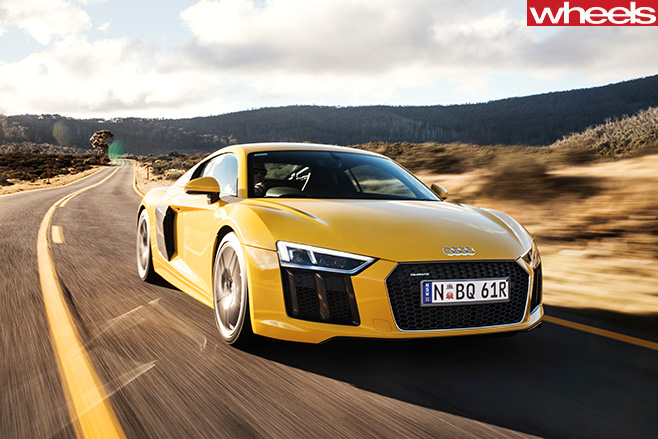
THE WHEELS VERDICT Brilliant from nose to tail. New R8 is usable, friendly, beautifully built and easy to drive, yet still mind-alteringly fast and exciting. And did we mention that magical V10? It remains one of great modern supercar engines, especially in more potent V10 Plus guise.
PLUS: That epic V10; the noise; chassis balance; easy to drive; raw and exciting MINUS: Styling changes perhaps too subtle; interior not OTT enough for some; plastic gearshift paddles feel cheap
THE WHEELS REVIEW THIS isn’t the first time we’ve driven the second generation of Audi’s flagship supercar. It’s not even the first time we’ve driven it on local soil – Audi shipped out a bunch of left-hook versions a few months ago, and we promptly belted them around Australia’s toughest race track, Mount Panorama.
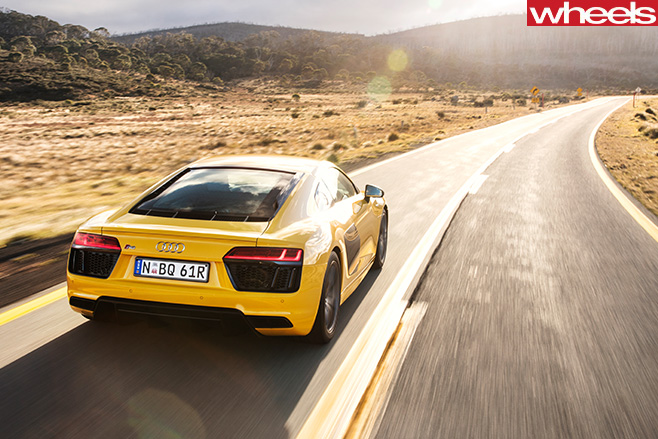
There are other differences, too. Like softer suspension with Audi’s magnetic dampers (the Plus uses a stiffer fixed set-up with larger sway bars), different gear ratios, no carbon-ceramic brakes, and subtler design cues (sans the Plus’s fixed carbonfibre rear wing).
Oh, and then there’s the price, which at $354,900 is $35,000 less than the Plus.
So does all this mean the regular V10 feels limp-wristed and mealy mouthed, compared to the razor-sharp violence of its more expensive sibling?
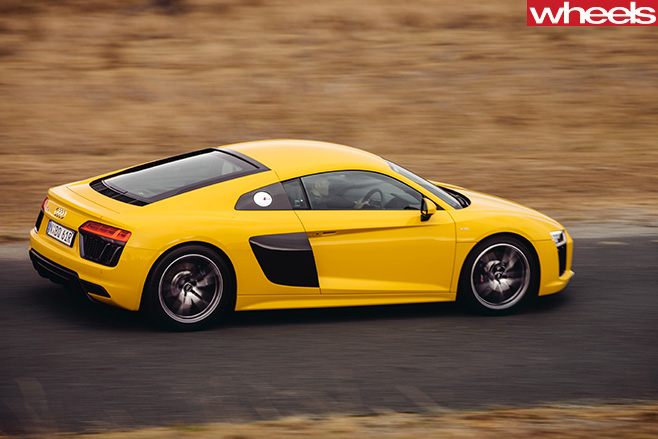
It doesn’t hone in on its lofty 8700rpm redline with the same ball-tearing fury as the Plus, or have the mid-range punch we’re so used to in this age of turbocharging, but it remains one of the great modern supercar engines.
The chassis is up to the job, too. Like the Plus, the regular V10 rides on a structure that’s lighter and 40 percent stiffer than before, thanks to a blend of aluminium and carbonfibre. The wheelbase and most of the dimensions remain the same, bar width, which has grown by 40mm.
All of the handling traits that made the old R8 so great remain – the inherent sense of balance and approachable limits – but this new version is so much sharper and lighter on its feet.
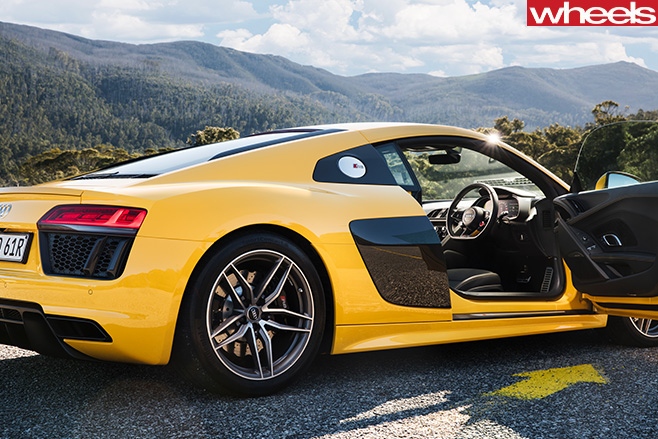
Push really hard and it will understeer, but it’s so gentle and progressive that the limits are well telegraphed.
At 1610kg, the regular R8 is 60kg heavier than the carbonfibre-festooned Plus, though you’d be hard-pressed to notice the extra heft on the road.
What is noticeable is the more subdued soundtrack. Both versions are fitted with the optional sports exhaust as standard in Australia, but the Plus scores an extra exhaust button on the steering wheel that turns the V10’s howl up to 11.
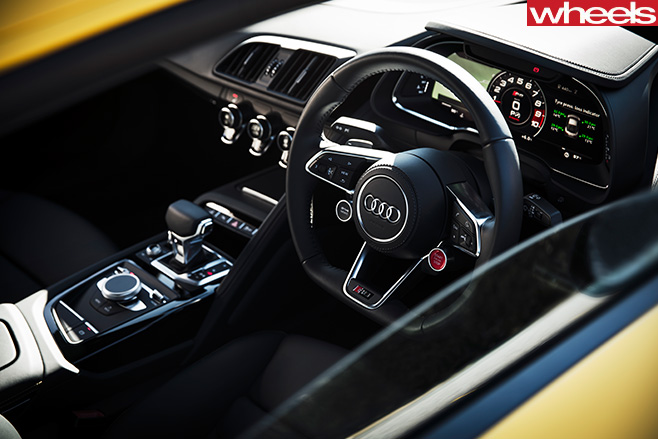
The only real letdown is the gearshift paddles. Where other supercars use paddles beautifully hewn from aluminium, the R8’s are small, plastic and feel cheap.
Then there’s the question of value. The Plus’s extra power, carbonfibre body kit and carbon brakes (which are worth almost $20K alone) more than justify its higher price.
The extra volume of that howling V10 soundtrack is also worth the extra outlay, let alone the step-change the more powerful R8 delivers above 6500rpm as it rushes to its lofty 8700rpm limiter.
It shouldn’t surprise, then, that Audi expects 80 percent of buyers to opt for the Plus. If, however, you’d prefer to spend the extra $35K elsewhere, the ‘entry level’ R8 is so exciting, so friendly and so usable that you won’t be disappointed. On public roads, it’s all the supercar you’ll ever need.
SPECS Model: Audi R8 V10 Engine: 5204cc V10 (90°), dohc, 40v Max power: 397kW @ 7800rpm Max torque: 540Nm @ 6500rpm Transmission: 7-speed dual-clutch Kerb weight: 1640kg 0-100km/h: 3.5sec (claimed) Fuel economy: 11.4L/100km (EU) Price: $354,900 On sale: Now
Three-car factory assault on legendary Colorado hillclimb.
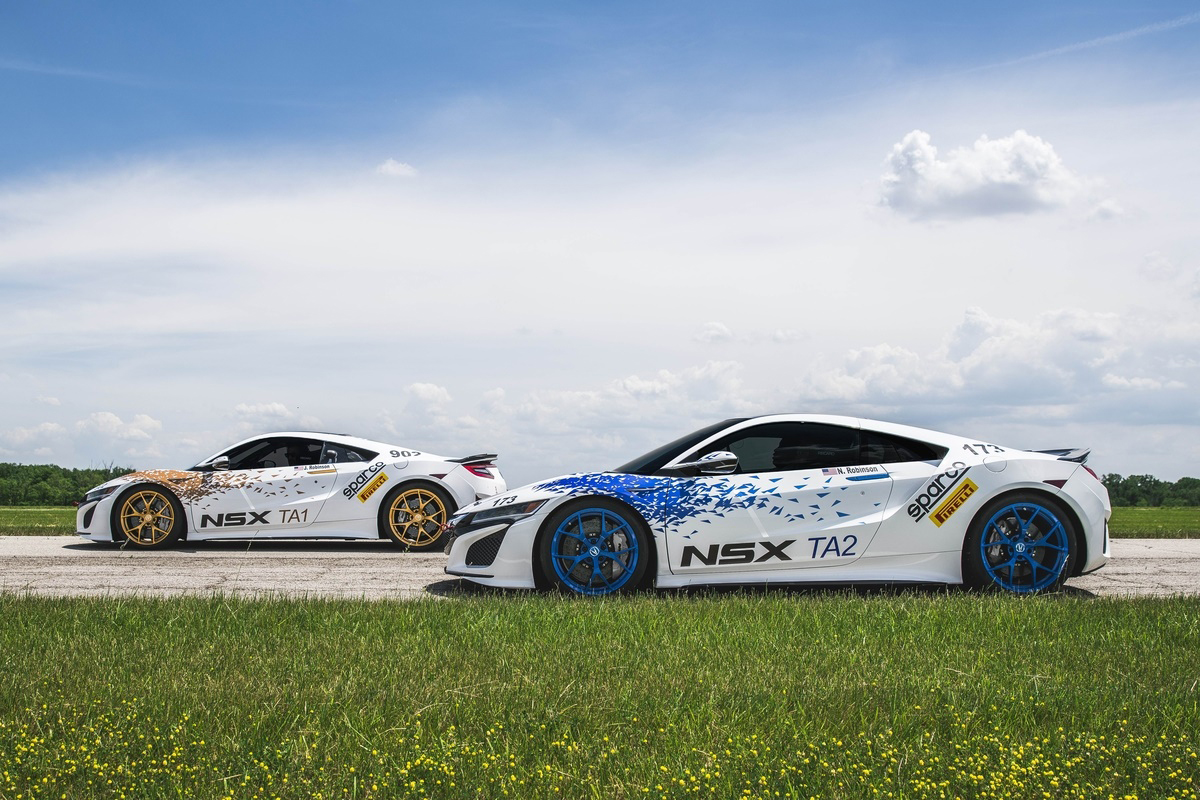
A TRIO of 2016 HONDA NSX supercars will form a factory-backed assault on the 2016 Pikes Peak International Hill Climb on June 26. Two of NSXs will compete in the Time Attack classes, with a third competing in the Electric Modified Vehicle Class.
The two time attack NSXs tackling the 19.98km, 156-turn Colorado hillclimb will be steered by brothers James and Nick Robinson, both members of the company’s North American engineering team, where the NSX is sold under the Acura brand.
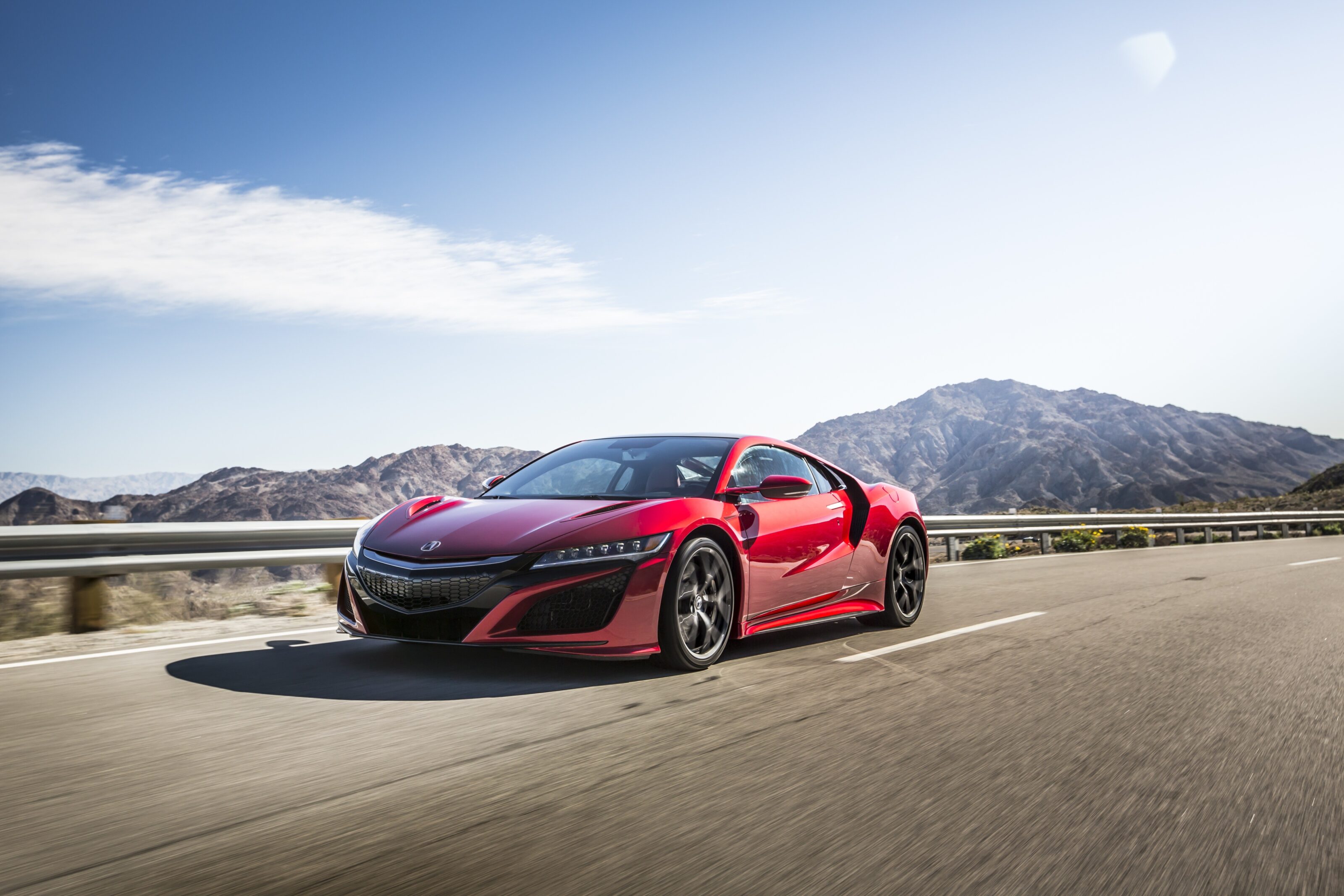
James, who has competed at Pike’s Peak for the last four years in an original NSX, will drive a production version of the new supercar in the Time Attack 1 class, with changes limited to weight reduction and a freer flowing exhaust. Brother Nick will enter the Time Attack 2 class in a stock NSX bar roll-cage and mandated safety gear. Both NSX’s will use the factory twin-turbo V6, nine-speed dual-clutch transmission and three-motor Sport-Hybrid All-wheel drive (SH-AWD) system.
It’ll be down to Tetsuya Yamano, who competed on the mountain in 2015 in a Honda CR-Z, to drive the four-motor EV Concept that boasts four-wheel independent torque feed, in what Honda describes as “the ultimate embodiment” of “Electric SH-AWD”.
“Pikes Peak is like no other race in the world and offers a unique opportunity to showcase the power and performance of our products,” said vice president of Acura North America, Jon Ikeda.
The legendary has seen a renaissance somewhat in the last few years, with Peugeot – who battled furiously with Audi in the 1980s for the race record – using nine-time World Rally Champion Sebastien Loeb to lower the time of the now fully-paved contest to 8m13.878sec.
The road-going Honda NSX will arrive in Australia this November, with an estimated starting price of around $300,000.
KIA Australia will introduce a four-door sedan in 2017 aimed at chasing Holden and Ford sales when local automotive manufacturing comes to an end.
With a price tag expected to top $50,000, it will also be the company’s most expensive product to date, as reported by Wheels last month.
Codenamed ‘CK’, the sedan will be rear-wheel drive, like the VF Commodore and FGX Falcon, but will be slightly smaller than the locally-built sedans. The CK will use the same platform – and most likely technology such as engines – as the forthcoming Genesis G70 sedan, which was unveiled at the 2016 New York Motor show as a direct rival for the 3 Series, Mercedes C-Class and Audi A4. In fact, Kia will beat Hyundai’s premium arm to the market, with the new sedan likely to reach Australian showrooms ahead of the G70’s arrival.
As the flagship, the CK will sit above the Kia Optima, which saw an all-new model introduced in late 2015, and will stretch beyond the most expensive Optima GT model, which starts at $43,990. That would push the price of the new sedan to $50,000 or more – unprecedented for a Kia sedan. Currently, the Kia Carnival Platinum CRDi carries the largest price-tag in the Korean maker’s range, at $60,990.
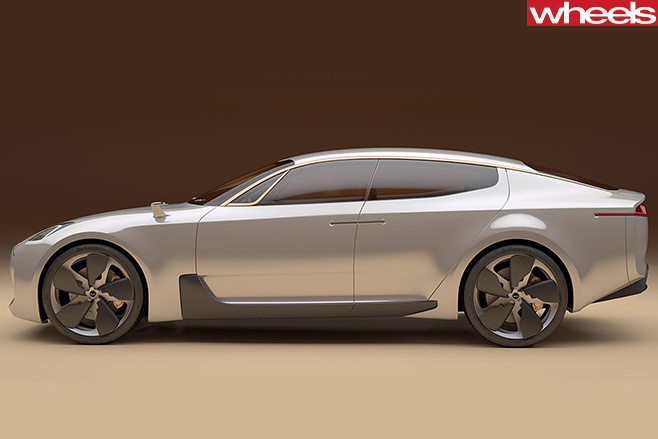
While the Genesis model will focus on luxury, the Kia version will be a more athletic model, he suggests. “For us in Australia, the best effect would be sports prestige,” he said.
Meredith also pointed to the CK’s arrival as potentially filling a niche left by the closure of the Holden and Ford factories, which will draw the curtain on rear-wheel drive, six-cylinder sedans built Down Under. While the Ford Falcon name won’t continue, the next Holden Commodore will be fully-imported and likely front-wheel drive for the first time.
That makes the CK, as a rear-wheel drive offering, a potential alternative for larger car buyers, suggests Meredith. “From a timing point of view, if the car does come as it’s supposed to come in that latter part of [2017], that works in with the unfortunate closure of local manufacturing. So it gives us opportunity in that regard.”
Meredith was careful to emphasise that there is no joy in the local operations of Holden, Ford and Toyota closing. “It’s a shame that manufacturing is closing,” he stressed. “It’s just good fortune for us if it [the CK Sedan] does arrive at that time.”
It used to be no fun being crazy.
Australia has a spotty history of locking up nutbags – Pentridge, Boggo Road, the Big Brother house – but down among the worst of the worst are two defunct insane asylums in Sydney: Callan Park in Rozelle and Peat Island at Mooney Mooney.
Both have some awful and tragic history buried – some of it literally – in their grounds; at Peat Island, one patient was locked in a steel container and left there until he died. Speaking of being locked in a tiny steel box made by crazy people, I’m feeling a bit like I might die myself.
We’re trundling the Abarth 695 Biposto through the damp remains of the Callan Park asylum. Biposto sounds like Italian for “going postal”, which would be apt for our horror-movie surroundings, but, in fact, it just means “two-seater”. (Does everything sound cooler in Italian? We’d take a Quattroporte over a Four-Door any day; maybe Proton should rename the Preve the Pica di Merda and see if it helps.)
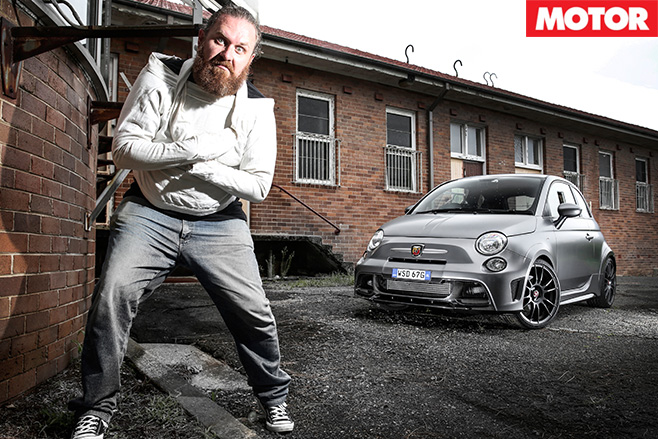
The 695 has been more thoroughly stripped-out than a Queensland nickel company in an election year: the back seat is gone, replaced with a cargo net; there’s no radio; the interior door panels are just flat slabs with a cloth strip for a handle; even the air vents are just honeycomb grilles, to save the weight of the adjustable vanes. In fact, Abarth has produced such a bare-bones car that compared with the standard Fiat 500, total weight has gone from 900-odd kilos to… 997kg. Oh.
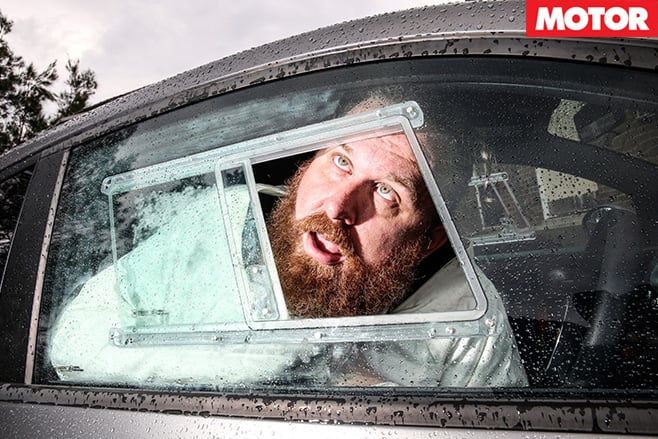
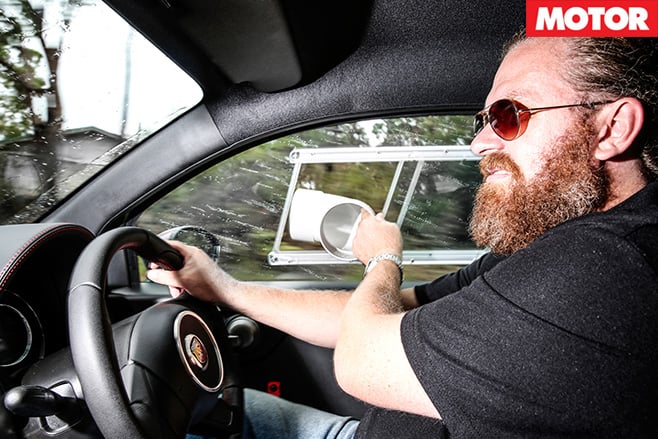
But the two things that are really noticeable right now are that the glass windows have been replaced with plastic with only tiny sliding apertures in them, which funnel a grand total of zero air into the cabin – and there’s no air-con. On a crisp winter morning that would probably be fine, but today – with the Sydney weather doing a creditable impression of Thailand’s steam-bath humidity and relentless rain – the Abarth is fogging up like a union boss’s memory.
It was built in the 1870s as an overflow facility for the overcrowded Gladesville Hospital for the Insane, which begs the question of just how many crazy people there were in Sydney. Not as many, I suspect, as there are at the Abarth skunkworks.
Now it’s partly used for the Sydney College of the Arts – so, roughly the same clientele, then – and partly left to gently moulder away; a hodgepodge of grand old sandstone, red brick, broken glass, and the tangled remains of stripped-out wiring and plumbing. Most of the doors are sealed up with plywood; many of them carry warning signs about asbestos. The roofs bristle with lightning rods.
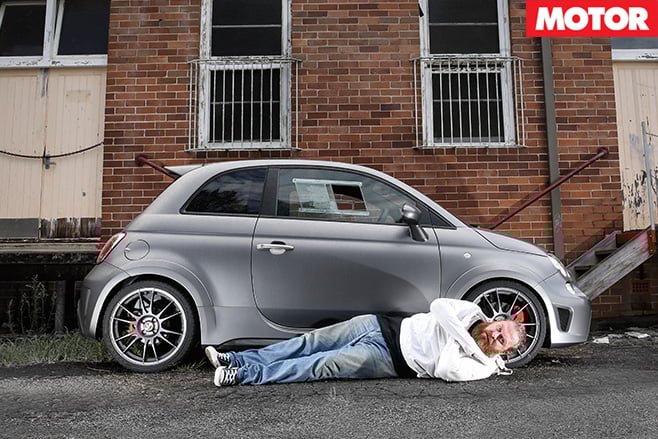
Looking at it shrouded in rain, the asylum seems like a sad scar on the city. On the other hand, it’s a strangely apt setting for the 695. Both bear the marks of unhinged lunacy and, perhaps, gleeful sadism. Speaking of which, photographer Cristian and I have to get back into the sweat-box and start heading north to see if we can’t outpace the weather.
For an extra $15,000 – yes, ouch – you can get the 695 fitted with a race-spec dog ’box, which Fiat-Chrysler Australia claims is a first for a street-legal car; no synchromesh, which makes changing gears harder but faster.
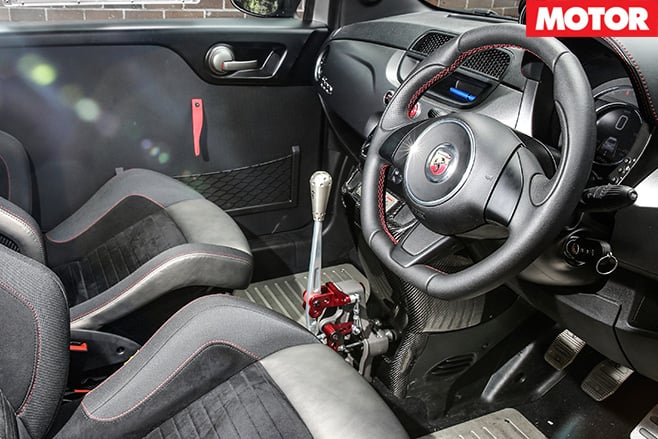
On the other hand, it’s a recalcitrant sonofabitch when you’re trundling along in heavy traffic. It’s the only road car I’ve ever driven where, if you don’t have the revs halfway round the meter – such as, say, all the time when inching through suburbia – you need to rev-match on the way up and again on the way down.
If you don’t blip the throttle between changes, you get a horrific graunching sound to remind you that you’re turning your 15-grand transmission into a box of metal shavings. Get it wrong and it sounds like the entire transmission might drop out onto the roadway; however, there were times when I thought that might not have been a bad thing.
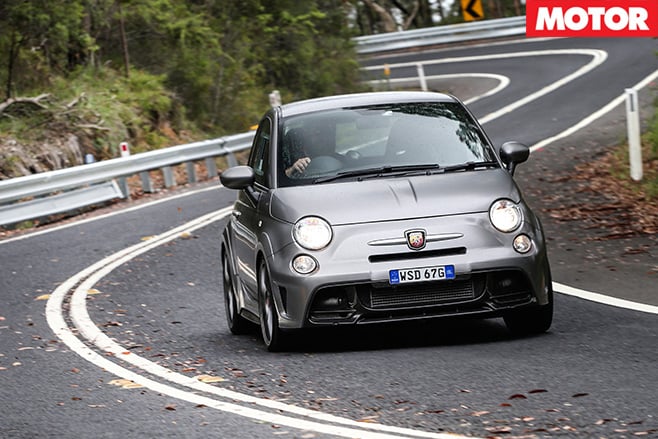
It’s decidedly track-focused – FCA calls it a “road-legal race car” – and at its best it’s utterly engrossing. Still, there’s no hiding the cheerful Fiat 500 bones – despite the Sabelt buckets, you sit very high, and no amount of splitters and side skirts can hide the fact that it’s cuter than a bug’s ear.
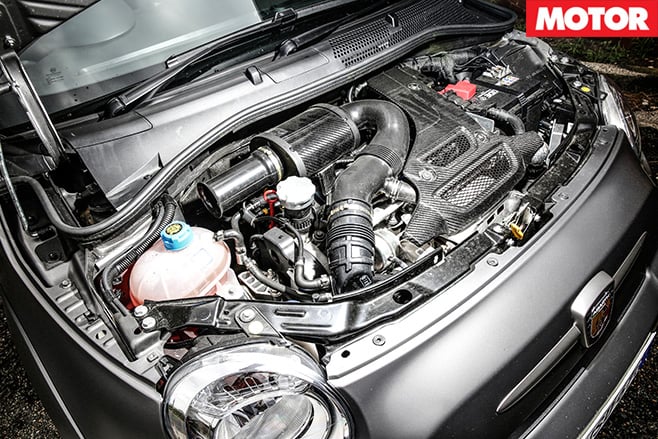
Under the bonnet, the air intake is about the same size as the muffler at the back – it’s huge, especially in such a small space. That Abarth has squeezed an extra 20 per cent more power from the same engine as the 595 is worthy of applause. And if a 5.9-second sprint to the tonne doesn’t exactly sound like supercar territory, it does feel raucously, outrageously quick in such a little beastie.
Where it does feel supercar-ish is the sticker price. The race ’box and polycarbonate windows push the price to almost $90,000; tick the track pack and the extra carbon kit and you’re well over $100K. At a casual glance it doesn’t even look all that different to the $37K 595 Competizione; only those plastic windows, currently streaming with the condensed sweat of Cristian and myself, set it aside.
Those windows are probably great for dieters, since they not only transform the car into a mobile sauna, but also make it impossible to use the drive-thru. But they are punishing on a steamy day.
It’s a lot easier to feel affection for the steroidal little oddball once we get out of the grind and into the winding stuff well clear of Sydney. Even on narrow roads, it’s small enough that you can stretch its legs without the mental anxiety you once could have been locked up for.
That exposed shifter has a tiny wee throw between cogs, and out here with the engine dialled up, the dog ’box snicks between ratios neatly with only the smallest of brushes of the pedals. The gaping Akrapovic exhaust hoots and bellows, and while you’d never mistake it for a muscle car, it sounds meatier than any Turin shopping-cart you’ve ever heard before.
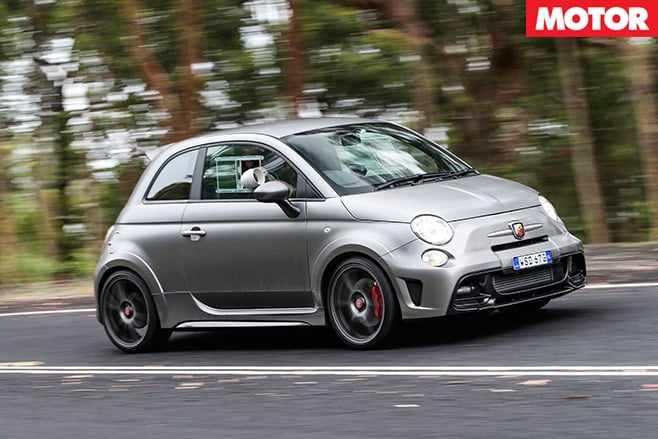
Despite the short wheelbase it never feels jittery, at least as long as the road is smooth. On crappier stretches of rural bitumen, it feels about as choppy as you’d expect, in part thanks to the 18-inch rims wrapped in black ribbons.
The Two-Seat (see, it just doesn’t sound as good) is so entertaining at pace we find the most scenic back-route to Peat Island ever devised. Peat Island doesn’t look as dramatic as it should, given its bizarre and tawdry history. It ought to have more Gothic spires, or gargoyles, or flocks of bats swirling amidst weeping marble statues. In reality, it looks like a council depot. But for a century, this unimposing speck squatting in the Hawkesbury River was a shameful open secret.
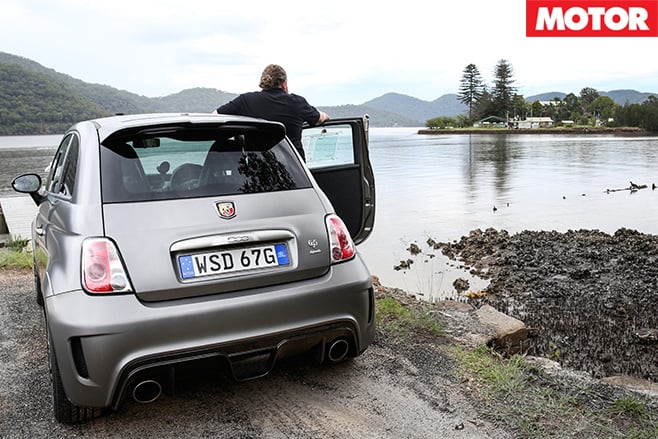
During the century that Peat Island operated, it would be hard to judge who was more unhinged: the patients or the staff. The rooms look like they were unmodified since the place opened, Spartan and bleak. Any patient deemed a troublemaker could be locked in “the pen”, which was effectively a cage in the courtyard. Some patients spent their whole lives on the island, taken there as kids and forgotten by society.
The NSW government wants to develop the island again – this time into a marina and apartment complex – but the plan has been, er, buried… because of the number of unmarked graves on and near the island. There might be more than 200 bodies hidden under the weeds. It’s a disturbing thought for a facility that was only closed down in 2010. So it’s no hardship driving away from such a place of misery.
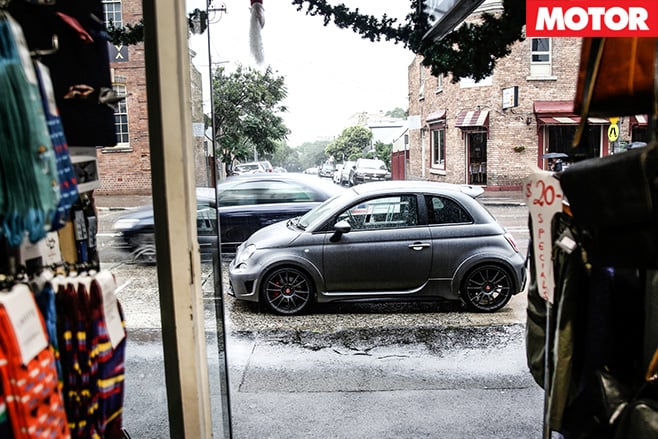
It’s just not a car for commuting to work in. If you live in the mountains and your brother is the local highway patrolman, the 695 would surely be insanely good fun. But if I had to live with it every day, it’d end up driving me crazy.
3 OUT OF 5 STARS
SPECS Body: 2-door, 2-seat coupe Drive: front-wheel Engine: 1368cc inline-4, DOHC, 16v, turbocharger Bore/stroke: 72.0 x 84.0mm Compression: 9.8:1 Power: 140kW @ 5500rpm Torque: 250Nm @ 3000rpm Power/weight: 140kW/tonne Transmission: 6-speed manual Weight: 997kg Suspension(F): struts, coil springs, anti-roll bar Suspension(R): torsion beam, coil springs, anti-roll bar L/W/H: 3657/1893/1485mm Wheelbase: 2300mm Tracks: 1429/1422mm (f/r) Steering: Electrically-assisted rack-and-pinion Brakes(F): 305mm ventilated discs, 4-piston calipers Brakes(R): 240mm ventilated discs, single-piston calipers Wheels: 18.0 x 8.0-inch (f/f) Tyre sizes: 215/35 R18 84W (f/r) Tyre: Goodyear Eagle F1 Price as tested: $87,000
General Motors CEO and Chairman Mary Barra has been named in the top five most influential women in the world for 2016 by Forbes magazine.
Listed as the fifth most influential woman for the second year in a row, Barra sits ahead of well-known names like Oprah Winfrey, Anna Wintour and Queen Elizabeth II.
In the annual refresh of their World’s 100 Most Powerful Women, Forbes reduced the number of celebrities like Ellen DeGeneres and Taylor Swift, to make room for women in politics, which also led to an increase in a representation of more companies.
Great Wall Motor Company CEO Feng Ying Wang was the only other woman in automotive listed, sitting in 69th position.
Barra, who was named CEO of GM in January 2014 and elected Chairman of the Board of Directors two years later, started her career as an electrical engineering student at the General Motors Institute and a co-op student. Since then, she’s had a career spanning more than 35 years with the American automotive company, and has worked her way up through the ranks.
In her first year as CEO, General Motors suffered a major scandal when 2.6 million cars were recalled over faulty ignition switches which killed 124 people and caused more than 270 injuries.
Since then, Barra has led the US company to a strong growth period in the US, Europe and China. Despite the company’s overall market share dropping last year, GM achieved record breaking profit results.
This isn’t the first time Barra has been named on an influential people list. The US automotive CEO has appeared on Forbes’ list five times, and was also named on the publication’s Most Powerful People list in 2015 (65th). In 2014, Barra also made it onto Time’s 100 Most Influential People list and last year she was ranked first on Fortune Magazine’s 50 Most Powerful Women in Business list.
In an industry dominated by men, it’s always nice to see women succeeding.
McLaren’s new supercar has the Ferrari 458 Italia squarely in its sights. But does the Mac daddy’s stunning tech and staggering performance actually push it into the ‘hyper’ class above?
First published in the March 2011 issue of Wheels magazine, Australia’s most experienced and most trusted car magazine since 1953.
AT THE scheduled 2:45pm precisely – and I mean to the second, because this is McLaren – Ron Dennis walks into the room and tells us that he has built the best-handling sports car in history. I’m about to drive the McLaren MP4-12C, an entirely new supercar from an entirely new supercar maker, but one with about the most perfect pedigree imaginable. Yes, McLaren made the F1, but that was nearly 20 years ago, and the SLR it built for Mercedes wasn’t the car it would have chosen to build itself. This time, Ron is doing it on his own, from scratch and on a grand scale. He and his fellow shareholders have spent A$1.3b developing the first of a range of supercars on which he will build a business three times bigger than his F1 team within five years, and which, from a standing start today, will be as direct a rival to Ferrari on the road as it is on the track.
Never has a sheet of paper been blanker. The new McLaren Automotive didn’t have to build the 12C around an existing engine or engineering philosophy or factory. This is simply the very best car it could make. And when the famously detail-obsessed, über-perfectionist Dennis stands in his surgically-clean, A$500m Bond-villain headquarters sunken into the English countryside and tells you that the result is objectively, measurably, scientifically the best-handling sports car ever made, you need to get straight into the car to find out if he’s right.
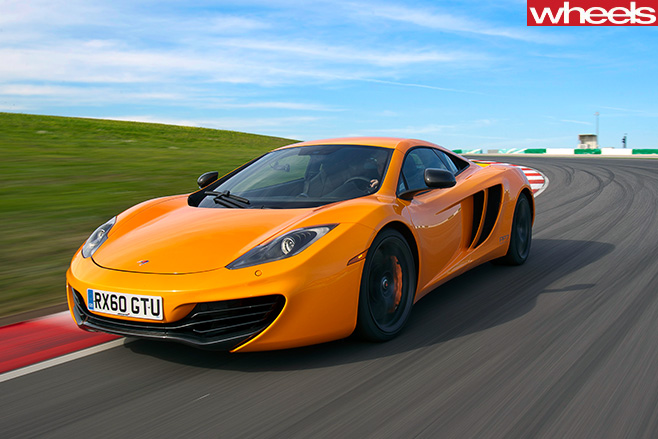
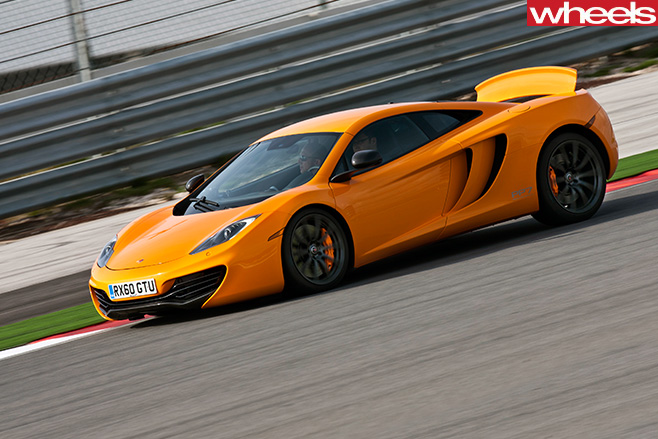
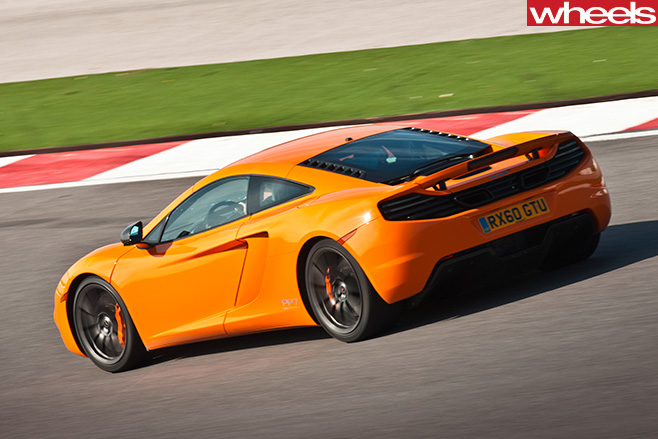
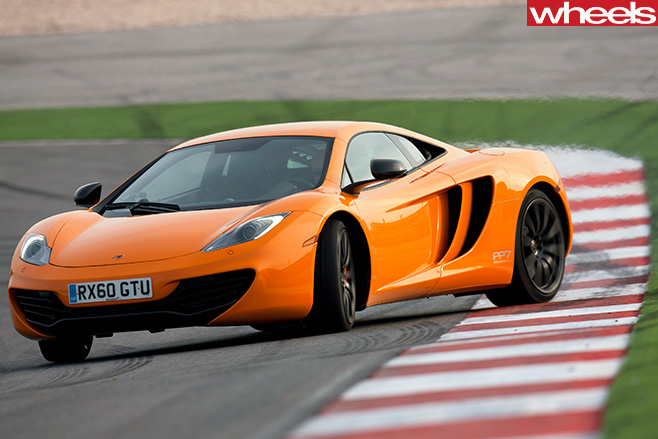
And the numbers? McLaren has kept them quiet until now, and Ferrari isn’t going to like them. At 1434kg with fluids and in standard trim, the 12C is around 50kg lighter than the 458. It gets to 100km/h in 3.3sec, a tenth quicker than the 458, but you can cut two-tenths off that by choosing the optional Corsa tyres. Depending on whose figures you use, it’s around half a second quicker than a McLaren F1 to 200km/h at 9.1sec, or 8.9 on the Corsas. Unofficially, it will get to 300km/h in around 26 seconds, a couple behind the F1 as the older car’s greater power starts to show. McLaren is claiming a 330km/h top speed, a comfortable margin above the Ferrari’s 325km/h, but conservative, say its people privately. I’d have to agree. From the way it was still pulling at 309, there was plainly a lot more to come.
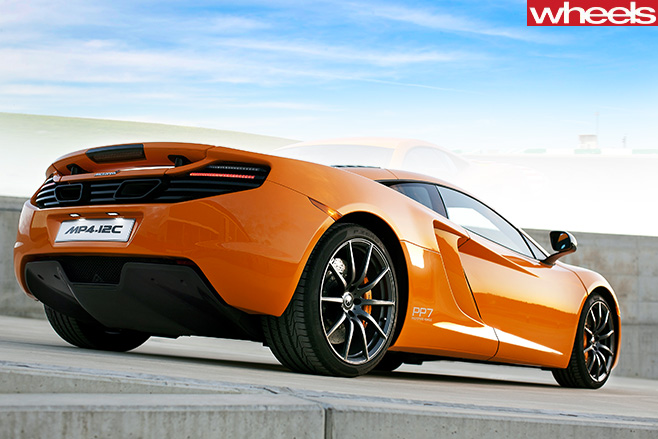
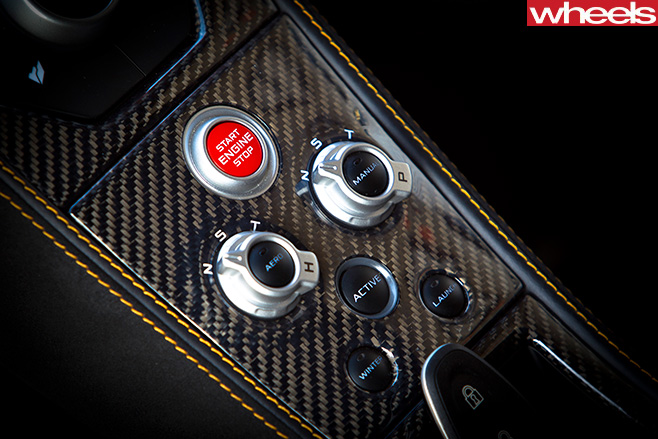
You run your fingers over the proximity sensor hidden in the deep air scoop cut into the scissor door to open it upwards. The square sill of the carbon tub is higher and wider than most but not difficult to climb over. Once in, the door’s grab handle is an easy reach forward and up, and it pulls down shut with little effort. Ahead of you, the instruments are pretty simple; big central tachometer, of course, digital speedo, gear indicator to the right, with status bars for the fluids and a reminder of which handling and performance setting you’re in. The switchgear has plainly been thought about hard and rationalised to the bare, logical minimum. The air-con controls are in the door, just where your right hand falls. The audio and sat-nav are controlled by the upright, iPhone-like central touchscreen. The transmission and handling modes are controlled by two rotary switches below that and are easily found without taking your eyes off the road, but can’t be operated until you’ve hit the ‘active’ button, so that letting your 10-year-old play in the cabin during the week won’t result in a nasty surprise when you turn into your first wet corner of the weekend.
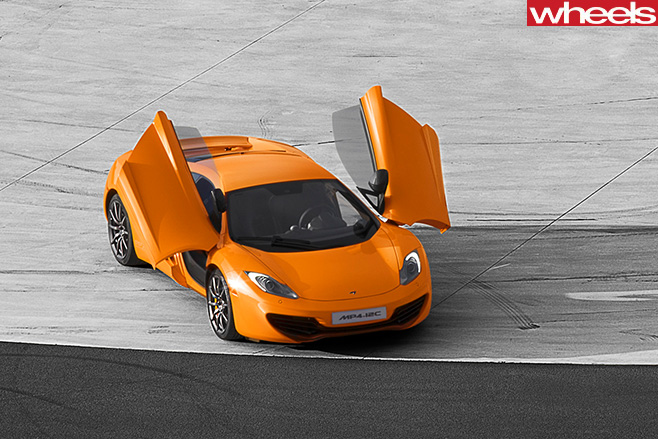
We’re not going to say that the MP4-12C is the best-handling car in the world. But if you had to pick three cars to fight for that title, the new McLaren would be one of them. When Ron says that the 12C is measurably the best-handling car in the world, he means that they’ve strapped it and its rivals to rigs and tested them. “We scientifically know,” he says. “It’s better in every parameter we can measure.” But some things aren’t open to objective measurement. The only real flaw we can find with the MP4-12C is its flawlessness. It’s like a child prodigy; generally begotten by hyper-ambitious parents, staggering in its abilities, perfect in its behaviour, but oddly cool and aloof. The other kids seldom want to hang out with the 12-year-old concert violinist. Criticising a car for being too perfect seems odd, but in a supercar character and emotion and idiosyncrasy and simple, fidgety excitement count for a lot, too. You might buy and love the McLaren for its tech and its many measurable superiorities. But Ron’s numbers don’t tell the whole story, and the Ferrari ain’t outnumbered yet.
SPECS Model: MP4-12C Drivetrain: mid-engine (north-south), rear drive Engine 3.8-litre V8, dohc, 32v, twin-turbo Transmission: 7-speed dual-clutch Power: 441kW @ 7000rpm Torque: 600Nm @ 3000-7000rpm Power-to-weight: 308kW/tonne Torque-to-weight: 418Nm/tonne Weight: 1434kg Price: $550,000 (estimated)
LEXUS owners in North America have complained to the car maker about a software update that has caused their car’s infotainment system to crash and sends its climate control into a panic. Lexus Australia has told WhichCar that there’s no need for Lexus owners here to be worried, as it has had no reports of the same problem here.
A statement provided to Wheels by the company said: “Lexus Australia is not aware of any such issues raided by owners in Australian spec Lexus vehicles. However we will continue to closely monitor the situation.”
The problem caused the in-car infotainment to repeatedly crash and re-start, and is limited to Lexus models using the updated ‘Enform’ system. Enform, which Lexus Australia does offer on various models, provides remote data access, tracking and emergency assistance features.
The fault – sent wirelessly to Lexus models in the US – that sparked the system meltdown is believed to have originated from a satellite used in the process. Lexus North America hasn’t disclosed the number of cars affected by the glitch, and is working on a solution for its customers.
Lexus Australia is currently working on a recall of models wrapped up in the Takata airbag saga, one of the biggest recalls for the motoring industry in its history that includes a number of car makers. The latest Australian recall, issued by Lexus on June 1, covers IS sedans manufactured between August 2008 and December 2011. Owners of the 21,750 vehicles will be notified by mail, however if owners are concerned, Lexus can be contacted on 1800 023 009.
HAVAL has introduced driveaway pricing on its entire line-up following customer feedback that its cars were too expensive. The Chinese brand – owned by Great Wall – launched in Australia in late 2015, and has sold around fifty units to date through its four dealerships, which is below expectation.
The sharper pricing sees the entry-level Haval H2, a rival for the likes of the Mazda CX-3, cut from $26,490 before on-road costs to a more aggressive $23,990 driveway. “We’re in contact with our dealers on a daily basis,” Haval spokesperson Andrew Ellis told WhichCar. “This is an opportunity to follow up on customers who have been impressed by the product and say, ‘here’s an offer’”.
Ellis did admit that the lower prices will combat a stumbling block that’s meant a slow start for the brand Australia. “It was a concern,” he said, when asked if the range was too expensive at launch. Haval Australia MD, Parker Shi, echoed Ellis’ thoughts, saying: “Our company motto is ‘improve little by little every day’. We are confident this new pricing strategy will continue to improve our standing with local customers.”
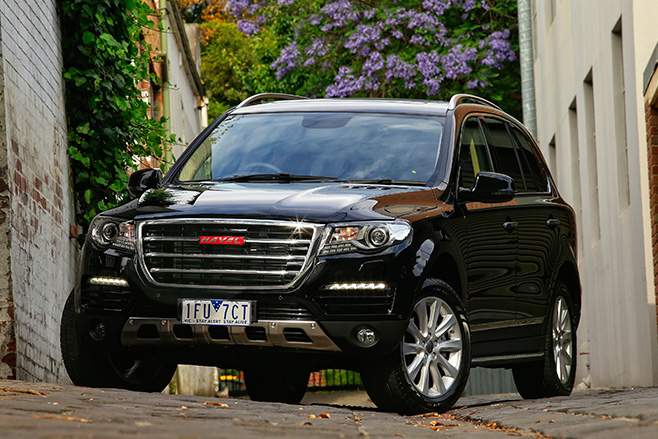
The sharpened line-up sees the entry-level H2 Premium start at $23,990, a significant reduction from its price at launch, which was $26,490 plus on-road costs. The H2 line-up tops $28,490 driveway for the AWD Lux model, which was previously $30,990 plus on-roads.
The reduced pricing has been applied across the Haval range, which sees the H8 start at $38,990 driveaway, and the H9 with a $46,490 asking price.
HAVAL DRIVE AWAY PRICING
H2 PREMIUM 4X2 M/T: $23,990 H2 PREMIUM 4X2 A/T: $24,990 H2 PREMIUM AWD M/T: $26,490
H2 LUX 4X2 M/T: $25,990 H2 LUX 4X2 A/T: $26,990 H2 LUX AWD M/T: $28,490
H8 PREMIUM 4X2 A/T: $38,990 H8 PREMIUM AWD A/T: $41,990 H8 LUX AWD A/T: $44,990
H9 PREMIUM 4X4 A/T: $46,490 H9 LUX 4X4 A/T: $49,990
ONE TWEET was all it took for Elon Musk to wipe nearly A$800million value from one company’s worth.
Musk, the grand overseer of electric vehicle manufacturer Tesla, took to twitter overnight to address rumours Samsung SDI (a spin-off of the tech company that makes batteries and displays) was assisting in the production of the new Tesla Model 3.
The Tesla CEO and renowned entrepreneur set the record straight, tweeting that his company will only be working with Panasonic.

Investors then savaged Samsung SDI, wiping eight percent – or US$580million (A$774million) – off the company’s value on Wall Street in morning trade.

It just goes to show, not all news is good news!
