
Ford is the only manufacturer that allows the driver to turn ESC (electronic stability control) completely off.”
These were the words of Tyrone Johnson, Chief Engineer of the new Ford Focus RS, and they were delivered in such a matter-of-fact manner that it took a moment for the immensity of the implication to sink in.
He continued: “Some people will say ‘now that’s not true… on this car it says off’. Yes I know it says off; it’s not off. We’ve tested it. There are still ESC interactions.” Wait, so Ferrari, Porsche, AMG, M Division, all these paragons of driving purity, won’t let customers drive without an electronic overlord?
Surely this can’t be true. After all, in our less scientific moments – the photographers make us do it, promise – we’ve had most major performance brands at varying angles of attack, pleased that our finely-honed driving skills (cough) have kept us out of the weeds. Has it all been a sham? Has an invisible guardian angel been supporting us this entire time?
I put the question to Porsche Australia’s Technical Manager, Paul Watson. After all, Porsche of all companies wouldn’t dream of such electronic meddling, would it? Apparently so. According to Watson, even with PSM (Porsche-speak for ESC) deactivated, the systems still keep a watchful eye on proceedings and will jump in to straighten the ship if the brakes are applied.
It’s an answer that neatly aligns with our findings. In the latest Cayman, for instance, any slide will have a yellow light flashing on the dashboard, but stay committed to the throttle and you can lair about to your heart’s content. It’s a similar situation with the Toyota 86, and a certain Aussie muscle car once stepped sideways on me, only for the electronics to intervene once they sensed there was some busy wheel and brake work going on.
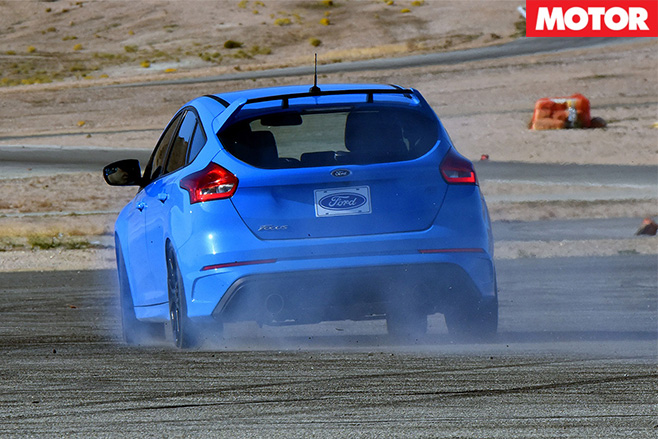
After all, if the systems are good enough to know when things are under control yet step in when they aren’t, why would you ever want to disable them? Surely that’s the equivalent of weight-loss pizza, or hangover-free booze?
Well, yes, but there are a couple of important considerations. Firstly, no ESC system can overcome physics, and the more leeway a system allows, the harder it’ll have to work to recover a situation. Case in point, the aforementioned Toyota 86. It may still have “ESC interventions,” but it’ll still let you throw it off the road backwards if you’re not on top of things. How do I know? I infamously did just that at the 2012 launch and earned myself a dressing down from Neal Bates. Oops.
The other point, which goes hand-in-hand with the last, is that you’re probably a lesser driver with ESC on. At least I know I am. Why? Simple human nature. If I lay a plank between two five-storey buildings and tell you to walk across with nothing but air beneath you, you’ll do so in a panic. Do the same with a net hung below and you’ll leap across like an eager mountain goat.
Ironically, by removing the consequences of a mistake, you become more likely to make one; let traction control sort out that clumsy throttle application, ABS fix that bumpy braking zone and ESC correct that stab of oversteer. Now, I’m not saying everyone needs to drive without ESC, for while the chances of a mistake may decrease, the consequences are vastly greater.
However, it is perhaps a timely reminder that as cars shoulder more responsibility – autonomous driving, anyone? – this shouldn’t replace the responsibilities of the person behind the wheel. Ford at least still believes that some of us know what we’re doing, let’s not prove them wrong.
It’s finally happening! Almost three years since it was confirmed for Australia, the Honda NSX has started rolling off the production line.
“We expect production cars to arrive late this year, most likely in November,” said Honda Australia boss, Stephen Collins.
“We have one car here now; a pre-production car we showed our dealers a number of weeks ago. We’re looking forward to it.”
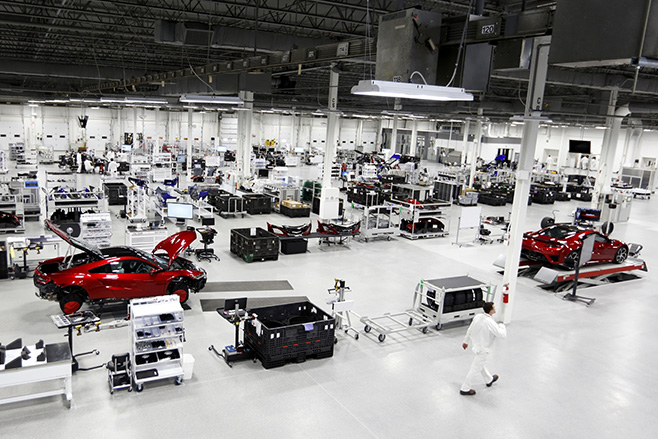
Honda’s Ohio, USA, factory is responsible for building the world’s supply of the NSX at a rate of eight cars per day. How many of those will be right-hand drive and sent to Australia depends on how many Aussies order them.
“We haven’t been given an allocation or number of build spots,” said Collins. “It will depend on global demand and it will depend on us as to how we can price the car and how many pre-orders we can take.”
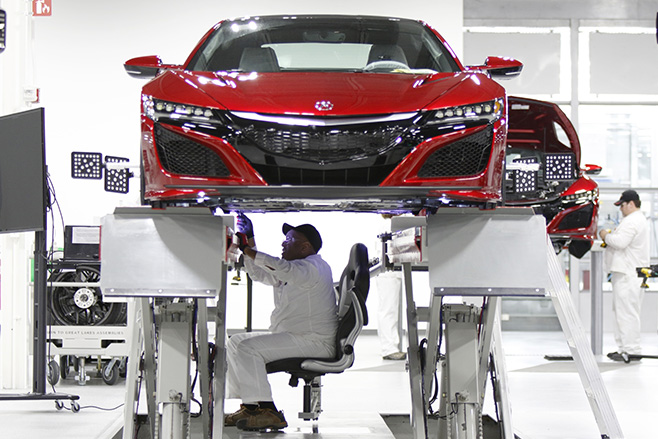
Unpredictable exchange rates have prevented local pricing from being confirmed to date. How much the car costs is set to have the biggest impact on the number of cars we can get.
Looking at overseas markets and the price tags of other cars here, the NSX could retail for more than AU$300,000.
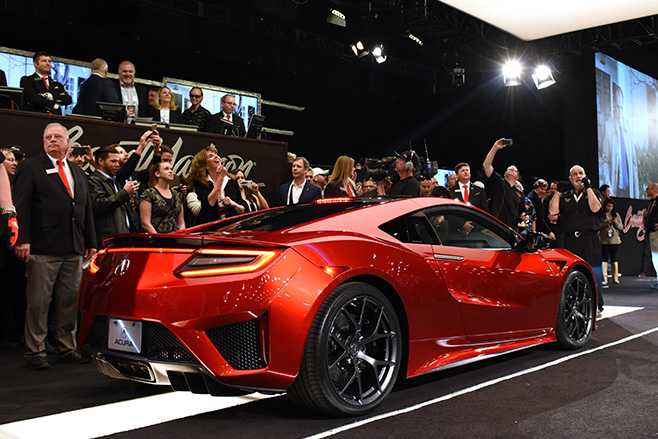
Honda expects final pricing to be confirmed by July, at which point the company will open its order books at just five select dealerships with sales rights for the NSX. There will be one showroom in each of the major capital cities; Brisbane, Sydney, Melbourne, Adelaide and Perth.
Up until then Aussie buyers are only able to register “pre-interest”, something dealerships have been doing of their own accord.
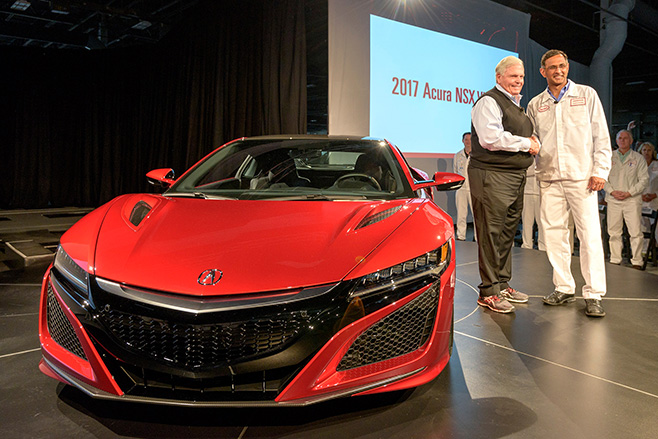
“We haven’t set numbers as far as monthly or even yearly targets. We’ll sell as many as we can but we expect a waiting list worldwide,” said Collins.
“NSX appeals to the sort of customers who want the latest and greatest in tech. I think that’s what the original NSX customers were like too. The essence of the car is pretty similar to what it was back then.”
The 2017 Honda NSX uses a twin-turbo V6 engine and three electric motors for a total output of 427kW and 550Nm. Power is fed through a nine-speed dual-clutch transmission and all-wheel drive.
Renault Sport could have just given us a manual transmission, but with the butch Clio RS16 Concept it delivered a whole Megane RS drivetrain instead.
Squeezed under the bonnet of the fourth-generation Clio is the same 201kW/360Nm 2.0-litre turbo four from the Megane RS275 Trophy-R, and a six-speed manual transmission – finally – sits between the front seats.
Also taken from the size-larger Trophy-R are the dampers, Akropovic exhaust, steering design and Michelin Pilot Sport Cup 2 19-inch rubber.
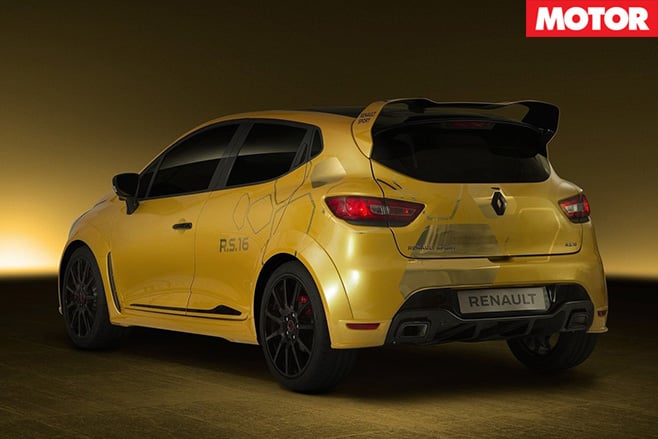
The front suspension needed reworking, too, so Renault Sport chose to combine parts from both the Megane and, curiously, the Kangoo small van and Espace people mover.
It all sounds a bit ‘bitsa’ and indeed it is. The French hot-hatch brand says “a commando unit” of 10 employees was set to task to create a project to complete over five months following a decision made in October 2015 to create a car to celebrate Renault’s return to F1 and Renault Sport’s 40th anniversary.
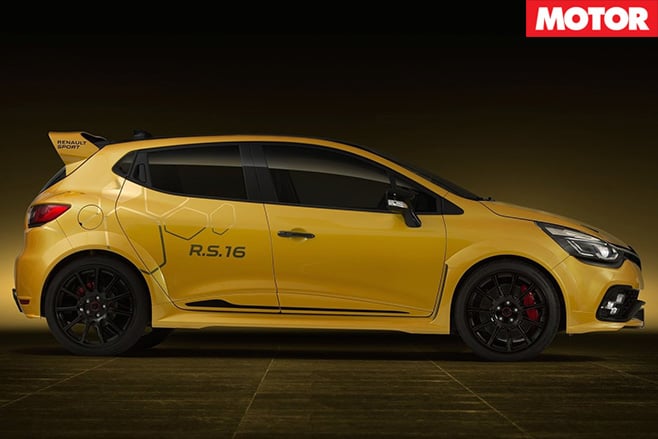
“We all recalled the impact made by Clio V6,” started Renault Sport boss Patrice Ratti, referring to the second-generation mid-engined Clio special.
“We wanted to create a technical concept car with extraordinary performance levels but which was more realistically priced … we therefore had to keep our feet on the ground and use simple, ingenious solutions to achieve a vehicle that could be type-approved.”
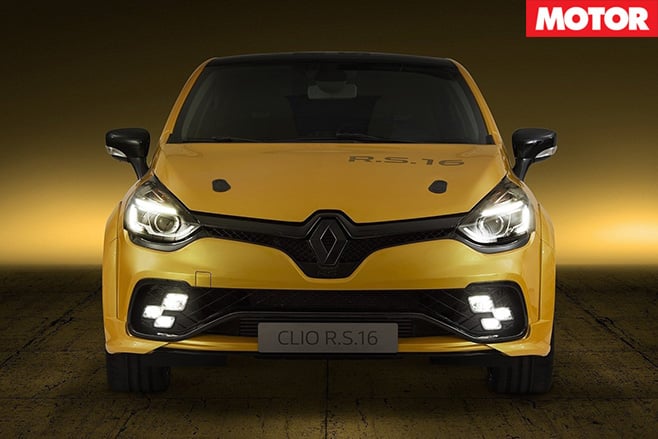
The current fastest Clio, the RS220 Trophy, delivers 163kW/280Nm from its 1.6-litre turbo four but is auto only. Yet its compact size means it’s also 66kg lighter than even the stripped-out Megane Trophy-R.
No performance figures or kerb weights are claimed for this RS16 Concept, but a baby Clio with the performance and handling of a Megane RS275 Trophy-R sounds mighty alluring to us.
Mazzanti Automobili, a relatively unknown Italian car company, is building a hypercar with more grunt than the 708kW LaFerrari.
Mazzanti says the Millecavalli, a new version of its mid-engined, rear-drive Evantra, will produce 736kW and “more than” 1200Nm from a GM-sourced, twin-turbo 7.2-litre LS7 V8. If these numbers are accurate, it will be the most powerful Italian road car of all time.
The company claims weight will be kept below 1300kg and the 0-100km/h acceleration time will be less than three seconds. Mazzanti plans to build 25 Evantra Millecavallis for an as-yet undisclosed price.
“With this ultimate hypercar we were able to go beyond what a few years ago were the limits we had reached,” said company boss Luca Mazzanti.
The Mazzanti Evantra Millecavalli is named for its output in metric horsepower – Millecavalli translates to 1000 horses and this isn’t the first time we’ve heard of Evantra. Mazzanti first revealed a production version in 2013, powered by a naturally-aspirated 7.0-litre V8 with claimed outputs of 552kW and 860Nm, and a six-speed automatic transmission.
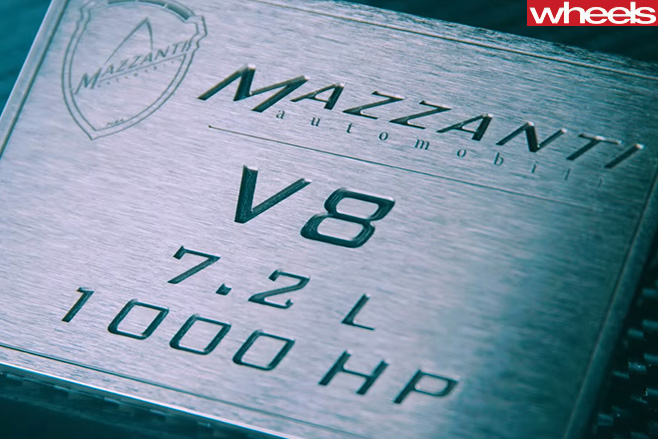
Further information about the Evantra Millecavalli will soon be announced as part of the car’s formal unveiling at the Turin motor show on June 8.
Has the appetite for Brock memorabilia and his HDT road cars started to fade?
PETER Brock is an undisputed motor racing icon. The nine-time Bathurst winner, three-time touring car champion and round Australia rally winner – who died 10 years ago this year – built a rock star following that hasn’t been seen in this country since. His name sold not only Holden cars, but his own ‘Brock’ Commodores, and millions of dollars of merchandise to adoring, often fanatical fans.
Yet last Monday night, two Brock motoring treasures failed to live up to expectations. The one-off 1984 HDT Monza was Brock’s test-bed for a two-door Commodore, and was loaded with advancements that included independent rear suspension – something that wouldn’t become available in a regular Commodore until the 1991 VP model. At the Shannon’s Auction in Sydney, though, it failed to reach the $120,000 it was expected to and was passed in.
Similarly, an Alpine White VK SS Group III of the same vintage – that was also Brock’s personal car for a time – was on offer, and while it did attract a buyer, its $81,000 sale price was at the bottom end of estimates.
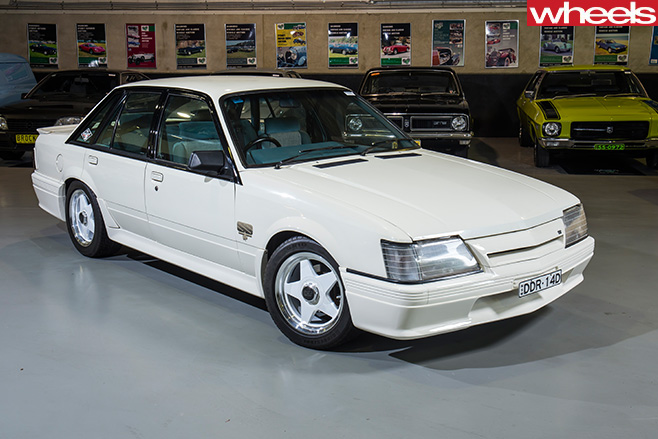
It’s worth remembering that Brock’s last Bathurst 1000 win was 1987 – 30 years ago next year. And as the tenth anniversary of his tragic death approaches, there are more and more people who’ve never seen Brock in his heyday, or racing at all.
So is Australia’s love affair with Brock over? Has a generational shift meant that the Brock name no longer holds the lustre of the past, even if his achievements haven’t changed?
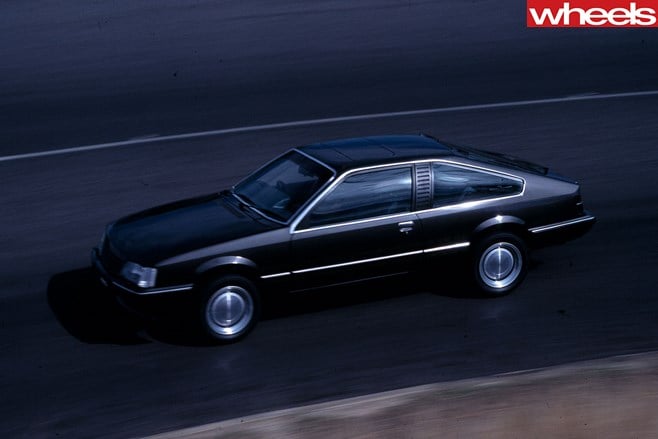
The Monza is a special case, and Boribon says the fact that it was passed in is not a case of a decline in the ‘Brock factor’. “When you were watching Bathurst in 1984 or ’85, you didn’t see an Opel Monza [racing],” he says. “That car doesn’t have the racing heritage that most Brock buyers are looking for – in fact, most Australians won’t be able to tell you what it is.”
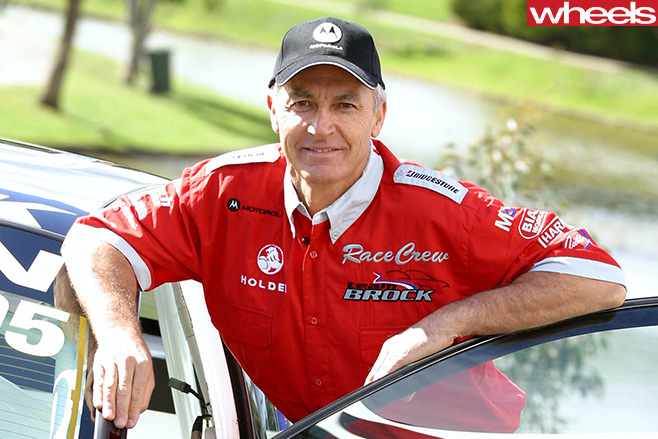
Boribon doesn’t dispute that the Brock name won’t pull in collectors forever and will eventually fade, but the show’s not over yet in his opinion. “I agree that the next generation may not see as much value in the Brock name, but that’s still probably 10 or 15 years away.”
The price of the hottest version of the new folding-roof Mini has been lowered and its performance has been improved. The dollar drop of the Mini John Cooper Works (JCW) Convertible follows price cuts to other versions of the drop-top and it falls $3600 to $54,900.
While there’s still a significant premium over the $45,400 mid-range Cooper S Convertible, the JCW gains a more powerful engine and additional features.
Standard items for JCW Convertible include JCW sports seats, sportier suspension, 18-inch light alloy wheels, navigation, head-up display, and a 12-speaker Harman Kardon audio system.
The 2.0-litre turbocharged four-cylinder is the same engine as the one installed in the Mini JCW three-door hatch, and boasts 170kW of power and 320Nm of torque, increases of 15kW and 60Nm on the previous JCW Convertible.
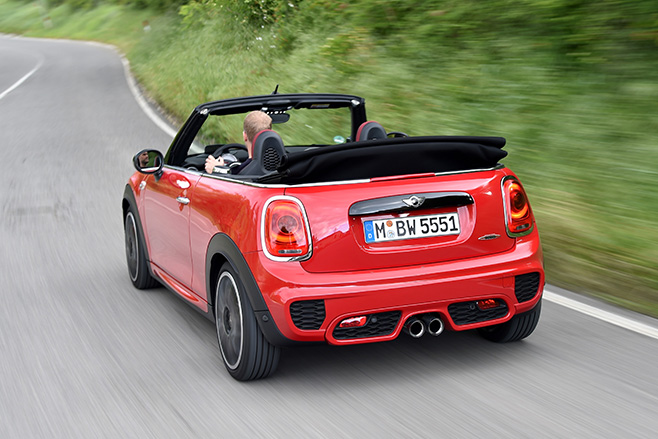
A six-speed manual gearbox is available this time, for no extra charge, over the standard six-speed paddle-shift auto. That contrasts with the extra $2550 asked for a JCW hatch with a manual transmission.
A 0-100km/h acceleration time of 6.5 seconds is quoted for the automatic Mini JCW Convertible and 6.6 seconds for the manual. That makes the JCW six-tenths quicker than the Cooper S Convertible to 100km/h.
For sportier handling, the JCW variant also gains stiffer suspension with a variable shock absorber system.
As with other Convertible models, the JCW’s fabric roof takes 18 seconds to lower and the fully electric operation can be done at up to 30km/h. A sliding roof function is also included.
IF YOU watched last weekend’s Monaco Grand Prix, and you really should have given it was excellent, then your Aussie pride-filled heart probably splintered into a thousand pieces on lap 32.
It was then that race leader and all-‘round Aussie legend Daniel Ricciardo dived into the pits for new rubber, only to discover his team didn’t have his tyres ready.
It was a calamity. A disaster. An amateur mistake that cost Ricciardo almost certain victory and turned the world’s happiest F1 driver into an angry, tongue-biting storm cloud.
It was also a reminder that F1 pit stops don’t always go to plan. Here’s a look at some of the more explosive blunders experienced in pitlane.
1. Red Bull’s stuff up. Best to start with a reminder of how Ricciardo’s Monaco GP imploded. It still hurts to watch…
2. When Jos Verstappen turned into a human BBQ. This frightening incident occurred at the 1994 German GP. Luckily everyone escaped serious injury.
3. Kovalainen and Raikkonen get fiery in Brazil.
4. Nakajima flattens his crew at the 2007 Brazilian GP. Of all the ways for your first-ever F1 pit stop to go, this has to be one of the most painful. For the team, that is.
5. When David Coulthard didn’t even make the pit box. The Scottish ace was leading the 1995 Aussie GP when he ploughed into the Armco on pit entry. We reckon DC’s face is still burning with embarrassment.
6. D’Ambrosio spins. Belgian racer Jerome d’Ambrosio didn’t even make his pit box at a wet Hungarian GP.
7. Massa takes the refuelling rig with him in Singapore, 2008. And injures his crew in the process.
8. Mark Webber’s tyre nails a cameraman. As if losing a tyre in pit lane wasn’t painful enough for Webber, the rogue wheel went on to drop an unsuspecting cameraman too.
9. Hamilton, Rosberg and Raikkonen get it all wrong in Canada. Aren’t these guys meant to be the world’s best drivers?
10. That time Romain Grosjean forgot to brake. Says it all, really.
The temperature might be dropping, but things are hotting up in the world of new car sales with several sporting models hitting Aussie roads in the coming months. Ford’s hotly anticipated Focus RS hot-hatch is leading the charge, followed by updates to BMW’s 4 Series range and new turbocharged variants of Porsche’s iconic 911. SUV-wise, Jaguar’s good-looking F-Pace is sure to be a sales hit, as is Mazda’s all-new CX-9.
NEW MODELS ON SALE JUNE-JULY
- BMW 430i and 440i
- Jaguar F-Pace
- Ferrari F12 Berlinetta M
- Ford Focus RS
- Honda Civic
- Jaguar F-Type SVR
- Mazda CX-9
- Mercedes-Benz C-Class Coupe and SLC
- Mitsubishi Outlander PHEV facelift
- Porsche 911 Turbo and Carrera C4
- Subaru Levorg and Forester tS
- Toyota Corolla Hybrid
- Volvo XC90 T8
The all-new Civic is the first Honda-badged car to adopt Honda’s Earth Dreams technology. Earth what? That’s the name of Honda’s new fuel-savvy tech that it plans to roll out to future vehicles. For the Honda Civic, it means an RS badge and a new 127kW/220Nm turbocharged 1.5-litre four-cylinder engine mated exclusively with a CVT that’s also had a sprinkle of the Earth Dreams pixie dust. A cheaper 1.8L atmo option is also on the table.
THE RENAULT Clio RS16 is the wildest hot hatch from the French car maker in years – and Renault Australia wants it here.
Unveiled on the Friday of the Monaco Grand Prix – where Aussie Daniel Ricciardo and his Renault-powered Red Bull were robbed of victory two days later – the RS16 is officially a concept car but the extreme Clio is being mooted for production by the end of the year.
And if that’s confirmed, it’ll head Down Under.
“This concept car is definitely one of the most exciting we’ve seen from Renault Sport recently,” said Renault Australia MD, Justin Hocevar. “The RS badge certainly has a strong fan base here in Australia. While this concept is just that – a concept car – if there were plans beyond this, then Australia would definitely want to be placed as far towards the front of the queue as possible.”
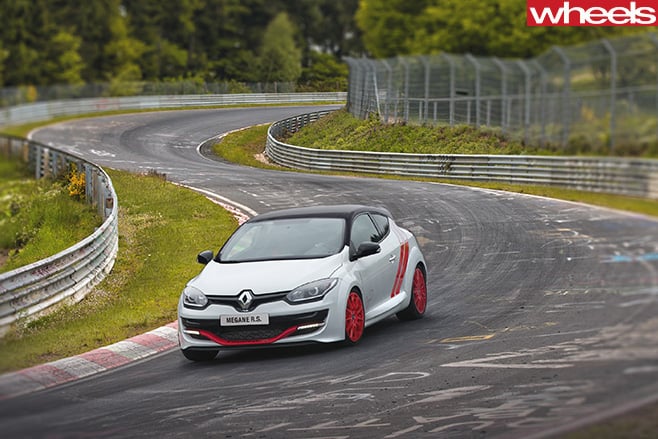
Renault itself also has a stronger argument with head office, with Australian sales having increased from a paltry 1907 only five years ago to an impressive 11,525 in 2015. It has firmly shaded French foes Citroen, DS and Peugeot in the local sales contest.
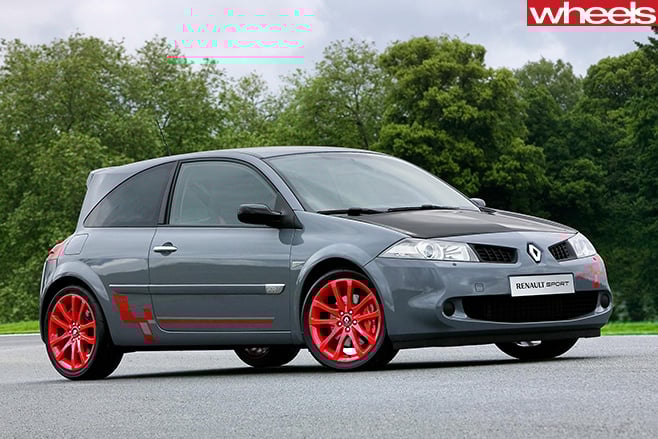
The Clio RS16 could be the car to reclaim that record and would also go a long way to maintaining the RS division’s serious street cred because, as well as trick suspension and a significant weight reduction, it will also have a manual gearbox.
The RS16 brings Renault’s hot hatch back into the purist zone as the wildest concept since the Clio V6 and the Renault R5 Turbo.
So what of the other two models that Hyundai N boss Albert Biermann told us will follow the i30N to broaden the brand’s international appeal?
These will be launched close together, the first “six or seven” months after the Hyundai i30N and the other “a few months later.” Biermann says that these will work better in China and the US than the Euro-focused hatchback, and hinted that they will share the i30N’s 2.0-litre turbocharged engine and clever electronically-controlled LSD.
Wheels first thoughts were that one must be an SUV, but he was quick to refute this: “I see good potential to make a high performance SUV, we have SUVs that are almost crying out “make me go faster!” but we are not focusing there yet. It’s all about the driving fun to start and of course the hatches, the sedans and the coupes have a better basis for this.”
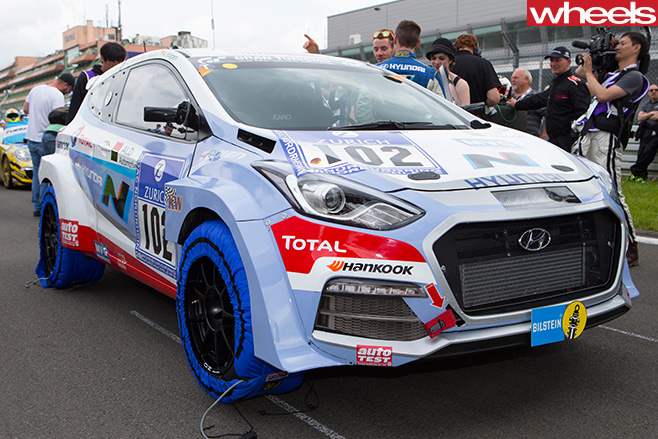
But Biermann also told us that the Genesis models his team is working on will not carry ‘N’ branding. “I honestly can’t tell you what they will be called yet,” he said, “we have not decided yet.” Interestingly, he also said that there’s still internal debate as to which of the forthcoming Genesis line-up will be the first to get a proper performance derivative.
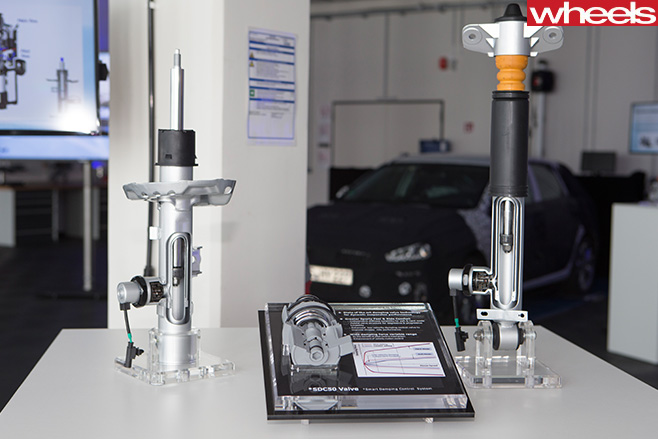
The message is that both N and Genesis performance models are going to be introduced gently. “We need to get people used to this, to get a customer base established takes time,” Biermann cautioned. “We should not be too fast, we should grow step by step. We do this very successfully on the mass production side and it will be the same for N.”
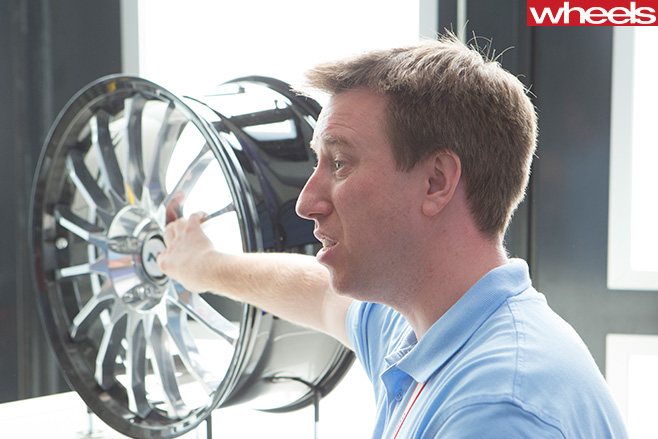
“We have been looking at this already, I would not exclude for the future that we would do it, but it depends on how we grow,” he said. “If we came up with a performance car on the highest level it might be too fast for our customers and our dealerships. But I can see for the future that we will make a really high-performance car in the C segment. And then, of course, we would need AWD.”
