
As the car has evolved, so have the techniques for extracting more power from it, including such internal combustion engine tuning milestones as the mainstream arrival of the turbocharger in the 80s, and the advent of the anti-tuning ECU at the beginning of the 2000s.
The turbo made it enormously easy to make big power gains – tuners no longer worked with valves, cams and carbs, but a boost controller. Then the smarter engine management computers of the new millennium made it trickier (but not impossible) by applying artificial limitations on power despite tweaks to the turbo, intake and exhaust.
With the advent of the electric car, however, a new chapter in hi-po tuning opens, and all those techniques seem decidedly old-school.
If the turbocharger made it easier to shove air into an engine for a bigger bang and more power, then the electric motor makes it even easier to cram current in. Just like dialling up a turbo’s boost, winding up the voltage in a battery-electric system brings big gains.
Now, while in practice this isn’t straightforward to do just yet – not until the aftermarket catches up with ‘bolt-in’ battery pack upgrades and high-voltage motors and controllers – the principle is nonetheless simple.
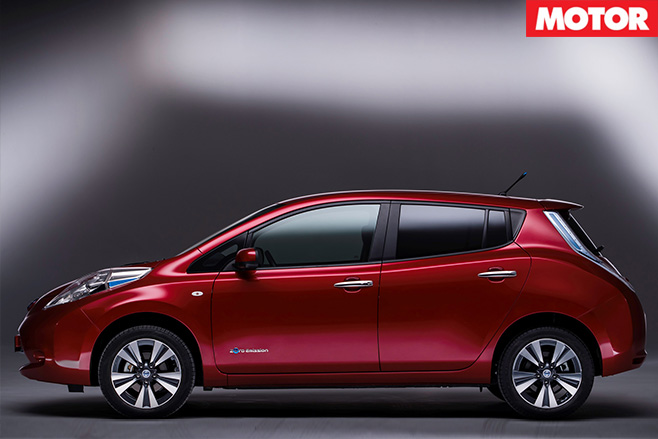
However, if all 192 cells were arranged in series, the total voltage would double to around 720 volts and the capacity would be 12kWh.
In this scenario, the total power output (of the battery) would be up from 90 to 180kW. The Nissan’s outputs mightn’t double, but if they did it’d produce 160kW and 560Nm (assuming the motor and controller were up to it). The range reduction to around half of the standard 135-odd kilometres comes as the downside, along with accelerated front tyre wear.
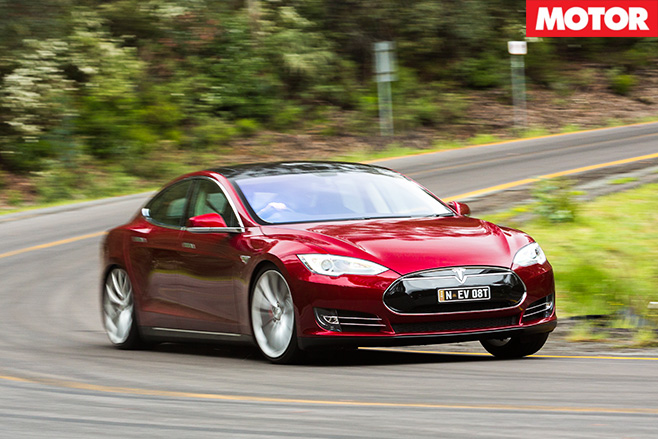
With two motors sucking current, the effect is the same as our battery scenario above. Power output increases immensely, while range is greatly reduced. Meanwhile, the possibilities for torque-vectoring all-wheel drive with a pair (or, better, four) motors are awesome.
Twinned motors are exactly how Tesla transforms its model S 85 into the ultimate P85D variant, bringing an upgrade to all-wheel drive and a power increase from 270 to 515kW.
DUAL IT OUT Tesla’s P85D uses the same front/rear dual-motor system as the forthcoming Model X ‘crossover utility vehicle’. As well as the 90 per cent power increase, torque improves to 930Nm from the rear-driver’s 440Nm.
TURN IT UP Most battery cars lack the involving sounds of a petrol performance car, but not the Larte Enigma. The body-kitted Model S promises an “integrated electronic sound [to] give this supercar a worthy soundtrack to match its great looks.”
RANGER Impressively, the ridiculously quick P85D – Tesla claims 0-100km/h in 3.3sec and 0-400m in 11.8sec – has a range of more than 450km, which is as good as most, including the considerably less-potent rear-drive version.
MEAN SALEEN The Saleen ST takes Tesla’s Model S and applies carbon aero bits, a lowered final drive ratio, coil-over dampers and upgraded anti-roll bars, and a locking diff that improves traction and handling. Seems a bit old-school, really.
FULL CHARGE The emergence of the FIA sanctioned Formula E (home to out-to-pasture F1 drivers), and the fact an electric car won this year’s Pikes Peak outright suggests that in the performance domain, the battery is set to be big.
ELECTRIFIED ZOMBIE
The ‘White Zombie’ offers a peek over the fence into the world of backyard electric tuning. The 1972 Datsun Sunny/1200-based creation from Portland’s John Wayland (of Plasma Boy Racing) faithfully follows the big-motor-small-car path, using a bootful of Navy helicopter prototype lithium-polymer cells and a monster 400kW/1250Nm motor between the front strut towers. The battery Datto wears rego plates, does 0-100km/h in less than 2.0 seconds, and silently (except for the sound of tortured tyres) sprints the quarter in less than 12.0 seconds.
It wasn’t supposed to get here, yet alone end up knee-deep in sand. The 2016 Citroen C4 Cactus that we’ve taken to Little Desert, which straddles the borders of Victoria and South Australia, is a funky, urban SUV based on the C4 hatchback. Yet we’ve taken it, foolishly, to the back of beyond and beached it.
“This is four-wheel drive, yeah?” asked Cristian Brunelli, my co-driver and photographer for the Wheels shoot. “No, it’s basically a C4 on stilts,” I replied. That means it’s a front-wheel drive hatch with higher ground clearance, and hardly intended to go off road. That was well before we parked it for the night, after struggling up a sand hill. Positioned after the fight against sand and gravity, we decided to leave it there for every photograph – repositioning risked beaching it. The next morning, we did exactly that.
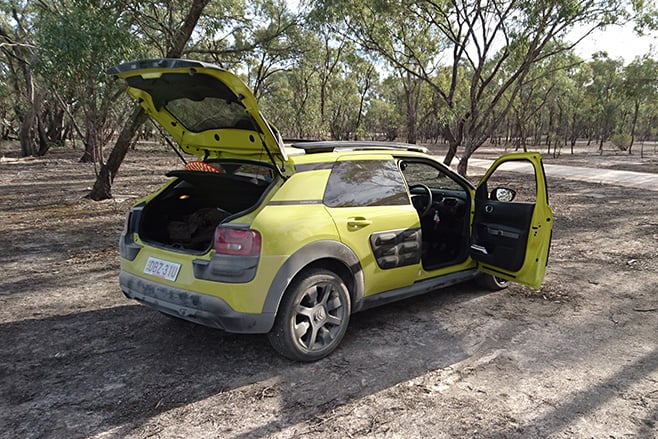
Stranded, with no support car and no other human in sight, we had to find a way out. A battle-hardened Brunelli tried forwards, and backwards, but the front wheels kept digging the Cactus in deeper and deeper. We’d lowered the tyre pressure to give more purchase in an attempt to claw our way out, but to no avail. We even tried pushing it out, but the lack of breakfast after a sleepless night in the desert had us without the required mojo to push the Citroen out of the hole. Imagine, then, getting a serious – and heavy – four-wheel drive stranded compared to the relatively light (1020kg) Cactus.
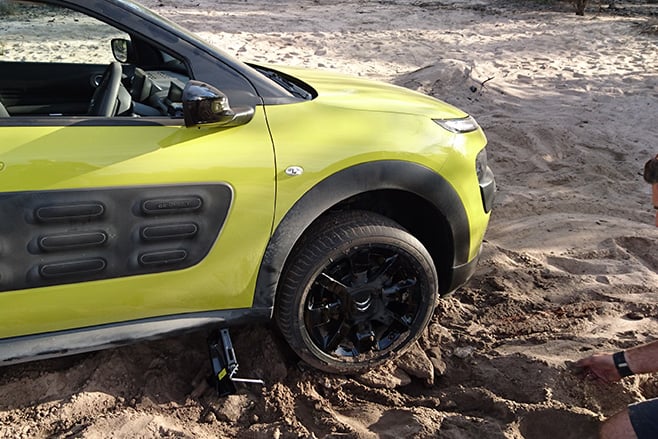
So what did we do? Rocks. Loads and loads of rocks. The abundant supply had us build a small platform on which to put the factory jack. We were thankful that the Cactus comes with a proper jack, instead of relying on a compressor and goo. This means we could lift up each side of the nose, and build a solid base using the rocks at hand. So, each wheel has a rock formation underneath, and we used wood and bark to clear a path out.
This took hours. Then, the debate: now raised onto the makeshift platform, do we drive out, or push it? If we drive it out, and the plan fails, we’ll instantly undo the hours of work we’ve put in. If we push it, perhaps we don’t have enough strength to actually make it out. We’re impatient, itching for a coffee, and decide to just drive it.
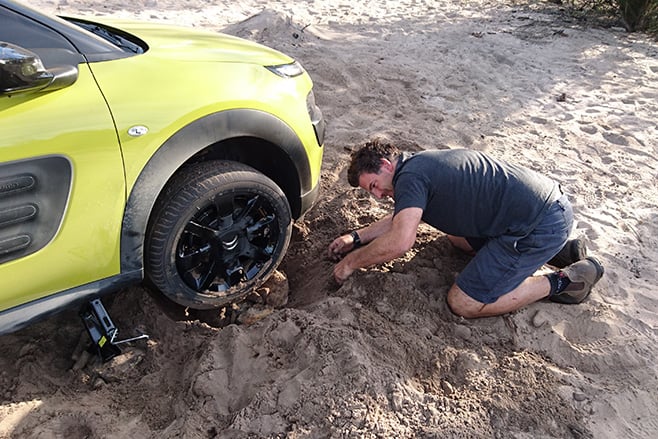
Cristian gets in the driver’s seat. He slowly lets the clutch pedal out and begins a delicate squeezing of the accelerator: the front wheels grips the rocks, the Cactus begins to inch forward – but we’re not sure if it will make the sand ahead that we’ve dug out. Only seconds later, relief washes over us: it not only gets out of the ruts, but through the sand and back onto the firmer road ahead. Cristian fist-pumps the air as I scream, “Victory.”
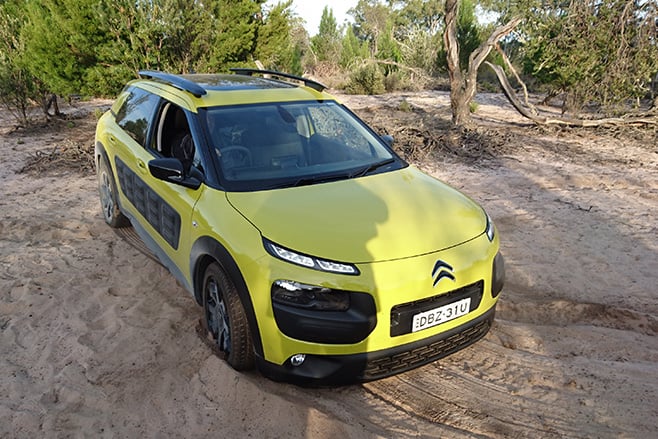
Matt Raudonikis, editor of 4X4Australia, says we did most things right. For sand, getting out is relatively simple. “Straightway, drop the tyre pressures down, turn the stability control off, and that should help,” he says. Take an accurate tyre-pressure gauge with you, as Matt recommends dropping the amount of air on the tyres to around 15psi. He also recommends turning the traction/stability systems off so that power is sent continuously to the drive wheels.
There’s also a faster, smarter way than building the rock supports that we used under the Cactus’s wheels. “‘Maxtrax’ or other types of traction boards are ideal when you’re on your own,” says Matt. “For a couple of hundred dollars, you don’t have to buy any specialist four-wheel drive stuff. Those plastic ramps are a Godsend.”
Looking for more tips? Read about what it’s like to take an off-road driving course.
The pearly white smiles of the meteorologists on the evening news are at odds with the dark, foreboding forecast they are delivering. Several days of severe weather is due to hit Melbourne, threatening to put a dampener on MOTOR’s date with Lamborghini’s new Huracán.
Lambo’s latest baby supercar takes its name from the Mayan hurricane god, so perhaps the impending storms are a warning – give the Huracán a good review lest Victoria’s capital be swept away by an apocalyptic flood.
It’s not the weather the Huracán need fear, however. It’s entering the stormy seas of the fiercely competitive junior supercar segment, occupied by prodigiously talented machinery including the Porsche 911 Turbo, McLaren 650S and Ferrari 488 GTB – not to mention the enemy within, Audi’s new R8, with which the Huracán shares much of its body structure and mechanicals.
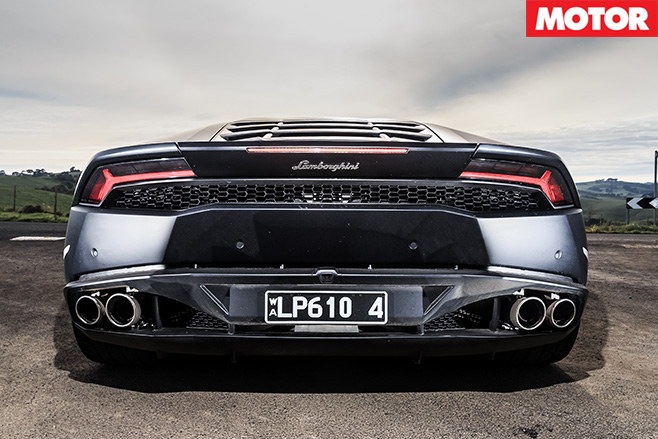
Lamborghini faces a tricky balancing act with the Huracán, needing to maintain its reputation as the wildest and most outrageous of the supercar makers, while at the same time delivering the comfort and civility expected of any modern car – cantankerous road manners can no longer be excused as ‘character’ in 2015. It’s a relief, then, to discover while escaping Lamborghini’s Richmond HQ that the Huracán is no more demanding to drive in traffic than an Audi A5.
The driving position is near perfect, with ample room and plenty of adjustment for both steering wheel and seat. Personally, the brake pedal is set a little high, though it’s nicely located for left-foot brakers.
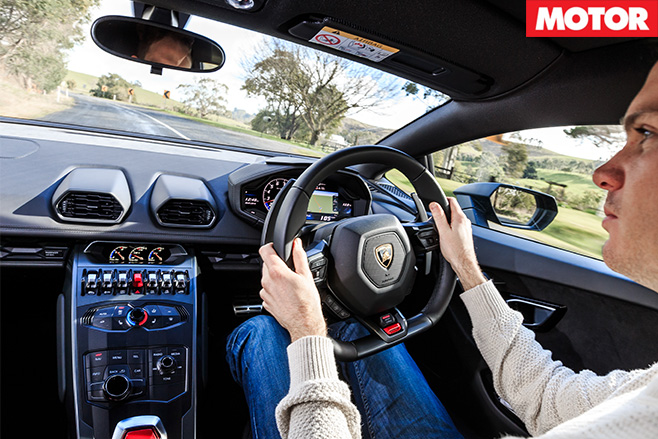
What works brilliantly is the TFT instrument display shared with the new Audi TT. Able to display speed, revs, sat-nav or infotainment information, or to be split in two to show a combination of each, the screen is clear and crisp and negates the need for a vision- and space-robbing centre screen.
Likewise, moving the switchgear traditionally mounted on column stalks – headlights, wipers, indicators – to the steering wheel a la Ferrari is a masterstroke. It feels odd to begin with, but it soon becomes second nature and means you never need move your hands from the wheel.
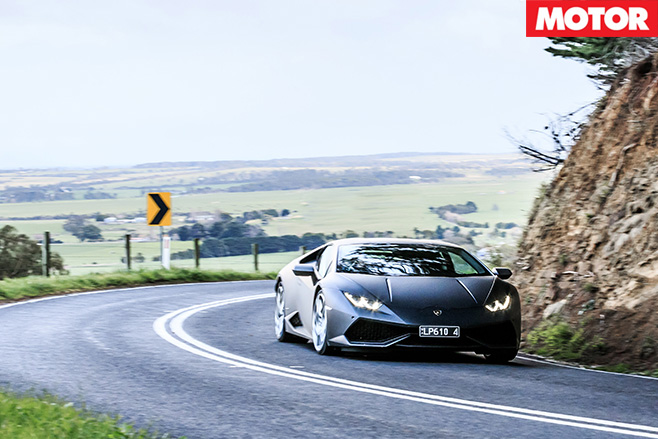
It even rides reasonably well, particularly on the freeway, though road noise is significant and rear vision abysmal, with massive three-quarter blind spots and thin slots in the engine cover – a clear engine cover is an option – offering the only clue as to what’s behind you.
Still, the excellent stereo overcomes the former issue and a quick squeeze on the throttle ensures nothing is behind you for long. However, while Lamborghini appears to have successfully tamed its latest Bull, there’s a nagging thought in the back of the mind that perhaps it’s a bit… undramatic.
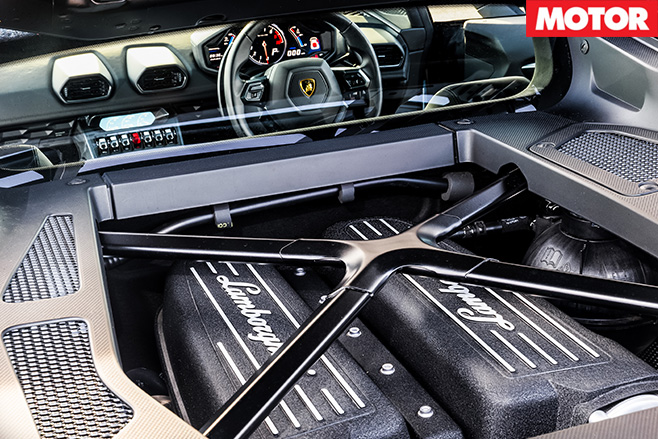
This new gearbox is arguably the Huracán’s biggest advance, replacing the dreaded ‘nodding dog’ effect caused by the Gallardo’s flawed (but sadly popular) E-gear system. It’s also miles better than the Aventador’s brutally clumsy single-clutch ‘ISR’ effort – Lamborghini’s flagship needs a dose of Doppia Frizione as soon as possible.
As the traffic momentarily thins, Sport mode is selected and five pulls of the left-hand paddle are answered instantly by a progressively more raucous flare of revs from the 5.2-litre V10 sitting midships.
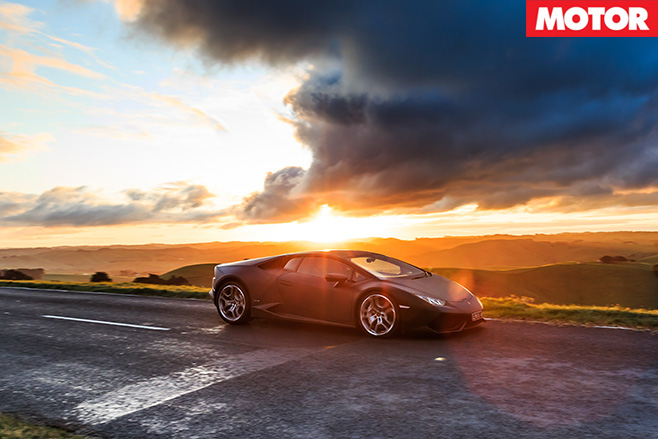
With snapper Ellen Dewar now excitedly installed in the passenger seat, our destination is the rolling green hills of Victoria’s South Gippsland region to let the latest Raging Bull off the leash. Away from the freeway and on poorly surfaced country back roads, the Huracán’s ride quality begins to deteriorate somewhat; adaptive magnetorheological dampers are standard on Aussie cars, but an extra layer of compliance would be welcome on bumpy back roads.
Unusually for a press demonstrator, our test car is almost standard, with $20,300 of matt black paint and an amusing $5700 for a rear-view camera and parking sensors the only options fitted.
The car’s basic specification robs us of the opportunity to try the Huracán’s controversial Dynamic Steering, which alters the ratio from a super quick 9:1 at parking pace to a relaxed 17:1 at high speed. The system can also apply minute corrections to counter under and oversteer, but has come under plenty of criticism overseas for its unnatural feel.
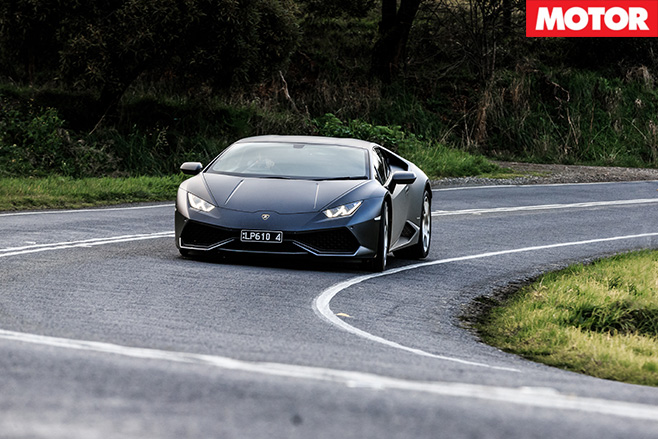
The promised wild weather has arrived, soaking the road, but with the electronics acting as a safety net there’s enough feedback to start pushing the Huracán in an attempt to discover how it behaves as it approaches its limits.
Even on a sodden road grip levels are immense, with excellent traction and stability courtesy of the all-wheel drive system. Despite a 30:70 front-to-rear split – with the ability to send 100 per cent of the drive to the rear – the car still feels lead by the front; not in a power understeer kind of way, but it certainly doesn’t feel anywhere near as throttle adjustable as something like the last R8 or a 911 Turbo.
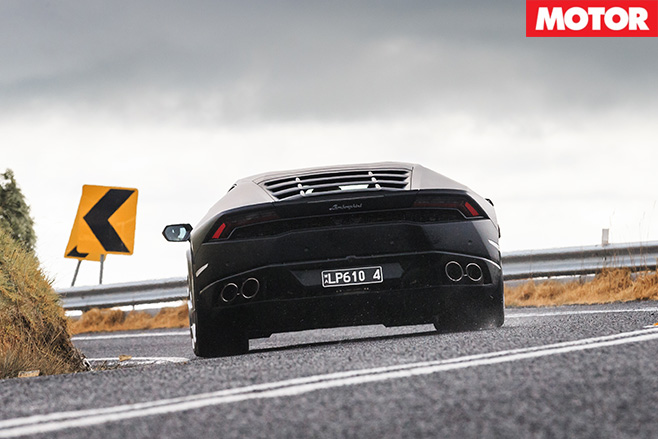
With Sport engaged, the wonderful 5.2-litre atmo V10 begins to belt out a bona fide supercar soundtrack that can probably be heard 100km away back at Lambo HQ – this is not a car in which to make inconspicuous progress.
Despite lacking the forced induction of its Maranello and Woking counterparts, the Huracán is beautifully tractable and pulls smoothly from low revs. Eight kilograms have been shaved over the Gallardo thanks to the clever new structure, which fuses an aluminium spaceframe with a carbonfibre spine, but at 1422kg dry (around 100kg more at the kerb) the Huracán is not particularly light. However, even cruising along in seventh gear, your pace can be alarming, such is the ease at which speed accrues.
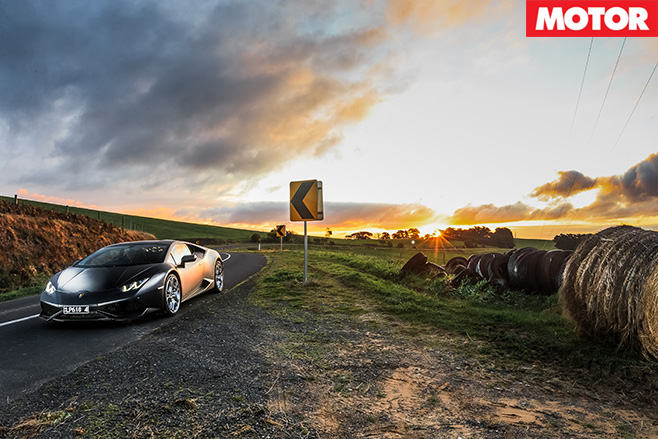
Lamborghini claims 0-100km/h takes 3.2sec with 200km/h arriving in 9.9sec – very similar numbers to the Porsche 911 Turbo – and from the seat of the pants it feels every bit that fast.
However, while the speed is similar, the delivery is totally different. Whereas the Porsche propels you forward on a giant glob of turbocharged thrust, the Huracán’s linear V10 builds to a glorious crescendo; at 4000rpm it’s impressive, above 6000rpm it’s verging on uncomfortable and approaching 8500rpm it’s borderline terrifying.
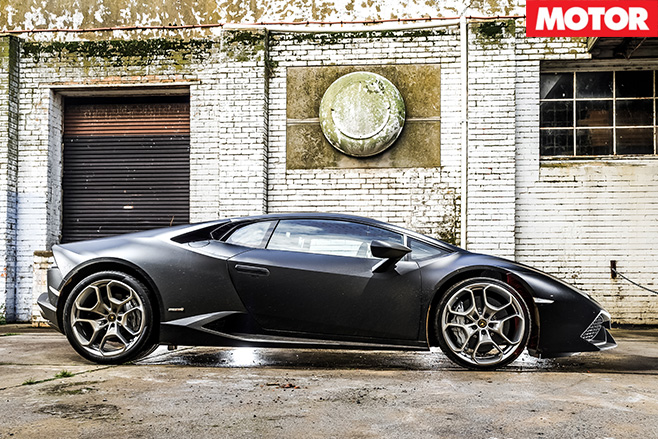
Thankfully, the brakes are Herculean and more than up to the task. Quite sensitive in operation, a slight brush is usually enough to wipe off a decent chunk of speed, and a decent push almost sends you through the windscreen. Cornering speeds are equally ludicrous, the baby Lambo scything through corners and mocking you for not carrying another 10 per cent entry speed.
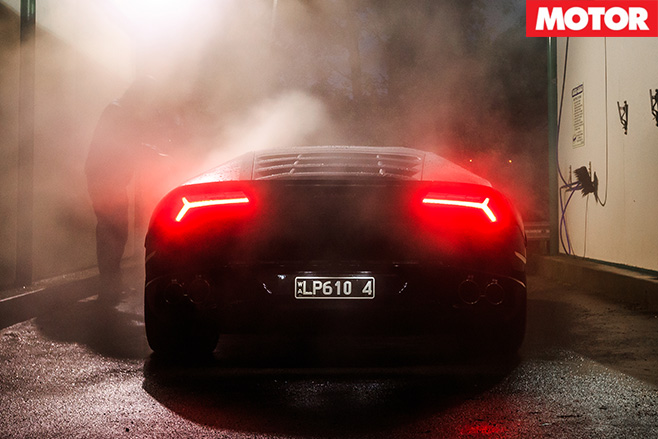
It’s no oversteer hero, but that’s not to suggest driving it is in any way one-dimensional. Perhaps it’s the sheer speed, perhaps it’s the quality of the controls or just the outrageous metallic bark erupting from behind you, but there’s enjoyment in just driving the Huracán.
There are, however, some issues. When driven hard, the baby Lambo’s dislike of bumps becomes even more apparent; never in a way that suggests it is losing composure, but it tends to skip and hop rather than keying into the road, which does rob a little confidence.
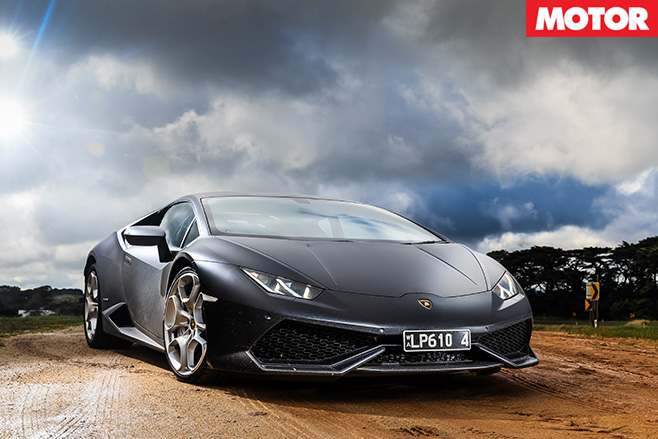
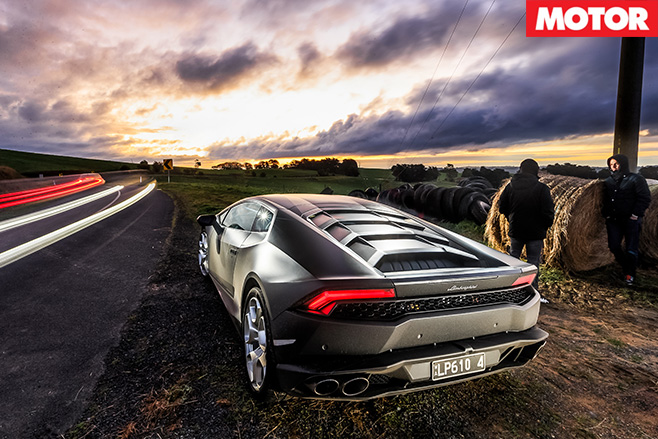
Then there are the looks. Purely subjective of course, but to these eyes the Huracán looks a little hunchbacked, particularly from rear-three-quarter. While appropriately wedgy and dramatic, it lacks none of the aggression but most of the beauty of the original Gallardo, which itself became sharper and angrier over its lifespan.
It seems plenty of others disagree, however, as the Huracán is selling like mad; in its first full year of production it almost matched the Gallardo’s best sales effort, and that’s before the inevitable Spyder version arrives. Locally, Lamborghini sales are up almost 900 per cent year-on-year.
4.5 out of 5 stars
SPECS Body: 2-door, 2-seat coupe Drive: all-wheel Engine: 5204cc V10, DOHC, 40v Bore/stroke: 84.5 x 92.8mm Compression: 12.7:1 Power: 449kW @ 8250rpm Torque: 560Nm @ 6500rpm Power/weight: 316kW/tonne (dry weight) Transmission: 7-speed dual-clutch Weight: 1422kg (dry) Suspension: A-arms, adaptive dampers, coil-springs, anti-roll bar (f); A-arms, coil springs, Adaptive dampers, anti-roll bar (r) L/W/H: 4459/1924/1165mm Wheelbase: 2620mm Tracks: 1668/1620mm Steering: electrically-assisted rack and pinion Brakes: 380mm ventilated/drilled discs, 6-piston calipers (f); 290mm ventilated/drilled discs, 4-piston calipers (r) Wheels: 20 x 8.5-inch (f); 20 x 11.0-inch (r) Tyres: 245/30 ZR20 90Y (f); 305/30 ZR20 103Y (r); Pirelli P Zero Price: $428,000 Positives: Incredible engine; razor sharp handling; no-compromise supercar Negatives: Doesn’t like bumps; rearward vision; is it better than an R8?
Here’s news sure to make performance car fans happy – the manual gearbox is making a comeback. At least in high-end, track-focused sportscars.
Recent times has seen most performance car manufacturers ditch the traditional manual transmission in favour of high-tech automatic gearboxes that can deliver faster shift times and better fuel economy.
But two brands are bucking the trend. Both Aston Martin and Porsche have revealed plans to offer upcoming models with manual gearboxes to boost driver involvement and to meet rising demand from their customers.
The Aston Martin in question is latest version of the British brand’s V12 Vantage S, which will now come with the choice of a new seven-speed manual.
The gearbox itself is interesting, and features a race-inspired ‘dog-leg’ first gear, which groups the gears used most (second, third, fourth and fifth) in a double H-pattern for easier shifts.
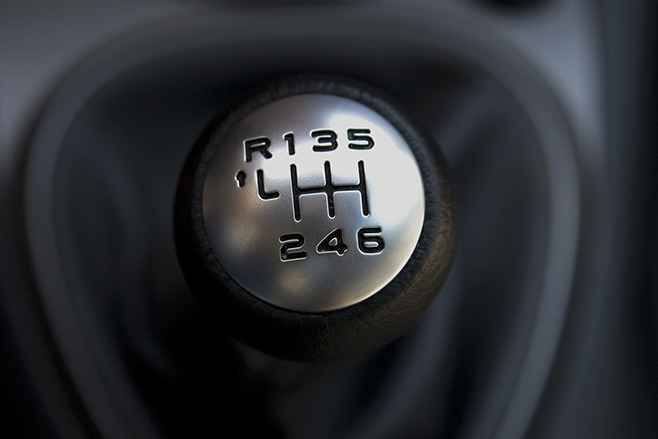
The manual gearbox will also feature an ‘auto-blip’ system that can mimic heal-and-toe downshifts.
The next version of Porsche’s track-honed 911 GT3 road racer will also gain a manual gearbox, though unlike the Aston, it will be a more conventional six-speeder.
The news marks a significant change in tact for Porsche, which decided to offer the current GT3 solely with an automatic gearbox.
But Aston and Porsche aren’t the only ones embracing the manual gearbox. Hypercar maker Pagani is also reported to be considering a manual shift for upcoming models.
We’ll have to wait some time before these new cars arrive in Australia, but when they do, their manual transmissions are sure to boost the fun factor.
As WhichCar wrote earlier this week, people who drive manual cars are much more engaged with their cars than those who drive auto-only.
Good work, Aston and Porsche!
Michael Simcoe has been announced as the successor to veteran car stylist Ed Welburn, who will retire mid-year after 44 years with one of the world’s biggest car makers.
Simcoe will step up from his current role as vice president of GM International Design to vice president of GM global design on May 1st – 33 years after joining the Holden design team.
He will oversee design for all of GM’s brands, which also include Cadillac, Chevrolet, Buick and GMC.
The 58-year-old will return to GM’s headquarters in Detroit, where he has already had a spell when he was promoted to executive director of North America exterior design in 2004.

GM’s executive vice president of global product development and global purchasing and supply chain, Mark Reuss, said Simcoe’s international experience made him a natural choice for the top position.
“Given his deep global experience and passion for breakthrough design, Michael is the right person to lead GM Global Design,” said Reuss. “He is known for his ability to take diverse ideas and mould them into great products that surprise and delight our customers.”
Simcoe first became chief designer at Holden in 1987, though it was his penning of the Holden Commodore Coupe concept 11 years later that thrust him into the spotlight. The two-door Commodore wowed both the media and the public at the 1998 Sydney motor show, and it went into production three years later as the new-generation Monaro.
He was also significantly involved in the design of the most recent Holden Commodores, the VE and VF Commodore, as well as iconic US cars such as the Chevrolet Camaro.
His current role saw him oversee GM’s advanced design studios in Australia, Korea and India.
The new C63 engine is 2.2 litres smaller than the last. The missing displacement alone would be enough to power a small car. That’s a disconcerting reduction, but before you grab your pitchfork and march on the AMG offices in Affalterbach, consider that the new engine is better in almost every way.
The old naturally-aspirated 6.2 AMG V8 will always have a place in our hearts here at MOTOR, and we could only wish we had a place for one in our salaries. However, this new 4.0-litre engine is a thing of beauty. This generation C63 is also a marked improvement over its predecessor and uses a lot less fuel, too.
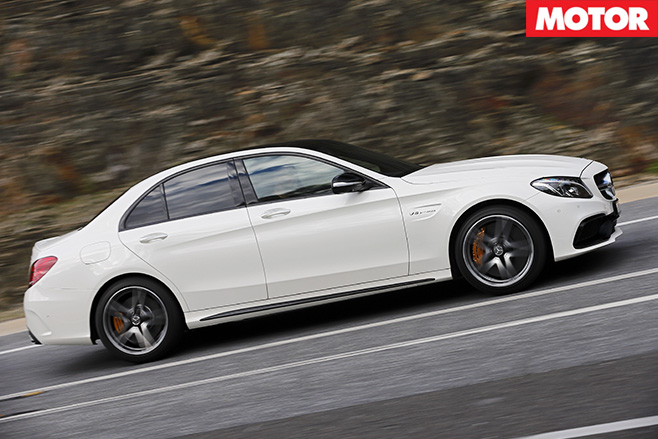
Advancement is not limited to the engine bay, though. The recently introduced W205 C Class that the 63 is based on has won praise for its handling, ride and equipment, and the hot version builds on this. Indeed, the C63 is more refined, has a more elegant interior, and is easier to use as a daily driver. More importantly, it goes much harder when you decide to drop the hammer.
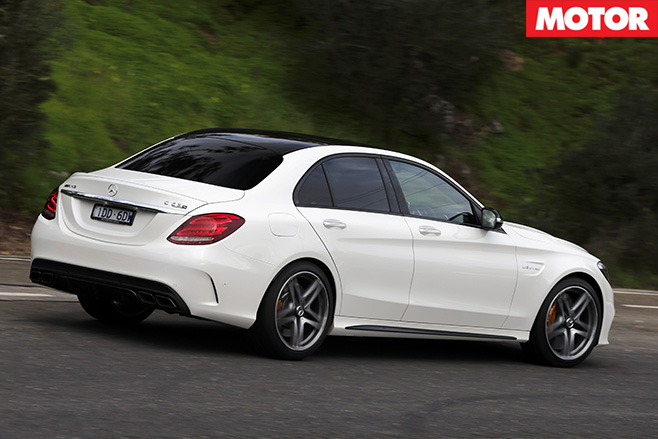
Some of these forest roads appear permanently wet and slippery, but the Mercedes was able to maintain high corner speeds. It displayed a high level of front grip and although the rear wanted to break away early and often, it was easy to control with the throttle.
While the previous C63 seemed to be more of a sledgehammer that preferred slamming down straights instead of dancing through bends, the new one has no such preference. A new electrically-controlled locking differential, which replaces a mechanical one, is effective and consistent.
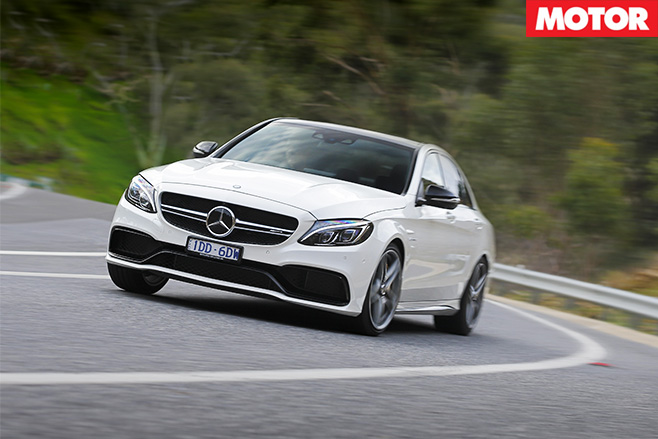
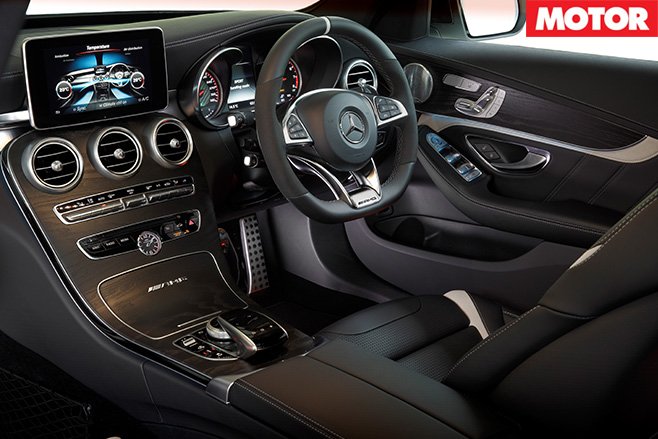
Other tools that vary the drive experience include suspension damper valves, steering, throttle, gearbox and driver-aid thresholds, as well as a separate loud exhaust button. The breadth of character in the C63 is impressive and it can lie low as a high-end executive saloon with everything set to the comfort settings, although the suspension is always a touch firm.
It sounds wicked. The noise is different to the old 6.2 V8 – a thundering devil that monstered your ears at any rpm – but is still very aggressive. With the cop-baiting exhaust mode engaged, it gives a delightful low boom at idle and the anger builds with the revs. To change gears or back off is to bring on an artillery barrage of cracking and popping that sounds so good it’s tempting to drive like a tool just to hear it.
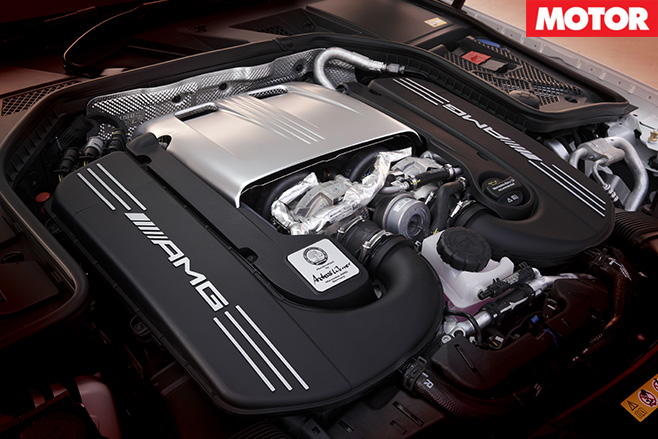
The claimed 0-100km/h figure of 4.0 seconds seems legit out here as it fires out of the tight corners and urges you to surge towards the cut out at 7000rpm.
With all that torque, you don’t have to change gears often, but there is fun to be had swapping cogs with the improved seven-speed wet clutch automatic that appears the perfect solution for this car. It is fast enough for furious driving, but also changes smoothly and surely when left in full automatic mode.
Yes, the engine is smaller, but size isn’t everything. Thank goodness.
4.5 out of 5
Specs Engine: 3982cc V8, DOHC, 32v, twin-turbo Power: 375kW @ 5500-6250rpm Torque: 700Nm @ 1750-4500rpm Weight: 1655kg 0-100km/h: 4.0sec (claimed) Price: $154,900
Having sampled Porsche’s new 718 Boxster in range-topping ’S’ guise, attention turns to its basic form.
As with the S, the Boxster’s evolutionary styling belies the fact that every panel bar the bootlid is new, while the chassis improvements, including wider rear wheels, revised suspension settings with adaptive dampers optional for the first time, larger brakes and quicker steering also carry across.

It may have dropped two cylinders and 700cc, but thanks to the magic of turbocharging there’s an extra 25kW/100Nm available, which drops its 0-100km/h time to just 4.7sec when equipped with the seven-speed PDK and Sport Chrono package.
The tiny engine also officially consumes just 6.9L/100km in PDK guise, which sneaks it under the luxury car tax fuel consumption threshold and means the self-shifting ’box is a mere $1333 more than the $113,300 six-speed manual.

The massive torque increase does have an effect on how the car is driven, too. It’s no longer necessary to use every single rpm in order to make efficient progress, and shifting a gear higher and letting the mid-range grunt do the work still delivers a satisfying result.
Base Boxsters haven’t traditionally been particularly impressive in a straight line, but while the 2.0-litre lacks the ultimate punch of the 2.5, this is now a very quick car in its own right, potentially capable of a high 12-second quarter mile.
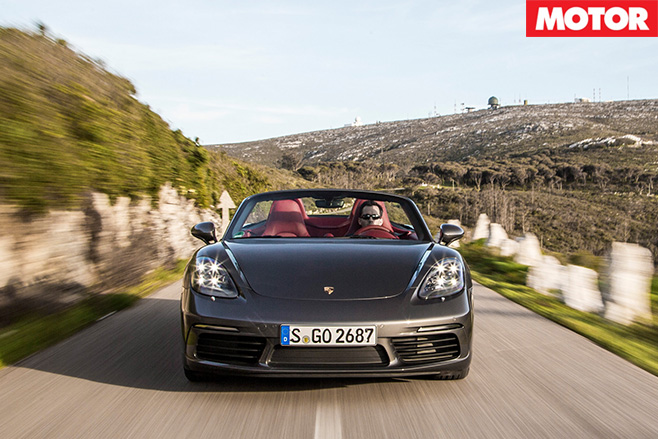
But that’s not really what the Boxster is about; its strength is its ability to be driven quickly and accurately with utter confidence. With our test car equipped with PASM and 19-inch wheels, its behaviour was unsurprisingly very similar to the S, with a supple ride and plenty of grip, though it would be interesting to try a Boxster on passive dampers with smaller wheels as it might provide even more accessible limits at road speeds.
It’s still an incredibly engaging sports car, easily capable of engrossing a keen driver on a challenging road, but once you’re used to the performance, it’s unlikely the engine will be wound out to redline with anything like the frequency of the old atmo flat-six. Such is the cost of downsizing.

Our advice would be if you want to ultimate Boxster, choose the S and tick all the boxes (20s, PASM, carbon brakes), otherwise we’d stick with the base with as few options as possible and spend the saving on fuel and tyres.
4.5 stars out of 5
Specs
Engine: 1988cc flat-4, DOHC, 16v, turbocharger.
Power: 220kW @ 6500rpm
Torque: 380Nm @ 1950-4500rpm
Weight: 1335kg/1365kg (man/PDK)
0-100km/h: 4.7sec (PDK/claimed)
Price: $113,300
The newly appointed world head of GM design, Australian Mike Simcoe, talks about the challenges of his new role in the face of a fast-moving automotive landscape.
WHEN a teenaged Mike Simcoe was looking up at a poster of a Holden Monaro stuck to his bedroom wall, he never imagined that one day he could head up the design arm at one of the largest carmakers in the world.
Hell, push him, and he admits that even a year ago the possibility of such an achievement wasn’t even on the radar.
How things can change. On May 1, as the next step of a career that started with Holden and has already spanned 33 years, the current Korea and Australia-based vice-president of GM International Design will take on one of the most coveted automotive design roles in the world: vice-president of General Motors Global Design, in Detroit, the hub of the American car industry.

He takes over 10 global studios, each with their differing personalities, from another GM veteran, the retiring Ed Welburn, under whose 44-year reign GM’s fractured design studios scattered throughout the world were consolidated with a common, global focus.
Speaking with Australian media this morning in the wake of the announcement, Simcoe said his work would continue to build on Welburn’s, in a time of rapidly changing technology and mobility in the automotive industry.
Simcoe said he learned about GM’s decision to give him the top job only on Tuesday, and he was still “reeling” from the news.
“It’s an incredible role, of course, and it leaves a legacy of incredible design, and frankly for me a level of mentorship and teaching at the time when I was in the ‘States and working directly under him [Welburn],” he said.
“I’m clearly a different character, and I guess I have my views on how I need to make the role work for me, but I see mostly that I will be taking on the role of consolidating what exists, but perhaps … enabling the design community to move into what is going to be a pretty hectic and a pretty big level of change that the industry is going to go through.”

“Obviously the design community needs to react to that, and I guess that’s where I see my role.”
Simcoe says one of his strengths is bringing a global view to GM’s future design efforts.
“Ed [Welburn] introduced design in the global studios to a level of collaboration they’d never experienced before, and I need to keep that going,” he says.
“I have a slightly different spin on that because I’m a non-American who has worked at GM for my whole career, 33 years, but largely on the outside of North America.
“I think one of the things that perhaps makes me apt for the role is that I do have a global view. I’ve been involved in the creation of the studios in South Korea, basically building them up with a new building and bringing that diverse team back into the global GM design mix, and at the same time sustaining a mature team back here down in Australia that was able to mentor the region as well as deliver product back into North America.”

“My role, being Australian, I guess it means that they’re close to my heart. I grew up here, and it’s pretty special to me, and in some ways that’s why I’ve tried to protect it through the reinvention, I suppose, that Holden is going through at the moment.
“But the Holden entity is part of a global organisation, and they [GM] remain a powerful organisation because of the capacity of the team here and the work they do.” Simcoe is confident that GM is well placed to meet its future challenges.
“GM as a whole, I think, is well placed, and you’ve seen where we’ve been going with partnerships and acquisitions in the new areas of the industry,” he said.
“Clearly GM wants to be a mobility company, a mobility provider, so we’re moving into the non-traditional … from a design perspective that means [we] work with new technologies, working out how to enhance the customer experience in the vehicle using those, and frankly, looking at different types of vehicles, things that we’ve perhaps not seen on our roads before.
“That’s a fairly exciting prospect.”
Cars are much like cuisine. Not in taste, of course – though some my own early culinary attempts weren’t far off – but a successful outcome in both respects depends on the correct ingredients being assembled in the correct order.
A Ferrari 488 GTB or Porsche 911 GT3 is like the chef’s special at Vue de Monde or Quay, the very finest ingredients painstakingly prepared by masters of the craft. But you’re not always in the mood for a fancy meal, often you just want pizza.
That’s where hot hatches come in. They’re the comfort food on the automotive menu, and one of the tastiest offerings of recent times has been Renault’s Sport Megane. Based as it is on a humdrum hatchback, the ingredients are simple – front-wheel drive, transversely-mounted turbocharged four-cylinder engine, manual gearbox – but the recipe is deceptively complex.
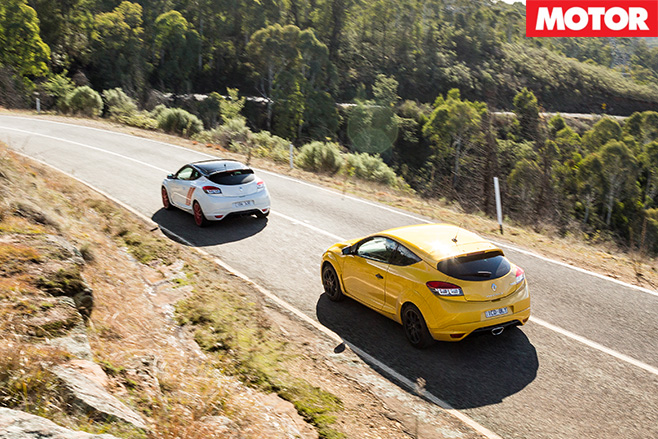
Megane III continued this giant-killing momentum with the RS250 going straight to the top of the hot-hatch class upon its release in 2010, and a continuous stream of improvements has kept it there despite a wave of new opposition including Holden’s Astra VXR and VW’s Golf GTI Performance.
With the current generation entering its twilight, however, Renault has bestowed on us the Sport Megane RS275 Trophy-R, arguably the most focused front-driver ever sold in Australia. Just 250 will be offered worldwide, with Australia allocated a fifth of that tally; the second-highest global order commensurate with the voracious Aussie appetite for Renault Sport products.
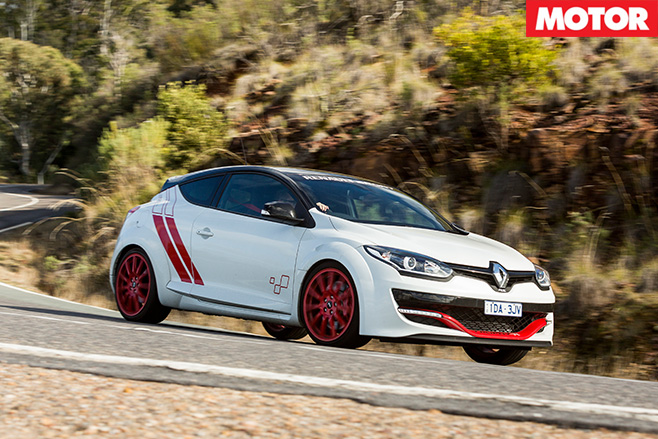
Corporate willy-waving aside, the need to shave tenths around the famed Green Hell meant no part of the Trophy-R went untouched in search of speed. However, even a limited-edition hot hatchback has to remain relatively affordable, which meant slathering the car in carbonfibre and giving it 300kW was off the agenda. Instead, the talented folk from Dieppe had to get smart.
Outputs from the 2.0-litre turbocharged F4RT engine (go on, have a giggle, we do) remain the same 201kW and 360Nm as the regular Trophy, but a 92kg diet does wonders for the power-to-weight ratio, lifting it from 146 to 155kW/tonne.
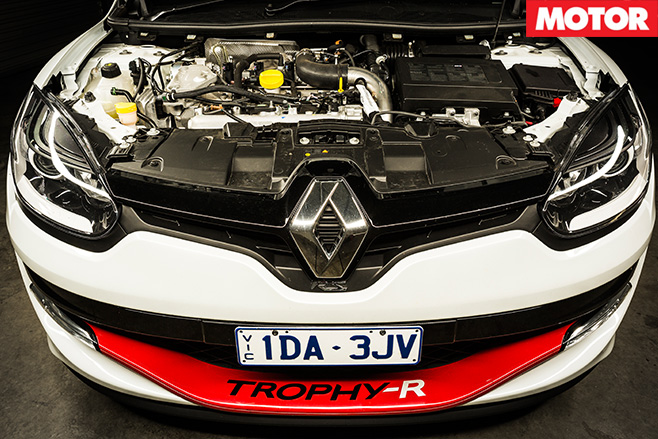
However, what Renault taketh away with the one hand it giveth with the other, and the addition of Öhlins adjustable dampers with composite springs and Michelin Pilot Sport Cup 2 tyres – the same rubber you’ll find on the Porsche 911 GT3 and Ferrari 458 Speciale – goes a long way to explaining the Trophy-R’s record-setting speed.
Such high-level componentry doesn’t come cheap of course, and the Trophy-R’s $61,990 ask is a whopping $18,000 more than the base RS265, which is a pretty handy device in its own right. So, can the stickered-up, limited-edition special really justify its massive price premium when the two cars are so fundamentally similar?
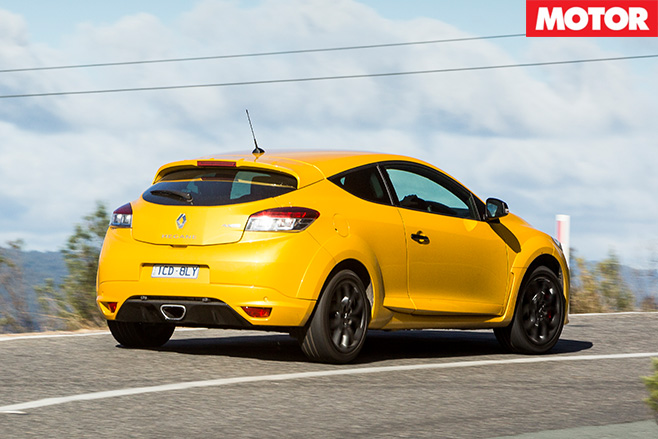
A fluke of a launch nets 0-100km/h in 5.86sec and 13.86sec at 169.20km/h for the quarter, impressive numbers for a front-drive hot hatch. But the Trophy-R is faster still, if only slightly, passing 100km/h in 5.77sec and crossing the 400m mark in 13.79sec at 170.02km/h.
It feels like there is another tenth or two in it, but trying to launch with the appropriate amount of wheel slip results in diabolical axle tramp; on this day at least, it doesn’t want to hook up. Mind you, a mid-to-high 13 isn’t mucking about, and the Trophy-R’s lighter weight is evident in its rolling acceleration, edging the RS265 from 80-120km/h by at least a tenth in every gear.
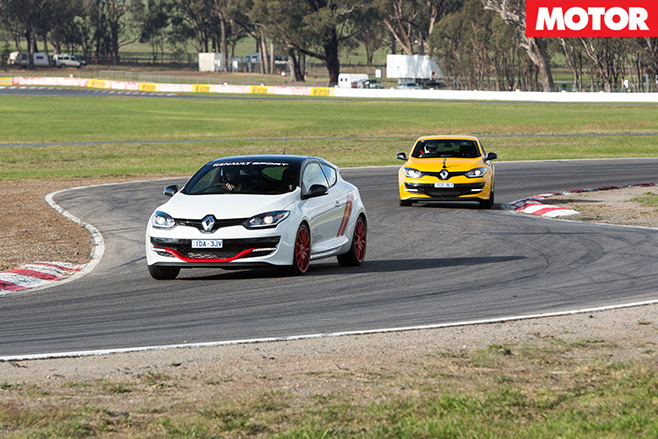
With a set of headphones plugged into an iPhone blocking out the racket, the Trophy-R is a relatively painless long-distance transporter. The ride is a little sharp at highway speeds – a trait shared by the RS265 – and the fixed-back driver’s seat is set oddly high. But the kilometres pass with little fuss.
Patchy rain has left Winton damp in spots, but thankfully not in places that are too detrimental to a lap time. The RS265 is up first to set a benchmark in terms of both speed and driving impression, and it impresses from the moment you exit pit lane. In Sport mode, throttle response is superb for a turbo engine, and there’s plenty of low-down torque and a strong mid-range.
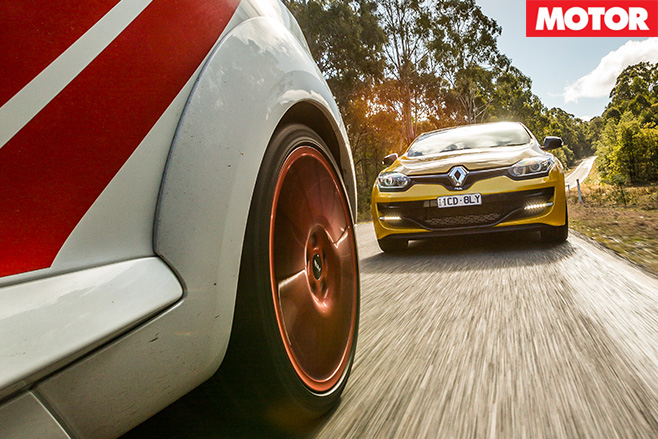
It’s a high benchmark and it’s difficult to imagine where the Trophy-R will improve. The simple answer is… everywhere. It immediately feels more urgent leaving pit lane, but care is needed until the tyres reach operating temperature. On track the intelligence of the mods becomes evident, as every aspect of the car’s performance is subtly improved. The trick Michelins improve braking, traction and lateral grip, while the lighter weight not only makes the car faster, but much more agile.
The first flying lap is a 1:40.5, which improves to a 1:40.4. Encountering traffic on one lap still results in a 1:40.5, so a sub-1:40 is there for the taking, making it blisteringly fast for a front-wheel drive hot hatch. It’s pure magic on a circuit, getting better the harder you drive it and sounding like it’s got anti-lag, such is the cacophony of pops and bangs on the over-run.
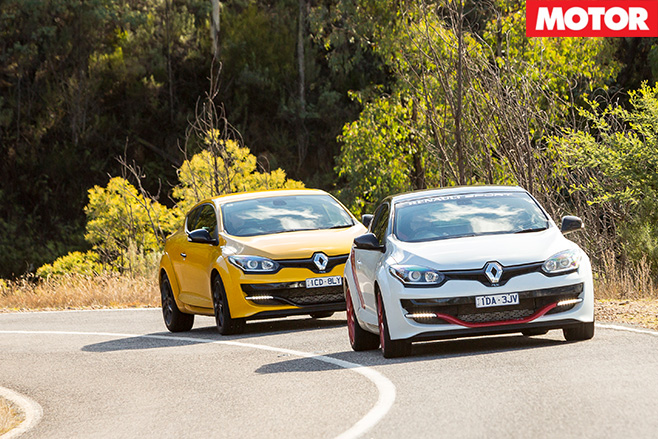
On-track superiority established, it’s time to see if the Trophy-R can repeat the trick on the road. As an aside, one area this hardcore Megane has a clear advantage over other track specials is its practicality – stripping out the rear seats has resulted in a cavernous luggage area. So we undo months of hard work by Renault Sport by stuffing its lightweight special full of camera gear.
This seems as good a moment as any to swap back into the RS265 for a run over the challenging Mansfield-Whitfield road in Victoria’s High Country, one of the state’s finest driving roads. The conditions are about as difficult as they come – constant bumps with plenty of surface changes and every corner a different level of damp – yet the Megane just eats it up. Care has to be taken on the exit of wet corners lest the front wheels flare up and drag the nose wide, but it travels at a pace that would give serious sportscars a real headache.
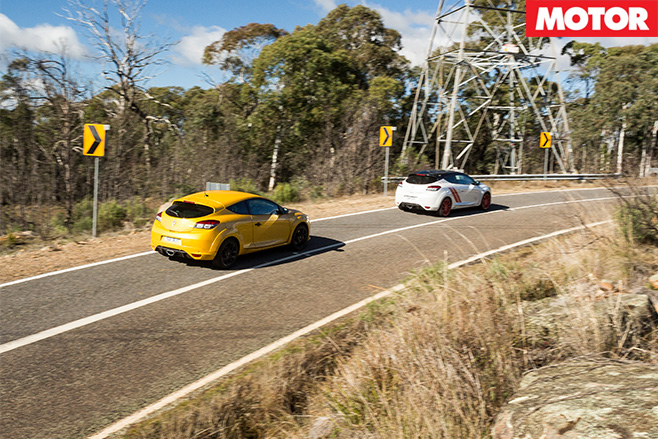
On the same stretch of tricky tarmac, it takes commitment to uncover the Trophy’s extra talent; unsurprisingly, given how much DNA they share, the two cars feel very similar, so the differences are reasonably subtle – the Trophy-R’s steering is slightly lighter, its turn-in a fraction sharper.
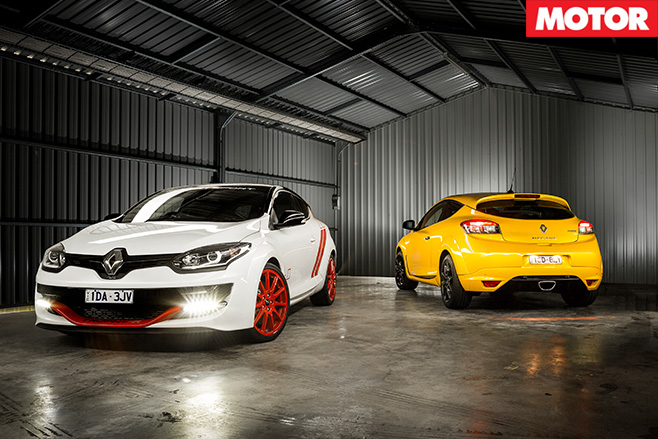
Commit to corners at what seems like insane speeds and it just grips and goes; the Trophy-R taking everything you can throw at it and yet coming back for more. You might only have a drive like this a couple of times a year, but it’s an experience that a base RS265 will never be able to replicate.
There’s no doubt the RS265 offers 95 per cent of the experience for 70 per cent of the cost. And for most people, the Trophy-R’s extra ability will be redundant or irrelevant. For the committed few, however, well, it will be like the best burger you’ve ever eaten. The ingredients may be relatively simple, but the preparation and construction have created something truly magnificent.
| u00a0 | Megane RS265 | Megane RS275 Trophy-R |
| Body | 2-door, 5-seat hatch | 2-door, 2-seat hatch |
| Drive | front-wheel | front-wheel |
| Engine | 1998cc inline-4, DOHC, 16v, turbo | 1998cc inline-4, DOHC, 16v, turbo |
| Bore/stroke | 82.7 x 93.0mm | 82.7 x 93.0mm |
| Compression | 8.6:1 | 8.6:1 |
| Power | 195kW @ 5500rpm | 201kW @ 5500rpm |
| Torque | 360Nm @ 3000rpm | 360Nm @ 3000rpm |
| Power/weight | 142kW/tonne | 156kW/tonne |
| Transmission | 6-speed manual | 6-speed manual |
| Weight | 1411kg | 1284kg |
| Suspension | struts, A-arms, coil springs, anti-roll bar (f); torsion beam, coil springs, anti-roll bar (r) | struts, A-arms, coil springs, anti-roll bar (f); torsion beam, coil springs, anti-roll bar (r) |
| L/W/H | 4320/1848/1422mm | 4320/1848/1422mm |
| Wheelbase | 2646mm | 2646mm |
| Tracks | 1546/1547mm (f/r) | 1546/1547mm (f/r) |
| Steering | electrically-assisted rack-and-pinion | electrically-assisted rack-and-pinion |
| Brakes | 340mm ventilated discs, 4-piston calipers (f); 290mm solid discs, single-piston calipers (r) | 340mm ventilated discs, 4-piston calipers (f); 290mm solid discs, single-piston calipers (r) |
| Wheels | 18.0 x 8.25-inch (f/r) | 19.0 x 8.25-inch (f/r) |
| Tyres | 235/40 ZR18 95Y (f/r) Michelin Pilot Sport PS2 | 235/35 ZR19 (f/r); Michelin Pilot Sport Cup 2 |
| Price as tested | $43,990 | $61,990 |
| Positives | Great engine; engaging handling; strong brakes; value | The Megane experience turned up to 11; a hot hatch legend |
| Negatives | Ride can be hard work; notchy gearbox; inconsistent diff | Possibly too compromised for daily use; recalcitrant gearbox |
| Star Rating | 4/5 | 4/5 |
Is a plug-in hybrid version of the sharply dynamic X5 nothing but dead wood when it comes to BMW’s green cred?
WHAT IS IT? A petrol-electric plug-in hybrid version of BMW’s large SUV
WHY WE’RE DRIVING IT BMW’s COTY-winning BMW i3, and the BMW i8 supercar show that the company is at the cutting edge in terms of hybrid and electric powertrain technology, so we’re keen to learn if the transfer of this tech to its conventional models continues the form.
MAIN RIVALS Porsche Cayenne S E-Hybrid. From the third quarter of 2016 there will also be the Audi Q7 e-tron and the Mercedes Benz GLE500e (which adds plug-in hybrid tech to a twin-turbo petrol V6).
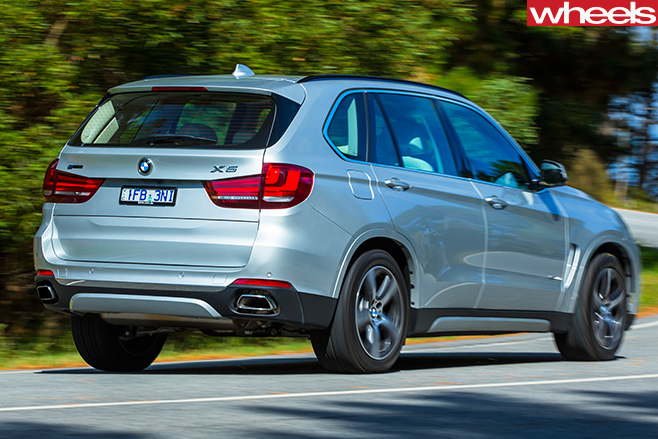
THE WHEELS REVIEW THE main issue with cutting-edge technology, as best as I can tell, is how quickly its once-gleaming edge can become dulled. What was yesterday’s Brilliant Bright Shiny Thing is today’s discontinued obsolescence, and tomorrow’s landfill.
So where, we wonder, does that leave BMW with its relatively late-to-the party X5 xDrive40e, the plug-in hybrid variant of what was last year’s top-selling premium SUV? The tech fundamentals are fairly familiar. The xDrive 40e takes the company’s 2.0-litre turbo four cylinder petrol engine and integrates an electric motor between it and an eight-speed automatic transmission. The underfloor area in the boot loses the space-saver spare tyre and rises 40mm to accommodate a 96-cell, 9kWh lithium-ion battery pack. Load space with the seats folded remains vast at 1720 litres.
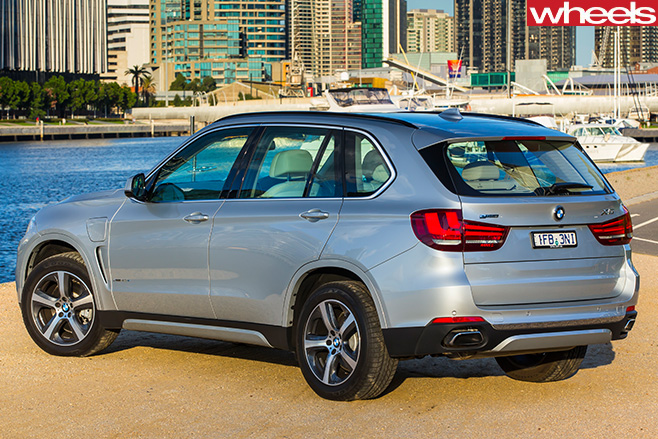
In operational terms, it typically goes like this: You plug the car into a conventional domestic power supply and allow it five hours to reach maximum charge. This charging time is roughly halved if you have an installer fit a high-output wall box, or halved again if you plug in at a public charging station. That full charge will give you, according to our test loop, around 24km of electric-only propulsion if you select the MAX eDrive mode, which bars assistance from the petrol engine unless the throttle is kicked to the firewall. If 24km doesn’t sound like much result for five hours tethered to a wall, that because it’s not. Depending on traffic and speed limits, it typically equates to less than 30 minutes of driving time. But BMW points out that most city dwellers only commute 32km each day, and half of people drive just 20 or so. The message is that the XDrive 40e has mostly enough EV capability for most people’s commuting needs. But it’s not exactly what you’d call a generous electric-only range.
More encouraging is the seamlessness with which the two power sources merge or decouple when the car is operated in the default Auto eDrive setting. Here it uses the most efficient combination of available power; more electric (if the battery is sufficiently charged, of course) around town, and mostly petrol power for highway cruising. Naturally there’s a Save mode to preserve battery power; if you’re leaving your charging point and heading straight onto a highway, for example, it makes more sense to preserve the battery’s power until you’re back in stop-start city driving.
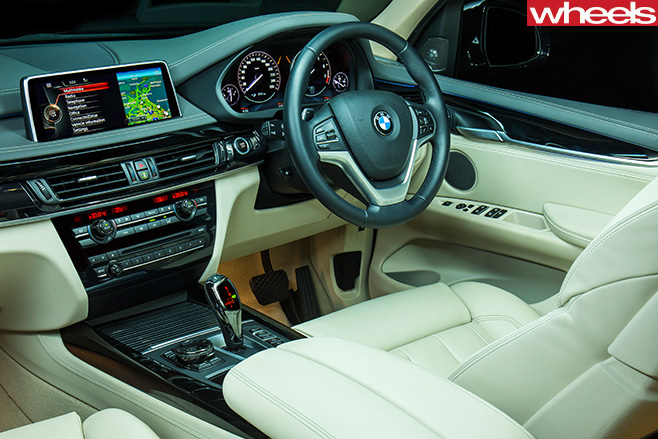
So, as you’d expect from BMW, the powertrain, for all its complexity and weight, does exactly what you’d expect of it, and there’s sophisticated unobtrusiveness about its operation that has plenty of appeal. Beyond that, though, there are well-documented pros and cons of this third-generation X5 generally. First up, despite the standard fitment of adaptive dampers to the xDrive40e, deemed essential due to the extra weight, the ride is well short of plush or cosseting. There’s an abruptness to its vertical motions, especially over sharp edges or traffic-calming infrastructure, which was exacerbated on our test car thanks to the optional 20-inch wheels running massive 305/35 rear and 275/40 front rubber.
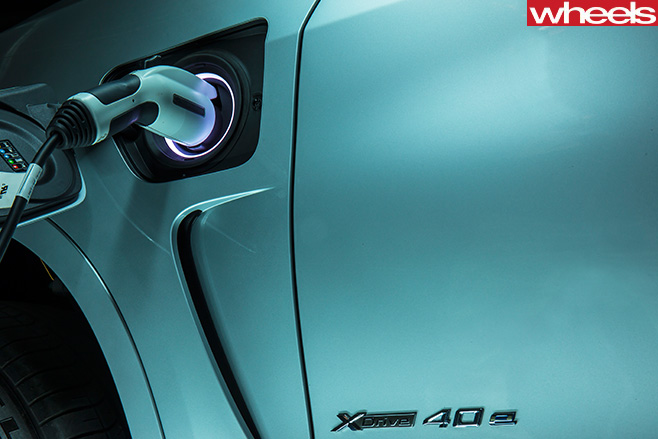
In terms of fuel use, the xDrive40e claims an official and miraculous-sounding 3.3L/100km, but real-world figures will depend hugely on driving use and distances between charges. Short trips and constant plugging in could theoretically see you better this number, but once the battery’s charge is gone, you’re left with a big SUV and a hard-working turbo petrol four burning at least 10.0L/100km in general driving. It’s also worth remembering that a full charge using green electricity will cost around $2.
On balance, it leaves the xDrive40e as a keenly priced and worthwhile addition to the X5 line-up, but one that will only appeal to a select customer; someone who can see environmental merit in the limited EV range, who doesn’t mind the nightly plugging-in process, who doesn’t need the third-row seating (about a third of X5 customers do) which is nixed by the battery pack, and who geeks out joyously using the smartphone app to remotely check the battery’s charge status. For everyone else, that leaves the $16,000 cheaper xDrive30d as the default choice, and still sweet spot in the X5 line-up.
SPECS Model: BMW X5 xDrive40e Engine: 1998cc 4cyl, dohc, 16v, turbo + electric motor Max system power: 230kW Max system torque: 450Nm Transmission: 8-speed automatic Weight: 2230kg 0-100km/h: 6.8sec Fuel economy: 3.3l/100km Price: $118,900 On sale: Now
