
V8 engines to dominate post-2016, but new regs pave the way for turbos, coupes and more manufacturers
V8 Supercars will still be dominated by V8 engines even once the Aussie-made Holden Commodore and Ford Falcon are no longer being produced, but the new proposed set of technical regs also opens the door the potential entry of turbocharged coupes such as the 2015 Bathurst 12-hour winning Nissan GT-R. It’s also hoped that the changes will result in more manufacturers joining the series alongside Holden, Nissan, Volvo and Mercedes.
The new regulations for Australia’s premiere touring car category were publicly rolled out in draft from earlier today, dubbed ‘Gen2, ’and signal the end of the exclusive era for V8 engines and sedans that’s existed since 1993, following the switch from international Group A regulations.
One inevitable change for 2017 will be from the V8 Supercars name to simply ‘Supercars’.
While the current cars and engines will still be fully legal, the category says the move to allow a wider choice of engines and bodies reflects a rapidly changing automotive world that includes the demise of all local car manufacturing in Australia by the end of 2017.
It predicts the swap from 5.0-litre V8 sedans such as the cornerstone Ford Falcon and Holden Commodore that have been integral to the category for more than two decades to turbo V6s and coupes will be gradual.
Significantly, any new vehicle combinations must race in parity with the current V8 sedans, meeting the same engine power equivalence and aerodynamic specifications.
“We made it clear when we announced the Gen2 strategy that there will be no compromise in power, competition or technical parity,” V8 Supercars CEO James Warburton said.“The category in 2017 will be exactly what it is now. Fast, loud and fiercely competitive. This opens the same garage door a little wider and future proofs the sport.”
American motoring racing icon Roger Penske, who took over Dick Johnson Racing this year, is lobbying Ford Performance in the USA to support a Mustang Supercars program, despite Ford Australia already declaring 2015 its last year in the category.
Meanwhile, Nissan Australia boss Richard Emery has openly stated Gen2 provides a potential opportunity to swap from the Altima V8 to the Nissan GT-R, a coupe powered by a turbo six-cylinder. Volvo has been linked with a racing version of the V60 wagon, while Holden is expected to embrace a turbo V6 when it swaps to an imported Commodore replacement in 2018.
Toyota’s Lexus luxury brand is a potential new player that has publicly confirmed it is considering entering the category after the introduction of Gen2.
The base Gen2 guidelines stipulate a car must be publicly available for sale in Australia, be front engined, right-hand drive and offer full four-seat configuration in its road going version. The race car must be rear-wheel drive and accurately reflect the look of the road car. All cars will use the existing Car of the Future chassis and control components, and be subject to current engine and aero parity rules.The regulations state the model must have a minimum production volume of 5000 cars of the same body shape worldwide.
Sign up here to receive the latest round-up of Wheels news, reviews and video highlights straight to your inbox each week.
Pink reflections of the setting sun shimmered in the water behind us as we turned under an entry arch of wrought iron whirls. We’d arrived at the Grand Hotel des Iles Borromees, on the shores of Lake Maggiore in Italy, only to brake sharply on seeing the notice: “Maserati Parking Only”.
We drove through. This time, I was sitting in the Maserati for the one, and probably only, time in my life. We pull up beside the other six, parked Maserati’s; attracting star status admiration and plenty of camera-phone snapping.
Why such a shiny array of cars in this particular location? Well, I’m holding an invitation that I imagine feels a bit like winning a Melbourne Cup trifecta: first, go to Northern Italy; second, pick up a Maserati; third, drive it to the new high-tech Maserati factory in Turin. All this to celebrate what is turning out to be a very fruitful partnership between Italian super-luxury brands Maserati and menswear giant Ermenegildo Zegna.
Australians may have heard of Zegna when it was the favoured power-suit of choice of former Prime Minister Paul Keating. Or, they may know of it due to fact that these sharp, ultra-fine woolen men’s suits are made using fibres from our very own Australian Merino sheep. These are then woven in Italy in Zegna’s historic wool mill, located just up the road from our starting point.
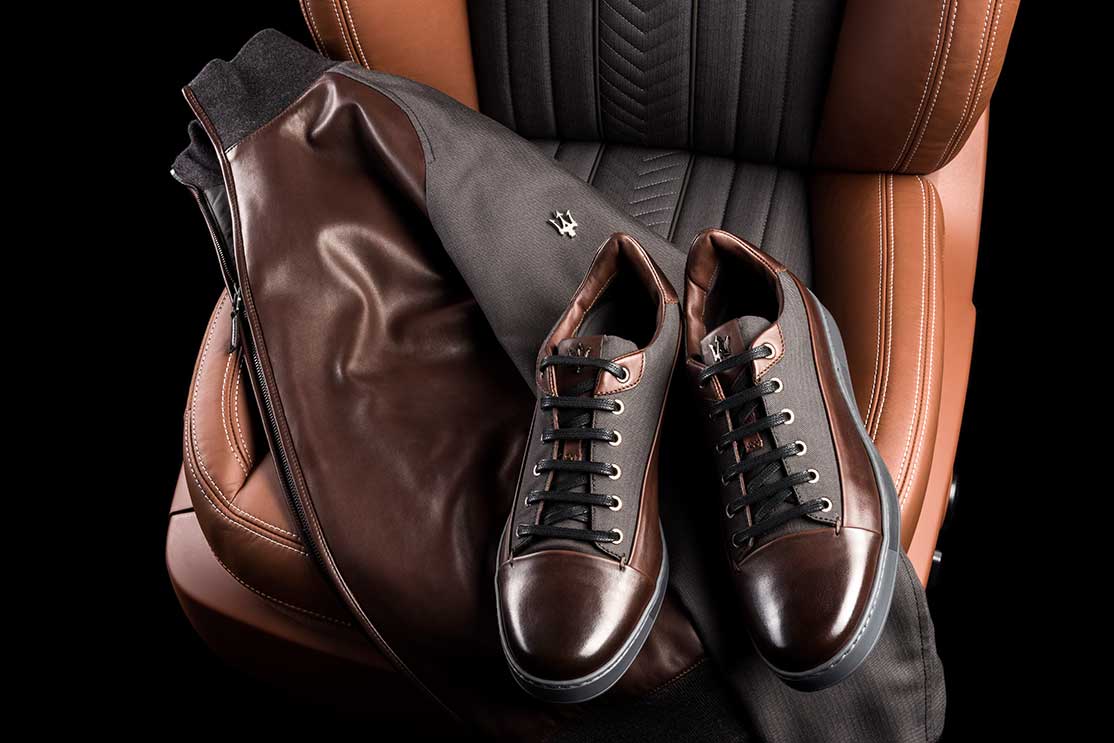
So you might ask: What have these two seemingly very different companies got to offer one another? Well, it’s not unusual for car-manufacturers and fashion designers to cross-pollinate and give birth to luxury. In this case, Maserati has harnessed Zegna’s expertise to design and produce an uber-luxe collection of cars with interiors designed by the menswear company using Poltrona Frau leather and Zegna Mulberry Silk inserts, made at the factory.
Silk! That’s right. That delicate natural fabric favoured by underwear designers and brides. But as a car interior for a high performance vehicle better known for its precision engineering and machismo? Madness! Well that’s what head honcho Mr Wester at Maserati thought too when the idea was first mooted, but then again, he thought, why not?
It turned out to simply be a matter of technology. If you take a silk thread, tease it, twist it and subject it to all manners of hi-tech treatments, what you get is a woven silk that’s tough enough to pass Maserati’s stringent durability tests. And we were here to experience the driving comfort of this specially designed collection of interiors, which are available in the classically styled Maserati Quattroporte range and its sportier, lighter and trendier relative, the Ghibli (read the Wheels review here).
The experience started well with a perfectly frothed cappuccino and a jam-filled brioche (Italy’s version of the French croissant), followed by an early morning meander through the manicured public gardens lining the waterfront at Stresa. Peering through the filmy morning mist to the Borromean Islands, a short jet boat ride away, is more than enough to remind you why Italy has close to 50 million international visitors every year.
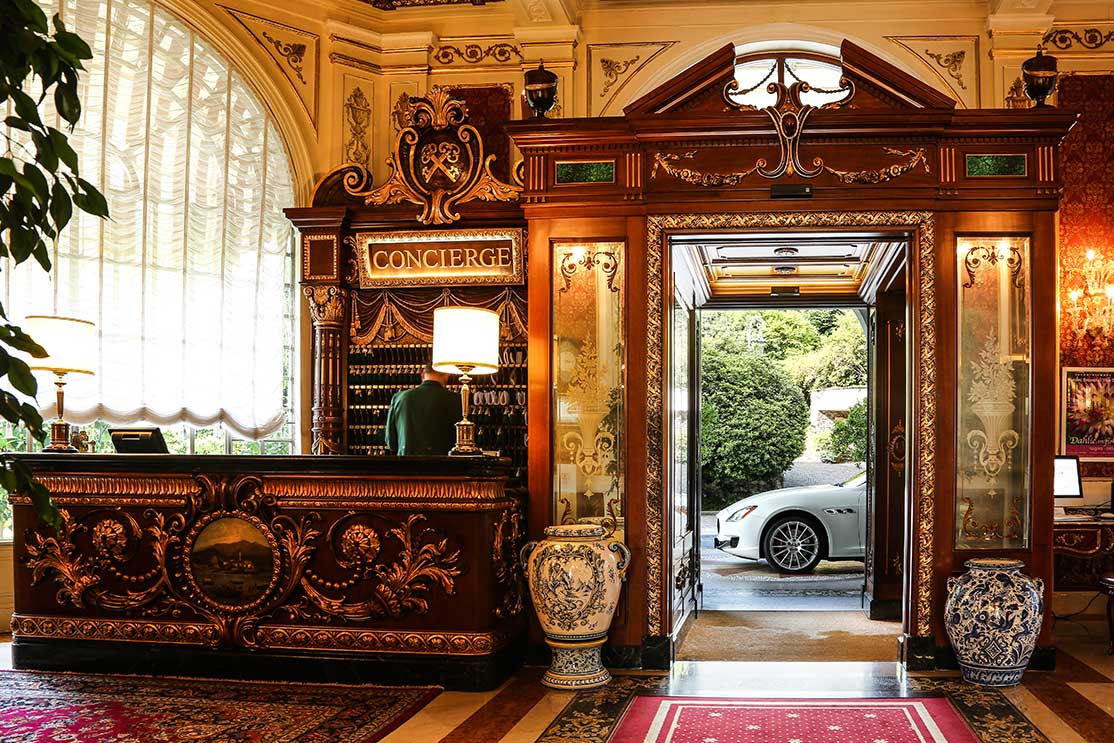
Leaving this picturesque lakeside town, we headed inland towards Turin via the hilly province of Biella; an area famous for its wool manufacturing, both past and present, and dotted with pretty valleys and beautiful stretches of twisting roads lined with lush foliage.
Deep within this verdant landscape we reached the historic home of the Zegna family at Trivero. The estate and its surrounds, now called Zegna Oasis, houses the Zegna museum, exhibition space and the famed fabric archives containing immaculately kept records of every pattern and colour of cloth woven in the factories below and used today as inspiration by designers around the world.
Our host, Laura Zegna, recalls days spent as a child playing with the children of the valley’s weavers. They all had deep roots in the valley. Weavers and landowners alike were striving to produce the very best quality cloth possible. Luckily for them, EG was a visionary and broke with traditions of the time by putting his name on the cloth he produced, which allowed him to build a name for himself and his company. The company is now globally recognised, when many others were overtaken by globalisation and disappeared.
EG was a man of extraordinary foresight and, back in the 1930s, he started to replant the traditional pines on the steep hills around his estate that had been denuded of trees for generations as people scavenged for much needed firewood.
A tradition that his sons and grandsons have continued, so that now almost 100 years later the road we were driving on, called Panoramica Zegna, is a visually delightful 26km route set in a 100km² reserve. It winds through the leafy mountains with spectacular glimpses to the plains below and is surrounded by meadows, fir forests and thousands of rhododendrons and hydrangeas that explode with colour in spring. And we’re seeing it all through the crystal-clear glass of a Maserati’s window.
To drive such a luxurious car in a location like this simply adds frisson to an already delightful ‘Italian’ experience. You can’t help but feel a little superior as you overtake the more sensible cars trudging to their destinations and preen as other passengers take your picture – a small glimpse into the life of living like a movie star for a day. It’s a buzz stopping in small villages for a bitter-sweet espresso or refreshing gelato and being bombarded with friendly waves, appreciative looks and admiring comments. Bella macchina (beautiful car) and a wave of the hand.
The best thing of all is that you don’t have to be driving the car to feel good and passengers still get as much enjoyment out of sitting in the silk woven side seats.
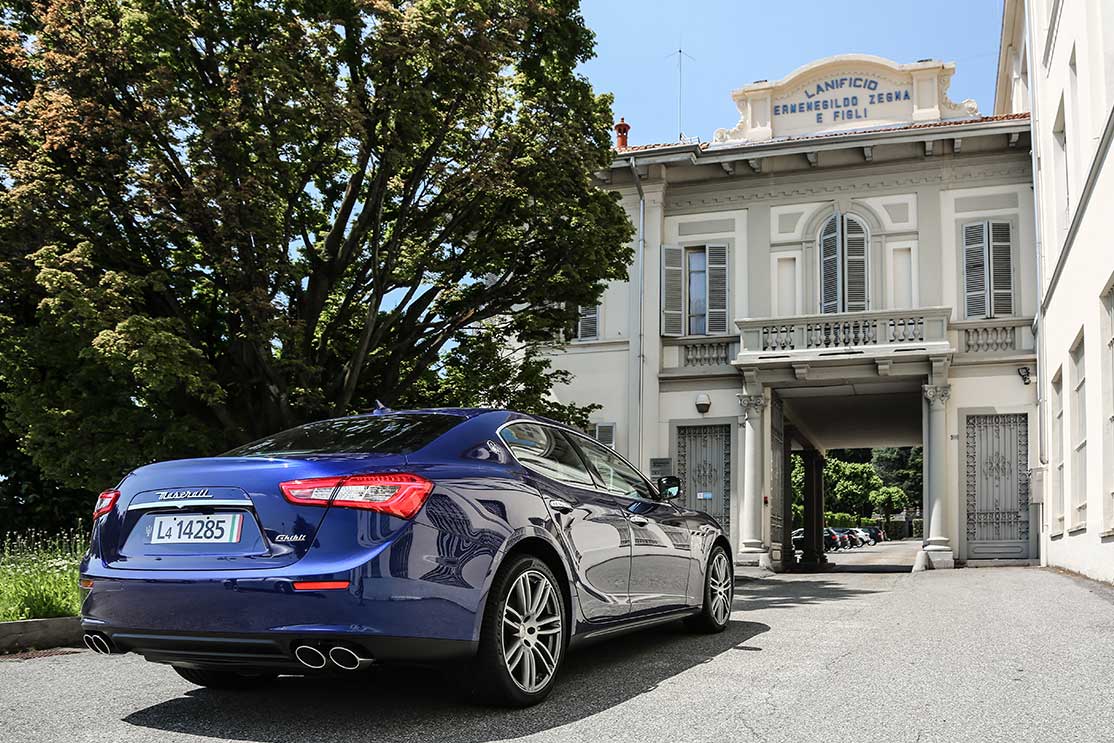
Compared to others in its class, a Maserati feels less technical and cold; its more melodramatic and extroverted. And that sound! When you put your foot down, the V8 engine in the top end Quattroporte gives out an operatic crescendo to rival any Italian diva. The plush interiors don’t shout money but they feel expensive and you can’t help but feel special. This is what this partnership is all about, after all.
That expensive feel, however, means that to own one you’ll need to part with between $140,000–$200,000 for a Ghibli and around $200,000–$300,000 for a Quattroporte. But hey, what’s a few hundred thousand dollars?
Later on, in Turin, we walked through the impressive robot-filled Maserati factory watching entire chassis’ being lifted and flipped by enormous robotic arms, with others delicately gluing a windscreen. But handling the Zegna silk-covered seats, due to arrive at the end of the year, will be a job best left to human touch.
The third-generation Audi TT drops its top as we drive it for the first time in Australia. Can the magic carryover from the coupe to the convertible?
WHAT IS IT? This is the alfresco version of the new-gen Audi TT that arrived Down Under early this year, complete with a bold new look, but also a ground-breaking interior that cements its position as style leader not only for its class, but for the entire future Audi line-up.
WHY WE’RE TESTING IT The Roadster has made it to Australian showrooms in time to pick your colour ahead of an endless summer. This is the first time we’ve subjected the convertible TT to the torture of our local excuses for roads.
MAIN RIVALS Mercedes-Benz SLK, Alfa Romeo 4C Spider, Porsche Boxster, BMW Z4, Nissan 370Z Roadster, Lotus Elise
THE WHEELS VERDICT A stylish, quality convertible that’s even better to drive than it looks
PLUS: Unique style; brilliant dash design, fit and finish; excellent roadholding MINUS: Sharp bump-absorption on larger wheels; lack of steering feel; single cup-holder
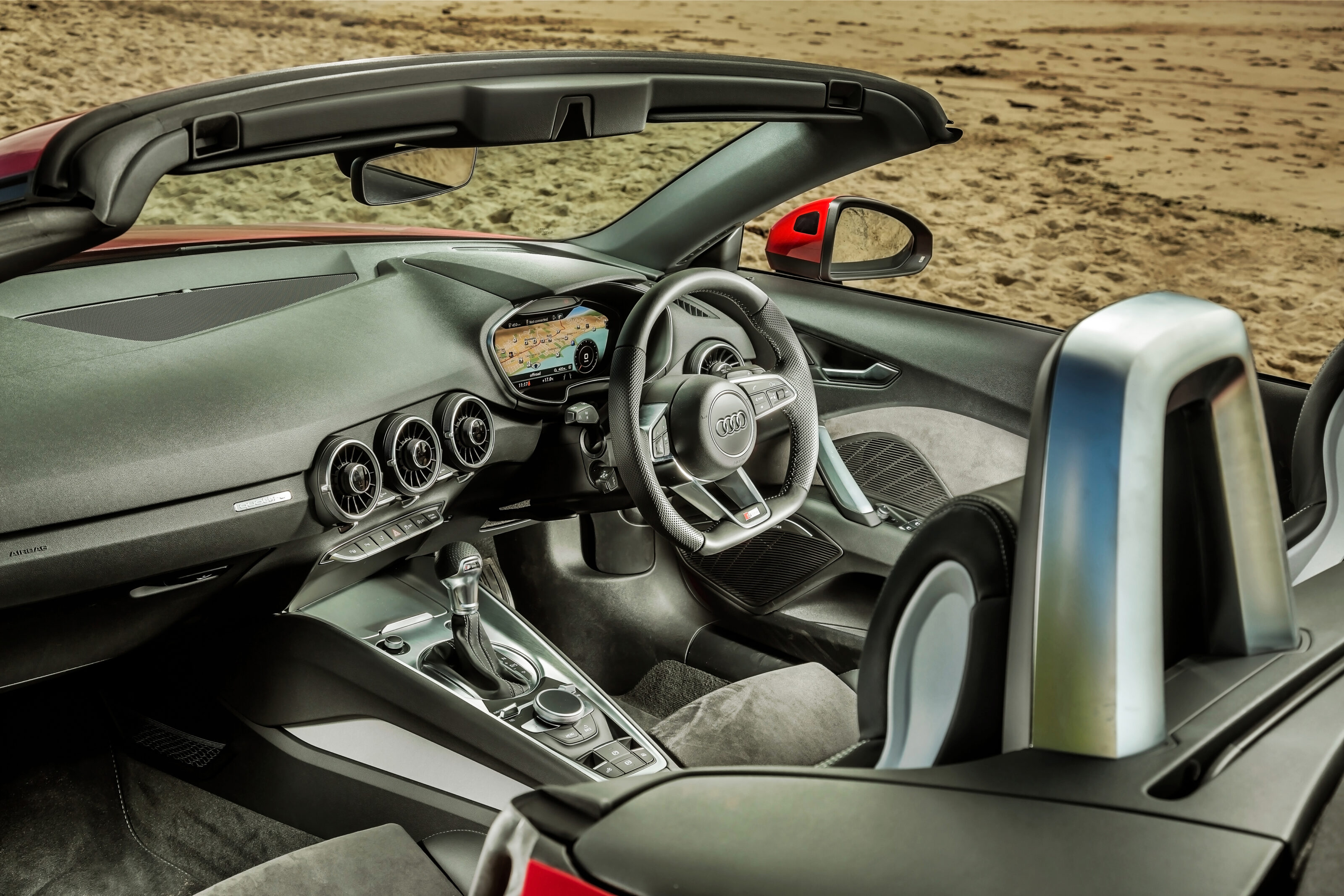
THE WHEELS REVIEW There are a load of reasons why the 2015 Audi TT Roadster is better than before. If you’re keen on the coupe, you’ll know that this third-gen TT sits on a new platform that’s loaded with even more aluminium, is stiffer and faster, quieter and uses less fuel, and it’s wrapped in Audi’s new design language as the brand’s style leader.
So when Audi does a ‘less is more’ and lops the top off the Coupe, you’ll get everything the coupe offers but with a folding cloth top and, predictably, more weight (90kg) and a style tax of $3500 over the coupe at Audi’s checkout. The styling of the $81,500 TT Roadster works better than that the Coupe, because the fixed roof version’s profile isn’t too far removed from the previous generation and, at 50 paces, the side profile and rear-quarter views are easily mistaken for its predecessor.
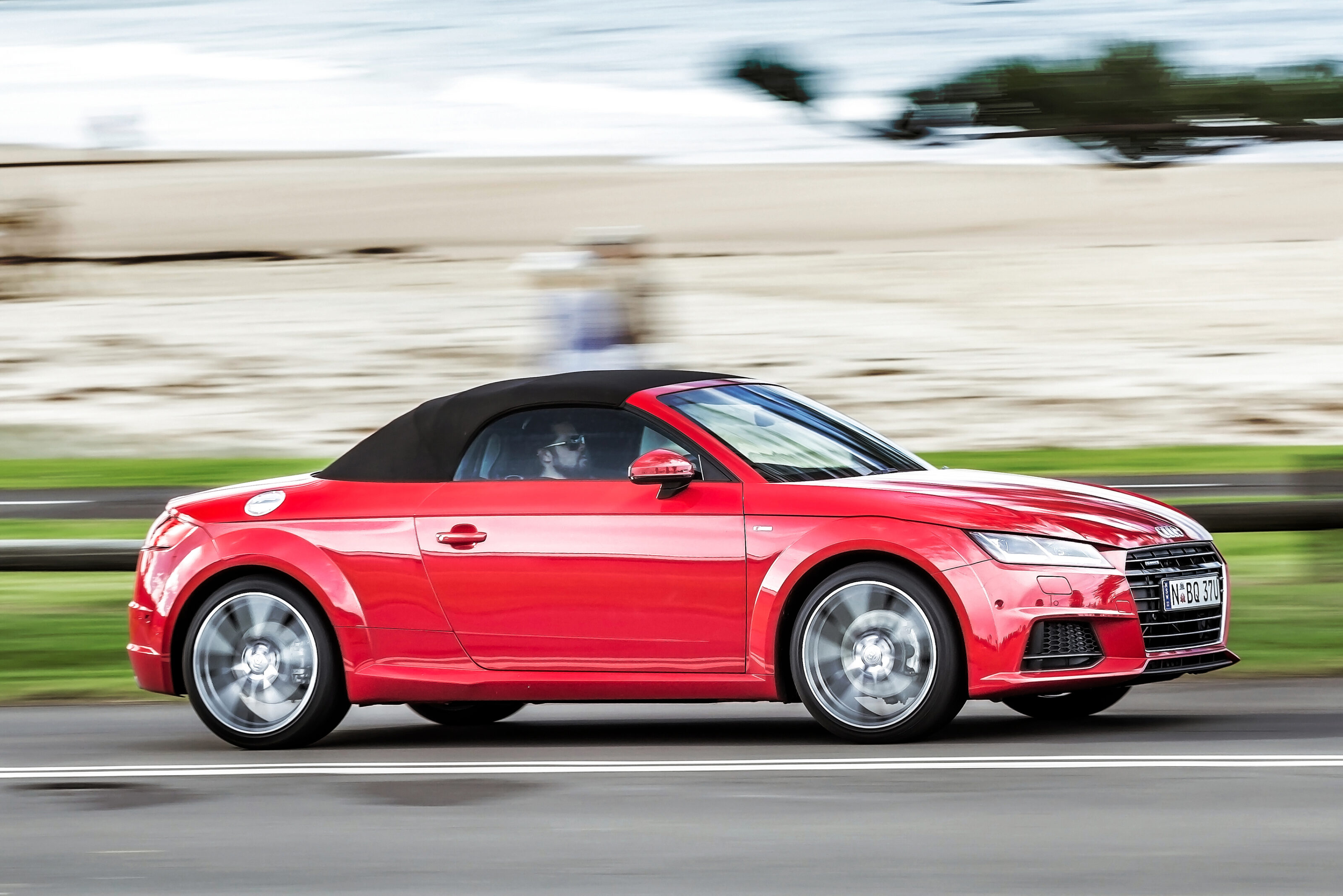
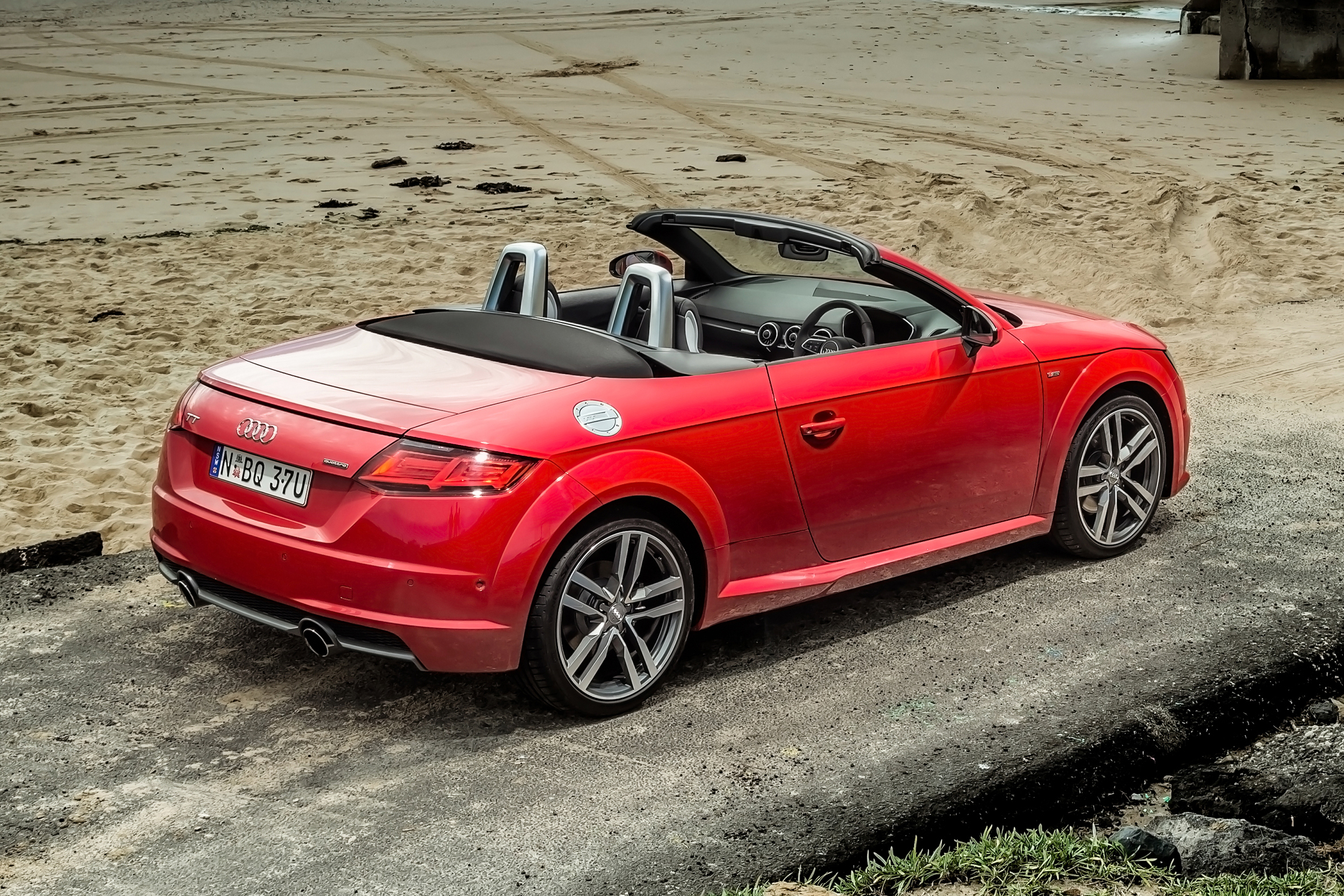
Not so the Roadster, despite some key TT identifiers – the inboard single exhaust pipe on each side at the rear, the Allen-key fuel filler and the horizontal hipline punctured by the front wheel arch. With the roof down, the TT looks excellent from behind thanks to those polished roll hoops at the back of its two seats, while front-on that Audi R8-esque nose’s sharper edges perhaps contradict the more rounded edges elsewhere, including that roof.
It’s inside that the TT Roadster is at its best and brightest: while the outside may not have the visual impact of the first generation, the TT’s cabin is leap years ahead of almost any car at any price currently on sale. That stunning dished wheel, the turbine-style vents with the digital centre temp adjustment – which Audi describes with one of the most intriguing terms, ‘Simplexity’, for its complex make-up yet simple appearance and use – and the ‘Virtual Cockpit’ digital instrument cluster.
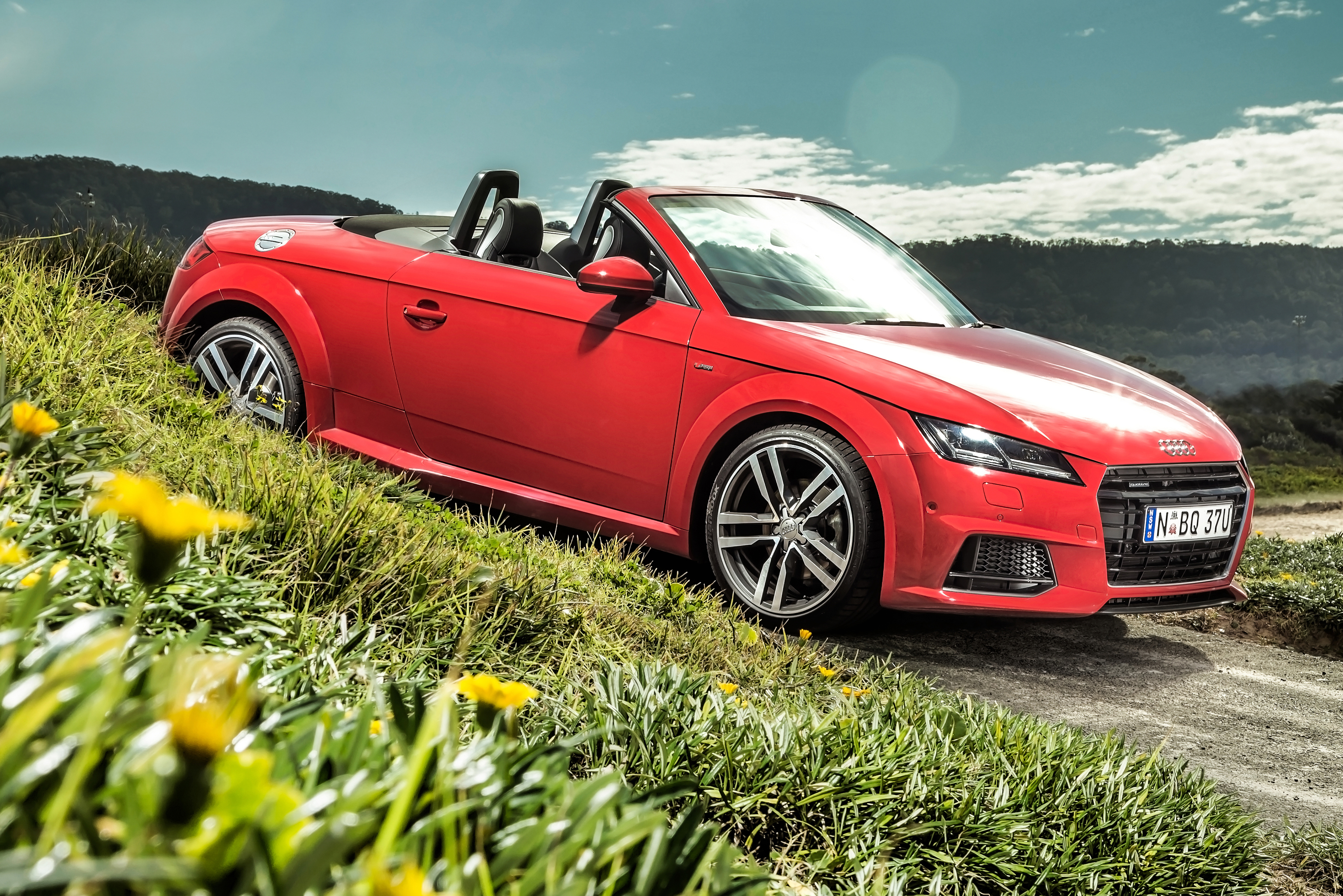
The TT Roadster is offered with only one driveline in Australia, with the 2.0-litre turbocharged four-pot making 169kW (a 14kW increase) used across the range, and paired with a six-speed dual-clutch transmission and fifth-generation quattro all-wheel drive system with torque vectoring. The only choice beyond colours, and so on, that buyers will have to make is whether to go for the $81K Sport – with 18-inch alloys, Alcantara trim – or pay $89k for the S Line (pictured here) with 19-inch alloys, subtle body add-ons and leather sports seats with adjustable bolsters.
Wheels drove both models at the local launch, with the cackle and burble of that engine on another level thanks to a roof that folds in a swift 10 seconds (up or down) and at up to 50km/h. Refinement levels are excellent with the roof up, with the cabin well insulated from engine, tyre and road noise as well as the outside world.
The throttle response in Dynamic – the most athletic of its drive modes – is strong, and while the TT Roadster is swift, it’s not an adrenaline-fuelled surge off the mark. Its strong torque means that it has good in-gear response, and the smooth, near-instant changes from the shift-paddles make full use of the neddies.
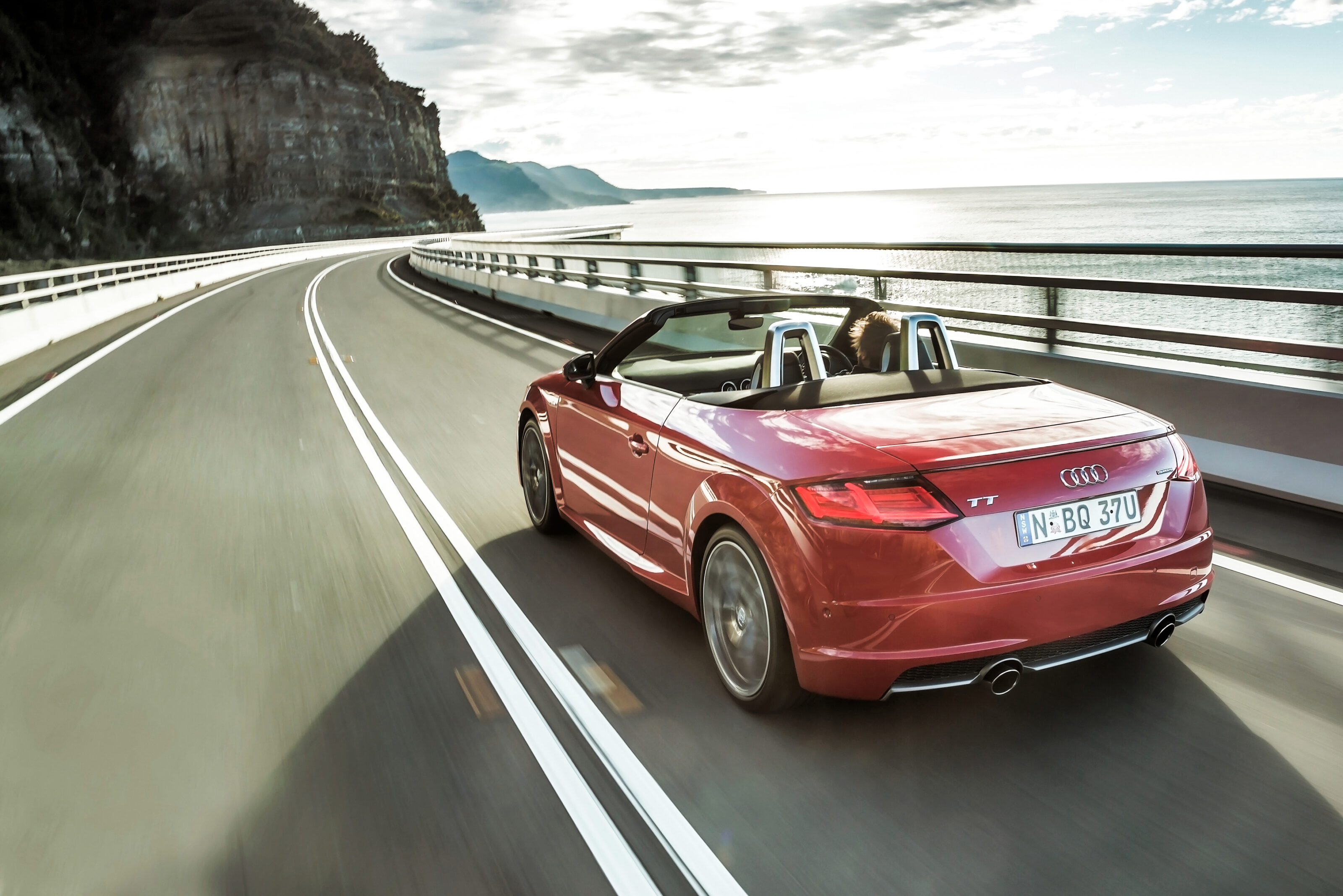
It’s in corners that the TT Roadster is most impressive, though, with brilliant roadholding meaning you need throw everything at it to get a whiff of misbehaviour. That brilliant composure means that this is an easy, fluid car to drive at seven or eight tenths to devour your favourite winding road, even if the steering could be sharpened to help with a brisker turn-in.
A reality check may have you choosing the base Sport car, though, as the 19-inch wheels on the S-Line serve up a noticeably harsher ride, the compliance making it crash through over sharp edges. The Sport’s inch-smaller alloys plane off that sharp edge, yet you lose very little of the former’s excellent roadholding.
The Roadster’s other ace is that its 280 litres of boot space, a 30-litre increase over the old model, doesn’t change with the roof up or down, even if it’s a shallow bay to stow your bags. Airport drop-offs are not on the TT’s to-do list, but brisk point-to-point performance and everyday liveability clearly are.
SPECS Model: 2015 Audi TT Roadster Engine: 1984cc 4cyl, dohc, 24v, turbo Max power: 169kW @ 4500rpm Max torque: 370Nm @ 1600-4300rpm Transmission: 6-speed dual-clutch Weight: 1425kg 0-100km/h: 5.6sec (claimed) Fuel economy: 6.7L/100km Price: $81,500 On sale: Now
What stands out?
The Toyota Corolla is an easy to live with, solid small car with an excellent auto transmission, whether you go for the sportier hatch or the more spacious sedan. Toyota concentrated on the basics and got most of them right. This review covers the Corolla range prior to June 2015.
What might bug me?
You might find the interior trim a bit bland and dark, and the response to small bumps a bit intrusive.Nevertheless the suspension tune is more comfy than sporty, especially with the sedan.
What body styles are there?
Sedan and hatchback. The sedan is significantly longer, and therefore it is roomier and rides slightly more smoothly.Both are front-wheel drive. The Corolla is classed as a small car, lower priced.
What features do all Corollas have?
Cruise control, and connectivity for Bluetooth devices.All Corolla sedans (but not all hatches) also have a reversing camera, rear parking sensors, and touchscreen control of interior functions.Electronic stability control, which helps the driver recover from skids. All new cars must have this feature.Seven airbags: two directly in front of the driver and passenger; one beside each front occupant protecting the body from side impacts; a curtain airbag on each side protecting the heads of front and rear occupants from side impacts; and finally an airbag at knee level for the driver.All models are covered by a three-year, 100,000km warranty.
Which engine uses least fuel, and why wouldn’t I choose it?
All Corollas use a 1.8 litre, four-cylinder petrol engine that revs happily. The engine is also fairly fuel-efficient, with automatic models returning 6.6 litres/100km in official tests.Automatic Corollas now use a CVT, or continuously variable transmission. Rather than a set number of gear ratios, the Multidrive S-CVT – as Toyota calls it – has an infinite number. The idea is to give the driver better access to the engine’s best power. Unlike some other CVTs, the Corolla automatic does this very well.Corollas fitted with the less popular six-ratio manual transmission use more fuel than the autos.
What key features do I get if I spend more?
The base Ascent Hatch rolls on 16-inch wheels made of steel. The first step up is to the Ascent Sport Hatch, which has lighter wheels made from an alloy of aluminium, a reversing camera, foglights at the front, more chrome and a unique grille.There’s an RZ model that ramps up the aesthetics with black alloy wheels and various exterior black trim elements. It also gets satellite navigation.Spend more for the Levin SX Hatch and the alloy wheels grow to 17 inches and mount still wider and shallower tyres, which sharpens steering response and adds grip. You get satellite navigation, sports front seats (which have more side-support, for fast cornering), and various sporty visual elements, including an instrument cluster trim that imitates the charcoal coloured, woven look of expensive and lightweight carbon fibre.The flagship hatchback, the Levin ZR, brings daytime running lights with long-lived LED bulbs, heating for the exterior mirrors, dual-zone air-conditioning, and heated front seats. The headlamps not only dip automatically for oncoming vehicles but also adjust their beams to help you see around corners. There is keyless entry: you can unlock the car while leaving the key safe in a pocket or handbag. The seats are trimmed in a combination of real leather and fake leather.On the sedan side, the Ascent Sedan has smaller steel wheels than the base hatch, at 15 inches. Spend more for the SX Sedan and you get bigger, 16-inch alloy wheels. The SX also adds front parking sensors to the Ascent’s rear sensors, and is fitted with foglights. There is keyless entry. There is also Toyota Link, which works with smartphones to operate apps built in to the main display.The ZR sedan picks up brighter, more efficient and longer lasting LED headlamps, automatic wipers that operate when a sensor detects rain on the windscreen, and a powered driver’s seat. (Unlike the Levin ZR Hatch, the ZR sedan has only single zone air-conditioning and its headlights do not adjust for corners.)
Does any upgrade have a down side?
The lower-profile tyres fitted to the larger wheels generally ride a little more roughly, and may cost more to replace.The only standard colour is white. The other seven colours cost extra.
How comfortable is the Toyota Corolla?
Inside, the latest Corolla looks radically different from earlier models, with styling dominated by the upright, dark dashboard. There is a silver-laced instrument cluster, and binnacles for odds and ends.The sedans and hatches share the look, but differ in trim materials and some details. For example, the touchscreen fitted to the sedans gets additional buttons, which make toggling between main functions easier than it is on touchscreen equipped hatches. Each gets modern looking finishes but with differences to the generally formal but elegant patterns. Some stitching on fake leather surfaces adds a touch of class.The sedans ride more comfortably, due to their dimensions and setup. For example, the longer wheelbase gives them a natural advantage over speed humps and other imperfections. At most price points they ride on tyres with a slightly deeper profile than those on the comparable hatch, which means there is more cushioning air between the wheel and the road.Small bumps can give a sharper than expected thump to the Corolla’s cabin, an effect emphasised on the bigger-wheeled hatches.
What about safety in a Corolla?
The Corolla is equipped with a full complement of airbags. All of the sedans have a reversing camera, as do all the hatches except for the least costly, the Ascent.The Corolla does not offer the latest active safety features, such as automatic emergency braking and blind-spot warning.(To see a full list of the safety features on any model, select the car and look under the features tab. Safety-related features are listed in red.)The Australasian New Car Assessment Program (ANCAP) has awarded the Corolla its maximum safety score of five stars.
I like driving – will I enjoy this car?
Steering on all Corolla models is light and responsive. The hatches, in particular, have a feeling of athleticism about them that works well around town.Body response over bigger bumps is quickly controlled, and the cars stay settled.Acceleration is respectable without being exceptional. The engine feels willing, and happily revs higher when you need more thrust. The automatic transmission does a good job of extracting the most from the engine.
How is life in the rear seats?
It is rear-seat passengers who will notice the most marked interior difference between hatches and sedans. The sedans have 100mm more space between the front and rear wheels. Rear head room and leg room are significantly greater in the sedans than in the hatches, where they are on a par with main competitors.However the hatch at least has a near-flat floor, making it easier for a middle passenger to place their feet. The sedans have a more pronounced hump in the middle of the rear floor.
How is it for carrying stuff?
The Corolla hatches have clever hidey holes, including small compartments on either side of the luggage area and underfloor storage on some models.The sedans miss out on some of that thoughtfulness but still get split-folding seats. Their boots are broader than those on the hatches, albeit with a bigger lip.
Where does Toyota make the Corolla?
Corolla hatchback models are built in Japan and the sedans in Thailand.
What might I miss that similar cars have?
The Mazda3 offers more active safety features – such as automatic emergency braking – either as options, or standard on more expensive models.Among other cars that might interest you are the Hyundai i30 and Elantra, both of which carry five-year warranties with no limit on distance. The Kia Cerato gets a seven-year warranty.Other alternatives include the Volkswagen Golf, Honda Civic and Subaru Impreza.
I like this car, but I can’t choose which version. Can you help?
Our reviewers like the Ascent Sedan. Its impressive interior space and standard reversing camera make it a tempting small car proposition.
When did Toyota update this Corolla?
The Corolla hatchback reviewed above went on sale late in 2012, and the sedan early in 2014. An updated hatchback arrived in mid-June 2015, and is the subject of a more recent WhichCar review. The update included a restyled body, a more comfortable ride, new central touchscreens, and the addition of a reversing camera to the least costly model. An update for the sedan was expected in 2016. An all-new Corolla was due about 2017.
The first drop-top S-Class has been spied testing ahead of its arrival in 2016 as the flagship Mercedes’ range continues to grow
THE 2016 Mercedes S-Class Convertible has been spied testing ahead of its expected reveal at the Frankfurt motor show this September. It’s the sixth body style for the expanded W222 Mercedes S-Class range, which was introduced in sedan form in 2012, and will be Stuttgart’s answer to the Bentley Continental GTC.
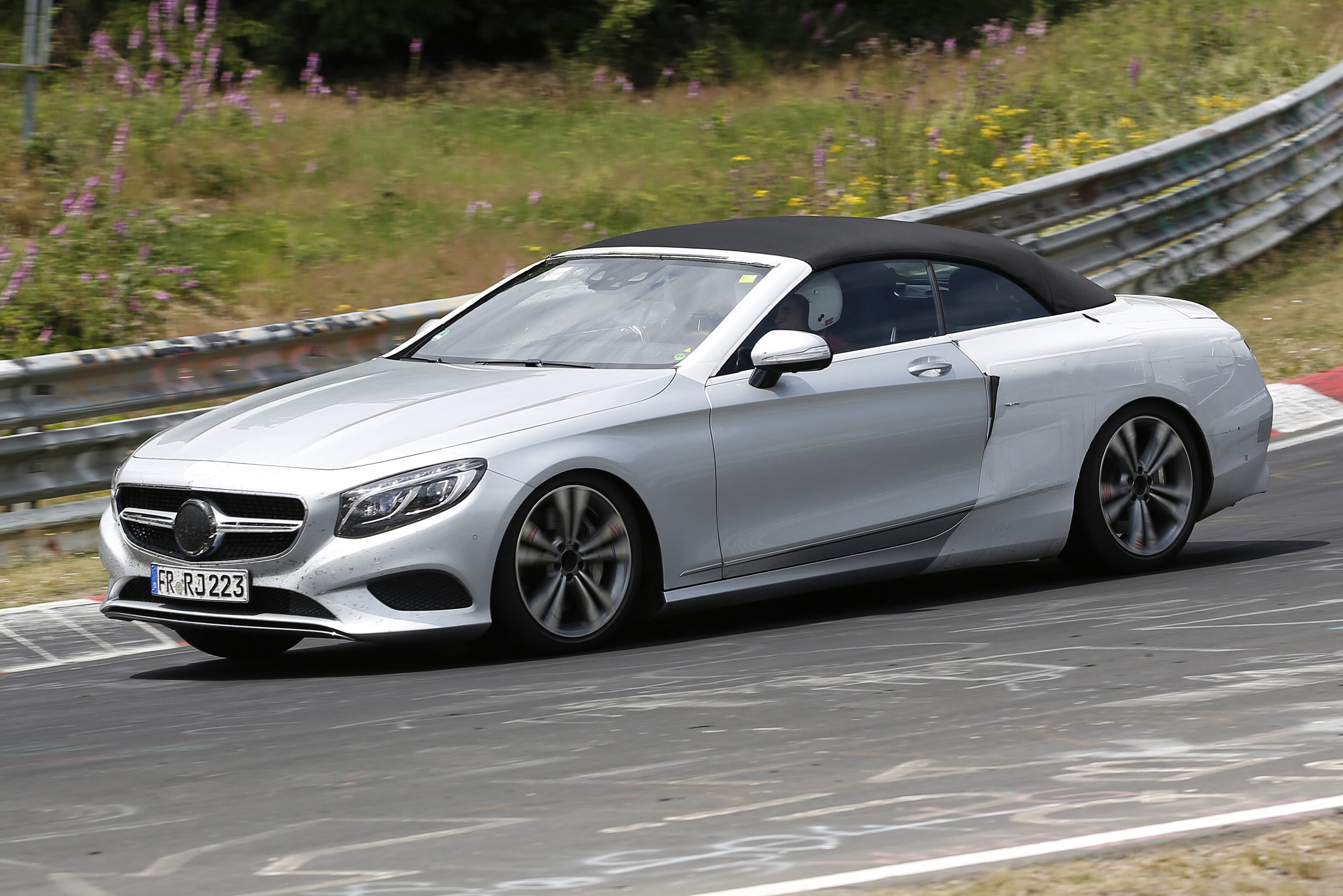
Since the sedan, we’ve seen the long-wheelbase versions added, as well as the Pullman and the Mercedes-Maybach S600 at the top of the Benz luxury tree. Yet, Mercedes has been teasing the media since 2012 when it confirmed that the S-Class would be offered in six body styles, and with the Coupe’s arrival here this year as the fifth, the convertible will be the final piece of the puzzle.
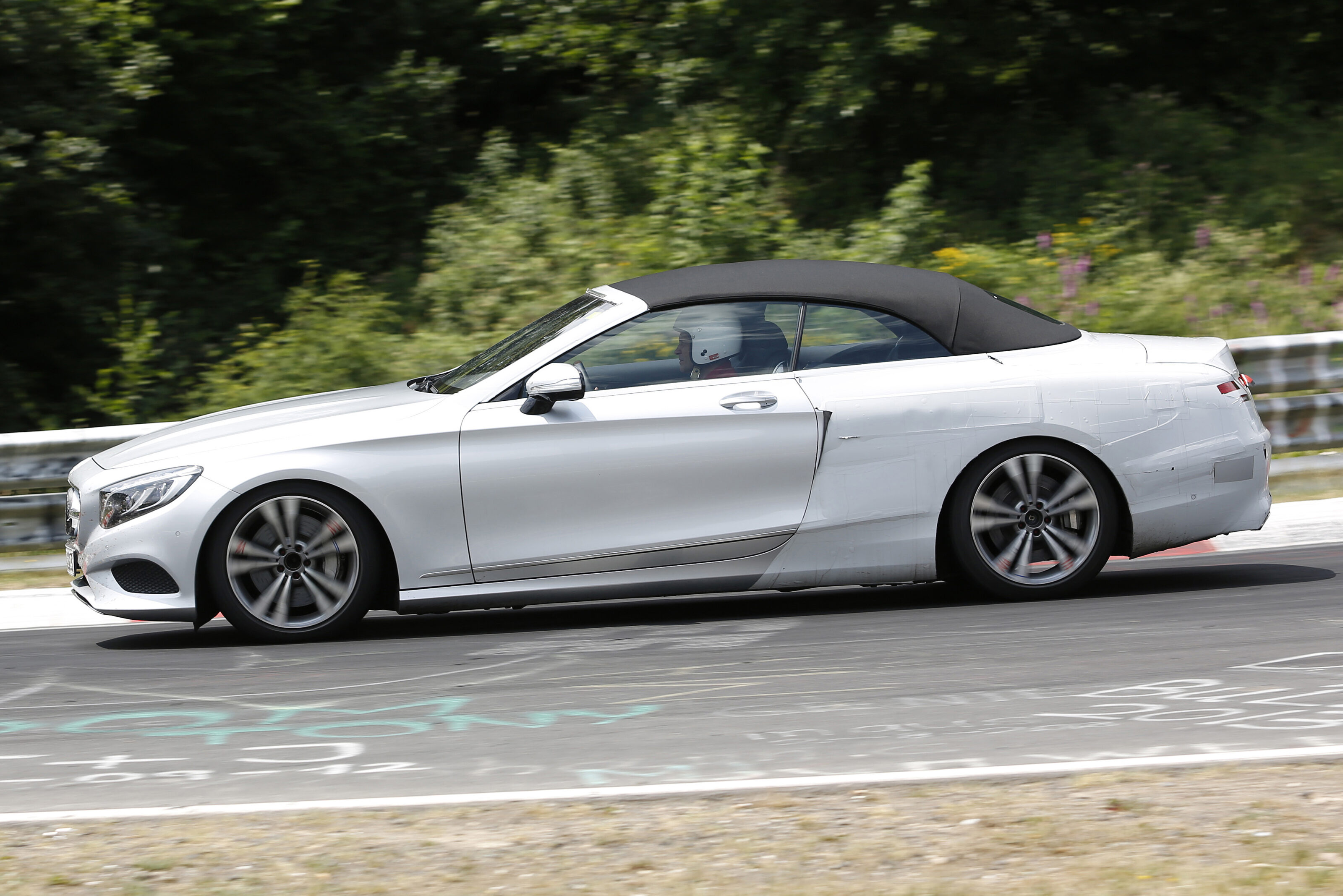
It’s a simple formula, too: take the smooth lines of the W222 coupe, which has its own unique wheelbase and windscreen, remove the lid and you have the drop-top. These images show that the open-air S-Class will have a cloth-top and evolve into something of a behemoth, despite the fact that these images show it being honed on the Nurburgring race track in Germany.
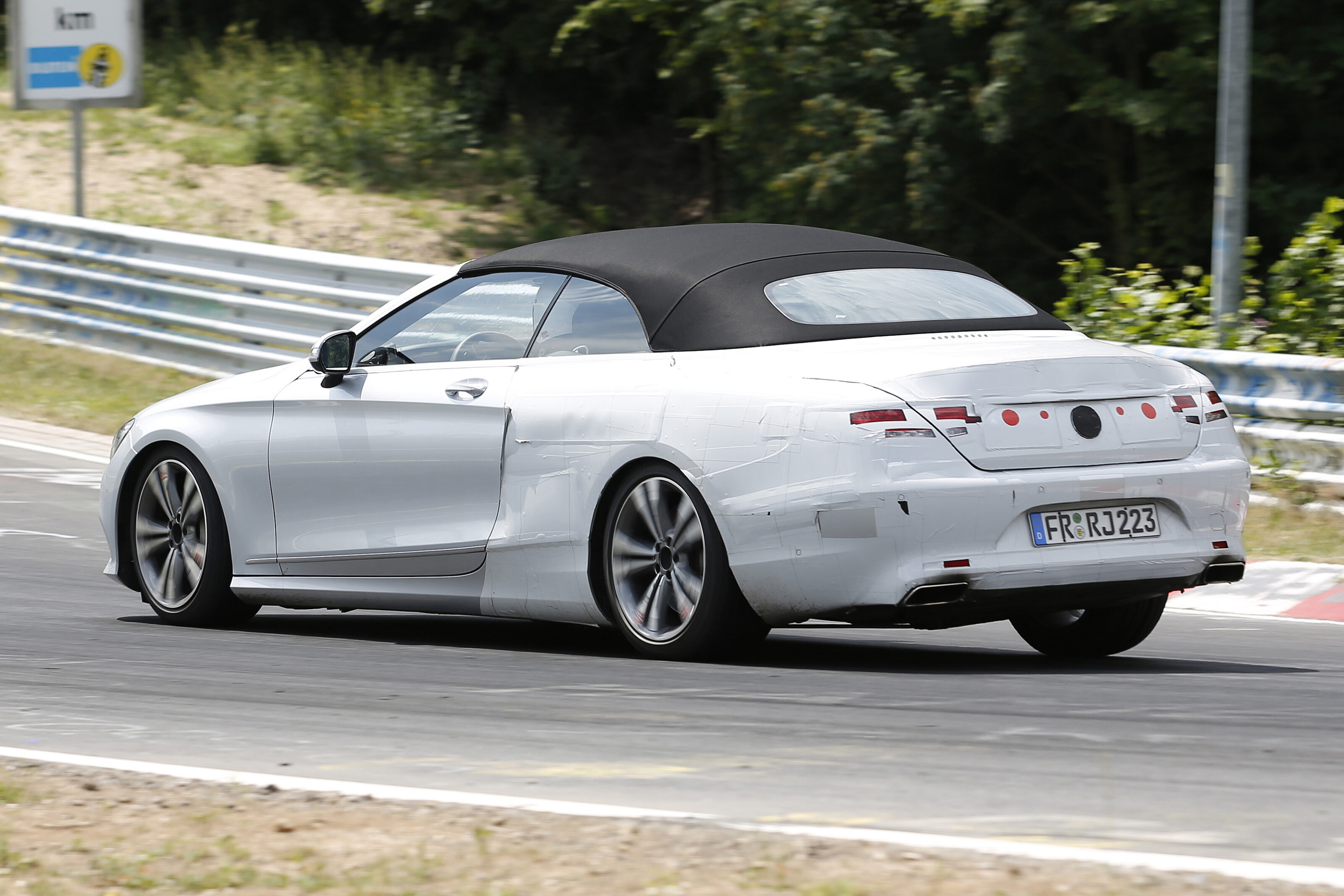
Under that long bonnet will be a range of V8 and V12 engines, with the Aussie line-up mirroring that of the coupe. That means a 335kW/700Nm 4.7-litre twin-turbo V8 for the S500 before the Mercedes-AMG S63 with its twin-turbo 5.5-litre V8 making 530kW/900Nm. The flagship will be the V12-powered S65, with two turbos, 463kW and 1000Nm of torque. While all-wheel-drive models will be offered overseas on V8 versions, the 4MATIC system is unlikely to be offered here.
The drop-top will be loaded with Mercedes technology, though, from its speed-hump and pothole sensing cameras that read the road ahead and adjust the suspension to suit, to its suit of six radars and airbag seatbelts.
Pricing will see the S65 Convertible arrive in showrooms at more than $500k, with the S500 expected to sit around $350K when it arrives here in 2016.
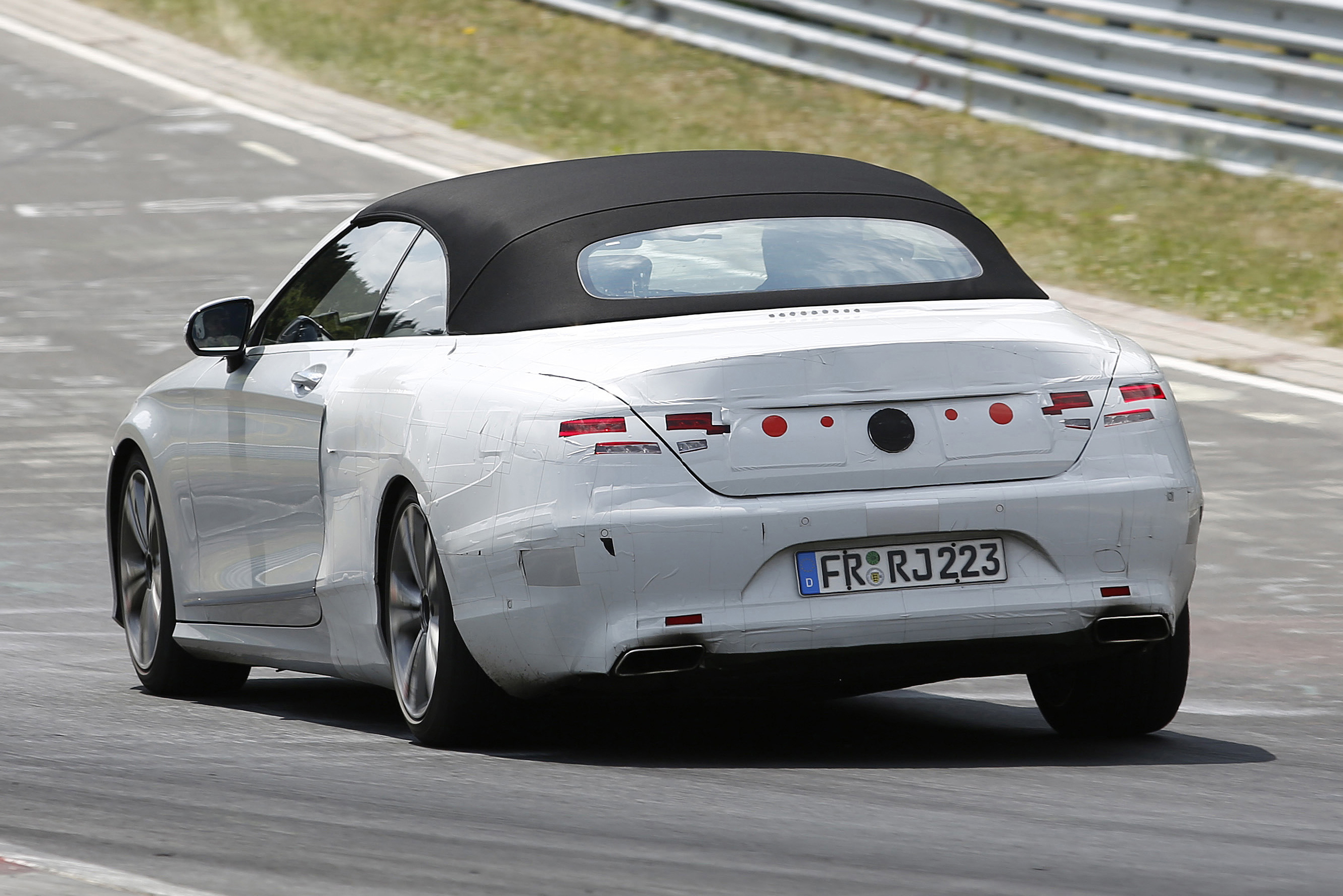
Have spy pics of your own? We’d love to see them. Send them to [email protected]
It is still a month away from launching in Australia, but Japanese tuners have already launched into the ND Mazda MX-5.
Home-town tuning company Autoexe has developed styling and mechanical kits for the latest-generation roadster, though the addition many enthusiasts may be hoping for – a turbocharger – is nowhere to be seen. Not yet, anyway.
Instead, Autoexe says its modifications are all about “sensitive tuning” designed specifically for the Japanese domestic market. An air intake claimed to reduce air flow resistance by up to 15 per cent to 3000rpm is the only engine change, while along with a twin sports exhaust with 54mm diameter helps to liberate slightly more power – though exact figures aren’t given.
Two suspension modifications are available – one simple, one more advanced. A low-down spring kit simply drops ride height by 20mm and ramps up spring rates by 18.5 per cent at the front and 21.5 per cent at the rear.
The more sophisticated road-friendly kit is called “street sport suspension” and retailing at $1763 in Aussie dollars, adds a dedicated trapezoidal spring and monutube dampers, with an adjustable ride height range of 5mm to 15mm. The springs are only 10 per cent stiffer front and rear.
When the new MX-5 is dropped, Autoexe says the angle of the lower suspension arm changes by enough to warrant a new adjustable stabiliser link that is a further option. An under-bonnet strut tower brace and floor cross bar are all designed to make the pure little roadster a bit tighter and tougher.
Optional outside signatures include a front lip spoiler, LED foglight kit and front bumper extensions, teaming with a rear wing and under-panel garnish that add about A$1217 to the price, according to the Autoexe Japan website. A forged alloy wheel kit is available separately.
Autoexe says that while it tunes for JDM, there are some export parts opportunities available. If there is one thing we know about NA, NB and NC owners, it’s that they love a good modification – and we suspect buyers of the ND Mazda MX-5 will be no different.
Get your free weekly report from the world of fast cars – subscribe to the MOTOR newsletter!
THE all-new Skoda Fabia ups the sex appeal of Skoda’s smallest model with Gen Y-baiting technology, tasteful customisation, and class-leading safety.
WHAT IS IT? The third generation of the Czech brand’s Volkswagen-based supermini, follows in the footsteps of the facelifted 2014 Polo with new electrical architecture (called MIB, for Modular Infotainment Matrix), an upgraded PQ26 platform and all-new EA211-series engines. Lighter, roomier, quieter, thriftier, more fun and more affordable, Skoda’s new-gen Fabia finally has the showroom sizzle and the street smarts to lure buyers away from Volkswagen’s older, more conservative Polo.
WHY WE’RE TESTING IT Skoda’s 2015 sales are up 30 percent on last year’s Aussie record (3853 units), but not because of the Fabia. Volkswagen’s refreshed Polo more than doubled the old Fabia’s entire 2014 sales tally in June alone (1041 compared to a piffling 446), so Skoda needed to start with a clean slate. And here it is – a much-improved car, priced from $15,990 (driveaway until December 31), including a leather steering wheel, collision mitigation with city emergency braking, tyre pressure monitors, rear parking sensors, Smartlink connectivity with Apple Car Play/Android Auto, and plenty of surprise-and-delight features such as luggage nets. The only glaring omission is cruise control (standard on Polo), which on the Fabia 66TSI manual is only available as part of a $1300 Travel Pack that also includes 16-inch alloys, fatigue detection and projector headlamps with daytime running lights.
MAIN RIVALS Ford Fiesta, Holden Barina, Honda Jazz, Hyundai Accent, Kia Rio, Mazda 2, Peugeot 208, Renault Clio, Suzuki Swift, Toyota Yaris and, let’s not forget, the Volkswagen Polo.
THE WHEELS VERDICT A highly likeable, thoroughly modern supermini that excels for standard safety gear, as well as the sort of clever features that genuinely improve the ownership experience. The new-gen Fabia isn’t the driver’s car its French rivals are, but it’s a polished all-rounder with amazingly tractable and efficient engines that will only improve with more mileage. The icing on the cake, though is the Fabia Combi – a baby wagon in a class of its own, with small-SUV-beating space for significantly less coin.
PLUS: More personality than a Polo; classy interior; tractable engines; neat manual shift; persuasive safety story; class-leading practicality of the wagon MINUS: Cruise control not standard; sports suspension lacks ride suppleness; steering lacks low-speed feel; three-pot turbo rejected for Oz

THE WHEELS REVIEW SLOWLY but surely, Skoda is working its way into the Australian consciousness. With a slightly oddball line-up that prides itself in offering something refreshingly unique – and clearly differentiated from the Volkswagen DNA that spawned it – Skoda has become a brand for thinking people who tend to value function over form.
That was certainly the case with the narrow-gutted old Fabia – launched way back in 2007 – that was more about being commodious than classically beautiful. But this new-generation Fabia is the face of the new Skoda. Smart and spacious just like before, but also stylish and sexy.
The 2015 Fabia is as mainstream as a Skoda gets, yet maintains one of the Czech brand’s traditions by offering class-leading luggage space – 305 litres in the hatch, and a huge 505 litres in the wagon, each with a 185/60R15 steel spare stuffed under the floor. Indeed, the new Fabia’s proportions have been altered significantly, seeing the hatch is 8mm shorter than before, but 90mm wider and 31mm lower, riding on a marginally longer wheelbase and tracks expanded by 30mm at both ends.
Not only does it look better on the road, it feels more planted too – on the wider tyres fitted to the launch cars anyway. And yet the new-gen Fabia is up to 112kg lighter than the model it replaces, ranging from just 1042kg for the base manual hatch to 1111kg for the DSG wagon.
Dynamically, think of the new Fabia as a Polo with a touch more personality. The standard-suspension 66TSI manual we drove (on chunky 215/45R16 Bridgestone Turanza tyres) rode with impressive pliancy and polished refinement on coarse surfaces, though there’s also a fair amount of body roll in corners. But the base Fabia seems to enjoy changing direction more than its VW cousin. With a tactile perforated-leather wheel (Polo’s is plastic), a brisk 2.6 turns lock-to-lock, grippier (and prettier) front seats and an encouragingly slick five-speed manual shift, the boggo Fabia is something of a little gem.

About the only serious omission is a lack of standard cruise control, which can be optioned with a $1300 Travel Pack that also scores you 16-inch alloys (base are steelies with 185/60R15 tyres), LED running lights and a fatigue detection system. But you can’t just have cruise by itself.
The base Fabia’s 66kW/160Nm 1.2-litre turbo four isn’t a sporting engine, but it is wonderfully tractable, with an ability to pull from 1250rpm up hills, and with max torque providing thrust all the way from 1400-3500rpm. There’s even a whiff of induction growl at low revs that enhances the 66TSI’s personality, though from 5500rpm to the 6400 cut-out, it’s more about producing noise than anything else. That said, it takes 10,000km to properly run in a Volkswagen engine, so the low-mileage Fabia 66TSI test car will become much more flexible over time.
The 81kW/175Nm version, available solely with a seven-speed dual-clutch in the Fabia 81TSI (from $20,290 driveaway) is quicker to 100km/h (9.4sec versus 10.9sec), equally as economical (4.8L/100km), and adds equipment such as cruise control, a front centre armrest and 15-inch alloys. But with that sticker, the Fabia DSG is squarely at the upper end of auto light-hatch pricing.

If you become liberal with Fabia’s options – a Sports Pack with 17s, sports suspension, front fogs, LEDs and fatigue detection ($1200), a Premium Sports Pack that adds auto headlights, rain-sensing wipers, privacy glass, a flat-bottom steering wheel, keyless entry, climate control, digital radio and an alarm ($2600), a customisable Colour Concept paint scheme ($300, that matches wheels, A-pillar and roof colour to interior trim), sat-nav ($950), metallic paint ($500) or a sunroof ($1000) – then your baby Skoda ain’t gonna be cheap.
The yellow and black 81TSI hatch we drove at launch was $22,840, and while we can’t fault the quality finish of its interior, or the generosity of its equipment, that’s VW Polo money. With options.
Running sports suspension and riding on 215/45R16 Dunlop SP Sport Maxx tyres, the Fabia 81TSI isn’t as sweet as the 66TSI manual. The engine’s a little punchier and the handling flatter, but what the sporty tune does to the ride, you don’t gain back in handling. Certainly not in Sydney’s Royal National Park after a big downpour. And on those tyres, the 81TSI’s steering offered little information as to when the front end was going to let go in the wet. As it turned out, the softer 66TSI on dry roads was more fun.
What all Fabias get is bucketloads of functionality. The cabin plastics might be hard, but they don’t look it, they’re precision matched (unlike Polo’s) and scratch-resistant. Fabia also offers loads of neat storage ideas, such as a rear parcel shelf that can mount at half height and act as a serving platter, or the standard luggage nets, the circular plant/soccer-ball holder, meshed nets in the side of the front seats, and a dedicated smartphone holder in the front just like an Audi A3.
Every Fabia also offers a gutsy six-speaker surround-sound stereo with Smartlink – a touchscreen system capable of connecting to Apple CarPlay or Android Auto. On the Apple verison we tried, Siri can answer questions, send texts or read out messages, which is bloody awesome in a small car like this. You can access all your phone apps, as well as all the other features packed into the Fabia’s Bolero stereo, though CarPlay requires a physical cable connection to the USB port to sync with the system.
Our favourite Fabia by far, though, is the wagon. Called Combi in Europe, the 66kW manual asks $17,140 (plus $300 for driveaway) and requires only the Travel Pack to really make this the Skoda Fabia to have. What other massively practical small wagon can you have in your driveway for $18,740? Unless you need all-wheel drive, it makes every small SUV virtually redundant.
SPECS Model Skoda Fabia 66TSI Ambition wagon Engine 1197cc 4cyl, dohc, 16v, turbo Max power 66kW @ 4400-5400rpm Max torque 160Nm @ 1400-3500rpm Transmission 5-speed manual Kerb weight 1066kg 0-100km/h 11.0sec (claimed) Economy 4.8L/100km Price $17,140 On sale Now
If there’s a silver lining to the impending demise of the Australian car industry, it’s the fact it gives manufacturers a chance to really let themselves off the leash.
Okay, so tight development budgets mean we’re never going to see a final Falcon GT-HO or Holden GTR-X, but there’s still plenty of scope for limited-run specials that offer something fresh to an enthusiast public clamouring to grab one last slice of Australiana.
When it comes to limited-edition cars, no-one can match HSV. We’re looking for something beyond the usual ‘stickers, paint and build plaque’ though, with a stripped-out track-ready Clubsport on our wish list.
HSV has prior form here. Back in 2006, Clayton prepared 20 VY Clubsports for a one-make race series in the Middle East – which resulted in some very interesting interpretations of how to drive a race car.
Those cars were fairly standard, stripped of anything that didn’t make them faster around a race track and beefed up in the all-important cooling, transmission and braking departments. It’s from that car we take inspiration, and it should be a relative breeze, so get to it, HSV!
Engine: Underneath that serious bonnet vent is the 7.0-litre LS7 V8 lifted from the Camaro Z/28. Dry-sumped with titanium ’rods, it thumps out 377kW and 649Nm while being as durable as steel wool.
Cooling: With a hard life on track ahead of it, cooling is key. The radiator is upgraded while extra coolers are added to the gearbox and diff (the 9.75-inch unit used in the supercharged GTS).
Bodywork: Carbon aero bits might seem a bit fancy, but a mob in Geelong (currently in the motorcycle business) are whizzes at knocking up small-volume carbon trinkets. Support local manufacturing!
Rolling stock: Centre-lock wheels, wrapped in Pirelli P Zero Trofeo tyres, exude motorsport cool. Brakes are a straight lift from the GTS with comp-spec fluid and pads; with the R’s lighter weight, fade will never be an issue.
Interior: Interior loses all creature comforts, including rear seats, but keeps air-con and gains a full roll-cage instead. HSV’s EDI system is present, but only Race and ‘Everything Off’ modes remain. Weight loss is in the region of 150kg.
Price: While $150,000 is a lot of money for a Clubsport, the R will eat anything this side of a $300K 911 GT3. And, with just 25 examples, exclusivity is guaranteed. Just don’t park it in a shed under a car cover.
Get your free weekly report from the world of fast cars – subscribe to the MOTOR newsletter!
Toyota has announced four-time World Rally Champion Tommi Makinen as team principal ahead of its return to the WRC in 2017.
Bizarrely, in making the announcement Toyota president and CEO, Akio Toyoda, made no mention of Toyota Motorsport GmbH (TMG), the company’s official European motorsport which has been regularly testing a Yaris built in the spirit of the current WRC regulations.
Currently, it is believed that despite carrying out extensive development work, TMG will have little role to play in the new operation, despite being the home of Toyota’s considerable rally success throughout the 1970s, ’80s and ’90s.
Makinen has run his own rallying team since his retirement from the WRC in 2003, but his relationship with Toyota began in 2013, when he was employed to provide driving tuition to CEO Toyoda.
This led to the Finnish legend creating a one-off all-wheel drive, turbocharged Toyota 86 which Makinen demonstrated at last year’s Rally Finland. However, it is believed that Toyota will use a Yaris due to its compatibility with the current regulations.
And the video above? Oh, that has nothing to do with Toyota, but it’s a great reminder of why Makinen is regarded as one of the greatest drivers ever to sit in a rally car.
Get your free weekly report from the world of fast cars – subscribe to the MOTOR newsletter!
PLUS
- Space is no issue in XC60. With the back seats and front passenger seat folded down, you could move a small apartment.
- The second row is propped up so everyone gets a good view.
- The boot is big enough to swallow your cargo.
- It comes with plenty of safety gear. Not that you’d expect anything less from Volvo.
- City Safety Collision is perhaps the most notable technology, helping avoid those annoying slow-speed impacts in urban environments.
- The XC60 offers ergonomically designed sport seats so they offer plenty of support for those longer drives.
- Volvo’s in-built two stage booster cushions which is perfect for those with a younger family. It makes reconfiguring seating arrangements quick and easy.
- Satellite navigation doesn’t come as standard in all models. It’ll cost an extra few thousand in the base model, which isn’t ideal in an SUV.
- Its Road Sign Information technology is a bit hit and miss.
- The XC60 doesn’t handle as well as some of its competitors. That’s assuming you care (and/or notice) the ride quality.
Click here to find out more about the Volvo XC60.
