Lexus Australia smashed its sales record in 2023, surpassing 10,000 new-vehicle registrations for the first time in the process.
The Japanese brand’s growth was driven by new-generation versions of the NX midsized SUV and RX large SUV, and it’s not done there with luxury sports utility vehicles.
Its smallest SUV yet arrives in 2024, along with another large SUV in the form of the Prado-based GX.
We provide the lowdown on those models and others below, as well as looking a bit further into the future with the vehicles that will help carry Lexus towards a fully electrified showroom by 2035.
Set to be the most affordable Lexus model offered, the LBX will arrive in the first half of 2024 as the posh spin-off of the Toyota Yaris Cross baby SUV.
The LBX may share a platform and similar, 4.2-metre length with the Toyota but it features different styling treatment for its exterior and interior.
And while it utilises the same three-cylinder petrol engine under the bonnet, the Lexus adopts a bigger battery for its version of the hybrid set-up.
A twin-model range comprises a front-wheel-drive Luxury and an all-wheel-drive Sports Luxury. In addition to an extra (rear) electric motor, the more expensive variant also features a more sophisticated multilink rear suspension and a higher equipment level that includes a Mark Levinson audio system.
Pricing is yet to be announced, though expect a starting price in the mid-$40K region.
The second quarter of 2024 will see the first GX 4WD in 14 years – and a debut for the badge in Australia.
The GX is essentially Lexus’s upmarket sibling to the Toyota Prado (and the relationship is obvious from the A-pillar backwards).
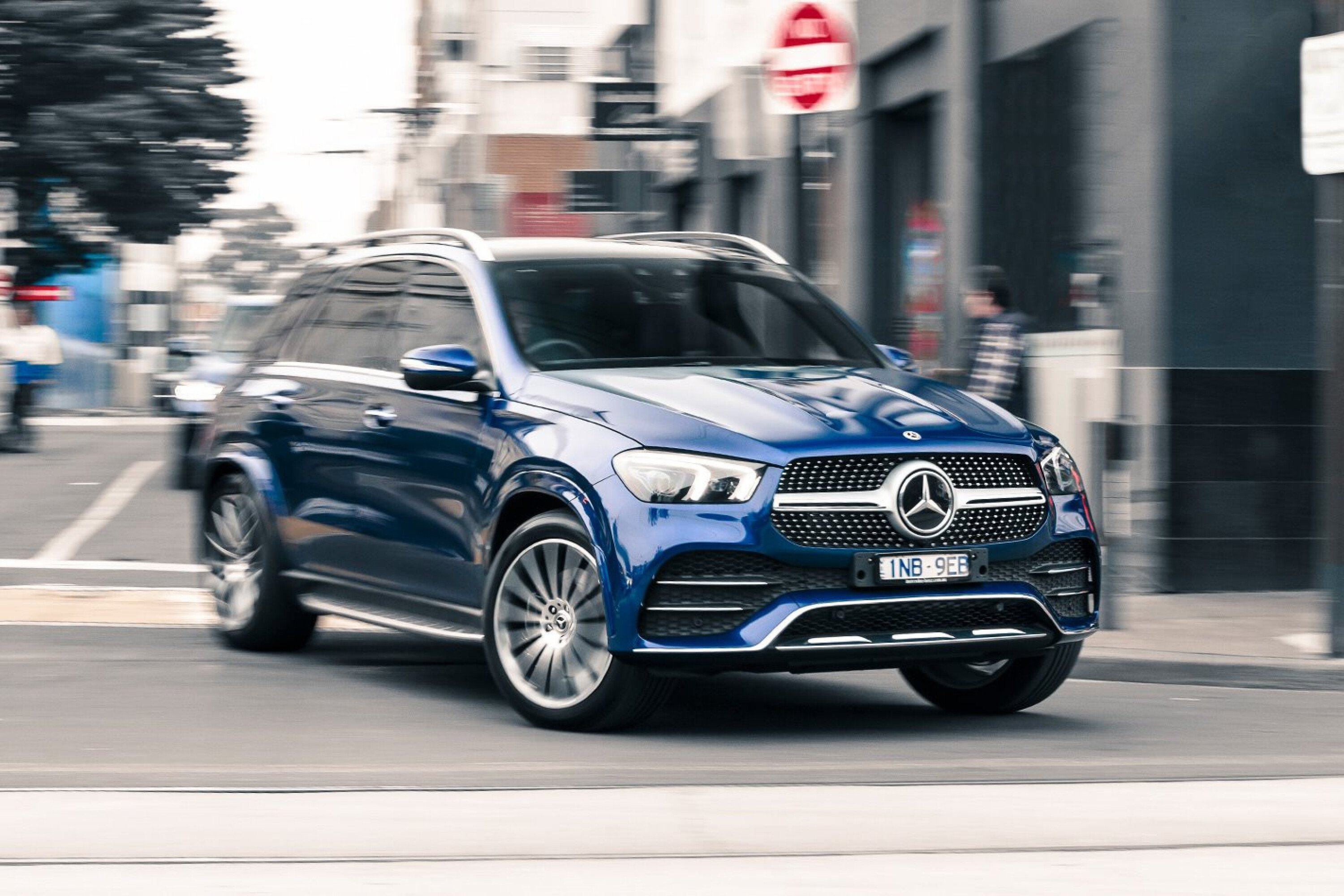
Set to take on competitors such as the new Ineos Grenadier, Land Rover Defender 110, and Mercedes-Benz GLE, the GX will come with a seven-seater layout – or five seats with the Overtrail model that gains additional features for enhanced off-roading ability.
A 3.5-litre twin-turbo V6 petrol engine and 10-speed auto is the only confirmed drivetrain so far, with a hybrid variant possible down the track.
In the now-extensive Lexus SUV line-up, the GX will sit above the RX and below the LX (with which it shares its LandCruiser 300 architecture).
Lexus released its first ever people-mover in late 2023 with its exuberantly styled LM.
It launched initially with the LM350h entry model, which costs from $165,888 before on-road costs, comes with either front- or all-wheel drive, and features a seven-seater (2-2-3) layout.
Early 2024 sees the addition of a $220,888 LM500h Ultra Luxury flagship fit for Succession’s Roy family.
Not only does it bring a more powerful hybrid drivetrain, but there’s a four-seater, first-class-style layout that features two rear ‘VIP thrones’, a 48-inch widescreen display with 23-speaker Mark Levinson sound system, and a glass barrier that can block out the chauffeur for absolute privacy.
Lexus Australia added an upgraded version of its UX300e electric compact SUV in late 2023, though will 2024 also bring an updated hybrid UX?
The brand is tight-lipped for now, but a UX300h model has been confirmed for the US market for early 2024.
Replacing the UX250h, the UX300h switches its battery chemical from nickel-metal-hydride to lithium-ion in a debut for Lexus’s fifth-generation hybrid system.
Power improves from 131 to 146kW, while Lexus USA says the updated UX hybrid also brings fuel-efficiency improvements.
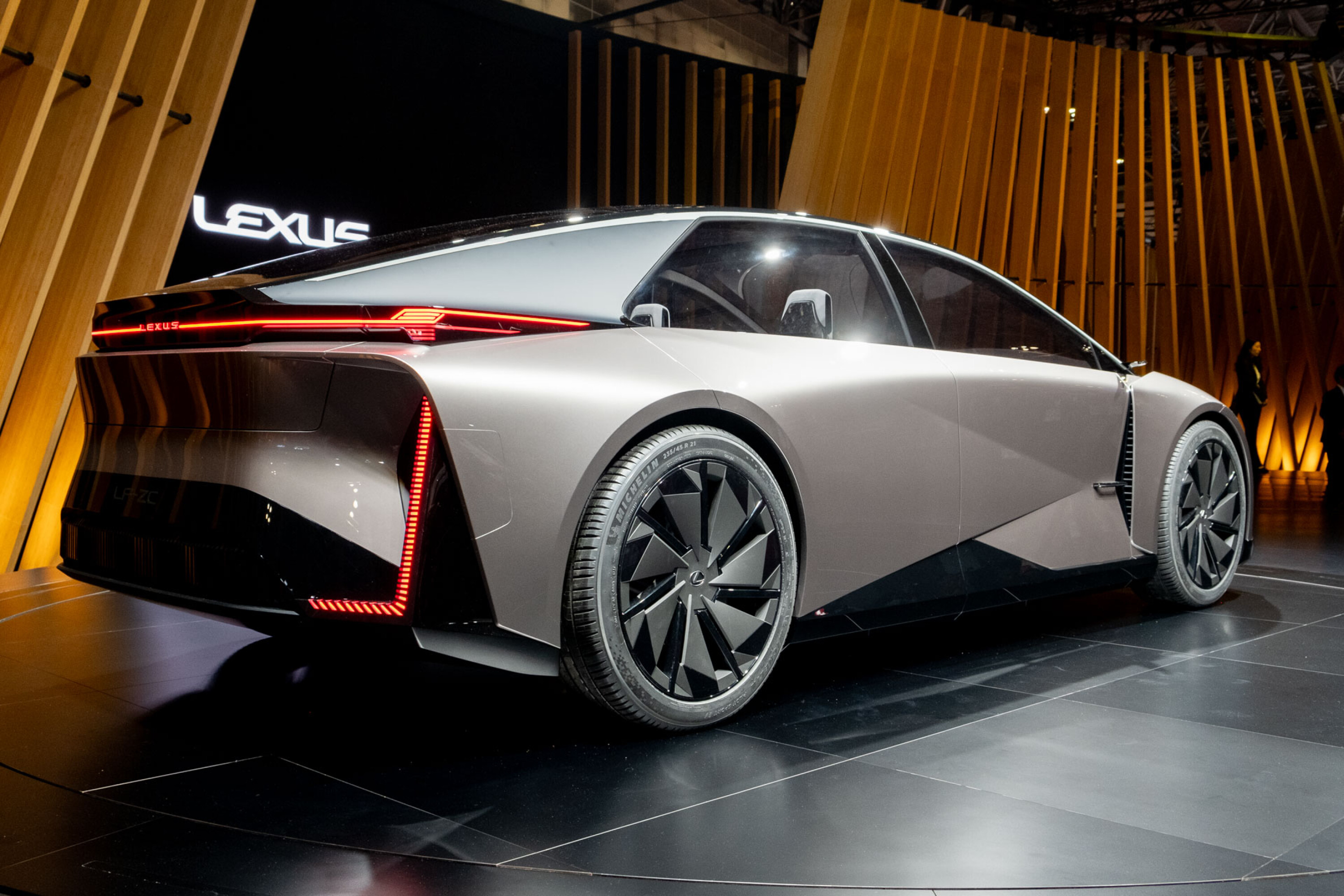
An electric grand tourer confirmed for 2026 was previewed by the LF-ZC concept at the 2023 Tokyo motor show.
With initials representing Lexus Future Zero-emissions Catalyst, the production model is promising to bring a range in excess of 1000km.
The ultra-sleek, four-door GT – which has a height of just 1390mm, and a body length of 4.75 metres – has an ultra-aerodynamic, coefficient of drag target of 0.2.
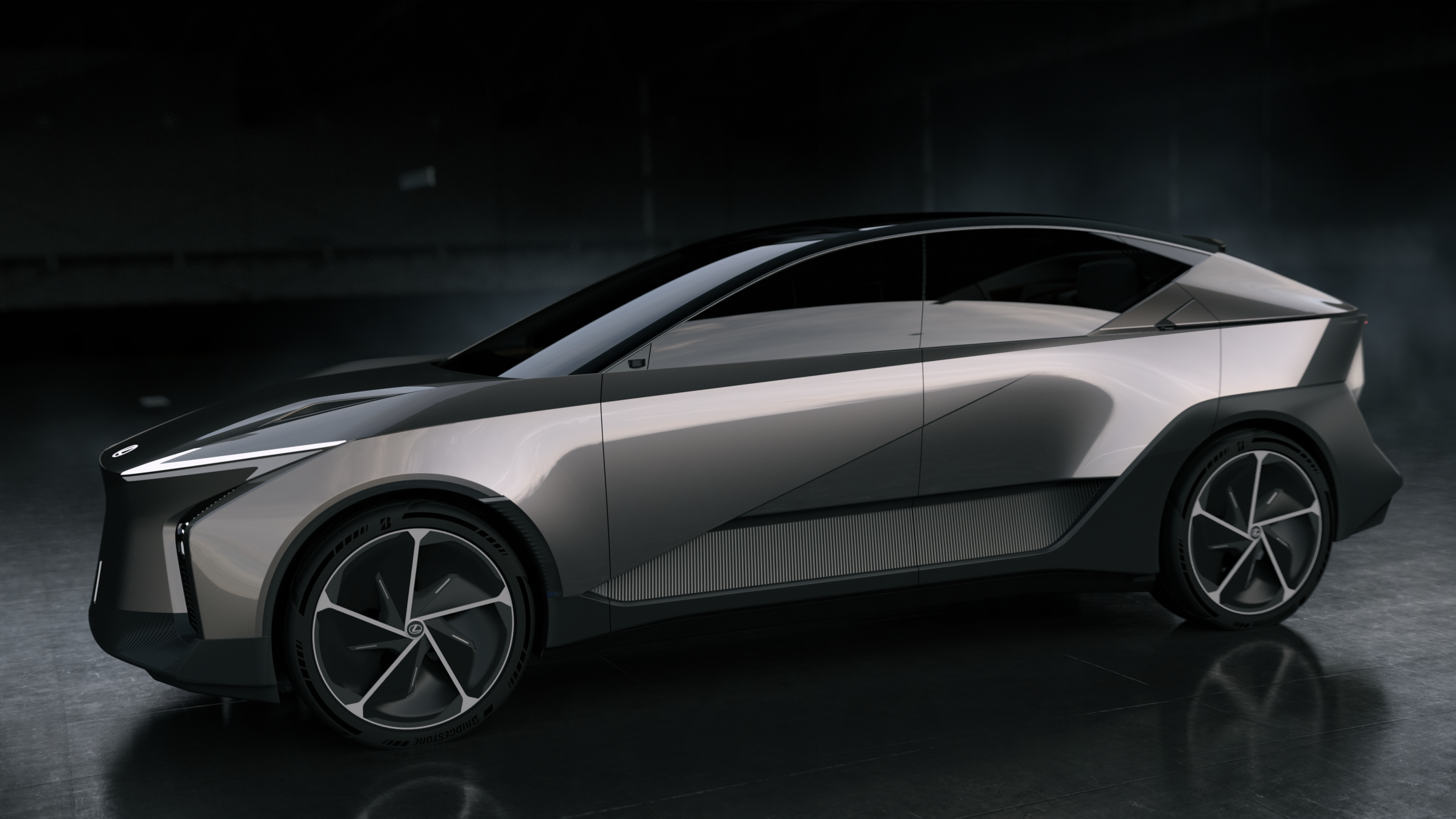
The Lexus Future Zero-emissions Luxury is a “flagship future model” that was showcased in Tokyo alongside the LF-ZC.
Sharing a new modular architecture with the ZC GT, the ZL concept is a limo-style SUV with a 5.3-metre length and enourmous 3.35-metre wheelbase.
Just don’t expect the B-pillar-omitting sliding electric rear doors for the production version.
1
We’ll also have to wait to see how much of the concept’s interior carries over into reality. The LF-ZL features a yoke steering wheel flanked by smartphone-sized control/display pads.
Larger screens dominate the rest of the dash, including one for the front passenger.
Most fascinating, arguably, is the Arene operating system that Lexus says will bring AI voice command, OTA (over the air) updates, and the ability to connect Lexuses with the outside world.
Following the launch of the long-wheelbase Jimny XL, Suzuki will introduce at least two new models in 2024 as well as bringing its hybrid technology to Australia for the first time.
The brand’s lineup consists mainly of small cars and SUVs with a plethora of sub 4.3-metre options to consider.
Currently, Suzuki only sells petrol vehicles in Australia, though local general manager indicated that hybrid – be it mild or true petrol-electric – is likely to arrive in 2024. Suzuki’s first electric model, the production version of the eVX, is due in 2025.
Keep scrolling if you’re interested in Suzuki Australia’s upcoming product portfolio.
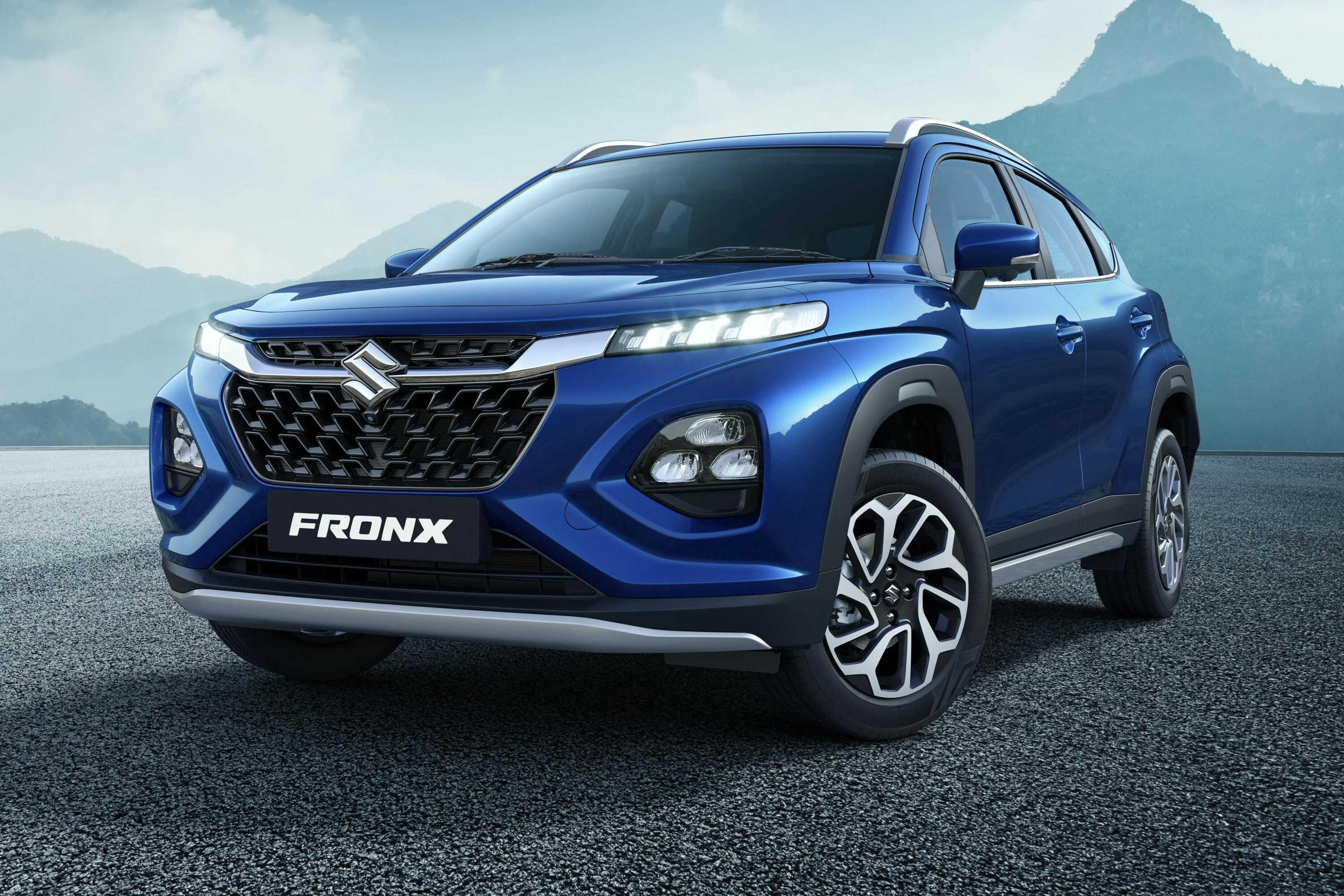
The first model on Suzuki’s hit list is the Fronx, which was revealed in January 2023 at Auto Expo India as a Maruti Suzuki product.
Size-wise, the 3995mm long Fronx – described as a ‘coupe-style’ SUV by the brand – sits between the Ignis and Vitara monocoque SUVs in Suzuki’s range, and will be classified as a light SUV in Australia.
The brand’s Aussie arm has not confirmed powertrains yet, but overseas it is powered by either a 66kW/130Nm 1.2-litre four-cylinder – as found in the Swift(?) – or a mild hybrid 1.0-litre turbo-petrol producing 74kW/148Nm.
2
If Suzuki decides to bring the one-litre Fronx to Oz, it could be the brand’s first hybrid model. Something that general manager Michael Pachota is hoping will join the local portfolio in 2024.
Initial details confirmed by Suzuki include that the Fronx will be available with a 360-degree camera, head-up display, wireless charging and air conditioning vents for rear passengers. We expect pricing to start in the mid-low $30K bracket and climb above $40K for a fully loaded example.
First revealed at the Delhi Auto Show in January 2023, the Suzuki eVX concept previews Suzuki’s first all-electric vehicle.
At about 4.3-metres long, its yet another small SUV from Suzuki, and is about the same size as the existing S-Cross which was recently facelifted. According to the head of design, Suzuki is targeting a 500km driving range for the eVX ahead of a 2025 launch.
The small electric SUV will be manufactured for global markets, including Europe and Asia with Australia introduction likely in 2025/2026.
In its sheetmetal – which isn’t too far removed from production – there’s elements of Suzuki’s signature toughness, with Vitara-like volumes and details, while inside the concept’s glass crystal gear selector features a rhinoceros insignia which may carry into the finished product.
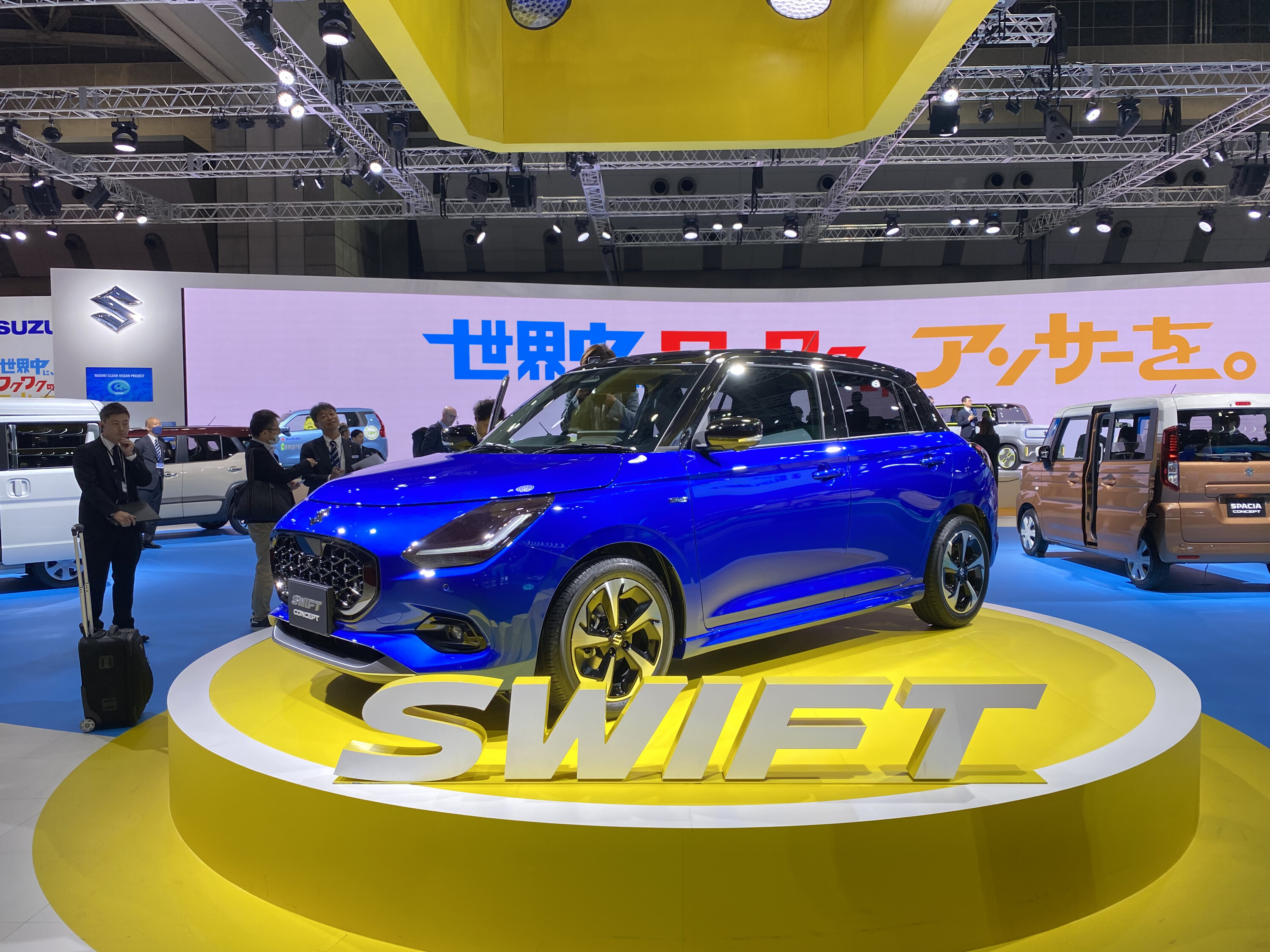
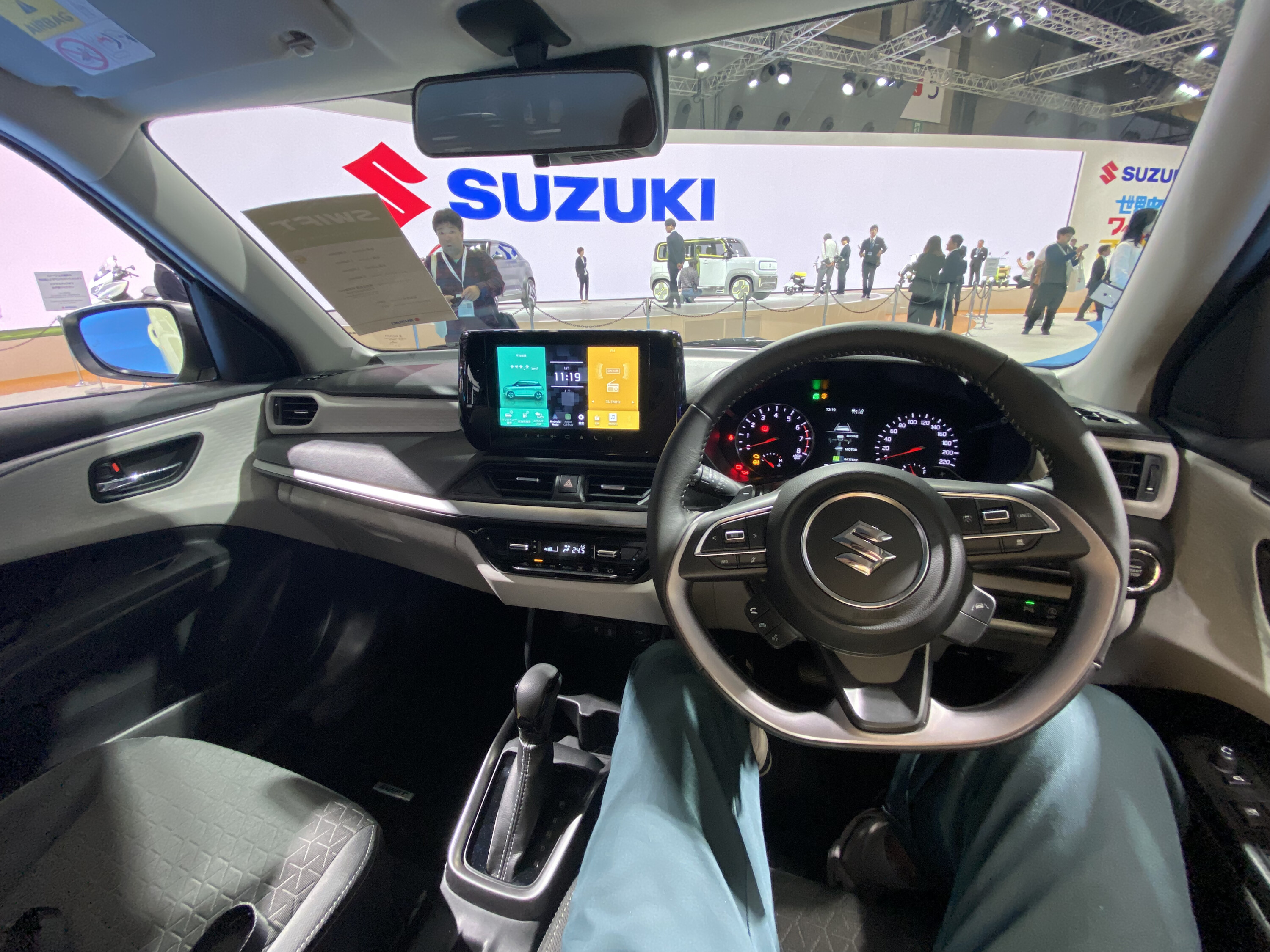
Referred to as a new generation Swift, the latest light car looks rather similar to the existing model with which it shares a 2450mm wheelbase.
The new car is also 40mm narrower and, while a new ‘Z12E’ 1.2-litre three-cylinder engine has been announced it doesn’t develop much grunt, at just 60kW and 108Nm. For Australian consumption, expect more powerful engine options mated with the car’s new CVT automatic. There’s no new-gen Swift Sport confirmed.
We know a mild-hybrid system is very much on the cards, potentially cutting fuel efficiency though without a true hybrid it won’t come close to the 3.3L/100km claim of the Toyota Yaris.
1
Inside, there are higher-quality materials mated with a 9.0-inch touchscreen. It may be the same size as Aussie Swifts currently get, but beneath the screen is a more powerful processor and the ability to run Apple CarPlay and Android Auto wirelessly, as seen in the five-door Jimny XL.
Pricing will be confirmed closer to the Swift’s 2024 release. Given the mild nature of the updates, we don’t expect the new light car to make huge jumps over the existing $22,490 (before on-road costs) start price.
The current fourth-gen Vitara emerged on the global stage in 2015 and has been through a single facelift since then. Eight years into its sales life, Suzuki will be looking to replace the small SUV shortly.
However, there are precious few details on what could replace the regular Vitara, and with the more modern S-Cross on sale in Australia Suzuki has another slightly larger option in a similar price space.
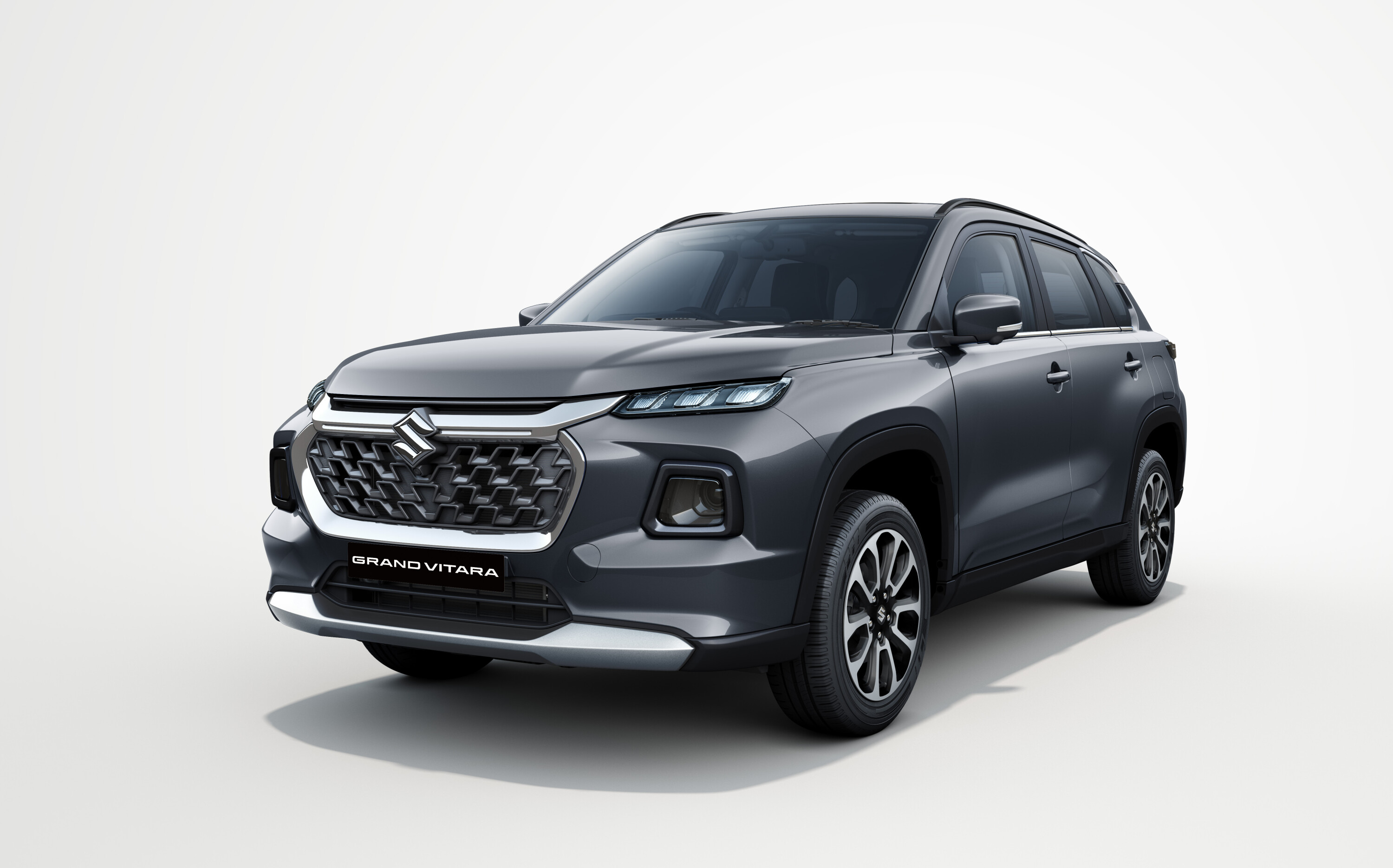
One possibility is that the Vitara nameplate will be reserved for the production version of the eVX (though the ‘V’ there could be a red herring), another is that the Maruti Grand Vitara, revealed in India in 2022 could offer replacement.
2
With styling more akin to the Fronx, the Grand Vitara could be suitable for our market – especially as it’s available with a 1.5-litre petrol-electric hybrid (not a mild one) developing a total of 85kW.
The only problem with Maruti Suzuki Grand Vitara is its proximity to the S-Cross, measuring only 45mm longer and 50mm taller than the existing SUV.
If you’ve been fortunate enough to attend the Goodwood Festival of Speed, you’ll know the magic of that event doesn’t really lie in watching the cars blaze up the hill.
The truly gleeful part about Goodwood, and the thing that blows the minds of first-time visitors, is wandering through the paddock. There you’re just as likely to trip over a Singer 911, or happen upon 12 McLaren F1s parked casually on the lawn, as you are to accidentally graze shoulders with Derek Bell as he slides into a Porsche 917 Longtail.
The proximity and trust afforded at Goodwood feels alarming at first, especially for an Australian, who are usually barricaded from such precious things by velvet ropes and self-important people in high-vis vests.
1
But at Goodwood you could actually climb inside a priceless Le Mans winner if you really wanted to. The thing is, you don’t, because you can get close enough to touch, smell and hear the cars without taking such risks.
Even Goodwood, though, pales in comparison to what’s unfolding in front of me now. I’m standing at the back of a pit garage at Mugello and with the confident gesticulation that only an Italian can pull off, a man is slowly twirling his hand in the air, his index finger pointed to the sky.
He’s sat in scarlet F1 car from the early noughties — an F2004 if I had to guess — and on his signal the single-seater fires into life, a puff of blue smoke rising into the air as the engine catches and the long starter motor is withdrawn from its gizzards.
1
It feels slightly improper to be this close to one F1 car — I could reach out and touch the rear tyre — but sitting next to it is another, slightly newer example. And to the right of that car, lies another, this one an F2008 driven by Kimi Raikkonen.
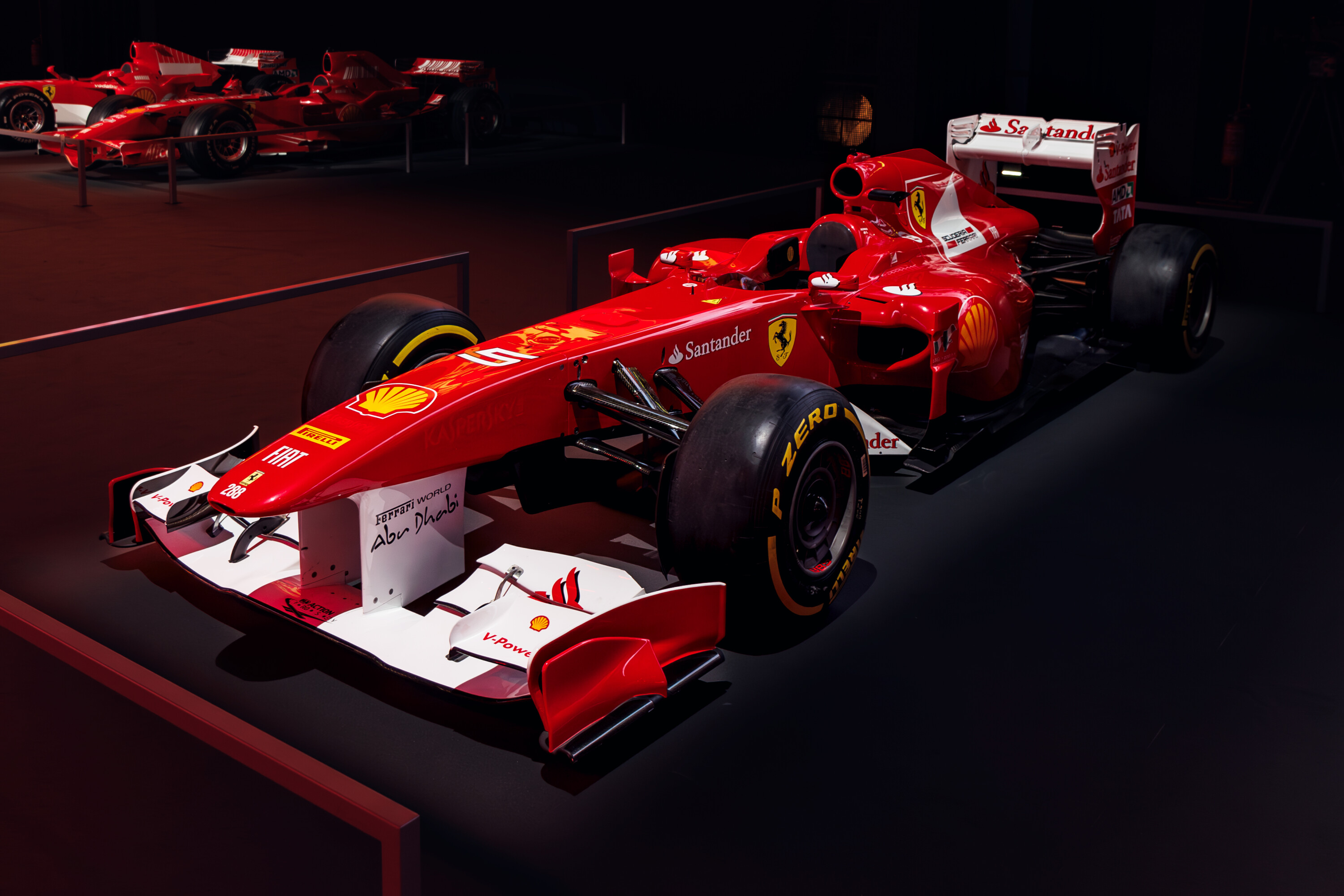
All up, Ferrari has 19 Formula 1 cars at Mugello — almost an entire F1 grid — ranging from a Schumacher F1-2000 which won both world championships, to a hybrid-powered SF79H from 2017 that took Sebastian Vettel to victory at the Aussie GP.
They fire up in sequence, the high-frequency, sowing-machine smoothness of their V10 and V8 engines creating a wall of sound that almost drowns out what’s happening on the track itself. Almost…
1
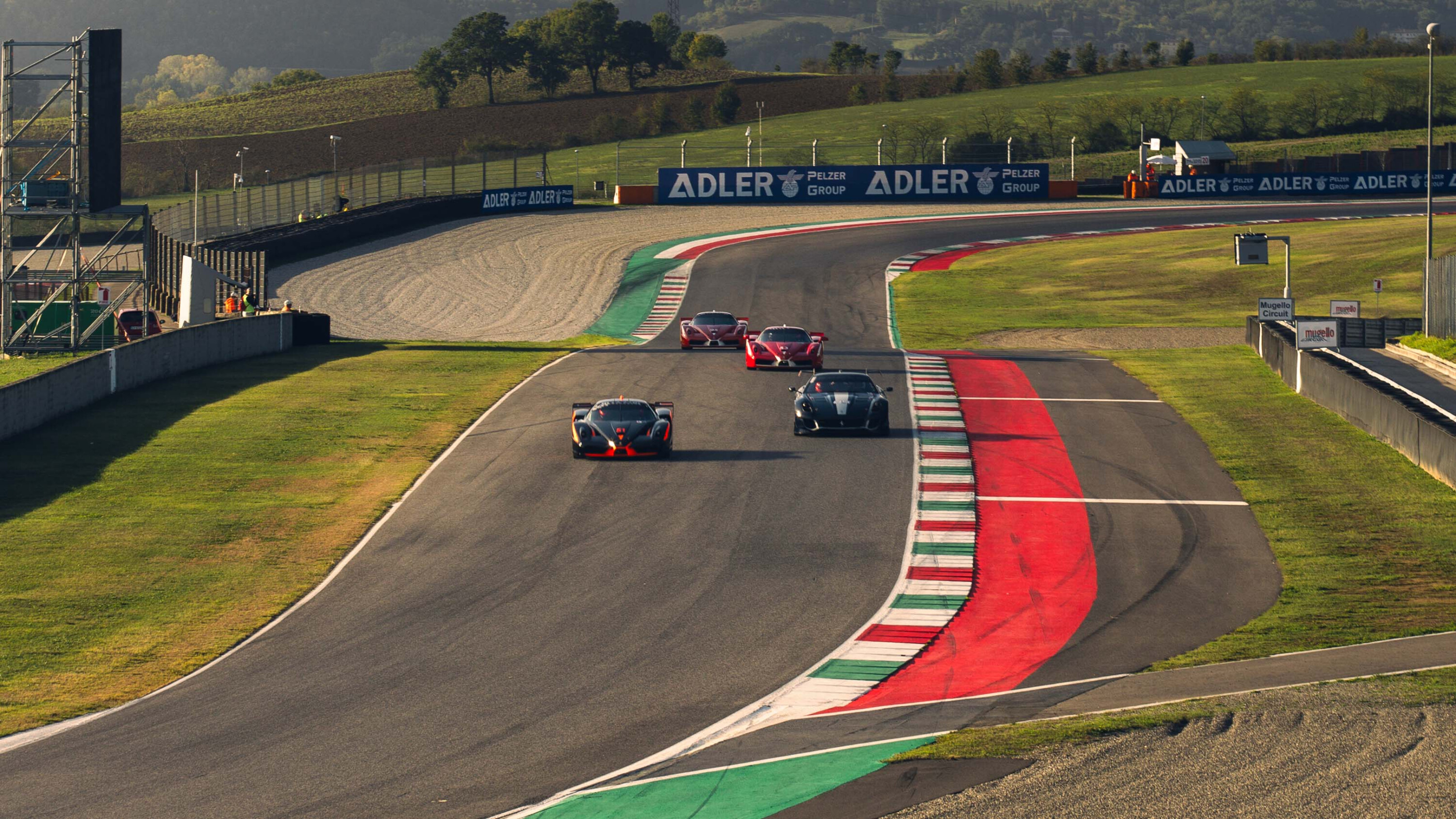
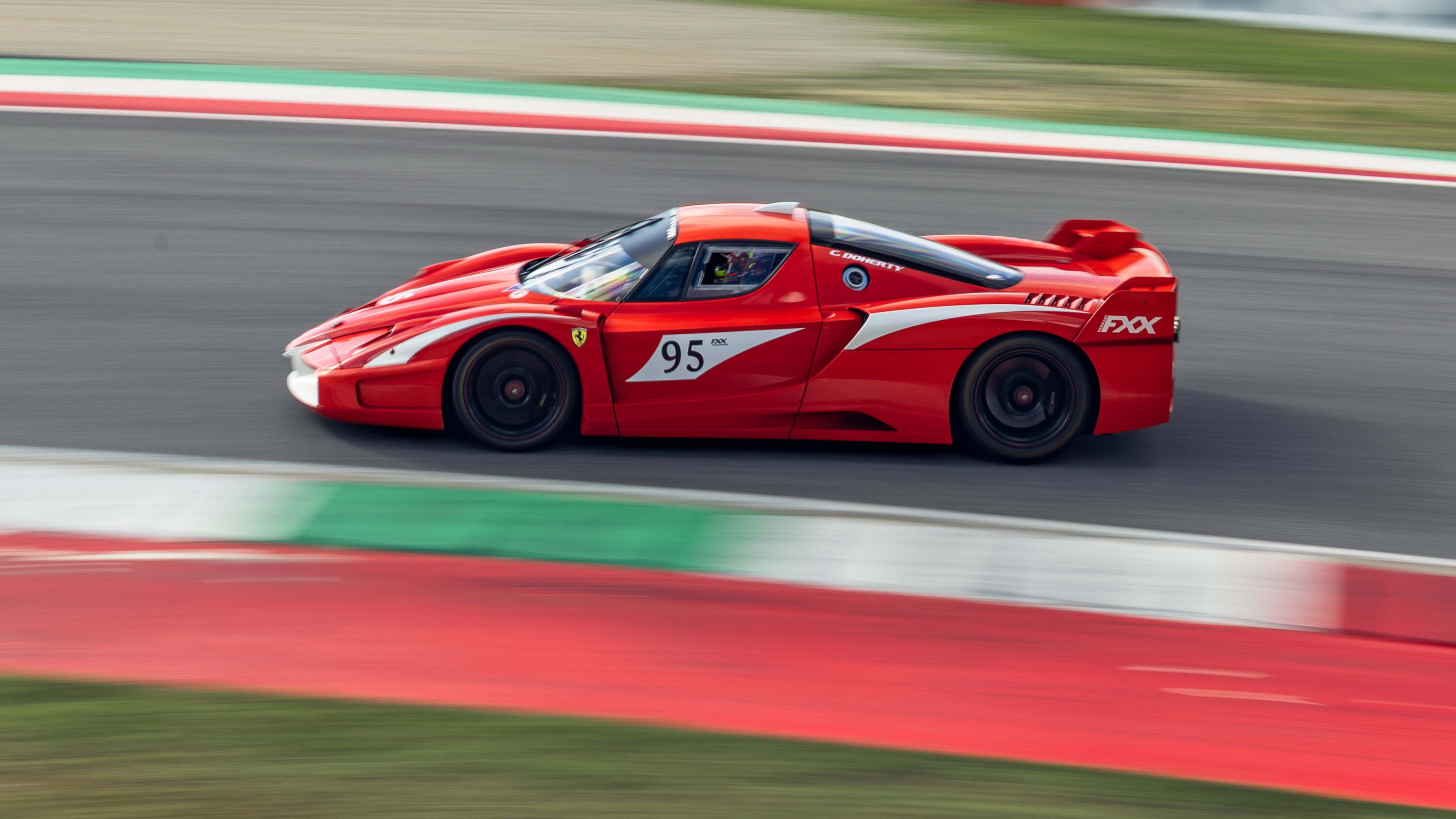
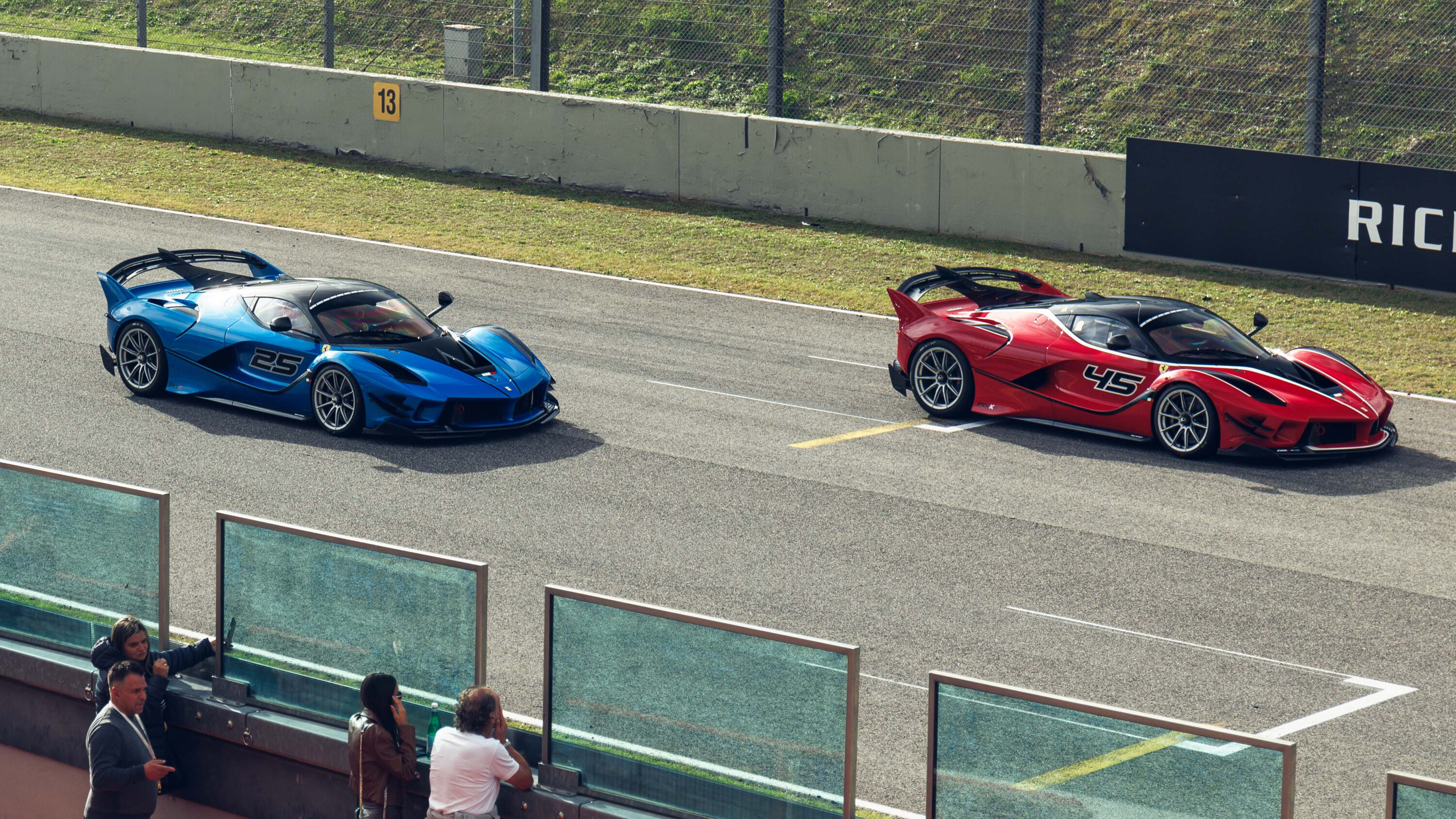
Out there, on the other side of the pit wall, blast a fleet of limited-edition XX cars, the scream of their V12s ranging in and out of earshot as they navigate a circuit that’s still drying from some morning rain.
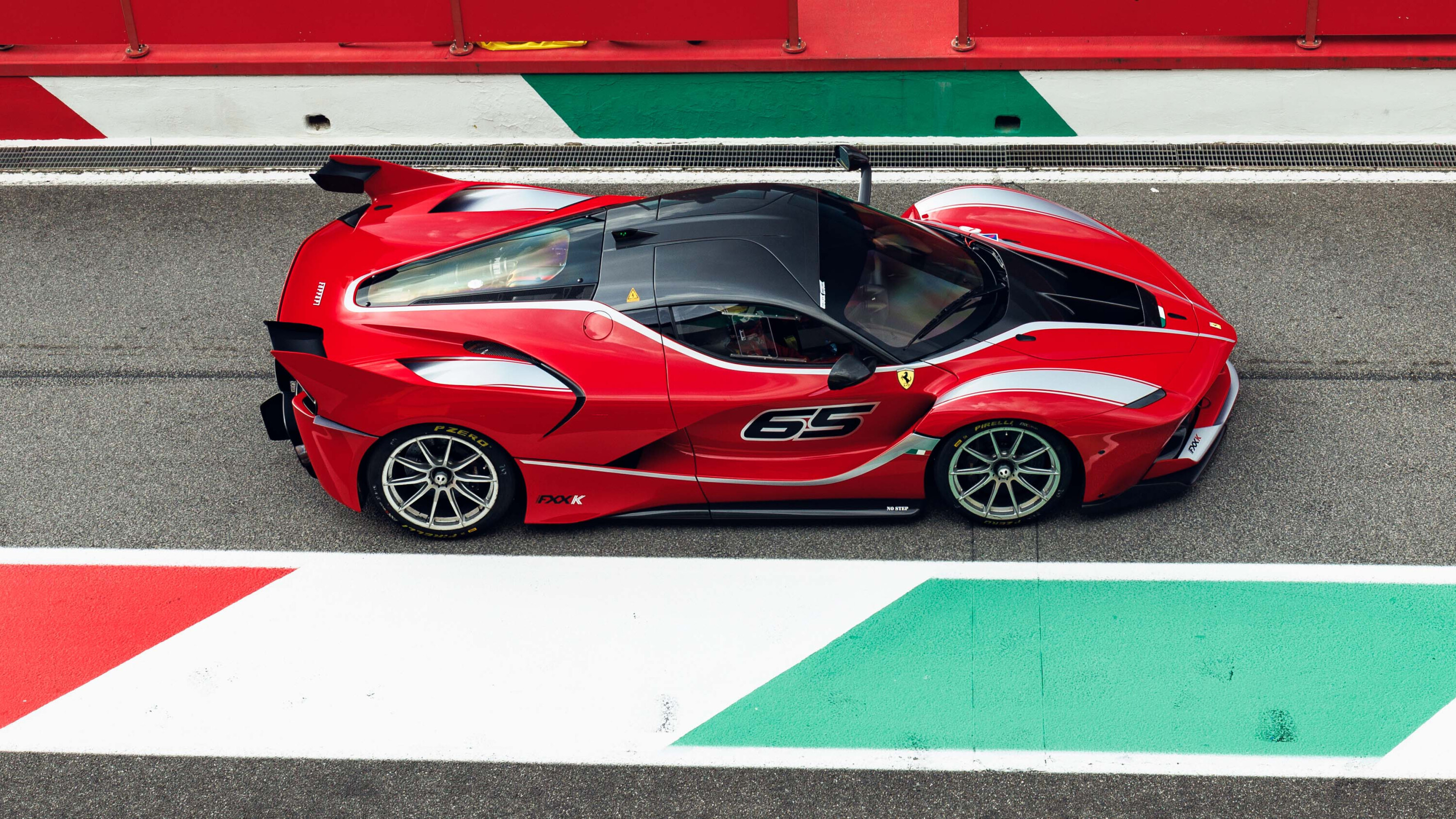
Wait for your ears to adjust — and for the F1 cars to settle into a lower idle — and you’ll begin to discern the different soundtracks of the various models. Enzos, side-piped 599 XXs, FXXK Evos…they’re all out there, dicing and diving in front of a crowd that should nudge 40,000 people.
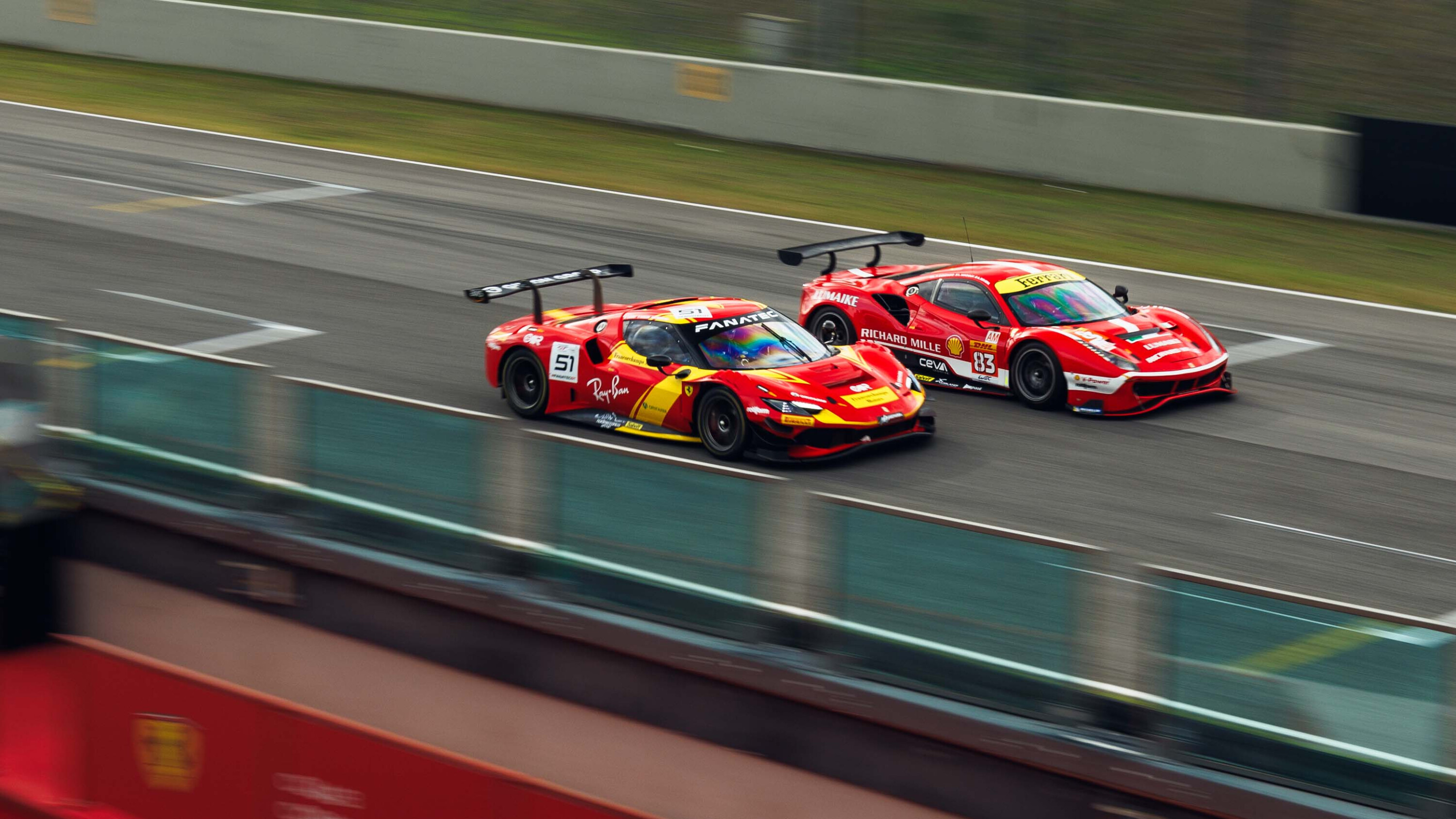
Chances are you mightn’t have heard about Ferrari Finali Mondiali. I know I hadn’t, which is what makes this introduction to the event so surprising. Held in October every year, Finali Mondiali has been running since 1993 — coincidentally, exactly the same amount of time as Goodwood — and it is, first and foremost, the final round of the various Ferrari Challenge racing series run around the world.
1
It also acts as a grand final of sorts (Finali Mondiali translates as ‘world final’) for the quickest drivers in each championship who get the chance to race together for ultimate bragging rights.
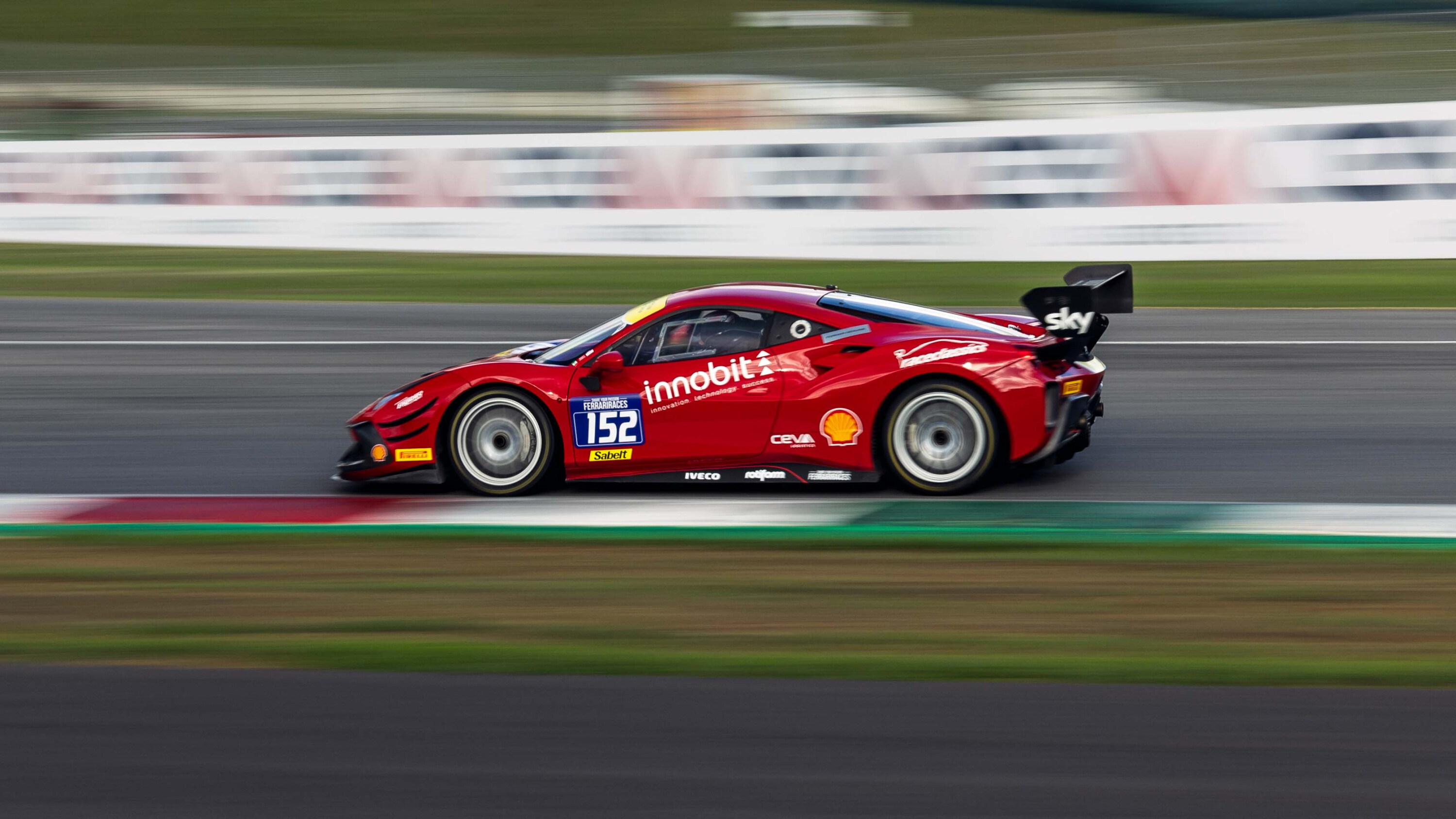
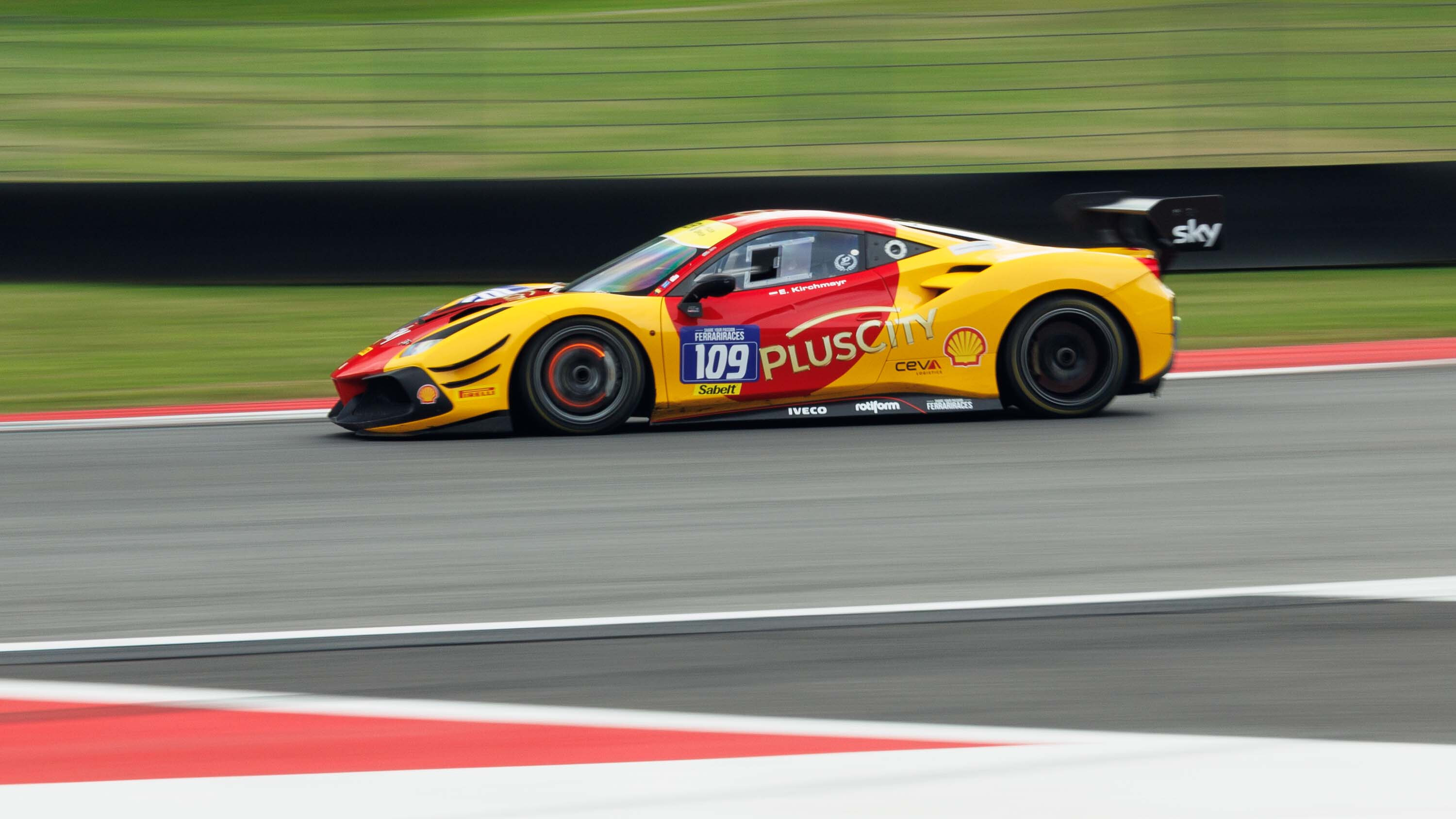
The racing is hard and close and the grids are positively enormous. There are 105 Ferrari Challenge cars in attendance and while the category is clearly targeted at wealthy gentlemen drivers, there’s nothing gentlemanly about how they go about their race craft — this is sheep station stuff.
You might think having so many Ferraris in one place could get a little dull but there’s a dizzying amount of variety to gawk over. Club Competitzioni GT, for example, is a melting pot of GT racers from the last 30 years where a carbon-bodied 550 GT1 can bang doors with a box-fresh 296 GT3.
2
The category also includes a yellow 360 Challenge car that is so incredibly loud, it sounds like it’s fuelled by exploding fireworks as it trundles down the pitlane.
Then there are the Corse Clienti cars, which combine the XX program and Ferrari’s fleet of retired F1 prototypes. Both categories are a mix of old and newer machines and it’s intriguing to see how the XX concept has evolved from the boxy and wonderfully raw Enzo XX to the swoopier wedge of the 1050hp, hybrid-powered FXXK-Evo.
It’s the F1 cars that are the star of the show, however. Ferrari’s UK press officer proudly proclaims that only Ferrari could manage such an enormous fleet of old F1 cars “because we’re the only brand that has always made our chassis and the engine” and it is satisfying to see so many of the cars still being used.
1
They aren’t coddled, either. Red flags and spins are a regular occurrence and one poor sod had a rear tyre explode at full noise down the main straight.
The cars look quick, though, and some of the owners are clearly talented drivers willing to push their ultra-expensive toys to the limit. Exactly what it feels like to turn up at Mugello to find your own Michael Schumacher F1 car ready and waiting, and to then drive it on track with other famous F1 cars, is a mystery most of us will never experience.
Happily, of all the places in the world to watch F1 cars, Mugello has to be one of the best. Ferrari has owned the iconic circuit since 1988 and it has hosted Finali Mondiali 16 times. It’s a doozy of a track built in the bosom of a valley, so it’s brilliant to spectate at because the natural elevation means you can see several sections of the circuit from one vantage point.
1
The valley acts as a natural amphitheatre, too, so the sound of the F1 cars bounces off the surrounding mountains.
And the best bit? Spectating at Finali Mondiali is absolutely free, with the circuit’s outer extremities open to the public for four days. You’ll need to be a Ferrari employee to access the grandstands, however, and the paddock is reserved for employees and Ferrari Club members.
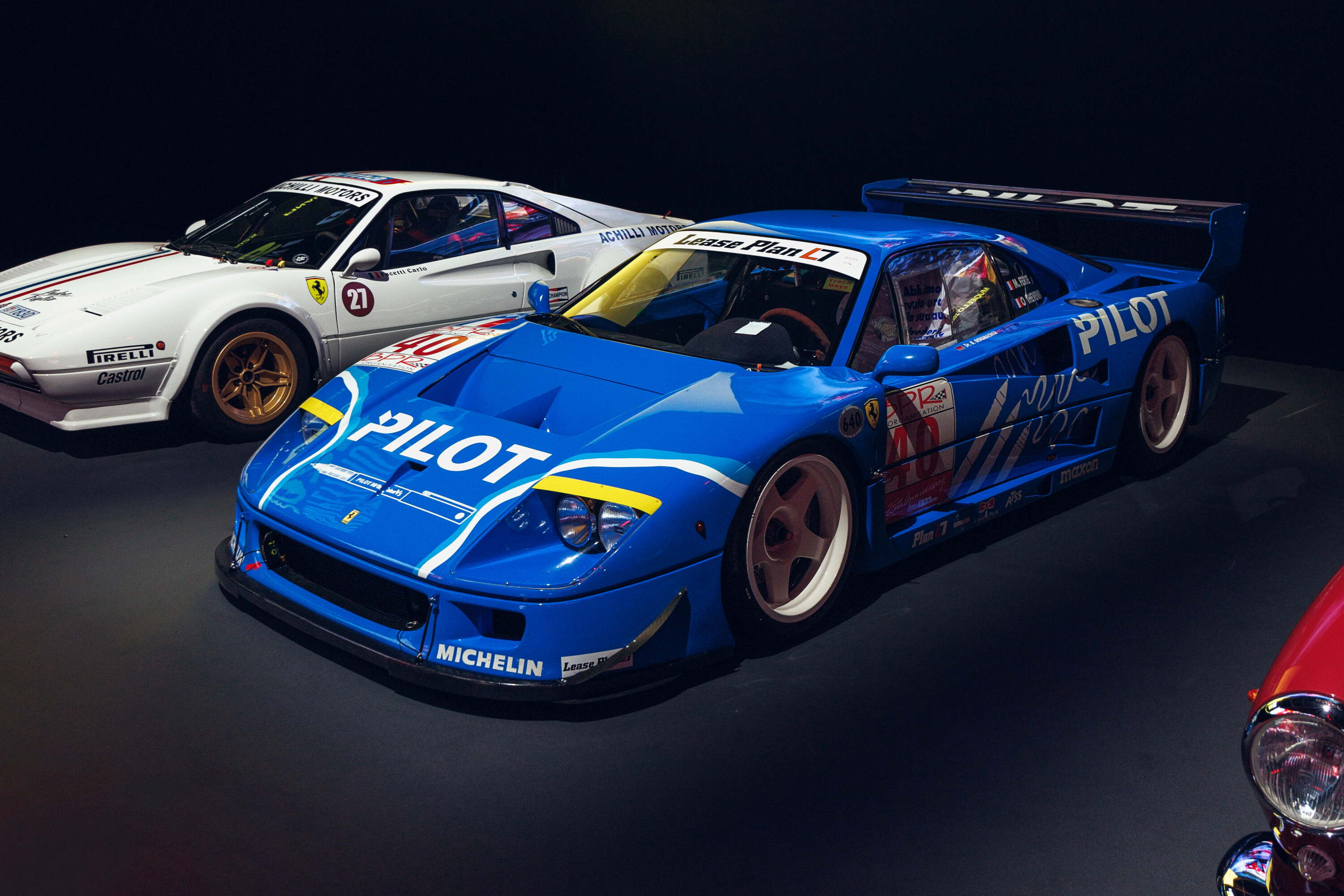
That’s the best place to drool over the cars, though, and the paddock also houses a gigantic exhibition hall that is basically a section of the Ferrari museum. The room houses 40 significant models, ranging from a 1948 166MM through to the reigning Le Mans winner, the 499P, which is still covered in its racing muck from the Circuit de la Sarthe.
1
Various F1 cars and older Le Mans cars feature, too, as does a blue 1987 F40 LM which recently sold for 4.8 million euros. The most expensive car in the room? A silver 250 GTO from 1962 that fetched 38 million a few years ago.
On Saturday night the cars fade into the background as the same space is used for a huge gala dinner. More than 1000 people attend and the night doubles as a prize giving ceremony for Ferrari’s various racing categories. It also provides an opportunity for a sneak peek at upcoming models.
This year that meant the unveiling of the 296 Challenge car and the 499P Modificata, the latter being a version of Ferrari’s Le Mans prototype pitched at gentlemen drivers. You could almost hear the room scramble for its cheque books as the silk cover came off, despite a $5.1 million euro asking price.
1
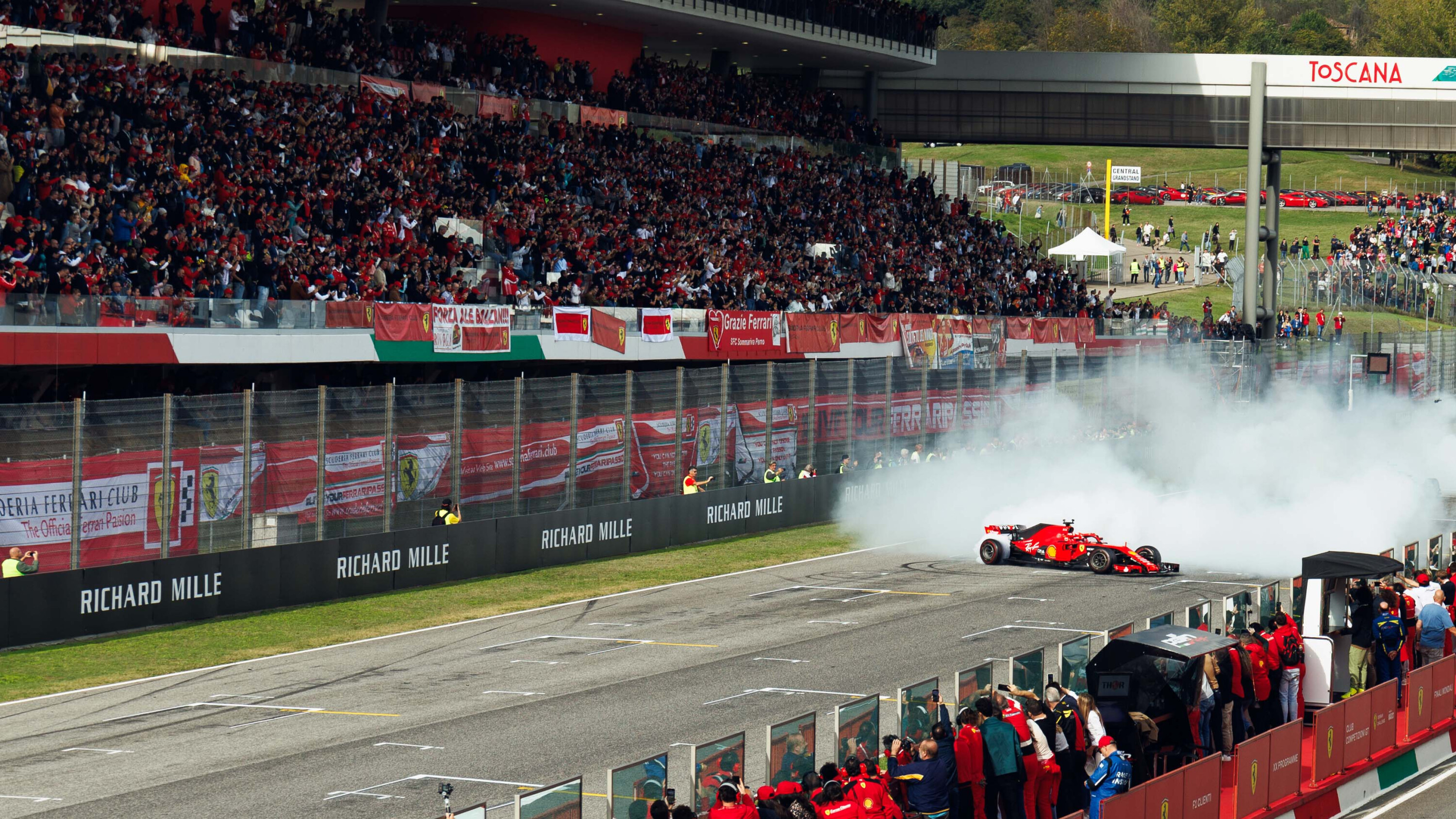
If you can only attend one day at Finali Mondiali, make it the Sunday. There’s plenty of on-track action and the whole event crescendos with the ‘Ferrari show’ which is a group shot of all the cars on the main straight.
If that sounds a bit tame, it isn’t, because before the cars line-up Ferrari sends them around the track for some demonstration runs. Again, it’s the F1 cars that put on the best show courtesy of high speed flybys and donuts in front of the packed main grandstand.
Then, once the cars are assembled and the photographer gets the shot, the crowd is treated to a flyover by the Tuscania Carabinieri paratroopers. Their gigantic blue chopper hovers over the main straight as paratroopers repel out of it to hand over the Italian tri-colour flag, Le Mans style, before a soprano singer belts out a rendition of the national anthem.
1
It’s overkill in the most spectacular way and, aside from a worrying few moments when it looked like the chopper might actually plow into the ground as it dipped its nose to fly away, it perfectly encapsulated the passion Italians have for Ferrari as a brand.
It’s easy to get a bit sniffy about Ferrari, to dismiss it as elitist, yet despite the obvious wealth on display at Finali Mondiali, there was also an authenticity I wasn’t expecting.
Ferrari is a brand that still places racing at its very core and at this event, just like at Goodwood, the cars and passion weren’t shuttered away — they were celebrated. If that sounds like your kind of thing, the next Finali Mondiali will be held at Imola from Oct 16-20, 2024.
To look back over the last 12 months, we’ve compiled a top-five list of comparisons that were read more than any others on WhichCar.com.au.
#1 – Best Medium SUV 2023: Family Car Comparison
As far as battlegrounds go, the medium SUV segment is akin to the Battle of Helm’s Deep in The Lord of the Rings.
#2 – 2023 Ford Everest Platinum versus Toyota LandCruiser 300 Sahara
With its step up in size and the addition of a smooth V6 diesel engine, does the Ford Everest now qualify as a genuine alternative to the venerable Toyota LandCruiser?
#3 – New 2024 Mitsubishi Triton vs Ford Ranger: SPEC BATTLE!
We run the ruler over the fresh Mitsubishi ute to see how it lines up against its key rival and the present dual-cab ute segment king, the Ford Ranger.
#4 – 2023 Ford Everest Trend v Isuzu MU-X LS-T comparison review
While the mid-size 4×4 wagon segment continues to be dominated by the Toyota Prado, the minor placings looked a bit more exciting in 2023.
#5 – All-New 2024 Toyota Prado vs 2023 Prado: SPEC BATTLE!
The new Prado arrives 14 years after the popular 4X4 SUV’s last generational change, so logic goes it must be in for some big changes.
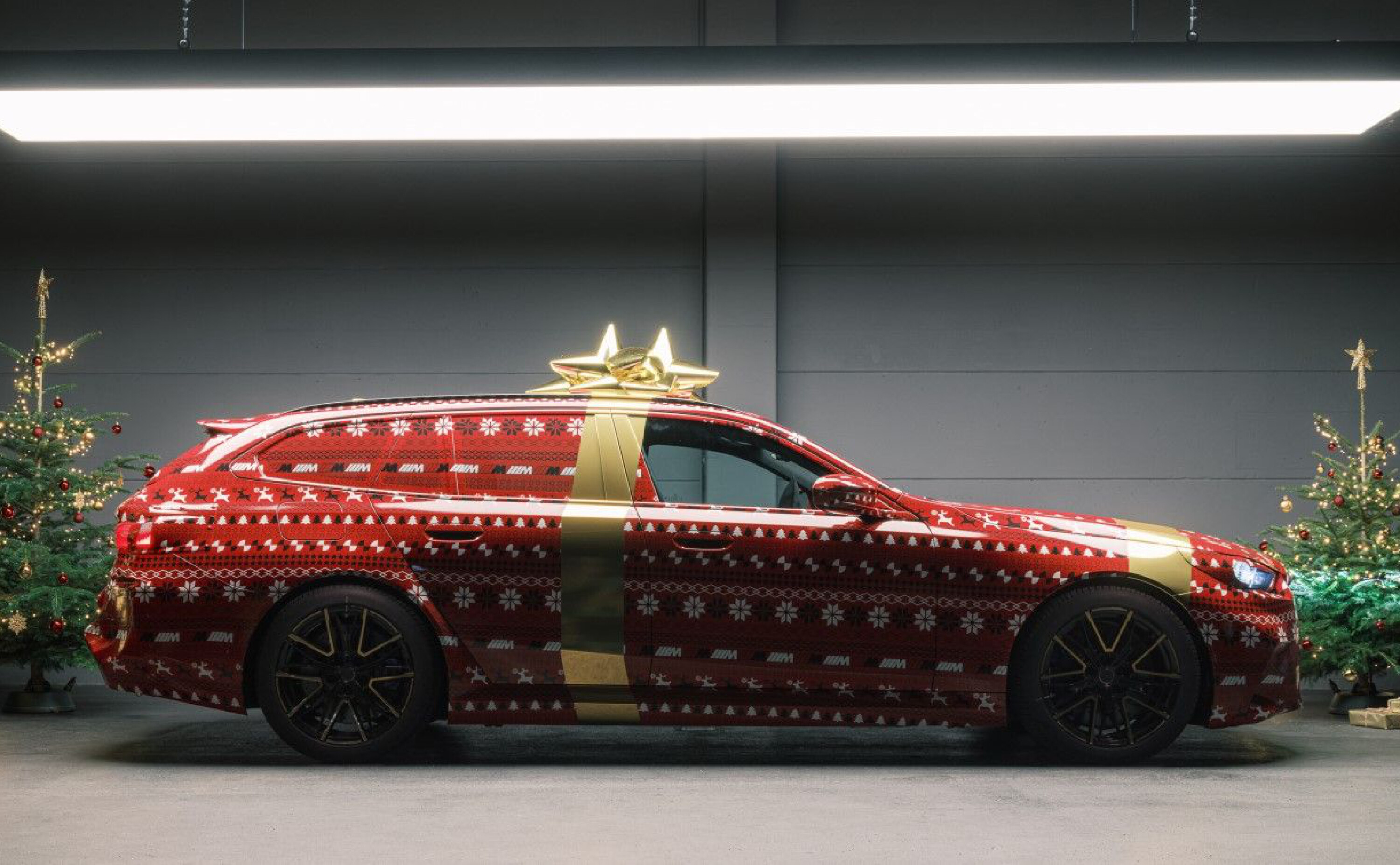
The 2025 BMW M5 Touring hybrid performance wagon has been teased once again.
BMW M has announced that the M5 Touring will be “ready to be unwrapped” next year, as the car’s development continues on public roads, proving grounds, and racetracks.
“We are now also installing a hybrid drive system with typical M performance in other high-performance cars,” said BMW M head of development Dirk Häcker.
The M5 Touring was first introduced in 1992 based on the E34 5 Series. The E39 was skipped before the V10-powered E61 brought the more practical body style back in 2007.
BMW M did not offer the last two M5 generations (F10 and F90) with wagon bodies. The return of the M5 Touring follows the addition of the smaller M3 Touring in 2022, a first for the M3 nameplate.
The 2025 BMW M5 Touring is scheduled to be unveiled in the Northern Hemisphere spring (March to May 2024).
The latest BMW 5 Series Touring is also expected to be offered in all-electric i5 Touring form, although it is unclear if and when any 5 Series Touring models will reach Australia.
You can see our imaginative renderings of the i5 Touring by clicking the featured story linked below.
However, the M5 Touring will likely be offered in Australia as a competitor to the Audi RS6 Avant. It is expected to have a faster 0-100km/h acceleration time than the Audi’s 3.4 seconds and a higher price tag above $250,000 before on-road costs due to its electrified powertrain.
Ford and Volkswagen make some of the most successful vans in automotive history, so who better to build you your first electric van?
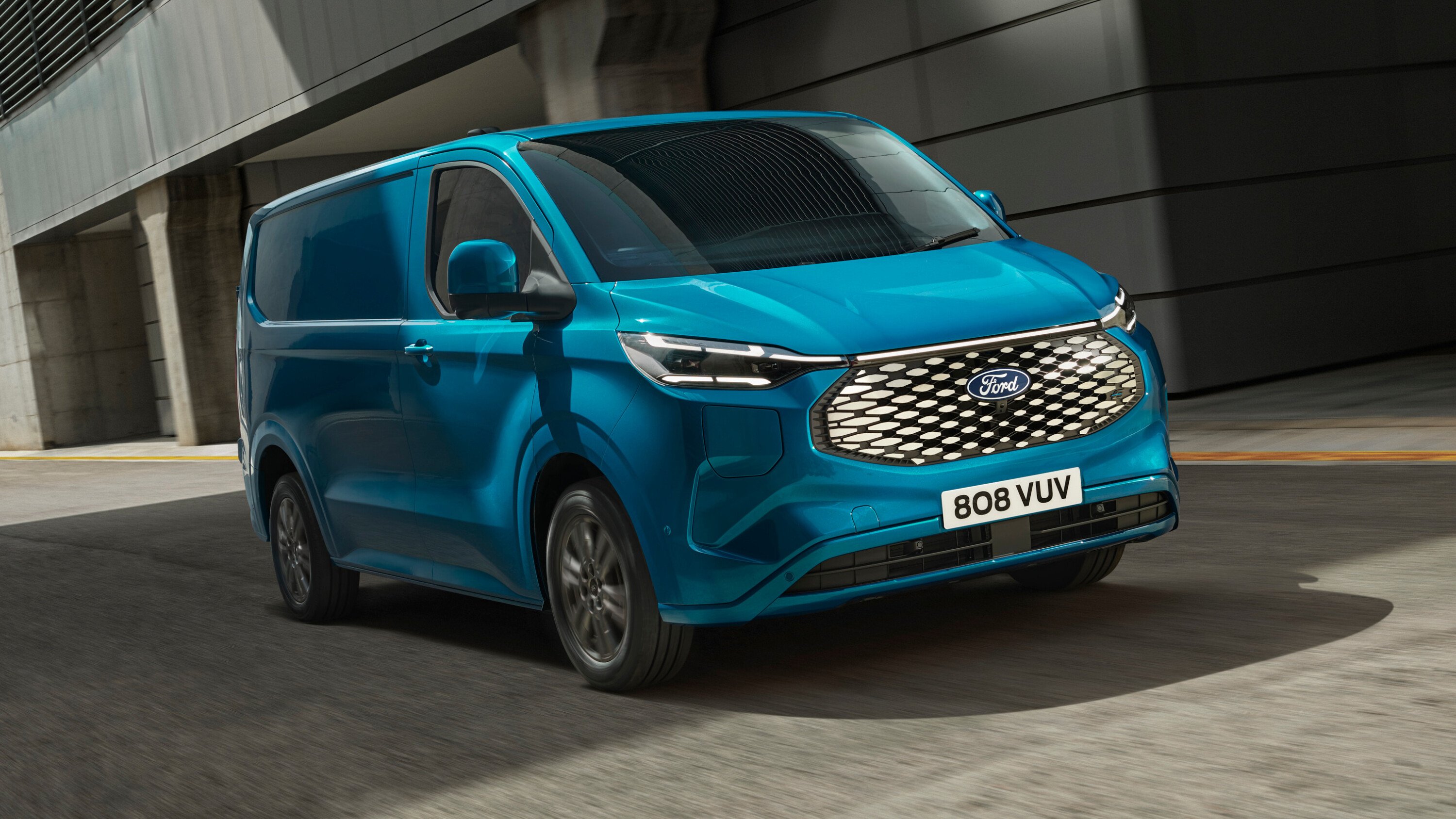
The E-Transit Custom shares its underpinnings and electric powertrain with its Volkswagen Transporter equivalent, both coming from the same Turkish factory and going on sale in 2024.
E-Transit Custom will be the first of the brand’s electric vans sold here, with a previous gen sold in Europe.
The 2024 version is equipped with the electric Ford F-150 Lightning’s 74kWh battery pack and a 160kW/415Nm electric motor for a WLTP-rated range of 380km.
1
Critical to keep a working E-Transit on the road, Ford says the 124kW charging capability can provide an 80 per cent top up in 41 minutes (yes, 41…) and 38km of driving after only five minutes.
Cleverly, the floor is set 100mm lower than the previous diesel Transit Custom, and Ford’s specifications show no loss of cargo space between electric and diesel models.
That – and Transits reputation – should place it in good stead, although we’d advise seeing what your local Volkswagen dealer can offer, too….
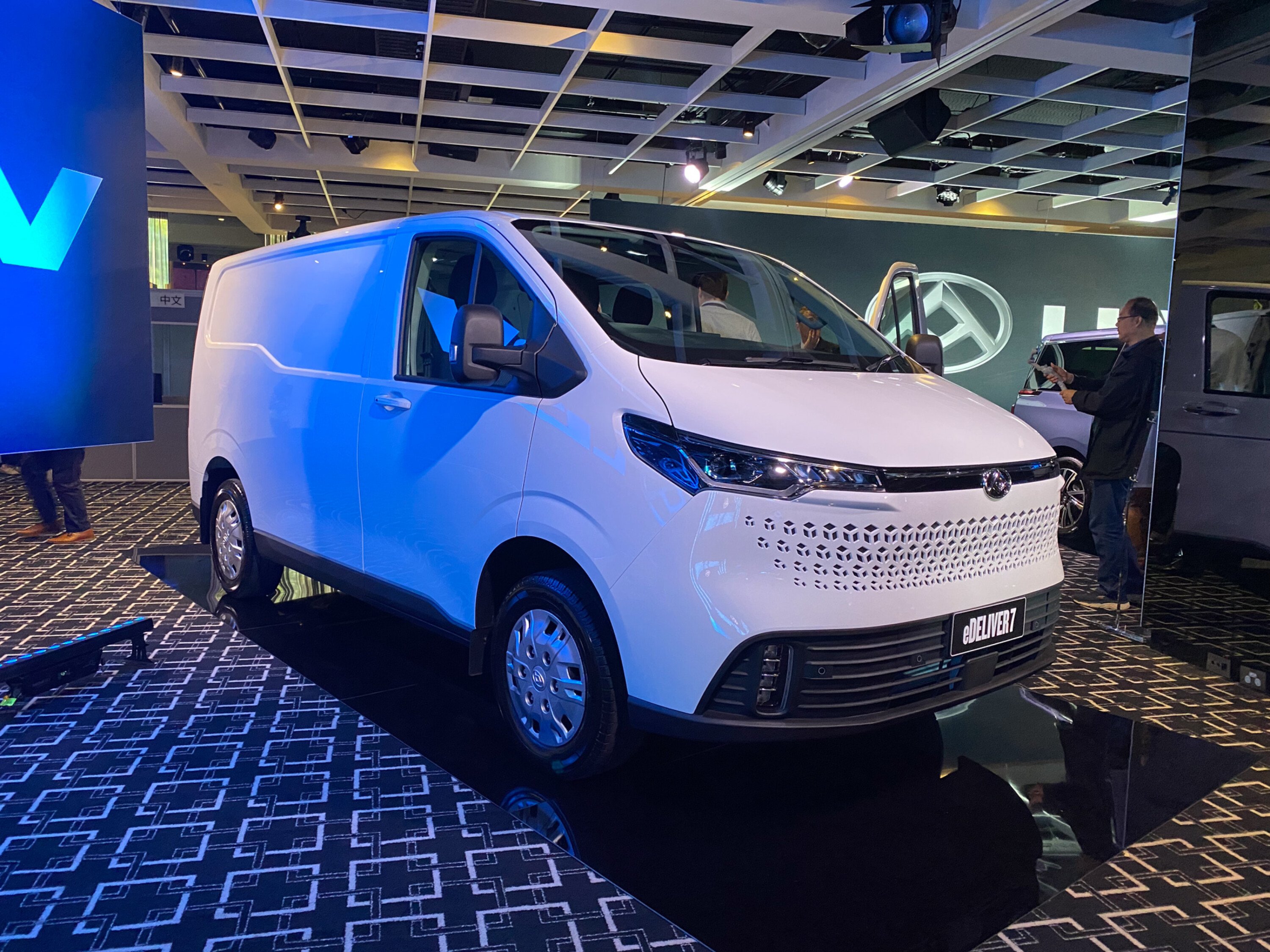
The Deliver 7 loses some if its fake-Ford Transit looks with a fresh look that will start off in electric form before a diesel version arrives in Australia down the track.
Replacing the LDV G10 that’s been on sale here since 2010, the eDeliver 7 is more Transit Custom size where the eDeliver9 rivals the larger Transit.
Locally, short- and long wheelbases will be on the menu, along with low and high roofs with the electric package offering an E-Transit matching 380km with an optional 88kWh battery.
1
The standard spec with its 77kWh battery should deliver a claimed 300km range, using the same 150kW/330Nm motor.
For 2024, the eDeliver 7 will bring much better tech than the G10, including AEB, Lane Keep Assist and Adaptive Cruise, as well as better interior tech including a 360-degree camera.
It will face the electric vans including the Peugoet E-Expert, forthcoming T7 Volkswagen Transporter, and ironically the Ford E-Transit Custom that its design previously aped.
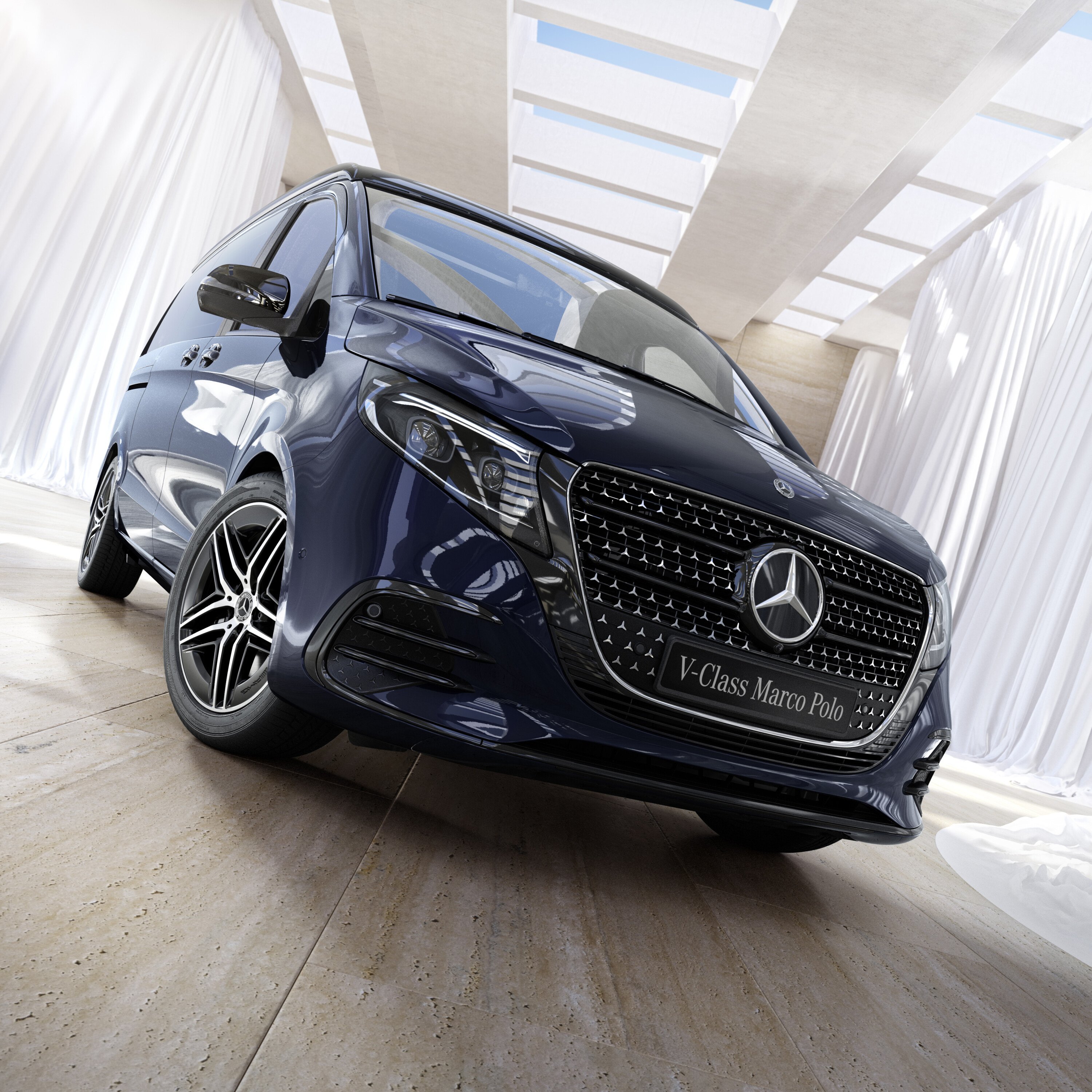
The decade-old W447 V-Class will have a new flagship in the electric EQV as part of its broader 2024 update before an all-new platform lands in 2026.
That’s an issue for some fleet buyers, as its 5-star ANCAP rating expired in 2022 – and it won’t be retested to earn a newer rating.
Regardless, a new nose sees redesigned headlights and combined illuminated front grille cluster, while LED tail-lights, five new colours and fresh alloy wheel designs revitalise the V-Class’s exterior.
1
The cabin scores Mercedes’ a redesigned wood-look dash with twin 12.3-inch displays, 64-colour ambient lighting settings and a new steering wheel featuring capacitive controls, with seating options for up to eight.
The EQV will be offered in mid-spec Avantegarde trim, with three-tier line-up of Exclusive, Avantegarde and Style set to continue.
An optional AMG styling package will also remain on offer, now including a sports grille, with the same 2.0-litre turbo-diesel engines expected across the range.
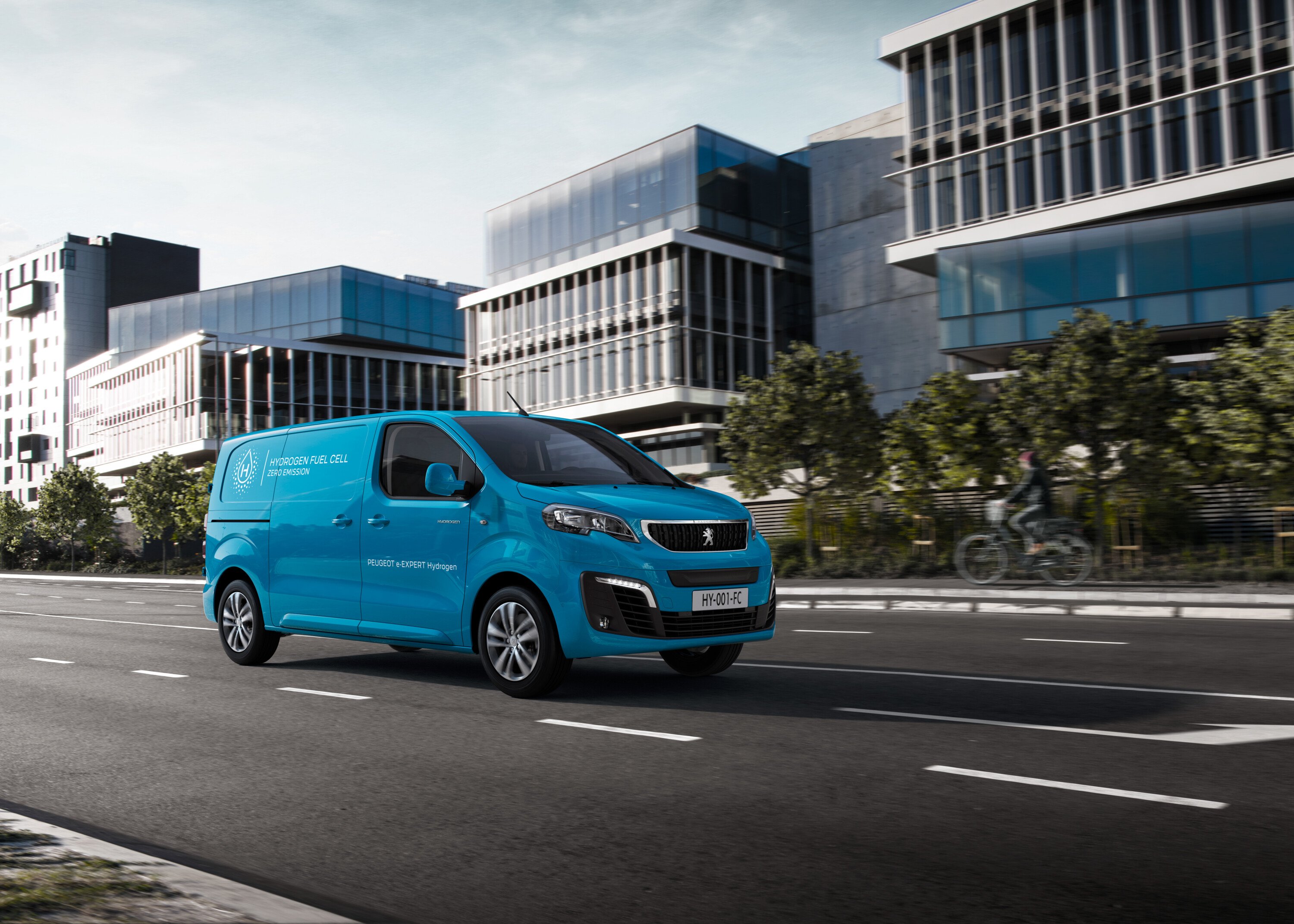
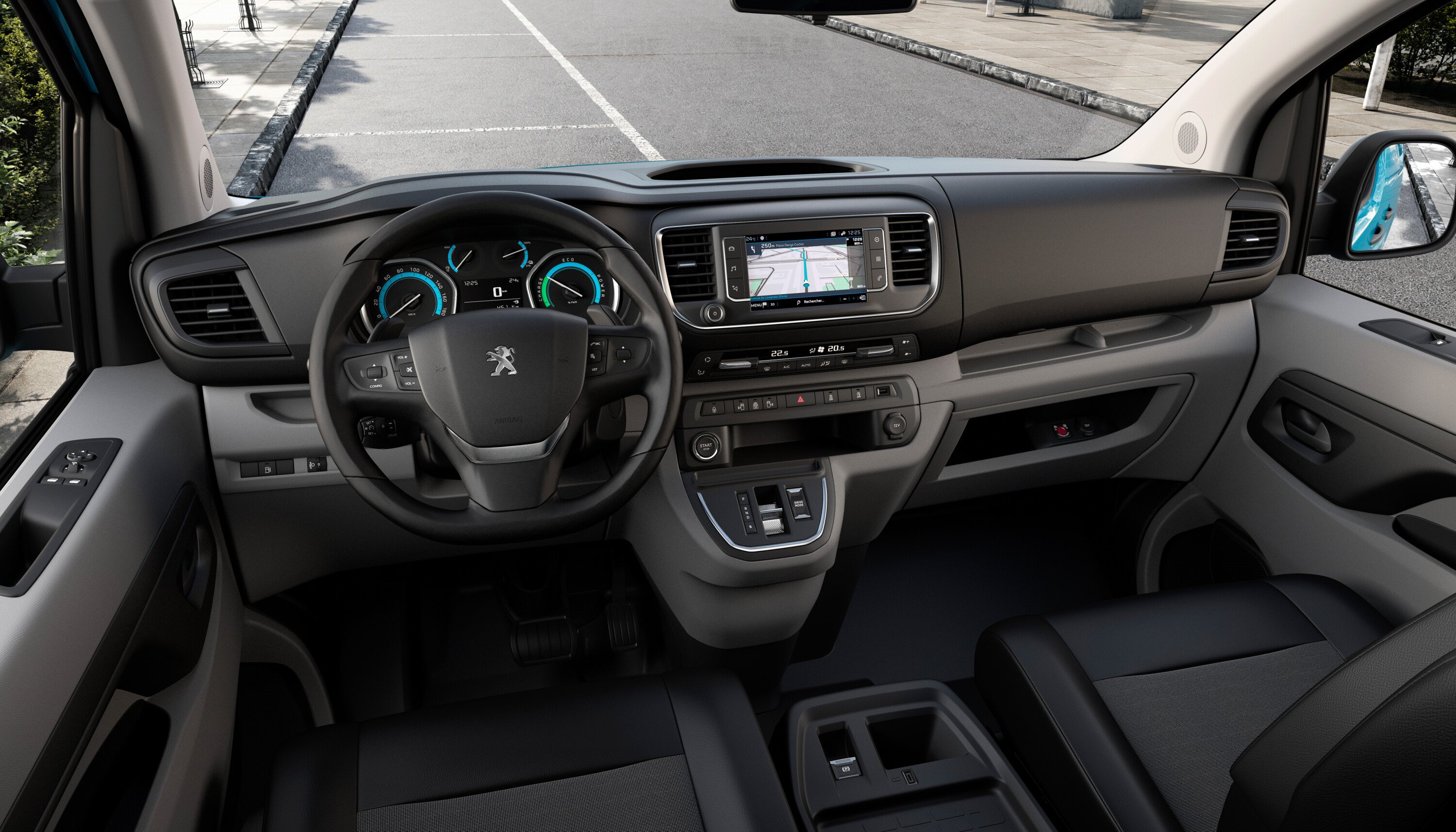
Forgive the e-Expert’s awkward name as the mid-size van looks to add a dash of style to the electric van wars.
It will be Peugeot’s second electric van after the smaller e-Partner went on sale in 2023, and is expected to be offered in a single electric spec.
While Australian spec is not yet locked in, the UK version sees the e-Pug with a 100kW/260Nm motor – poached from the e-208 and e-2008 –driving the front wheels with 50kWh and 75kWh battery packs for a 230km WLTP range.
1
That’s not as far as the Ford/VW twin rivals, nor as powerful, meaning Peugeot will have to price the e-Expert keenly if it’s to make a name for itself Down Under.
Using the diesel versus electric premium for the smaller e-Partner would make the e-Expert around $70k.
The new-generation Kangoo E-Tech is the new name for the Kangoo ZE it replaces, and it comes with more than double the power and 20 additional Newton-metres for 90kW/245Nm. It also has a longer, 285km range, upping its practicality.
That increase is courtesy of a heat pump, which is also used to heat and cool the Kangoo’s larger cabin more efficiently.
Clever tricks include ‘Easy Side Access’, a system removing the B-pillar on the passenger side for easier access to the loading area – whose opening is twice the size of its predecessor with up to 3.9 cubic metres, or 4.4 cubic metres in a longer-wheelbase model.
The $61,990 short-wheelbase Kangoo E-Tech offers a 523kg payload, while a $2K premium for the long-wheelbase brings a 668kg payload.
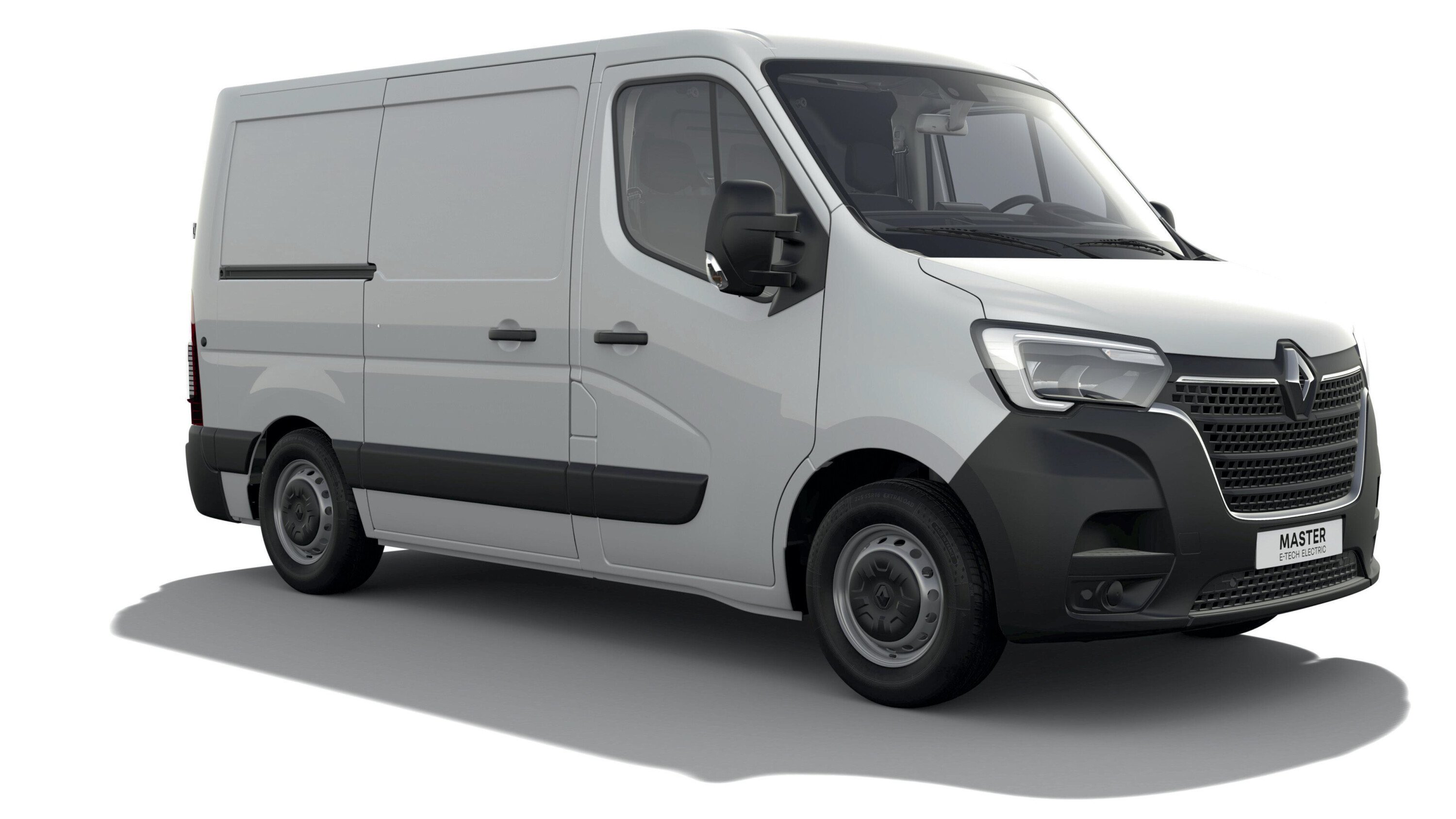
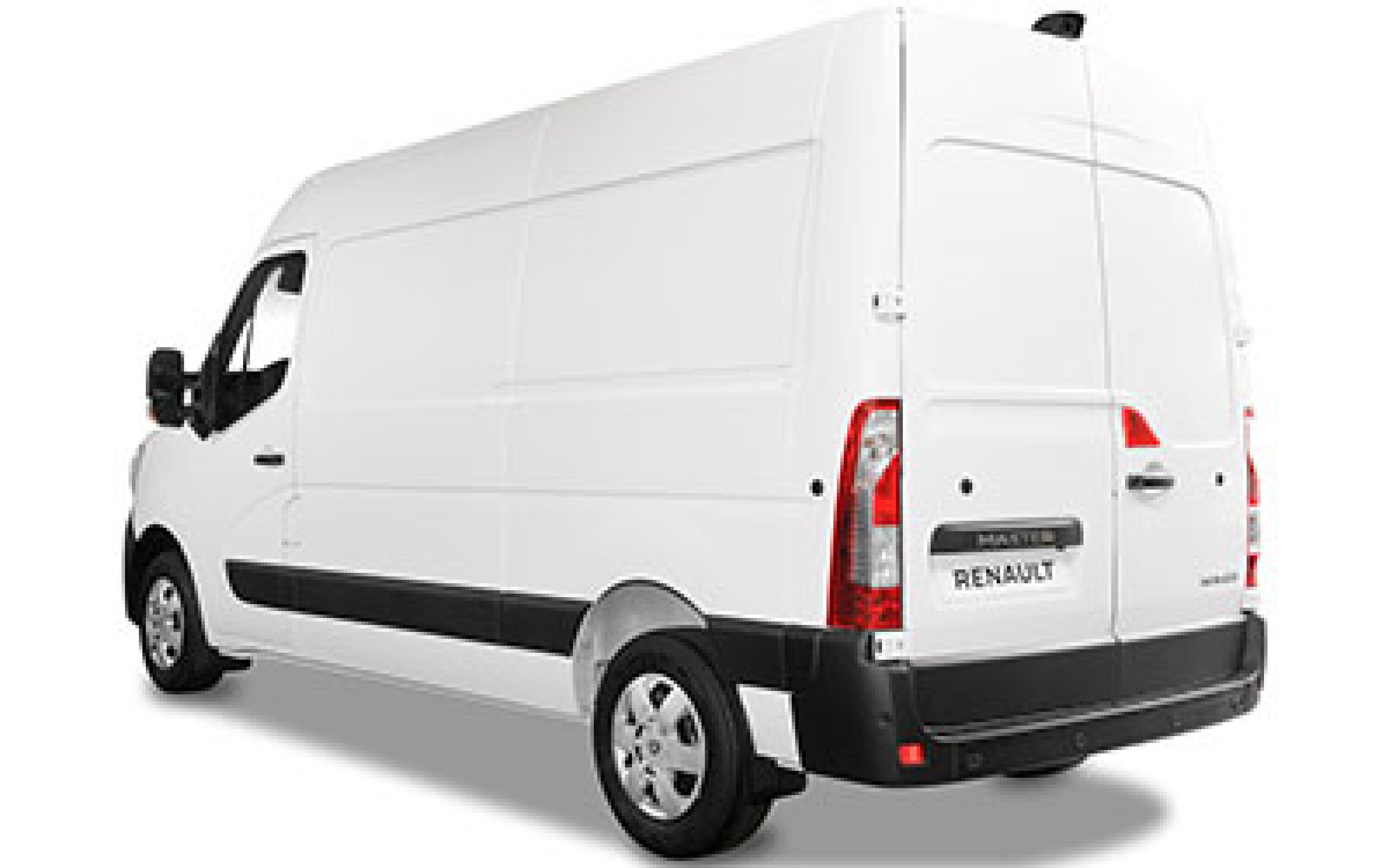
The 2024 Renault Master is all new, replacing the existing model that has been in showrooms since 2010 – and how the world has changed since then.
A contemporary digital-laden cabin with a 10.0-inch centre-screen angled towards the driver, a passenger-car multi-function steering wheel that is used for the automatic’s gears, saving space by replacing the need for a shifter.
Diesel, battery and hydrogen powertrains have been confirmed for Europe in a larger body that has been aero optimised to maximise fuel efficiency, whether you’re burning diesel or pumping electrons, which also helps make the cabin quieter.
1
That’s an achievement given the new Master’s body was too big for a full-size wind tunnel test, Renault using smaller scale models instead.
Renault claims best-in-class loading width and depth, despite the it being narrower.
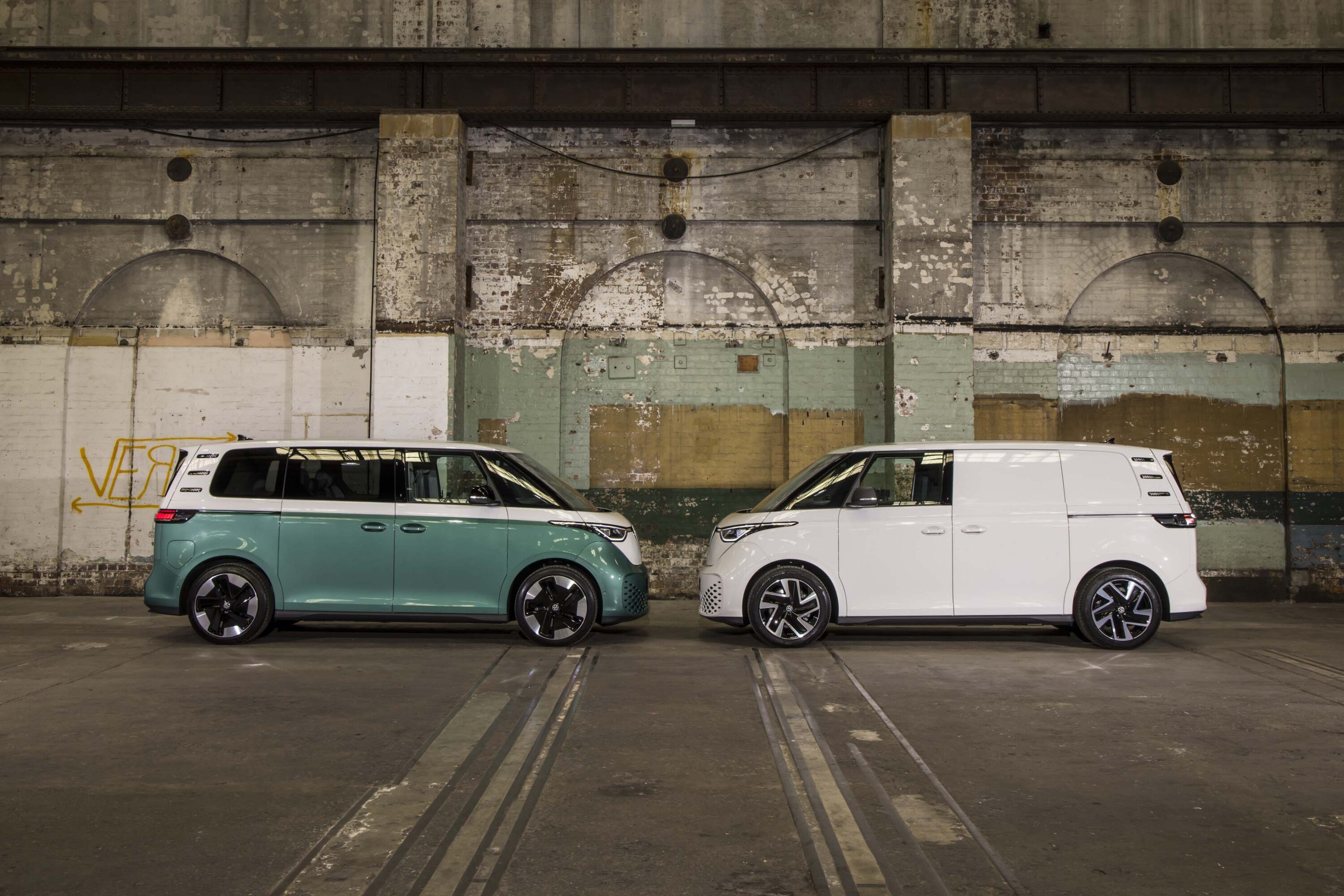
VW’s 21st-century take on the classic Kombi will naturally feature a load-carrying spin-off in addition to a people-mover.
As with the ID.Buzz family transporter, the ID.Buzz Cargo will be fully electric – making it the German brand’s first ever all-electric van.
Details for Australia are yet to be confirmed but the Cargo is expected to come with a 77kWh battery, feeding a 150kW/310Nm rear electric motor.
1
A range of more than 400km is quoted on the WLTP (European test) cycle.
To be offered only in short-wheelbase form, the 4.7m-long Cargo will provide a maximum cargo hold of 3.9 cubic metres with a maximum load length of 2.2 metres – enough space to accommodate two Euro Pallets, according to VW.
The payload is 650kg.
The work van will be easily distinguished from the people-mover, with different (read more durable/practical) interior trim finishes and window-less panels on the back.
We’ll see the latest generation of VW’s long-running Transporter series revealed in 2024, though Australian sales may not commence until early 2025.
For now, all we know is that the ‘T7’ will be a twin to the Ford Transit Custom as part of a commercial-vehicle alliance that has already spawned the closely related Volkswagen Amarok and Ford Ranger utes.
The new Transporter can be expected to share plenty of panels and components with the Transit Custom, with at least a differently styled front end bringing some differentiation.
Powertrains are expected to include a mix of diesel, plug-in hybrid and electric.
Due to a software issue, the brake fluid warning light may not illuminate as intended to warn the driver if the brake fluid level is low. As a result, insufficient brake fluid could lead to a reduction in braking performance.
What are the hazards?
A reduction in braking performance could increase the risk of an accident causing injury or death to vehicle occupants and other road users.
What should consumers do?
Owners of affected vehicles will be contacted in writing by Ford Australia and are asked to make an appointment to have the vehicle’s Body Control Module (BCM) software updated, free of charge.
For further information, contact any authorised Ford Dealer or Ford Customer Relationship Centre on 13 FORD (13 3673).
Supplier details
FORD MOTOR COMPANY OF AUSTRALIA PTY LTD
Who should owners/operators contact for more information?
Due to a manufacturing defect, the locking bracket installed to secure the centre front seat in the down position may not operate as intended. This seating position is not fitted with a seatbelt and could be used by an occupant if the locking bracket does not function correctly.
What are the hazards?
In the event of a collision, an unrestrained occupant would be exposed to the risk of serious injury or death.
What should consumers do?
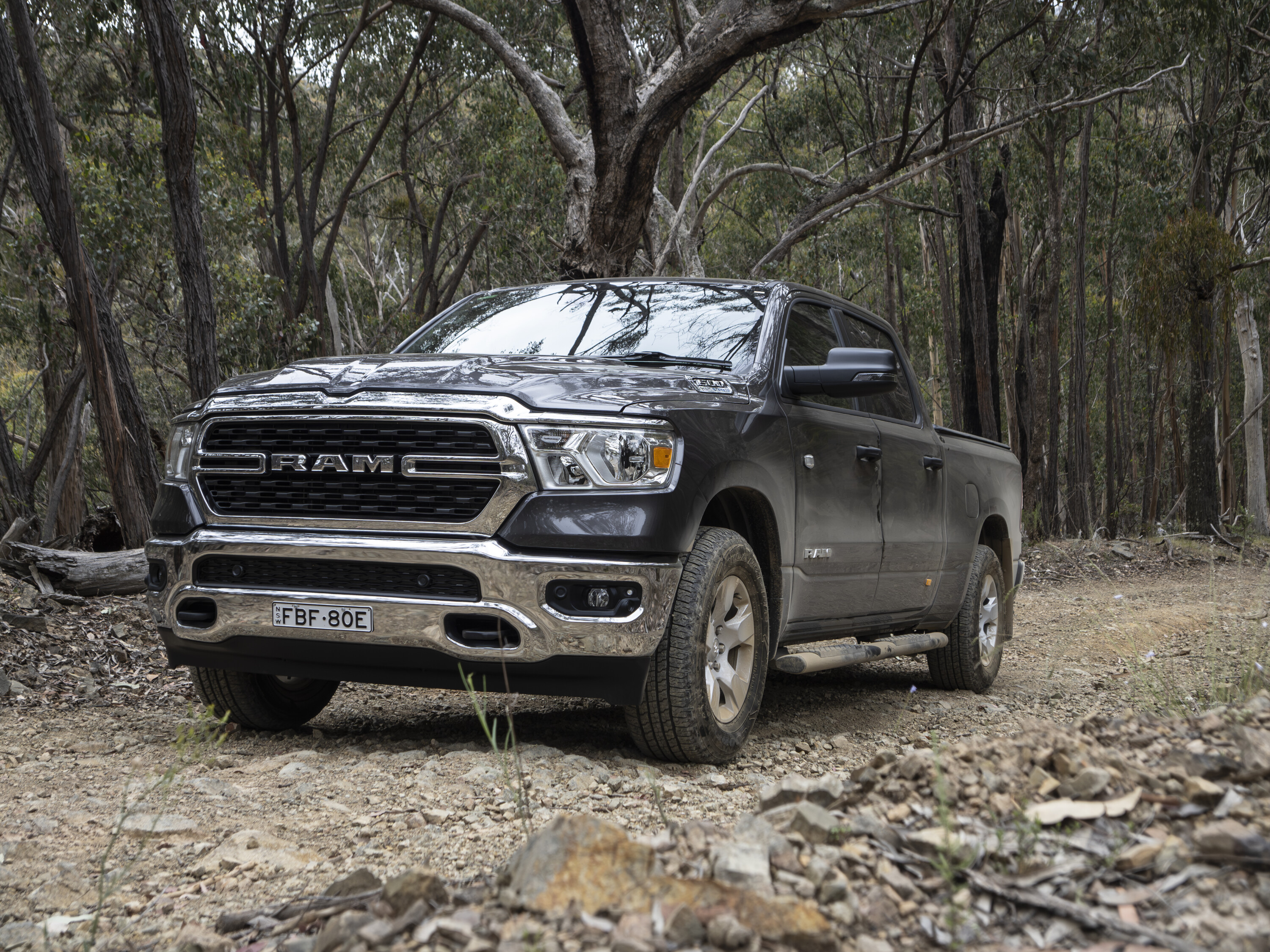
Owners of affected vehicles should contact their authorised RAM dealership to arrange to have the centre seat inspected and rectified if necessarily, free of charge.
Note: The centre front seat should not be used by passengers.
Contact your authorised RAM dealer. For any additional information and assistance, please call RAM Trucks Customer Assist on 1300 681 655.
Supplier details
AMERICAN SPECIAL VEHICLES PTY LTD
Who should owners/operators contact for more information?
The threaded nut securing the 12 Volt wiring harness may become loose over time. If this occurs, it could result in higher than normal electrical resistance within the harness which could lead to a vehicle fire.
What are the hazards?
A vehicle fire could increase the risk of injury or death to vehicle occupants, other road users and/or damage to property.
What should consumers do?
Owners of affected vehicles will be contacted by Mercedes-Benz in writing and are asked to make arrangements with their authorised Mercedes-Benz dealership to have the work carried out as soon as possible, free of charge.
To look back over the last 12 months, we’ve compiled a top-five list of advice stories that were read more than any others on WhichCar.com.au.
#1 – Every Plug-in Hybrid EV on sale in Australia in 2023
We list the PHEVs on sale in Australia, and every PHEV still on the horizon.
#2 – Can you check if you’ve been snapped by a speed camera?
Discovering a speeding or traffic light infringement notice in the mail can be an unwelcome surprise, particularly when your demerit points are nearly exhausted.
#3 – Australia’s best electric cars for 2023
All of a sudden, we’re just about spoiled for choice when it comes to EVs. Now you need to know: Which electric cars are the best in 2023?
#4 – What does the airbag warning light mean?
Airbags are designed to inflate within a fraction of a second of sensing an impact to provide a cushion between occupants and hard surfaces during a crash.
#5 – Mazda CX-8 vs CX-9: What’s the difference?
To those not in the know, the soon-to-be-discontinued CX-8 and CX-9 look very similar and perform much the same family-focused mission. But there are enough differences between them…
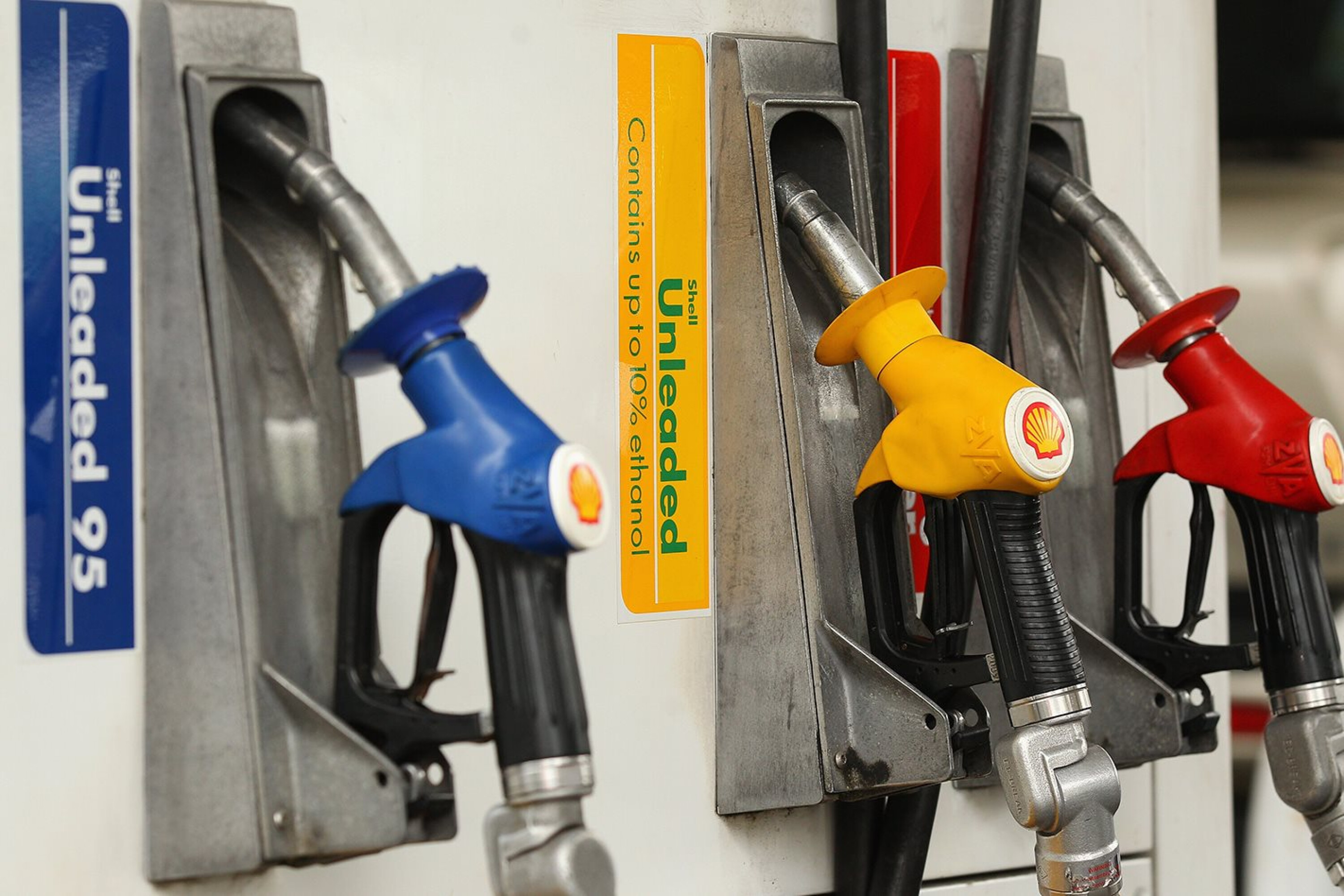
Plans to improve Australia’s fuel quality were initially planned to be introduced in 2024, with government-subsidised facility upgrades required at Australia’s two remaining refineries.
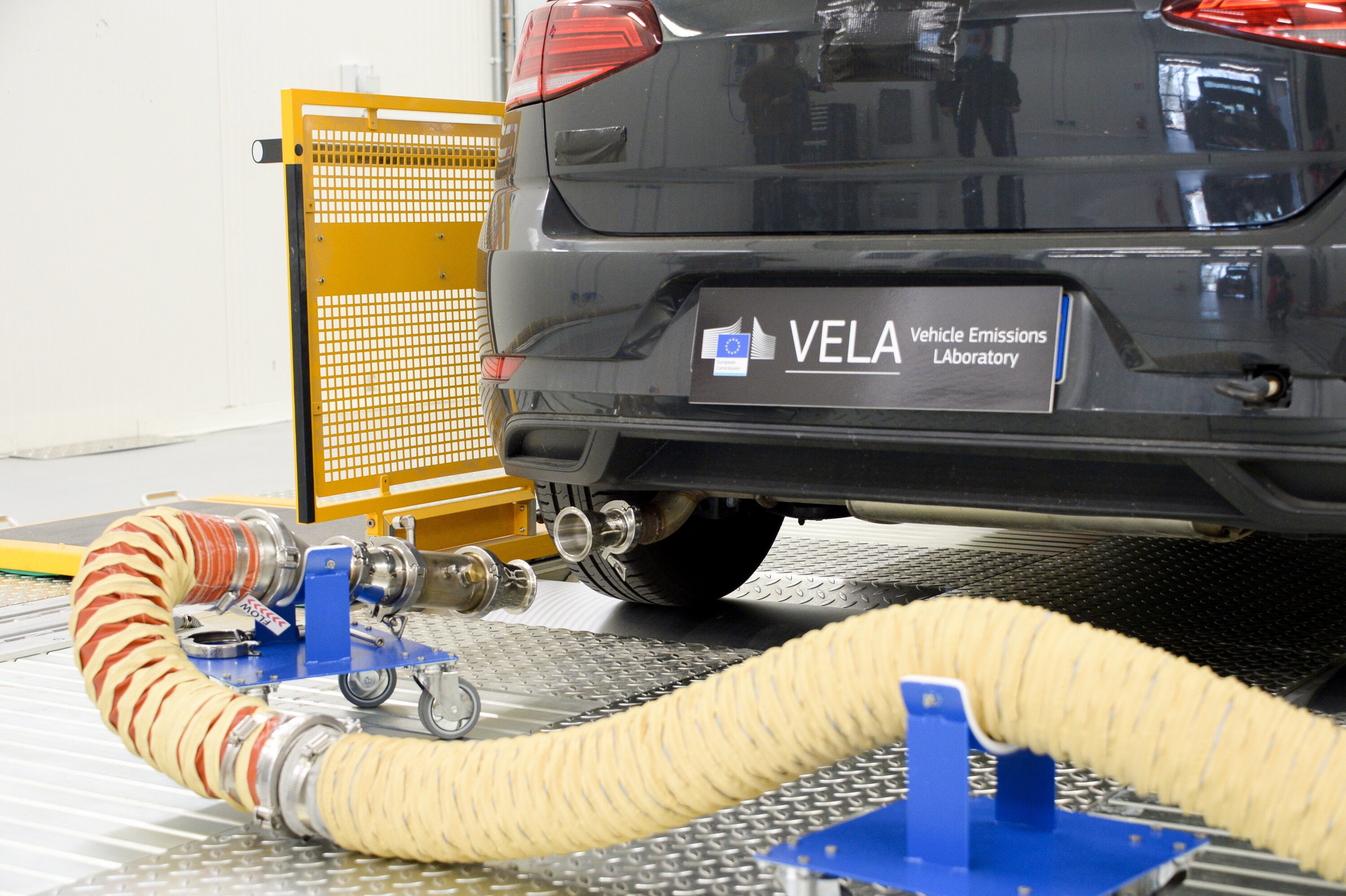
Existing new passenger vehicles, SUVs and light commercial vehicles – including utes – introduced in Australia before December 2025 are expected to have until sometime in 2028 to meet the tougher noxious emissions standard.
The Euro 6d standard has been required for every new car sold in Europe since January 2021.
1
Current vehicles sold in Australia are only required to meet the Euro 5 emissions standard, enforced from November 2016 for all light vehicles.
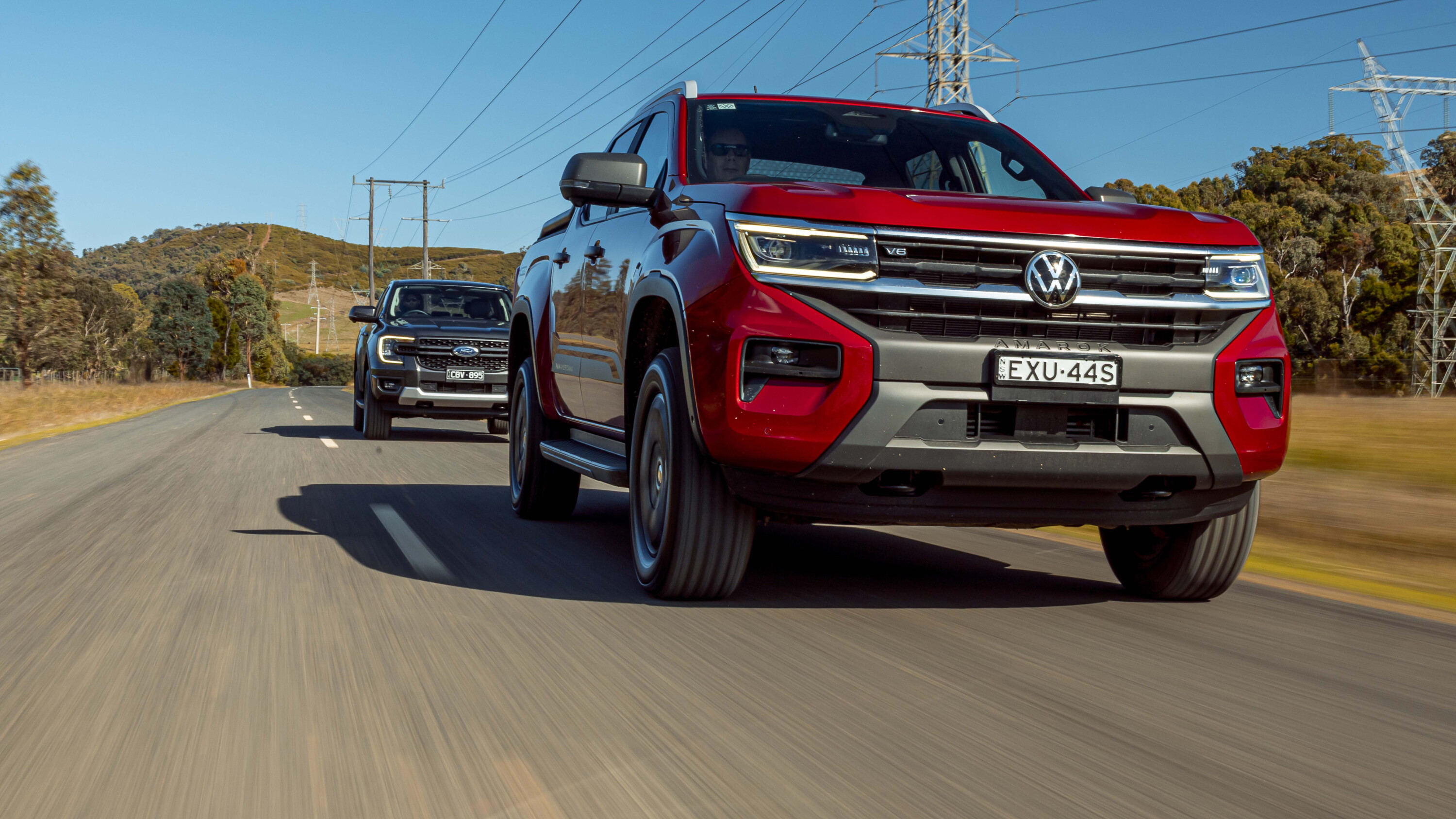
The stricter Euro 6 standard will likely impact light commercial vehicles – including popular utes like the Ford Ranger, Toyota HiLux and Isuzu D-Max – which will require updates.
Versions of these utes sold in Europe that meet the Euro 6 standard require the use of AdBlue diesel exhaust fluid, which assists in reducing harmful gases from being released into the atmosphere.
1
Federal Chamber of Automotive Industries chief executive Tony Weber told The Australian Financial Review [↗] the standards bring Australia closer to established international standards.
“This is a necessary step. Automotive manufacturers have been calling for an improvement to Australia’s fuel quality standards for more than a decade,” he said.
Federal Minister for Infrastructure and Transport Catherine King said the changes would save lives.
“The changes, along with Fuel Efficiency Standards, are part of delivering cleaner, cheaper-to-run cars and tackling transport costs for Australian families and businesses.
1
“Tightening Australia’s noxious emissions standards will prevent deaths caused by toxic air pollution.
“Noxious emissions contribute to strokes, respiratory illnesses and cancer and equivalent standards have already been introduced in countries such as the US, China, India and Japan.”
“These updates to our vehicle standards will see almost 18 million tonnes of greenhouse gas emissions cut from the transport sector by 2050 – equivalent to taking 280,000 cars off the road,” said Federal Minister for Climate Change and Energy Chris Bowen.