
On price alone, the torsion-beam-equipped GXL FWD, roughly $43,300 on the road, would have been a better match, but none were available for this comparison.
History repeats itself, and history is happening faster than ever before. What took Japan 40 years and Korea 20 years, China’s looking to do in a 10-15 year span – or so they say. Frightening times to be an established manufacturer like Toyota.
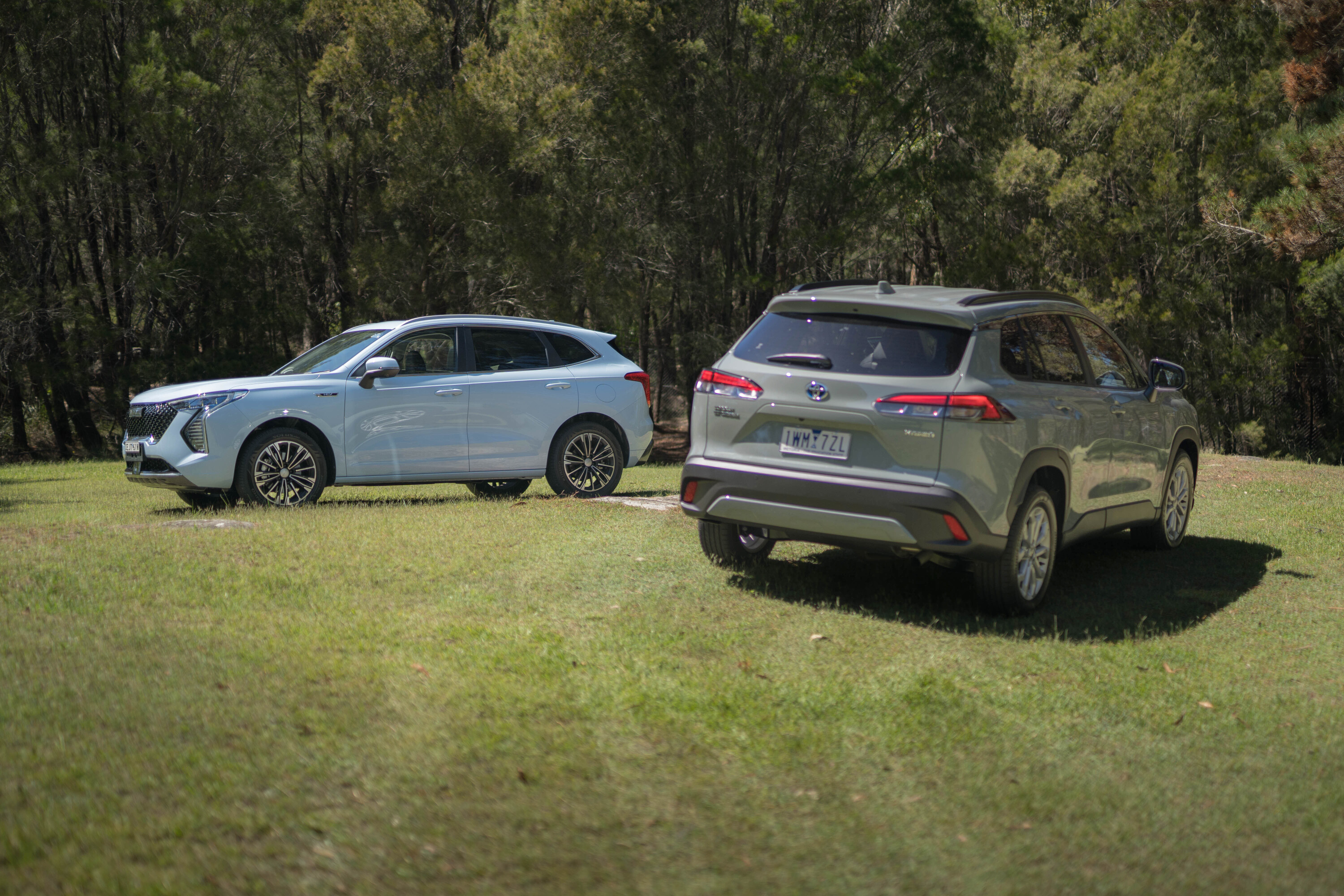
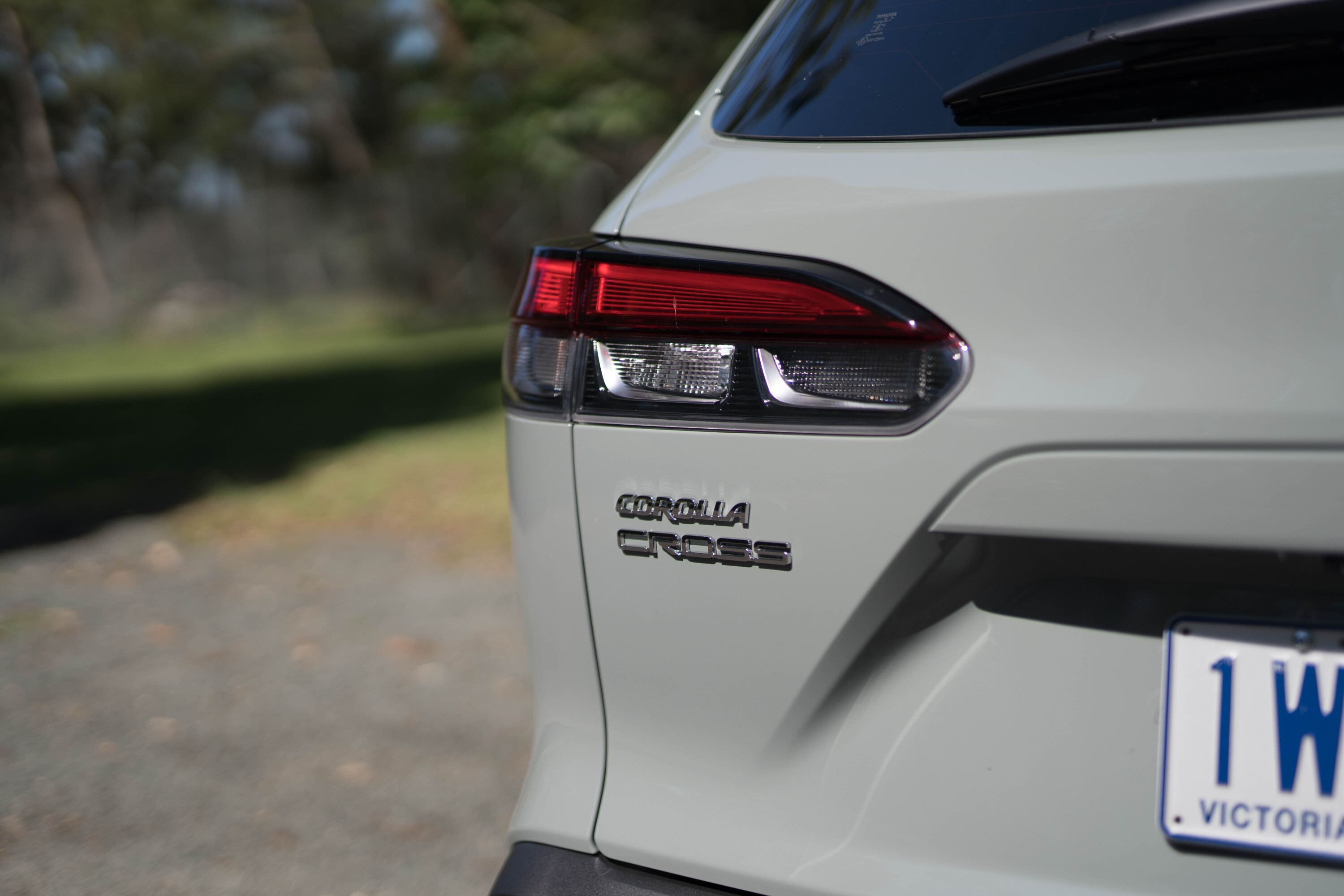
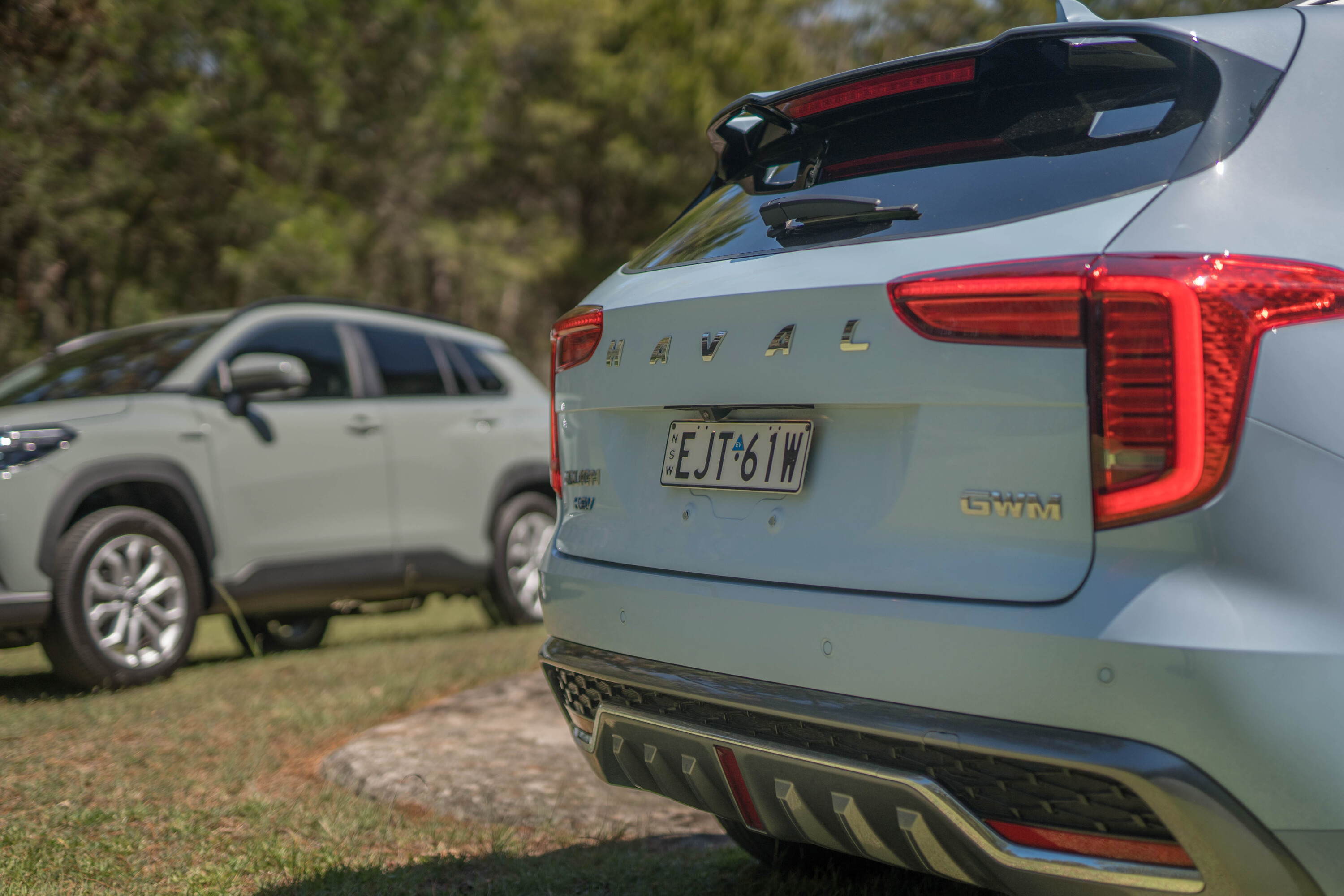
To test this theory, we grabbed two fresh-faced small SUVs with hybrid powertrains for a duel: Toyota’s now-benchmark Corolla Cross in GXL AWD guise, and our Haval Jolion Ultra Hybrid long-termer.
Toyota established itself as the hybrid hero when the Prius debuted in August 1997, and has continued to refine its series-parallel recipe to this day. It was widely accepted as the industry benchmark for seamless operation (and still is for efficiency) but recently, rival brands have begun to challenge all that.
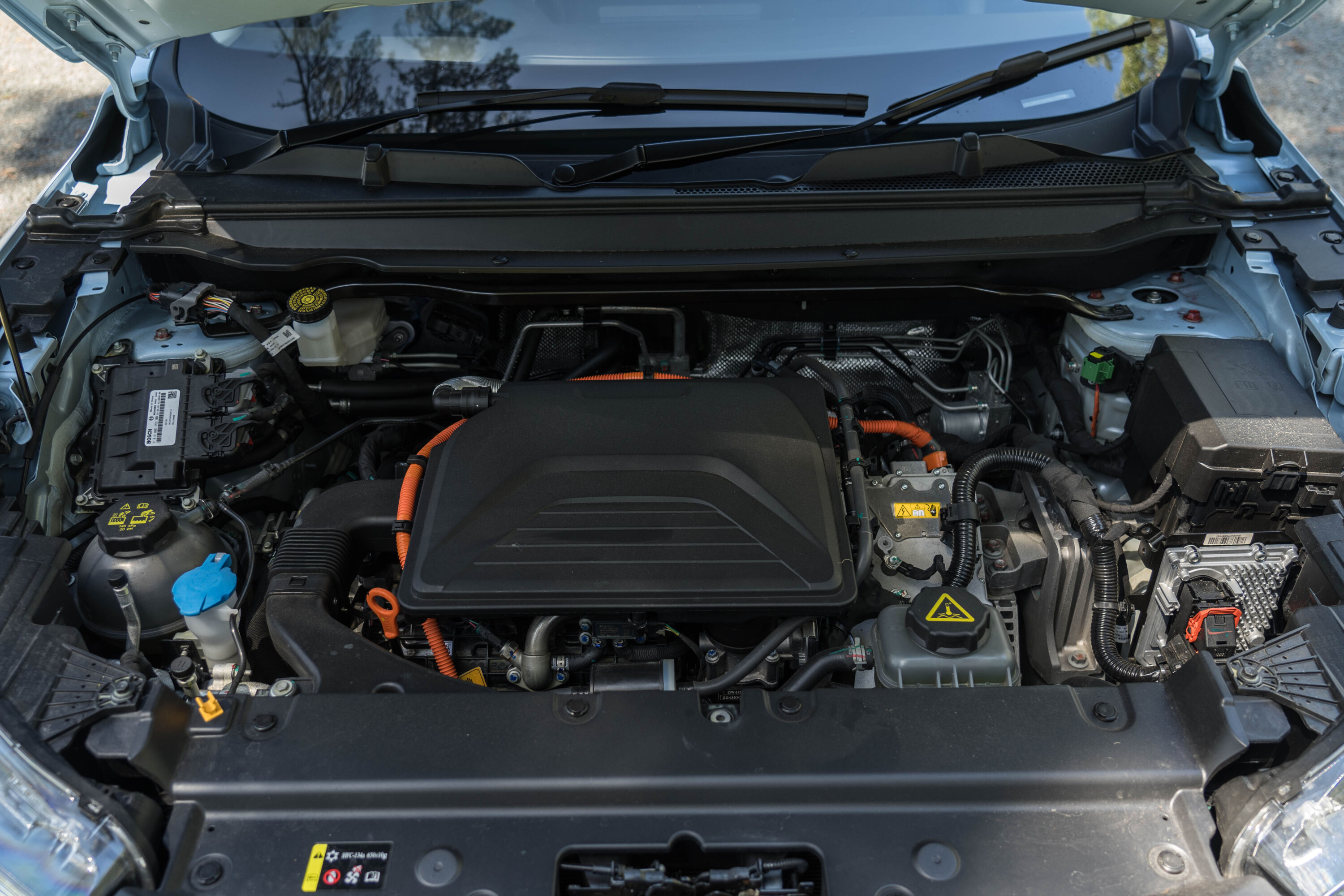
Haval is one of them, with the Jolion featuring a different take on the hybrid with its ‘dedicated hybrid transmission’ (DHT) that uses two fixed ratios (a launch and cruise gear), with the electric motor working to fill in the gaps.
Toyota’s ‘eCVT’ is a similar system in principle, but with different electronic control systems, it differs markedly on the road.
1
JUMP AHEAD
- Pricing and features
- The basics
- Comfort and space
- On the road
- Safety
- Fuel consumption
- Ownership
- VERDICT
- Specifications
Pricing and features
The Jolion immediately takes the lead in value stakes.
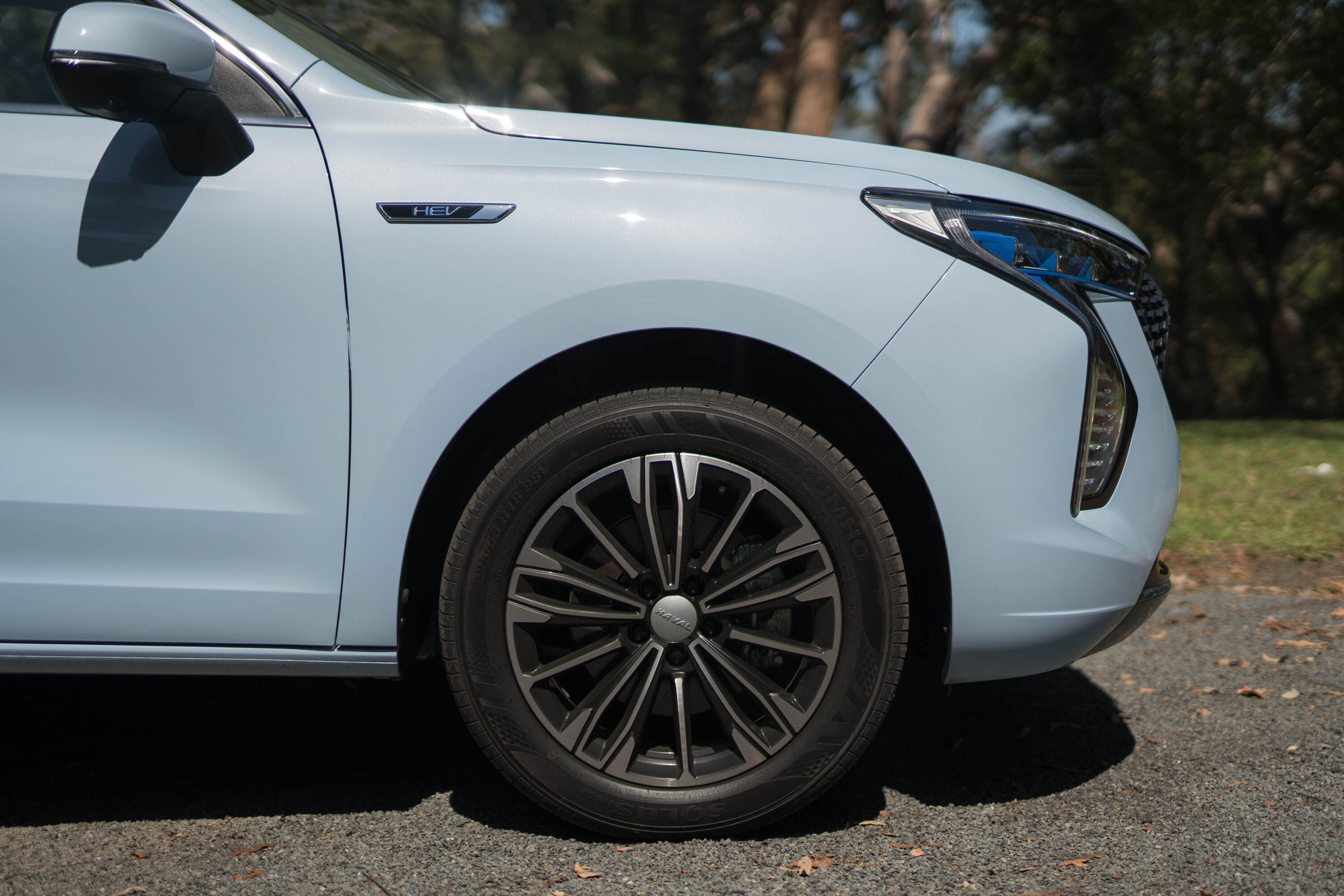
Haval sells the Jolion Premium with a punchy turbo-petrol engine, 17-inch alloys and 10.25-inch touchscreen from as low as $27,990 drive-away, and our flagship Ultra Hybrid is a still-reasonable $39,990 on the road in any state.
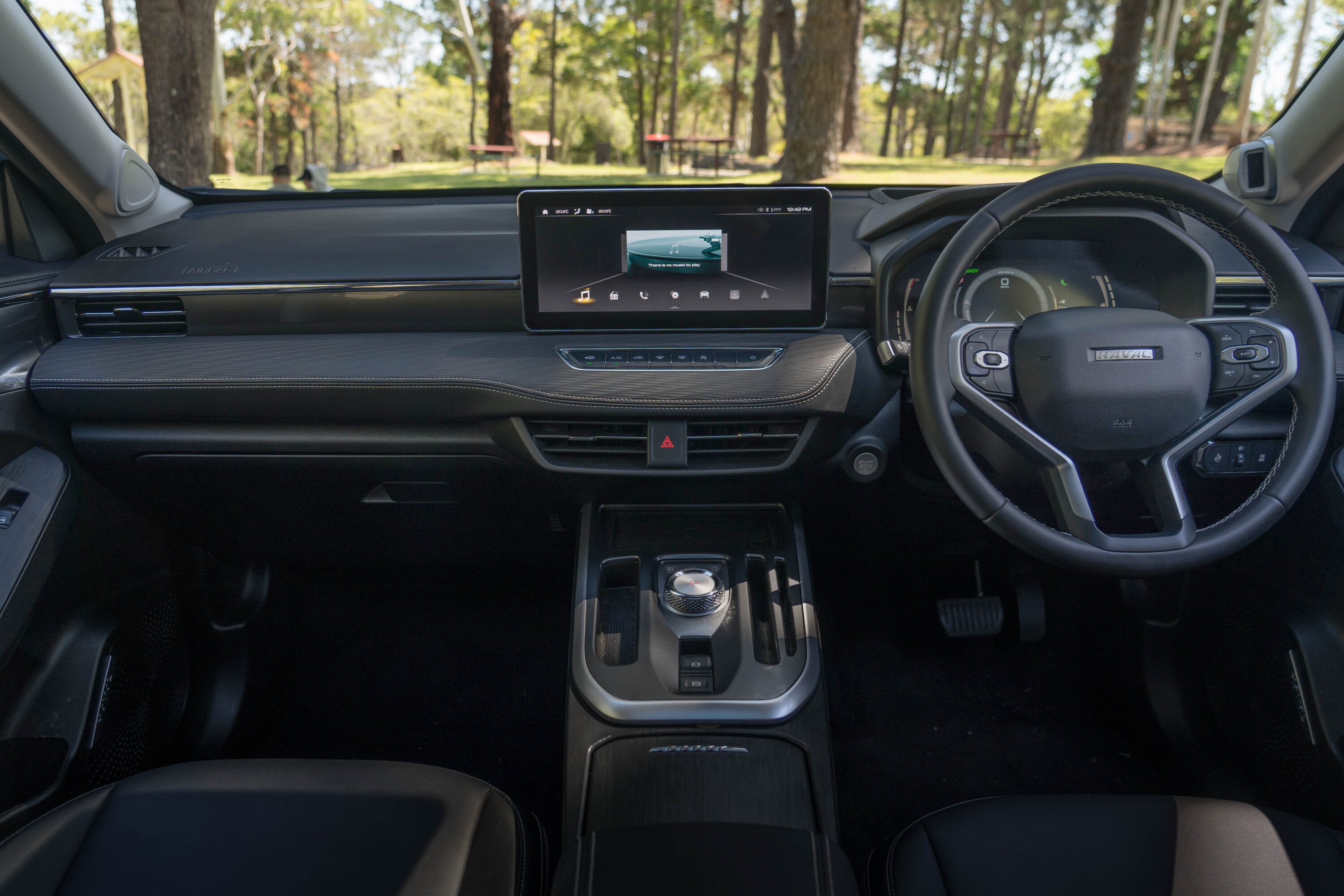
For the flagship’s asking price, you get the biggest-in-class (equalled by the Nissan Qashqai) 12.3-inch touchscreen, Comfort-Tek vinyl upholstery, and more (see table for full specifications). What you don’t get is independent rear suspension – that’s only available on the sporty Jolion S.
1
Comparatively, the Corolla Cross range begins in basic GX guise with 16-inch alloy and a small 8.0-inch touchscreen for $33,000 before on-road costs, or $36,800 drive-away – $9000 more than the Haval.
The mid-spec GXL hybrid AWD tested is rather dear at about $46,500 on the road, costing $5500 more than the Haval and isn’t even the top trim level. Oh, and you have to pay a monthly subscription for Toyota’s telematics and connected services. It totals $22.45/month.
See the spec comparison for how the Corolla Cross GXL stacks up against the Jolion Ultra Hybrid.
1
The basics
| Toyota Corolla Cross GXL AWD | Haval Jolion Ultra Hybrid | |
|---|---|---|
| Power | 146kW | 139kW |
| Torque | NA | 375Nm |
| Drive | AWD | FWD |
| Wheel size | 17-inch alloy | 18-inch alloy |
| Headlights | LED headlights | LED headlights |
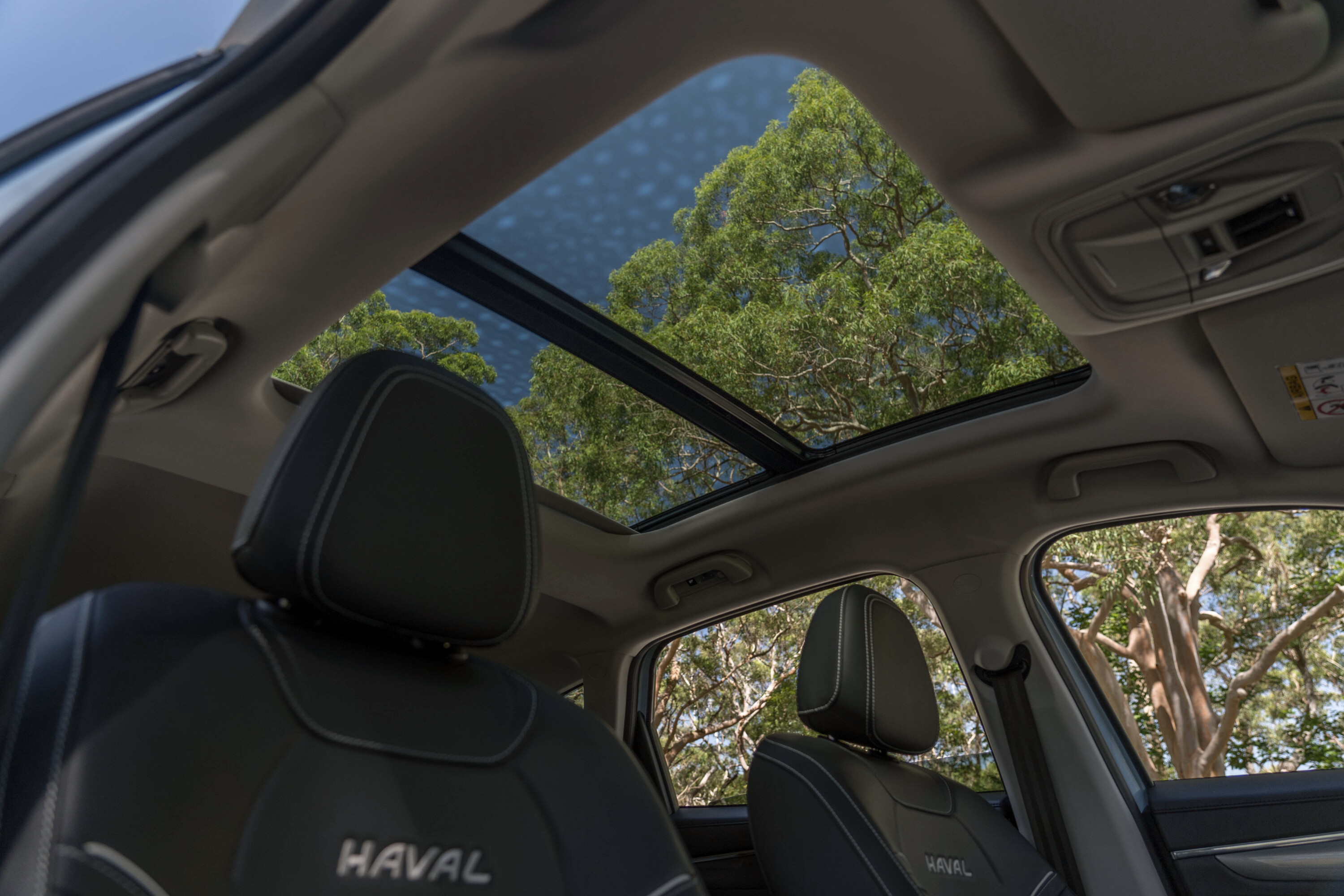
| Sunroof | Not available | Opening panoramic |
| Touchscreen size | 10.5-inch | 12.3-inch |
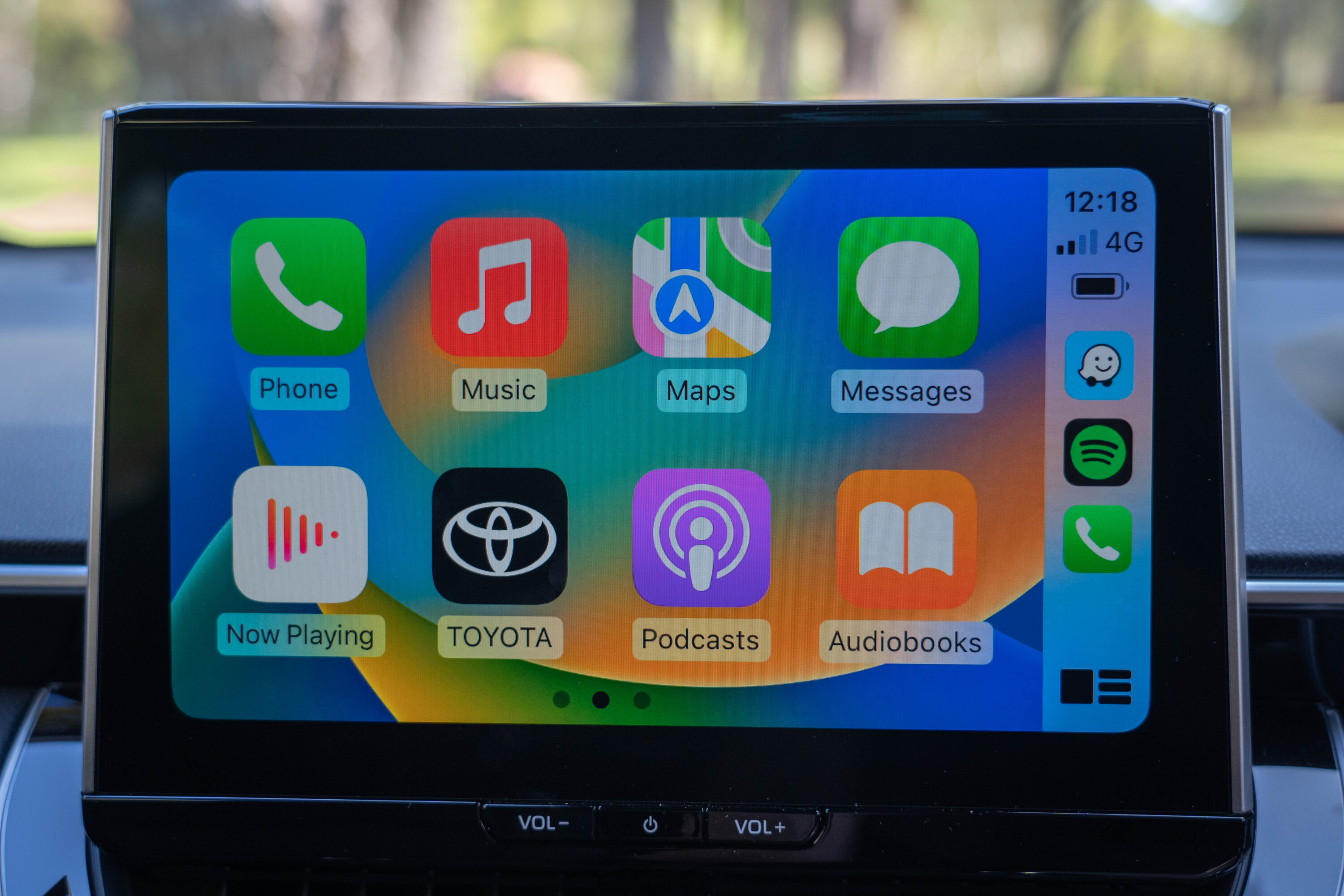
| Smartphone mirroring | Wireless Apple CarPlay/Android Auto | Wired Apple CarPlay/Android Auto’ |
| Driving information | 7.0-inch digital multi-information display | 7.0-inch digital driver’s display |
| Sound system | 6-speaker in-house | 6-speaker in-house |
| Upholstery | Cloth/vinyl | u2018Comfort-Tek’ vinyl |
| Seat adjust | Manual with power-lumbar | 6-way power adjust |
| Climate control | Dual-zone climate control | Dual-zone climate control |
| Tailgate | Manual tailgate | Power tailgate |
| Boot size | 390L | 390L |
1
Comfort and space
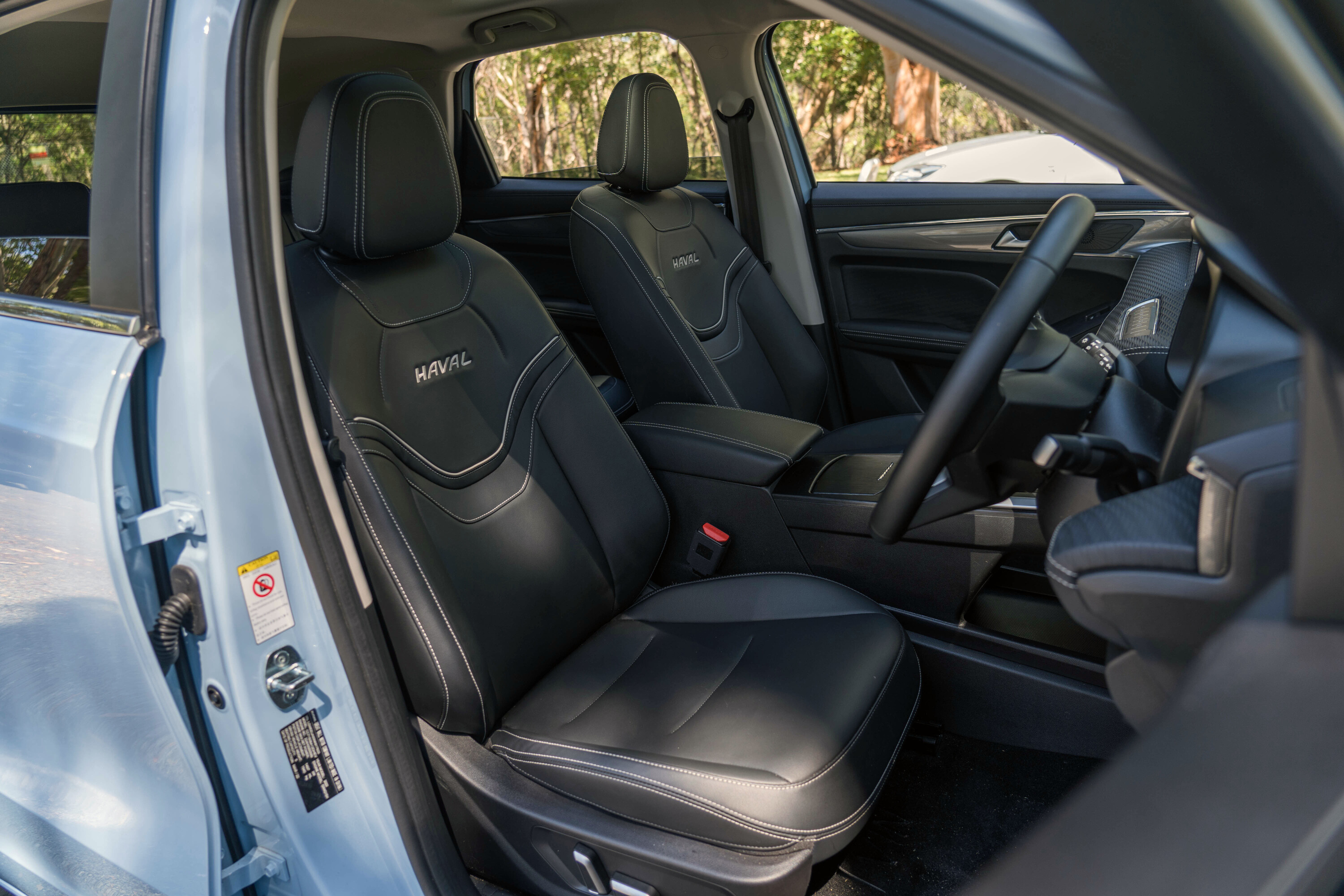
The Jolion continues to win the cabin presentation race – though no prizes for guessing from which British luxury brand Haval pinched its interior stylist.
Where the Corolla Cross is all dull black plastics, the Haval has a lot of different materials and some interesting design choices. It’s not particularly cohesive or attractive (in this tester’s opinion) but it is more eye-catching.
Incidental storage in the Jolion is great, with credit card slots, a thoughtful wireless phone charging tray, two cup holders ahead of the rotary gearshift (which oddly doesn’t have any detents, it’ll just spin forever like a BMW iDrive controller), deep covered central storage bin and decent bottle holders in the doors.
Build quality is a bit of a letdown in the Jolion, with creaky plastics and a touchscreen that doesn’t feel particularly well attached to the dashboard. And although the materials present well, a bit more exploring reveals that they’re rather flimsy and cheap – especially the metal-look accents.
1
Another chink in the Haval’s armour is its driving position.
The Jolion is one of very few cars on sale (including the LandCruiser 70 Series) without telescopic adjustment for the steering wheel, and it’s positioned way too far from the driver. I had a sore back after an hour of driving because of this.
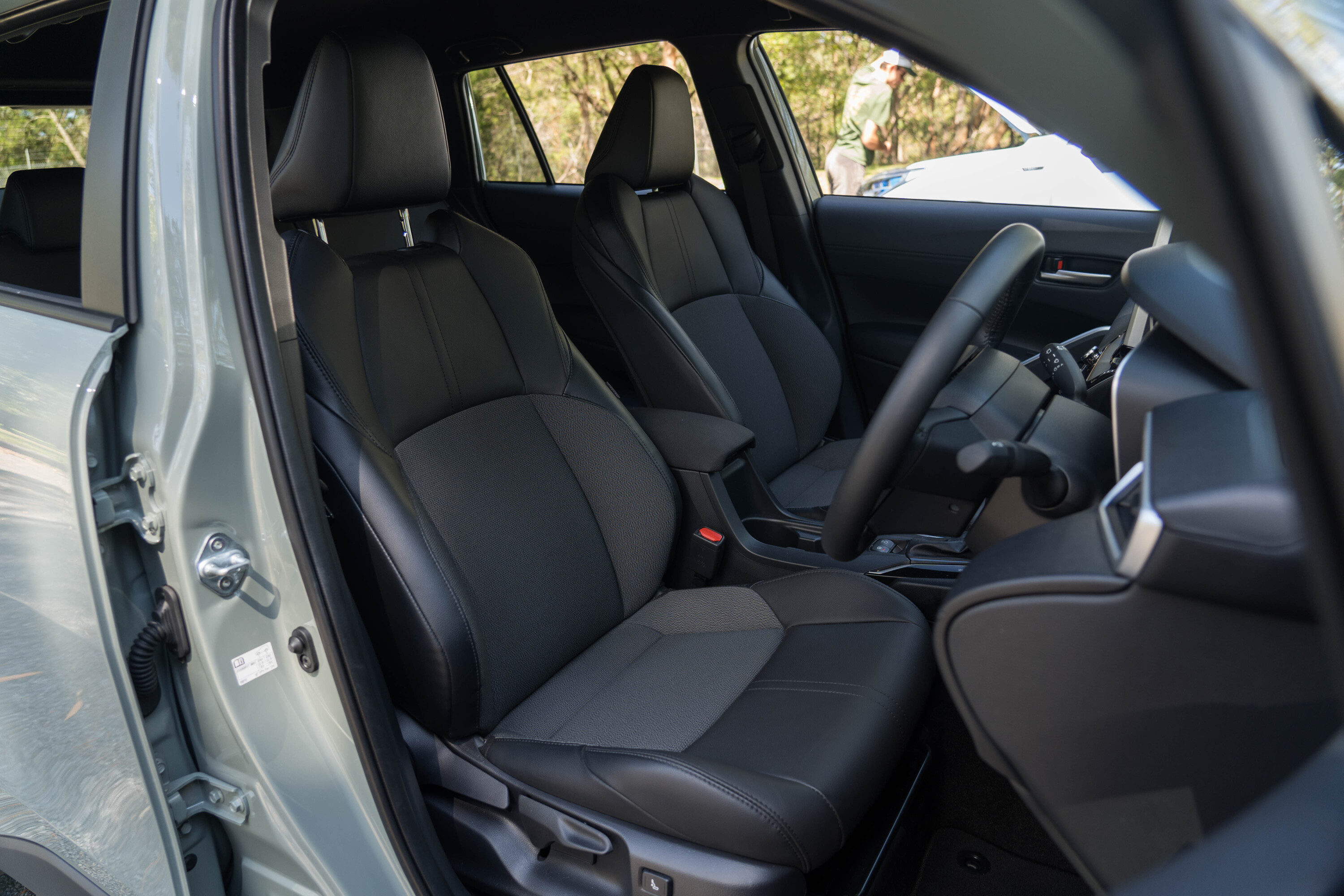
Taller people will also find that the seats seriously lack under-thigh support, that vinyl upholstery also proving very sweaty with sunlight beating through the panoramic sunroof. Although the Toyota’s manual seat adjustment is coarse (especially the backrest), the driving position is more conventional with a nice small wheel to hold.
Herringbone-esque cloth-centred seat in the Corolla Cross GXL also don’t get as hot, so there’s less yucky leg sweat to worry about in summer.
1
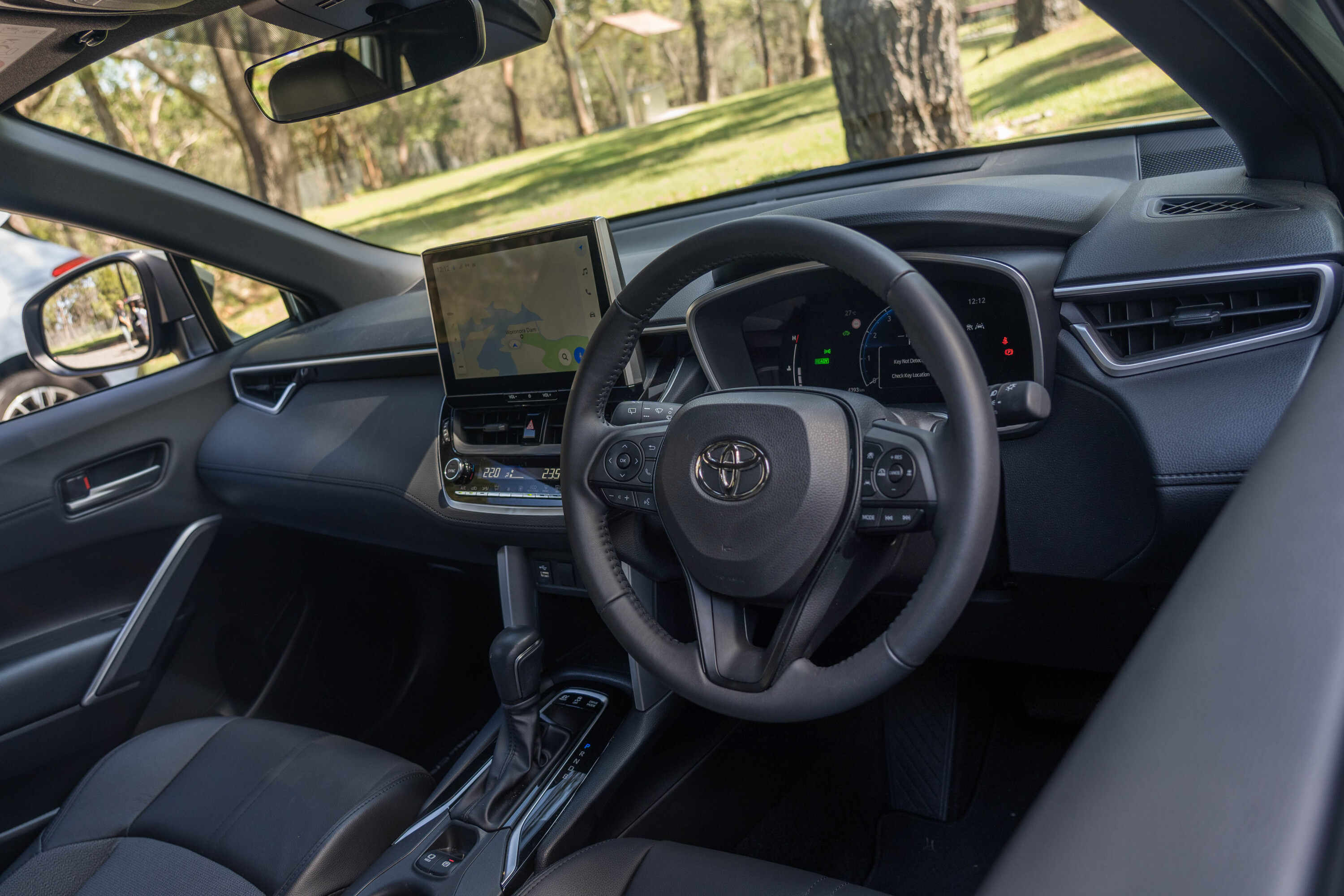
Next to the Haval’s wild interior, the Toyota’s cabin is conventional verging on forgettable.
The touchscreen is decently sized, but when you aren’t running wireless smartphone mirroring, the Corolla’s interface is bare. It’s slow to boot up as well, sometimes taking 20 seconds before becoming responsive.
To be fair to the Corolla, while its user interface isn’t sexy, it’s easier to navigate than the Jolion’s convoluted affair.
Even with Haval’s high-res screens, what’s really frustrating are the Jolion’s climate control and drive mode settings. Both are buried in strange places and though you can add main menu shortcuts, the interface remains clunky and unrefined.
1
I question why the Jolion features physical shortcuts for front and rear window demisters, and air-con off – but no fan-speed adjustment when there’s a switch blank for it below the touchscreen.
On top of the dashboard, the Corolla Cross has hard, scratchy plastics where you’d really expect some yielding soft materials. Plastic quality in general is a little disappointing – it feels old Toyota – and the cabin, although brighter than a C-HR, is still a dark place to sit with a decidedly cheap canvas-like headliner.
The Corolla Cross solves many of the Corolla hatch’s back seat woes but, considering its external dimensions, the Toyota isn’t all that space efficient. A smaller car like the Skoda Kamiq does more with less.
Rear passengers are treated to adjustable air vents, a two-position reclining backrest, a fold-out armrest, two USB-C charge points, and about enough space for a 180cm person to be comfortable.
1
The Jolion, on the other hand, is a legitimate alternative to a size-class-larger SUV, such as a Mazda CX-5.
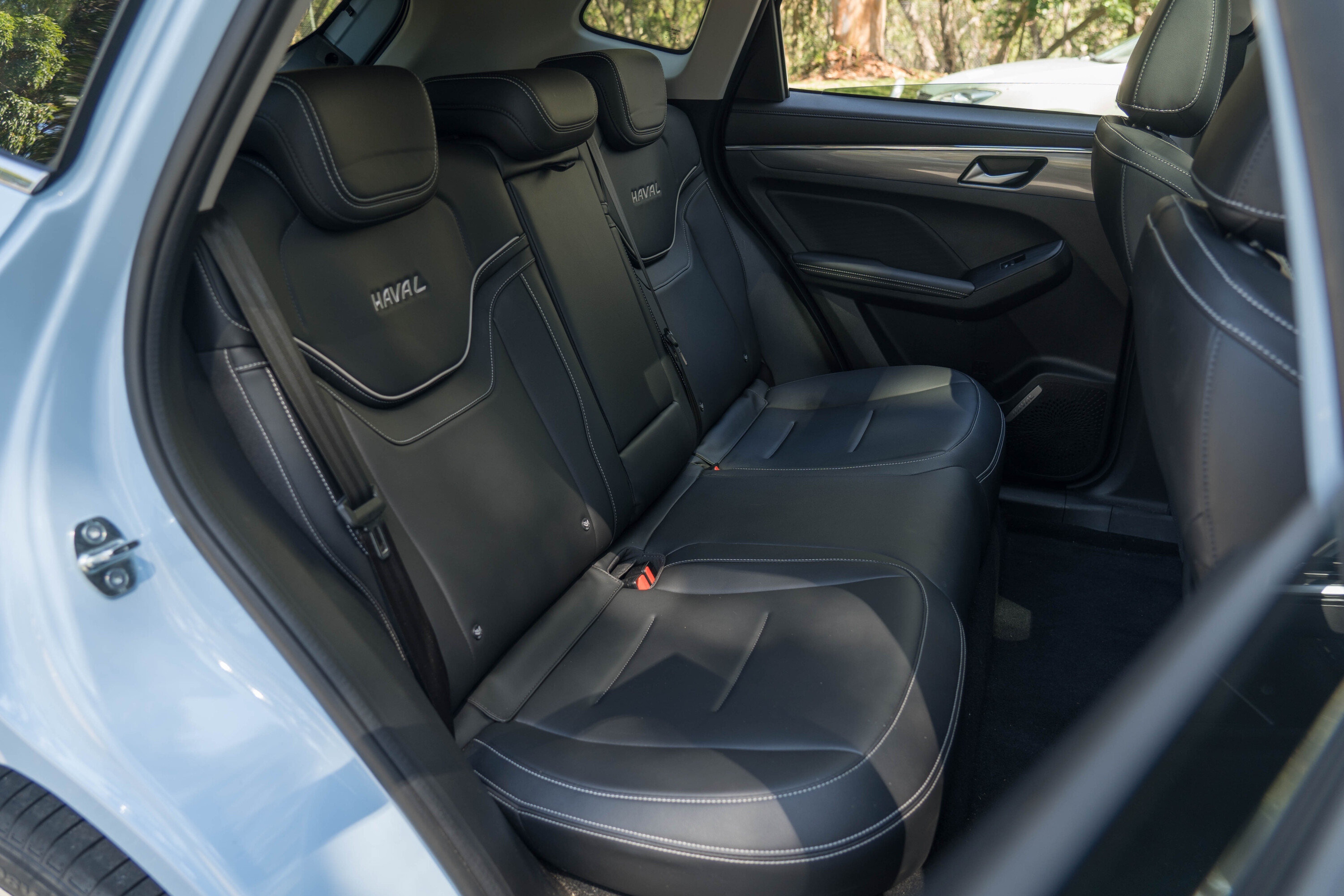
Although its bench is flatter and less supportive than that of the Corolla Cross, it puts occupants higher for a great stadium view forward.
Head-, leg- and toe-room are all excellent, and it matches amenities with the Corolla Cross (save for USB-A in place of C ports).
Both the Jolion Ultra hybrid and Corolla Cross GXL AWD hybrid are fitted with ISOFIX anchors on the outboard seats and feature top tether points for each position of the three-wide bench.
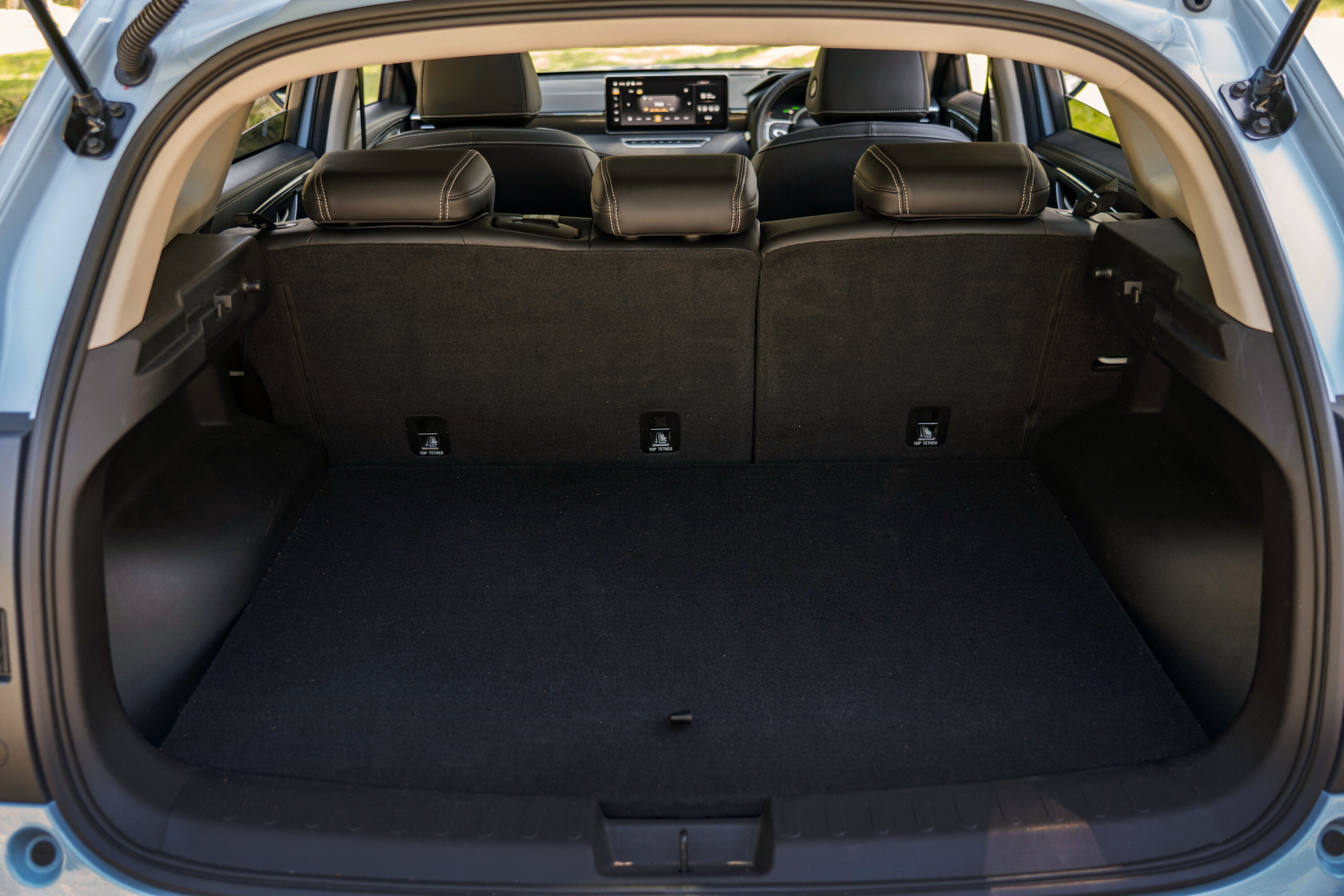
The Toyota Corolla Cross features a manual tailgate in GXL trim; you need to spend the extra on the flagship Atmos for a kick-to-open option. Neither boot is particularly clever, and the Haval’s is an awkward long yet shallow shape. The Jolion gets a power tailgate, though.
Both boots offer a solid 390L of space, though only the Haval gets a space-saver spare with the Corolla Cross making do with a can of goo (though front-wheel drive variants feature a spare).
1
On the road
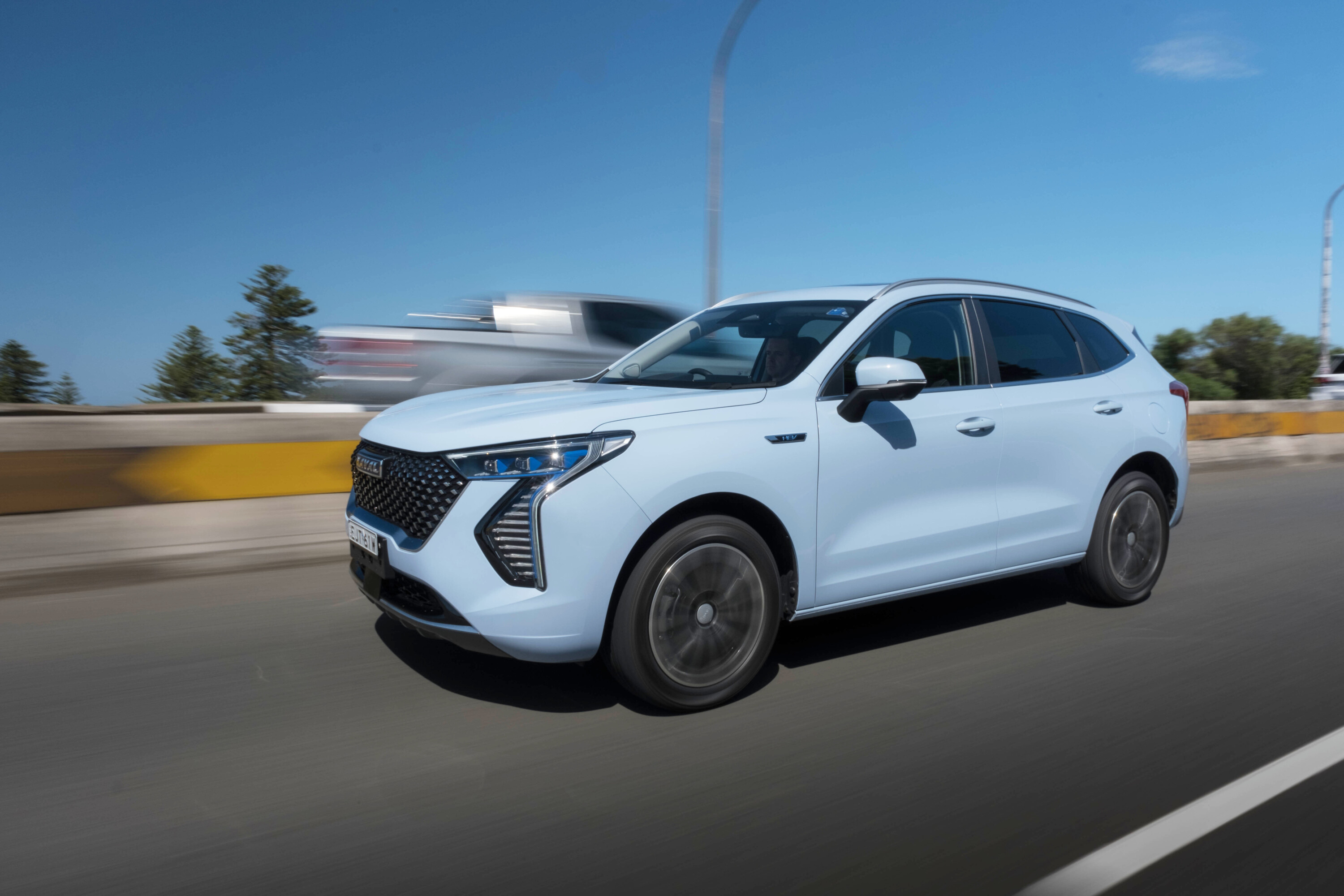
In isolation, the Ultra Hybrid’s 1.5-litre four-cylinder petrol-based hybrid powertrain is pretty sophisticated.
The complexity of that DHT on paper equates to a mostly decent and hassle-free experience in the real world.
Tune in and you can notice the car swap ratios at about 85-90km/h, and under hard acceleration this can be a little jarring as the petrol engine’s soundtrack doesn’t line up with what the car’s doing.
Regenerative braking settings are buried in menus, and it’s best to have it in the maximum setting (it’s still a long way from one-pedal driving), otherwise the Jolion can feel like it’s still accelerating as you come off the gas – not a pleasant feeling. On the whole, the Jolion’s hybrid set-up delivers a far more refined experience than the petrol-only car’s jerky seven-speed dual-clutch.
1
The Jolion Hybrid is plenty quick enough too; Haval lists 139kW/375Nm outputs and we have found adequate punch to spin the front wheels pulling away from junctions.
Haval doesn’t claim a 0-100km/h time, but Wheels editor Enright previously recorded an 8.9-second sprint.
With very closely aligned outputs and similar form factors, you might expect the Jolion and Corolla Cross to drive about the same… they don’t. This is where Toyota’s years of engineering experience, and a renewed focus on driving excellence, come to the fore.
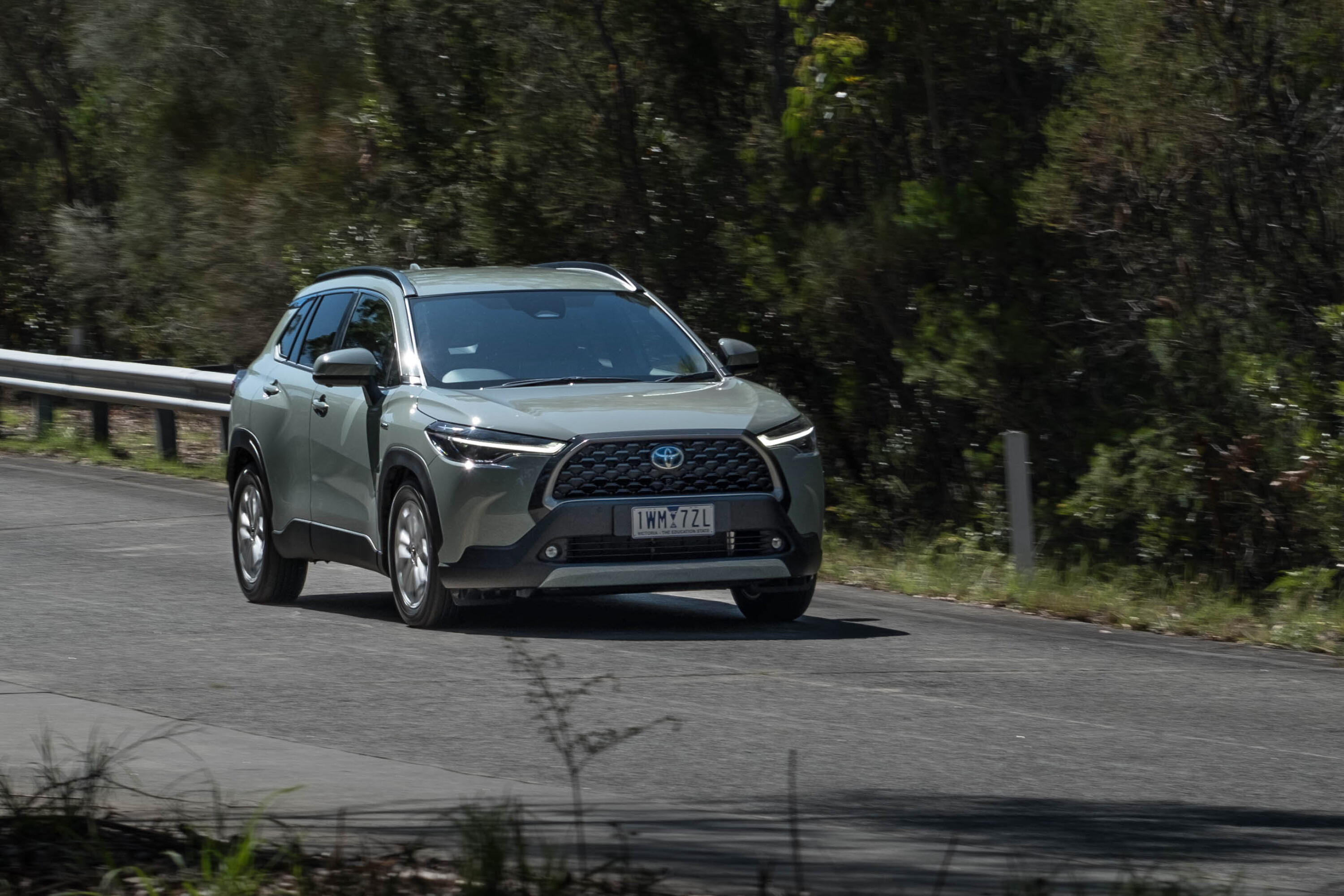
A separate electric motor on the rear axle as part of the Corolla Cross GXL’s E-Four AWD system means there’s no wheelspin in the dry or wet. In this configuration the Corolla Cross is pretty rapid for a small SUV; Toyota claims 0-100km/h in 7.6 seconds.
1
Although the Haval’s hybrid is good, Toyota’s is seamless in its operation, utilising just the right amount of EV mode with a silent start-up.
Its only problem is the vocal (under full throttle) 2.0-litre petrol four-cylinder combustion engine. The Haval’s 1.5-litre engine is a little more hushed.
In isolation, the Jolion feels absorbent enough, and its torsion beam rear end seems adequate. That is, until you get into the Corolla Cross.
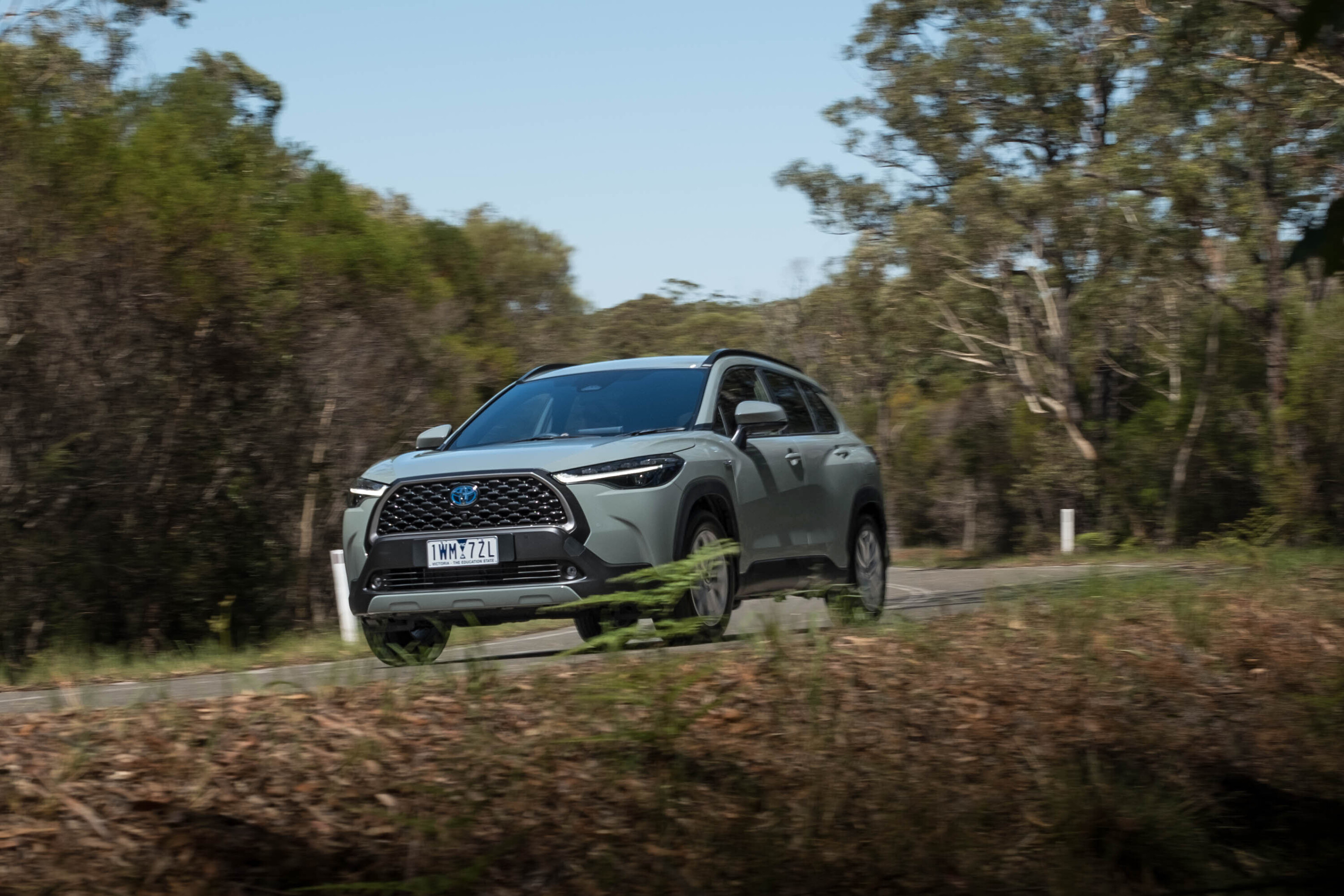
Toyota’s excellence shines through on bumpy roads. The damping is silky smooth and supple by comparison, especially in the independently-suspended AWD variants. Bumps that echo into the Jolion’s cabin and throw it off line mid-corner are dispatched without fuss in the Corolla Cross.
1
It translates to more dynamic handling, the Corolla Cross’s quick and well-weighted steering giving the confidence to push on where the Jolion’s stodgy rack erodes confidence.
The Toyota’s chassis remains light on its feet and adjustable where the Jolion clumsily understeers.
Toyota’s blending of regen and physical braking isn’t perfect (we’ve said as much in prior reviews), but it’s still preferable to the Haval’s spongy and unpredictable pedal. This kind of inconsistency pervades the whole Jolion experience, with delayed responses as though the steering and brakes are still dusty from the night before.
1
Safety
Both SUVs are matched in terms of on-paper safety criteria. By that, we mean they’re certified with five-star ANCAP ratings and equipped with all the latest safety assistance systems.
But just because they’re there, doesn’t mean they work.
Toyota’s aid calibration was, in the past, fairly conservative. The Corolla Cross’s lane-trace assist and adaptive cruise control are now more usable than before – if a way off being perfect. It’s also simple to disable the aids using mostly physical buttons.
It is a different story in the Haval Jolion. The adaptive cruise control’s speed, for example, can be set at your current velocity, but from there you can only jump around in 5km/h increments and fails to accurately maintain a selected speed – not ideal in speeding-obsessed Australia. The lane-keep assist requires further refinement including a physical button to disable the system.
| Toyota Corolla Cross GXL safety features | Haval Jolion Ultra safety features |
|---|---|
| Autonomous emergency braking (vehicle, pedestrian, cyclist, junction, reverse, motorcycle) | Autonomous emergency braking (vehicle, pedestrian, cyclist, junction, reverse) |
| Eight airbags | Seven airbags |
| Front cross-traffic alert | Rear cross-traffic alert |
| Rear cross-traffic alert | Blind-spot monitoring |
| Blind-spot monitoring | Adaptive cruise control w/stop & go |
| Adaptive cruise control w/stop & go | Lane-trace assist |
| Lane-trace assist | 360-degree camera |
| 360-degree camera | Driver monitoring |
| Driver monitoring |
1
Fuel consumption
In ADR combined consumption figures, the Corolla Cross GXL AWD plays its 4.4L/100km against the Jolion Hybrid’s 5.0L/100km rating.
On paper, the Corolla Cross’s hybrid ekes out a small but decent advantage, but its consistent real-world fuel efficiency cements the win.
According to the trip computer, over a two-hour loop the Corolla Cross hybrid used 5.2L/100km, 25 per cent better than the Jolion Hybrid’s 6.5L/100km figure. Both the Jolion and Corolla Cross will happily accept 91 RON regular unleaded or E10 blends at the bowser.
Ownership
Over five years, maintaining a Jolion hybrid will cost $1550. The first service is due after 12 months or 10,000km, and 12 months/15,000km thereafter.
The Corolla Cross is a little cheaper, at $250/visit for a $1250 five-year total. Toyota’s maintenance schedule is a little simpler, set every 12 months/15,000km.
1
VERDICT
Judged purely on driving excellence, execution of intended function and cost of ownership, the Toyota Corolla Cross runs away with the win.
Introduce the ever-complex (and very personal) value assessment, and the result becomes muddier. The Jolion is significantly cheaper to buy, there’s no arguing there. With the Ultra boasting more kit than the Corolla Cross GXL, the value equation is strong for the Haval.
With such sharp drive-away pricing and lashings of equipment (not to mention being a small SUV that’s actually in stock), it’s easy to understand why the Jolion found nearly 1000 homes in March.
And, if $40K is your absolute limit then the Jolion Ultra Hybrid is a solid choice. It drives well enough but lacks the Toyota’s Teflon suspension action and hybrid implementation.
Even with a ritzier interior and richer specification, the Jolion’s driving dynamics still aren’t up to scratch. The Jolion Ultra Hybrid is a mid-life facelift, suspension recalibration, and user interface tweak away from winning this comparison. Today, the gong goes to the Toyota Corolla Cross.
1
SCORING
Toyota Corolla Cross GXL AWD hybrid: 8/10
Things we like
- Supple ride
- Efficient hybrid
- Great steering
Not so much…
- Cheap cabin materials
- Expensive
- Average back seat
Haval Jolion Ultra Hybrid: 7/10
Things we like
- Low purchase price
- Spacious rear seat
- Exciting cabin design
Not so much…
- Convoluted user interface
- Mushy brake pedal
- Driving position
| Toyota Corolla Cross GXL AWD hybrid | Haval Jolion Ultra hybrid | |
|---|---|---|
| Safety, value and features | 7.5 | 8 |
| Comfort and space | 7.5 | 8.5 |
| Engine and gearbox | 8.5 | 7 |
| Ride and handling | 8.5 | 6.5 |
| Technology | 7.5 | 7 |
| OVERALL | 8 | 7 |
MORE
Everything Haval
MORE
Everything Toyota
MORE
Midsize SUVs
Specifications
| 2023 Corolla Cross GXL AWD hybrid | 2023 Haval Jolion Ultra hybrid | |
|---|---|---|
| Price | $42,250 + on-road costs | $39,990 drive-away |
| DRIVETRAIN | ||
| Engine | inline 4 cyl, 2.0-litre, DOHC, atkinson cycle petrol, 30kW rear motor | inline 4 cyl, 1.5-litre petrol, 100kW electric motor |
| Layout | front engine, transverse, FWD with electric rear motor | front engine, transverse, FWD |
| Power | 146kW | 139kW |
| Torque | NA | 375Nm |
| Gearbox | e-CVT | 2-speed u2018dedicated hybridu2019 auto |
| CHASSIS | ||
| L/W/H/Wu2013B | 4460/1825/1620/2640mm | 4472/1841/1574/2700mm |
| Track (F/R) | 1570/1580mm | NA |
| Weight (claimed) | 1545kg | 1530kg |
| Boot | 390L | 390L |
| Fuel/tank | 91 RON / 43L | 91 RON / 55L |
| Economy (tested) | 5.2L/100km | 6.5L/100km |
| Suspension | Front: struts, stabiliser bar. Rear: multi-link, stabiliser bar | Front: Struts, coil springs Rear: torsion beam |
| Steering | rack-assisted electric power steering | rack-assisted electric power steering |
| Front brakes | 305mm ventilated rotors, single-piston floating caliper | ventilated rotors, single-piston floating caliper |
| Rear brakes | 281mm solid rotors, single-piston floating caliper | solid rotors, single-piston floating calipers |
| Tyres | Bridgestone Alenza | Kumho Solus HS63 |
| Tyre size | 215/60R17 | 225/55R18 |
| SAFETY | ||
| ANCAP rating | 5 stars (2022) | 5 stars (2021) |
| 0-100km/h | 7.6 seconds (claimed) | 8.9 seconds (tested) |
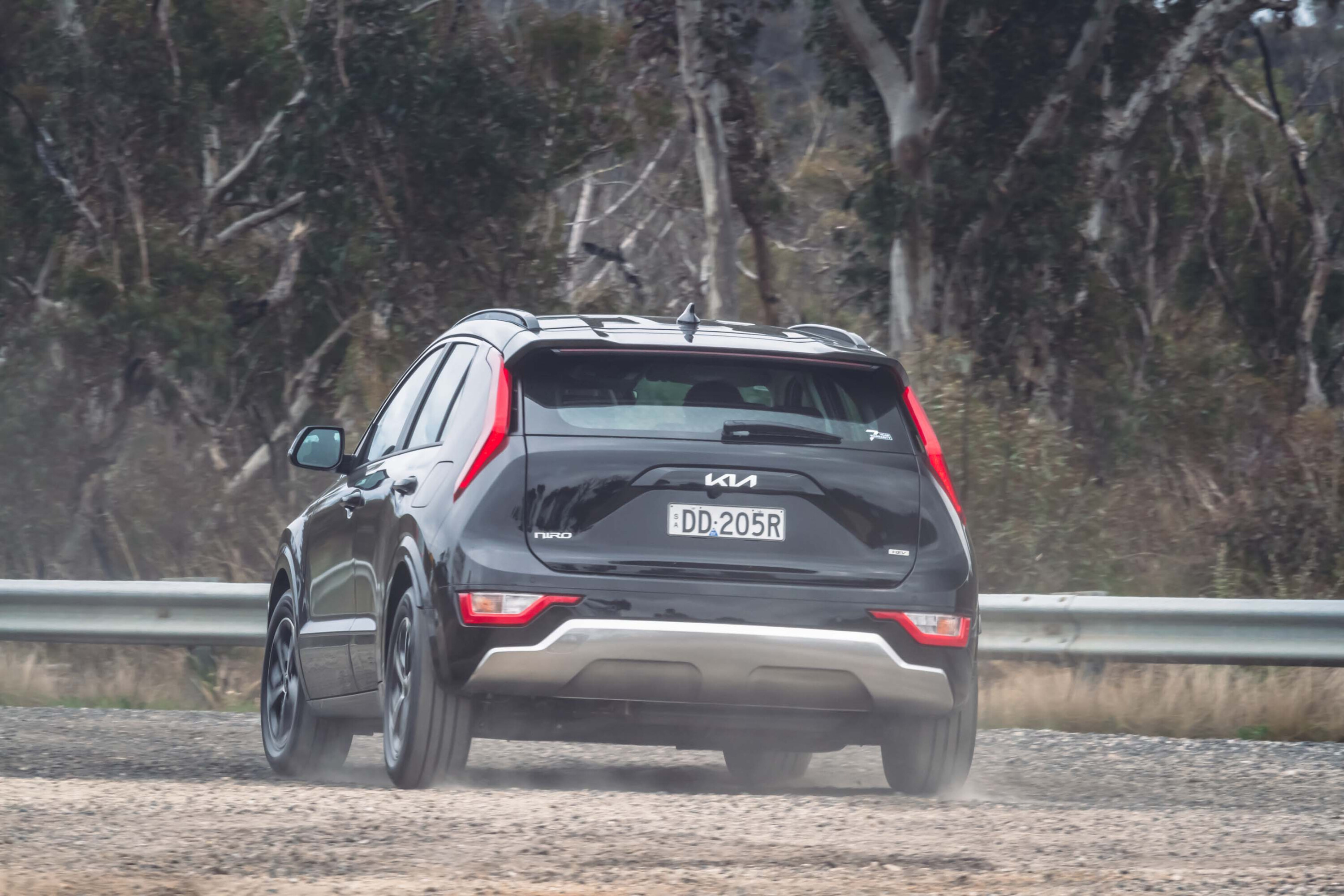
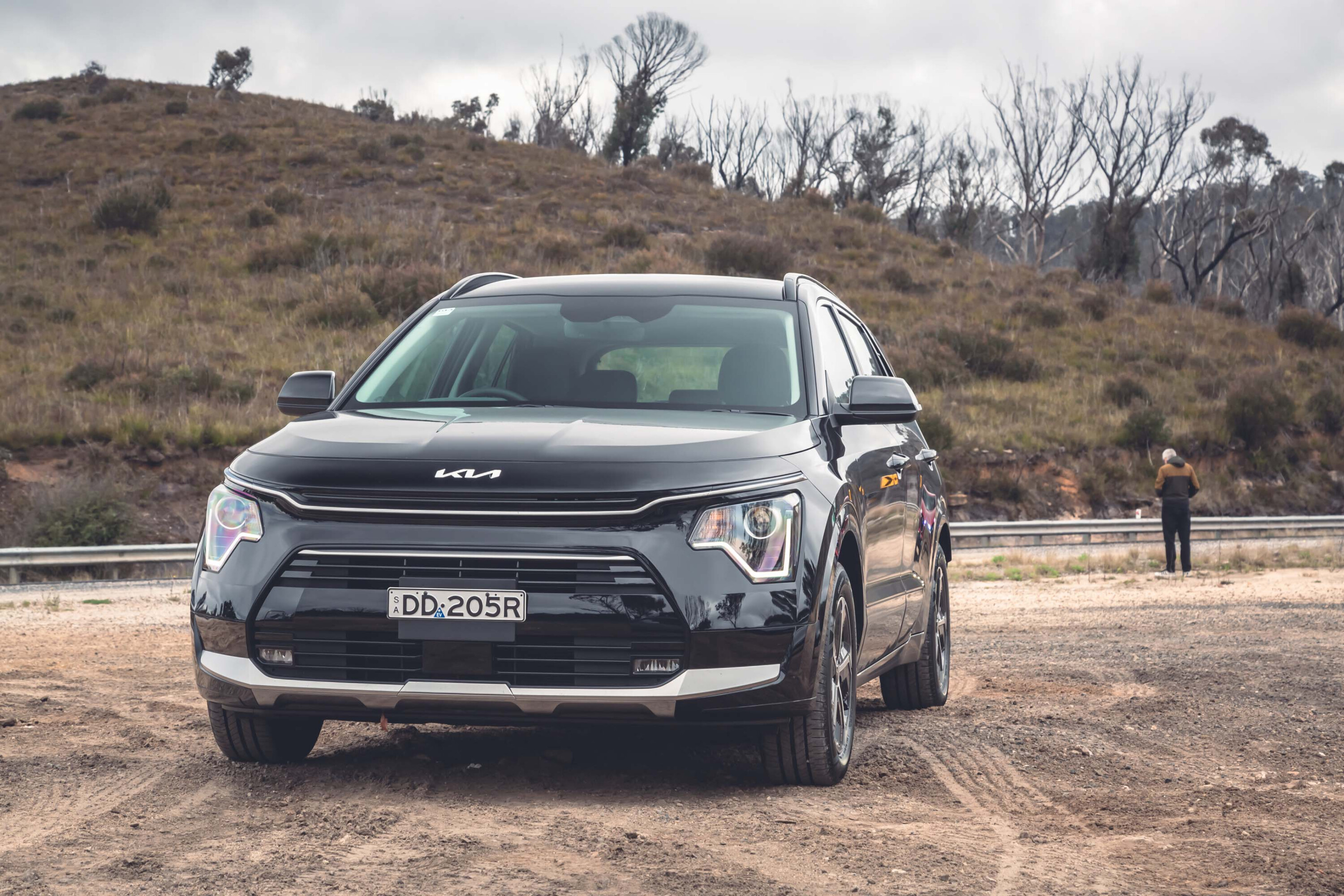
The Kia Niro is an undeniably confusing car. A brief look at a Seltos makes you wonder if they aren’t exactly the same car (they’re not) but in a way, they are.
Except the Niro is far more expensive, comes only in hybrid and electric versions and doesn’t seem to make any sense.
Why isn’t there an electric or hybrid Seltos? It’s more a case of why is there an electric and hybrid (and plug-in hybrid) Niro? The second question is easier to answer – the Niro is all about electrification and has been since its inception (this being the more attractive second-generation model).
1
Australia doesn’t get the PHEV anymore, which is kind of ironic given the recent uptick of that kind of car in local showrooms.
The electric Niro is quite a good car and despite a small question mark over its price and spec, it’s thoroughly recommendable if inversely attainable due to production constraints. The hybrid makes a lot of sense for Australia given its love of Toyota hybrids.
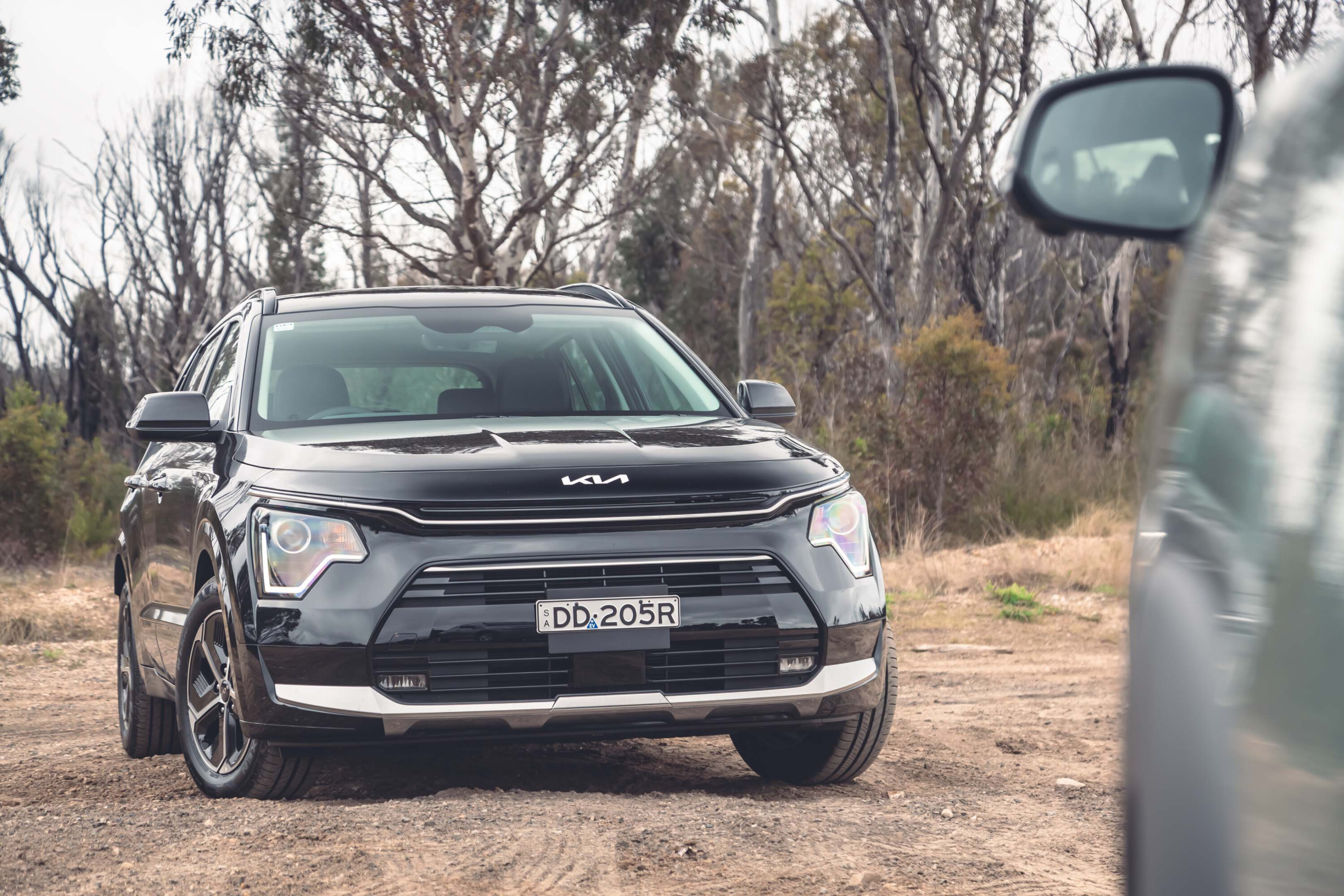
However, the cheapest one is $44,380 before on-road costs and not nearly as well equipped as an equivalent Corolla Cross. So what’s going on here?
1
JUMP AHEAD
- How much is it, and what do you get?
- How do rivals compare on value?
- Interior comfort, space and storage
- What is it like to drive?
- How much fuel does it use?
- How safe is it?
- Warranty and running costs
- VERDICT
- Specifications
How much is it, and what do you get?
At $44,380, you’re going up against the GT-Line version of the Niro’s Seltos stablemate and that is a mighty fine car with its new engine and transmission.
| 2023 Kia Niro HEV S features | |
|---|---|
| 16-inch alloy wheels | Dual-zone climate control |
| Six-speaker stereo | DAB digital radio |
| Active cruise control | Automatic halogen headlamps |
| Auto wipers | Driveru2019s electric seat |
| Digital dashboard | Heated, folding electric mirrors |
| Space-saver spare | 8.0-inch touchscreen |
| Wireless Apple CarPlay | Wireless Android Auto |
| Reversing camera | Rear parking sensors |
1
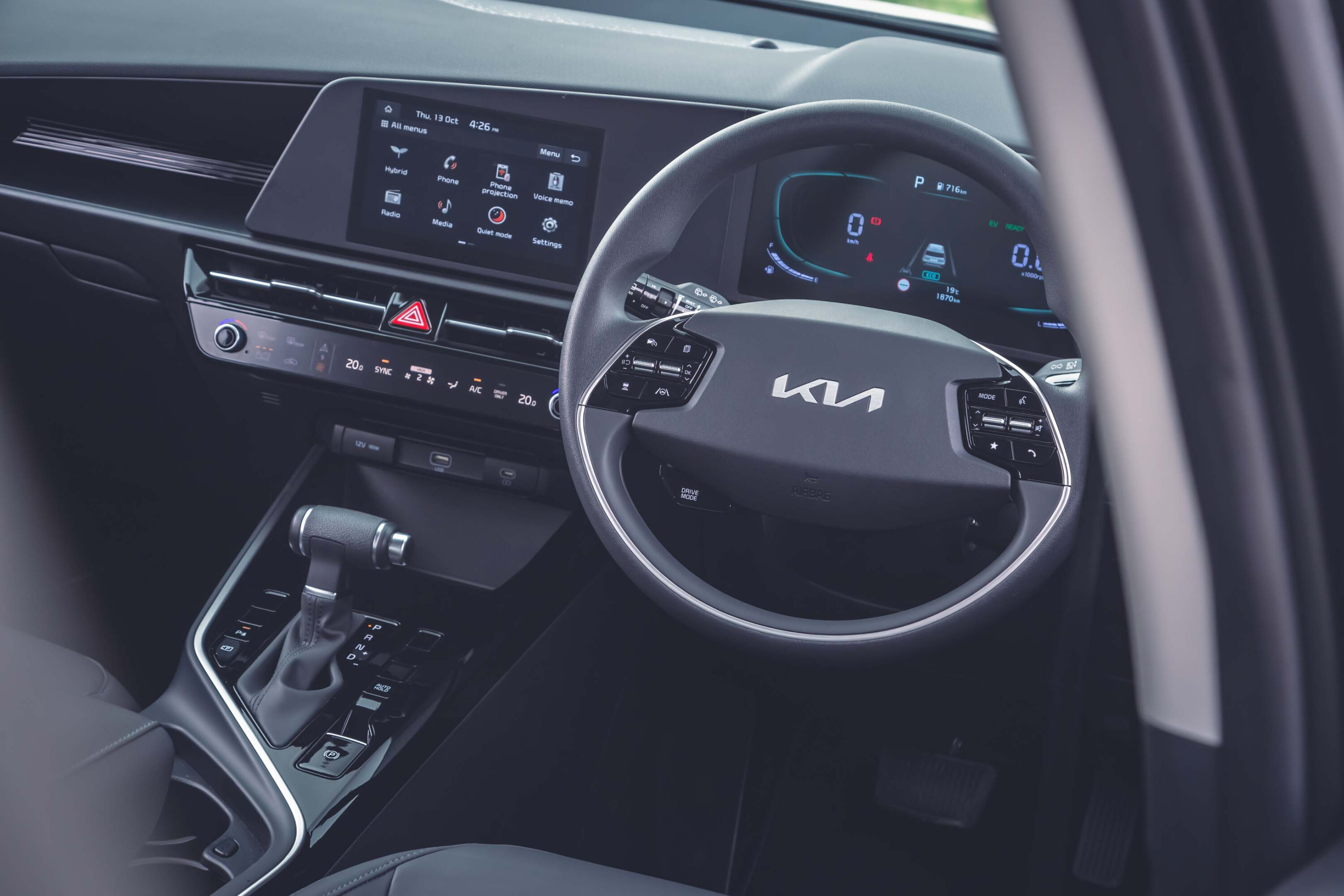
Look, I’m not going to sugarcoat it, it’s not a lot of stuff for a mid-$40K car. The safety features do go some way to improving its pricing position but hot damn, the GT-Line does look like better value even though it’s over $50,000. The spec just feels more in line with its price.
Part of the reason it doesn’t work at this price I’ll explain below, but you sit in it and look at an 8.0-inch screen swimming in a slab of grey plastic and you think, “This doesn’t feel like the money I’m spending.” It looks the business on the outside but it doesn’t deliver on the inside. And Kia has this habit of supplying wireless CarPlay and Android Auto without the wireless charger.
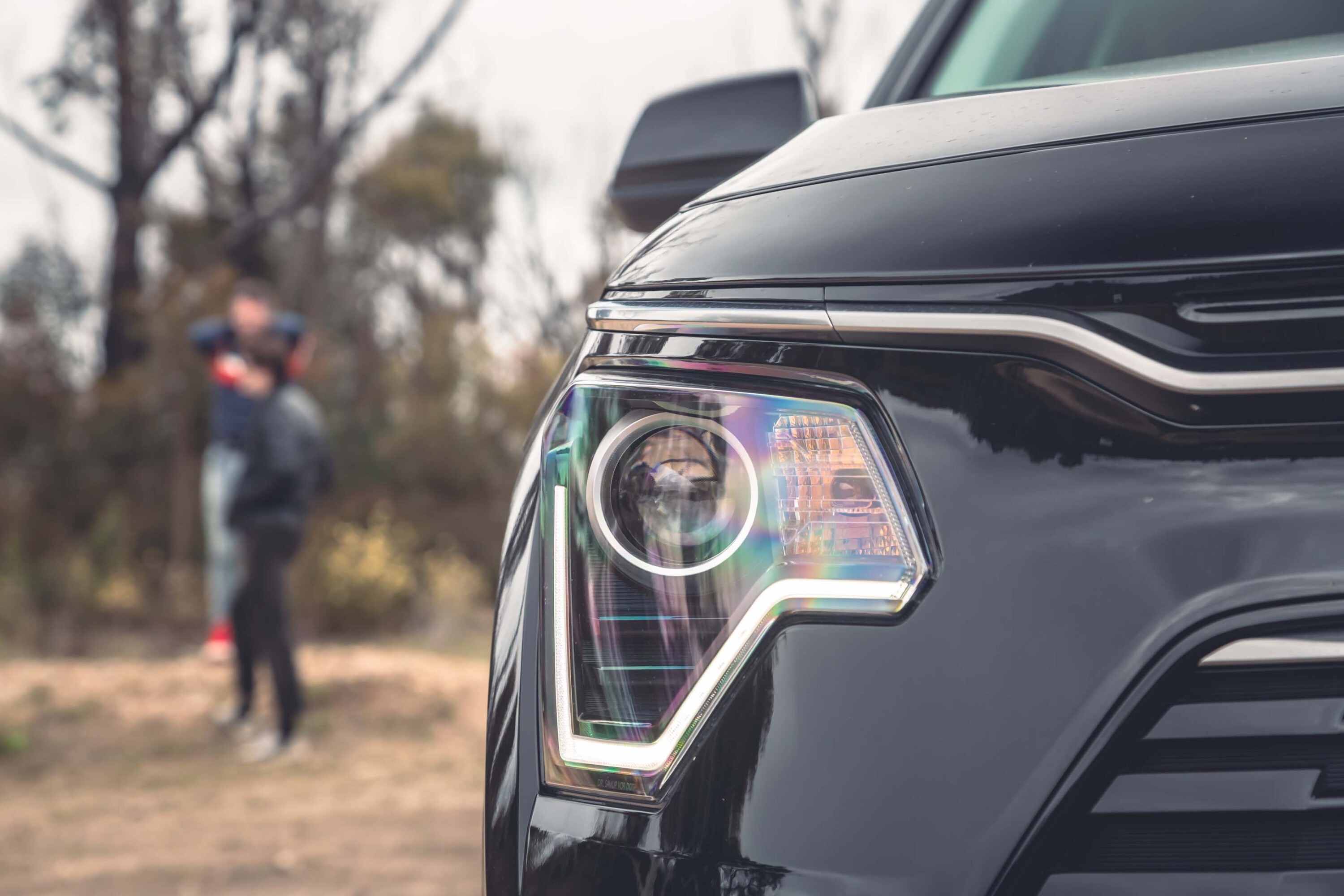
Also, halogen headlights are just stingy at this price point.
1
How do rivals compare on value?
Twelve months ago the Niro’s price and spec would have looked okay, but the new Honda HR-V hybrid and Toyota Corolla Cross now exist.
While neither are incredible designs or packed to the rafters with features, they feel like better value than the Niro. The Niro is slightly quicker than the Honda and – I think – more fun to drive while being slightly cheaper, but the interior of the HR-V is really very nice indeed, which is probably where a lot of buyers will lean.
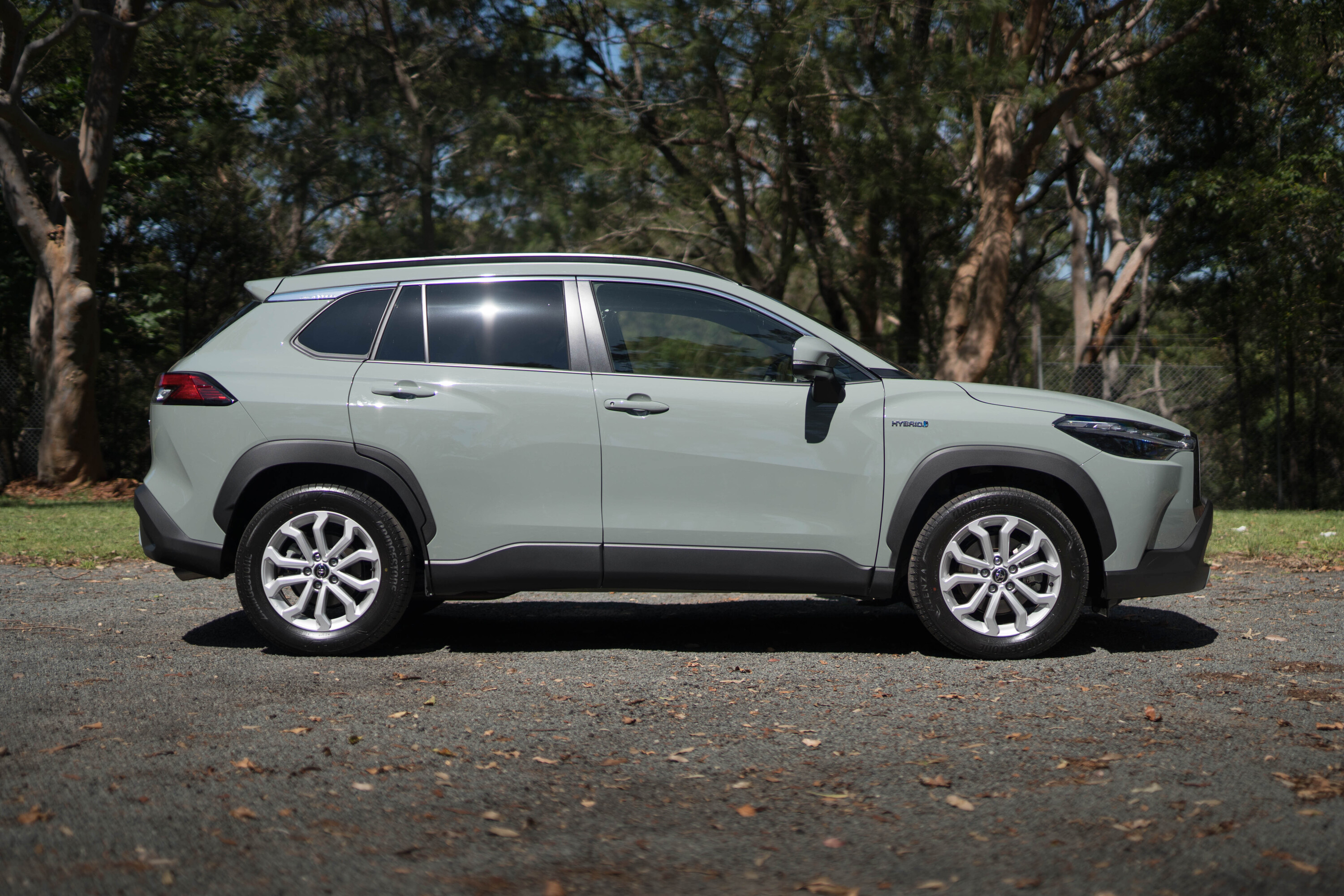
Toyota’s Corolla Cross GXL eFour is not only cheaper, but it’s also better equipped, is warm-hatch quick and rides exceptionally well on its multi-link rear end. And both of these rivals are much cheaper to service.
1
Interior comfort, space and storage
The Niro is slightly smaller than the Seltos in nearly every direction and that plays out most obviously in the cabin.
Its front seats are great, though. Very comfortable and adjustable but only the driver gets electrification; the passenger has to row their own. The aforementioned slab-of-plastic dash is a bit of a shame because the touchscreen doesn’t fill it properly, so it looks cheap. The digital dash doesn’t really do much to justify being included, but it’s useful enough.
The T-bar auto and single-spoke steering wheel are hilariously retro but somehow work with the design of the interior, then trip up again because they’re plastic and not that nice to hold for very long. The whole car is like this, raising your hopes and then dashing them.
1
You get a pair of cup holders up front, USB ports (A and C) in the centre console and bottle holders in the doors.
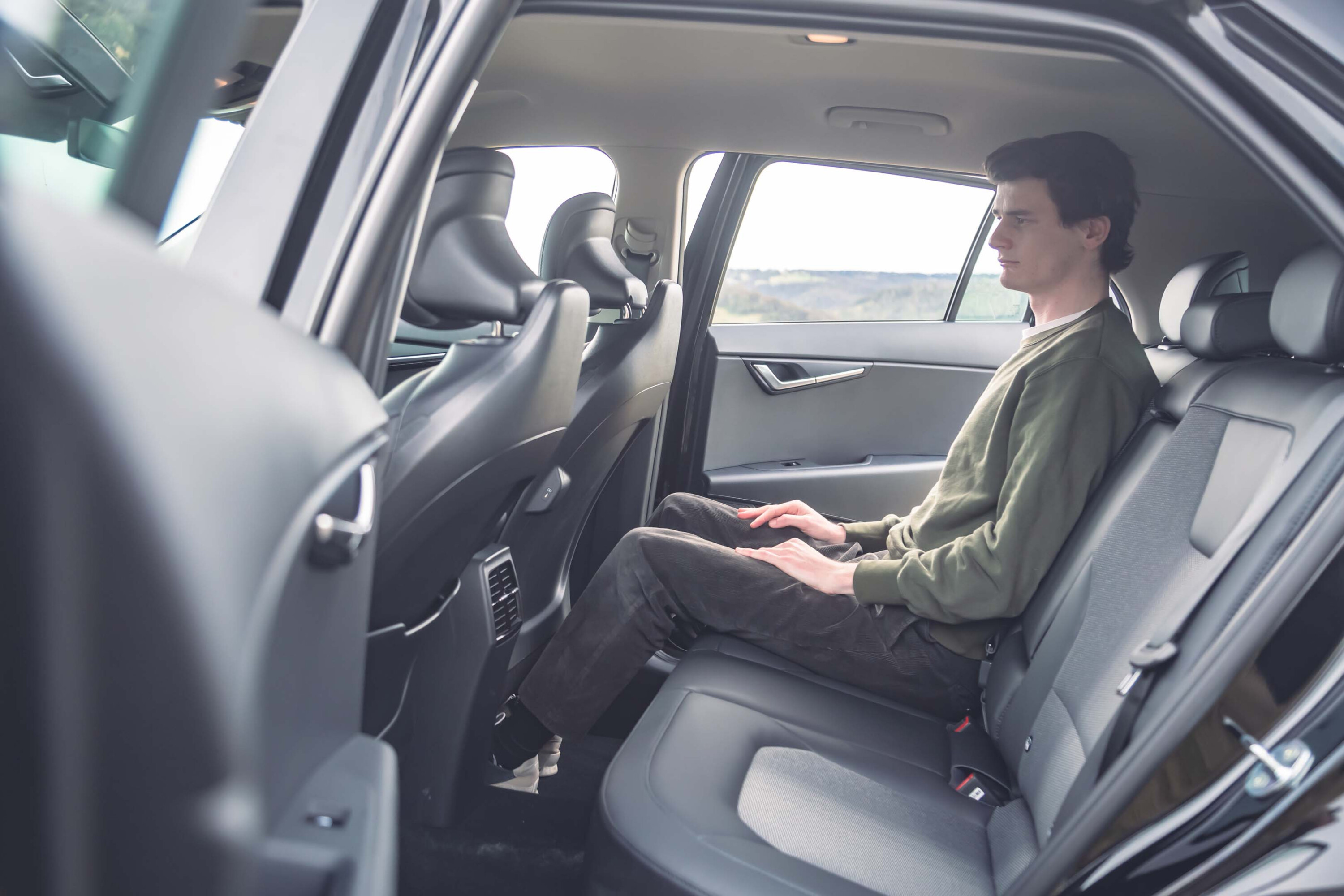
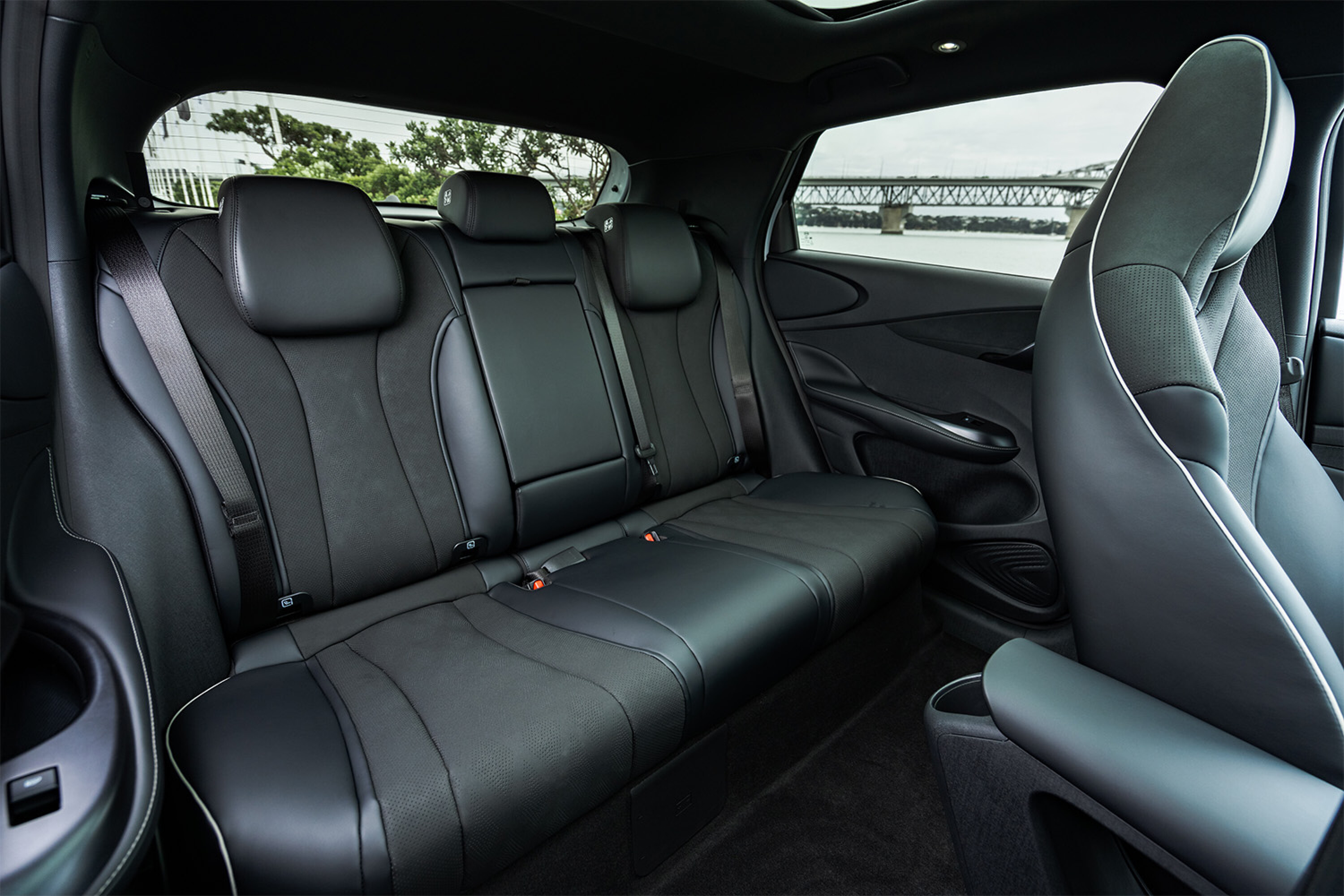
Moving to the rear, legroom and headroom is acceptable but not lavish. The lack of cup holders is a bit suspect – but, to be fair, not just a Kia habit in this segment – and the bottle holders in the doors are in name only as they’re quite slim. But it’s fairly comfortable and there’s plenty of glass to look through to the outside world.
The real drag of the Niro’s interior is that it looks really good – cool, even – but there’s a lot of scratchy plastic. And it’s very grey, a complaint I often level at Mazdas.
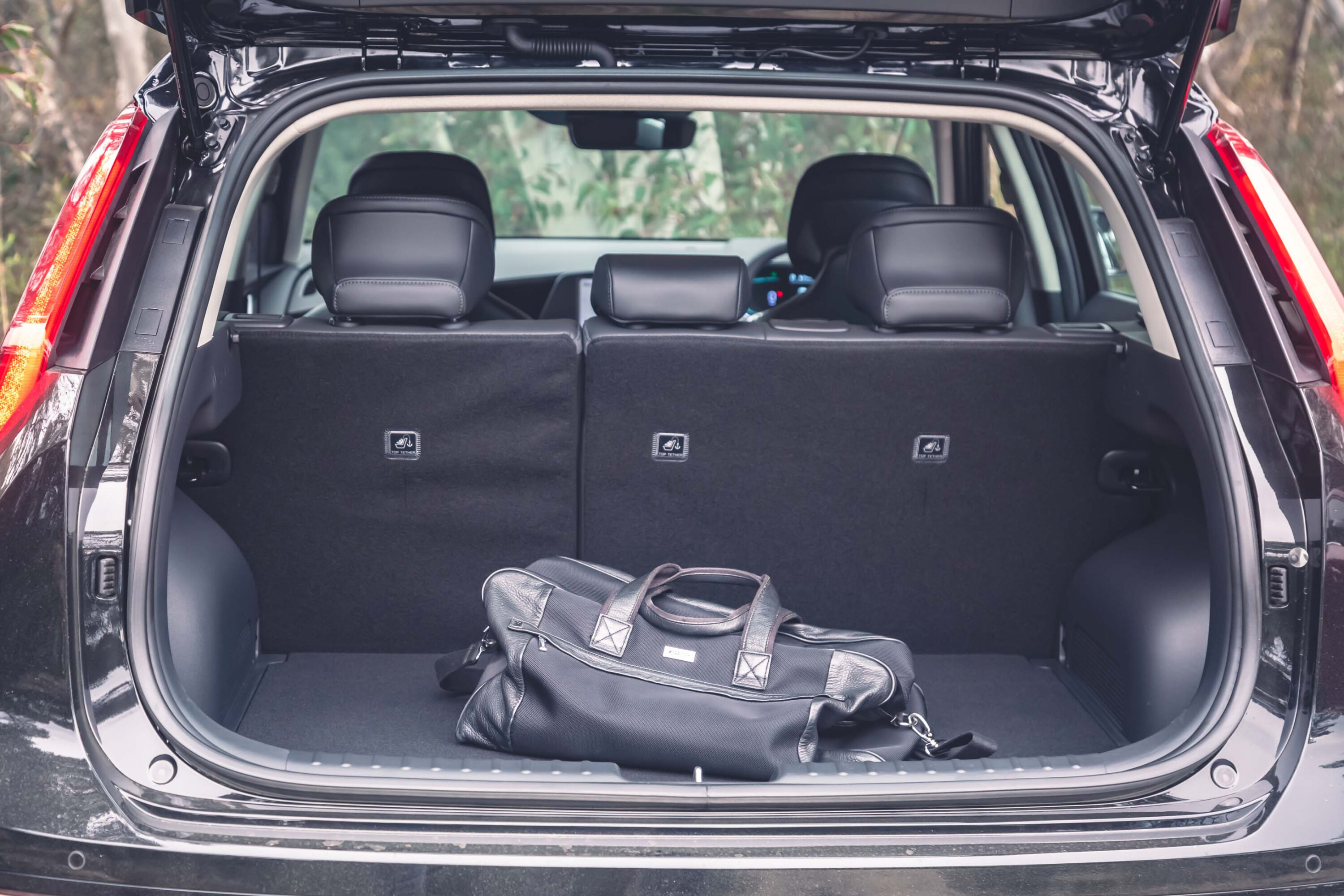
Its boot is a pretty reasonable 425 litres, which is among the best in the segment.
1
What is it like to drive?
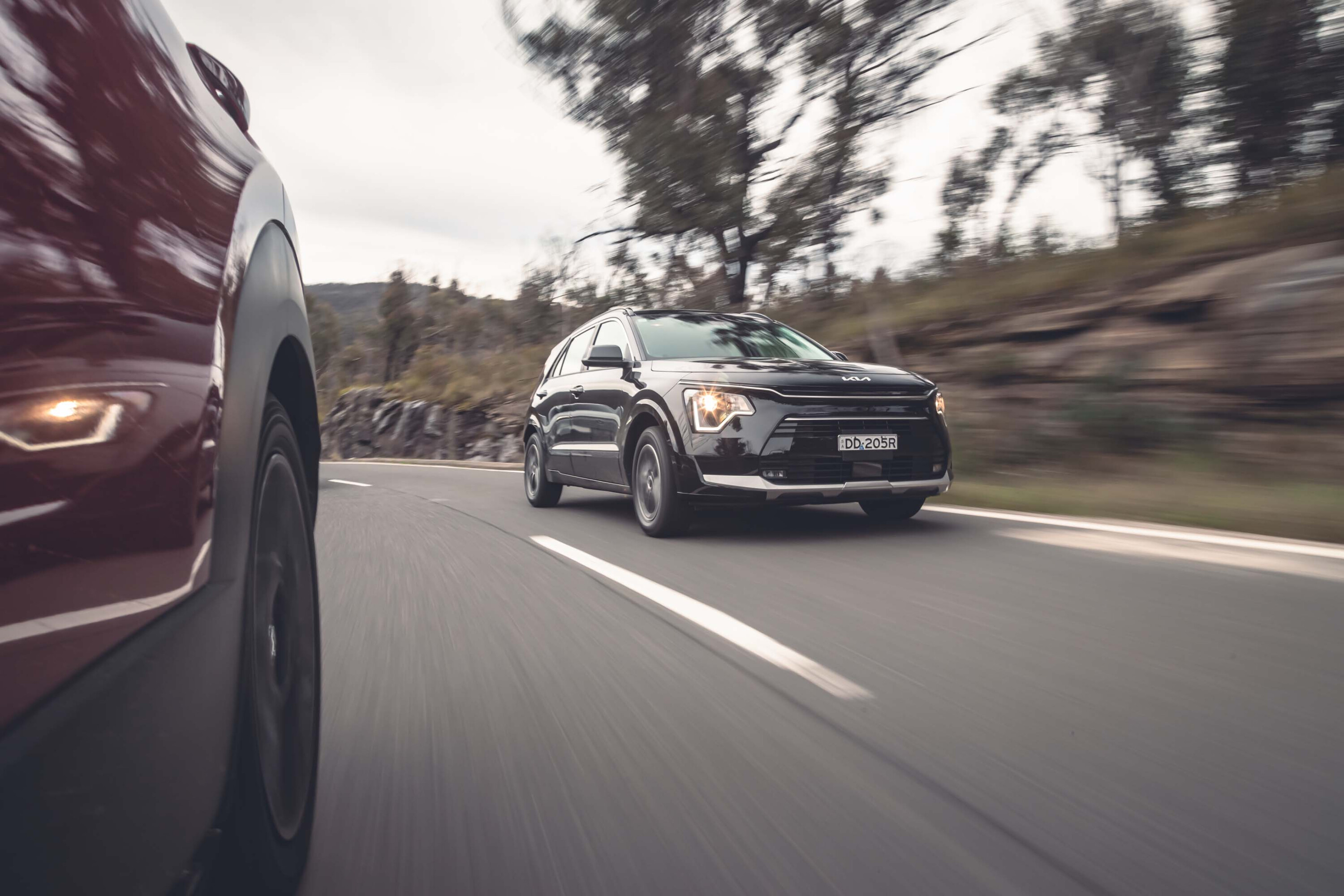
The first time I drove the Niro, I thought it was alright. I’d nabbed it on a group test and drove it from our rendezvous up the Bells Line of Road in the Blue Mountains.
In itself, that is a nice drive in just about anything and I thought the Niro was good. I maintain that much of it is good on this second chance to appreciate its charms. The hybrid powertrain is smooth and predictable. It’s constructed from a bunch of various bits from the Hyundai-Kia firmament, many of them familiar, including the 77kW/144Nm 1.6-litre petrol engine and the six-speed dual-clutch transmission.
| 2023 Kia Niro HEV S drivetrain | |
|---|---|
| Engine | 1.6-litre four-cylinder naturally-aspirated |
| Power | 77kW @ 5700rpm |
| Torque | 144Nm @ 4000rpm |
| Electric power | 32kW |
| Electric torque | 170Nm |
| Combined power: | 104kW |
| Combined torque: | 265Nm |
| Transmission | 6-speed dual-clutch |
| 0-100km/h | 10.4sec (claimed) |
Neither of those elements is particularly inspiring and the six-speed in particular is not my favourite of the genre. But as with some of its competitors, when you whack in an electric motor with a small battery, everything smooths out and makes the whole more convincing than the parts.
The engine is still on the vocal side when revved, but that doesn’t happen very often with the torque fill you get from the electric motor. You can play the “How far can I get in EV mode?” game in the Niro which makes heavy traffic quite bearable and keeps the concentration up. It’s not as good as the updated system in the Corolla Cross, but it’s a close second.
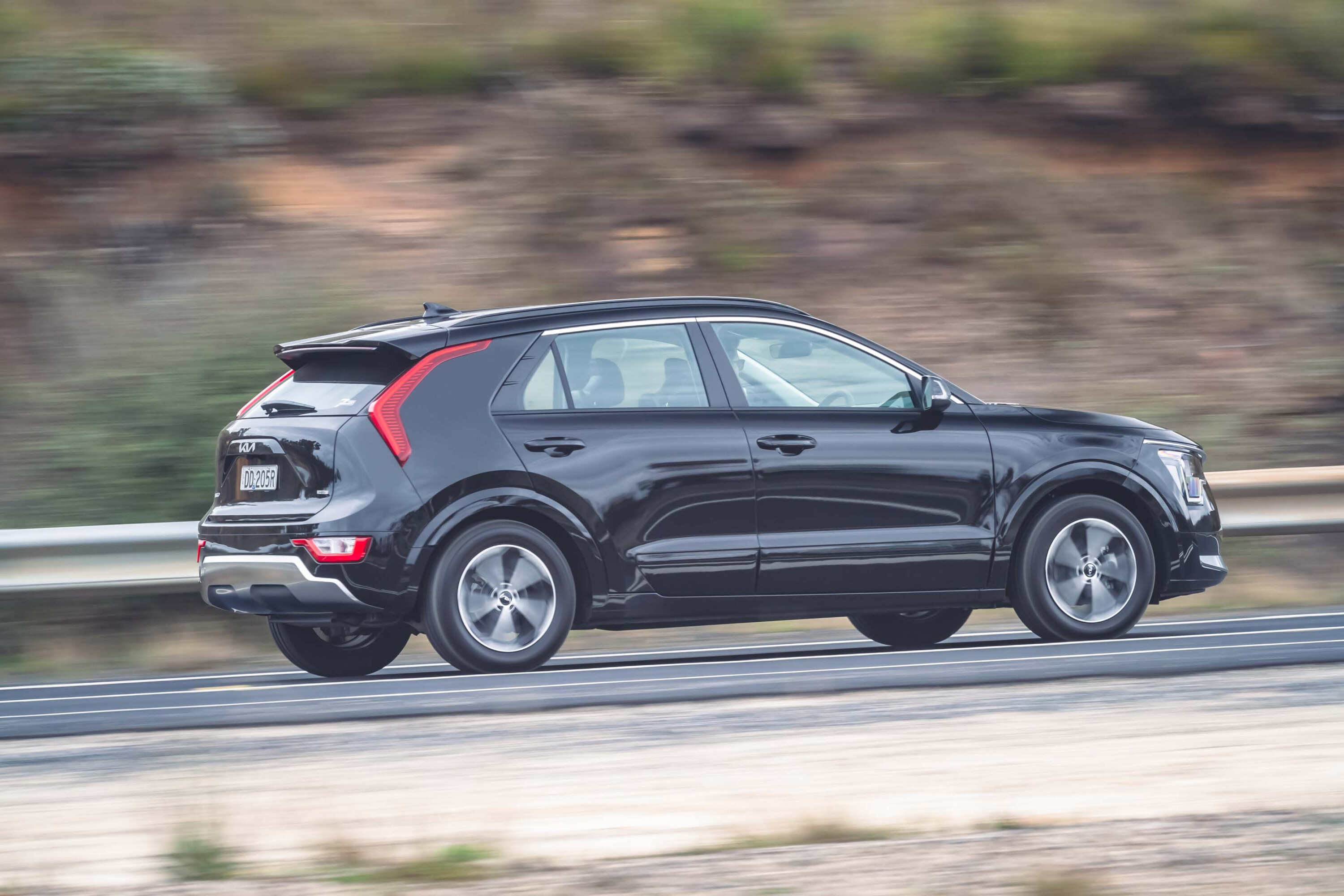
Around town, the Niro is really comfortable and an easy place to be. It gets going on electrons and the engine slides in when required without fuss.
1
The ride is very much tuned towards comfort rather than speed, so it’s excellent across all but the worst Sydney roads can throw at you. A big bump will result in some noise in the cabin, but nothing dramatic.
As speeds rise the cabin remains fairly quiet. While off-the-mark performance won’t rattle your teeth, it’s pretty good for overtaking. The Niro performs really well in the gears, extracting more performance than you might expect from its lower-down lethargy. As a result, the claimed 0-100km/h figure of 10.4 seconds is a little pessimistic based on my seat-of-the-pants assessment.
In Eco mode, you can use the paddle-shifters to up the amount of regeneration you get when you lift off, but it’s not that strong even at its highest level, so no one-pedal driving for you.
1
How is it on fuel?
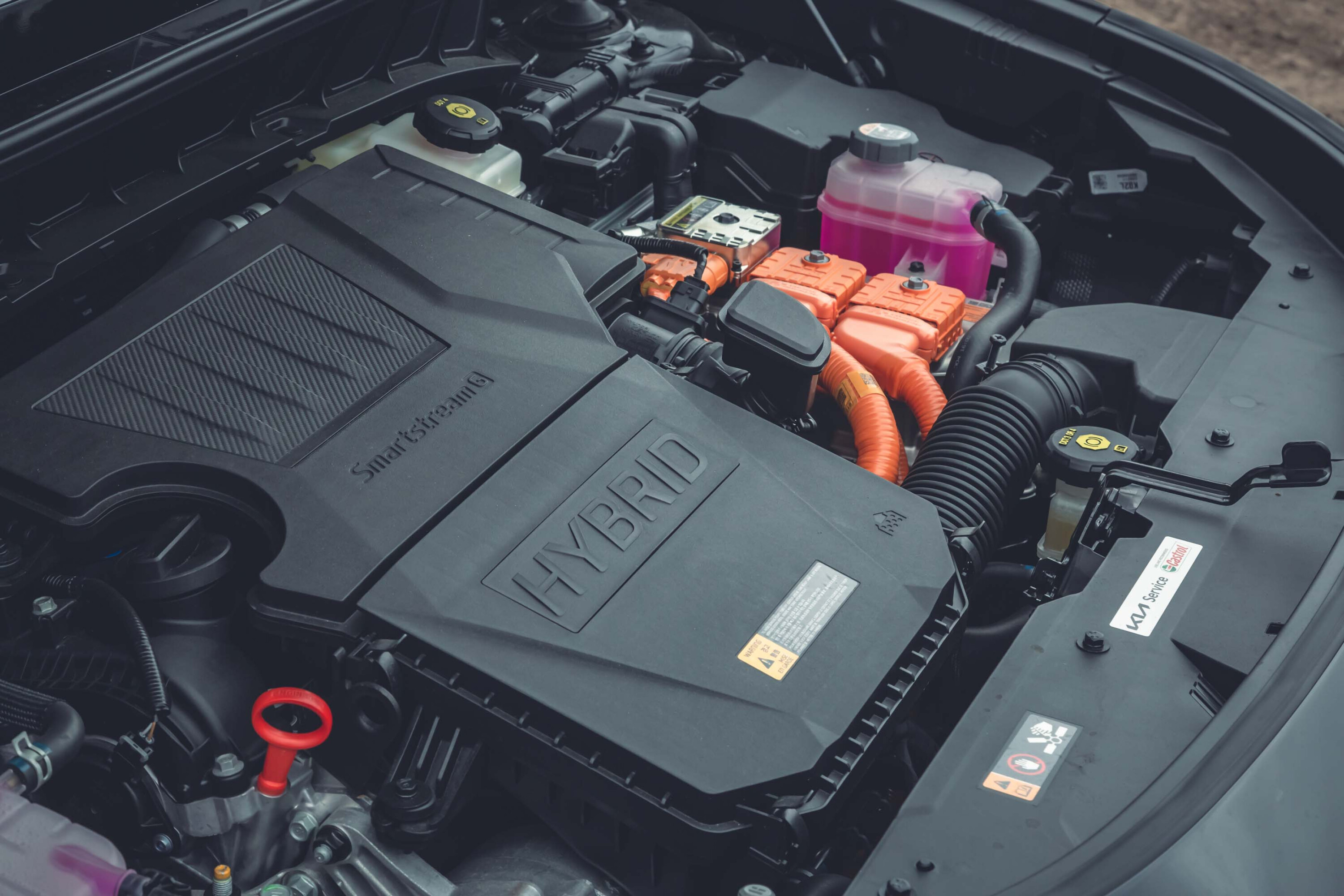
Where the Niro really stands out is in fuel economy. Like its BEV brother, it’s remarkably efficient, coming quite close to the figures Kia managed in its ADR testing.
| 2023 Kia Niro HEV S fuel economy | |
|---|---|
| Claimed fuel consumption (combined) | 4.0L/100km |
| On-test fuel consumption (indicated) | 4.5L/100km |
| Fuel tank capacity | 42 litres |
| Projected real-world range | 933km |
| Fuel type | Standard unleaded (91 RON) |
My week with the Niro was heavily biased towards suburban running and I still got a 4.5L/100km indicated result. This holds up well against the testing we did at the pump in the four-way megatest last year, during which the Niro was driven rather more enthusiastically with a 4.8L/100km result at the pump, which incidentally matched the trip computer.
1
How safe is it?
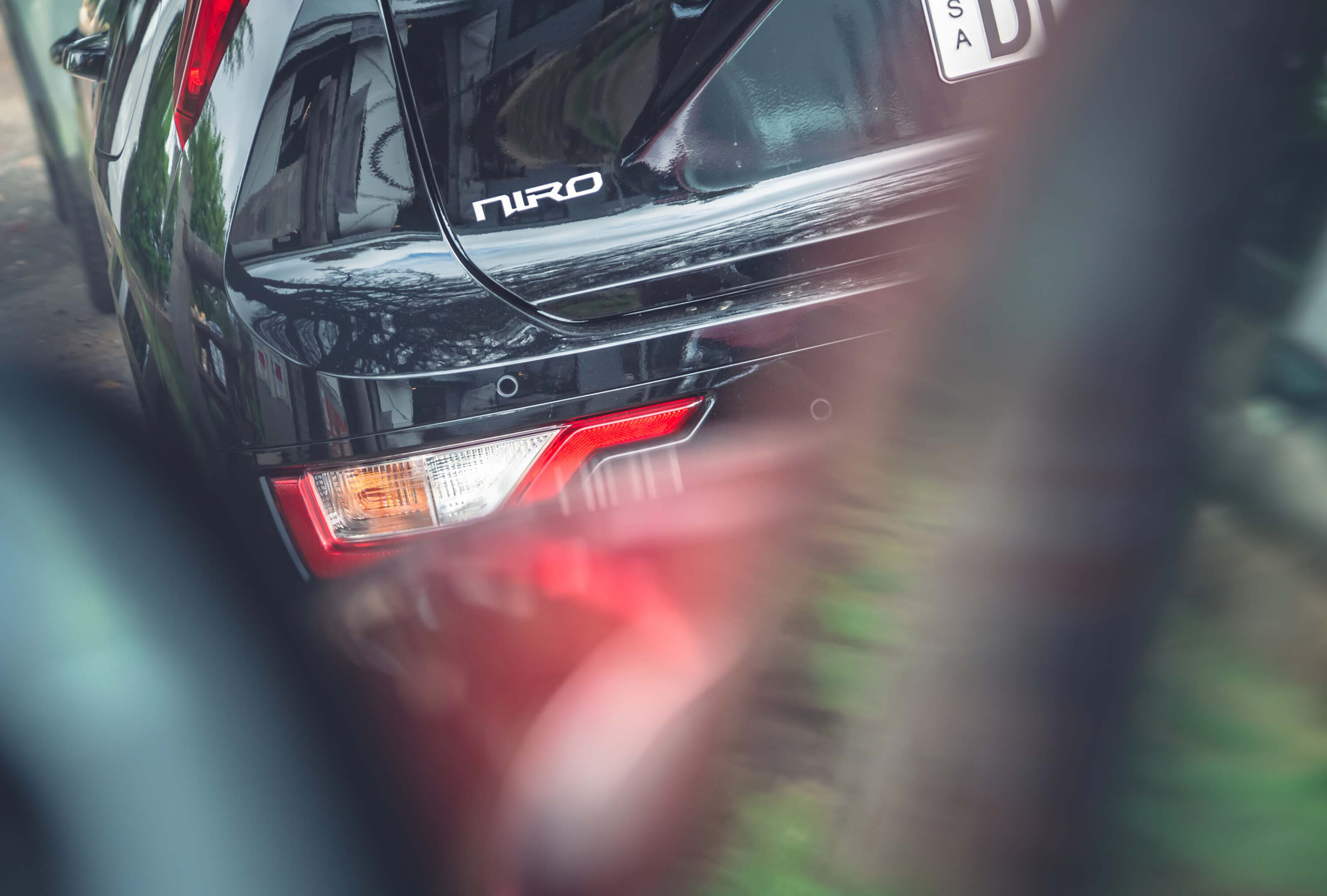
The Niro scored a five-star ANCAP safety rating in 2022, which is much easier said than done these days.
| 2023 Kia Niro HEV S safety features | |
|---|---|
| Eight airbags | Forward AEB |
| Reverse cross-traffic alert | Forward collision warning |
| Reverse collision warning | Front cross-traffic alert |
| Blind spot monitoring | Multi-collision brake |
| ABS | Stability and traction controls |
| Lane keep assist | Lane departure warning |
| Drive attention detection | Pedestrian warning |
| Side door exit warning | Reversing camera |
The airbag count includes a front-centre airbag to help prevent head clashes in a side impact as well as a driver’s knee airbag. The forward auto emergency braking tech features pedestrian and cyclist detection and the only thing really missing is reverse AEB.
1
Warranty and running costs
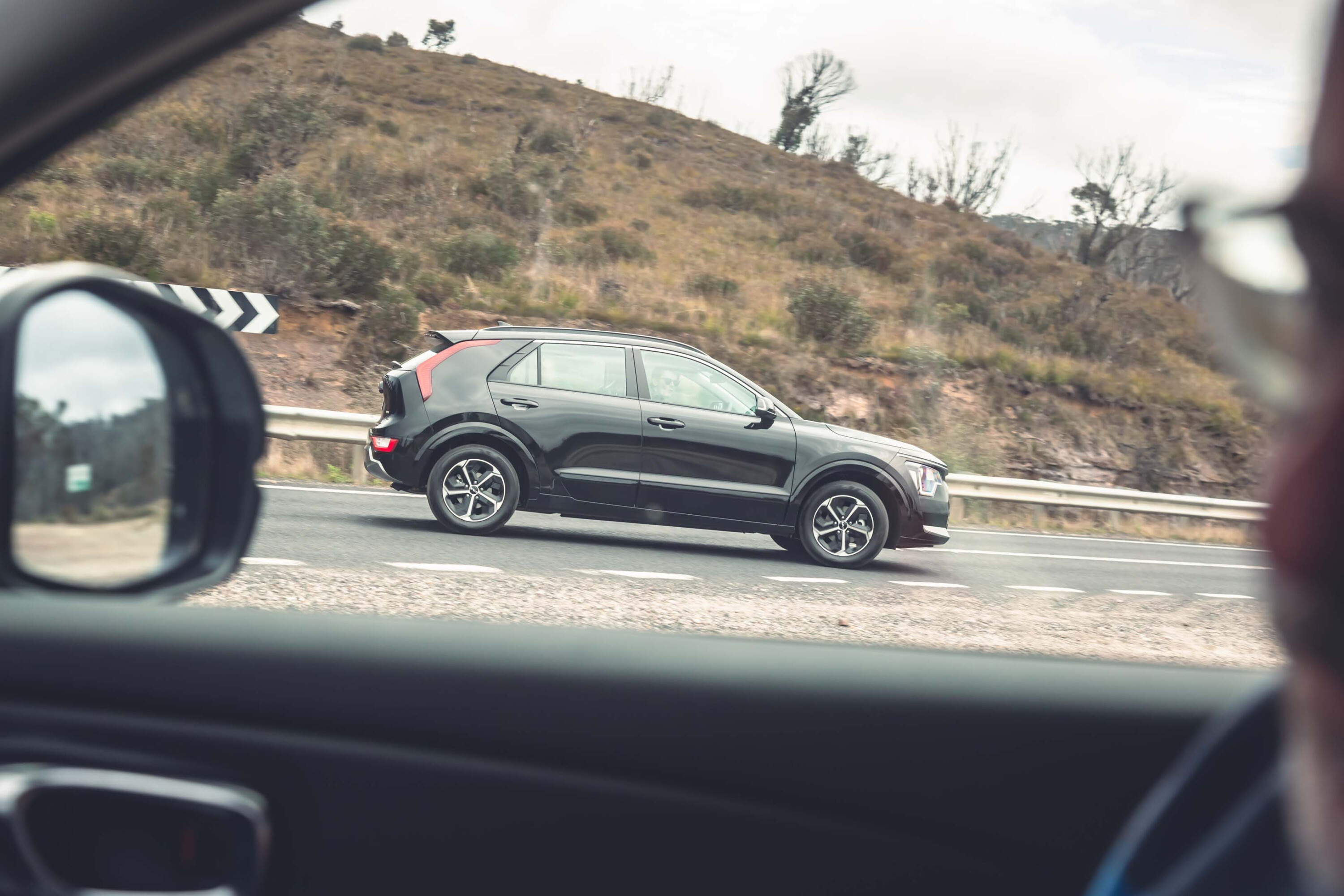
Kia offers a seven-year, unlimited-kilometre warranty with roadside assistance for the duration thrown into the bargain.
Servicing comes every 12 months or 15,000km which is, hmm, okay but what isn’t is the cost of the seven services included in the capped-price program. You’ll be paying a gnat’s butt off $4000 over the seven years, with one service demanding over a thousand dollars.
That’s Euro performance car money for a service and I’m not sure the Niro is quite good or complex enough to demand that kind of cost. I mean, you know it’s there so no surprises but that puts a solid obstacle in the way of a cost-of-ownership argument.
1
VERDICT
The Kia Niro EV is a very likeable car. It does everything it’s supposed to do as a hybrid, which is to deliver excellent fuel economy while not sacrificing usability.
Problem is, this entry-level car isn’t nearly as convincing as the fully electric one and it’s hard to justify the price when viewed next to its immediate competitors.
The interior looks great but misses out on features and some of the materials are so-so. The servicing is really expensive and makes a huge dent in the total cost-of-ownership calculations.
1
It’s rare that I will suggest you go up to the top-spec version of a car but in this case, the Niro GT-Line does seem to be a better deal. But there are better Kias and better hybrids than the Niro, which is a real shame because the purchase of a hybrid is generally ruled by the head.
And I don’t think the head will win this one.
MORE
Everything KIA
MORE
PHEV and Hybrid Cars
| 2023 Kia Niro HEV S specifications | |
|---|---|
| Price | $44,380 + on-road costs (April 2023) |
| DRIVETRAIN | |
| Engine | 1.6-litre four-cylinder petrol + lithium-ion battery |
| Drive | front-wheel |
| Capacity | 1580cc |
| Power | 104kW @ 5700rpm |
| Torque | 265Nm @ 4000rpm |
| Transmission | 6-speed dual-clutch |
| 0-100km/h | 10.4sec (claimed) |
| CHASSIS | |
| Body | 5-door, 5-seat small SUV |
| L/W/H | 4420mm/1825mm/1545mm |
| Wheelbase | 2720mm |
| Track (front/rear) | 1585mm/1596mm |
| Weight | 1454kg |
| Boot | 425 litres |
| Fuel/tank | 91 RON / 42 litres |
| Economy | 4.8L/100km (tested) |
| Suspension | Front: struts, A-arms, anti-roll bar. Rear: multi links, coil springs, anti-roll bar |
| Steering | electric rack-and-pinion |
| Front brakes | ventilated discs (282mm) |
| Rear brakes | solid discs (262mm) |
| Tyres | Nexen N-blue S |
| Tyre size | 205/60R16 92H |
As more EV options appear, the market is heating up with the introduction of more affordable options.
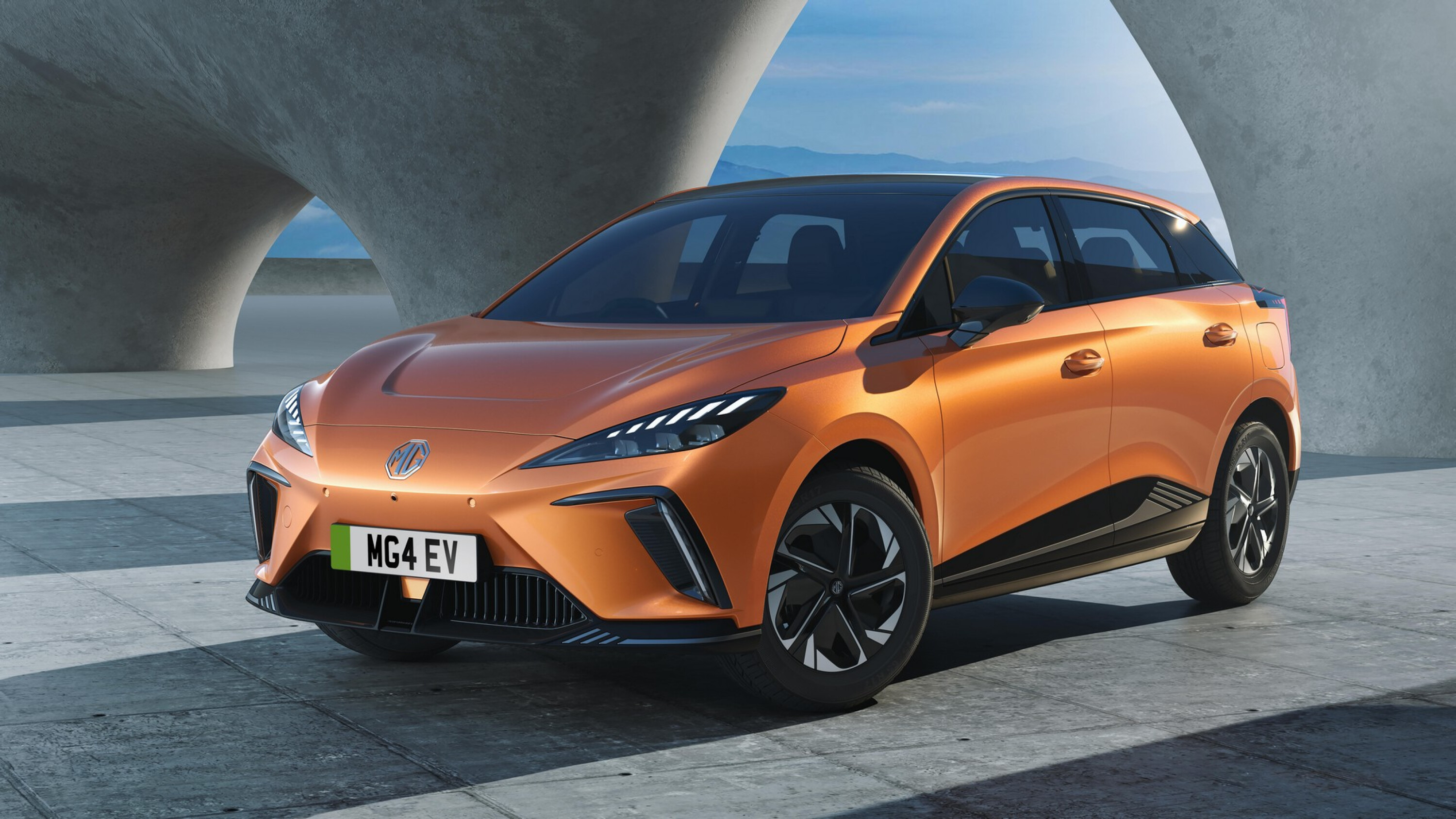
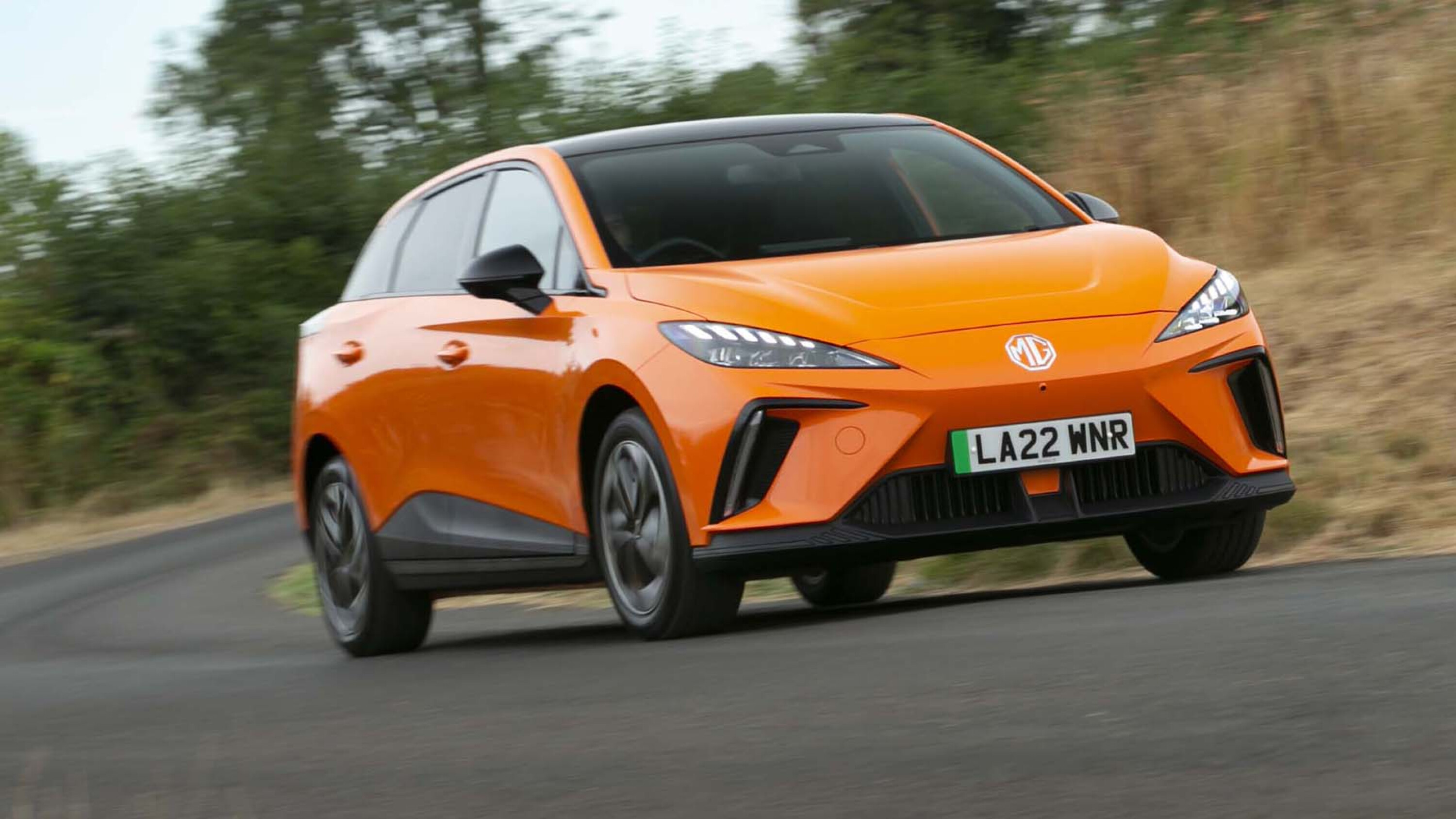
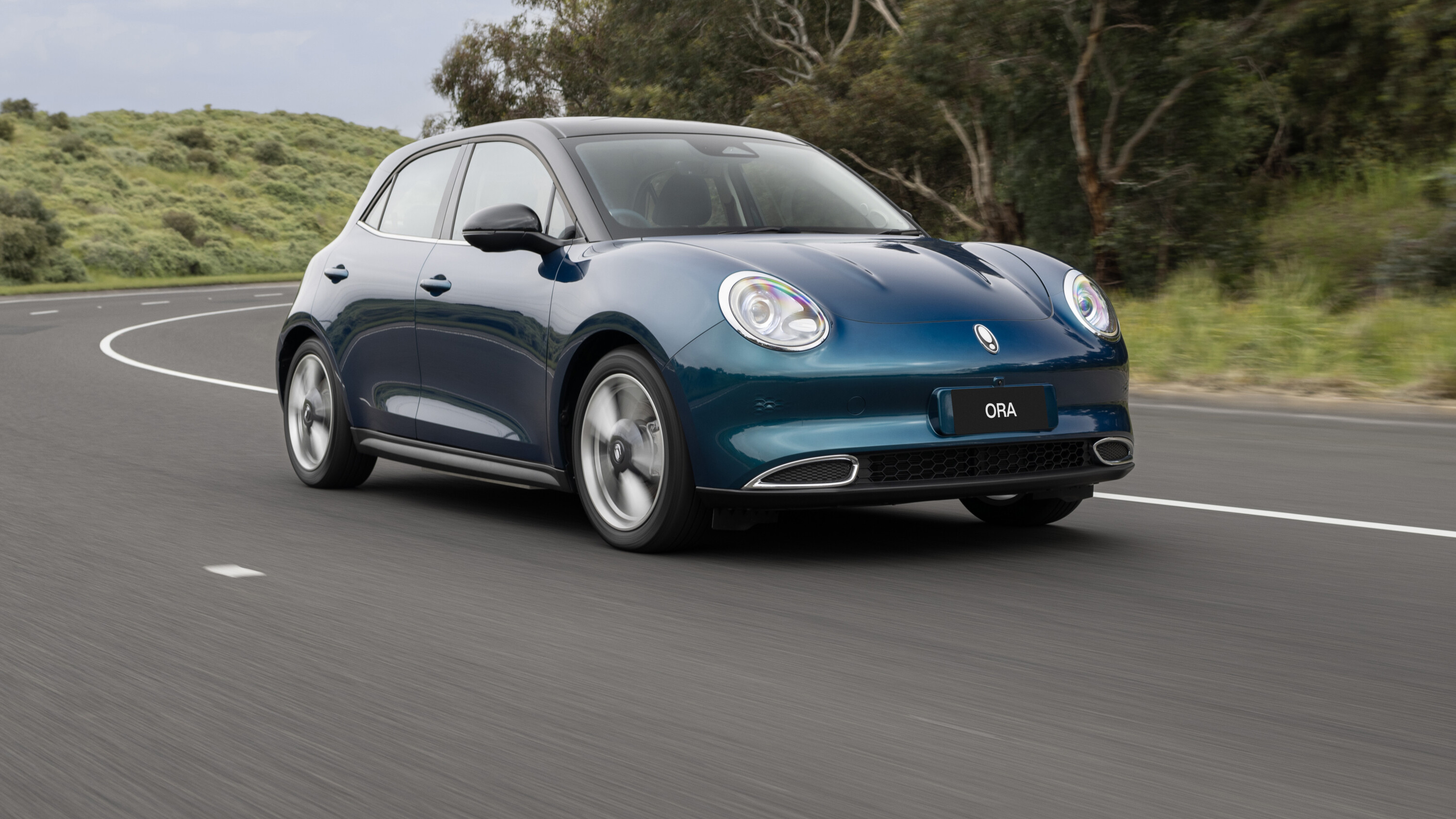
China’s MG 4, BYD Dolphin and GWM Ora electric hatches are the country’s most affordable electric cars to date.
All now boast high-$30,000 pricing for the base variants – the lowest in Australia to date – after GWM slashed pricing this week, likely responding to MG and BYD as China’s electric vehicle price war intensifies.
While we prepare to compare this affordable electric hatchback trio when the first vehicles hit Australian roads, we’ve pulled out the spec sheets to help you find the vehicle that might best suit your needs.
July: MG 4 driven in Australia at last
Even in pre-production, UK spec, the MG 4 hatch proves the long wait for a good, affordable electric car may well be over.
Story continues…
1
JUMP AHEAD
Pricing
Things we like
- MG 4: Wide price range, lots of options
- BYD Dolphin: Competitive pricing
- GWM Ora: Simplified lineup
Not so much…
- MG 4: X-Power likely to be exxy
- BYD Dolphin: $100 cheaper than MG 4 with less power
- GWM Ora: Ultra and GT very similar
All three options here are vying to be seen as an affordable option for buyers with a tighter budget looking to purchase their first EV, or as a second car.
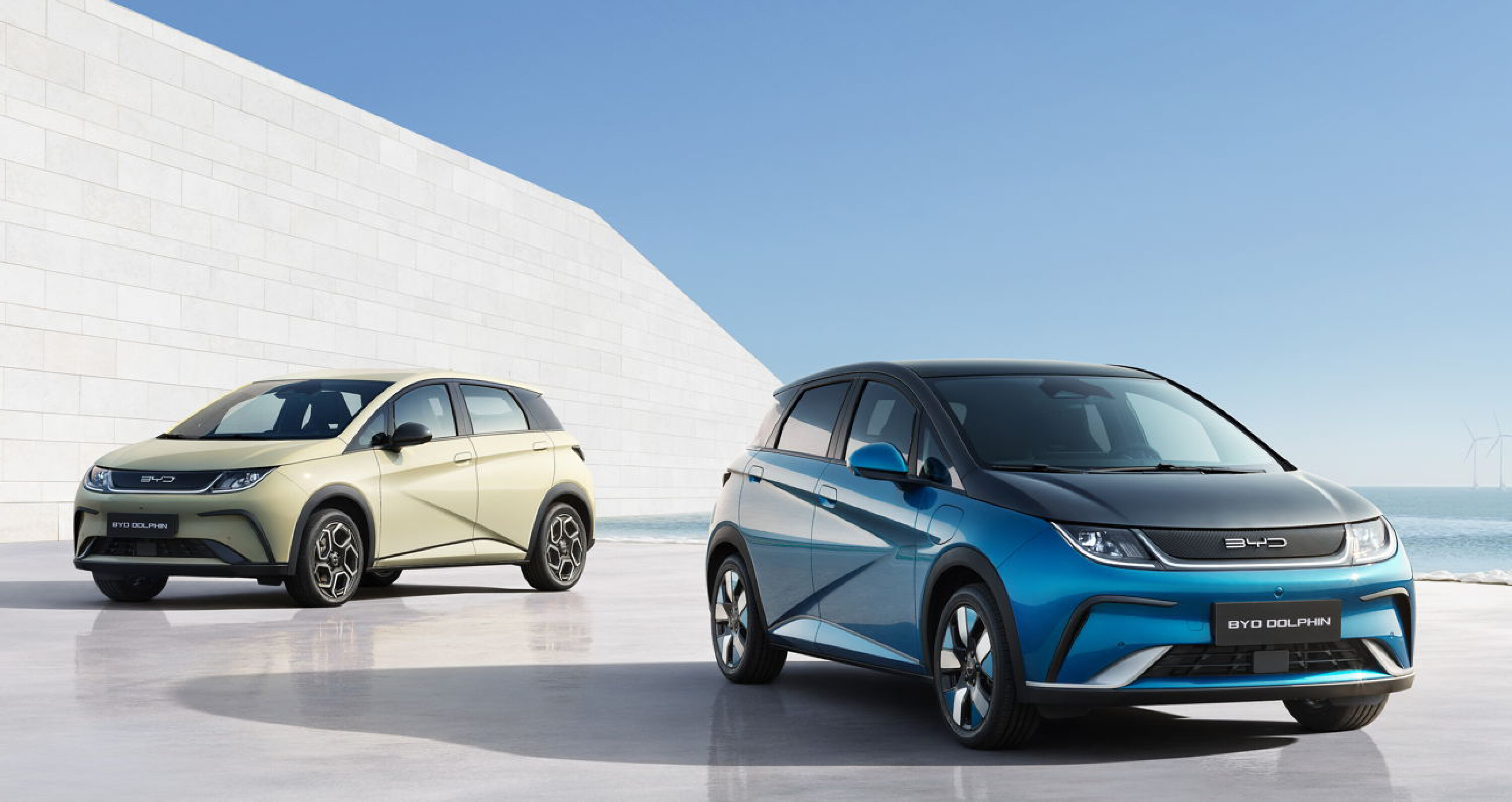
The BYD Dolphin is the cheapest of the bunch – and the most-affordable electric car sold in Australia to date – at $38,890 before on-roads for the base Premium.
To receive a larger battery and a more-potent electric motor, the Premium retails for $44,890 plus on-roads, while the limited-run Sport “hot hatch” is currently listed at $49,990 ahead of its 2024 arrival.
1
However, the base MG 4 Excite 51kWh is just one green banknote more at $38,990 plus on-road costs, topping out at $55,990 for the Essence 77kWh – with the strong possibility of a dearer dual-motor X-Power performance variant.
Following a price cut in July, the standard-range GWM Ora is now $1000 dearer than the base MG 4 at $39,990 plus on-roads, while the Extended Range and GT are now $2000 less than before.
1
Performance
Things we like
- MG 4: Decent performance, RWD
- BYD Dolphin: Premium level with its rivals
- GWM Ora: Respectable acceleration
Not so much…
- MG 4: Nothing exciting (X-Power aside)
- BYD Dolphin: Slow base model outputs
- GWM Ora: No boost for heavier battery
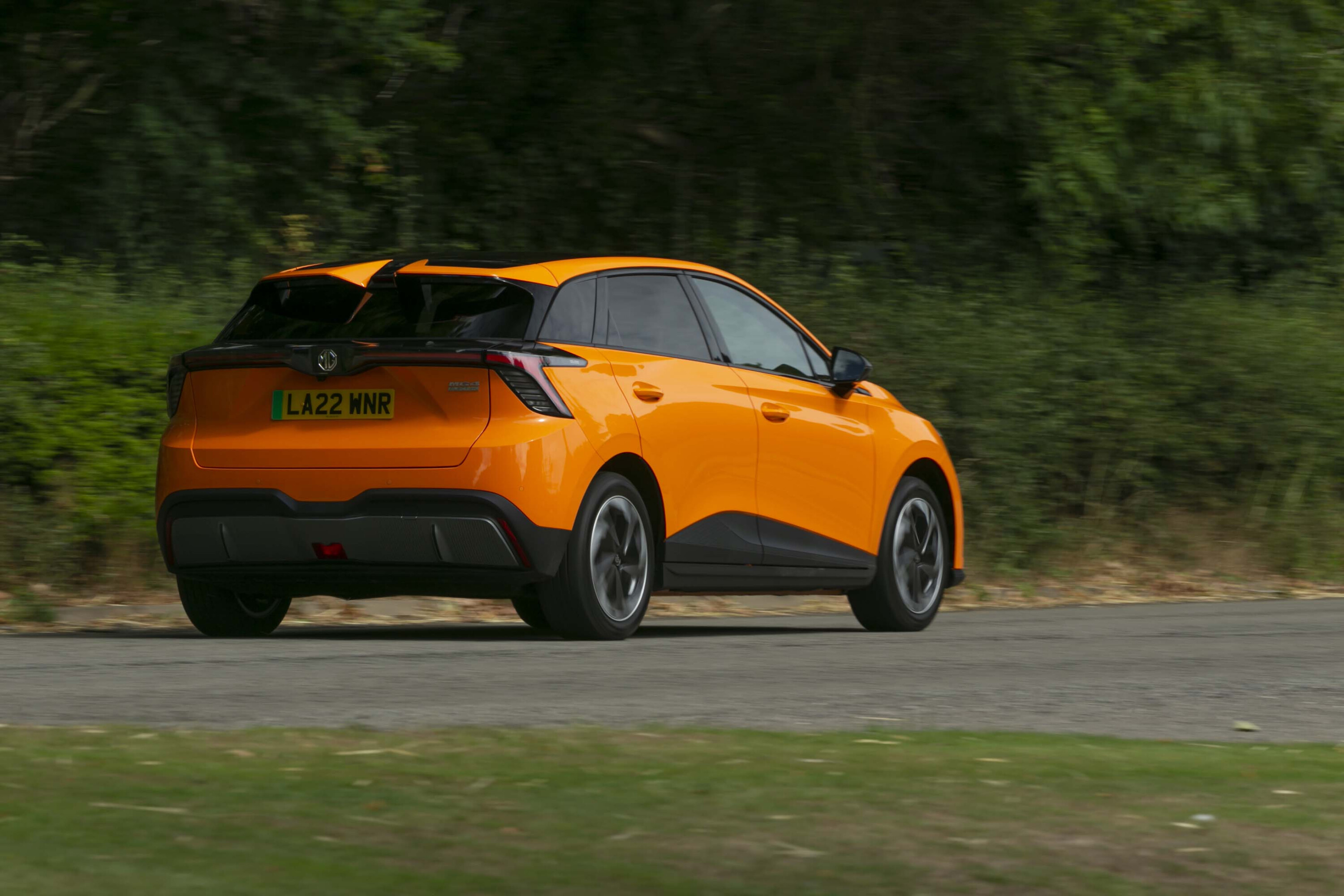
The MG 4 offers a base model with 125kW/250Nm and a 7.7-second 0-100km/h time, while the Long Range kicks it up a notch with 180kW/350Nm and a quicker 6.5-second sprint.
A slow 70kW/180Nm electric motor is found in the base BYD Dolphin, which takes 12.3 seconds to reach 100km/h. The Dolphin Premium boosts outputs to 150kW and 310Nm, with a spritelier 7.0-second acceleration time.
The GWM Ora has consistent performance across both battery sizes, with 126kW/250Nm and an 8.4-second 0-100km/h time. All three cars share a maximum speed of 160km/h.
1
| MG 4 | BYD Dolphin | GWM Ora | |
|---|---|---|---|
| Power | 51kWh: 125kW | Dynamic: 70kW | Standard: 126kW |
| 64kWh: 150kW | Premium: 150kW | Extended: 126kW | |
| 77kWh: 180kW | Sport: TBC | Ultra/GT: 126kW | |
| Torque | 51kWh: 250Nm | Dynamic: 180Nm | Standard: 250Nm |
| 64kWh: 250Nm | Premium: 310Nm | Extended: 250Nm | |
| 77kWh: 350Nm | Sport: TBC | Ultra/GT: 250Nm | |
| 0-100 km/h | 51kWh: 7.7s | Dynamic: 12.3s | Standard: 8.4s |
| 64kWh: 7.9s | Premium: 7.0s | Extended: 8.4s | |
| 77kWh: 6.5s | Sport: | Ultra/GT: 8.4s | |
| Top speed | 160km/h | 160km/h | 160km/hu00a0 |
1
Driving range
Things we like
- MG 4: 530km on the Long Range variant
- BYD Dolphin: 427km range on the Premium
- GWM Ora: Extended Range option
Not so much…
- MG 4: Regular versions top out at 450km range
- BYD Dolphin: 340km on the Dynamic variant could be limiting
- GWM Ora: Shortest of the trio
The MG 4 offers a range of driving ranges depending on the battery size and specifications, spanning 351km (51kWh) to an impressive 530km (77kWh Long Range). Mid-spec variants with a 64kWh battery provide a range of 435-450km.
The BYD Dolphin covers a range of 340km (Dynamic) to 427km (Premium), while the GWM Ora falls between 310km (Standard Range) and 420km (Extended Range, Ultra).
The flagship GWM Ora GT offers a slightly shorter 400-kilometre range. Battery sizes vary across the models, ranging from 45kWh to 77kWh.
1
| MG 4 | BYD Dolphin | GWM Ora | |
|---|---|---|---|
| Range | 51kWh: 351km | Dynamic: 340km | Standard: 310km |
| 64kWh: 435km (Essence), 450km (Excite) | Premium: 427km | Extended/Ultra: 420km | |
| 77kWh: 530km | Sport: TBC | GT: 400km | |
| Battery size | 51kWh (Excite), 64kWh (Excite, Essence), 77kWh (Essence) | 45kWh (Dynamic), 60.5kWh (Premium, Sport) | 45.4kWh (Standard), 59kWh (Extended, Ultra, GT) |
1
Dimensions
Things we like
- MG 4: Largest of the trio
- BYD Dolphin: Long wheelbase
- GWM Ora: Tall roof helps ease of access
Not so much…
- MG 4: Not as tall
- BYD Dolphin: Not as wide
- GWM Ora: Not as long
Here, the MG 4 takes the lead as the largest overall, while the GWM Ora sits at the shorter end.
The GWM Ora – with a height of 1603mm – boasts a tall SUV-like roof that surpasses the Mazda CX-3 and is similar to the BYD Atto 3.
The crown for the longest wheelbase and widest body is handed to the MG 4, allowing a more-spacious interior – though we’ll wait to compare this trio in-person to see how it fares in the real world.
2
| MG 4 | BYD Dolphin | GWM Ora | |
|---|---|---|---|
| Wheelbase | 2705mm | 2700mm | 2650mm |
| Length | 4287mm | 4290mm | 4235mm |
| Height | 1504mm | 1570mm | 1603mm |
| Width | 1836mm | 1770mm | 1825mm |
Charging
Things we like
- MG 4: Supports fastest charging
- BYD Dolphin: Premium charges faster
- GWM Ora: 11kW AC speed
Not so much…
- MG 4: 6.4kW AC charge speed
- BYD Dolphin: 60kW DC limit for base
- GWM Ora: Extended has same rate
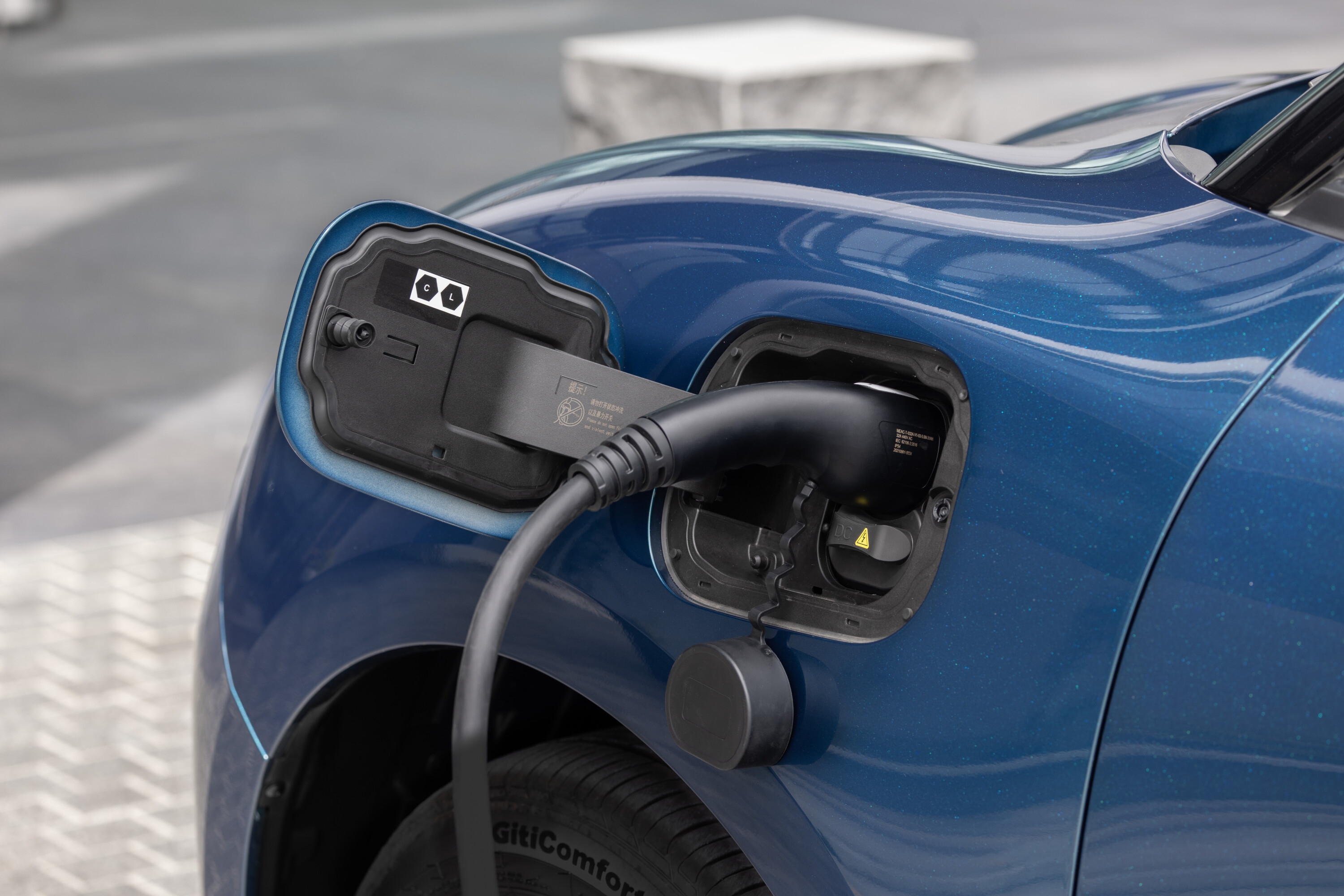
While the BYD Dolphin offers a slow 60kW DC charge speed for the base Dynamic, it rises to 80kW for larger battery Premium – but it still falls behind the MG 4, which supports a DC charge speed between 88kW and 140kW.
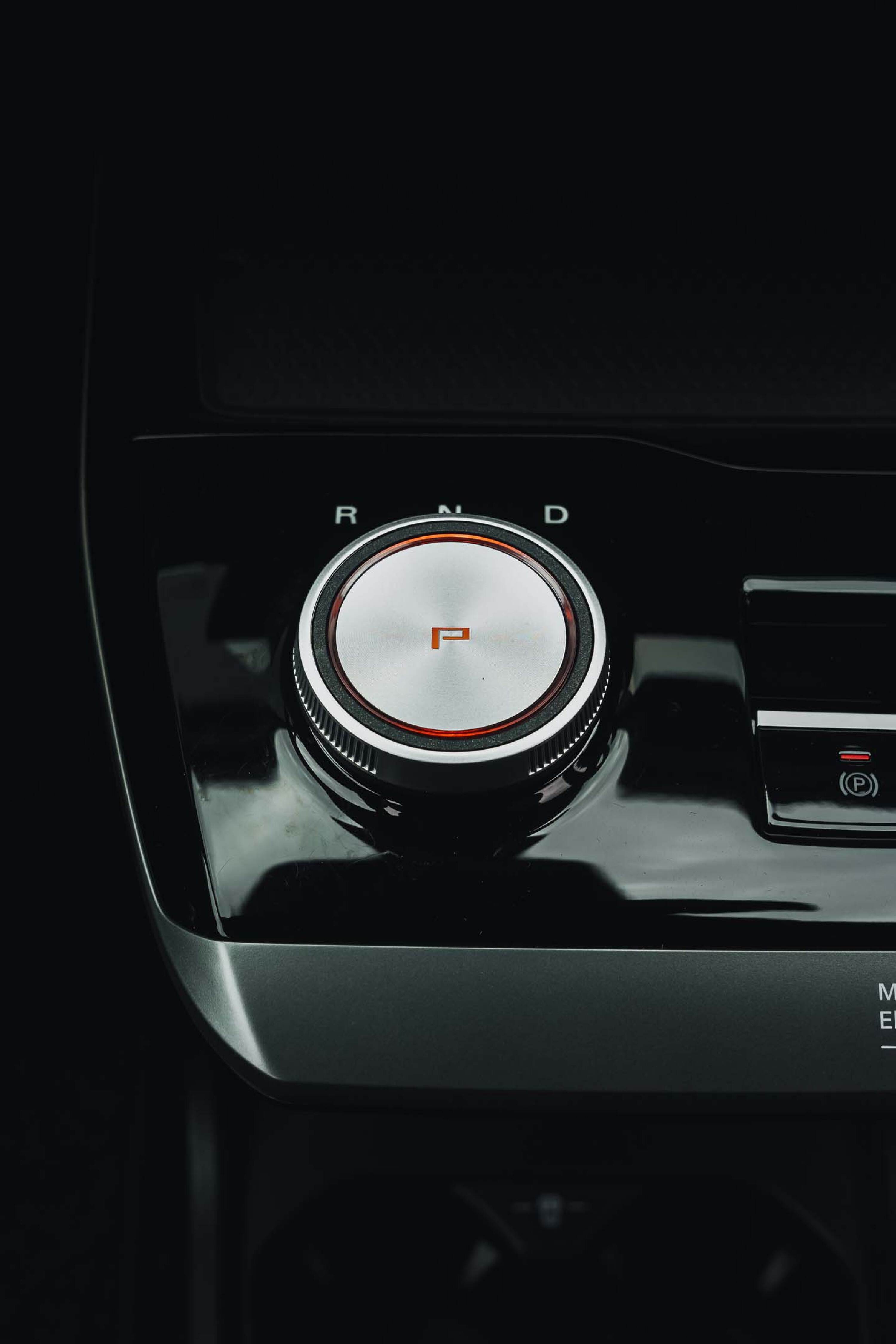
The GWM Ora provides a DC charge speed of 64kW and an 11kW AC home charger speed – in line with the BYD Dolphin. The MG 4 has a slower 6.6kW AC charge rate.
It’s worth noting that all three models have slower charging speeds compared to more expensive EVs like the Tesla Model 3 and Hyundai Ioniq 6, but this is partly due to the smaller battery capacities.
For context, the Nissan Leaf has a 46kW DC maximum charge rate, while a Mazda MX-30 E35 is equally limited.
1
| MG 4 | BYD Dolphin | GWM Ora | |
|---|---|---|---|
| DC fast charger | 51kWh: 88kW | Dynamic: 60kW | Standard: 64kW |
| 64kWh: 140kW | Premium: 80kW | Extended: 64kW | |
| 77kWh: 140kW | Sport: 80kW | Ultra/GT: 64kW | |
| AC standard charger | 6.6kW | 11kW | 11kW |
1
Features
Things we like
- MG 4: Essence well-equipped
- BYD Dolphin: Strong equipment levels
- GWM Ora: 10.25-inch instrument cluster
Not so much…
- MG 4: Base model built to a price
- BYD Dolphin: Small instrument cluster
- GWM Ora: USB-A ports
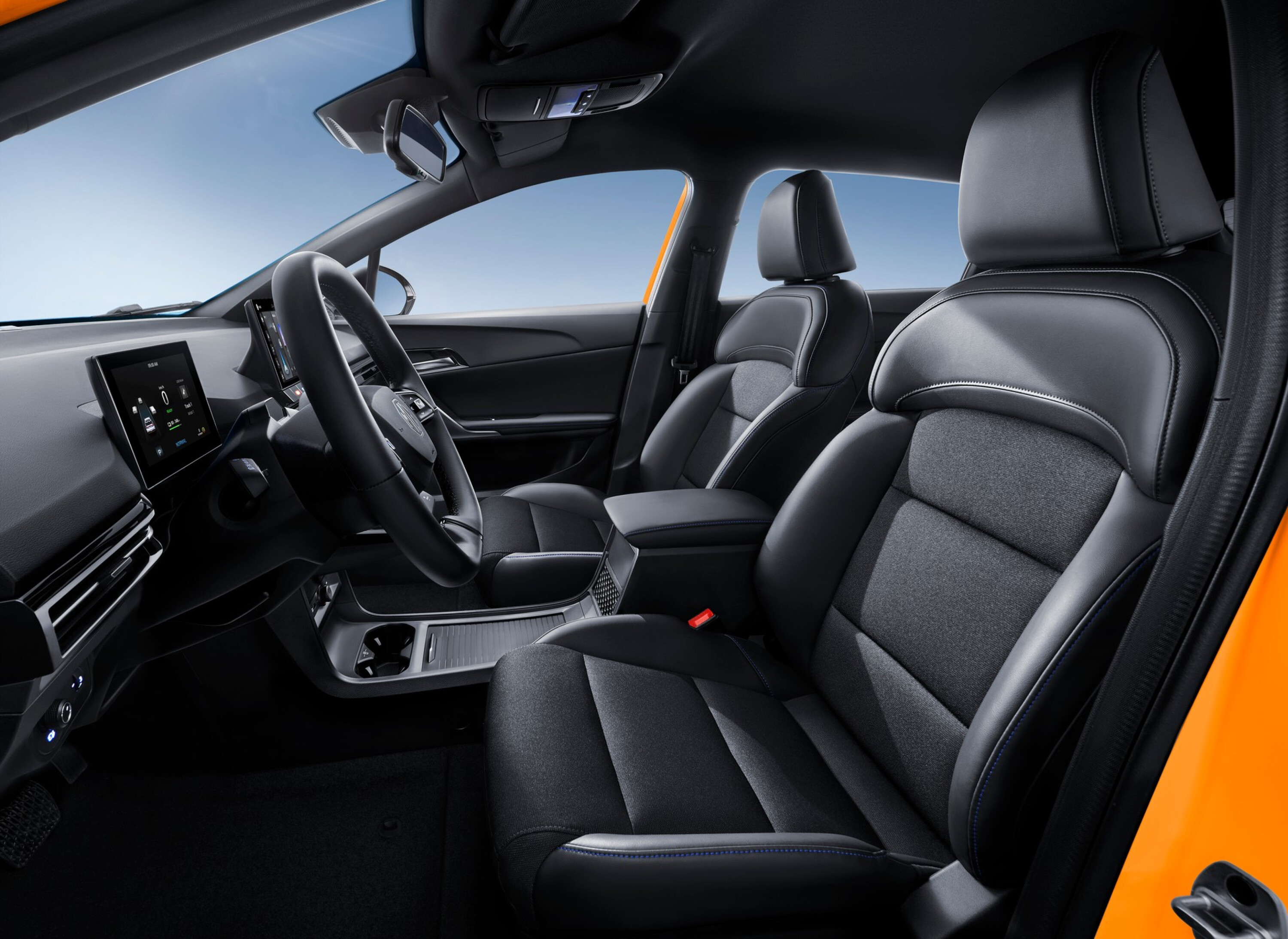
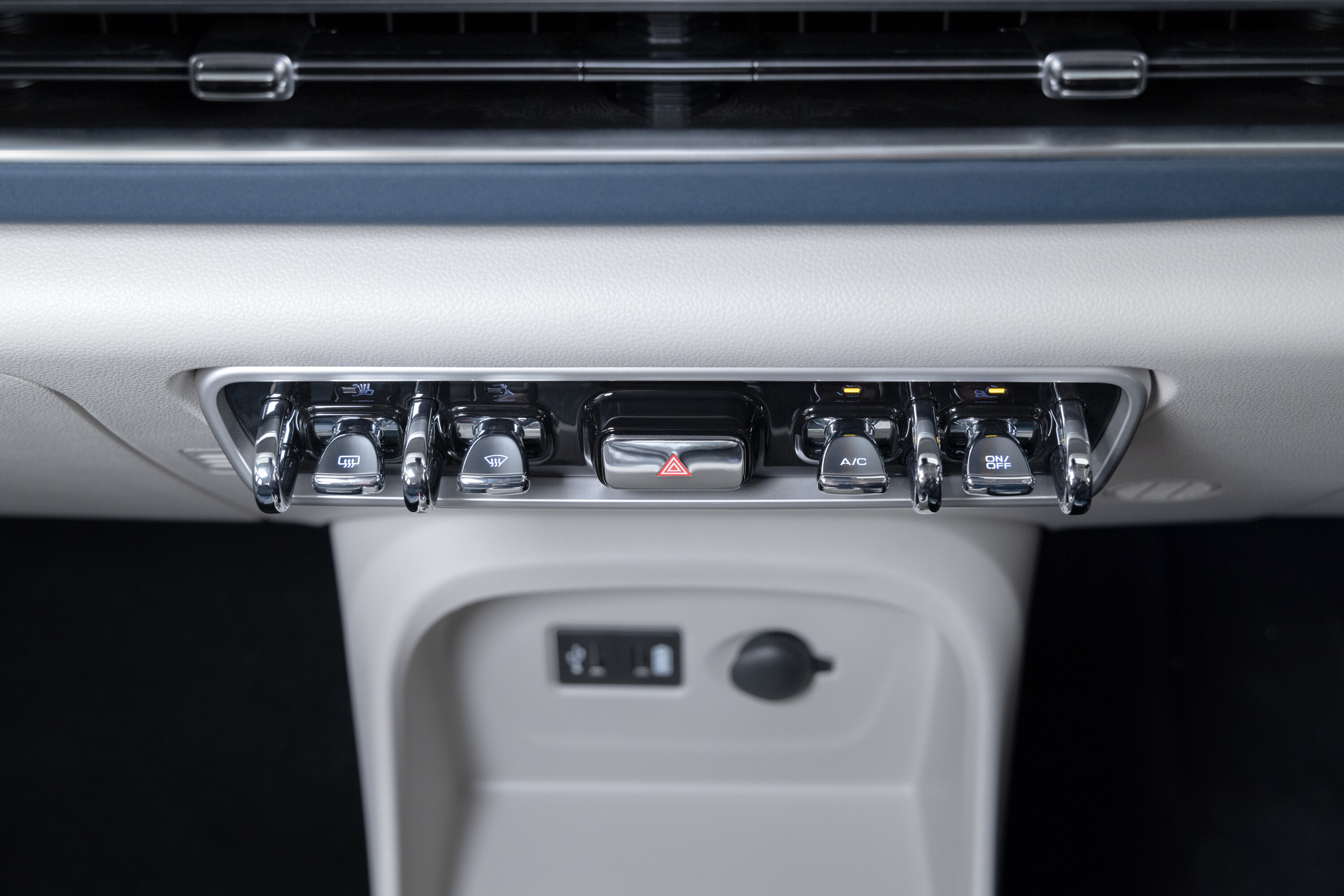
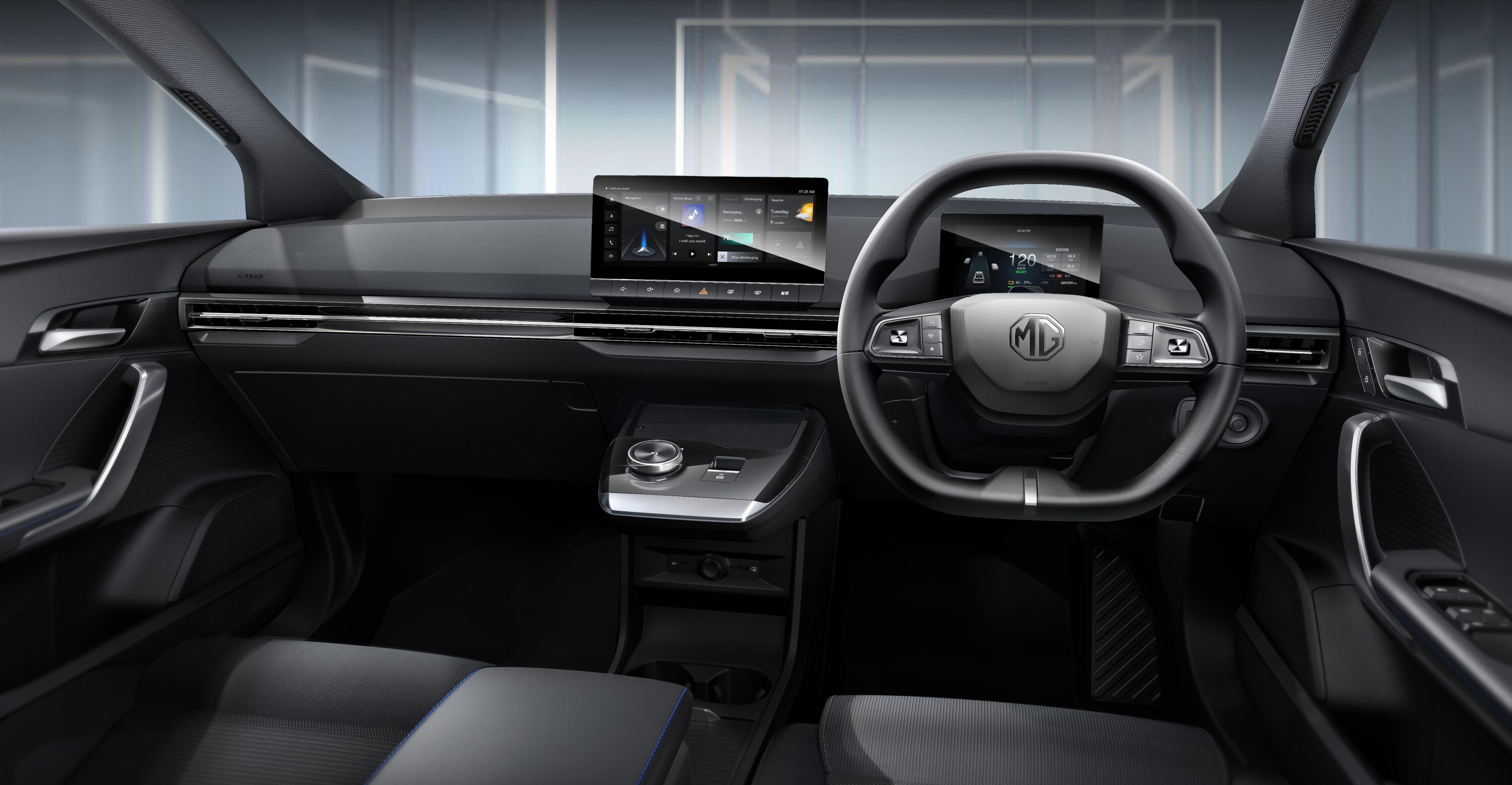
As standard, all three vehicles offer alloy wheels and large screens with Apple CarPlay and Android Auto: the MG 4 and GWM Ora with a 10.25-inch touchscreen, and the BYD Dolphin with a 12.8-inch rotating display.
The MG 4 stands out with its ‘iSmart’ connected-car service, allowing drivers to control vehicle functions from their smartphone. The BYD Dolphin offers additional luxuries such as leather-accented upholstery, heated front seats, and a built-in voice assistant.
On the other hand, the GWM Ora boasts dual-zone climate control, a surround-view camera, and a wireless charging pad.
1
MG 4
| 2023 MG 4 standard features | |
|---|---|
| 17-inch alloy wheels | 7-inch digital instrument cluster |
| 10.25-inch infotainment system | Rotary gear selector |
| Wired Apple CarPlay and Android Auto | Cloth upholstery |
| Four-speaker audio system | u2018iSmartu2019 connected-car service. |
MG 4 Essence adds larger 18-inch alloy wheels, a six-speaker audio system, synthetic leather/cloth upholstery, voice control, built-in satellite navigation, a 360-degree camera system, a wireless phone charger, an auto-dimming rear-view mirror, and a height-adjustable load floor.
BYD Dolphin
| 2023 BYD Dolphin standard features | |
|---|---|
| 16-inch alloy wheels | Leather-accented upholstery |
| 12.8-inch rotating infotainment system | Heated front seats |
| Wired Apple CarPlay | Heat pump |
| Satellite navigation | Adaptive LED headlights |
| Six-speaker audio system | LED tail-lights and daytime running lamps |
| Built-in voice assistant | Rear privacy glass |
| DAB+ digital radio | LED cabin lights |
| 5-inch digital instrument cluster | Heated, power-folding side mirrors |
| Four USB ports (2x USB-C, 2x USB-A) | 360-degree camera system |
| Wireless phone charger | Six-way power-adjustable driveru2019s seat |
| Keyless entry and push-button start | Four-way power-adjustable passenger seat |
| Portable card key | Vehicle-to-load functionality |
| Panoramic sunroof | Low-speed audible pedestrian alert |
| Climate-control air-conditioning | Tyre pressure monitoring. |
3
GWM Ora
| 2023 GWM Ora standard features | |
|---|---|
| LED headlights | 18-inch alloy wheels |
| Dual-zone climate control | Vinyl upholstery |
| 10.25-inch multimedia touchscreen | Wired Apple CarPlay/Android Auto |
| 10.25-inch digital driveru2019s display | Surround-view camera |
| 6-way power driveru2019s seat | 6-speaker sound-system |
| Keyless entry | DAB+ digital radio |
| Wireless charging pad | 2x USB-A chargers |
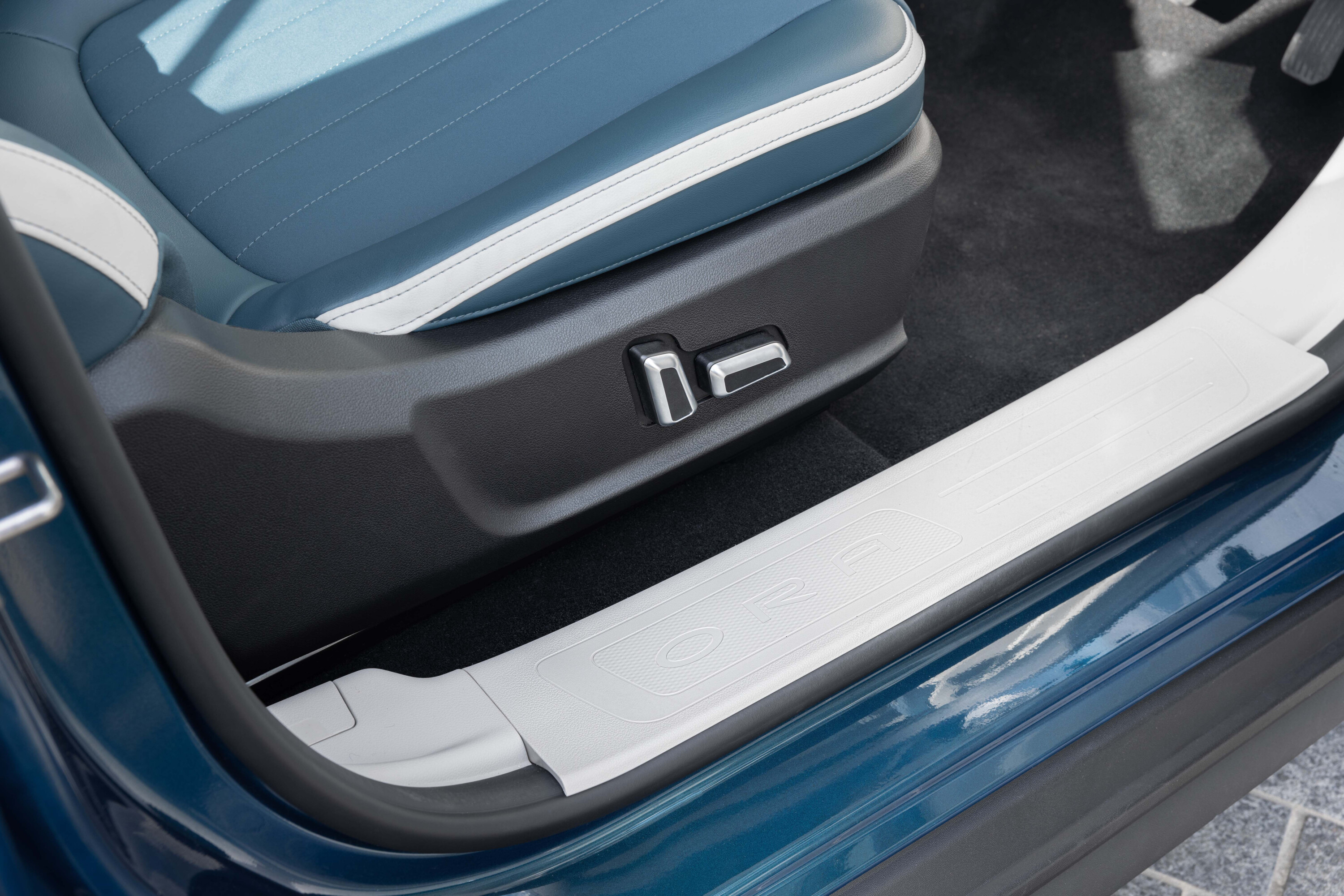
GWM Ora Ultra adds a panoramic sunroof, an electric tailgate, a heated steering wheel, heated and ventilated front seats, a six-way power-adjustable driver’s seat with memory function, and power-folding side mirrors with memory.
Over the Ultra, the Ora GT adds unique 18-inch alloy wheels, a sportier body kit with decals, red brake calipers, and automatic parking.
1
Safety
Things we like
- MG 4: Five-star ANCAP likely
- BYD Dolphin: Strong level of active safety tech
- GWM Ora: Five-star ANCAP
Not so much…
- MG 4: Blind-spot, rear cross-traffic not standard
- BYD Dolphin: No official ANCAP rating yet
- GWM Ora: Less safety kit than BYD Dolphin
1
The MG 4 currently holds a five-star Euro NCAP safety rating in 2020-22 criteria, but this has yet to be brought across to ANCAP.
A five-star ANCAP rating applies to the GWM Ora, based on testing conducted by Euro NCAP in 2022.
The BYD Dolphin is awaiting testing by both ANCAP and Euro NCAP, with adjustments made to its frontal structure to meet European, Australian, and New Zealand standards compared to Chinese-market versions.
All feature autonomous emergency braking, lane-keep assist, lane departure warning, traffic sign recognition, and adaptive cruise control.
The GWM Ora and BYD Dolphin add blind-spot and rear cross-traffic alerts as standard, which are unavailable on the base MG 4 Excite.
Additionally, the BYD Dolphin include front cross-traffic alert, side exit assist, and child presence detection, while the MG 4 is unique in offering traffic jam assist.
1
Cargo space
Things we like
- MG 4: Largest boot
- BYD Dolphin: Decent space
- GWM Ora: Electric boot for Ultra, GT
Not so much…
- MG 4: Less space than Dolphin w/ seats folded
- BYD Dolphin: No front boot
- GWM Ora: Smallest cargo space
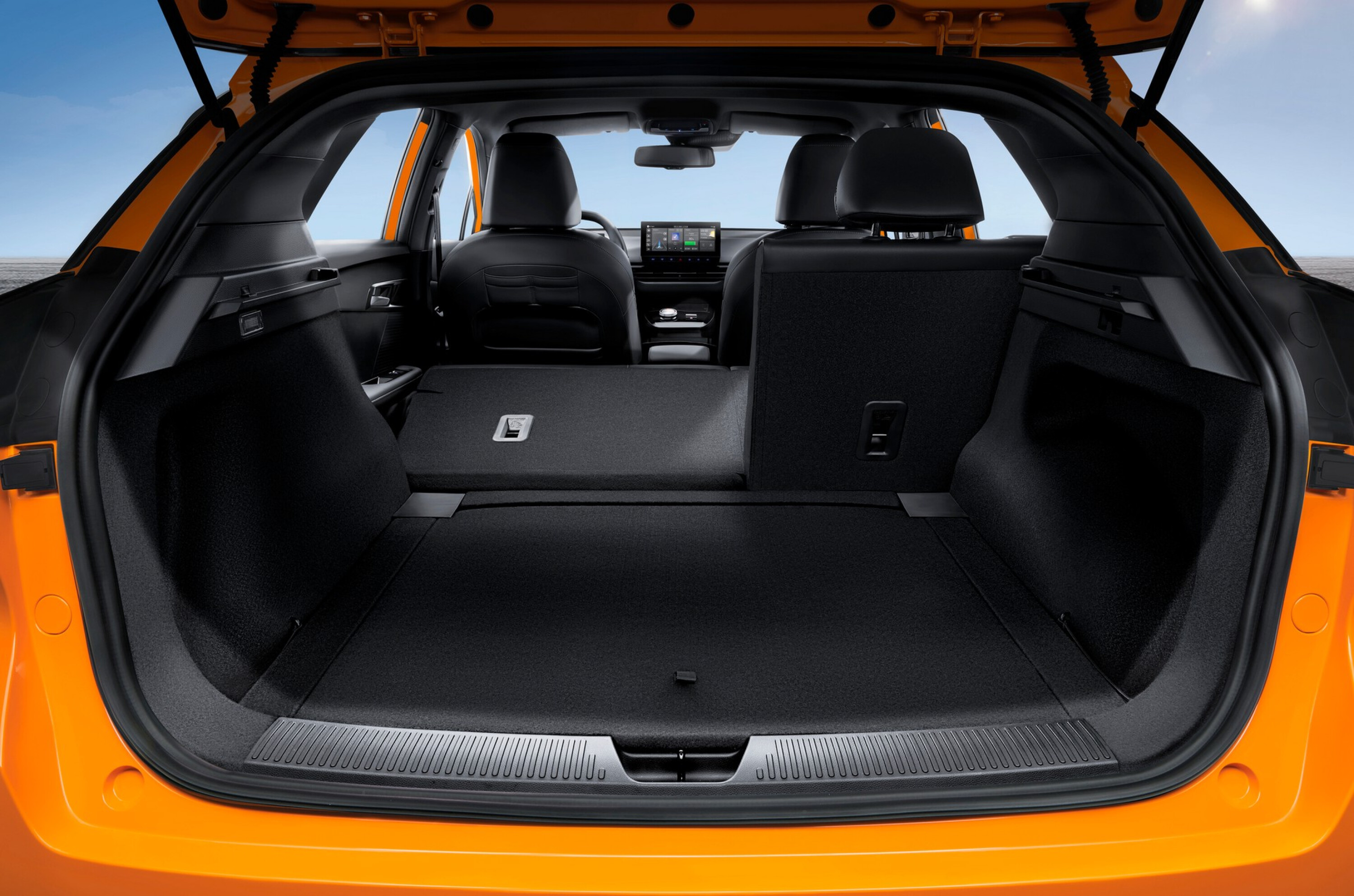
The MG 4 the largest boot with 363 litres when all seats are in place, which expands to 1177L with the second-row folded down.
While the BYD Dolphin offers less boot space at 345L, the brand claims it expands to 1310L with the rear seats down – the largest of the trio.
The GWM Ora offers the least cargo space, with 228L when all seats are in use, and 884L when the rear seats are folded.
Unlike a Tesla Model 3 and some other electric vehicles, these affordable hatchbacks were not engineered with a front boot (also known as a ‘frunk’), with the electric motor and other drive components underneath the bonnet. The GWM Ora GT offers an electric tailgate.
| MG 4 | BYD Dolphin | GWM Ora | |
|---|---|---|---|
| Boot capacity (seats up) | 363L | 345L | 228Lu00a0 |
| Boot capacity (seats down) | 1177L | 1310L | 884L |
3
Warranty and servicing
Things we like
- MG 4: Longest service intervals
- BYD Dolphin: Eight-year battery coverage
- GWM Ora: Eight-year battery coverage
Not so much…
- MG 4: Seven-year battery warranty less than BYD, GWM
- BYD Dolphin: Confusing, limited warranty coverage for certain parts
- GWM Ora: Limited service intervals
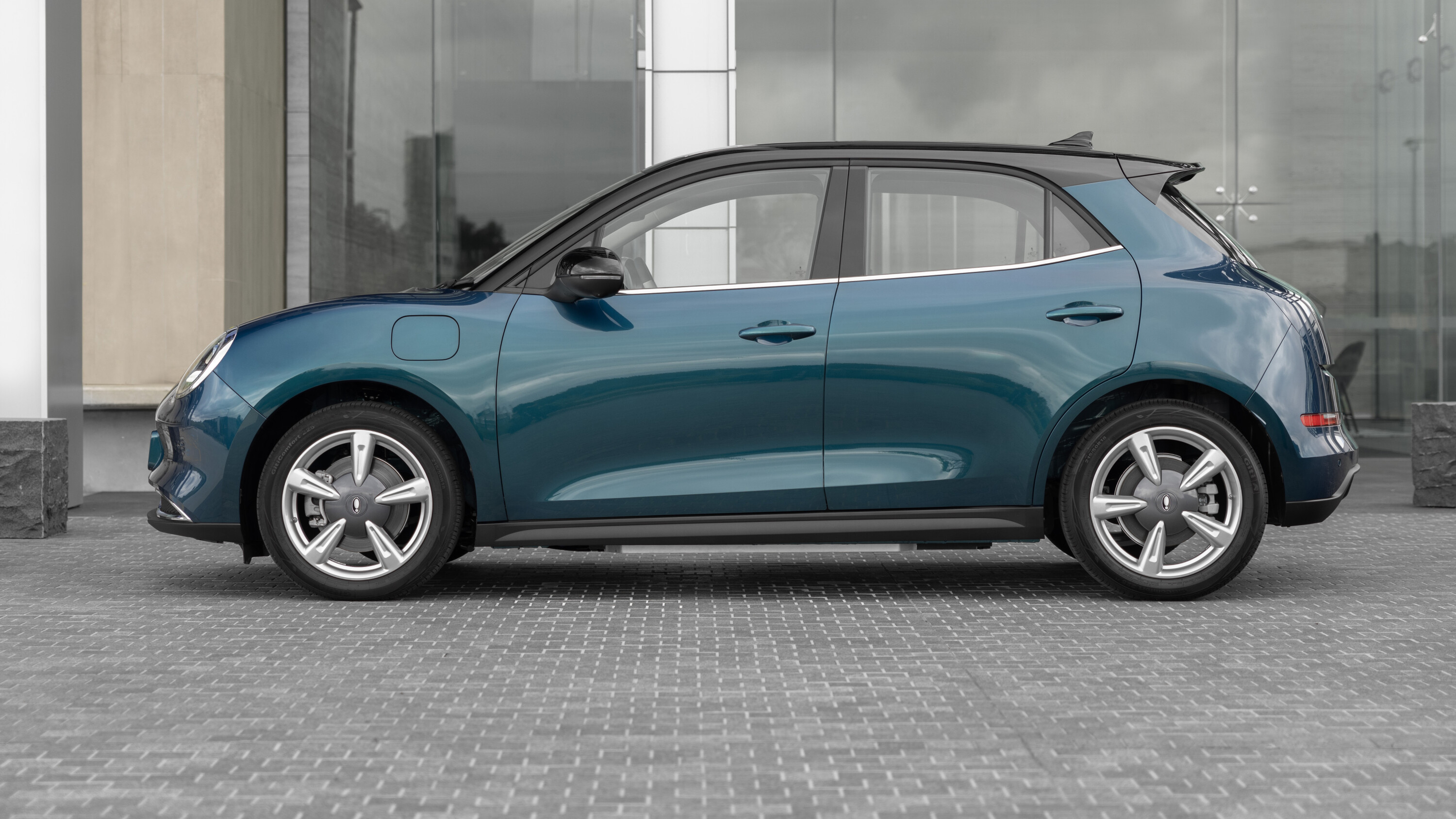
The MG 4 has seven-year/unlimited-kilometre vehicle warranty, with equivalent coverage for the high-voltage battery pack.
While the BYD Dolphin offers a six-year/150,000-kilometre warranty and eight-year battery coverage, some individual components carry limited warranties ranging between 12 months and four years.
1
The GWM Ora matches the MG 4’s seven-year/unlimited-kilometre overall warranty and provides an eight-year warranty for the battery.
Service intervals are set at 24 months or 40,000 kilometres for the MG 4, while the BYD Dolphin requires maintenance every 12 months or 20,000 kilometres.
The GWM Ora follows a similar schedule, with the lowest service intervals of 12 months or 15,000 kilometres, which is equivalent to GWM’s internal-combustion vehicles.
MORE
Everything GWM
MORE
Everything MG
MORE
Everything BYD
MORE
Electric SUVs
More EV stories to help you choose the best car for your needs
- ? EV news, reviews, advice & guides
- ❓ Short & sweet: Your EV questions answered
- ⚡ New EVs: Everything coming to Australia
- ? Australia’s EVs with the longest driving range
- ⚖️ Best-value EVs by driving range
- ? How much do EVs cost in Australia?
- ? How much more expensive are EVs?
- ⚖️ Number crunching: Is it time to switch to an EV?
- ♻ Should you buy a used EV?
- ?️ Are EVs more expensive to insure?
- ? Costs compared: Charging an EV vs fueling a car
- ? EV charging guide
- ?? EV servicing explained
- ? EV battery types explained
- ? When do EV batteries need replacing?
- ? Hydrogen v EVs: What’s best for Oz?
- ? How sustainable are EVs, really?
MORE advice stories to help you with buying and owning a car
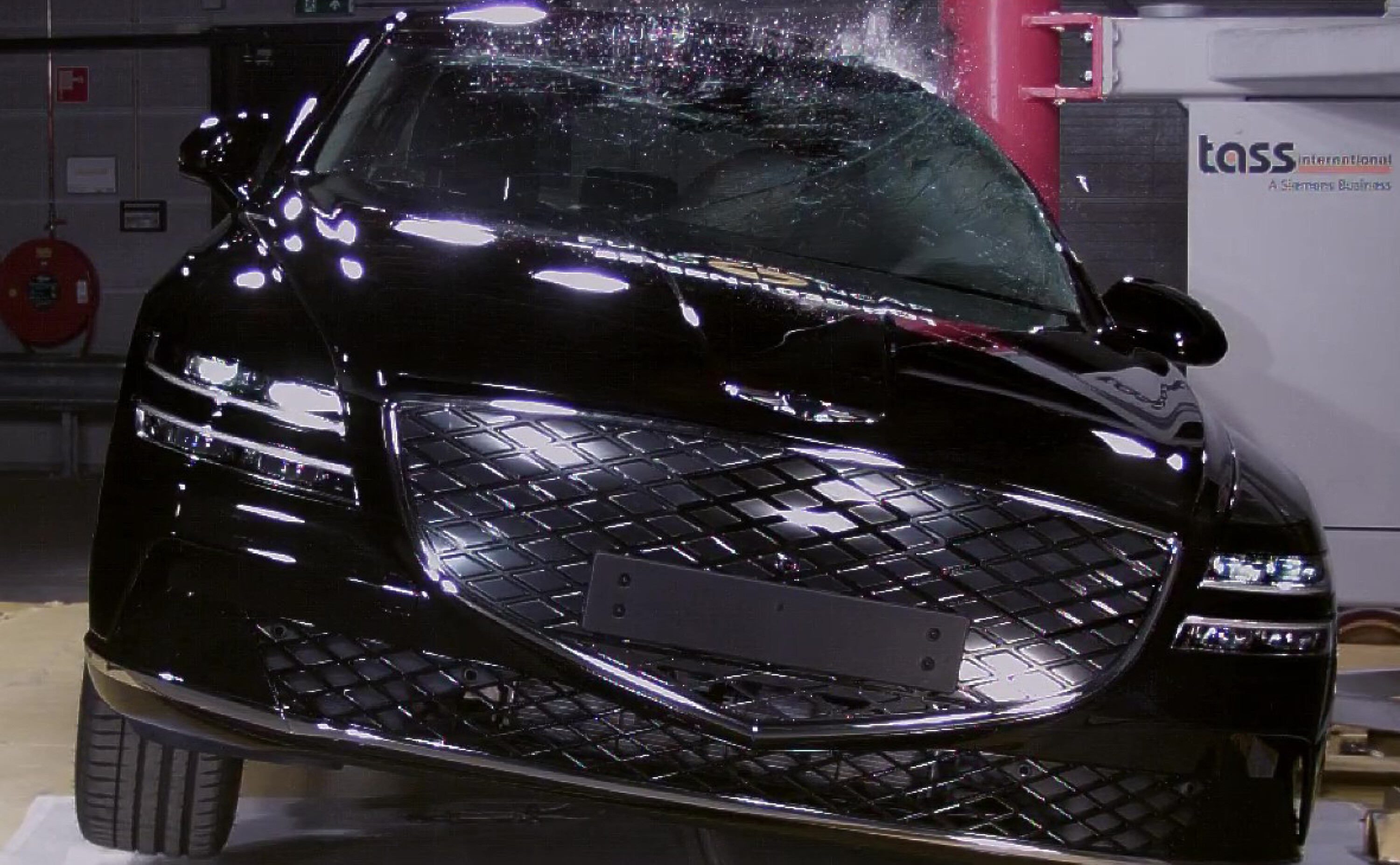
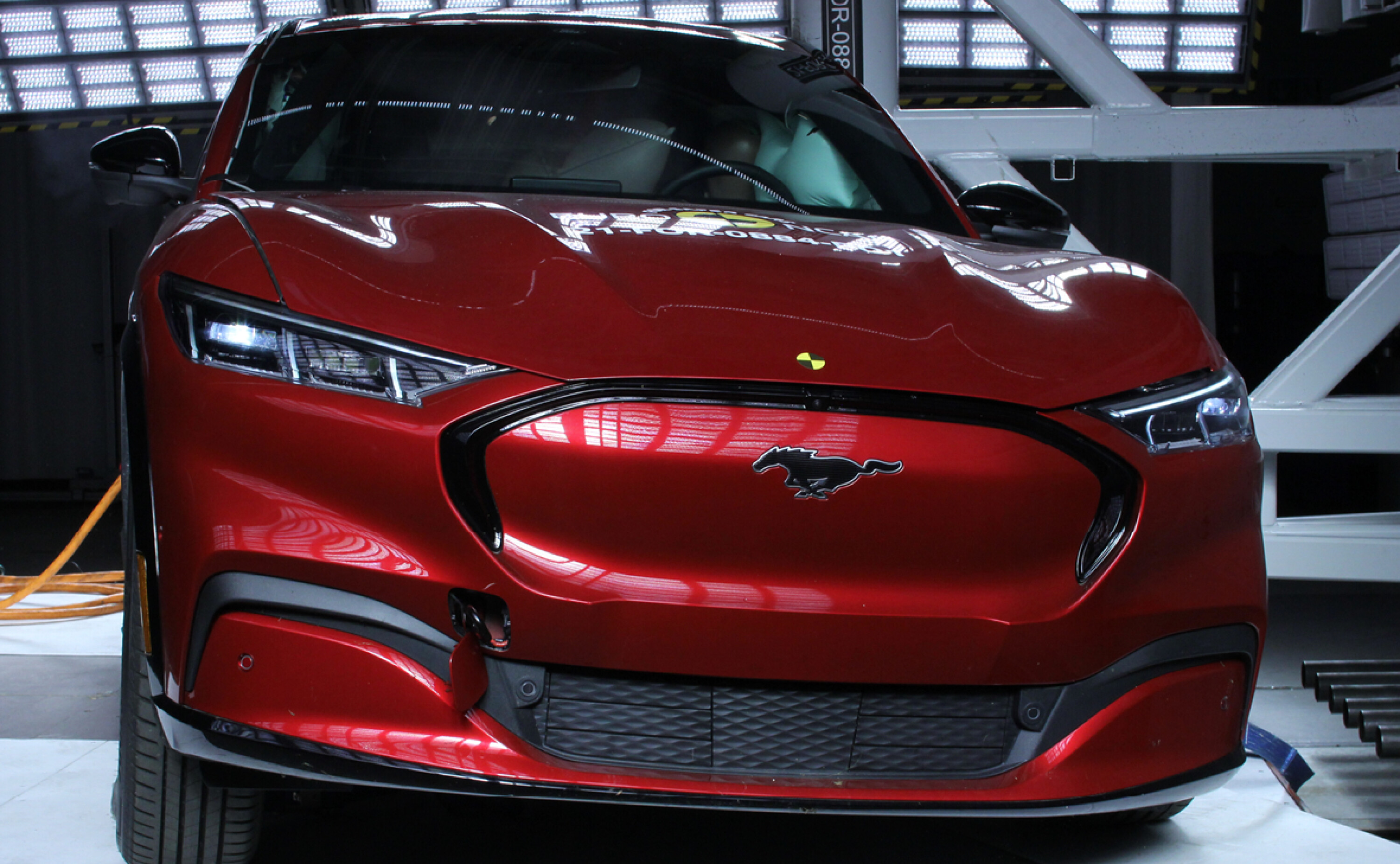
The Ford Mustang Mach-E, Genesis Electrified GV70 and Electrified G80 have received a five-star ANCAP safety rating.
Snapshot
- Ford Mustang Mach-E electric SUV receives five-star ANCAP rating
- Genesis Electrified GV70 and G80 also score top marks
- Based on testing conducted under older criteria, with a 2021 datestamp
While the results apply to vehicles launched in Australia within the past 12 months, all testing was conducted by sister organisation Euro NCAP with a 2021 datestamp, under older 2020-22 criteria.
ANCAP or Euro NCAP have yet to publish vehicle results under more-stringent criteria introduced in 2023.
1
In addition, the Ford Mustang Mach-E had a five-star ANCAP rating for New Zealand variants, but this has now extended to vehicles due in Australia later this year – excluding the GT, which remains untested.
Meanwhile, additional testing was conducted by Euro NCAP for the all-electric Genesis vehicles “to confirm comparable safety performance and high voltage battery integrity,” with results found to be identical to the internal-combustion GV70 and G80.
“With these new results, there are now over 100 battery electric, hybrid, plug-in hybrid, and hydrogen models rated by ANCAP which hold a five-star ANCAP safety rating – providing plenty of choice to consumers across a range of vehicle brands, models and price-points,” said ANCAP chief executive officer, Carla Hoorweg.
1
Overall, the Ford Mustang Mach-E scored 92 per cent for adult occupant protection, 88 per cent for child occupation protection, 69 per cent for vulnerable road user protection, and 82 per cent for safety assist.
As with other larger SUVs and utility vehicles, ANCAP noted increased risk to occupants of oncoming vehicles in a crash, with a 3.45-point ‘vehicle-to-vehicle compatibility’ penalty applied.
The Genesis Electrified GV70 retains the standard GV70 scores at 89 per cent for adult occupant protection, 89 per cent for child occupation protection, 64 per cent for vulnerable road user protection, and 87 per cent for safety assist.
Likewise, the Electrified G80 remains unchanged, scoring 91 per cent for adult occupant protection, 86 per cent for child occupation protection, 77 per cent for vulnerable road user protection, and 80 per cent for safety assist – in line with petrol and diesel G80 variants.
MORE
Everything Ford
MORE
Everything Genesis
ANCAP has extended the GWM Haval Jolion’s five-star rating to cover the whole range.
In September 2022, the Haval Jolion small SUV was awarded a five-star safety rating from independent testing body ANCAP.
Following “additional destructive crash testing”, ANCAP has certified the Jolion hybrid’s variant crash-worthiness and integrity of its high-voltage battery.
The additional destructive tests include frontal-offset and oblique pole impacts. ANCAP also found the hybrid’s driver assistance systems to be as effective as the petrol models. Continue reading for the full crash test report.

3
September 2022: “There has been a significant amount of interest in a rating for this model…”
Snapshot
- Active safety systems awarded highly
- Good results in full width frontal and oblique pole test
- Marginal results in some impact testing
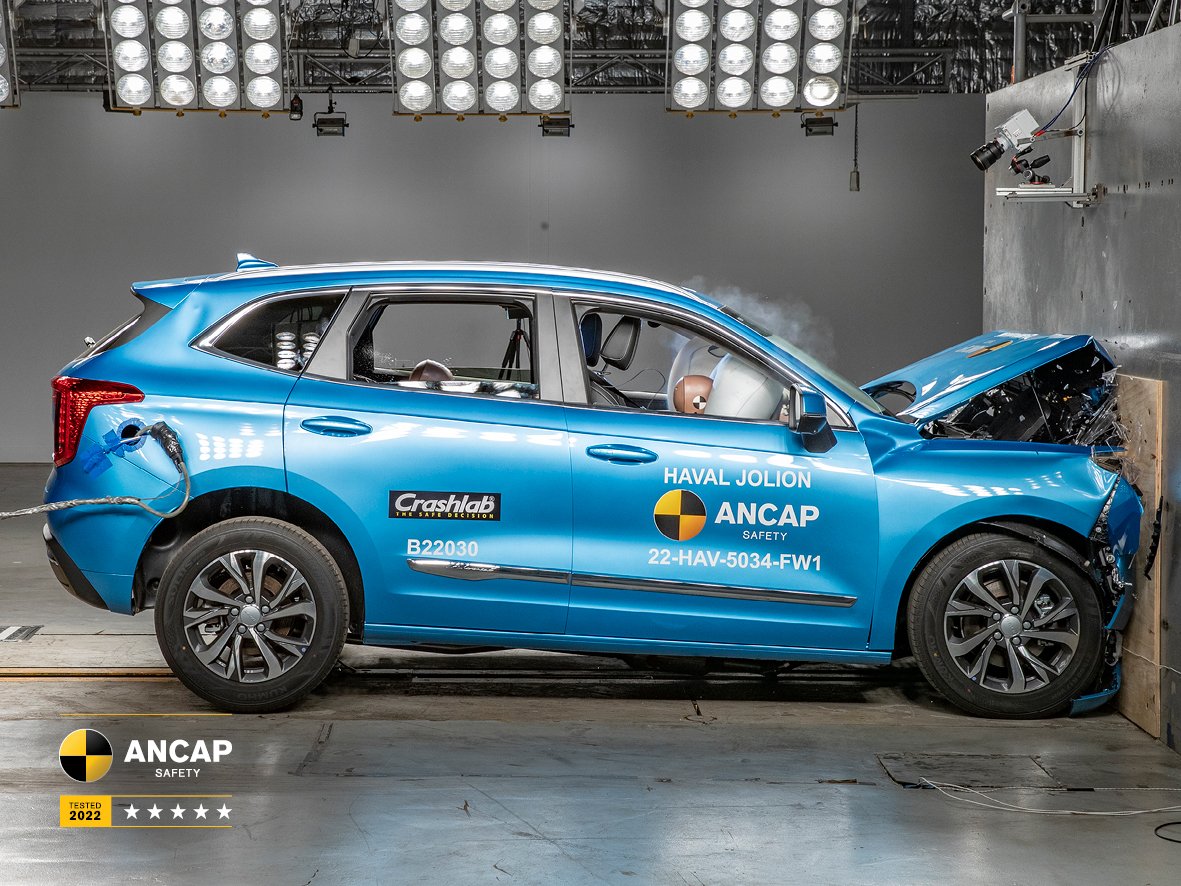
The Haval Jolion is the latest to score a full complement of five stars in ANCAP’s 2020-22 testing protocol, with a particularly strong commendation of its active safety systems.
ANCAP’s five-star rating applies to all Jolion variants including Premium, Lux, Ultra and the new Ultra Hybrid.
The Jolion small SUV features seven airbags including dual frontal, side chest, side curtain and centre airbags, helping it score 90 and 84 per cent in adult and child occupant protection respectively.
“The head of the six-year child dummy was assessed as Adequate in the frontal offset test, as was the chest of the 10-year child dummy,” the ANCAP report reads.
1
While the Jolion scored strongly overall, ANCAP did deduct points for a marginal result in chest protection in the driver front offset test, marginal in chest protection for rear passenger in frontal impact, and marginal for pelvis in the driver’s side impact test.
The Jolion was awarded a high 92 per cent score in safety systems, better than the recently evaluated Kia Niro (87 per cent) and Genesis GV60 (88 per cent).
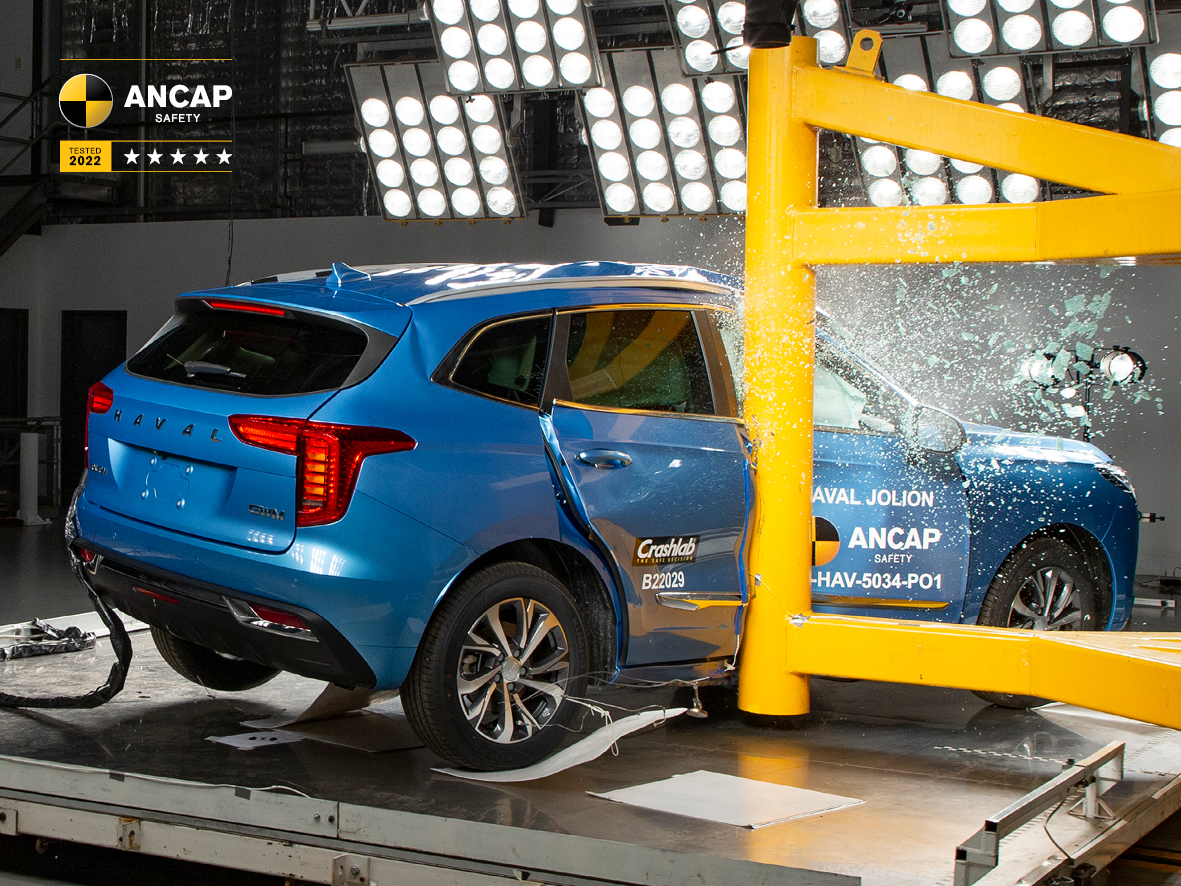
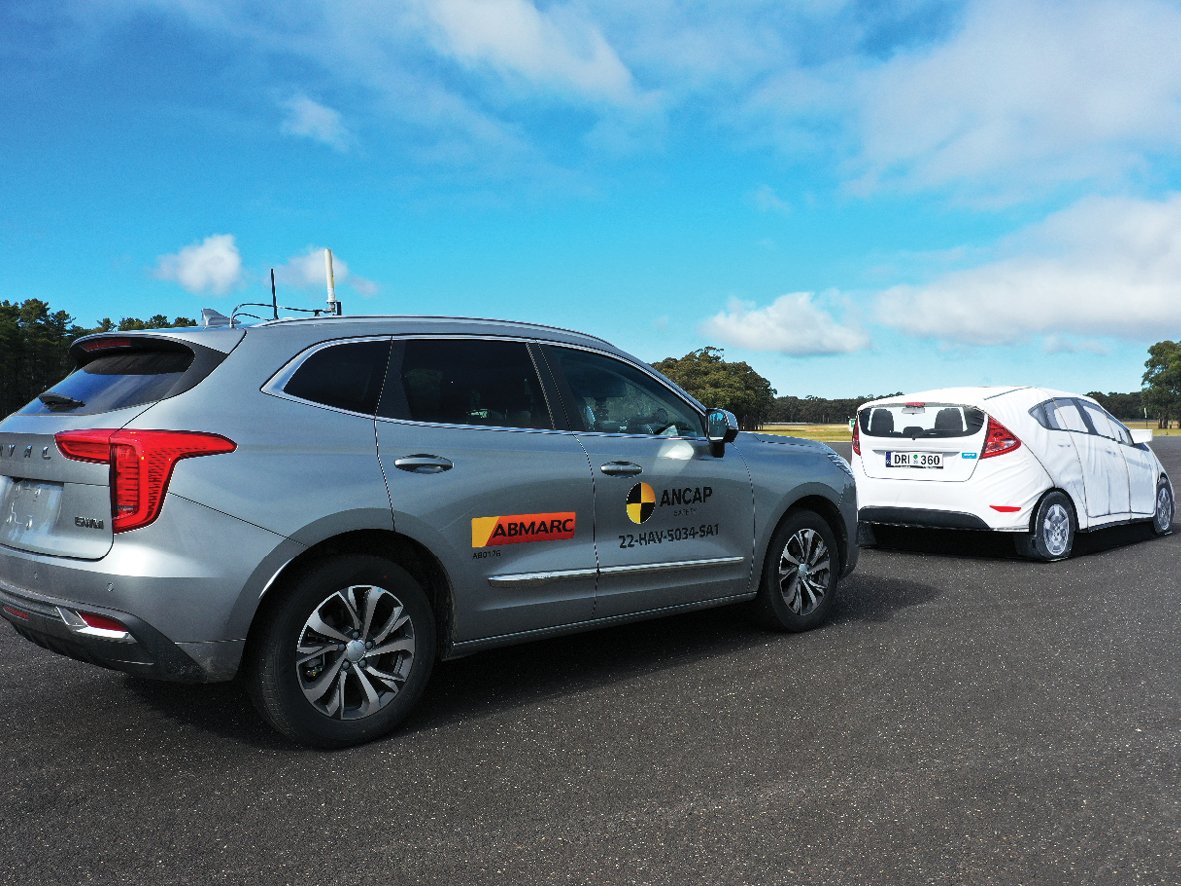
Every Jolion trim level is fitted with frontal AEB (autonomous emergency braking) with pedestrian, cyclist and cross-traffic detection, reversing AEB and lane-keep assist. Additional safety features, not crucial for a five-star rating, include blind-spot monitoring and adaptive cruise control.
1
Particular praise was given to that Jolion’s car-to-car AEB performance, both front on and in cross-traffic scenarios. The Jolion’s lane-keep assist system also rated well.
The Jolion’s vulnerable road user protection systems did not score as highly with ANCAP awarding 64 per cent, or ‘adequate’, in testing. This is as a result of weak frontal cyclist and pedestrian crossing detection, and marginal pedestrian detection when reversing.
The Haval Jolion launched in Australia in May 2021, making the Subaru XV and Kia Seltos rival a little late to receive its five-star rating.
1
Despite the delay, ANCAP Chief Executive Officer, Carla Hoorweg said the Jolion was an important model to test. “There has been a significant amount of interest in a rating for this model, and it has been shown to offer a high standard of safety.”
Like Ford Ranger and Ford Everest recently, ANCAP evaluated the Jolion locally. This differs from recent results for the Tesla Model Y and Genesis GV60 that were evaluated chiefly by Euro NCAP and had their scores translated into ANCAP’s now largely identical criteria.
MORE
Everything GWM
New data has highlighted that strong ‘fuel efficiency standards’ could save Australia up to $13.6 billion by 2035 – boosting EV supply, while cutting fuel bills for new petrol- and diesel-powered vehicles.
Snapshot
- Report predicts billions of fuel, environment, health savings with vehicle emissions mandate
- EV price parity by 2028, lower fuel bills for new petrol and diesel vehicle owners
- Landmark u2018fuel efficiency standardu2019 to be introduced late this year
Ahead of the federal government’s landmark ‘fuel efficiency standards’ policy due later this year, the report by research firm Mandala – commissioned by lobby groups Electric Vehicle Council and Climate Council – projected that full EVs will match the price of internal combustion engine vehicles by 2028.
It predicted the price of EVs will fall by an average of 2.8 per cent each year due to gradually decreasing battery costs, whereas the price of conventional petrol and diesel cars will rise by 1.4 per cent per year.
Electric price parity achieved?
While EVs are generally more expensive to buy than comparable combustion engine vehicles, some Chinese-made electric models have already achieved price parity, such as the BYD Dolphin, Atto 3, MG 4, and Tesla Model 3.
Why? Chinese-made EVs benefit from cheaper labour costs and a local supply chain of vehicle parts, including all-important battery packs. This has resulted in a lower sticker price for buyers than others.
1
However, it admitted the carbon emissions mandate will contribute to slightly higher prices for the latter, due to the need for automakers to fit costly technologies to reduce emissions, such as hybrid systems.
While it ultimately benefits buyers with decreased fuel consumption and running costs, some carmakers have already warned about discontinuing budget-friendly petrol cars amid forthcoming strict Euro 7 emissions mandates overseas.
Additionally, the report estimates that in 2027, a new EV owner could save nearly $10,000 in ownership expenses (i.e. fuel/charging and maintenance) after 10 years, while a new combustion engine vehicle owner would save up to $800 in the same period.
1
Australia can save billions in fuel, environmental, health expenses
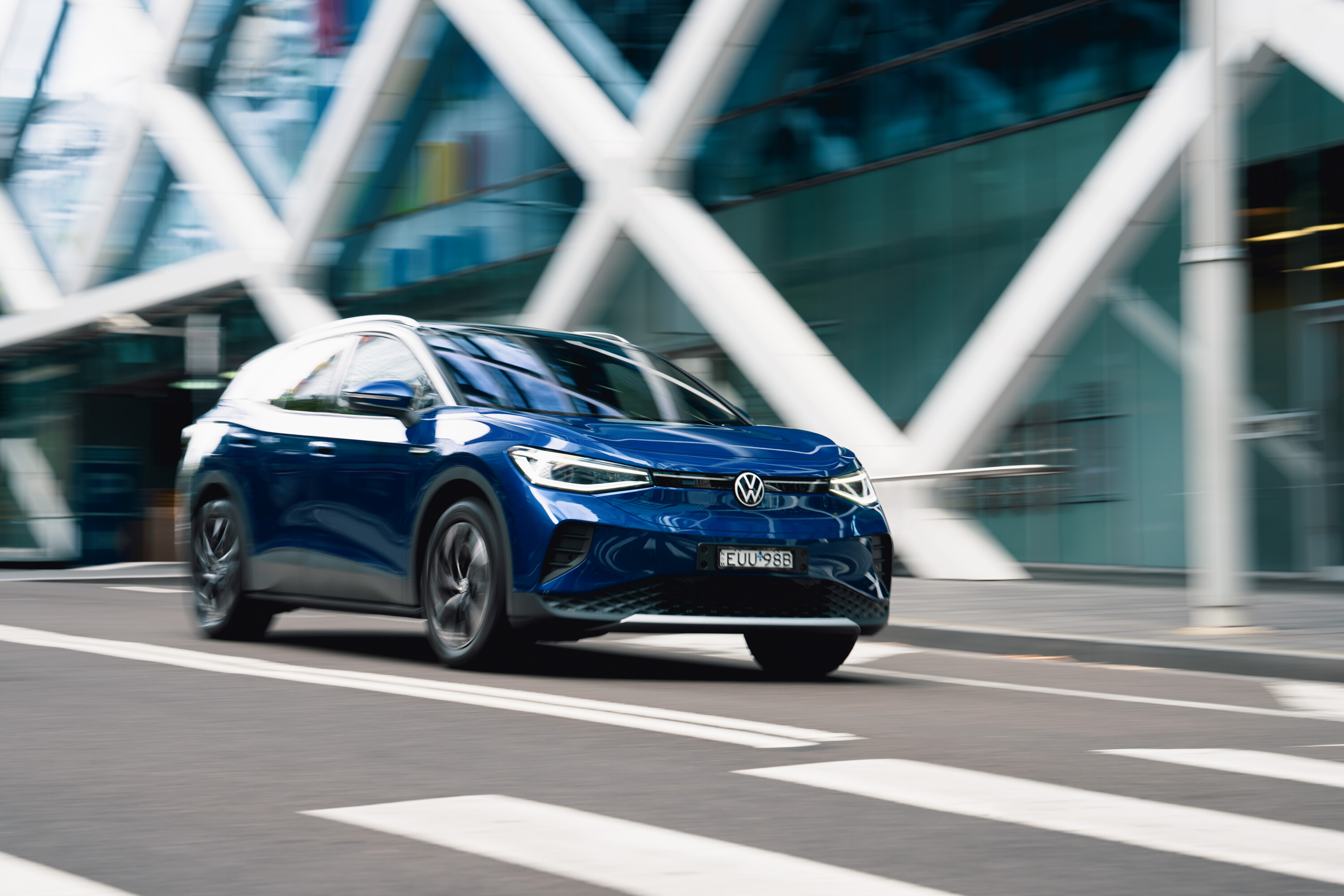
The report modelled data based on three scenarios, with all assuming 100 per cent new EV uptake in Australia by 2035.
At the time of publication, only the nation’s capital has committed to exclusively sell new EVs from 2035.
u2705 Globally competitive scenario
- Targets catch up to the United States by 2027 and European Union by 2030
- $13.6 billion net savings by 2035 u2013 $9.2 billion for consumersu2019 ownership costs and $4.4 billion for environmental and health costs
- 31 megatonnes of CO2 exhaust emissions avoided by 2035
- EVs need to account for 54% new sales by 2030, 100% by 2035 to meet targets
ud83dude0e Fast follower scenario
- Targets decrease consistently to catch up to the EU by 2030
- $10.3 billion net savings by 2035 u2013 $7.3 billion for consumers and $3 billion for environment and health
- 24 megatonnes of CO2 exhaust emissions avoided by 2035
- EVs need to account for 36% new sales by 2030, 100% by 2035 to meet targets
ud83dudc0c Slow follower scenario
- Matches the rate of target reduction to the US to 2032
- $8.9 billion net savings by 2035 u2013 $6.4 billion for consumers and $2.5 billion for environment and health
- 21 megatonnes of CO2 exhaust emissions avoided by 2035
- EVs need to account for 29% new sales by 2030, 100% by 2035 to meet targets

1
In context: Australia’s vehicle emissions
Currently, more than 85 per cent of vehicles sold globally are covered by a carbon emissions mandate – which aims to limit harmful locally-produced pollutants.
The report claims new combustion-engined passenger cars in Australia emit up to 1.5 times more carbon dioxide than those in Europe, whereas it’s 1.4 times more for light commercial vehicles.
1
The forthcoming Australian fuel efficiency standard will mandate a cap on the average carbon exhaust emissions of all vehicles a carmaker sells each year.
It will theoretically boost the supply of EVs to Australia and increase competition to drive down prices, while lowering the emissions footprint and fuel consumption of petrol- and diesel-engined vehicles.
But, the Climate Council has also urged for the policy to not have any loopholes or concessions, such as allowing high-emitting carmakers to purchase carbon credits – a strong revenue source for Tesla, one of the world’s largest EV makers.
MORE
Electric Cars
More EV stories to help you choose the best car for your needs
- ? EV news, reviews, advice & guides
- ❓ Short & sweet: Your EV questions answered
- ⚡ New EVs: Everything coming to Australia
- ? Australia’s EVs with the longest driving range
- ⚖️ Best-value EVs by driving range
- ? How much do EVs cost in Australia?
- ? How much more expensive are EVs?
- ⚖️ Number crunching: Is it time to switch to an EV?
- ♻ Should you buy a used EV?
- ?️ Are EVs more expensive to insure?
- ? Costs compared: Charging an EV vs fueling a car
- ? EV charging guide
- ? Are there enough EV chargers in Oz?
- ?? EV servicing explained
- ? EV battery types explained
- ? When do EV batteries need replacing?
- ? Hydrogen v EVs: What’s best for Oz?
- ? How sustainable are EVs, really?
MORE advice stories to help you with buying and owning a car
We’re bang up to date in the second issue of our 70th anniversary trilogy, taking a look at 2023’s state of the automotive art.
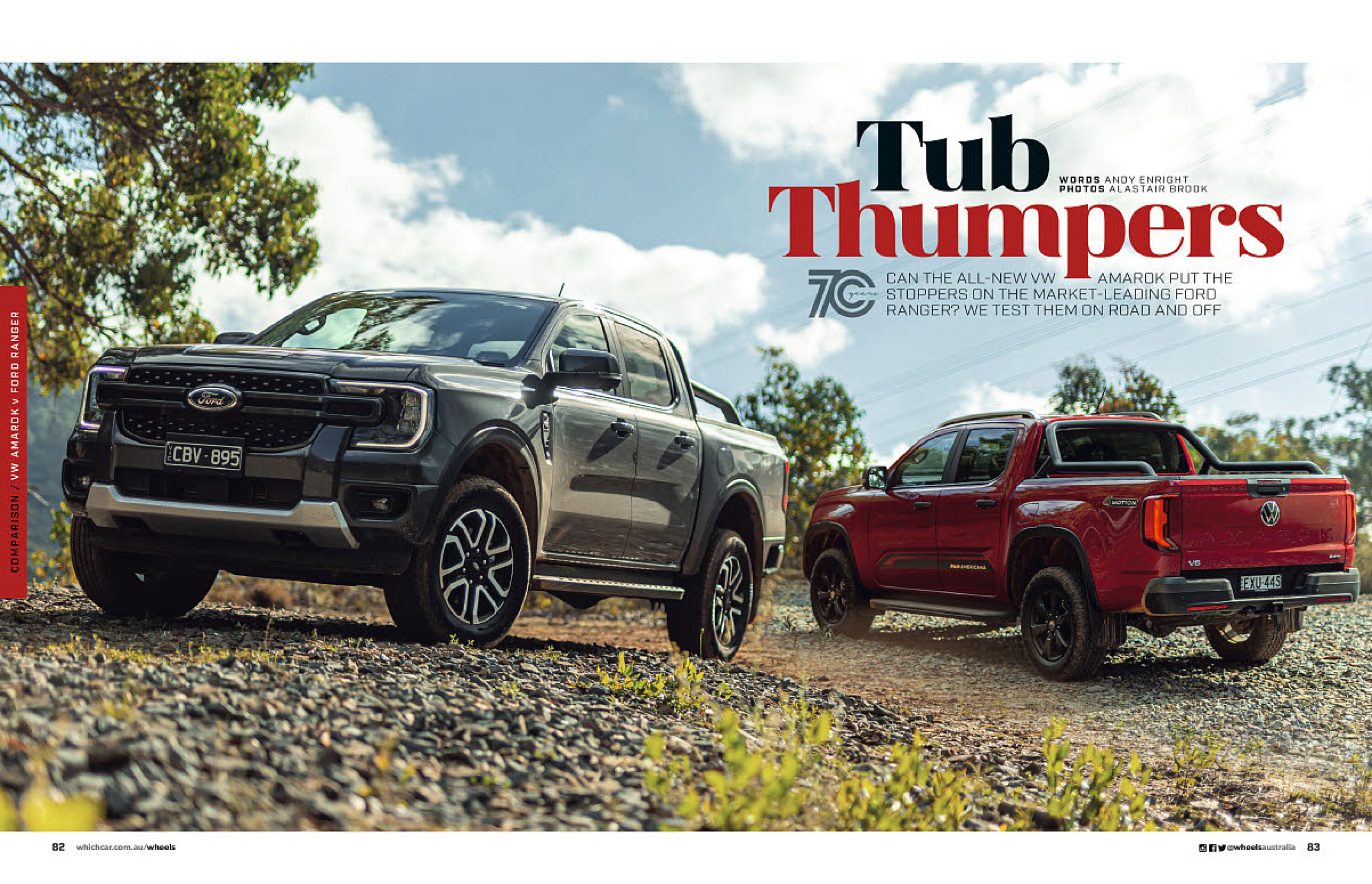
Built around four big comparisons that compare current class benchmarks to some feisty up-and-comers, we pit Ford Ranger against its German cousin, the Volkswagen Amarok.
1
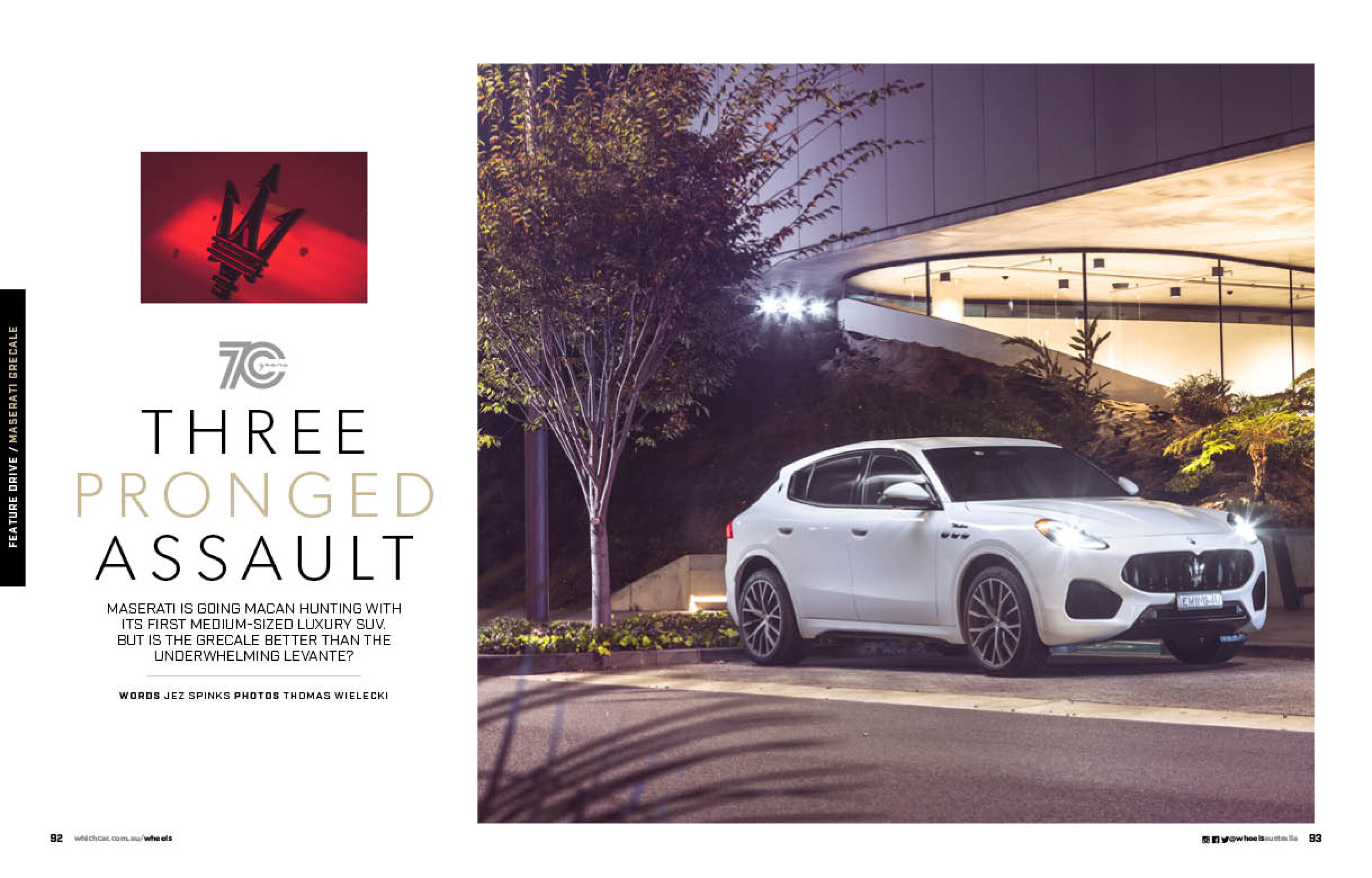
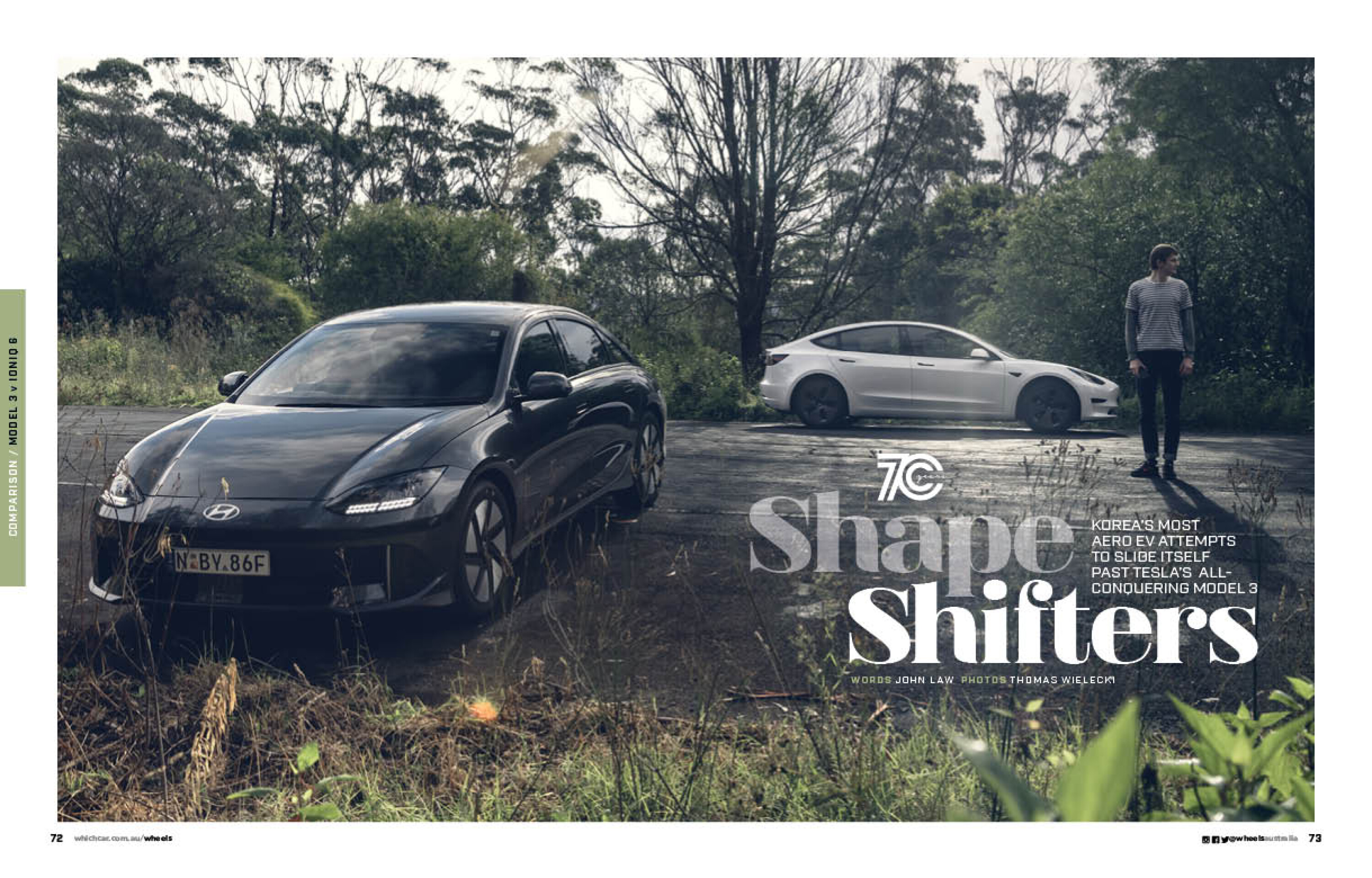
Porsche’s all-conquering Macan takes on the eagerly anticipated Maserati Grecale while Tesla’s massive-selling Model 3 has a quiet word with the Hyundai Ioniq 6.
1
1
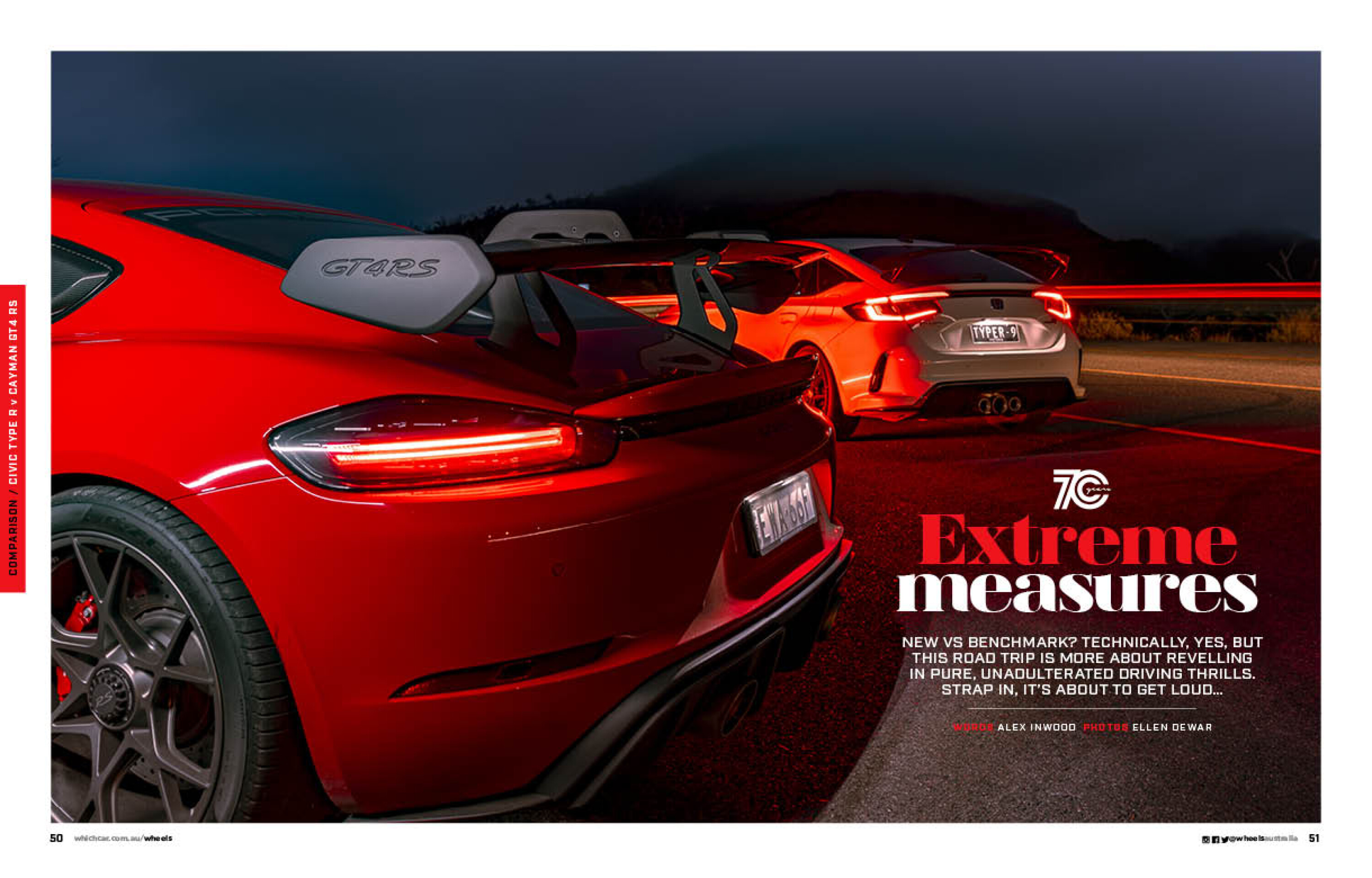
Porsche’s incredible Cayman GT4 RS might be one of the most exciting road cars at any price, but can you get 90 percent of the excitement at a quarter of the price in the new Honda Civic Type R? Alex Inwood heads for the high country to find out.
1
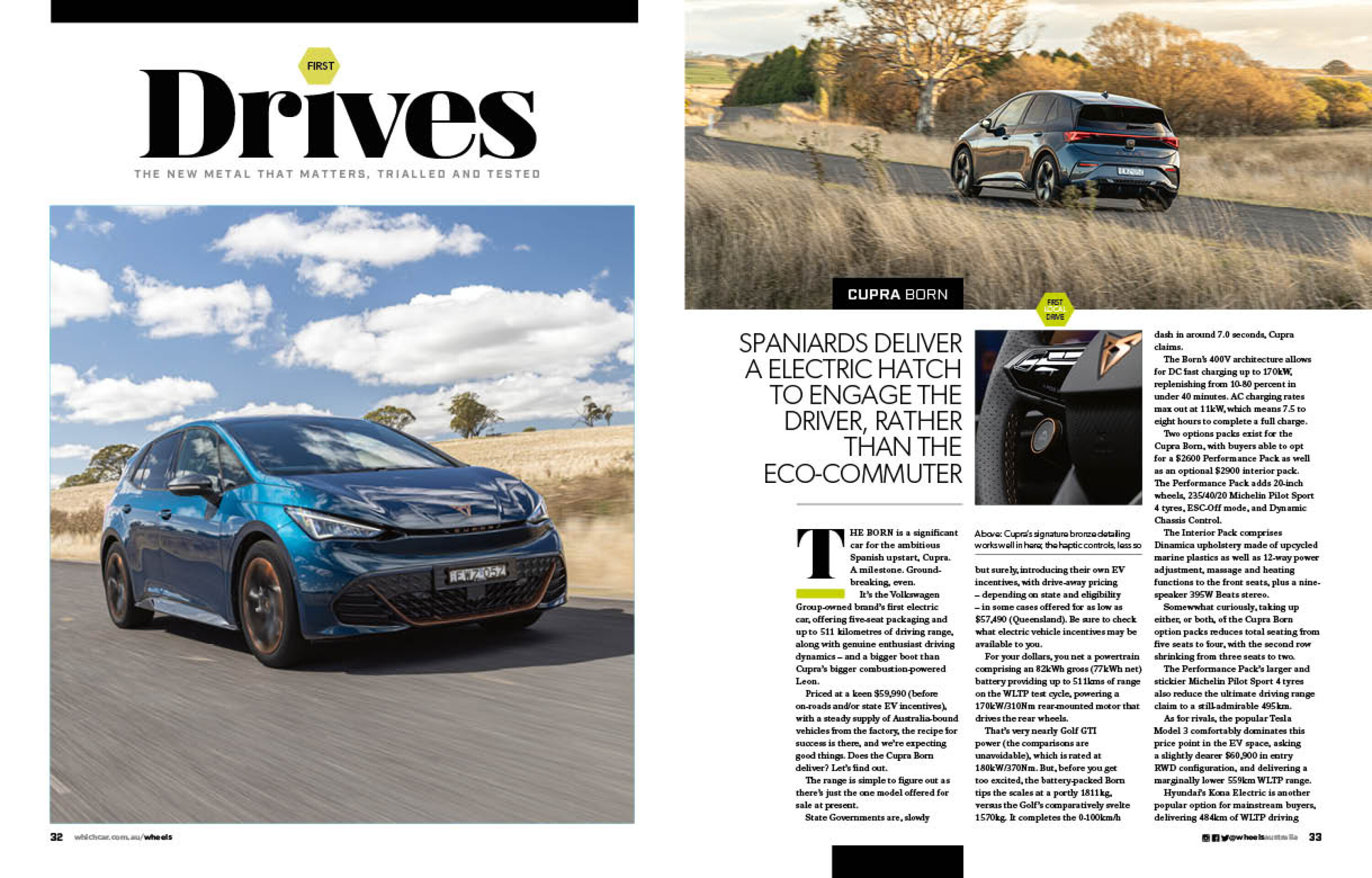
Andy Enright gets his hands on the incredible Ferrari 296 GTB and considers the role of the supercar in today’s automotive landscape, and we also get behind the wheel of the long awaited Cupra Born, the Volvo C40 Recharge, the Lexus RZ450e and the Mitsubishi Triton Xtreme.

1
1
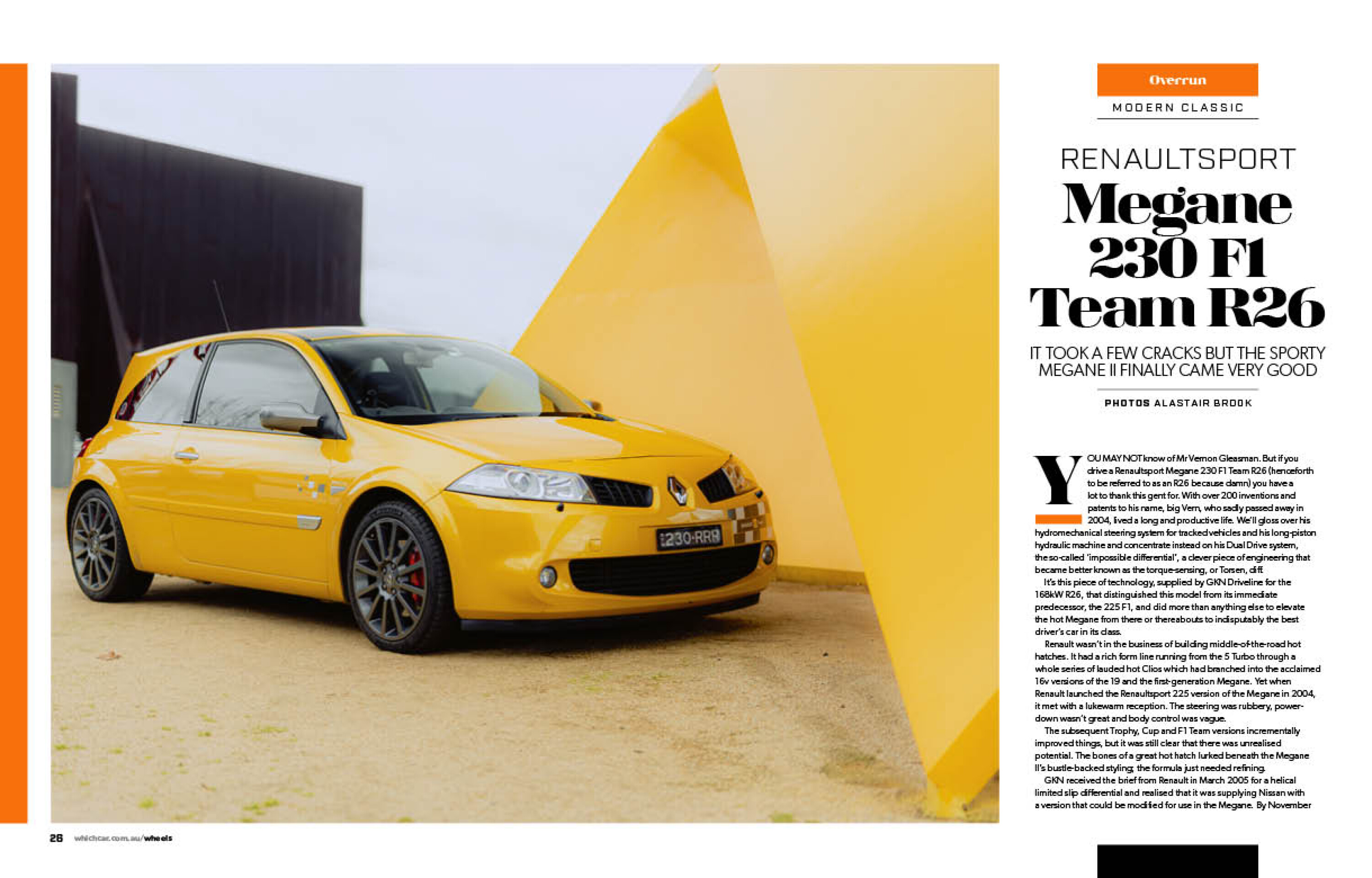
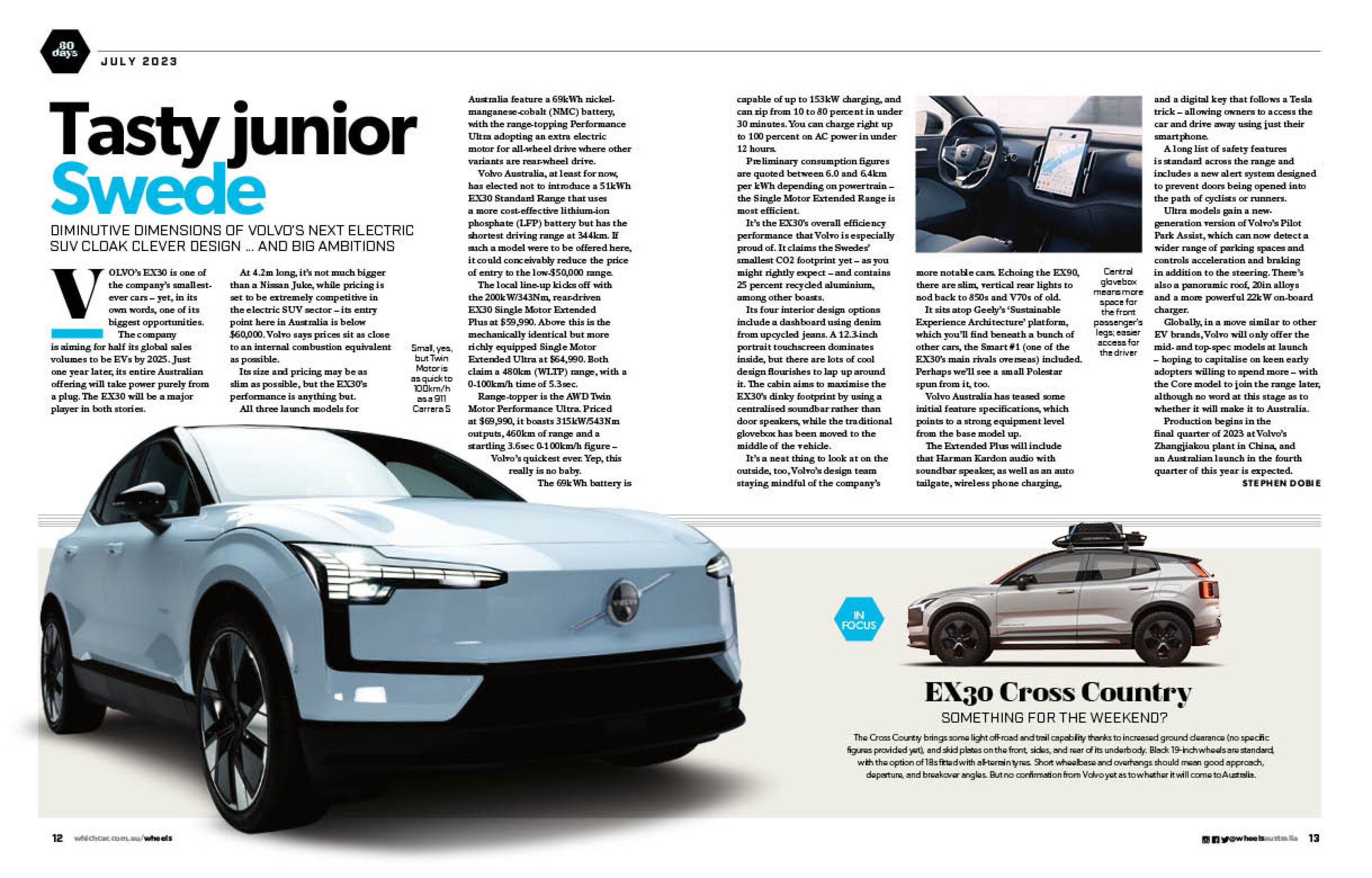
Renaultsport’s punchy Megane R26 is our Modern Classic for this month and we also take a look at the surprisingly affordable new baby Volvo EV, the EX30.
Meanwhile, we wave goodbye to right-hand drive Tesla Model S while the Aston Martin DB6 Vantage gets the Retro treatment.
1
In addition to that, there’s the monthly news wrap, Databank, readers’ letters and editor Enright’s driving antics get laughed at by Henry Kissinger. Yes, this happened.
Don’t miss out on the July issue, on shelves now.
1
Not yet a subscriber?
You can subscribe to Wheels magazine from only $59 and we’ll send you a copy of the current issue straight away.
Subscriber benefits
- Huge savings on the regular cover price
- Free delivery to your doorstep
- Free digital access
- Browse the entire Wheels archive back to 1953
- Exclusive benefits and discounts
The Australian car market continues to improve in 2023, with the best June result since 2018 posted last month.
According to official new-car sales results published by the Federal Chamber of Automobile Industries (FCAI), 124,926 vehicles were registered in June – up 25% from last June, when 99,974 cars were sold.
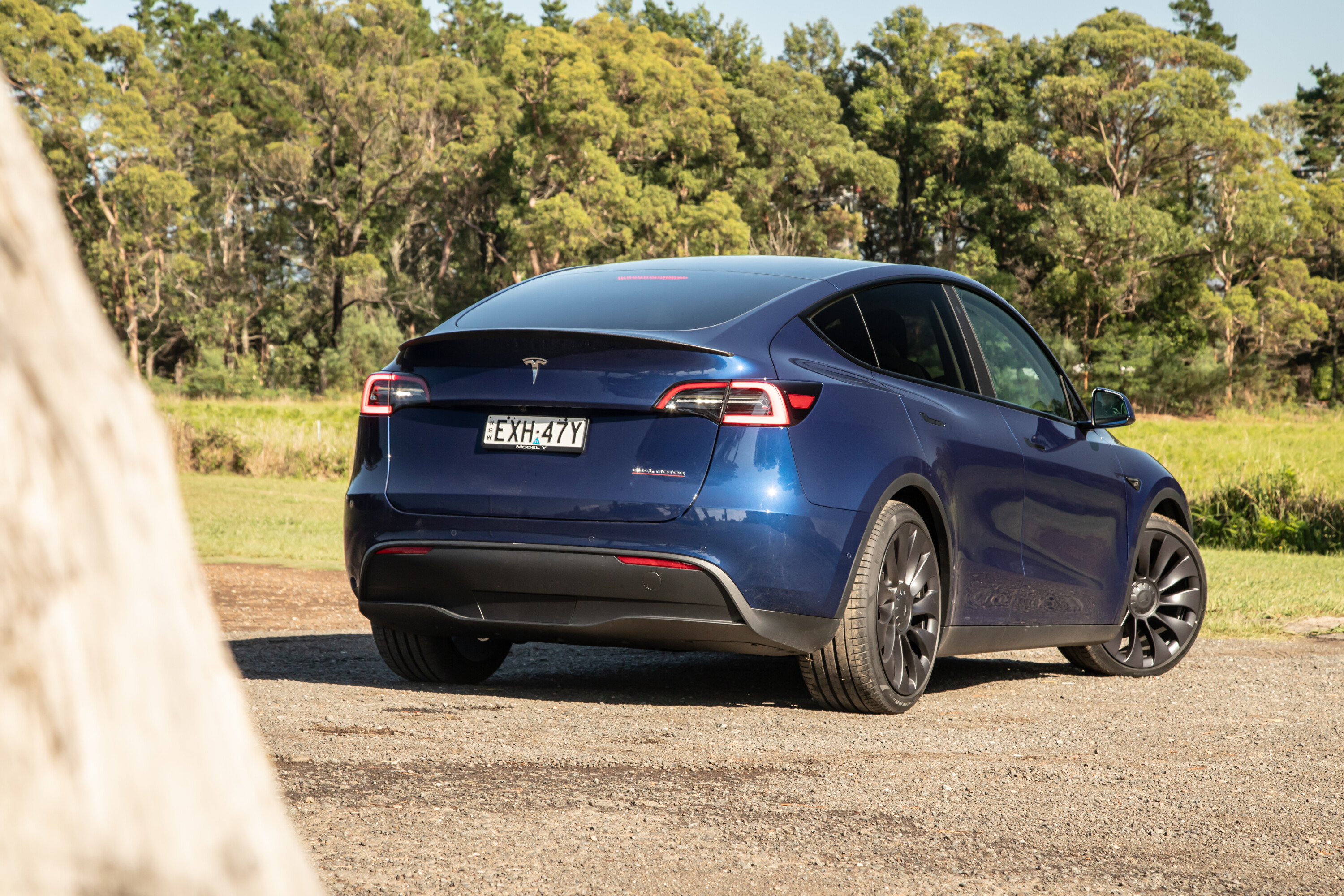
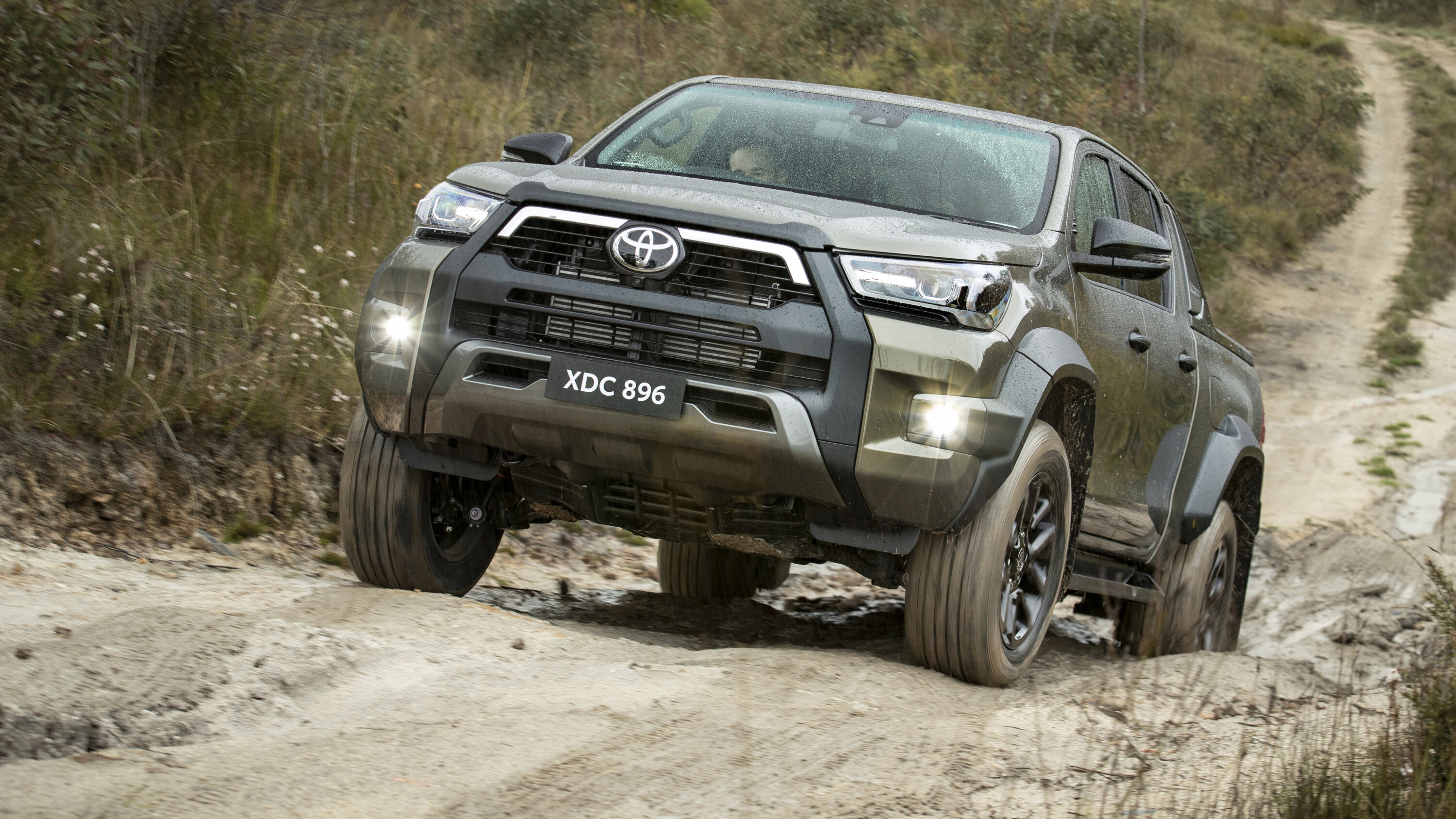
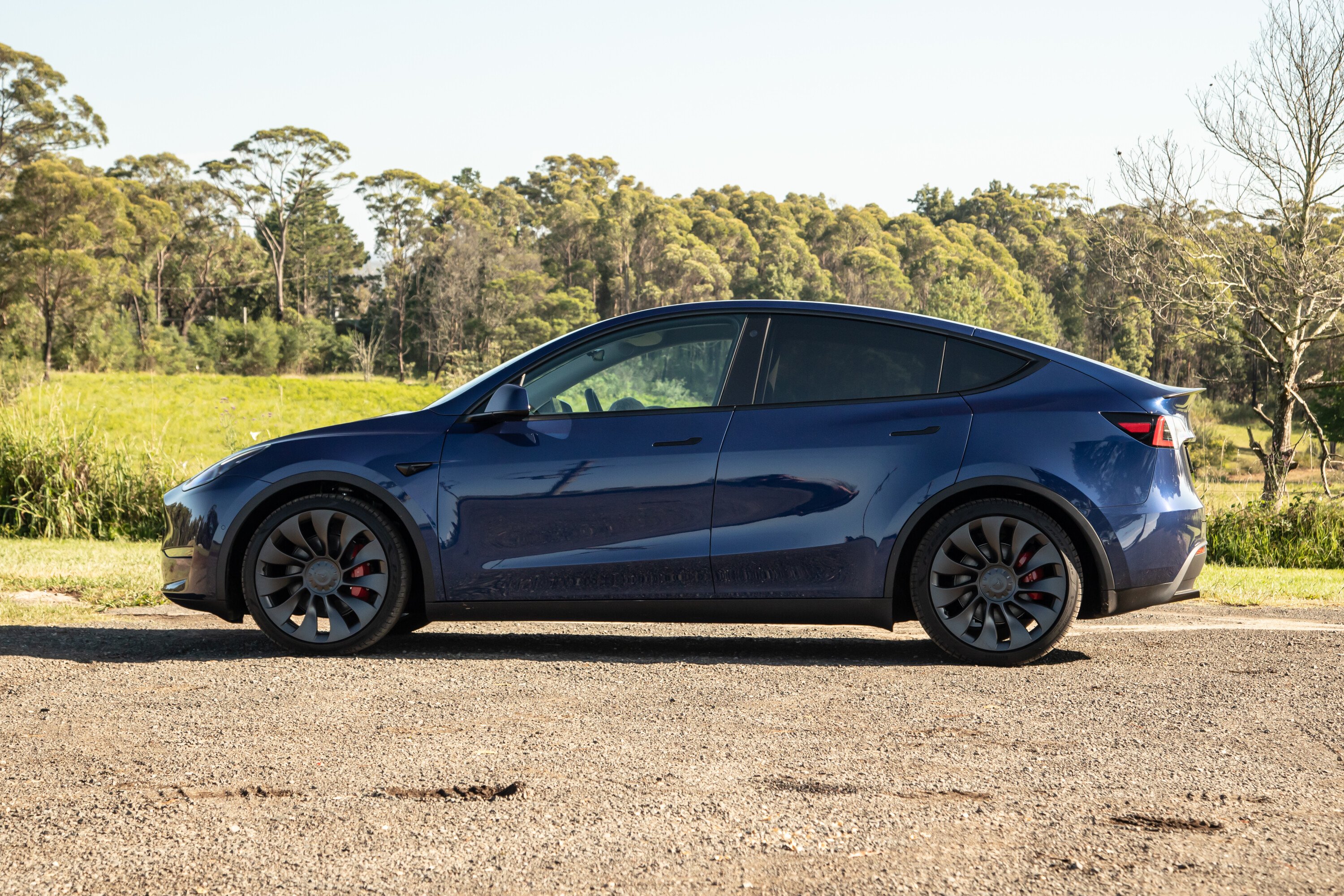
As electric vehicle sales continue to grow, the Tesla Model Y overtook the popular Ford Ranger ute to become the nation’s second-highest car overall – but the Toyota HiLux held strong at the top of the podium.
While Toyota is still number one in Australia, it remains hindered by delivery delays for some of its most popular vehicles – although it continues to recover after a slower-than-usual start to 2023.
In June, Toyota sold 20,948 vehicles – down 7.1% – while electric car brand Tesla rose to sixth place, beating MG, Mitsubishi, Volkswagen, Subaru and more. Year-to-date, it remains in ninth place with further growth likely.
1
Where is the sales growth coming from?
New South Wales registered the most vehicles with 37,020 sales, ahead of Victoria and Queensland with 33,966 and 28,029 sales, respectively.
Western Australia (13,073), South Australia (7974), Tasmania (1923), the ACT (1856), and the Northern Territory (1085) followed.
The Federal Chamber of Automotive Industries said continued sales growth was encouraging as the automotive industry continues to battle production and shipping difficulties.
It also praised rising electrified vehicle sales (all-electric, hybrid and plug-in hybrid), which accounted for 16.6% of sales in June.
“The end of the financial year has traditionally been a strong month for vehicle sales,” said FCAI chief executive Tony Weber.
“Indications from our members are that demand for new vehicles remains solid, but the supply is not yet at a point to meet this demand. To put it simply, if we could have landed more vehicles, this would have been a record June result.”
1
JUMP AHEAD
- Top 10 models
- Top 10 brands
- Sales by segment
- Sales by fuel type
- Sales by country of origin
- Sales in charts
1
? Australia’s top 10 cars for June 2023
The first-place battle between the Toyota HiLux and Ford Ranger was broken in June by a new contender: the all-electric Tesla Model Y.
In first place, the HiLux pulled away from the Ranger with 6142 sales – down from its June 2022 record of 7582, but one of its strongest results to date as the financial year closed.
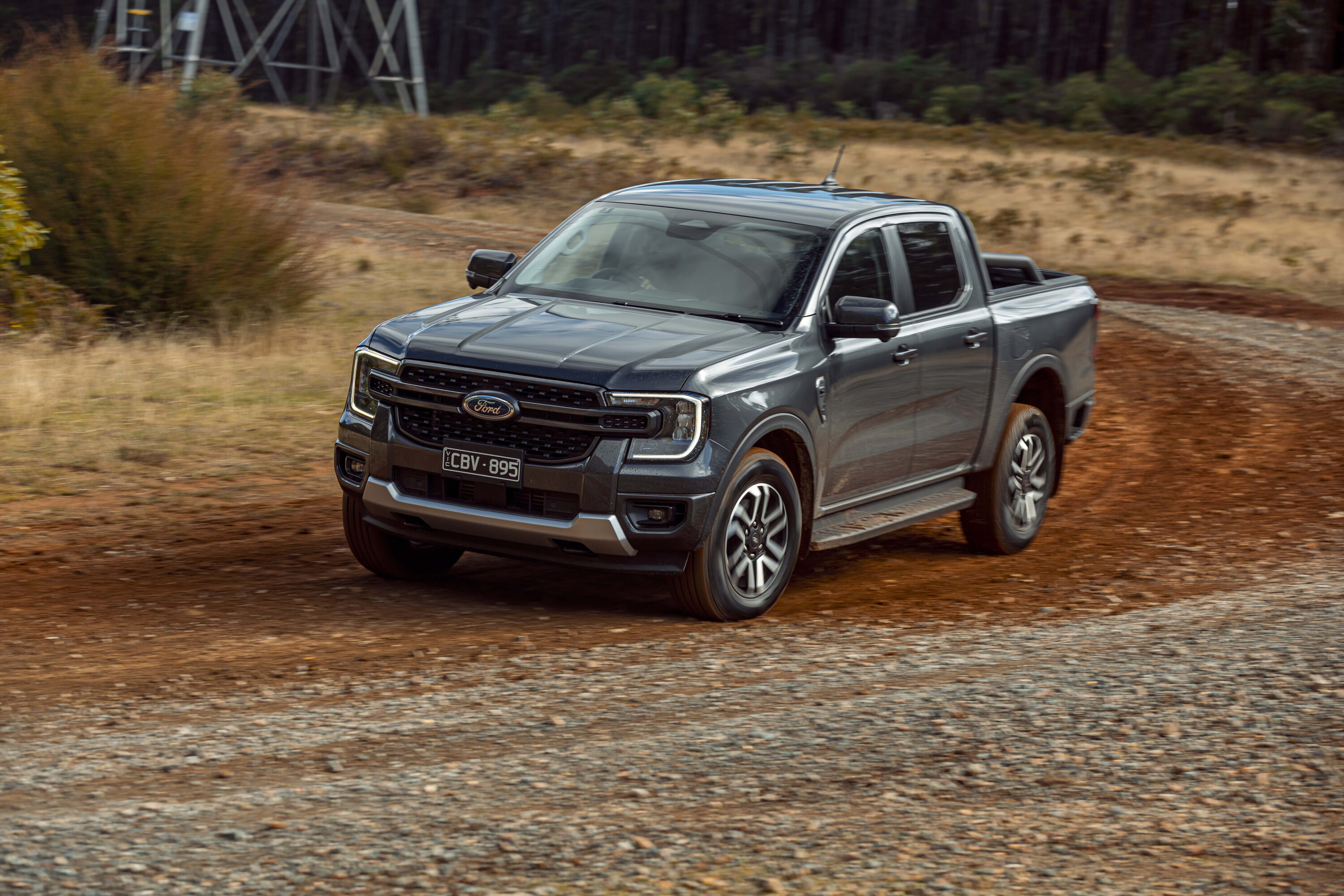
The Model Y took silver with a record 5560 sales – pushing its year-to-date results to more than 14,000 – while the Ranger followed in third place (5334).
Of note, the Ford Ranger is up 90% compared to last June, but this is due to a lack of stock this time last year as Ford prepared for the current model to launch in July. The Ranger is up 35% year-to-date.
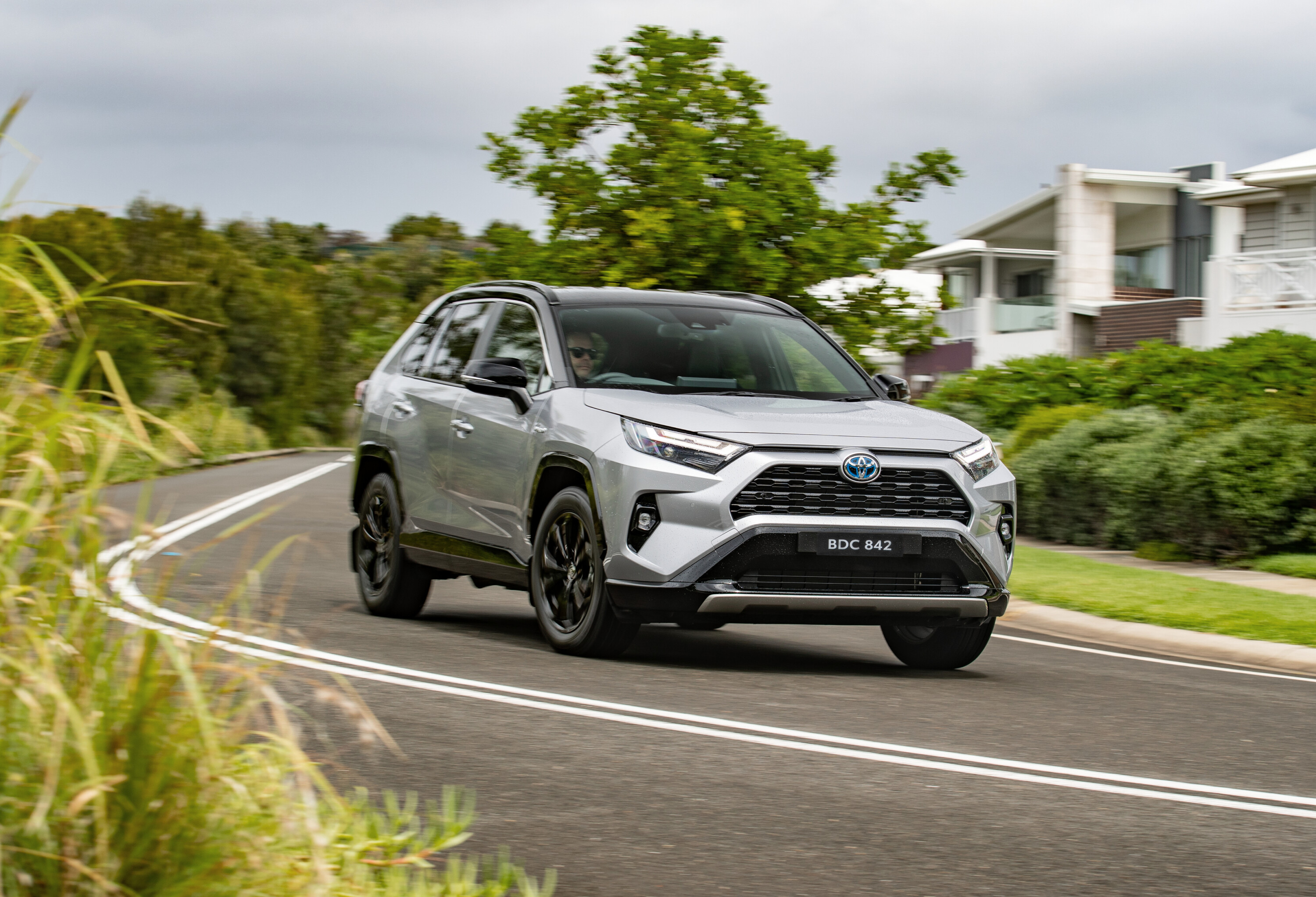
As strong global demand continues to limit the Toyota RAV4’s potential (2858), it was outsold by China’s MG ZS small SUV (3756), with the Hyundai Tucson closely behind (2667).
1
The Mazda BT-50 was the nation’s seventh best-seller (2560), followed by the Hyundai i30 (2523), the only passenger vehicle in the top 10 in June and year-to-date.
In ninth and 10th place were the Isuzu D-Max (2500) and Mitsubishi Triton (2259), as ute sales hold strong – but midsize SUVs remain Australia’s top-selling vehicle segment.
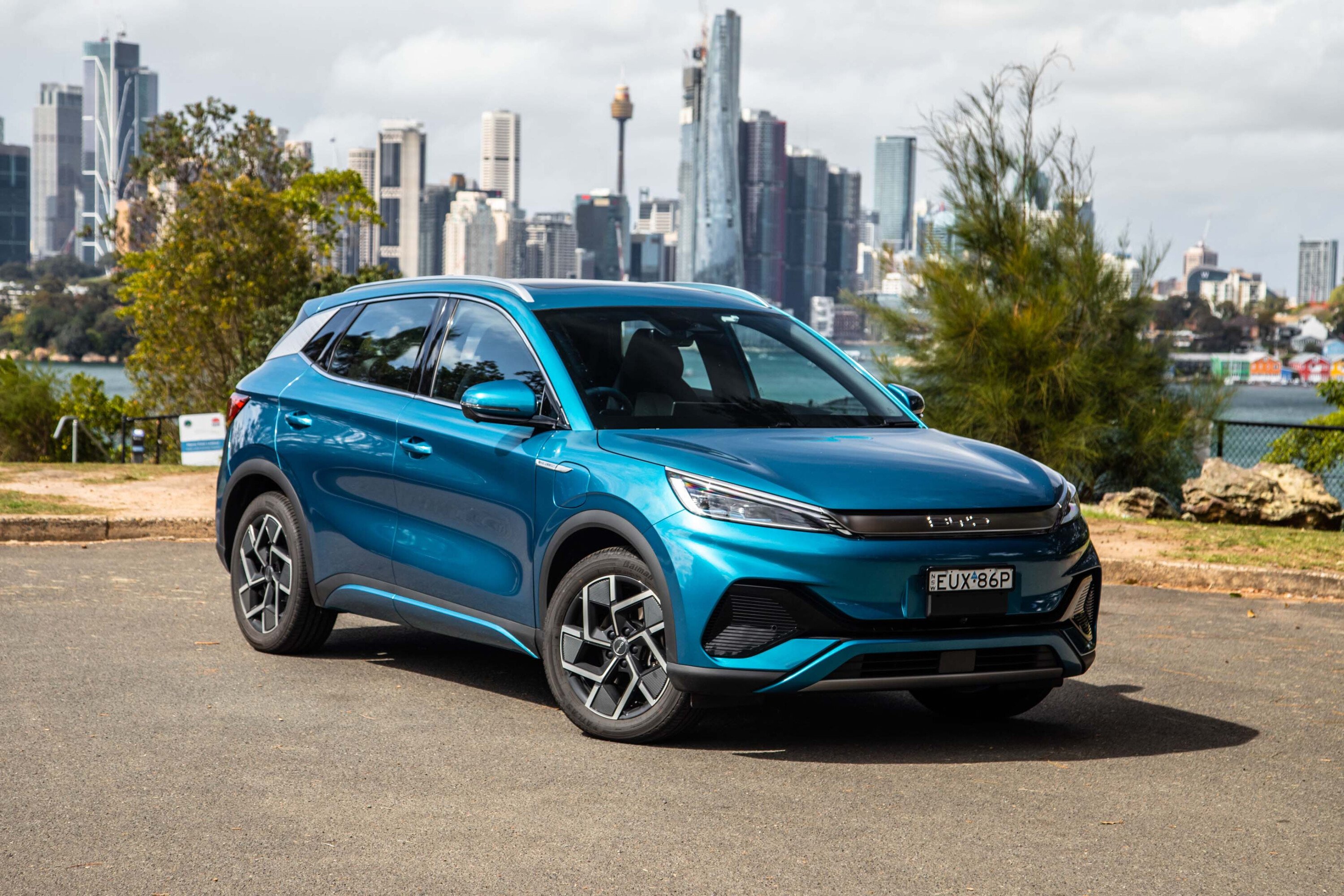
Traditionally strong vehicles missing from the top 10 include the Mazda CX-5 (1812) and Mitsubishi Outlander (1624), while the electric BYD Atto 3 (1532) eclipsed the Tesla Model 3 sedan (1458).
1
1
? Australia’s top 10 car brands for June 2023
Ups and downs ? ?
Toyota recorded a solid month with 20,948 sales (▼ from 22,561 in June 2023). The Japanese brand’s year-to-date sales are down 24% at 92,235, representing 15.9% of the market.
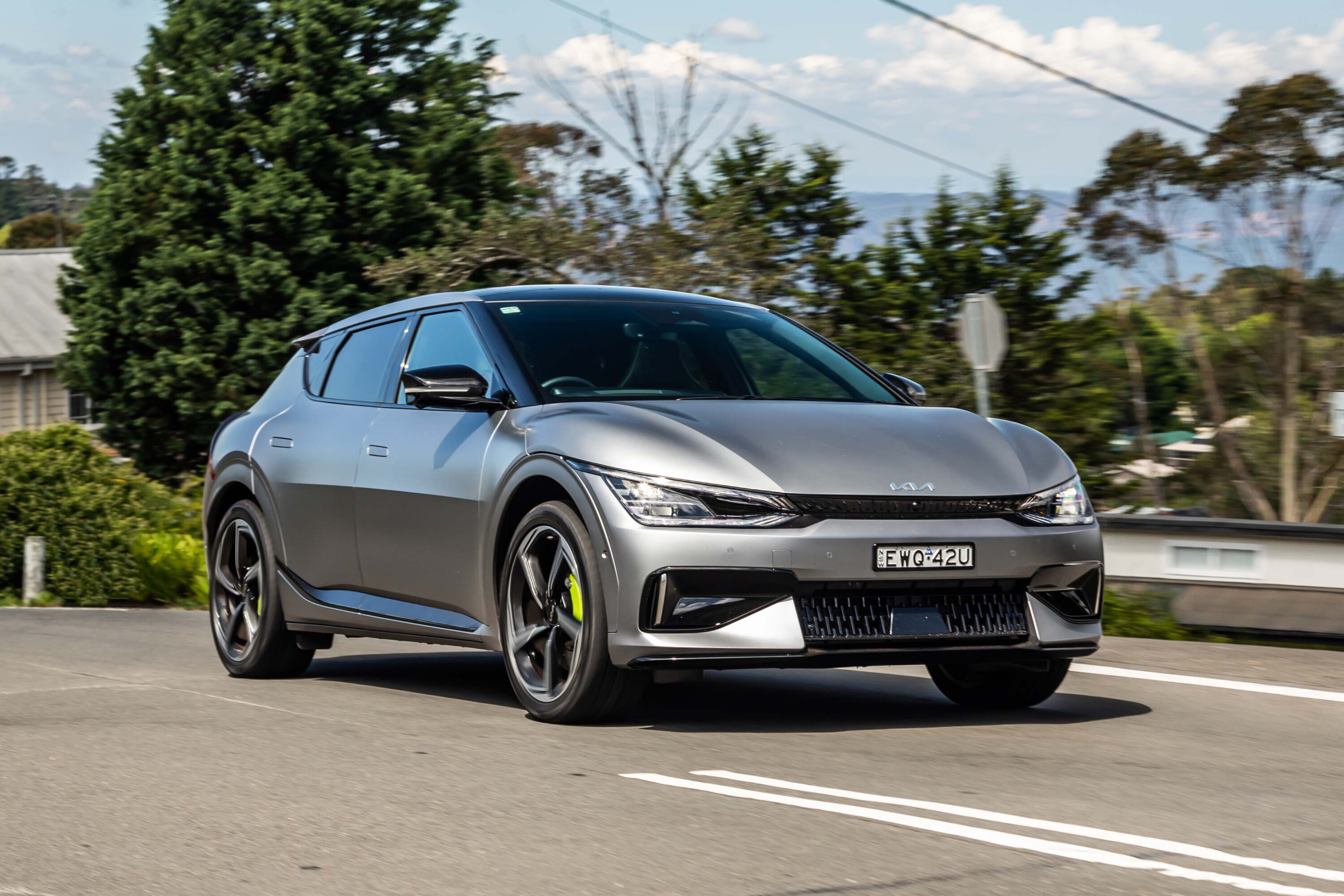
Mazda finished second with 9706 sales (▲ from 6245), while Hyundai beat Ford with 8215 sales (▼ from 8259).
Ford, in fourth, recorded 7753 sales in June (▲ from 4972, in the midst of a Ranger changeover), while Kia took fifth with 7551 sales (▼ from 8480).
Year-to-date, Kia remains ahead of its Hyundai parent, with 39,160 sales – though Hyundai is nipping at its heels at 37,707 to the end of June.
1
Electric car brand Tesla posted a record result, with 7018 sales (▲ from just 172) from skyrocketing demand for the Model Y and Model 3.
Chinese marque MG followed in seventh with 6016 sales (▲ from 4403), thanks to the ZS and MG 3.
Mitsubishi slipped to eighth with 5187 sales (▼ from 5846), Volkswagen ranked ninth with 5125 sales (▲ from 2993) with T-Roc, Tiguan and Amarok supply, and Subaru finished off the top 10 with 4920 sales (▲ from 3575) with its Forester and new Crosstrek in the top 20 models.
Nissan, one of Australia’s well-known brands, faced a horror June, with 2759 sales (still ▲ from 1907 in June 2022), leaving it in 16th place behind Great Wall-Haval (GWM), Isuzu Ute, BMW, Mercedes-Benz and LDV.
1
1
1
Size & Shape: Market segment results for June
SUVs, utes and vans represented 78% of the total new-car market in June.
There were 69,059 SUVs sold from light to upper large, taking 55% of the total, followed by utes and vans with 28,833 sales in June, or 23%.
Of those, midsize SUVs continue to dominate with 28,260 sales, followed by small and large SUVs with 17,697 and 15,339 sales, respectively.
Passenger car sales continued to decline, with 20,397 sales in June – with a 16.3% share, down 2.1% from June 2022.
Small cars represented 6.1% of the total market, while growth in the medium segment to 3.7% – up 1.3% – can be attributed to the Tesla Model 3 electric sedan, as internal-combustion medium car sales continue to decline.
1
1
June 2023: New-car sales by fuel type
Petrol remained the default choice for Australian new-car buyers, with a 17% bump over last June to 59,995 sales.
Diesel was second best – up 6% with 37,497 sales – while electric vehicle sales continue to rise with 11,042 sales, up a significant 871% compared to last June and 345% year-to-date.
Electric vehicles outsold traditional hybrid (9020) and plug-in hybrid vehicles (735), and no new hydrogen vehicles were registered in June or year-to-date.
1
1
Country of Origin: Where Australia’s new cars came from in June 2023
Japan remains Australia’s number one source of new cars followed by Thailand, while Chinese cars continue to outsell Korea in third place.
Australian new-car buyers drove away in 30,112 Japanese cars in June, up from 25,909 at the same time in 2022.
Thailand – where most utes and ladder-frame SUVs are produced – followed with 25,063 cars (▲ from 22,707).
China remains in third spot ahead of Korea (23,233 compared to 17,227), as Australians look to more-affordable options and electric vehicles solely built in China including Tesla, BYD, Polestar, MG, and the BMW iX3.
Germany trailed in fifth with 6226 registrations last month, followed by undefined countries (5234) and the United States (4784).
1
In charts ?
June 2023 – Top 20 models
June 2023 – Top 10 brands
June 2023 – Overall segment sales
June 2023 – Category sales
June 2023 – sales map
June 2023 – buyer type
June 2023 – Model sales race
MORE
All VFACTS stories
The curvy new GWM Ora electric hatch has had its prices slashed just weeks after the MG 4 and BYD Dolphin barged in as Australia’s most affordable EVs.
Snapshot
- GWM Ora EV pricing now below $40k!
- New drive-away pricing also revealed
- New GWM Ora Ultra grade joins the line-up
- Free charging station thrown in from July
The GWM Ora hatch, now priced from $39,990 before on-road costs – a reduction of $4000 – becomes a much more compelling rival to the $38,990 MG 4 and the $39,890 BYD Dolphin.
GWM credits the price cuts – announced just two months since Australian pricing was first revealed – to improvements in the cost of battery technology, and “other factors”.
Those ‘other factors’ are likely to be related to MG initially confirming a $47,990 starting price for the MG 4 in April before cleverly slashing more than $8000 off the price by mid June. The Dolphin’s pricing announcement a few days after the MG 4 will surely have left GWM with little choice but to conveniently discover some savings in its battery supply.
Wheels has asked GWM’s local office for details on how many Ora EVs had been ordered before today’s new pricing, and whether those customers will be offered these new lower prices. We’ll update this story when we can.
The GWM Ora’s new Australian pricing is detailed below. For the full equipment and specifications rundown, which is otherwise unchanged, see our initial pricing & features story published in June.
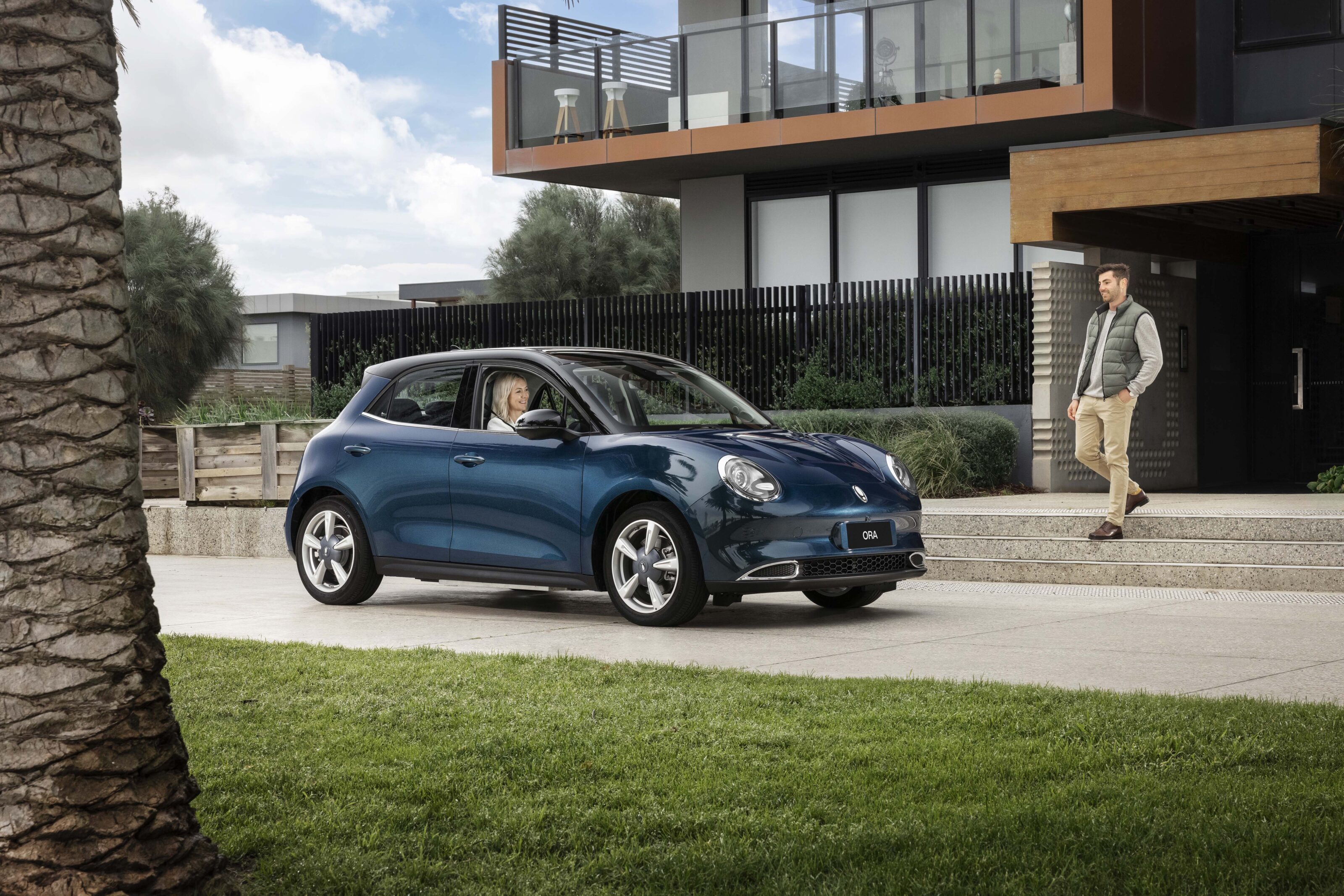
1
2023 GWM Ora EV pricing for Australia
The Ora’s revised pricing comes with some key changes to the line-up, with the introduction of a new $48,990 Ultra grade positioned between the repriced $45,990 Extended Range and the repriced $51,990 GT.
Details on that model can be found further down, but specifications for the wider Ora range are otherwise unchanged.
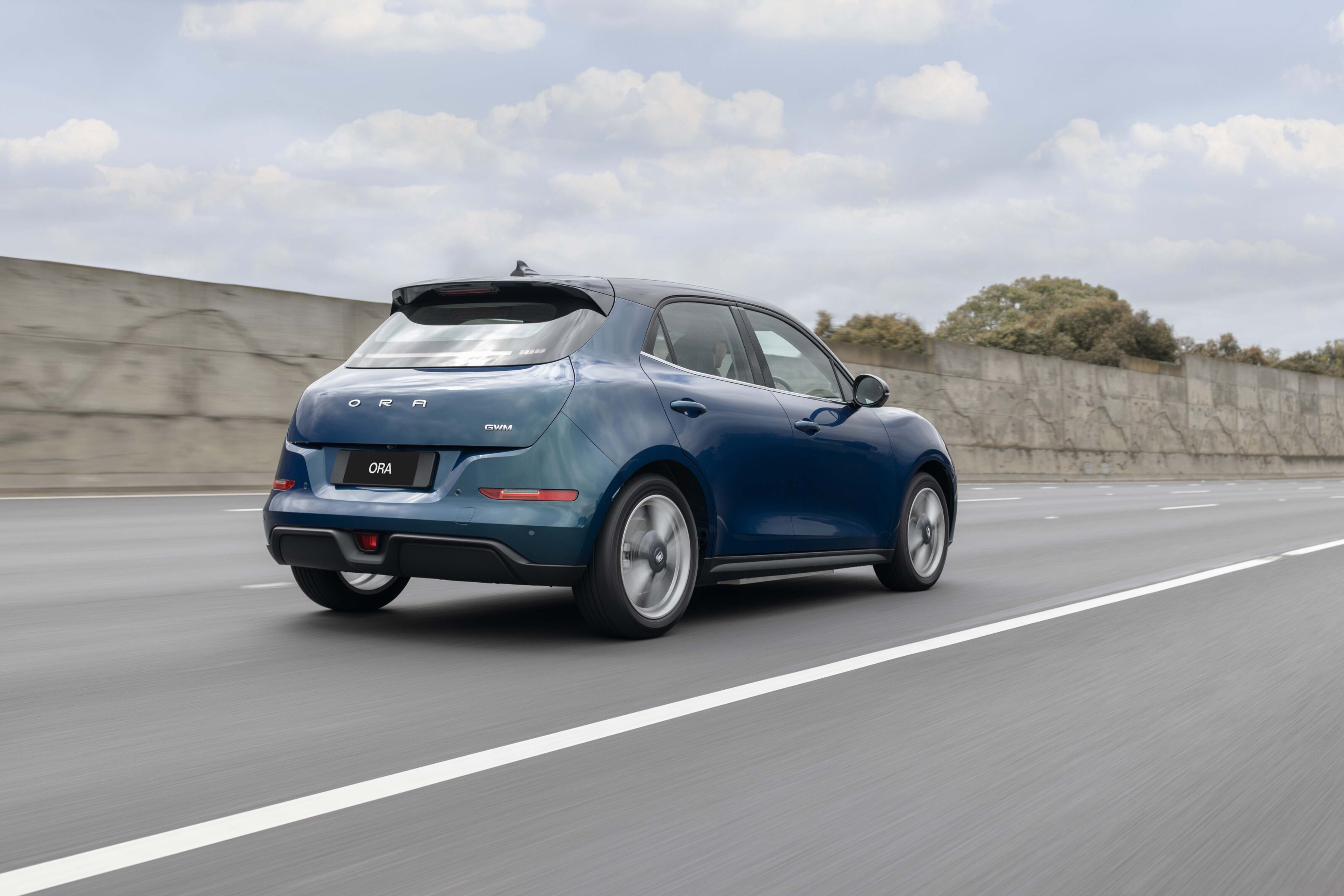
1
GWM Ora Standard Range: Now $39,990 before on-road costs
Previously $43,990.
| GWM Ora Standard Range: Drive-away Pricing | |
|---|---|
| NSW | $41,045 |
| ACT | $40,606 |
| QLD | $41,550 |
| SA | $42,230 |
| TAS | $40,627 |
| WA | $42,927 |
| VIC | $42,566 |
| NT | $40,656 |
GWM Ora Extended Range: Now $45,990 before on-road costs
Previously $47,990.
| GWM Ora Extended Range: Drive-away Pricing | |
|---|---|
| NSW | $47,045 |
| ACT | $46,606 |
| QLD | $47,670 |
| SA | $48,470 |
| TAS | $46,627 |
| WA | $49,641 |
| VIC | $48,818 |
| NT | $46,656 |
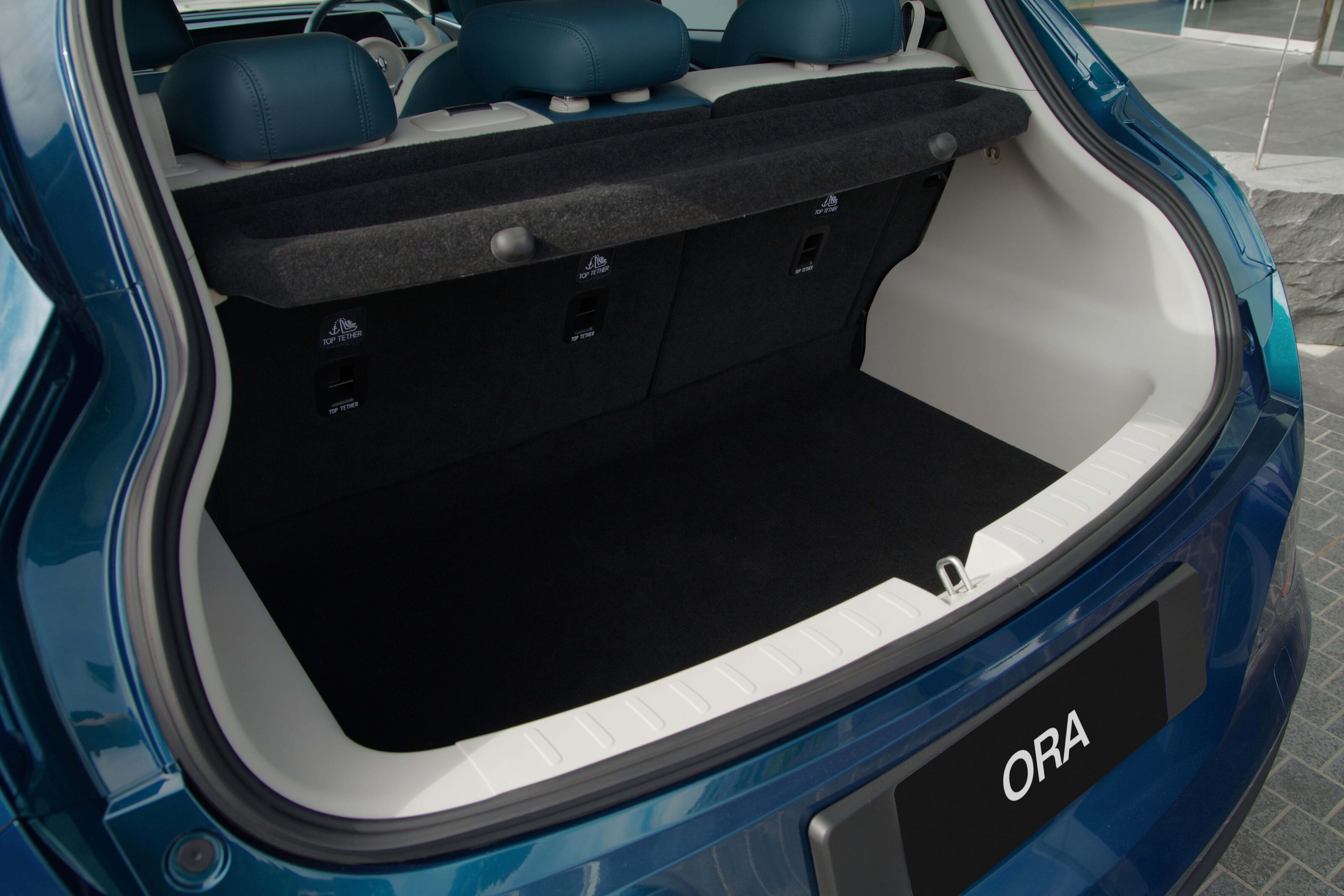
1
GWM Ora Ultra: $48,990 before on-road costs
Arriving as a new grade in the range, the Ultra builds on the Extended Range equipment list with the following items.
- Electric hands-free tailgate
- Panoramic sunroof
- Heated steering wheel
- 6-way electric driver’s seat with memory
- Front seats with heating, ventilation and massage functions
- Power adjustable, electric auto-folding mirrors with memory function
| GWM Ora Ultra: Drive-away Pricing | |
|---|---|
| NSW | $50,045 |
| ACT | $49,606 |
| QLD | $50,730 |
| SA | $51,590 |
| TAS | $49,627 |
| WA | $53,039 |
| VIC | $51,944 |
| NT | $49,656 |
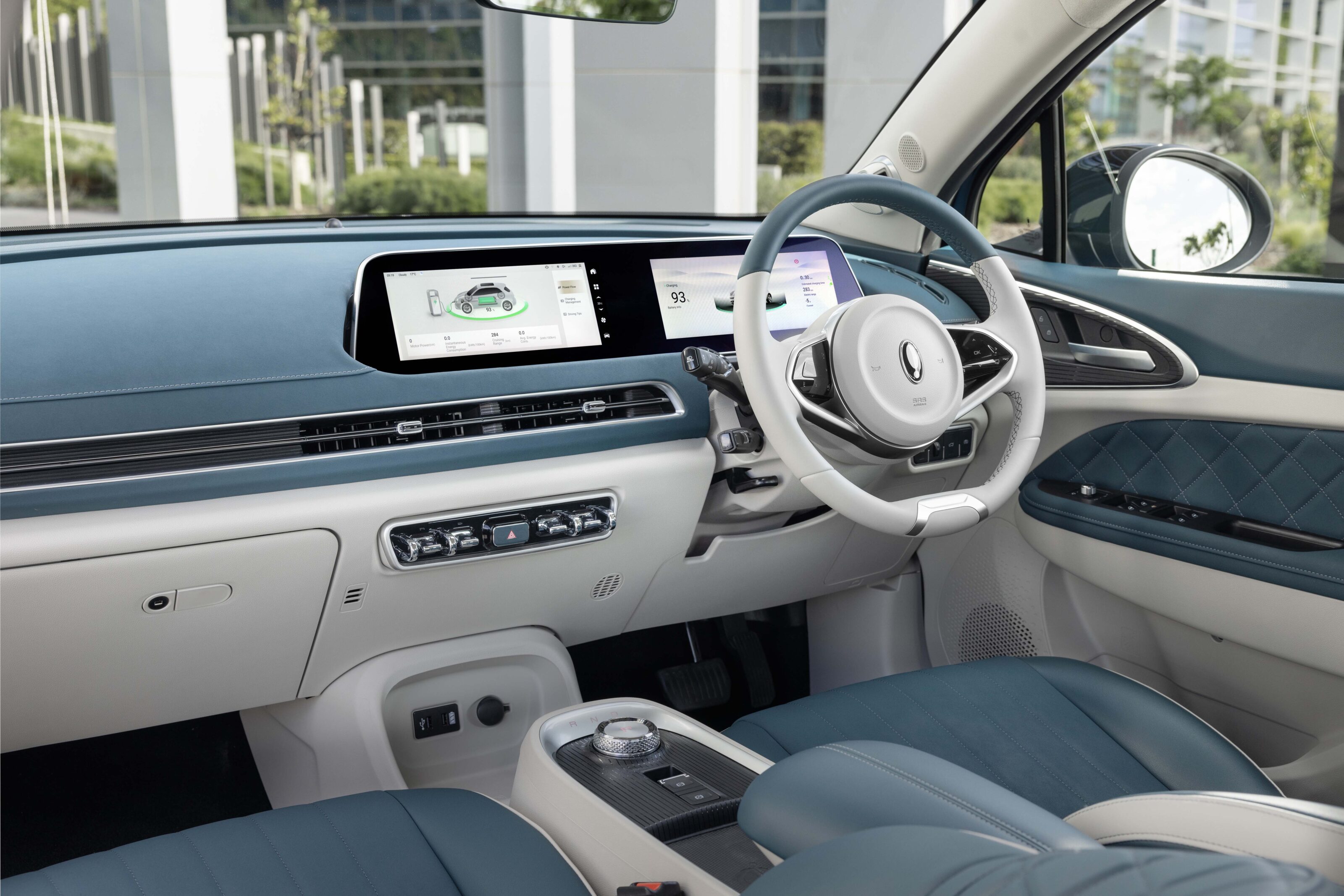
1
GWM Ora GT: Now $51,990 before on-road costs
Previously $53,990.
| GWM Ora GT: Drive-away Pricing | |
|---|---|
| NSW | $53,045 |
| ACT | $52,606 |
| QLD | $53,790 |
| SA | $54,710 |
| TAS | $52,627 |
| WA | $56,307 |
| VIC | $55,070 |
| NT | $52,746 |
For the full equipment and specifications rundown, which is otherwise unchanged, see our initial pricing & features story published in June:
Free GWM charging station
From the start of July, GWM is boosting the Ora’s appeal with a free wall-mounted charging station.
GWM says this launch offer will be extended to customers who have already placed an order for a GWM Ora, and is available to buyers who take delivery before the September 30th cut-off date (or while charger stocks last).
Valued at $1690, the ‘level 2’ wall unit can be connected to standard 240V single-phase power, offering a 7.2kW charging rate – up from the ~2kW rate out of a standard wall plug.
Improving on that 7.2kW would mean upgrading to three-phase power to get a 22kW rate. See our charging guide linked below.
Need more?
To see how the GWM Ora compares with the MG 4 and BYD Dolphin, see our spec battle linked below.
MORE
Everything GWM
More EV stories to help you choose the best car for your needs
- ? EV news, reviews, advice & guides
- ❓ Short & sweet: Your EV questions answered
- ⚡ New EVs: Everything coming to Australia
- ? Australia’s EVs with the longest driving range
- ⚖️ Best-value EVs by driving range
- ? How much do EVs cost in Australia?
- ? How much more expensive are EVs?
- ⚖️ Number crunching: Is it time to switch to an EV?
- ♻ Should you buy a used EV?
- ?️ Are EVs more expensive to insure?
- ? Costs compared: Charging an EV vs fueling a car
- ? EV charging guide
- ?? EV servicing explained
- ? EV battery types explained
- ? When do EV batteries need replacing?
- ? Hydrogen v EVs: What’s best for Oz?
- ? How sustainable are EVs, really?
MORE advice stories to help you with buying and owning a car
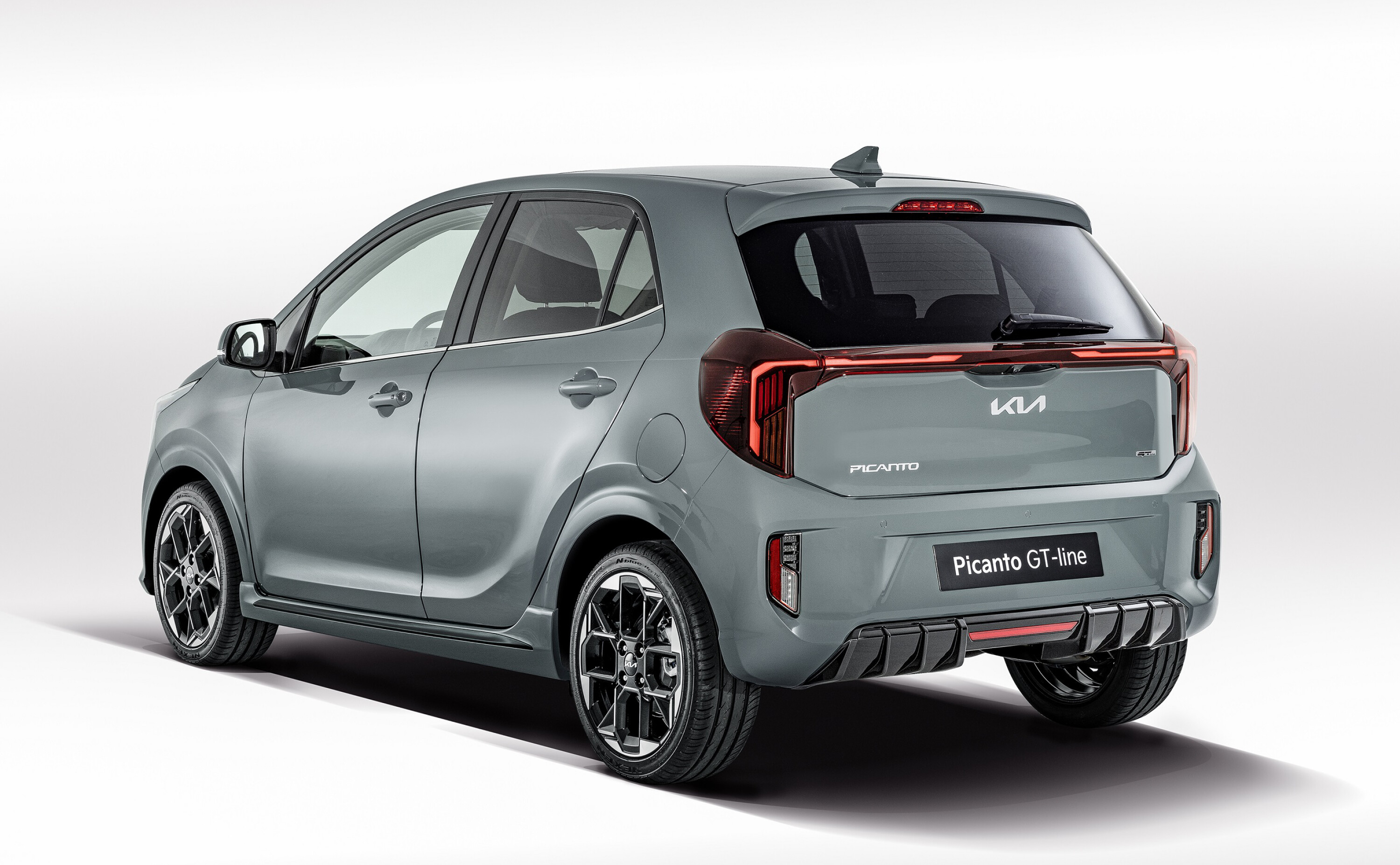
The facelifted 2024 Kia Picanto light hatch has debuted with an updated look and added technology.
Snapshot
- 2024 Kia Picanto facelift revealed
- Popular light car receives new look and tech
- Due here by Christmas with Kia Connect, price rises likely
Kia Australia has confirmed the revised Picanto will arrive in local showrooms in the fourth quarter of 2023 (October to December inclusive), with further details to be announced closer to its launch.
Wheels understands the updated Picanto will support Kia Connect technology in Australia for select variants, with satellite navigation added.
1
Picanto GT axed
UPDATE, 4:30pm: Kia has confirmed the manual-only 1.0-litre turbo GT will be discontinued globally for the updated Picanto, including for Australia.
Other variants will continue to offer a naturally-aspirated 1.2-litre, matched to a four-speed automatic or five-speed manual.
It is headlined by an EV9-inspired ‘digital tiger nose’ front fascia with a slimmer bar, vertical headlights, new LED daytime running lamps and a revised lower bumper design.
Kia has confirmed redesigned alloy wheel designs, while the rear features revised tail-lights connected by a full-width strip, an updated lower bumper, and new badging.
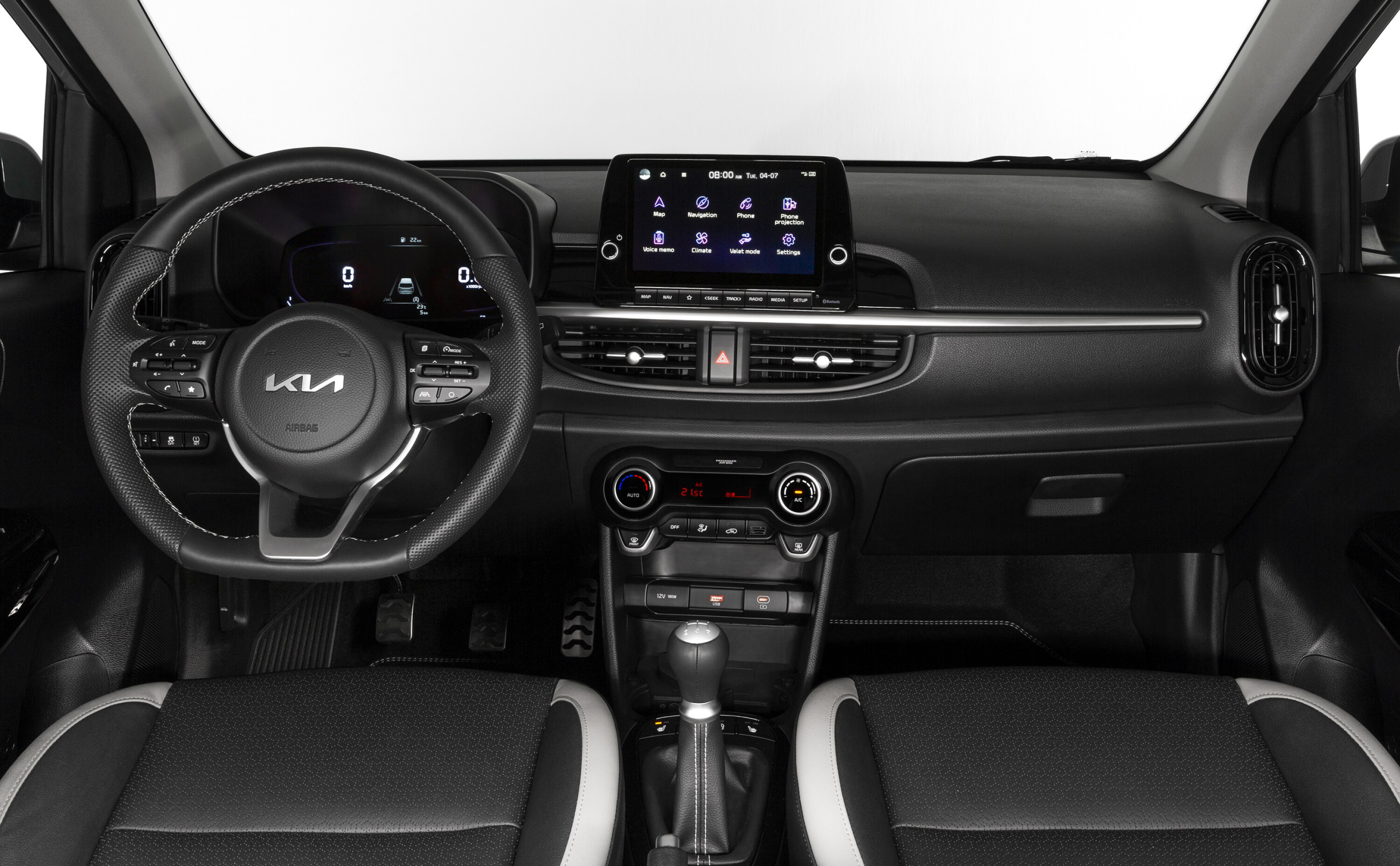
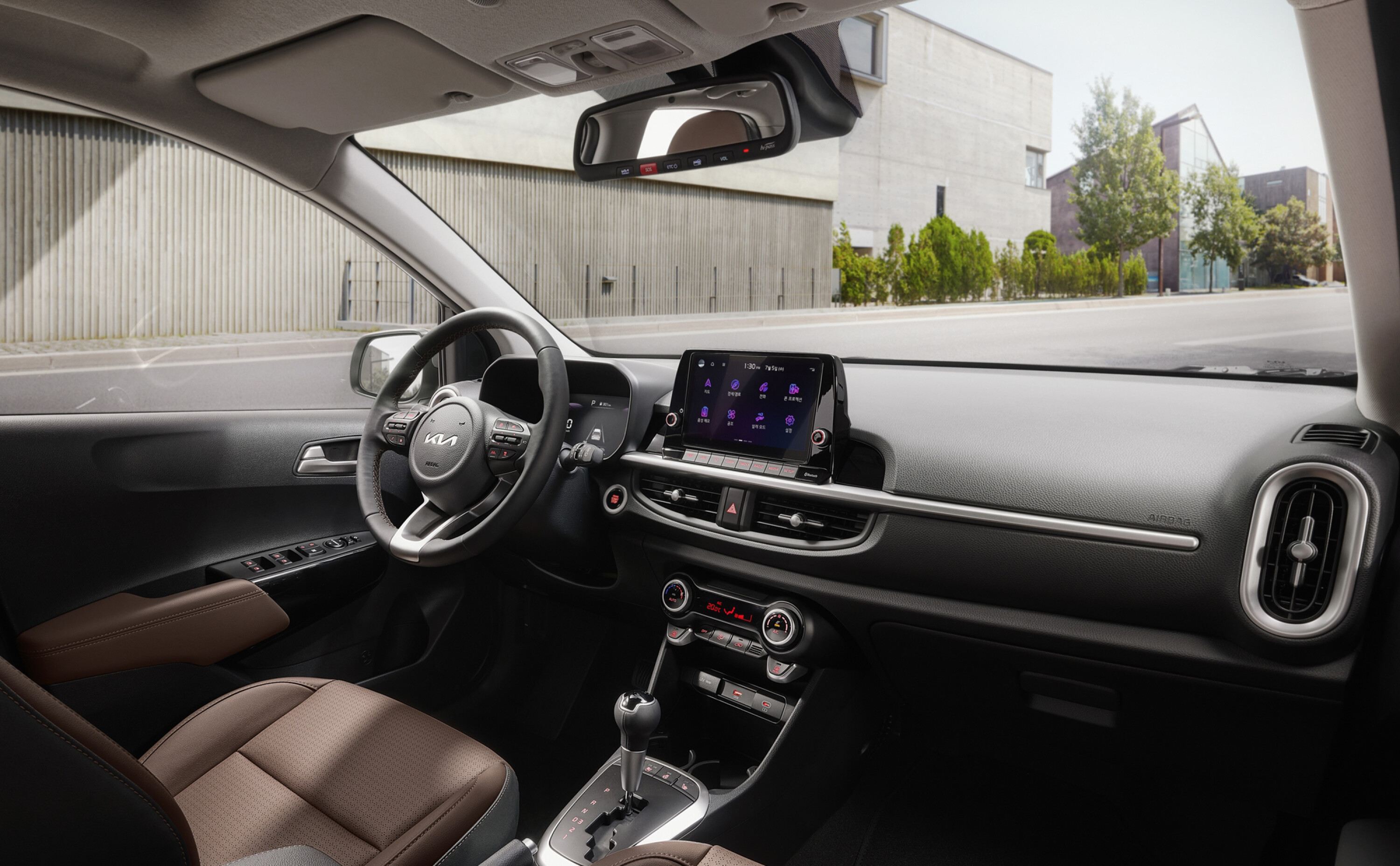
New exterior colours available in Korea include ‘adventurers green’ and ‘gin signal red’, while the cabin can be selected with brown or dark green upholstery for some grades.
1
The Picanto’s autonomous emergency braking system has been updated with pedestrian, cyclist and intersection detection, while it adds navigation-based adaptive cruise control.
In addition, the updated Picanto gains USB-C charge ports with two new rear-seat connections, an updated 8-inch infotainment system, and LCD gauges for the instrument cluster with a 4.2-inch multi-information display.
Other technology new to the Picanto includes auto-folding side mirrors, remote engine start, and automatic high beam.
1
The 2024 Kia Picanto is due in Australia in the final quarter of this year, with local details to be announced closer to its arrival.
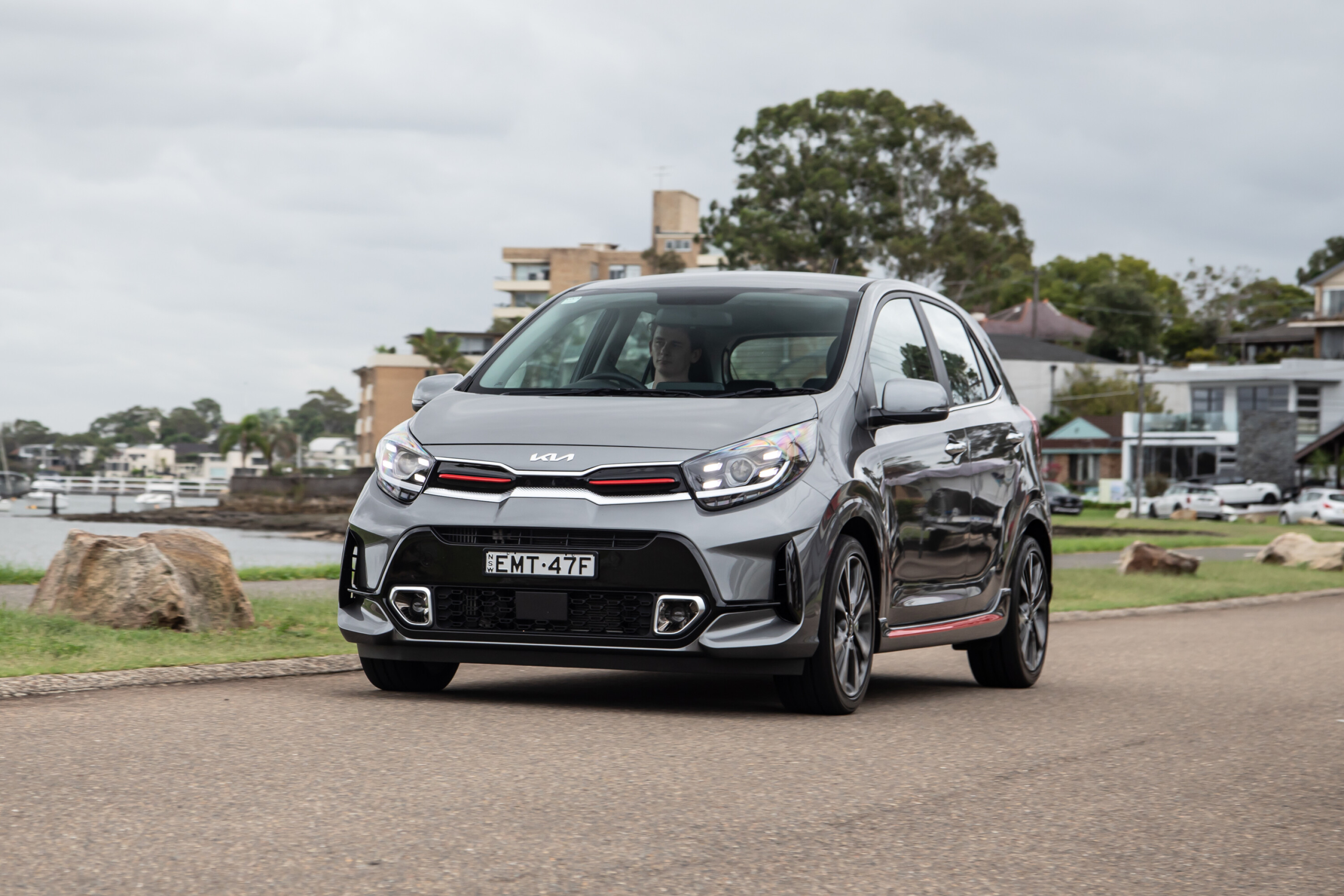
For context, the current Picanto is available from $16,290 before on-road costs – but the facelifted model is likely to be priced closer to $20,000.
Below: The current 2023 Kia Picanto
1
MORE
Everything Kia
