
BYD has exclusively produced all-electric and PHEV models since April 2022 in China.
Shenzhen carmaker Build Your Dreams (BYD) has ousted Volkswagen as China’s best-selling car brand for the first time – driven overwhelmingly by EVs and PHEVs.
Snapshot
- BYD outsells VW in China during Q1 2023
- VW has been best-selling brand since at least 2008
- Buyers moving to Chinese brands for affordable value EVs
1
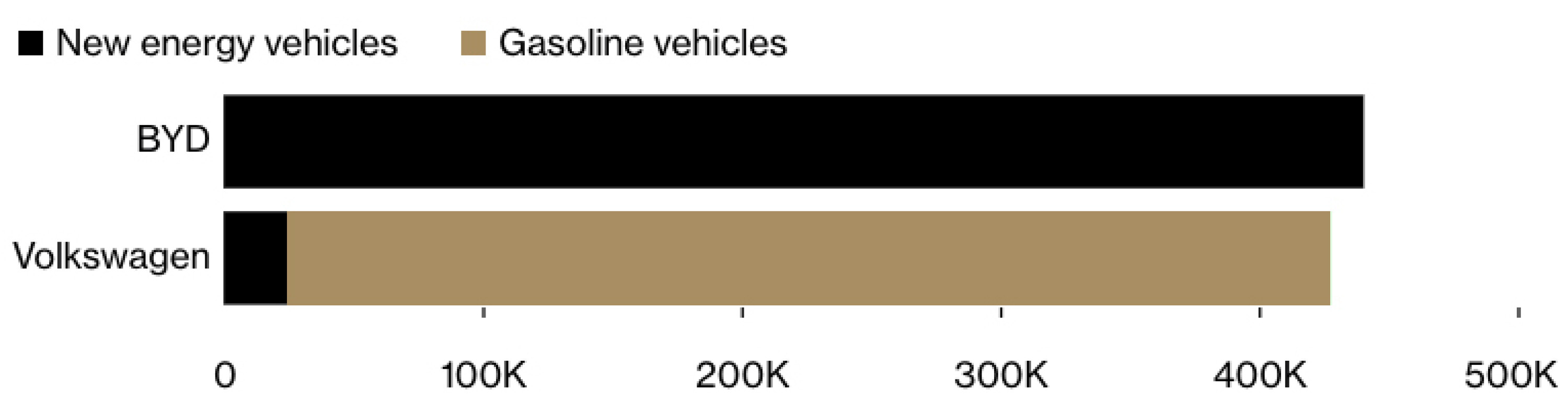
According to data compiled by Bloomberg [↗], BYD sold more than 440,000 pure-electric and plug-in hybrid electric vehicle (PHEV) models in the first quarter of 2023 in China.
In contrast, Volkswagen only managed to sell around 25,000 pure-electric and PHEVs, plus a whopping 403,000 traditional petrol and diesel-engined models in the same period.
That equates to BYD making up 10.4 per cent market share compared to Volkswagen at 10.1 per cent – with EVs accounting for almost 100 per cent and six per cent of sales respectively.
Volkswagen has been the best-selling carmaker in China since at least 2008 (when data first started being published), thanks to its separate joint ventures with SAIC Motor (which owns MG and LDV) and the FAW Group.
Despite Volkswagen’s China-exclusive electric models, such as the ID.4 Crozz and ID.4 X medium SUVs plus the ID.6 Crozz and ID.6 X seven-seat SUVs, BYD continues to dominate with the more affordable Song Plus SUV, Han large sedan, and Dolphin hatchback.
1
In fact, seven out of 10 top-selling new cars in China last year was a BYD, according to InsideEVs [↗].
Unlike other automakers, BYD benefits from a vertically integrated supply chain, which means it produces most of its vehicle parts and technologies – including lithium-iron-phosphate (LFP) structural Blade Battery cells that are touted as safer and stronger than conventional packs.
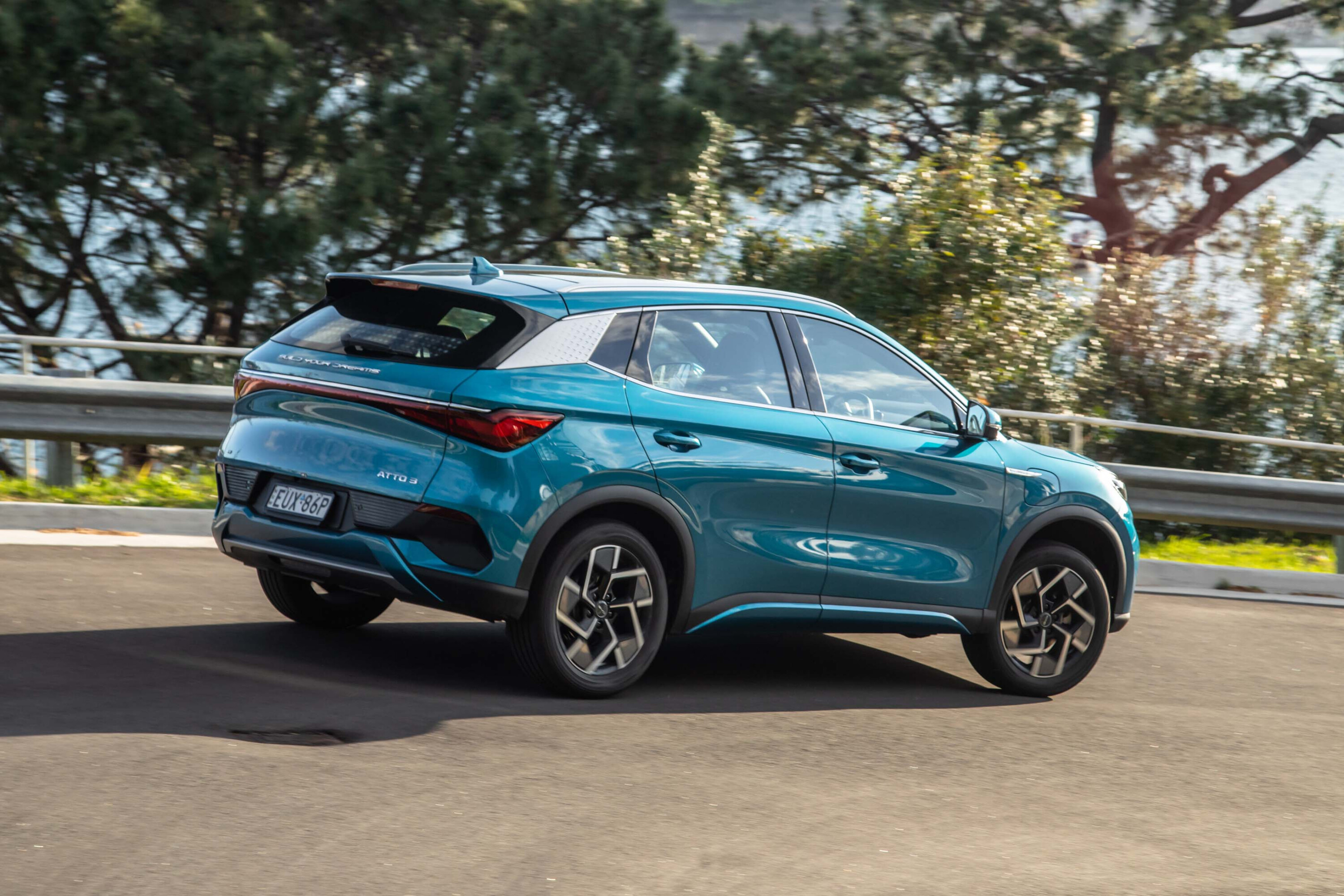
The Chinese automaker started expanding globally rapidly last year to countries, including Australia, Japan, Thailand, Europe, and the United Kingdom with the globally-designed Atto 3 small electric SUV spearheading the roll out.
Advice
Australia’s best electric cars for 2023
We’ve tested nearly every EV below six figures in Australia to rank the best on sale today
Locally, more than 4200 BYD Atto 3 EVs have been sold since deliveries started in September 2022.
Despite a short sales hiatus, it has become the third-best selling EV in Australia – but the more expensive Tesla Model 3 sedan and Model Y SUV continue to dominate by a fair margin.
The Atto 3 is expected to be joined by the BYD Dolphin hatch, followed by the BYD Seal sedan to rival models including the MG 4, GWM Ora, Tesla Model 3, Hyundai Ioniq 6, and Polestar 2.
MORE
Everything BYD
MORE
Electric Cars
⚡ More EV stories to help you choose the best car for your needs
Are EVs cheaper to own, in the long run, than a petrol or diesel car?
As with so many things we buy as a utility for our daily tasks, our buying decisions when it comes to cars are often driven by the cost of ownership.
After all, it’s one thing to find the money for a purchase, but ongoing costs like servicing and maintenance, registration and insurance can be hard to bear – particularly when it comes to the fluctuating and regularly climbing cost of fuel.
It’s no surprise then that many people are starting to wonder if an electric car could be the answer. They’re generally more expensive to buy, but they can be much more affordable to run. Does the one cancel out the other? You’ll find a number of links here to our guides on this question and many others.
The decision could get easier soon, too, thanks to an increasing number of options in the market. Over 30 new or updated EVs are due in Australia over the next two years – and more are being announced almost weekly.
Likewise, one of the key barriers to EV supply and competitive pricing has been the absence of strict emissions regulations in Australia. Why?
Supply, demand …and penalties.
Australia has the demand, but it can’t yet have supply – because it doesn’t penalise brands for selling so many combustion-engined cars.
Most other governments now enforce significant penalties for brands that don’t offset the emissions of their combustion-engined cars with a proportionate number of sales for low- and zero-emissions vehicles.
In short, every EV sent to Australia is a car not being sold in another market, where demand is high and production capacity is limited.
Why don’t car brands just stop selling combustion-engined cars?
Because EV tech has cost brands tens of billions to develop, and EVs are still far more expensive to build than conventional cars – so, for now, the profits from combustion-engined car sales is needed to recoup some of those costs.
1
Regulations are coming, though, and car brands are planning for it.
In particular, the next 12 months will bring a huge number of launches.
This is thanks both to the semiconductor chip shortage that delayed several models planned for 2022, and the growing demand for EVs in Australia.
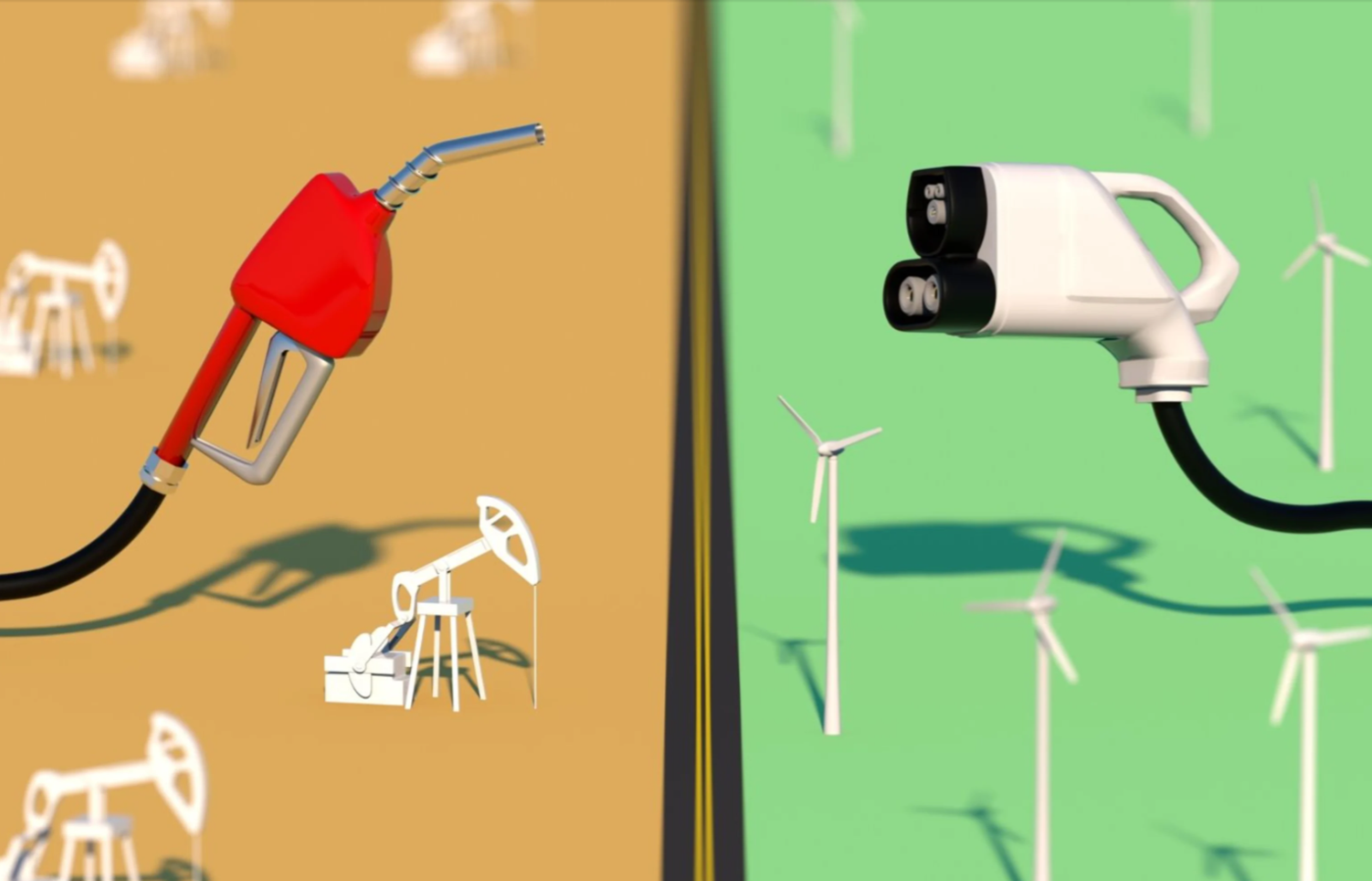
The prominence of electric cars has grown worldwide thanks to rising fuel prices, with many seeking to reduce the ownership costs and environmental impact typically associated with internal-combustion vehicles.
So, to help you understand the costs of owning an EV and whether it can be cheaper than owning a conventional car, we’ve built a number of detailed guides – and you’ll find them at the links below.
1
GUIDE: Crunching the numbers on EV ownership
Is the tide of opinion and financial benefit finally turning on electric cars? We crunch the numbers on how much you could save by making the change.
GUIDE: How much more expensive are electric cars in 2023?
Amid inevitably increasing new car prices, how big is the electric vehicle price premium today?
GUIDE: What do EVs cost to maintain?
Do electric cars need routine servicing? What does it include? Is it cheaper to maintain an EV than a petrol or diesel car? Find out in this handy guide.
ud83dude0e THE GOOD
- It’s true that EV owners don’t need to contend with the oil changes, spark plugs, timing belts, complicated transmission internals and exhaust systems associated with ICE vehicles (and hybrids), but…
ud83dude13 THE NOT SO GOOD
- There are no miracles here. Battery-electric cars do still require regular maintenance, because they still share many ‘consumables’ with their ICE counterparts, with the addition of more advanced battery and electronic systems.
GUIDE: Are electric cars more expensive to insure?
Electric cars are cheaper to own over time, yet comprehensive insurance premiums are typically higher. We explain why, and break down the differences.
GUIDE: Government incentives for buying an EV
With more EVs being introduced into the market, what are governments offering to increase uptake among private buyers?

1
GUIDE: Is it cheaper to charge an EV than to fuel a regular car?
What are the running costs of an electric vehicle when compared to the combustion-engined cars we’ve known for so long?
Still hungry for info?
⚡ More EV stories to help you choose the best car for your needs
? MORE advice stories to help you with buying and owning a car
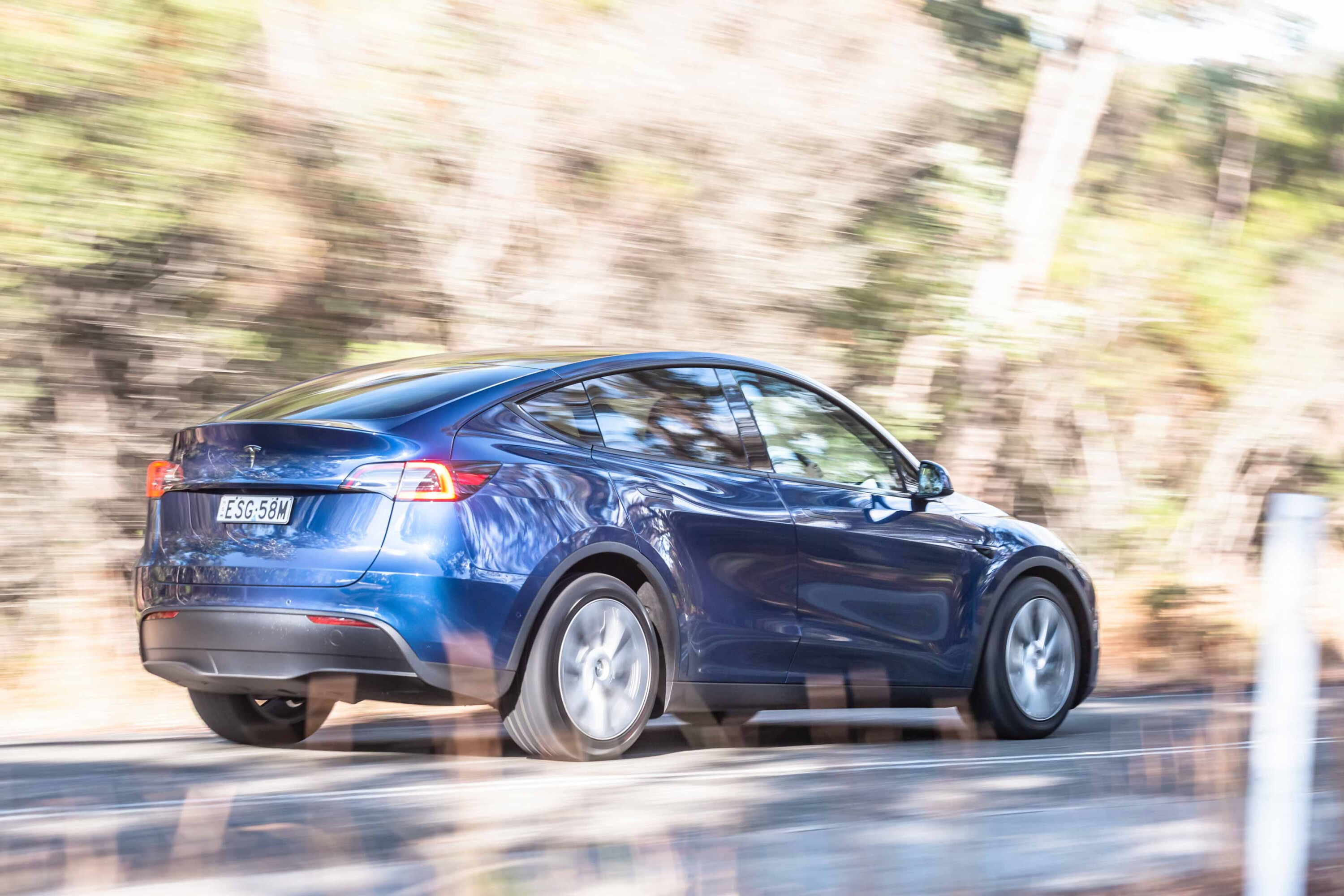
The 2023 Tesla Model 3 and 2023 Tesla Model Y electric cars have received price adjustments.
Following a price cut and the addition of the mid-spec Model Y Long Range on April 4, Tesla has revised pricing across its lineup today.
Both the Model 3 and Model Y Rear-Wheel Drive and Long Range AWD have increased by $400, while the Model 3 Performance has decreased by $1280.
The flagship Model Y Performance is up $1060, with pricing now at $98,855 before on-road costs (including luxury car tax).
1
Since each vehicle launched, the Model 3 and Model Y have received several price adjustments, with updated pricing listed randomly on Tesla’s consumer website – unlike other traditional carmakers.
VFACTS new-car sales data reveals the Model 3 is not only Australia’s best-selling electric car, but also the highest-selling passenger vehicle.
To the end of March, 7238 Model 3s have been registered in Australia, putting the electric sedan in third place behind the Ford Ranger and Toyota HiLux.
As for the Model Y, it is Australia’s best-selling electric SUV, with 3169 registrations year-to-date. It is also the top-selling vehicle in its medium SUV over $60,000 segment.
1
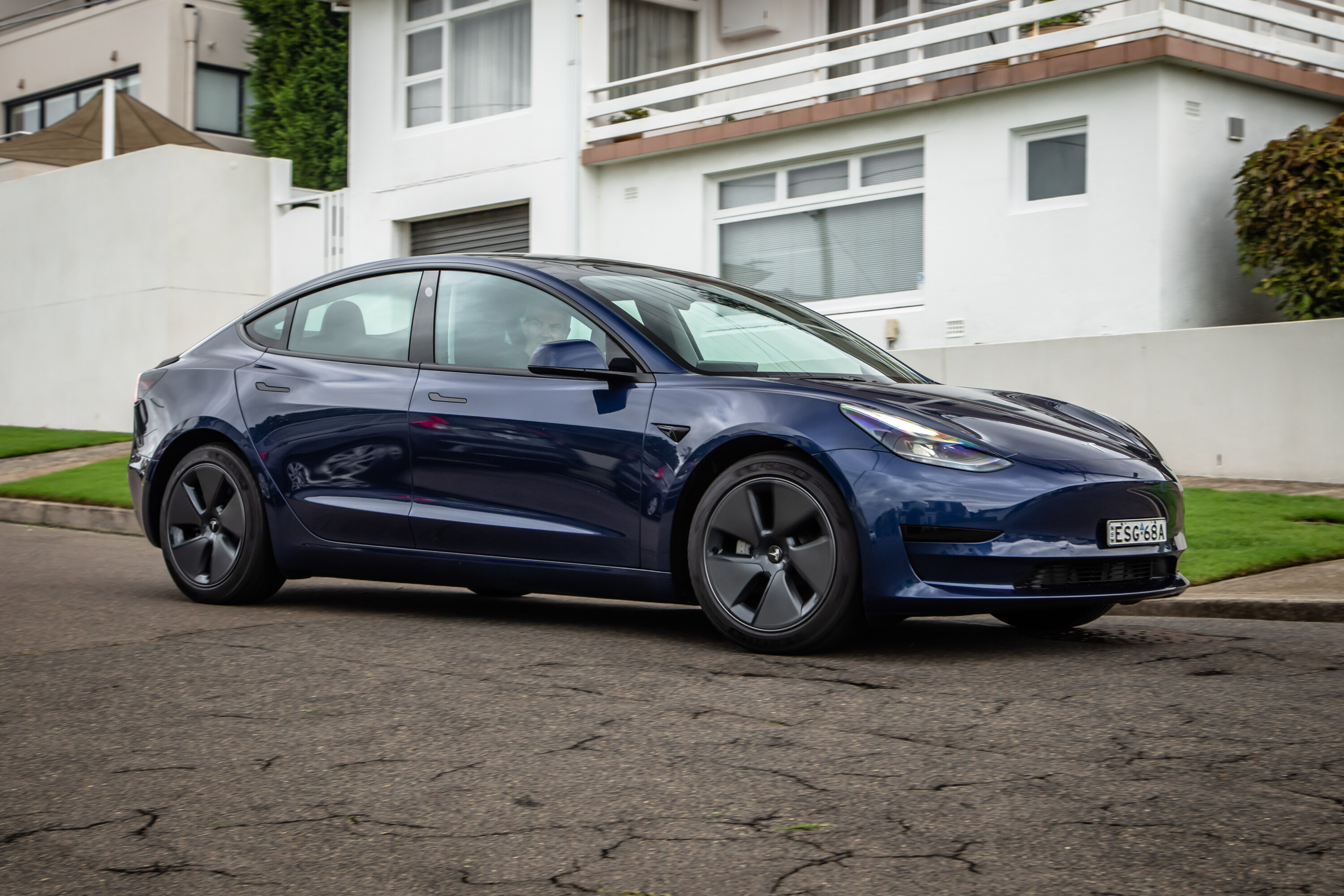
Tesla Model 3 pricing – May 2023
Prices exclude on-road costs, delivery fees and order fees. Luxury car tax is included where applicable for consistency with other vehicles.
1
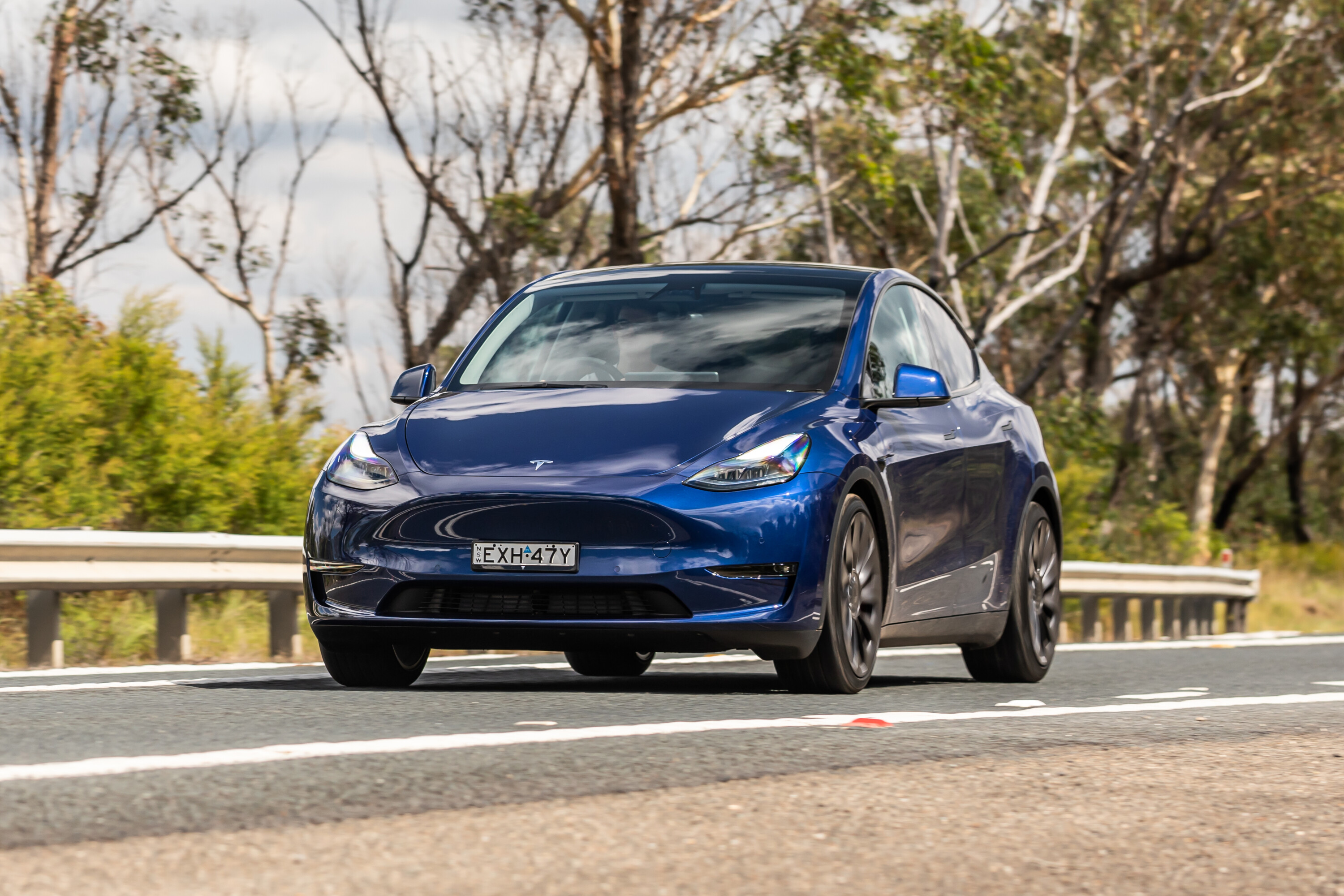
Tesla Model Y pricing – May 2023
Prices exclude on-road costs, delivery fees and order fees. Luxury car tax is included where applicable for consistency with other vehicles.
MORE
Everything Tesla
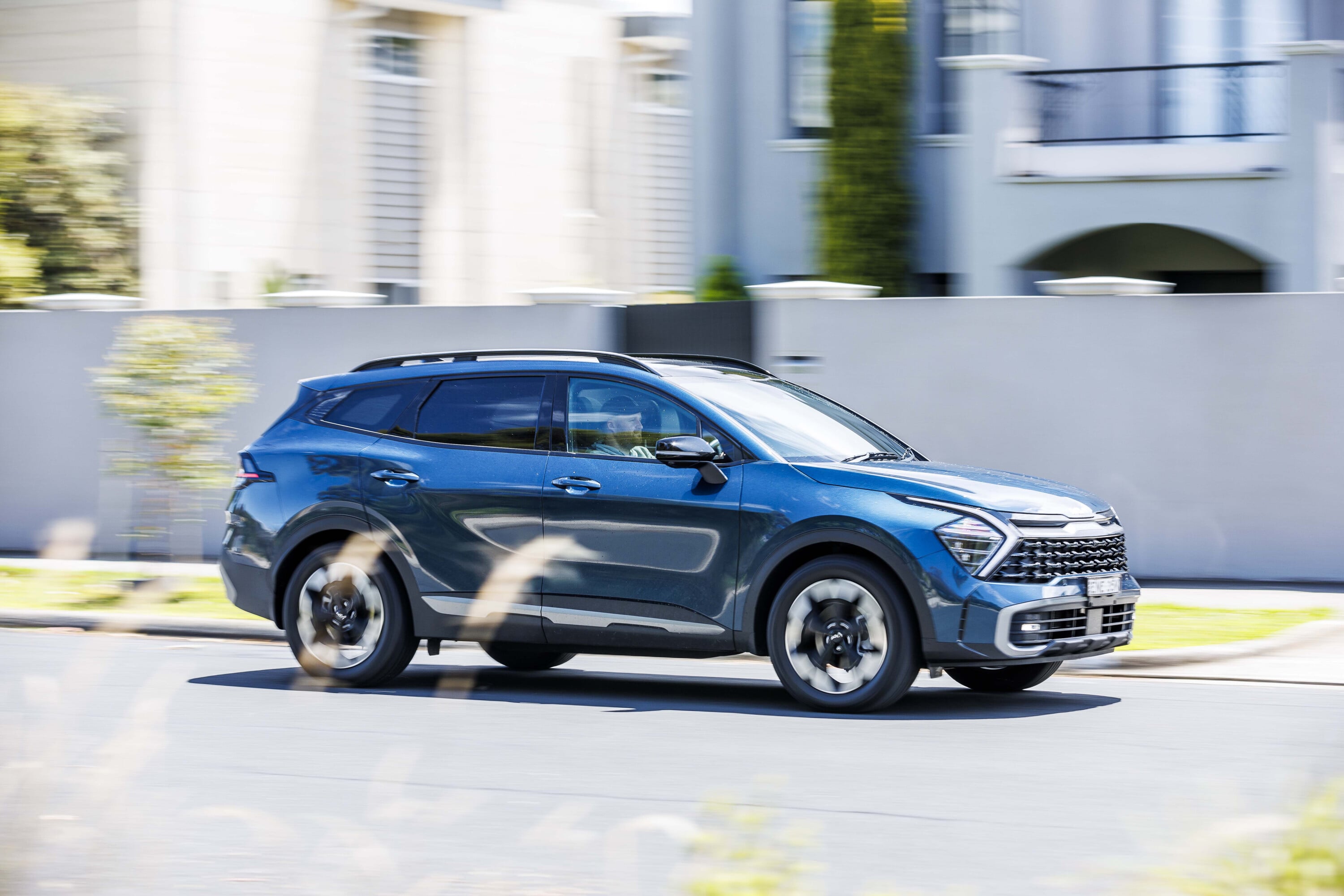
The flagship 2023 Kia Sportage GT-Line is temporarily off-sale in Australia.
Kia’s local division has confirmed orders are paused due to the semiconductor chip shortage that continues to affect the wider automotive industry.
“Due to component shortages impacting supply of Sportage GT-Line variants, orders have been temporarily paused until production increases,” said a spokesperson for Kia Australia.
“The situation is being reviewed regularly and we are working hard to fulfil backorders.”
1
Wheels understands the shortage affects several components – not the panoramic sunroof, which has constricted production for the related Hyundai Tucson Highlander flagship.
Hyundai has offered current order holders a unique Tucson Highlander without a panoramic sunroof to reduce delivery times.
Kia Australia said it is “difficult to assign a wait time” for existing Sportage GT-Line orders, with limited deliveries expected in the coming months.
A wait time of approximately four to six months is quoted for the Sportage S, SX and SX+.
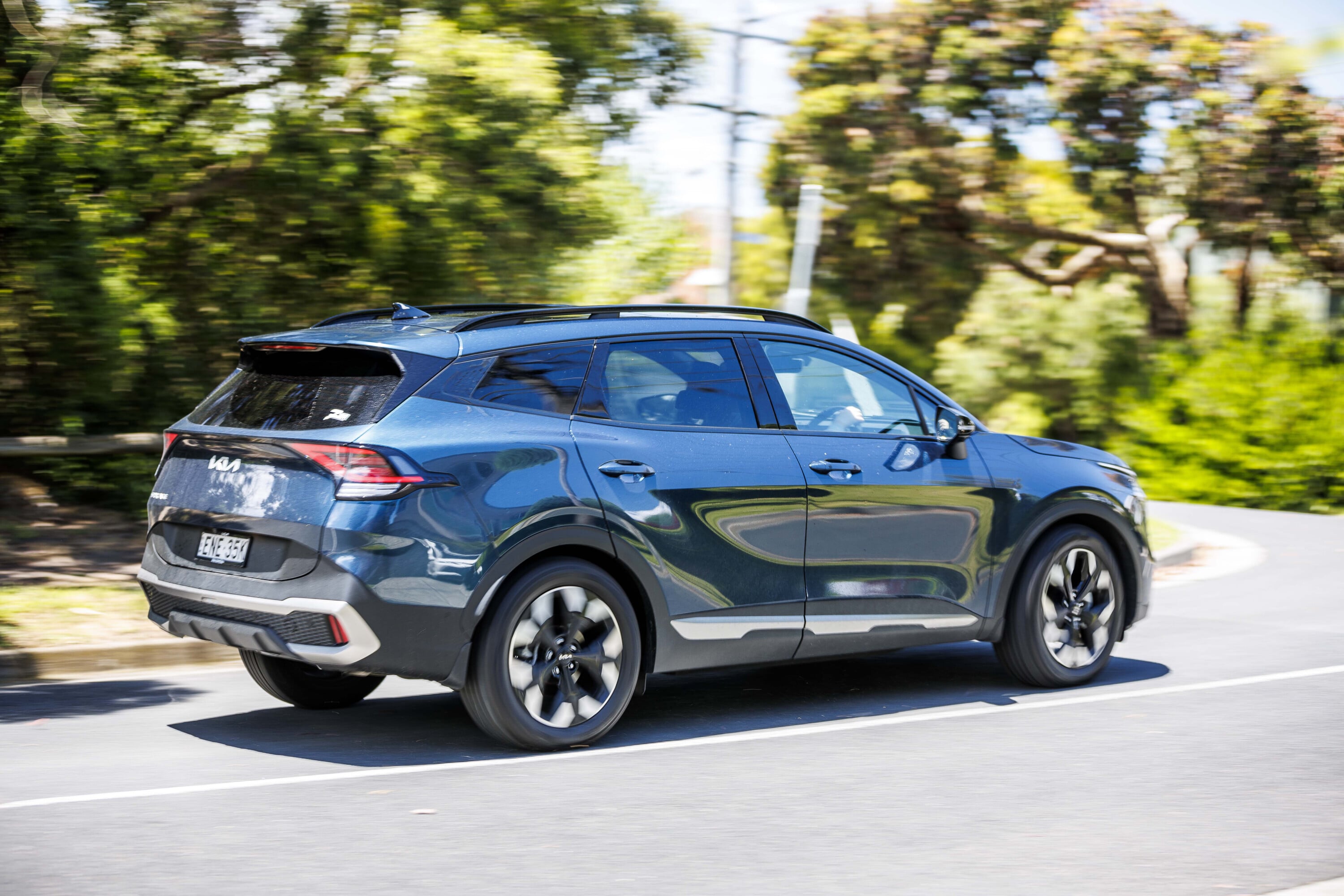
The temporary removal of new GT-Line orders will affect Sportage sales until orders resume, with the flagship grade accounting for 42 per cent of the mix in 2022.
VFACTS new-car sales data reveals 3348 examples have been registered in Australia year-to-date – down 14.9 per cent compared to this time last year.
1
Above the mid-spec SX+, the Sportage GT-Line has several tech inclusions, including:
A hybrid version of the Kia Sportage is closer to Australia, with Kia’s local product planning boss confirming it is expected later this year.
The Kia Sportage competes in the medium SUV segment in Australia, with rivals including the Toyota RAV4, Mazda CX-5, Hyundai Tucson, Mitsubishi Outlander, Nissan X-Trail, Subaru Forester and Volkswagen Tiguan.
MORE
Everything Kia
Hands up! Who’s looking to get into a new car?
If you are, you likely know it’s been a crazy couple of years for the market – and even if you’re not, you probably at least know things are starting to look up.
We’re looking forward to a big year in the motoring world, with some important upgrades coming at WhichCar.com.au – and we want that to include your input on Australia’s car market.
We’re blessed to have a core of loyal readers across all of our titles in print and online, so it’s only sensible that we get your feedback on where the market is going, what you’re reading here, and what you’re watching. And, crucially, what you want to see more of – whether that’s on online, in our mags, or on video.
1
Ready to have your say?
Click here to get stuck into the WhichCar.com.au reader’s survey [↗]
It’s a painless process that not only allows you to help steer our content, but could also net you a sweet $100 voucher along the way!
We’re offering 20 respondents the chance to win a $100 voucher – that’s a free tank of fuel or a nice dinner out – so don’t delay.
We really appreciate the help, too. Cheers.
The Nitty Gritty
$100 voucher winners
When the survey is complete, we’ll announce winners here.
EV-specific tyres have quickly become a big category, and now they’re winning awards: Hankook Tyre has announced its new EV tyre brand, iON, has picked up four awards at this year’s Red Dot Design Awards.
Red Dot what?
The Red Dot Design Awards are a highly-regarded global design competition focused on excellence in product design, brand communication, and design concepts.
The awarded products include iON evo, iON evo AS, iON i*cept, and iON, the official EV racing tyre for the ABB FIA Formula E GEN 3 vehicle.
The iON range marks Hankook Tyre’s entry into the Australian EV market, with its initial offering coming in the form of the iON evo AS and iON evo AS SUV.
Hankook says the tyres are focused on “high-performance premium electric vehicles”, promising low noise and rolling resistance, along with “impressive mileage”.

1
As if to show its pedigree, Hankook points to its role as official tyre supplier to the FIA Formula E World Championship.
“Leveraging Hankook Tyre’s Evolution Technology, the iON tyres deliver exceptional grip and handling performance, ensuring an outstanding racing experience across diverse driving conditions,” the brand says.
Importantly for EV buyers, Hankook says its iON tyres were developed with a focus on “eco-friendly” raw material sourcing, sustainable production and a “robust” recycling system.
Whether that includes ringing playgrounds with old tyres, is unclear… however, the brand does say it uses a pyrolysis process in the recycling of its Formula E tyres – gaining it 15 Red Dot Design Awards since 2013.
What is pyrolysis?
Great question. Pyrolysis is “a thermochemical decomposition of organic material which can occur at elevated temperatures in the absence of oxygen”. (via ontario.ca [↗])
More EV stories to help you choose the best car for your needs
- ? EV news, reviews, advice & guides
- ❓ Short & sweet: Your EV questions answered
- ⚡ New EVs: Everything coming to Australia
- ? Australia’s EVs with the longest driving range
- ⚖️ Best-value EVs by driving range
- ? How much do EVs cost in Australia?
- ? How much more expensive are EVs?
- ⚖️ Number crunching: Is it time to switch to an EV?
- ♻ Should you buy a used EV?
- ?️ Are EVs more expensive to insure?
- ? Costs compared: Charging an EV vs fueling a car
- ? EV charging guide
- ?? EV servicing explained
- ? EV battery types explained
- ? When do EV batteries need replacing?
- ? Hydrogen v EVs: What’s best for Oz?
MORE advice stories to help you with buying and owning a car
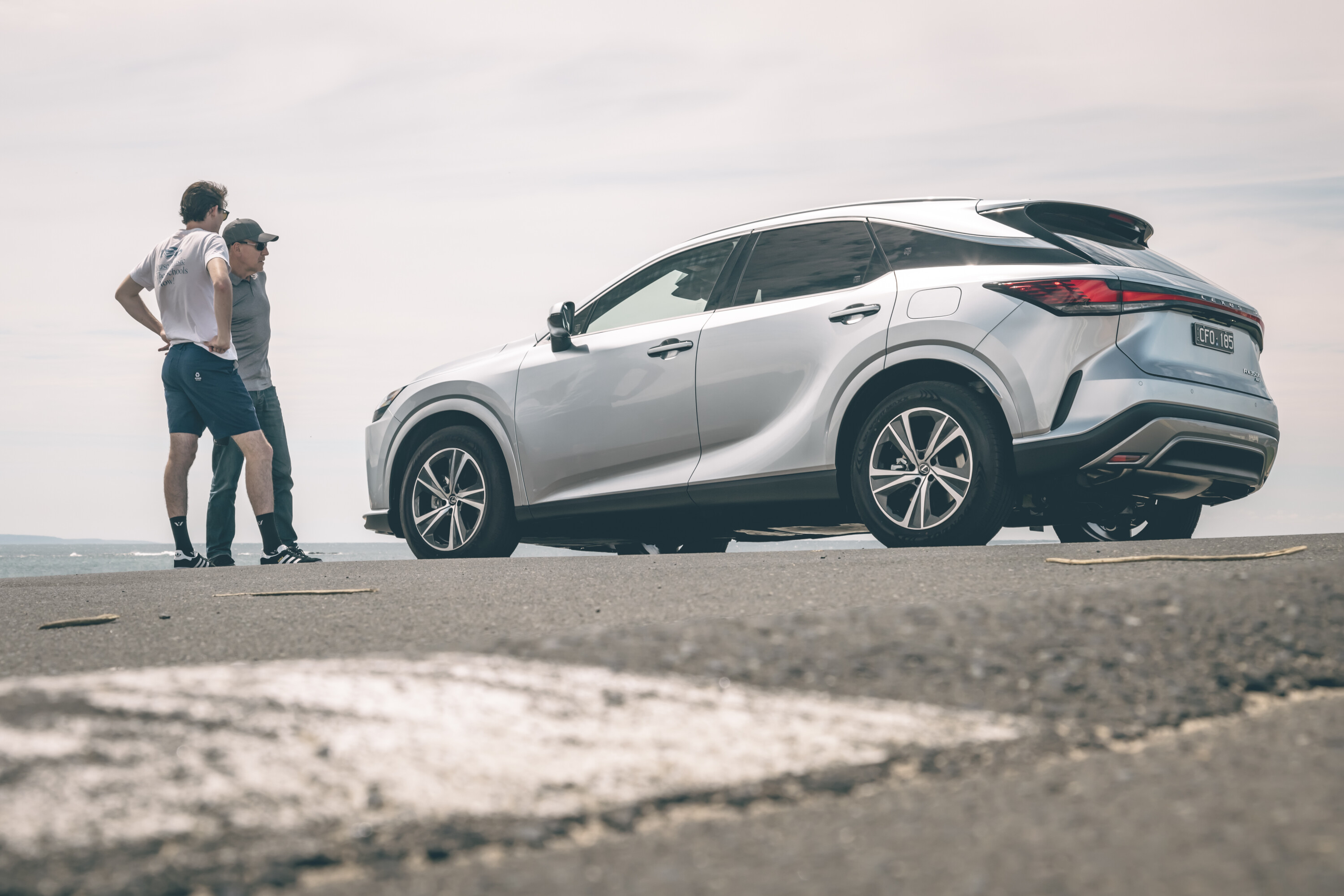
The fifth-generation Lexus RX arrived in Australian dealerships in February as an all-new vehicle rolling on the brand’s GA-F underpinnings.
Spoiler: A revamped powertrain selection and more fluid handling make this the best RX yet.
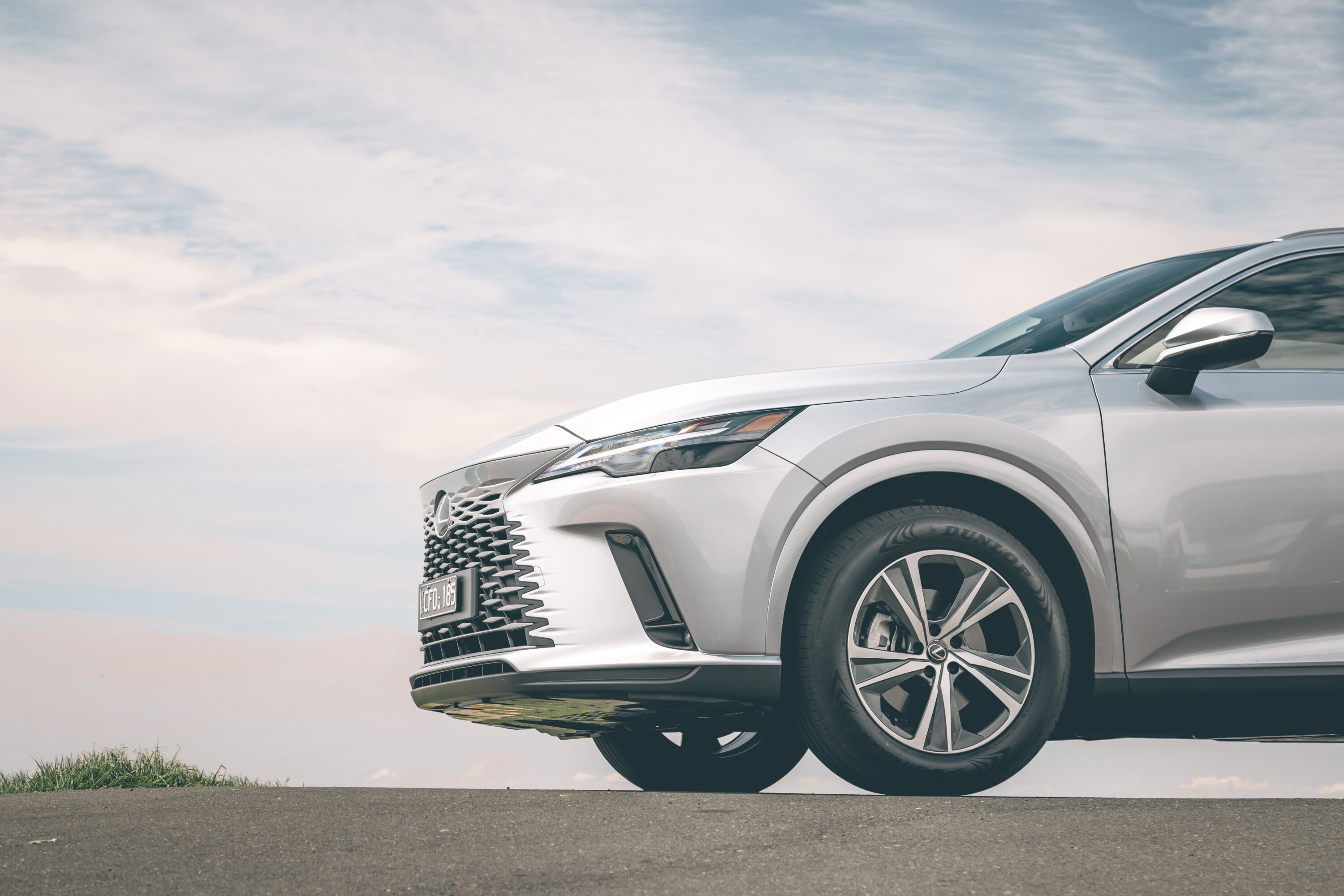
With its mammoth underbite and jutting jawline, the new ‘spindle bodied’ RX (which takes the old spindle grille to a whole new level) is all drama from the outside. A more interesting hue than Sonic Iridium and the F Sport’s larger alloys would amp visual impact further, but this is still no shrinking violet – and we like that.
Inside, the RX boasts an advanced tech package that makes it feel like a two-generation step over its aged predecessor, while also bringing the large SUV in line with the rest of the Lexus range in Australia.
After being impressed at both the RX’s international and Australian media launches, we’ve now been able to spend a bit more time getting familiar with Lexus’s five-seat large SUV, and we reckon the Luxury trim with Enhancement Pack 1 is just about all the RX you could want or need.
1
JUMP AHEAD
- How much is it, and what do you get?
- How do rivals compare on value?
- Interior comfort, space and storage
- What is it like to drive?
- How much fuel does it use?
- How safe is it?
- Warranty and running costs
- VERDICT
- Specifications
How much is it, and what do you get?
The new Lexus RX range is not the easiest to understand, with four powertrains and an equal number of trim levels complemented by a host of options packs – for a total of 14 flavours, spanning $87,500 to $126,600 before on-road costs.
Don’t fret about the bigger number, though, as you get a lot in this $97,500 (before on-road costs) 350h Luxury AWD, optioned with Enhancement Pack 1 – as tested here.
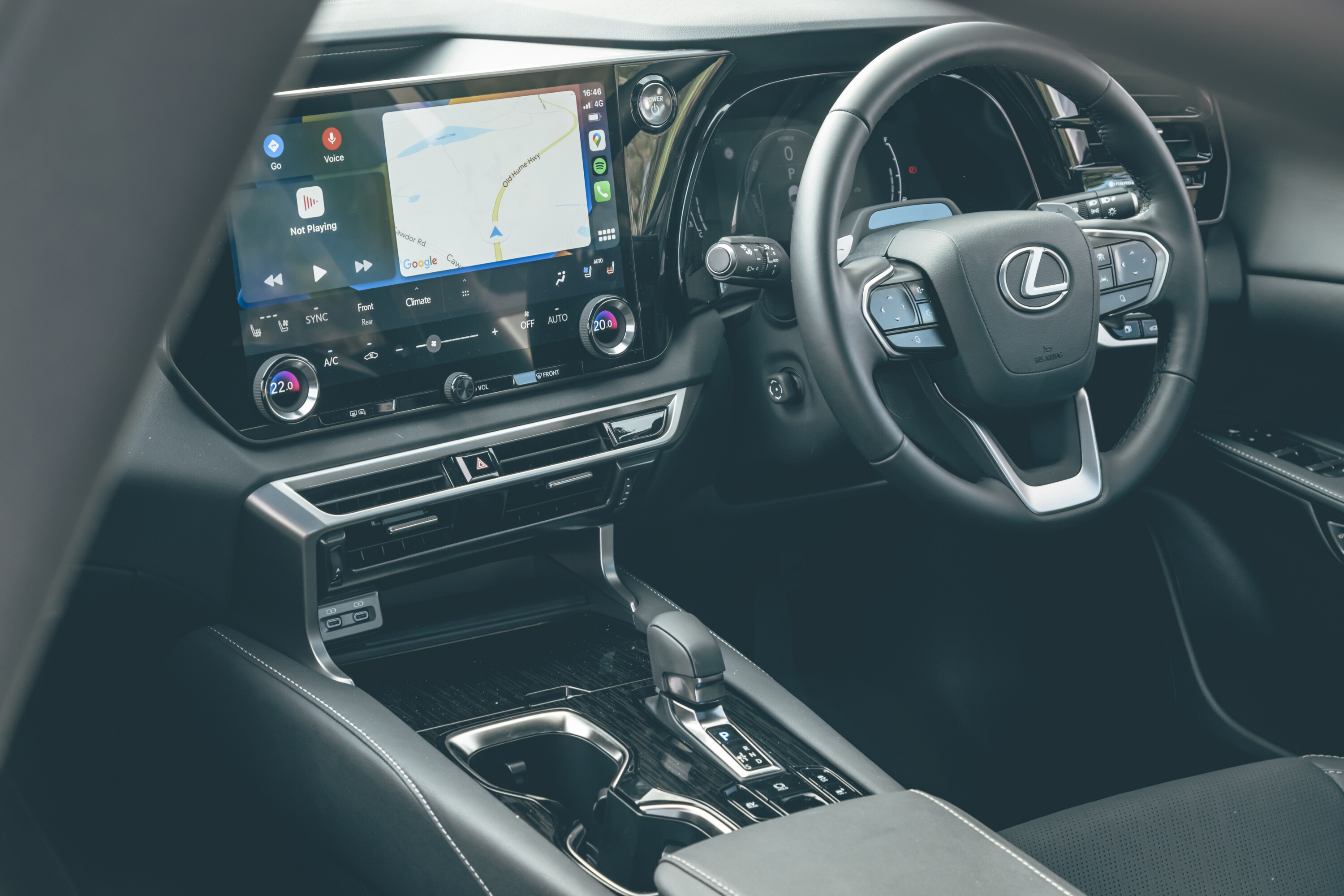
It’s effectively one step up the RX tree, with goodies including ventilated seats, a 15-inch multimedia touchscreen, and four available leather colour choices.
1
| 2023 Lexus RX350h features | |
|---|---|
| 19-inch alloy wheels | Heated side mirrors with driveru2019s side auto-dimming function |
| 14-inch infotainment system | Roof rails |
| Wireless Apple CarPlay and wired Android Auto | 8-way power-adjustable front seats with two-way lumbar support |
| 12-speaker Panasonic audio system | Heated front seats |
| Connected satellite navigation | Electric steering column adjustment |
| Lexus Connected Services | Three-zone climate control with air purification system |
| DAB+ digital radio | Paddle shifters |
| USB-C ports (x5) and one USB-A port | LED ambient lighting |
| LED headlights, tail-lights and daytime running lamps | Auto-dimming rear-view mirror |
| Front and rear fog lamps | Power tailgate |
| EP1 adds | |
|---|---|
| Panoramic sunroof | Touch-sensitive steering wheel controls |
| Leather-accented upholstery | Head-up display |
| Ventilated front seats | Wireless phone charger |
| Driveru2019s seat memory function | |
1
How do rivals compare on value?
Even with car prices skyrocketing, Lexus has maintained solid value across the RX range.
It’s difficult to communicate in pictures, but sitting inside it’s obvious the RX is a wholly nicer vehicle than mainstream large SUVs such as the Hyundai Palisade Highlander and Mazda CX-9 Azami (though the forthcoming CX-90 might have something to say about that) – Lexus’s material quality and construction are simply a cut above.
? The five-seat RX also significantly undercuts German rivals.
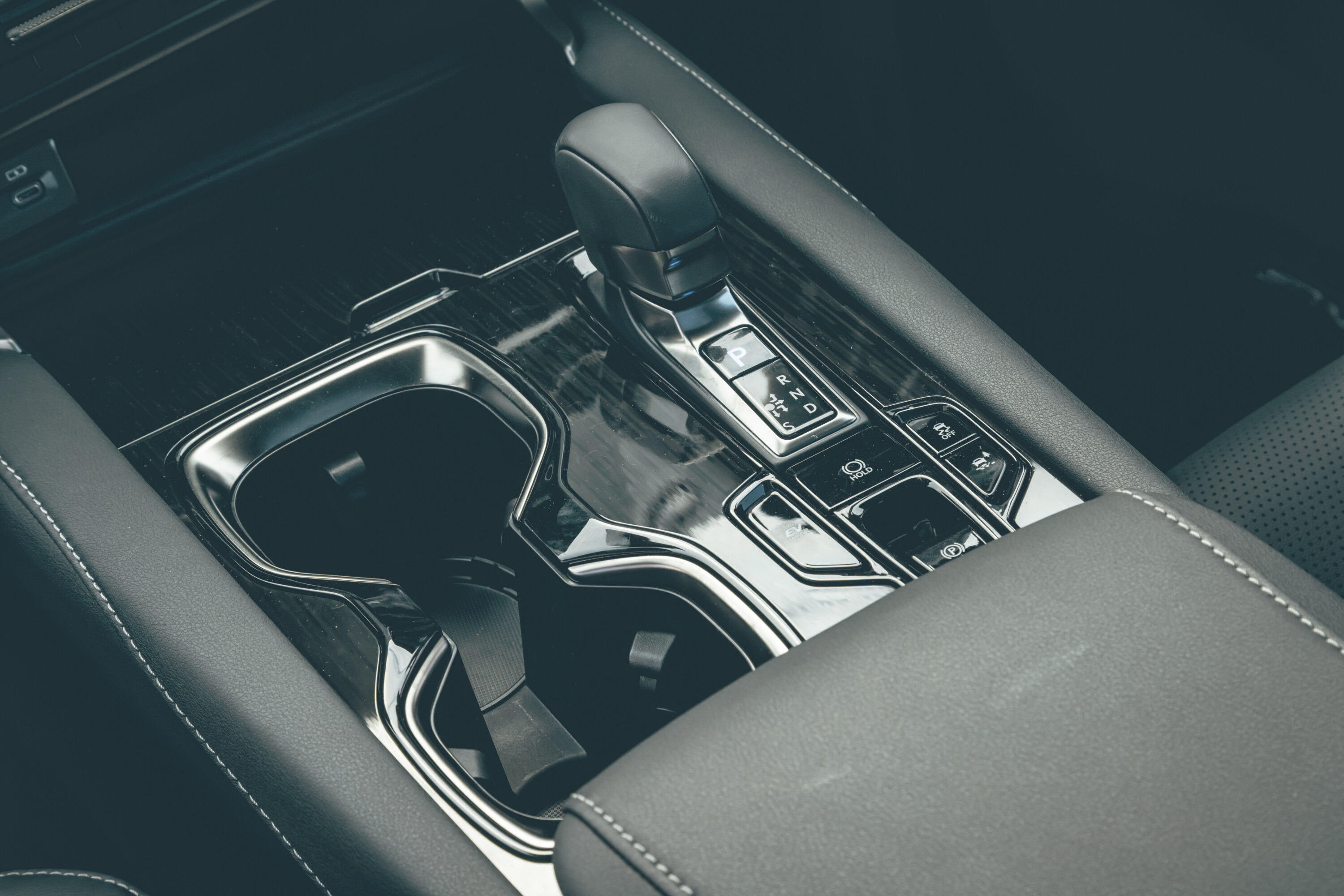
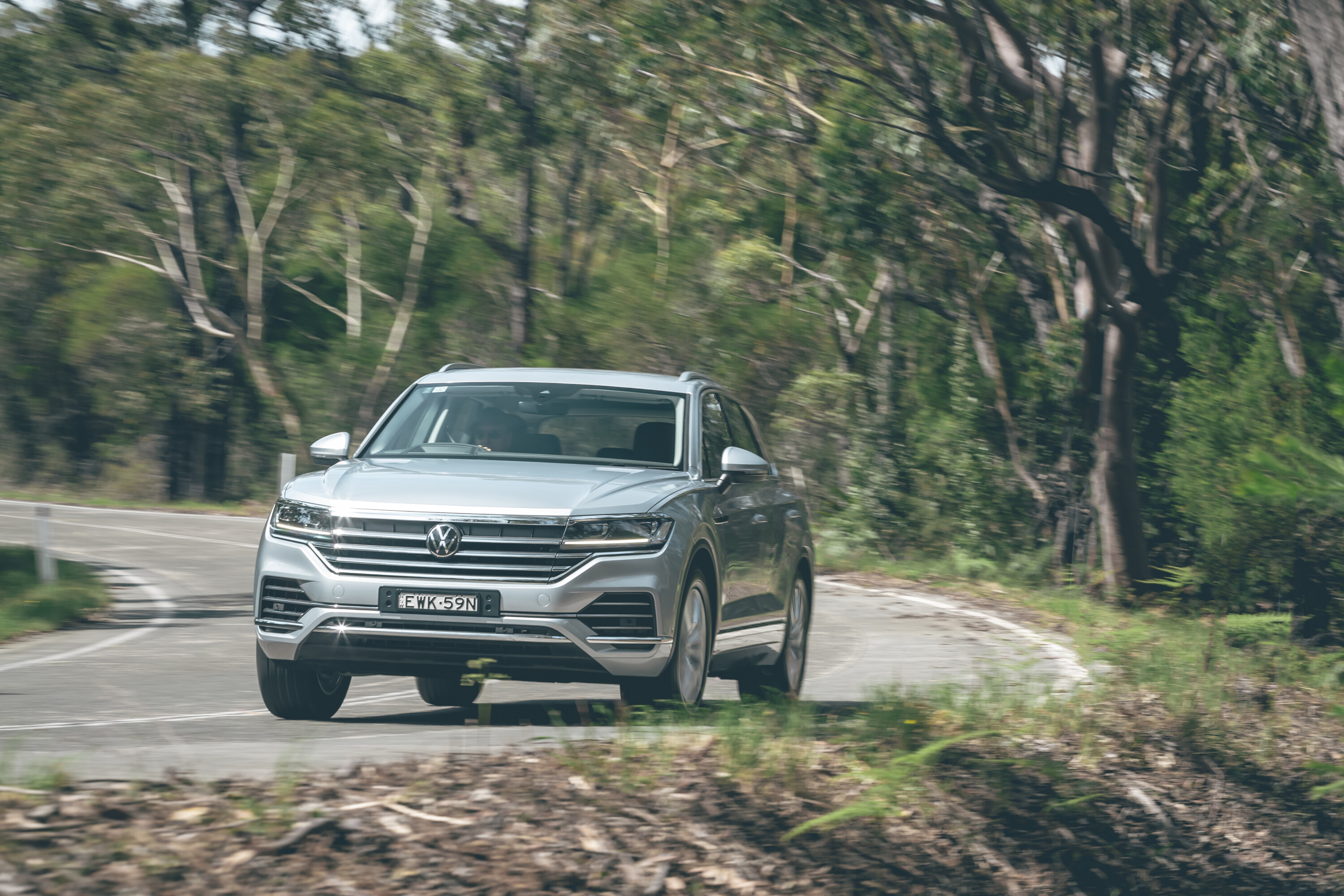
You’ll be paying at least $30K more for a BMW X5 30i or Mercedes-Benz GLE 300d, leaving the near-parity Volkswagen Touareg 170TDI as an RX350h’s only real rival.
Lexus pitches the RX in closer price proximity to a smaller class of cars from the Germans, such as the Mercedes-Benz GLC, Audi Q5, and BMW X3 and typically offers more interior space and features than parity variants of those vehicles.
1
Interior comfort, space and storage
Inside, the Lexus is more restrained than its sheetmetal suggests, with a familiar and straightforward cabin architecture.
The central touchscreen is a sizeable 14 inches and houses the climate controls, though key functions persist on the screen to make interactions easy.
Lexus has axed the controversial touchpad (thankfully) and the new software looks handsome, with a powerful processor running operations including wireless Apple CarPlay (but wired Android Auto). Sound is taken care of by a 12-speaker system from Panasonic (a departure from Mark Levinson items) which is clear and crisp.
Interacting with the various screens is mostly hassle-free, except for the head-up and digital driver’s displays. Lexus may have ditched the central touchpad but its ghost lives on in the steering wheel controls that lack tactile feedback. It’s frustrating that to switch what’s on the instrument binnacle, you need to gaze into the head-up display.
1
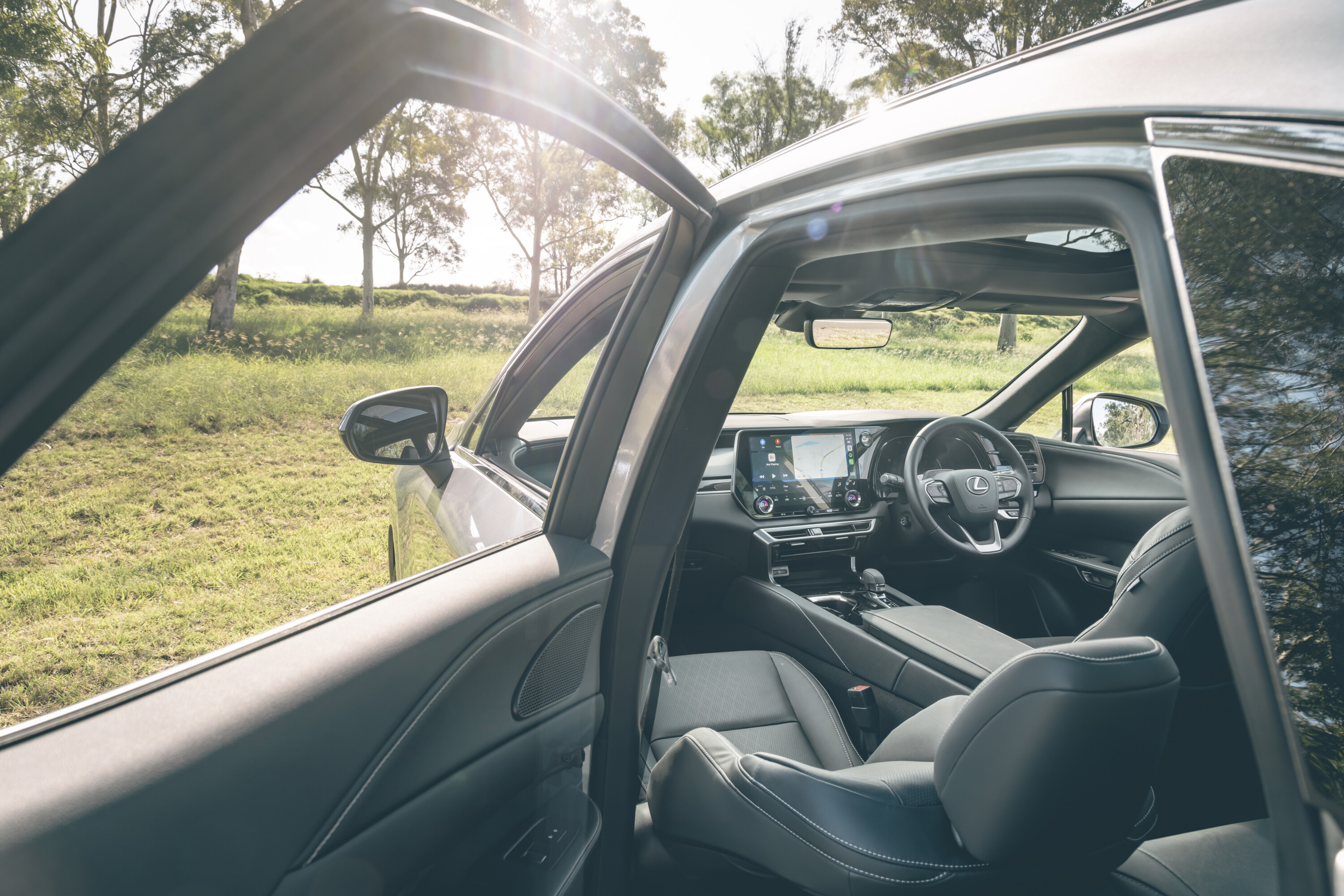
Our car was finished with safe black upholstery (Hazel, Dark Sepia, and Solis White leather choices are all available), with EP1 bringing more breathable leather seat faces and fan-cooling for driver and front passenger – a must in conjunction with the sunroof in our hot sun.
Material quality, though still premium, feels a half-step down for Lexus, even from smaller products such as the plush UX small SUV. It seems that cheaper plastics creep further up the RX’s door cards than others. Build quality of our test vehicle was, however, typically excellent.
The RX’s ‘eLatch’ door handles are an acquired taste. From the outside, they appear conventional yet don’t move as you pull on them; it’s just an electric button hidden behind a handle and there is little aerodynamic, styling or ergonomic benefit.
1
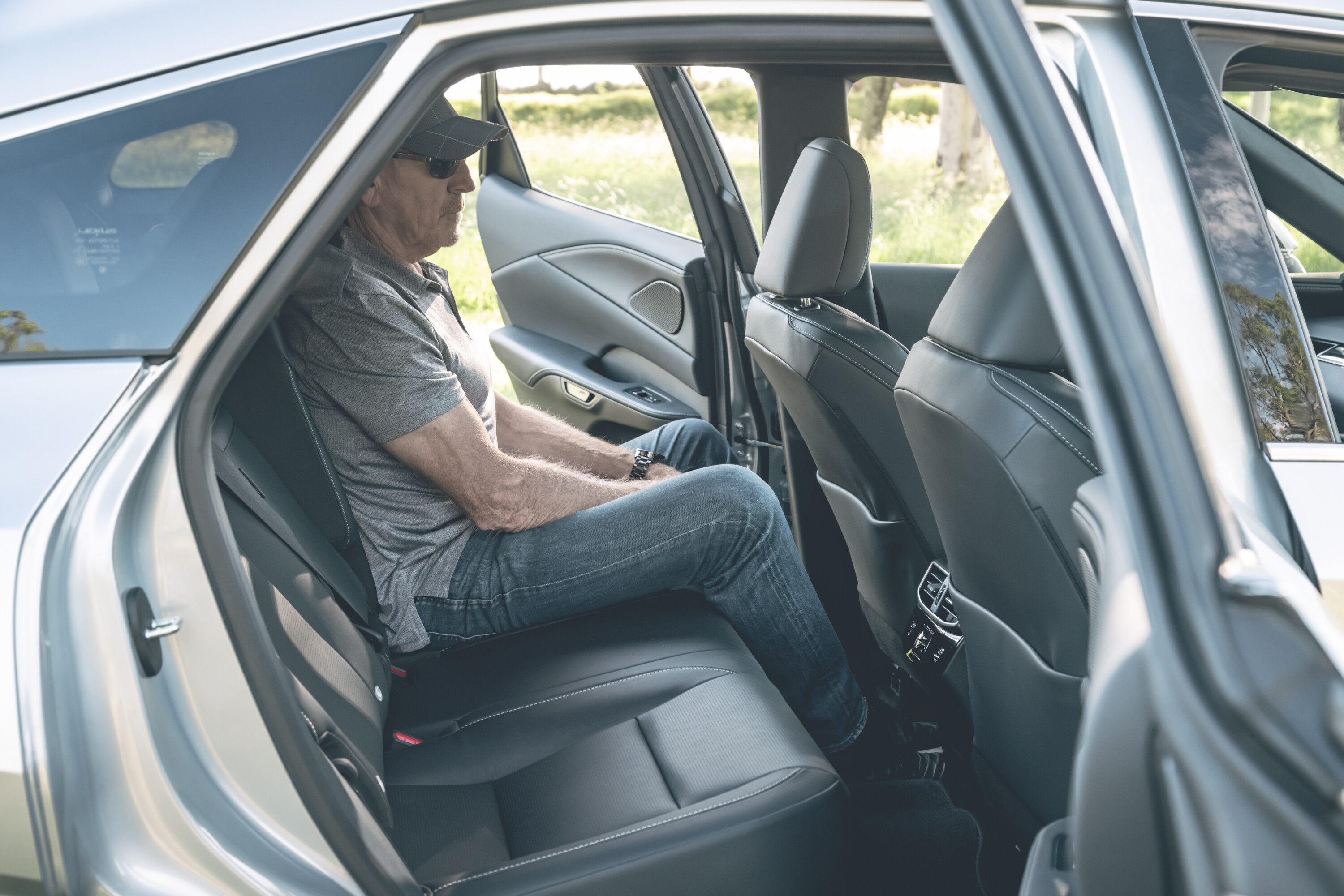
The new RX is plenty spacious in the rear seats for those up to and over six-foot
Inside, the latches are smarter – instead of pulling, it’s a press-of-the-thumb to actuate the latch, and then push with your arm. It’s a human-friendly design and theoretically keeps the force of your push aligned with the action.
While the RX doesn’t offer three rows of seating (we’ll have to wait a little longer for the RX L), the two rows it does have are very comfortable and well-appointed.
It is plenty spacious in the rear seats for those up to and over six-foot with a seven-position reclining backrest, and a bench wide enough for three that’s set high to give a great stadium view out. The back seat is finished with a fold-down armrest, a third climate zone, and two USB charge ports.
2023 Lexus RX boot space
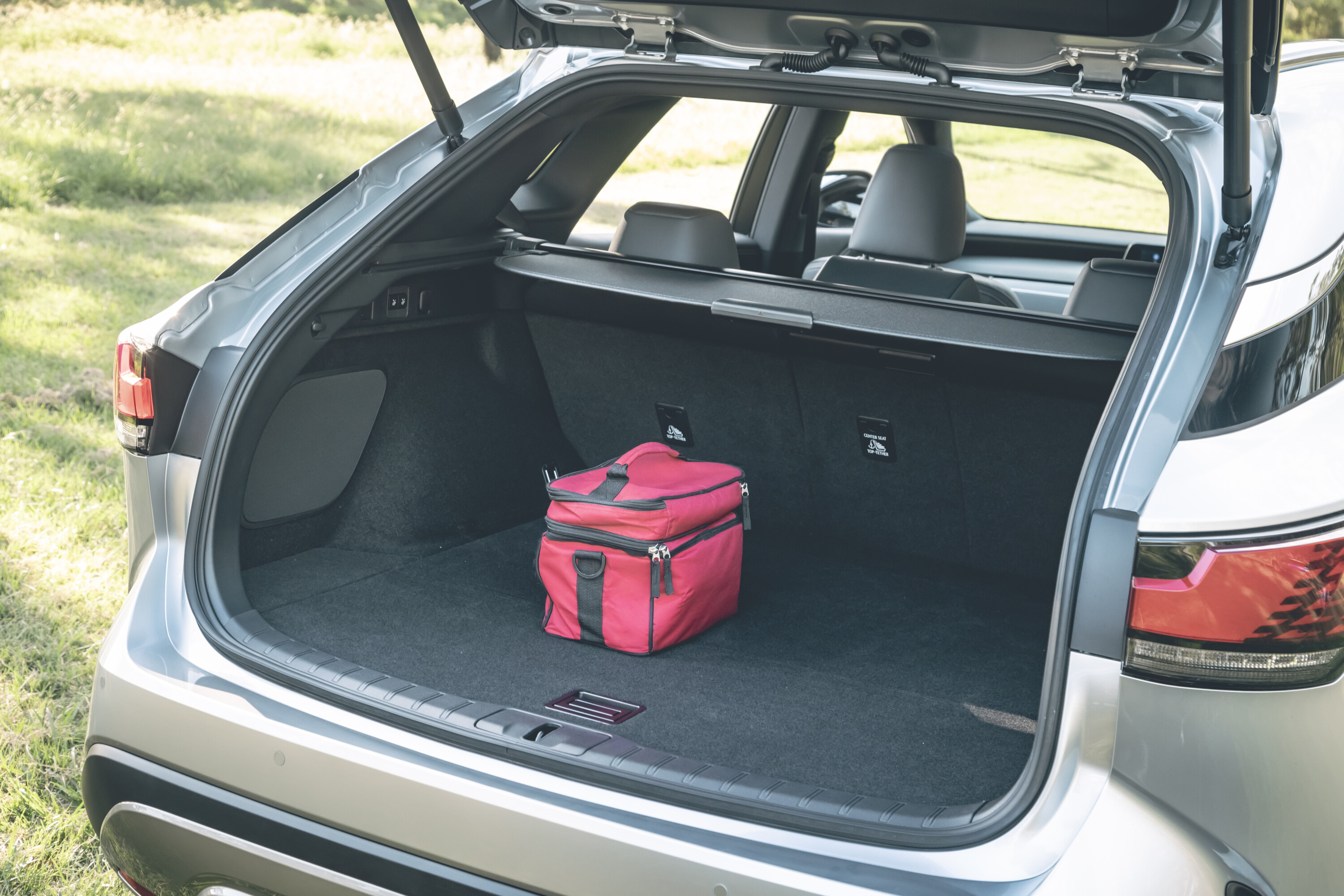
The new RX’s boot measures a decent 612 litres and it’s very nicely appointed.
It’s also easy to fold the second row flat, owing to electric push-button actuators in place of manual pull tabs. With the seats down, the RX’s load space climbs to 1678 litres. The RX has a puncture repair kit instead of a space-saver or full-size spare.
1
What is it like to drive?
The introduction of Toyota and Lexus’s new modular architecture revolutionised how the products drive, and the RX’s transformation is surely one of the biggest leaps.
Where the old RX was an unengaging combination of soggy handling with an occasionally harsh ride, the new car is smooth, relaxed and talented.
In this lower trim level, the RX’s ride is especially polished, those chubby 235/60R19 Dunlop SP Sport tyres deforming to insulate the cabin from Sydney’s concrete expansion joints. At times, there’s is a little bit of rear suspension bump-thump that makes it into the cabin.
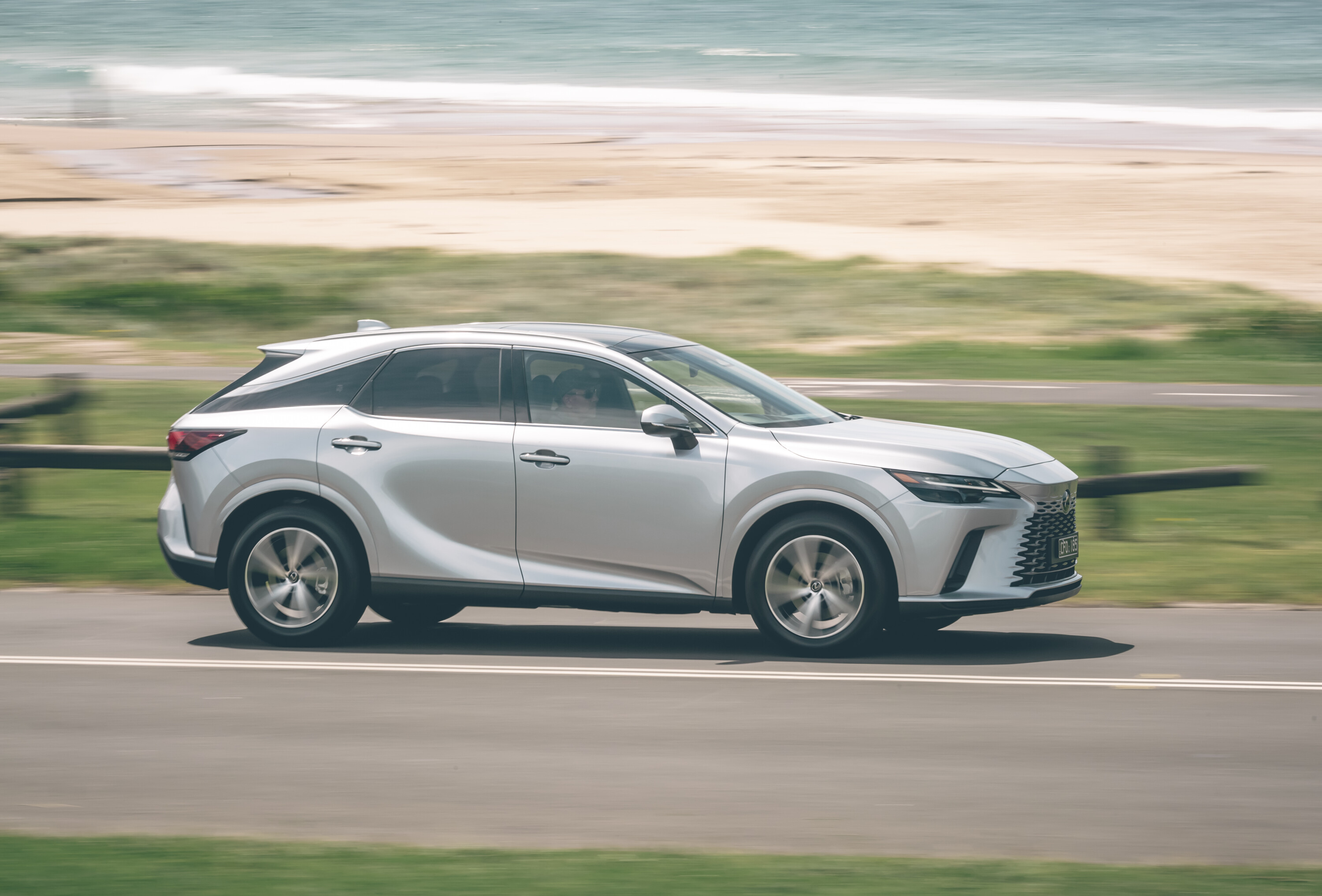
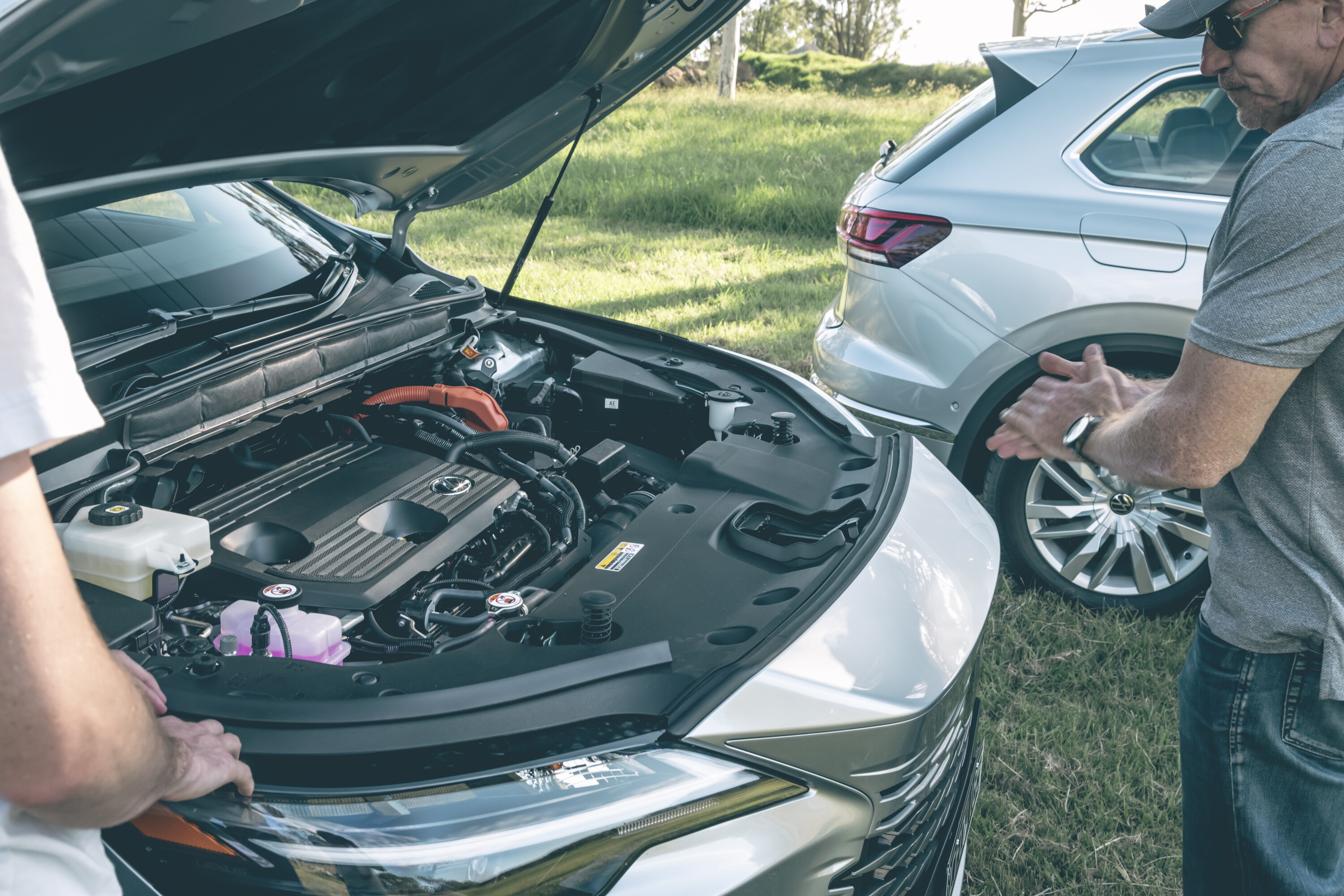
Lexus has been making hybrids for a long time, and you can tell. The 350h’s powertrain is superbly calibrated and its 2.5-litre petrol four-cylinder barely kicks in at low speeds thanks to the twin electric motors and small battery.
1
The combined power output is 184kW, and Lexus does not claim a total torque number.
Sharp initial throttle response gives the impression of real pace, but really the RX progressively builds to your desired speed. It’s a brisk, if not fast SUV, getting from rest to 100km/h in a claimed 7.9 seconds.
When cracking the throttle open to join the freeway, or execute a quick departure from a junction, the RX remains hushed. There’s enough sound deadening to quiet the atmo four-banger’s din in the cabin, and the latest e-CVT transmission limits rev-flaring better than previous iterations.
The engine sound that does make it in is also pleasingly deep in its timbre – a very different experience to the Toyota RAV4’s kazoo-like powertrain.
1
One shortcoming of the Lexus series-parallel hybrid powertrain is its towing ability.
Unbraked, the RX350h is certified for 750kg, but its braked towing capacity of 1500kg is a long way short of the Volkswagen Touareg 170TDI (3500kg).
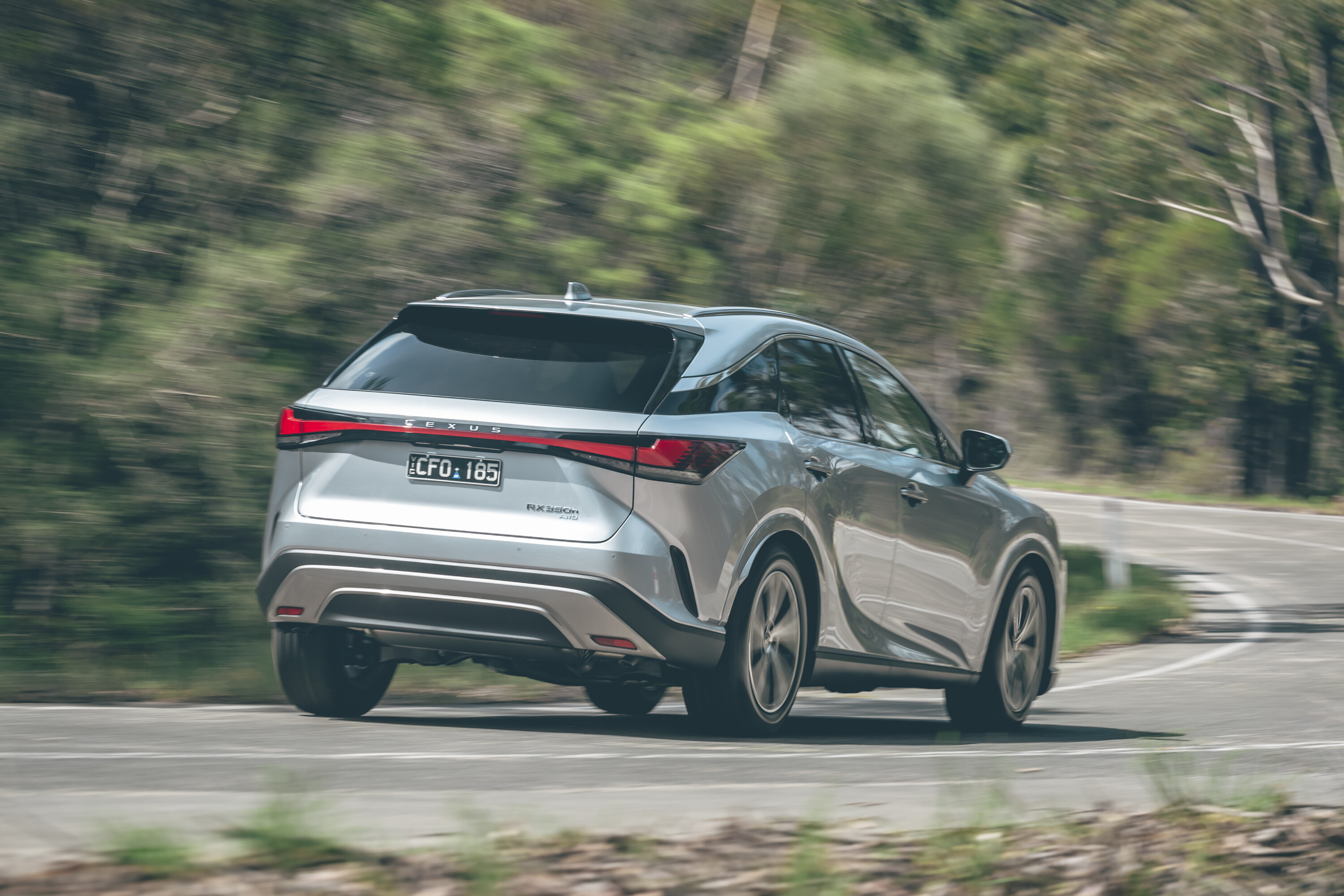
Pushing the Lexus through a series of corners reveals fluid and adjustable dynamics and rewarding steering, with the ability to trim the line with a throttle lift or dab of the brake. It’s no sporty SUV like a BMW X5, but the RX feels up to the task.
With adaptive dampers, stickier tyres and a firmer suspension tune, F Sport trim elevates the Lexus’s back-road potential. But ask yourself this, is there really any point? The base RX’s ride-handling balance feels just about spot on for a large luxury SUV.
1
How much fuel does it use?
The RX350h requires 95 RON unleaded and is rated at 5.4L/100km on the ADR combined cycle.
Our test loop involved idling for photography and dynamic testing, which saw the RX350h return 8.7L/100km.
In real-world suburban driving – where RXs will likely spend most of their time – we were seeing 7.0L/100km. That’s impressive for a 2060kg five-seat SUV.
1
How safe is it?
The Lexus RX achieved a five-star ANCAP safety rating under the 2022 protocol.
In all trims, the RX is fitted with a litany of safety and driver-assistance features including AEB with pedestrian, cyclist, and junction detection, blind-spot monitoring with intervention, rear cross-traffic alert, reverse AEB, and more. Their implementation is proficient, with more soothing chimes than related Toyota systems.
| 2023 Lexus RX350h safety features | |
|---|---|
| Autonomous emergency braking (vehicle, pedestrian, cyclist, junction, reverse) | Blind-spot monitoring |
| Emergency steering assist | Rear cross-traffic alert |
| Lane-keep assist | Driver monitoring camera |
| Lane departure warning | Safe exit assist |
Warranty and running costs
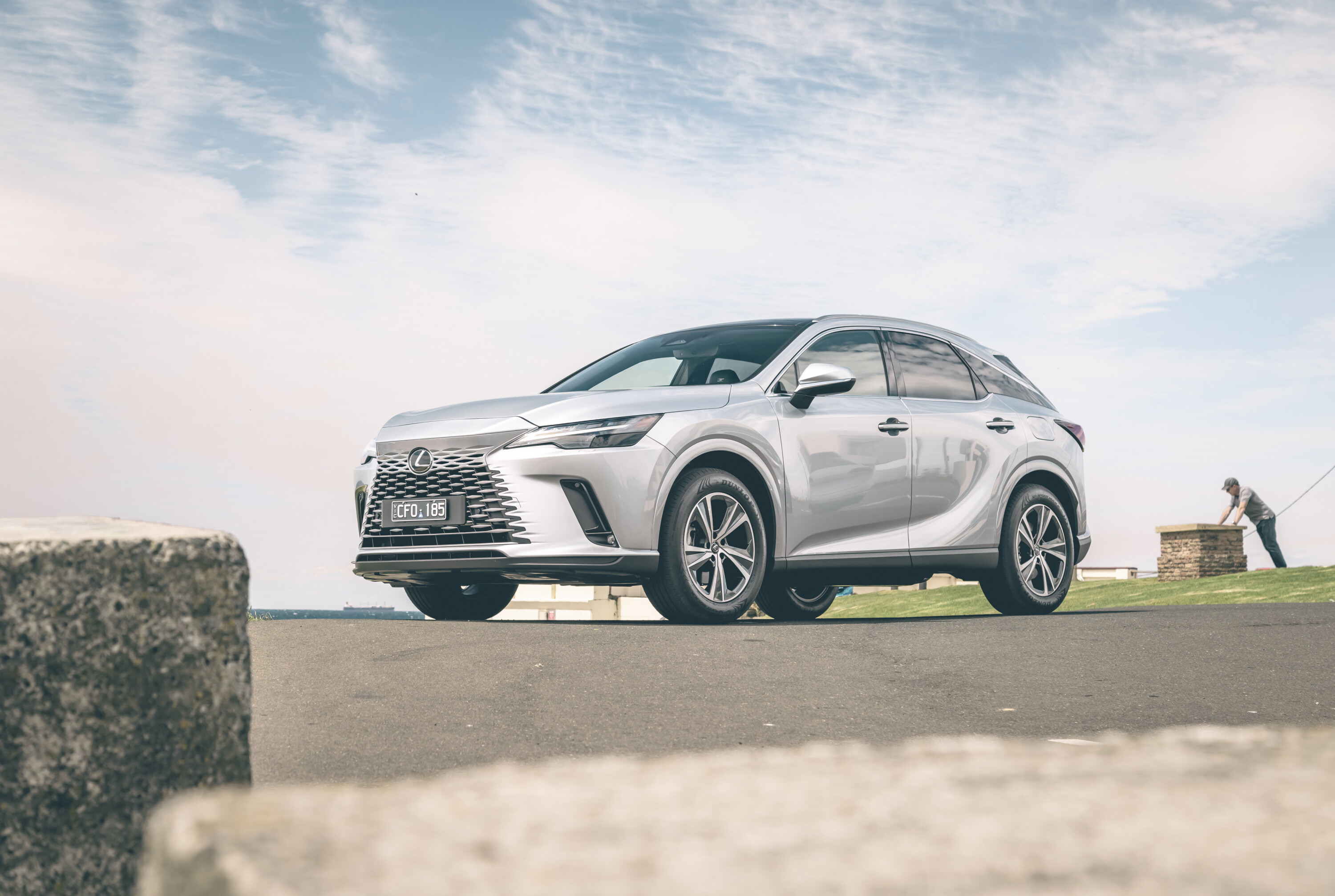
The Lexus RX350h is covered by a five-year, unlimited-kilometre warranty, with five years of capped-price servicing too.
Lexus mandates maintenance every 12 months or 15,000km at a cost of $695 per visit. Over five years or 75,000km of motoring, the RX350h will cost $3475 to maintain.
Sweetening the deal is Lexus’s three-year Encore program subscription, entitling owners to fuel discounts, free roadside assistance, invites to exclusive Lexus events and VIP treatment at participating hotels.
1
VERDICT
Although all-new for this fifth-generation example, the Lexus RX retains its position in the market – and that’s a good thing.
It hasn’t become the default choice above the BMW X5, Audi Q7 or Mercedes-Benz GLE. But for someone not worried about sporty handling, chintzy cabin design or outright speed, the base RX is a great package.
In fact, it nails the luxury SUV brief better than most of its big-wheeled, sportily-flavoured rivals.
Providing you tick the Enhancement Pack 1 box, the base RX350h has just about everything you need without an exorbitant price tag.
Lexus’s reliability record makes the RX a pragmatic choice for a longer-term stint, and the added Encore Platinum subscription and low fuel consumption sweeten the deal.
It’s not perfect, but the RX makes a lot of sense.
MORE
Everything Lexus
MORE
Large SUVs
| 2023 Lexus RX350h + EP1 specifications | |
|---|---|
| Price | $97,500 + on-road costs |
| DRIVETRAIN | |
| Engine | inline 4 cyl, 2.5-litre, DOHC, atkinson cycle, 40kW/121Nm rear motor |
| Layout | Front engine, transverse, FWD with electric rear motor |
| Power | 184kW |
| Torque | not specified |
| Transmission | continuously variable |
| CHASSIS | |
| L/W/H/Wu2013B | 4890/1920/1695/2850mm |
| Track (F/R) | 1650/1675mm |
| Weight (claimed) | 2060kg |
| Boot | 612/1678L |
| Fuel/tank | 95 RON / 65L |
| Economy (combined ADR81/02) | 5.4L/100km |
| Suspension | Front: struts, stabiliser bar. Rear: multi-link stabiliser bar |
| Steering | rack-assisted electric power steering 2.76 turns lock to lock |
| Front brakes | 340mm x 28mm ventilated rotors, 2 piston caliper |
| Rear brakes | 340mm x18mm ventilated rotors, single-piston floating calliper |
| Tyres | Dunlop SP Sport |
| Tyre size | 235/60R19 |
| SAFETY | |
| ANCAP rating | 5 stars (2023) |
| 0-100km/h | 7.9 seconds |
The MG and General Motors’ electric micro car has launched outside of China, straight into India, with a cheap INR₹798,000 (AU$14,700) price tag.
Snapshot
- MG Comet launches in India as rebadged Wuling Air EV
- Sub $15,000 price, 230km range
- Modern tech, funky tall design
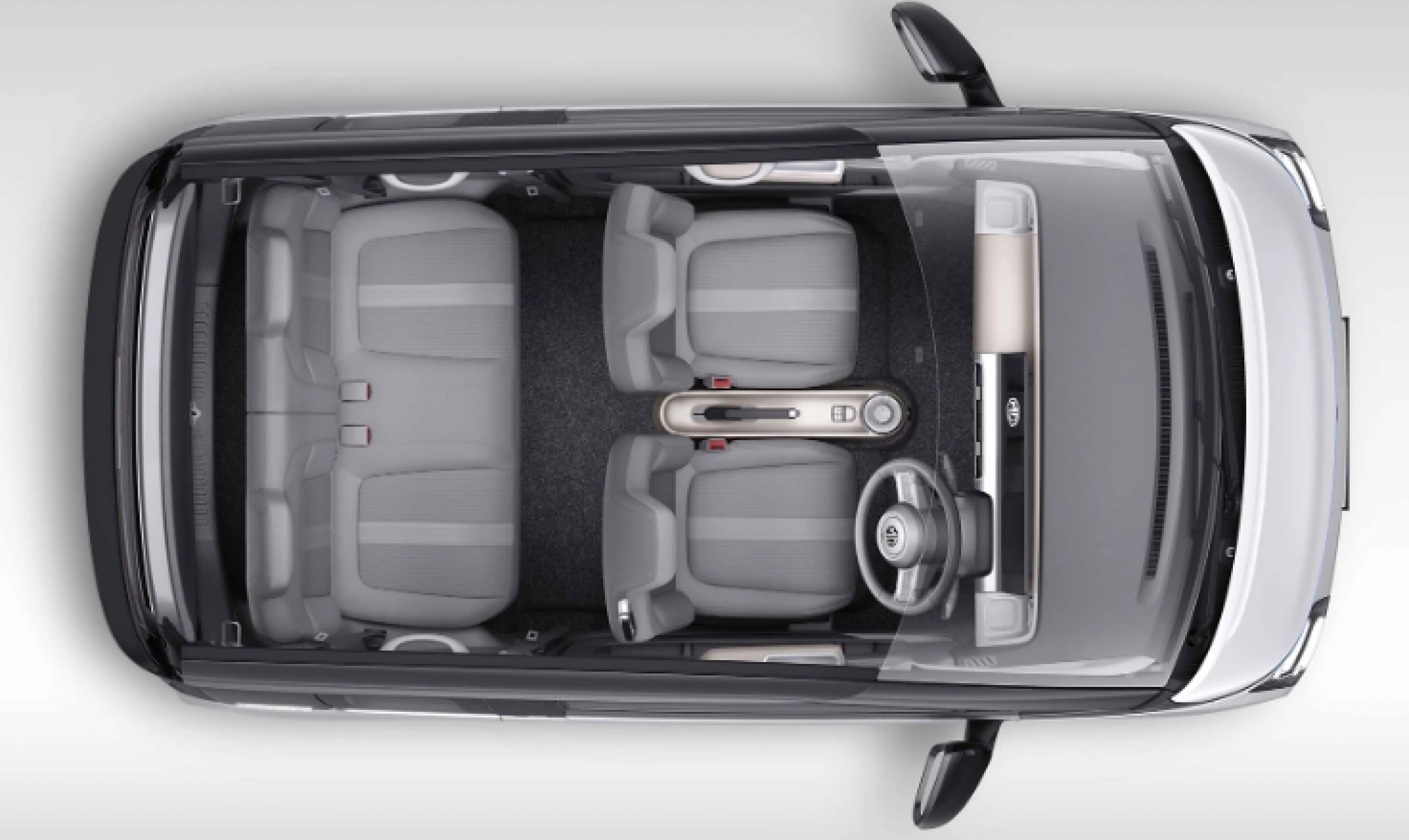
The MG Comet is sold in India as a rebadged version of the Wuling Air EV from China, produced under the SAIC-GM-Wuling joint venture.
Measuring in at 2974mm long, 1505mm wide, and 1640mm tall with a 2010mm wheelbase, the four-seater EV is smaller than a Kia Picanto in every dimension except for height.
1
230km of range – although India’s test cycle is not considered comparable with global standards
The three-door micro electric car features a 17.3kWh battery pack using prismatic cells to provide 230 kilometres of claimed driving range on India’s MIDC testing cycle.
Fast DC charging isn’t supported, though, which is no surprise at the Comet’s low price point.
Instead, its AC onboard charger is limited to 3.3kW, which would take around 5.5 hours to recharge from flat to 80 per cent.
The Comet is even rear-wheel-driven, with the electric motor producing 31kW of power and 100Nm of torque.
1
What does it get?
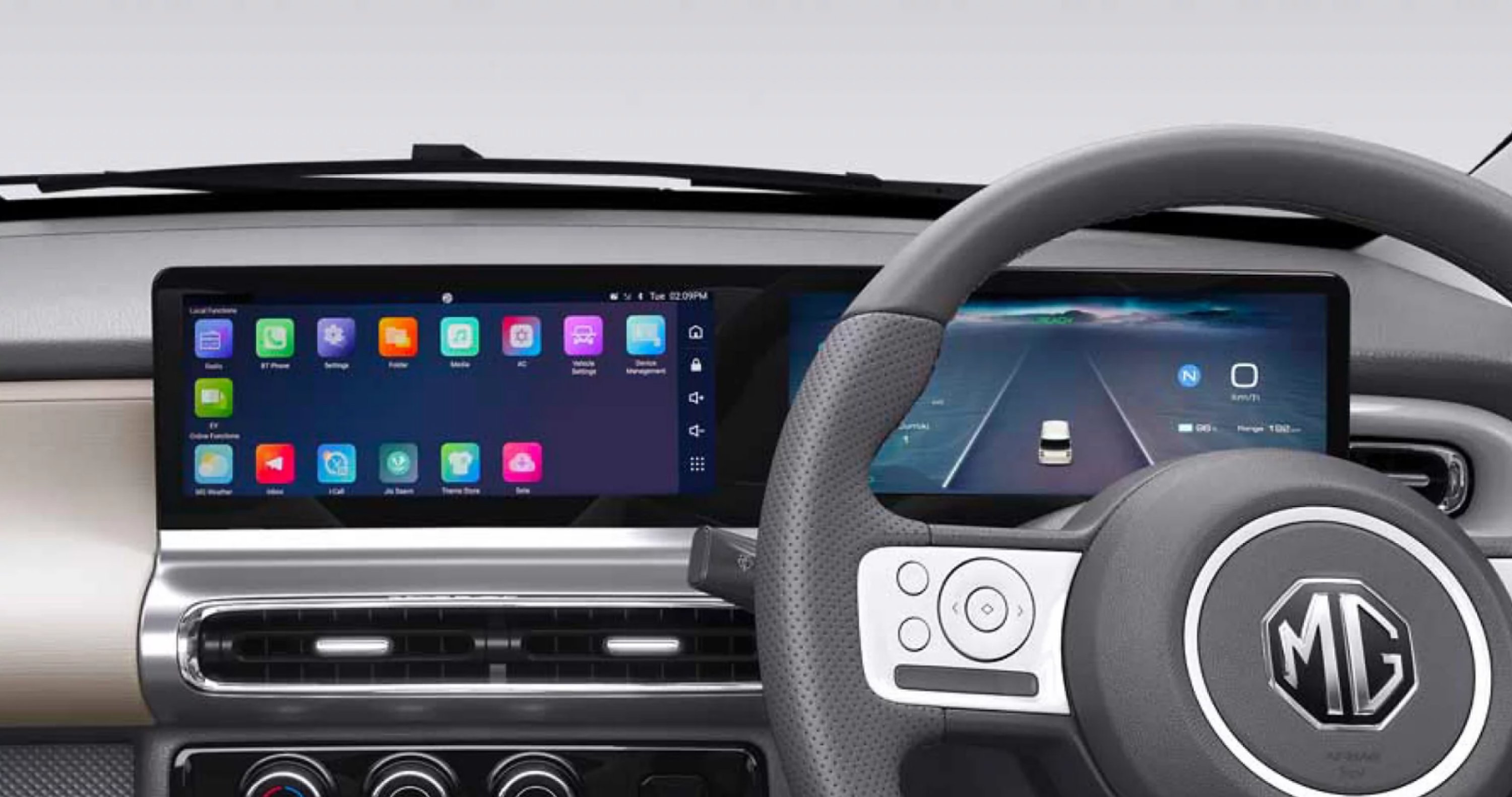
Despite the affordable price, it doesn’t skimp on modern features, such as; dual 10.25-inch touchscreen and instrument displays, wireless Apple CarPlay and wireless Android Auto smartphone projection, MG i-Smart smartphone app connectivity (like the MG ZS EV), leather steering wheel, and proximity key with push button start.
It even has full-width LED head- and tail-lights (similar to Hyundai’s Seamless Horizon Lamp on the forthcoming Kona and Sonata), an illuminated MG logo, four funky two-tone exterior colours, and seven sticker packs available.
Could the MG Comet be Australia’s cheapest EV?
Probably not, for the same reason so few Indian-market cars ever come to Australia: their safety standards just don’t measure up.
The Comet has a relatively modern safety kit of anti-lock brakes, dual front airbags, reversing camera and sensors, and even ISOFIX rear-seat child seat anchors – but it’s unlikely to meet stricter local safety standards in developed countries or from the Australasian New Car Assessment Program (ANCAP) locally.
In China, it sits above the top-selling Wuling Hong Guang Mini EV.
1
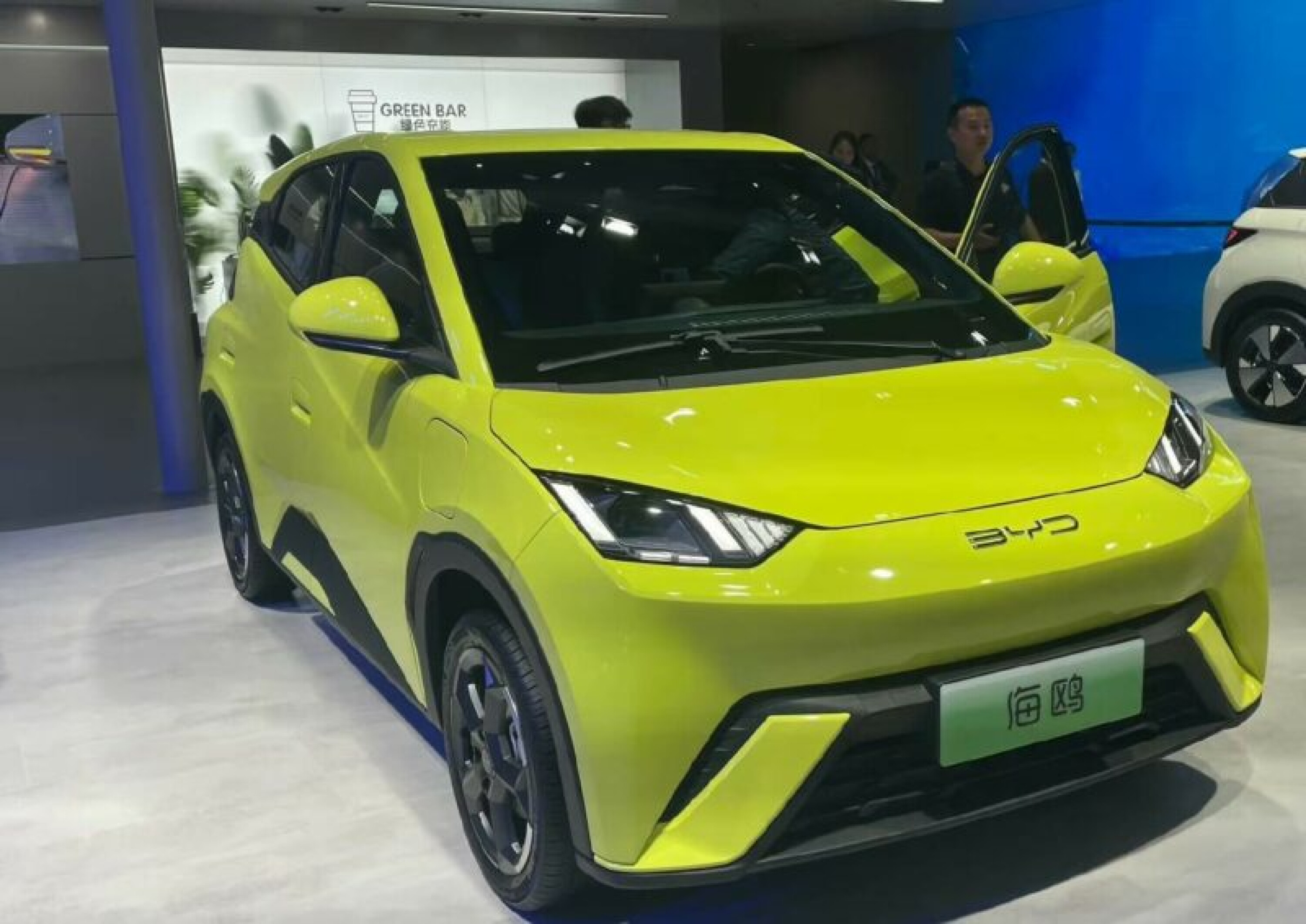
Last week, Shenzhen automaker Build Your Dreams (BYD) revealed the slightly larger Seagull electric light hatch (above), but that remains a China-only proposition at launch.
MORE
Everything MG
MORE
Electric Cars
⚡ More EV stories to help you choose the best car for your needs
The extended-wheelbase Volkswagen Tiguan could be replaced by a new three-row SUV.
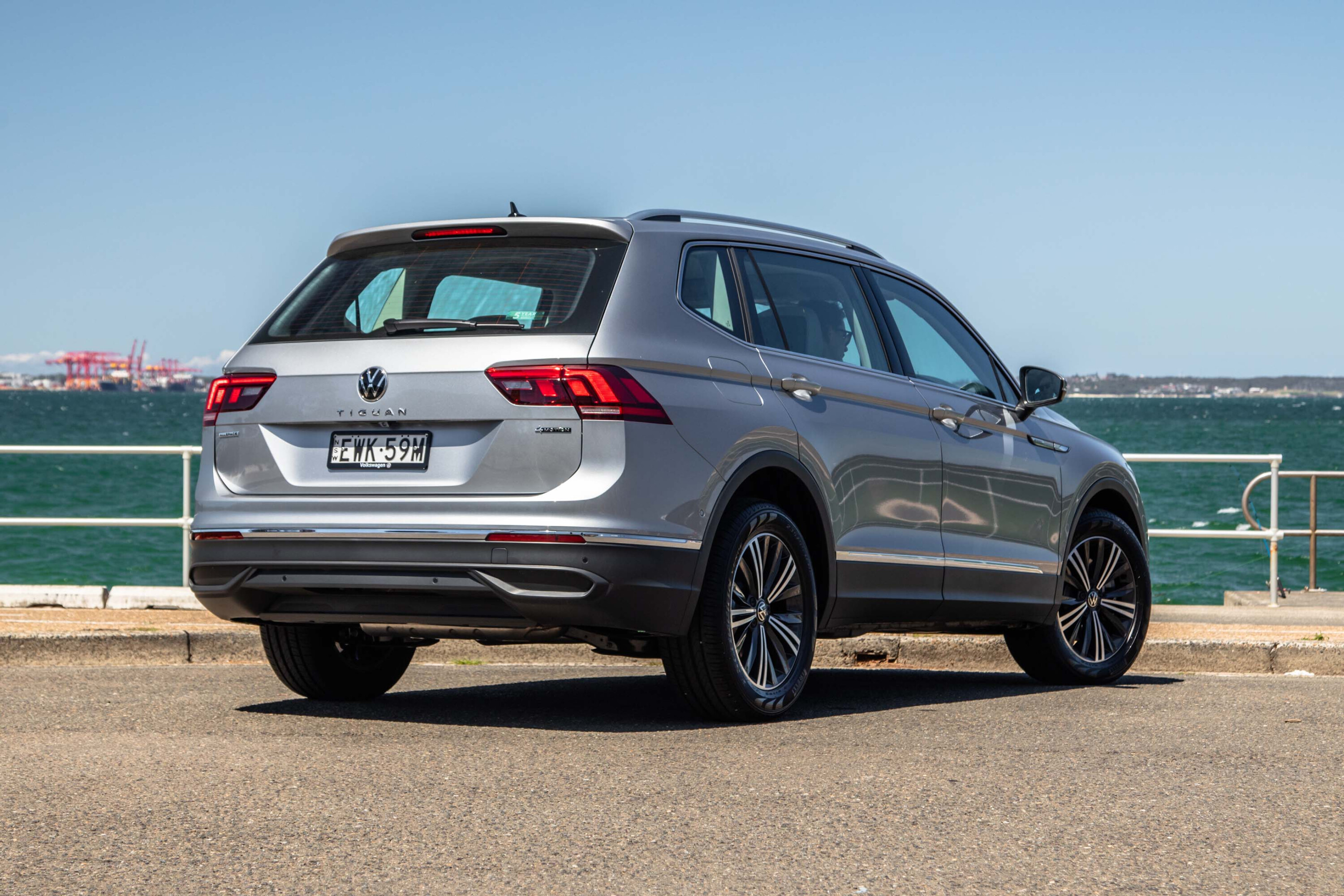
Sold in Australia and Europe as the Tiguan Allspace, the seven-seat medium-to-large SUV debuted in 2017, with a facelift in 2021 – but it could be axed soon.
The next-generation ‘standard-wheelbase’ Tiguan is due for reveal in the coming months and, until now, there has been little talk about a long-wheelbase Allspace version.
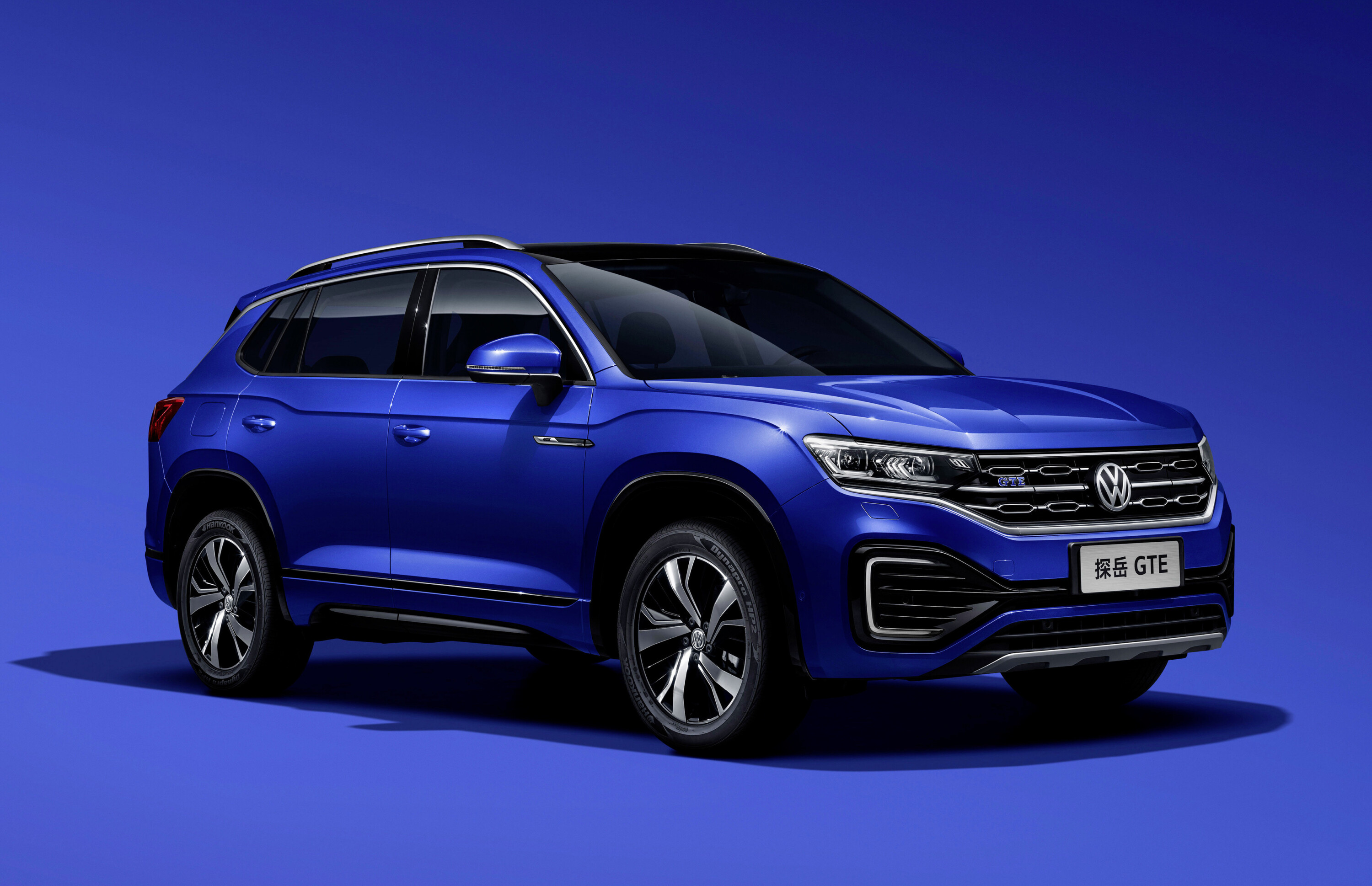
Autocar India[↗] reports a global three-row SUV is “in the works” to replace both the Tiguan Allspace and the China-only first-generation Tayron large SUV, with the latter badge likely to feature on the three-row family hauler.
1
The report is further strengthened by recent comments made by Volkswagen brand CEO, Thomas Schäfer, in an interview with Automotive News Europe[↗].
“This year, we are bringing the new Passat and the new Tiguan, next year the Tayron and then the successor to the T-Roc,” said Schäfer.
“From today’s perspective, we will carry these vehicles well into the 2030s. That will give us a good lineup. As we phase out combustion engines in Europe in 2033, it no longer makes sense to launch vehicles with completely new combustion engines.”
1
In late 2020, Automotive News Europe[↗] reported that “Volkswagen will build a large SUV for the European market starting in 2024 as part of its latest investment plans for its home factory in Wolfsburg, Germany.”
“The vehicle will be based on the Tayron SUV sold by the automaker’s Chinese joint venture, FAW-Volkswagen, and could potentially replace the Tiguan Allspace.”
Currently, the Tiguan Allspace is manufactured in Mexico for Australasia, Europe and North America, while the FAW-Volkswagen joint-venture produces an identical Tiguan L and the smaller Tayron in China.
The existing five-seat Tayron medium SUV measures 4595mm in length, placing it between the Tiguan and the Tiguan Allspace. It has an identical 2731mm wheelbase to the current Allspace.
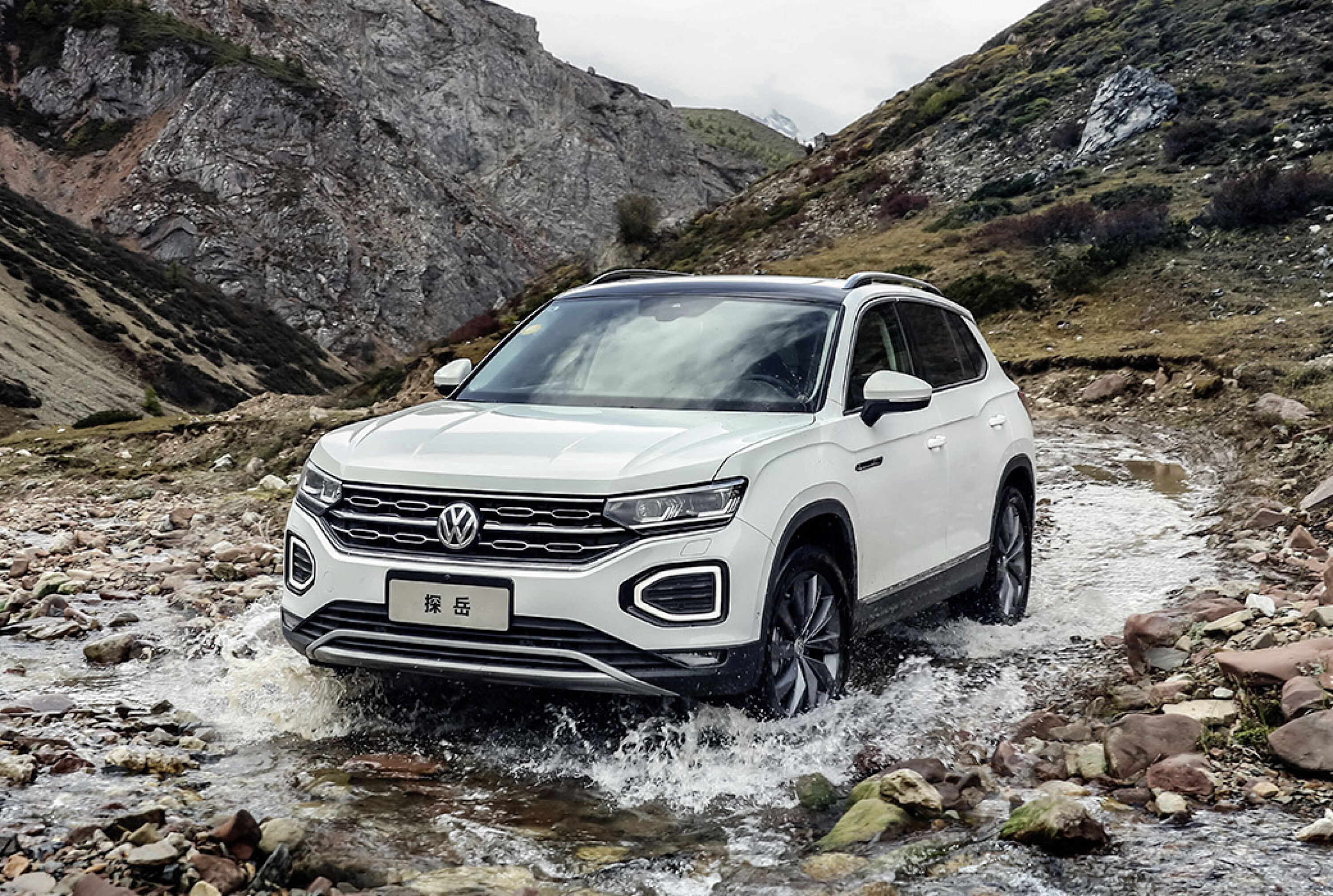
1
Expect the new model to grow in every dimension, placing it closer to established seven-seat rivals such as the Kia Sorento, Hyundai Santa Fe, the upcoming Mazda CX-80, and the related Skoda Kodiaq.
The upcoming Tayron would also provide Australian and European buyers with an alternative closer to the larger three-row Volkswagen Atlas, which is sold in North America, China and the Middle East.
If the new Tiguan and Skoda Kodiaq are a guide, the Tayron should ride on Volkswagen’s updated MQB Evo platform, with mild-hybrid and plug-in hybrid powertrains.
The seven-seat 2025 Volkswagen Tayron is expected to commence production in Germany next year, with more details likely in the coming months.
MORE
Midsize SUVs
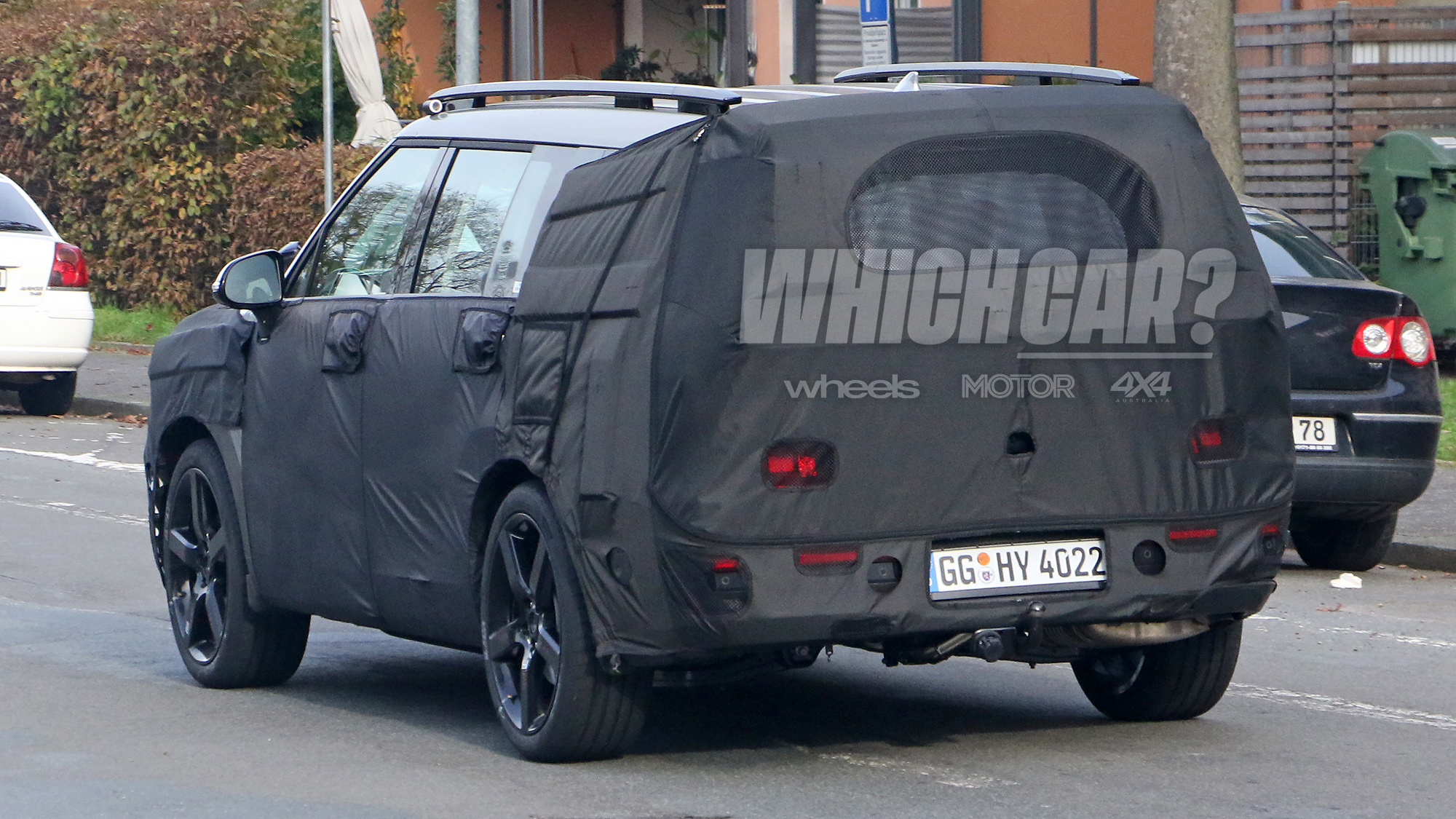
The next-gen 2024 Hyundai Santa Fe has been spied in testing, hinting at a dramatic change in direction.
In its new fifth-generation form, the 2024 Santa Fe will take on a proper ‘two-box’ look, throwing out all the curves and deep angles of recent Hyundai models.
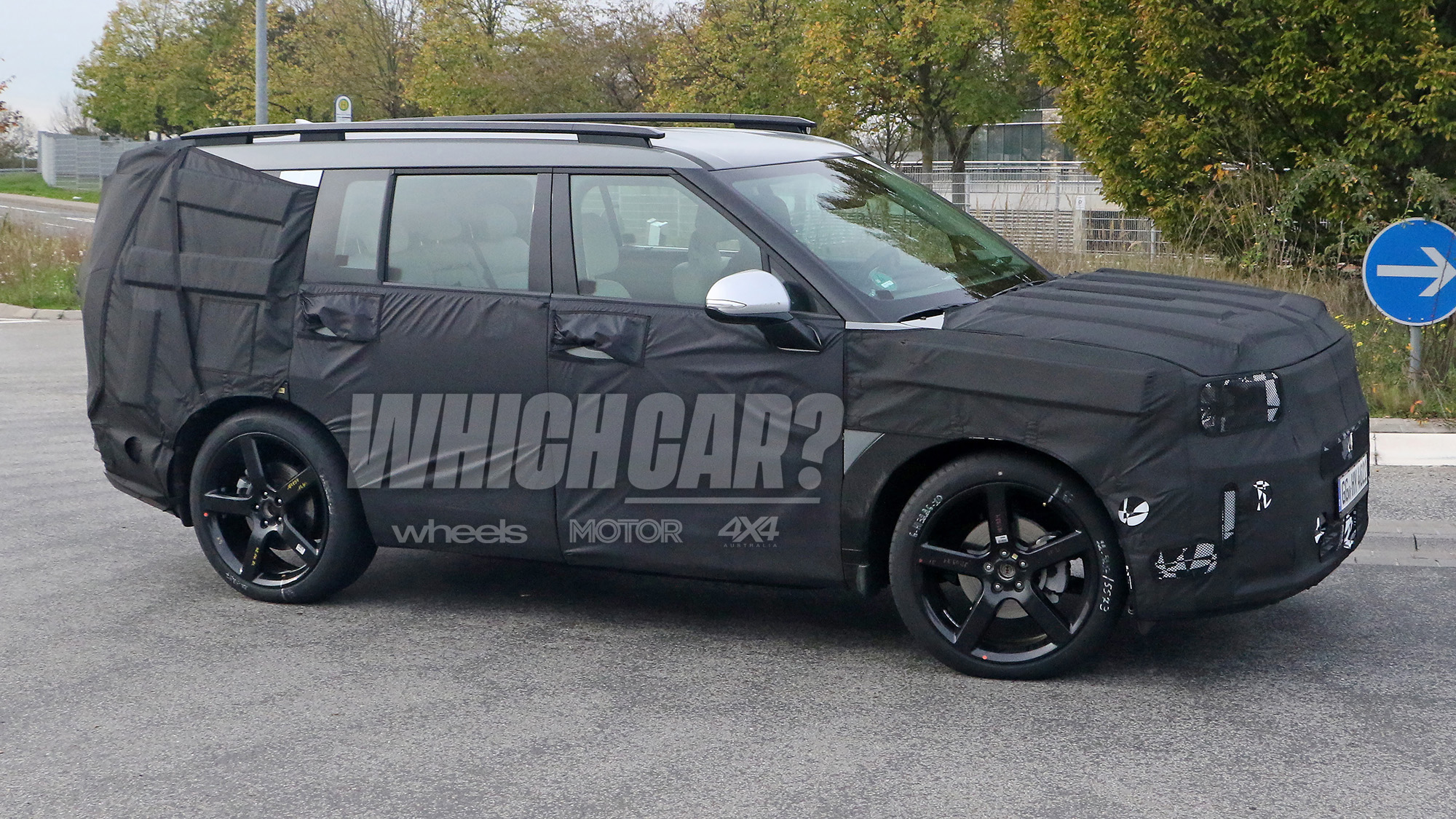
The vehicle spied here is still draped in heavy camouflage, but it’s clear we can expect a design inspired by the big square American SUVs of old, or even the properly boxy, Peter Horbury-designed Ford Flex that was sold in America from 2008 to 2019.
JUMP AHEAD
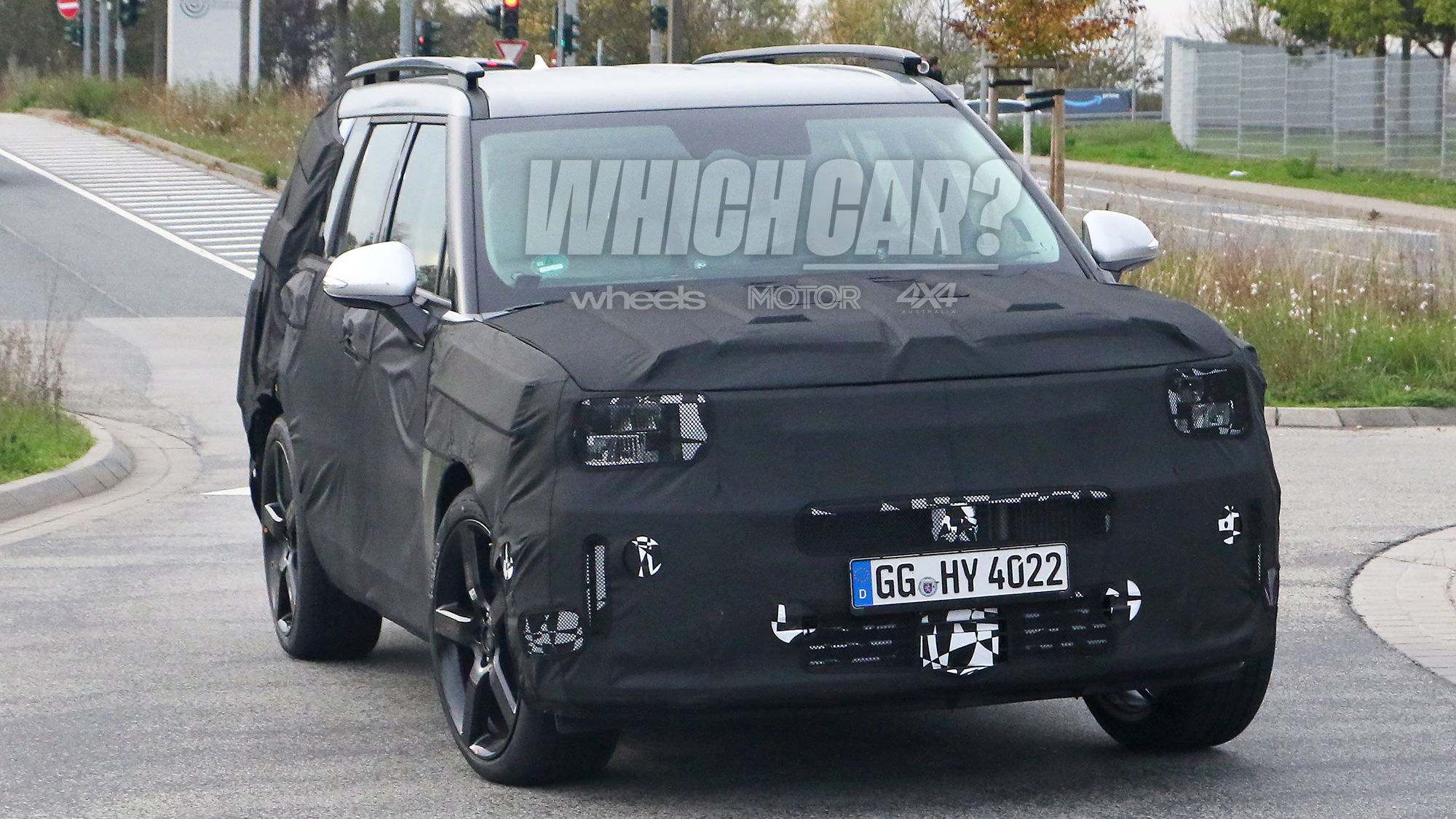
1
Of course, punters will likely also have thoughts like new-gen Land Rover Defender, with its similar-in-concept boxiness clearly designed to merge the original car’s look with a modern approach for a retro-futuristic result.
For the Santa Fe, it’s likely to mean a more spacious cabin for families, particularly if what looks to be a longer wheelbase is also part of the equation. That should make the third row a more liveable space, too.
1
Styling
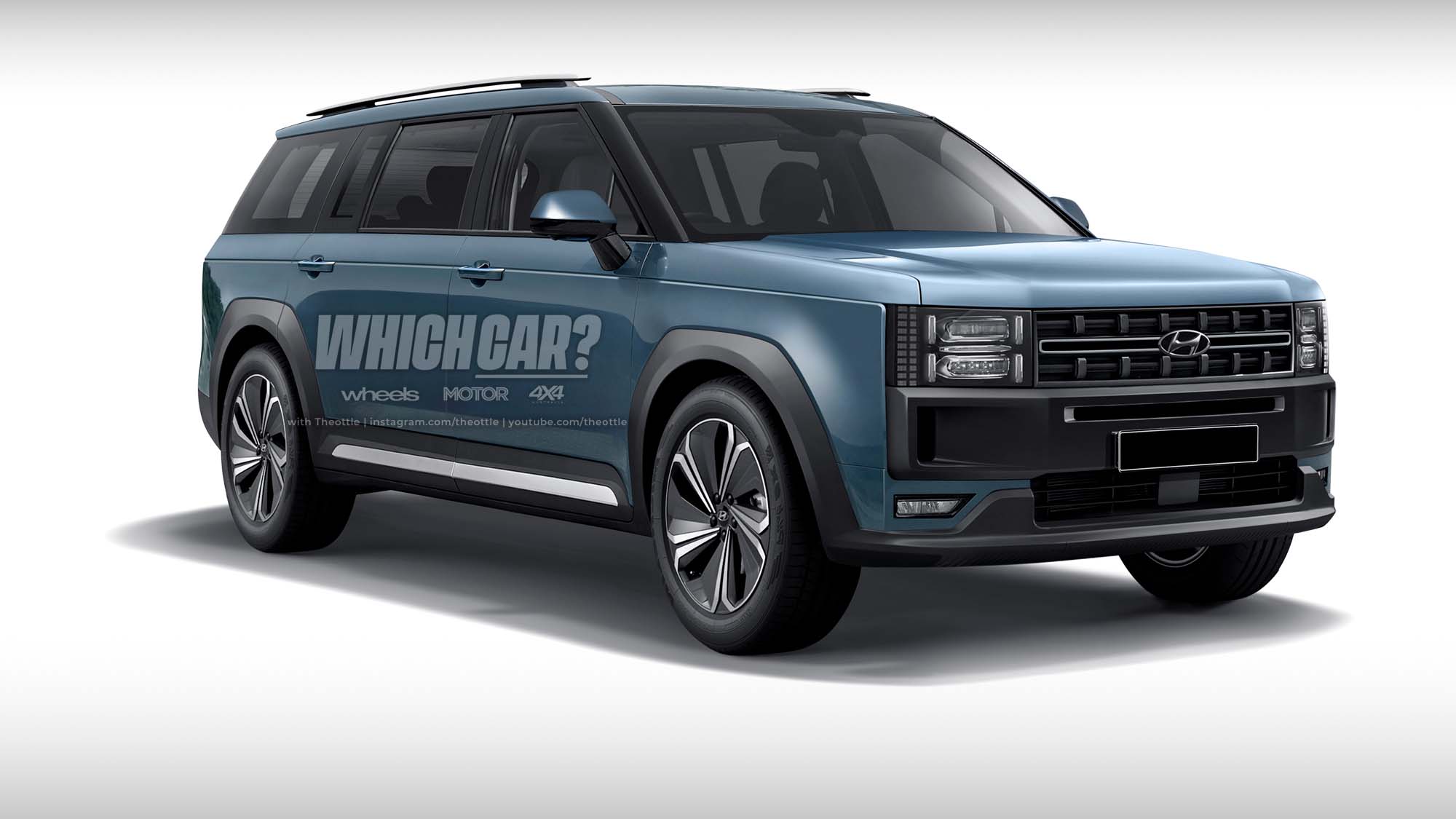
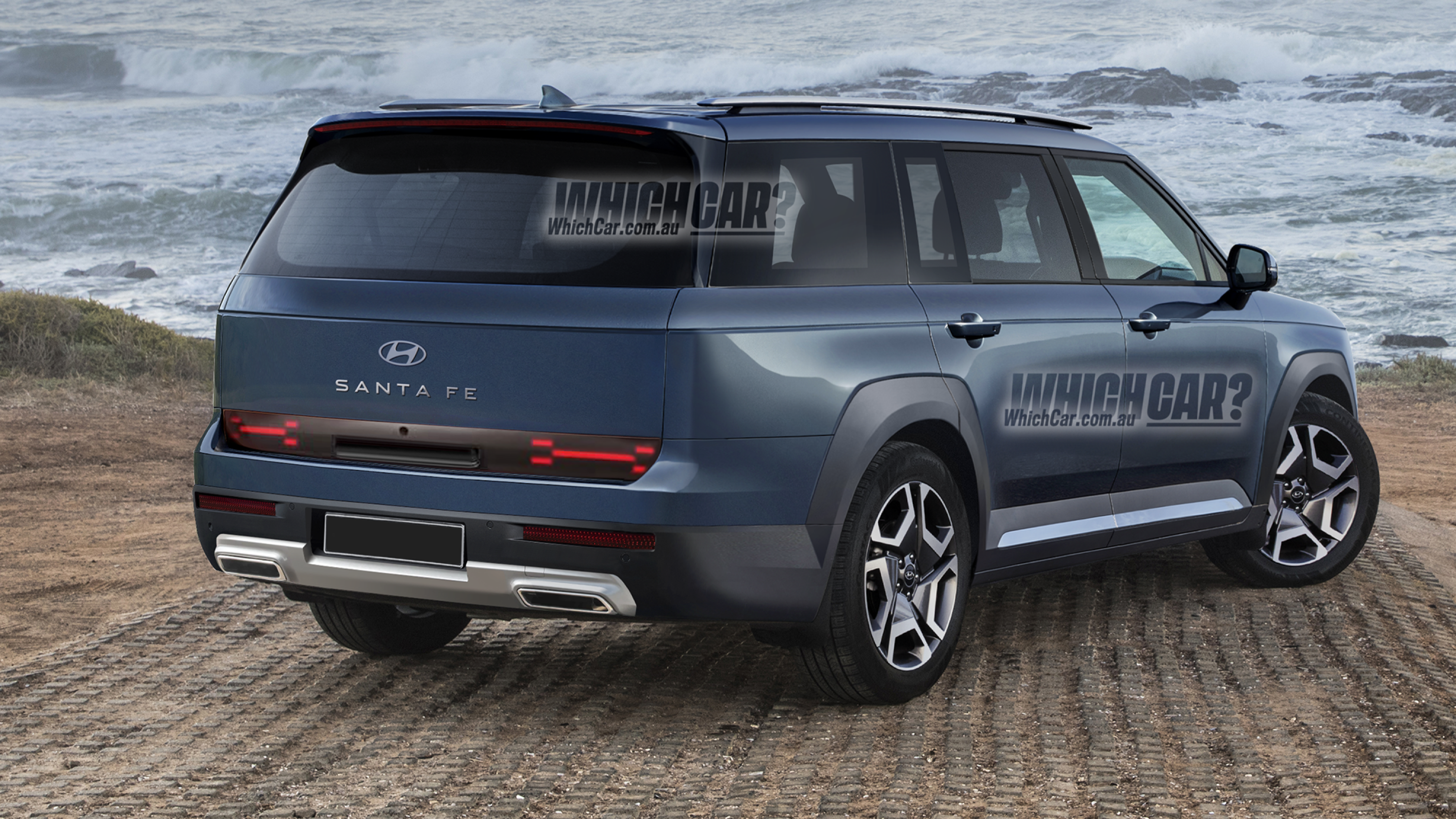
What little we can see of the new model’s details hints at a square face with H-shaped daytime running lights, which we’ve worked into our rendering below (and we’ve set them aglow in the hero image at the top of this story).
Much of our rendering is otherwise speculative, but we expect a fairly tame approach to character lines (rather than the deep origami look of the Tucson and i30 sedan), along with an expansive wraparound look to the glasshouse.
Large grey cladding for the wheel arches can be made out in the new Santa Fe’s camouflage gaps, which we’ve also worked into our rendering.
1
1
Powertrains
Mechanical details are unclear, but it’s likely we can again expect at least diesel and hybrid powertrains, if not a continuation of the 200kW/331Nm 3.5-litre petrol V6 offered in front-wheel-drive versions of the current model.
On the diesel and hybrid fronts, the current model is available with a 148kW/440Nm 2.2-litre four-cylinder turbo diesel and a 169kW/350Nm 1.6-litre petrol-electric hybrid model, only newly launched.
1
When will the new 2024 Santa Fe come to Australia?
Hyundai isn’t offering any comment on the new Santa Fe just yet, but we can look to the current range for clues.
The facelifted Santa Fe already on sale was launched here in late 2020, and we generally expect midlife updates to run around three to four years.
On that timeline, the new-generation Santa Fe will likely be revealed in the first quarter of 2023, with Hyundai Australia’s previous launch schedules suggesting a local debut would occur either in late 2023 or, more likely, in early 2024.
Watch for more on the new Santa Fe to come in the months ahead. What do you think of its look so far? Tell us in the comments below!
MORE
Everything Hyundai
