
As a few readers have noted in the comments below – and as John has already made clear in this story – there is no question that the car shown is a Mazda CX-30 with Tesla pieces tacked on. We don’t believe it’s “photoshopped” as some have said, but rather a real car built as a hoax. We’ve yet to find any links in our research that offer convincing evidence to the contrary. We have, however, updated the headline for clarity. – Mike Stevens
Now that we can be reasonably sure the updated Model 3 will get Roadster-inspired headlights, could the upcoming Model 2 do the same?
The new-look Model 3 appeared online last week, and as long as it isn’t proven to be a hoax, it seems we now know what to expect from Tesla’s midsize sedan when it’s updated in the coming months.
Of course, that got us to thinking the promised sub-3 compact, likely to be called Model 2, will share more than a few key styling elements.
1
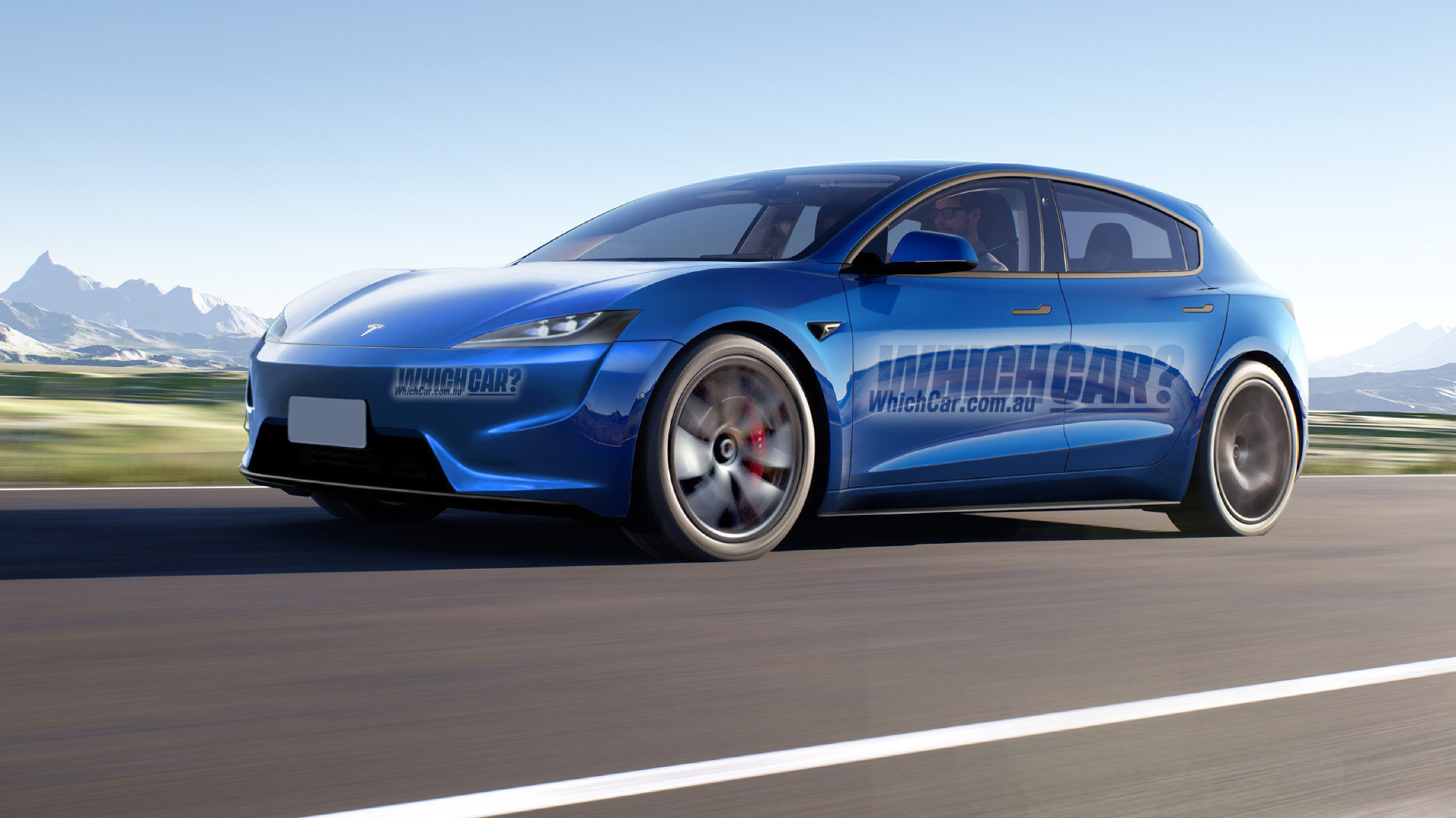
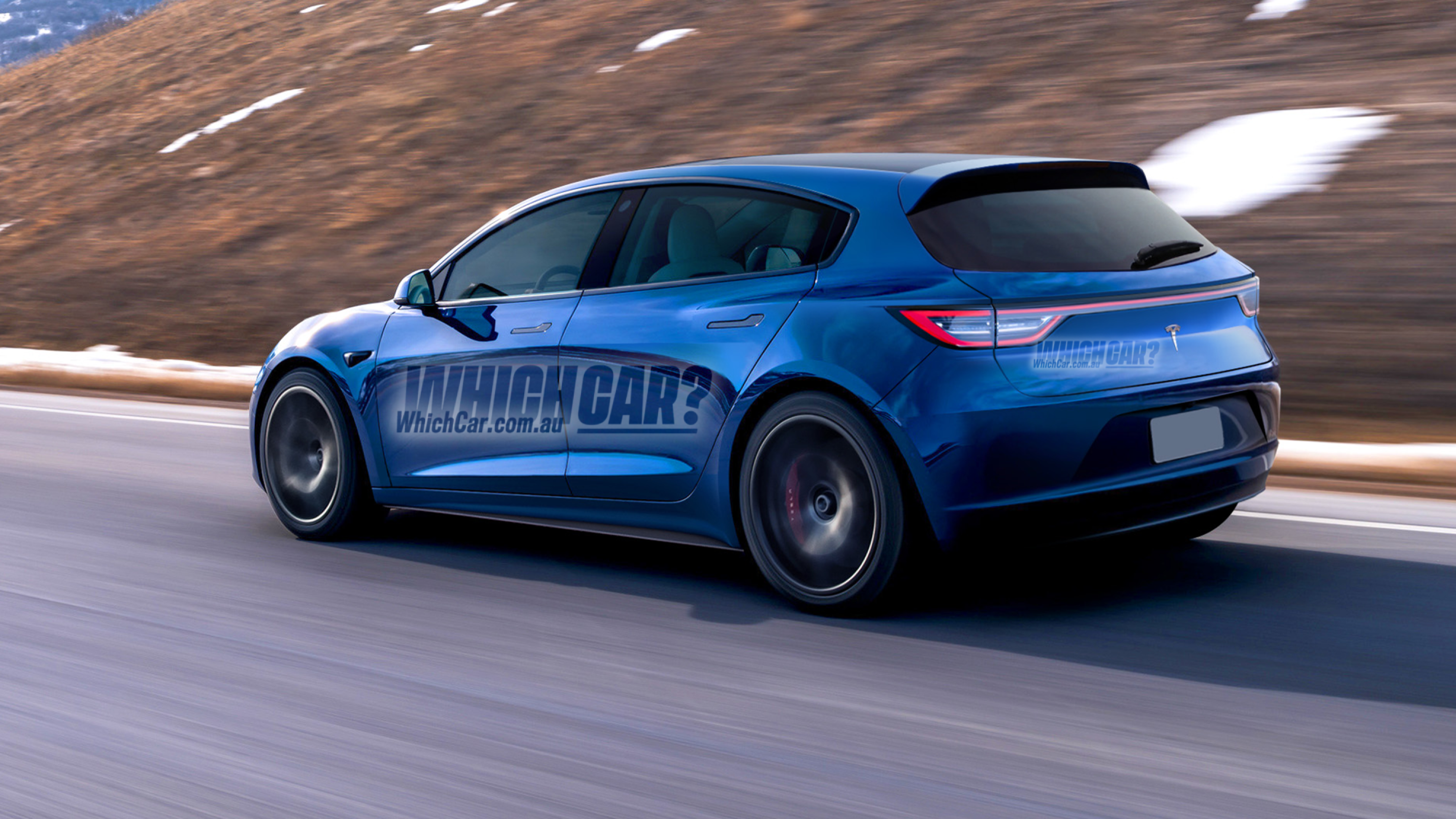
Our renderings here show the Model 2 as a hatchback, and we wouldn’t be surprised to see a small SUV version – perhaps the Model Z – join it later, given the global obsession with high-riding models.
Continuing the themes established with the new Roadster (if it ever launches) and the facelifted Model 3, we’ve given the Model 2 a sharp and slender headlight design.
The profile is much the same as the current Model 3 and Model Y, while the rear shows a speculative new tail lamp design linked by the increasingly trendy LED lightbar through the centre.
What do you think of this look? Tell us in the comments below!
May 2023: Model 2 teased at last! We think…
Is this image, shown during a recent shareholder call, our first look at the Model 2? Musk’s comments during the call suggest it is.
1
April 2023: Could the Model 2 look like this?
Based on what we’ve seen of the updated Model 3, we wonder if the upcoming Model 2 will look like this…
April 2023: Tesla previews three new EVs, including a bus and van
Tesla will widen its electric vehicle portfolio across a variety of segments, as it works to stay competitive in an increasingly crowded market. Full story below.
February 2023: Why is this CX-30 dressed in Tesla bits?
It’s no secret that Tesla is developing an entry-level electric vehicle to sit below the Model 3 and Model Y in terms of cost and size.
Snapshot
- New Tesla small SUV spied
- Potential March reveal
- Sub-$40K price point possible
A Tesla investor day is to be held on March 2, where it is anticipated the EV specialist will detail its new affordable small car architecture. Expected to be known as the Model 2 and priced between $40-50K, the new Tesla model will likely compete with BYD Atto 3 and GWM Ora in the entry-level EV space.
NOTE: Yes, it’s absolutely a CX-30
2
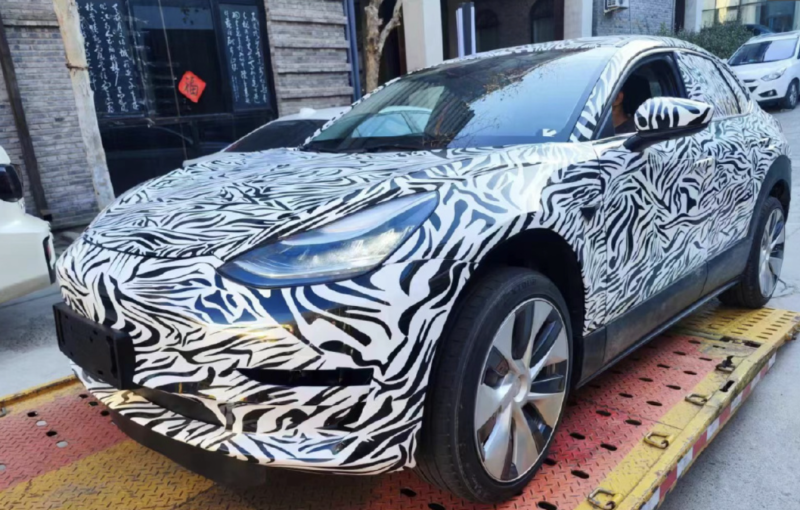
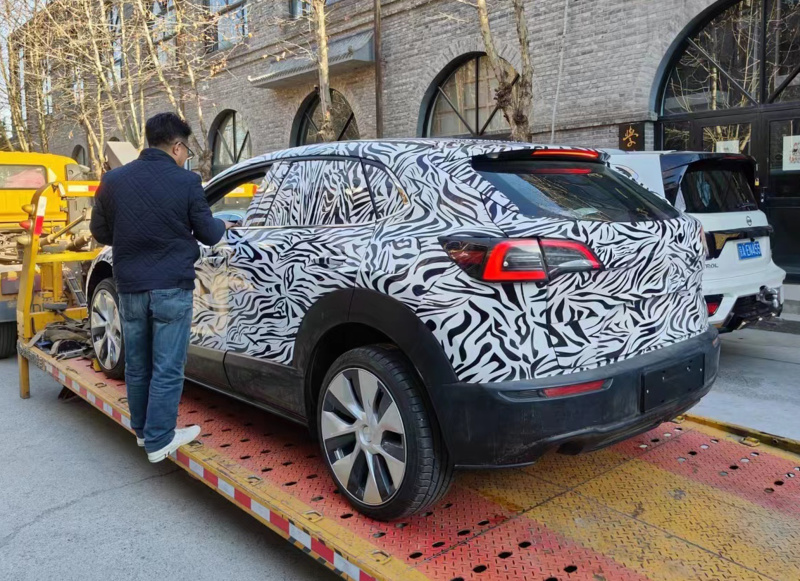
These images from spy shot specialist Autospy reveal a small SUV – likely the Model 2 – test mule being loaded onto the back of a trailer.
At first glance, the Zebra camo, body cladding, and rear end look entirely Mazda CX-30. Even the C-Pillar’s chrome garnish appears to be lifted directly from the Mazda’s popular small SUV, but there are tell-tale Tesla signs.
For a start, the head and tail-lights are signature Tesla items that appear to be taken from the Model Y, as are the sizeable alloy wheels – they look like 19-inch items – hiding red brake calipers with Tesla script.
2
Okay, so will the real Model 2 please stand up?
Details on the real Model 2 are still thin on the ground, but we can likely expect it to measure around 4.35-4.4-metres long, with a height of about 1.8m – somewhere between a traditional small car and a small SUV.
There will likely be several powertrain variants. Expect a price-leader single motor with a standard battery pack to offer 350 kilometres of driving range and a more expensive larger battery with 450-500km driving range.
Tesla may also offer a dual-motor performance version, as it does with Model 3 and Model Y, though all is yet to be revealed.
Exact details of this small hatch/SUV mule may emerge next month. A significant update to Tesla’s Model 3 sedan is also expected this year, and the Cybertruck remains a possibility.
MORE
Everything Tesla
If there was a middle child of engine configurations, it would be the V10.
Wedged between the mass religion of the V8, and the exotic appeal of a V12, the V10’s merits are overshadowed.
That’s a shame, as the V10 has always been one of our favourite configurations, powering some of the coolest cars to ever roll off a production line.
With the Audi R8’s tombstone now engraved, the days of being able to purchase a V10-powered road car seem numbered.
So, to honour the unsung hero V10, these are the times two five-cylinder banks were joined in a vee to create automotive greatness.
This story was first published in 2020.
1
V10s aren’t just for those snobby Europeans
Dodge Viper
When most people think of V10 engines, they probably envisage delicate Euro units, built by men with incomprehensible accents and furrowed brows.
But one of the most iconic and longest-living V10 engines comes from the land of Pabst Blue Ribbon and medically induced bankruptcy.
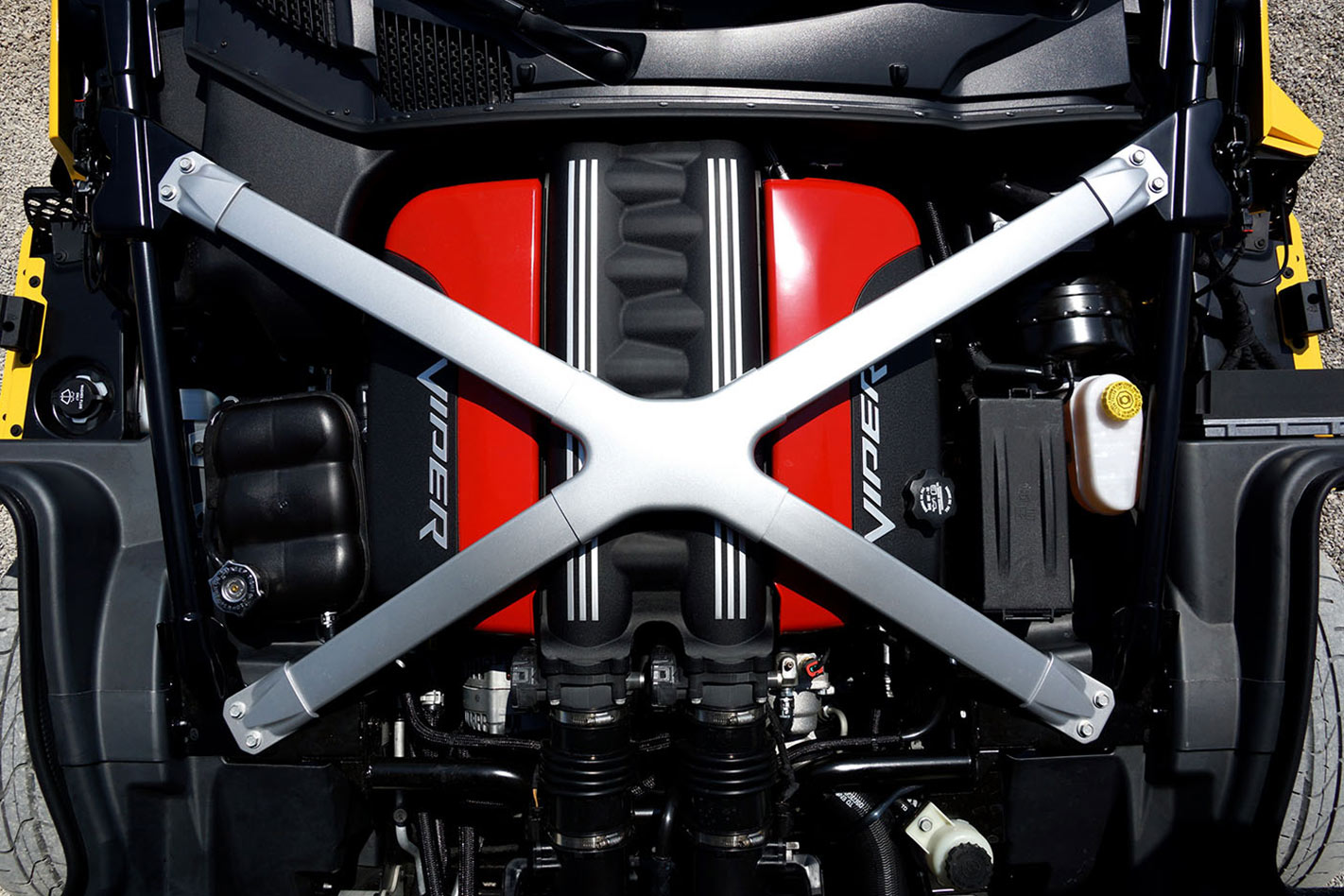
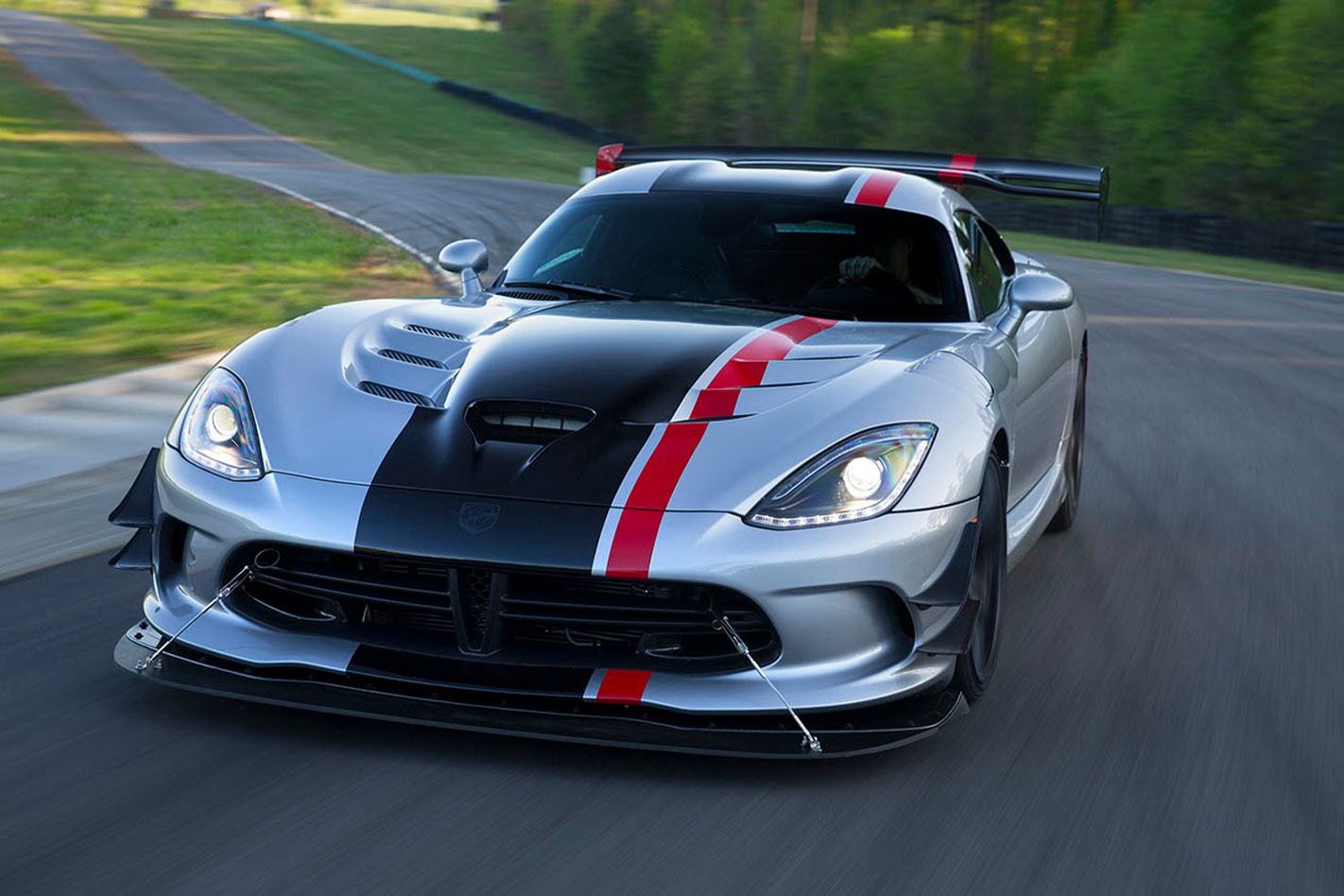
We are of course talking about the Dodge Viper, and the stonking V10 engine that has powered it since inception.
1
1
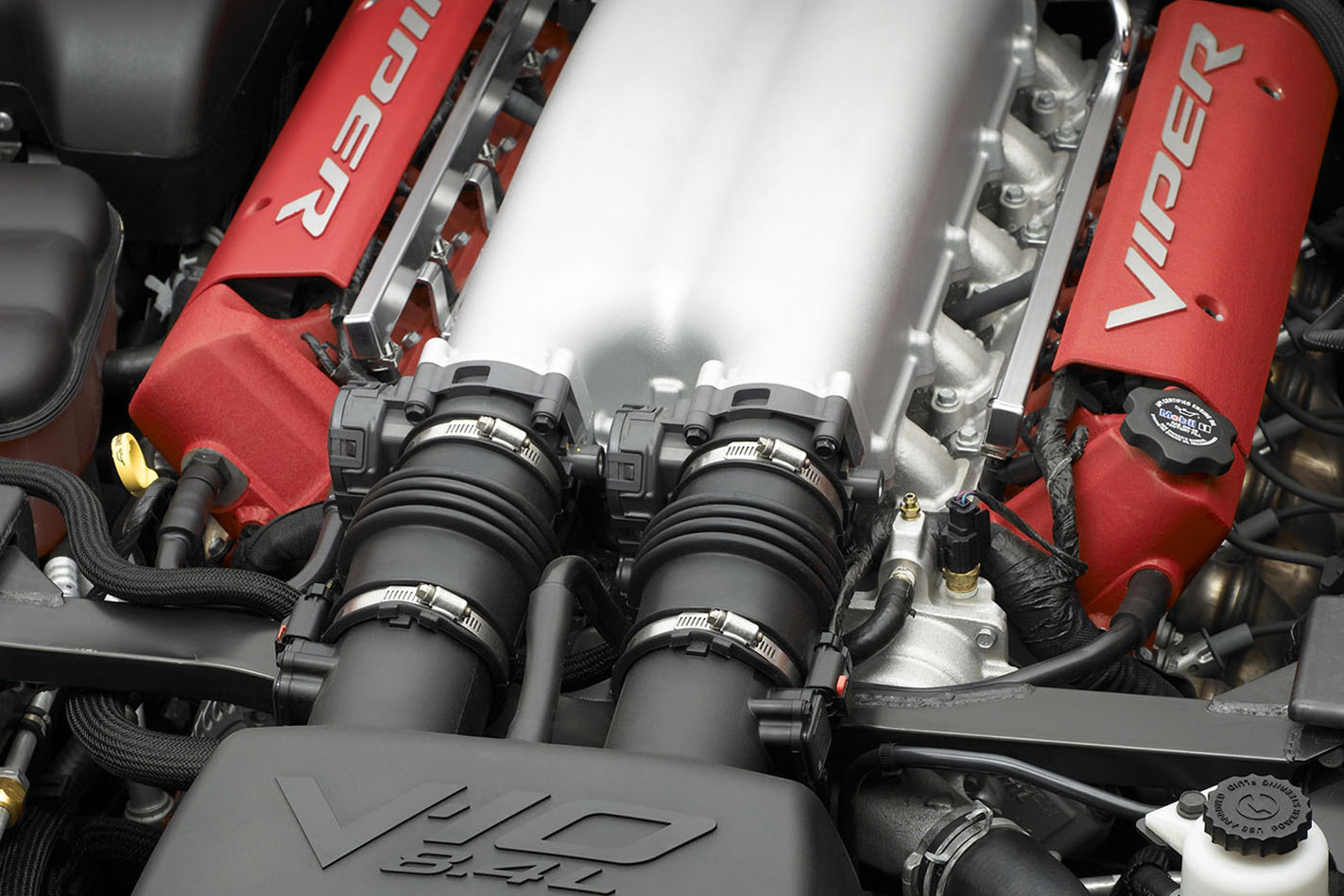
Since it was revealed to the world as 8.0-litre 298kW/630Nm unit in 1992, the Chrysler V10 has only grown larger and more powerful.
Based on a the pushrod LA family of engines used in Chrysler trucks and pick-ups, the V10 fitted to the Viper perfectly encapsulated the ethos of a brash, unapologetic American sports car.
1
By the time the Viper shuffled off its mortal coil in 2017, the V10 had grown to an 8.4-litre capacity, with 481kW/813Nm outputs.
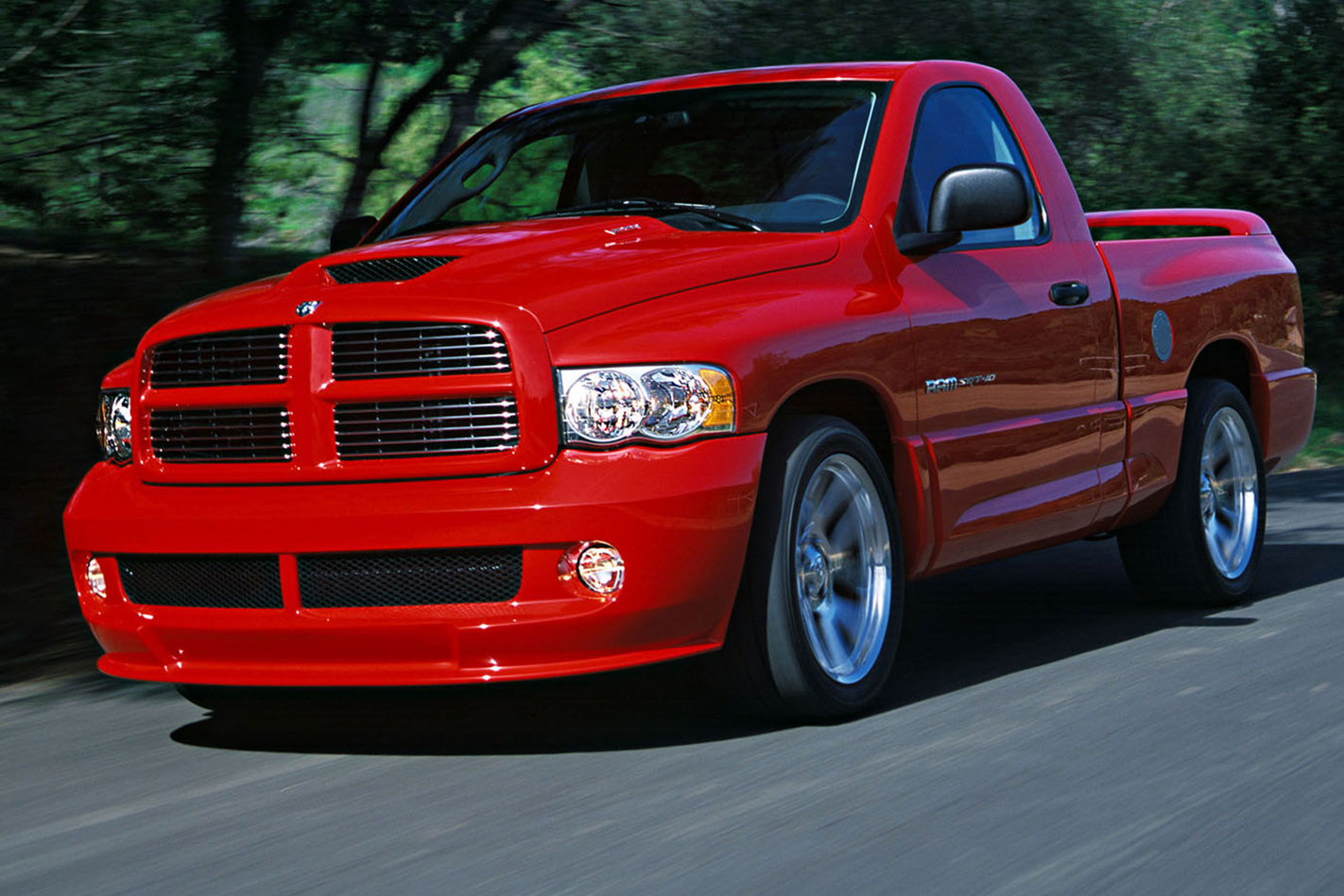
In what must have been one hell of a board meeting, Dodge executives deemed it appropriate to fit the petrol V10 to a pick-up, gifting the world the obscene SRT-10, taking the V10 back to its utility roots.
1
The greatest-sounding roadcar engine
Lexus LFA
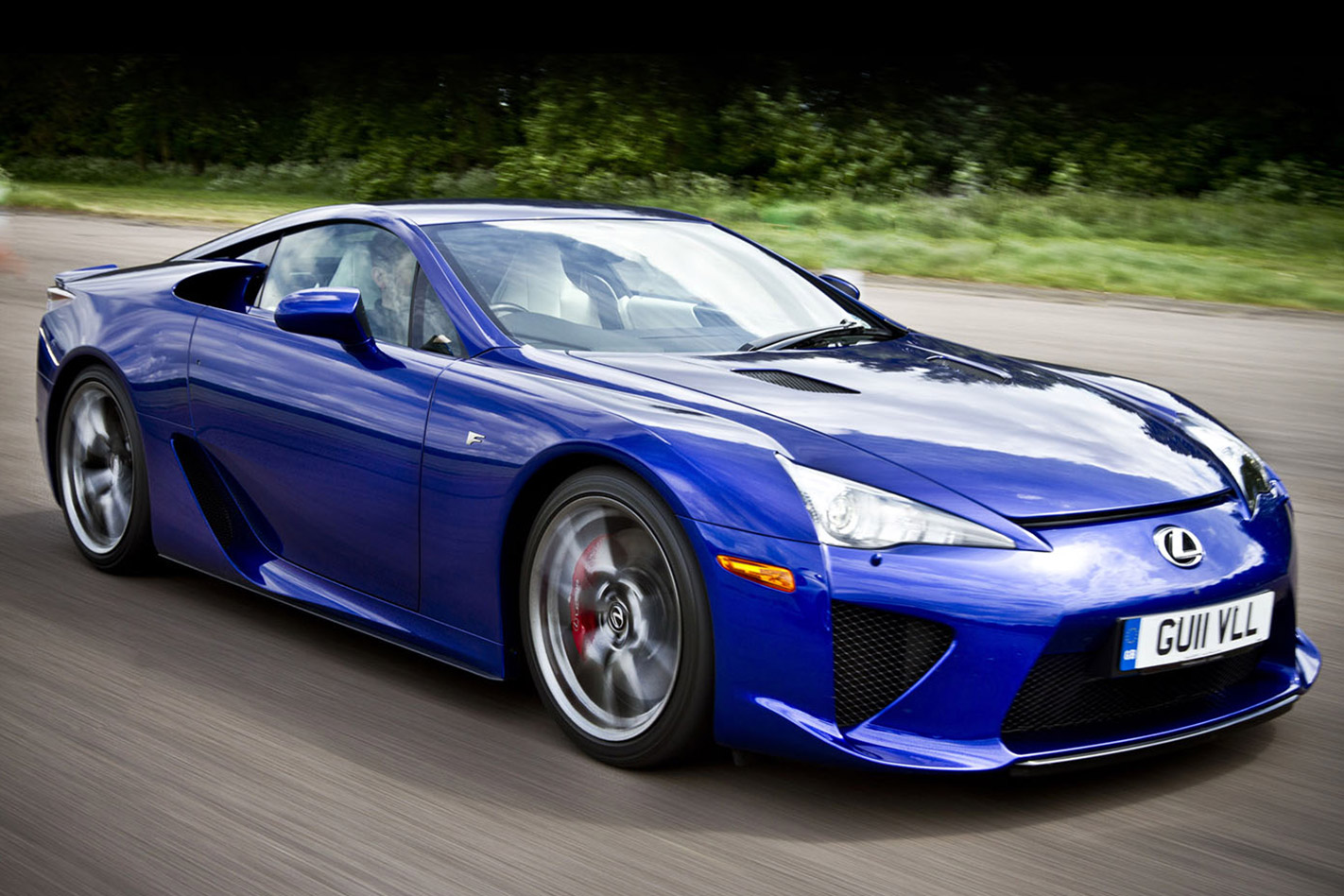
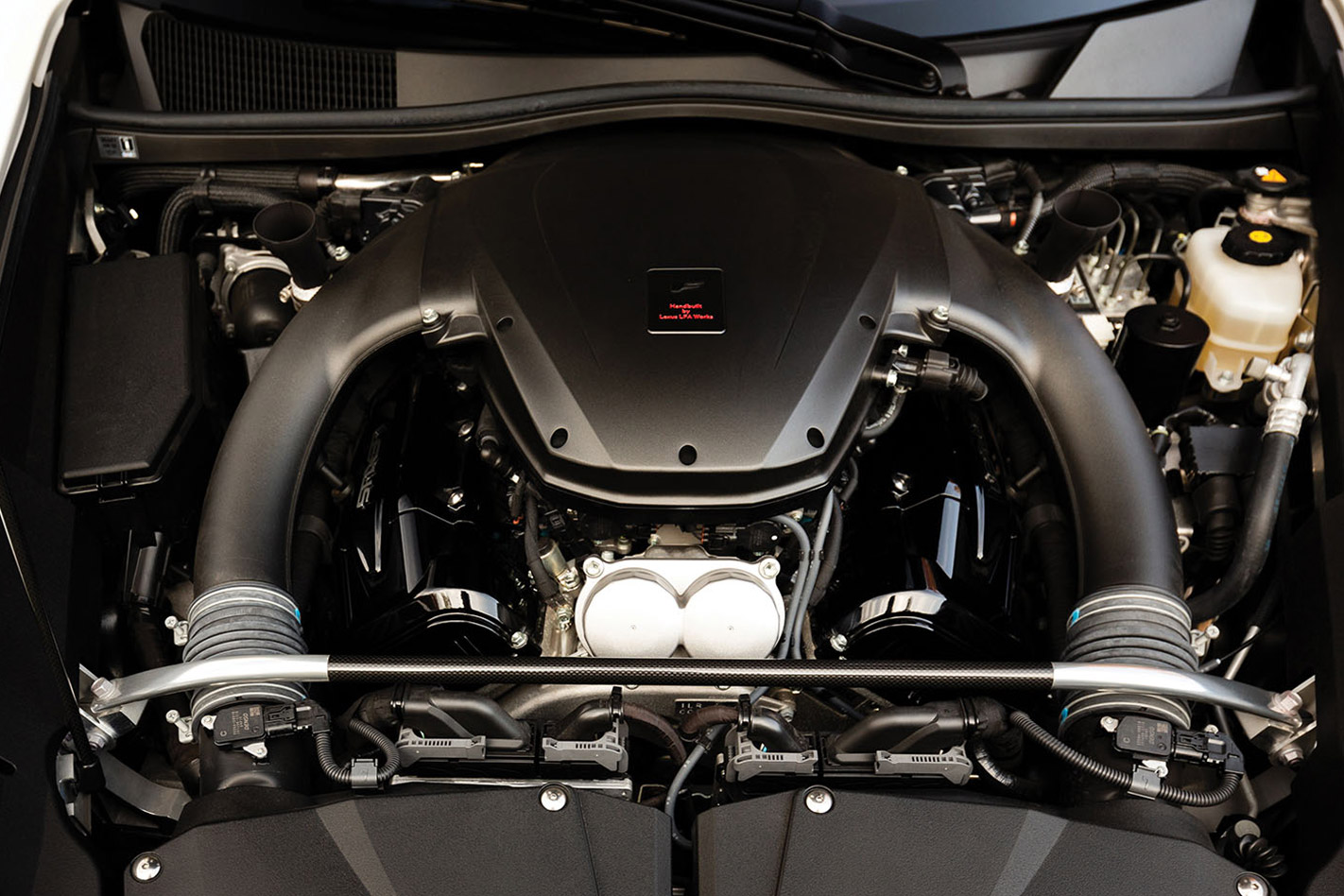
Engine code 1LR-GUE will go down as arguably the best sounding engine ever fitted to a road car. That typically Japanese engine code was assigned to the absolutely fantastic V10 engine fitted to the Lexus LFA.
Co-developed by Toyota and Yamaha, the clean-sheet 4.8-litre, dual-VVTi V10 was a dry-sumped masterpiece featuring 10 individual throttle bodies, built using exotic materials, and could rev to 9500rpm. Peak power of 412kW was delivered at a sonorous 8700rpm.
1
1
“At wide-open throttle, through the upper half of its rev range, the LFA accelerates with stunning, ridiculous ease,” wrote John Carey for our November 2009 issue.
Not only one of the great V10s, but one of the great engines of all time.
Words can only do so much to extol the virtues of 1LR-GUE, so instead just turn your speakers up, and enjoy this video.
The V10’s ultimate form
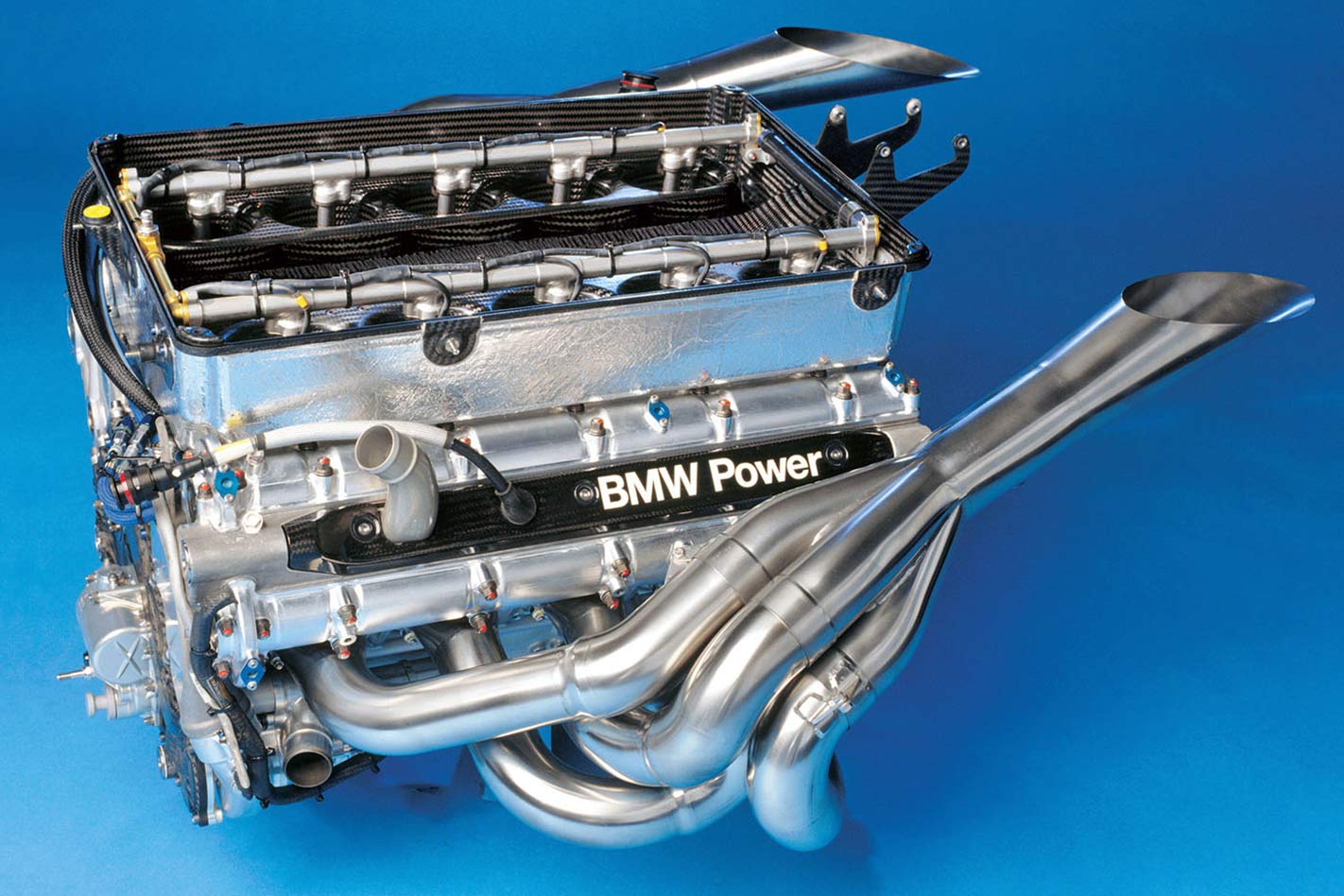
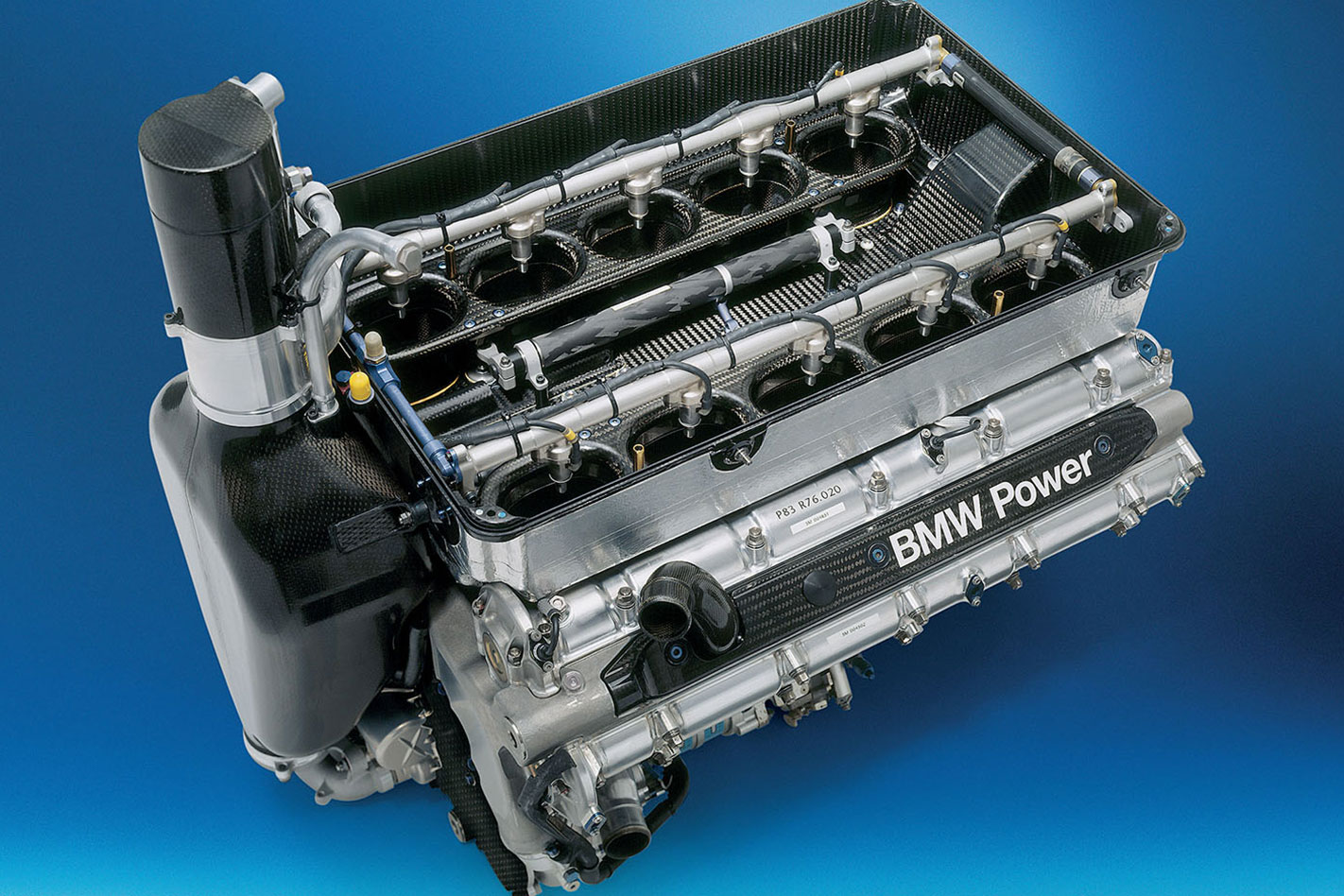
BMW P83 (F1)
The V10 engines greatness wasn’t just reserved for public roads, with one of Formula 1’s most popular era’s defined by the engine configuration.
For one glorious decade between 1995 and 2005 F1 cars were fitted with 3.0-litre naturally aspirated V10 that would ignite the nerves in your spine as they passed at full throttle.
1
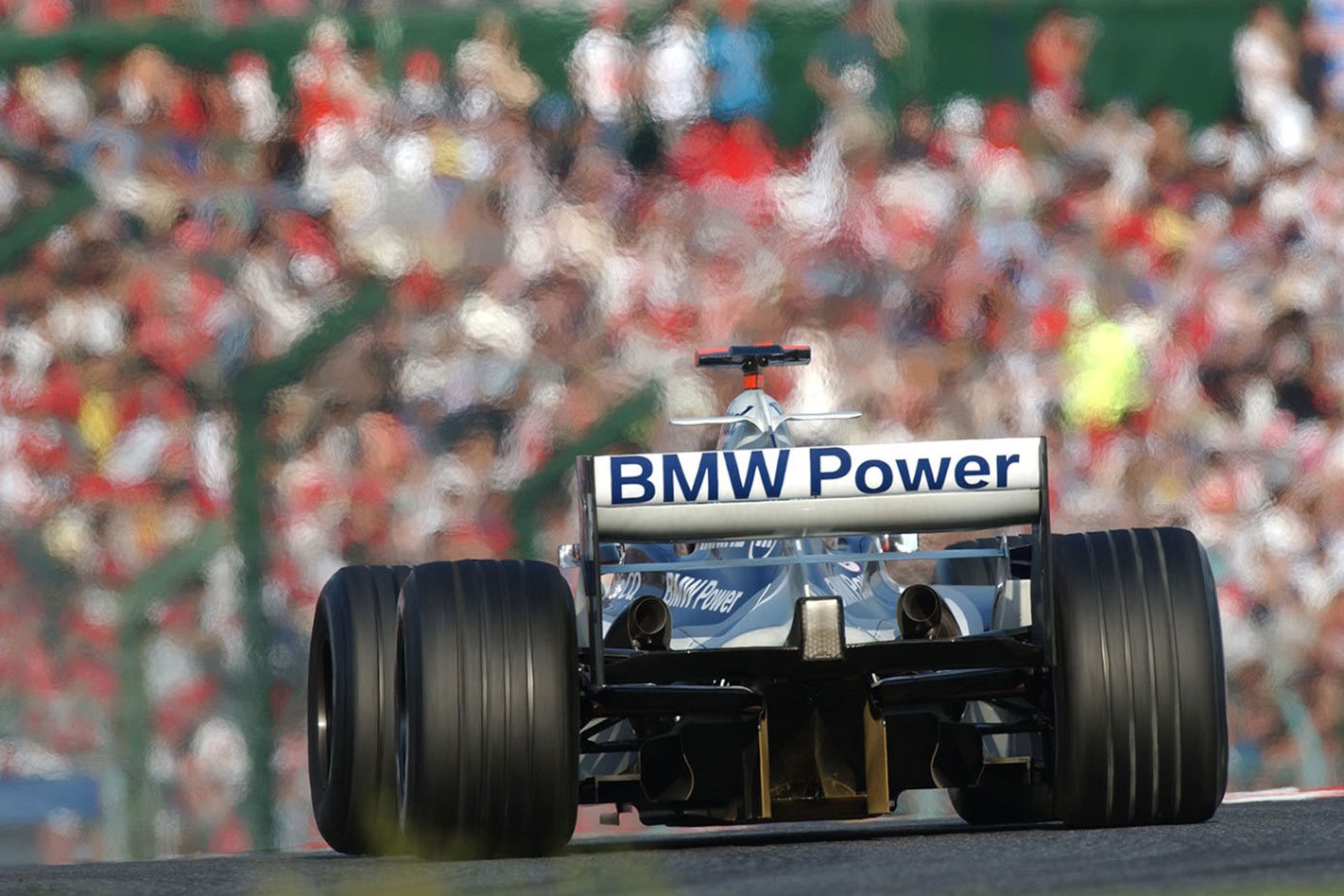
We could easily include every engine from that era in our list, but instead we will narrow it down to those used by BMW in the final years of the regulations.
We’ll start with the P82, which was the first F1 engine to rev to 19,000rpm, while the follow-up P83 added an extra 200 revolutions to the equation.
When the P83 was rapidly approaching 20,000rpm, it was sending 670kW to the wheels, making it the first engine on the grid to clear the magical 900hp barrier, all while only weighing 91kg.
1
BMW’s last F1 V10, the P84, would be used in 2005, and was reportedly capable of producing 710kW.
The greatest V10 ever built? We wouldn’t vote against it.
That time Porsche put a race-car engine into a supercar
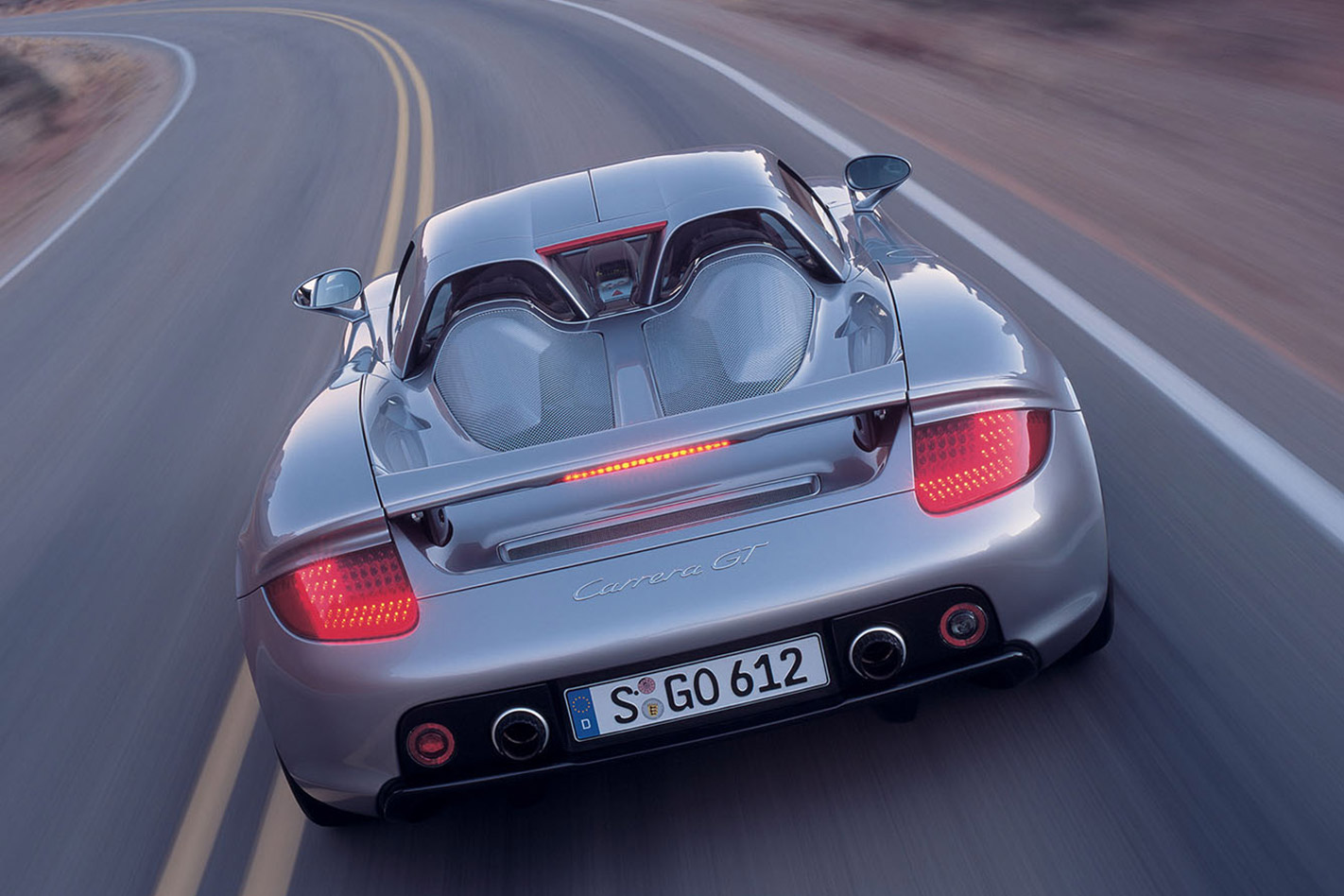
Porsche Carrera GT
We’ve all been doing our weekend cleaning and found an errant V10 race engine under the couch, amirite?
No, only Porsche engineers? Makes sense.
1
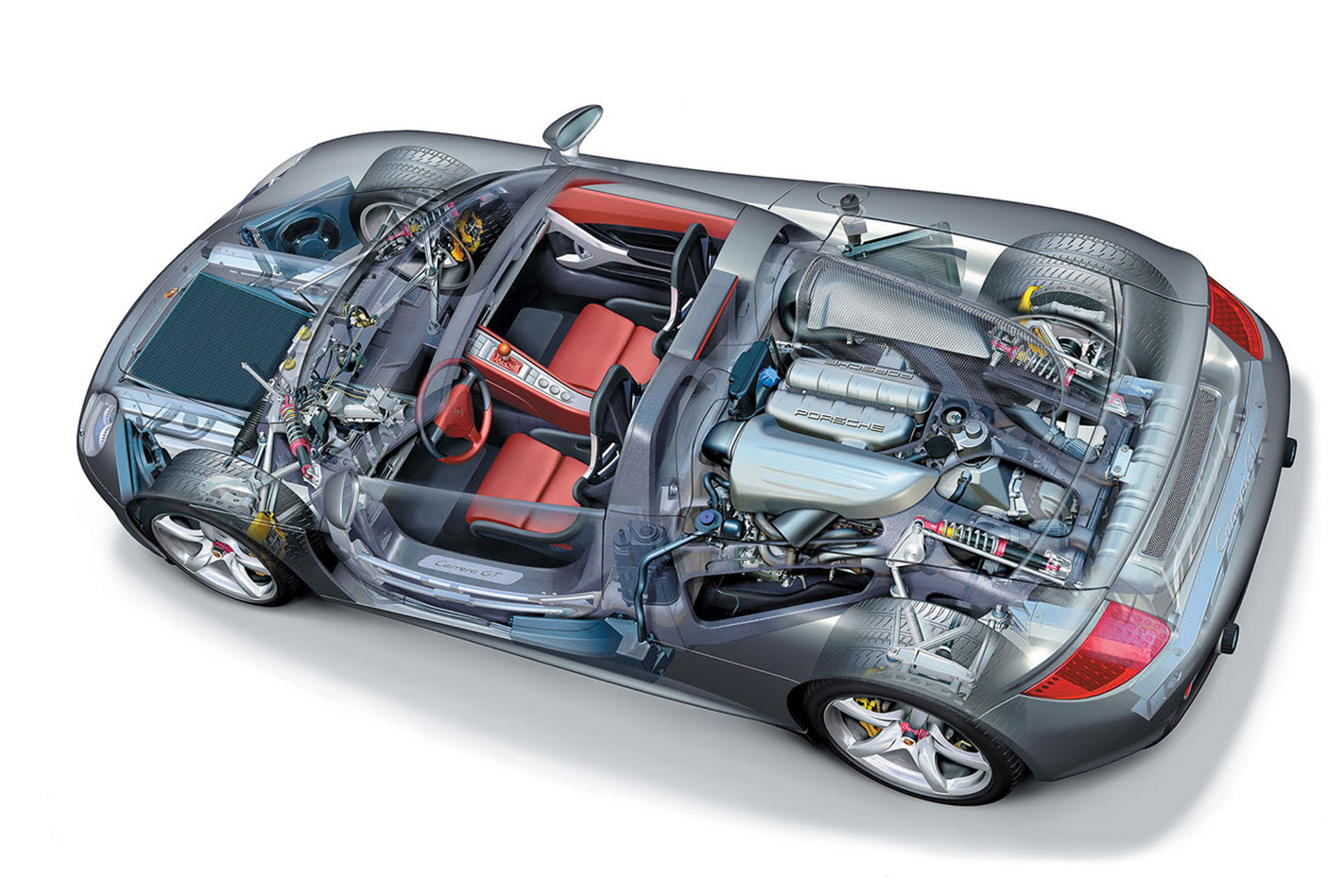
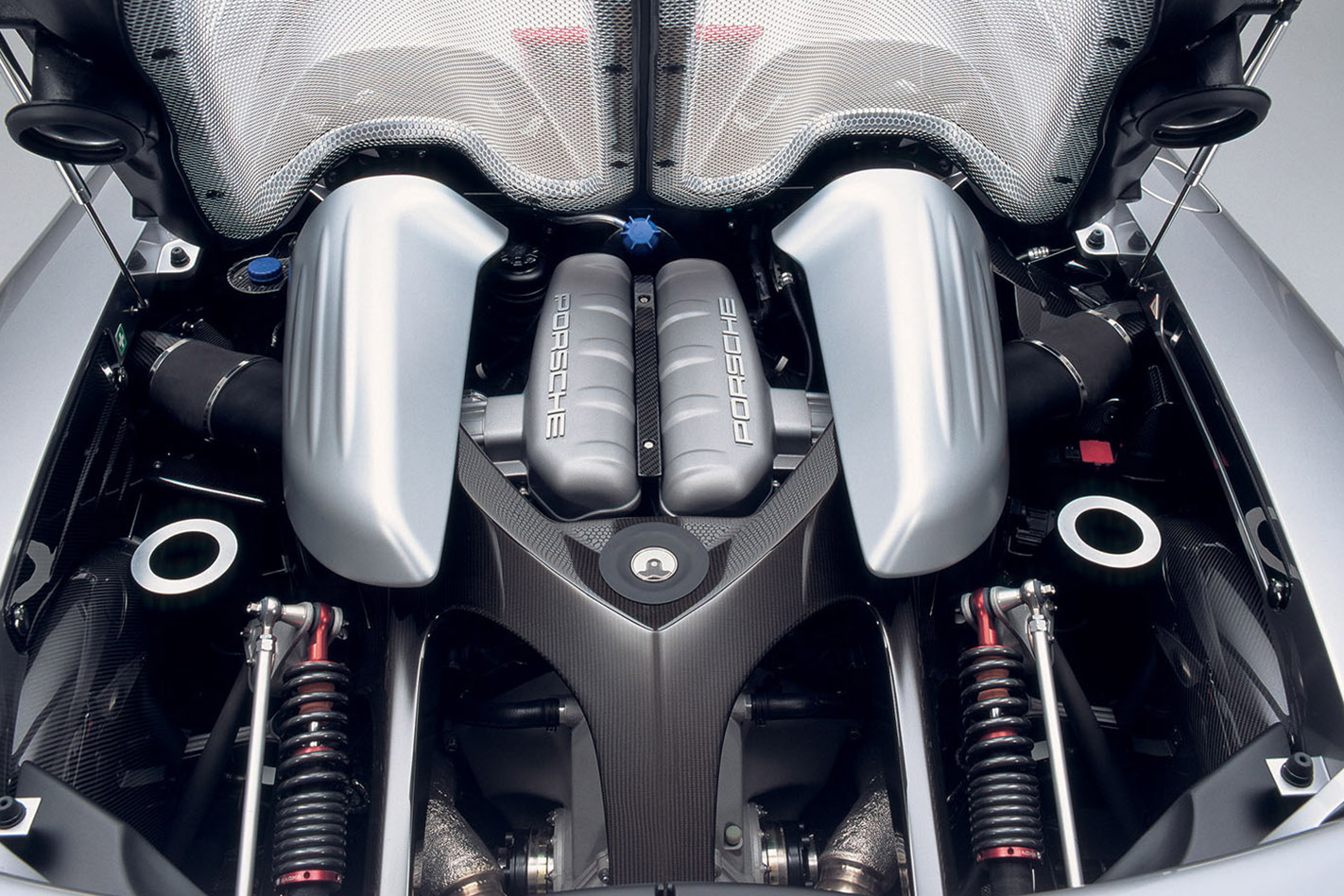
We may be taking some light liberties here, but that’s pretty much the story of the 5.7-litre V10 that powered Porsche’s Carrera GT supercar.
Before it was mid-mounted in the notoriously hard-edged flagship, 980/01 started its life destined for Formula 1.
A 3.5-litre V10 was built for the 1992 F1 season but never ran, sitting on a shelf until the turn of the century when Porsche was planning a return to Le Mans with the LMP2000 project (codename 9R3).
1
Originally planned to have a turbocharged flat-six, engineers soon opted to re-use the forgotten V10, increasing capacity to 5.0-litres and replaced the pneumatic valve springs.
The LMP2000 project looked good to go before a boardroom decision killed it off, to avoid it competing with Audi’s successful R8 program.
Once again the engine was put into stasis, before finally seeing the light of day as a 450kW/590Nm road car engine.
1
A V10 sedan? Seems reasonable…
BMW M5
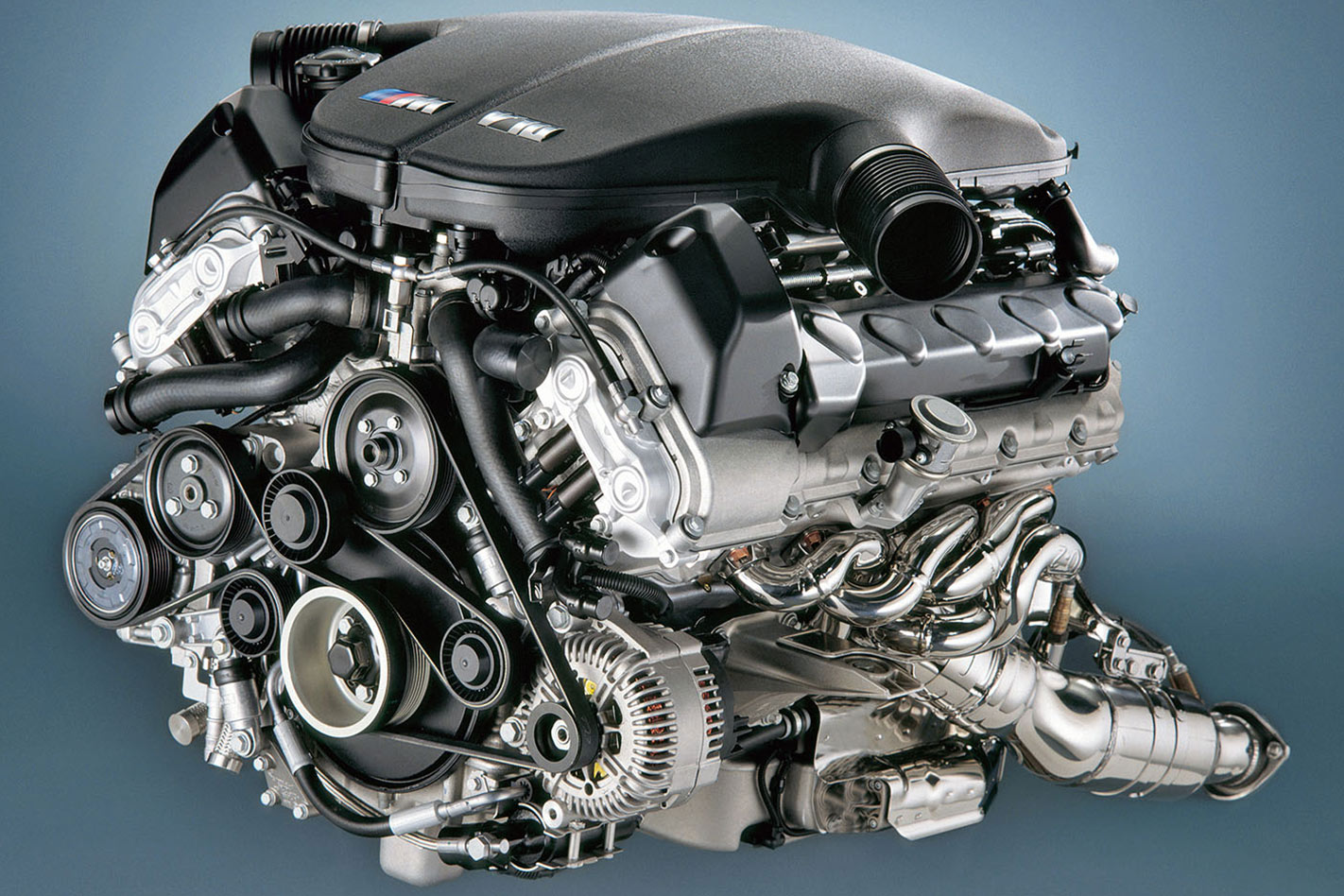
Audi weren’t the only one to slide 10 cylinders under the bonnet of a ‘family car’. BMW got in on the action with the E60 in 2005, which was powered by the S85 4.9-litre naturally aspirated V10.
Outputs for the performance sedan were an impressive 373kW and 520Nm, while BMW claimed the four-door sedan could crack 100km/h in 4.7 seconds.
1
Independent testing found this figure to be a furphy, with some outlets able to see triple figures on the speedo in as little as 4.1 seconds.
The S85 engine exemplifies an era of automotive excess. Not based on any other engine in BMW’s portfolio, it was used exclusively in the E60/E61 M5 and E63/E64 M6 siblings.
Its shelf life was brief, going out of production in 2010, but boy did it burn brightly.
A V10 diesel SUV? Also seems reasonable
Volkswagen Touareg R50
So far, this list has all been high-end supercars, unhinged race cars, and wild sedans. Well, it’s time for that malarkey to end, as we put on a very serious face and recount the practical benefits of a V10 engine.
1
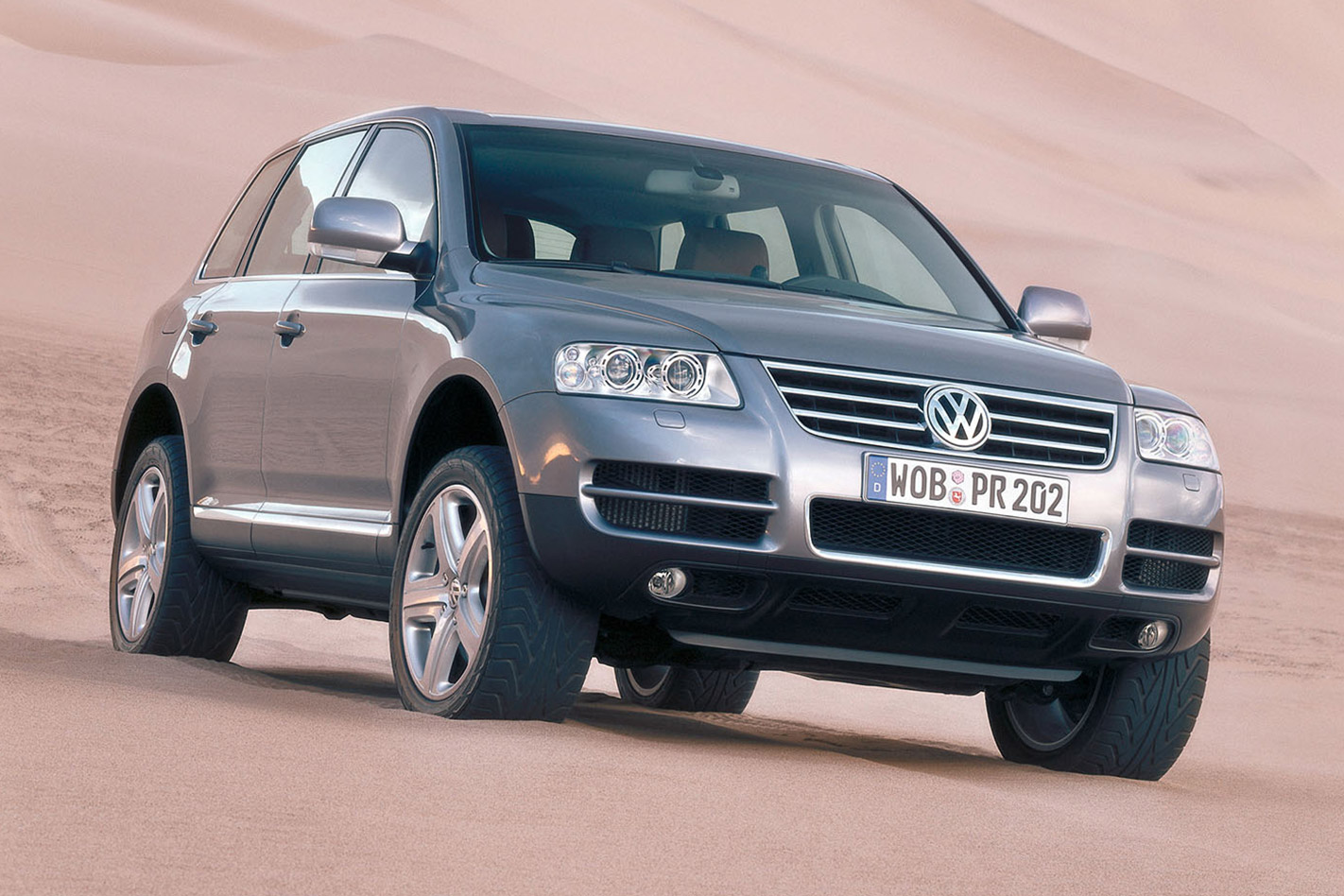
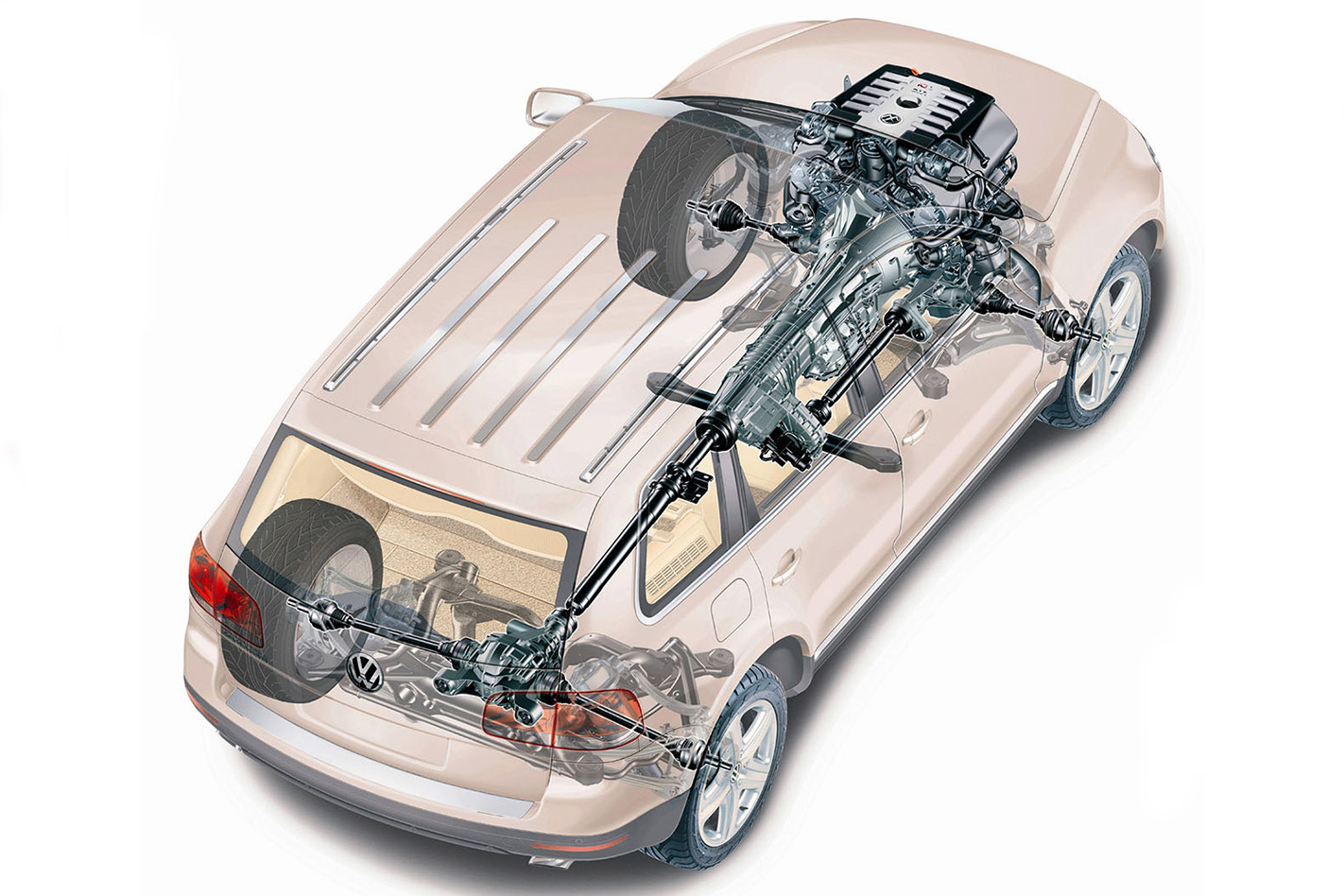
To do so, we will use Volkswagen’s very sensible decision to build a 5.0-litre twin-turbo diesel V10 in 2002 – and then fit it to the largest SUV in the range. Practicality!
Power was a relatively tame 230kW @ 3750rpm, but torque was claimed to be 750Nm @ 2000rpm, which for the time was massive.
All that torque resulted in VW using the V10 Touareg to pull a wholeass Boeing 747 for a PR stunt.
1
So, there you have it, V10s can be fast and practical…kinda.
Just don’t ask about servicing costs.
June: ID.7 wagon spied testing
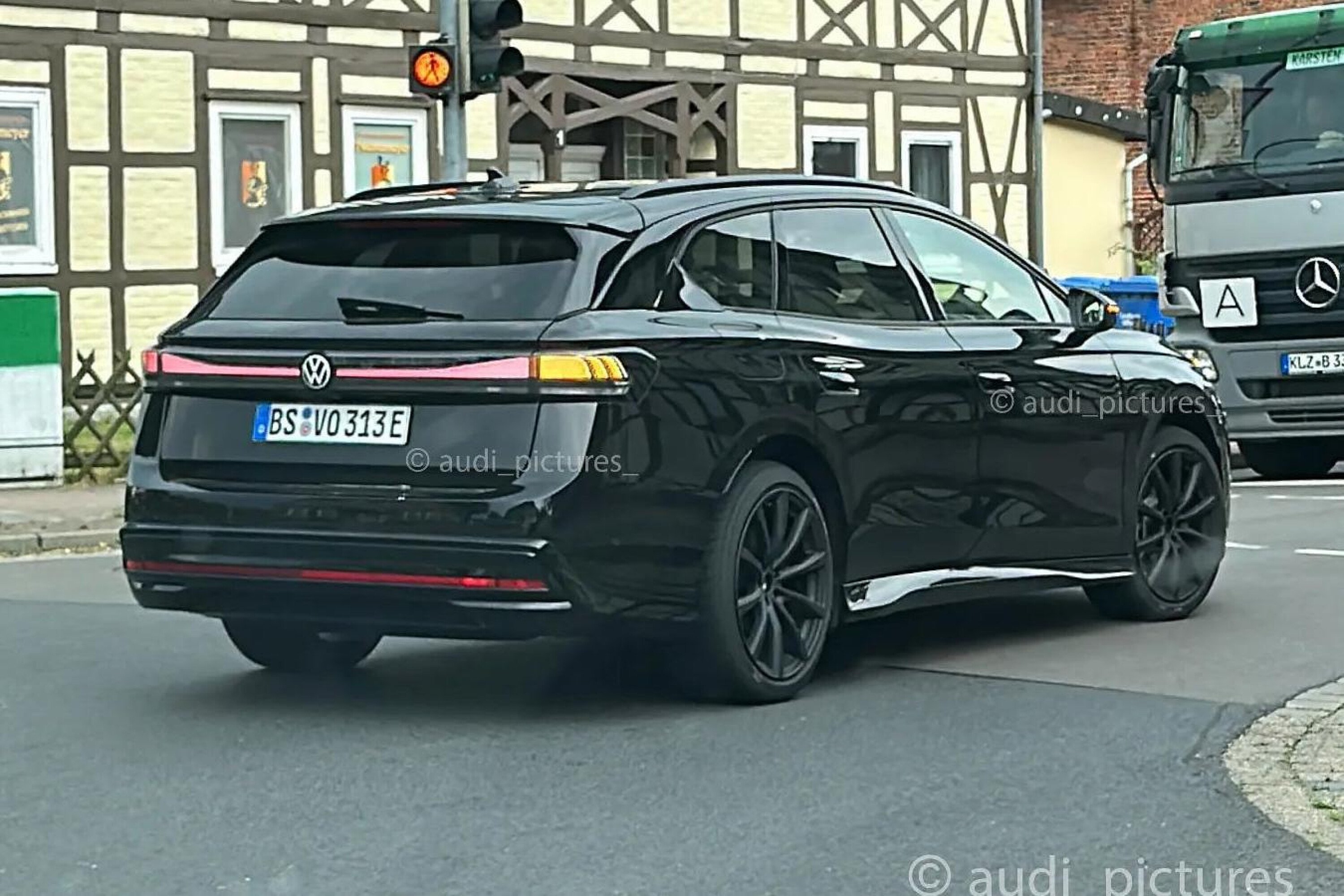
The wagon version of Volkswagen’s new ID.7 has been spied testing in Europe.
But, like the sedan, we’re not expecting to get this one in Australia. Criminal, really.
1
April 18: ID.7 unveiled
Volkswagen’s new ID.7 electric liftback sedan has now been unveiled.
Get all the details at the linked story below.
April 17: ID.7 leaked
Volkswagen’s latest electric car, the ID.7, has surfaced on social media ahead of its big unveiling later today.
Snapshot
- ID.7 global unveiling set for 10pm AEST
- Leaked marketing shot and patent application images show design
- Australian plans not yet announced
Expected to enter as a successor to the Passat, at least in sedan form, the ID.7 will enter production in June at Volkswagen’s plant in Emden, Germany.
The photo above is understood to be taken from VW’s own marketing gallery, while the images below are direct from the Chinese Ministry of Information and Technology. All three were published online by Spanish website Cochespias.
Australian plans for the ID.7 have not yet been confirmed, but we will likely learn more with the global unveiling set for 10pm AEST tonight.
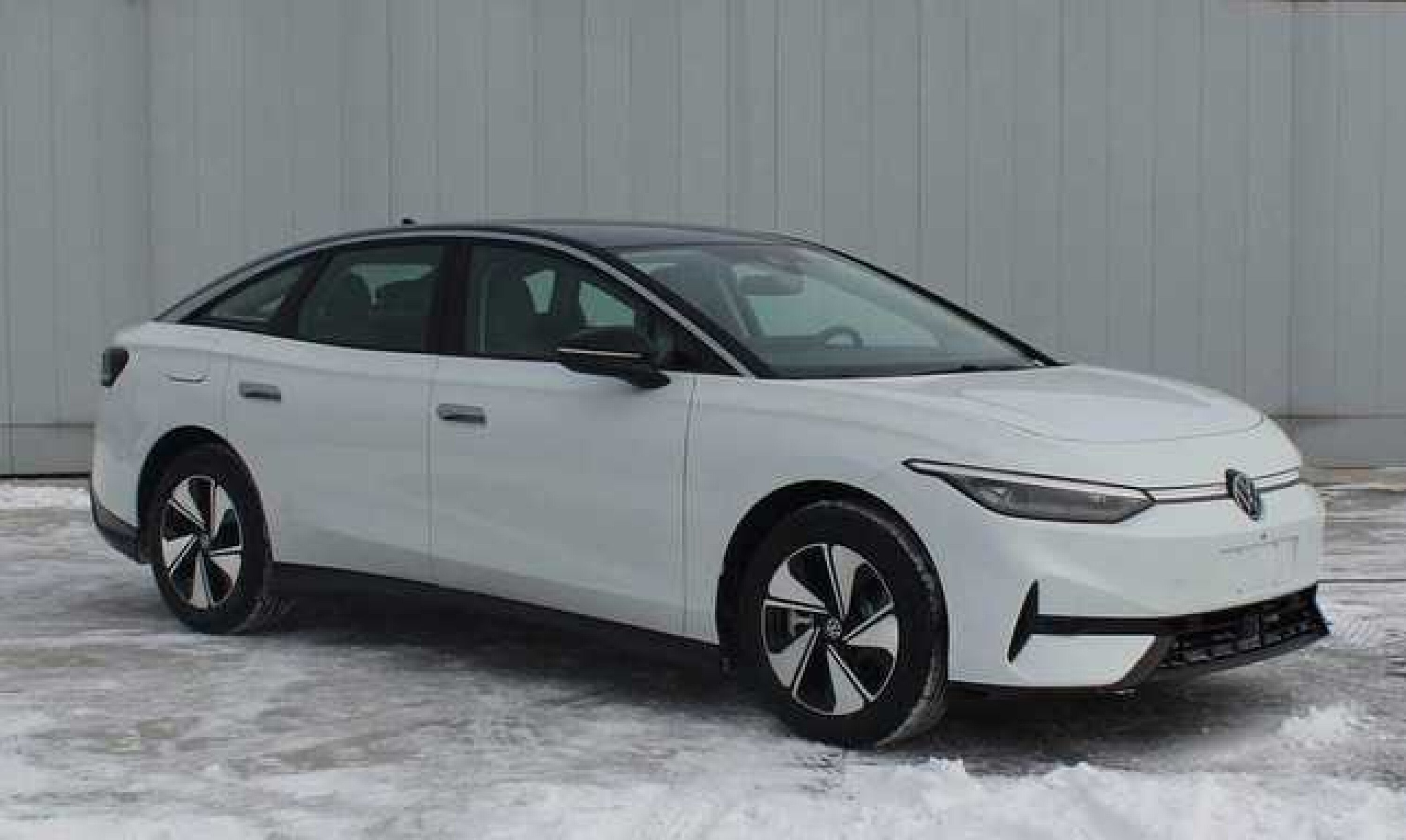
1
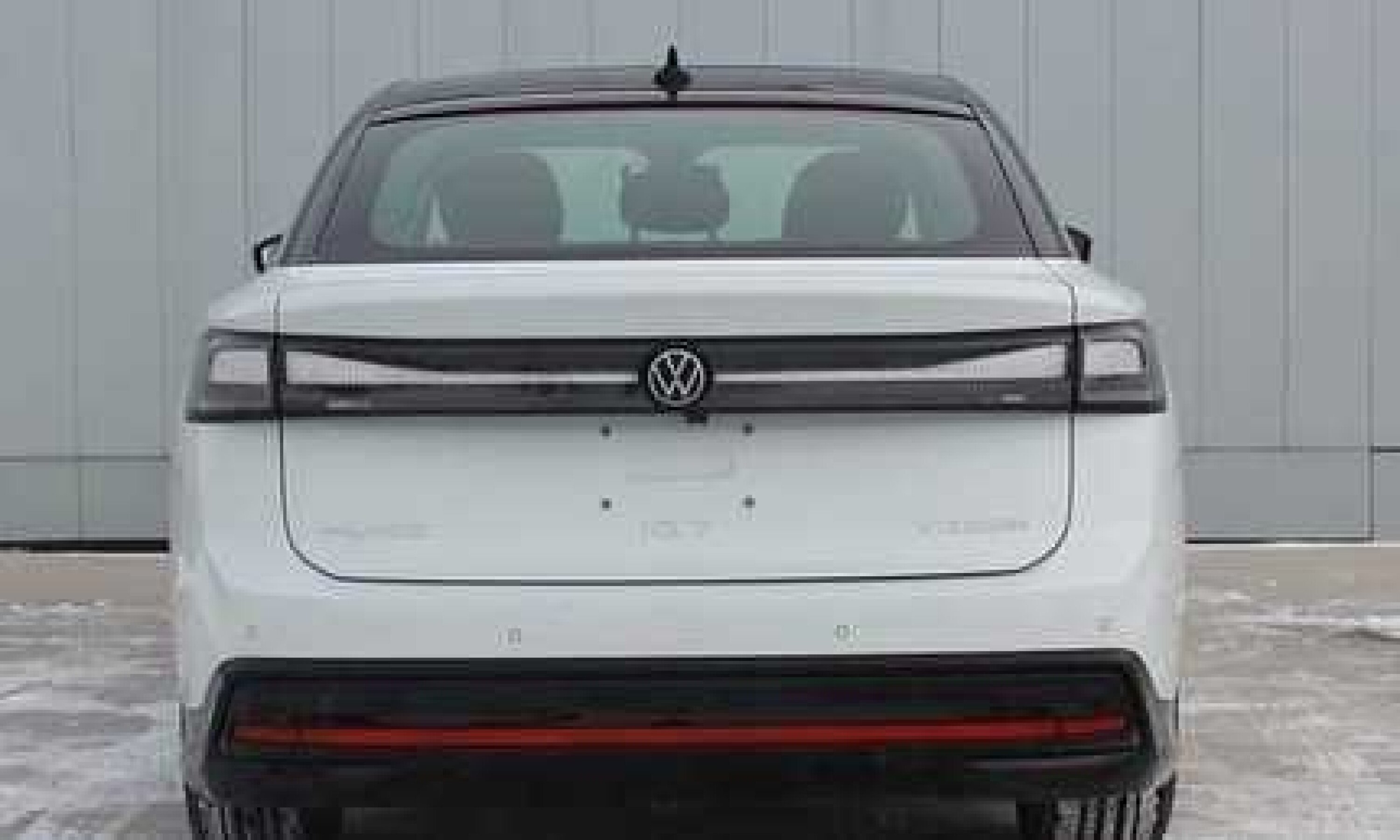
1
January 2023: Volkswagen ID.7 electric sedan and wagon teased
Volkswagen has teased the ID.7 electric sedan and wagon at the Consumer Electronics Show (CES) ahead of its expected full debut later this year.
Snapshot
- ID.7 electric sedan teased in camouflage, wagon confirmed
- New touchscreen, illuminated sliders and climate controls
- Around 700km driving range promised with aerodynamic shape
The production-ready ID.7 sedan was shown-off, albeit in heavily camouflaged light-up paint, with similar aerodynamic proportions as per the ID. Aero concept, eye-like LED headlights and bolder tail-lights with a honeycomb pattern.
While the wagon body style was confirmed, it hasn’t been previewed yet.
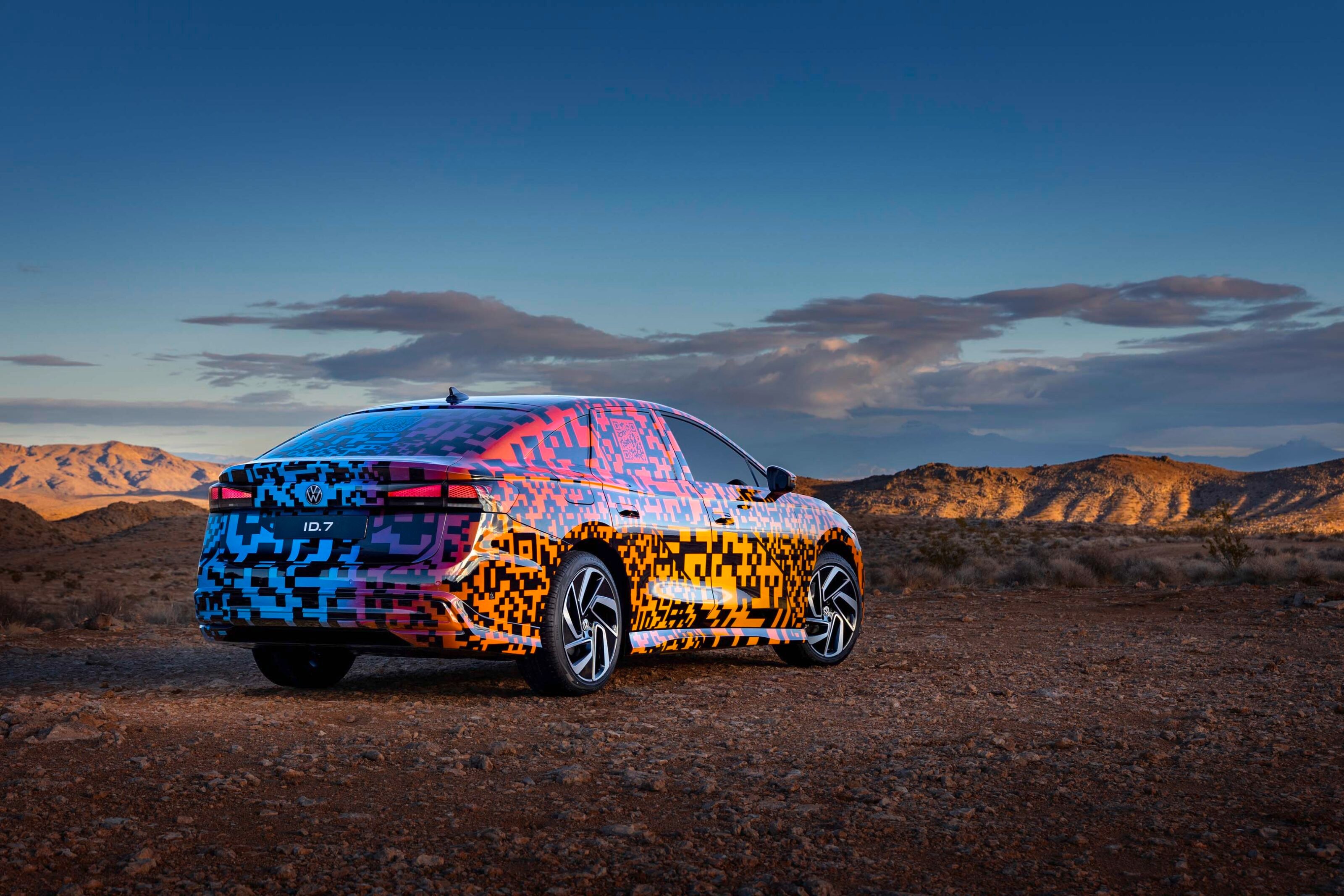
1
It has a 2970 millimetre wheelbase and offers a driving range of around 700 kilometres based on the WLTP testing cycle – a first for a dedicated Modular Electric Toolkit (MEB) platform electric vehicle.
Supporting previous hints, the German automaker says it has responded to customer feedback with the ID.7 featuring a larger 15-inch touchscreen with a new software interface, illuminated touch-sensitive touch sliders, and persistent climate controls integrated into the ‘first level’ of the infotainment system without needing to dig into a separate app.
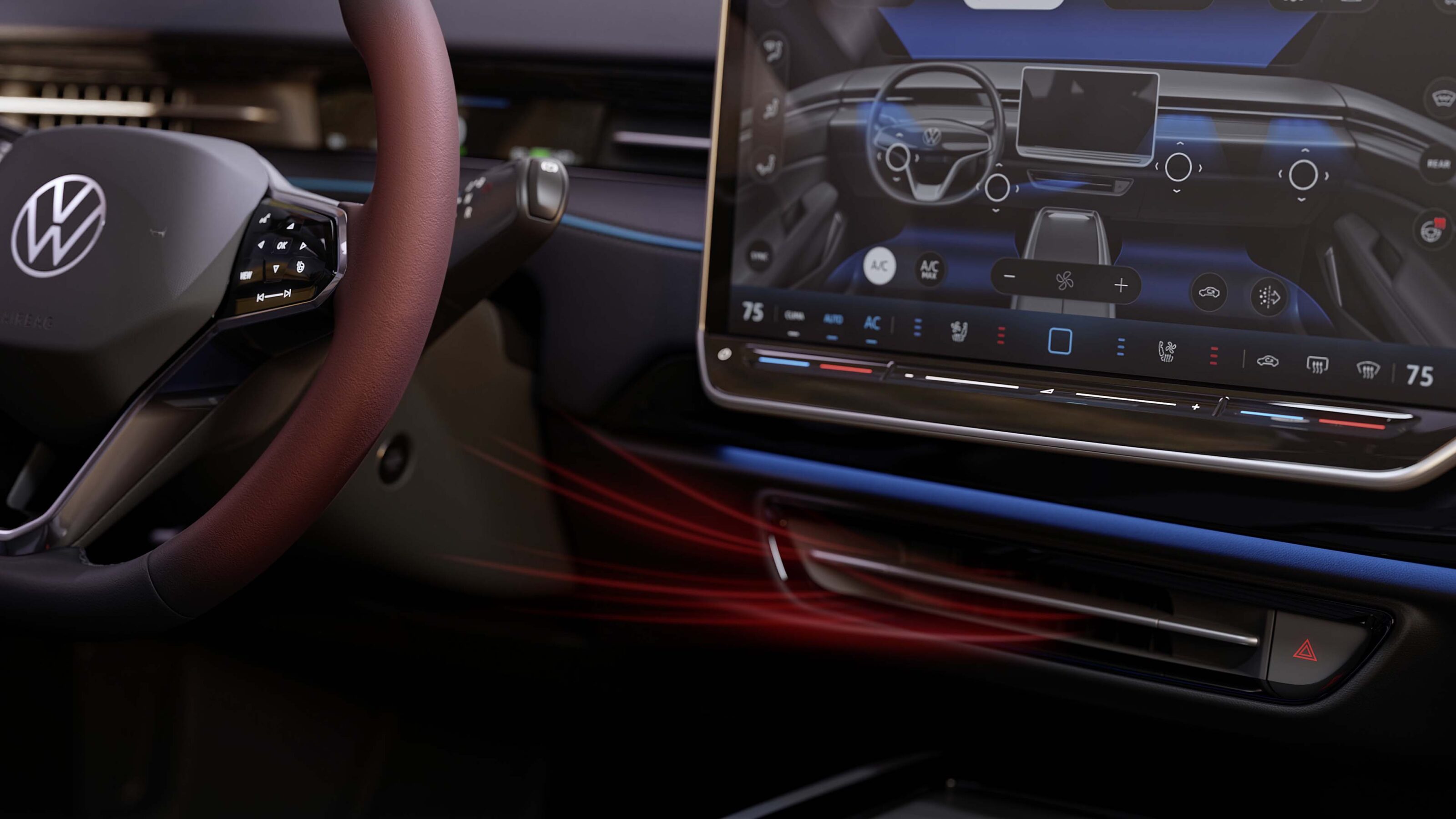
1
Pictures also depict a slim digital driver’s instrument cluster built-into the dashboard, augmented reality head-up display, and the drive selector stalk mounted on the steering wheel column.
While it still persists with touch-sensitive steering wheel toggles, they seem to be raised for better tactility. We’ll likely need to wait for the next-generation Tiguan family SUV for more physical buttons.
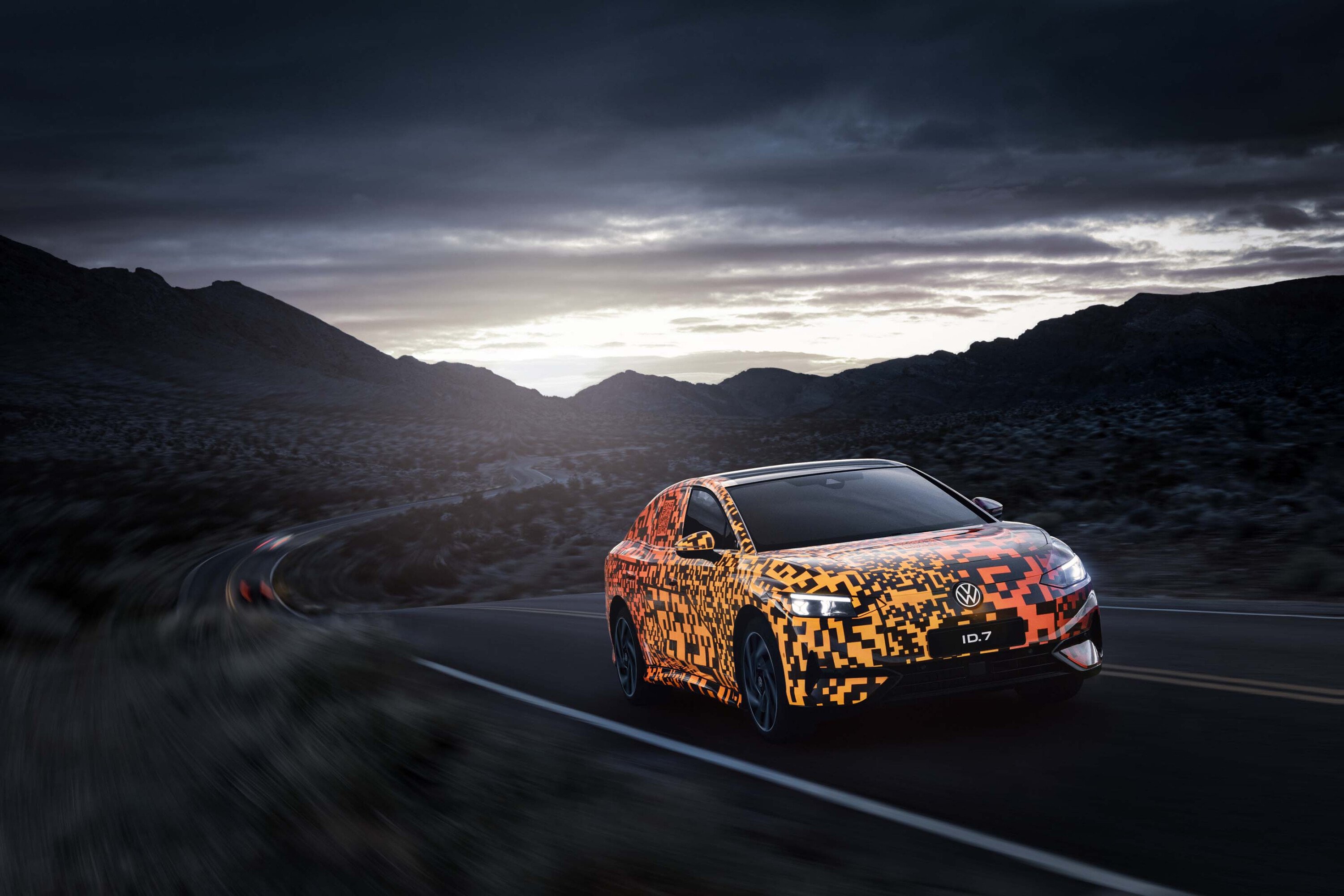
1
The Volkswagen ID.7 debuts smart air vents that automatically adapt the interior air flow, but must be operated via the touchscreen or built-in voice control.
When walking up to the EV with the proximity key, it will start to cool or heat the interior before getting into the vehicle itself. Also, when there are passengers in the car, the air can be directed onto the body or indirectly to ventilate the cabin.
The car giant has previously mooted offering MEB-based models with a 200kW DC fast charging capability and a 0-100km/h acceleration time of 5.5 seconds with all-wheel drive.
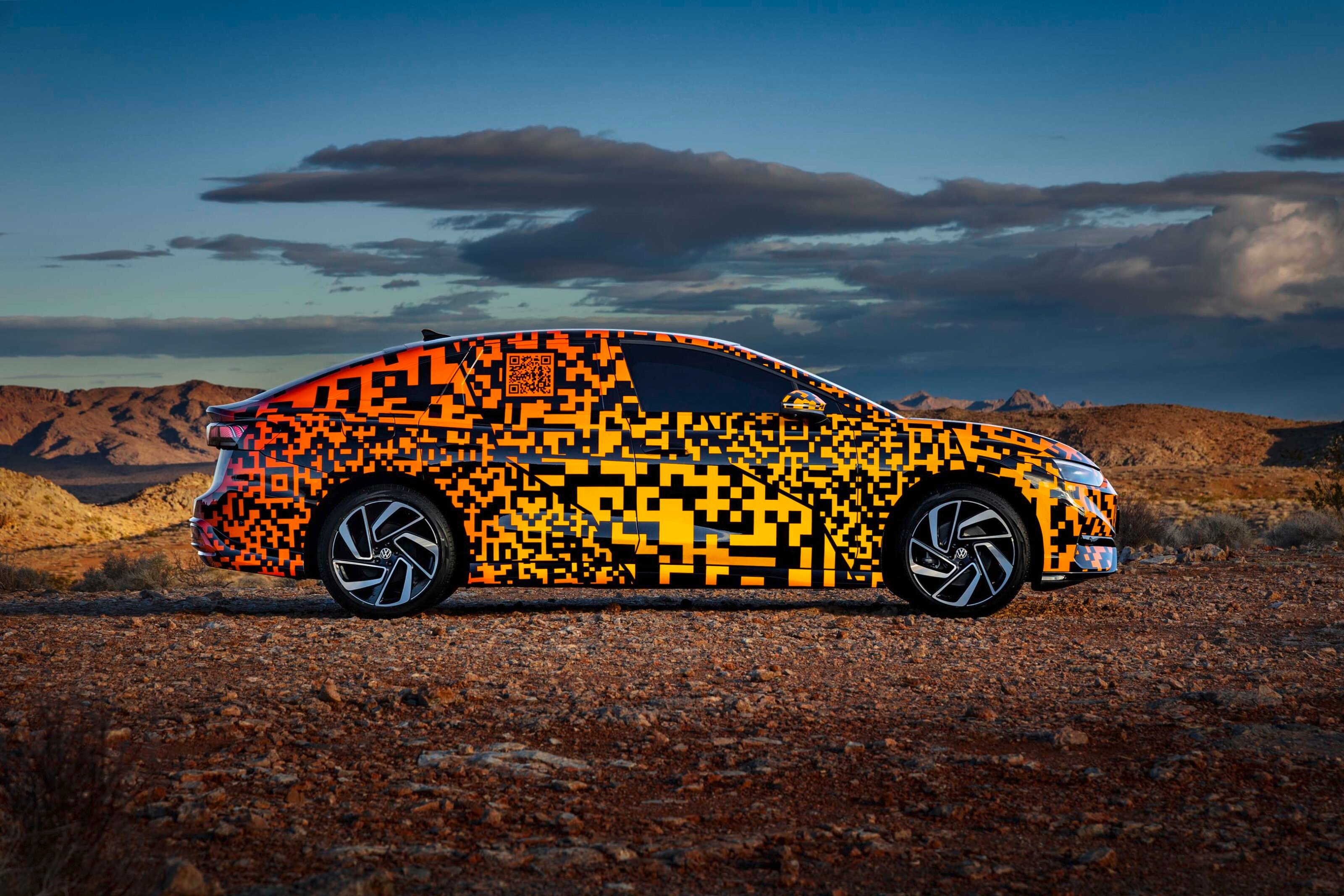
1
China, Europe and North America have been outlined as primary markets for the ID.7 sedan and wagon EVs, so it’s unclear whether it’ll make it to Australia as the Volkswagen ID.4 and ID.5 mid-sized SUVs are slated to land in late 2023 or 2024 first – four years after launching in Europe.
MEB will be succeeded by the unified Scalable Systems Platform (SSP) with an expected debut of 2026.
Volkswagen is working on a long-range flagship Trinity EV project using SSP, but this has been delayed until 2030 due to software development concerns.
⚡ More EV stories to help you choose the best car for your needs
The Germans have been making luxury cars for a long time and doing a bang-up job of it, too.
Any new rival is subject to intense scrutiny and dreaded badge snobbery, which makes Lexus’s break into the luxury sphere all the more impressive, and although the LS 400 took Wheels COTY honours in 1990, it was the strong-selling RX that cemented Lexus’s success.
It took until 2003 and a second generation for the RX to hit Australian shores, based on Camry underpinnings for a plusher ride and smarter cabin space than Lexus’s other large SUV, the ladder-framed LX.
It may not have been as sharp to drive as the E53 BMW X5 – we said as much at the time: “If you have the cash, BMW’s X5 is still the best high-end SUV… but the Lexus RX is more comfortable inside, has a lighter feel, and will be cheaper” (Wheels April 2004).
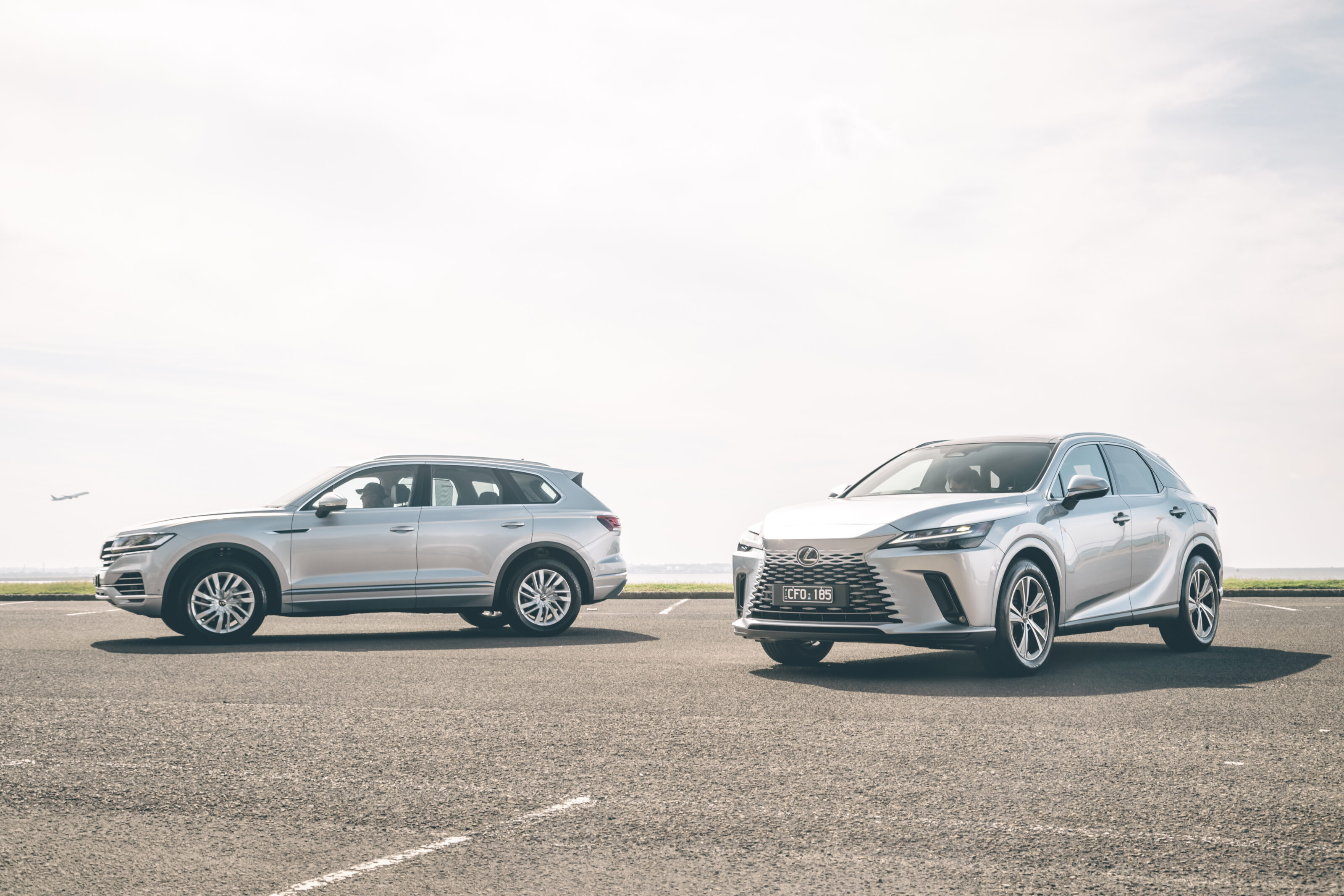
1
The Lexus RX stood for a new luxury
A showier luxury that was also more affordable, in line with a faster-moving, more image-conscious era with champagne paintwork and chrome bezels. German pragmatism it was not.
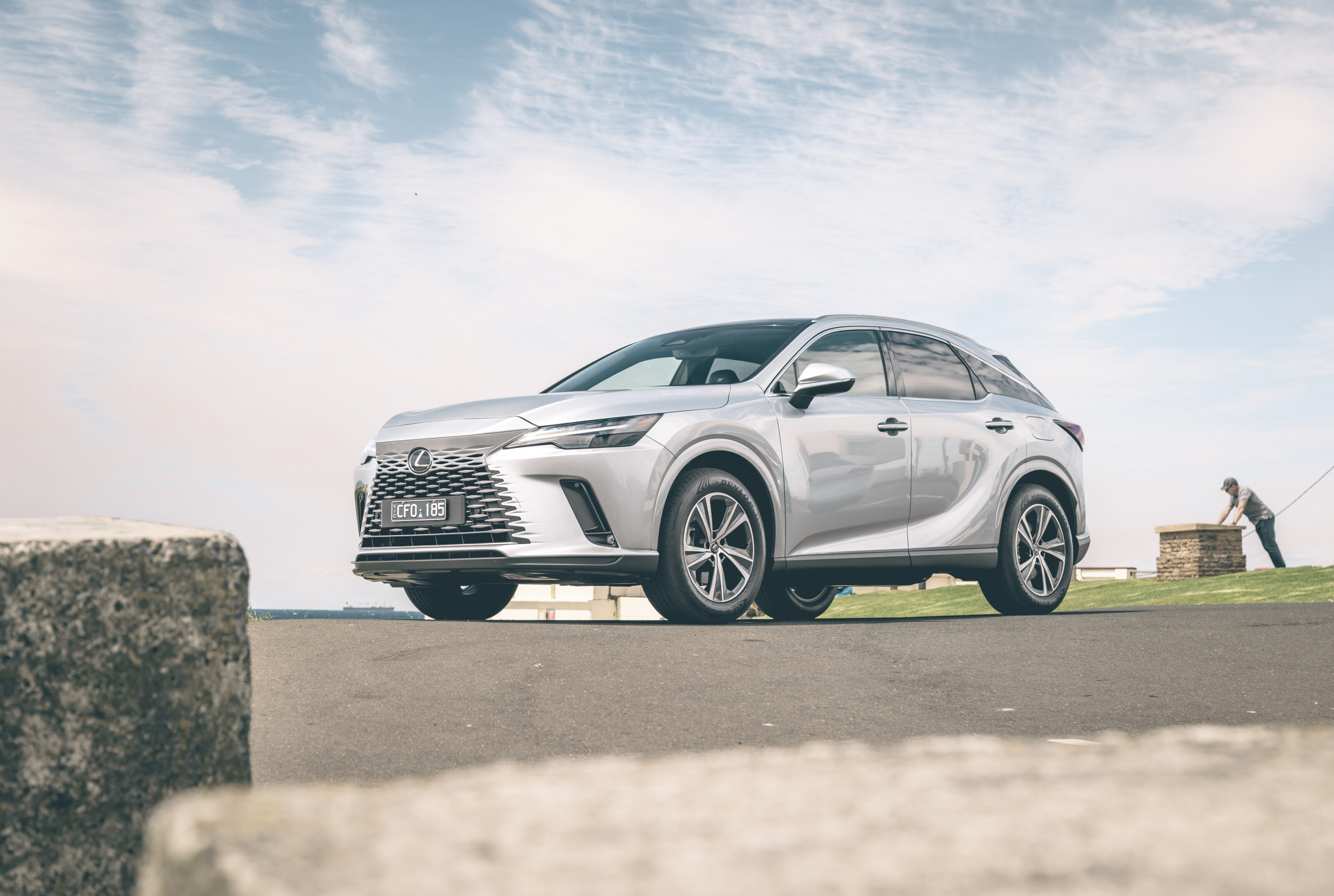
This fifth-gen RX hit Aussie dealerships in February, and swiftly nailed all the targets its reputation would have you expect. As usual, it’s built from the same parts package (in this case, the GA-F platform) as a related Toyota, making this much-improved five-seat SUV easily the best in the bloodline.
More fluid handling than ever, broader powertrain offerings, and a luxurious cabin are hallmarks, with the strong value proposition still very much intact.
1
Riding the same noughties wave of premium large SUVs was the Touareg nameplate. Twinned in development with the vehicle that saved Porsche, VW’s torquey (and occasionally V10-powered) SUV has always had high-class blood running through its veins.
It’s an inverse Lexus. Rather than glitzing up parts from a mainstream brand, the Touareg scoops the goodies from Porsche and Audi, dropping the price with less glamorous materials, and offering only three variants. Teutonic pragmatism at its finest.
The Touareg may be approaching a facelift, but much of its bones will stay the same. Only a new plug-in hybrid powertrain for the flagship R, minor body changes, and some revisions to the technology package are due in the next 18 months.
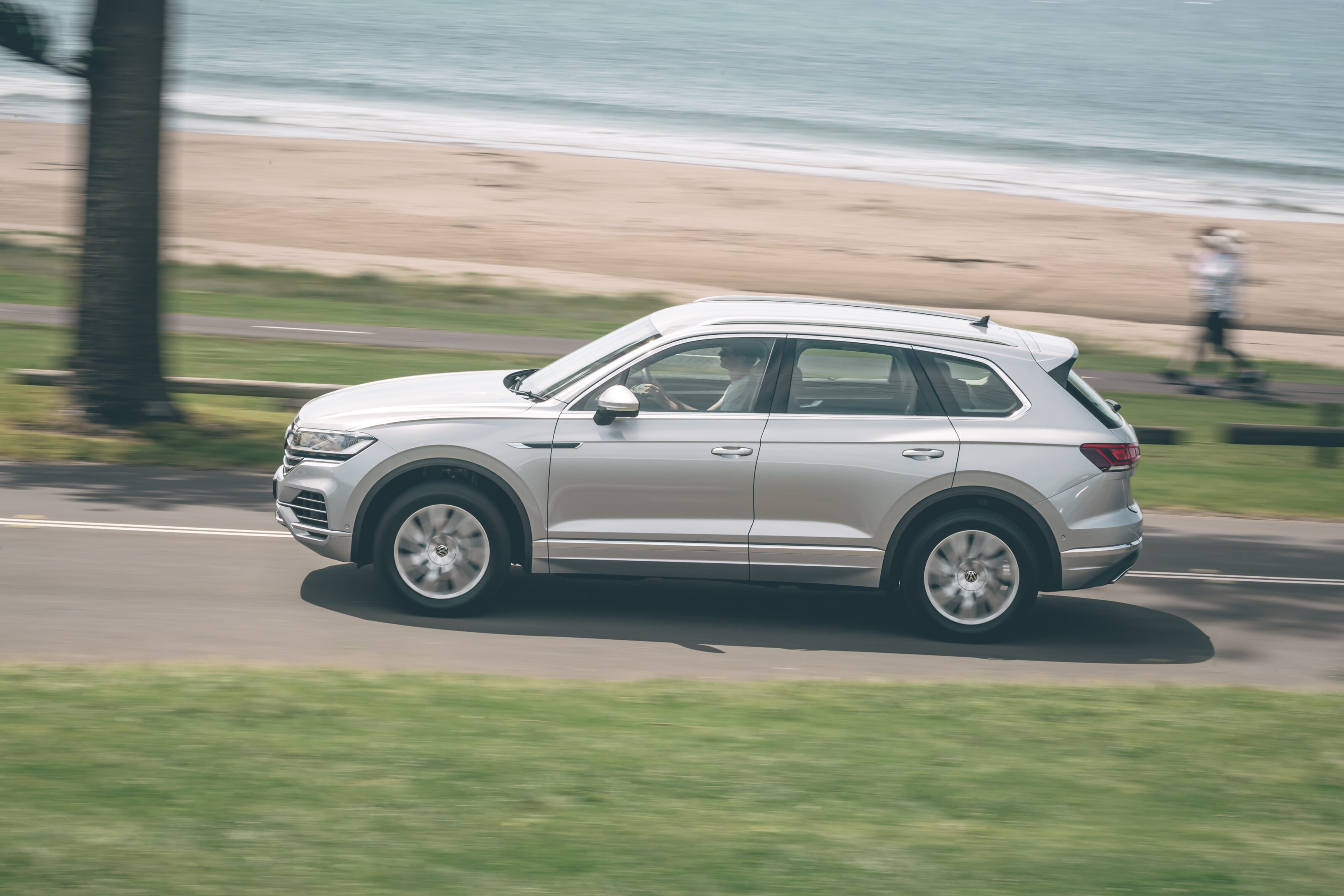
1
JUMP AHEAD
Pricing and features
To sample it against the RX, we secured the base model Touareg 170TDI.
It starts from $87,990 before on-road costs, but with expensive ($2200!) Antimonial silver paintwork and the $8600 Innovision package (ambient lighting, 15-inch touchscreen, digital driver display and navigation), the Tourage creeps price up to $98,790. Still, it’s under $100K, and not bad when you consider how sharp it looks compared to $130K BMWs and Benzes.
The RX range is anything but simple. There are four engines, four trim levels, and various enhancement packs leading to 14 permutations. Lexus offers all manner of exterior and interior colours to choose from, with the range spanning $87,500-126,600 before on-road costs.
Thing is, you get a lot from the $97,500 350h Luxury AWD trim with Enhancement Pack 1 that we have on test. With luxuries such as cooled seats and four leather colour choices bundled into EP1, this is all the RX most will ever need.
1
The basics
| Lexus RX350h AWD EP1 | Volkswagen Touareg 170TDI | |
|---|---|---|
| Price (as tested) | $97,500 | $98,790 |
| Engine | inline 4 cyl, 2.5-litre, DOHC, atkinson cycle, 40kW/121Nmu00a0 rear motor | V6, 3.0-litre, turbo-diesel, common rail direct injection |
| Power | 184kW | 170kW @ 4000rpm |
| Torque | NA | 500Nm @ 1750-3000rpm |
| Fuel consumption (ADR combined) | 5.4L/100km | 6.9L/100km |
| 0-100km/h | 7.9 seconds | 7.5 seconds |
| Touchscreen size | 14.0-inch | 15.0-inch |
| Boot size | 612/1678L | 810/1800L |
| Sound system | 12-speaker Panasonic | 8-speaker |
1
Comfort and space
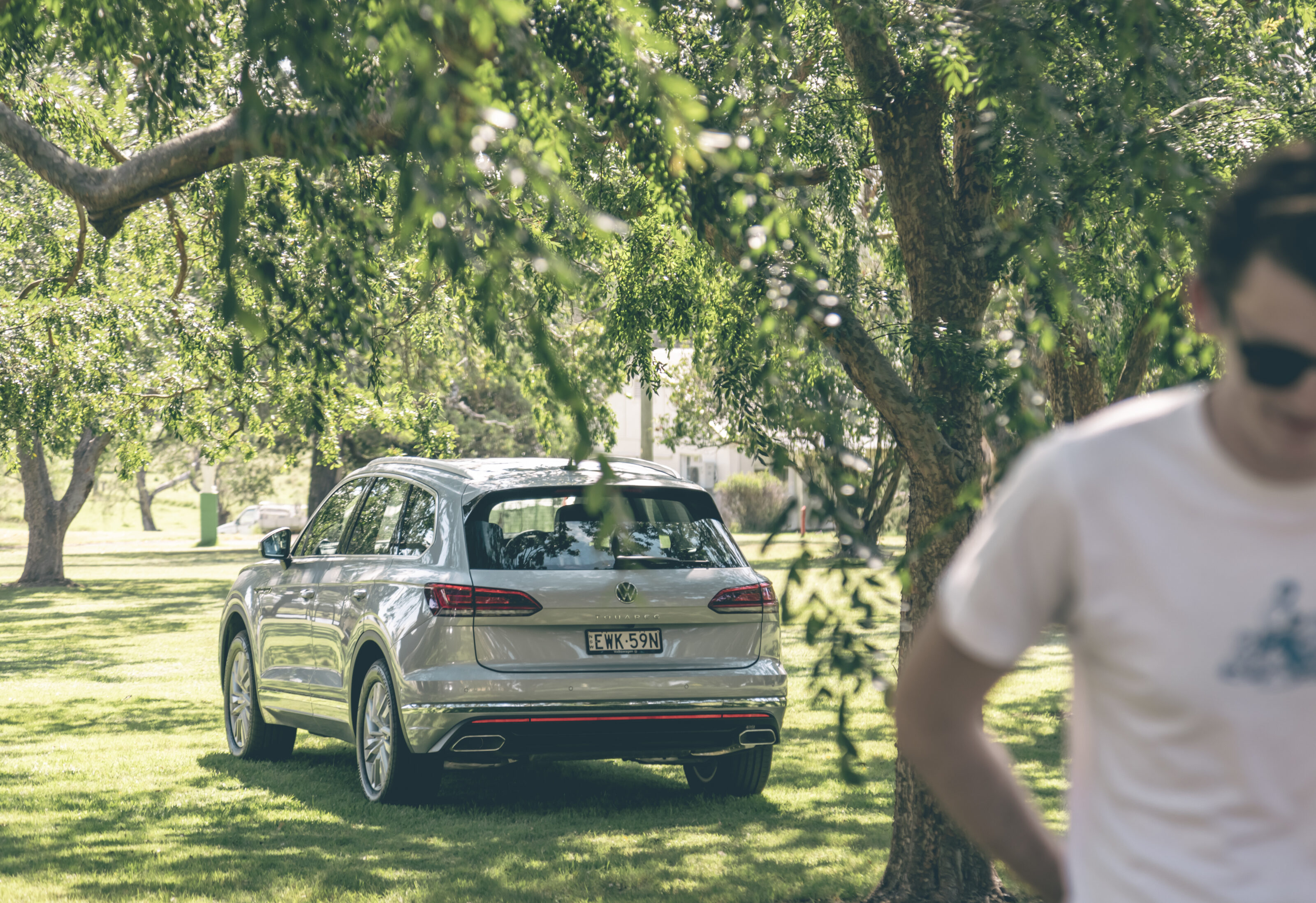
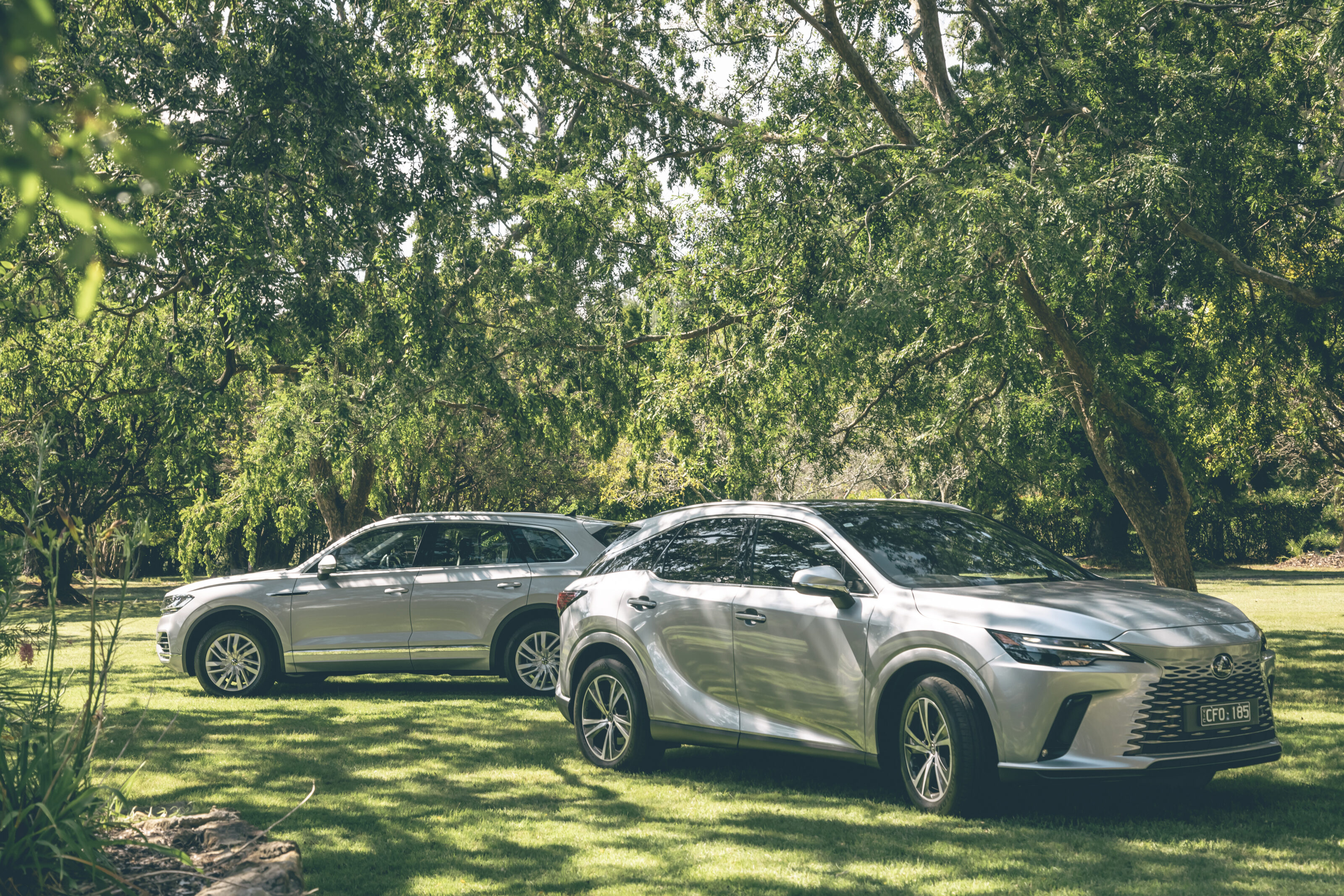
The Touareg and Lexus RX may both be finished in resale silver, but that’s where exterior similarities end. Like a well-tailored Boss suit, the Touareg’s chiselled body lines and restrained detailing bestow it a quiet confidence.
The ‘spindle bodied’ RX, on the other hand, is all about presence. Its jutting grille accentuates the RX’s long front overhang (that scrapes on driveways) and makes a daring impression. A colour other than Sonic Iridium and some larger alloy wheels might better complement the shape, but we’re all agreed that the bold new RX is a step in the right direction.
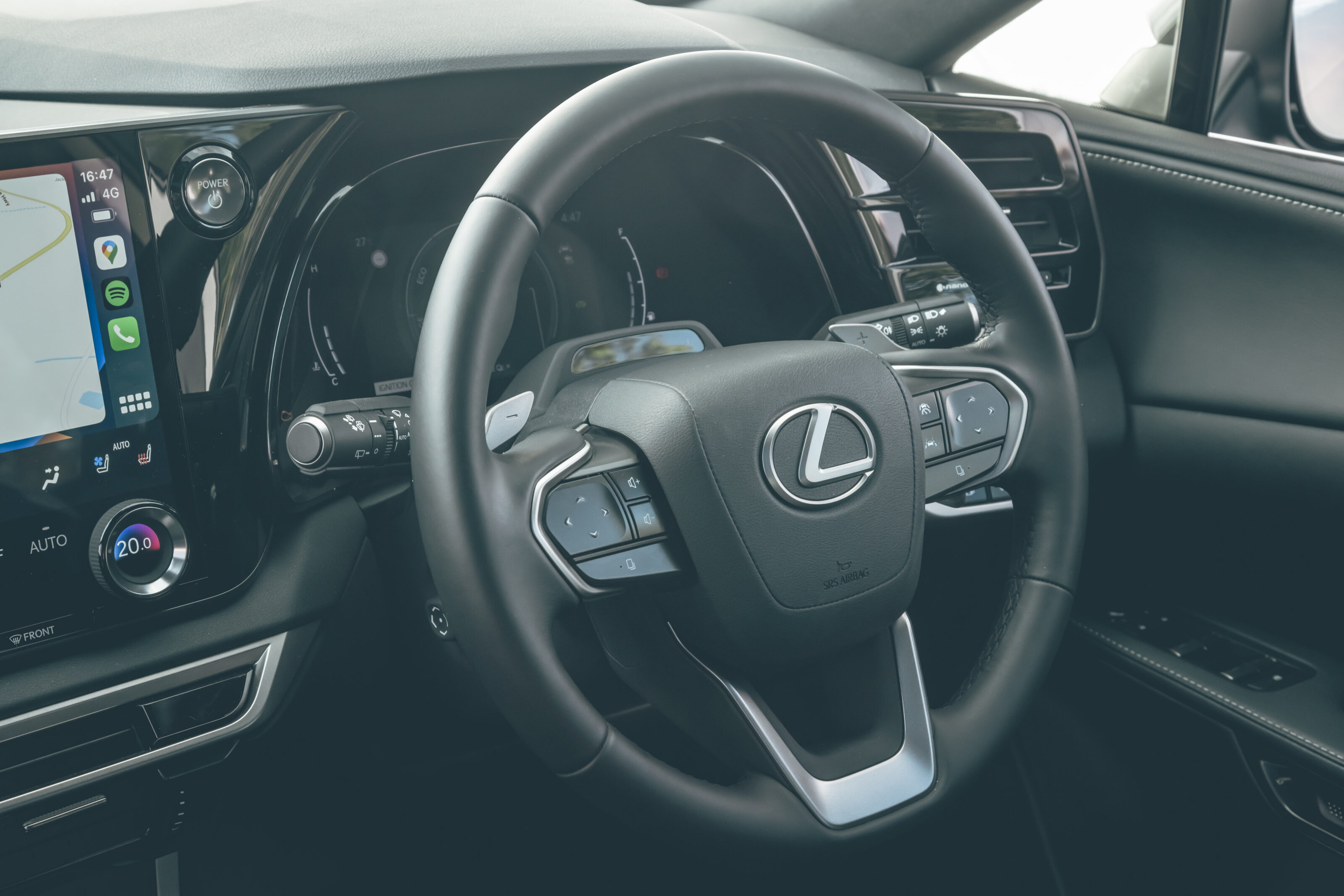
Inside, the Lexus is not quite as daring. The EP1 option adds real leather faces to the seats and fan-cooling (a must-have if you can), as well as a panoramic sunroof, capacitive steering wheel controls, a head-up display, and a wireless charging pad.
1
The material quality feels a retrograde step in places, however, with cheaper plastics creeping further up the RX’s door cards than its plush predecessor.
Our car’s black upholstery accentuates this. We say live a little and opt for a more interesting colour; Hazel, Dark Sepia, and Solis white leathers are all available.
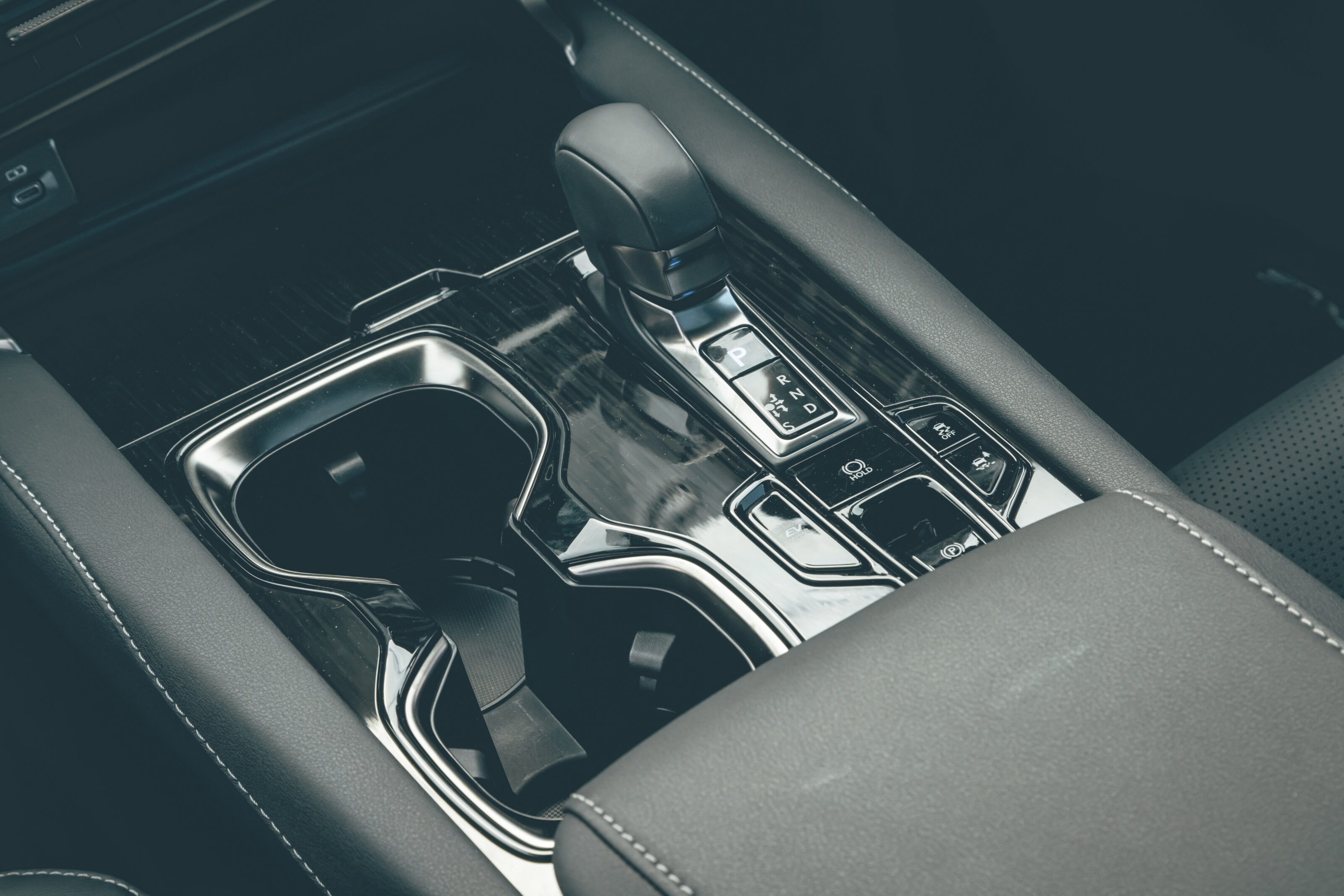
Lexus’s new GA-K underpinnings and electrical architecture bring much-improved technology. The controversial trackpad is gone, in its place a generous and responsive 14-inch touchscreen with navigation, DAB radio, and wireless Apple CarPlay (but wired Android Auto). There’s also a crisp 12-speaker Panasonic sound system.
Interacting with the various screens is mostly hassle-free, except for the head-up and digital driver’s displays. Lexus may have ditched the central touchpad but its ghost lives on in the steering wheel controls that lack tactile feedback. It’s frustrating that, to switch what’s on the instrument binnacle, you need to gaze into the head-up display.
1
One RX curiosity is its ‘eLatch’ door handles. From the outside they’re conventional, but don’t move as you pull on them. It’s just an electric button. From the inside, instead of pulling, it’s a press-of-the-thumb to actuate and then push with your arm. Innovation for innovation’s sake? Perhaps, but our testers grew to quite like it.
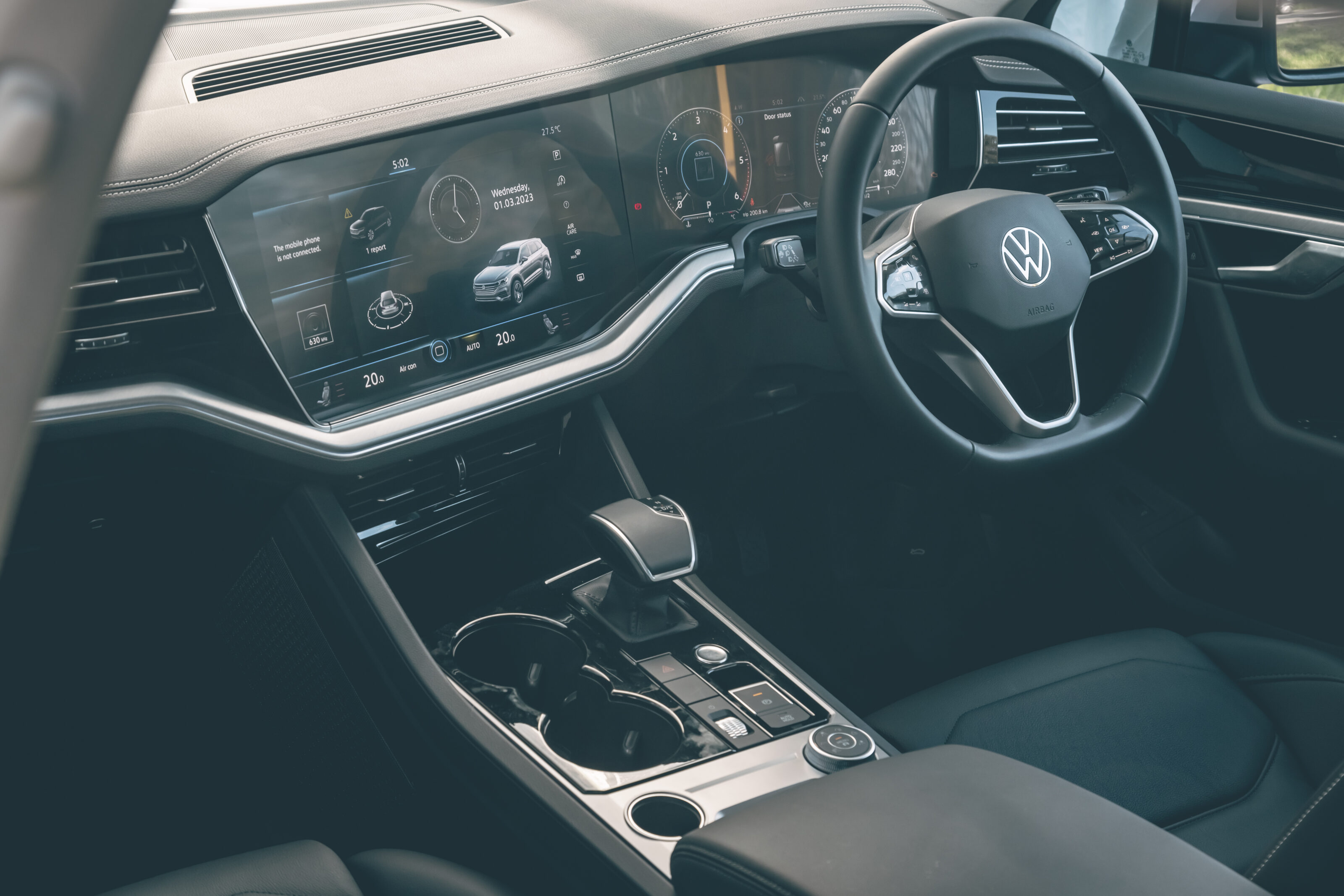
Touareg’s Innovision pack brings a massive 15-inch touchscreen that’s responsive and gorgeous to look at. Unfortunately, wired Apple CarPlay doesn’t take full advantage of the screen, leaving a black edge around phone mirroring – something Android readers will be more accustomed to than Apple devotees.
The Volkswagen’s cabin feel is slick and handsome. Comfortable heated seats and excellent cabin storage are great, but the RX has those things too with more lashings of luxury. Business-like and easy to live with but in base 170TDI trim, Touareg can’t match the Lexus for plushness.
1
HVAC controls buried in touchscreens rightly infuriate many road testers, but this pair does it right. With persistent control for fan speed and seat temp controls on their huge touchscreens, the Touareg and RX don’t sacrifice usability for cabin space.
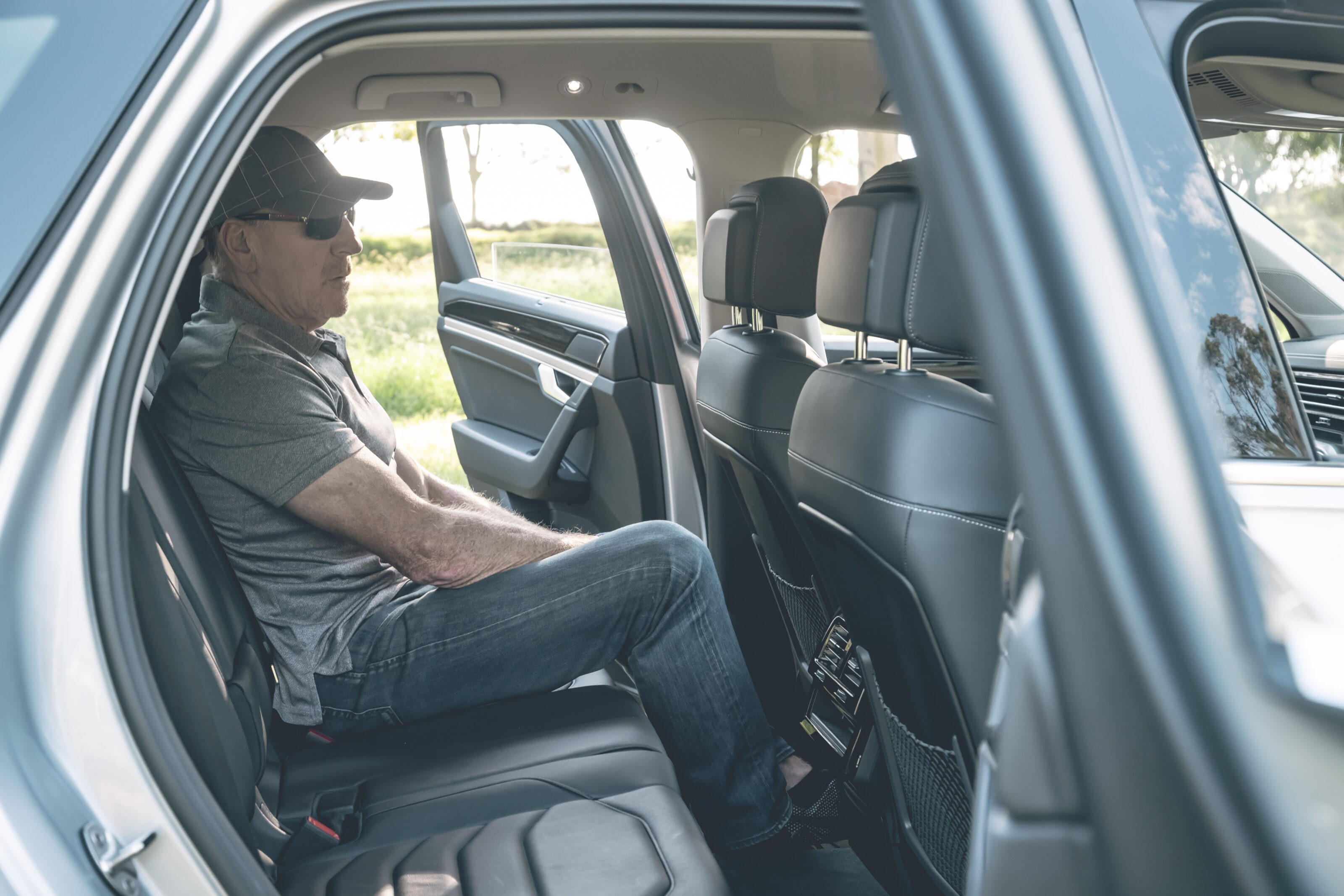
Unsurprisingly for a pair of SUVs that are the best part of 4.9 metres long, the back seats are spacious. Neither the RX nor Touareg is available with seven seats, though a three-row RX L will be along within the next 24 months.
The Touareg packs plenty of space with a sliding bench and adjustable backrest. It’s spacious, especially without the optional $2000 sunroof, and there are two USB-C charging points and a 12-volt socket that folds out from below the two air vents.
Unsurprisingly for a pair of SUVs that are the best part of 4.9 metres long, the back seats are spacious.
1
The RX is a little better though, with extra legroom, a seven-position backrest that reclines an awfully long way, a third climate zone, and a higher-set bench that improves visibility for rear passengers.
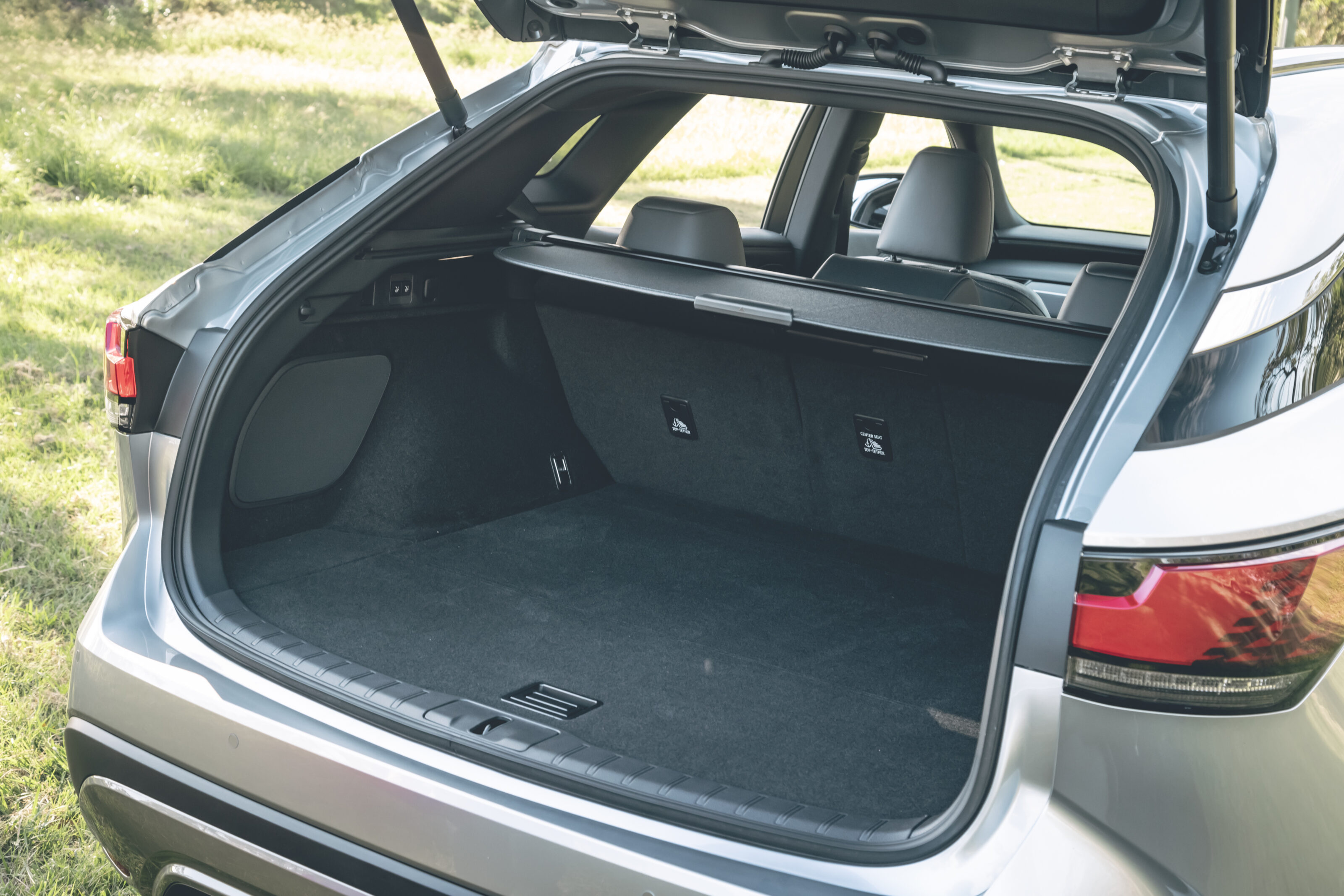
Loading items into either SUV won’t be a huge chore as the load lips are flat and unobtrusive. The Touareg’s boot is larger, measuring 810L or 1800L with the back seats folded flat. It’s also more usable with a very square bay, good underfloor storage, shopping bag hooks, and a space-saver spare tyre.
The RX’s boot is a little smaller, measuring 612L. Folding the second row is easier, though, owing to electric push-buttons in place of manual pull tabs. With the seats down the RX’s load space climbs to 1678L. Owing to packaging an electric motor under the boot floor, the RX has a puncture repair kit instead of a spare.
1
On the road
That electric motor under the RX’s bonnet doesn’t contribute a huge amount to proceedings.
With outputs of 40kW and 121Nm and powered by a small nickel-metal hydride battery, the RX’s AWD system reaches its limit pretty quickly. Still, it does help on a greasy road or damp grass at the footy oval.
There’s no physical connection to the transverse-mounted 2.5-litre petrol engine, so the rear motor doesn’t bring up the 184kW power figure compared to the front-drive RX, and Toyota doesn’t quote a combined peak torque figure.
The RX’s powertrain is excellently calibrated, you can really tell Lexus has been doing hybrids for a long time. Sharp initial throttle response gives the impression of pace, but really the RX progressively builds to your desired speed.
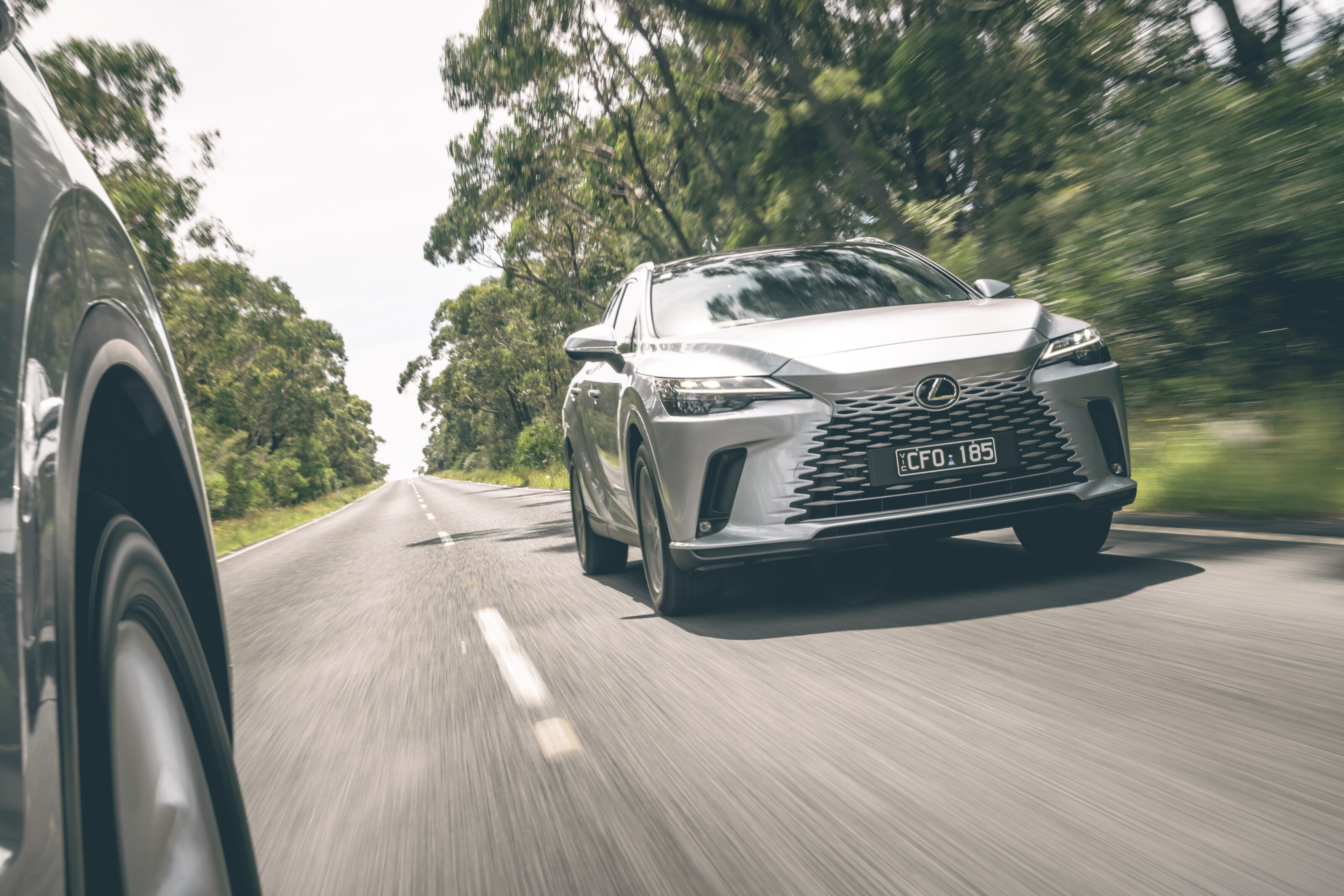
1
The Touareg is an SUV that’s built with a degree of off-roading in mind, not just bitumen cruising
It’s a brisk, if not fast SUV, getting from rest to 100km/h in a claimed 7.9 seconds, but does so without the din of its Toyota relations – Lexus has been hard at work with sound deadening.
It also sips 95 RON unleaded, with a rating of 5.4L/100km on the combined ADR cycle, and the RX’s electric motors should make it efficient around town. Our test saw the RX350h return 8.7L/100km, however, it should be noted that included idling for photography. In real-world driving getting closer to its ADR rating is easily possible.
The Touareg used 9.2L/100km on our test loop, which compares to its ADR combined cycle figure of 6.8L/100km.
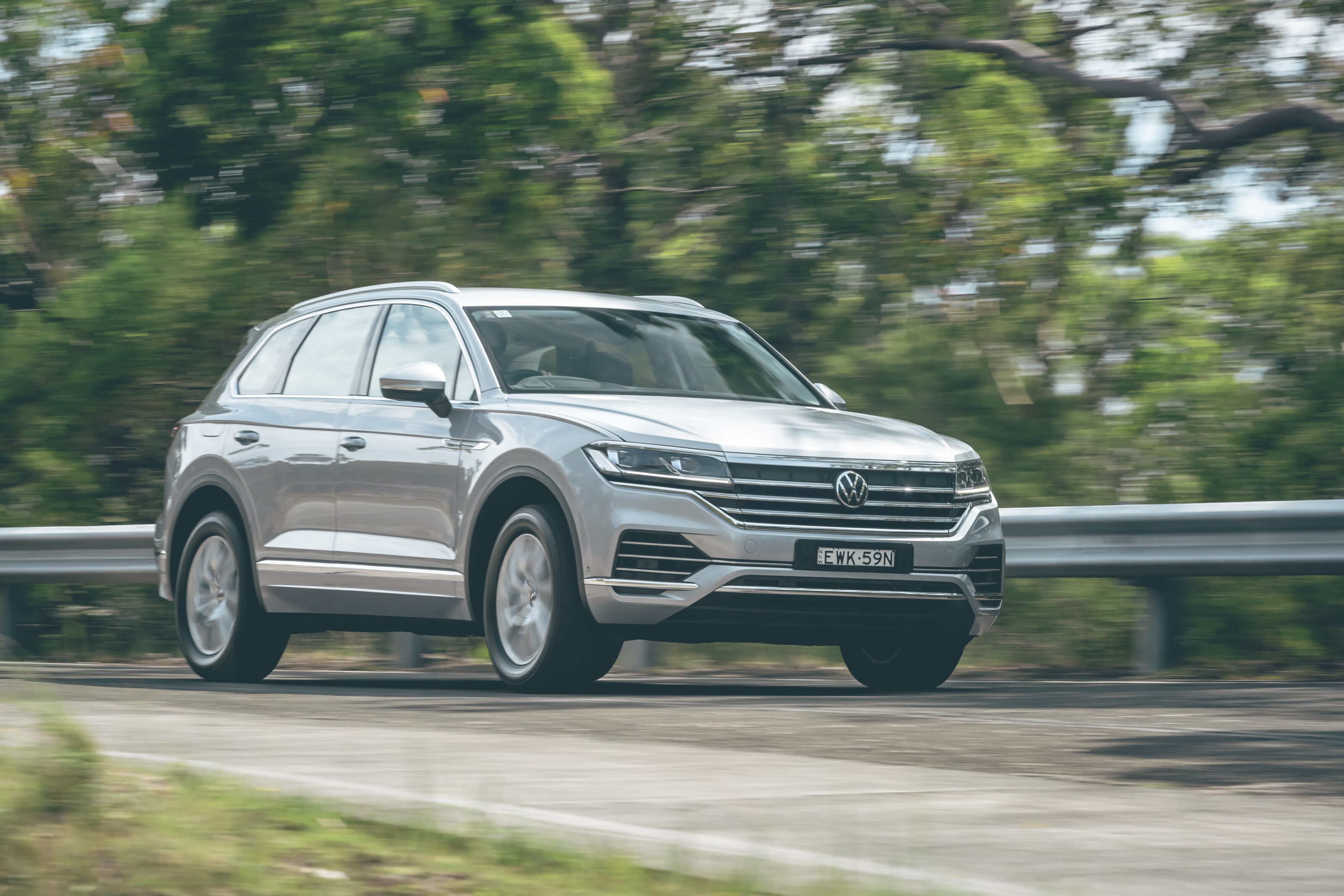
1
Powertrain-wise, the Touareg is an entirely different animal. It features a longitudinally-mounted 3.0-litre turbo-diesel V6 and a mechanical AWD system. This is an SUV that’s built with off-roading in mind, not just bitumen cruising.
With 170kW, 500Nm, an eight-speed torque converter automatic, and a 3500kg braked towing capacity (the RX doesn’t even reach half that at 1500kg) the Touareg is easily the choice for towing and touring.
You might think the Touareg would shrug the Lexus off in the country, then, but the RX is still a faithful companion. The ride quality from both coil-sprung SUVs is excellent, the 19-inch alloys shielded from the road by 55-series worth of chub in the Touareg, and 60 series in the RX.
The Lexus’s chassis feels marginally less rigid with more rear suspension noise echoing through the cabin, and a whisker more road grumble. It also has more relaxed body control than the Touareg, making it comfier on the freeway.
More fluid handling, broader powertrain offerings, and a luxurious cabin are hallmarks of the new RX
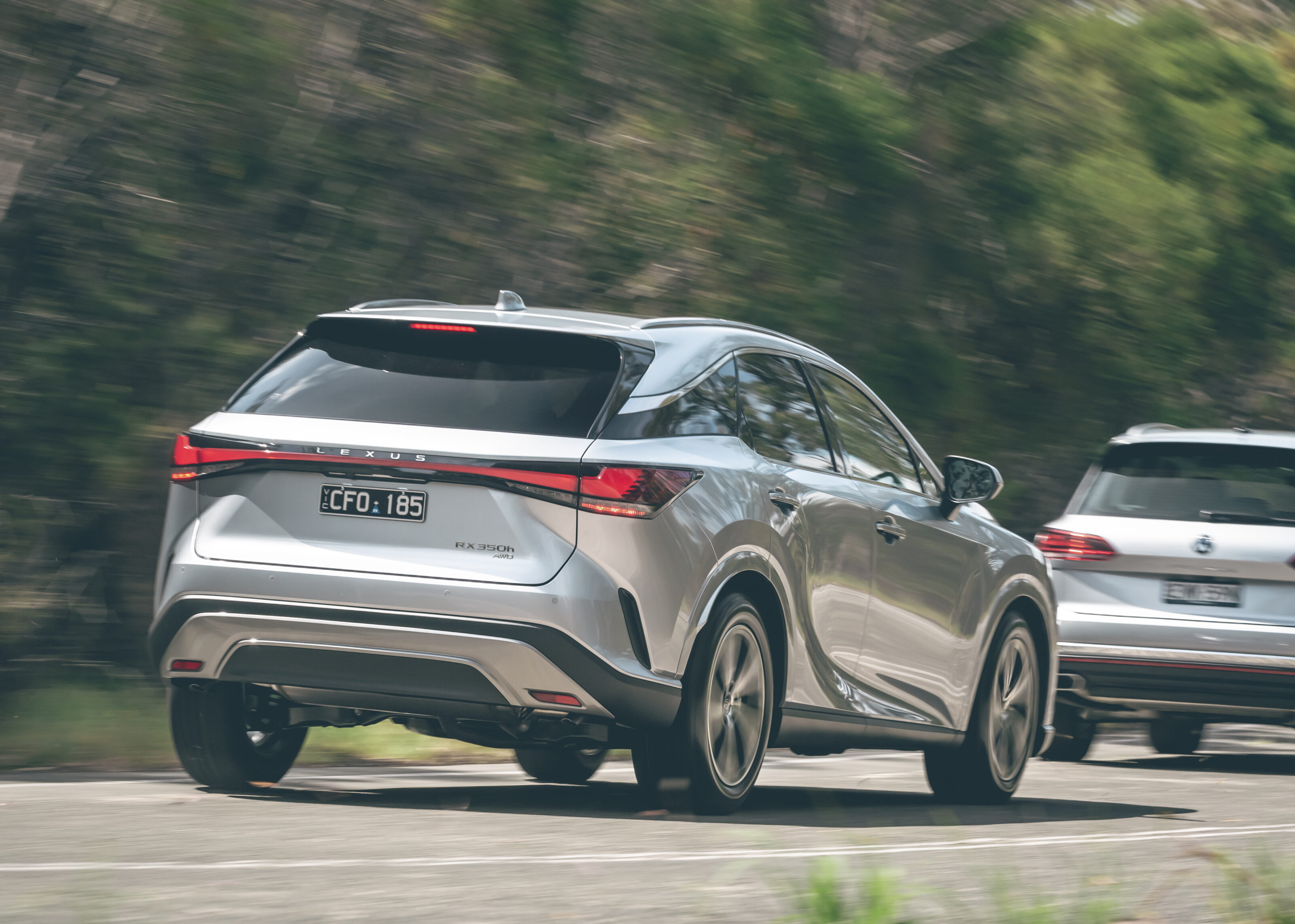
1
Despite a slower 2.76 turn lock-to-lock steering rack and a fair bit of body roll, the Lexus remains a talented handler.
The road-holding won’t trouble a sporty BMW X5, but it flows delightfully down a road and gives the driver options mid-corner. You can lift to bring the nose in through a tightening bend, or get on the power to neutralise.
The Touareg is a wholly sportier proposition. Its torquey diesel mill and firmer chassis feel purpose-built to whittle away hours in the country. Both cars are on steel springs and single-stage dampers. Even so, it’s worth selecting the Touareg’s Sport mode (more so than the RX) as it adds welcome heft to the steering and sharpens the transmission calibration.
This Touareg carves corners deceptively well for a non-air suspended two-tonne SUV. Get carried away, though, and the Touareg’s ESC clamps down hard on the front wheels if it senses things getting out of hand.
Safety
The Lexus RX350h and Volkswagen Touareg 170TDI both achieved five stars in ANCAP safety testing.
Having scored its five-star ANCAP rating in 2019 rather than 2022, the Touareg naturally has fewer safety features, namely driver monitoring and no centre airbag, but it’s still a very safe vehicle.
Both cars have well-programmed adaptive cruise control and lane-keep assist systems that take the sting out of highway driving.
The Lexus RX is fitted with a litany of the latest safety features, including AEB with pedestrian, cyclist and junction detection, blind-spot monitoring with intervention, rear cross-traffic alert, reverse AEB, and more. The implementation of them all is really proficient, with more soothing chimes than old Toyota systems.
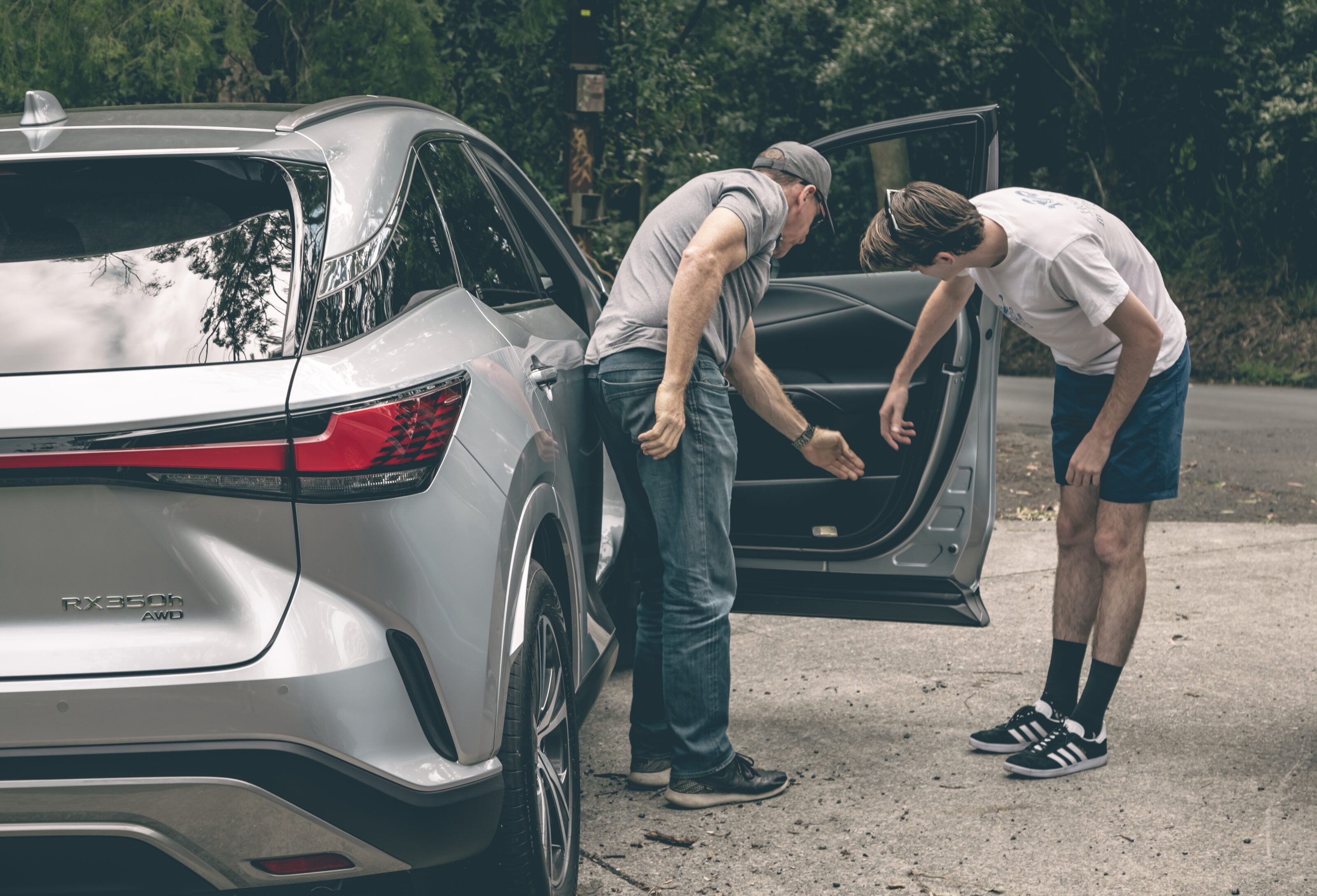
1
Ownership
The two SUVs are covered by their respective manufacturer’s five-year/unlimited-kilometre warranties, as well as five-year capped price servicing. For the Touareg, a pre-paid pack will cost you $3200 for up to 75,000km or five years of motoring.
Lexus doesn’t pre-sell servicing, but does cap each visit to $695, for a five-year total of $3475. The Japanese car also comes with the brand’s Encore subscription for three years, giving owners benefits such as fuel discounts, roadside assistance, invites to exclusive Lexus events, and VIP treatment at partner hotels.
1
VERDICT
The new Lexus RX is a massive improvement over its predecessor. It’s Japanese luxury done right.
These are two quite different ways to accomplish the same goal of large SUV luxury, yet neither gallops away for the overall win, with one caveat. If you’re a horse, boat, or caravan owner, Touareg is the only choice.
The Lexus’s talent runs deeper than your regular Toorak Tractor, though. It’s a very cohesive drive and a massive improvement over its predecessor with an immaculate ride and talented enough chassis to look after you and the family on testing roads. It’s Japanese luxury done right.
While the Volkswagen might feel firmer, and a little more keyed into the road, ultimately its chassis doesn’t leave its rivals in the dust like the smaller Tiguan does to medium SUVs.
A bigger back seat and boot make the Touareg a practical choice, but it doesn’t feel as luxurious inside or offer the RX’s level of customisation. By the slimmest of margins, then, overall victory goes to the Lexus.
Lexus RX350h: 8/10
Things we like
- Ride comfort
- Bold exterior styling
- Efficient hybrid powertrain
Not so much…
- Petrol engine can be vocal
- Only rated to tow 1500kg
- EP1 needed
Volkswagen Touareg 170TDI: 8/10
Things we like
- All-terrain capability
- Torquey diesel mill
- Responsive steering
Not so much…
- Small Apple CarPlay
- Lazy transmission
- Grabby ESC
SCORING BREAKDOWN
| Lexus RX350h AWD EP1 | Volkswagen Touareg 170TDI | |
|---|---|---|
| Safety, value and features | 8.5 | 8.5 |
| Comfort and space | 9 | 8.5 |
| Engine and gearbox | 7.5 | 8 |
| Ride and handling | 8.5 | 8 |
| Technology | 8 | 8.5 |
| Overall | 8 | 8 |
MORE
Everything Lexus
MORE
Large SUVs
Specifications
| Lexus RX350h + EP1 | Touareg 170TDI | |
|---|---|---|
| Price | $97,500 | $98,790* |
| Drivetrain | ||
| Engine | inline 4 cyl, 2.5-litre, DOHC, atkinson cycle, 40kW/121Nmu00a0 rear motor | V6, 3.0-litre, turbo-diesel, common rail direct injection |
| Layout | Front engine, transverse, FWD with electric rear motor | Front engine, longitudinal, AWD |
| Power | 184kW | 170kW @ 4000rpm |
| Torque | NA | 500Nm @ 1750-3000rpm |
| Gearbox | e-CVT | 8 speed automatic |
| Chassis | ||
| L/W/H/Wu2013B | 4890/1920/1695/2850mm | 4889/1984/1718/2894mm |
| Track (F/R) | 1650/1675mm | 1663/1679mm |
| Weight (claimed) | 2060kg | 2087kg |
| Boot | 612/1678L | 810/1800L |
| Fuel/tank | 95 RON / 65L | Diesel / 90L |
| Economy (combined ADR81/02) | 5.4L/100km | 6.8L/100km |
| Suspension | Front: struts, stabiliser bar.u00a0 Rear: multi-link stabiliser bar | Front: five link strut, coil springs, stabiliser bar.u00a0 Rear: five-link, coil springs, stabiliser bar |
| Steering | Rack-assisted electric power steering 2.76 turns lock to lock | Rack-assisted electric power steering 2.2 turns lock to lock |
| Front brakes | 340mm x 28mm ventilated rotors, 2 piston caliper | 350mm ventilated rotors, 6 piston caliper |
| Rear brakes | 340mm x18mm ventilated rotors, single-piston floating caliper | 330mm solid rots, single-piston floating caliper |
| Tyres | Dunlop SP Sport | Bridgestone Alenza |
| Tyre sizeu00a0 | 235/60R19 | 235/35R19 |
| Safety | ||
| ANCAP rating | 5 stars (2023) | 5 stars (2019) |
| 0-100km/h | 7.9 seconds | 7.5 seconds |
Innovision package
*Innovision package ($8600), Antimonial Silver ($2200)
A new report argues regional Australians would most benefit from fuel-efficiency mandates and switching to electric vehicles.
Snapshot
- EVs could save $4 billion in fuel costs for regional Australians over five years
- Limited model choice, driving range and higher price are key issues right now
- Strict fuel-efficiency standards needed to address main obstacles
The Recharging the Regions report by Solar Citizens used 2021 data from the Australian Bureau of Statistics’ Census and National Transport Commission to claim that regional drivers can save up to $4 billion in fuel costs over five years – and help offset cost-of-living concerns.
That’s if the federal government introduced fuel-efficiency standards comparable to the European Union by setting a 95g of carbon dioxide (CO2) per kilometre average limit for carmakers to meet in the first year – which subsequently gets tighter every year to zero-emissions after 10 years.
The organisation argues it benefits regional motorists more than urban drivers because they typically drive longer distances, spend a higher percent of weekly earnings on transport costs, regional fuel prices are more expensive, and car ownership is higher.
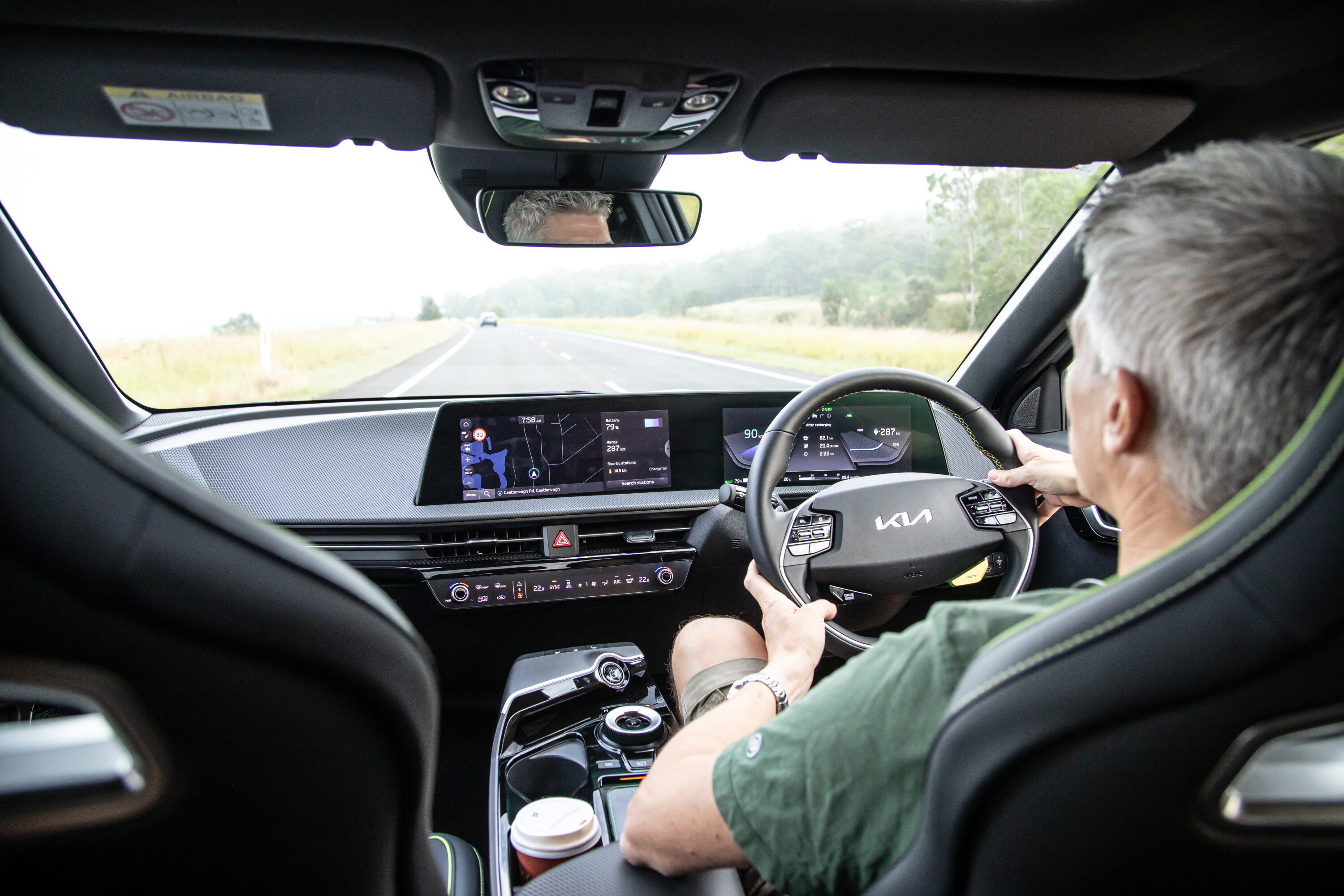
1
There are five million passenger vehicles in regional Australia, with an average annual fuel bill of $11.9 billion.
Solar Citizens ‘conservatively’ estimates a starting 95g of CO2/km mandate will boost the regional EV fleet from 3000 in 2020 to 45,000 in just the first year of the standard.
In a more ambitious scenario, where it starts at 95g of CO2/km and reaches zero-emissions in five years, the interest group estimates it would save regional Australians around $5 billion in fuel costs over five years.
1
Strict emissions standards needed
A vehicle emissions standard that financially penalises car brands for exceeding the set threshold per year – based on the average exhaust emissions of all vehicles sold – will encourage manufacturers to bring more EV supply to Australia, more (and better) model choices, and ultimately drive down prices.
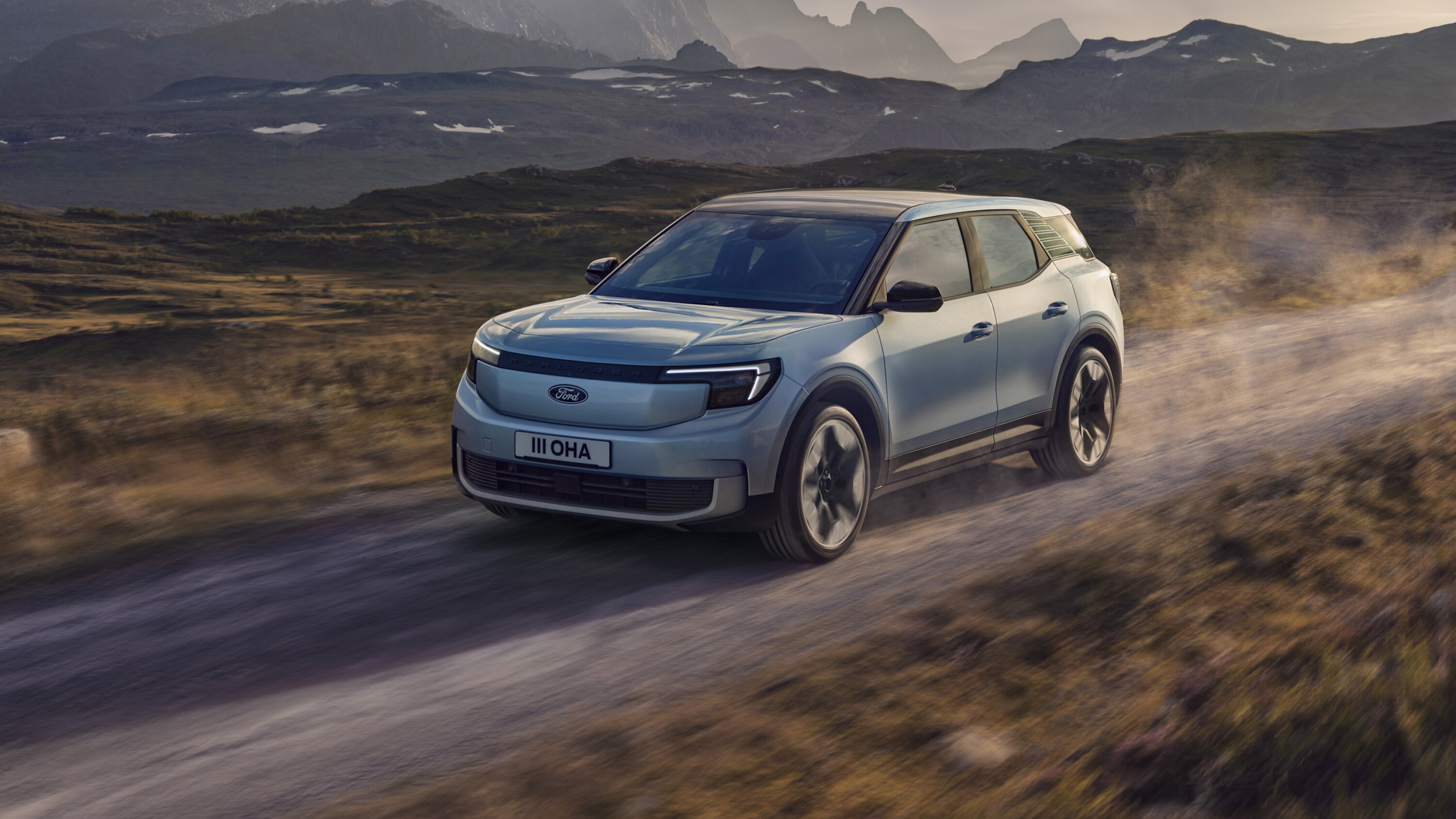
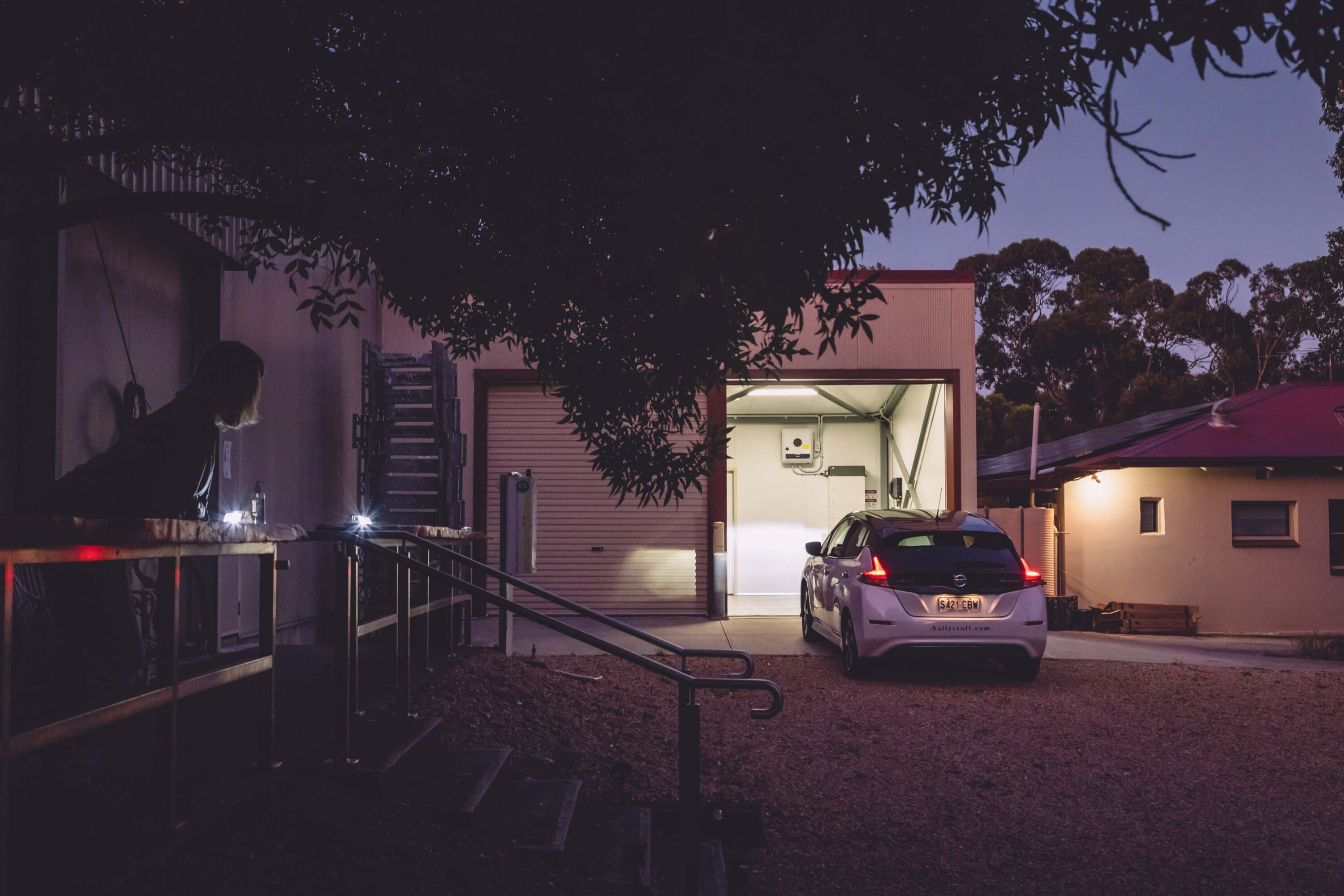
It’s worth noting that most current EV models only provide between 300 to 600 kilometres of driving range, and there’s only one new electric ute on sale – so they don’t suit every regional Australian (for now). However, they do benefit from better charging accessibility at home.
1
Ahead of the anticipated National Electric Vehicle Strategy later this year, Solar Citizens also urged the federal government to:
- Target zero-emissions by 2035 in order to meet Paris Climate Accord agreements;
- Reduce the average emissions threshold at a faster rate annually in order to catch up to other countries;
- Set significant manufacturer penalties that outweighs any commercial benefits of exceeding the limit;
- Higher-emitting light commercial vehicles can have a higher starting limit, but should still achieve zero-emissions by 2035;
- Use a government body, such as the Australian Competition and Consumer Commission (ACCC), to ensure any penalties are not passed on by carmakers to consumers;
- A government agency should be responsible for enforcing the mandate, with regular reviews at least every two years;
- No loopholes such as ‘super credits’ can be used or transferred;
- Use World Light Vehicle Harmonised Testing Procedure (WLTP) measurements;
- Ensure carmakers equitably prioritises a variety of low- and zero-emissions vehicles, including utes that suit regional Australians; and
- Continue incentives, such as the fringe benefits tax (FBT) exemption scheme, while increasing charging accessibility.
Advice
Australia’s best electric cars for 2023
We’ve tested nearly every EV below six figures in Australia to rank the best on sale today
How Australia is lagging behind
Australia remains the only economically-developed country besides Russia to not have any vehicle emissions standard.
For context, global leader Norway has already achieved a 28g of CO2/km average in 2021 – although it has often been noted that Norway contributes to global emissions in its own way, having exported $61 billion worth of cruel petroleum in 2021 alone.
Last week, the US proposed even stricter fuel-efficiency standards from 2027 that, if passed, could see 67 per cent of light-duty vehicles be all-electric – while saving its economy more than $1.5 trillion in health, imported oil and other expenses.
Meanwhile, the European Union is pushing ahead with a 2035 ban on the sale of new internal combustion-engined vehicles that don’t run on synthetic fuels, plus setting strict Euro 7 emissions rules in 2025 to further accelerate the electric transition.
MORE
Electric Cars
⚡ More EV stories to help you choose the best car for your needs
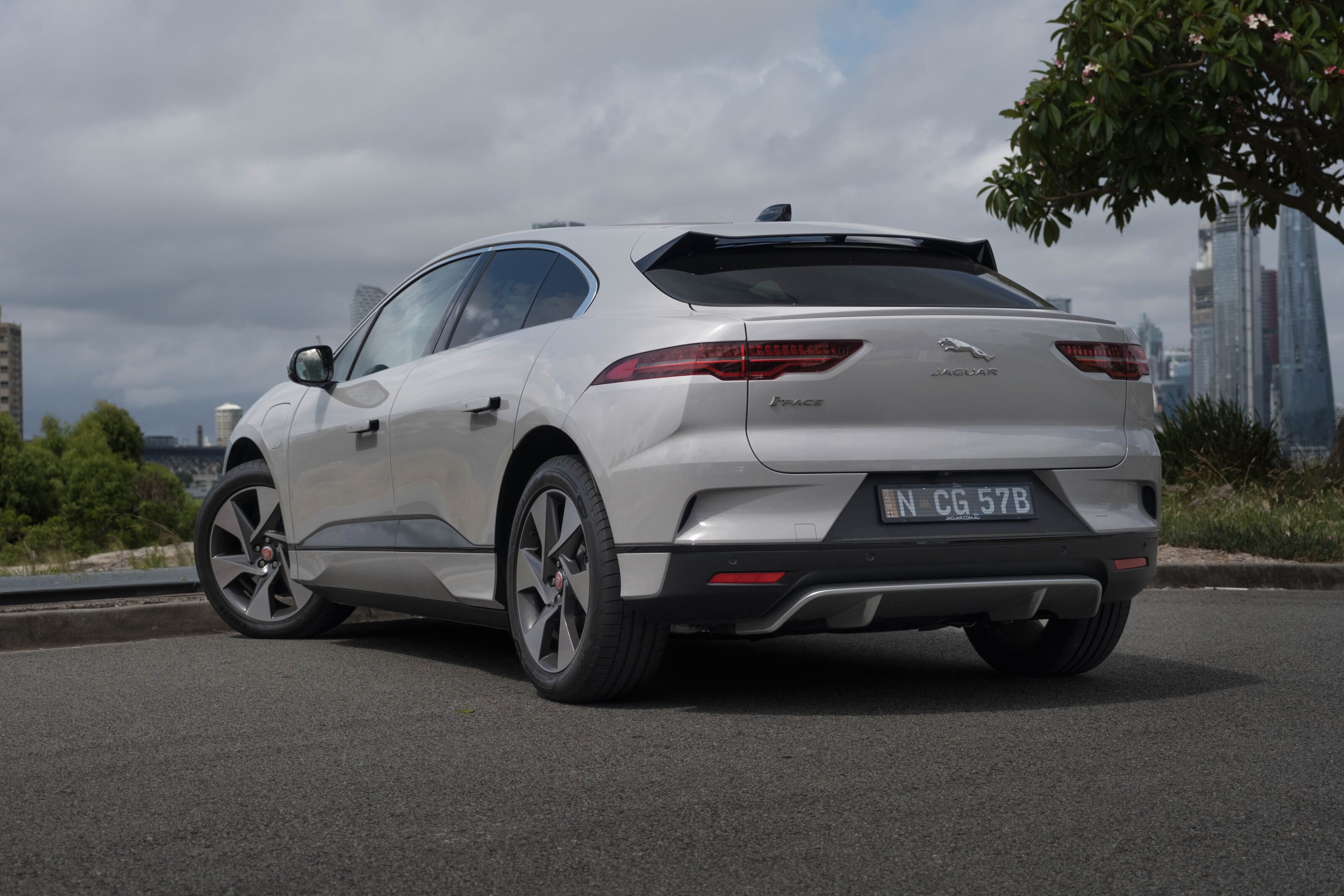
If I was Jaguar, I’d be furious. The first “legacy” carmaker to get a genuinely nice and fast electric car to market in an attempt to spoil Tesla’s party, and it has not been the wild success the company had hoped for.
Jaguar even made the I-Pace an SUV rather than one of its signature sports cars or luxury sedans to pander to market tastes. But in 2022 in Australia it was swamped by pretty much every other premium manufacturer, hampered by supply struggles and a general slide in Jaguar’s local fortunes.
I am mystified as to how the Jaguar is so hugely underrated. Given I hadn’t driven one since launch – and there have been plenty of electrons under my right foot since – it was time to go back to the I-Pace to see what gives.
Updated model announced
Unfortunately, we were booked into this I-Pace without knowing that a significant MY24 update was on the way. This review will still be useful for buyers, but you should note that Australian pricing and specs for the MY24 car have been announced here. We’ll deliver a review of the updated model when it lands in July.
1
JUMP AHEAD
- How much is it, and what do you get?
- How do rivals compare on value?
- Interior comfort, space and storage
- Battery and charging
- What is it like to drive?
- How is it on electricity?
- How safe is it?
- Warranty and running costs
- VERDICT
- Specifications
How much is it, and what do you get?
The first clue might be the price. When the car launched it was in 2018 it started at $119,000.
Back then you could have that or a Tesla Model X, a far larger and more expensive car. So the number of competitors has certainly risen, but as you’ll see later in this review, it’s not out of the ballpark.
For 2023, you’ll be starting at $146,857 before on-road costs for the SE EV400, Jag’s entry-level and so far only EV. There used to be a cheaper S specification, but that’s a goner now but you can step up to the HSE with more standard kit and both offer an R-Dynamic black pack option.
1
| 2023 Jaguar I-Pace SE standard features | |
|---|---|
| 10-inch touchscreen | Dual-zone climate control |
| 20-inch alloy wheels | Electric heated and folding mirrors |
| 6-speaker stereo | Front and rear parking sensors |
| Adaptive cruise control | Keyless entry and start |
| Auto LED headlights | Reversing camera |
| Auto parking | Satellite navigation |
| Auto wipers | Textile interior |
| DAB+ digital radio | Wireless Android Auto |
| Digital dashboard | Wireless Apple CarPlay |
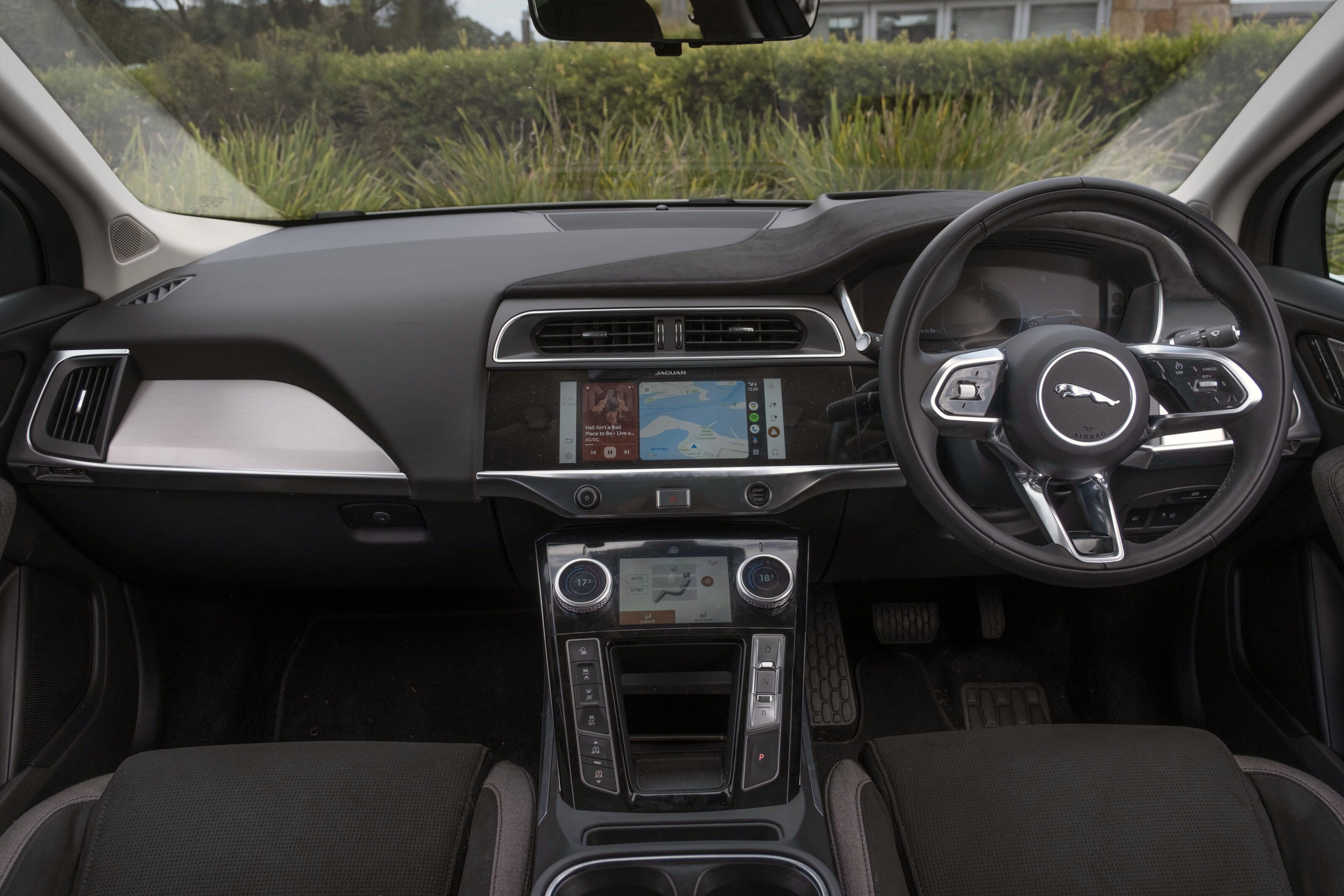
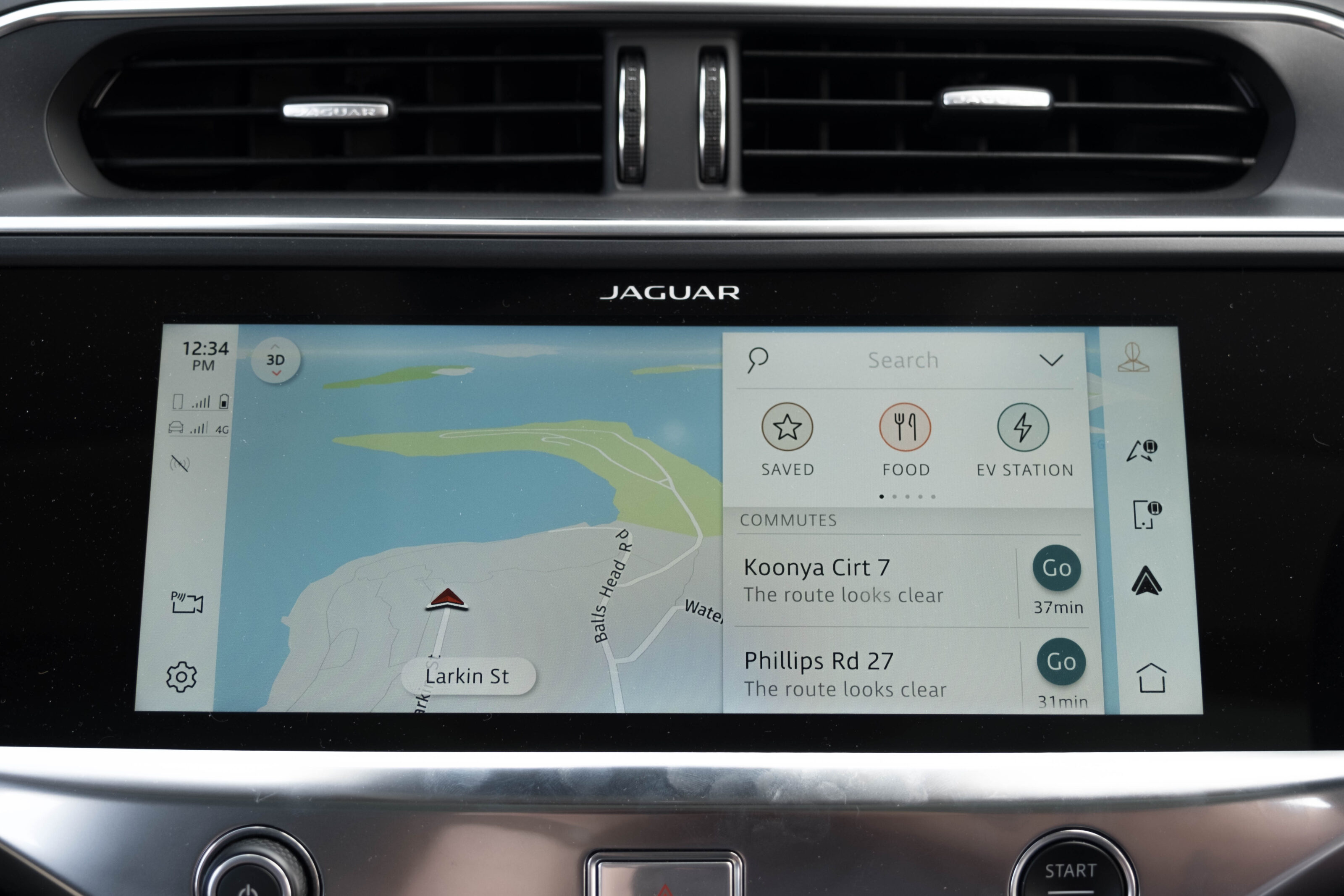
Jaguar has replaced the original car’s media system with the vastly improved Pivi Pro. While the 10-inch hardware is still a little on the slow side, it’s a big improvement and much easier to use and look at.
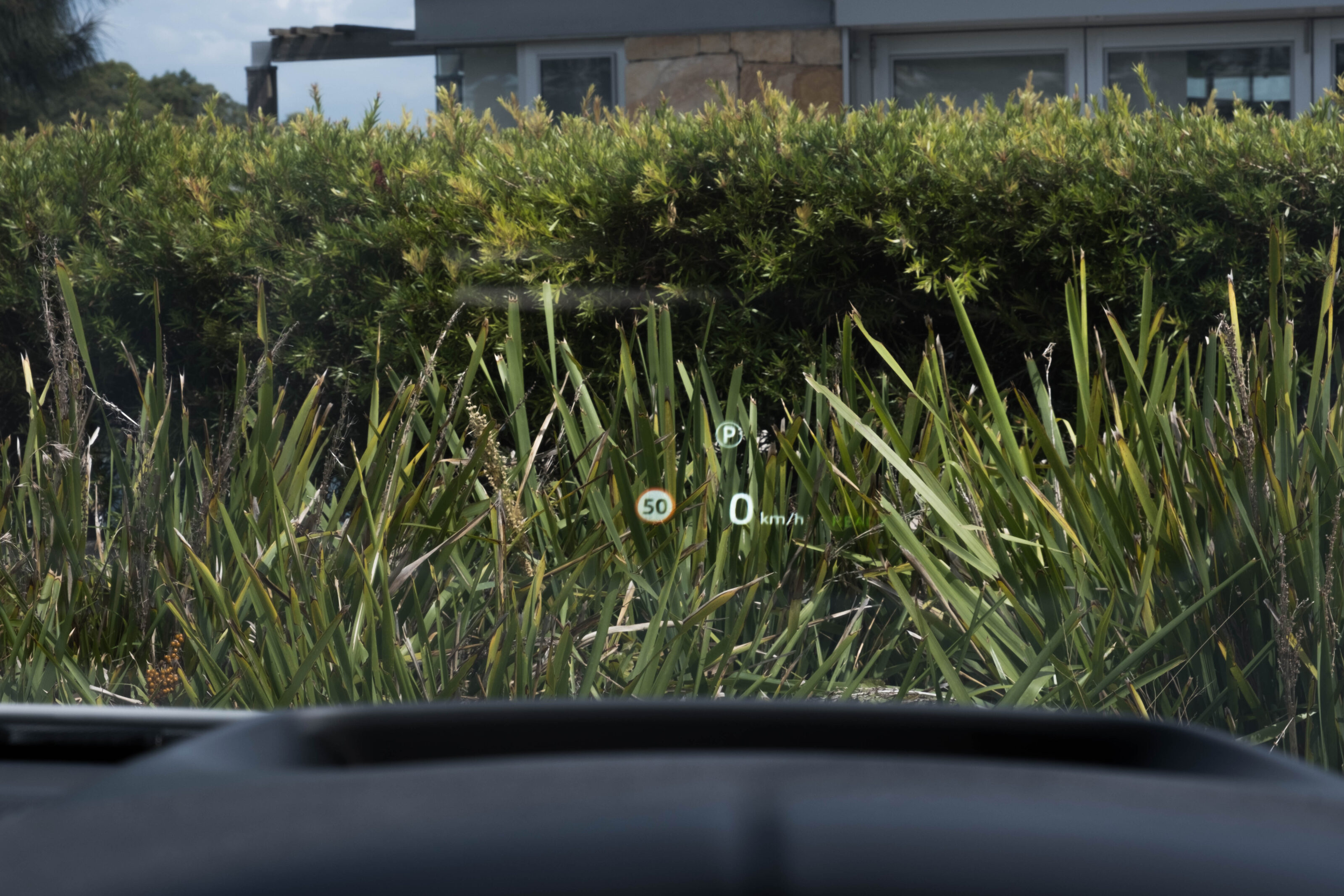
As it’s a Jaguar, there is a long list of options available. The car tested here had the fixed panoramic glass roof ($3580), power-adjustable heated and cooled front seats ($3270), adaptive dynamics ($2405), monogram aluminium trim finisher ($1521), Meridian sound system ($1200), camera-based rear vision mirror ($1131), head-up display ($1040), privacy glass ($845), 40:20:40 split-fold rear seats with centre armrest ($620), spoiler ($410), and a home charging cable(!)($400). All of this took the price to $163,279 before on-road costs.
1
You could lose a lot of this stuff and not be too worried. The seats seem a bit stiffly priced to me and you can’t ever sell me on a sunroof. But the adaptive dynamics pack adds air suspension (good), and head-up displays are always good but to charge for a home charging cable seems a mite cheeky. Scratch that, mighty cheeky.
Cheekier still are the $3900 paint colours, but I’ll let Jaguar off because there are only two of them and the rest of the palette is free, with ten further colours to choose from, no less.
1
How do rivals compare on value?
There is a lot going on in this space. It’s kind of hard to pigeonhole the Jag as it’s more of a crossover than an SUV, so there are plenty of rivals.
BMW’s iX3 is a comparative snip at $104,000 before on-road costs. It now has the warranty you deserve and roughly matches the range aspirations of the Jag but is much more of a high-riding, practical SUV, albeit based on an ICE platform. It comes with a five-year Chargefox subscription, too, which is great if you live or work near an operational charger. Hello to that one person.
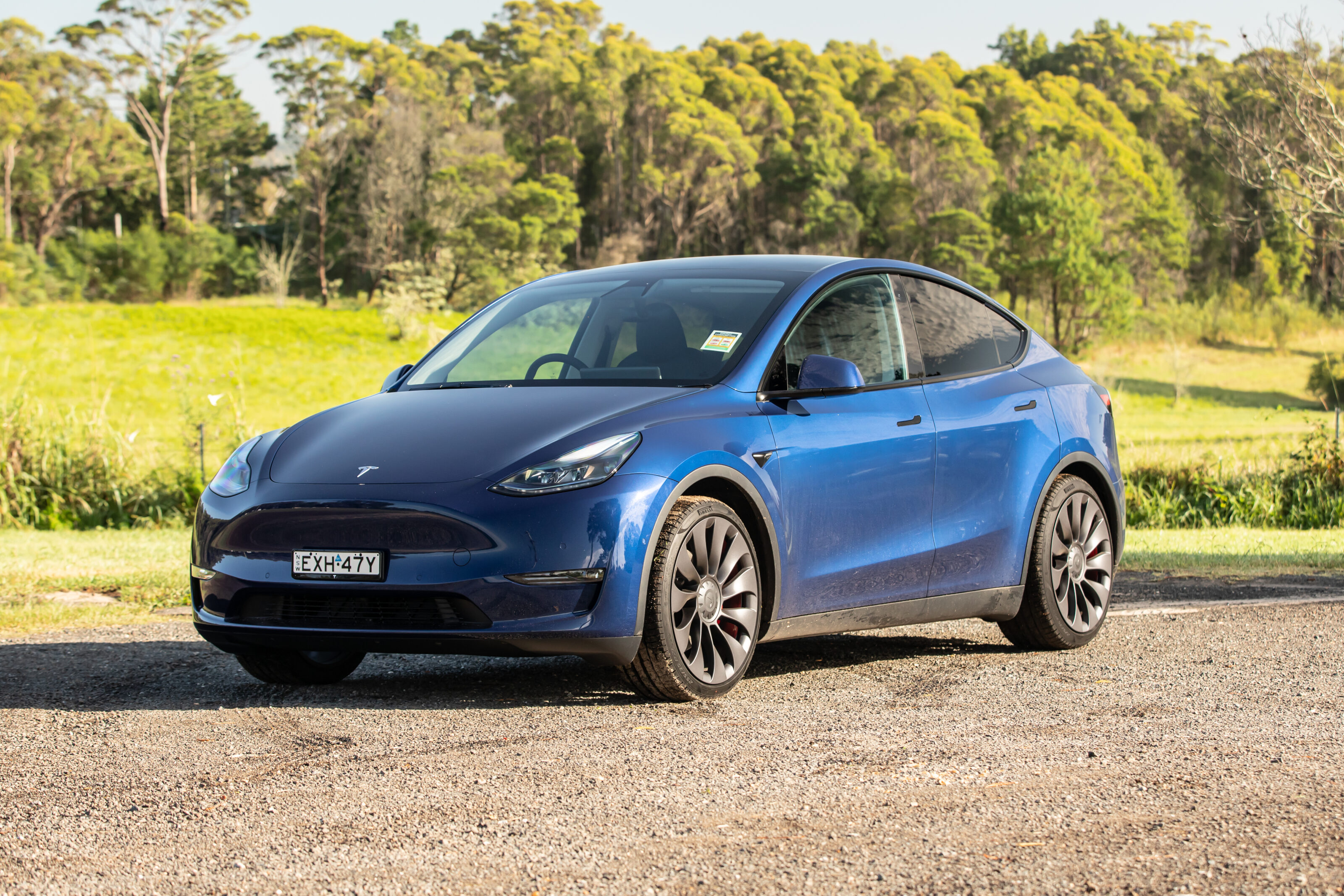
Tesla’s more suitably-sized Model Y (as opposed to the seemingly unobtainable X) starts at about half the price but doesn’t have anything like the poise, power or features (like a proper speedo). The Model Y Performance at around the $100K mark plus on-road costs is more like it, but isn’t as good to drive, though it has similar power and torque.
1
Kia’s EV6 GT is a recent arrival and I’m probably pushing my luck, but it’s tempting. With a scorching 3.8-second run to 100km/h, 800-volt charging and a longer vehicle warranty, it is priced from $99,950 before on-road costs. Doesn’t quite have the badge, though, does it?
Audi’s E-Tron, soon to be revised and renamed Q8 E-Tron, starts at $132,980 for entry 55 SUV and heads up to $153,500 for the E-Tron S (both before on-road costs), which is probably a closer match to the I-Pace.
Like the iX3, it’s not built on a dedicated EV platform and isn’t quite as much fun to drive as the Jag, nor does it hit the numbers on battery range. Luckily it comes with six years of free charging at Chargefox. I don’t have another joke about broken chargers.
Interior comfort, space and storage
The I-Pace isn’t a big car but it’s quite roomy. Dedicated EV platforms tend to have long wheelbases, meaning the cabin has more room to breathe even if the car itself isn’t super long.
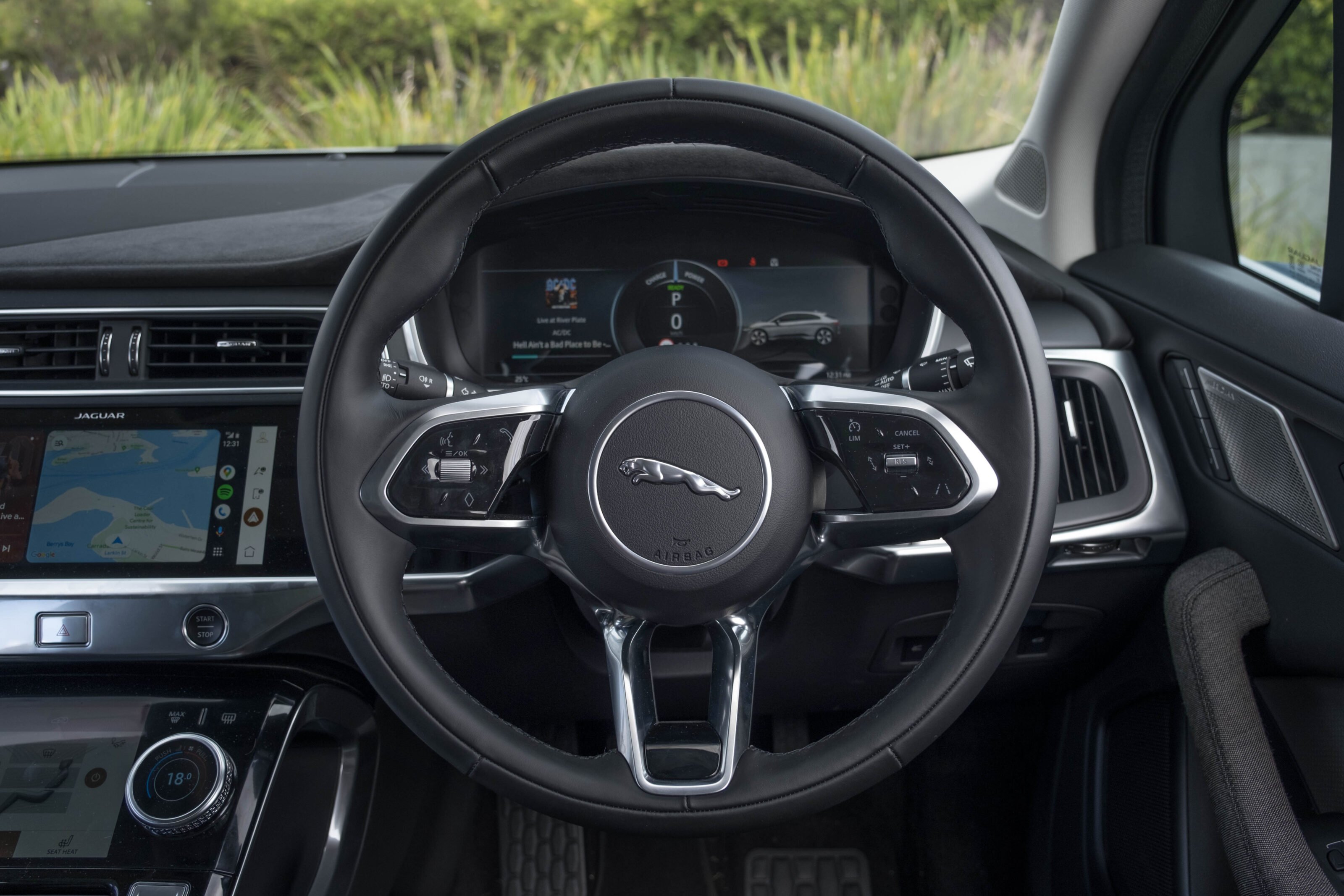
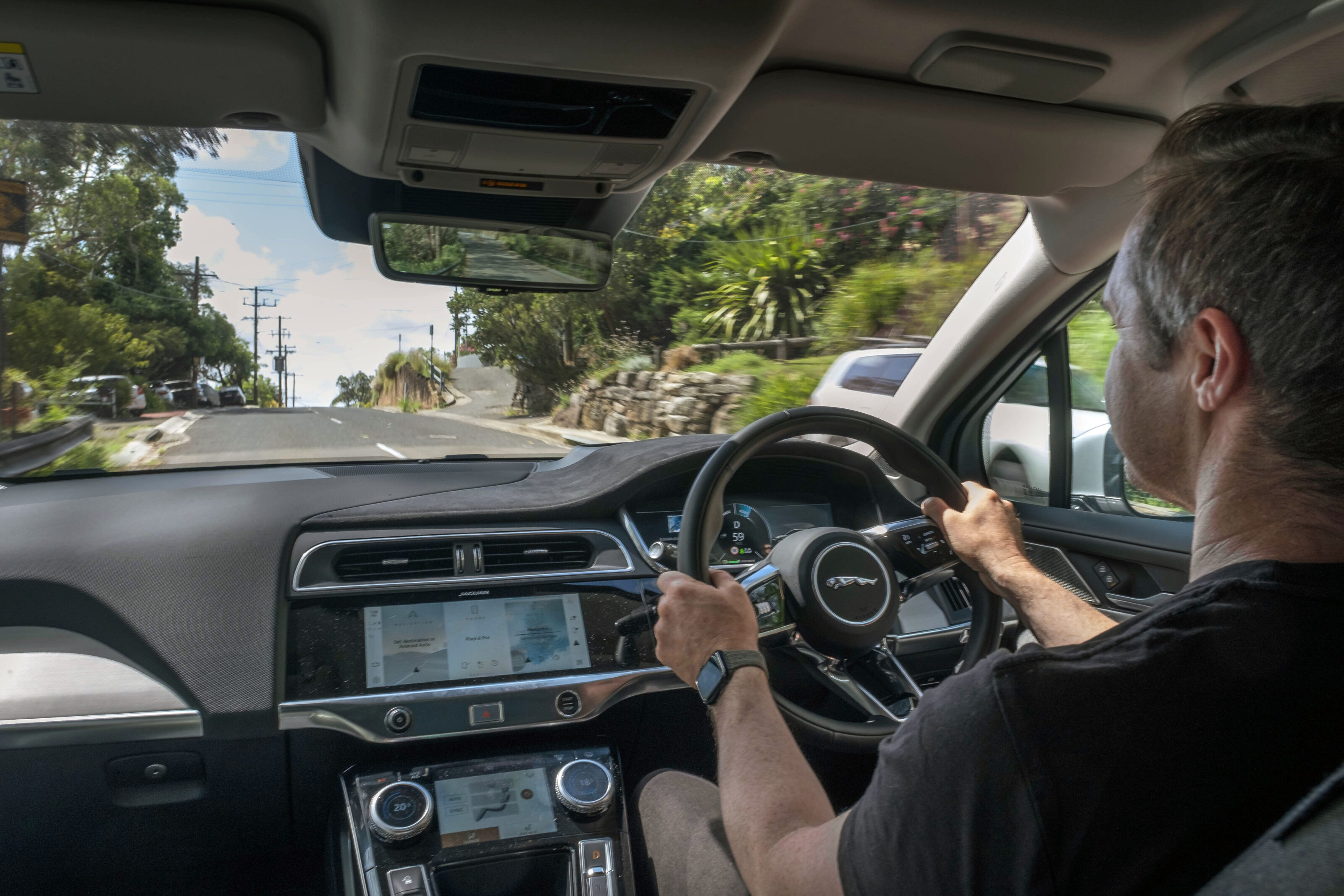
Being a Jag, you sit low in the cabin, with a great view out over the stubby nose. The lovely dished steering wheel, familiar from so many other Jaguars, frames the clear and simple digital dashboard that also seems better than the earlier cars.
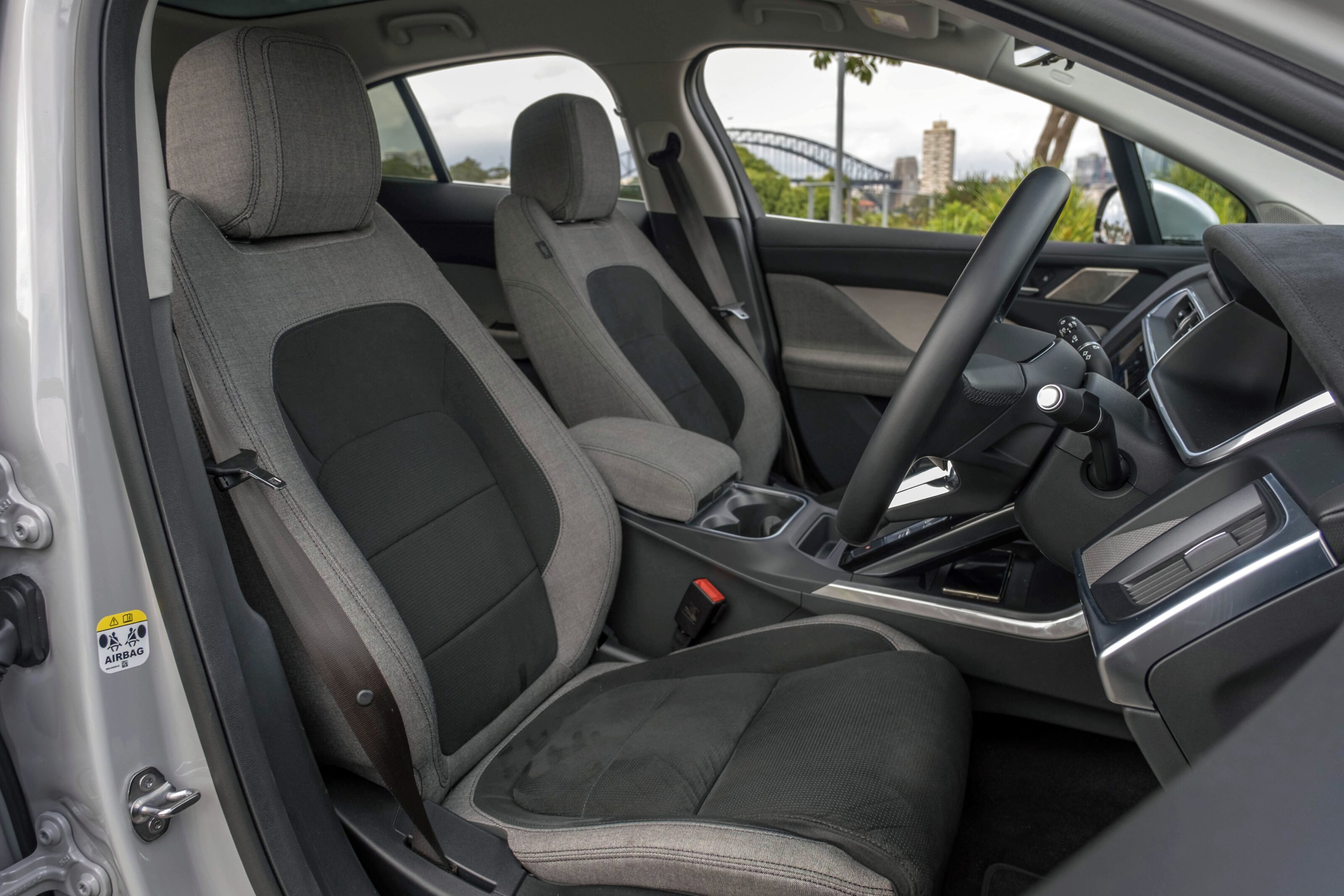
This car had a fabric interior. I reckon it looked and felt great and is well-paired with the full glass sunroof. While I felt that the roof was darker than the last I-Pace I drove – and therefore the cabin didn’t heat up so much – not having to keep an egg flip handy to remove skin from upholstery was quite nice.
It was nice to see lovely fabric trim on a car that normally comes with leather and doesn’t have to. Jaguar Land Rover does a really good job with fabrics and I am a fan of cloth interiors.
1
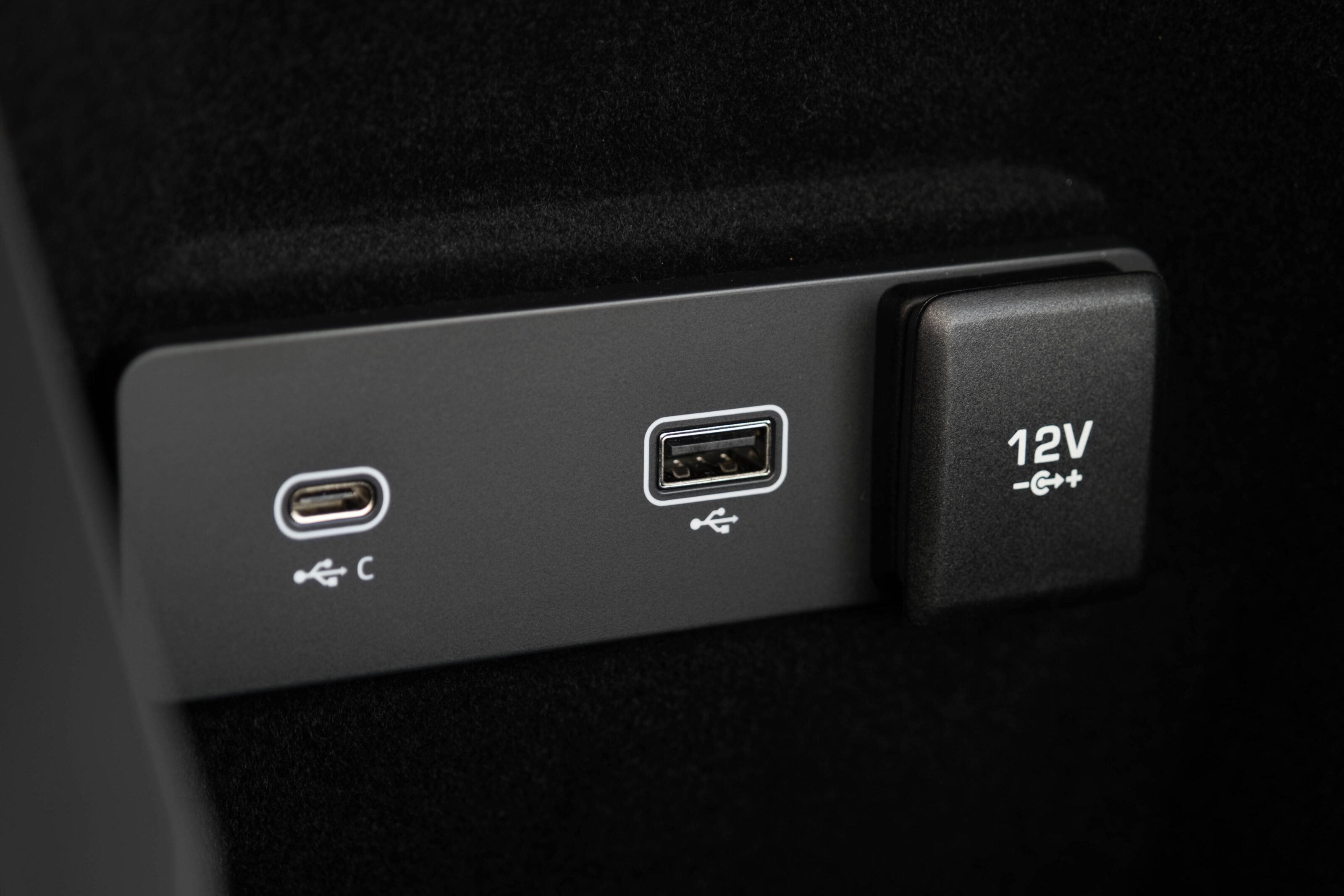
The front seats are very comfortable and took us on our five-hour round trip to the Blue Mountains and back in plenty of comfort. There are two cup holders, an awkward-to-get-to wireless phone charger and USB ports (A and C). There isn’t an embarrassment of storage; the sports car vibe of the cabin just isn’t built that way.
It is also quite comfortable for two in the rear seats, and not too bad for three. The I-Pace is pretty wide, so as much is made of the space as possible. The fold-down armrest has a pair of cup holders, you get air vents, door pockets and two USB ports for charging as well as a 12-volt outlet.
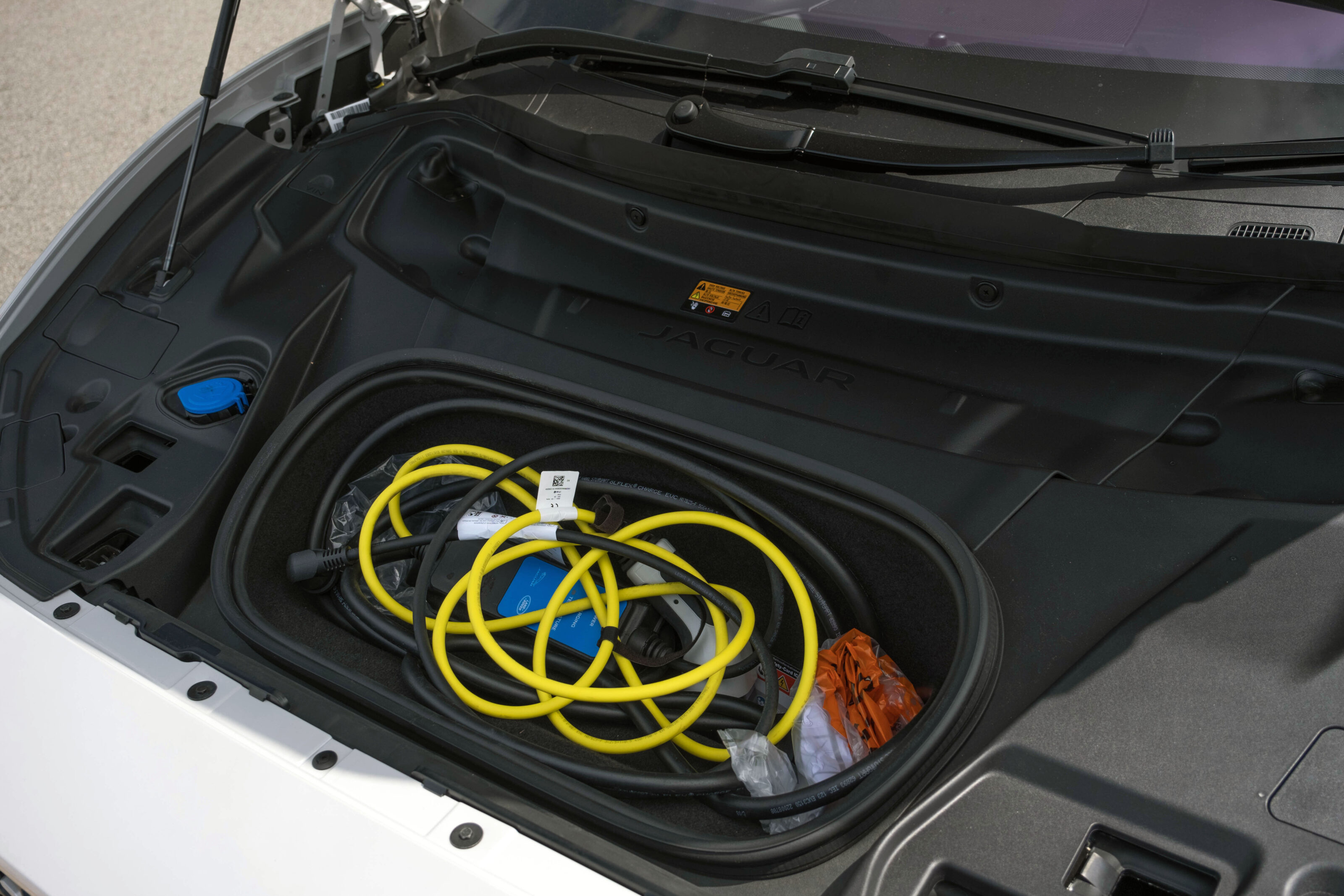
The boot provides a massive 656 litres of space and it is well-shaped for bulky items. The tailgate lifts out of the way, too, with a helpfully wide aperture. A tiny 27-litre front boot under the bonnet just – just – swallows the charge cables. But it keeps them out of the way, so that’ll do.

1
Battery & Charging
The I-Pace packs a 90kW lithium-ion battery packed into the floor.
You can tell the Jag is getting on a bit with its headline DC charging rate of just 100kW. As I will always say, on most chargers that’s academic because when you get there it’s either broken or won’t give you the full promised rate of delivery.
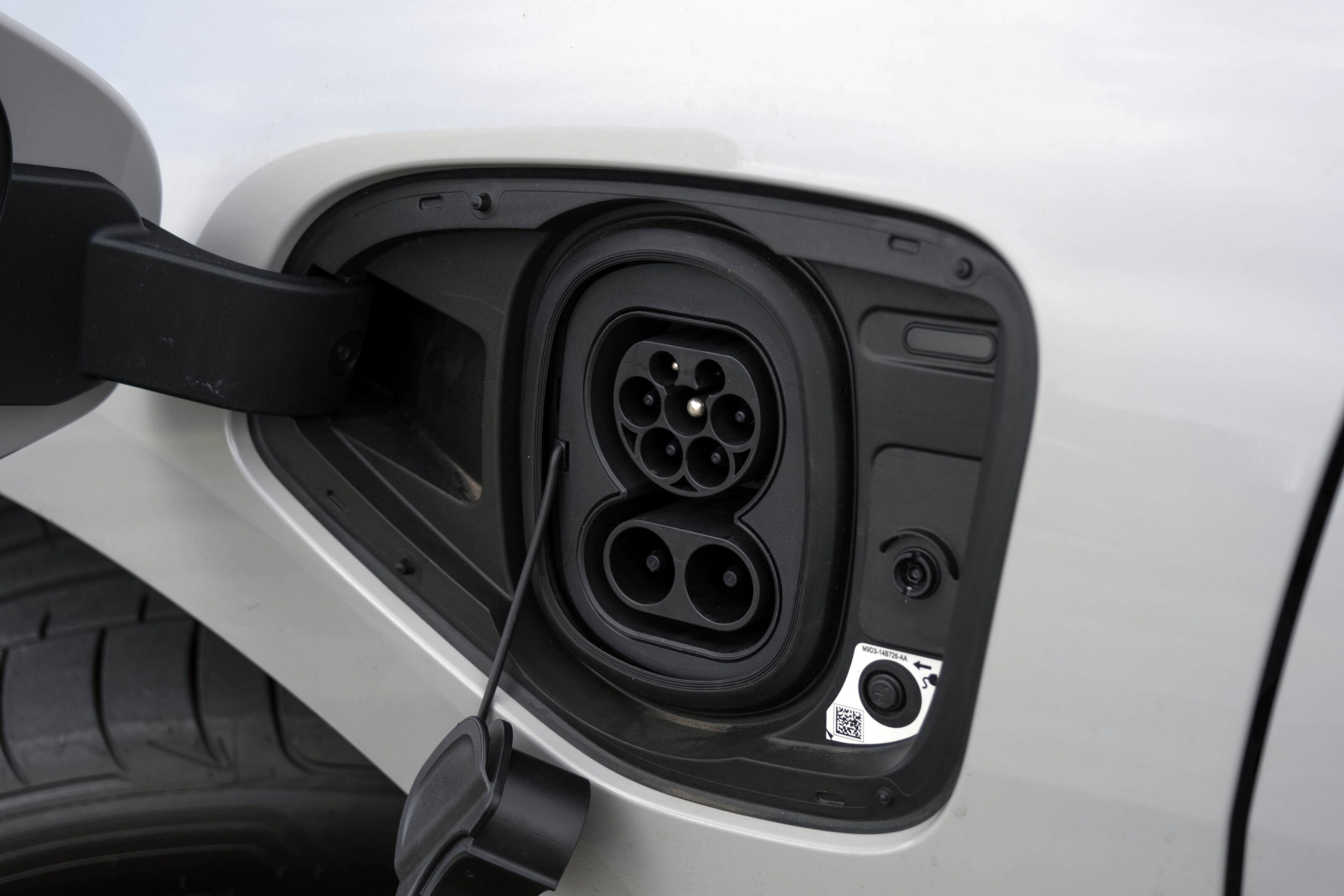
We struggled a bit with charging the I-Pace – the Ampol charger in Sydney gave us just 25kW (rated to 180kW) while the Chargefox Eveleigh 50kW charger faulted after nine minutes, delivering at a maximum of 30kW.
1
We drove home and then trundled to a nearby Bunnings which we thought had a row of 22kW chargers. Sadly, it now just has one ARENA-funded 50kW CCS2/25kW CHAdeMo charger, a familiar unit that is half useless most of the time because so few cars have the CHAdeMo plug.
Anyway, we plugged into this Exploren-branded charger and got 50kW flowing from 27 per cent all the way to 80 per cent. This is the stuff. 50kW – if you can get it – is reasonably swift charging and is fine for a leisurely coffee stop or, as the Exploren’s situation implies, a wander through the hardware Narnia that is Bunnings.
Three straight weeks of running EVs leads me to believe that while 350kW charging is all well and good, most of us will be happy with 50kW unless we’re in a screaming hurry or that jerk ahead of us has been idling for over an hour. Or, like the dimwit in the Tesla who insisted that once reaching 100 per cent, it needed another 20 minutes to complete the charge for “that extra little bit”.
1
What is it like to drive?
I was a big fan of the I-Pace on launch and remain so to this day, because it really is a lovely car to drive.
Yes, I can go all gooey about how Jaguars have always been nice to drive – and they are – but this is an electric Jag. There wasn’t one before and this remains the brand’s sole battery electric car. So much could have gone wrong.
Most other car companies kind of dipped their toes in EVs and very, very few left the factory with a convincing ride and handling combination. Tesla pulled its lets-go-really-fast-toward-the-scenery stunt exceptionally well, making sure converts didn’t really notice that, actually, the ride wasn’t all that flash with or without air suspension and, also, they didn’t really corner that well.
1
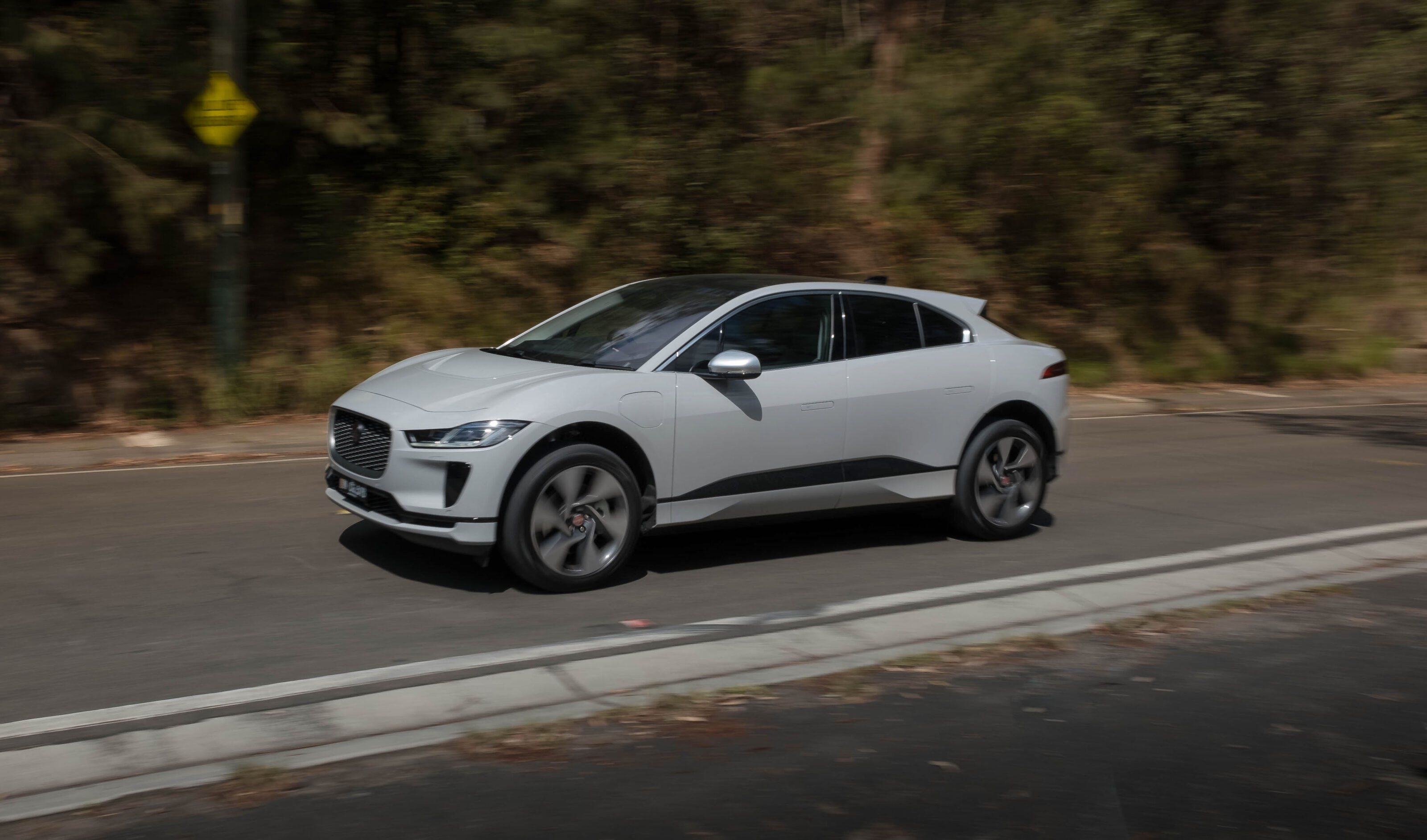
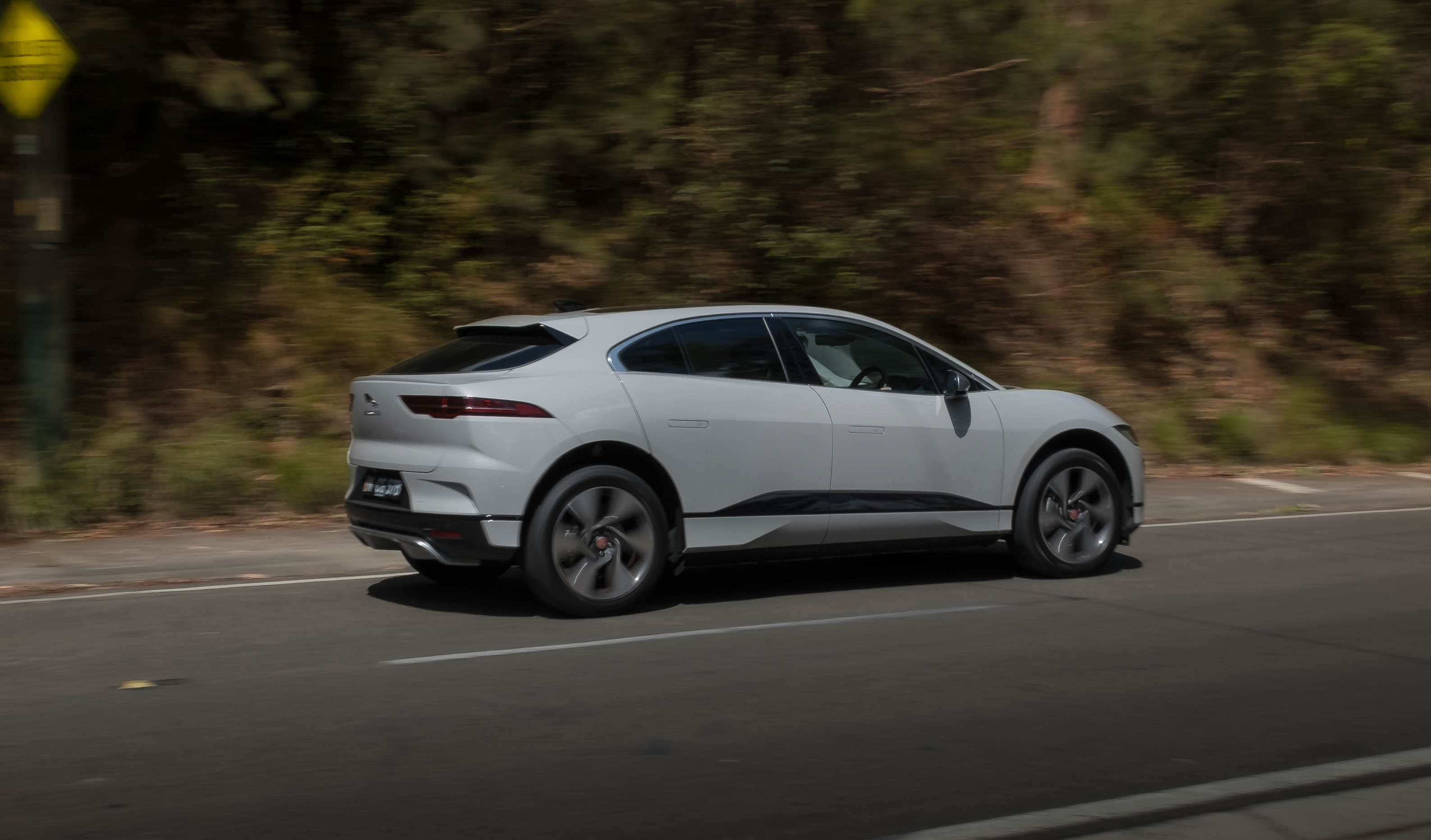
The Jag’s arrival in 2019 told us that you can get it right, reining in the weight, rolling on big wheels and still having some big cat DNA.
Obviously, it’s quick. Just under five seconds to 100km/h, which it does quietly and very smoothly. It doesn’t snap your neck on a mashed throttle but nor does it try and wander all over the road while you’re doing it, such is the even application of power and torque across the four wheels.
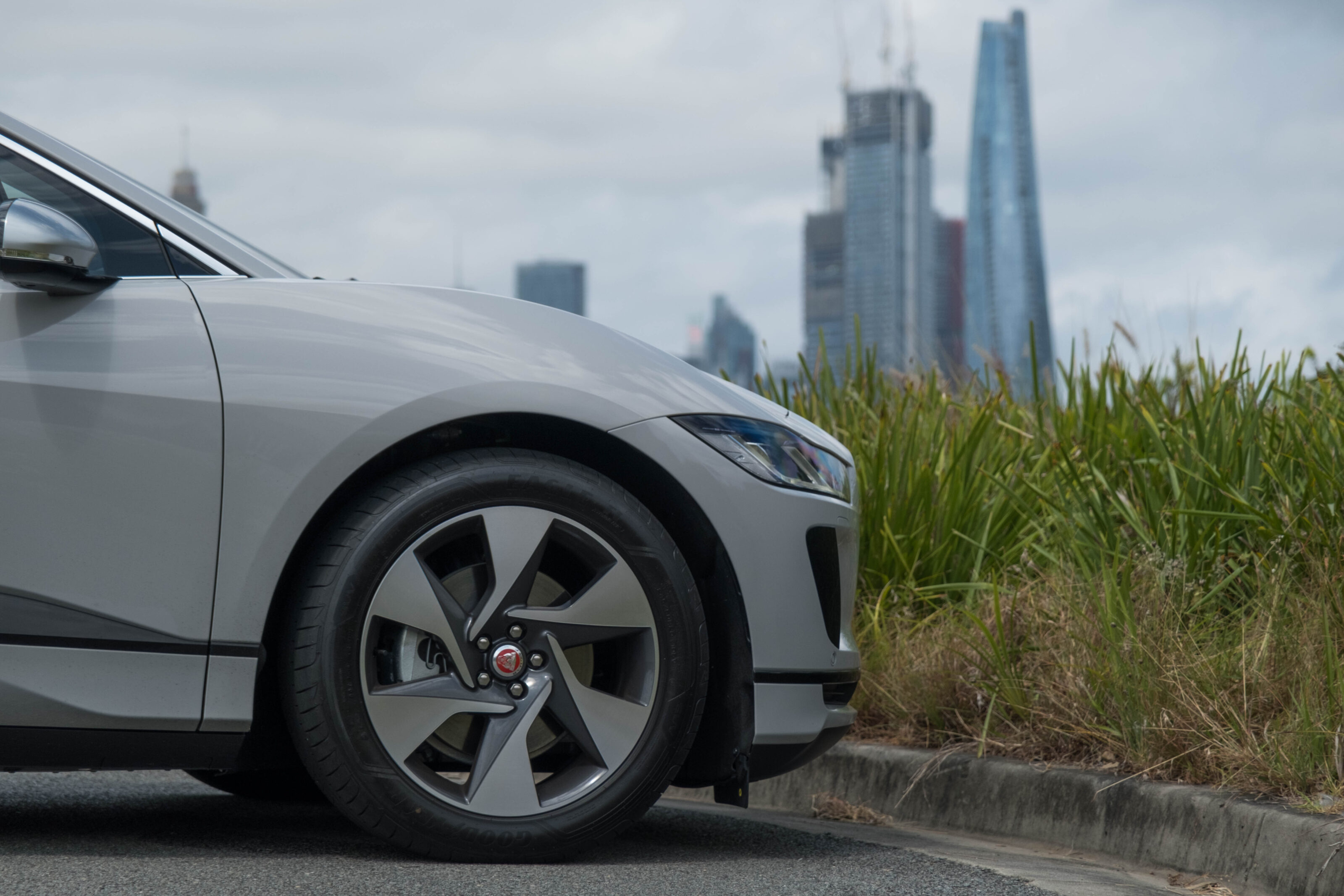
While I haven’t tried an I-Pace without the air suspension, I reckon you’d be mad not to. Not only does it mean the car can raise and lower itself depending on drive modes but it makes sure you never feel like you’re on 50-profile tyres. Rear-seat passengers might notice it but up front, it’s all serenity, no matter which mode you choose.
1
The steering weight is well-judged in each of the modes, too, never trying to trick you into thinking there is steering feel with too much weight. It’s classier than that.
Drawbacks? It’s a little hard to see out of the rear window so the camera-based rear vision mirror – while initially unnerving – is quite good. I’d like a bit more storage in the otherwise lovely cabin but it’s otherwise a tricky car to fault from the driver’s seat. Apart from the turning circle, which is a bit lazy but that’s what you get for big wheels.
1
How is it on electricity?
The I-Pace’s official combined-cycle figure (WLTP) has gone up since its 2018 launch, now weighing in at 449km, which is remarkably close to the NEDC findings. They can occasionally be on the generous side.
| 2023 Jaguar I-Pace SE energy consumption | |
|---|---|
| Energy consumption (WLTP, claimed) | 23.0kWh/100km |
| Energy consumption on test | 22.1kWh/100km |
| Claimed range | 449km |
| Estimated real world range | 391km |
1
In our hands, the I-Pace had a pretty even mix of fast highway running and suburban bombing. Across several charging sessions, we never saw better than a projected range of 391km but that was pretty accurate.
After two weeks, our average consumption was 22.1kW/100km which is a little on the high side for such a low and aerodynamic machine, so one imagines the drivetrain hasn’t had a lot of attention since launch. But I did beat the WLTP energy consumption figure without even trying.
1
How safe is it?
The I-Pace scored a five-star ANCAP safety in 2019.
Its forward auto emergency braking works at both high and low speeds. The only obvious omission here is reverse AEB, something many of its direct rivals have.
There are two ISOFIX points and three top-tether points for child seats in the back.
1
Warranty and running costs
Jaguar offers a five-year, unlimited-kilometre warranty and offers roadside assistance for the duration. Strong start.
The company then throws in five years or 130,000km of scheduled servicing, meaning a striking 12-month/26,000km service interval. Yeah, 12 months is normal but 26,000km is not (Tesla excepted and no I don’t think not having anyone regularly look at your two-tonne EV is a good idea).
You also get an eight-year/160,000km battery warranty which protects you against the battery falling to less than 70 per cent of its as-new capacity within that timeframe.
1
VERDICT
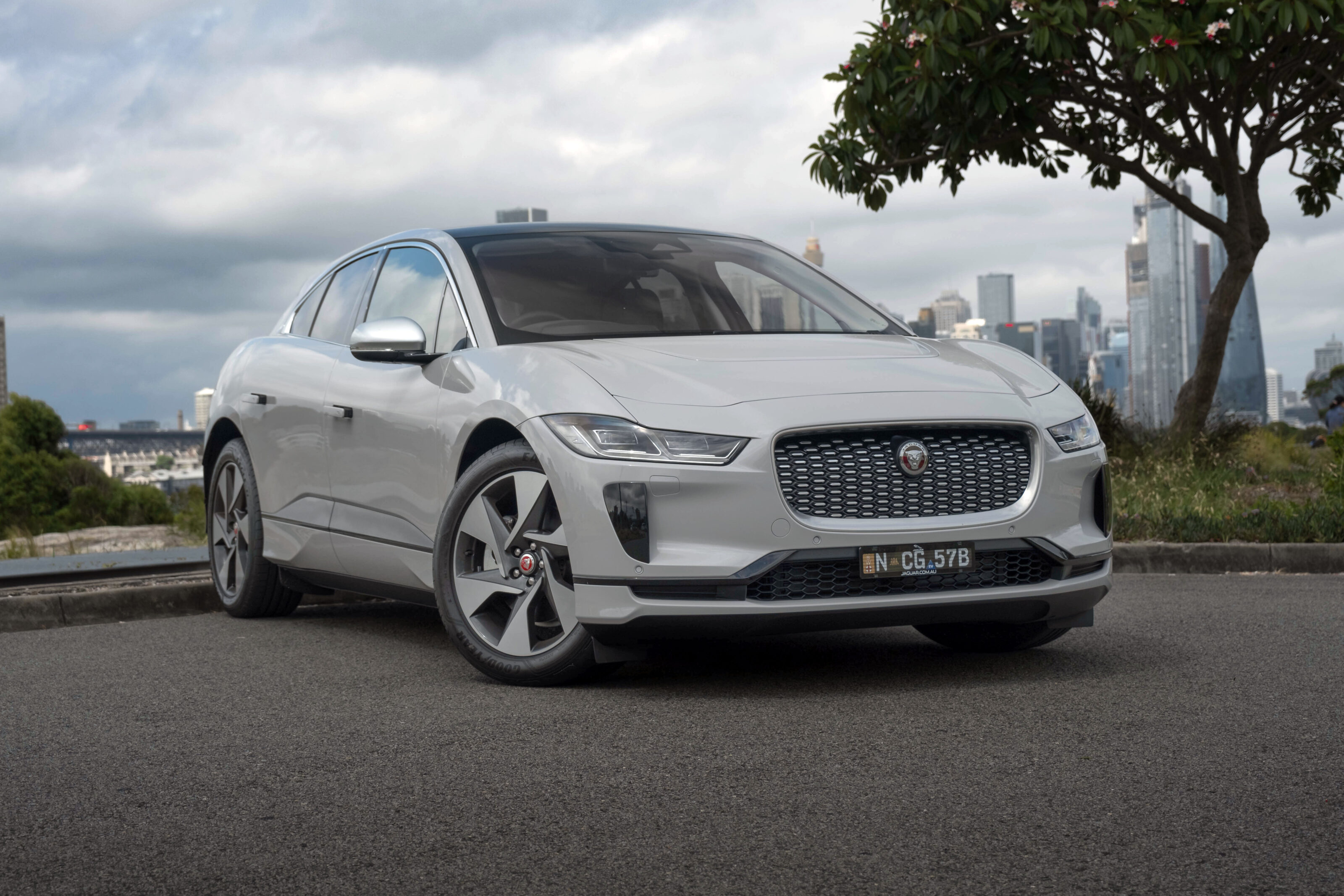
Is the I-Pace underrated? Definitely. After nearly five years on sale around the world, it’s still a very good EV in an appealing package.
The prices may have gone up, but so have everyone else’s and few look this good. I think the I-Pace is individualistic without going overboard and with news of a 2024 facelift restricted to a few little visual tweaks, it seems customers agree.
Problem is, the I-Pace is dealing with a rapidly changing environment and while a lot of the things on other cars (say, 800-volt charging) make for good headlines without (yet) translating into real-world benefit, people are drawn to that kind of thing. It’s fundamentally the same car it was at launch and the stuff that wasn’t good back then is better now.
So I remain mystified how more people don’t line up for one. I guess there’s no accounting for taste.
Updated model announced
Unfortunately, we were booked into this I-Pace without knowing that a significant MY24 update was on the way. This review will still be useful for buyers, but you should note that Australian pricing and specs for the MY24 car have been announced here. We’ll deliver a review of the updated model when it lands in July.
MORE
Everything Jaguar
MORE
Electric SUVs
| 2023 Jaguar I-Pace SE specifications | |
|---|---|
| Body | 5-door, 5-seat large SUV |
| Drive | all-wheel |
| Engine | twin permanent magnet synchronous electric motors |
| Transmission | single-speed reduction gear |
| Power (front) | 147kW |
| Power (rear) | 147kW |
| Combined power | 294kW |
| Torque (front) | 350Nm |
| Torque (rear) | 350Nm |
| Combined torque | 696Nm |
| Battery | 90kWh lithium-ion (84.7kWh useable) |
| AC charging | 7kW (12.5hrs to full) |
| DC Charging | 400-volt, 100kW |
| 0-100km/h | 4.8 seconds |
| Range (WLTP) | 449km |
| Energy consumption | 22kWh/100km |
| Weight | 2133kg |
| Suspension | double wishbone front / multi-link rear |
| L/W/H | 4682mm/2139mm/1565mm |
| Wheelbase | 2990mm |
| Tyres | 255/50 R20 |
| Wheels | 20-inch alloy (no spare) |
| Price | $146,857 + on-road costs |
We get a lot of emails, messages and comments about all manner of things in the automotive world – from press releases to trending memes and newfangled technologies to make oldschool revheads steam from the ears.
We can’t always give them a story of their own, but some of them can at least get a moment here in my new weekly ‘megathread’, which I’ll update sporadically and bump to the top of our news column.
The newest additions will be posted to the top of this page, pushing earlier entries down.
Got some suggestions?
Throw them into the comments – but note that our comments system will hold links in a moderation queue!
JUMP AHEAD
- Polestar goes to the drive-in, EVs only!
- Ford Explorer EV ute imagined
- MG Cyberster surfaces on Twitter
- Which hot wagon for you?
- VW ID.2all concept… as a new Fiesta Mach-E
- Domino’s Pizza, direct to the CarPlay
- GT-R 2030: Designer imagines new Nissan
- Hyundai’s Ioniq 5 “Disney100 Platinum”
Ford boosts its vault of vintage imagery and brochures
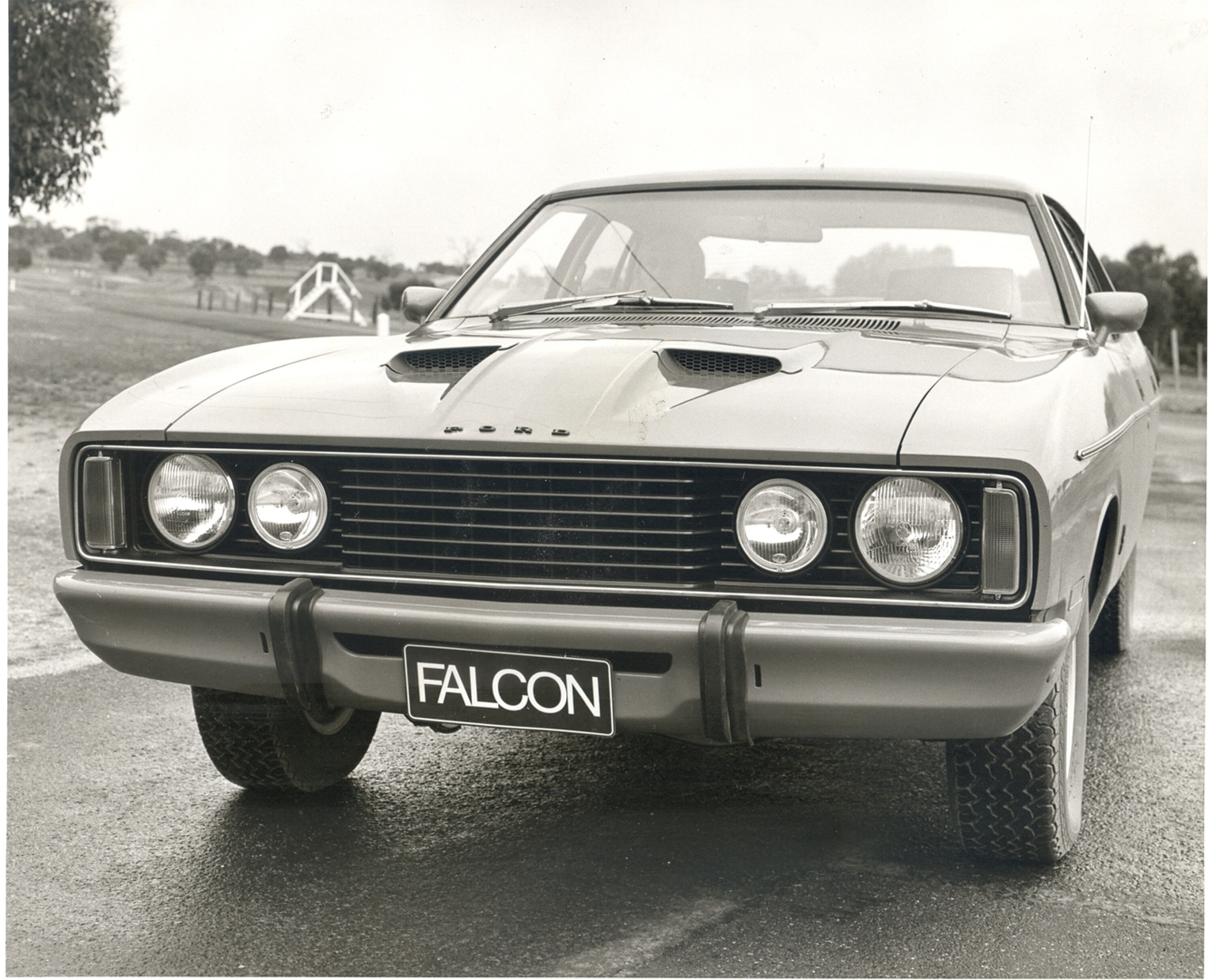
How good is this? Ford has added more than 180 photos and brochures of iconic models from the ’60s through 2002 to its online Heritage Vault.
1
The new additions showcase some of Ford’s most interesting and renowned models, including the 1975 Ford Escort Outback, the 1983 Ford Fairlane, and the XR range of utes.
Visitors can download the searchable artifacts for personal use free of charge – and Ford says it has become popular worldwide, clocking up around 5000 downloads per day.
Ted Ryan, Ford Archive and Heritage Brand Manager, said, “Making our archives accessible for everyone online is a real passion project for me and the team. Looking back through Ford’s history not only helps to educate but can serve as inspiration as we accelerate our transformation as a company.”
Polestar goes to the drive-in, EVs only!
It’s the No Homers Club, but for cars.
1
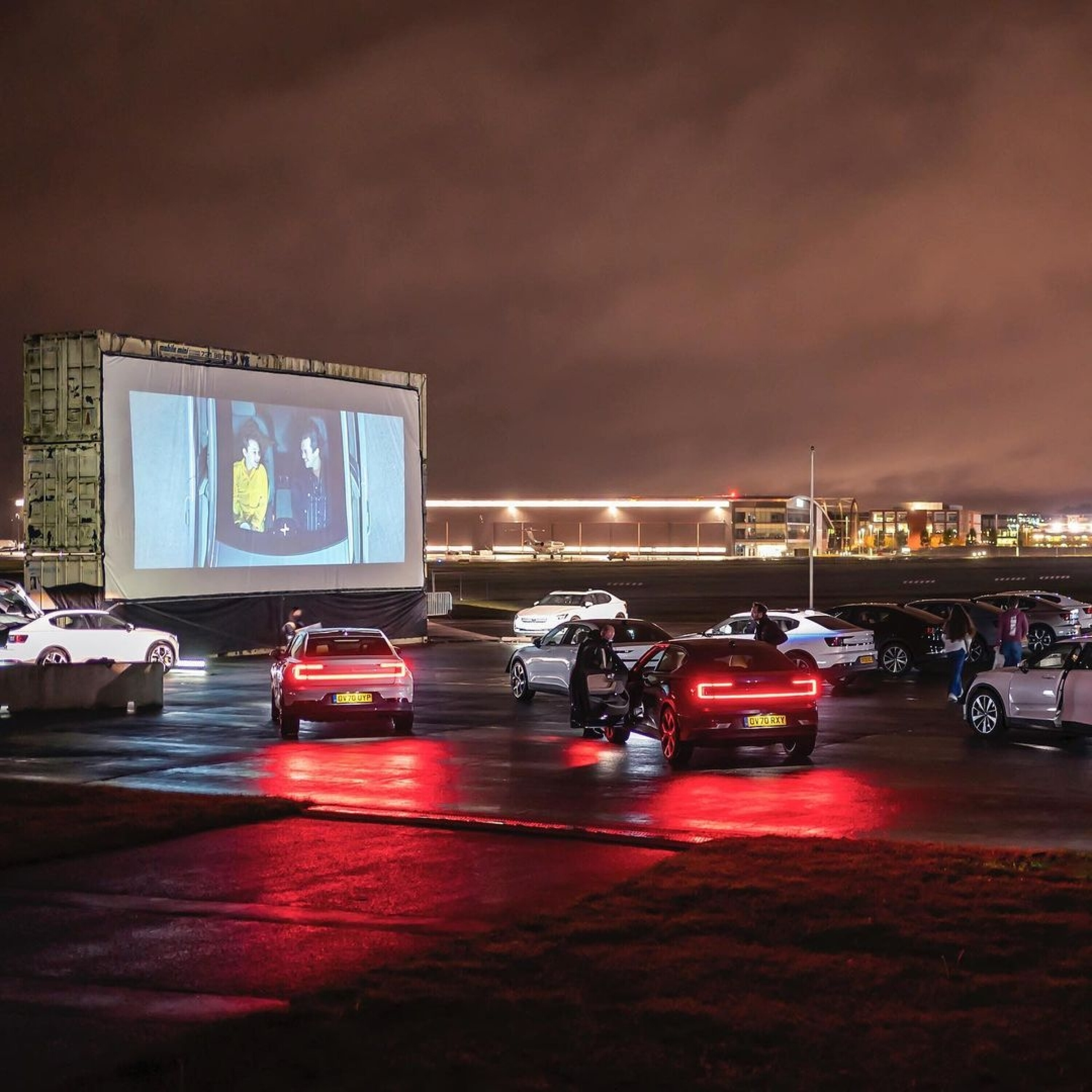
Polestar’s Australian arm is treating EV owners of all stripes to a night at the drive-in movies – four nights, in fact.
Here’s the line-up
- Thursday 4th May u2013 Operation Fortune: Ruse De Guerre
- Friday 5th May u2013 Avatar 2: The Way of Water
- Saturday 6th May u2013 The Super Mario Bros. Movie
- Sunday 7th May u2013 Dirty Dancing
Set in Sydney, the events will be held on the rooftop of the Entertainment Quarter car park, and I’m just gonna tell you here that Saturday’s screening is the one you wanna get to.
All EV owners are welcome, but only Polestar 2 owners are getting in for free. And hey, fair enough.
Ford Explorer electric ute imagined: A Maverick for Europe?
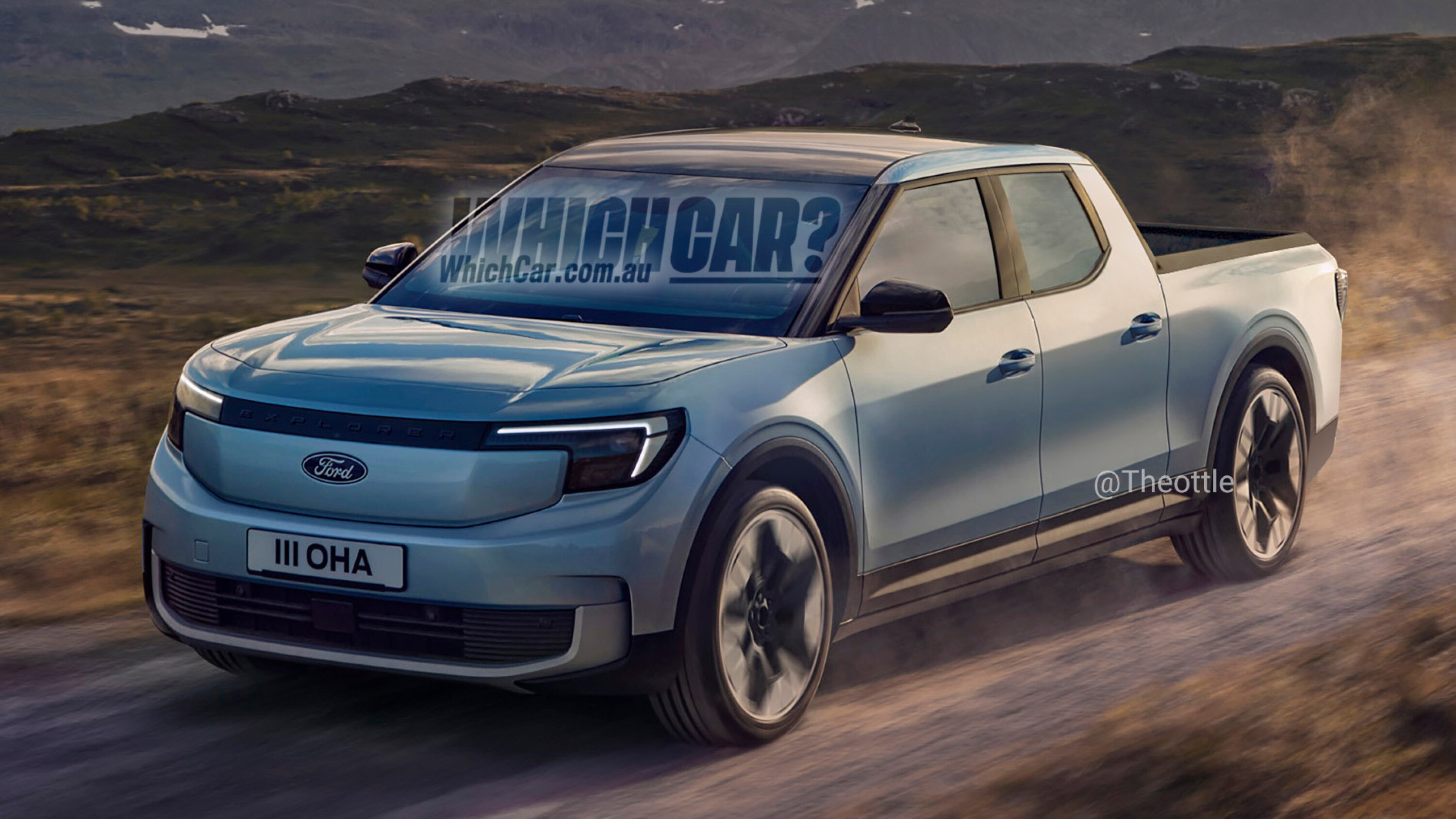
Eesh, our guy Theottle is at it again. Never sleeps, this bloke.
2
So here we have a new compact ute based on the recently revealed Ford Explorer EV, which itself is based on Volkswagen’s MEB electric car platform.
Like the Maverick already offered in the US, this new ute would be a monocoque unit – unlike the ladder frame of the bigger Ranger – but it could prove appealing for EV-obsessed urbanites looking for some ute style and practicality. What do you reckon?
Click the above image to see the rear view. | Source: Theottle on YouTube (process video!)
MG Cyberster surfaces on Twitter ahead of April 18 debut
Are they for real with that rear badge placement?
1
1
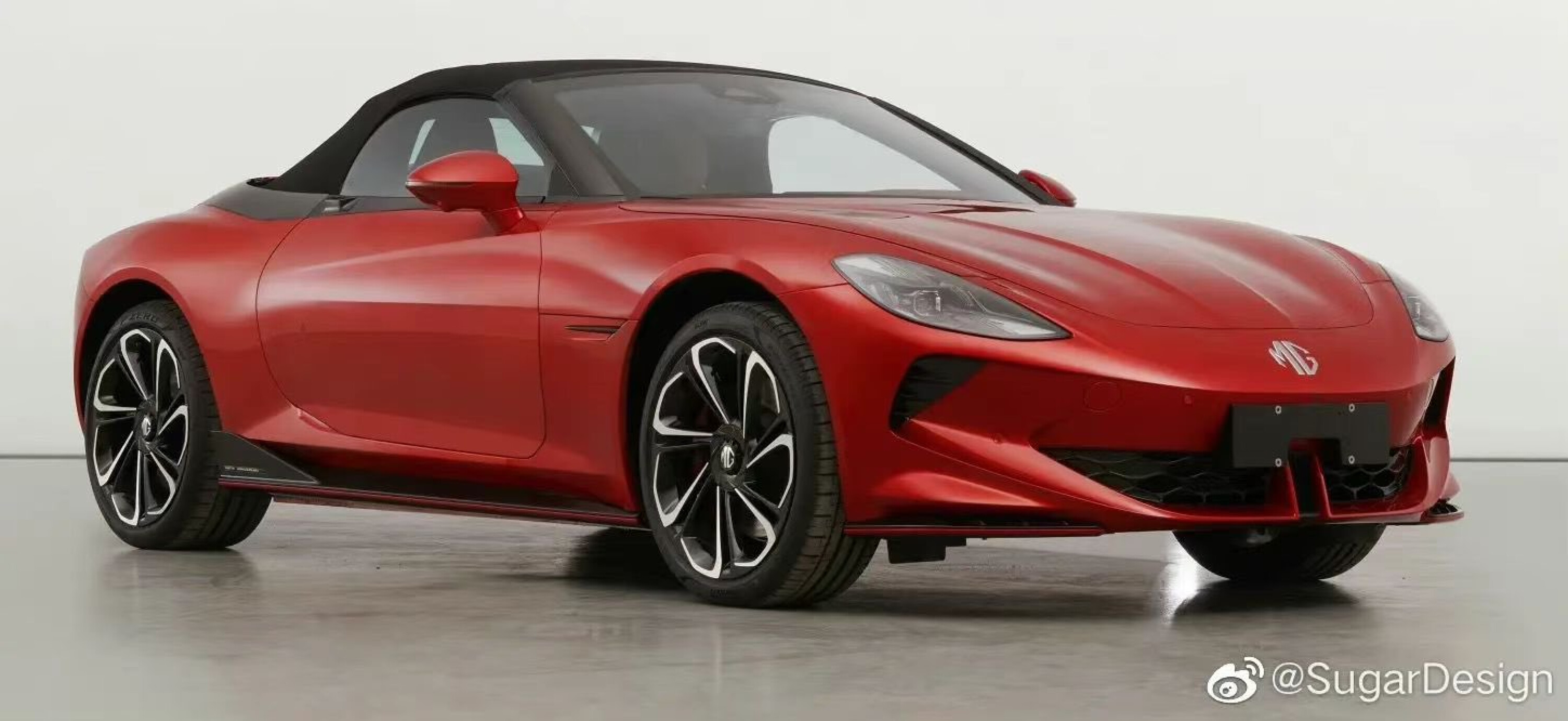
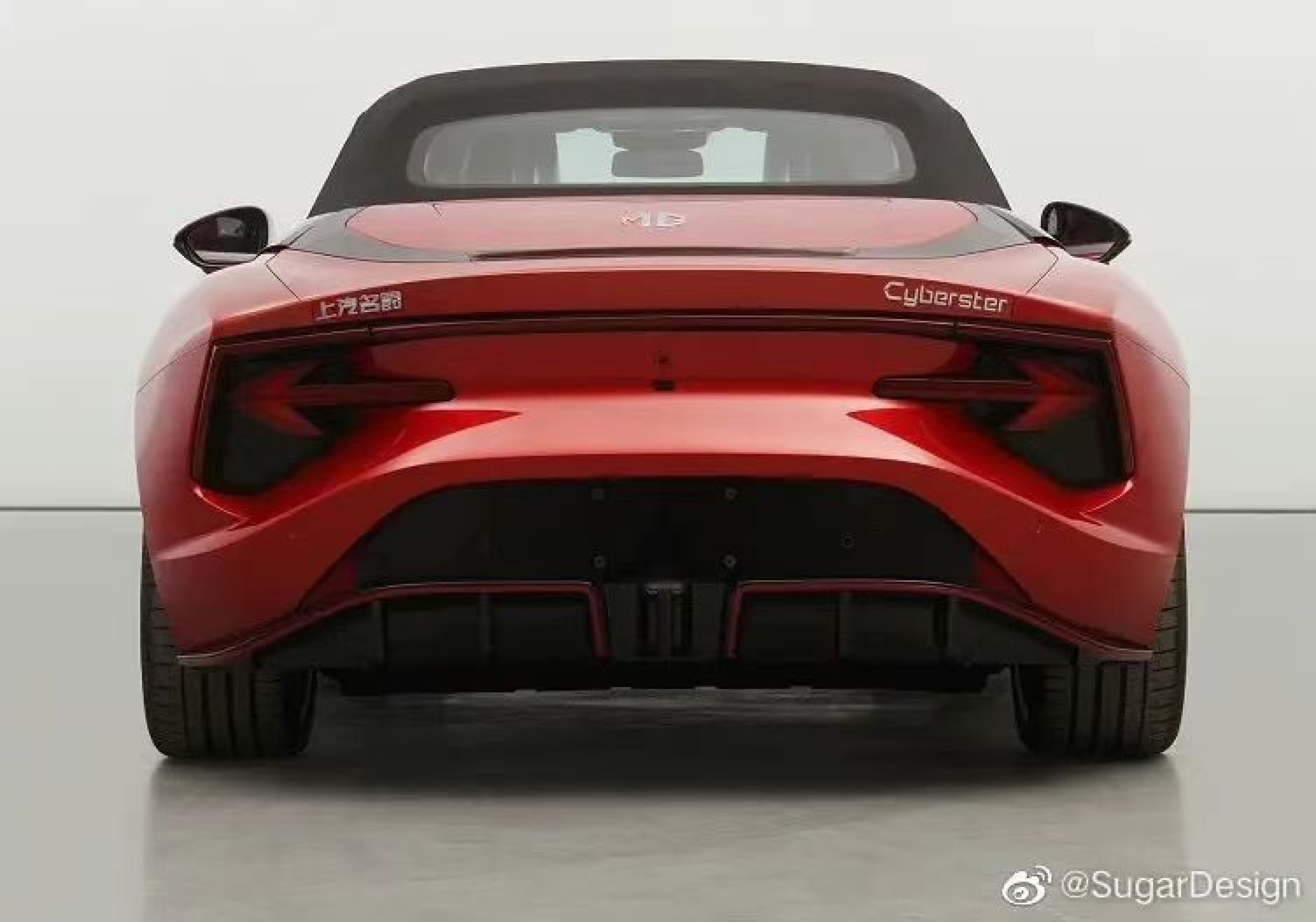
The upcoming all-electric MG Cyberster roadster – the Tesla Roadster for those who want to buy a car that exists in actual reality – has appeared on Twitter.
It looks great, frankly, but can we talk about that Cyberster badge on the rear? Also… is the boot-lid MG badge somehow positioned off centre?
It’s got me wondering if these images aren’t actually some sort of prank…
Our mate Theottle has rendered the rear with a better badge placement, check it out on his Instagram page here.
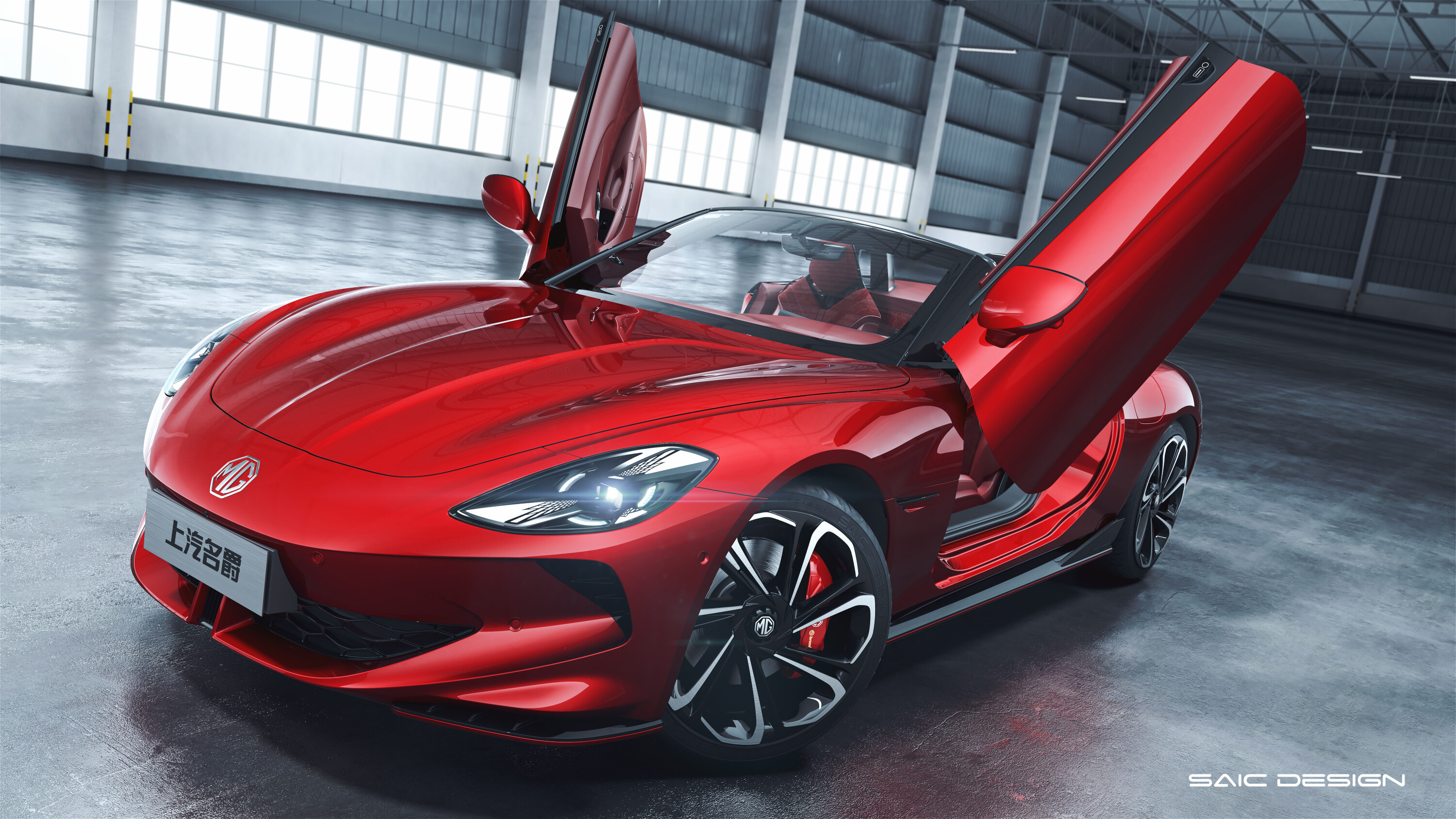
The Cyberster will be unveiled at the Shanghai motor show on April 18, but you can see loads of details in our ongoing story here.
UPDATE, April 18 2023: Cyberster unveiled, Australian launch confirmed
The production version of the MG Cyberster has now been unveiled, at the 2023 Shanghai motor show, and it’s coming to Australia. Get all the details at the story linked below.
1
Which hot wagon for you?
The fan-fave AMG C63 and Audi RS4 wagons are about to be joined, at long last, by a BMW M3 Touring.
Which would you take? We asked our Facebook audience to vote.
Volkswagen’s ID.2all concept… as a new Fiesta Mach-E
Our mate Theottle has turned VW’s upcoming city EV into a reborn Ford Fiesta, and I dig it.
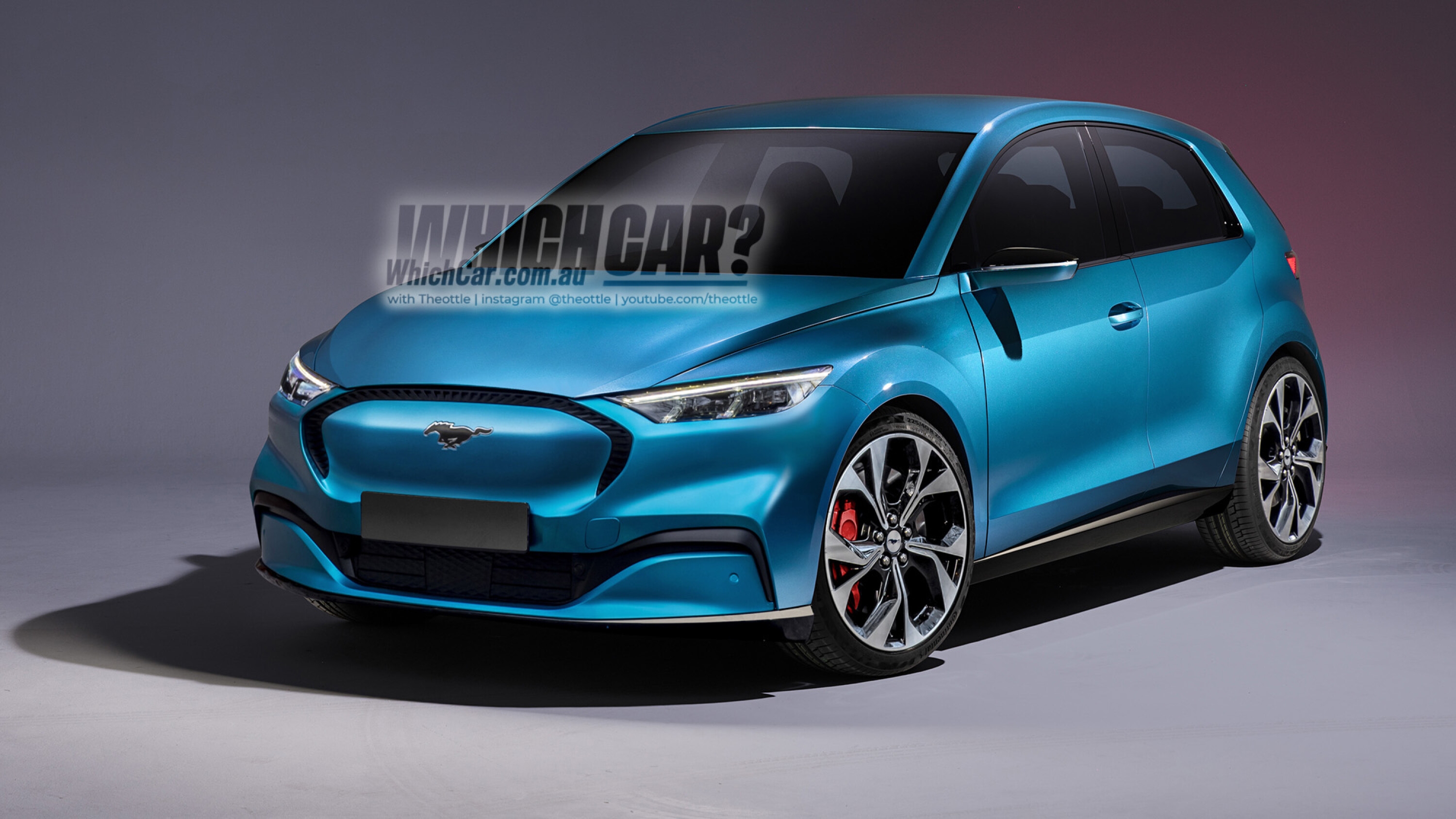
3
Alright, so Ford has retired its little Fiesta, but must it be gone forever? Ford and Volkswagen have an ongoing platform-sharing partnership, which has already spawned the new Ford Explorer EV for Europe.
So, why not a new Fiesta, based on the recent ID.2All concept? It’s a realistic idea, given most brands in Europe are intent on offering compact EVs – like the Fiat 500e, Renault 5, the upcoming VW ID.2 (obviously), and so forth.
Only time will tell if Ford will join the circus, or whether any future compact Ford EV will look anything like the Mustang Mach-E SUV, but I’m into this one.
Source: Theottle
Domino’s Pizza, direct to the CarPlay
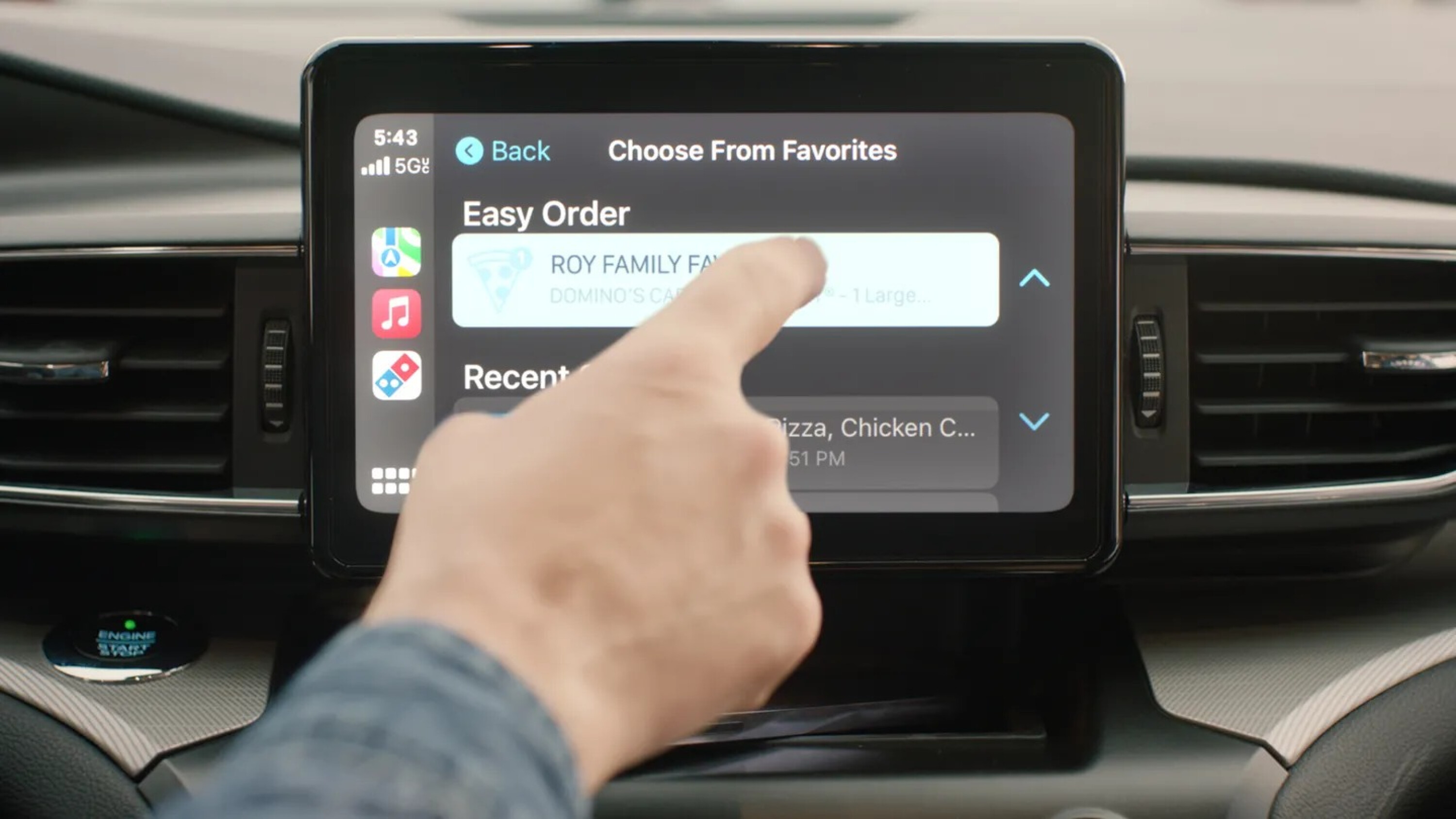
If you feel increasingly like you live in your car, Domino’s Pizza is here to make the experience a little more bearable.
1
Announced this week, the American pizza giant has released a version of its iPhone app that integrates with Apple CarPlay, allowing you to order a pizza directly from your car screen – as though grabbing your phone for the task is just one step too far…
Still, if that’s the sort of tech integration you’re looking for in a fast-food service, Domino’s is here for you. Although I’m not sure if it works in Australia. Somebody phone ’em and let me know? (Besides, I’m an Android user.)
GT-R 2030: Designer imagines Nissan’s next-gen supercar
Nissan itself has yet to offer any concrete details on how its next GT-R will look, but I’d endorse this one.
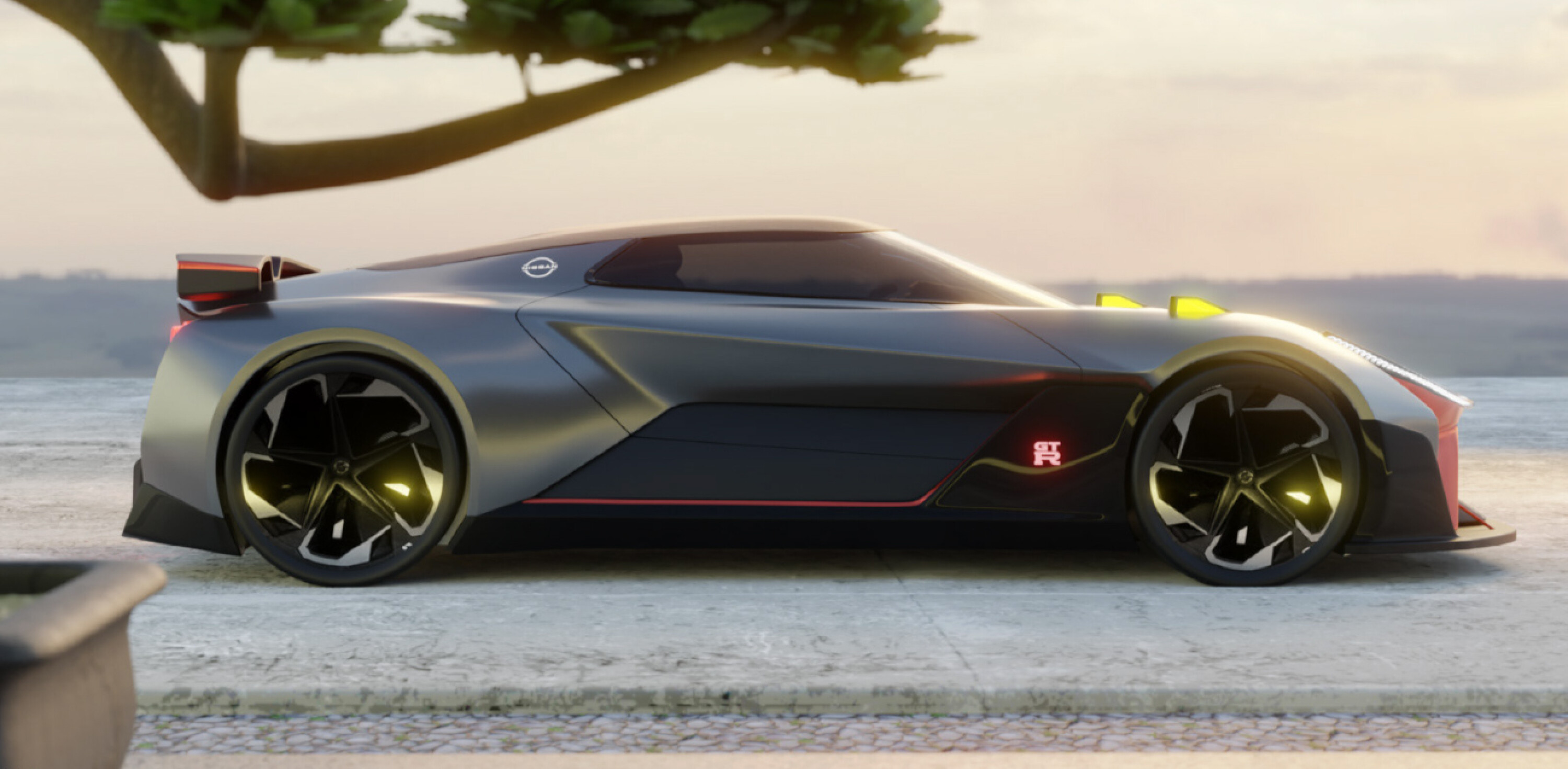
3
Designer Ulises Morales has put together an incredible manifesto for a next-gen ‘R36’ GT-R, with clear concept and fighter-jet influences.
It’s not new – he released it in 2021, when it won an AutoStyle / Wacom design award – but it’s new to me. And maybe you too?
Check it out here on his Behance folio page. | Source: CarScoops
Hyundai’s Ioniq 5 “Disney100 Platinum”
Celebrating Disney’s 100th anniversary is this bizarre collaboration, decking Hyundai’s popular Ioniq 5 out with a number of cutesy features.
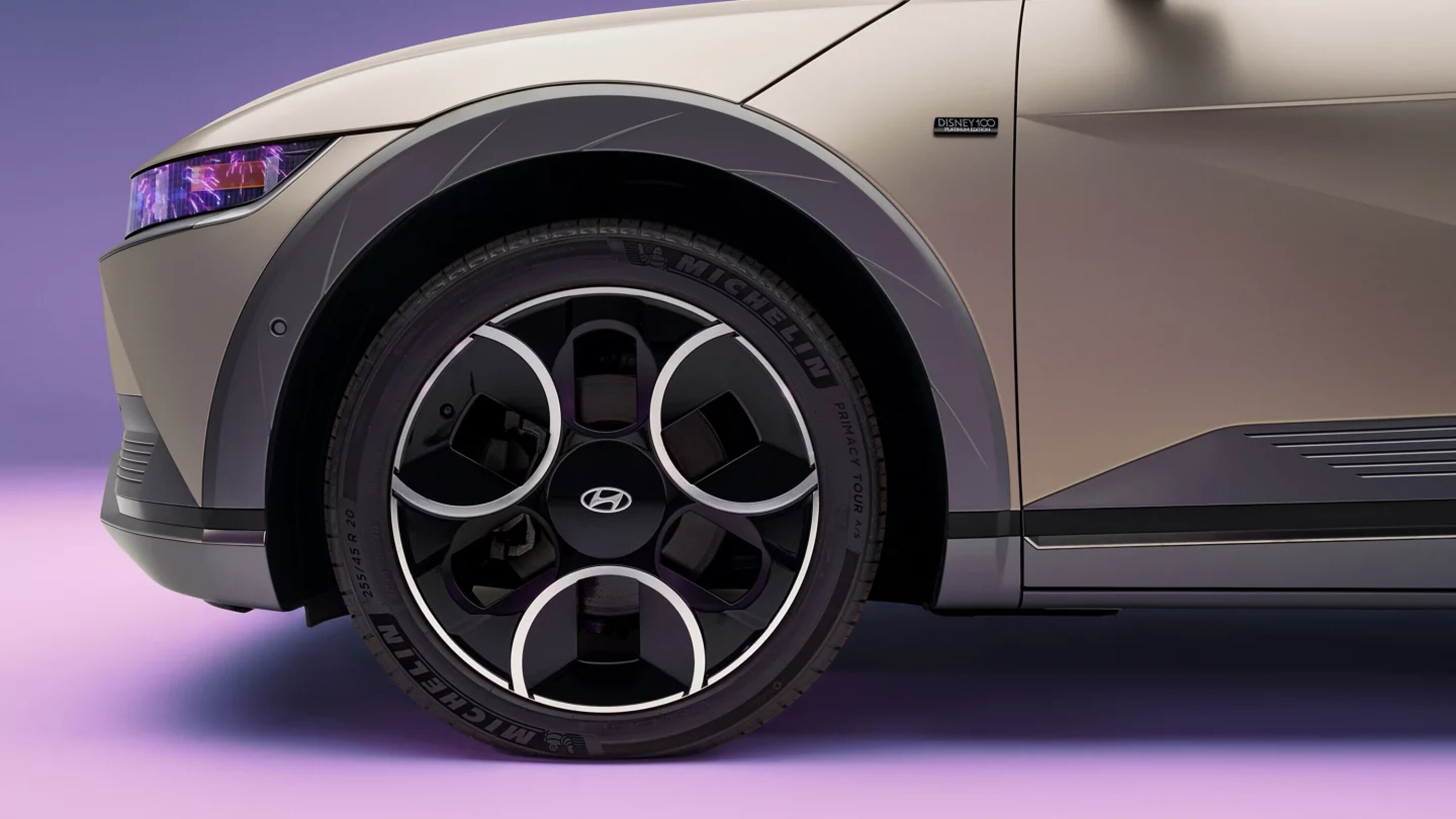
4
Those include Mickey-inspired wheels, ‘Disney sparkle’ animations in the exterior lighting, Disney100 badges, Disney100 embossed headrests, and Mickey Mouse silhouettes engraved in special wooden door trims.
It’s not just a concept, either: Hyundai will build 100 of these specials, but they’ll all be left-hand-drive – so local Disney fans will miss out.
“At Hyundai, we are always looking for new ways to connect with customers on every mile of their journey, and the magic that Disney creates inspires us to deliver moments of delight for our customers,” said Angela Zepeda, chief marketing officer, Hyundai Motor America.
“This is the first time that Disney has opened the doors to their design studio and granted access to Disney’s iconic characters for an artistic collaboration with an automaker.”
There’s a local angle, too: the Korean carmaker tells us this collaboration was the brainchild of Katie Fabian, a former Hyundai Australia staffer.
Click the image above for more photos.
Got some suggestions?
Throw them into the comments – but note that our comments system will hold links in a moderation queue!
We get a lot of emails, messages and comments about all manner of things in the automotive world – from press releases to trending memes and newfangled technologies to make oldschool revheads steam from the ears.
We can’t always give them a story of their own, but some of them can at least get a moment here in my new weekly ‘megathread’, which I’ll update sporadically and bump to the top of our news column.
The newest additions will be posted to the top of this page, pushing earlier entries down.
LAST WEEK: MG Cyberster leaked, Polestar goes to the movies & more
Got some suggestions?
Throw them into the comments – but note that our comments system will hold links in a moderation queue!
JUMP AHEAD
- Tesla’s Cybertruck finally has a wiper blade, and err…
- Lancia Pu+Ra EV concept revealed
- Mini celebrates one-million R54 3-door Coopers
- New Toyota Crown will come in sedan form after all
Tesla’s Cybertruck finally has a wiper blade, and err…
It is absolutely gigantic.
The corner-mounted arm reaches across the breath of the windscreen, and as you can see in the video and screengrab here, it looks as though it’s longer than the average broom handle.
Incredibly, a suitable design for the wiper – missing from the concept shown all those years ago – was believed to be one of the last remaining hurdles before deliveries could begin. We’ll see…
Lancia Pu+Ra EV concept revealed
A Stratos for the EV era?
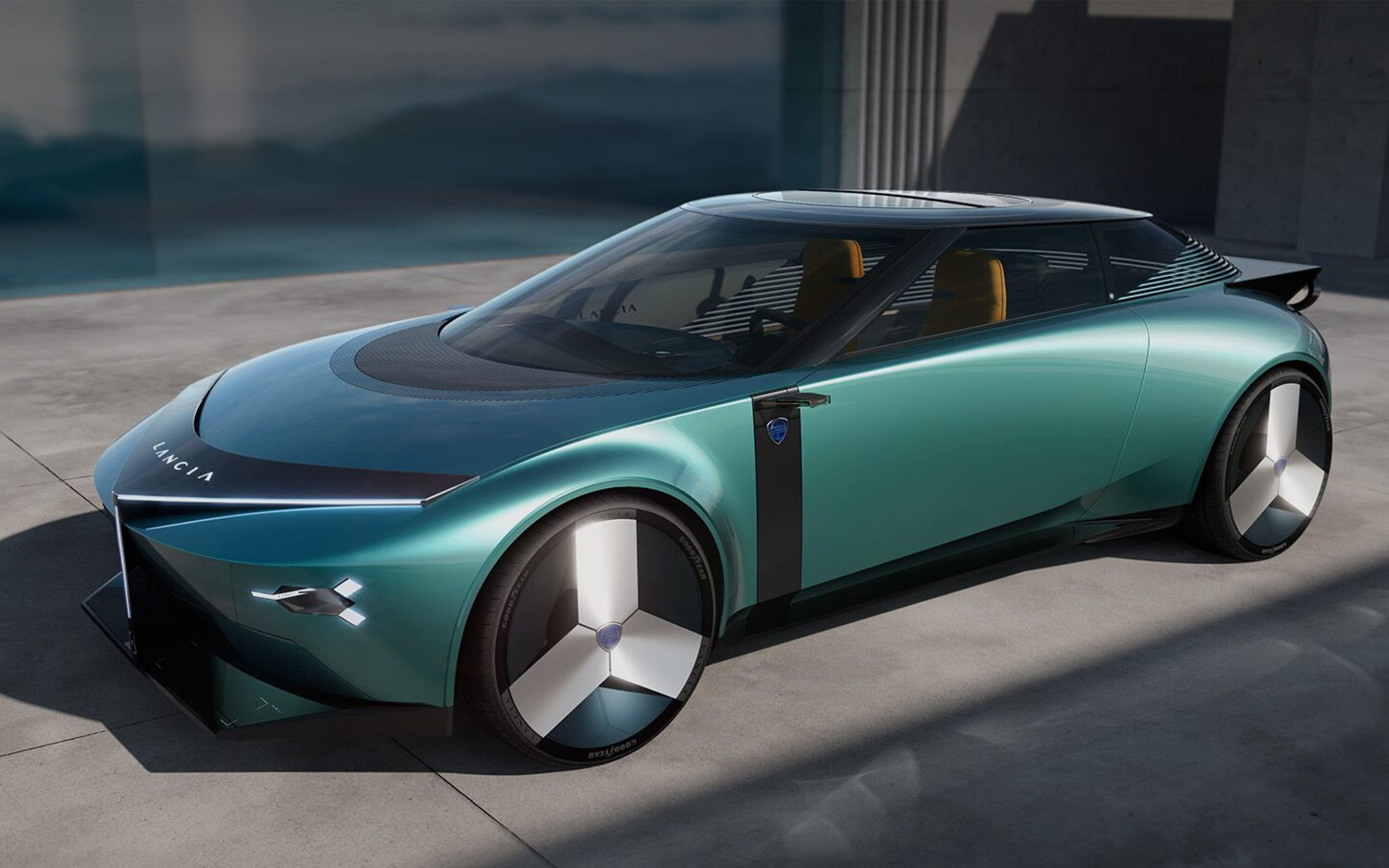
8
Italian brand Lancia, part of the Stellantis empire, has revealed its first new electric concept: the Pu+Ra HPE.
The brand says: “With Lancia Pu+Ra HPE, Lancia journey towards the future begins, drawing inspiration from the past. From the iconic round headlights, recalling the legendary Stratos to the horizontal lines that echo the famous Venetian sunshade structure of the Lancia Beta HPE of the 1970s. A perfect symbiosis between past and present, between purity and radicalism, between innovation and emotion.”
The brand claims a driving range of 700km off one charge, with an astonishing efficiency claim of just 10kWh/100km. More, 70 per cent of its “aesthetic surface” in the cabin is made of sustainable materials.
Mini celebrates one-million R54 3-door Coopers
No surprise, the one-millionth car off the line is an all-electric Cooper SE. Not rigged at all…
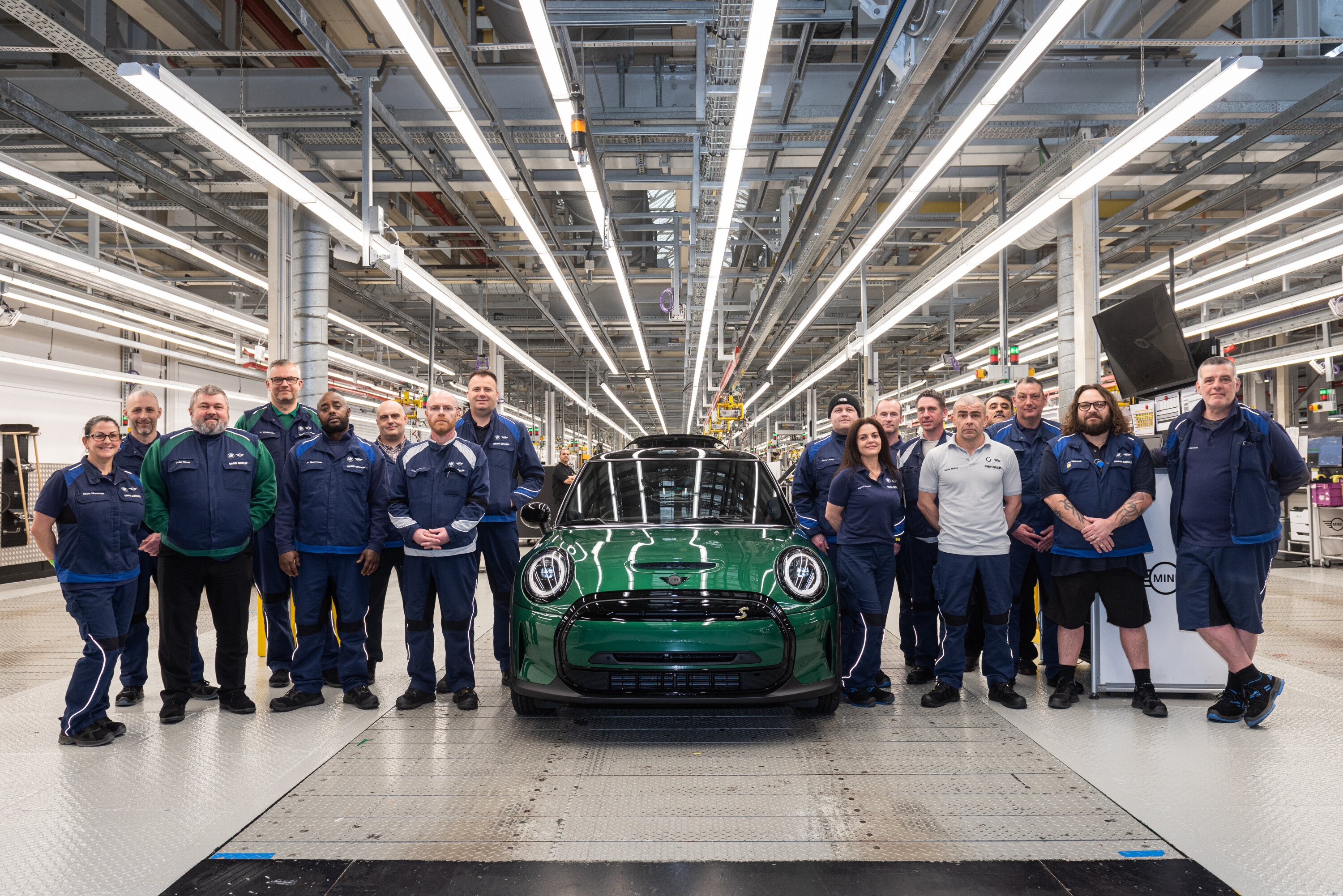
1
Available in Europe since 2014, the second-generation Mini three-door – codenamed R54 – has hit the one-million milestone. That’s an impressive number by any measure, but as a point of comparison, Tesla is believed to have sold one million Model 3s between 2017 and June 2021.
Still, one million sales of a compact three-door hatch in this era of increasingly SUV-obsessed buyers is no small accomplishment. You can’t take that away from Mini.
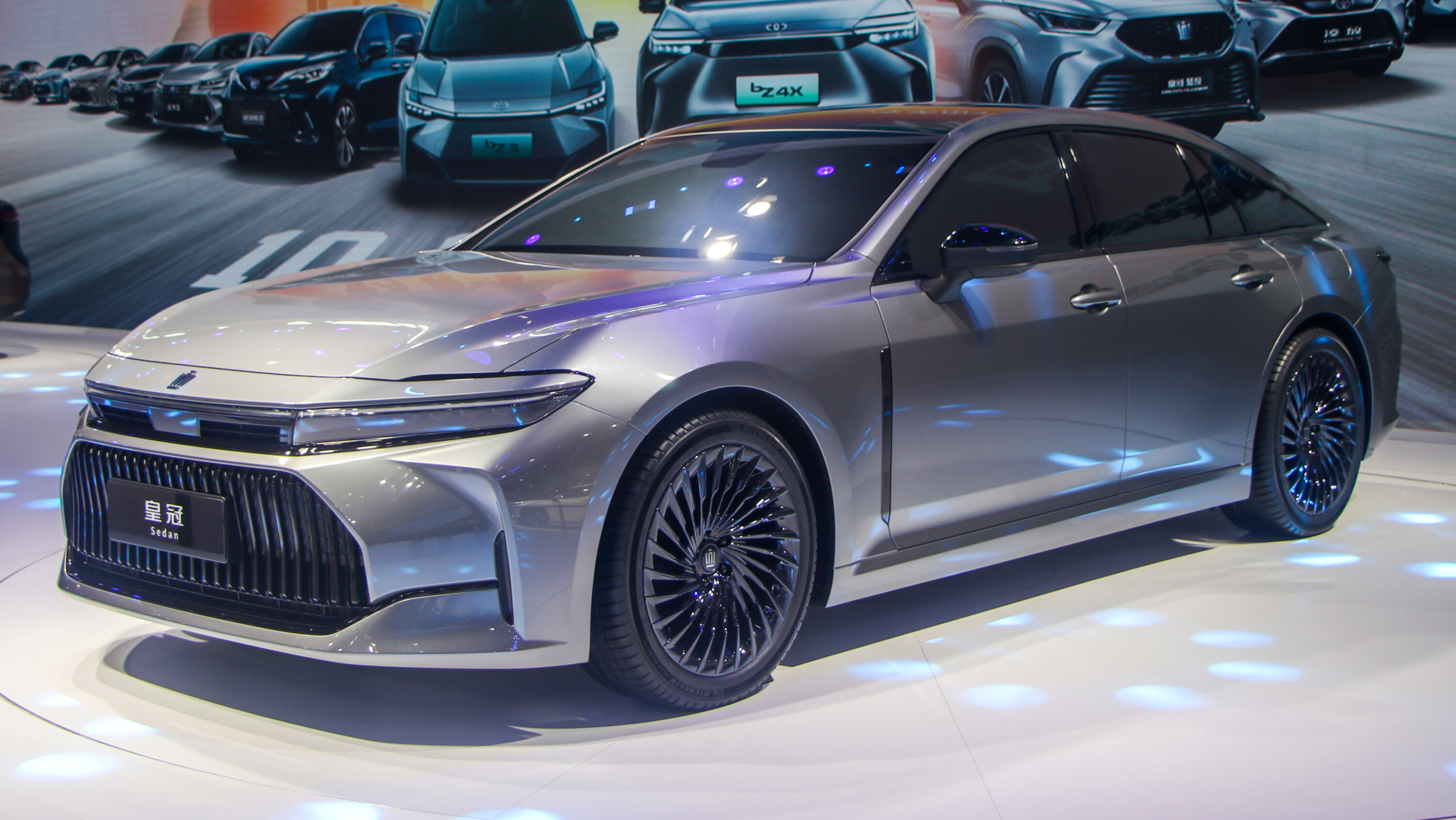
New Toyota Crown will come in sedan form after all
And, no, it’s still not expected to come to Australia.
It looks like the expansive new Toyota Crown range will get a traditional sedan after all, according to Japan’s BestCarWeb. You can read the story here (use Google Translate), and see the initial 2022 concept below.
1
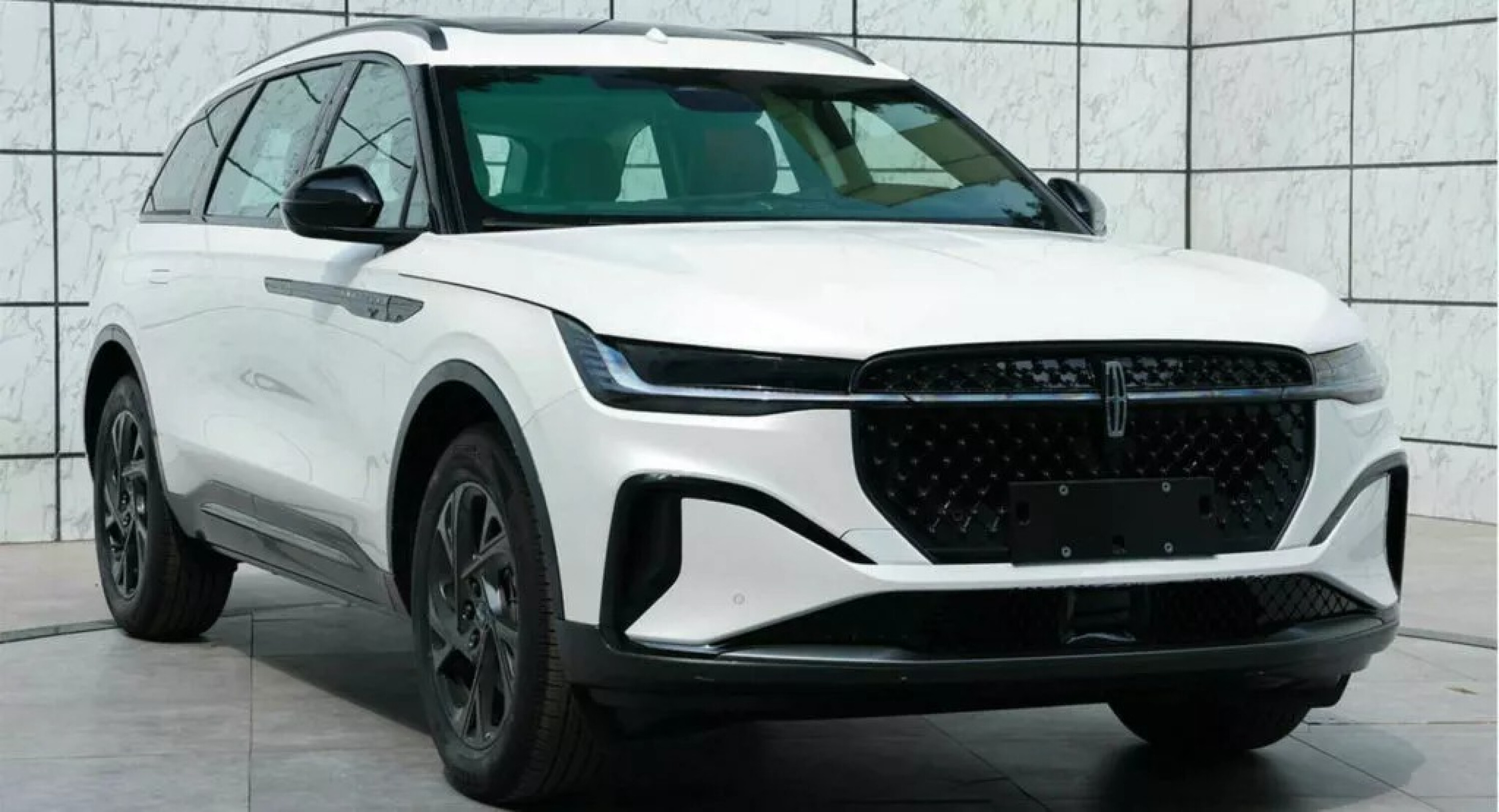
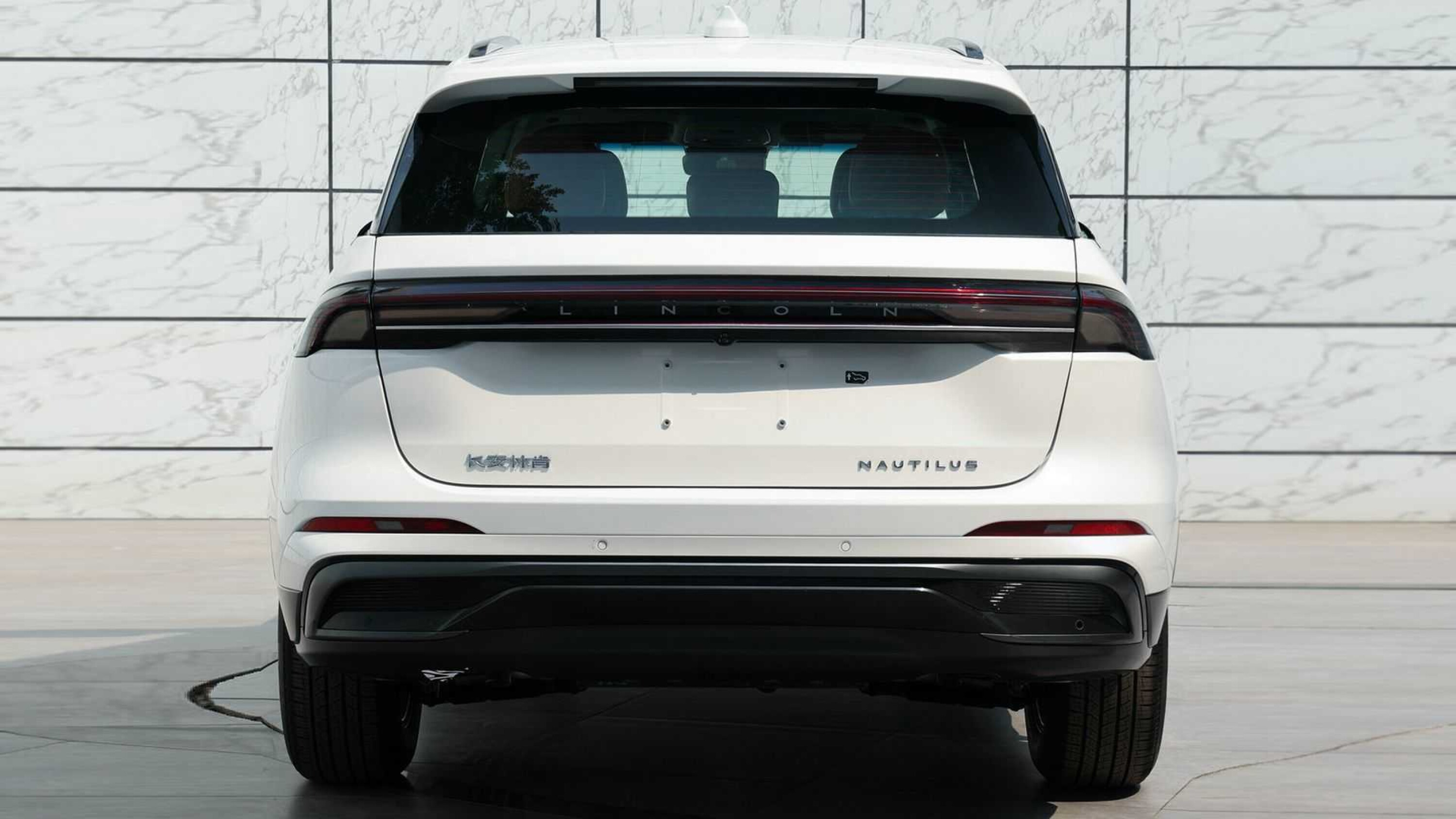
Lincoln teases 2024 Nautilus EV
It’s hard to make anything of this teaser, but the big reveal is set to occur tonight, so we’ll know soon enough…
Of course, China’s trademark agency published images of the new car way back in November 2022, so there’s not too much left to know at this point.
“Unlike anything we’ve designed before…”
1
1
Got some suggestions?
Throw them into the comments – but note that our comments system will hold links in a moderation queue!
Top-of-the-range, diesel-powered people movers are all well and good, but they can be mighty expensive.
Say I need eight seats, a big boot and don’t want a sodding SUV to get to where I want to be.
Let’s also say I’m not super-fussy about a sunroof or fake leather seats or any of that nonsense. I need a big van I can get into car parks without wondering if I’ll have a convertible afterwards, or at the very least an aftermarket DIY sunroof.
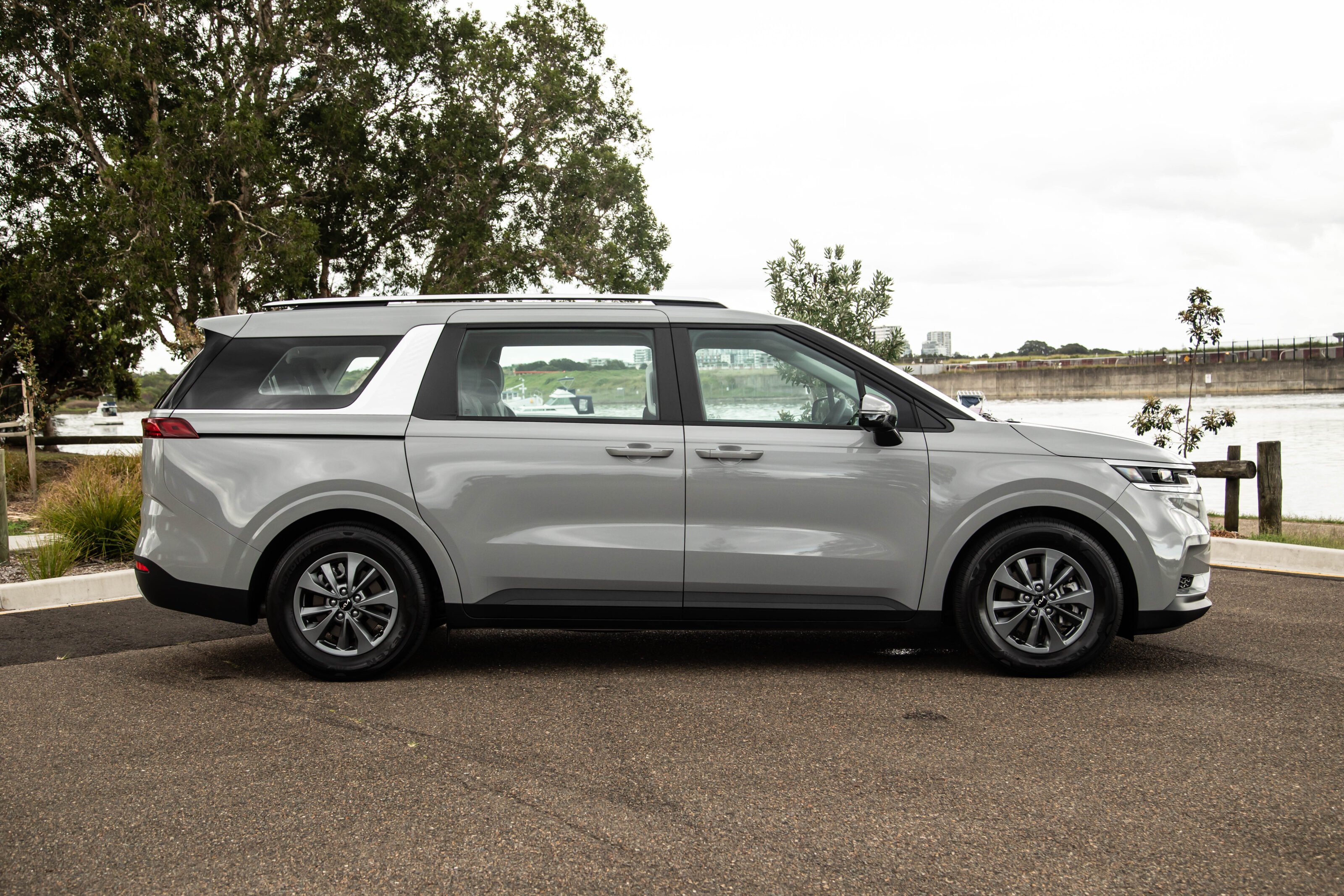
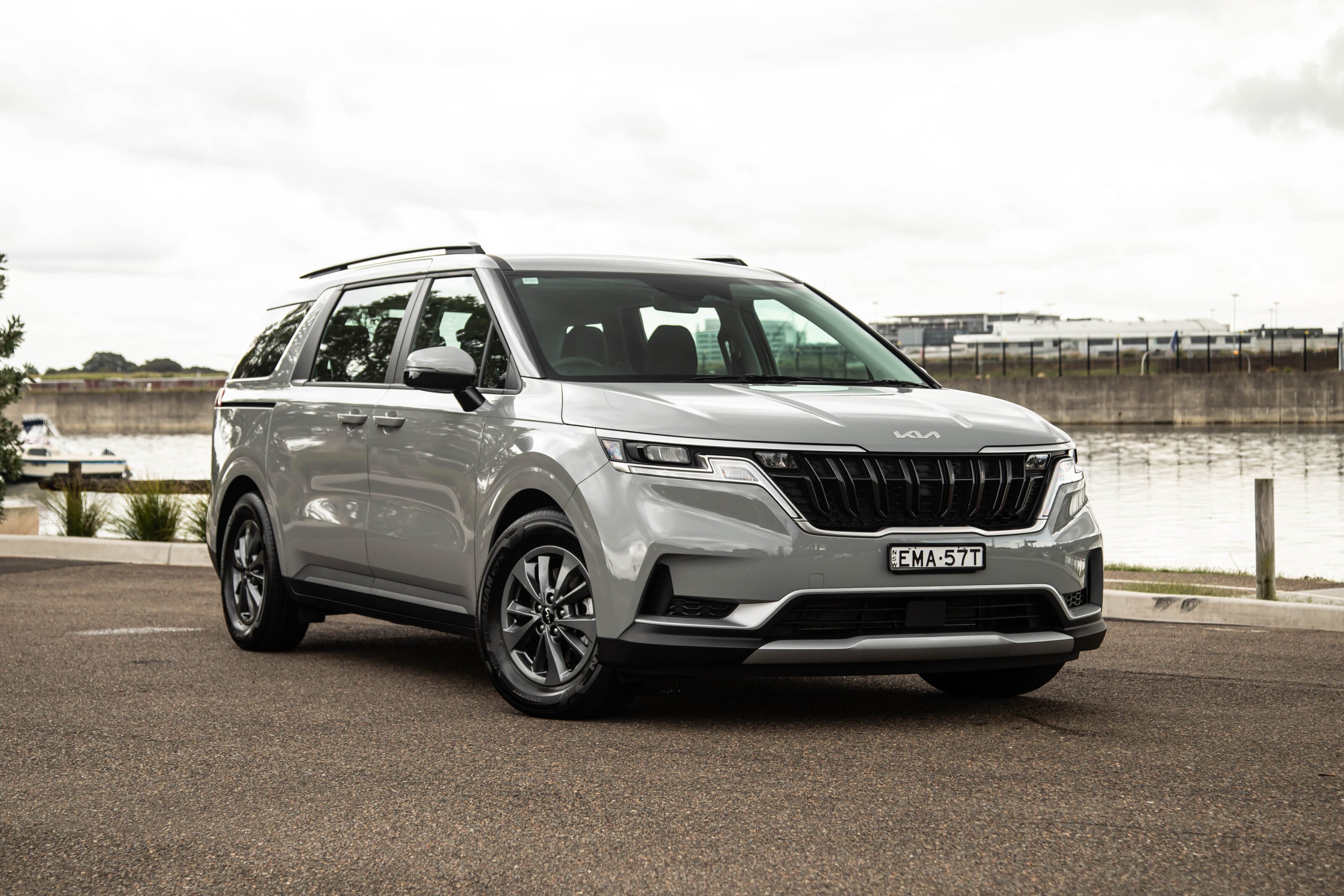
I’ve got some options, and this is one of them, a good one: the Kia Carnival S petrol.
1
JUMP AHEAD
- How much is it, and what do you get?
- How do rivals compare on value?
- Interior comfort, space and storage
- What is it like to drive?
- How is it on fuel?
- How safe is it?
- Warranty and running costs
- VERDICT
- Specifications
How much is it, and what do you get?
While $51,690 (drive-away) isn’t a small amount of money, it’s not a large one, either. For this segment, that is.
Casting your eye over this sparse spec table, though… you can see where all the money goes on the higher-spec Si and Platinum.
| Kia Carnival S petrol standard features | |
|---|---|
| 17-inch alloy wheels | Multi-zone climate control |
| 6-speaker stereo | Wireless Apple CarPlay |
| Wireless Android Auto | Reversing camera |
| Auto LED headlights | Auto wipers |
| Keyless entry and start | Space-saver spare |
| Rear parking sensors | Cloth trim |
1
The poor old entry-level model misses out on a few little things like digital radio and front parking sensors. While the latter isn’t a huge problem because there isn’t nearly as much Carnival in front of you as behind, it’s kind of stingy to skip DABbing.
It’s a basic spec, not gonna lie, but one imagines that this is aimed at two fairly distinct buyers – those in the transport sector who don’t need frippery that gets in the way of uptime and families on a budget. I’m sure that’s not all of it, but as I will always remind you, I’m not a product planner.
1
How do rivals compare on value?
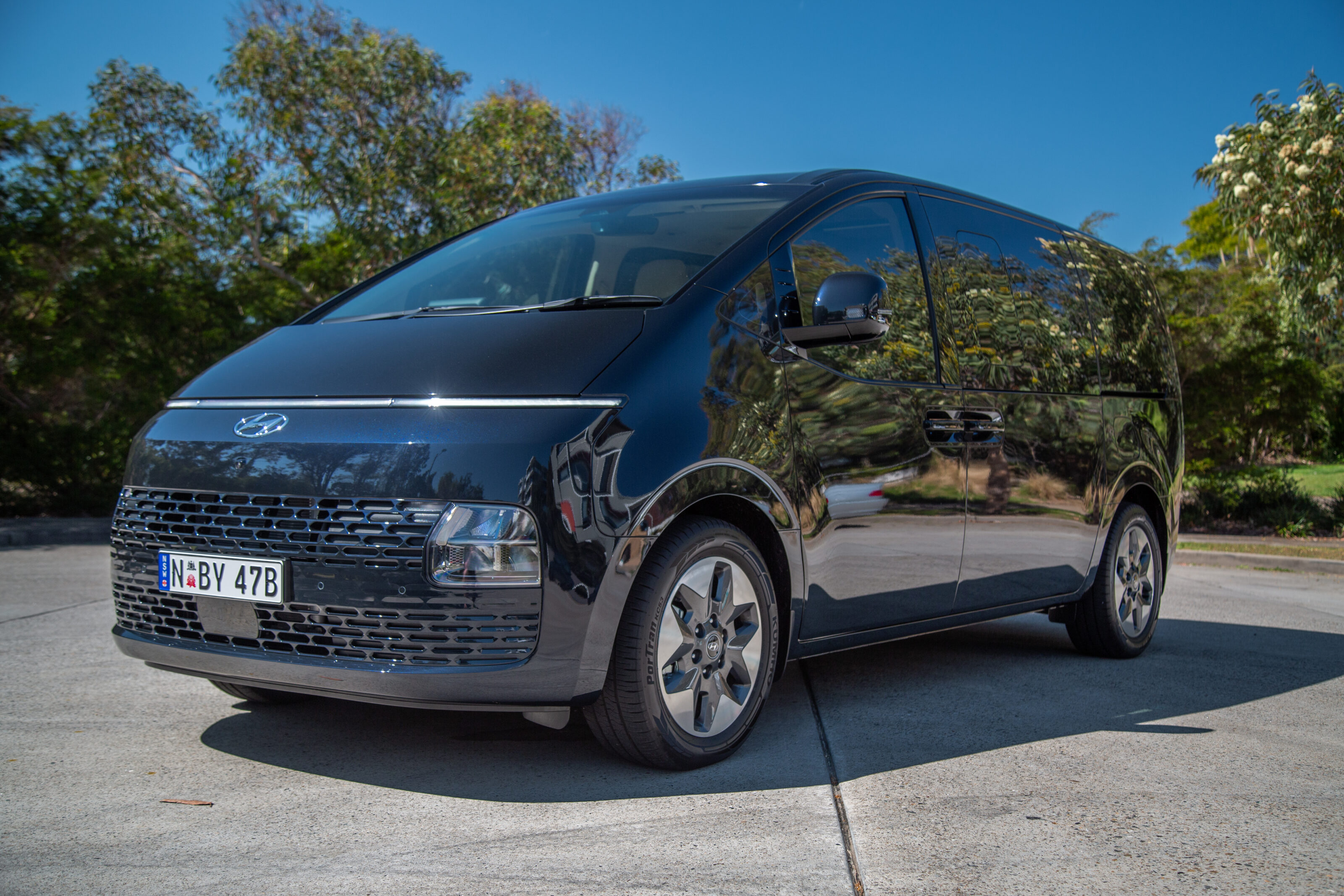
The tremendous-looking Staria, from the other side of the family, shares the same engine, has a shorter warranty and a whole different vibe.
The Staria kicks off at $52,990 before on-road costs but doesn’t come with quite the same power and torque figures as the Kia, down by about 10 per cent (when rounding up). Trading various features and key dimensions, it’s absolutely worth a look. Even just to look at.
If you want a giant box on wheels, there’s the LDV Mifa. LDV isn’t messing around with this one – there’s one regularly parked outside my home and it’s very hard to miss. Powered by a 2.0-litre turbo-petrol, the range starts at $53,990 and tops out at $72,990, both drive-away. The Mifa errs towards luxury in most grades and you can even go electric if you want to double the entry-level’s asking price.
Honda’s Odyssey is sadly no longer in the Australian market.
1
Interior comfort, space and storage
The long doors slide open without much effort and you’re presented with an easy lever pull to reach the third row.
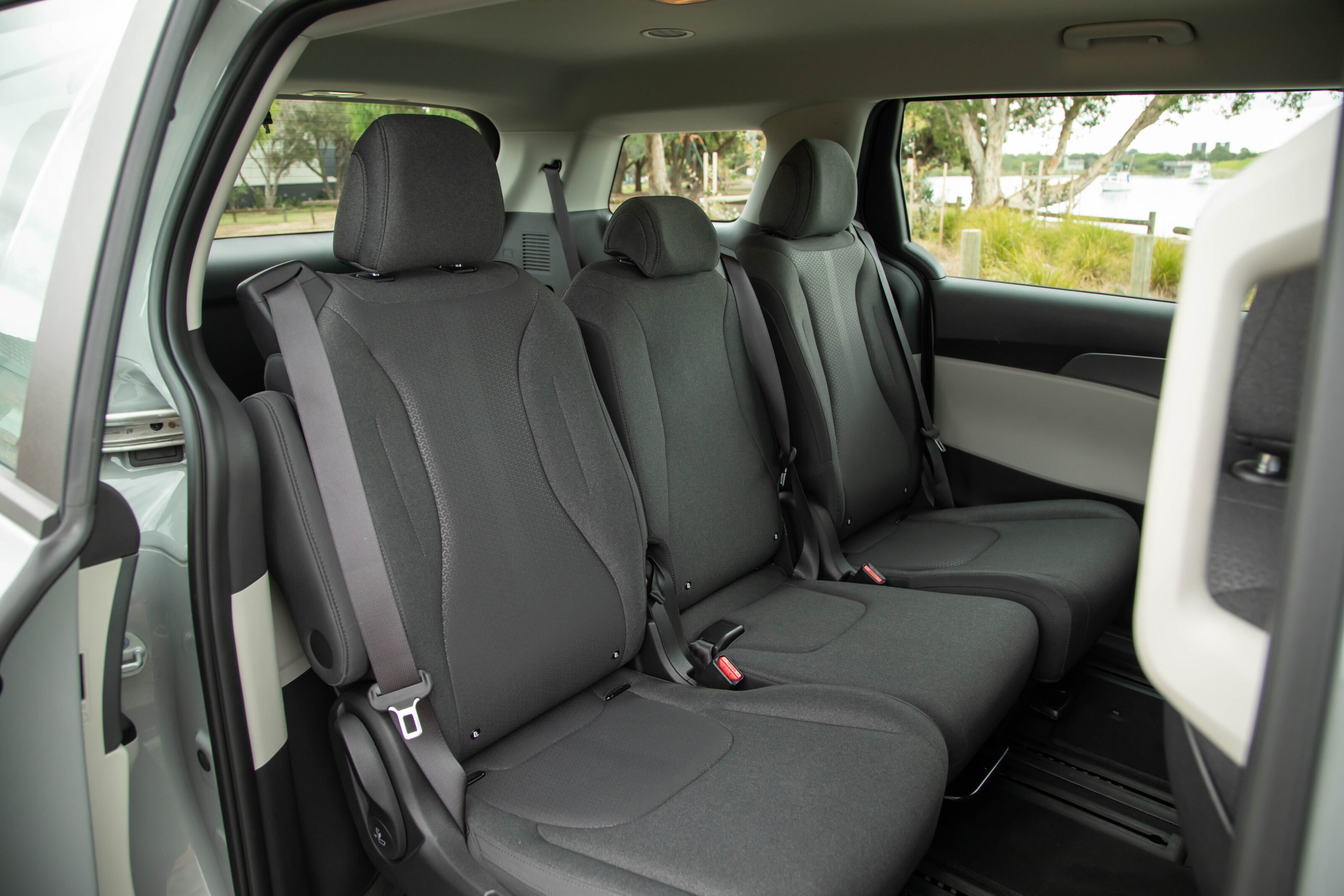
The flat floor makes it even easier and the three back seats slide independently so only one person has to get out if someone needs access to the rear.
With some seat sliding, a 180cm person can sit in the third row in reasonable comfort for the airport run, though three across will be tight. The seats are nicely shaped and aren’t a basic plank bench, which is worthy of praise.
In that third row, you have four cup holders, a storage tray and everything you’ll need for the journey, including two USB-A charging ports.
1
The three separate seats in the middle row are quite comfortable, but again three across will be close. The flat floor means less footsies, though, which means a more comfortable position for everyone.
Cup holders for the middle row can be found by folding down the middle seat (provided somebody isn’t sitting there), but another pair is provided at the rear of the centre console (if you can reach them) and you can store bottles in the door pockets. Sadly there aren’t Tiguan-style tray tables or things of that nature.
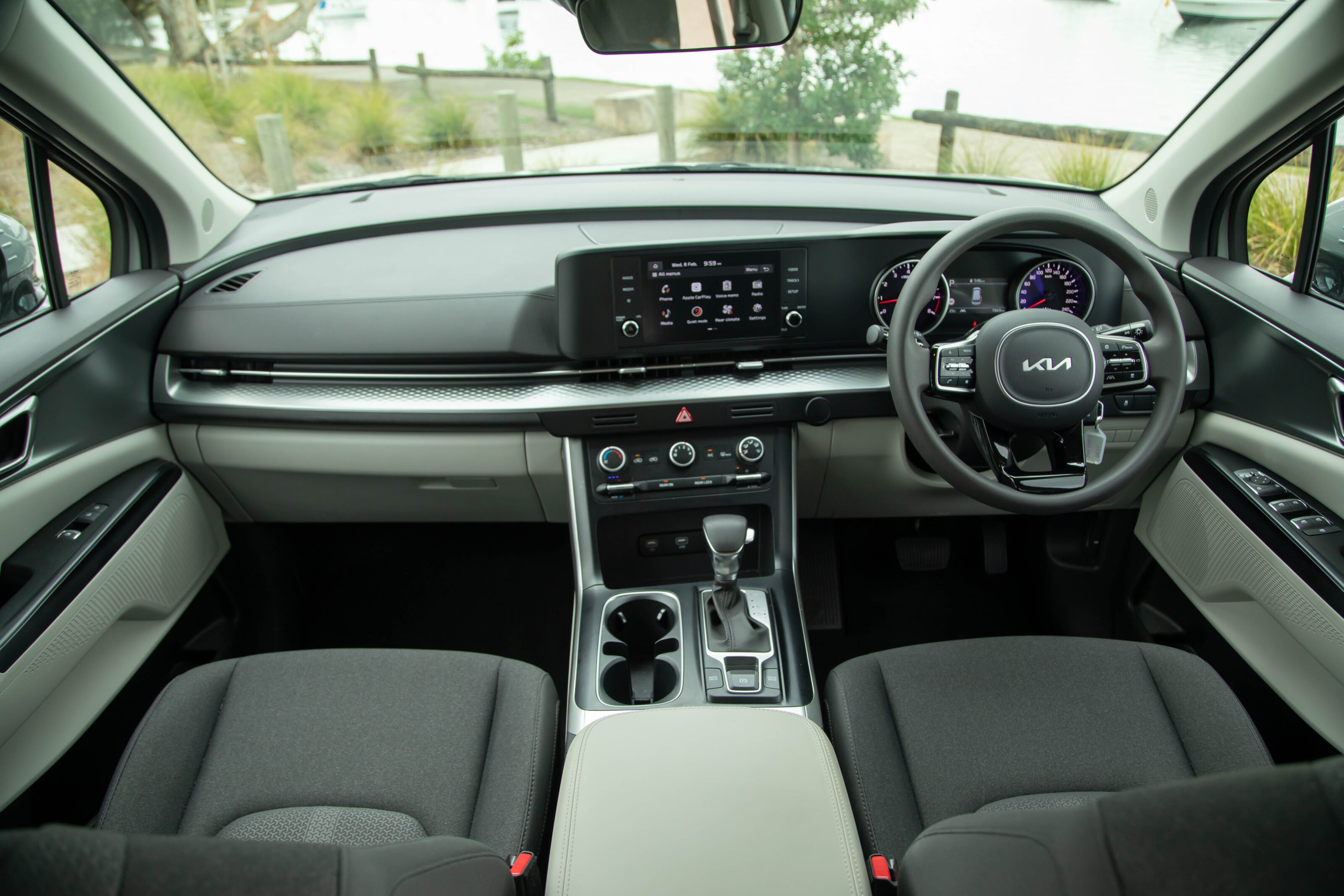
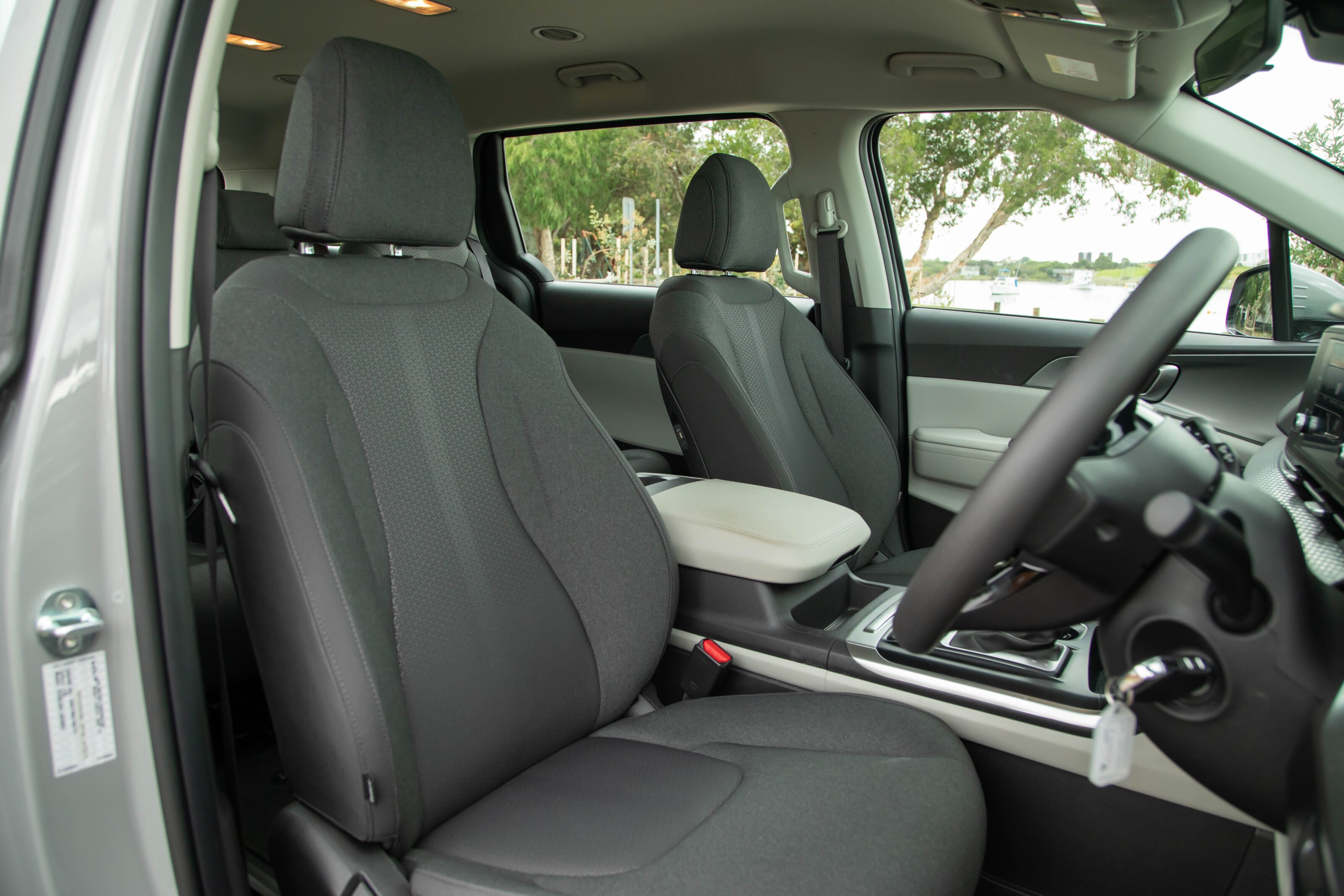
The front seats are excellent for the job and don’t sit too high, so you’re not lord and commander; it feels more like a slightly jacked-up wagon. You have two cup holders, two USB ports for power and you can stow your bottles in the big door pockets.
2
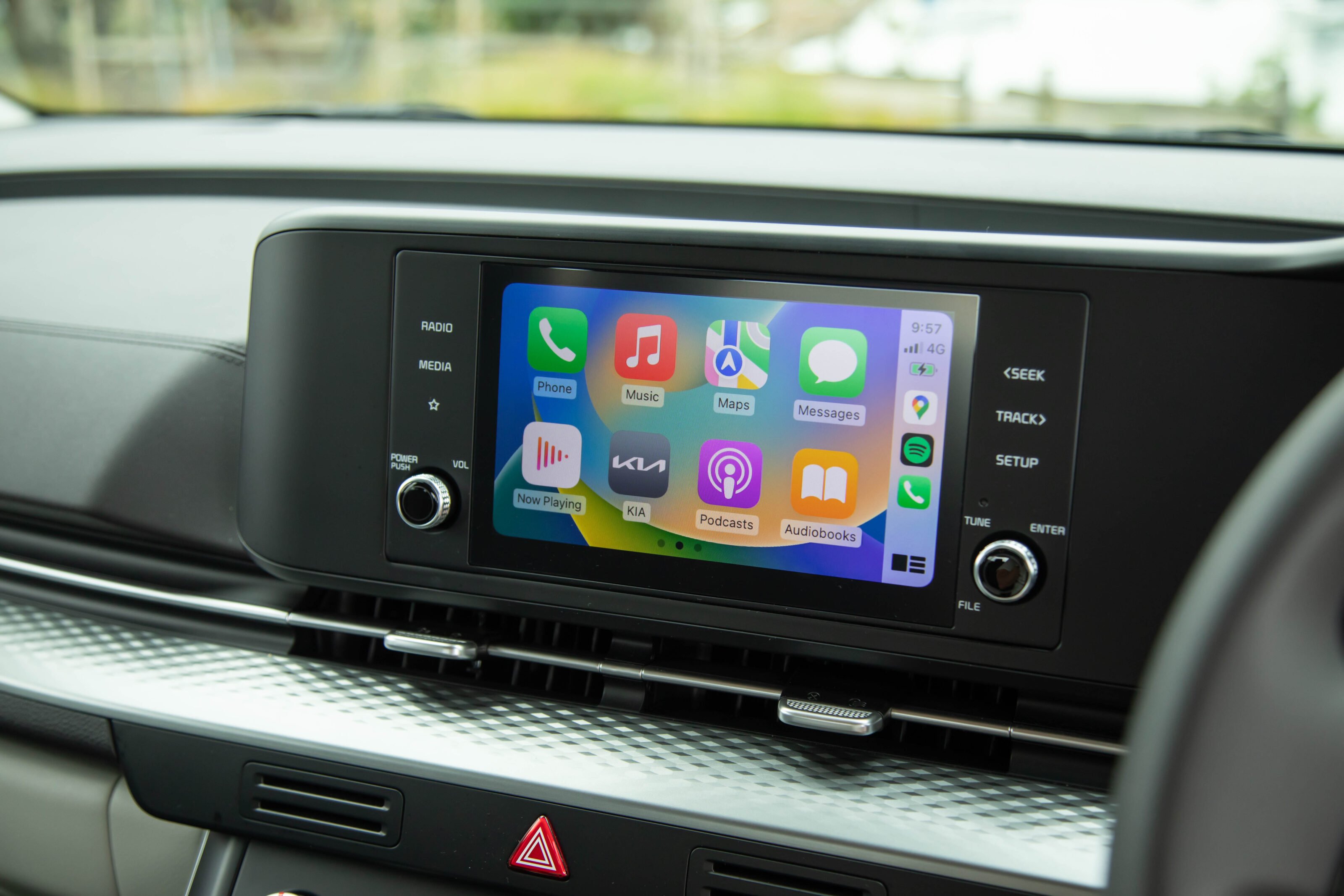
Annoyingly, despite the advanced wireless smartphone integration, there’s no wireless charging pad. The tiny screen swims in an ocean of grey plastic, too, so it looks weird. On top of that, all the switches and dials are basic-looking, which kind of heaps on the offence of not having a little luxury like DAB+ digital radio.
Kia Carnival boot space
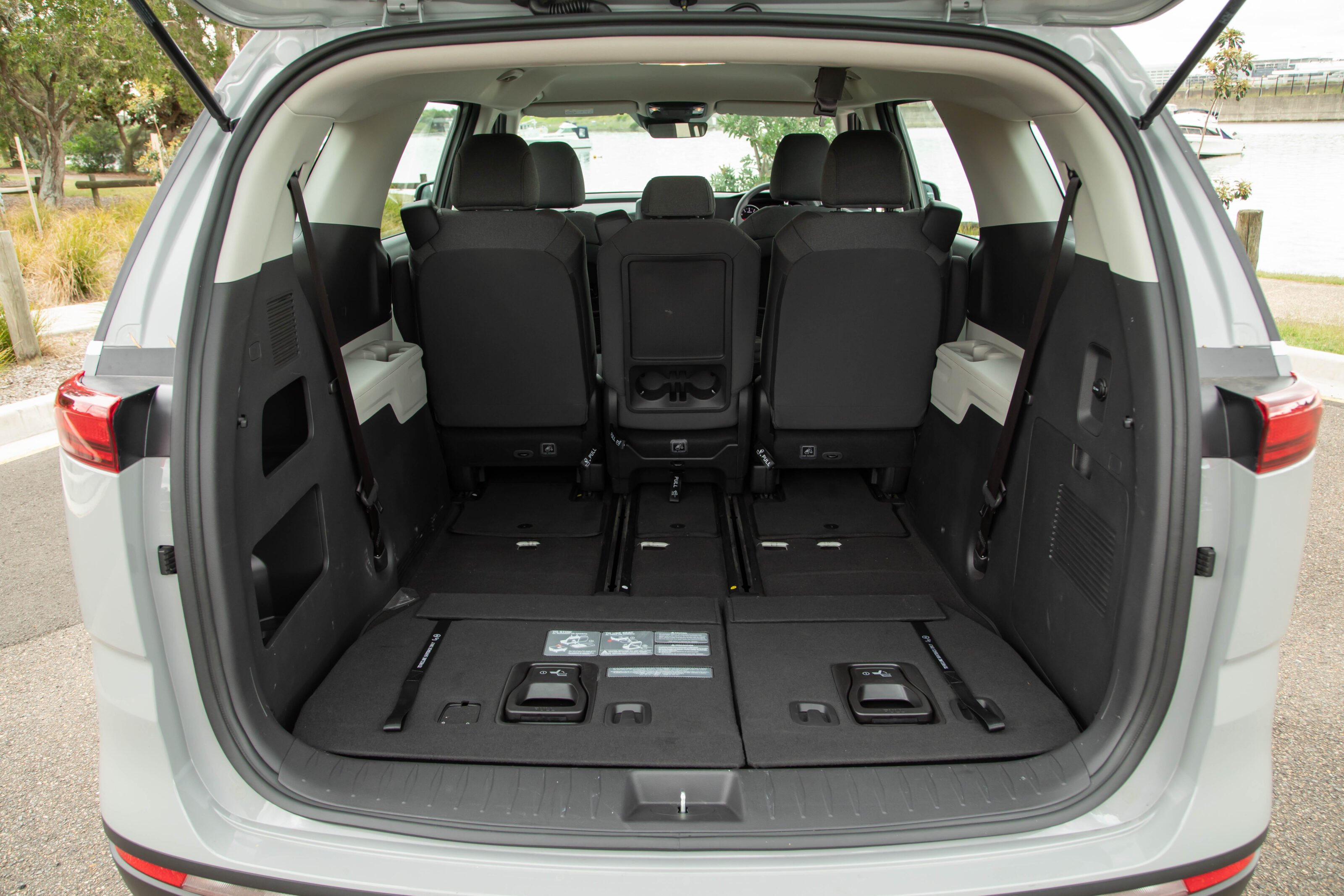
The 3090mm wheelbase is massive and means that the minimum available boot space, even when you’re eight up, is a healthy 637 litres. Fold away the third row and you’re beholding 2785 litres, both based on the VDA standard. That’s a lot of space.
1
What is it like to drive?
| Kia Carnival S petrol drivetrain | |
|---|---|
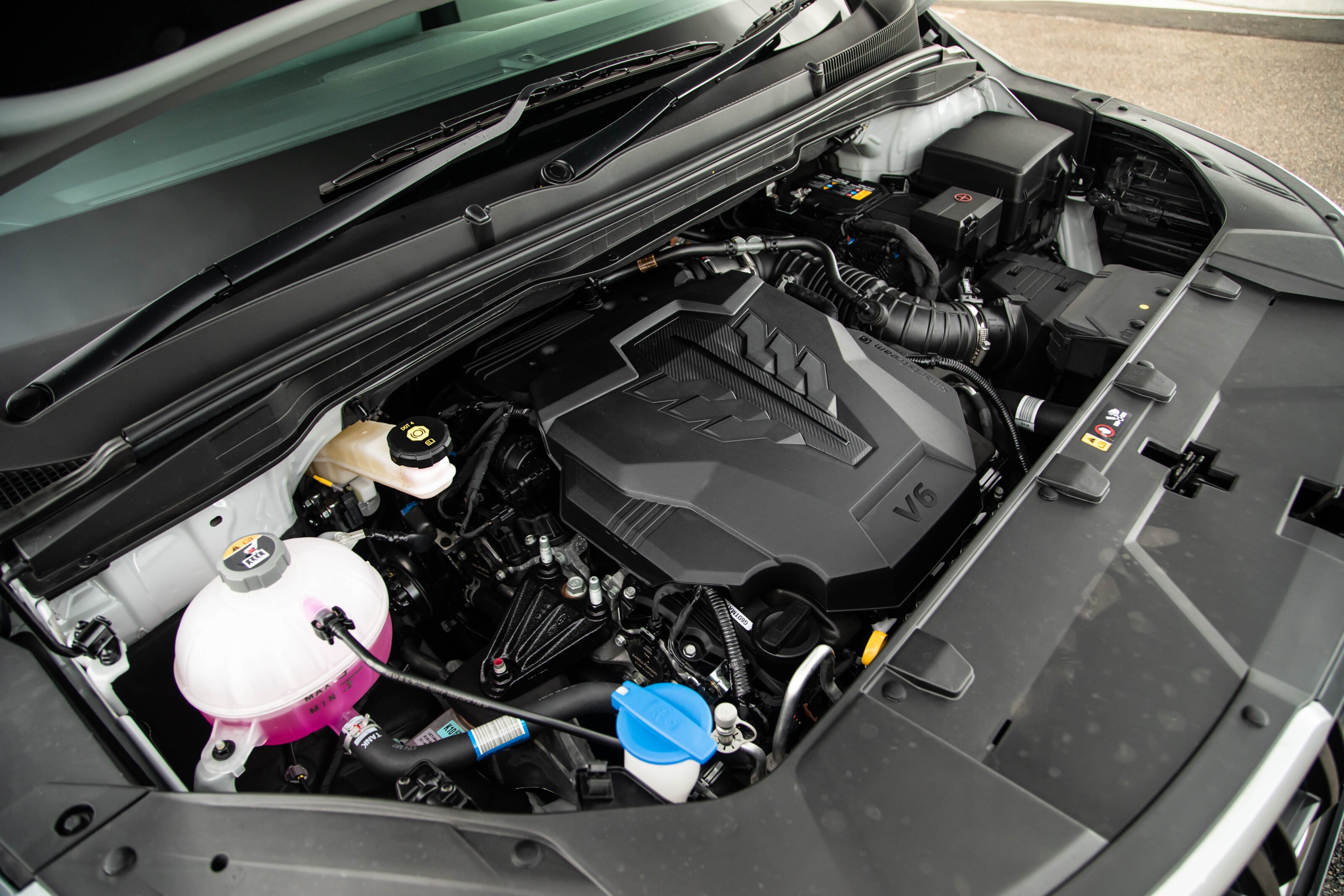
| Engine | 3.5-litre petrol V6 |
| Transmission | 8-speed automatic |
| Power | 216kW @ 6400rpm |
| Torque | 355Nm @ 5000rpm |
| Drive | front-wheel |
Like its diesel counterpart, the petrol-powered S is smooooooth.
In fact, I should put more ooo in there because the 3.5-litre petrol suffers from precisely no lag, just a nice building of power to the 216kW maximum at 6400rpm.
It gets a move on, too, which is handy for a big unit when you want to break into traffic, although spinning wheels need to be accounted for on a greasy surface.
This is the more refined engine of the two and feels more relaxed around town. But you have to – literally – weigh up the benefits. If this car is going to be regularly loaded up, you’ll see a marked degradation in performance as the 355Nm torque figure is a long way down on the diesel’s.
1
You’ll also probably find yourself using more fuel, and it will snowball from there.
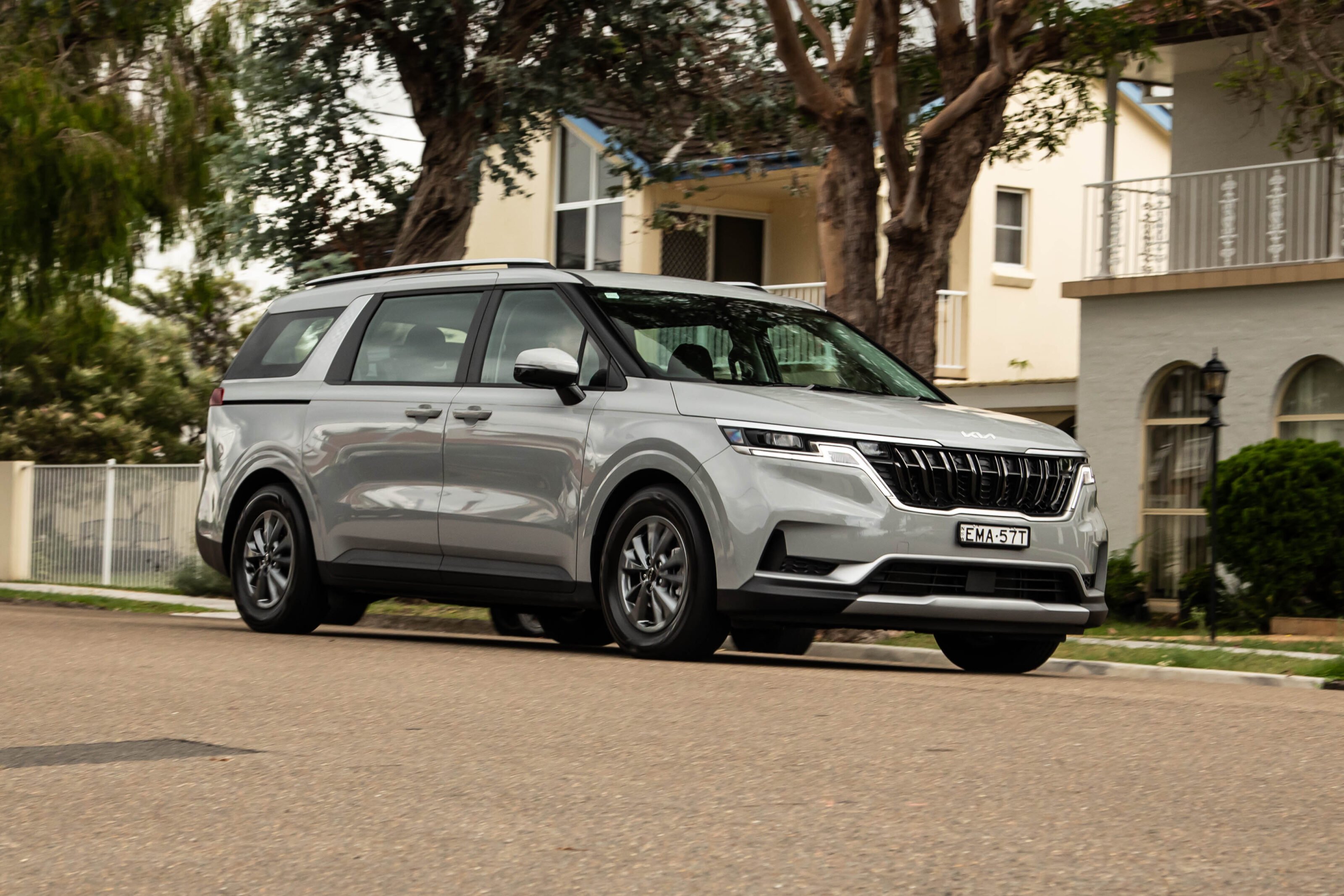
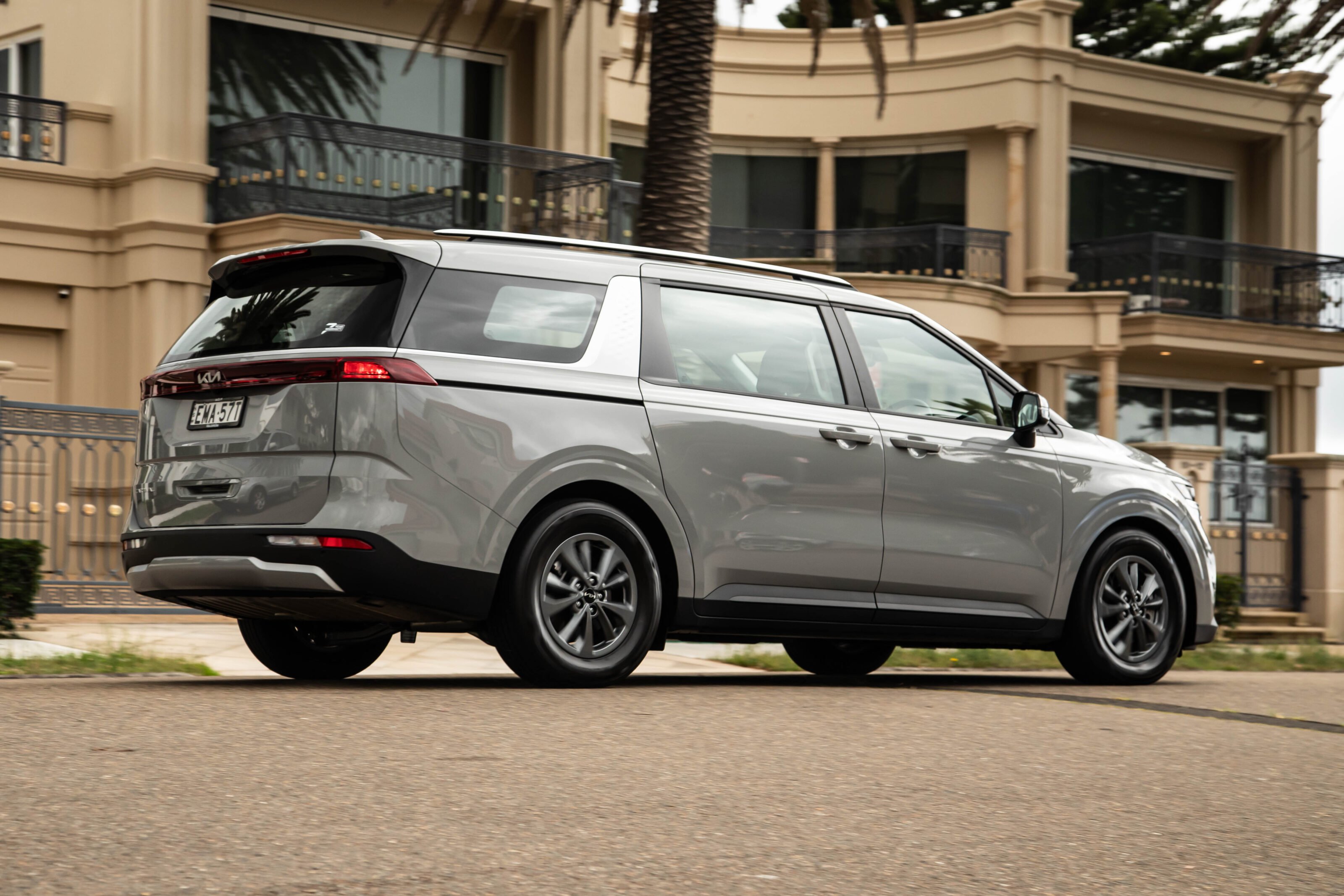
The base model has smaller wheels than the Platinum I drove a few weeks ago and it’s all the better for it. The ride is more compliant – not that the top-of-the-range car was bad, of course – and it liked bumps a lot more. There was little effect on the handling, so that’s a win if ultimate ride quality matters.
I’m not a fan of the plastic steering wheel and one hopes this will soon be remedied as it has been in the Seltos. That kind of vibe really ruins an otherwise nice enough cabin and if you’re driving professionally it will, yes, last longer but it feels a bit tradie van-cheap to me.
2
How is it on fuel?
Kia’s ADR testing run delivered 9.4L/100km on the combined cycle, which is a fairly hard figure to achieve in the real world.
We did spend most of the Carnival’s week in the suburbs, with a few 80km/h runs, but mostly boring errands and the usual testing loop.
| Kia Carnival S petrol fuel figures | |
|---|---|
| Fuel economy (claimed) | 9.6L/100km |
| Fuel economy (trip computer) | 12.3L/100km |
| Fuel type | 91 RON petrol |
| Fuel tank capacity | 72 litres |
The 72-litre tank will save you a bit of time and it can be filled with E10 or 91 RON unleaded. If you take my poor result of 12.3L/100km, you still get 585km between fills but if you behave yourself, you might get closer to 700.
On the freeway, I’d expect a vastly longer range but if it’s range you need, maybe spend a few more bucks for the diesel.
1
How safe is it?
The five-star ANCAP safety rating for the Kia Carnival results from a pretty decent suite of safety features.
| Kia Carnival S petrol safety features | |
|---|---|
| 7 airbags | ABS |
| Stability and traction controls | Forward AEB (high and low speed) |
| Forward collision warning | Reverse cross-traffic alert |
| Multi-collision braking | Front cross-traffic alert |
| Lane departure warning | Lane-keep assist |
| Driver attention detection | Safe exit warning |
| Blind-spot monitoring | Reversing camera |
The forward AEB includes pedestrian and cyclist detection and works at high and low speeds. For child seats, ISOFIX points are provided in the middle and back rows of seats and five top tether points are spread across the two rows.
Warranty and running costs
Kia’s seven-year / unlimited-kilometre warranty applies, matching the LDV Mifa’s but beating the Staria’s.
You get a year of roadside assist, extended every time you service with Kia.
Servicing comes around every 12 months or 15,000km, which is probably a little short for a lazy V6, but here we are. The capped-price servicing program covers the first seven services and, like the diesel, it’s not a bargain.
The first weighs in at $329, then jumps to $604, down to $402, up to $785, down again to $371, another jump to $754 then finishing off with $393.
Over the seven years, that’s a total of $3638, or $520 per year on average. There’s barely a lobster in it per year compared to the diesel, which I find a bit odd given diesels tend to be noticeably more expensive to service.
At least you know what you’re in for, though, so total cost of ownership calculations are easy enough.
1
VERDICT
Regular viewers will know that I am a van fan, cheerfully grabbing the keys to anything big and boxy from any manufacturer that cares to make them.
I really like the Carnival, though.
It feels more like a car than any of the rivals I have driven and has a nice easy vibe in the driving and the passengering. It does occasionally feel a little on the stingy side – a lack of reverse AEB is a bit of a punch in the gut on a five-plus metre van – but it will do the job you want it to do.
Just maybe consider the diesel if you need more range or more pep.
MORE
Everything Kia
| Kia Carnival S petrol specifications | |
|---|---|
| Body | 5-door, 8-seat people mover |
| Drive | front-wheel |
| Engine | 3.5-litre petrol V6 |
| Transmission | 8-speed automatic |
| Power | 216kW @ 6400rpm |
| Torque | 355Nm @ 5000rpm |
| Bore stroke (mm) | 93.0 x 85.8 |
| Compression ratio | 12.3:1.0 |
| 0-100km/h | 9.0 sec (estimate) |
| Fuel consumption | 9.6L/100km (combined) |
| Weight | 2136kg |
| Brakes | 325mm ventilated discs front/325mm ventilated discs rear |
| Suspension | MacPherson struts front/multi-link |
| L/W/H | 5155mm/1995mm/1775mm |
| Wheelbase | 3090mm |
| Tyres | 235/65 R17 |
| Wheels | 17-inch alloy (space-saver spare) |
| Price | $51,690 drive-away |
Chinese automaker Build Your Dreams (BYD) looks set to debut two new sporty-looking electric SUVs in its home market.
Snapshot
- Updated BYD Song Plus EV leaked, global roll out possible
- Sporty coupe electric SUV teased with two spoilers Both to adopt LFP-based
- BYD Blade Battery structural cells
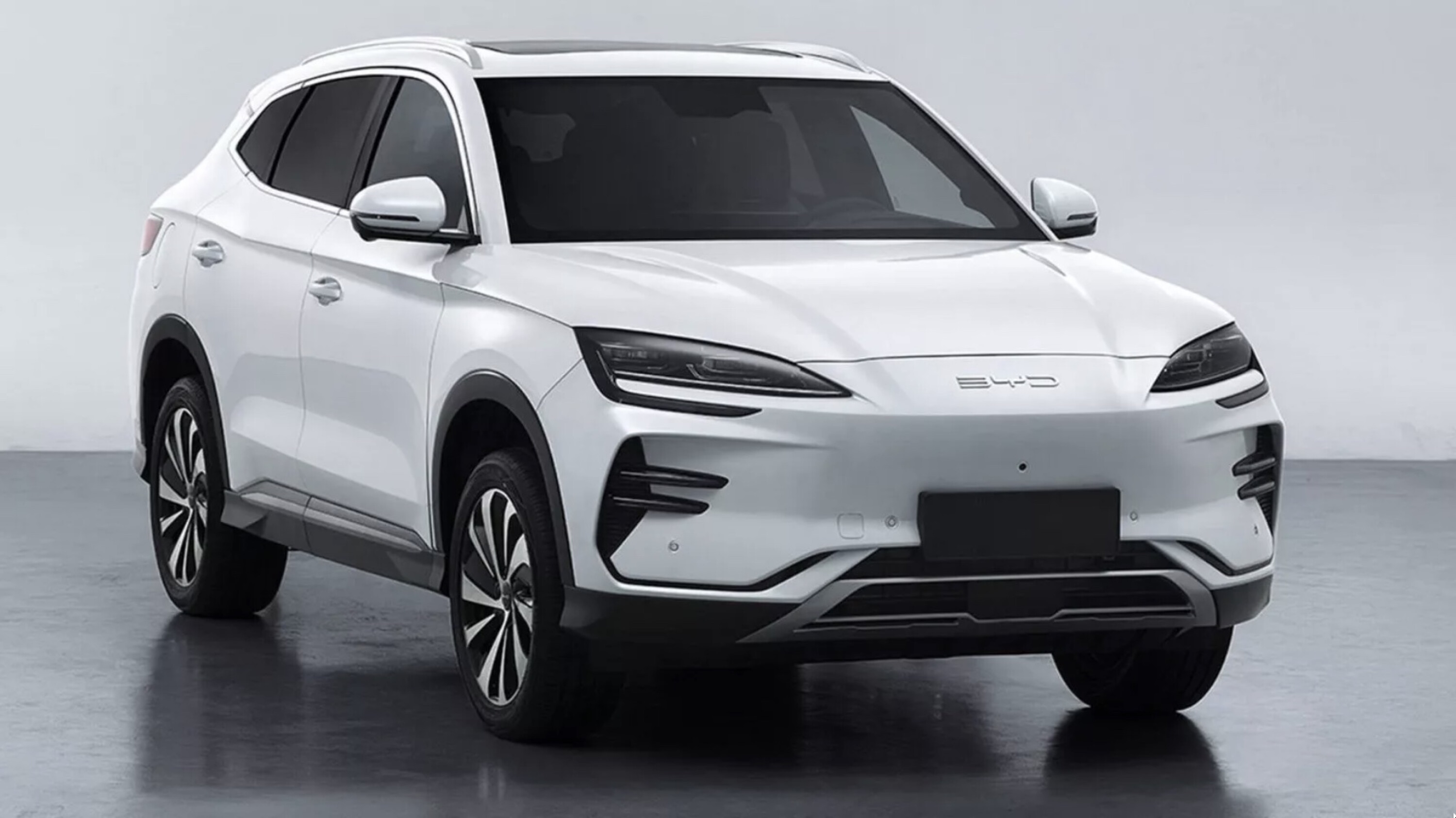
Images published by China’s Ministry of Industry and Information Technology (MIIT) reveal the BYD Song Plus EV will gain a facelift to bring its front design in line with the Seal electric sedan, with C-shaped headlights, revised lower bumper, and grille-free face with BYD badging.
The current model instead features the Chinese character for ‘Song’, so the latter could hint at a global roll out, according to Car News China.
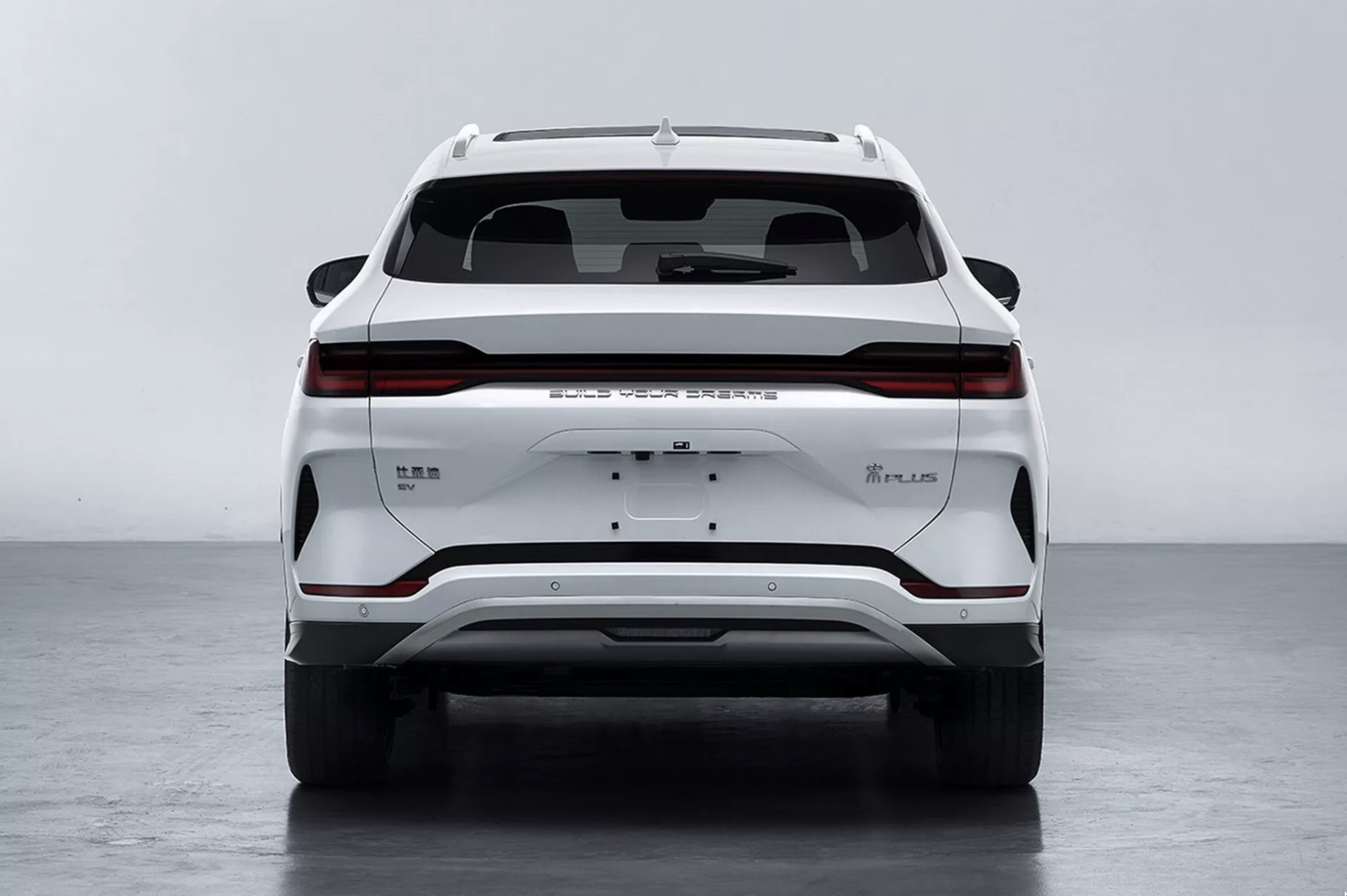
Meanwhile, the back of the Chinese electric SUV is eerily reminiscent of the GWM Haval H6 GT, with a requisite tweaked full width LED tail-lights, ‘Build Your Dreams’ letting, and an aggressive bumper.
1
The current Song Plus is also offered as a plug-in hybrid and is part of the company’s ‘Dynasty’ series, whereas BYD electric cars such as the Dolphin hatchback and Seal sedan are its ‘Ocean’ series.
Car News China also notes it is 80mm longer and 20mm lower than the current model, with the same wheelbase, the brand’s E-Platform 3.0 underpinnings, and structural lithium-iron-phosphate (LFP) Blade Battery cells.
It is said to be offered in two powertrain options, with the entry-level sharing the same 150kW electric motor as the BYD Atto 3 or a more powerful 163kWh motor.
The filings also depict optional wheel covers, coloured brake callipers, and a camera-based rear view mirror will be available in China.
1
BYD Song L coupe electric SUV teased
The Chinese conglomerate also teased another new electric SUV called the Song L, teasing a coupe roofline ahead of an April 18 debut.
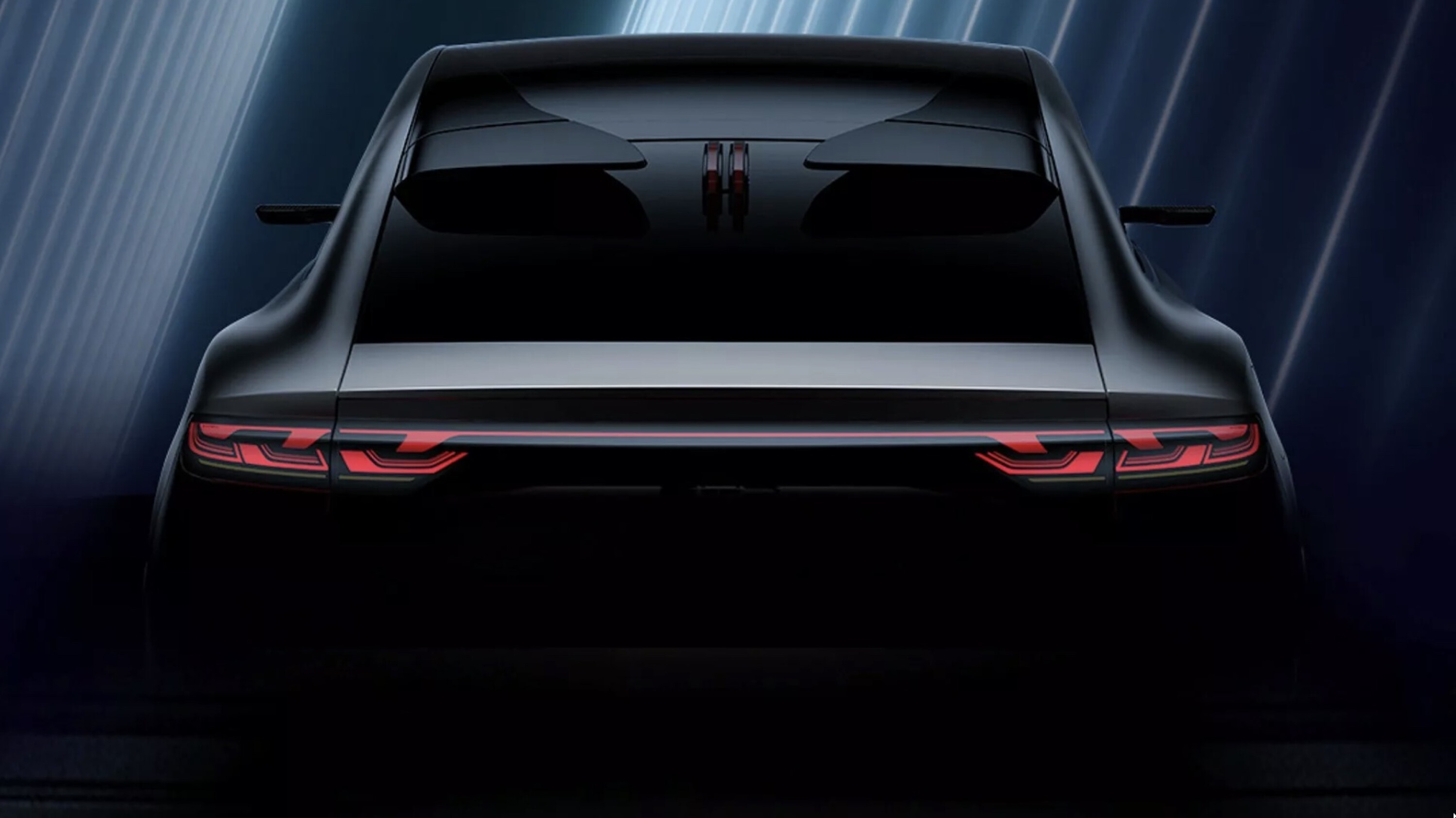
The shadowy teaser posted on Weibo reveals a sporty rear with a thinner LED light bar, double-bubble rear spoiler (similar to the top-spec MG 4 hatch), twin vertical-lined LED brake light atop, and camera-based wing mirrors.
1
Like the Song Plus and Atto 3 crossover SUVs, it will be part of BYD’s Dynasty series using the E-Platform 3.0, structural LFP-based Blade Battery cells, and is described as a ‘B-class SUV’.
There’s hope that its electric drive unit will match its high-performance looks, though.
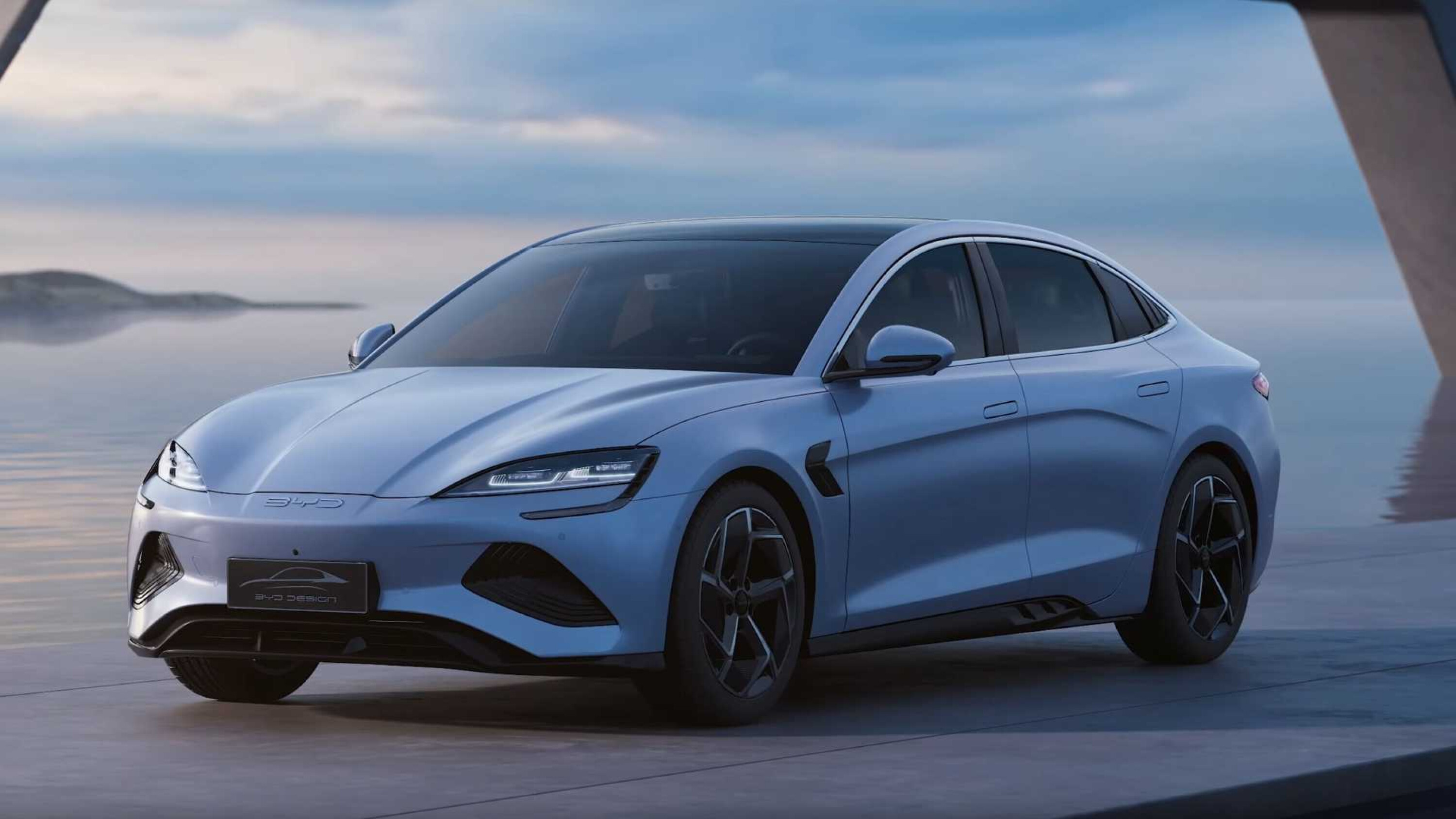
For reference, the top-spec BYD Seal EV is offered in China with dual electric motors producing 390kW of power and 670Nm of torque to accelerate from 0-100km/h in just 3.8 seconds.
1
Which BYD electric cars are coming to Australia?
Independent importer and distributor EVDirect has promised the BYD Dolphin electric hatch will arrive sometime this year to directly compete with the sub-$50,000 MG 4 and GWM Ora.
Additionally, the BYD Seal electric sedan will follow later this year, as the Shenzhen company’s answer to the popular Tesla Model 3, Polestar 2, and Hyundai Ioniq 6.
MORE
Everything BYD
MORE
Electric SUVs
