
All prices exclude on-road costs.
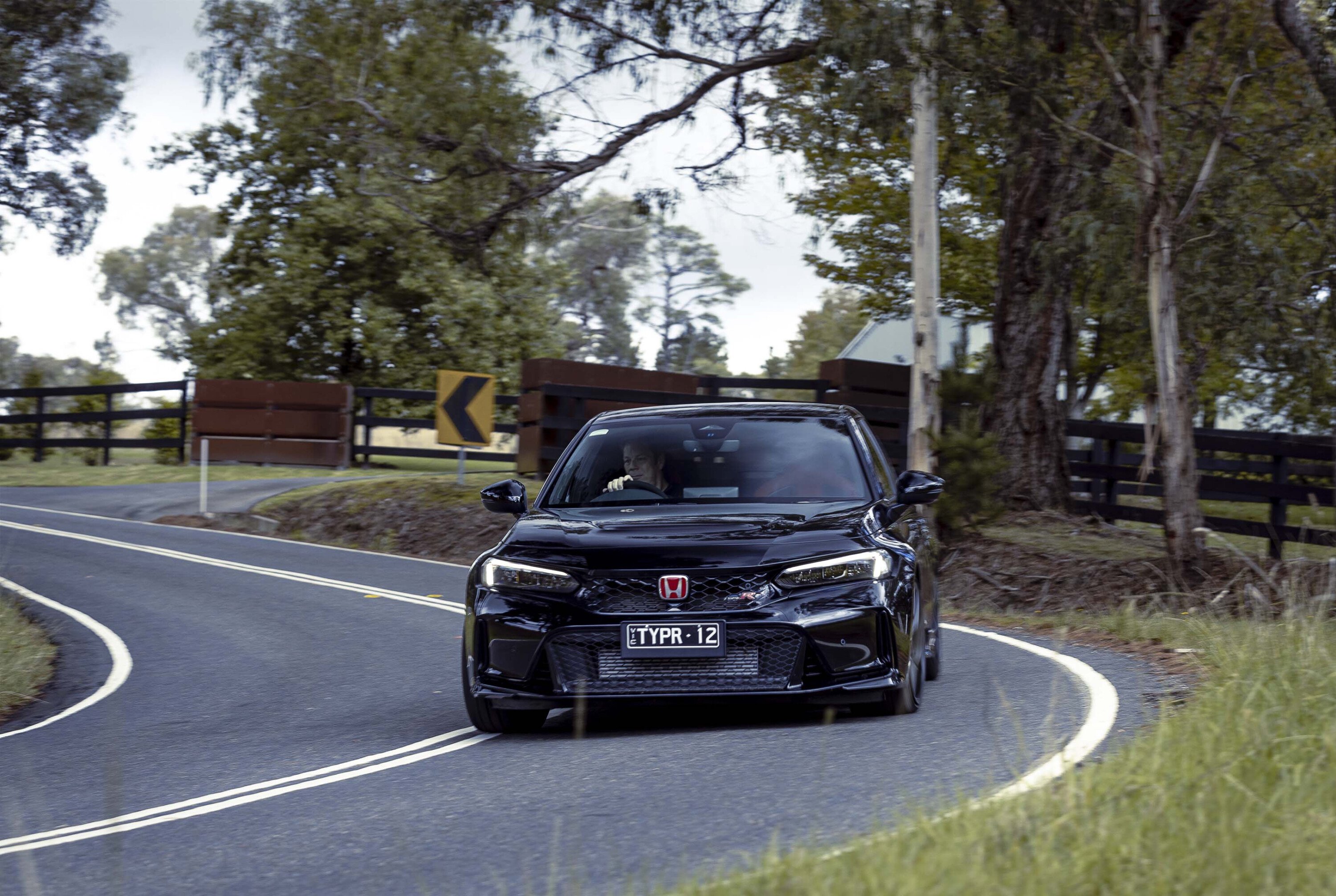
When Honda announced pricing for the latest Civic Type R, punters were astonished that a front-drive hot hatch could command $72,600 drive-away. But with deliveries of the 11th-generation FL5 Honda Civic Type R commencing this month, speculators are already trying to make a quick buck.
There are examples listed for private, or dealer used sale in the classifieds for as much as $89,990 excluding on-road costs with 400km on the odometer.
Once you add registration, insurance, and stamp duty, that’s roughly a $20K mark-up over ordering one new from a dealer. Though, with Civic Type R’s huge wait times, some may consider it worth their while.
1
“Due to high demand for the extremely popular Civic Type R, some wait times are estimated to be approximately 20 months,” reads Honda’s website. Guess that’s $1000/month privilege to get one now.
The lowest price listed for a Civic Type R is $72,600 drive-away from official Honda dealers and, at the time of writing, there are only a handful of delivery-kilometre examples under $80,000.
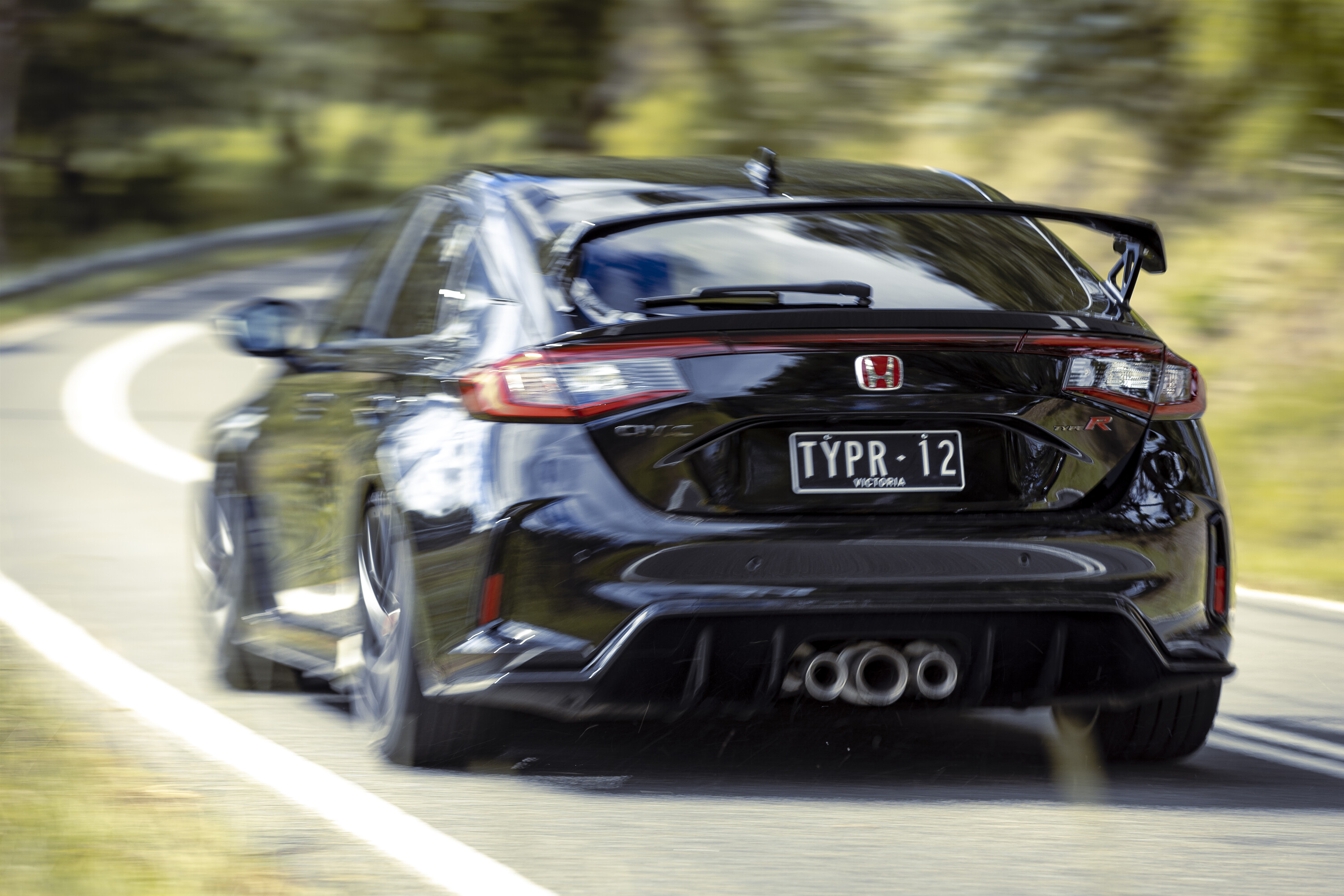
The Civic Type R situation is optically inconvenient for Honda Australia following its transition away from traditional franchise dealers to a fixed-price agency model. The idea is to make buying a new car a simpler and less competitive affair – however, it isn’t Honda preying on long wait times.
1
A spokesperson for Honda Australia told Wheels that none of the dealers currently advertising Civic Type Rs above the retail drive-away price are affiliated with Honda Australia.
“We can confirm that all the advertised units of the 2023 Civic Type R units you referred to are being sold via non-Honda used car dealerships. These dealerships are not affiliated with our current Honda Representative network. There are no Honda dealers marking up their allocations.
“Each of these Civic Type R’s are being sold as used vehicles in the used car market”, the spokesperson added.
1
It’s a situation we’ve seen increasingly, and not just on exotic or enthusiast vehicles, such as the well-publicised GR Yaris saga, but also the more mundane with Ford Rangers and Toyota RAV4 Hybrids also getting a little extra thrown on top.
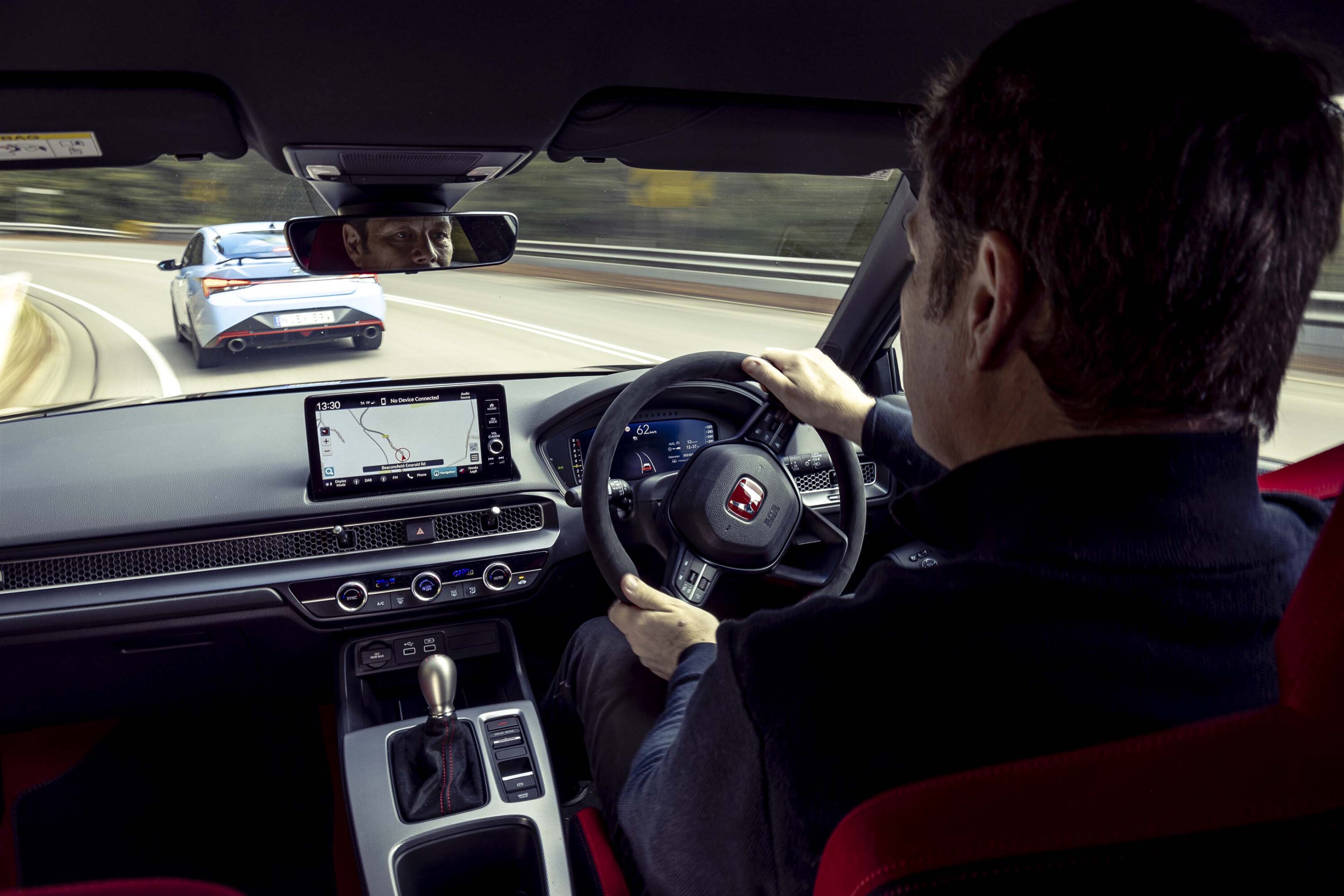
The Civic Type R uses a 235kW/420Nm 2.0-litre turbo-petrol four-cylinder engine that drives the front wheels via a six-speed manual transmission.
At the Type R’s international media launch, Angus Mackenzie adjudicated a rare 9.5/10 – the verdict being that at $20K more than a Hyundai i30 N, The Type R is a lot of cash. “Is it worth it? If you want what is the best front-drive hot hatch in the business, then yes.”
We’ll have a full local road test, and a comparison between the Type R and one of its main rivals, live on 10 April.
MORE
Everything Honda
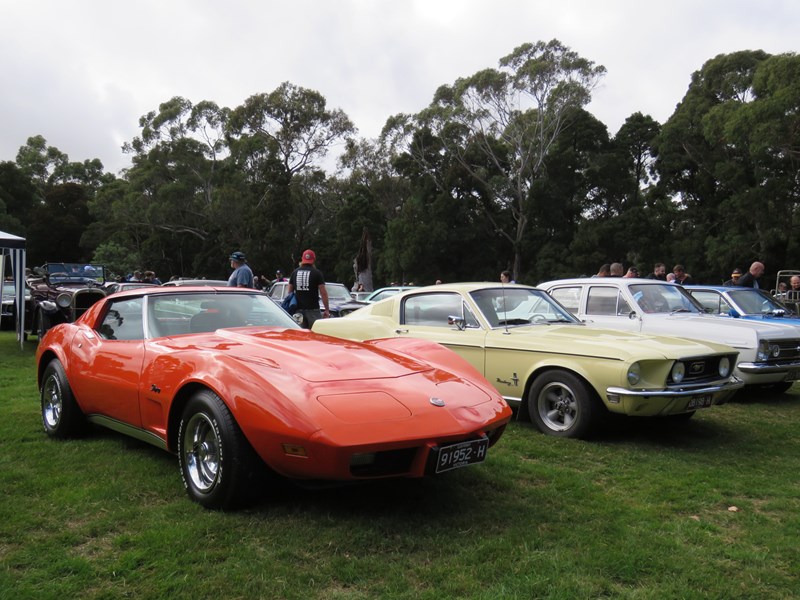
The annual Picnic at Hanging Rock Classic Car Show returned to peak form this year with a massive turnout.
Around 900 display cars made the trek to the scenic venue, along with 2000 spectator cars.
The event has been hit by threats of bushfire and COVID delays over recent years, however this year turned on mild weather.
A huge turn-out gave credence to the popular theory that post-lockdown Melburnians are keen to get out there, as we’re hearing of lots of events pulling big crowds.
Click the photo below to enter our full gallery from the event!
1
This year’s show was dominated by locally-made cars, with a strong American contingent.
A smattering of European and Japanese machinery was also on hand, though perhaps not in the strength of numbers we’ve seen in previous years.
The show is organised by the Macedon Ranges and District Motor Club.
Enjoy the gallery.
Originally published at our sister site, Unique Cars
MORE
Classic Wheels
MORE
See the 2022 gallery
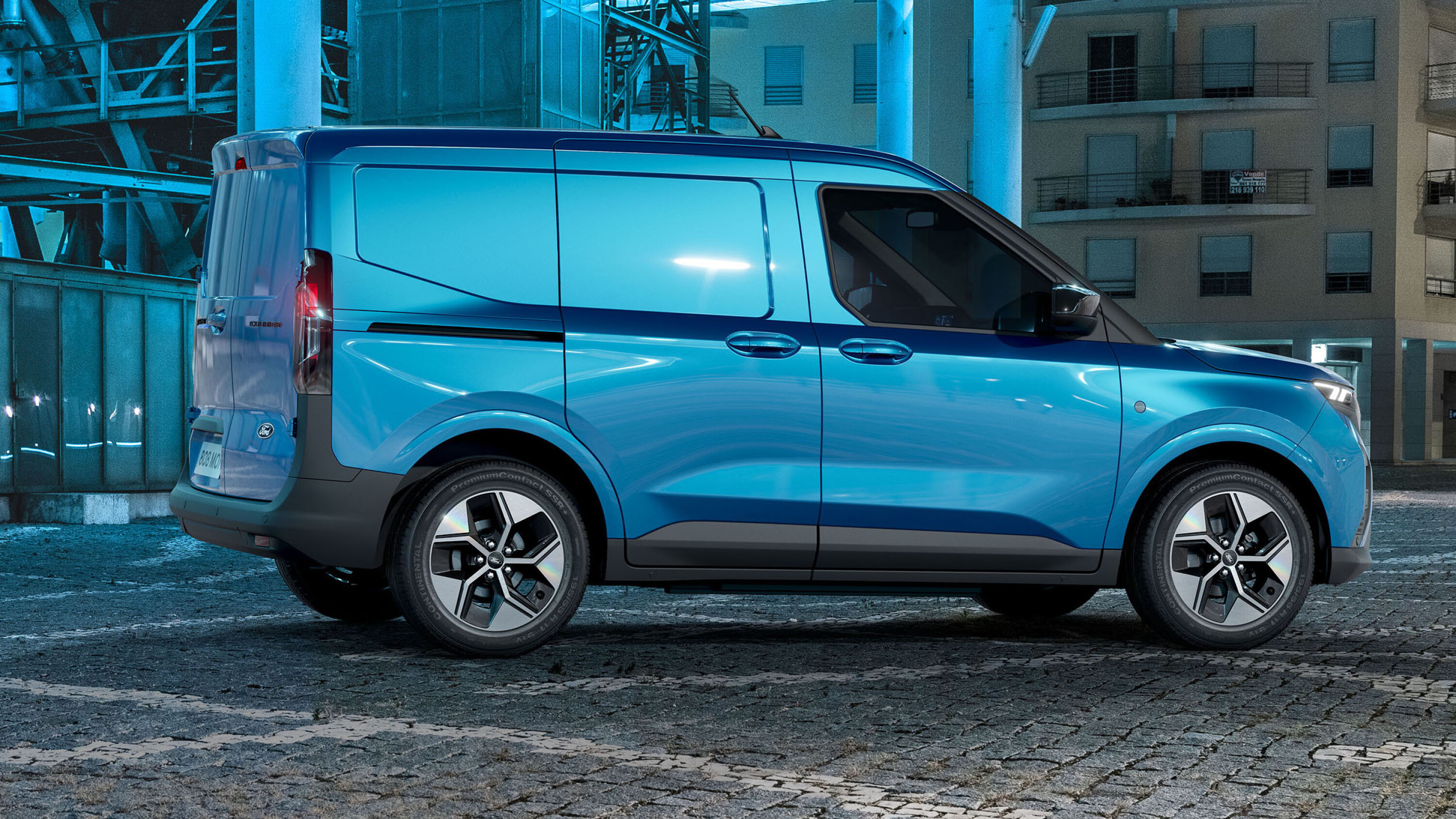
Ford has revealed its new E-Transit Courier electric city van in Europe, to compete with the small Peugeot E-Partner and upcoming Renault Kangoo E-Tech.
Snapshot
- Practical E-Transit Courier city electric van debuts in Europe
- Claims at least 35 per cent reduced maintenance costs than diesel
- Australian launch unclear
Based on Ford’s own ground-up electric platform that will be shared with the soon-to-be-unveiled all-electric Puma light SUV, the E-Transit Courier features 25 per cent more load volume than its predecessor.
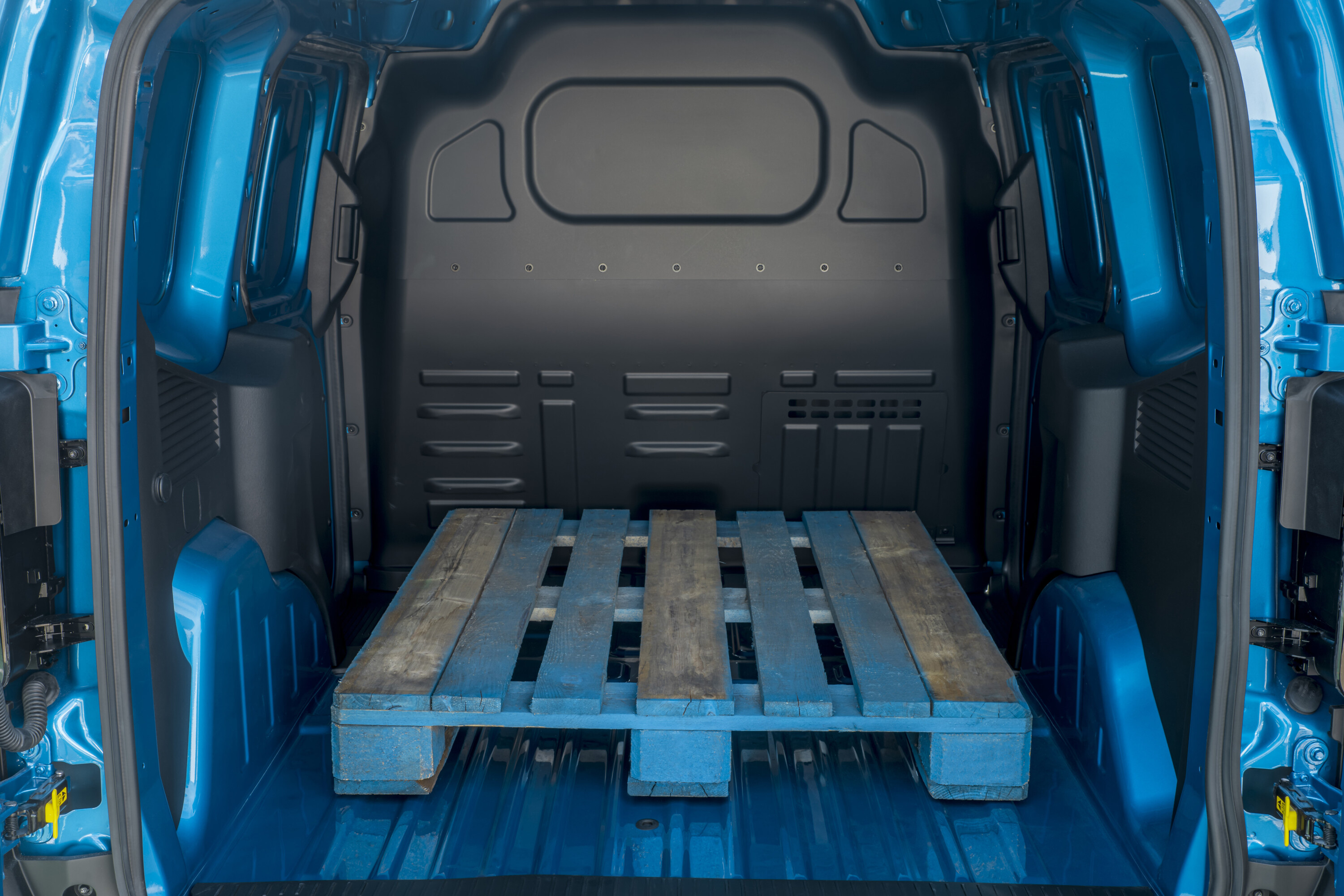
Ford claims the 1220mm width between the rear wheel arches allows two Euro-size pallets to fit in the 2.9 cubic-metre cargo area, with a 700kg payload and 750kg maximum towing capability depending on the variant.
A new load-through bulkhead feature allows items more than 2600mm long, such as pipes and wood planks, to fit through into the cabin – but at the expense of the front passenger seat. This essentially extends the 1803mm-long cargo area to 2661mm.
The city-focussed van also has a 10.7-metre turning circle and overall length of under 4.4-metres.
1
Charging
Full details haven’t been released yet – including driving range – but Ford has confirmed the E-Transit Courier will boast a 100kW electric motor, one-pedal driving capability, and a 145km/h top speed.
The Basics
- The E-Transit Courier can recharge at up to 11kW AC, which Ford is u201ctargetingu201d to complete in 5.7 hours overnight on a compatible wall box.
- Up to 100kW DC fast-charging is expected to go from 10 to 80 per cent in less than 35 minutes, or top-up 87km of range in 10 minutes.
- In Europe, the van will have u2018Plug and Chargeu2019 technology to start a charging session and credit the owner or fleet operator, without the need to fumble with a mobile app or RFID card.
1
Tech and interior
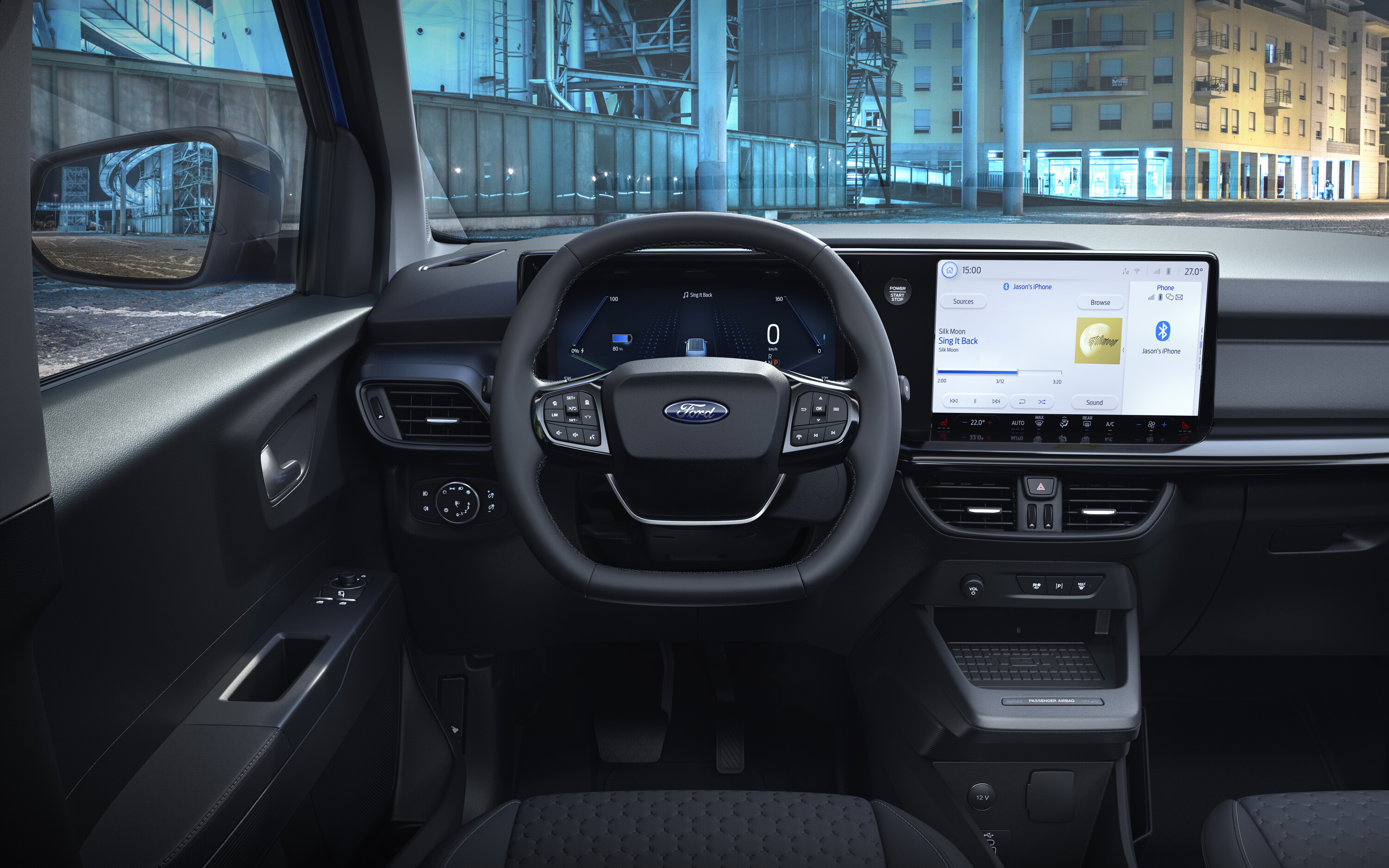
Inside, the two-seat cabin is home to a new squircle-shaped steering wheel to improve leg room for the driver.
There’s also a larger centre console with configurable storage and removable elements, and an optional Office Pack foldaway flat surface to put a laptop or A4-sized pad.
Additionally, the E-Transit Custom has a large 12-inch touchscreen running Ford’s latest Sync 4 operating system with wireless Apple CarPlay and wireless Android Auto as standard. The driver is treated to a 12-inch instrument display.
1
Ownership and safety
Ford claims the E-Transit Courier EV benefits from at least 35 per cent “non-scheduled maintenance” costs than the diesel-powered Transit Courier.
The urban-focused van is capable of wireless software updates, and fleet operators can remotely monitor or even disable the electric van to prevent theft or unauthorised use outside work hours via the Ford Pro software overseas.
It also boasts interior sensors, a perimeter alarm and double-locking door features to help prevent theft, with four optional lock packs to further bolster its security.
The electric commercial van includes safety assistance features including; front auto emergency braking (AEB), lane-keep assist, traffic sign recognition, speed limit assist, driver attention monitoring, auto high beam headlights, a reversing camera, and front and rear parking sensors.
An optional pack overseas adds; adaptive cruise control, lane-centring assist, blind-spot monitoring, rear cross-traffic alert, front AEB with intersection detection, and rear AEB.

1
Petrol and diesel Transit Courier
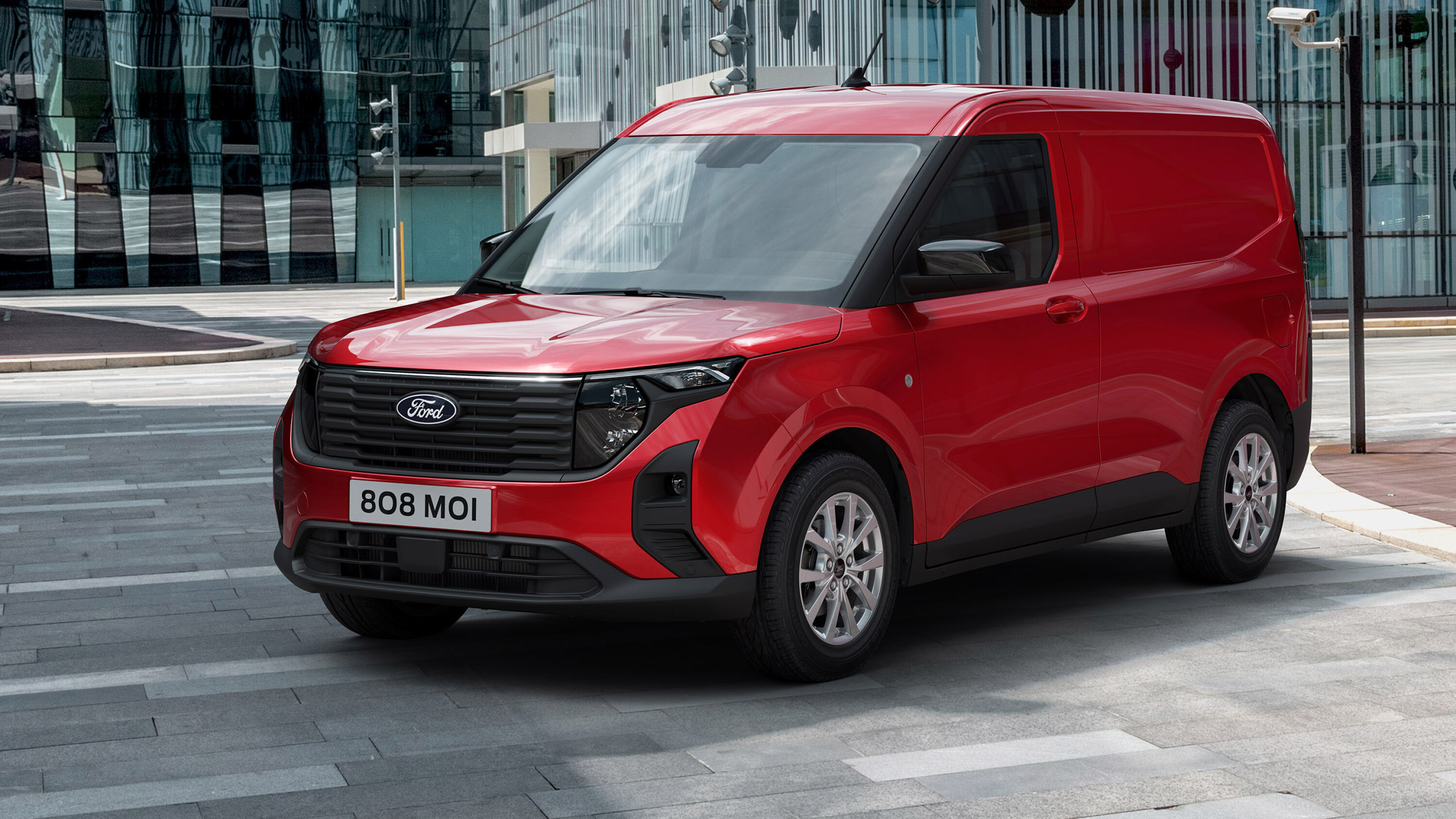
The Ford Transit Courier will still be available with traditional combustion engines, swapping the E-Transit’s front LED light bar and diamond grille for a more conventional look.
A 1.0-litre EcoBoost petrol or 1.5-litre EcoBlue diesel engine can be had with varying power tunes in Europe. They’re matched with a six-speed manual transmission as standard, with a new seven-speed dual-clutch automatic available.
For Europe, it will be available in late 2023, ahead of the electric E-Transit.
1
Will the Ford E-Transit Courier come to Australia?
The Ford E-Transit Courier will enter production later in 2024 at the company’s Romanian factory – which will be the same source for the forthcoming Puma EV.
A Ford Australia spokesperson told Wheels that it has “no news to share about any plans” to introduce the E-Transit Courier.
However, the local arm promised in 2021 to bring at least five electrified models by 2024, with the full-size Ford E-Transit landing later this month and the all-new medium E-Transit Custom van confirmed for next year.
It’s already launched the Ford Escape plug-in hybrid medium SUV and the Mustang Mach-E electric SUV will arrive later this year to directly compete with the popular Tesla Model Y, Kia EV6, and Volkswagen ID.4.
This leaves only one electrified Ford model still to be confirmed for Australia.
MORE
Everything Ford
Advice
Australia’s best electric cars for 2023
We’ve tested nearly every EV below six figures in Australia to rank the best on sale today
⚡ More EV stories to help you choose the best car for your needs
Sometimes it takes two or three looks at a range of cars before you really get a feel for which one is best.
That’s because some cars are just so good, you’re not making a mistake in buying any one of the range.
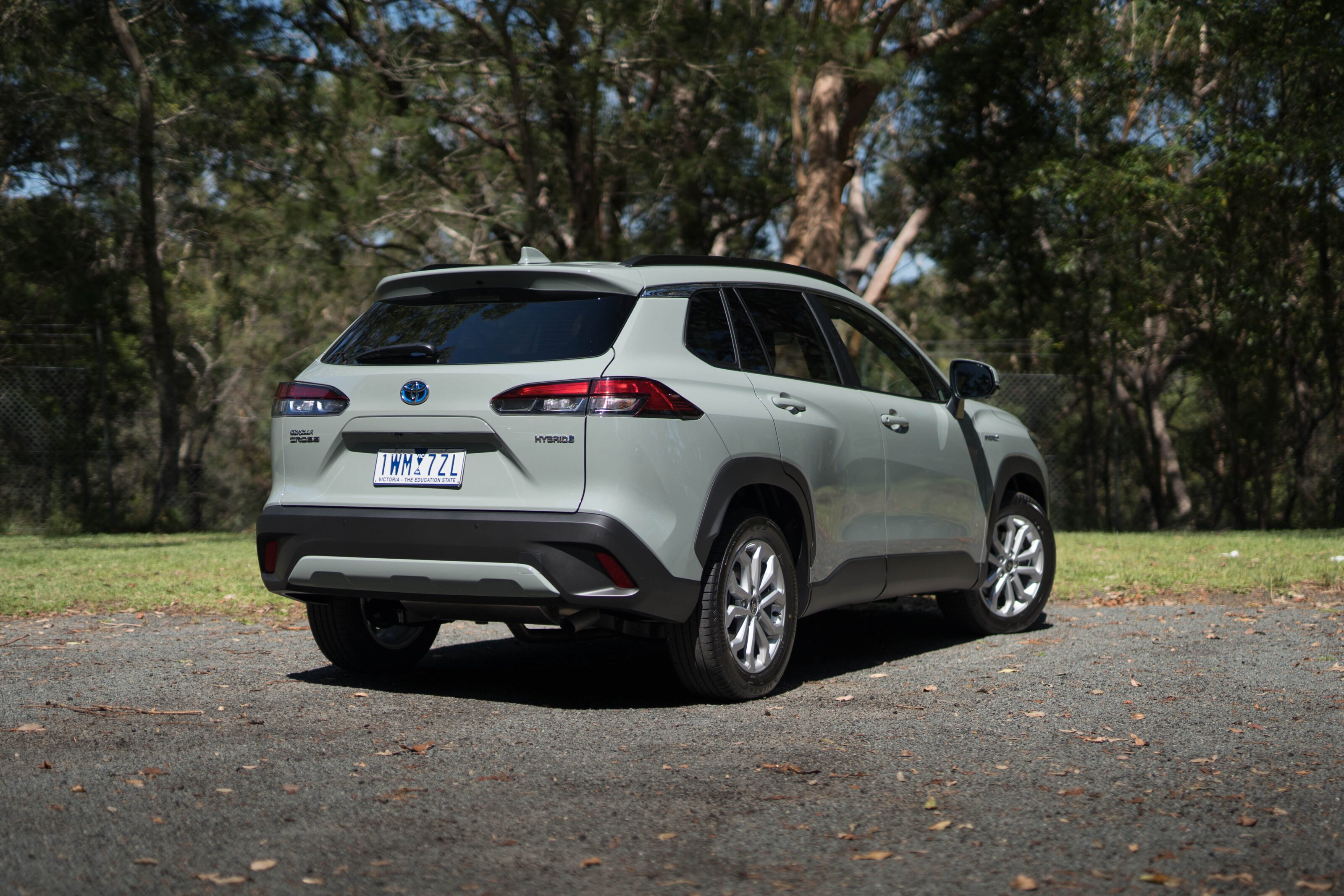
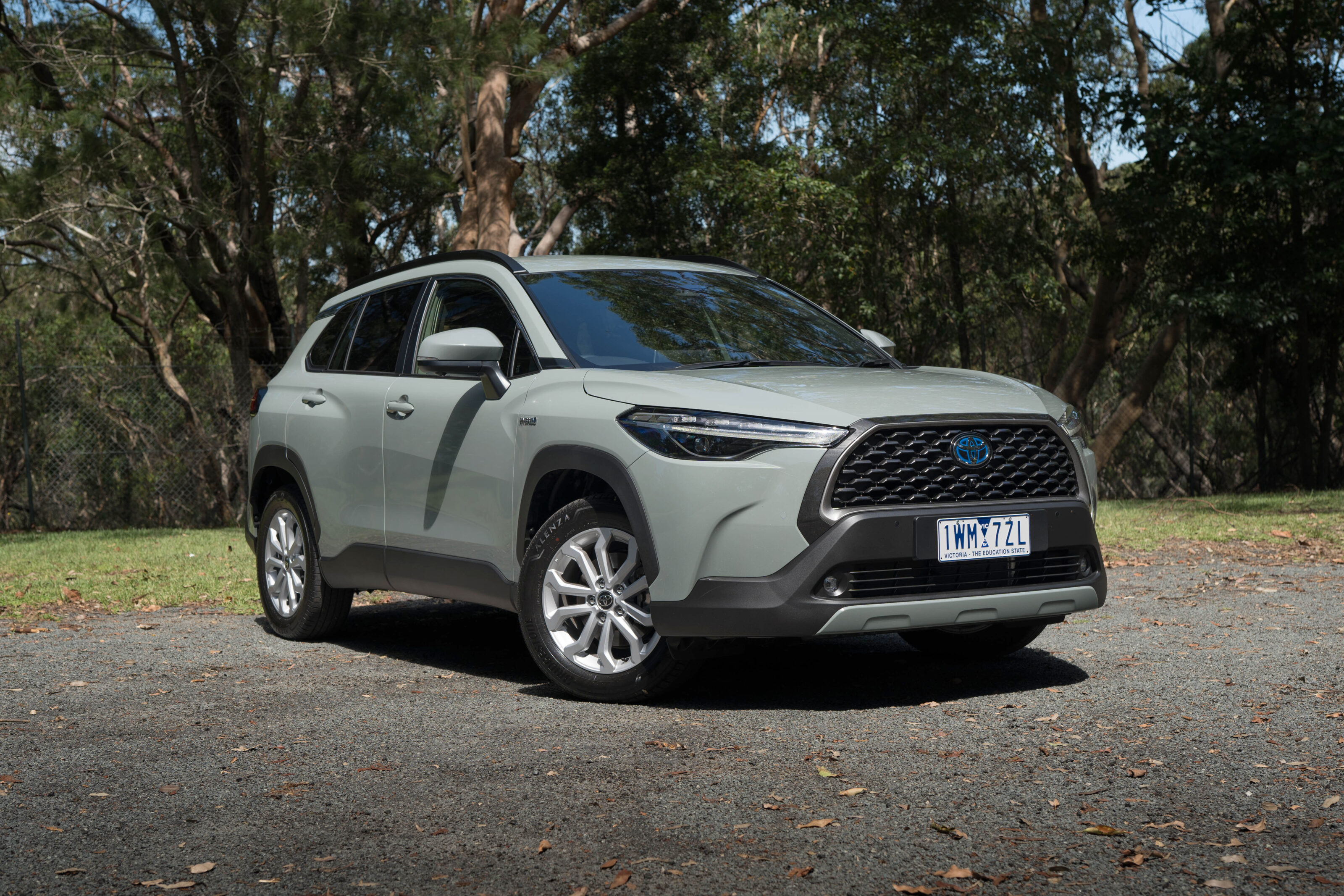
The Corolla Cross range is a case in point. You can get a front-wheel drive petrol one that’s rather slow but is otherwise a really good car in all variants. There’s a genuine reason to buy each over another so you need your wits about you.
I had a sneaking suspicion, however, that while my colleagues said the GXL hybrid with front-wheel drive is all the Corolla Cross you’ll ever need, I wasn’t so sure. I know hardly anyone really needs all-wheel drive but there was something about the GXL E-Four that kept nagging at me. So I went back and had another go to see if they were right and I was wrong.
1
JUMP AHEAD
- How much is it, and what do you get?
- How do rivals compare on value?
- Interior comfort, space and storage
- What is it like to drive?
- How much fuel does it use?
- How safe is it?
- Warranty and running costs
- VERDICT
- Specifications
How much is it, and what do you get?
The GXL grade sits in the middle of the three-tier Corolla Cross range.
You can have a 2.0-litre petrol ($36,750), GXL front-wheel drive hybrid ($39,250), or the GXL hybrid E-Four all-wheel-drive for $42,250
| 2023 Toyota Corolla Cross GXL features | |
|---|---|
| 17-inch alloy wheels | Fake leather interior |
| Six-speaker stereo | Part digital dashboard |
| Front and rear parking sensors | Powered, heated and folding rear vision mirrors |
| Reversing camera | Tyre repair kit |
| Keyless entry and start | 10.5-inch touchscreen |
| Dual-zone climate control | Sat nav |
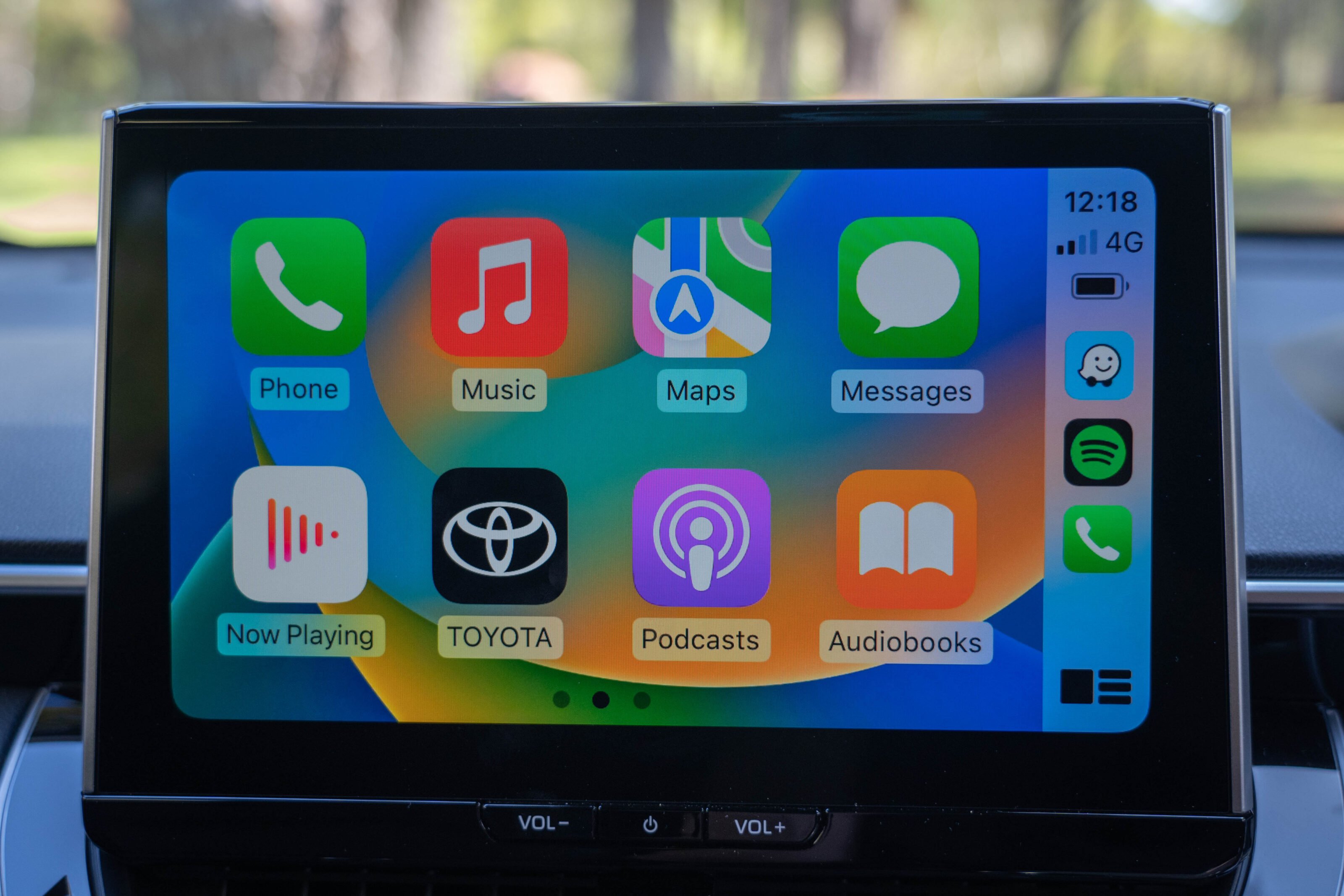
| Leather steering wheel | Wireless Apple CarPlay |
| Automatic LED headlights | Android Auto (wired) |
| Power windows front and rear | Toyota Connected Services |
| Adaptive cruise control | Digital DAB radio |
1
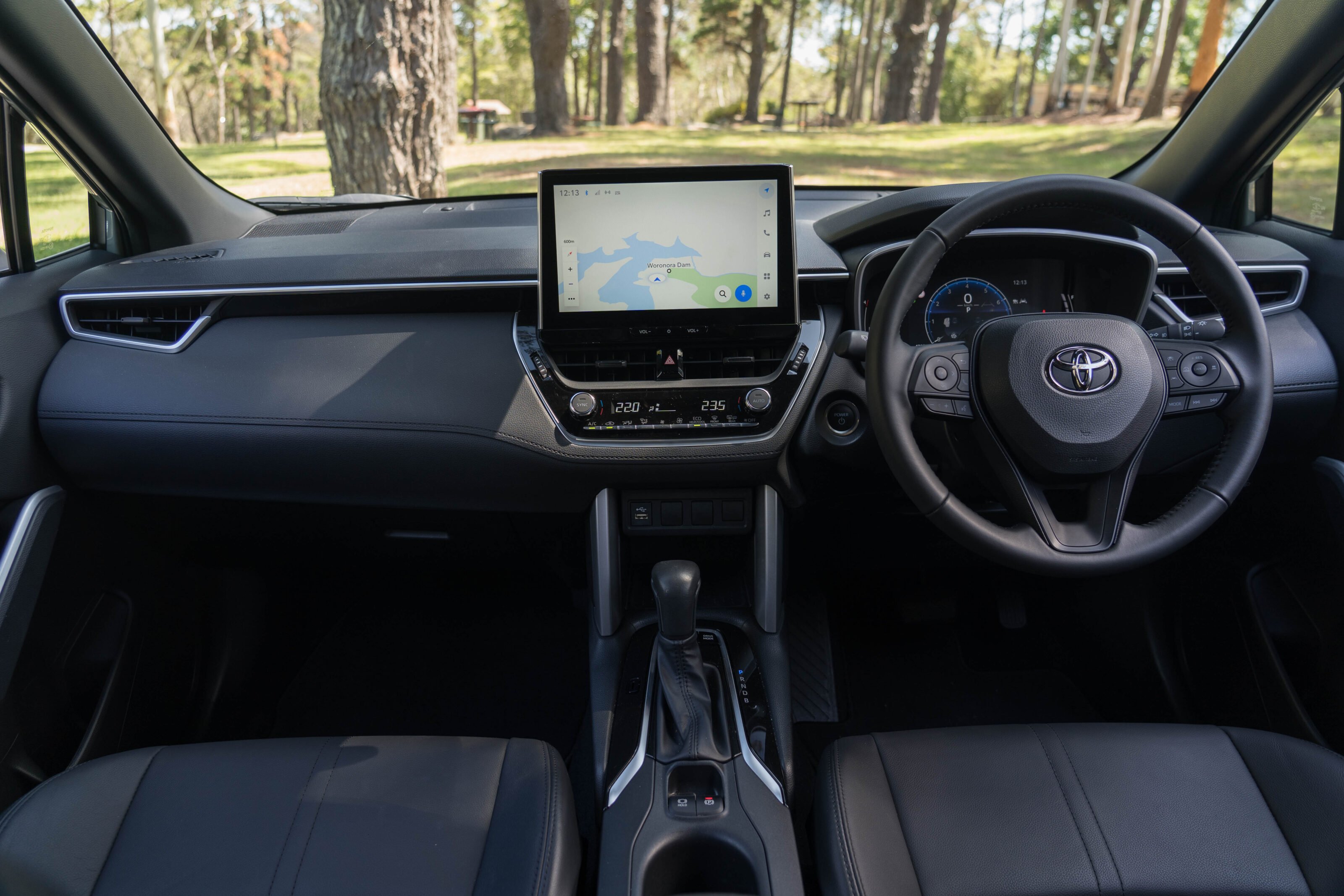
Toyota’s new media system is present and correct on the new, big touchscreen and it also comes with Toyota Connected Services. You get a year’s complimentary subscription to both halves of the two-tier feature set.
The first set is a bunch of remote connectivity bits and pieces including locking and unlocking. The second tier relates to voice control (Hey Toyota!) type stuff and is also a layer of extra services on the sat-nav.
Most of the latter is doable on your phone so it’s a bit baffling why you’d pay for it, in this case, more than $200 per year for the whole lot.
1
How do rivals compare on value?
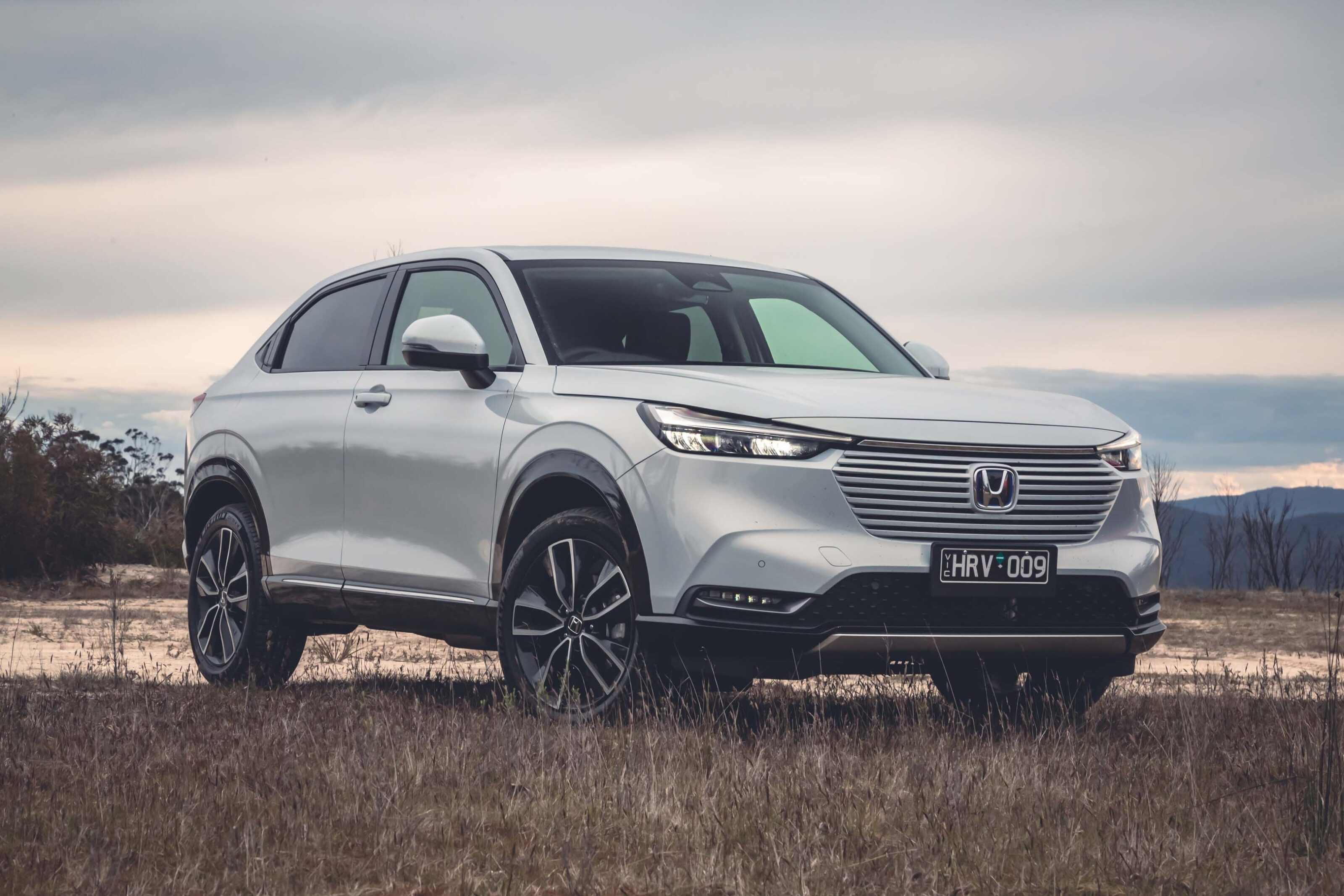
A Honda HR-V e:HEV L is a jumble of letters you can drive away for $47,000.
The HR-V is a really nice car, but it doesn’t have either all-wheel drive or the kind of power and performance either the two- or all-wheel drive Corolla Cross hybrids have. It’s got a much nicer interior, but it’s limited to four seats due to the usual arcane ADR constraints around top-tether anchor points.
You can have a Haval Jolion hybrid for either $36,990 (Lux) or $40,990 (Ultra hybrid) – both drive-away – with its intensely whacky hybrid system that really does go. It isn’t available with all-wheel drive though, and bits of it could do with more work. It is very roomy, however, and the price is pretty good.
But if you want an AWD hybrid, it’s Toyota or bust.
1
Interior comfort, space and storage
The Corolla Cross cabin is reasonably – if not lavishly – roomy.
Given this GXL is middle of the range, there are still way too many blanks scattered around the dashboard. It lets down a cabin that seems strangely less good-looking than the one in the Corolla hatch despite being largely the same.
It does feature better rear-seat accommodation than the hatch though, but not by as much as its chunky-boi exterior might suggest. When you’re in the same class as Honda’s HR-V and Kia’s Seltos – not to mention the Haval Jolion which also comes as a hybrid – you need to deliver a bit more space.
1
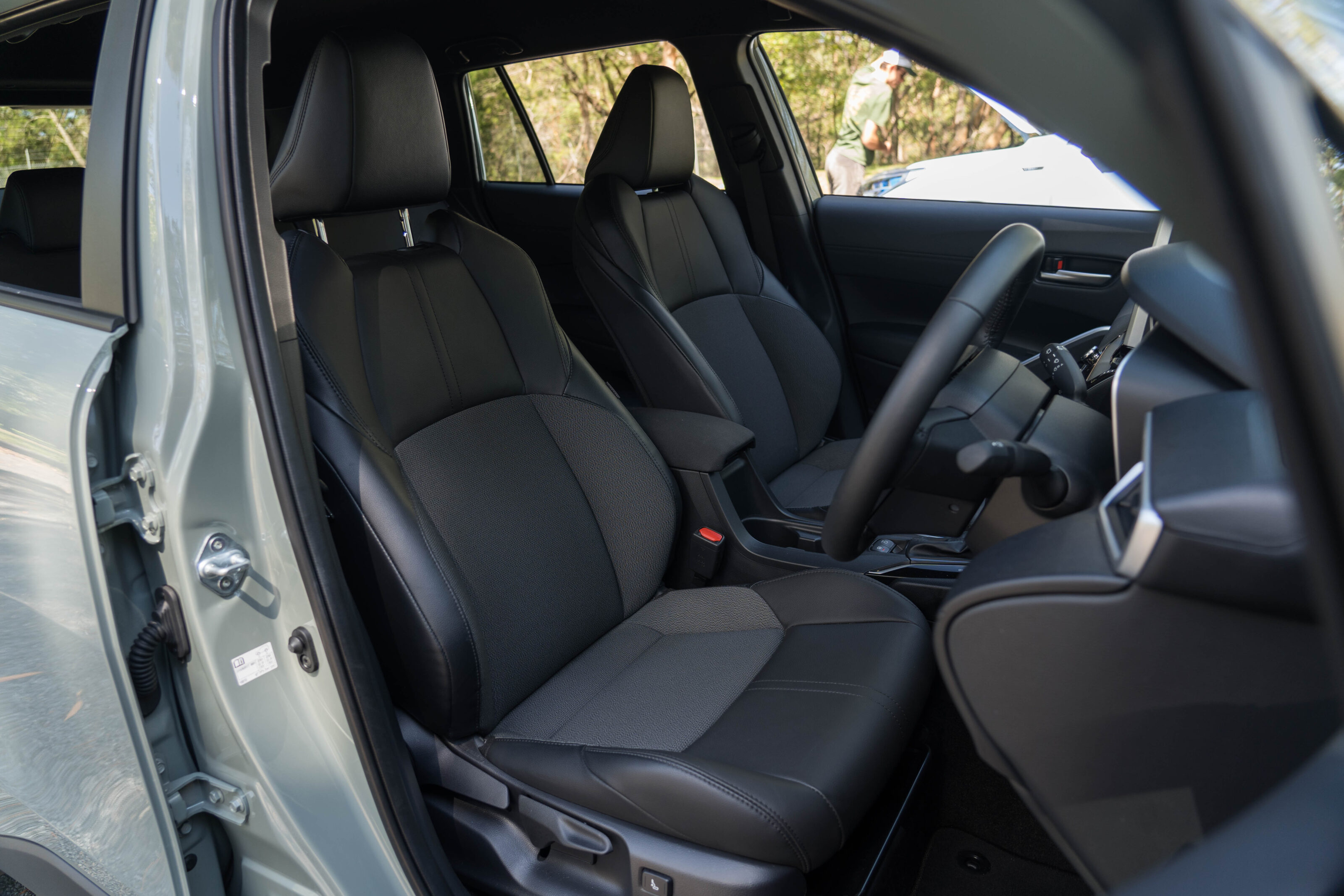
The back seat is comfortable, though, with air vents, two USB-C ports for charging and plenty of headroom and shoulder room. The windows are reasonably big, too, with good vision out compared to some.
The front seats are excellent – they look good and are very comfortable, although at this price could do with some electrical adjustment. The dodgy-looking blanks are – thankfully – not in your eye line, but the larger new and improved touchscreen is, almost dominatingly so.
1
What is it like to drive?
Straight out of the gate, the E-Four feels really strong. You don’t get the torque steer of the front-wheel drive, just a lovely, smooth and linear power delivery.
It’s remarkably quick for a non-performance car, too, walloping pretty much everything in the benchmark (if meaningless) 0-100km/h sprint.
| 2023 Toyota Corolla Cross GXL E-Four hybrid drivetrain | |
|---|---|
| Drive | all-wheel drive |
| Power | 113kW @ 6000rpm |
| Torque | 190Nm @ 4400-5200rpm |
| Electric motor | Front and rear |
| Electric power and torque | 83kW/206Nm front / 30kW/84Nm rear |
| Combined power | 146kW |
| Combined torque | NA |
| Battery | lithium-ion |
| Transmission | continuously variable |
Like its RAV4 E-Four sibling, the Cross has a familiar hybrid system up front to run the front wheels with 113kW/190Nm from the engine and 83kW/206Nm from the electric motor.
The rear motor adds 30kW and 84Nm to the party for a system total of 146kW. Toyota won’t say what the total torque figure is, but it’s rather more than the ICE’s 190Nm, hence the healthy acceleration figures.
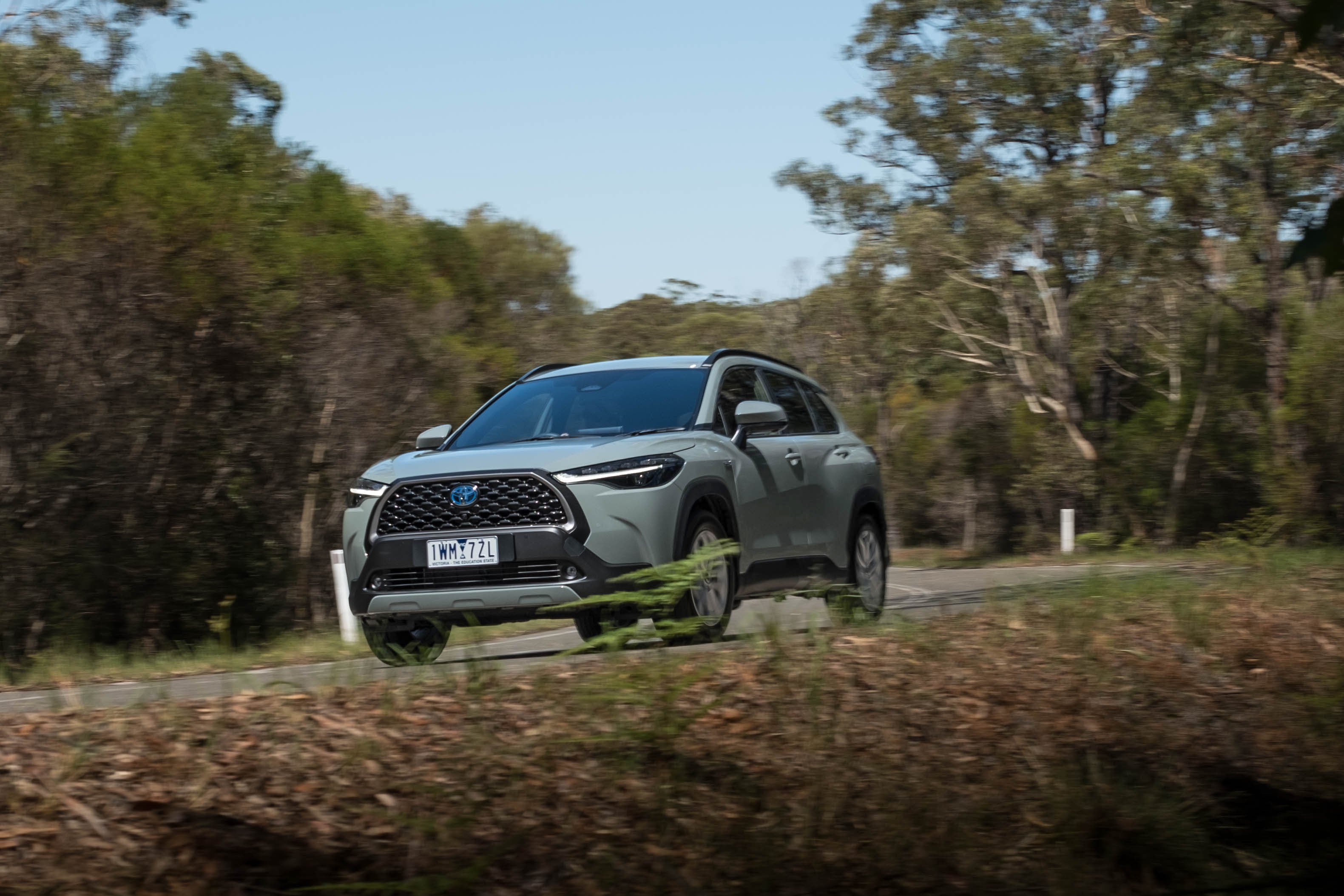
Those numbers translate to impressive on-road performance too, with a relaxed highway cruising vibe and effortless overtaking.
1
It does things you wouldn’t consider in the petrol-only version and handily outpunches the front-driver in the same places.
Another big ticket item is the switch to a multi-link rear suspension. The front-wheel drive cars make do with a torsion beam set-up and it’s not until you go for a ride in one of these that you realise how much nicer it is. The torsion beam cars are fine, but the multi-link not only smoothes out the ride but makes the whole experience much better.
It’s happier over bumps, particularly when the rears go over them or into potholes and it’s just a more pleasant place to be for a long haul. While I really like the extra grunt, I really, really like the more capable and better-sorted chassis.
Lumpy back roads are dealt with much better, too, with a more surefooted feel and more comfort to boot.
Comparisons
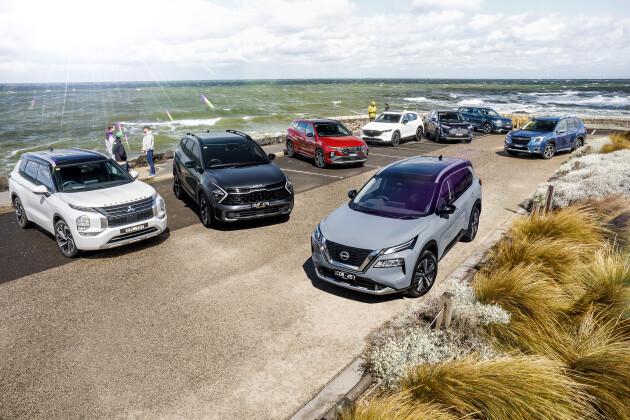
Medium SUV comparison: 2023 Mega Test
Thinking of buying a new mid-size SUV this year? We test eight of the best and most popular contenders to see where you should spend your money
How is it on fuel?
Despite lugging an additional electric motor around, the official combined cycle figure of 4.4L/100km is just 0.1L higher than the FWD.
That also translated into a real-world difference of 0.1L/100km at the pump which, incidentally, matched the trip computer.
| 2023 Toyota Corolla Cross GXL E-Four hybrid fuel economy | |
|---|---|
| Fuel economy (claimed) | 4.4L/100km |
| Fuel economy (trip computer) | 5.4L/100km |
| Fuel economy (at the pump) | 5.4L/100km |
| Fuel type | 91 RON unleaded |
| Fuel tank capacity | 43 litres |
1
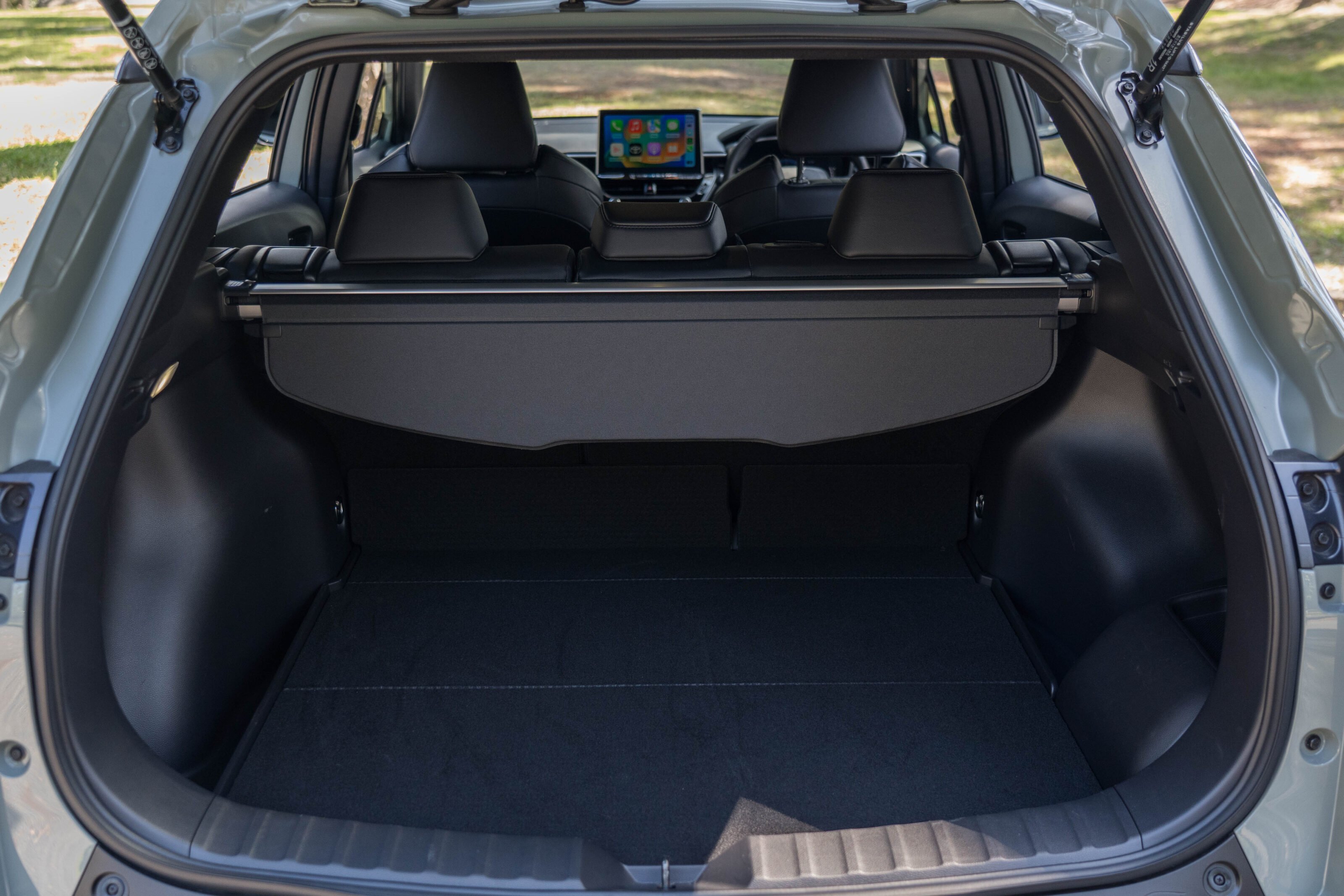
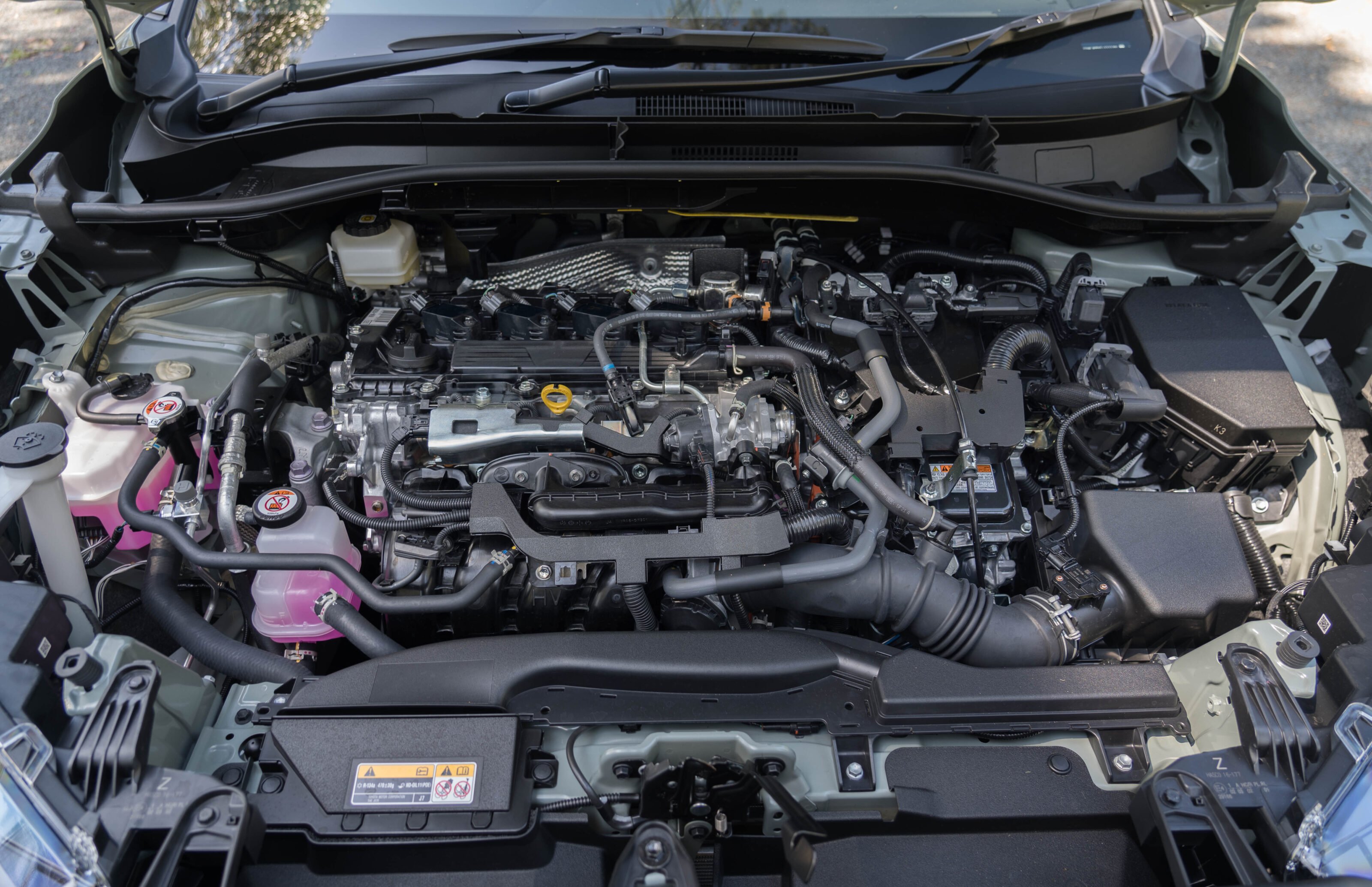
The 43-litre fuel tank is larger than the front-wheel drive’s piffling 36-litre capacity, pushing the theoretical range to nearly 800km between fills, but there’s no spare tyre.
When you pop the boot, lift the floor and the huge foam filler piece underneath (which holds the tools and tyre repair kit), there is what looks like enough space for a space-saver if the fairly amateurish-looking power connector for the rear motor was a bit more tidily installed.
How safe is it?
The Corolla Cross scored a five-star ANCAP rating in November 2022.
One of the many airbags is a front-centre item designed to prevent head clashes in a side impact.
The forward auto emergency braking (AEB) features daytime pedestrian and cyclist detection as well as operating at city and highway speeds.
There are two lots of ISOFIX points and three top tether anchors in the back seat.
| 2023 Toyota Corolla Cross GXL E-Four hybrid safety features | |
|---|---|
| 8 airbags | Front cross-traffic alert |
| ABS | Lane departure warning |
| Around-view camera | Lane-keep assist |
| Blind-spot monitoring | Rear cross-traffic alert |
| Driver attention monitor | Reverse AEB (low-speed) |
| Forward AEB (high and low speed) | Safe exit warning |
| Forward collision warning | Stability and traction controls |
1
Warranty and running costs
As with all Toyotas, a five-year, unlimited-kilometre warranty is applied to the Corolla Cross.
Service with Toyota and you get an extra two years on the driveline as well as the eight-year battery warranty.
Capped-price servicing covers the first five intervals and costs $250 a go, $5 more than the hybrid hatch. That’s an average of $1250 over five services, which is, by market standards, cheap.
Prices have risen by $25 per service since the car’s October 2022 launch. Service intervals are set at 12 months or 15,000km which is a little on the short side but not shockingly so.
If you like the Toyota Connected Services features and want to keep them after the first 12 months, you’ll have to pay $9.95 per month for remote connectivity to locking, engine start and climate control. If you want to keep the fancy sat-nav features, that’s another $12.50 per month.
The feature set shrinks if you don’t pay, but the sat-nav remains operable in a basic and still very usable form.
1
VERDICT
While not many people buy all-wheel drive versions of the Corolla Cross, there is a genuine reason for the extra three grand.
With extra oomph and a better chassis courtesy of the more advanced rear suspension, you are looking at a better car than the front-drive versions.
It’s refined, quiet and well-balanced. It’s punchy and fun to drive but sacrifices none of the good bits of hybrid ownership to make it that way. I just wish it didn’t have that bluff schnozz on it.
Am I convinced it’s the best Corolla Cross to buy? I reckon it is. But, as ever, you’ll all have your own opinions.
MORE
Everything Toyota
MORE
Small SUVs
| 2023 Toyota Corolla Cross GXL E-Four hybrid specifications | |
|---|---|
| Body: | 5-door, 5-seat small SUV |
| Drive: | all-wheel |
| Electric motor | front and rear |
| Power | 113kW @ 6000rpm |
| Torque | 190Nm @ 4400-5200rpm |
| Electric power and torque | 83kW/206Nm front / 30kW/84Nm rear |
| Combined power | 146kW |
| Combined torque | NA |
| Battery | lithium-ion |
| Transmission | continuously variable |
| 0-100km/h: | 7.5 seconds (claimed) |
| Fuel consumption: | 4.4L/100km |
| Weight: | 1545kg |
| Suspension: | MacPherson struts front/trailing arms rear |
| L/W/H: | 4460/1825/1620 |
| Wheelbase: | 2640mm |
| Brakes: | 305mm ventilated discs front/281m solid discs rear |
| Tyres: | 215/60 R17 Bridgestone Alenza |
| Wheels: | 17-inch alloy (no spare) |
| Price: | $42,250 + on-road costs |
If there’s anything more reliable than ill-advised decisions around buying cars, it’s that there’s someone else ready to do the exact same thing after you. This powers the whole enthusiast vehicle economy
On two occasions, I’ve bought a 30-year-old car sight-unseen from interstate.
Why?
Because when it comes to cars, my brain has developed a special bypass circuit around the rational, logical bit that I otherwise depend on to make every other decision in my life. (It’s true, he’s a bit boring if not for the cars – Ed.)
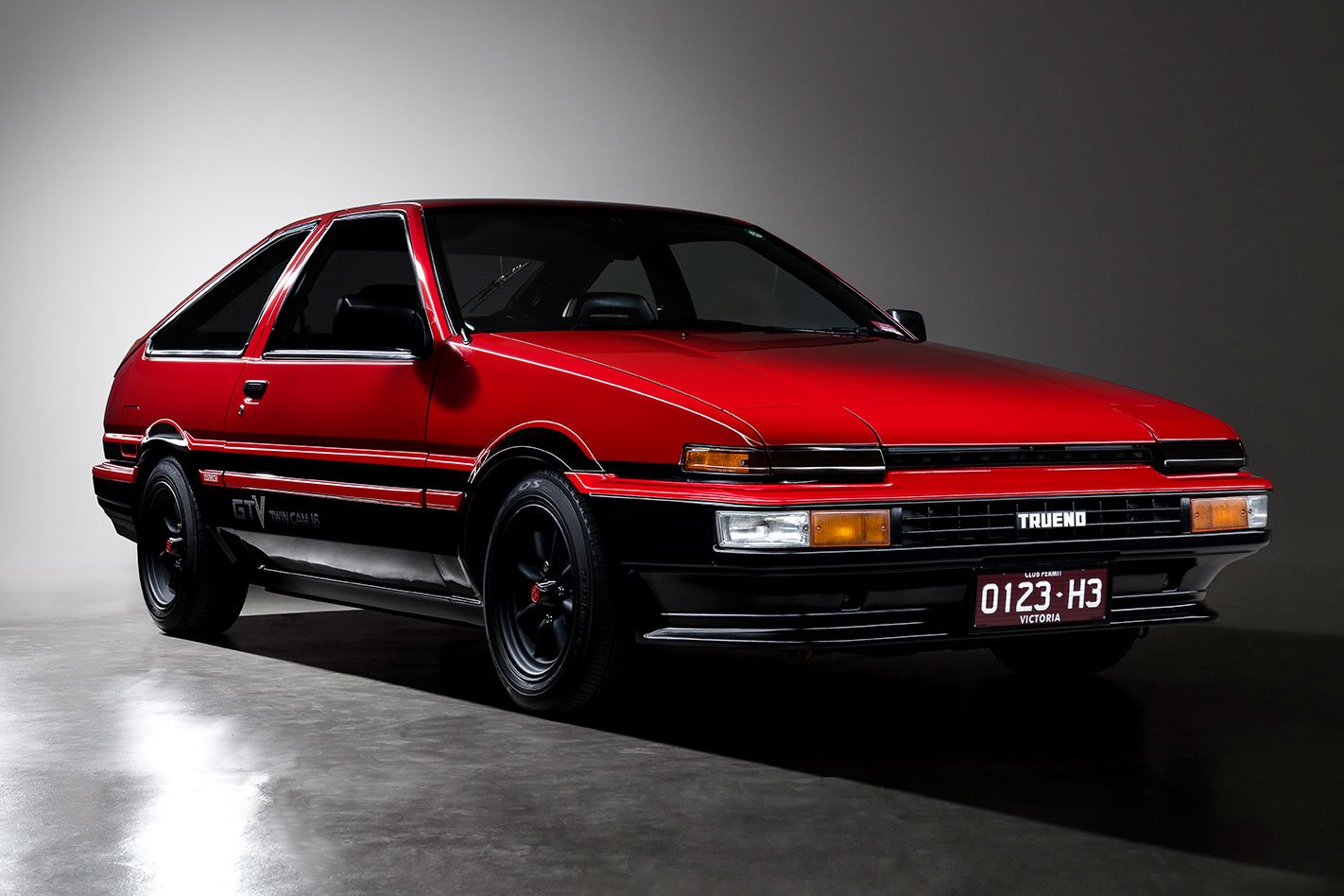
1
The first was a 1984 Toyota AE86 Sprinter with about 240,000km on the clock. That’s it, above. How it looks now.
They don’t come up for sale often, and when it did, I was helplessly tossed about by waves of impulsiveness that dragged me out into the straits of Bad Decisions, where my ability to make sound judgements was reduced from that of a toddler to that of, at best, a parrot.
“Just transfer me the $5000 and I’ll meet you at the airport with the car,” said the voice on the phone. I’d read horror stories of people transferring large sums for car deposits to interstate buyers, only for them to disappear completely…
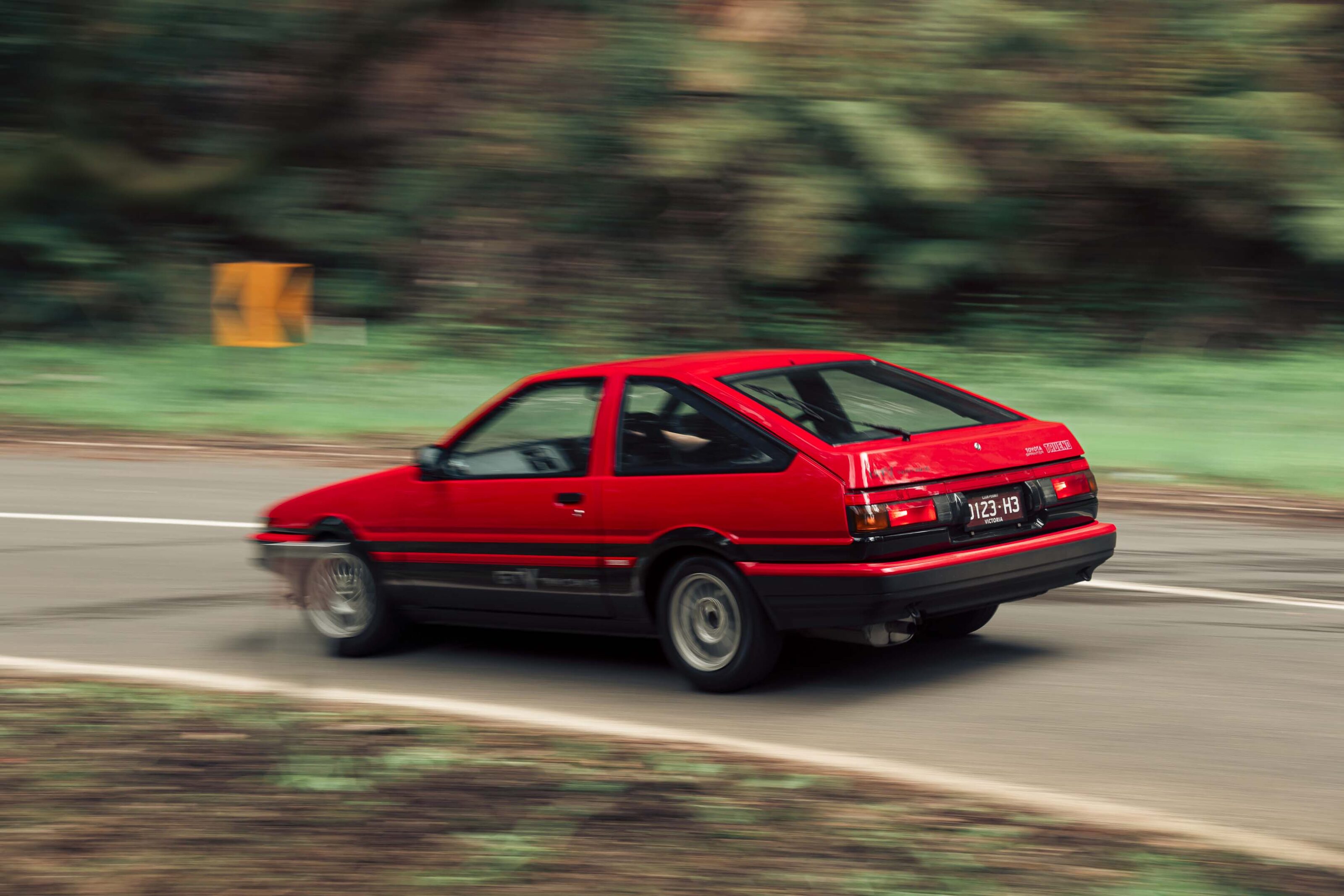
1
Armed with these instructions and dismissing my fears, I hit submit in the Commbank app and booked my flight.
Luckily, the car was there at Adelaide Airport and, even more luckily, it made it back to Melbourne.
There’s a lot to be said for having an interest in old Toyotas. Thank goodness I’m not irrationally titillated by old Alfa Romeos.
It turned out it had so much cancerous rust that if it was a person any doctor would have given it mere weeks to live, and it blew smoke like a 19th-century steam train.
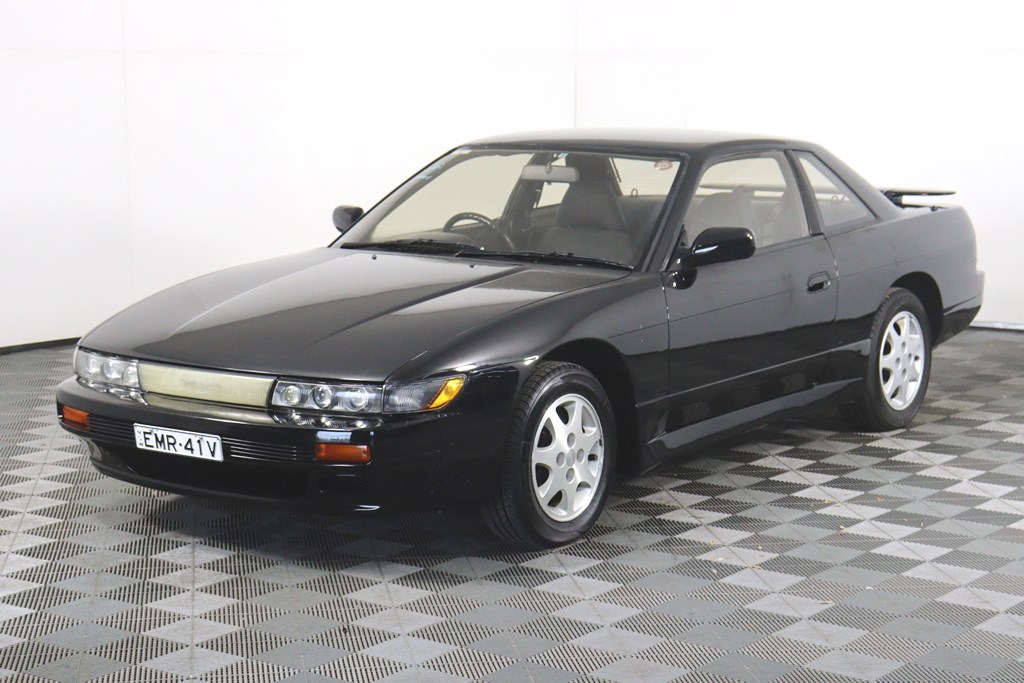
1
Then there was the time I bought a turbocharged S13 Nissan Silvia – a ‘race only’ import that couldn’t be registered.
I had nowhere to store it, no way of getting it and, private property aside, nowhere to drive it.
For some reason, all of this only occurred to me the day before I was due to collect it, and after I had transferred the full payment. I spent a full morning summoning the courage to call the dealership to try to back out of the sale.
“Nyet, we vill not refund your money, and you must collect ze car tomorrow,” an Eastern European accent scowled down the phone line.
And so, terrified of ending up in a bridge pylon somewhere, or in a sausage roll at a Siberian bakery, I sourced a tow vehicle, a trailer, and did as ordered.
They say you’re allowed to make mistakes once, so long as you learn from them. I guess I just love learning. You might be thinking I’m a fool – and, when it comes to my life in cars, you’d be mostly correct.
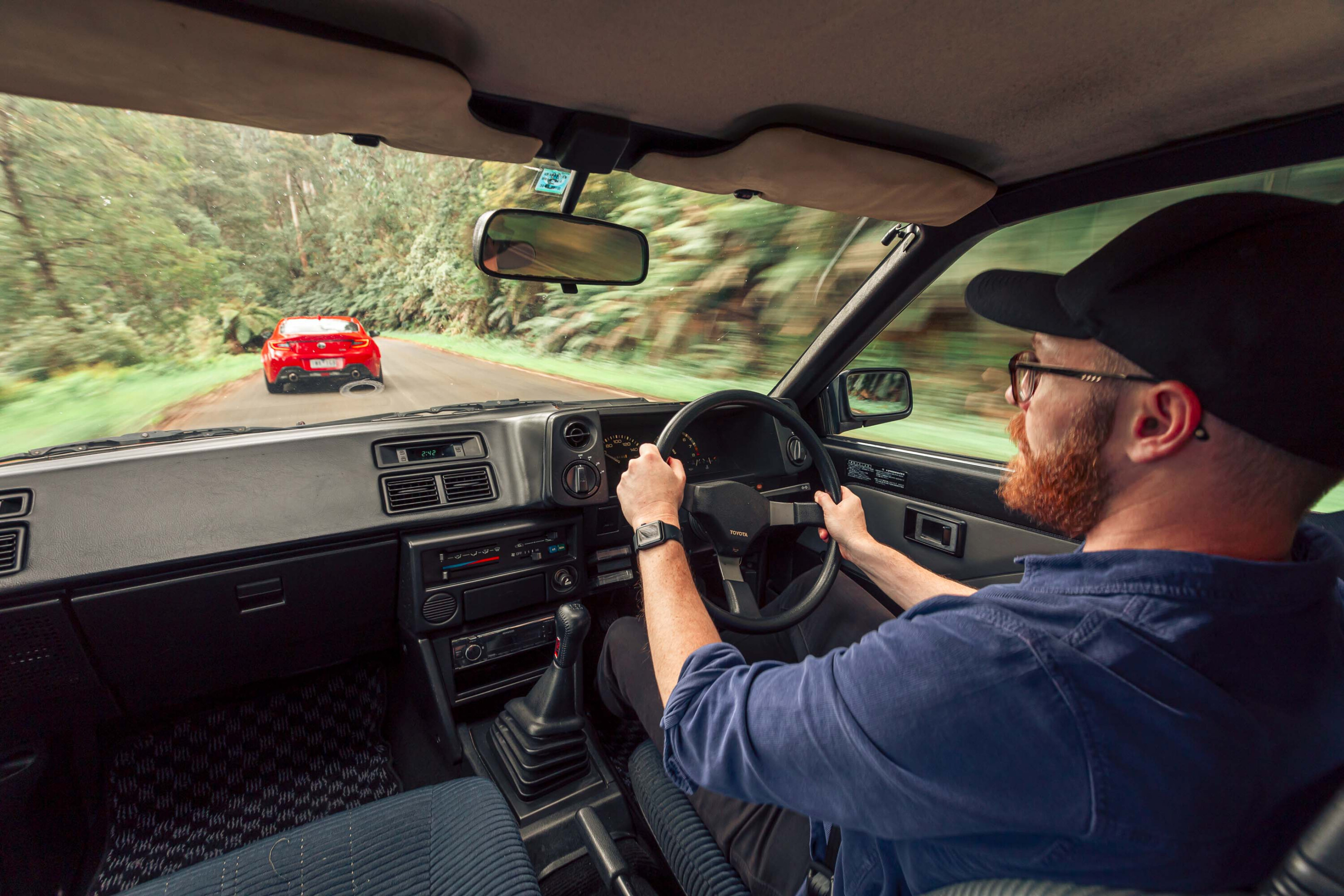
1
But it was Mark Twain who said you can’t reason with your heart. “It has its own laws, and thumps about things which the intellect scorns.”
If you only listened to your head, you’d be driving a 2005 Toyota Camry and drinking nothing but nutritionally optimised gruel.
And if there’s anything more reliable than making ill-advised decisions when it comes to buying cars, it’s that there’s someone else out there ready to do the exact same thing after you. This powers the whole enthusiast vehicle economy.

Broken brain
The first AE86 I bought, I sold within 24 hours to someone else reduced to breathing exclusively from the mouth at the sheer sight of a 30-year-old, rust-ridden Corolla.
Terrified of being dishonest in any way, I wrote a warts-and-all ad detailing every problem I knew, priced it slightly below market, and still had more than 50 enquiries within two hours – and made a small profit.
My second interstate, sight-unseen purchase was another Toyota AE86 Sprinter, and it’s the one I own now.
At the time, paying $22,000 for a cheaply built, 1986 Toyota was clear evidence that the wiring was all wrong upstairs. But today, it’s worth multiples of that, simply because there are plenty of others who share the same brain bypass circuit.
May it continue to function as intended.
MORE
Everything Toyota
Whether you’re looking for guidance on your next family hauler or it’s only power you’re after, the April 2023 issue of Wheels has you covered.
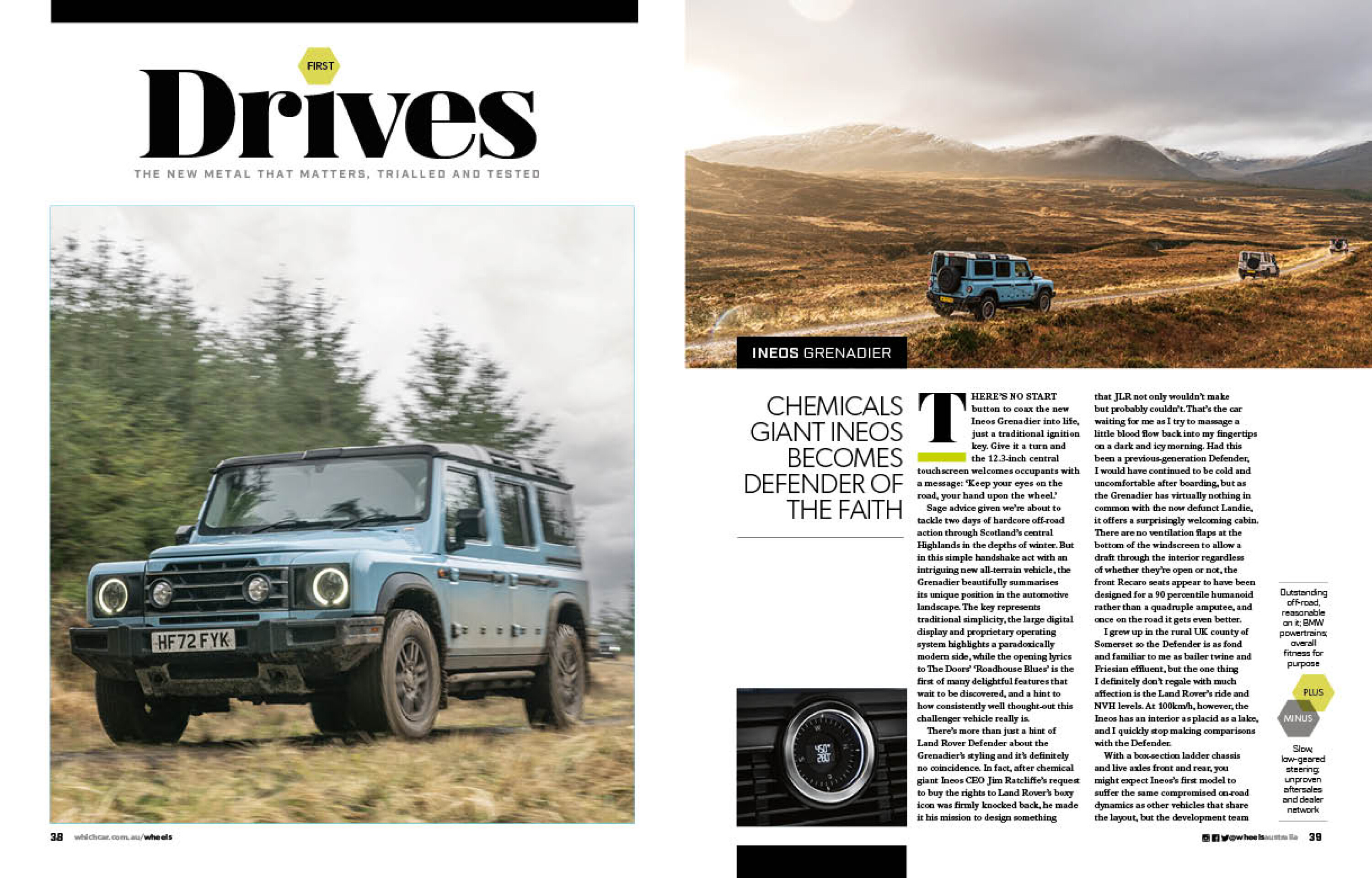
This month, we send Daniel Gardner to Scotland in winter – not because we dislike him, but because he gets to drive the new Ineos Grenadier.
Meanwhile, Andy Enright is dispatched to the Middle East to drive the car that vacated the Grenadier’s position, the long-wheelbase Land Rover Defender 130.
1
But, fear not – this issue’s not all about breakover angles and winch porn.
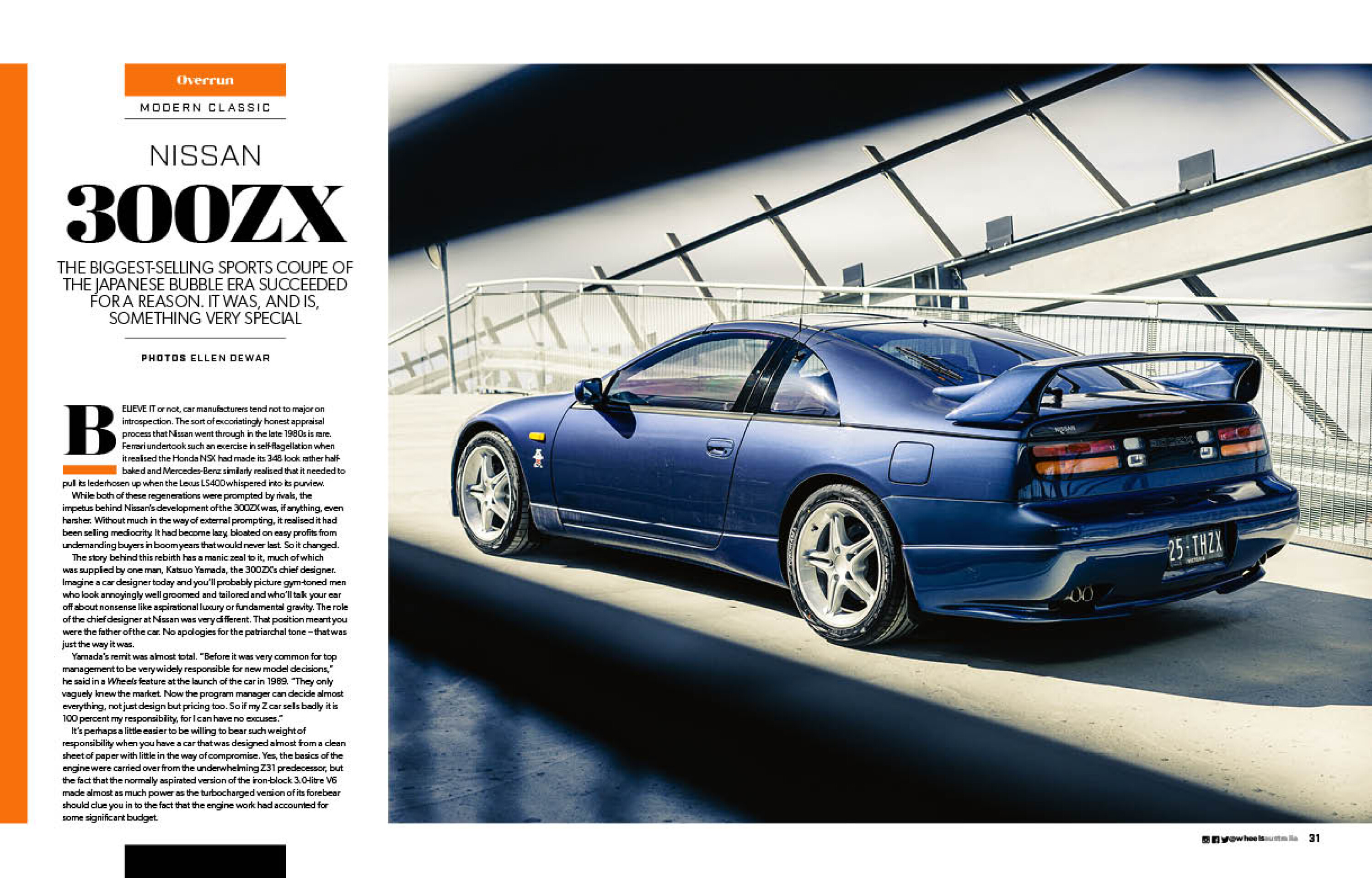
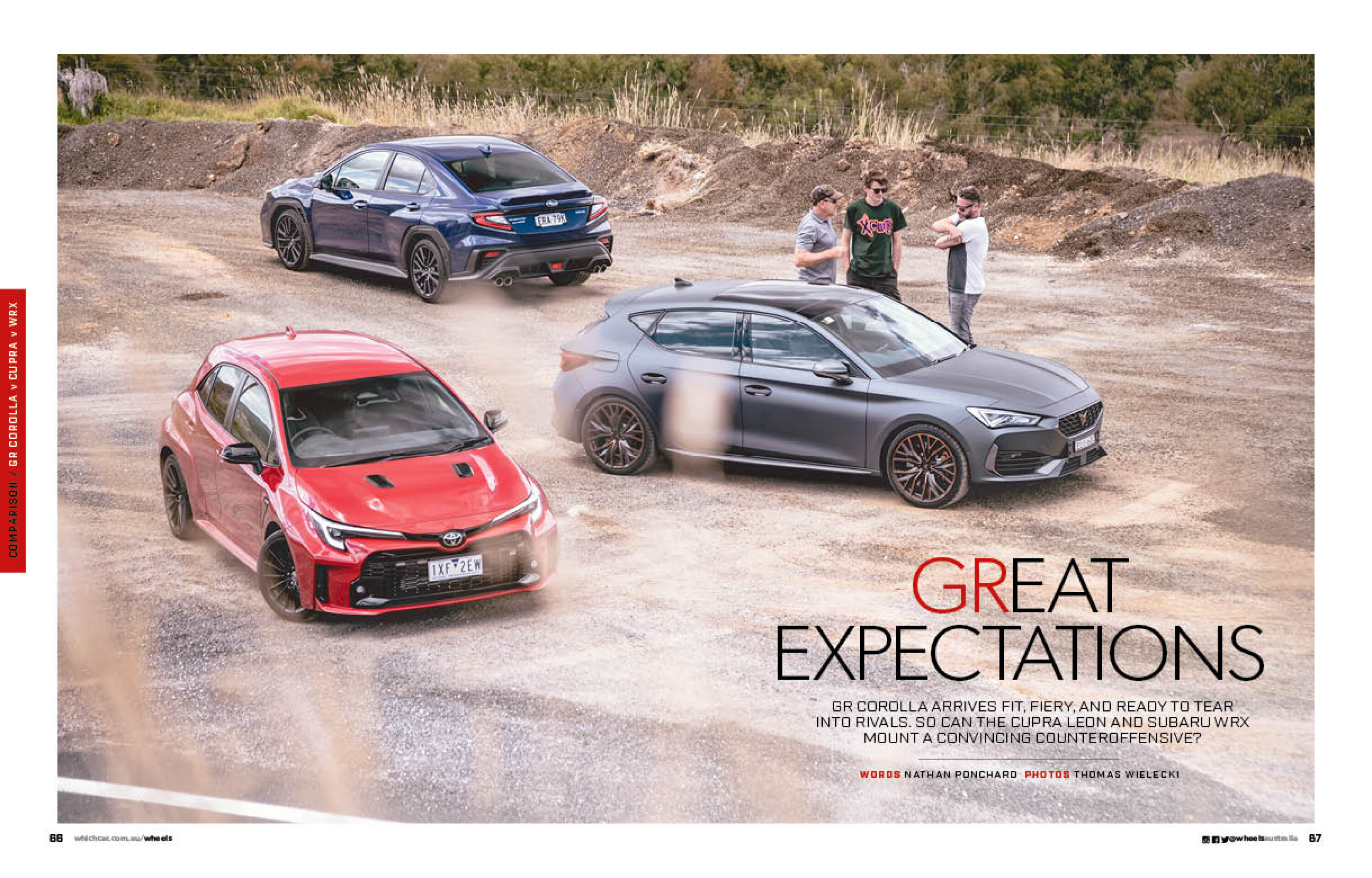
Johnny Law’s put the long-awaited Toyota Corolla GR up against the box-fresh Cupra Leon and the box-arched Subaru WRX while we bring you a Modern Classic feature on the beautiful Nissan 300 ZX Z32.
1
That’s on top of first drives of the Tesla Model Y Performance, the Chery Omoda 5, the GWM Ora and the Subaru Outback Turbo.
There’s also news of the Aussie-bound Ford Mustang Mach-E and the not-Aussie-bound Explorer
1
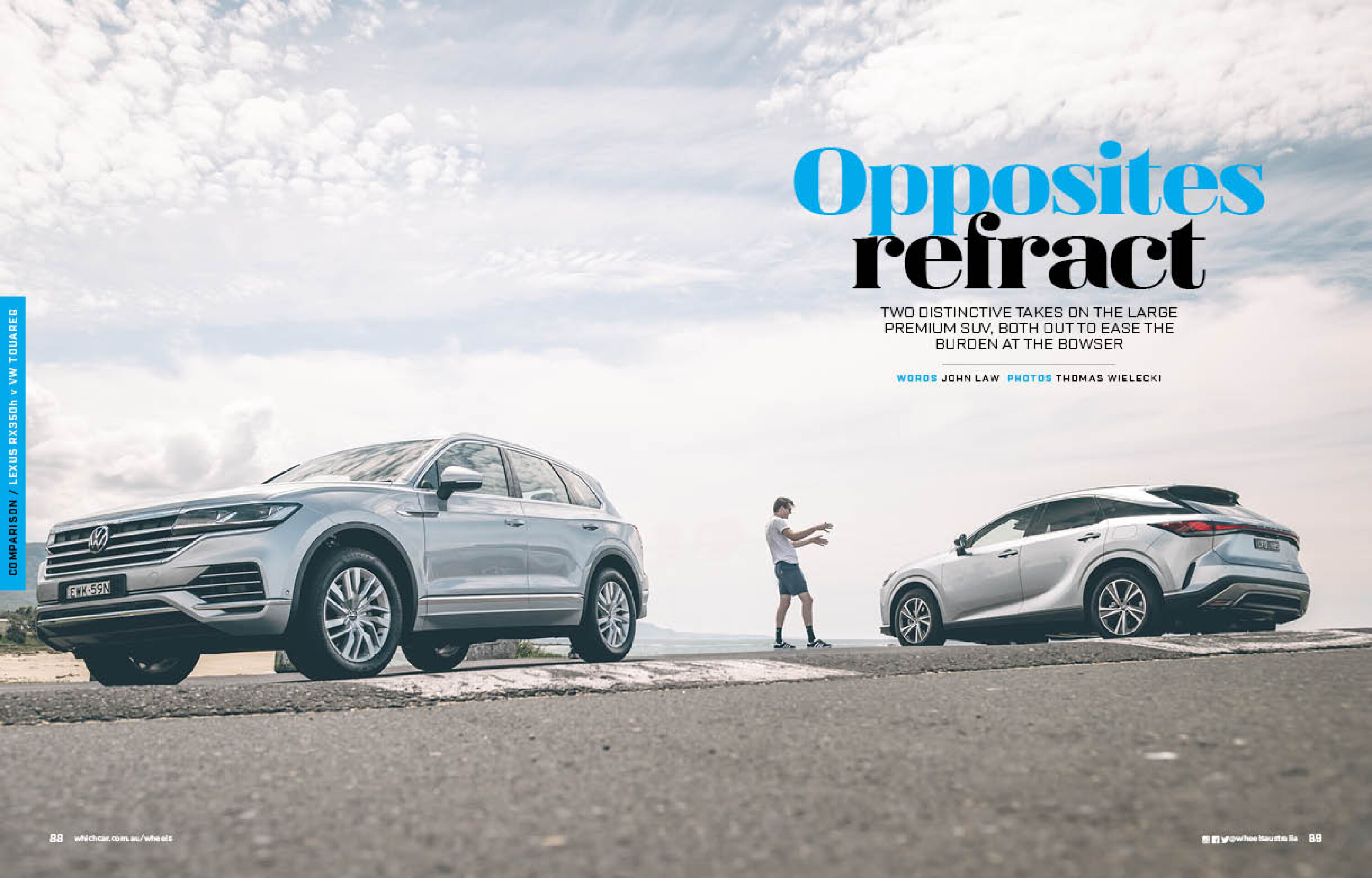
What’s more, we put the new Lexus RX350h up against the trusty Volkswagen Touareg TDI to see whether German diesel brawn beats Japanese hybrid tech.
The new Lamborghini V12, the end of Bentley’s W12, retro Corollas and all of your favourite columnists round out the April 2023 issue, on shelves from the 10th April.
Be quick, because this one will vanish fast.
1
Not yet a subscriber?
You can subscribe to Wheels magazine from only $59 and we’ll send you a copy of the current issue straight away.
Subscriber benefits
- Huge savings on the regular cover price
- Free delivery to your doorstep
- Free digital access
- Browse the entire Wheels archive back to 1953
- Exclusive benefits and discounts
Remember the maxim that more gears are better? Electric vehicles are… different.
Conventional combustion-engined vehicles mostly have upwards of six drive gear ratios today, while some older models could only have four or five – while newer transmissions may go up to 10. (So far, none have turned it up to 11… although Honda has a patent!)
But, most electric cars only have one gear – officially labelled a ‘single-speed transmission’ – so why is this the case?

1
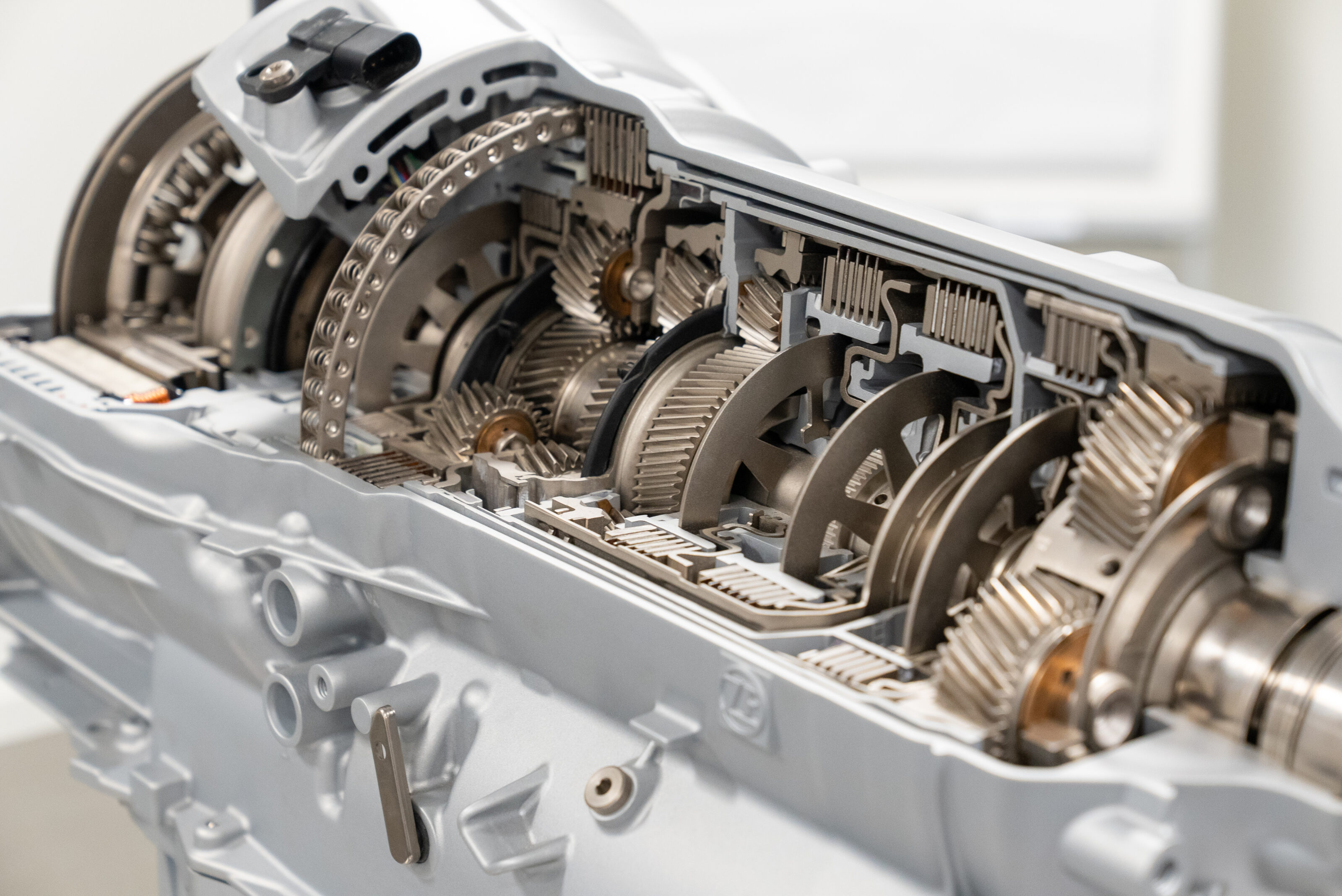
What are car gears?
Vehicle transmissions (or gearboxes) convert the power from the engine into momentum to drive the wheels.
Each combustion engine only delivers maximum power and torque within a limited revolutions-per-minute (rpm) range, and most reach their limit at a 6000 to 8000 rpm redline.
So, selecting the right gear will help achieve responsiveness or maximise efficiency, depending on the driving condition.
That’s why you or the car (manual and automatic transmissions respectively) will need to kick down a gear when climbing up a hill, whereas staying on the highest gear possible when travelling on the highway will improve fuel efficiency.
1
Why do EVs need a gear at all?
Unlike traditional engines, electric motors can provide maximum power and torque from just one rpm, with no limited power band, and can easily spin up to 10,000 to 20,000rpm.
As a result, EVs only require one gear and can provide instant acceleration response from pressing the pedal, without needing to wait for the transmission and engine to react.
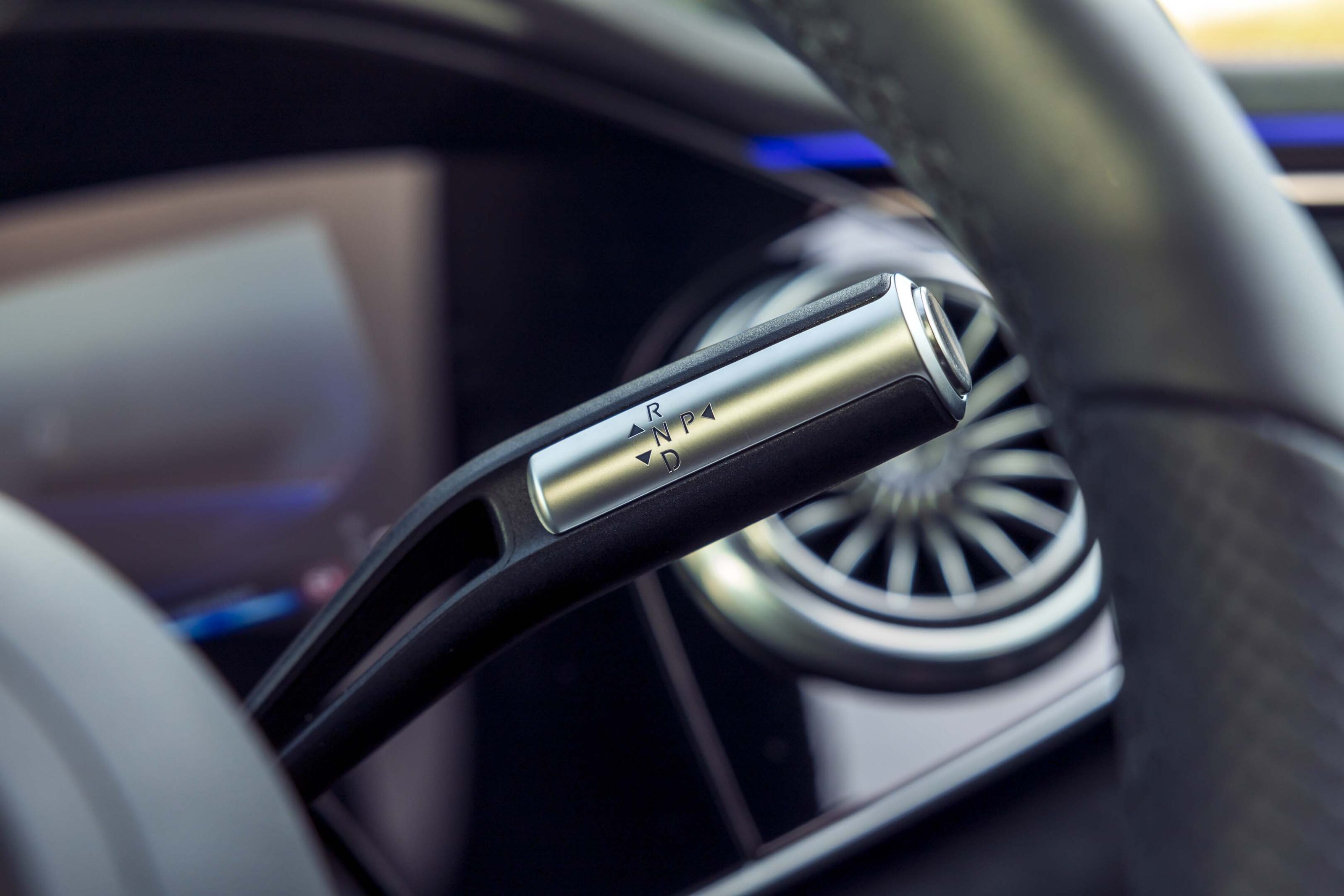
Meanwhile, some high-performance EV models such as the related Porsche Taycan and Audi E-Tron GT sports sedans employ a two-speed transmission for even faster acceleration from a standstill on a short first gear ratio, while ensuring better efficiency and more power at high speeds on a long second gear.
1
However, Tesla and Mercedes-AMG EVs, and the new Kia EV6 GT – among others – have proven that having more than one gear isn’t essential to rapidly reach high speeds.
For driving enthusiasts who lament the loss of the feeling of traditional gears, Lexus and Hyundai’s N division are developing technologies that mimic the feeling of traditional manual or dual-clutch transmissions respectively for their EVs.
Ultimately, the simplicity and flexibility of electric drivetrains theoretically means better reliability and reduced maintenance in the long-run, with only one or two gears and instant acceleration response to make driving more comfortable, seamless and easier.
⚡ More EV stories to help you choose the best car for your needs
January 25: New-look Sorento driven in Australia
Kia is absolutely sauntering right now, buoyed by a series of well-received new cars. Now there’s this, a worthy suite of updates for a class leader: the 2024 Kia Sorento.
July 2023: Kia Sorento facelift revealed
April 7: The facelifted 2024 Kia Sorento will arrive in Australia by the end of this year.
Snapshot
- 2024 Kia Sorento facelift due here by Christmas
- Updated large SUV imagined in our speculative renderings
- Kia Connect functionality confirmed for Australia
A spokesperson for Kia Australia confirmed the updated Sorento would be the brand’s next model to feature its Kia Connect technology, along with the all-electric EV9 large SUV.
As detailed here, the system will continue to be progressively rolled out in Australia with all-new models and mid-life facelifts, rather than general model-year updates – despite the addition of Hyundai’s Bluelink to minor MY23 spec bumps for the Tucson and Venue.
1
It is also limited to vehicles fitted with satellite navigation, suggesting the entry-level Sorento S will miss out on the technology, based on the current specification list.
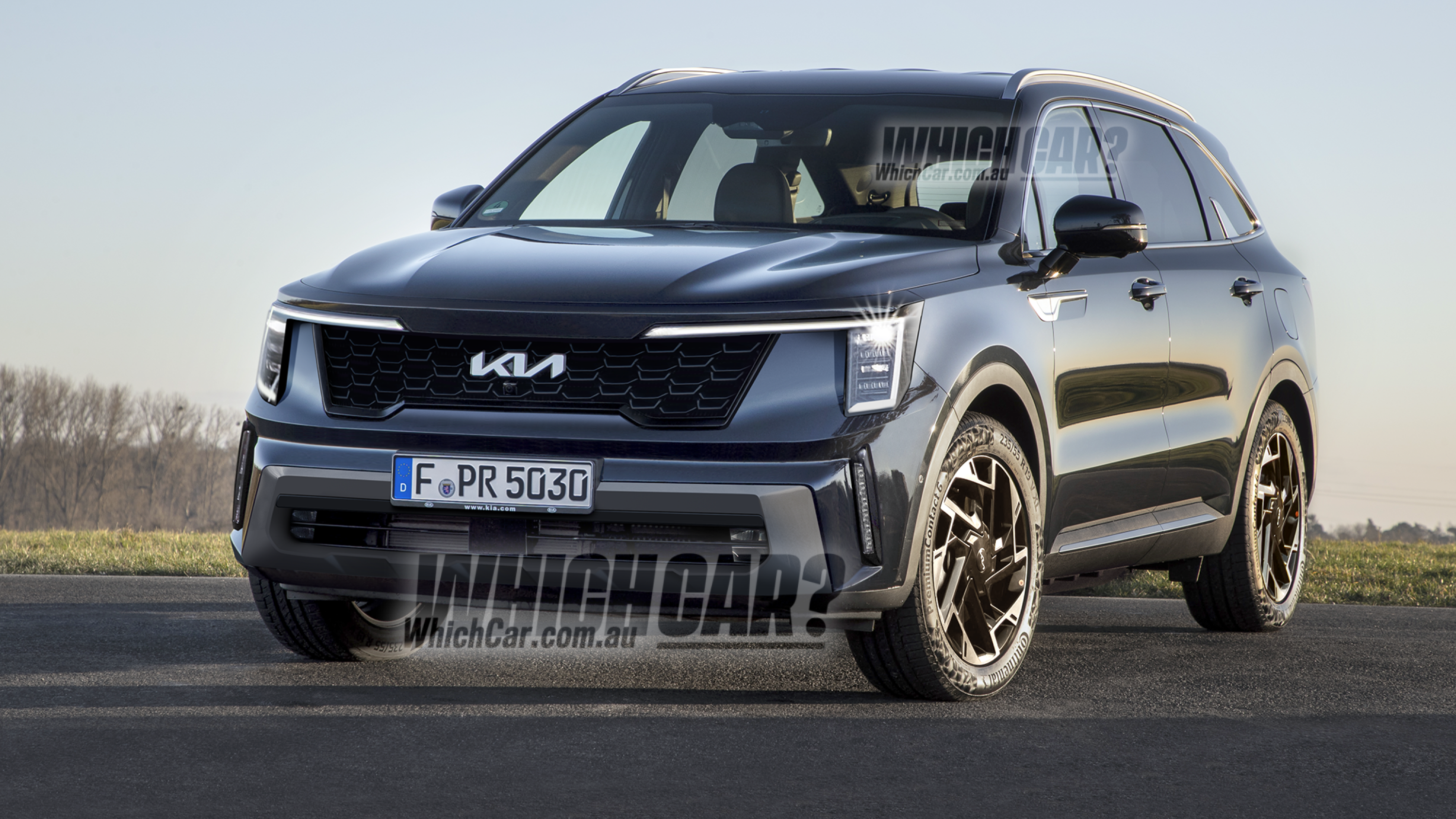
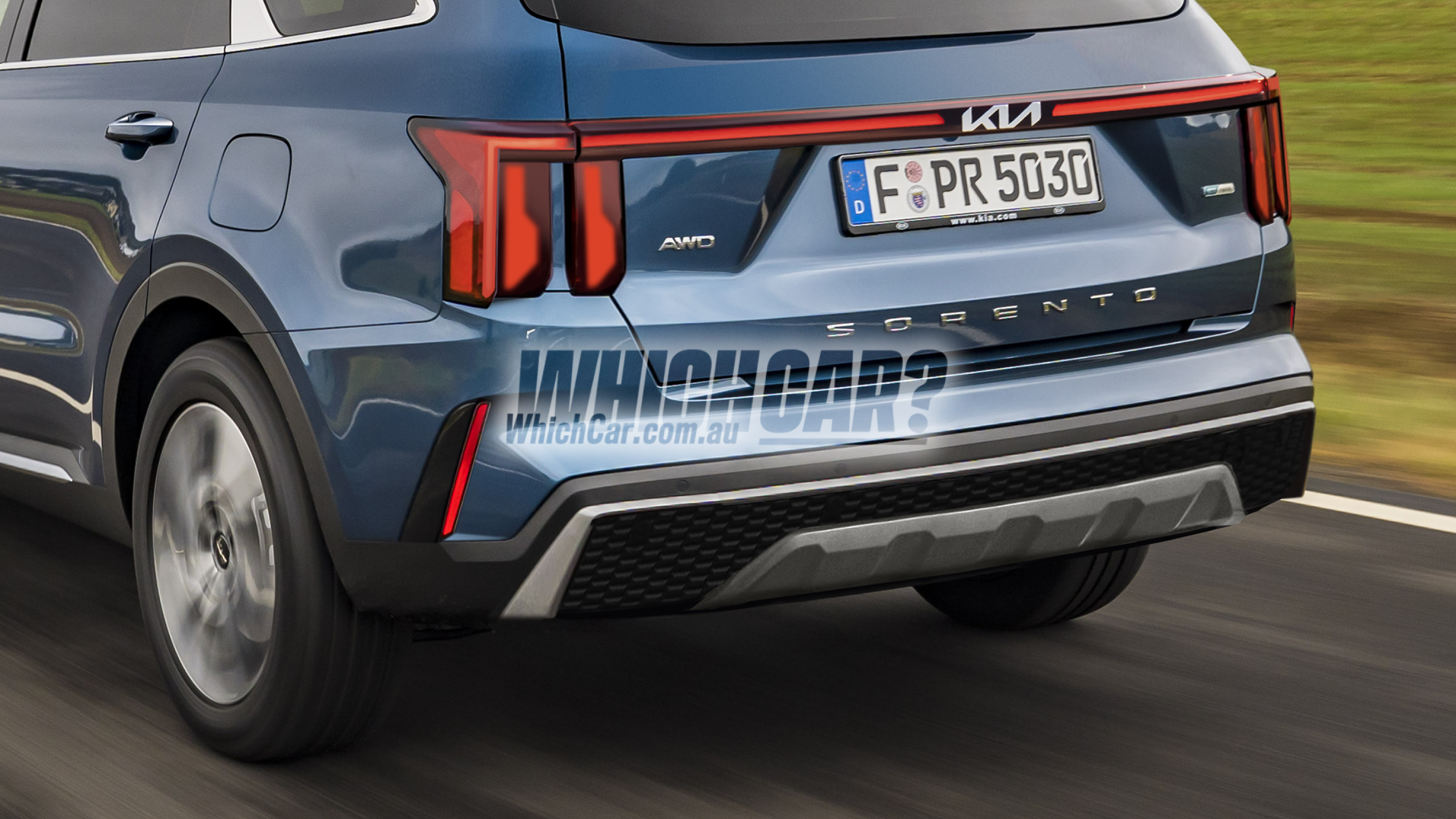
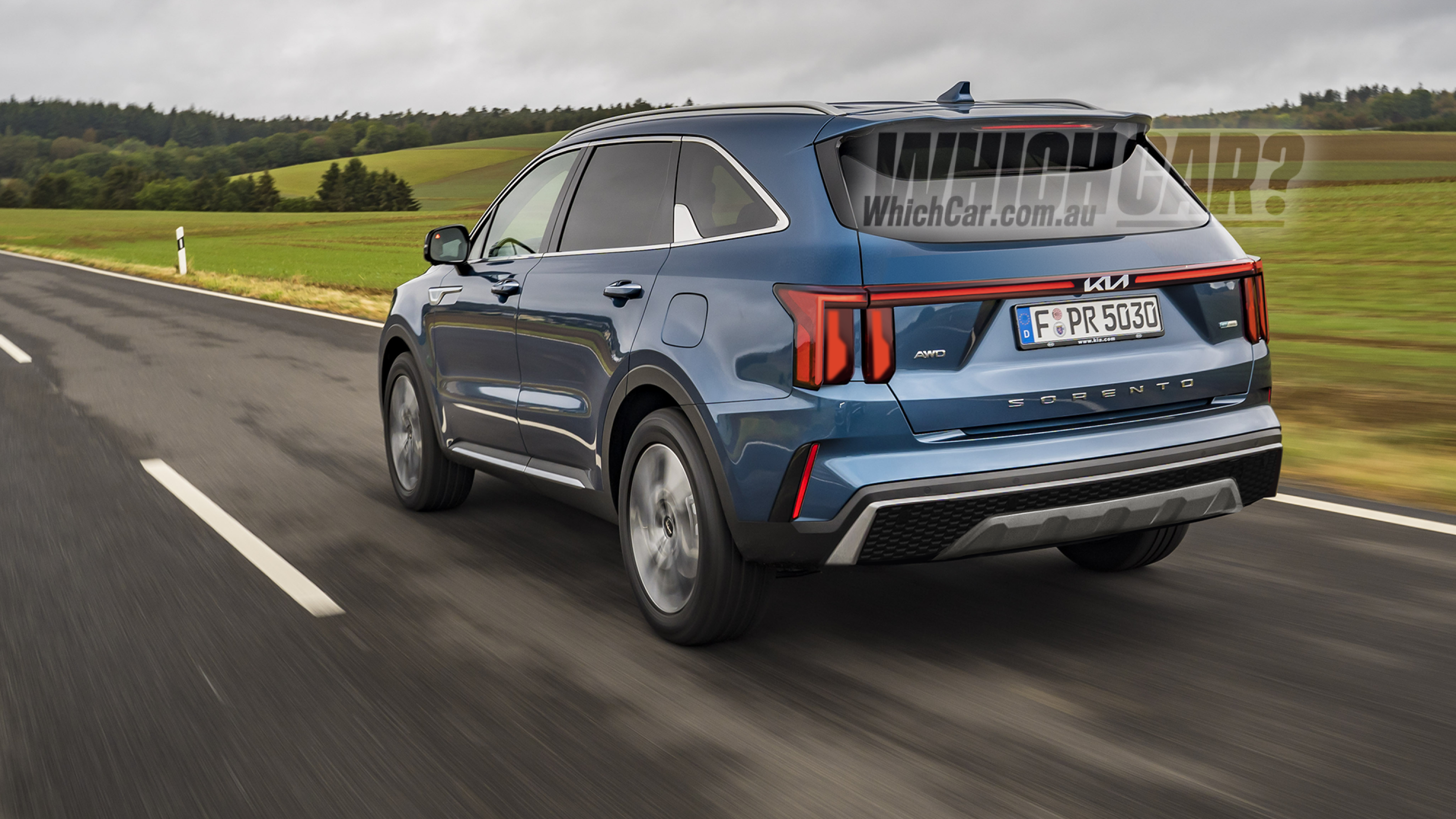
The facelifted Sorento, due to be revealed in a few months, is expected to be headlined by a Telluride and EV9-inspired front fascia, as depicted in our speculative renderings above and below.
This is poised to include vertical-stacked headlights, a daytime running light strip running into a reshaped grille, and a revised lower bumper.
1
Newly-designed alloy wheels should be the only change to the side profile, while a full-width strip is expected to connect the tail-lights, in line with the recently-updated Seltos.
It is expected to include a lighting element, at least for variants with LED tail-lights.
Inside, the facelifted Sorento is tipped to follow the Sportage with a single-piece curved unit for the infotainment system and digital instrument cluster, replacing the current hooded cluster.
The infotainment display should grow to 12.3 inches, up from 10.25 inches, while minor updates to the centre console and switchgear could also be on the cards.
1
Kia Australia has confirmed the updated Sorento will arrive here before the end of 2023, with more to be announced at its official debut in the coming months.
The new Sorento will face competition from the next-generation Hyundai Santa Fe in 2024. It will retain the current N3 platform shared with the Kia, but with a boxier new look and a redesigned interior.
VFACTS new-car sales data reveals 2088 examples of the Sorento have been registered year-to-date, making it the second-best-selling large SUV in Australia, placing it ahead of the Hyundai Santa Fe (1034), Mazda CX-8 (1031), Volkswagen Tiguan Allspace (700) and Skoda Kodiaq (201).
Below: The current, pre-facelift 2023 Kia Sorento
MORE
Everything Kia
The New York International Motor Show has commenced and the silken car covers are being lifted. One of the first pieces of new metal that caught our eye at Wheels is the new Subaru Crosstrek Wilderness.
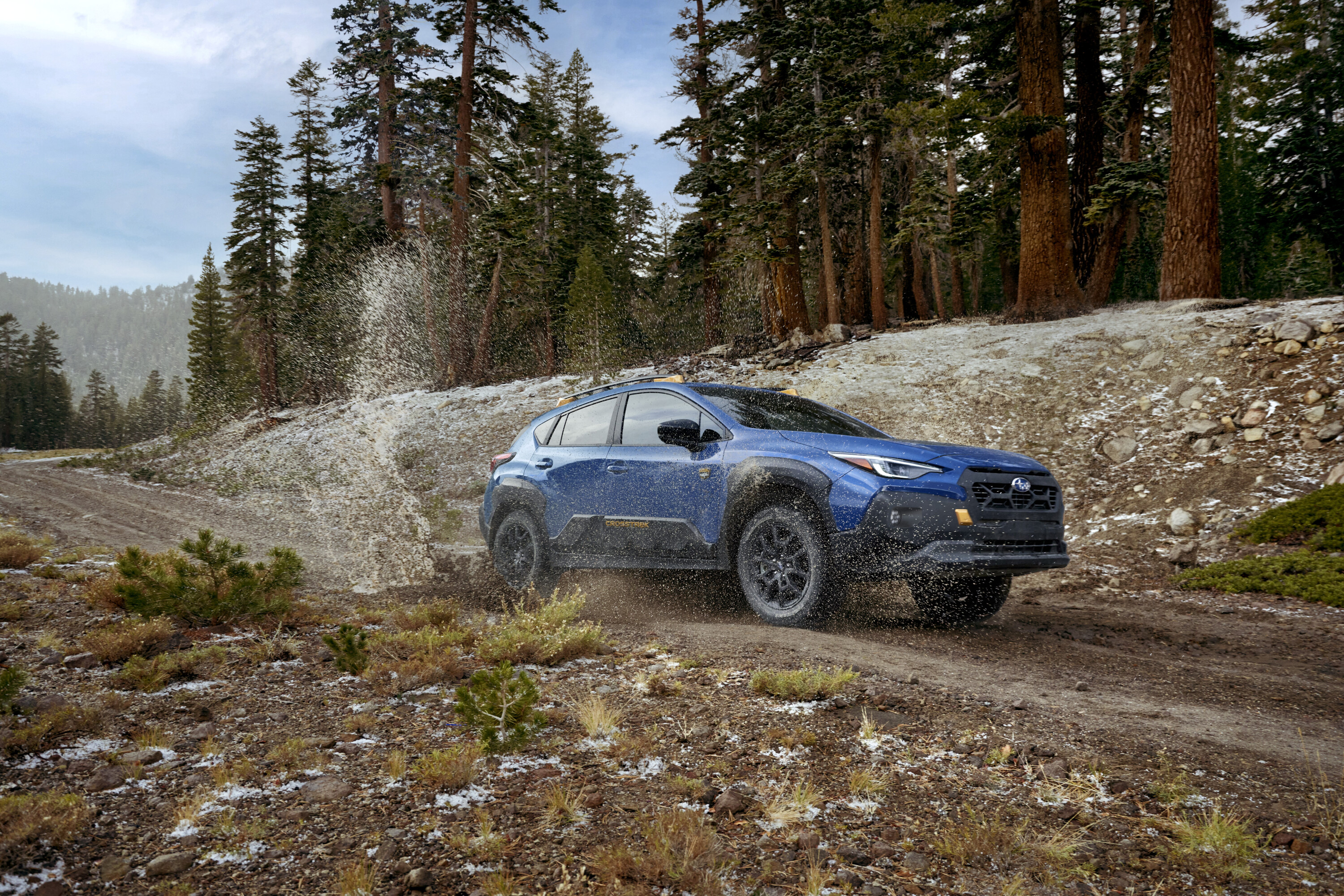
With elevated ground clearance, bespoke body styling and thoughtful off-road revisions throughout, the Crosstrek Wilderness represents the most rugged and off-road-ready versions of the new Subaru Crosstrek, a successor to the Subaru XV sold locally.
1
The basis of the new Wilderness variant is the already competent Crosstrek, powered by an aspirated 2.5-litre four-cylinder boxer engine, feeding Subaru’s Symmetrical all-wheel drive system and leveraged by Subaru’s impressive X-Mode.
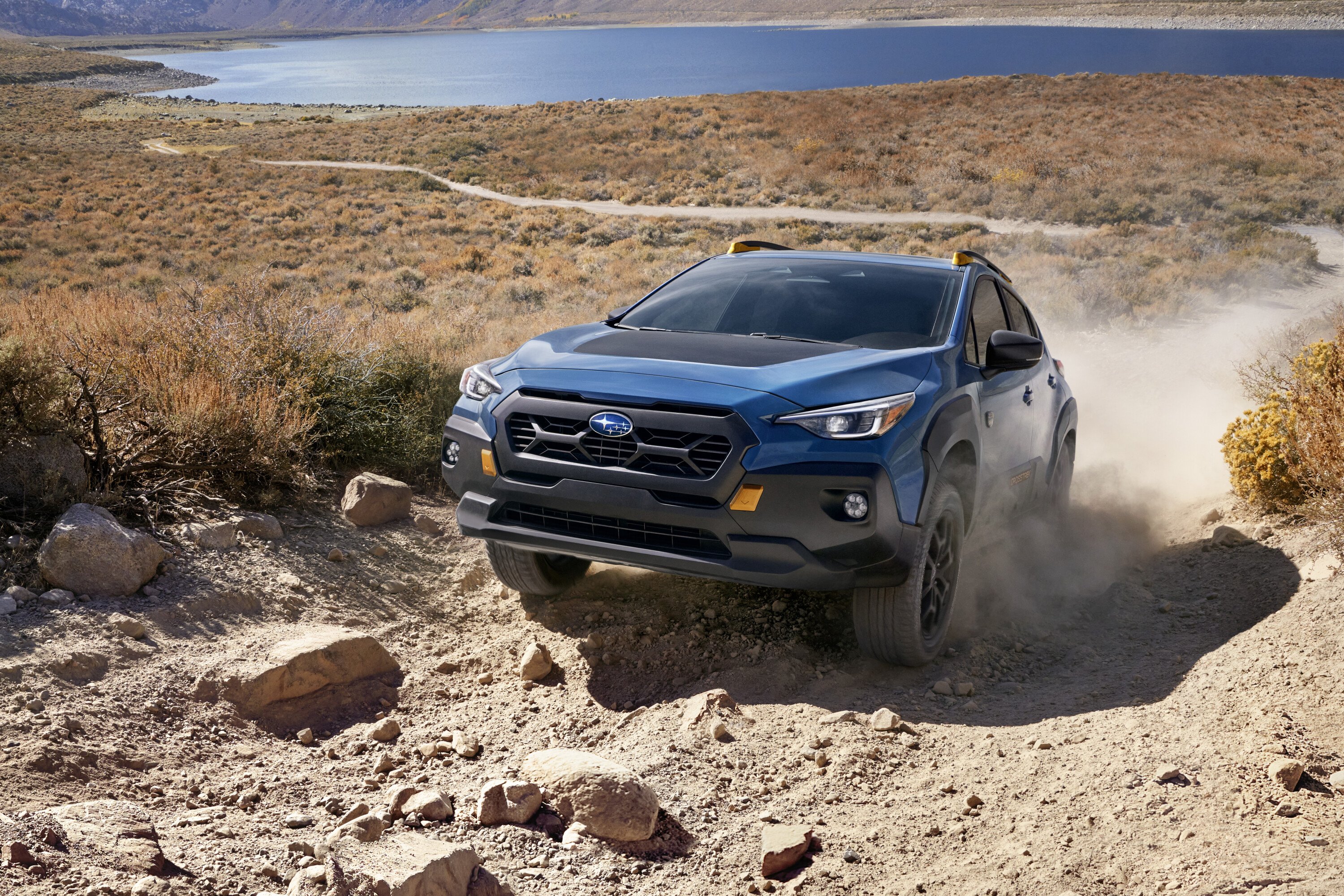
The Crosstrek Wilderness lifts its game with increased ground clearance (236mm versus standard Crosstrek’s 220mm) thanks to longer-stroke struts and coil springs, revised differential gear ratio (4.111 v 3.700) for improved climbing ability and revised CVT calibrations optimised for low speed and slippery terrain.
1
Increased ground clearance elevates approach angles from 18 to 20 degrees, improves departure angle from 30.1 to 33.0 degrees, and delivers a superior ramp breakover angle of 21.2 degrees versus the standard Crosstrek’s 19.7 degrees.
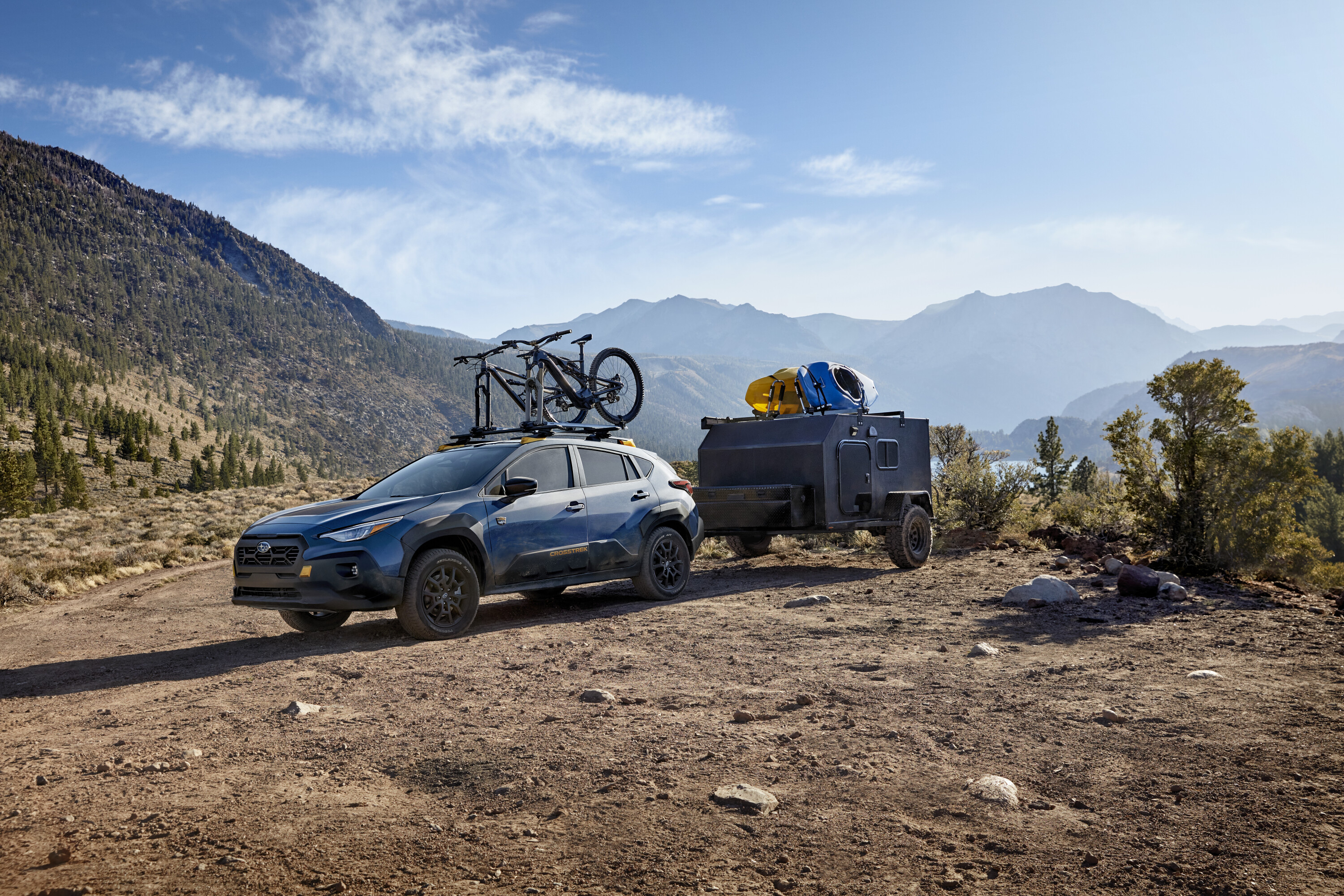
The addition of a transmission oil cooler boosts towing capacity to 1500kg.
1
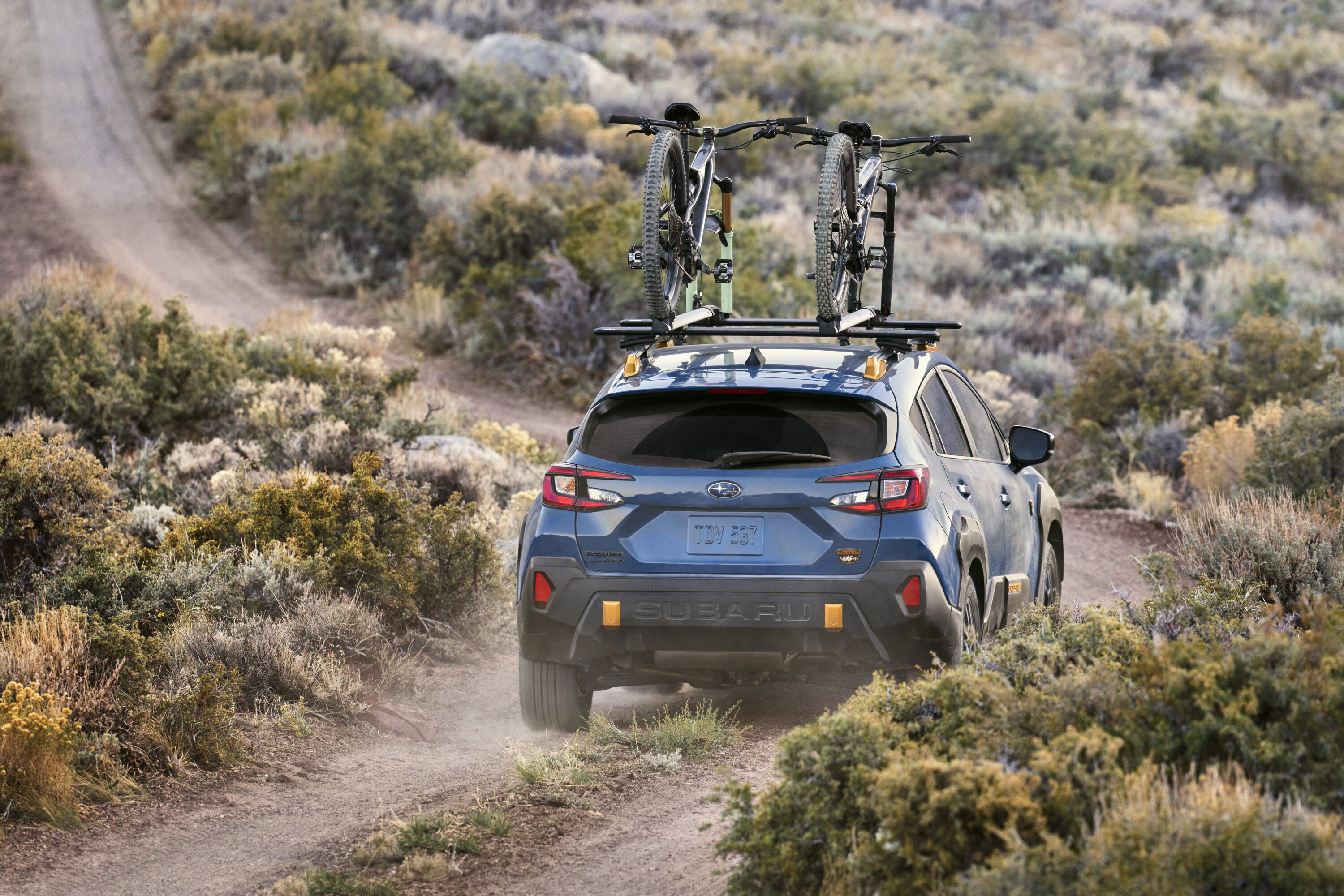
Of course, added function rarely comes without added form and, on that front, there’s little chance of confusing a Crosstrek Wilderness with a standard vehicle out on the road. The Crosstrek Wilderness gains variant-exclusive front and rear bumpers, grille, larger wheel arch cladding, metal front skid plate, hexagonal LED fog lights and a matte black anti-glare bonnet decal.
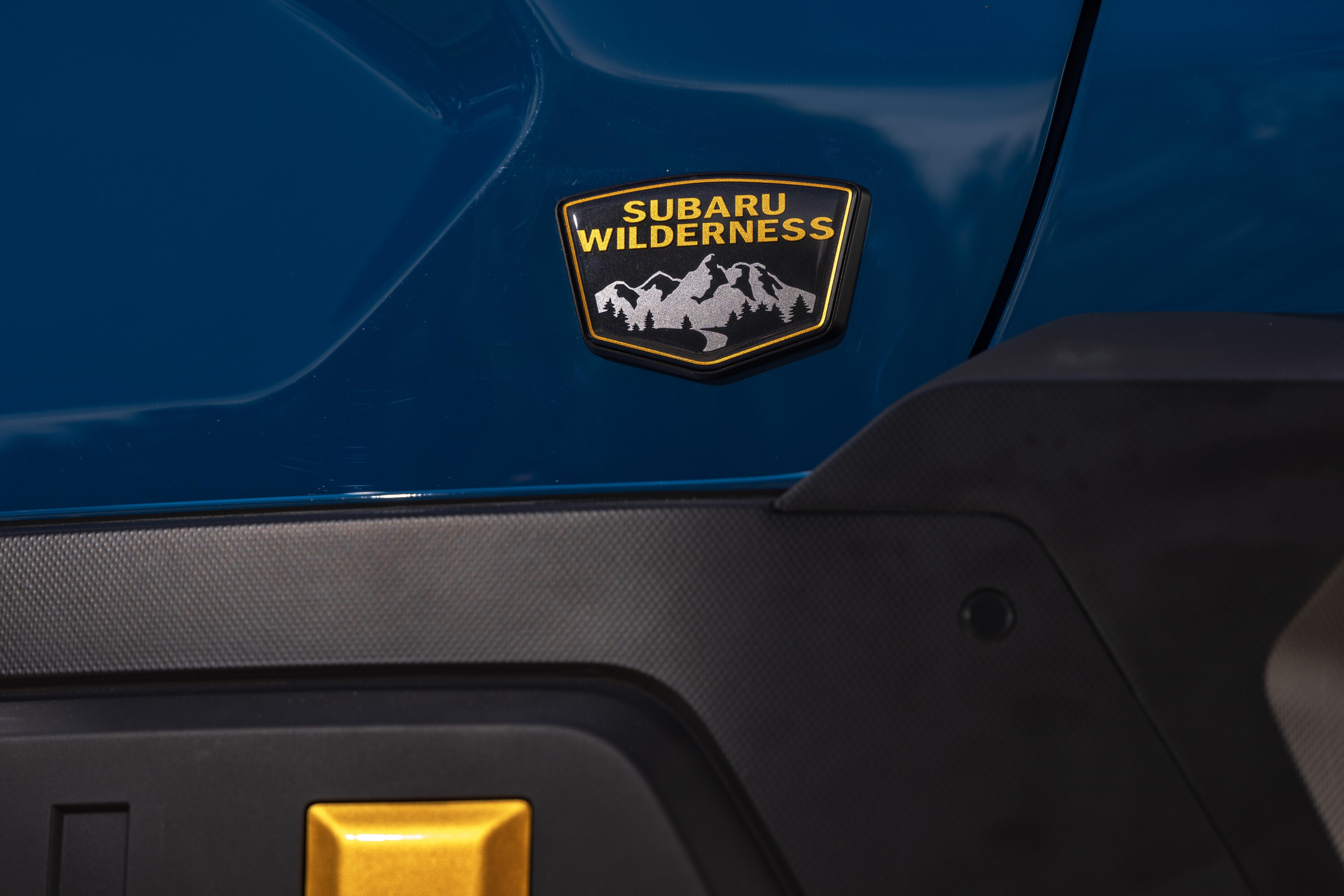
There are further Wilderness badges strewn around outside and in, with a colour-coded roof spoiler and black mirrors to finish off the rugged variant.
1
A versatile ladder-type roof rack system allows for an 80kg dynamic capacity, or a 320kg static carrying capacity.
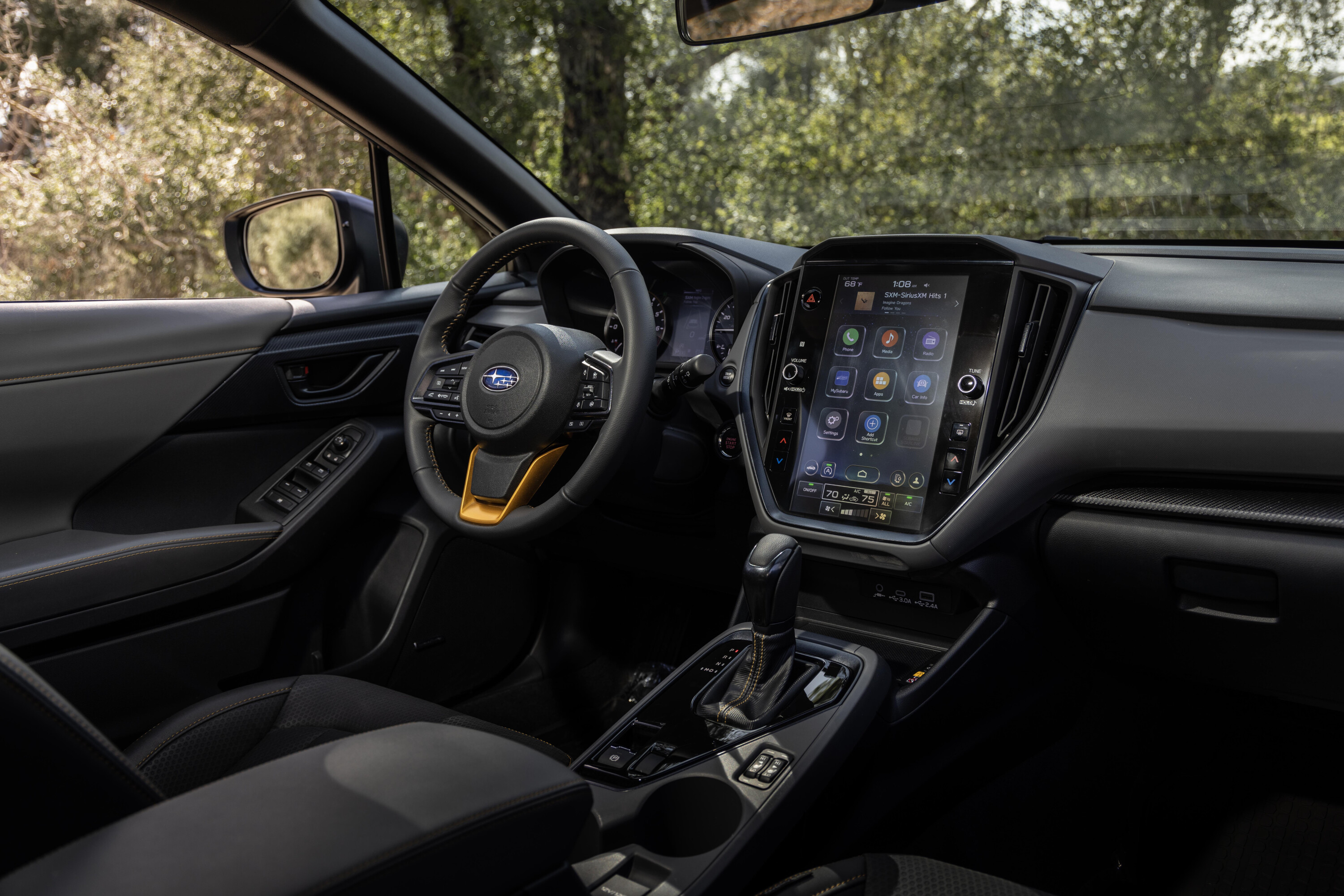
Inside the cabin, seats are swathed in comfortable, yet water-resistant Subaru StarTex material with Wilderness logos emobssed into the front headrests. Copper accents and contrast stitching proliferate throughout the cabin with further black and gunmetal grey trim pieces coming together to form a unique, almost milspec rugged feel. There is also a removable and washable cargo liner in the boot, a thoughtful inclusion given the vehicle’s outdoor lifestyle pitch.
1
Of course, the Crosstrek bears all of the same convenience tech and features, including the verticle 11.6-inch infotainment screen, wireless Apple CarPlay and Android Auto, bluetooth connectivity, rear camera and over-the-air updates; as well as Subaru’s comprehensive EyeSight safety suite.
Priced domestically in the US from USD$31,995 (AU$47,781), there is sadly little precedence of Subaru’s American Wilderness editions joining the Australian market.
1
In terms of the new Crosstrek Wilderness, an Australian spokesperson said: “We are always working to deliver on our customers’ requests and we understand the Wilderness editions make their way onto the wish lists of many Australians, with the Crosstrek Wilderness likely to be no exception. However there is no new information to share on Wilderness offerings in Australia currently.”
MORE
Everything Subaru
UPDATE, May 2023: Mazda 3 pricing and features
Mazda Australia has confirmed full details for the updated 3 hatch and sedan. Get the details below, or continue reading here for our earlier story.
Read our 2023 Mazda3 Range Review
2023 Mazda 3 update revealed
The updated 2023 Mazda 3 has debuted – and it’s bad news for manual lovers.
Snapshot
- 2024 Mazda 3 update revealed
- No more manual! Transmission option deleted for the first time in a Mazda small car
- Mild-hybrid variants also axed in condensed range; due here in July
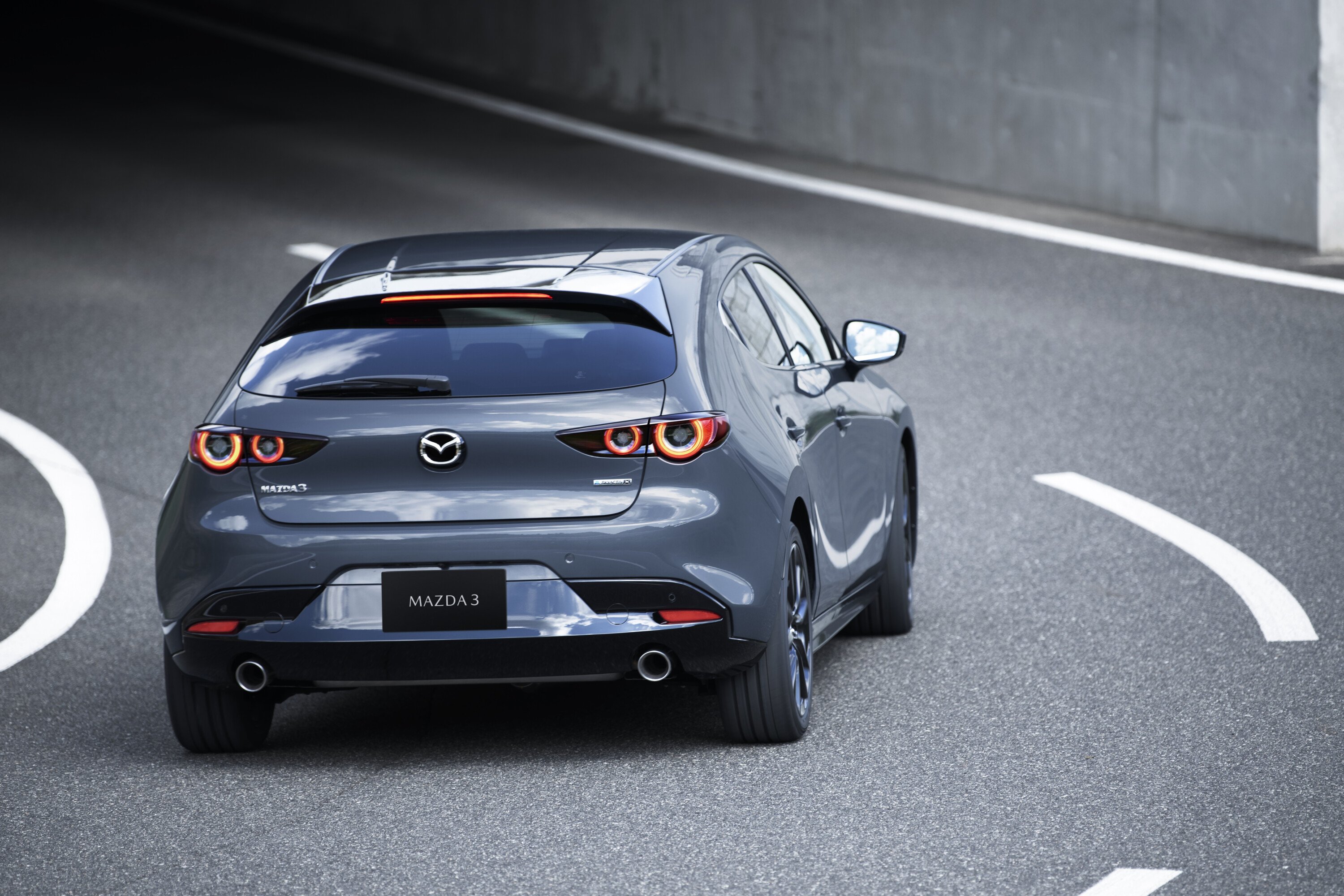
For the first time in the nameplate’s 20-year history, the latest Mazda 3 hatch and sedan – due here in July – will be automatic-only, relegating the manual to the history books.
A spokesperson for Mazda Australia said the decision was due to a lack of demand, with 97 per cent of Mazda 3 sales being automatic variants.
Until now, the Mazda 3 bucked the industry norm by offering a manual on every non-electrified grade.
1
The deletion of the Mazda 3 manual follows the Toyota Corolla, Volkswagen Golf, Kia Cerato and Hyundai i30 Sedan (née Elantra), which have all gone automatic-only in the past two years – leaving the i30 hatch as the only manual option in the segment, for now.
Joining the manual in the automotive graveyard will be the mild-hybrid variants, with Mazda Australia confirming the short-lived G20e Evolve and X20 Astina variants will be axed locally.
The mild-hybrid G20e Evolve was added at the last update in late 2021, while the X20 Astina arrived in mid-2020 after a several-month delay. The current-generation Mazda 3 range was launched in Australia four years ago, in early 2019.
As such, the Mazda 3 lineup will be restricted to the existing 2.0-litre and 2.5-litre naturally-aspirated four-cylinder engines in Australia – both matched to an unchanged six-speed torque-converter automatic transmission.
1
Available in G20 Pure, Evolve and Touring grades, the 2.0-litre petrol receives cylinder deactivation and minor improvements, with a five per cent reduction to fuel consumption, at 5.8L/100km for the sedan and 5.9L/100km for the hatch.
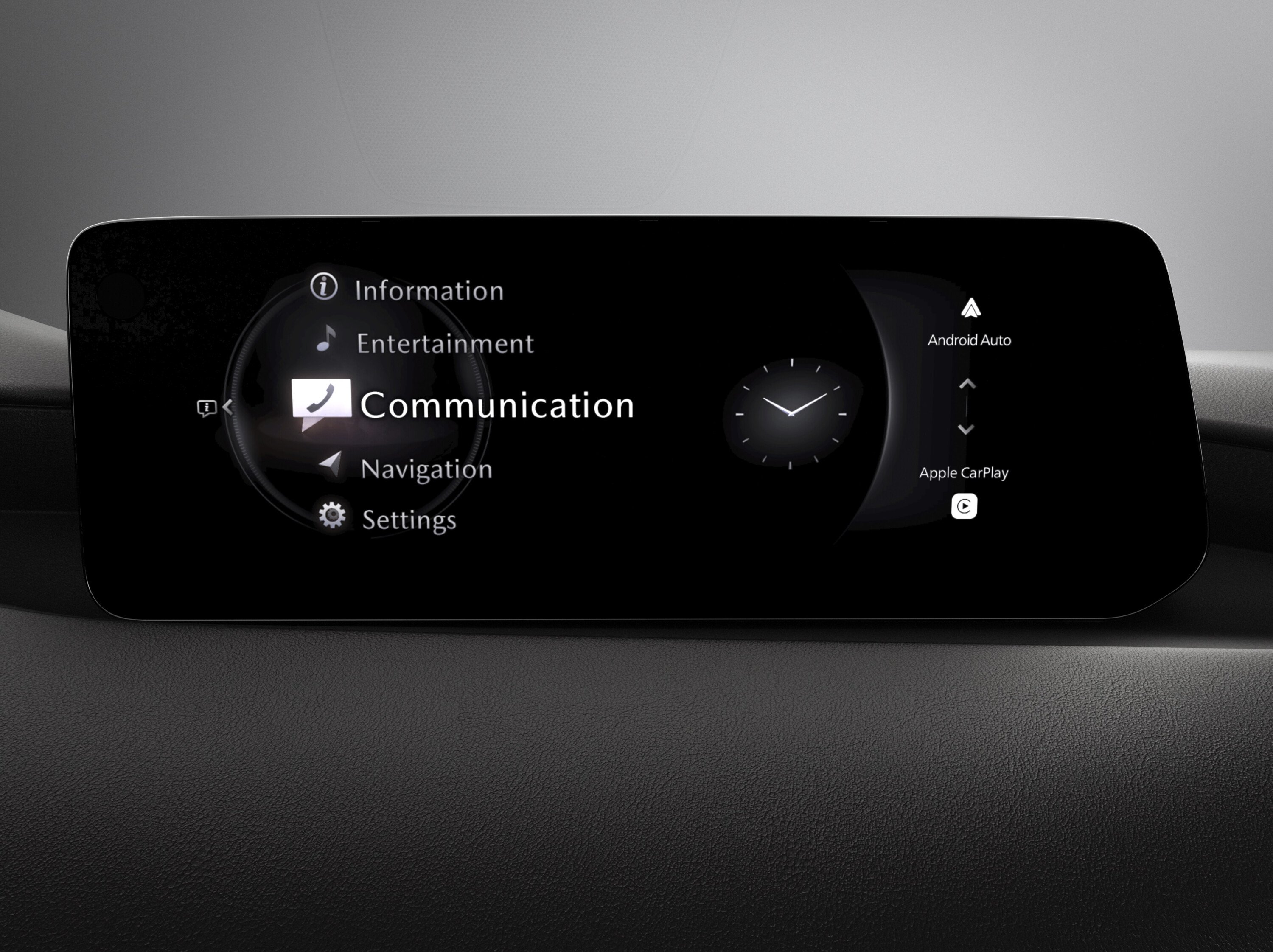
The condensed Mazda 3 range coincides with a global update revealed today, which is headlined by a larger 10.25-inch Mazda Connect infotainment system on flagship variants, up from 8.8 inches.
Mazda Australia has confirmed the larger screen will be standard on G25 GT and Astina grades – though it’ll be added to the optional Vision Technology package for lower variants.
1
However, either screen size will support wireless Apple CarPlay and Android Auto on the G20 Touring and above, or with the Vision Technology package for the G20 Pure, Evolve and G25 Evolve SP.
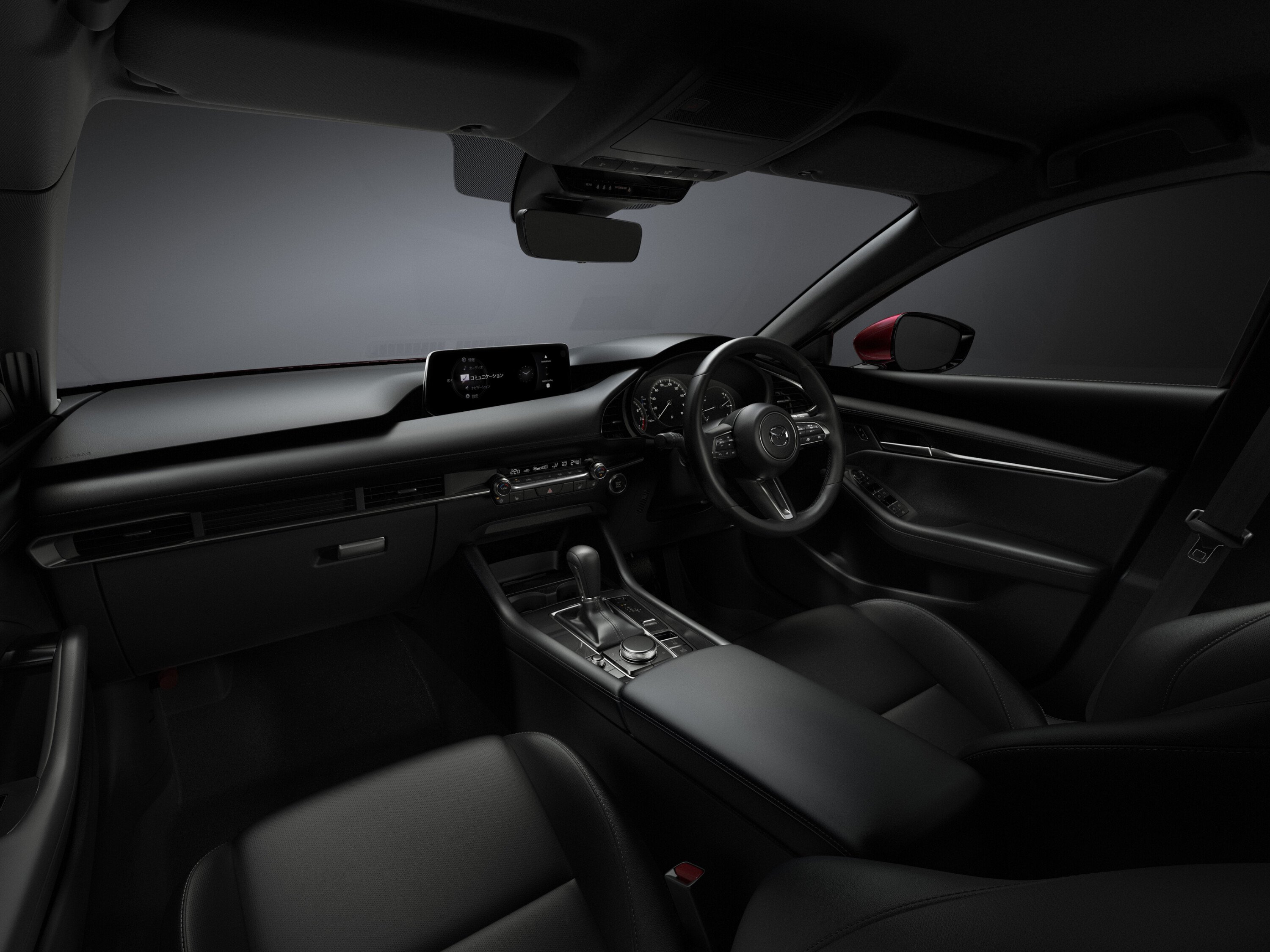
Inside, G20 Touring and above gain a wireless phone charger and illuminated USB-C ports, and all variants receive an updated steering wheel with darkened switchgear, new labels for the air-conditioning controls, and slimmer cupholders with the removal of the lid.
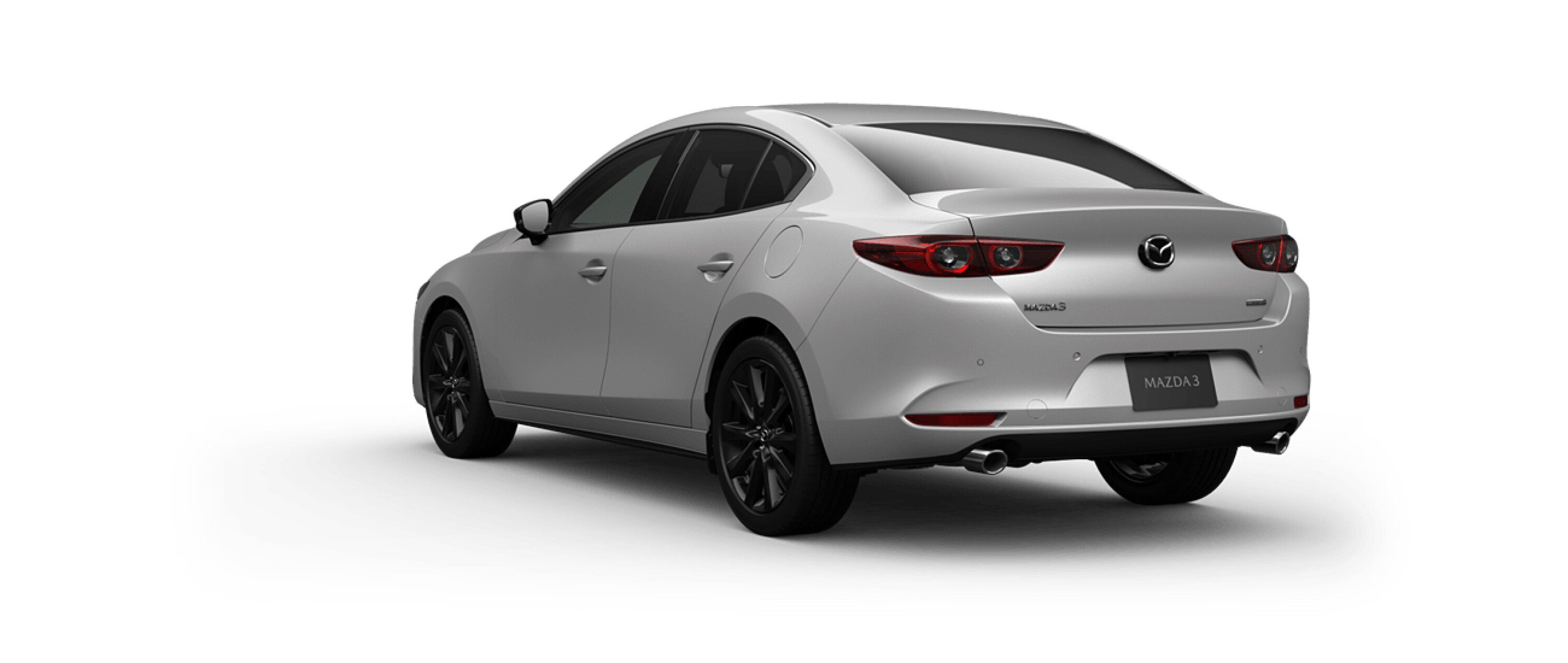
External revisions are limited to the addition of the ceramic metallic finish, replacing sonic silver.
1
The updated 2023 Mazda 3 hatch and sedan will arrive in Australia in July, with local pricing and full details to be announced closer to launch.
Currently, the Mazda 3 is priced from $27,610 before on-road costs for the G20 Pure manual. The automatic requires an extra $1000 on select variants, suggesting a new starting price closer to $30,000 in conjunction with the added technology.
A similar update for the heavily-related CX-30 small SUV is expected to follow before the end of this year.
Are you sad that the Mazda 3 has lost its manual? Let us know in the comments below.
MORE
Everything Mazda
