
Always a controversial topic. It’s linked above, but if you need a refresher on how we define eligibility and our testing criteria, the What’s new for 2023? story is where you need to be.
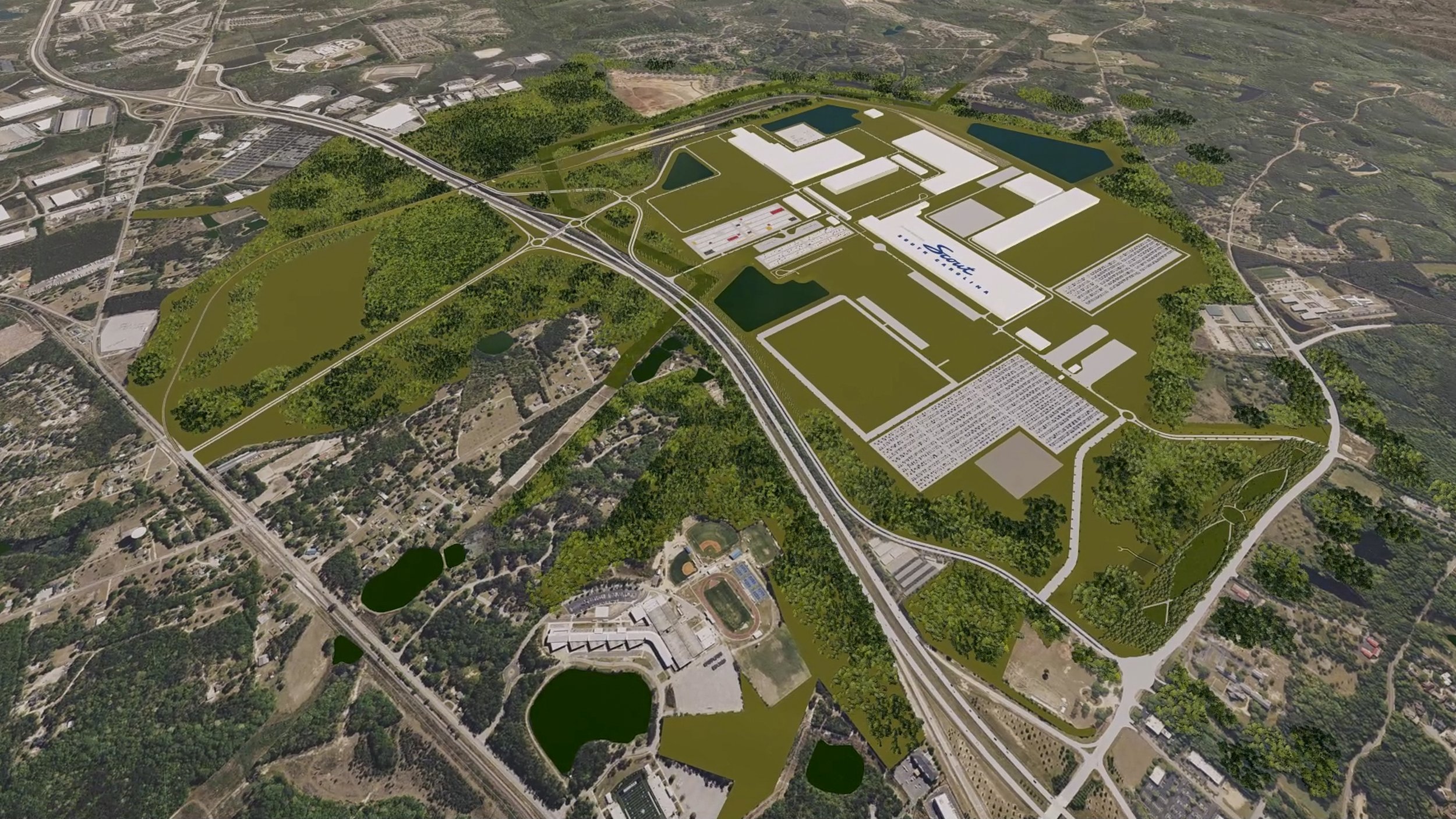
Scout Motors, the classic American off-road company recently revived by the Volkswagen Group, has selected the site of its forthcoming manufacturing plant in Columbia, South Carolina.
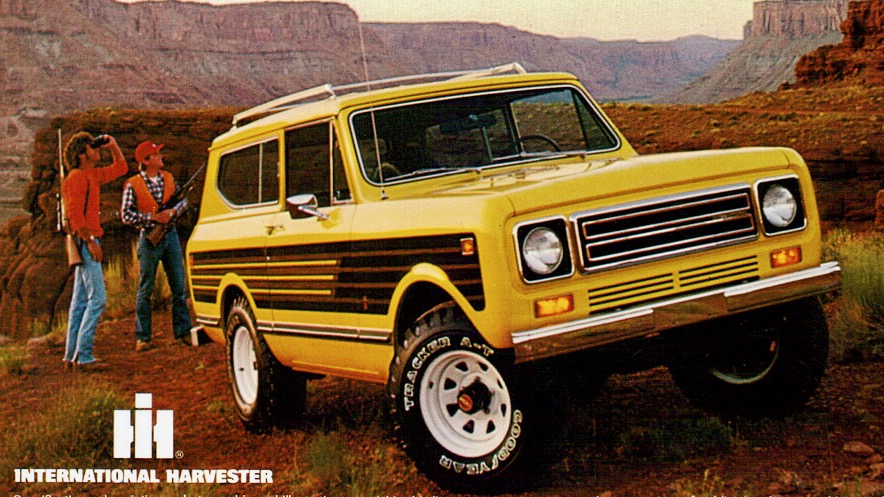
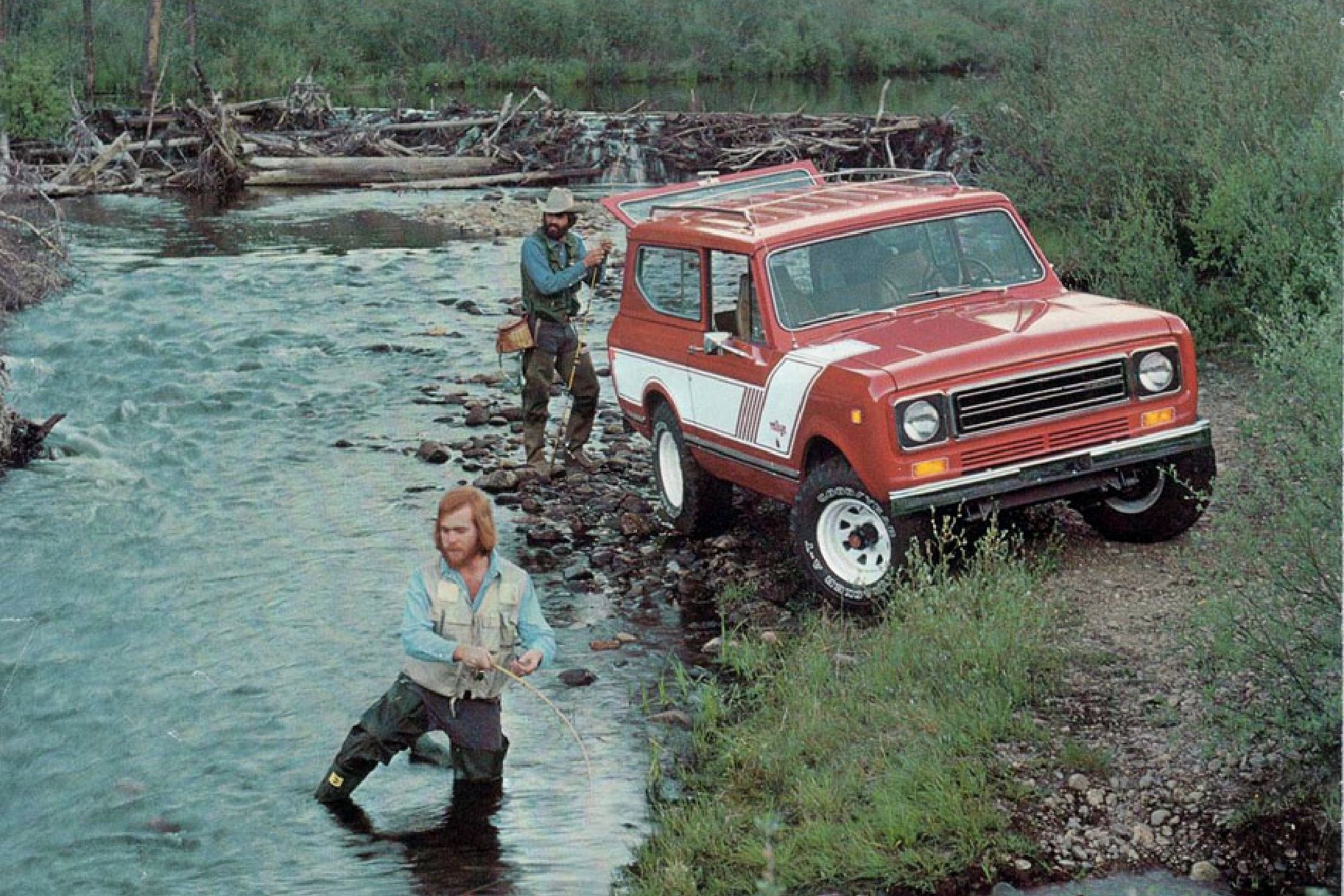
Scout is seeking to become a major producer of next-generation off-road electric vehicles to rival Ford’s Bronco and Jeep’s Wrangler, tapping the American brand’s cult 4×4 produced by International Harvester (acquired by VW Group in 2020 for US$3.7 billion) from 1961 to 1980.
1
The brand has pledged a US$2 billion investment towards the manufacturing site, which is expected to produce around 4000 permanent jobs with a production capacity of over 200,000 vehicles per annum.
“Scout Motors will provide thousands of South Carolinians with previously unimagined opportunities and prosperity for generations to come,” said South Carolina Governor, Henry McMaster. “The Palmetto State, with its rich history, superior people, and sterling automotive manufacturing reputation, is the perfect place to restart this iconic American brand”.
1
McMaster signed an executive order in October 2022 in order to prioritise and fast-track EV infrastructure, preparing the state workforce for advanced manufacturing jobs, and strategically organising EV planning under a centralised state working group.
Scout’s forthcoming manufacturing site spans approximately 1600 acres, with the plant itself occupying a 1100-acre footprint. Groundbreaking is expected to commence from mid-2023, with production slated to begin by the end of 2026.
1
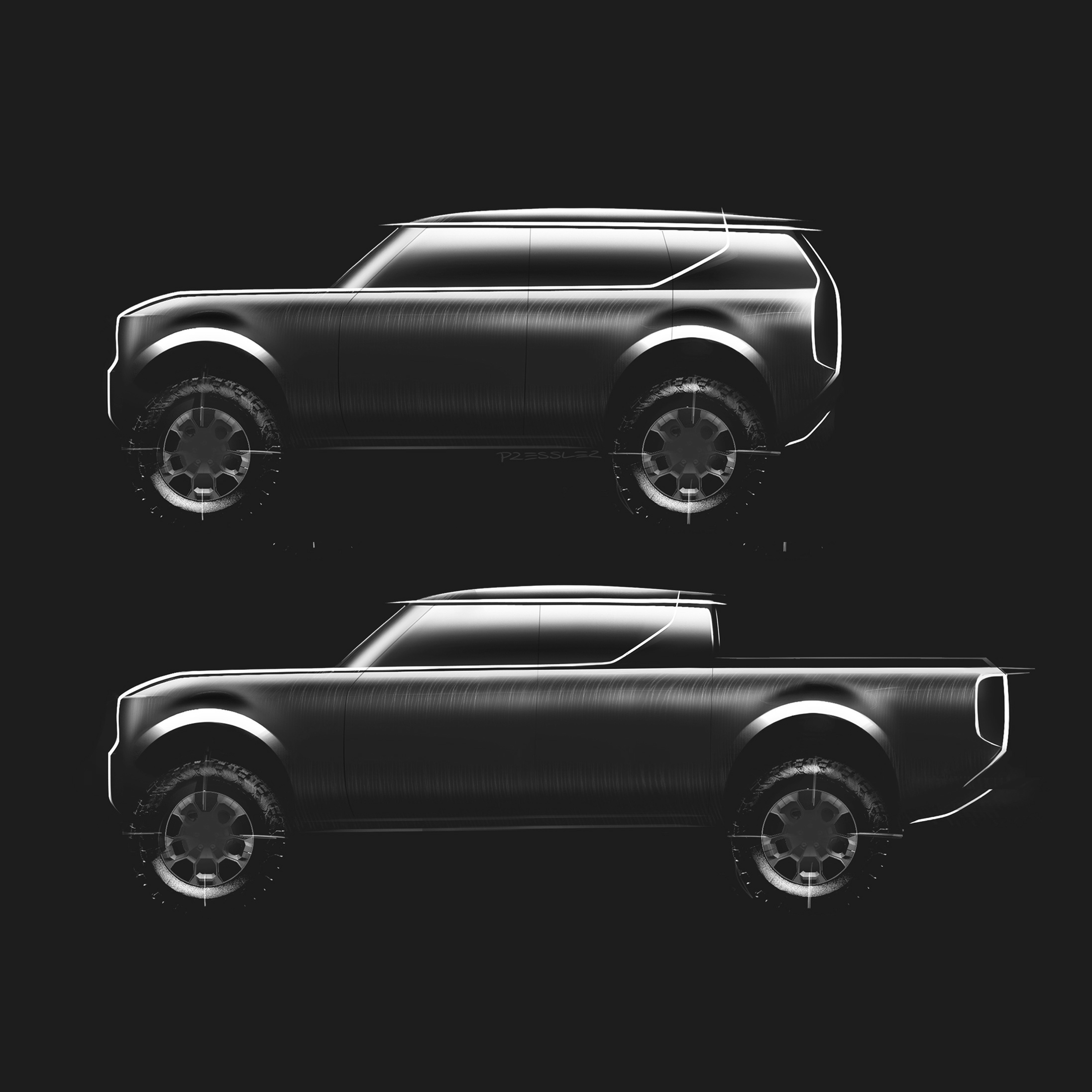
Future Scout products will take the form of rugged American trucks and SUVs, and will be built on a newly designed all-electric platform. What platform that is remains to be seen, however, a development or variant of the Volkswagen Group’s forthcoming Scalable Systems Platform (SSP) would be a pragmatic approach, and is expected to come to market in 2026.
Like the original Scout International Harvester, the revived product range will begin with an SUV and pick-up truck, expected to be revealed some time in 2023.
1
In line with the brand’s off-road roots, Scout’s future vehicles will be focused on delivering formidable off-road capability with considerable ground clearance, approach angles, robust axles, payload capacity, all-electric driving range, and new digital features.
Scott Keogh, President and CEO of Scout Motors, said: “Scout has been an American icon since introducing an SUV in 1960. It’s the vehicle that took your family on a camping trip, that gave access to the great outdoors, and that showed up on the job site every morning. Today, we’re reimagining Scout’s original ingenuity and electrifying its future. We’re bringing the Scout spirit to South Carolina and it’s going to be a hell of a ride.”
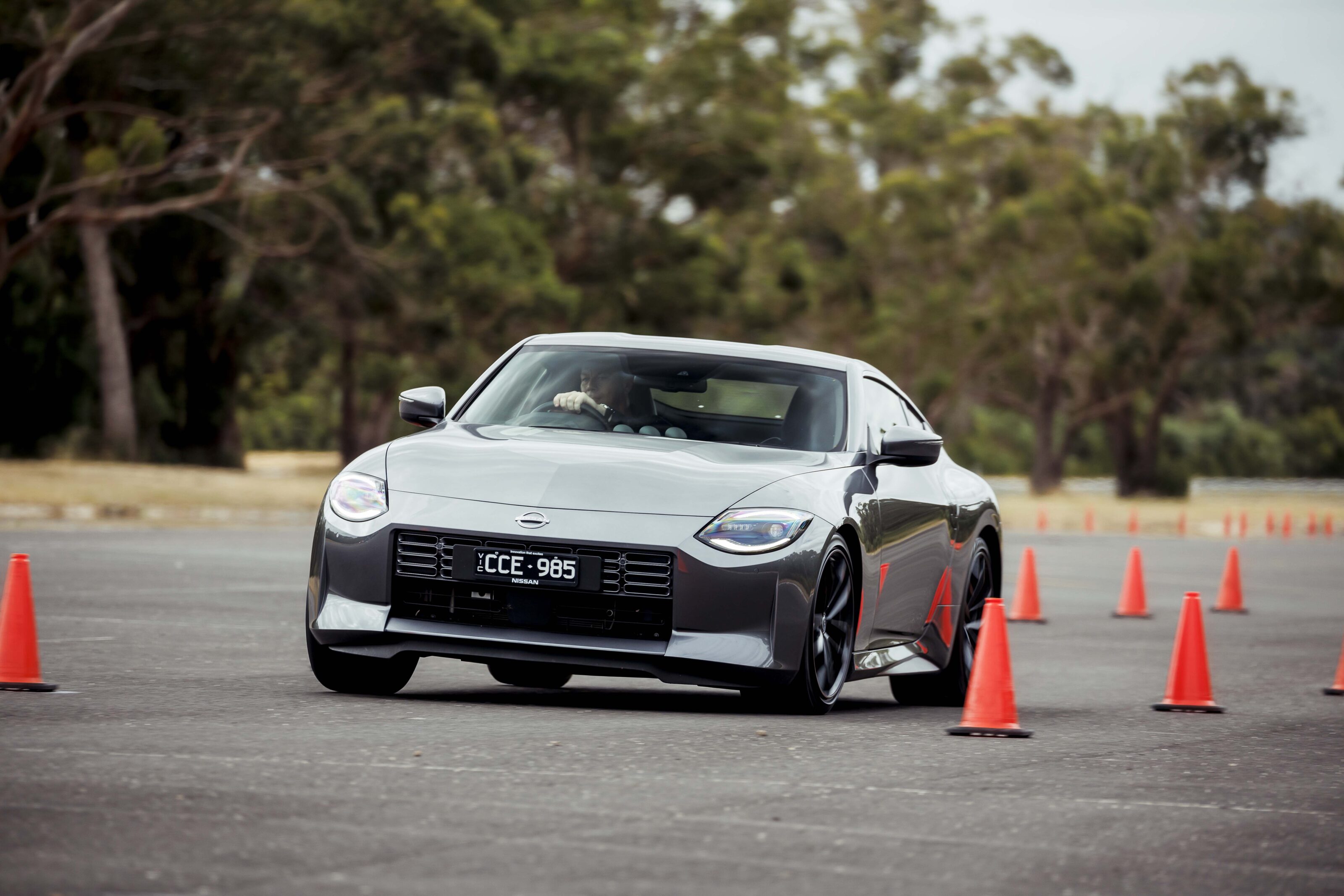
You’re aware of the Moose Test, I gather? Even if you aren’t, it’s an easy one to wrap your head around.
Basically it’s an exercise designed to replicate an emergency ‘swerve and avoid’ scenario where a driver is required to change direction suddenly, as if to dodge an animal, and then quickly regain control and swerve back safely into their lane.
It’s a test championed by the Northern Europeans (hence ‘moose test’) but one that also has huge implications for Aussie drivers, too, who often have to dodge kangaroos, wombats, emus and all sorts of other wildlife.
Chances are you’ll have seen a clip of a car (or usually an SUV) failing the Moose Test on YouTube – it makes for pretty dramatic vision.
But creating exciting video wasn’t why we wanted to run each of our 2023 Car of the Year contenders through the Moose Test. The main reason was it’s an excellent test of a car’s body control and the efficacy of its electronic stability system.
MORE READING
As the 2023 COTY story evolves, the list of stories below will grow. Keep an eye on this page for more, or find it all at our COTY page.
1
The results, as you can see from the below table, are surprising…
Our objective was to run each contender through the exercise at steadily increasing speeds until they clobbered a cone. Speeds were increased in 5km/h increments, and the table below includes a speed range between which each car failed to make it through the exercise.
The Audi RS3 Sportback, for example, made it through at 105km/h but failed at 110km/h.
Generally speaking, the logic of physics applies to the finishing order. Low-slung performance cars with grippy tyres finished at the pointy end while heavy, high-riding off-roaders with all-terrain rubber are at the bottom. But there are a few notable results.
1
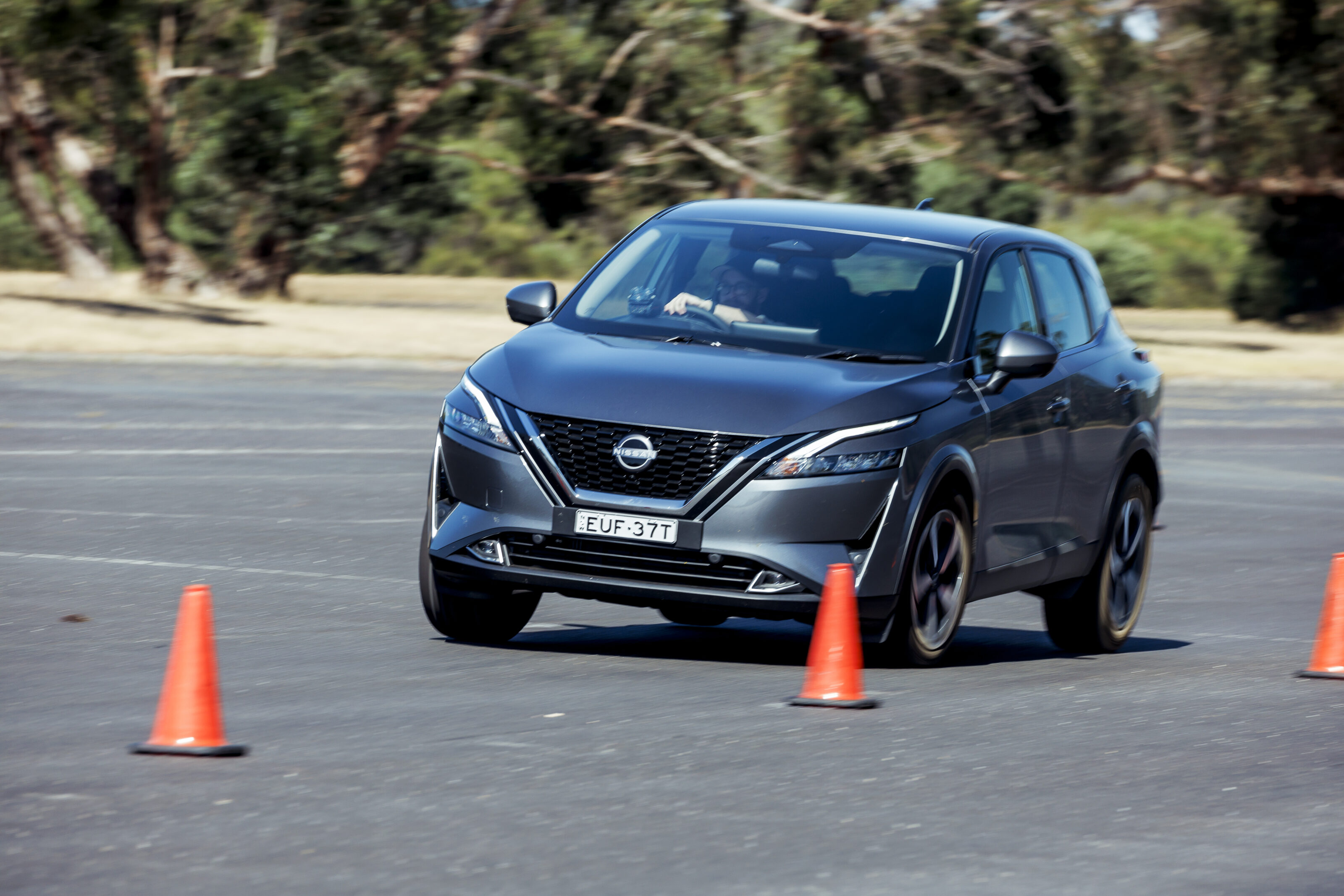
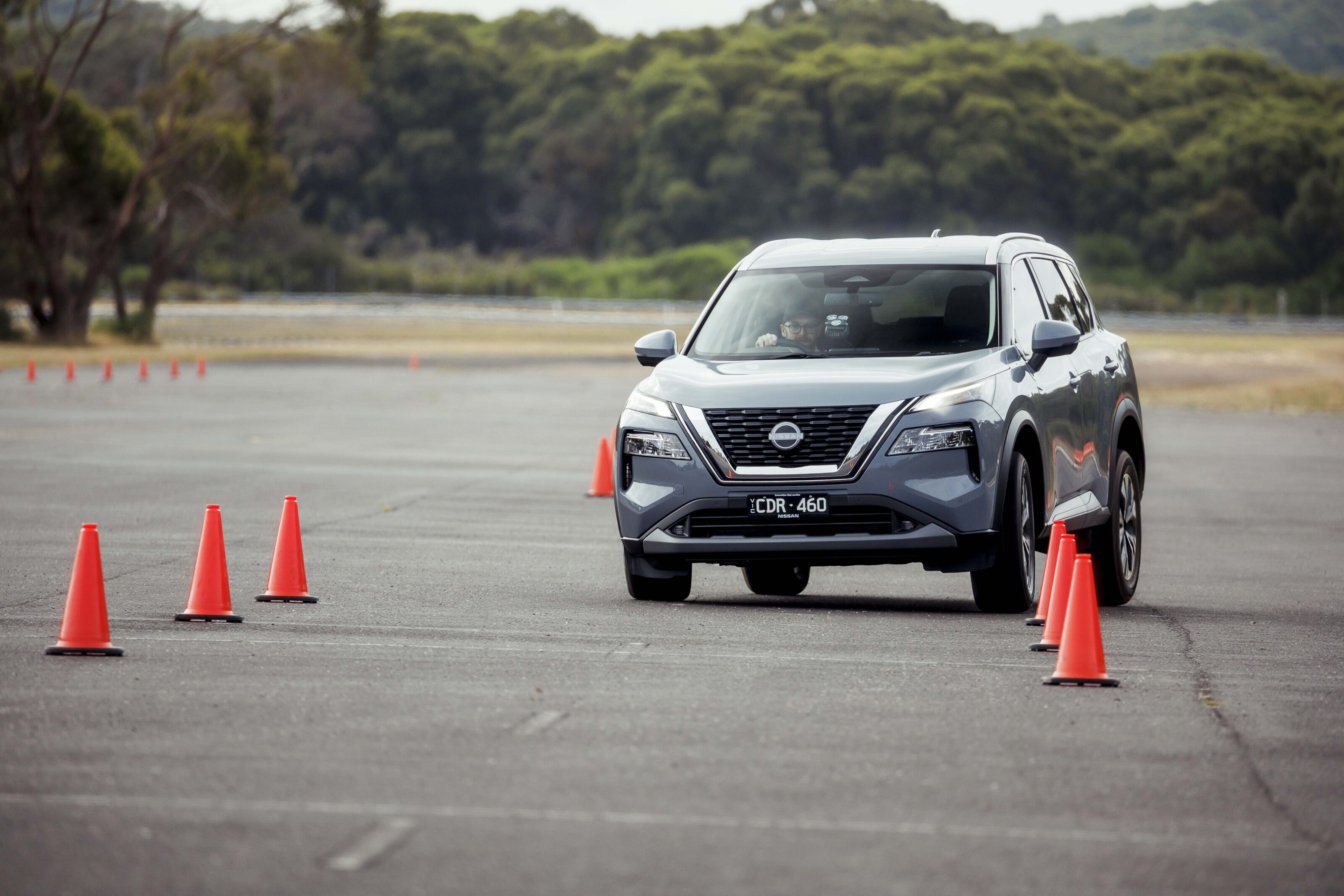
The pair of Nissan Qashqais, for example, finished considerably higher than their humble mainstream small-SUV credentials suggested they would. And the Toyota 86’s finishing position of 9th was also a surprise, especially considering it was trumped by the Qashqai, Cupra Formentor and Toyota Corolla Cross. Blame the 86’s tyres and its propensity to oversteer for that one.
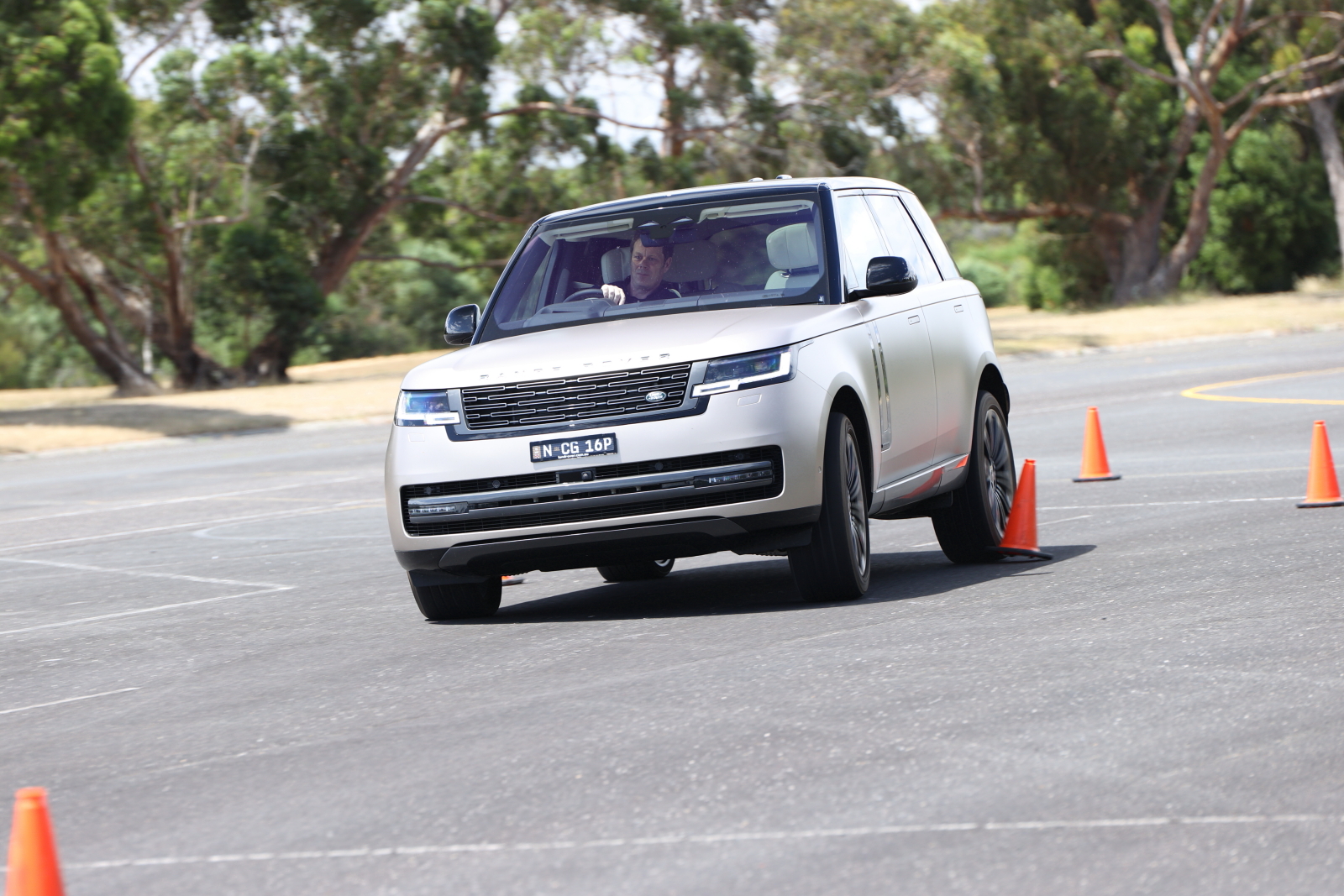
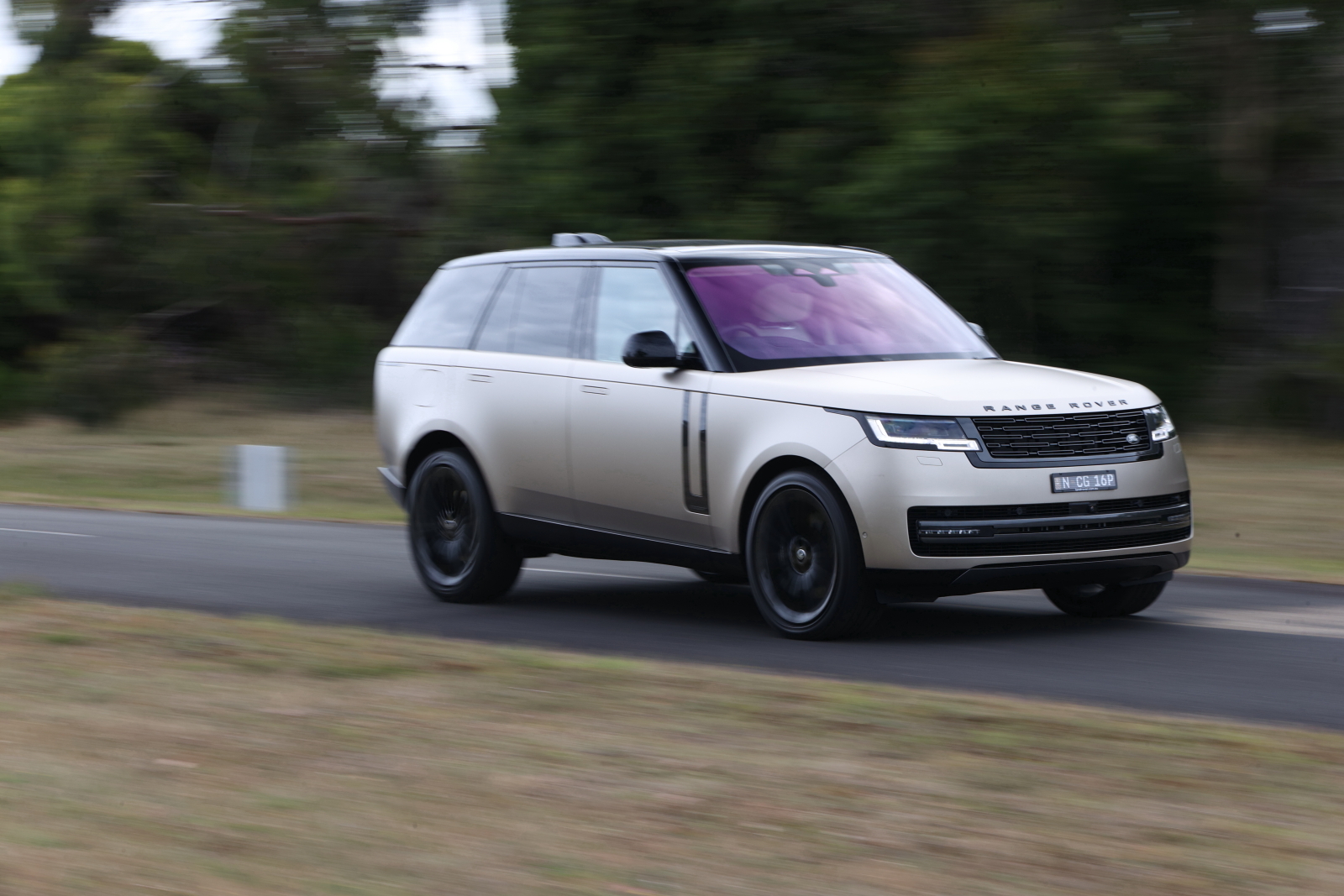
The Range Rover P530 also deserves a mention for having the hardest hitting ESC system. Where most contenders grab and release brakes rapidly to try and rein in big weight transfers, the Rangie simply locked the front outside wheel which sent a huge plume of smoke pouring down the side of the car. In fairness to the system, that is a lot of softly sprung weight to contain.
Check out the finishing order below and tell us what you found surprising in the comments.
1
Swerve and avoid test
| Contender finishing order | Speed range in km/h | |
|---|---|---|
| 1 | Audi RS3 Sportback | 105-110 |
| 2 | Audi E-tron GT RS | 100-105 |
| 3 | Cupra Formentor VZe | 95-100 |
| 4 | Nissan Qashqai ST+ | 95-100 |
| 5 | Nissan Qashqai Ti | 95-100 |
| 6 | Nissan Z manual | 95-100 |
| 7 | Tesla Model Y RWD | 95-100 |
| 8 | Toyota Corolla Cross Atmos hybrid AWD | 95-100 |
| 9 | Toyota GR 86 GT manual | 95-100 |
| 10 | Audi A3 35 TFSI sedan | 90-95 |
| 11 | Cupra Formentor VZ FWD | 90-95 |
| 12 | Cupra Formentor VZx | 90-95 |
| 13 | Genesis GV60 PErformance AWD Luxury | 90-95 |
| 14 | Nissan X-Trail ST-L 7-seat | 90-95 |
| 15 | Peugeot 308 GT Premium wagon | 90-95 |
| 16 | Skoda Fabia Monte Carlo | 90-95 |
| 17 | Toyota Corolla Cross GX FWD | 90-95 |
| 18 | BYD Atto 3 Long Range | 85-90 |
| 19 | Ford Ranger Raptor | 85-90 |
| 20 | Nissan X-Trail ePower 5-seat | 85-90 |
| 21 | Peugeot 308 GT hatch | 85-90 |
| 22 | Volvo C40 Twin Motor | 85-90 |
| 23 | Ford Everest Sport V6 AWD | 80-85 |
| 24 | Range Rover P530 First Edition | 80-85 |
| 25 | Ford Everest Trend 2.0 Bi-turbo 4X4 | 75-80 |
| 26 | Ford Ranger XLT V6 | 75-80 |
MORE
Wheels COTY

1
Melbourne road users, whether it’s by bike, car or walking, are being urged to give their feedback on the state of our roads, as RACV launches the My Melbourne Road survey.
The survey is seeking participants to provide feedback by dropping a pin on an interactive map, and explaining how sections of a road or an intersection can be improved for safety of all users.
The interactive map within the survey illustrates hot spots where serious injuries and deaths have occurred on Melbourne roads between 2016 and 2019.
In 2022, 106 people died on Melbourne roads, displaying no improvement in the four-year average measured between 2018 and 2021, in which an average of 105 deaths per annum were recorded. Melbourne also recorded 33 pedestrian, and eight cyclist deaths in 2022, up on the previous four-years’ average of 25, and six, respectively.
1
The first 44 days of 2023 saw 17 fatalities on Melbourne roads, with RACV citing La Nina weather phases bringing unseasonable increases in rainfall, severe weather and subsequent potholes, flash flooding and other safety hazards.
Jackie Pedersen, RACV General Manager Automotive Services, invites Melbourne motorists, pedestrians and cyclists to highlight their concerns in road and driving safety, saying: “RACV really wants to know what Melburnians think about the roads, intersections and routes that make up their daily commutes.”

1
“For example, is the speed limit too high? Are certain lanes too narrow? Is there inadequate signage that oculd lead to collisions? Have potholes or deteriorating road surfaces made a certain road dangerous to travel on?
“When talking about Melbourne roads, it’s not just drivers we’re hoping to hear from. We want to be a voice for everyone including pedestrians, bike riders and public transport users. This is your chance to speak up and be heard.”
Pedersen states that RACV will share the information received from survey participants with all levels of government in the hopes of spurring action.
“We want to gather as much data as we can so that we can highlight and encourage meaningful changes that can deliver safety improvements and help saves lives”, said Pedersen.
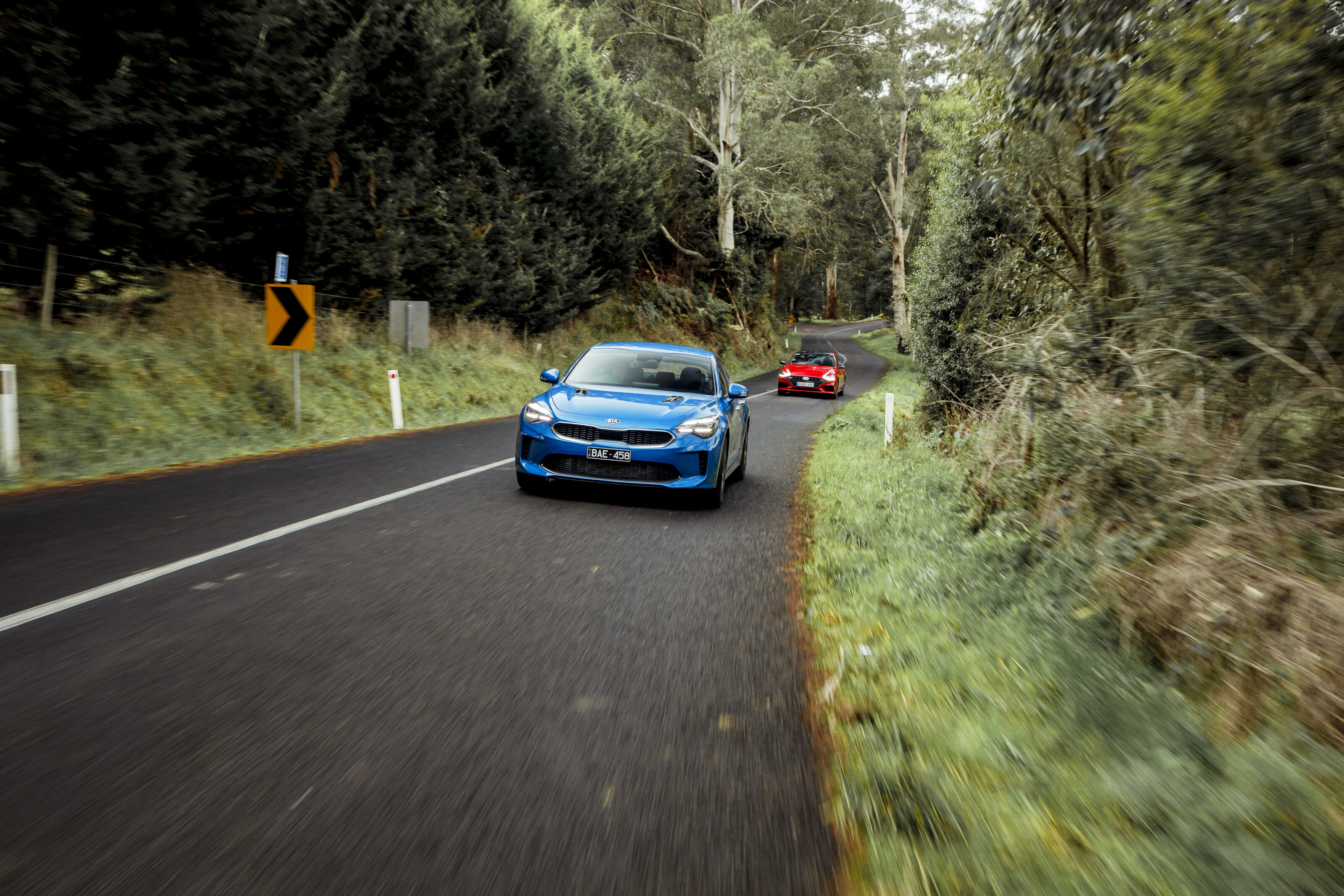
1
This year’s My Melbourne Road survey follows RACV’s 2021 My Country Road survey, that saw more than 4000 Victorians provide feedback on the state of Victoria’s regional and rural roads. In the survey, 31 roads were underscored as having serious safety issues and, of those, over half have seen infrastructure upgrades commence or committed to by government.
Melbourne road users can take the My Melbourne Road survey online here.
Here’s a question: how many metres do you think it takes a Ford Ranger Raptor to come to a complete stop from 100km/h?
And are electric cars really as fast against the stopwatch as their manufacturers claim? Oh sure, their instant torque means they feel fast, but how do they actually go against the clock?
Okay, technically that’s two questions – but the answers, as you can see from the below data tables, are enlightening.
Empirical data has long been a core component of the Wheels Car of the Year judging process. It doesn’t only provide some hard data to factor into our decision making process as we look to assess performance, handling and fuel efficiency, but it can occasionally produce some eye-opening results. The Ranger Raptor’s 51.7m dry braking distance from 100km/h being just one example.
MORE READING
As the 2023 COTY story evolves, the list of stories below will grow. Keep an eye on this page for more, or find it all at our COTY page.
A NOTE ON CRITERIA
1
For context, the best dry braking result from this year’s field of 26 cars was 34.6 metres by the Tesla Model Y RWD – meaning a Raptor needs a full 17.1 metres more space to stop from the same speed.
See what I mean about eye-opening?
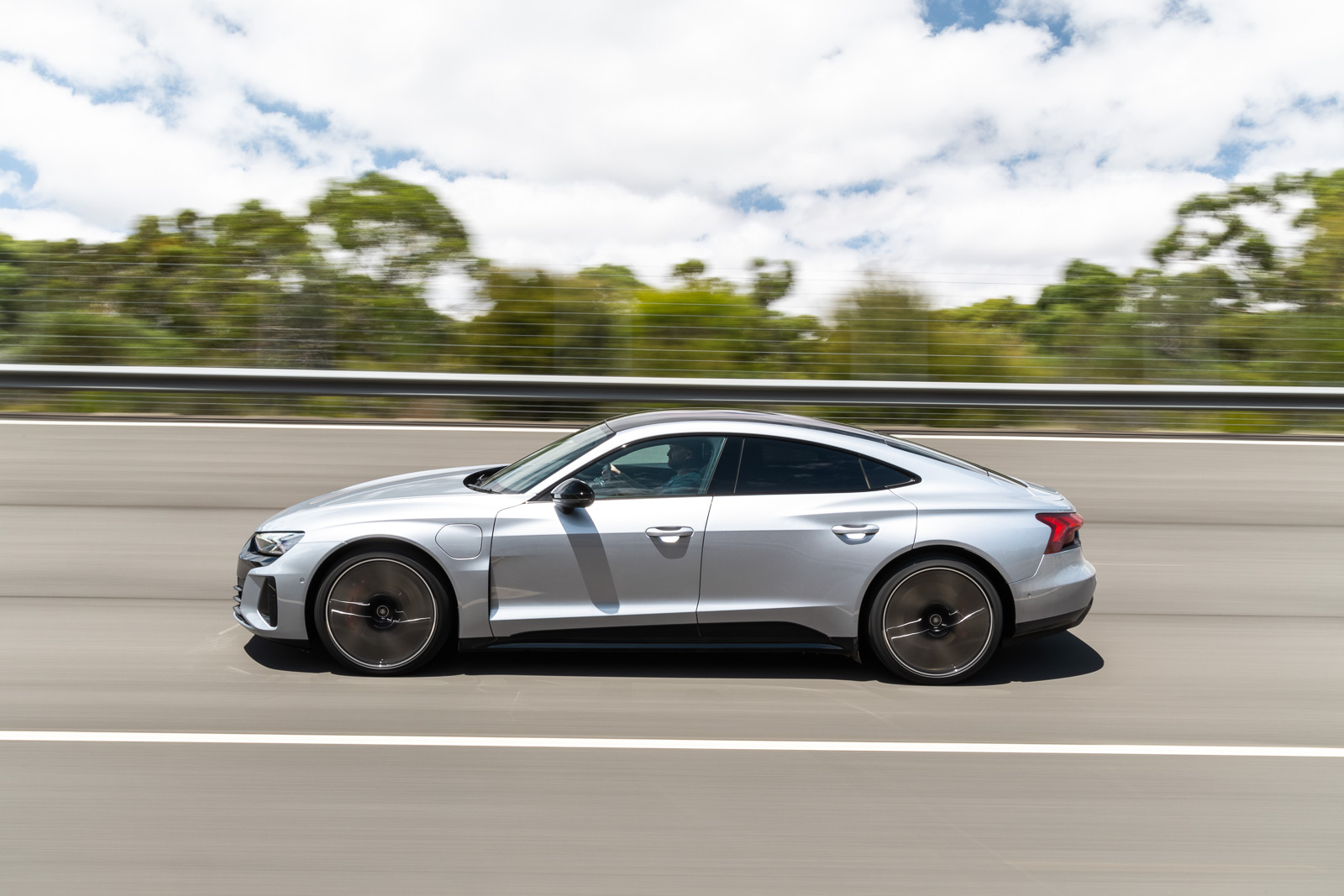
1
As for whether EVs are as quick as they claim to be? The answer is a definitive yes.
The Audi RS E-tron GT, for example, was the quickest car in the field, and actually beat its claim to hit 0-100km/h in 3.2 seconds. And in reassuring news, Audi’s new electric flagship was also one of the best in the braking discipline and only needed 36.0m to come to a complete stop.
We won’t spoil the fun of diving into the data tables and drawing your own conclusions, but here are a few other notable results:
While the Ranger Raptor performed dismally in the braking exercise, it actually beat its 0-100m/h claim by a significant margin with a figure of 6.1 seconds. That’s hot-hatch fast from a 2.5-tonne dual-cab ute. Not bad.
The Range Rover P530 was another strong contender in the 0-100km/h discipline that struggled, hard, in the braking exercise with a stopping distance of 47.6m. Seems there’s a theme developing there: big power + big weight = mixed results. (Who’d have guessed…)
It’s also worth noting that all of the Fords we had on test (Rangers + Everests) were on all-terrain tyres, which helps, in part, to explain their finishing spots. Had we conducted the same tests on dirt, it’s likely they’d finish at the pointy end.
Finally, a couple of housekeeping notes.
For consistency, all of the below numbers were collected on the same day, in the same location and by the same pair of drivers. Each car was also tested multiple times with the figures below being the best figure achieved, excluding any outliers. A freak 0-100km/h number that couldn’t be repeated, for example, wasn’t included.
1
Acceleration: 0-100km/h
| Contender finishing order | 0-100km/h (seconds) | |
|---|---|---|
| 1 | Audi E-tron GT RS | 3.2 |
| 2 | Audi RS3 Sportback | 3.8 |
| 3 | Genesis GV60 Performance | 4 |
| 4 | Cupra Formentor VZx | 4.7 |
| 5 | Volvo C40 Twin Motor | 4.7 |
| 6 | Range Rover P530 First Edition | 5.4 |
| 7 | Nissan Z manual | 5.8 |
| 8 | Ford Ranger Raptor | 6.1 |
| 9 | Cupra Formentor VZ FWD | 6.6 |
| 10 | Cupra Formentor VZe | 6.8 |
| 11 | Toyota GR 86 GT manual | 6.8 |
| 12 | Tesla Model Y RWD | 6.9 |
| 13 | BYD Atto 3 Long Range | 7.4 |
| 14 | Nissan X-Trail Ti ePower 5-seat | 7.6 |
| 15 | Skoda Fabia Monte Carlo | 8 |
| 16 | Ford Ranger XLT V6 | 8.2 |
| 17 | Toyota Corolla Cross Atmos Hybrid AWD | 8.3 |
| 18 | Audi A3 35 TFSI | 8.8 |
| 19 | Nissan X-Trail ST-L 7-seat | 9.8 |
| 20 | Toyota Corolla Cross GX petrol FWD | 9.1 |
| 21 | Nissan Qashqai Ti | 9.5 |
| 22 | Nissan Qashqai ST+ | 9.6 |
| 23 | Ford Everest Sport V6 AWD | 9.8 |
| 24 | Peugeot 308 GT Hatch | 10.1 |
| 25 | Peugeot 308 GT Premium wagon | 10.5 |
| 26 | Ford Everest Trend 2.0 Bi-Turbo 4X4 | 10.6 |
1
Dry braking: 100-0km/h
| Contender finishing order | Metres | |
|---|---|---|
| 1 | Tesla Model Y RWD | 34.6 |
| 2 | Cupra Formentor VZe | 34.9 |
| 3 | Cupra Formentor VZ FWD | 35.1 |
| 4 | Genesis GV60 Perf AWD Luxury Pack | 35.3 |
| 5 | Skoda Fabia Monte Carlo | 35.5 |
| 6 | Peugeot 308 GT Hatch | 35.8 |
| 7 | Audi A3 35 TFSI | 35.9 |
| 8 | Nissan Qashqai ST+ | 35.9 |
| 9 | Audi E-tron GT RS | 36 |
| 10 | Cupra Formentor VZx | 36 |
| 11 | Nissan Qashqai Ti | 36.4 |
| 12 | Audi RS3 Sportback | 36.5 |
| 13 | Nissan X-Trail Ti ePower | 36.7 |
| 14 | Peugeot 308 GT Premium wagon | 37.1 |
| 15 | Volvo C40 Twin Motor | 38.1 |
| 16 | Nissan Z manual | 38.5 |
| 17 | Toyota Corolla Cross GX petrol FWD | 38.8 |
| 18 | BYD Atto 3 Long Range | 39.7 |
| 19 | Toyota GR 86 GT manual | 39.9 |
| 20 | Toyota Corolla Cross Atmos Hybrid AWD | 40.4 |
| 21 | Nissan X-Trail ST-L 7-seat | 40.9 |
| 22 | Ford Ranger XLT V6 | 41.1 |
| 23 | Ford Everest Sport V6 AWD | 42.8 |
| 24 | Ford Everest Trend 2.0 Bi-Turbo 4X4 | 44.5 |
| 25 | Range Rover P530 First Edition | 47.6 |
| 26 | Ford Ranger Raptor | 51.7 |
MORE
Wheels COTY
Which of our COTY 2023 finalists do you think will win?
VOTE IN OUR INSTAGRAM POLL
https://www.instagram.com/p/CpTwcZZAcaL/
Many Australians have a Forester memory. Maybe you or your mates had one on your Ps, younger readers may have even grown up in the back of one.
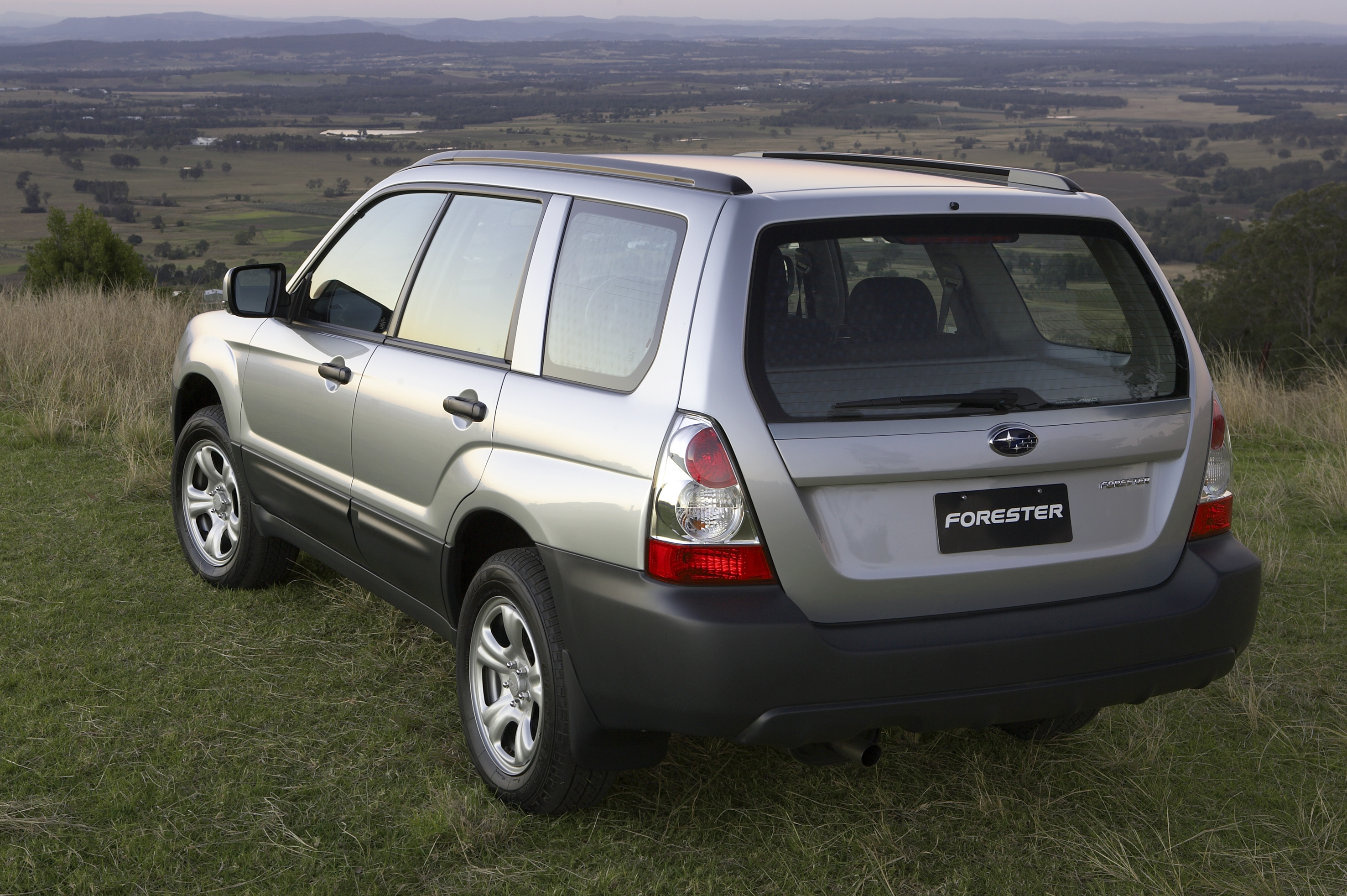
Such is the staying power of Subaru‘s faithful Forester, that the brand is celebrating a significant milestone as the model surpasses 300,000 units sold since its initial Australian introduction in 1997.
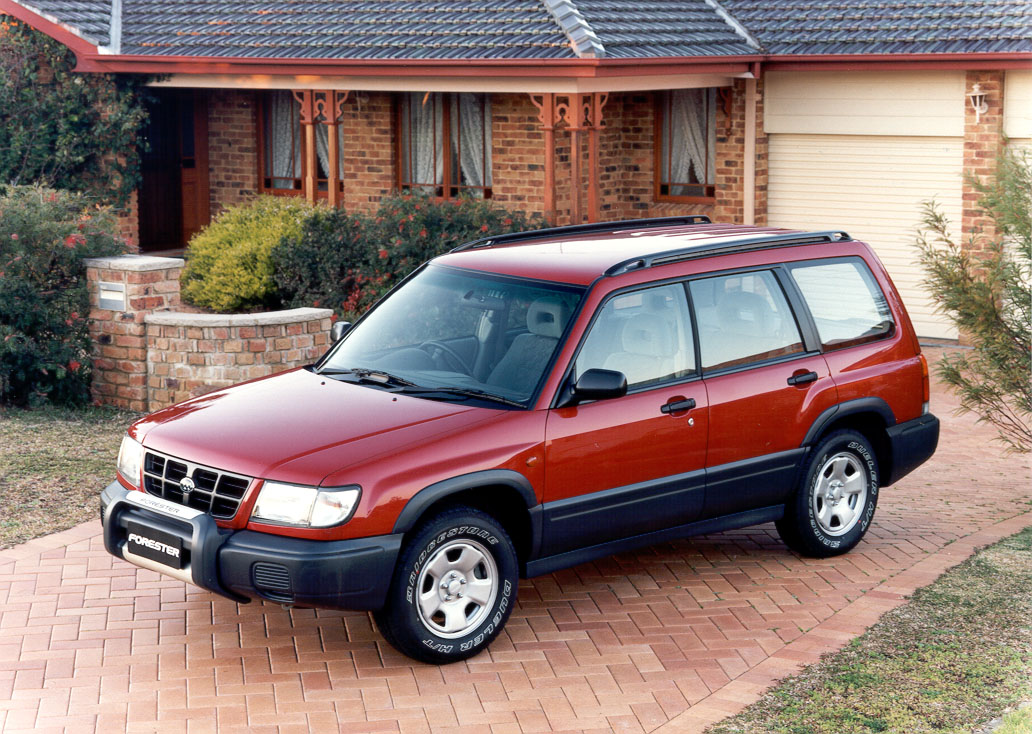
1
The Forester has remained a mainstay for Subaru for decades, trading on its impressions of durable reliability, a heavy focus on safety and all-wheel drive, all-terrain versatility for more than 25 years.
Subaru Australia’s Managing Director, Blair Read, said: “Subaru Forester continues to be a popular choice for drivers looking for a versatile vehicle, with its legendary Symmetrical All-Wheel Drive system, advanced safety features, and spacious interior. We are proud to have reached the 300,000 sales milestone for Subaru Forester in Australia.
1
“With the Forester’s sales success, Subaru Australia remains committed to providing innovative, high-quality vehicles that meet the needs and expectations of Australian motorists. The Subaru Forester has become an iconic vehicle in the Australian market, and the 300,000 units sold cements its position as one of the country’s favourite SUVs”.
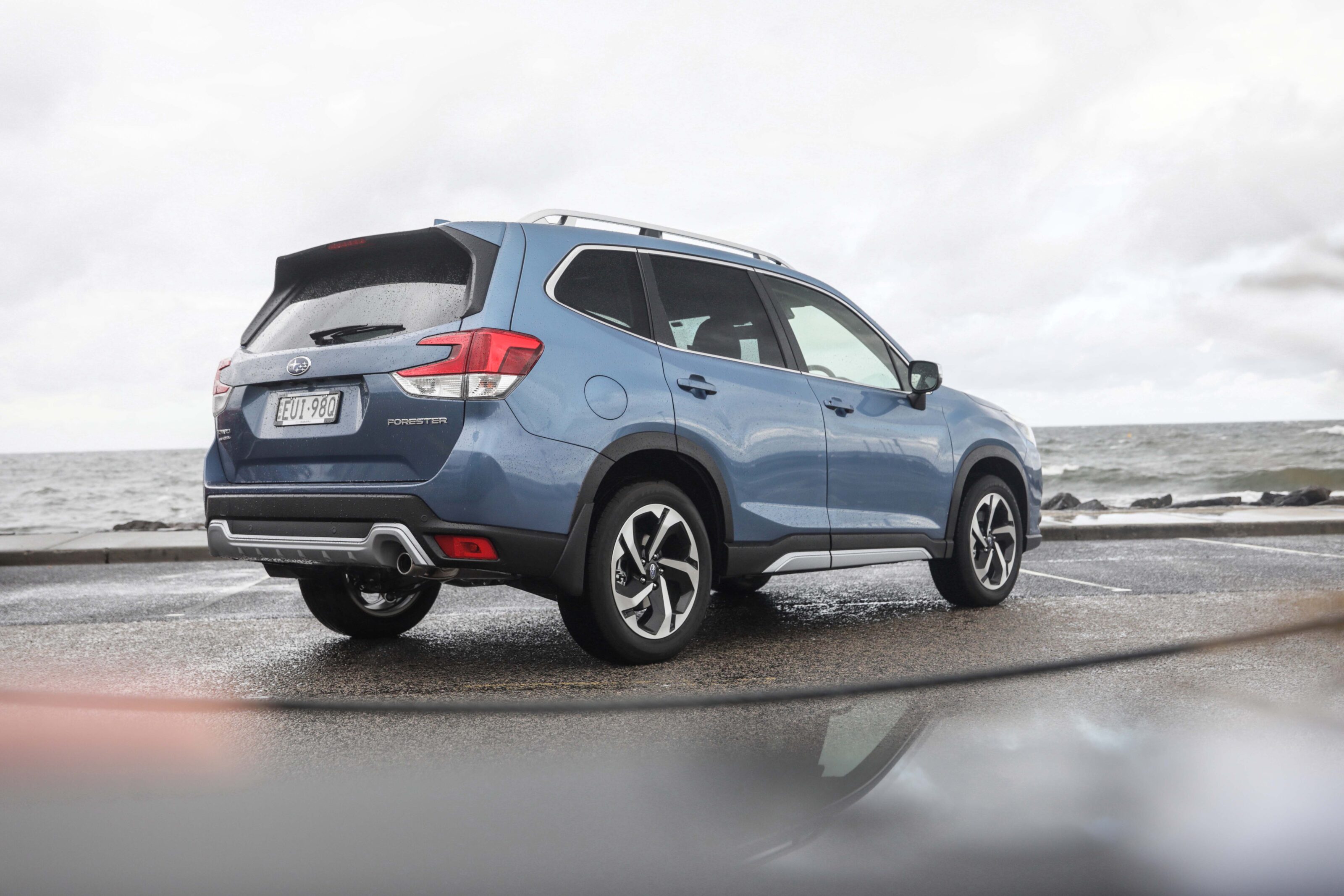
Cumulative sales throughout 2022 saw the Subaru Forester peg 10,637 new national registrations, while suffering limited supply, finishing the calendar year in seventh place within the medium SUV (<$60k) segment.
1
To date, the Forester remains Subaru Australia’s most awarded and most popular model, with the current generation making its mark as the outright runner up finisher at 2018 Wheels’ Car of the Year.
MORE
Everything Subaru
Mitsubishi’s Outlander PHEV has proven popular with Australians, and now there’s a new second-generation model. Ford, too, has joined the fight with its first local plug-in hybrid – the Escape PHEV. How do they compare?
The news story highlighting ‘the problem with new cars’ caused the expected stir on Facebook.
‘New cars’? EVs, presumably. But the car pictured wasn’t new, nor an EV. It was a several-year-old first-gen Mitsubishi Outlander PHEV.
Its owner had run a long extension cord from their house to charge the PHEV, which was parked on the street. Like most of us, they’re probably just dealing with high fuel prices and the spiraling cost of living.
Oh, the outrage! Yet what really stood out in the comments was how little awareness the average non-Wheels-reader has about not only plug-in hybrids, but EVs, hybrids and the sustainable motoring big picture.
That’s not too surprising. The Outlander PHEV debuted in 2014 as the world’s first plug-in hybrid SUV and even now with EVs just gaining traction, the distinction between plug-ins, regular hybrids and those nasty ‘new cars’ is still easily lost.
Outlander PHEV long-termer!
Inwood has transitioned out of the petrol Outlander and into a new Outlander PHEV. Get that long-term diary here.
JUMP AHEAD
- The basics
- In the cabin
- Comfort, space and convenience
- Boot space
- Powertrains and driving range
- Fuel use
- On the road
- Ownership
- VERDICT
- Full specs
Specs: The on-paper fight
The basics
The newly arrived second-gen Outlander PHEV, as part of the fourth-gen Outlander range, represents a solid upgrade over the original, bringing more powerful electric motors, increased battery capacity for extra EV-only range, a seven-seat option and a higher price.
By increasing the motor outputs from 60/70kW (front/rear) to 85/100kW and increasing the lithium-ion battery capacity from 13.8kWh to 20kWh, compared with the previous-gen, the 2023 Outlander PHEV now has an extended EV-only range of 84km (based on NEDC official figures).

1
Given that Mitsubishi’s insights indicate more than 80 per cent of PHEV owners already do most of their driving in EV mode, after plugging in each day, the well-judged boost to range should see the new model hit the mark.
However now, even in entry-level ES grade as tested, the Outlander PHEV costs around $60K on the road, which does leave some head-scratching over the value equation.
Because, without overlooking the driver experience and fuel-saving benefits of a PHEV, that $20K premium over a conventional Outlander would pay for a lot of petrol.
The Ford Escape PHEV had its addition to the Aussie line up delayed due to COVID-related supply challenges, duly arriving earlier this year as the first electrified Blue Oval offering.

1
Available solely in curiously positioned ST-Line grade, the Ford Escape PHEV lines up circa-$63K drive-away with a couple of option packs, or about $17K more than a regular Escape ST-Line.
Is a hybrid-curious family SUV shopper looking for a sporty, 18mm lower and firmer plug-in? That surely depends on the individual.
But the odd part is the sportily positioned Escape 167kW PHEV, with its efficiency focus and extra weight, is actually less muscular than the class-leadingly quick 183kW turbo-petrol versions – with 0-100km/h increasing from 6.6 to 9.2 seconds.
And as a front-drive, it not only loses the power-down of AWD but also the sophistication of a multi-link rear suspension, which FWD Escapes swap for a torsion beam.
Deal-breaker? We will find out.

1
In the cabin
Sophistication was not something I expected from a base Mitsubishi SUV cabin. But wow, things have really taken a step up since I last sat in an Outlander.
There’s so much to like, from the stitched, lightly padded dash covering, soft-touch armrests and door trim inserts to the crisp 12.3-inch digital cluster and mature and responsive 9.0-inch multimedia display with wireless Apple CarPlay, wired Android Auto and DAB+ radio.
The fairly conventional drive selector and a drive mode dial offering normal, eco, power and a variety of off-road modes are neat and intuitive, with straightforward buttons alongside for EV mode selection and to engage the well-calibrated single-pedal driving mode.

1
Even the steering wheel is nicely sculpted, though made of urethane, to the Ford’s pliant faux leather. Wheel and fabric seat trim aside, it’s easy to forget this is an ES grade from the presentation ahead of the driver.
The front seats, like the wheel, may be cost-effectively upholstered but offer a well-judged blend of comfort with a body-hugging ability that makes the Ford’s sporty-looking seats feel a bit flat and unsupportive.
The lasting impression of the Escape interior is that it feels Focus-derived so a bit below the price point here, as well as being a bit gloomy which is a combination of the shallower glasshouse and dark headlining.
The red-stitched synthetic leather and suede seats are visually appealing and tactile yet many of the dash and door trim plastics feel a bit basic, particularly in the back.

1
The Sync 3 multimedia unit is smaller at 8.0 inches as well as a fraction slower to respond than its rival’s but like the digital display it is clear and intuitive and you can plug in for Android Auto or Apple CarPlay.
Like any rotary drive selector, the Ford’s dial can be a bit irritating when you’re rushed.
The Ford is a bit more generous on the equipment however, even accounting for the test car’s option packs.
Standard in the Escape are a 10-way powered driver’s seat, wireless smartphone charging and B&O Play audio, the likes of which are not found in the Outlander.

1
To this the ST-Line pack adds front seat heaters, LED matrix headlights, a head-up display and a powered tailgate, and the Park pack adds enhanced active park assist, a front camera and door edge guards.
To match the optioned-up ST-Line’s key extras you’d need to step from ES to the $6400-pricier Outlander PHEV Aspire.
The Escape protects occupants with six airbags and safety technology including autonomous emergency braking with pedestrian and cyclist detection, adaptive cruise with stop/go, rear-seat occupant alert and traffic sign recognition.
You also get a tyre-pressure monitor, blind-spot monitoring, rear cross-traffic assist, driver impairment monitor, lane-departure warning, lane-keep assist and the benefits of a programmable ‘MyKey’.

1
Outlander PHEV features eight airbags, with a first-row centre airbag and a driver’s knee bag over its rival.
Safety tech extends to autonomous emergency braking with pedestrian and cyclist detection and junction assist, driver attention alert, traffic-sign recognition (using camera and nav data), adaptive cruise and blind-spot warning and intervention.
The Mitsu also features lane-change alert, emergency lane-keeping featuring oncoming and overtaking traffic recognition and road-edge recognition, as well as lane-departure warning and prevention, front and rear parking sensors, and a rear-view camera.
A recent model-year update added rear automatic braking and rear cross-traffic alert in the Outlander ES, but you’ll have to step to Aspire grade to get a multi-around-view monitor and LED headlights with adaptive driving beam.
Model by model: Comfort, space and convenience
Escape
Large humans in the second row get plenty of head, leg and toe room, a supportive adjustable cushion, and a fold-down armrest with twin cup holders.
There are three top-tethers and two ISOFIX positions here and in the Mitsubishi.
Back seaters get USB-A and C sockets, while the Mitsubishi doesn’t offer any rear sockets but provides USB-A and C sockets in the front, to the Ford’s twin USB-A front sockets.

1
Outlander
Relatively low base is a bit short on under thigh support leaving Outlander a bit less cosseting than Escape – no deal-breaker if it’s kids in child seats or boosters.
Headroom is ample, and leg and toe room are good. When flipped down, the centre backrest becomes a substantial armrest with two cupholders.
You can now opt for an occasional seven-seater PHEV (Mitsubishi calls it a 5+2) while Escape is only a five-seater.
Twin 240V Vehicle-to-Load outlets only feature from Aspire grade, which is disappointing.

1
Boot space: Storage and seat folding
Escape
Escape’s decent boot holds 556L behind the seatbacks with an underfloor space saver spare but no dedicated charging cable space. Flippers at each side drop the 60/40 seatbacks for 1478L. Four tie-downs, curry hooks, a 12V outlet, a subwoofer and a fabric cargo blind complete your guided tour of the boot, which is alone in featuring a powered tailgate (ST-Line pack).

1
Outlander
The Outlander’s boot holds 485L behind the second row and provides four tie-down points, curry hooks and a lever at each side that flips the 40/20/40 seatbacks to take capacity to 1478L. There’s a 12V outlet, but no spare wheel – you get a tyre repair kit instead – and there is a dedicated storage space for your charging unit/cable beneath the floor.

1
Powertrain and driving range
Petrol engines and electric motors team up for power and frugal fuel use
Mitsubishi’s PHEV system is calibrated to feel like an EV a lot of the time – meaning syrupy, strong torque and quiet, calm progress. The combination of 98kW Atkinson-cycle 2.4-litre and front and rear electric motors deliver a muscular combined 185kW and 450Nm that you’re well aware of even cruising the ’burbs.
With the Outlander’s battery fully charged, and Normal or EV mode selected, the combustion engine will only start if the driver explores the depths of the accelerator’s travel.

1
In the new 2023 Mitsubishi Outlander PHEV, we saw 70km of battery-powered driving in EV Mode without trying especially hard, before the display indicated a flat battery. Just as in the Ford, when battery range is zero, there is actually some charge left – around 20 percent in this case – which allows for some electric assistance all the time… because a 98kW two-tonne SUV wouldn’t be much chop.
When the Mitsubishi’s big four-cylinder does fire, its interplay with the electric motors is always seamless, and its induction note and mechanical vibes are insulated and isolated to a level in step to the background road noise.
The capability for both series and parallel hybrid operation underpin Outlander’s Save and Charge modes, and allow for maximum flexibility and efficiency.

1
When the Mitsubishi’s big four-cylinder does fire, its interplay with the electric motors is always seamless, and its induction note and mechanical vibes are insulated and isolated to a level in step to the background road noise.
For example, at suburban speeds (below about 70km/h), the system judges it’s most efficient to drive on electric motor power, so the engine’s function here is to drive a generator that charges the battery and/or boosts electrical output when heavy acceleration or load calls for it.
Alternatively, on a motorway cruise the petrol engine will drive the front wheels directly, with the front and rear electric motors’ role now to capture excess kinetic engine and send it into the battery, or to add torque at the front or rear axle on demand. You can watch all this shuffling by way of an energy flow display on the digital instrument cluster, which helps you get a handle on what’s seamlessly happening.

1
Mitsubishi, like Ford, notes a 1.5L/100km official combined cycle figure during hybrid operation, however the relevance of this figure is limited to a scenario where much of your trip is on battery power.
The Ford Escape’s similar 2.5-litre Atkinson cycle engine is supplemented by a motor with less power than Outlander’s pair, drawing from a smaller 14.4kWh battery, for a more modest combined 167kW.
The experience is similar in that the Escape behaves like an EV when fully charged, in either EV Now or EV Auto mode, and has a range that will cover a day’s driving for so many city dwellers. Without doing an efficiency run, we saw 54km before the battery indicated it was empty.
An EV Later mode conserves battery and EV Charge tops it up via an engine-driven generator.
The Ford’s engine plays its part smoothly though more often than the Mitsubishi’s, and it’s also more vocal, with a noticeable induction note when it’s involved.

1
Tested fuel use
Our test loop saw an overall 3.1L/100km from the Escape with about a third of the driving done in EV mode, and 3.2L/100km from the Mitsu with about half the driving done in EV mode, after starting with fully charged batteries.
The figures from the petrol-only element were a respectable 4.2L/100km Escape and 4.8L/100km Outlander.
The Escape’s Easy Fuel filler calls for 95 RON or E10, while the Mitsu is fine with 91 RON.
Our take-out after an urban and country road loop is that the average driver will rarely burn much petrol in either model, as long as they diligently plug in each day at home or work.
Without frequent charging, the PHEV systems, like a good regular hybrid, will also reduce your petrol use compared with a conventionally powered alternative.

1
Even on a trip that leans heavily on the petrol engine the battery and motor(s) enhance efficiency – and performance – by enough to offset carrying around the extra mass.
However, a huge plus in the Mitsubishi is the ability for DC CHAdeMO fast charging – which is not possible in the Ford – to take the battery from zero to 80 percent in 38 minutes according to the claim. This port also allows for Vehicle-to-Grid/Home functionality.
Alternatively, 240V domestic charging via the Type 2 AC port can fully charge Outlander in 9.5 hours, or 6.5 hours plugged into a 3.6kW 240V AC fast charger.
Escape takes six hours to charge from a regular 240V outlet via the Type 2 AC port on the passenger front guard, or around half that plugged into a 3.6kW charger.
A huge plus in the Mitsubishi is the ability for DC CHAdeMO fast charging – which is not possible in the Ford – to take the battery from zero to 80 percent in 38 minutes according to the claim.

1
On the road
The turbo AWD conventional Escape is bordering on hot-hatch fun, which would be excellent if it didn’t also bring some ride and refinement trade-offs and the ST-Line positioning points to Escape being the driver’s PHEV.
The silhouette, seats and steering wheel spell sporty too, while the Outlander makes no promises with its bluff and pragmatic figure.
There is a keenness and feeling of precision to the Escape’s steering responses though like conventional variants it feels a bit hollow even as cornering loads build, and it’s a bit springy in returning to centre.
While fun, the lively front-end could become tiringly over-enthusiastic.

1
The Ford’s chassis balance is satisfying yet when you’re hurrying the Escape the teaming of hybrid powertrain with front drive can corrupt that neutrality with torque steer.
Body control is tight and backroad composure commendable however the tautness could be draining during more mundane driving or on a trip.
Despite 18-inch tyres on deep 60-profile sidewalls the ride can be busy too, when the surface is rough or bumpy, and those surfaces can set off interior squeaks and rattles.
The Mitsubishi doesn’t carry the same weight of expectation as the Ford, which surely helped it impress. Taking the baton from the surprisingly well presented and finished cabin are ride and handling that won’t offend anyone; the Outlander is actually very capable.

1
Take the steering – well weighted with a reasonable sense of connection and an overall air of calm, the Outlander PHEV terrific for cruising, easy around the city with an underlying ability to hold up to a thrash.
All with a pretty quick 2.6 turns lock-to-lock; virtually the same as the Ford (2.5) and with a slightly smaller turning circle (11.0m plays 11.4m).
The brakes are easy to modulate and comfortably handle the mass and performance though the pedal is spongy to the Ford’s grabby.
The Mitsu is serene riding on what feel like reasonably soft springs and dampers. It can be caught out by the odd challenging bump but doesn’t telegraph every road imperfection the way its rival does.
There’s also a weird longitudinal see-sawing motion over some underlations which suggests an ultimate lack of polish, yet it doesn’t undermine Outlander’s comfort or stop it being fun to hustle along for what it is.
The powertrain plays a big part here, with substantial torque number being applied by all four tyres with the benefit of Super-All Wheel Control (S-AWC), a handling-enhancing acronym with solid Lancer Evo provenance, which brings attitude-adjusting torque vectoring and individual wheel braking.

1
Ownership
Warranty period and servicing costs
Mitsubishi certainly stands by its engineering with a 10-year, 200,000km warranty to the Ford’s more typical five-year, unlimited kilometres’ cover. But you have to service at Mitsubishi for this level of cover, otherwise it’s a five-year, 100,000km warranty.
Separate eight-year, 160,000km warranties apply to the Outlander’s battery, and to Escape’s motor & high-voltage system, which includes the battery.
Identical 12-month, 15,000km service intervals and services capped at $299 over the first four years or 60,000km suggest there’s little to split them on maintenance cost.

1
VERDICT
With its impressive PHEV powertrain and well-judged ride and handling, the Outlander PHEV pulls a lead on the road that the Escape can’t close.
A comfy, nicely finished and decently equipped machine, the Outlander is exactly what a family SUV should be.
Add capable dynamics and a potent and polished hybrid system with the capability for a really useable battery-only range and fast charging, and you have an appealing package for customers that want to benefit from many of the performance, refinement and fuel-saving benefits of an EV, without any range anxiety.
The Escape Hybrid is a decent plug-in SUV in isolation, with a very workable range (but no DC fast-charging capability), yet doesn’t ride as comfortably and, although well equipped, is darker and feels cheaper inside.

1
For $60K or more, both models have their work cut out to some degree convincing customers they’re worth the spend over a $40K conventional SUV – or something like a base, 2WD RAV4 Hybrid, which is also capable of slashing fuel bills.
No small stretch, that extra outlay would buy a used first-gen PHEV like the one that incited the keyboard warriors to furiously engage caps lock.
But if your personal value assessment suggests it’s money well spent, then it’s a plug from us for the Mitsubishi Outlander PHEV.
SCORING
Mitsubishi Outlander PHEV: 8.0/10
Ford Escape PHEV: 7.5/10
| Mitsubishi Outlander ES PHEV | Ford Escape ST-Line PHEV | |
|---|---|---|
| Safety, value and features | 7.0 | 7.0 |
| Comfort and space | 8.0 | 7.0 |
| Engine and gearbox | 9.0 | 8.5 |
| Ride and handling | 8.0 | 7.0 |
| Technology | 8.0 | 8.0 |
| OVERALL | 8.0 | 7.5 |
MORE
Everything Ford
2023 Mitsubishi Outlander PHEV and Ford Escape ST-Line PHEV specifications
A survey has revealed the inflated global economy has piqued the interest of drivers in electric vehicles – but key barriers in affordability, driving range and charging infrastructure persist.
Snapshot
- Lower u2018fuelu2019 costs a key reason for EV switch
- Still concerned around price, home charging, driving range
- Petrol, diesel, hybrids still preferred
The study, by analysis firm Deloitte, was conducted between September to October 2022 – sampling more than 26,000 people in 24 countries, with this report focusing on markets including; Austria, Belgium, Germany, France, Italy, Poland, the United Kingdom, Turkey, Spain, and South Africa.
Read the full Deloitte report.
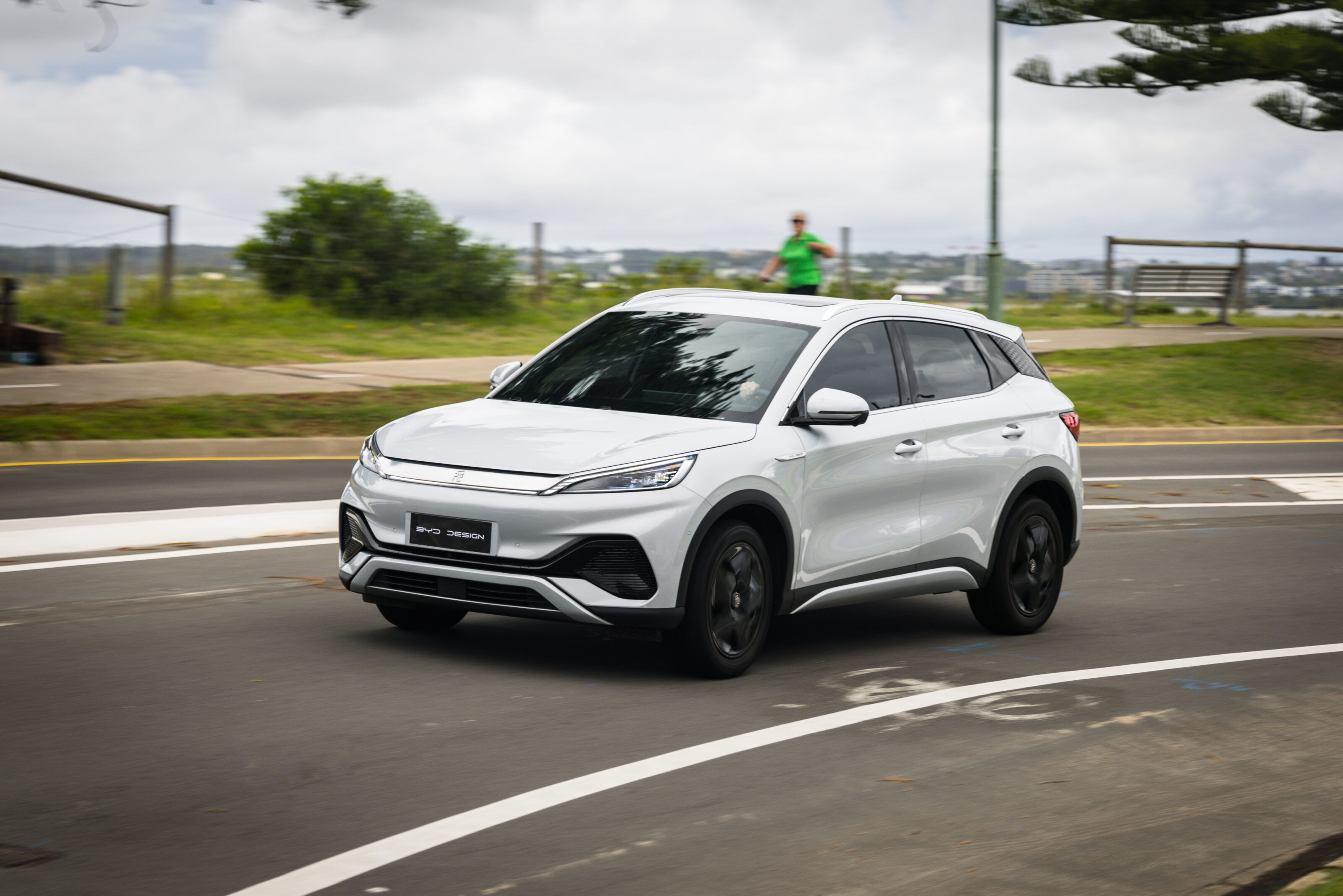
1
Lower running costs
The report highlights lower perceived running costs as the top reason to make the EV switch amid the uncertain economy, despite the continued preference for petrol or diesel and hybrid-powered vehicles.
Other reasons – including; reduced maintenance, government incentives, tax penalties on petrol and diesel engine vehicles, concern about climate change, personal health, and vehicle-to-home capabilities – trail behind.
All participants indicated a lack of peer pressure to encourage the EV adoption shift.
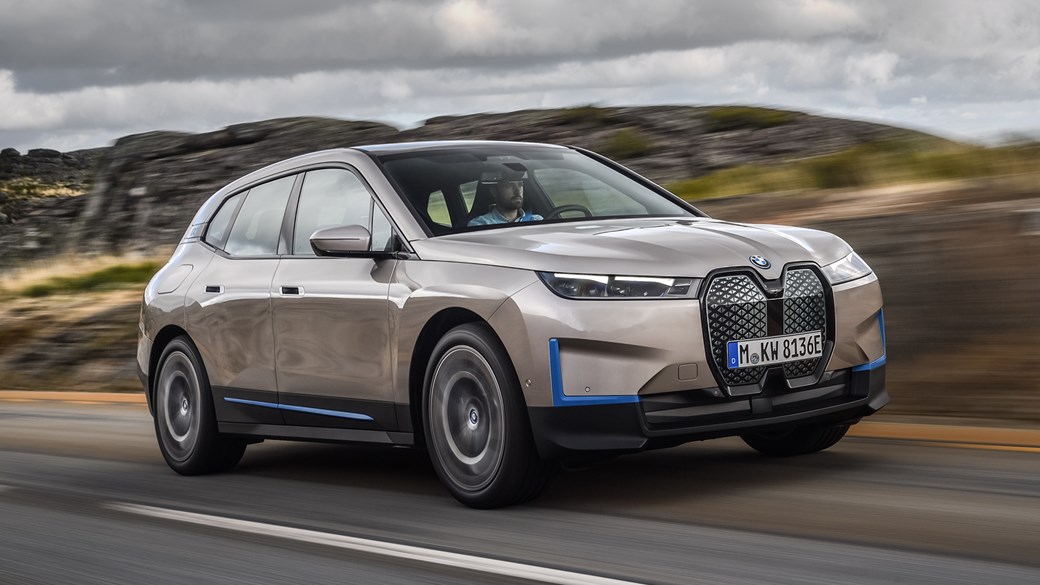
However, the higher electric car price tag remains a key concern for buyers, although not all models are more expensive and the argument is lower ownership costs over time will eventually offset and surpass the premium.
1
Home vs public charging
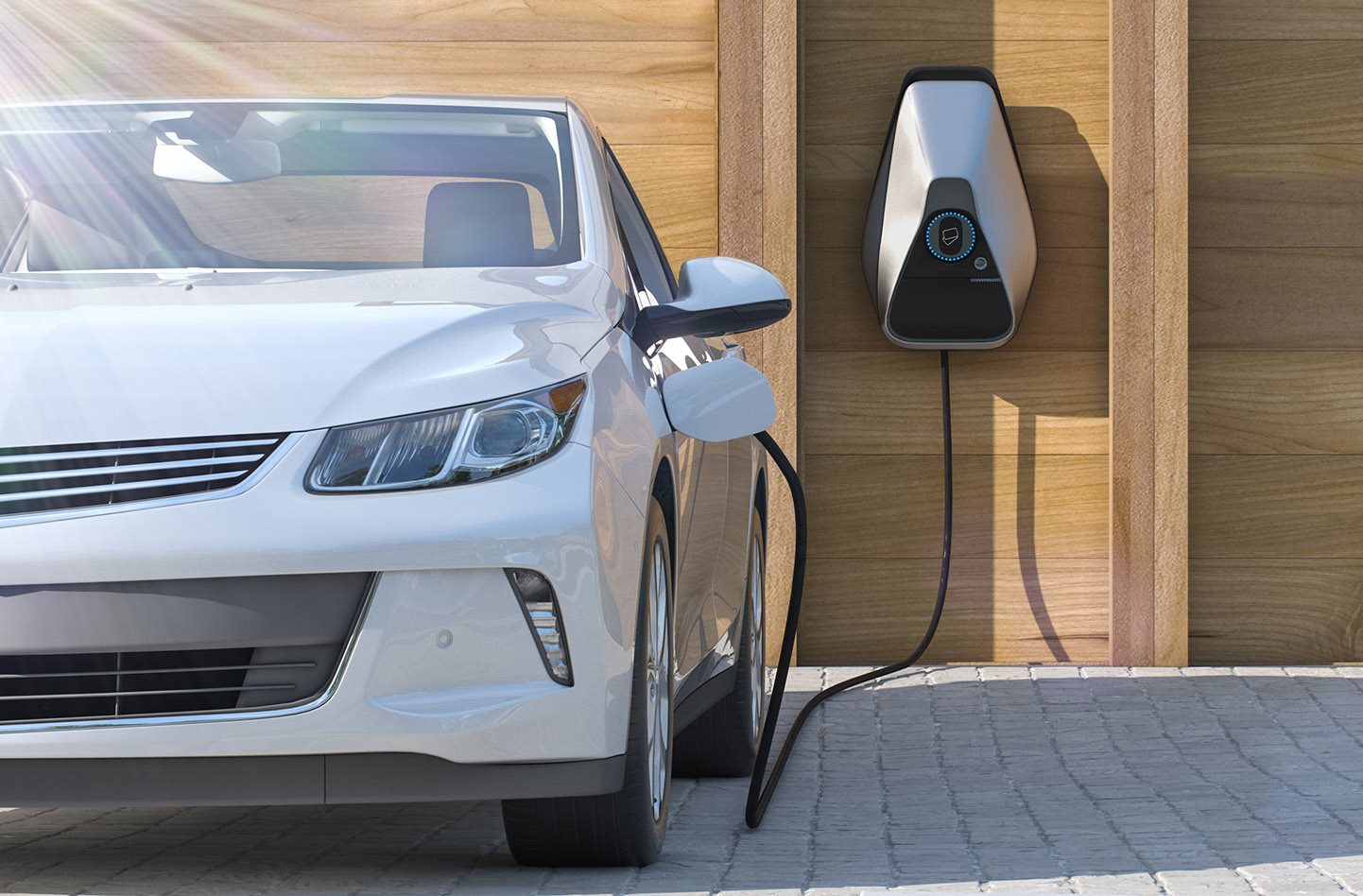
Furthermore, the majority of respondents in the United Kingdom, South Africa, and key European countries preferred charging at home every day.
But, most participants cited that they can’t refill EVs at their homes because charging equipment cannot be installed, the installation cost is too high, and some were unsure about how to do it.
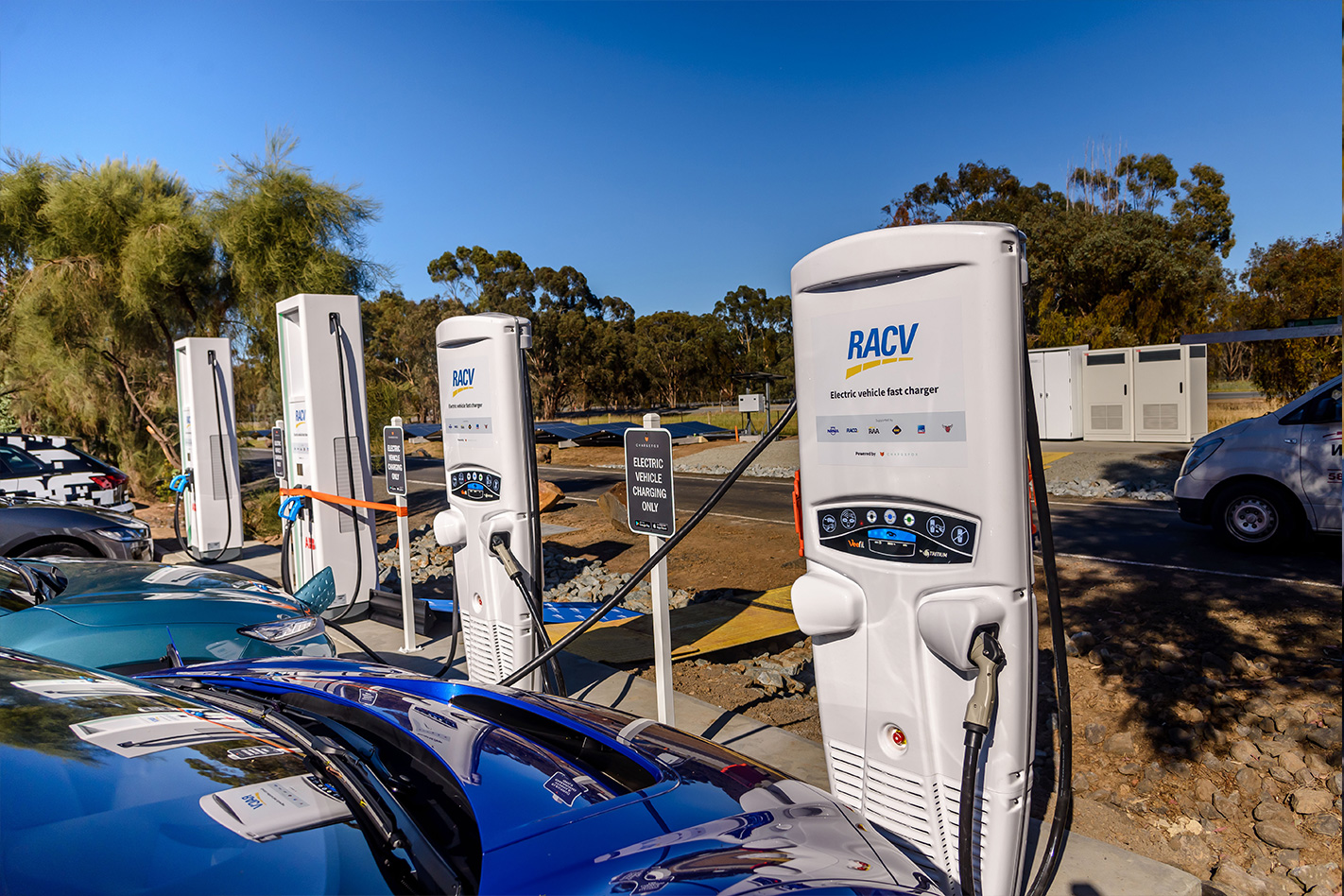
Therefore, more public charging infrastructure is required to address ‘range anxiety’ concerns. A strong preference for EV charging sites located at a dedicated EV hub or traditional fuel station were suggested, along with ‘any location’.
1
Interestingly, participants weren’t buoyed by longer recharging times compared to a quick refuel typical in a combustion-engined car, with most willing to wait 10 to 60 minutes – in line with EV station and model capabilities today.
The study also mooted that people would spend more time at EV chargers if they had toilet facilities and the availability of coffee or beverages, instead of light food, sitting areas, or private meeting rooms.
1
Driving range
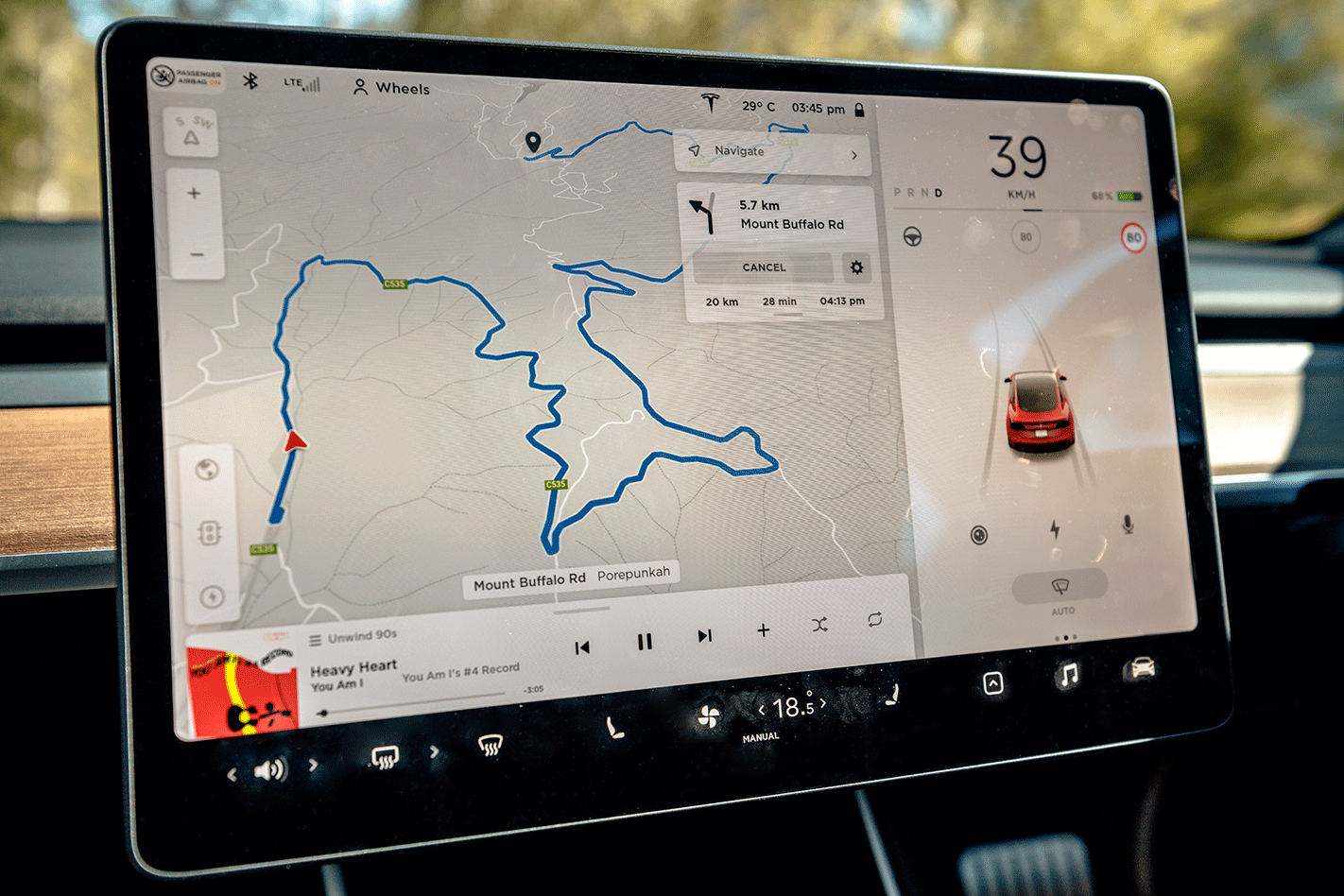
The Deloitte survey found expectations of EV driving range varies significantly depending on the country and remains a main barrier to adoption.
Most markets only require 400 kilometres or more driving range, whereas Austria, Belgium and France were more demanding at 600km or more range.
For reference, many EVs today already provide more than 400km in claimed driving range – but with the exception of some cheaper, city-focused, light commercial, and inefficient models.
1
Alternative zero-emission vehicles
Interestingly, the study foregrounds that most participants would rethink purchasing a battery-electric vehicle if there’s an environmentally sustainable alternative for traditional internal-combustion engines.
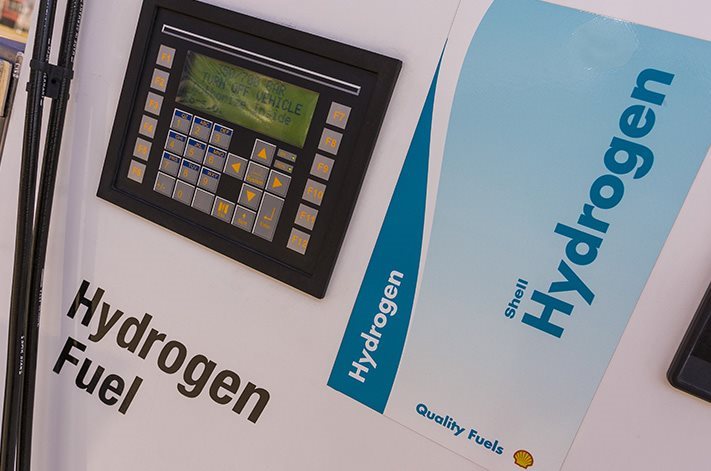
This includes emerging powertrain technologies, including synthetic eFuels and hydrogen-combustion, which has been the subject of recent scrutiny.
Automakers including Toyota, Hyundai, Renault and BMW are investing in the development of hydrogen fuel-cell propulsion.
1
Software and subscriptions
Carmakers are increasingly floating the idea of being ‘software-driven’ mobility companies, and already offer paid subscriptions to unlock certain features.
But, surveyed participants indicated a connected smartphone application to lock/unlock the vehicle, remote start, track its location, and add features aren’t necessary.
Most would rather pay for features in full or as part of the purchase price, as opposed to a per-use subscription fee.
Though, they did expect an app to help them learn more about the vehicle features, and book and track a servicing appointment.
Read the full Deloitte report.
Advice
Australia’s best electric cars for 2023
We’ve tested nearly every EV below six figures in Australia to rank the best on sale today
⚡ More EV stories to help you choose the best car for your needs
When one child comes along, the two-door or two-seater typically gets the flick.
Two kids? Well, that’s manageable in most cars with a decent second row.
When the third comes along, it’s usually time to explore even larger automotive alternatives. Expand the tribe to four or more kids, and the options are a bit more limited.
1
People-mover or SUV?
Three rows and a big boot are now a necessity, and many will tell you it’s time to upgrade (or, in the opinion of many a dedicated car enthusiast, downgrade) to a people-mover.
But all is not lost. These days, having four-plus kids does not automatically mean a people-mover/mini-van is first on the shopping list. These vehicles have come a long way – but for some active families, it may not be the best option.
Depending on the model, SUVs can go further into the bush, can tow the caravan or boat, and – again depending on your budget and needs – a new SUV with three rows and a boot could still work.
1
What do I need to look for?
The key is to start at the back of the car and move forward.
The boot will most often be the deciding factor; particularly with four munchkins. The amount of stuff needed for even a basic family outing is tremendous – more so if their ages span several years. Throw scooters in with double prams and you will need every millimetre you can get.
Some assume that roof racks and/or a pod will solve the storage problem, but it shouldn’t be the solution to boot space. They’re great for trips on the open road, but in everyday life these options are hard to reach, difficult to pack, and gives parking in most underground garages – not to mention your own home carport – an added degree of unnecessary difficulty.

1
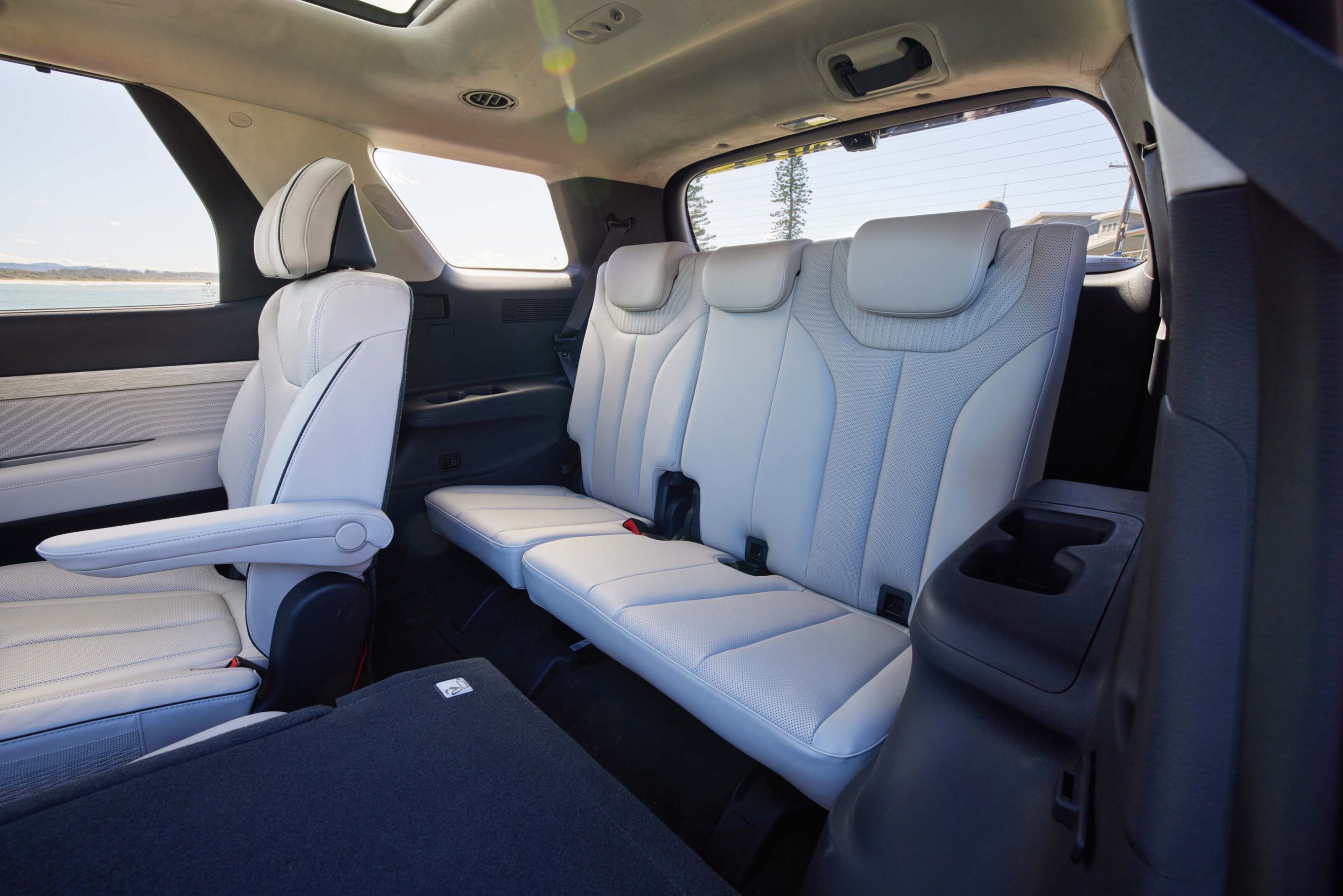
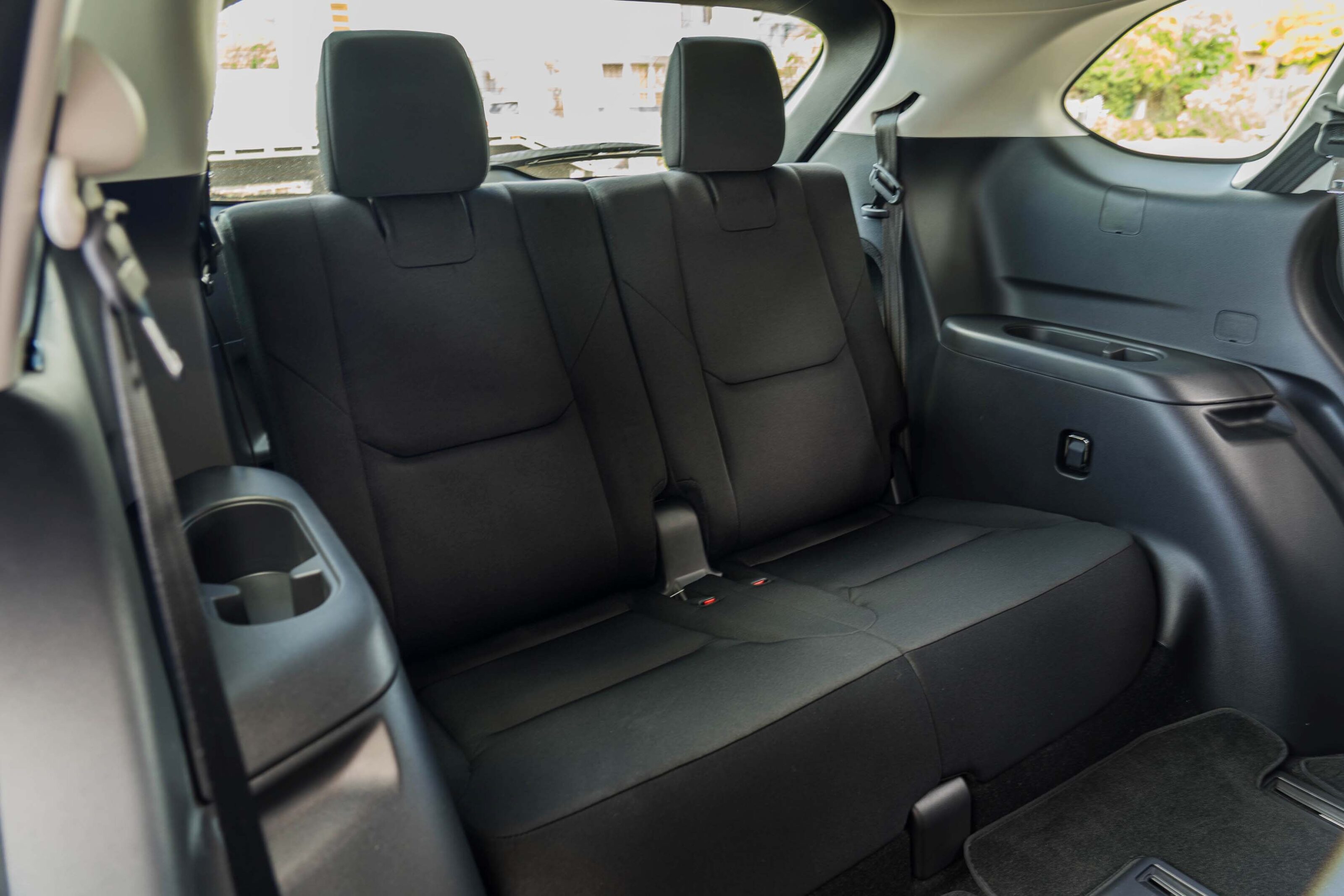
Most – if not all – modern seven-seaters have two individual seats in the third row (rather than a bench seat), which means the split-fold can be utilised for a passenger on one side, and some extra boot space on the other.
However, care must be taken to secure any items in and around the boot if a passenger is to be sharing the space with the luggage. This is where tie-downs and hook points come in very handy – be sure to look for them.
Accessing the third row
Access in and out of that third row is also very important, and not just for the person using it.
An older child may be able to clamber in unassisted – provided they aren’t so big as to be travelling with their knees near their ears given the footwell restrictions of third-row seating.

1
But many families will find the two hands needed for the folding mechanisms of the second row of seats can be too hard to manage if babes are still in arms.
With boosters recommended until the child is seven years of age, or 145cm in height, it’s highly likely that both the second and third rows will be full of them. This eliminates the ability of smart seats to fold at all.

1
The only alternative is to narrow down the car search, and, as you approach your final decision, measure how much space you will need to open up the third row with your current car seats. If you want, perhaps even drag your car seat to the showroom and physically see if it will work – or investigate whether a more compact car seat may be needed.
It’s vital that you check the anchor points to see if any fixtures or bars will need to be fitted as well. Life has been made far easier in this respect due to the easier Isofix system, but it’s uncommon to find Isofix anchors in third rows, meaning you’ll need to rely on using just the seatbelt and top tether to secure a seat.
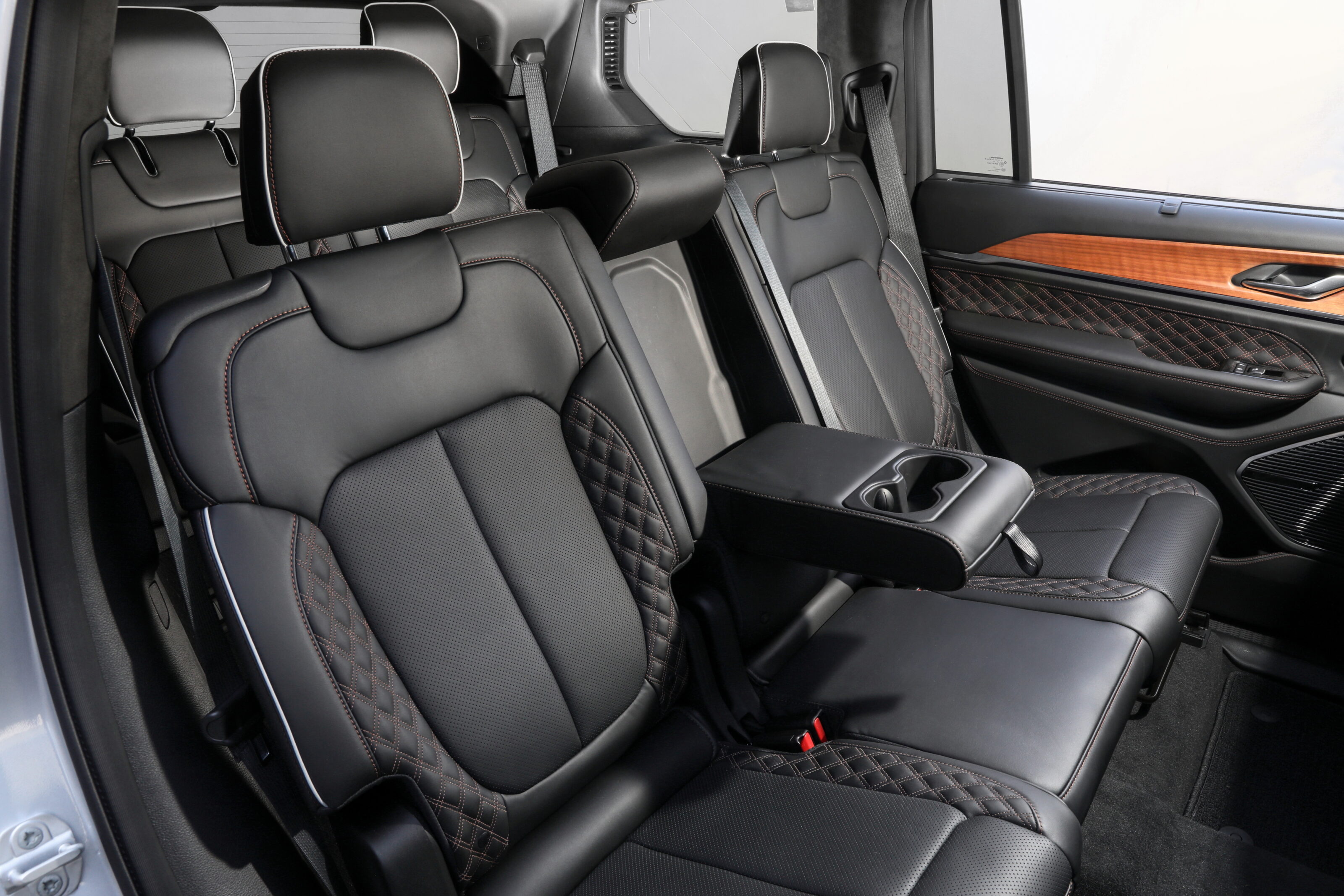
1
What are my options?
So, where to start shopping? While there are also plenty of high-end, luxury SUVs on the market, we’ve focused on the more affordable side – led by main players such as Toyota, Mazda and Mitsubishi.
SUVs
1
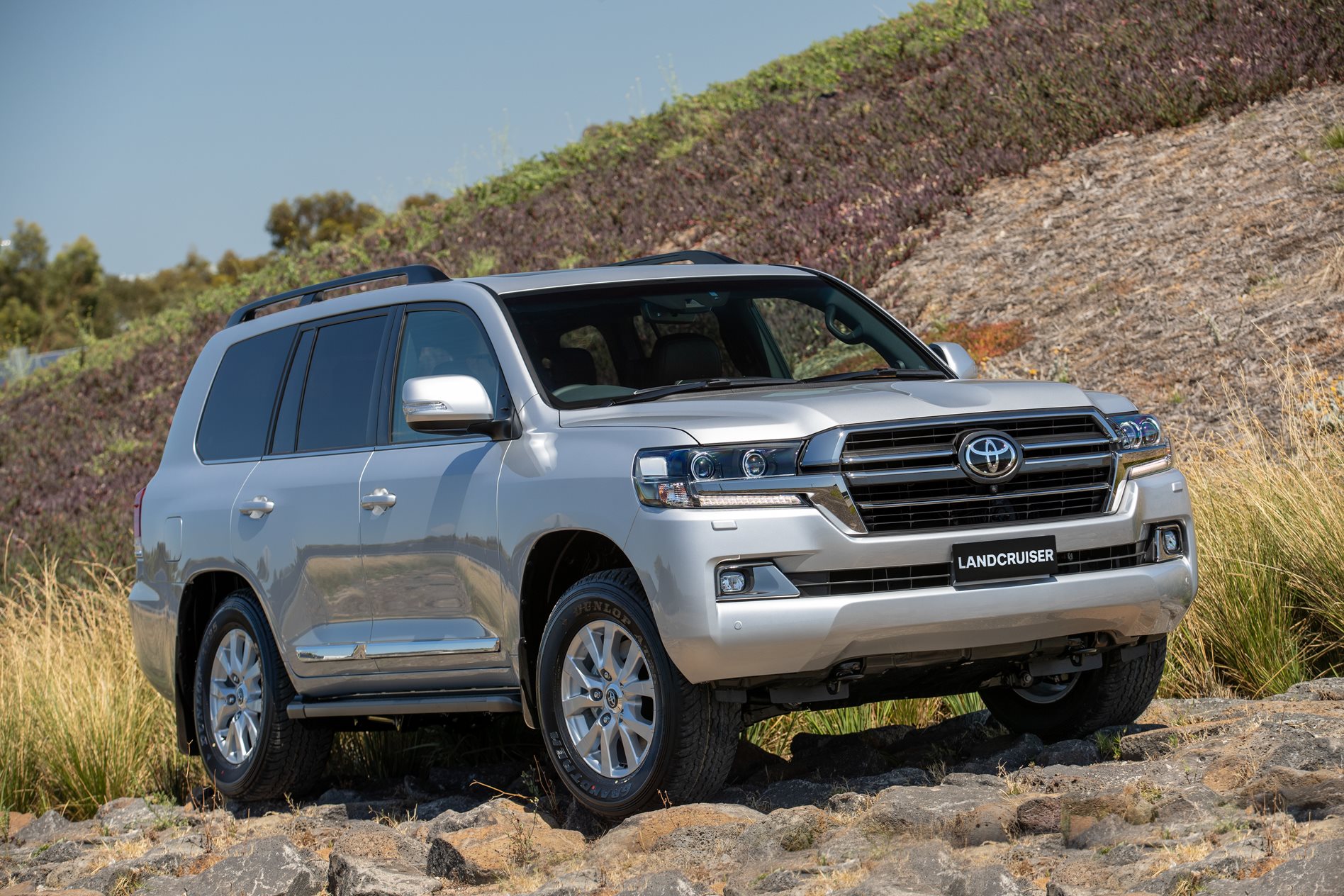
Toyota LandCruiser 300
- Starting price: $100,994 drive-away
- Drivetrain: 3.3-litre V6 turbo-diesel, 10-speed auto
- Fuel consumption: 8.9L/100km
- Cargo space (with all seats up): 175 litres
1
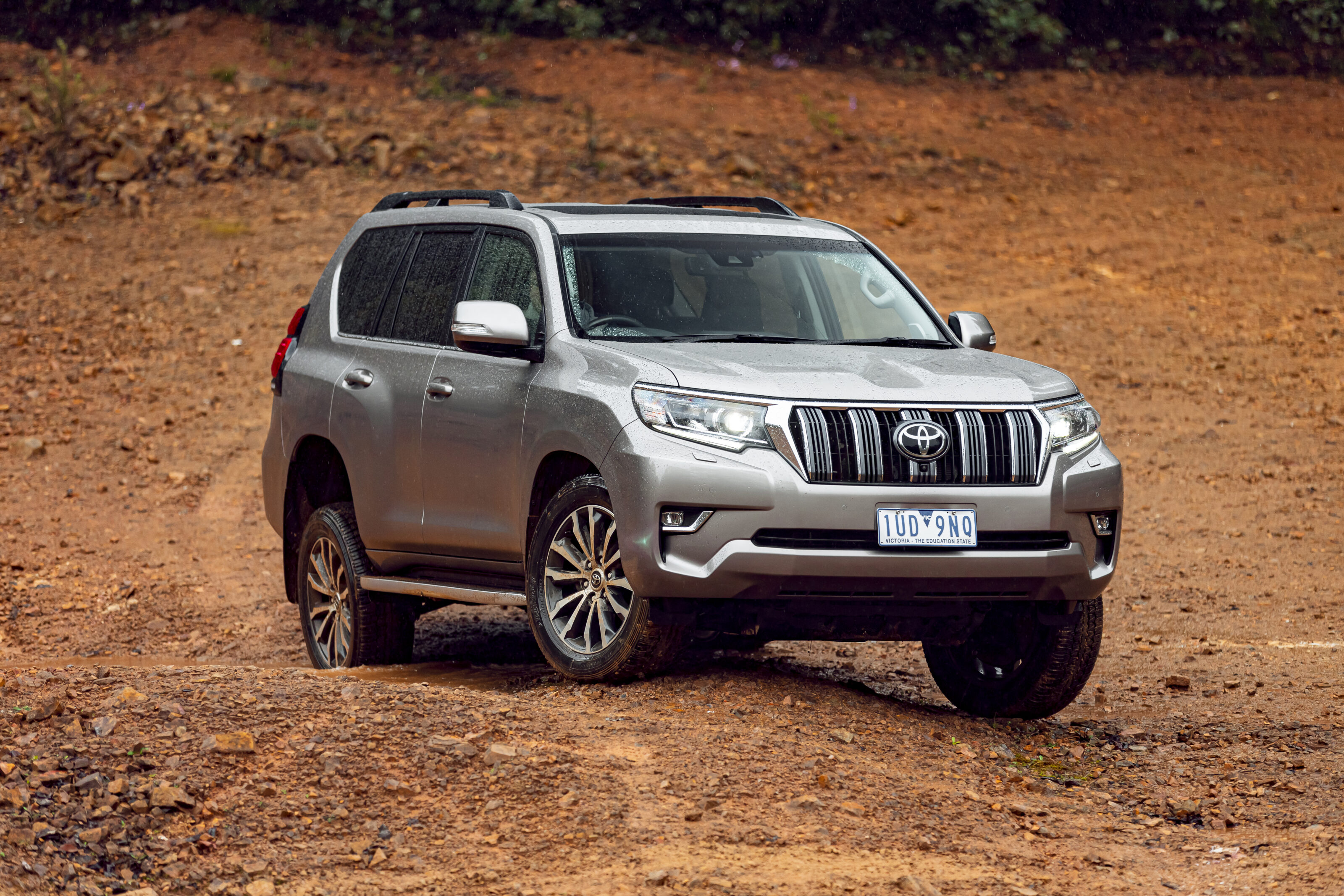
Toyota LandCruiser Prado
- Starting price: $68,345 drive-away
- Drivetrain: 2.8-litre turbo-diesel, six-speed auto
- Fuel consumption: 7.9L/100km
- Cargo space (with all seats up): 104 litres

1
Toyota Kluger
- Starting price: $56,148 drive-away
- Drivetrain: 2.4-litre turbocharged four-cylinder petrol or 2.5-litre petrol-electric hybrid, eight-speed torque converter auto
- Fuel consumption: 8.3L/100km petrol, 5.6L/100km hybrid
- Cargo space (with all seats up): 241 litres
1
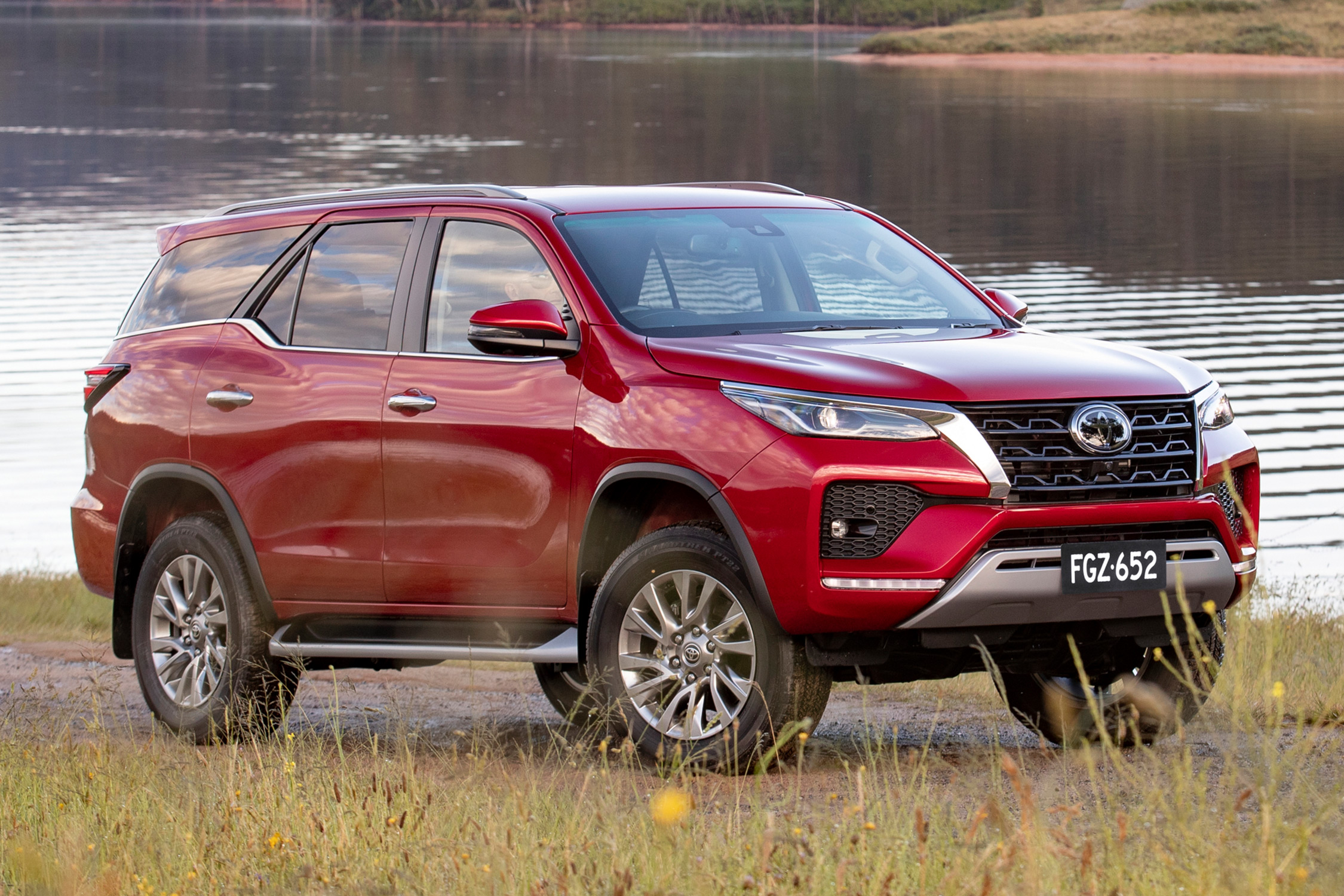
Toyota Fortuner
- Starting price: $57,027 drive-away
- Drivetrain: 2.8-litre turbocharged four-cylinder diesel, six-speed auto
- Fuel consumption: 7.6L/100km
- Cargo space (with all seats up): 200 litres

1
Mitsubishi Outlander
- Starting price: $44,320 drive-away
- Drivetrain: 2.5-litre four-cylinder, CVT auto
- Fuel consumption: 7.5-8.1L/100km petrol, 1.5-1.9L/100km PHEV
- Cargo space (with all seats up): 163 litres

1
Mitsubishi Pajero Sport
- Starting price: $53,240 drive-away
- Drivetrain: 2.4-litre turbocharged four-cylinder diesel, eight-speed torque converter auto
- Fuel consumption: 8L/100km
- Cargo space (with all seats up): 131 litres
1
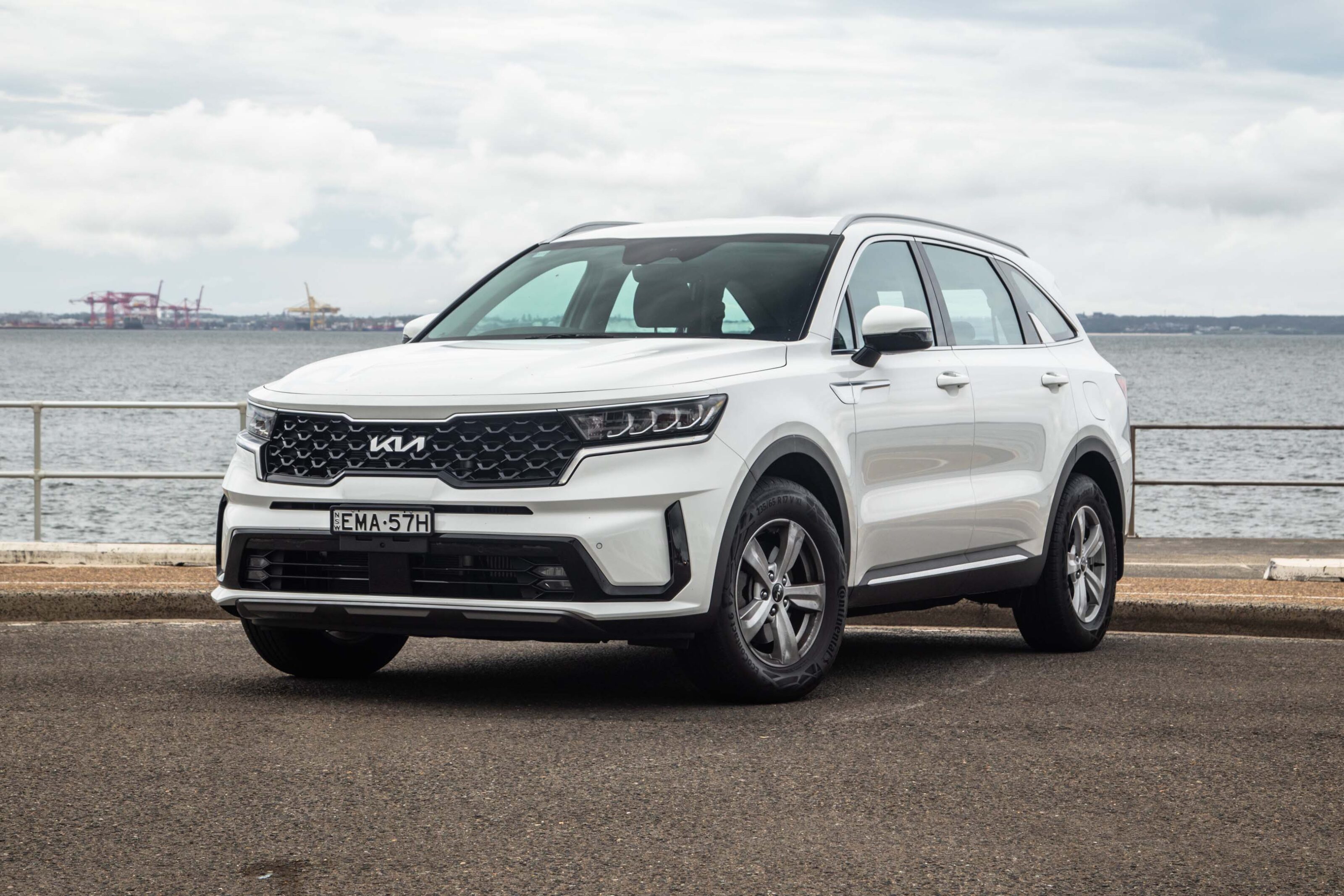
Kia Sorento
- Starting price: $50,790 drive-away
- Drivetrain: 3.5-litre petrol and 2.2-litre turbo diesel options, or 1.6-litre four-cylinder turbocharged petrol HEV and PHEV, eight-speed automatic (petrol) eight-speed dual-clutch auto (diesel) or six-speed auto (HEV and PHEV)
- Fuel consumption: 6.1-9.7L/100km petrol and diesel, 5.3-5.8L/100km hybrid, 1.6L/100km PHEV
- Cargo space (with all seats up): 187 litres
1
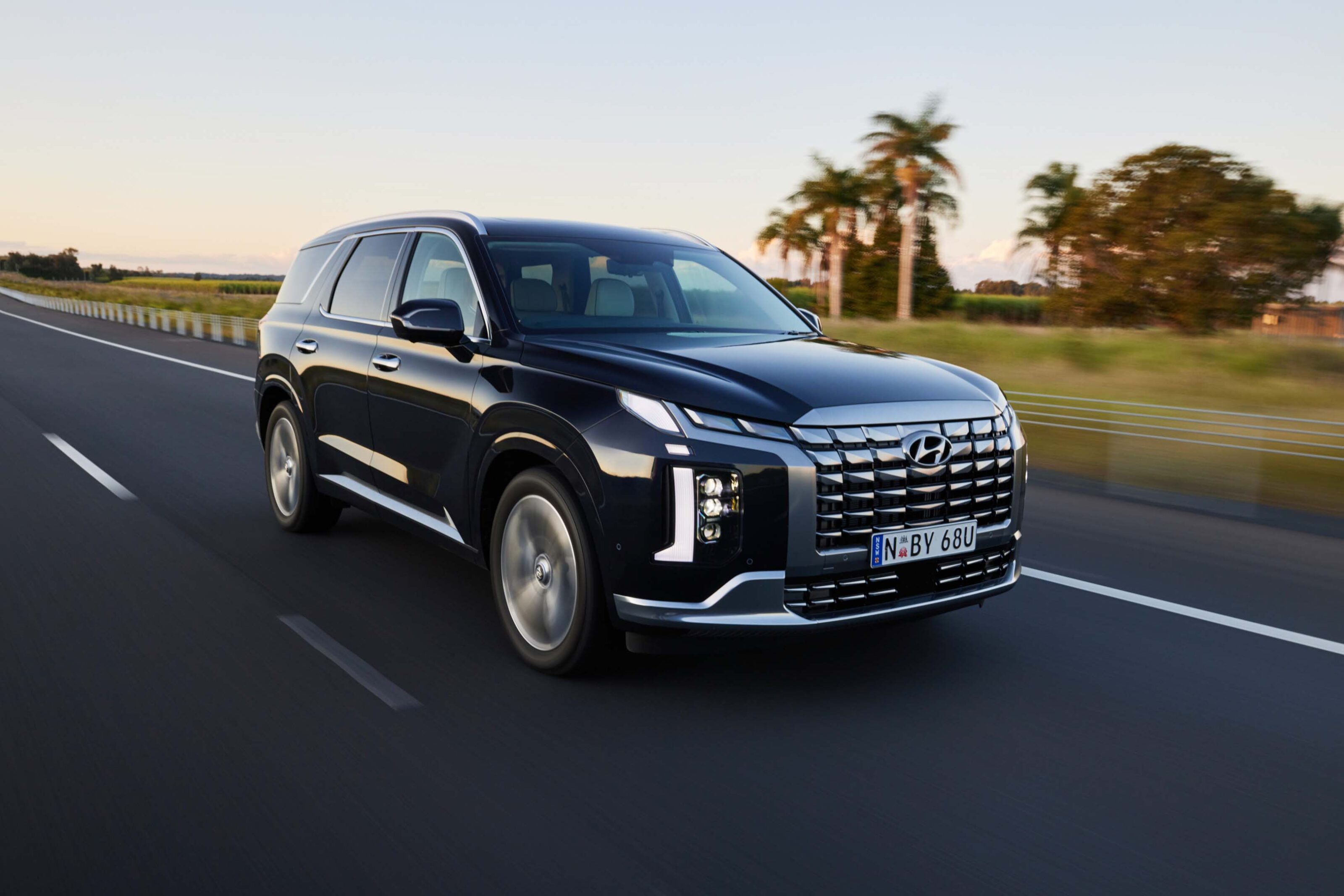
Hyundai Palisade
- Starting price: $72,021 drive-away
- Drivetrain: 3.8-litre petrol, 2.2-litre diesel, eight-speed auto
- Fuel consumption: 7.3-10.7L/100km
- Cargo space (with all seats up): 311 litres
1
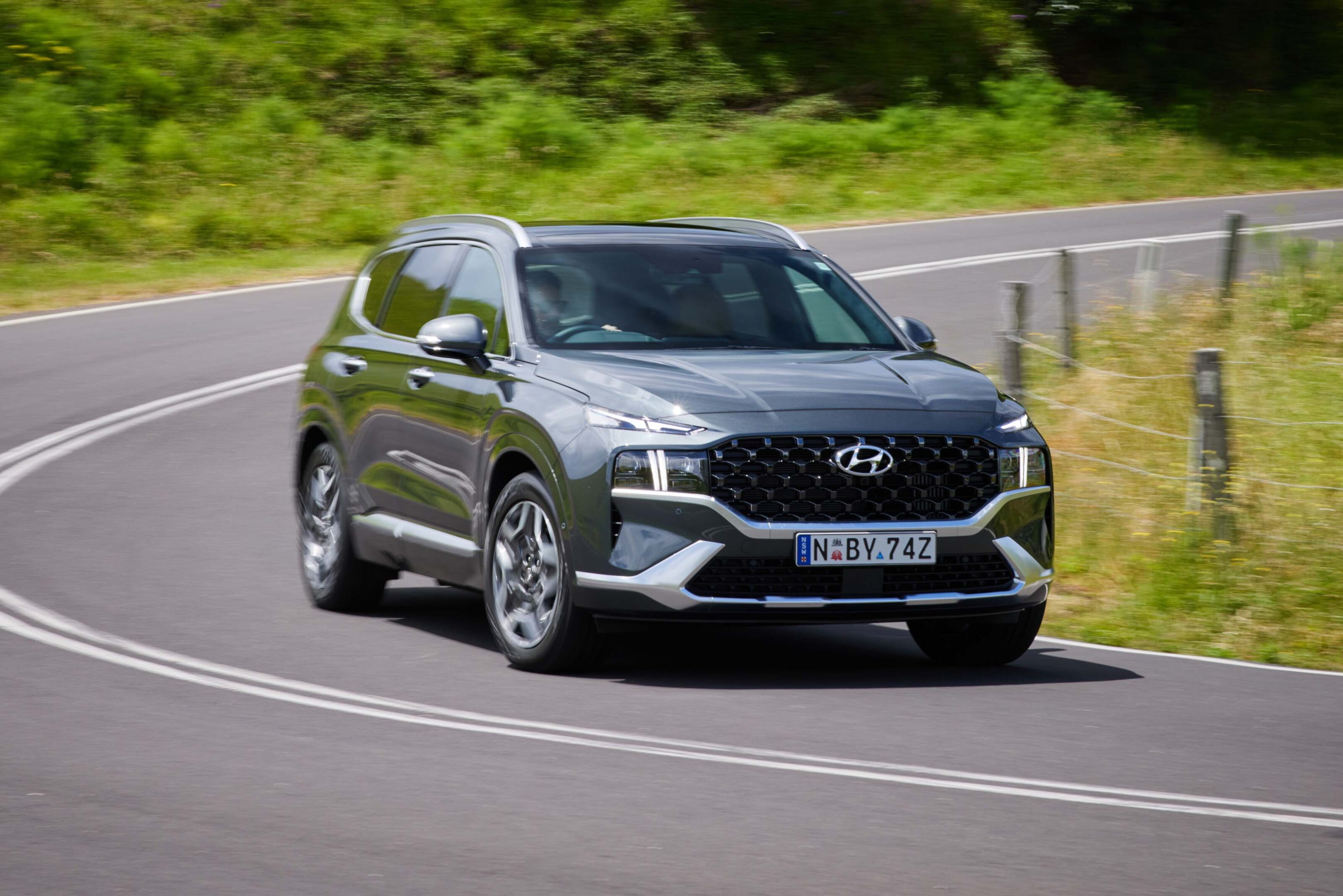
Hyundai Santa Fe
- Starting price: $50,610 drive-away
- Drivetrain: 3.5-litre petrol and 2.2-litre turbo diesel options, or 1.6-litre, four-cylinder turbocharged petrol HEV, eight-speed automatic (petrol) eight-speed dual-clutch auto (diesel) or six-speed auto (HEV and PHEV)
- Fuel consumption: 6.1-10.5L/100km petrol and diesel, 6L/100km hybrid
- Cargo space (with all seats up): 130 litres
1
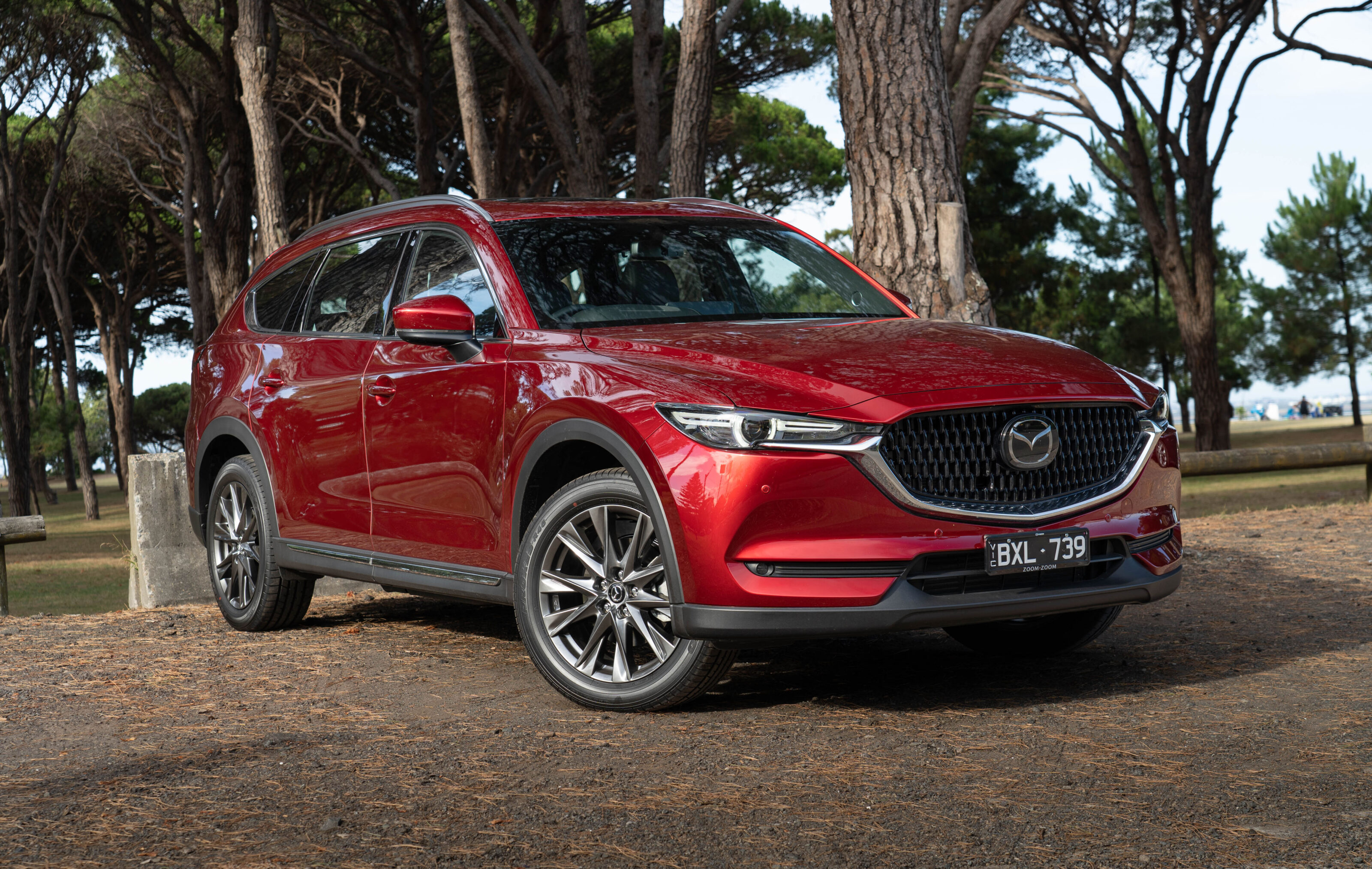
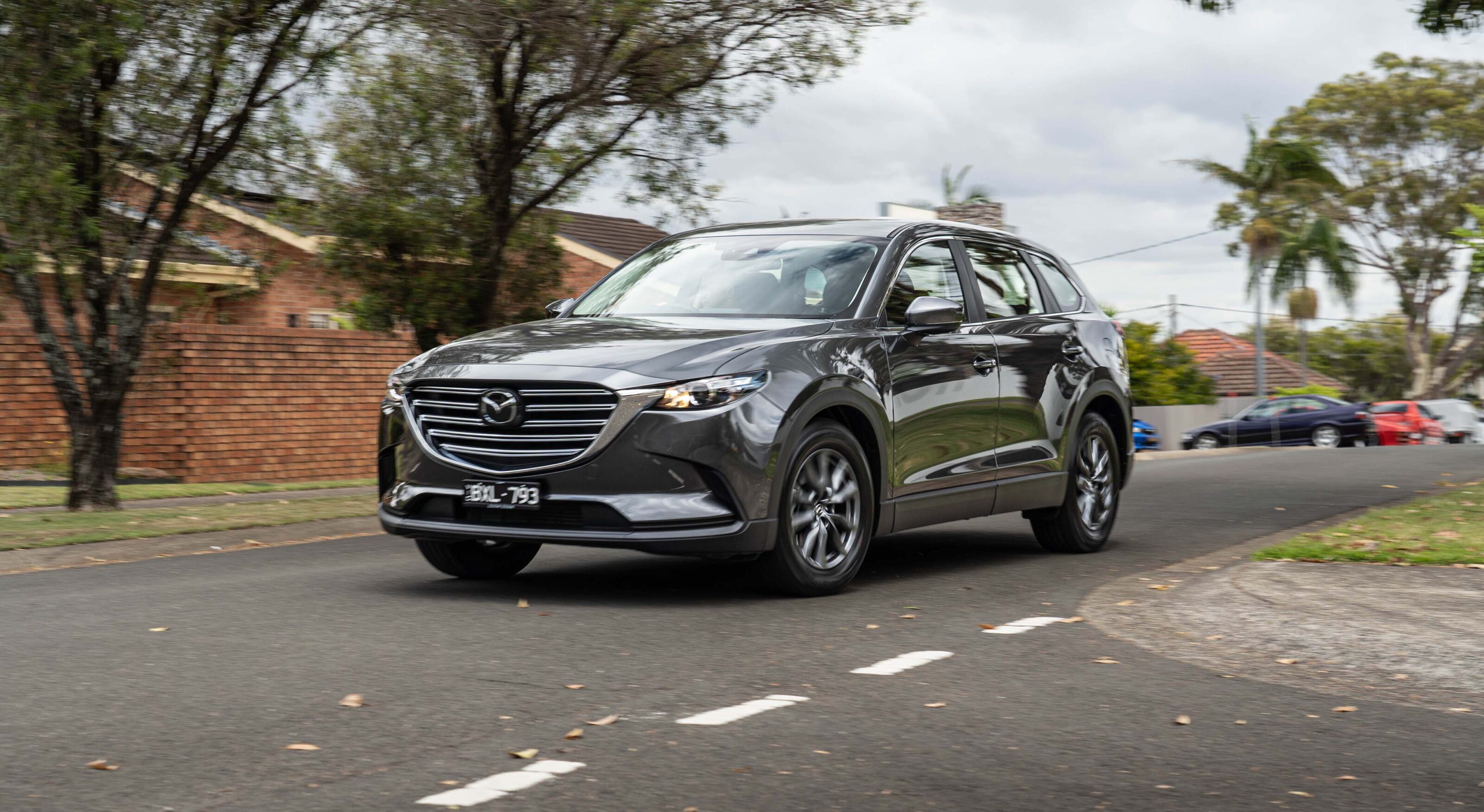
Mazda CX-8
- Starting price: $63,900 drive-away
- Drivetrain: 2.5-litre four-cylinder petrol, 2.2-litre turbocharged four-cylinder diesel, six-speed auto
- Fuel consumption: 6.0-8.1L/100km
- Cargo space (with all seats up): 209 litres
1
Mazda CX-9
- Starting price: $52,478 drive-away
- Drivetrain: 2.5-litre four-cylinder turbo-petrol, six-speed auto
- Fuel consumption: 8.4-9L/100km
- Cargo space (with all seats up): 230 litres

1
Ford Everest
- Starting price: $59,027 drive-away
- Drivetrain: 2.0-litre, bi-turbo diesel four-cylinder or 3.0-litre, single-turbo diesel V6, 10-speed torque converter auto
- Fuel consumption: 7.1-8.5L/100km
- Cargo space (with all seats up): 239 litres
1
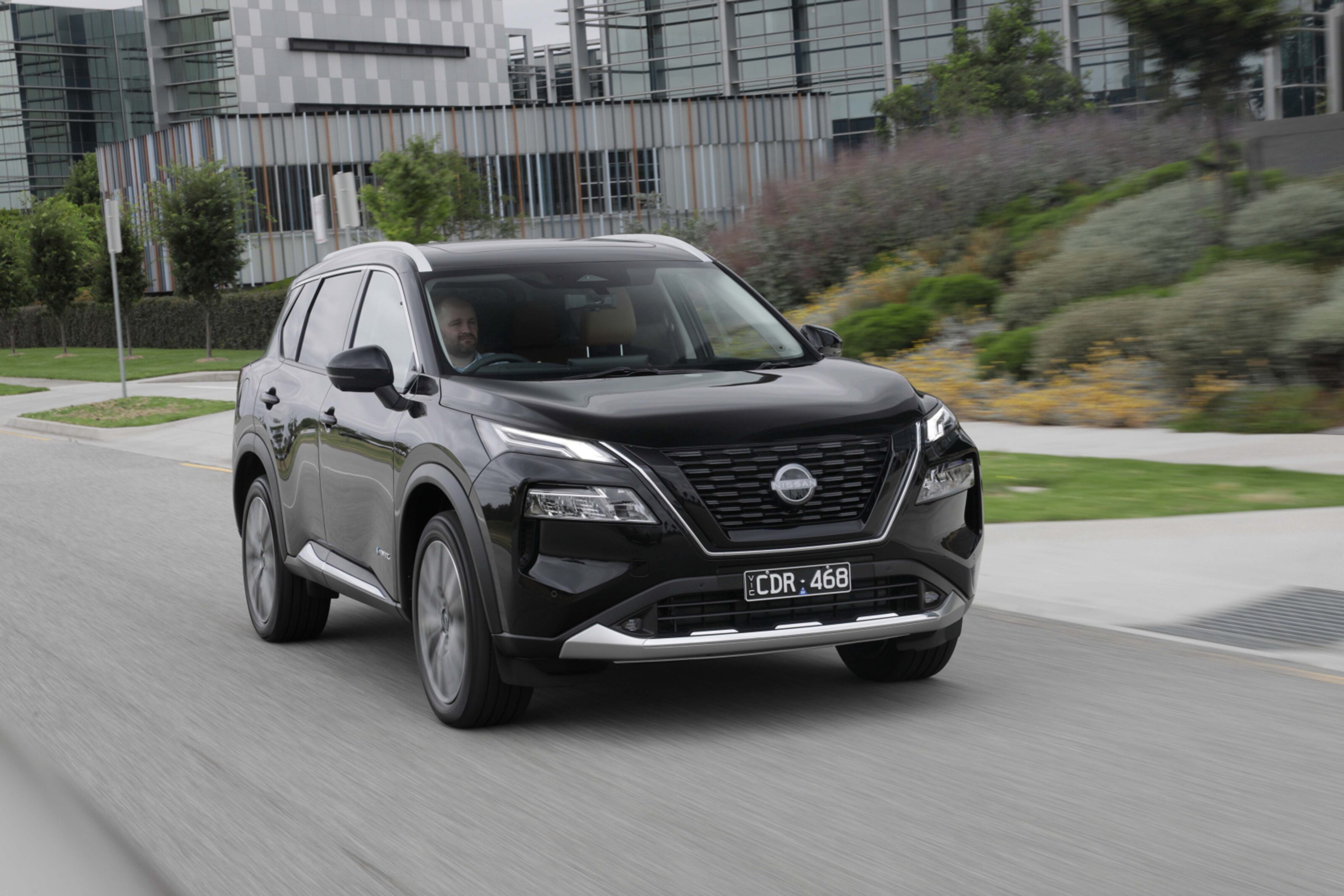
Nissan X-Trail
- Starting price: $47,077 drive-away
- Drivetrain: 2.5-litre four-cylinder petrol, CVT auto
- Fuel consumption: 7.4-7.8L/100km
- Cargo space (with all seats up): 135 litres
1
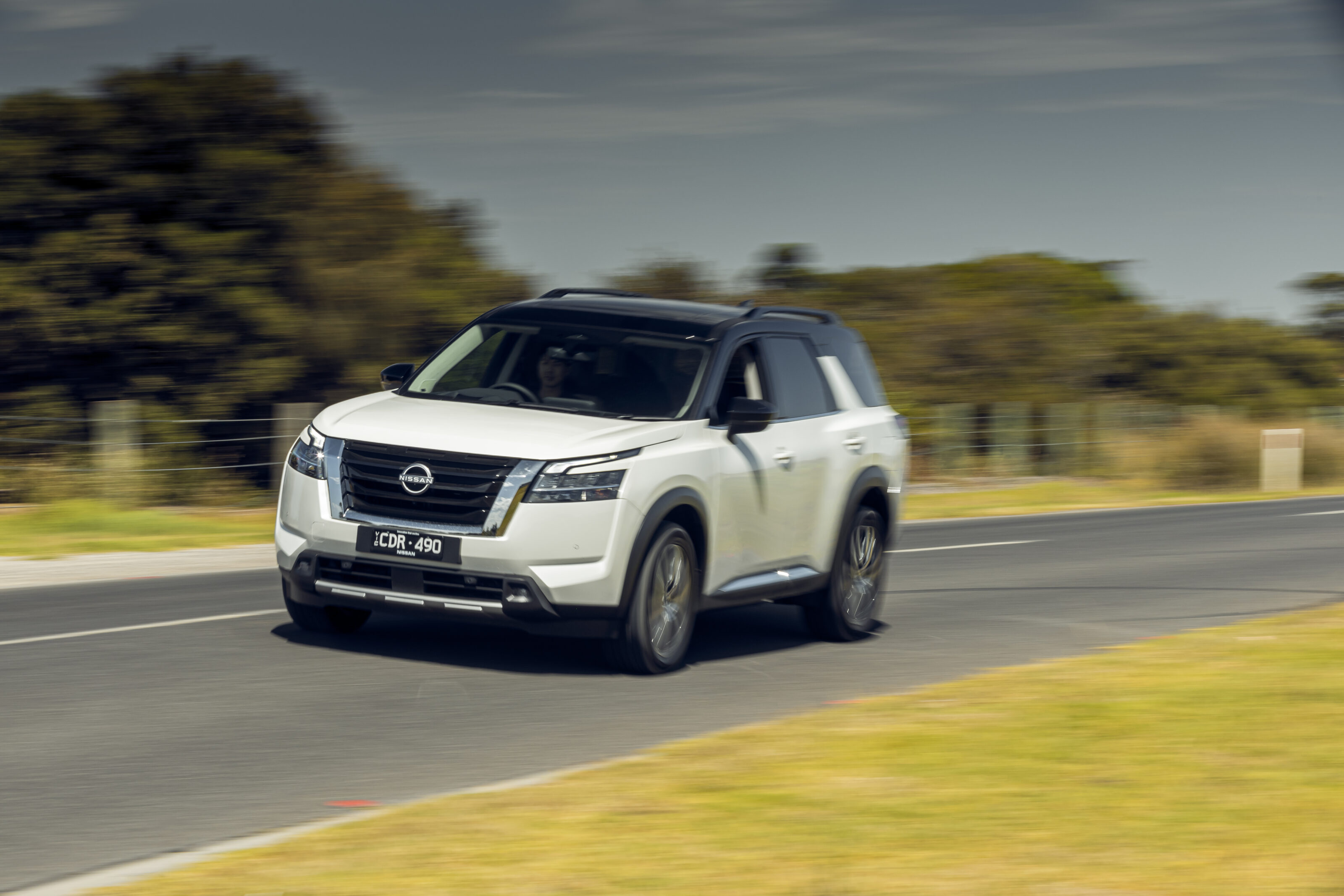
Nissan Pathfinder
- Starting price: $77,559 drive-away
- Drivetrain: 3.5-litre naturally-aspirated V6, nine-speed torque converter auto
- Fuel consumption: 10-10.5L/100km
- Cargo space (with all seats up): 205 litres
1
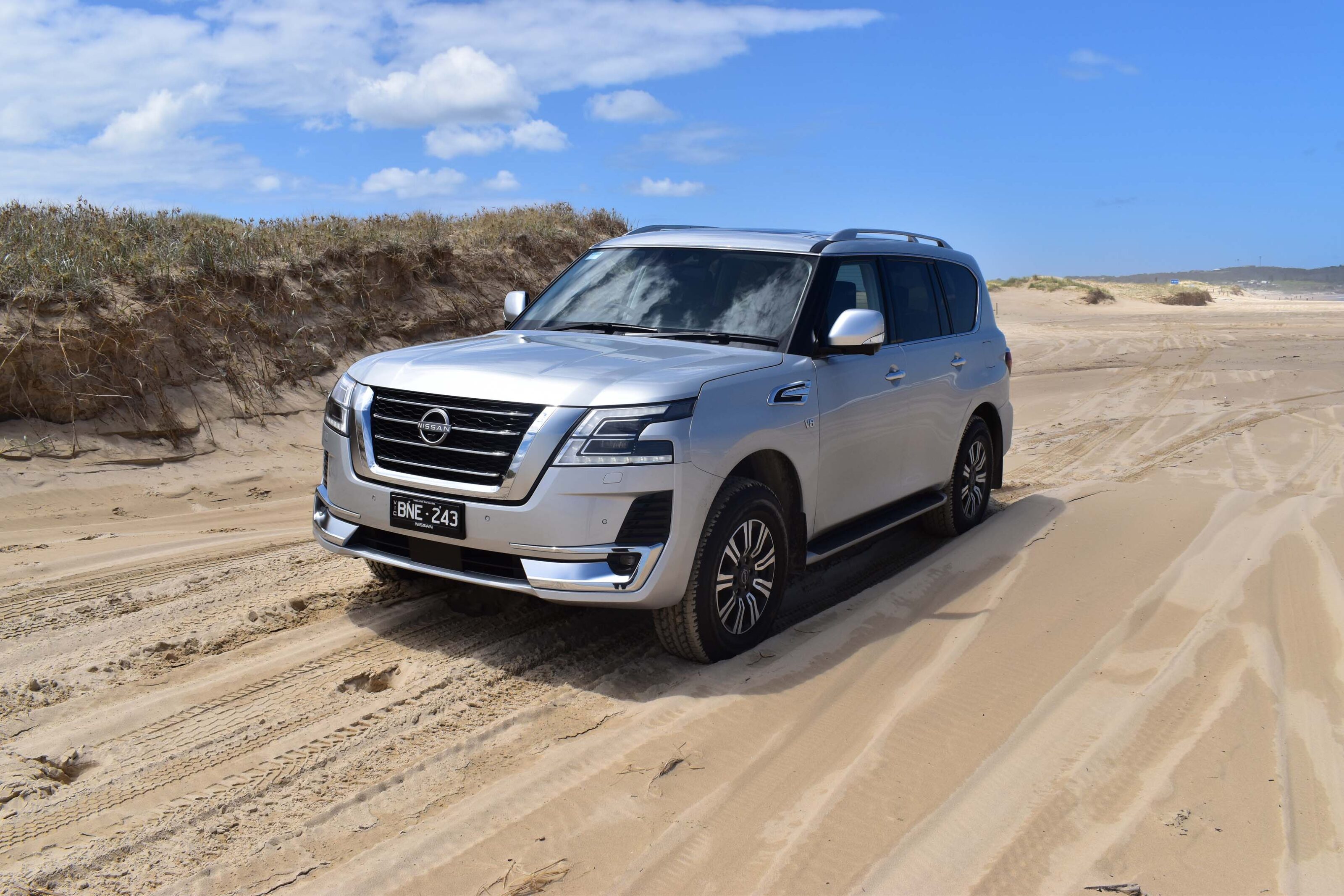
Nissan Patrol
- Starting price: $89,649 drive-away
- Drivetrain: 5.6-litre naturally-aspirated petrol V8, seven-speed auto
- Fuel consumption: 14.4L/100km
- Cargo space (with all seats up): 467 litres
1
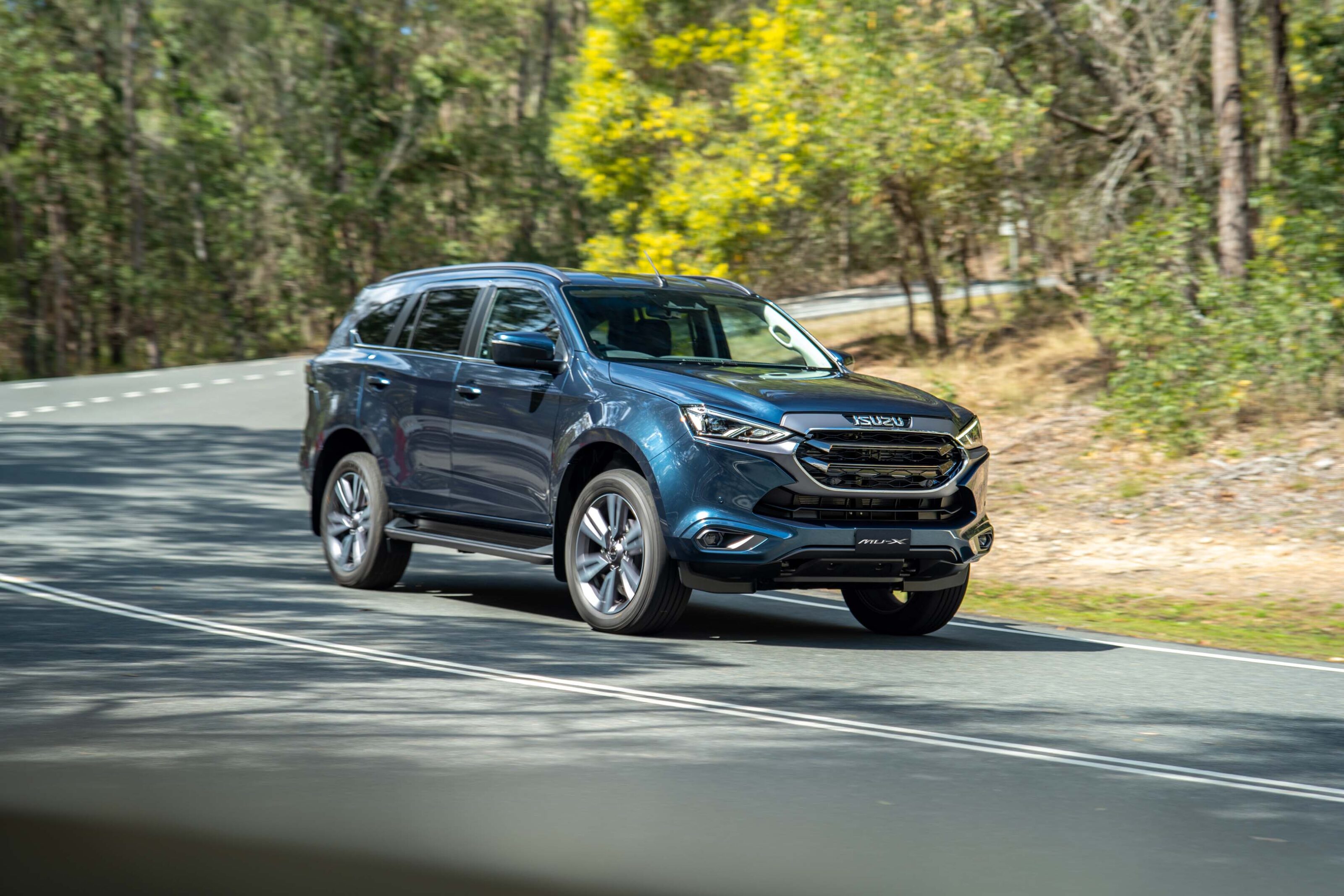
Isuzu MU-X
- Starting price: $66,811 drive-away
- Drivetrain: 3.0-litre four-cylinder turbo-diesel, six-speed auto
- Fuel consumption: 7.8-8.3L/100km
- Cargo space (with all seats up): 311 litres
1
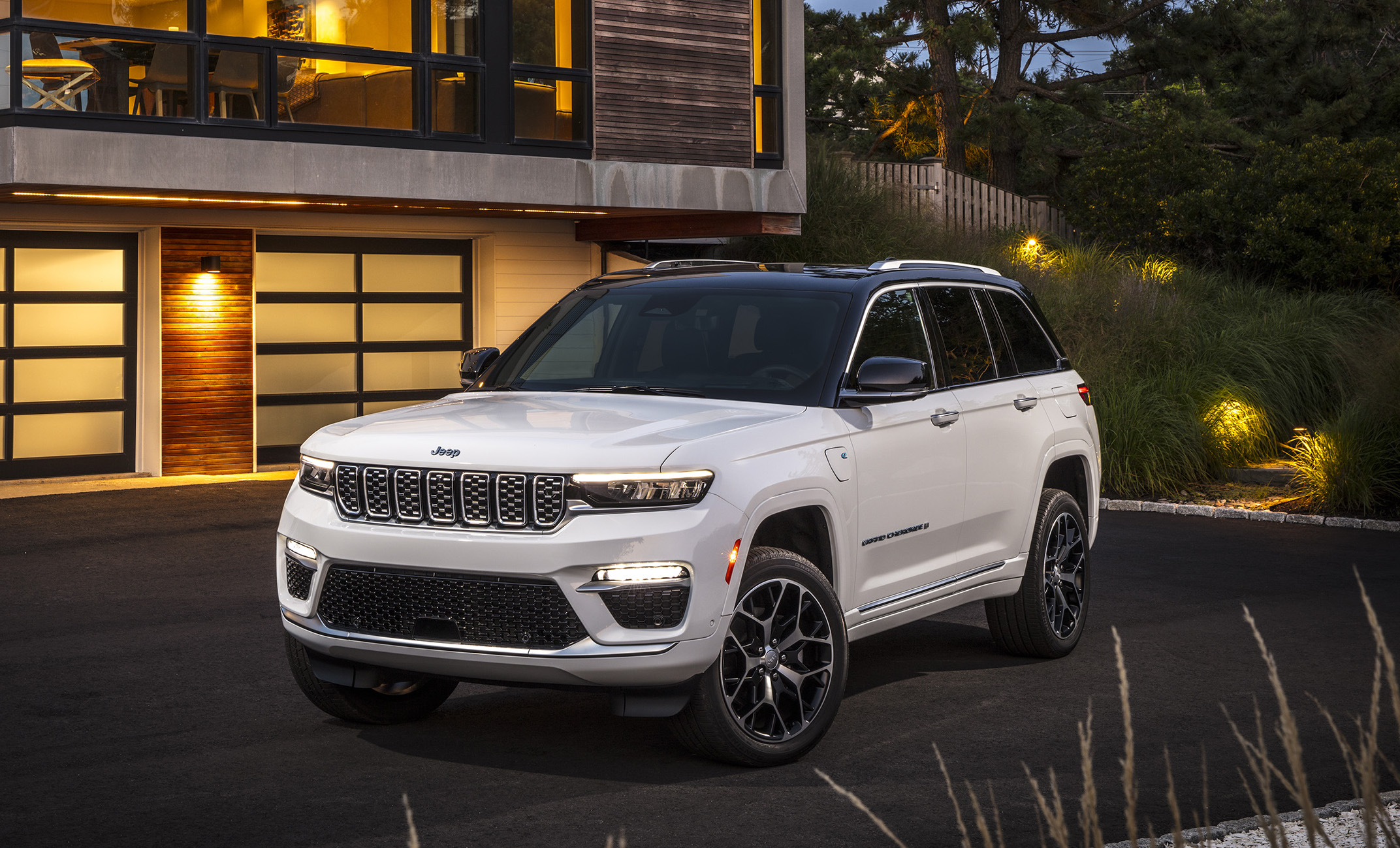
Jeep Grand Cherokee L
- Starting price: $82,750 (MLP)
- Drivetrain: 3.6-litre naturally-aspirated V6, eight-speed torque-converter auto
- Fuel consumption: 10.6L/100km
- Cargo space (with all seats up): 487 litres
1
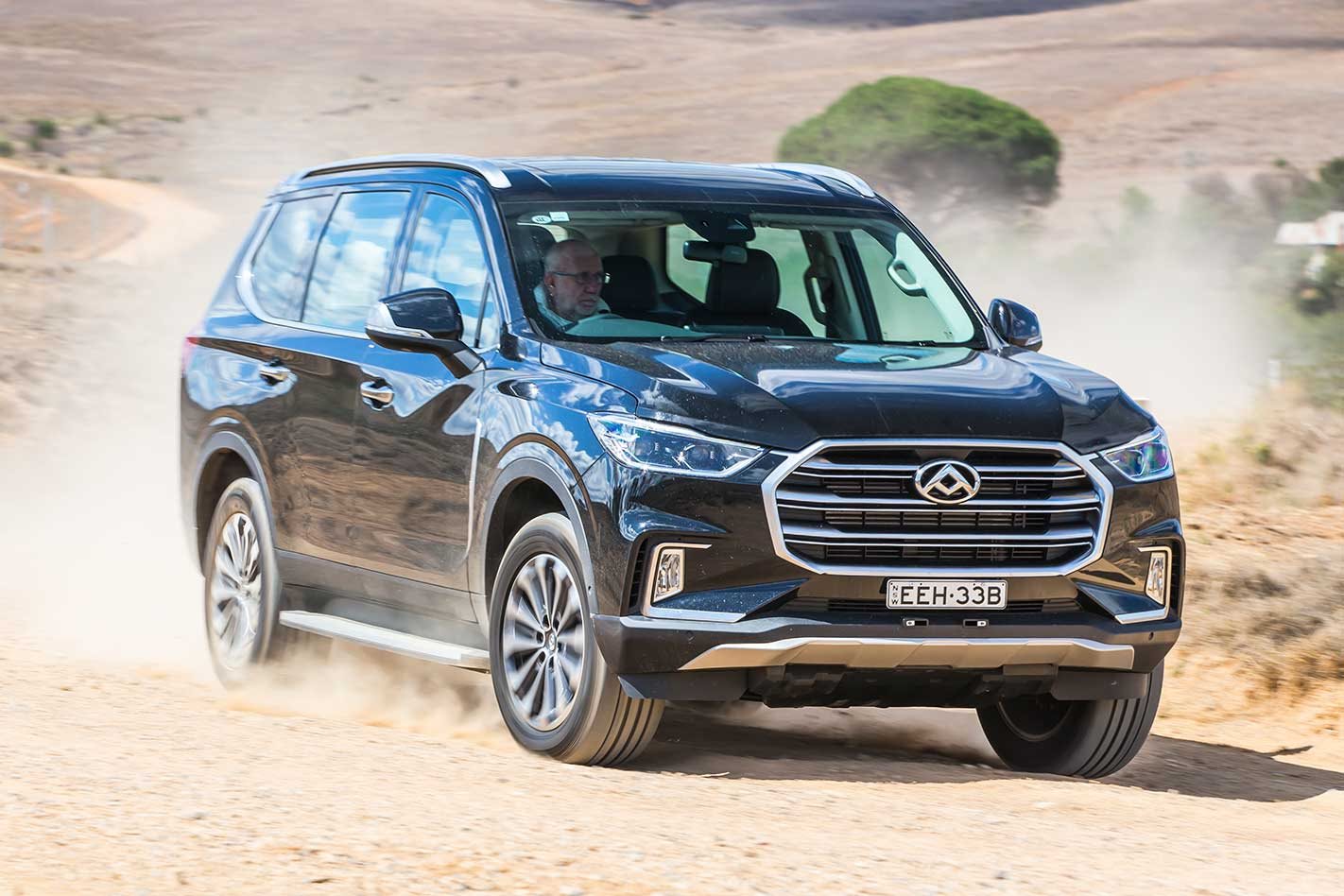
LDV D90
- Starting price: $38,990 drive-away
- Drivetrain: 2.0-litre four-cylinder turbo-petrol or 2.0-litre four-cylinder turbo-diesel, six-speed auto (petrol) or eight-speed auto (diesel)
- Fuel consumption: 9.1-10.9L/100km
- Cargo space (with all seats up): 412 litres
People-movers
1
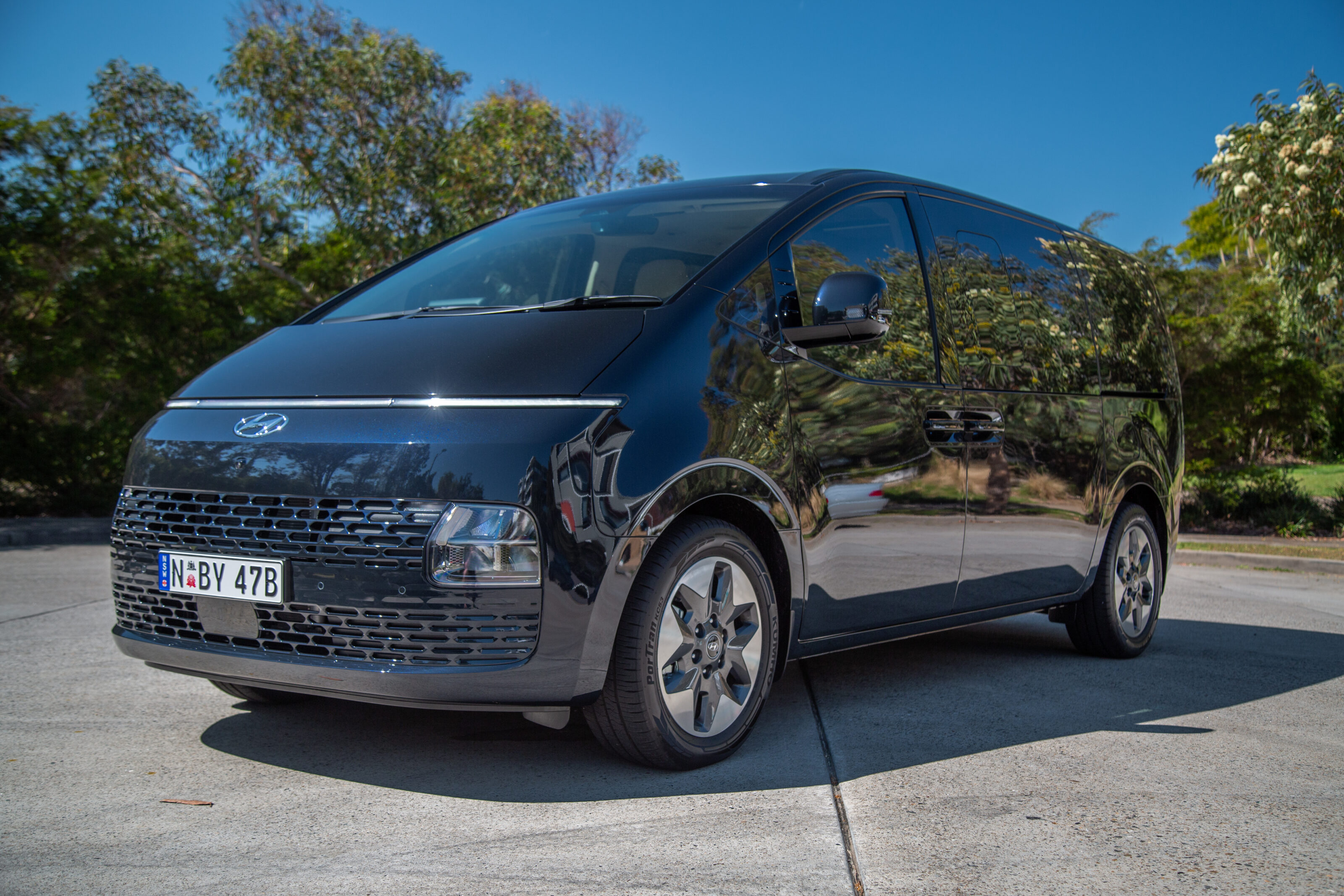
Hyundai Staria
- Starting price: $53,685 drive-away
- Drivetrain: 3.5-litre petrol and 2.2-litre turbo diesel options, eight-speed auto
- Fuel consumption: 8.2-10.5L/100km
- Cargo space (with all seats up): 831 litres
1
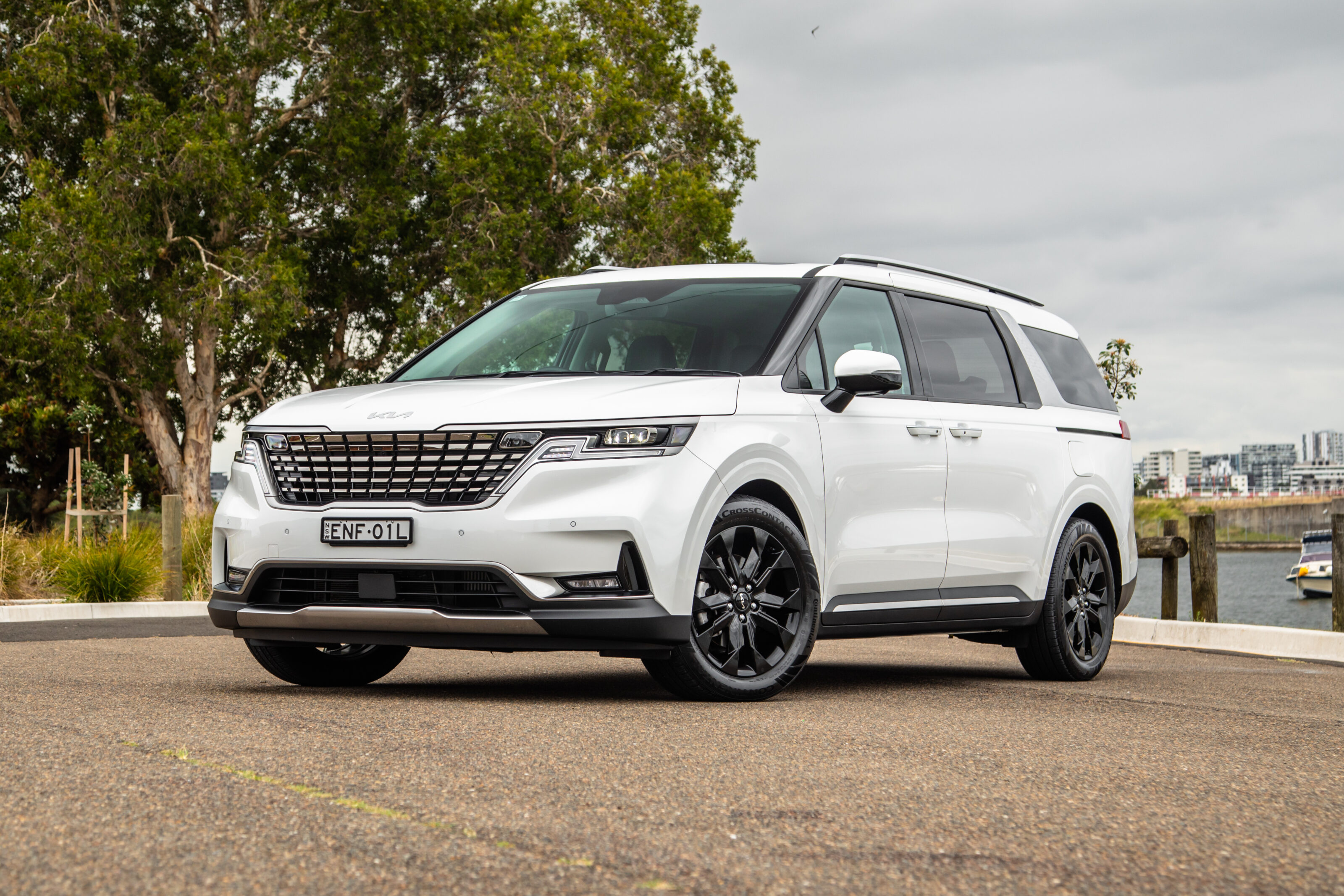
Kia Carnival
- Starting price: $51,690 drive-away
- Drivetrain: 3.5-litre petrol V6, 2.2-litre four-cylinder turbo-diesel, eight-speed auto
- Fuel consumption: 6.5-9.6L/100km
- Cargo space (with all seats up): 627 litres
1
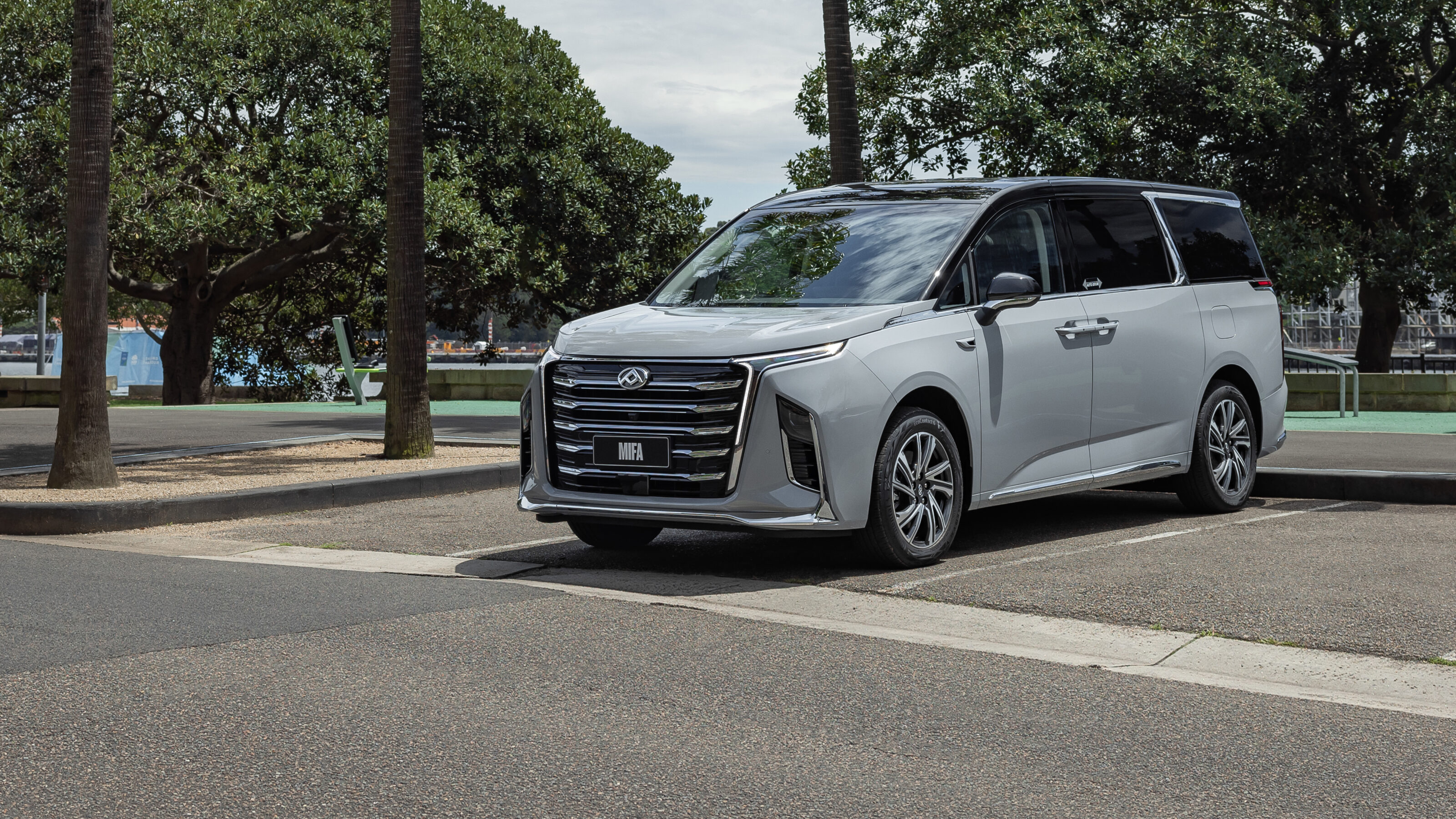
LDV Mifa
- Starting price: $53,990 drive-away
- Drivetrain: 2.0-litre turbo-petrol, eight-speed auto
- Fuel consumption: 9.3L/100km
- Cargo space (with all seats up): 466 litres
1
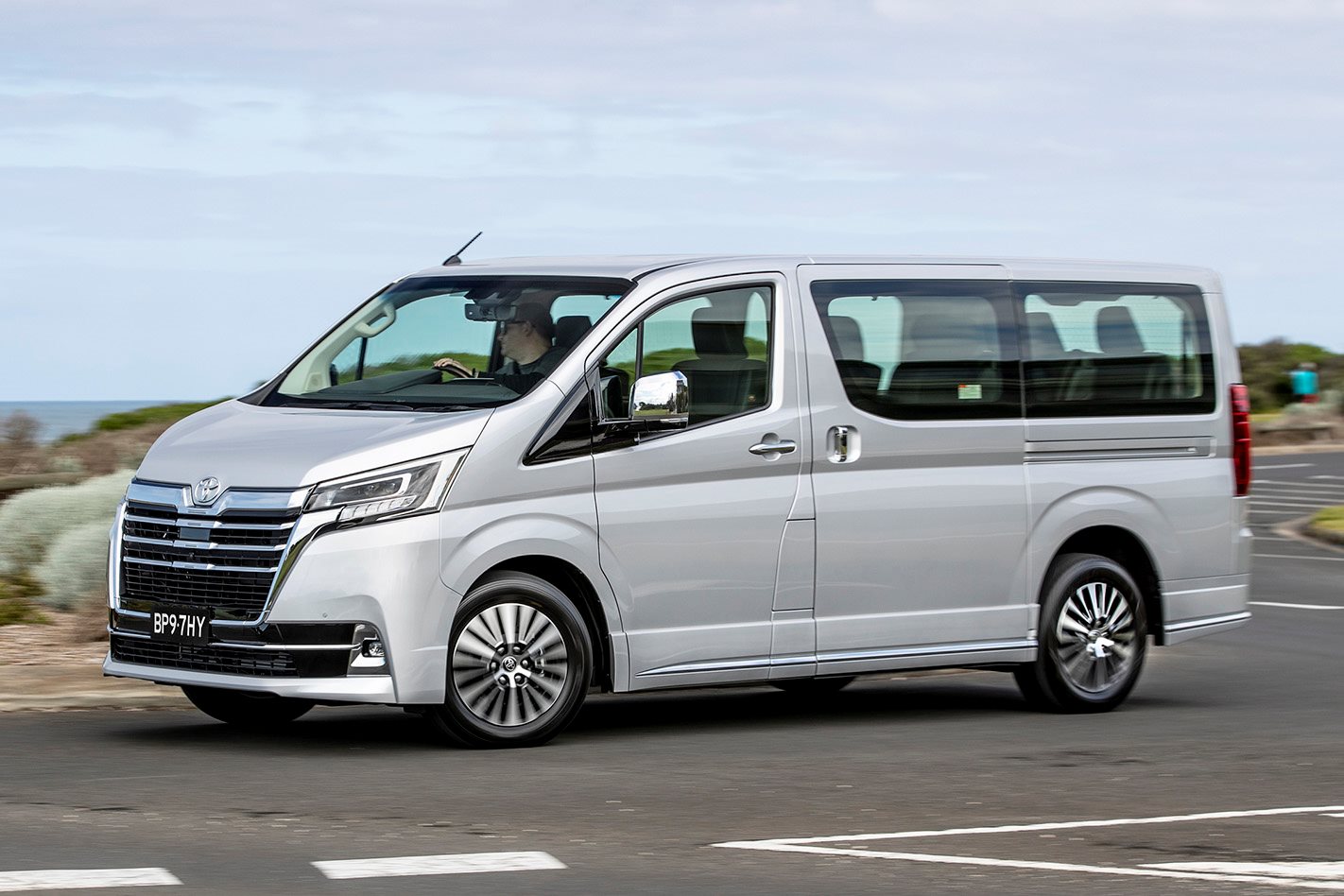
Toyota Granvia
- Starting price: $75,034 drive-away
- Drivetrain: 2.8-litre four-cylinder diesel, six-speed auto
- Fuel consumption: 8L/100km
- Cargo space (with all seats up): N/A
1
Note on pricing
Prices current as of March 2023.
Snapshot
- All Tesla models to gain bidirectional charging within next two years
- Musk criticises tech as u201cinconvenientu201d when without a dedicated battery
- Utilises the EV battery to power homes and stabilise the grid
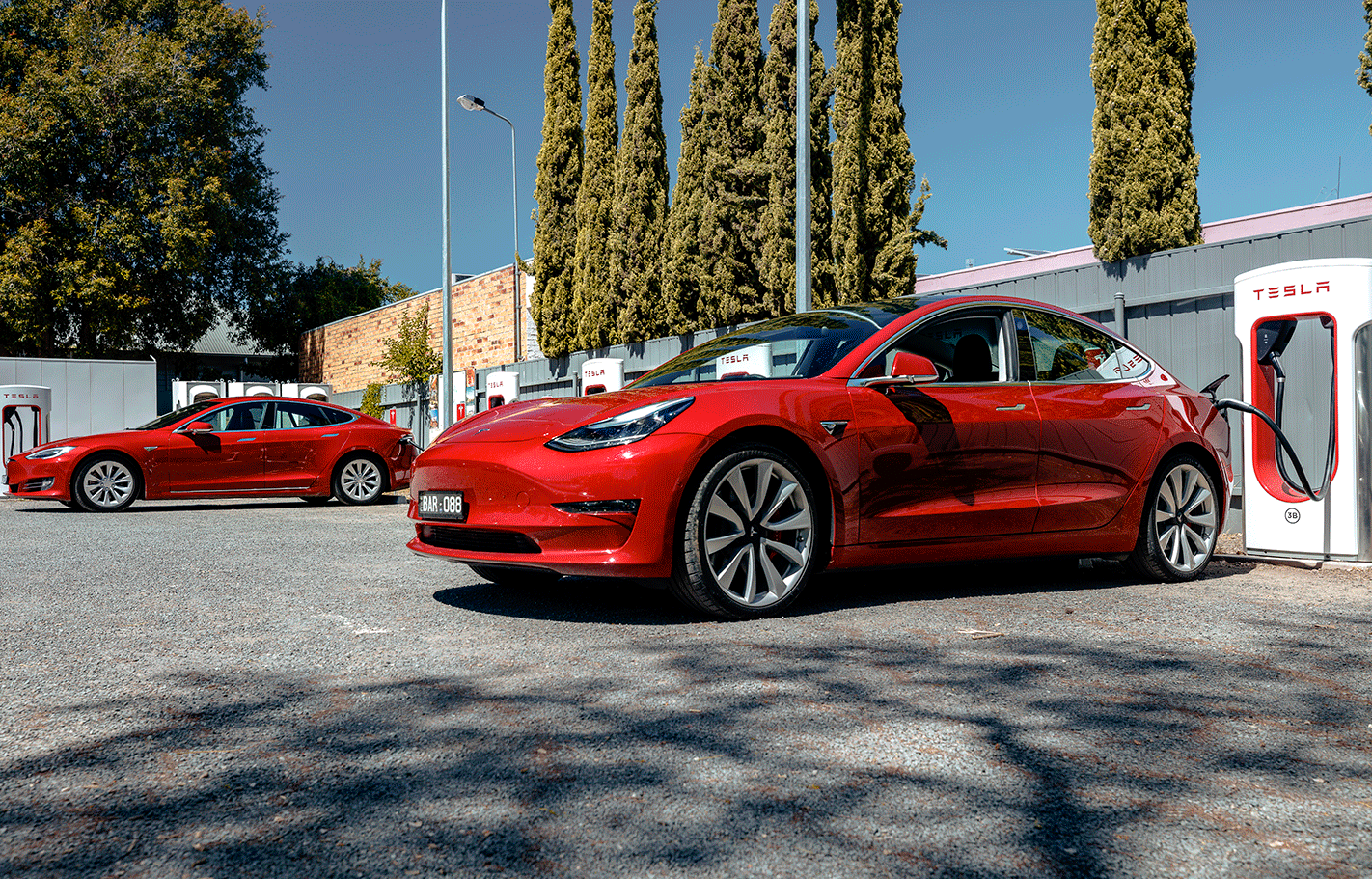
Tesla has confirmed all its electric vehicle models will support bidirectional charging functionality by 2025, after staying silent for years.
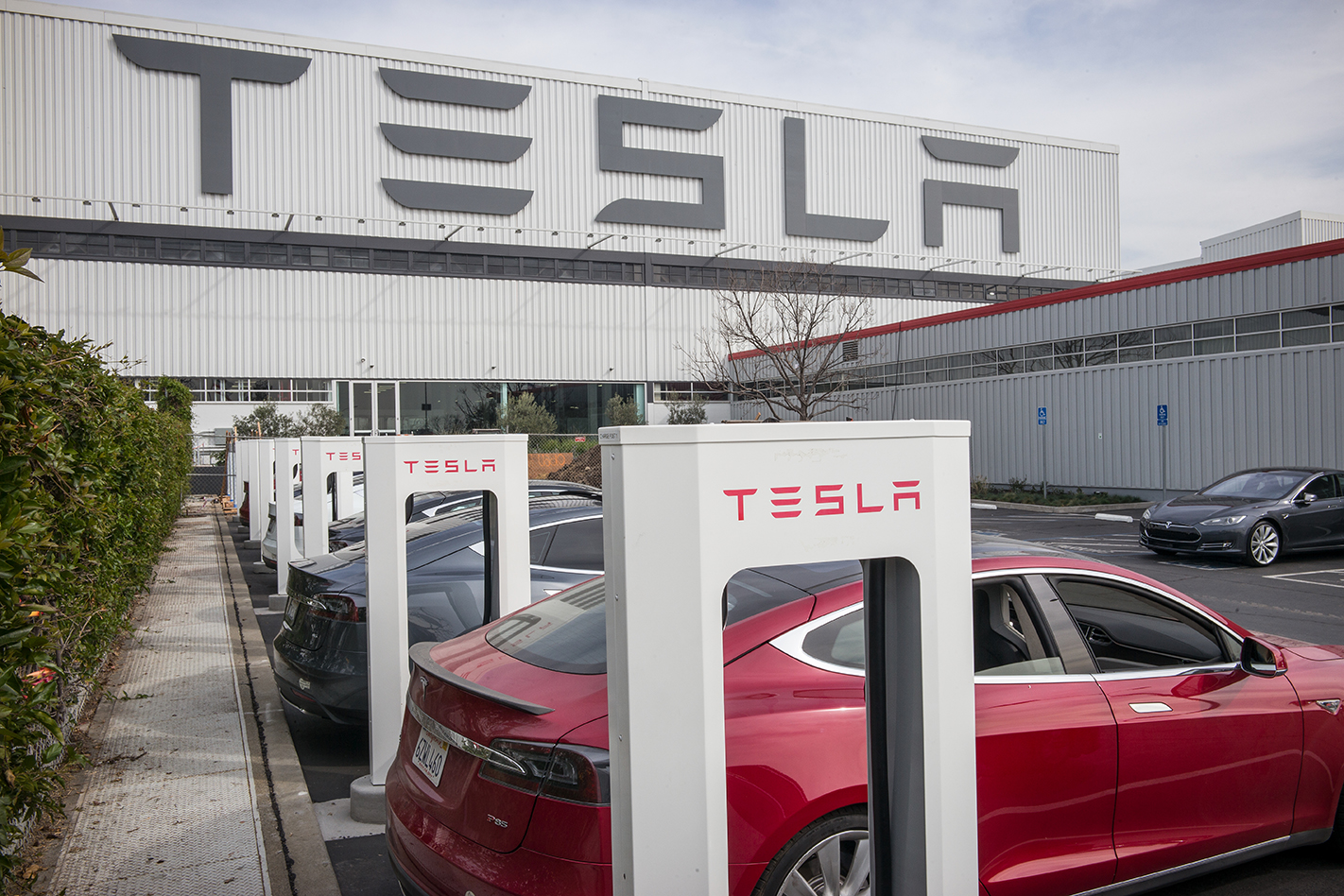
During its Investor Day event on Thursday, Tesla’s senior vice president in powertrain and energy engineering, Drew Baglino, remained coy while addressing the question of an audience member.
“Bidirectional… it wasn’t like a conscious decision to not do it; it just wasn’t a priority at the time [previously],” Baglino said.
“We’ve found ways to bring bidirectionality while actually reducing the cost of power electronics in the vehicle. And at all things Tesla, the goal is usually to get more for less.
1
“And so, we are in the middle of a kind of power electronics retool I would say that would bring that functionality to all of our vehicles over the next two years.
“Most of the value comes in charging the car at the right time. It’s not really about sending the energy the other way [to the home].”
Bidirectional charging has been mooted as the ‘future for EVs’ to unlock their stationary energy potential and allow homeowners to go off-grid.
However, Tesla CEO Elon Musk criticised the technology as flawed, unless owners also have a dedicated battery storage pack as the main electricity source, such as Tesla’s own Powerwall product.
1
“I don’t think very many people are going to use bidirectional charging, unless you have a Powerwall,” Musk said.
“Because, if you unplug your car, your house goes dark and this is extremely inconvenient.
“I think there’s some value there as a supplemental energy source down the road, where, if you have a Powerwall, you don’t diminish the convenience of the people in the house.”
Tesla’s event, which outlined its third-part ‘Master Plan’, also teased a larger AC wall connector on one presentation slide, which could hint at it gaining bidirectional functionality.
1
Bidirectional charging allows EVs to discharge their own battery to act as a home energy storage system and power households during peak electricity times or when there’s no solar generation (called vehicle-to-home).
It can even sell any excess energy back into the electricity grid (called vehicle-to-grid) to help stabilise it from high demand, then recharge the vehicle when there’s free solar energy during the day.
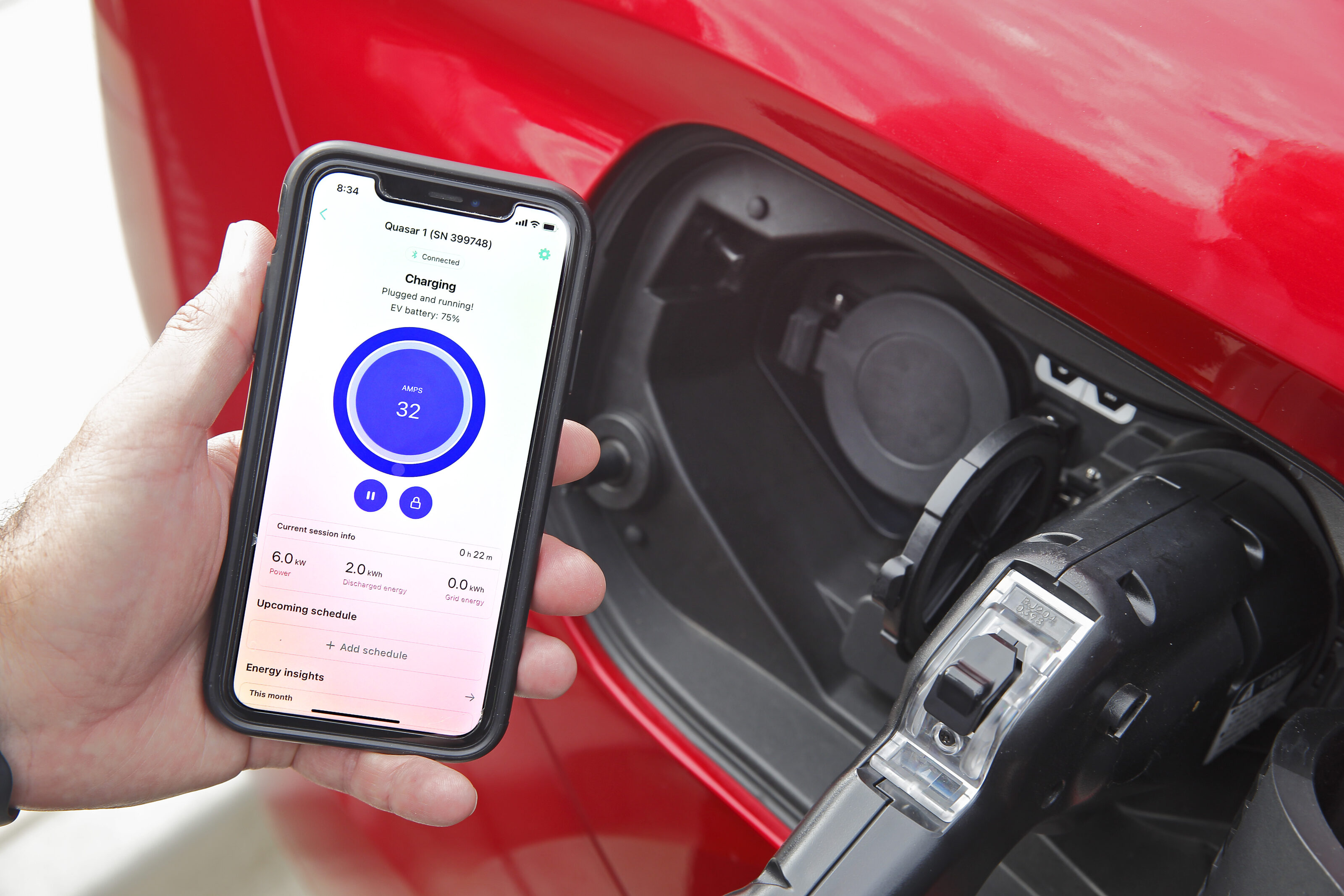
Trials are already underway in South Australia using the only three compatible models – the Nissan Leaf EV, Mitsubishi Eclipse Cross PHEV and Outlander PHEV – plus the Wallbox Quasar charging equipment which costs around $10,000.
The Volkswagen Group, Ford and Volvo Cars already support bidirectional functionality in their select EV models.
MORE
Electric Cars
MORE
Everything Tesla
Wheels Car of the Year 2023: Finalists
Nissan X-Trail, Ford Everest, Tesla Model Y, Cupra Formentor
Snapshot
- Four finalists chosen from a field of 17 COTY contenders
- Finalists progress to ‘Round Two’ where judges assess them on country- and urban-road loops
- Finalists group includes a sporty crossover, large SUV, family SUV and a popular EV
- COTY winner announced on March 7
Just like the major sporting codes that look to find a ‘final eight’, Wheels Car of the Year is also designed to select a smaller group of finalists.
Our number of finalists is flexible, but the goal is always the same: to identify the models that have impressed us enough over the first three days of testing to warrant further exploration in Round Two.
This year, four cars out of our 17-strong field earned enough votes to become a COTY finalist and they are: Cupra Formentor, Ford Everest, Nissan X-Trail and the Tesla Model Y.
MORE READING
As the 2023 COTY story evolves, the list of stories below will grow. Keep an eye on this page for more, or find it all at our COTY page.
A NOTE ON CRITERIA
Always a controversial topic. It’s linked above, but if you need a refresher on how we define eligibility and our testing criteria, the What’s new for 2023? story is where you need to be.

2
Challengers, welcome to Round Two
Unlike Round One of our testing, which is conducted at a purpose-built proving ground, Round Two is all about how the finalists perform on the public road over the course of two additional days of testing.
1️⃣ Day one
The first day presents a challenging country loop that includes sweeping bends, broken surfaces, stretches of highway and tighter technical sections as we look to assess ride and handling, open-road refinement and fuel consumption.
2️⃣ Day two
The second day of Round Two is a loop in the centre of Melbourne that incorporates peak hour traffic, speed bumps, school zones and traffic lights to assess a car’s low-speed ride and behaviour in the day-to-day grind. Judges also ride four-up in the cars on this day to further test rear-seat room, comfort and ride compliance.
Of our finalists, only one can be Wheels Car of the Year for 2023 and we’ll announce the final result next Tuesday, March 7, so mark that in your calendars.
Until then, which of our finalists do you think will win? To help, here’s a quick summary of how they impressed us at the proving ground.

2
Cupra Formentor
An early favourite…
- Only one brand has won Wheels Car of the Year in its first attempt (bonus points if you can name the brand!), but the Formentor’s sporty dynamics, strong engine performance and striking exterior design had a few judges wondering early on if Cupra might become the second.
- We had three Formentors to test: VZ, VZe and VZx.
- Formentor quickly proved to be much more than a reskinned Volkswagen, despite sharing its platform and engines with other MQB Evo products
- All three Formentors we had at COTY were standouts in our acceleration, braking and swerve/avoid tests
- They also scored well in our Value and Cabin Design and Execution criteria
MORE
Everything Cupra

2
Ford Everest
Wait, what?
- This is the first year ladder-frame vehicles have been eligible to compete at COTY and the Everest’s strong showing validates the inclusion
- Offers an impressive amount of room, performance, capability and dynamic cohesion
- Value is a key strength, too, with prices ranging from approx $50-75K
- All-terrain tyres and a hefty kerb weight saw Everest finish towards the bottom for braking and swerve/avoid but it was easily the class of the field for driving on dirt
- Everest is designed and engineered by Australians for Australian buyers, and the benefits of that local focus are obvious
MORE
Everything Ford
Comparisons
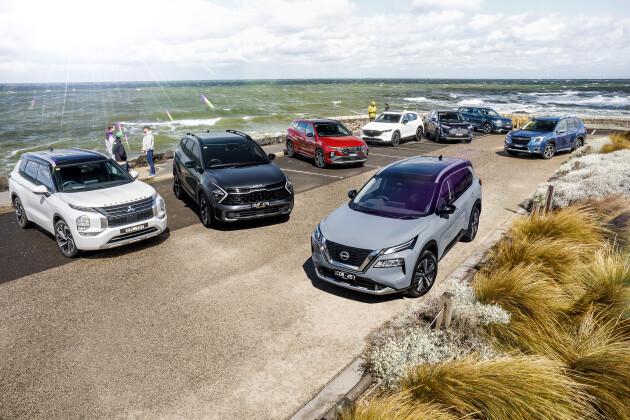
Medium SUV comparison: 2023 Mega Test
Thinking of buying a new mid-size SUV this year? We test eight of the best and most popular contenders to see where you should spend your money

2
Nissan X-Trail
Who’s surprised that our SUV mega test winner is a finalist?
- New-gen X-Trail is a marked improvement over its uninspiring (but attractively cheap!) predecessor
- Cabin execution is a real highlight with its modern design, clever storage solutions and optional seven-seats impressing the judges
- Thoughtful packaging solutions are also a strength against our Cabin Design and Execution criteria. Rear doors that open to 90 degrees to allow easier entry/egress for example, and a third row of seats that folds flat into the floor and doesn’t eat into boot space
- New hybrid powertrain also impressed the judges for its performance, efficiency gains and relative value compared with atmo petrol versions
MORE
Everything Nissan

2
Tesla Model Y
This sales-champ EV is an obvious shoo-in for finalist
- An absolute standout in our acceleration, braking and swerve/avoid tests
- Also impressed on our ride/handling loop thanks to high grip levels and rapid acceleration
- Value is a clear strength, especially when you consider the level of performance, range and interior room you get for circa-$70K in the entry-level rear-drive model
- Scored highly in our criteria for Cabin Design and Execution thanks to strong focus on infotainment tech, large boot, ample storage and minimalist design. Some ergonomic and materials quality shortcomings were noted, however.
VOTE IN OUR INSTAGRAM POLL
https://www.instagram.com/p/CpTwcZZAcaL/
MORE
Everything Tesla
MORE
Wheels COTY
