
New? Wasn’t the old Ford Ranger still the best car in its class?
It’s often said that you learn more from failure than success. If that’s indeed the case, there was every chance that the 2023 Ford Ranger could have ended up as the difficult second album.
Yes, there were Ranger-badged pick-ups before the debut of the 2011 PX version of the T6 Ranger, but that was the first Ford-led ground-up version of the Ranger. More than a decade and a couple of facelifts after its launch, it still felt fresh, besting all of its rivals on Wheels‘ Ute Megatest last year.
Eleven years on sale is quite an innings and it’s likely that this second-generation T6, or the P703 in Fordspeak, will be around for an equally long time. Those vaguely competent at arithmetic will realise that this will take it beyond the date that pure internal combustion engined vehicles will be banned from certain markets, so some capacity for electrification is clearly required.
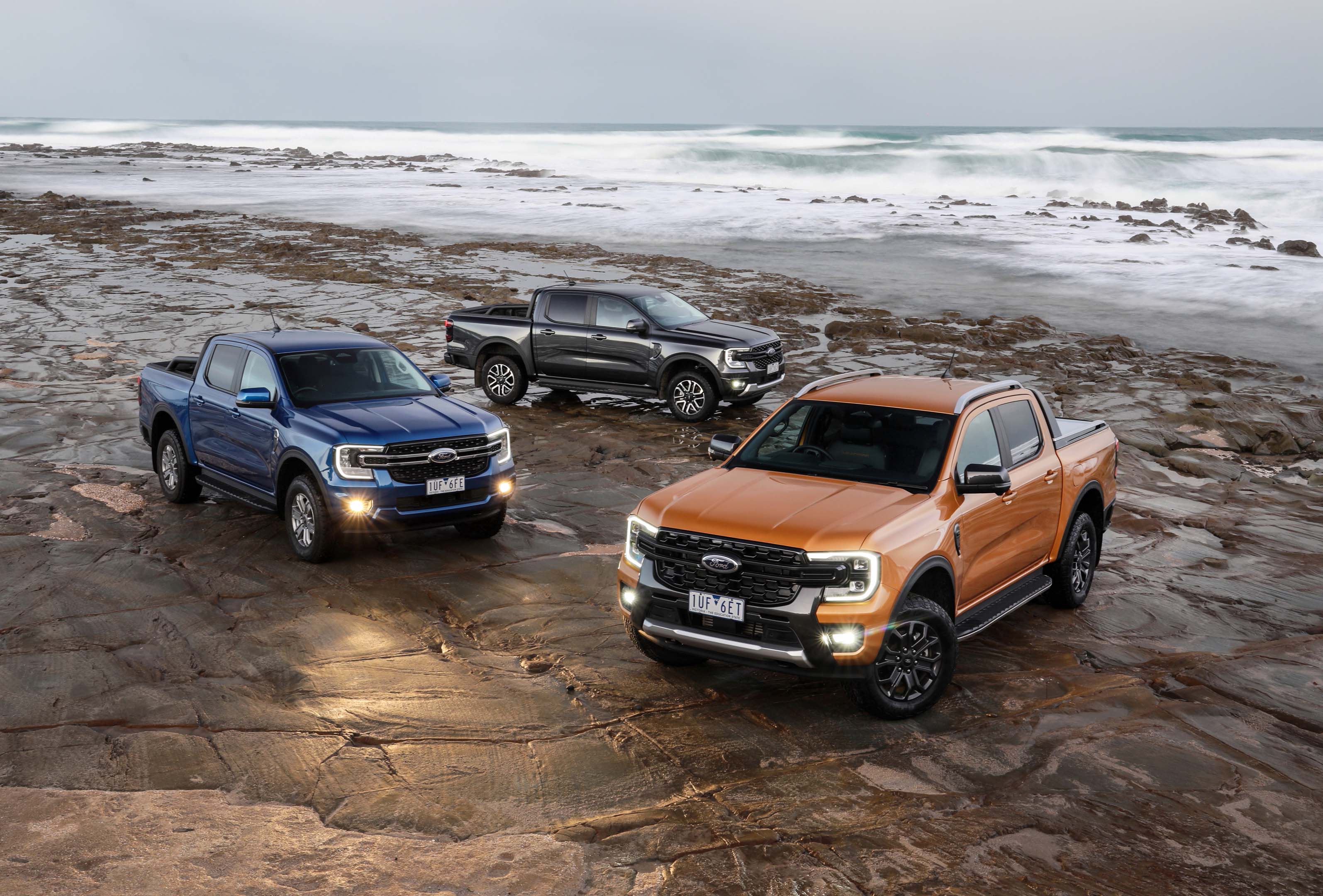
The success of the last Ranger also served to alter expectations. Ford Australia punched well above its weight in developing the PX Ranger, but this second-gen T6 will go to 180 world markets.
In 2021, the outgoing vehicle was Australia’s second best-selling dual-cab ute after the Toyota HiLux and third best-selling vehicle overall, even as it approached run-out. Big boots to fill, then.
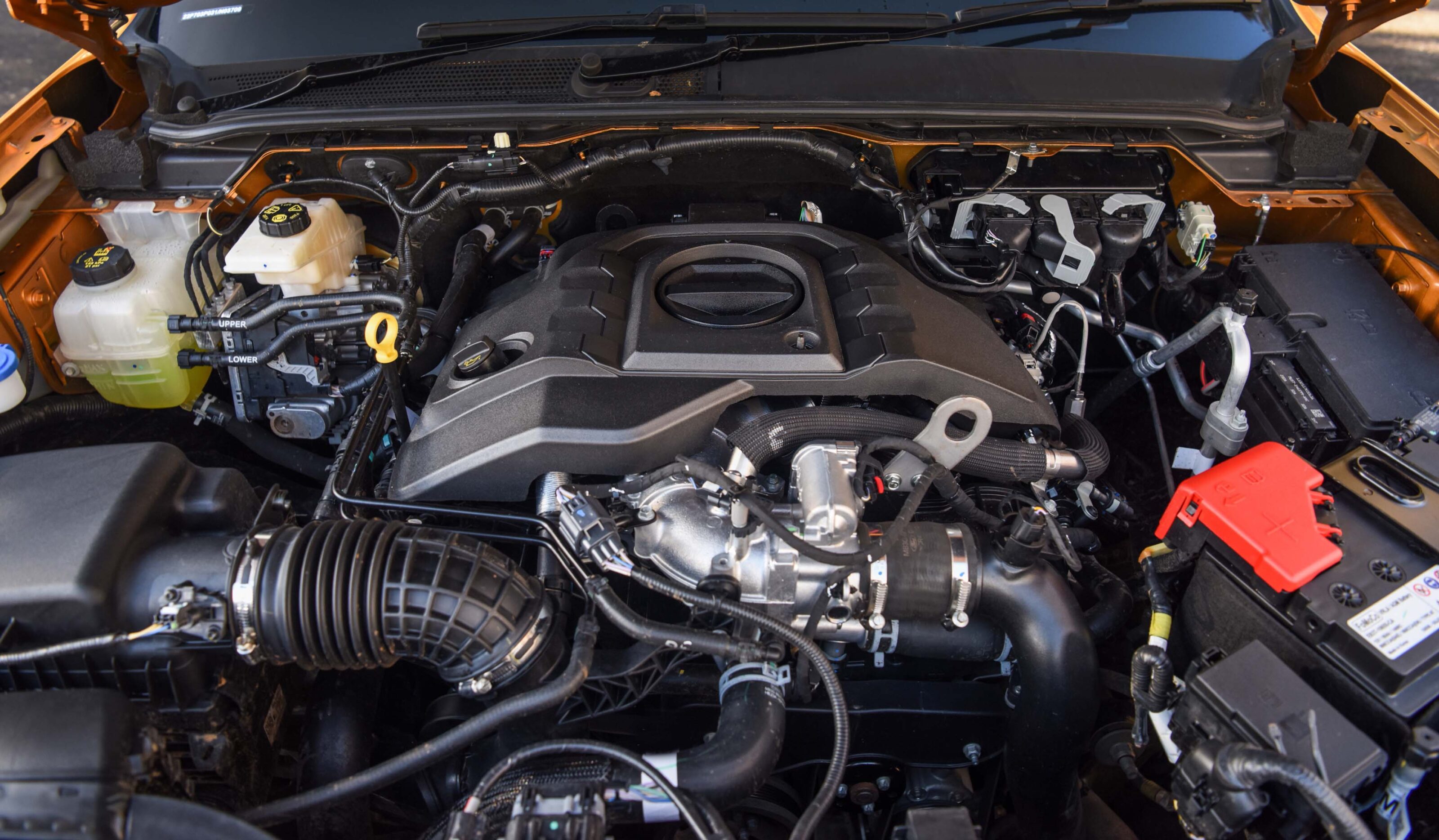
Aside from the bluffer styling, which Wheels scooped when we got photos of a styling buck back in February 2019, the big news with the version of the Ranger is the fitment of a gutsy 3.0-litre V6 turbo-diesel, a 184kW/600Nm version of the Lion engine as seen in some Land Rover products and the Ford F-150 truck.
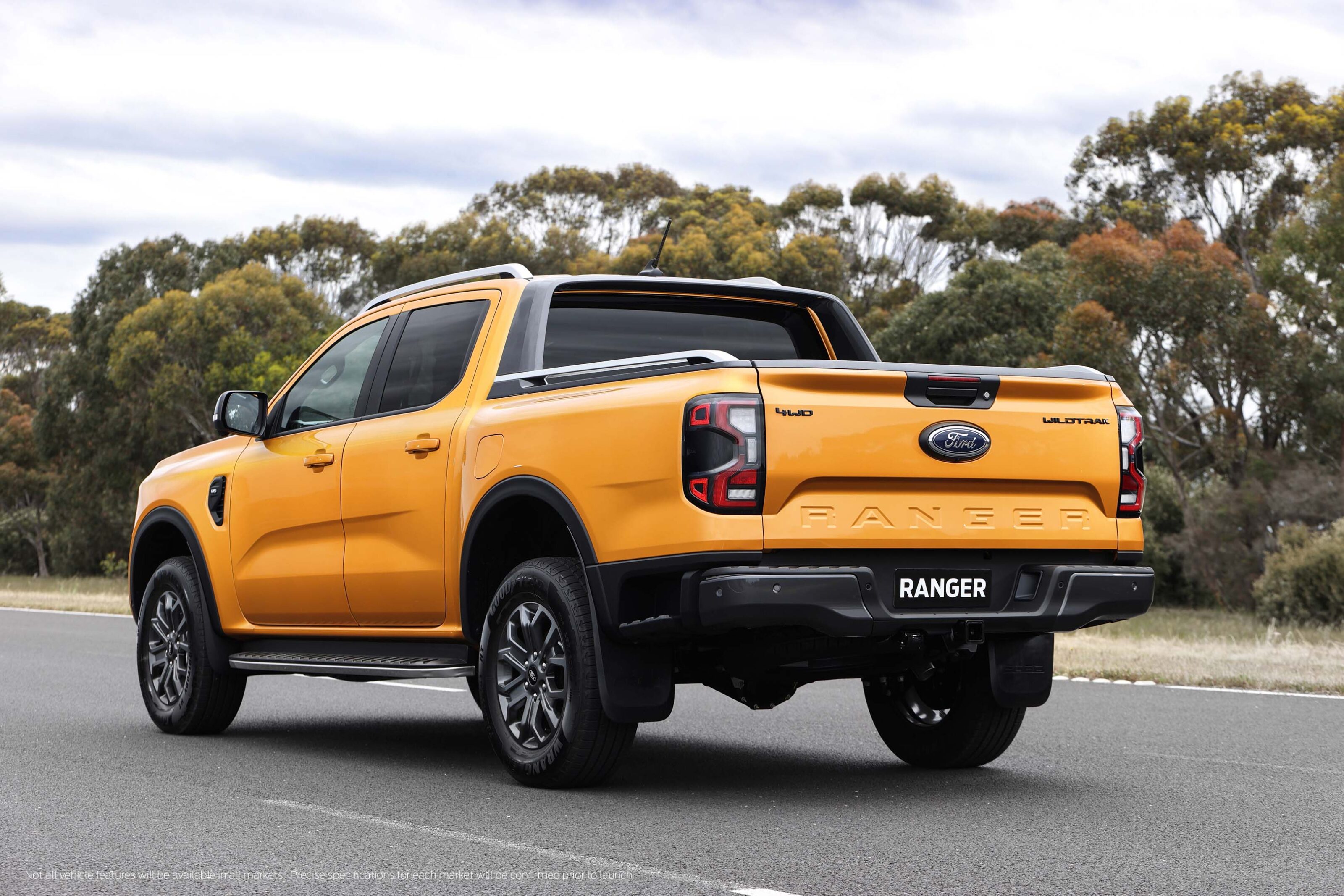
In fact, trace the development of this engine far enough back and you’ll come to a joint venture between Ford’s then-subsidiary Jaguar Land Rover where it wore the AJD-V6 label and Peugeot Citroën, where it was known as the DT17/DT20.
For this application it’s mated to a new fully automated all-wheel-drive system and, without issuing too much in the way of spoilers, lifts the Ranger to a new level of capability. There’s a lot riding on the success of this model, and not just for Ford, as this version of the Ranger will spawn the next-generation Volkswagen Amarok.
Featuring improved safety provision, a more refined cabin finish, a stack of off-road and towing features and a three-engine line-up with a plug-in hybrid version in development, there’s a lot to take in with this 2023 Ranger.
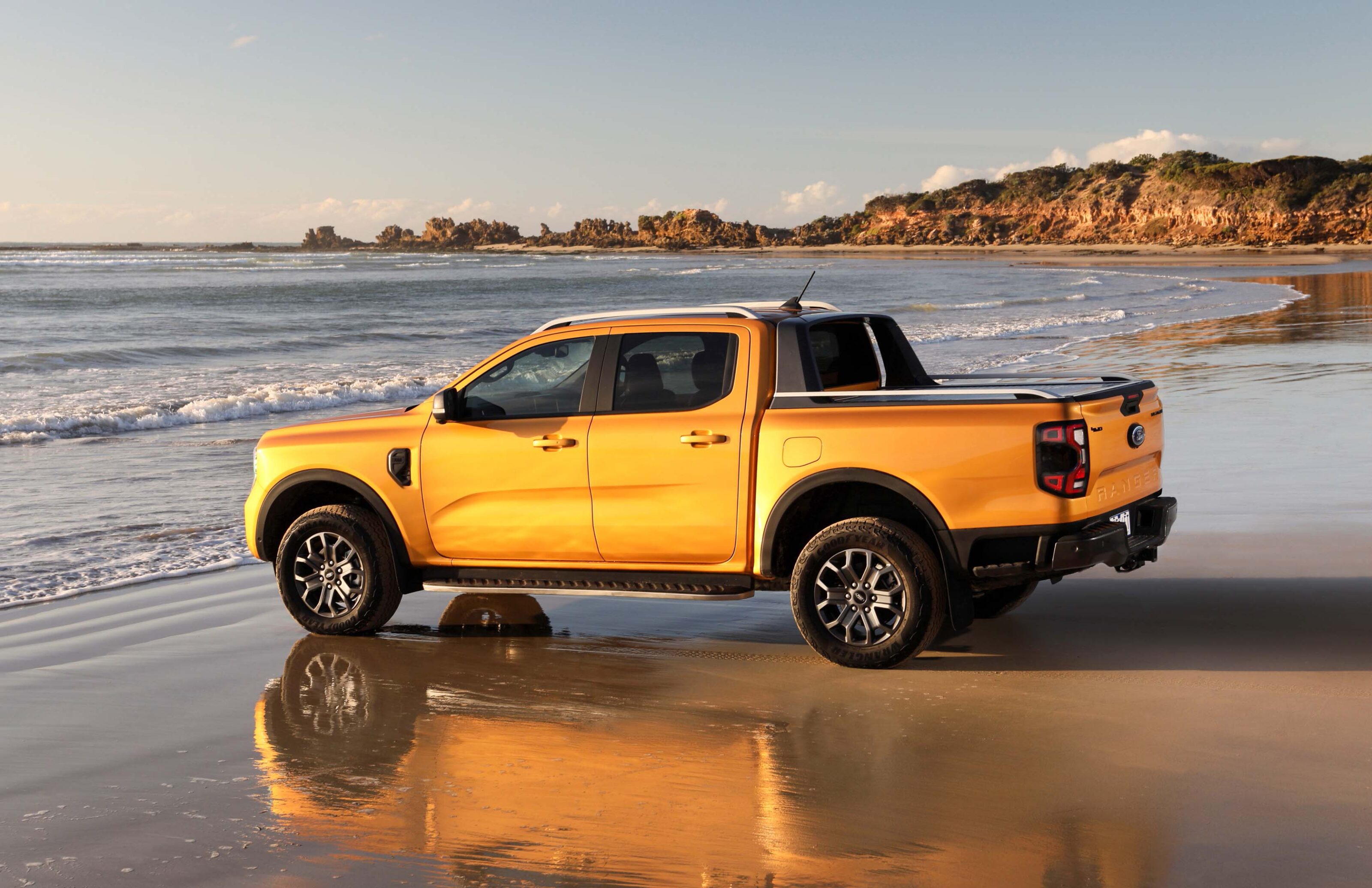
How much is it and what features do you get?
Model for model, prices are within $1000 to $1750 of the old version – with a whole lot more gear and functionality built in.
As you might expect with a new ute range, the sheer number of model permutations is huge. Ford offers three turbo-diesel engines from launch. At the base is a no-nonsense 125kW/405Nm 2.0-litre single turbo offering paired to a six-speed auto.
Step up from there to the 2.0-litre biturbo good for 155kW/500Nm and then onto the big banger 3.0-litre V6 unit, the latter both mated to a tweaked installation of the familiar 10R80 10-speed auto. For the purposes of this feature, we’ll leave the specialist Raptor version aside.
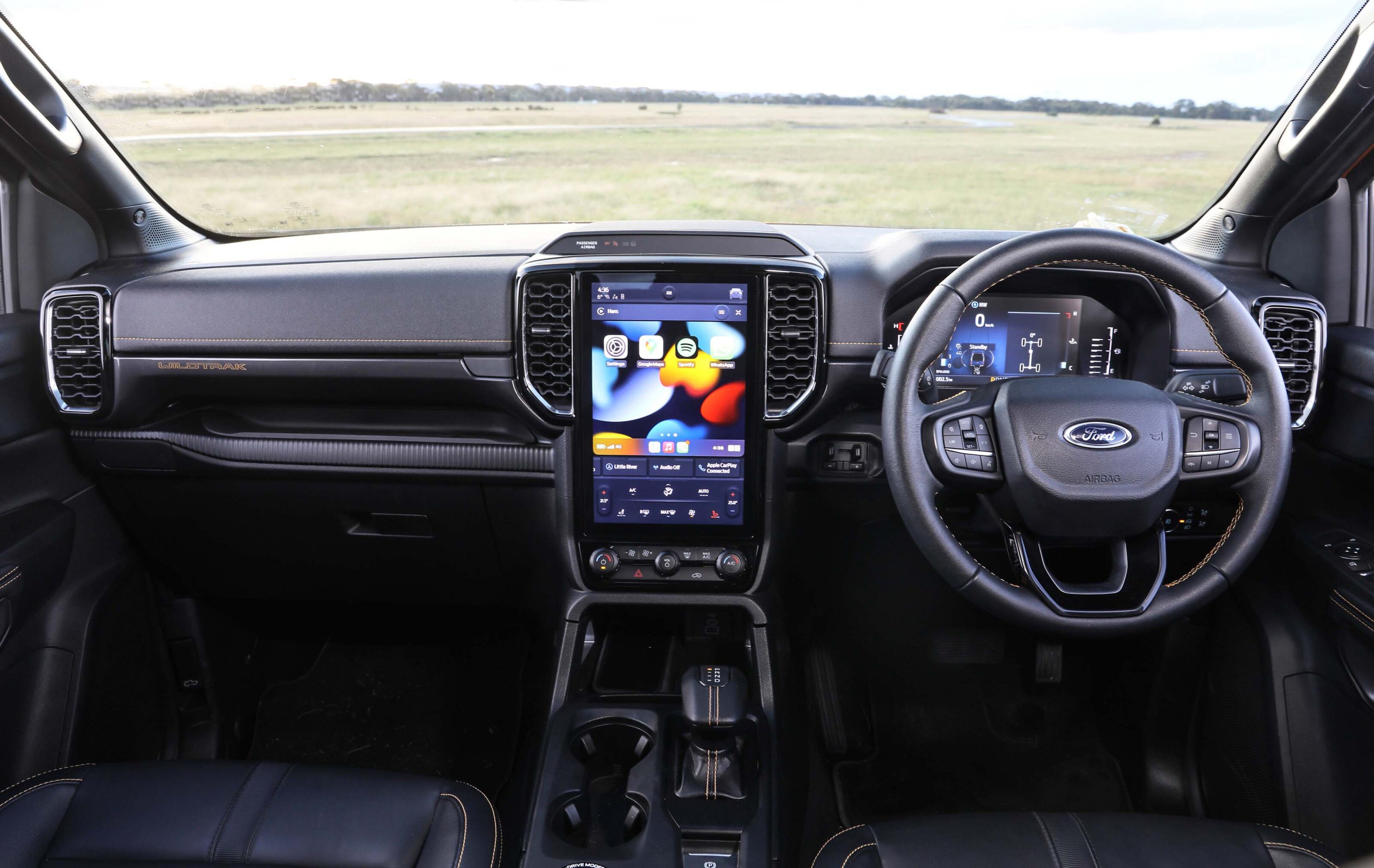
The trim structure currently runs XL, XLS, XLT and Sport, with Wildtrak at the apex. Interestingly, the cabins of the vehicles differ quite markedly, the XL and XLS feeling a little more workmanlike, with a traditional automatic gear lever and manual handbrake dominating the centre console.
From XLT up, it’s far more sophisticated, the space better utilised with an electronic parking brake, a low-profile e-shifter and a wireless charging pad tucked into the dash. This division of the range looks likely to indicate vehicles that people have bought for them and those that people will likely hand their own money over for.
Leaving aside crew cabs and single cabs, prices start at $42,300 for a rear-drive XL with the 2.0-litre single turbo, a price uptick of $1540 on its predecessor. Should you need four-wheel drive, the asking price steps up to $49,930. Both before on-road costs.
From XLT upwards, the range simplifies a little. All dual-cabs from here are fitted with a 10-speed auto and either the 2.0-litre biturbo or the V6 engine, and once you’ve gone beyond the $53,990 XLT 4×2, everything is all-wheel drive. So you’ll pay from $61,190 for an XLT 4×4, with the 3.0-litre V6 alternative tacking exactly $3000 onto that asking price. The Wildtrak 3.0-litre V6 tops out at $70,190 (all prices before on-road costs).
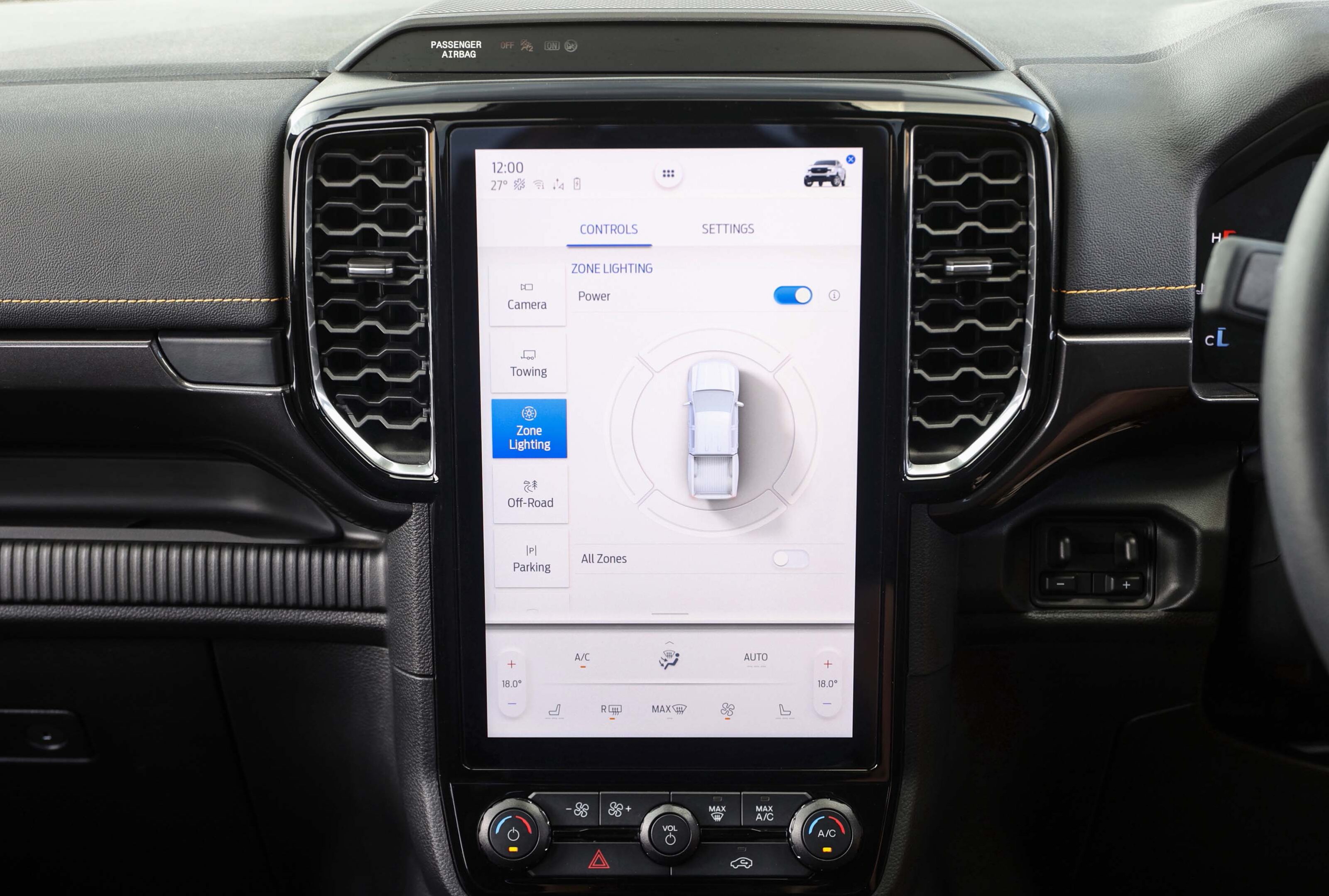
Even the base XL gets a cleanly integrated 10.1-inch portrait-oriented touchscreen running the SYNC4A system, climate control, locking rear diff and, for the first time on a Ranger, a reach adjustable steering column and rear air vents.
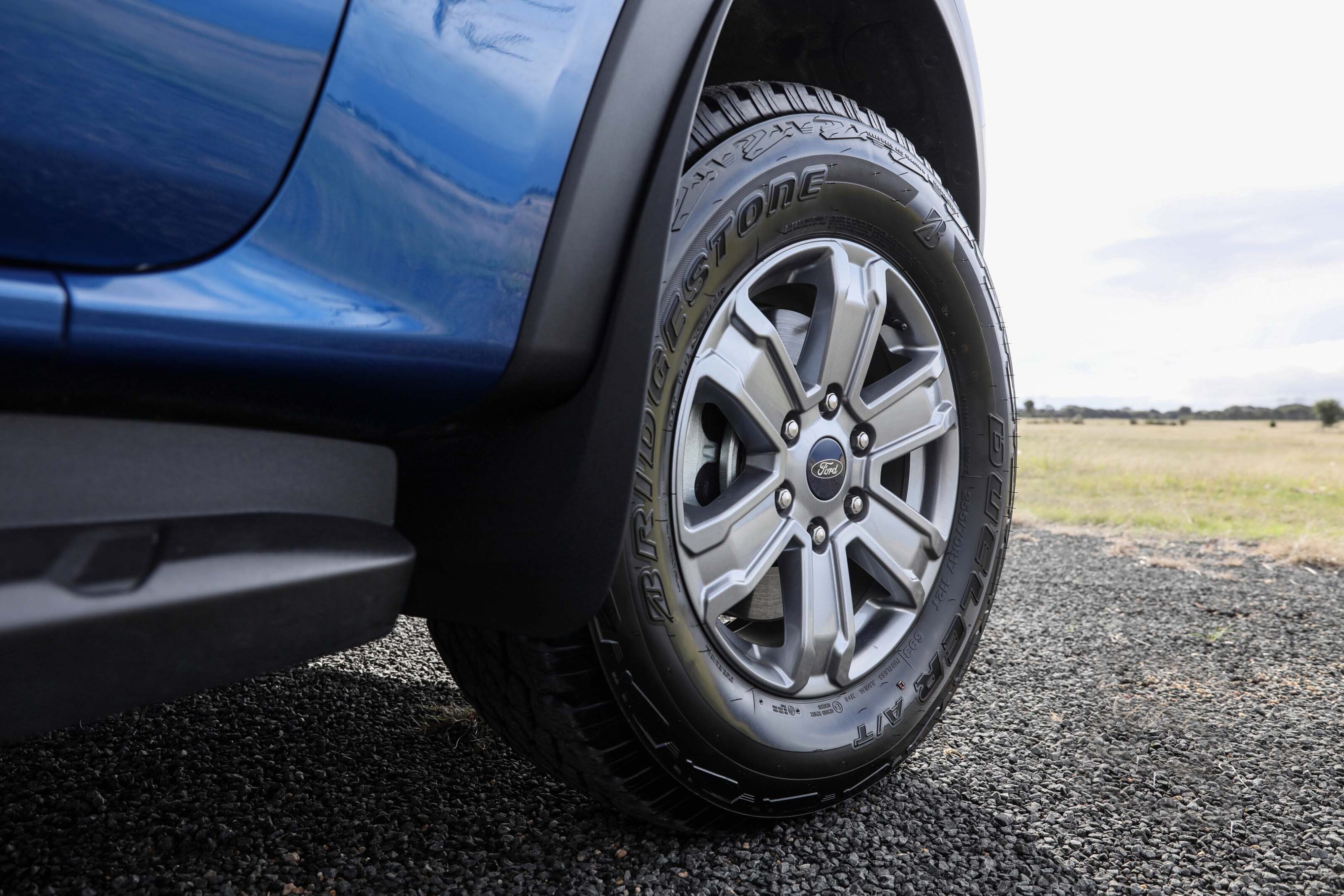
Step up to the XLS and you’ll see four drive modes (Normal, Eco, Slippery and Tow/Haul), 16-inch alloys, a power tailgate lock, a better six-speaker stereo, side steps and, of course, that superior 155kW biturbo lump. You get all that for an additional $900, which seems money well spent.
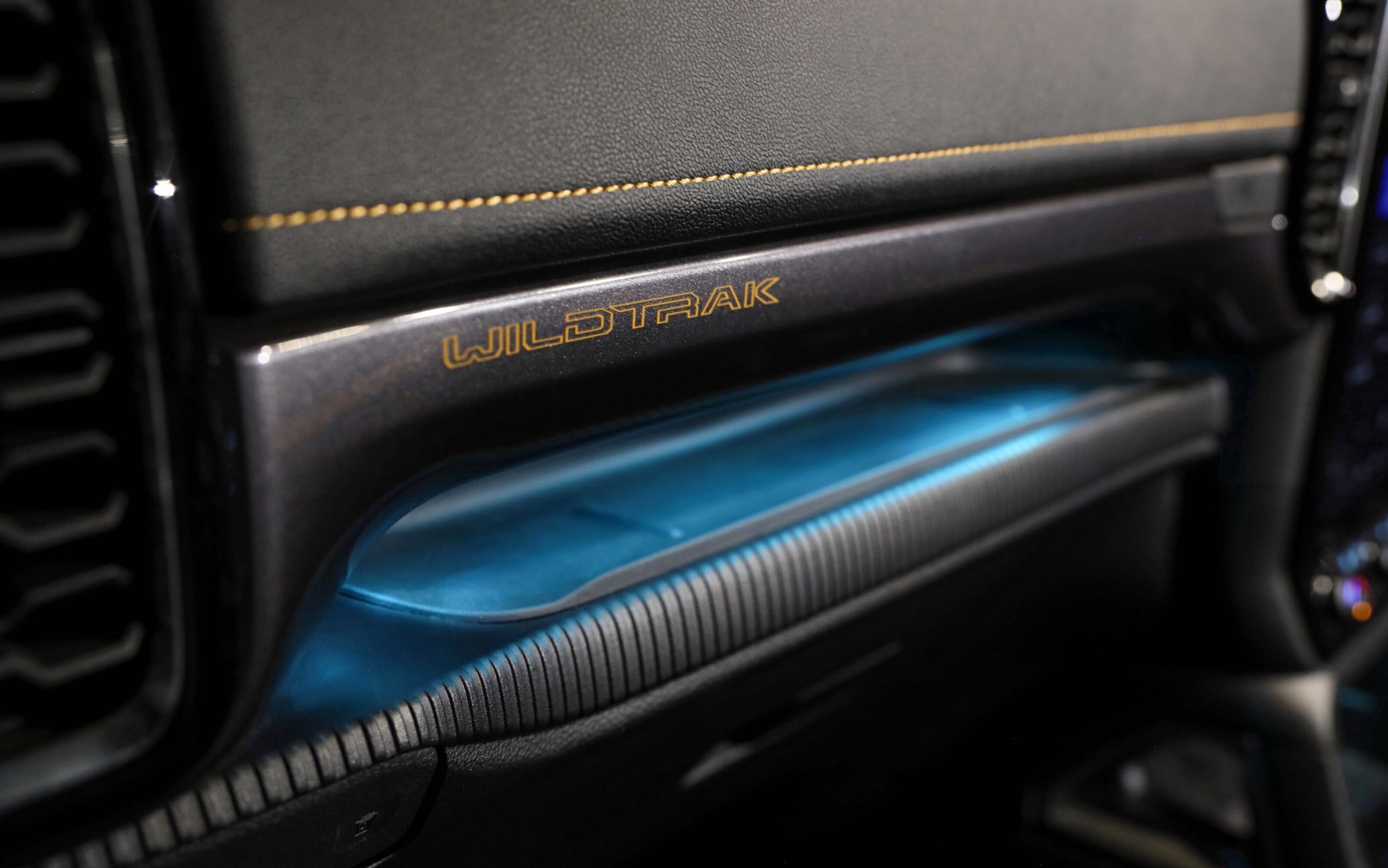
Ford has cleverly massaged the trim walk up to make spending more an eminently sensible choice. The XLT introduces the V6 option, adds rear disc brakes, 17-inch alloys, LED lights, dual-zone climate control and keyless entry. It also features low-profile rear box illumination, which is a plus when unloading the tub at dusk or night.
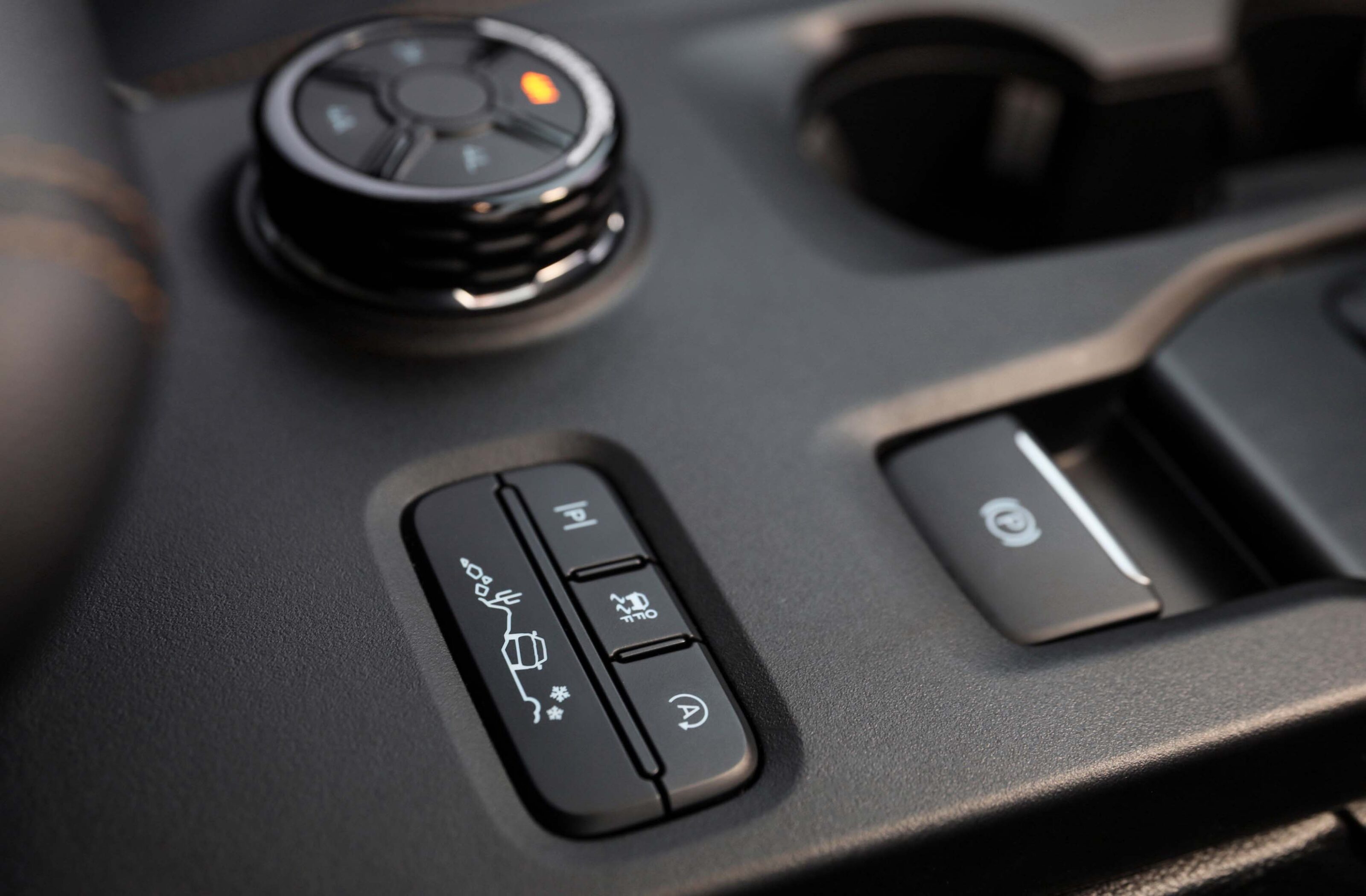
The Sport trim is 4×4 only and adds Mud/Ruts and Sand settings to the rotary drive mode controller. It also comes with eight-way powered driver’s seat adjustment, dark finish grille and exterior accents, 18-inch alloys and wireless phone charging.
And yes, it works well with the wireless Android Auto or Apple CarPlay, delivering enough charge to your handset to keep the battery level ticking up smartly while running wireless smartphone mirroring.
In addition to the wireless charging pad, there’s also a USB and USB-C jack fitted up front as well as a high-mounted USB by the rear-view mirror, specially designed to accommodate a dash cam.
The Wildtrak range-topper has the kit list emptied into it, with exterior zone lighting, roof rails, a powered roller shutter for the bed, a 12-inch touchscreen, heated and power-adjustable front seats, as well as an integrated trailer brake controller.
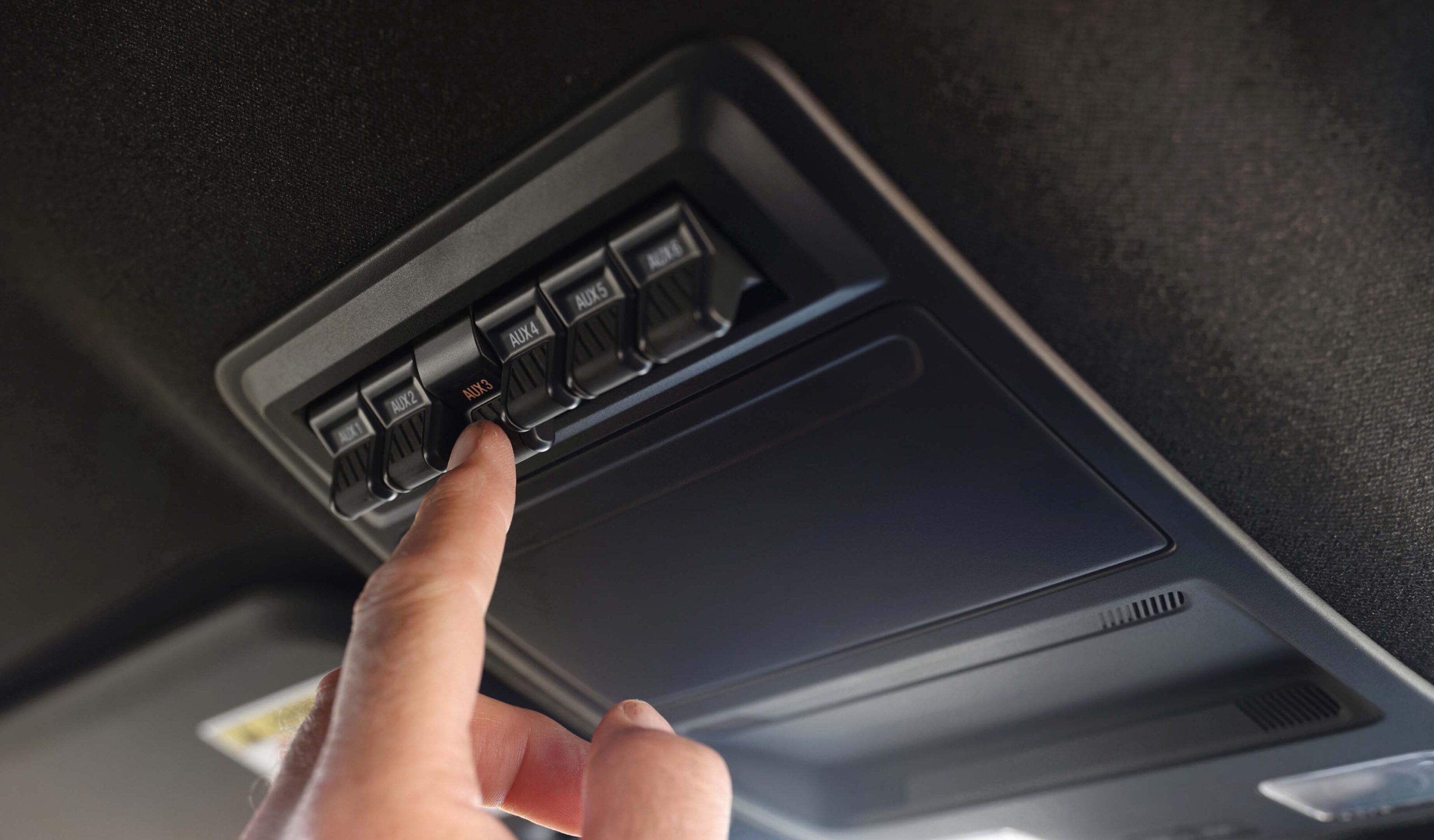
It’s worth noting that for an additional $1500, the Wildtrak can be equipped with a Premium Pack that includes fully automatic matrix-beam LED headlamps, a 10-speaker, 660W Bang and Olufsen stereo and a roof-mounted switch pack that allows you to control auxiliary driving lights and other accessories without piercing the body or attaching ugly aftermarket switches to the instrument pack.
The sting in the tail is that the semiconductor supply shortage means that should you want the Premium Pack, it’ll likely delay delivery of your Wildtrak beyond the estimate of eight months post order.
On the subject of supply, XL, XLS and XLT four-cylinder models are fairly readily available, with upper-spec V6 models harder to come by due to big demand from Australian buyers.
It’s also worth noting when configuring your Ranger that every paint finish other than Arctic White is a cost option. You’ll need to dig down the back of the sofa for another $675 before you start exploring colours.
How comfortable and roomy is it?
It’s not night and day different but a few touches have genuinely increased its utility.
The cabin feels a little more spacious than the old version, but looking at the specs, it’s clear that this generation Ranger has only been teased out a few millimetres in each direction. As much as anything, it’s a case of utilising the available space far more smartly.
Ford has extended the wheelbase by 50mm and track width has also increased by a similar amount. What’s more, slimming down some interior features such as door cards and seatbacks has further eked out space and increased the impression of airiness inside.
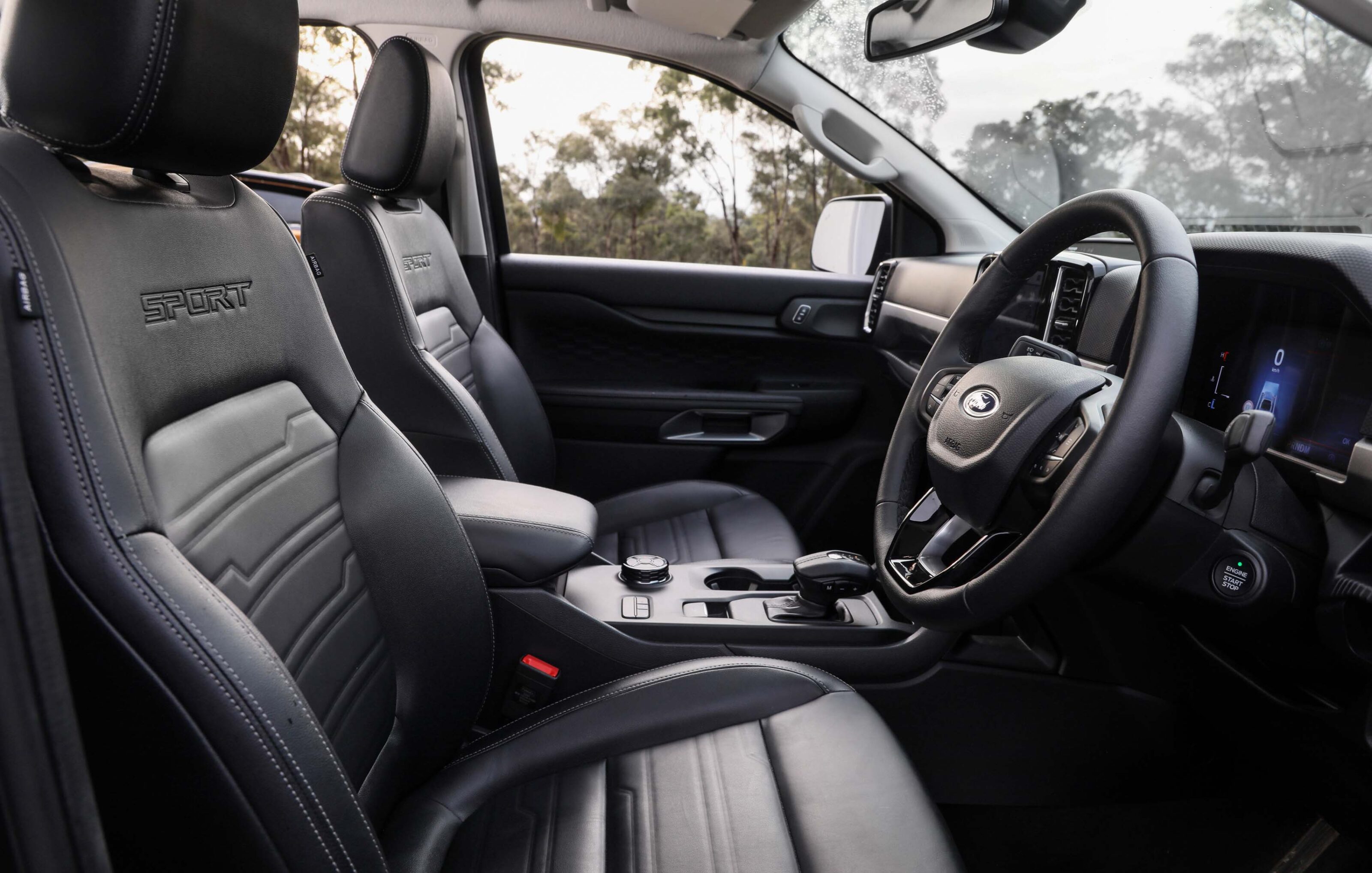
Materials quality has improved significantly, especially in those models from XLT upwards, where there’s greater use of soft-touch surfaces. The combination of the central armrest, e-shifter and the soft top-roll on the window makes the driver’s seat of upper spec models feel extremely comfortable.
The dashboard is a lot more slab-faced than in the old Ranger, mirroring the exterior styling theme. Thankfully, Ford has resisted the temptation to ladle everything into the central screen, canvassing owner opinion and wisely leaving key heating, ventilation and air-conditioning controls as well as stereo volume as physical controls.
An eight-inch LCD cluster ahead of the driver is hugely configurable and can run as a minimal calm screen if required. The rev counter setting is a little underbaked, displaying a thin bar rather than a skeuomorphic clock.
Unfortunately, we did run into some issues with the screen during the launch event. Some vehicles experienced glitches whereby the system would freeze whereas one XLS trim vehicle I sampled had paired my phone, but then couldn’t communicate that fact to Android Auto, which got itself into a loop asking to pair a phone that was already paired.
With cars arriving into dealers already, it’s not as if these issues could be attributed to early pre-production vehicles. Let us know if you’re experiencing anything similar.
All-round visibility is good, with that bluffer styling meaning that the driver can see the angular front corners of the bonnet, where the softer-styled predecessor’s front end arced out of view somewhat.
Enhancing the feeling of security when manoeuvring the Ranger is a full surround-view camera system with decent definition, standard on Wildtrak and optional on the Sport and XLT trims.
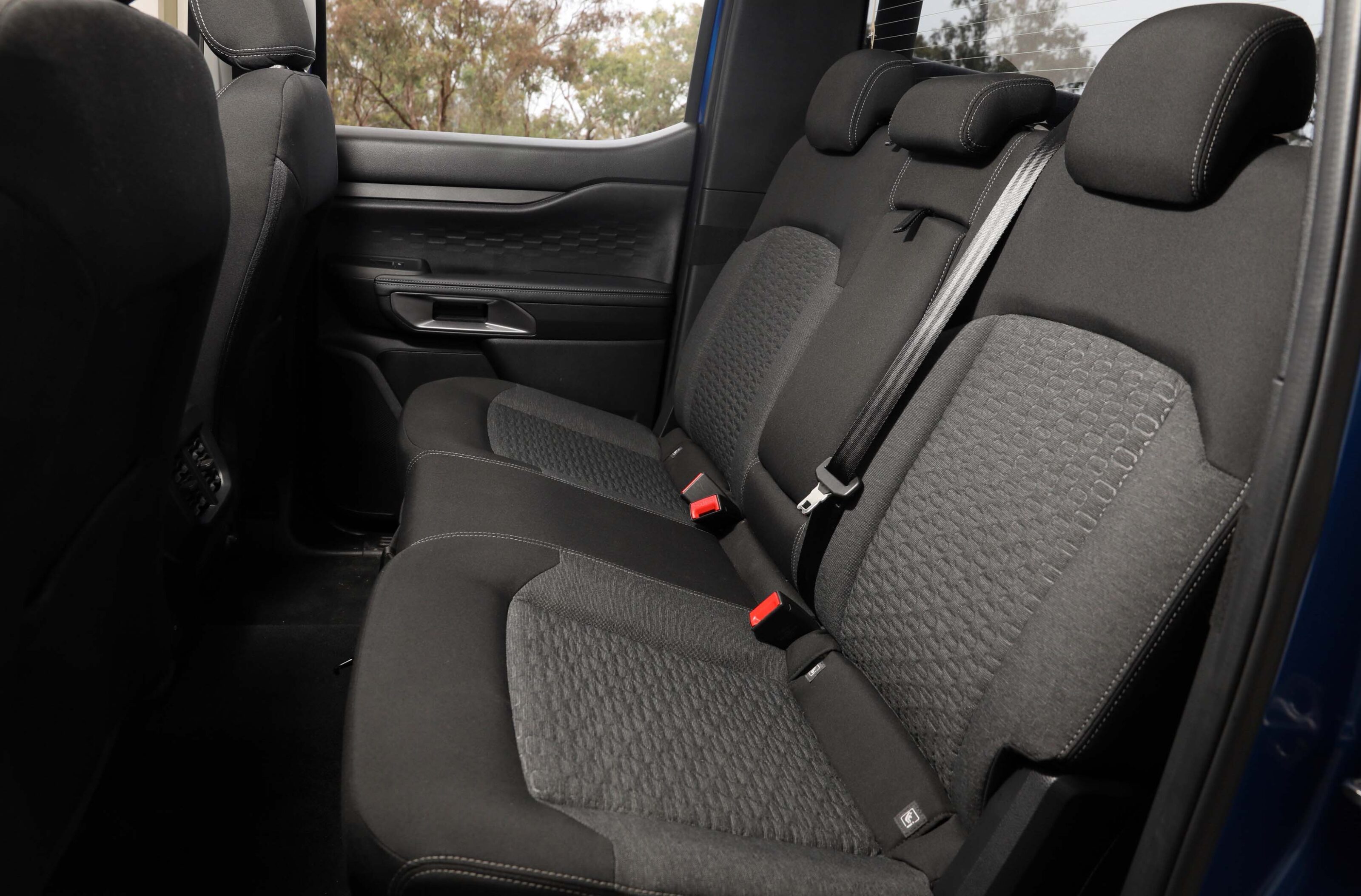
Both front and rear seats offer decent headroom, with both knee room and shoulder space being increased in the rear. Rear passengers also get air conditioning vents for the first time which will make longer family trips far more comfortable for the kids.
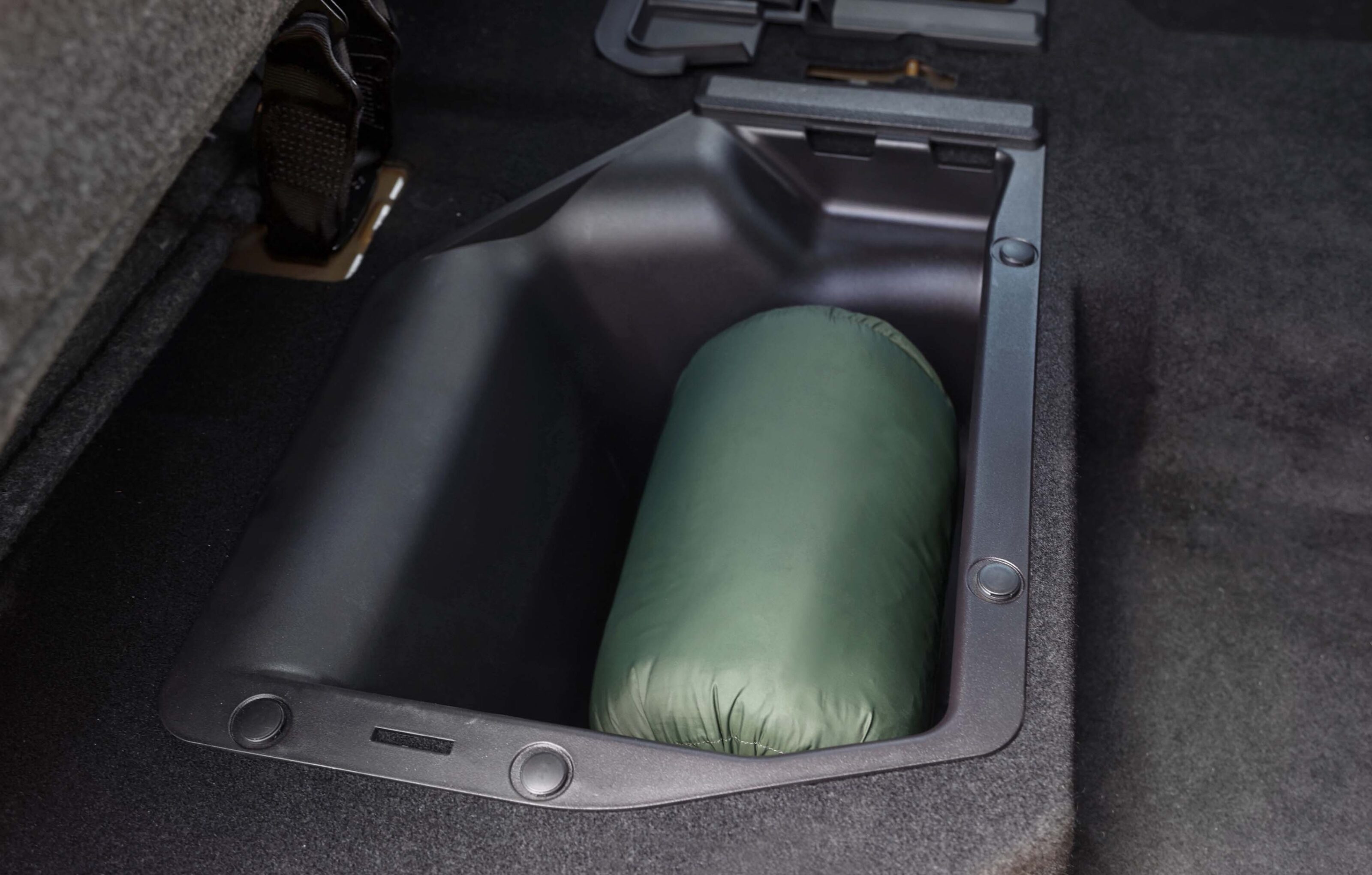
There are under-seat storage bins for kids’ clutter, which doesn’t affect the second-row seatback’s fold flat ability should you need to load something inside the cabin without having to risk sullying the seat face material.
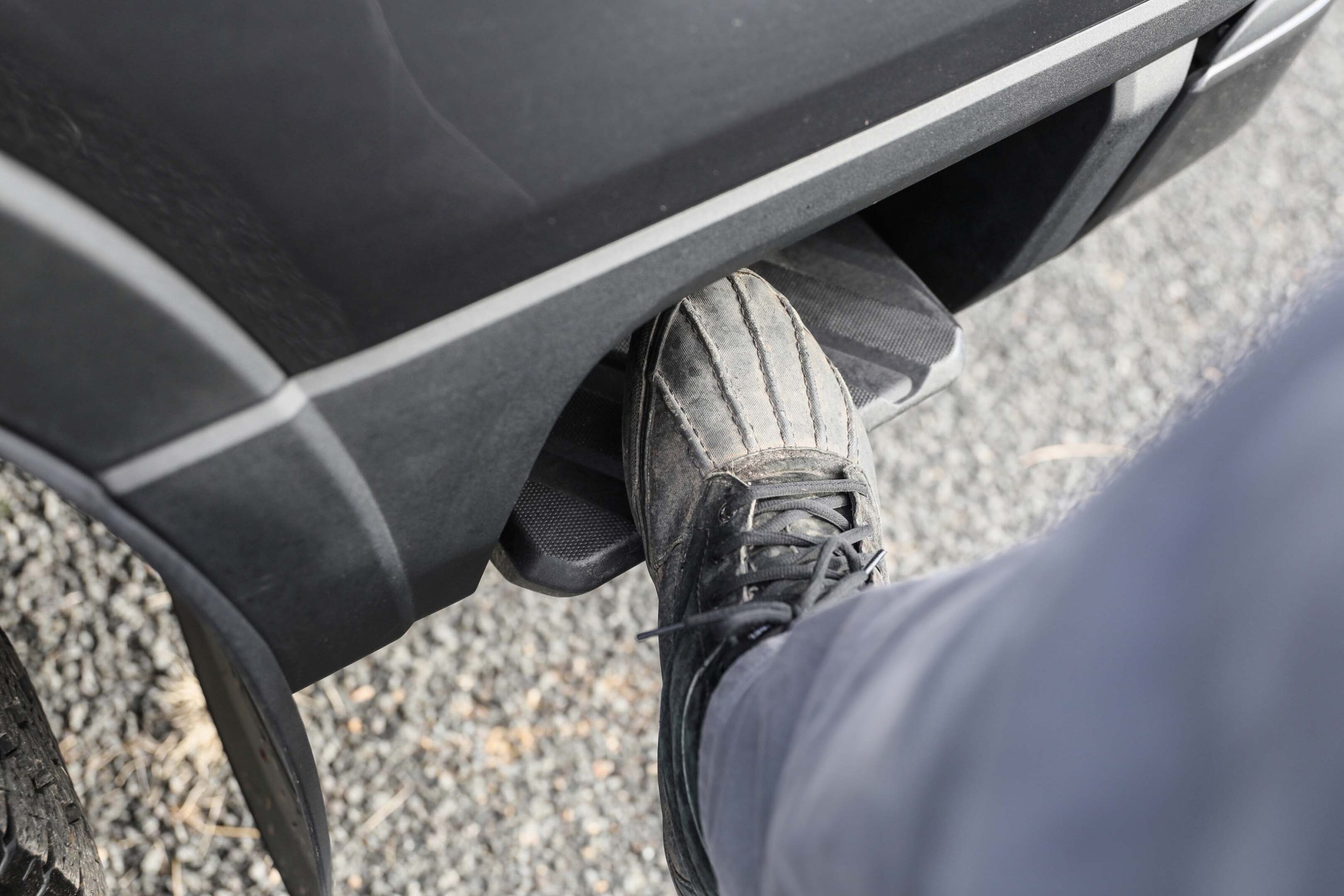
Moving to the rear, access to the 1544mm long tub has been improved with the fitment of a box step set into the side of the wraparound bumper moulding. This has been rated to over 200kg and is easily wide enough for a good-sized work boot.
It also means that you no longer have to step up onto a potentially slippery rear tyre to climb into the bed. Moving the dampers outboard of the springs has meant that the load bay is crucially wider than before and the Ranger’s 1233-litre tub can now accommodate a 1200x800mm Euro pallet.
Every Ranger variant gets a moulded box capping with pre-drilled mounting points along the side.
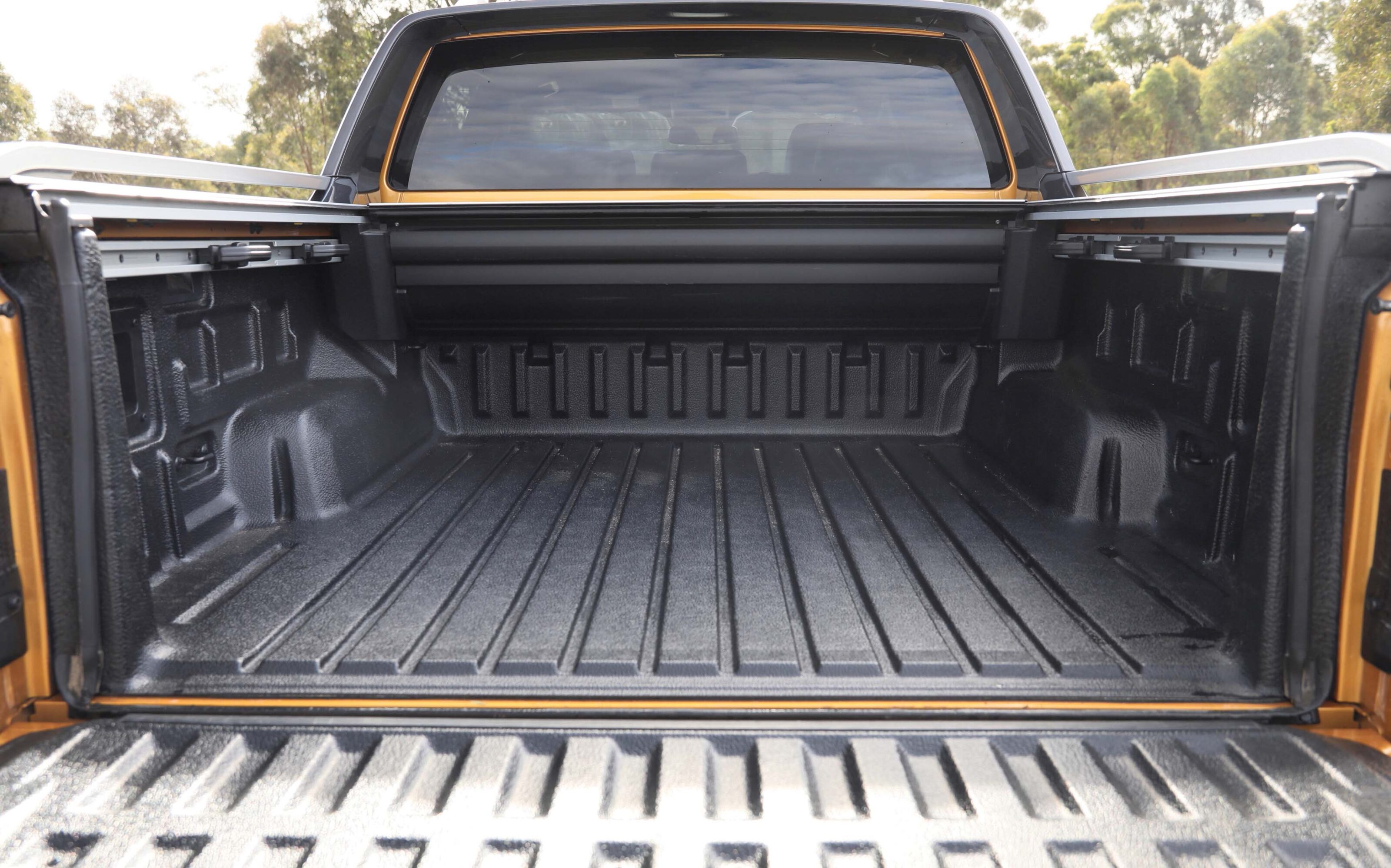
Those models without a full moulded tub liner feature a neat and discreet ruler on the tailgate lip that can be used to measure wood, fish, rope or anything else that could use measuring.
Six tie-downs are provided within the tub along with slots in the moulding so that the tub can be divided if necessary. The Wildtrak also features a pair of sliding cleats and a powered roller shutter.
The latter can be operated from within the vehicle, via a weatherproofed button in the tray or via the Ford Pass app.
You can also operate the zone lighting via the app, so that you can fire up a 360-degree flood of lighting as you approach the vehicle in the dark; handy for security and convenience.
The roof load limits are 350kg static and 85kg dynamic.
What is it like to drive?
There are a few transformative things.
Jump in and pull away and it’s clear that the overall refinement of the Ranger has improved markedly, regardless of engine choice. The ride is a few degrees more polished for a start.
While it’s not the uncanny magic carpet delivered by the Raptor, there’s significantly less of the high-frequency bump and jiggle that we usually associate with driving an unladen dual-cab, even with larger alloy wheel choices.
The damping has been improved, and that slightly longer wheelbase and greater track width deliver a reassuringly planted feel.
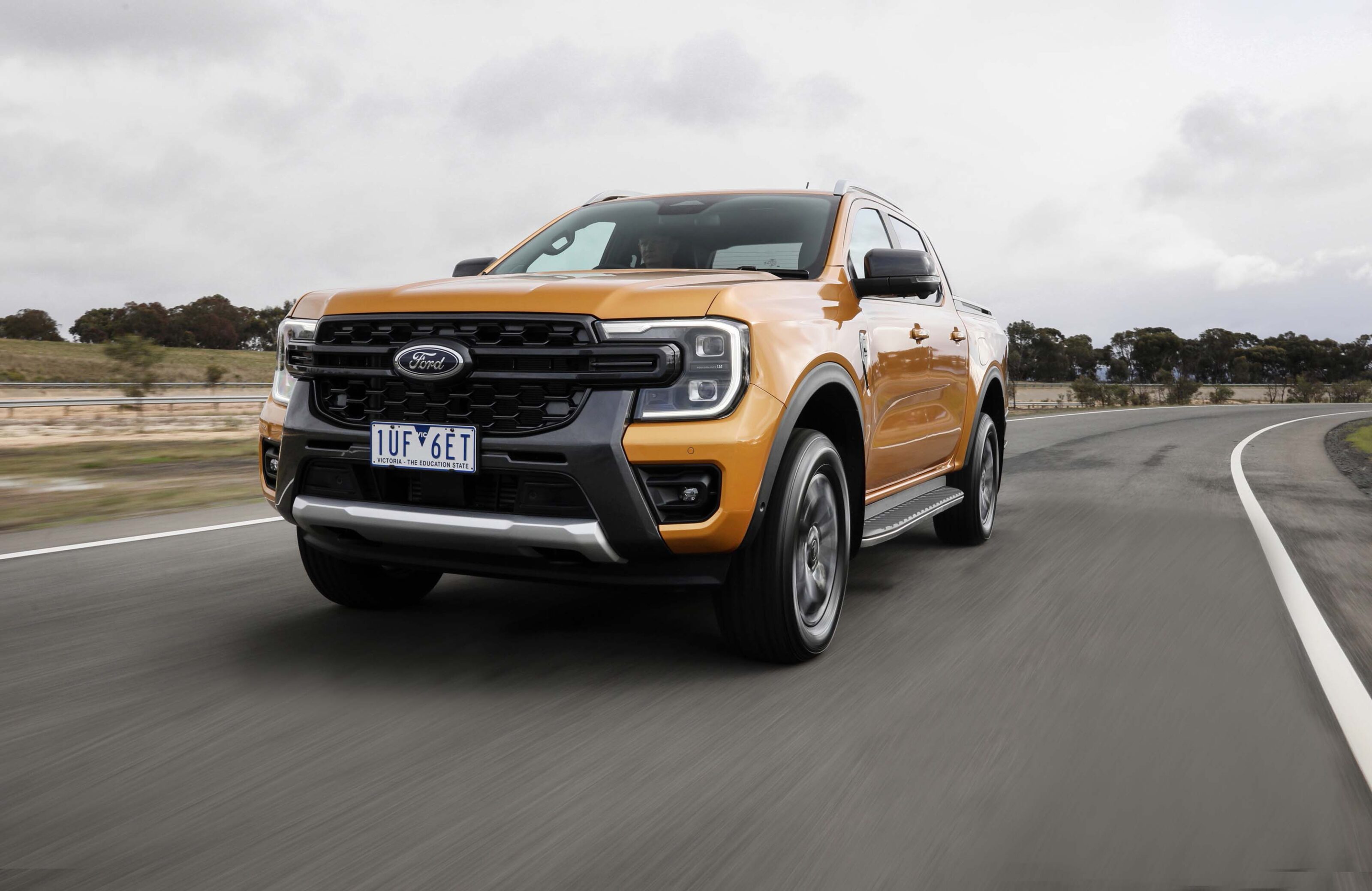
Tip the Ranger into a corner and its body control is astonishingly good for a vehicle with its off-road remit.
Outright grip depends on which tyre choice you’re running, but even the Wildtrak with its Goodyear Wrangler Territory A/T mud-friendly rubber delivers low road noise and decent front-end grip.
Special note should go to the Ranger’s stability control system that, on a wet roundabout, is easily able to cope with the driver’s foot going to the floor, meting out a well-judged threshold of power, and then reintroducing drive cleanly as soon as the wheels straighten. To do so in such a seamless, safe manner is a task that’s beyond some premium sports sedan manufacturers.
The steering of the Ranger can initially feel a little gluey, but this is largely a consequence of the lane keep-assist system introducing a skerrick of torque pulse in edge cases as it feels you might be wandering out of the centre of a lane.
Prod the wheel-mounted button to switch it off and the steering instantly becomes far more lucid. Some really well-engineered basic dynamics are being somewhat masked in this instance.
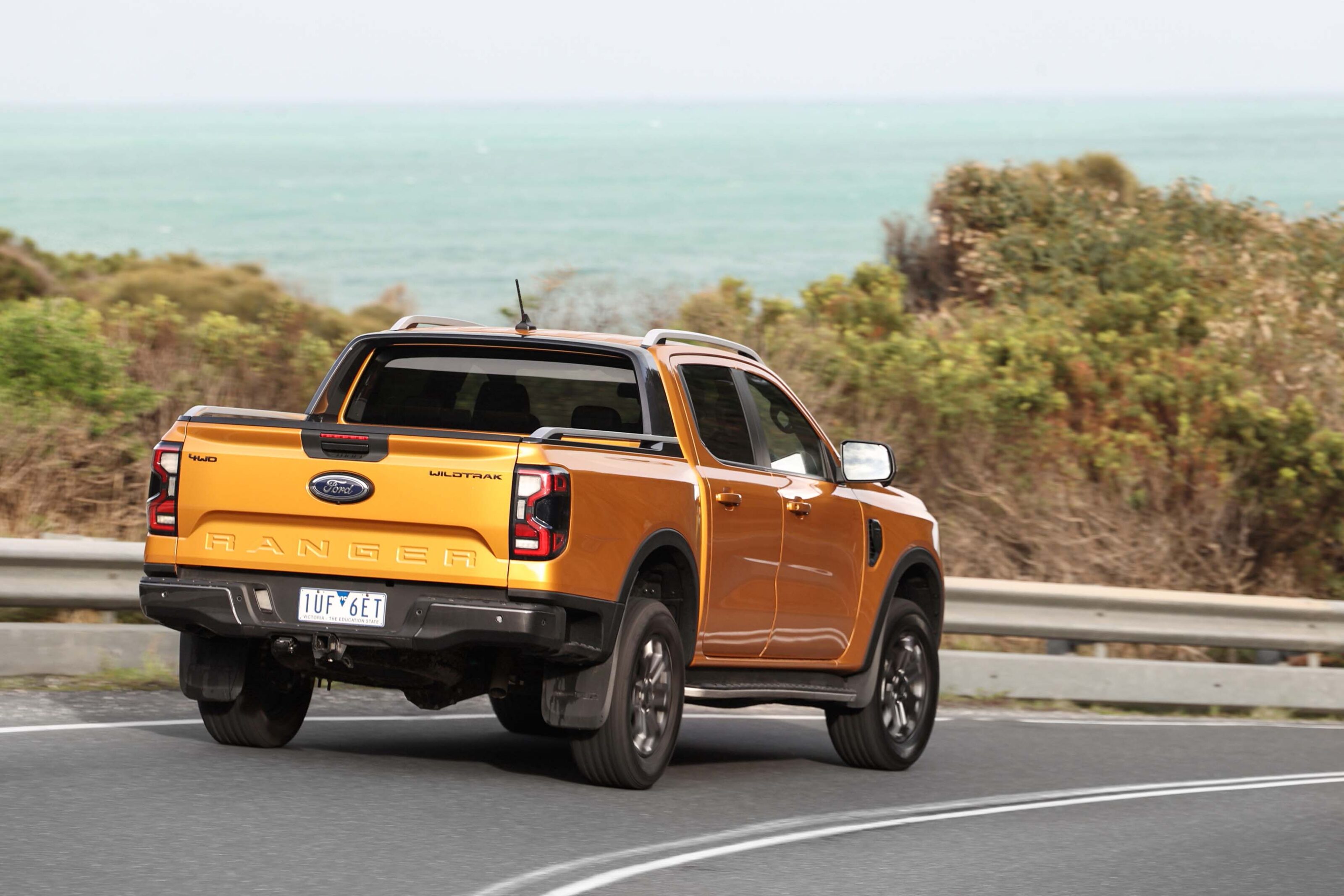
Ford is aware of customer grumbles concerning the 10-speed auto box’s propensity to hunt up and down ratios, so has improved the transmission’s shift logic and fitted a new torque converter to rectify this.
The more basic six-speed auto hasn’t been overlooked either, with a new electronic control system helping the ‘box find itself in the right ratio more adeptly.
That impression of overall driveline refinement is helped by the development team’s focus on getting on top of noise, vibration and harshness issues. Rather than load the Ranger with sound insulation or invest in double glazing for the passenger cell, the engineering philosophy has been one of marginal gains, starting with body stiffness.
Interior trim structures can be more rigidly mounted, helping to reduce squeak and rattle issues. From there, materials, fixings and analysis of noise pathways into the cabin were ticked off.
Aero work at Monash University’s wind tunnel helped to reduce wind noise at speed, and a slight rustle around the door mirrors and A-pillars is about the extent of wind noise.
The wind tunnel work also helped finesse the small aero lip on the trailing edge of the rear tailgate.
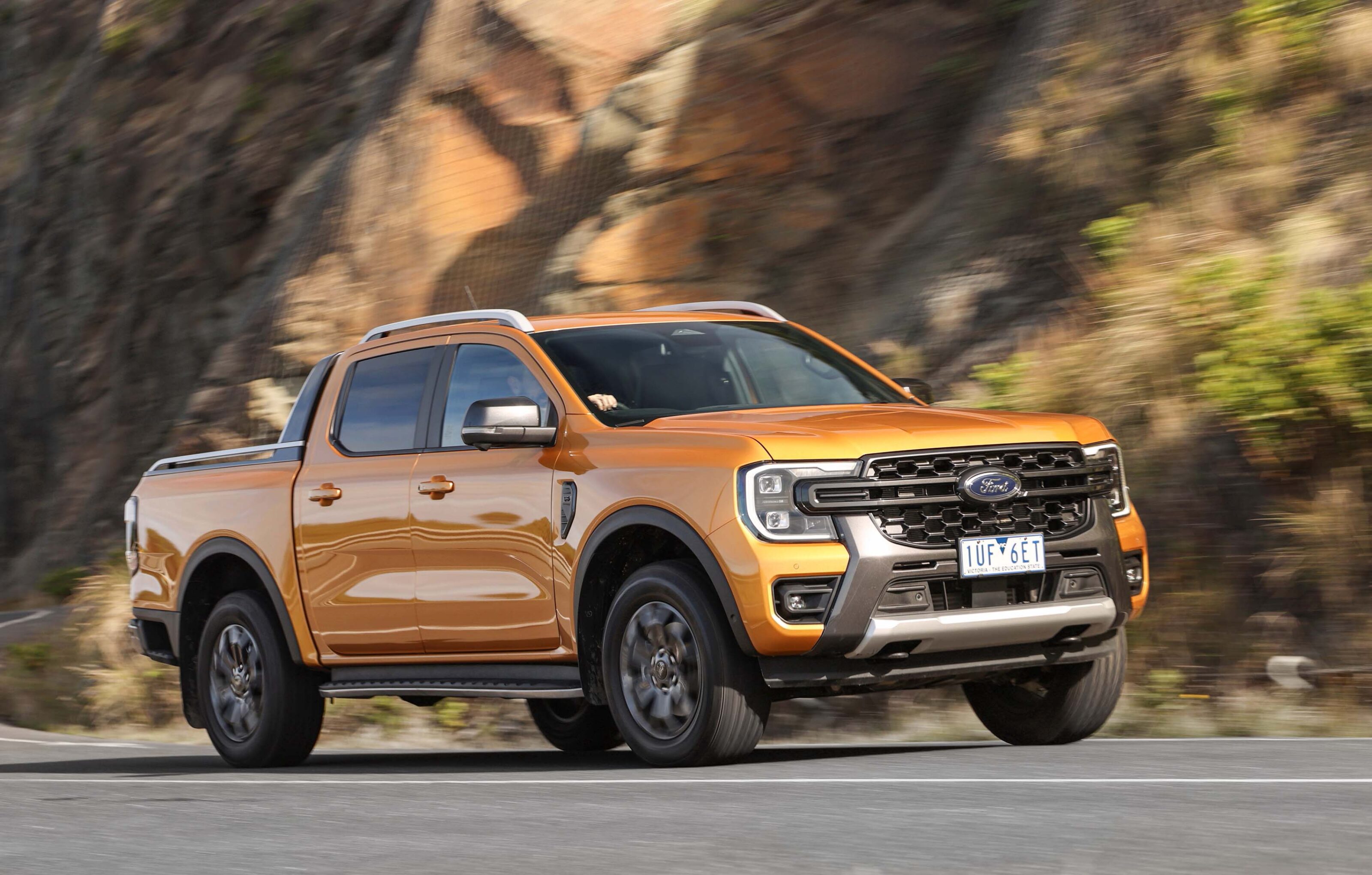
That improvement in overall refinement is most evident when driving the 2.0-litre biturbo engine, which feels a good deal less vocal than its prior iteration. Ford assures us that it has fixed the injector issue that afflicted this engine, with new injectors from Continental. The V6 is another league ahead in terms of silkiness though.
Finally, this feels like the engine the Ranger was always supposed to have. It helps that the V6 develops its 184kW peak power figure from 3250rpm, whereas you’d need to wind another 500 revs onto the 2.0-litre biturbo in order to access 29kW less.
Given the V6 is typically $3K more than the equivalent 2.0-litre biturbo, and comes with the smarter fire-and-forget all-wheel-drive system, it’s an easy recommendation.
Drive the two engines back to back and it’s clear that the new torque converter in the four-pot slurs through the gears far more cleanly, but it is still changing gear more often than the V6 in order to plug into the biturbo’s torque. It feels like an issue that’s been 90 per cent rectified rather than a drivetrain without issue in the first instance.
How does it go off-road?
…should I wait for the Raptor?
Interesting question. Given that you could buy a Ranger V6 Sport and load nearly $20K worth of accessories onto it for the price of a Raptor, the answer’s not as cut and dried as you might think.
Away from the bitumen, it’s clear that a great deal of work has gone into making the Ranger an easier thing to go bush with.
Apart from the base rear-wheel drive model, the 2.0-litre diesels feature a traditional part-time four-wheel drive system with a two-speed electronic shift-on-the-fly transfer case that offers rear-wheel drive for normal on-road driving and then four-wheel drive with high- and low-range settings for low grip surfaces.
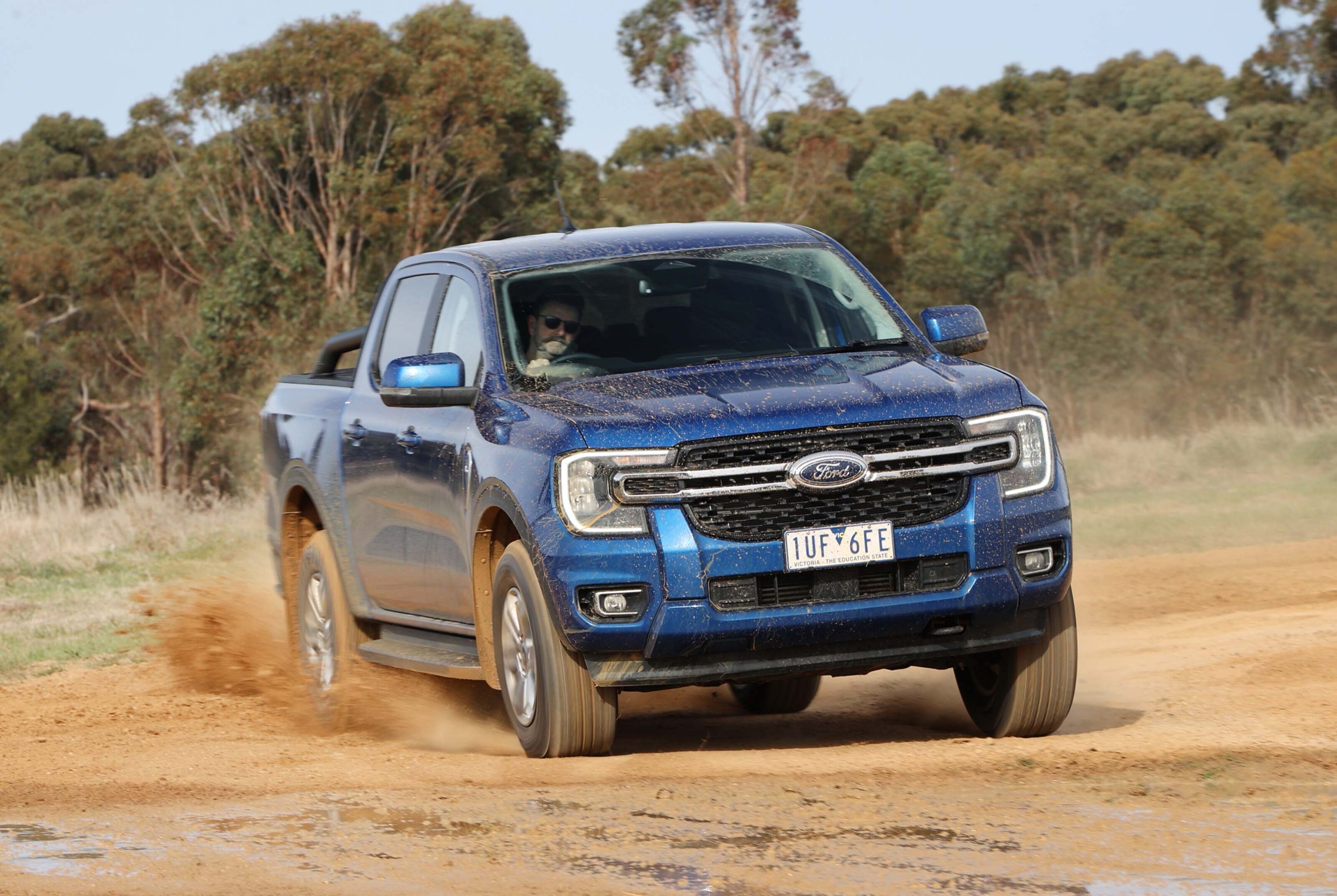
The V6 versions, however, are fitted with an on-demand system that has all of the above modes as well as a 4A setting for automatic all-wheel drive. This distributes drive between the front and rear axles and means that you can leave it in this mode, drive a Ranger out of your garage and into mud, snow or sand without having to remember to click between rear- and four-wheel drive. If that’s still not enough, the rear diff can be locked as well for added traction.
A slightly cheap-feeling rotary dial is used to shuttle between drive modes, with Sport models and above including the handy Mud/Ruts and Sand settings. We got to sample the Ranger on the AARC proving ground’s off-road course in frankly abysmal conditions and the snatch straps weren’t utilised all day.
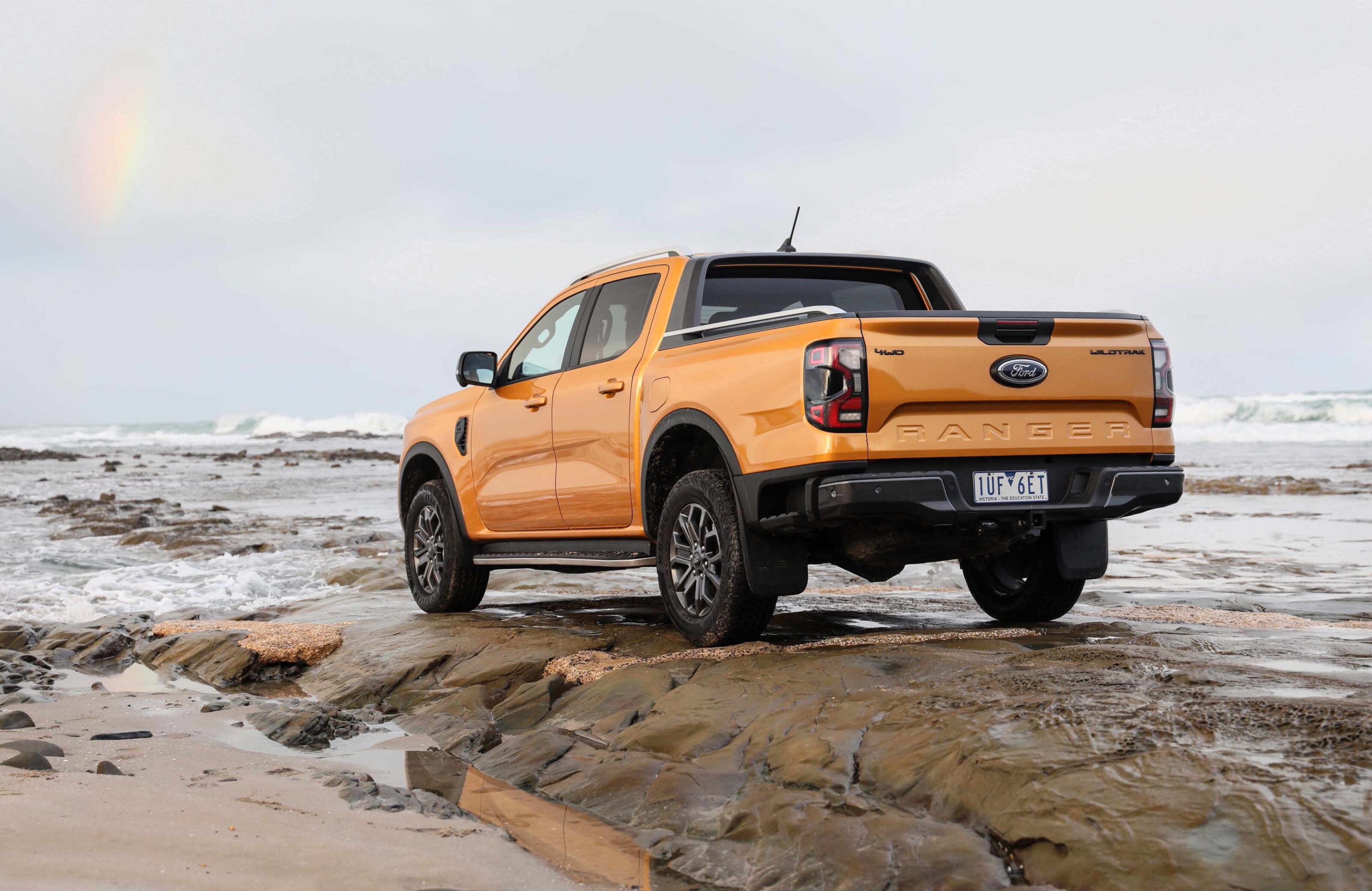
The approach, breakover and departure angles for the Ranger are 30, 22 and 25.6 degrees respectively for the new model, with the departure angle dropping to 23 degrees if you have a tow bar fitted.
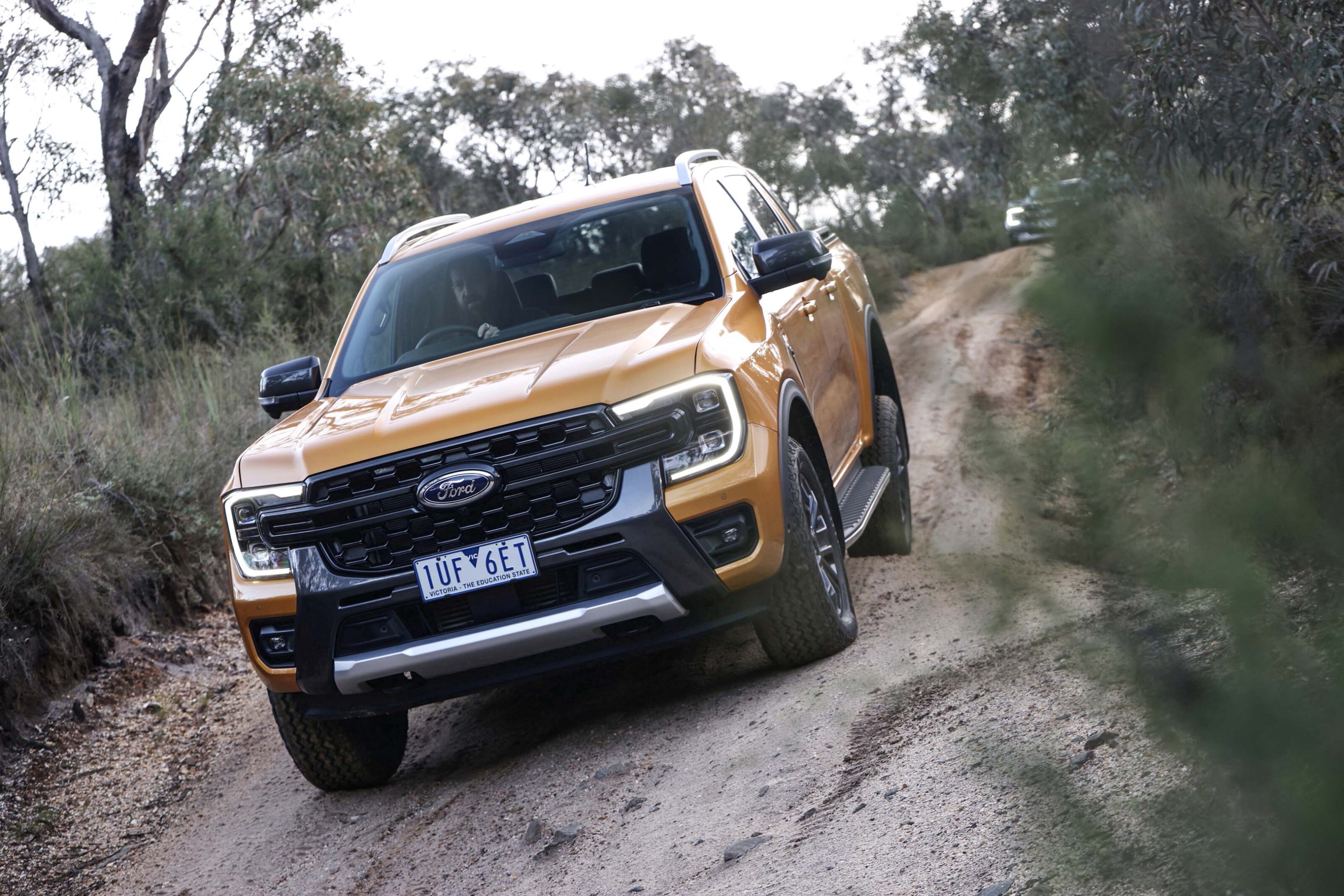
Ford has attempted to simplify and take the intimidation factor out of off-roading for those who aren’t experienced. To that end, from Sport models and up, the Ranger features a button on the centre console that, once pressed, brings up a dedicated off-road display on the centre touchscreen.
This allows the driver to quickly manipulate the rear diff lock, switch off the parking sensors, activate and deactivate the hill descent control and also displays the view from the grille-mounted camera.
The camera is a particular boon when attempting to crest a ridge or dune, as its angle of view is so wide that while you’ll merely have a windscreen full of sky, the lens can see down the other side and you can steer the vehicle accordingly.
What’s more, in order to maintain a clear field of view, there’s a water jet cleaner for the camera that operates with the windscreen wash function. The display also indicates where your front wheels are pointed, so that you don’t sledge the front end when negotiating deep muddy ruts.
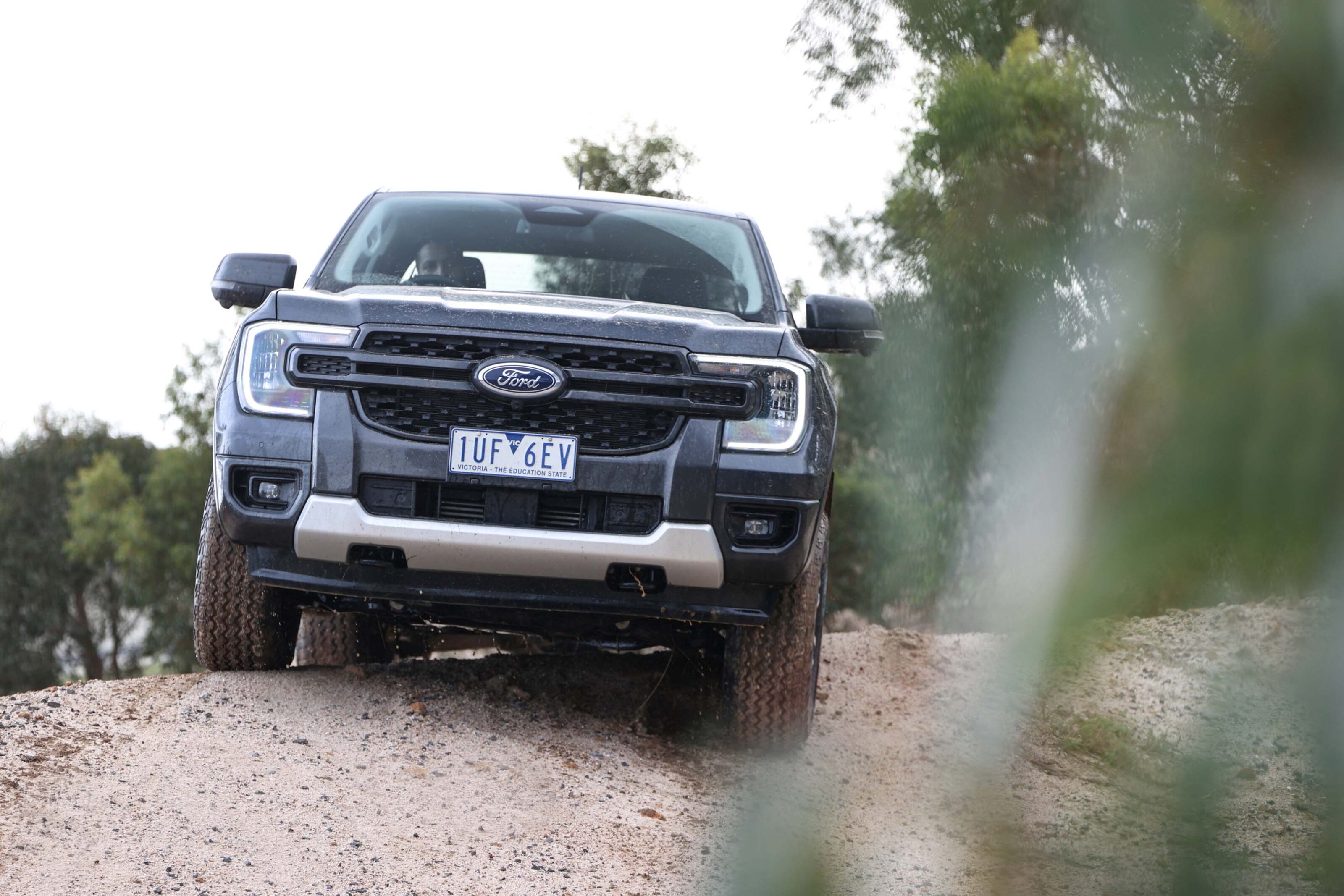
The hill descent control works extremely well, even on the 60 per cent slope at AARC, braking individual wheels smartly. Reassuringly, it also works in reverse, which is handy if you’ve failed to get up a steep incline.
Germane to this activity is the fact that Rangers from XLT upwards are at last fitted with rear disc brakes. Ford has even worked at re-engineering the oil pan of the V6 so that more significant fore and aft tilt angles can be catered for.
Campers and tradies will love the fact that there’s plenty of space in the hydroformed engine bay to accommodate a second battery. There’s also space for a snorkel and the standard 80-litre fuel tank aperture can accommodate an aftermarket 140-litre unit without difficulty.
How much can it tow?
Unless you’re going to be towing something genuinely massive, it’s one of the best in its class.
Whether you choose the four-cylinder or the six-pot diesel powerplants, the Ranger is rated at a braked towing capacity of 3500kg with a 350kg tow ball weight limit. The V6 Sport features a 934kg payload (the lowest of the Ranger dual-cab line-up), stepping up to 1023kg for the 4×4 XL.
Akin to its off-road philosophy, Ford has looked to take much of the hassle and arcane knowledge out of hitching a trailer or caravan to the back of a Ranger.
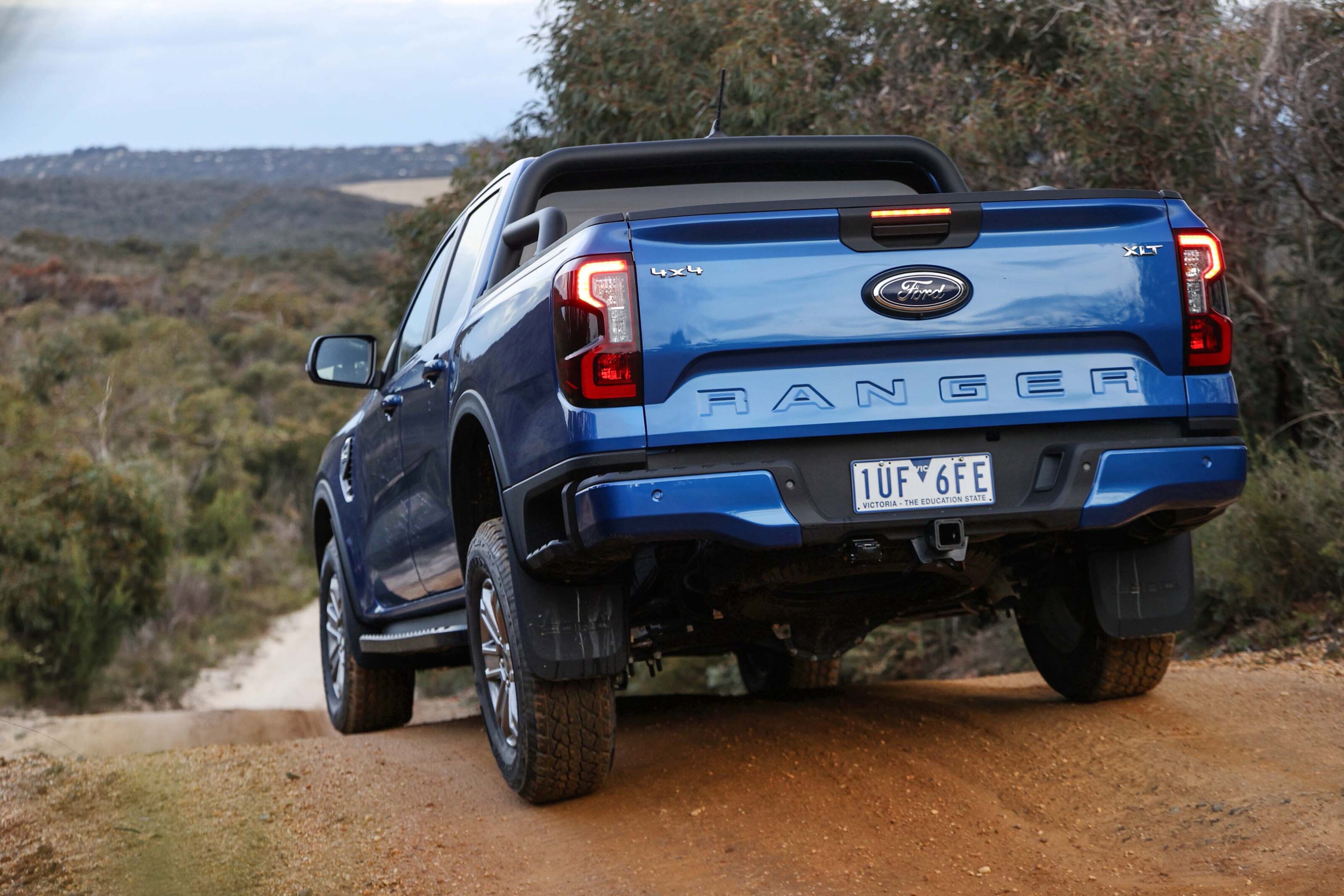
The infotainment system features an easy-to-understand checklist to run through, and there’s also an integrated trailer brake controller fitted as standard to the Wildtrak and optional with other models. This can power a trailer’s electric brakes using a proportional output corresponding to the Ranger’s braking pressure.
What’s more, the centre screen also features a trailer coverage system. The dimensions and names of up to 10 different trailer types can be entered into the system, and the blind-spot monitoring will then adjust to account for the combined dimensions of vehicle and trailer. Neat.
Most of us have been in the situation where, upon attaching a trailer to our vehicles, we’ve had to recruit some unwilling person to stand behind the car while we yell brake, reverse, right indicator and so on, checking that the lights are all properly functional.
Your better half or your kids will be relieved to discover that the Ranger frees them from that particular task.
The Trailer Light Check function can be enabled either from inside the vehicle or via the Ford Pass app and cycles five times through a set pattern of light checks.
Finally, the dedicated tow/haul drive mode maximises torque response and also works at holding gears when descending and not upshifting too early when ascending.
How safe is it?
Is the Ranger a sensible choice for the family?
It’s been fascinating to see how a global pandemic has changed the way that people use their leisure time. Even now, with borders open, there’s a significant constituency of people who would rather get out and about in their own backyard rather than jump on a jet for destinations overseas.
This has put an increased onus on safety for families yet there are certain physical limitations around dual-cabs, especially in terms of braking distances, that are just physical realities.
Operating within those constraints, the Ranger is, nevertheless, a good example of its ilk. Its predecessor scored a five-star ANCAP rating in 2015 and this version builds significantly upon the previous version’s safety provision.
UPDATE, September 12: The Ranger now has a five-star ANCAP rating. Story here.
Nine airbags are standard across the range, including a far side airbag that ensures that driver and front passenger heads are kept reassuringly apart in the event of an accident. Likewise, the second-row seat belt mounts have been moved from the side to the rear of the vehicle for superior performance.
Features such as pre-collision assist, post-impact braking, blind-spot monitoring with trailer tow function and cross-traffic alert, reverse brake assist and evasive steer assist all feature.
Adaptive cruise control is standard across the range and from XLT upwards there’s intelligent adaptive cruise that features lane centring, traffic sign recognition and a stop and go function that will allow the vehicle to come to a complete halt in traffic and then automatically resume its cruise setting. There’s also Active Park Assist 2.0, which will help with parallel parking.
How is it on fuel?
Remember this is an all-diesel line-up, so fuel economy is pretty good.
As long as you don’t decide on a Raptor at the last minute, you’re not going to be too shocked at the fuel consumption. Ford has improved the aero, especially underneath the Ranger, reduced internal friction and pumping losses on all powerplants, and has prioritised low rolling resistance in original equipment tyre choices.
Even the V6 Wildtrak will return a combined fuel figure of 8.4L/100km, with the 2.0-litre biturbo Wildtrak posting a 7.4L/100km official figure. To put that into perspective, a 150kW four-cylinder diesel Toyota HiLux with an automatic transmission officially consumes 8.4L/100km. Advantage Ranger.
On a mixed country roads and freeway test route on the launch event, the V6 Wildtrak returned a figure in the low nines, so the usual recommendation to look at the quoted urban economy figure of 10.0L/100km for the V6 and 8.7L/100km for the biturbo as a fairly representative average probably isn’t too far off the mark.
We’ll be conducting independent back-to-back testing with the biturbo and the V6 in order to gauge whether the harder-working four-cylinder engine really is more economical than the six-cylinder, so we’ll keep you posted on our findings.
Interestingly, the weaker 2.0-litre single turbo engine that drives via a six-speed auto returns a worse quoted combined fuel figure than the 10-speed 2.0-litre biturbo at 7.9L/100km. Should you hanker after even lower fuel bills, it’s probably best to sit on your money until 2024, when we’re likely to see a plug-in hybrid variant.
How long is the warranty, and how expensive is it to run?
Every Ranger is offered with a five-year, unlimited-kilometre warranty. Although Ford has published its recommended manufacturer list prices for the Ranger, it maintains that “the selling price of any vehicle or option is entirely at the discretion of the dealer”.
Dealer delivery charges do vary, so perhaps the best way to gauge an indicative asking price for any model in question is to jump onto Ford’s configurator and enter your postcode.
Would you recommend it?
The macho styling might take a little time to get used to. Some may bemoan the fact that a Ranger is no longer available with a manual gearbox. Others had hoped we’d see the 2.3-litre Ecoboost petrol engine as fitted to US-spec Rangers. These minor gripes aside, it’s hard to see how Ford could have done a much better job with this version of the Ranger.
It has been improved markedly in terms of powertrain, utility and safety. Elsewhere there have been incremental gains in quality, dynamics, off-road ability and efficiency.
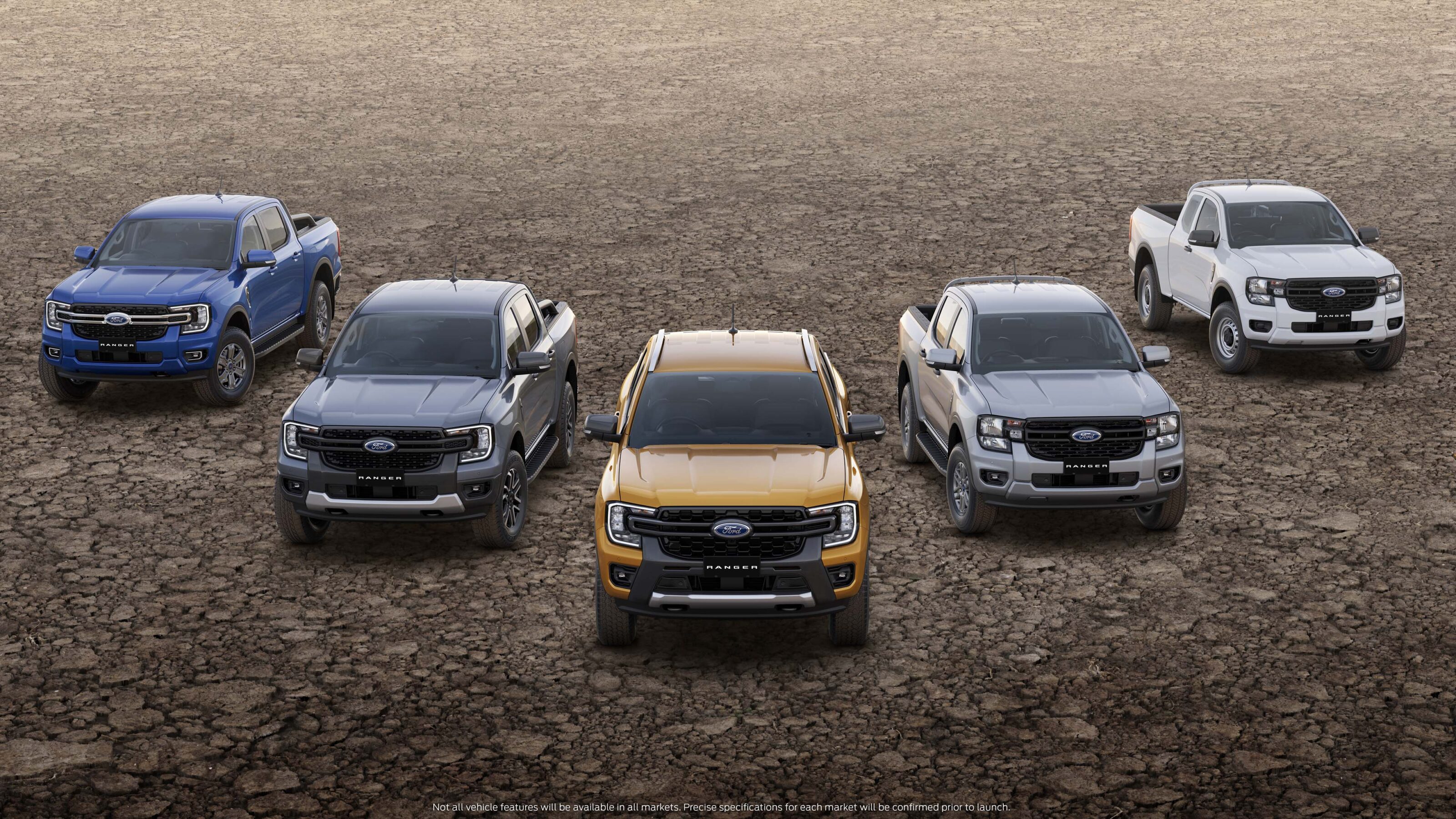
The introduction of the V6 engine is a game changer, offering 184kW and 600Nm while delivering vastly superior refinement yet identical claimed fuel economy to a 150kW/500Nm Toyota HiLux.
Ford Australia bought itself a lot of credit with the previous Ranger. Engineering a sequel when most of the development team were locked down with state borders closed is a story for another time, but it’s testament to their ingenuity and lateral thinking that this project even got off the ground in the first instance.
It feels like a best-in-class effort, at least until its Amarok cousin makes landfall. We’ll know for sure when we set it against its key rivals on local roads. Our expectations for this Ranger were high but they might just have been exceeded.
Tech firm Bosch says it is investing more than €3 billion into making more semiconductors in a bid to tackle the ongoing chip shortage.
The funding, as well as going into ramping up parts production in the firm’s native Germany, will also go towards new testing centres and research between now and 2026.
“Microelectronics is the future and is vital to the success of all areas of Bosch business,” Bosch Chairman Stefan Hartung said in a statement. “We hold a master key to tomorrow’s mobility.”
The investment will be made in response to the European Chips Act, with the EU and German Government providing some of the cash to bolster the continent’s microelectronics industry with the hope of doubling its portion of chip production from 10 to 20 per cent by 2030.

“Europe can and must capitalise on its own strengths in the semiconductor industry,” Hartung said. “More than ever, the goal must be to produce chips for the specific needs of European industry.”
The news follows the supplier announcing in November last year that it would spend an extra €400 million (AU$615.45m) to expand its existing production facilities – aiming to get on top of the shortage and prevent it from happening again in the future.
Having recently opened a new, €1 billion (AU$1.57bn) semiconductor factory in Dresden, Germany, Bosch plans to spend a majority of its investment on the new plant, targeting increased production in 2022.
Roughly €50m (AU$76.93m) will be spent on the fabrication plant in Reutlingen, with up to €150m (AU$230.79m) to be invested between 2021 to 2023 on additional clean room space across all factories.

On top of the investments in its German plants, Bosch also plans to build a semiconductor test centre at its Penang facility in Malaysia – although this isn’t expected to become operational until 2023.
Over the past 18 months, the global car industry has been facing a production crisis due to the shortage of semi-conductor chips, which are needed in just about every electronic device on the planet.
It’s wreaking havoc on vehicle supply chains, leading to instances like the thousands of new Ford F-Series pick-ups parked in limbo at Kentucky Speedway, almost complete but missing crucial electronic components.
New cars can require thousands of these chips, but when COVID-19 outbreaks shut down automotive factories in 2020, carmakers cancelled semi-conductor chip orders expecting not to need them.

The tech industry, fuelled by a shift towards home life, absorbed that chip supply. Lockdowns ended, and the demand for cars skyrocketed – but there were far too few chips to meet it.
Globally up to mid-2021, the car industry was reported to have suffered to the tune of more than €90 billion (AU$141bn) according to research firm AlixPartners.
In Australia, the local industry is feeling the effects of overseas delays, and waiting times for some vehicles have ballooned to many months as demand for new cars has increased in the wake of global lockdowns lifting.
European authorities have mandated anti-speeding technology, with vehicles now required to feature intelligent speed assistance.
The rule applies to newly-introduced cars from July 2022 and all vehicles from July 2024, as per the European Union’s General Vehicle Safety Regulation.
Intelligent speed assistance is part of the latest active safety features – using technology such as onboard sensors, radar, cameras and GPS – fitted to passenger cars, enabling a vehicle to inform its driver if the limit changes.
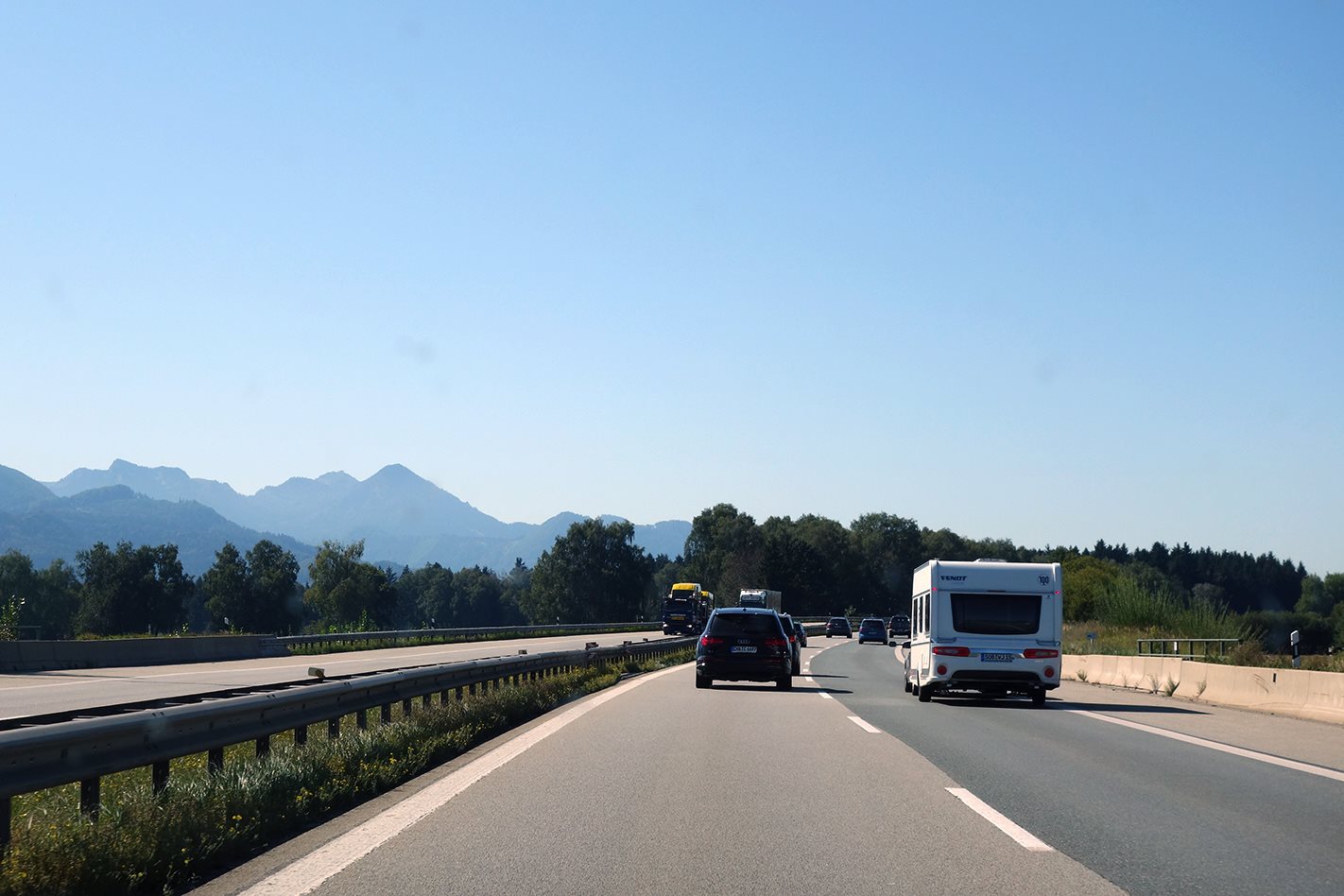
The legislation requires a vehicle to be fitted with a sign-recognising camera or GPS-based speed limit database, but allows carmakers to choose up to four methods to alert a driver if the set limit is being exceeded, including; an audible warning, a traffic sign display, warning vibrations or haptic feedback.
It will be possible for drivers to switch off or override the intelligent speed limiter, and there are no plans to retrofit the system to older vehicles in Europe.
Most intelligent speed assistance systems fitted to new vehicles function through traffic sign recognition, which uses a camera system – usually shared with other active safety features, such as autonomous emergency braking – to detect speed signs and relay the information onto the instrument cluster or navigation display.
If a speed sign is unavailable or unreadable, a GPS database can provide the same information when the speed changes; however, this system isn’t as reliable as real-time speed detection if there have recently been changes to the set limit.
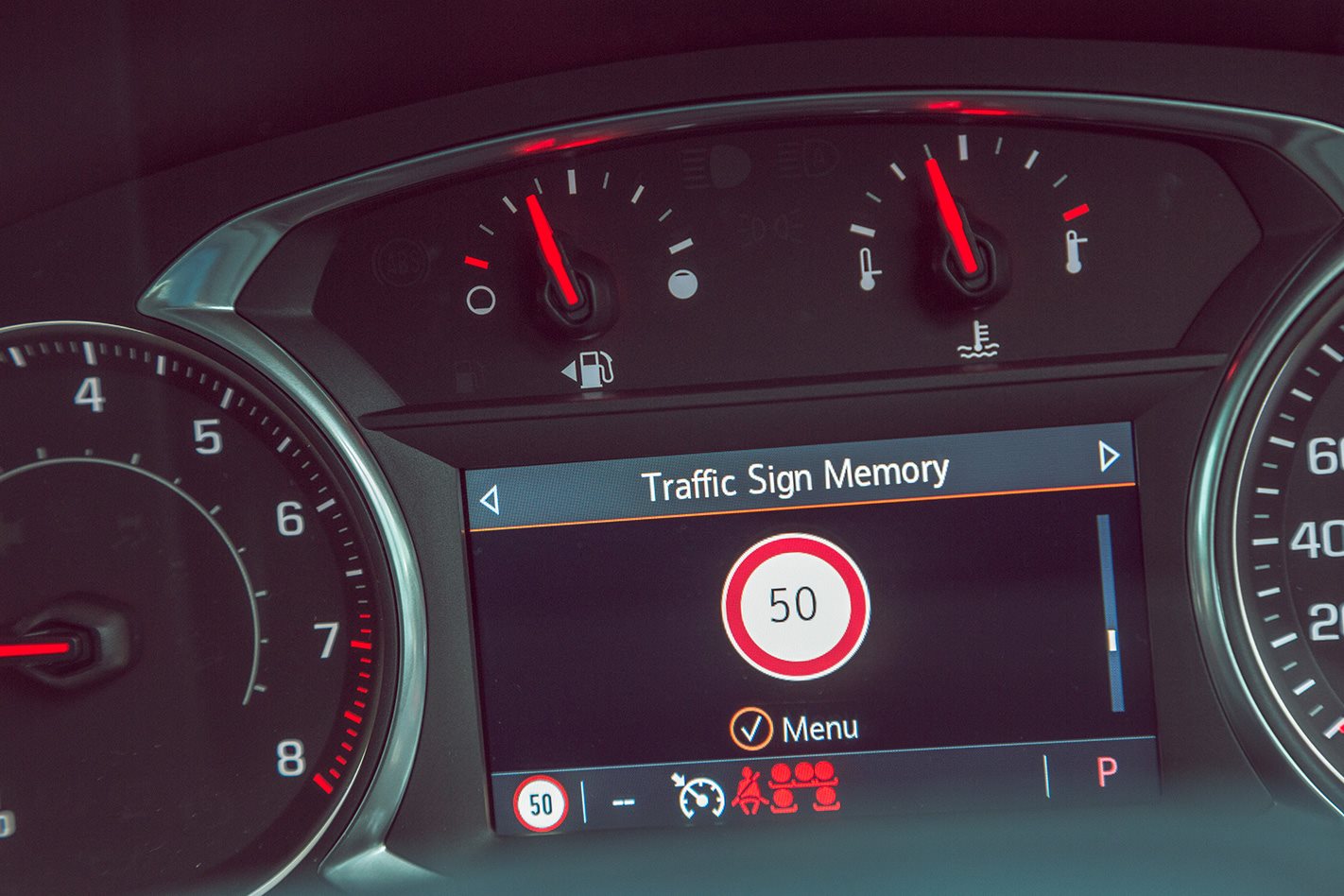
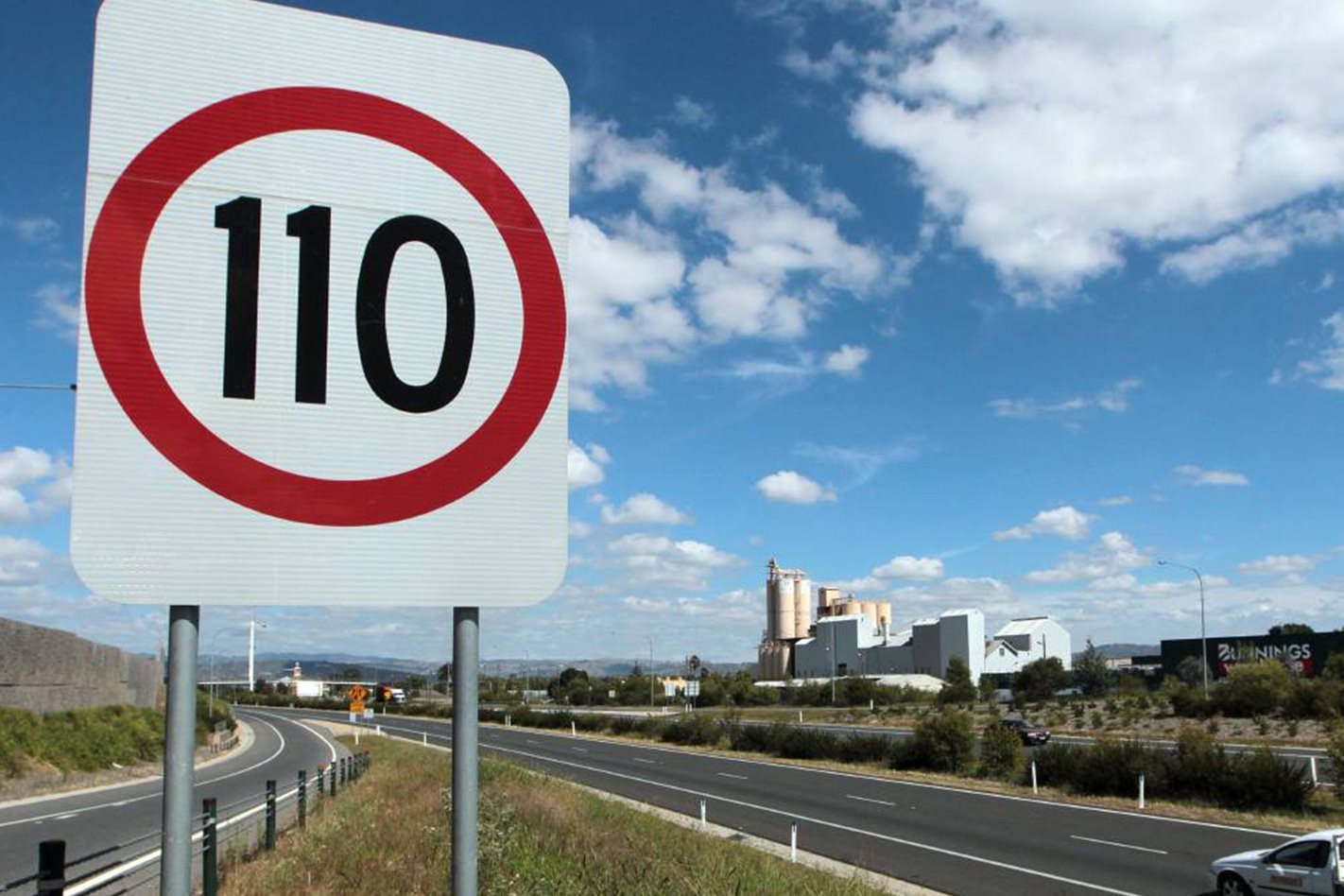
There are no current plans to introduce mandatory intelligent speed assistance to the Australian Design Rules for new vehicles, but as Wheels first reported in 2019, local authorities are investigating a similar mandate.
Regardless, active safety technology will be compulsory in Australia from next year, with all new vehicles introduced to the local market from March 2023 requiring autonomous emergency braking (AEB).
Then after March 2025, all new passenger and light commercial vehicles sold will need vehicle-to-vehicle AEB.
Following this, vehicle-to-pedestrian AEB will then also be mandated on newly introduced models from August 2024, before applying to all new vehicles from August 2026.
AEB, particularly vehicle-to-vehicle detection, is fitted as standard to most vehicles sold in Australia today, while intelligent speed assistance is available in most top-selling vehicles.
In addition, the European Union has agreed to ban internal-combustion vehicles by 2035.
Snapshot
- Less than 10 EVs currently qualify for state-based discounts
- Almost all offers aren’t just based on RRP but also options and delivery
- Highest cap is $70,000 in WA
With the popularity of electric vehicles accelerating around Australia in 2022, there are now a number of state and territory incentives to purchase one on offer.
However, things aren’t quite as clear cut as they seem – with several subsidy and rebate schemes applying not only to the list price of the car (also known as RRP, MRLP, MLP) but also the cost of optional extras and dealer delivery.
The lowest price cap nationally is in Queensland, with the limit set at $58,000, followed by Victoria on $68,740 – though New South Wales and South Australia are only a smidge higher at $68,750. Providing the highest value is Western Australia, which has a cap of $70,000.
Here’s a list of the EVs currently available in Australia in 2022 that fall under the price caps across the country once you’ve taken the above into account.
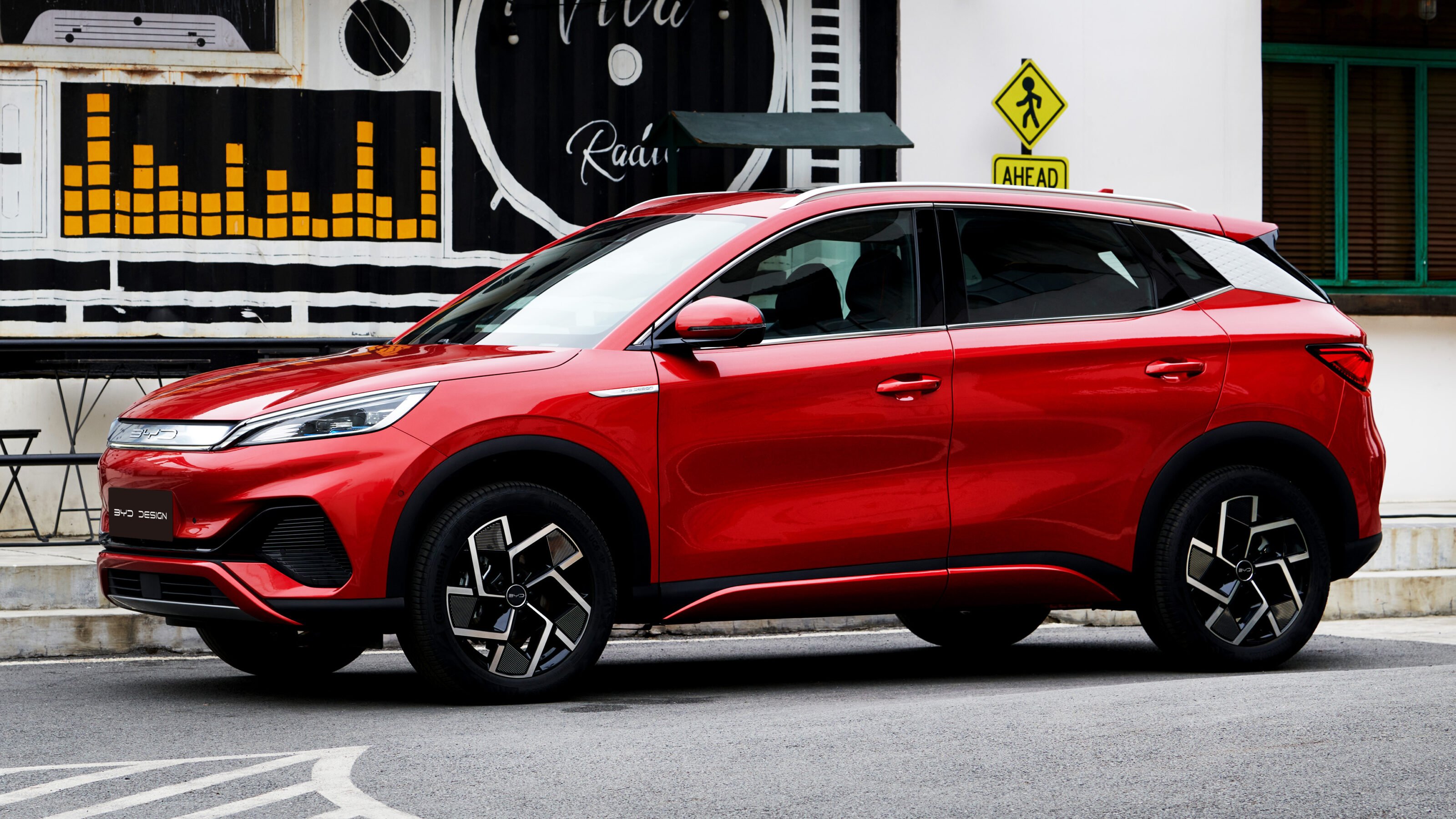
BYD Atto 3
The 2022 BYD Atto 3 is a compact SUV that will go into battle with its Chinese compatriot, the MG ZS EV, which will soon receive a facelift, range boost and significant specification improvement.
BYD’s local distributor, EVDirect, has launched its long-awaited first mass-market EV in two front-wheel-drive flavours, the 50kWh battery-equipped Atto 3, which has a base retail price of $44,381, and the 60kWh, which starts at $47,381.
BYD’s ‘Blade’ battery powers both versions. The 50kWh has a WLTP range of 320 kilometres and the 60kWh 420km.
Both are powered by a single 150kW/310Nm electric motor upfront, and the Atto 3 will accelerate to 100km/h in a claimed 7.3 seconds.
As the cheapest EV on sale Down Under at present, it qualifies for all state subsidy/rebate schemes – even when adding in optional premium paint for $700 and delivery (based on VIC pricing) of $495.
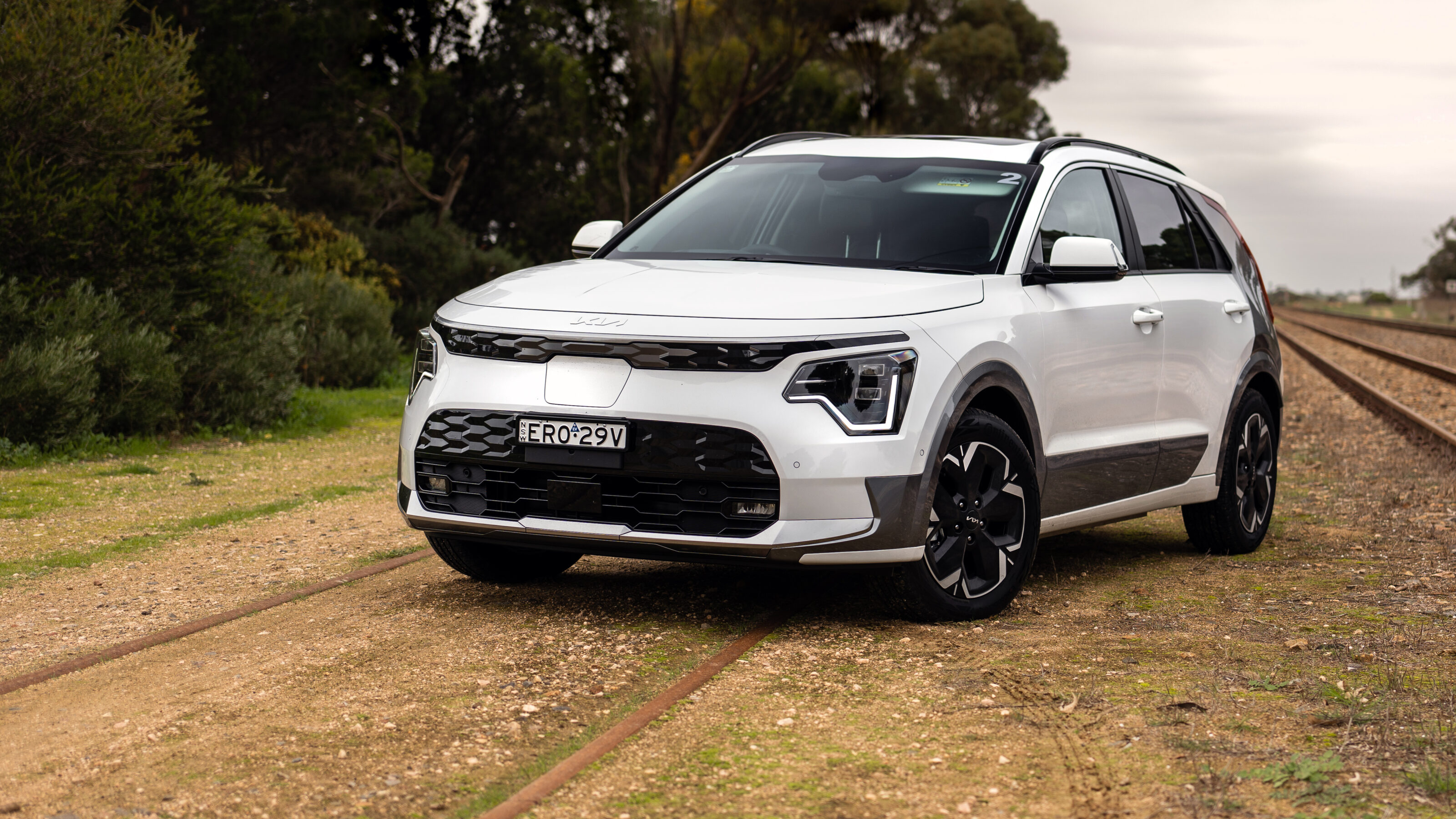
Kia Niro
Based on the 2019 HabaNiro concept, the second-generation 2023 Kia Niro has been penned to line up with the rest of Kia’s current model range, with the fresh ‘tiger-face’ grille design to the ‘heartbeat’ daytime-running lights as seen on the Sportage.
It is available now, priced from $65,300 before on-road costs – a $2710 jump over the outgoing model.
What isn’t new is the Niro’s underpinnings. It continues to ride on an internal-combustion platform, this time shared with the Hyundai i30 Sedan.
The powertrain in the Niro EV is also identical to its predecessor, albiet with less torque and minor tweaks.
In addition to an electric variant, a petrol-electric Niro Hybrid is available in Australia. A plug-in hybrid powertrain does not feature in the local range.
Adding optional paint will bump up those prices by $520 and delivery by $1995, but the entry-level Leaf still comes in well under all state limits and the e+ scrapes in for all except QLD.

MG ZS EV
Australia’s second cheapest EV is coming with an eagerly anticipated update, which should make it even better value.
Sporting a prominent grille-less fascia with new LED headlights and daytime-running light signature, the 2022 MG ZS EV will bring an upgraded powertrain with the 44kWh battery pack replaced with a 72kWh unit – capable of a claimed 440 kilometres on the WLTP test cycle.
Available from July, the facelifted 2022 MG ZS EV is priced from $46,990 drive-away for the base Excite – a $2000 price increase over the current model – while the flagship Essence will cost $49,990 drive-away.
Both grades, even accounting for options, such as $700 premium paint, and delivery, easily come within the caps for all areas.
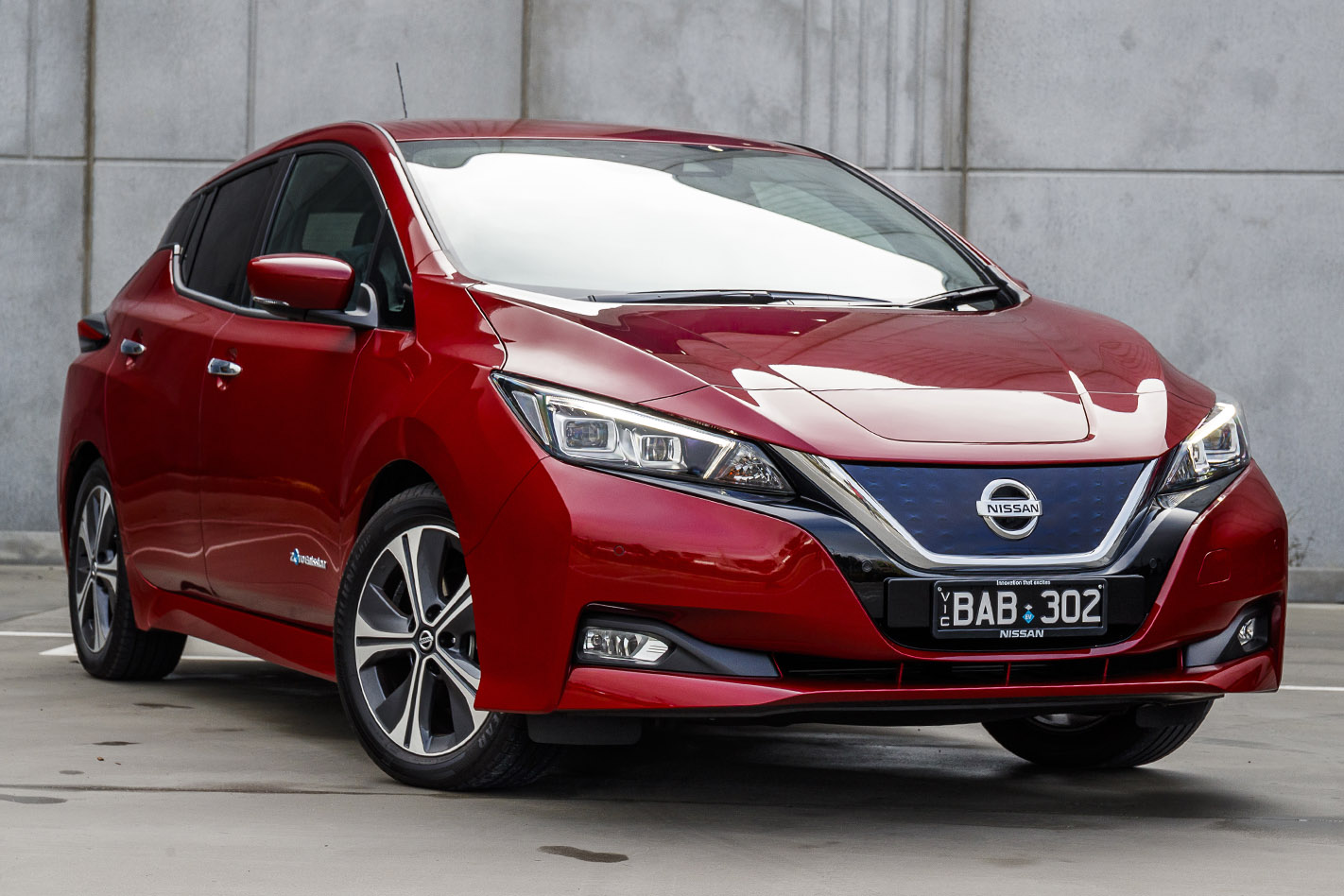
Nissan Leaf and Leaf e+
The updated 2023 Nissan Leaf will go on sale in Australia in August 2022 with a fresh look, updated advanced driving and safety features such as ProPILOT, and infotainment tech such as an improved onboard NissanConnect system.
Powertrains will carry across from the outgoing model with the 110kW/320Nm base model boasting a driving range of 270 kilometres from its 40kWh lithium-ion battery, coming in at $50,990 before on-road costs, which is $1000 more than the current entry-level price.
The same price increase has been applied to the Leaf e+, which is set to go on sale from $61,490 with its 160kW/340Nm electric motor and 62kWh battery pack delivering a driving range of 385km.
Adding optional paint will bump up those prices and delivery by $1500, but the entry-level Leaf still comes in well under all state limits and the e+ scrapes in for all except QLD.
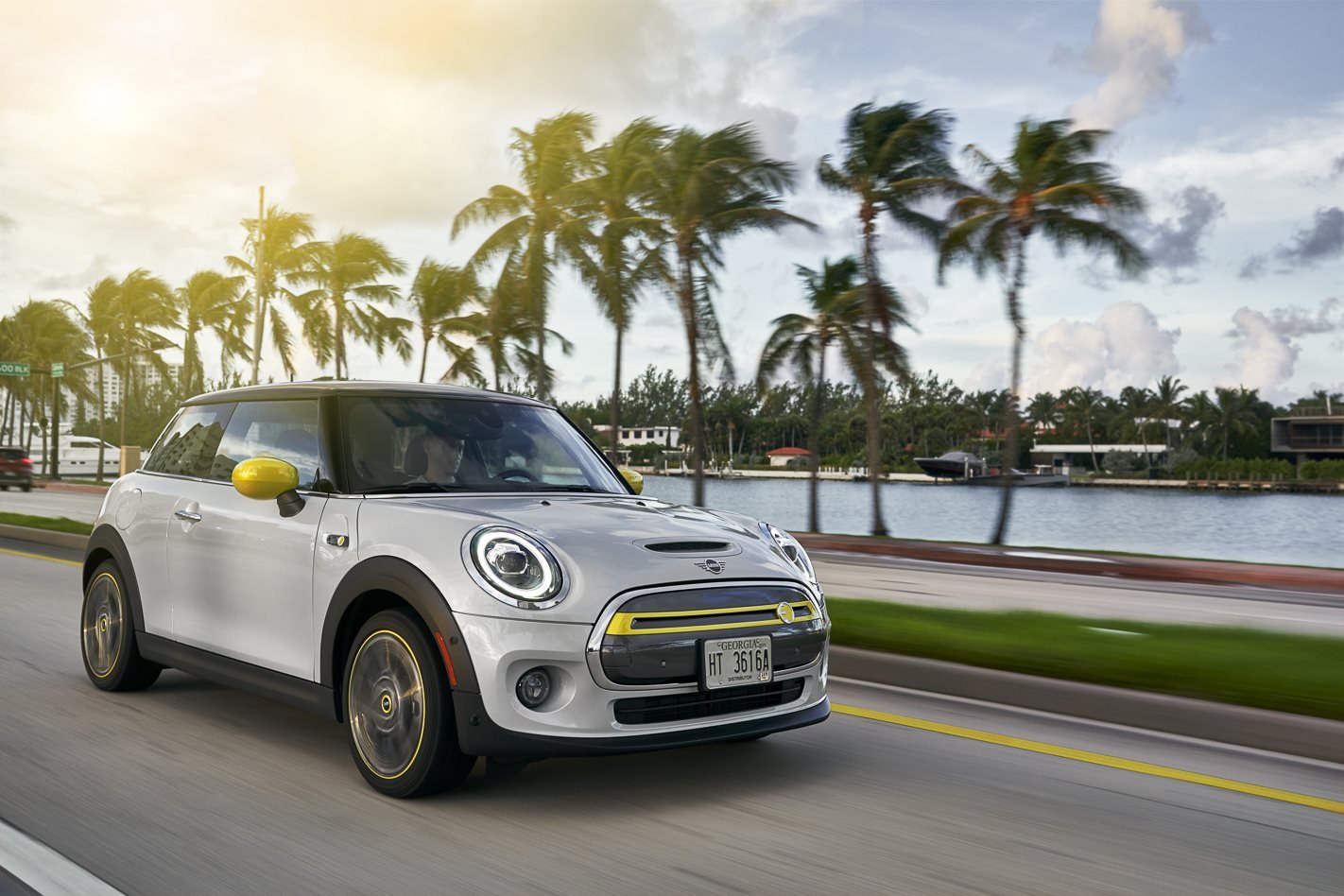
Mini Electric 3-Door Hatch
Some EV styling cues aside, the Mini looks like any other Mini. Its short driving range does condemn it to city duties – similar to the MG ZS and basic Leaf – but that is where these cars excel.
The Mini brings a rarity to the segment – a small-sized EV.
It has a three year/unlimited kilometre warranty, while the battery is covered for eight years/160,000km.
BMW’s retro brand now costs less than Tesla’s Model 3, but also comes with a significantly shorter driving range – 233km (WLTP) versus the Model 3’s 448km.
The Mini Electric is priced from $55,650 for the base Classic, and $63,475 for the higher-spec Yours. Either variant comfortably comes in under the limits in all states with incentives, except QLD, but the $2500 delivery charge might make things a little tight if wanting to add options for the top grade version in NSW/SA/VIC.
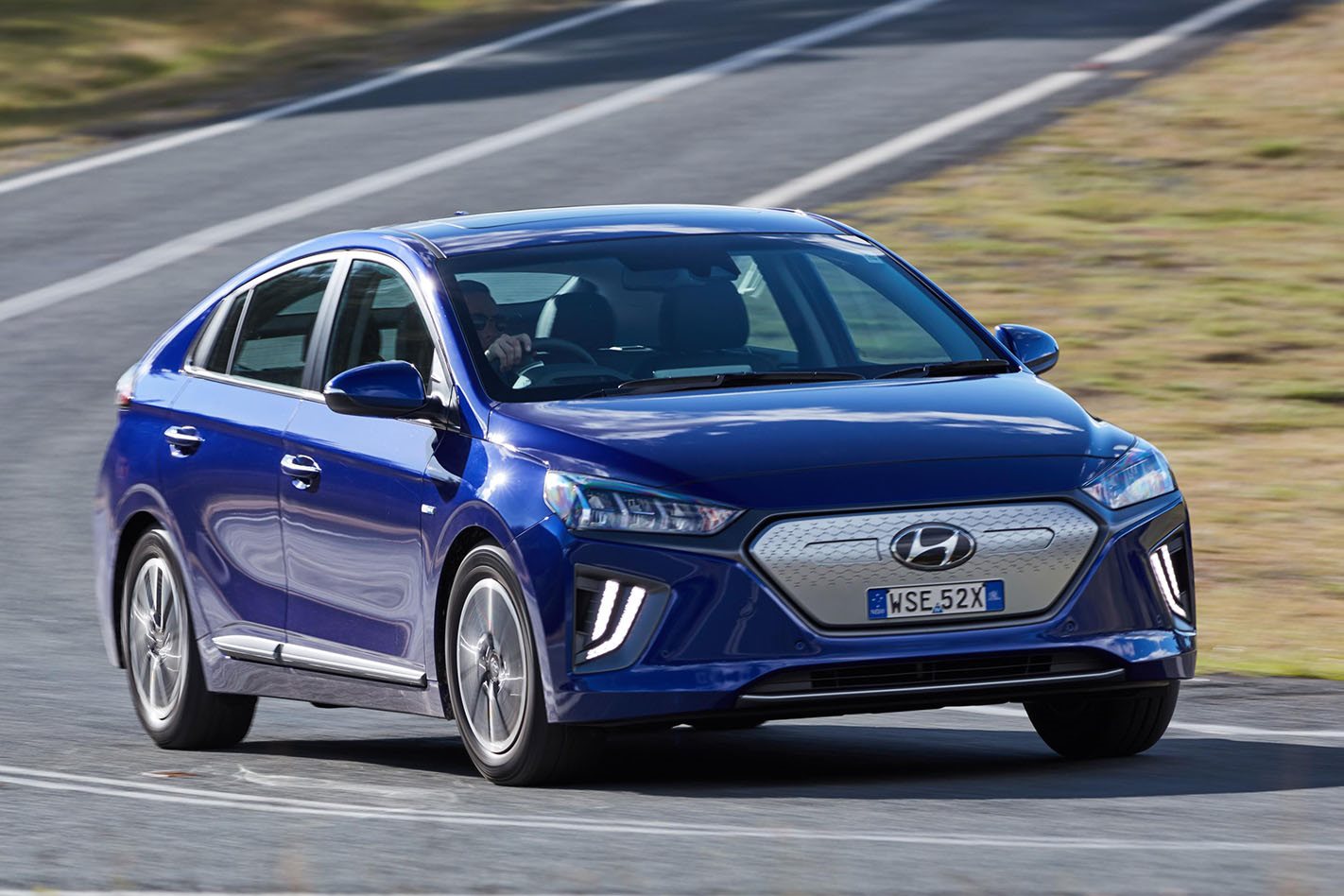
Hyundai Ioniq Electric
The Hyundai Ioniq electric (not to be confused with the Ioniq 5) has been around for a few years – but has actually be discontinued beyond this generation.
The Ioniq electric sits at the top of the current Hyundai Ioniq range (the Ioniq 5 is going to launch the Genesis-style sub-brand) which includes series and plug-in hybrids, both of which are also sharply-priced.
The driving range of 311km looks good on paper, something it shares with its more expensive Kona sibling: driving range claims you can trust.
One of the advantages of the Hyundai is the extensive dealer network, which is something to consider when you need something sorted. The Hyundai five-year/unlimited kilometre warranty covers the car while the battery’s eight-year/160,000km is par for the course.
For $49,070 you can get the lower Elite grade, or for $54,010 the higher spec Premium. Optional paint is $595 making both feasible options even within QLD’s lower price cap. Dealer delivery is $1750, again, meaning either grade would qualify.
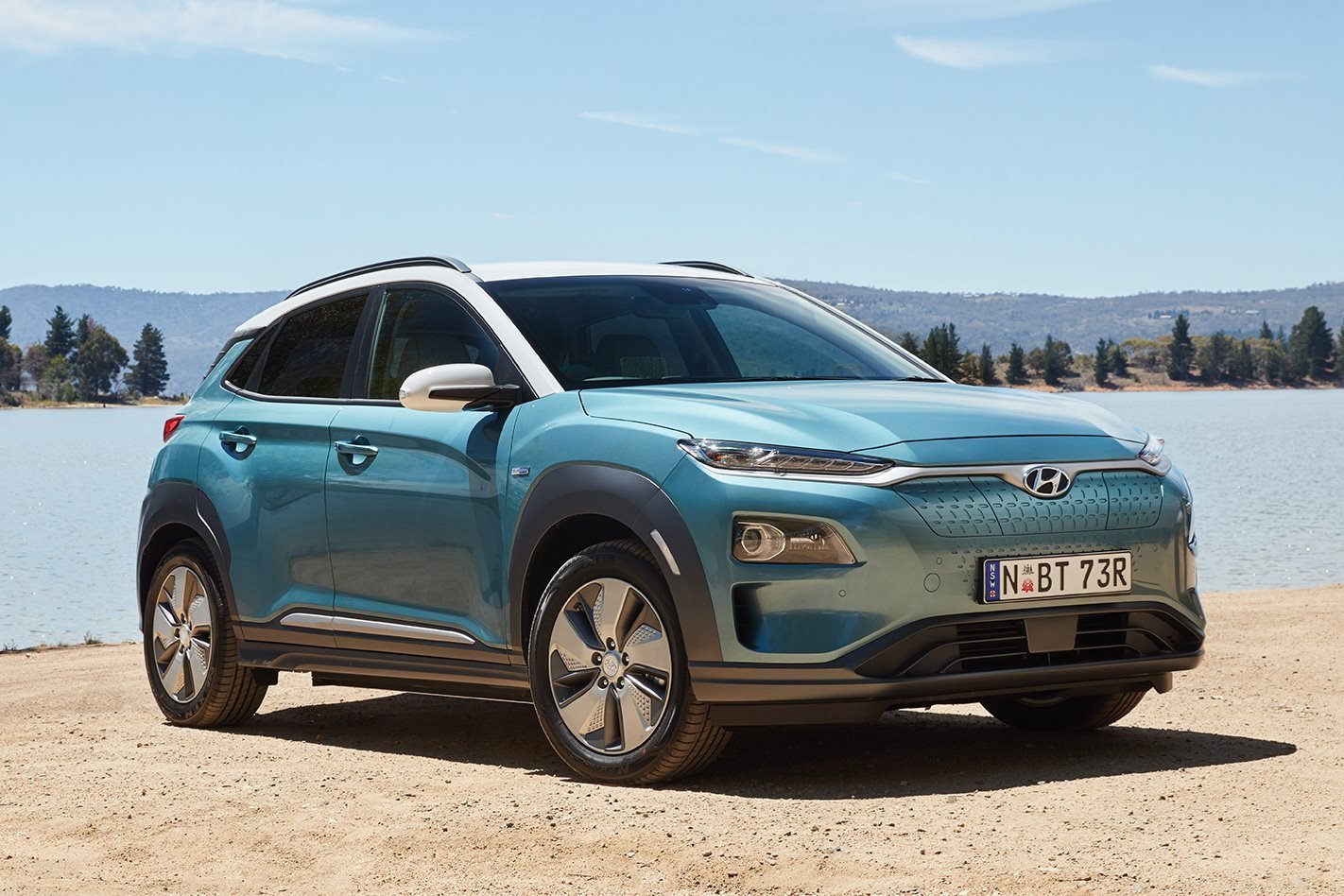
Hyundai Kona
Hyundai recently brought in the Standard 39kWh battery version of the Kona Electric, returning the model to the sub-$60,000 brigade.
The Kona Elite grade Standard Range packs a 100kW/395Nm motor and a 39.2kWh battery all for the price of $54,500, though an Extended Range is also available with a 150kW motor and 64kWh battery pack for $65,565,20.
Driving range for the Standard Range is around 305km.
Buyers can also opt to step up the a Highlander grade for a few more frills, but obviously at a cost – the SR Highlander comes in at $62,964.40. The ER Highlander is $69,216.40.
As mentioned with the Ioniq, Hyundai’s five-year/unlimited-kilometre warranty as well as 12 months’ roadside assistance applies to all Kona EVs.
If opting for a $595 paint choice and with dealer delivery costing $1750, the SR Elite just sneaks in under the QLD cap, but all other versions do not. Furthermore, the ER Highlander would bust even WA’s limit.
Even the ER Elite and SR Highlander could just about manage to make the higher NSW/SA/VIC limit.
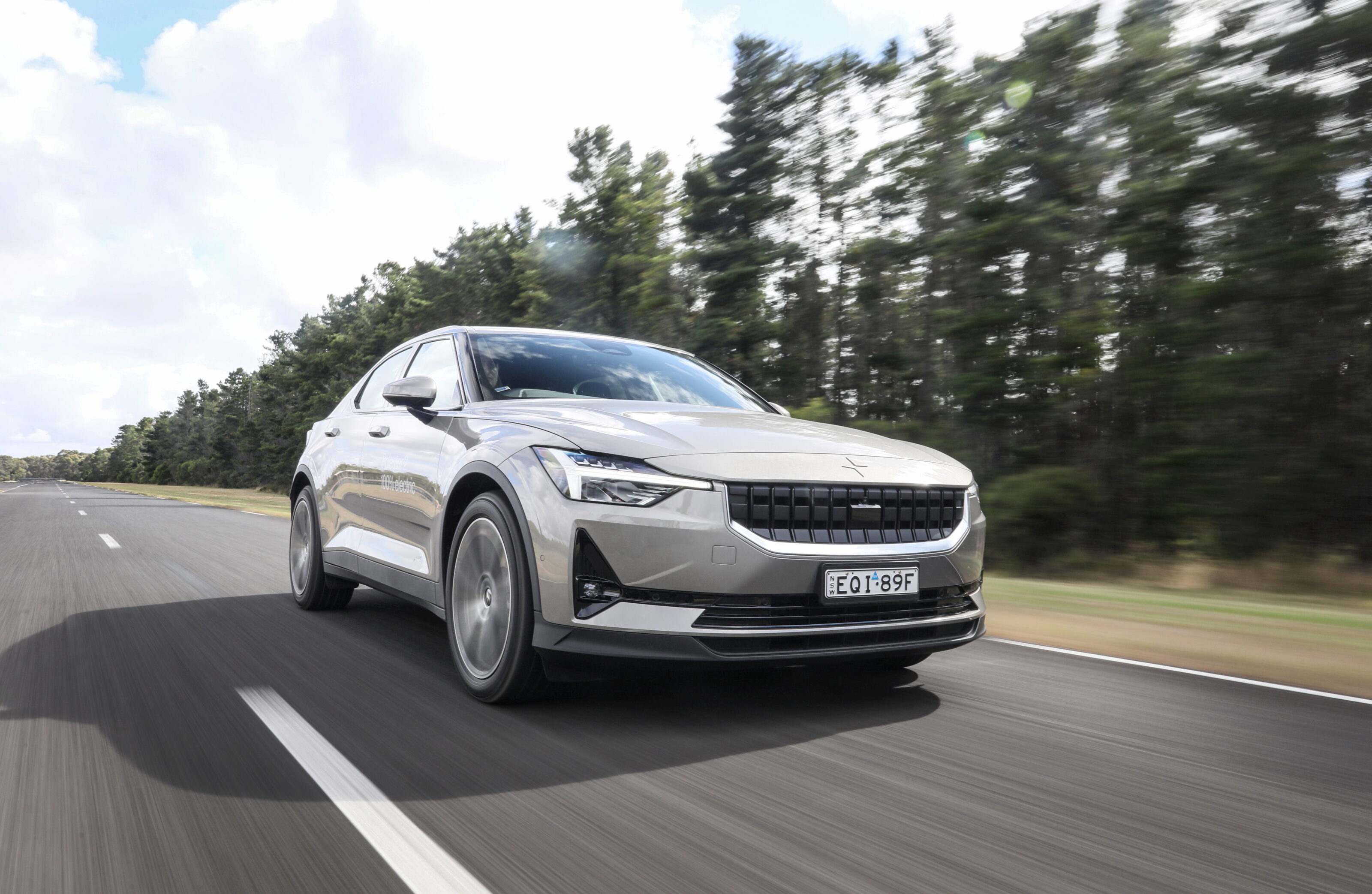
Polestar 2
A new competitor to the market after spinning off from parent company Volvo, Polestar has brought its first vehicle to Australia in the form of the Polestar 2.
Three variants of the 2 are available Down Under: the Standard Range Single Motor, Long Range Single Motor and Long Range Dual Motor, which are priced from $63,900, $68,400 and $73,400 respectively.
In addition, there are three packs on offer which add a number of aesthetic and technical features: the Pilot Lite Pack, Plus Pack and Performance Pack – priced at $3400, $6000 and $8000 respectively. Beyond that, 20-inch five-spoke black/silver alloy wheels can be bought for $1400.
The Standard Range Single Motor Polestar 2 produces 165kW and 330Nm from its 64kWh battery, with a quoted driving range of up to 440km (WLTP cycle) making it a close match for its Tesla Model 3 rival.
Polestar vehicles come with a five-year warranty as well as five years of complimentary roadside assistance and servicing. The inclusive five-year maintenance plan is another point of differentiation from its parent brand.
When factoring in a $1818 delivery fee, only the SRSM comes in under the various state caps (excluding QLD) as long as no option packs are added (but you could go for the 20-inch wheels if you wanted to). With the Pilot Lite Pack on top, the Polestar 2 just about creeps in under WA’s $70k limit, but the other packs are too pricey.

Tesla Model 3
Finally, Tesla’s Model 3 Standard Range Plus costs $63,900 – although it still holds its place as Australia’s most popular EV.
The headline driving range of 491km might confuse a few folks, so it’s worth pointing out Tesla has switched from the NEDC method of calculation to the more common WLTP standard.
As is Tesla’s wont, the power and torque figures aren’t available on the website – but a bit of digging reveals 190kW for the entry-level model. Conservative estimates put the torque figure at over 400Nm, slinging the 1700-odd kilo sedan to 100km/h in well under six seconds.
The Tesla has a four-year/80,000km warranty and the battery is covered for eight years/240,000km.
The Model 3 comes in three variations: the entry-level Rear-Wheel Drive costing from $65,500, mid-spec Long Range from $80,000, and top-spec Performance from $91,600. Dealer delivery is $1375 and the non-refundable order fee is $350 – on top of the list price, it is not a deposit in the traditional sense of the word.
Tesla also offers premium paint for $1500, 19-inch wheels for $2200, a black and white interior design for $1500, Enhanced AutoPilot for $5100 and Full Self-Drive for another $10,100.
So where does that leave you after all that? If no options are added other than paint, the RWD version will scrape in under the VIC/NSW/SA limits and be a few grand clear of WA’s, but obviously not QLD’s meagre $58k. Long Range or Performance though? Forget it.
Everybody knows EVs are overpriced. Manufacturers are having a laugh. Right?
Forget that battery materials are still massively expensive no matter how you’re playing the market, or that brands have billions to recoup in the cost of R&D on the myriad technologies and architectures, great and small, that make an EV different to the cars they’ve been slowly improving on for 100 years.
And you can ignore the cost of building and equipping new production lines, aggressively acquiring businesses with the right expertise, and poaching the specialist talent needed to up-skill on a whole new paradigm.
No, the fact is, developing any new car is monumentally expensive – conventional or EV – especially when it’s a new generation.
The difference for regular cars is scale.
Scale, and a ‘business as usual’ confidence in the market, the industry, and the manufacturer’s lenders and suppliers. Whether it’s the core architecture, the powertrains, transmissions or the thousands of components that make up each part of each car – the huge volumes being produced allow brands to spread the cost and return a margin while selling you a car at a competitive price.
| Remember Holden’s billion-dollar baby? Holden sold over half-a-million VE cars across its four body styles, for Australia and export – but the Zeta platform and many of its components evolved and lived on with the VF, and of course it also featured under the fifth-generation Camaro. That’s scale, even leaving out all the other variants that were supposed to debut. |
So, alright, maybe EVs aren’t overpriced – they’re just expensive to bring to market, and buyers have learned over generations to expect more space and driving range for their spend.
It’s still early days for electric vehicles, and prices will come down as the technology becomes more affordable and as scale ramps up. It’s not a chicken-or-egg scenario, but it does require a number of ducks to line up at just the right time.
Markets can make it happen faster, though – or rather, progressive governments can.
Overseas, CO2 emissions regulations have incentivised manufacturers through a system that penalises brands if they’re not maintaining a low average fleet emissions level across their line-up.
It’s no surprise that brands are prioritising those markets, needing thousands of EVs, PHEVs and hybrids to offset the emissions of their piston-engined cars being solds in the tens- and hundreds-of-thousands.
Successive Australian governments have so far failed to follow the lead of other regions, with the only concerted effort towards CO2 emissions reduction coming from a non-binding commitment in industry – and figures this year show that most brands missed their targets last year.
Brands agree, and indeed it’s the official position of their peak body, the Federal Chamber of Automotive Industries, that a Government-mandated CO2 emissions regulations scheme is critical.
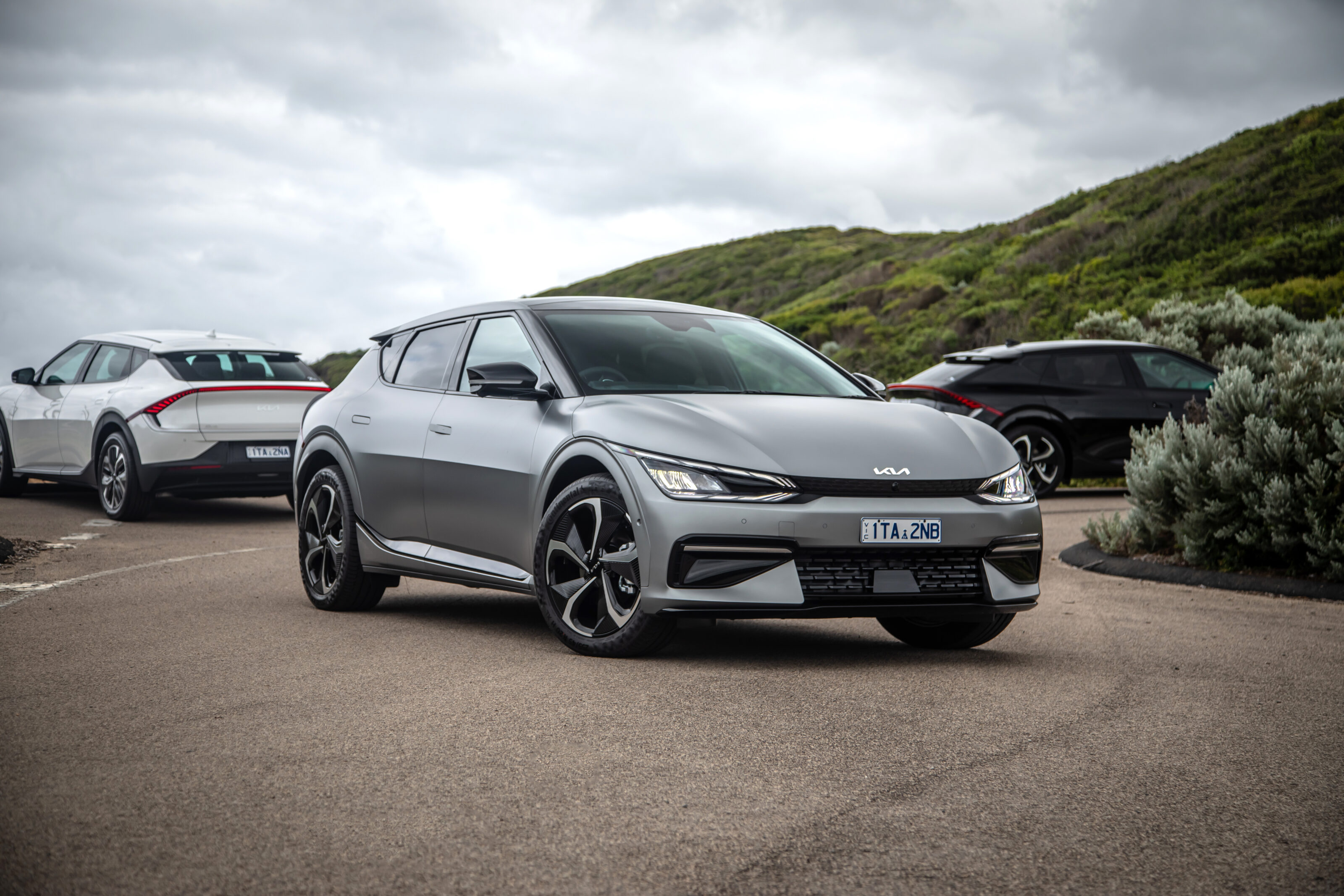
Speaking with Wheels at the local launch of the new ‘SG2’ Kia Niro, now available in hybrid and EV form only – and with supply limited to around 80 cars per month – Kia Australia’s product planning boss, Roland Rivero, touched on the difference a proper emissions regulations scheme can make.
“It does help dramatically when there are CO2 regulations that you’re trying to offset,” Rivero said. “It’s calculated based on a weighted average of CO2 emissions levels for every car your brand sells, so every time you sell a diesel Sorento, you’ve got to sell more of these [zero- and low-emissions models].”

“If I was sitting in headquarters and I’m trying to offset this big tax burden, it actually doesn’t make sense to give any [EVs] to Australia at all, but fortunately for us they’re mindful of the Kia brand in totality, in all markets.
“We in Australia don’t want to be seen as lagging behind and eventually being dealt only unwanted products. When you’re launching the EV6, you want it to launch around the world. But, given there’s nothing to offset here in Australia, there’s more of a cost burden – while there’s the right combination of incentive and demand elsewhere,” Rivero said.
“[…] every time you sell a diesel Sorento, you’ve got to sell more of these [zero- and low-emissions models].”
Australian demand therefore – and a clear willingness among early-adopter buyers to pay a premium – isn’t reason enough to divert ships our way.
The issue for Kia – one of far greater financial consideration than the margins it could make on EVs in Australia – is the size of the penalties it faces in Europe if it is not selling enough Niros and EV6s to offset the CO2 emissions of its conventional models.
That leads to scale. “In jacking up the volumes of Niro, and this is why it was second only to Model 3 in the UK last year, you’re able to get a far more palatable price point,” Rivero said.
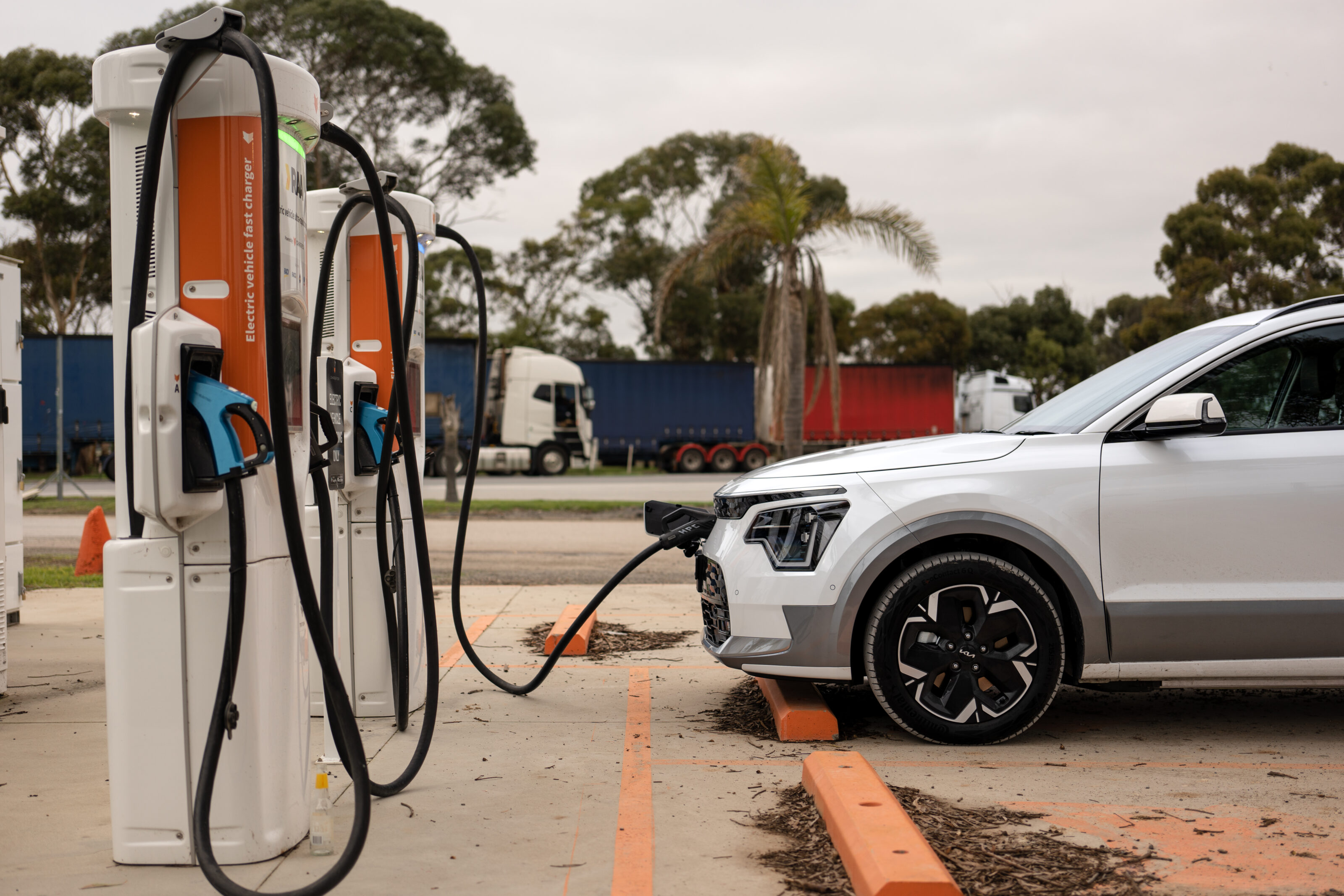
“Even if CO2 regulations don’t come in here, we’re still aiming to grow the EV fleet and models available. Headquarters’ strategy, it’s all about utilising these EV platforms, particularly the modular E-GMP platform, across a range of car sizes and prices.
“Even though that’s where we’ve ended up with [second generation] Niro, having such high demand in Europe – and even domestically in Korea, where on day one there was 16,000 orders. But as more and more of our factories around the world start churning out EVs, costs will start coming down, and that will flow on to the RRP.”
Kia won’t stop bringing EVs to Australia, but, like Hyundai, it might only be in dribs and drabs for the foreseeable future. They might even become more affordable in the process – but as this week’s price rise on the EV6 shows… not before they become more expensive.
A pioneer of the modern electric vehicle landscape could be nearing its end.
The current-generation Nissan Leaf electric hatchback will be phased out by ‘mid-decade’, industry journal Automotive News claims.
According to the publication, the Japanese marque will replace the Leaf with a “new model more tuned to the needs of the modern EV buyer.”
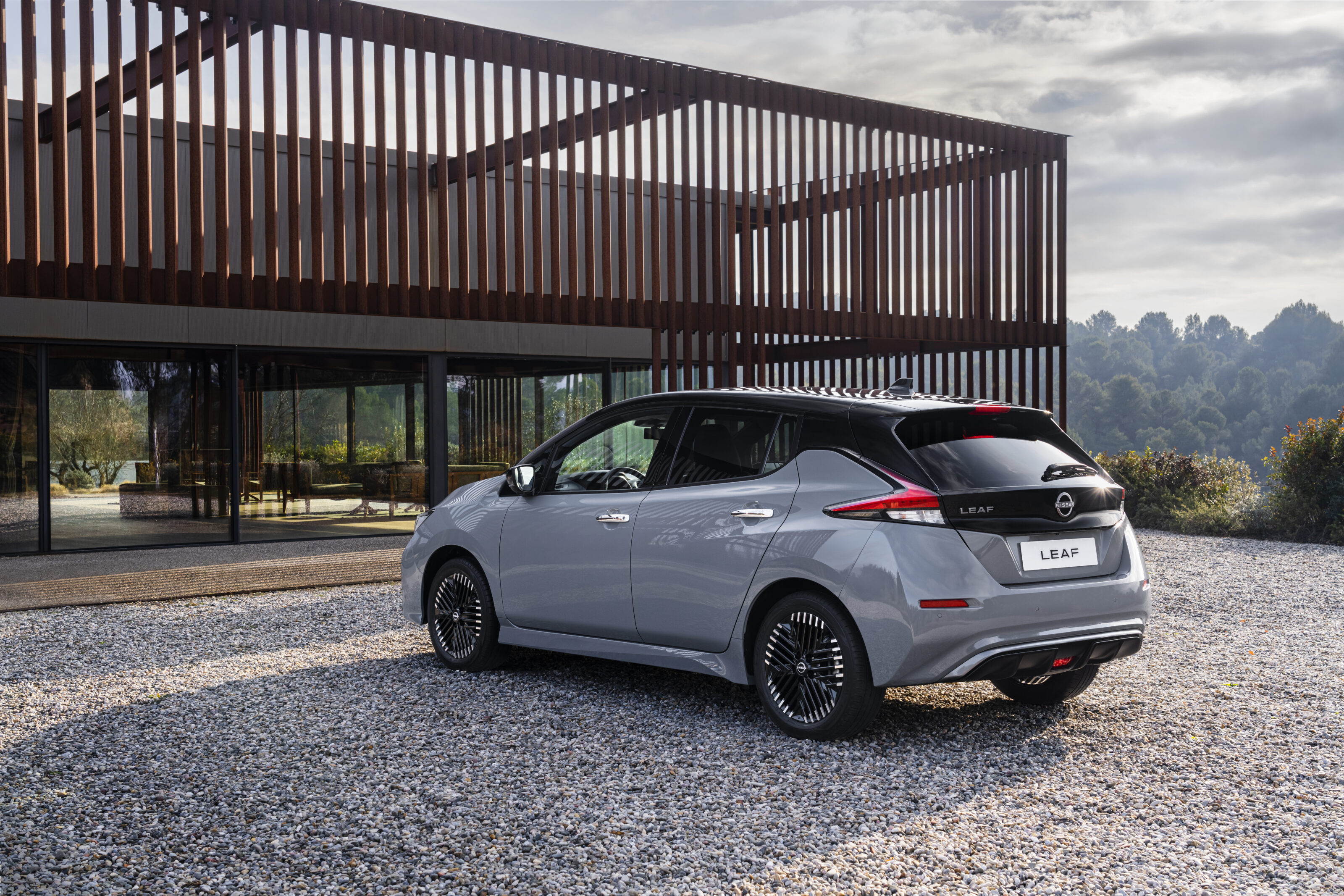
Nissan has a number of fresh EVs in development, starting with the Ariya crossover. Local launch timing for the Ariya, revealed in 2020, is yet to be confirmed.
The news follows similar reports out of Europe in late 2021, with the brand’s European boss speaking to Autocar about a new Leaf-replacing electric small SUV to be built in the United Kingdom from 2024.
However, it now seems highly unlikely that the nameplate will be retained beyond 2025.
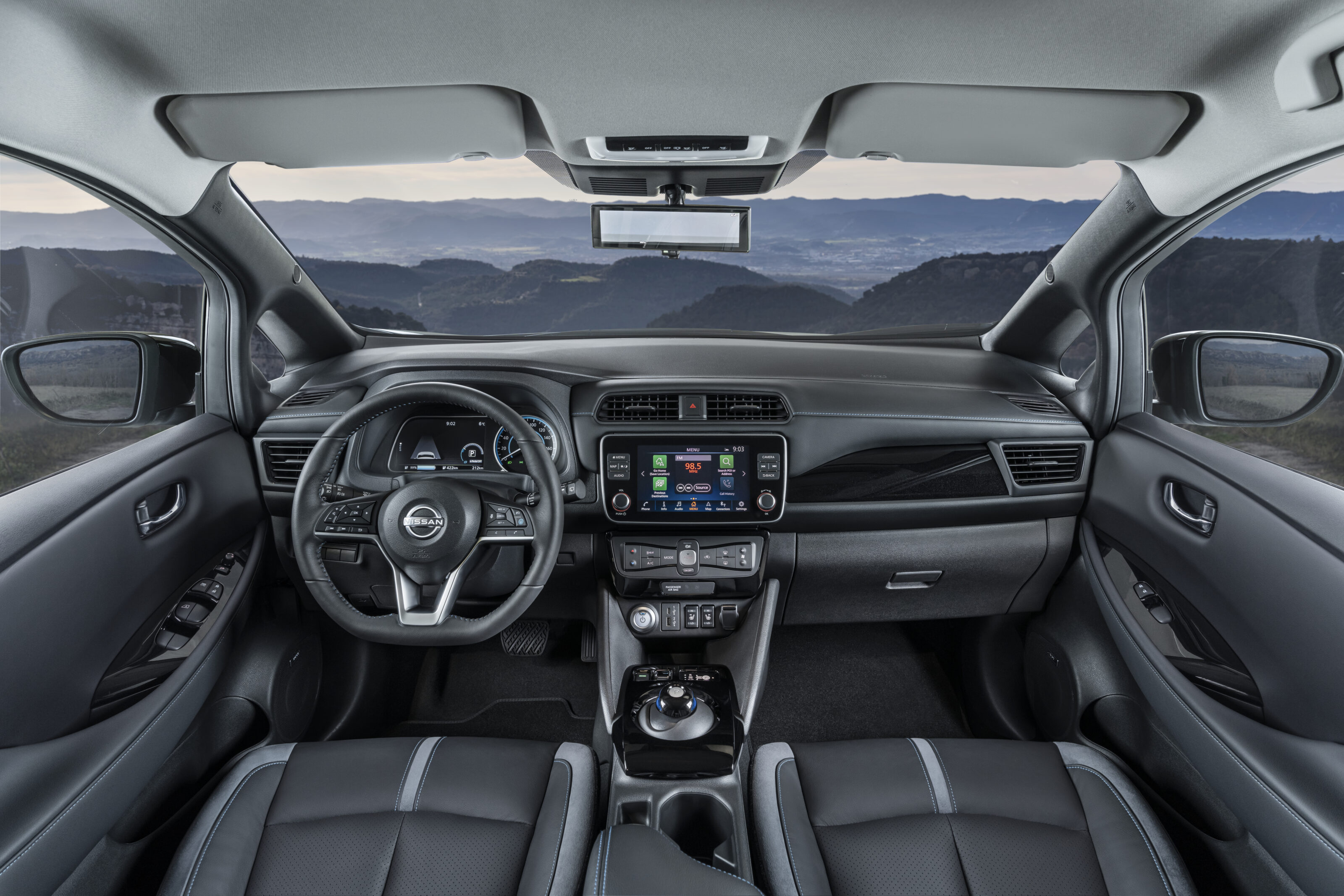
A spokesperson for Nissan Australia declined to comment on the future of the Leaf, however, the company recently celebrated 10 years since the electric hatchback went on sale locally.
Available here since June 2012, the Nissan Leaf has recorded more than 2000 sales. Globally, around 600,000 units have been sold since the model debuted in 2010.
VFACTS data indicates that Nissan sold 226 Leaf models in the first six months of 2022 – a 5.4 per cent drop from the same period in 2021.
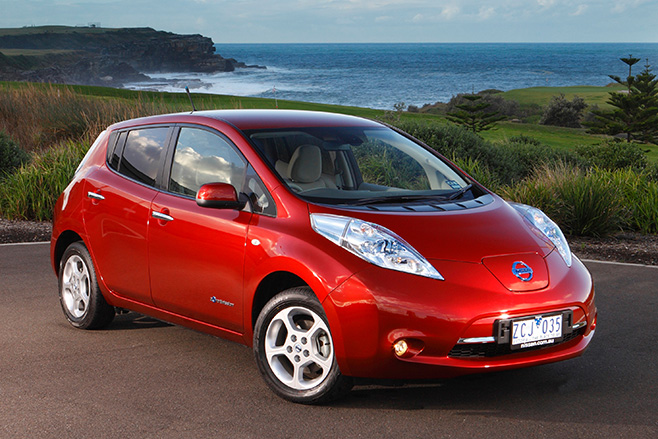
The facelifted 2023 Nissan Leaf will launch in Australia next month, bringing revised looks, a digital rear-view mirror, and a $1000 price increase.
Priced from $50,990 before on-road costs, the Nissan Leaf competes against the popular Tesla Model 3, as well as electric small SUVs, including; the Hyundai Kona Electric, MG ZS EV and BYD Atto 3.
There have been two generations of the Nissan Leaf, with the current model available locally from 2019. A more powerful, long-range Leaf e+ joined the range last year.
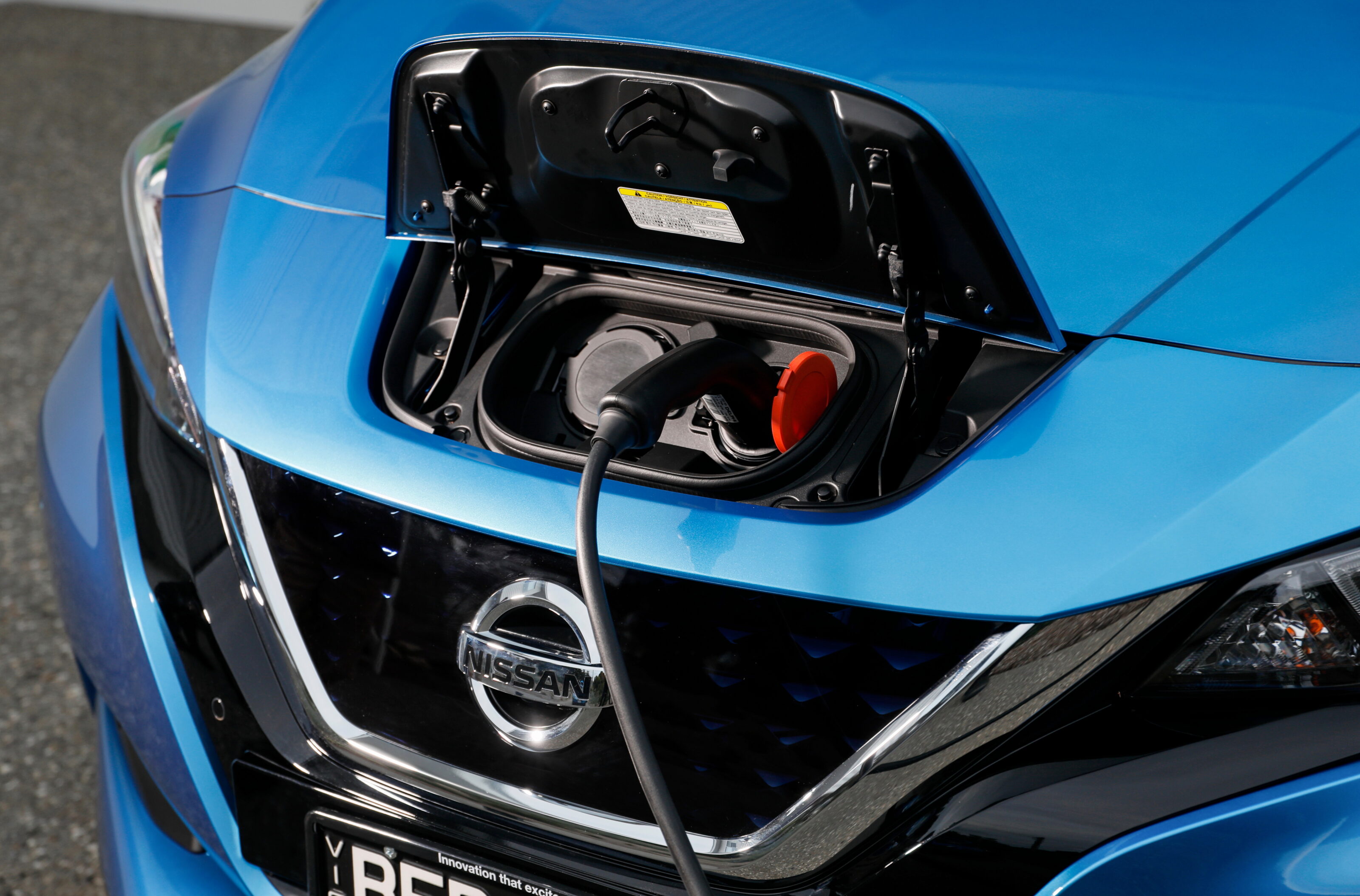
Much like the iPhone for smartphones, Tesla has become a household name for electric vehicles; however, the first-generation Nissan Leaf beat the Model S to market by two years.
“When the Nissan Leaf arrived in 2010 there were many sceptics; fast forward to today and almost every automaker around the world has followed suit,” said Guillaume Cartier, chairperson of Nissan in the AMIEO (Africa, Middle East, India, Europe and Oceania) region.
The first-generation Leaf offered a single electric motor producing 80kW of power and 280Nm of torque.
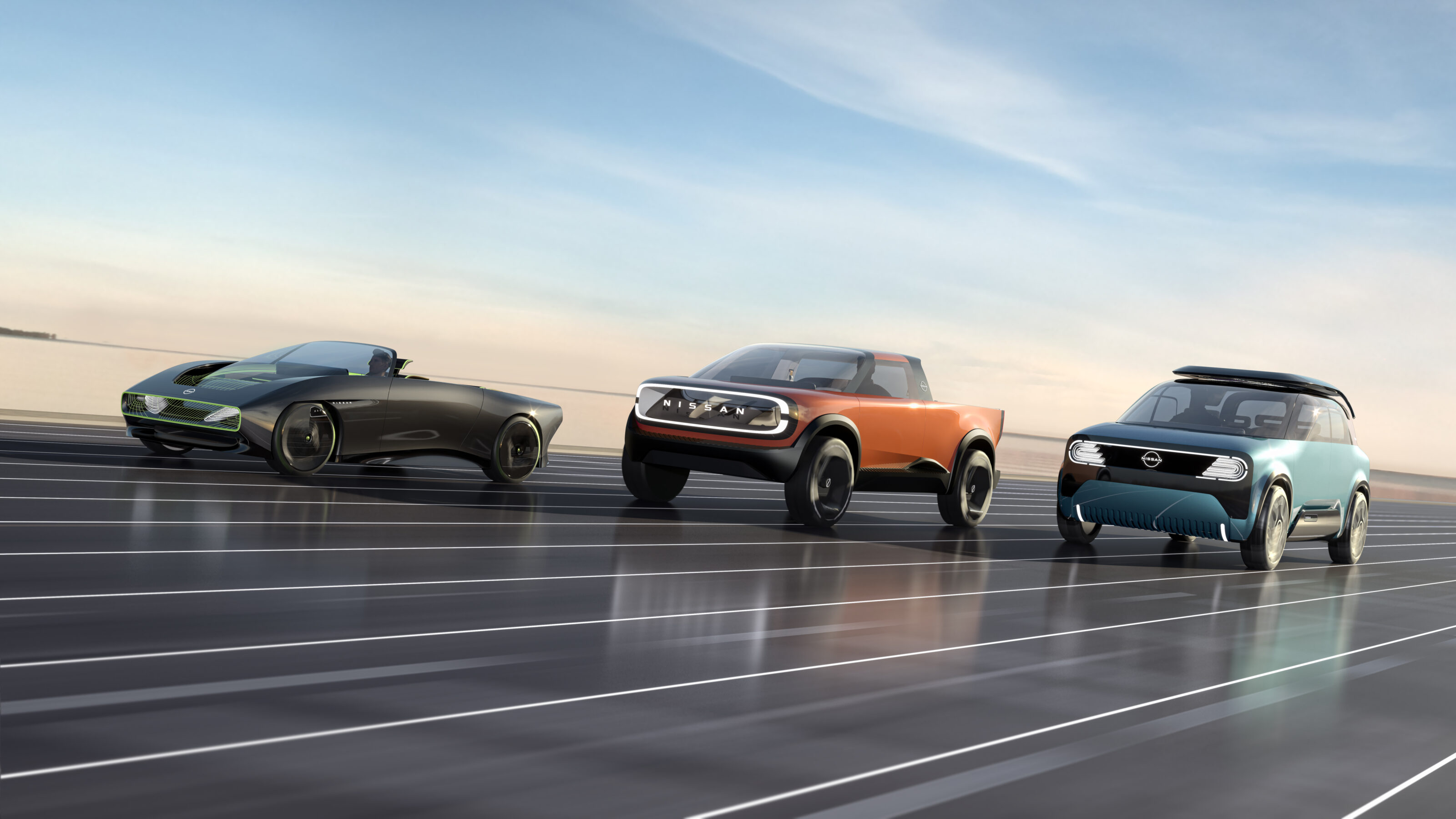
An electric hatchback will remain in the Nissan lineup in the future, with development work continuing on the next-generation 2024 Micra for Europe.
The all-electric Micra will ride on the Renault-Nissan-Mitsubishi Alliance’s CMF-B EV platform, which will also underpin the resurrected Renault 5.
In addition, Nissan showcased a series of electric vehicle concepts in November 2021, including; two SUVs, a convertible sports car, and a pick-up.
July 2023: The Honda ZR-V is now on sale in Australia, and we’ve driven it
Sorry, CR-V – ZR-V is the medium SUV poised to bring Honda back to the pointy end of the sales race. Read our full review at the link below.
▶ Story continues: ZR-V revealed
Snapshot
- Honda ZR-V launches in Japan
- Features hybrid and non-electrified powertrains from Civic
- Australian launch likely but unconfirmed
The 2023 Honda ZR-V has been revealed for Japan, giving us an insight into what we could expect if the medium SUV is launched locally.
Set to launch in its local market over the coming months, the ZR-V provides a new exterior design language similar to that of the Maserati Levante, in a somewhat radical departure from Honda’s new CR-V and HR-V SUVs.
Just like the Australian-market Civic, a 1.5-litre, turbocharged four-cylinder engine is offered while Japanese customers can also opt for a 2.0-litre, non-turbo four-pot hybrid powerplant, which is expected to debut in the Civic hybrid – although all ZR-V variants are all-wheel-drive with a continuously variable transmission (CVT).
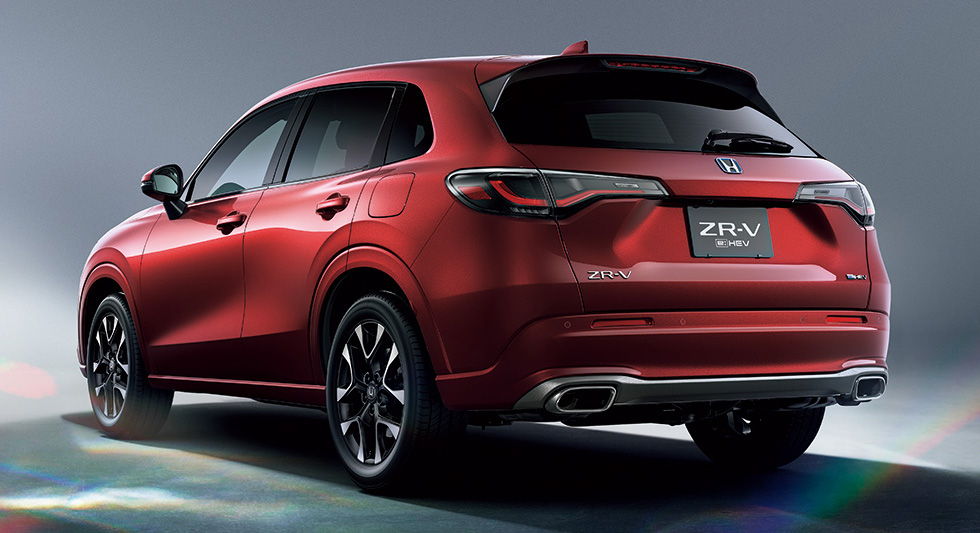
Inside the cabin, occupants are met with a horizontally-orientated nine-inch infotainment screen as well as a 10.2-inch digital instrument cluster for the driver.
Just like its Honda siblings, the ZR-V features integrated air vents in its dash, adding to the sleek design, which includes a leather-appointed interior.
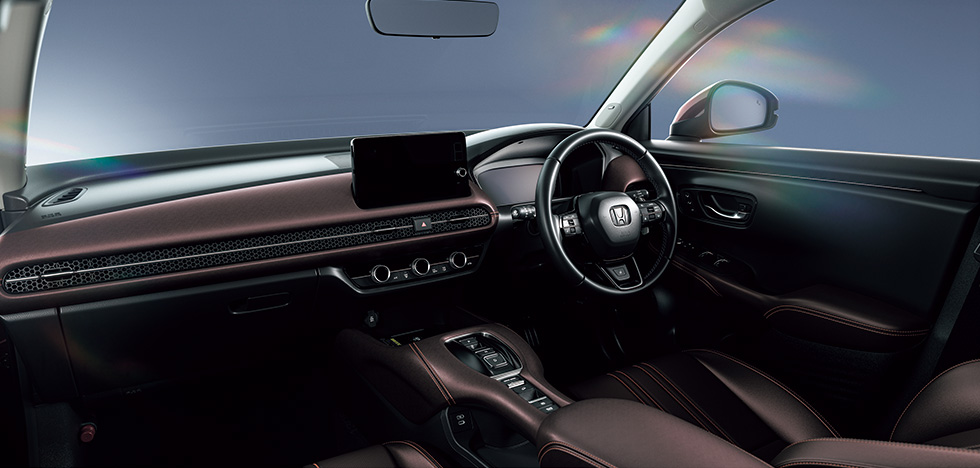
Honda Australia has previously trademarked the ZR-V name locally, adding to speculation that the new SUV will form a part of its expanded product range in the near future.
Pricing for the ZR-V has not been released for Japan, while the brand’s local operation has confirmed a new SUV will join its Australian line-up in the next 12 to 18 months, with its name and other details to be revealed closer to launch.
UPDATE: Now we’ve driven it!
It’s not every day that a brand makes its concept cars properly driveable, let alone offering the opportunity for media to experience it. But, as a preview of its 2024 motorsport plans, the Ioniq 6-based RN22e is no ordinary concept. Get our review story at the link below.
The story to here
July: RN22e concept revealed
Snapshot
- Ioniq 6-based N concept revealed
- Outputs of 430kW/740Nm claimed
- Production model to launch in the coming years
Hyundai has revealed an aggressive pure-electric concept that hints at a second EV to join the growing N performance family.
Unveiled at the Busan Motor Show in South Korea, the RN22e previews what will follow the company’s first production electric N – the Ioniq 5 N – which has now been confirmed for 2023.
But, while the Ioniq 5 N offers plus-size hatchback practicality and aesthetics, the new concept takes the company into bold territory with an elegant ‘streamliner’ based on the freshly revealed Ioniq 6 coupe-profiled sedan.
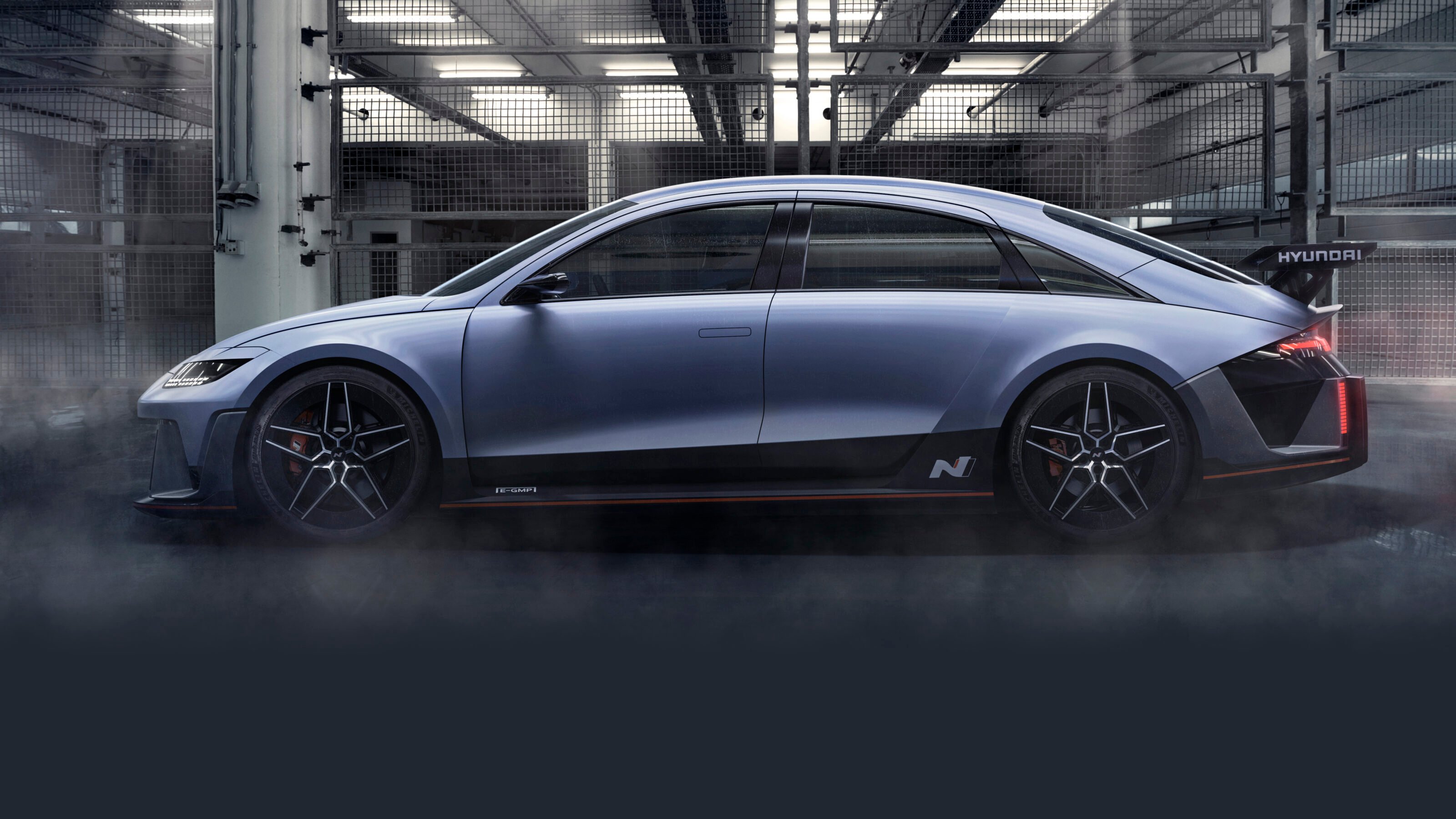
It takes the E-GMP underpinnings of its Ioniq 5 N sibling, but clothes it in an enhanced body taken from the Ioniq 6 for a version with serious zero-emissions punch.
With electric motors on both axles, the RN22e produces a combined power output of 430kW and 740Nm, fed by a 77.4kWh battery. No claims have been made regarding the concept’s acceleration performance, but Hyundai says a top speed of more than 250km/h is possible, while its 800-volt electrical system will allow a 10 per cent to 80 per cent charge in less than 18 minutes.
Those figures match the power and torque outputs of the mechanically almost identical Kia EV6 GT exactly, which has also recently been confirmed and will crack 260km/h, according to Hyundai’s sister brand.
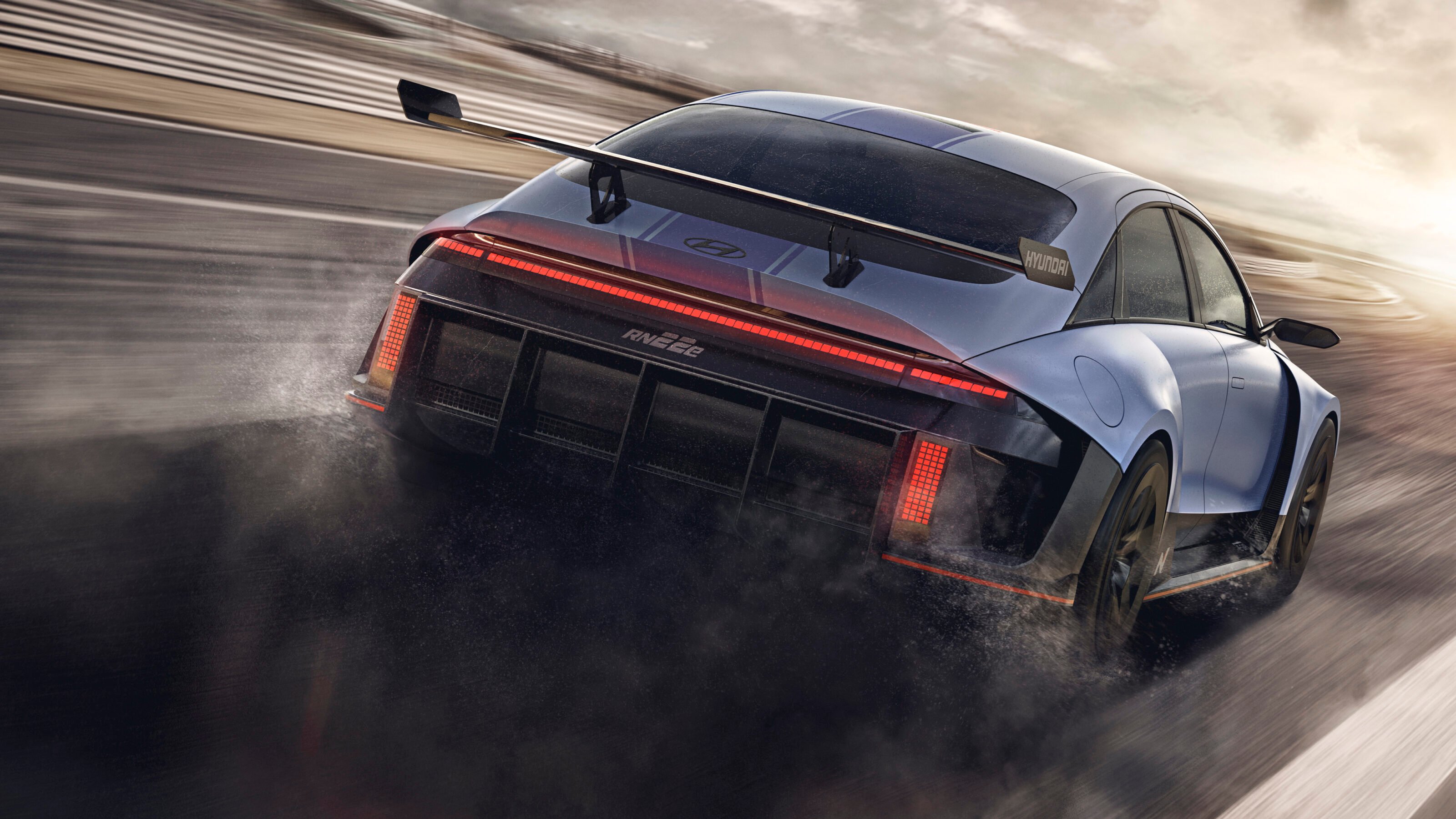
Hyundai has not detailed if or what the concept will evolve into, but the Ioniq 6 N would be a very safe bet, providing a sibling to the Ioniq 5 N at a point after its arrival in 2023. “Hyundai can hone and perfect its advanced technologies to launch a mass-production electric N model utilising the potential of E-GMP,” it said.
If you needed any more convincing, the company has also revealed that it will hit the track in the ETCR racing series next year with the Ioniq 6 ETCR. This all but confirms a road version will result.
Either way, the company promises that an electrified vehicle is more than capable of honouring the N brand mantra that it introduced seven years ago and the RN22e has the same high-performance credentials as previous N models.
Hyundai stopped short of describing a full ‘drift mode’ for the vehicle but has confirmed the infinitely variable all-wheel drive system has various driving modes that “allow drivers to choose the torque power on the front and rear wheels.”
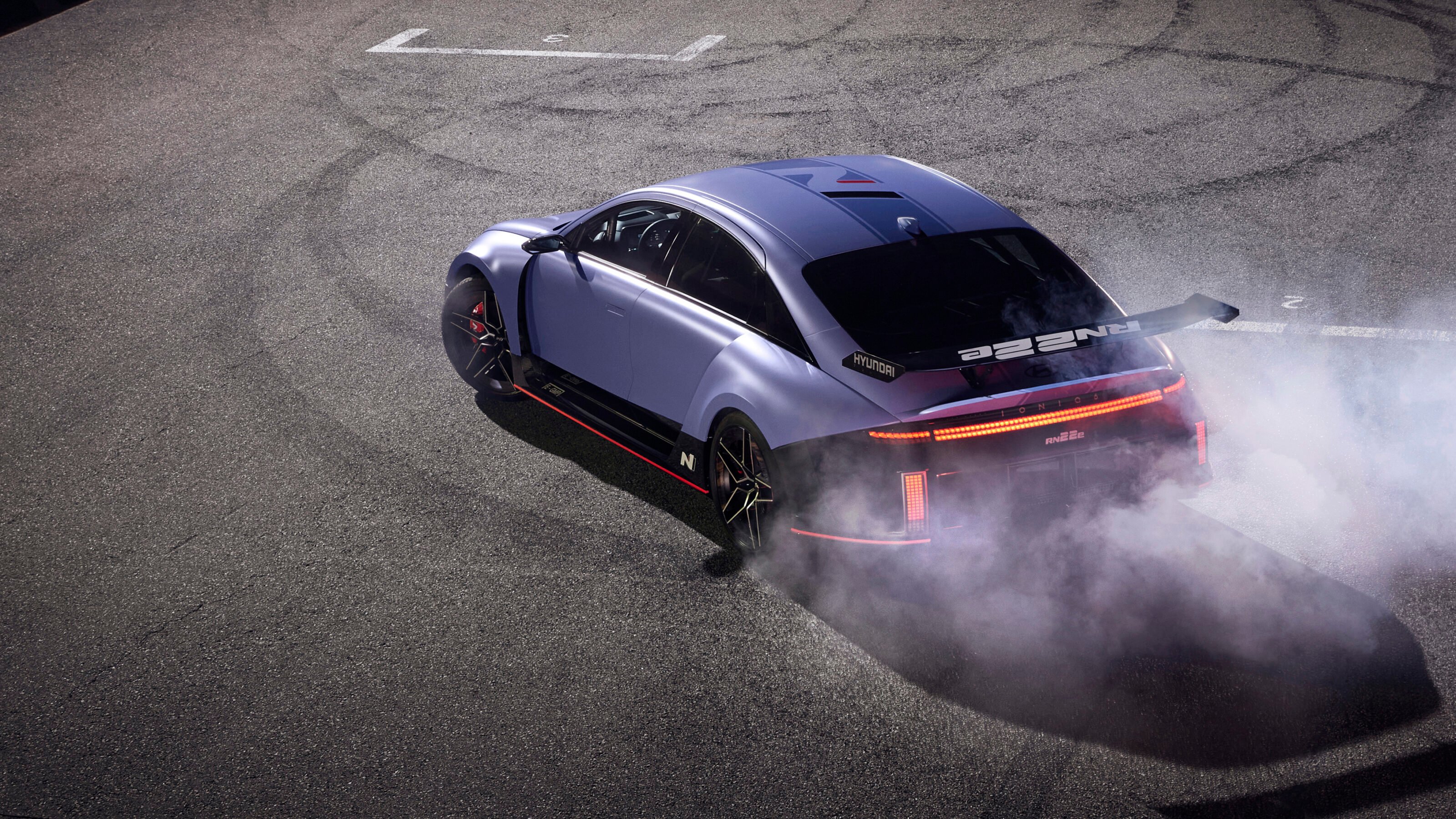
Like the Mercedes-AMG EQS 53 and Porsche Taycan, the RN22e generates a synthesised N Sound Plus soundtrack for ears both inside and outside of the cabin, providing a ‘dynamic driving feel’ along with vibration and simulated gear shifts felt by the driver.
While the exterior takes the Ioniq 6 as a starting point, the concept adds to the slippery aerodynamics with more performance-enhancing hardware such as a reduced ride-height, fattened arches and track. The revised body also increases cooling for the performance-enhanced drivetrain.
An evolution of the ‘corner carving’ e-LSD allows the RN22e to gain the ‘corner rascal’ dynamics imparted to other N cars with specially developed twin-clutch torque vectoring, but more detail surrounding the company’s innovation is yet to be communicated.
There’s also extensive use of 3D-printed components allowing the overall weight to be reduced, although Hyundai says the car still has “invariably heavier weight”, but engineers worked with the yet-to-be specified mass rather than trying to hide it.
Four-piston front calipers provide the most aggressive braking on track along with 400 millimetre front rotors, but Hyundai is using the concept to explore how regenerative braking can be best applied in the high-performance context.
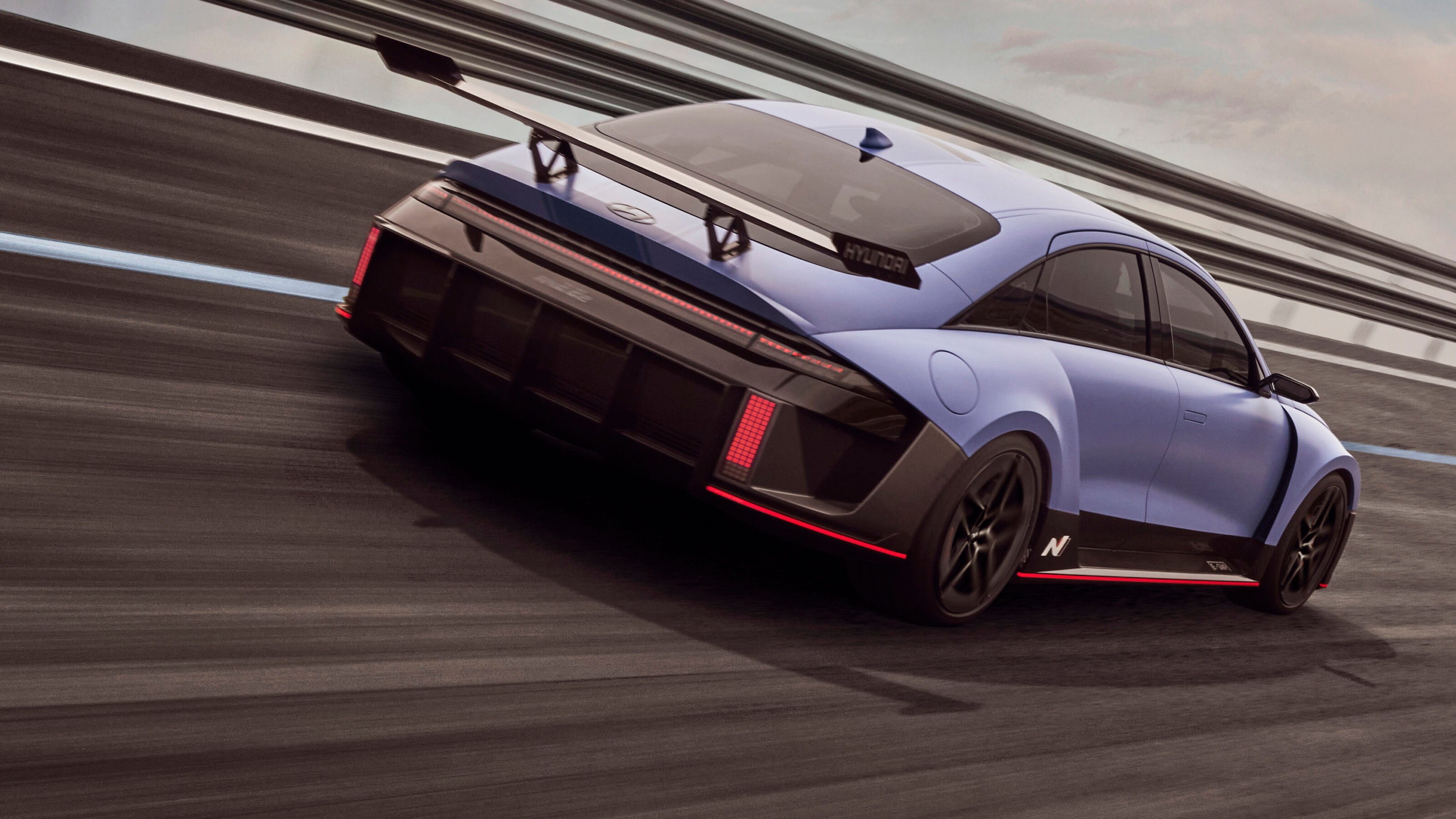
With its new electric N heroes emerging, the company has its sights set on arguably the most challenging and coveted performance car benchmark of them all.
“There’s no EV that can do one lap of the Nürburgring in 100 per cent performance,” said N Brand management and motorsport vice president Till Wartenberg. “This is what we’d like to tackle”.
The approach is in keeping with the company’s longstanding Rolling Lab research program, which uses concept and design study cars to develop new technology that will eventually find its way into production models.
If you were wondering, the R in its name represents the Rolling Lab research cars, N stands for the Namyang proving ground, 22 is the year the concept was revealed and e is its electrified drivetrain.
https://www.instagram.com/p/CgA307bAAGl/
UPDATE: Now we’ve driven it!
It’s not every day that a brand makes its concept cars properly driveable, let alone offering the opportunity for media to experience it. But, as a ‘Rolling Labs’ project with a lot of production-bound tech hidden under its retro lines, the N Vision 74 is no ordinary concept – and Hyundai wants us to see what’s coming around the bend. Get our review story at the link below.
The story to here
July: N Vision 74 concept revealed
Snapshot
- Hyundai’s retro-inspired N Vision 74 concept breaks cover
- Hydrogen homage to the Pony Coupe Concept
- No production plans
Hyundai has unveiled a stunning retro super-coupe concept, that has one foot in the company’s early origins, but another firmly stepping into a cutting-edge electrified future for the growing N performance family.
Unlike the EN22e, which was revealed simultaneously at the Busan Motor Show in South Korea, the N Vision 74 is the first fuel-cell vehicle to wear the N badge, and brings a host of significant features to both the H and N badges.
Hydrogen fuel-cell technology is nothing new to the company and Hyundai has previously released two production FCEV models – the ix35 Fuel Cell and the Nexo which is still in production. Significantly though, the N Vision 74 pairs the fuel-cell with a relatively large battery for a powertrain not yet seen in the automotive world.

A hydrogen/battery hybrid offers distinct advantages including the option to charge its 62.4kWh battery at home just like a normal EV, combined with the convenience of fast-filling when on the road where hydrogen refueling infrastructure permits.
This feature would mitigate the inconvenience experienced by FCEV owners while refuelling infrastructure is still uncommon, and the drivetrain is described by its maker as ‘the most advanced hydrogen fuel-cell that Hyundai has ever created’.
Under normal driving conditions, the fuel-cell is used to charge the battery with power sent to the wheels exclusively from the battery, but during more enthusiastic driving the fuel-cell will provide power directly to the motors in unison with the battery for a maximum power ‘over-boost’ function.
Driving range is claimed to be more than 600 kilometres, although it’s not stated whether this is the combined efforts of a full battery and full tank or just one half of the equation.

Practicalities aside, power and torque outputs are even more impressive with more than 500kW and 900Nm sent to a pair of electric motors. Unlike other N and hydrogen models before it, the N Vision 74’s motors are positioned exclusively on the rear axle for a very driver-focused vehicle, says Hyundai N.
The arrangement not only imparts the desirable rear-wheel drive characteristics many driving enthusiasts appreciate, but enables unrivaled torque vectoring with fully independent control of the individual motors.
Hyundai has not released a claimed zero-to-100km/h acceleration claim and the combined mass of a medium-sized battery and fuel-cell are likely to be significant, but its power and torque outputs would suggest it’ll still have the pace to match its looks.
Completing the suite of supercar calling cards, the feisty concept contains its fuel-cell technology under the bonnet, while the pair of 4.2 kilogram capacity hydrogen tanks and a T-shaped battery are positioned in the middle of the car for optimised weight distribution and even more performance potential.

Measuring 4951 millimetres in length, just shy of two meters in width and 1331mm tall, the N Vision 74 has low and wide proportions and is about the same length as the Ioniq 6 that was also revealed in Busan.
Its name is an homage to the 1974 Pony Coupe Concept that failed to make it to production, but lends many of its design details to the modern day interpretation, while the N Vision 74 also gains styling traits from the 2025 Vision Gran Turismo that made a virtual video game debut in 2015.
Its looks lean heavily onto the 1970s and 1980s retro revival movement with box arches, sharply sculpted body lines and a DeLorean-esque satin silver finish – a model that also owes its existence to Pony Coupe designer Giorgetto Giugiaro.
There are also heavy hints toward the racetrack with a massive rear diffuser, unapologetic rear spoiler and IMSA-style vented wheel cooling caps. Electric charging is enabled with a flap on the left side, while hydrogen is pumped in on the opposite flank with specialised refuelling connections.
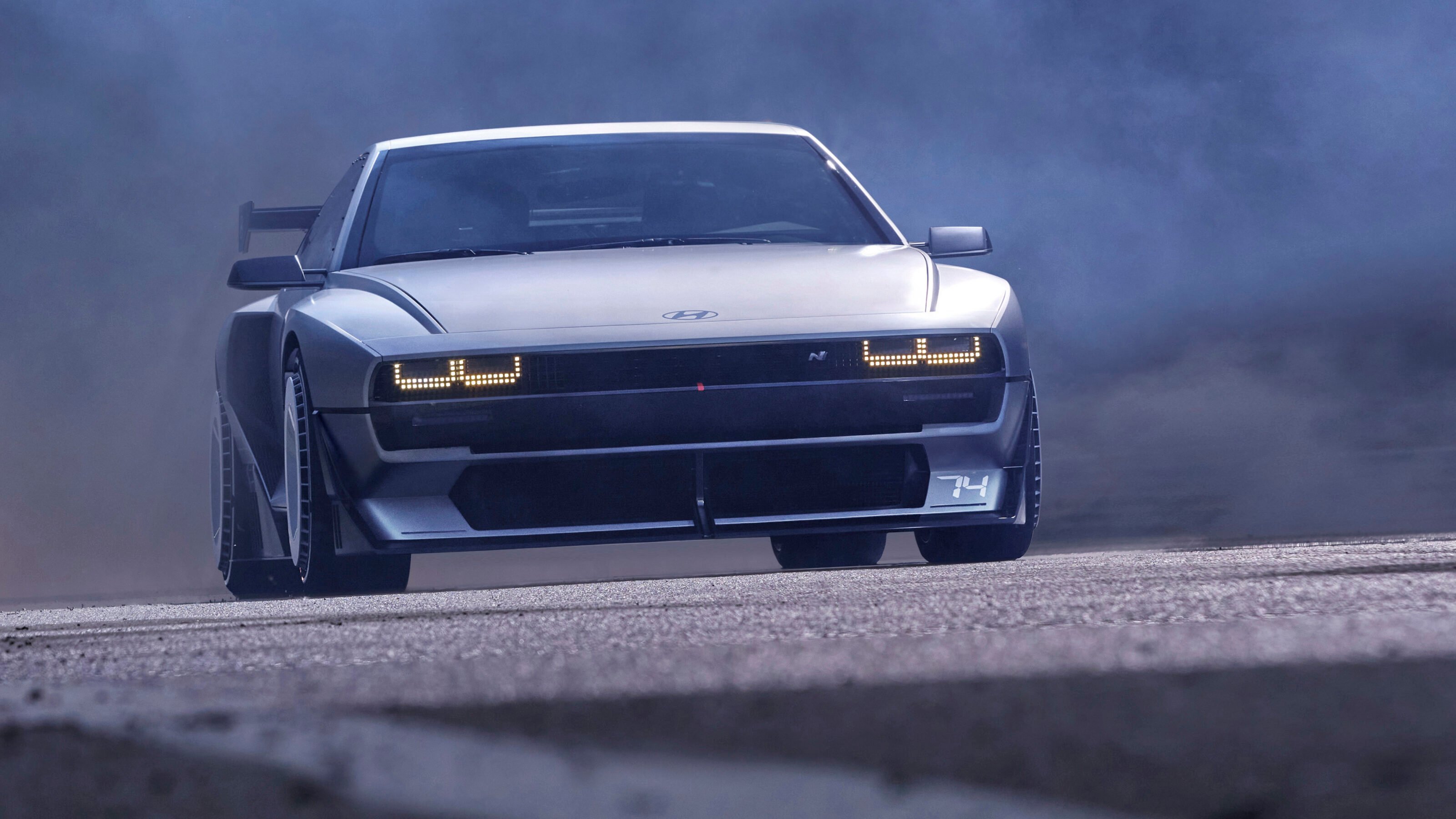
Hyundai’s Parametric Pixel design signatures are everywhere, honouring the promise that every electric vehicle from the brand would incorporate the head-turning aesthetic, allowing a resemblance to run throughout the family even when the broader design is like nothing else in the line-up.
“N Vision 74’s future-oriented design reflects the respect and appreciation we have for the dedication and passion that went into the Pony Coupe concept,” said SangYup Lee, executive vice president and head of Hyundai Design Centre.
No mention is made of the company’s E-GMP electric vehicle platform which might imply the N Vision 74 rolls on a new architecture currently being developed by Hyundai and if the concept makes the transition from show car into production model.
The N Vision 74 is in keeping with Hyundai’s previous RM concepts and the company’s Rolling Lab research, which uses concept and design study cars to develop new technology that will eventually find its way into production cars.
https://www.instagram.com/p/CgA4lXpA8Cu/
UPDATE: 2023 Toyota Yaris Cross on sale
The 2023 Toyota Yaris Cross has landed in Australia with a new GR Sport variant, alongside a minor update to one of Australia’s most popular light SUVs.
For the full run-down, including pricing, click on the link below:
The story to here
July 14, 2022: Toyota Yaris Cross pricing and features
This story, originally published in October 2020, has been updated to reflect the latest information.
Snapshot
- 2022 Toyota Yaris Cross priced from $26,990 before on-road costs
- Front-wheel-drive petrol or FWD/AWD hybrid powertrain options
- Updated version to launch in Australia in late 2022
The 2022 Toyota Yaris Cross light SUV brings hybrid power to the compact high-rider class for the first time in Australia.
It is priced from $26,990 before on-road costs, extending to $37,990 plus on-roads for the flagship all-wheel-drive hybrid variant.
Three grades of Yaris Cross – GX, GXL, and Urban – are available, each having a trio of powertrain choices, for a total of nine variants.

The hybrid powertrain has a combined fuel consumption of 3.8L/100km with front-wheel drive.
Pricing and features have remained unchanged since the Yaris Cross launched in November 2020.
In the light SUV class, the Toyota Yaris Cross competes against the Mazda CX-3, Kia Stonic, Hyundai Venue and Ford Puma, amongst others.
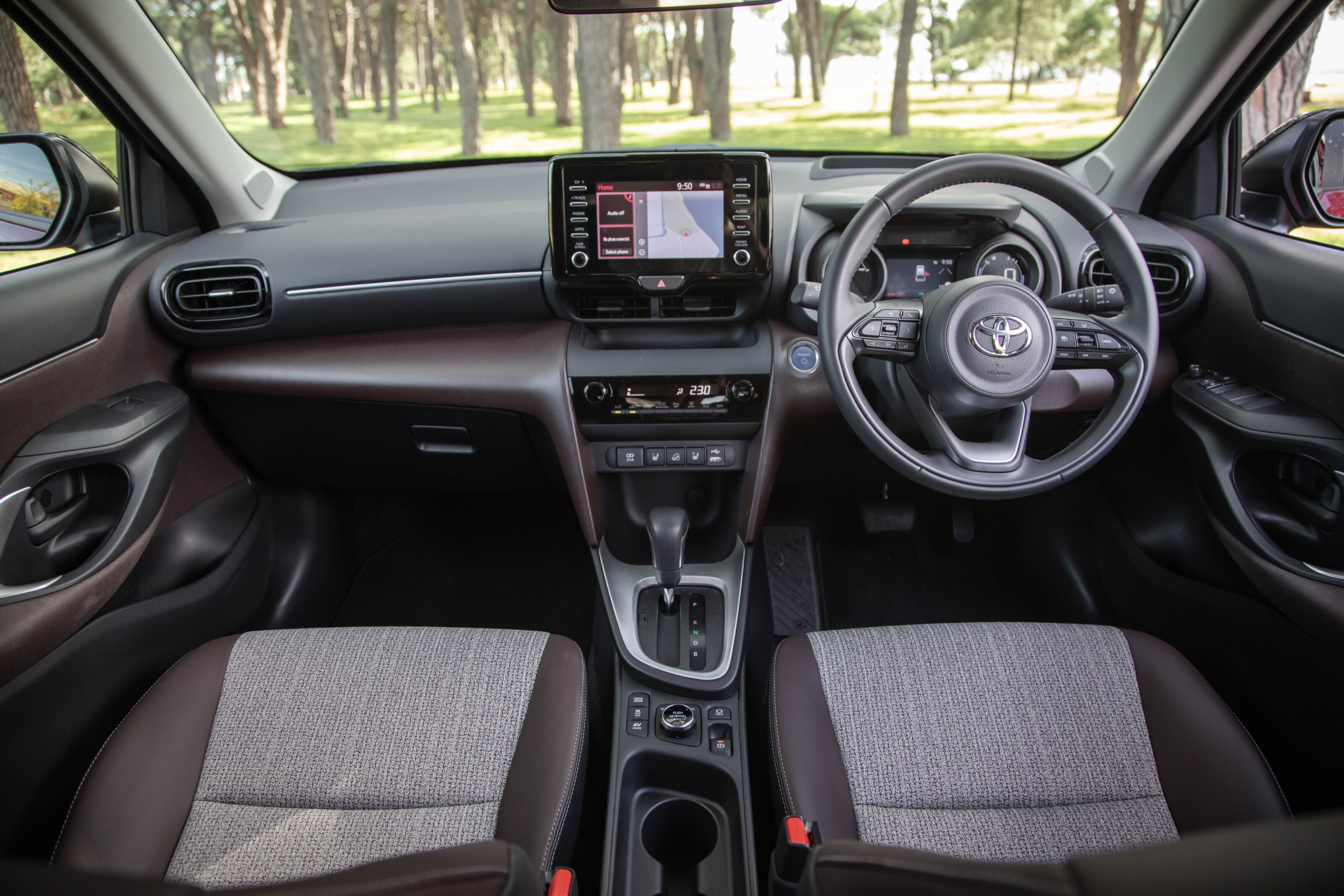
The cheapest variant of the Ford Puma has a $30,340 sticker price, while the Mazda CX-3, Kia Stonic and Hyundai Venue can be purchased for under $25,000.
In terms of size, the Yaris Cross is smaller than its C-HR sibling, which remains in the small SUV class, while being slightly larger than the Yaris hatchback on which it is based.
Toyota will bolster its compact SUV line-up in late 2022 with the addition of the Corolla Cross – the largest of the trio – which will slot below the RAV4 medium SUV.
In the coming months, a mildly-updated 2023 Toyota Yaris Cross will launch with technology and styling updates, including new colours and black leather-accented trim on Urban variants.
2022 Toyota Yaris Cross pricing
Prices exclude on-road costs.
| Model | Pricing |
|---|---|
| GX petrol FWD | $26,990 |
| GX hybrid FWD | $28,990 |
| GXL petrol FWD | $29,990 |
| GX hybrid AWD | $31,990 |
| GXL hybrid FWD | $31,990 |
| Urban petrol FWD | $32,990 |
| GXL hybrid AWD | $34,990 |
| Urban hybrid FWD | $34,990 |
| Urban hybrid AWD | $37,990 |
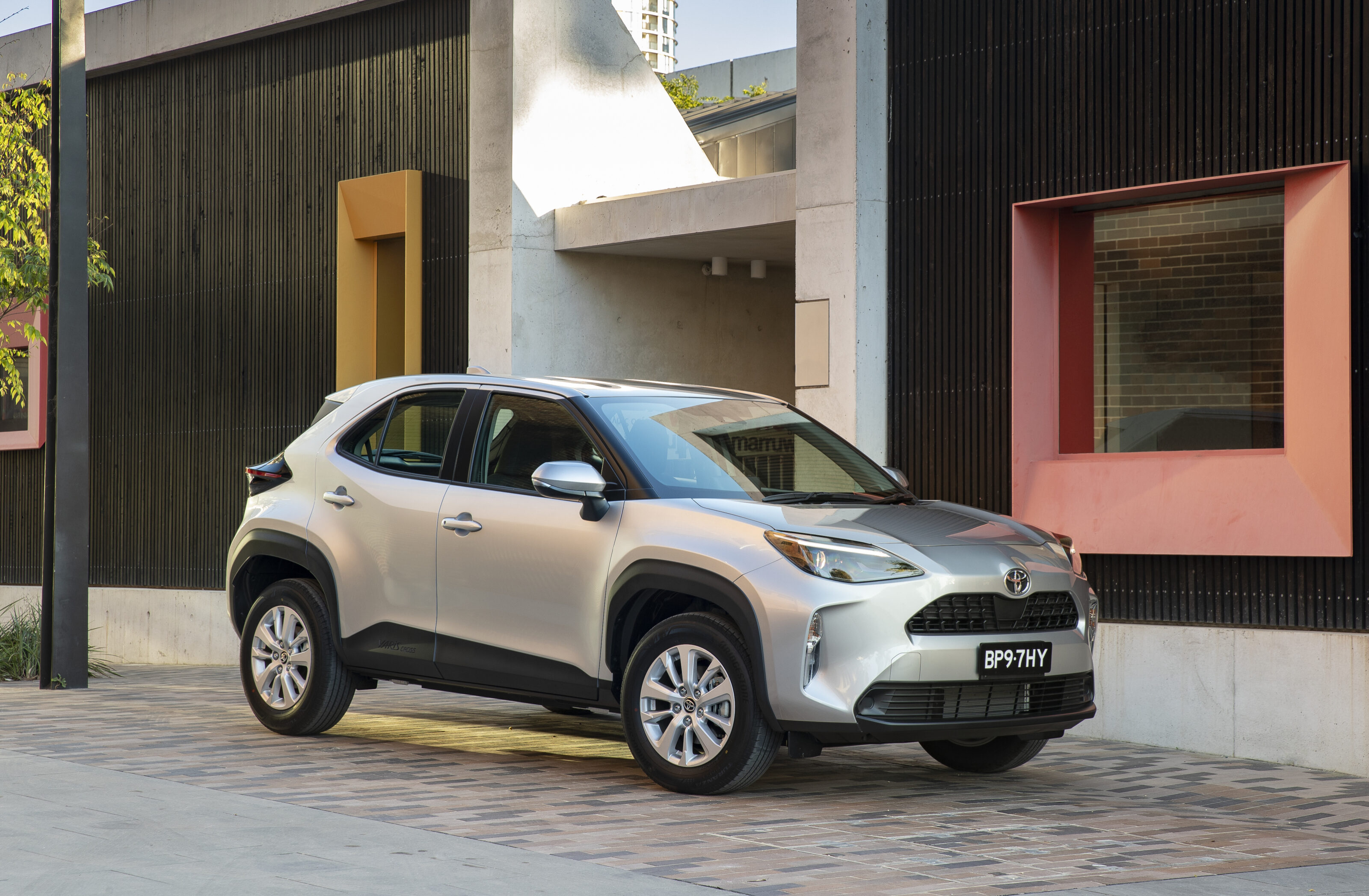
2022 Toyota Yaris Cross features
GX
16-inch steel wheels, replacing identically-sized alloys, are available as a no-cost option on the GX Hybrid FWD.
GXL, in addition to GX
Urban, in addition to GXL
Two-tone paint is available for $450 extra on Urban variants.

Premium paint is a $500 option across the Yaris Cross range.
Toyota Connected Services is standard on the Yaris Cross, featuring; automatic collision notification, SOS emegency call, stolen vehicle tracking, guest driver settings, vehicle function statuses, and current vehicle location.
The SIM-based service is complimentary for three years from the date of vehicle delivery.

Engine, drivetrain and fuel economy
Front-drive petrol variants are powered by a 1.5-litre three-cylinder engine producing 88kW of power and 145Nm of torque.
This powertrain is matched with a CVT automatic transmission.
Front-drive hybrids use a 67kW/120Nm 1.5-litre Atkinson cycle petrol engine paired with two electric motors, for a maximum combined 85kW power output.

All-wheel-drive versions use the same hybrid engine and battery set-up as the 2WD hybrid, but add an electric motor to the rear axle.
This variant can send up to 100 per cent of the power to the front wheels, or split delivery 40 per cent to the front and 60 per cent to the rear.
Torsion-beam rear suspension features in front-wheel-drive variants, while the all-wheel-drive includes a multi-link setup.
| 1.5-litre three-cylinder petrol FWD | 5.4L/100km |
| 1.5-litre three-cylinder hybrid FWD | 3.8L/100km |
| 1.5-litre three-cylinder hybrid AWD | 4.0L/100km |
Safety
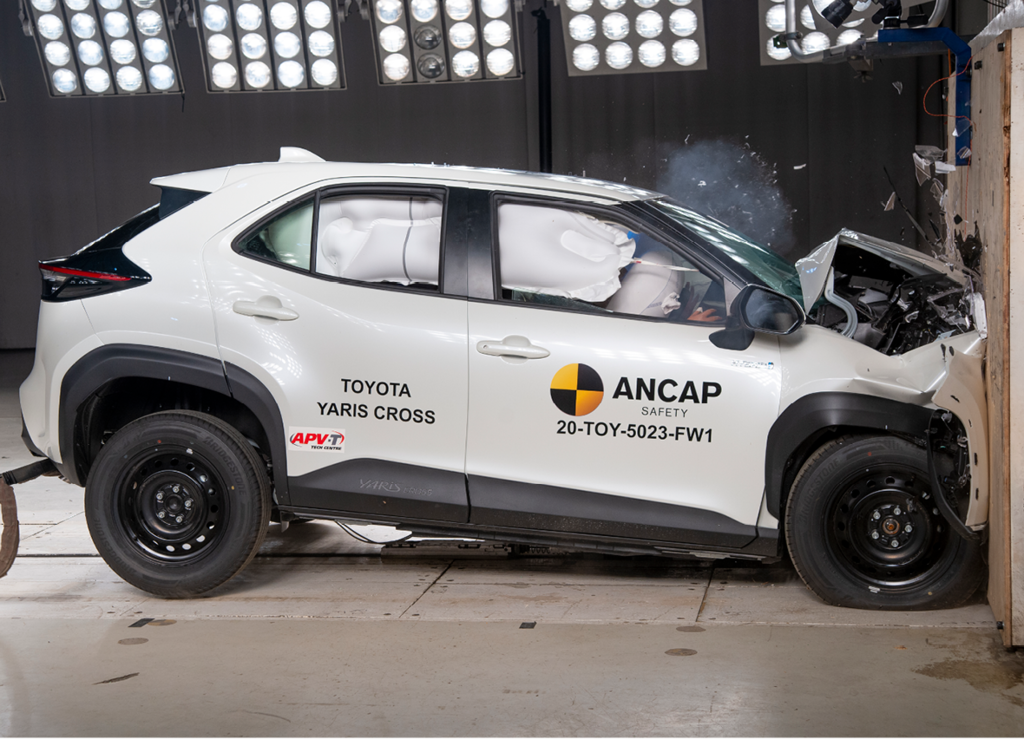
The Toyota Yaris Cross is covered by a five-star ANCAP safety rating, based on testing conducted under the latest 2020-22 criteria.
This covers all variants sold in Australia. For the full report, click here.
Eight airbags, including a front-centre airbag, feature across the range.
Each variant includes the following active safety equipment as standard:
Blind-spot alert, rear-cross traffic alert, and front and rear parking sensors are available on GXL grades and above.

Dimensions
The Toyota Yaris Cross has a wheelbase of 2560 millimetres, and is 4180mm long, 1765mm wide and 1560mm high.
Despite sharing its name with the Yaris hatchback, the Yaris Cross is 240mm longer, 20mm wider and 85mm taller.
Warranty and servicing
As per the wider Toyota range, the Yaris Cross includes a five-year, unlimited-kilometre vehicle warranty, a seven-year warranty on the engine and driveline, and a 10-year warranty on the hybrid battery.
The Japanese manufacturer also offers customers capped price servicing, with the first five visits to a dealer for servicing set to cost $205.
