
Snapshot
- Toyota and Honda post increased production numbers over last year
- Nissan and Subaru production fell compared to 2021
- April Toyota output to be cut due to supply chain issues
February 2022 was a strong month for Toyota and Honda’s global vehicle production, although their Japanese counterparts Nissan and Subaru struggled due to supply shortages.
Despite announcing production cuts throughout April thanks to a projected lack of supply, Toyota was able to make a total of 740,996 vehicles in the second month of the year. This was 10.9 per cent more than the same point last year due to a new record high of 487,738 vehicles built outside of Japan.
The manufacturer also sold 701,339 units globally during the same month, although this was 1.5 per cent down on February 2021 levels despite Australian sales jumping up by 14 per cent to 20,886 units delivered.
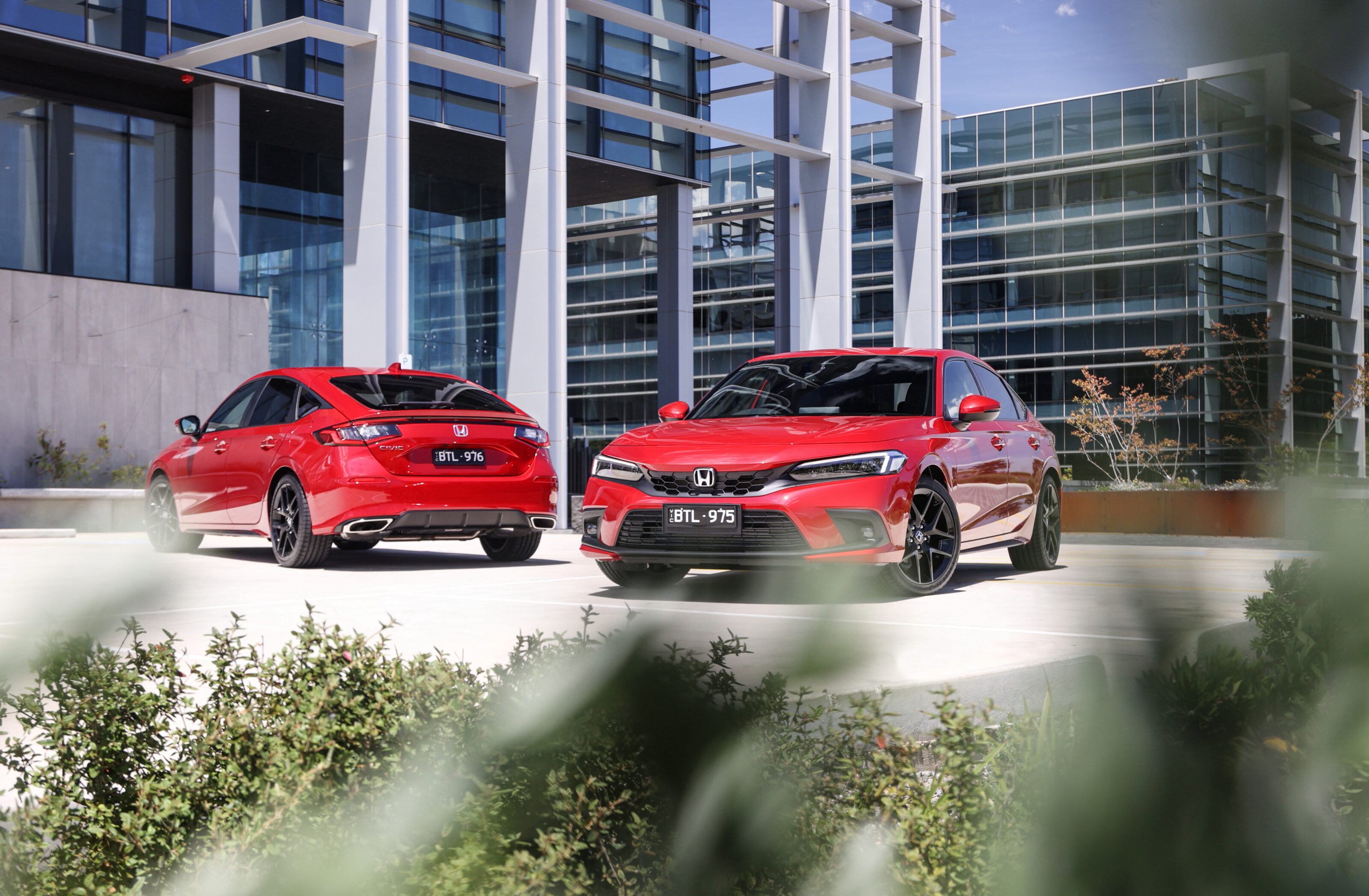
As reported by Reuters, Honda also enjoyed a strengthened February with an 8.4 per cent increase on vehicles produced, rising to 344,712 units for the month, despite its North American production facilities reportedly being affected by ongoing supply chain issues.
Honda’s Australian sales aren’t reflective of its global production efforts though, with the 1408 vehicles sold last month representing a 30 per cent decrease on the year prior.
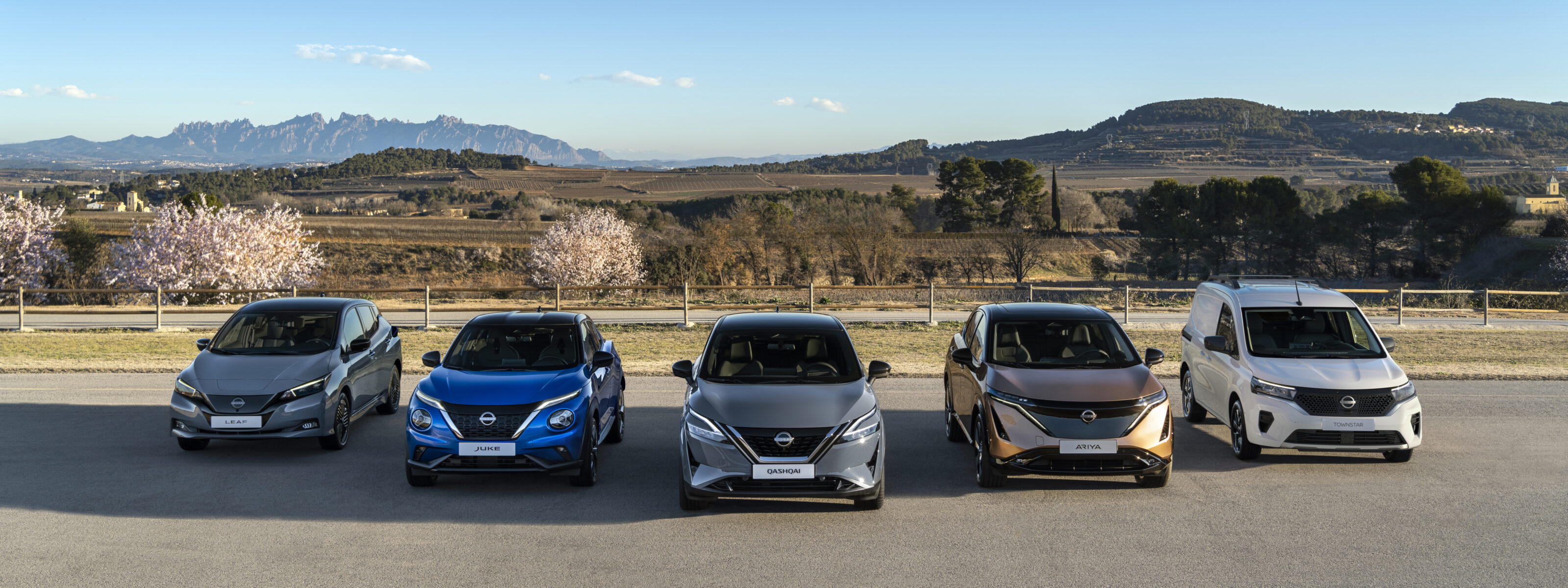
Nissan couldn’t match the efforts of Toyota and Honda due to its own semiconductor shortages, with a total of 275,437 vehicles produced resulting in a 7.8 per cent year-on-year reduction.
Like Honda, its Australian sales have also suffered to start the year, with 2820 units shifted last month and 5154 year-to-date representing drops of 26 and 32 per cent respectively, mainly due to supply chain issues.
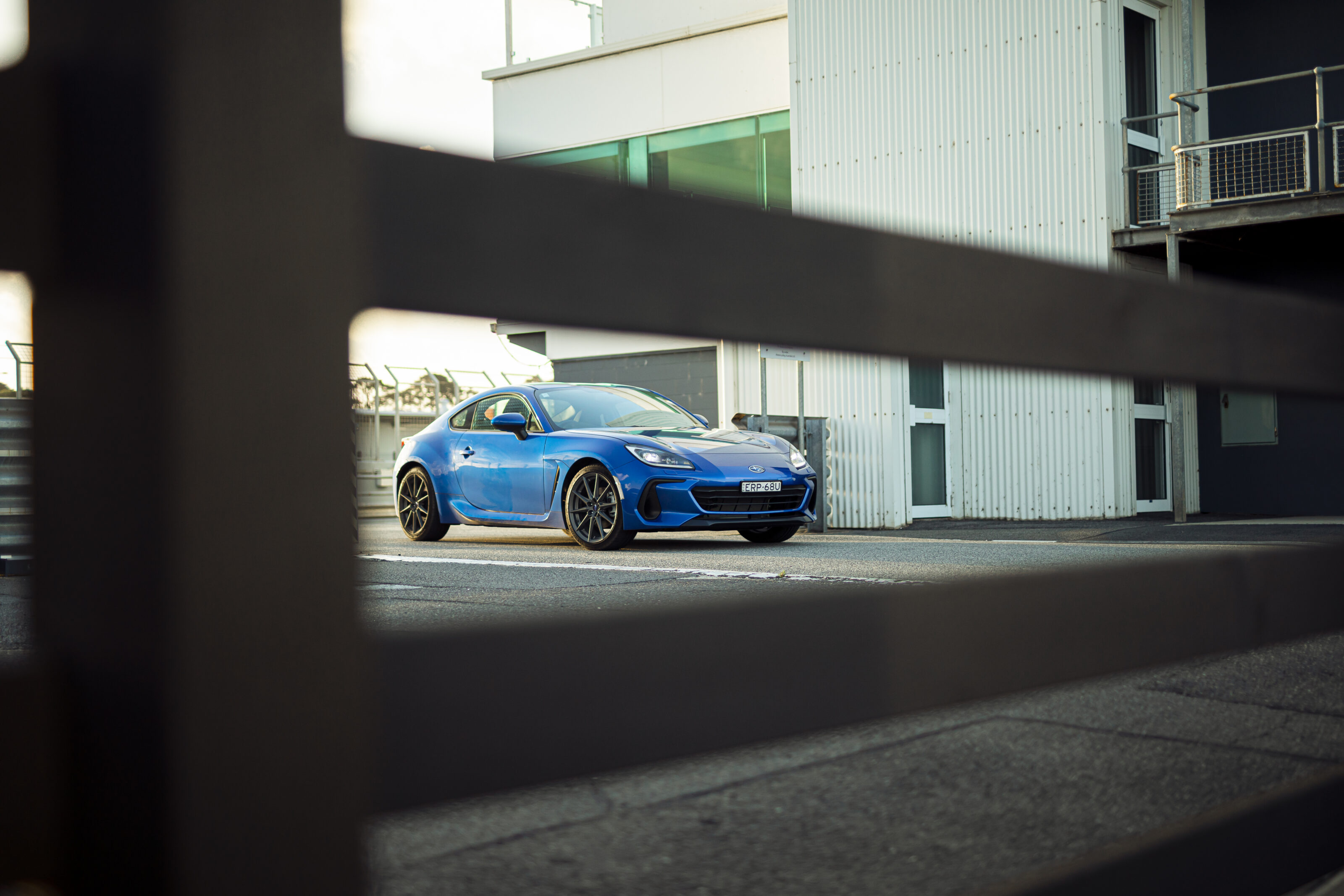
Worst-hit of the bunch was Subaru, with its monthly production dropping by 23.6 per cent to 47,625, confirming its heavily affected supply chain and high number of semiconductor-based parts.
However, in Australia at least, its February sales increased more as a percentage than any of its Japanese counterparts last month, with the 19.4 per cent jump coming thanks to a total of 3151 vehicles sold.
Nissan Casting Australia has this week announced it is expanding its factory in Melbourne’s south, as the demand for electric vehicles (EVs) grows worldwide.
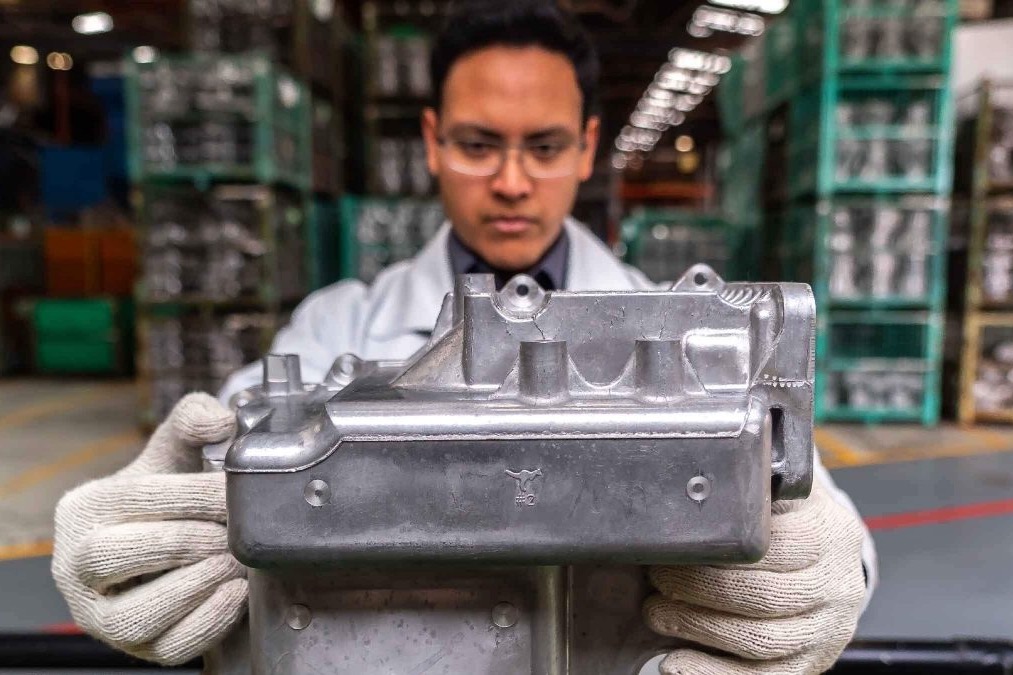
Nissan will spend $15.5 million on the Dandenong South facility, with support from the Victorian Government, to design and manufacture EV components for models such as the zero-emissions Leaf.
It’s expected 41 jobs will be created from the expansion.
“We are delighted to receive strong support to continue to expand our Australian manufacturing expertise,” said Peter Jones, Nissan Casting Australia’s Plant Managing Director, Peter Jones.
“With nearly 40 years of operations in Melbourne’s south-east, this will help us to expand our production of Australian-made electric vehicle components to the global market.”
The factory currently produces around 2.6 million aluminium die-cast components used in Nissan models annually – complete with a jumping kangaroo – and exported to assembly plants in Japan, Thailand, and the United States.
“We’re backing companies like Nissan Casting to expand their operations and make more products for export,” Victorian Minister for Industry Support and Recovery Martin Pakula said at the announcement.
“Victoria is Australia’s leading advanced manufacturing state, and we’ll keep investing in the sector to grow the economy and create local jobs.”
Snapshot
- Models due to arrive imminently
- Not delayed by supply constraints as speculated
- Regular Ranger to land first
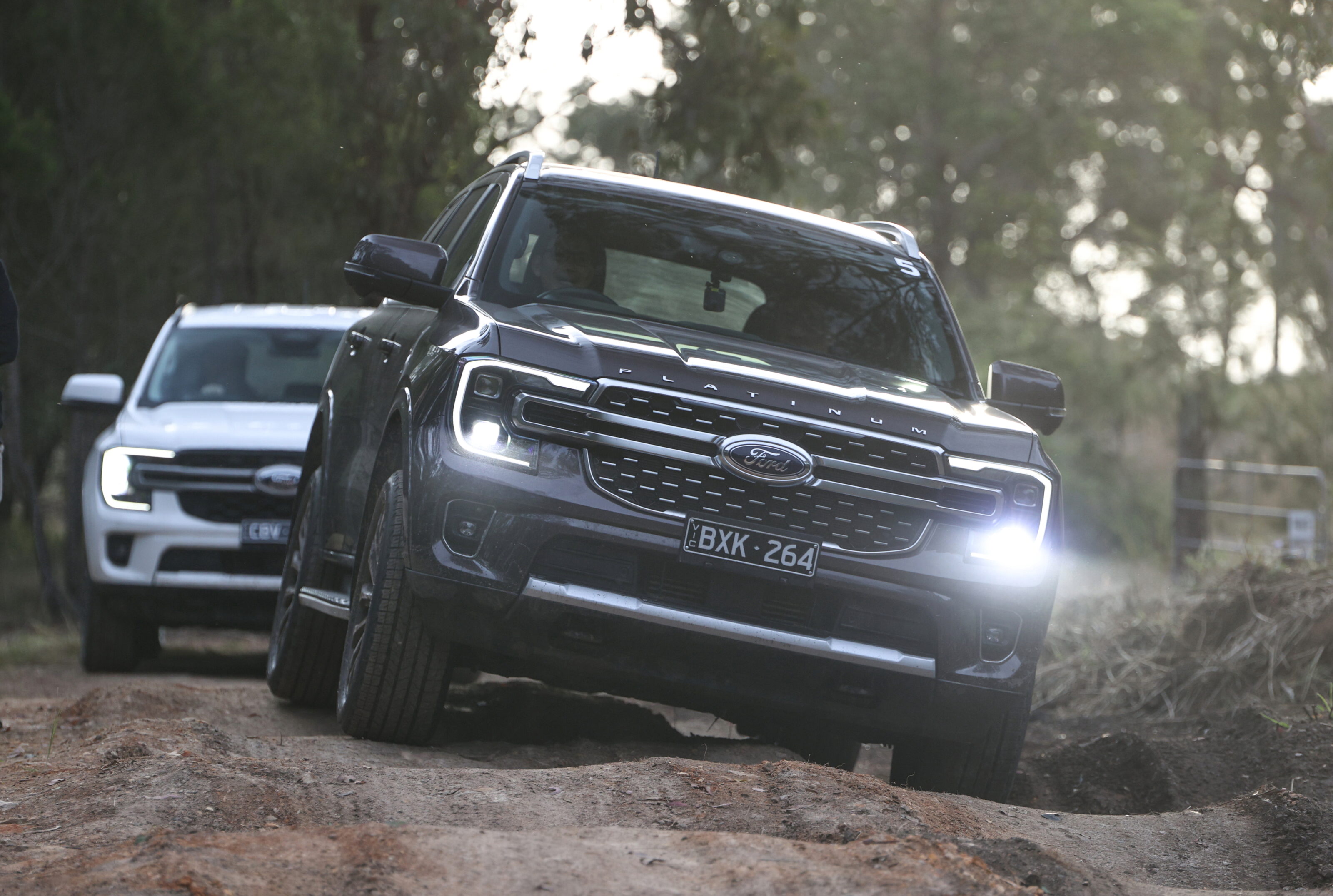
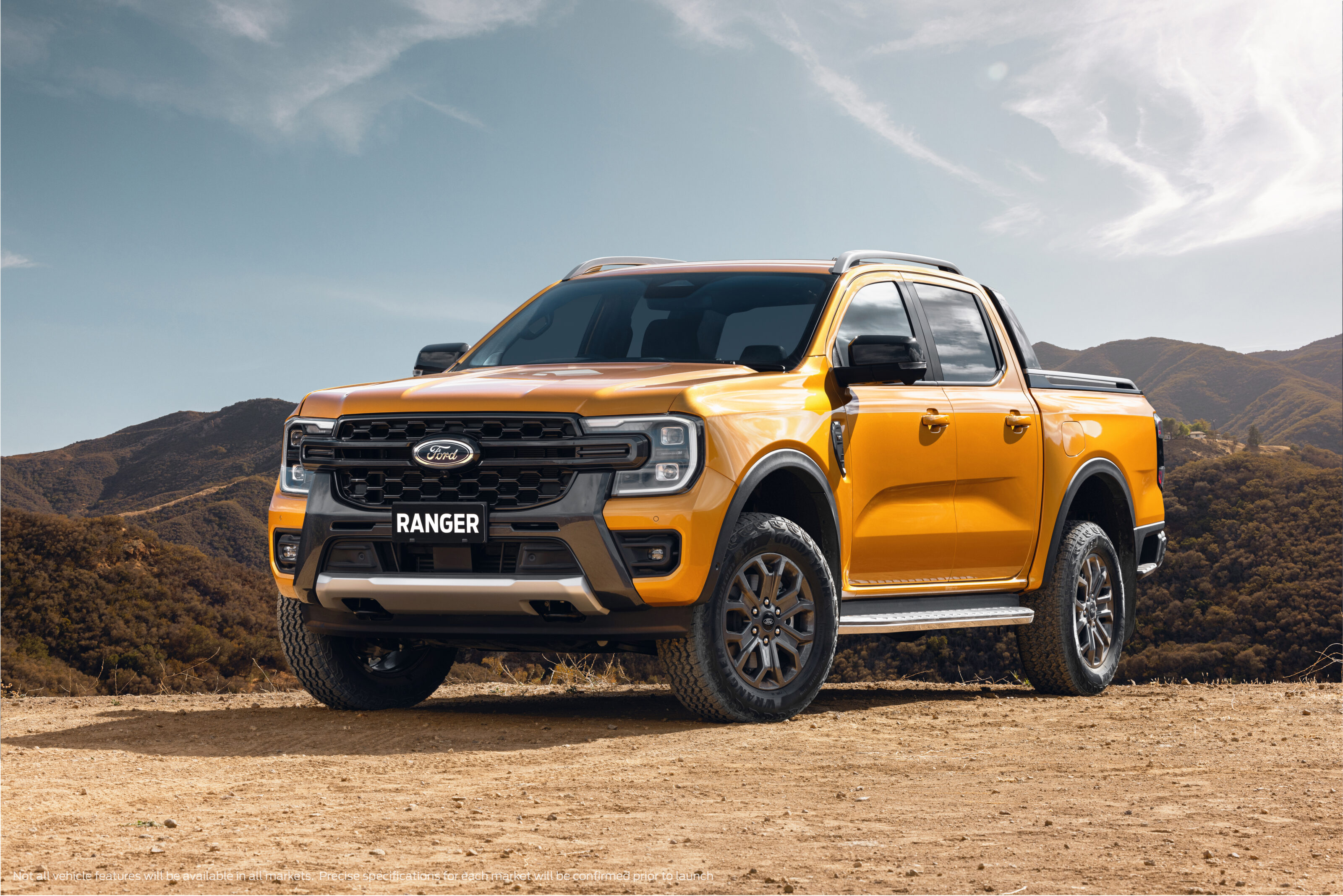
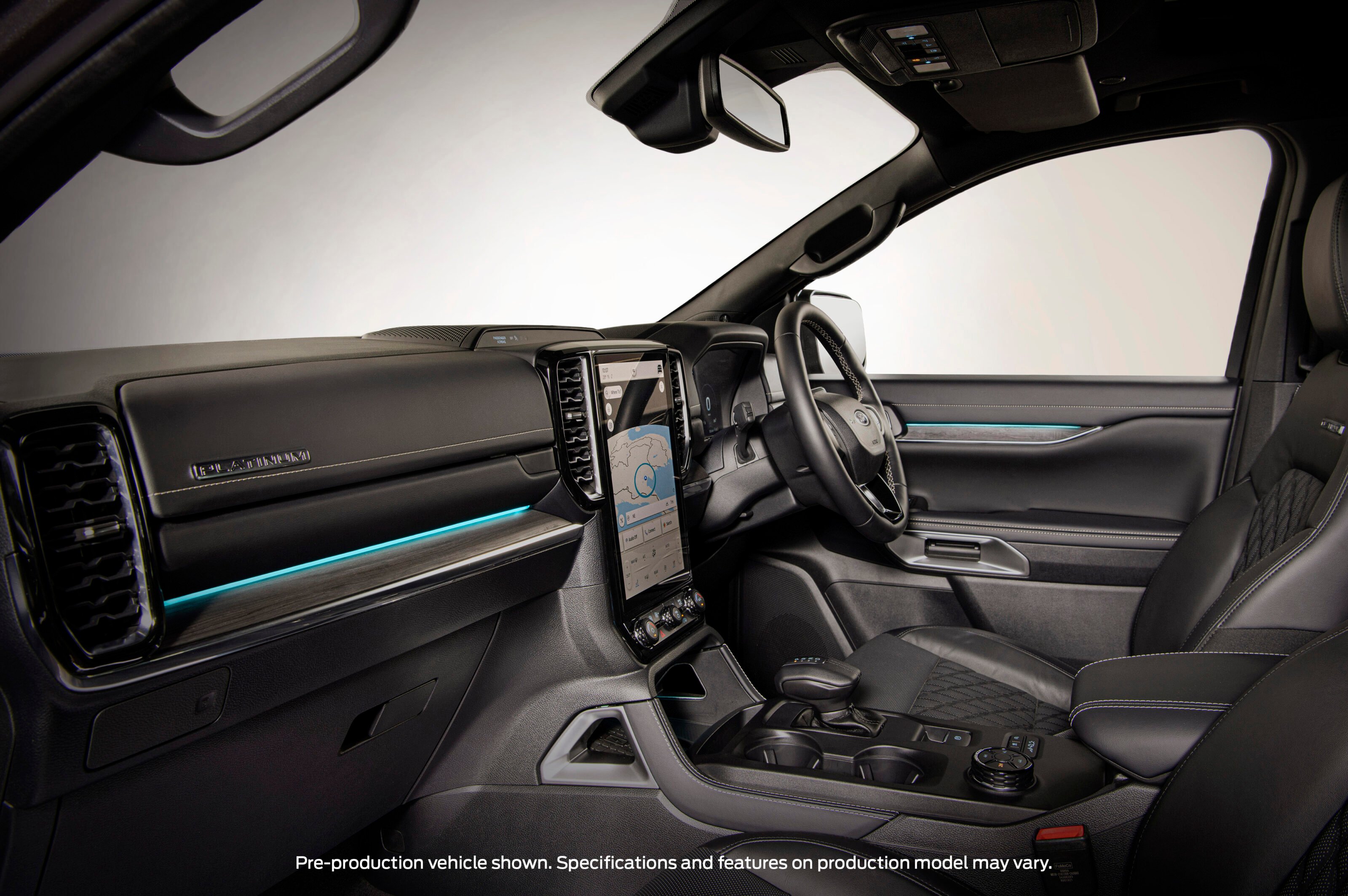
The next-generation 2023 Ford Ranger, Ranger Raptor and Everest will arrive in Aussie showrooms sooner than expected, the carmaker has confirmed.
Until now Ford had only indicted ‘mid year’ for its trio of new model releases, but we now know the calendar months each model will arrive.
First to land will be the new T6.2 Ranger, which will hit Aussie showrooms in mid-June. Hot on its heels will be the second-generation Ranger Raptor, due in the middle of July, while the Everest will arrive a month after that in mid-August.
UPDATE, September 13, 2022: New Ford Everest on sale, and we’ve driven it!
The new-generation 2023 Ford Everest is finally on sale in Australia, and our man Matt Raudonikis has driven it. Get the full story, and our first-drive video, at the link below.
UPDATE, July 2022: New Ford Ranger review – it’s here at last
The new 2023 Ford Ranger is now on sale in Australia, and the local media launch has been run. The Wheels and 4×4 Australia teams have both driven the new Ranger, and you can find their stories at the links below.
The story to here
Mercifully, despite growing speculation that arrival dates may have been pushed out due to the current industry-wide delays on production and supply, all three models are due Down Under imminently.
Speaking to Wheels at the pre-production drive of the second-generation Ranger Raptor in South Australia (keep your eyes peeled for our Raptor review, which will go live in the coming weeks!), Ford executives confirmed the timing and added it’s confident all three models will have strong supply.
“We’re in a good spot,” said a Ford spokesperson. “There’s been a big focus on ensuring we have enough supply given the huge interest in these vehicles, but we’d always want more of course. Based on feedback from our dealers interest has been very high.”
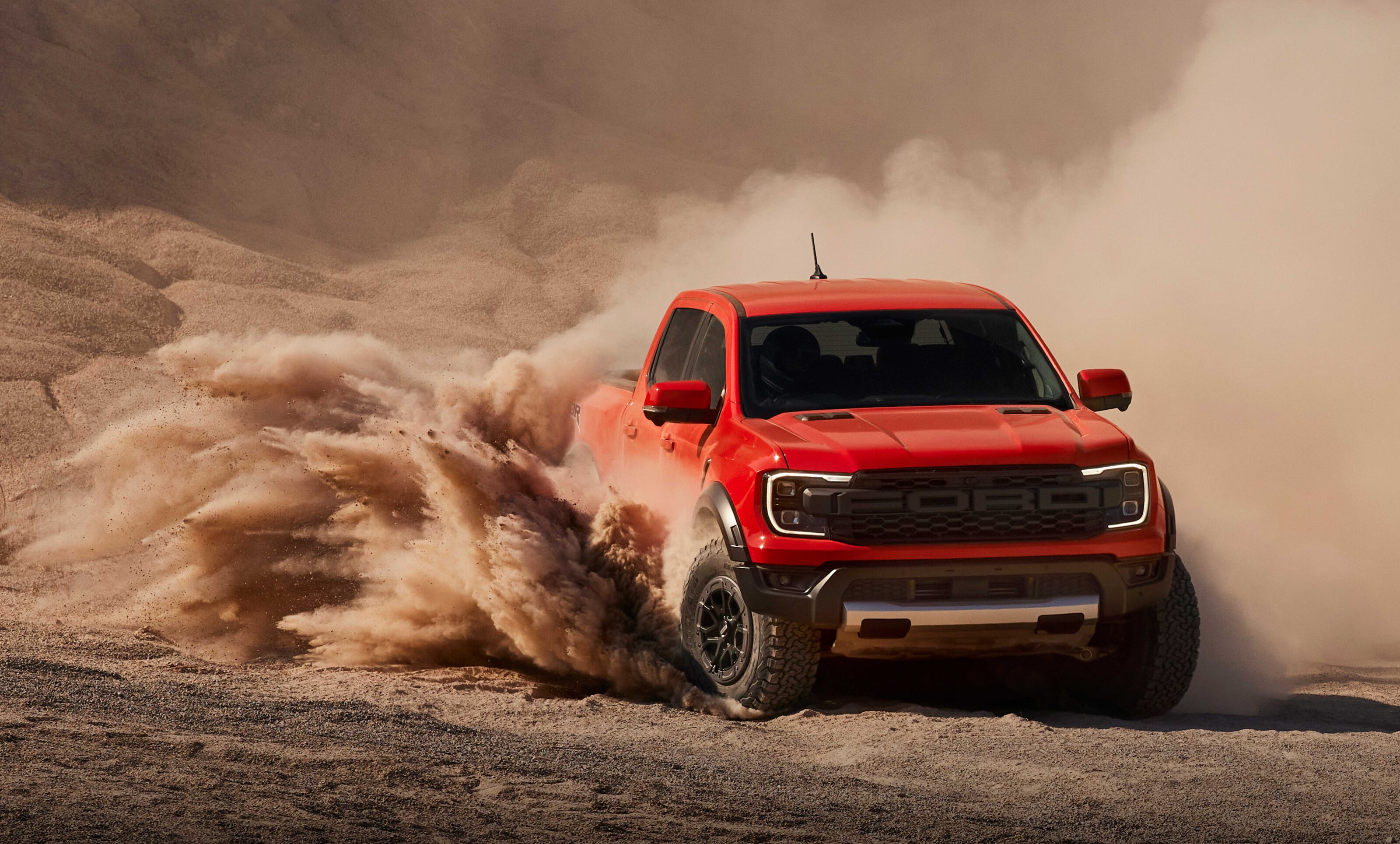
Most of that interest has been in the higher-spec V6 models, says Ford, with the Ranger Wildtrak V6 and Ranger Raptor attracting the most attention from prospective buyers, at least initially.
Pricing for all three new models is yet to be released, although Ford did say the cost of the regular Ranger range is due “within weeks”. Modest price rises are expected across the board. If you want to read the full details of the new Ranger’s Aussie line-up, read our story here.
For those of you hunting a bargain on an existing Ranger or Everest, get in quick: dealer stock of those vehicles will soon dry up. Production of the current Ranger is due to end imminently in Thailand, while the Everest is expected to finish in May.
And be sure to keep checking whichcar.com.au for our review content on the new-gen Ranger and Everest. Media drives are planned to take place roughly a month before customer cars start to arrive.
Three pedals good? BMW’s G80 M3 offers old-school charm in a very modern way to claim the final podium step at MOTOR’s Performance car of the year 2022.
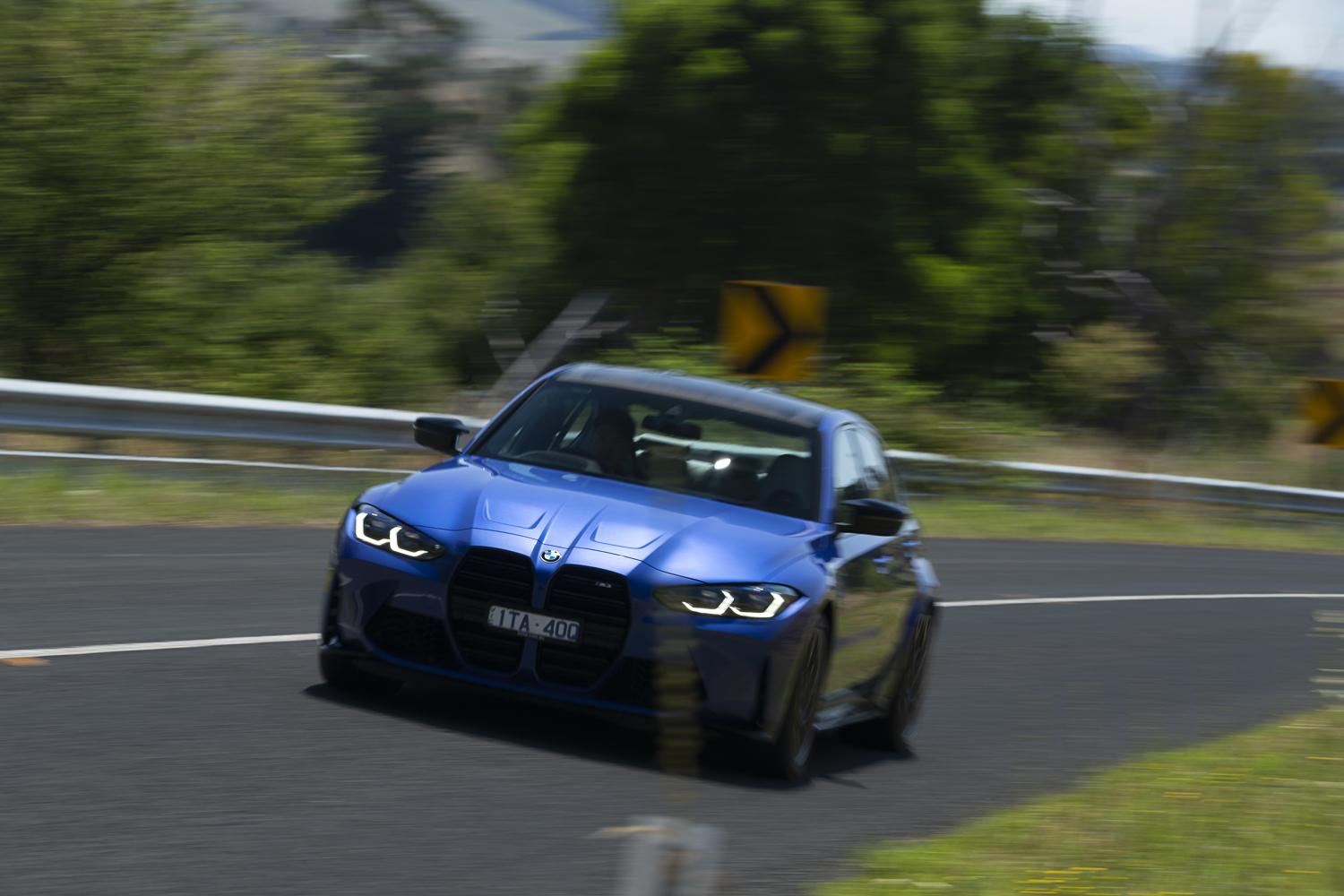
How does a mechanical entity devoid of human emotion make us feel so deeply? By the end of PCOTY 2022, this is the kind of philosophical question the G80 BMW M3 has taxing the minds of some of our judges. In a field littered with automatic and dual-clutch gearboxes, the Bavarian stands resolutely as the only one wielding three pedals and a stick.
Yet, until day three of the event, the M3 light was hidden beneath a bushel, the mundane southward commute not bringing the best out of the Bavarian. Bernie Quinn, having driven the manual Bimmer from Melbourne to our country Victoria base was one of its harshest critics, moaning of a boomy cabin and lacklustre low-speed theatre. Given the history at play here, it’s a hard concept to fathom that the hero four-door hadn’t created much of a first impression.
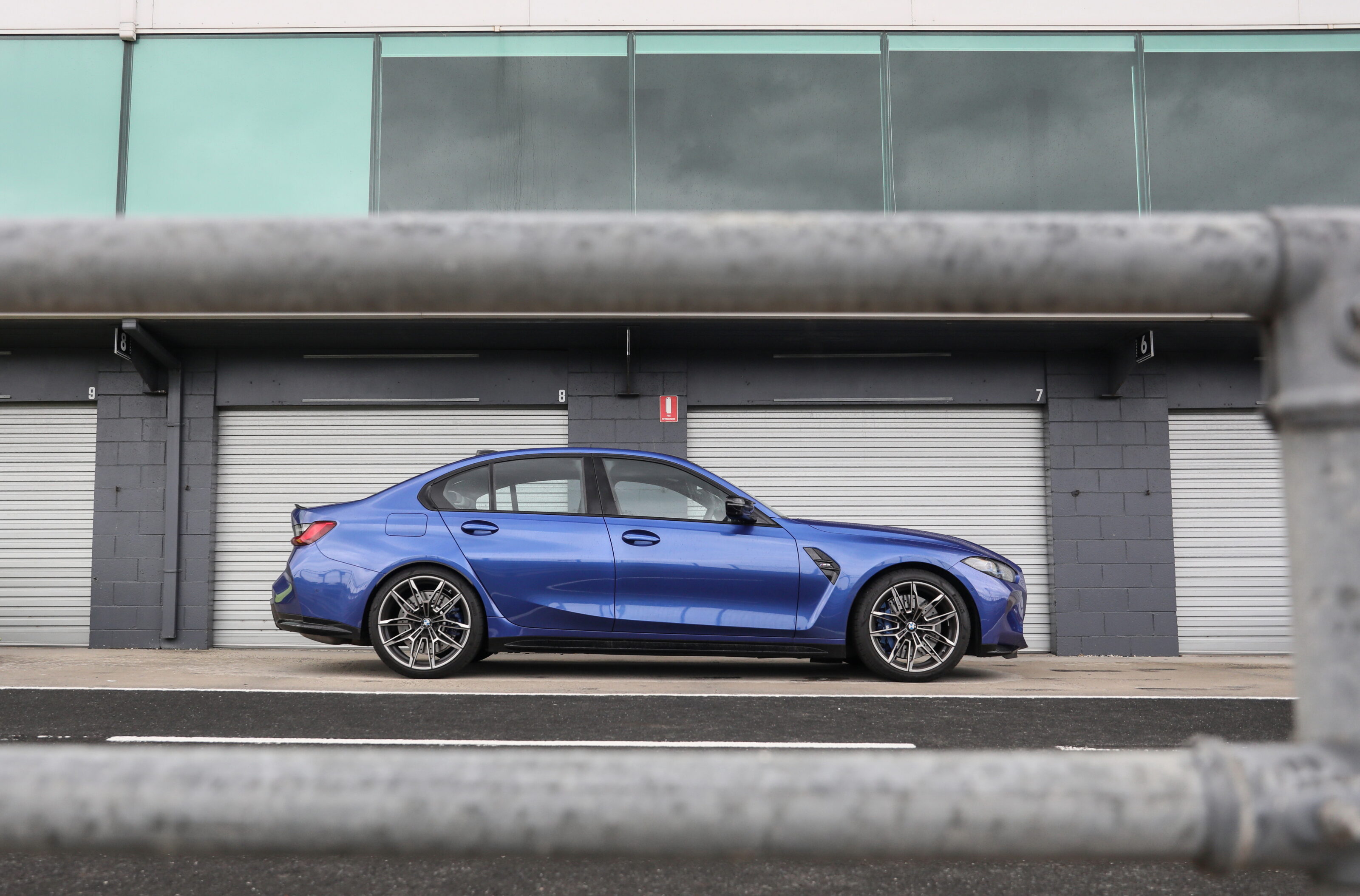
However, as is often the case at PCOTY, there’s a lightbulb moment where everything finally clicks. And in 2022, the realisation that the six-speed manual M3 is something to savour fell like a tonne of bricks. You just had to look at the beaming smiles and hear the string of shocked expletives from each judge as they exited the car after completing the road loop to know we were all starting to believe in the M3. Backflipping on his initial thoughts, Bernie confessed that the M3 had shown an “immense depth of talent”.
As a performance car for the road, there’s precious little to fault. To whit, the NVH levels could be better suppressed, the steering needs a final veneer of tactility and the six-speed manual’s shift action is a little rubbery. That’s about it.
The new 3.0-litre twin-turbo straight six provides prodigious grunt that’s translated to the rear 285-section Pirelli P Zero tyres. The S58 is a powerhouse (353kW/550Nm) and provides not only top-end grunt, but a deep well of mid-range torque to tap into with the appropriately geared six-speed manual.
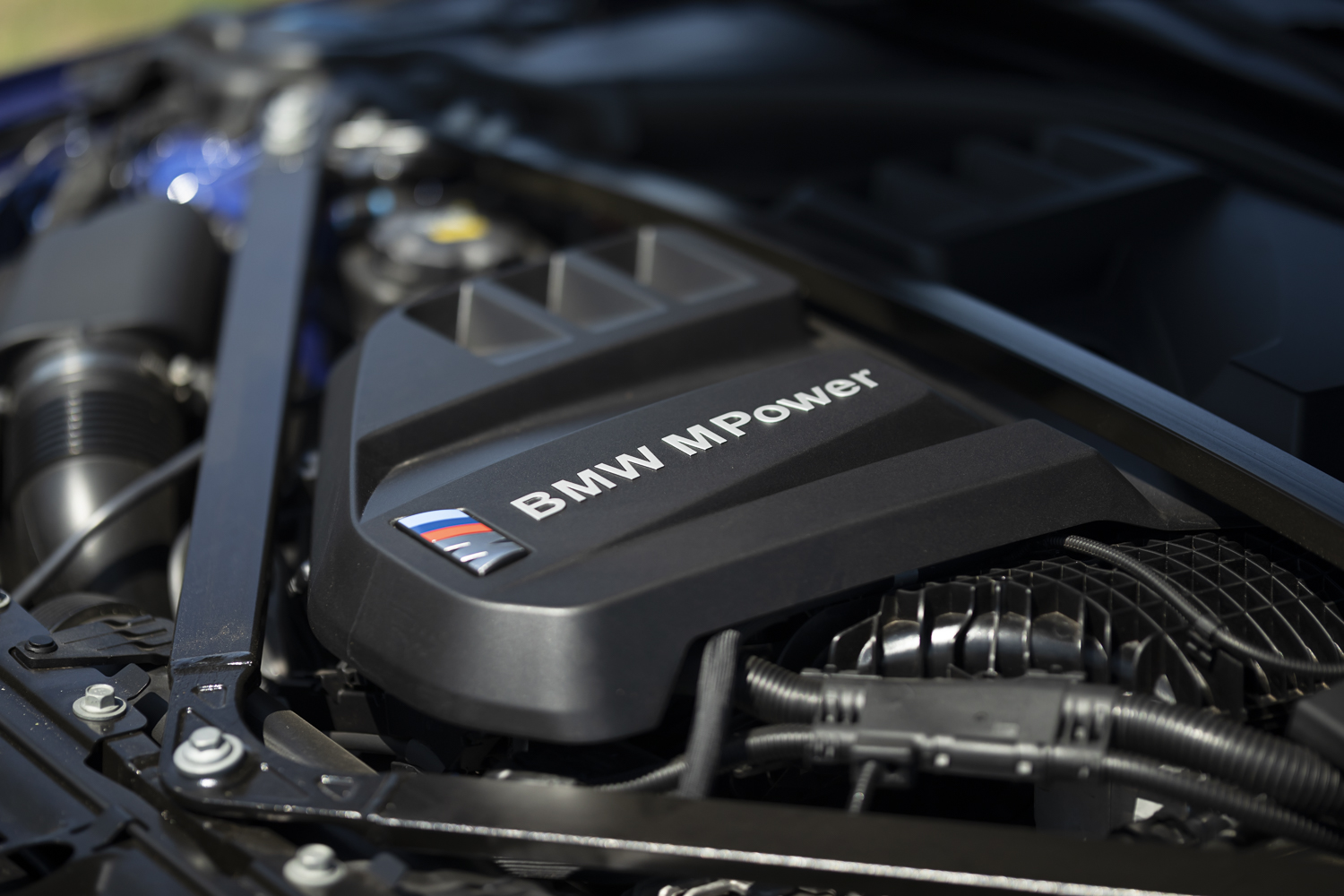
There’s a slight irony in that you don’t have to row through the ratios on road, with third gear being the default. “At speed it all comes together,” says Affat. And I couldn’t agree more. On the road loop, the M3 impresses with its involving nature, with its well-placed pedals inviting sharp heel-and-toes.
The front end turns in crisply, after which you’re presented with choices on how the rear axle follows. Instances of yaw are generally controllable thanks to the limited-slip rear diff, but the fierce torque ramp of the S58 between 2250 and 3100rpm means that gearing up out of this zone makes for a more manageable transition from grip to slip. Beyond that, we all came away surprised with the added thread of predictability and nuance to the dynamic tapestry.
Then we arrived at Phillip Island. And boy did the M3 lay down an impressive lap time. We expected it to be quick, but not that quick, finishing third with a time of 1:45.04. To be within two seconds of the Huracán is a mighty achievement. The front end, with its industrial bracing and wide 275-section tyres, felt unflappable and the sound it made blasting down the front straight was intoxicating.
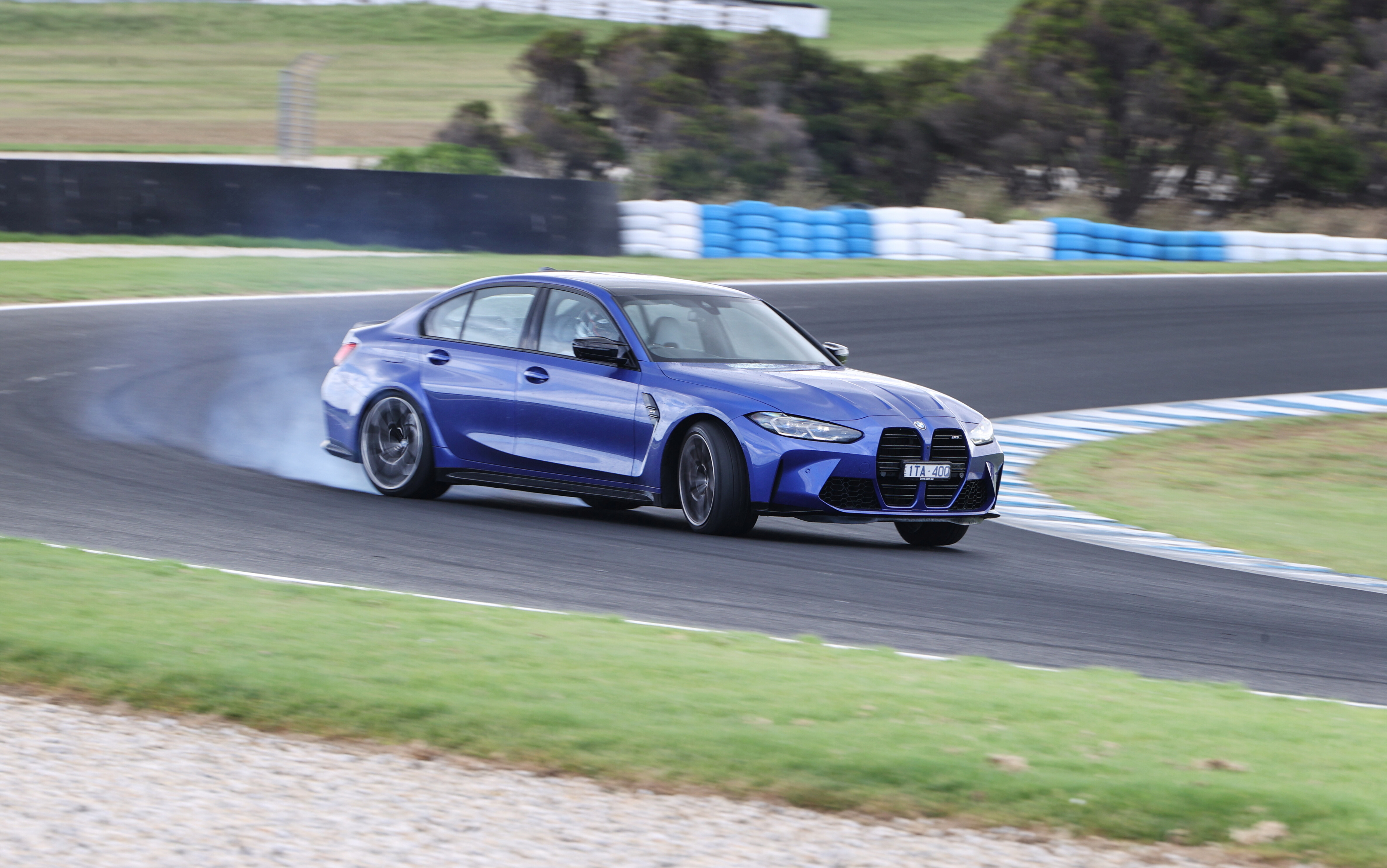
However, just like on the road, don’t take too many liberties. You still need to be engaged in the process or it will bite, despite the fact the well-tuned M Dynamic Mode is there to help save the day. There are also 10 stages of traction control to work through as well as the M Drift Analyser to reward/shame your efforts.
Overall, the M3 remains a car that insidiously gets under your skin in ways that many of its counterparts simply can’t. The manual G80 is now in a class of one when it comes to the hi-po German sedans. And by the end of the PCOTY week, no one was talking about that grille.
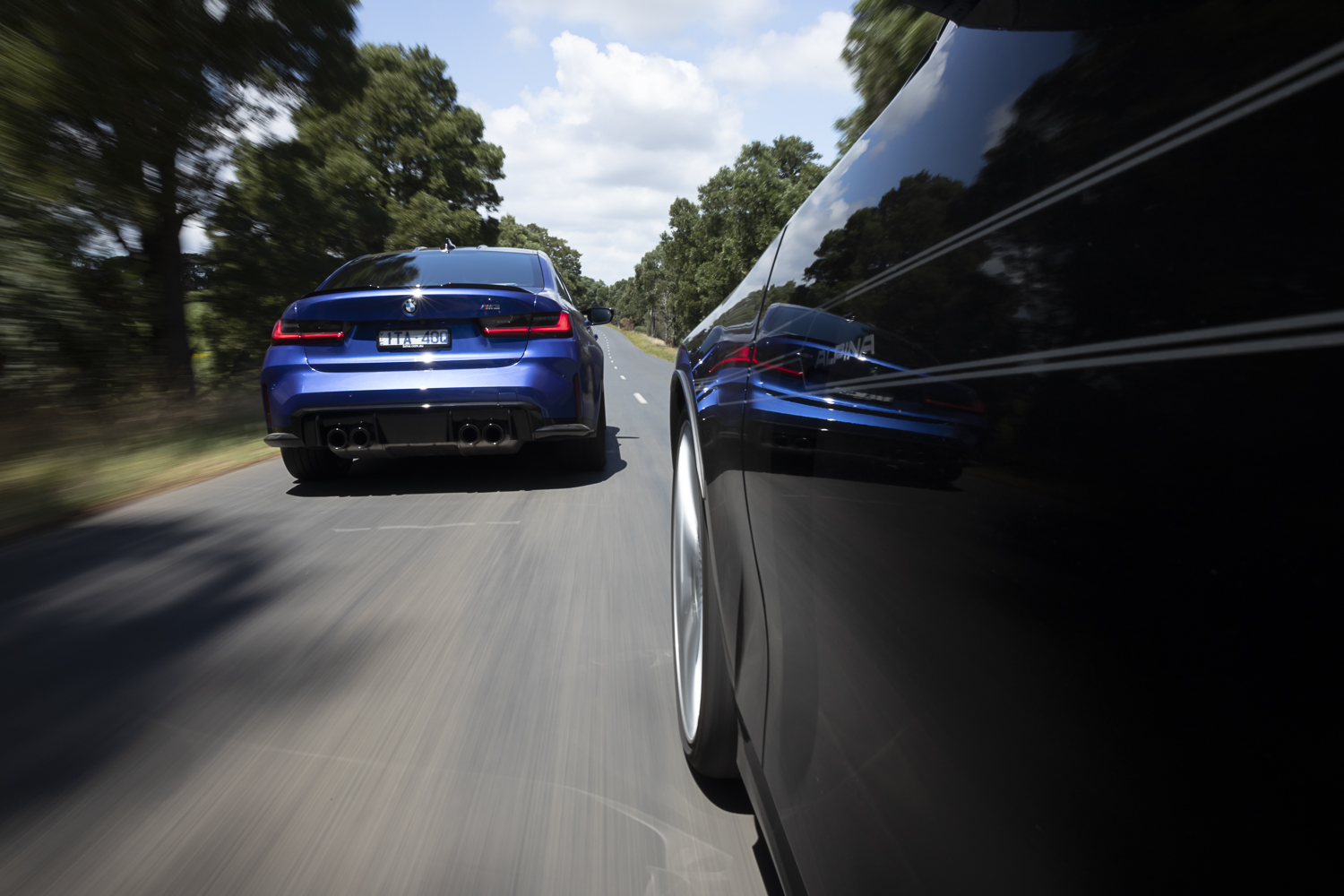
Instead it was all about the muscular rear haunches and how the 19-inch alloys (18-inch at the front) fill the pumped guards. It oozes purpose and intent externally, and the cabin isn’t short of purpose and drama, either.
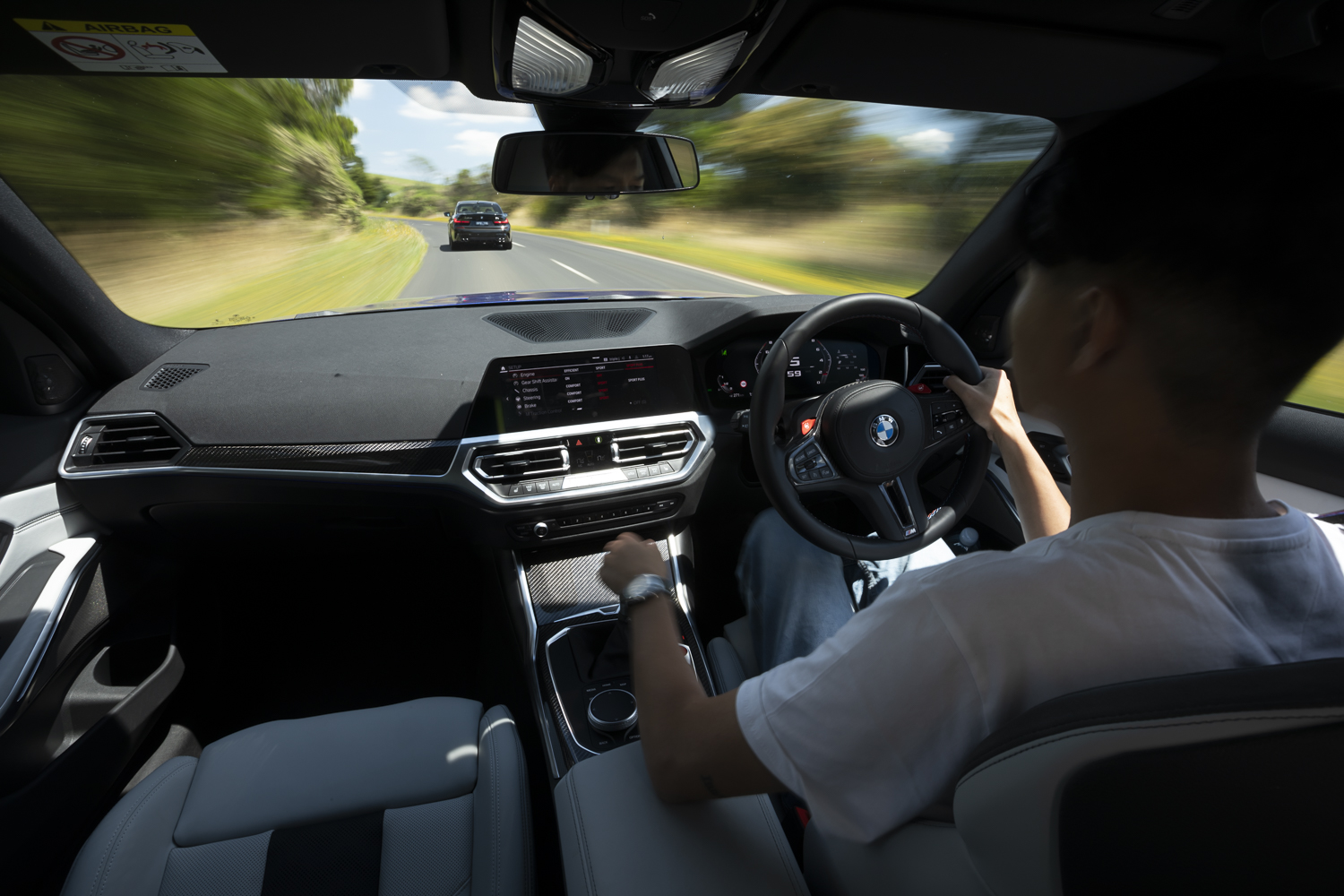
For me, one question remained. Were we approaching this with rose-tinted glasses and praising it solely for being a manual, rather than actually deciphering whether it’s a good manual? In the final judges’ chat Andy, who loves sheer effectiveness, couldn’t help but wonder how an eight-speed ZF auto-equipped, all-wheel drive M3 Competition would have fared against the timing gear around Phillip Island.
Could it have levelled with the Lamborghini? Maybe that’s another discussion altogether. Cars in this field aren’t just here because they’re fast. They’re here because we love how they make us feel. And love the M3 manual we do.
It’s easy to wax lyrical about the days of analogue connection and be seen as a luddite when viewed against the shift to electric propulsion. Yet, when an exemplar of the old school is as exciting, as involving and as flat-out excellent as this manual BMW M3, it gives you pause to ponder. Of all the cars present at PCOTY, the M3 feels like the one we need to cherish the most because the moments created in it might not last forever.
The judge’s comment
Alex Affat
“My initial thought was that this would be a better car with the auto. Oh, how wrong was I?”
Ranking: 4th
Andy Enright
“There are some great engines here at PCOTY, and the cheapest car has one of the very best”
Ranking: 2nd
Trent Giunco
“The most surprising thing? On road, the M3’s ride quality is good enough to almost cancel out the B3”
Ranking: 4th
Cameron Kirby
“With M Dynamic Mode on, you can take enormous liberties out of Honda and MG and you’ll feel heroic”
Ranking: 2nd
Bernie Quinn
“The platform is rock solid. The front end has seemingly endless grip. It refuses to understeer”
Ranking: 3rd
Luffy’s view
“On overall lap time, a paddle shift would have been a lot quicker. Not that there’s anything wrong with a 1:45.04”
The key figures
| 0-100km/h: | 4.75sec |
|---|---|
| 0-400m: | 12.91sec |
| LAP TIME: | 1:45.04 |
Convincing someone that electric vehicles are exciting is not hard. Chuck them the keys to a Rimac, point them at the nearest circuit and you can be certain they’ll be flying the zero-emissions flag for the rest of their days. But the conversion becomes a little more challenging if you don’t have access to one of the world’s fastest EVs and a private race track – and it’s made harder still by motorsport.
Most car manufacturers are transitioning into majority (if not exclusively) purveyors of EVs, claiming that the brightest future is electric. And yet, when the weekend rolls around, race tracks are a cacophony of combustion. At worst it’s hypocritical; at best it’s simply inconsistent.
Either way, petrol power in motorsport is damaging the message that battery is best.
This awkward paradox was sitting uncomfortably with Spanish entrepreneur and Formula E founder Alejandro Agag who picked up the phone to former racer Gil de Ferran and hatched an extraordinary solution – Extreme E; a revolutionary racing series that has categorically shattered the traditional motorsport model as we know it.
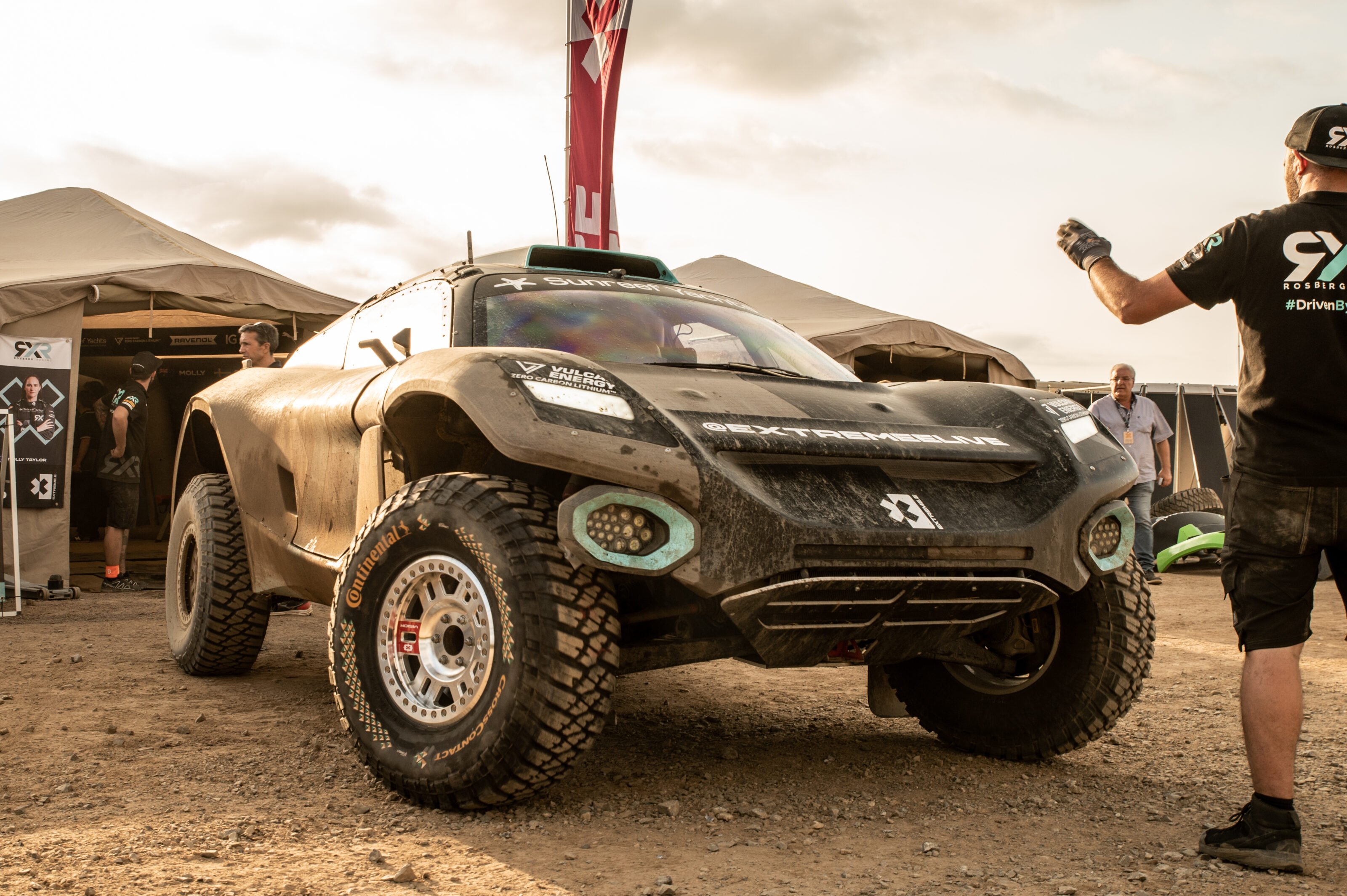
Like its circuit-bound sibling series Formula E, Extreme E is an all-electric competition, but that’s just the start of its mould-breaking approach. In a bid to shrink its carbon footprint as much as possible, the fleet of race cars are not flown between each location around the world, but loaded onto the St Helena – a retired mail ship that once served the island of the same name. The 105-metre vessel also serves as accommodation for the crews in remote locations and even has its own laboratory to conduct scientific research in the various race sites around the world.
Racing venues are selected in regions impacted by climate change, while the Legacy Program provides social and environmental support long after the racers have gone.
Aside from the environmental awareness, Extreme E is also addressing the gender imbalance in motorsport – of each two-person driver pairing, one must be female. It’s this holistic review of how global motorsport works that is drawing significant attention and the reason I’ve arrived at a NATO base in the south of Sardinia for a look behind the scenes. What awaits is extraordinary.
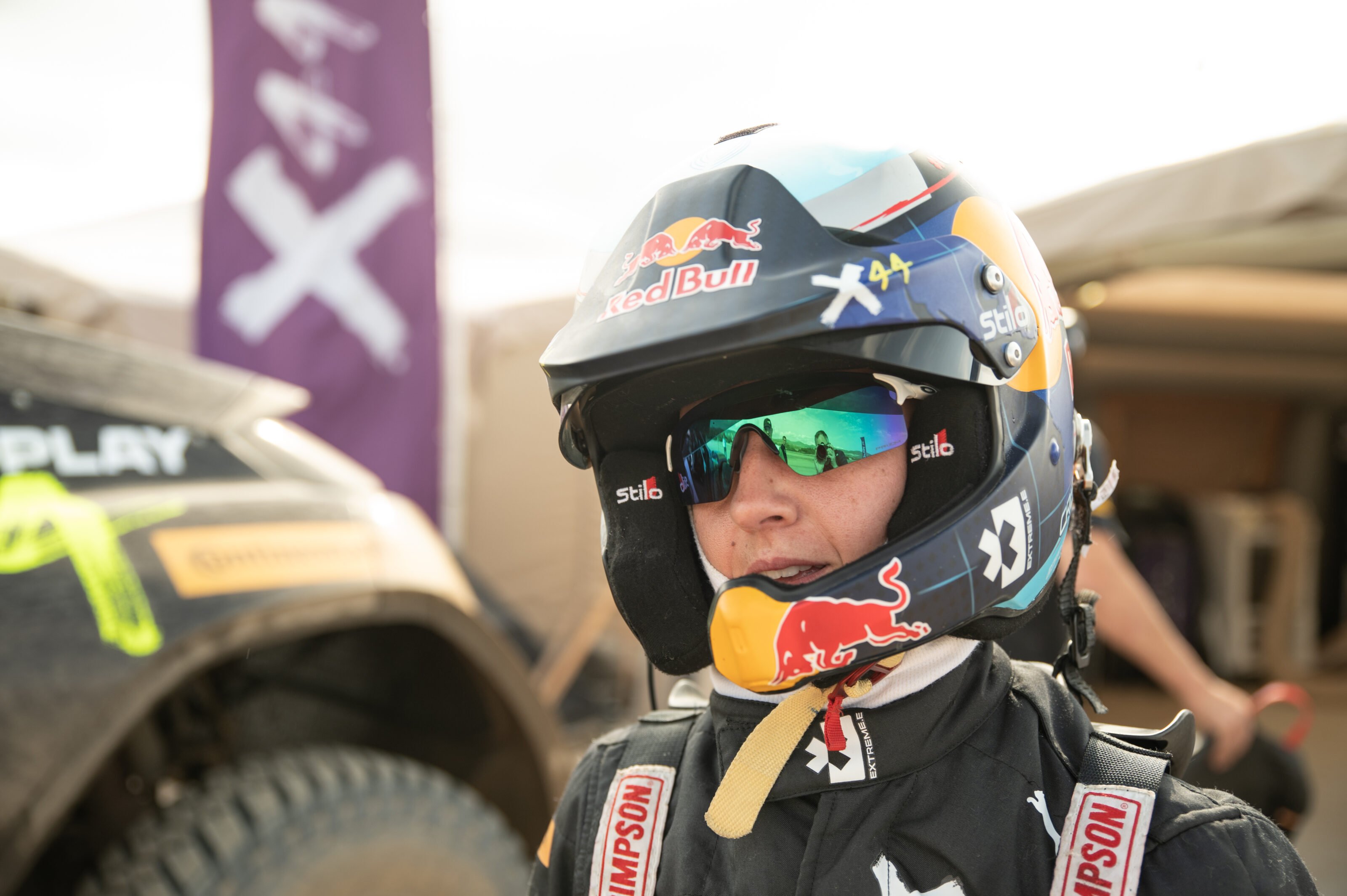
Just a few weeks prior, this was an expanse of shell-scarred heathland used for tank battalion target practice, but today it has been transformed into a tiny motorsport village. A row of ingenious inflatable tents provides the service park and garages while more conventional temporary structures have popped up to create catering, operations and media centres.
At the top of a nearby hill, infinitely more palatial and luxurious canvas tents have formed an oasis for the VIPs and sponsors. General admission is not an option (the carbon emissions generated by spectators traveling from miles around deemed not in keeping with the Extreme E mantra) but an exception is made for those who are footing most of the bills.
The ambiance is a strange combination of natural disaster without the cholera; Fyre Festival without the fraud. Unaccompanied access to the site itself is not allowed; instead of our trusty Cupra Formentor, photographer Tom and I are loaded into an Iveco VM 90 military truck and ferried out across the plains.
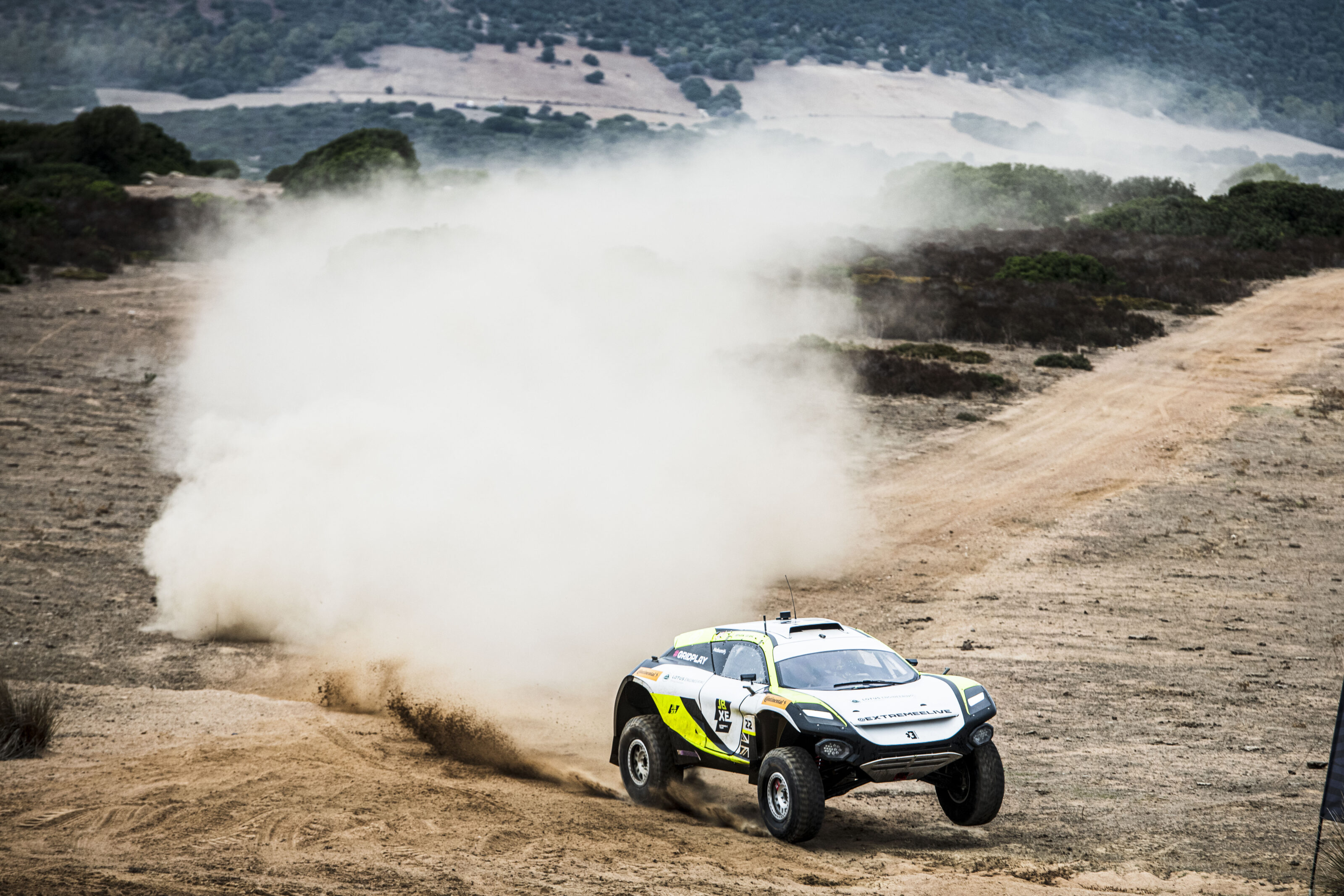
We’re almost immediately caught by a convoy of AAV-7 amphibious tanks blasting along the trails. They’re not after us but it’s a deeply intimidating moment. Together with the hot, dust-filled cabin and bone-shaking ride of our truck, I finally feel like one of those ‘proper’ journalists who file from war zones.
Crashes, scuffles and rolls are common and often big, with cars going wheel-to-wheel and bumper-to-bumper from the start line
The short trip along a network of trails illustrates exactly how tough the racing will be. The cars must negotiate two laps of a set off-road track measuring approximately 10km but the course is not groomed or prepped in any significant way – similar to rally raid competitions. In addition to the relatively short distance however, Extreme E differs with up to five cars starting simultaneously, and the driver must ‘switch’ with their teammate at the end of the first lap.
The drivers have 45 seconds to complete the swap – any longer and it eats into the lap time offering a potential advantage to the other teams. It’s one of many ways a race can suddenly evolve and flip everything on its head – literally.
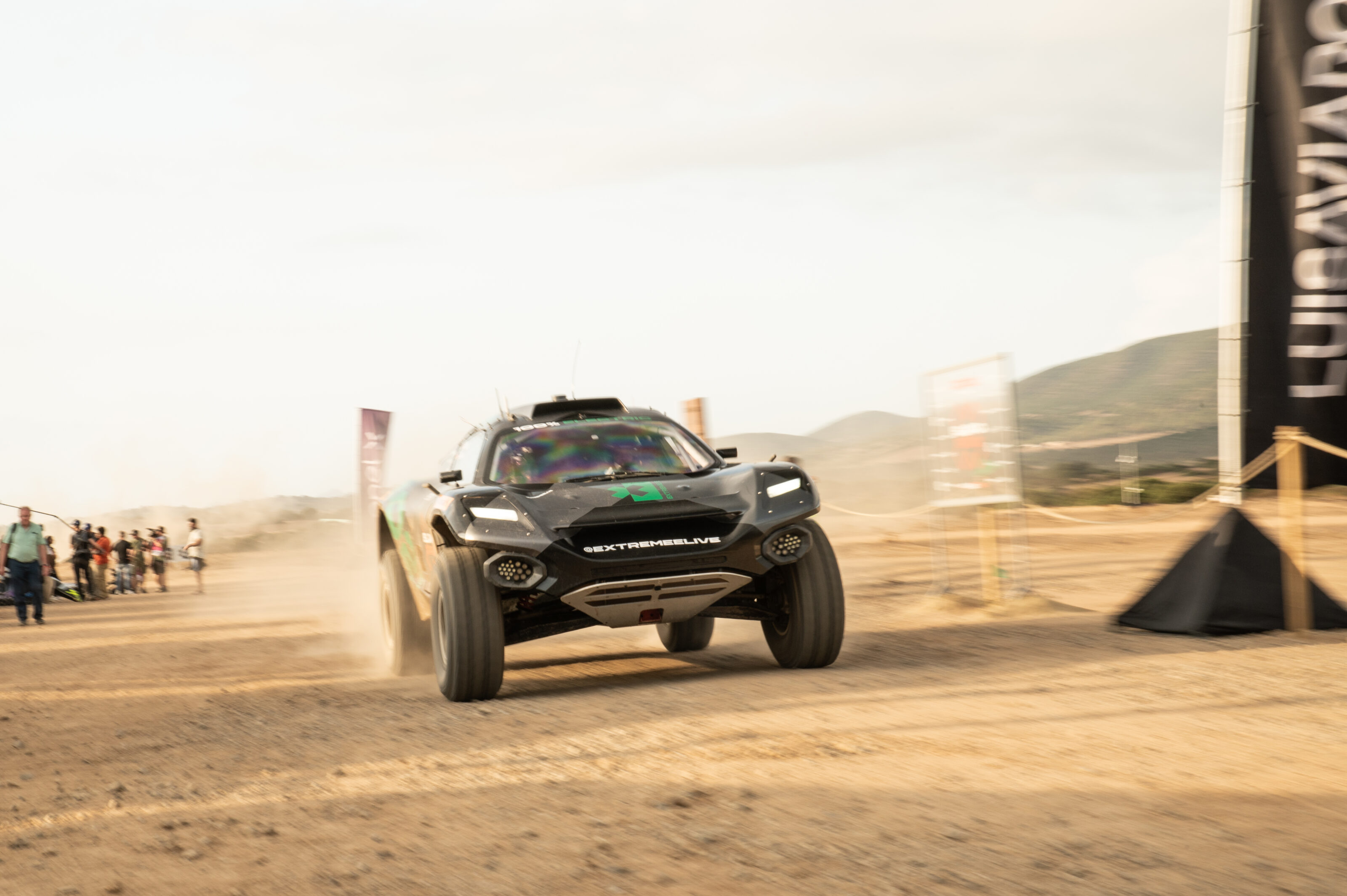
Crashes, scuffles and rolls are common and often big, with cars going wheel-to-wheel and bumper-to-bumper from the start line. Watching the two-tonne racers dash from the start has much of the aggression of Rallycross but with a backdrop that’s so naturally stunning it verges on distracting.
The first race dubbed the Desert X Prix took on the towering sand mountains of Al-’Ula in Saudi Arabia; after that, Senegal provided the location for the scorched Ocean X Prix. Next, the series headed from the heat to the cold of Greenland’s rugged and hostile landscape for the Arctic X Prix before the Sardinia Island X Prix.
Actually, Patagonia and the Amazon were originally locked as the final two locations but the unfolding COVID-19 pandemic forced organisers to find alternatives at desperately short notice. And when you need to establish an entire community in just days there’s one organisation that specialises.
It’s no coincidence the final two rounds of Extreme E were hosted by the military. The combined efforts of Extreme E’s global roadshow and NATO were almost as impressive as the Sardinian surroundings. From the slick TV and web broadcast, Extreme E might seem like a simple matter of dumping some SUVs in the middle of nowhere and lighting the touch paper but there is a vast amount that never makes it to the screen.
When organisers realised the local wildlife was getting a little too close for comfort, the army scrambled troops and erected a temporary perimeter fence, which might be relatively easy if your event is a farmer’s market but for Extreme E it meant constructing about eight kilometers of temporary fence – in two days.
A fleet of about 30 coaches parked apparently idle was another example. The explanation? If an electrical storm strikes this open plain there’s nowhere to go so the convoy of buses were hired as mobile Faraday chambers for every person on site just in case the weather turned as lively as the cars. Other signs of military muscle included a Bell Huey medevac helicopter. Its pilots took great pleasure in departing each day via a very, very low pass of the service park.
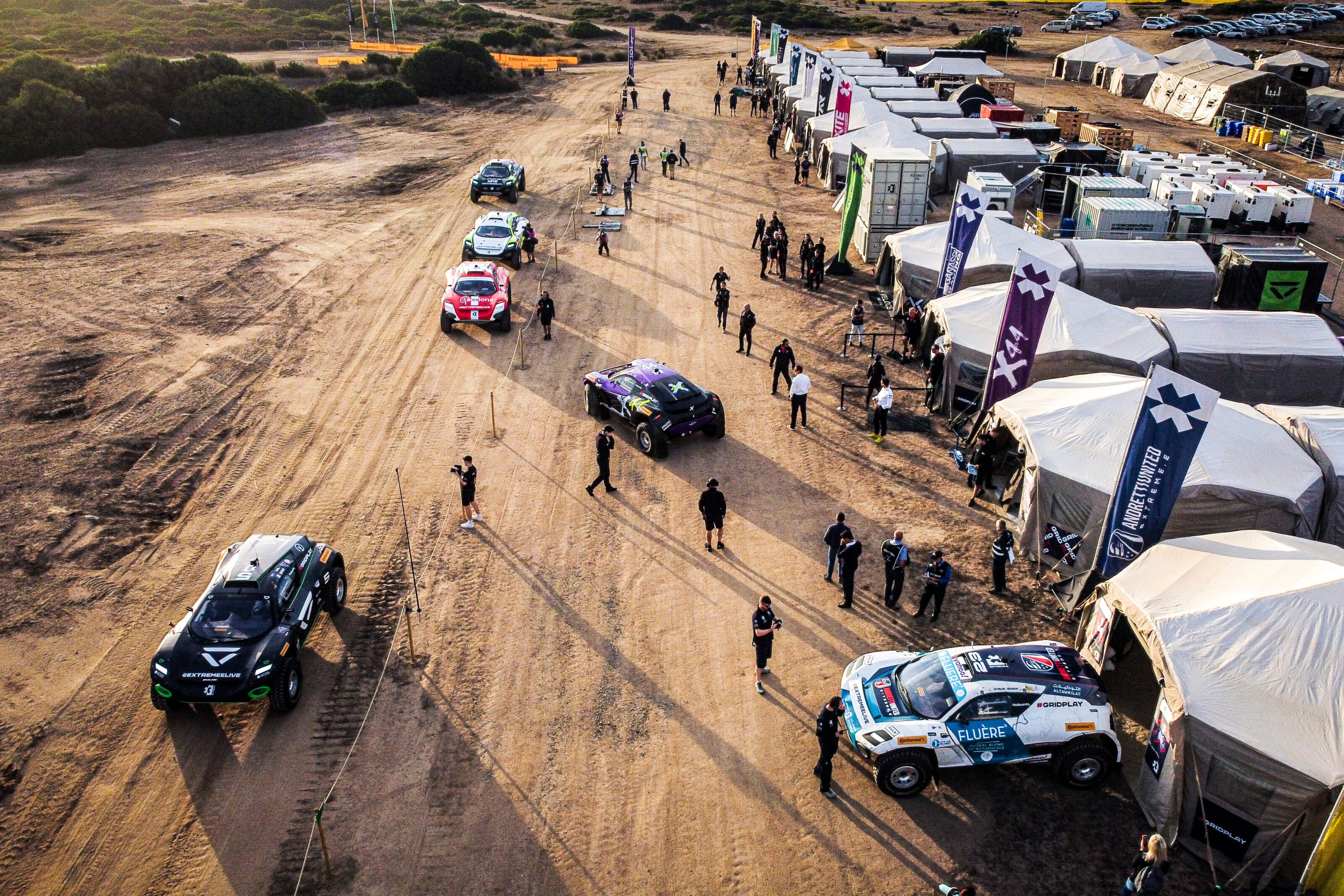
It doesn’t take long wandering the canvas alleys to find more evidence this series is radical in almost every way. Electricity for the cars is generated on-site using a 40kW fuel cell, while the hydrogen required is even manufactured and stored on site using cutting-edge nickel-hydride electrolysers. Any surplus power is either stored or fed into the site grid to power other electrical systems and supplemented by solar banks.
In one of the garages there’s another confronting reminder that these cars are different. Each team has special extraction kits used to remove a driver from the car if a short circuit is suspected following a crash. Small LEDs on the tail and dashboard of each car illuminate green when the cars are live but safe, but it they should change red at any point there’s a chance the massive battery is feeding power somewhere it shouldn’t.
Under these troubling circumstances, the drivers are trained to stay in the vehicle until an extraction team arrives and, if that’s not possible, jump from the vehicle without touching the floor.
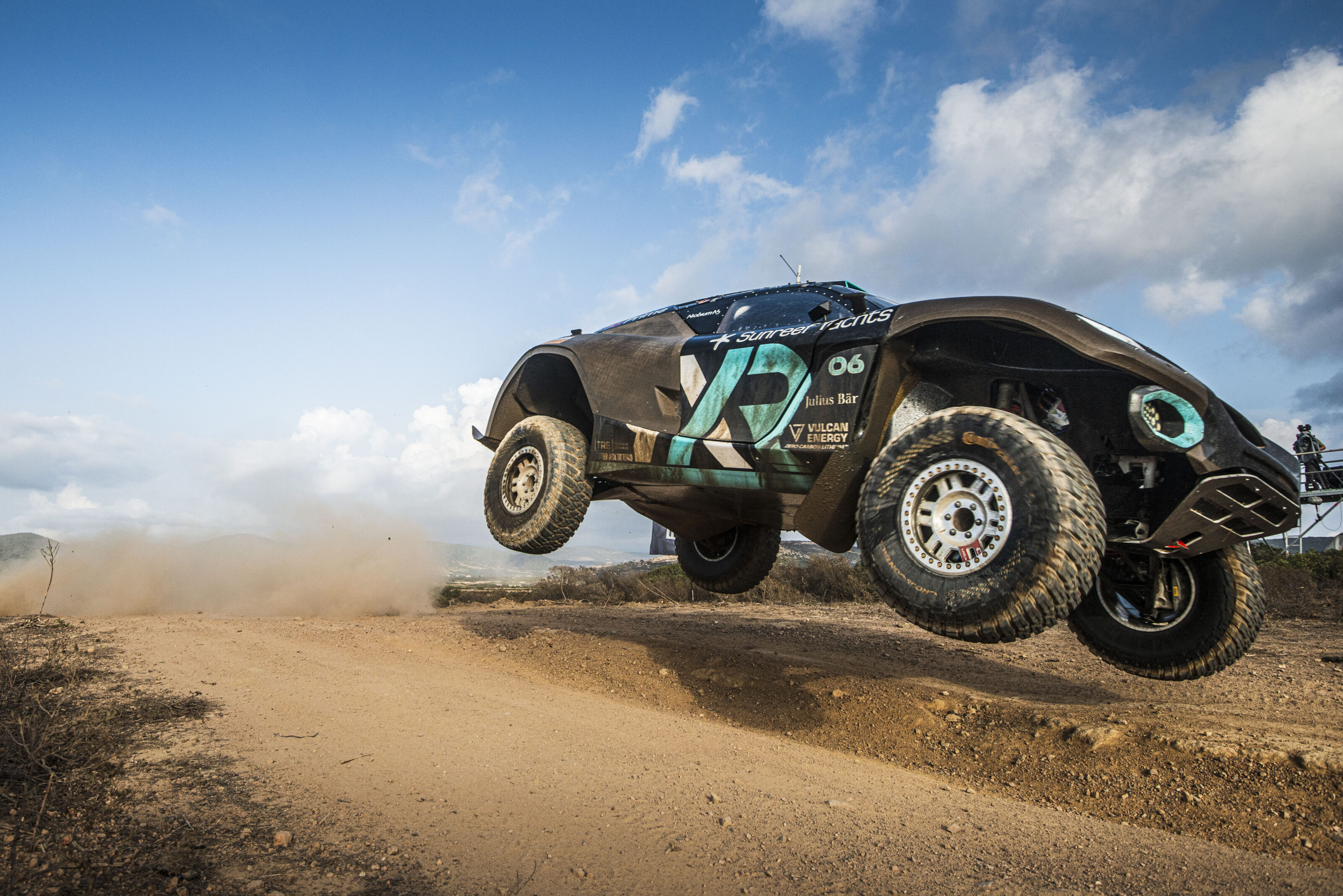
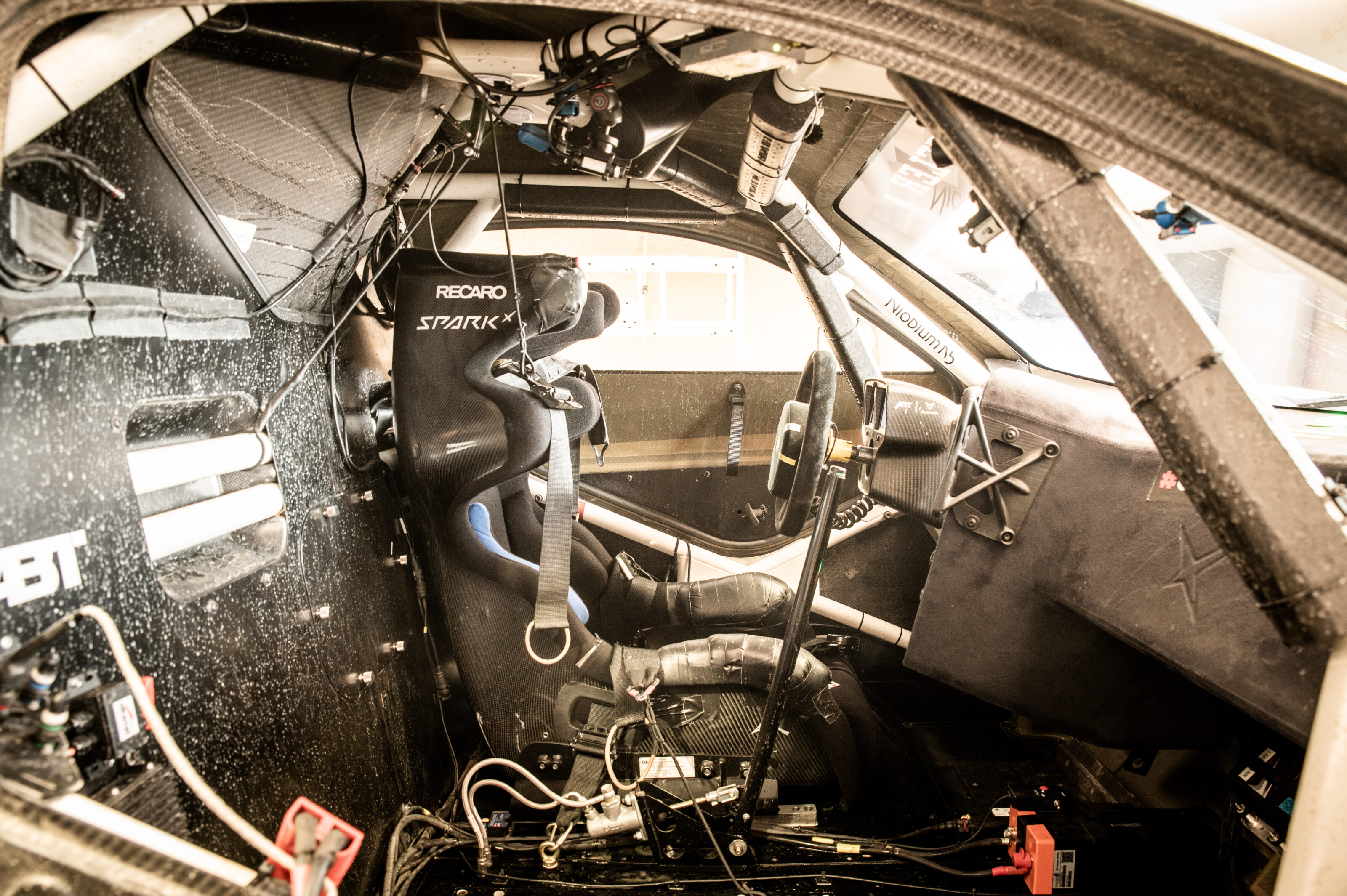
The cars are an example of not just pioneering technology, but the result of an amazing engineering collaboration. If the Odyssey 21 were to wear a bonnet badge it would be Spark Racing Technology – the French EV specialist that developed and built the fleet of off-road racers. But they didn’t do it alone.
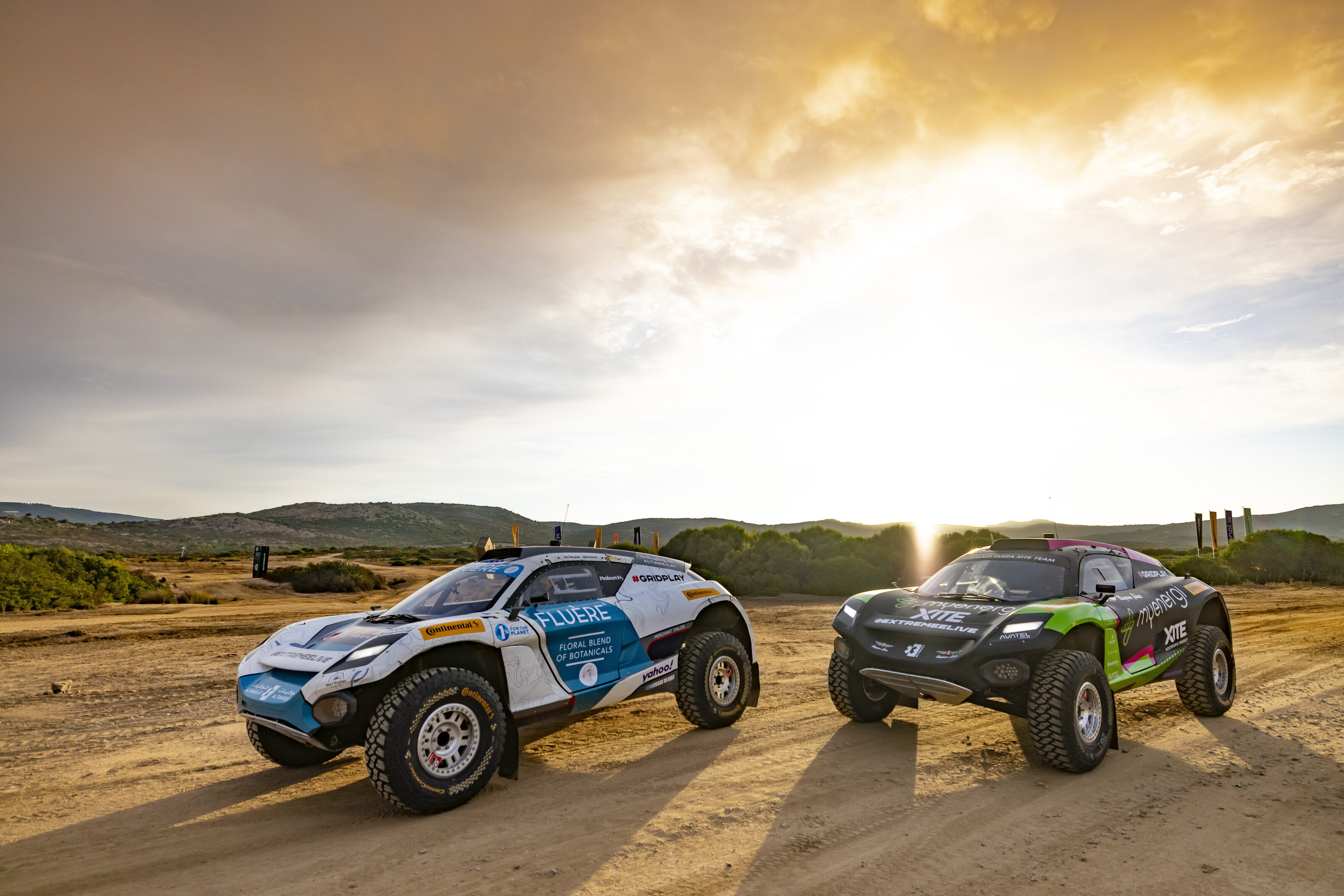
Niobium N5 provided the spaceframe chassis constructed using its lighter, stronger but small-carbon-footprint steel. The 54kWh lithium-ion battery is courtesy of Williams Advanced Engineering and is similar to the unit used in the Formula E cars. Continental developed a specific tyre for the series with two compounds on offer depending on the conditions. Even the bodywork is made using Bcomp flax fibre composite for a shell that’s tough but green.
The exact cost of each car has never been officially confirmed but the general consensus seems to be around the €1,000,000 mark (A$1.6m).
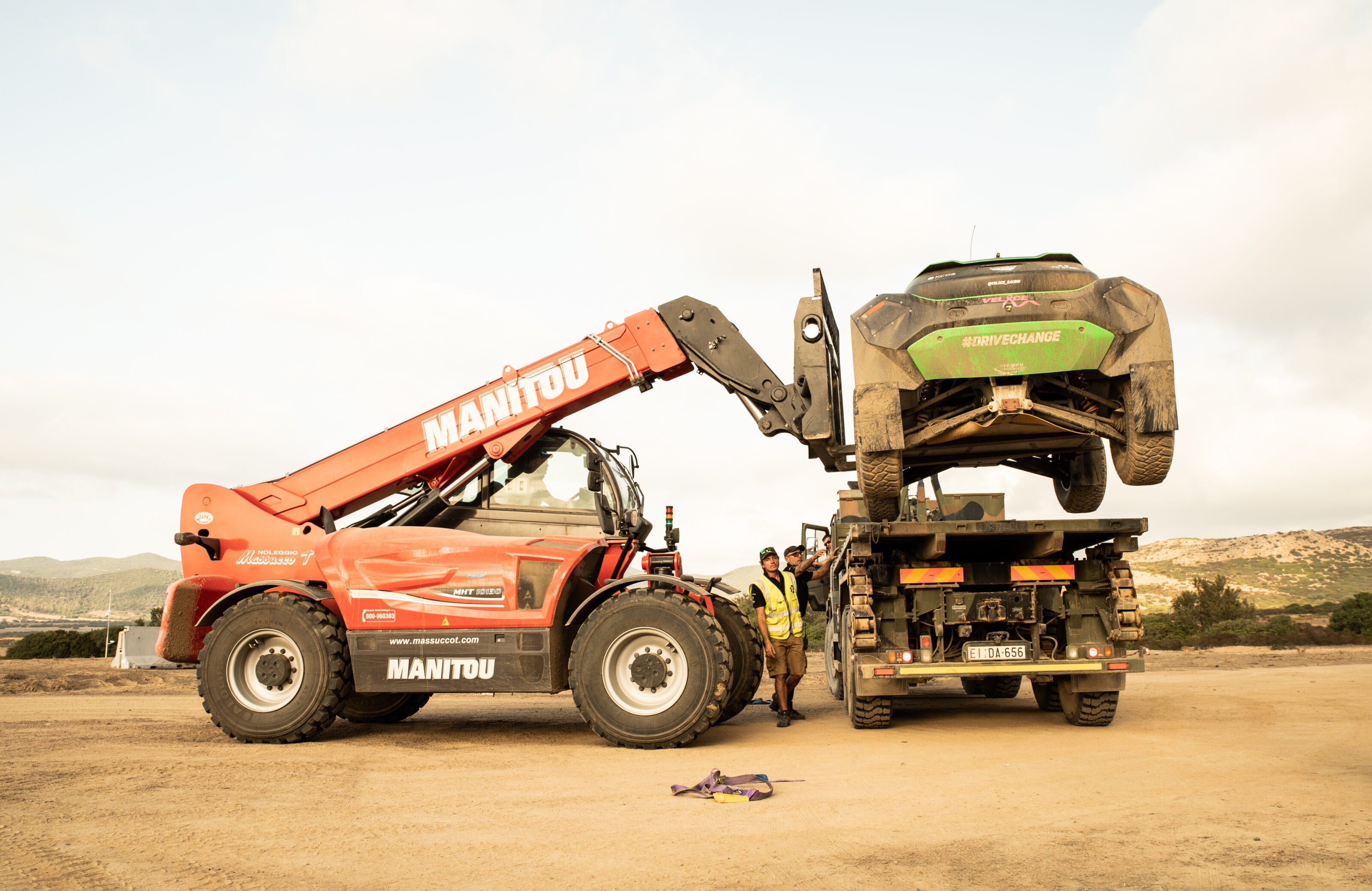
When I finally get to explore one of these extraordinary machines it’s a little overwhelming. In photographs, there’s something insect-like about the Odyssey 21, but in the metal it’s decidedly paleolithic and absolutely massive. Measuring 2.3 metres wide and more than 1.8 metres tall, the Odyssey 21 has an incredible presence, but their almost-silent creeping around in the service area rather than barking with race engines almost makes them more unsettling and unnerving. They certainly deserve respect.
The AWD powertrain packs 400kW from a pair of electric motors, while a complete car weighs in at 1780kg for roughly the same power and weight as a Nissan GT-R, but with 385mm of suspension travel and tyres almost a metre in diameter.
As the nine different teams start completing practice and qualifying laps, it becomes clear what the bundle of zero-emissions technology is capable of. Zero to 100km/h acceleration is said to be around 4.5 seconds, but it’s hugely variable and dictated by the surface. Either way, there’s something about the way these monsters take off that doesn’t look possible.
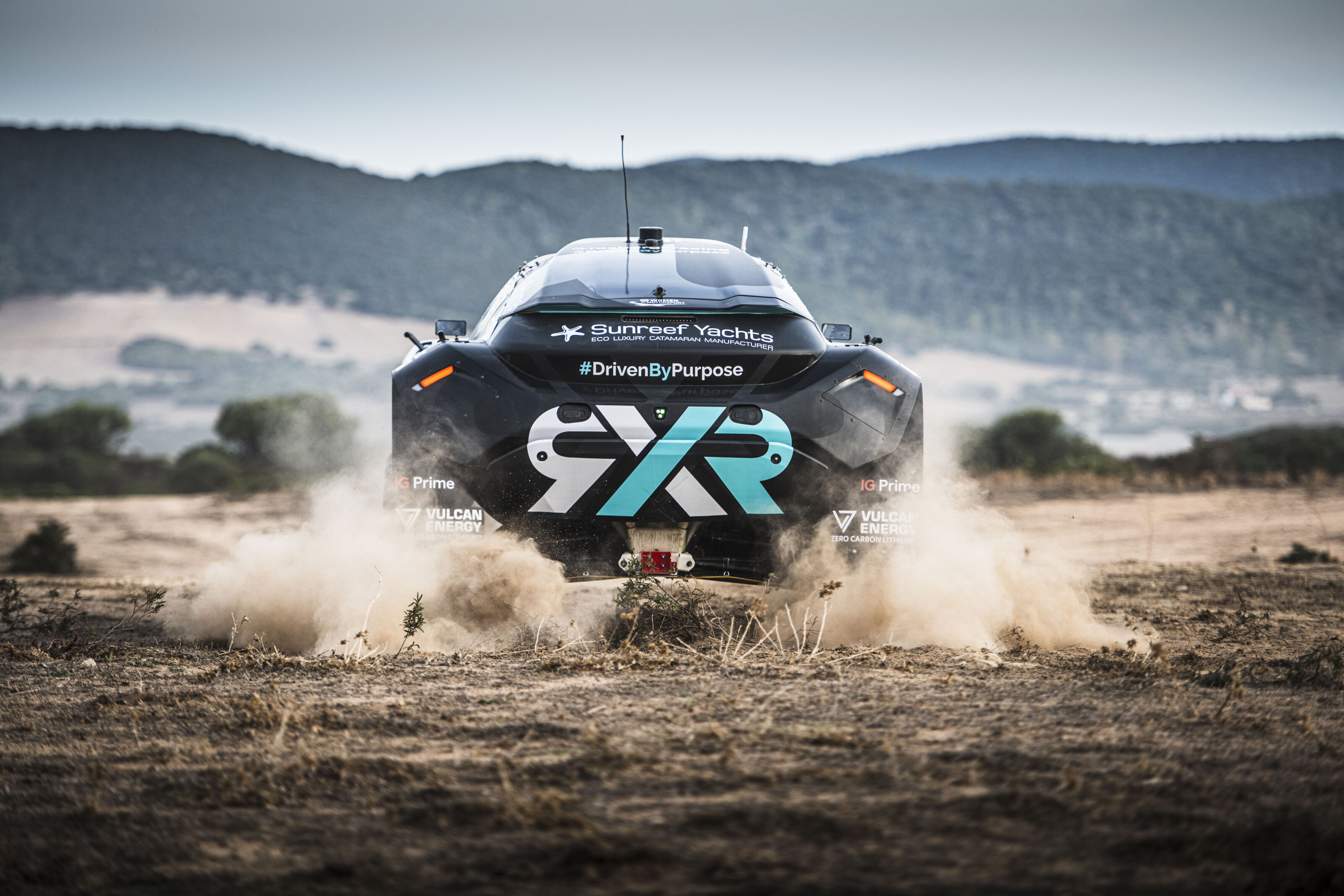
As they slam into the first course obstacles, the full range of suspension travel and tyre deflection becomes apparent. Despite the heavy-duty mechanicals, the Odyssey 21 can still suffer from the battering. Fragile steering arms and PAS pumps as well as a strange powertrain bug that causes a power outage after very heavy landings are examples of gremlins Spark are working hard to resolve.
When all is going well however, it’s a spectacle to watch the drivers wrestling with the SUVs like rodeo horses. The absence of petrol noise and smell is initially obvious but it’s surprising how quickly it becomes unmissed. There’s a cool whine from the motors and gearboxes, but the roar and rumble of tortured tyres drowns it out and the intensity of the racing is more than enough to distract an audience from the lack of ‘traditional’ character. When you throw in several other cars on track at the same time the racing becomes even more captivating.
With a huge range of skills and backgrounds brought by the pool of 18 drivers, strategy on the track becomes a critical part of each race, while the unforgiving and unpredictable nature of the course throws an extra variable into the mix.
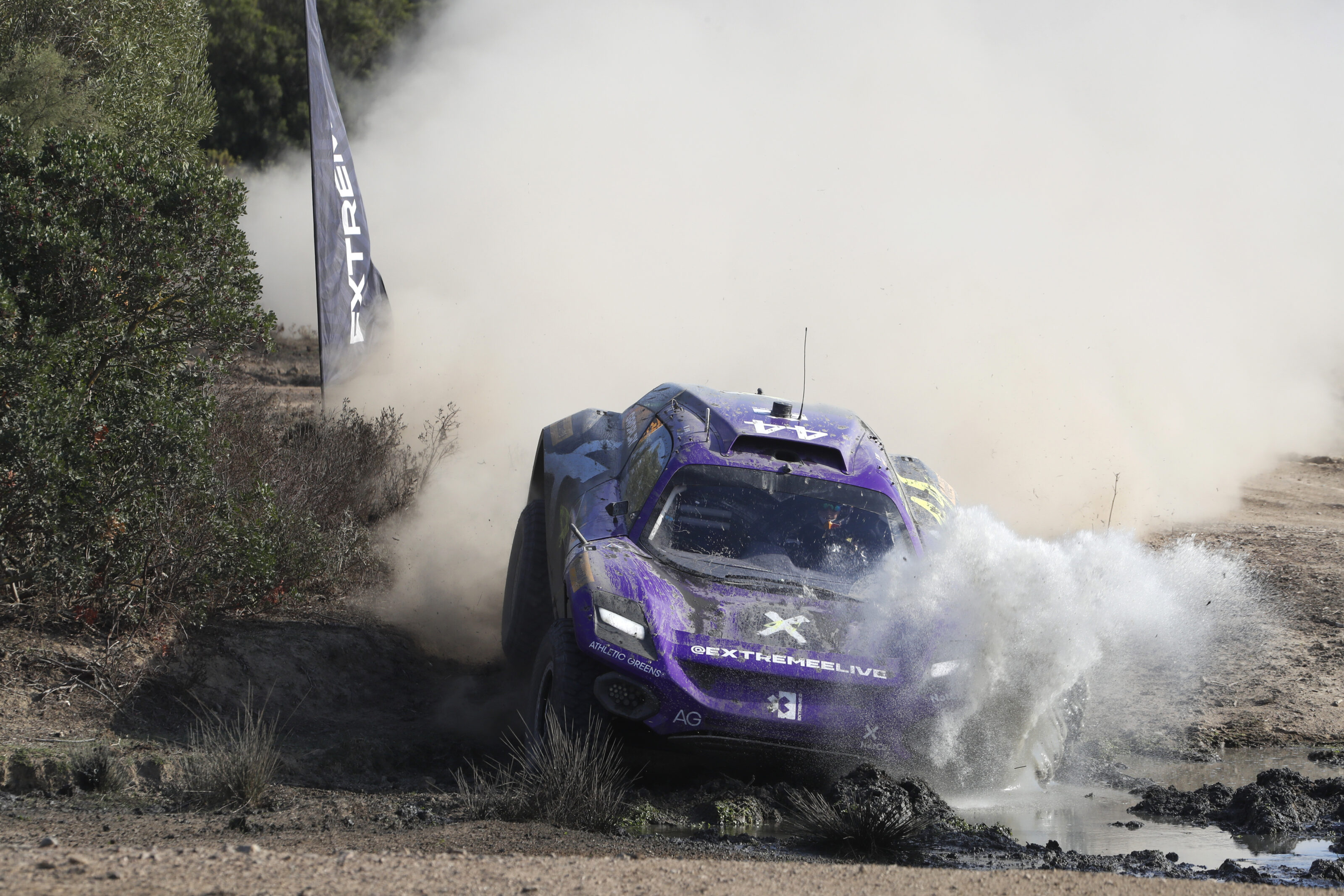
In its inaugural year, Extreme E has demonstrated it has the ingredients to be a successful and long-standing championship that appeals to petrolheads and voltnuts alike, as well as those who have only a limited interest in motorsport. It bears virtually no similarities to any other championship on the planet. The recipe certainly isn’t perfect yet – including the holy grail of self-sustainable electricity for the entire site – but there’s no point criticising Extreme E by comparing it to any other category because it is without peer, which is an insanely bold feat to achieve.
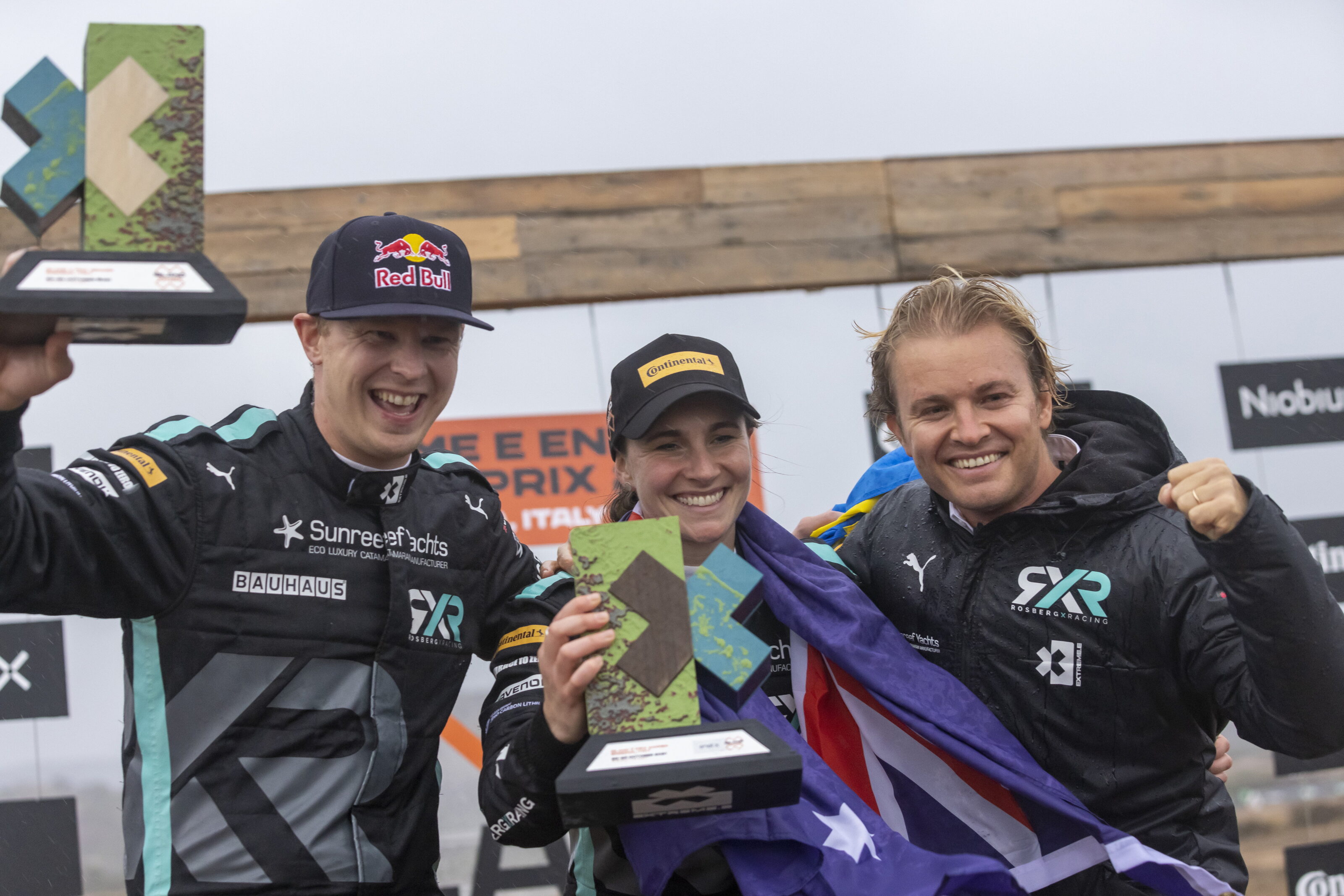
After the drama in Sardinia, this incredible off-road electric circus headed to England for the final Jurassic X Prix round, where team RXR, Australian driver Molly Taylor and teammate Johan Kristofferson took out the title as inaugural champions.
The historic chunk of ‘silverware’ (it’s actually 3D printed from recycled plastic) will forever sit proudly in the trophy cabinet. But with a unique racing series that seeks to make electric vehicles more exciting, serves as an ambassador for equality in motorsport, and helps motor racing tread more lightly on the planet, everyone wins.
The field: Formula Extreme owners, drivers and incumbents
Rosberg X Racing (RXR)
Founded by 2016 F1 champion turned eco-entrepreneur Nico Rosberg, RXR is the inaugural winner of the 2021 championship. Molly Taylor, 2016 Australian Rally Champion, is the only Australian driver to compete in the championship, while teammate Johan Kristofferson comes to the squad with four World Rallycross championship titles.
X44
Continuing the F1 ace theme, X44 was formed by seven-times F1 champion Lewis Hamilton and is run by three-times WRC champions Prodrive. Driver Cristina Gutierrez was the first Spanish woman to enter the gruelling Dakar rally in 2017 and she joined forces with nine-time WRC champion and all-round driving legend Sebastien Loeb.
JBXE
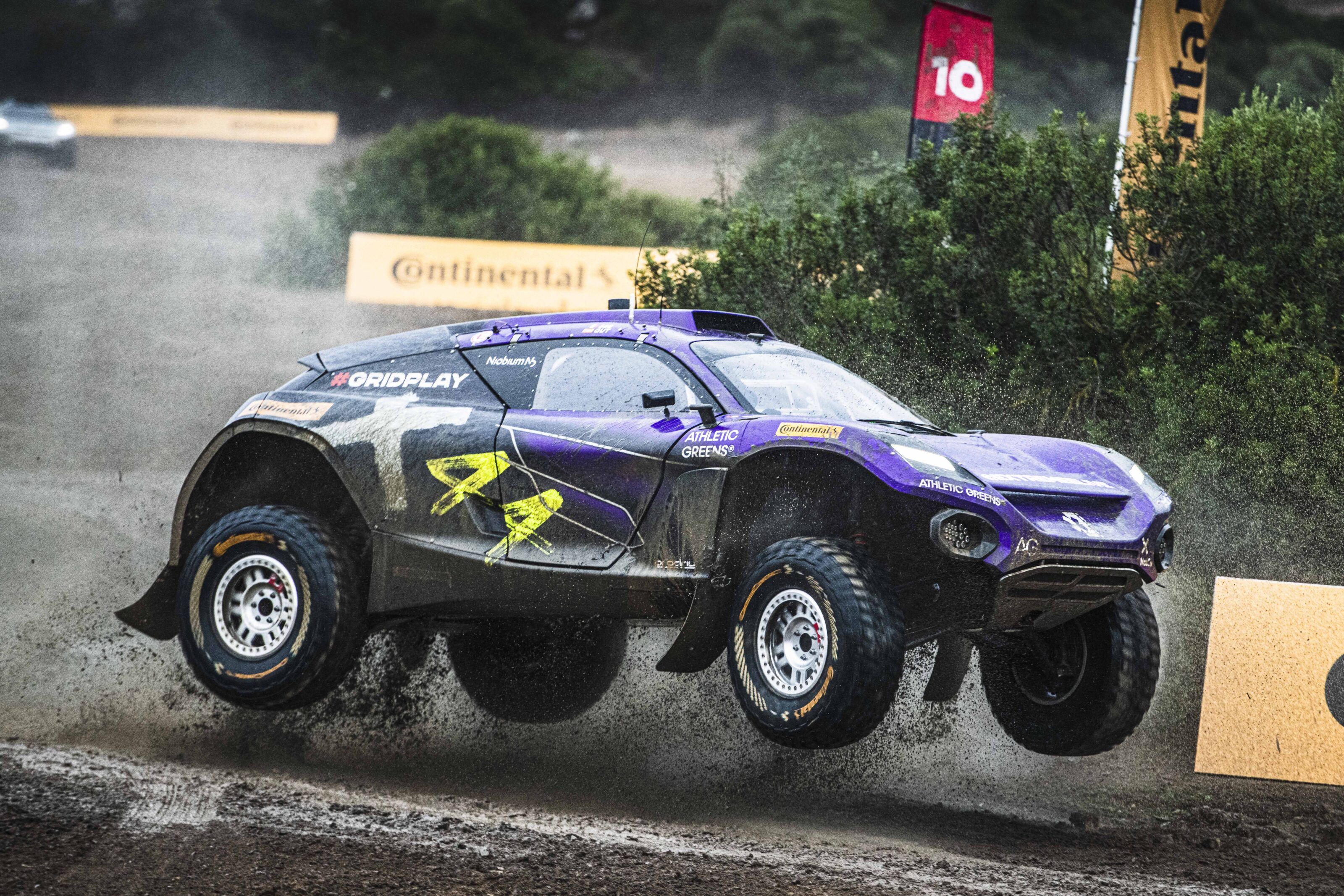
JBXE brings yet more Formula 1 heritage to the Extreme E series via founder Jenson Button. Button drove in the first round of the Extreme E tournament but elected to hand over the reins for subsequent races. Instead, the all-Swedish driver team is formed by circuit and Rallycross driver Mikaela Ahlinkottulinsky and fellow Rallycross competitor Kevin Hansen.
Andretti United
Created by combining two established motorsport authorities, Andretti United joined Andretti Autosport and United Autosports, bringing together a diverse range of racing experience including Indycar, Formula E, World Endurance and Le Mans. European Rally Championship Ladies’ champion Catie Munnings pairs with 2019 World Rallycross champion Timmy Hansen.
ABT Cupra
The first team to partner with an OE manufacturer, ABT brings together DTM and Formula success with Spanish performance car brand Cupra. Driver Jutta Kleinschmidt was the first and only woman to win the Dakar rally, while teammate Mattias Ekstrom is another driver to bring a World Rallycross championship title to the Extreme E competition.
Acciona Sainz
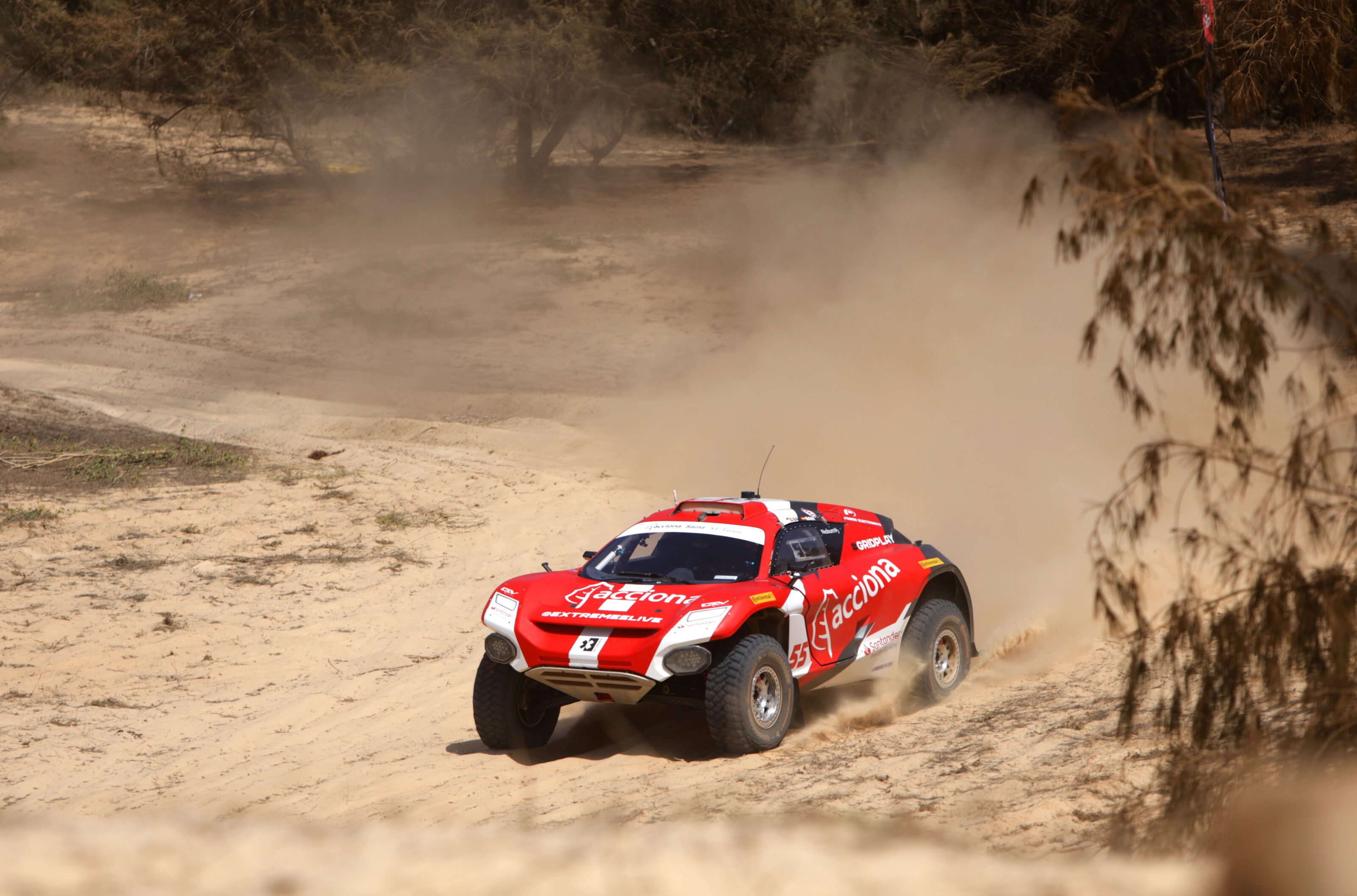
The Acciona half of this partnership brings significant EV experience as the first team to enter an electric vehicle in the Dakar rally in 2017, while co-founder and driver Carlos Sainz adds a legendary rally background to the team. Fellow Spaniard Laia Sanz swapped two wheels for four when she joined the team with a rich background in off-road motorcycle racing.
Veloce Racing
Veloce Racing brings some big motorsport names to the Extreme E fold, including Formula E champion and F1 driver Jean-Eric Vergne and legendary F1 designer Adrian Newey as part of the team. Over the course of the year, Veloce swapped drivers in and out of the seat, concluding the season with 23-year-old Brit Jamie Chadwick and South African off-road ace Lance Woolridge.
Segi TV Chip Ganassi Racing
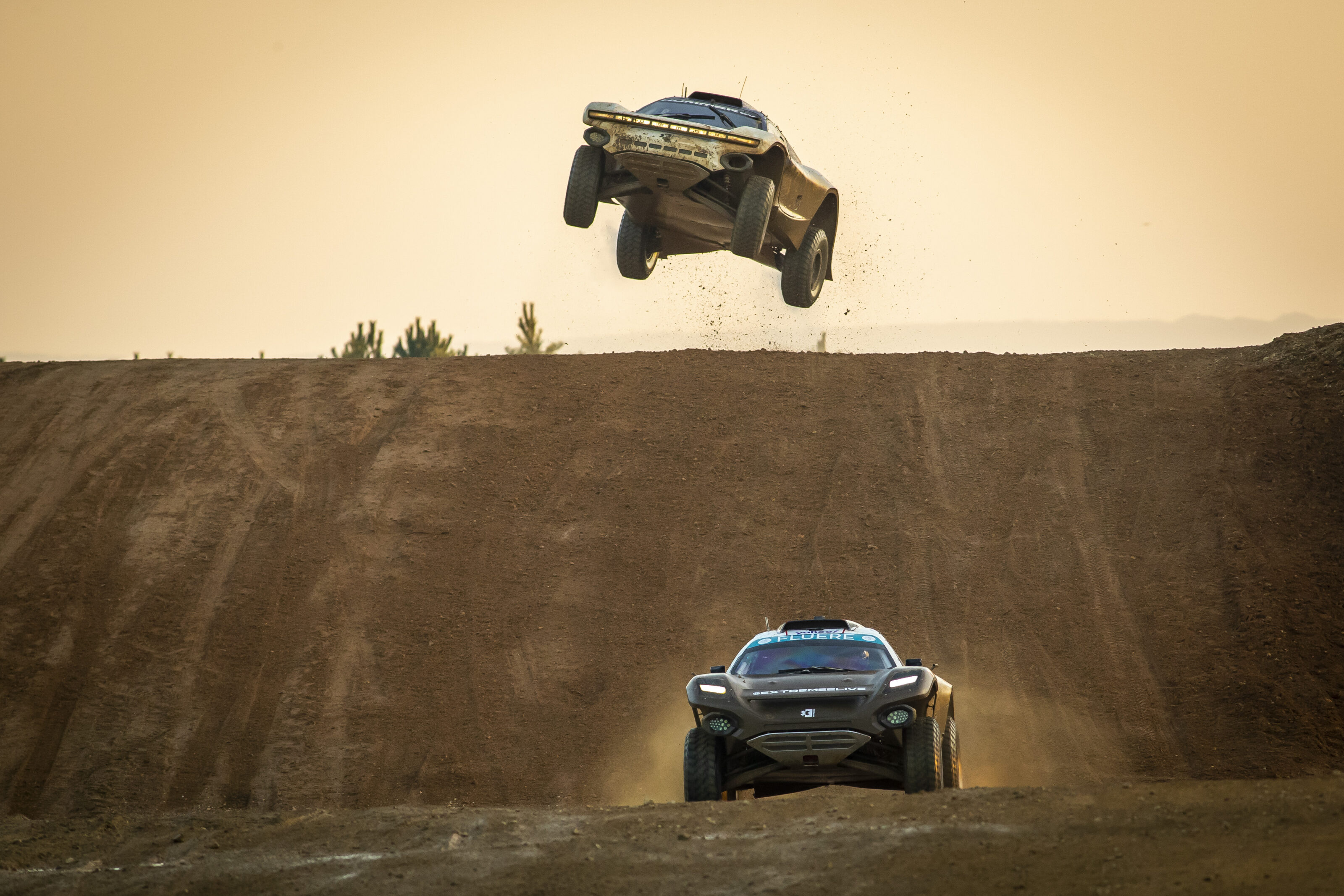
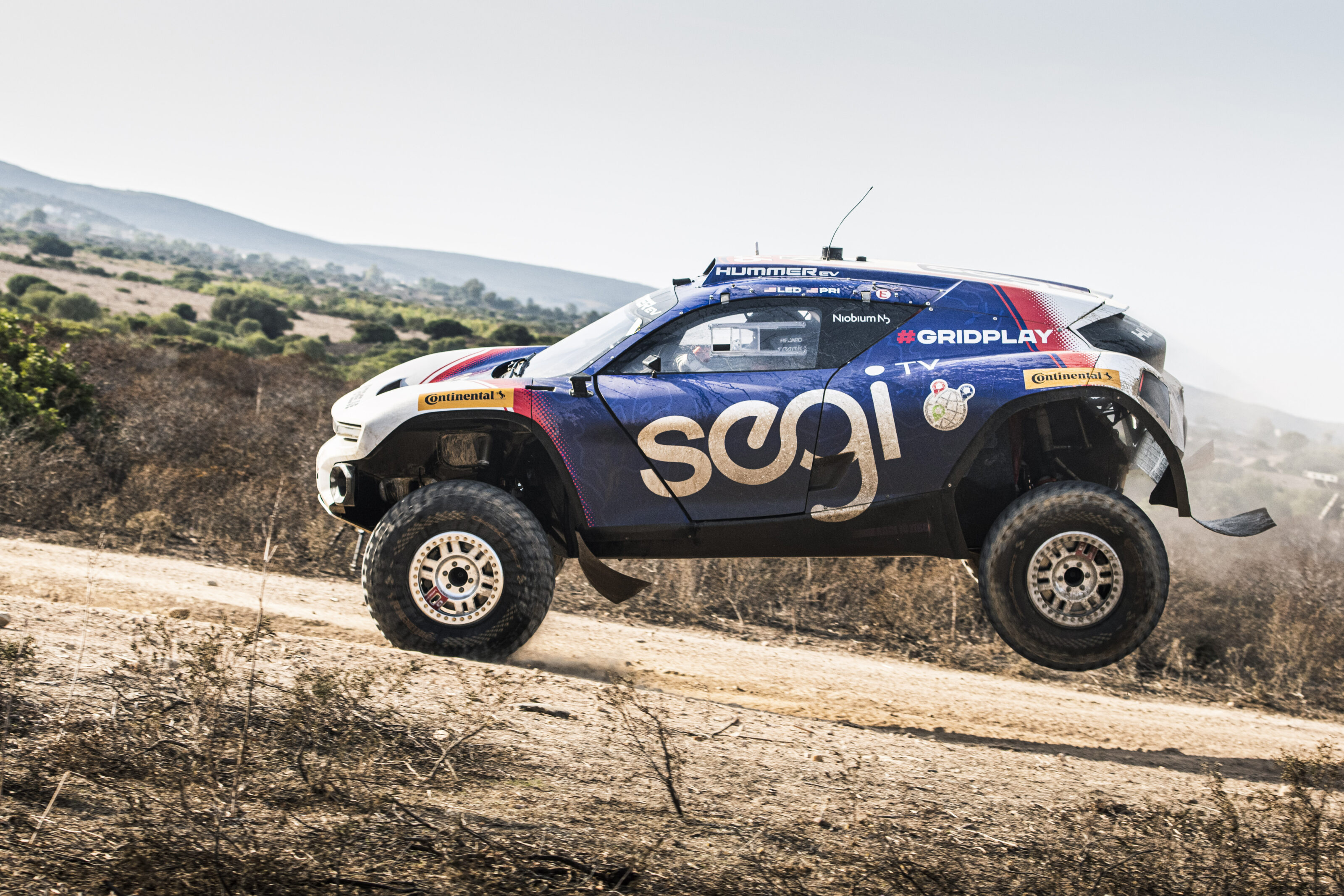
Founder Chip Ganassi brings an impressive portfolio to the series with 20 championships across numerous circuit series. It’s only the second Extreme E team to partner with a road-car manufacturer with a lightly modified shell inspired by Hummer. The driver pairing is comprised of US motorcycle racer Sara Price and six-times Pro4 Championship winner Kyle LeDuc.
Xite Energy Racing
Xite Energy resurrects the vintage Spanish car brand Hispano-Suiza following the company’s apparent revival and the reveal of the all-electric Carmen at the 2019 Geneva motor show. Christina Giampaoli Zonca brings a breadth of experience in off-road competition alongside Oliver Bennet who has competed in the American, British and World Rallycross championships.
McLaren
Towards the end of the 2021 season, iconic motorsport heavyweight McLaren announced it would join the second season of Extreme E. New Zealand’s Emma Gilmore and US ace Tanner Foust are the drivers. The commitment of the British brand is indicative of the level of interest in this fledgling form of motorsport, and McLaren surely won’t be the last brand to join Extreme E.
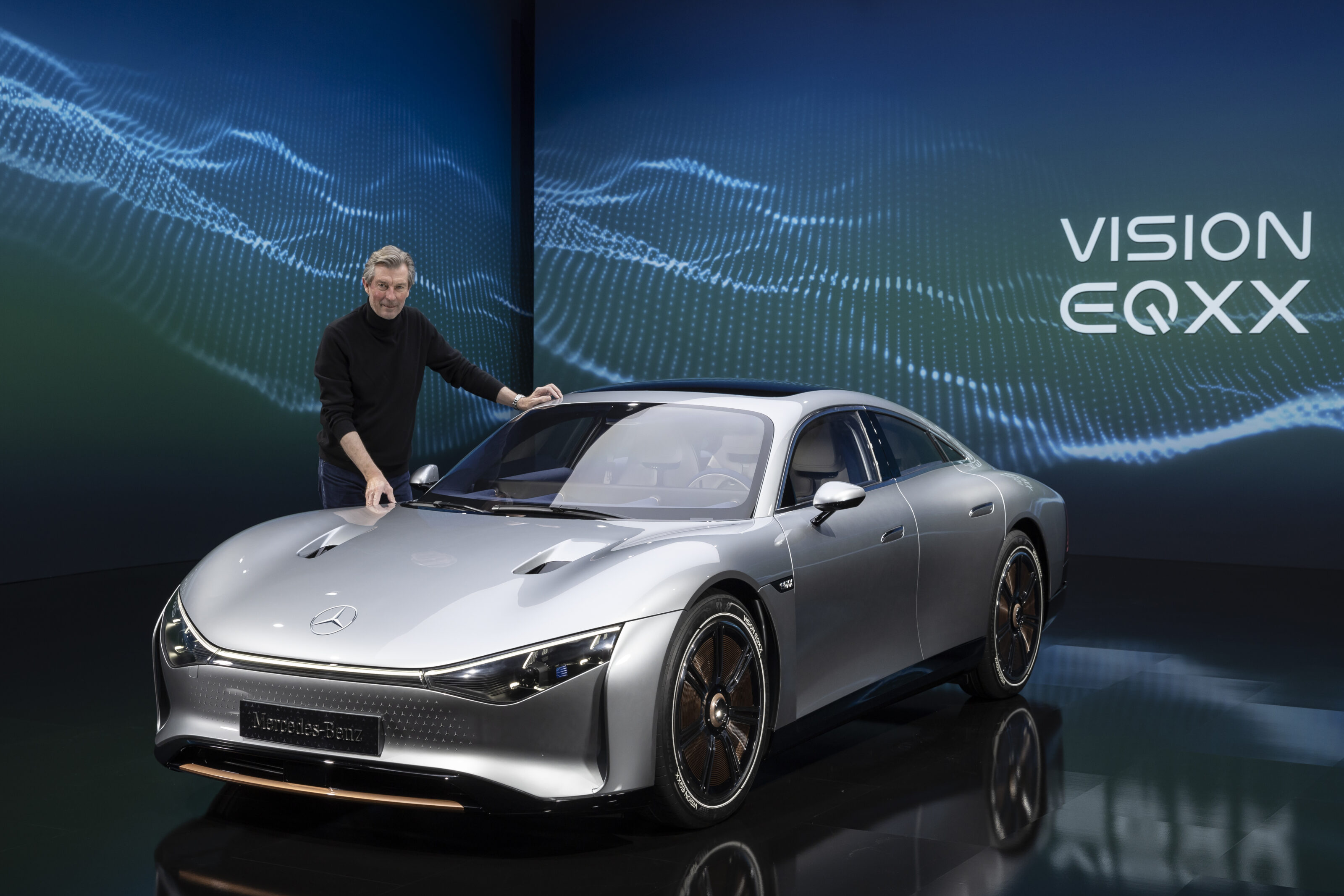
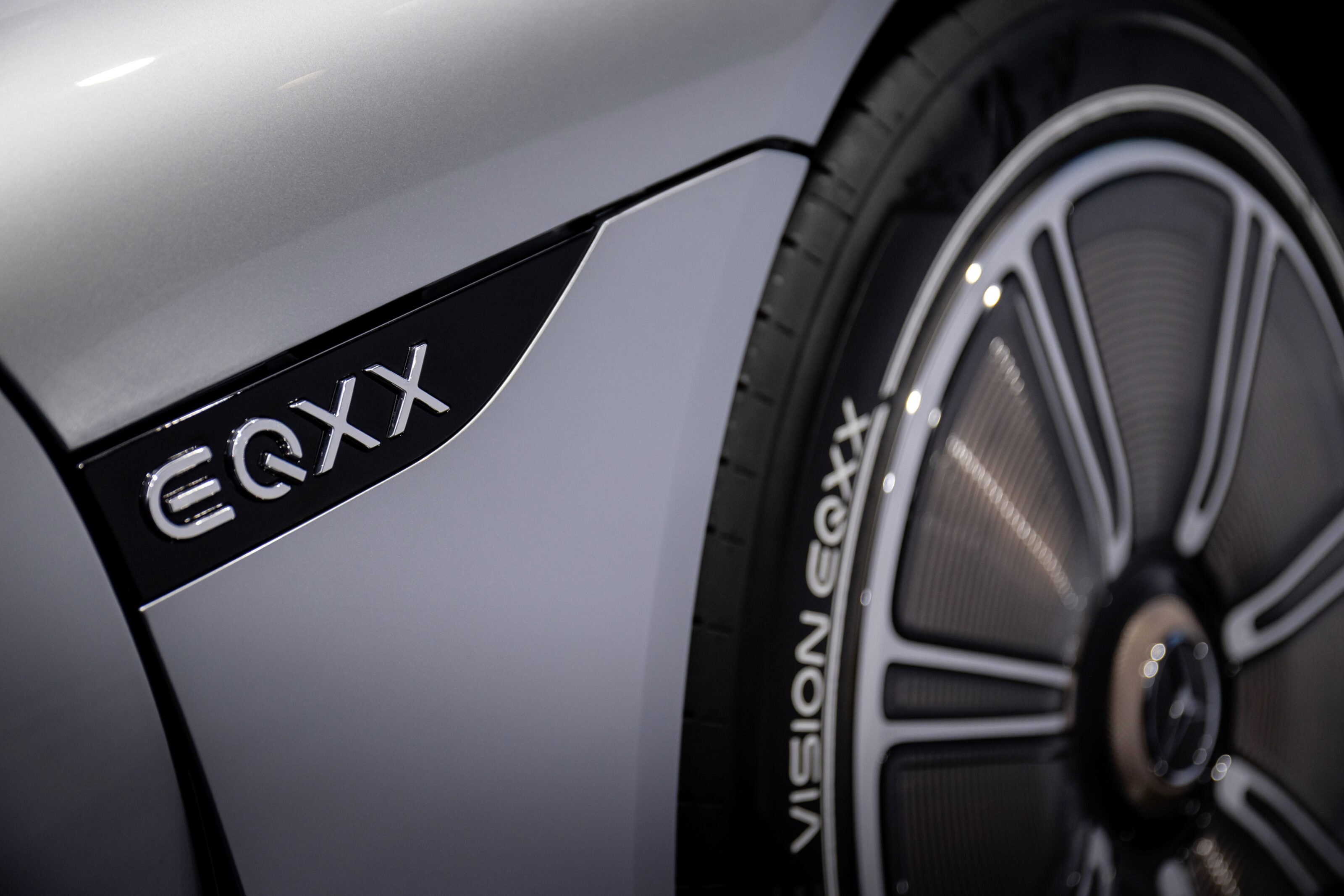
The Vision EQXX is how we imagine the future of electric cars,” says Mercedes-Benz chairman Ola Källenius. “It underlines where our entire company is headed: We will build the world’s most desirable electric cars.”
That’s quite some mission statement, especially for a carmaker that effectively established the template for the modern internal combustion motor vehicle more than 120 years ago.
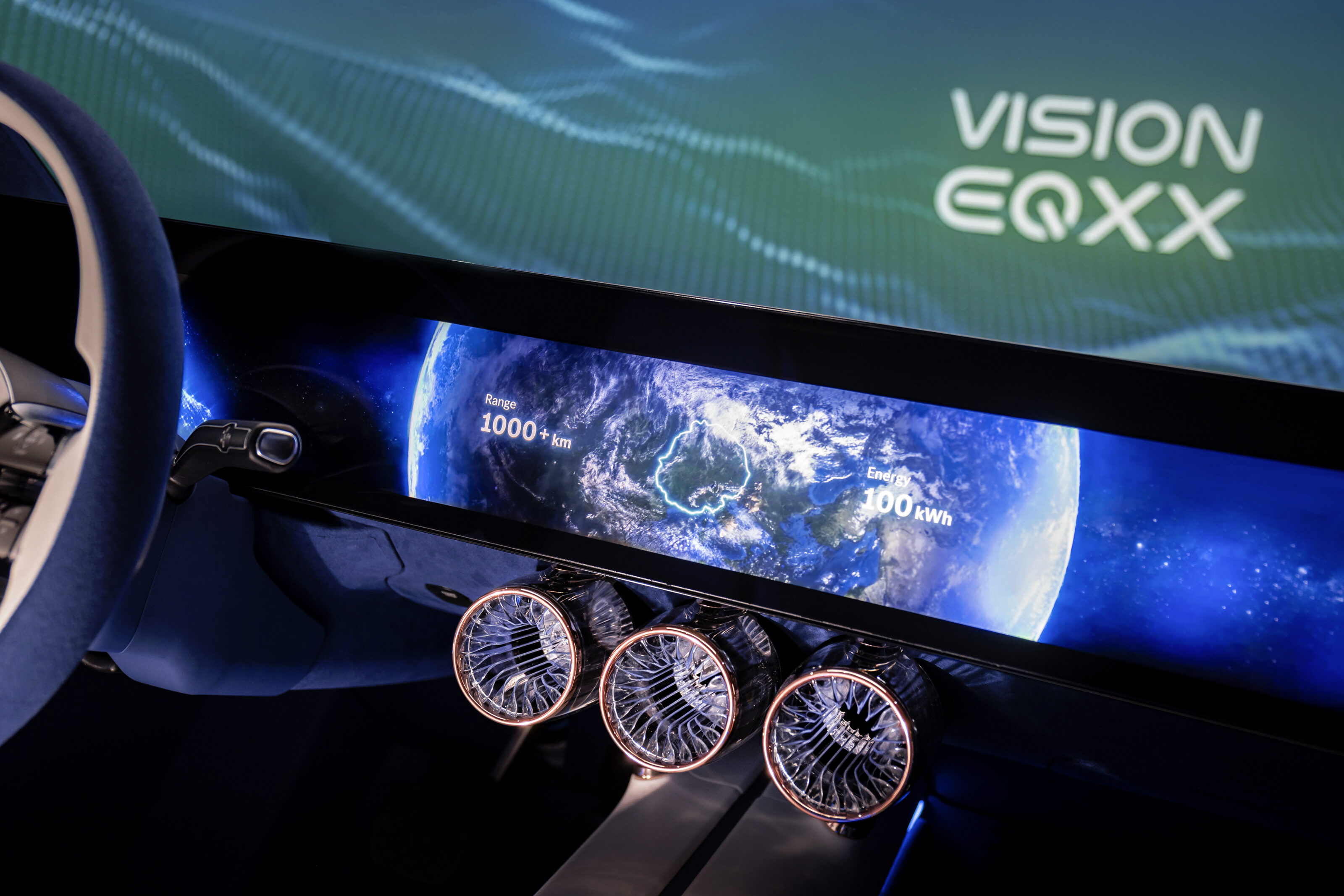
The Vision EQXX has been designed and engineered to travel more than 1000km on a single charge
Put simply, the Vision EQXX represents a profound intellectual and technological inflection point for Mercedes-Benz. A fully functional prototype that explores the outer limits of electric vehicle efficiency, connectivity, and production feasibility, the EQXX shows what’s possible when a pillar of the automotive establishment turns its massive research and development resource entirely to thinking about designing and engineering a better electric vehicle.
This Mercedes puts over-hyped, over-valued electric vehicle startups such as Tesla, Lucid, Nikola – and the rest – on notice.
Here’s why: The Vision EQXX has been designed and engineered to travel more than 1000km on a single charge of a battery with just under 100kWh capacity, slightly less than that of the battery which powers the three-pointed star’s electric flagship, the Mercedes-EQ EQS. Basically, the Vision EQXX is 39 percent more efficient than the EQS 450+ (780km range, 108kWh battery) and 21 percent more efficient than even the most frugal Tesla, the base Model 3 (491km range, 60kWh battery).
This Mercedes changes the conversation around EVs away from today’s almost total focus on range as a function of battery capacity, to range being a function of a holistic approach to vehicle efficiency. And there are good, practical reasons for this approach, says Adam Allsopp, advanced technology director at Mercedes-AMG High Performance Powertrains (HPP): “In effect, we fitted the energy of the EQS into the vehicle dimensions of a compact car.”
That long tail flatters to deceive: The Vision EQXX is indeed a compact car. Its 2800mm wheelbase is 76mm shorter than that of a Tesla Model 3 and right between those of the current A-Class and C-Class sedans. By way of comparison, the EQS rolls on a 3210mm wheelbase.
HPP, which designs and builds the fiendishly complex and highly efficient Mercedes Formula 1 hybrid powertrains at its facility in Brixworth, England, worked on every element of the EQXX drivetrain to reduce energy consumption and losses. HPP also designed the EQXX’s power inverter, and the power electronics unit is the same one HPP helped develop for the Mercedes-AMG Project ONE hypercar.
To reduce its size and weight, the EQXX’s battery dispenses with the conventional method of packing cells into separate enclosed modules, and has a lightweight top cover made from sugar cane waste reinforced with carbon fibre, a materials technology used in Formula 1. Tipping the scales at 495kg, the battery has an energy density of more than 200Wh/kg.
Mercedes says this high energy density comes in part from the chemistry of the anodes, which have a higher silicon content and an advanced composition that means they can hold considerably more energy than commonly used anodes. The battery also has active cell balancing, which means power is drawn evenly from all cells. The EQXX system is very high voltage – more than 900V, well above the industry standard of 400V and even the 800V used in the Porsche Taycan.
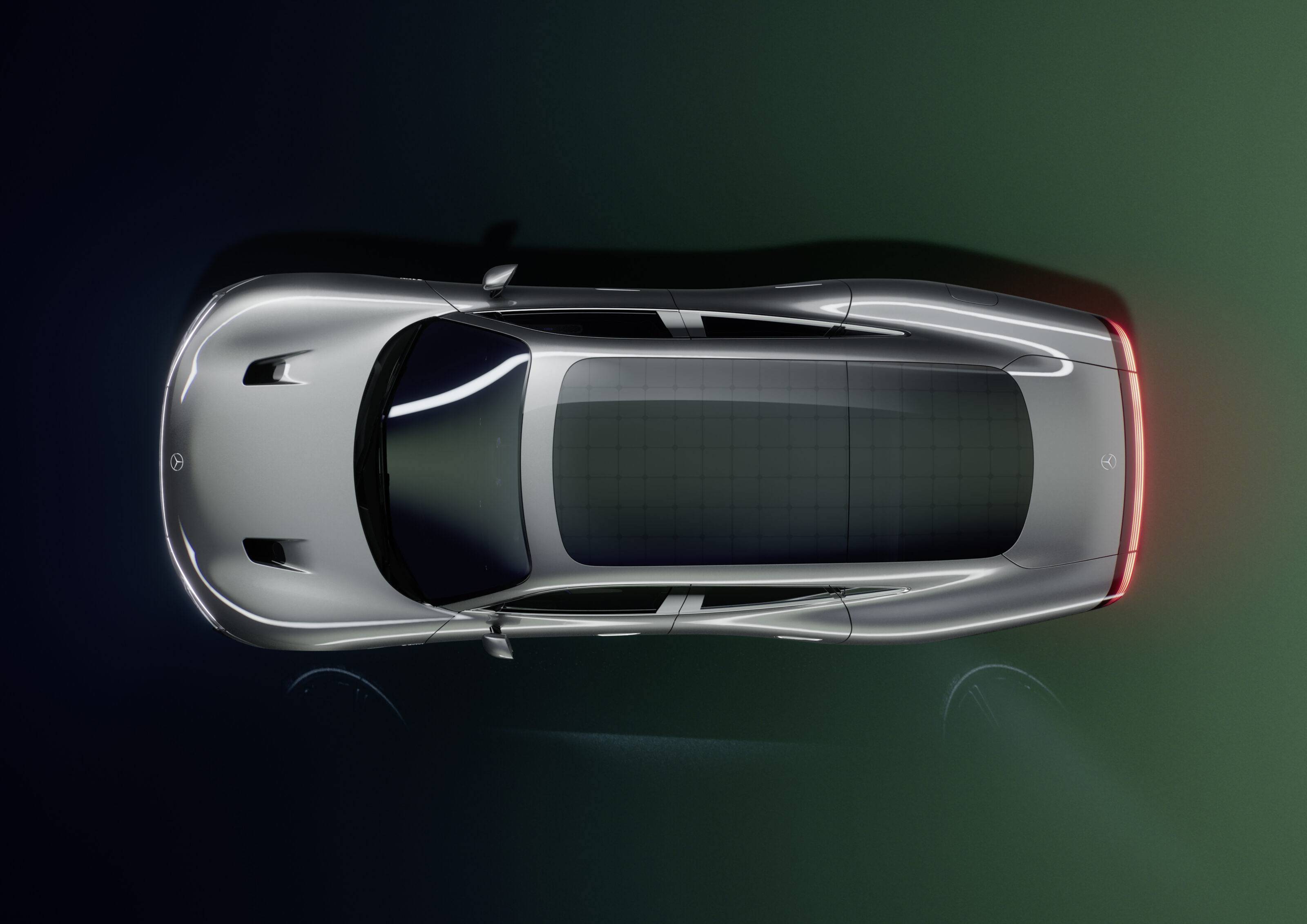
The battery is only passively cooled, by the airflow under the car. How practical is that? “We want to find out,” says EQXX powertrain engineer Tim Wölfel, disarmingly reinforcing the idea the EQXX is a proper working concept, not motor show eye candy. “What we are thinking is that each battery cell heats itself, and if we know the cell well, we can control the temperature of the cell. A lot of resource is being put into this. We have to find out what is the best state of charge.”
The Vision EQXX is powered by a single 150kW e-motor mounted at the rear of the car and driving the rear wheels. The e-motor is based on the eATS unit that currently powers the compact EQA hatch and the newly launched EQB SUV, but it has been extensively reworked with the help of HPP engineers. “The motorsport guys count every joule of energy,” says Wölfel, who points out the EQXX’s drivetrain is 95 percent efficient.
Mercedes aerodynamics specialists say 62 percent of the energy stored in the battery of an electric vehicle will be consumed simply by pushing it through the air on an average long-distance drive. That simple stat is the reason the EQXX has a drag co-efficient of just 0.18.
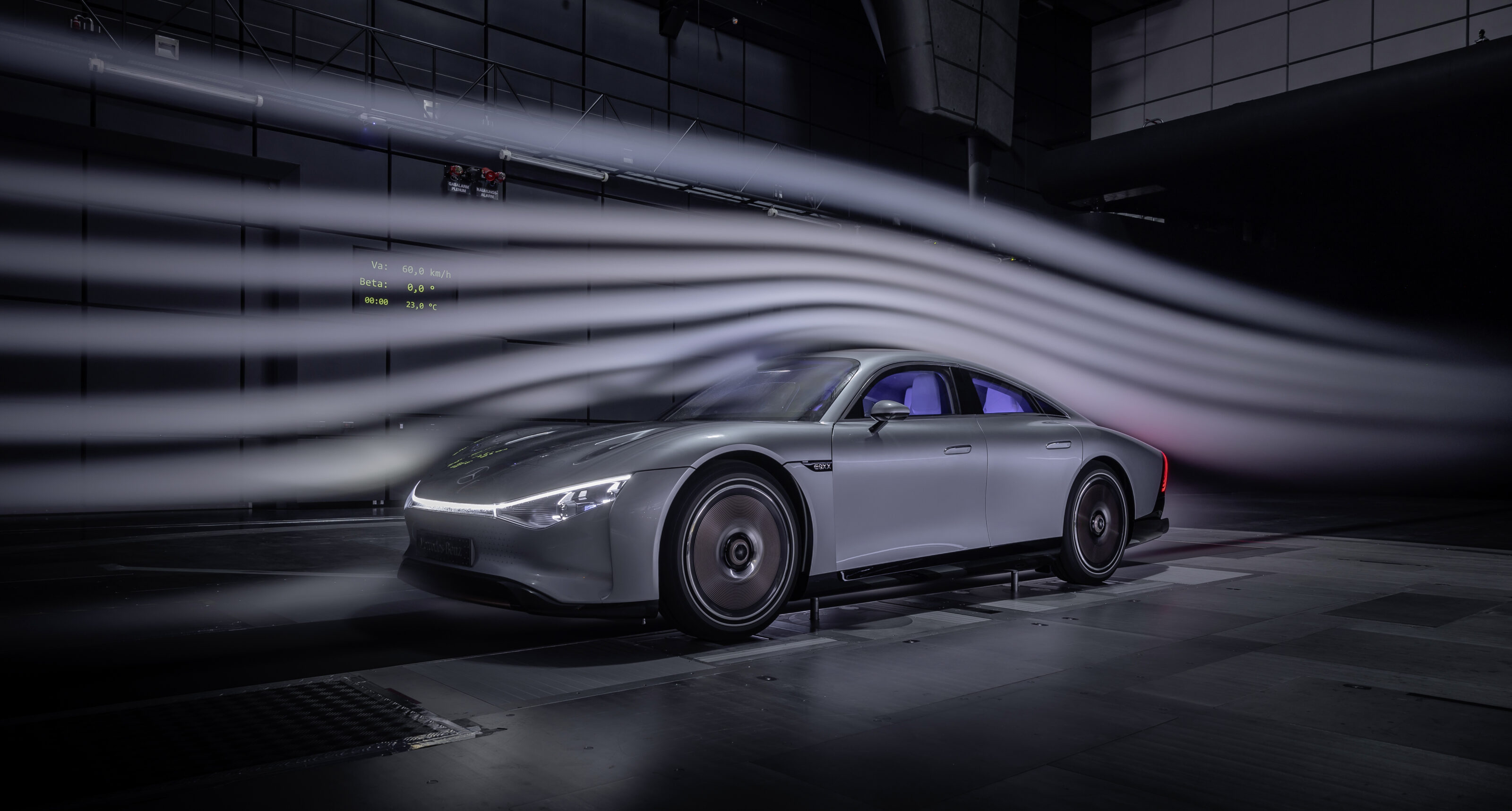
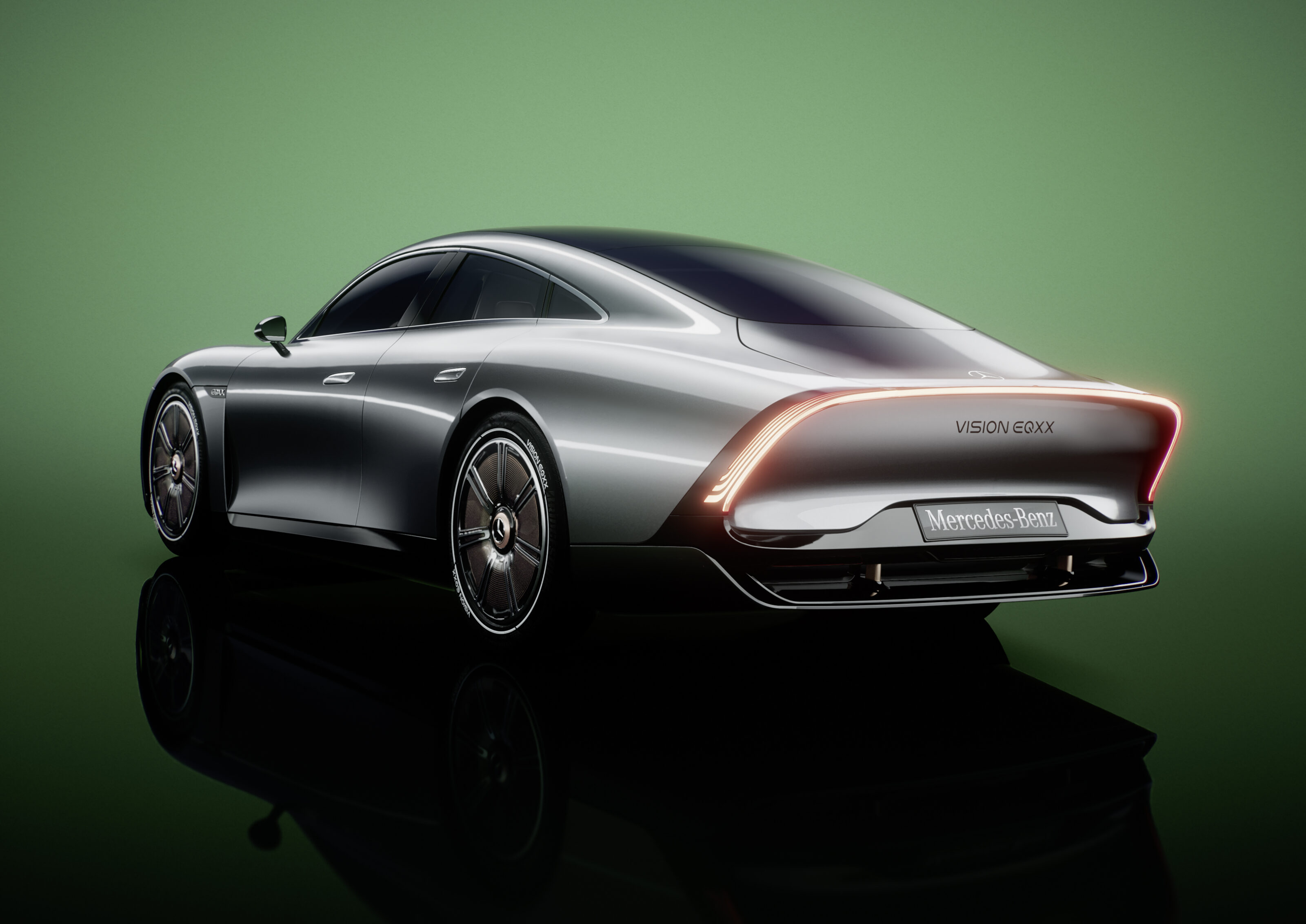
In profile and plan view the EQXX has the classic teardrop shape ofextreme wind cheaters such as GM’s ground-breaking EV1 and the Volkswagen XL1 hypermiler. Both cars were referenced by EQXX engineers. To get that shape the rear track is 50mm narrower than the front, and the cabin tapers dramatically above the car’s voluptuous hips.
Up front, a shutter system will open to allow air to pass over a cooling plate for the e-motor if needed. Air is also directed around the front wheels to form an air curtain and help keep the flow attached to the side of the car to reduce drag. The long tail helps reduce wasteful turbulence in the car’s wake, with an active rear diffuser that automatically lowers and extends at 60 to 70km/h to help keep the speed of the air coming from under the car equal to that streaming off the sides and top.
The EQXX’s body is made from ultra-high strength steel to improve occupant protection in the event of a crash. The doors are made from a hybrid of carbon and fibreglass reinforced plastics with aluminium reinforcements. A new polyamide foam reinforces the lower edge of the door and optimises energy absorption in a side-on collision. The roof is covered with solar panels.
Some of the most innovative bits of the EQXX’s structure is stuff you can’t see, such as the large cast aluminium component that extends from the rear floor and provides mounting points for the rear suspension and the e-motor and forms the inner rear wheel wells. This casting is made using a patented process called Bionicast that creates a structure that mimics the load and strength paths of natural organisms, reducing excess material to a minimum. As a result, there isn’t a single straight line or flat surface on the part.
The Bionicast process, which has been used to create the front shock top mounts on the EQS, eliminates material from anywhere it’s not needed to preserve structural integrity, which means the EQXX’s wheel well inner elements are full of large holes. To fill them, Mercedes uses a sustainable plastic substitute made from typical landfill rubbish. The combination of the Bionicast process and UBQ patches can reduce the weight of large structural castings by 15 to 20 percent, according to Mercedes.
Other innovative weight saving tricks include the use of fibreglass-reinforced plastic (FRP) rear springs. Unlike the simple FRP leaf used on Chevrolet Corvettes from 1984 to 2019, however, the EQXX springs look like 100mm wide, 13mm thick strips of plastic folded into a serpentine shape. Developed in partnership with German supplier Rheinmetall Automotive these strange looking pieces are said to be much lighter than conventional coil springs.
Behind the EQXX’s beautifully styled flush wheel covers are ultra-light, 20-inch forged magnesium alloy wheels. The wheels are shod with specially developed Bridgestone Turanza tyres that are also lightweight and have ultra-low rolling resistance.
All this attention to detail has kept the overall mass of the EQXX to around 1750kg, says Mercedes-Benz. By way of comparison, that’s just 138kg more than the base single-motor Tesla Model 3, which has about 60 percent the battery capacity and can travel less than half as far between charges; and 730kg lighter than the single motor Mercedes-EQ EQS 450+.
Once you get past the easy wins in terms of aerodynamics, powertrain optimisation, and weight reduction, the efficiency devil is in the details. And the EQXX brims with clever technologies and features that are designed to help the car extract the most performance from every joule of energy it consumes.
The 117 solar panels on the roof of the EQXX feed into a 12V system that powers many of the car’s ancillaries. On a good day, says Mercedes, the system will lower the draw on the 900V system enough to deliver a 25km bump in the range. Sensors around the car monitor the airflow so the EQXX can calculate the positive or negative impact of changes in wind direction on energy consumption. Combining all that data with detailed terrain and traffic information, the EQXX will constantly calculate and display a speed that delivers maximum efficiency.
The curved 8k screen that stretches between the A-pillars makes the most of the EQXX’s crisp and sparkling game-engine-powered graphics, including a real-time 3D navigation display.
The mini-LED backlit screen features more than 3000 local dimming zones, which means it only consumes power as and when specific parts of the screen are in use. The EQXX has conventional external rear-view mirrors because engineers concluded a camera system like that used on Audi’s e-tron would consume too much energy.
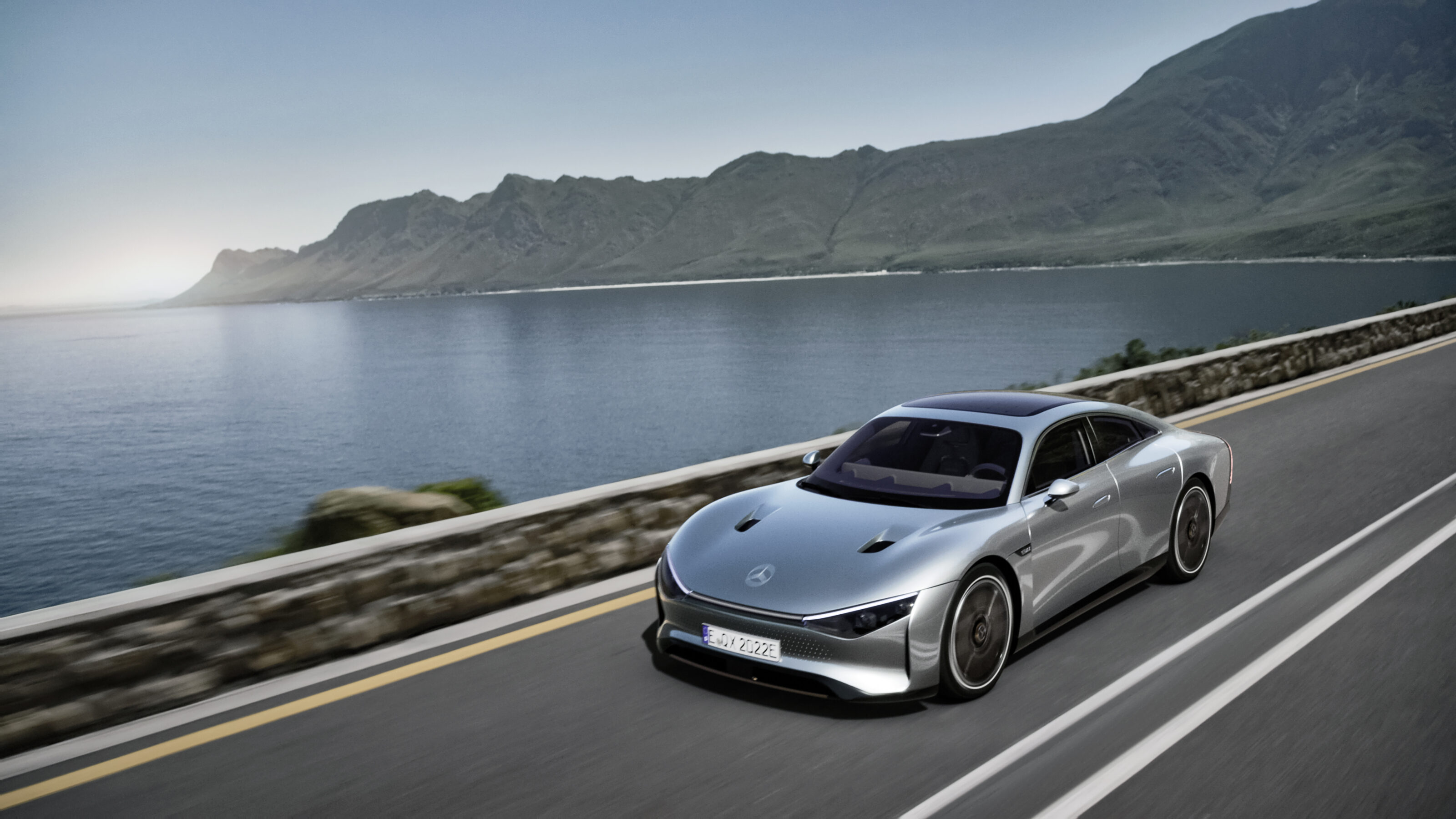
Vision EQXX might be a concept, but the ideas and processes that shaped it are grounded in production reality
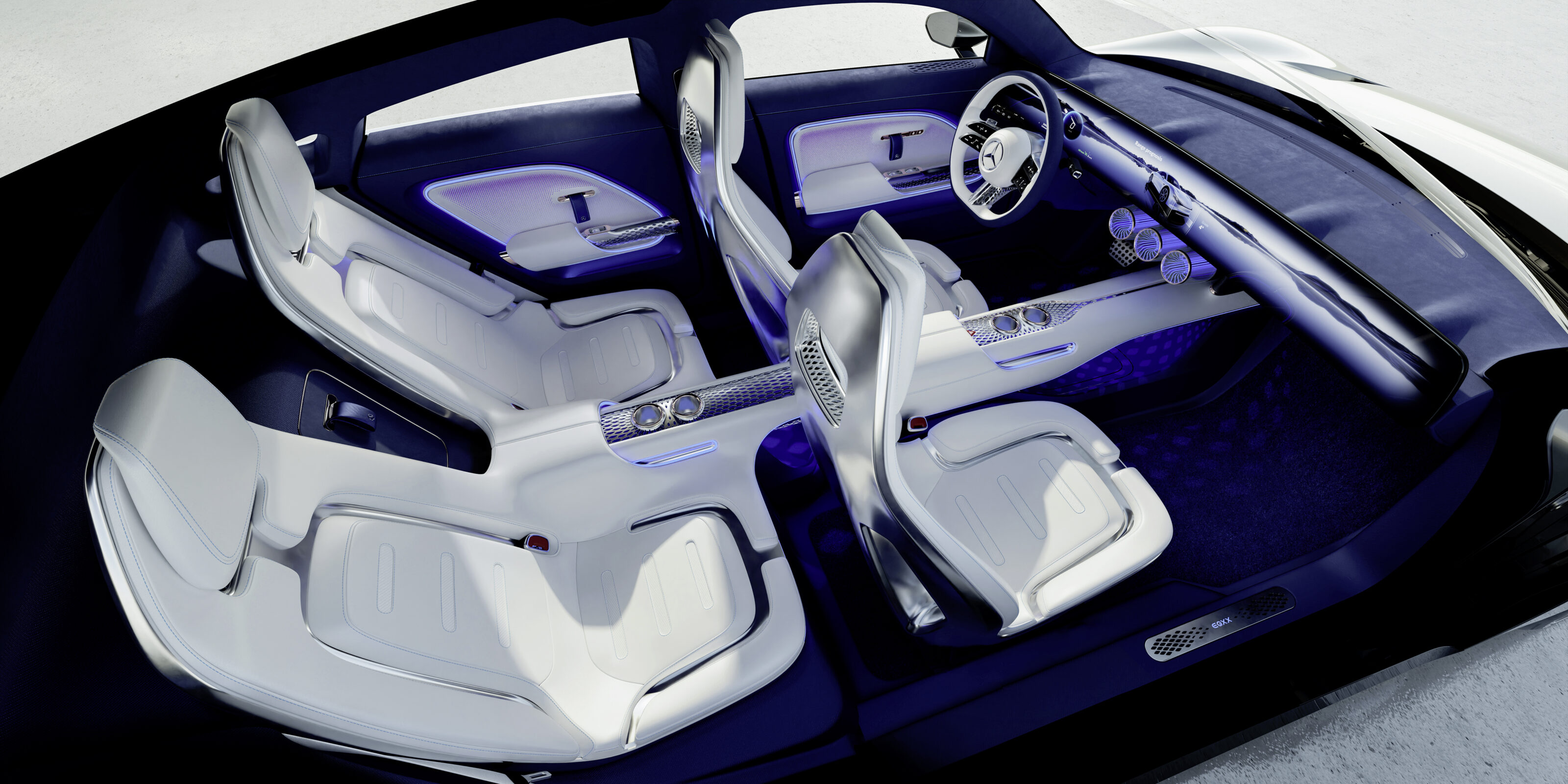
Some parts of the beautifully finished EQXX interior, such as the steering wheel and gear selection, wiper and indicator stalks, are from existing Mercedes production cars. Everything else is bespoke, and almost all is wrapped in cutting-edge, environmentally friendly materials. The fabrics and leathers and carpeting, for example, are made of either plant-based organic materials or recycled plastics.
The Mercedes-Benz Vision EQXX might be a concept, but the ideas and processes that shaped it are grounded in production reality. In fact, a new digitally led design and engineering process saw the EQXX go from idea to road ready in just 18 months, bringing together expertise from the company’s Formula 1 and Formula E race engineering groups, its research department and prototyping specialists, and the production development team.
Mercedes-Benz invented the car. Now it aims to reinvent the electric car. As such, the Vision EQXX may well prove one of the most consequential concept cars of the early 21st century.
Marketing pundits regularly cite Rolex as the world’s best managed luxury brand. Rolex watches routinely hold their value – and in many cases appreciate – even though the Geneva-based company sells more of them than its nearest rivals, Omega, Longines, and Patek-Phillipe, combined.
A $14,995 Rolex’s function is no different to that of a $49.95 Casio. And that puts Rolex at the top of a select group of brands that understand how to turn everyday objects into objects of desire. Apple, which has made 21st-century appliances such as computers and mobile phones into hipster accessories, is one of that group.
So, too, is Ferrari.
Enzo Ferrari created the legend. Luca di Montezemolo polished it. And Sergio Marchionne figured out how to monetise it, engineering the 2015 public flotation that now sees Ferrari valued at more than $70 billion. Ferrari’s current CEO, Benedetto Vigna, who was appointed to the top job at Maranello in mid-2021, has big shoes to fill. But he’s an interesting choice; not a car guy, but a physicist with 26 years’ experience in the microchip business. Vigna will lead Ferrari into the electronic age.
Software will increasingly drive a whole new generation of digitally enhanced Ferraris, including the company’s first-ever electric vehicle, which is scheduled to debut in 2025. But it’s the soft touch, the human side of the business, that will ensure Ferrari remains… Ferrari.
Since Sergio Marchionne’s death in 2018, Ferrari media events have frequently revolved around three key executives – marketing chief Enrico Galliera, chief technology officer Michael Leiters, and design chief Flavio Manzoni. Strikingly, all three share one key characteristic: none is a Ferrari lifer, each having come to Maranello between 2010 and 2014. And all understand the human side of the business.
Enzo Ferrari created the legend. Luca di Montezemolo polished it. And Sergio Marchionne figured out how to monetise it
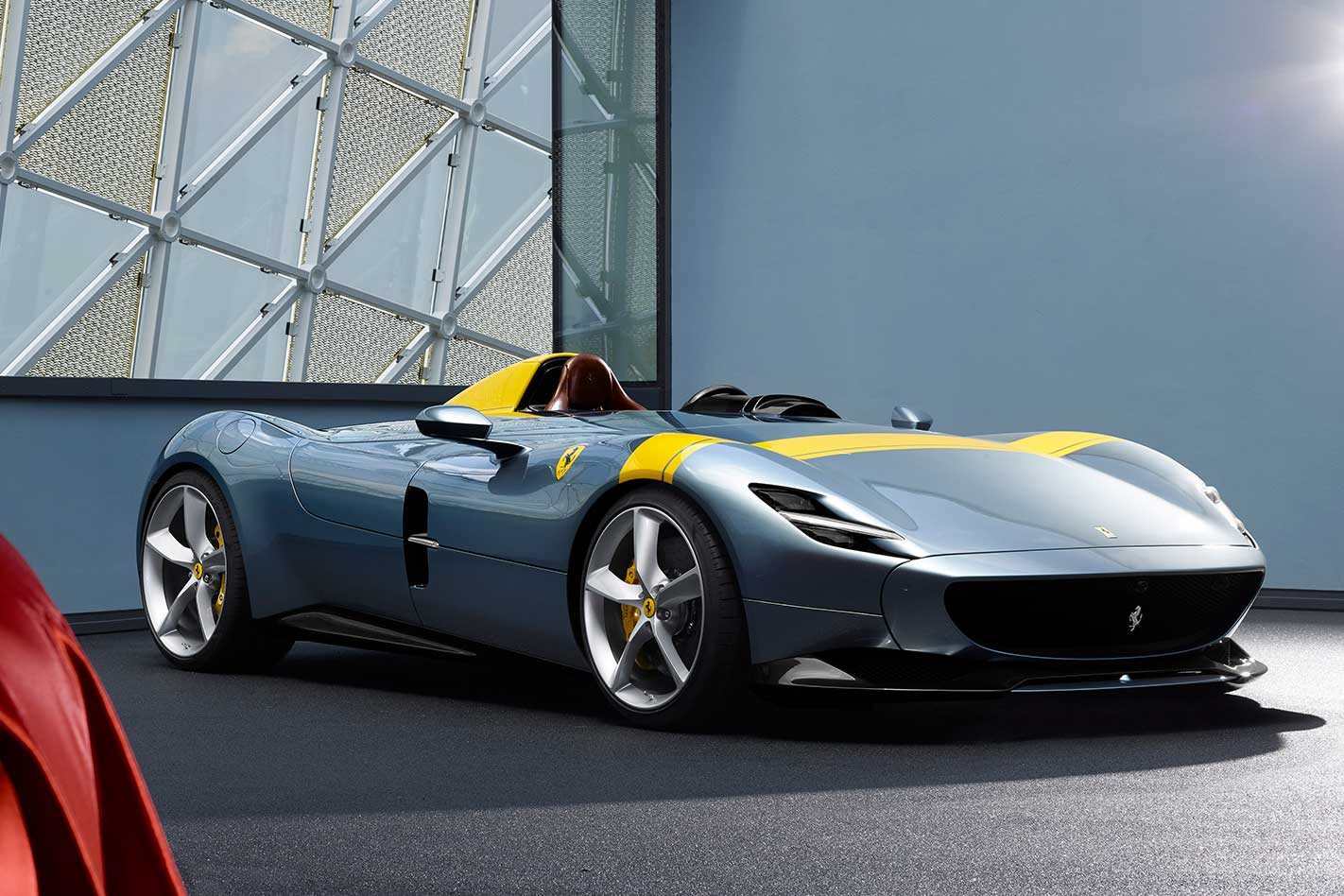
Ferrari’s Icona cars, the Monza SP1 and SP2, and the recently announced Daytona SP3 are a case in point. The limited-edition Iconas – only 599 Daytona SP3s will be built – are designed to take themes and concepts from Ferraris of the past and reinterpret them in a modern way using cleverly repackaged hardware from existing Ferrari models.
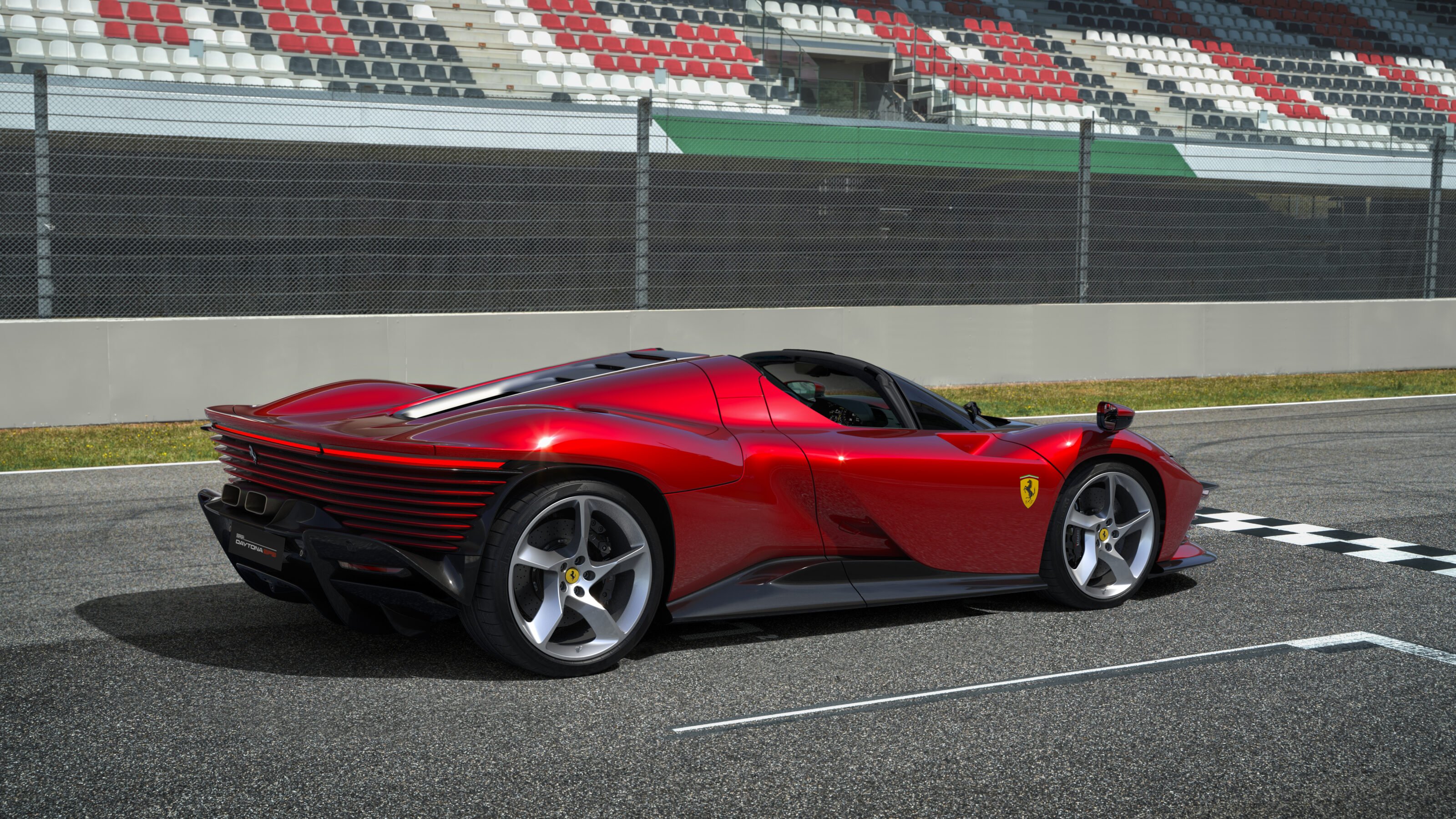
The mid-engine Daytona SP3, for example, has the chassis from the LaFerrari Aperta hypercar, and a naturally aspirated 6.5-litre V12 from the 812 Superfast that’s been tweaked to punch out 618kW at a screaming 9250rpm. “Revs are important to get the feeling of continuous acceleration, but also,” he adds pointedly, “to get the sound.”
The Daytona SP3’s voluptuous haunches and bubble-screened cockpit riff on forms from mid-engine racing Ferraris from the ’60s and ’70s. The execution and detailing are pure 21st century, however. “Of course, the inspiration is so powerful that the car has a very high level of meaning,” nods Flavio Manzoni. “But this is not a retro interpretation of a traditional car.”
Enrico Galliera agrees: “Icona is not about simply modernising an iconic Ferrari model,” he says. “It’s not a nostalgic approach, but looking to the future.” Indeed. The Icona cars have become a fourth model stream for Ferrari, alongside the sports cars, the GTs, and the special hypercars. And a highly lucrative one: All 599 Daytona SP3s are already sold, generating almost $2 billion in revenue.
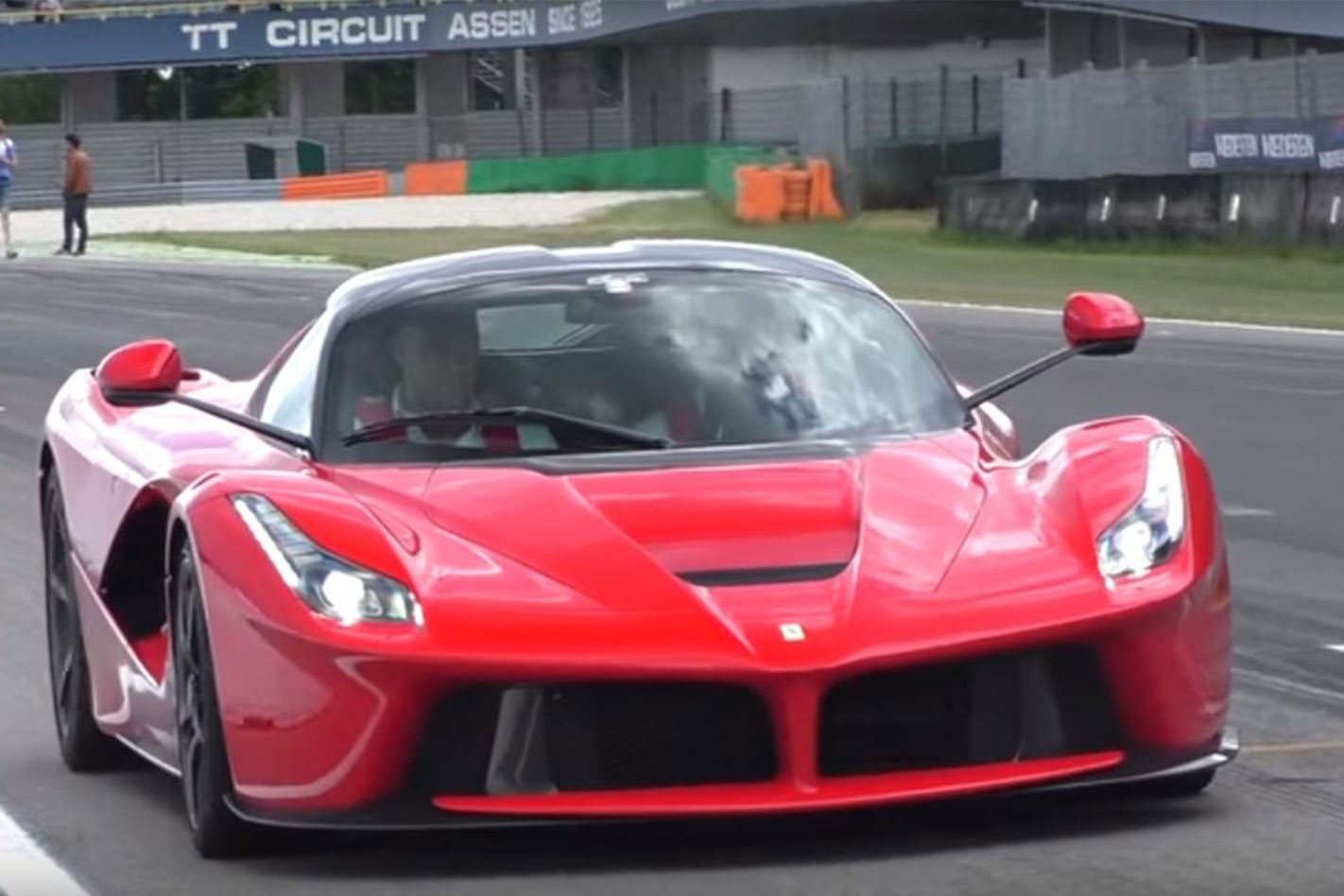
No wonder Galliera says Ferrari will do more Icona cars. “We have no idea what the next will be, though I think you coud easily identify four or five strong concepts we could work with,” he smiles.
Strictly limited runs of uniquely styled Ferraris that evoke the Prancing Horse’s heritage in a modern way, using existing parts and technologies, and with hugely profitable seven-figure pricetags that, for serious collectors, are no big deal?
That’s Rolex-level brand management, right there.
Pint-sized N returns big fun. The Hyundai i20 N is a worthy third place finisher at Sports Car of the Year 2022.
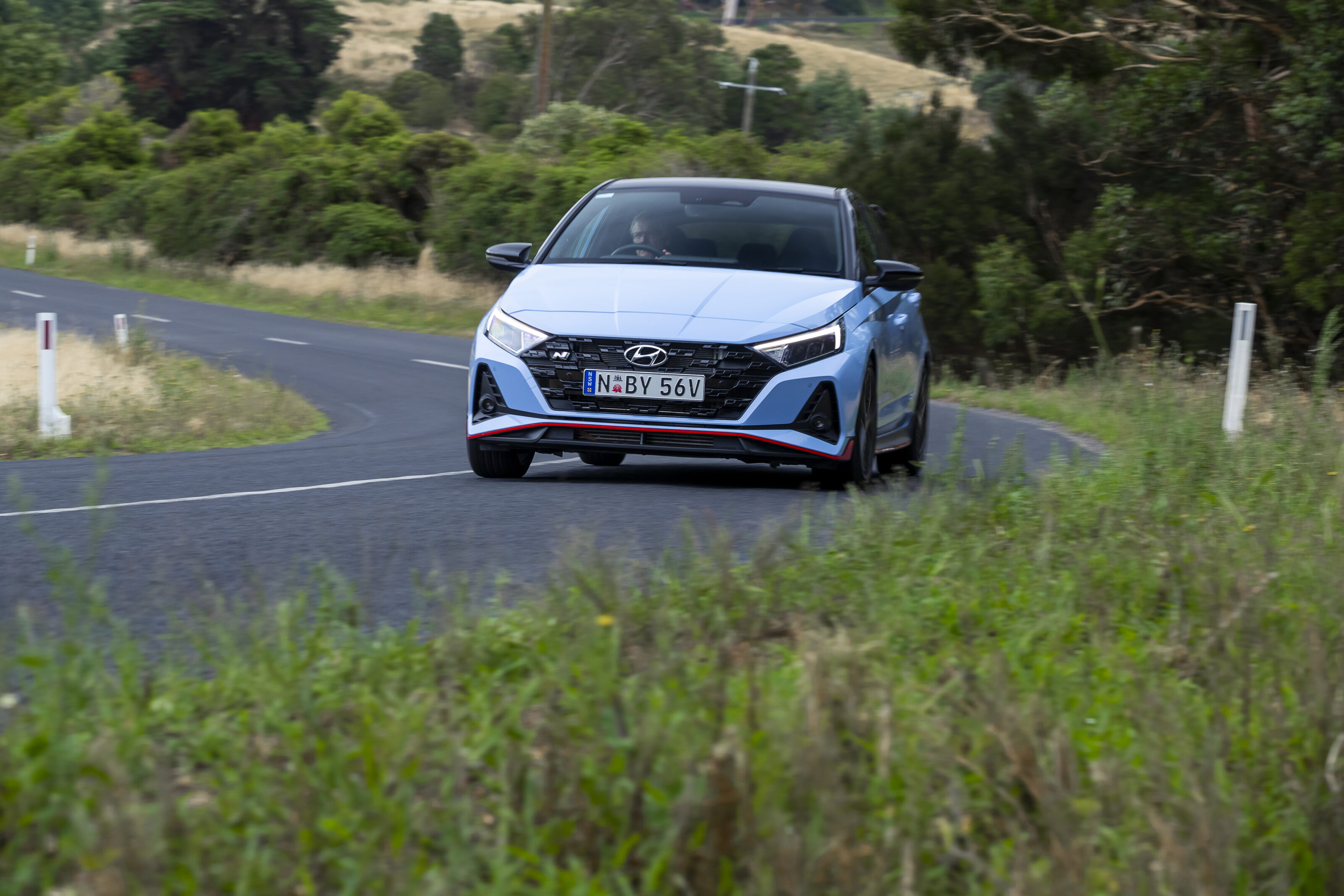
When it comes to hype, the little Hyundai i20 N had a considerable weight of expectation placed on its diminutive shoulders. It’s won awards globally and it attained a perfect score from Kirby in its MOTOR first drive. However, PCOTY has a habit of snuffing out pretenders, hence the anticipation was palpable. Cutting to the chase, it didn’t disappoint. Podium placers in this field need to be top drawer.
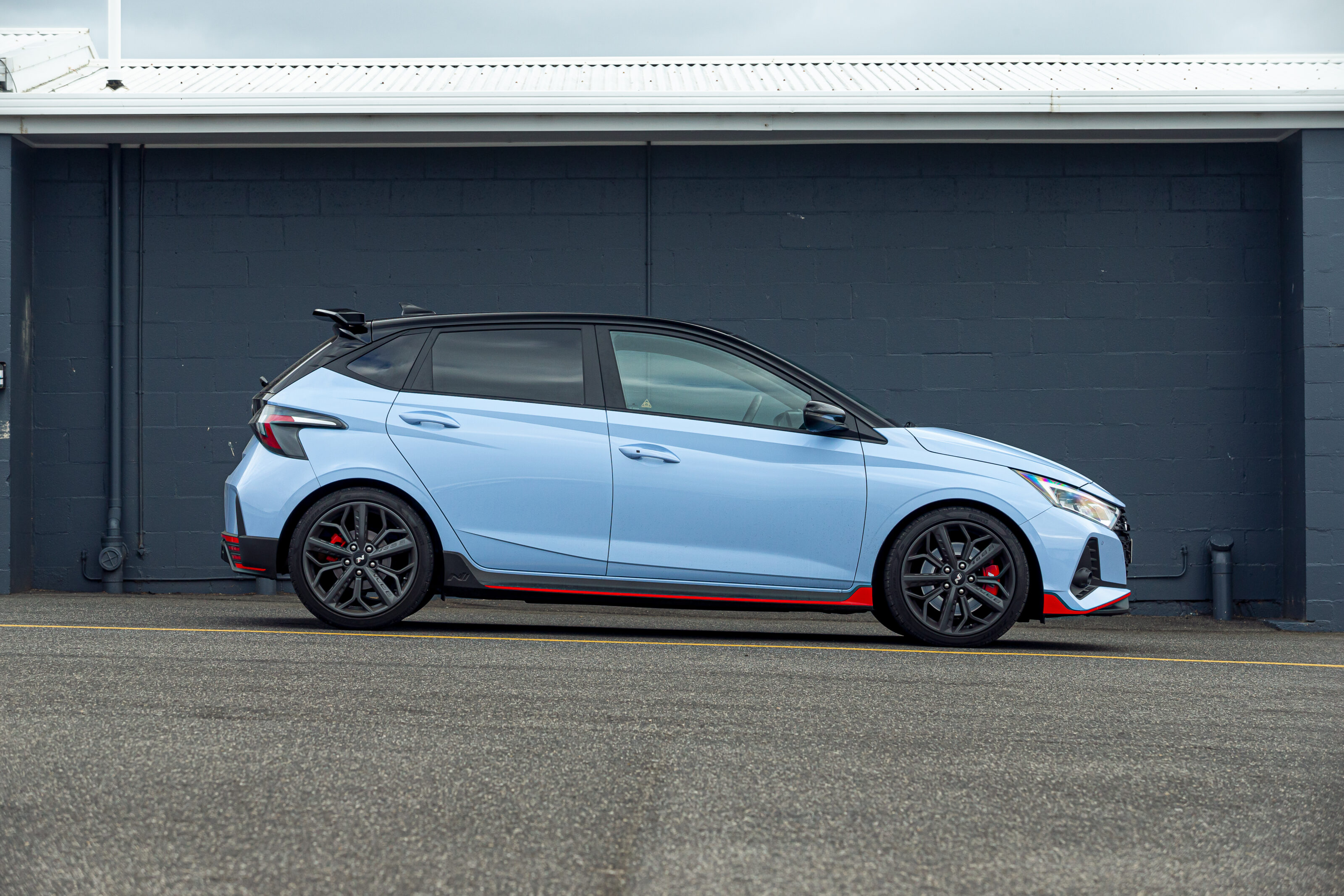
While it didn’t quite lift the inaugural SCOTY crown, there is a feeling of celebration attached to Hyundai’s smallest N product. Kudos has to go to the South Korean giant and its once-fledgling performance arm – it’s now every bit the real deal. The i20 N is further proof of that. It shone while navigating the tight and technical road loop, with its diminutive dimensions proving a boon on the narrow tarmac. On the final twisting change of direction the i20 N was more composed than any car with a 2580mm wheelbase has any right to be as it slalomed through the pockmarked esses.
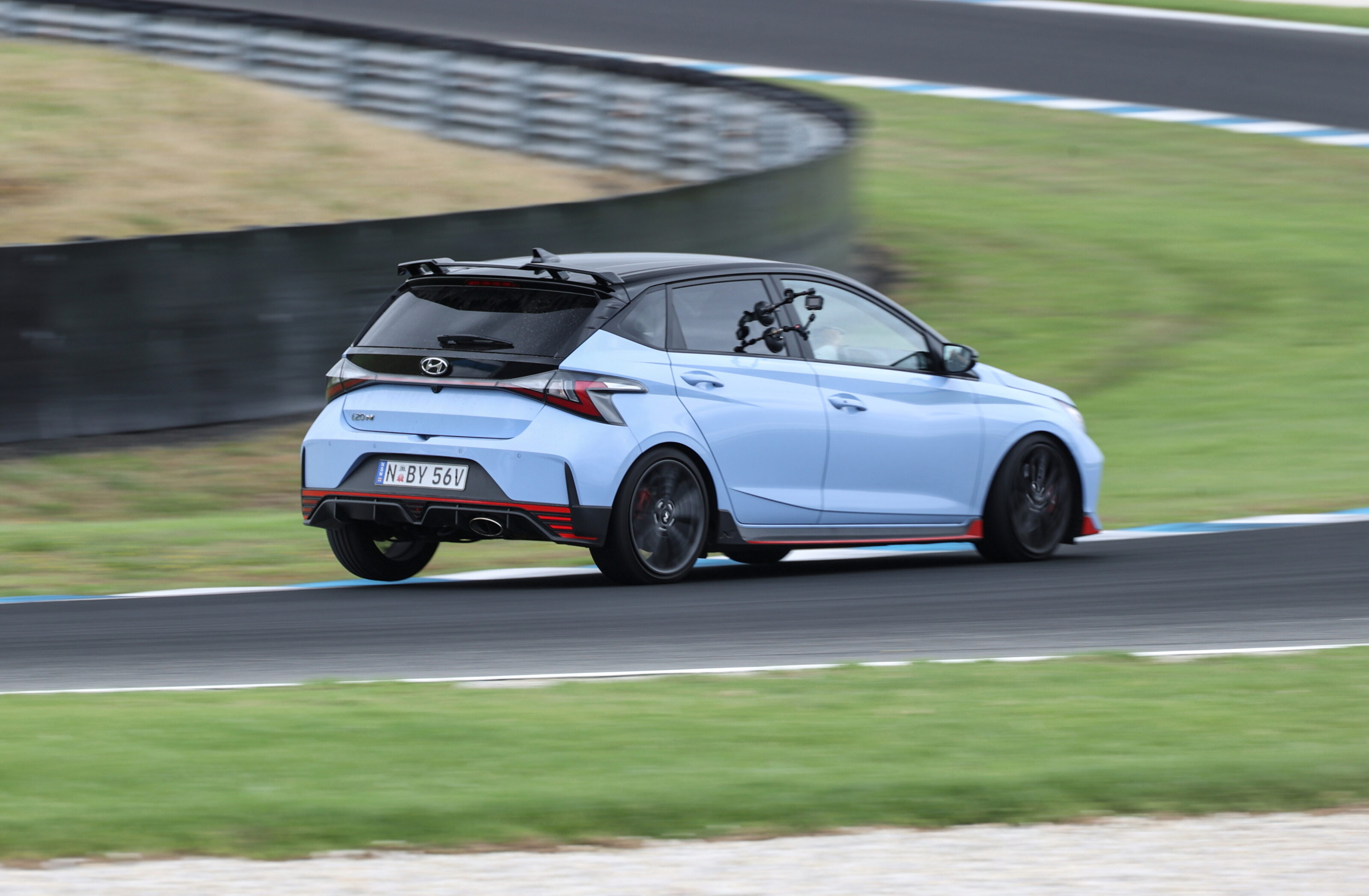
In many ways, the i20 N looks as though it’s going to be the unruly child of the group. But it isn’t. The Hyundai displays a dynamic maturity that outstrips its boy-racer (or girl) exterior vibes. The front axle vehemently resists the urge to understeer and the rear remains so tied down that it’s hugely confidence-inspiring.
The harder you drive it, the bigger the grin and reward. And it allows you to tap into its talent via sophisticated damping that shrugs off mid-corner bumps and a limited-slip differential that translates the 150kW and 265Nm to the ground in a ruthlessly efficient fashion.
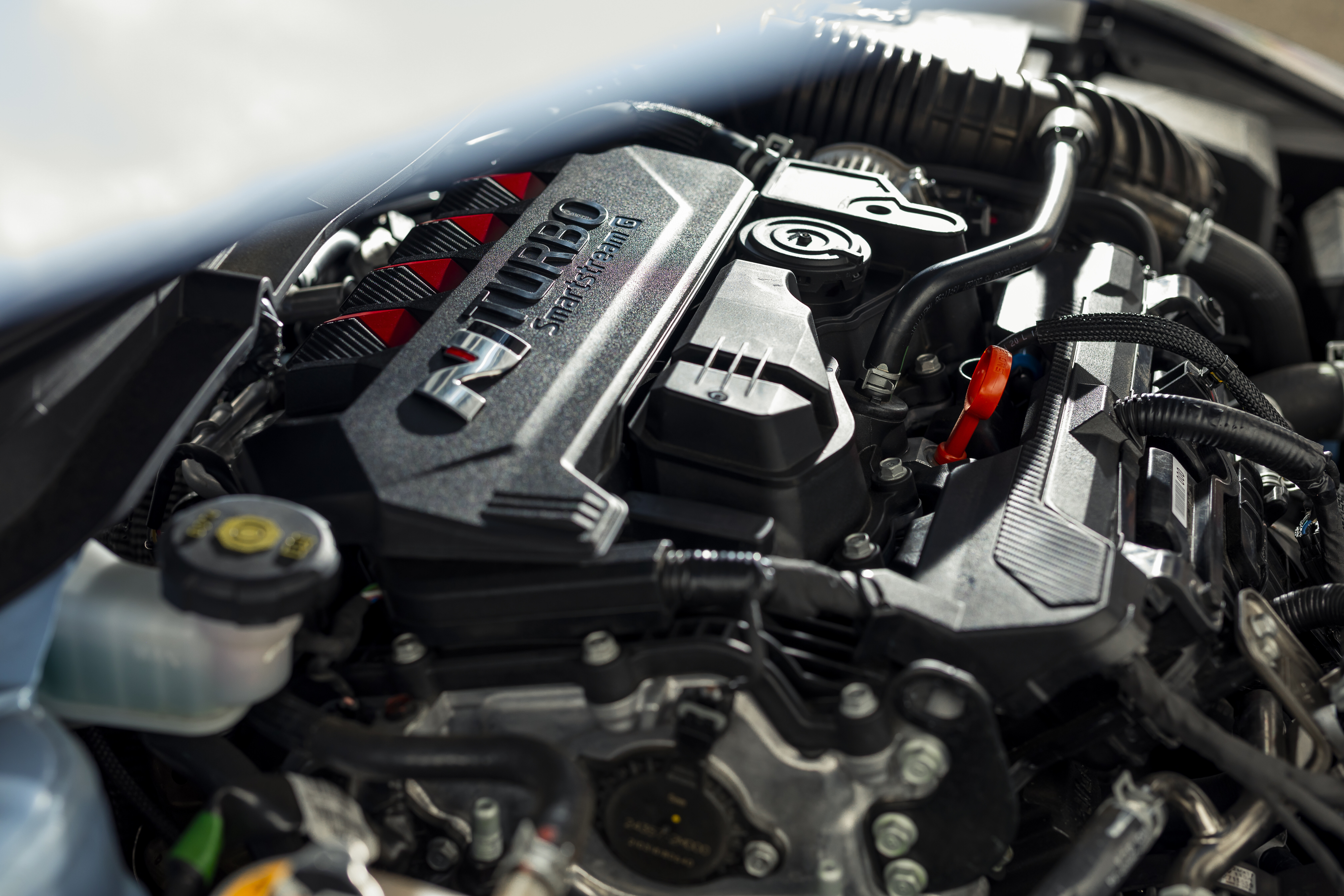
The engine itself isn’t on a charm offensive, however. It does the job, but it doesn’t have the comical sonics of its N siblings. Effective is the best adjective to describe the boosted 1.6-litre four-pot and the straight-line data backs that up with a 0-100km/h time of 7.45sec, testing taking place into a fierce headwind off the Bass Strait.
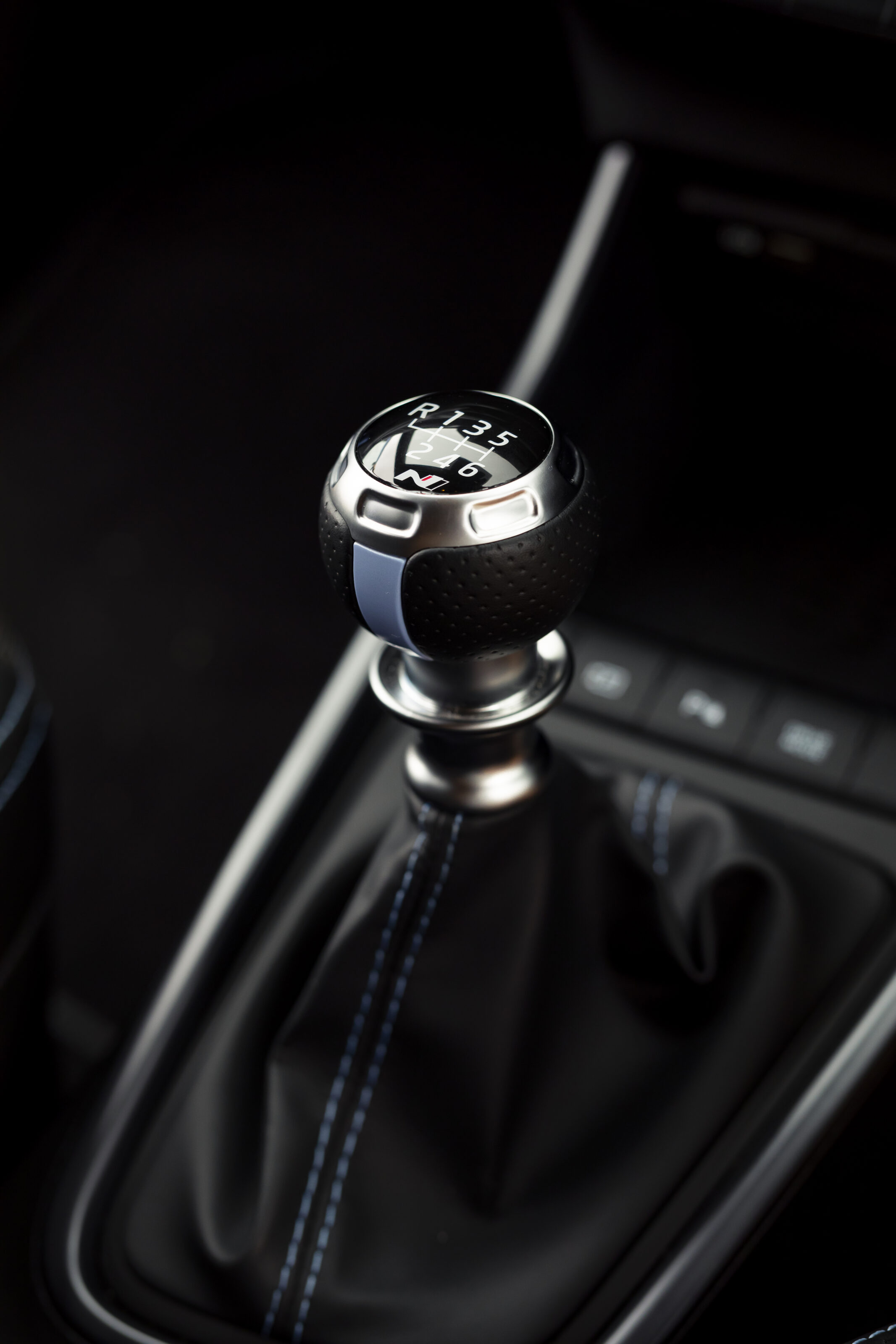
A dual-clutch transmission would have aided pace, but this is a hot hatch with a focus on driver engagement, so we’re more than happy that it comes with a six-speed manual and conventional handbrake.
In certain regards, Phillip Island overmatched the bantamweight i20 N. It’s a big track for a small car. That’s not to say the Hyundai didn’t impress, with its lap time of 1:55.79 eclipsing the significantly more powerful BMW 128ti – which says a lot about the Hyundai’s chassis. Luffy got out of it beaming, but conceded that “if we were at Winton, it would be even better again. You want it to have another 20kW or so”. However, he added that “once you get to the corners it is good fun, it’s nimble and it’s playful on the front end”.
The mature and tied-down rear-end was also evident at the race track which fostered immense trust in its capabilities through the high-speed sections. Some judges felt a more impish balance would benefit the i20 N’s overall character. “It’s all front end. It’s capable and good fun, but I’d enjoy it if the chassis offered me a few more options,” said Andy.
An issue that did raise a few eyebrows is throttle hang, with Bernie proclaiming “it frustratingly gets to the point where it’s holding revs when you are expecting engine braking”. This made downshifts occasionally hard to finesse, Quinn musing that it could have been a conscious decision from the engineers in an effort to ameliorate the effects of driveline lash.
Mechanicals aside, the cabin is very much based on the generic i20 range available overseas, so don’t expect tactile surfaces or huge amount of sound deadening.
Having said that, the controls you use for spirited driving are where the money has been spent, so the seats have deep leather bolstering and there’s a well-sized leather-wrapped steering wheel. The driving position can be set agreeably low; a rarity in hot versions of small hatches.
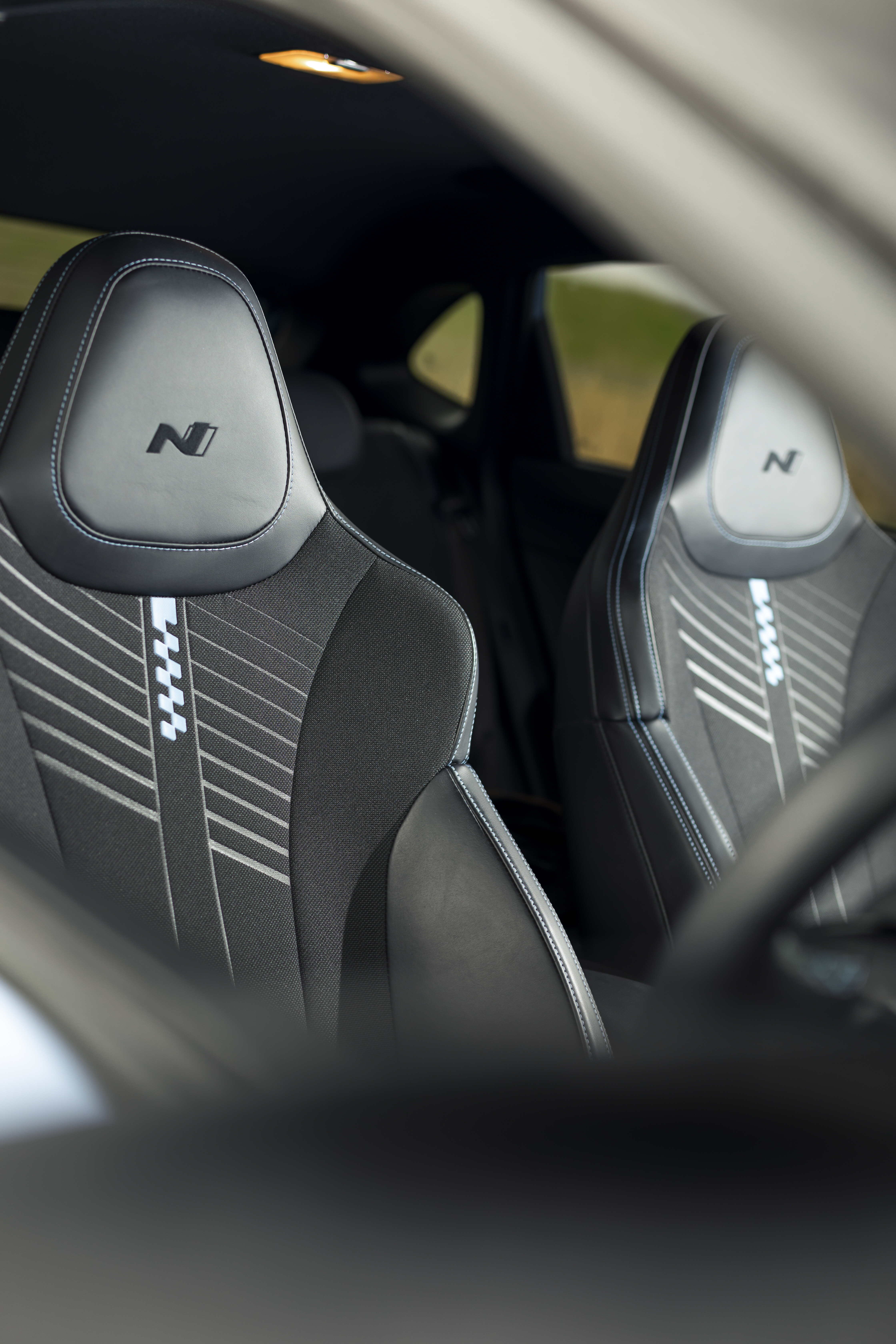
Like other N models, there are a vast suite of modes to play with, which can be tailored and designated to two buttons on the steering wheel. An adaptive suspension setting isn’t included, however, the passive setup is well tuned, especially in terms of damping, despite leaning towards the firm side. Passengers might grow weary, but you won’t from behind the wheel. Speaking of, you can’t miss the big, red rev-match button, which controls the well-calibrated auto-blipping on downshifts.
The fact a car this good came third is more a testament to the brilliance of what finished ahead of it rather than a tot-up of its shortcomings. At $32,490 the i20 N is the cheapest entrant in the entire field.
If you can’t afford the exotica found within the PCOTY ranks don’t worry, you can still extract huge levels of fun out of Hyundai’s offering – just at a much more palatable price. As the hot hatch class continues to insidiously migrate upwards in price, it’s refreshing to know that genius like this can still be found in the lower echelons.
The judges’ comments
Alex Affat
“The hype is deserved. Didn’t quite have the legs for Phillip Island but it’s a small ball of fun on road.”
Ranking: 3rd
Andy Enright
“Right up there. Jinky and fun. You’re wringing it all the time so the overboost light gets a workout.”
Ranking: 3rd
Trent Giunco
“The engine does a job, but it’s not a centrepiece. Dynamics are more mature than the styling suggests.”
Ranking: 3rd
Cameron Kirby
“The front end delivers so much confidence. I’d like a bit more heft to the manual box’s shift action.”
Ranking: 3rd
Bernie Quinn
“I’d prefer the steering to have less weight in N Mode. Chassis has remarkable damping and awesome grip.”
Ranking: 4th
Luffy’s view
“Wants to be driven hard. So much fun. I’d like a bit more rear-end liveliness, but feedback can’t really be faulted.”
The key figures
| 0-100km/h: | 7.45 seconds |
|---|---|
| 0-400m: | 15.12 sec @ 151.58km/h |
| Lap time: | 1:55.79u00a0 |
Snapshot
- Fuel excise will be halved to 22.1 cents per litre
- Changes won’t be seen at the bowser for another fortnight
- Increasing price of crude oil could negate direct savings
Fuel providers could be taken to court if they don’t pass on the Federal Government’s excise cut to consumers, Wheels has learned.
The Australian Competition and Consumer Commission (ACCC) has vowed it will be monitoring local fuel prices more closely after the excise was halved temporarily for six months as a part of the 2022-23 Federal Budget – and will take enforcement action against those not passing on the saving.
Refiners, importers, terminal operators, wholesalers and retailers found to be making false or misleading statements about their intentions to hand down the tax cut to consumers could face penalties ranging from fines through to legal action taken through the courts.
A spokesperson for the ACCC told Wheels the punishment for breaching Australian Consumer Law varies depending on the situation – starting with an infringement notice of $2664 (for an individual), $13,320 (for a body corporate) or $133,200 (for a listed corporation), through to legal action being taken in the Federal Court of Australia, where costs would likely be much greater, resulting in penalties of between $287,490 and $1.4 million. The authority can seek additional redress for consumers which could include applying for an injunction or lesser orders such as community service or probation.
ACCC Chairwoman Gina Cass-Gottlieb said the watchdog will be paying close attention over the next six months to make sure fuel companies aren’t taking advantage of the situation.
“If retailers make false or misleading statements to consumers that they have passed on the savings when they have not, the ACCC will not hesitate to take appropriate enforcement action,” she said.
“We encourage consumers in major capitals to also look at the price cycle information on our website, and consumers everywhere to use price comparison sites.”
However, the Australian Automobile Association (AAA) has been skeptical about the process the Government will use to enforce the tax cut, asking for clarity surrounding the ACCC’s strategy.
“The AAA looks forward to understanding the measures to be put in place by the Government to ensure every cent of this tax cut flows through to motorists,” said the AAA following the announcement.
“Motorists deserve to know how the Government will police this tax cut and ensure it’s not simply swallowed by fuel retailers, as the experience overseas is that retailers are pocketing the profits and motorists continue to miss out.”
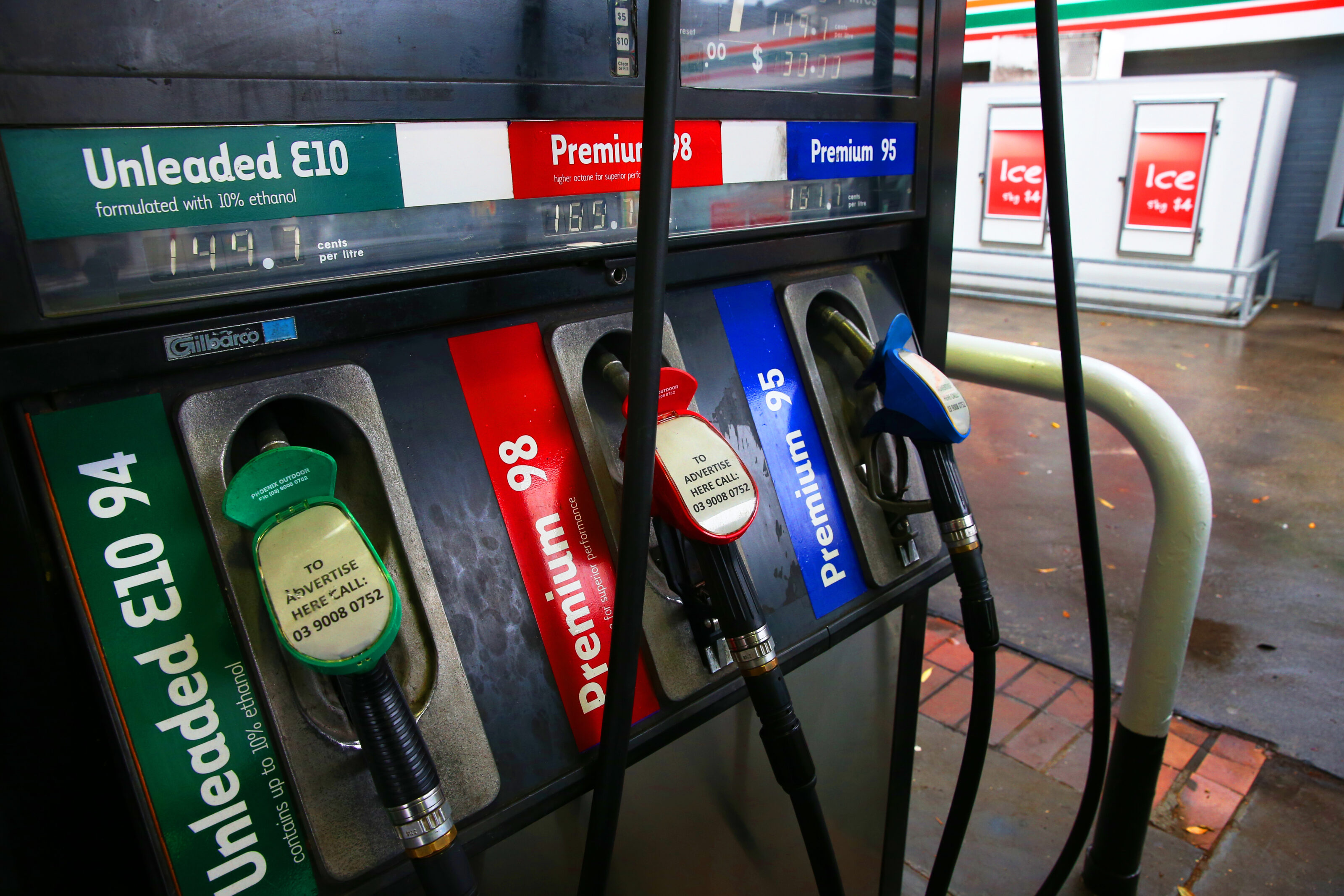
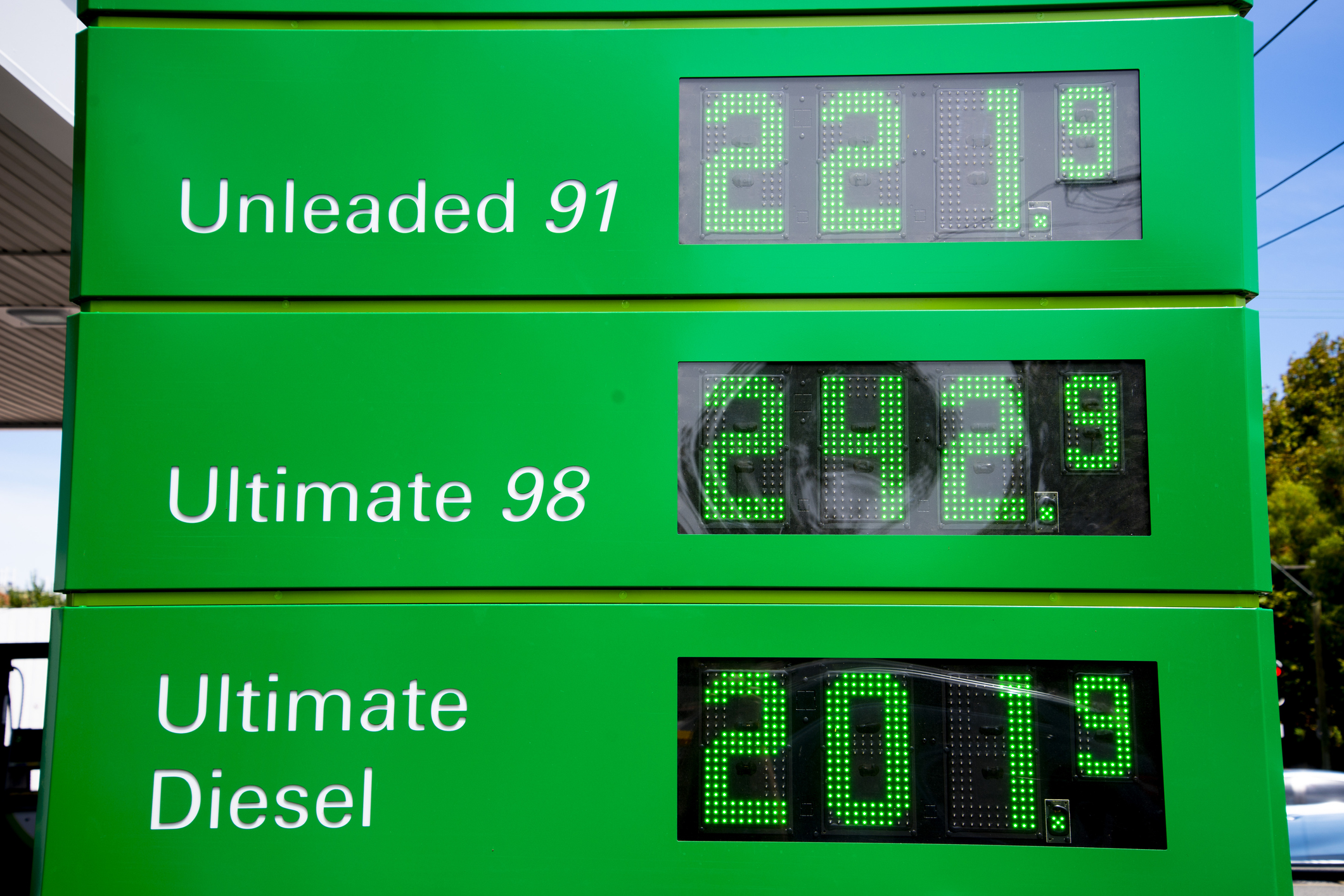
On Tuesday, Treasurer Josh Frydenberg cut the national fuel excise to 22.1 cents per litre as a part of the Coalition’s plan to reduce surging prices, with the national average for regular unleaded sitting at 206.7 cents per litre as of March 27, according to the Australian Institute of Petroleum.
While the excise reduction came into effect on March 31, it’s expected to take at least two weeks for the price reduction to be passed on to motorists.
“We expect that fuel retailers will pass on the cut in fuel excise to reduce the price at the bowser as soon as possible, as existing petrol stock levels are used up,” ACCC boss Gina Cass-Gottlieb added.
“In light of the announcement, our petrol team will focus on this price monitoring work for the next six months to determine how retailers are passing through the excise reduction to consumers.
“We will contact petrol retailers to set out our clear expectations that the savings are passed on to consumers and advise them that we will be monitoring their margins. We will also continue to inform consumers of retailer behaviour.
“As these changes flow through to prices at local servos, this is a good time for consumers to look around and shop at those retailers who have already passed on the cut in the excise to their petrol prices.”
Last year, the ACCC found taxes such as the excise and GST made up 36 per cent of what consumers pay at the bowser, with just 15 per cent going towards retail margins and other costs.
While the temporary fuel excise discount will drop the price of fuel by 22.1 cents a litre for six months, motorists may not receive the kind of relief they are hoping for at the pump, with the price of oil retracing higher in recent weeks.
Over the month of March, Brent Crude dropped from a high of around US$130/barrel to less than US$100, but has crept up to its current price of US$110.
As the price of petrol and diesel lags the oil markets by around a week or two, it’s likely unleaded will still cost around AU$1.80/litre – with the trend pointing higher.
Oil industry experts are warning the price of oil could hit US$200, which would see petrol prices surge to nearly AU$4/litre.
“It is not unfathomable for prices to rocket to US$200 a barrel by summer, spur a recession and end the year closer to US$50 a barrel,” RBC Capital Markets analyst Michael Tran told Yahoo Finance.
“To be clear, this is not our base case, but such a scenario does not sound implausible today.”
According to the Australian Automobile Association, the fuel excise tax was expected to rake in $13 billion this year, although it found just 53 per cent of the fuel excise was spent on the transport network over the past decade.
The Federal Chamber of Automotive Industries recently called for the fuel excise to be scrapped entirely in favour of a uniform road user charge scheme, with CEO Tony Weber saying “…a road user charge is not an additional tax on motorists. Instead, it can replace myriad charges such as registration, fuel excise licence fees, luxury car tax and sales tax.
“The reduction in complexity also presents an opportunity to reduce the large bureaucracies required to administer these inefficient taxes and charges, providing additional economic benefit.”
Alfa Romeo is looking to do battle with the big German luxury brands.
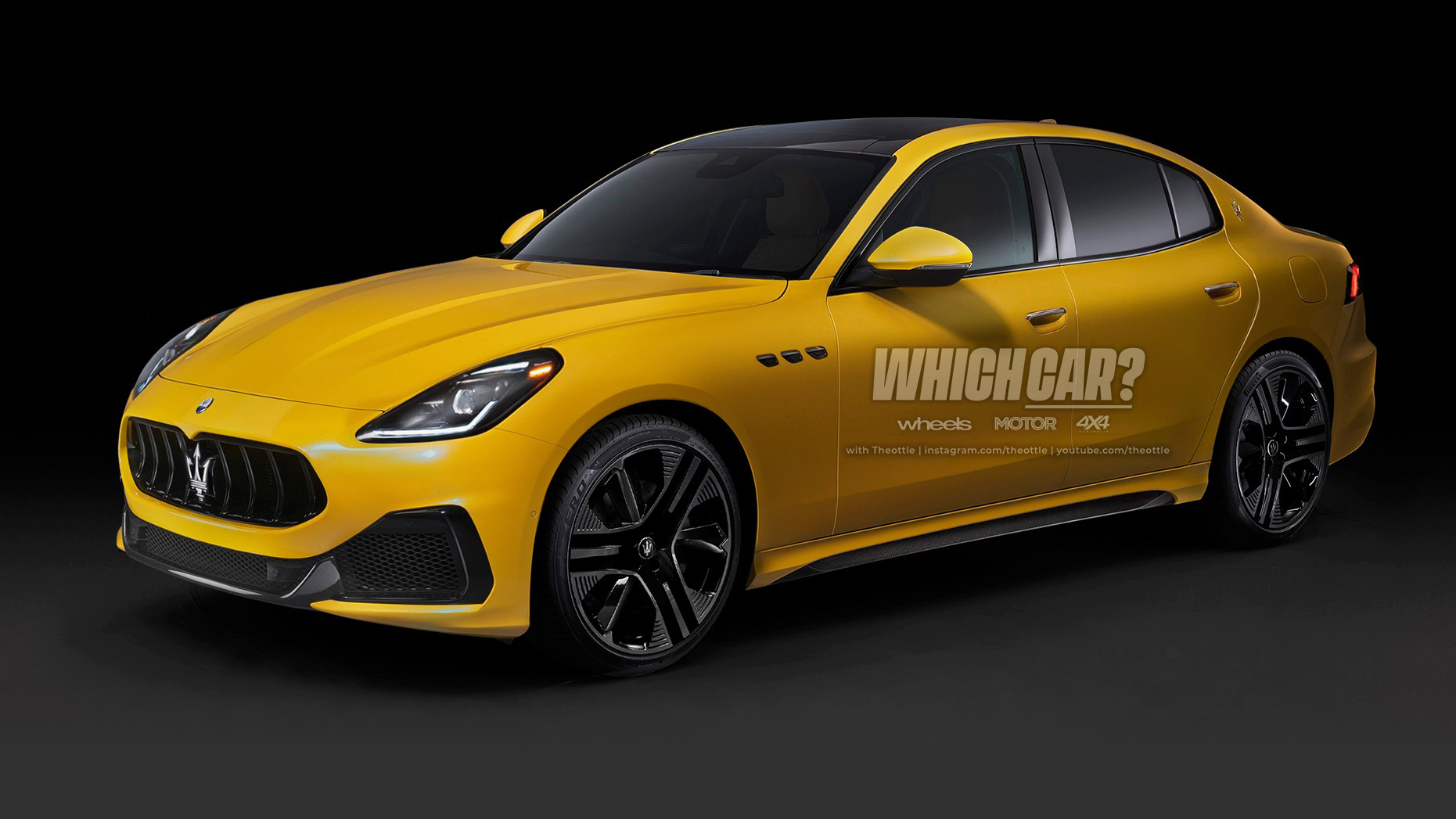
The CEO of Alfa Romeo, Jean-Philippe Imparato, told Dutch publication AutoWeek he wanted the Italian carmaker to go toe-to-toe with the likes of BMW by developing a large luxury sedan and large SUVs.
“I haven’t told anyone before, but since we want to be the global premium brand of Stellantis and because everyone in the world knows our brand, I want to bring a high-end SUV to the market,” Imparato said at the launch of the Tonale SUV.
“How exactly are we going to shape that is another question, but above a D-segment [mid-size] model, there will also be an E-segment [large] car with very high performance,” he said.
“We are going for the most profitable segment, targeting models such as BMW’s X5, X6 and the 7 Series. That decision was made recently and with that we can also target growth markets like China.”
Imparato told a media roundtable in April 2021 the Italian carmarker was discarding its in-house Giorgio architecture, and would instead base its future models off electrified platforms from the Stellantis family.
“If you are not electrified, you are dead,” he said at the time, according to Automotive News Europe, while confirming future Alfa Romeo models would use the ‘STLA Large’ architecture to be shared with Chrysler, Jeep, Dodge, and Ram models.
Imparato said this week the electric limousine, SUV, and SUV coupe will arrive in 2027, falling into line with earlier comments about the company’s five-year plan.
