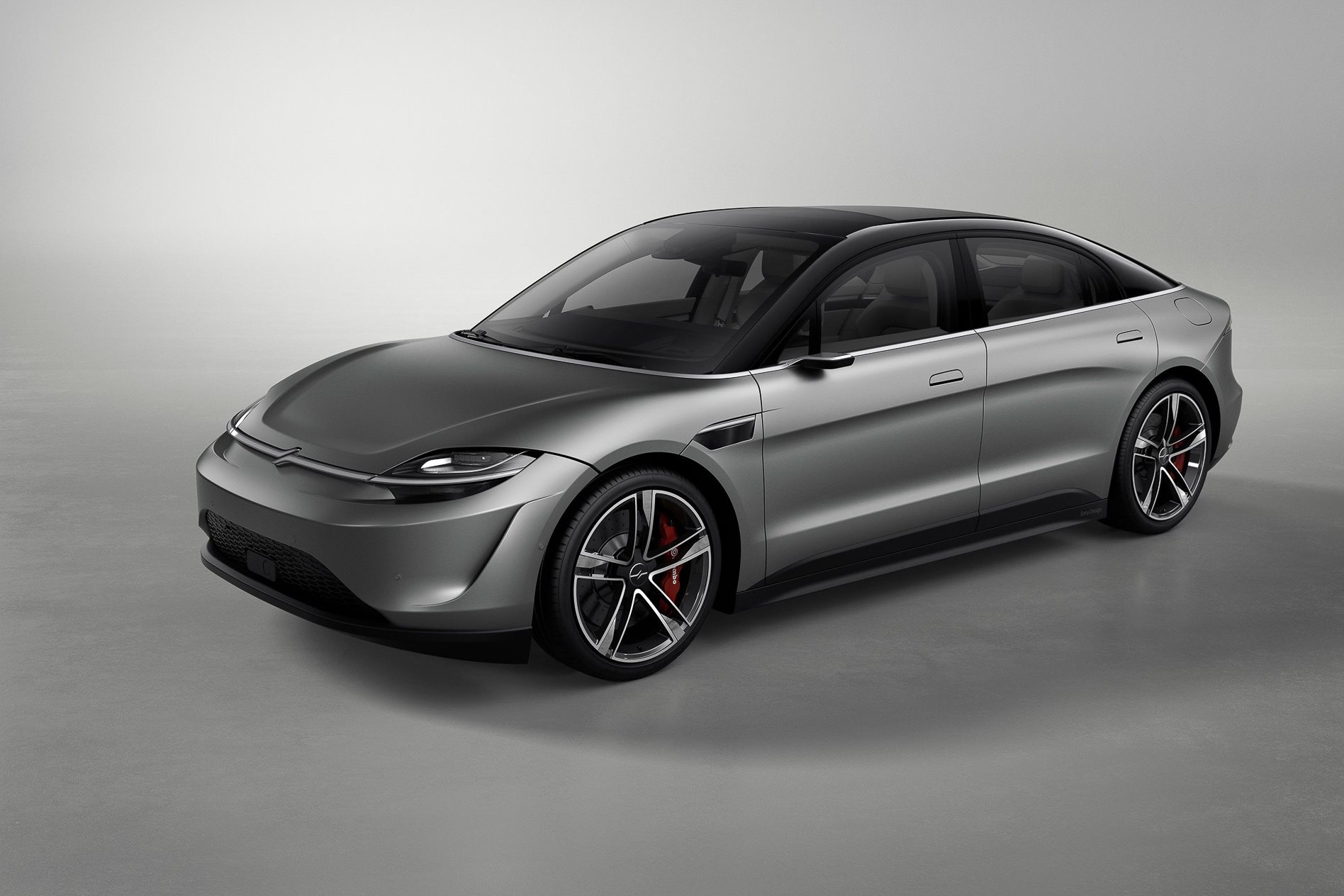
Toyota Australia finished 2021 on top with a total sales figure of 223,642, a rise of nearly ten per cent over 2020. It marks the 19th year in a row on the top step for the Japanese company and its 25th number one result.
The results also show that in the last two and a half years, Toyota has won 25 months.
Hybrid sales made up nearly a quarter of the total. Since the 2001 introduction of its first hybrid, the Prius, Toyota has gone from selling 136 hybrids a year to over 65,000. Nearly three in four RAV4s sold in 2021 were hybrids, half of Corollas and whopping 84 per cent of Camrys.
Further up the range where hybrids are non-existent, the LandCruiser brand had a massive year, with over 50,000 sales. Between the 200 and 300 Series, buyers took delivery of 12,652 wagons.
Sean Hanley, the ebullient Vice President of sales and marketing, says Toyota has big plans for 2022.
“We will freshen our existing line-up with the upgraded RAV4 range early this year, the Corolla Cross SUV and second-generation GR 86 sports car in the second half, an update to the 70 Series workhorse, and we will also announce launch timing for our first BEV, the BZ4X SUV.”
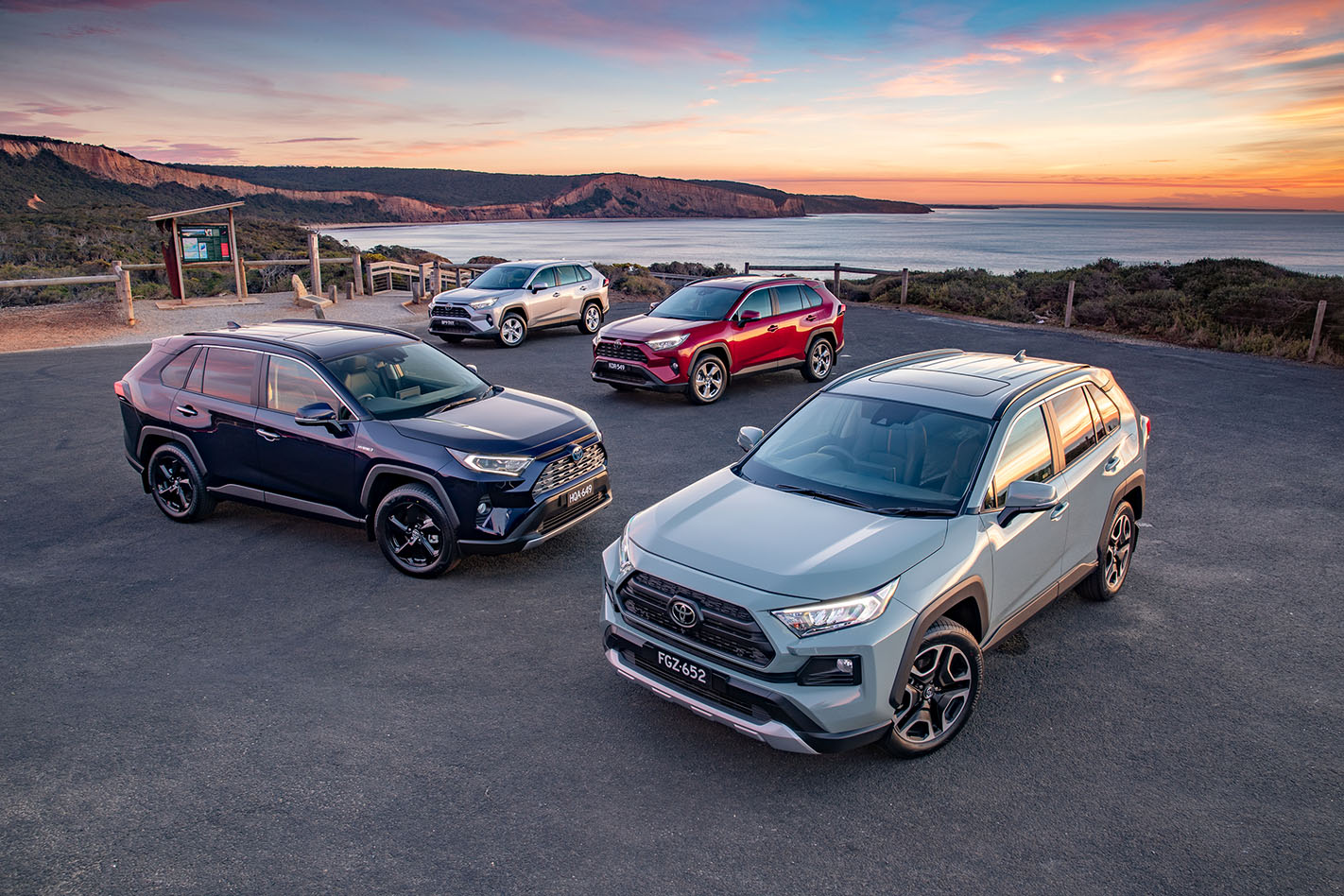
As part of the results announcement, Toyota mounted a vigorous defence of its electrification strategy.
The marque’s local president and CEO, Matthew Callachor, says that the impact of HEVs has been to reduce emissions long before any target was set.
“According to our calculations, those 240,000 hybrids have had the same impact on reducing CO2 as approximately 72,000 BEVs. Yet the volume of batteries we’ve used to produce these hybrid-electric vehicles is the same as we’d need for just 3500 BEVs. In other words, we can say that the batteries needed for 3,00 BEVs have been used to achieve the CO2 emissions reduction effect of 72,000 BEVs.”
RAV4 wait times have blown out to 12 months, particularly for Cruiser and Edge variants. When asked when customers might expect wait times to fall, Mr Hanley said 2022 was looking better. The company expects production to stabilise in the first quarter of 2022 and then ramp up towards the end of the second quarter to higher levels.
Mr Hanley did note that cancellations were not abnormally high and thanked customers for their patience.

“We assure you we are doing everything we can to increase supply and get customers behind the wheel of their new Toyota as soon as possible,” he said
Mr Callachor added that RAV4 production for both ICE and HEV models would ramp up as demand continues to outstrip supply.
The company expects to outperform its 2021 result, with a strong order book and an optimistic forward view.
Key Points
- HiLux remains as Australia’s best-selling vehicle
- Industry hits a 13-year low in December
- Utes and SUVs continue to dominate the market
The Toyota HiLux has retained its status as Australia’s best-selling vehicle in a market that returned to one million annual sales despite its worst December in 13 years.
Toyota’s ute topped the vehicle charts for the sixth consecutive year, according to the latest industry figures released today. The rival Ford Ranger was the most popular model in December, but total 2021 sales of 50,279 trailed 52,801 HiLux registrations.
The Australian new-car market registered 78,402 sales last month. The figure is a significant decrease from December 2020’s 95,652 units and is the lowest December result since 2008 when 76,510 vehicles were sold.
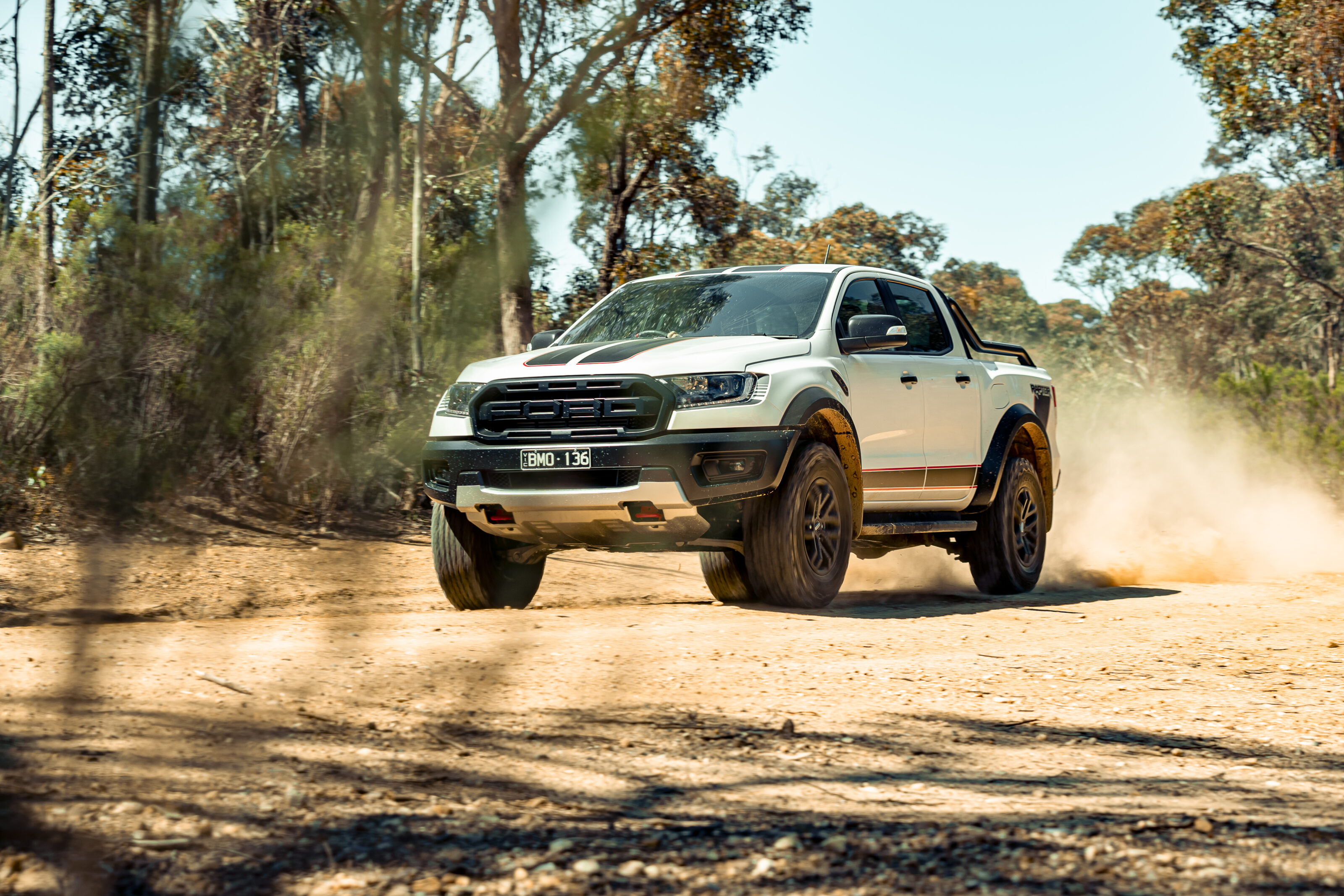
December’s sales were sufficient to take the 2021 total to 1,049,831 – a 14.5 per cent increase on 2020. It is otherwise the lowest new-car tally since 2011.
The new-car market continues to be affected by the double whammy of a global pandemic and the related microchip shortage.
The Federal Chamber of Automotive Industries (FCAI) said it was encouraged by results considering market challenges.
“Despite the pandemic restricting access to showrooms in 2021, Australian consumers found ways to purchase new vehicles and did so in solid numbers,” said FCAI chief executive Tony Weber.
“The global shortage of microprocessors, compounded by the pandemic, had an impact on the number of cars sold throughout Australia. Automotive manufacturers are continuing to work to strengthen supply chains in 2022.”
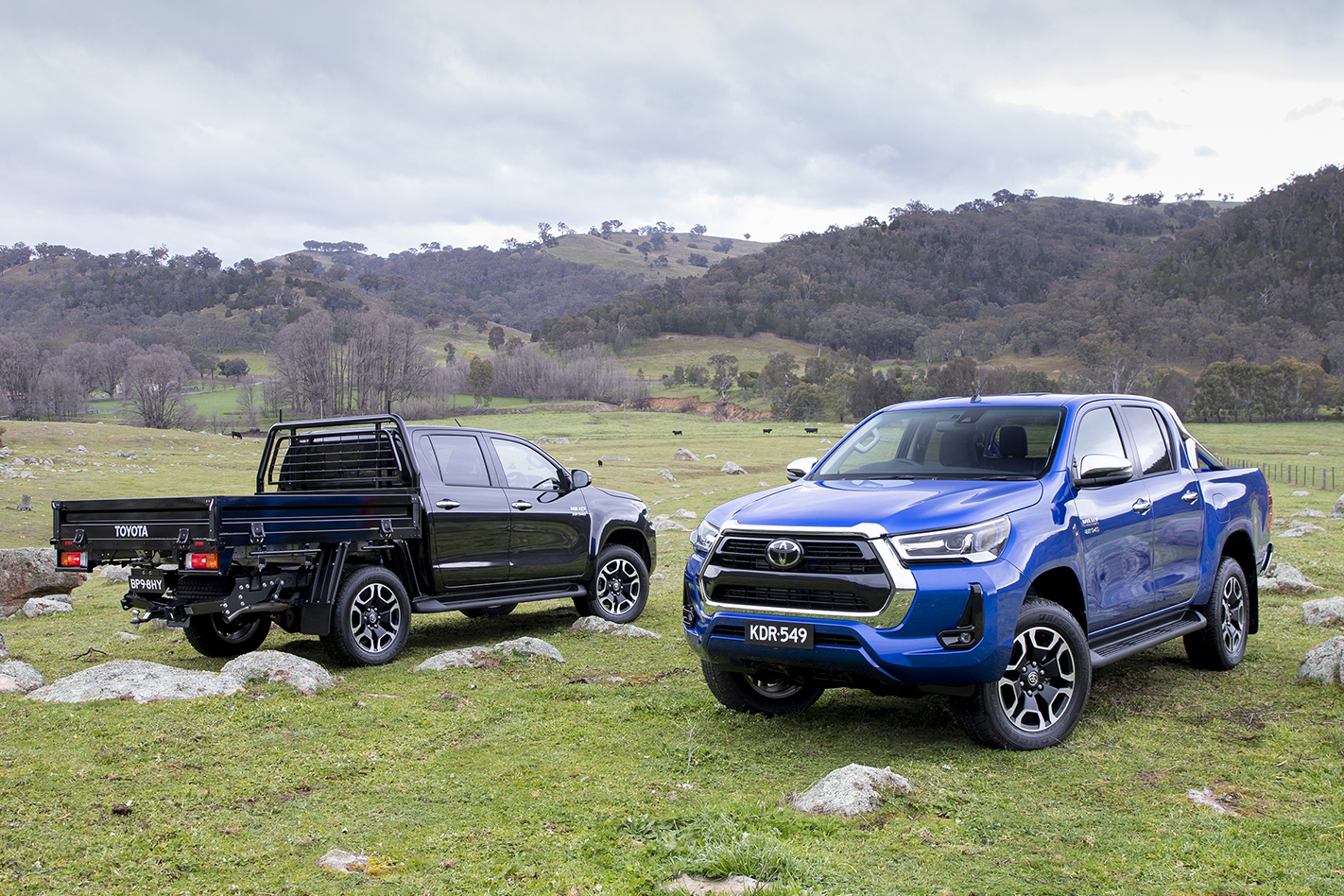
Passenger cars, SUVs and light-commercials all struggled last month, dropping 27, 18 and 12 per cent, respectively, compared with December 2020.
SUVs accounted for 52 per cent of December sales.
Medium SUV was the biggest individual segment last month, according to VFACTS, though the 15,192 units are surpassed by utes when combining 4×4 (14,460 units) and 4×2 (2948) variants.
The 4×4 Ute segment was 2021’s outright biggest-selling category, with 24 per cent year-on-year growth ensuring its tally of 189,614 units overtook the 180,165 medium-sized SUVs sold last year.
Micro cars (up 164 per cent) and people-movers (up 91 per cent) were the two big movers in December. The small-car and sports-car segments struggled the most, down 40 per cent and 52 per cent, respectively.
Utes dominated the top 10 Vehicles list last month, with the Ranger and HiLux joined by the Isuzu D-Max, Mitsubishi Triton and Nissan Navara.
One of the month’s biggest shocks was the absence of the Toyota Corolla from a monthly top 10 for the first time. Just 1271 Corollas were sold in December – half the number registered in December 2020.

Top 10 models
The Ranger v HiLux battle has raged all year, and the Ford’s December win means the utes share six monthly victories apiece.
Utes accounted for half of the Top 10, with the Nissan Navara making a second consecutive monthly appearance after not featuring at any other time in 2021.
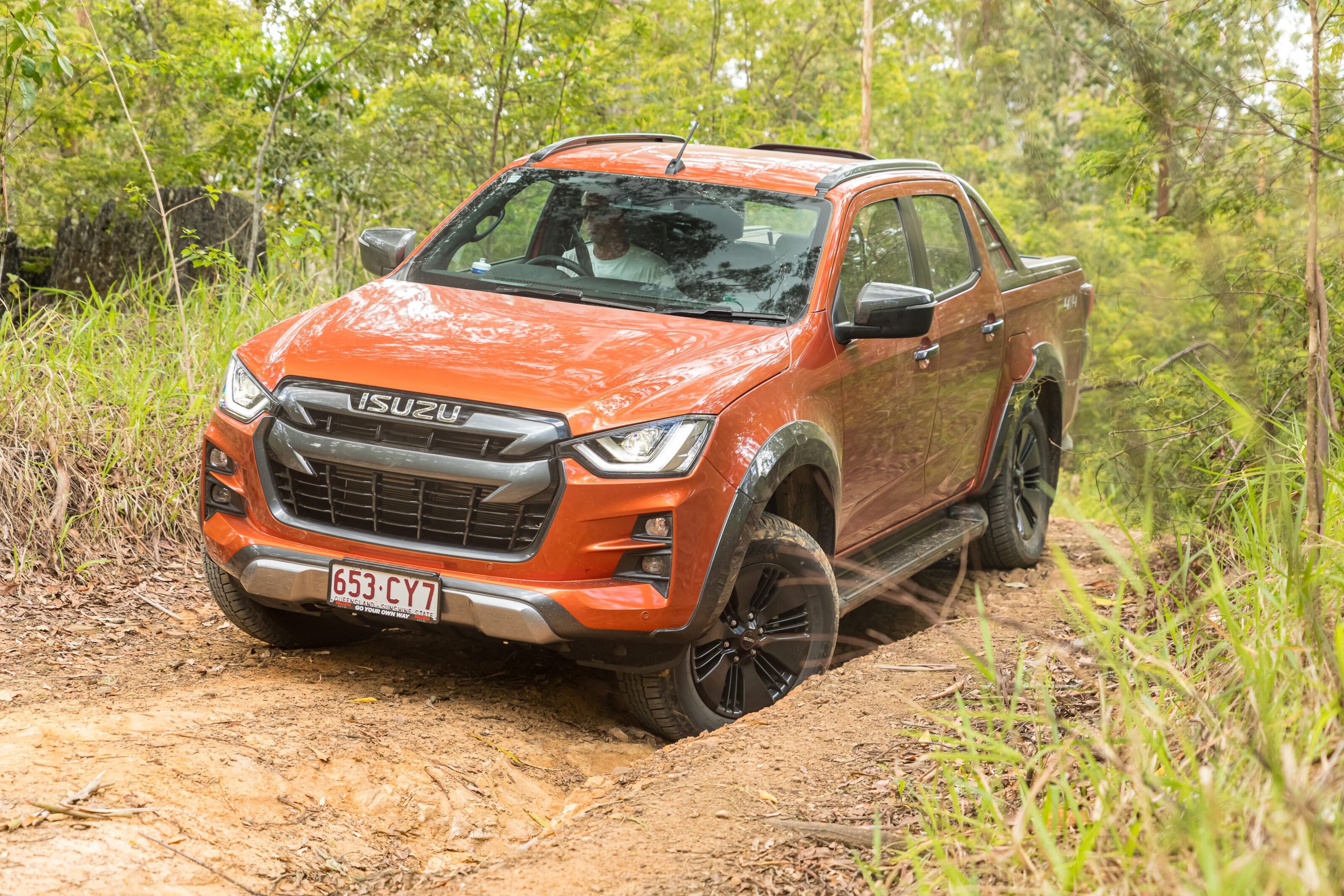
Isuzu’s D-Max returned to the top 10 after registering its first absence of 2021 in November.
The Hyundai i30 was the sole representative for small cars after the Toyota Corolla missed the best-sellers list for the first time in 2021 as a consequence of a 50 per cent sales decline.
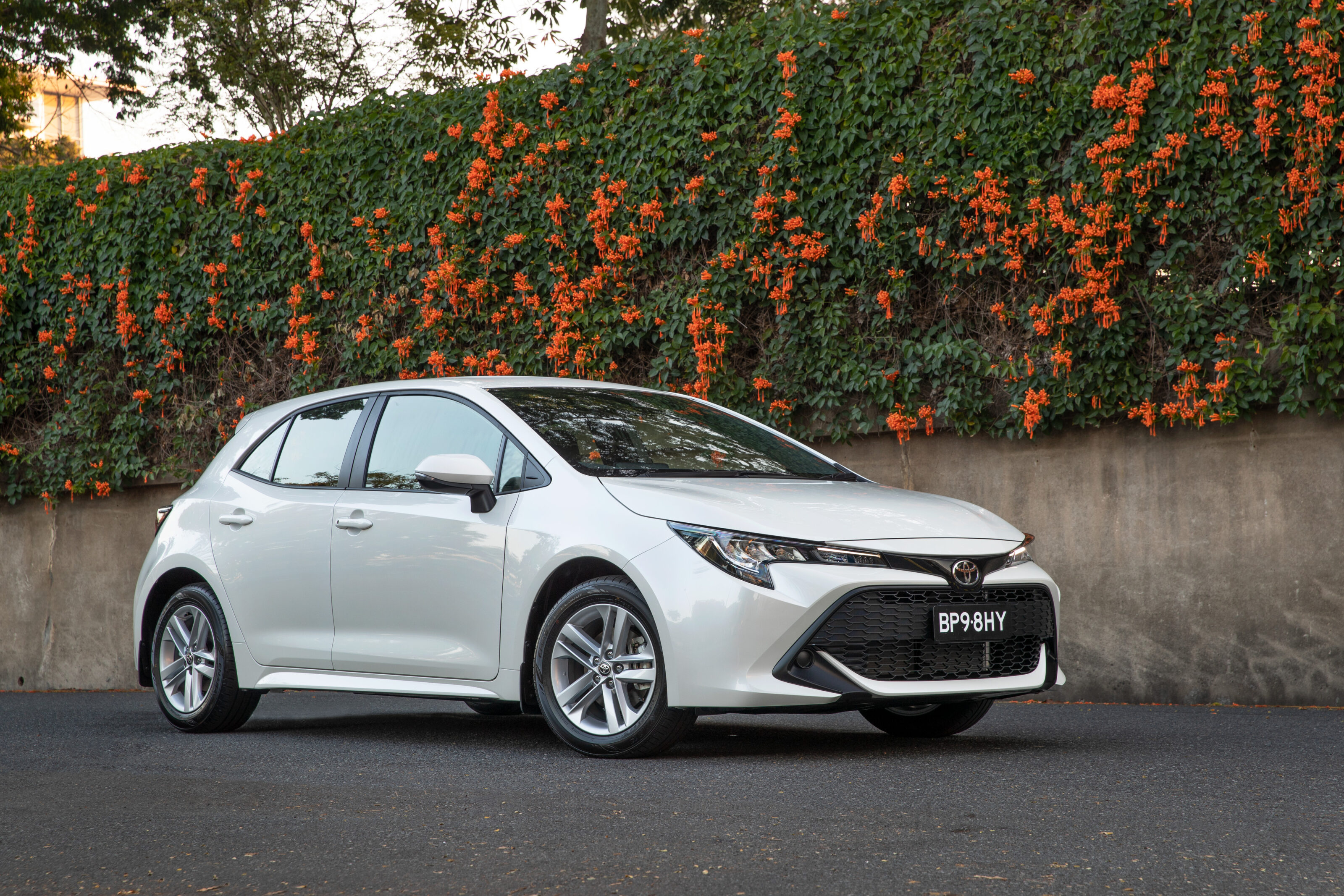
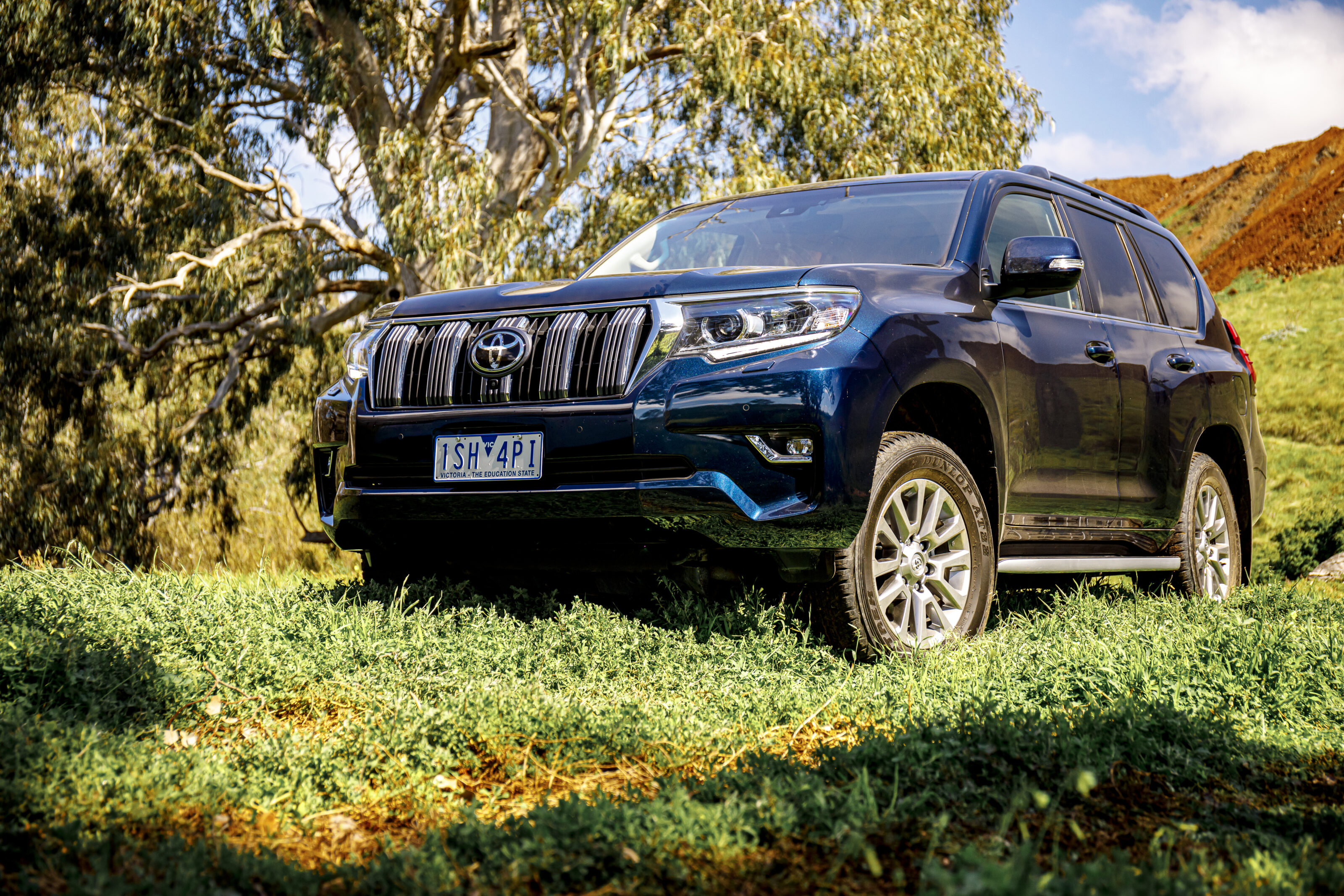
The Toyota Prado placed fifth last month to secure its sixth top 10 result of last year and match its highest placing also achieved in August and September.
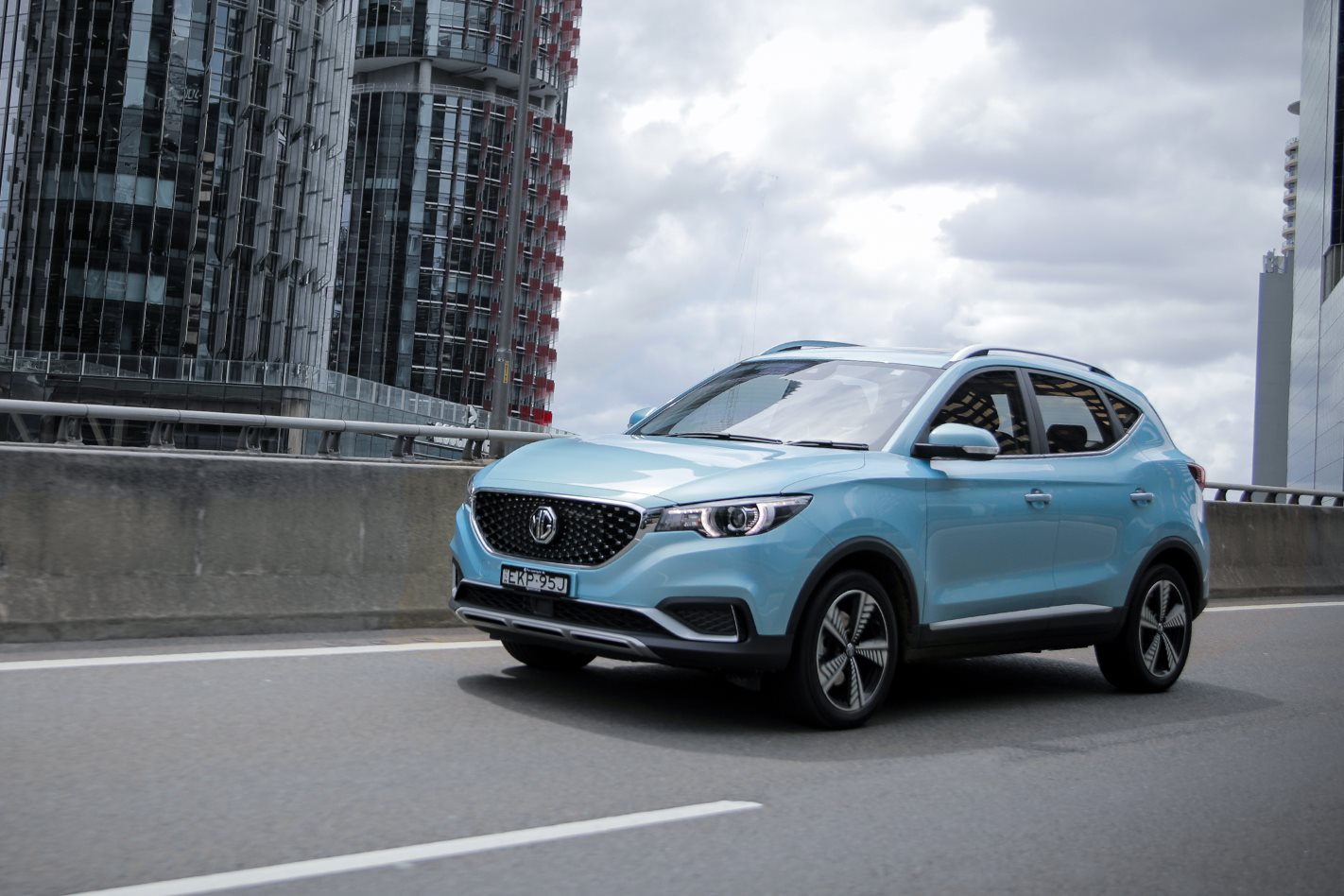
MG’s ZS SUV continued its excellent 2021 sales form, with its 1980 December registrations equating to a 96 per cent increase compared with December 2020.
Ford’s Ranger staged a fine comeback against the rival Toyota HiLux that topped the charts for every month except one (April) in the first half of the year.
Despite the locally developed ute taking the honour of best-selling vehicle for the last four months of the year, however, the Ranger fell just over 2500 units short of glory.
Ford Australia will find consolation in two areas. The Ranger again led the vastly more popular 4×4 ute segment, increasing its margin of sales superiority over the HiLux compared with 2020.
And the Ranger’s 23 per cent year-on-year growth was higher than the HiLux’s 17 per cent.
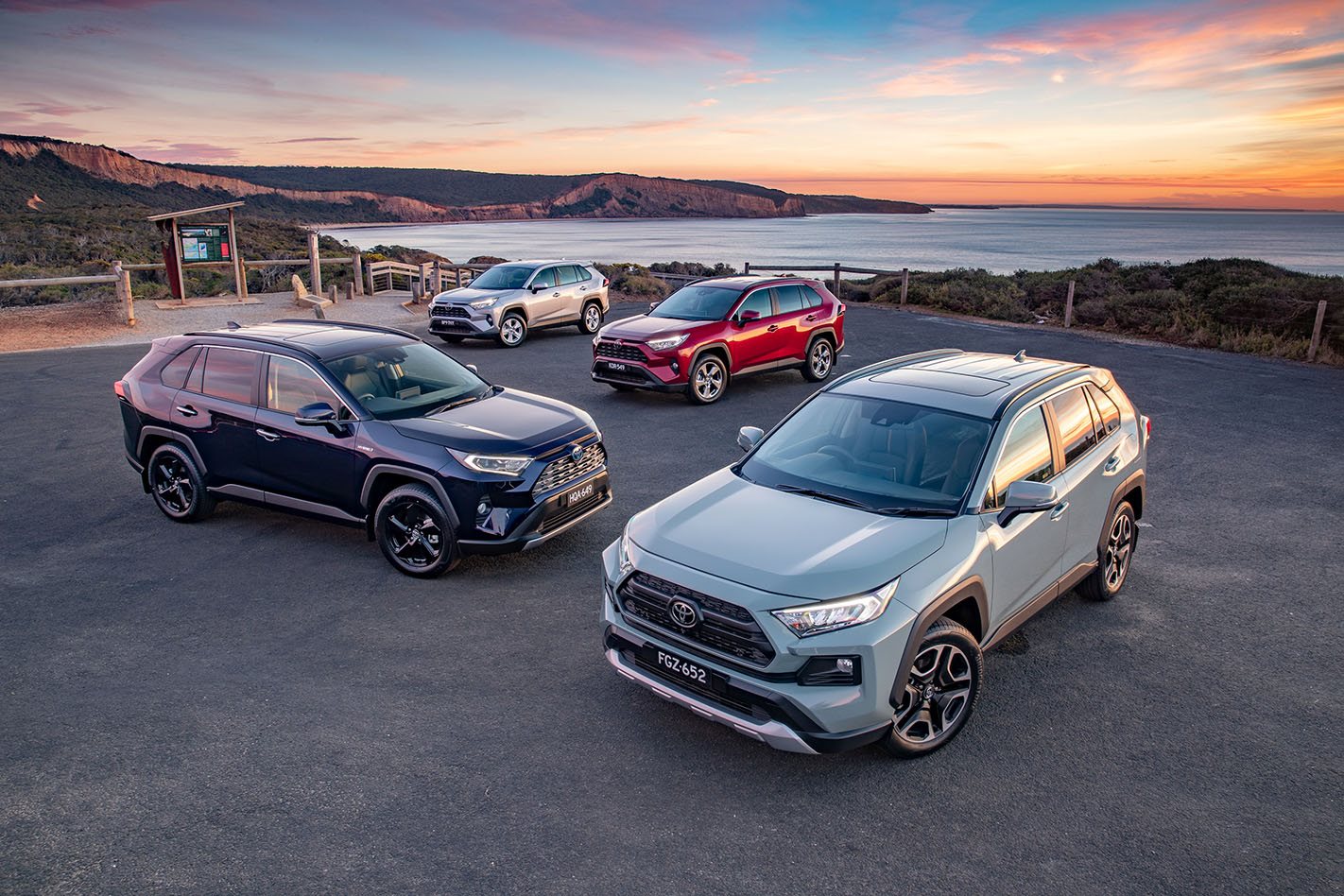
Toyota’s RAV4 was the country’s most popular SUV for the second consecutive year despite a slight decrease in sales (down seven per cent) and a solid year for the rival it displaced, the Mazda CX-5 (up 14 per cent).
The Japanese brand’s larger Prado SUV enjoyed an impressive year, finishing in eighth place.
Toyota’s Corolla, despite a bad blip in December, comfortably held off the Hyundai i30 for title of best-selling small car.
The new-generation Isuzu D-Max had a stellar year, with Mitsubishi’s Triton making it four utes in the top 10 for 2021.
Chinese brand MG knocked the Kia Cerato (18,114 sales) out of the chart, with its ZS compact SUV securing the final top 10 position.
Top 10 models: December 2021
| Rank | Model | Sales | vs December 2020 |
|---|---|---|---|
| 1 | Ford Rangeru00a0 | 4164 | +7.5% |
| 2 | Toyota HiLuxu00a0 | 3821 | u2013 14% |
| 3 | Toyota RAV4 | 2998 | u2013 15% |
| 4 | Hyundai i30 | 2241 | + 12% |
| 5 | Toyota Prado | 2204 | u2013 12% |
| 6 | Mazda CX-5u00a0 | 2148 | +4% |
| 7 | Isuzu D-Max | 2010 | +13% |
| 8 | MG ZS | 1980 | +96% |
| 9 | Mitsubishi Triton | 1751 | +26% |
| 10 | Nissan Navara | 1554 | +47% |
Top 10 models: 2021 year to date
| Rank | Model | Sales |
|---|---|---|
| 1 | Toyota HiLux | 52,801 |
| 2 | Ford Ranger | 50279 |
| 3 | Toyota RAV4 | 35,751 |
| 4 | Toyota Corolla | 28,768 |
| 5 | Hyundai i30 | 25,575 |
| 6 | Isuzu D-Max | 25,117 |
| 7 | Mazda CX-5 | 24,968 |
| 8 | Toyota Prado | 21,299 |
| 9 | Mitsubishi Triton | 19,232 |
| 10 | MG ZS | 18,423 |
Top 10 brands
MG was the standout brand last month, increasing its sales 70 per cent compared with this time last year when most car makers struggled. With 3268 sales, MG matched its best place of seventh – achieved in November.
Kia was the only other brand in the Top 10 to achieve growth, albeit a low four per cent.
A 31 per cent decline compared with December 2020 couldn’t deny Toyota top spot. With more than 16,000 units, the Japanese company was again well ahead of second-placed Mazda.
Volkswagen was a big victim in December. With month-on-month sales down by more than 25 per cent to 2245 units, last month marked the first time the German car maker hadn’t featured in the Top 10 during 2021.
Nissan squeezed in despite a 36 per cent decline, avoiding the July, August and September anomalies when it failed to make the top-brands list.

The unstoppable Toyota sales machine rolled on in 2021, continuing a dominance that started in 2003.
Toyota sold 223,642 vehicles last year – its third best result on record. The figure surpasses not only the pandemic-hit 2020 (204,801 units) but also 2019, when it sold 205,766 cars.
Hybrid vehicles, led by petrol-electric versions of the RAV4, accounted for nearly 30 per cent of Toyota sales.
The only minor sour note for Toyota was seeing its market share slip from 22 to 21 per cent.
Mazda returned to six figures for the first time since 2018, if not beating that year’s 111,280 registrations.
Hyundai emerged victorious from an intense, year-long midfield battle with Ford, stablemate Kia and Mitsubishi. Just 5140 units separated the four brands.
An even smaller gap existed between the rest of the Top 10, with 4248 units between seventh-placed Nissan and 10th-placed Subaru.
Subaru sales grew 18 per cent year on year, with slightly better growth for Ford (up 20 per cent) and Kia (up 21 per cent). Mitsubishi (16 per cent) and Hyundai (12 per cent) also achieved double-digit growth, with only single-figure increases for Toyota (nine per cent), Nissan (eight per cent), and Volkswagen (four per cent).
The brand story of 2021 belongs to China’s MG, which became a Top 10 regular last year and registered 156 per cent growth.
Top 10 brands: December 2021
| Rank | Brand | Sales | Vs. December 2020 |
|---|---|---|---|
| 1 | Toyota | 16,237 | u2013 31% |
| 2 | Mazda | 7078 | u2013 17% |
| 3 | Hyundai | 5734 | u2013 15% |
| 4 | Mitsubishi | 5657 | u2013 11% |
| 5 | Ford | 5434 | u2013 14% |
| 6 | Kia | 4880 | +3.8% |
| 7 | MG | 3268 | +70% |
| 8 | Subaru | 2804 | u2013 18% |
| 9 | Isuzu | 2795 | u2013 15% |
| 10 | Nissan | 2705 | u2013 36% |
Top 10 brands: 2021 year to date
| Rank | Model | Sales |
|---|---|---|
| 1 | Toyota | 223,642 |
| 2 | Mazda | 101,119 |
| 3 | Hyundai | 72,872 |
| 4 | Ford | 71,380 |
| 5 | Kia | 67,964 |
| 6 | Mitsubishi | 67,732 |
| 7 | Nissan | 41,263 |
| 8 | Volkswagen | 40,770 |
| 9 | MG | 39,025 |
| 10 | Subaru | 37,015 |
In charts
December 2021 – Top 10 models
December 2021 – YTD sales top 10
December 2021 – Overall segment sales
December 2021-2020 category sales
December 2021-2020 YTD category sales
2021 YTD model sales race
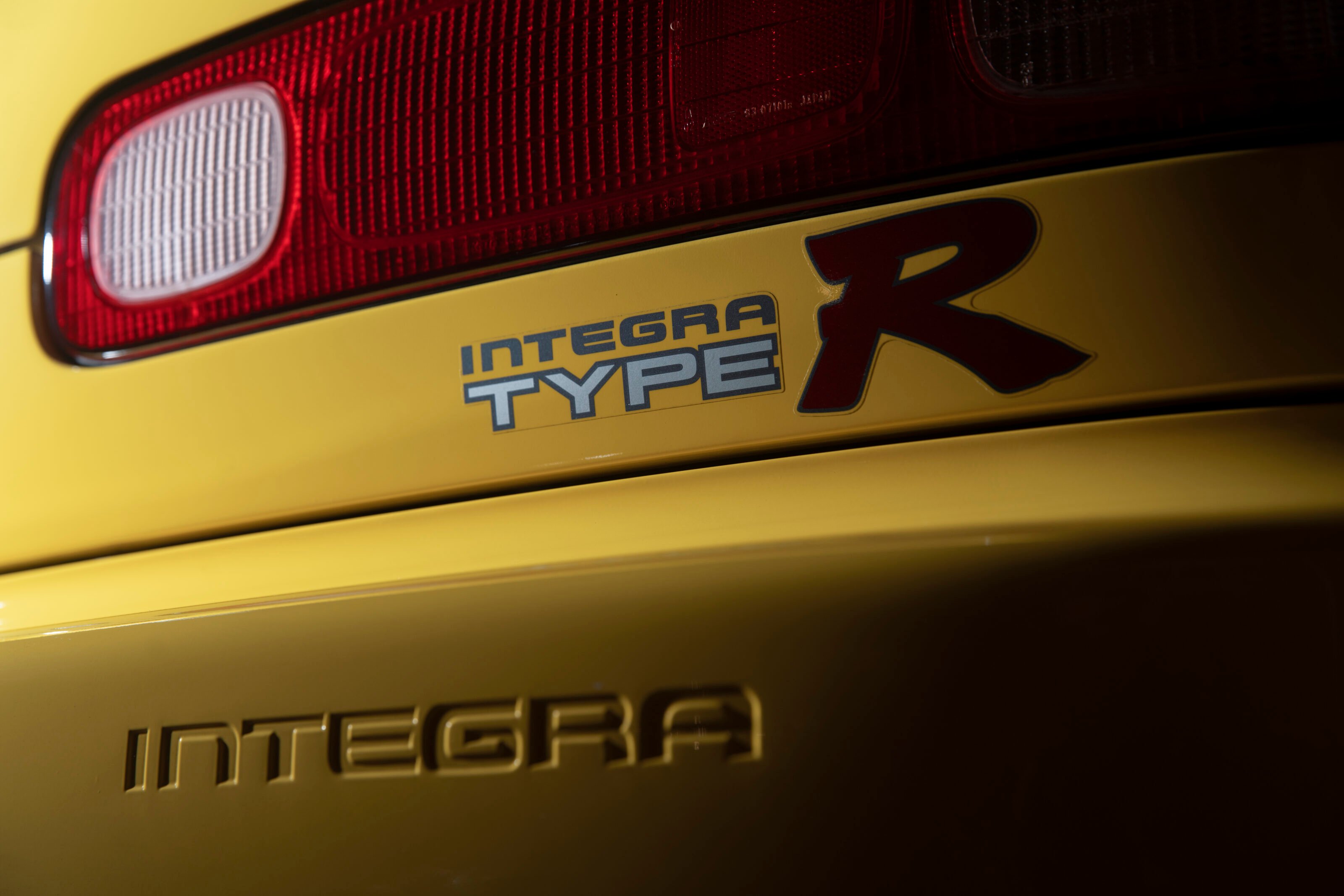
The best front-wheel drive performance car ever? It’s hard to go past the original Honda Integra Type R DC2. Sir Alec Issigonis’ Mini may’ve set the benchmark for innovative packaging, while Volkswagen’s Golf GTI carved a niche as a hot-hatch champion. Yet the first Type R is an icon of pure, free-revving performance and utterly absorbing driver involvement like no other car.
The engagement, response and agility came with the guttural sound of the world’s highest specific-output 1.8-litre, a hand-crafted, naturally aspirated four-cylinder bellowing when its VTEC lungs opened in full swing towards its 8400rpm redline. It created a cult of followers, and it was easy to see why. One drive and you’d be hooked for life. Frankly, unless you lived in Japan, it took Honda years to deliver another Type R that came even close…
The origins of the Type R began with Honda’s ground-breaking, Ferrari-benchmarking NSX sports car. If the ‘regular’ NSX was a great all-rounder, the Japan-only 1992 NSX-R was a brilliantly focused, narrow-minded racer. It didn’t care about comfort, convenience or image. All it cared about was going fast. It ditched its audio, air-con and other niceties to establish the recipe for the letter R. The R, of course, stands for Racing, a moniker taken literally by the NSX-R’s creators. That’s the psyche that went into creating the first vehicle to wear the ‘Type R’ badge: the DC2 Integra.
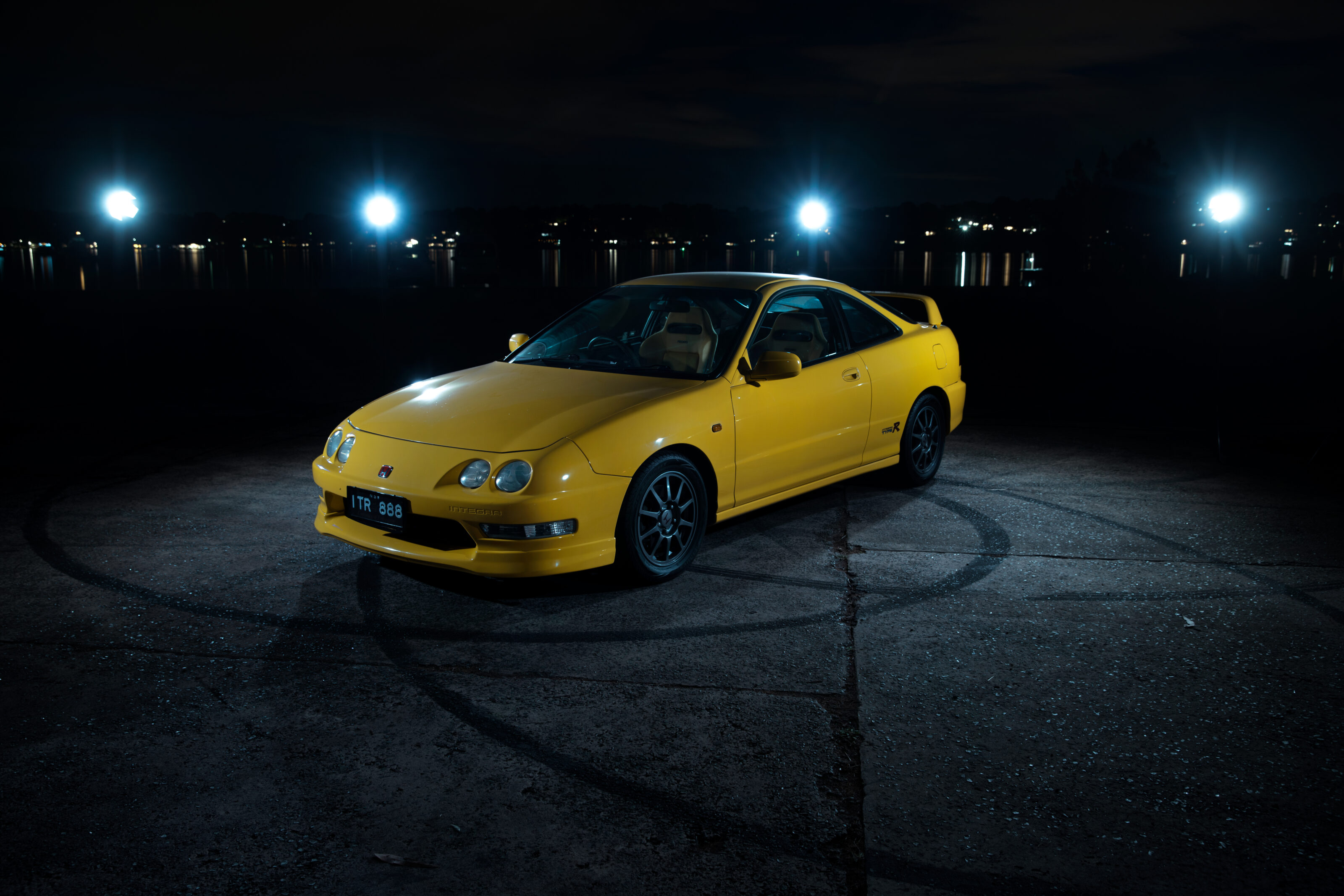
When the Integra Type R arrived in Australia late in its life cycle, we underestimated it. In the December 1999 Wheels when we first drove the hot Honda on local roads, we also featured the best and worst cars of the decade. While Honda’s brilliant S2000 was mentioned, only our Japan correspondent, Peter Nunn, was wise to include the Type R, given its 1995 on-sale in its homeland. To the rest of us, it was a delayed realisation that Honda had unleashed the best front-driver – and one of the best driver’s cars, period, onto Australian roads.
What made the Teg so impressive was the absolute commitment to driving. Nothing else mattered. That started with a forensic execution of mass. To counter a raft of additions like the rear wing and body stiffening, the air-con and the stereo were removed. The dashboard insulation binned. A smaller, lighter battery was fitted, as was an aluminium radiator to save more weight. If Honda could have offered the Type R without paint, it probably would have. The result saw the Australian-spec Type R at an official 1087kg against the 1176kg Integra VTi-R it replaced.
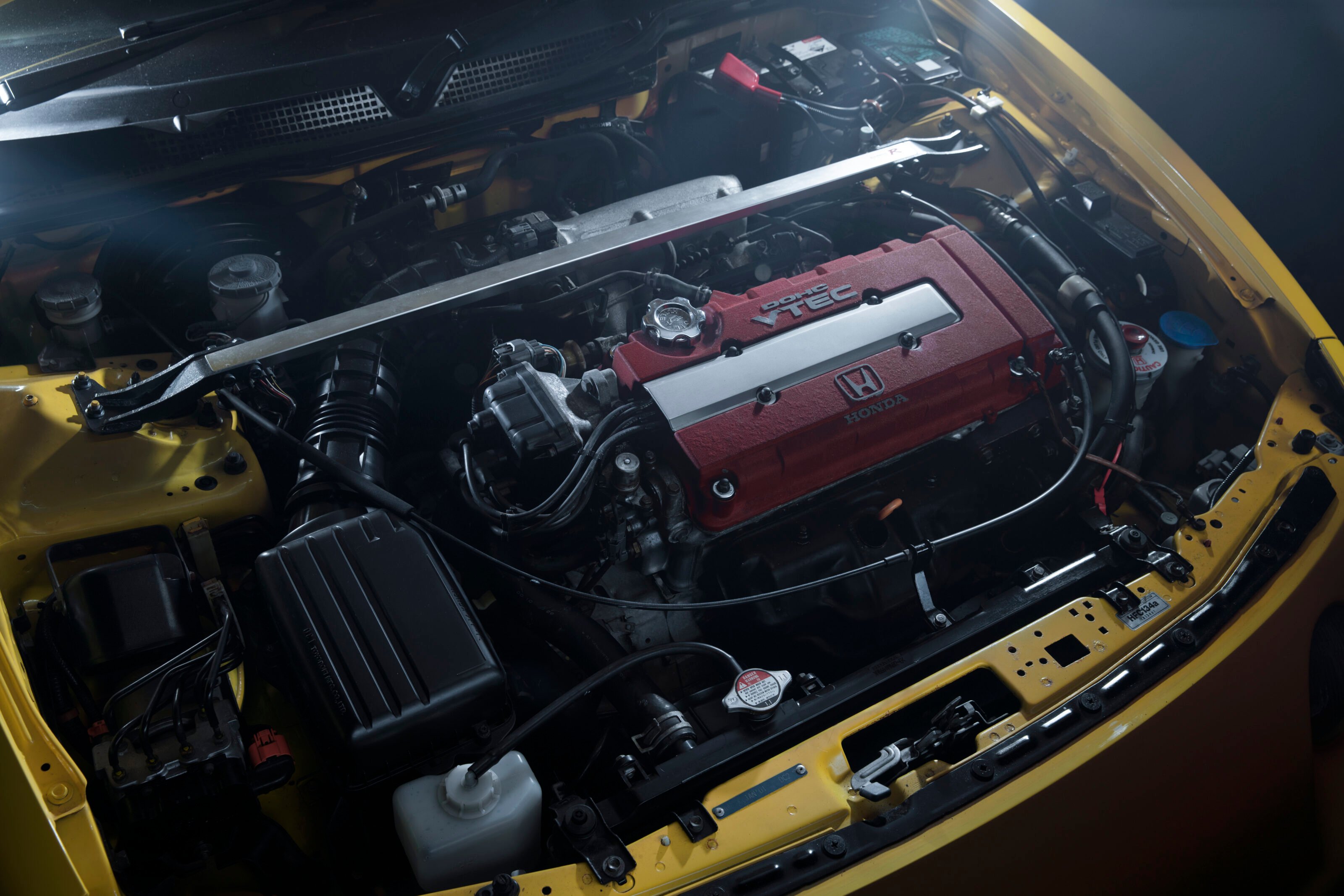
The engine was treated to significant weight loss and attention like no other, too. The Australian-market Type R’s B18C7 is the king of Honda’s legendary, game-changing B-Series engine family, which goes back to the 1989 JDM Integra XSi. The brief for the B-Series was to create an inline four-cylinder engine capable of the magic 100hp/litre, but with durability of around 250,000km. Honda had form here, ruling F1’s mid-80s turbo era with its 1.5-litre turbo V6s before turbocharging was banned for 1989. Honda’s new 3.5-litre naturally-aspirated V10 simply took over where its turbo V6 had left off – in utterly dominant fashion.
Clearly, Honda knew how make small engines with immense power and reliability, and the B-Series cleverly saw technology from F1 amortised across mass-produced models from Civic, CRX and Integra to more mundane models such as the CR-V. In doing so, the B-Series genuinely delivered real-world benefits to everyday Hondas bought by customers who had no interest in racing, while also making for a salivating platform for aftermarket tuners – and a cracking Type R.
Part of that was the B-Series’ introduction of Honda’s legendary VTEC to road cars. A true game-changer, VTEC (Variable valve Timing and lift with Electronic Control) delivered a second cam profile to give Honda’s engines an almost Jekyll and Hyde split personality. Switching between the two, one cam profile would ensure driveability and economy, the other a high-performance profile that unlocked the engine’s wild side.
Now legendary for an innate ability to generate significant power without tearing themselves apart, there were SOHC, DOHC, VTEC and non-VTEC B-Series variants. Teamed with a five-speed manual with unique second- and third-gear ratios (there was no auto option, unlike its contemporaries), the DC2 Type R’s B18C7 was the final hurrah, and what a way to go out.
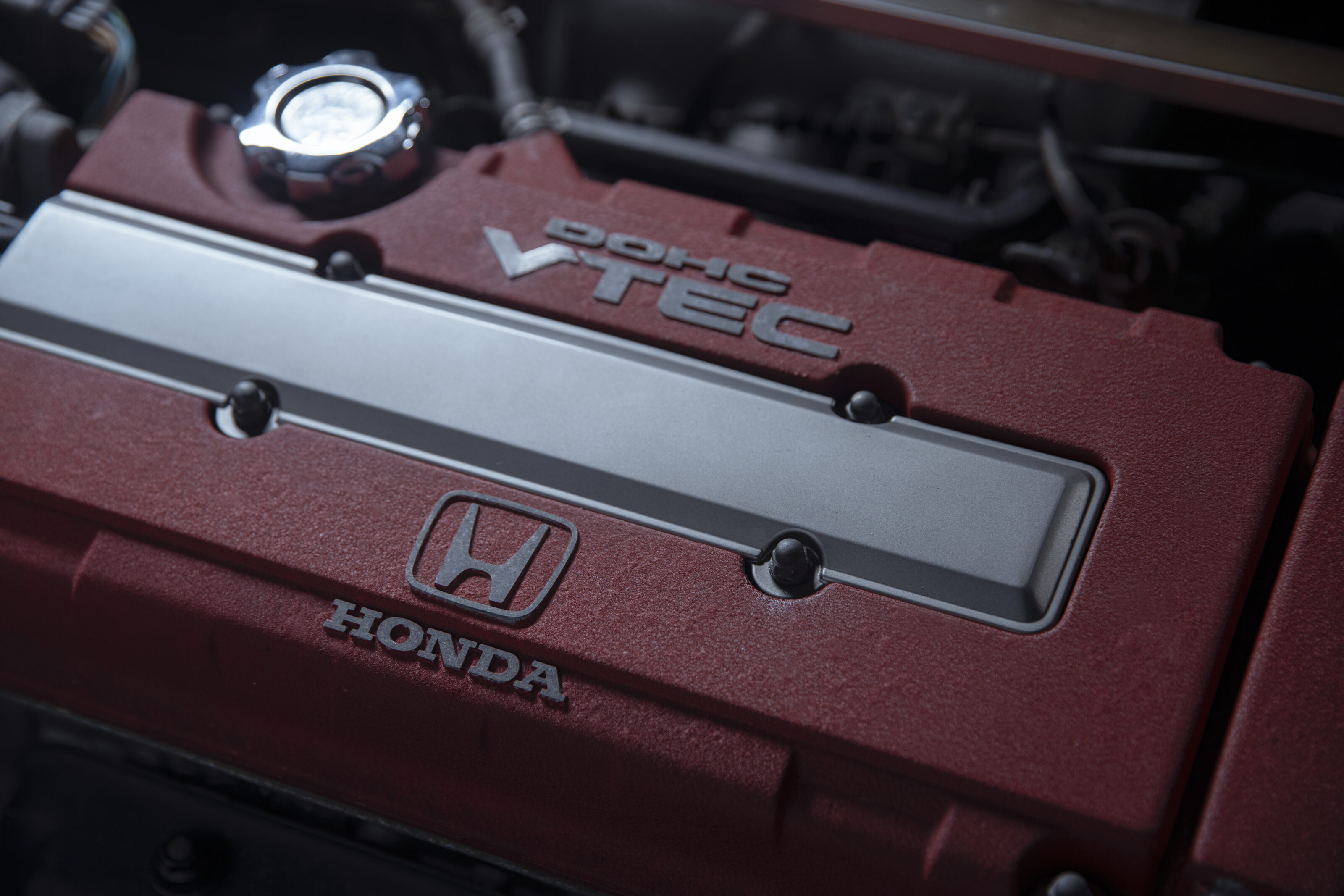
On paper, the engine stats were competitive rather than ground-breaking, but its delivery was something else. VTEC opened the Type R’s lungs at 5800rpm when most rivals were running out of breath, with its 178Nm torque plateau at a sky-high 6300rpm and 141kW of peak power at 7900rpm before an 8400rpm redline – you had to push the Type R to really experience it.
This was no run-of-the-mill four-pot, no quick engine re-map and sticker pack. Such brilliance came from a meticulous set of upgrades that saw around 60 engine components created or redesigned specifically for the Type R, delivering a rare combination of ballistic yet bulletproof engineering. Even some high-priced performance cars couldn’t boast the care and attention that Honda put into the Type R’s powertrain.
Each unit was hand-built, which limited production to 25 per day. The B-Series already boasted a lightweight aluminium block and forged crank, but chief engineer Shigeru Uehara’s team went further to hone the Type R’s engine to levels rarely if ever seen in a production car, yet alone one as affordable.
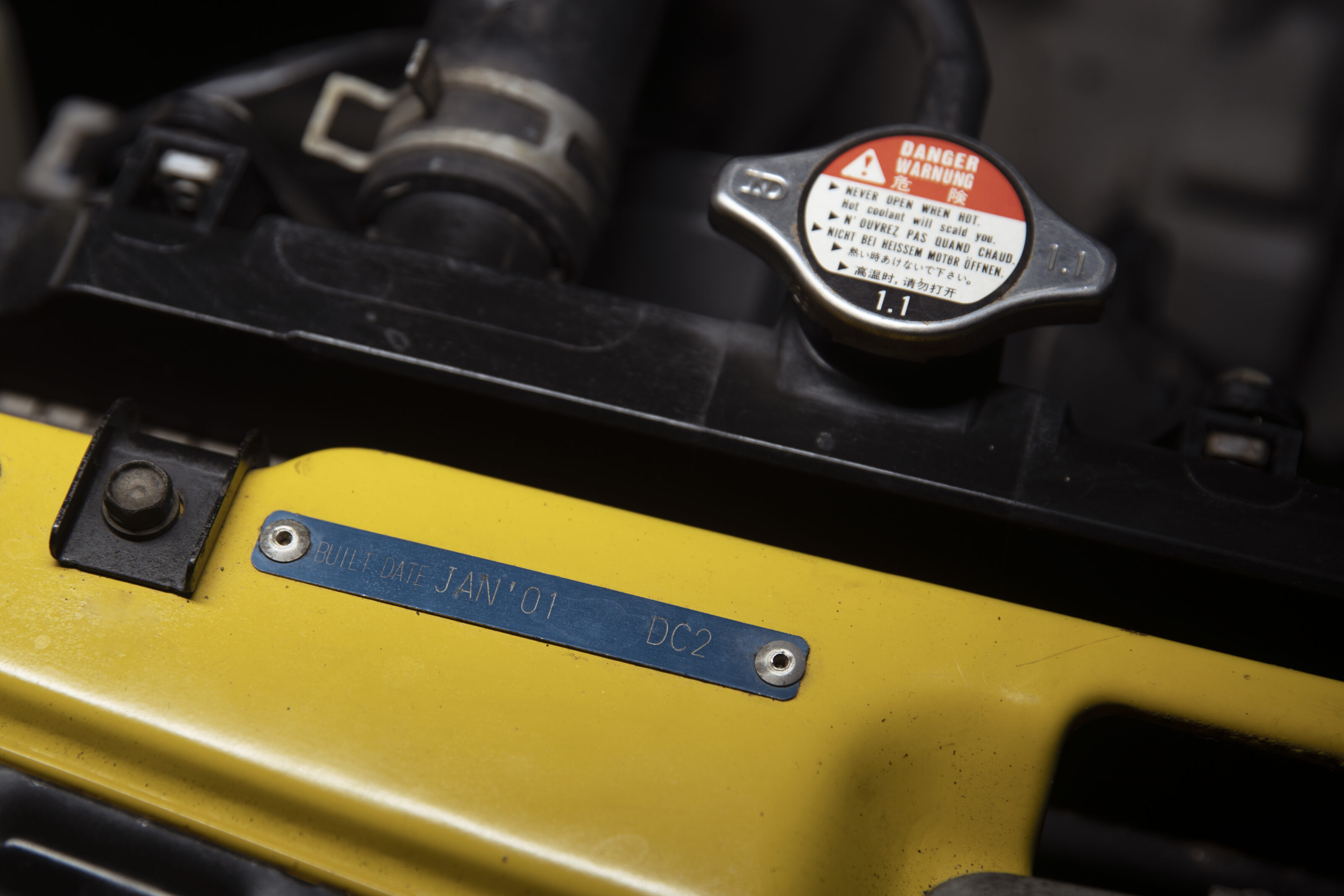
The pistons, for example, were one-off, hand-weighed pent-roofed forged units in place of cast versions, with lighter skirts and molybdenum coating applied for strength. They sat on unique hand-made conrods, also individually weighed and hand-measured to match each piston.
The valves were thinner and lighter and sat at a 60-degree angle instead of 45, the double-valve springs flat, not cylindrical. There was more lift on intake and exhaust valves while compression was raised to 11.0:1 and four-into-one stainless steel headers fitted.
Five Honda engineers worked full-time on the porting and polishing alone, something Uehara believed couldn’t be achieved to the same surgical standard on an automated line. Identifiable by its red engine cover, there were no turbos, just high-revving atmo purity.
It wasn’t all engine, though. Key to the Type R’s formidable ability was the helical limited-slip diff under the nose, which meant that it could devour corners with ultra-sharp turn-in using Honda’s torque-sensitive, rotary valve rack-and-pinion steering.
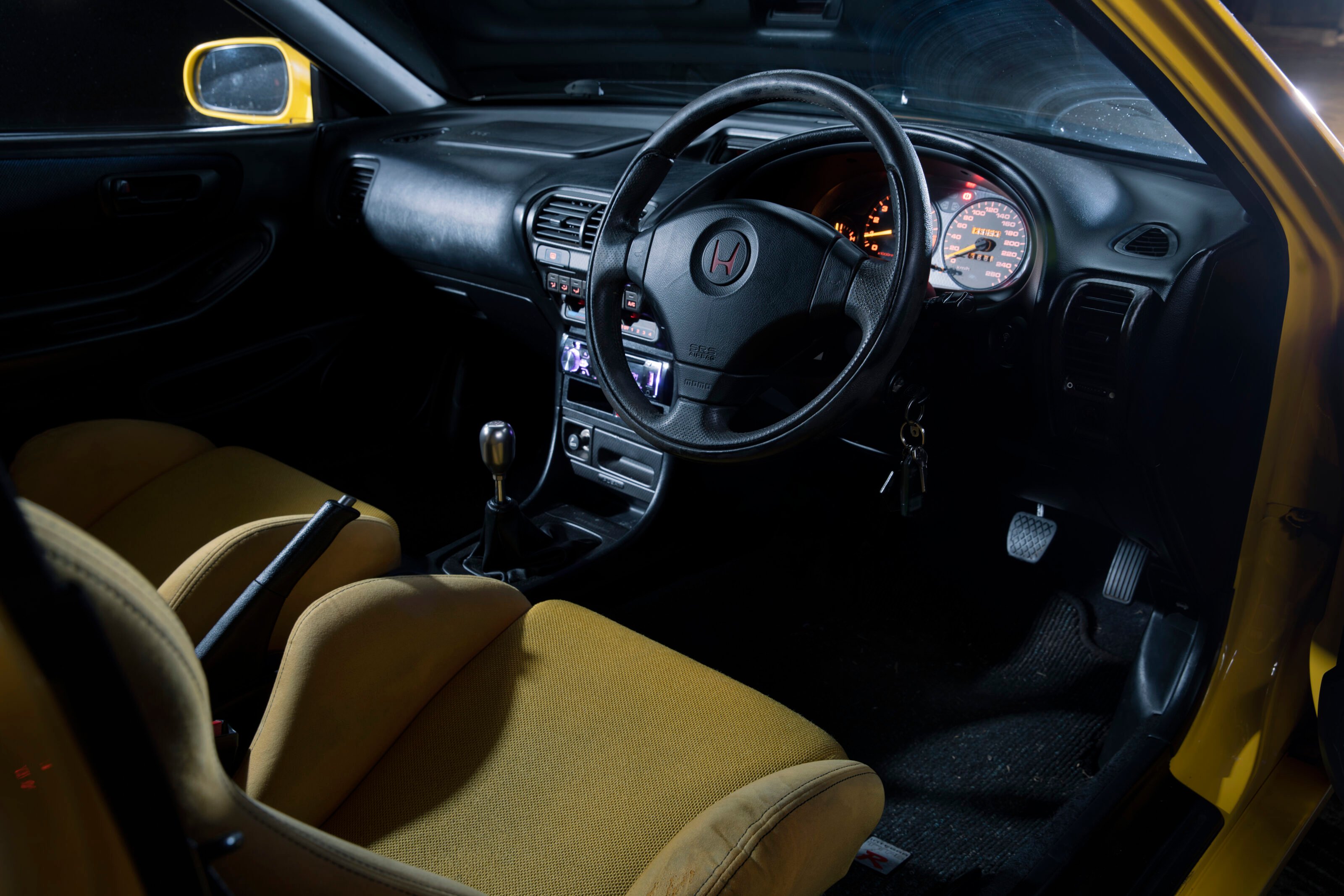
“The Type R surprised us with its aggression on turn-in, and with the incredibly tight lines that could be held through corners,” said our first review, while the helical LSD, “removes the need for judicious throttle application in corners and gives the car serious punch out of turns.”
The Type R’s ability to optimise its brilliant drivetrain came from a series of clever chassis changes, too. In our February 2000 issue handling test (which it easily won), we noted that the tyre wear was perfectly even, a testament to the excellent double-wishbone suspension front and rear. For Type R, it was stiffened along with anti-roll bars and 15mm lower ride height, with rigidity increased by stiffening panels and, amazingly, stitch-welding the body.
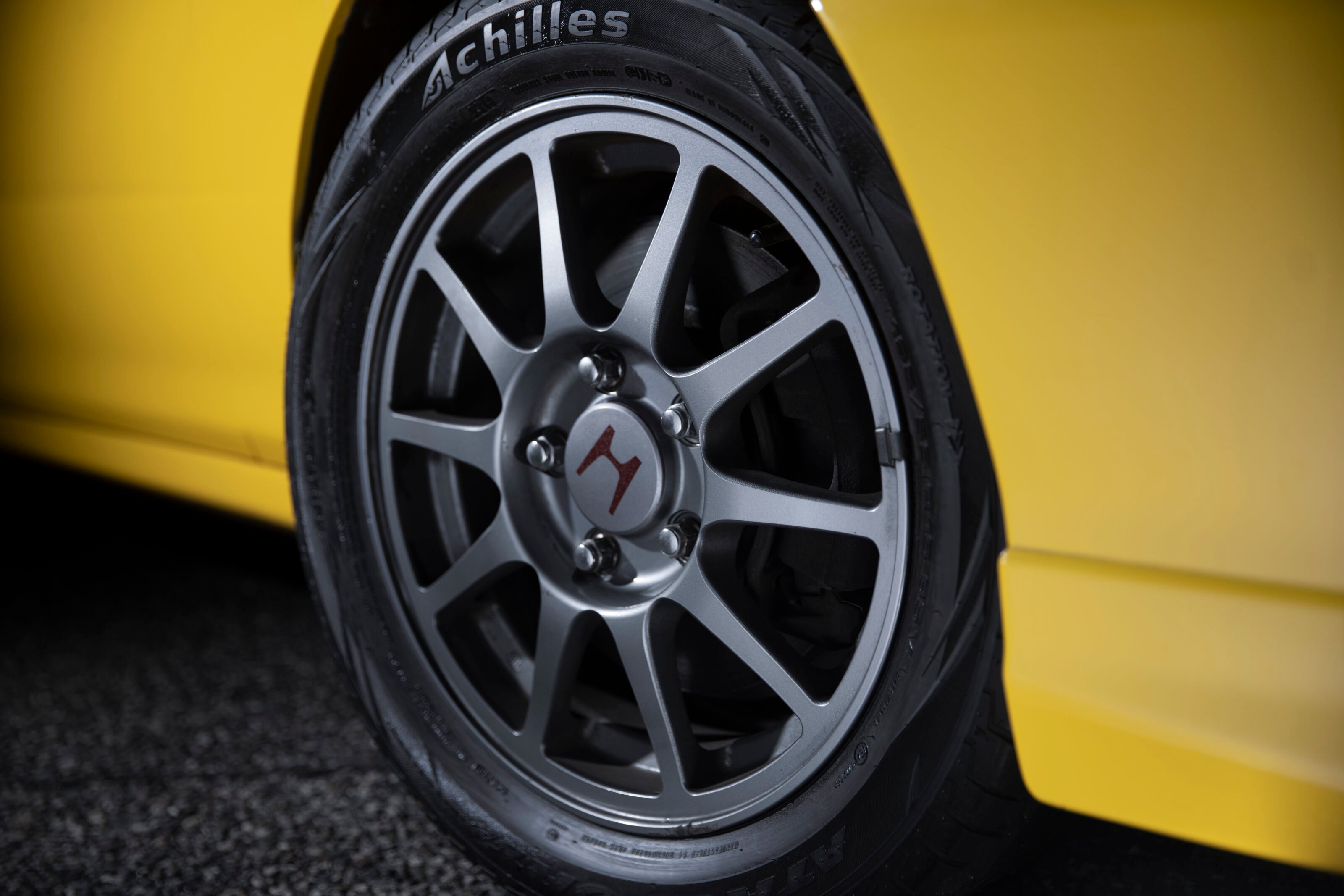
That focus saw Wheels’ Glenn Butler on our first drive saying the Type R was too firm to be a comfortable daily. Even the relatively small 15-inch alloys, which were lightweight aluminium shod in unique compound Bridgestone tyres, didn’t soften the ride, or Butler’s viewpoint. Yet the DC2’s ability did.
“If you like driving, the Integra Type R is the most fun you can have for under $40K,” read his 1999 report. That price point of $39,950 was a cheeky few lobsters less than the ubiquitous turbocharged, all-wheel drive Subaru WRX, or the soon-to-be updated S14A Nissan 200SX with its superb SR20DET and rear-wheel driftability. The Type R didn’t need turbos. It shunned all-wheel drive. It just loved revs and being pedalled fast and often.
Australian dealers fitted (optional) air-con and a six-stack CD player to the 863 sold locally, a sign of things to come when the DC5 Integra Type R arrived in 2001. It was larger, heavier and while it used the now legendary K20A engine, it also added more mod-cons for our market. The front wishbones were replaced by struts, too. By doing so, it lost that Type R single-mindedness of driver engagement over all else. That only served to underline just how good the DC2 Type R was.
“There’s no obvious reason why the Honda Integra Type R should be better than the WRX or the 200SX on paper, but in the flesh – it is,” said our own Bob Jennings. In age of computer-correcting cars, the DC2 Integra Type R remains an analogue Armageddon against the tide of digital devices proclaiming driver engagement within an electronically sanitised limit. It’s the organic driver’s car against today’s synthetic simulators; a standout performance car the likes of which we may never see again.
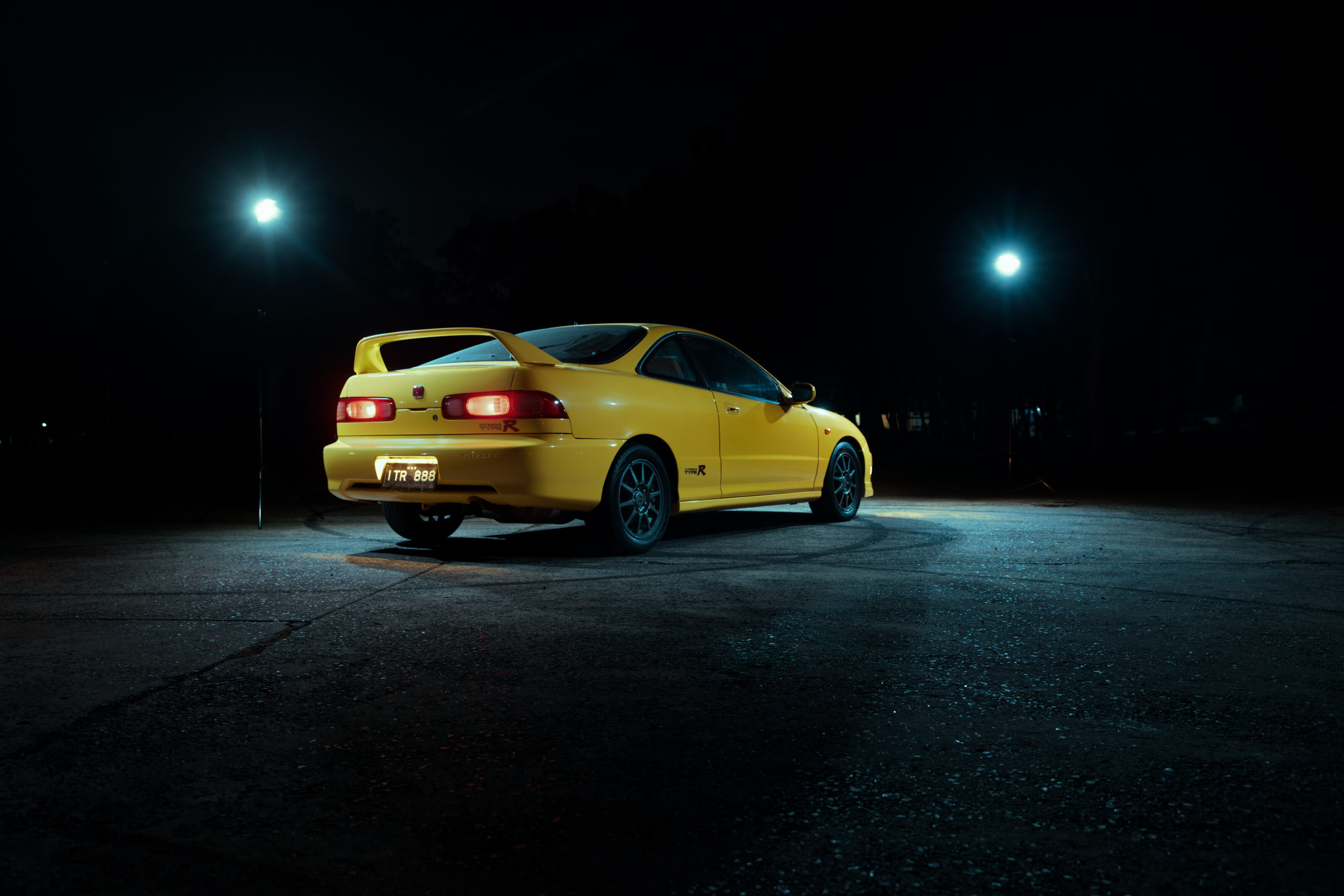
A hard act to follow
The Type R’s 1999 arrival Down Under was a “toe-in-the-water” according to Honda Australia at the time. It convincingly passed the audition, but the DC5 that replaced it in 2001 was heavier, plusher and diluted. Our next Type R was the 2007 UK-built FN2 Civic, which teamed a brilliant engine yet too much heft. Gone after 2011, it wasn’t until the current Civic Type R (FK8) landed here in 2017 that Honda’s legendary badge adorned a product anywhere close to the DC2’s magic.
Rocketing up in value
The Integra name will return in 2022 upon a Civic-based four-door liftback for North America and China. Yet to be confirmed for RHD markets, the revival may pique interest – and values – of DC2 Type Rs. Stateside, a 1997 example with 9962km on the clock sold for US$88,000 [A$121,000]. In Australia, values haven’t jumped so high yet, with a broad spread from $30K to mid $60K. The challenge is finding an unmodified original, with locally delivered cars alongside grey imports.
Imagine a racing series where Group C prototypes rubbed shoulders with Ferrari F40s, McLaren F1s along with fire-breathing Toyota Supras and bewinged GT-Rs.
The Japanese Grand Touring Championship, later morphing into SuperGT in 2005, was exactly that. With an impetus on cultivating close on-track racing with strict power and weight limits, while discouraging snowball budgets and single-team/make dominance, there was liberal scope to be found within chassis and engine regulations.
As a result, Japan’s former national championship saw heroes from different eras, different categories and powered by all manner of different engines, coming together to form some of motorsport’s most unique starting grids. Read on as we shine a spotlight on some of the weirdest cars ever to take part in Japan’s JGTC/SuperGT championship.
1994 Lancia 037 ROSSO Competition JGTC
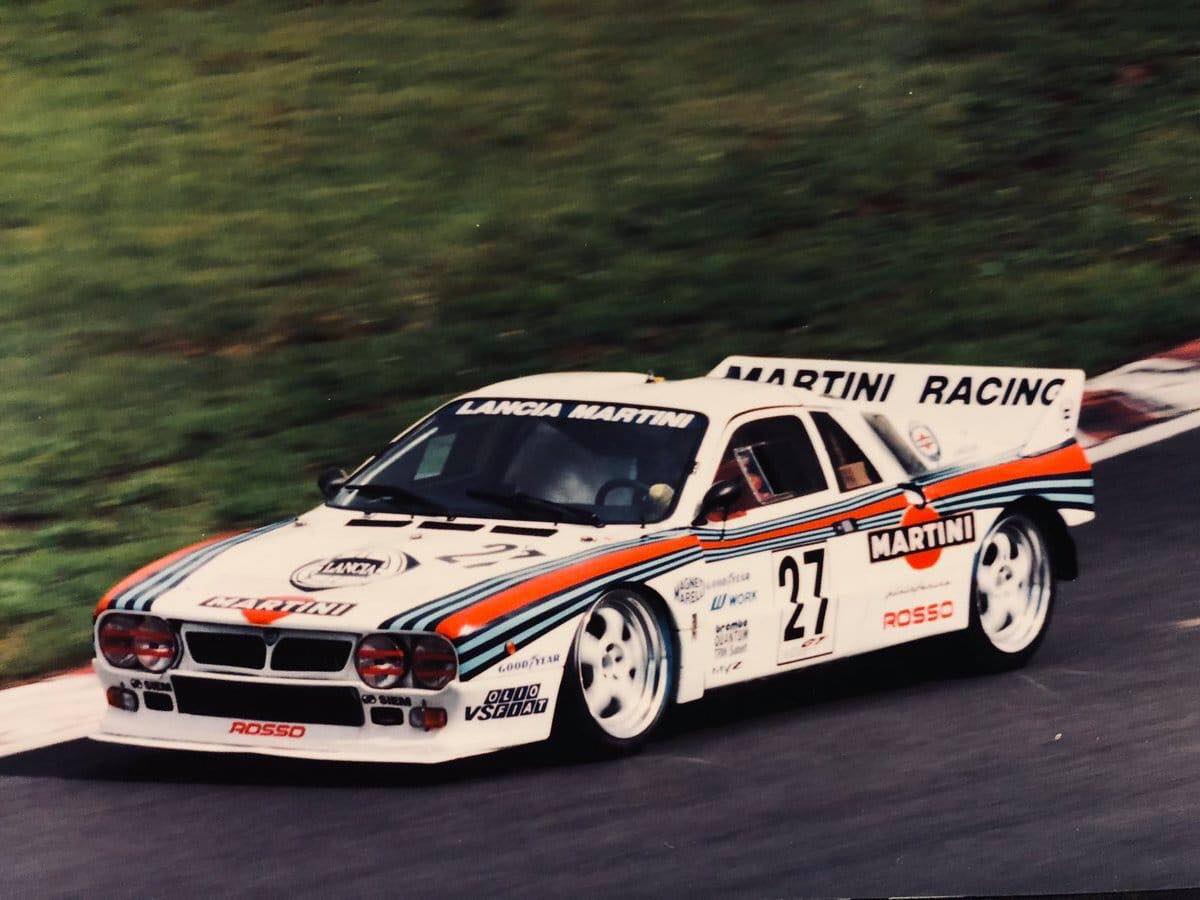
Perfectly illustrating the vaccum in time that was 90s-era JGTC is team ROSSO Competition’s Lancia 037. It completed just one race at the third round of the Japanese GT Championship.
Motorsport historians may note that this is was a full eight years after Group B was disbanded in 1986, which goes some ways as to explaining how this genuine ex-works Lancia 037 founds itself on the manicured tarmac of Fuji speedway.
So how did it do? In a word: poorly.
The Lancia can only be described as a fish out of water. Its short-ratio five-speed gearbox wasn’t suited to circuit use and the engine was never intended to be run at high RPMs for such a sustained period of time.
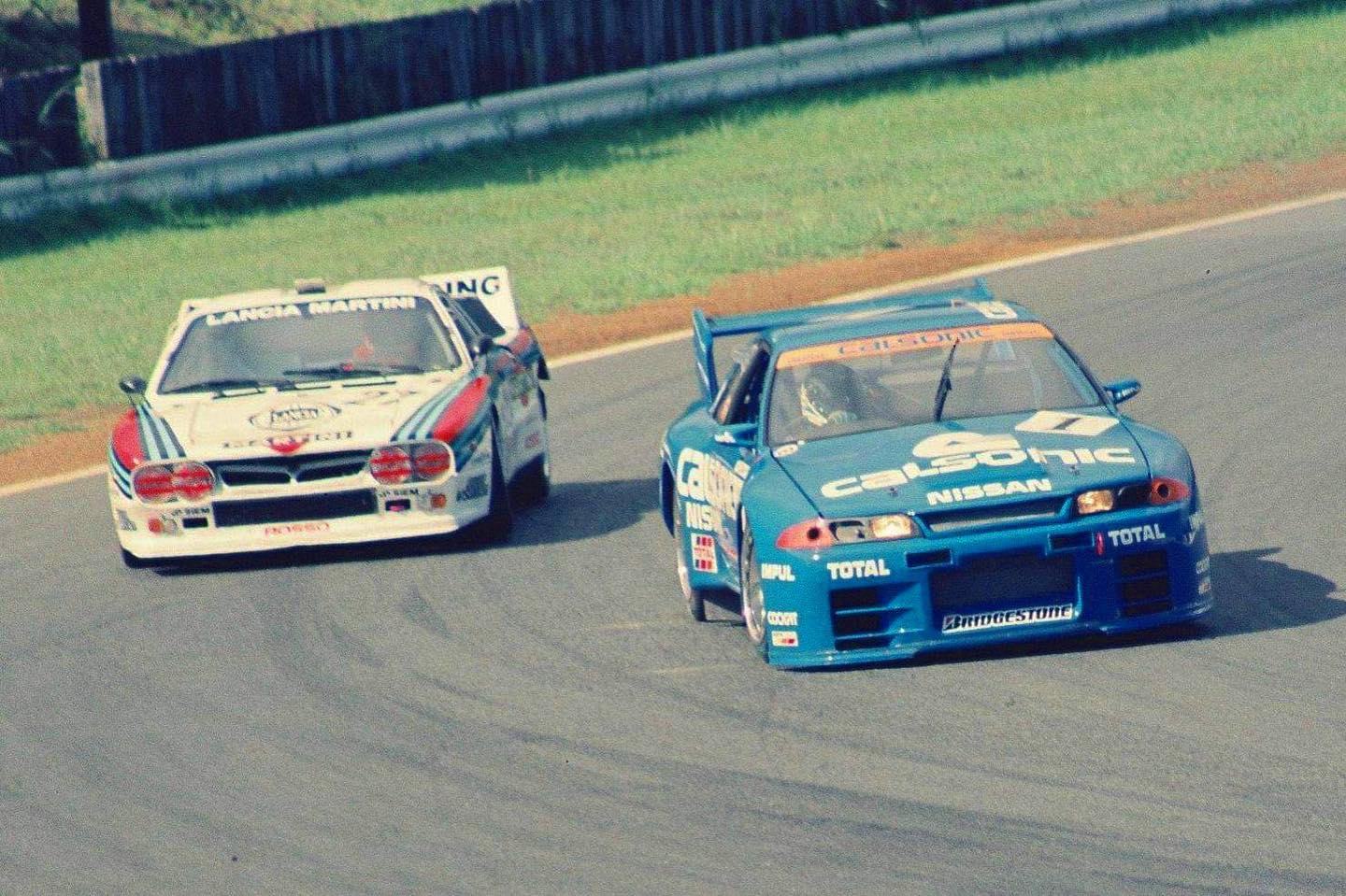
Indeed, its supercharged 2.0-litre Lampredi engine mustered up 242kW and saw the 80s-spec Lancia massively outgunned by the Ferrari F40s, McLaren F1s, Porsche RSRs and Skyline GT-Rs in the top-flight GT1 category.
It didn’t finish last, though, technically. Driven by Naohiro Furuya, the ex-works Lancia finished ninth in class and 12th overall, beating two R32 Skyline GT-Rs that suffered mechanical issues and failed to finish. Ultimately, it finished seven laps behind Team Taisan’s Porsche 962C (more on that later), and never returned to the series. Perhaps a Group 5 Beta Montecarlo would have been a better choice…
1999 Toyota AE86 Sprinter Trueno BP Apex Kraft JGTC
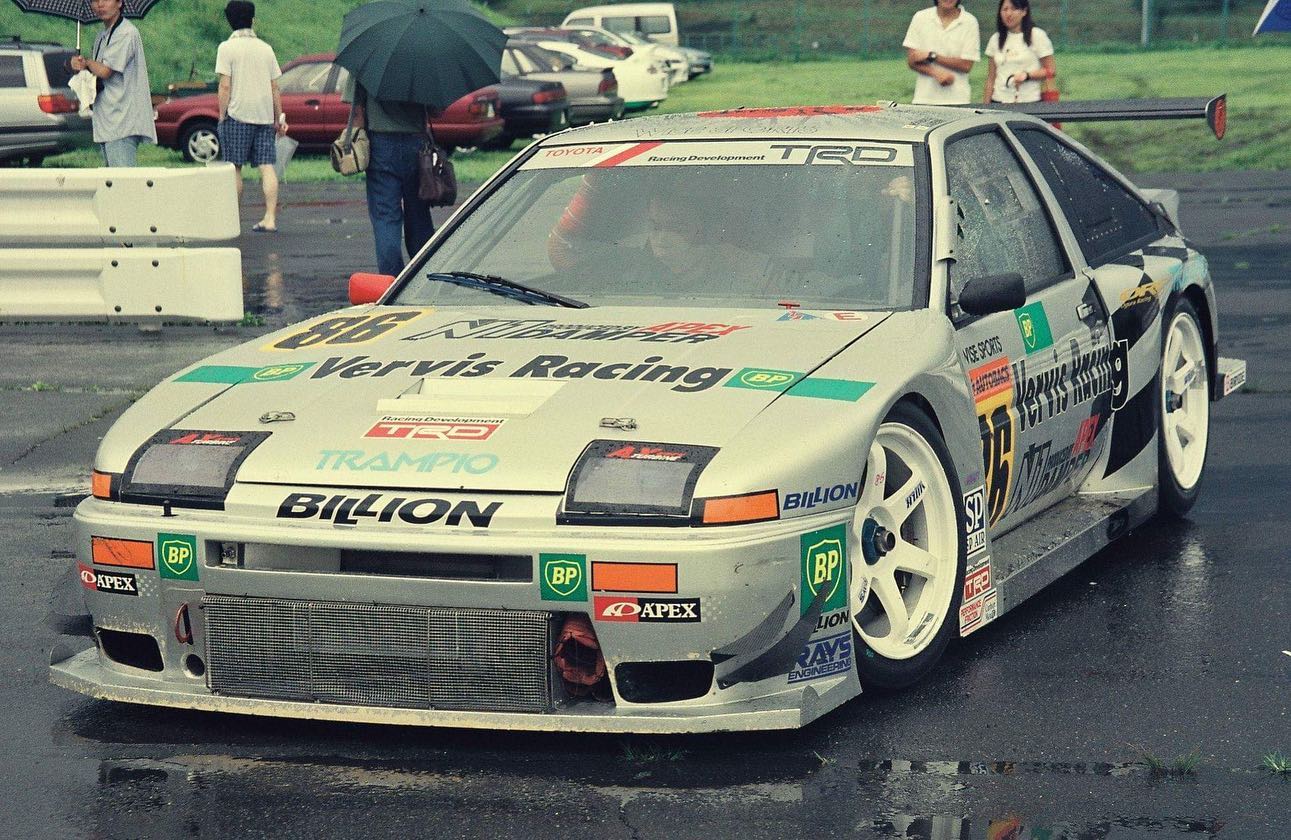
Thought the Lancia 037 was a time-warp? Consider team BP Apex Kraft, who turned up to the 1999 season of JGTC with a 1980s-era AE86 Trueno. That’s a bit like Erebus Motorsport turning up to this year’s Bathurst with a VZ Commodore.
Thankfully, it fared far better than the Group B rally racer did on the circuit with factory-backed support coming from Toyota Racing Development (TRD).
Subsequently, there was a lot more to the humble ‘Hachiroku’ than meets the eye. A 3S-GTE engine, built by TOM’S, powered the car which was reportedly cut, caged and merged with a Dallara F3-99 formula chassis yielding cantilever suspension front and rear.
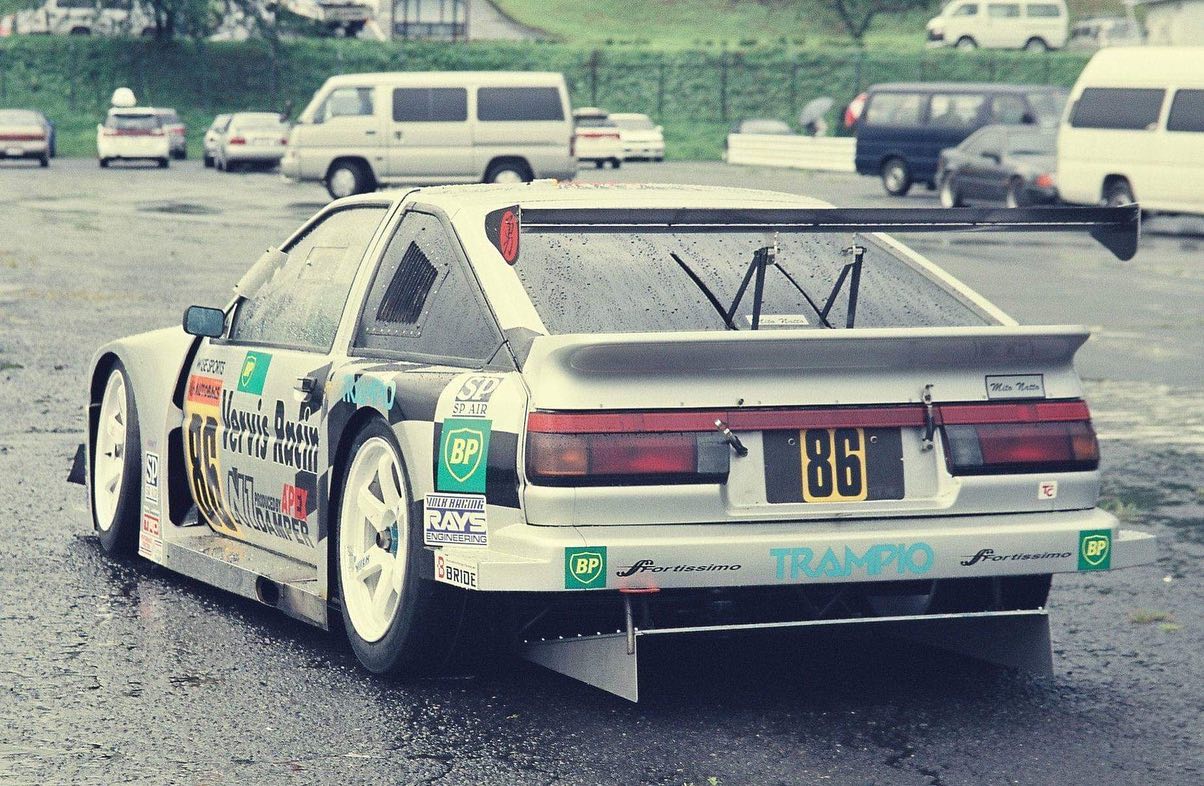
It was blisteringly quick, and posted several Top Ten finishes throughout the year. Its best result was a 4th place finish at Mine Circuit, Round Four, although persistent mechanical issues prevented any better results.
It was a heroic effort by a privateer team, and gave the factory operations within GT500 genuine competition despite being regarded as a dinosaur. Sadly, it caught fire in 2001 and couldn’t be saved.
BP Apex Kraft was no stranger to weird racers, having previously fielded a front-wheel drive Toyota (read: Chevrolet) Cavalier in 1997. That remains one of only four FWD cars ever to race in JGTC/SuperGT.
1994 Porsche 962C Taisan Starcard JGTC
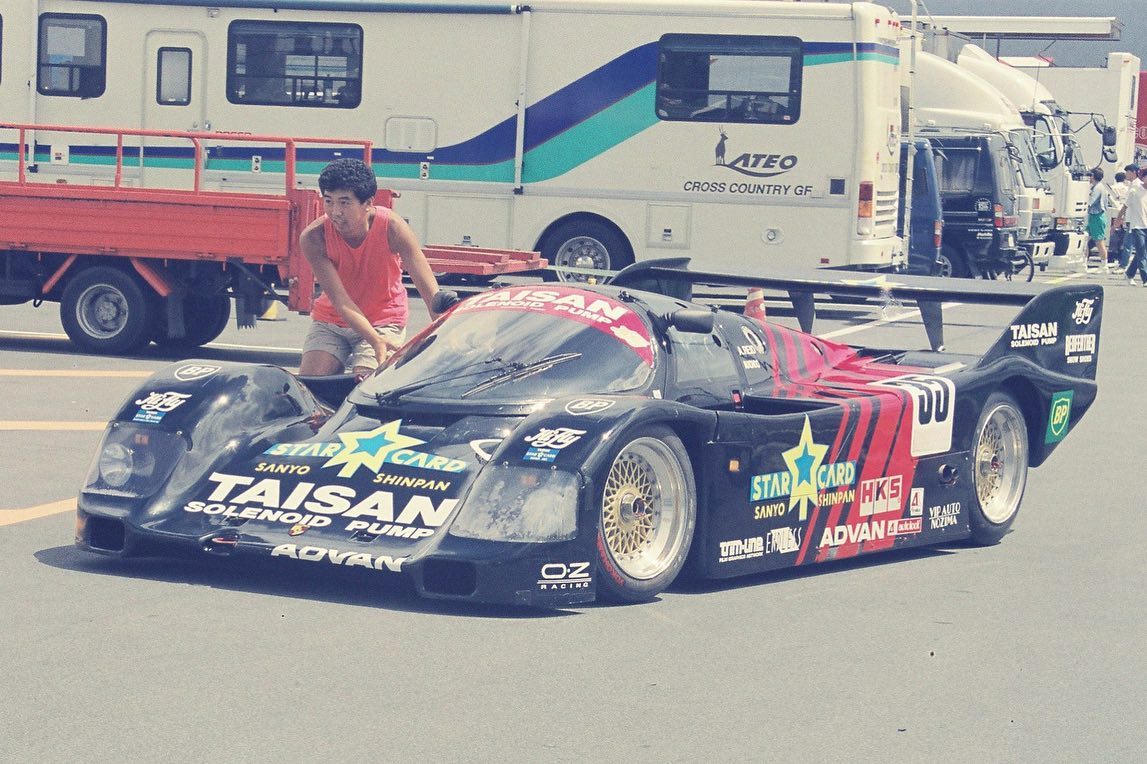
Team Taisan is a stalwart in Japanese motorsports, having formed in 1983 as a privateer team and owned by the Taisan Industrial Company, a global manufacturer of electronic solenoid pumps.
The team enjoyed much racing success throughout the earlier Group A eras with a battery of Nissan R32 GT-Rs, along with BMW M3s in the lower JTCC series.
Business was clearly booming, as the team rocked up to the 1994 season fielding a Ferrari F40 and an ex-Group C Porsche 962 prototype (chassis 962-164). Consider the absurdity: a genuine Le Mans legend rubbing doors with tin-top GT cars.
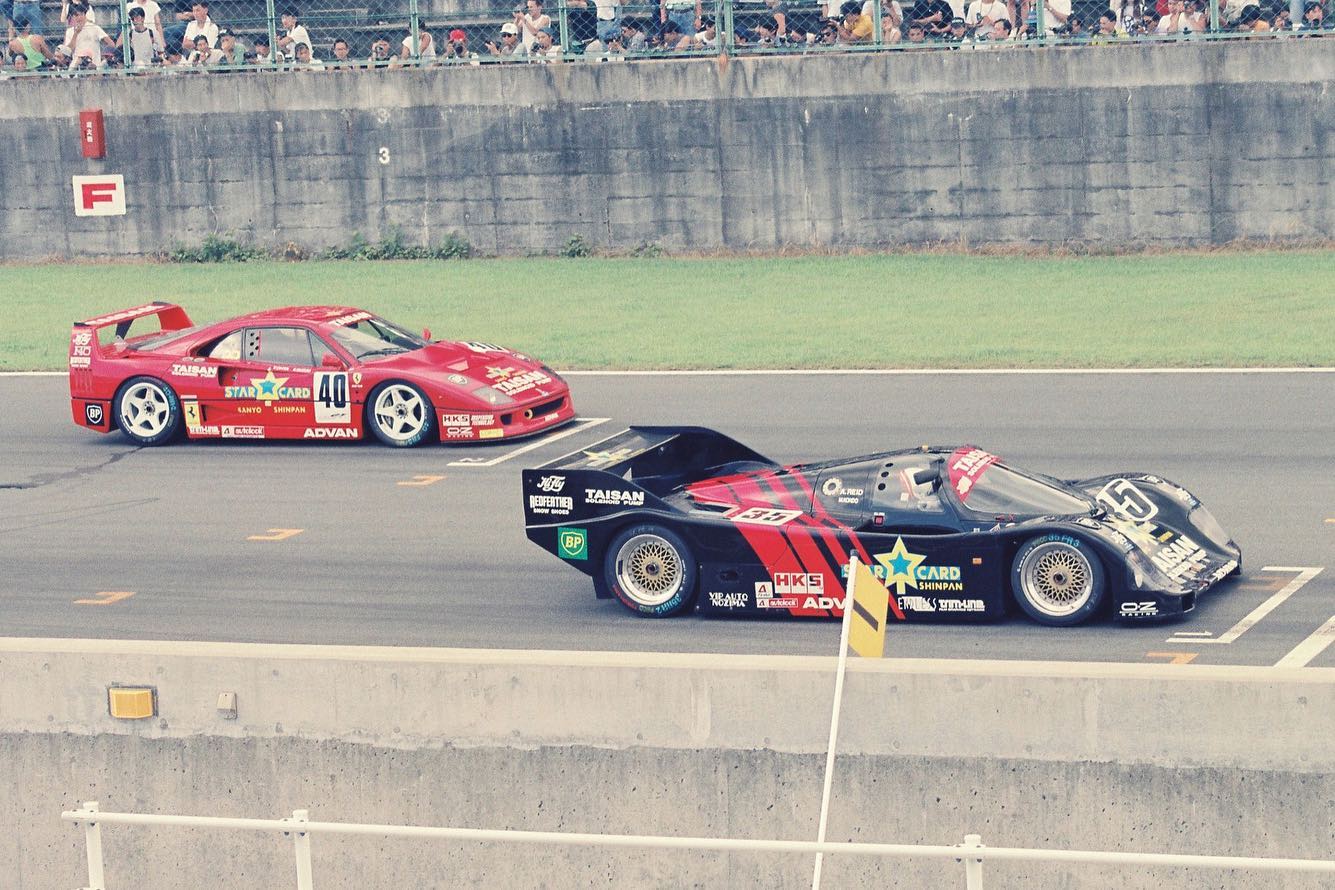
It was an impressive show of force, perfectly encapsulating the excess of Japan’s booming economy and well-heeled motoring enthusiasts. Over five rounds, Taisan’s Porsche 962C and Ferrari F40 won one meeting each, although the championship was ultimately won by Masahiko Kageyama in the Calsonic Hoshino Racing GT-R.
2002 Mercedes-Benz CLK500 HKS JGTC
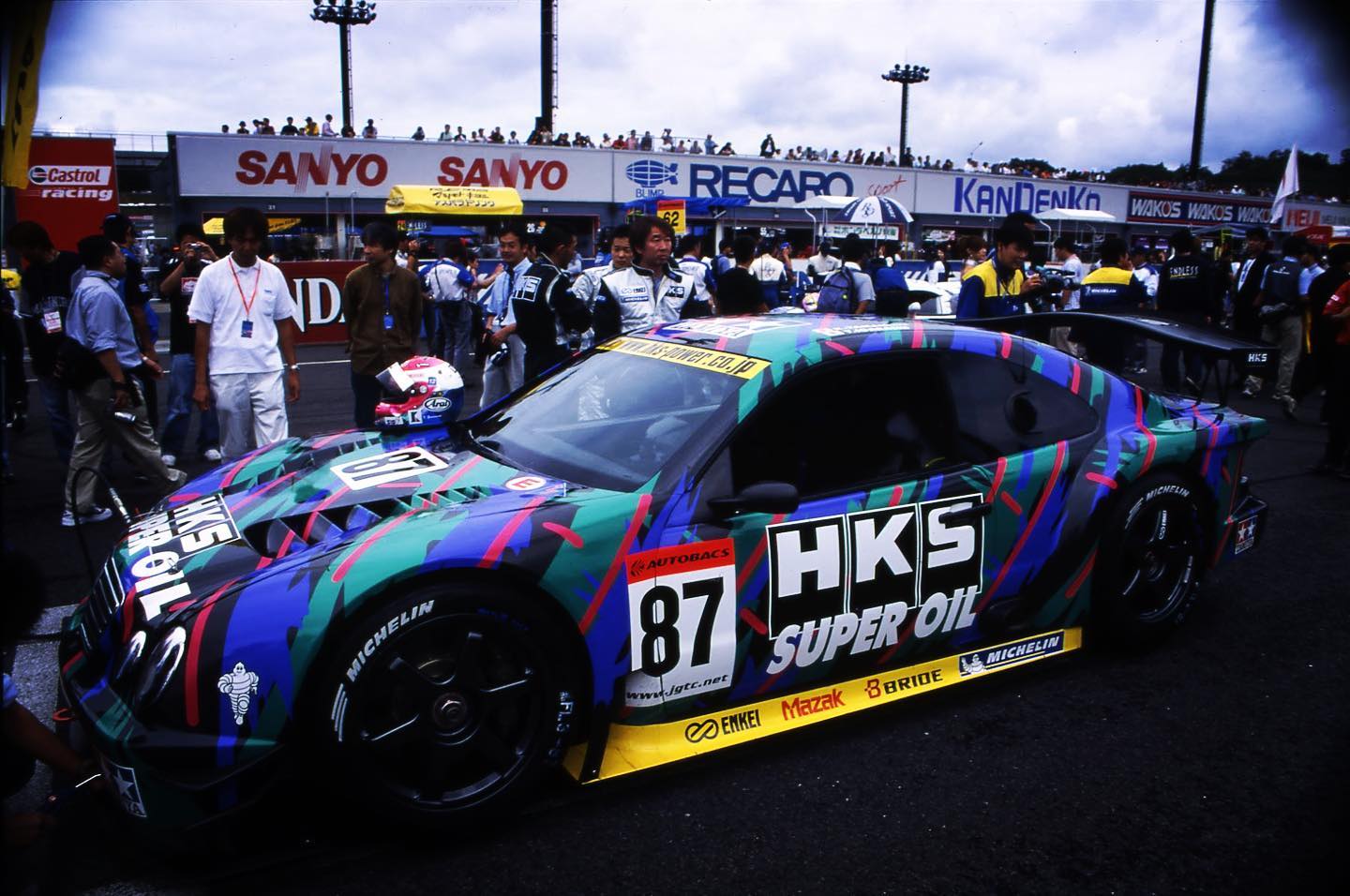
The iconic confetti livery of HKS is best associated with classic Nissans and Toyotas, but the team fielded a C209 CLK in 2002 as the business considered expanding its tuning talents to European cars.
At the heart of the CLK sat Mercedes-Benz’s prolific naturally aspirated M119 V8, measuring 6.0-litres in displacement with power capped at 367kW (or 500ps, as per GT500 regulation).
Although it looks similar to its DTM-racing siblings seen overseas, development for HKS’ CLK500 was an entirely in-house affair.
Alas, the Japanese powerhouse struggled against the larger factory-backed operations run by Nismo (Nissan), Mugen (Honda) and TOM’s (Toyota), and the CLK500 participated in just two race meetings with lacklustre results.
2002 would be the last year of HKS’ participation in JGTC, choosing instead to showcase their mechanical chops via numerous record-breaking time attack, drift and drag cars.
2003 ASL Garaiya Autobacs Racing Team Aguri JGTC

You’ll be forgiven if you haven’t heard of the ASL Garaiya.
The car’s origins actually link back to cult 90s tuner TommyKaira, who ambitiously sought to produce their own low-volume sports car called the ZZ in 1996.
TommyKaira’s project never came to fruition due to persistent financial difficulties, and the Japanese Ministry of Transport added a developmental spanner in the works by switching from Euro to US safety standards in 1999. Ongoing corporate complications at TommyKaira saw the company (and ZZ project) purchased by retail giant Autobacs Seven in 2001.
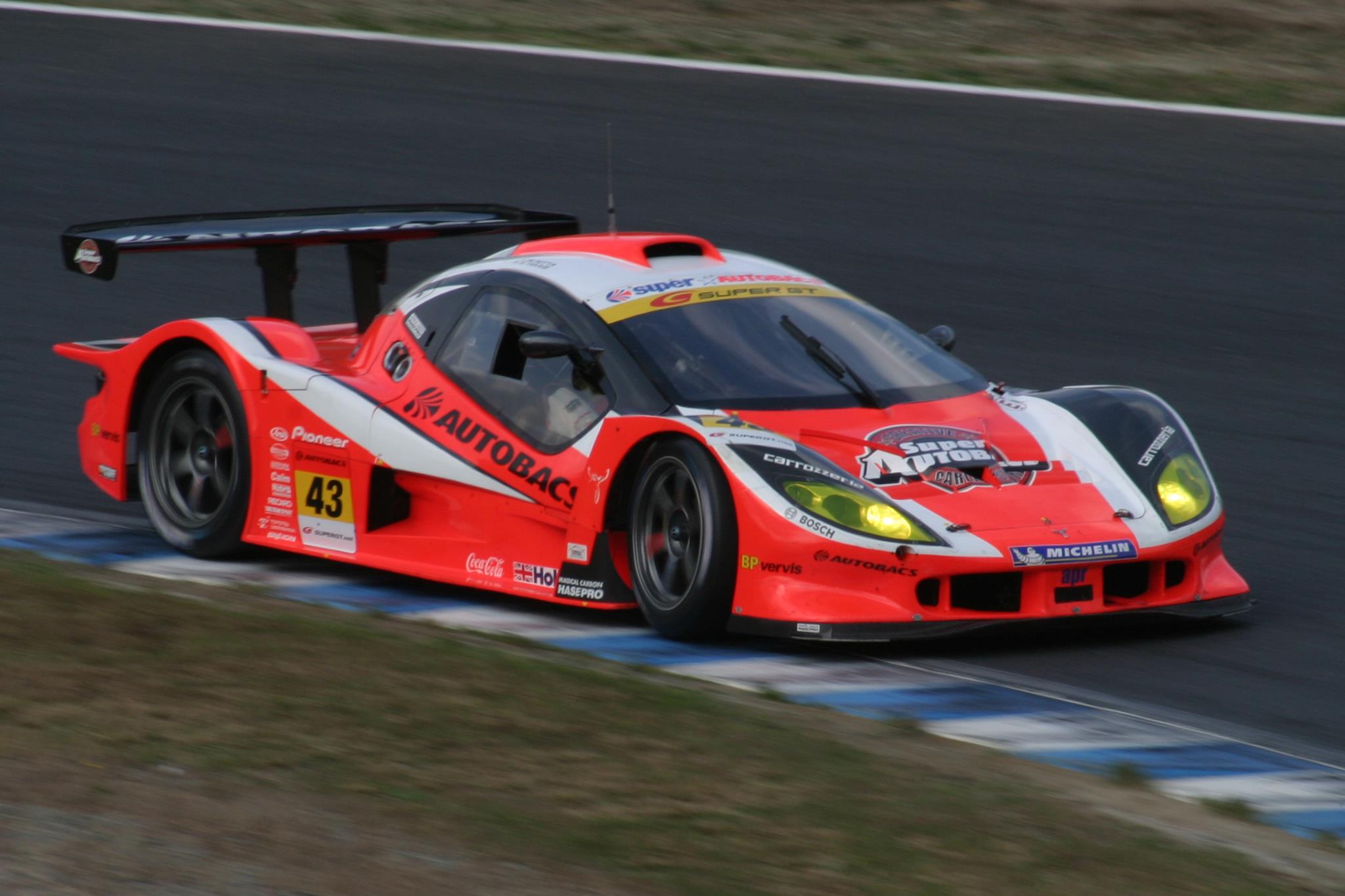
A single racing version was produced and entered in the GT300 category and was powered by turbocharged SR20VET in its debut season. The SR20 lacked the power to be truly competitive, with the team switching to a VQ V6 the following year, winning the first two race meetings consecutively. They ultimately missed out on the 2004 season championship by a single point.
2012 Toyota Prius APR Racing SuperGT
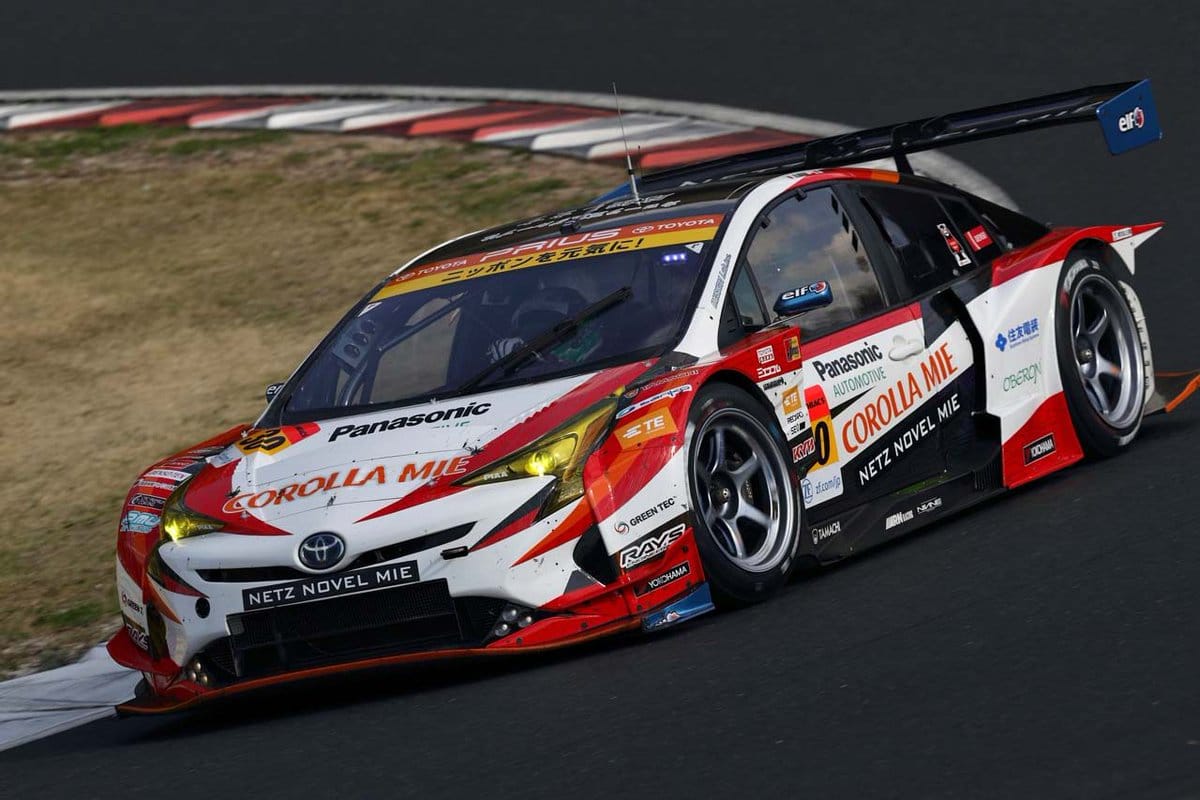
In its road-going guise, the Toyota Prius was a pioneer as the world’s first mass-produced hybrid electric car. In GT300 guise, it was also a hybrid pioneer as the first of its kind ever to take part in SuperGT.
Of course, with Toyota’s flagship Formula Nippon-built 3.4-litre RV8K V8 (this engine would later be used in Toyota’s LMP1 campaign) mid-mounted and restrained by liberal amounts of downforce, this was far from your ordinary hyper-miler.
It did, however, initially retain its factory hybrid assistance system, albeit with a larger battery sourced from the Alpha Prius. In its debut season, it finished on the podium once, but found greater success the following year after a super capacitor-based hybrid system was implemented.
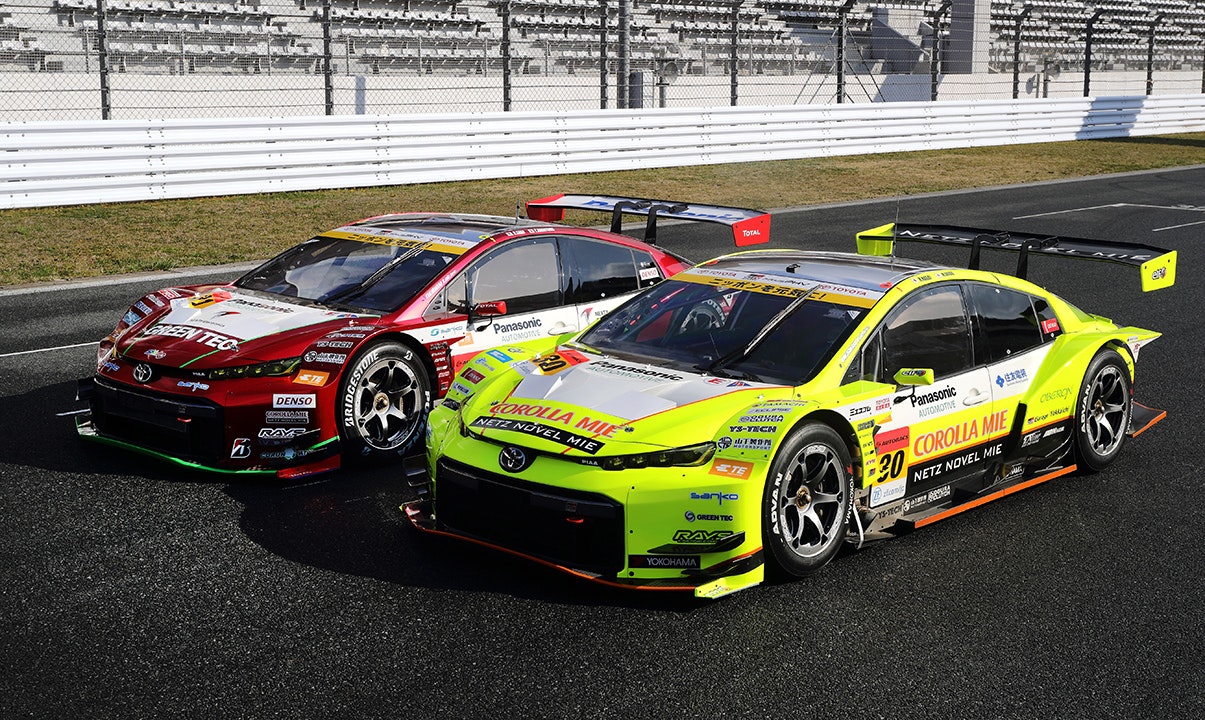
Ongoing reliability issues prevented any chances of a true title run, but the mid-engined Prius posted various podium finishes throughout its career.
Sadly, the period’s JAF GT300 regulations were superceded at the end of 2015, morphing closer to GT3 regulations and decreeing that competitor engines must be placed in the same location as their road-going counterparts.
APR Racing returned with the new-look Prius, and a front-mounted RV8K V8, in 2016 but it’s the older whacky one that we miss the most.
1998 Subaru Impreza GF8 WRX SYMS/Advan JTCC
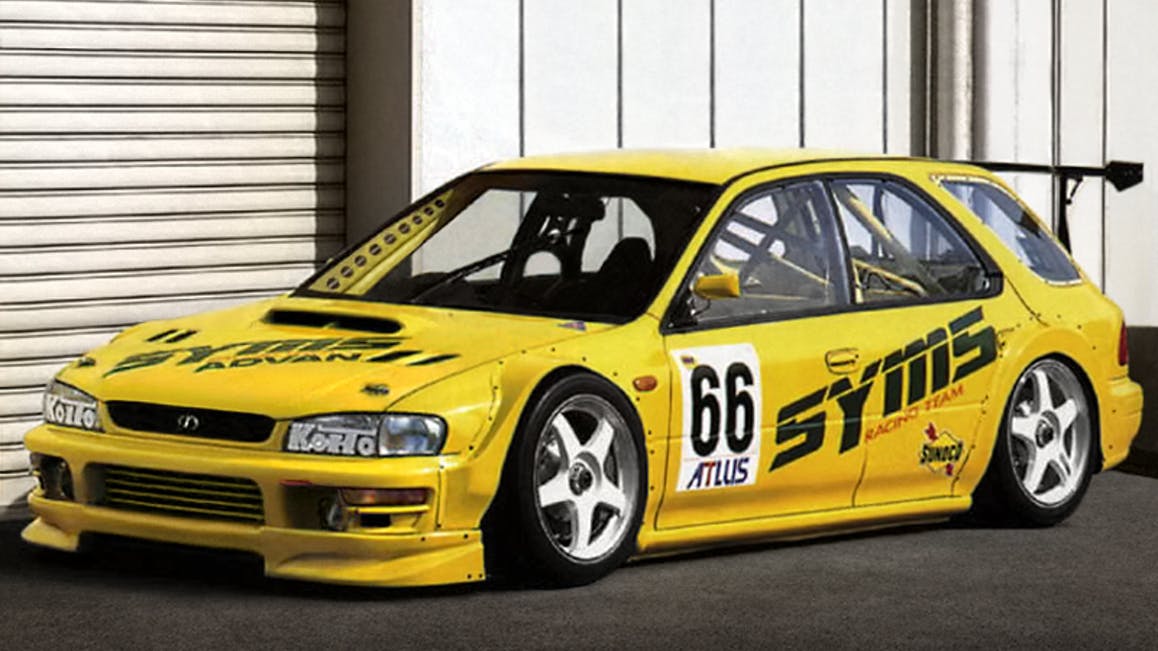
The yellow bus is an honourary inclusion, as the SYMS WRX wagon never raced within the JGTC/SuperGT series, instead taking part in the JTCC (Japanese Touring Cars Championship) that adopted Supertouring regulations after JGTC was formed in 1993.
Why is it here? Because the world needs more wagon-based race cars.
1998 was the final year of the JTCC which, by this point, suffered dwindling manufacturer support. Nissan had left due to ongoing financial issues, and Honda left to divert its attention to its F1 program and its (surprisingly cheaper) JGTC NSX campaign. Toyota remained the only OEM works team, filling the grid with all manner of Coronas and Chasers. One of the few privateer entries, however, was Subaru tuner SYMS who fielded two Impreza wagons in 1998.
The wagon body shell was chosen for its visibility advantages, and shifted through a six-speed sequential transmission sending power exclusively to the rear wheels. Its 2.0-litre quad-cam 16-valve EJ20 engine presented in aspirated configuration, as per regulations, with power quoted around 220kW.
Alas, SYMS’ WRX wagon racer only saw competition for the first three races of the 1998 JTCC season. Its racing ambitions fell short, however, finishing last in the first two races, and posting a DNS at the third meeting at Sugo Sportsland, after which SYMS Racing Team withdrew from the series.
Underwhelming race results aside, we can all agree on just how cool it looks.
Sometimes bigger is better and in the case of the new fifth-generation 2022 Nissan Pathfinder, it’s bigger on the inside and better in several ways. Like the most recent Pathfinder, this one has new-school unibody construction, eschewing the trucky, body-on-frame design of the original.
Some of us don’t enjoy automatic continuously variable transmissions (CVT) and perhaps Nissan has taken that to heart with its big SUV. Judging by how far and deep they’ve been deployed throughout the company’s product range, they sure do love their CVTs, but for this new Pathfinder, they’ve dropped it in favour of a new nine-speed automatic.
The engine carries over and remains an all-aluminium, naturally aspirated, 3.5-litre, 24-valve petrol V6 that produces 209kW at a lofty 6400rpm and 351Nm at 4800rpm.
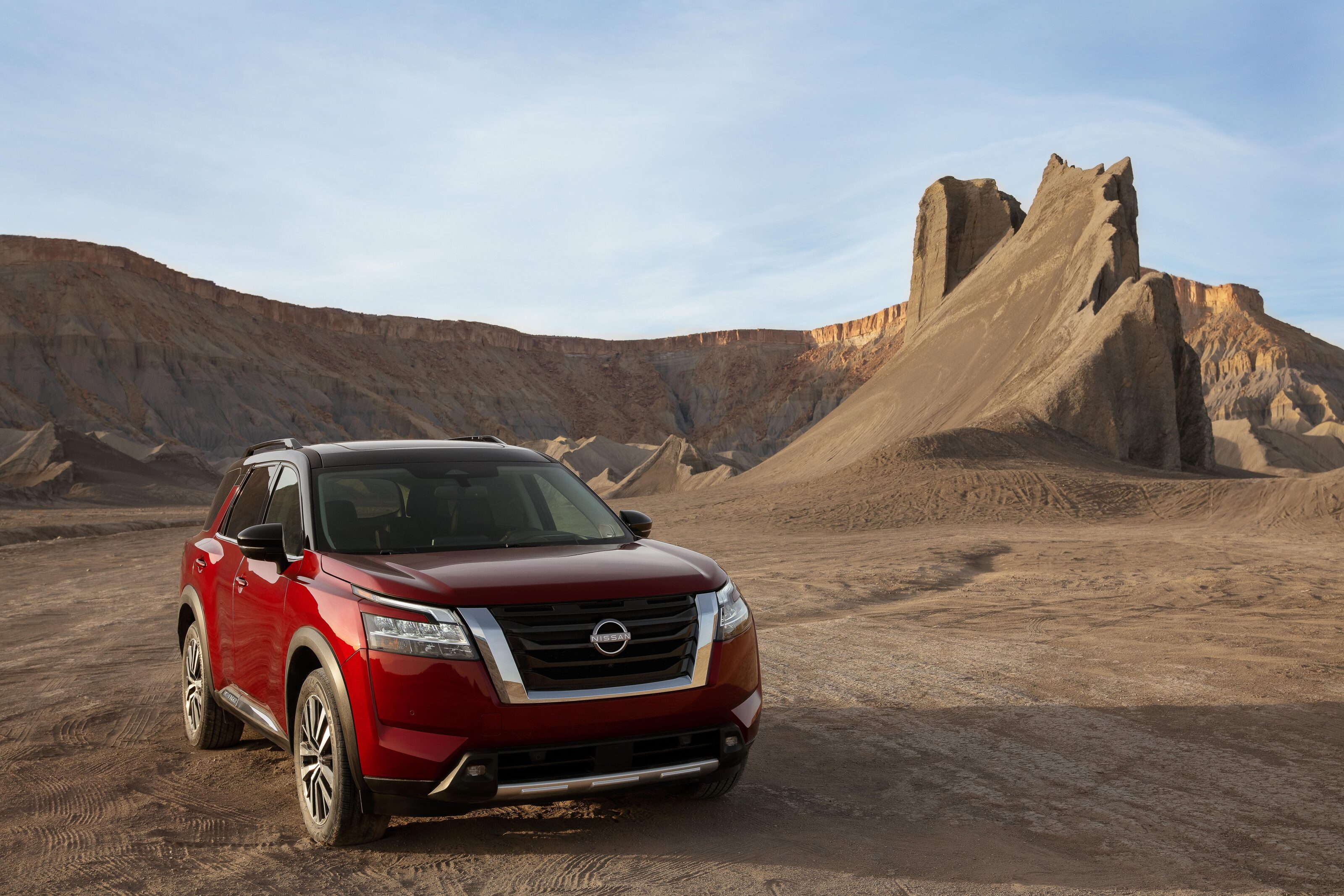
The Pathfinder is available as a front-driver or with a new all-wheel-drive system that integrates seven different drive and terrain modes, including a tow mode, as – on the United States market at least – it’s capable of towing a maximum of 2720kg. In front-drive spec, drive modes are limited to five settings and towing capacity is limited to 1588kg. Trailer sway control is standard across all models.
Suspension is more modern crossover old-school sport utility and this design favours more comfort and better handling, which is what today’s customers demand. The front suspension is based around a simple strut design and the rear is an independent, multi-link set-up. Ground clearance is a modest 180mm.
On the inside, the Pathfinder is larger than before and its styling is not just attractive but driven by increased utility. The design is rugged, modern and tech-forward, and while the three-row layout carries over, the way the space is used is more creative and flexible.
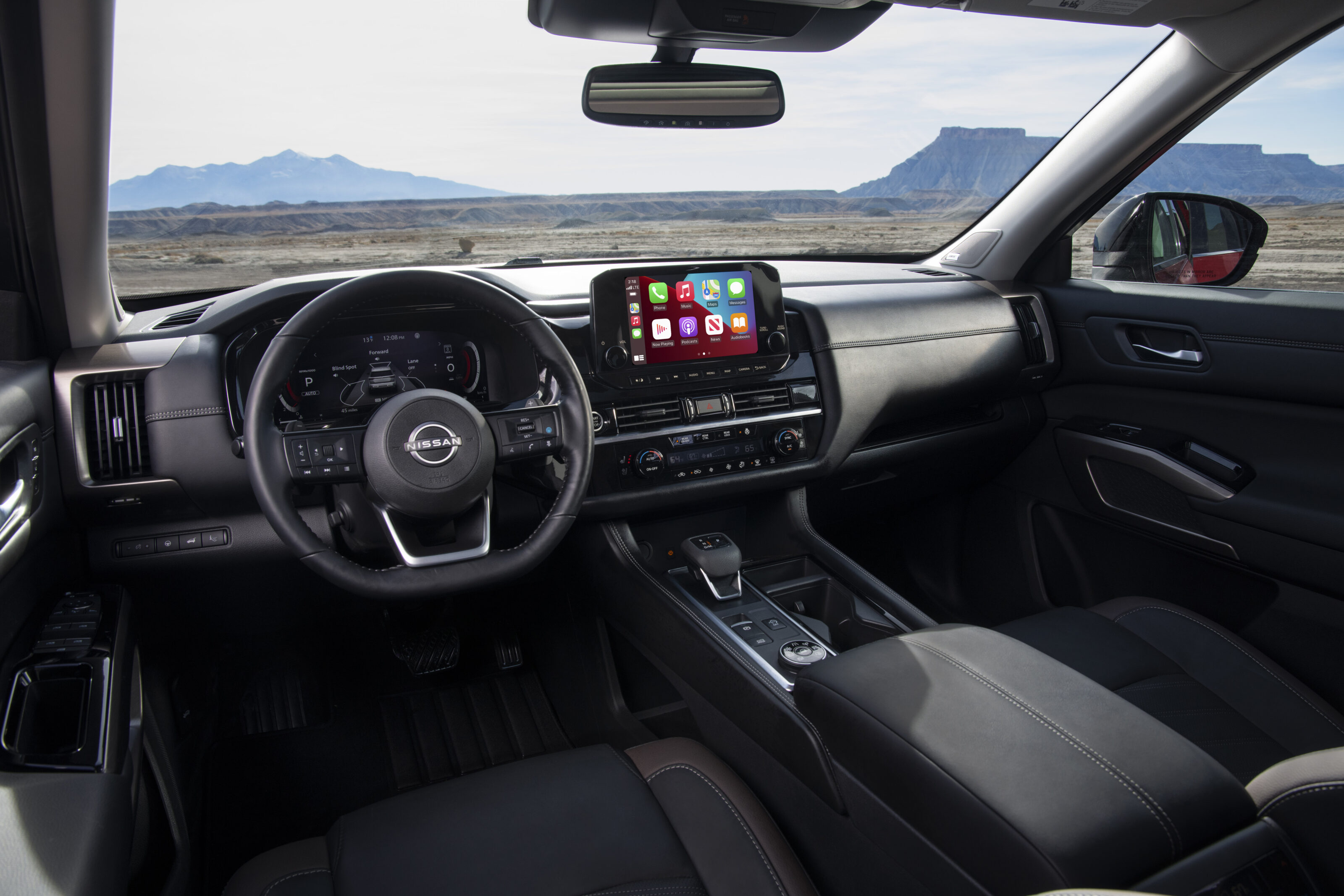
In the top trims, the colours and finishes lend the cabin an air of luxury and while the infotainment screen sprouts from the centre of the dashboard, the interior design is almost minimalist. Like the new X-Trail, the Pathfinder now uses an electronic shifter that increases usable interior storage and turns the space underneath into a spot for small items with openings on both driver and passenger sides.
Second-row choices are either a full three-person bench or a pair of captain’s chairs. With a nod to saving parents time and trouble, Nissan engineered the second row to easily slide and angle forward to allow easier access to the third row, even with a child seat attached.
When equipped with the captain’s chairs, the second row is exceptionally spacious and comfortable, even for adults, but keep in mind that the third row is best suited to children. Power outlets abound throughout the cabin and there is no shortage of connections even for the most active or gadget-friendly family.

The new exterior design sharpens all of the lines and brings the Pathfinder forward aesthetically so that it now looks taut and of the time. Where the crossover’s nose is busy with too many lines and appears styled to appeal to a demographic that appreciates The Transformers, the rear is cleanly rendered and finished with a premium look.
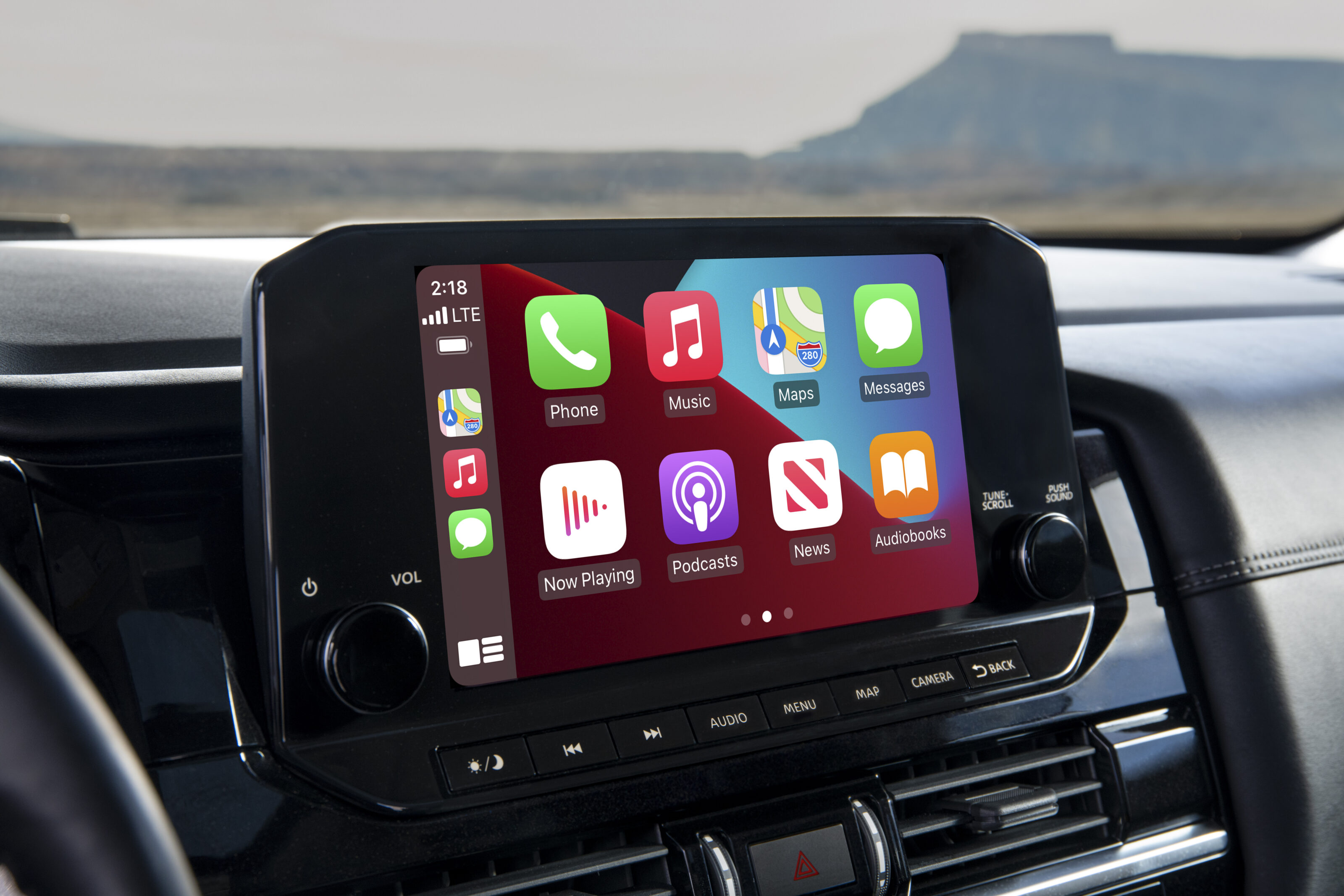
As we often find in modern vehicles of all types, the 11.8-inch infotainment screen dominates the view forward and it’s equally accessible to the driver or passenger. The interface is quickly comprehensible but in some ways is also inexplicably complex. For example, there is the standard volume control but if you drill down further into the system, you’ll find a separate master volume setting. There may be a reasonable rationale for this but if you’re not familiar with the deeper layers of the system, things like this will lead to some frustration during the ownership experience.
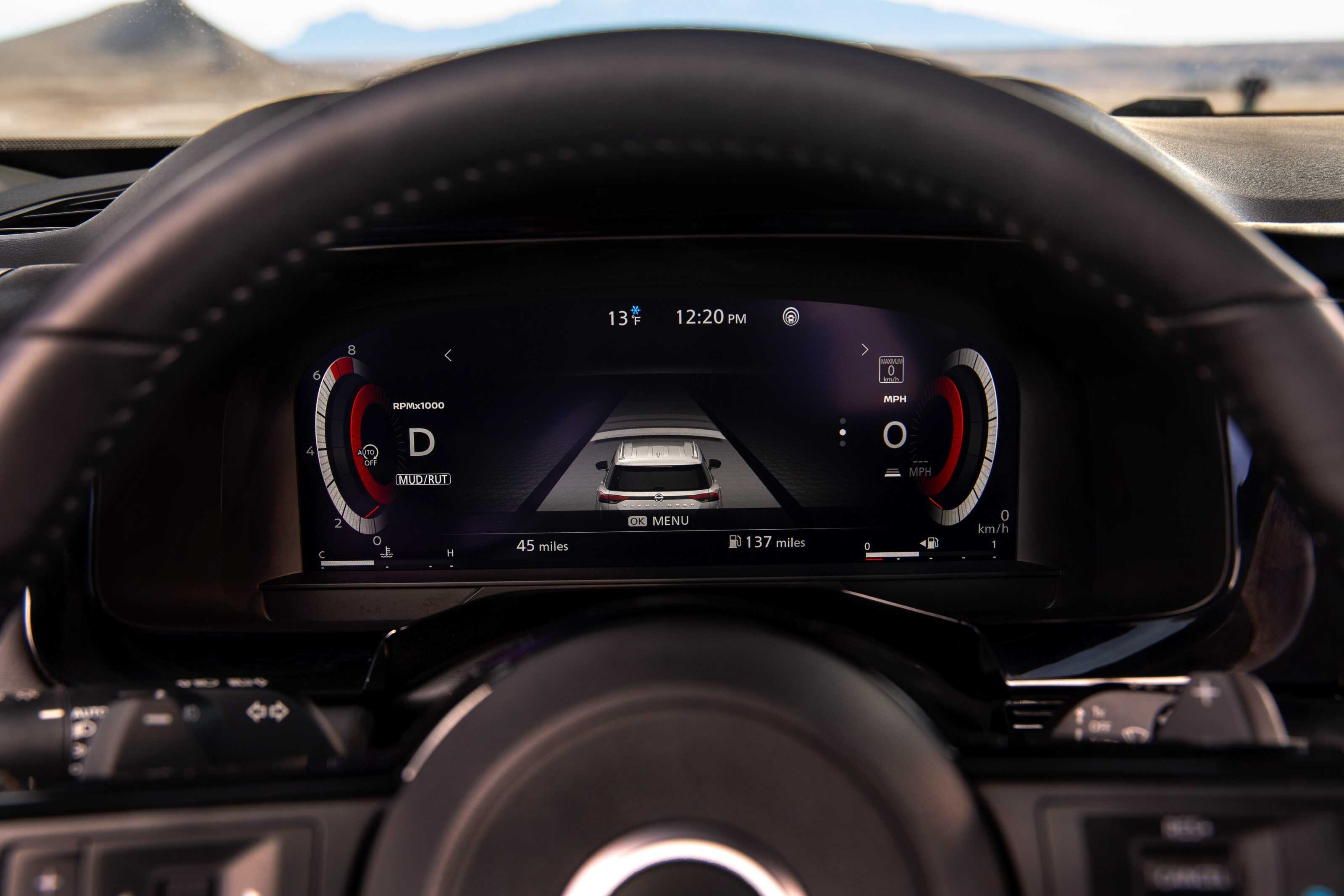
The digital instrument cluster on higher trim levels is a welcome addition and designed to clearly communicate basic driving data to the driver. At 12.3 inches, the screen is surprisingly large and the driver can scroll through basic driving information options. The large head-up display is large, bright and legible in almost all lighting conditions but is reserved for the top variants. Wireless phone charging is standard across all trim levels.
Given that busy families will be driving Pathfinders, customers will appreciate the suite of safety technology and it’s very comprehensive. Standard equipment includes forward collision warning with pedestrian detection and the expected blind-spot monitoring, but also rear cross-traffic alert and driver alertness monitor. Among a long list of safety equipment, 10 airbags are standard with 1 available on the range-topping Pathfinder.
On the inside, the Pathfinder is larger than before and its styling is not just attractive but driven by increased utility.
The Pathfinder’s driving position is excellent, starting with a supportive, adjustable and comfortable seat, resulting in superb visibility. The adjustable steering column ensures that drivers of all shapes and sizes will be set up for success behind the wheel. Ergonomically, Nissan’s layout is simple and logical with everything in its right place.
Speaking of which, Nissan’s placement for the heated steering wheel button and air-conditioning controls are logical. However, a characteristic of Nissan’s automatic climate control function is that the algorithm seems to be based on a calculation that’s relative instead of absolute. The set-and-forget nature of auto climate is appealing, but if the driver or passenger find themselves sensitive to subtle temperature changes, they will be frequently changing the Pathfinder’s temperature up or down a degree or two.
On its own, the V6 is a jewel of an engine, especially when allowed to run up higher in the rev range, where it makes plenty of power and torque, but also produces a satisfying sound. We have to remember, of course, that the Pathfinder is a three-row crossover and not a sportscar. Skyline quick it isn’t, but at least the engine sounds good at higher revs.
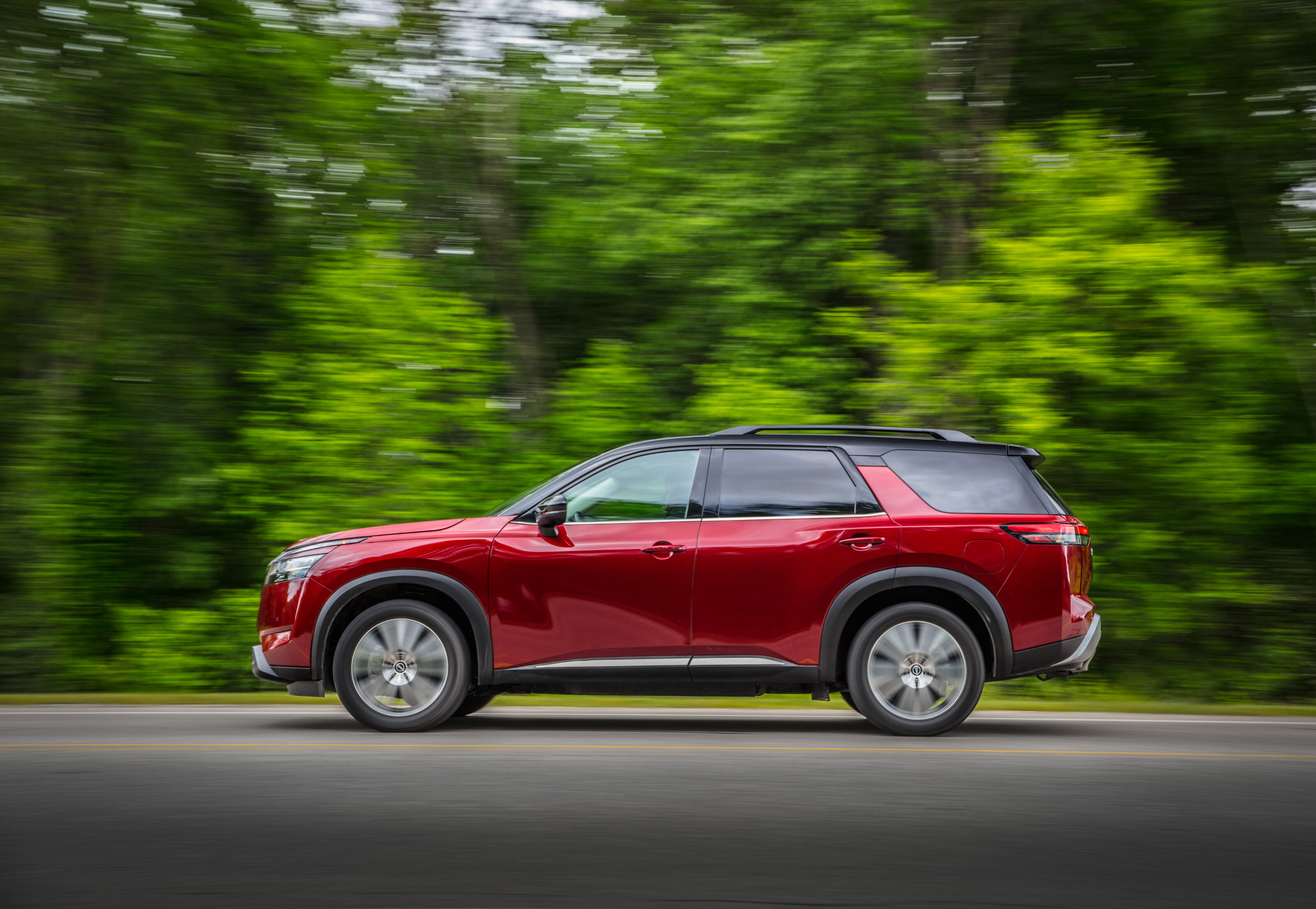
Paired with the nine-speed automatic, however, the package leaves a bit to be desired. When leaving a stop, the drivetrain is slow to respond and the lack of low-end torque compounds the problem. Furthermore, it’s amplified when the auto hold and start/stop functions are activated because drivers will find that there’s an additional heartbeat’s delay in re-firing the engine before any forward movement begins.
Encouraging the Pathfinder to leave the line quickly takes an aggressive approach – fine for the driver alone but hammering the throttle will surprise your passengers. To leave a stop smoothly is to leave it slowly. Switching into Sport mode doesn’t measurably improve the drivetrain’s response, either.
Once on the move, the drivetrain is indeed smooth and relatively quiet. Shifts are nearly imperceptible and the driver can select gears via the paddleshifters on the back of the steering wheel, helpful when climbing hills. As you’d expect, the transmission is encouraged to shift to the tallest gear possible in the name of fuel consumption, but this V6 makes maximum power and torque high in the rev range. In this light, it’s easy to recognise why many other crossovers use turbocharging to produce that all-important low-end torque.
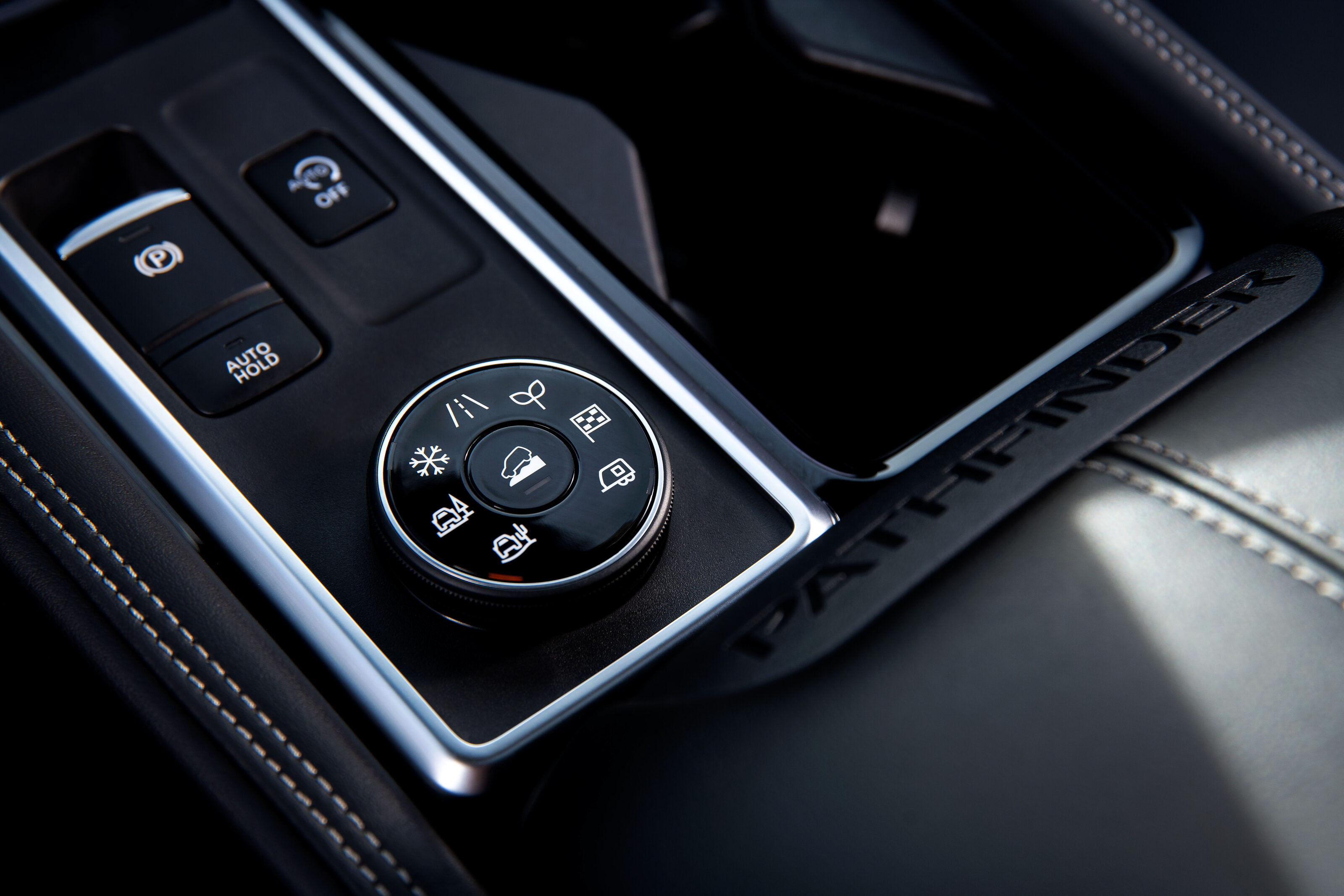
In front- and all-wheel drive specs, there are the basic drive modes for Auto, Sport, and Eco, and when equipped with all-wheel drive, Snow, Mud/Rut, Sand, and Tow modes are added. Any crossover’s off-road prowess is defined by its tyres, so some of those modes might be optimistic given the standard all-season rubber.
The highlight of the Pathfinder’s driving experience is its quiet operation at all speeds, whether you’re running around in town or making a long road trip. At the end of a drive, the driver and passengers are rested rather than stressed from higher levels of road and wind noise. The peaceful experience leaves the impression that this is a premium, well-made crossover.
The highlight of the Pathfinder’s driving experience is its quiet operation at all speeds … The peaceful experience leaves the impression that this is a premium, well-made crossover.
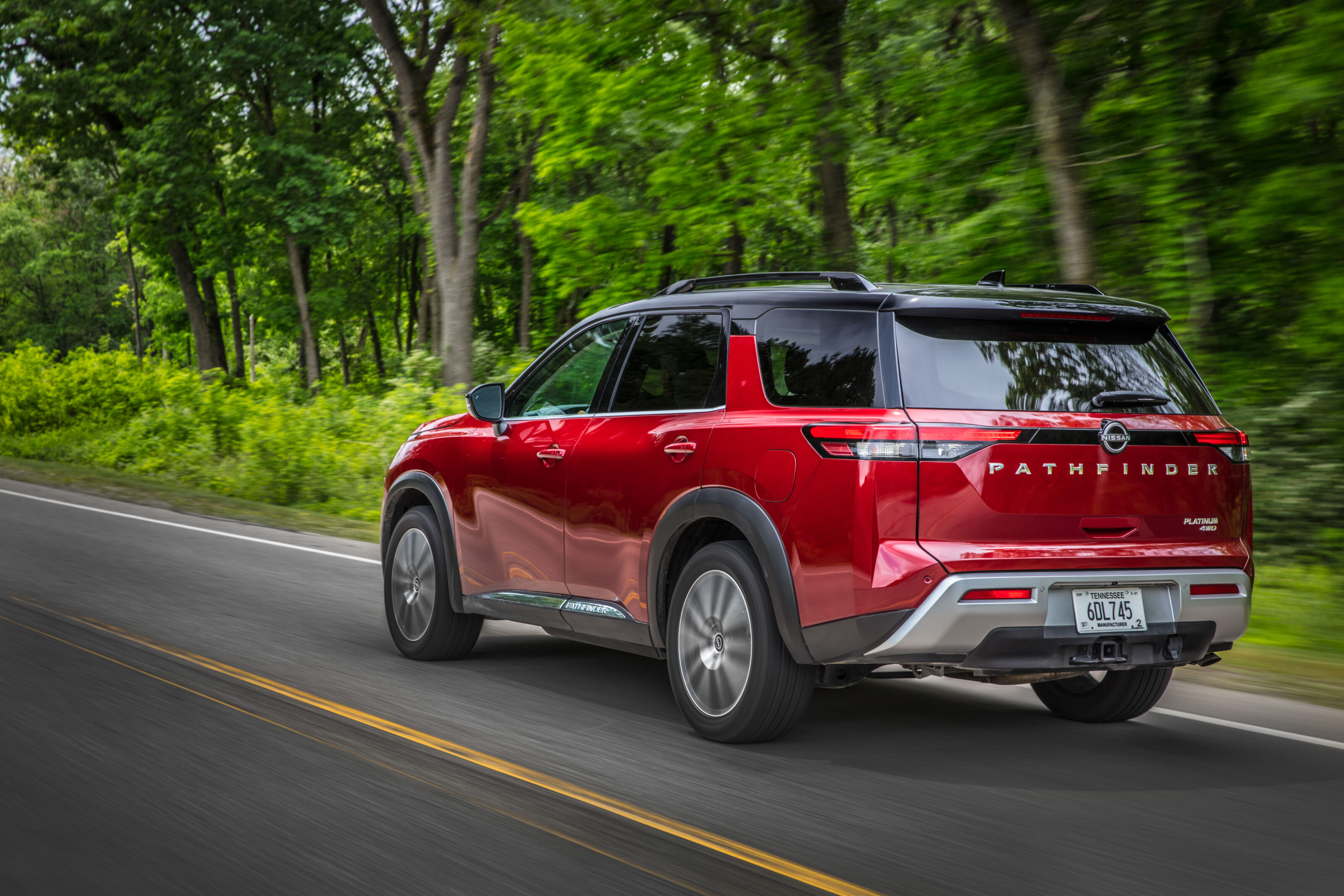
Ride and handling are tuned to favour comfort above all, so Pathfinder has modest roll in corners but the dampers still provide good body and wheel control without many instances secondary movements.
Braking is another highlight, with excellent control and high levels of pedal feel for a crossover. Overall braking power, modulation and control are quite good, as well, which is another indication that Nissan knows how to engineer a satisfying braking set-up.
Steering is electrically assisted with a variable assist function easing inputs at lower speeds to ease manoeuvres in car parks. From the driver’s perspective, steering is direct, consistent, and when combined with the above-average ride and handling of the Pathfinder, it provides confidence in the crossover’s manoeuvrability in all driving conditions.
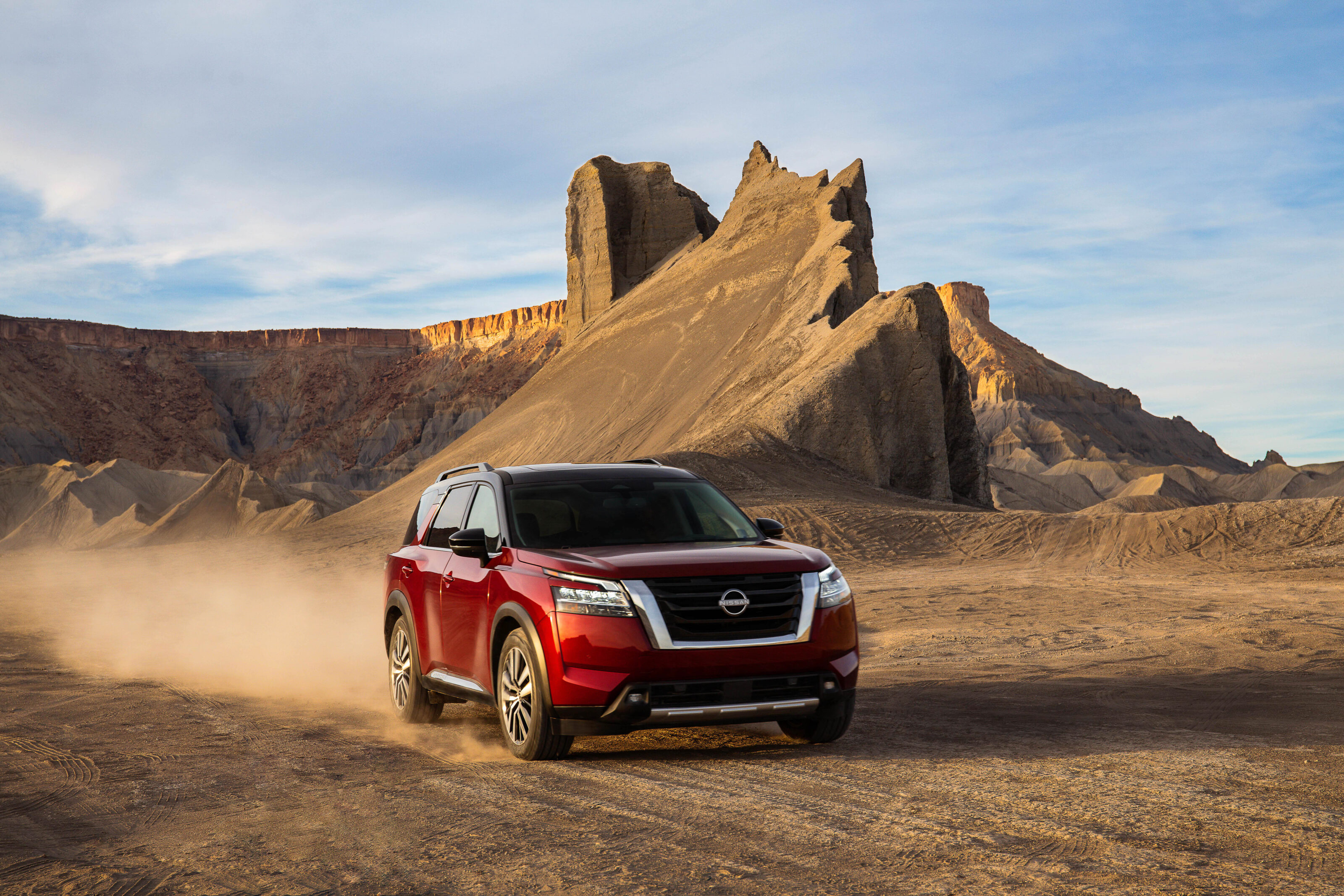
Advanced driver-assist systems are an expectation of today’s crossover buyers and the Pathfinder includes Nissan’s ProPilot Assist. It includes adaptive cruise control and active lane-keep assist along with highway stop-and-go, which takes some of the burden off the driver. On the top model, the system integrates with the Pathfinder’s navigation system and will adjust the crossover’s speed for curves and motorway exits.
In practice, the adaptive cruise errs on the side of safety, leaving a generous amount of following distance that on multi-lane roads encourages other drivers to cut in front of the Pathfinder, which starts the process all over again. The active lane-keep system’s ability to maintain the Pathfinder’s line on the road is entirely dependent on the quality of the lane markings, which leads to frequent steering corrections on poorly marked roads.
This new Pathfinder is a marked leap forward for Nissan and they’ve designed a highly useable crossover for big families. Modern on the outside, premium and quiet on the inside, it’s easy to see how this will appeal to buyers and its high level of utility and quiet ride will win them over.
2022 Nissan Pathfinder specification
Snapshot
- 178 S450s added to recall list for SOS system failure
- 257 units were affected in an earlier October recall
- S450 has now been recalled four times
The 2021 Mercedes-Benz S450 has been recalled for a fourth time, as the German manufacturer’s SOS system yet again causes dramas.
Just 178 units have been placed under recall this time, down on the 257 affected by a similar recall in October last year, although the problem with the SOS emergency call function in Mercedes-Benz’s passenger vehicles persists, adding to the nearly 40,000 vehicles hampered between 2018 and 2020.
As with previous recalls related to the system, a software issue with the eCall communication module means it may become deactivated and unable to connect to certain networks, preventing occupants to contact emergency services in the event of a crash.
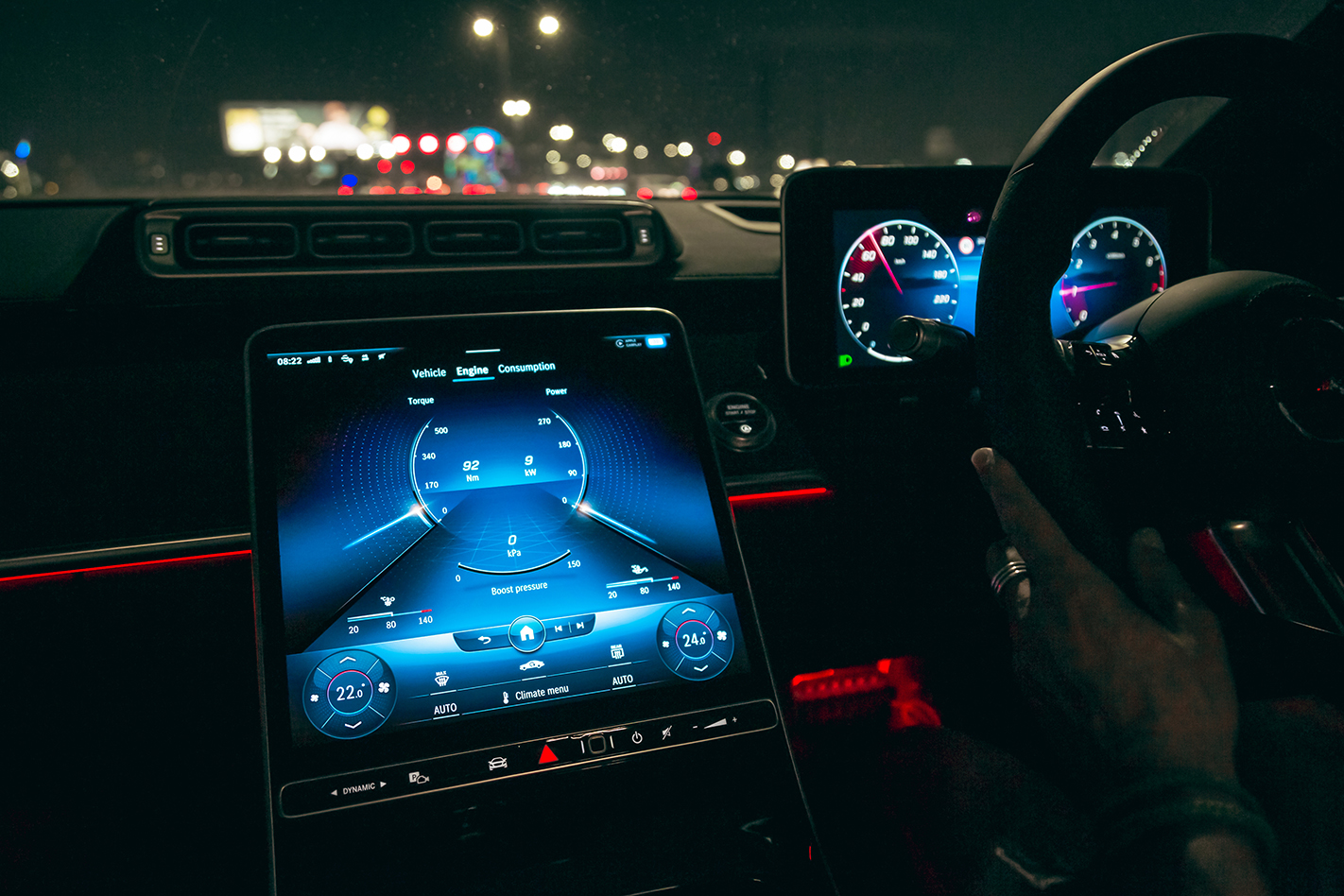
Mercedes-Benz has urged 2021 S450 owners to contact their preferred dealer to rectify the issue, offering to do so free of charge.
Alternatively, owners who are unsure as to whether their vehicle is affected are encouraged to contact the Mercedes-Benz customer assistance centre on 1300 300 896 or [email protected].
A list of VINs for affected vehicles can be found here.
The Porsche 911 may be the default answer to anyone who questions what the world’s best sports car is but that hasn’t stopped different brands trying to put their own spin on it.
TopCar Design is the latest company to add its own touch to the 911, releasing the 992-based Stinger GTR Limited Carbon Edition – a lightweight bodykit which adds €100,000 (AU$156,000) to the rear-engined coupe’s price tag.
Shown off is the seventh unit to be built in the 13-strong production run, finished in a chocolate brown which complements the raw carbonfibre highlights in addition to covering some of the more nuanced changes.
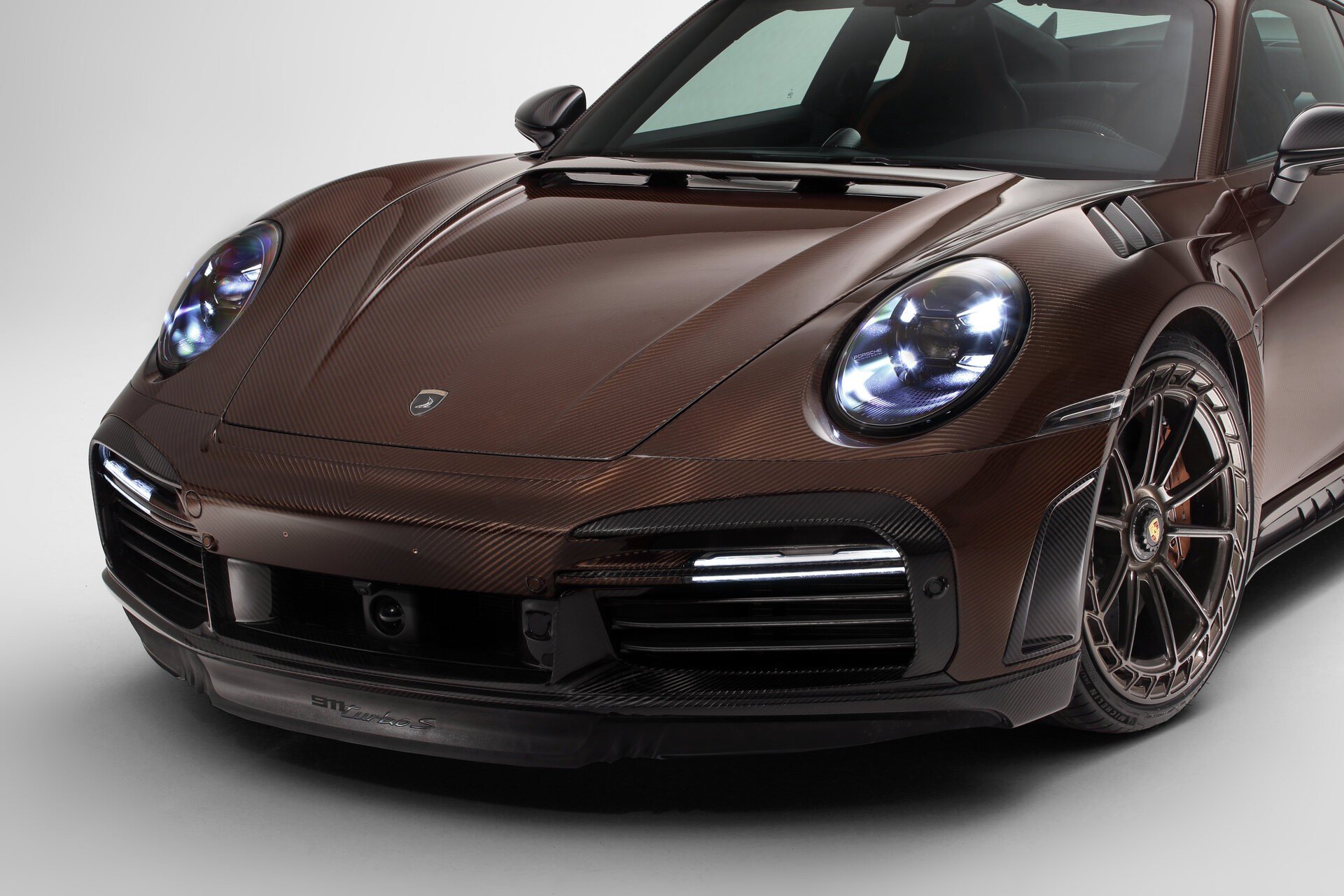
A total of 28 parts are included in the bodykit, with almost every part of the 911’s body now modified, from the front and rear bumpers to its doors, guards, sills and boot lid – all of which adds up to reach the sizeable price tag.
If you found yourself wanting more than what the bodykit offers, TopCar Design charges an extra €25,000 (AU$39,000) for the carbon parts to be painted in the body colours and an additional €35,000 (AU$55,000) for an interior upgrade, giving the cabin a healthy dose of carbonfibre.
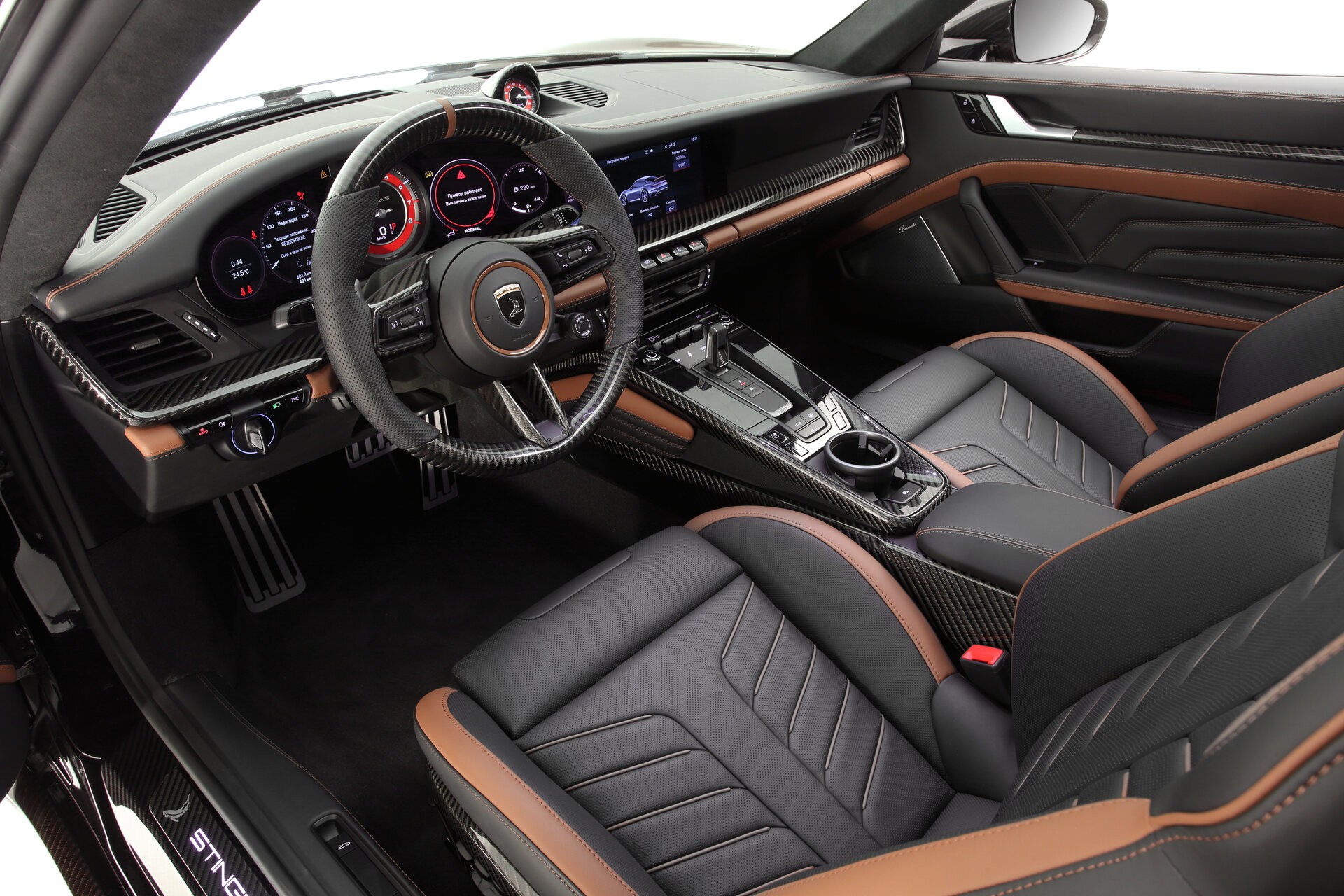
On top of this, a set of forged wheels set buyers back another €8000 (AU$12,500) while the inclusion of a titanium Akrapovič or Inconel Kline exhaust incurs a €6500 (AU$10,000) premium.
TopCar’s creation is possibly the brownest 911 upgrade ever made, but is it worth the money when a similar amount could vault prospective owners into a GT3? We’ll leave you with that thought.
With an almighty thunk that cannons through the entire skeleton of the ship, the Spirit of Tasmania drops its jaw onto the dock at Strachan, on the Apple Isle’s west coast. A few hundred cars and a dozen bikes sit idling in the bowels, waiting for the signal from the deckhand to roll out. The year is 2009, and I’m in a manual Audi R8, watching the temperature gauge of the mid-mounted 4.2-litre dry-sumped V8 start to climb into the operating zone.
A steady drip-feed of adrenaline leeches around my bloodstream as the deck hand, who looks like a young Clint Eastwood, waves me through. It’s a cheery wave; so much nicer than being shot in the head with a 44 Magnum.
I have plenty of time for the 300km drive to meet the rest of the Wheels team in Hobart for our V8 celebration, but I’m not about to let a trivial detail like that intrude. No, given the early hour and scarcity of traffic on these epic roads, it would seem churlish not to drive like my underpants are on fire, and the extinguisher is on the other side of the island.
What follows is a drive that sits easily lodged in my top 10; an indulgent gorging on that willing, free-spinning V8, continually urging it to lunge for its 8000rpm redline; the precise clack of a manual stick into its beautifully defined open gates, and revelling in the balanced, resolved chassis, supple enough to deal with road surfaces ranging from sublime to ridiculous.
It was a transcendent experience, one of the rare times where you, the car and the environment mesh perfectly to allow a Marie Kondo-style decluttering of the mind, leaving you absorbed purely in the euphoria of driving. I didn’t even lift when I passed a couple snuggled together in a parked Mazda 3 on the side of the road outside Burney, who I reckon were most definitely cousins.
That epic blast gave me an appreciation and affection for the R8 that hasn’t faded over a decade on. I’ve had several awesome drives in that car’s successors, including the V10 Performance in our Atmo Heroes feature (Wheels, September 2019) and the V10 Spyder on awesome roads on Spain’s Costa De Sol at that car’s launch. The R8, no matter what spec, is always an ‘event’ car. But now, as the current generation car ticks past four years on sale in Australia and the global emissions noose tightens on all car makers, the question hangs over it: Where to from here?
The term ‘halo car’ gets flung around plenty these days, but it was never more apt than when applied to the original R8 and the impact it had on the broader perception of Audi. The TT may have brought design attention to the four-ringed brand in the late ’90s, but the debut of the R8 in 2006 was the punctuation point that passion and performance belonged as the pinnacle of the company’s line-up.
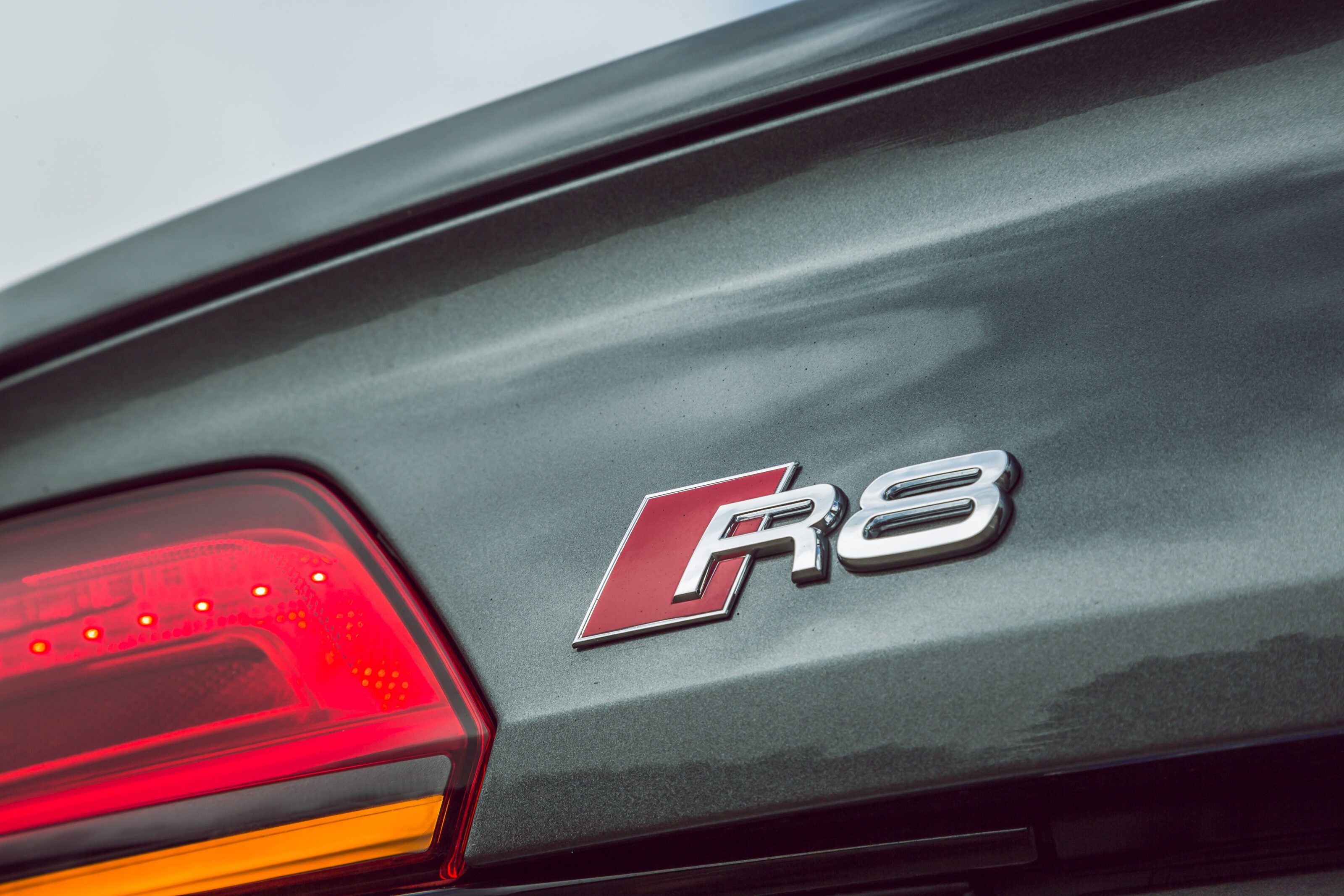
Not just that, in many ways the first-gen R8 took the mid-engine sports car, well, almost mainstream. Before the arrival of the V10, the V8-powered R8 was a price and performance rival for the 997-generation 911, yet way more exotic. Its conceptual forebear, the RSQ, made kids lose their minds when it appeared in the 2004 sci-fi thriller iRobot, and when the V10 did arrive locally in 2009, the R8 was suddenly a bona-fide supercar. Oh, and one without its minor controls seemingly placed by a spud gun, unlike the Lambo Gallardo.
But now, as the second-generation R8 moves into the twilight phase of its life and speculation increases about what will replace it, we figured it needed a send-off drive to serve as a raised glass; a 10-cannon salute for what has evolved into one of the last great mid-engined atmo heroes.
So, as the pre-dawn sun struggles to cast a weak glow over his neighbour’s rooftops, snapper Wielecki and I thread ourselves into the ultra-snug, legs-ahead cockpit and share non-COVID-approved shoulder contact. We have only a day, so figure we’ll head south-west to Goulburn for a late breakfast, then fire up Taralga Road to get to Lithgow in the early afternoon, and later aim for the epic roads that flank the UNESCO-listed Jenolan Caves.
By the time it’s dark, I’ll be hungry and cranky and Wielecki will be still saying “just one more shot!” and I’ll be ready to punch him in the throat, but that’s how it always goes.
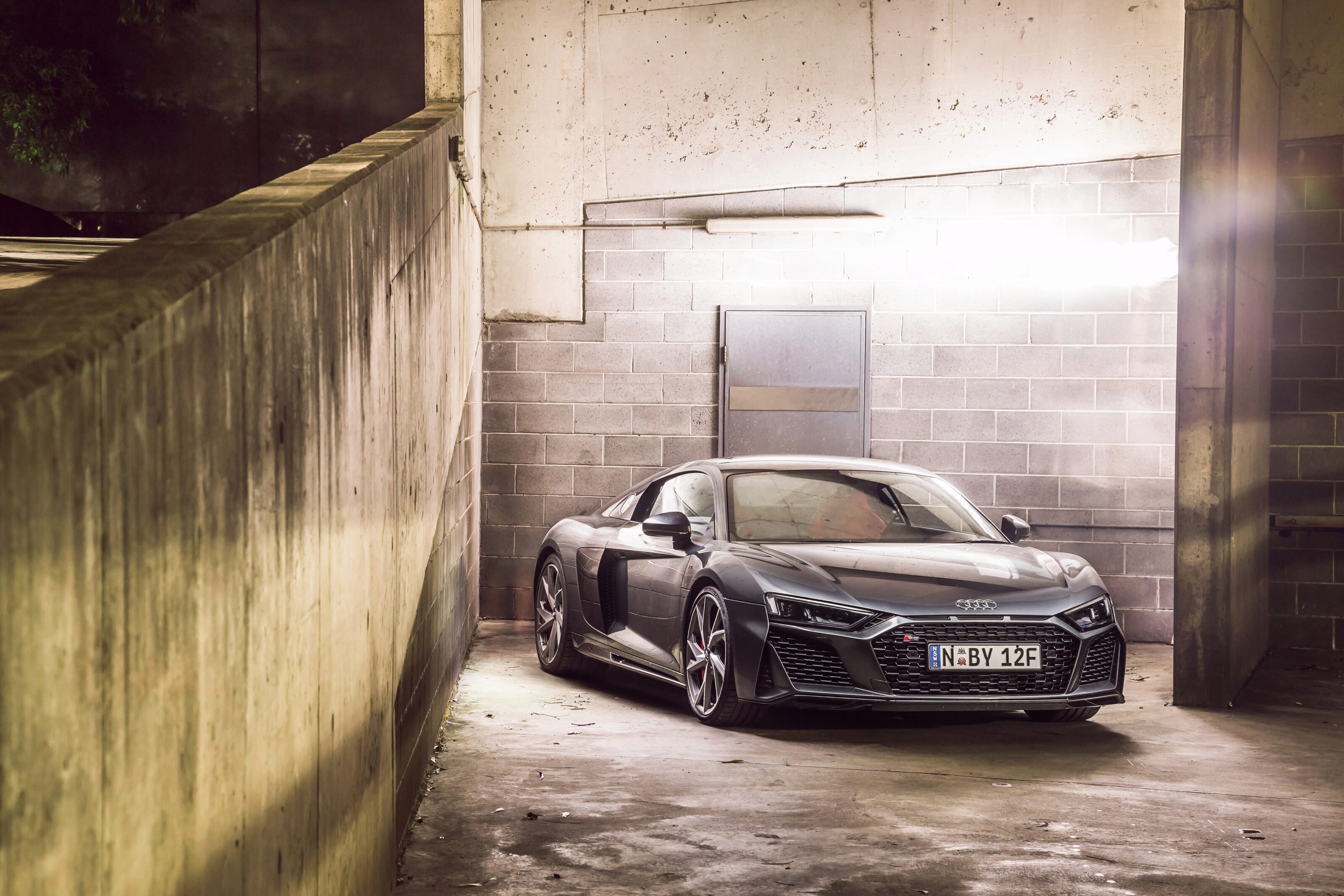
Before we leave, though, Wielecki’s 10-year-old son Enzo is hopping around like he’s been on the red-cordial breakfast of champions, demanding at least one decent throttle stab to hear that V10 clear its throat. His excitement somehow captures everything that’s awesome about supercars; the latent promise of aggression, danger and the thrills they exude just sitting static, and how they can suddenly vocalise all that with one decent prod of the throttle.
Of course I oblige, and his little face crinkles with a mix of shock and delight as the V10’s rabid bark explodes out of the fist-sized tailpipes, splitting the early-morning air like a cleaver. When the R8 eventually goes electric (more on that later) will young kids still be as transfixed? Or will the lack of combustion fury neuter a core part of the spectacle?
Thankfully I have other things to distract me from this question, like digging around in the drive modes to soften the dampers and relax the ultra-taut ride. The Individual setting allows me to alter the engine and transmission calibration, and the steering weight, and the exhaust note, but no evidence of damper adjustment. It then sinks in that this rear-drive variant is sold with fixed-rate dampers only, so the unforgiving chassis tune is the only one on offer.
Okay then.
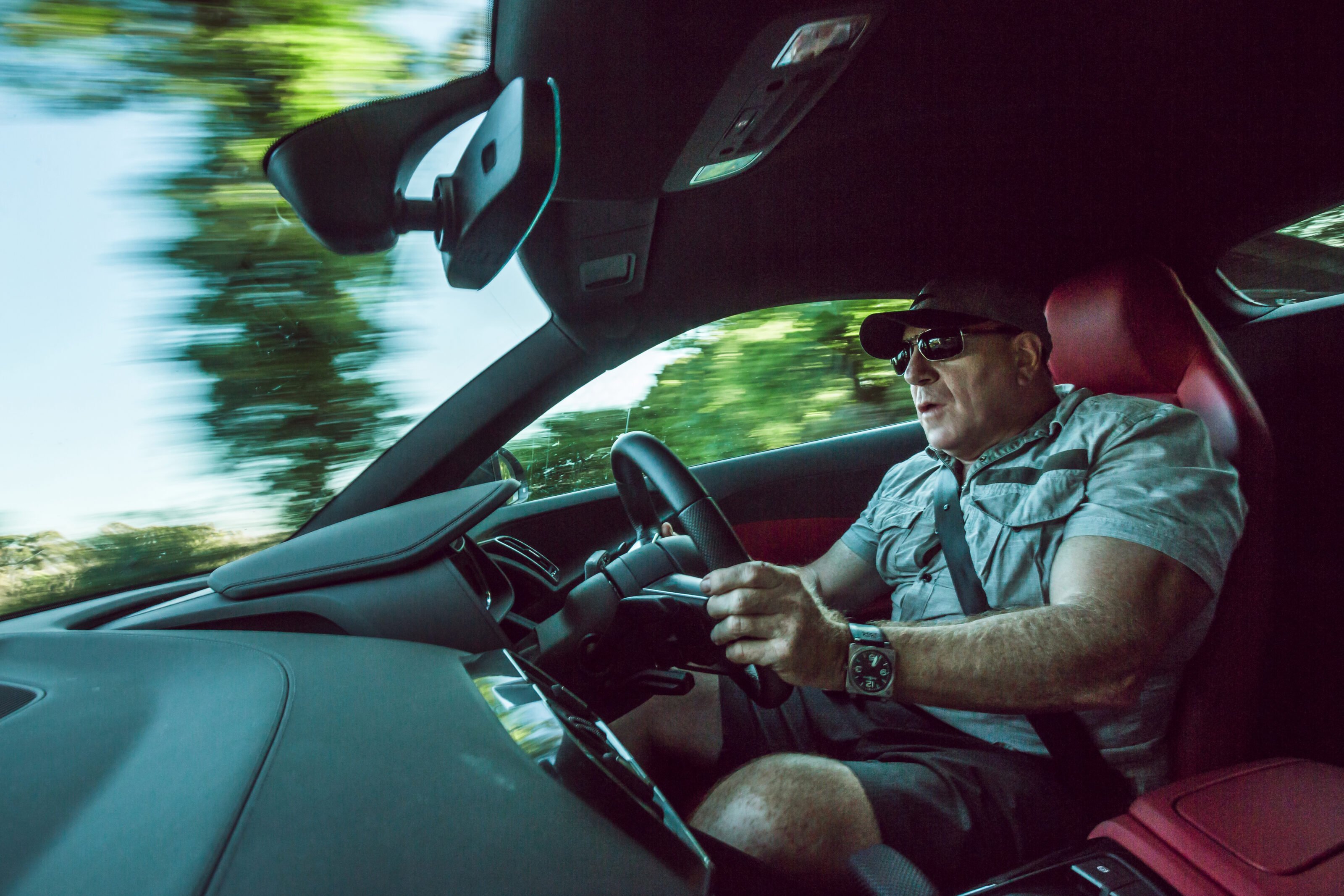
Only the Performance variants (coupe and Spyder) get adaptive dampers, along with carbon-ceramic brakes, fixed bucket seats, a higher output tune for the 5.2-litre V10 and of course all-wheel drive. Both body styles of the higher-grade cars each add a neat $100,000 to the tab, which suddenly makes the $295,000 charged for our RWD coupe seem, at least in the realm of supercars, not insane.
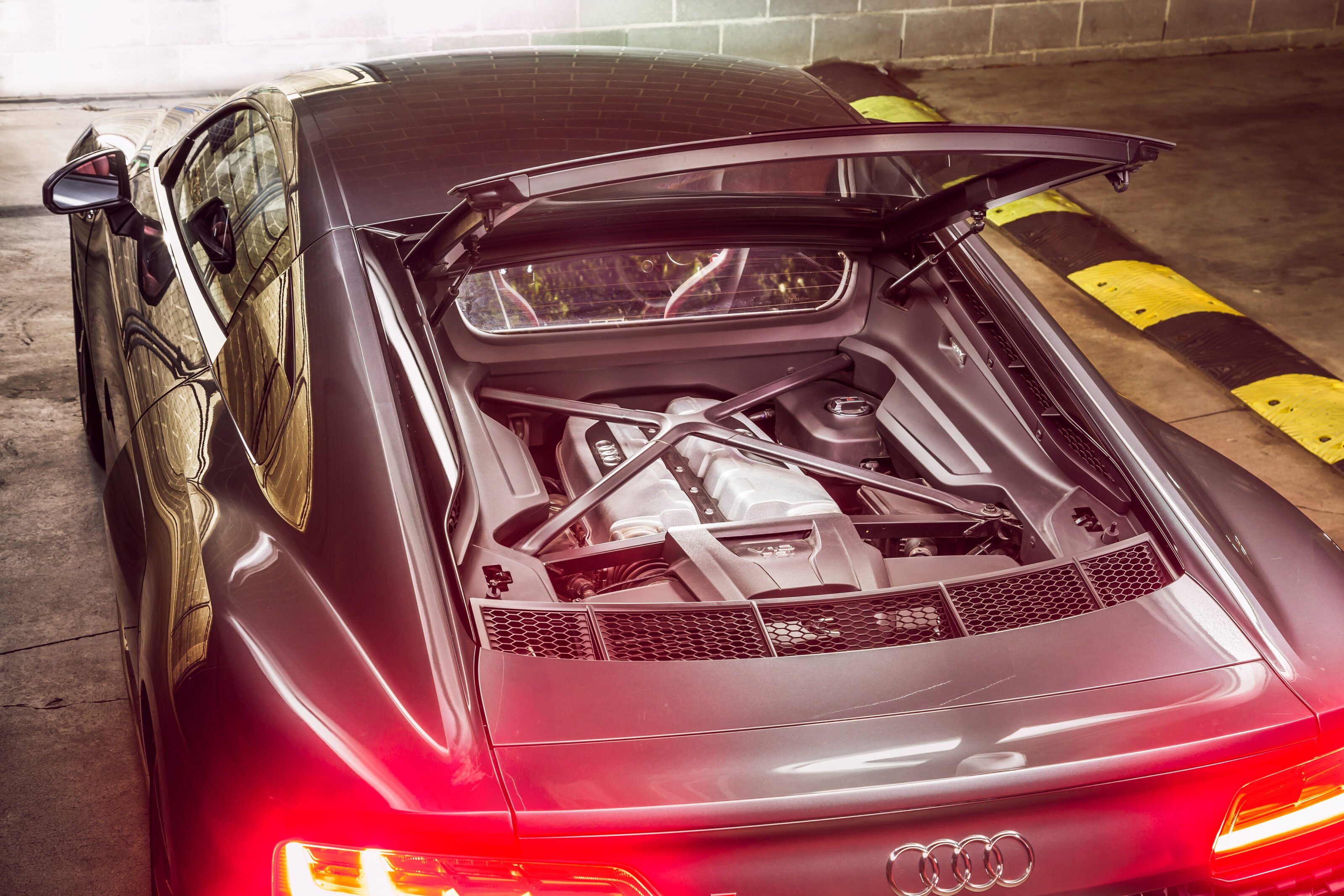
You would never call the 75-degree 5.2-litre V10 underdone in this spec, even though it’s actually the tamest iteration of the engine available. See, we can’t talk R8s and V10s without mention of this car’s brother from another mother, the Lamborghini Huracan. Both cars share their spaceframe constructions, which are built from a mix of aluminium and carbonfibre at the same facility in Heilbronn, Germany.
Their V10s share fundamental architecture too, even though they’re built at different engine plants. Our car here makes 397kW and 540Nm, which bump up to 456kW and 580Nm in the Performance variants. Solid numbers, but still short of what this engine can make with that frisky-bull badge attached: currently, the hottest Lambo tune sees the V10 wailing out 470kW and 600Nm, so you do have to accept a little bit of sandbagging when plumping for the ‘budget’ Audi.
As we cruise on the expressway towards Goulburn, power feels, well, ample, and the smarts of the seven-speed dual-clutch transmission are exceptional on the move. It’s eager to relax the engine and use its torque on a light throttle, but almost instantly responds to a throttle prod or click of the paddles. Yet I still feel a brief yearning for the gated manual of the first-generation car. Not only did it give you that wonderful tactile connection to the gears, but the ability to add a bit of clutch slip to whip the engine up into the meat of the torque curve was a brilliant asset.
That six-speed manual and its alternative, the automated single-clutch seven-speeder, were both consigned to the bin when the major update of the first-gen car arrived in Oz in 2013, and no-one could argue that the dual-clutch was not the technically superior transmission. But the polite little clicks of the paddles do feel a bit like you’re interacting with a computer, rather than sending manly messages to a bunch of madly meshing cogs.
It’s all part of making the R8 the civilised supercar, I get that, but the tyre roar from the huge rear Michelins try to argue otherwise. They are crazily surface-dependent, transitioning from a muted monotone on hot mix to ajetliner-with-hole-in-the-floor rumble on coarse-chip. We attempt to drown them out with the excellent Bang & Olufsen sound system, but they’re a formidable aural opponent.
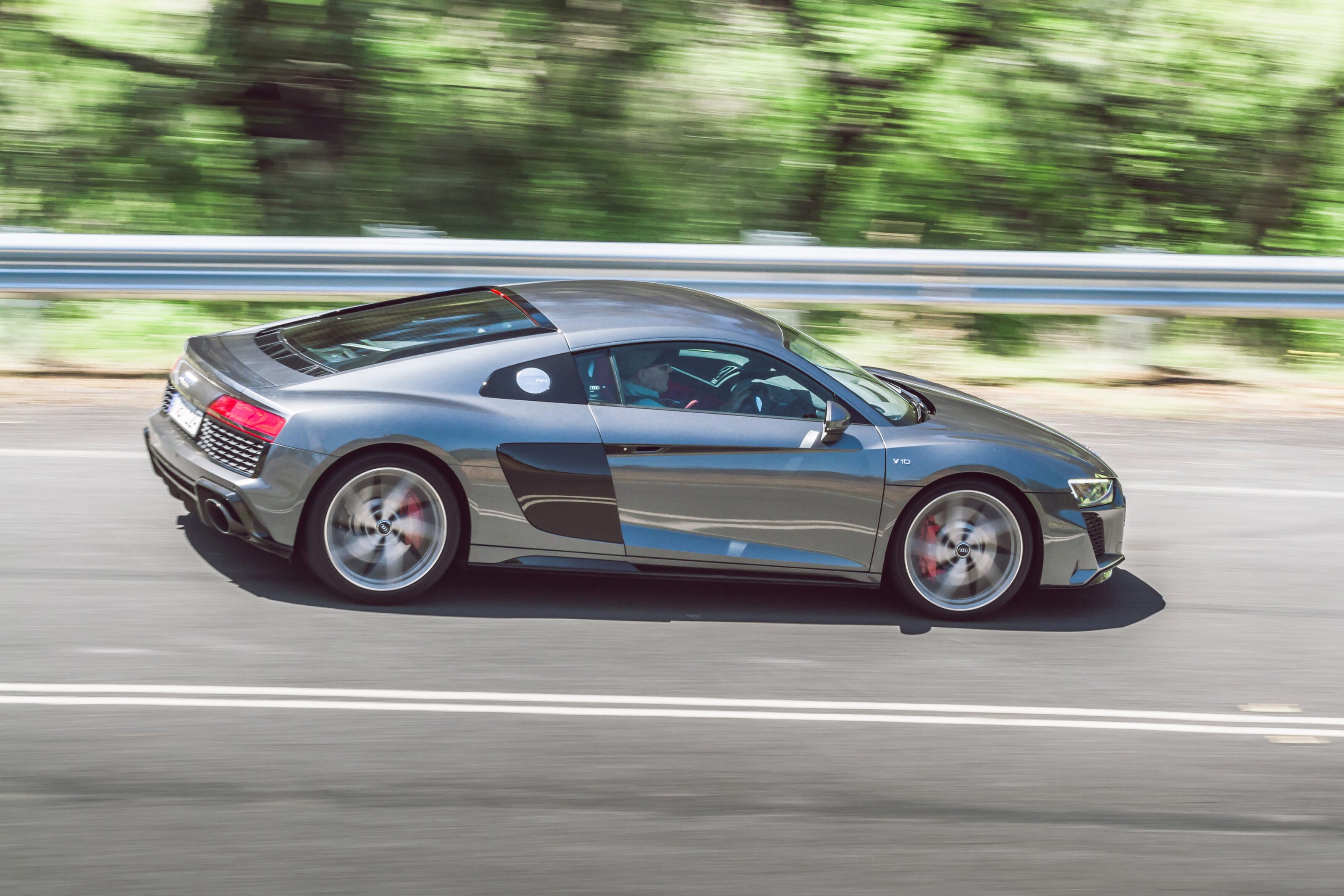
Boy, do those Michelins know how to cling on, though. Outside Goulburn, under an unblemished blue sky, I can really start to take the first exploratory sniffs of the grip on offer, and it really is colossal.
The steering is unburdened of dealing with torque output, unlike the AWD variants, and feels even more instantly incisive either side of centre than I remember in the last R8 I drove, that V10 Performance. It’s borderline too aggressive, demanding a very gentle input to avoid taking an excessive chunk of apex on these flowing roads. But there is proper front-end feel, something not universally gifted to fast Audis, so you’re never in doubt as to what’s happening down at surface level.
And if you just want to stay on the sane side of the rulebook, provided that surface is reasonably bump-free, you can rail around sweepers with barely a lift of the throttle, much less a brush of the brakes. But the damper tune… unfortunately it’s a classic case where one size doesn’t fit all. Start cranking up the pace, drawing on the vast reserves of the big-lunged V10, and hustling the car faster into bumpier bends sees it turning a bit skittish. You have to be really having a crack for it to turn into anything more than a fleeting moment of bum-pucker, but it does act as a bit of a confidence sapper.
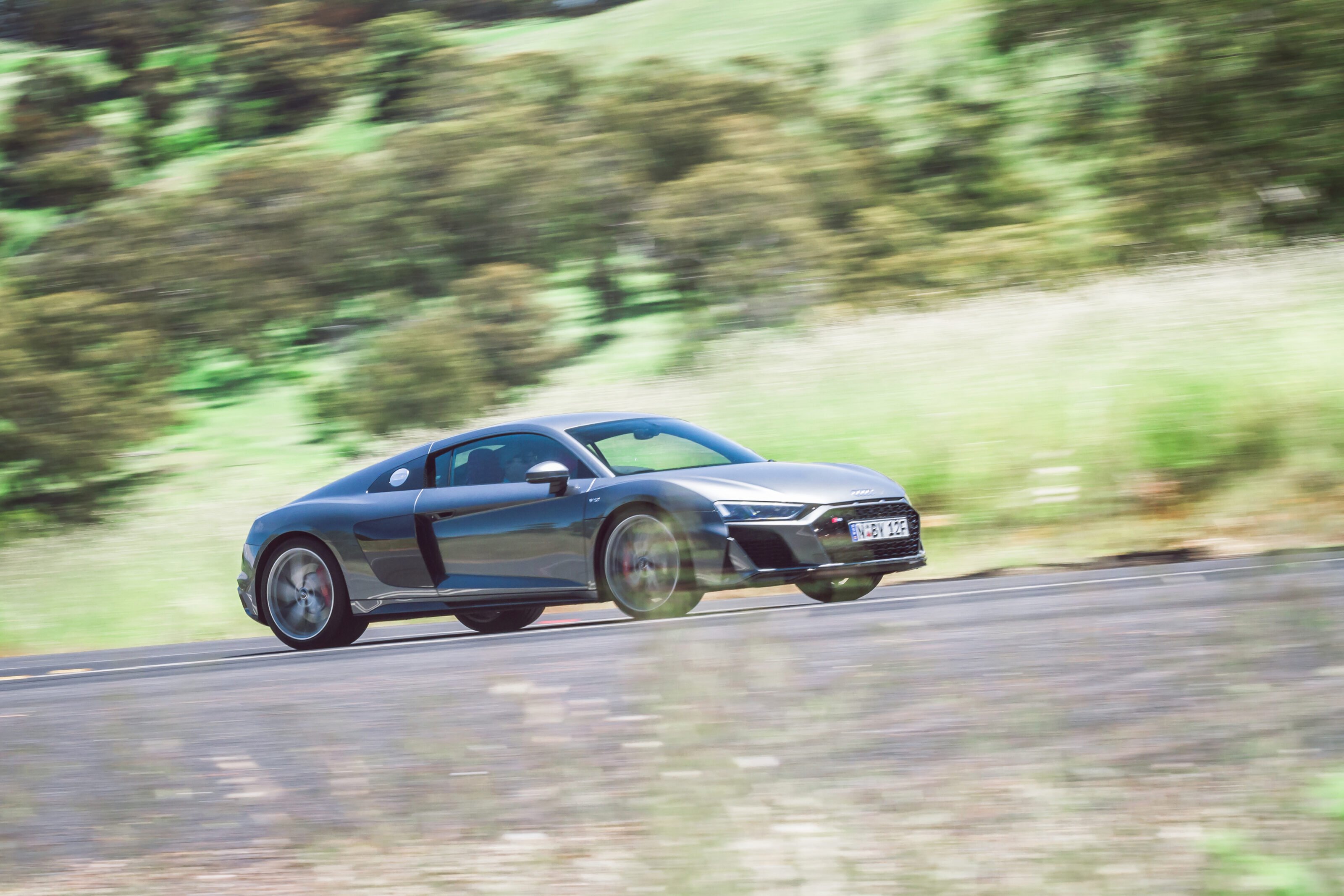
It’s becoming clear that an R8 in this guise – slightly down on power, driving the rear wheels only and navigating Aussie roads with only a short, firm stroke of its non-adjustable dampers – is somehow the brasher, more youthfully exuberant member of the line-up. It demands a committed but not overly aggro approach to coax out its best, otherwise it can feel a little spiky.
The arrival of the rear-drive R8 was a pivotal move for Audi, which had built so much of its USP and corporate identity around the whole ‘quattro’ thing. Is it purely coincidence that it occurred while Audi Sport (which heads up the R8 and RS models) was under the control of former Lamborghini boss Stephan Winkelmann?
The sharp-dressed CEO had overseen the introduction of the rear-drive Gallardo LP550-2 Balboni edition from 2009; you don’t have to join too many dots to figure he later saw an opportunity at Audi to ditch the inherent conservatism of front driveshafts and green-light a supercar to live a little on the RWD edge. Besides, racing regulations had seen the R8 LMS driving only the rears for some time; there was a degree of motorsport-inspired synergy in letting the road car follow suit.
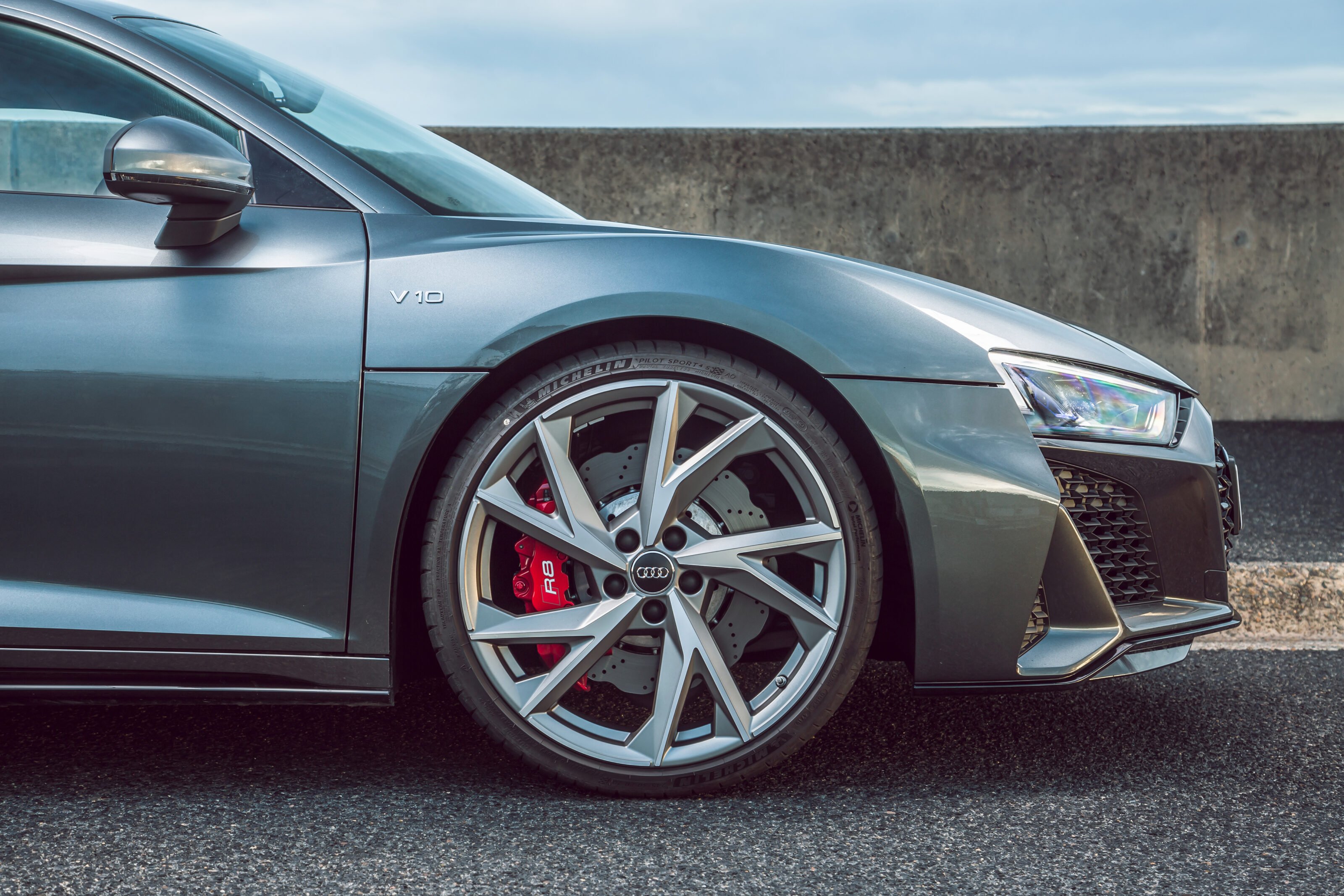
It does make the RWD coupe a livelier car, but how much of this is the damping and how much is lack of drive to the front wheels? Well, that I can’t really say. What I can attest is that, with the ESC in Sport mode, this is a car that really gets the synapses firing and the hairs on the back of your neck standing to attention. It insists that you’re ultra-precise with feeding the throttle back in just past the apex, but rewards with a clarity of feedback that really reminds you, not matter how good turbo engines get, this is the ‘vinyl’ of the internal combustion world.
And the sound of the V10 when worked through the rev range; Jeez-us. Okay, it doesn’t have the sonic purity of the litre-smaller V8 – it’s too busy being angrier and more verbose for that – instead it has more of a warble as it spins up, and as it scales the rev range, that with the exhaust open, just gets more open-lunged and quite outraged as it rips at the 8700rpm limiter.
It lacks the thuggish slug of turbo torque that rivals like McLaren and AMG deliver, but that’s all part of the joy. Here, the big V10 demands fuel and flame to keep properly percolating, so you focus on chasing revs to keep it fed, and revel in the noise and anger flooding out beyond 6000rpm.
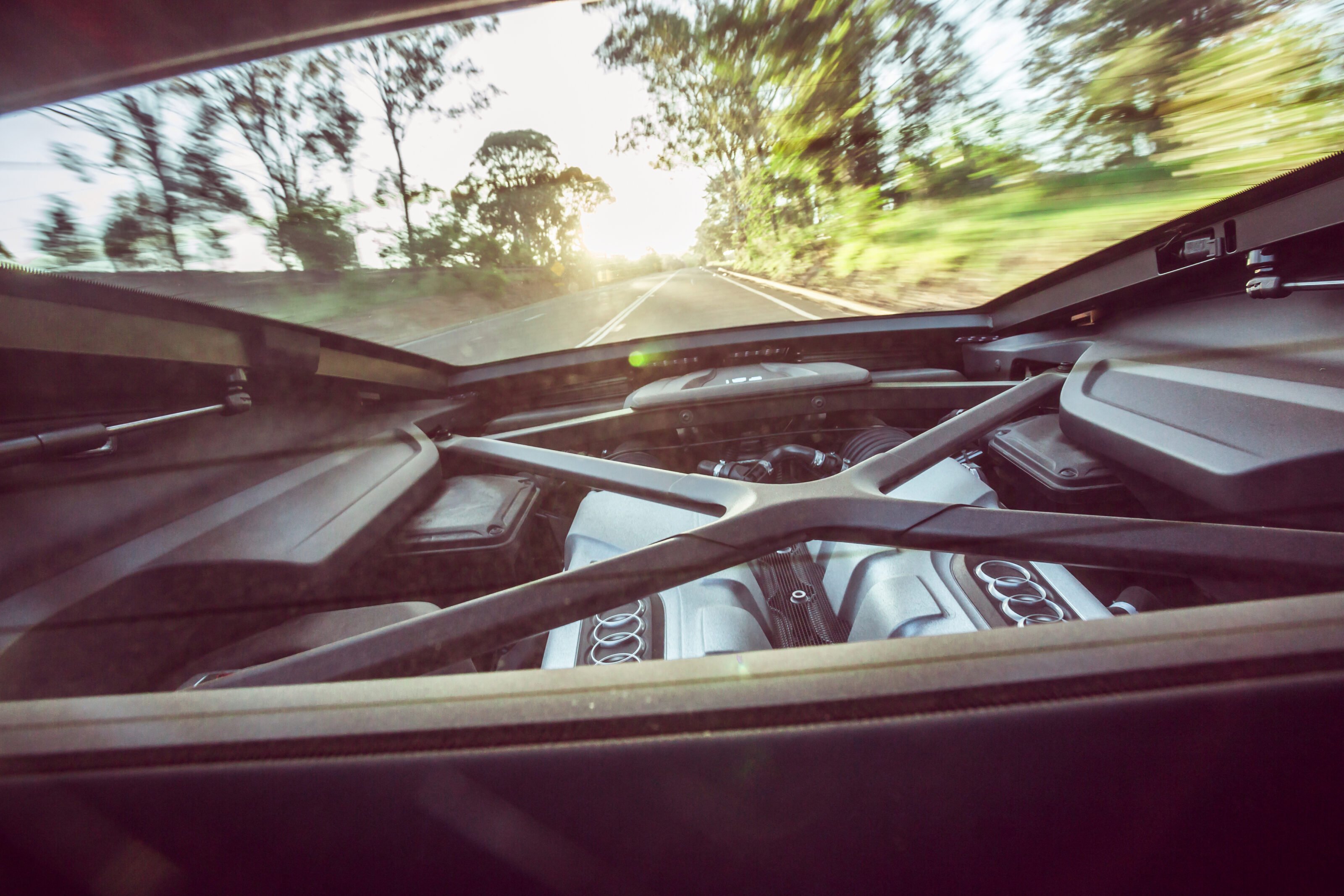
On the smoother surface of the Jenolan Caves Road near the Jenolan Mine, surrounded by lush fields of green and purple, it’s a proper scalpel, monstering the short straights, the hardwired throttle response letting you know exactly how much you can throw at the rear Michelins to keep them wedged in that window of slip and grip.
This has been a shorter time than I had with the original car in Tassie, and the mechanical interaction with the V10-powered car is quite different – a bit more more combative, less harmonious – but that same euphoria rises again.
Adding electric motors would no doubt make it even more ballistic, filling the midrange with monstrous torque, but would it make it more thrilling and satisfying to drive than this V10 iteration? The jury’s out on that one.
And that really is the big question hanging over this car. The first generation had a long life of nine years, but it seems unlikely this second-gen model will last anything like that. Already there are things that feel dated, like the lack of a dedicated multimedia screen (the rotary controller and accompanying keys operate a menu that appears in the dash) and the absence of lane-keeping or radar-based cruise control, missing because the electrical architecture doesn’t support it. There’s even a CD/DVD unit behind the centre console. If only I’d known, I could have brought my 2007 Triple J Hottest 100 disc.
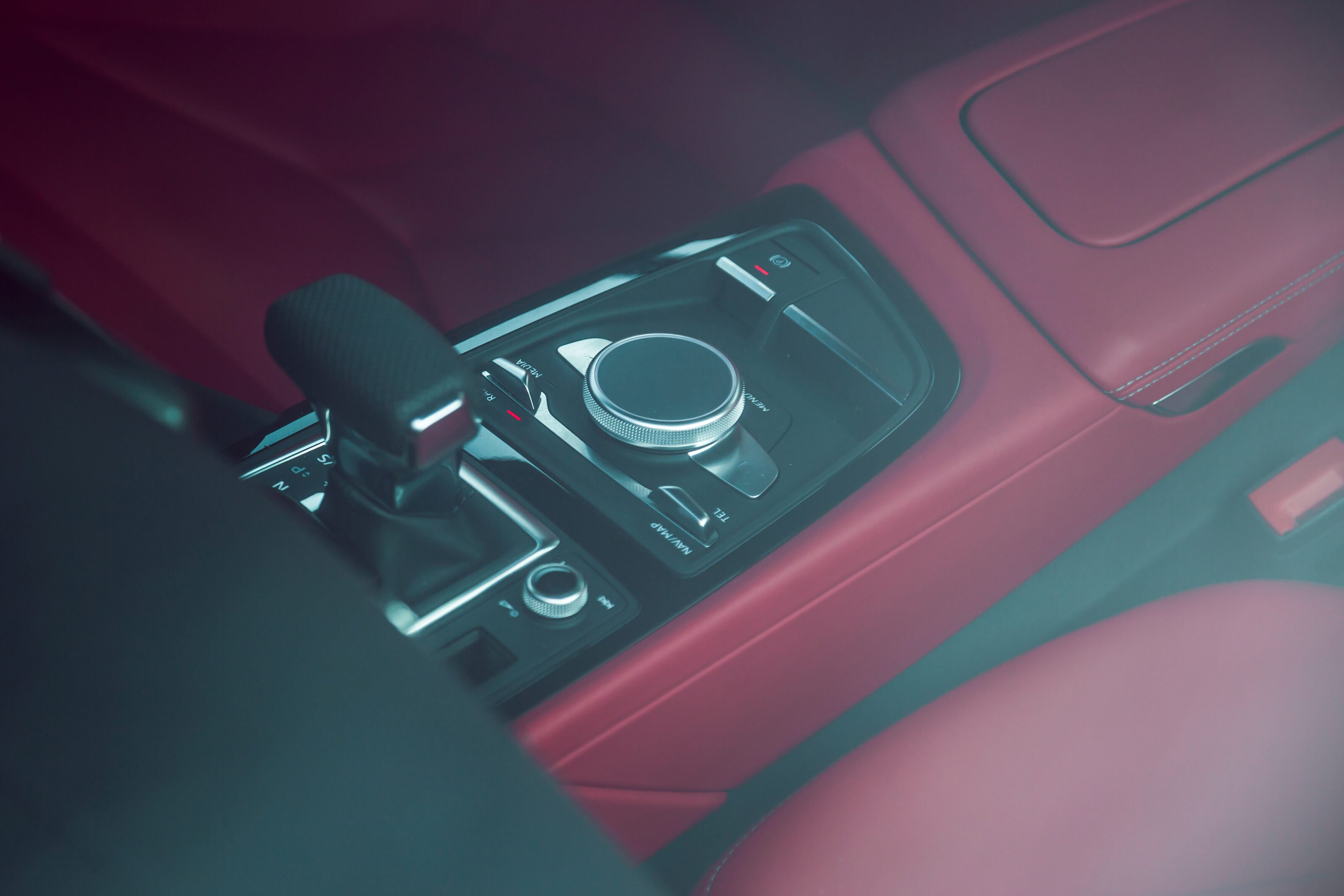
These factors, along with fairly un-PC fuel consumption of 12.0L/100km (ADR), will surely conspire to make the second-gen car’s tenure shorter than that of the first.
But as for its replacement? Audi Sport will only say that the R8 nameplate is “under review” and that “the e-tron GT will not replace the R8”. The official line goes on to say the R8 is the supercar icon in the Audi product portfolio, and “it’s clear we must rethink the concept of the sports car for the future, [so] a potential successor will no longer be a conventionally powered car. We’re currently discussing various concepts for a possible R8 successor, but no decision has been made.”
So that tends to hose down internet rumours that a plug-in hybrid R8 running a version of the 4.0-litre twin-turbo V8 could replace the V10. So will a successor go pure EV? There’s form here, with both first and current generations being developed with battery power.
Whichever way the company decides to go, the day the final V10 block emerges glowing from what was molten aluminium only minutes earlier in the Gyor foundry… well, a chapter of atmo supercar greatness will have closed for keeps.
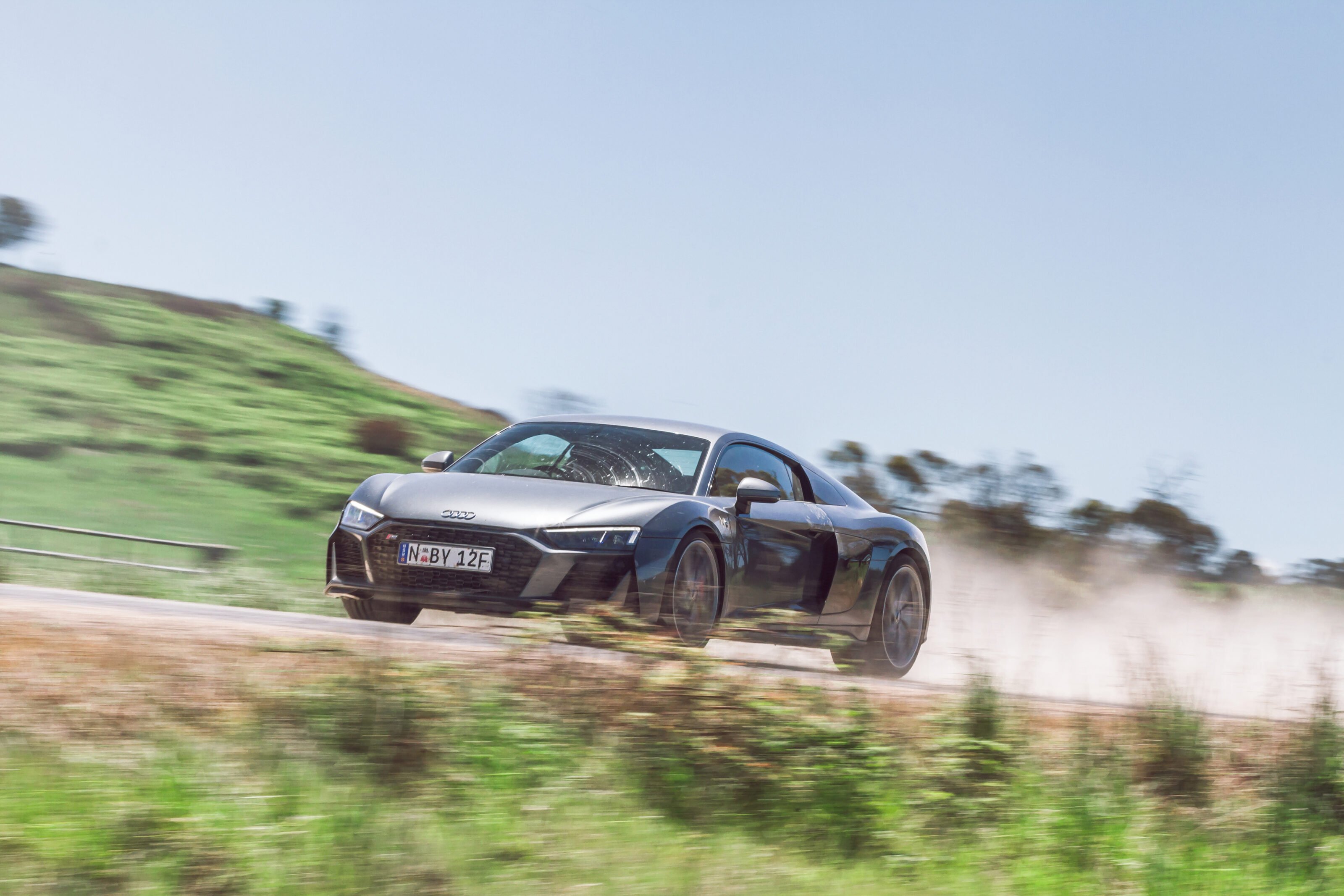
Ciao, bellow: Four rings crown the Raging Bull’s V10
In terms of engine architecture and core mechanicals, the R8’s V10 is identical to the unit that powers Lamborghini’s Huracan. The main components are manufactured at Audi’s engine plant in Gyor, Hungary, and both engines displace 5204cc within an aluminium block and heads. Breathing is via four valves per cylinder, operated by chain-driven double overhead camshafts, with continuously variable valve timing for both intake and exhaust.
Dry-sump lubrication allows the engine to be mounted nice and low. Updates for the second-generation R8 included revisions to the induction system, which features both port and directinjection, and a cylinder-on-demand system that disables five cylinders under light load. When wearing the Audi logo on top, the V10 is at its most potent in the V10 Performance variant, where it produces 456kW and 580Nm, and sounds like nothing else currently available… apart from a baby Lambo, of course.
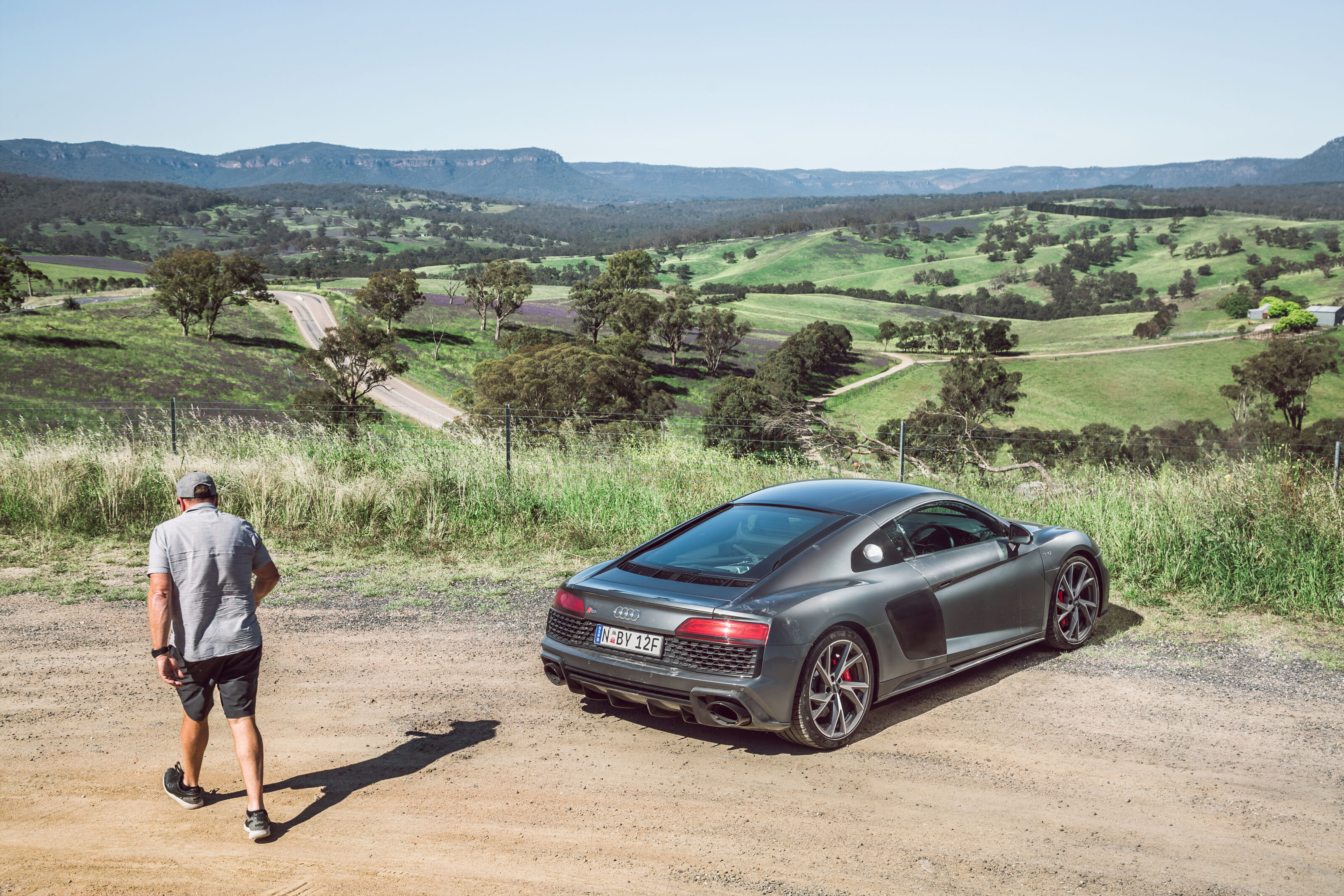
Audi R8 Coupe V10 RWD specifications
The new Chrysler Airflow electric concept has been unveiled at this week’s Consumer Electronics Show (CES), following the release of teaser images and details in December.
The reveal comes just months after the Chrysler brand exited the Australian market, following a complicated but often glorious history spanning 70 years and various incarnations.
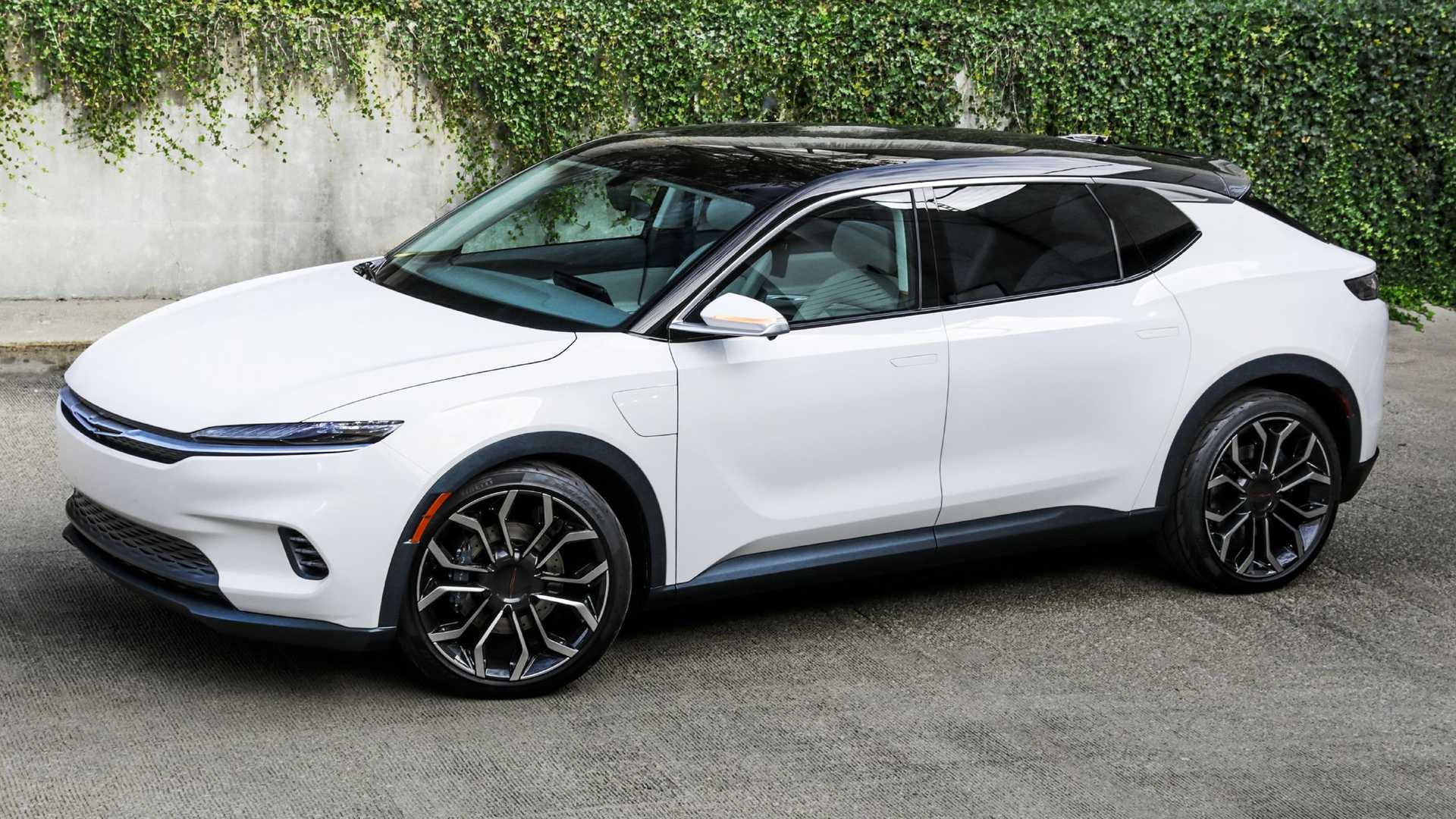
Even in the US, Chrysler’s future is far from assured, although a pivot to electric vehicles will be its best bet on staying alive under the auspices of its parent Stellantis – which grew out of the merger between Fiat Chrysler Automobiles and PSA Groupe, best known for its Peugeot and Citroen brands.
The Airflow concept is offered as a preview of Chrysler’s first electric vehicle, due to launch in 2025, and by 2028 the company will offer nothing but electric vehicles.
That shouldn’t be too difficult a pivot, though: the big 300 sedan is due for retirement any moment now, and the Pacifica people mover – launched in 2017 – will doubtless be replaced in time for the still distant 2028 deadline.
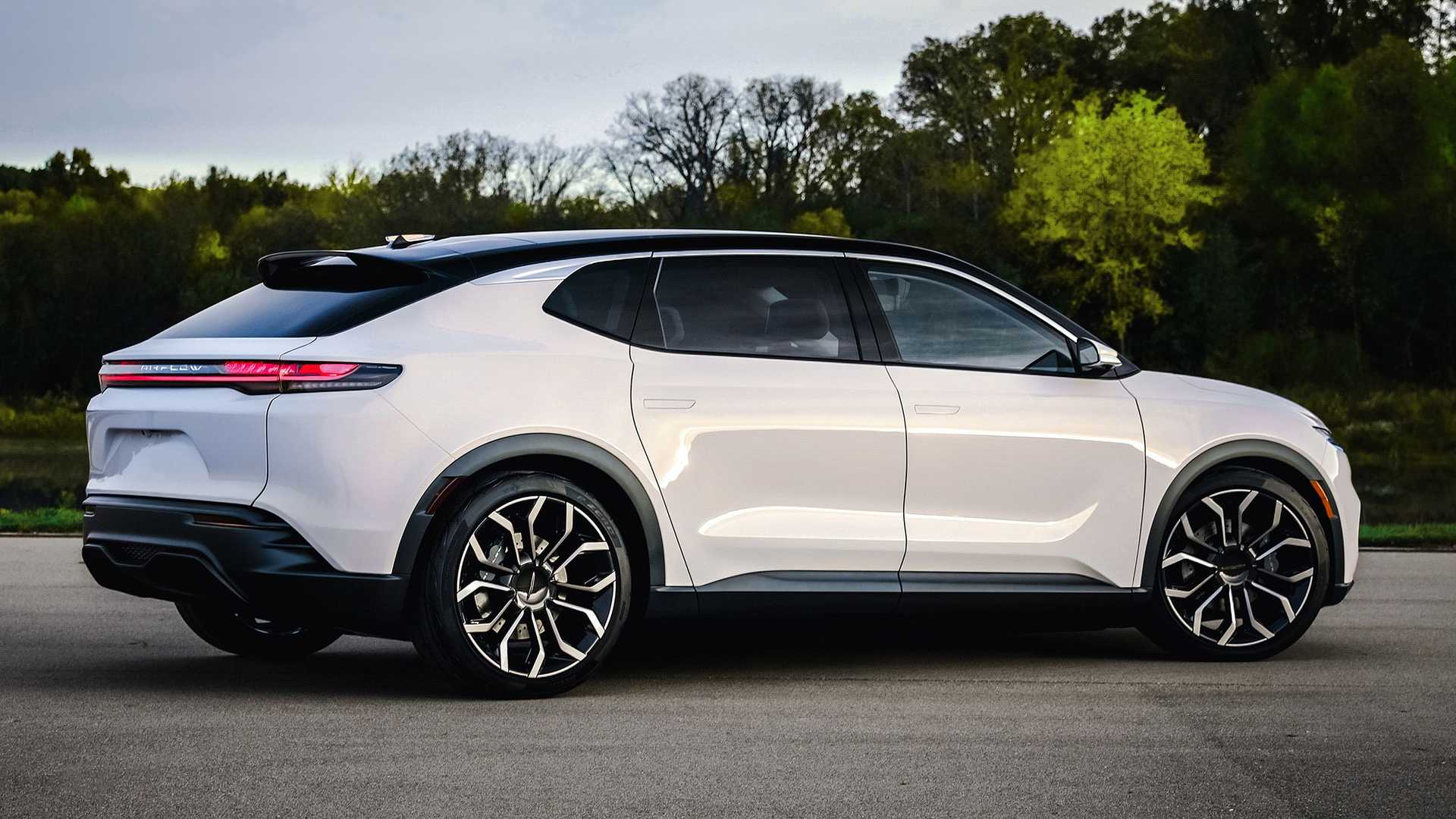
In concept form, the Airflow presents as a potential rival to the Ford Mustang Mach-E and the Tesla Model Y, offering all-wheel drive through a pair of 150kW electric motors.
Driving range is still to be confirmed, but Chrysler has suggested numbers in the neighbourhood of 450 to 550 kilometres will be on offer. Fairly standard, really.
Stellantis’s STLA AutoDrive technology will be available, offering Level 3 autonomous driving capability. At that level, the driver is still expected to take over control at any moment, but the vehicle can otherwise pilot itself as needed – much to the level that Tesla’s Full Self Driving system claims.
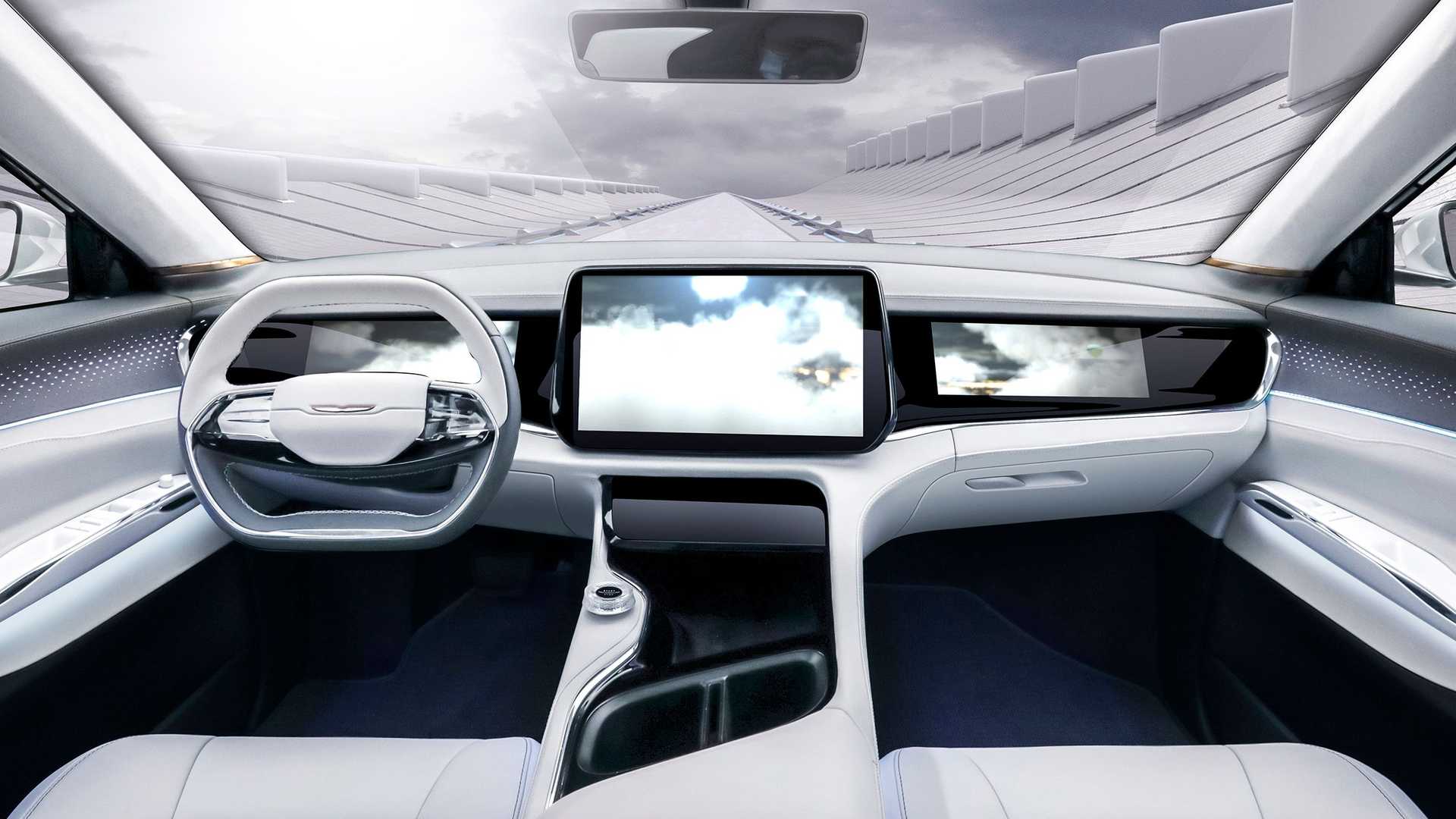
Whether Chrysler will follow Tesla in rolling out that capability without first navigating a proper government approval process, remains to be seen.
Regardless, we shouldn’t expect to see the Airflow offered in Australia, but it is likely a preview of the technology we’ll see from what is still a relatively healthy local stable of Stellantis brands – Fiat, Jeep, Maserati, RAM, Alfa Romeo, Peugeot, Citroen – in the years ahead.
NOTE: Click any of the photos here to enter our gallery for many more images
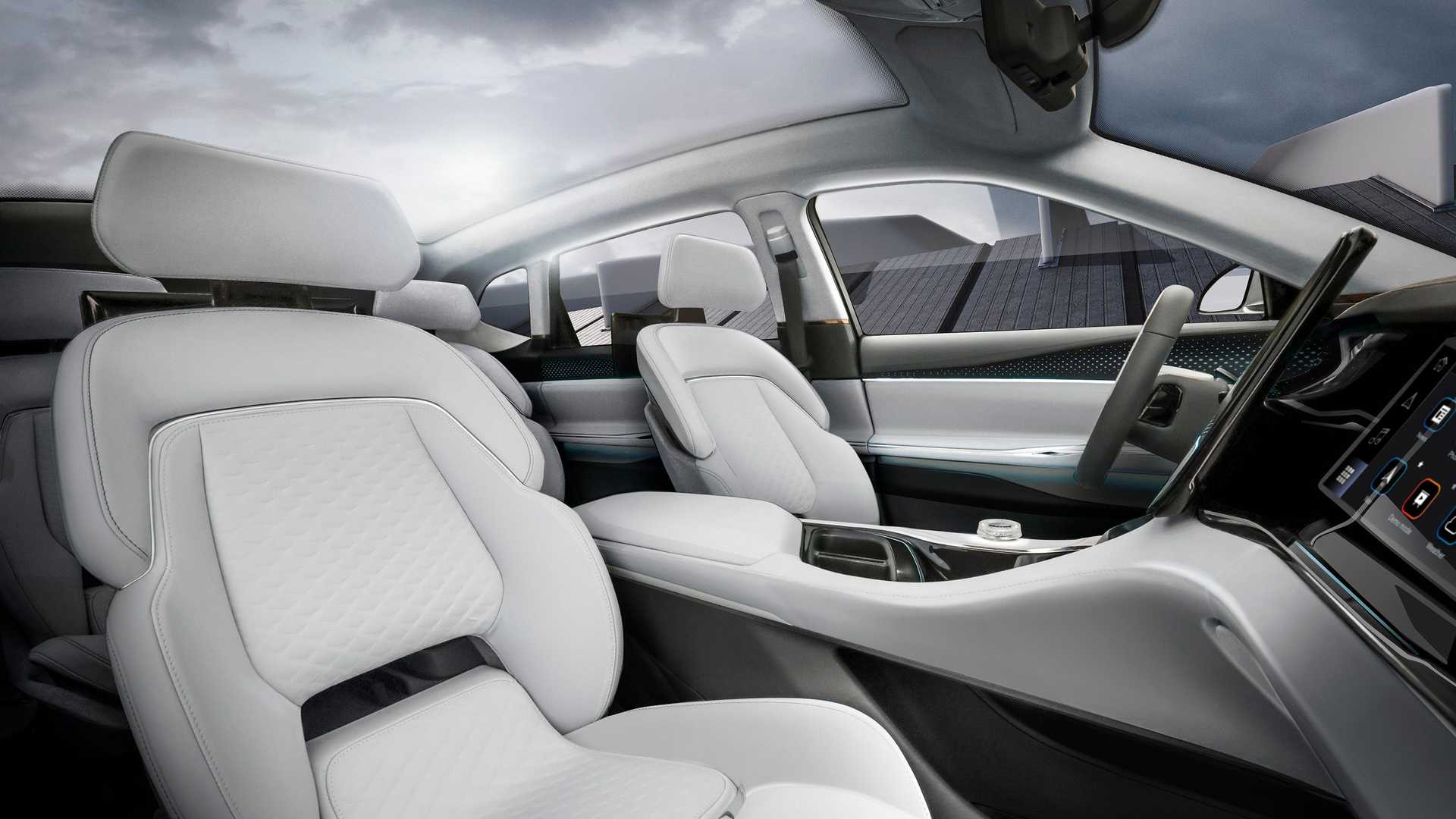
The story to here
December 23, 2021: American manufacturer Chrysler will be using next year’s Consumer Electrics Show (CES) to show off its new Airflow concept to the public for the first time.
Having been teased earlier this year during parent company Stellantis’s EV Day, the four-door crossover will be underpinned by the STLA Medium platform – the architecture upon which a majority of the conglomerate’s mid-size cars will be based.
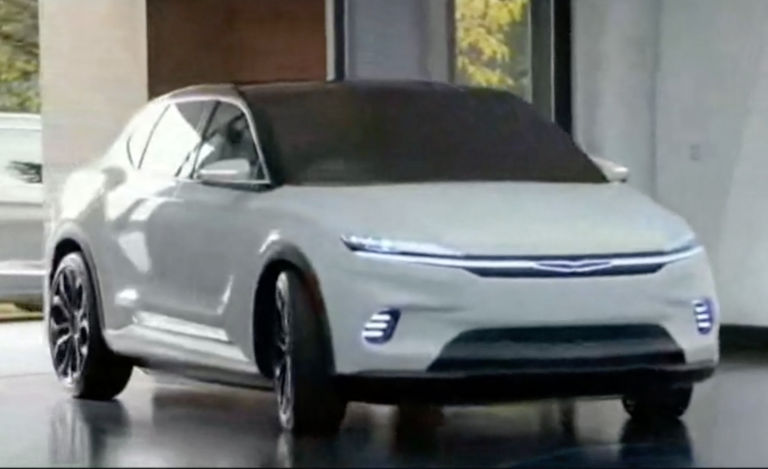
While it’s not yet a production vehicle, the Airflow could be an important model for Chrysler as the manufacturer looks to make it through its stay of execution – Stellantis having announced earlier this year that its struggling marques have until 2031 to get their respective acts together to avoid the chopping block.
At present, Chrysler builds just two models for the North American market – the Pacifica minivan and the 300 sedan – with the people-mover featuring an electrified variant, the first of all of Stellantis’s American brands to go hybrid before Ram introduced a mild-hybrid 1500.
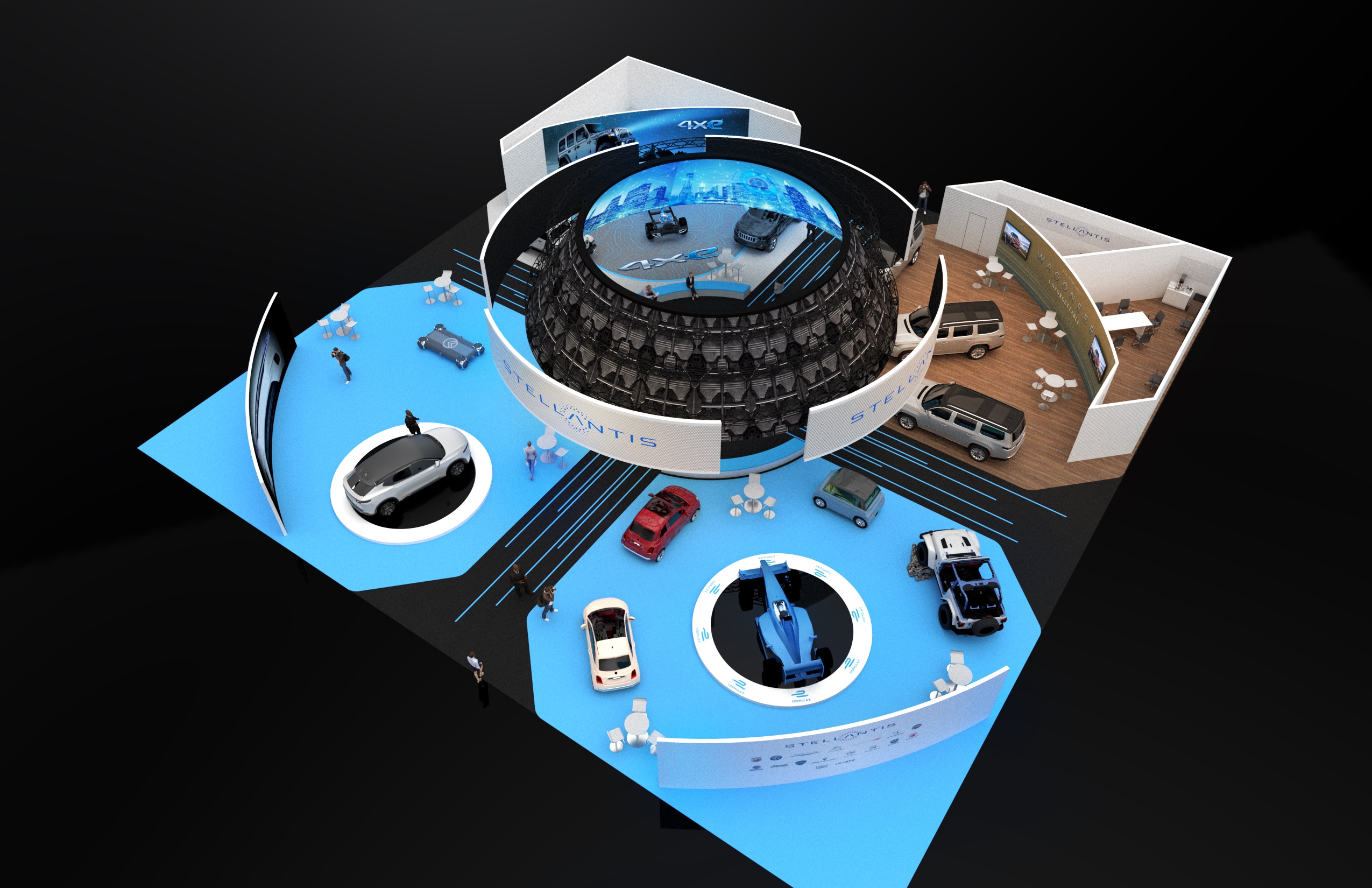
Chrysler might be pulling out of Australia at the end of the year, but that won’t stop its Stellantis siblings from rolling on with their electrification plans, as Jeep is due to show off its Wrangler and Grand Cherokee 4xe plug-in hybrids at the CES 2022 in Las Vegas – the first electrified models from the iconic brand.
A number of other vehicles will also occupy the Stellantis stand, including the electric Fiat 500, Citroen’s Ami, the Citroen Skate Mobility Concept and the DS E-Tense FE21 – the latest evolution of the DS sub-brand’s championship-winning Formula E racer.
UPDATE, January 2023: Sony Honda Mobility announce Afeela brand, unveil new prototype EV
Here it is, a first look at the near-production EV concept that will be launched in 2025 under Sony Honda Mobility’s new brand, Afeela. Get all the details at the link below.

The story to here
Snapshot
- Vision-S SUV concept debuts as a more market-friendly offering
- Sony Mobility announced as a new brand
- Sony boss confirms interest in a line of EV models
This is the Sony Vision-S SUV, an electric family car revealed at the Consumer Electronics Show (CES) in the US today, as a follow-up to the Vision-S sedan revealed at the same event last year.
As one of the few brands attending this year’s CES ‘in person’, Sony had the rapt attention of all media – although most publishers had confirmed in recent weeks that their teams would skip the event to avoid potential COVID-related risks.
The biggest takeaway for today’s unveiling – apart from Sony’s lack of vision in merely appending ‘SUV’ to the existing Vision-S concept name – is the announcement of a new Sony Mobility Inc. company, set to launch in the first or second quarter of 2022.
NOTE: the cinematically rich, details-poor video below is titled Vision-S 02, but the ’02’ is not referenced in the concept’s press release, issued today.
That announcement alone isn’t confirmation that Sony will leap into the automotive manufacturer arena, however. Officially, the new company’s mission is to “help realise a world where everyone can live in harmony with robots on a daily basis, fill people with emotion, and contribute to society”.
If the tech- and infotainment-focused press release were all we had to go on, there would be little cause to speculate on a tilt at passenger vehicles – even with today’s debut of what would be an entirely unnecessary second concept car for any brand not considering a market launch.
However, Sony’s chairman and CEO, Kenichiro Yoshida, went a step further today, announcing on stage: “We are exploring a commercial launch of Sony’s EV”.
It doesn’t get much clearer than that without actually announcing plans, but it remains to be seen if Sony will follow through on converting its dreams into reality.
Still, all of this is good news for any readers interested in a Sony-developed electric vehicle, after the brand confirmed in January last year that it did not intend to put the Vision-S concept into production.
NOTE: There are no further photos available of the Vision-S SUV at this stage, although the first video above shows more angles.