Snapshot
- No end in sight for current-gen GT-R
- Rumours indicate that R35 will go hybrid in 2023
- Next-gen ‘R36’ may only be due in 2027 or beyond
Cast your mind back to the year 2007. Spiderman 3 was in cinemas, and Steve Jobs was banging on about this new thing called an iPhone.
It may sound a little bit absurd to hear that there is still a car on sale today, that went on sale back when mobile phones still had physical number pads. And yet, when Nissan peeled back the curtain on its 2021 GT-R Nismo in April, we were greeted by a very familiar face.
If you happened to miss it, worry not as you didn’t miss out on much. A new ‘stealth grey’ colour has been added to the palette, and the production debut of Nissan’s modernised new badge round out the changes to the ageing supercar. Yes, there’s a new Special Edition with a carbon fibre bonnet, forged wheels and some finely-balanced internal engine components, but the crux of the matter is there’s been no improvement to power or torque, and no real ‘development’.
Hiroshi Tamura, boss of GT-R, maintains he is committed to the incremental development of the R35 GT-R, but is it just us or is the increment getting smaller?
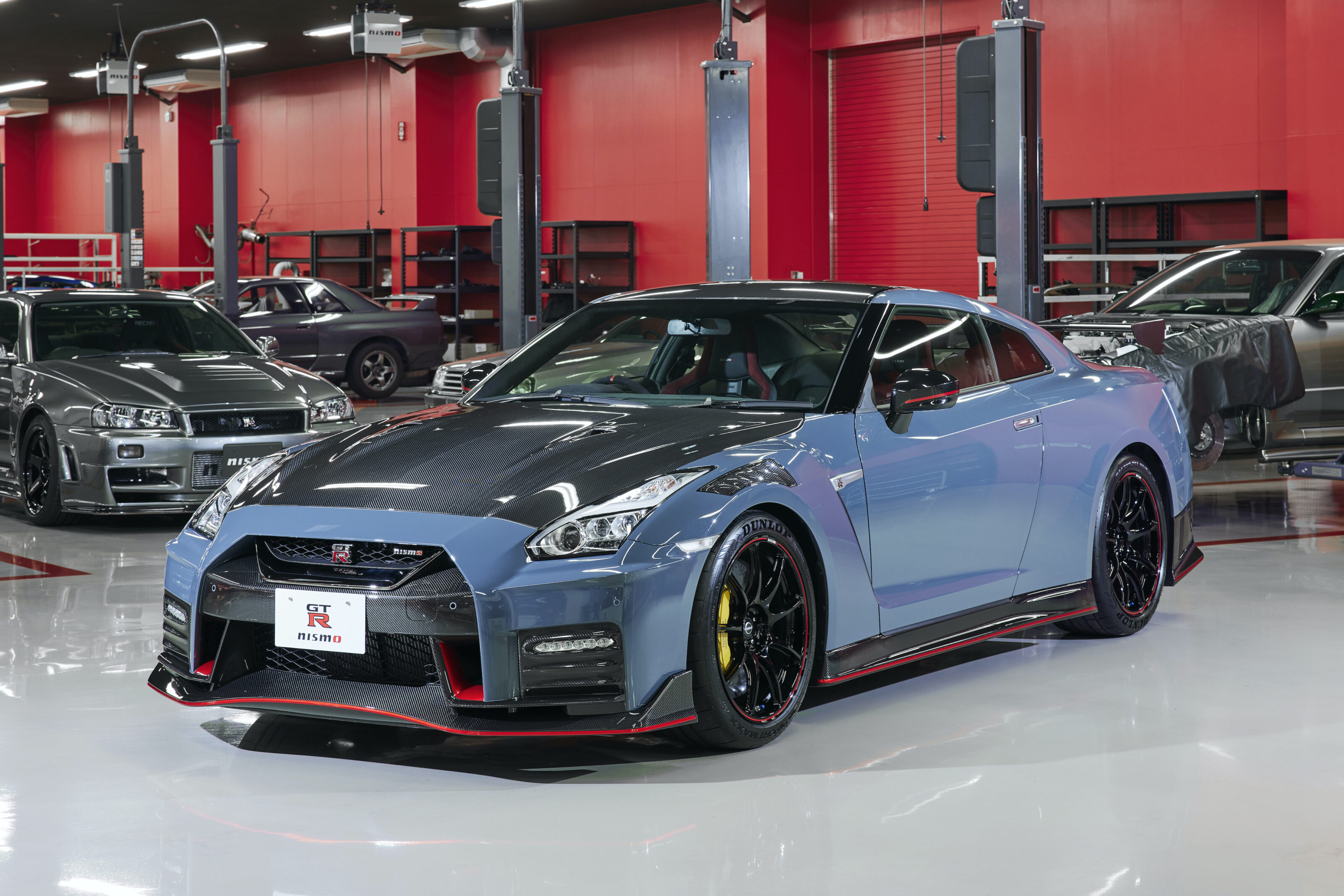
Of course, Nissan’s impending Z fortifies the belief that it isn’t turning its back on its enthusiast offerings, but there’s genuine market demand for an all-new GT-R. Some internet pundits wondered whether this latest Special Edition was the R35 GT-R’s swansong, but reports from Japanese outlet Best Car indicate otherwise.
While rumours have been circulating that the next iteration of GT-R will be hybrid assisted, Best Car alleges that, as Nissan is expected to meet US CAFE (Corporate Average Fuel Economy) regulations due to its large-scale EV manufacturing, the pure-petrol GT-R will be kicking about until at least 2022. Best Car also reports that we will see a Final Edition send-off in 2022, more closely based on Nissan’s GT3 race car, packing around 530kW (up from the current car’s 441kW).
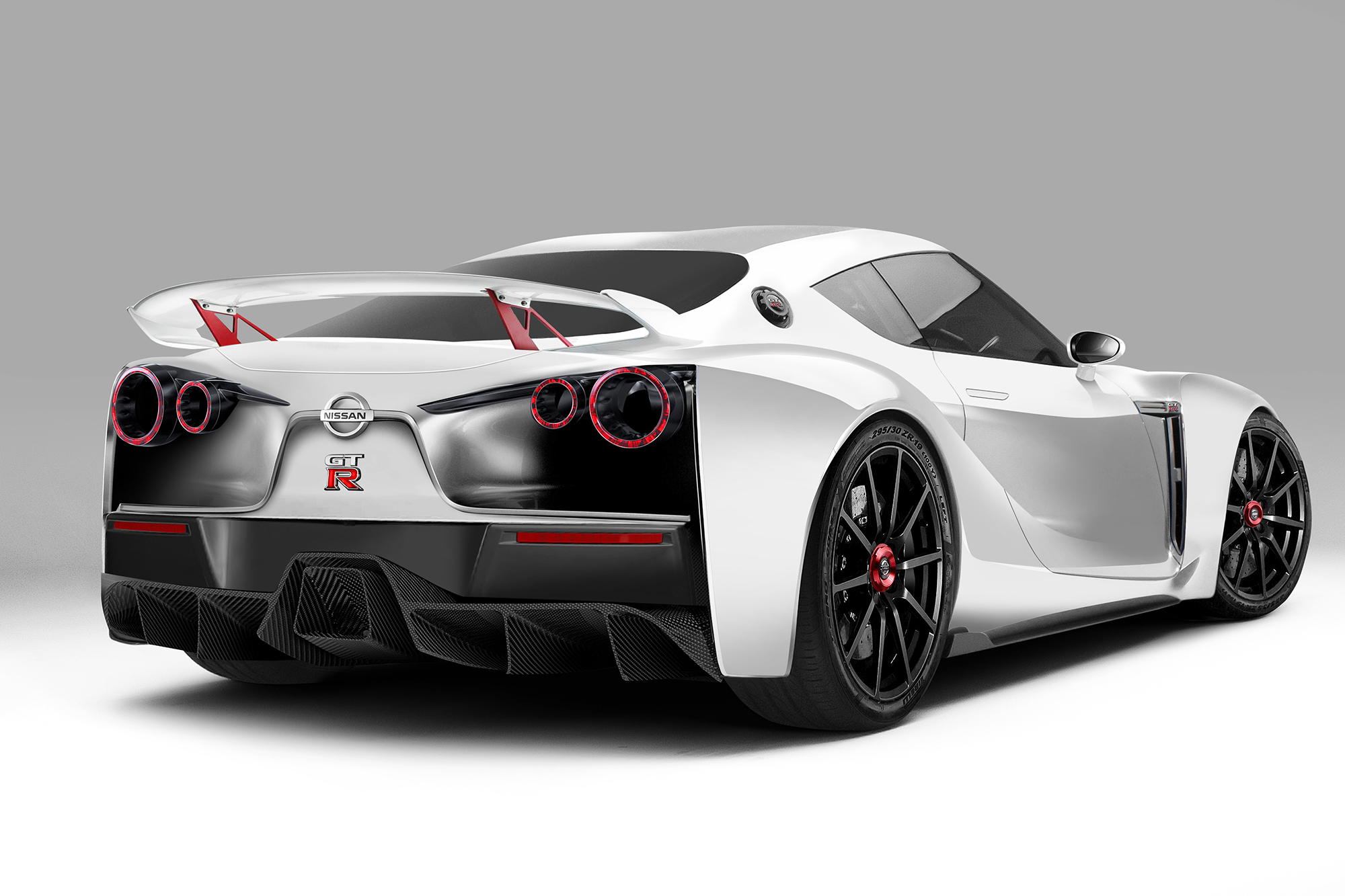
It further mentions rumours that the next iteration of GT-R will still be largely based on the R35’s architecture, albeit augmented by a 48-volt mild hybrid system, extending its life by a few years.
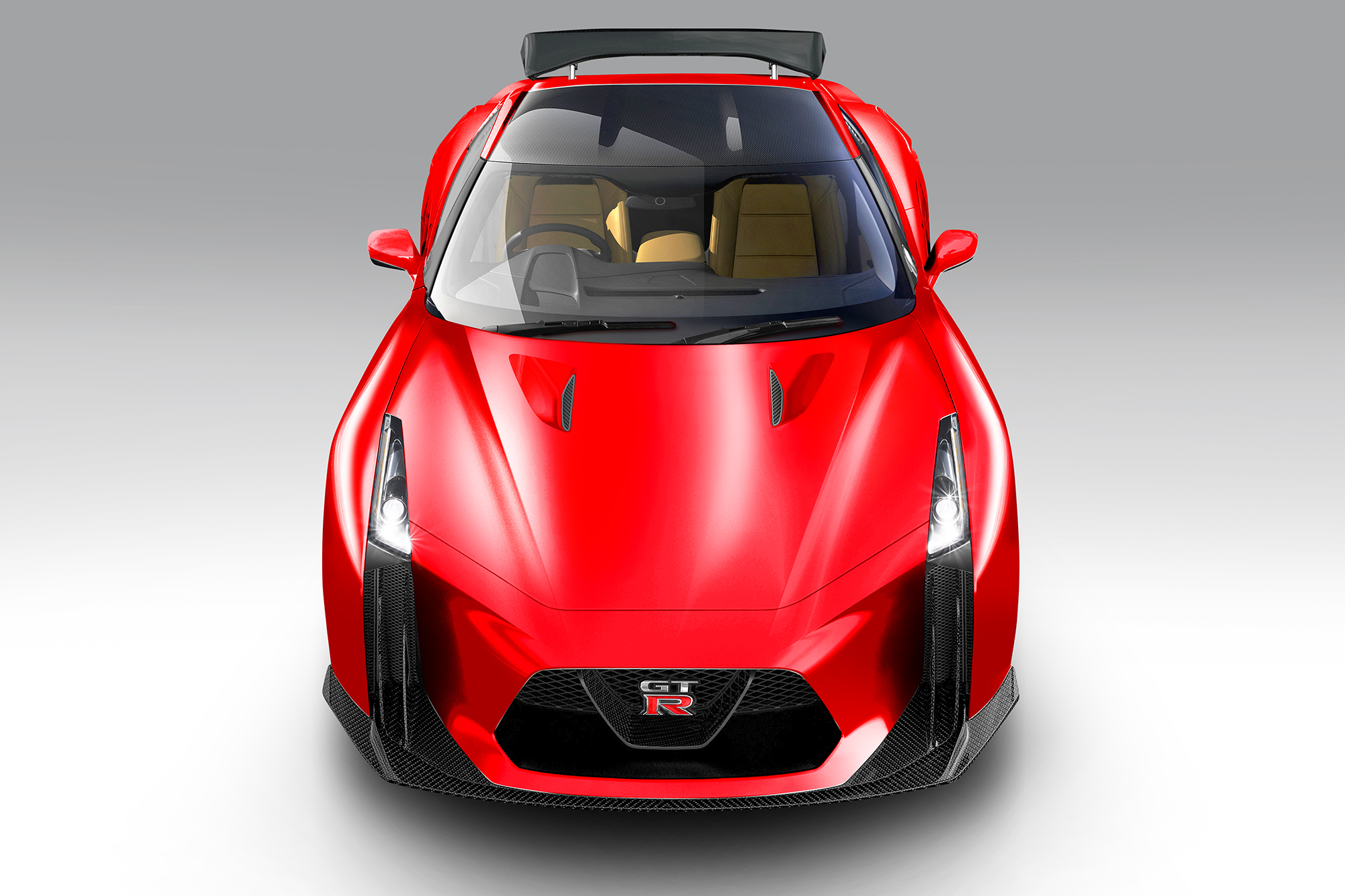
According to this timeline, that means we may only see a totally new generation of GT-R by 2027 or beyond. That’s a whopping 20-year production lifecycle. But is that really out of the question?
Even before Covid, Nissan was rocked by dismal sales in key markets, a number of corporate scandals and an ageing portfolio. In 2019, the company announced that it would be slashing global production by 10 per cent by 2023 as well as culling 12,500 jobs. Understandable then, that the development of its flagship sports car had been put on the backburner. There’s also something else that perhaps gives credence to the above rumoured timeline.
In 2019, MOTOR interviewed Tamura at the local launch of the Nissan GT-R 50th Anniversary model. We asked how the trajectory of GT-R might have changed if the KPGC110 project of 1972 hadn’t been cut short by the oil crisis. He touched on something interesting, explaining that the technology and basic architecture of GT-R is good for almost 20 years.
He points to the original ‘Hakosuka’ GT-R of 1969, traces a line past the interim C110-generation which utilised the same S20 engine, and floorpan of the preceding Skyline C10, unchanged.
Some 20 years later, in 1989, the R32 GT-R appeared and its driveline endured through R33 and R34 generations for the next 15 years of production, before R35 finally appeared 18 years after R32. The R35 GT-R is 14 years old this year, and if Tamura’s timeline is true, it seems there is still a fair bit in the tank for the GT-R after all.
Snapshot
- 133 RHD vehicles recalled
- Issue with wiring loom could cause driver’s seat belt pre-tensioner not to work
- Approved Jaguar Land Rover dealers will fix the issue free of charge
Jaguar Land Rover Australia has issued a recall for 133 of its E-Pace models sold from June 2020 until February 2021.
The British manufacturer claims an incorrect wiring harness configuration in its restraints control module (RCM) has linked the pre-tensioner for the seat belts to the wrong seat.
This means if the driver’s seat is occupied but the passenger seat is not, the pre-tensioner would fail to operate in the event of an accident, which could increase the risk of injury or death to vehicle occupants.

JLR has contacted owners of the cars purchased between June 16, 2020 and February 24, 2021, and will fix the problem for free at any approved Land Rover dealer.
For more information, owners can contact the Jaguar Land Rover Customer Relationship Centre on 1800 625 642 (Monday to Friday, 8am – 8pm and Saturday 9am – 4pm) or by email on [email protected]
To find your nearest Jaguar Land Rover dealer, visit: https://www.landrover.com.au/national-dealer-locator.html
A full list of the affected vehicles’ VINs can be found here.
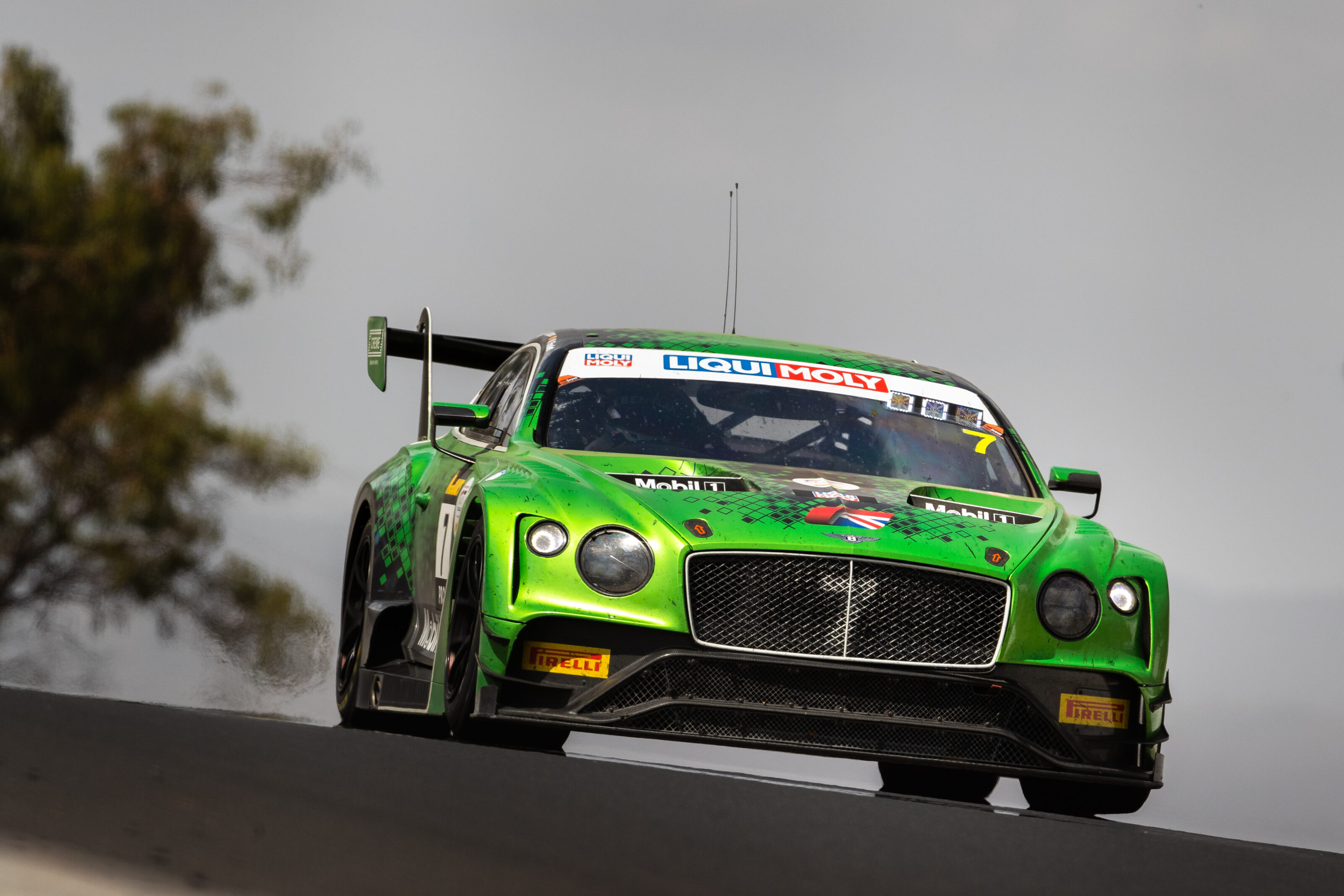
Bentley has a strong link with the iconic 24 Hours of Le Mans race, having won the event outright six times, and there are fresh claims the British manufacturer could return to the event in the outright category as part of the 2023 LMDh regulations.
The site Dailysportscar.com reported on May 21 that Bentley is evaluating a return to the iconic French endurance race in 2024 to align with the 100th anniversary of its first victory at the circuit.
Thing is, on May 11 Bentley’s CEO Adrian Hallmark said it was unlikely the company could be competing in the topflight LMDh or LMH categories any time soon.
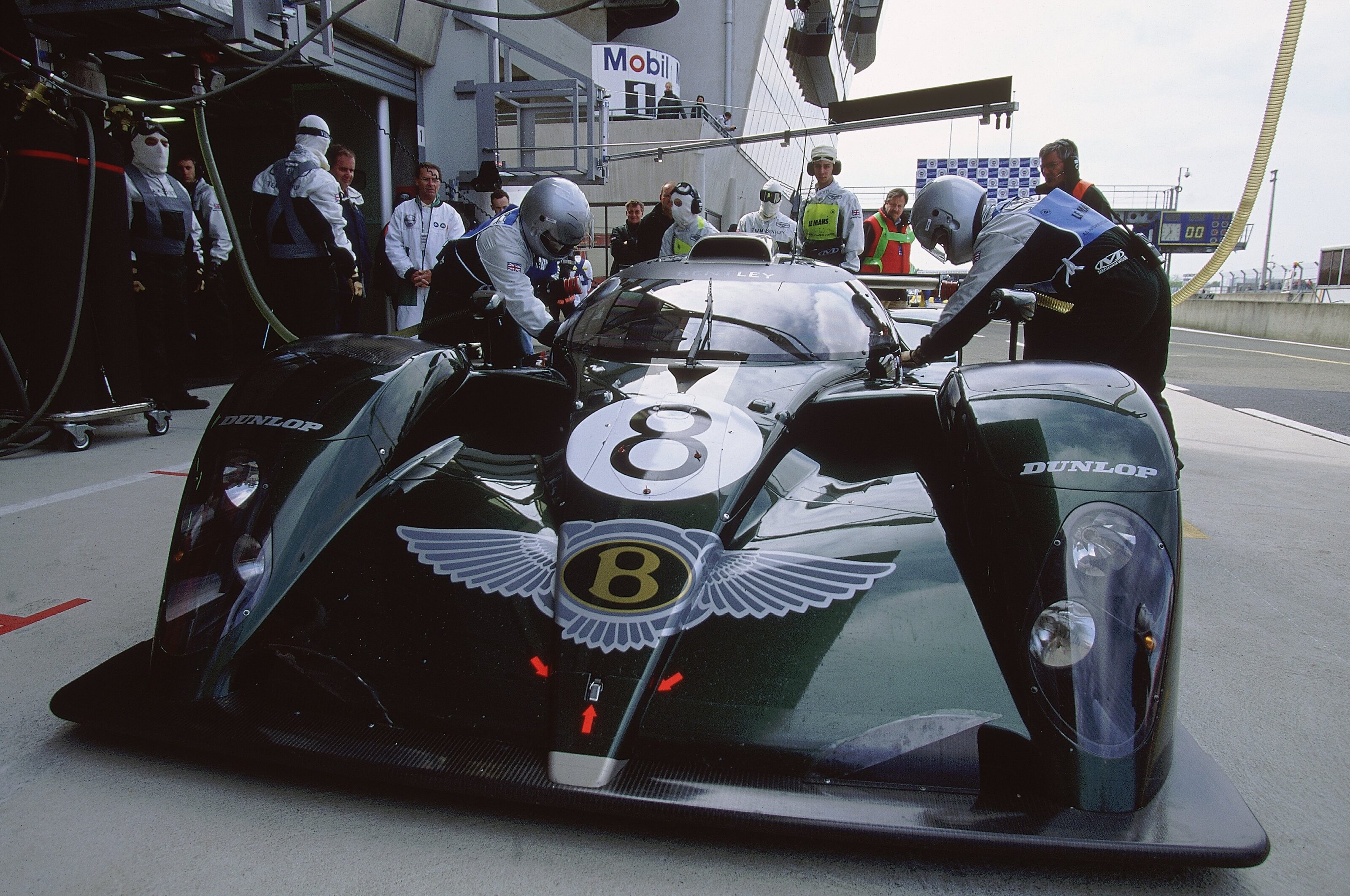
When asked directly by MOTOR if Bentley could make a return to Le Mans soon the response was an emphatic no, due to the brand’s commitment to going fully electric by the end of the decade.
“What do we think of Le Mans for the future? If we went anywhere to race, it should be Le Mans in my view,” he said, before adding the vital caveat.
“But if we are consistent with our strategy, and we have said that by 2030 we will be fully electric, then going combustion engine racing – even with the level of hybridisation that is proposed in the new standards – is not in keeping with what we are trying to achieve.
“Could we do it? Yes. Will we do it? No.”
That answer alone doesn’t leave much wiggle-room for the hypothetical LMDh program, but Hallmark went on to explain what it would take to get Bentley racing in an official capacity again.
“Our mission would be to be at the vanguard of full electric endurance racing,” he added. “And I don’t mean scale models, I mean full sized Bentleys. Unfortunately, the time scale for that and the technology available – even with switchable batteries – is not immediate.
“Certainly, for the future we would consider racing again, as a way of further projecting the brand and developing technology. But right now, it is not in our list of things to do, I have to be honest.”
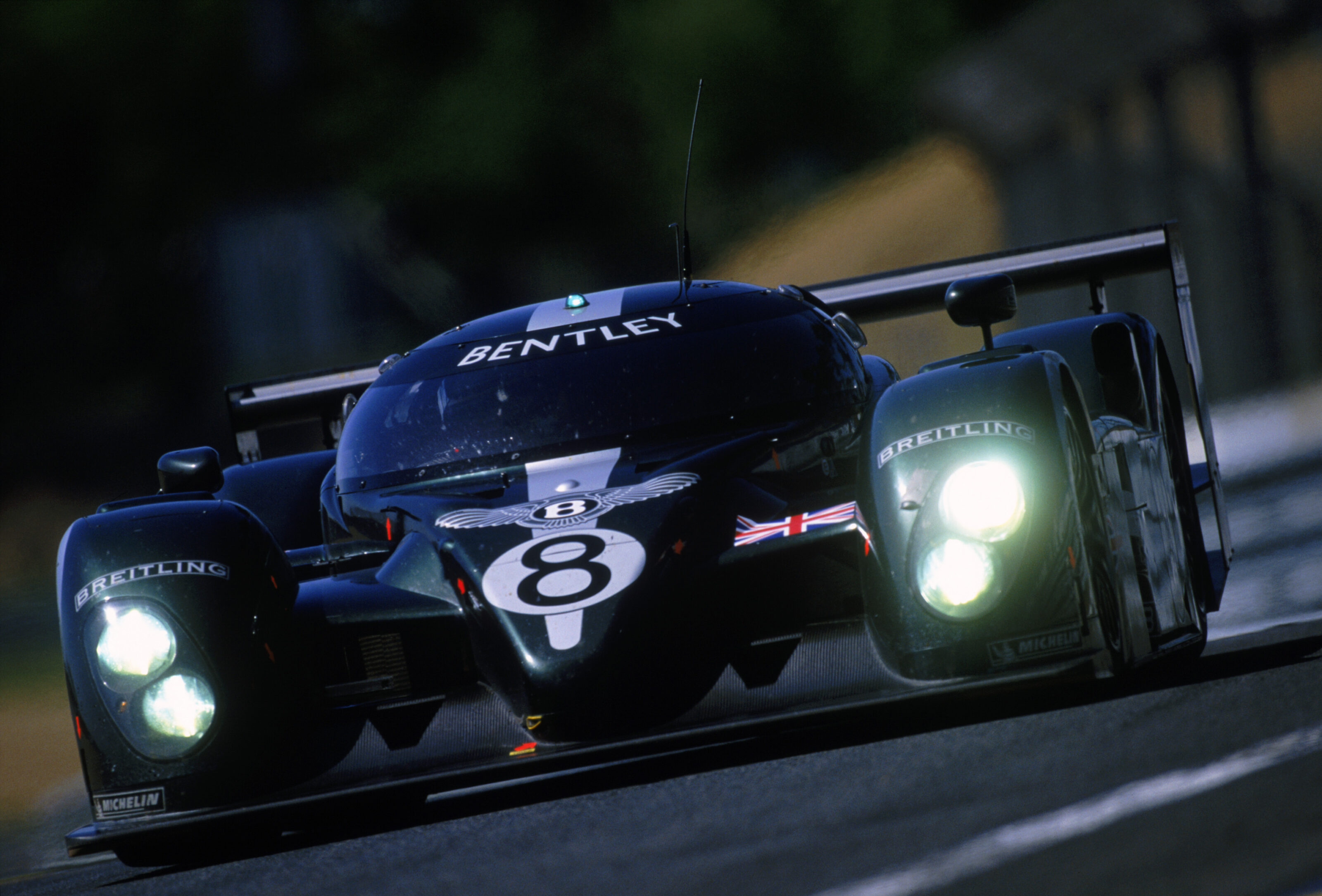
According to Dailysportscar’s unnamed industry sources, Bentley’s preferred plan is to field a single car to take part in the 24 Hours of Le Mans in 2023, before a full assault on the entire 2024 season to align with the centenary of Bentley’s first win at the event.
The Dailysportscar article claims the potential Bentley LMDh program would be partly in conjunction with fellow Volkswagen Group siblings Audi and Porsche – which are both fully committed to returning to Le Mans under the new rulebook in 2024 and 2023 respectively.
A shared program isn’t completely foreign for Bentley, having competed at Le Mans at the turn of the century with a car based on a chassis designed by Audi.
Bentley competed at Le Mans with the Speed 8 prototype for three years in the early 2000s – famously taking a 1-2 victory in 2003.
The Speed 8 was based on Audi’s incredibly successful R8 racer, which is the most successful vehicle in Le Mans history.
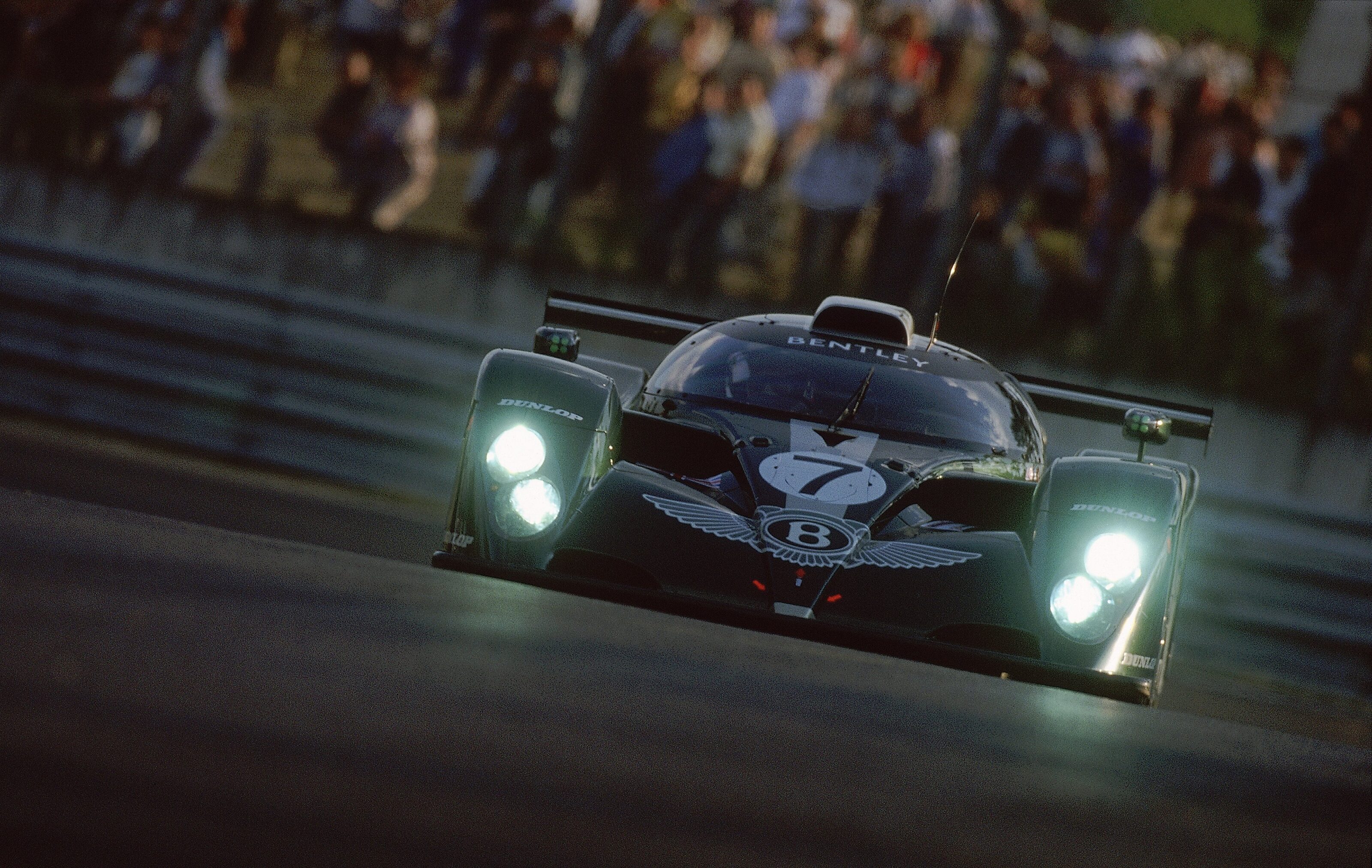
In fact, Hallmark was a pivotal player in orchestrating the brand’s winning return to the La Sarthe circuit.
“I was the protagonist, and partner in crime with Brian Grush [who retired from Bentley in 2019] to get us to Le Mans the last time in 2001-03, because I saw it as a massive global opportunity to take it from the shadows of another great brand and put it back where it belonged as a vibrant and potent performance-orientated brand that delivers exquisite refinement and luxury,” he explained.
“Le Mans was a great way of rekindling those stories and proving the technical capability of the company.”
Don’t misinterpret Hallmark’s comments as dismissive of Bentley’s strong historical link with Le Mans.
When the topic of Bentley returning to Le Mans was first broached during the interview, Hallmark paid homage to the brand’s origins which were built on the back of victories in the 24 Hour endurance race.
“In the first 11 years of the company it went from a guy with an idea to build a prototype, to probably the most celebrated and story-rich luxury brand in the world,” he said.
“I know Rolls-Royce was all about excellence, but Bentley, in terms of the spirit of its achievements, was an astonishing brand after just 11 years. Five of those years, it won Le Mans.
“Le Mans is in the DNA of Bentley, and actually, Bentley is in the DNA of Le Mans – hence the naming of streets and the constant adoration we get from the ACO. It is a very fond and positive relationship.”
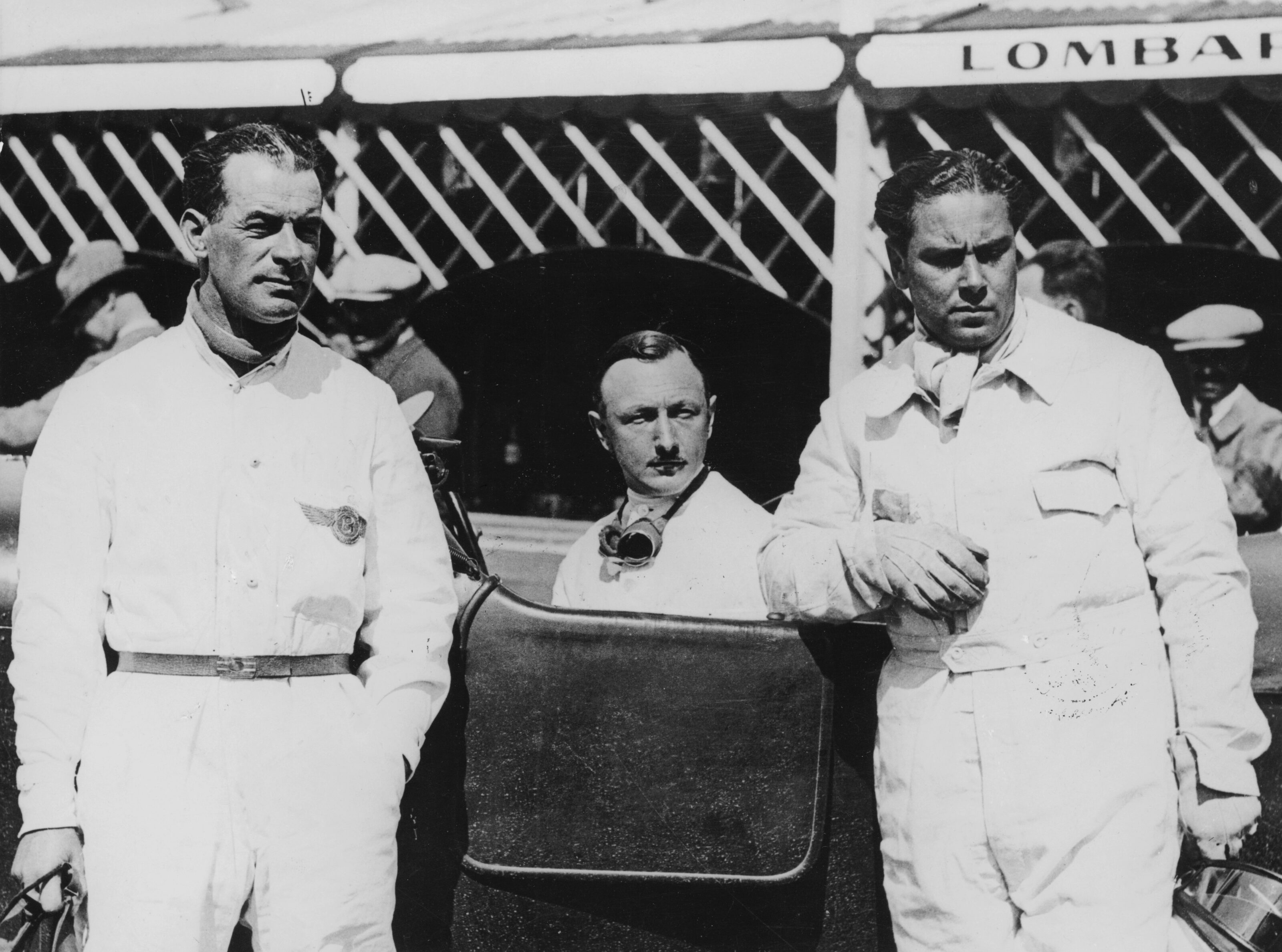
Bentley’s sole official full-time motorsport program in recent years was with the Continental GT3.
Built by M-Sport (the same team responsible for Ford’s Fiesta WRC car) the Continental GT3 competed in endurance classics such as the Nürburgring 24 Hours, Spa 24 Hours and Bathurst 12 hour – which it won in 2020.
However, the same year the factory team won at Mount Panorama the official program was suspended.
Dailysportscar reports that Bentley had previously evaluated joining the IMSA DPi category (which will evolve into LMDh), going as far as building a test car using a modified Ginetta LMP3 chassis and twin-turbo V8 from the Continental GT3. However, the website claims the program was cancelled because of the fallout from Volkswagen Group’s Dieselgate scandal.
Currently, both Audi and Porsche are committed to the LMDh rules, along with Acura in North America.
LMDh cars will compete alongside the LMH ‘Hypercar’ regulations that Toyota, Peugeot, Ferrari, and Glickenhaus have all aligned themselves with.
LMH and LMDh cars will compete alongside each other for outright victory at the 24 Hours of Le Mans starting in 2023.
Snapshot
- 390kW of power expected
- 0-100km/h in around four seconds
- Up to 590km range u2013 although probably not in M50 guise
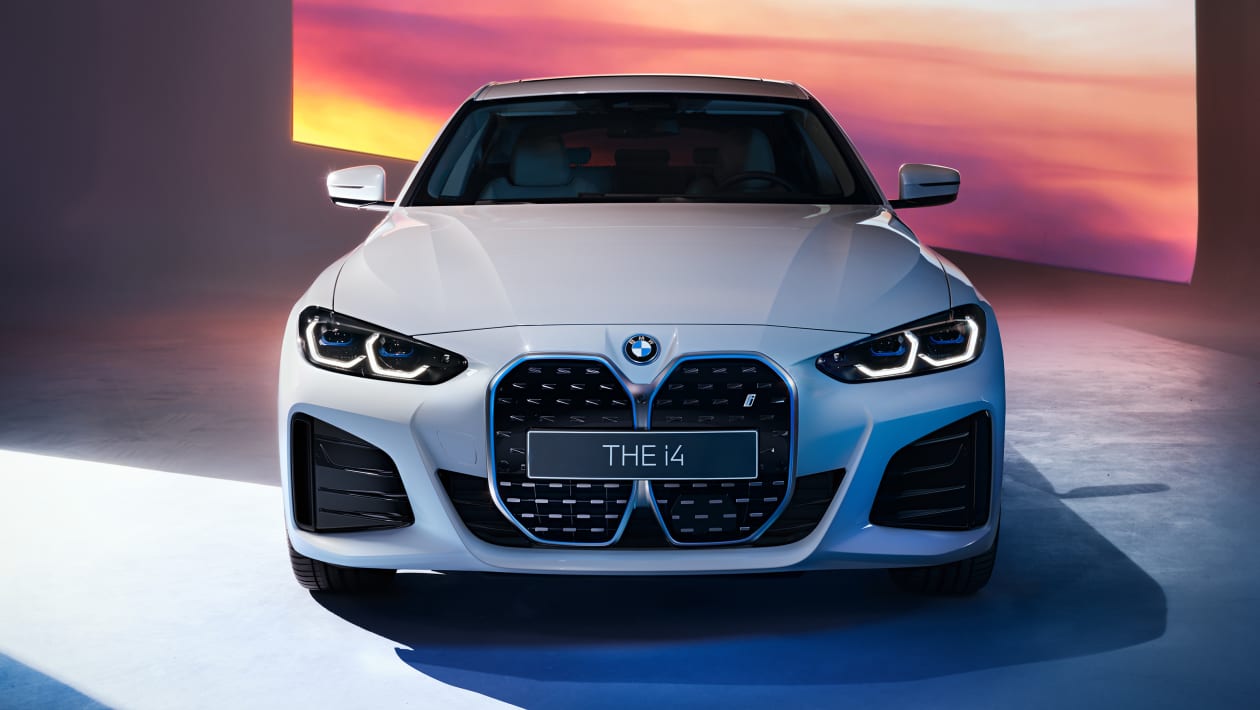
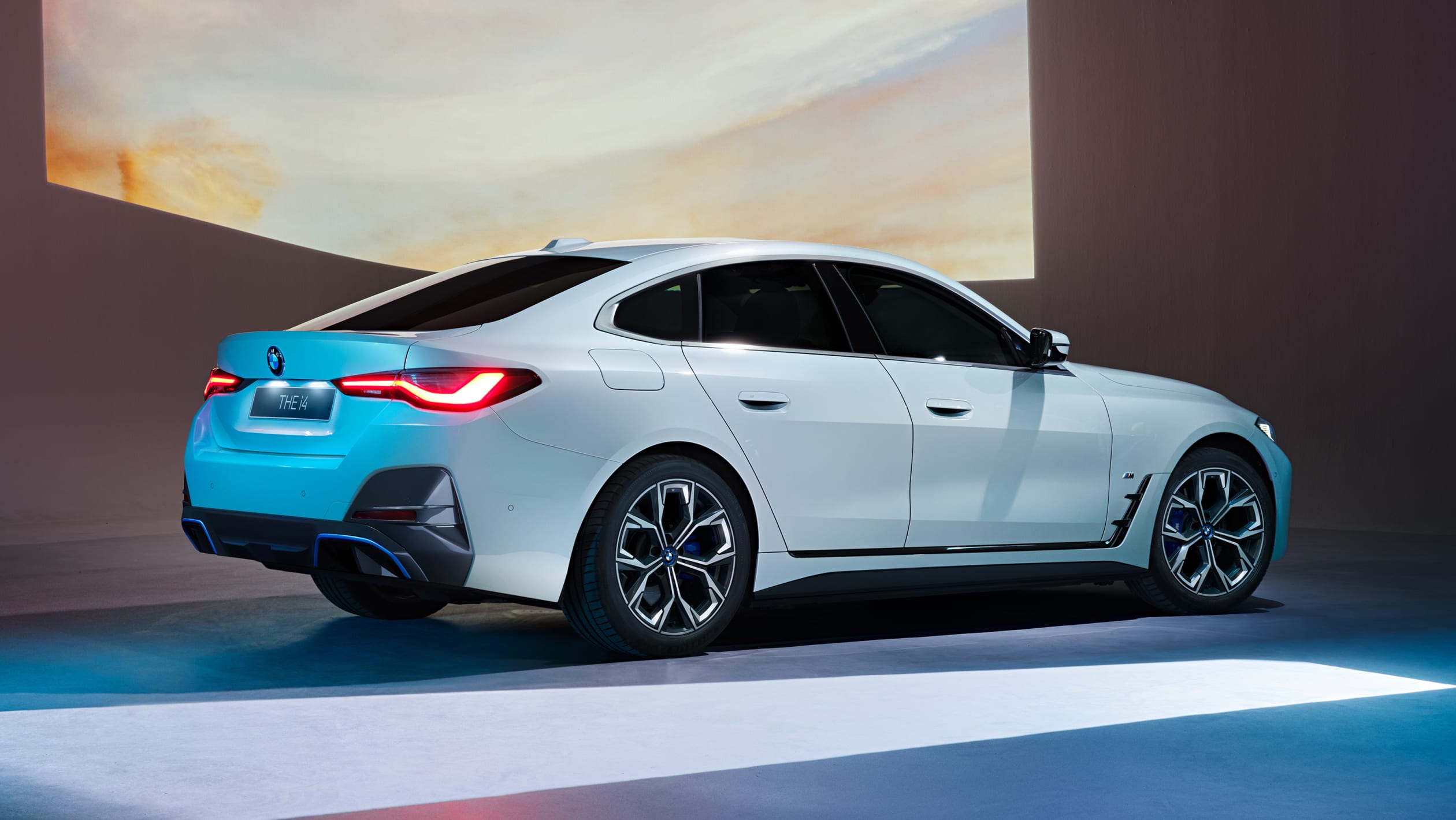
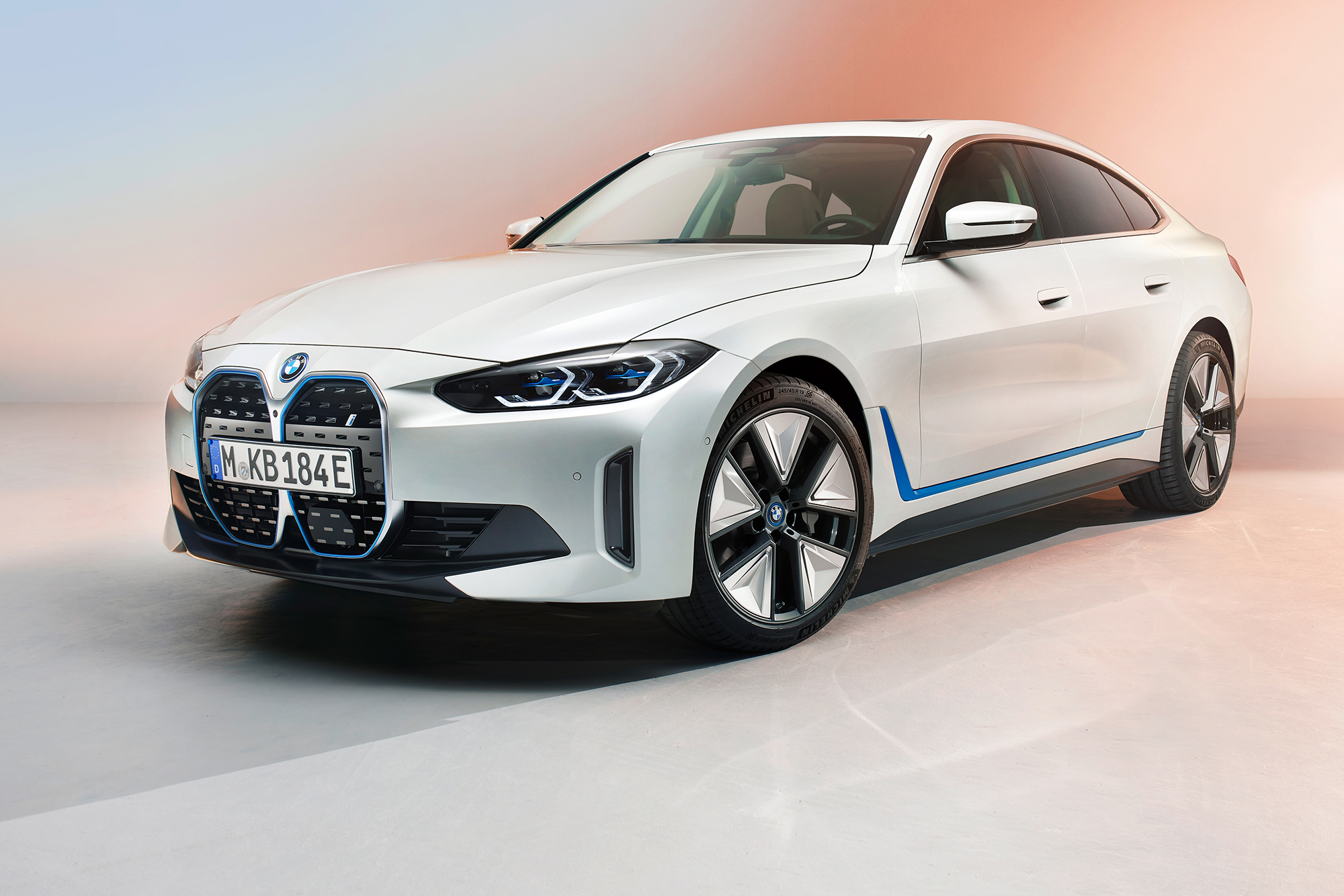
Just weeks after the unveiling of its regular counterpart, the upcoming 2022 BMW i4 M50 electric performance sedan has appeared online.
Only one image has surfaced so far, appearing briefly on Instagram before overseas website Motor1 swooped in to save a version.
Taking on a meaner, more sports-focused look, the leaked i4 M50 features big new sports wheels tucked tightly under each guard, along with the same new front bumper worn by the recently revealed i4 M Sport package.
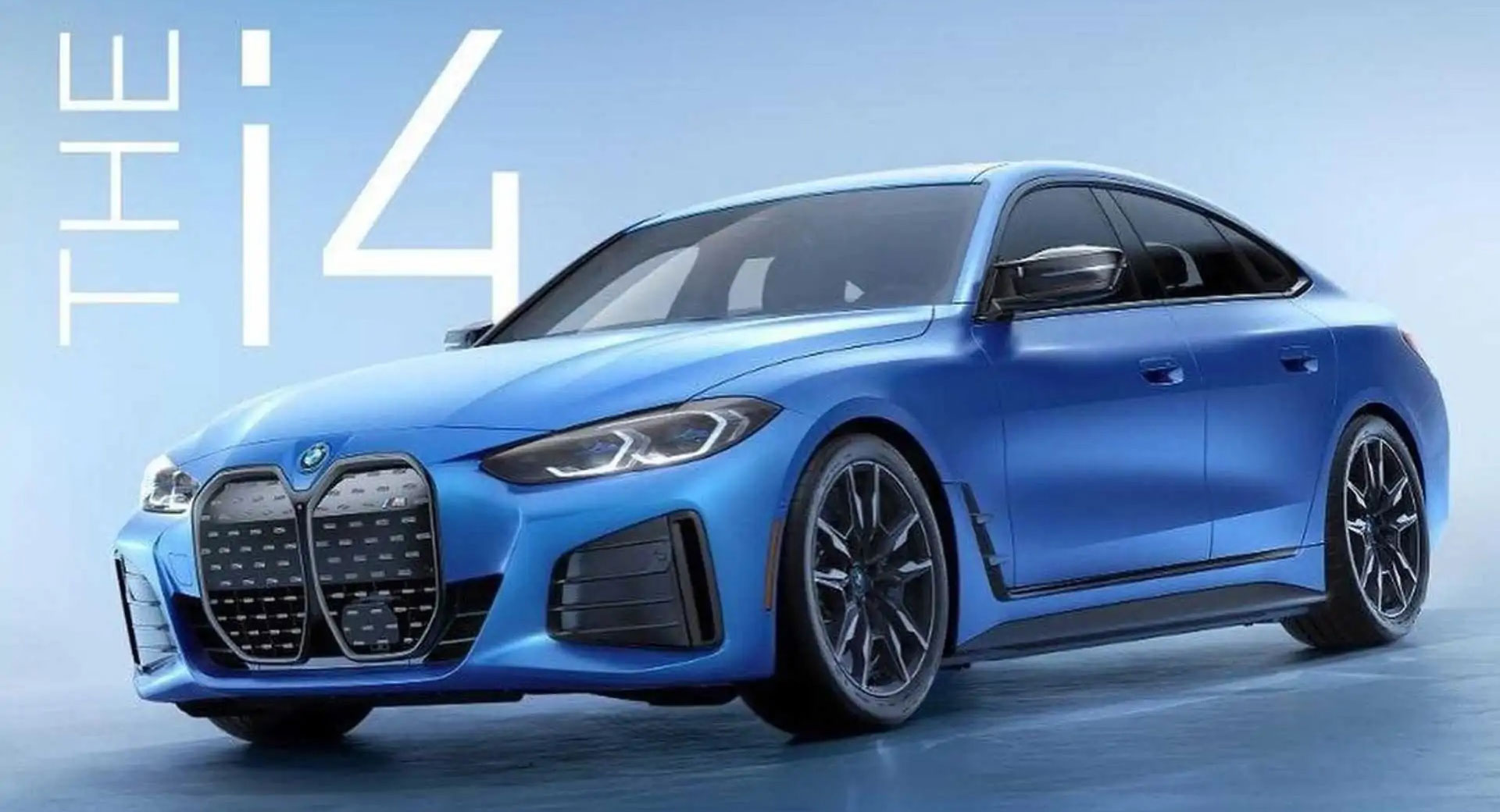
The model shown here is pictured in a blue hue – possibly a new take on BMW’s ‘frozen’ satin finish – with blacked-out trim around the glasshouse and the covered ‘kidney’ grille.
The styling garnish behind the front wheels, which should also function as a brake cooling vent, has also been upgraded to match the i4 M Sport.
Technical details are thin on the ground, although BMW has previously said the most powerful i4 variant – likely the M50, although not confirmed – will deliver 390kW of power.
For that as-yet unidentified model, a 0-100km/h time of “around” 4.0 seconds is claimed. That’s far from the quickest of electric vehicles, but it does leave room for a proper BMW i4 M flagship.
BMW says the i4 range will offer a driving range of up to 590 kilometres, although it is often the mid-range models that are optimised for long-distance driving.
When will the i4 M50 come to Australia?
Launch timing for the i4 M50 is still to be announced, but buyers can at least place a deposit to secure their position on the order list, ahead of early 2022 deliveries.
You can learn more about the BMW i4 at our links below.
The previous-generation Ford Focus ST earned many fans as an affordable champion of accessible performance, while the bigger, badder Focus RS held the mantle as the brand’s flagship performer.
But now, the Focus RS is no more, and the new Focus ST finds itself with even bigger shoes to fill while still maintaining its mature and democratic appeal without devolving into a white-knuckled racer.
Revealed in early 2019, atop Ford’s scaleable C2 architecture, the most focused er… Focus available came standard with a six-speed manual, but the inclusion of a no-cost optional seven-speed automatic seeks to give the sporty Focus a new level of mainstream appeal.
Of course the purists will always lust for the manual but it’s the seven-speed auto that most buyers will be selecting, and what we are sampling today. Does the self-shifting Focus ST have much to offer the keen driver? That’s what we’re here to find out.
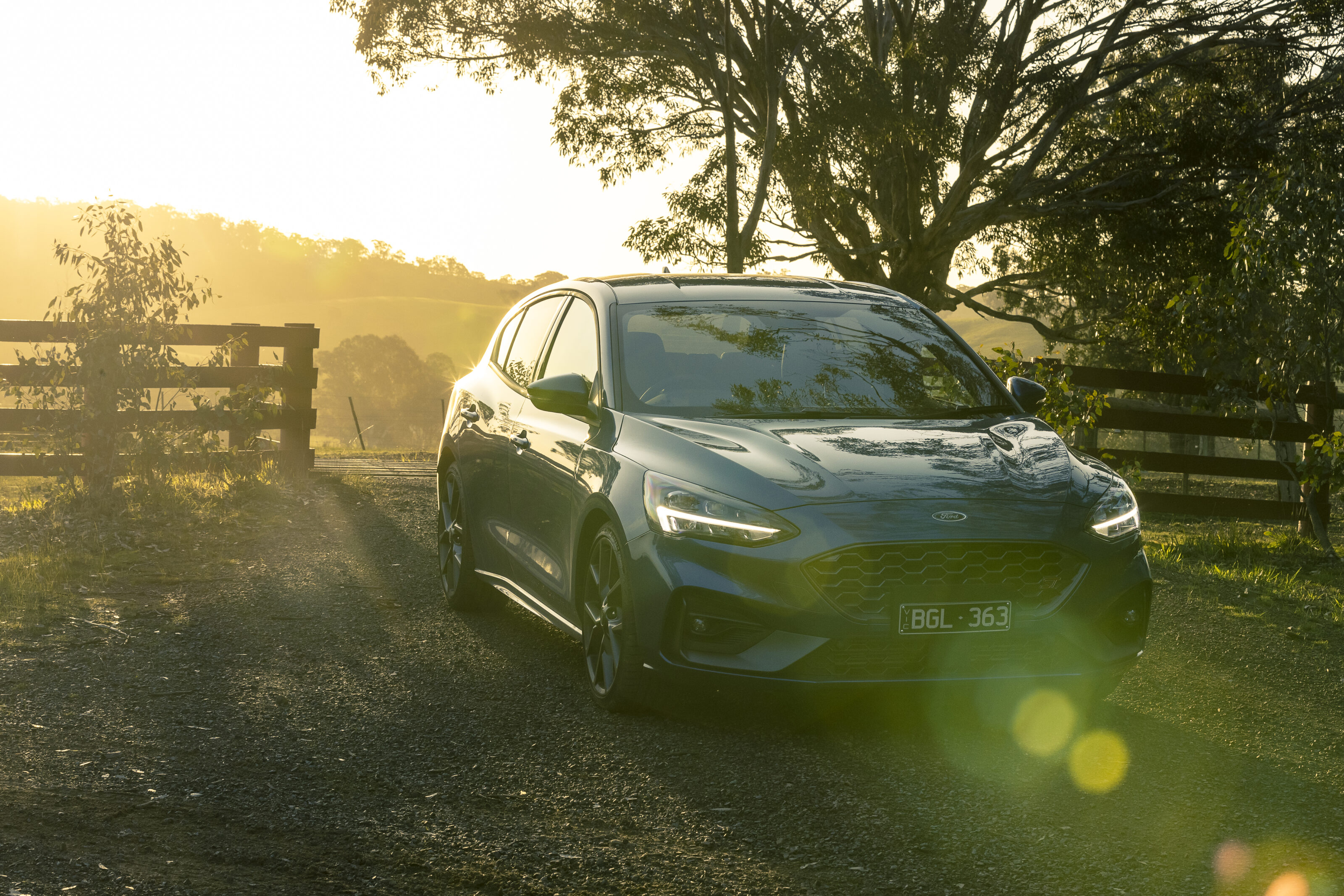
The centrepiece of the $44,890 (plus on-roads) Ford Focus ST is its turbocharged 2.3-litre four-cylinder motor lifted (and detuned) from the four-cylinder Mustang. It’s the big-block engine experience that proves the Ford’s point of difference from many others in the circa-$50k hot hatch realm.
Here, it produces 206kW and 420Nm; and while the peak power figure remains lineball with many of its 2.0-litre contemporaries, it’s the torque figure that makes the headlines with a 50Nm advantage over Volkswagen’s Golf GTI ($47,190) and a 42Nm advantage over the Hyundai i30N ($41,400). That’s also a healthy step up from the previous Mk3 Focus ST, which produced 188kW/366Nm.
Torque is the talking point of this package and is readily accessible down low, peaking between 3000 and 4000rpm, giving the Focus hatchback a whiff of muscle car about it as well as the ability to cover ground quickly and exploit overtaking opportunities in traffic.
It’s this versatile low- and mid-range where the Focus ST is best able to flex its muscles, as power delivery plateaus beyond 5500rpm.
The conventional seven-speed torque converter’s logic is well-judged around town, although like many conventional autos it can be clunky in low-speed parking manoeuvres where quick switching between drive and reverse is needed. In the Focus, however, the automatic adds 26kg to the overall kerb weight and comes at the expense of the manual’s launch control software.
Manual-equipped Focus STs previously missed out on adaptive cruise control, which was only given to automatic examples initially. However, a minor packaging revision at the beginning of this year bestowed those manuals with the previously absent adaptive cruise, as well as adding stop-and-go capabilities to the automatic systems. Both transmission options also benefit from a 12.3-inch digital instrument cluster as standard.
Unfortunately, in keeping price adjustments to a minimum, the added digital instrument cluster comes at the expense of some previously standard-fit items such as heated front seats, blind-spot monitoring, rear cross-traffic alert and 10-speaker Bang & Olufsen premium sound system.
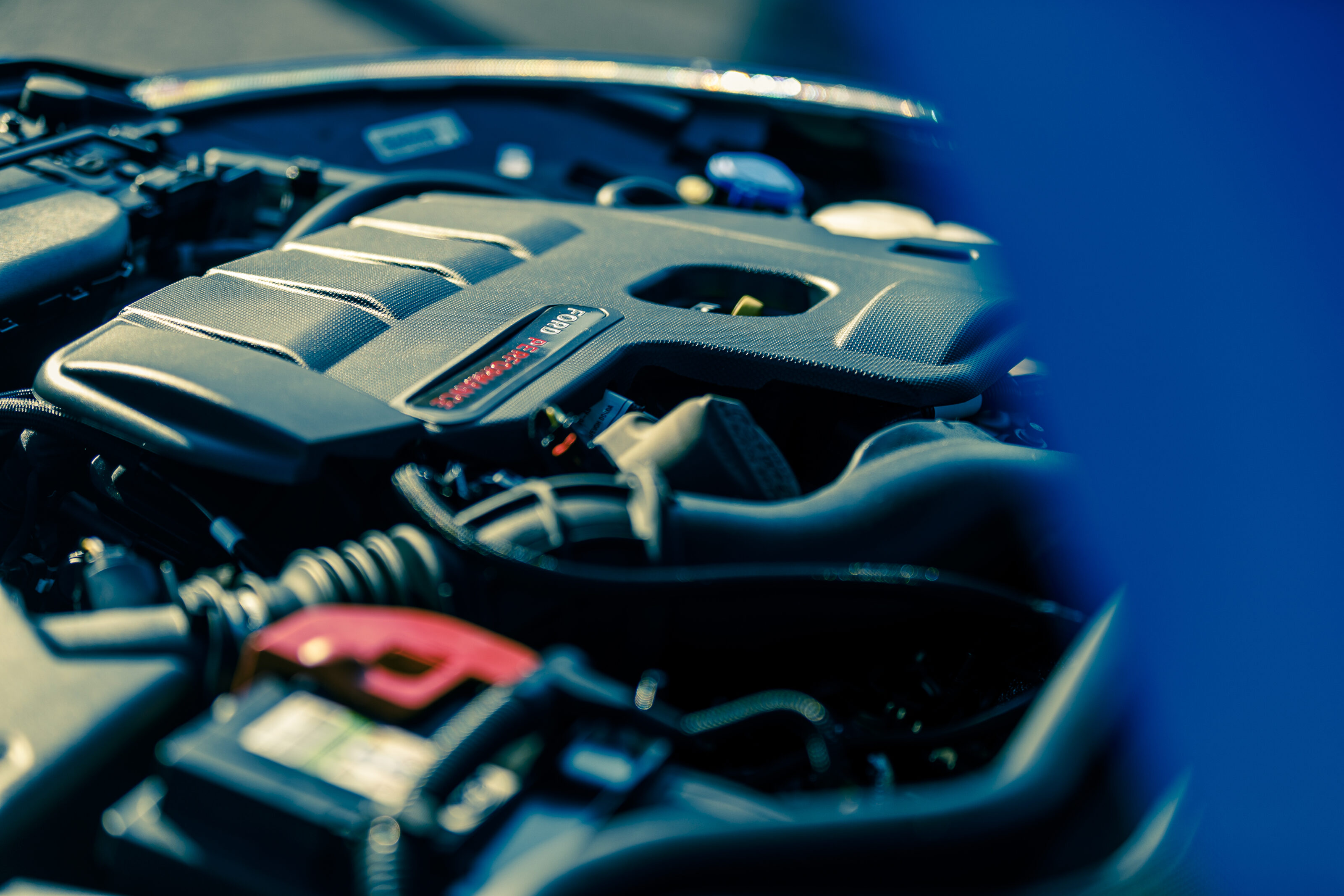
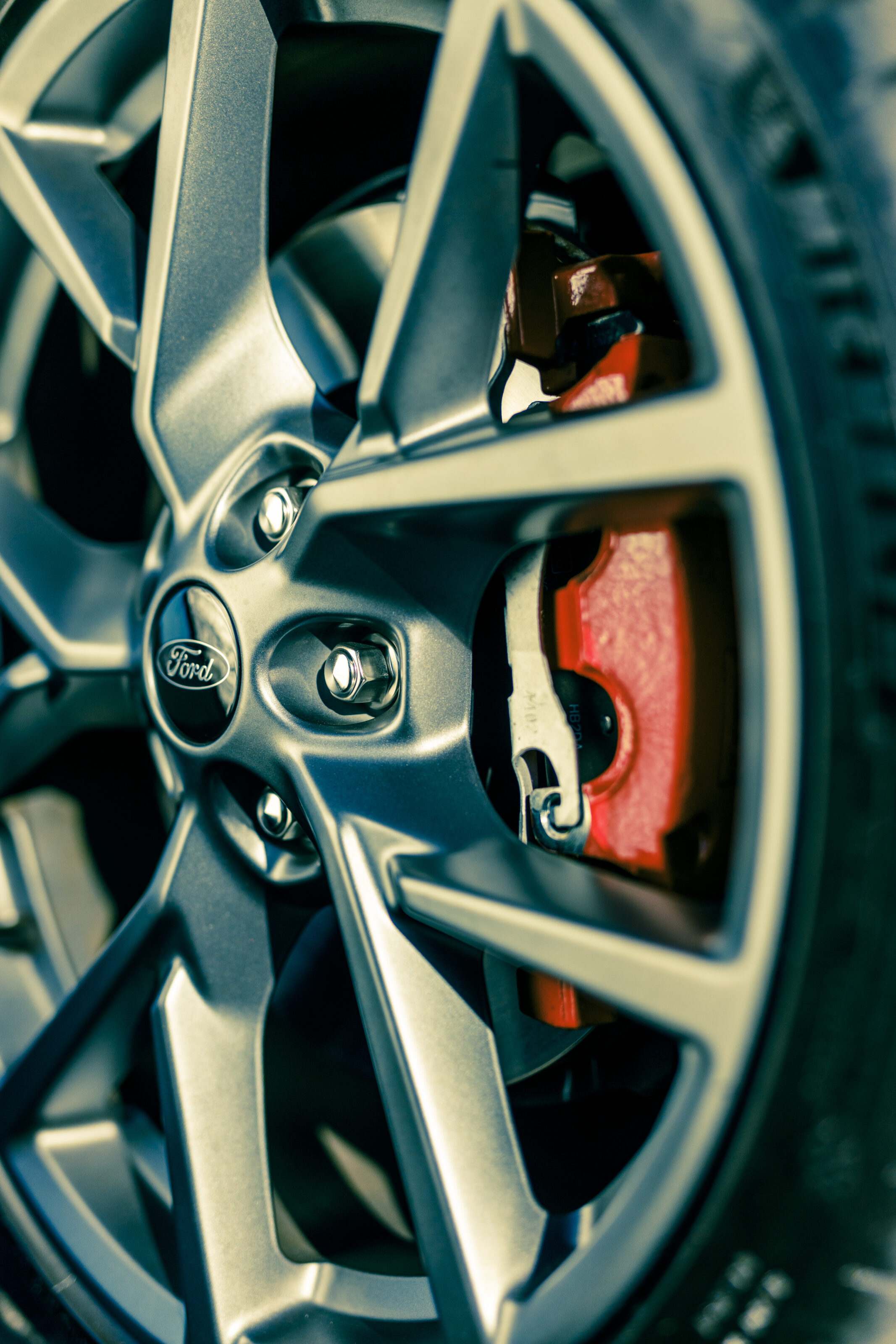
In the default Normal drive mode, the Focus – sitting on 19-inch alloys shod with 235/35/19 Michelin Pilot Sport 4S tyres – delivers a firm but very liveable ride around town. Providing a stark contrast to the smaller ‘always-on’ Fiesta ST, the independent rear suspension and larger footprint of the Focus lend an added level of refinement to its body control and overall composure on uneven roads.
Three further drive modes – Slippery, Sport and Race – give the Focus ST wider breadths of talent, with Sport adding heft to the steering, firmness to the dampers and decibels to the synthesised engine audio. Race turns the wick up two-fold and damper settings here will likely be too much for a pockmarked Aussie backroad, so is best reserved for a circuit or the smoothest of road surfaces.
Unfortunately, Ford says the C2 architecture’s electrical systems don’t allow for independent adjustments between damping, steering and powertrain settings, instead remaining pre-packaged in their respective modes. So if you’d like your powertrain in Sport but your damping in Normal, you’re fresh out of luck.
So Sport mode it is, as we head out of town for a spirited Sunday morning drive.
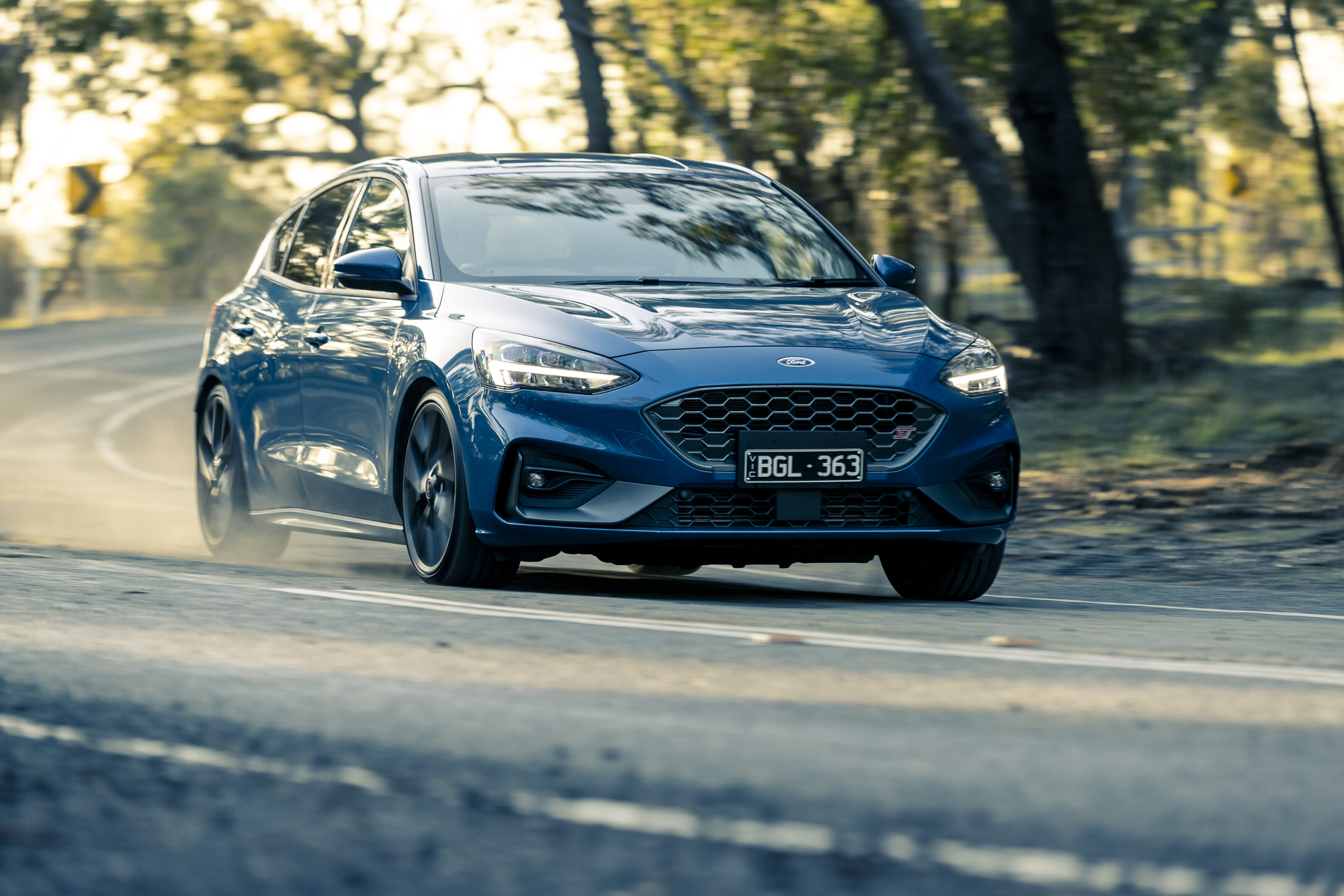
Although steering weight notches up noticeably in Sport, it doesn’t necessarily add feel or fidelity to the already wonderful and linear front end. As our drive continues, I begin probing the limits of the adhesion, incrementally approaching each corner with a little more aggression.
What I found was an incredibly unflappable front end, with its BorgWarner electronic differential yielding an incredibly high threshold of understeer. Once I’d keyed into the Focus’ character, I found I had to intentionally lob it into corners to force the front end to wash out. And when it did, it was very manageable and never ploughed.
You’ve got options too, as the Focus ST is very receptive to mid-corner adjustments, allowing you to adjust your line with braking or often by simply adding or subtracting more lock. The e-diff also allows you to power on much earlier than you initially think and while there is still kickback through the steering column, it’s not as dominant as is in its smaller ST-badged sibling. Overall, it’s a tremendously confidence-inspiring thing.
The Focus ST feels agile, as if it wants to rotate. It gives you that ‘pivot around the driver’ feeling and will even oversteer under sharp liftoff or mid-corner braking. Its brakes have a good and strong initial bite and I didn’t notice any fade on a hard run along Victoria’s Chum Creek Road. Curiously. What I did notice was some slight creaking from the front end of our test car.
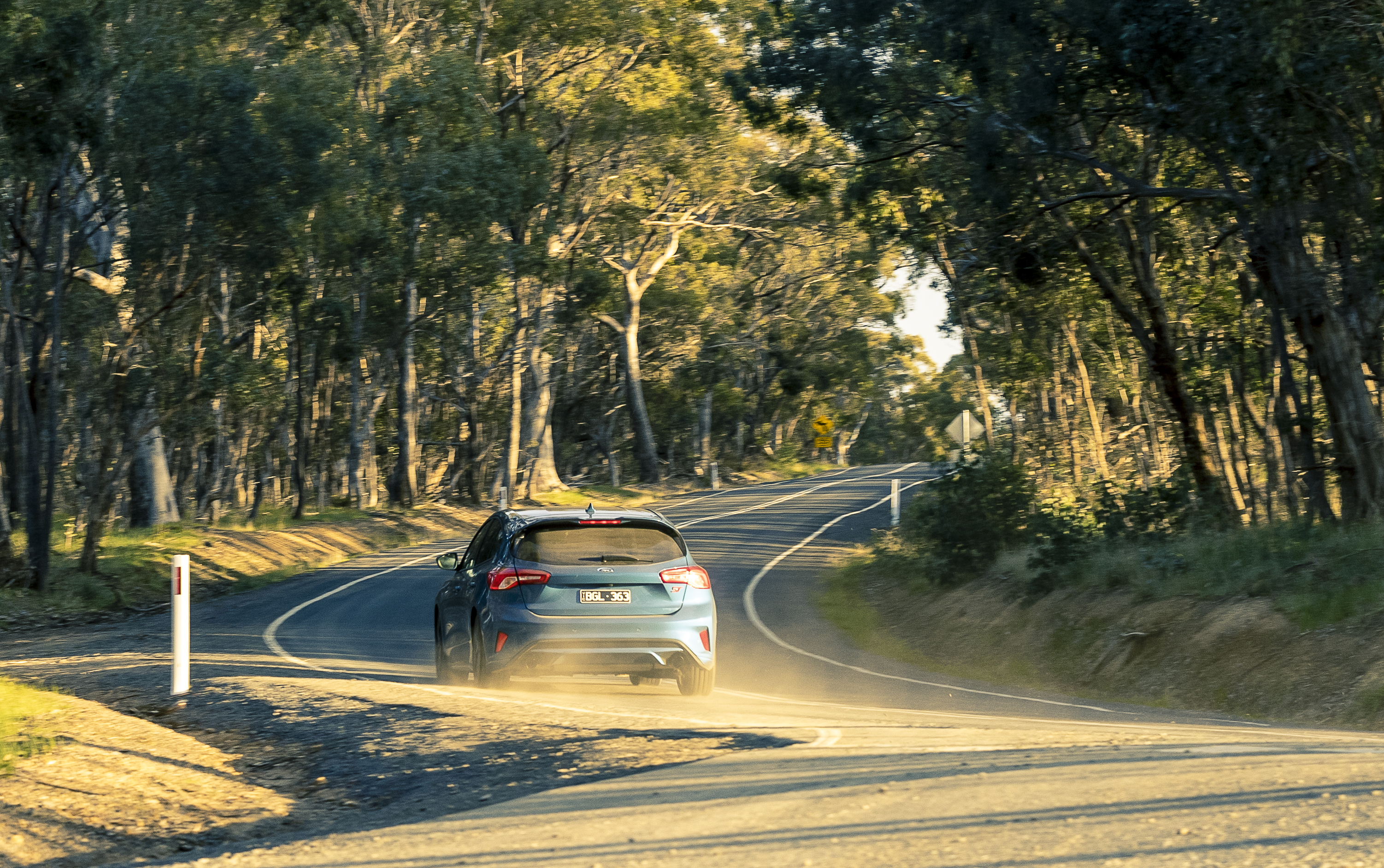
Taking the paddle shifts into your own hands works to great effect. Of course, a manual gearbox might be more engaging and fun, but the harsh reality is that most buyers will be opting for the torque converter example. The seven-speed auto may not be as telepathic as a dual-clutch, but is smooth and agreeable. Boatloads of useable low-end torque mean the Focus won’t bog down on corner exit if you end up in a gear too high. Conversely, I found the seven-speed auto will give you the downshift if it can, even if the revs are sent zinging skyward.
As our proximity to Melbourne is signalled by increasing traffic and lowered speed limits, I ease back into the deeply scalloped Recaros and flick the drive mode back into Normal.
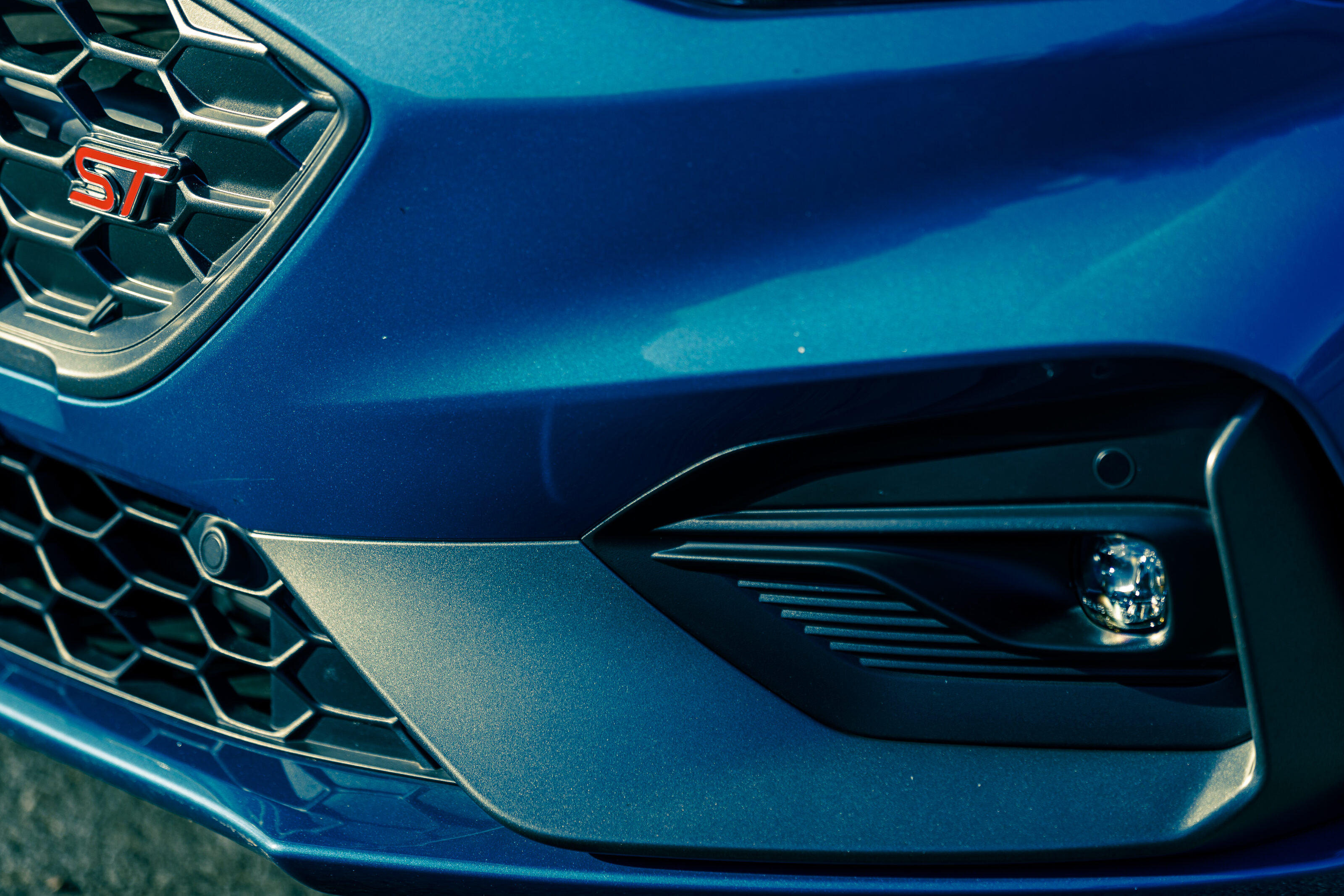
The cabin is a pleasant place to be, and comes well-equipped with an 8.0-inch central infotainment display, sat-nav, smartphone mirroring capabilities, dual-zone climate control and wireless phone charging.
Interior finishing and materials aren’t as polished as other competitors in this price bracket, but you get the sense that Ford has instead diverted its resources towards tech and dynamic equipment. The rear seats are a bit of a sore point, with no air vents and hard-touch plastics on the door cards. Ergonomics in this fourth-generation Focus, however, are a marked improvement over the preceding Mk3’s central stack button fest.
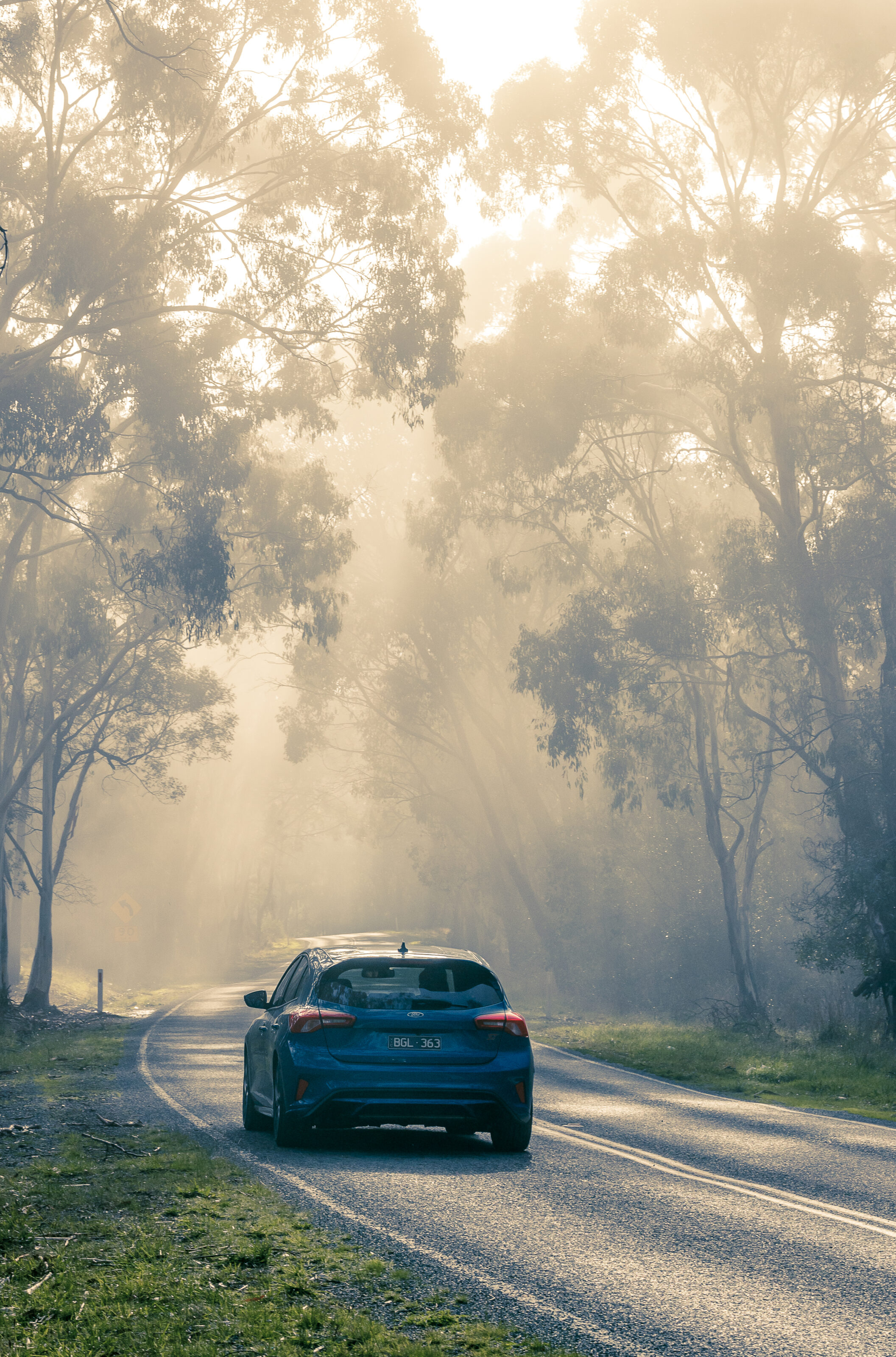
As the ST now assumes the top position in the Ford Performance Focus range, it’s grown both in performance and versatility. Hardcore enthusiasts continue to lament the loss of the potent RS but the Focus ST will now do more, better, for more people. Ford’s flagship Focus is more mature than ever but it hasn’t given up its fighting spirit. It’s here, that the Focus ST comes of age.
Snapshot
- Do your research before you start shopping
- Don’t take a toddler with you u2013 they’re no good at haggling
- It’s your money, make sure you’re happy with the deal
Three months’ back, I was in a position I’ve never been before in my life – I had the cash at my disposal to buy a brand-new car.
I’m no snob when it comes to buying a used car at all and would have done so again. My first car after passing my test was a 1995 Hyundai Excel, quickly followed by a 1997 Citroen Saxo when I moved to the UK at 18 years-old. The problem is, thanks to Covid, the used car market in Australia has gone crazy and buying a second-hand motor which was only a few years old, in my price-range, with limited kilometres on the clock wasn’t looking feasible, especially if it was European.
So, while I had the chance to buy new, I took it. Who knows when I will be able to do that again, at least not for a few years.
With a budget of around $25,000 to $30,000, I wanted a small to mid-sized automatic SUV that would be a genuinely useful family car to cart my two-year-old around in and get us all from A to B safely. There weren’t too many options on the table but a few suitable prospects interested me.
Certain models I considered, like the Subaru Forester or Outback and Suzuki Jimny, unfortunately had to be ruled out as the cost was just a bit too high for my budget, and others such as the Hyundai Kona and Tucson or Nissan Juke and Qashqai I dismissed because I either didn’t like the look, wanted more creature comforts or didn’t want to live with a CVT. They’ve improved massively in the last decade but I still find them to generally feel quite strained and gutless, especially since I’ve become used to driving DSG gearboxes for the last few years.
That left the Mitsubishi ASX, MG ZS and the Suzuki Vitara for me to test drive.
At the time I was based in Adelaide, so if you’re reading this in Melbourne (where I live now) or elsewhere, please bear in mind your experience may differ slightly.
The first vehicle I tested was the Mitsubishi ASX ES 2.0-litre petrol, priced at $27,240 drive-away. Despite being a CVT, I liked the styling and equipment levels enough to put it on the shortlist and give it a chance. The steering was good and the ride was comfy, but the model is pretty old now, having not been properly refreshed in well over 10 years, and furthermore that CVT did make it sound too whiney and strangled around town, especially when pulling away from a standstill. It also felt surprisingly small inside and the boot was pretty tiny if you take into account it needs to have a buggy, grocery shopping and lord knows what else stuffed in it 24/7.
But I have to say, what made up my mind Mitsubishi wasn’t the brand for me was the dealer himself. While many, especially colleagues in the industry, would probably base their verdict wholly on the car, a very real part of my decision-making process was about how well I was treated and whether I felt like I was being taken care of and valued as a customer.
At this particular dealership, the salesman did not take me seriously and was definitely a lot friendlier to my husband than he was to me. I hate being talked down to as a woman or made to feel stupid. Money should talk at the end of the day and they either want it or they don’t. Not even the promise of an industry-leading 10-year/unlimited km warranty was enough to get me over the line.
Next up was MG. Initially I wasn’t interested in the brand at all, but my hubby convinced me to give it a try as I might be pleasantly surprised, especially given the prices. Sadly I was not.
First I drove the MG ZS Excite with its N/A 1.5 petrol auto. It comes with an impressive seven-year/unlimited km warranty but no fixed price servicing as yet. Jeepers, the noise from it was unbelievable though, and not in a good way – in the way I’d have to turn the radio up stupidly high to drown out the screeching of the car killing itself whenever I put my foot down. Its lowly four-speed auto gearbox really made the whole driving experience feel unnecessarily laboured too.
Still, in the interest of saving a few bucks (in Excite trim, the MG ZS 1.5-litre petrol is priced at just $21,990 drive-away, making it the cheapest SUV currently on the market) I came back the next day to give the Essence 1.0-litre turbo a go. This version is also a petrol auto, but you get a six-speed instead which is much better suited and feels faster than the bigger capacity version. It does however add another $4,000 to the price tag. The result was a slightly better, marginally quieter, performance but not convincingly so. Long story short, although I liked a lot of the aesthetics of the ZS (the exception being the door cards being made of very flimsy plastic) and its overall size, it just wasn’t up to scratch.
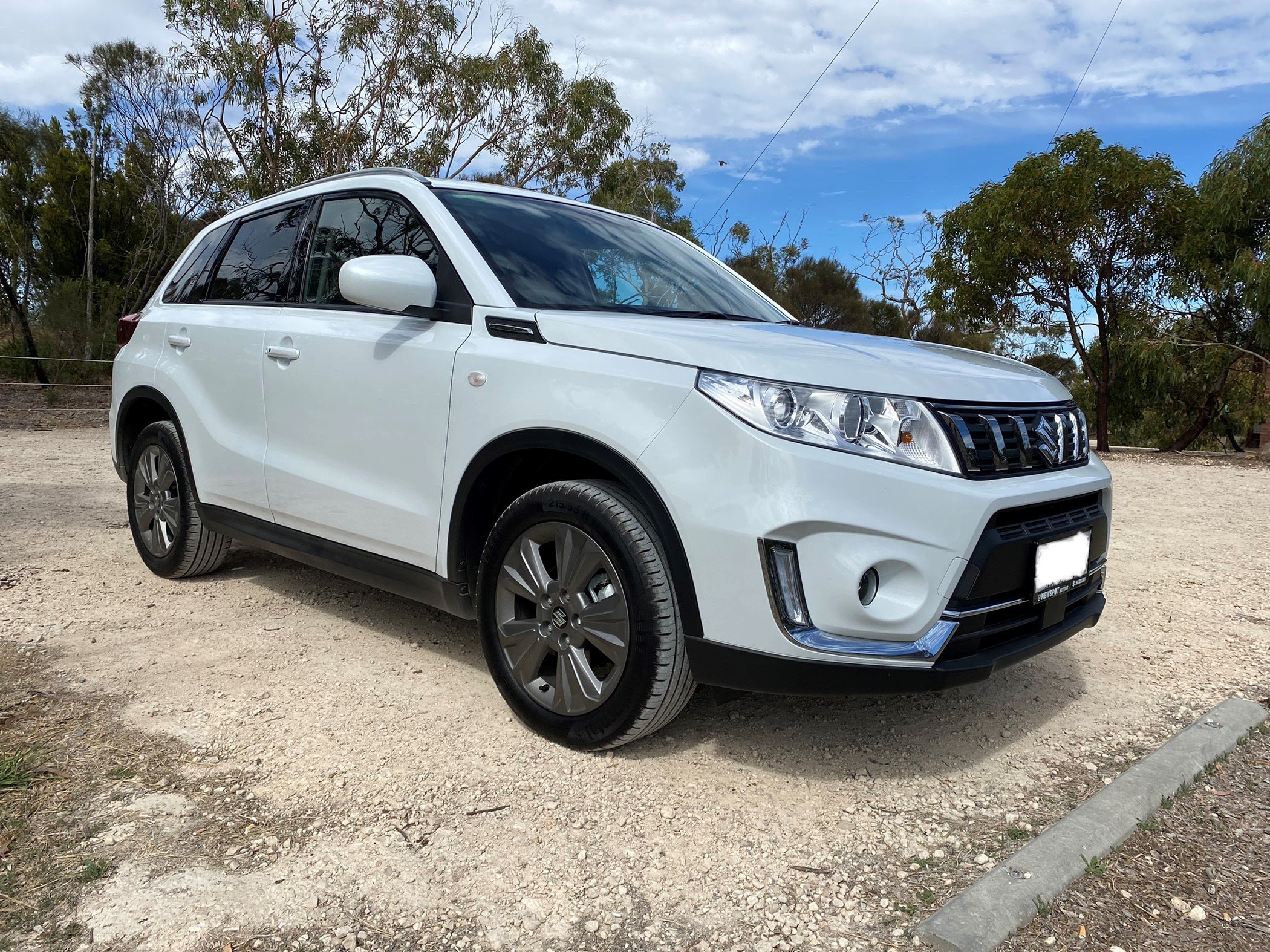
Lucky last though, the Suzuki Vitara came out shining amongst the four. Compared to its competition, it had a cheeky growl which made me smile, and putting pedal to the metal from a standstill actually made the car respond even if it was after a slight lag (which could not be said of either of the MGs), the steering was nice and fluid, and what can I say, it just felt right. Oh, and crucially no CVT. More on that later…
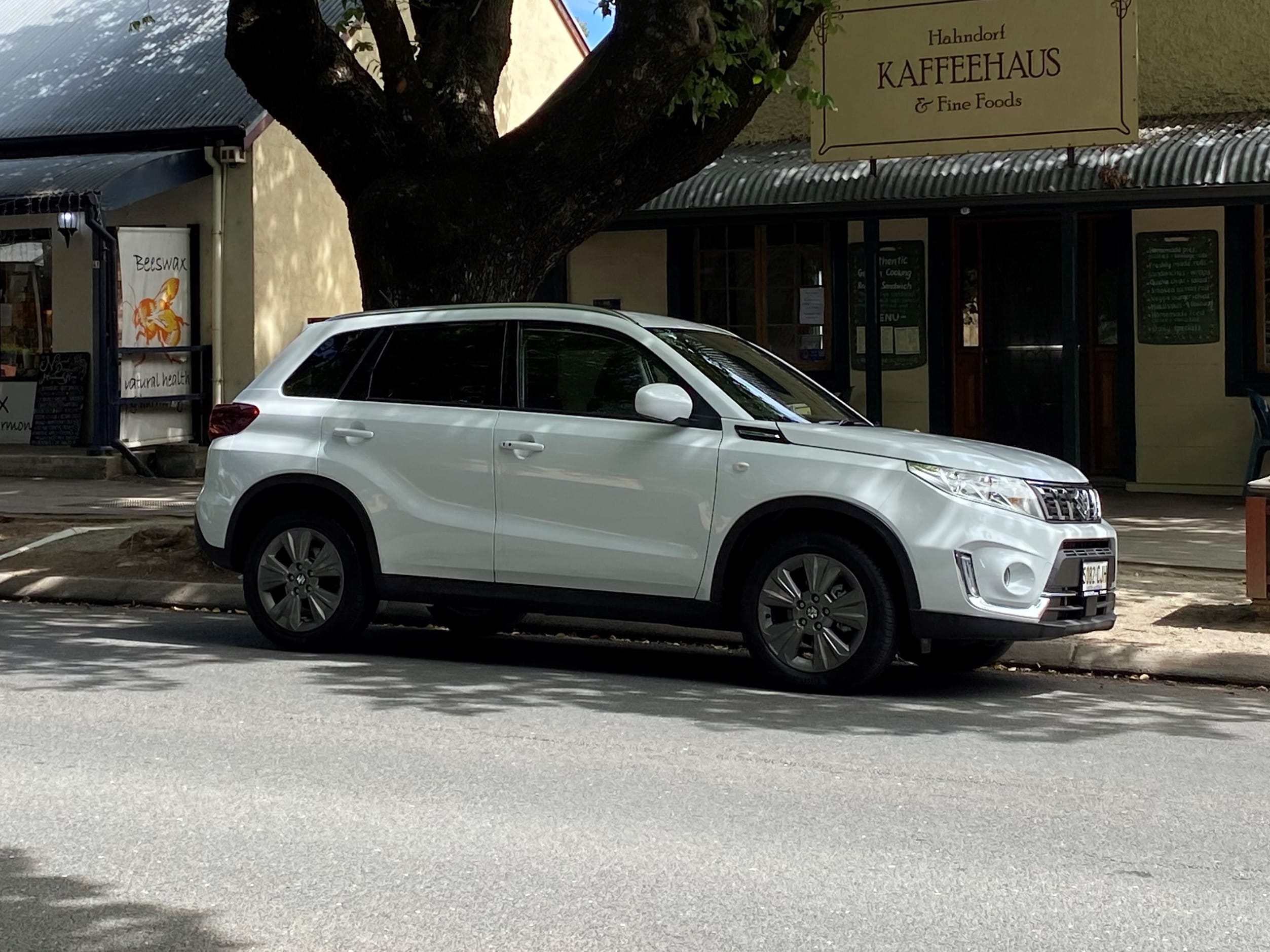
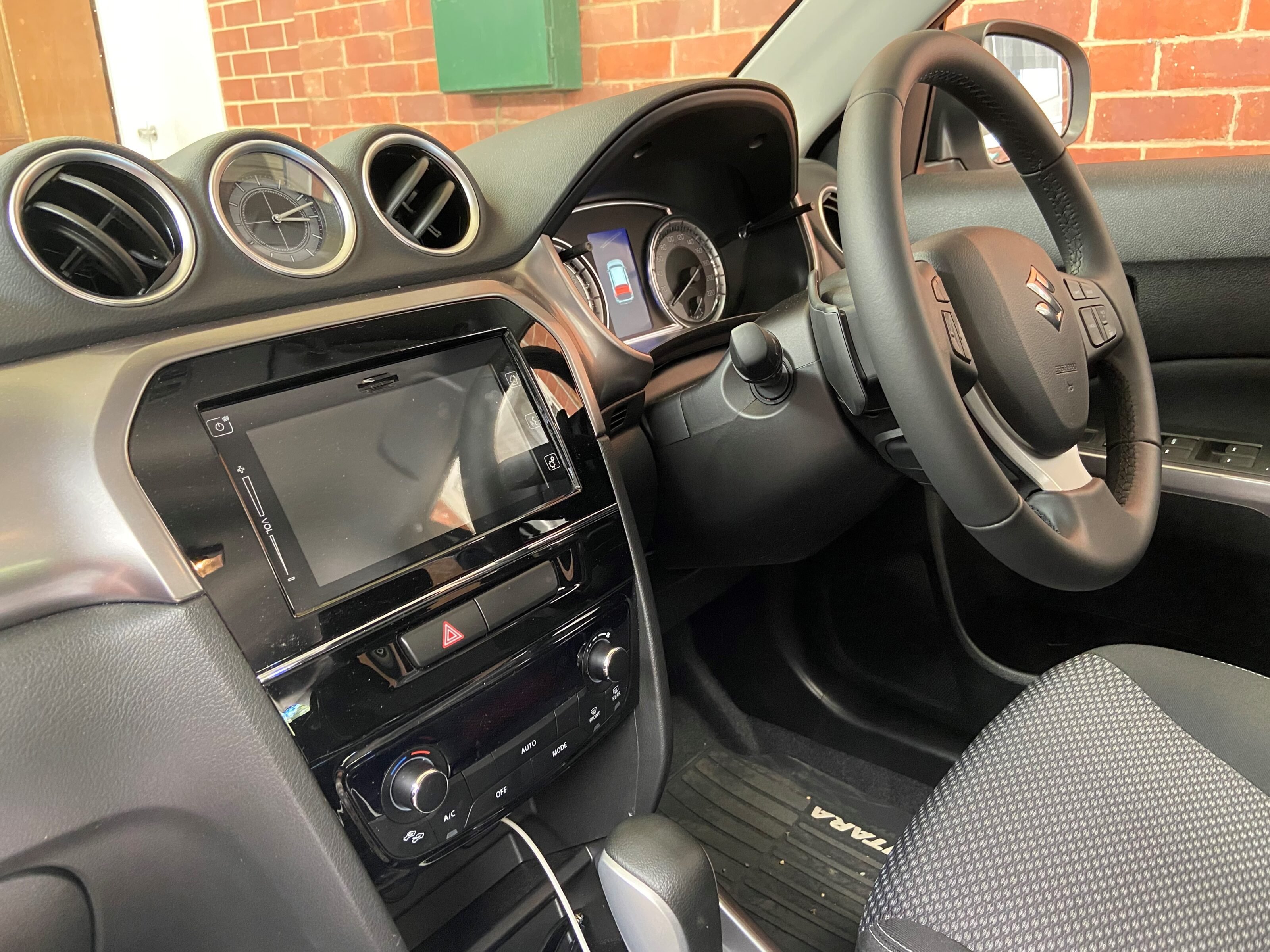
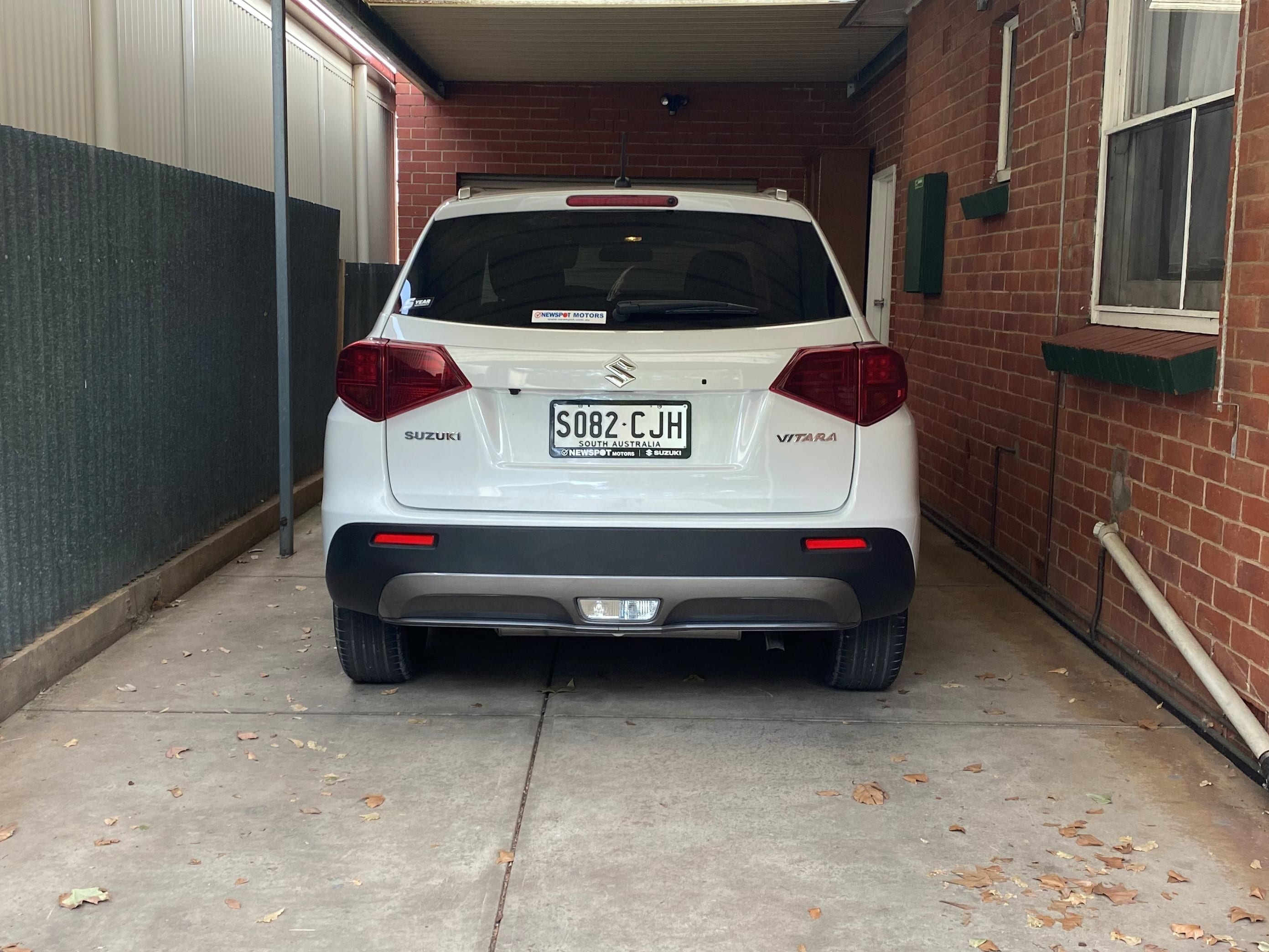
The model I opted for was the 2020 Suzuki Vitara 1.6-litre VVT petrol mated to a six-speed automatic transmission. I liked its boxy shape (not as funky as the Jimny but also much easier to get a toddler in and out of the back seats) and also the fact that while it’s relatively common, it’s not as prolific on the roads as a Camry or Hilux.
Features include digital climate control, cruise control, keyless entry and start button, a responsive seven-inch touchscreen with satnav and Apple CarPlay/Android Auto integration (although I should say my one major gripe is CarPlay is sometimes reluctant to activate if you plug your phone in before turning on the ignition – meaning you have to restart to get your maps up which isn’t always practical). The boot has an adjustable floor and feels big, holding 375 litres, while both rows are spacious enough for a young family’s needs (stay tuned for an update soon on how it handled moving the four of us interstate) if not quite as cavernous as some sedans.
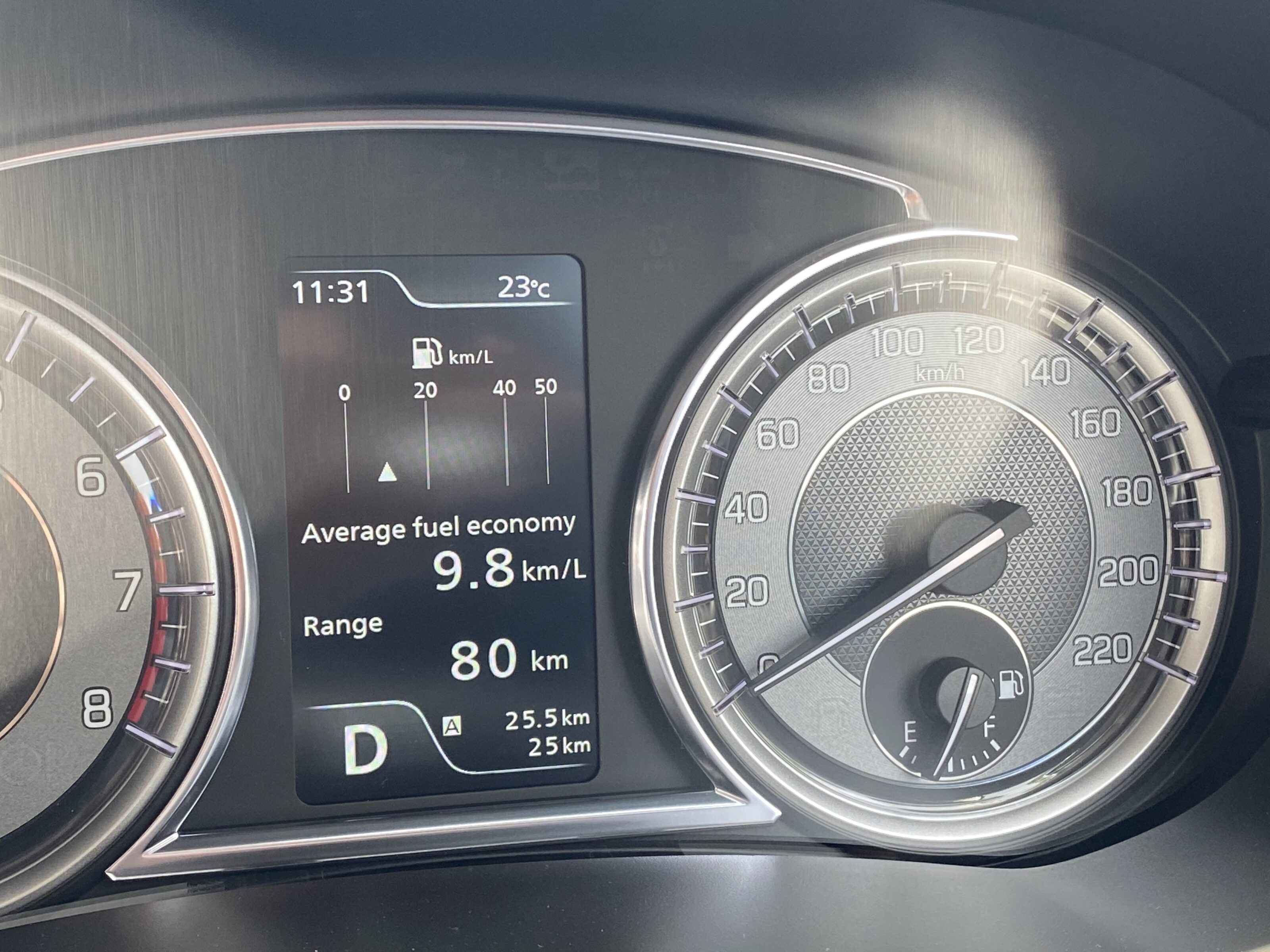
Officially Suzuki says its fuel rating is 6.0L/100km but it can do better – most of the time mine’s quoting around 5.5-5.8L/100km on 91ULP fuel, and it comes with an impressive five-year/unlimited km warranty, five-year fixed priced servicing and five-years roadside assist.
When it came to dealers here it was a whole different experience. And not just for Suzuki because, in Adelaide, MG and Suzuki are both under the same roof. The sales manager I bought from was a woman. There may be something in that, there may not be. Who knows? But she made me feel like she understood what I wanted and needed from a car as a mum (but not in the ‘we’re all girls in it together’ kind of way) and didn’t pressure or try to up-sell me something else.
All up the $27,990 drive-away price quoted to me was right at the top end of my budget, and still conscious that it was ‘just’ a Vitara at the end of the day, I wanted to knock the bill down a bit more.
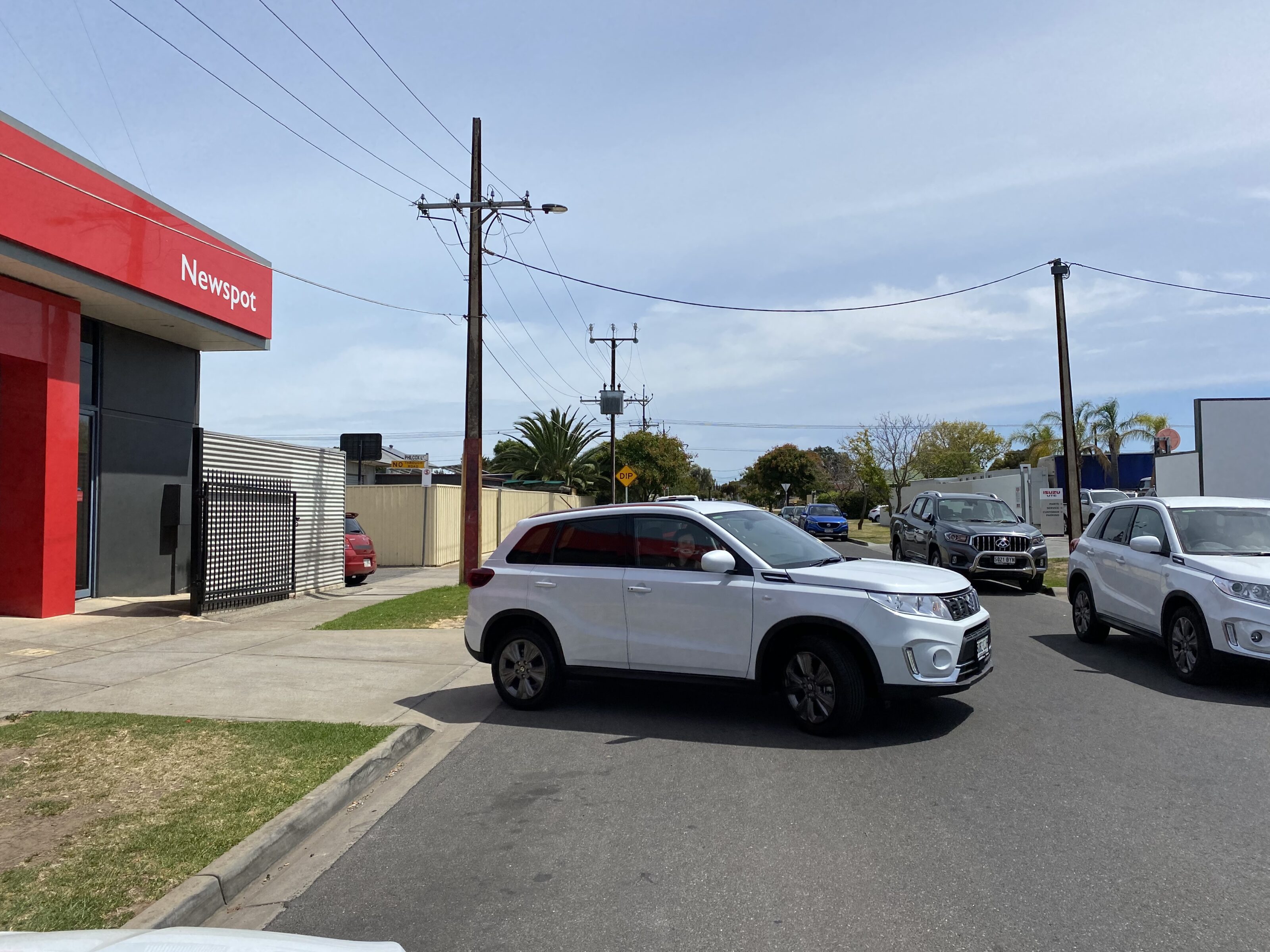
Now I do need to admit here that I wasn’t doing this solo. I had my husband with me to assist, but since he’s never bought a brand-new car either it was unfamiliar territory for us both. We also had our crazy two-year-old (who was obviously a bit younger at the time) with us who just wanted to run around the dealership and car park touching everything and throwing his toys about. Keeping hold of him near a busy road, plus haggling, was not easy, and basically involved my husband going back and forth while I said yes or no to various prices or add-ons until we were much closer to the lower end of my budget.
After a bit more negotiation and a decent cut in drive-away price, she threw in a tank of fuel and some genuine Vitara floor mats – I made sure they were rubber since it was going to be our family car and naturally would take quite a beating. A slight gripe was waiting a long time for these after repeatedly being told they would be in the dealership imminently, and also for the full tank of fuel we were promised when in fact it was given to us with a big shiny bow on top (you don’t get to keep it which was a bummer) yet barely a quarter of a tank in it, but they’re both pretty minor points and were rectified fairly quickly.
All in all I’m really happy with my purchase. After driving a number of company cars (although very nice ones!) for several years, it is nice to have a car to call my own and I love driving it around – even if it doesn’t earn me much street cred with my colleagues or neighbours. It’s my mum-mobile not a sportscar.
It’s now been three months since I bought the Vitara. Stay tuned for updates on what it’s been like in the real world.
In the meantime though, here’s a few quick dos and don’ts when buying your first new car direct from a dealer:
Do:
- your research before-hand. Figure out what you can afford (and how much you really want to spend) before you go anywhere. WhichCar is the perfect place to do just that with our handy make and model pages
- go during the week if possible, when there are fewer people, so you can have more of the dealer’s attention
- ask for a discount, and be prepared to walk away if they won’t drop enough to a price you’re happy with
- shop around different dealerships of the same brand in your area, the prices can vary and the dealers will too, so if you don’t click with one it doesn’t stop you buying the car you’ve set your heart on from another location
- work out how you’re going to pay for the car. Will it be outright or through finance? Bank loans can often be cheaper in the long run than manufacturer offers
- go towards the end of the financial year if you can when dealers are typically trying to off-load old stock and will get manufacturer incentives to do so (although this year is a bit different because global parts shortages have meant carmakers are running short on supply).
Don’t:
- take a toddler with you, get a babysitter. You can haggle much more effectively sans-small child
- leave yourself with a short deadline to get a new car, therefore making you more desperate. We had a rental car and were moving interstate soon after, so didn’t have time to mess around, but in better circumstances would choose to have more freedom to shop around
- buy a car without test driving it first. My husband initially wasn’t keen on the Vitara at all, but after a long test drive he agreed with me that it felt the best out of the four by a long shot
- be afraid to walk away if you feel like you’re being ripped off or the person is rude/dismissive – it’s your hard-earned money you’re spending, not theirs, so you want it to go to good use.
Snapshot
- New logo going back to Honda’s roots
- More than 200 current members
- Special relation with Japanese marque
The Honda Car Club of Victoria is celebrating its 50th anniversary next month, making it just two years younger than the automaker has been in Australia.
Founded by a small group of enthusiasts in 1971, under the original name of Honda Car Club of Australia – Victorian Branch, the Honda Car Club of Victoria (HCCV) is one of the oldest continuously operating Honda car clubs in the country.
To mark its anniversary, the club is holding a special celebration event in June, which will include vehicle displays, memorabilia and the launch of a commemorative magazine.
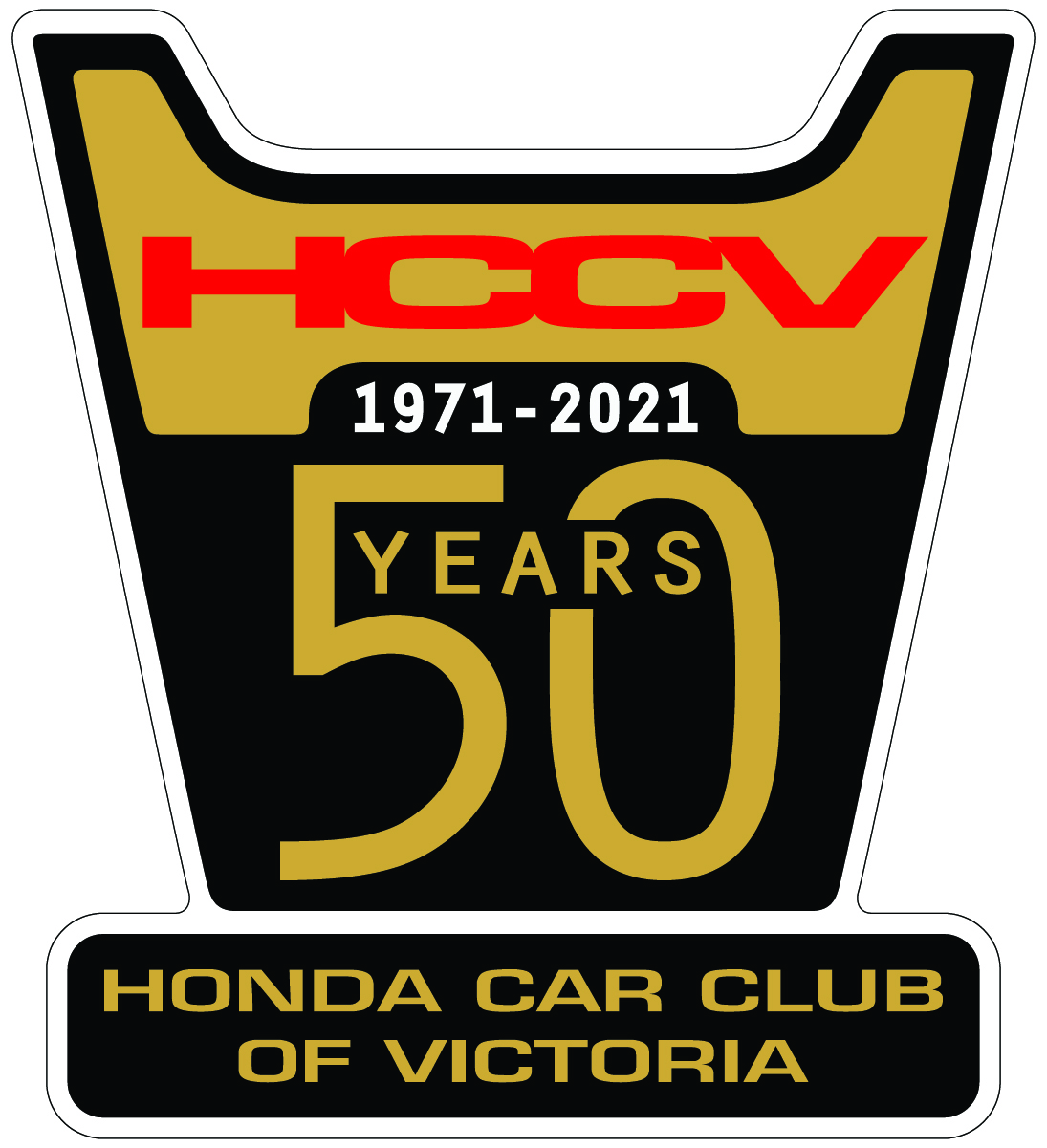
It’s also adopting a new logo, incorporating gold to reflect its milestone year as well as the more angular original Honda ‘H’ logo from the 1960s, which it will use on branded merchandise.
With a passion for the Honda marque and a dedication to Honda vehicles past and present, the club had 22 members by the end of its first year, while today it boasts a membership of around 200.
The first meeting of the club took place on January 11, 1971, under Managing Director Kazuo Shimizu. If that name seems familiar, it’s because he is the father of current Honda Australia MD and CEO, Hiroyuki Shimizu.
In April 1971, when the HCCV sent a letter to Honda Australia requesting permission to use the Honda name on its materials, Hiroyuki Shimizu was a young whippersnapper starting a new life in Melbourne.
Then in early 2017, some 46 years later, he joined Honda Australia as the second generation of his family to lead the business, having started his professional career with the brand in 1990 – Kazuo and Hiroyuki Shimizu are the third and sixteenth Managing Directors of Honda Australia, respectively.
To mark the 50th anniversary, the club has made Hiroyuki Shimizu an honorary member, just as it did for his father back in 1971.
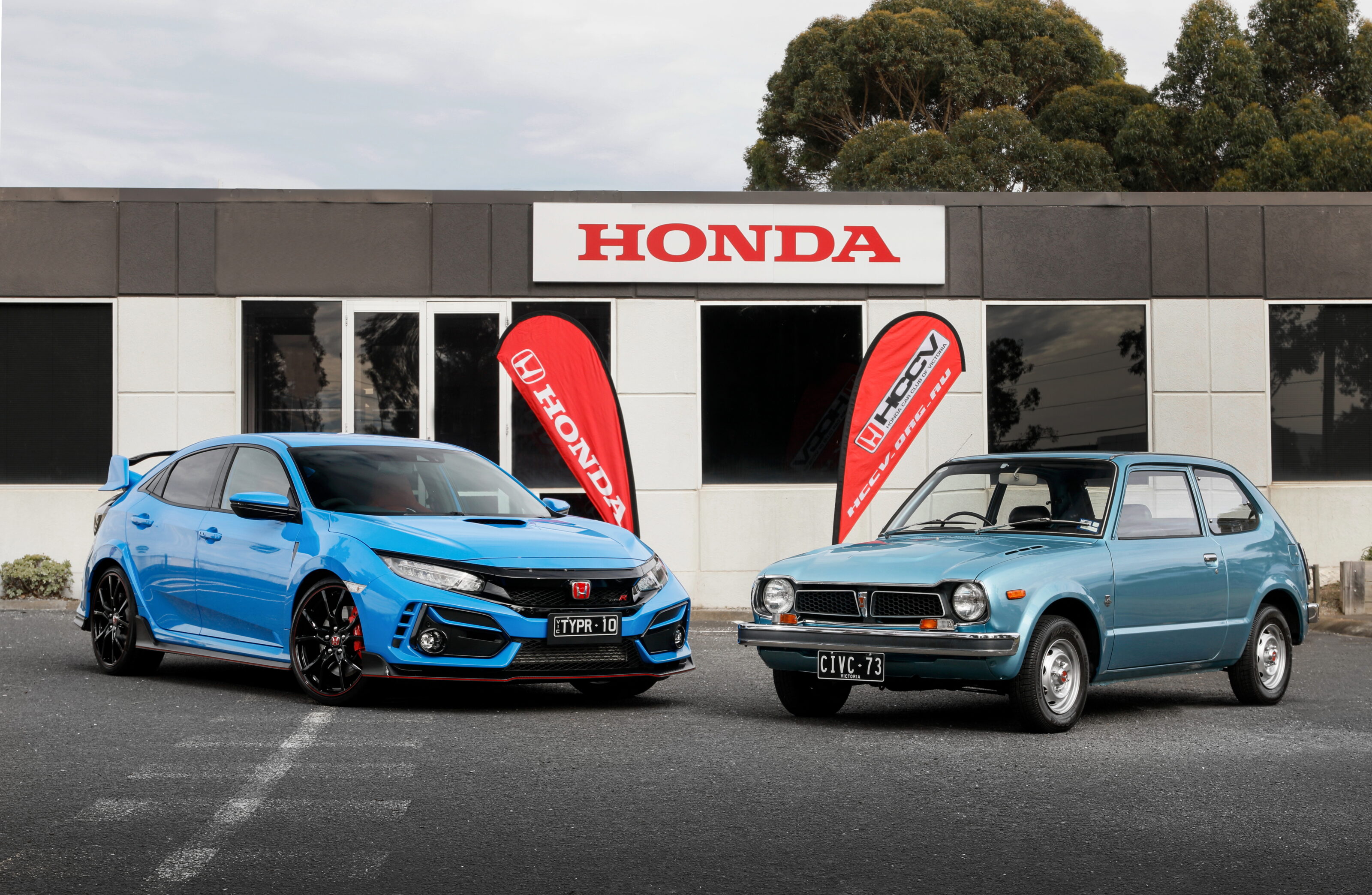
Current and former presidents of the HCCV, David Bellenger and David Prince, recently visited Honda Australia’s Head Office in Melbourne to present Hiroyuki Shimizu with his honorary membership.
“It has been one of the highlights of my career to lead the Honda Australia business and follow in the footsteps of my father,” said Hiroyuki Shimizu.
“I remember my time in Australia as a young boy fondly and it has been a special privilege to come back many years later in my working life, still part of the Honda family.”
With an early focus on club level motorsport events, including rally and Motorkhana, the Honda Car Club of Victoria achieved affiliation with the Confederation of Australian Motor Sport (CAMS) in late 1971. It continues its enthusiasm for motorsport to this day.
It also has a ‘BC’ (Before Civic) register for those passionate about the very early Honda vehicles, along with an substantial archive of information and memorabilia and access to hard-to-find parts for older cars.
One of the oldest cars in the club is a 1965 S600 roadster, which has been owned by a member for more than 40 years, while the latest Civic Type R, Accord VTi-LX hybrid and CR-V models are also well represented.
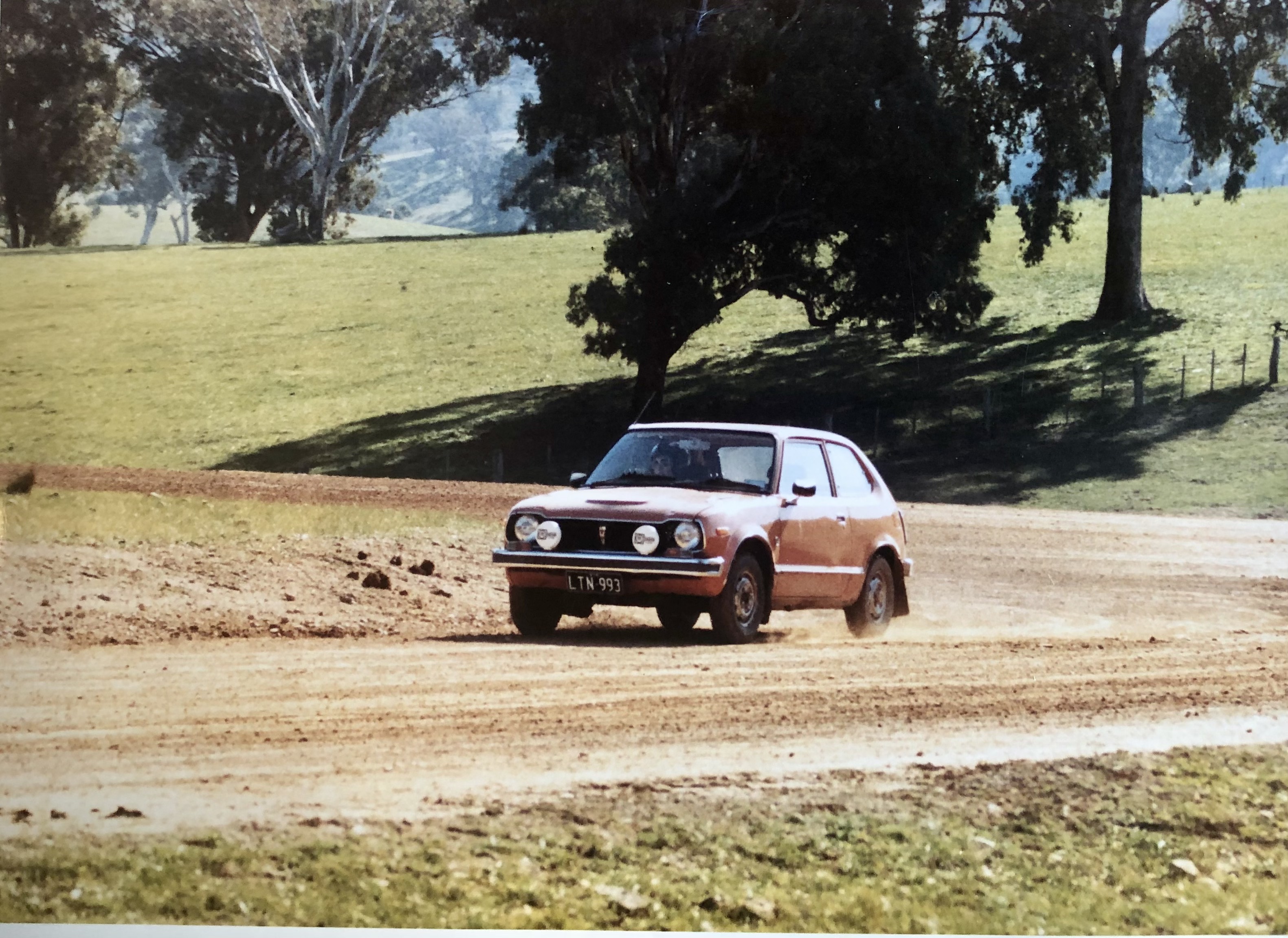
Each year the club shares its passion for all things Honda with the wider community via events such as Classic Japan, Sakura Picnic and the Geelong Revival Motoring Festival. But club activities are not just limited to its Melbourne home base or within Victoria. In 2011 a group from the HCCV took a tour to Japan and the global headquarters of Honda Motor Company, as a special event to mark the club’s 40th anniversary.
Since the mid-1980s, the HCCV has fostered assisted the marque on numerous projects and corporate events. For Honda Australia’s ‘50 Years in Australia’ golden gala event in late 2019 for example, HCCV members provided three of the six display cars representing each decade from 1969-2019.
“We’ve forged a close association with Honda Australia over more than 30 years, often holding a general meeting at the company’s head office in Tullamarine, as well as contributing to the Honda Magazine and supporting new model launches,” said David Prince, the club’s current Vice President.
“When the latest 10th-generation Accord was launched, one of our members loaned his immaculate first-generation Accord sedan to Honda Australia as part of an ‘Accord-through-the-years’ display, to sit alongside its rare fourth-generation Accord EXi 4WS manual sedan. So the relationship has been a really rewarding experience for our club and our members.”
Outright acceleration might not be a huge priority for dual-cab utes, but with many of these vehicles destined to carry or tow heavy loads, engine performance is still extremely important.
To determine the grunt of our competitors we’ll undertake two acceleration tests, a full-throttle run from standstill to 100km/h to measure outright acceleration performance and a 60-100km/h run designed to simulate overtaking performance.
In both instances we’ll count the best number from the three runs attempted, with each run completed in high-range four-wheel drive to prevent any possible traction loss from influencing the results.
Arguably even more important than how these utes accelerate is how they decelerate. To measure this we’ll conduct two braking tests, both from 100km/h to stop, using both wet and dry surfaces.
Judges and writing team: Scott Newman, Byron Mathioudakis, Louis Cordony, Evan Spence
Photography: Ellen Dewar, Alastair Brook, Cristian Brunelli
Catch the full series here
- Premium utes: Ranger vs D-Max vs Triton vs Navara vs HiLux
- Budget utes: GWM Ute Cannon-L vs Ssangyong Musso XLV Ultimate
- Hero utes: HiLux Rugged X vs Ranger Raptor vs Gladiator Rubicon vs BT-50 Thunder
- Off-roading: Ranger vs D-Max vs Triton vs Navara vs HiLux vs Musso vs Ute Cannon-L vs Ranger Raptor vs Gladiator Rubicon
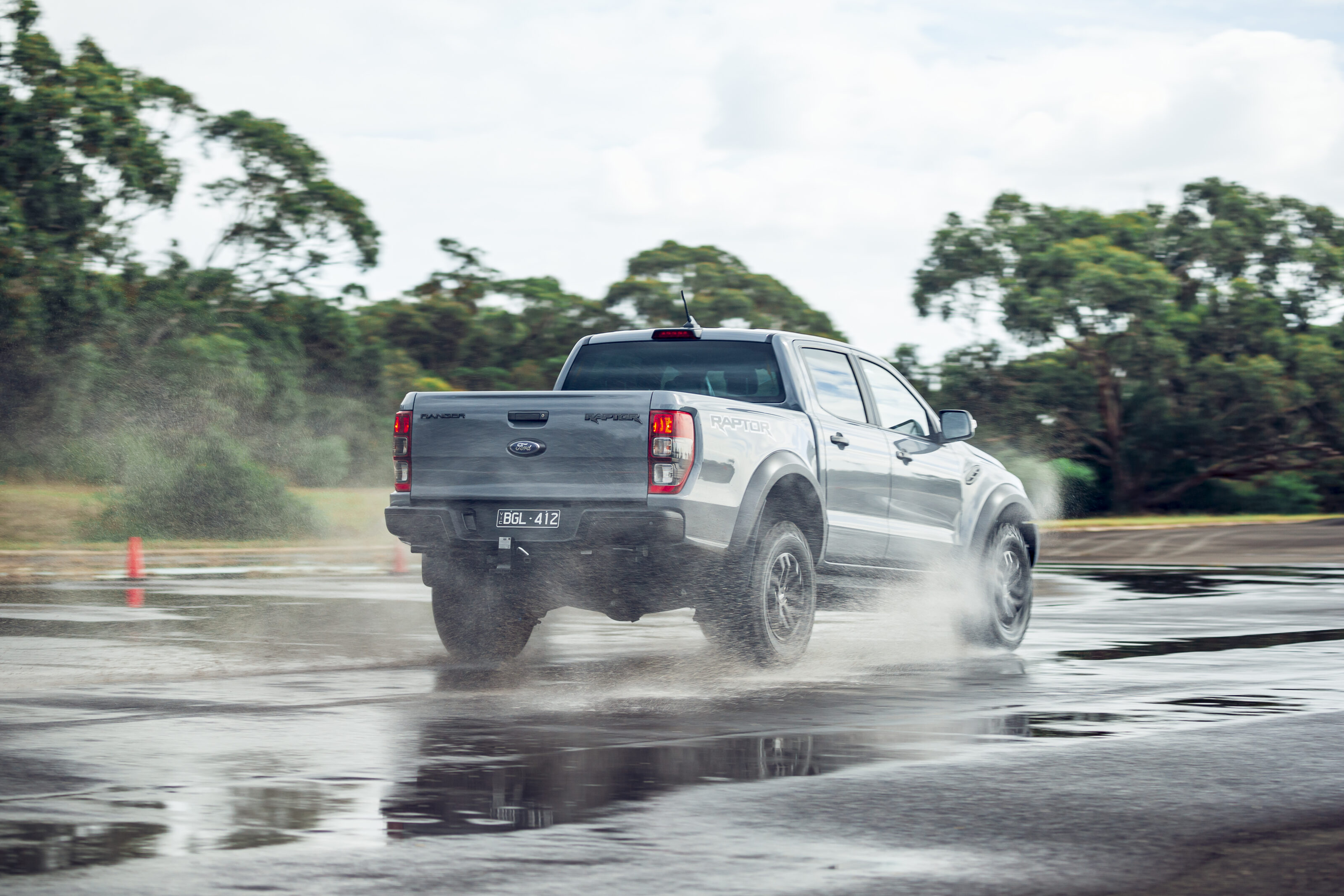
To ensure consistency, each attempt will take place on the same piece of tarmac. However, while the dry braking figure will be the best achieved from three runs, the wet braking figure is an average of all three runs.
While every measure possible is taken to ensure a consistent surface, including re-wetting the surface after each vehicle, there is inevitably some inconsistency in a wet surface over a period of time so taking the average of the three runs is an attempt to mitigate any variation.
Finally, we’ll assess the acceleration of each contender from 20-60km/h when laden with a 500kg pallet and when towing Street Machine’s Turbo Taxi.
Arguably even more important than how these utes accelerate is how they decelerate.
GWM Ute Cannon-L – 5/10
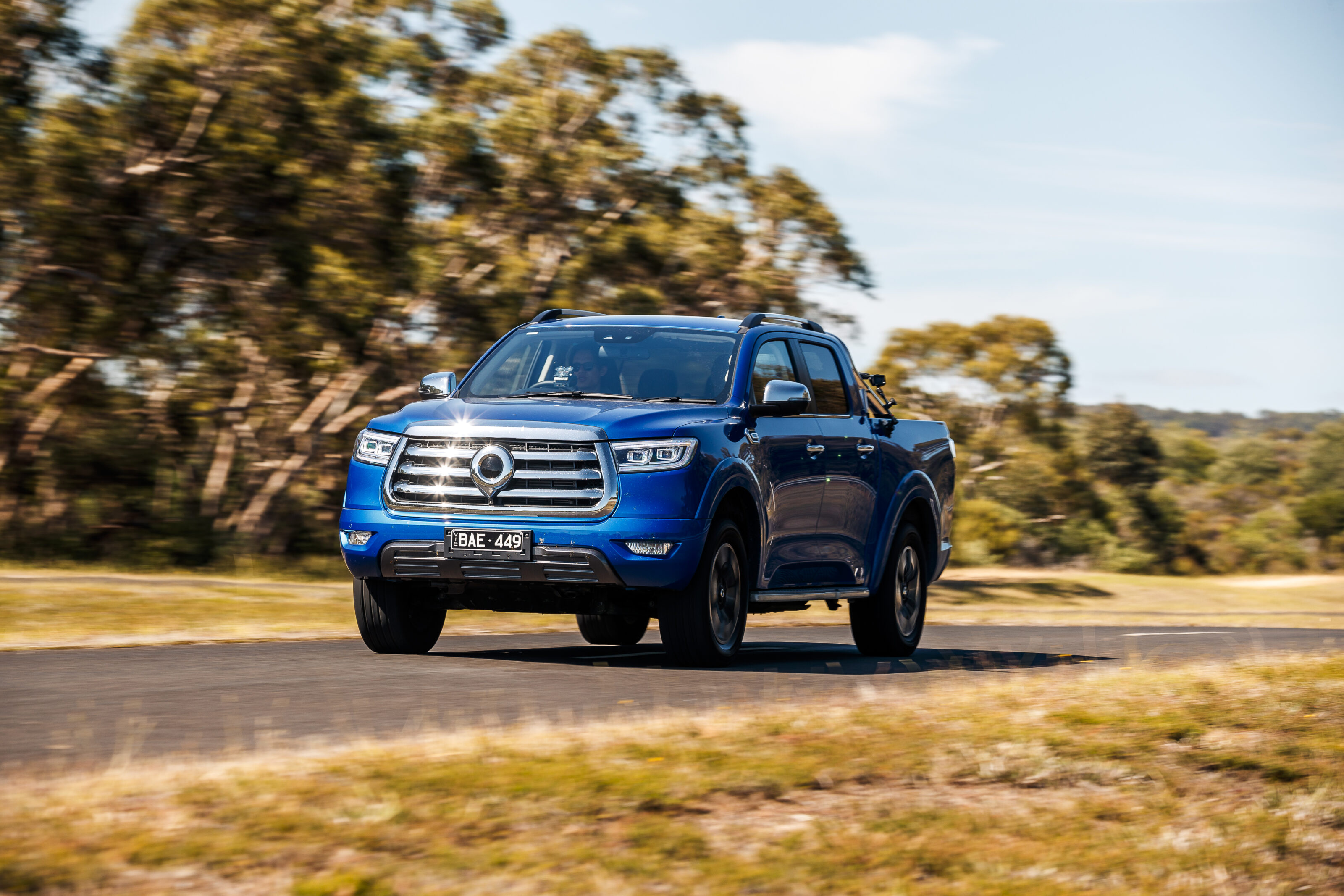
Specifications Engine: 2.0-litre four-cylinder diesel, turbo Power/Torque: 120kW/400Nm Weight: 2045kg Tyres: 265/60 R18 Cooper Discoverer HTS
The Times 0-100km/h: 11.38sec 60-100km/h: 6.7sec 100-0km/h: 43.37m (dry) 100-0km/h: 58.65m (wet) 20-60km/h (laden): 4.5sec 20-60km/h (towing): N/A
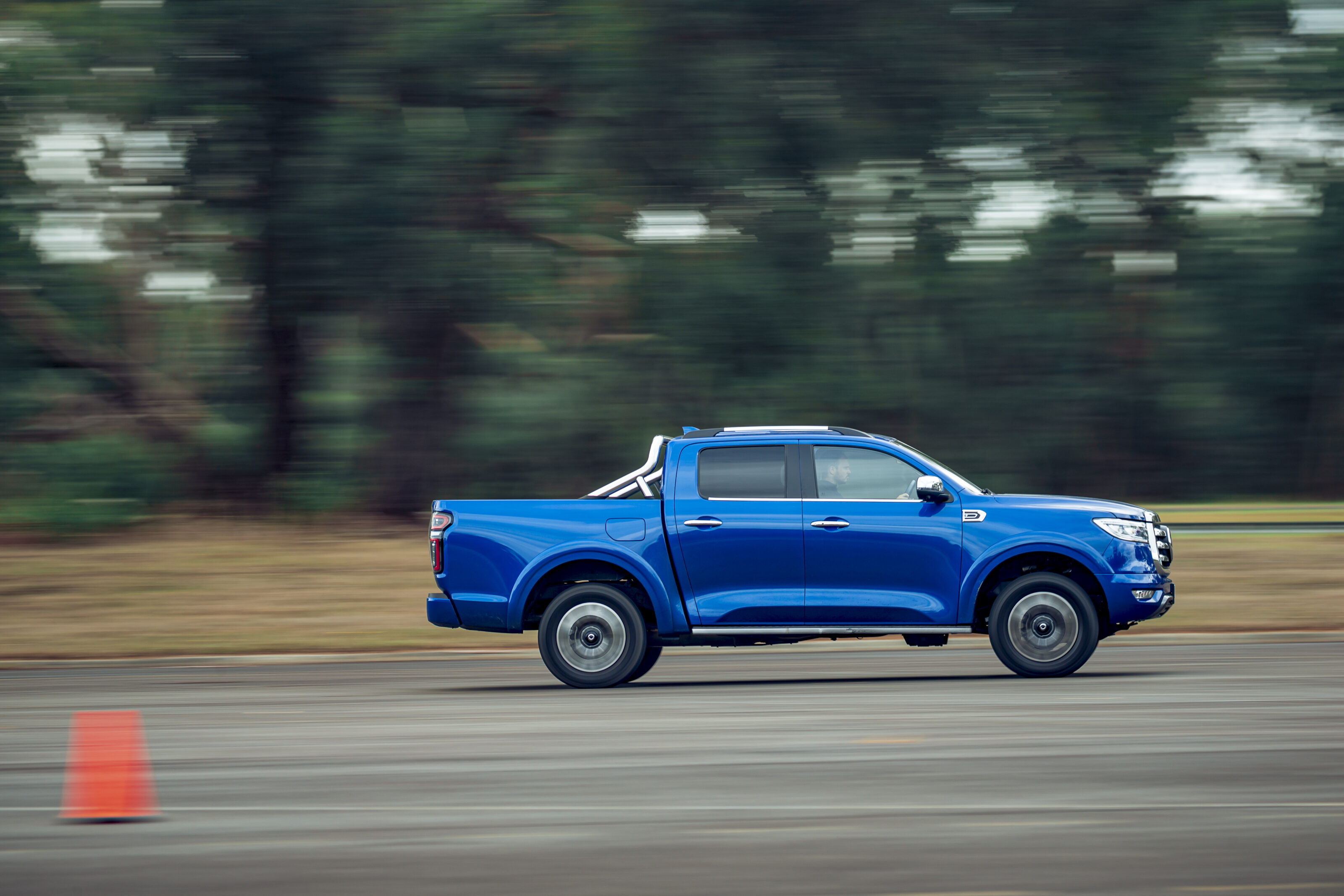
At the risk of stating the obvious, the GWM Ute feels like a big vehicle propelled by a small motor. Which is exactly what it is.
But whereas the Ford Ranger’s 2.0-litre twin-turbo-diesel shrugs off its lack of capacity, GWM’s 2.0-litre single-turbo four-cylinder diesel produces just 120kW and 400Nm and has to use every one of them to motivate the Ute.
Given its paucity of power, the outright numbers are quite respectable, largely thanks to the smooth-shifting eight-speed auto making the most of the available grunt.
Unfortunately, dry braking performance is terrible with even its best effort sailing beyond 43m and its wet braking is little better, requiring almost 60m to come to a stop.
Equally unfortunate is the fact that the GWM is supplied without a tow bar so no figure could be recorded, and its laden 20-60km/h is a below-average 4.5sec.
Ssangyong Musso Ultimate XLV – 5/10
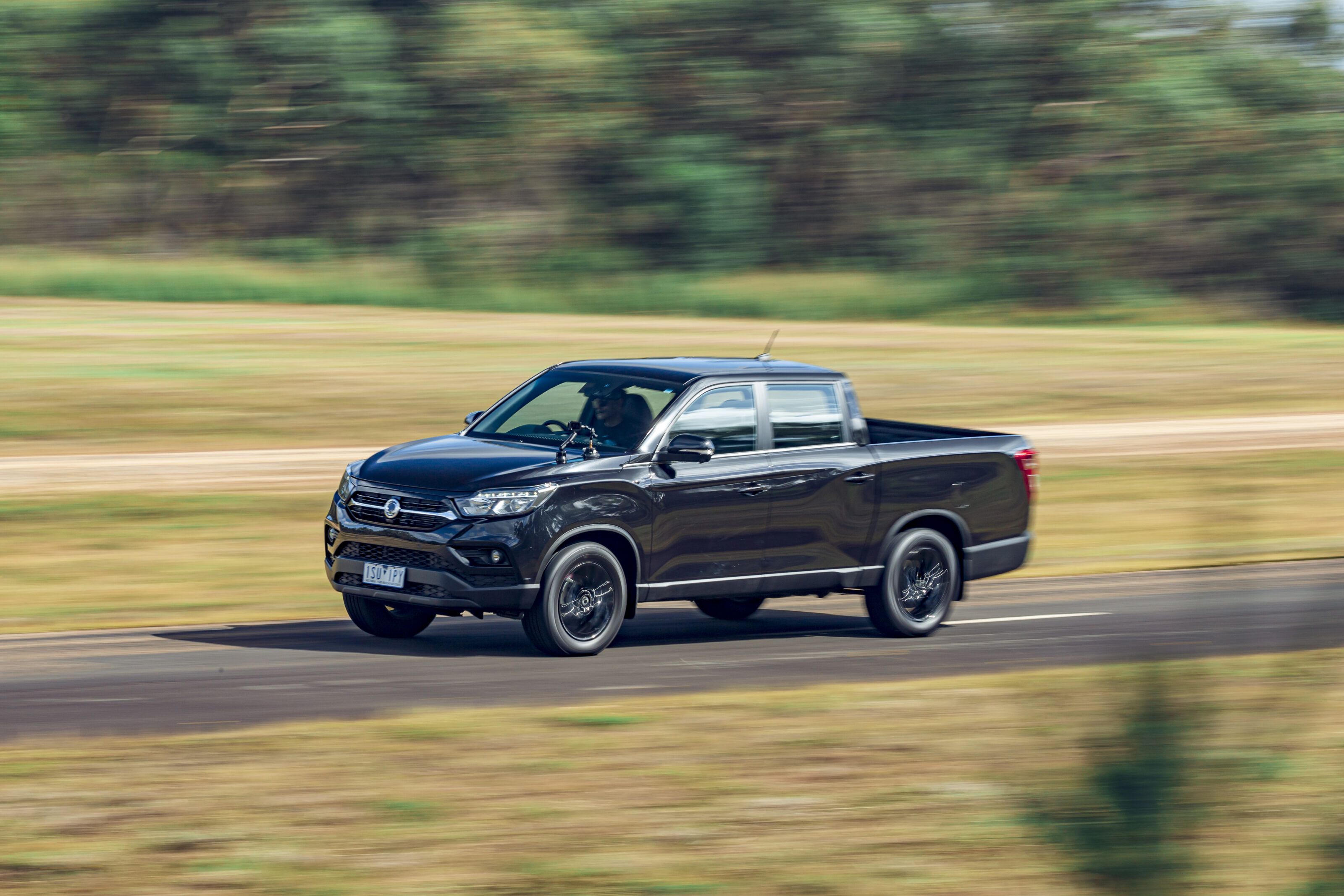
Specifications Engine: 2.2-litre four-cylinder diesel, turbo Power/Torque: 133kW/420Nm Weight: 2170kg Tyres: 255/60 R18 108H Nexen Npriz RH7
The Times 0-100km/h: 11.46sec 60-100km/h: 6.7sec 100-0km/h: 41.51m (dry) 100-0km/h: 56.78m (wet) 20-60km/h (laden): 4.2sec 20-60km/h (towing): 7.7sec
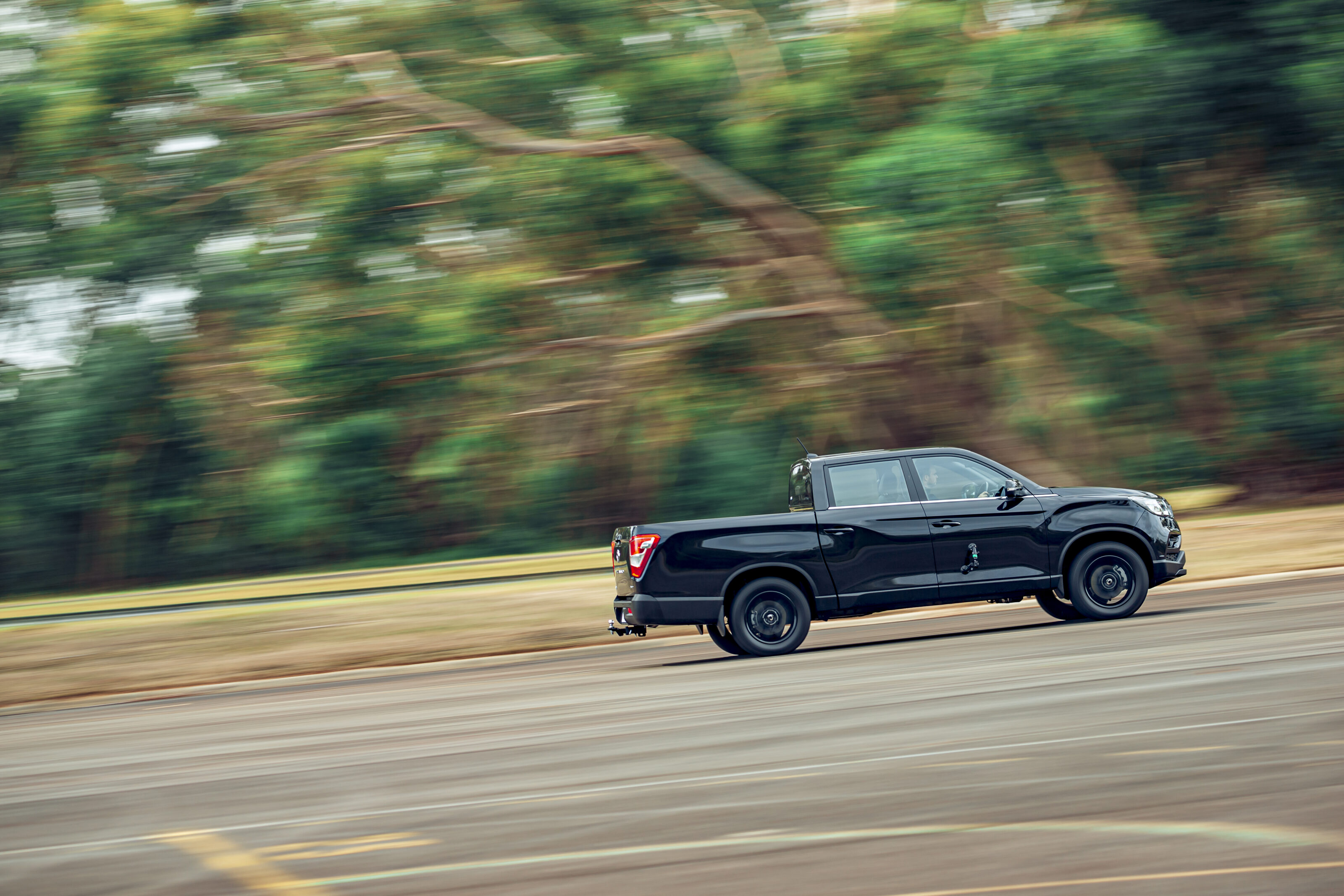
The long-wheelbase XLV version of the Sssangyong Musso is b-i-g. Its size means plenty of weight, which the otherwise impressive 2.2-litre four-cylinder diesel struggles to move in an enthusiastic manner.
There feels to be a solid spread of available grunt but the stopwatch reveals that nothing is happening in a hurry, its acceleration numbers lagging behind the GWM.
An eight-speed auto would help the engine keep in the meat of its torque band and improve acceleration (though it would also add even more weight).
Braking performance is OK, nothing more, taking more than 40m to stop from 100km/h in the dry and almost 57m in the wet.
The Musso shrugs off the 500kg load, taking 20-60km/h in 4.2sec, though there is some transmission shunt at low speed and towing from 20-60km/h slightly bettering the Navara at 7.7sec.
Mitsubishi Triton GLS – 5.5/10
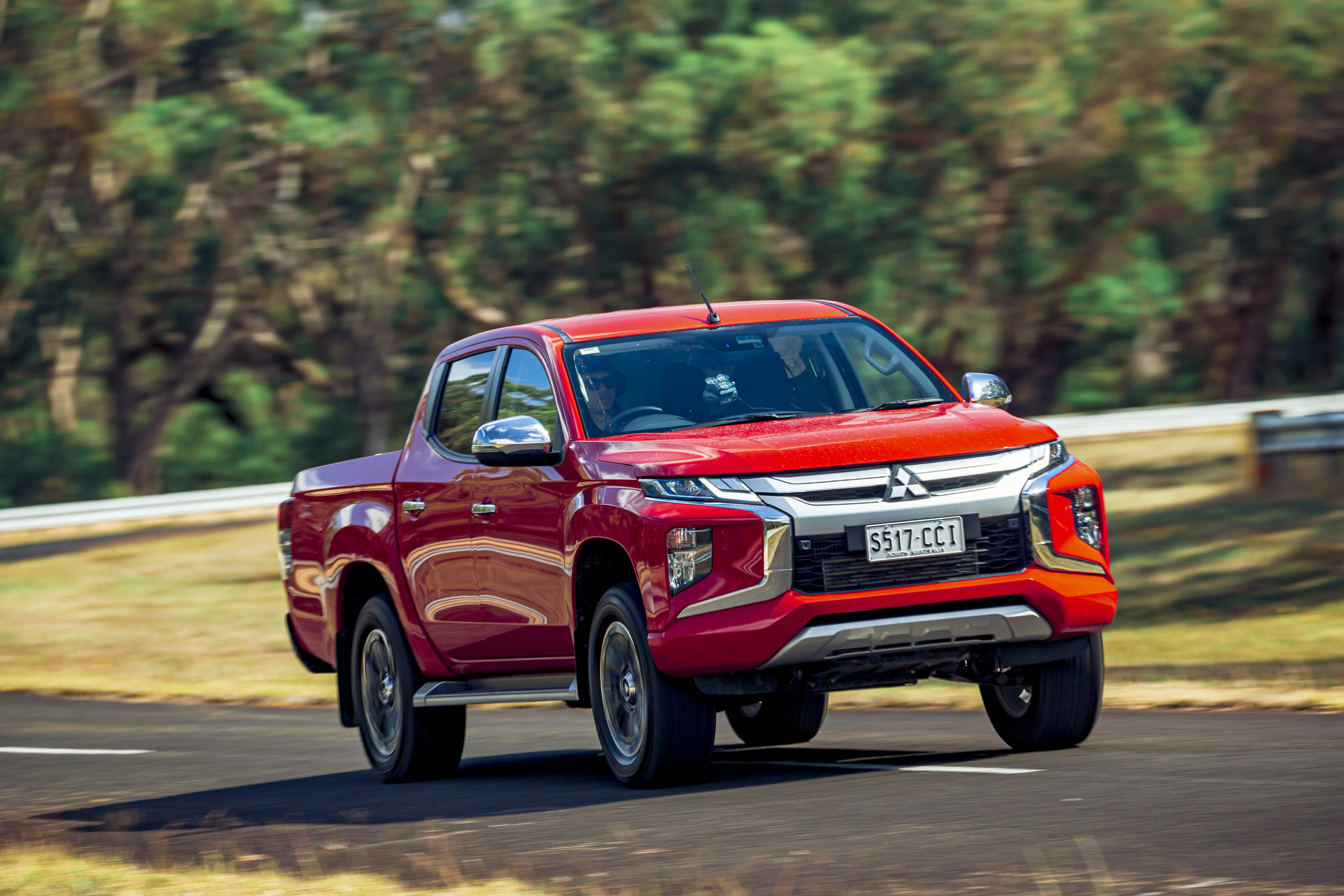
Specifications Engine: 2.4-litre four-cylinder diesel, turbo Power/Torque: 133kW/430Nm Weight: 1935kg Tyres: 265/60 R18 110H Dunlop Grandtrek
The Times 0-100km/h: 11.36sec 60-100km/h: 6.0sec 100-0km/h: 38.95m (dry) 100-0km/h: 62.76m (wet) 20-60km/h (laden): 4.2sec 20-60km/h (towing): 8.2sec
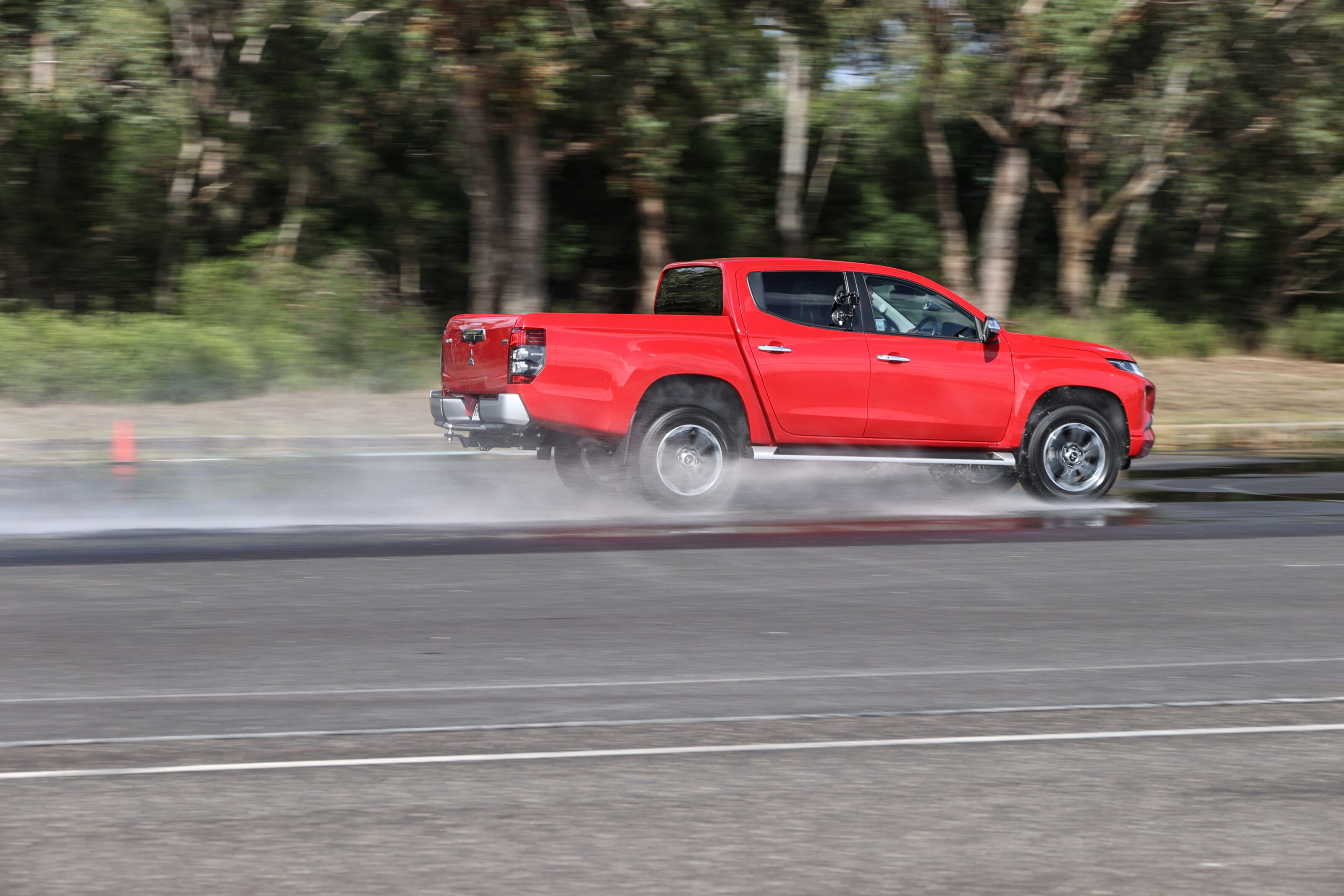
The Mitsubishi Triton displays why it was important to average the wet braking, as on its first run a particularly sodden surface leads to a complete lack of retardation and a whopping 76m needed to stop.
This run is ignored, but it just goes to show that in very poor road conditions even our testers’ wet braking distances can lengthen considerably. The Triton’s fortunes don’t improve much, taking an average of almost 63m to stop in the wet; it wears the same Dunlop Grandtrek tyres as the Ranger – coincidence?
Its dry deceleration is much more respectable, but acceleration isn’t a Triton strong suit. The on-paper figures of 133kW/430Nm from its comparatively small 2.4-litre four-cylinder diesel result in leisurely straight-line performance.
The engine doesn’t struggle to haul the Triton’s bulk but is happy to take its time doing so. Its roll-on acceleration is more competitive but it makes plenty of noise in the process, especially higher in the rev range.
Funnily enough, its performance is much more competitive when lugging loads, taking 4.2sec from 20-60km/h with 500kg aboard. Its 8.2sec towing effort is slow, but the powertrain feels unstressed.
Ford Ranger Raptor – 6/10
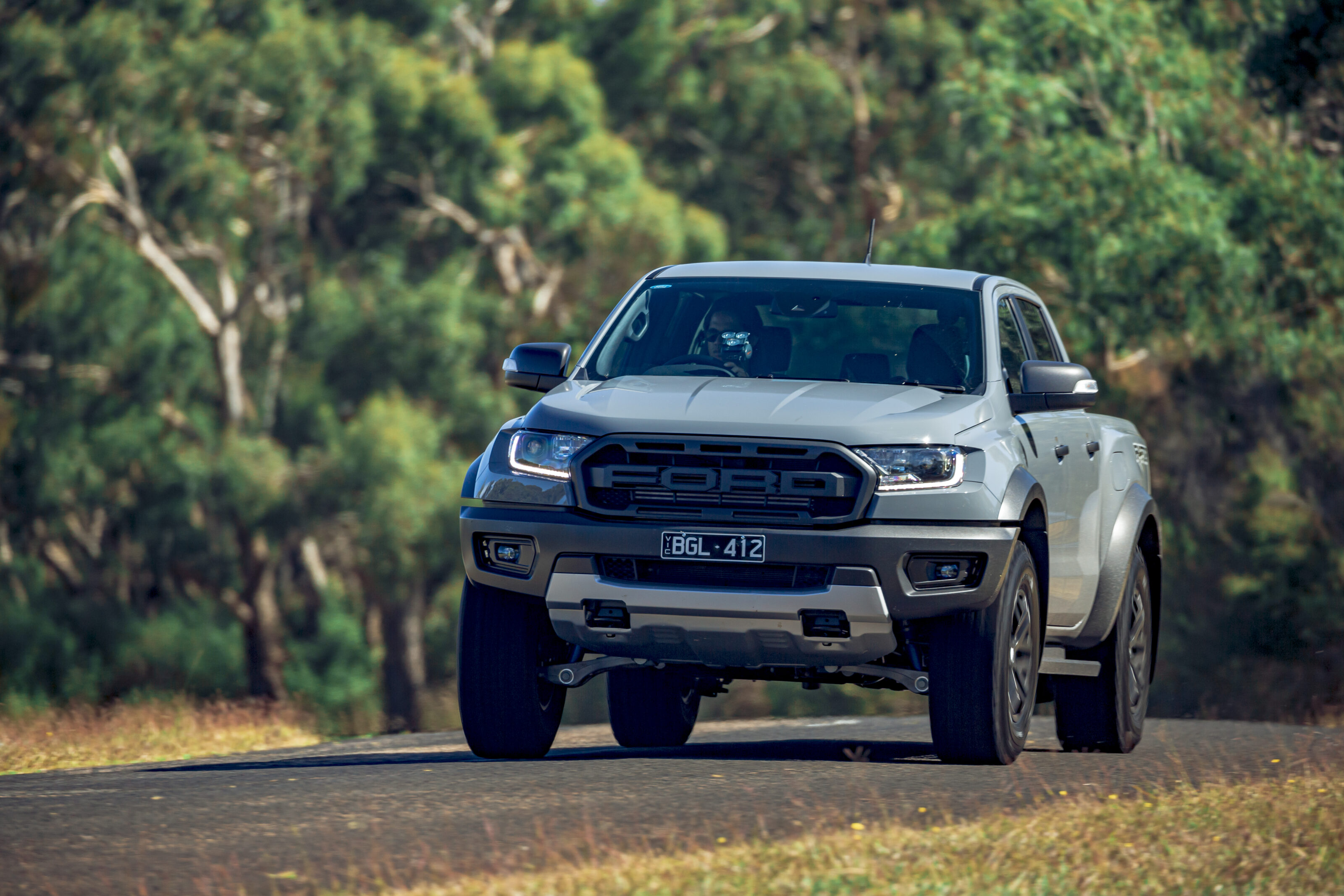
Specifications Engine: 2.0-litre four-cylinder diesel, twin-turbo Power/Torque: 157kW/500Nm Weight: 2332kg Tyres: 285/70 R17 116/113S BFGoodrich All-Terrain T/A KO2
The Times 0-100km/h: 10.85sec 60-100km/h: 6.2sec 100-0km/h: 46.16m (dry) 100-0km/h: 61.45m (wet) 20-60km/h (laden): 4.2sec 20-60km/h (towing): 6.7sec
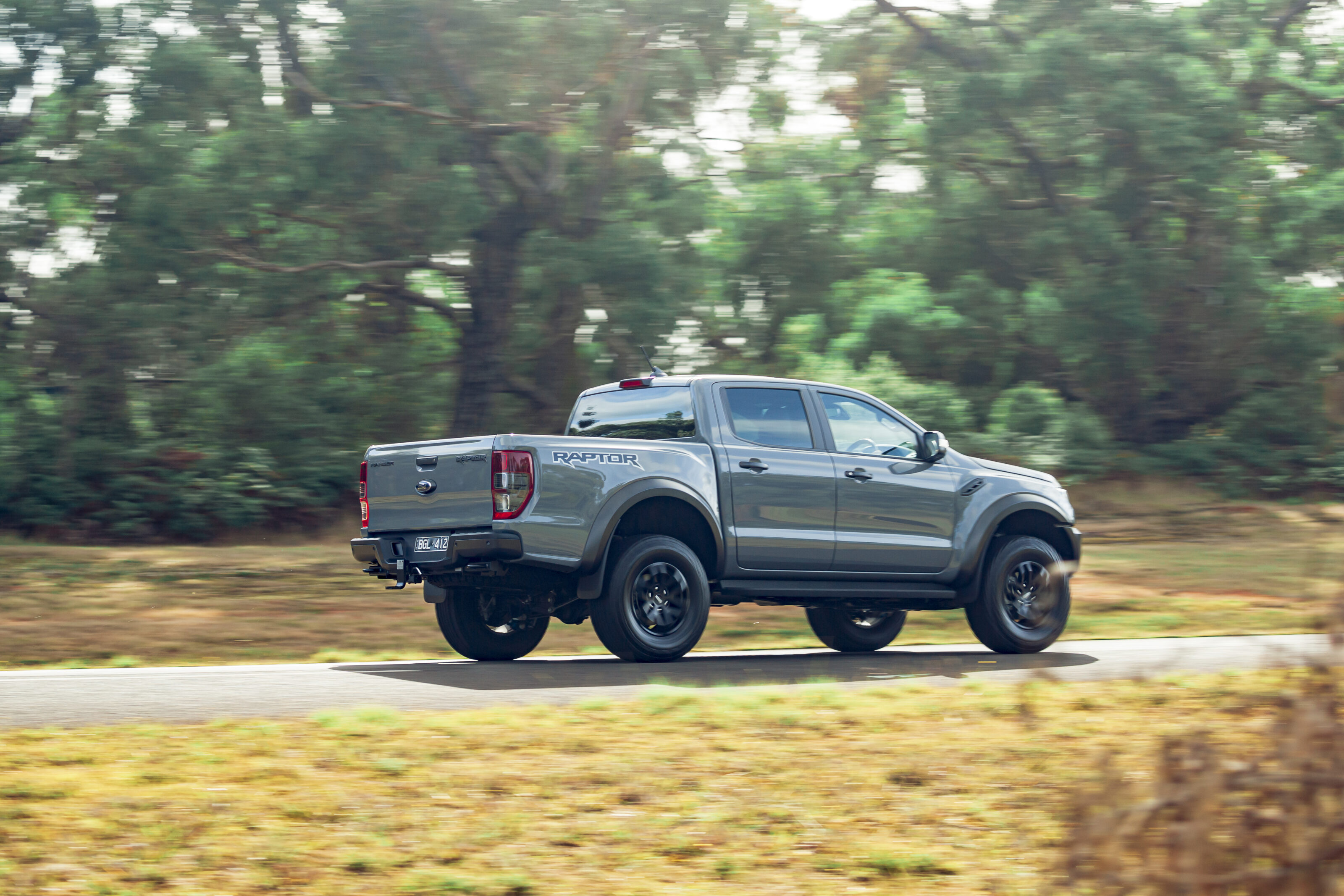
Can the Ford Ranger Raptor get a real engine, please? To be fair, the 2.0-litre twin-turbo four-cylinder diesel is an impressive unit, but it’s out of its depth here.
The problem is that the Ranger Raptor doesn’t just weigh a tonne, it weighs more than 2.3 of them and despite the 10-speed auto’s best efforts at keeping the engine on song – evidenced by the respectable 6.2sec time from 60-100km/h – there is just too much mass.
This Ford Performance product might not be about outright acceleration, but it’s almost two seconds slower than the Ranger XLT with the same engine thanks to that extra weight and the rolling resistance of those massive BFGoodrich tyres.
Under braking those tyres also handicap the Ranger Raptor, with a truly appalling stopping distance of more than 46m in the dry and a 61.5m effort in the wet that’s little better.
There’s little wrong with the Raptor’s laden performance, posting impressive figures, but that fancy coil rear-end doesn’t appreciate the added weight and sags significantly.
Jeep Gladiator Rubicon – 6/10
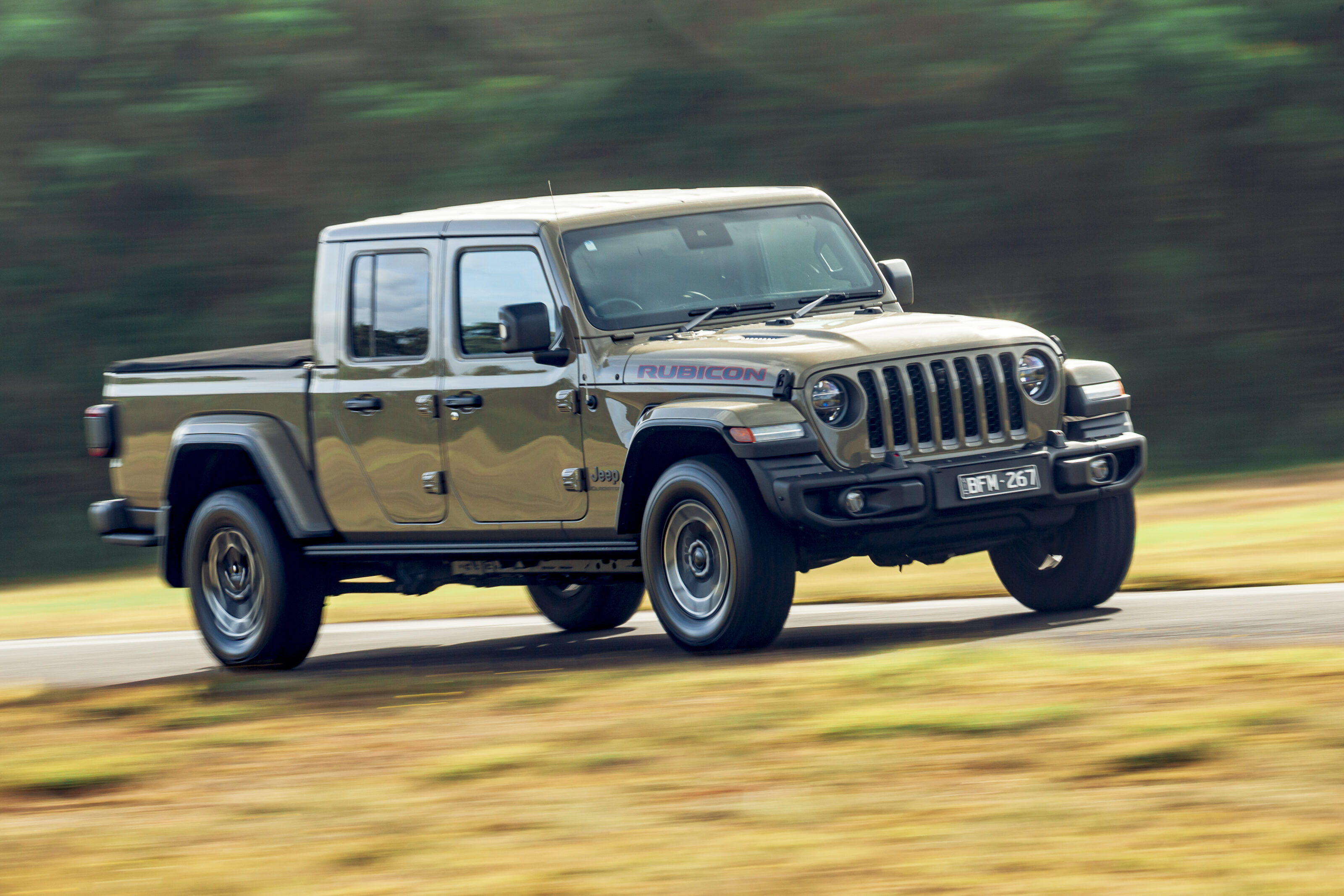
Specifications Engine: 3.6-litre V6 petrol Power/Torque: 209kW/347Nm Weight: 2215kg Tyres: 255/75 R17 111/1080 BFGoodrich Mud Terrain T/A KM230
The Times 0-100km/h: 9.18sec 60-100km/h: 5.2sec 100-0km/h: 44.2m (dry) 100-0km/h: 66m (wet) 20-60km/h (laden): 3.4sec 20-60km/h (towing): 6.3sec
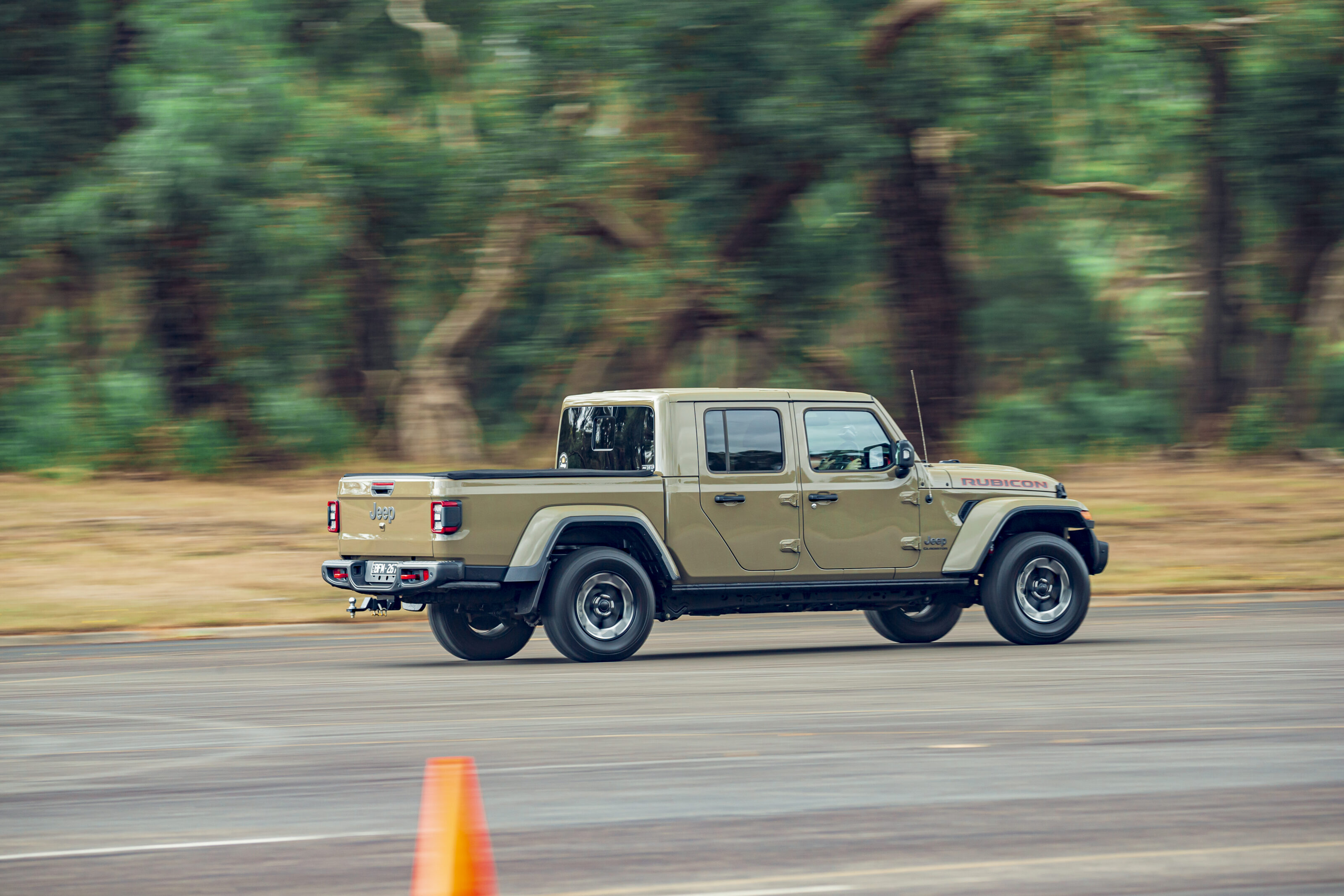
In a segment dominated by turbocharged four-cylinder diesels, a naturally aspirated petrol V6 is both a breath of fresh air and literal music to our ears.
Figures of 209kW/347Nm would be reasonable in a sportscar and they shift the massive Jeep Gladiator Rubicon well enough, accompanied by a howl that isn’t a million miles away from a Nissan 370Z.
Unfortunately, like the Ranger Raptor, the Gladiator Rubicon wears chunky BFGoodrich tyres and they result in diabolical braking performance.
Stopping from 100km/h in the dry takes more than 44m but in the wet the Jeep just sails across the surface like it’s Teflon, taking 66m to come to a halt. That’s between 10-15m more than most other dual-cab utes and could be the difference between having a serious accident and avoiding one completely.
Its power makes itself known when laden with the quickest 20-60km/h of 3.4sec and second-quickest towing 20-60km/h of 6.3sec, but the Gladiator isn’t particularly comfortable doing so.
Nissan Navara ST-X – 6.5/10
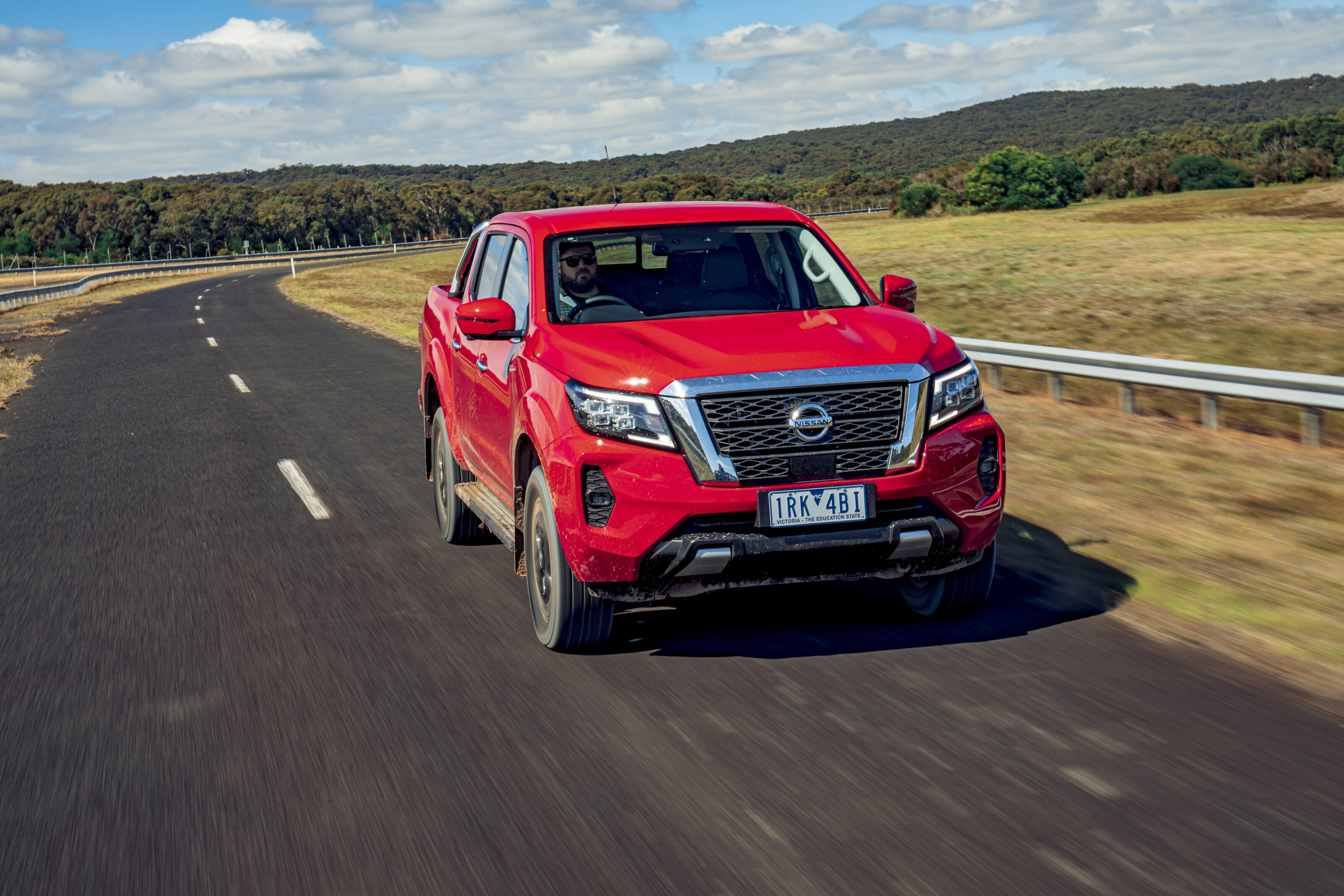
Specifications Engine: 2.3-litre four-cylinder diesel, twin-turbo Power/Torque: 140kW/450Nm Weight: 2134kg Tyres: 255/60 R18 108H Toyo Open Country
The Times 0-100km/h: 11.32sec 60-100km/h: 6.4sec 100-0km/h: 41.39m (dry) 100-0km/h: 55.68m (wet) 20-60km/h (laden): 4.4sec 20-60km/h (towing): 7.8sec
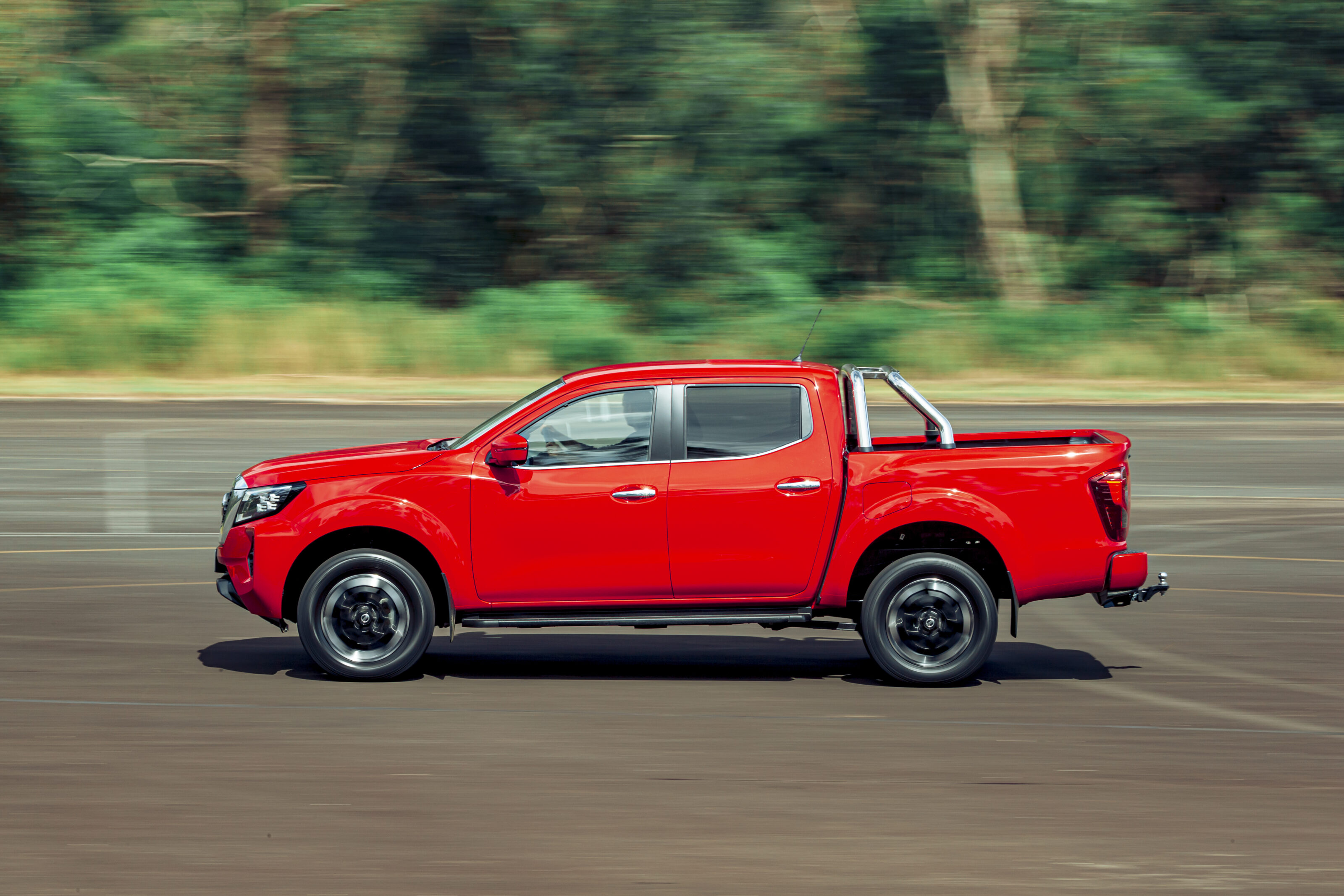
If we weren’t timing this, the new Nissan Navara ST-X would’ve fared much better. It feels punchy; the 2.3-litre four-cylinder diesel isn’t overly powerful at 140kW/450Nm but the seven-speed automatic makes the most of it.
The engine revs keenly to almost 4500rpm, making the Navara feel really quite sprightly and its lacklustre figures all the more surprising. Still, it’s quite a pleasant experience, but is that preferable to a more rugged engine that’s more powerful?
Braking is quite poor, taking well over 40m to stop in the dry, though its mid-50m effort in the wet is more competitive. An unusual case, the Navara: the data is quite damning but from behind the wheel it’s much more impressive.
It struggles slightly under load, taking 4.4sec and 7.8sec from 20-60km/h when laden and towing respectively, numbers that are towards the tail end of the pack.
Mazda BT-50 Thunder – 7/10
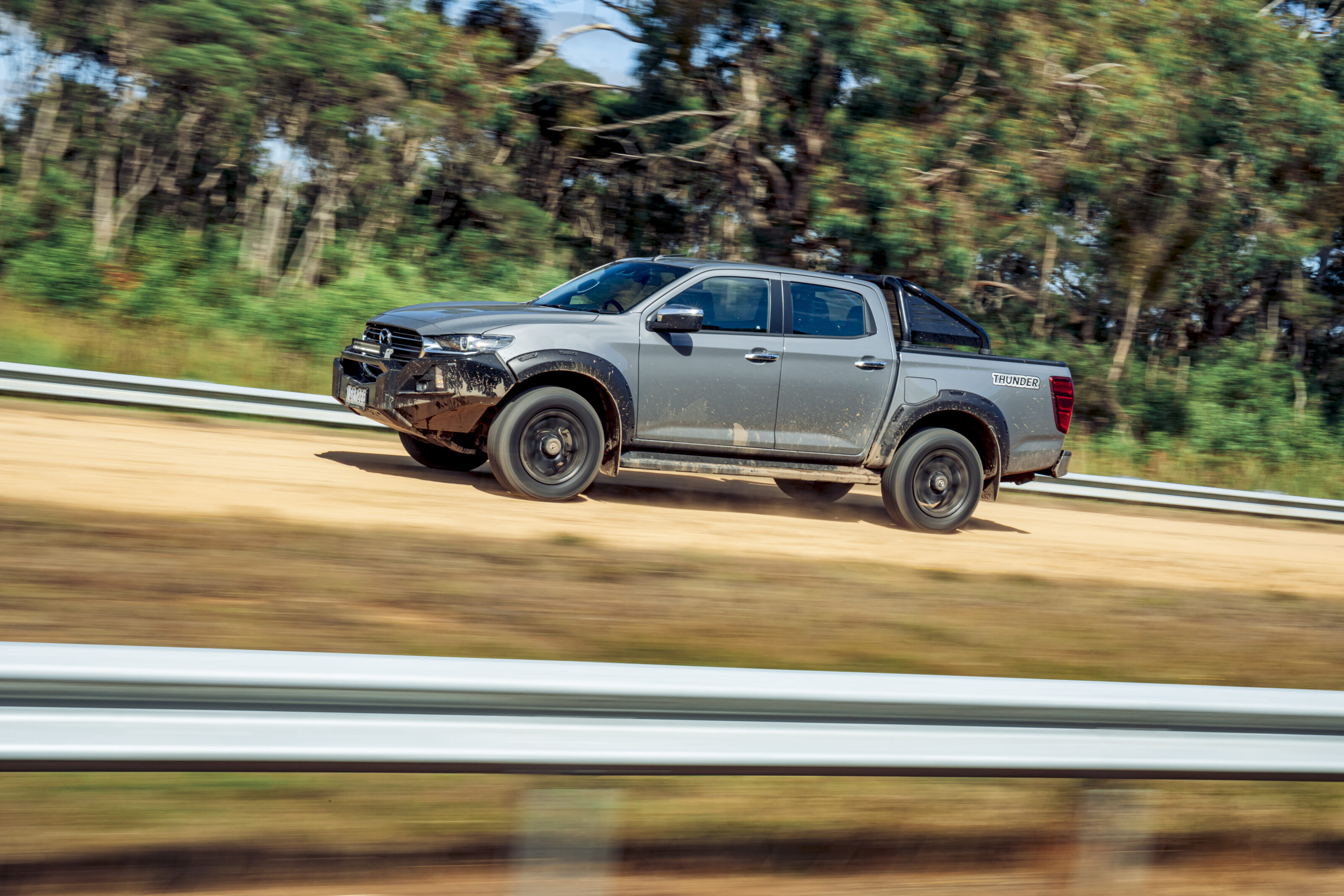
Specifications Engine: 3.0-litre four-cylinder diesel, turbo Power/Torque: 140kW/450Nm Weight: 2213kg Tyres: 265/60 R18 110S Bridgestone Dueler H/T
The Times 0-100km/h: 10.84sec 60-100km/h: 6.3sec 100-0km/h: 38.82m (dry) 100-0km/h: 52.74m (wet) 20-60km/h (laden): 4.4sec 20-60km/h (towing): 7.3sec
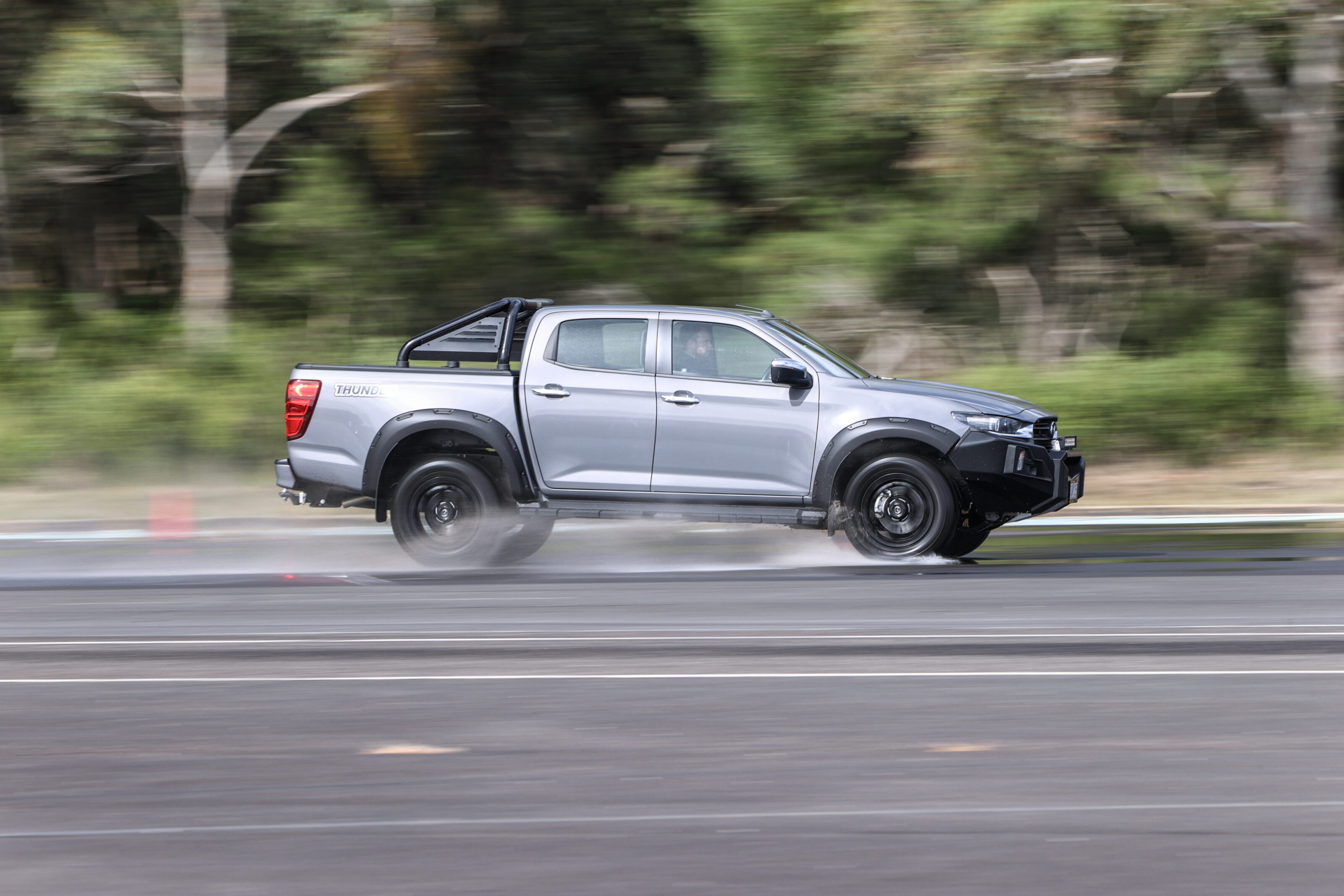
Momentary confusion as I swear I just got out of the D-Max yet everything is the same, before remembering that the Isuzu D-Max and Mazda BT-50 are identical under the skin (and above the skin in certain places). Such is life in the age of platform sharing.
As such, it too is powered by a 140kW/450Nm 3.0-litre four-cylinder turbo-diesel, but don’t think that means performance is identical.
Given engines, transmissions, wheels and tyres ARE identical, the various bits ‘n’ bobs Mazda has applied to this Thunder must weigh a fair bit as it tips the scales by 83kg over the Isuzu and takes almost 11sec to reach 100km/h. It’s slower from 60-100km/h than the D-Max, too.
The BT-50 shines under brakes, though, stopping well short of 40m in the dry and just over 50m in the wet, the smallest distance between the two figures of any of the utes tested.
Hefting those accessories also makes it a couple of tenths slower than the D-Max when laden but figures aside, the Mazda is relatively unburdened by its added weight.
Toyota HiLux Rugged X – 7/10
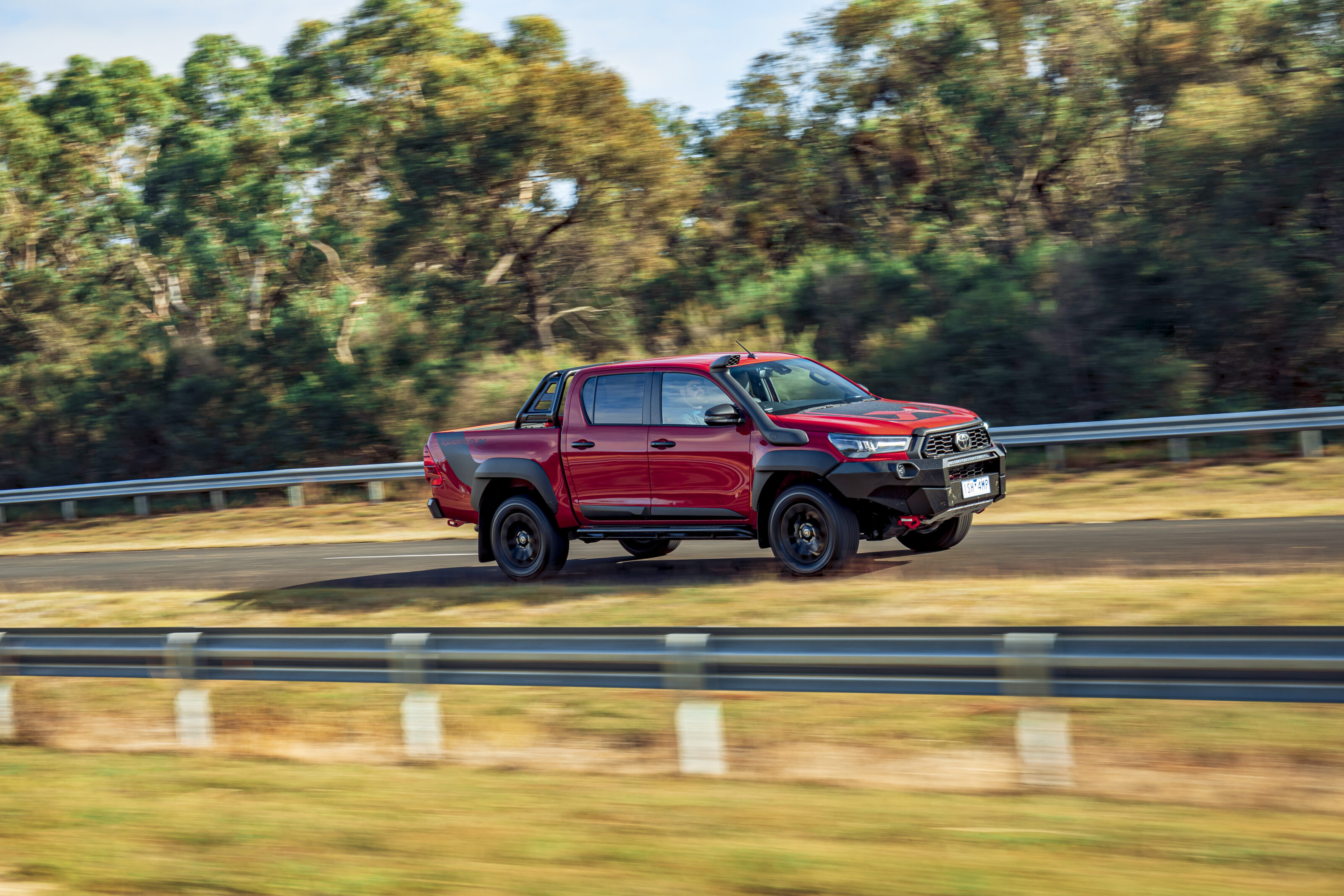
Specifications Engine: 2.8-litre four-cylinder diesel, turbo Power/Torque: 150kW/500Nm Weight: 2316kg Tyres: 265/65 R17 112S AT25 Dunlop Grandtrek
The Times 0-100km/h: 10.7sec 60-100km/h: 5.8sec 100-0km/h: 39.7m (dry) 100-0km/h: 57.5m (wet) 20-60km/h (laden): 4.2sec 20-60km/h (towing): 7.2sec
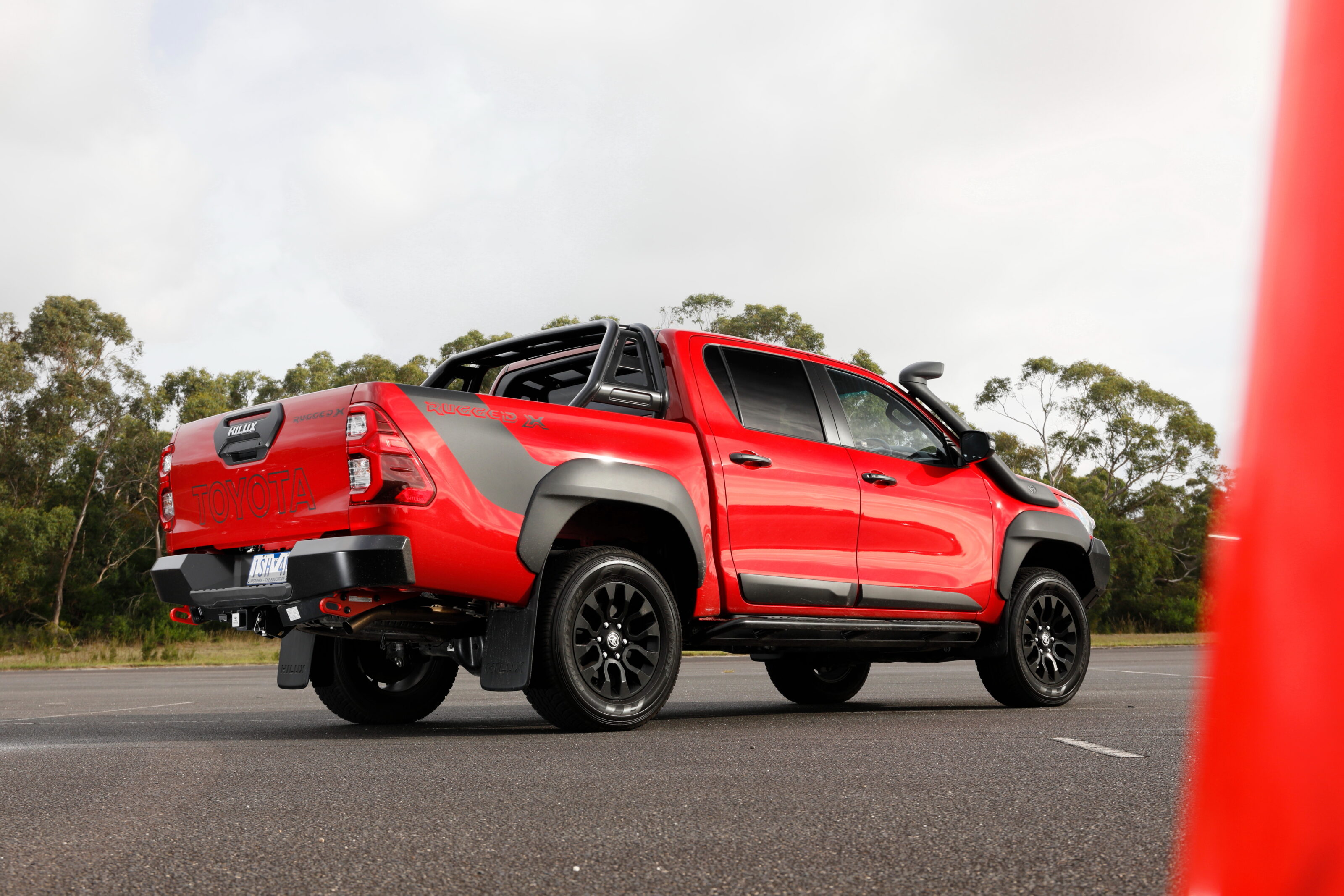
The flagship Rugged X is the heaviest of all Toyota HiLux variants but the newly uprated engine shrugs off the burden.
As an auto-only proposition, it receives the full 150kW/500Nm whack from the 2.8-litre four-cylinder diesel, 80Nm more than with the manual available on lesser variants.
Granted, 0-100km/h in a shade under 11sec isn’t going to set too many hearts racing but combined with competitive overtaking acceleration the HiLux doesn’t seem short of grunt, feeling stronger than the numbers suggest.
Braking performance is average in the dry at a tick under 40m but on the poor side in the wet, requiring close to 60m to stop.
As when unladen, the HiLux’s figures of 4.2sec and 7.2sec from 20-60km/h when laden and towing respectively might not be too eye-popping, but the Toyota performs the tasks with relative ease.
Isuzu D-Max X-Terrain – 7.5/10
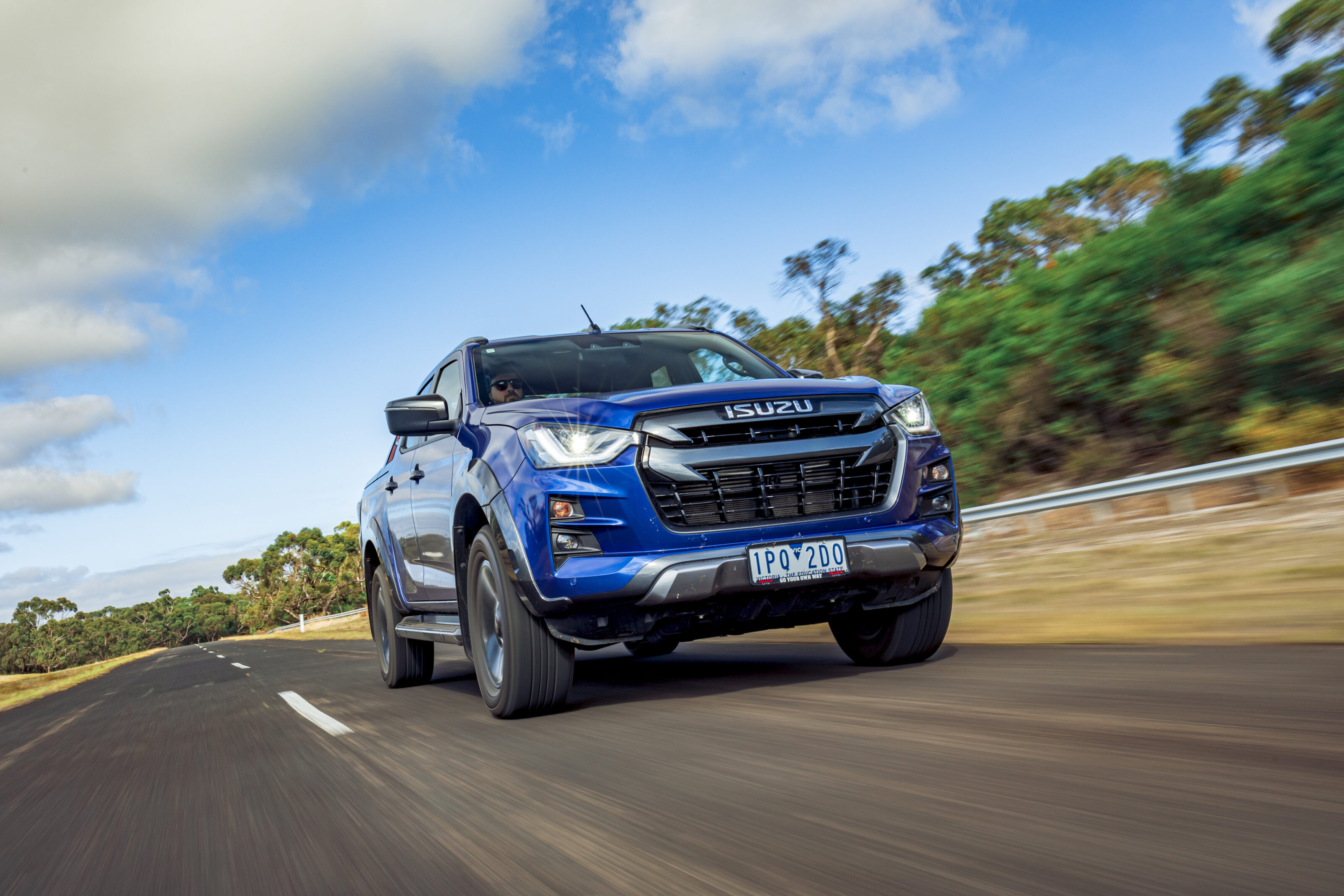
Specifications Engine: 3.0-litre four-cylinder diesel, turbo Power/Torque: 140kW/450Nm Weight: 2130kg Tyres: 265/60 R18 110S Bridgestone Dueler H/T
The Times 0-100km/h: 10.1sec 60-100km/h: 6.0sec 100-0km/h: 38.44m (dry) 100-0km/h: 57.36m (wet) 20-60km/h (laden): 4.0sec 20-60km/h (towing): 6.9sec
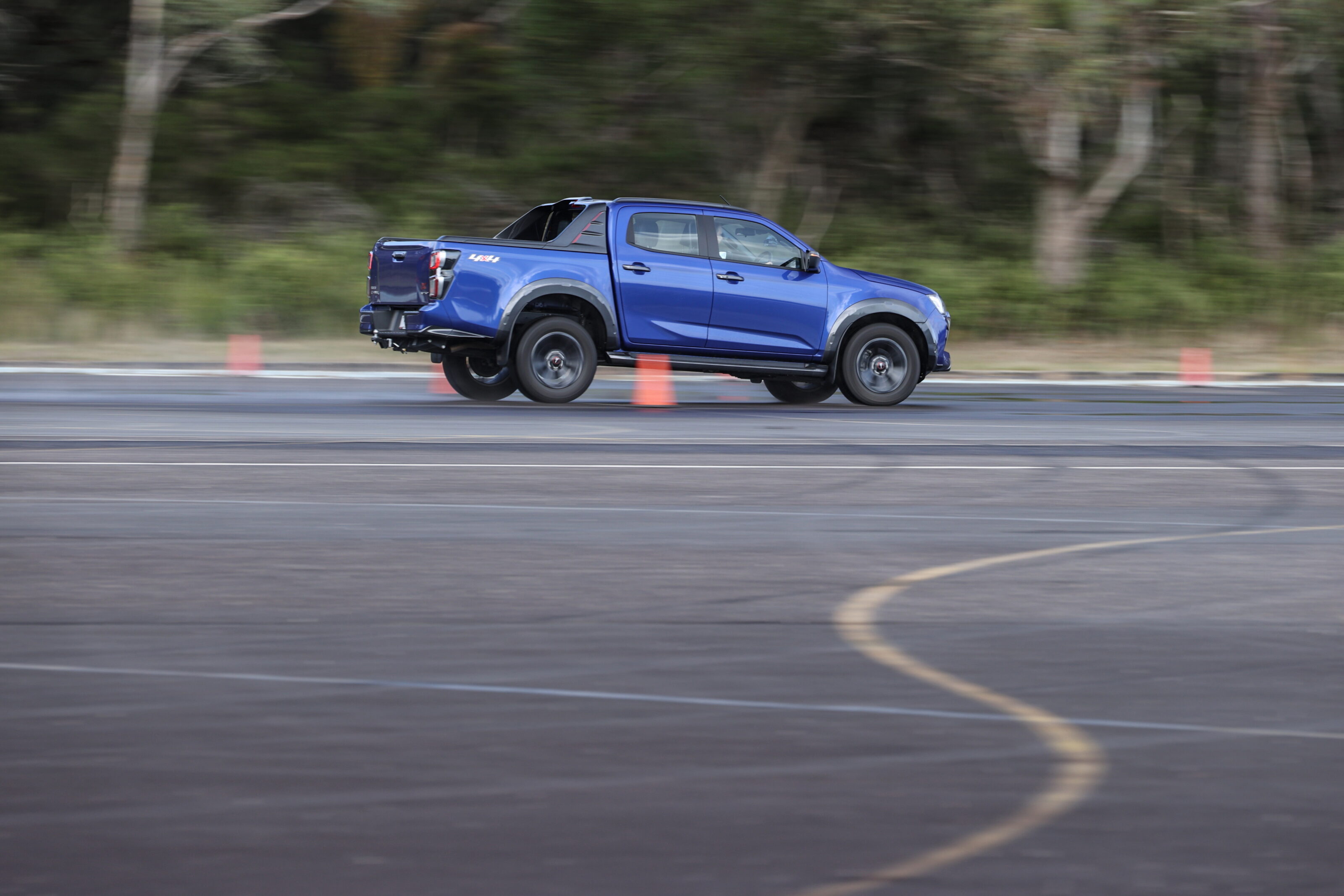
The D-Max shoots off the line eagerly, even chirping its tyres. This enthusiasm doesn’t last, with acceleration tailing off as speeds increase, but the 3.0-litre four-cylinder turbo-diesel offers respectable mid-range muscle.
It would benefit from more gears than its current six to exploit the engine’s relatively narrow power band. The noise is also a definite reminder of the Isuzu’s workhorse roots, with plenty of diesel clatter at all revs.
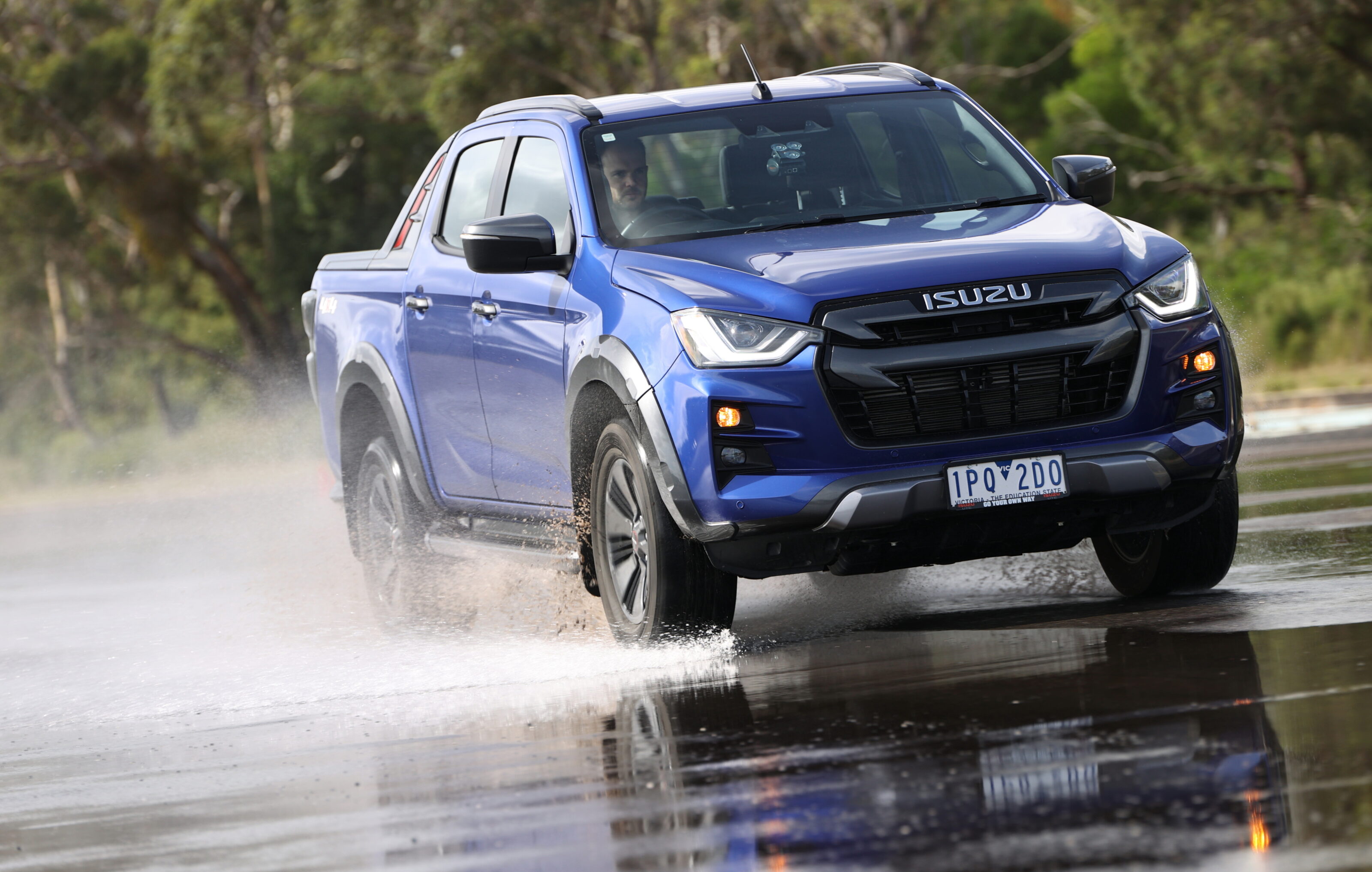
Braking performance is impressive for a vehicle like this, with a consistent and confidence-inspiring sub-40m dry stop. Wet braking is quite poor at more than 57m and on the final stop, some steering correction is required to keep the D-Max straight despite all electronic stability programs being activated.
With strong low- to mid-range torque, the D-Max loves to haul and records impressive 20-60km/h figures of 4.0sec laden and 6.9sec when towing.
Ford Ranger XLT Bi-Turbo – 7.5/10
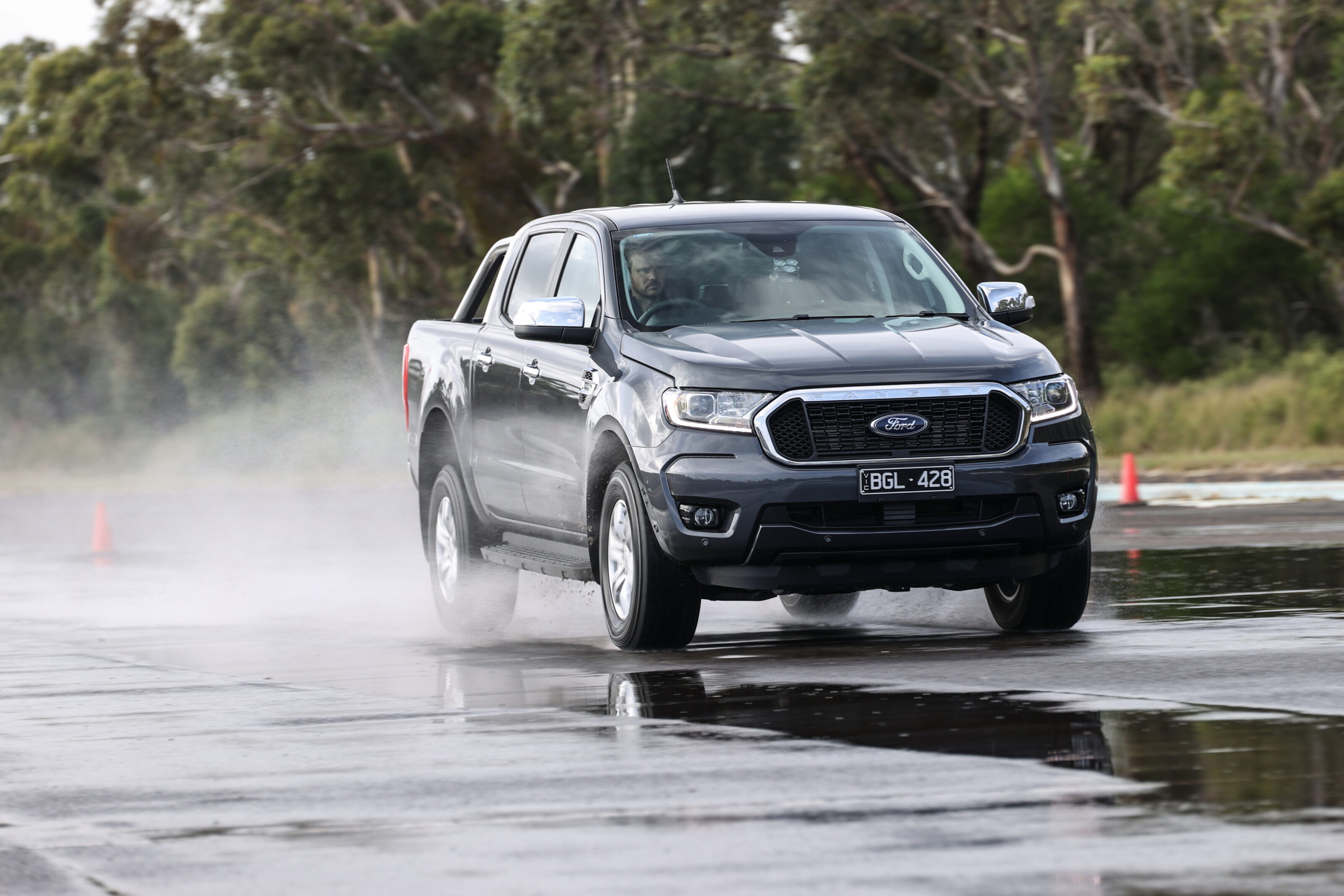
Specifications Engine: 2.0-litre four-cylinder diesel, twin-turbo Power/Torque: 157kW/500Nm Weight: 2197kg Tyres: 265/65 R17 112T Dunlop Grandtrek
The Times 0-100km/h: 8.93sec 60-100km/h: 5.0sec 100-0km/h: 42.06m (dry) 100-0km/h: 63.68m (wet) 20-60km/h (laden): 3.6sec 20-60km/h (towing): 6.0sec
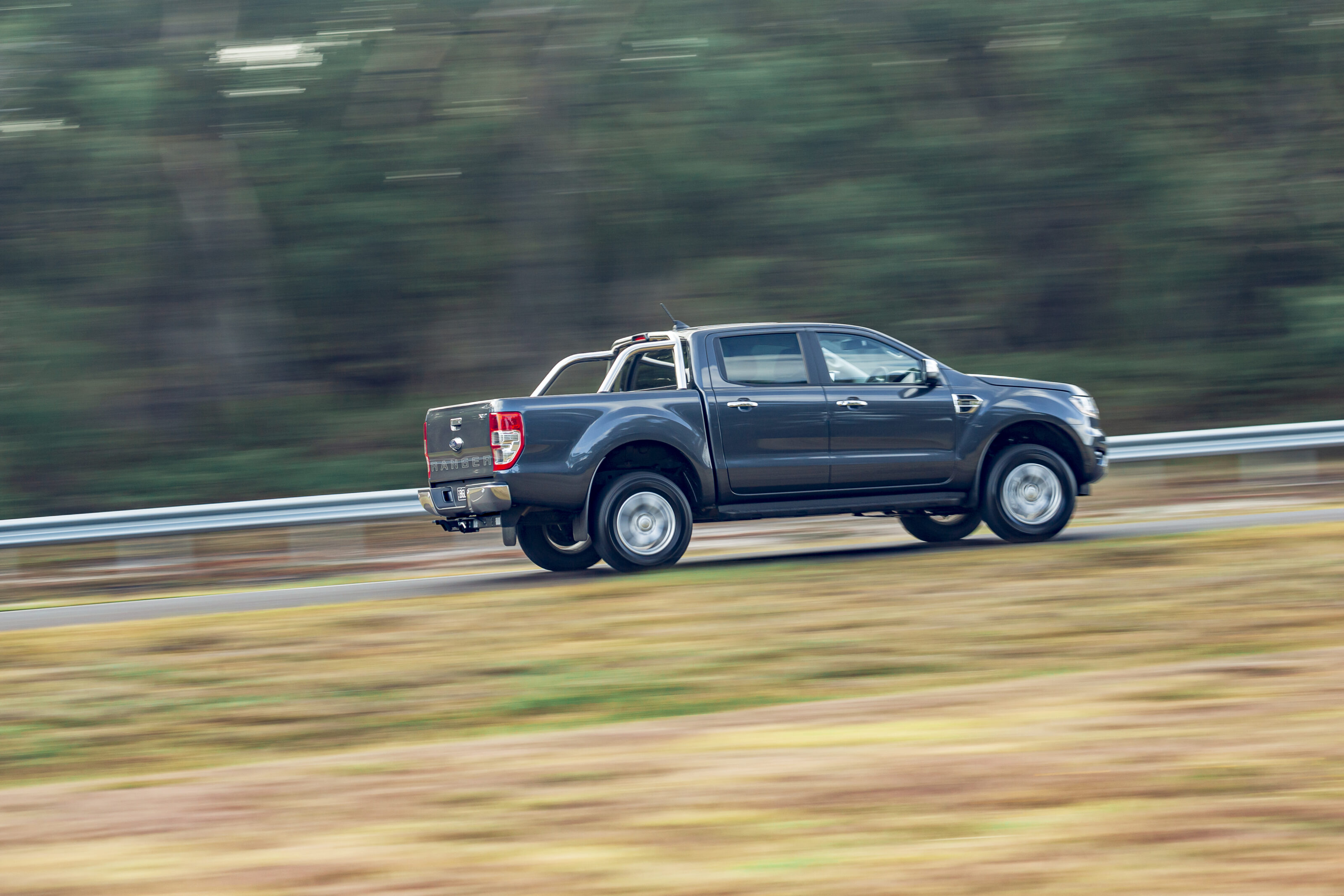
The Ford Ranger XLT is definitely the sprinting star of our assembled group. Its engine may offer just two litres but a pair of turbos help produce a healthy 157kW and 500Nm, returning excellent acceleration results in all areas.
It makes a reasonably sporty noise as far as diesels go and there’s an impressive spread of torque but the star of the show has to be the 10-speed automatic, which always keeps the engine on song.
The figures prove the efficacy of this approach and the transmission does a good job of figuring out which of its myriad ratios it wants at any given moment.
Sadly, the Ranger blots its copybook with sub-standard braking. It wears similar all-terrain tyres to its rivals – in this case Dunlop Grandtreks – but takes more than 42m to come to a stop from 100km/h.
That figure blows out to almost 64m on a wet surface, a poor performance that prevents the Ranger XLT from being the clear performance leader.
Toyota HiLux SR5 – 7.5/10
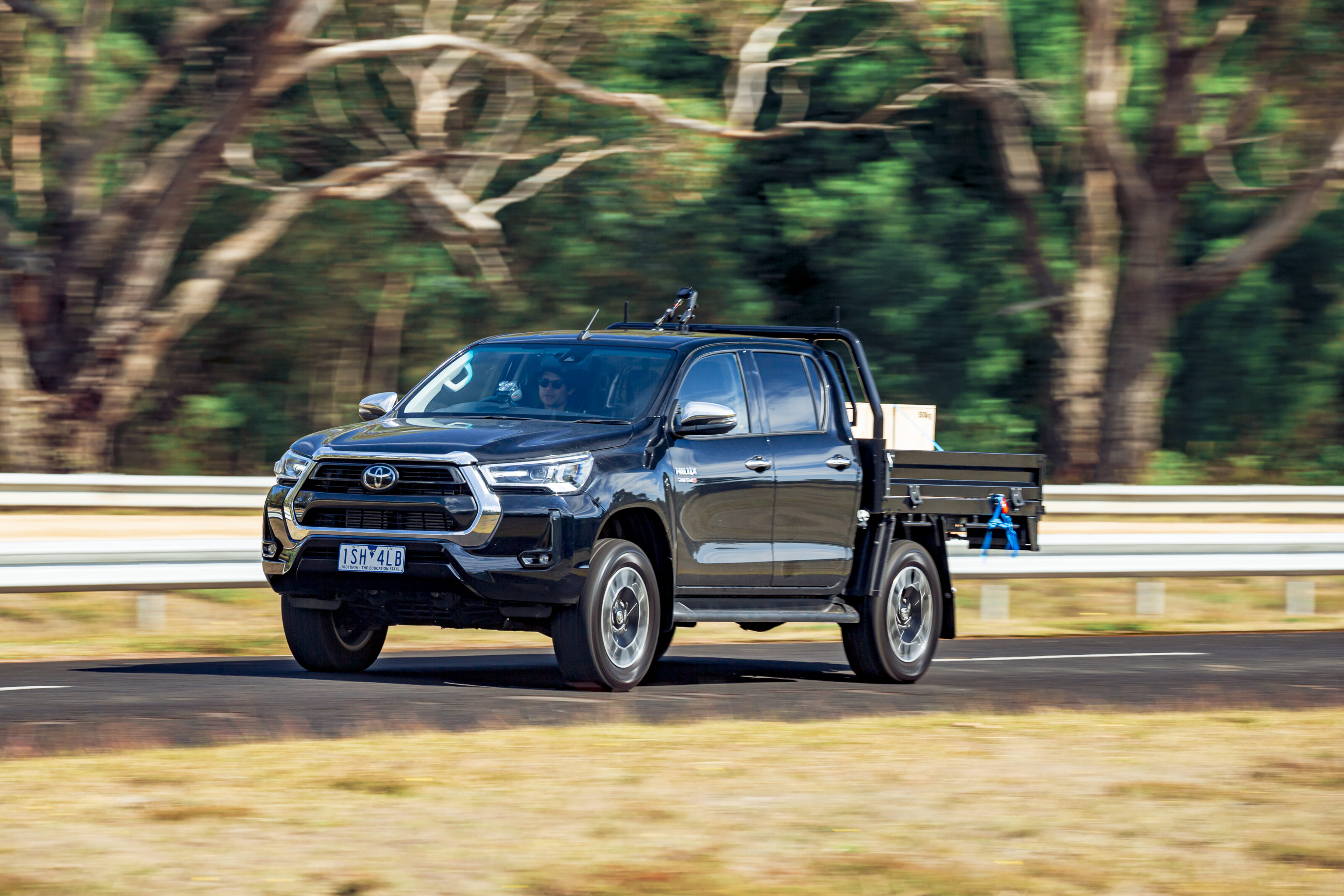
Specifications Engine: 2.8-litre four-cylinder diesel, turbo Power/Torque: 150kW/500Nm Weight: 2383kg Tyres: 265/60 R18 110H Bridgestone Dueler H/T 684
The Times 0-100km/h: 11.1sec 60-100km/h: 6.0sec 100-0km/h: 39.3m (dry) 100-0km/h: 52.66m (wet) 20-60km/h (laden): 4.5sec 20-60km/h (towing): 7.2sec
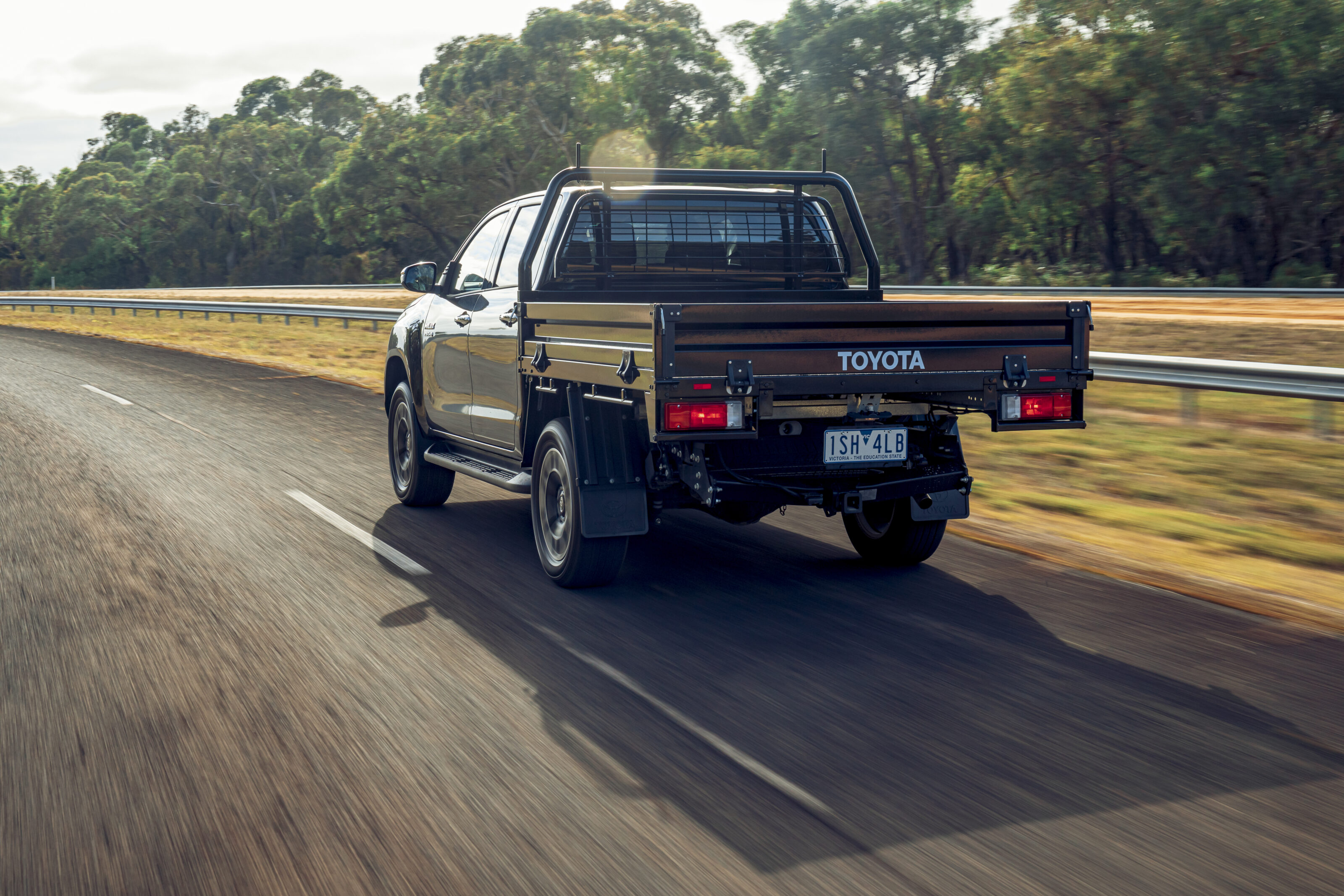
The Toyota HiLux’s upgraded engine serves it well. The 2.8-litre four-cylinder diesel now produces 150kW/500Nm (as an automatic; the manual is limited to 420Nm) and it feels every bit of it, pulling strongly through the rev range accompanied by an intense growl.
This particular SR5’s accelerative efforts are hampered somewhat by the significant weight of the steel tray, which adds almost 300kg to the HiLux’s mass.
Braking is an SR5 strong suit, with a sub-40m dry stop backed up by an impressive wet performance of just over 50m – the class of the field.
Like the Rugged X the SR5 is unflustered by hauling loads, though once again its figures suffer from the added weight. It might seem strange that this HiLux might top score when other utes were much quicker, but the score also takes into account that its impressive braking and its acceleration would be much more competitive when fitted with a standard tray.
Dual-cab ute performance testing summary
The Ford Ranger XLT would have walked this category if only it stopped as well as it went. Its poor braking is the only fly in the ointment of an otherwise dominant performance.
Granted, it’s had plenty of development over its lifetime, but the fact that the oldest ute here has easily the most potent and refined drivetrain should have the other manufacturers looking at their feet sheepishly.
The D-Max/BT-50 twins are the best of the rest, the 3.0-litre turbodiesel doing no harm at all to Isuzu’s reputation of offering workhorse engines. But a word must go to the HiLux’s uprated powerplant, which is definitely a step in the right direction.
Jeep’s petrol-powered Gladiator does the numbers but it would seem reasonable to assume many would trade its outright grunt for the better efficiency and low-end torque of a decent diesel.
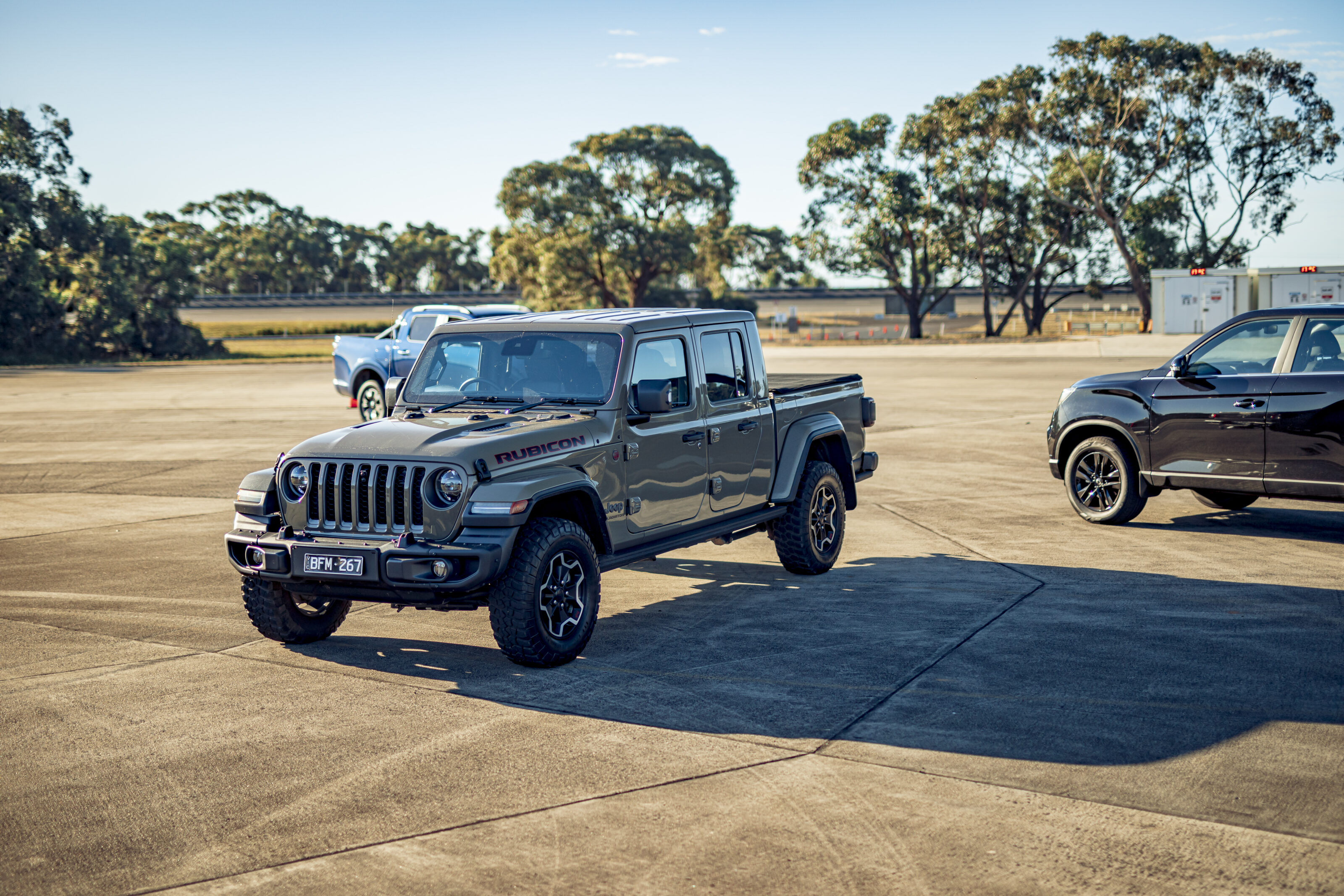
Speaking of the Gladiator, both it and the Ranger Raptor are evidence of the detrimental effect that fitting aggressive off-road tyres has to the on-road behaviour of a dual-cab. Both displayed a disturbing lack of braking ability on wet and dry surfaces, so take this into account if you’ve modified your ute to go bush.
At the tail end of the field are the GWM Ute and Ssanyong Musso, whose small capacity engines suggest there is no replacement for displacement (Ford’s Bi-Turbo unit being the exception that proves the rule).
Mitsubishi’s Triton is also disappointing for both its lack of urge and noisy operation; Nissan’s Navara is little quicker but much more pleasant to drive.
Australia is, and always will be, a touring car nation. Until the heat death of the universe, our most popular form of racing will inevitably involve vehicles with a roof, fenders, and functioning doors. Nothing will change this fact. But after more than a decade in the wilderness, the local world of ‘wings and slicks’ is enjoying a revival that could create a new generation of Aussie open-wheel aces. And it is all thanks to S5000.
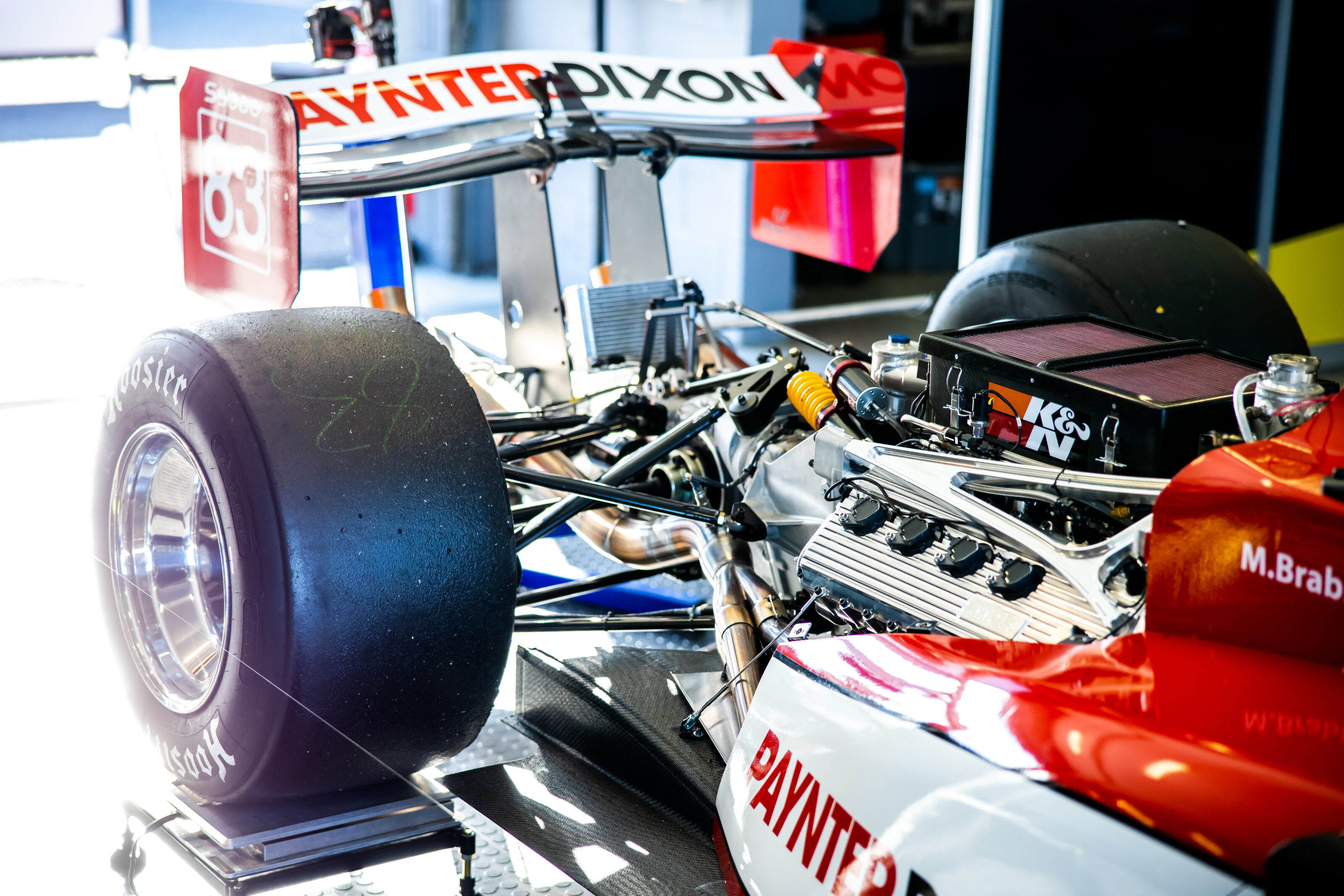
For the uninitiated, S5000 hopes to capture the magic of Formula 5000 big banger racing from the ’70s, with 5.0-litre, naturally aspirated V8 power wedged into a modern-day open-wheel chassis fitted with meaty slick tyres and impressive wings. They might have large aerodynamic additions, but the downforce is limited, meaning that the drivers are forced to work hard in the cockpit. Fast bends that are ‘easy flat’ in other equipment are serious challenges in an S5000.
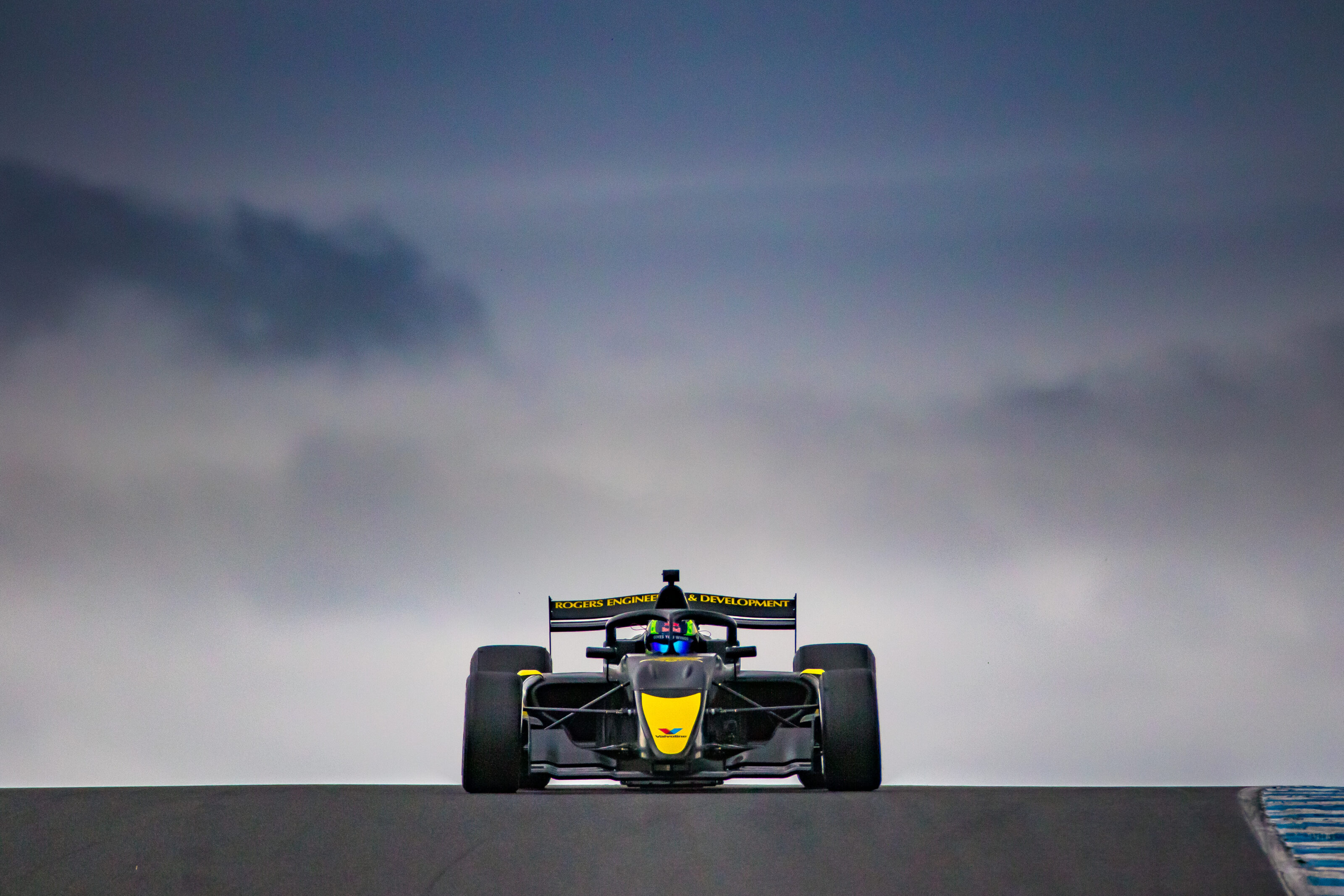
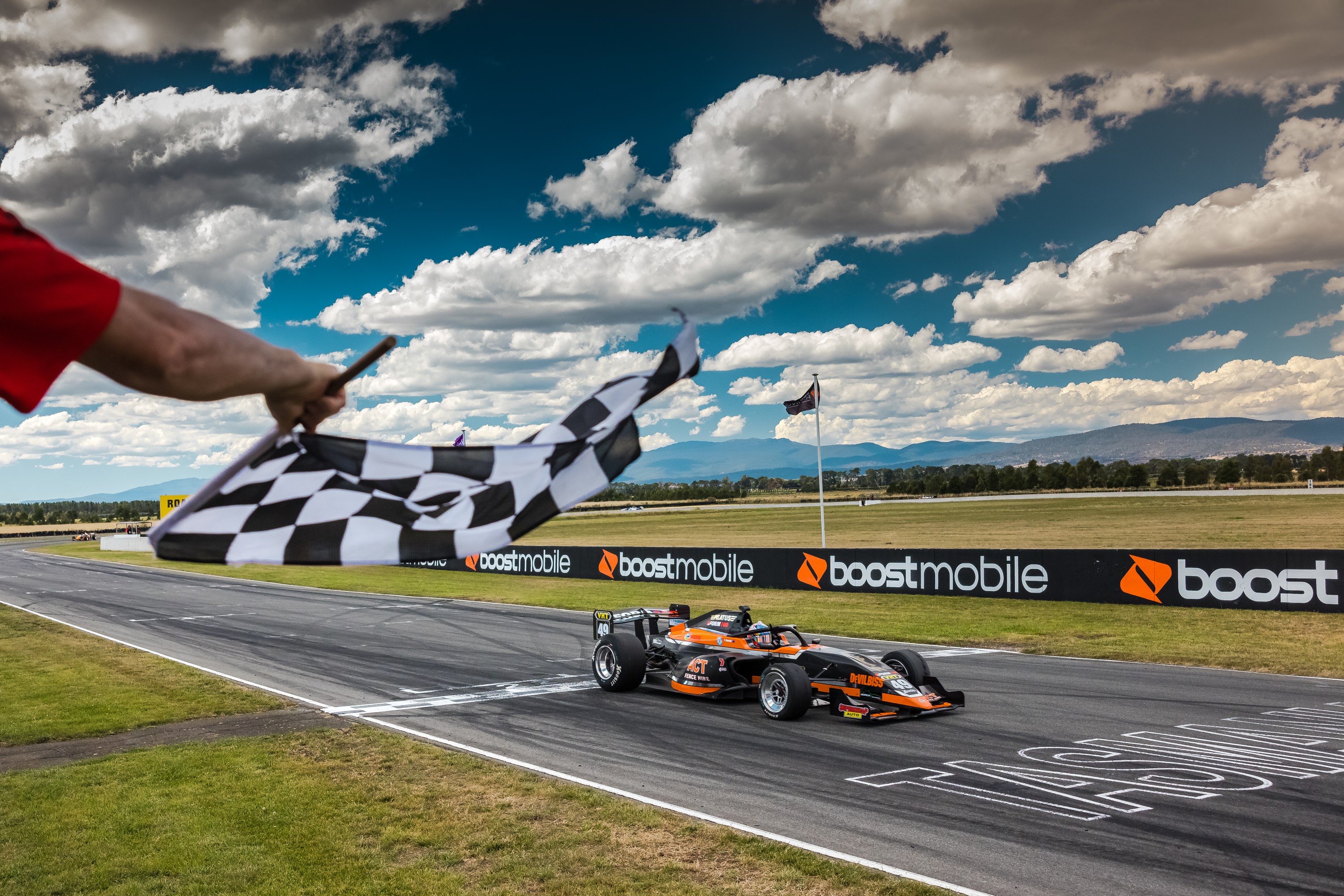
Despite the lack of aerodynamic grip, the S5000 cars are some of the fastest race cars Australian motorsport has ever seen. Symmons Plains Raceway’s lap record had stood unbroken for 41-years before Joey Mawson (who gave Mick Schumacher a bollocking in German F4) smashed the old benchmark earlier this year. Every lap record in the country (bar maybe the time at Sydney Motorsport Park set in A1GP machinery) should be feeling genuinely threatened by S5000’s existence.
The chassis meets full FIA requirements, while the V8 is based on Ford’s venerable Coyote design. Global tech allows the cars to meet world-class standards, but it is Australian engineering know-how that laid the framework for the car, and home grown hands bolting it all together in a Melbourne workshop.
The untold story of S5000 is how it provides an alternative to an expensive (and often fruitless) international endeavour for young drivers aspiring to something other than touring car door-banging. Our (well, technically New Zealand’s) latest international open wheel export is reigning Supercars champion Scott McLaughlin, who has joined Roger Penske’s IndyCar squad. While naturally gifted, McLaughlin’s talents have been fostered in the crucible of Supercars, making him a fish out of water in an open-wheel racer.
In fact, his late departure is unusual for an Australian (or Kiwi) aiming for the global open-wheel stage. Recently our best young talents have fled the country as soon as possible, driven by the widely accepted reasoning that if they are to have any chance of reaching Formula 1, staying in Australia will only prove detrimental. Daniel Ricciardo’s official race record includes just three state-level Formula Ford races in 2005 before he absconded to Europe, while Oscar Piastri has never competed in a state or national championship in Australia beyond karts. Compare this to older hands like Mark Webber, Scott Dixon, and Will Power who all had years of development locally before heading overseas. While S5000 won’t change the fact our best talents will leave our shores young, those who return (which is most of them), will at least have somewhere to ply their trade that isn’t Supercars.
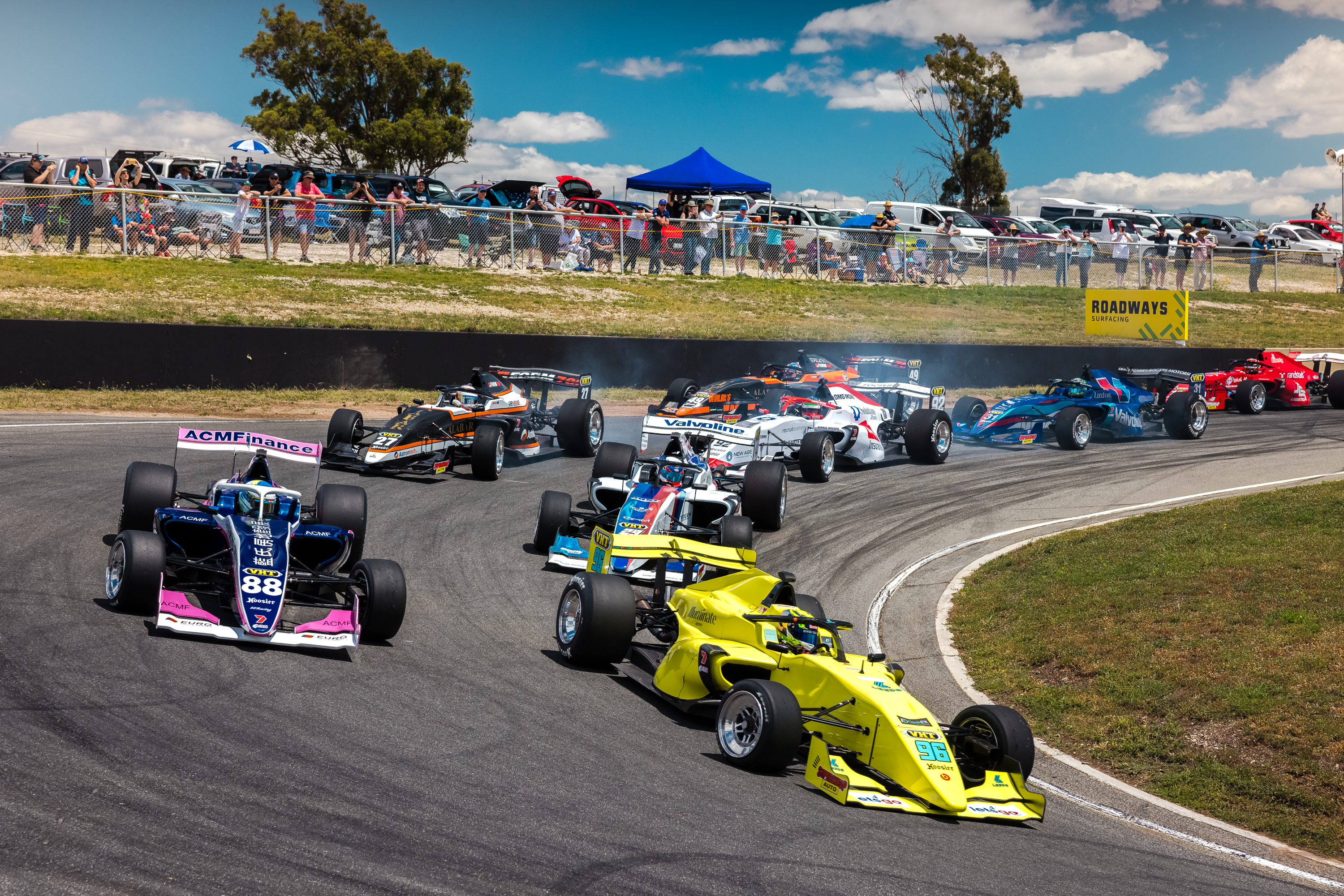
The imaginatively named Australian Racing Group (ARG) is in charge of running S5000, and races are held at the same events as the TCR Championship and growing TA2 series. Currently S5000 plays second fiddle to TCR on the schedule, but with more drivers I see no reason why the big bangers couldn’t become the major drawcard at each event. Alternatively ARG could take inspiration from our mates across the ditch with its New Zealand Toyota Racing Series, running S5000 during the traditional off-season to attract international drivers hoping to keep their eye in and escape Europe’s bitter winter months.
A S5000 summer series would be an excellent way to lure the likes of McLaughlin, Power, and Dixon back Down Under for a handful of races in front of local fans. Imagine a category where our hottest young talents face off against established touring car aces, wildcard international pros, and returning local heroes. It’s a not-so-unbelievable future, but for it to become a reality it requires us, the fans, to make it happen. So in 2021 do yourself a favour, watch S5000 races on the telly, and when the circus comes to town buy a ticket and watch in person. I know I will be.
Snapshot
- A1 Sportback 40 TFSI gets 5kW more power
- A4 and A5 get new S line competition and S line competition plus options
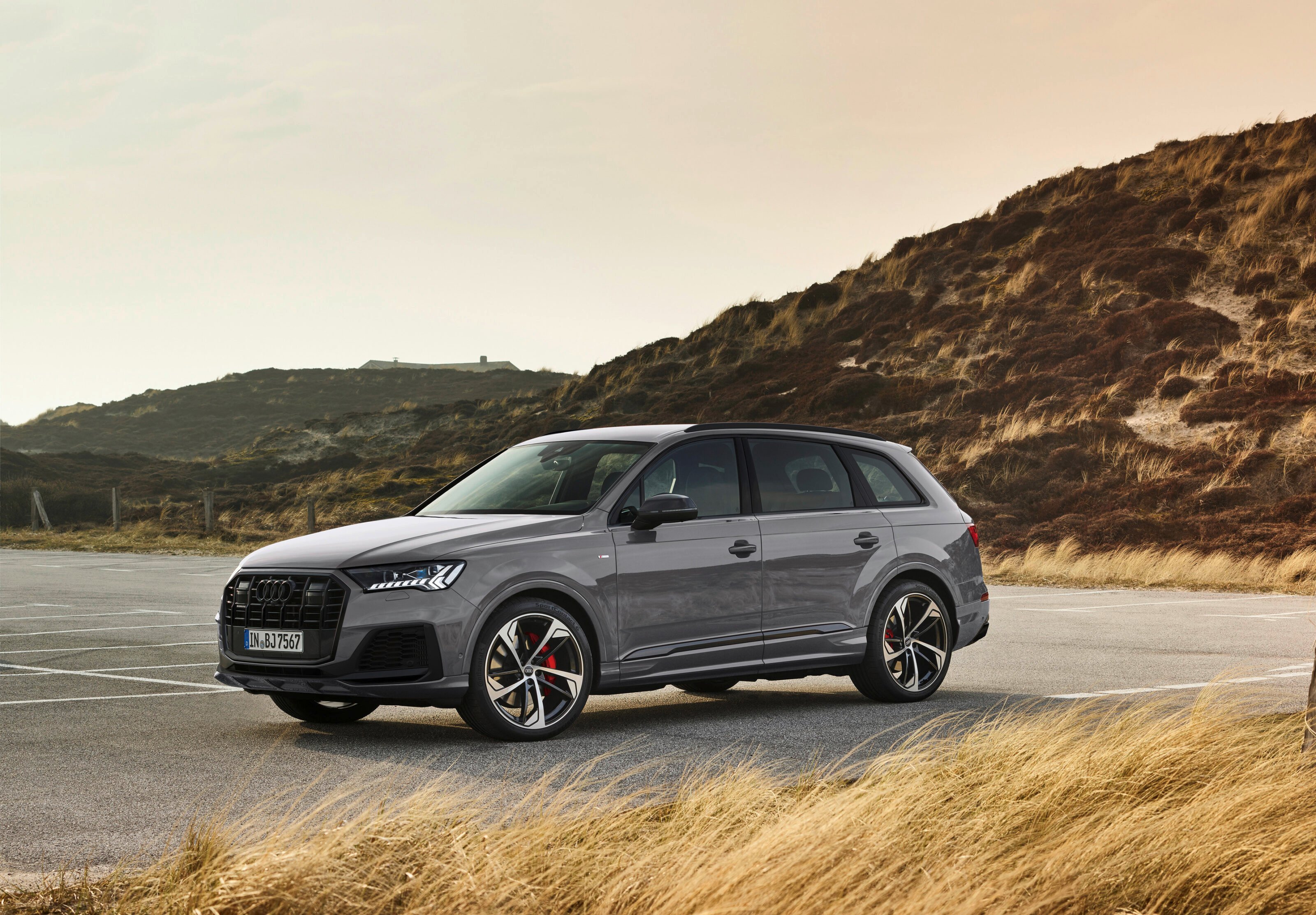
- Audiu2019s Q7 and Q8 score new exterior carbon package option
Audi has announced a range of 2022 model year updates for its A1, A4, A5, Q7, and Q8.The compact A1 Sportback 40 TFSI now gets an extra five kilowatts of power from its CZP turbocharged 2.0-litre four-cylinder petrol engine, bringing the total figure up to 152kW.
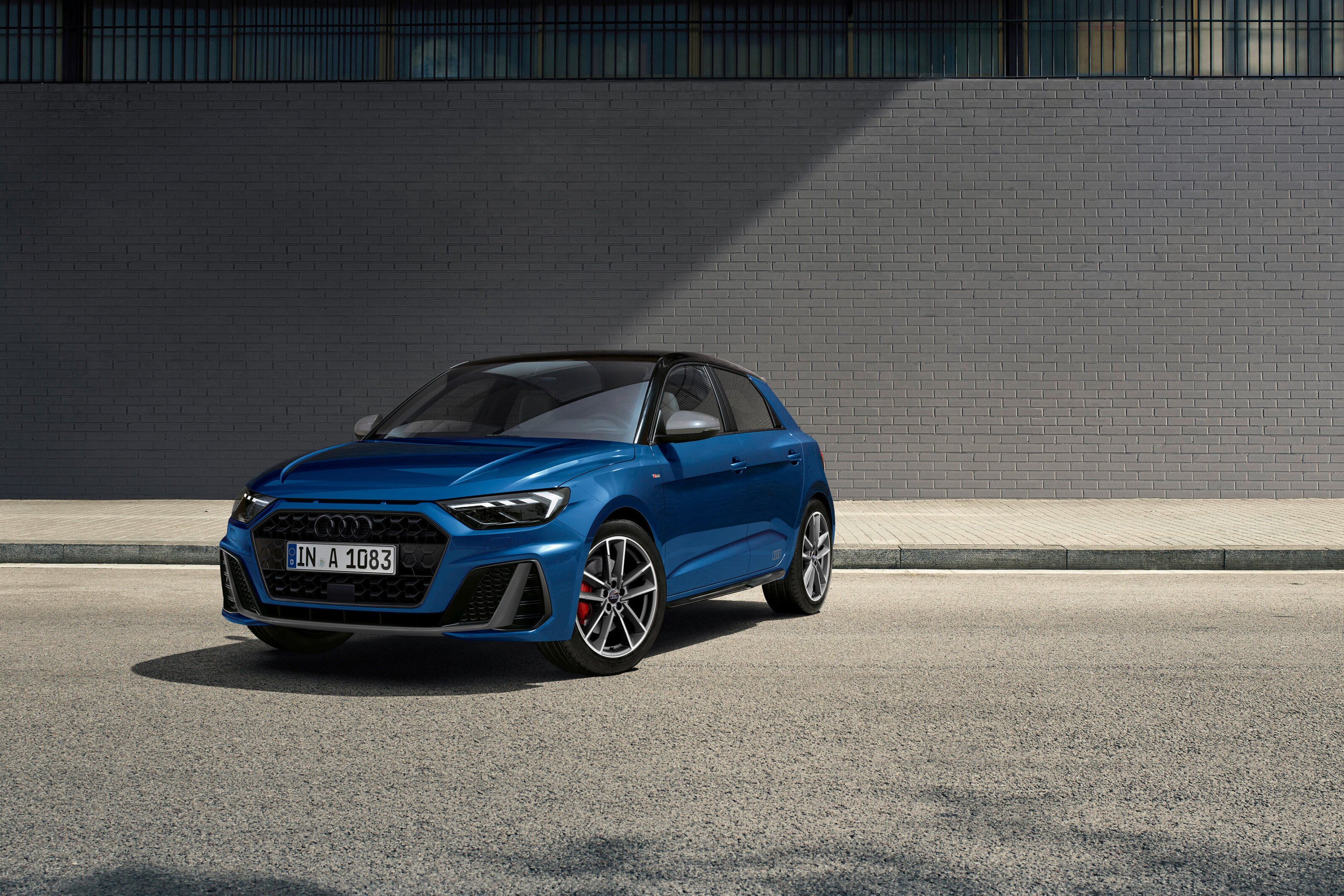
The hatchback scores a new cosmetic ‘S line competition’ pack too, which can be optioned for the range-topping Audi A1 Sportback 40 TFSI, as well as the 35 TFSI and the 30 TFSI.
The S Line Competition pack adds visual extras like darkened LED headlights and taillights, platinum grey side mirrors, and a contrasting grille featuring matte black and high-gloss black accents.
For the 2022 A4 and A5, the Ingolstadt outfit has added two novel visual packs – ’S line competition’ and ‘S line competition plus’.
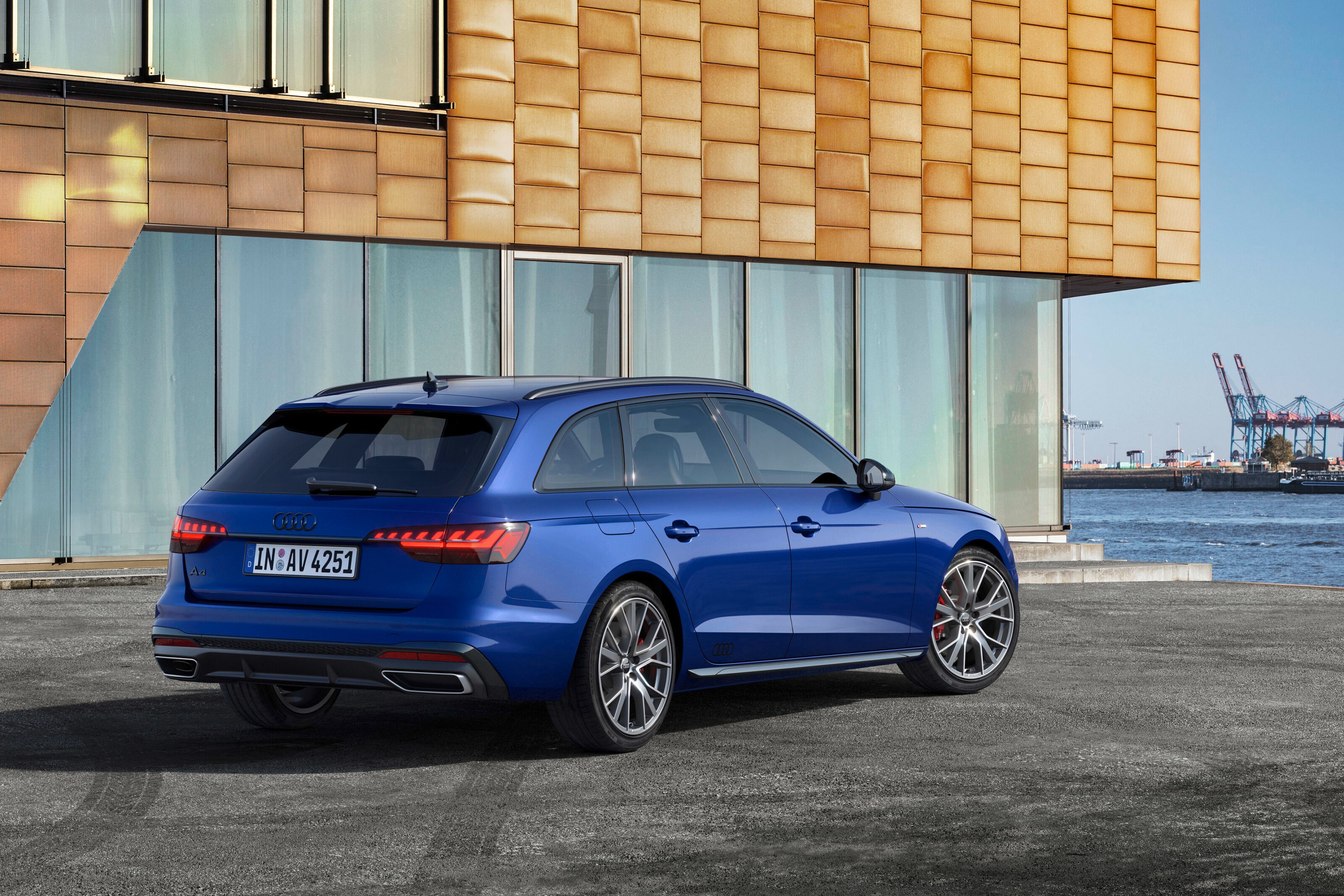
A4 buyers who tick the option box for the S line competition pack will get the S line exterior package, as well as an additional black package.
This adds a matte radiator grille, S4 spoiler, blacked-out Audi rings on the grille, and 19-inch cast alloy wheels.
The S line competition plus pack brings LED headlights, ambient lighting, black side mirrors, and illuminated entry sills with aluminium inlays.
Both cosmetic packs offer different additional features for the A5 coupe and sportback, with the S line competition option gaining 20-inch alloy wheels, while the plus pack adds matrix LED headlights, black side mirrors, red brake calipers, and ambient lighting.
Rounding out the model year upgrades is Audi’s Q7 and Q8. Buyers will be able to select an optional exterior carbon package for both Q cars, as well as newly designed 22-inch wheels for the Q7 and 23-inch wheels for the Q8.
The A1, A4 and A5 are all available to order now, with delivery of the A1 expected in August and A4/A5 in July. The Q7 and Q8 can be ordered from June with delivery late summer – but only in Germany.
It’s unclear at this stage if Australian delivered Audis will be receiving the same 2022 updates as Europe. WhichCar has reached out to Audi for comment.
2022 Audi A1, A4, A5, Q7 and Q8 pricing
- Audi A1 Sportback S line competition starts from €27,470 (AU$43,237)
- Audi A4 S line competition €38,250 (AU$60,184)
- Audi A4 S line competition plus €45,400 (AU$71,435)
- Audi A5 S line competition €43,200 (AU$67,975)
- Audi A5 S line competition plus €49,600 (AU$78,046)
- Q7 competition plus €78,170 (AU$122,986)
- Q8 competition plus €84,500 (AU$132,926)