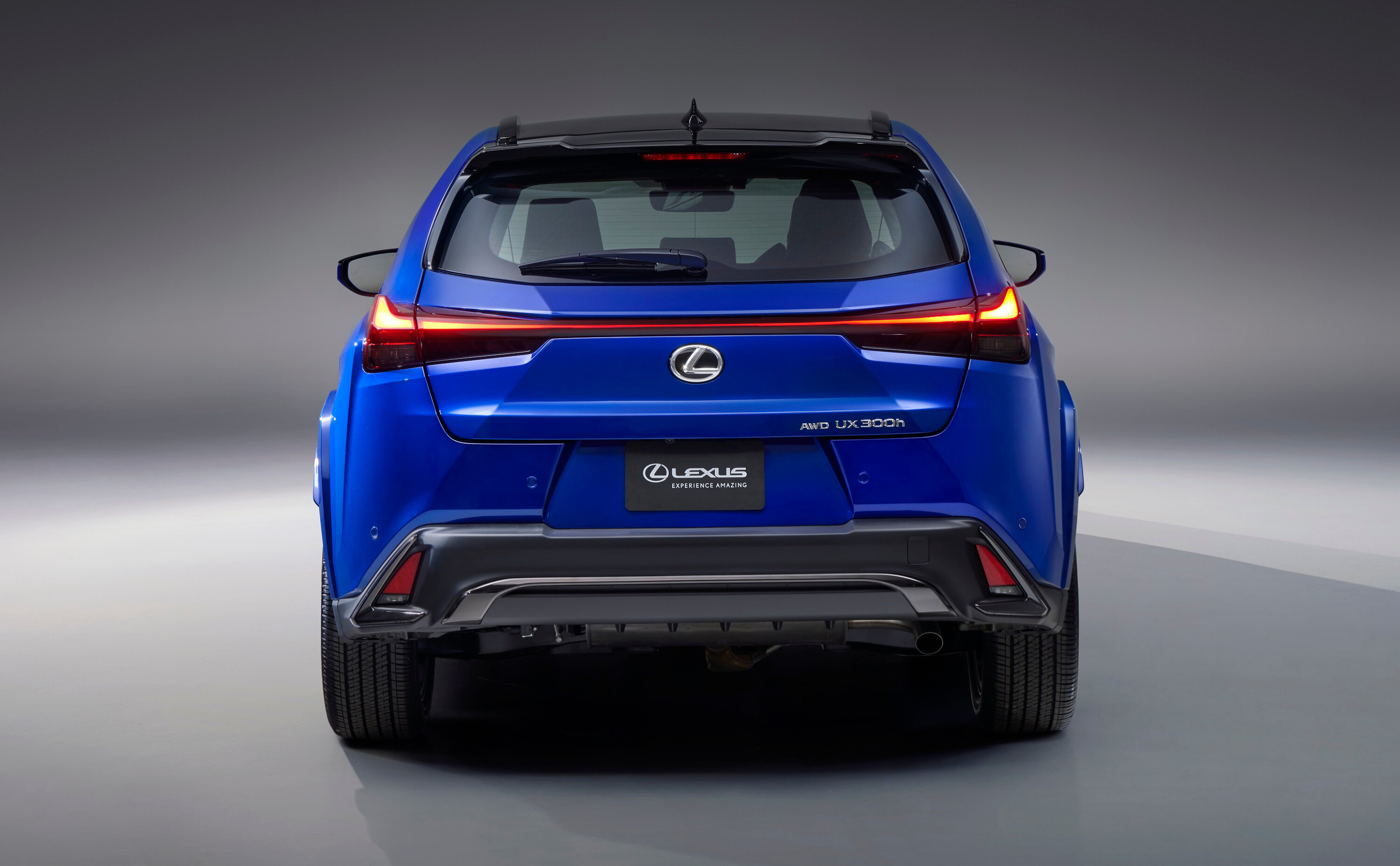
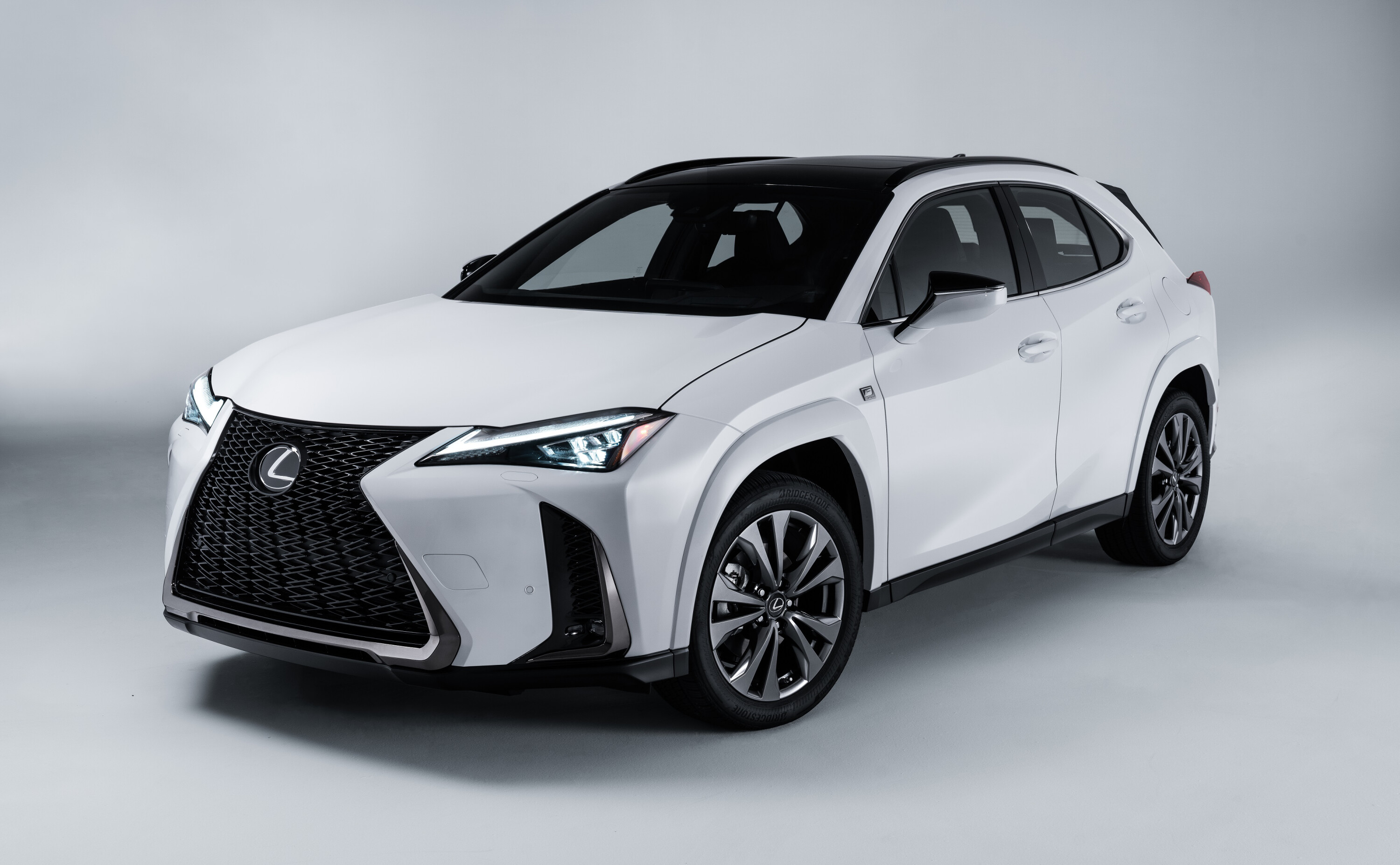
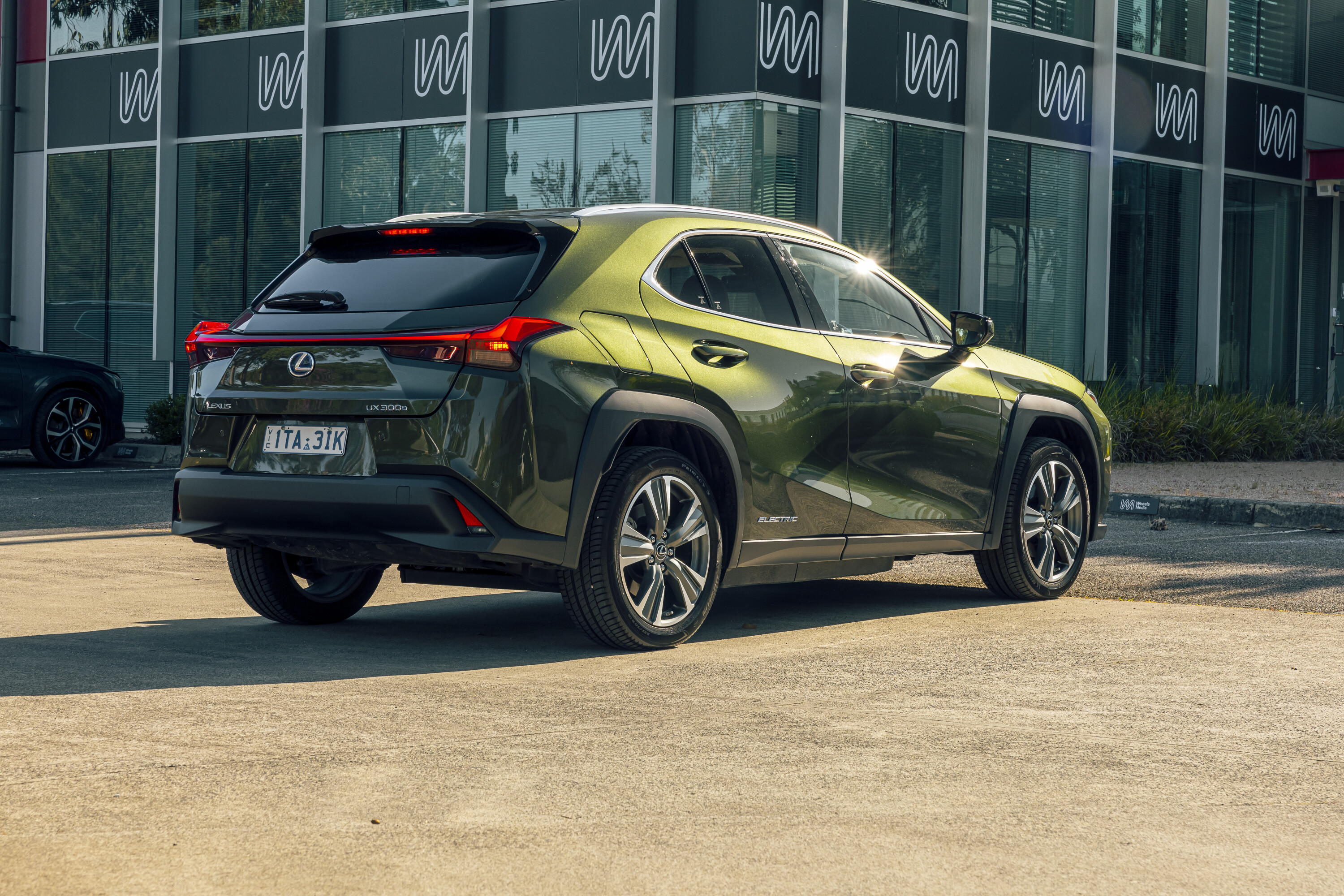
The 2024 Lexus UX small SUV line-up will exclusively offer hybrid or electric powertrains in Australia.
Lexus Australia has confirmed the petrol UX has been discontinued as local buyers “continue to favour HEV [hybrid], PHEV [plug-in hybrid] and BEV [battery-electric] powertrains” while the hybrid UX250h becomes UX300h with a power increase.
Prices have increased between $970 and $6715 for carryover hybrid variants with the heftiest increases applied to all-wheel drive models.
1
The cost of entry into the Lexus UX line-up has increased by $9285 with the deletion of the petrol-only models – from $46,085 to $55,370 before on-road costs – meaning it won’t undercut the smaller hybrid-only LBX light SUV due in Australia this month from $47,550 plus on-roads.
The electric motor output has increased from 80kW to 83kW, while other powertrain improvements include a boltless engine cover, new engine oil to aid fuel consumption, and a “compact and lightweight” lithium-ion battery with a 15 per cent greater per-cell output replacing the previous nickel-metal hydride unit.
1
All-wheel-drive models receive a more powerful, but smaller and lighter, rear transaxle that produces 30kW and 84Nm – up 25kW and 29Nm – which allows the E-Four system to now distribute torque front-to-rear by between 100:0 and 20:80.
Fuel consumption for the UX300h FWD is 4.2L/100km on the combined cycle – down 0.1L/100km over the UX250h FWD – while the UX300h AWD is down 0.2L/100km to 4.4L/100km.
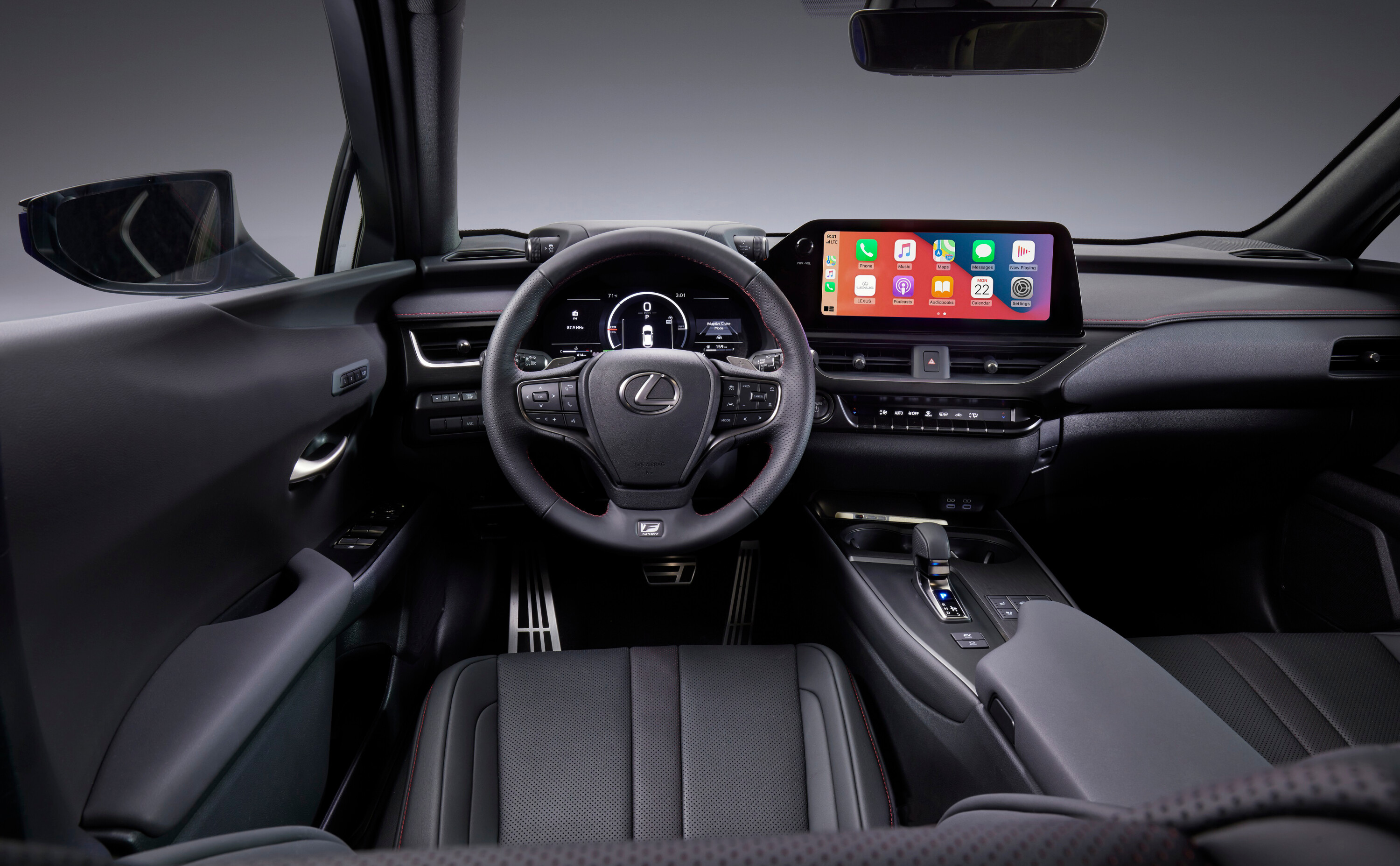
Inside, all UX variants receive a larger 12.3-inch digital instrument cluster, a new shift-by-wire gear selector, over-the-air software updates, wireless Android Auto (previously wired-only), optional ‘solis white’ upholstery replacing ‘rich cream’, and revised door panel switches.
All models also have updated active safety technologies, including safe exit assist, improved autonomous emergency braking with all-time bicycle detection, daytime motorcyclist detection, intersection assist and static object detection for the parking support brake, and a driver monitoring camera.
1
Torque vectoring has been added for a “more comfortable driving experience”, while the ‘sonic copper’ exterior finish replaces ‘blazing carnelian’ in the UX’s colour palette.
Sports Luxury hybrid variants now include a moonroof and smart key card as standard, while F Sport models also add those features – plus a heated steering wheel, a 360-degree camera system, and a 13-speaker Mark Levinson audio system.
The entry-level UX300e Luxury all-electric model now has a colour head-up display. Prices have increased between $525 and $730 for the UX300e.
1
2024 Lexus UX pricing: UX300h and UX300e
Model
Pricing
Change
UX300h Luxury FWD
$55,370
up $1050
UX300h Sports Luxury FWD
$62,320
up $970
UX300h F Sport FWD
$63,110
up $1115
UX300h Sports Luxury AWD
$70,520
up $4670
UX300h F Sport AWD
$73,210
up $6715
UX300e Luxury FWD
$80,720
up $730
UX300e Sports Luxury FWD
$88,190
up $525
1
2024 Lexus UX features: UX300h and UX300e
2024 Lexus UX300h Luxury features
12.3-inch digital instrument cluster (new, up from 7-inch)
8-way power-adjustable passenger seat
Wireless Android Auto (new)
Heated front seats
Safe exit assist (new)
LED headlights, tail-lights and DRLs
Static object detection for parking support brake (new)
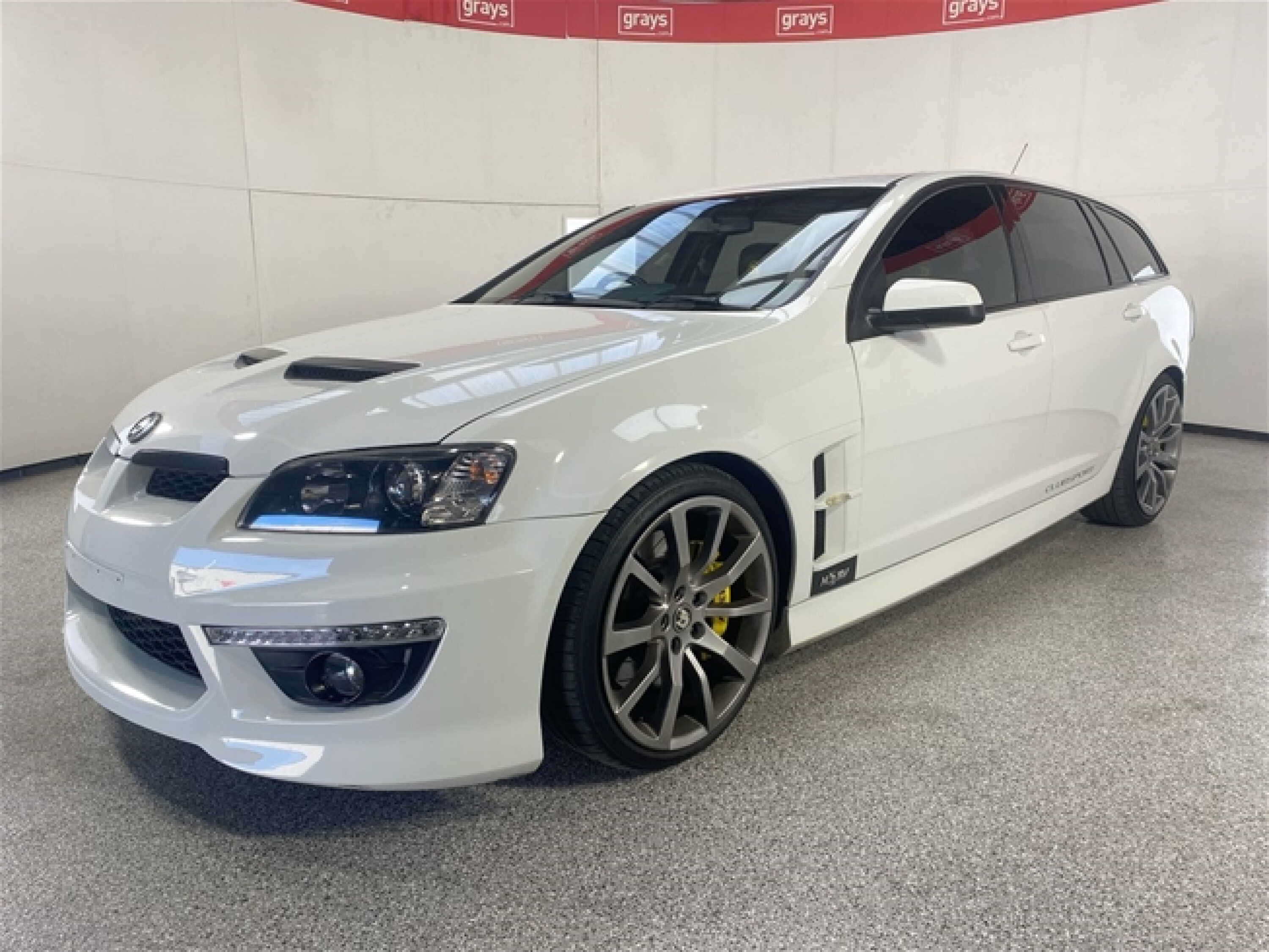
Keen-eyed V8 lovers may want to give this HSV a look, with some considering wagons a better option than the ubiquitous SUVs that pump along Australian roads.
Even better is that this HSV Clubsport R8 wagon is also a manual!
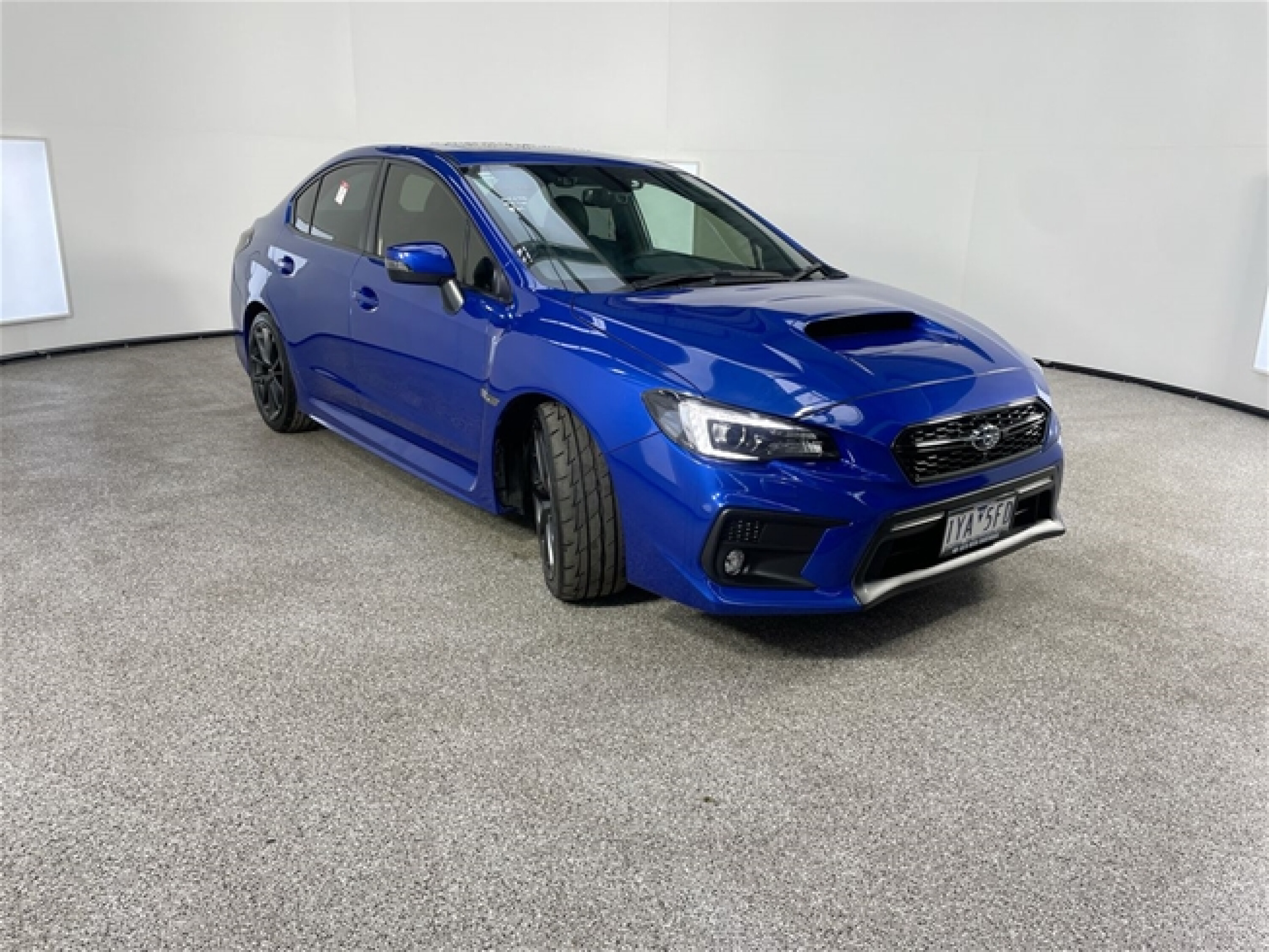
The ol’ Rex has faced some changes over the years, and this automatic example might make the purists baulk – this author included – but it has been posited by this very publication that maybe the CVT is the best option.
Anyone curious can check out the auction below to see for themselves.
Another year has rolled around and the one it leaves behind is a blur of staggering figures.
But among the smashed records and surpassed milestones in sales, performance and technology is one automotive number that always makes for sad reading.
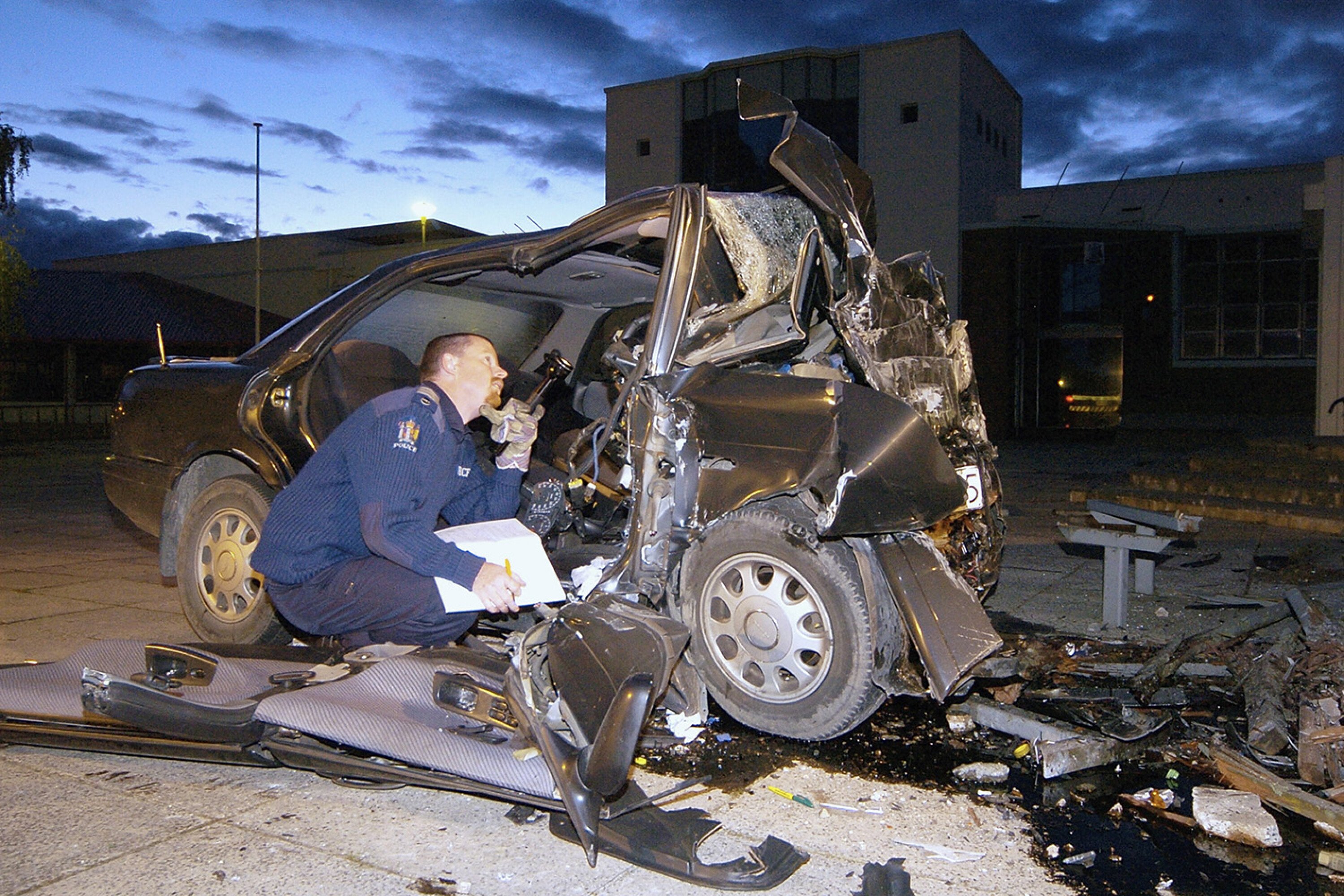
In 2023, 1266 Australians were killed on our roads. That’s up 7.3 percent compared with 2022 and, even when our booming population is factored in, that’s still an increase of 4.8 percent.
I don’t like dwelling on the dark side of driving as it’s not just work for me but also one of my greatest passions. However, we owe it to those lost on the roads and their shattered families to consider that number, use it to drive change and make something better because, at the moment, it is used as a tool to maintain a broken system.
1
The annual road toll figure is frequently referred to as evidence to justify reducing speed limits further and increasing fines – but, as is often said, the definition of insanity is doing the same thing over and over again but expect different results.
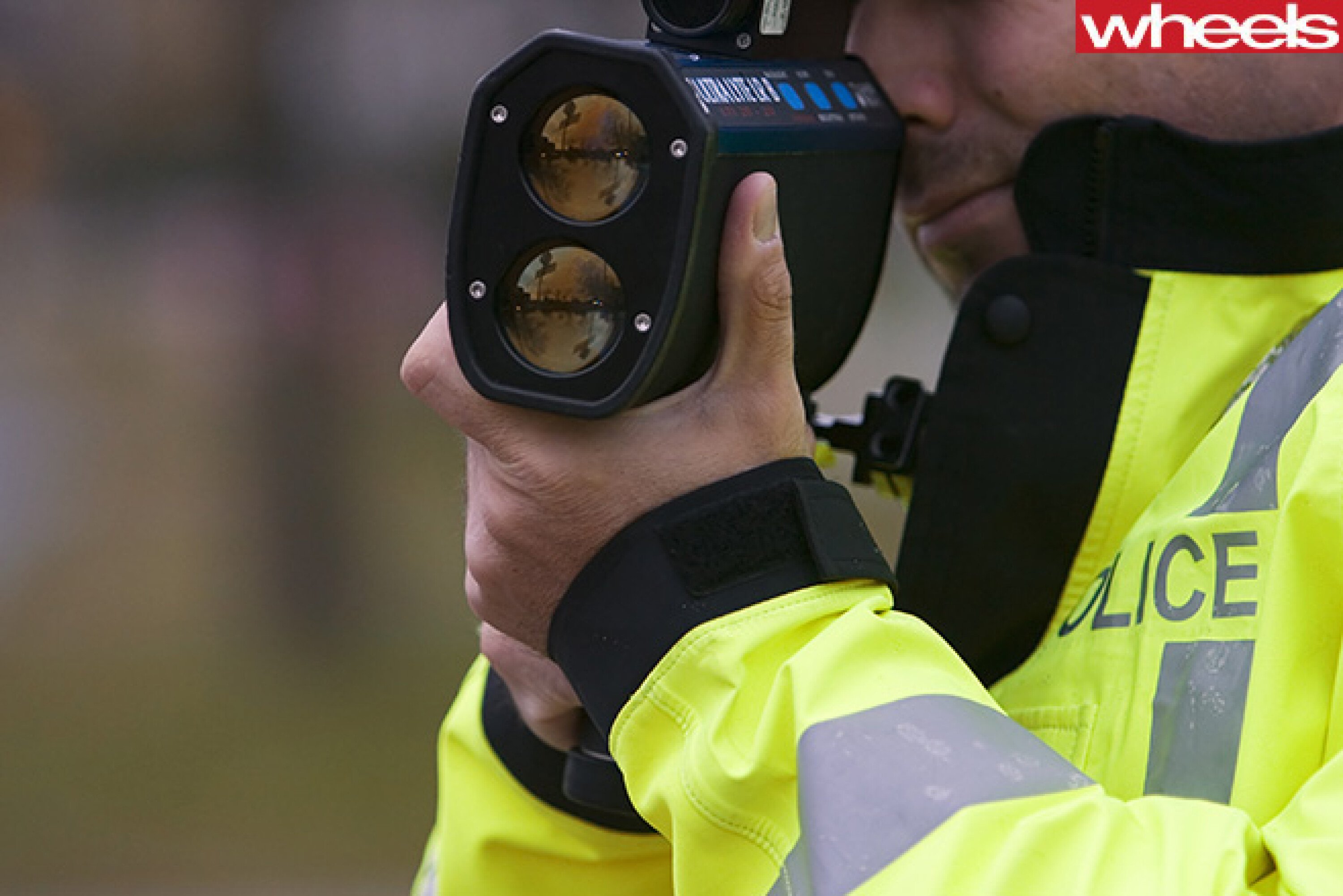
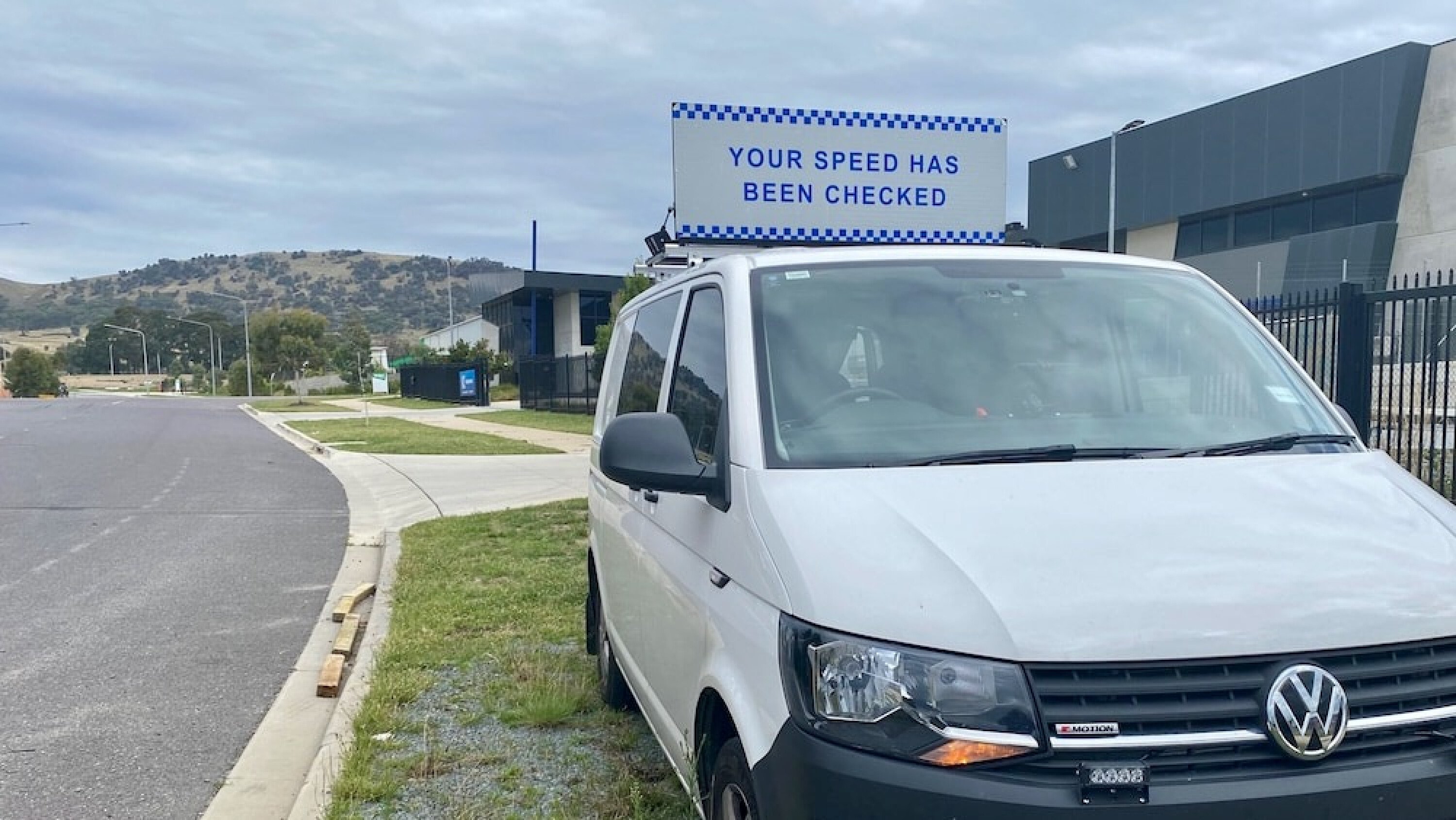
Speed limits continue to head south while the fines go north, and yet the road toll continues to rise along with the number of drivers getting nicked by more speed cameras.
1
In other words, merely knowing it’s highly likely they’ll be caught and punished for breaking the law is not preventing drivers from breaking the law.
And using an ever increasing number to support the existing strategy is simply madness, because it proves the strategy is not working. But what to replace the current ineffective approach with?
Extensive research and results-based solutions by other nations have proven to be more effective than the Australian strategy. Alternatives are a (much longer) story for another day, but examples include Oslo and Helsinki which, by simply separating cars and people, managed to reduce pedestrian deaths to zero.
1
Imagine if in zoos, rather than keeping animals in enclosures, we allowed gorillas and mountain lions to wander around with the visitors and every time one decided to remove a child’s head, the keepers docked it a few meals. That’s our current system for preventing road toll.
Then there’s Switzerland and Sweden, which manage the lowest traffic-related deaths in the world per capita (non-principality countries) thanks to among the highest standards of driver education. In this case, the gorillas aren’t in the zoo at all. They’re in the wild and have been taught by their parents that humans are bad news and best avoided.
On one hand, you have a system that empowers drivers to make good decisions on the road through effective training and education, while the other uses clever infrastructure to render fatalities physically impossible. If Australia is ever going to reverse its grim road toll trend it needs a combination of both.
1
What’s clear for now, though, is that it’s time for Australia to abandon an outdated and embarrassingly basic punishment-based strategy for attempting to improve road safety, and focus instead on one that will build a nation of safer drivers, not scared drivers.
How to improve safety on our roads is not a mystery. The real problem is how to replace the lucrative and irresistible source of cash provided by stupid and dangerous drivers who choose to break the law and get caught. Proper driver education and smarter infrastructure is not only expensive, its effect will also wipe out many millions of dollars in fines.
Which is why, sadly, it won’t happen and you can expect the 2024 toll to rise once again.
The latest monthly instalment in the Australian Automotive Dealer Association (AADA) and AutoGrab’s Automotive Insights Report (AIR) shows those shopping for a used car are starting to see a normalising of the market after a few years prices close to and sometimes over retail.
Figures for February show that the number of used vehicles listed for sale has increased, but the number sold has dropped – reflecting a long overdue improvement in supply across the new-car market.
“A strong start to 2024 new car deliveries is flowing down into the used car market, with a slight rise of 1.3 per cent in the number of vehicles listed for sale in the month,” said AADA CEO James Voortman. “While listings increased, sales of used cars dropped by 1.2 per cent from the previous month”.
“Overall, the used car market seems to be presenting opportunities for consumers interested in buying a used car,” said Mr Voortman. In other words, it’s becoming more of a buyers’ market.
1
Key Points
286,329 used vehicles were listed for sale in Australia in February 2024, and 179,448 were sold.
95 per cent of used cars bought and sold had petrol or diesel engines.
The time it takes to sell a used car has come down to 44 days in February after peaking in November at 52 days.
Retained values, on average, decreased.
The top 10 selling used cars closely reflect preferences in the new car market, with the Ford Ranger taking out top spot ahead of the Toyota Hilux.
Demand for used EVs lagged behind supply
Increasing sales of new EVs over the last few years may not yet be translating to the used market, with EVs accounting for approximately 5% of used sales.
“Amid all the discussion on fuel efficiency standards, the number of EVs listed for sale is almost four times the number sold in February, indicating a mismatch between demand and supply of used EVs. Petrol and diesel cars accounted for 95 per cent of used cars sold, with hybrid sales increasing by 4.6 per cent this month,” he said.
Retained values of certain models are still extremely high
Average retained values for vehicles aged 2-4 years dropped in February, but some passenger cars and SUVs were selling for close to or greater than their purchase value.
1
Retained Value (RV%)
Top 10 makes & models (2-4 years old)
Passenger Cars
Avg. RV%
Avg. Days to Sell
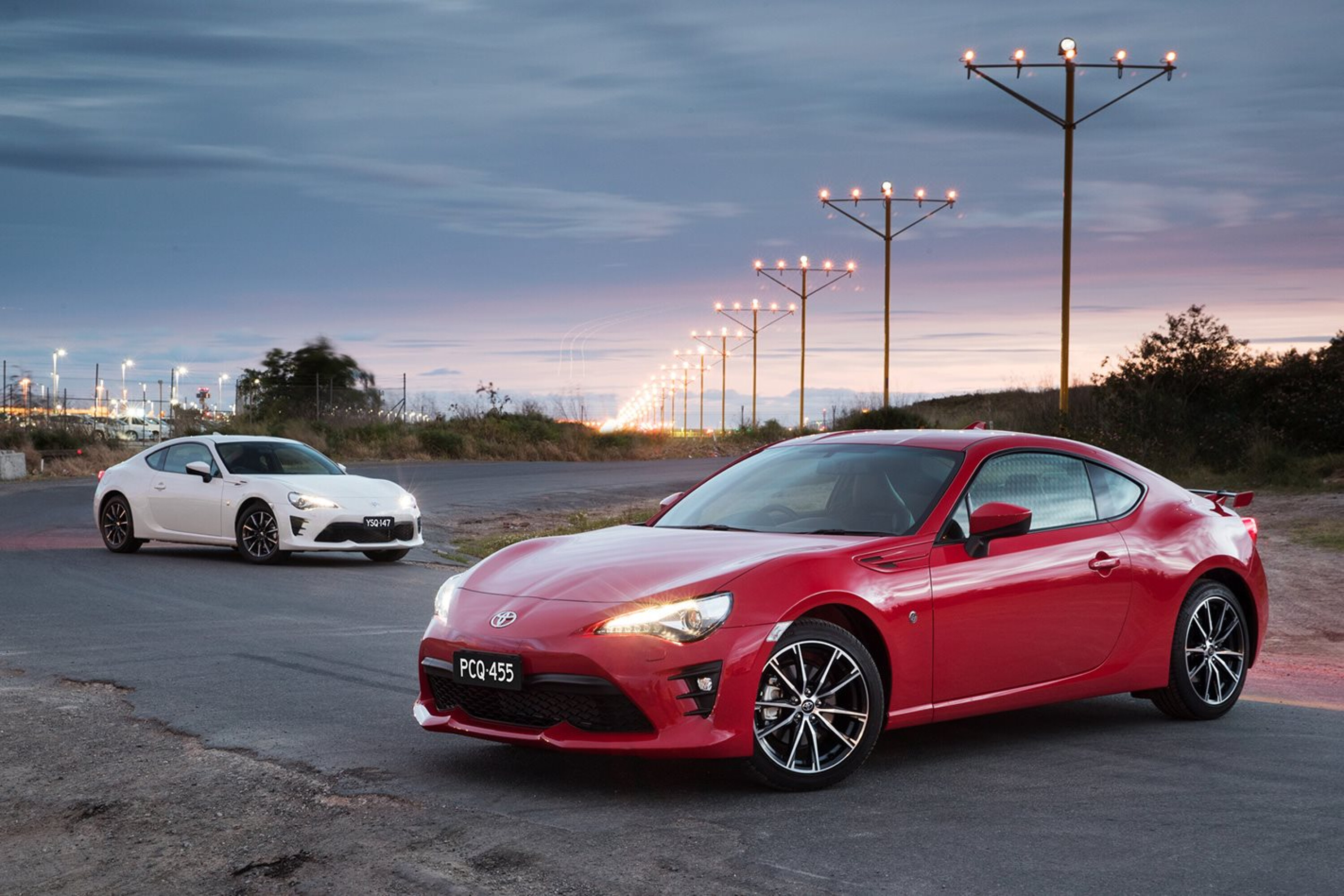
Toyota 86
106.90%
64.4
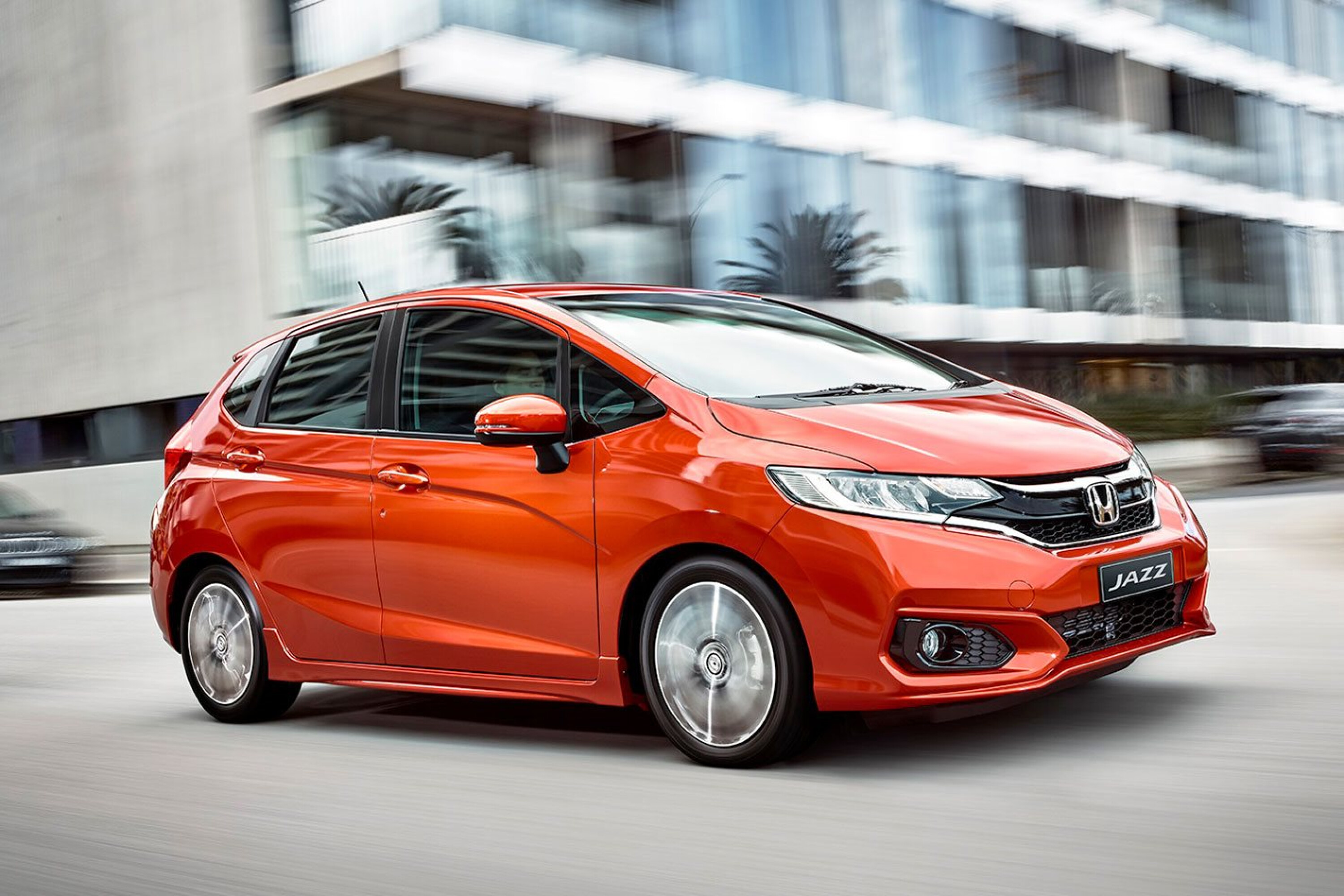
Honda Jazz
105.10%
35.6
Toyota Yaris
104.60%
31.2
Kia Picanto
99.40%
31.2
Ford Mustang
97.80%
45.4
Honda Civic
96.00%
39.2
Toyota Corolla
96.00%
36
Mini Hatch
94.90%
58.5
Suzuki Swift
94.80%
20.3
Toyota Camry
94.70%
40.5
1
SUVs
Avg. RV%
Avg. Days to Sell
Suzuki Jimny
128.90%
33.5
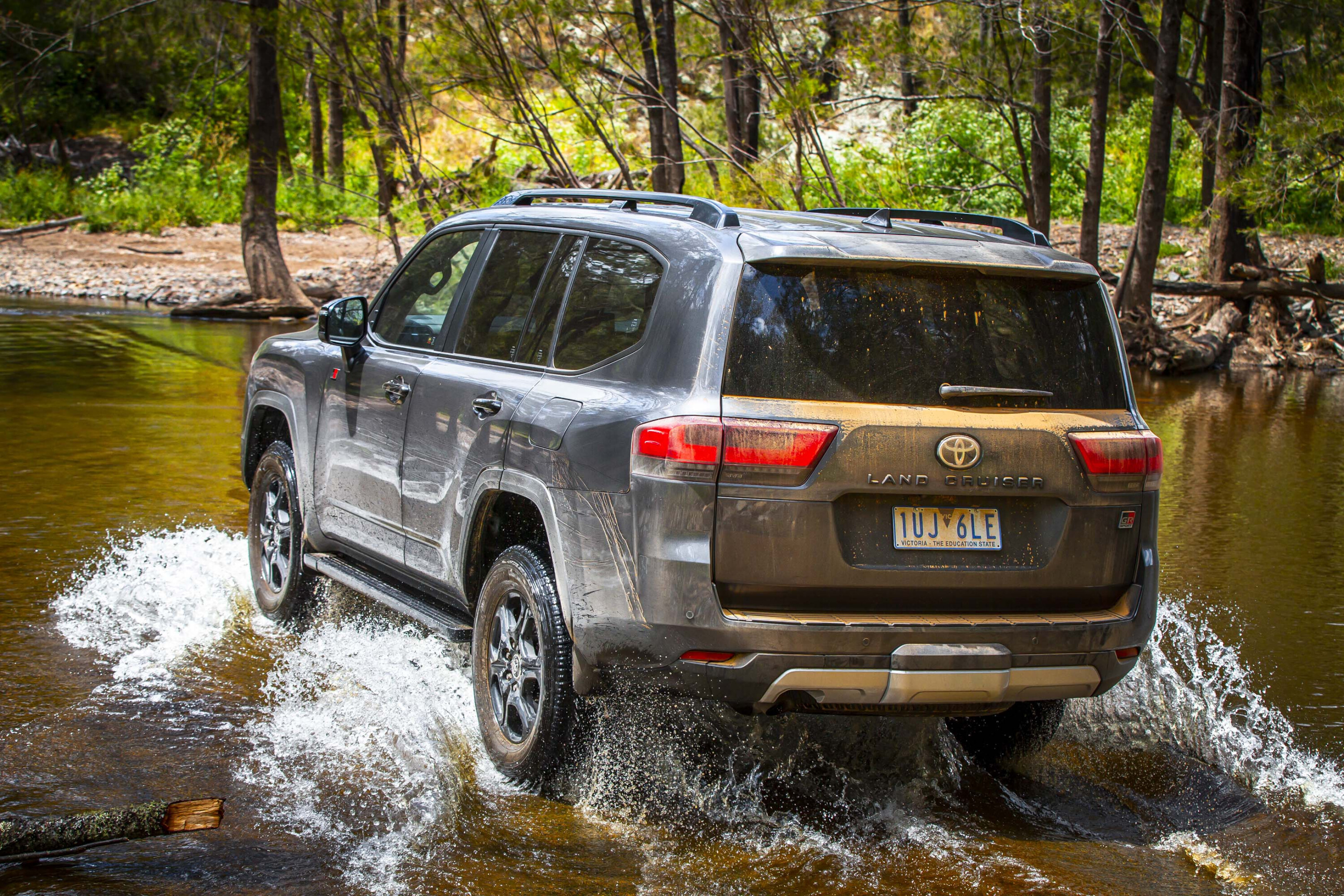
Toyota Landcruiser
107.40%
50.3
Toyota Yaris Cross
103.30%
56.7
Land Rover Defender
100.70%
65.4
Toyota RAV4
100.70%
42.9
Nissan Patrol
100.10%
46
Toyota Fortuner
94.70%
49.1
Toyota C-HR
93.90%
43.5
Jeep Wrangler
92.20%
55.8
Toyota Landcruiser Prado
91.20%
48
AutoGrab’s Chief Commercial Officer Saxon Odgers said, “This month’s findings reflect the current strength in the automotive industry, showcasing yet another strong month for car sales across the board.”
1
More cars to buy, fewer cars selling – and they’re selling faster
“One notable statistic is the average days to sell, which has reached its lowest point since March of last year,” Odgers said.
“This shows a swift turnaround in the market, reflecting growing consumer demand and efficient inventory management strategies.”
Due to a manufacturing defect, signal interference may occur within the electronics of the brake system. If this occurs, a higher pedal force may be required for braking.
The anti-lock braking system and dynamic stability control will not be available.
Note: Drivers will be alerted by the brake warning light in the instrument cluster and a message will appear on the central display.
What are the hazards?
The vehicle remains controllable; however, a higher pedal force may be required for braking and in certain conditions, braking distance may be extended.
A reduction in braking performance could increase the risk of an accident resulting in injury to the vehicle occupants, pedestrians, and other road users.
What should consumers do?
If a warning message is displayed on the central display, drivers should follow the instructions provided and promptly contact their nearest BMW Dealer.
Owners of affected vehicles will receive written communication from BMW Australia.
When the necessary parts are available, all vehicle owners will be asked to bring their vehicle to a BMW dealership to have the electronic brake system controller replaced at no cost.
Supplier details
B M W AUSTRALIA LTD.
Who should owners/operators contact for more information?
Due to a software issue in the steering column control module, vehicles may have been built with a steering column control module (SCCM) turn signal lever which may not cancel when the steering wheel is rotated or switched off manually. This could lead to a non-cancelling indicator and/or high beams activating.
What are the hazards?
If the turn signal indicators do not illuminate as intended, other road users would be unable to identify if the vehicle is turning. This could increase the risk of an accident causing serious injury or death to vehicle occupants and/or other road users.
What should consumers do?
Owners of affected vehicles should contact their local authorised RAM dealer to have the software updated, free of charge.
Supplier details
AMERICAN SPECIAL VEHICLES PTY LTD
Who should owners/operators contact for more information?
Due to manufacturing defect, the engine turbocharger oil delivery pipe may not have been sufficiently tightened. As a result, the pipe may become loose over time and could lead to an oil leak into the engine bay and accumulate in the presence of an ignition source potentially resulting in a vehicle fire.
What are the hazards?
A vehicle fire could increase the risk of injury or death to vehicle occupants, other road users and bystanders, and/or damage to property.
What should consumers do?
Owners of affected vehicles will be contacted by Jaguar Land Rover, and are asked to take their vehicle to an authorised Jaguar dealer to have the hose inspected and replaced, free of charge.
Supplier details
JAGUAR LAND ROVER LIMITED
Who should owners/operators contact for more information?
Due to a manufacturing defect, the right-hand side lower A-pillar frame mounting bolt may have not been tightened according to specifications. As a result, this may lead to a reduction of structural integrity in the event of a collision.
What are the hazards?
In the event of a front-end collision, an impaired vehicle structure may increase the risk of serious injury or death to vehicle occupants.
What should consumers do?
Owners of affected vehicles should contact their preferred Jaguar Land Rover authorised dealer to have the repair carried out, free of charge.
Supplier details
JAGUAR LAND ROVER AUSTRALIA PTY LTD
Who should owners/operators contact for more information?
The clamps retaining the engine’s fuel injectors may not meet manufacturing specifications and could crack. If this occurs, fuel may leak in the presence of an external ignition source resulting in a vehicle fire.
What are the hazards?
A vehicle fire could increase the risk of injury or death to vehicle occupants, other road users and/or damage to property.
What should consumers do?
Owners should contact their preferred Jaguar Land Rover authorised dealer to have their fuel injectors inspected and replaced, free of charge.
Supplier details
JAGUAR LAND ROVER AUSTRALIA PTY LTD
Who should owners/operators contact for more information?
You’ll never see a cheap entry-level Toyota again, but the brand believes it has just the right thing for you.
Canny readers might observe that there haven’t been any ‘cheap’ Toyotas for a while now, but the brand admits it can no longer offer brand-new, coin-conscious cars.
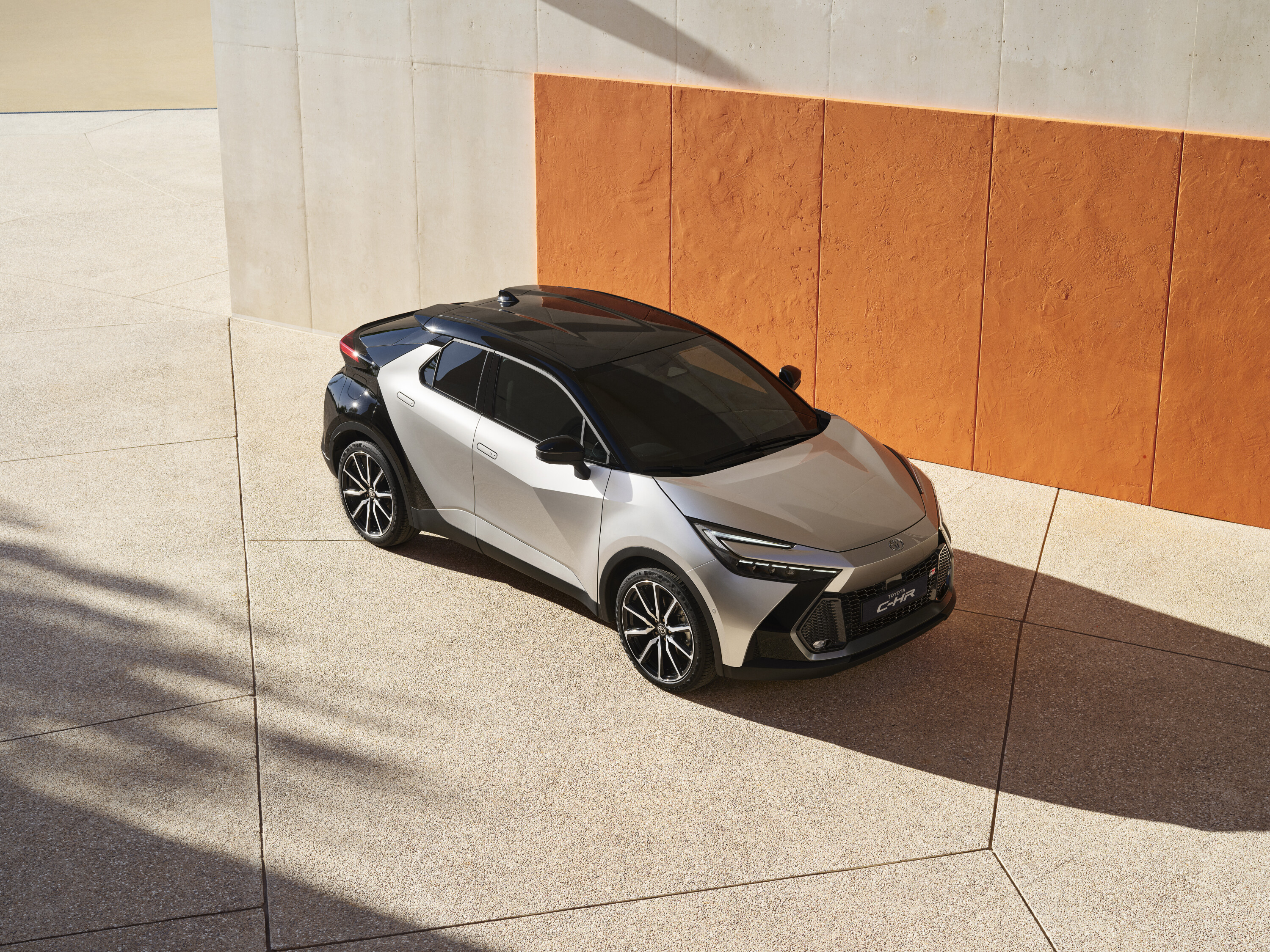
At the launch of the new-generation, Europe-sourced Toyota C-HR – which itself sees price hikes in the region of $11,000 or 35 percent – Toyota confirmed an end to its most affordable model, the $24-32k petrol-powered Yaris. RIP.
This means the cheapest new Yaris you can buy in 2024 is the SX hybrid at $30,190 before on-road costs – and in fact it repositions the petrol Corolla sedan as the most wallet-friendly model in the brand’s line-up, from $29,270 for the Ascent Sport. Toyota has also axed the cheaper petrol Corolla hatch.
What can a budget-driven Toyota buyer do?
They could go elsewhere, although ‘cheap and cheerful’ is nearing extinction – but the brand’s sales and marketing boss Sean Hanley says a used Toyota is just the ticket.
Mr Hanley said that while he would “never say never” to the notion that the brand may once again offer more affordable, budget-conscious cars in the future, the company is reacting to order banks and predicting where demand is heading before it makes decisions such as cutting petrol versions of different models.
“The only thing driving petrol retention at the moment would be the demand patterns of the car. If people still want to buy them, we still try to supply them,” he said.
That flies in the face of the apparent facts, with Toyota Australia confirming that in 2023, the brand sold a grand total of 1935 Yaris hatches – and of those, just 547 (or 28.2 percent) were the more expensive hybrid models.
Mr Hanley explained that existing sales are just part of the considerations when it comes to planning ahead.
“When we make our assumptions, we look at orders and sales, but given that we’ve been largely restricted on hybrid variants, we’ve got to look at our natural demand through order intake. That’s what we look at, and that’s quite a different scenario to what you might see as sales,” he said.
1
“What happens though, it gets to a point in your portfolio of any product review, where once you start to get above 90 percent all hybrid, it doesn’t make a lot of sense to keep bringing them (petrol variants) in,” Mr Hanley said.
“So it’s just the balance – while customers want petrols in volume, we will deliver. But when that diminishes, as we’re starting to see with hybrid, so that trend is obvious; we will move more and more to hybrid only.”
Mr Hanley referred back to the seismic shift in pricing for the Yaris between the current-gen model and its predecessor. In case you’ve forgotten, as recently as 2020 there was a Yaris on sale for $15,390 plus on-roads.
“We moved up with the new Yaris. At that time, a lot of people kind of didn’t grasp it, but we said the sub-$25k market would need to be filled from our perspective as a brand by a new product offering called Toyota Certified Pre-Owned Used Cars,” he said.
Mr Hanley posited that anyone in the market for a more affordable car from Toyota can buy a used vehicle instead of a new one.
“We give peace of mind to those people who buy our Certified Used cars. So that’s where we see those customers will have an offering for Toyota. Good quality warranted Toyota used vehicles across that smaller SUV and passenger car line-up.”
1
When asked if the brand could ever again feasibly offer a new model for less than $30,000, Mr Hanley was circumspect.
“’Never ever’ is permanent. And nothing is permanent in this world. so you never discount it. But right now, if you say to me, ‘do you have that car coming?’ The answer’s no, we don’t,” he said.
Buyers of budget new cars have been hit hard by recent cost increases, with the likes of the Kia Picanto seeing big price jumps for its new model range (now from $20,690 drive-away), and the soon-to-be-replaced MG3 is set to see a big jump in asking price due to a sizeable increase in safety technology and new powertrain tech. The current MG3 kicks off at $19,990 drive-away.
Is a second-hand Toyota a good alternative to a new cheap car from a different brand? Tell us in the comments what you’d do.
Despite the best efforts of the Reserve Bank of Australia, 2023 was a record year for new car sales.
Cash-strapped Aussies clearly doing it tough flocked to car dealerships like never before, beating the previous record set in 2017 by 2.3 percent. The best-selling vehicle was the Ford Ranger 4×4 dual-cab, with the average list price hovering near $60,000.
Small wonder that Treasurer Jim Chalmers wears the look of a man subjected to three times the force of gravity compared to a standard human being.
1
Upon release of the buoyant car sales numbers, it was natural to expect the FCAI to indulge in a measure of celebratory chest-beating, but when chief executive Tony Weber signed off, it was with a note of caution.
“As we celebrate this historic achievement, we recognise that the automotive sector will face challenges in the coming months,” he noted. “Cost-of-living pressures and increased interest rates will impact the market, and we expect a challenging 2024.”
Somewhat buried in the avalanche of end-of-year new car orders came a fascinating piece of new data. Late last year, for the first time, the Australian Automotive Dealer Association (AADA) issued used car sales data.
1
While 98,544 new cars left dealers in December, some 169,312 used cars changed hands
Okay, so the calculation involved, which looks at the sum total of used cars for sale at the start of the month and tallies up the vehicles that are no longer for sale at the end of the month, might not impress the most gimlet-eyed actuary, but it’s enough to deliver the big picture. And that picture clearly shows that while 98,544 new cars left dealers in December, some 169,312 used cars changed hands.
It’s not hard to see why used cars are in such demand. The ludicrous used pricing that accompanied both the COVID pandemic and the semiconductor shortage has eased, which means that there are, once again, some reasonable deals if you look hard enough. That’s been helped by manufacturers increasingly offering longer warranties.
The only ‘mainstream’ brand offering a three-year warranty in Australia now is Fiat.
That’s great news for used buyers who can now routinely pick up a three-year-old vehicle with residual warranty. Because surely cars are getting more reliable these days? J.D. Power’s Initial Quality Survey suggests otherwise, claiming that new vehicles are becoming more problematic.
It blames ongoing supply chain problems, companies transitioning to novel electric powertrains, and remote working environments for an 11 percent uptick in problems experienced during the first 90 days of ownership. What’s more, it’s the highest the survey has reported in 36 years.
Thing is, I don’t buy it.
The Initial Quality Survey has always had its idiosyncrasies. It measures two different things that it conflates as ‘problems’.
One is a fault, the other is a design issue. The former I get, but the latter is largely subjective, and can translate as ‘features I don’t like or don’t work as expected’. It’s clear that higher problem scores directly correlate to recently introduced models of which we’ve been buried in post-COVID.
In other words, if statistics don’t lie they can certainly pull a sly conjuring trick. Now is a great time to look for a used car and our 2024 used car guide categorically points you in the right direction to avoid the duds. Happy hunting!
Toyota remains hesitant on plug-in hybrid models for Australia, despite one of the brand’s most powerful executives suggesting there is a market here for PHEVs.
Sean Hanley, Toyota Australia vice president of sales and marketing, admits that plug-in hybrid electric vehicles (PHEVs) need to be the right fit for an Australian buyer in terms of the cost, and the amount of EV range on offer.
“I have an ideal range in my mind. But it’s not necessarily a prerequisite range. It’s an ideal range. So right now, I think they get around 60 to maybe 80 kilometres on their own, which is not bad. It’s credible. That wouldn’t stop you from bringing it to market in Australia, by any means.” said Mr Hanley.
What’s the appeal of PHEVs?
Plug-in hybrid EVs like the Mitsubishi Outlander PHEV have proven popular in Australia, because they allow motorists to drive on electric-only power for significantly longer and at higher speeds than with a ‘regular’ hybrid.
“But ideally at some point you’d love one that does 200km [EV driving] on its own. That would be ideal,” he said.
“As battery technology evolves, I think that could be possible. It’s not going to be tomorrow, but I think it could be possible. And that, therefore in my own thinking, is a perfect solution for the Australian market to get the best of both worlds,” he said.
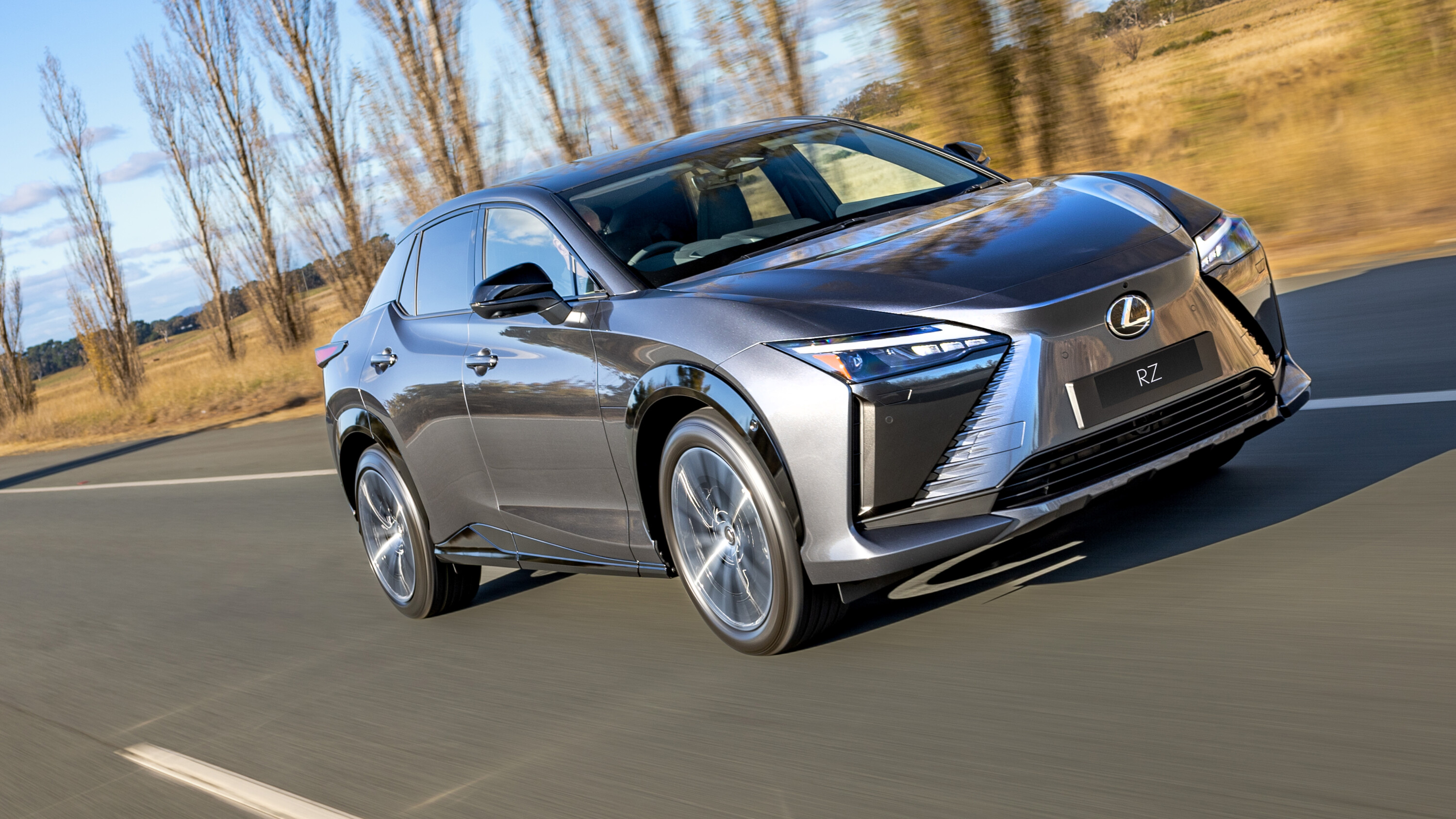
Mr Hanley – who drives a Lexus RZ450e electric SUV he claims to have never recharged at a public charger – is himself looking to move to a PHEV for his next company car. It won’t wear a Toyota badge, though, for obvious reasons – it’ll be the Lexus NX450h+, a vehicle that offers a claimed 87km of EV-only driving range.
1
For reference, Toyota offers the Prime plug-in hybrid version of the RAV4 overseas with approximately 67km of EV range, along with the Prius Prime (71km) and the new C-HR plug-in hybrid (66km).
Toyota C-HR chief engineer, Toshio Kanei, confirmed with WhichCar that the PHEV model will account for “25 percent” of new-generation C-HR sales in Europe, which is the only marketplace that will see the PHEV offered. Indeed, the entire new C-HR range, built in Turkey, is only going to Europe and Australia this time around.
Mr Hanley ruled out a C-HR PHEV for our market at the launch of the new model this week (review due 7pm March 21), but confirmed that a plug-in Toyota has to be a part of the line-up at some point soon.
1
When will Toyota offer a PHEV in Australia?
“Not right now, but it’ll definitely be between now and 2030. It will become a desired part of our product offering,” Mr Hanley said. “And you know, we shouldn’t shy away from it, because we’ve always said ‘one day’.
“Some would say ‘why not now?’ – I read the comments all the time [where people say] ‘where is the RAV4 Prime?’ I think it’s a great alternative. Will it consume the market? No, it won’t, but it will fit into the portfolio.”
PHEV price premiums are a sticking point for many customers, but plenty have taken advantage of a number of fringe benefit tax exemptions, which end in March 2025.
Those tax benefits have meant that, in some cases with novated leasing options, the huge price premiums have been somewhat negated. It helps the jump of circa-$15K for an Outlander PHEV or Peugeot plug-in make better financial sense.
1
While it is highly unlikely that Toyota will have a PHEV before the March 30 deadline next year, Mr Hanley admits there is a challenge with PHEV pricing that is part of the brand’s considerations.
“There’s a cost involved. These things aren’t cheap. So it’s just about whether you can bring it to the market,” he said.
“We have a really great, loyal take-up of HEV (hybrid) vehicles. And the reason we’ve been able to do that is not a secret. Affordable, practical, reduce the fuel bill, and they have some environmentally friendly credentials,” he said. “So when you look at a PHEV, you’ve got to look at that affordability because they’re slightly dearer again.
“We’re talking an average $2500 to $4000 between an ICE and HEV. One or two might be a bit more or less. A PHEV could be $5000 more. It could be. I don’t know, just sitting here, but I’m assuming it’s more expensive. Probably. Is that tolerable for that car in this market? That’s what you’ve got to look at,” he said.
“There’s a market, [but] it’s got to be affordable.”
“You’ve got to ask yourself, why would someone go into a PHEV if it’s 10 or 15 grand more than a HEV? It may be offering you a slightly better advantage on EV mode.
“But if you had something that was offering you a big advantage on EV mode in range – a big advantage to say around 200km, and I’m only being hypothetical – then that’s a different scenario. That’s a different value proposition,” he said.
And how good would it be if the brand was able to offset some of the nasty emissions of diesel models with a PHEV diesel model? Mr Hanley is a fan of that idea.
1
A diesel PHEV?
“Potentially,” said Mr Hanley of PHEV versions of diesel models in future. “Diesel has a long way to go. It’s not gonna be gone anytime soon.”
“And there may be a time where other technologies are applied to diesel,” he said. “I’d like to go on the record as saying it’s not dead, but in the fullness of time, it will be examined carefully. But we’ve definitely got to find ways to decarbonise it, in its application,” he said.
Diesel PHEVs are uncommon, but not unheard of.
In Europe, Mercedes-Benz offers the GLC300de. ‘Mild hybrid’ diesels are more common, again in Europe, with models like BMW 320d and X1 sDrive18d and the Audi S7. Others have been offered in the past, including here in Australia (Mercedes in particular), but there are few in Europe’s current generation of cars and none here.
Toyota Australia’s best-selling vehicle, the HiLux ute – which has petrol and diesel models on offer – is about to see a form of electrification applied to it by way of a 48-volt “Assist” function, which the brand refuses to call “mild-hybrid” as many other marques market it.
Would you consider paying $10k more for a plug-in hybrid version of the RAV4? Comment below!
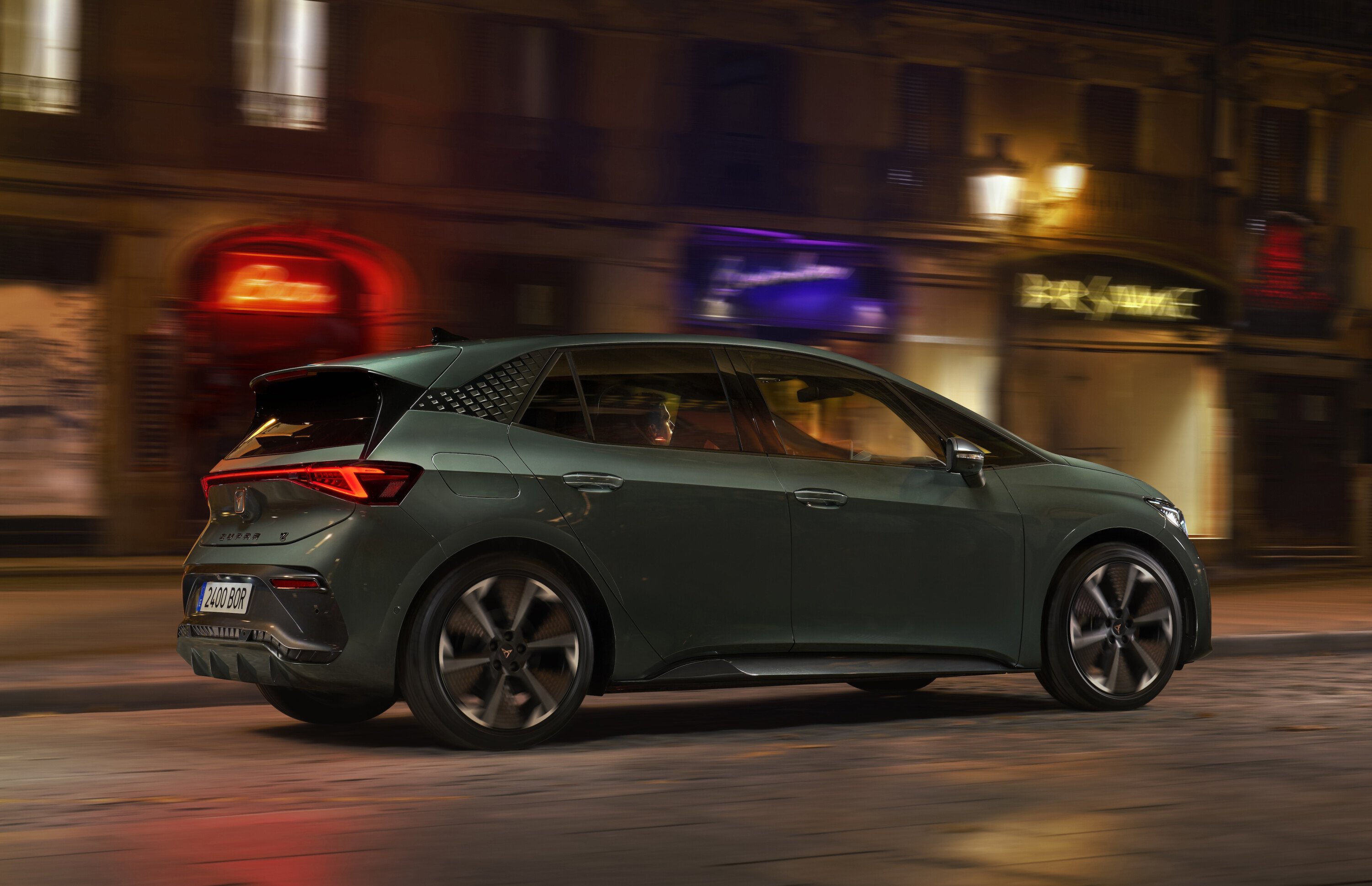
Following news of the Cupra Born EV range passing 1000 sales in Australia since launching last year, the brand has now confirmed it is expecting to launch the hero VZ model here in 2025.
It’s a long wait – not an uncommon story for VW’s EVs in Australia – but fans are likely to be pleased when it does at last arrive.
As we outlined in February (see our earlier story below), the Born VZ offers 240kW and 545Nm to deliver a 0-100km/h time of 5.7 seconds.
1
The VZ retains the rear-wheel drive layout of the regular range, but benefits from new springs and dampers for the rear suspension, updated settings for the front damper valves, and strengthened anti-roll bars.
Pricing is still to be revealed, but with the current model already starting from $59,990, the hero could arrive with a price much closer to $70,000 – assuming the regular model doesn’t get a price cut to make space.
What about…
There’s also the Born VZ’s under-the-skin twin, the VW ID.3 GTX, unveiled this week with the same outputs (in GTX Performance tune). Local plans for that model haven’t been made official, but the brand has made clear it wants the GTX to headline Australia’s ID.3 range.
The Cupra Born VZ has been unveiled as an electric hot-hatch with 240kW, sharpened dynamics, yet also a longer range.
Snapshot
1.3 seconds faster 0-100km/h than current Born
Slightly bigger battery brings provisional bigger range
20-inch wheels, bucket seats, and upgraded chassis
Cupra’s new flagship Born features a slightly bigger 79kWh battery and a more powerful rear electric motor compared with the regular hatch that was released in May 2023.
VZ stands for ‘Veloz’, Spanish for ‘fast’, and the badge brings 41 per cent more power and 76 per cent more torque than the standard model: 240kW and 545Nm.
Volkswagen’s Spanish brand says the VZ will accelerate from 0-100km/h in 5.7 seconds, notably quicker than the current Born’s 7.0sec time.
Top speed increased from 160km/h to 200km/h.
1
Cupra says the bigger, improved battery also helps deliver a longer range of 570km versus 511km for the regular Born (on 19-inch wheels), though the figure is yet to be officially homologated.
To ensure the Born VZ handles like a hot-hatch, the company has upgraded the chassis extensively.
There are new springs and dampers for the rear suspension, updated settings for the front damper valves, and the anti-roll bars have been beefed up.
A new steering set-up aims for sportier response and revised brakes are said to bring a stronger feel.
Wheels are slightly wider and come in a choice of 20-inch sizes – with forged-alloy rims or 3D copper inserts – and are wrapped in wider, high-performance tyres.
1
Cabin highlights for the VZ include CUP bucket seats, a new 12.9-inch digital infotainment display that’s also larger than the regular Born’s 12.0-inch screen, while new options include a Sennheiser audio system.
A couple of exterior-palette additions are Dark Forest (pictured) and Midnight Black.
Cupra Australia is keen to bring the Born VZ down-under, though an arrival before 2025 is unlikely.
1
“Born is one of the key parts of our lineup and this next iteration of our exciting rear-wheel drive hot hatchback is something we are looking at very closely for Australia,” said a spokesperson for the brand.
It’s likely to cost more than a $70,590 235kW Volkswagen Golf R, with the standard Born currently priced from $59,990.
The Born last year became the first fully electric car from the Cupra brand that launched in Australia in 2022. It was the second-most popular Cupra here last year with 887 registrations, contributing to global sales in excess of 45,000.
The Formentor crossover (2108 sales in 2023) is the most popular Cupra locally.