
The year was 2010 and MOTOR had arranged a comparison for the first ever M-badged SUV. Facing the newly launched E70 X5 M was the Mercedes-AMG ML63, Audi Q7 V12 TDI and a pair of Range Rovers, a Vogue and a Sport, both with the new 375kW 5.0-litre supercharged V8. As a sporting contest it was about as close as Mike Tyson versus Carl Williams (a first-round knockout for the non-boxers…). The X5 M was the quickest in a straight line, the most involving to drive and absolutely blew the rest away around Wakefield Park, seconds clear of second-quickest.
BMW purists spat in disgust at this monster; little did they know it previewed the future of M Division. Soon, all its major models will adhere to the recipe of all-wheel drive, automatic and a twin-turbo engine. So close now is the relationship between M’s SUVs and its sportier four-door models that if you like the idea of a BMW M5 but hate the fact it’s so low to the ground, then the new BMW G05 X5 M Competition is going to be right up your alley.
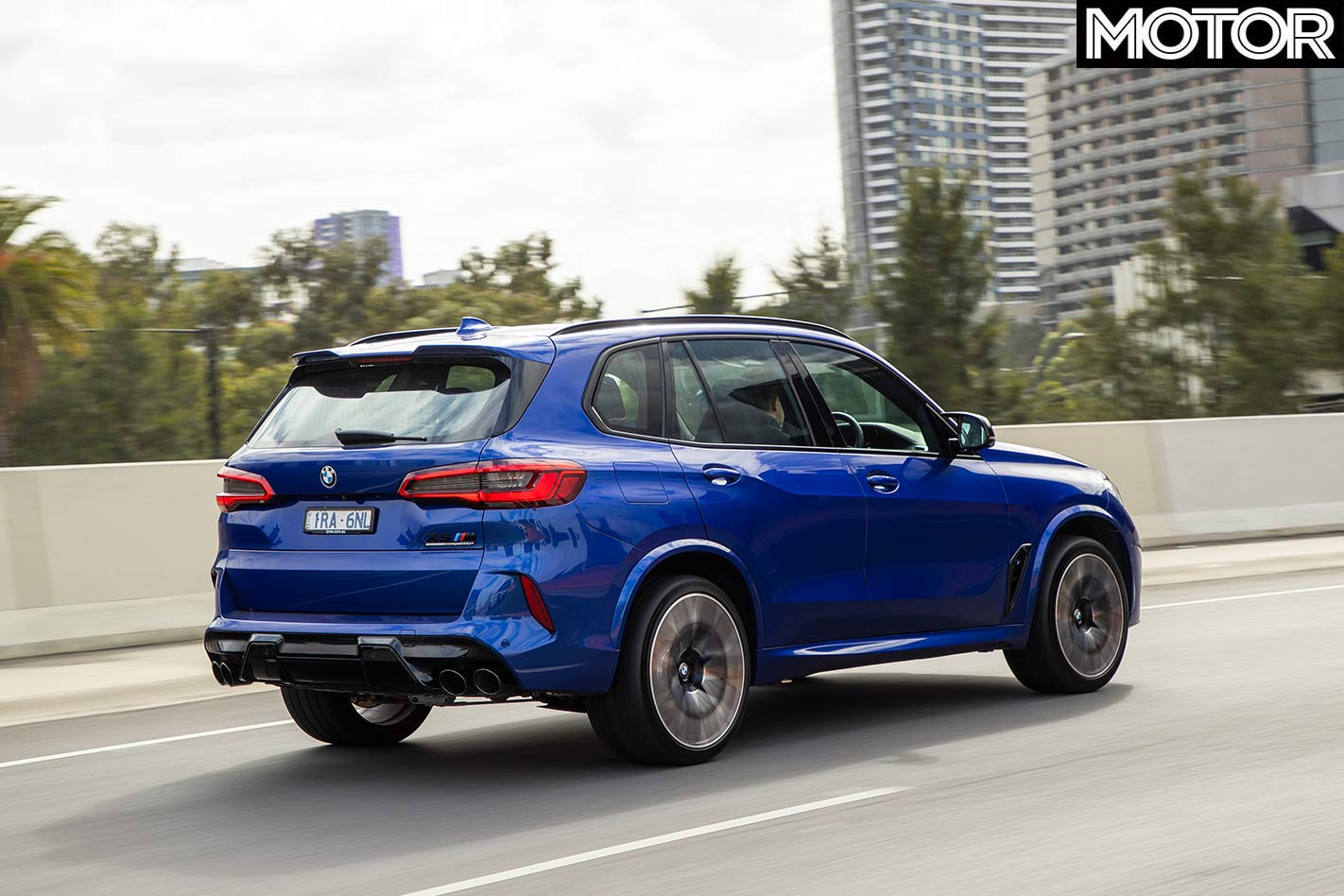
If the F90 M5 Competition is a dachshund, the X5 M is a Hungarian vizler; kinda the same thing, just taller. The engine is identical, a 4.4-litre twin-turbo V8 producing 460kW at 6000rpm and 750Nm from 1800-5800rpm. Even burdened with 2310kg, it’s a heroic engine, providing monstrous acceleration that won’t relent until you’re well beyond the legal speed limit. BMW claims 0-100km/h in 3.8sec, 0-200km/h in 13.4sec and a 290km/h top speed if you option the M Driver’s Package (250km/h otherwise). Brisk by any measure.
There’s a tad more hesitation than in the M5 – to call it lag is probably too strong – but from there the power continues to build and build. The specs suggest a peak at 6000rpm, but there’s still plenty of grunt beyond this given its appetite for the redline. It sounds good, too; smoother and more cultured than the equivalent AMG. A motorsport-spec cooling system, consisting of 10 individual coolers, keeps temperatures under control, which seems like overkill but should bring peace of mind on the school run.
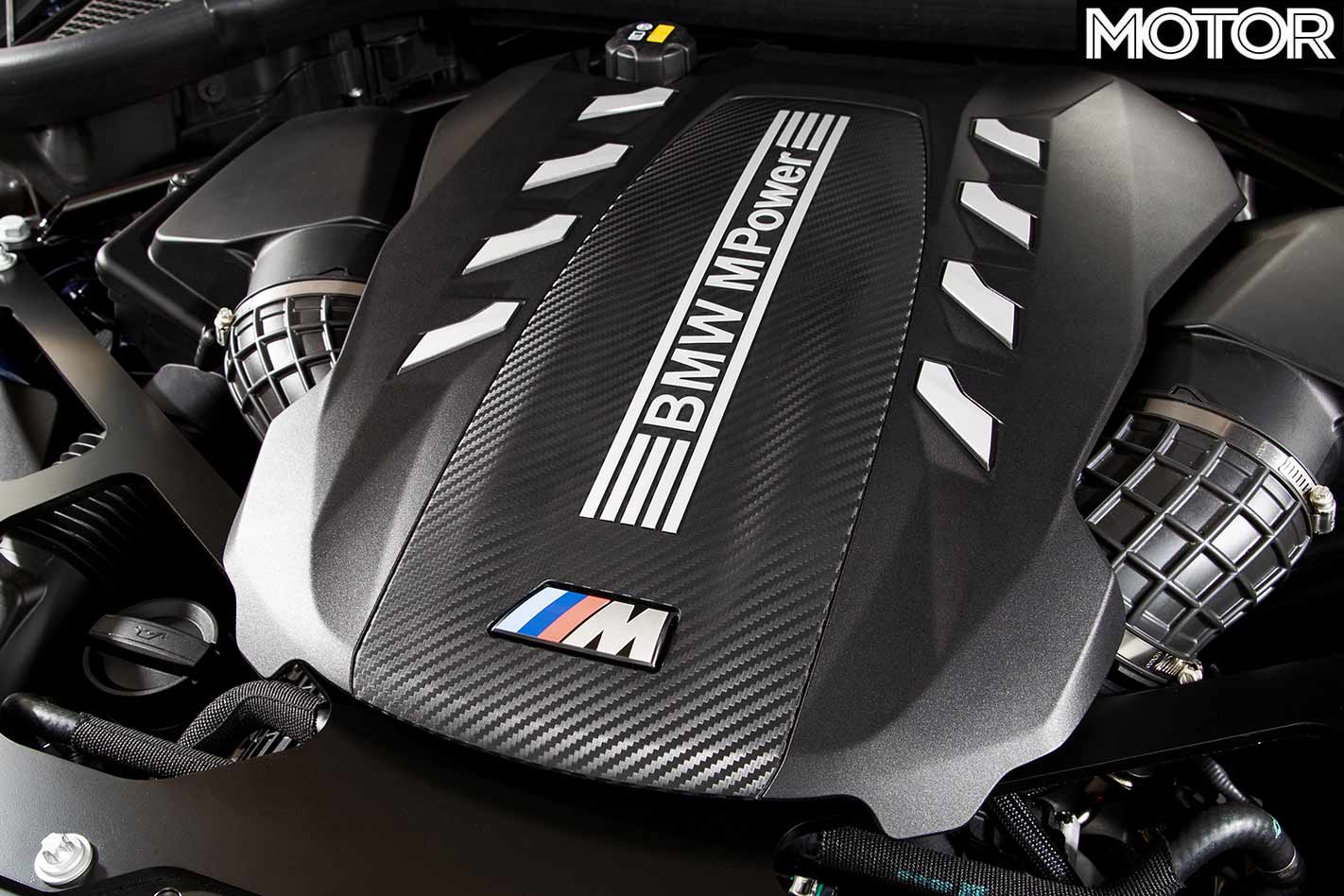
What is new is the level of aggressiveness programmed into the X5 M’s transmission. Even with the drivetrain set to ‘Efficient’, enthusiastic use of the throttle injects a shot of adrenaline that quickly has the eight-speed automatic dropping gears and the engine primed for attack. It comes in handy for a quick overtake or to plug a gap in traffic, when usually you’re left waiting for the gearbox to make up its mind as the world passes it by. The auto is excellent, smooth when it needs to be and quick-shifting when you ask, its only shortcoming a tendency to deny over-optimistic downshift requests, but it’s probably better to use the torque in a higher gear anyway.
The deck is heavily stacked against any group of engineers attempting to make something this big and heavy handle with finesse, but the folks at M Division have thrown the kitchen sink at the problem. Not literally; a sink would be of no help whatsoever. Instead, there are staggered rims – 21 inches front, 22s rear – wearing massive Michelin Pilot Sport 4S tyres 295/35 and 315/30 respectively. Behind these sit 395mm discs gripped by six-piston calipers at the front and 380mm discs and single-piston calipers out back. In addition, there are adaptive dampers, variable assistance (and ratio) steering and active anti-roll bars.
It all works. The X5 M has a freakish level of ability for such a big vehicle, but what’s remarkable is it feels relatively natural. It has extremely quick steering, possibly too quick, but whereas in some SUVs this feels engineered in to create a faux sense of agility the BMW refuses to succumb to its weight. It has an incredible resistance to understeer and any that rears its head is easily countered with the throttle. The M xDrive system, again lifted from the M5, is rear-biased in its standard configuration and only becomes more so with its Sport mode engaged. Do not think that because the X5 M is all-wheel drive it can be driven with impunity, as it’s keen to play, as crazy as that sounds – its performance threshold is higher than every other SUV bar probably the Porsche Cayenne Turbo.
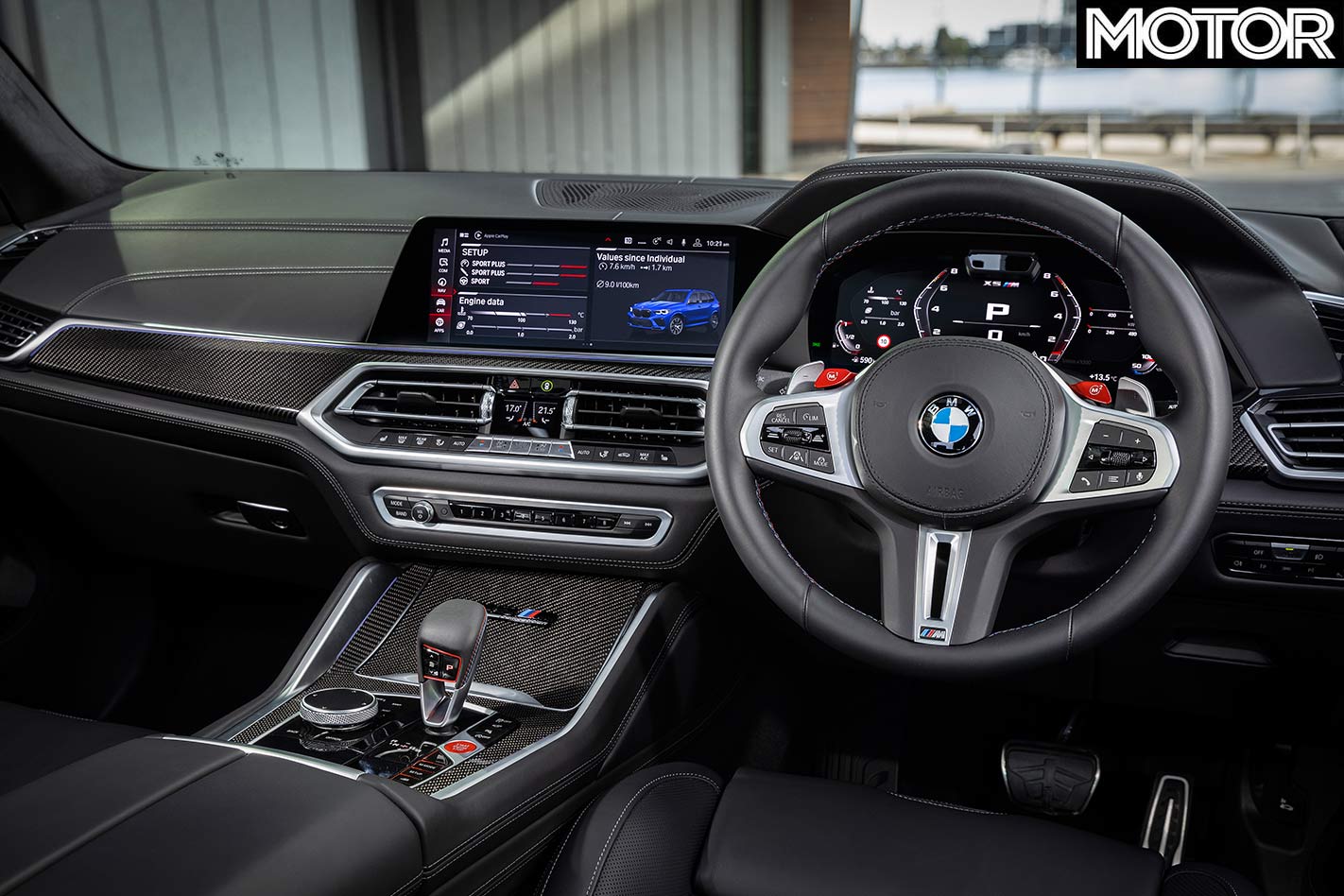
There is work required before the wheels turns a centimetre, though, as BMW sees fit to offer the driver plenty of scope for customisation. The engine, suspension and stability control each have three settings; the steering, brakes and all-wheel drive system a further two apiece; with all this controlled by a setup button in the centre console. It might sound complicated, but in M tradition, two favoured combinations of settings can be saved to the two bright red ‘ears’ on the steering wheel. There are annoyances: neither steering setting feels quite right and a choice of brake response feels redundant, made possible by the switch to brake-by-wire actuation. The juicy sounding ‘M Mode’ button also merely changes the infotainment and instrument displays.
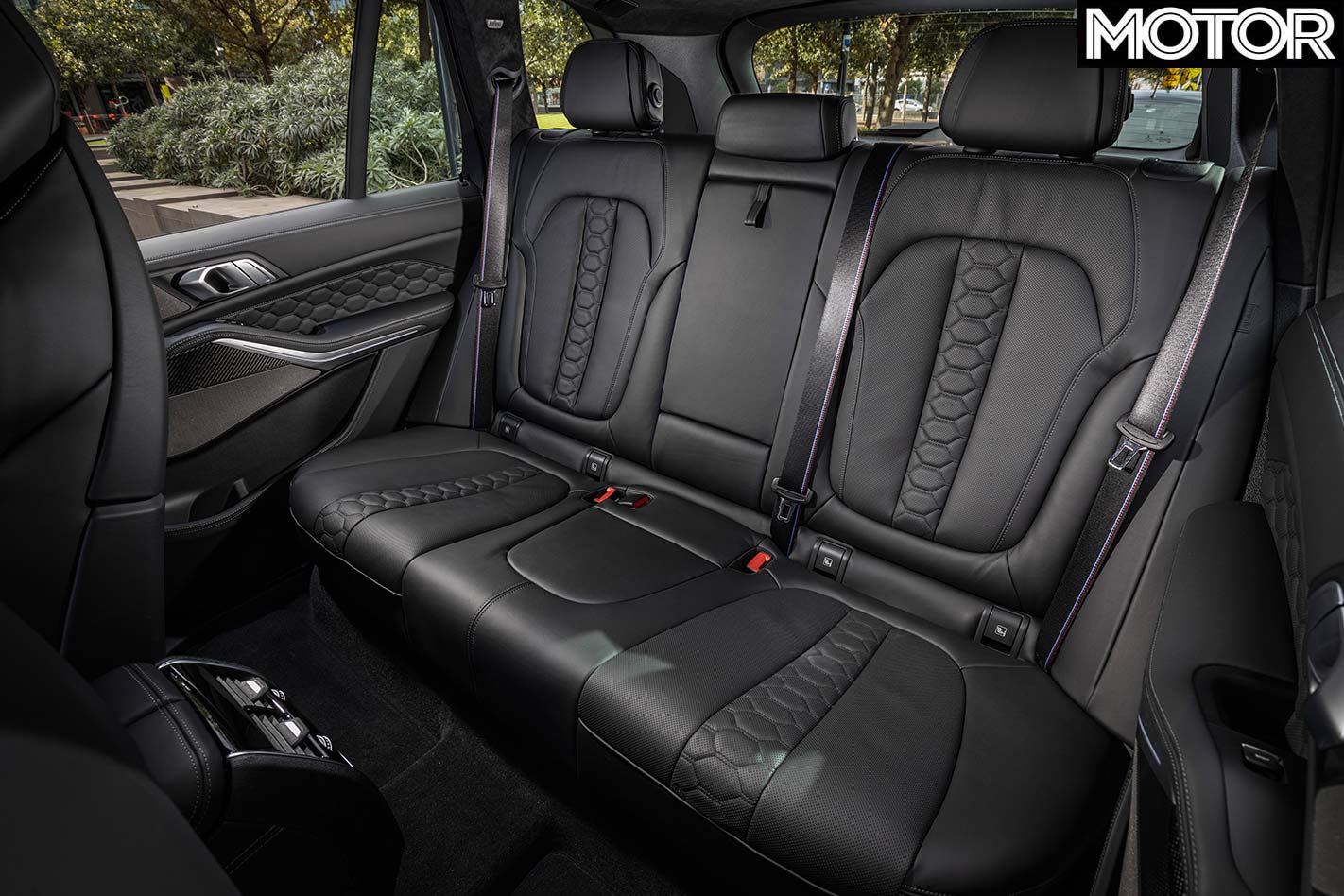
There are plenty of positives, though, too. Road noise is quite pronounced but the ride is comfortable, there’s plenty of space and the Australian specification is absolutely loaded. Granted, $209,900 is a lot of money, but none of the three vehicles present at the launch had a single cost option fitted, despite being specced with different wheels, metallic paint, carbon interior trim and full ‘Merino’ leather interiors with contrast stitching. It’s an impressive package. The fast SUV field is a lot more talented than it was back in 2010 and it’s unlikely the X5 M retains the dynamic dominance it once enjoyed, but its breadth of talent for a vehicle of this kind means it’s almost certain to be in with a shot of remaining top dog.
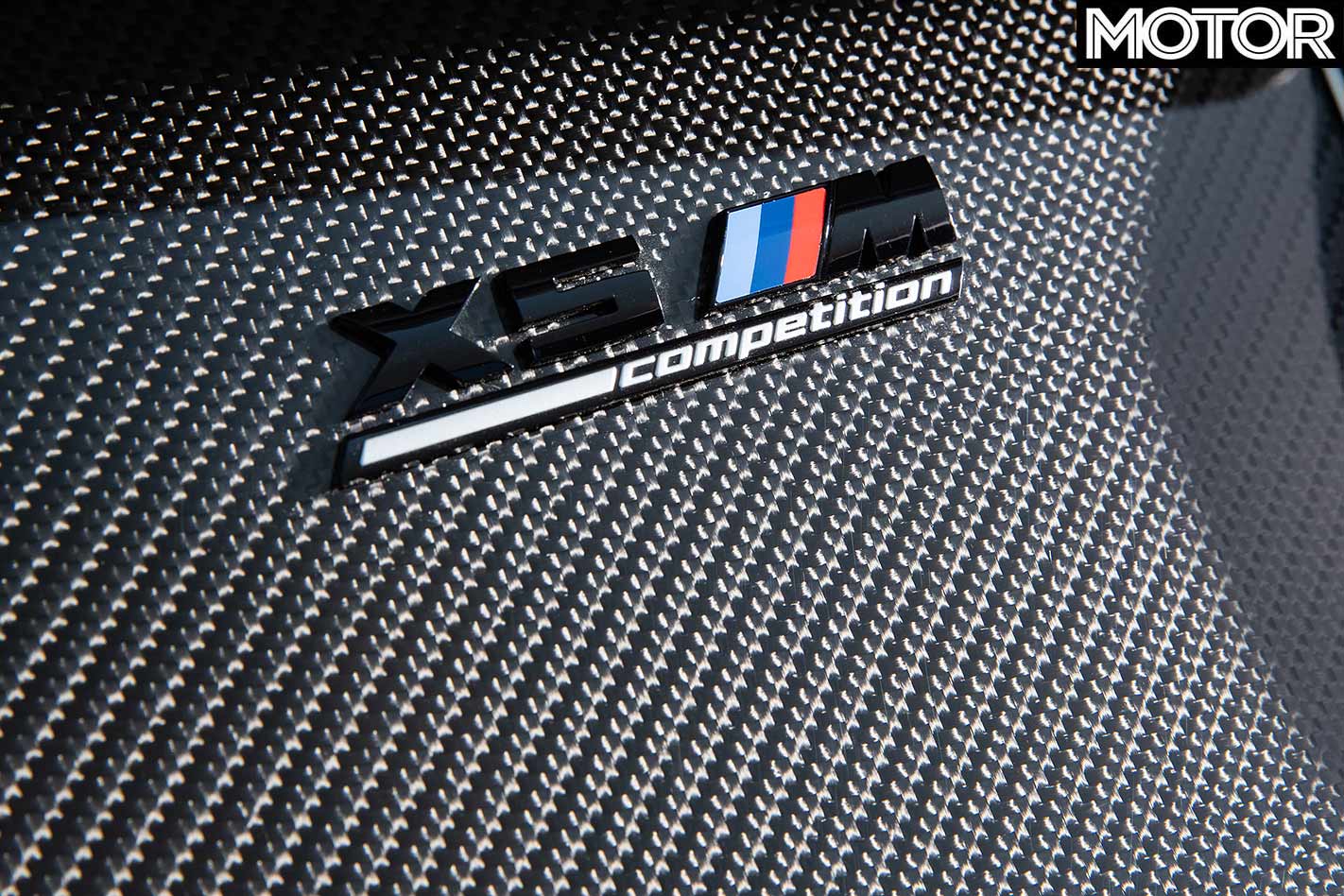
2020 BMW X5M COMPETITION SPECS Engine: 4395cc V8, DOHC, 32v, twin-turbo Power: 460kW @ 6000rpm Torque: 750Nm @ 1800-5800rpm 0-100km/h: 3.8sec (claimed) Weight: 2310kg Price: $209,900
The Wheels Verdict: If you have a hankering for torque, then the Audi SQ7 is just about the best new SUV you can buy today. The 4.0-litre turbo-diesel V8 had so much grunt that you are never left wanting. While it’s plenty capable of putting its terrific amounts of thrust to the tarmac through clever differentials, it’s more suited to being an extremely accomplished cruiser.
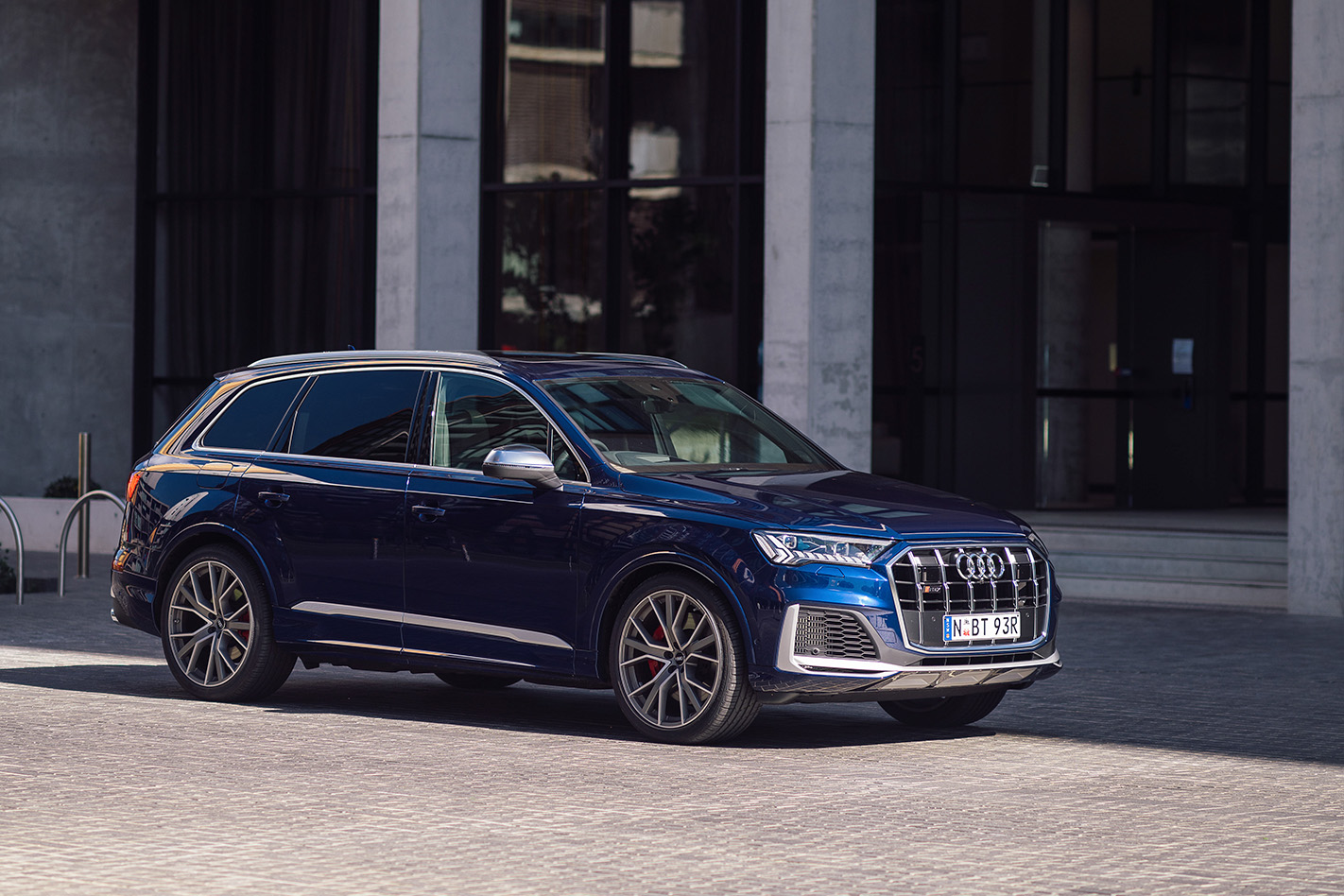
WHAT IS THE AUDI SQ7
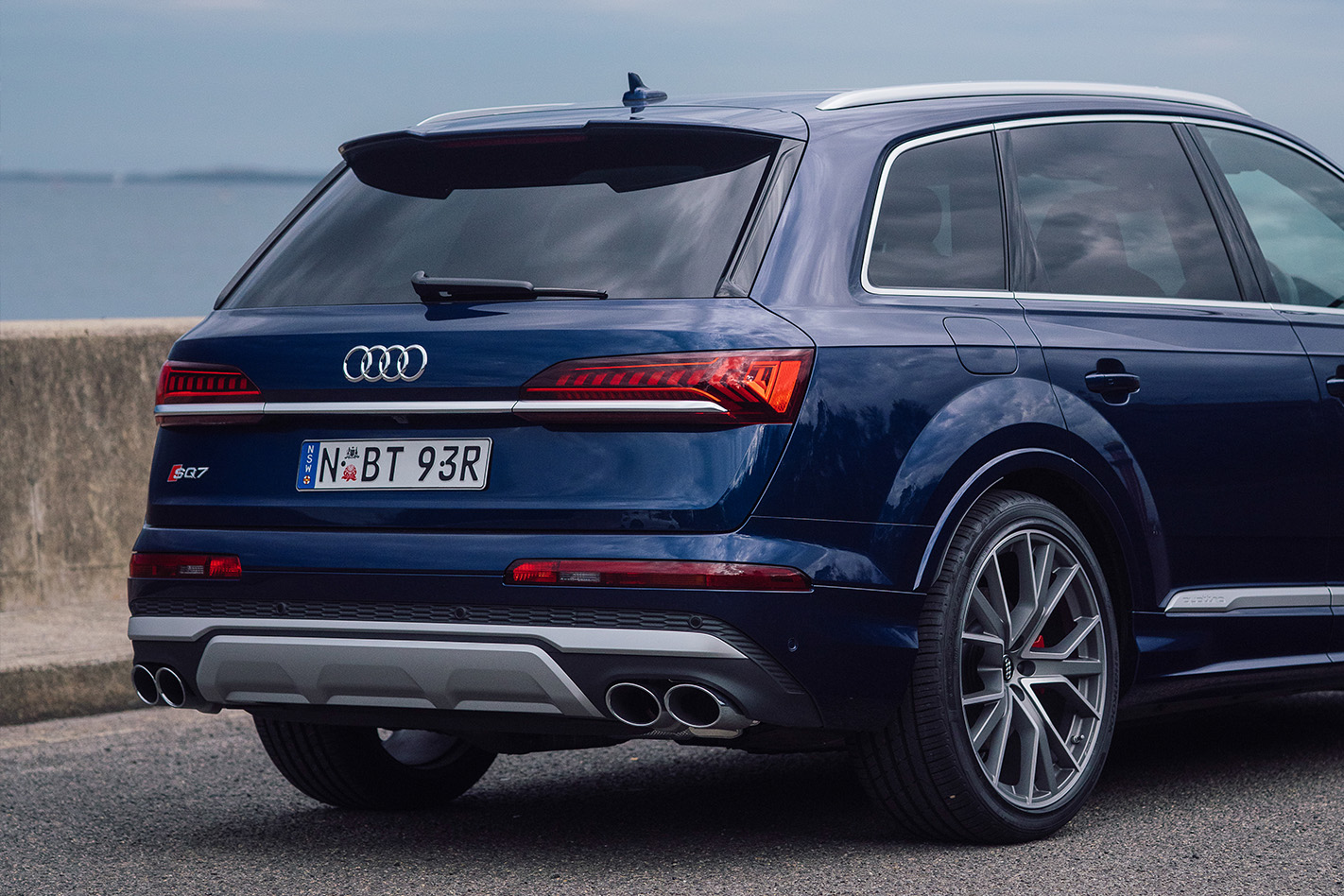
Audi has gone against the grain with the SQ7 and its SQ8 sibling, by retaining a diesel engine for the sporting range toppers, for the time being at least (a petrol RSQ8 is coming soon, but not available in Australia yet). Where the competition has opted for petrol power for a halo model, Audi has stuck with its 4.0-litre twin-turbo mild-hybrid V8 for the large SUV duo. With a $161,500 pricetag, this updated 2020 model is looking to compete with the likes of the BMW X5 M50i, and Mercedes-AMG GLE 53 for large, pseudo-sporting SUV glory.
WHY WE’RE TESTING IT
For the 2020 model year Audi has brought the SQ7 in for some mild tweaks, while also introducing the all-new SQ8 to Australia. Changes to the SQ7 mirror the recently updated ‘regular’ range, with a fresh interior lifted from the Q8, some minor styling tweaks, more standard equipment, and drivetrain refinements. Time to find out if the SQ7 can talk the torque.
THE AUDI SQ7 REVIEW
When it comes to the SQ7, it’s all about that engine. Sure, it has a plush, extremely well-equipped cabin, with space and practicality that makes it a viable everyday family hauler. But the reason you’d buy the SQ7 over the non-Audi Sport variants in the range, is the engine. That or badge snobbery.
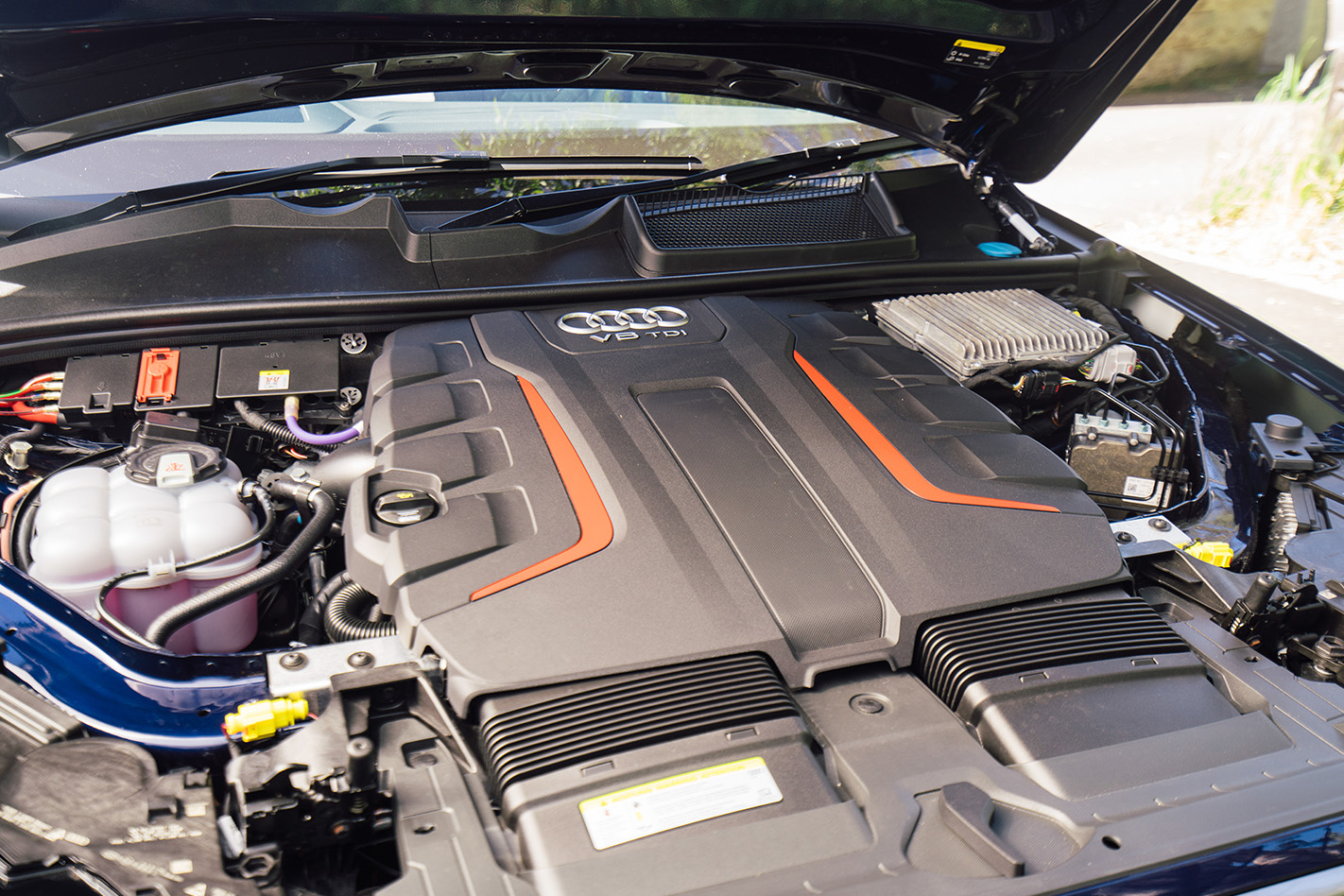
The eight-cylinder dreadnought under the bonnet is a powerhouse, with mild tweaks to the 4.0-litre diesel V8’s twin-turbo mild-hybrid system bringing extra refinement to its character. Peak power is a stout 320kW, available between 3750-4750rpm. However, with the SQ7, it’s all about torque, and there is 900Nm of the good stuff on tap from just 1250rpm all the way to 3250rpm.
The new Mercedes-AMG GLE 53 commands an extra $5000, and its twin-turbo straight-six matches the Audi on power, but is down 380Nm. The BMW M50i is cheaper, with a $155,900 pricetag, while the twin-turbo V8 produces 390kW and 750Nm.
All that shove from the Audi’s turbo-diesel engine means the gearbox is rarely worried when the SQ7 is being hustled – either in automatic and manual modes. Left to its own devices the eight-speed automatic transmission slurs between ratios without being a distraction. However, you can just as easily pick a single ratio in manual mode – in our case, third gear – and let the ample bandwidth take you from corner to corner. By time the torque begins to peter out, the peak power is on tap and you find yourself in a family hauler capable of cracking 100km/h from a standstill in a claimed 4.8 seconds. Want to lose your license in five seconds while your family watches, sir? Walk this way.
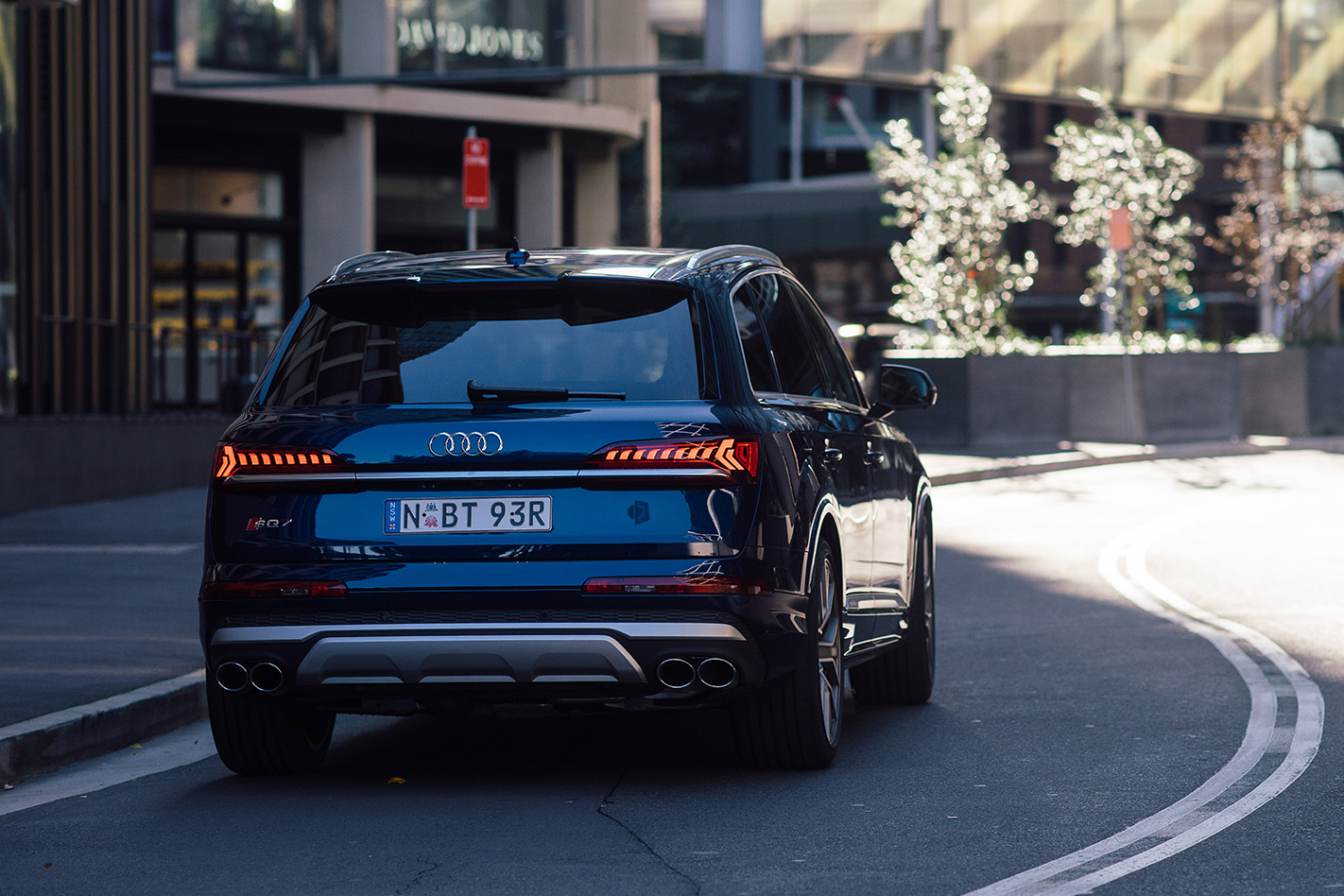
For the fuel-bill conscious, there’s plenty to like about the SQ7. Audi claims it’ll sip diesel at a rate of 7.6L/100km, which’ll be difficult to replicate in the real world away from the highway, but it does undercut similarly priced and powered petrol rivals. The 48-volt mild-hybrid system has a clever way of saving a few millilitres of fuel, by shutting off the engine when coasting. It’s unobtrusive, and adds to the serenity inside the cabin while driving.
If you have any intentions of taking your large seven-seat SUV for an enthusiastic jaunt on tight and twisting mountain roads, the $10,900 optional Dynamic package becomes a must-tick box. With it you get active roll stabilisation that markedly improves body control, and a quattro sport differential that can direct power to the outside rear wheel to quell understeer or the inside rear wheel if oversteer is anticipated.
While the SQ7 is not embarrassed dynamically without this option, it does transform the car’s character when you are hustling the two-tonne diesel SUV. Where previously you really had to get the car slowed down on corner entry to get the body to turn in without ESC-inducing understeer, it now carries speed more cleanly toward apexes on corner entry. Similarly, where the heft of the large-SUV was present, shifting from side to side in corner transitions, it is now hidden deftly by the electromechanical system.
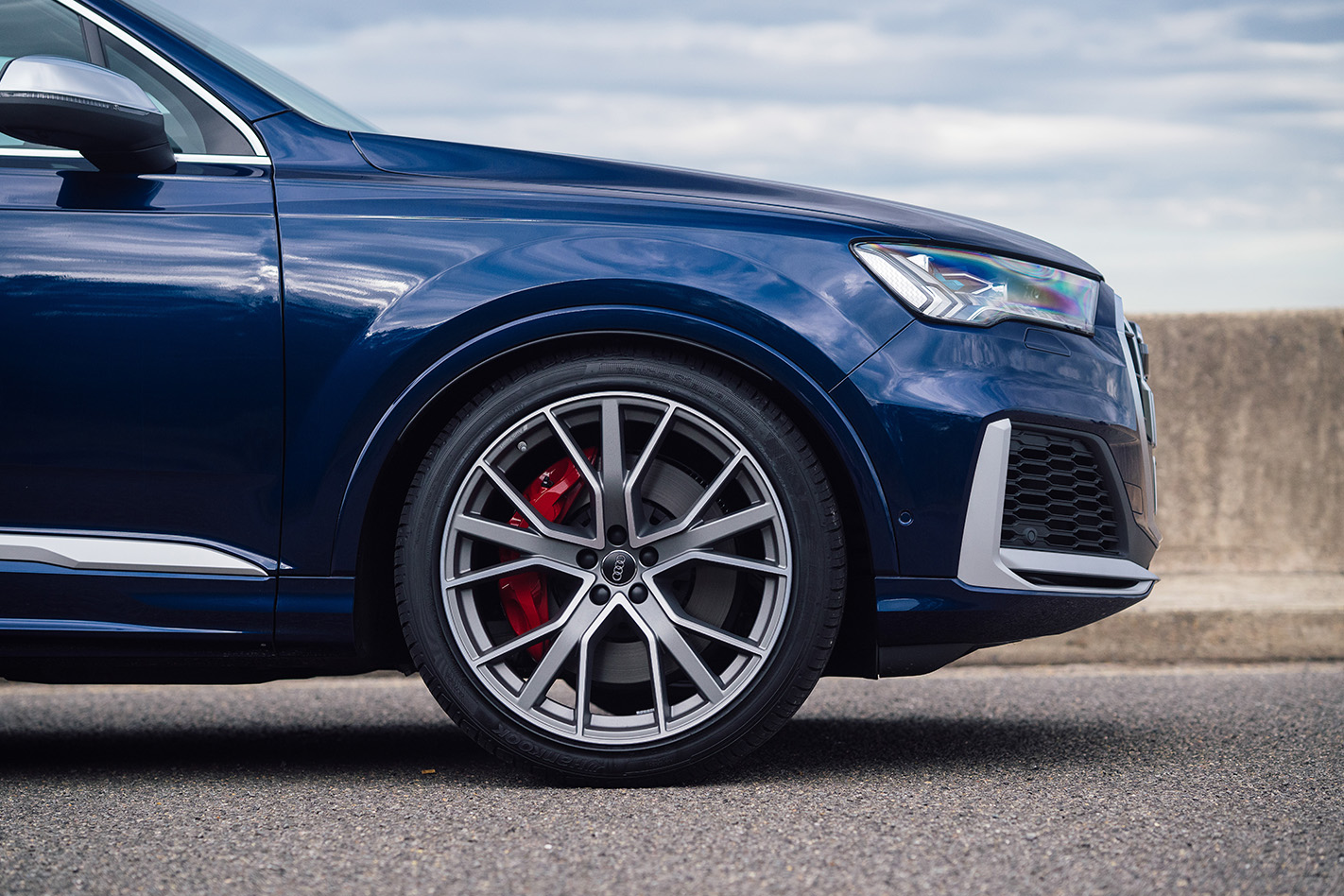
It should be noted that a challenging b-road isn’t where this car is most comfortable, even with its all-wheel steering, as its size remains an ever-present challenge. Where the car shines is on the highway, where it cruises along effortlessly. The diesel engine hums along between 1000-1500rpm depending on the speed limit and drive mode selection. With peak torque arriving at such a low rpm, overtaking grunt is always on tap, while the air suspension offers an impressive ‘wafting’ ride quality. Even with large 22-inch wheels, Continental Premium Contact rubber in girthy 285/35 sizes, and a sportier damper tune than the regular variants, the SQ7 has a calming level of ride refinement.
On bumpier roads the large wheel and tyre combo undersells the performance of the air suspension, and there is a harsher edge to the ride quality. Though if you value comfort above all else, we’d recommend stepping into a regular Q7 50 TDI with 19- or 20-inch wheels.
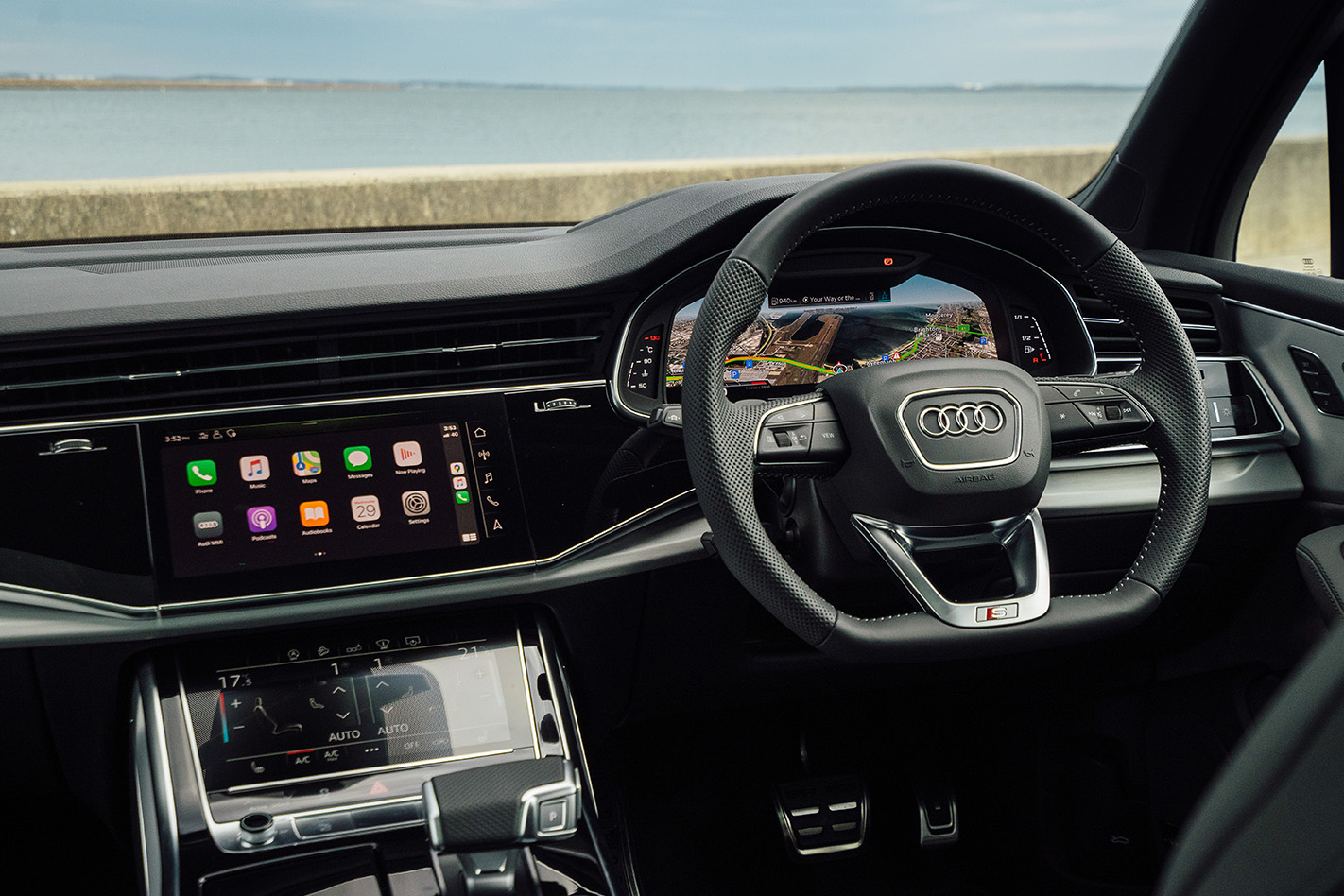
Forget for a moment that this luxury SUV has a six-figure pricetag, and you realise the Audi Q7 offers pretty darn good value for money. The standard equipment is very un-European, requiring little to no option ticking to get everything you’d demand from a car of this calibre. Valcona leather upholstery on the sport seats, four-zone climate control, electric steering column adjustment, power-assisted door closure, a panoramic sunroof, Audi’s full suite of safety systems, Apple CarPlay and Android Auto, wireless smartphone charging, automated emergency calls, and theft notification, and a Bose 3D surround sound system are all standard.
RIVALS
BMW X5 M50i, Mercedes-AMG GLE 53
AUDI SQ7 SPECIFICATIONS
- Model: Audi SQ7
- Engine: 3956 twin-turbo V8, dohc, 32v
- Max power: 320kW @ 3750-4750rpm
- Max torque: 900Nm @ 150-3250rpm
- Transmission: 8-speed automatic
- Weight: 2460kg
- 0-100km/h: 4.8sec (claimed)
- Economy: 7.6L/100km (claimed)
- Price: $161,500
- On sale: Now
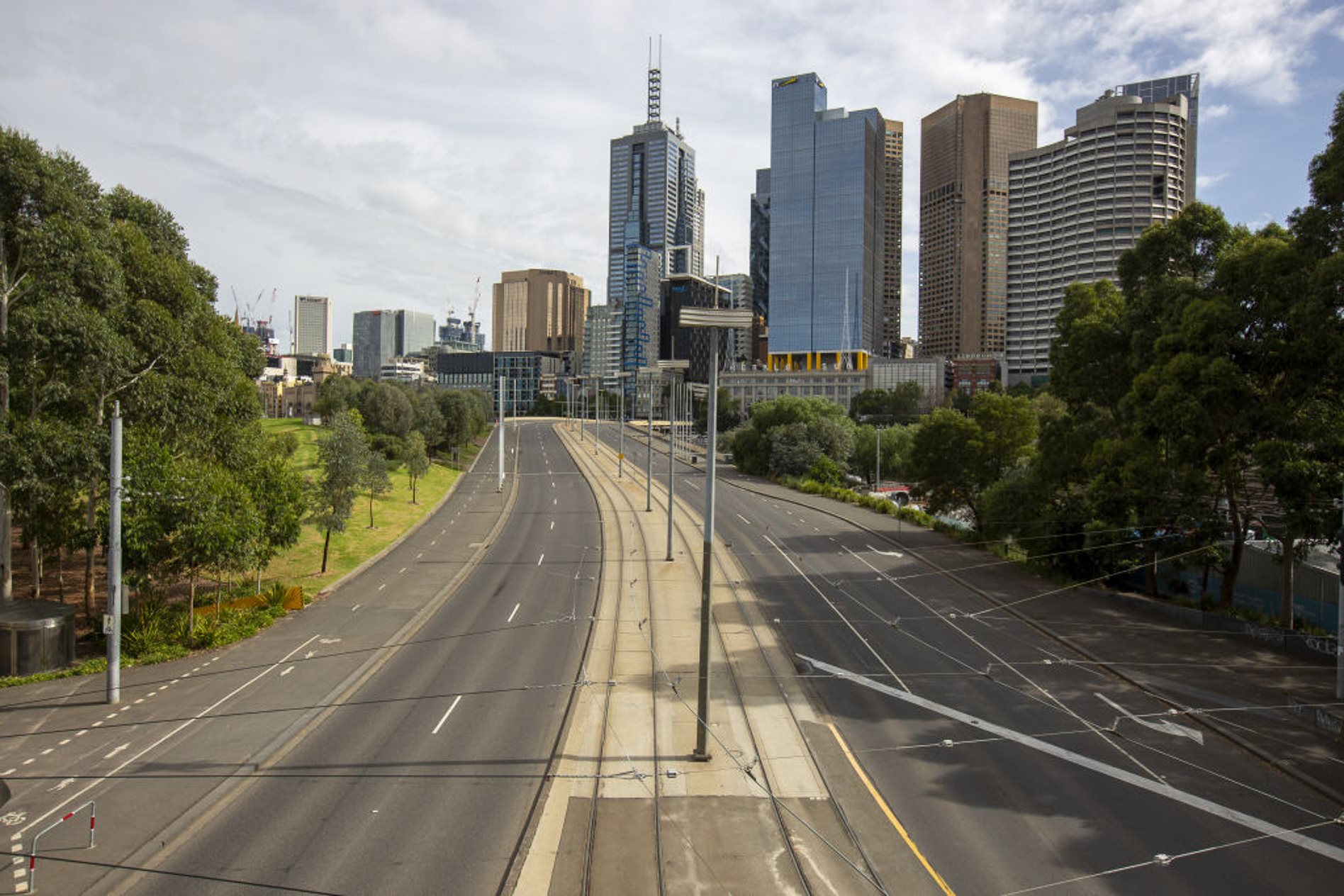
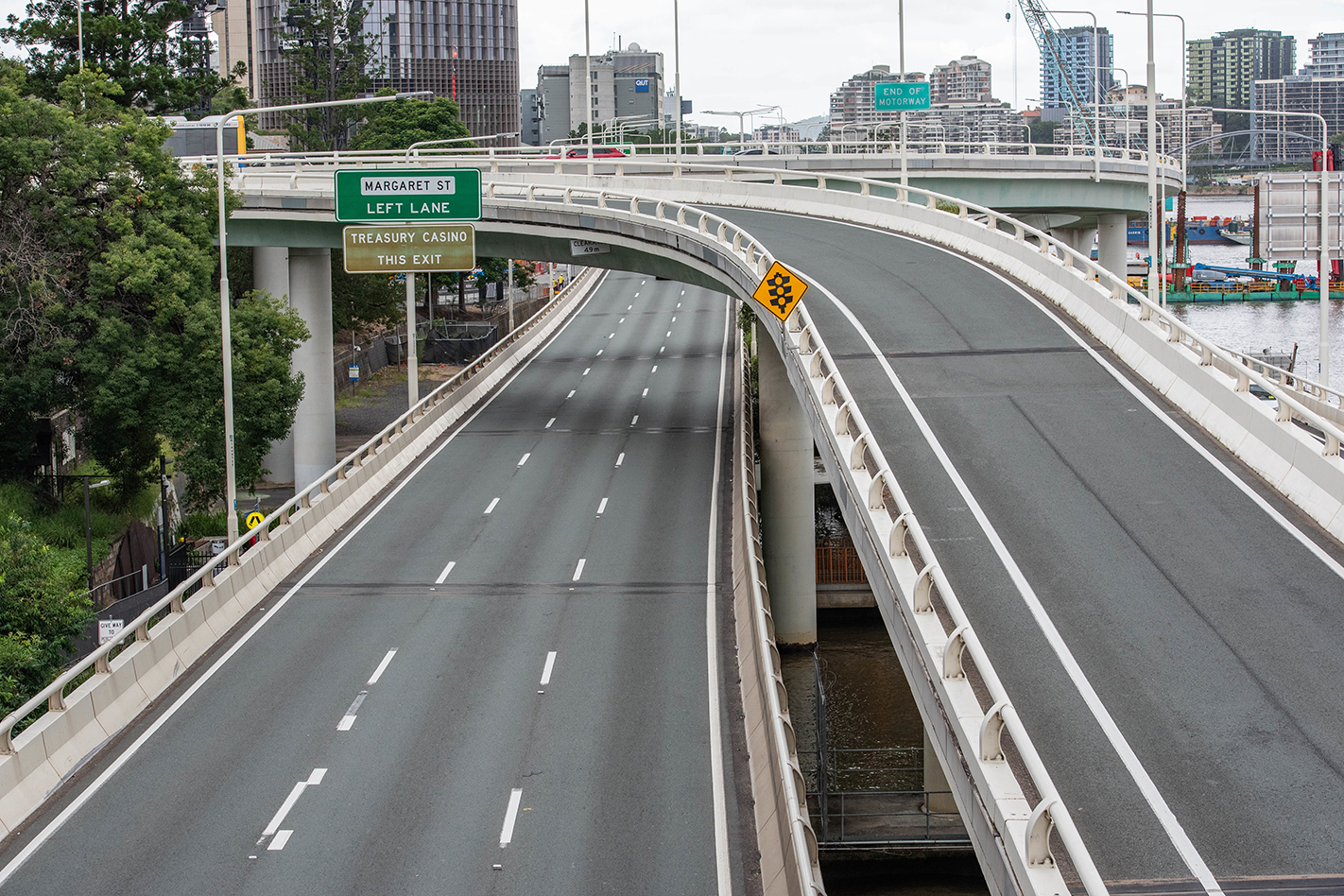
Eerily quiet streetscapes have become a feature of COVID-19 lockdowns across Australia as capital city peak-hour traffic drops by as much as 40 per cent.
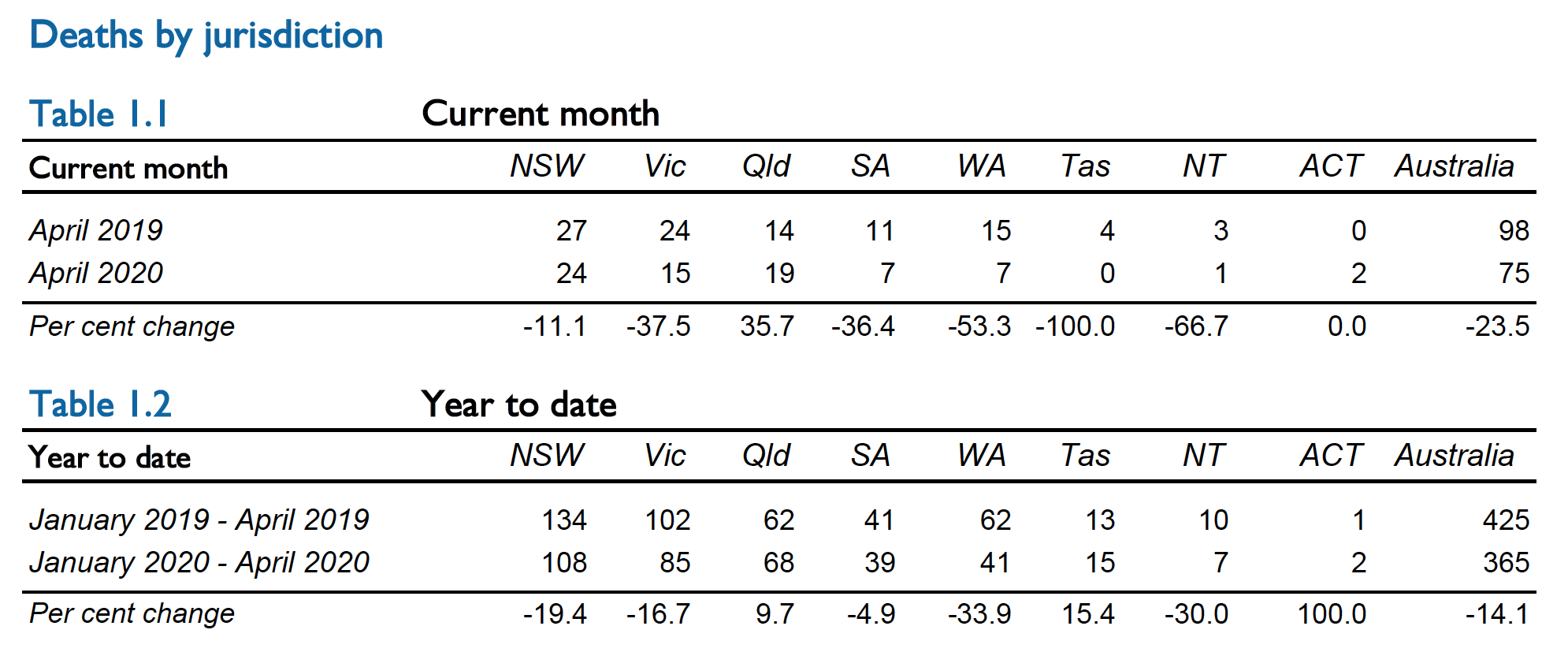
According to the Australian Bureau of Infrastructure, Transport and Regional Economics, there was a significant decline in road deaths in Australia in April 2020, with the death toll falling to 75 nationally.
This is both a 25 per cent year-on-year decrease from April 2019 and a 25 per cent month-to-month reduction over March.
Tasmania recorded the laudable tally of zero road deaths in April (from four in March), while Victoria (15 deaths, nine fewer) and Queensland (19, down four) also helped to bring the road toll down.
South Australia (14 deaths, down seven) also recorded a decline despite having arguably the most lax lock-down regulations of any state or territory.
There were 100 road fatalities across Australia in March, which was 15 fewer than March 2019 and 5.1 percent lower than the March average over the previous five years.
This was mostly attributed to a 41.4 percent drop in NSW, which experienced 24 fatal accidents compared to 41 last March.
That’s a big drop, however, it’s worth noting the March 2019 state toll seems abnormally high, with March 2018 also recording 24 deaths.
Meanwhile, Victoria, which entered the lockdown phase at the same time as NSW during the middle of the month saw a 23.8 percent rise in fatalities in March with 26 deaths compared with 21 last year. That trend has continued into April.
South Australia had 14 deaths last month, up one from last year, while Queensland (23) and the Northern Territory’s (1) March toll remained the same. Tasmania and Western Australia each recorded two fewer deaths, while the ACT had another clean sheet.
The March national road toll doesn’t make good reading either when compared with February – before lockdowns were even considered here. There were 92 deaths across the country during the 29 days of February, averaging 3.17 per day, compared to 3.22 per day across the 31 days of March.
To be expected
Such figures aren’t actually surprising, according to Professor Max Cameron from Monash University Accident Research Centre, who told The Age less congested roads present an opportunity for higher speeds, meaning the accidents that do occur are likely to be more serious.
And then there’s alcohol, which has seen a spike in sales along with flour and toilet paper. The latter two are unlikely to have affected road fatalities.
“Fortunately people are not drink-driving as much, but of those who do, they’re probably driving intoxicated to a greater extent and that all contributes to an increase (in crash severity) as well,” Professor Cameron said.
But there are signs the dramatic changes to our lifestyles and movement could be attributed to the drop in road fatalities, when location is taken into consideration.
Looking at the NSW statistics, there were just four fatal accidents in the Sydney metropolitan area in March, down from 11 last year. And, with few drivers authorised to go on long trips, the number of fatal accidents on country arterial roads dropped from 17 to 10 with none of these occurring on the major highways such as the Hume, Pacific, Princes or New England.
But in country urban areas, where the impact of the lockdown wasn’t as dramatic on local traffic and movement, road deaths went up from six to eight.
It was, in its heyday, the Mercedes-Benz model that represented the zenith of style and desirability offered by Germany’s oldest car company. The 300 SL ‘gullwing’ of 1954 remains an enduring icon, while the later W113 generation remained in production for a staggering 18 years.
The SL was a model that arguably peaked with the R129 generation; the Bruno Sacco-designed masterpiece built from 1989 to 2002 that epitomised fast, luxurious, open-topped motoring.
But like a fading Hollywood star, the SL has long been in decline. In 2012, for example, Benz shifted nearly 5000 SLs in the USA (the model’s largest market); last year, that tally was under 1700.
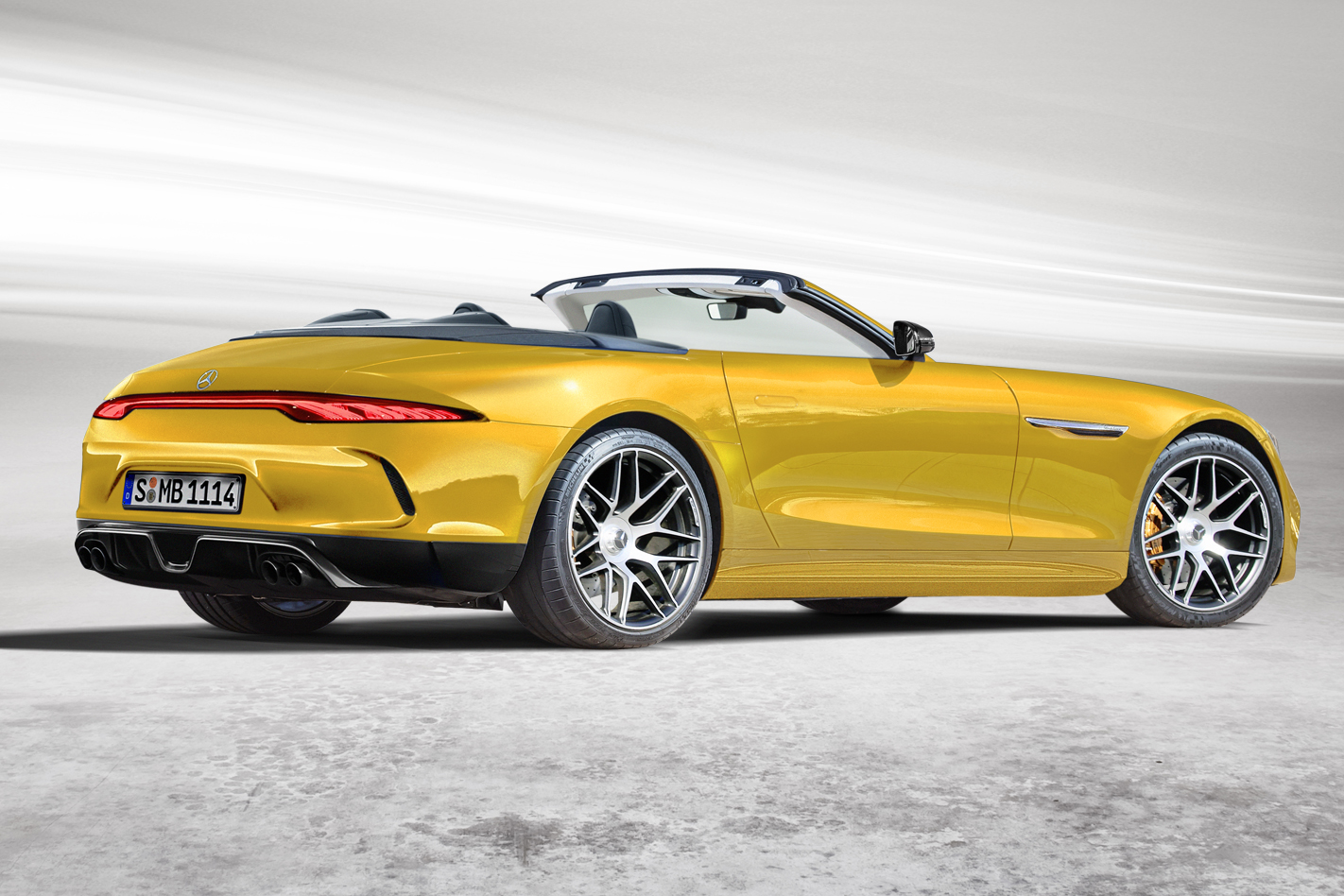
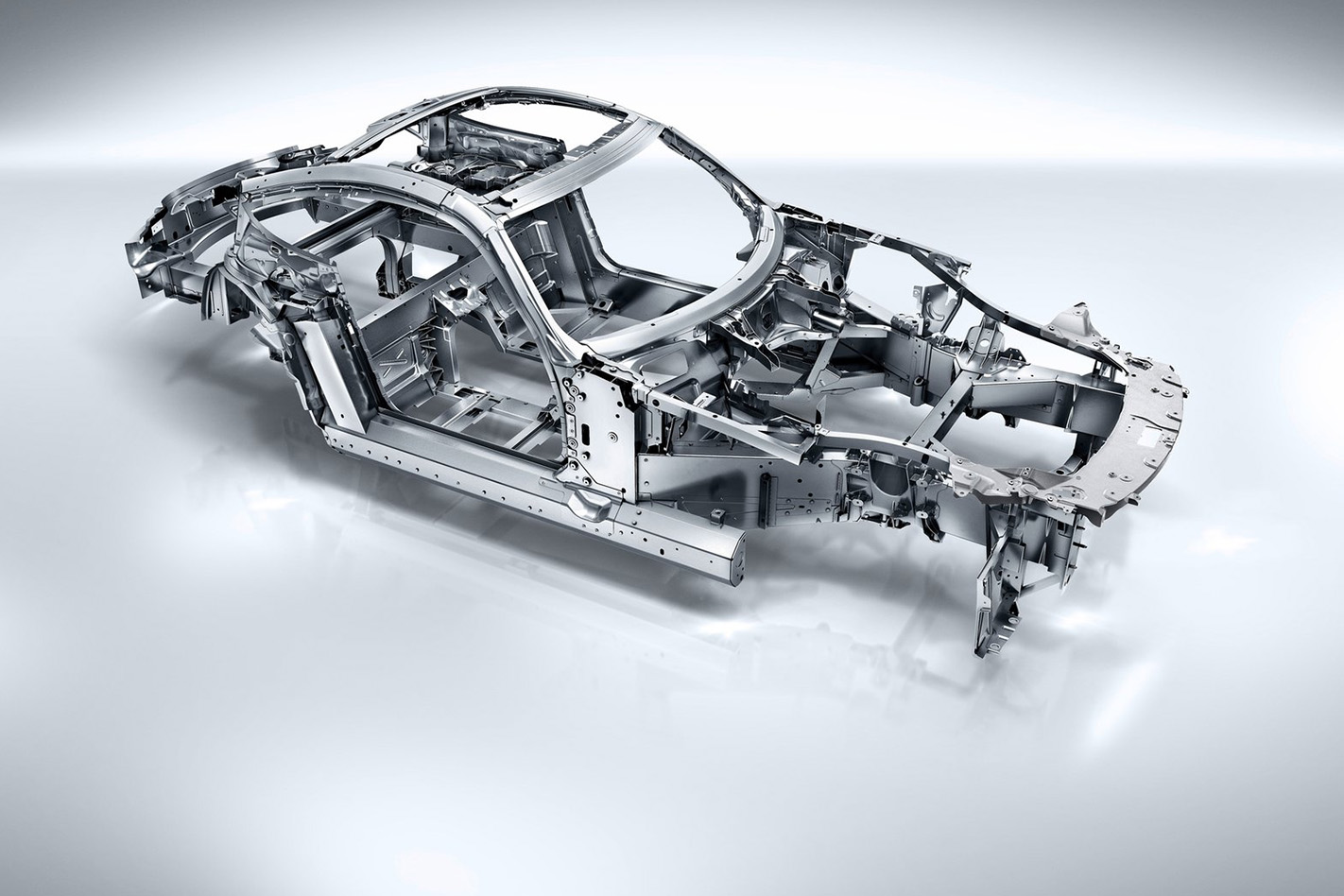
So how to reverse this? Step one, hand over the development of the new model to Mercedes-AMG, and use the Affalterbach division’s expertise with all-aluminium platform construction to co-develop the new model, due in 2021, with the next-generation AMG GT.
The key point of difference from a packaging point of view will be the SL will remain a 2+2, continuing to provide small but useable kids’ seats in the rear, whereas the GT (and more comparable) GT Roadster will remain strictly two-seaters.
The other significant change will be a ditching of the Vario-Roof folding hardtop, marking a return to a lighter soft-top roof. This is partly down to the all-new aluminium structure; engineers are so confident of the stiffness of the SL’s new architecture, they’ve deemed a more torsionally rigid hardtop unnecessary. Further, advances in materials technology for the soft-top mean the designers believe they can get close to the noise-quelling qualities of a hardtop, but bank a useful weight saving.
Fully developed by AMG in Affalterbach, the next-gen SL will be based on a stretched and thoroughly updated version of the architecture beneath the two-seat AMG GT, which itself is related to the gullwinged SLS AMG, the first model engineered from a clean sheet in-house by AMG back in 2010.
As for powertrains, sadly the new car won’t get the outgoing SL’s 6.0-litre V12, which Mercedes quietly dropped from the line-up back in 2018. Instead, a turbocharged straight-six and twin-turbo V8, both with 48-volt hybrid assistance, will ensure that even lower-spec SLs won’t lack performance.
Along with plans for Euro 7 compliant V8s, an EQ Power plug-in hybrid SL could be part of the mix, badged SL73 as a nod to the formidable 7.3-litre V12 model of 1995. This powertrain is expected to make its official debut in the AMG GT four-door later this year, combining the 470kW/900Nm M178 twin-turbo V8 with e-motors on both axles for around 600kW in total.
Speculatively, Australia could get a three-model SL line-up as per the current car, with the boosted inline-six opening the range, a 4.0-litre twin-turbo in the middle, and the top-spec mack-daddy SL73 there for customers prepared to part with what will surely be close to $400K.
So yes, monstrous performance will be there for those who seek it. The challenge for AMG will be engineering the new SL to exploit this, while retaining a softer, waftier character than that of the revamped GT.
To this end, expect the SL to have every tech trick thrown at it, including an even more sophisticated form of Merc’s Magic Body Control system that scans the road ahead for bumps and adjusts the damping rates accordingly. And given the new SL will eventually replace the S-Class coupe and convertible, the level of driver-assistance systems, materials and finishes will be truly next level.
AMG boss Tobias Moers acknowledges the importance of the task given to his division; to take such an esteemed Benz nameplate into the next generation. “It’s kind of a burden to be responsible for the SL, but we had to make sure this iconic car had a bright future,” he told media earlier this year. “The weight of responsibility is heavy but what we’re doing is good. We are taking the new all-aluminium SL back to its roots: more sporty but also better for everyday use.”
It’s not just AMG that will be involved with the next-gen SL, as Maybach is also expected to develop a variant for the drop-top, possibly with outlandish luxury design details inspired by the Vision Mercedes-Maybach 6 concept.
Nissan’s bigger, more spacious and safer Juke will roll into Australian showrooms in June, packing a compelling list of technology and comfort features over the first-generation model, but with a price to match.
And, while the 2020 Juke has grown up in technological and comfort terms, its driving potency has taken a step back with a reduction in power and just one three-cylinder engine serving the entire line-up, as well as all-wheel drive vanishing from the range.
Kicking off from $27,990 before on-road costs, the 2020 Juke small SUV will be on offer in local showrooms in four variants starting with the ST, which represents a hefty $4500 increase over the outgoing gen-one ST.
But, says its maker, the new version has more to offer in almost every regard and now straddles the divide between compact bantamweights and the larger segment above.
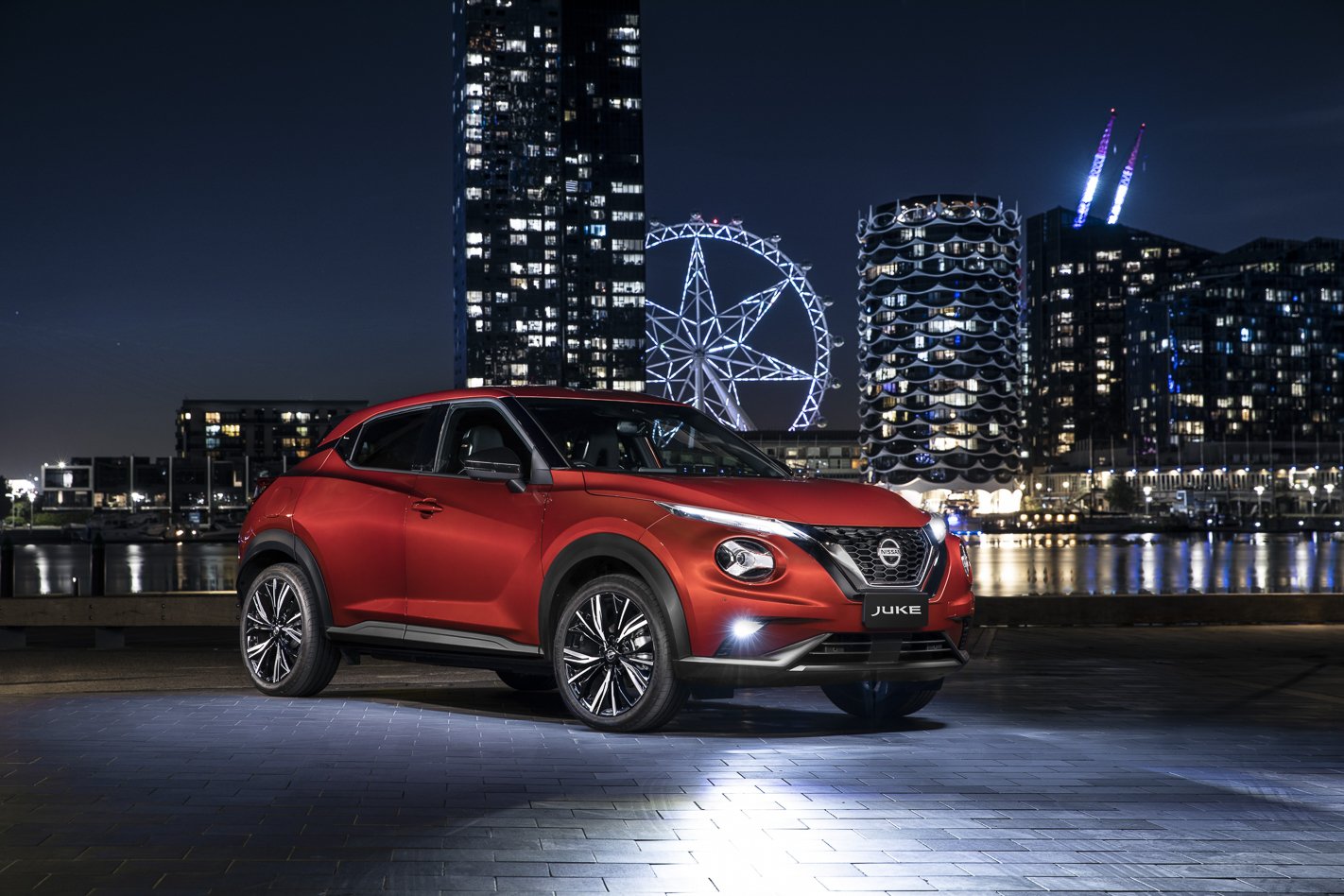
“It sits in the light SUV segment but a lot of its dimensions and technology push it up into the small segment so it has a broad competitive set,” Nissan Australia corporate communications director Karla Leach told WhichCar.
“It’s very spacious and that potentially pushes it into a different space than the offering that’s currently there.”
While the previous version didn’t quite garner the attention it deserved from Australia’s discerning audience, the 2020 Juke promises to make more of a splash this time around, said Leach.
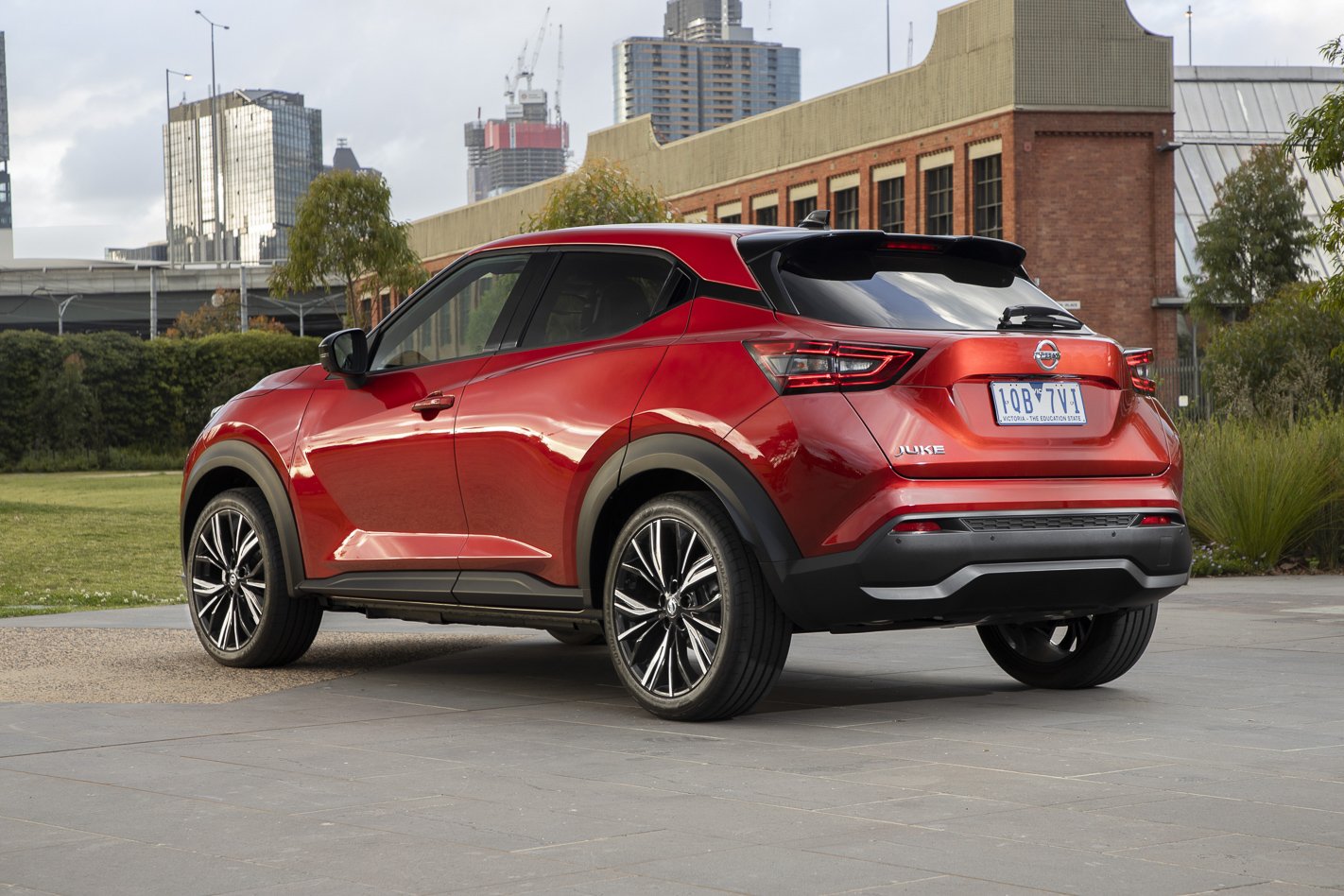
“I think that category has matured since the first Juke was launched here in 2013 and Australians are more familiar with that segment, more comfortable with a raised driving position, and they’re definitely more tech-savvy.
“It ticks all those boxes for what Australian consumers are looking for so we think it will be very popular.”
What’s in the Juke boxes?
Those ‘boxes’ include generous safety equipment levels even from the entry-level including autonomous emergency braking and collision warning, with traffic sign recognition, lane departure warning and lane-keeping assistance to aid the driver.
All versions also get LED headlights, reversing camera with rear parking sensors, blind-spot warning and rear cross-traffic alert- respectable for a base version compact SUV.
Comfort and convenience highlights include an 8.0-inch touchscreen for accessing standard Android Auto and Apple CarPlay as well as other convenience applications depending on the variant.
MORE Boot sizes of popular SUVs
The Juke’s new more imposing stance is also common to all versions with a growth spurt to all dimensions. Length has grown 75mm, it’s 35mm wider and 30mm taller. That corresponds to a boost in cabin and storage space.
At the back, the Juke’s boot is a respectable 422 litres, rear passengers have 58mm more knee room and a little more air above their heads, while larger doors make getting in and out easier.
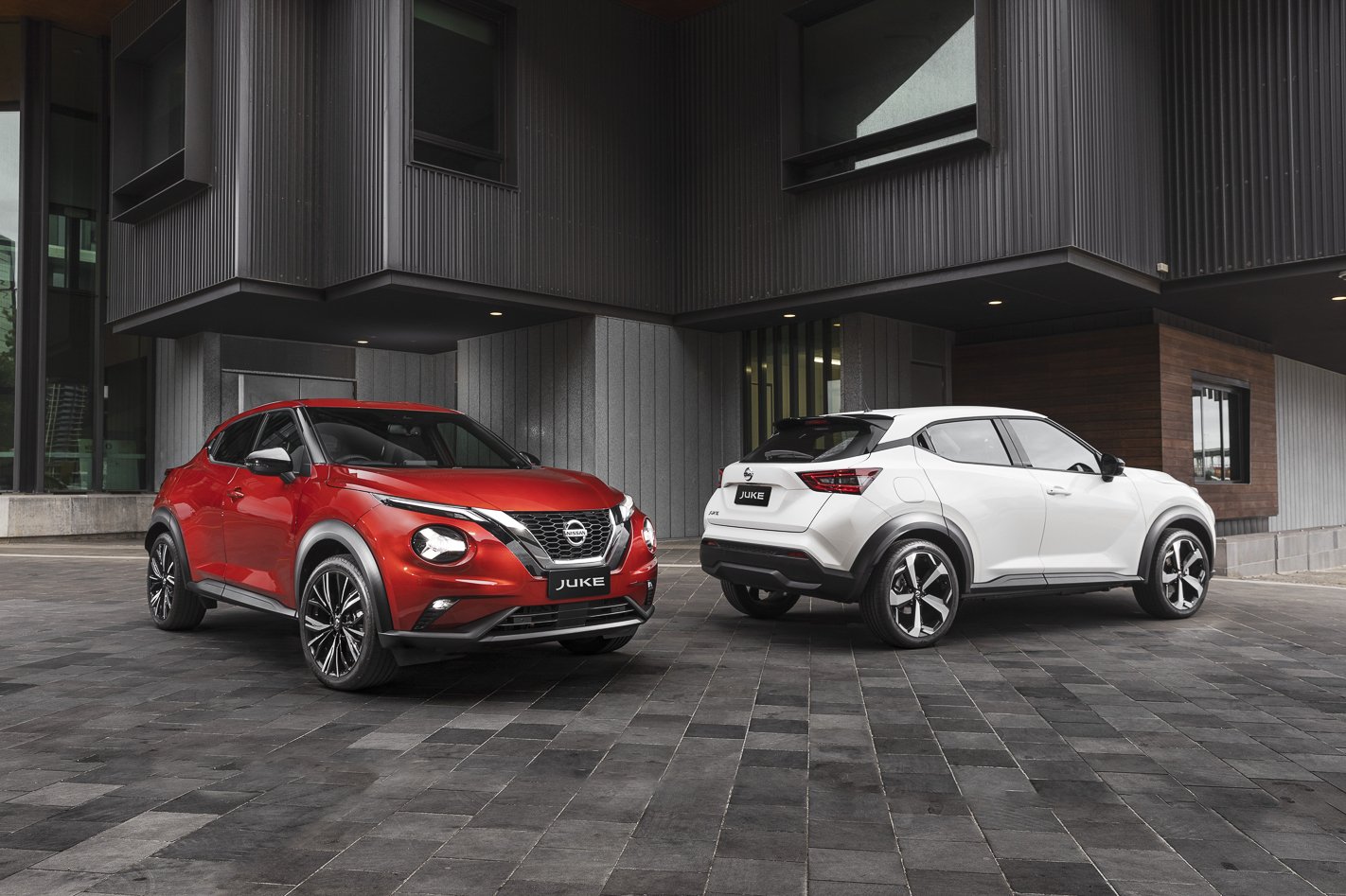
Stepping up to the ST+ boosts the price to $30,740 but adds LED fog lights to complement the standard LED headlights, heated front seats, standard navigation and front parking sensors join the rear parking assistance.
Above that, the $33,940 ST-L brings even more kit including aesthetic enhancements in the form of ambient cabin lighting and part-leather upholstery on the inside, and 19-inch alloy wheels upgrading the 17-inch standard offering on the outside.
There’s also a further boost to safety with active cruise control, Moving Object Detection and a 360-degree camera for added parking ease.
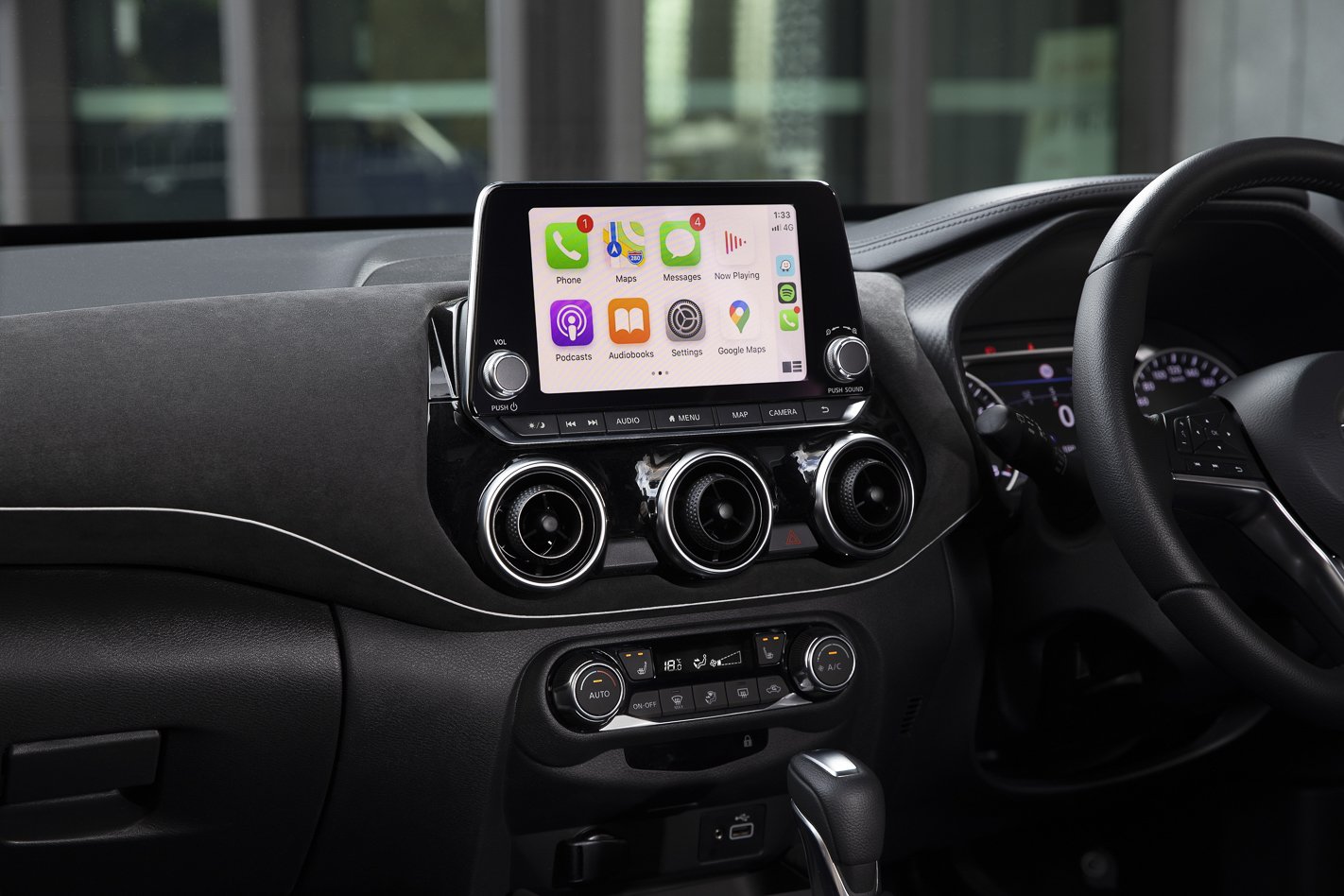
More space has been freed up in the ST-L with the removal of a handbrake lever in favour of an electric park brake, and more technology has been crammed in with a six-speaker sound system, rear USB charging added to the standard front sockets, plus a 7.0-inch driver information display.
At the top of the pack, the $36,490 Ti upgrades ST-L specification with a combination of quilted Alcantara and leather-accented upholstery, unique wheel design and Juke-branded kick plates on the door sills, an eight-speaker sound system courtesy of Bose and a tyre pressure monitor for a good safety measure.
Two wheels, three cylinders
Arguably the only area that has not grown up for the new Juke is its powertrain, with its downsized petrol engine that drops one cylinder for a total of three, and a capacity that has shrunk to just one turbocharged litre.
While other parts of the world will get a more potent version of the three-cylinder, 1.0-litre turbocharged engine with 86kW and 200Nm, Australia is being offered only an 84kW/180Nm tune, which represents a reduction in performance over all four of the previous four-cylinder engines.
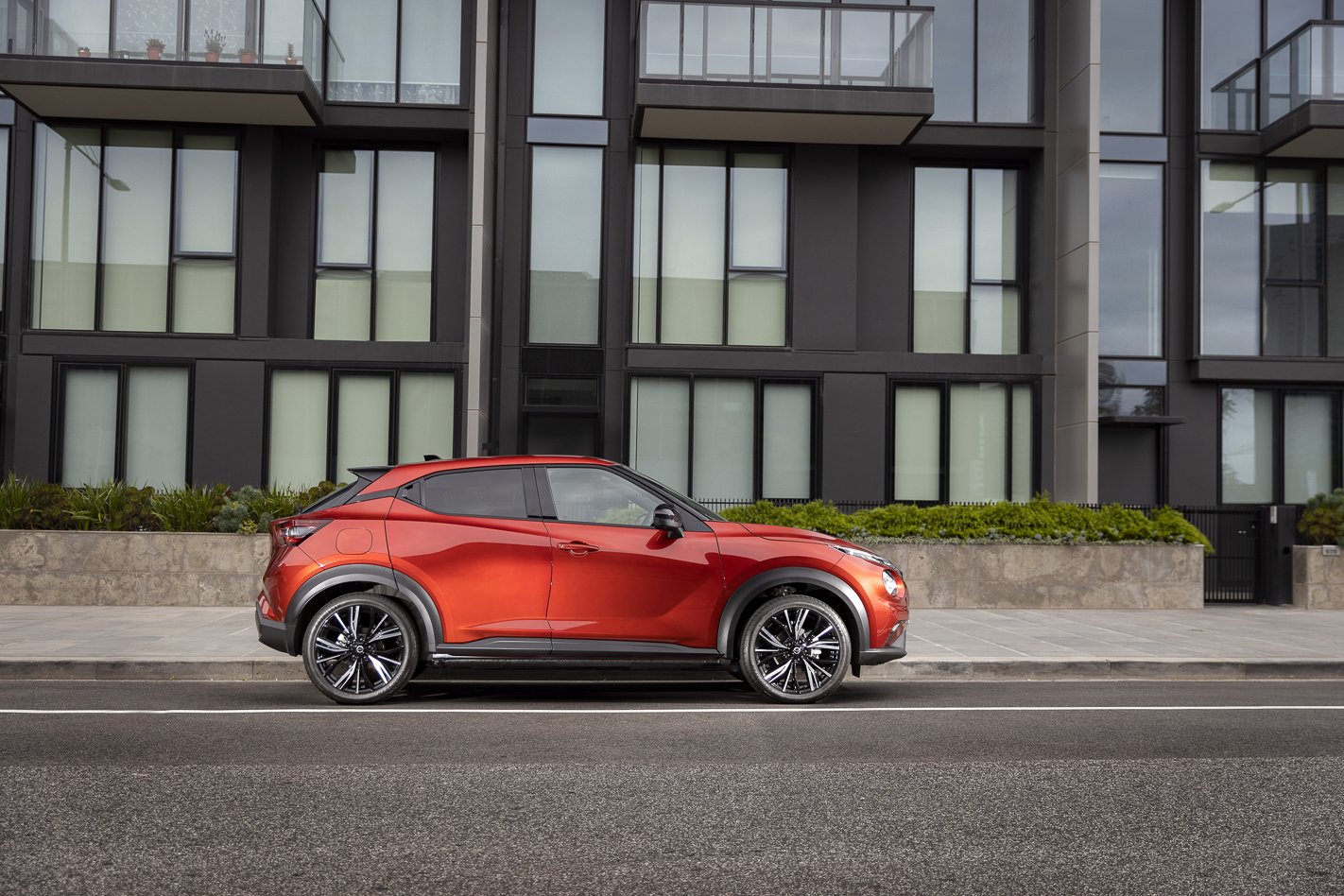
Nissan says the little donk still offers “engaging performance”, although acceleration figures have not yet been released.
Its drawcard is economy, however, promising combined fuel consumption of just 5.8 litres per 100km – an improvement overall bar the smallest 1.2-litre in the first-gen car.
The frugal unit is bolted to a seven-speed DCT automatic transmission across the board and drives only the front wheels – there’s no option of all-wheel drive traction as is offered in higher-grade versions of the current-gen model.
Nor is any mention made of a more sporty and driver-focused Juke Nismo that headlines the outgoing model.
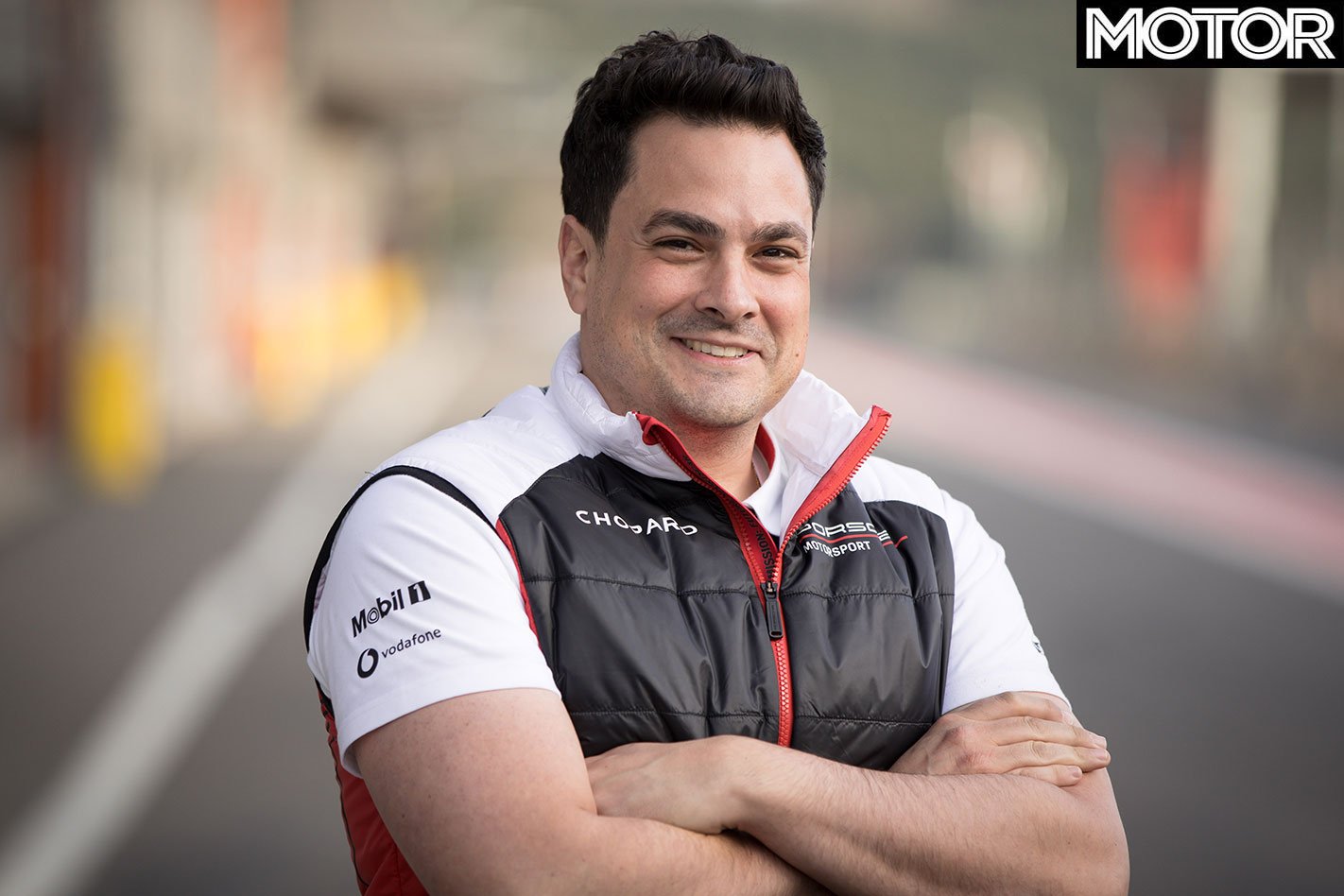
Stephen Mitas is probably an unfamiliar name to you. As a motorsport engineer, he’s usually toiling away in the background, far from the limelight, but here’s why you should know him: Mark Webber, Peter Brock, Robert Kubica, Timo Bernhard, Sebastien Vettel, Jacques Villeneuve, Daniel Ricciardo, Nick Heidfeld, Brendon Hartley, Marc Lieb, Rick Kelly, Nico Hulkenberg, Nick Tandy, Jean-Eric Vergne, Cameron McConville, Romain Dumas. These are just some of the drivers Mitas has worked with in a 20-year career that has propelled him to the very summit of the motor racing world.
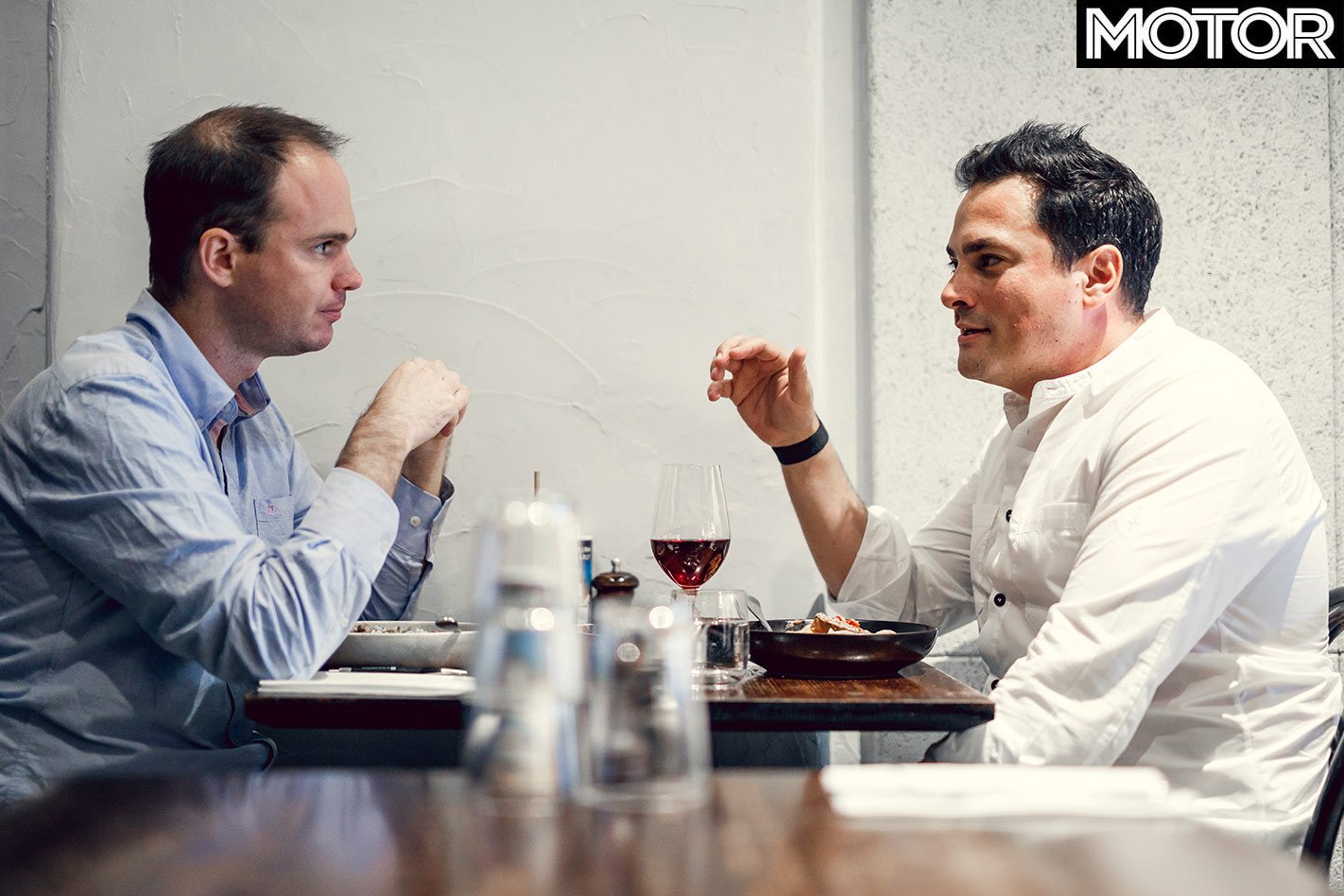
Melbourne-born and bred, 41-year-old Mitas sat down with MOTOR over a (very long) lunch during a visit to his home town, and told the story of how a car-mad kid went from voluntarily twirling spanners on a Formula Holden to calling the shots for Porsche’s 919 Le Mans program, with stints in NASCAR, Supercars and F1 along the way.
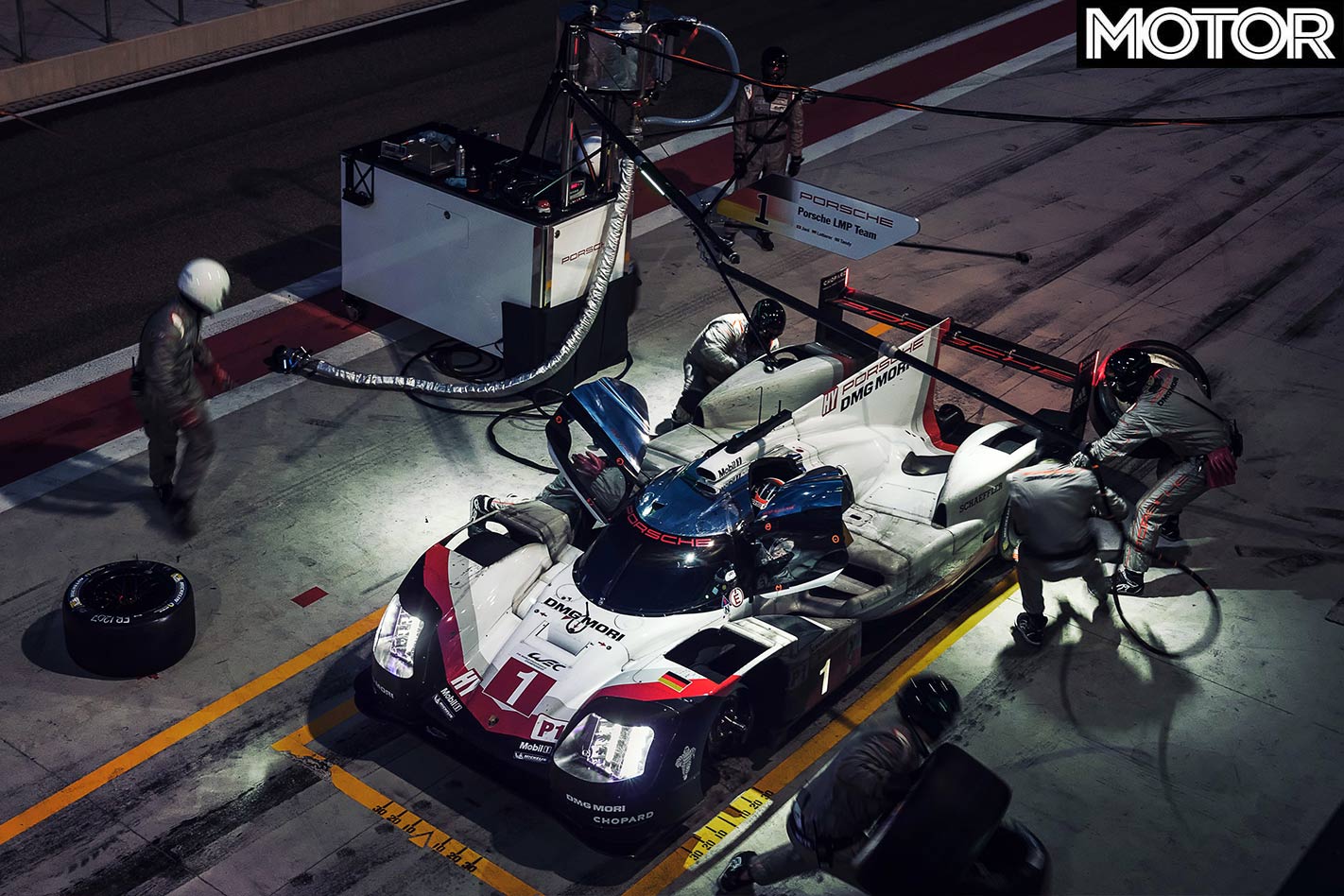
With a quick smile and a confusing accent that betrays an adult life largely spent abroad, Mitas looks too young to have spent almost two decades in racing, but explains that the bug bit early.
“Like most kids growing up in Australia, I was obsessed with cars: Ford, Holden, Peter Brock, Bathurst. As I got older the racing thing became more interesting because it was on telly, and the whole Peter Brock story. The [Bathurst] race in ’87 still rings in my ears today; that race for me was phenomenal. Slick tyres, wet track, catching the Sierras, and I remember Brock was doing interviews [from behind the wheel], one hand out the window, sliding all over the place. For me that was like a light switch – how is that even possible?”
While studying mechanical engineering at RMIT, Mitas began his attempts at emulating Brock’s heroics. “During university I became more and more interested in cars and racing, and I built a Mk I Escort rally car in my parents’ garage. It was more difficult than I expected; not the driving side, but the financial requirements to keep it going. It was a Kent 1.3 with a crank and bore job out to 1.6; it was a bit of a Frankenstein because every piston was from a different engine, but it was a quick little thing. It produced something like 140bhp, weighed 750kg, welded diff. I had rally tyres on it the whole time. I drove it to school every day and raced when I could. My girlfriends at the time hated it.”
While studying, Mitas volunteered as a mechanic with the Greg Murphy Racing Formula Holden team and was quickly promoted to data engineer. “I didn’t have any skills, I was just the engineering student, so they said ‘you know how to turn on a computer’ and it just snowballed from there. The program was not very well funded but I learnt a lot, I got to go to New Zealand and did all of Australia.”
The experience led to an offer from the Rod Nash V8 Supercars team, where Mitas, now in his final year of university completing a thesis on lap-time simulation, was employed as a data engineer. The team’s full-time driver was Craig Baird, but for the enduros the team was rebranded Team Brock, with Mitas’s childhood idol joining Baird for Bathurst.
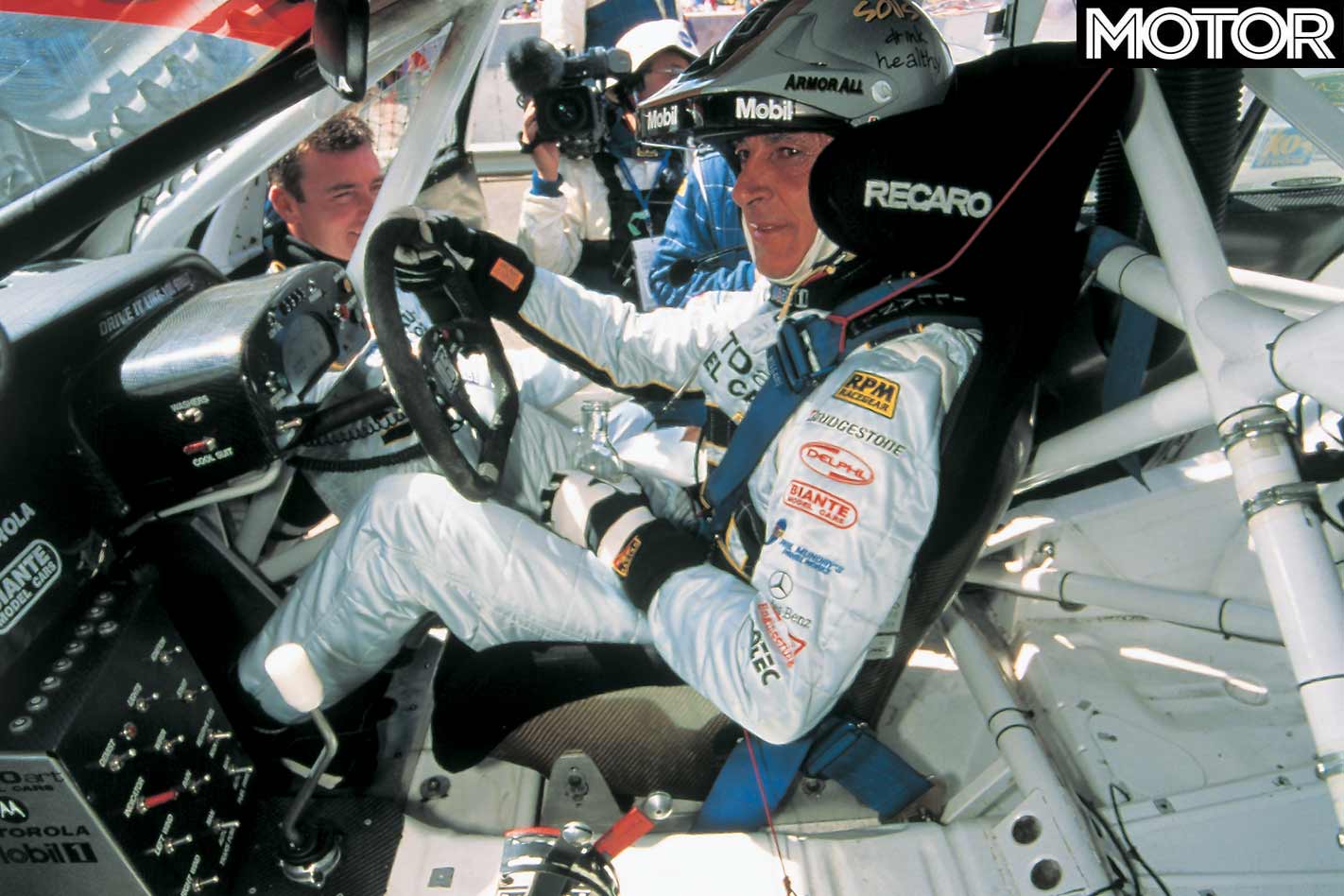
“That year as a data engineer with him, he was at the end of his career, but it was still something special to see him in action. He was, still is, one of the best drivers I’ve had the good fortune to interact with. Maybe his performance was not at the top [then] but he knew his art very well; he could tell you stuff that was going on in the car that you couldn’t measure.
“There was one event where we were testing and he was complaining about a noise from the rear quarter. The data looked fine, the mechanics looked at the car, all looked fine, and he just kept complaining about the same thing. It ended up being something flapping around; it wasn’t affecting performance, but he picked it, exactly where he said it was and what it sounded like. The guy was a phenomenon; I mean, he could tell you about the power steering and what the curve feels like, it was freaky. I wish I had the opportunity to work with talent like that in his heyday.”
Through his work with Team Brock, Mitas met Claude Rouelle of MoTeC. Impressed with the young engineer’s lap-time simulation work, Rouelle sent him to the United States as a consultant to NASCAR’s Cup teams.
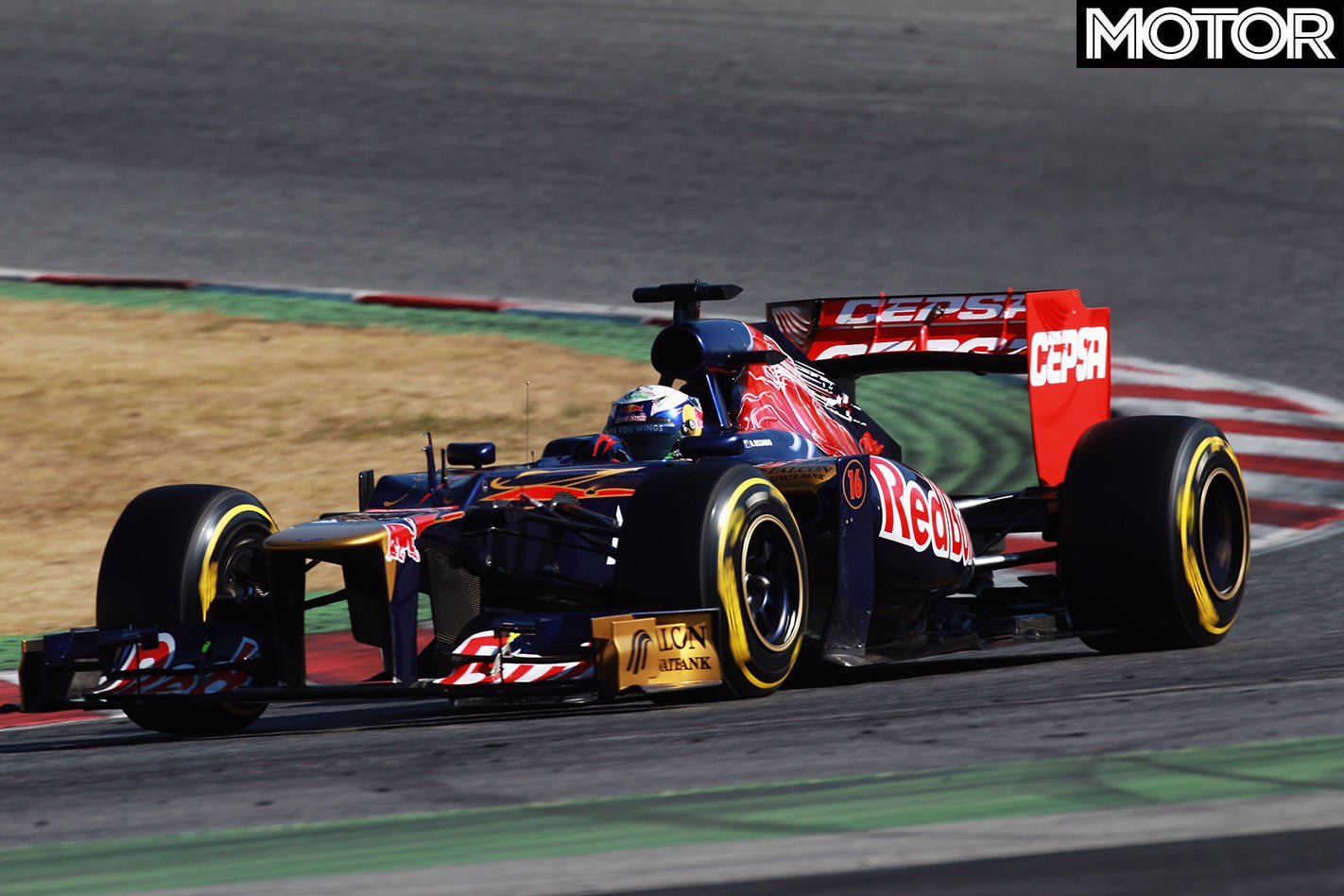
“It was starting to become clear F1 was the target, and the best way to get to F1 was to get some overseas experience. The money wasn’t great, but the whole episode was a fantastic experience. The focus was amazing, [the teams] had such a clear idea of what they were trying to do.”
One-year mission complete, Mitas had no sooner returned to Australia when the phone rang with an offer to be Cameron McConville’s race engineer at Garry Rogers Motorsport. “I sort of fell into that and it was really tough. I had a chief mechanic who was not very accepting of a younger guy, but I can freely admit now that I was too young and inexperienced to be a race engineer in a V8 Supercar team.” It was the year of McConville’s sole V8 win, but the Winton round was the first after Mitas and GRM had mutually agreed to part ways: “One of the guys at Garry Rogers was ex-Jordan F1 and he greased the wheels for me to go over and do a three-month trial.”
Unsurprisingly, transitioning from Winton to Jerez was something of a culture shock. “Like night and day. They had so many sensors in the car and they had worked so long together they had their own language really, all the parts had their own unique Jordan name. I was 25 years old and you’re trying to do the best job so you can become a permanent member of the team, but they had no time to train anyone. Eddie Jordan was about to sell the team, they were on skeleton crew fighting for survival. I remember them asking me something about brake wear and I kept telling them the sensors were broken, but they didn’t want to hear that. I’m the newest guy in the room. I went to the mechanic and said, ‘Can you fix the sensors on the brake caliper?’ The answer was, ‘Who are you?’ After a few months it was okay, but the first few days were shocking.”
With Jordan in the process of being sold to Midland, Mitas was forced to look elsewhere for the next rung on the ladder and found it in Spain with Epslion Euskadi. Run by F1 veteran Joan Villadelprat, Mitas joined designer John Travis – “cool dude, I learnt a hell of a lot from him” – in designing an LMP1 prototype, the ee1 powered by a 5.5-litre Judd V10. “We finished the car, but it was only raced three or four years later, so we never got to see what it could do.”
Epsilon Euskadi also had a strong single-seater program, running cars in Formula Renault 2.0 and 3.5. “It was crazy, we were living on the beach, working in the hills just outside San Sebastien, racing every other weekend in the World Series. It was marvellous.” The team won the 2005 Formula Renault 3.5 title with up-and-coming Polish driver Robert Kubica. “The number one driver in the team was Felix Porteiro. Ultra-quick, but Robert quickly established himself as a quicker driver. This surprised most people.”
As a data engineer, was it possible to see what made Kubica special? “Seeing if you’ve maximised the performance of the vehicle in the data is quite difficult, because data analysis is primarily comparative. So when your benchmark is exceeded, that’s when you start to wake up and realise something’s happening. You have metrics to give you stint averages and lap averages, and when all these move also you know you have someone special, and the consistency with Robert was the key.”
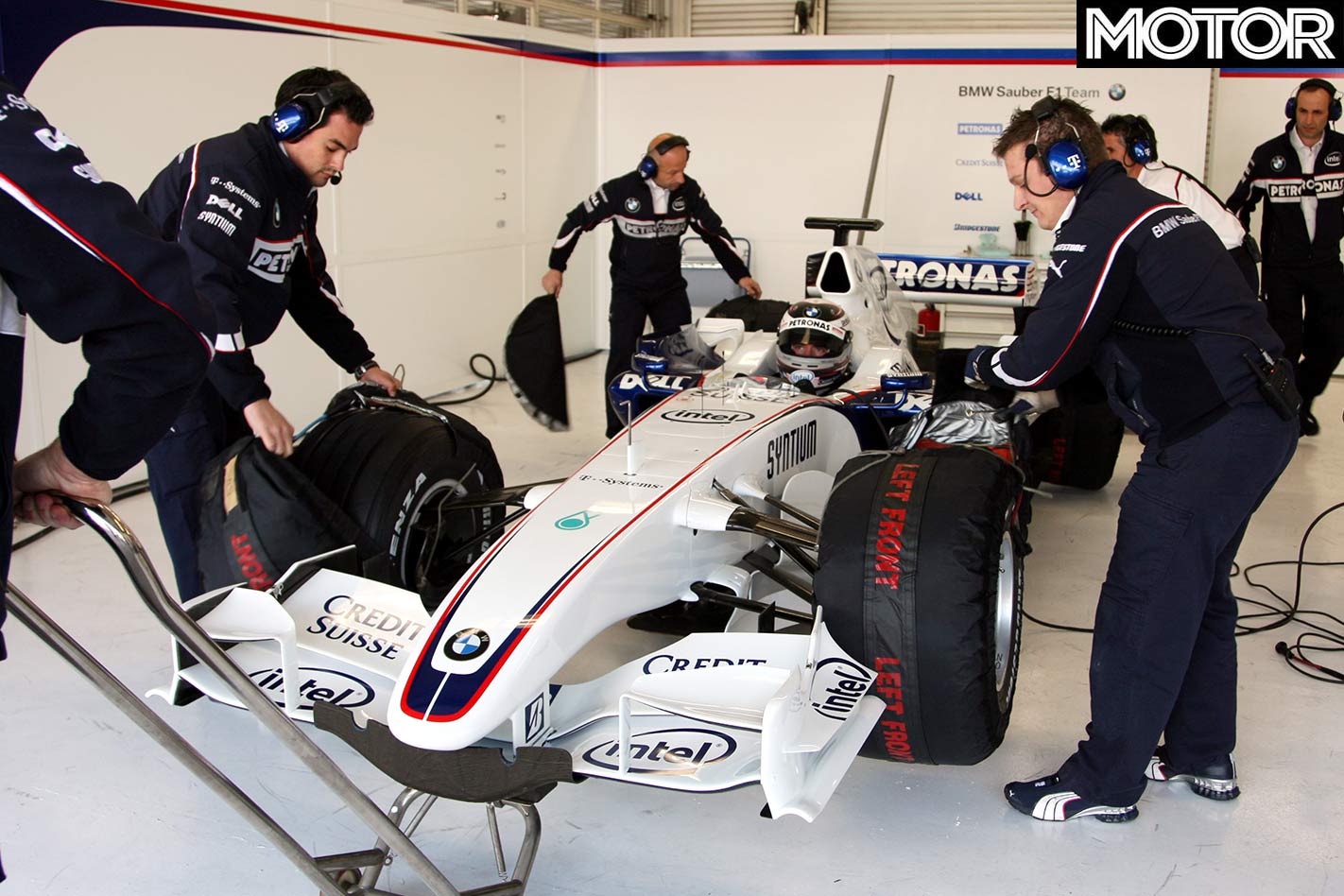
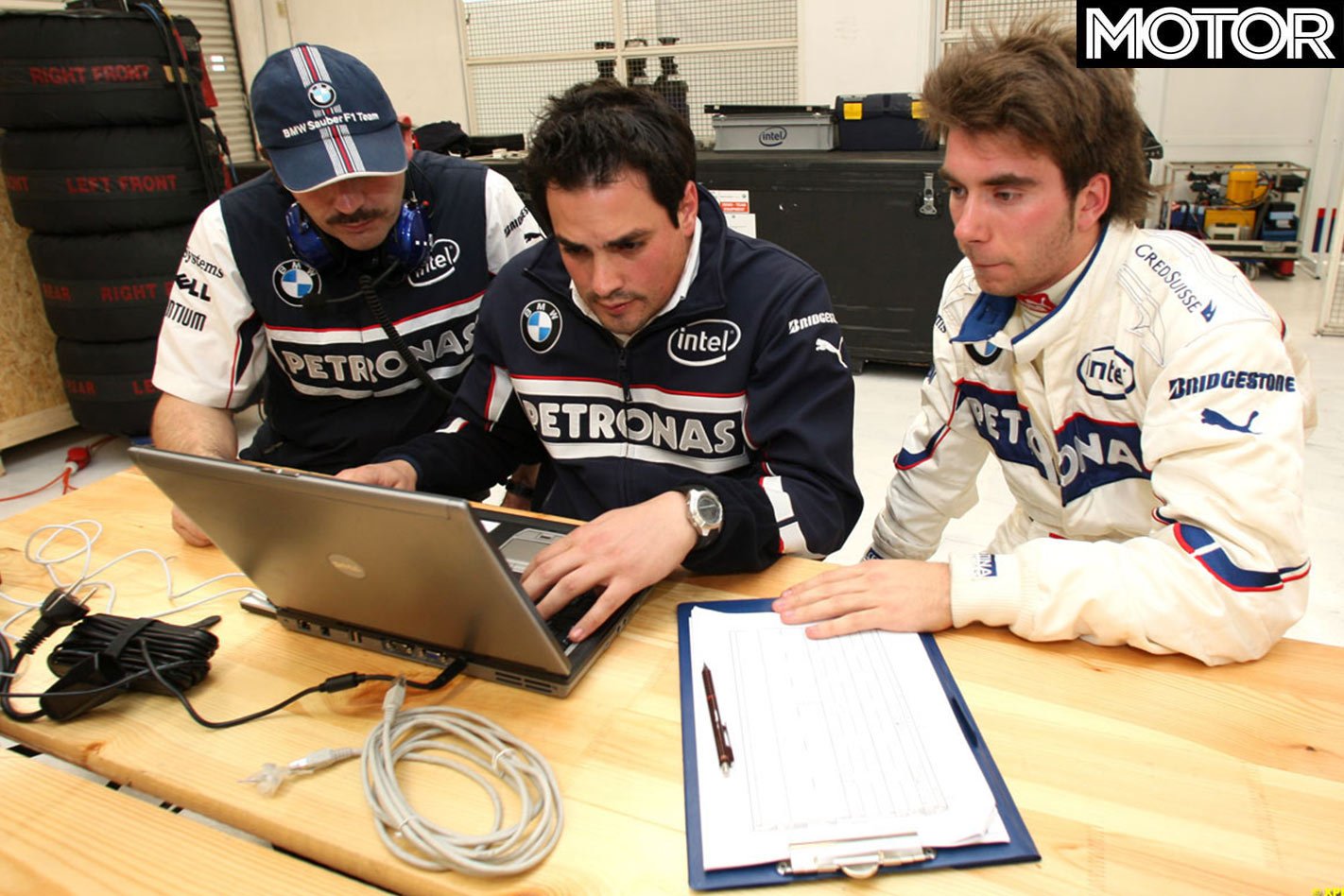
Big moves were imminent for both Mitas and Kubica, to F1. “I wasn’t really looking for something different but I met a Dutch guy who was working at Sauber. He called me and said they had a job for a performance engineer on the test team. So I quickly ended up in Switzerland working with Sauber.
“In my interview there was the team principal, a couple of the team bosses and chief race engineer. The first question they asked me was about Robert Kubica and if I would give him a job. My answer was obviously yes because we’d just won the World Series, and a month later he was signed; I don’t think I was the reason, but my endorsement obviously helped. We continued working together; I was his performance engineer on the third car on Fridays. I did all the testing and racing that year, I spent over 200 days away from home. It was a whirlwind and you couldn’t really stop to collect your thoughts. But it was the time when the budgets were endless, it was an open tap. 2006-’07 was a phenomenal period of time in my career: testing was not limited, engines were not limited, we built quali cars, and it was the middle of the tyre war. We had Michelin guys permanently installed in the team, so I learnt a hell of a lot about tyres.”
The introduction of 2.4-litre V8 engines for 2006 had slowed the cars on the straights compared to the previous 700kW-plus V10 monsters, but through the corners they were quicker than ever. “The cars were much lighter then. We had less downforce, but the tyres were grippier [and] because there’s nearly 150kg less you could reach ridiculous g-forces. We were tyre testing at Silverstone with Kubica and through Copse we were pinging 7G lateral because he would stay flat. I’ve never seen 7G again.”
BMW’s other main driver at the time was ‘Quick Nick’ Heidfeld, with whom Mitas occasionally had to resort to unusual tactics to get his way: “Testing in Monza in 2006, I’d come up with some set-up in the simulation tool – [Nick] wasn’t keen on trying it. So we made a bet: if he wins he gets to choose his starting set-up for the race weekend, which is a big thing; if I win, I get a day in his [Porsche] 959S. It was a pretty simple adjustment and he went significantly faster.”
The grin on Mitas’s face suggests Heidfeld held up his end of the bargain: “He did deliver. It wasn’t a day, it was maybe two hours, and he sat in the passenger seat, but I did get to drive that thing. It wasn’t as quick as I expected, but it was a laugh.”
When politics led to Kubica replacing Jacques Villeneuve in the second race seat, BMW’s third driver became a young German named Sebastian Vettel. “He was extremely young and there was still some learning for him to do, but he did an extremely good job and it was abundantly clear he was a guy with a lot of talent. The problem we had was, every time Seb was at the track, Nick and Robert, unbeknown to us at the time, were basically putting in qualifying efforts, and that made the difference between [Seb] and them look more exaggerated.”
Mitas’s final year at BMW was 2009 and the young Aussie was tasked with sorting out the newfangled Kinetic Energy Recovery System (KERS). “We had a hell of a lot of problems with the implementation, so they said, ‘Look, your job is to map this system so the drivers can actually drive it.’ We raced it for three or four races until they realised the system was so heavy that we junked it, but hindsight is a wonderful thing, you’re always smarter afterwards.”
During this time Mitas met two people who would prove important to his future, Fritz Enzinger and Andreas Seidl, but when BMW pulled out of F1 at the end of 2009 it was time for a new challenge.
A short and eventful stint helping the new Hispania Racing Team filled time before starting a new role as a simulation and analysis engineer at Red Bull Racing. “It was a bit of a step back, but testing had just been banned so, as a race and test engineer, life was going to become a lot more difficult.
“Vehicle simulation was the next frontier for F1. We started the whole simulator revolution at Sauber; it was very basic, but that changed very quickly with money and extra resources. [Red Bull] was a lot more advanced; we had two simulators – a customer simulator and then this custom-made unit.”
However, team drivers Vettel and Webber weren’t quite ready to embrace the revolution. “Mark is a little bit old school in some of his views, and Sebastian found it a disadvantage to use the simulator before an event. He didn’t want to have to relearn a different car, and getting into the simulator is fundamentally driving a different car. I found this issue also with Neel Jani; I think these guys rely heavily on the yawing of the car, that’s something that simulator didn’t replicate very well. In the off-season [Seb] was more relaxed and happy to help.”
Mitas is uniquely qualified to answer the question most Aussie F1 fans want to know: who was better, Webber or Vettel? “One thing I could say is that Vettel was always stronger in slow-speed corners, blown diffuser or not, and Mark tended to be a bit stronger in high-speed corners. Most racetracks have a bias from a lap time point of view towards being better getting off a slow corner than a fast corner and I think this was fundamentally the difference. We’re talking very small differences because overall they were lineball; I wouldn’t say Seb was quicker than Mark or vice-versa. Mark was a crazy guy because there were some tracks where he was god; in some of the high-speed corners he did things which were like, “Geezus, are you sure?” But I think he let the whole Helmut Marko/Vettel thing get under his skin.”
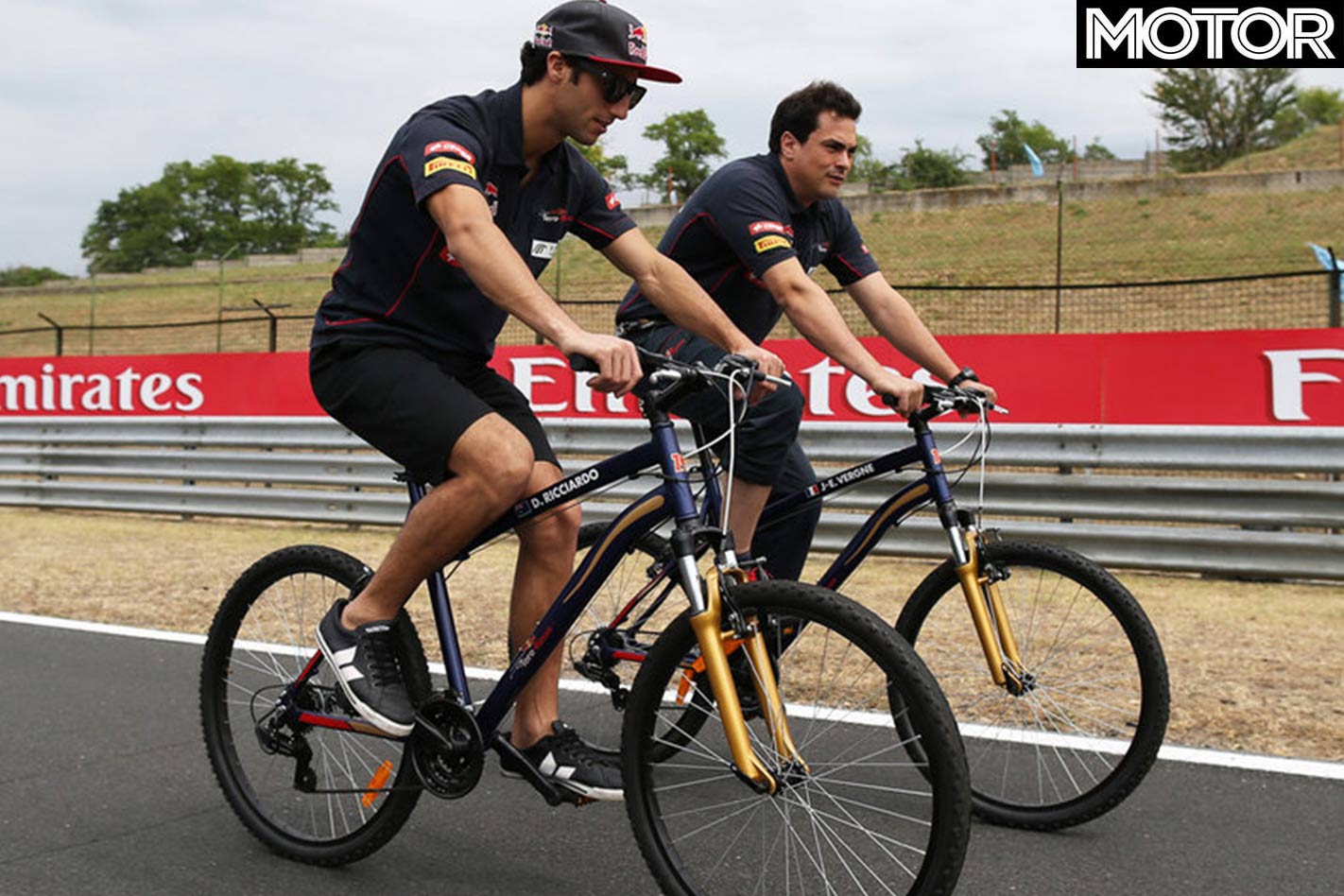
It fell to Red Bull’s juniors to do most of the sim work: “We had Brendon Hartley, Jean-Eric Vergne and Daniel Ricciardo. Dan on the simulator was really, really good because his consistency was something we could harness. He was nearly robotic, and his feedback was always high quality.”
The relationship continued when Mitas became Ricciardo’s race engineer at Toro Rosso during 2013: “One of the most analytical drivers I’ve come across. He’s ultra-focused.”
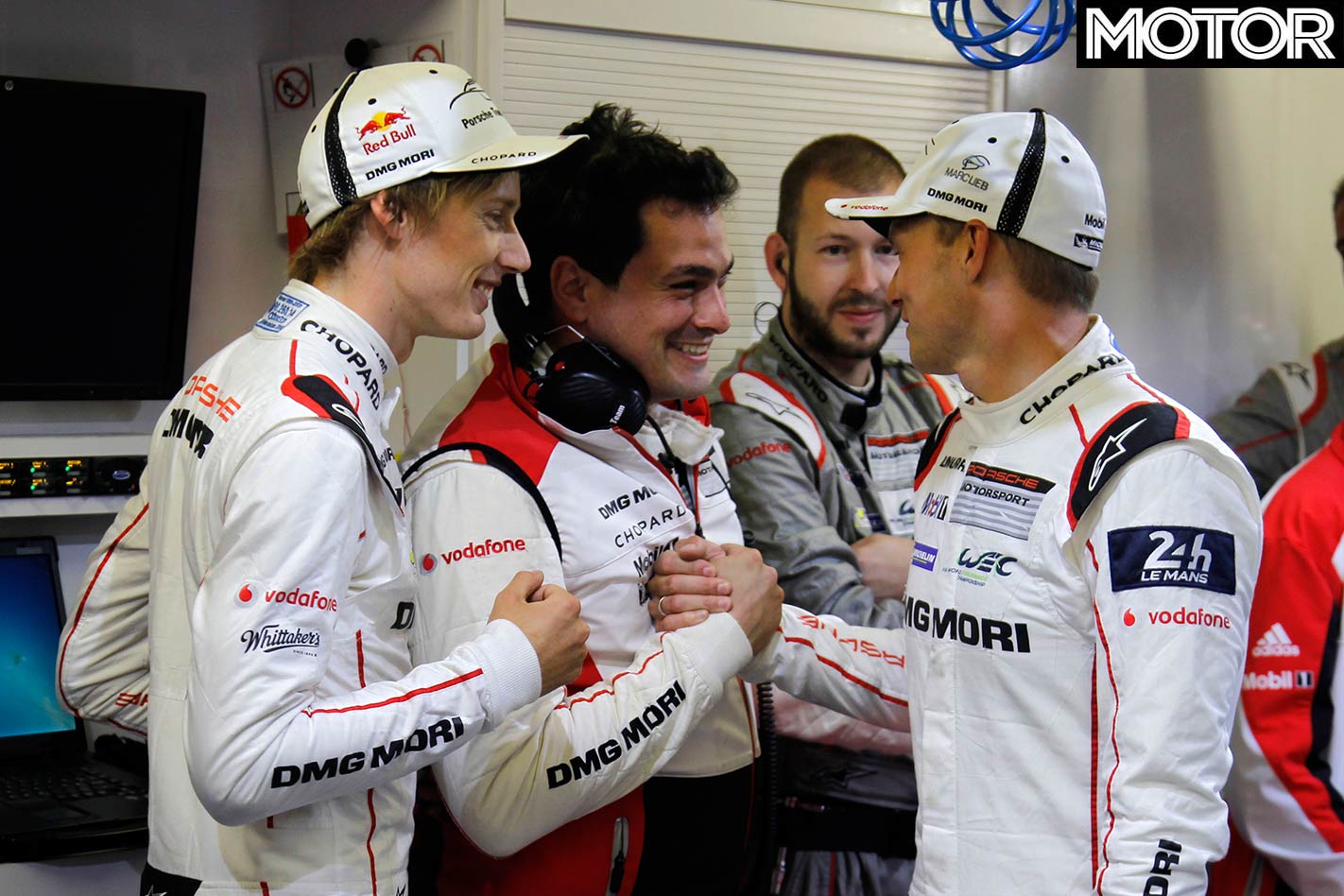
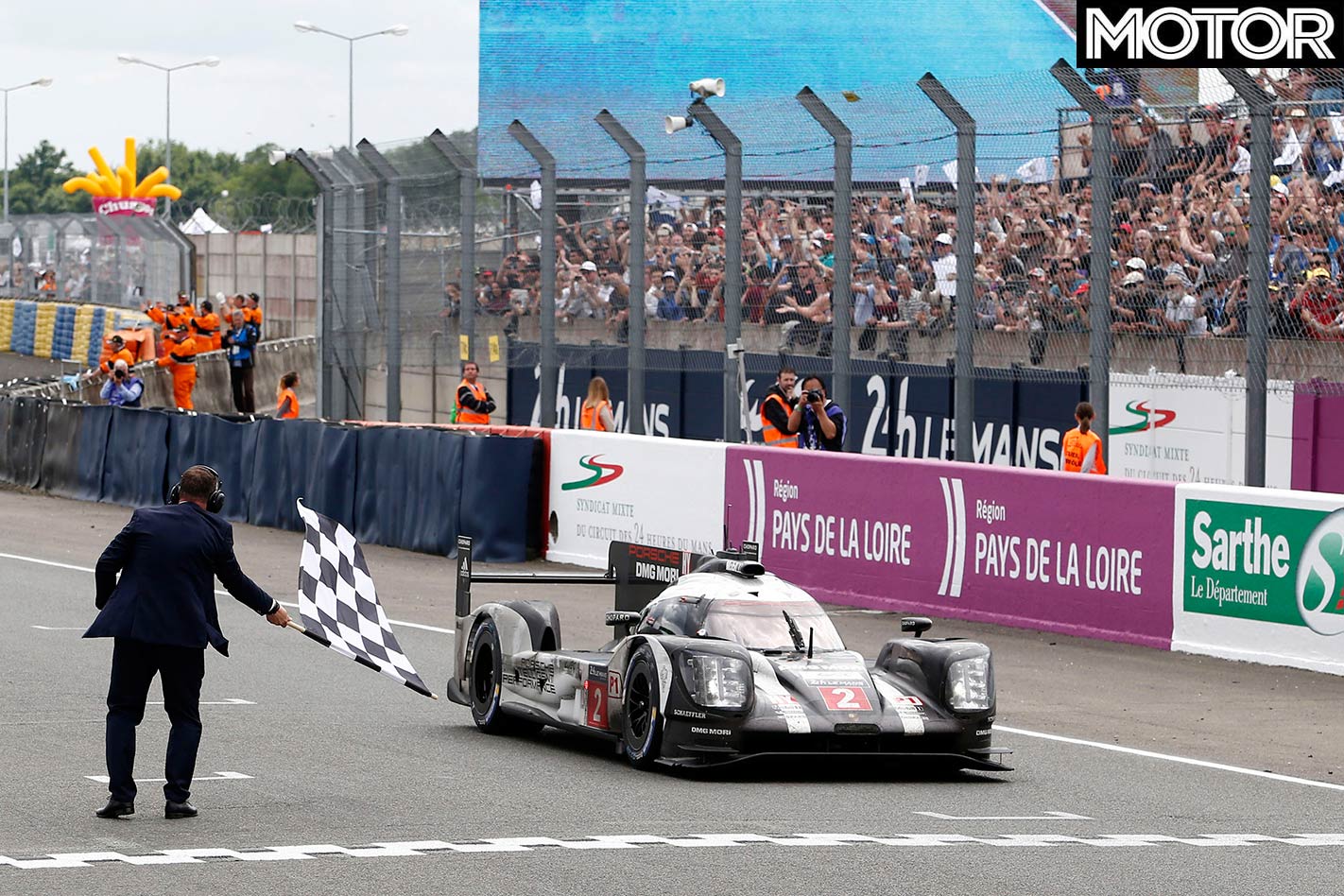
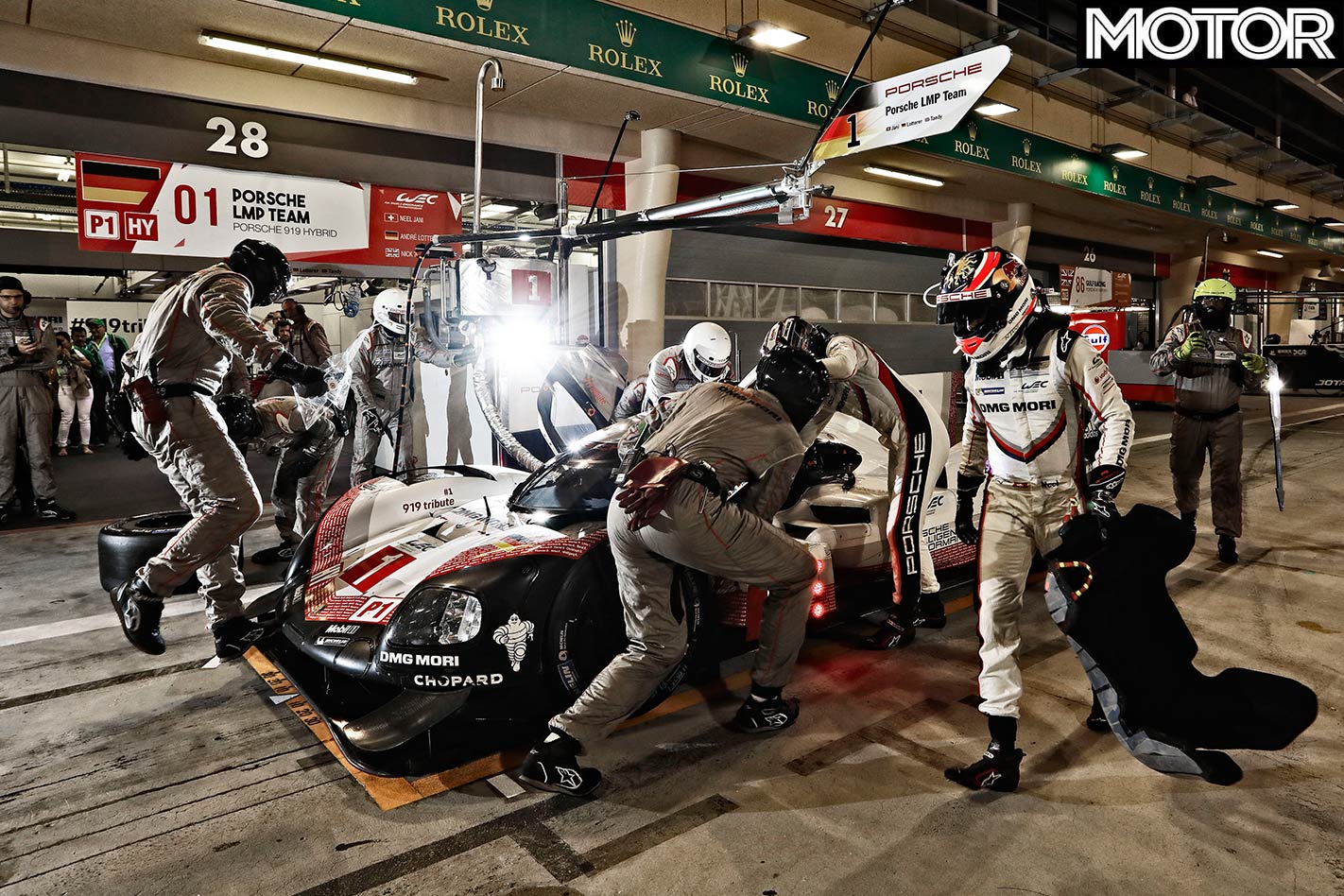
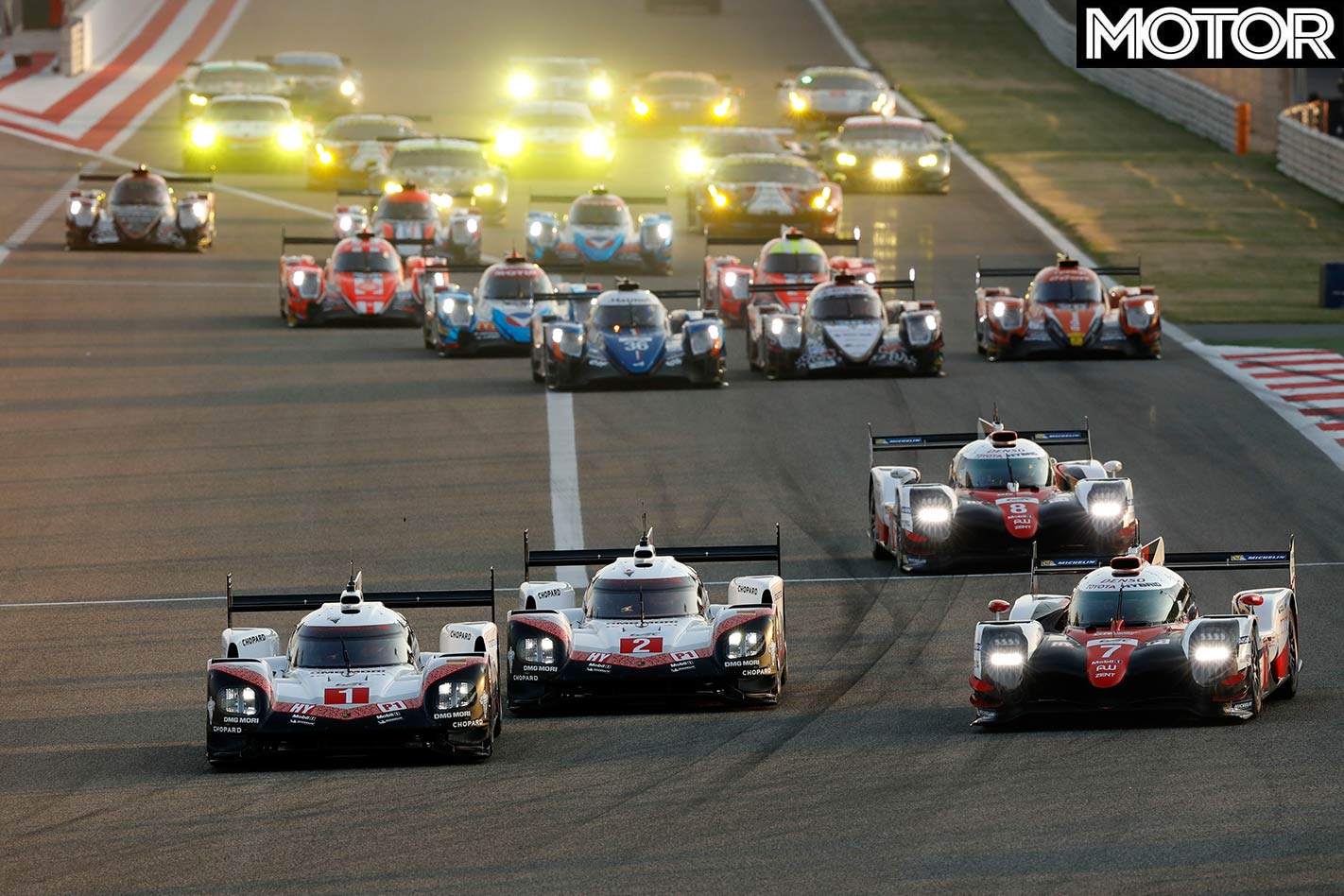
A year later Ricciardo graduated to the main Red Bull team and Mitas made his biggest career move yet, to Porsche’s LMP1 program. Fritz Enzinger was now vice-president of Porsche Motorsport and recruited Andreas Seidl as team principal, and he in turn recruited Mitas as race engineer for Car 20 driven by Webber, Hartley and Timo Bernhard, later becoming chief race engineer.
History shows the success of this program: three straight World Endurance Championships and Le Mans 24 Hour wins between 2015-2017, but when Mitas joined the team in early 2014 success was far from assured.
“The amount of problems they had with the powertrain was so great when they were testing in ’13, the car would run 50km before they had a problem. When I arrived, operationally the team was so new they didn’t even know how to run the car. The race team was unestablished, we had no tools, most of the guys involved were pretty green, and it was tough, but probably the best opportunity I’ve had. The nice thing about Porsche was it was the beginning, so you had pretty much a clean sheet to define your role.”
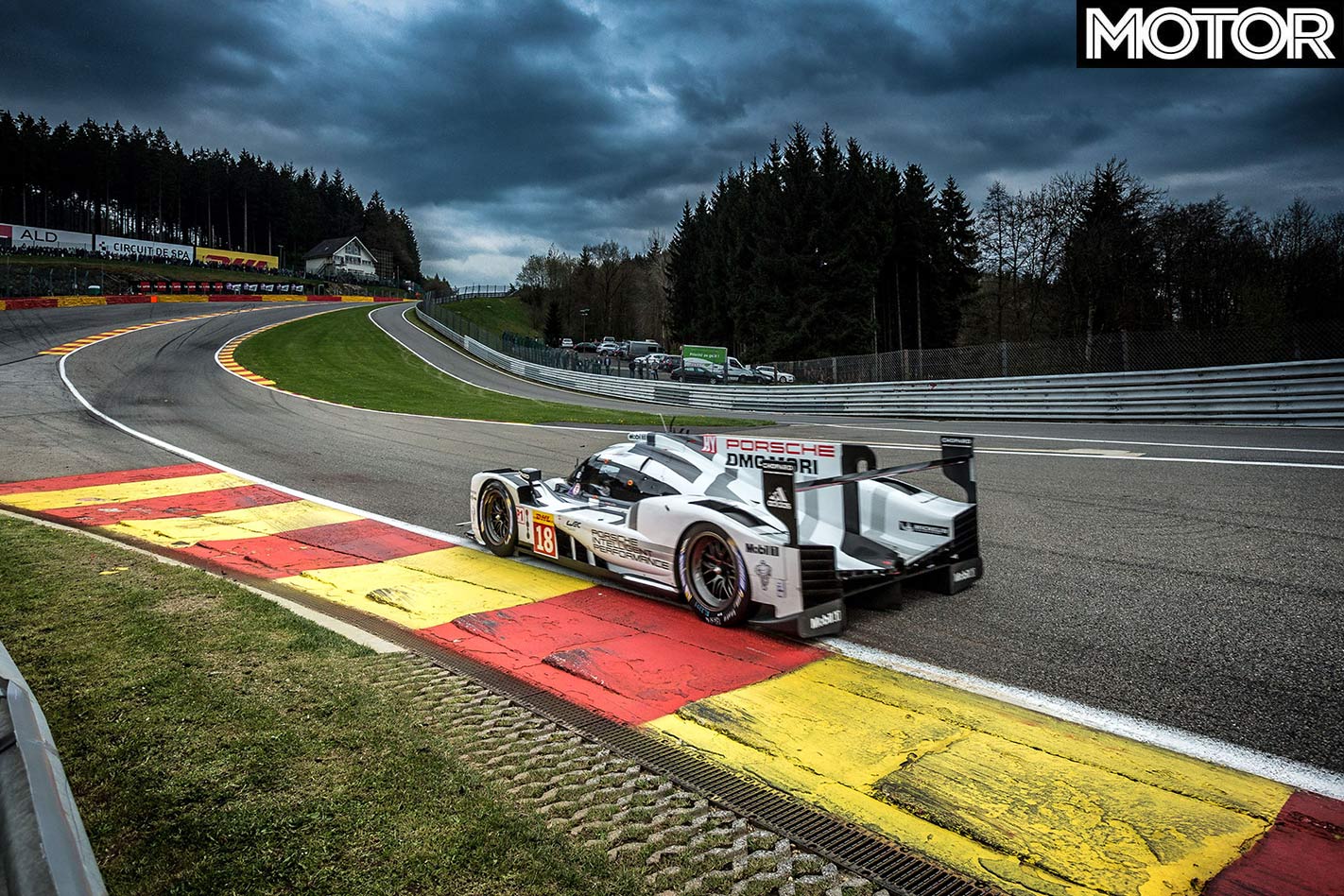
Were there moments he thought he couldn’t solve it? “The only time you can’t solve problems is when the car doesn’t run, and for sure we had many sleepless nights where the car was not running, but you just need to work through [problems]. Mark Webber was extremely good at the beginning helping preach that message. He kept telling the team, ‘Keep focusing on your next stroke, it’s a long race.’ He kept talking about endurance swimming for some reason.”
The tiny IC engine proved troublesome. Its V4 layout created significant vibration issues and extracting 373kW from two litres led to drivability problems. “We didn’t have an e-turbo for reliability at Le Mans, so engine response was difficult, and then you had an e-motor with instant response on the front axle, so in ’14 you could do a full burnout with the front axle [before the rear responded]. Getting all this to work together was a huge challenge and the learning curve was very steep.”
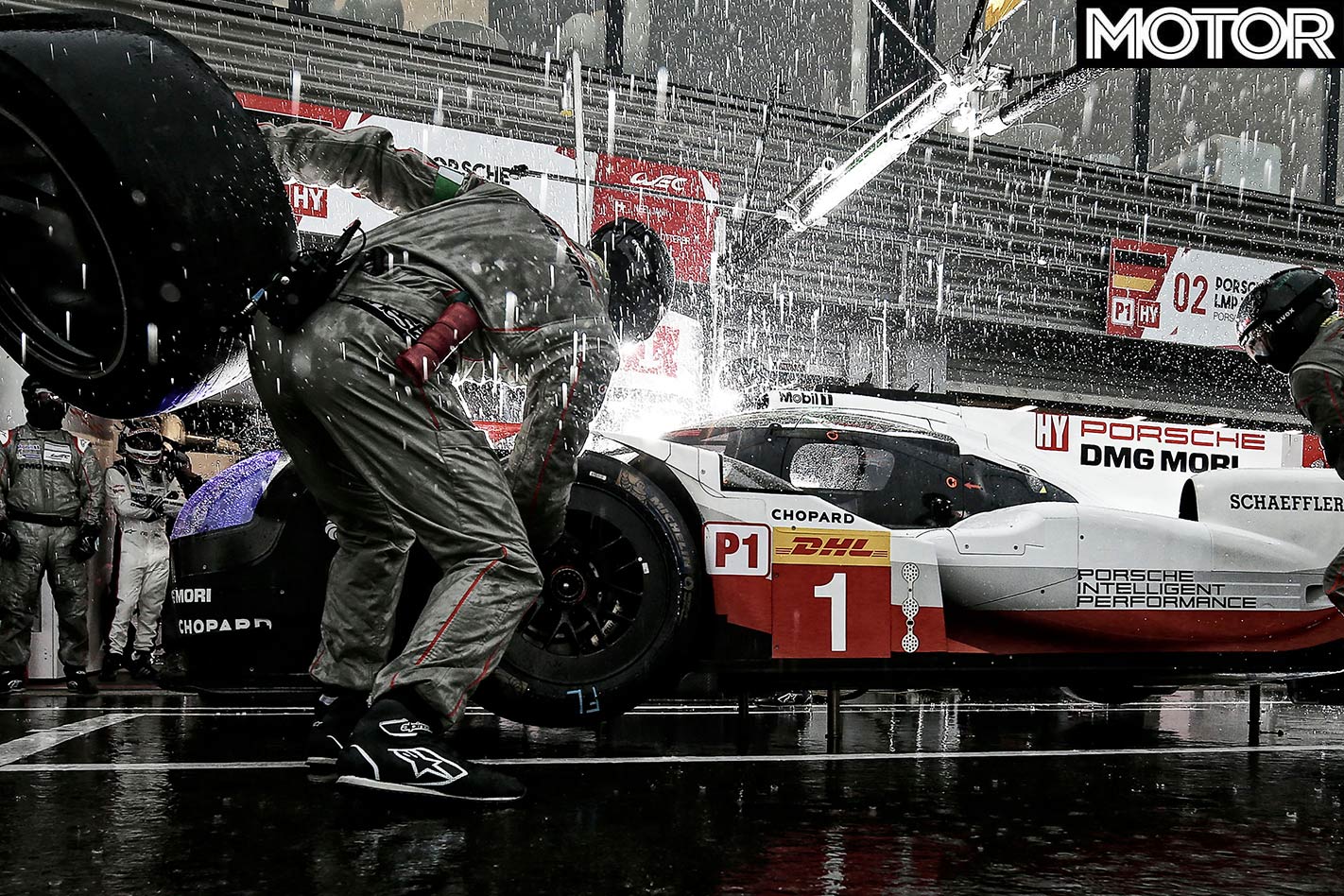
The 919 Hybrid made its debut at Silverstone in 2014. “Qualifying was a bit of a mess because it’s the first race and we were struggling to test consistently, so we couldn’t prepare the race team in the right way. We were running in fifth and sixth; the Toyotas and the Audis had buggered off and we had LMP2 cars snapping at our heels, but then it started raining. We didn’t have any strategy guys or support guys, and Andreas gets on the radio and goes, ‘Stephen, what are you going to do?’ ‘I’m going to put wet tyres on!’ (Laughs.) This is the level of conversation, and at the last minute I switched to inters, which happened to be fortuitous because we ended up on the podium.”
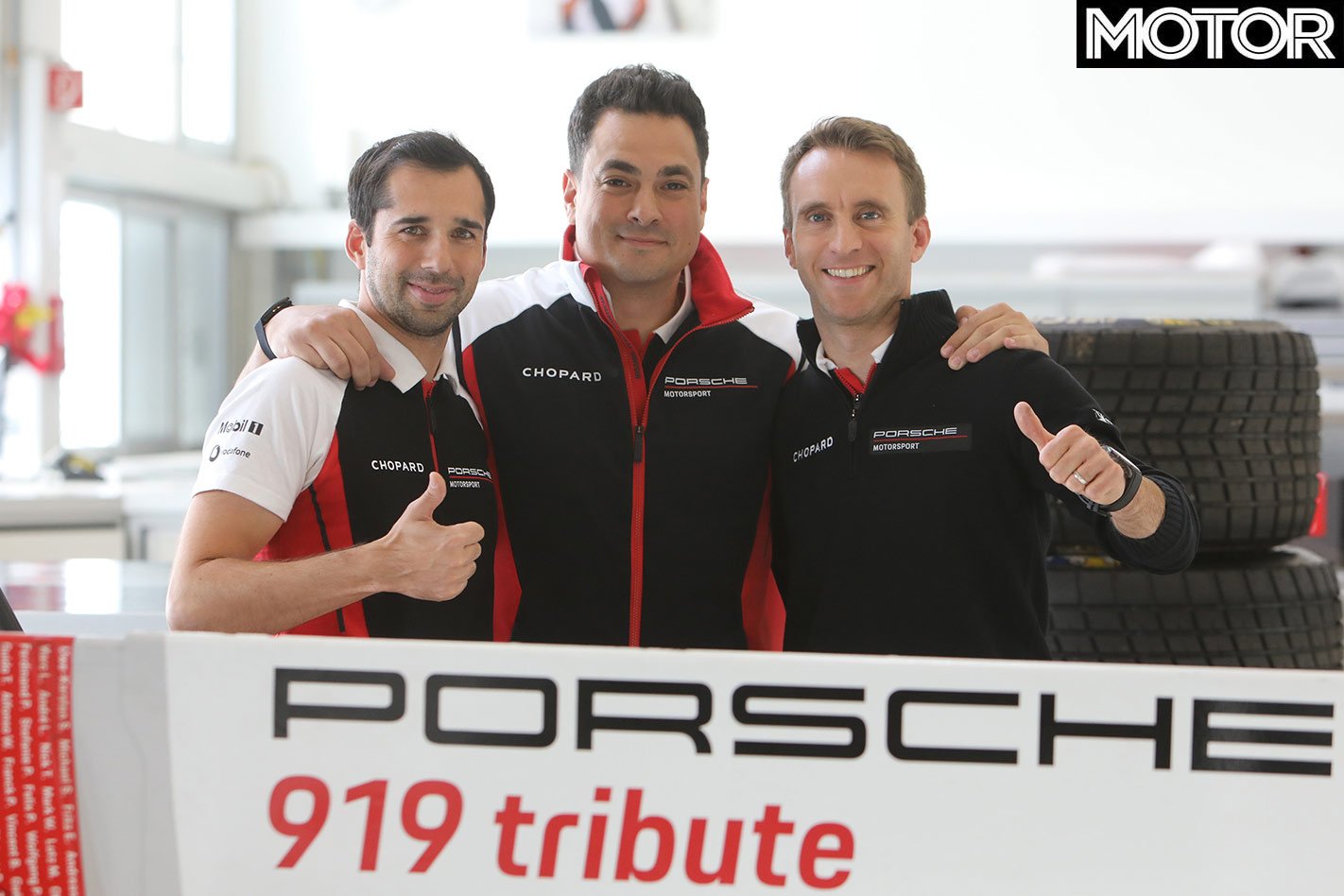
Le Mans 2014 brought further struggles. A broken anti-roll bar early in the race made Car 20 a handful, but a combination of set-up changes, clever strategy and Herculean driving by Webber, Hartley and Bernhard had the car leading with two hours to go, when the engine expired.
Bernhard himself picks up the story: “We managed to have a smart race and were leading until the engine blew. We were all really down. [Stephen] came to us and said, ‘How you guys wrestled that car over 22 hours will always be one of my highlights and we did the most of what we could do.’ That describes the character he has: a top guy and a true racer.”
Back to Mitas: “In WEC you are lucky because you have more than one driver. When I started I thought this was a bad thing, but I came to realise that three guys in the same car, you’ve instantly got two driver coaches, then you’ve also got a driver’s perspective on each decision you make without having to interrupt the guy driving. It was a sensational advantage and something we relied on constantly.”
A year later Porsche secured its first Le Mans win in 17 years, albeit from an unlikely source, Car 19 driven by a prototype debutante (Nick Tandy) and two Le Mans rookies (Nico Hulkenberg and Earl Bamber). Mitas remembers: “We had two issues in Car 19 with two safety cars where we got pushed to the back of the pack. Then we sort of unleashed them to try and compensate; they ended up running quali lap, quali lap, quali lap and through the night they were taking so much risk in traffic. We didn’t care because it was the third car, so you could just go for it. By about one o’clock in the morning, we were so far in front I thought, ‘S**t, maybe we should dial it back a little bit?’ It was, from a pure performance point of view, the greatest thing I’ve ever seen.”
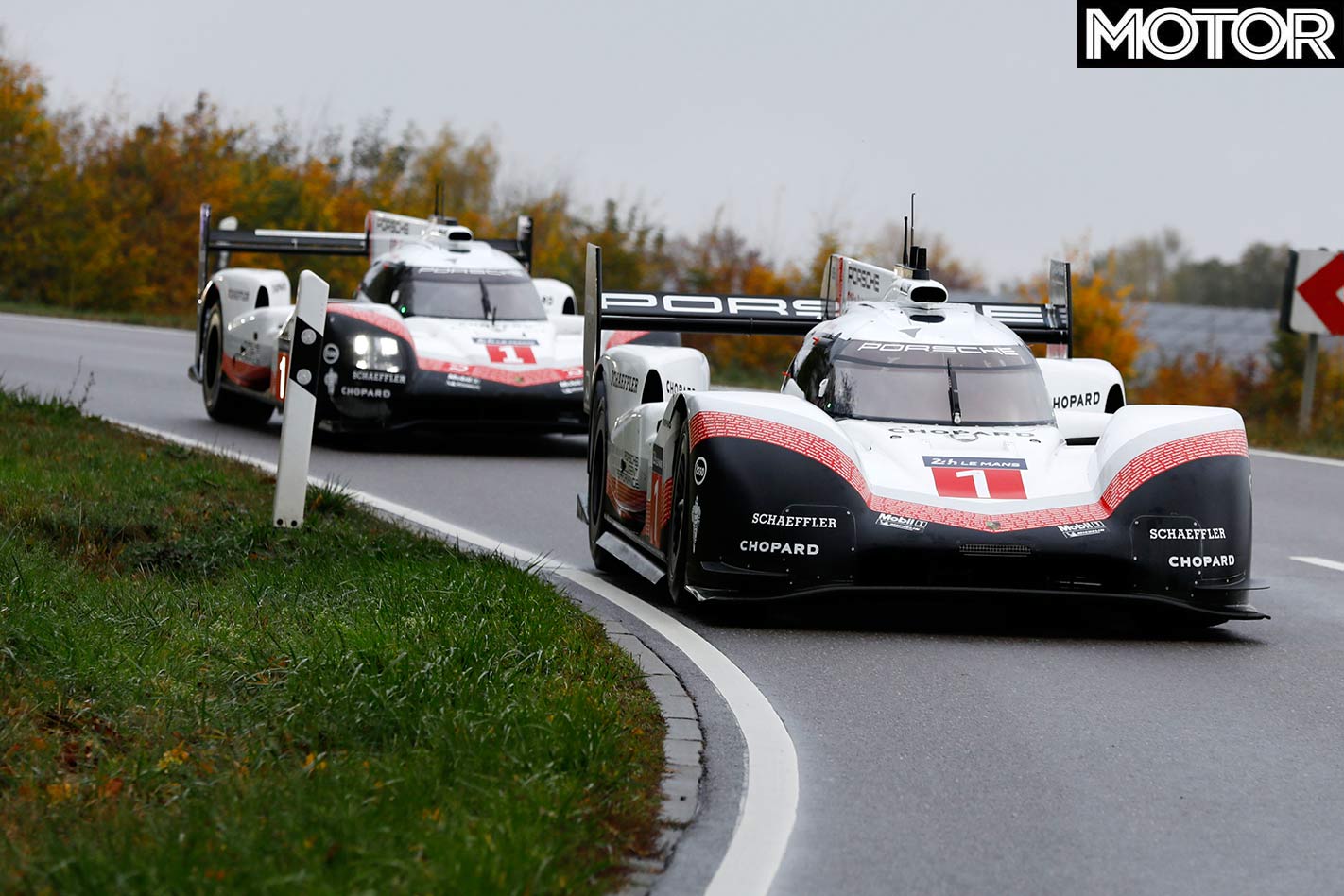
Porsche ceased its LMP1 program in 2017 after three years of dominance, but Mitas wasn’t done with the 919 Hybrid, becoming project leader for the record-breaking Evo program. Freed from regulations, power increased from 665kW to 854kW, weight reduced to 849kg and the aerodynamics were revised to generate 50 per cent more downforce. Neel Jani lapped Spa in 1min41.77sec, 12sec quicker than the regular 919’s pole lap that year and 0.783sec quicker than Lewis Hamilton’s 2017 F1 pole lap. Bernhard then smashed the outright Nurburgring lap record, his 5min19.546sec run blitzing Stefan Bellof’s 34-year-old 6min11.3sec benchmark.
Going into detail on the Evo could fill this magazine, but talk to Mitas about it and the most amazing thing isn’t how quick the car was but how much faster it could have been. “I think time was the biggest [restriction], but also we wanted to demonstrate what we could do with an LMP car. We didn’t really change any of the fundamental parameters on the powertrain, the monocoque was the same; it was like a GT3 RS version of the 919 if you like, and it was done in a relatively quick way to mimic the whole process. For sure it needed a big wheel and tyre package, but that would’ve required new uprights, probably new brakes, new wheels and then it’s not an LMP car anymore.”
Tyres were the Evo’s biggest limiting factor, the standard WEC slicks run at 42psi (50 per cent higher than normal) to cope with the immense downforce. So great were the loads that at Spa Jani took Eau Rouge with DRS open! “I was quite nervous about that. We did it to make sure we didn’t have too much pressure in the tyre. The higher the pressure the less grip you have because the contact patch is smaller; because [the Evo] had so much downforce the tyre was undersized for the vehicle – it’s a bit like a V8 Supercar in that regard. With lower pressures and a bespoke construction, the car would have been significantly faster.”
The top speed of 369km/h was the limit of the standard front axle ratio – 400km/h was possible with a taller diff – and, strange as it may sound for a car with 1000kW/tonne that’s capable of 0-200km/h in 4sec and 0-300km/h in under 8sec, power was also constrained. “The turbo was quite a small unit – you couldn’t jam enough air in it. With a big turbo from an old F1 car, for example, the number would have been what you want, basically.”
Even as it was, Mitas admits the Evo didn’t realise its ultimate potential at the ‘Ring: “The tyres weren’t working as well on the record run day; it was a bit warmer than we anticipated, but also the risk/reward on the Nordschleife… it’s one of the reasons we put Timo in the car, because he manages that very well. We went as far as we were comfortable doing on the day, but you weren’t necessarily at the limit of the vehicle.”
Not the vehicle, but possibly the driver, Bernhard losing his reference points due to tunnel vision in certain parts of the circuit thanks to the otherworldly acceleration: “After the lap [Stephen] came and told me, ‘That was a lap of the gods today,’ which made me proud,” Bernhard says.
Today Mitas, along with many other engineers from the LMP1 program, are now working in Porsche’s road car division. He continues to toil away out of the limelight, but who needs fame when you have a toy cupboard full of GT models to play with and a stretch of unrestricted autobahn on the daily commute? Any guesses as to what projects he might be working on are met only with a smile, but if the past 20 years is anything to go by, the end result will be something pretty special. Big thanks to Evolve Driving for its assistance with this story.
The Grand Ridge Road would be fantastic in a Fiesta ST or an MX-5. Unfortunately, I’m in a 2.6-tonne Chevrolet Silverado 1500 and the experience is vaguely terrifying. The narrow road’s edge disappears down a vertiginous slope into the treetops way below, my passenger peering down on the unprotected verge. This is beginning to seem like a very bad idea.
We recently opened invitations from readers to name some of the best roads in Australia and the Grand Ridge Road cropped up. It sounded intriguing, a 48km scenic trip through Victoria’s Strzelecki Ranges that mixed twists, turns, bitumen and gravel. Perhaps the clue that I could be biting off more than I could chew came with the reader recommendation that a Toyota 86 might be the perfect car for the job.
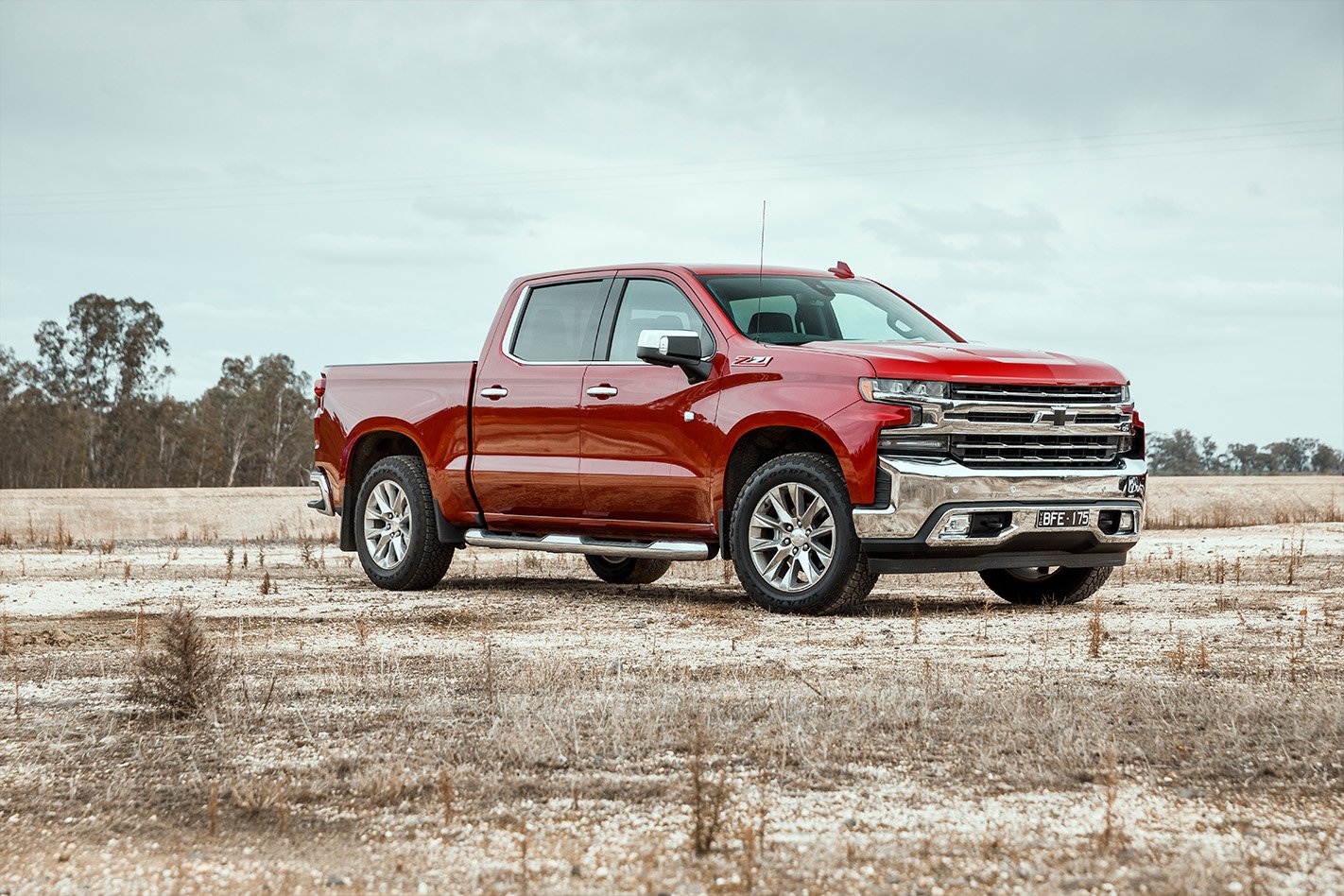
So here I am, a great-big 6.2-litre petrol V8 powering a 2063mm wide slab of chromium at oncoming road users. They are, if anything, more terrified than I am, probably because the chrome plating is also dazzling them with their own headlights. I reassure myself that I’m going to come off best should I hit something, only to be almost wiped out by an oncoming logging truck. That was karmic.
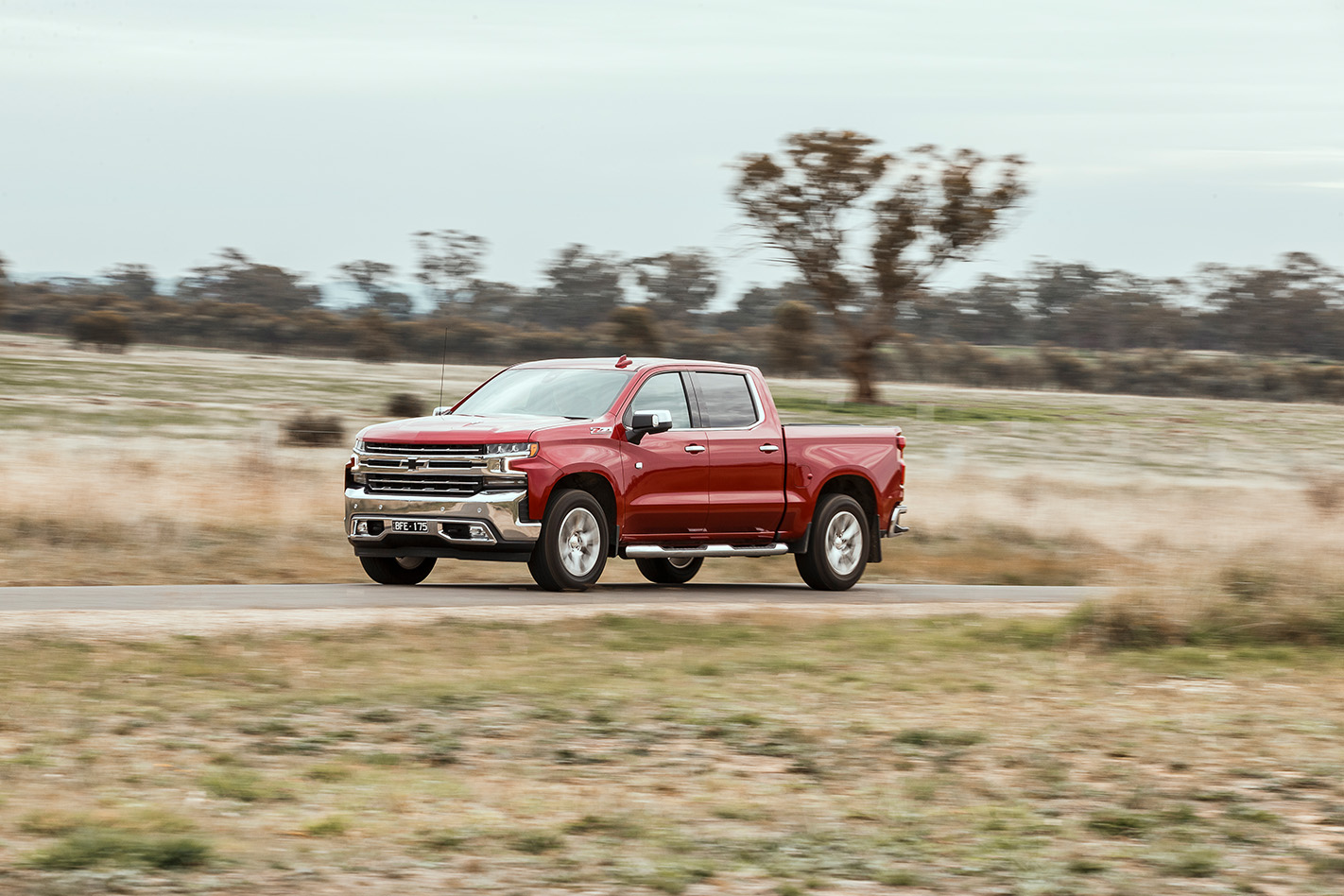
Make no mistake, the Grand Ridge Road is great, but just not in a Silverado. I drop down into the Morwell Valley, looking for roads that are wide enough for the big Chevy, a vehicle broad enough to make a Lamborghini Aventador seem svelte by comparison. It’s been a steep learning curve, that’s for sure. I still have no clue what many of the towing-specific controls do, this vehicle being supplied to us by HSV without a handbook for reference. The weird thing on the centre console that you squeeze together between forefinger and thumb is, the display tells me, the trailer braking control, but other than that I’m in the dark.
Earlier in the day, I’d driven into a fairly deserted car park at Coles and had parked the Silverado in the most comically inept way possible. The problem is a lack of steering lock compounded by the fact that the bonnet is so high that you can’t see the lines delineating the parking spaces. The upshot of it was that as I returned to the Chev, it looked as if it had been parked by a drunk, lumped across two bays. I’d already had to reject two supermarkets because I couldn’t see the Silverado getting into any of the slots in their underground car parks or even negotiating the ticket barrier.
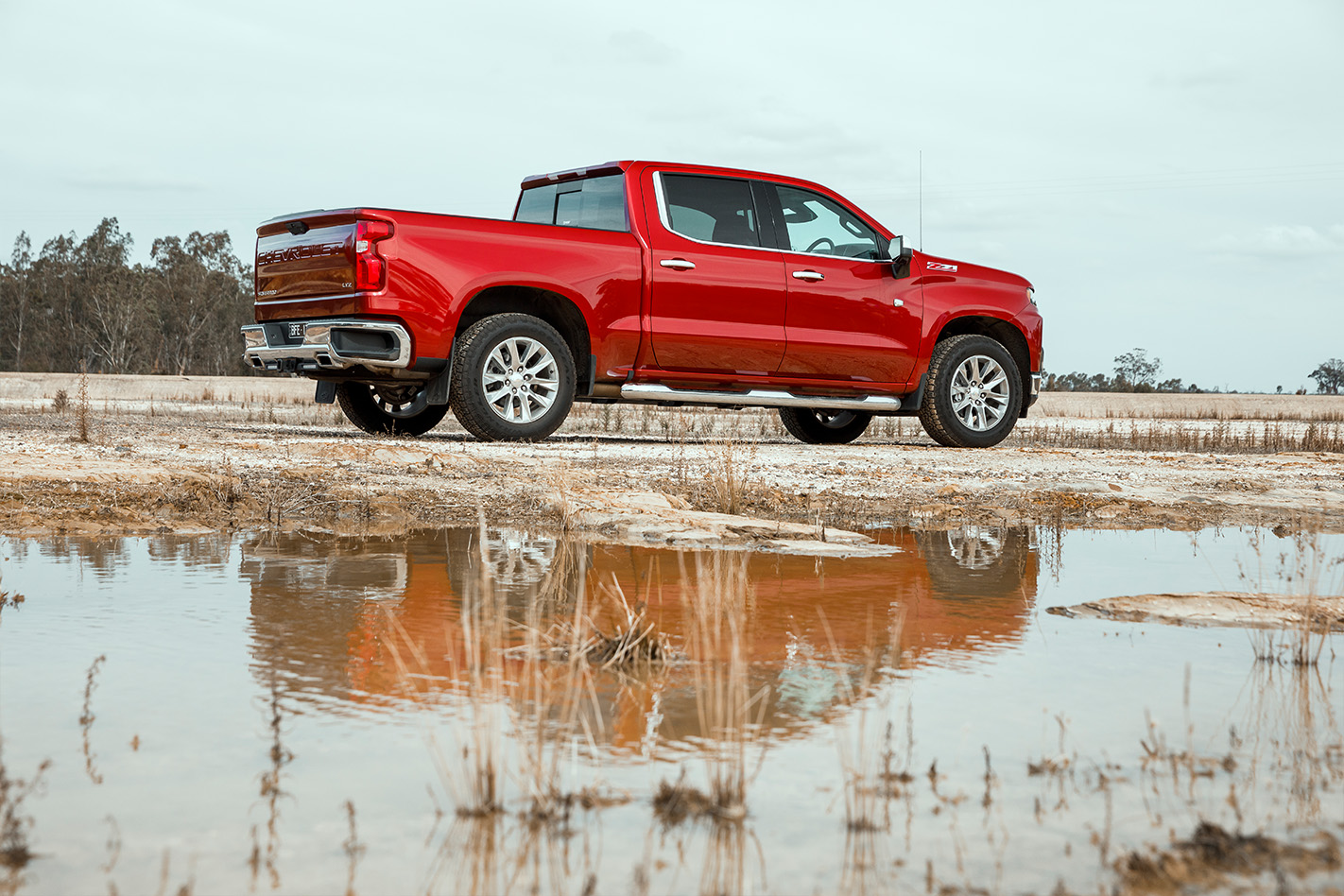
You do gradually become accustomed to the size of the vehicle though. Yes, some may scoff that the Silverado 1500 is the baby of the family, and they’d have every right. There are bigger models on offer, but this is still a monster by the standards of usual dual-cab utes. We had an Amarok 580 Ultimate along for reference and it looked like a toy. The bonnet height of the Silverado was around my chest and I’m 6’3″. I could check the gutters on my house by standing in the tray. You’re a long way up.
According to my tape measure, the bed is 178cm long and 181cm wide, reducing to 128cm between the wheelarch tubs. A particularly nice touch are the cutouts in the corners of the rear bumper which act as steps for you to climb up. There’s an electric tailgate, lights in the fully lined tray and the 1500 also boasts a 4.5-tonne towing rating.
Jump inside and there’s stacks of gear included, including both USB and USB-C connections front and rear, a wireless charging pad, a powerful Bose stereo and one of the coolest heated seats around, whereby you can choose to individually heat the cushion or the squab. Yes, some of the details are clunky, like the ludicrously huge plastic wand for pulling the Silverado into gear. This usually flies straight through the detent for Drive and into Low Range, which can be embarrassing. Alternatively, it can catch halfway on the detent, so you have Drive but as soon as you hit a bump, it drops into the slot with a loud sproing. One thing that needs to be mentioned is the quality of HSV’s right-hand drive re-engineering. It’s truly excellent.
The rear seats offer limo-like legroom, thanks to a wheelbase of 3744mm. That’s longer than a Rolls-Royce Phantom or a Maybach 57, so it’s hardly surprising that there’s room to stretch out. There’s also stacks of stowage space under the rear seats and the cushions can flip up vertically to offer a huge aperture for bulky gear that you’d rather keep locked in the cabin. If you’re really keen on secreting things out of sight, there’s even a hidden storage compartment that you reveal by popping the centre section of the rear seat squab out.
The more time I spent with the Silverado, the more I got used to the width and the fact that your front seat passenger is in a different zip code. You begin to relish the fact that it’ll accelerate to 100km/h in 6.4 seconds, making it the quickest all-wheel drive pick-up we’ve ever tested. On the strip, it was particularly strong at the top end, dispatching 100km/h to 180km/h in just 10.9 seconds. By way of comparison, the punchiest available dual-cab, the Amarok 580, covered the same increment in 18.8 seconds.
Build confidence in the light steering and the way the Silverado pitches and roll and it’s possible to hustle it along a good deal quicker than you’d even countenanced when you first made its acquaintance. I even managed to get it through a McDonalds drive-thru lane without lumbering over the kerbs. That still doesn’t mean it’s a vehicle that feels happy on a challenging road though.
The front and the rear don’t always communicate in perfect synchronisation along a bumpy road, and it feels as if there’s a point of chassis torsion somewhere around where the rear passengers’ feet would nominally be. With speed, it can get quite lively as the front suspension toes out under bump. This is usual in pickups as the weight distribution of the vehicle is ‘off’ when it’s unladen. In effect, the lateral forces generated in a corner by the front tyre (imagining a nominal 66:33 front to rear weight distribution) will be double those developed by the rear tyre. This had a correspondent relationship with front and rear slip angles, hence why most pick-ups feel nervous when cornering unladen and you gradually need to wind on more steering to compensate for understeer during steady state cornering. The Silverado also exhibits a nibbly secondary ride and a rather queasy primary floatiness. On the plus side, the noise pathways into the vehicle are extremely refined and the 10-speed transmission slurs beautifully between ratios.
Anyway, enough of the road-testery nonsense and back to the question we were considering at the start of the piece. Is it too big for Australian roads? Not for major ones. But if you’re using this anywhere slightly urban, it’s a pain. There’s never really any time where the Silverado feels enjoyable to drive per se, but its refinement, space and comfort means that it’d be a great thing for a long road trip on straight roads or for its primary role, towing big trailers.
As long as you can keep it in its relatively narrow comfort zone, there’s a lot to commend the Silverado 1500, and for $114K, it offers a heck of a lot of vehicle for the money. The problems come when you expect it to be more versatile and do the sort of things that big SUVs tend to be able to take in their stride. That’s where its skill set suddenly unravels. You may well find vehicles like this gauche, but having sampled the Silverado 1500, I can certainly see its niche. I’d wish HSV all the best with it, but I’m guessing they won’t need it. They’ll sell every Silverado 1500 they can punt out the door at Clayton. If you do buy one, just do yourself a favour and give the Grand Ridge Road a miss.
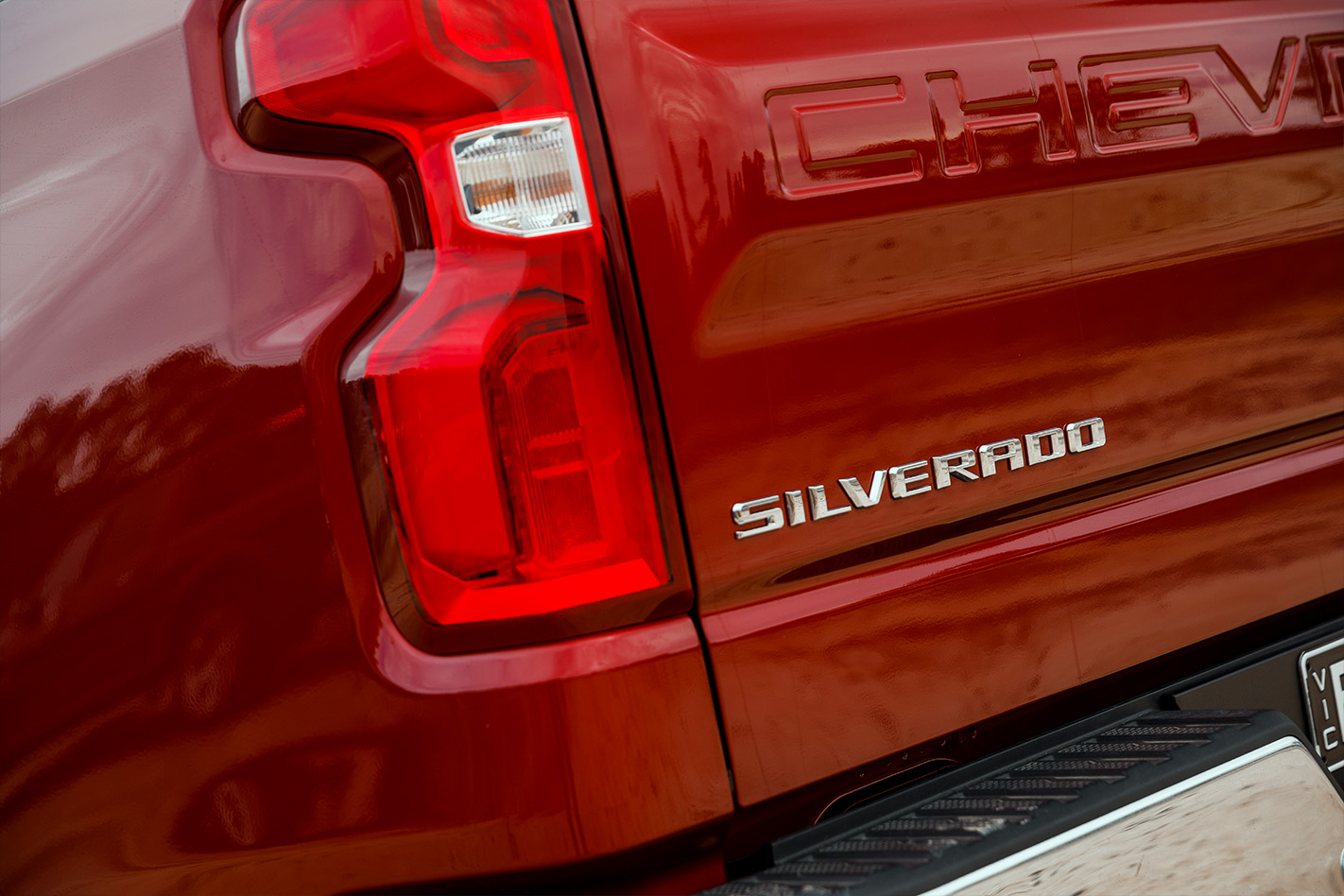
CHEVROLET SILVERADO 1500 LTZ PRICE AND SPECS
Engine: 6162cc V8, OHV, 16v
Max power: 313kW @ 5600rpm
Max torque: 624Nm @4100rpm
Transmission: 10-speed automatic
Weight: 2588kg
0-100km/h: 6.4sec (tested)
Economy: 13.5L/100km (tested)
Price: $113,990
On sale: Now
UPDATE: Whichcar’s Snowrunner giveaway competitiong is now closed.
Congratulations to the winners:
Chris Sinclair, Peter Thomas, Robbie Clinton, Eben Louw, Scott Russel
Thanks to everyone for participating.
—
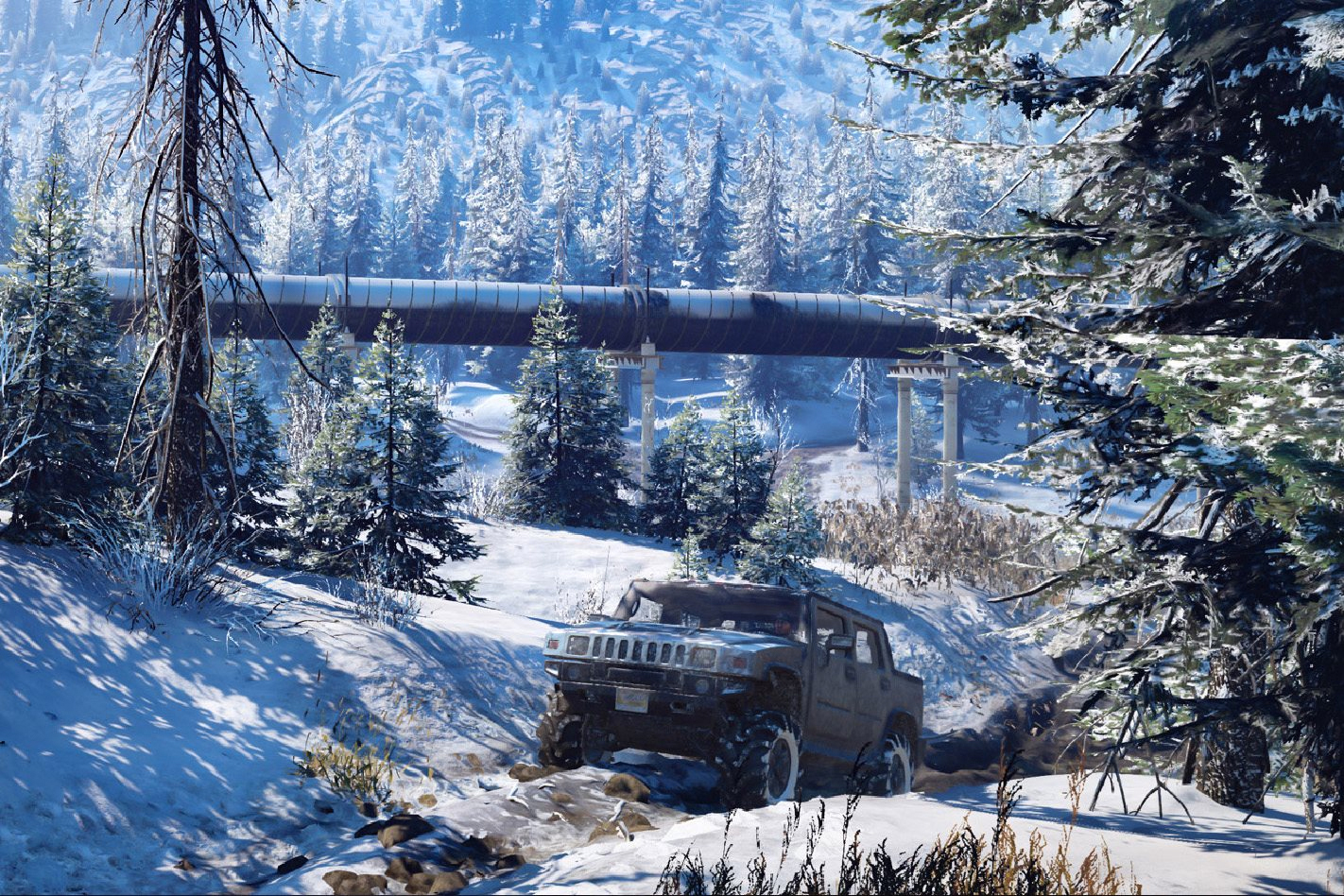
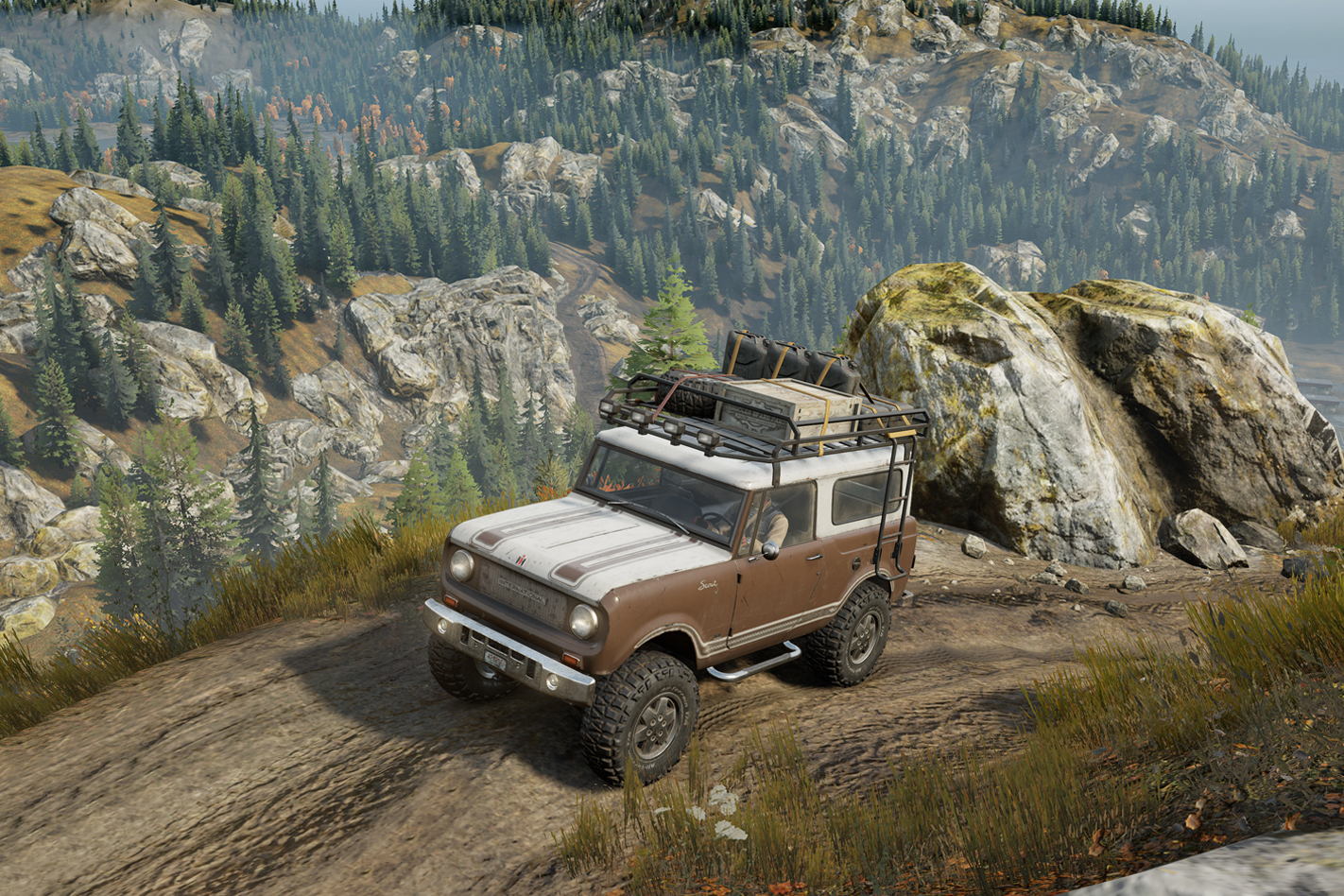
WhichCar has teamed up with the team behind SnowRunner to give five of our readers a free copy of the new expansive outdoor sandbox game!
We have five copies of the game to give away: three PlayStation 4 copies, and two Xbox One copies.
One of the game’s main attractions is the ability to freely explore the great outdoors, and to win, we want to see where you’ve been (or gotten stuck) on your automotive adventures!
To enter, all you have to do is: go to the WhichCar Facebook page (which can be found right here), and look for the competition post at the top.
Post a photo of your car in the great outdoors! It could be backdropped by a beautiful vista, or up to its sills in mud or water.
Be sure to also note which console you’d prefer, and make sure you’ve liked and followed us on Facebook. That’s it! You’re entered!
Entries will close on June 15 and the WhichCar team will judge all of your photos, with our five winners announced on June 18. Best of luck!
Full terms and conditions for this competition can be viewed here. Entries close on 15 June at 23.59 AEDT. Winners will be notified via Facebook.
Bauer Media Pty Limited (Bauer), collects information through this site to process registrations, to send out newsletters, communicate offers, competition or surveys. Bauer’s privacy policy is available www.bauer-media.com.au/privacy/ and contains information on how you can access or correct your personal information, entities we may disclose your personal information to (including overseas recipients) and how you can lodge a complaint. The competition opens 18/05/2020 and closes on 15/06/2020. Entry is open to Australian residents aged 18 years and over. This is a game of skill; chance plays no part in determining the winner. Judging will commence on 19/12/2019 at 11:00(AEDST). The Promoter is Bauer Media Pty Ltd (ABN 18 053 273 546).
A gargantuan Colorado mansion with a 100-car garage (or a 100-car garage with attached living space as we like to think) has hit the market in the United States, via renowned auction house Sotheby’s International Realty.
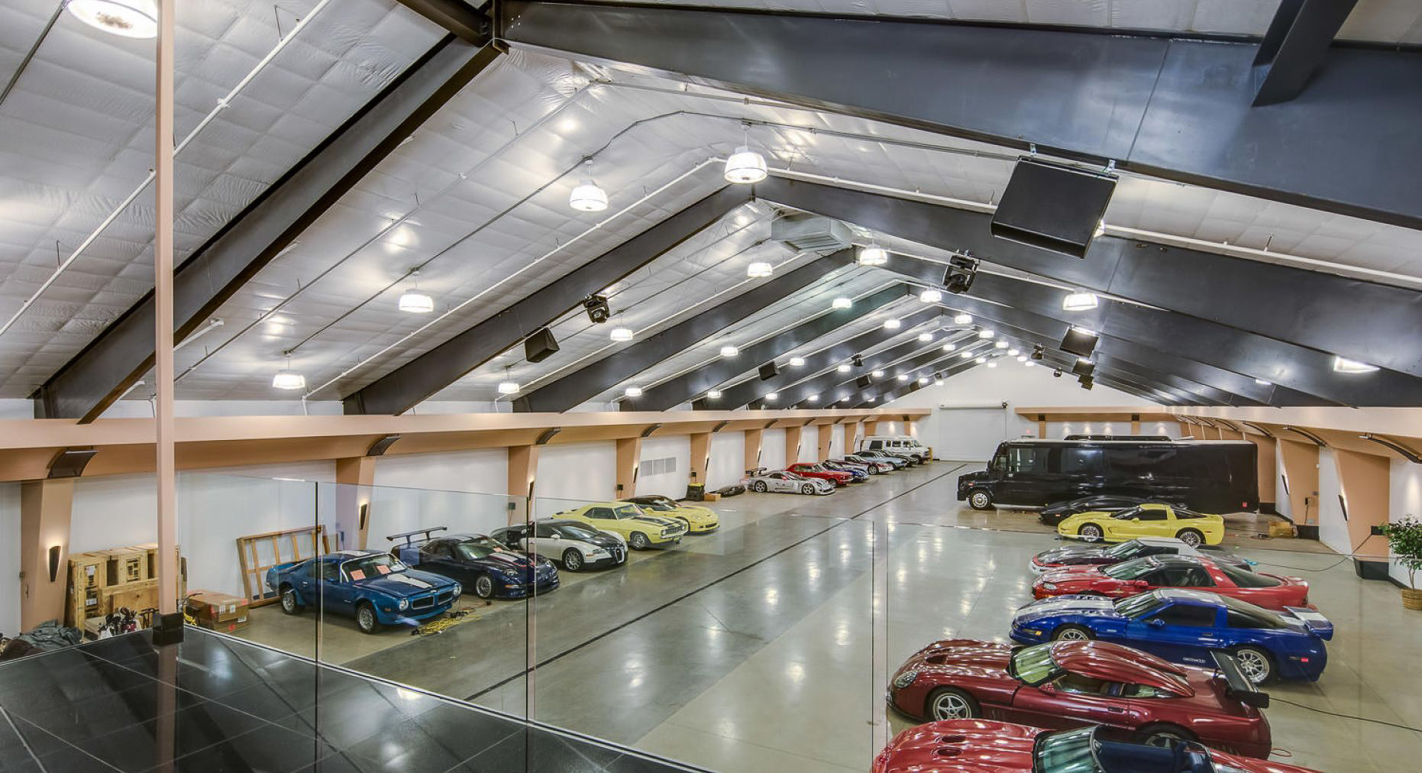
Located just outside the state’s capital of Denver, the US$20 million (AUD$31,000,000) property was built by well-known car collector, racer – oh, and the boss of America’s version of the Yellow Pages – Richard Berry to house his notable collection.
That collection included one of the first-ever Bugatti Veyrons, a Koenigsegg CCX, a plethora of Lamborghinis including an Aventador and Diablo GT, as well as many American classics.
Berry’s collection has thinned out over the years, though – at one point he claims to have owned 240 cars at once.
The garage is obviously the selling point for us, and in addition to housing 100 cars, it contains a bedroom and two bathrooms for your live-in mechanic that you’ll almost certainly need to maintain your own personal 100-car collection.
The mechanic could also keep the cars in tip-top shape without leaving the property because the hangar-style showroom includes its own petrol station and car wash.
Amazingly, the garage is some 370 square metres bigger than the house!
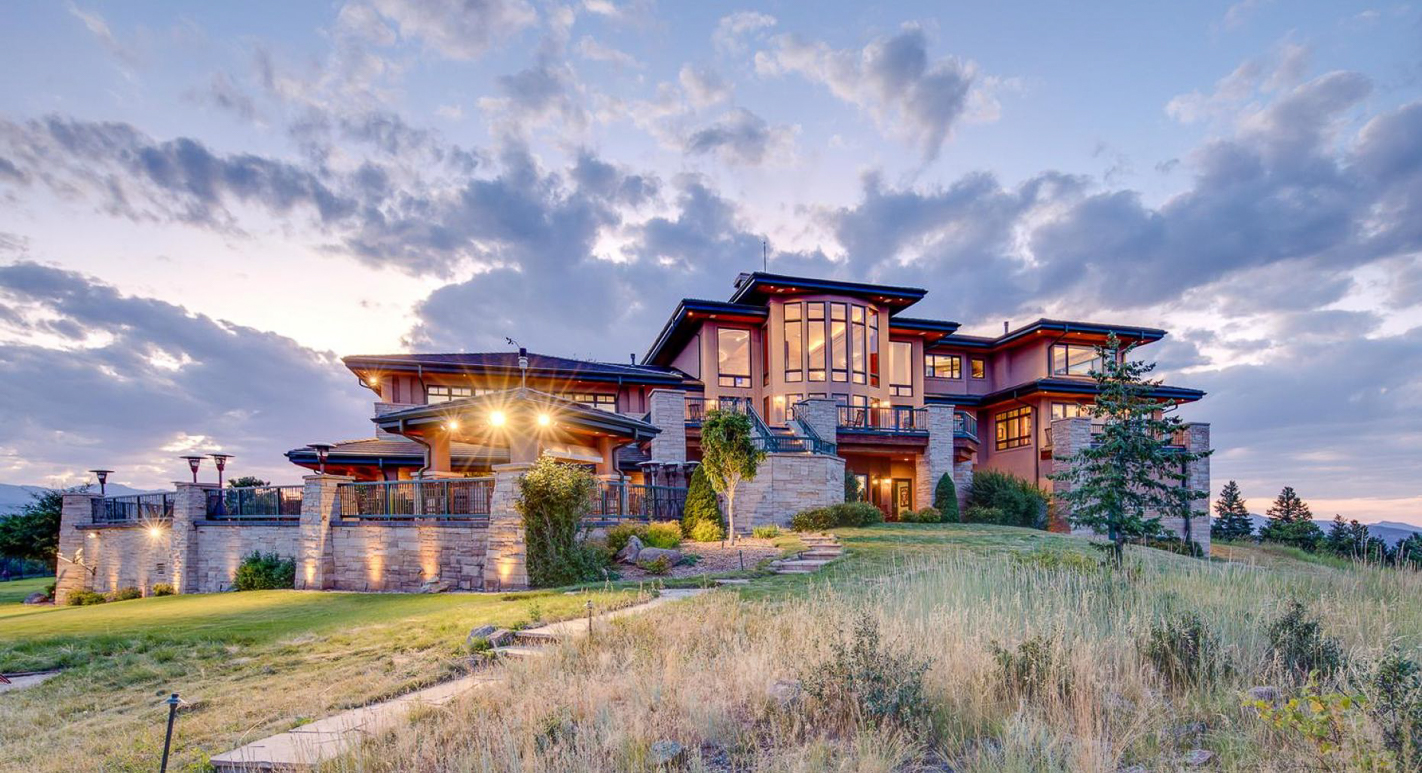
The house itself is okay too, we guess, with seven bedrooms, 12 bathrooms, a Star Trek-themed cinema and 360-degree views of the stunning Colorado mountain surroundings.
“In staying in fine hotels, living in other big homes and seeing hundreds of them growing up and as an adult, I kind of took a little something from everywhere I’d been that I liked,” Berry told the Dayton Dail News.
There are also several entertaining areas, a wine room, many, many fountains and more extravagant aspects that you can see by flicking through the gallery or watching the video above.
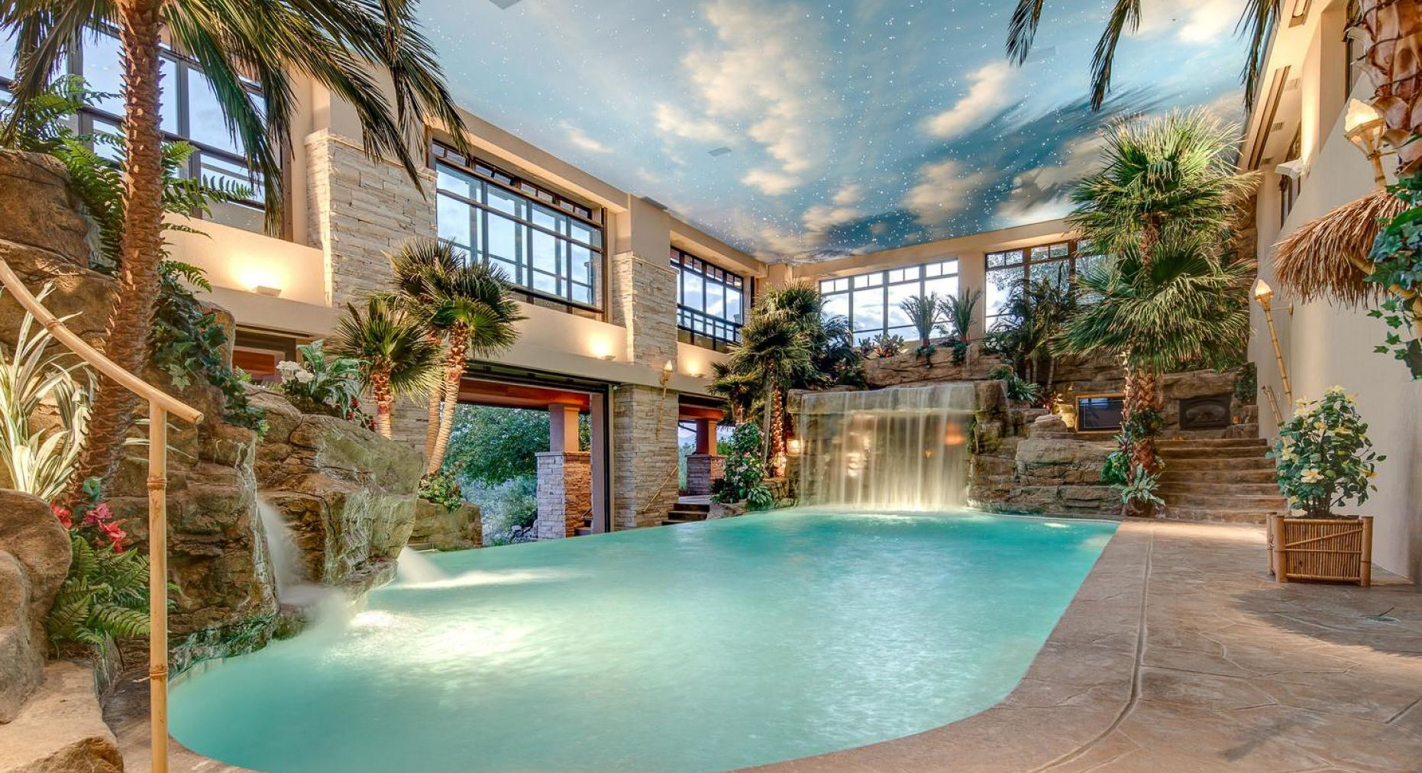
Designed as Berry’s ode to Hugh Hefner’s Playboy Mansion, the house also features a Tiki bar and a grotto-style indoor pool with a starry night sky and waterfall.
Oh, how the other half live…
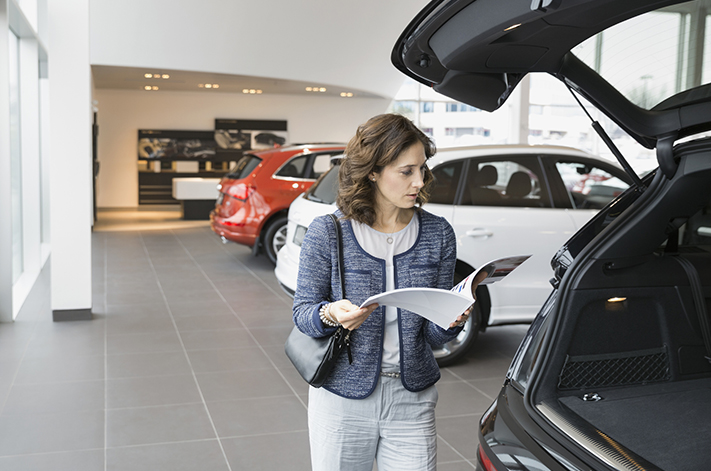
Despite the infrastructure, framework and technology available for quite some time now, car manufacturers have been hesitant to offer the option of buying their cars online.
At a time now when all businesses need to adapt to the new normal thanks to coronavirus, car salespeople are being caught out in the traditional dealership landscape and are making it increasingly difficult for consumers to get what they need.
The situation is at odds with current trends which show right now could be a good opportunity to purchase a car, thanks to generous government tax write-offs, looming end of year sales and general discounting to combat a free falling economy in which new cars sales are severely affected.
Almost everything else is available to purchase online with buy-it-now convenience, ready to be dropped right at your doorstep – but why is it taking so long for cars to get this treatment?
Online car sales aren’t new
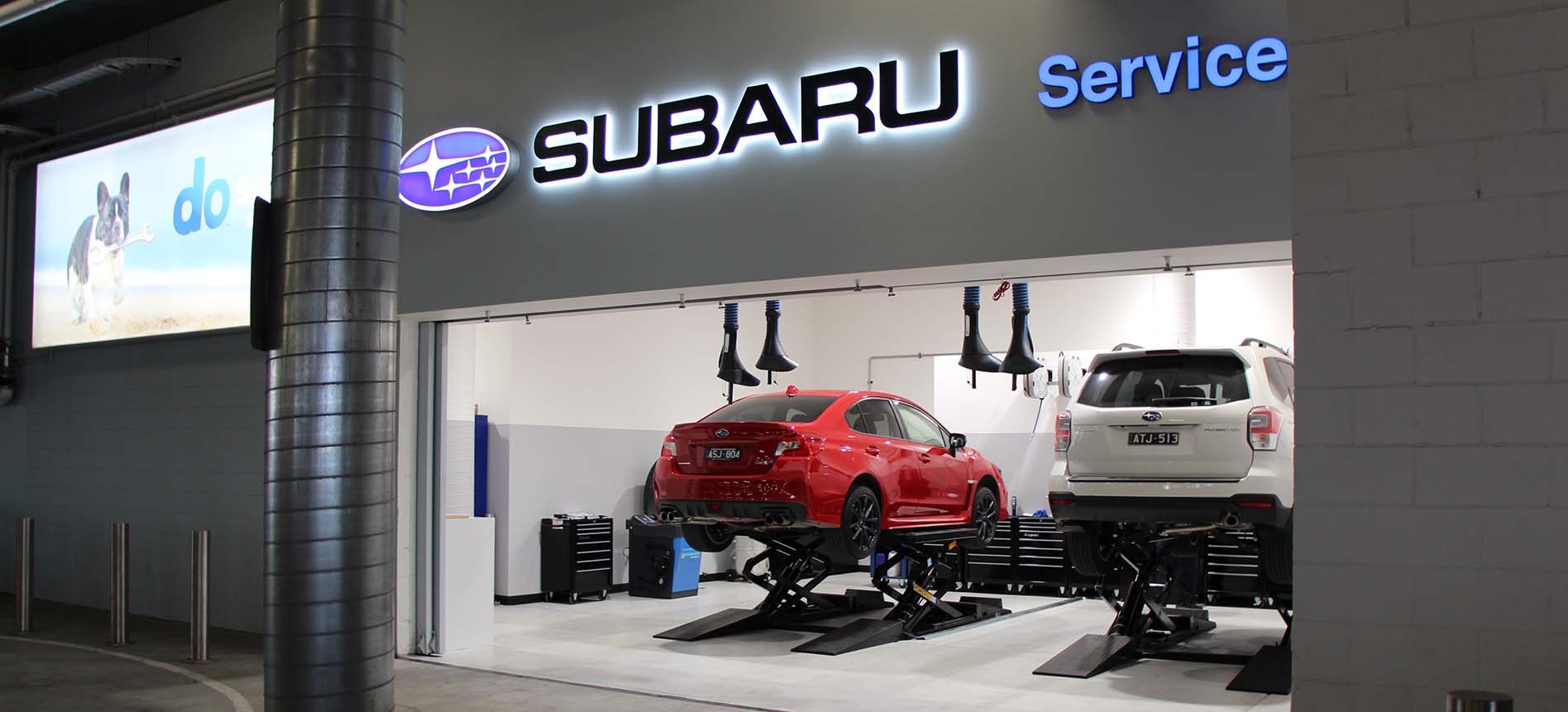
Some have dipped their toes into the online market space, like Subaru and Toyota, who offered the BRZ and Supra sports cars via online portals in 2012.
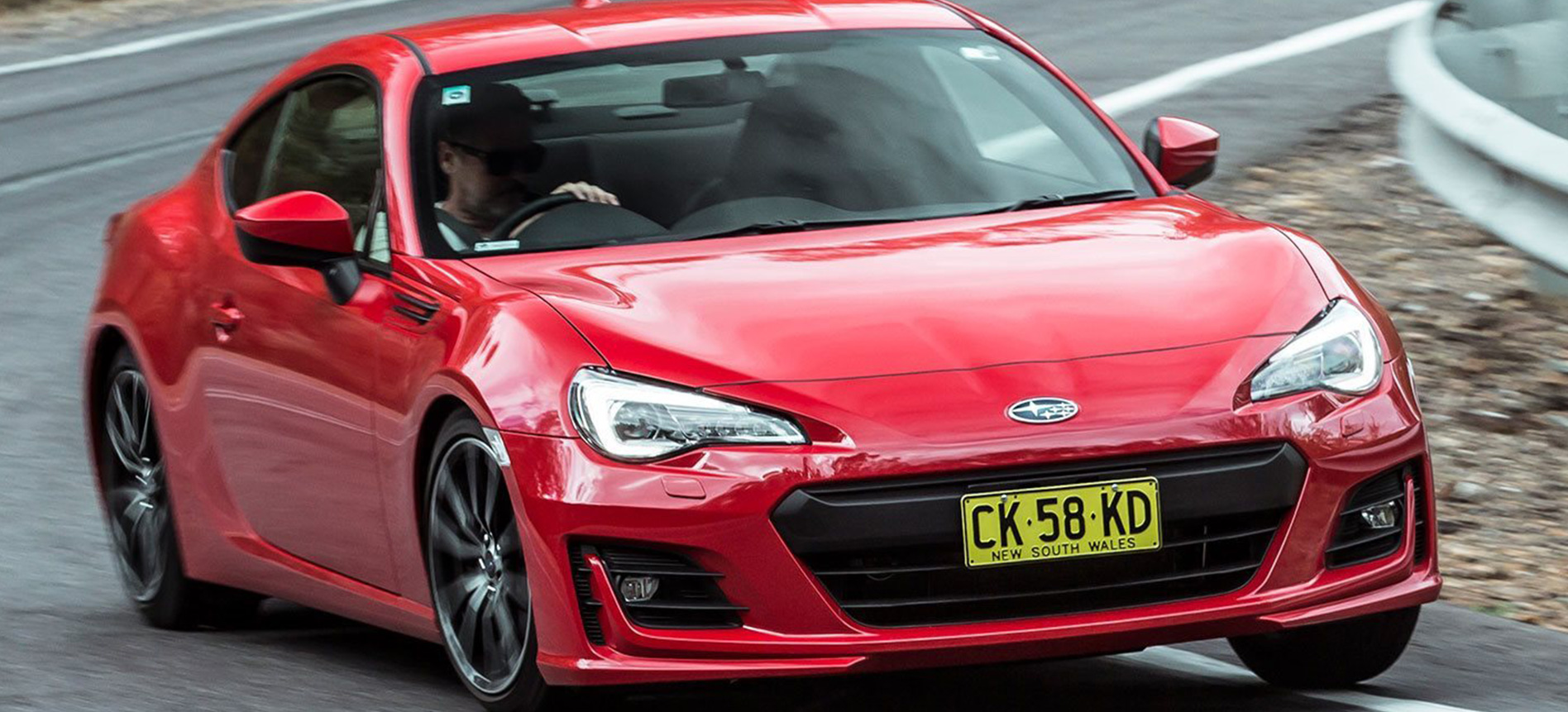
Subaru regards the initial online offering of 200 of its BRZ units as a resounding success, with Subaru Australia public relations manager David Rowley saying at the time the demand caused their website to crash.
“All information was available online, and we offered a national drive-away price on the car,” he explained.
“We also had a dedicated customer support base here to regularly update the customer.”
It was the kind of experiment that allowed Subaru to further expand its niche by offering to sell other cars through its website and introduce a number of shopping centre-based experience centres.
FCA is scrambled to offer online buying services to COVID-19-stricken Italy, where dealers are using Google Hangouts to meet with prospective customers as opposed to meeting them in traditional dealerships.
Customers could speak to dedicated sales consultants who can help them specify a new car from the comfort of their own home. They can receive quotes, understand financing options and even negotiate a sale over the videoconferencing software – although signing on the dotted line and paying must be done in person.
It mightn’t be the optimal solution as it still opens up face-to-face contact in a time where that sort of interaction must be curbed, but at least FCA is trying alternative ways to do things in Italy. It is said that the process will be expanded elsewhere in due course.
Volkswagen Australia has recently jumped on board too with what they’re calling ‘online ordering’. Customers are able to specify and leave a refundable $500 deposit for a car, whereby the designated dealer then makes contact within 48 hours to complete the purchase and source the car.
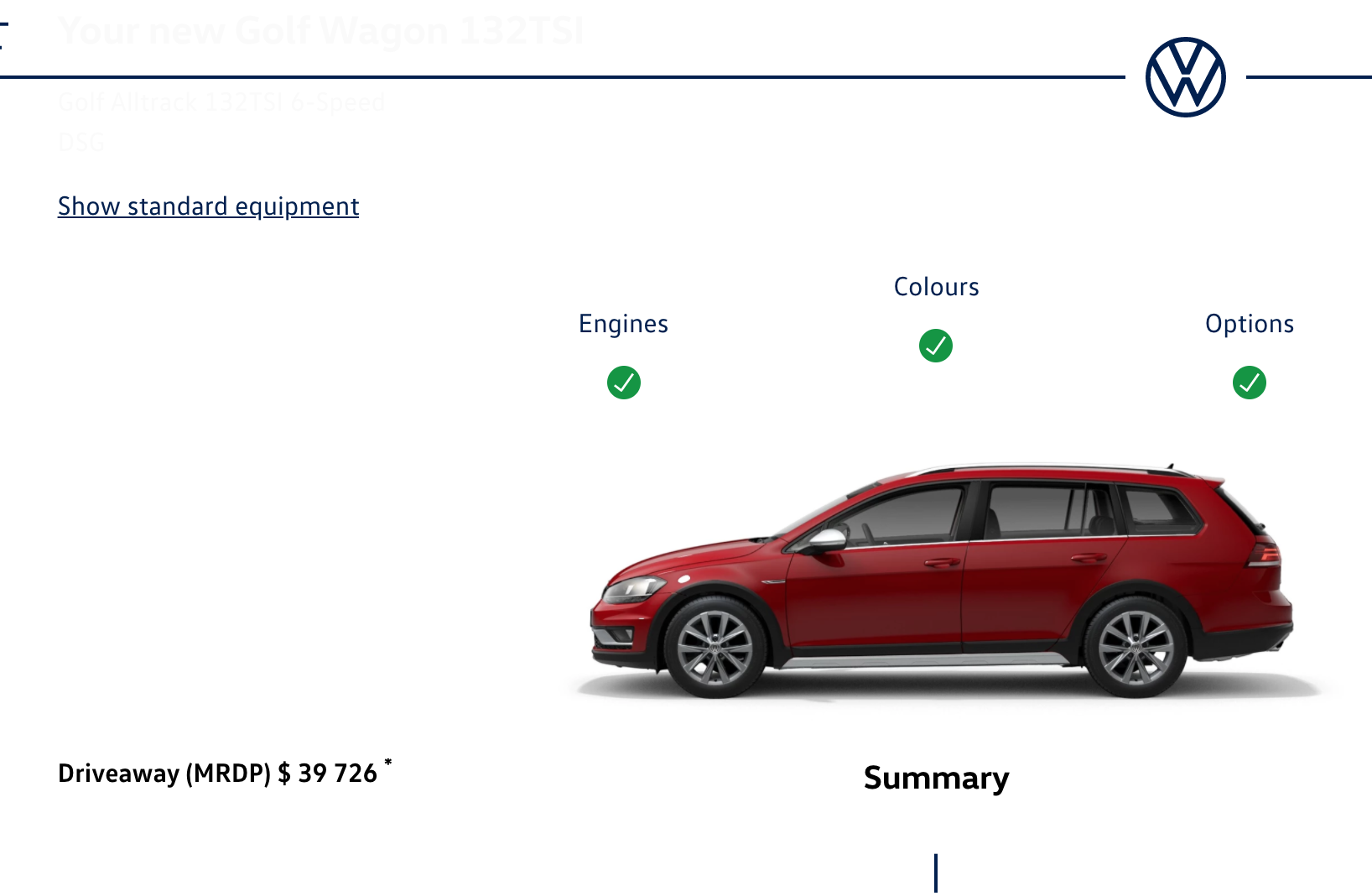
It’s not only the built-to-order stuff, too. A Stock Locator tool lists all new stock that Volkswagen has in its inventory, and deposits are able to be submitted for those cars.
They’ll even provide an online estimate of what they’re willing to pay for trade-ins.
After one month of its online sales portal, VW has reported 1000 extra leads that it ordinarily would have missed with the traditional dealership sales model.
Which car brand leads the way online?
Another brand that arguably has the greatest hold on futuristic online automotive sales is the brand that manufactures futuristic cars themselves – Tesla.
Tesla has used the internet to sell cars online ever since it first arrived in Australia, only intending its few physical dealerships for servicing, teaching and product handovers.
In fact, believe it or not, Tesla won’t actually sell you a car unless it’s online. Walk into a Tesla dealership and you’ll find interested parties being shown how to order cars using in-store computers or their own device.
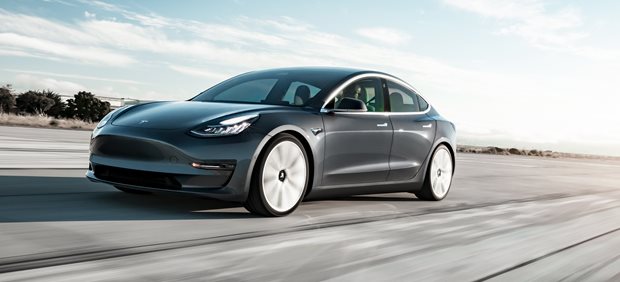
Forget about test drives and in-situ product learning for the moment, but customers are easily able to place an order for a car online – whether it be a demo model or one built from scratch – and only have to visit a physical dealership once the car arrives and pick it up.
Tesla was also quick to introduce ‘zero-touch’ delivery policies in the US where cars are left in a location of your choice for you to unlock using a Tesla phone app.
Paperwork is left inside the car for buyers to complete and send back with the included pre-paid envelope.
If combined with Tesla’s traditional online method of selling its cars, you could feasibly order, pay for and take delivery of a car without interacting with another person.
BMW has just revealed a new online sales portal called BMW Shop that can source current stock which shoppers can pick and reserve at driveaway prices. While you can’t order new from factory yet, a price quotation is given with an enquiry on local stocks, and a video chat can be set up to discuss the specifics.
Toyota dealerships have had the ability to sell online for over a year, a process that Toyota says is becoming increasingly popular.
“Looking at 2020 specifically, we have seen a slight increase … in online sales. This could be attributed to COVID-19, as our online platform enables our customers to purchase their next vehicle from the comfort of their home,” a Toyota spokesperson told WhichCar.
But are buyers ready for this kind of online buying process?
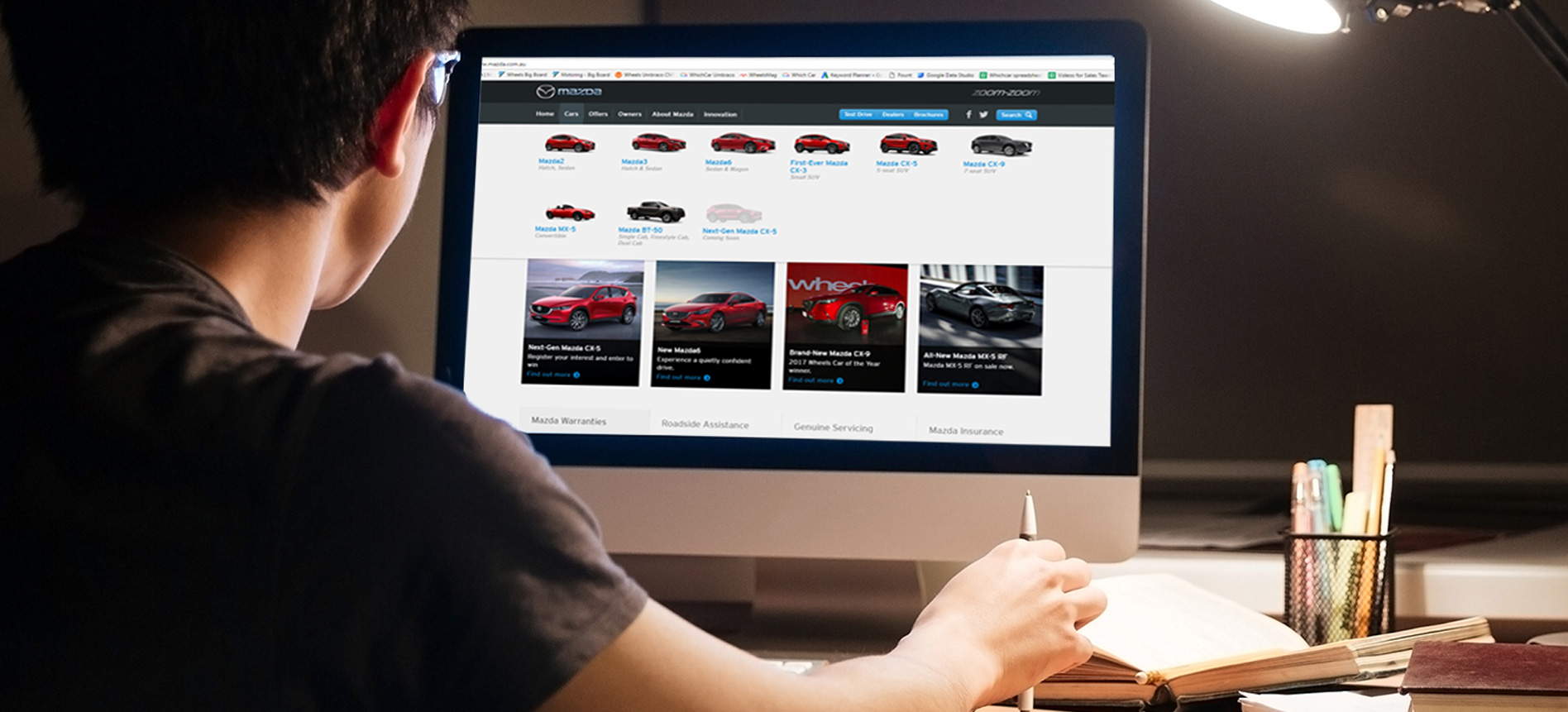
Surveys carried out over the past few years have shown that about a third of Australians are ready to buy a car from a virtual showroom sight unseen. But a recent survey by online financial brokers Savvy Finance suggests it will take some time to convince the remaining 70 percent.
According to the survey of 1001 people, 70 percent said they were ‘uncomfortable’ about home-facilitated test drives, virtual demonstrations, remote payments, and dealer delivery, with more than half of them saying they were “extremely uncomfortable’. Just 4.0 percent of the people surveyed said they were ‘extremely comfortable’ with the idea.
“It seems we’re not quite there yet when it comes to buying big assets like cars online,” said Savvy’s managing director. Bill Tsouvalas. “We don’t want to buy a car sight-unseen, but we are still in the market for cars and vehicles in general.
Tsouvalas says that hesitancy to purchase a car online has contributed to Covid-19 having a bigger impact on vehicle sales in 2020 than it needed to.“Work From Home doesn’t seem to have made much of a dent in consumer sentiment – but the fact many aren’t prepared to take a leap of electronic faith has.”
According to Toyota the feedback from buyers who have taken the leap has been “overwhelmingly positive” for both the online experience and the in-store pickup.
It’s a process that worked out for the Tesla Owner’s club president Mark Tipping who ordered his Model S P85D online more than five years ago.
“I had no one pressuring me, which was what I liked most” he told WhichCar. Other positives Mark notes was the fact “that the price was the price, everyone gets the same deal which is absolutely transparent.”
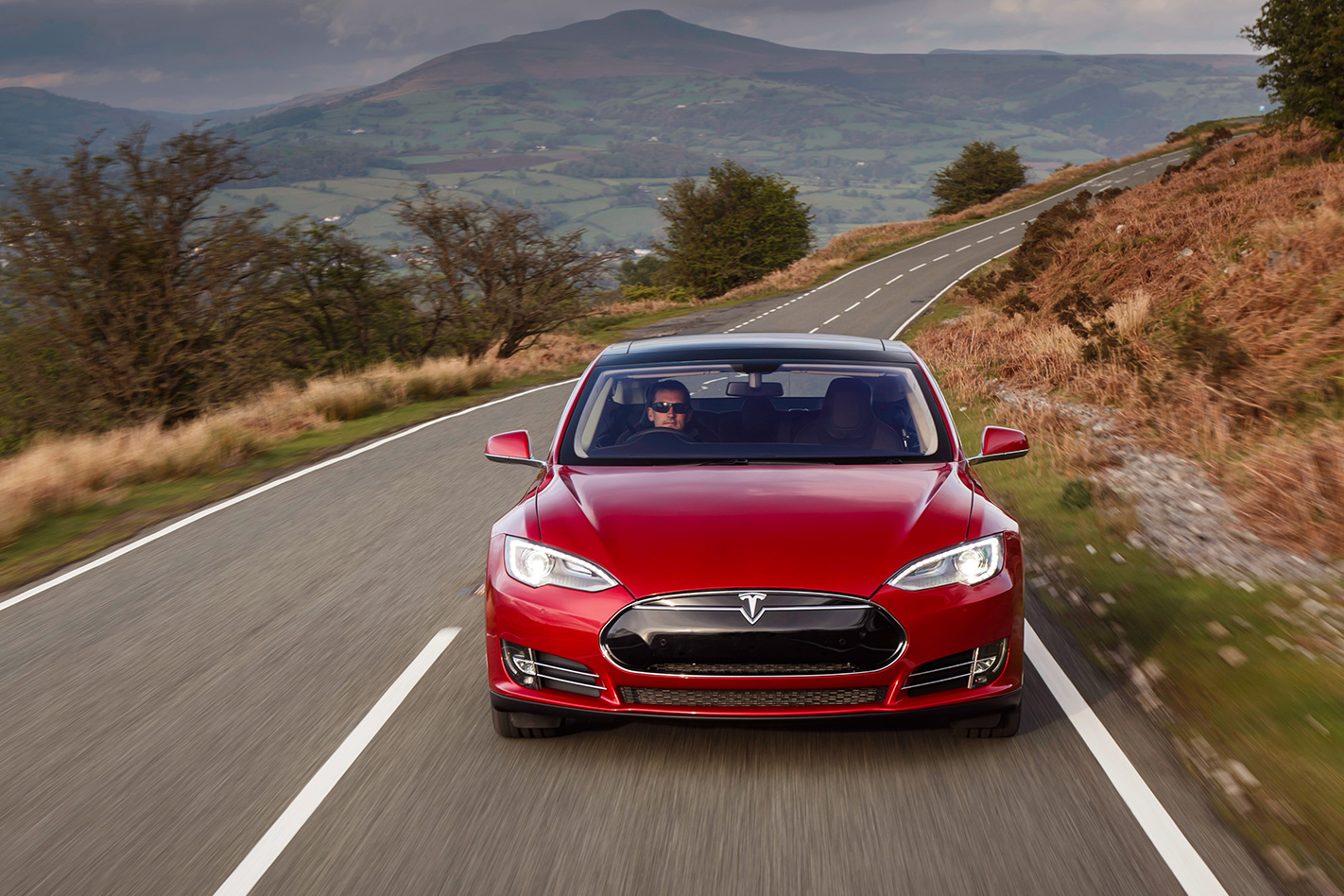
“A product specialist was on hand if I needed updates and I called up mid-way through the build process to check-in, but the overall experience was refreshingly easy.”
When asked if the same process could be adopted by other manufacturers, Mark wasn’t as enthusiastic. “It’ll be a challenge to others who might have to introduce a hybrid system (online and in-person) to keep all parties happy,” he said.
“The customer also may not be ready for it so there’ll have to be a huge amount of marketing around it too.”
Car buyers mightn’t have any other choice but to buy their cars online in the near future. Social distancing measures are preventing more and more businesses from operating day-to-day, and if more restrictions are on the way it’s likely dealerships themselves will have to shut up shop.

Of course, there are hurdles to overcome before we all jump on board with buying online. For example, there are those who value the process of haggling, the signing of paperwork and how is the specific value of a trade-in determined? That said, those hurdles aren’t insurmountable.
For the time being, if manufacturers can start introducing a complementary online method to a traditional dealership sales model that may allow some customers to start thinking again about buying a car during a time in which that may be the furthest thing from their mind.
