
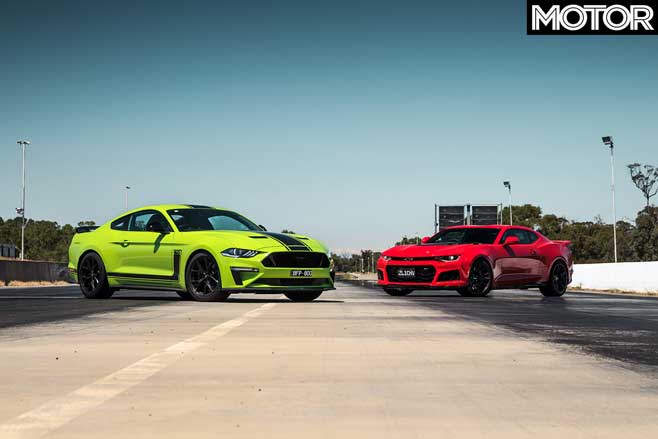
We know this match-up might deserve more inches than what we’ve devoted it here. The Chevrolet Camaro ZL1 and the Ford Mustang R-Spec have a lot in common; they’re both supercharged V8s, rear-wheel drive, rebuilt to some degree on local soil, and share a rivalry that has developed over half a century. This biff has the potential to feature on Main Event.
But there are also some glaring disparities between the two. Like price. The Camaro ZL1 is priced $60K clear of the $99,980 R-Spec, since it needs a much more thorough rebuild in Clayton than the Mustang does on the other side of town in Broadmeadows.
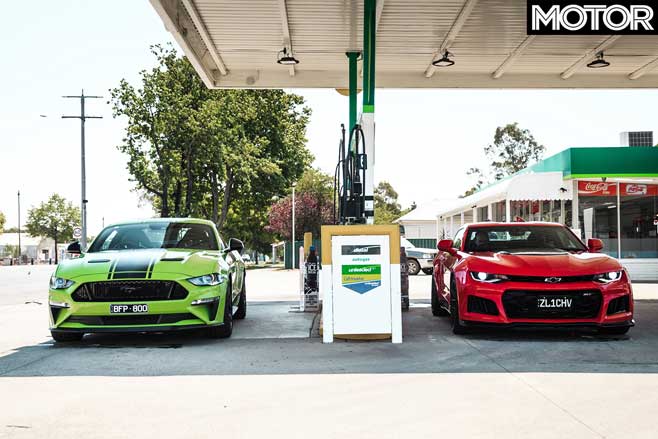
In danger of oversimplifying it, parts are essentially installed onto the R-Spec while the Camaro is entirely gutted so HSV can reweld its firewall to welcome a new steering shaft on the right-hand side.
Then there are the gearbox options. My ZL1 is equipped with a 10-speed transmission while the R-Spec is manual-only (six speeds). And the ZF-developed 10R80 auto can make a devastating difference.
Finally, the R-Spec is a limited special edition whereas the ZL1 lives in Chevrolet’s product line-up full-time and is adapted to local requirements.
And yet when Nathan Jacobs needed an extra car to capture tracking shots of the R-Spec for this month’s magazine feature, the ZL1 seemed the perfect companion.
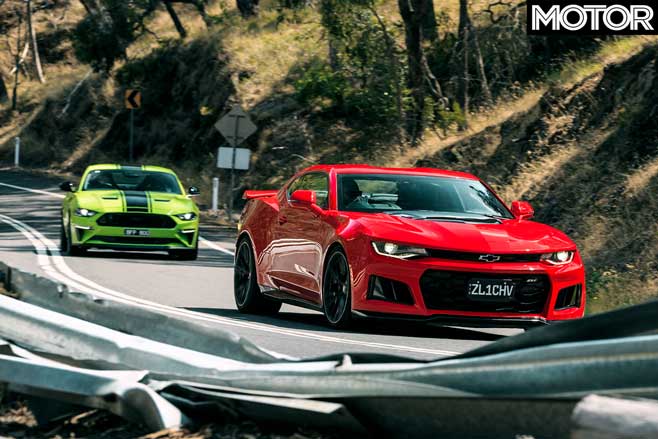
We didn’t have the time to test the ZL1 after the R-spec on the strip, but it wouldn’t have been much of a fight. A week before on a similarly hot day, the ZL1 logged some dominant acceleration times. Its 4.0sec 0-100km/h run, followed by an 11.8sec quarter-mile pass at 200.47km/h, on the supposedly inferior Continental tyres, trumped the R-Spec’s heat-affected figures by some margin.
We’re not saying the R-Spec doesn’t have that sort of ticker. The blown Coyote V8 is monstrous, but we found the window to unleash its full might is a lot smaller. I reckon the ECU doesn’t want the pistons – snugger than ever in plasma-coated bores – expanding too far under heat. So it pulls power.
It was the same story for when we actually drove the cars back-to-back on our cornering ‘stage’. The R-Spec slowed in the heat, allowing the ZL1 to pull away.
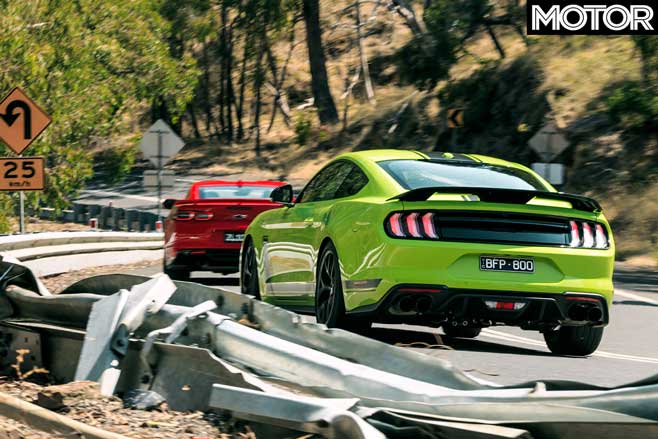
That’s partly due to Chevrolet designing the ZL1’s bodywork around a 477kW/881Nm furnace under the bonnet. Behind those gaping cut-outs in the front bumper is a wall of radiators, including a transmission cooler lying flat behind the front lip, to pull temperatures out of the powertrain.
They don’t fully protect the ZL1 from heat soak – in fact you could feel it suffering a little – but it was nowhere as dramatic as the R-Spec, which relies on the American Performance Pack’s larger radiator and a rear diff cooler designed by Herrod Performance.
The two are more evenly matched in other areas. With upgraded performance springs and anti-roll bars, the R-Spec now has the stuff to match the ZL1’s handling muscle. In fact, on Michelin Pilot Sport 4 S tyres it feels like the grippier car.
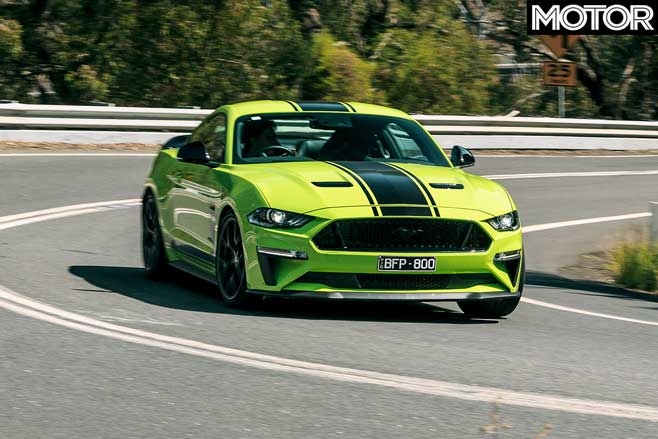
In Sport Plus mode the R-Spec’s steering is extremely heavy, enough to make the ZL1 (in Sport mode) feel astonishingly light-steering and less direct. Sometimes a Mustang’s front-end feels too darty, but the R-Spec balances its grip levels beautifully. We only wish we could have the power to exploit the grip.
Sliding the ZL1, meanwhile, is not a question of whether it can, but how much you want it to. The electronic locking diff and extremely relaxed ESC in Stabilitrak mode mean it’s so much more capable hanging out its rear. And you are too, since the driver’s seat is more centred between the front and rear wheels. It places you in a better spot to feel yaw movements.
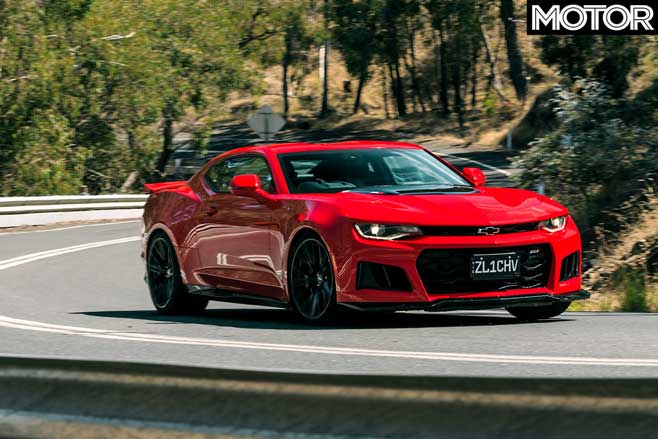
Overall, there’s a lot of crossover between the two that favours the Mustang. It packs all of the aggro and muscle-car mojo found in the ZL1 but for much less. It’s also the car I wanted to drive home, on account of more damping travel and a more spacious cabin where you can actually see over your shoulder. Transmission-wise, the six-speed manual in the R-Spec is also more involving than working the ZL1’s plasticky paddles.
But there’s no denying the ZL1 justifies its extra dosh. That price buys a car purpose-built to handle the heat, so to speak, a big supercharged V8 produces, to deliver head kicking performance. And on that note the ZL1 wins this brief encounter. It’s by default, yes. But as we said, a battle of such epic proportions deserves a bigger stadium. And perhaps a date in winter.
Fast Facts
| u00a0 | Ford Mustang R-Spec | Chevrolet Camaro ZL1 |
| Engine | 5038cc V8, DOHC, 32v, Supercharger | 6162cc V8, OHV, 16v, supercharger |
| Power | 500kW+ (estimated) | 477kW |
| Torque | 800Nm+ (estimated) | 881Nm |
| Transmission | 6-speed manual | 10-speed automatic |
| Drive | Rear wheels, Torsen LSD | Rear wheels, electronically controlled LSD |
| 0-100km/h | 4.7sec (tested) | 4.0sec (tested) |
| 400m | 12.78sec @ 189km/h (tested) | 11.8sec @ 200km/h (tested) |
| Price | $99,980 | $162,990 |
Volkswagen has taken the tarp – so to speak – off its new Caddy small van, revealing a vastly updated front fascia and rear end, while also featuring underpinnings shared with the new-generation Golf.
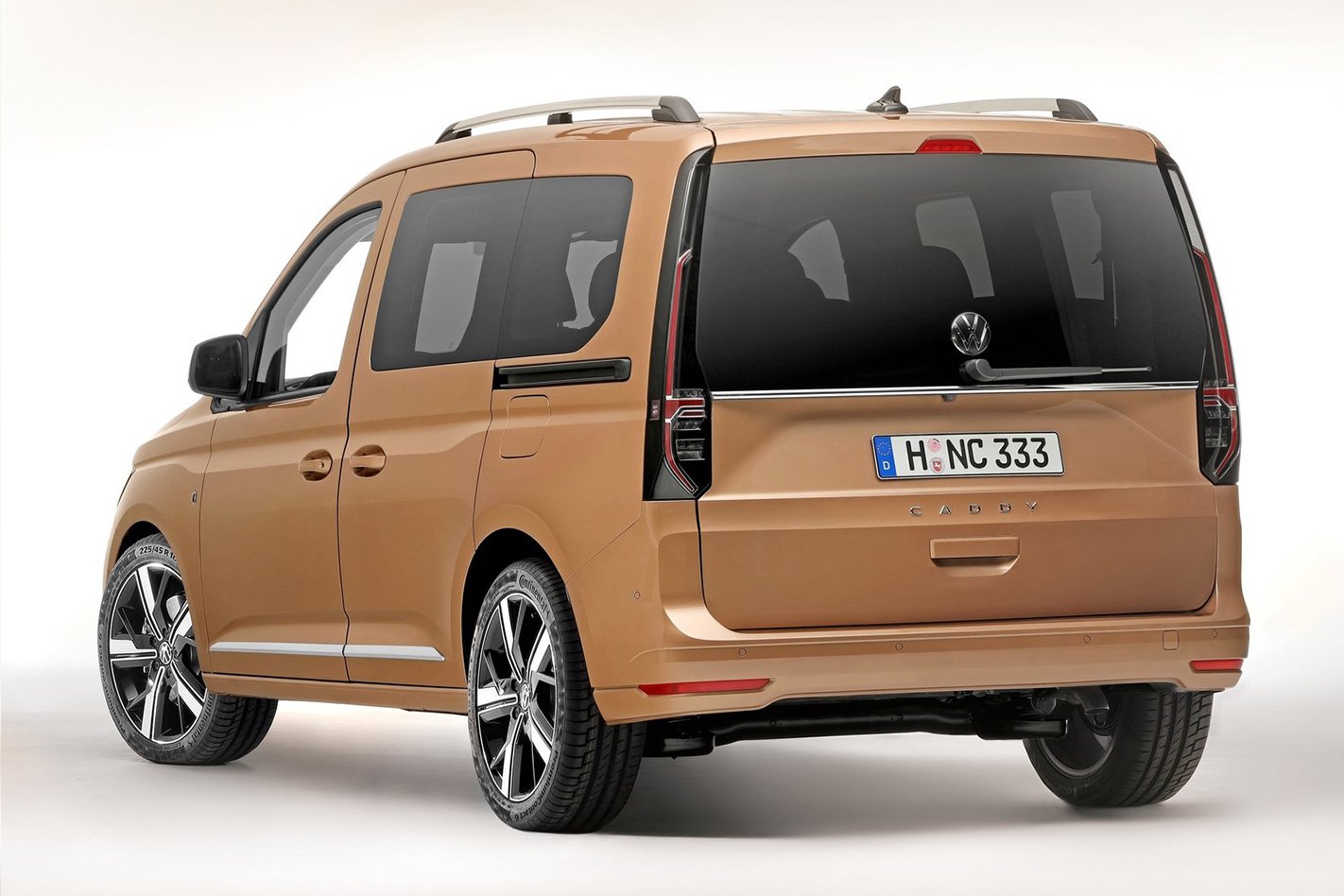
The 2021 Caddy sits upon the Volkswagen Group’s modular MQB platform, which allows for new technology in the form of engines, infotainment, driver aids and the ability to offer electrified powertrains.
The new platform also means the Caddy will also be even more like a Golf to drive.
A new long wheelbase Caddy Maxi, which can fit two Euro pallets inside loaded from the rear or side, will also be available. It’ll also carry people; with a larger glasshouse and the ability to fit a factory panoramic sunroof allowing for a much nicer cabin ambience for back seat bandits.
The looks are very in-line with the incoming Golf, featuring new headlights, front apron, completely new taillights… come to think of it; VW says every single body panel is new.
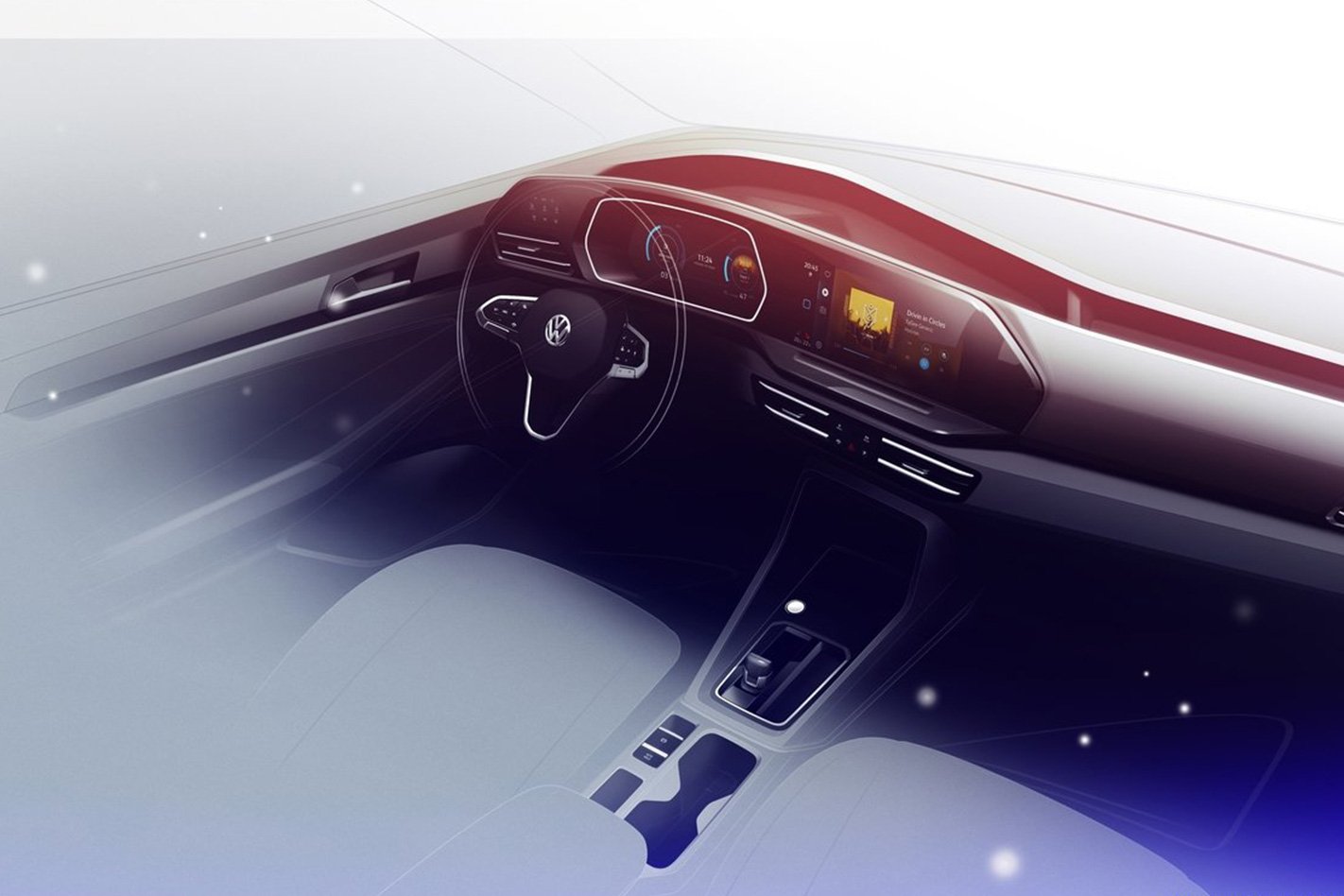
Inside the Caddy scores Digital Cockpit which can be upgraded to a fully-digital instrument cluster, two infotainment screen sizes between 6.5- and 10.0-inches are on offer and the interface in which you interact with the car is now mostly touch-based. Volkswagen hasn’t supplied images of the interior just yet, but imagine the Golf’s, perhaps using slightly lower-rent materials.
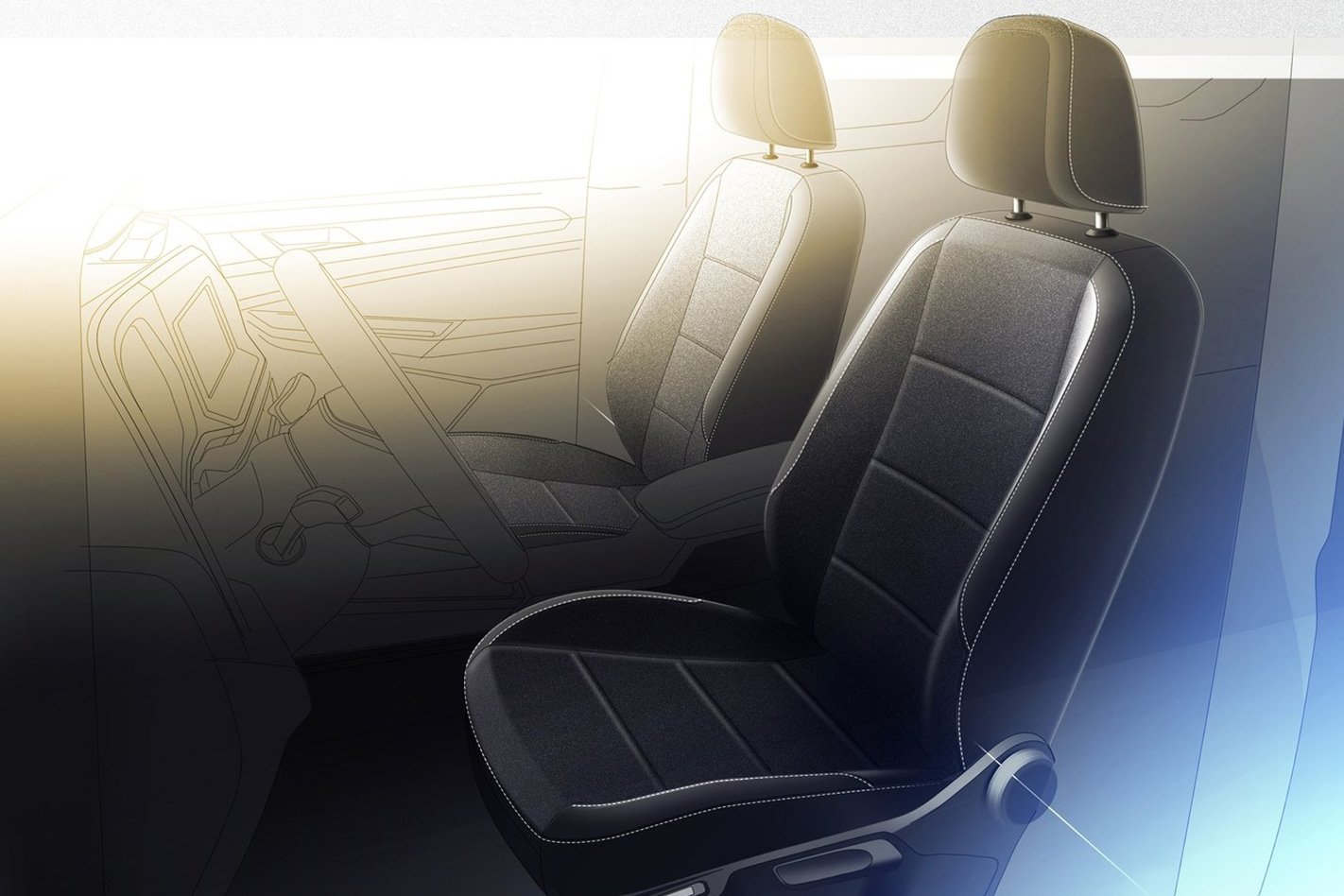
Powertrain-wise, the new Caddy is set to feature a four-cylinder engine in a number of tunes and fuel options and they all fulfill the 2021 Euro 6 emissions standards. The TDI diesel versions have power outputs between 55kW and 90kW, the petrol engine outputs 84kW and there is also the option of a supercharged natural gas version.
We’re unsure which engines will come with it to Australia, but we should be seeing the next-generation Down Under in 2021.
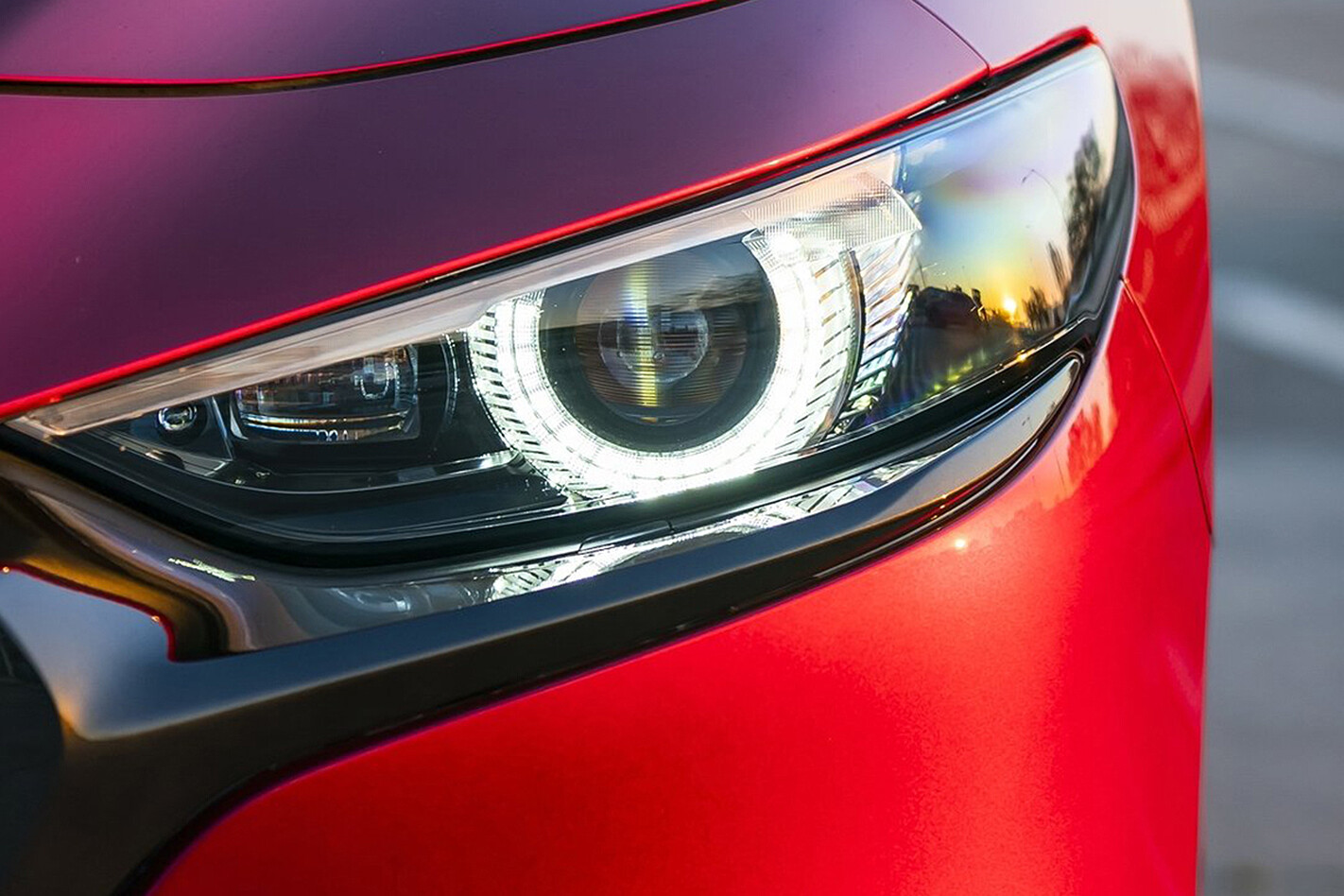
Daytime Running Lights (DRLs) – those strings of LEDs aren’t just for show: they’re primarily installed so that cars can easily be seen in all kinds of weather, and don’t function as the driver’s primary source of illumination in low light conditions.
GUESS THE DRLS: SEE PICTURE GALLERY ABOVE
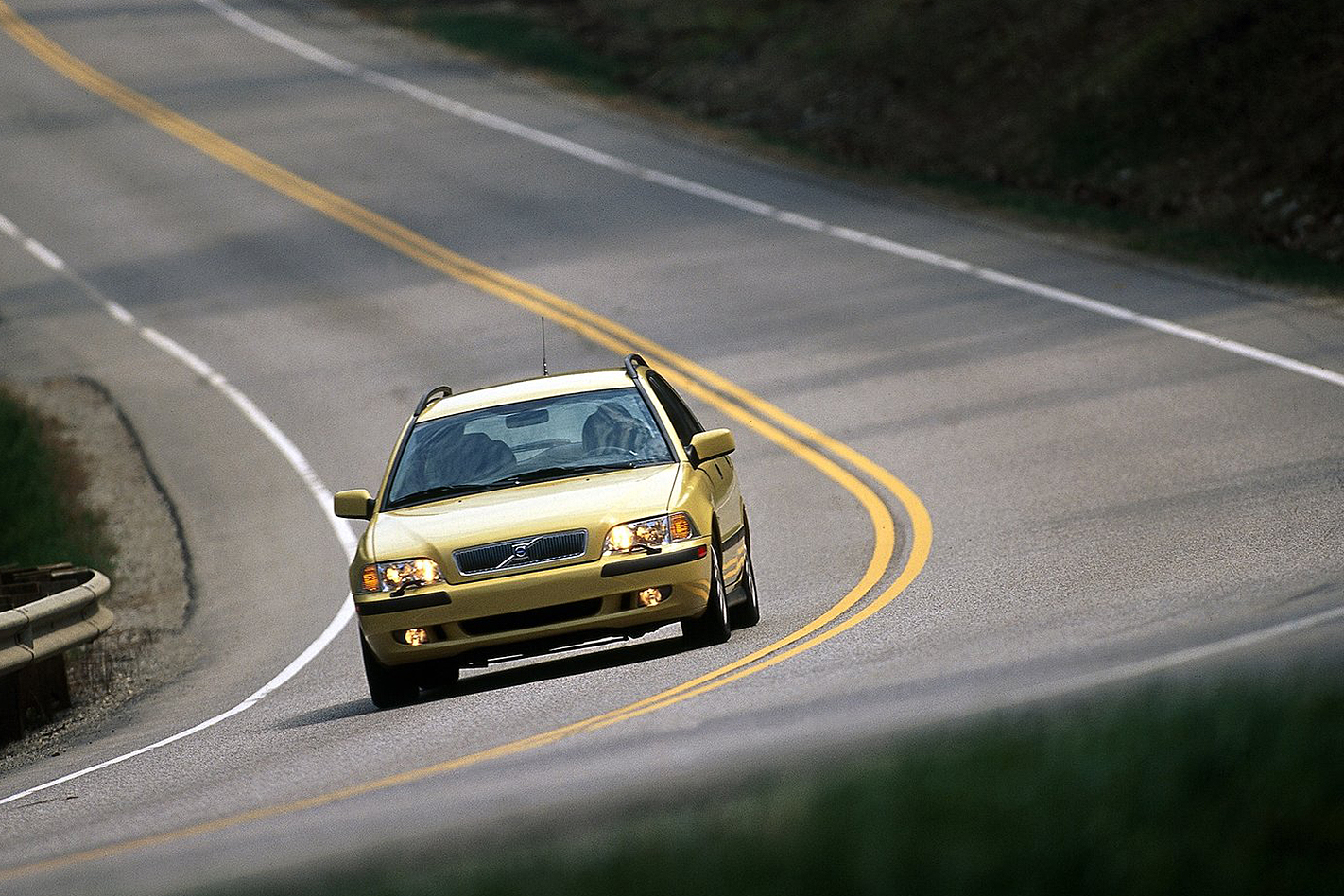
While DRLs are very much in vogue now they’ve been commonplace in northern climes ever since the 1970s – Volvos equipped with the feature and imported here ‘back in the day’ used what most assumed were parking lamps as daytime running lamps, which no doubt added to the unfair poor-driver reputation levelled at their owners.
In more recent years LED technology has revolutionised DRLs. As well as being brighter and more efficient than halogen globes, LEDs afford designers more flexibility and allowed them to become a stylish feature to the car’s face and a key part of a brand’s identity.
Critics argue they’re rarely needed in Australia because blizzard-like conditions are a rarity, but vehicle-to-vehicle collisions still occur in this country so anything that can attract a driver’s attention to other cars should be encouraged.
They use less power than driving with parking lights on too – which are also connected to the tail lamps – which is why there are many products for anyone wanting to retrofit DRLs to their cars.
Retrofitting DRLs
As with any aftermarket product there are rules to fitting DRLs to a car, which include:
- Only two (a pair) of DRLs per vehicle – this means you can’t add more if the car is already fitted with them
- Each DRL globe/unit should not exceed 25 watts
- They must be installed within 510mm from the side of the vehicle – or within 400mm from the side if the car is less than 1300mm wide.
- All new units must show a white light (no fancy coloured DRLs)
- They should be wired so they turn off when headlights are switched on
- Any DRL incorporated within the front light assembly must turn off when the indicator on that side comes on (the DRL on the other side can remain on)
In case you missed it, the Honda S2000 turns 20, and in celebration its parents (Honda’s engineers and designers) has given the beloved roadster a rather special present in the form of a new body kit.
To commemorate the 20th anniversary since the MX-5-fighter was released into the world, Honda will offer accessories which were developed based on the concept of a “minor model change for the 20th year” according to a rough translation, which was first previewed at the 2020 Tokyo Auto Salon.
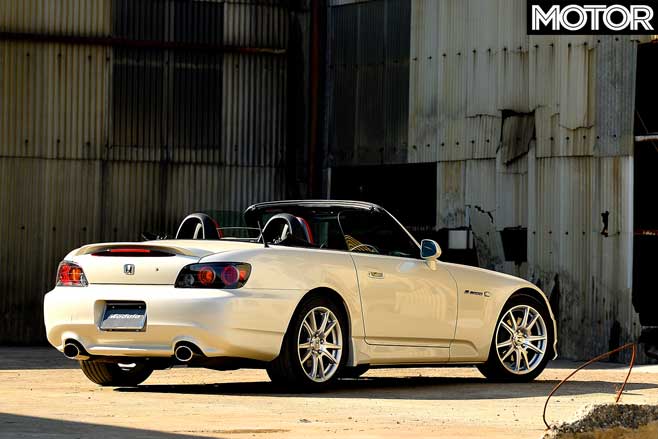
As the only press release available is in Japanese, we suspect the parts won’t be available in Australia, but it’s likely anyone committed enough could source parts via the internet. Honda Australia has no current plans to offer parts here.
If available here, S2000 owners will be able to access a small series of aerodynamic improvements in the form of front aero bumpers, ducktail bootlid spoilers, 10mm lower adjustable sports suspension (which is limited to 500 units), or a ‘Riasutoreki’ – the mudguard-looking addition to the rear strake of the side sill.
Honda says these parts will only be offered for one year, between February 20, 2020 to February 19, 2021.
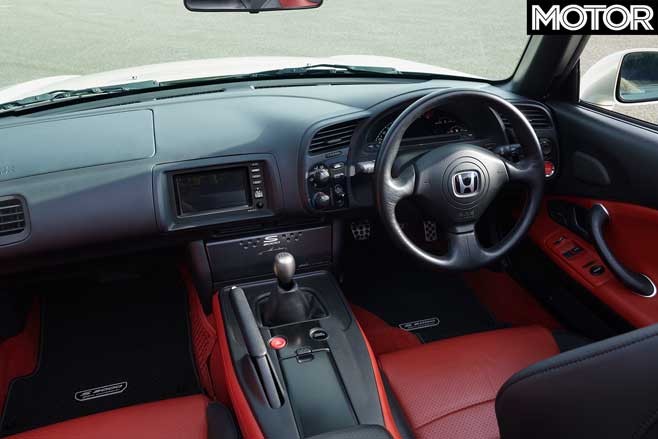
A stereo cover and set of interior floor mats are available with 20th anniversary logos, the latter of which are available in either red or black. Footwell lights can also be updated.
Finally, a new roof cover for the S2000 will be available, also featuring the 20th anniversary logo.
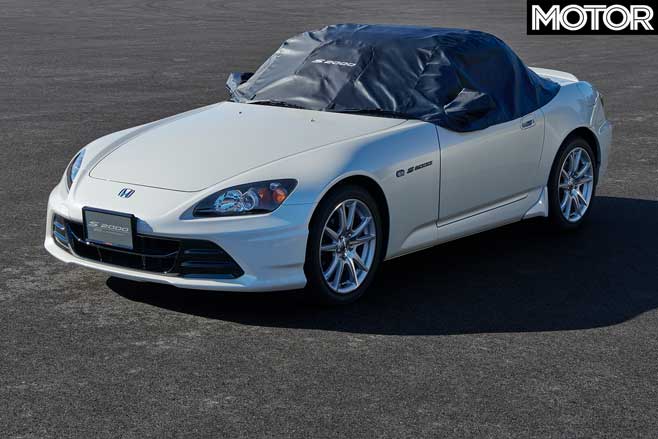
Prices for these new accessories range from 8800 yen (AUD$119) for the radio cover, to 170,500 yen (AUD$2297) for the adjustable suspension set.
While the S2000 has been out of production for a while now, Honda has been playing plenty of attention to the model for its birthday. Is it time for a revival? We’d like to see it.
Australian automotive media recently has been abuzz with rumours and reports of various V8-powered dual-cab utes that are apparently just around the corner. Don’t bet on it.
It’s easy to see the appeal of such an idea. In recent years utes have dominated the sales charts so infusing one with the high performance DNA so beloved of Australian enthusiasts would seem to be a surefire way to guarantee sales success.
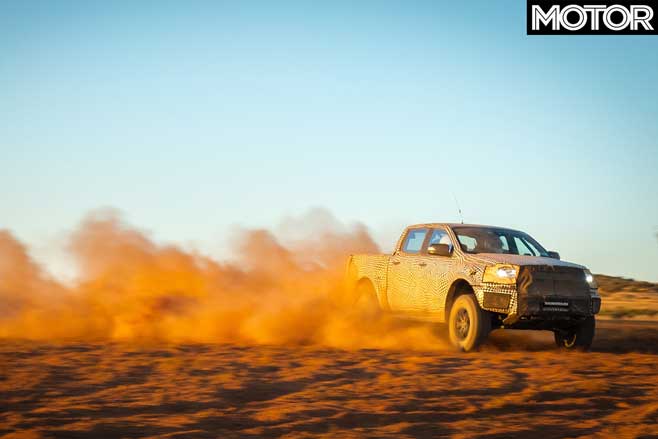
There’s just one problem: actually building the things. More specifically, building them at a price the market will accept. MOTOR has it on good authority that there is a Ford Ranger prototype with a Miami engine (the Prodrive-developed 5.0-litre supercharged V8 fitted to the last fast Falcons), likewise US and Aussie Holden Colorados with LT1 and LS3 V8s respectively. There is almost certainly a Ranger Raptor running around with a Mustang engine as well.
This is what car company engineers do, they create prototypes to evaluate production feasibility (and sometimes just for fun). It doesn’t mean the products will ever see showrooms; history is littered with ‘nearly’ cars.
Insiders at numerous companies have all told MOTOR the same thing: “we’d love to offer a high-performance dual-cab, but the sums just don’t add up.” Let’s use the Ford Ranger Raptor V8 as an example, as that’s the product that would seem on paper to be the easiest to create and with the greatest chance of success.
There is precedent here with the Mustang R-Spec, a local, low-volume initiative answering a specific need for the Australian market. Factor in development costs and a decent profit margin for everyone involved and the R-Spec added around $35,000 to the cost of a standard Mustang GT manual.
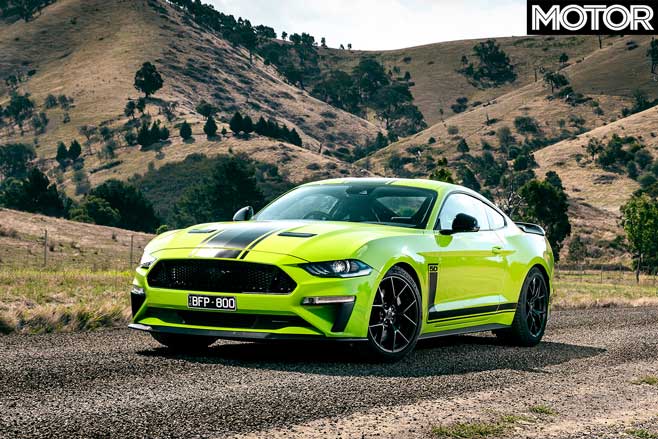
Apply the same figure to a Ranger Raptor and you’re already at $110,000 and the R-Spec is a much, much easier proposition than a V8 Ranger. Getting the R-Spec to market was an enormous challenge, but it mostly used readily available parts through the Ford Performance catalogue (supercharger kit, suspension package etc.).
A V8 Ranger Raptor would be much closer to the HSV GTSR W1 in production complexity. Ford would need to source a supply of Mustang crate engines, factor in the cost of disposing with the existing diesel engines and then actually install the V8.
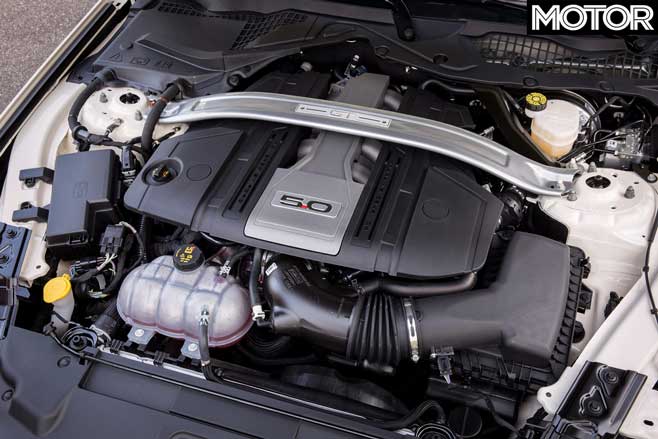
It’ll then need to be emissions tested (don’t expect much change from $1million) for compliance, which assumes the Mustang V8 will even talk to the Ranger’s electrical architecture, a problem which essentially killed the idea of a twin-turbo V6 HSV ZB Commodore – the car and engine spoke different electronic languages. It’s not an insurmountable problem, but it all adds cost.
Even then, our track testing has shown the Coyote V8 has overheating issues when propelling 1750kg of Mustang; how’s it going to go in 2300kg of Ranger while towing 2500kg? Add in the need for a new ESP calibration and upgraded brakes and tyres to handle the extra power and costs are quickly spiralling – and that’s before you even factor in how to build the thing.
The Ranger Raptor V8 is simply being used an example. If Nissan wanted to put the Patrol V8 in the Navara it would face similar issues; likewise Walkinshaw with any V8 Colorado program. It’s easy to see why currently no one can make the numbers add up.
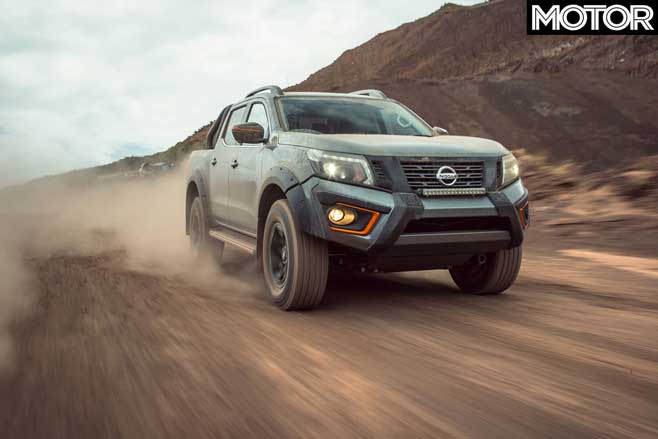
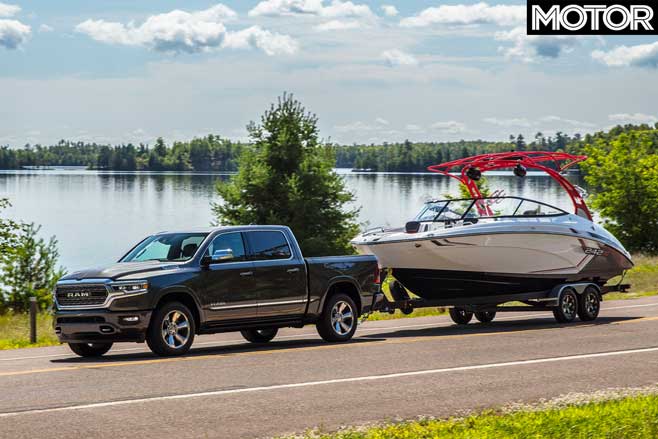
After all, is there a market for a $125,000 V8 dual-cab? Ateco has had massive success with the Dodge Ram, converted to right-hand drive by Walkinshaw, with more than 5000 sold in Australian New Zealand over the last four years and more than 3000 in 2019 alone.
The Ram, however, is a much more practical proposition with a 4.5-tonne towing capacity and it starts from $79,950 drive-away, roughly equivalent to the cost of a standard Ranger Raptor.
Anything can happen in the crazy world of cars and it may be that Ford or others will read this and chuckle having figured out some way to get a V8 dual-cab to market for less than $100,000 – but we wouldn’t bet on it.
What we would bet on is a high-performance Raptor arriving with the next generation Ranger due for reveal in 2021. A V8 would be possible, a twin-turbo Ecoboost V6 much more likely – the local development team is certainly cooking up something.
In the meantime, if you really want a V8-powered pick-up, Walkinshaw will hook you up with a 313kW/624Nm Chevrolet Silverado 1500.
Like any modern, high-end four-wheeled product, the Porsche 911 unlocks its door for you by detecting the ignition ‘key’ in your approaching pocket. Again, like its peers, it will allow you to start the engine with that same key-fob firmly in the pocket of your Levis. Okay, so it has keyless entry and start… so what?
Well, it’s a very Porsche take on the tech. Instead of having to find a starter button that could be anywhere in the cabin (including the increasingly common ‘wrong’ side of the steering column) the 911 pilot simply reaches down to where a conventional ignition key would be in the last seismic age, grasps a very key-shaped protrusion, twists it clockwise through two detentes and listens as the flat-six chugs into life.
The set-up could be dismissed as mere keyless start, but it’s much more than that – cleverer – because it combines new tech with old muscle-memory. It’s as efficient and foolproof as any other modern system, but it doesn’t require the hapless human to re-learn how to operate a car. It’s new and better… not always a given in car design. It is also a metaphor for the whole 992 Porsche deal.
There is, of course, more to it than the starting system, and I’d be willing to bet that anybody who has enjoyed a 911 of the last five decades would be able to tell (if not actually blindfolded) what car they were in just by taking a seat in the new 911. In fact, the 992 is even more overtly retro than the previous 991 model.
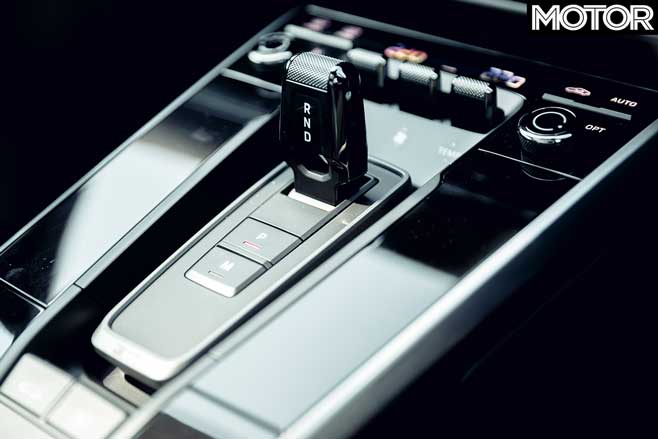
Where the 991 introduced 911 drivers to the high centre-stack that cut the cockpit in two, the 992 downplays that a little with less of the shouty switches and colour scheme. In fact, the selector for the DSG transmission is now a tiny little flipper, little bigger than a toggle switch, but it still has the cool solidity of metal rather than plastic, and it still operates with a micron-perfect feel normally reserved for the weapons industry.
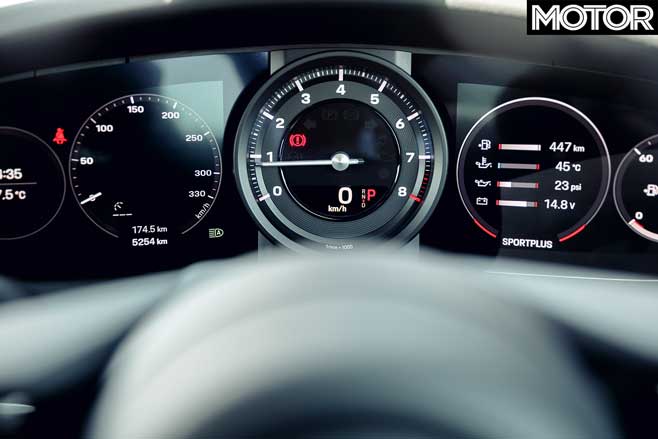
Back is the classic lozenge-shaped gauge panel pioneered by the very first 911, and even though that cluster is now largely digital and animated, details like the shiny domed bezel at the pivot of the speedo needle are pure swingin’ Sixties. And there’s that new-meets-old thing again.
Hell, even the engine has been engineered to not just feel but also sound like a 911 engine. Despite being a modern direct-injection turbocharged unit rather than the 911’s usual feisty emissions-fest NA mill, the 992 has revived that familiar, kind of chattery noise at idle and a delivery so progressive, so unboosted-like, you’d swear it was a five-litre atmo instead of a three-litre turbo. Again, it’s clever in the way it triggers your feel-good gland yet never allows any actual compromise to creep in disguised as nostalgia.
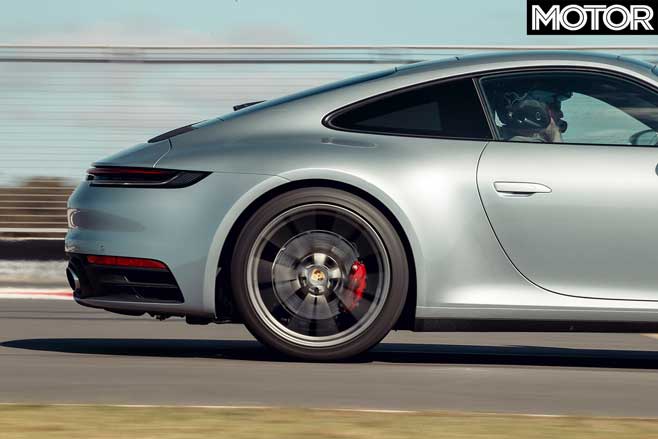
No compromises? Nope, none. And the figures help bear that out. Bearing in mind this isn’t a GT3 or GT2 or even a 911 Turbo (although it is turbocharged, but this is where the world has headed), the acceleration alone borders on astonishing. The 992 gets from rest to 100 in 3.5sec and trucks on to cover the first 400m in 11.6 ticks of the Timex, at which point it’s travelling at 194.5km/h and still has its nose well and truly in the air.
Funny thing is, while it feels fast it doesn’t feel that fast. Maybe that’s to do with the linear feel deliberately engineered into the torque curve, but whatever’s going on the flat-six’s ability to tag the redline without puffing means that it never feels or sounds thrashy and never suggests that you might want to back off and give it a break. If ever a car told you ‘I got this’, it’s the 992 at full chat.
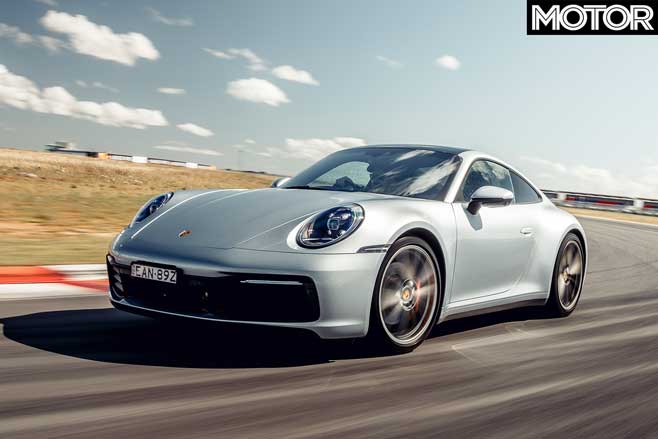
Same goes for the gearbox, which, in the manner of all Porsche PDKs, shifts hard and fast but without resorting to the shunting and banging that can be part of similar transmissions from other brands. On the track, the gearbox’s level of obedience is a biggie too, and it never needs to be told twice.
Ah yes, the track… Now, the 911 wasn’t the fastest car we had at The Bend this year. Nope, that honour belonged to the GT63, which was able to use the thermo-nuclear reactor under its lid to blast down the super-long front straight.
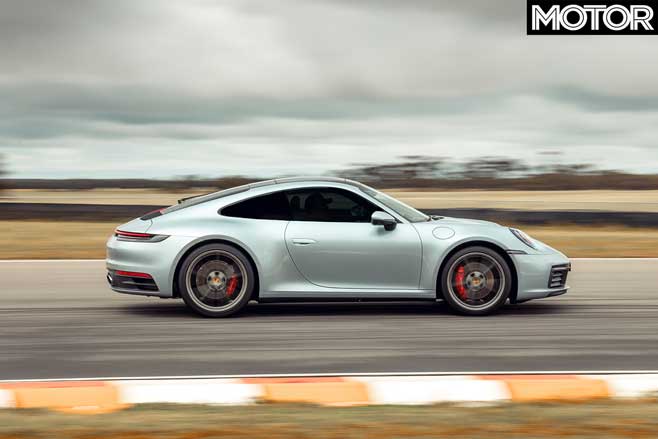
Fact is, the AMG’s V-max at The Bend of 245km/h shaded the Porsche’s figure of 242km/h and, really, that was about the difference. In lap times, the gap translated to just shy of a second in favour of the AMG (which makes the heavy GT63 even more amazing) and left the 911 with a time of 1.30:6.
To put that into perspective is the news that not only was the 911 second fastest around the circuit, it was more than three full seconds ahead of the next fastest car. So, daylight third, then.
Out on the road, the 911 follows that Porsche tradition of having an amazing ride despite lots and lots of roll stiffness. How exactly this has been achieved remains a mystery to myself and the majority of the car-making world.
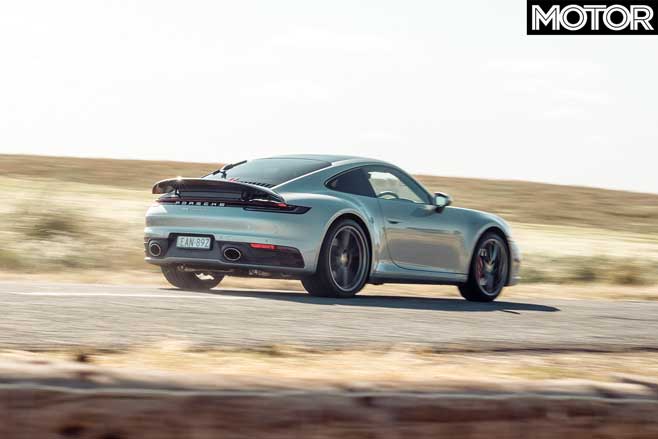
Sure, there’s still some tyre noise, but I’m damned if I can come up with anything else that would annoy me about living with this car. And that’s really what makes it so special: It can haul arse around a track all day without wilting and then cruise around like a lurking shark the rest of the time, ready to jump on anything that moves.
It’s been said many times before (like, about a million times), but if you could only own one car…
The Numbers
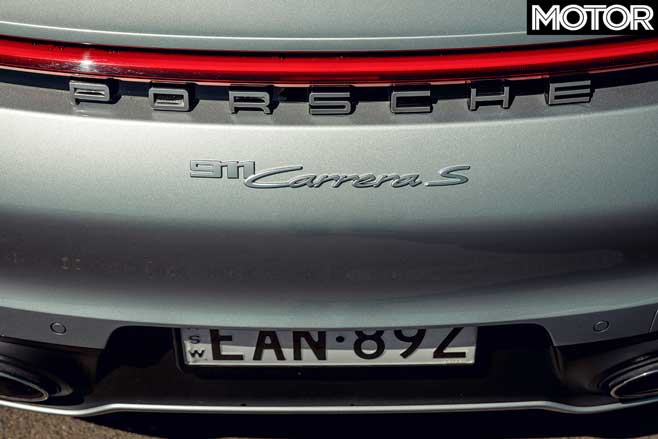
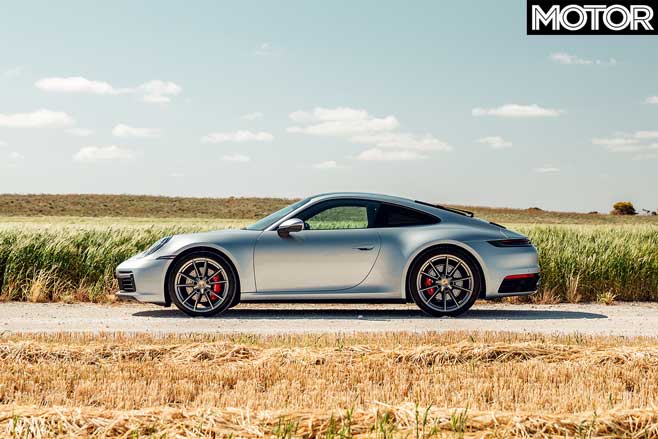
2020 PORSCHE 911 CARRERA S SPECS: Engine: 2981cc flat-6, DOHC, 24v, twin-turbo Drive: rear-wheel Power: 331kW @ 6500rpm Torque: 530Nm @ 2300-5000rpm Transmission: 8-speed dual-clutch Weight: 1515kg Power/Weight: 218kW/tonne 0-100km/h: 3.54sec 0-400m: 11.56sec @ 194.53km/h The Bend lap time: 1min 30.6sec Price: $264,600
Judge’s Rank
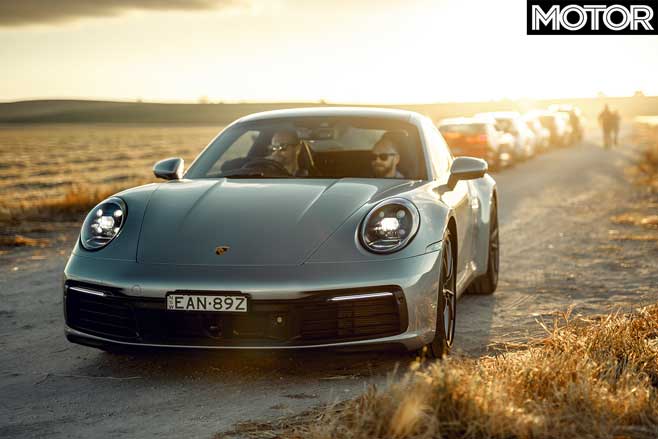
Dylan Campbell – 1st “Porsche wins again – I get so much flak for this. But the best car needs to win, and it has.”
Louis Cordony – 1st “Like the school dux, except much more likeable.”
David Morley – =1st “What can a humble doofus like me possibly add to the 911 story?”
Scott Newman – 1st “An already high bar raised to world record levels. Almost impossible to fault, but very easy to enjoy.”
Tim Robson – 1st “Seemed to lack front grip and brake performance. Not the best 911 I’ve driven.”
PCOTY 2020 Scoring
| Judges | DC | LC | DM | SN | TR | Total |
| Performance/20 | 18 | 15.5 | 19 | 19.5 | 18 | 90 |
| Dynamics/20 | 19.5 | 15.5 | 18 | 19.5 | 17 | 89.5 |
| Accessibility/10 | 8 | 9 | 9 | 8.5 | 8 | 42.5 |
| Liveability/10 | 8.5 | 8 | 8 | 8 | 6 | 38.5 |
| Value/10 | 7 | 3.5 | 4 | 7.5 | 8 | 30 |
| X Factor/10 | 7 | 6 | 9 | 8 | 6 | 36 |
| Total/80 | 68 | 57.5 | 67 | 71 | 63 | 326.5 |
PCOTY Honour Call
1996 – Porsche 993 Turbo 1997 – BMW E36 M3 1998 – Porsche Boxster 1999 – Porsche 996 Carrera 2000 – Porsche Boxster S 2001 – Nissan S15 200SX 2002 – BMW E46 M3 2003 – Porsche Boxster S 2004 – Lamborghini Gallardo 2005 – Porsche 997 Carrera S 2006 – Audi B7 RS4 2007 – Porsche 997 GT3 2008 – Porsche 997 GT2 2009 – Audi R8 V10/Nissan GT-R 2010 – Porsche 997.2 GT3 RS 2011 – Nissan GT-R 2012 – Porsche 991 Carrera S 2013 – Audi R8 V10 Plus 2014 – Porsche 991 Turbo 2015 – Porsche 991 GT3 2017 – Porsche 991.2 Turbo S 2018 – Honda Civic Type R 2019 – Porsche 991.2 GT2 RS
Have you ever tried to do something which, on the face of it, is a relatively simple assignment but rapidly descends into an exercise in pure frustration? I’m talking assembling an IKEA chest of drawers with some of the fasteners missing, or editing the paired phone list in a Lexus; those levels of wall-punching exasperation. Add ‘trying to extract a meaningful acceleration time out of a Ford Mustang R-Spec’ to that list.
Don’t get us wrong. We’re fans of the 500kW R-Spec. It’s just one of those cars that demands you be at the top of your game to get the optimum performance from, due to the combination of manual gearbox, prodigious power output, and relatively narrow rear tyres.
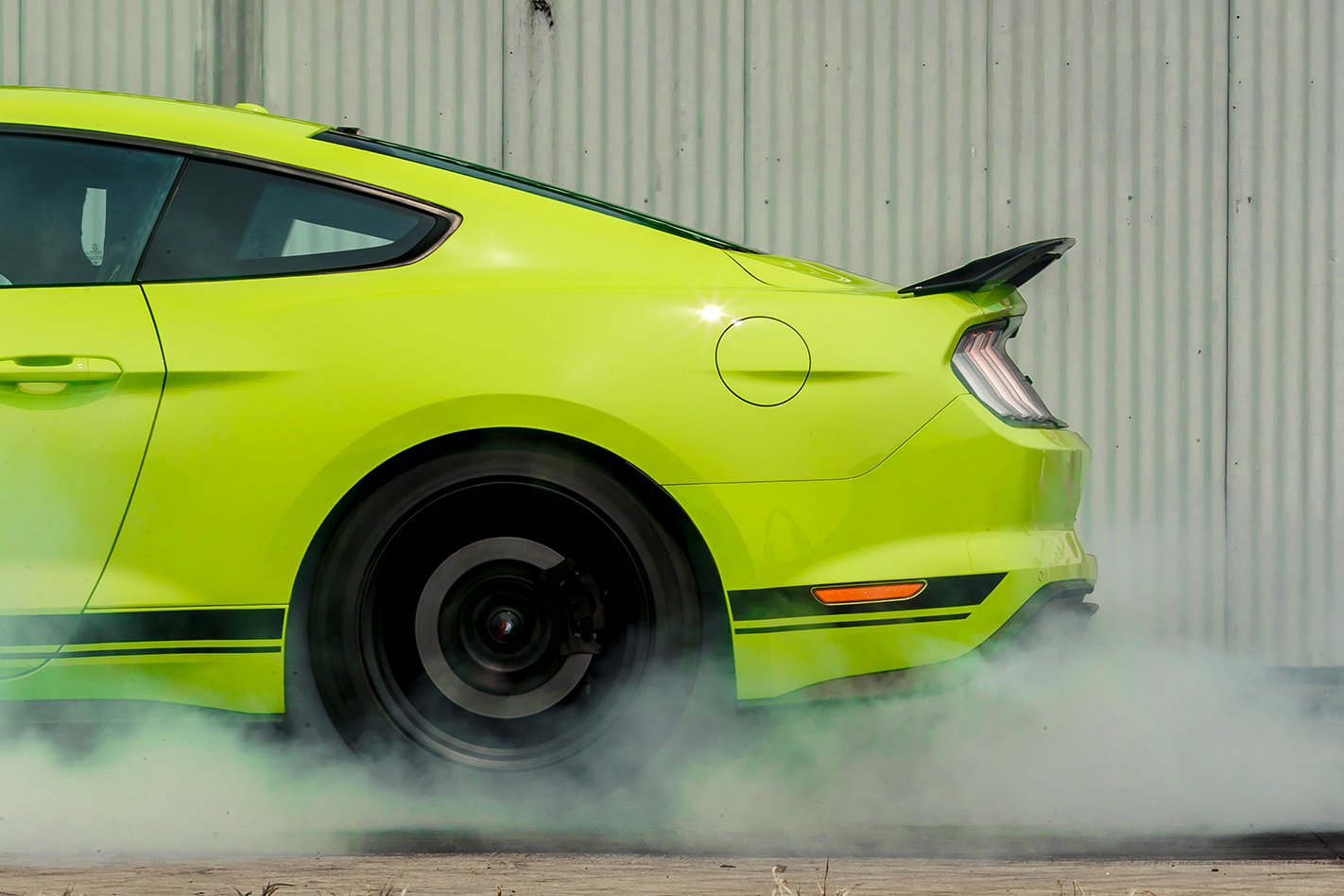
I had first crack at delivering some acceleration times that were potentially cover-worthy for Wheels magazine. You guessed it: it turns out they weren’t. I wasn’t that impressed by the 4.7-second time to 100km/h I achieved after a number of aborted attempts to get the ’Stang to hook up. Getting that sweet chirp of wheelspin and then a clean feed of power to the rear Michelins seemed only marginally easier than getting Warwick Capper to explain Fermat’s Last Theorem.
Too little grunt and it would bog, too much and it would immolate the rear treads. Part of the problem is that the 275/40ZR19 Michelin Pilot Sports 4S tyres on the back are narrower than the rubber you get on the front of a Camaro ZL1. Still, that’s the tyre that Ford Performance recommends. To get the best time from them, you’d need to deflate them to around 18psi, which isn’t representative of a real-world use-case so we stick with the placarded pressures.
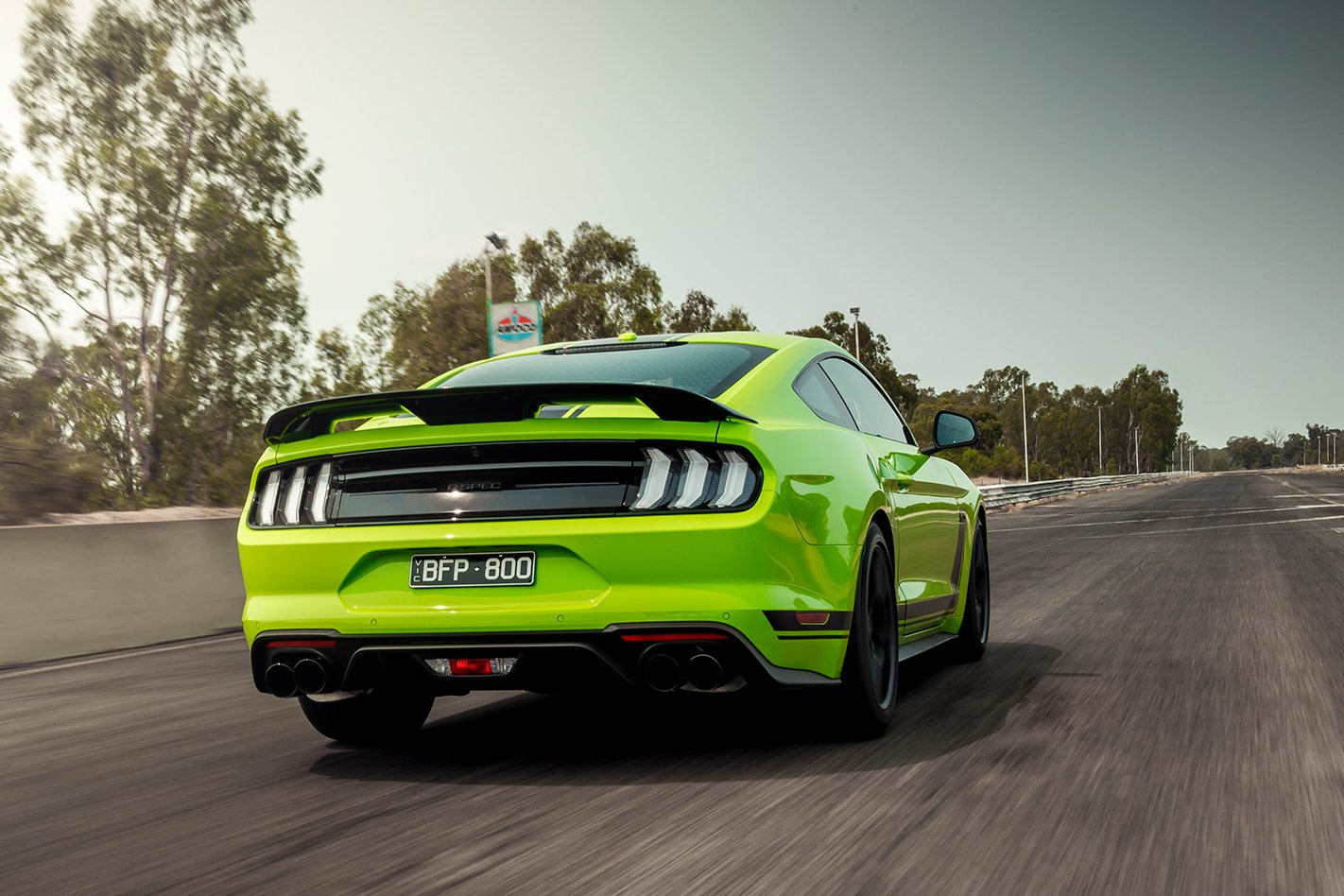
Conditions are otherwise favourable. It’s cool (18 degrees) and a bit blustery at Heathcote and, when we do pull a full-blooded run down the strip, the R-Spec seems to be delivering at the top end. The numbers spat out by the Racelogic Performance Box give us that 4.7 seconds to 100km/h and a 12.4 seconds through the 400m mark at a speed of 199.1km/h. I feel a bit dejected. Those aren’t times significantly removed from those of a stock Mustang GT auto.
Admitting defeat, we hand the car back to Ford and it then goes straight to the guys at MOTOR. Hats off to the perseverance of Scott Newman for extracting an identical 4.7 second 0-100km/h time on a day that was fully 11 degrees hotter. But where Newman may have been helped by a stickier launch pad, conditions then conspired against him. Scotty complained that the car felt strangely flat at the top end, delivering a 12.8sec 400m time at 189.6km/h. That’s 9.5km/h down at the far end of the strip.
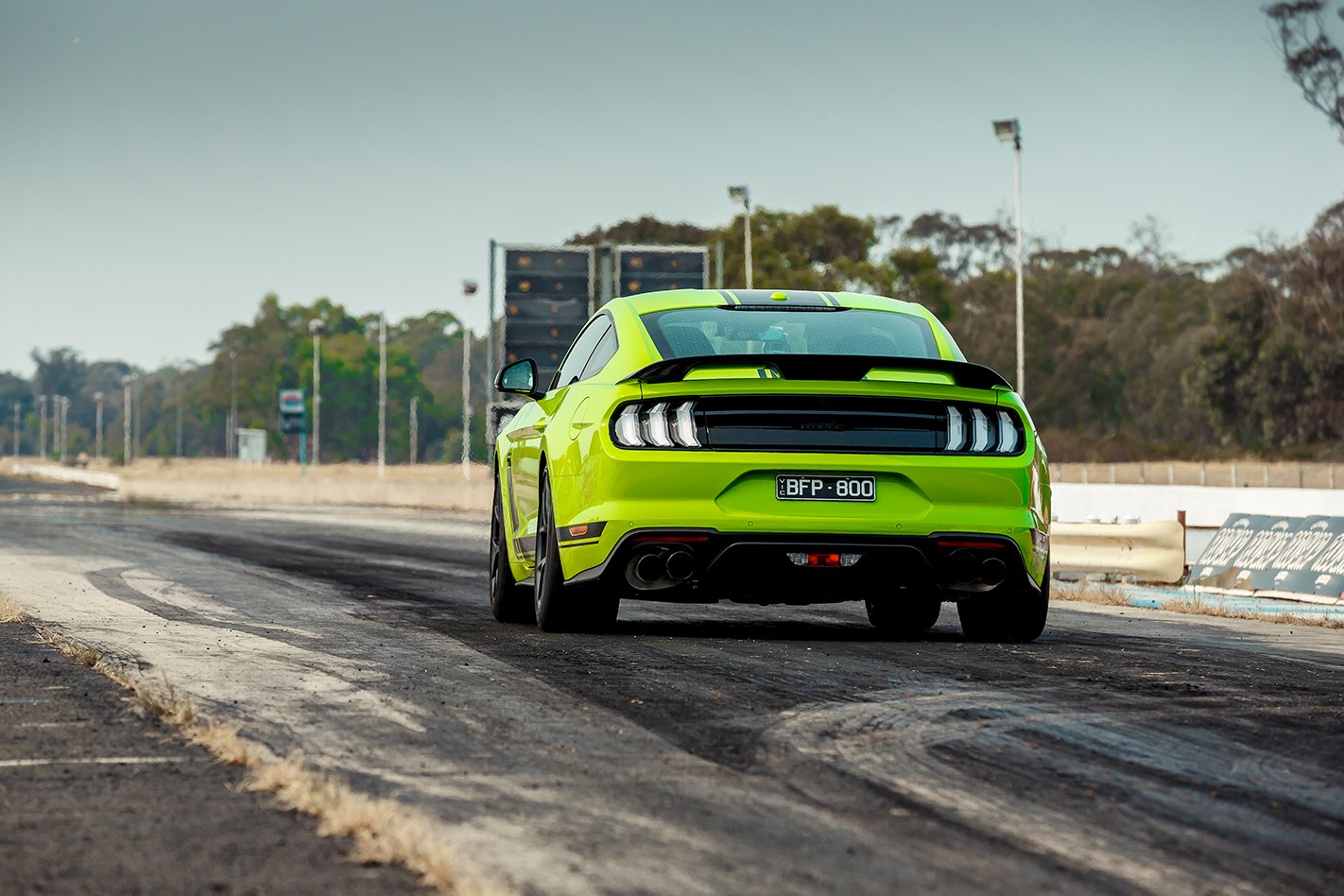
We spoke to Rob Herrod about our times and he agreed that the car was tricky to launch cleanly. He also noted that the ECU was critical and would protect the engine if it detected overheating or poor fuelling. He also predicted – to the tenth of a second – the time we had achieved and claimed that the optimum time this car could achieve, with burnouts and partial tyre deflation, was a 12.2sec.
So, it seems the R-Spec likes a cool morning, soft tyres and a bit of finesse in a partial lift and then feed of clutch. Or, to put it another way, think twice about giving the guy in the Supra a bit of aggro at the stoplight. Of course, the R-Spec has a whole host of other awesome qualities, but getting it off the line cleanly? Pass me the instructions to that MALM chest of drawers again…

THE NUMBERS
10km/h | 0.5 sec |
20km/h | 0.9 sec |
30km/h | 1.3 sec |
40km/h | 1.7 sec |
50km/h | 2.3 sec |
60 km/h | 2.8 sec |
70km/h | 3.3 sec |
80km/h | 3.7 sec |
90km/h | 4.3 sec |
100km/h | 4.7 sec |
110km/h | 5.3 sec |
120km/h | 5.9 sec |
130km/h | 6.5 sec |
140km/h | 7.3 sec |
150km/h | 7.9 sec |
160km/h | 8.6 sec |
170km/h | 9.5 sec |
180km/h | 10.4sec |
190km/h | 11.4sec |
200km/h | 12.5sec |
0-400m | 12.4sec @ 199.1km/h |
Confession. I didn’t get much sleep the night before Wheels’ appointment with the Ford Mustang R-Spec. Perhaps it was the combination of it being build #001, the only one in existence and required at its own press launch a few days later, and the fact that my first acquaintance with it would be to put a helmet on and fire it down Heathcote’s strip, north of Melbourne, but I’ll freely admit to being a little bit spooked.
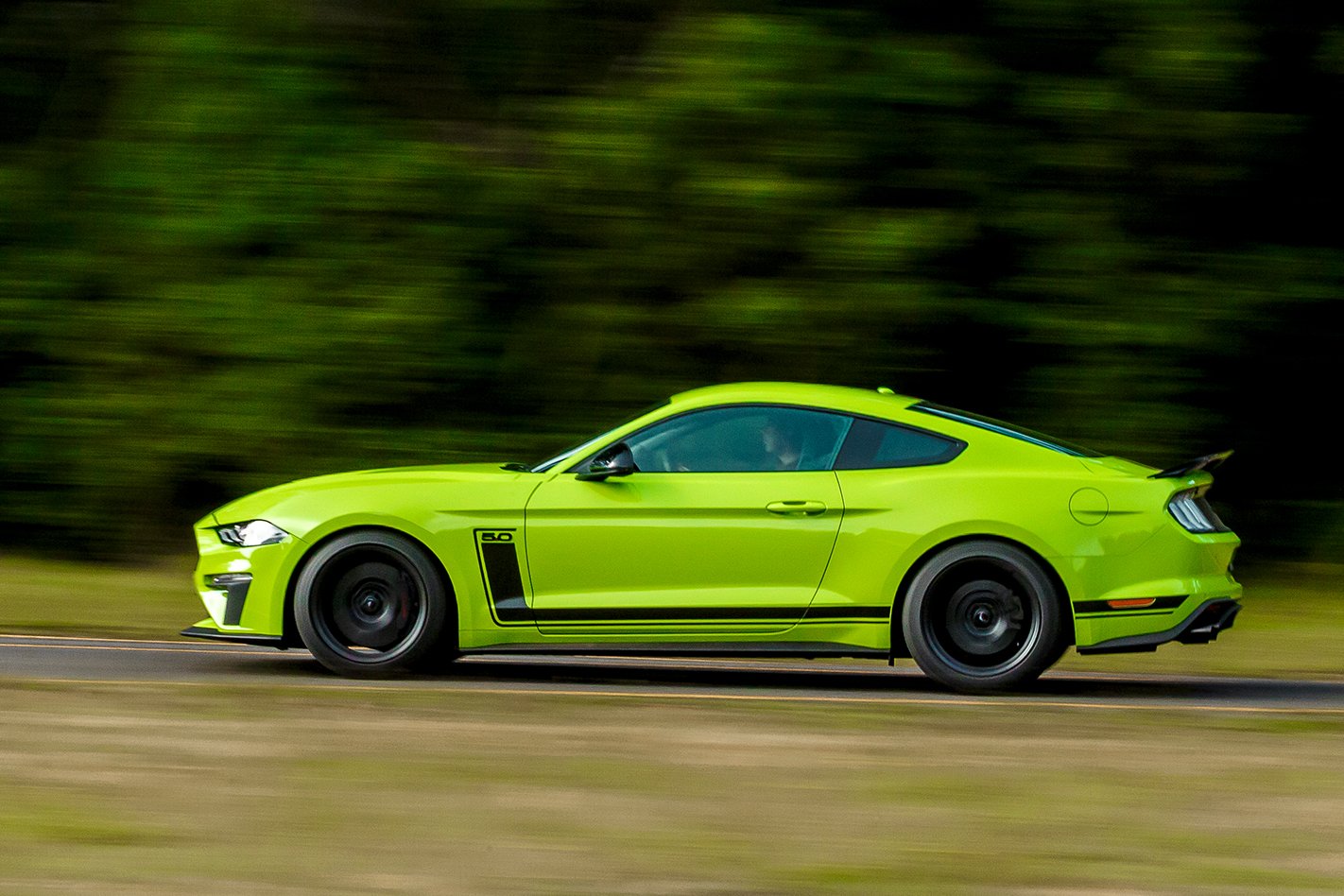
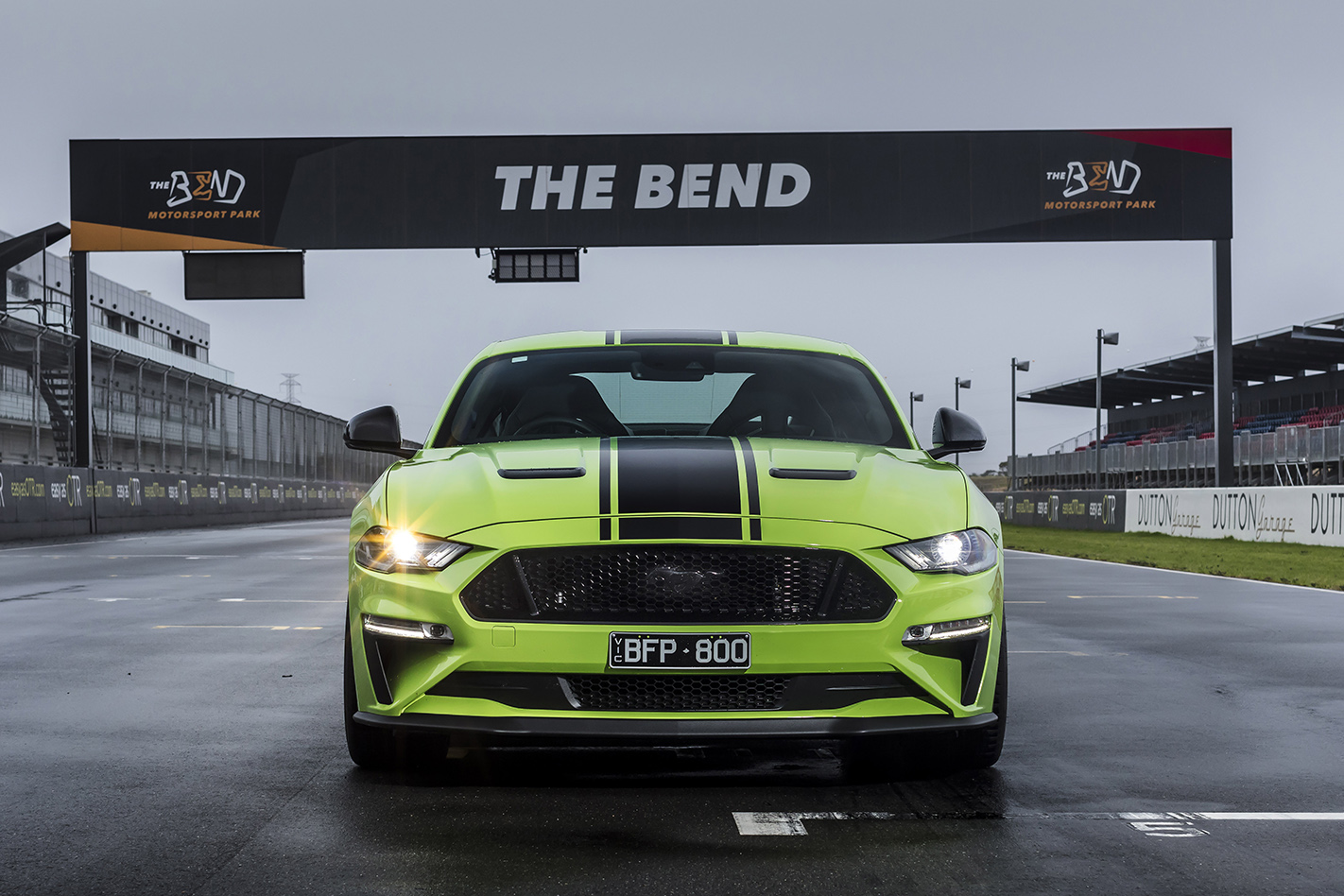
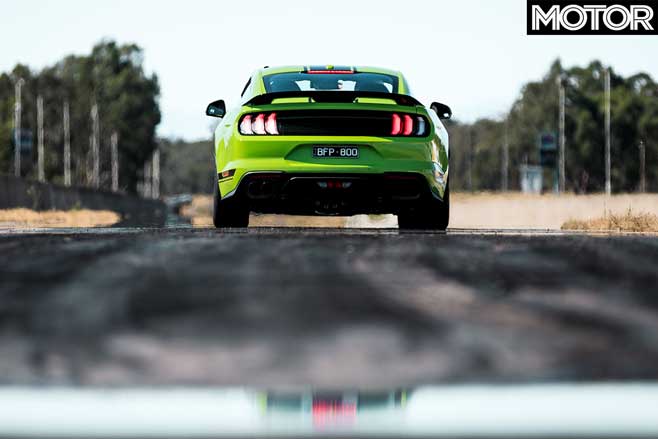
“We don’t have any power or torque figures for it yet,” said Ford’s Damion Smy, not exactly salving any apprehension. “Just don’t break it.” A cheery thumbs up and he was gone, leaving us with one of 2020’s most anticipated cars. Down-at-heel Heathcote’s never the most scenic of locations, but this Grabber Lime R-Spec looks the goods. Lowered by 20mm, and finished with contrasting black detailing and garnished with a stripe pack designed by designer Dave Dewitt, it looks vacuumed to the scabby bitumen, the Michelin tyres snuggling neatly into the arches.
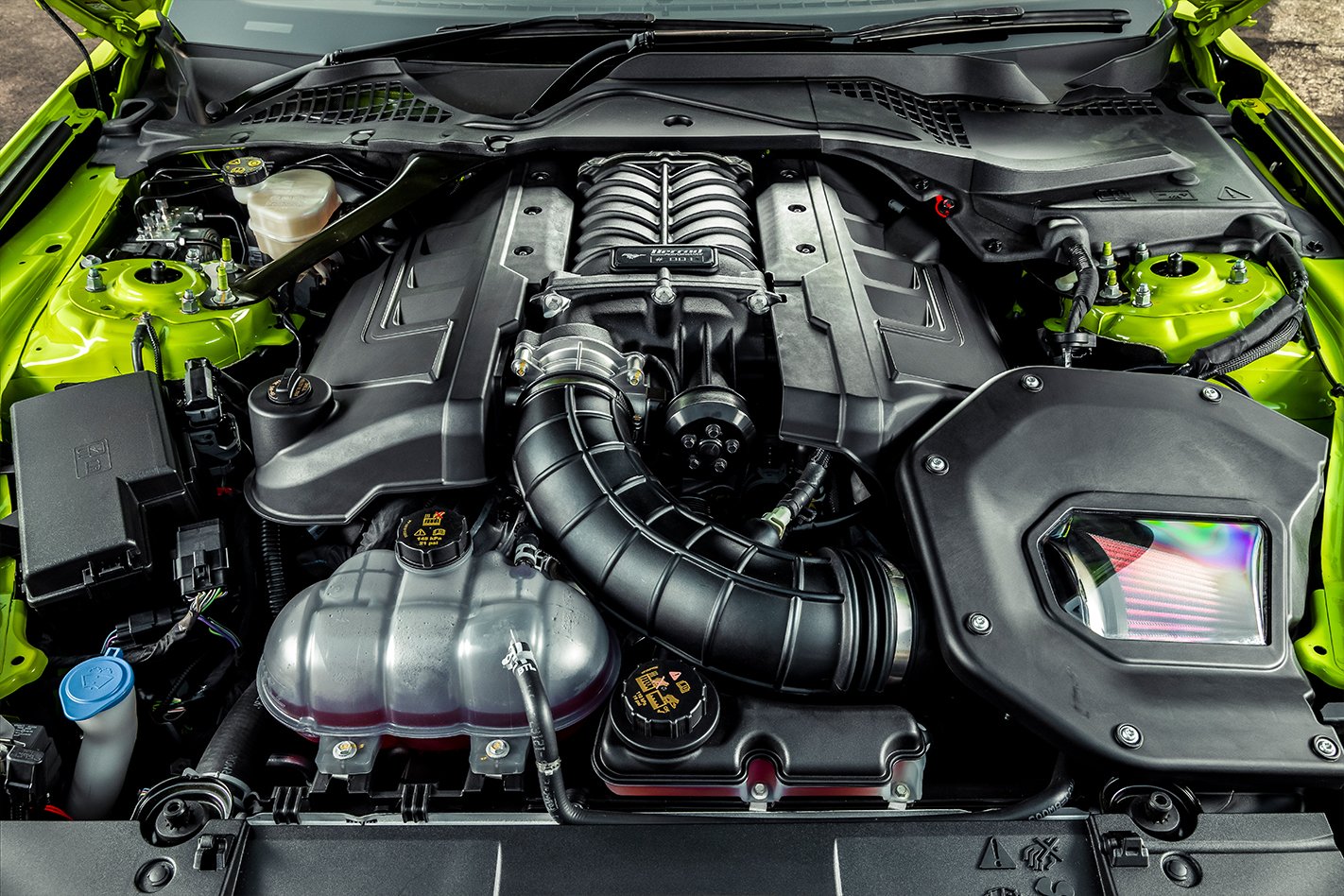
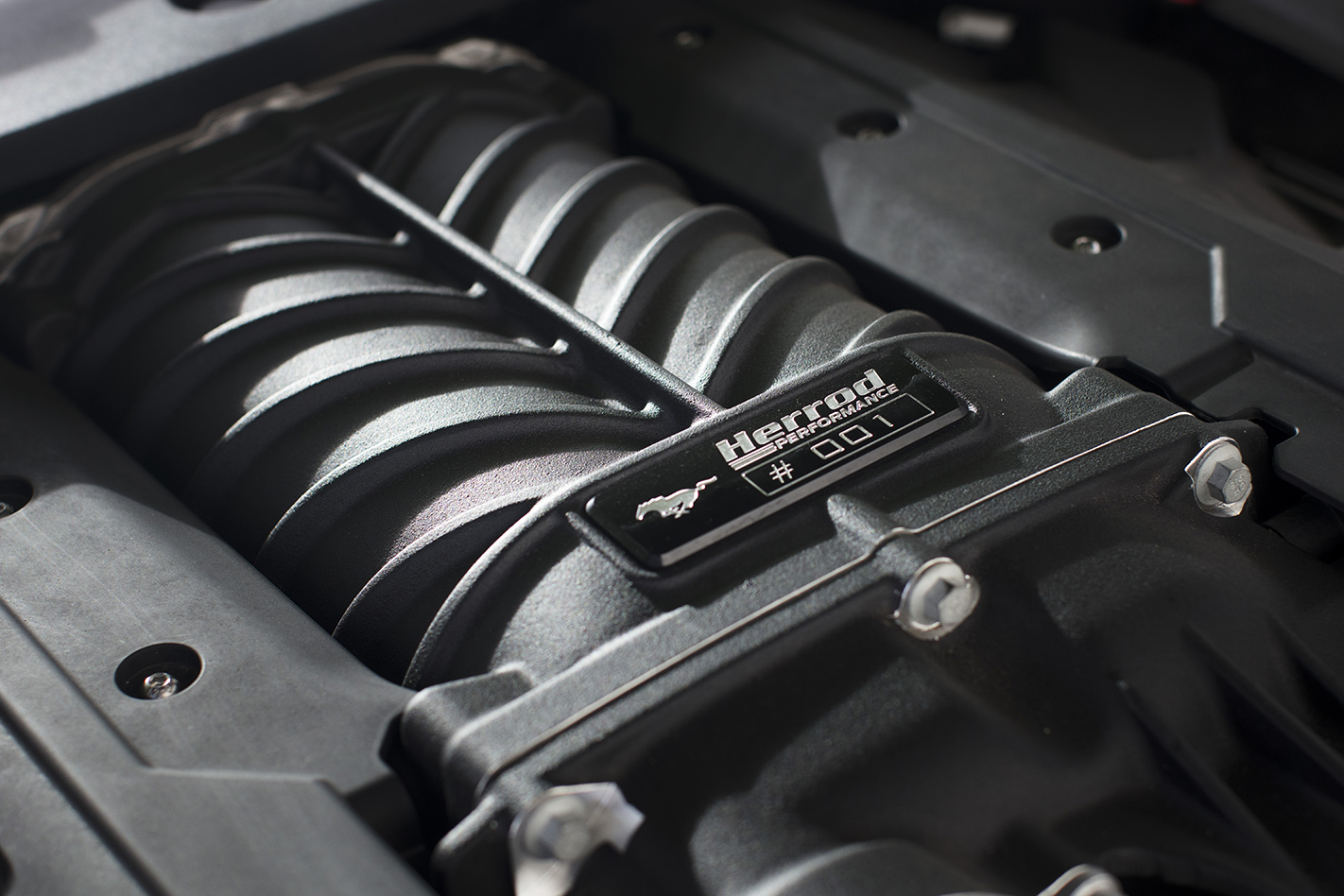
Developed in collaboration with Herrod Performance, the R-Spec is priced at $99,980. For the premium of $36K over a regular Mustang GT coupe, the extras include a Roush-sourced Eaton R2650 TVS supercharger, a revised intake manifold with air-to liquid intercooler, a Borla quad-tip exhaust that satisfies Aussie drive-by noise regulations, wider wheels, uprated springs, beefier anti-roll bars and recalibrated MagneRide dampers.
What haven’t changed are the tyres. An estimated 47 percent increase in power is sent through the same 275/40ZR19 Michelin Pilot Sport 4S rear boots as the stock Mustang GT. To put that into some sort of perspective, they’re narrower than a Camaro ZL1’s front rubber. This has a fairly predictable effect. The R-Spec is as hard as hell to launch cleanly.
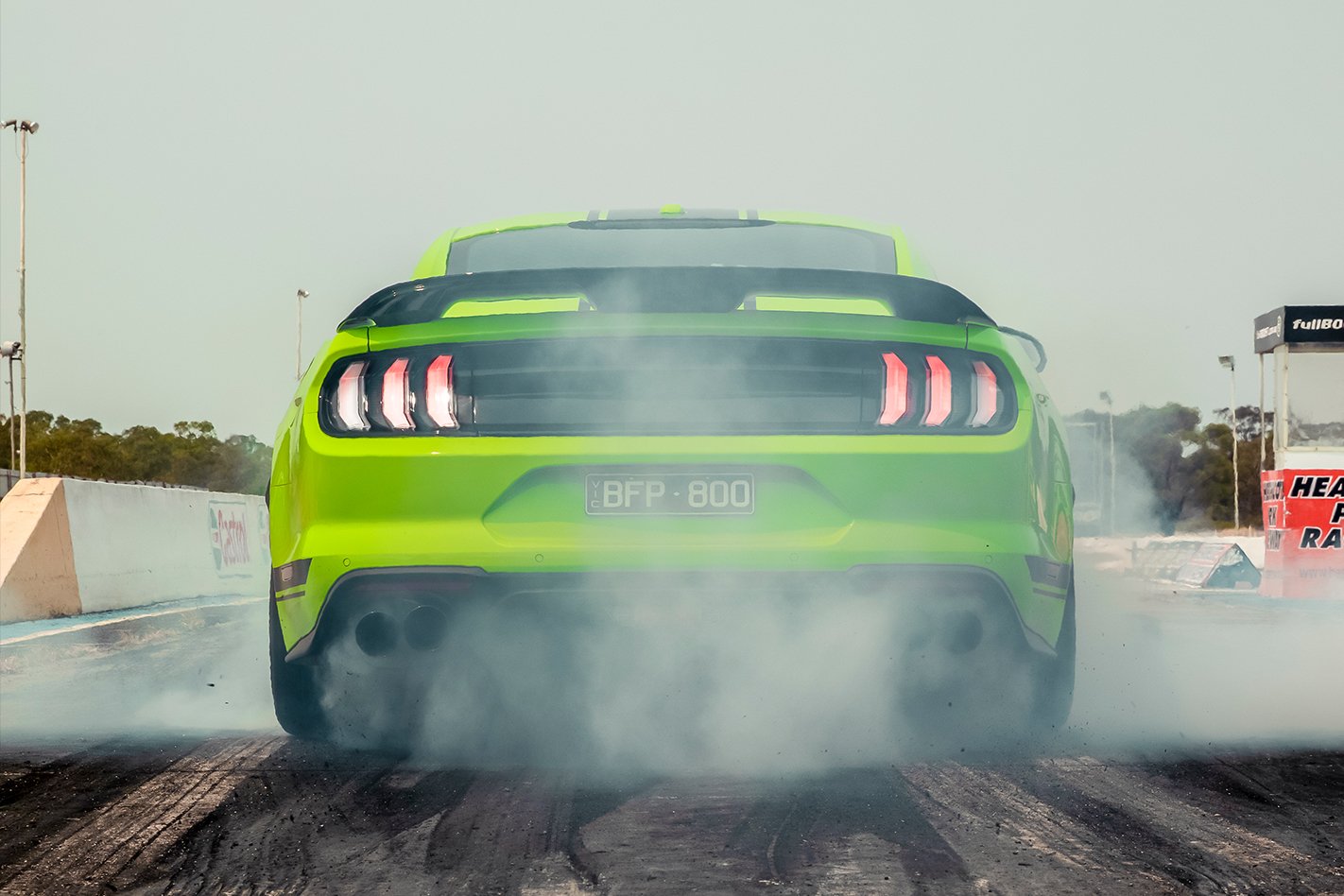
We’re limited in the amount of abuse we can ladle out to the car at the strip, but it’s clear that there’s a knife-edge sliver between bogging down and cremating the rear treads. Being offered in manual guise only, the R-Spec has no fire-and-forget launch control facility, and after a few runs, the best we manage is 4.7 seconds to 100. The trap speed at 400m tells a different story, though, the R-Spec galloping through at a heady 199.3km/h with an ET of 12.5 seconds. That is exactly the time Rob Herrod predicted we’d see.
“In absolutely optimum conditions, you can get it down to 12.2 seconds with the manual car,” he says, highlighting a technique espoused by Evan Smith of Modified Mustangs and Fast Fords. It isn’t really something we’d subject our test cars to, as it involves lowering rear tyre pressures and so forth, but it’s certainly illuminating. On the subject of peak power, Herrod explains Ford’s reticence to quote a power figure. “We’ve never had the engine out and on an engine dyno,” he explains, this being Ford’s technique for quoting a definitive power figure. “There are certain things that are different with [the R-Spec] such as the exhaust manifold and calibration, but when we’ve put it on our hub dyno it routinely makes 440 to 460kW at the rear wheels,” he says.
Taking driveline losses into account, that tips the R-Spec just the right side of 500kW at the crank. “The right fuelling is absolutely critical though,” advises Herrod. “We standardise our figures with Shell V-Power 98 and we’ve seen figures 100kW down when poor-quality fuels have been used,” he notes. “The engine computer is critical and will reduce power to protect the engine if it detects low-octane fuels or overheating.”
The ECU’s certainly not retarding the power in this particular car. It ran from 160 to 200km/h on the strip in just 3.9 seconds. Some frame of reference? A Mercedes-AMG C63 S Coupe requires 4.6 seconds. A 991-gen Porsche 911 GT3 would be lineball, so yes, it’s seriously rapid. Then you realise that you’re sitting in a sub-$100K car and you shake your head. Price-comparative coupe rivals like the BMW M2 Competition (5.2sec) and the Alpine A110 (6.4sec) can’t get close. The thing is, both would smoke the Ford away from the line on a pretty consistent basis. As will an all-wheel-drive superhatch.
Once rolling, the R-Spec impresses. We’ve poured praise on the shift action of the six-speed manual in the past, and palming it around the gate is a joy. You don’t actually need to, because the engine is so tractable you can leave it in third and you’re covered for meaningful acceleration anywhere from 30 to 150km/h, but it’s fun to see if you can heel-and-toe half as well as Ford’s rev-matching function. Just don’t try to rush the shift to third.
The power delivery is almost undramatic in how linear and polished it is. I admit, that sounds crashingly blasé when we’re talking about a 500kW car, but it’s a testament to Herrod’s team. There is no discernible point in the power band where the supercharger decides to really get stomping. Plug it anywhere from 2500rpm to the redline at 7400rpm and you’re golden. Likewise, the engine note doesn’t really harden or make any noticeable step changes. A subsonic bass tone enters the cabin between 1000 and 2000rpm and from there it’s just a progressive change in pitch and volume. You do get a delightful cross-plane woofle at idle, though.
Some may be a little disappointed that it doesn’t surge and yell, but toning down the histrionics makes the R-Spec a far better road car. You could quite happily use this car as your daily driver. The MagneRide dampers have been recalibrated to support the shorter springs. Being able to separate ride, throttle and ESC settings in a custom mode would have been welcome but Ford’s drive mode selector that runs through Normal, Sport+, Racetrack, Drag Strip, and Snow and Wet will usually have you covered.
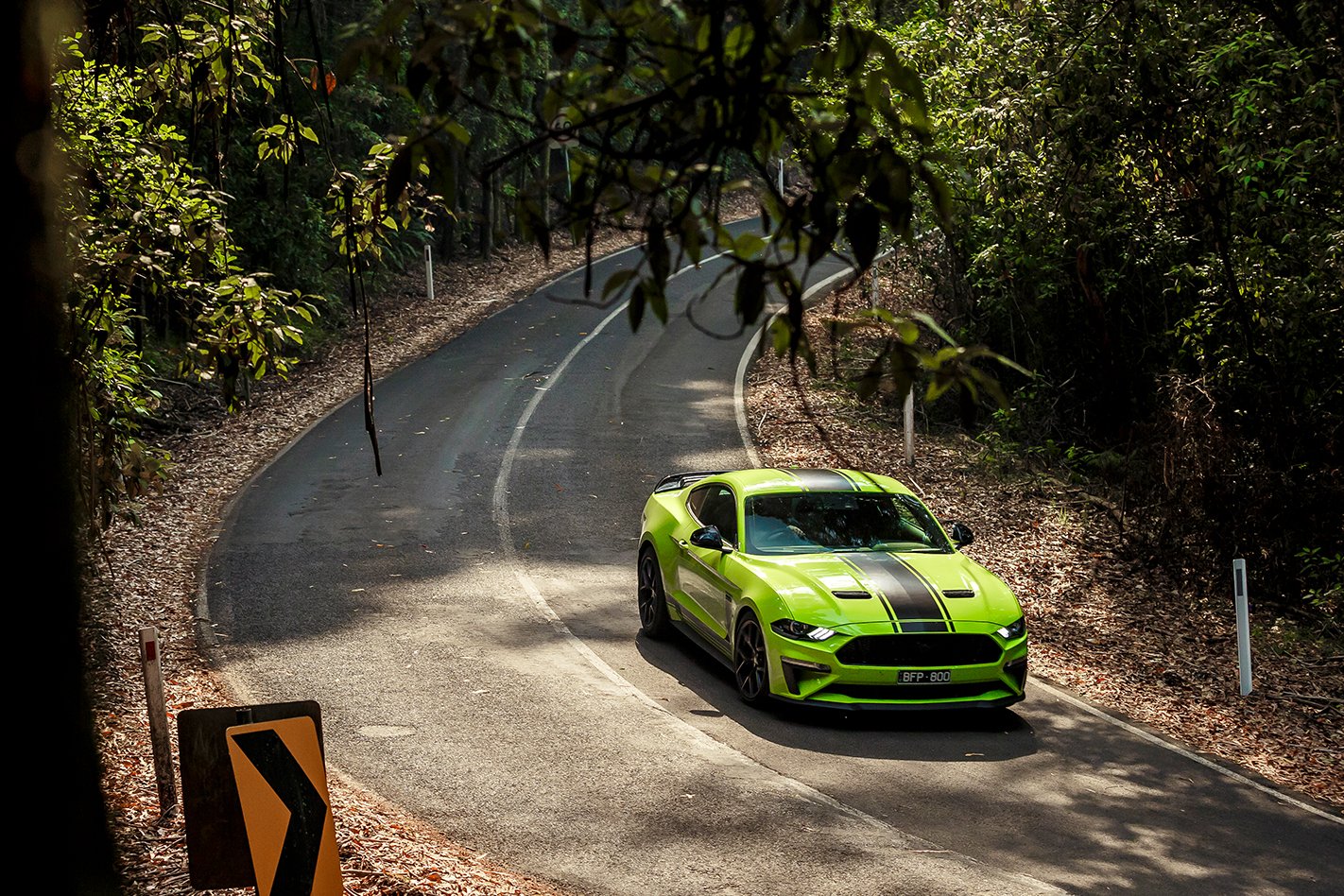
The steering isn’t overly chatty, but feels reassuringy direct on turn-in. The wheel will also give abundant warning of any incipient understeer, a high-frequency vibe transmitting through the agreeably slim rim as the front treadblocks start to wave the white flag. Delivering all that power on the go can tax the traction control system, which is effective if a little coarse in its sound signature.
We’ve come to think of the Mustang as a bit of an affable lump that requires a slow hand to manage its relaxed body control. The R-Spec is a far more focused proposition. It sits flat and corners hard with a strong front end and enough travel in the throttle pedal not to make pouring on power after the apex a heart-in-mouth activity. Upping the anti-roll bar gauge can have the effect of neutering feedback, but the R-Spec telegraphs its intentions clearly. It’s a classy piece of chassis tuning.
On a typically gnarly Aussie B-road, it bumps, thumps and jostles, but will commit to a line and hold its poise doggedly. Only at genuinely inadvisable velocities does it start to feel a bit live, first getting up on its toes and, should you push still further, reminding you of the limits of its suspension travel. There’s a tactile delight in slipping into the generously cut Recaros, peering down that long bonnet and teasing the car’s limits of grip, brapping up and down the ’box just for the fun of it. Yes, you could identify all manner of cars that might well be going more quickly, but few that reward the driver with such big-hearted generosity. Certainly not at less than a hundred grand.
Our drive route takes us from Heathcote south to Mount Macedon. The roads here dive deep into shadowy eucalypt forests, tree roots putting massive bumps onto corner apexes. If anywhere can show up deficiencies in the R-Spec’s corner carving ability, it’s these raddled hairpins. Yet there’s none of that tedious tapdance on the throttle that you get with a poorly set-up calibration. Even under severe provocation, you can ladle on just the right amount of power. Build your confidence and it’s possible to nudge the back about on the gas fairly easily but you’re always aware that 1700kg-plus can wield a considerable serving of angular momentum.
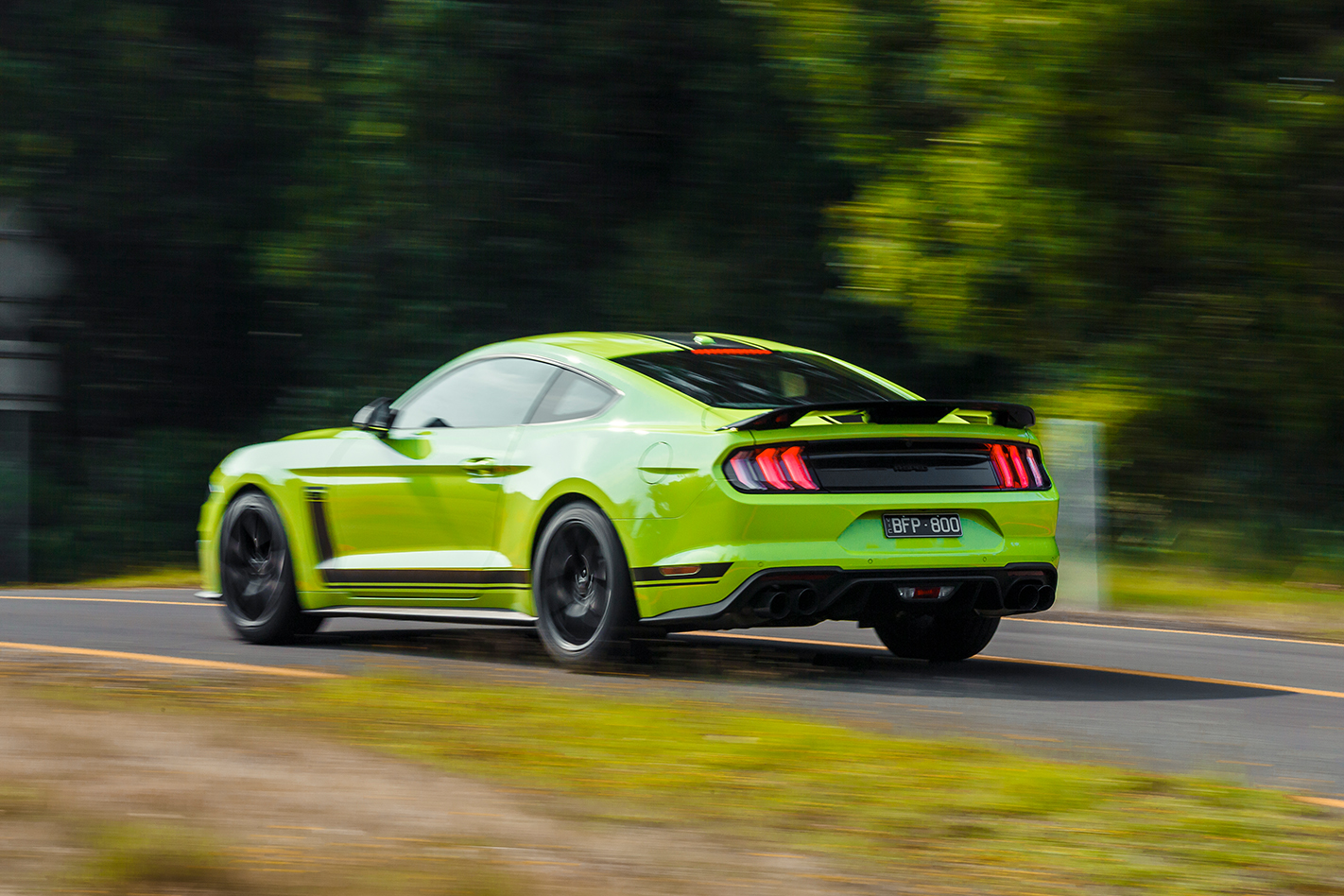
The Brembo brakes should also be singled out for special mention. They’re carryover items from the Mustang GT but pedal feel is excellent and the 33.8m braking performance from 100km/h is wholly respectable for such a hefty beast.
About the biggest compliment it’s possible to give the R-Spec is that it feels completely factory. It’s an almost perfect interpretation of the Mustang V8 amplified. The slightly vague boofiness that afflicts the standard GT has been excised, replaced by a surgical steeliness. It’s not perfect, though. It needs wider rubber at the back, as Ford Performance’s recommended wheel and tyre for this car feels malnourished. Imagine a Mustang GT on a set of Michelin Primacy HPs from a Toyota 86 and you get the idea. The Pilot Sport 4S is a lovely tyre, but it’s ultimately overmatched here, constrained by simple physics.
That aside, it’s hard to find fault, especially at this price. Accept that it’s no stoplight hero and there’s a lot to love about the Mustang R-Spec. It’s a vehicle that’s been developed with care and ingenuity, and which credits its operator with a bit of nous. That’s not always the case in a muscle-car market where the big number is often all that counts. In hindsight, I shouldn’t have lost sleep over driving it. As Smy comes to relieve me of the keys a couple of days later, I’m preoccupied with a different anxiety. When do I get to drive the R-Spec again? It doesn’t last, instead being replaced by an almost embarrassing sense of pride at a simple but grin-inducing fact: Australia might just have helped build the world’s loveliest Mustang.
What about the Shelby?
As potent as it may be, the Mustang R-Spec isn’t the biggest-calibre gun in Ford’s arsenal. The seven-speed dual-clutch Shelby GT500 packs a full 522kW quota from its supercharged hand-built 5.2-litre donk, but isn’t built in right-hand drive. To get one of these in Australia, you’d need to get in touch with Mustang Motorsport. One of their locally converted right-hookers will set you back an estimated $245,000.
Postscript: the hot take
After we tested the R-Spec, our colleagues across the aisle at MOTOR had a crack. While they were able to emulate our 4.7sec 0-100 sprint on one aborted run, 400m trap speeds were about 10km/h down on ours. The reason? The ECU appeared to be protecting the engine by cutting peak power on a far hotter day. It seems the Aussie R-Spec prefers cool mornings.
Ford Mustang R-Spec specs
Engine: V8 (90°), dohc, 32v, supercharged
Layout: front engine (north-south), rear drive
Capacity: 5038cc
Power: 500kW (estimated)
Torque: 827Nm (estimated)
Trans.: 6-speed manual
Body: steel, 2 doors, 4 seats
L/W/H/W–B: 4789/1916/1367/2720mm
Track (F/R): 1618/1636mm
Weight: 1710kg
Boot: 408 litres
Fuel/tank: 91 octane/61 litres
Economy: 15.9L/100km (test average)
Front suspension: struts, A-arms, adaptive dampers, anti-roll bar
Rear suspension: multi-link, coil springs, adaptive dampers, anti-roll bar
Steering: electric rack and pinion
Turn circle: 12.2m (2.5 turns lock-to-lock)
Front brakes: ventilated discs (380mm)
Rear brakes: ventilated discs (330mm)
Tyres: Michelin Pilot Sport 4S
Tyre size: 255/40ZR19 100Y (f); 275/40ZR19 105Y (r)
ANCAP rating: not tested (Aus)
Ford Mustang R-Spec performance figures
- Power-to-weight: 292kW per tonne (est)
- Redline/cut-out: 7400/7400rpm
- Speed at indicated 100km/h: 96
- 0-20km/h: 0.9sec
- 0-40km/h: 1.7sec
- 0-60km/h: 2.8sec
- 0-80km/h: 3.7sec
- 0-100km/h: 4.7sec
- 0-120km/h: 5.9sec
- 0-140km/h: 7.3sec
- 0-160km/h: 8.6sec
- 0-180km/h: 10.4sec
- 0-200km/h: 12.5sec
- 0-400m: 12.4sec @ 199.1km/h
- 80-120km/h: 2.8sec
- 100km/h-0: 33.8m
I have been driving this Ford Mustang R-Spec for a while and I’m sick of waiting. This next straight I’m going to give it the berries. But, fully aware that the standard Mustang’s footprint underneath me is handling more than half as much power again, I toe the throttle the way you’d ease into a cold pool.
Its exhaust bellows as supercharged air feeds eight hungry cylinders. Then I throw it into third, hit the loud pedal hard, and the tarmac before me starts disappearing. Fast.

At 3000rpm there’s a noticeable layer of extra shove. At 4000rpm the surge keeps building. It’s not stopping at 5000rpm. Six thousand? You’re surfing what feels like a tidal wave, but there’s still another 1500rpm to go. Seven thousand? I glance over at photographer Nathan Jacobs in the passenger seat. His face says it all. This thing is something else.
But there’s also something familiar about this Mustang. It is a boosted, Australian-built, limited-edition R-Spec. Just like the FPV F6 Typhoon version that debuted in 2007, and the FPV Boss 335 GT that continued the legacy in 2012. The only thing that has changed here, of course, is the vehicle’s country of origin – and partner manufacturer.
Ford Australia, together with tuning house Herrod Performance, has created the Mustang it always wanted to since Dearborn denied us the Shelby Mustang GT350, and tricky ADRs smothered earlier attempts to rectify this. The GT350 was a flat-plane-crank 392kW track monster that could have been a local hero – if only Ford America had decided to build them in right-hand drive.
We’re okay with missing out because what is almost as significant as Ford Australia instead unleashing a fully compliant supercharged monster on Aussie roads (with no less than a five-year factory warranty accessed through Ford’s nationwide dealer network) is that it has re-opened Melbourne’s defunct Broadmeadows factory to build it.
There, with 20 Herrod Performance-trained staff manning five stations, it partly strips down a Mustang GT before arming it with select bits from Ford Performance’s modifications catalogue. Finally, it will apply locally designed exterior upgrades that make every R-Spec look like the one you see here. Ultimately, 500 units are planned at $99,980 each.
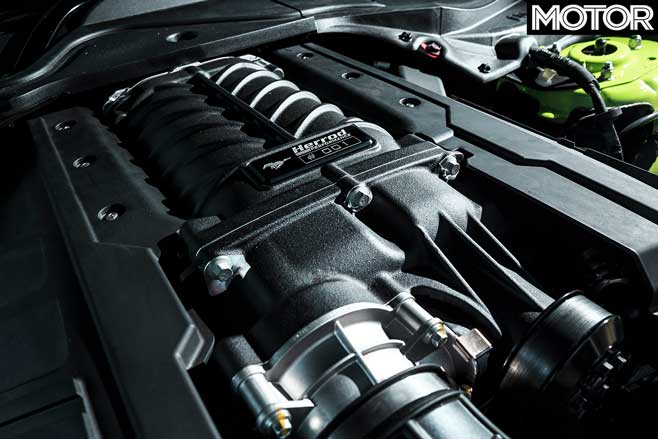
So, what bits from Ford Performance exactly? The third-generation Coyote 5.0-litre V8 in every R-spec houses a Roush supercharger calibrated to Ford Performance specifications. While a lack of expensive local certification on the power figures means we don’t have exact numbers, we understand they’re close to Ford Performance’s claims of more than 500kW and 800Nm for such an engine.
Breathing through a larger pod-filter and intake chamber, the blown Coyote dumps gases into a Borla exhaust that runs from the primaries back. Its mufflers also retain the stock active exhaust flaps, so it can adjust its growl to each drive mode. And while you will see ‘Ford’ etched on the exhaust tips, ‘Herrod Performance’ is stamped into its mufflers since, as a Ford Performance distributor and expert, the company developed and integrated the ADR-friendly system with the Ford Performance bits.
Speaking of which, the car’s Michelin Pilot Sport 4 S tyres, measuring 255mm at the front and 275mm up back as before, now stretch over wheels that are half an inch wider. As well as sharpening response, the stretched tyres complement a set of fatter anti-roll bars that can be adjusted.
On top of them are a set of springs that lower the car 20mm and stiffen the rates 20 per cent. Then, as perhaps you would expect from an OEM, each car’s adaptive suspension Magneride controller is flashed with Ford Performance’s calibrations that match the pre-determined rates and height. That’s the beauty of installing parts from the same eco-system.
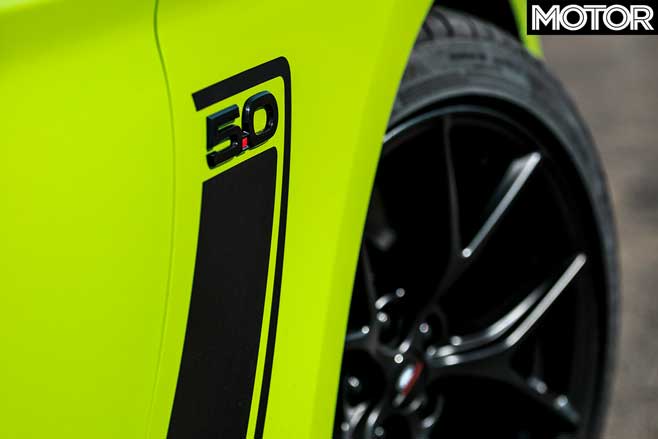
Last but not least, the rear spoiler has been pinched from the Shelby Mustang GT350 to improve downforce. Along with FPV 335 GT R-Spec-esque stickers down the side and an over-the-top racing stripe, all the black bits above the belt line are finished in gloss, and those below it are finished in satin-black to match the wheels. The result is striking.
From the driver’s seat, you will be pleased to hear the Mustang finally has an engine that can leverage the ridiculously long ratios in its six-speed manual transmission. Unfortunately if you’re allergic to left-leg work, it’s all the R-Spec will use, but since the Mustang driveline was beefed up with thicker half-shafts and a twin-plate clutch in 2018, it will handle the grunt at no cost to driveability.
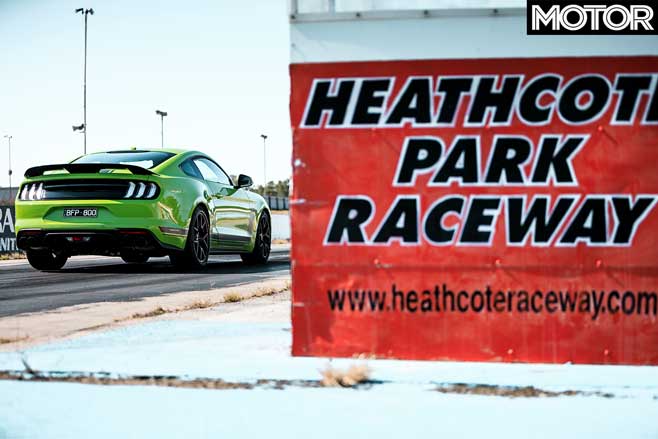
As I guide the R-Spec through the gates at Heathcote Park Raceway, it dawns on me that the absence of an automatic, and its clever launch control, will make my job here a little harder. And even if there are ways to eke out a winning number, ranging from dropping the tyre pressures to selecting a certain fuel brand, I’m testing the R-Spec in its most representative trim, with a full tank from the local servo and placard tyre pressures (set at 32psi).
Besides, I should be thankful simply to have the R-Spec on the start line under blue skies, given Victoria’s recent temperamental weather. And after some runs to shake down the car, warm the tyres and clear some debris from our tracks, it’s clear the summer sun is working its magic on the VHT. So what are we waiting for? Let’s launch this thing.
Turn all stability controls off, engage Drag mode for optimised damping, then line up. Slot first. Bring the clutch pedal to about half way, or just under its high bite point, before dialling up the revs – otherwise, lifting off from the floor lets the revs drop too far before the clutch bites, and the car will bog.
The track is gummy enough to accept around 3600rpm. Blend the clutch in swiftly with some throttle. It shudders and tramps as engine and wheel speeds equalise, but it grips from about 40km/h and you’re left to concentrate on the shifts.
First gear hangs around until 89km/h, but it’s not as savage as you might expect since torque is limited in the first two ratios to protect the driveline and preserve traction. Throw the stick down the gearbox when the revs near 7500rpm. Bam! Second gear hits home hard.
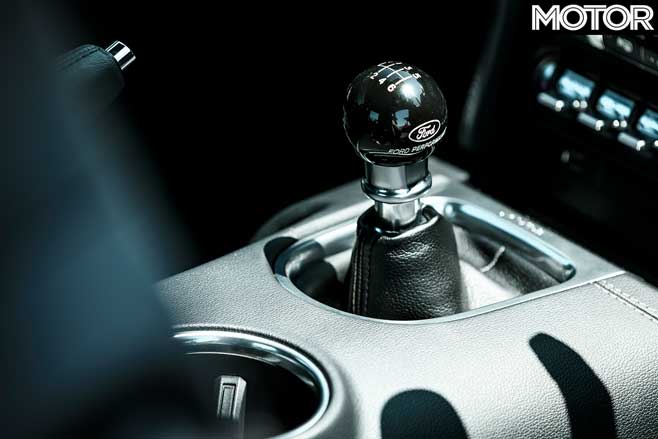
Concentrate now. Crossing the H-pattern’s tightly spaced gates is difficult. Rush it and you risk a costly baulk. Ease into third at 134km/h and then it’s basically eyes on the road all the way home. Except there should be more if the R-Spec is making the power it should. Fourth beckons at 198km/h and a 500kW car should be on the other side of that before pulling chutes. But our trap speeds are down.
We’re seeing 186km/h on the VBOX with a 13.01sec pass and then 181.76km/h with 12.97sec. Newman, who’s clearly arrived to offer encouragement, jokes that maybe I need some more practice. But he’s not so sure once it’s his turn in the driver’s pew. He bags 100km/h from rest in 4.70 until a miss-shift from second to third at 134km/h ends the run prematurely. Still, it’s not as frustrating as our poor trap speeds.
After giving the R-Spec some time to cool, he catches a break. Hitting 100km/h from rest in 4.96, he brings the R-Spec home in 12.78sec at 189.47km/h. It’s clear that giving the Mustang time to rest allows power, and therefore trap speeds, to creep back up. But finding the time between every single attempt to cool it down takes forever.
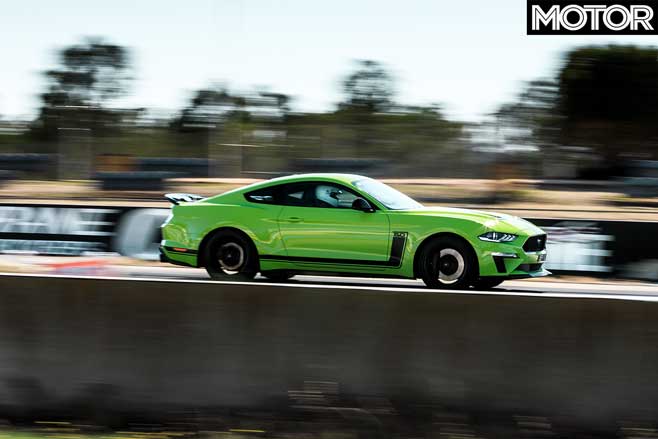
We give up, frustrated. Clearly, on a cooler day, or knowing exactly how to launch the thing first time out, we could improve those numbers. But even the R-Spec’s specific rear-diff cooler running overtime can’t convince the conservative ECU its engine is not in danger of hurting itself in all this heat.
Ditching Heathcote for the tight mountain corners near Broadford offers no respite. Dive into a hairpin, get on the throttle and, while the rev counter arranged as a band across the Mustang’s brilliant digital instrument cluster charges to redline, the gut-squeezing gallop I experienced earlier this morning (and only briefly at the strip) is gone. It’s as if the throttle plate has stopped half way.
Rather than dread turning off the traction control, I hastily disable ESC to confirm whether lateral G is causing it to cut power. Unfortunately not. It’s clear the ambient temperatures, which have steadily climbed up to near 30 degrees Celsius, have melted our chest-beating monster into something more anaemic.
Luckily, the R-Spec is not just a one-trick pony. Although its gallop is slower in this heat, there’s still a lot to enjoy on these roads. That optional billiard ball-style shift knob makes rowing the six-speed a delight with the flawless rev-match system. The brakes are sharp, precise and welcome on the descent.
But it’s the suspension that’s a true highlight. The lowered package feels more confident taking corners. Where a standard car feels a bit top-heavy and wobbly entering a bend, the R-Spec is more precise off-centre and finds a stance sooner in the corner. The steering also offers more feedback through a front-end that feels glued to the road thanks, partly, to the roll-bar set to soft on the front.
What’s more, this extra precision, control and grip has not cost the R-Spec much, if any, ride comfort. Besides the usual thumps as its wide wheels and stiff tyres deflect over road joints or potholes, there’s still plenty of damping travel to soak up medium-speed bumps.
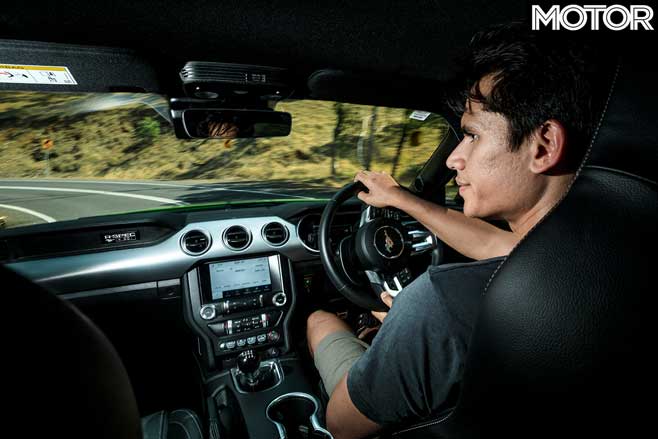
As for its touring credentials, the Mustang’s forward vision and airier cabin are welcome in comparison to something like, say, a Chevrolet Camaro. And you score a fair bit of kit. The Recaros fit all sizes and hold you well, while the Bang & Olufsen Play audio thumps hard. Apple CarPlay is thrown in too.
Because of these things, you will enjoy driving the R-Spec everyday. There’s now so much usable torque down low that you can burble away from a stop in second gear. Easily. There’s nothing intimidating about it either, because its fury lurks in the higher revs, where the Coyote V8 really gets breathing.
The exhaust note, while a smidge boomier than the stock one, keeps the noise outside the cabin. Meanwhile, the supercharger irons out the power band into something wonderfully linear, and the extra torque is always perfectly proportional to the amount of throttle. It’s expertly tuned.
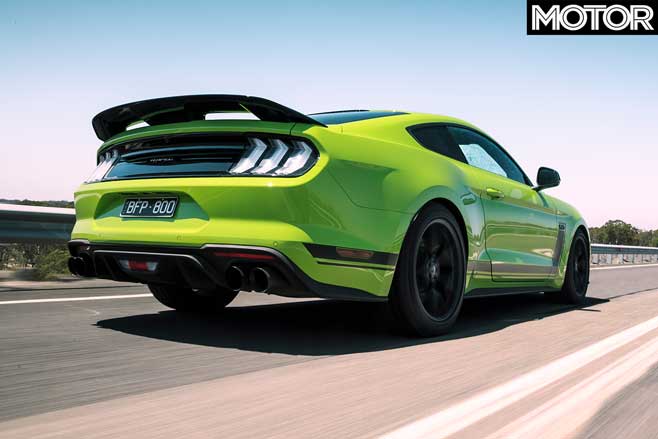
Yes, on a hot day a Camaro SS might have more teeth on a strip or winding road. And that’s okay because we know that, while the R-Spec might not make full power all the time, it’s always working to protect its warranty.
When it’s a toss-up between bulletproof reliability and always-on knock-yer-socks-off power, which it inevitably will be at this price point, I know which side of that compromise we would want to be on. And that’s the rub here. The R-Spec feels like it rolled off the Dearborn factory line. The choice selection of Ford Performance parts are calibrated seamlessly into one whole and improves the Mustang breed to a higher degree of sophistication.
But even that can’t solve the inherent problem in ’chargin an already highly-strung atmo V8. Sure, at its very least when the power’s down, the R-Spec feels closer to an atmo MY18 with some welcome extra grip, more precision and a lot more presence. And that’s a bit disappointing if you’re here for the horsepower. But then, at its very most when it’s making everything it should, the R-Spec is something else. Something potentially great.
PROS: Loads of presence; more grip; improved handling; impressive ride; insane power… CONS: …but only in the right conditions. No auto option RATING: 4 out of 5 stars
TRACK TEST
By Tony O’Kane
The Mustang Mystique is one that’s been born largely out on the open road and in front of Hollywood cameras, but when it comes to race tracks and rally stages it’s Fords like the GT40, Sierra Cosworth, Escort and RS200 that have a stronger association.
But movie stars can be track stars too: just ask Patrick Dempsey, the Greys Anatomy heartthrob who traded Hollywood for pit lane to become a (fairly decent) race driver. Sometimes an old dog can learn a new trick.
And so it is with the Mustang R-Spec.
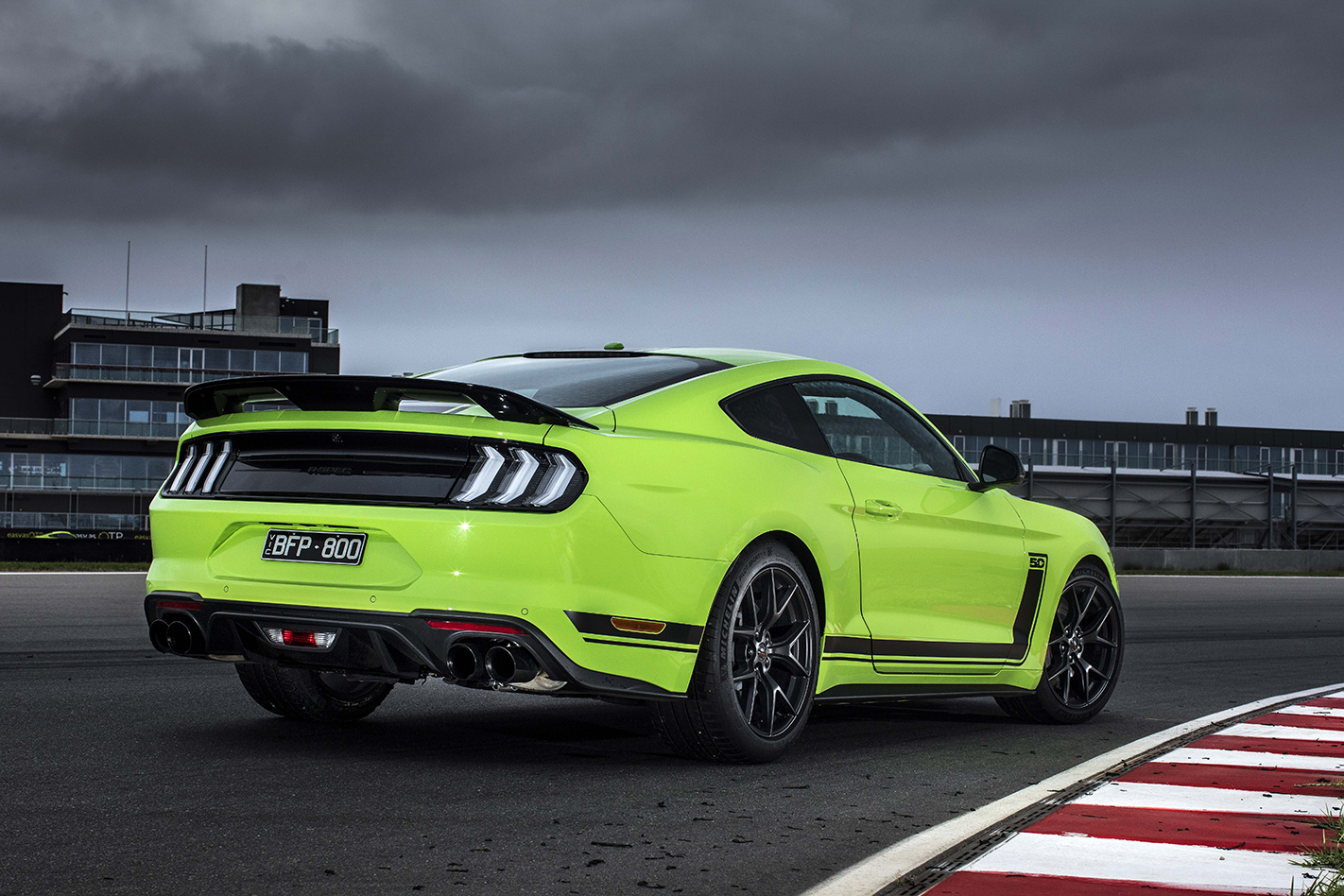
Ford has taken us to The Bend Motorsport Park in South Australia so we can validate the R-Spec’s claim of track-readiness, and we’re expecting it to mesh well with the flowing nature of the circuit’s International configuration – the same as that used by Supercars. With higher speeds stuffing more air through its gills and lower ambient temps, we’re hoping the heat-related issues we experienced on road and strip don’t revisit us too.
They’ve got a few other Mustangs for us to drive as well, with the turbo four-pot Mustang High Performance and the Mustang GT present in pit lane next to the two R-Specs. We won’t cover them here, but they definitely provided a useful frame of reference.
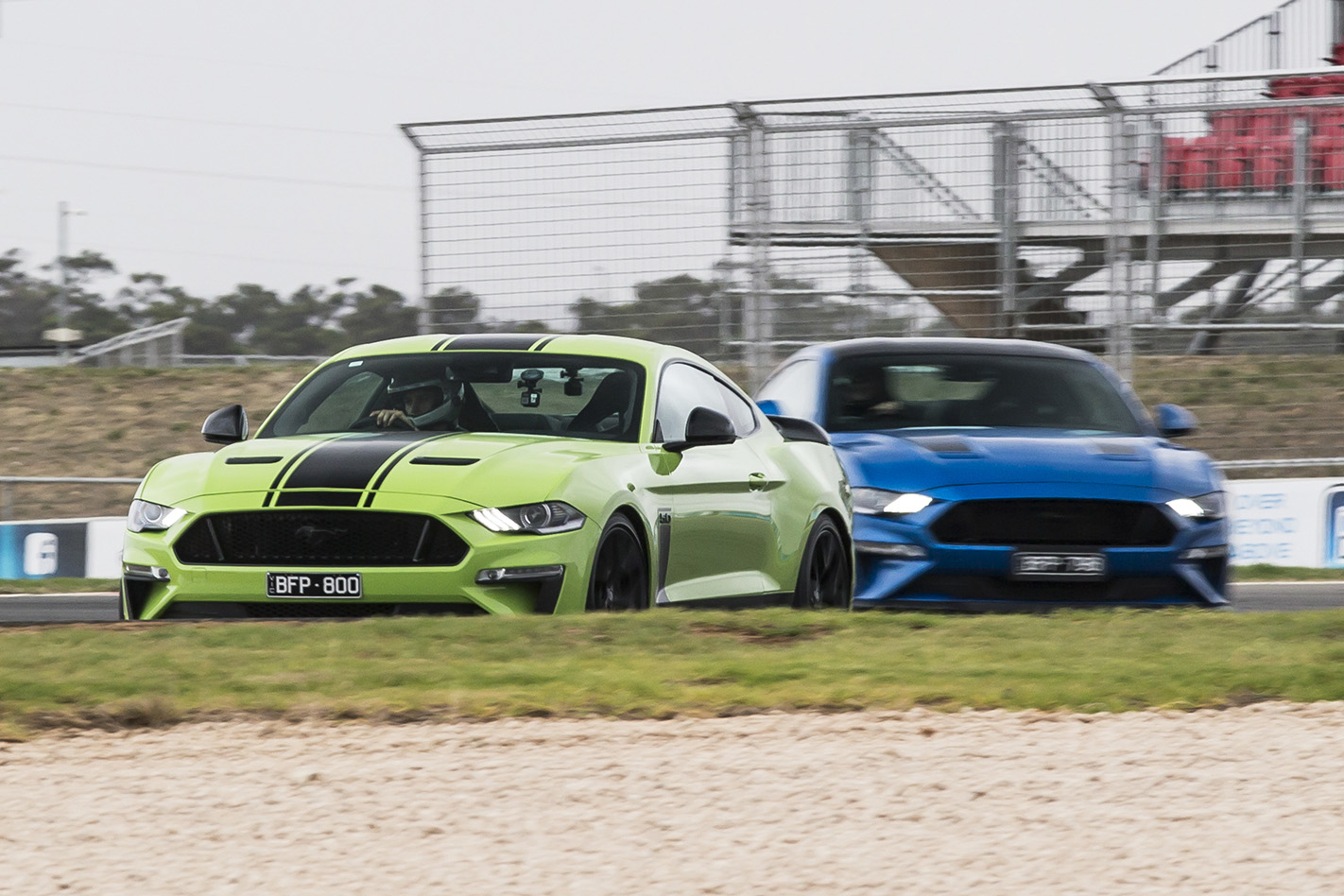
Leaving pit lane and leaning into the R-Spec’s accelerator delivers the performance that most prospective buyers will have on their mind – that addictive and surge of straight-line thrust. First impression? Even at full tilt it feels surprisingly undramatic. The fact it’s force-fed is hard to pick thanks to the very hushed Eaton supercharger and the linearity of its power delivery, but the effect it has on acceleration is plainly obvious. There’s a significant differential between the R-Spec and the 5.0-litre GT we just hopped out of.
Big torque is available virtually everywhere in the rev range courtesy of that supercharger’s 12PSI of boost pressure, endowing the already-flexible Coyote with a loftier level of muscularity. Bar The Bend’s deceptively tight second-last corner that demands the selection of second gear, we could easily confine ourselves to just third and fourth around the entirety of the 4.9-kilometre track. Does it feel like 520kW? Not really. Is it slow? Hell no.
Second impression: this is a much tauter car dynamically than the vanilla V8. The lower ride, stiffer springs, re-calibrated Magneride dampers and beefier swaybars all add up to a Mustang that properly handles, with none of the pitch, roll and ponderous nature of the GT. There’s also a greater sense of communication from the steering – a definite plus when you’re trying to figure out where the threshold of front-end grip lies on a 1.8-tonne super-coupe. It’s adept and agile, and utterly at home on the circuit.
That said, it would be faster still with more track-suitable rubber than the stock Michelin Pilot Sport 4S. With the same ‘footprint’ as the GT the only difference is less sidewall flex thanks to those inch-wider wheels, but even that isn’t enough to give you enough grip to deploy all 500+kW and 830Nm as you depart an apex, particularly if the radius is a tight one. There’s a lot of inertia to manage here, and you’re forever reminded of that from the driver’s seat.
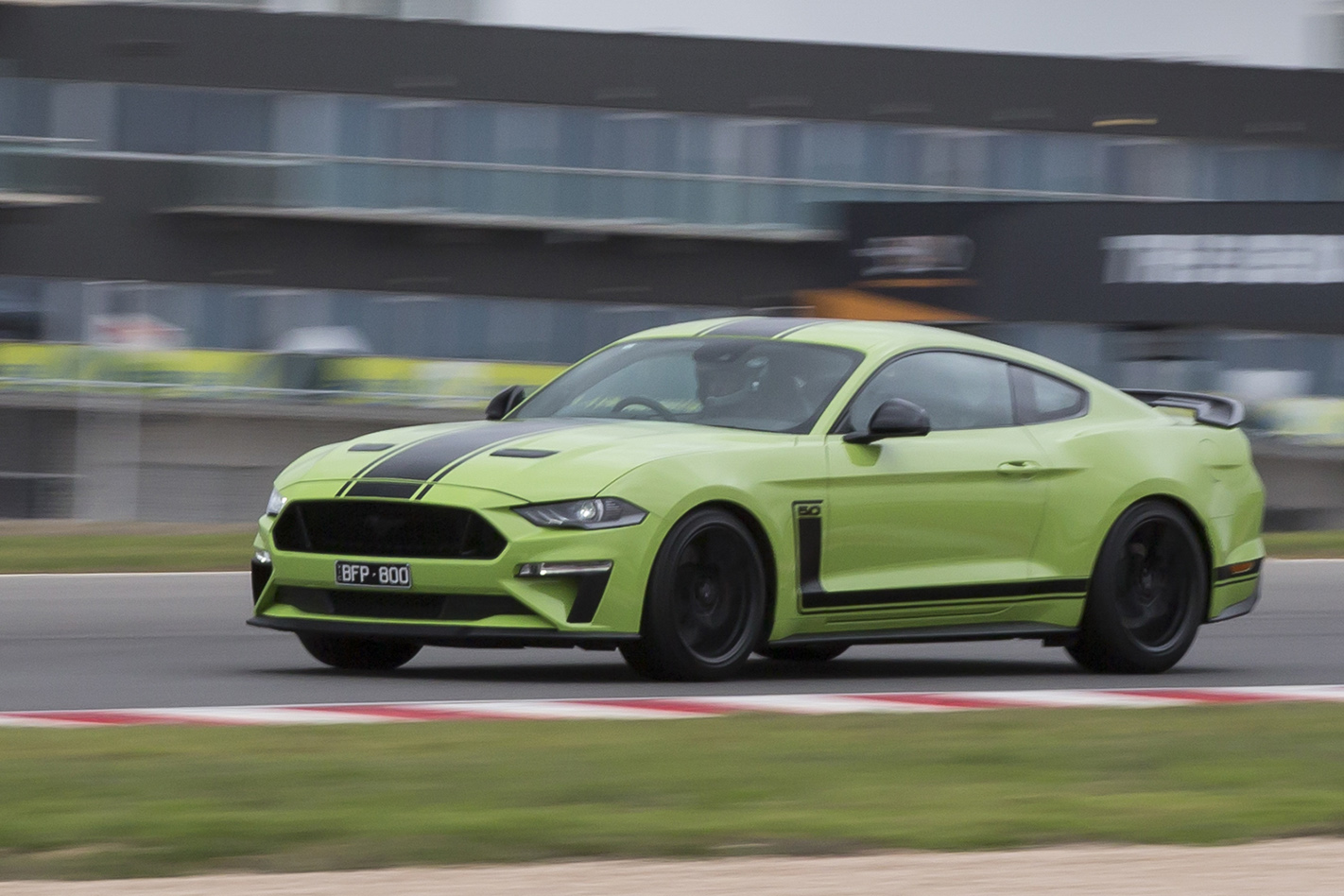
The good news is light mods like grippier tyres and brake pads won’t harm the R-Spec’s five-year warranty, nor will the mere act of driving it hard on a race track. Track day fiends take note.
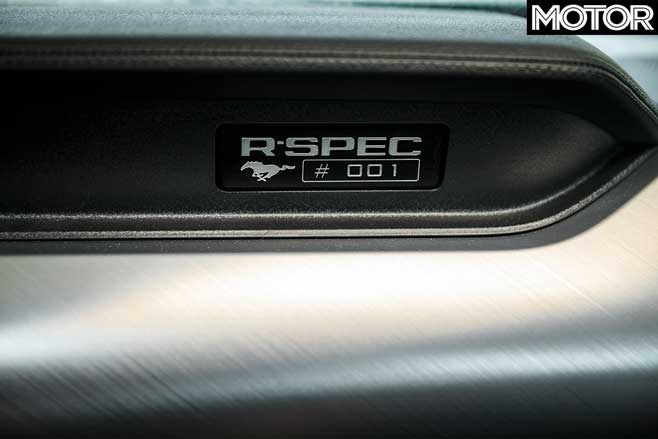
Even in track mode I can still tell that there’s a layer of electronic interference between pedal and throttle body that’s reining back the power to keep things from getting silly in corners, but it’s reasonably subtle. It’s tempting to deactivate stability control entirely and explore the limits further, but not only is this not my car, it wears “001” on its build plate and I’d hate to be the numpty that stuffs it into the wall midway through a Ken Block impersonation.
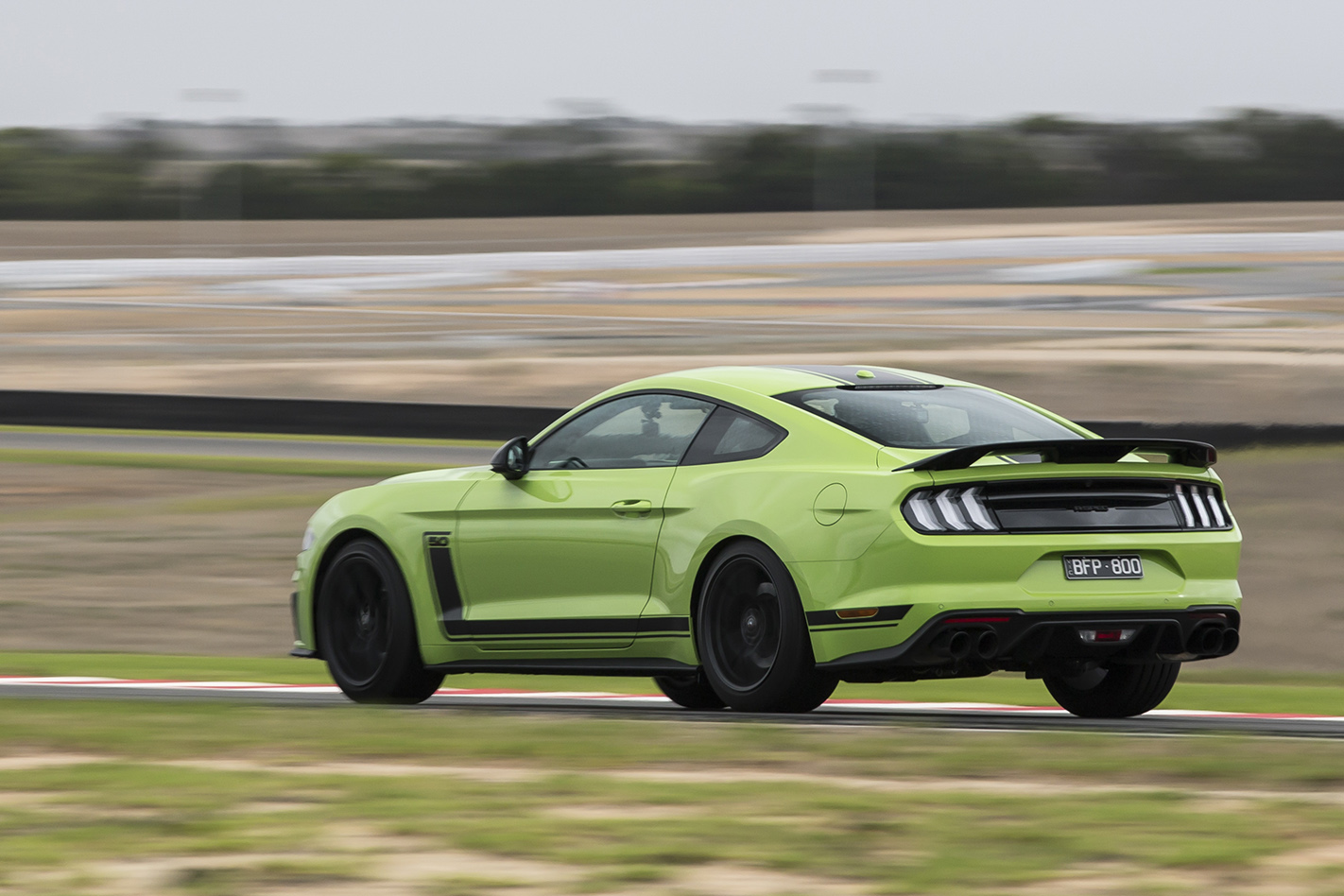
By the braking zone at the end of the front straight we’re somewhere around 230km/h and hitting the middle pedal hard. The R-Spec’s Brembo hardware is no different to what you get on a Mustang GT – not even a change of pad compound or fluid formulation – but they’re hugely effective in slowing down this fat pony. What’s more, there’s even greater stability under braking in the R-Spec. While the GT’s snout hunts left and right as weight transfers to its front wheels under heavy decel, the higher springrates of the R-Spec banish that behaviour and replace it with rock-steady braking.
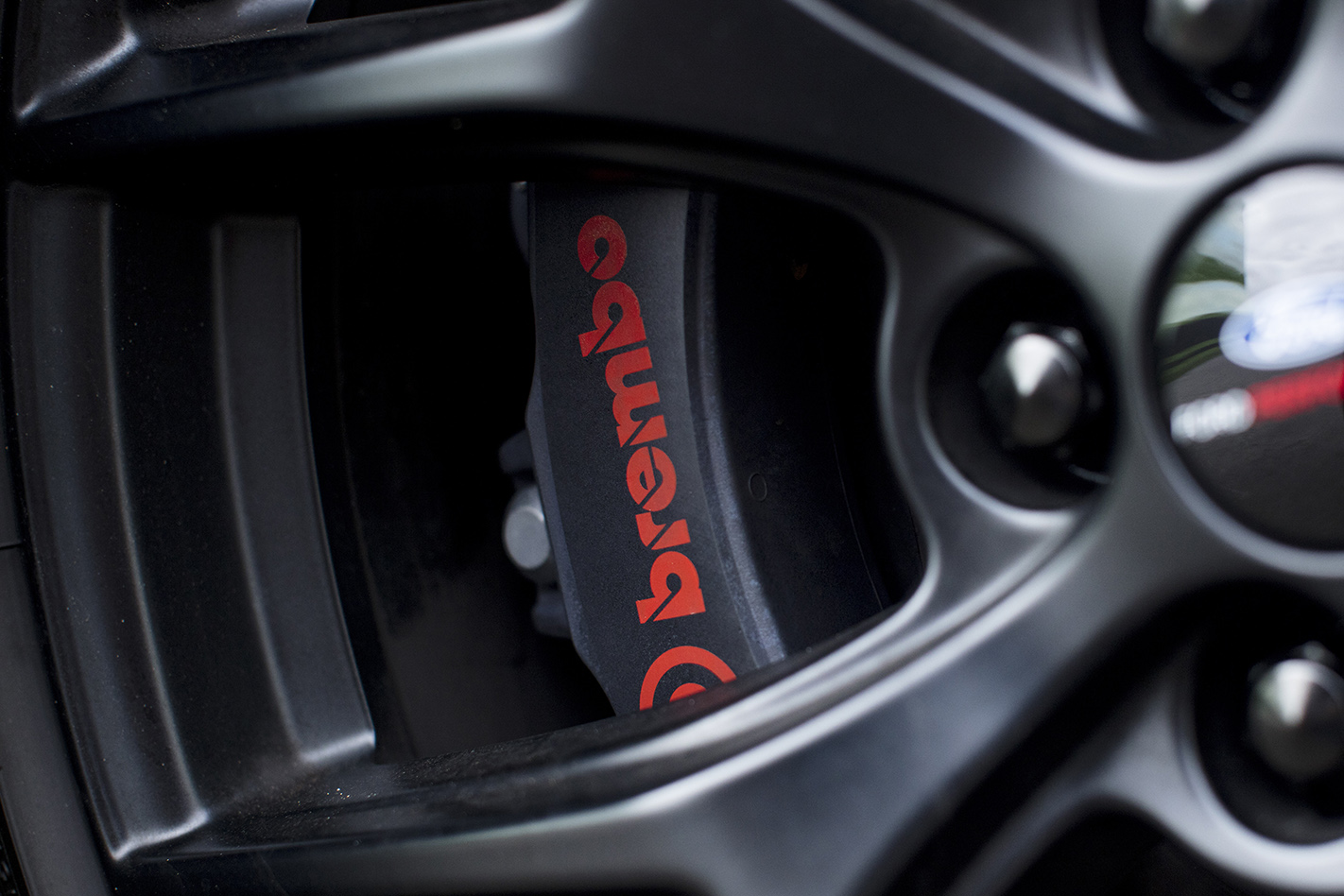
Brake fade never showed up. Nor did heat-related power issues. The fact the regular ol’ GT sounds better thundering down The Bend’s straight might irk some people, and from the R-Spec’s driver’s seat that supercharger is just too subtle. It’s a little more vocal from outside, but we’d like to hear more whine overall.
The shaping of the Recaro’s fixed headrest isn’t quite so compatible with a helmet either and pushes your head forward unless you recline the backrest a smidge, but that’s a very track-specific complaint.
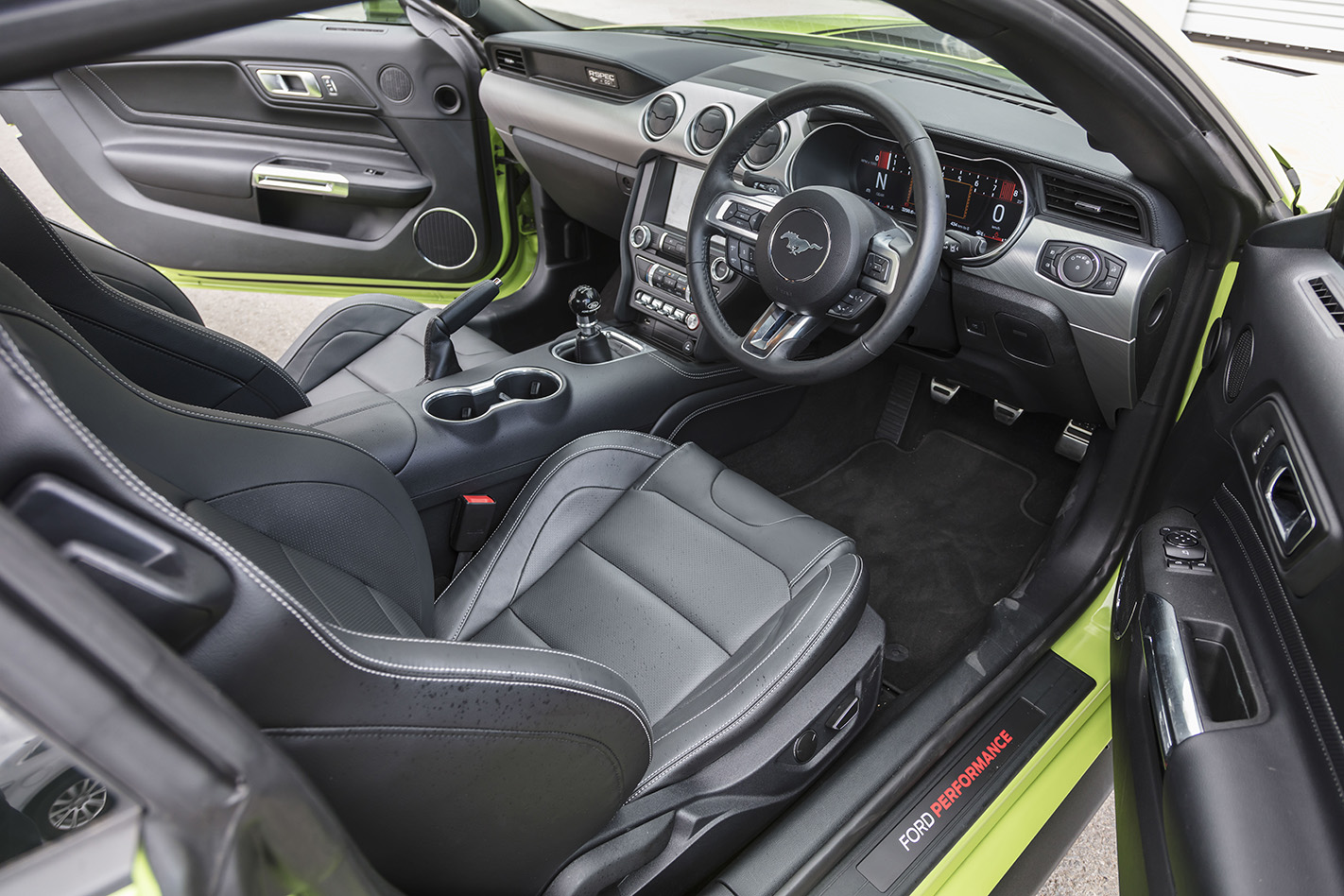
Yet as a track-tuned mutation of the standard Mustang GT, the R-Spec never feels like a parts catalogue special. Genuine effort has gone into integrating every part in a holistic way and the result is a sports car that doesn’t fixate on one aspect of performance, but all of them in equal measure. The R-Spec is a proper blast on a race track, and one that can be fairly considered against price rivals like the BMW M2 and Toyota Supra GTS, not to mention hyper-hatch performers like Audi’s RS3 and Benz’s A45.
It’s arguably far more special than all of them, and it ain’t no show pony. The R-Spec’s track credentials are legit.

2020 Ford Mustang R-Spec Specs BODY: 2-door, 4-seat coupe DRIVE: rear-wheel ENGINE: 5038cc V8, DOHC, 32v, supercharger BORE/STROKE: 93.0 x 92.7mm COMPRESSION: 12.0:1 POWER: 522kW (est) TORQUE: 827Nm (est) WEIGHT: 1779kg POWER-TO- WEIGHT: 289kW/tonne (est) TRANSMISSION: 6-speed manual SUSPENSION: struts, coils, adaptive dampers, anti-roll bar (f); multi-links, coils, adaptive dampers, anti-roll bar (r) L/W/h: 4789/1916/1357mm WHEELBASE: 2720mm TRACKS: 1582/1640mm (f/r) STEERING: electrically assisted rack-and-pinion BRAKES: 380mm ventilated discs, 6-piston calipers (f); 330mm ventilated discs, single-piston calipers (r) WHEELS: 19.0 x 9.5-inch (f); 19.0 x 10.0-inch (r) TYRES: 255/40 R19 (f); 275/40 R19 (r), Michelin Pilot Sport 4 S PRICE: $99,980
The Strip
| Ford Mustang R-Spec | |
| 0-10km/h | 0.30sec |
| 0-20km/h | 0.76sec |
| 0-30km/h | 1.25sec |
| 0-40km/h | 1.70sec |
| 0-50km/h | 2.20sec |
| 0-60km/h | 2.71sec |
| 0-70km/h | 3.16sec |
| 0-80km/h | 3.99sec |
| 0-90km/h | 4.49sec |
| 0-100km/h | 4.96sec |
| 0-110km/h | 5.50sec |
| 0-120km/h | 6.13sec |
| 0-130km/h | 7.18sec |
| 0-140km/h | 7.97sec |
| 0-150km/h | 8.73sec |
| 0-160km/h | 9.51sec |
| 0-170km/h | 10.43sec |
| 0-180km/h | 11.56sec |
| 0-400m | 12.78sec @ 189.47km/h |
| 80-120km/h | 2.05sec |
Heathcote, dry. Driver: Louis Cordony *Manufacturer’s claim Official timing supplier: www.vboxaustralia.com.au
With European reports regarding the reveal of the Volkswagen Mk8 Golf GTI circulating, Volkswagen Australia has confirmed local timing for the arrival of three hot hatches.
UPDATE (21/02/2020): In the run up to March’s Geneva Motor Show, Volkswagen has confirmed its global reveal along and released the first teaser image of the Mk8 Golf GTI (in the main pic) that highlights the GTI’s distinct honeycomb grille and optional illuminated radiator grille crossbar.
Performance figures has yet to be released. Aside from the performance and visual garnishing, Volkswagen says the Golf GTI will be one of the first in its class to be Car2X car-to-car wireless communication capable. Details on its Australian introduction remains unchanged as follows:
Volkswagen’s local arm says there hasn’t been an official communication internationally about the exact timing of the reveal, but a spokesperson did confirm to MOTOR the car should be on sale in late 2020.
It makes sense that the GTI will be previewed at Geneva – Volkswagen will have a strong presence at the show, and plans to reveal dozens of models throughout the year.
Next up is the Golf R, which Autocar says has been confirmed for a Goodwood Festival of Speed reveal. Here in Australia, Volkswagen Australia says it expects to have the Mk8 Golf R on sale following the GTI, likely early 2021.
Before both of these models, it’s bringing the current-generation Mk7.5 GTI TCR to Australia in mid-2020. The 213kW hot hatch is expected to be priced around $60,000 locally, though VW Australia has yet to confirm pricing or exact specification.
Finally, if you were hoping to see another performance model arrive in Australia soon in the form of VW’s Golf GTE, don’t hold your breath.
VW Australia says it would have taken the Mk7.5 GTE, but it became unavailable. The local brand is now waiting for the arrival of full EV versions of the Golf, rather than bringing hybrids here.
