
In traditional end-of-year high school style, the WhichCar weekly team are preparing for the festive period by winding back the work effort, putting their feet up and playing games to pass the time.
It’s the conversation which locks all motor journalists down in heated debate for hours at a time: Which five cars would you fill your garage with?
To hopefully prevent the decisions blowing out to 2021, strict rules have been applied: The budget is unlimited but each player must pick one choice from the categories 4×4, hot hatch, supercar, pre-1980 classic, and wagon.
All vehicles must be available as new in Australia with the exception of the pre-80 round and, because we are car enthusiasts, no SUVs! (with the exception of the 4×4 round).
Download the final WCW podcast of 2019 to find out which cars Dan, Scott, Andy, Alex and Cam are all hoping Santa will tow behind the sled, and stay tuned for a whole new conversation starting in 2020.
If you’re on the go, you can find WhichCar Weekly on all manner of podcast apps including iTunes and Podbean. Please rate, subscribe and leave a review! You can also follow the day-to-day happenings of the WhichCar team on Facebook, Twitter and Instagram @whichcarau.
Listened to the show? Help us out:
- Leave a note in the comment section below.
- Leave a review on Apple Podcasts/iTunes
- Subscribe to our podcast
Mazda is the underdog that’s not afraid to bite, and that’s something I really admire. It’s not a large car maker by global standards, yet there’s more courage, consistency, commitment and common sense to be found in Hiroshima than elsewhere.
The SkyActiv-X engine that will arrive in Australia early next year is without doubt the biggest internal-combustion engine innovation for decades. It increases efficiency and cuts emissions through hard-earned technical mastery.
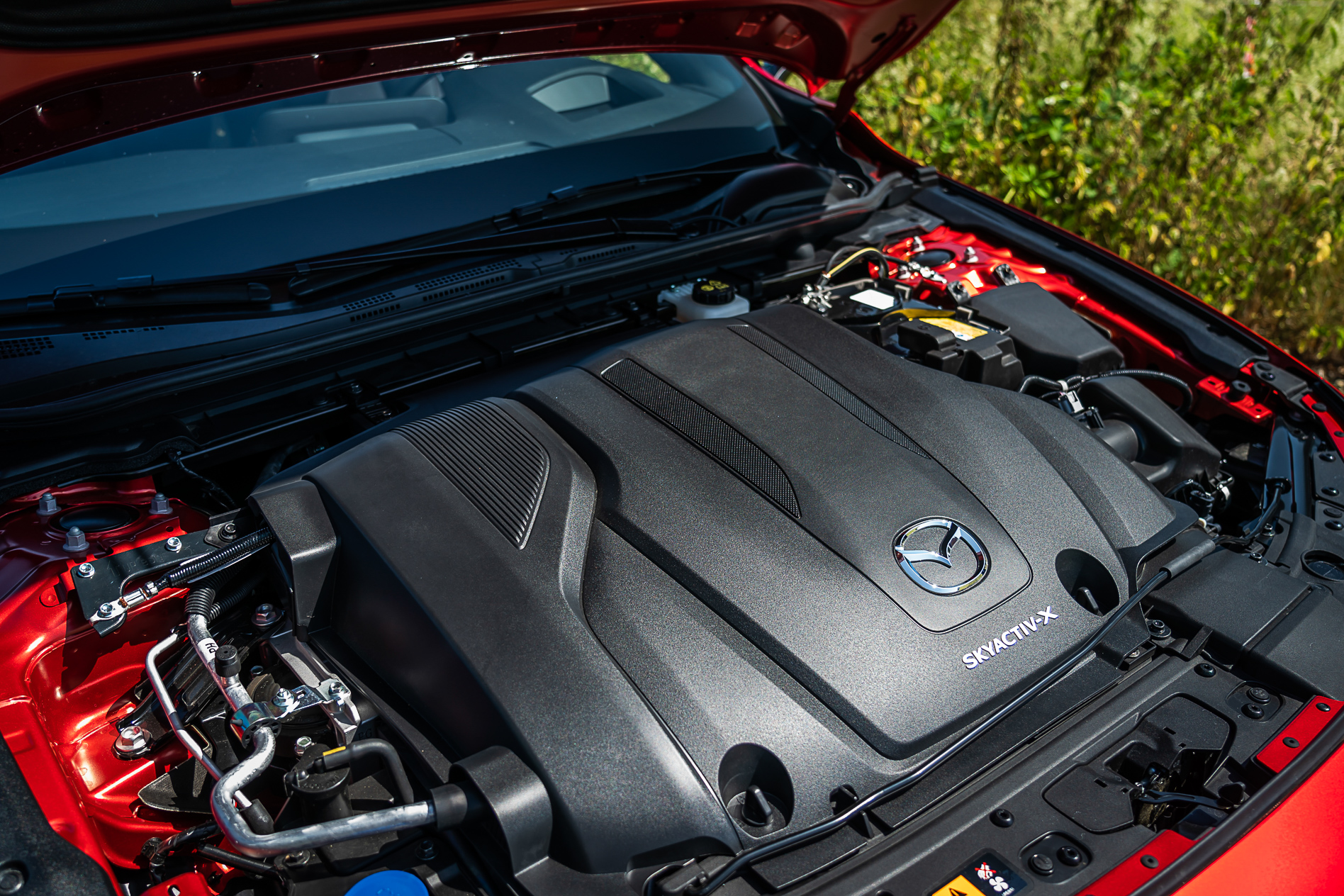
Other car makers have struggled in vain to turn the theory of using a high compression ratio to initiate combustion of a weak mixture of fuel and air into a commercially viable engine. Honda, General Motors, Daimler and others all failed, but Mazda has succeeded.
It’s usual for great leaps forward to arrive in the kind of costly cars topping the line-ups of premium brands. Think of ABS and ESC, for example. The Bosch-developed electronic four-wheel multi-channel anti-lock braking system that’s the forebear of today’s tech was introduced (as an option!) in the Mercedes-Benz S-Class in the late 1970s. Mercedes, again working with Bosch, also won the ESC race, with the S600 Coupe of 1992.
In contrast, Mazda will introduce its SkyActiv-X engine early next year in the 3 hatchback and sedan – cars ordinary folk can afford. Inevitably it will appear in other models, likely beginning with the good-looking CX-30 crossover.
The decision to invest in SkyActiv-X must have been a deep-breath decision for Mazda’s leadership. Now isn’t the time to go into the details of exactly how the SPCCI (for spark-controlled compression ignition) process works, but it was a huge challenge and a costly, high-pressure project.
“I don’t think I would want to do it ever again,” Mitsuo Hitomi, the man then in charge of the company’s technical research centre, told me back in 2017 when Mazda previewed the SkyActiv-X engine at a seminar in Germany.
He spoke quietly, shaking his head at the memory.
Though it isn’t apparent in Australia, where Mazda has strong market share, the Japanese brand isn’t as big as any of the premium German outfits. It sells around 1.6 million cars a year.
In 2018 Mercedes-Benz moved 2.3 million, BMW 2.1 million and Audi 1.8 million.
Mazda doesn’t, and can’t, charge premium-brand prices. It simply builds better-than-average mainstream cars that often have driving character and visual charm to go with the brand’s typical quality, reliability and affordability.
Almost 20 years have passed since Mazda launched the first 6, the car I consider as opening the company’s current golden age, and arguably it hasn’t produced a bad one since. It’s an admirable record, in my estimation.
While Mazda creates mass satisfaction, its small size and slender profit margins mean the R&D budget is limited. But after some clear-sighted analysis of what it needed to prosper in coming decades, Mazda elected to take the risk with SkyActiv-X.
The company accepts it needs to reduce the global-warming impact of the cars it produces. It could have opted to invest instead in zero-emission EVs, but they would inevitably sell in small volumes. Mazda calculated that a big cut in consumption and consequent CO2 emissions from the internal-combustion engines that will power the vast majority of cars it builds in the coming decade was a more effective move.
“Our ultimate goal is not to do something different because it is different, but as a way to meet the target,” Hiroyuki Matsumoto, head of Mazda’s vehicle development division, told me earlier this year. “The reason why we pursued the ideal combustion instead of electrification, we did that because it is the right thing to do…”
BEST ENGINE – Porsche 991.2 911 GT3 RS
The naturally aspirated engine’s time is meant to be over, yet we live in a golden age. We have huge V12s from Ferrari and Lamborghini, screaming V10s from Audi and Lamborghini, and crisp V8s from Ford and Chevrolet, yet no engine we experienced this year was finer than the feral 4.0-litre flat-six in the back of the 991.2 GT3 RS.
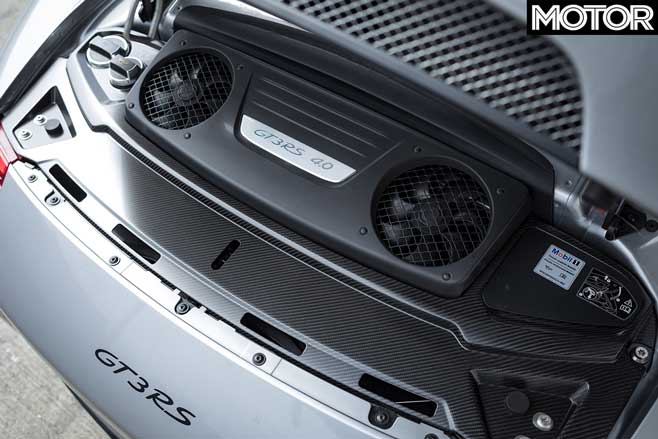
Having forced buyers of the 991 GT3 RS to sacrifice 200rpm in exchange for extra torque, Porsche delivered the full 9000rpm and boosted torque further to boot. Outputs increase only incrementally to 383kW/470Nm, but to extract an extra 15kW/10Nm from an engine this highly stressed required almost a complete re-engineering.
Larger intakes in the rear guards help fill the cylinders and introduce a ram air effect at higher speeds to produce even more power. Internally there are larger diameter bearings for the crankshaft, wider conrod bearings, plasma-coated cylinder linings and a fixed valve train – the valves operated by rocker arms, the clearances set when new using shims.
Oil supply is crucial and the whole system was redesigned, with seven-stage dry-sump lubrication and motorsport technology like defoaming the oil before it is returned to the separate oil tank. Unique ECU settings control the whole show and there’s a different titanium exhaust system. As mentioned, that’s a lot of effort for relatively tiny performance gains, but it’s worth it from behind the wheel.
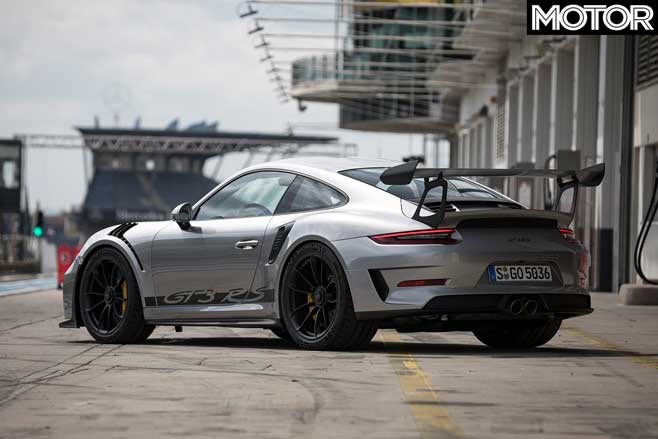
The engine is terrifying in its intensity. Its power and torque peaks of 8250rpm and 6000rpm respectively suggest a peaky delivery, but it’s the mid-range torque that sets this latest 4.0-litre apart. It’s hugely flexible, yet the acceleration only increases as more revs arrive.
You’re almost guaranteed to initially change gears at around 7000rpm as that’s when your senses tell you it’s prudent. Instead, you’re only barely scratching the surface, for the final 2000rpm is when the engine opens its lungs and starts to scream, overwhelming your ears while the blurring scenery dares your eyes to keep up.
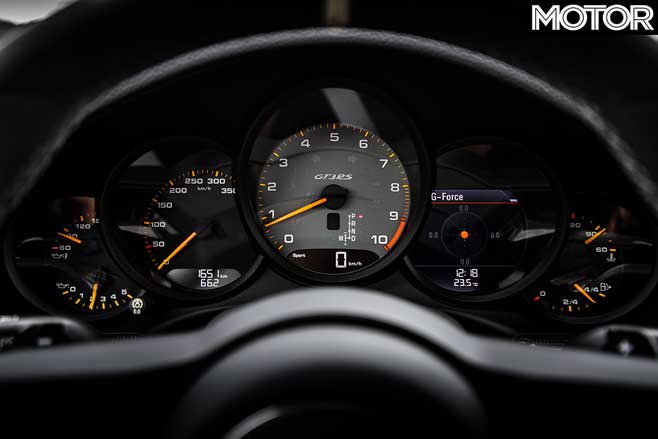
Porsche is historically conservative with power claims and our acceleration figures back this up. Launch control primed, it bolts off the line with the tacho needle swinging back and forth as the electronics attempt to restrain the rear tyres. It doesn’t feel like it could possibly match the brutal efficiency of the latest all-wheel drive warriors but it’s incredibly effective, 0-100km/h taking just 3.18sec, with the quarter mile coming up in 11.07sec at 203.78km/h.
What will they think of next?
Best Drivetrain – Mercedes-AMG GT63 S
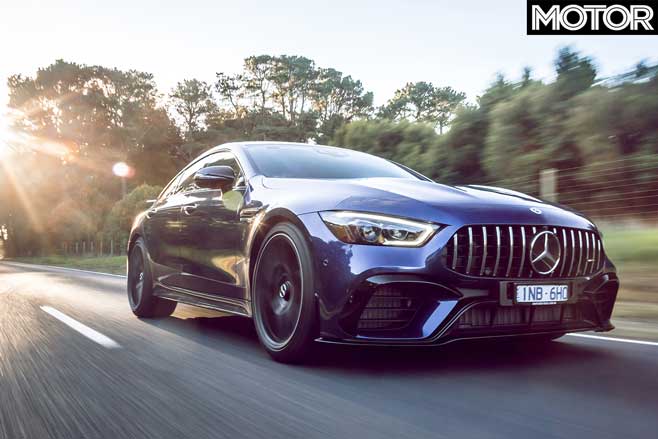
We’ve praised this car’s drivetrain before, back when we first sampled it in the E63 S. Of course it’s now adapted to the bigger five-door, but the principles remain: a twin-turbo 4.0-litre V8 matched to a nine-speed automatic and all-wheel drive that can deliver total grip or decouple for serious skids. Even when it now packs 470kW/900Nm.
Best Noise – Brabham BT62
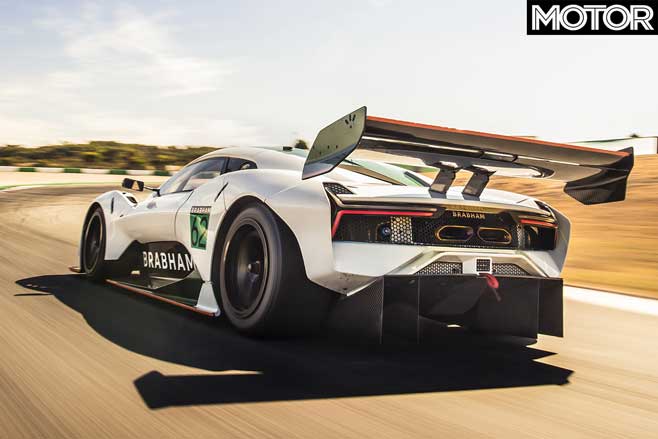
Combine the aggressive sound of a Supercar, the intensity of a V8-era F1 car and the audio finesse of a modern-day supercar and you still probably aren’t imagining how good the Brabham BT62 sounds. An atmo 5.4-litre Ford-derived V8 produces a sound that’s hard to match, and inside the cabin you hear the mechanical whine of the transmission, just like a racecar.
What is it?
A relatively recent addition to the ranks, the RC coupe is best thought of as a two-door version of the IS mid-sized four-door sedan. It shares the same rear-wheel-drive layout, but it’s a bit smaller overall.
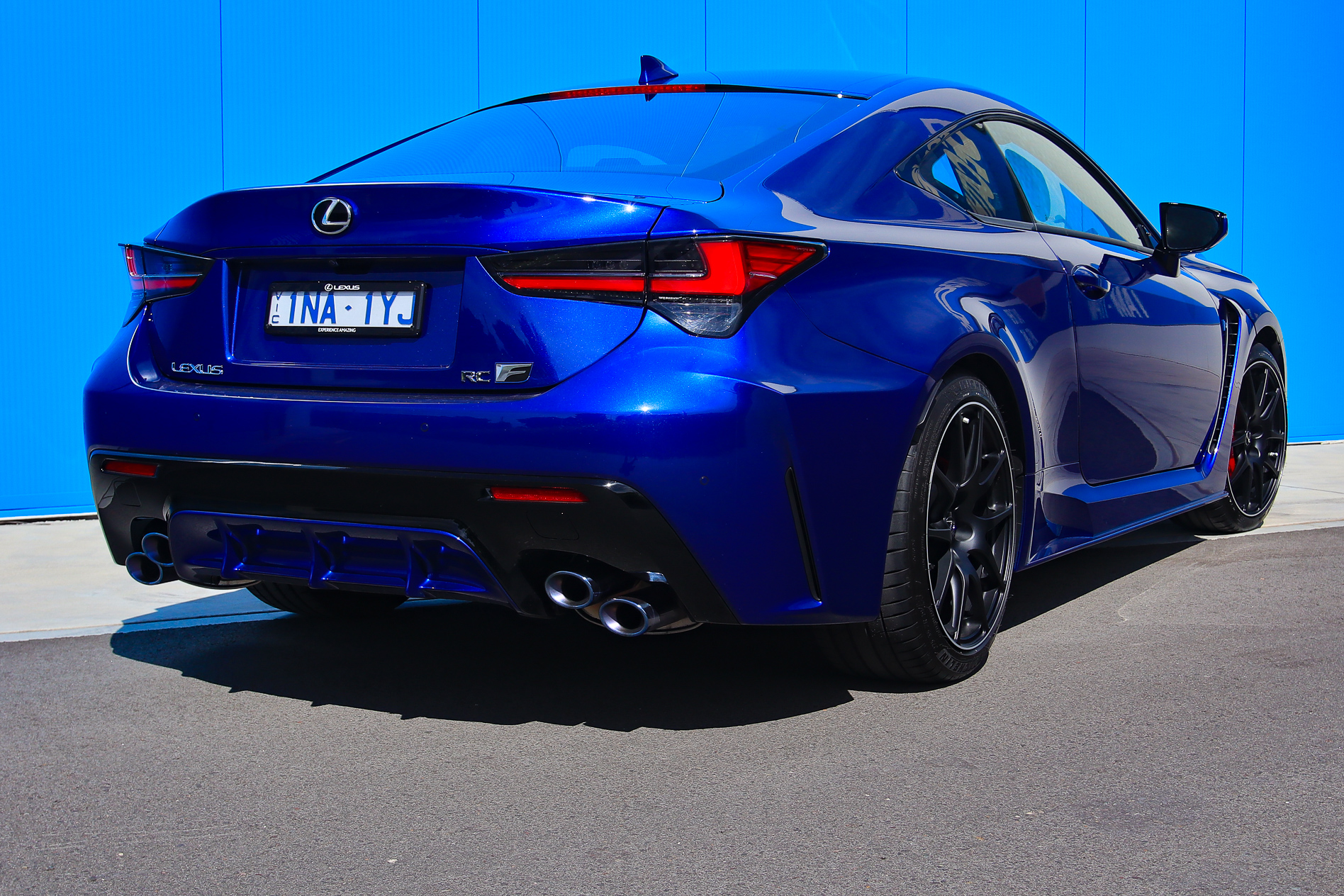
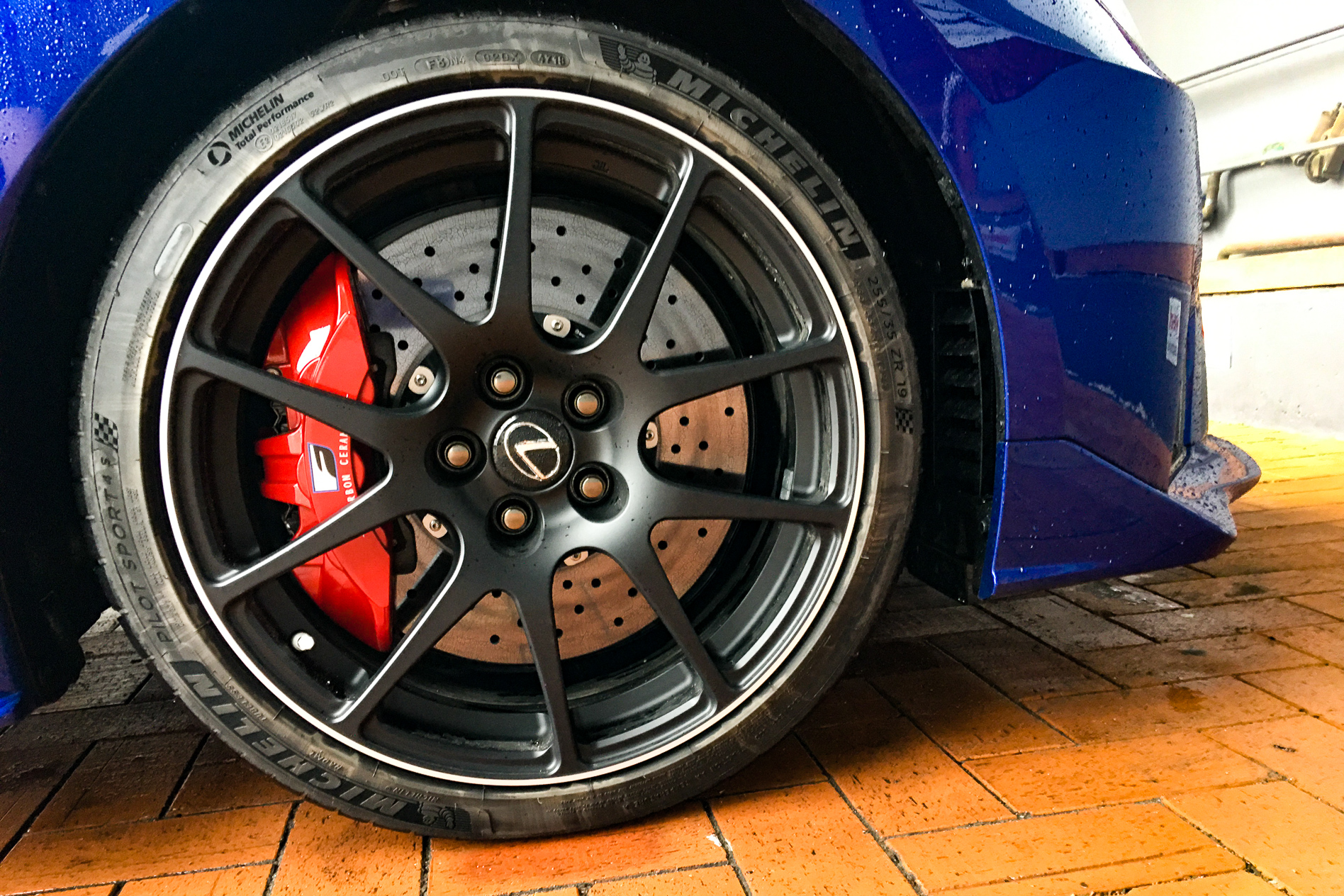
This particular version – the RC F plus Lexus’s Enhancement Pack 3 – is a clever amalgam of the fast and the furious, with the good bits from the top-spec Track Edition (carbon-ceramic brake package, lightweight forged alloy rims from BBS rims and a titanium exhaust) without the overt carbon rear wing, bonnet and guards.
Whenever you say an ‘F’ on the back of a Lexus, it means it’s a go-fast version – and it’s likely packing V8 heat under the bonnet. It’s no different for the LC F, which brings racecar tech like carbon brakes to a brand more renowned for its serenity under pressure. Is it an amicable union?
What is the Lexus RC F like to live with?
Straight off the bat, it’s clear that the RC F is no shrinking violet. An aggressive body kit adorns the stylised two-door bodyshell, while huge 19-inch rims complement its tough-guy ride height.
Luckily, though, the huge front bar has juuuust enough height not to grind itself to death on curbs (below).
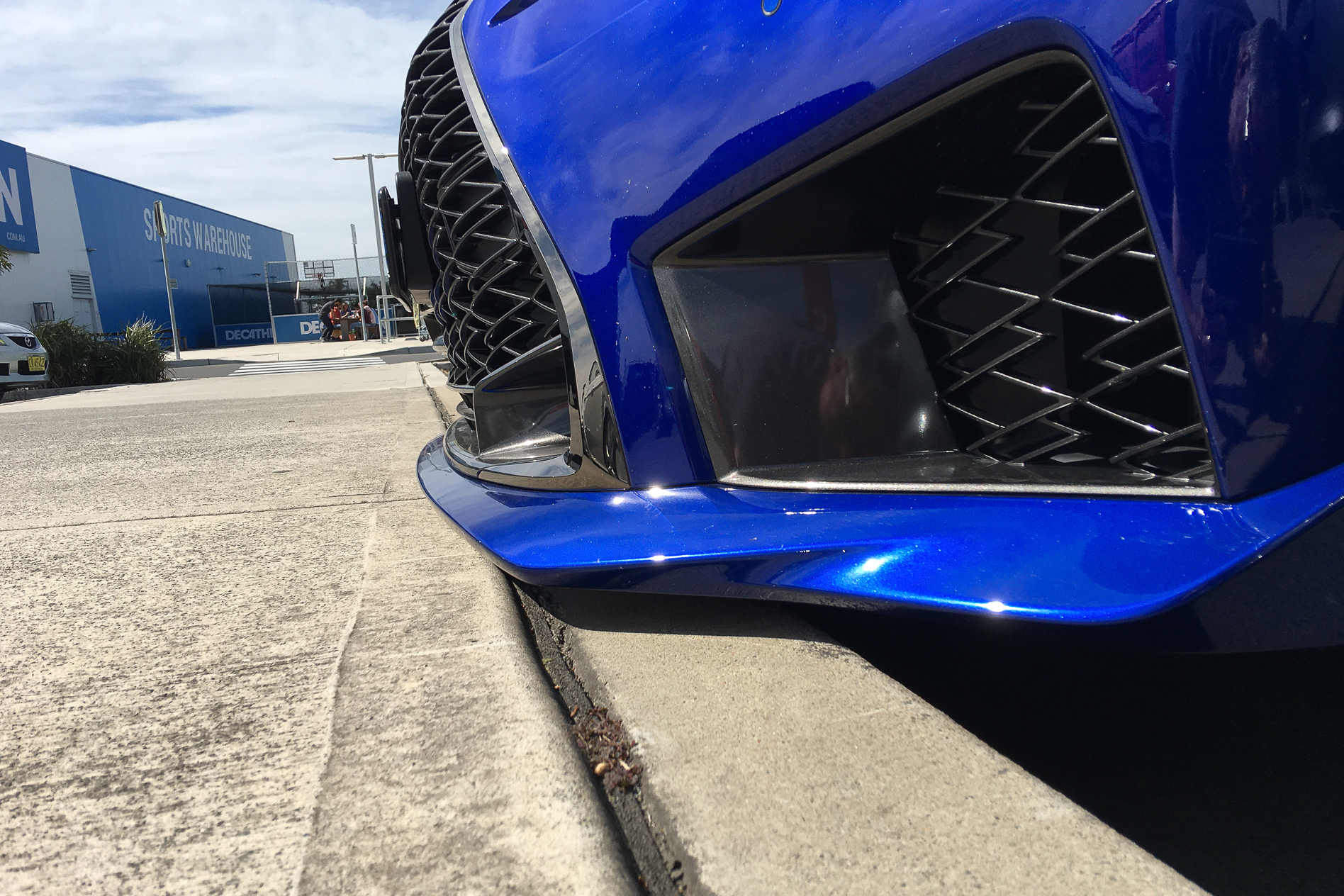
The front end is absolutely dominated by the blackened spindle-shaped grille, with a retractable rear spoiler giving the RC F the best of both worlds when it comes to looks and performance.
Inside, it’s a similar feeling of aggressive opulence. Fixed-headrest racing-style buckets are slung low in the car, with a busy centre binnacle punctuated by machined metal and neatly trimmed leather. The steering wheel is substantial and everywhere the eye falls, there are highlights.
The two rear seats are an afterthought, though, and suitable only for the shortest of journeys by people of average dimensions. They are fitted with ISOFIX baby seat mounts, though.
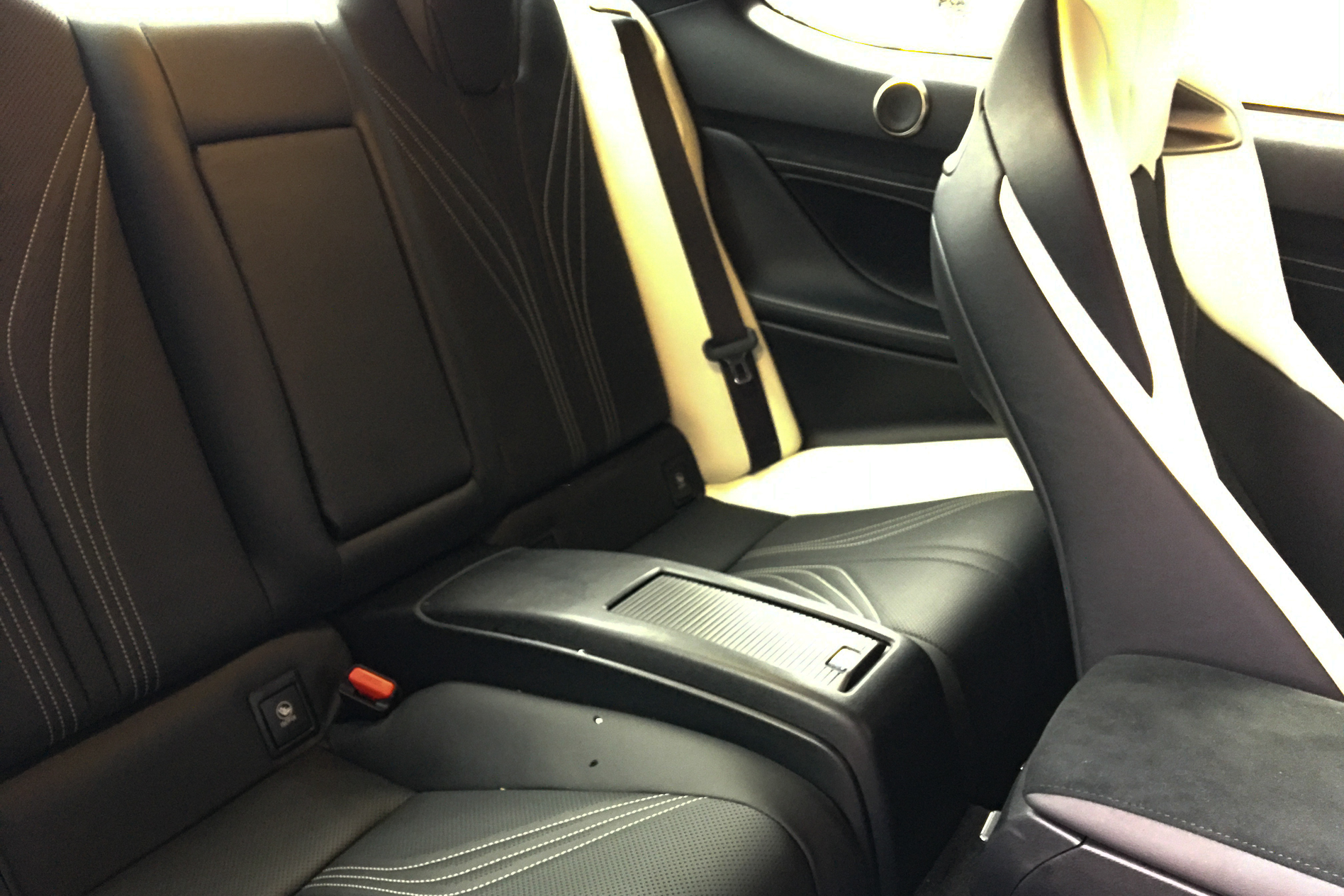
Instrumentation is a mix of classic analogue and more modern digital, and the Lexus is easy to access when it comes to basic functionality. The gearshifter is traditional, the indicator stalk is on the right and primary controls fall easily to hand.
The same can’t be said for the RC F’s ageing multimedia system, with its mouse-style touchpad feeling awkward to use under your fingers and not especially intuitive to access. Thankfully, the RC F now ships with an Apple CarPlay-compatible multimedia system, which brings it into line with its rivals.
Boot space is middling at best thanks to its shallow depth and lack of length, but there is a decently wide aperture for loading bags.
What’s the Lexus RC F like to drive?
V8-powered rear-wheel-drive cars – especially two-door naturally aspirated ones – are a rare breed these days and one that looks as overt as the deep blue RC F always brings with it preconceived notions of blazing speed and lairy manners.
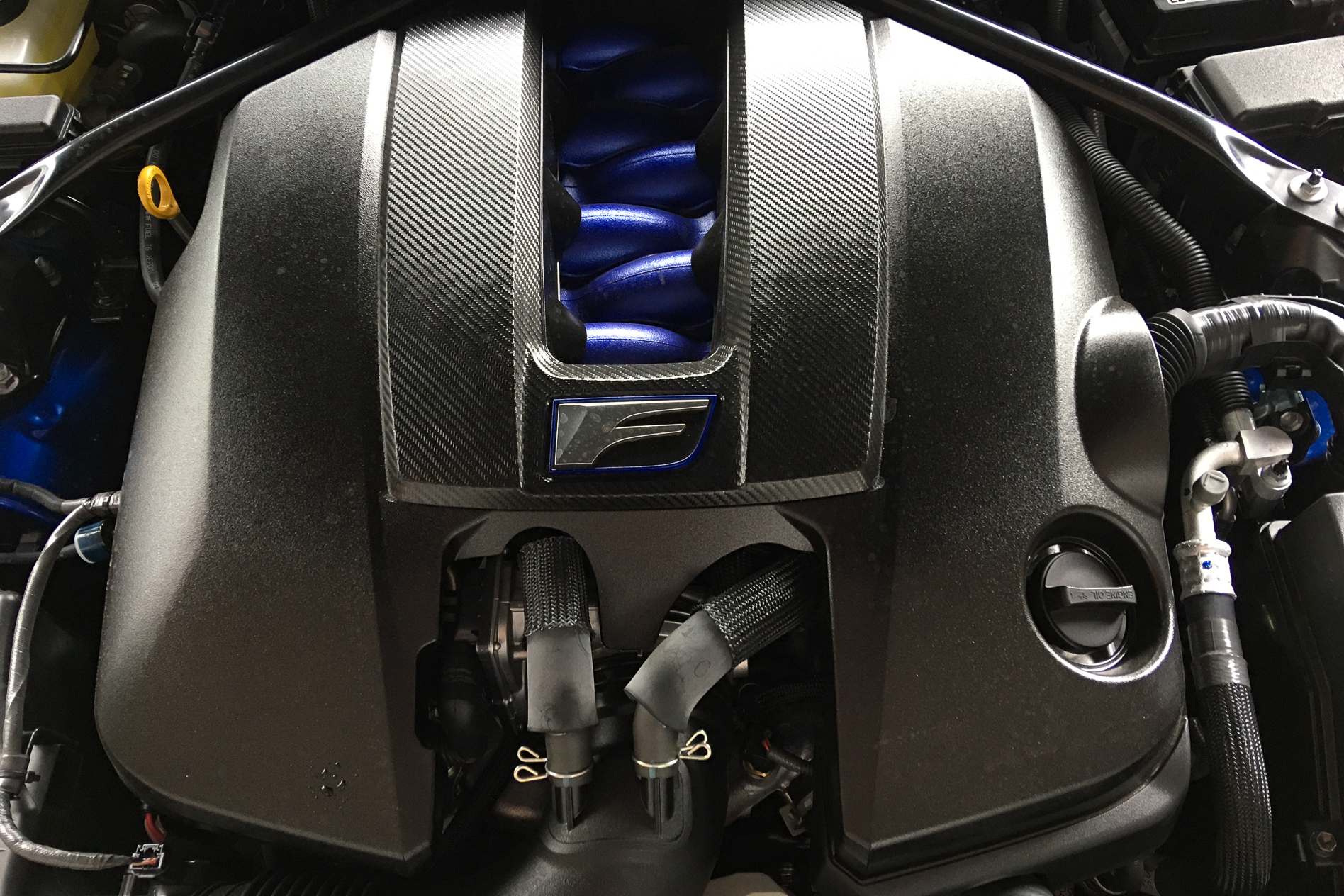
The long-serving 5.0-litre V8 engine under the stretched snout of the RC F dishes out 351kW and 530Nm, which needs to hustle 1800kg of coupe along.
It’s backed by a traditional eight-speed torque-converting auto, which sends all that power and torque to the rear wheels via a hollow driveshaft to a mechanically operated limited-slip diff.
Lexus has worked hard on the finer points of the RC F’s ride/handling balance, and while the RC F is markedly more tied-down than its non-F siblings, there is now a modicum of sophistication and polish in the way the RC F handles the day-to-day of broken city roads and speed bumps.
There’s now more difference between the adaptive damper’s softest and firmest settings, which helps markedly around town; in fact, using the drive select mode to keep the shocks in their softest settings gives the RC F much more flexibility on less-than-perfect back road surfaces.
Power delivery from the silken V8 is laser-straight, and while it feels a little underwhelming at lower revs – we’re all too used to the seductive waft of mid-range torque that a turbo engine produces – things liven up very quickly if you’re in a position to let the RC F rev out to its redline.
For a big car, the RC is agreeably nimble through its direct front end and well-weighted steering, and its carbon-ceramic brakes are a little bitey but absolutely mighty (as they should be for the cost!).
The only fly in the ointment is the lack of shift speed in the eight-speed gearbox. It’s very protective of its engine partner, refusing to approve even moderately ambitious requests for downchanges at key moments.
In full auto, it’s not bad, but there are faster, more engaging gearboxes out there.
Is the Lexus RC F worth the money?
Our tester costs $134,129 plus on-road costs before the addition of the $29,161 Enhancement Kit, bringing it to $163,290 plus on-road costs.
There are some natural predators in the rear-wheel-drive two-door performance class that are priced similarly to the RC F, including the $167,640 Mercedes-AMG C63 coupe and BMW’s $156,529 two-door M4 Competition. My feeling is, though, that the RC F stands a little apart from its European foes.
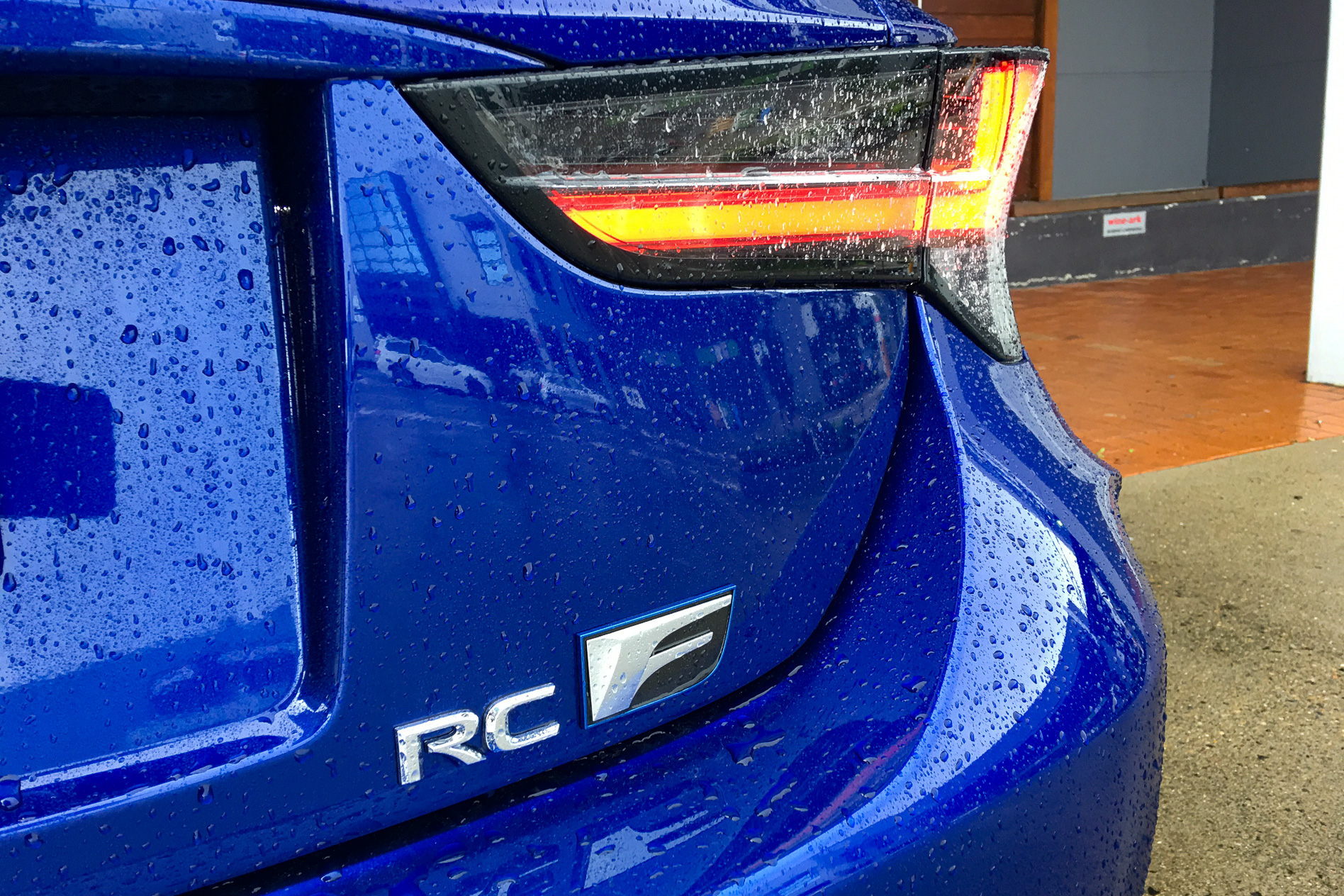
In this guise and at this price point, for example, it’s the only one to offer a ceramic brake package and titanium exhaust.
Lexus also holds an ace up its sleeve; its customer service experience is arguably the best in the industry, and for many people, this can be the tie-breaker when it comes to choosing a premium brand.
In terms of fuel usage, don’t expect hybrid-like economy if you like to hear the V8’s siren song. Against a claim of 11.2 litres per 100km on the combined fuel economy cycle, we used 13.8L/100km over 480km.
With the acceleration and top speed runs at Avalon, a day at Winton and the Hillclimb behind us, it was time to cull our 19-strong field down to six finalists. No one had started talking about a winner yet – but every judge had opinions on what not to keep.
This feature was originally published in MOTOR’s April 2004 issue
The process of paring down the field is based around an overall score out of 80 points. There’s a fair bit of subjectivity in each area of voting (performance, handling, driveability, styling and value) but once the score is committed to paper, that’s it. There’s no tampering to bring any car into the limelight simply because it’d look good on the cover.
All this leads to some major differences of opinion, boiling tempers and, as you can imagine, loads of swearing among the judges. But none of it makes any difference in the final wash-up, because by then the scores have been tallied and those cars not worthy of going on to the hallowed top six are sent packing.
When the potty mouth had died down and the straight jackets removed, the final six weren’t too far from each of the judges’ personal favourites. So, although the following deserve praise for making it into the Performance Car of the Year field this year, in the end they just didn’t show the sort of mettle needed to be within the top six.
CSV Mondo GT370R
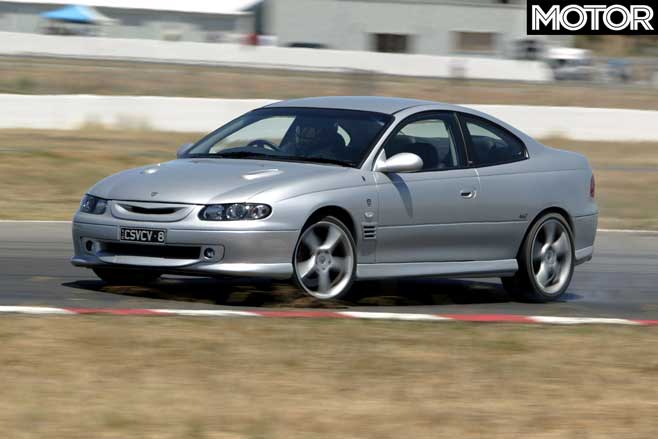
Brawny? You bet. Delicate? No way. The Mondo is a car you cherish one minute and curse the next.
There’s no doubting its straight-line ability. With that giant 6.5-litre lump of V8 iron, the GT370R flew down the strip, second only to the Gallardo on top speed. It also put up a mighty showing at Winton, where its ability to lay power down early on smooth surfaces and rapid acceleration saw it slot into the top four.
It was a vastly different story on the road, however. The chassis felt overstretched and the suspension less than resolved on anything but the smoothest of roads. Give it too much leash and it would bite back – hard!
PCOTY 2004 Results – 19th
0-100km/h: 5.52sec 0-400m: 13.60sec @ 177.0km/h 0-1000m: 24.10sec @ 224.6km/h Top Speed: 282km/h Winton Lap Time: 1min 42.71sec
Judges’ Scores
| Judge | MT | JT | DE | CM | GK | DM | LB |
| Performance (/20) | 18 | 20 | 17 | 17 | 18 | 16 | 17 |
| Dynamics (/20) | 8 | 8 | 11 | 14 | 15 | 13 | 8 |
| Driveability (/20) | 9 | 8 | 10 | 13 | 7 | 13 | 8 |
| Design & Function (/10) | 8 | 5 | 6 | 8 | 6 | 5 | 4 |
| Value (/10) | 5 | 3 | 4 | 7 | 5 | 3 | 4 |
| Total (/80) | 48 | 44 | 48 | 59 | 51 | 50 | 41 |
Total Score: 341/560 Votes: 0
Chrysler Crossfire
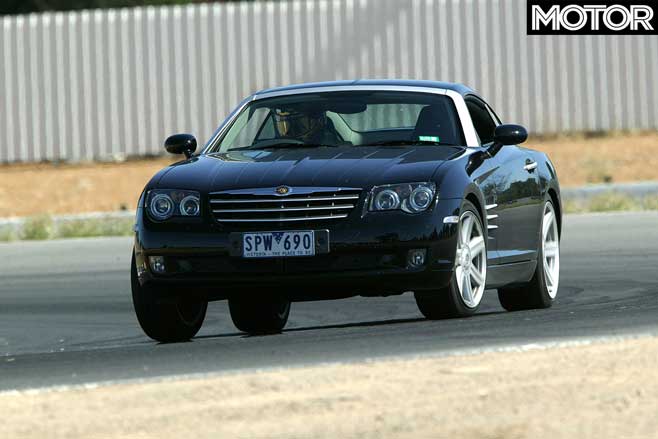
Like many that failed to make the grade, the Crossfire did most things reasonably well but failed to leave any lasting impression. “Safe but unexciting” was the general consensus.
The Misfire was one of the slowest cars at Avalon. It did manage to redeem itself at Winton, however, finishing inside the top 10 on lap time, thanks to the grip generated by its enormous wheel and tyre package. But in other areas – steering, throttle response, brakes – it just felt too stodgy. The DSC kept interfering just when we were starting to have fun, too.
PCOTY 2004 Results – 18th
0-100km/h: 7.27sec 0-400m: 15.07sec @ 151.0km/h 0-1000m: 27.37sec @ 193.8km/h Top Speed: 233km/h Winton Lap Time: 1min 44.87sec
Judges’ Scores
| Judge | MT | JT | DE | CM | GK | DM | LB |
| Performance (/20) | 12 | 12 | 11 | 17 | 13 | 11 | 10 |
| Dynamics (/20) | 12 | 13 | 10 | 16 | 12 | 15 | 14 |
| Driveability (/20) | 16 | 13 | 13 | 14 | 14 | 16 | 13 |
| Design & Function (/10) | 4 | 5 | 5 | 6 | 6 | 7 | 7 |
| Value (/10) | 5 | 3 | 2 | 6 | 6 | 5 | 7 |
| Total (/80) | 49 | 46 | 41 | 59 | 51 | 54 | 51 |
Total Score: 351/560 Votes: 0
Alfa Romeo 147 GTA
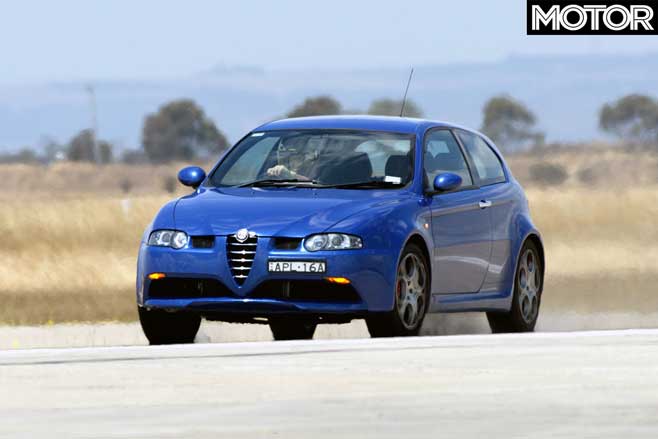
The Alfa was a car everyone wanted to see do well, but it just didn’t come together. It was the fastest of the hatches at Avalon but displayed some nasty torque steer when punting hard and a penchant for spinning its inside wheel in tight corners. With all-wheel drive it’d probably be a match for a WRX. As it stands, it just can’t match the efforts of its superb engine.
PCOTY 2004 Results – 17th
0-100km/h: 7.24sec 0-400m: 15.06sec @ 156.5km/h 0-1000m: 26.96sec @ 200.0km/h Top Speed: 239km/h Winton Lap Time: 1min 47.21sec
Judges’ Scores
| Judge | MT | JT | DE | CM | GK | DM | LB |
| Performance (/20) | 14 | 13 | 13 | 17 | 15 | 10 | 7 |
| Dynamics (/20) | 10 | 13 | 12 | 15 | 13 | 14 | 15 |
| Driveability (/20) | 14 | 12 | 14 | 15 | 13 | 14 | 12 |
| Design & Function (/10) | 6 | 5 | 7 | 8 | 6 | 7 | 6 |
| Value (/10) | 5 | 5 | 5 | 7 | 6 | 5 | 7 |
| Total (/80) | 49 | 48 | 51 | 62 | 53 | 50 | 47 |
Total Score: 360/560 Votes: 0
Holden Commodore SS
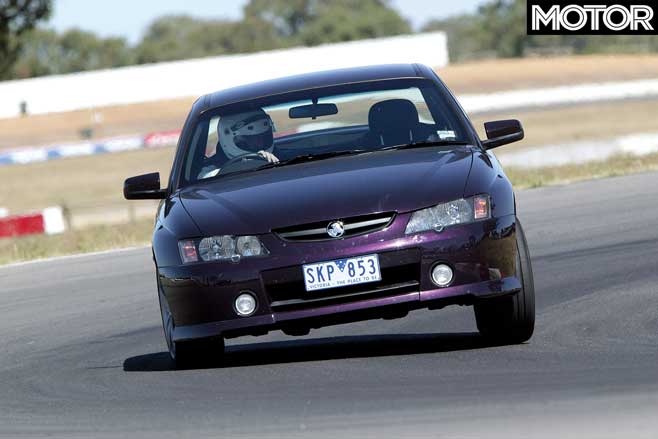
The General’s PCOTY hope didn’t want for pace, not with a raucous 245kW 5.7-litre V8 and only 1658kg to shift. But there were far more rewarding alternatives in this bunch when we took to Winton and the Hillclimb.
The problem with the SS is that it lacks the handling finesse of much of the assembled competition – its steering and body control coming in for particularly harsh treatment from the judges. Not even its keen price could bring it back into the reckoning.
PCOTY 2004 Results – 16th
0-100km/h: 6.48sec 0-400m: 14.50sec @ 162.5km/h 0-1000m: 25.95sec @ 207.8km/h Top Speed: 251km/h Winton Lap Time: 1min 46.13sec
Judges’ Scores
| Judge | MT | JT | DE | CM | GK | DM | LB |
| Performance (/20) | 13 | 14 | 14 | 13 | 16 | 12 | 12 |
| Dynamics (/20) | 8 | 13 | 15 | 14 | 11 | 10 | 12 |
| Driveability (/20) | 14 | 13 | 16 | 13 | 14 | 13 | 14 |
| Design & Function (/10) | 6 | 6 | 7 | 7 | 5 | 7 | 7 |
| Value (/10) | 7 | 5 | 6 | 8 | 6 | 6 | 7 |
| Total (/80) | 48 | 51 | 58 | 55 | 52 | 48 | 52 |
Total Score: 364/560 Votes: 0
Bentley Continental GT
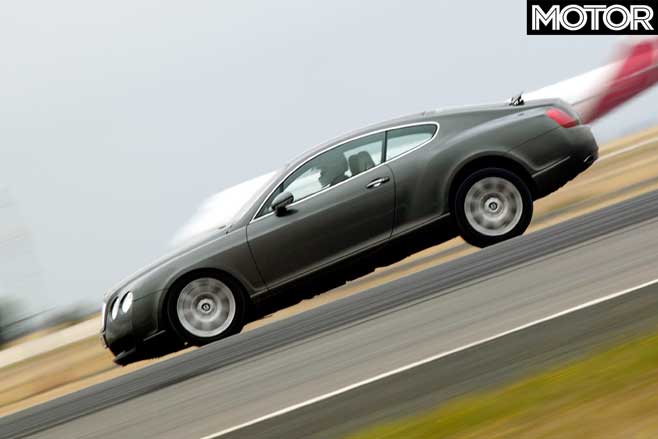
If Cockburn had his way, I’m sure this car would be planted big on the cover under the words “Performance Car of the Year”. Our resident Anglophile and the big Bentley were nigh on inseparable. But at the expense of shattering his dream, it was swimming in the wrong pool. It’s a sublime, fast GT, but not a PCOTY champ.
Yeah, the Continental GT is bloody quick in a straight line, slotting in behind only the Lamborghini and CSV for top speed at Avalon. The really astonishing thing is just how easy it is to come close to 300km/h in Crewe’s imposing leather and walnut-lined coupe. You simply plant your right foot and hold the wheel straight. The twin-turbo W12 hardly sounds like it’s working at all.
At Winton, however, the Bentley felt ponderous and lacking in any real feedback. Even the stiffest of the air suspension’s four settings failed to rein in big amounts of body movement. Someone said it was like watching a rhino on ice skates. The Continental GT is right at home on motorways and flowing secondary roads; just don’t ask too much of it on twisty strips of bitumen.
PCOTY 2004 Results – 15th
0-100km/h: 6.06sec 0-400m: 13.88sec @ 171.9km/h 0-1000m: 24.58sec @ 225.9km/h Top Speed: 280km/h Winton Lap Time: 1min 45.03sec
Judges’ Scores
| Judge | MT | JT | DE | CM | GK | DM | LB |
| Performance (/20) | 15 | 16 | 14 | 17 | 17 | 16 | 14 |
| Dynamics (/20) | 11 | 10 | 13 | 13 | 10 | 12 | 10 |
| Driveability (/20) | 16 | 16 | 15 | 16 | 17 | 15 | 15 |
| Design & Function (/10) | 4 | 5 | 7 | 7 | 6 | 6 | 8 |
| Value (/10) | 6 | 3 | 3 | 7 | 4 | 2 | 7 |
| Total (/80) | 52 | 50 | 52 | 60 | 54 | 51 | 54 |
Total Score: 373/560 Votes: 0
Porsche Cayenne Turbo
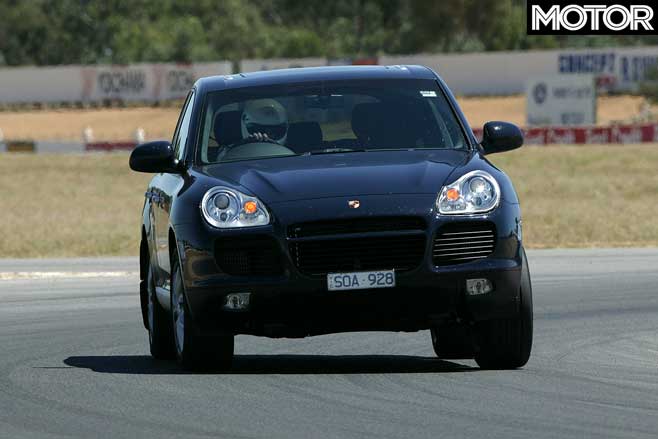
If PCOTY proved one thing, it was that the 2355kg Cayenne is no sports car – not in the Porsche mould, anyway. Yes, the twin-turbo 4.5-litre V8 did a stellar job of hurtling the Cayenne down the strip. But show it a corner and the laws of physics soon conspire to wipe the smile off your face.
A combination of all that weight and generous height sees the body heave and understeer quickly build until you’re forced to back off early to keep it all under control. In the end it’s better to back off and allow the Porsche to do what it does best: cruise. But that’s not the real spirit of Porsche, is it?
PCOTY 2004 Results – 14th
0-100km/h: 6.48sec 0-400m: 14.49sec @ 159.7km/h 0-1000m: 26.10sec @ 205.6km/h Top Speed: 250km/h Winton Lap Time: 1min 46.12sec
Judges’ Scores
| Judge | MT | JT | DE | CM | GK | DM | LB |
| Performance (/20) | 18 | 15 | 16 | 16 | 17 | 8 | 17 |
| Dynamics (/20) | 9 | 9 | 14 | 14 | 10 | 9 | 13 |
| Driveability (/20) | 15 | 14 | 16 | 16 | 16 | 15 | 17 |
| Design & Function (/10) | 6 | 5 | 6 | 8 | 5 | 7 | 7 |
| Value (/10) | 6 | 4 | 5 | 7 | 5 | 4 | 7 |
| Total (/80) | 54 | 47 | 57 | 61 | 53 | 43 | 61 |
Total Score: 376/560 Votes: 0
Volvo S60 R
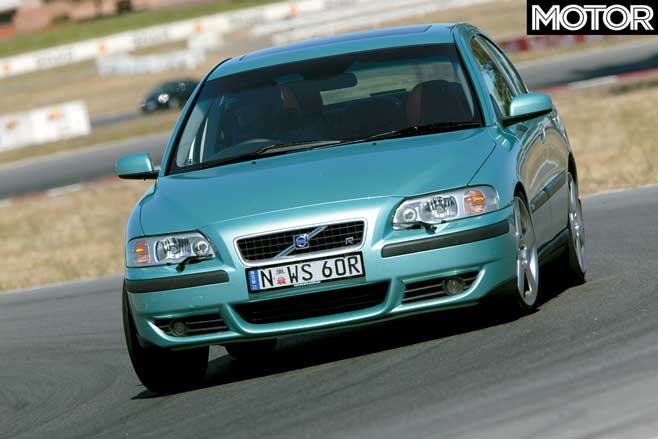
The Volvo was let down mainly by its lack of real involvement and an odd suspension set-up that lacks damping control.
Hardly distinguished at Avalon, it also languished towards the tail of the field at Winton, where poor steering and dull brakes conspired to spoil any headway won by its torquey engine and grippy chassis.
On the road, the Volvo felt more at home. But only if you had its suspension pegged to comfort. Choose sport mode and the damping becomes too stiff for its own good, creating sharp vertical movements that upset momentum and have you backing off way before you would in other cars assembled here.
PCOTY 2004 Results – 13th
0-100km/h: 6.38sec 0-400m: 14.58sec @ 156.6km/h 0-1000m: 26.40sec @ 204.0km/h Top Speed: 250km/h Winton Lap Time: 1min 47.00sec
Judges’ Scores
| Judge | MT | JT | DE | CM | GK | DM | LB |
| Performance (/20) | 14 | 12 | 14 | 16 | 14 | 12 | 17 |
| Dynamics (/20) | 9 | 14 | 16 | 15 | 12 | 13 | 12 |
| Driveability (/20) | 16 | 13 | 14 | 16 | 16 | 16 | 15 |
| Design & Function (/10) | 6 | 6 | 7 | 7 | 6 | 8 | 7 |
| Value (/10) | 6 | 3 | 3 | 5 | 6 | 6 | 6 |
| Total (/80) | 51 | 48 | 54 | 59 | 54 | 55 | 57 |
Total Score: 378/560 Votes: 0
Jaguar XJR
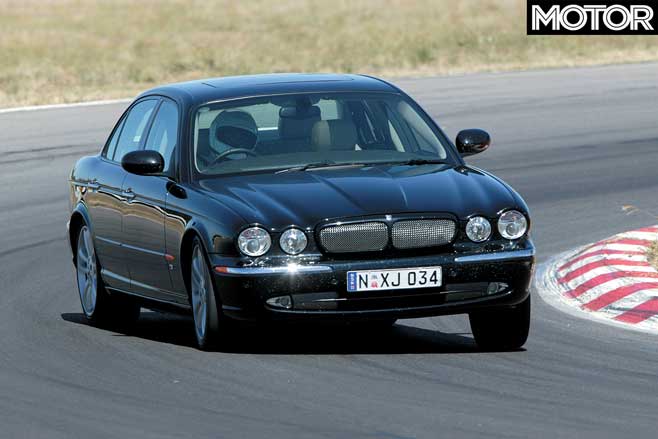
Something wasn’t quite right with the Jag’s gearbox and brakes. McConville reported a “big clunk” from underneath while hot lapping it at Winton, and the brakes were very second-hand after a couple of runs, after which we didn’t have the heart to keep pushing.
Up until then, however, it had proved capable if not exactly scintillating company. The XJR’s supercharged 4.2-litre V8 is incredibly smooth, impressing at Avalon by being just 0.4sec shy of the Lambo on 0-100km/h acceleration, despite its lack of outright brawn.
But it was a different story at the track. Big body movements conspired to strip away confidence during hard cornering, and it was also difficult to catch once it decided to let go, owing to slow steering and a general lack of feel.
That said, the Jaguar’s keys were always snapped up quickly when it was time to hit the road. This speaks volumes for its character. It’s a superb cruiser; just don’t make the mistake of calling it a sports car.
PCOTY 2004 Results – 12th
0-100km/h: 5.79sec 0-400m: 13.96sec @ 167.0km/h 0-1000m: 25.17sec @ 214.6km/h Top Speed: 252km/h Winton Lap Time: 1min 45.94sec
Judges’ Scores
| Judge | MT | JT | DE | CM | GK | DM | LB |
| Performance (/20) | 17 | 14 | 12 | 16 | 17 | 12 | 16 |
| Dynamics (/20) | 10 | 10 | 11 | 13 | 12 | 12 | 10 |
| Driveability (/20) | 18 | 17 | 15 | 14 | 15 | 16 | 16 |
| Design & Function (/10) | 6 | 6 | 7 | 7 | 6 | 8 | 6 |
| Value (/10) | 8 | 5 | 4 | 7 | 5 | 4 | 7 |
| Total (/80) | 59 | 52 | 49 | 57 | 55 | 52 | 55 |
Total Score: 379/560 Votes: 0
Holden Astra SRi Turbo
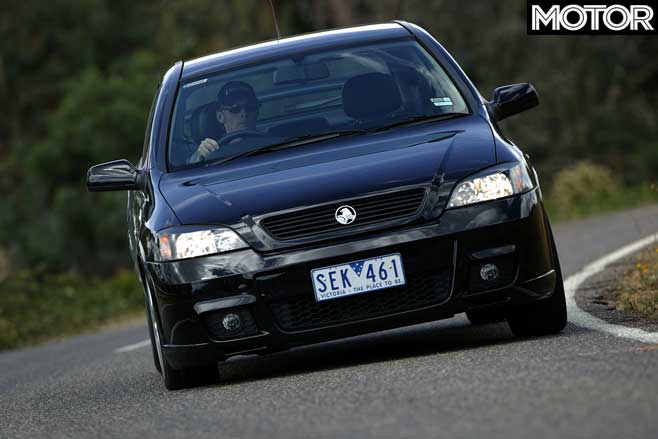
Our BFYB champion might offer solid performance for your dollar, but that doesn’t automatically place it at the pointy end of the field here. It was dead last in all but the standing kilometre split at Avalon and trailed the field again at Winton, despite the efforts of its energetic 2.0-litre turbo engine.
On the track, the Astra was hampered by a tendency to spin its inside front wheel in corners and the odd torque steer moment. It’s fun on the road, but like the Alfa it can’t really cope with all that power going through the front wheels.
PCOTY 2004 Results – 11th
0-100km/h: 7.42sec 0-400m: 15.44sec @ 149.2km/h 0-1000m: 27.86sec @ 194.7km/h Top Speed: 232km/h Winton Lap Time: 1min 48.14sec
Judges’ Scores
| Judge | MT | JT | DE | CM | GK | DM | LB |
| Performance (/20) | 11 | 10 | 13 | 14 | 14 | 7 | 18 |
| Dynamics (/20) | 15 | 13 | 15 | 14 | 12 | 10 | 12 |
| Driveability (/20) | 16 | 15 | 17 | 15 | 14 | 15 | 13 |
| Design & Function (/10) | 7 | 8 | 7 | 8 | 7 | 7 | 9 |
| Value (/10) | 8 | 7 | 8 | 7 | 8 | 7 | 8 |
| Total (/80) | 57 | 53 | 60 | 58 | 55 | 46 | 60 |
Total Score: 389/560 Votes: 0
Subaru Liberty GT
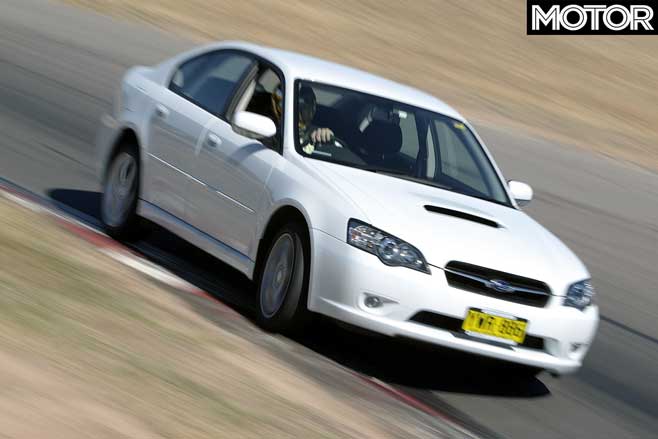
Everyone agreed the Liberty was great fun on the road, where the modest power from its turbocharged 2.0-litre flat four, sharp steering and superb balance held it in good stead. But at Avalon and Winton the Subaru found itself towards the bottom of the timing sheets. Part of the problem rests with its five-speed automatic, which is difficult to operate and anything but the latest in gearbox technology.
PCOTY 2004 Results – 10th
0-100km/h: 6.90sec 0-400m: 14.99sec @ 150.2km/h 0-1000m: 27.60sec @ 189.4km/h Top Speed: 234km/h Winton Lap Time: 1min 47.06sec
Judges’ Scores
| Judge | MT | JT | DE | CM | GK | DM | LB |
| Performance (/20) | 13 | 10 | 13 | 13 | 14 | 11 | 15 |
| Dynamics (/20) | 13 | 14 | 17 | 13 | 14 | 13 | 15 |
| Driveability (/20) | 16 | 15 | 18 | 14 | 14 | 17 | 16 |
| Design & Function (/10) | 7 | 6 | 8 | 6 | 6 | 8 | 7 |
| Value (/10) | 6 | 7 | 6 | 7 | 7 | 4 | 7 |
| Total (/80) | 55 | 52 | 62 | 53 | 55 | 53 | 60 |
Total Score: 390/560 Votes: 0
FPV Falcon GT
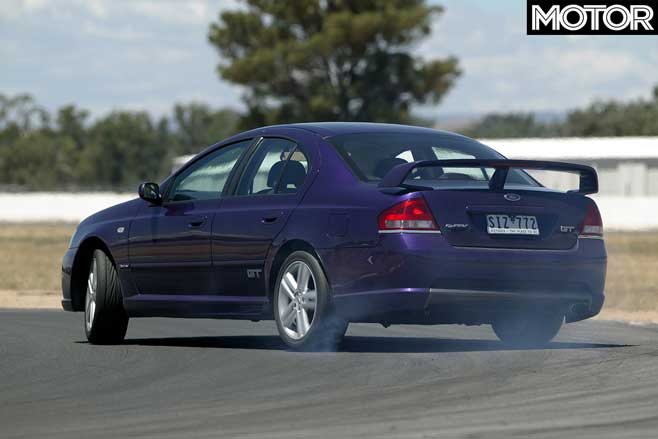
If engine note was the sole criteria by which this contest was judged, the GT might have stayed the distance. But despite the efforts of its 5.4-litre V8, it never got ahead of the Clubbie at Avalon. Put that down to its hefty 1835kg kerb weight.
Winton wasn’t kind to the big Ford, either. An inability to get the power down early saw it drop down the leader board. Its on-limit behaviour is actually quite good, but it’s not as progressive as the Clubbie and offers less feedback. Personally, I had an issue with the level of grip at the front, which is very softly sprung.
PCOTY 2004 Results – 9th
0-100km/h: 6.32sec 0-400m: 14.52sec @ 162.8km/h 0-1000m: 25.81sec @ 209.7km/h Top Speed: 254km/h Winton Lap Time: 1min 45.57sec
Judges’ Scores
| Judge | MT | JT | DE | CM | GK | DM | LB |
| Performance (/20) | 14 | 15 | 14 | 16 | 16 | 11 | 11 |
| Dynamics (/20) | 16 | 14 | 13 | 13 | 13 | 14 | 16 |
| Driveability (/20) | 18 | 14 | 16 | 15 | 14 | 15 | 18 |
| Design & Function (/10) | 7 | 7 | 7 | 7 | 6 | 8 | 8 |
| Value (/10) | 5 | 8 | 7 | 8 | 7 | 6 | 8 |
| Total (/80) | 60 | 58 | 57 | 59 | 56 | 54 | 61 |
Total Score: 405/560 Votes: 0
Mazda RX-8
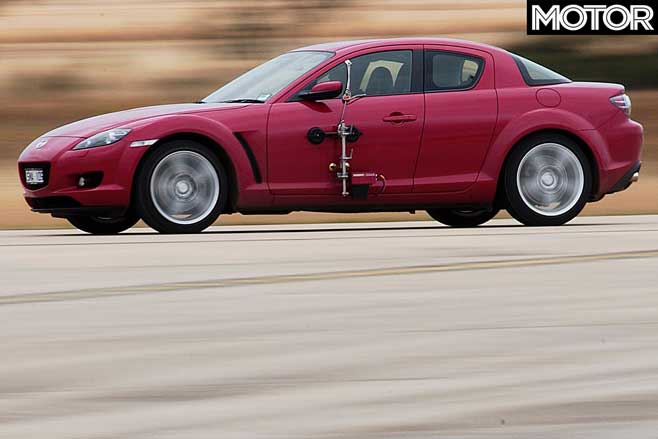
A raging favourite early, and so astonishingly agile and entertaining on the Hillclimb that plenty of judges tried to squeeze seven into six. But it didn’t go, and you can take that both ways. Its biggest point of difference – the engine – was also the biggest shortfall.
In a straight sprint it didn’t lose out by much, but in the real world, when you ask for it to torque to you, it falls short, especially against the Zed. A brilliant piece of engineering in so many ways, it was quirky enough to have bags of turn-in oversteer at Winton, then felt serenely progressive on the Hillclimb’s bumps and cambers. Unbelievably good brakes helped, too.
In short, though, the chassis carries the engine. Perhaps Mazda would have been better off with a turbocharged Mazda6 mill. Instead of being its deal-sealer, the rotary is, in this company, its downfall.
PCOTY 2004 Results – 8th
0-100km/h: 6.58sec 0-400m: 14.58sec @ 156.6km/h 0-1000m: 26.50sec @ 199.8km/h Top Speed: 235km/h Winton Lap Time: 1min 44.62sec
Judges’ Scores
| Judge | MT | JT | DE | CM | GK | DM | LB |
| Performance (/20) | 14 | 13 | 14 | 14 | 15 | 12 | 10 |
| Dynamics (/20) | 17 | 14 | 17 | 15 | 16 | 15 | 17 |
| Driveability (/20) | 14 | 13 | 19 | 17 | 15 | 16 | 17 |
| Design & Function (/10) | 7 | 6 | 9 | 8 | 8 | 6 | 9 |
| Value (/10) | 8 | 7 | 9 | 8 | 8 | 6 | 8 |
| Total (/80) | 60 | 53 | 68 | 62 | 62 | 55 | 61 |
Total Score: 421/560 Votes: 0
Audi S4
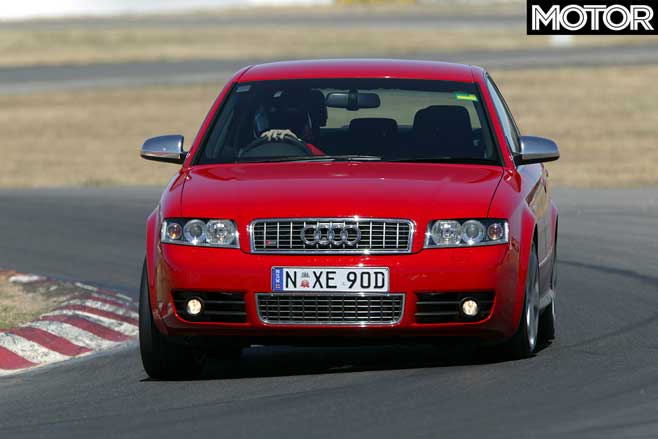
Boy, did this car create debate among the judges. Some loathed it. Others loved it.
Two things mould the S4’s character above all else: its responsive (if not blazingly powerful) 4.2-litre V8 and its traction-inducing all-wheel-drive underpinnings. It’s a ridiculously easy car to drive fast. Try harder in corners, though, and while initial grip is strong, it eventually pushes wide of the apex. The steering is nicely weighted but a little slow to respond to sudden directional changes. Drama is conspicuous only by its absence, which, depending on your priorities, is either a good or bad thing.
The appeal of the S4 is very much the same as with the RS 6: efficient and quick, except that you haven’t got anywhere near as much power to play with and it’s not as well tied down in the twisty stuff.
PCOTY 2004 Results – 7th
0-100km/h: 6.26sec 0-400m: 14.38sec @ 160.4km/h 0-1000m: 25.81sec @ 212.0km/h Top Speed: 261km/h Winton Lap Time: 1min 44.31sec
Judges’ Scores
| Judge | MT | JT | DE | CM | GK | DM | LB |
| Performance (/20) | 14 | 17 | 14 | 17 | 18 | 14 | 16 |
| Dynamics (/20) | 13 | 15 | 17 | 15 | 16 | 13 | 16 |
| Driveability (/20) | 17 | 17 | 18 | 17 | 16 | 17 | 19 |
| Design & Function (/10) | 7 | 7 | 8 | 8 | 9 | 7 | 9 |
| Value (/10) | 6 | 7 | 6 | 8 | 7 | 4 | 6 |
| Total (/80) | 57 | 63 | 63 | 65 | 66 | 55 | 66 |
Total Score: 435/560 Votes: 0
Thirty-nine years later, Wheels’ infamous March 1980 ‘lemon-on-wheels’ cover remains the most controversial in the magazine’s history. Ford assumed the beautiful new XD Falcon would romp home in COTY. But this ignored the reality of the XD being little more than a reskin of the XC: still with leaf rear springs, manual steering with almost 5.5 turns lock-to-lock, and mediocre ride and handling.
Nobody took the perceived slight more personally than Edsel Ford II, then deputy managing director of Ford’s Australian outpost and head of sales and marketing. And the son of Henry the Deuce, Ford’s chairman.
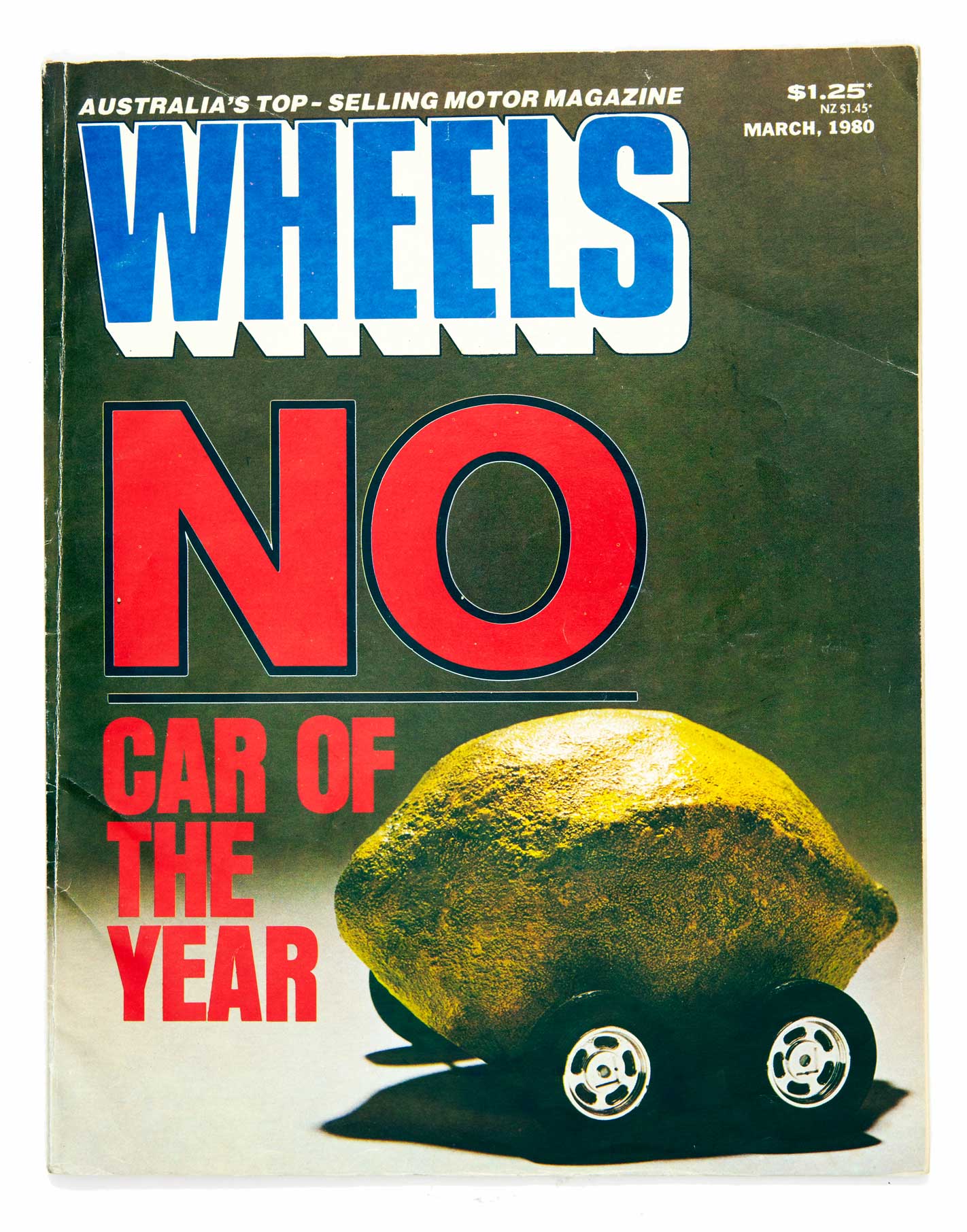
Ford’s brilliant response, a full-page advertisement of 31 lemons, each carrying the name of a car that didn’t win COTY, appeared just once, in Wheels’ June 1980 edition, with this message: “There are times when being a lemon is not a bitter experience at all.” As Wheels editor, I sent Edsel a framed copy of our cover and the advertisement, and for years it hung on the inside door of a toilet in his home.
In late 1980, when it was announced that Edsel was returning to Dearborn, David Robertson, then motoring editor of The Sydney Morning Herald, sat down with Edsel for a long and remarkably revealing interview that appeared in Wheels, February 1981. It is the best story the still missed Davey Rob, who was killed on a car launch in December 1993, ever wrote.
The normally affable and easygoing Edsel admitted that when he had arrived in Australia as a 28-year-old, he had needed to learn to, “engage my brain before my mouth”.
“I came down here thinking I knew everything … I really knew nothing…
“When I first came here I know I said I did want to succeed my father. I thought my ultimate goal in life was to run the Ford Motor Company.”
Edsel then admitted to David that that was no longer the case.
Finally, it was Edsel, having previously refused to talk to Wheels about the COTY decision, who raised the subject.
“Before I came here the people in Dearborn said the Australian press were the toughest in the world. I think that still holds true … I think our products have been mistreated by certain members of the media. I think that’s very, very, unfortunate.”
David asked if he meant Wheels?
“Yes, I do,” he said. “I can only judge it on the grounds of the stories that have been written … It is my greatest single disappointment in my time in Australia that we didn’t win the COTY award … The Falcon you see today is the last car to ever be produced in Australia that was designed, engineered and manufactured by Australians, for Australians. I think that that sheer fact alone would have been the criteria for giving Falcon COTY. I think it’s a great Australian tragedy.”
Edsel misread history. There would be three more new Australian Falcons – EA, AU and FG, with the BA reskin and engineering update finally winning COTY in 2002 – and a further three generations of all-new Australian Commodores.
“I will go to my grave feeling as if Ford Australia has been cheated. It really hurts me and it always will.”
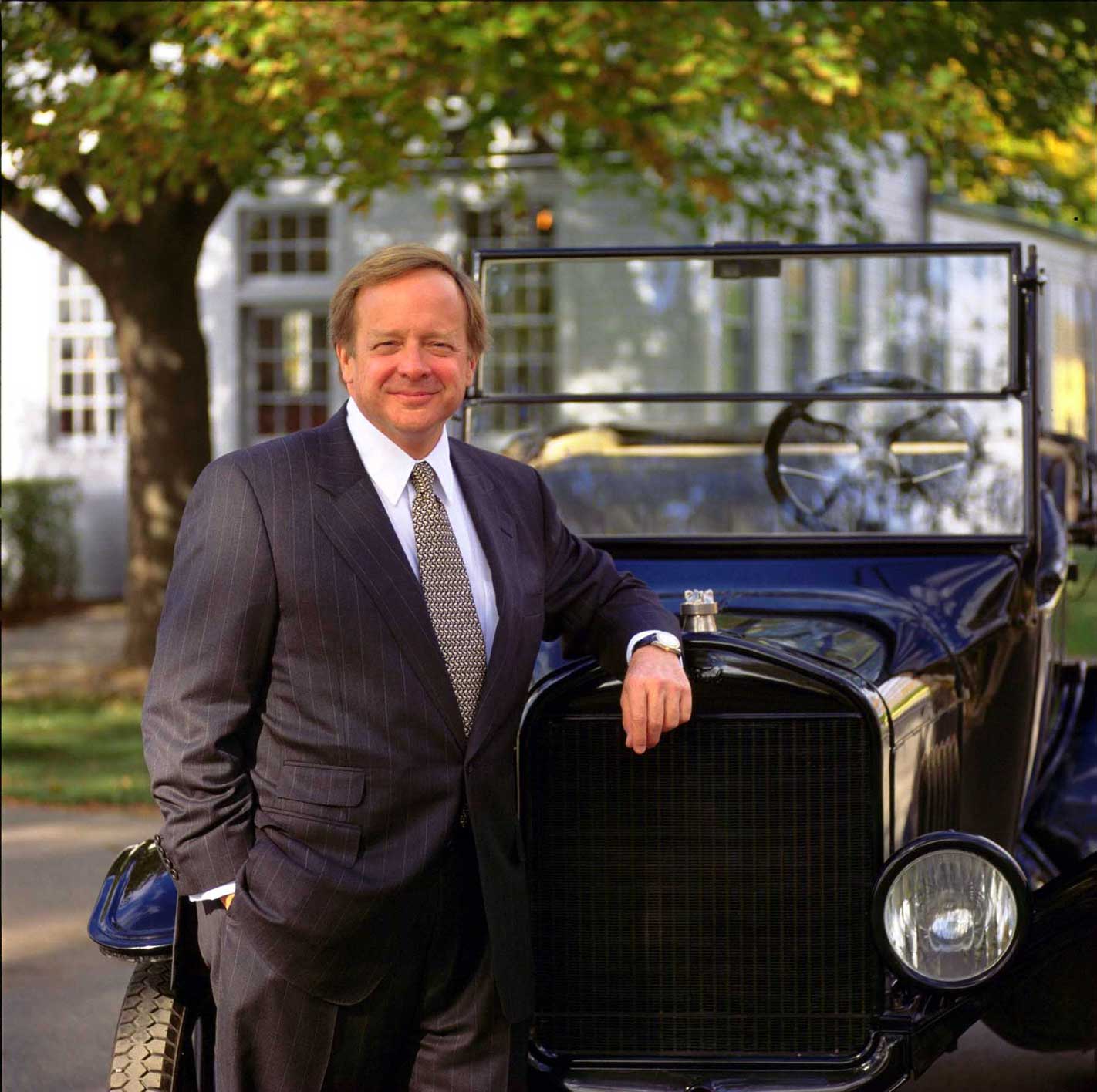
Eleven years after the COTY hullabaloo, Edsel was still upset. He told Business Week magazine (December 9, 1991), “I don’t think I’ve ever been so mad in my entire career, it was a cheap shot.”
Edsel, now 70 and a director of FoMoCo, serves on two of the company’s senior committees, still loves motor racing, and is a valued member of the Detroit community.
As the crowd gathered before the ball on the eve of the 2003 Goodwood Festival of Speed, an American voice shouted my name in recognition across the throng. Edsel, of course, there to celebrate Ford’s 100th anniversary. We chatted happily like old mates, though neither of us raised the COTY issue.
We drive a lot of cars every year at MOTOR. Between our Aussie team of staff road testers and hired goons (looking at you, Morley) and those at our US, Japanese and European outposts, the number would be two hundred a year, maybe even three hundred.
Totally new models, new variants, updates, facelifts, revisiting the old nails unchanged but still on-sale – the lot. And when testing a car, you’re giving values to its component parts and seeing if they add up to what the vendor promises – and charges. The ultimate iteration of which is, of course, the annual level playing field we set up, to which we invite the year’s most talented cars, and call Performance Car of the Year.
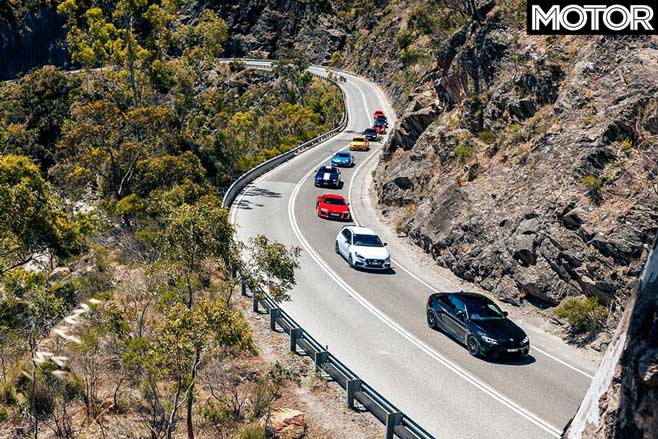
Except, a lot is left on the cutting room floor after the annual chaos of testing cars. Often a car is a dud with a cracking engine. Or has a dud engine but is a cracking handler. Other times, the whole car is sublime save for one small point – or the inverse of that again.
Throughout the year you’ll read in individual tests if a given car’s component parts are memorable or forgettable, but we thought why not get the road test team in the one room (not easy), throw in a slab (not wise) and a couple of capricciosas and see where we end up?
The result of which is more or less this, the MOTOR Awards. It’s nothing we take too seriously – more an end-of-year review – but our chance to combine all the testing impressions and all the cars in one big pool to sort the specific wheat from the chaff.
Split over 21 categories, we’ve revisited everything we’ve tested in the last 12 months, from hot hatches to performance SUVs to hypercars and everything in between. In theory, you could take all these component parts to build the ultimate performance car. But as it stands, some manufacturers will continue to be better at some things than others. As you’re about to read.
2019 MOTOR Award Categories
 BEST ENGINE (revealed 25th December)
+ Best Drivetrain
+ Best Noise
 BEST HANDLING (revealed 26th December)
+ Best Steering
+ Best Electronics
 MOST FUN (revealed 27th December)
+ Scariest
+ Hardest to Master
 BIGGEST SURPRISE (revealed 28th December)
+ Most Improved
+ Most Disappointing
 BEST LOOKING (revealed 29th December)
+ Best Design Detail
+ Ugliest
 BEST INTERIOR (revealed 30th December)
+ Best Option
+ Biggest Gimmick
 PEOPLE’s CHOICE (revealed 31st December)
+ Best Newcomer
+ Solemnest Farewell
It’s a strange concept to fathom, but in the near future cars like the Nissan Leaf will act as both an energy source and a storage system to support the smooth operation of electricity grids. The process, known as vehicle to grid (V2G), will essentially optimise the electric car’s potential as both a receptacle and provider of electrical energy.
It’s widely accepted that 90 percent of cars aren’t in use 90 percent of the time. But while you can’t do much with your petrol or diesel car when it’s parked in the garage, the same can’t be said for electric vehicles and hybrids, which have both electrical charge and storage capacity when in a static state.
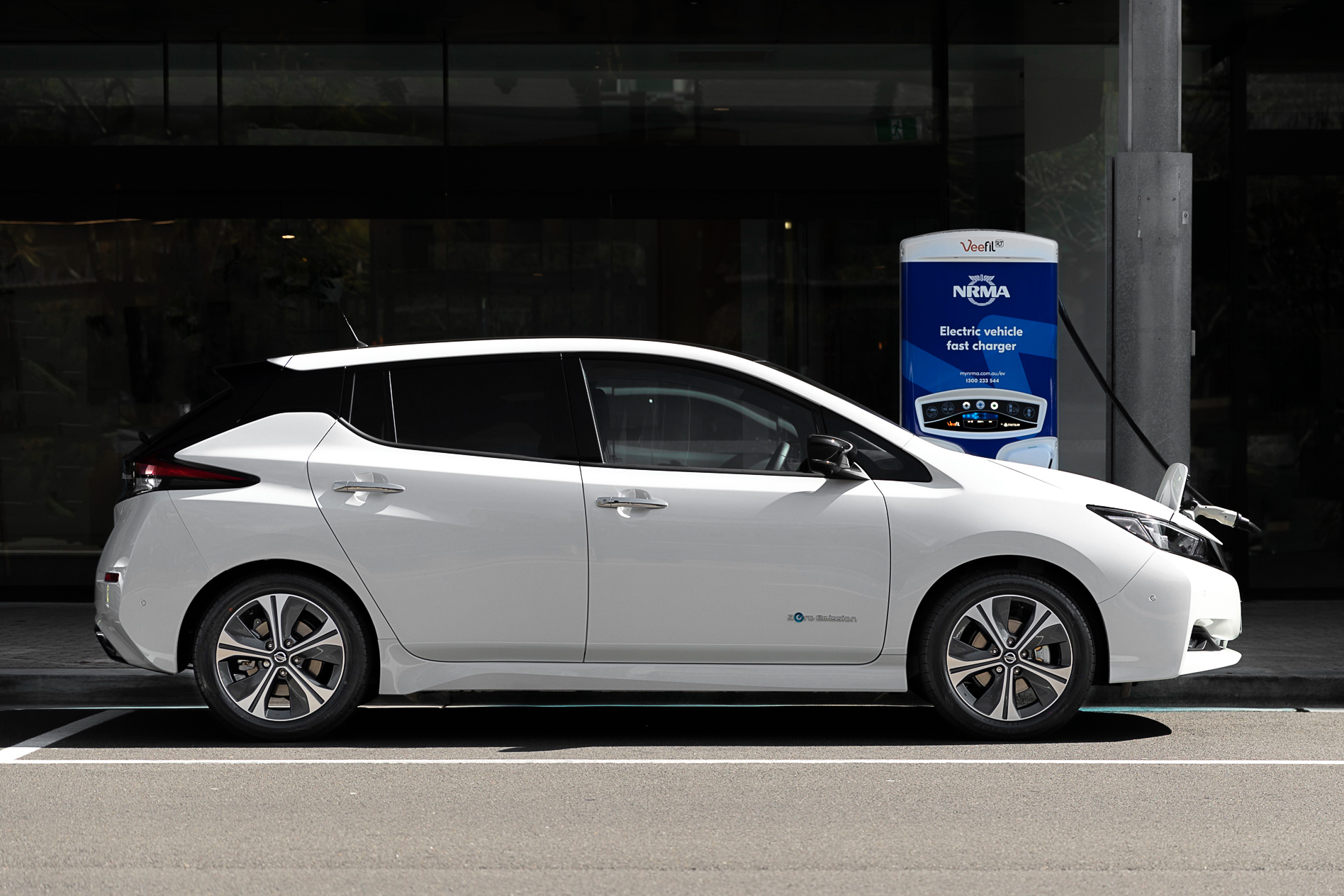
Hence why V2G works in a bidirectional fashion, meaning it can both enable the recharging of batteries and the supply of electrical charge. The benefits appear in terms of the ability for large numbers of EVs to help stabilise an electricity grid, while also potentially reducing the need for ever more poles and wire infrastructure to feed our insatiable demand for power.
The principle of V2G works in three key ways. The first is vehicle to home or building charge, where the EV owner hasn’t used 100 percent of the car’s battery capacity during the day, thus enabling it to feed power into the household supply when occupants are arriving home and using energy-intensive items like the stove top, oven and water heater. At this point, the vehicle is effectively removing demand from the grid in a practice called ‘peak shaving’.
The second option is for an EV such as the Leaf to be used as a source of emergency or back-up power. In other words, the electric car becomes a silent generator, with power from the battery channelled to homes and buildings in the event of a blackout.
The final piece of the puzzle is where EVs draw or add power to the grid at key intervals, thereby helping smooth supply peaks and troughs and making the overall grid supply more stable.
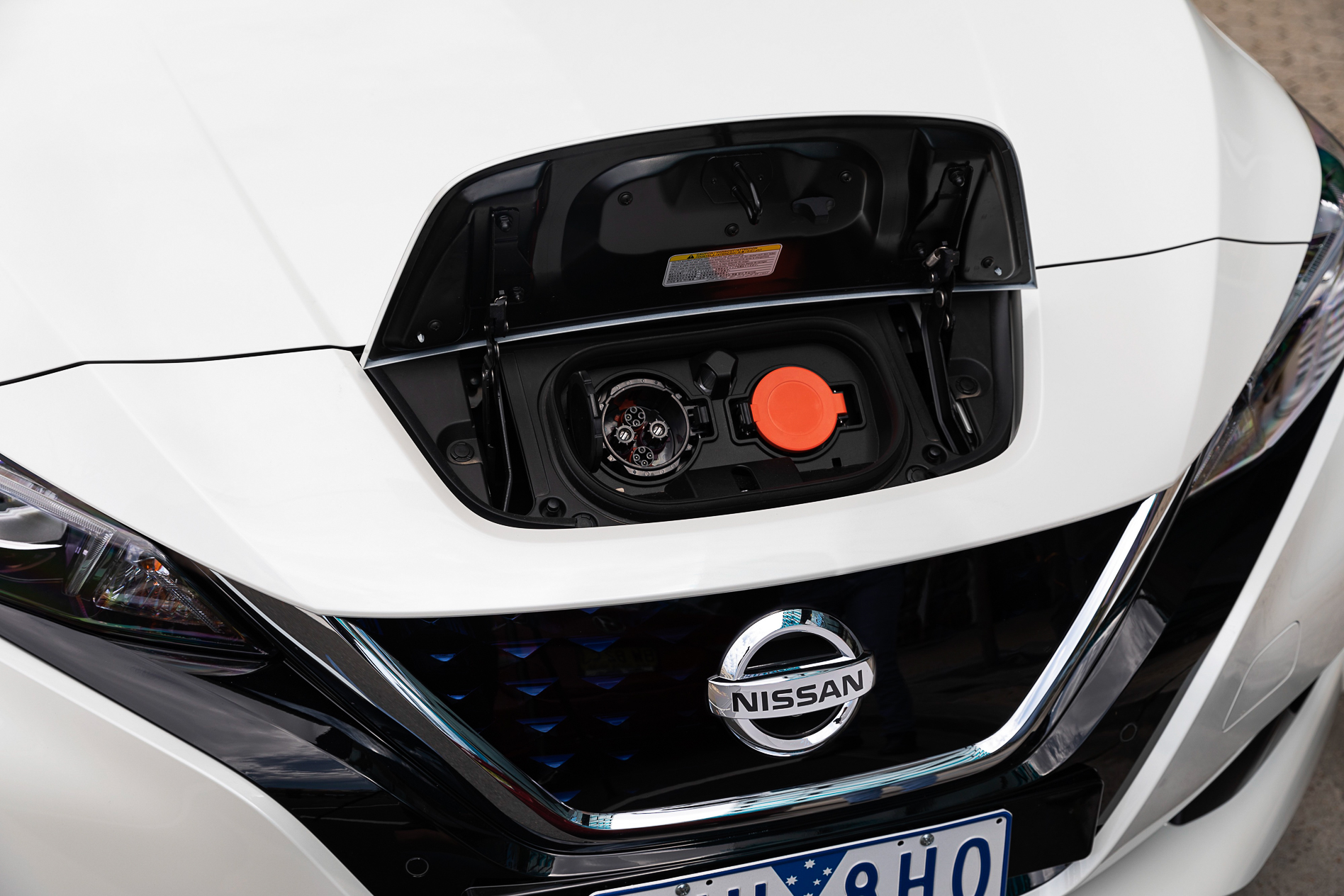
What’s more, there is also potential for EV owners to reap a financial benefit when selling battery power back to the grid, much as households with solar installations do now.
In turn, recharging of vehicle batteries can be allocated to times of low demand, typically very late at night or early morning, when energy is at its cheapest.
One downside to this technological interplay is that bidirectional chargers are currently still too expensive for broader consumer acceptance. Despite this, Nissan’s global EV program director, Nicholas Thomas, is positive about the future of V2G, pointing to the fact the company has already begun rolling out trials globally, in partnership with the Enel Group, with plans to begin trials in Australia by the end of 2019.
How V2G works
- Recharging of batteries can be allocated to designated times of low demand, typically the dead of night or pre-dawn, when energy is cheap
- At peak times such as the end of the working day when energy demand is highest, EVs can power a household directly, reducing overall demand
- EVs can draw or add power to the grid at key intervals to help smooth supply peaks and troughs, thereby helping stabilise overall supply
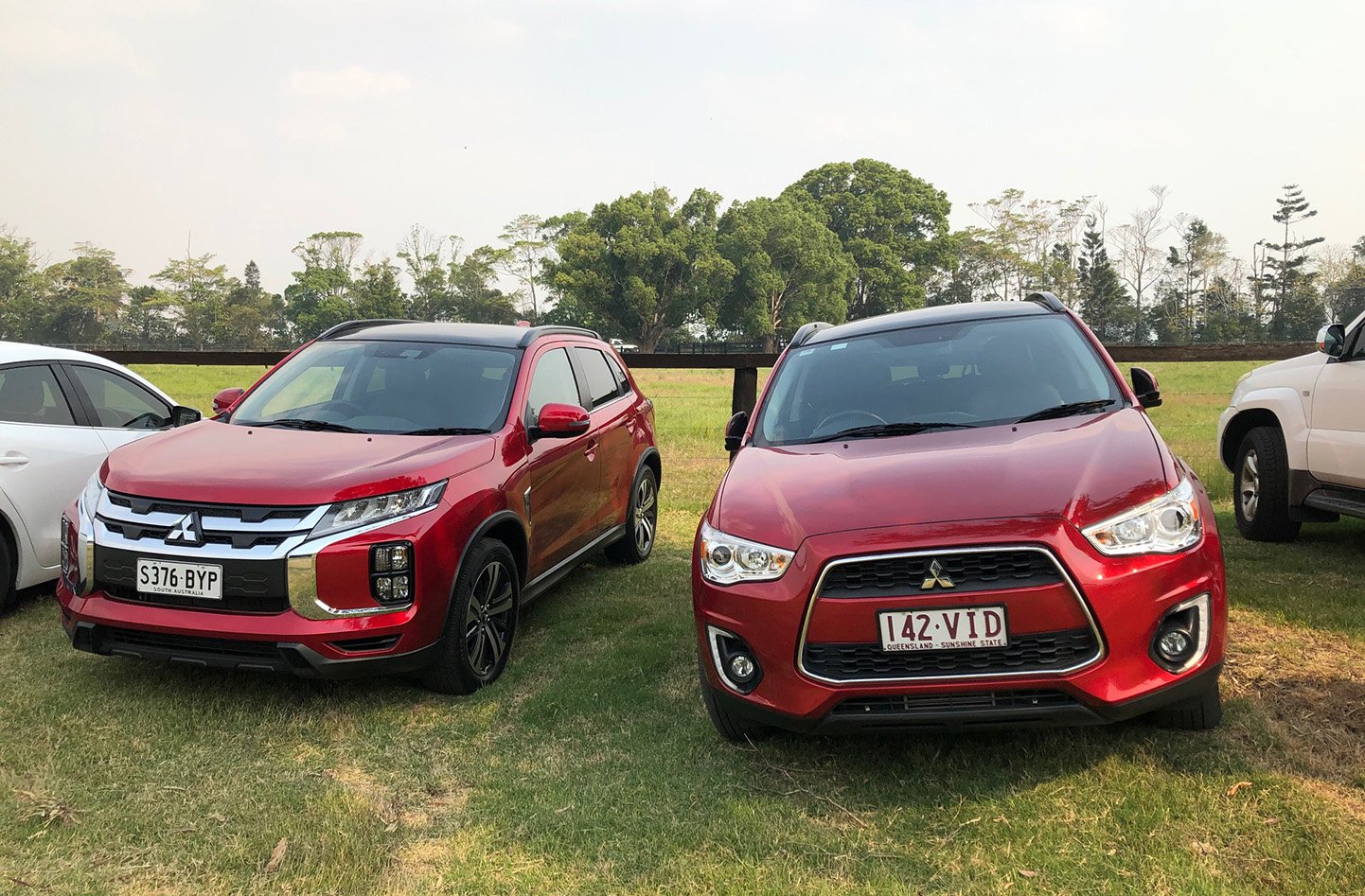
Baader-Meinhof Phenomenon is where you become acquainted with something only to suddenly you see it everywhere. Is this what I’m experiencing as drive along the Pacific Freeway between Gold Coast Airport and Byron Bay in the updated Mitsubishi ASX?
I don’t normally pay much attention to the ASX, but now I’m driving it the humble crossover has suddenly become more ubiquitous than the Toyota HiLuxes that infest these parts.
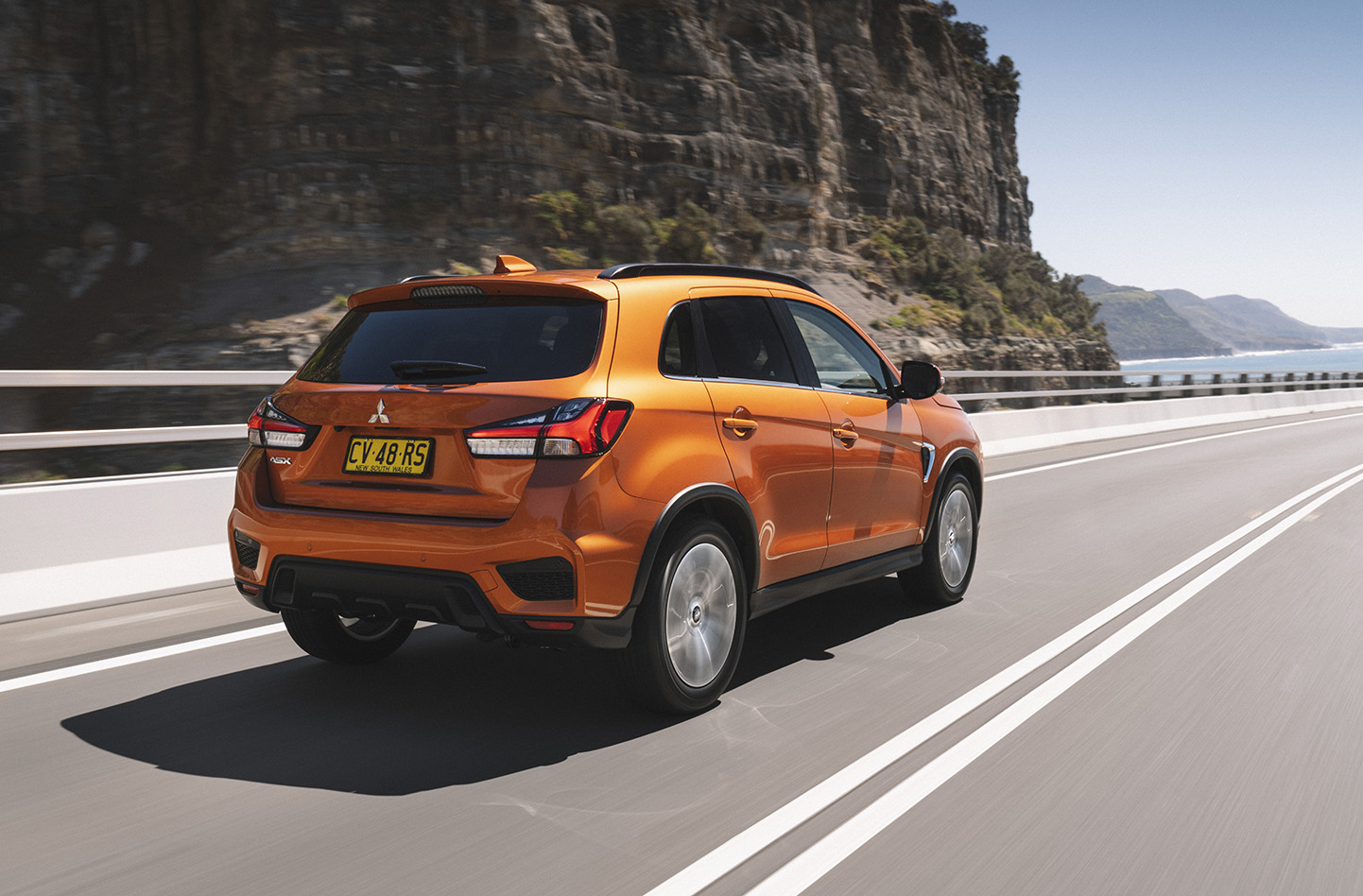
But when you think of it, it starts to make sense. The Mitsubishi ASX has been around for a decade and has been Australia’s best-selling small SUV for the past couple of years. It averaged about 1700 sales per month in 2019 with a lot them becoming rental cars of which there’s a plethora in this tourism hot spot. It’s cheap and cheerful and well equipped for the price, which makes it well suited to the role, though it’s a little under-powered for touring around with a boot full of luggage – until now.
A recent update added a 2.4-litre petrol engine to ASX range that’s a big improvement on the smaller 2.0-litre. Only problem is it’s only available in the more costly GSR and Exceed version that are less likely to end up in a rental firm forecourt.
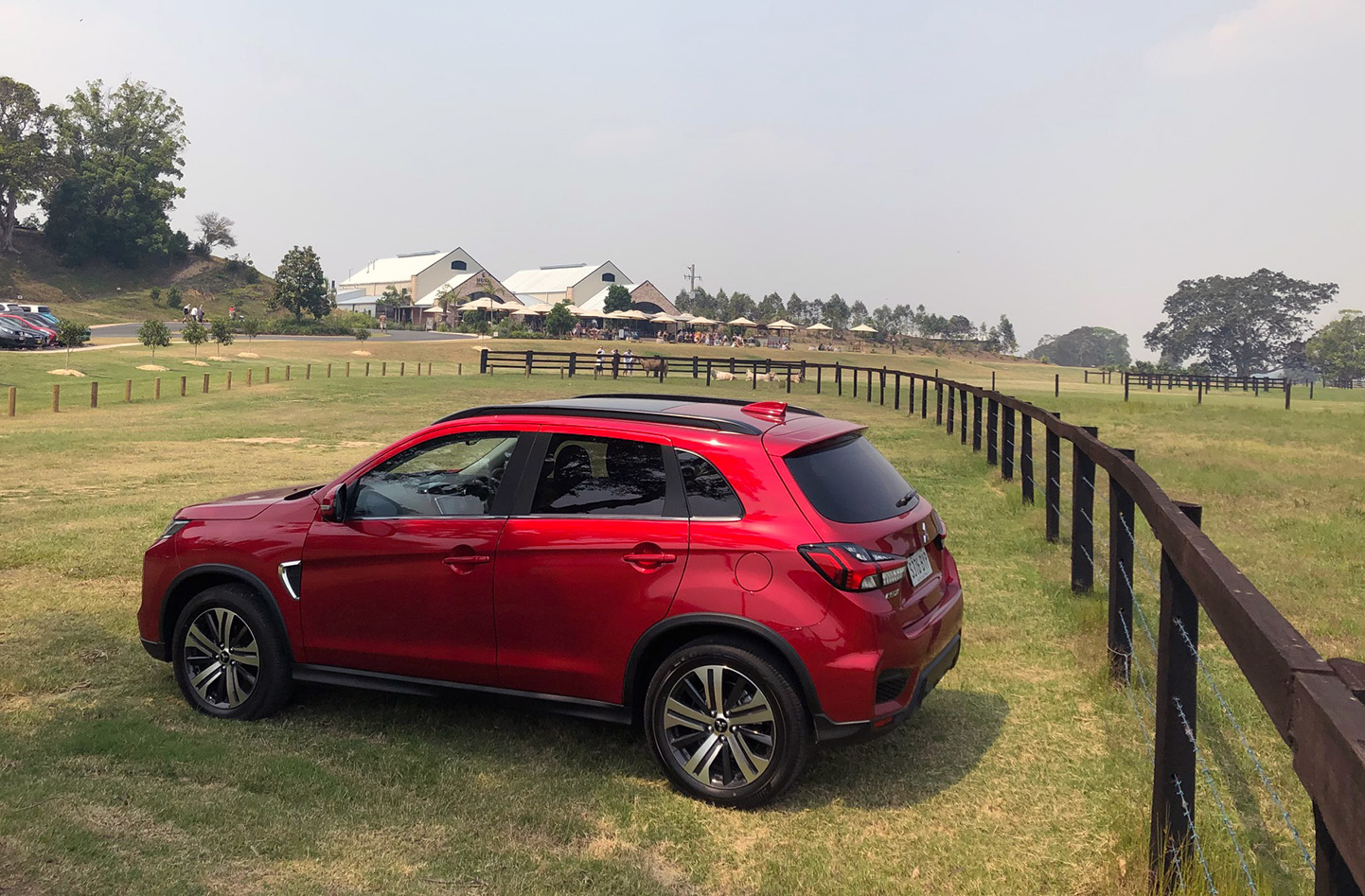
But it’s a facelifted 2020 ASX Exceed I find myself in heading north along the M1, overtaking all the lesser-powered ASXs up the many inclines in what seems like a mere canter.
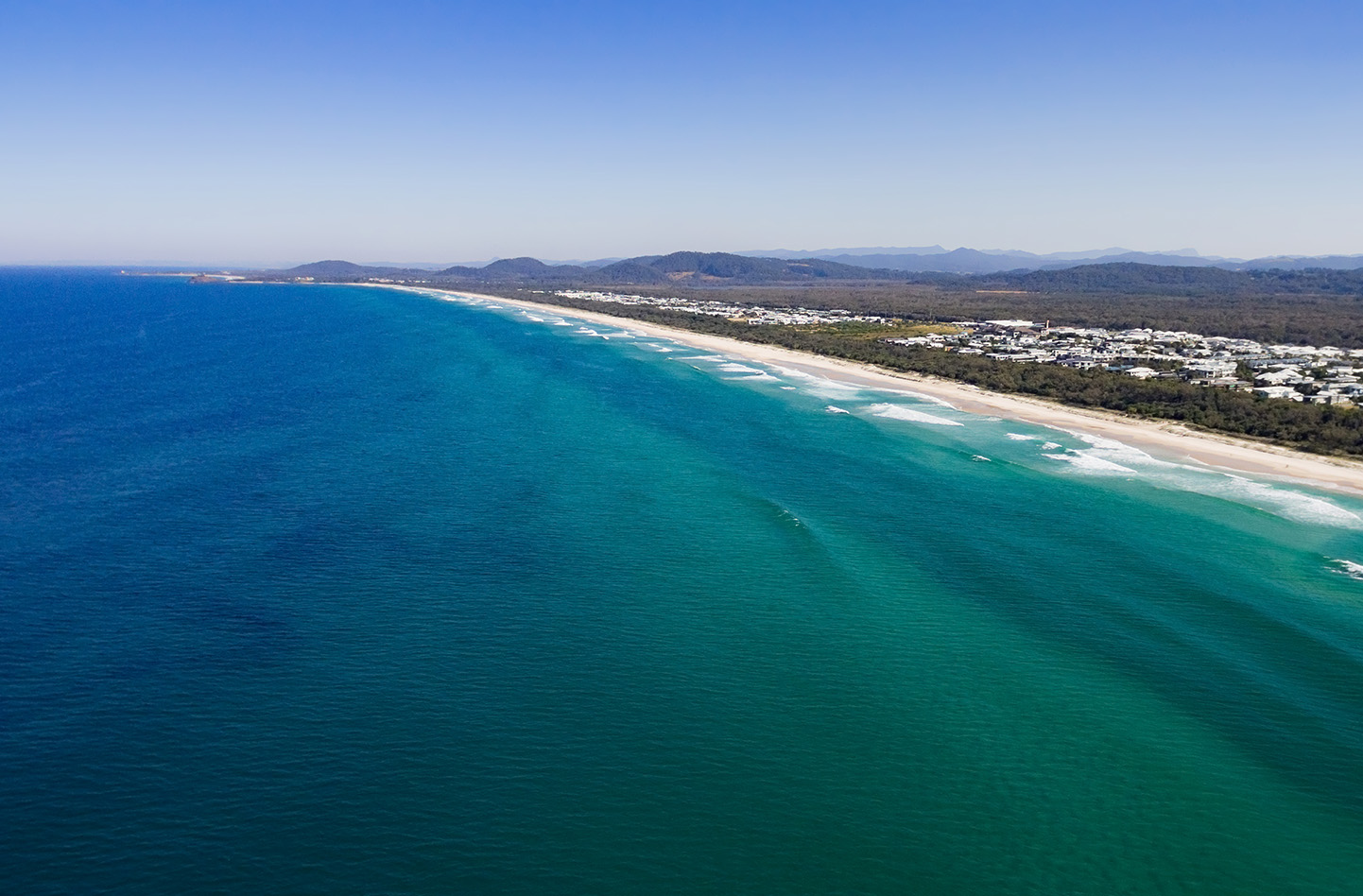
Byron Bay beckons but first I want to check out the Tweed Area hinterland partly to see how the gutsier ASX travels in more challenging conditions, though mostly because I wanted to try-out and buy some special gin.
First stop was Kingscliff just south of Tweed Heads to have a nosey as we have friends moving up here from Melbourne. It’s not the most well-known ocean-side town in this region for us Southerners, but judging by the caravan parks along the foreshore and holiday rentals it’s certainly no hidden secret.
As with everywhere else between Ballina and Southport the beach is a stunning wide belt of white sand separating the town from the Pacific Ocean that stretches 6km, meaning you’ll always find a quiet spot to yourself.
We walked along the seemingly endless stretch of sand, but any swimming had to be put on hold for a lunch reservation at Husk Distillers at North Tumblegum, which is about 10 kilometres west from Kingscliff as the crow flies, but about 15km via the Cudgen Road and Tweed Valley Highway.
Irrigated farms and lush riverbanks struggled to hide the fact the area is in the grips of a prolonged drought, which was also evident in Kingscliff whose parched lawns just didn’t seem right in October.
On the plus side, the weather was amazing though the blue skies would eventually give way to smoke haze from the unseasonal bushfires a little further inland.
The carpark at Husk was filling fast but luckily we had a table booked at the cellar door which, as a sign of how quickly the climate can turn around these parts, was inundated by a metre of water during construction when the Tweed River burst its banks in 2017. You wouldn’t know it now, with the classic buildings, courtyard and lawns teeming with people enjoying the fine Saturday weather reminding me of the Yarra Valley albeit with vineyards replaced by cane fields and Gin and Rum being the house specialties.
Husk was born from its owner Paul Messenger’s desire to create a Caribbean-inspired plantation distillery on his family’s cattle and cane farm and create a premium paddock to bottle agricola rum made from fresh cane juice. That was eight years ago and since then his family has ventured into the gin business with its acclaimed lavender-hued Ink Gin.
The weekend cellar door menu features a few grazing options, and we shared the Charcuterie Board that, for $30, brought a selection of local and international cold meats, served with spicy green peppers, pink sauerkraut and local artisan sourdough. Other options included an equally tempting Fromage Board ($35), and there’s a barbecue if you want to keep things simple.
As designated driver I was pleased to see there tasting paddle that for $14 brings includes three 15ml sample glasses (1.5 standard drinks) that includes the aforementioned Ink Gin, Pure Cane un-aged agricole rum (served as a mini Ti Punch cocktail), and Spiced Bam Bam agricole rum on ice with orange that lived up to its name.

They were all nice, but I can really see why the Ink Gin has been so well received with the flower petals used to create its distinctive ink-like colour giving it a fruity and refreshing smoothness.
After an enjoyable afternoon we set off and decided to travel toward Upper Duroby to take in the scenery, which provided an opportunity to see how the ASX handled winding roads. I didn’t have to drive for long to realise the change in driving dynamics the bigger engine brings to the 2020 model doesn’t extend to handling.
The ASX soaks up bumps well, but there’s a noticeable lean when cornering quickly, while the rear-end has trouble keeping up with the front wheels during quick changes of direction, such as when negotiating S bends.
Conscious of the fact my partner had just eaten lunch and tried a couple more gins than me, and with the two bottles of precious Ink Gin moving about in the boot, I eased off the pedals and took things easy as we made our way back to the Pacific Freeway to complete the trip to Byron Bay.
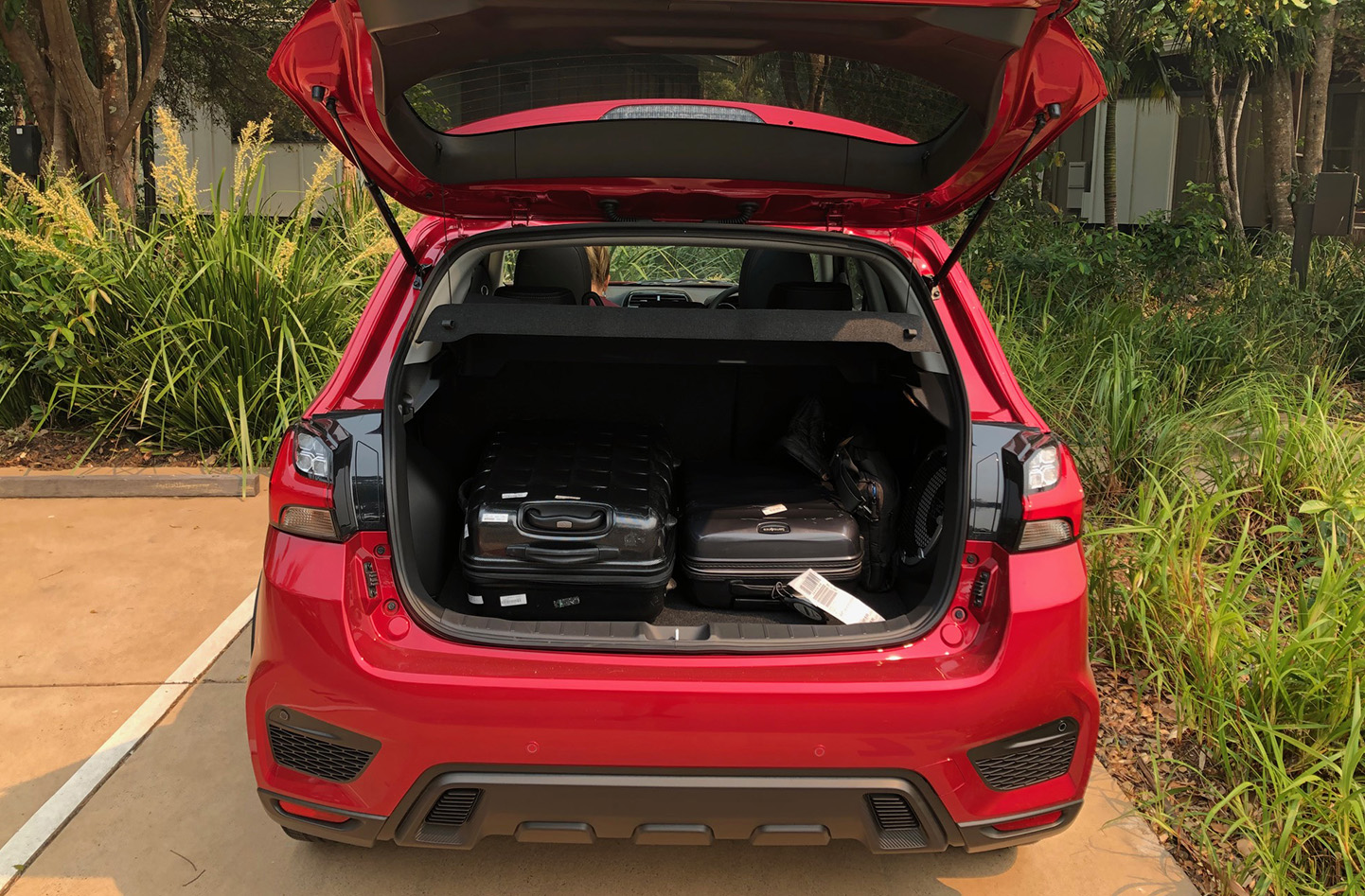
All things considered, the Mitsubishi ASX makes for a good holiday tourer for a couple or even a small family. The Exceed spec beings creature comforts including broad leather-appointed seats, panoramic sunroof, in-built Tom Tom navigation and nine-speaker Rockford Fosgate premium sound system with an unexpectedly large sub-woofer mounted in the 393-litre boot.
And it has a decent 20.5cm ground clearance which makes it suitable for rougher roads.
It’s just a shame that the lower-spec ES and LS versions don’t have the bigger engine as it’s likely that’s what you’ll get next time you hire a small SUV on your next holiday.
The CSL is late. Mr Ed Taylor looks at his watch and decides he’d like the BMW delivered to us at the restaurant where we’ve just had dinner, rather than the motel as planned. That way we can drive it home.
This feature was originally published in MOTOR’s April 2004 issue
As he calls the tilt tray driver, Jesse Taylor and Greg Kable are explaining to me that while the Continental GT is capable of over 300km/h, there won’t be sufficient room to stop the 2.4 tonnes before the fence at the end of the runway tomorrow at Avalon. Their hand gestures illustrate that if it were to be attempted, the Bentley would come to rest most likely on its roof somewhere back in Melbourne.
It’s the tail end of Australia Day, and rather than sitting under a sprinkler back in Queensland, drinking polar bears and cola, I’ve spent the day driving down to Werribee from Sydney in a convoy of 12 cars, in preparation for an early start to Performance Car of the Year 2004 tomorrow. It’s been an unusual day. Already Editor Taylor and Eccentric Cockburn have established me as their plaything. As much as is practical, I am to be the brunt of all jokes, and any co-operation on my part by making stupid statements is most certainly appreciated.
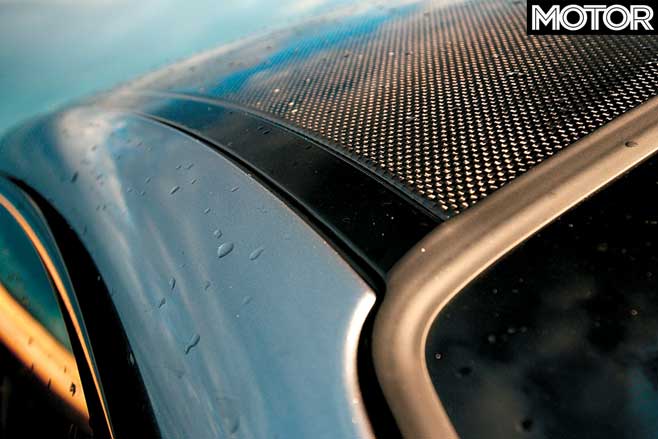
We amble onto the street to wait for the CSL. When it arrives, the truck driver unceremoniously backs the $210,000 Beemer onto the street, hands MT the keys and leaves. How very cool. There’s a moment of silence as we take in the beauty of the carbon fibre roof.
“I bags the front seat!” I shout like an idiot as MT opens the driver’s door. Then I realise no one but me is lining up to be a passenger. While this is a day among days for me, for everyone else it’s situation normal.
Idling through the main street, the CSL manages not to blow its cover until it exits the last roundabout, when Taylor cracks the throttle wide open and scuffs the new Pilot Sport Cups satisfactorily. I can’t help thinking, “You lucky bastard, Cass, welcome to PCOTY.”
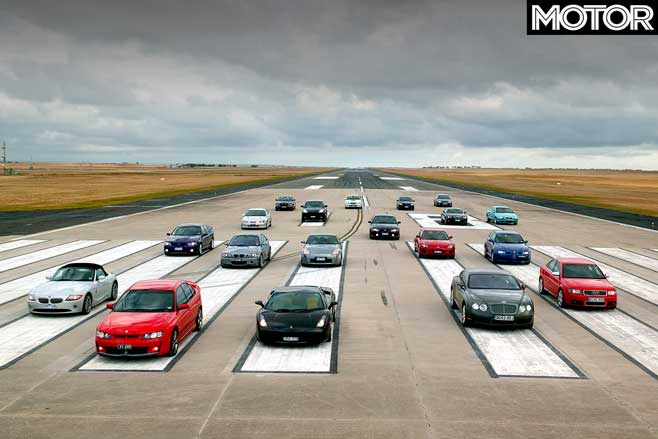
After a sleepless night like Christmas Eve as a kid, day two finds us at Avalon airstrip for the first day of testing. The safety briefing over, MT informs me I’ll be coming with him for a ‘sight’ run, to make sure there’s no aircraft wreckage on the runway, or something.
MT hurtles the big Jag at full tilt around the tight corner onto the runway, explaining to me, over the shrieking tyres, the need to carry good speed onto the straight. Up to this point the whole idea of 300km/h down an empty runway hasn’t concerned me. That is, until I realise you have to almost exceed the lateral grip levels of the car on entry to enable enough speed to be carried all the way to the trap, which is alongside the ‘if you don’t stop now you’re gonna die’ final braking marker.
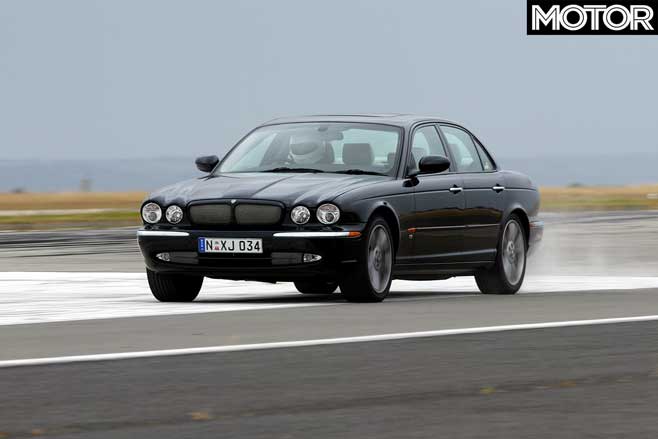
I kiss my arse goodbye as he kisses the apex, wondering to myself how I could possibly have thought that being able to get my Falcon a bit sideways through a wet roundabout qualifies me as a PCOTY judge.
Sensing I was somewhat intimidated by the speed run, Taylor suggests I take something slow, like the Volvo, to get my feet. The Volvo, as it turns out, does 250km/h.
The rest of the morning is spent hopping in and out of various fast cars and casting sheepish yet lustful glances at the Lamborghini. Do I just hop in and go? I think not. All the other judges have already driven it, posting a top speed of 288km/h. But after pulling 280 in the really heavy Bentley (and, more importantly, stopping the thing without using the fence), I figure I’m as confident as I’m going to get.
Here goes nothing.
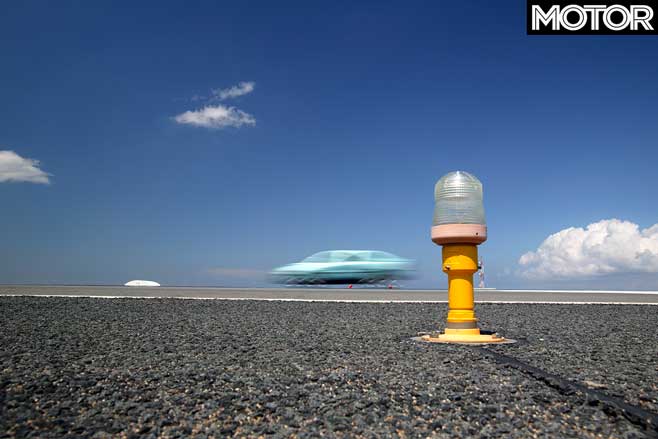
Minutes later I’m glancing at the needle edging towards 300 as I lift my right foot well before the first braking marker and place it firmly on the brake pedal. The Gallardo tucks in neatly around the sweeper as if I just took the exit off the motorway; my slowish speed of 275 comes as no surprise. The Lamborghini feels so capable under brakes, and has so much grip on entry, that on my way back up I decide that this time I’m going to have a red hot go.
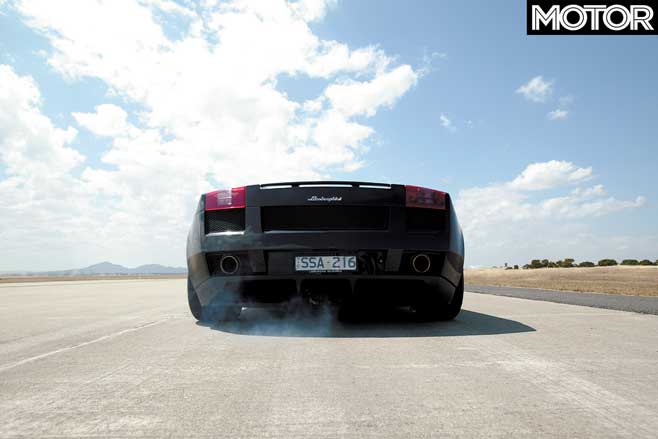
“Lambo on the runway” comes over the radio as I bury my foot early in third gear and slingshot onto the runway. I’ve barely straightened up before it’s tickling the rev limiter in third as I pluck fourth. The van at the end of the runway comes into view shortly before I grab sixth gear and bury my foot one more time. Adrenalin causes my leg to shake as I hold the screaming V10 flat until the final braking marker. I ask the big question of the brakes and the Gallardo pulls up unfussed.
“Lamborghini 290,” crackles over the radio. Someone asks who was driving. “Punter,” comes the glorious reply. Life is good. That is, until Cam McConville does 292 in the afternoon. Bastard.
By the time the PCOTY field rolls into Winton, I’m starting to feel a real part of the whole circus. But I can’t work out if David Morley is on form this year. I’d been preparing myself emotionally for the barrage of mickey-taking that I was assured would come. So far it hasn’t. I casually ask him why he’s chosen not to make me cry. “Because I haven’t kicked you in the nuts yet,” comes the reply. I was wrong; Morley is in fine form.
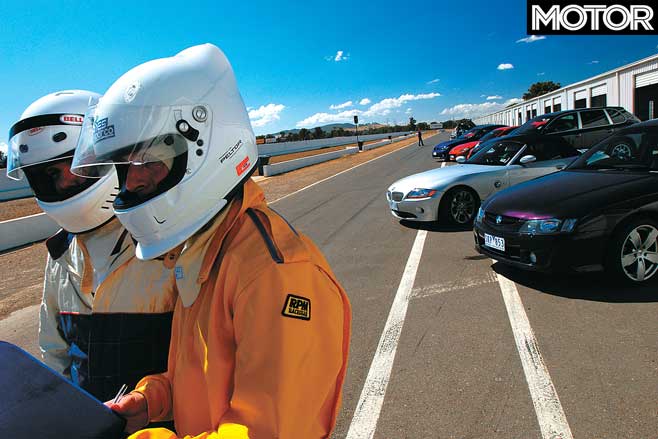
Putting on a race suit makes you feel like a professional. Spearing off the end of the straight in a cloud of tyre smoke and dust doesn’t.
Only McConville is timed, so the rest of the judges have to get creative about being competitive. I jump in the ClubSport and follow Morley in the SS, hoping he can’t embarrass me by getting away in a slower car. MT joins us in the GT, rounding me up before the flip flop and then diving in under brakes to get in front of the SS, after which both Morley and Taylor demonstrate the visual spectacle of silken power oversteer.
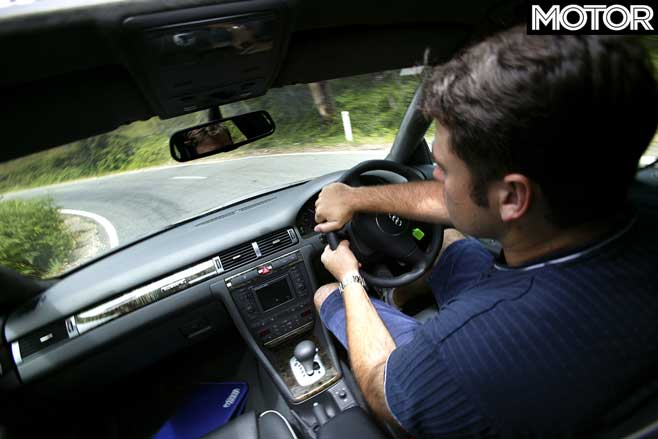
The Hillclimb, I’m told, plays the most important part in determining PCOTY. If they don’t stand up and be counted under normal driving conditions, they don’t make the top six.
Coming down the hill, as it turns out, isn’t necessarily as much fun as going up. The GT, for example, is a dead set hoot going up, always scrambling for rear grip, showing heaps of body language. I find myself winding down the window to take in the sound of the angry Boss motor roaring at me from the rock walls. Coming down, on the other hand, the weight up front becomes all too apparent, pushing wide on steep corners, and the brakes all of a sudden seem to lack feel and modulation.
In very different ways the CSL and the Gallardo are sensational. The CSL begs you to be exacting with how you drive; it rewards precision but penalises indecision. The Lambo, however, makes everyone look like a hero. It soaks up mistakes, and doesn’t have a nervous bone in its beautifully low-slung body. Chasing the silver CSL down the mountain in the Gallardo will remain in my memory forever.
With today’s top performers firmly in our minds, we gather at the Benalla glider club, where the judges calculate feverishly to come up with a top six, based on points, before it’s too dark to shoot them. The winner is then determined by judges’ votes. I’m told to vote unashamedly for the car I’d like to spend the most time in, weighing my decision on my gut feel about which of these six has stood up and said, “How ’bout it?” I vote for, umm, I’m not allowed to say, but you’ll find out…
Day five: this little piggy drives the Patrol support car all the way home. Hardly worth mentioning…
Design Highlights – The Seven Virtues
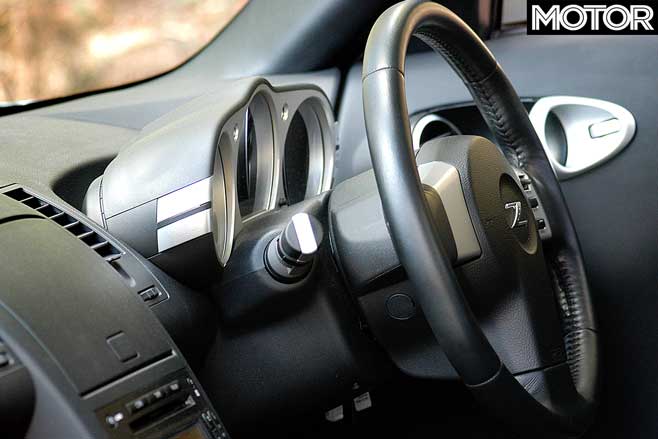
Nissan 350Z’s instrument pod: clean, concise and neatly column-mounted to move with the wheel
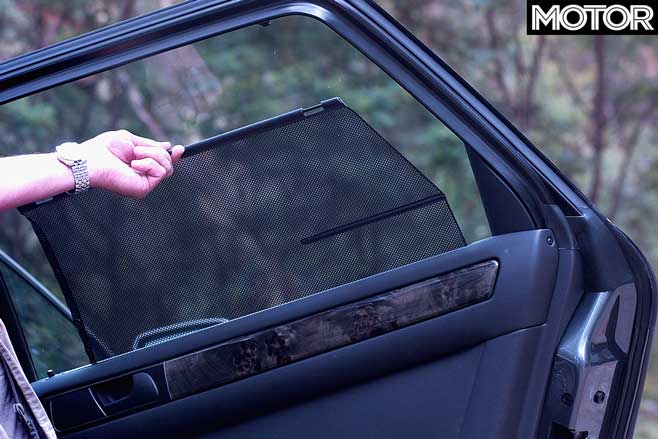
Audi RS6’s side screens: why these aren’t a standard feature in all Australian cars is a mystery
Lamborghini Gallardo’s switches: effective and well placed, an ergonomic miracle

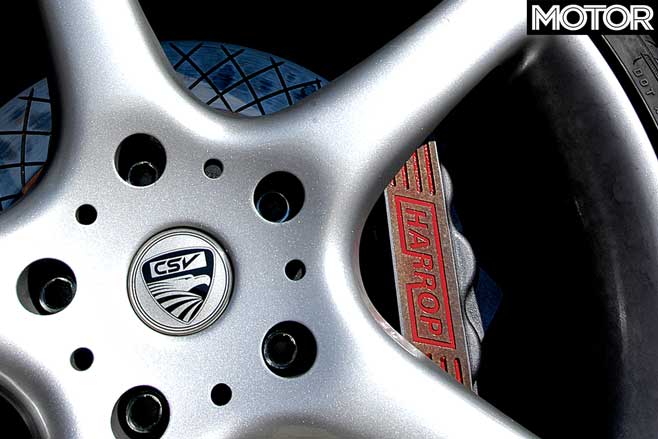
CSV Mondo’s wheels: elegantly engineered, heat-dispersing and easy to clean
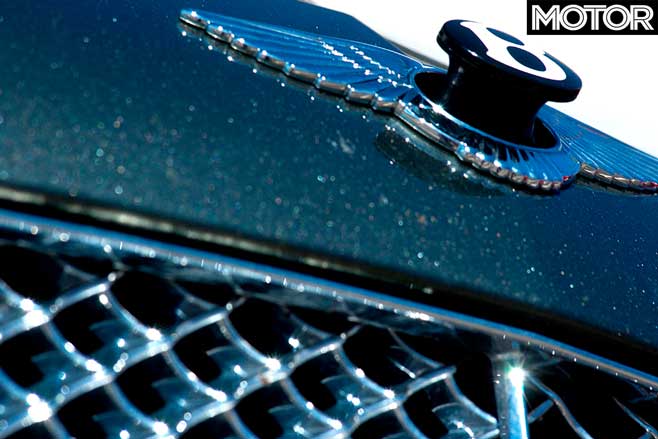
Bentley Continental GT’s bonnet catch: at last, an intuitive bonnet latch that makes tradition earn its keep
BMW M3 CSL’s roof: an intelligent use of weight-saving carbon where it does most good
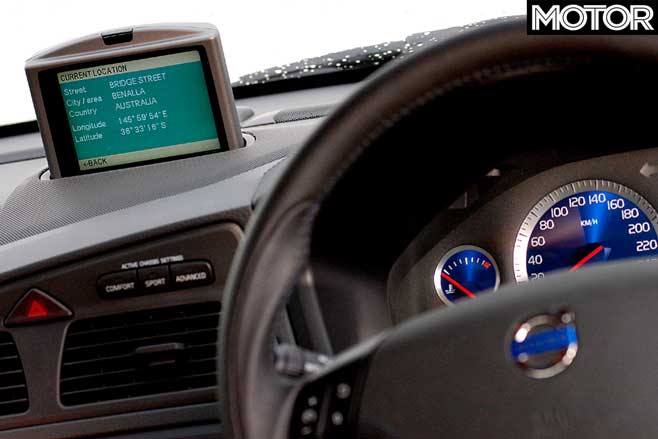
Volvo S60 R’s pop-up screen: not quite a head-up display, but it significantly assists refocusing
Design Highlights – The Seven Vices
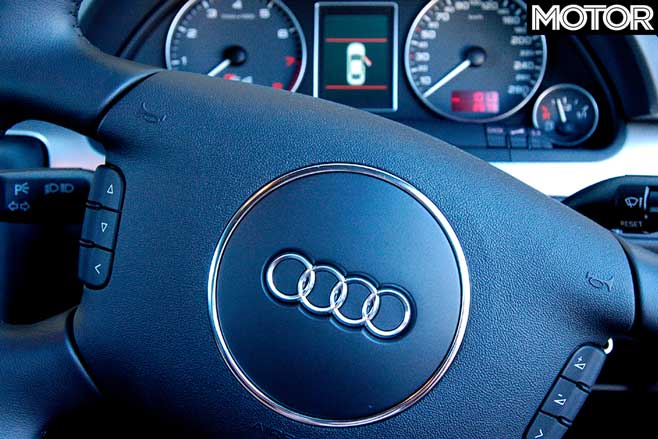
Audi S4’s minor controls: completely obscured column stalks and confusing wheel controls
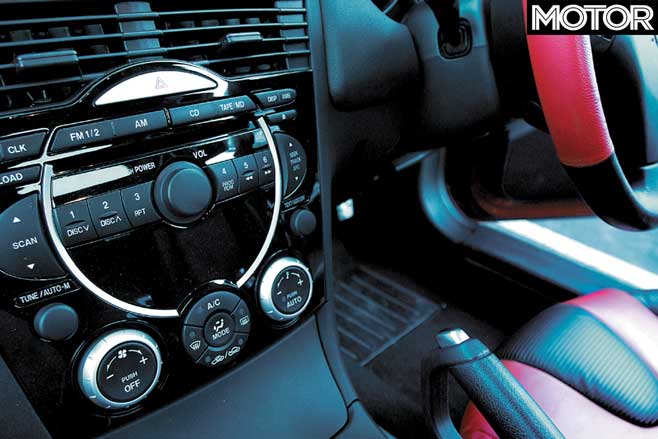
Mazda RX-8’s centre console: the difference, should you be still unsure, between style and design
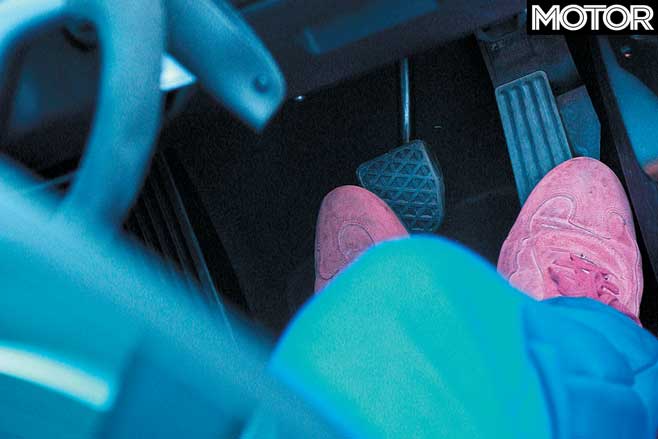
BMW M3 CSL’s pedal placement: if you’re going to have a two-pedal car, site them for two-foot usage
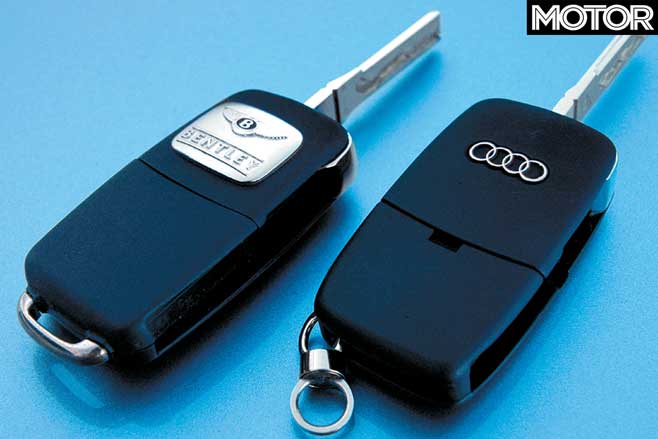
Audi / Bentley keys: parts-bin denial of a Bentley buyer’s legitimate right to individuality
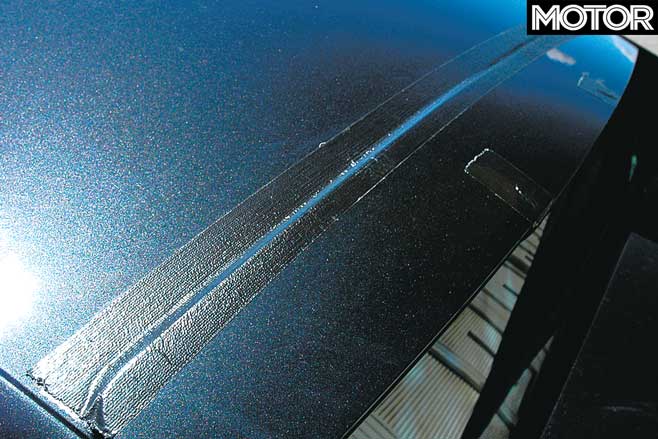
Lamborghini Gallardo’s roof edge: blew off at less than maximum speed. Hope the rest was better tested
Chrysler Crossfire’s wheels: 18s front, 19s rear, and odd sections. Choice of tyres? Not
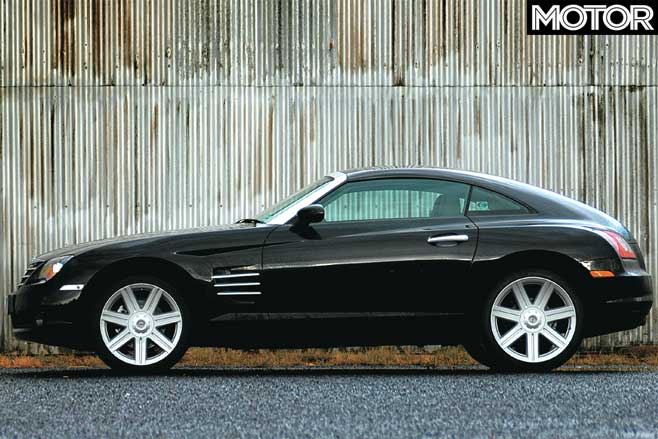
Chrysler Crossfire’s gearchange: hurts like all hell when you jam your finger in it

