
Dave Buttner has stepped down from the top job at Holden following 16 months in the role.
A press release from General Motors confirmed news that the current chairman and managing director is “leaving the company for personal reasons”, with Kristian Aquilina taking on the position in the interim.
GM’s senior vice-president of international operations, Julian Blissett, thanked Buttner for his service.
“Dave’s experience and professionalism have been significant assets for Holden since his appointment in 2018,” he said in a statement. “Not only has he led critical work, he has developed a highly credentialed leadership team, enabling an orderly transition.”
Buttner, who was the president of Toyota Australia from 2014 until the company’s local manufacturing ceased in 2017, came out of retirement to join Holden.
In the press release announcing his departure, Buttner praised the team at Holden, and highlighted progress made since the end of local production in 2017.
“Holden’s focus remains on getting onto the consideration list for SUV and LCV buyers in Australia and New Zealand,” he said.
“We have made significant progress in getting the fundamentals right. Now is the right time for me to depart the business, with a strong team in place, to be led by Kristian.”
Aquilina was the managing director of Holden New Zealand between 2015 and mid-2018, before returning to Australia last year to head up the marketing department. At the beginning of 2019 he was promoted to executive director of sales, marketing and aftersales.
Blissett said: “With more than 22 years in the company, he has the experience, the leadership qualities and the deep understanding of the business and the market to lead GM Holden at this important time.”
Aquilina says his priorities in his new role will be “providing continuity around the execution of our plans, ensuring the team at Holden, including dealers and partners, continue to focus on our customers.”
Buttner’s time in the top job at Holden has been marred by spiralling sales, with the brand at risk of falling out of the top 10 sellers list.
Upon taking the role, he made the drastic decision to request Holden Commodore and Equinox models cease production, in order to get rid of excess stock.
The former Toyota exec has also been at the helm amid media reports that Holden could be sold by GM, something he dismissed as “pure scuttlebutt”.
You have to feel a bit for car tuners in the modern age. Back in the day, the hottest of hot hatches would barely trouble today’s warm tunes from most big carmakers – and when it comes to the cream of the hot-shot crop, the bar has been raised considerably.
Case in point is the FK8 Honda Civic Type R. It swept the MOTOR award boards in 2018 with its formidable combo of poise and pace, prompting many of us to think this factory effort is the pinnacle of the Civic’s potential – a performance car that hasn’t been pushed into the realms of becoming inaccessible, either as a relatively civilised daily or as a fit, fast, fun toy.
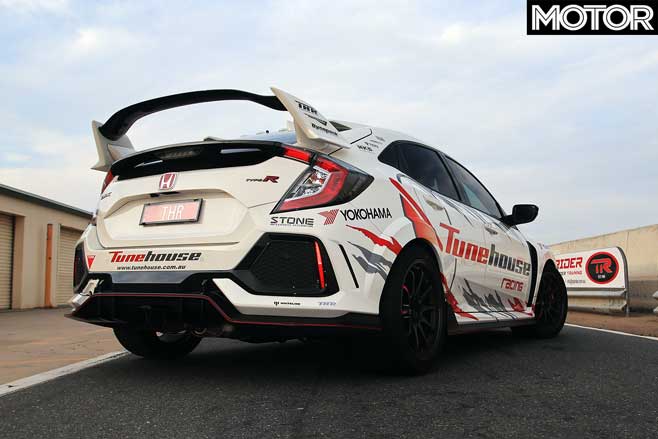
However, Jim Ghelis reckons he’s hit the upgrade nail on the head with the work he and his Sydney-based Tunehouse team have wrought on his daily driven Civic.
“I think it’s wrong to go against the designer of a car, but while what I saw was a very good car out of the box, it didn’t have that last 20 per cent of performance,” Ghelis says.
A lot of the work the Tunehouse team did involved reducing radiator and intercooler inlet temperatures, as well as rewriting the engine map to eliminate the doughy feel of the stocker from low revs.
“I spent a lot of time with the tune to make it more linear and to retain that factory feel,” he says. “The whole idea is to take a car that’s already awesome and make it even more awesome. And I think we achieved that.”
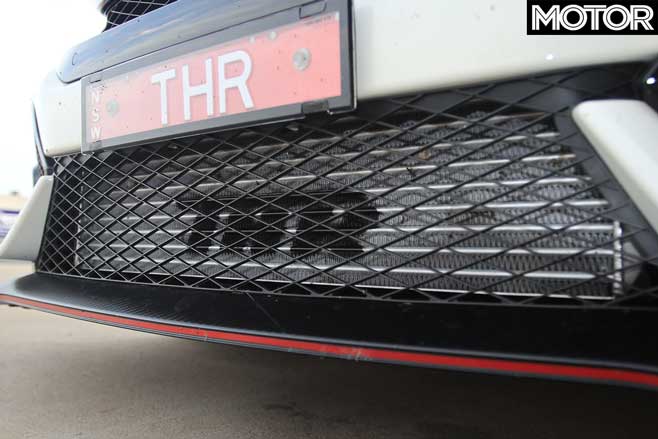
The car runs a tune, intercooler, full exhaust and, as Ghelis puts it, “a little magic” in the alignment settings combined with a rearward engine mount update and some small parts from suspension specialist Whiteline.
Retuning the factory ECU netted the most gains. “It picked up everywhere,” Ghelis says. “It’s making 250kW [at the hubs] on 98 octane now, and 270kW on E40. And 185kW is standard!”
But here’s the amazing part; it actually runs less boost than factory – 2psi less, to be exact – with careful revisions to cam and ignition timing, fuel mapping and torque management making the difference.
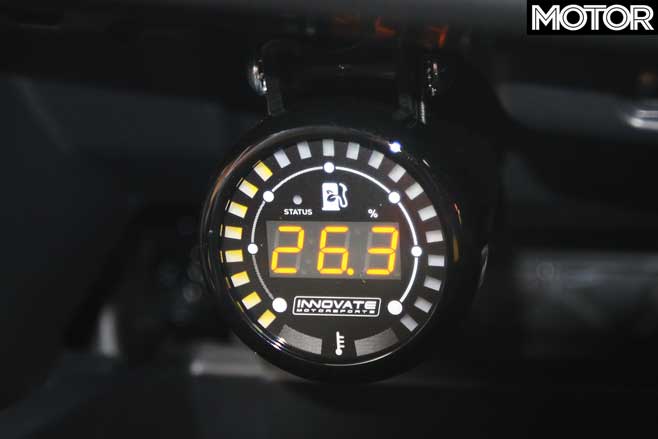
Seldom has such a (relatively) affordable car been more capable, more easy to drive and yet still thoroughly entertaining up to and at the limit than the standard Civic Type R, and Ghelis is well aware of this. “It’s all about the incremental gains. There’s a 9kW increase just from the K&N cold-air induction kit, but the real magic is in the tune.”
My only real criticism of the Type R in stock form is the fact that the engine’s attentiveness doesn’t match that of the chassis from low in the rev range, something the Tunehouse tweaks thoroughly address. The engine feels like it has twice the capacity, with instant access at any point on the tacho.
Civic Type R takes twin PCOTY and BFYB titles
A fat, arrow-straight line of torque kicks the car at the sunset at an astonishing rate of knots; the sheer volume of grunt makes it almost inconceivable that the engine bay doesn’t hide a huge new huffer or other internal trickery.
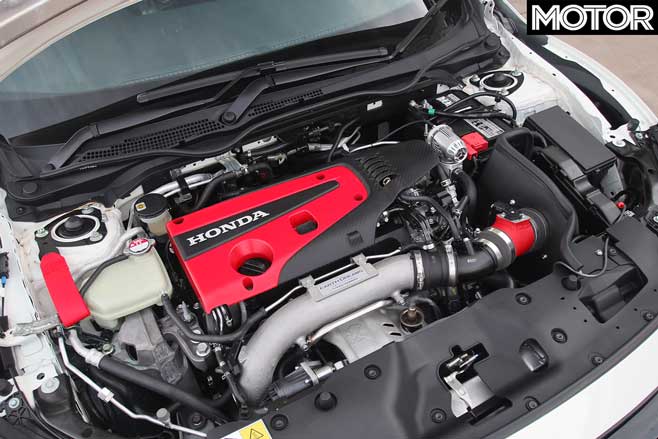
In fact, the engine bay reveals almost nothing; if not for the World Time Attack stickers and lack of rear seat, you’d be no wiser that this car has a third more grunt. The loud blow-off valve and meaty exhaust timbre aren’t my cup of Earl Grey, but these elements can be changed to suit.
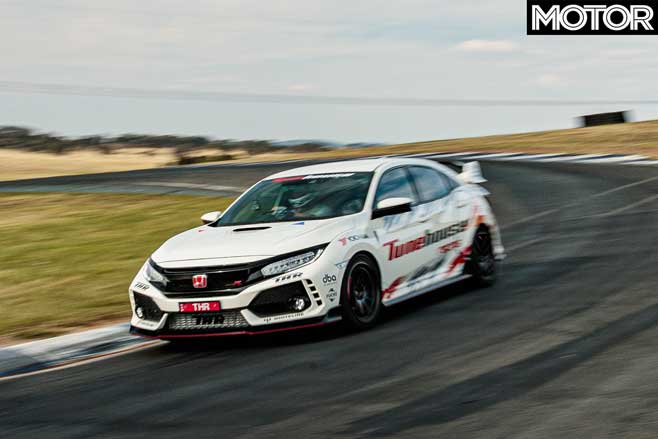
In full attack mode, the powered-up Type R is wicked fast, and almost a bit much for the excellent stock suspension set-up. But even on well-used Yokohama semi-slicks it lapped a greasy and dusty Wakefield Park circuit 1.1 seconds faster than the stock car, with more to come with some tweaks.
My main takeaway, though, is the fact that this is now a very quick car, and it needs to be driven with intent and measure; it’s no longer a matter of planting the foot and going along with the ride. You become part of the experience, but thankfully not at the expense of the car’s addictive accessibility and innate balance.
Nor does it come at the expense of liveability. With the rear seats refitted and the decals removed, the Tunehouse Civic is still a comfortable, special little car with a genuine Mr Hyde persona hiding just a flick into R Plus mode away.
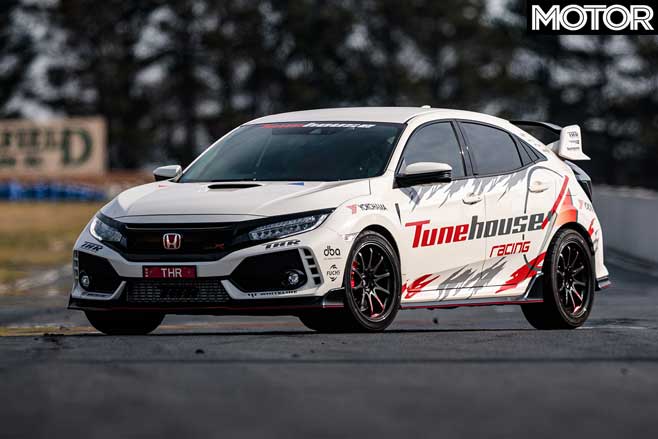
TUNEHOUSE HONDA CIVIC TYPE R SPECS Engine: 1996cc inline-4, DOHC, 16v, turbo Power: 270kW @ 6500rpm (hubs; E40 fuel) Torque: n/a Weight: 1413kg 0-100km/h: 5.2sec (claimed) Price: POA
Likes: Makes a great thing even greater; sheer grunt; genuinely fast now Dislikes: Any more power and the balance would vanish; noisy blow-off valve
Rating: 4.5 out of 5 stars
Lamborghini recently lifted the virtual veil on its latest concept car, the V12 Vision Gran Turismo – and you can drive it from autumn next year… sort of.
With the debut of the wild concept, the Sant’Agata brand for now bookends a large catalogue of “Vision” concept cars, designed by marques such as Mercedes-Benz, Bugatti and Jaguar; for the acclaimed Gran Turismo racing game.
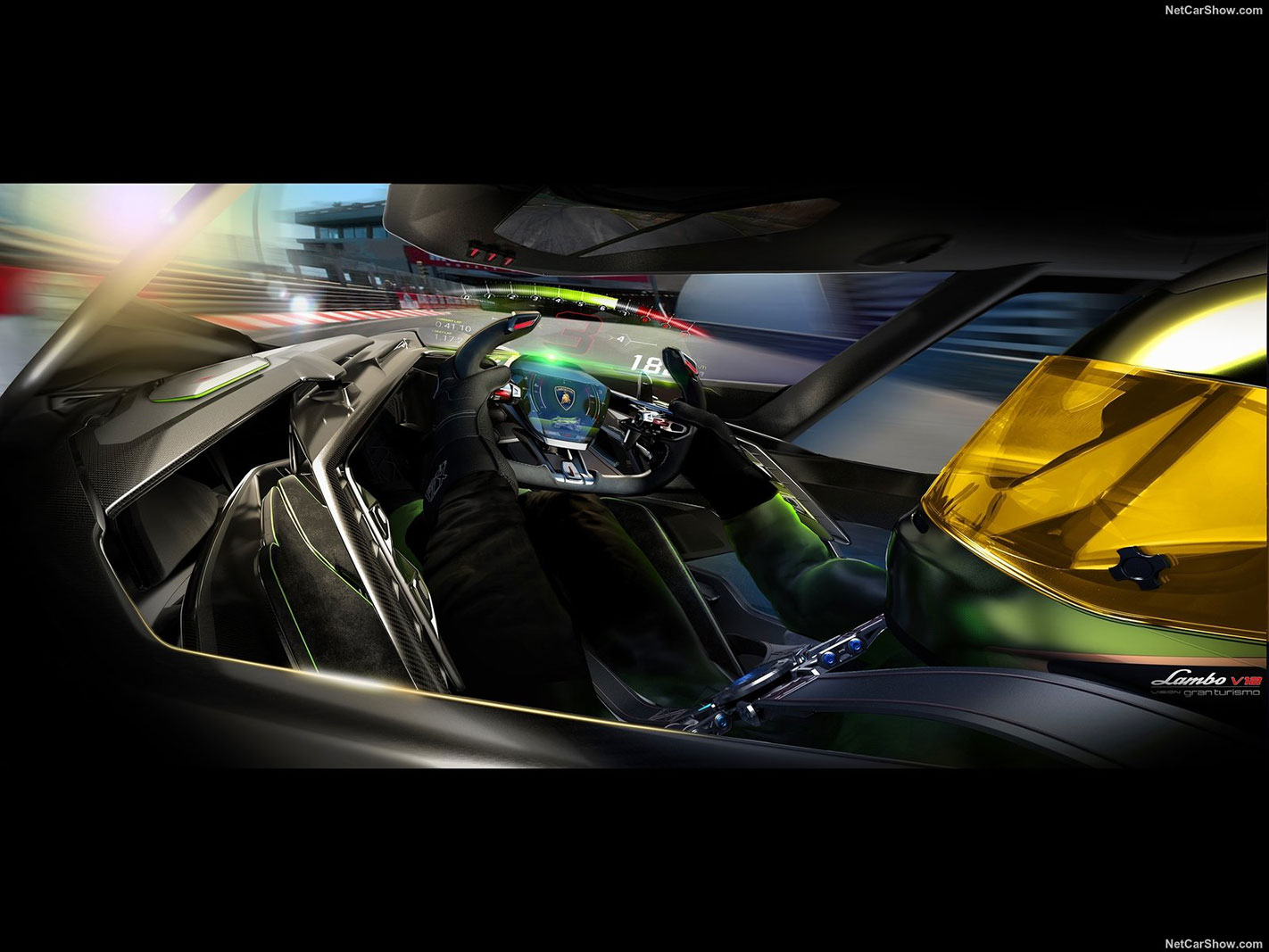
The Lamborghini V12 Vision will be available for anyone to drive in the second quarter of next year, in Playstation’s Gran Turismo Sport game.
While a physical life-scale model was displayed in Monaco ahead of the 2019 FIA Certified Gran Turismo Championships, the wild concept is highly unlikely to enter production. However, within the game’s lore, the V12 Vision is underpinned by the recently-revealed Lamborghini Sian (which is going into limited production).
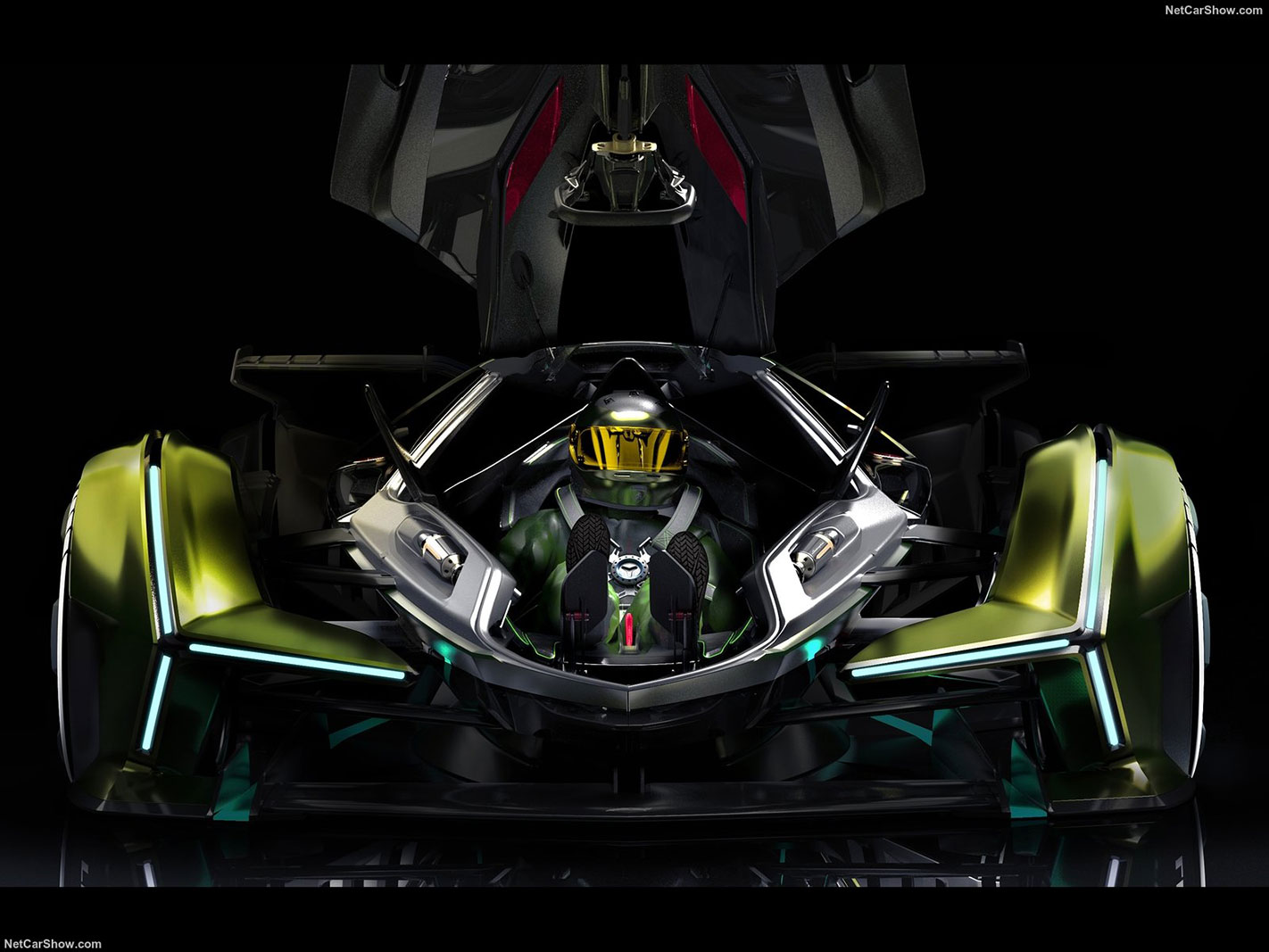
That means the wild single-seater body is draped over a hybridised 6.5lt V12 system, yielding 602kW and the ability to clock triple digits in just 2.8 seconds, and a pixelated top speed of 350km/h.
Visually, it’s unmistakably Lamborghini, bearing the brand’s signature Y-lights both front and back, with aggressive and angular lines framing a disconnected single-seat driver cell, and hexagonal side windows providing a historical nod to the 1967 Lamborghini Marzal concept.
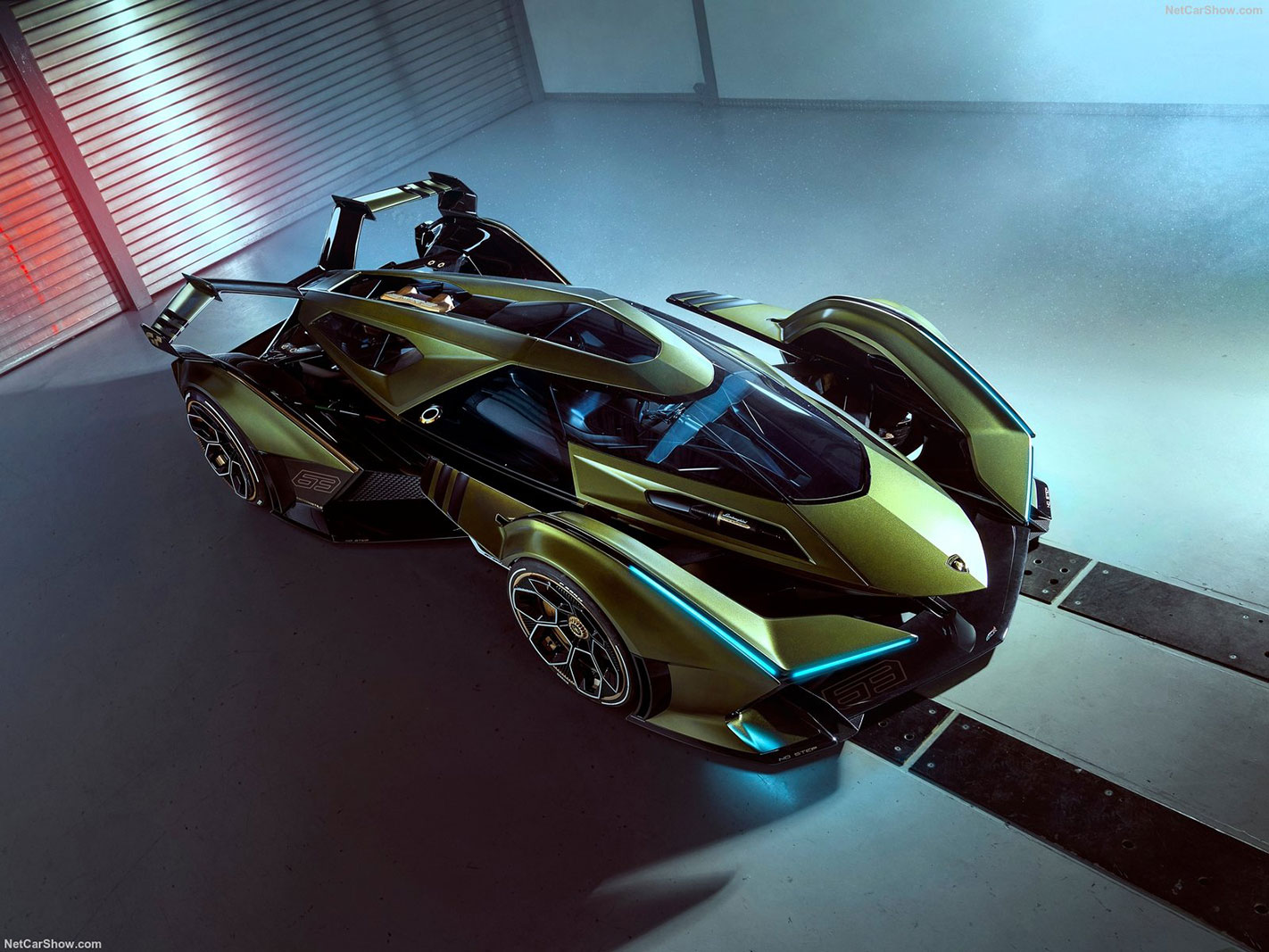
The virtual driver enters the car from the front, through a jetfighter-like canopy, and is faced with a digital steering wheel and a complex heads up display.
Head of Lamborghini Centro Stile, Mitja Borket stated: “The Lambo V12 Vision Gran Turismo is created to provide the ultimate virtual car for young fans and gamers, who are ultra-enthusiastic about Lamborghini and its futuristic aspirations”.
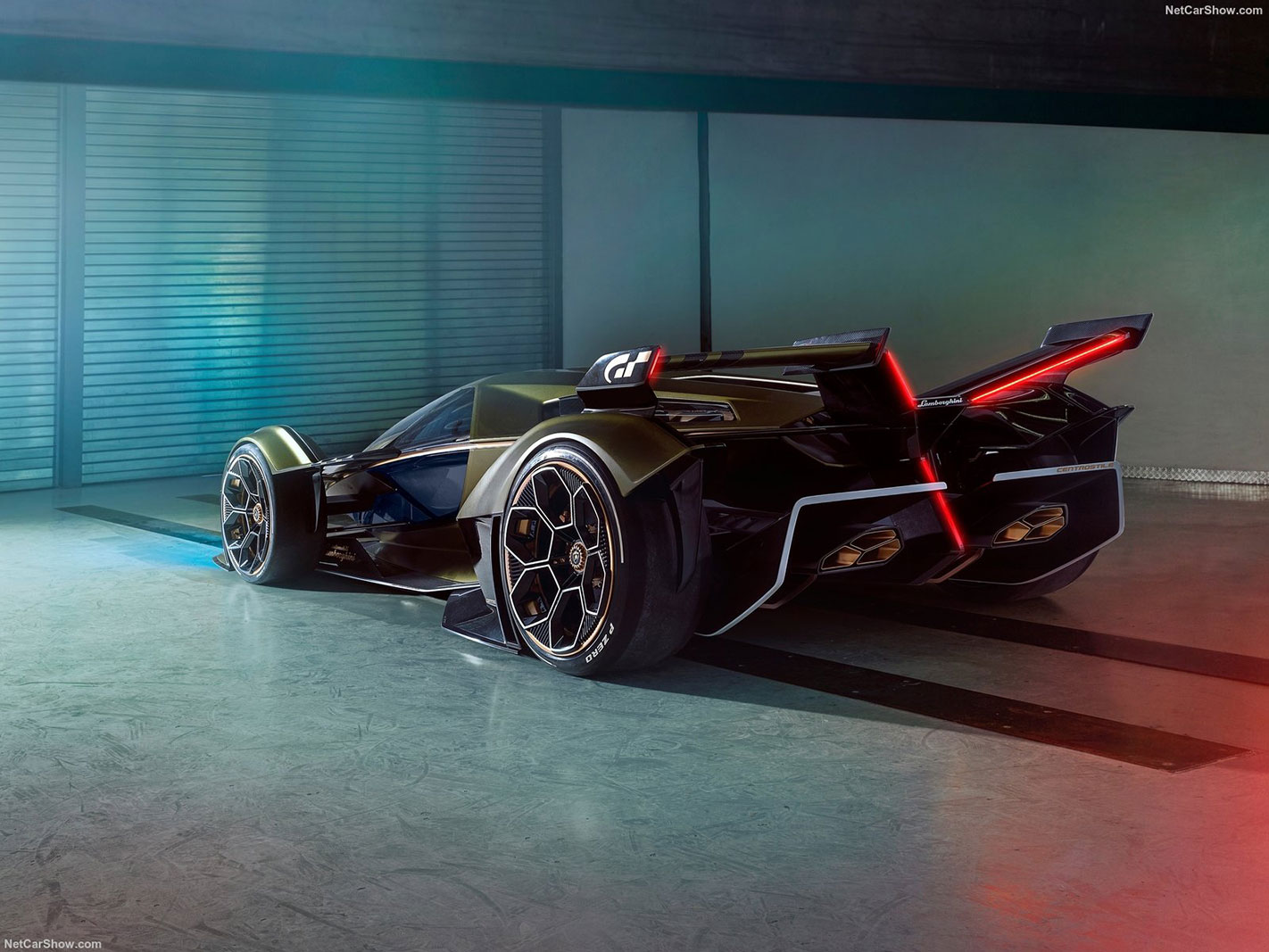
“It is an opportunity for Lamborghini’s design talent to stretch its wings and visualize a car that, like every Lamborghini, not only is a head-turner and the best driving experience, but also mirrors Lamborghini’s push on future technologies, particularly in the arena of lightweight materials and hybridization”.
The V12 Vision may never enter production, but as an unabashed exercise in futuristic design, it’s certainly an interesting glimpse into what race cars might look like in the future. And if that’s the case, feel free to sign us up right now!
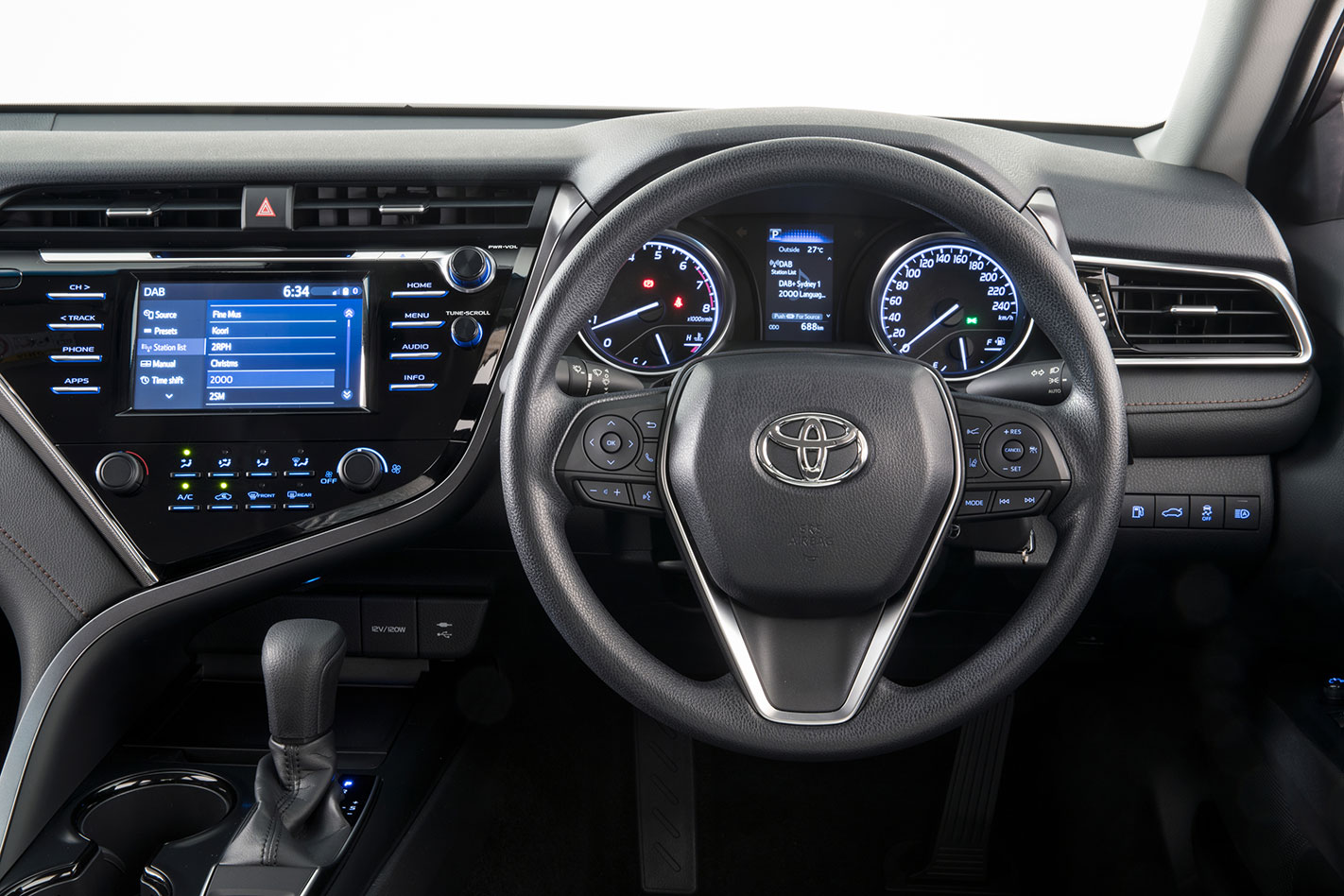
The omission of Apple CarPlay and Android Auto has long been a bugbear with modern Toyotas.
That’s all changed as the iconic Japanese marque is not only offering it as standard going forward, but Toyota has also joined the retrofit race, with smartphone mirroring available to applicable models for $199.
The popular fifth-generation RAV4 hit the market sans the popular infotainment tech, however, Toyota is now offering owners of that vehicle free Apple CarPlay and Android Auto upgrades to customers via the extensive dealer network.
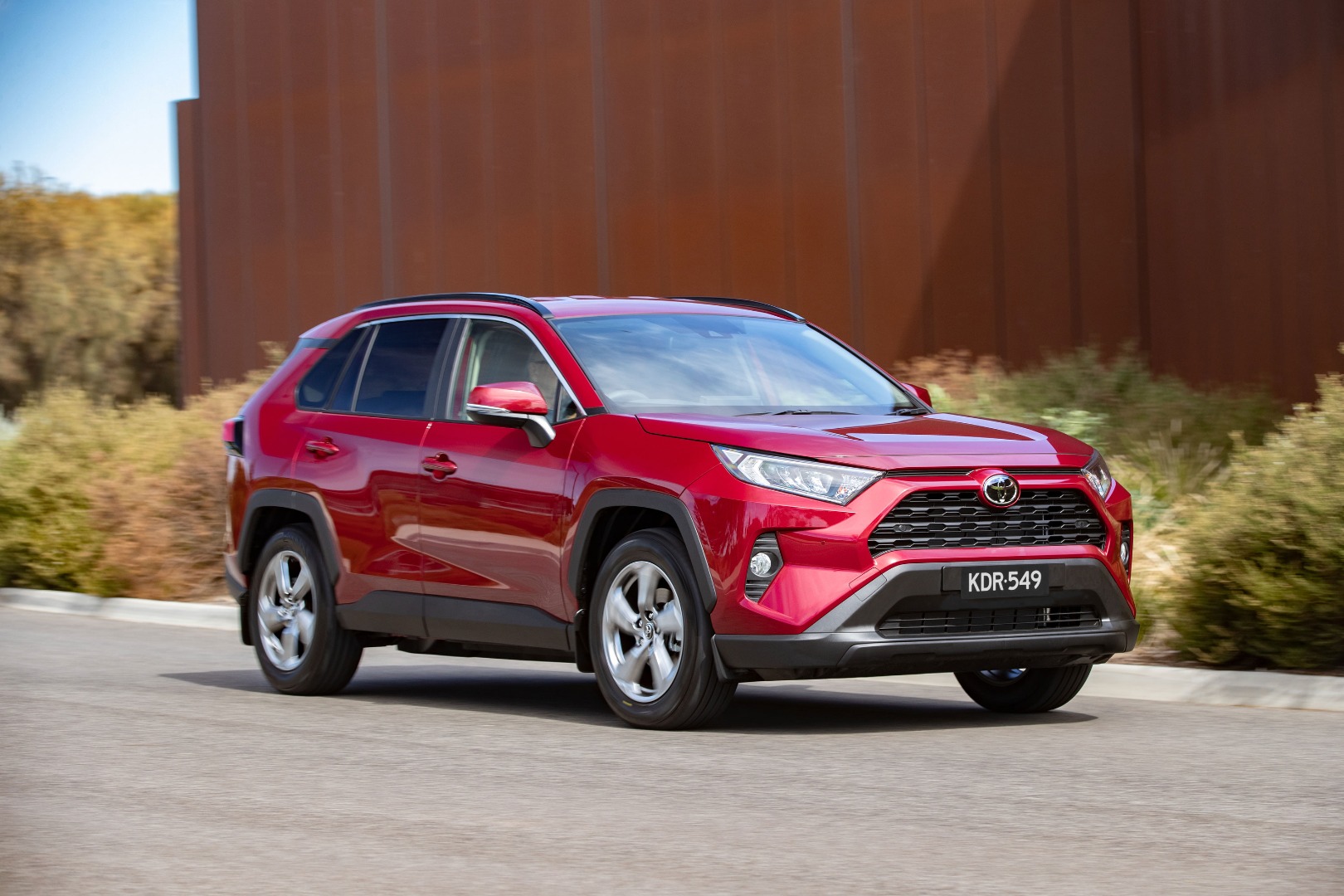
General Manager, Product Planning and Development, Rod Ferguson, said that the preparation of the software required to upgrade the head units wasn’t ready in time for the RAV4’s release date.
“For the customers who’ve already purchased their RAV4, they can come back into their dealers and have it fitted for no additional cost.
“For ongoing customers who purchase RAV4s from now, it will be a part of the spec. And there’s no price change [to variants] going forward,” Ferguson said.
However, it’s not just good news for RAV4 owners as the Camry, Corolla, HiAce and Prius all have model eligible for the $199 upgrade.
Mazda experienced a massive take-up when it gave existing customers the chance to upgrade their MZD Connect-equipped cars with Apple CarPlay and Android Auto.
So much so that Mazda scrambled for stock with the unexpected demand for the technology – some 370,000 vehicles took up the offer as it stretched back to early 2014 cars.
At a cost of $495 for the Mazda retrofit, Toyota’s program undercuts its competitor by a significant margin.
How important is Apple CarPlay and Android Auto to your driving experience? Would you jump at the chance to have it fitted to your car?
Before we begin, a disclaimer directed to all lovers of gastropod molluscs – no ‘snails’ were harmed in the making of this feature.
It’s important we establish that the Wheels test team loves a good turbo. For starters, none of us has ever felt the twist of a Newton metre we didn’t enjoy, and the turbo has been responsible for countless significant transformations across every automotive segment. This ingenious exhaust-gas-driven induction air pump has helped bestow greatness on so many cars, to the point now where Mercedes-Benz and BMW, just as two examples, are so enamoured with the turbocharger that both German giants refuse to build an engine without one.
But our love can only extend so far. Because equally well established is the purity and intimate driver connection only a high-performance atmo engine can deliver. Which, of course, is what this feature is all about. It’s a celebration of free-breathing brilliance; of having to chase revs when really demanding speed, having a throttle pedal seemingly hard-wired to your synapses, and revelling in an open-lunged soundtrack that can only come when there’s no impeller between the exhaust manifold and the tail pipe.
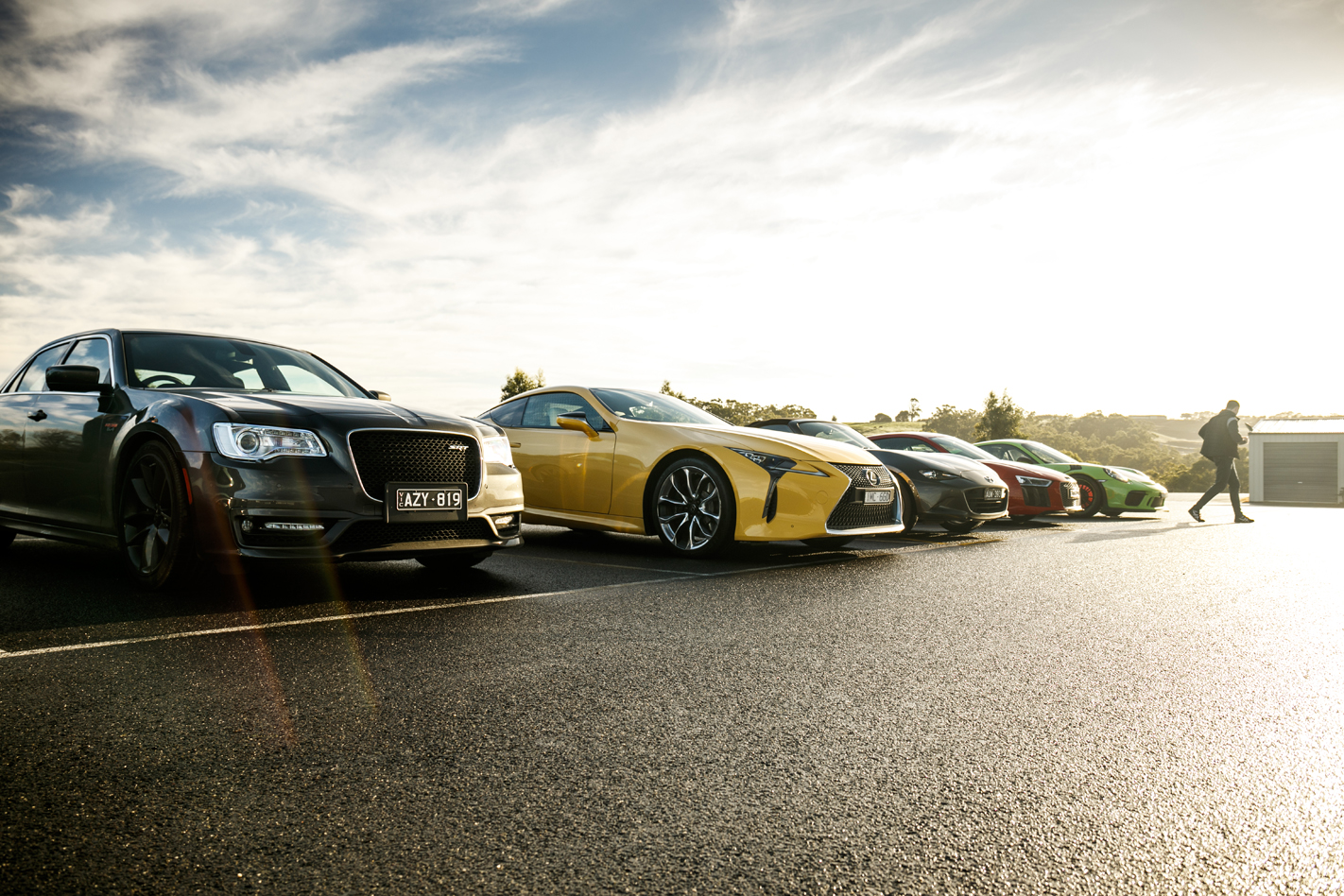
In bringing together our field, we tried to gather representatives of disparate engine designs and characters. Our field of six spans just over $40,000 to well north of $400,000; from four cylinders to 10; and from 135kW to nearly four times that figure. But as this celebration will prove, an atmo hero is not ordained by cylinders or kilowatts – it’s by the number of hairs that stand up on the back of your neck when the tacho swings past the yard arm.
So, time to head for the hills – the ‘Haunted’ ones at Bryant Park, Moe, and the ones climbing out of the Latrobe Valley. Buckle up.
Atmo Hero #1: Porsche 911 GT3 RS
TO DEBATE THE merits and net cost benefit of the GT3 RS over the already sublime GT3 is both pointless and churlish. If you want the closest thing to a Carrera Cup racing car for the road, then this is it. If you want to understand why an atmo flat-six deserves to live forever, this is also your evidence right here.
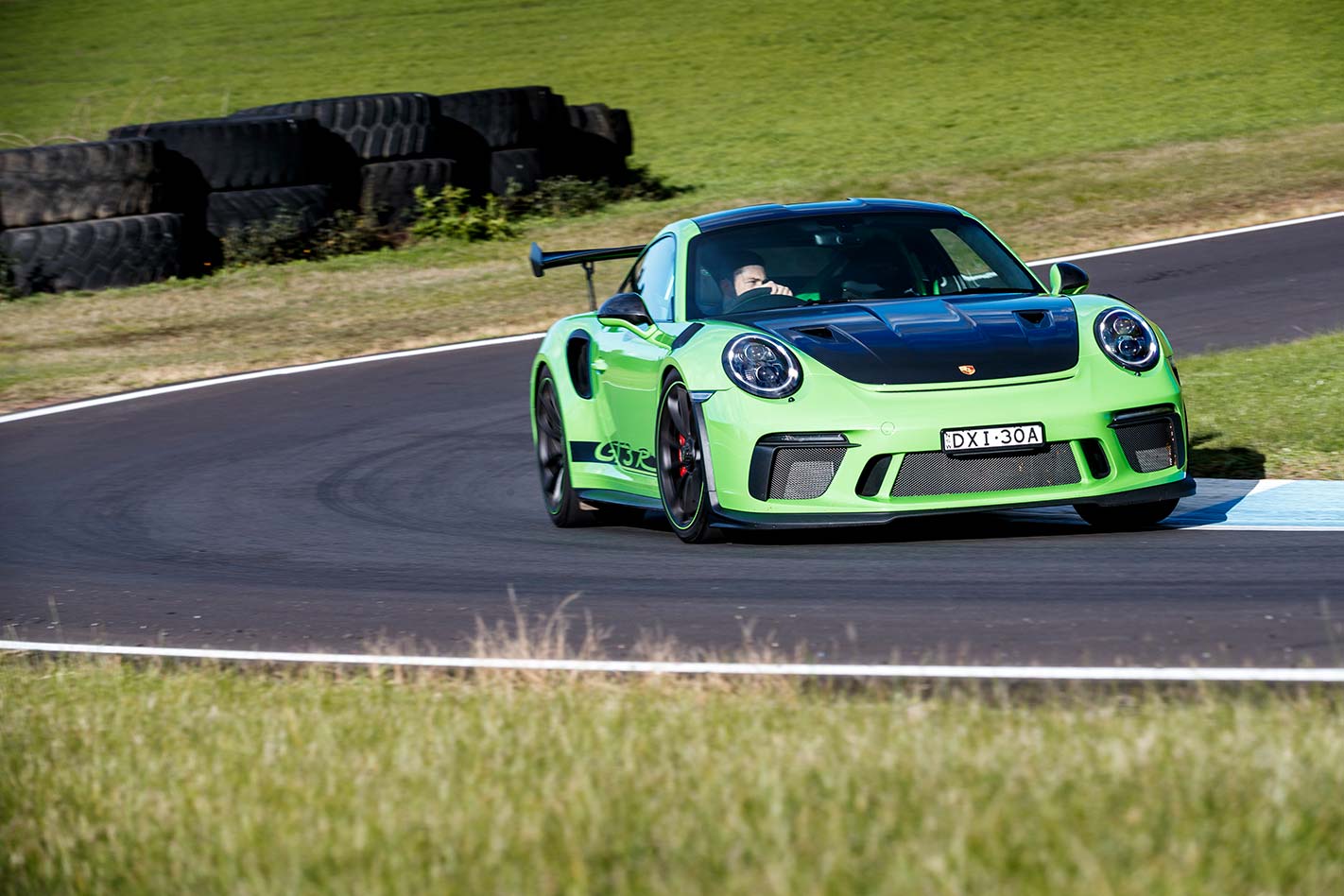
Fact is, you could adhere to a self-imposed redline of 7500rpm and still feel you’re driving one of the world’s greatest atmo engines. Oily, eager, and ultra-responsive, it has a breadth to its tonal qualities and a linearity to its delivery that really is sublime. But once you’ve tasted that final lunge to the 9000rpm redline, it’s like a narcotic you continually crave. Think of those wildlife documentaries where you watch the cheetah explode from the crouched position in pursuit of the little impala, every sinew stretched to the limit as the predator’s acceleration phase becomes a true arbiter of life and death. Now think of the final lunge, when the big cat hurls itself at the throat of its prey and sinks its teeth through flesh and spinal column. That’s kinda like the moment when the GT3 RS’s engine rips from 7500 to that 9000rpm kill zone. At max revs, with the sports exhaust in the open position, an in-cabin decibel meter would read 102db, a whopping 14db louder than a Carrera S at its redline. But it’s the shift in pitch at that top end, like a butcher’s bandsaw having an argument with an aluminium ski pole, that makes you feel truly alive. Glance down if you dare, and spot the tacho needle flicking crazily across the white face, like an epileptic Swiss watch. Magic.
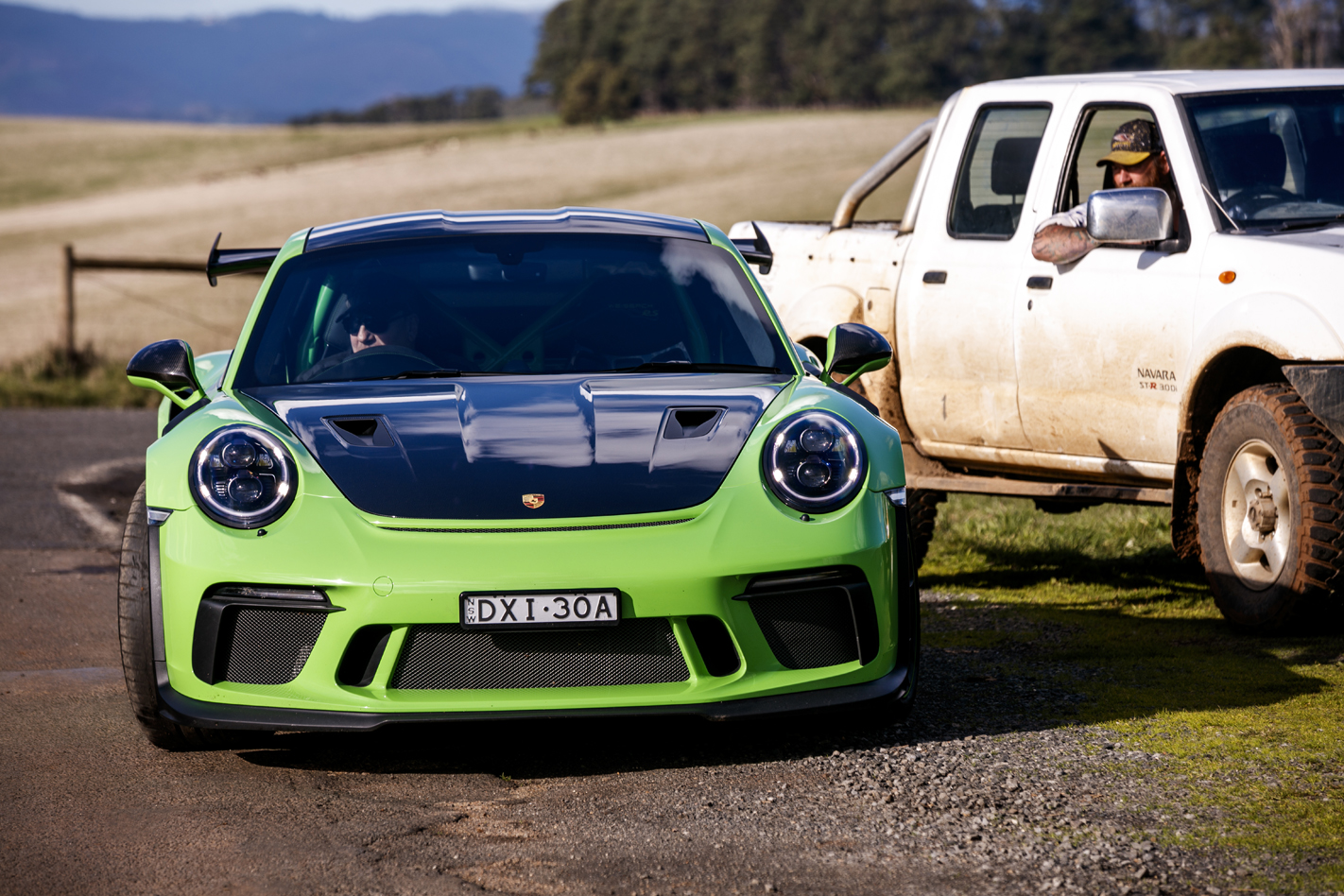
Of course, there are a few inherent compromises that make perfection elusive on the road. The lack of sound deadening and size of the rear tyres mean the aural qualities are a bit discordant at urban speeds. The track-focused chassis tune can buck and spit over mid-corner lumps on really gnarly Aussie B-roads. But the steering remains a thing of wonder in your hands, constantly feeding information about surface nuance and grip levels while possessed of an almost supernatural ability to read the road camber without tramlining. The brakes, too, are a constant pleasure to punish. Even the fact that the cabin is looking dated in the face of the new, tech-rich 992 is hardly cause to sook. More than mere atmo hero, this last-of-the-991s GT3 RS is both berserk warrior and legend to the end.
Atmo Hero #2: Mazda MX-5
NO-ONE disputed that the changes Mazda engineers wrought on the 2.0-litre engine late last year were transformational. The move to bigger valves, more aggressive cams, higher compression, improved injection and a freer-flowing exhaust were straight from the atmo tuner’s handbook, but gave this delight of a driver’s car a distinct personality shift. There’s both a usefully stronger top end, and more rev-range headroom to work with, which was important on a bunch of corners at Haunted Hills which dictate you hold the top of second rather than waste an upshift to third for only a few milliseconds.
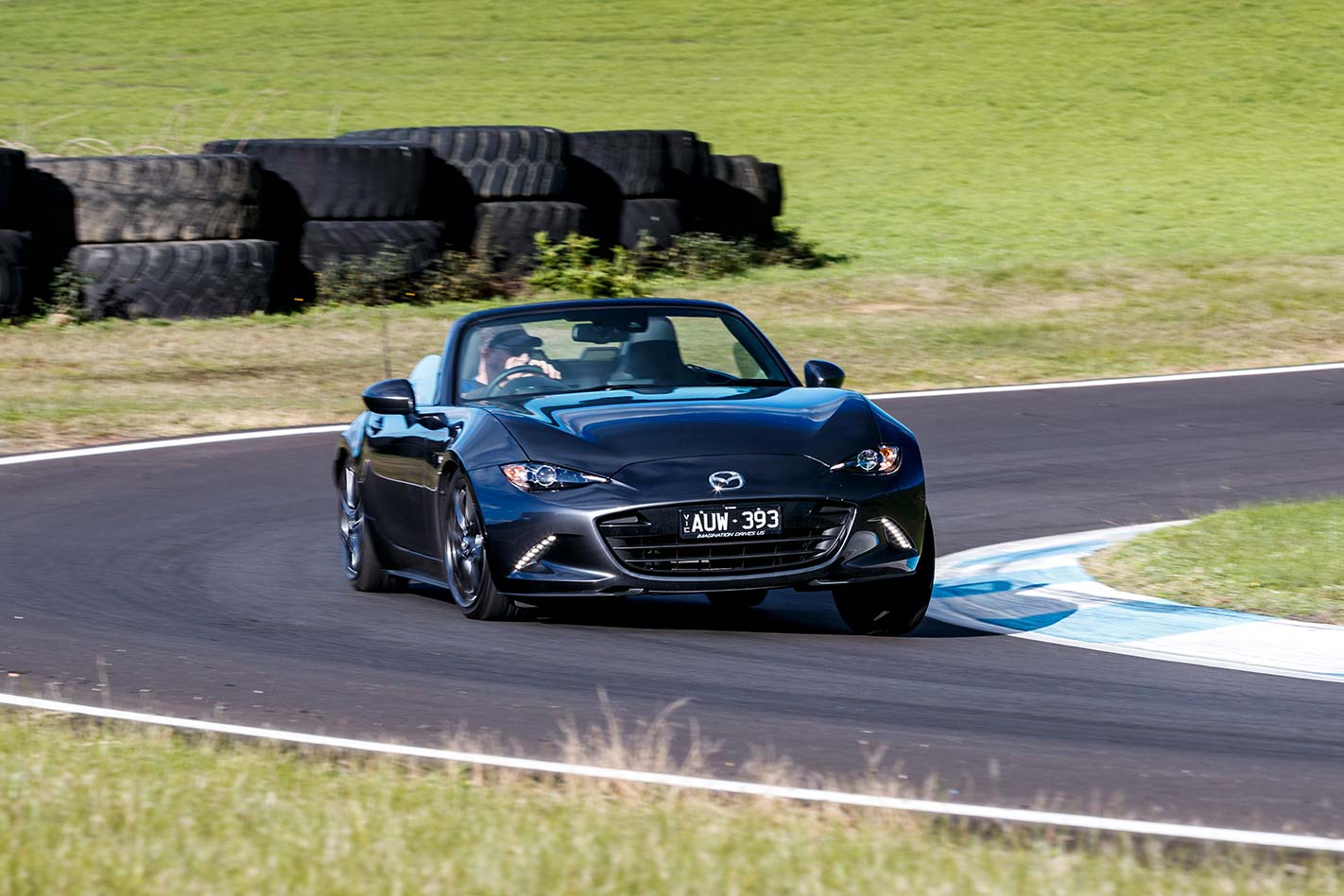
On the road, Enright made the observation: “Where the original ND’s on-limit dynamics could feel a little one-dimensional, the extra power of the updated engine gives you far more options. It now carries speed effortlessly cross-country.”
But we’re here to anoint atmo heroes, and as good as the new engine is, the Wheels crew broadly agreed that its extra strength and rev ceiling served as a gateway to better exploit the chassis balance, rather than being a thing of wonder in its own right. It sounds fruity enough in terms of induction slurp, but a switchable exhaust to really uncork some sonic satisfaction from the tailpipe would be hugely welcome. And none of us could overlook the fact that in the 2.0-litre four-cylinder space (at an admittedly much higher price point) we’ve had true superstars like the F20C engine from the Honda S2000, which was ripping out 184kW from the same capacity at 8800rpm two damn decades ago.
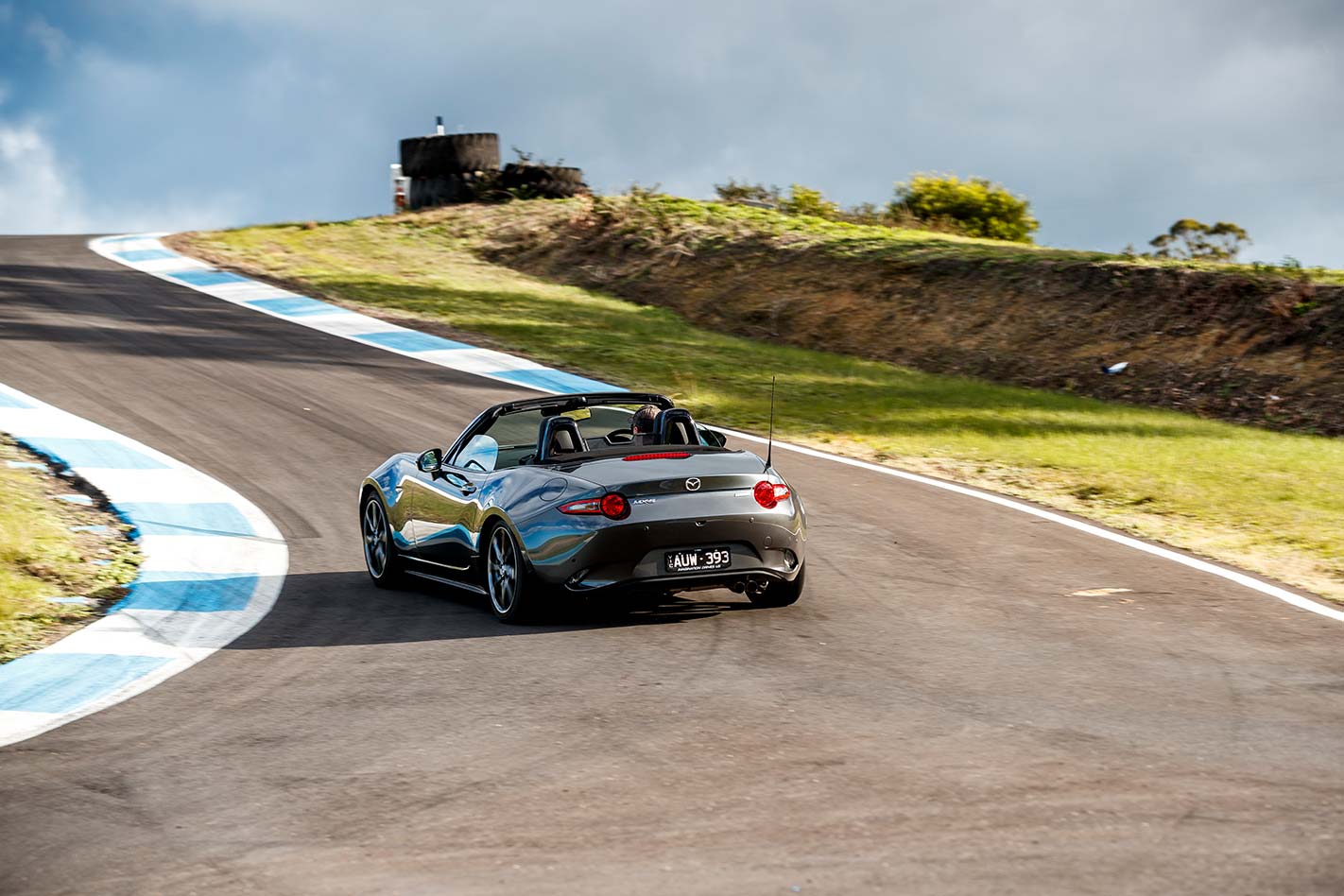
As a package to really tweak a keen driver’s go-spot, delivering brilliant rear-drive chassis engagement via quick, tactile steering combined with open-air sensory stimulation, the MX-5 is touched by greatness. But true atmo-hero status remains just out of reach.
-Ash Westerman
Atmo Hero #3: Chrysler 300 SRT
Demonstrating how wide the Church of Free Breathers truly is, we jump from a petite two-door roadster to a beefy sedan with double the cylinder count, and more than three times the capacity. Welcome, then, to the Chrysler 300 SRT.
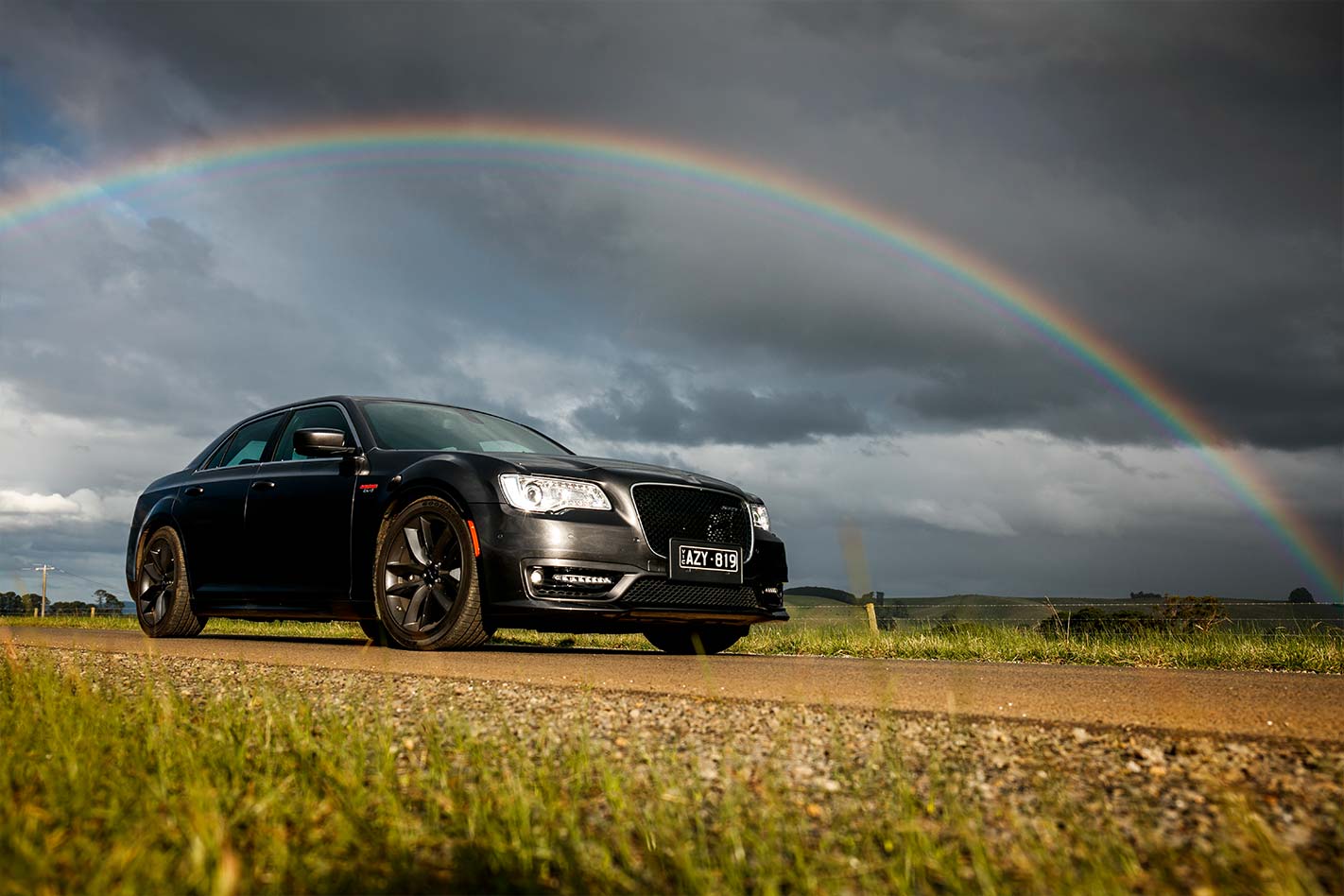
Appearing here in Core spec, priced from $65,000, the 300 SRT is the most affordable V8-powered sedan you can buy, ostensibly last man standing in the space vacated by the Holden Commodore and Ford Falcon.
Under the 300 SRT’s bonnet is a 6.4-litre Hemi punching out 350kW and 637Nm, codenamed Apache, evoking the Boeing-built attack helicopter. It’s one of the largest atmo engines you can buy, only bested by the 6.5-litre V12s of Lamborghini and Ferrari.
The first hint at the Hemi’s character is the idle, which is satisfyingly lumpy, and tinged with a metallic note. But it’s between 3000rpm and the 6100rpm redline that it comes alive, bellowing out a deep, animalistic roar.
Driving the 300 SRT is a surprising delight. The Wheels team expected something with such an overt American style to fall short on the twisting Haunted Hills circuit. Oh, how we were proven wrong. The steering is too light in Street and Sport modes, but the weighting in Track matches the bulging-bicep character of the 300 SRT, and the front end is surprisingly direct and trustworthy.
With Track mode engaged (which retains the thinnest of ESC safety nets), the SRT allows armfuls of lock as it performs languid, almost balletic, power slides on corner exit thanks in part to a Getrag limited-slip diff. Of the two Americans present, the 300 SRT was the one which we preferred on track. No, we weren’t expecting that either.
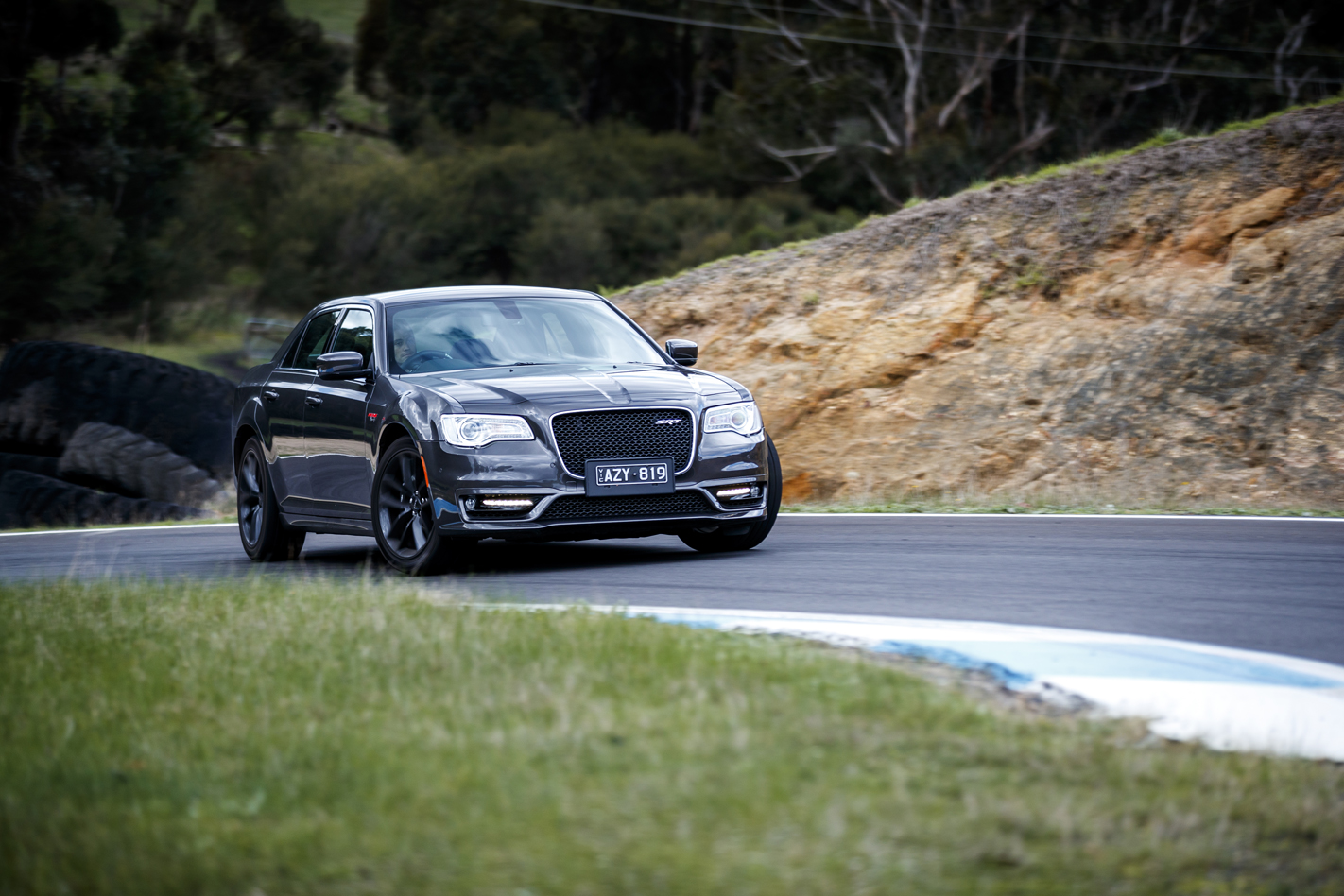
While everything about the 300 SRT seems as American as going bankrupt from medical bills, it’s actually got a fair-dinkum Aussie spirit. You can’t buy the SRT in North America; the only markets in which it’s sold apart from here are New Zealand and the Middle East. So, unlike the Apache gunship, it’s not a true American gunslinger, but with its big V8 heart, and endearing dynamic character, it’s a true-blue atmo hero in our books.
-Cameron Kirby
Atmo Hero #4/5: Ford Mustang Bullitt & Lexus LC500
Much like the brutish four-door American, it’s hard not to become infatuated with the old-school muscle-car ethos at play in the Bullitt Mustang. Press the starter button on a cold morning and you’ll certainly get to say good morning to the neighbours. Yes, you can scroll through different exhaust modes, but muffling the 5.0-litre Coyote V8’s bark seems wrong. Burbling away on a cam-heavy idle, this movie-star throwback feels every bit $74K special, even if that is an $11K premium over a manual GT.
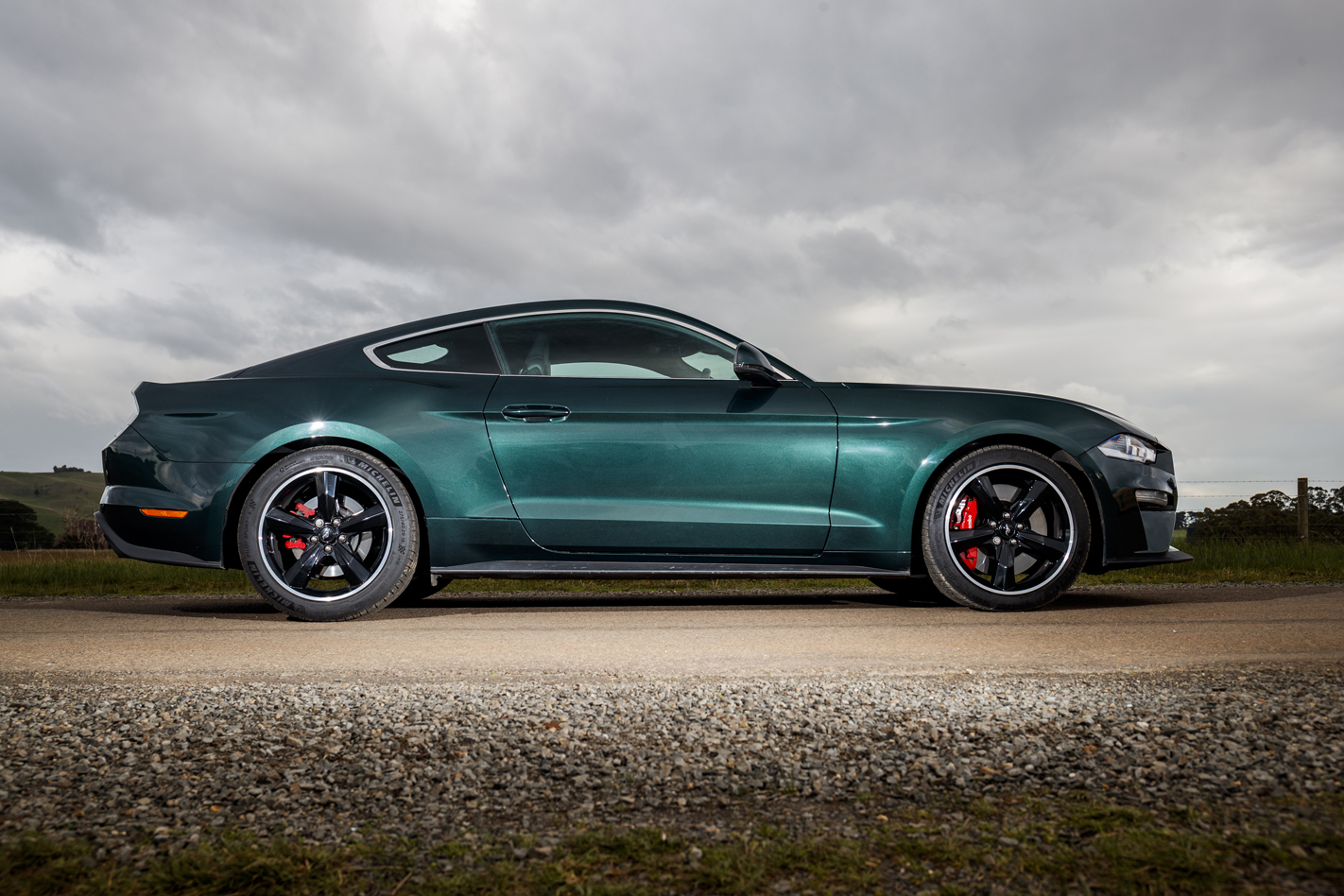
Finished in Dark Highland Green and rolling on 19-inch aluminium Torq-Thrust wheels, the Bullitt has a demeanour all of its own. The deletion of the pony from the front grille and the addition of a gunsight Bullitt motif at the rear are polarising but unavoidable. The blacked-out cabin features green stitching and lighting, while a dash-mounted plaque highlights the fact you’ve bought a Bullitt. The new digital instrument cluster also continues the green theme, while the supportive Recaro seats are worthwhile additions.
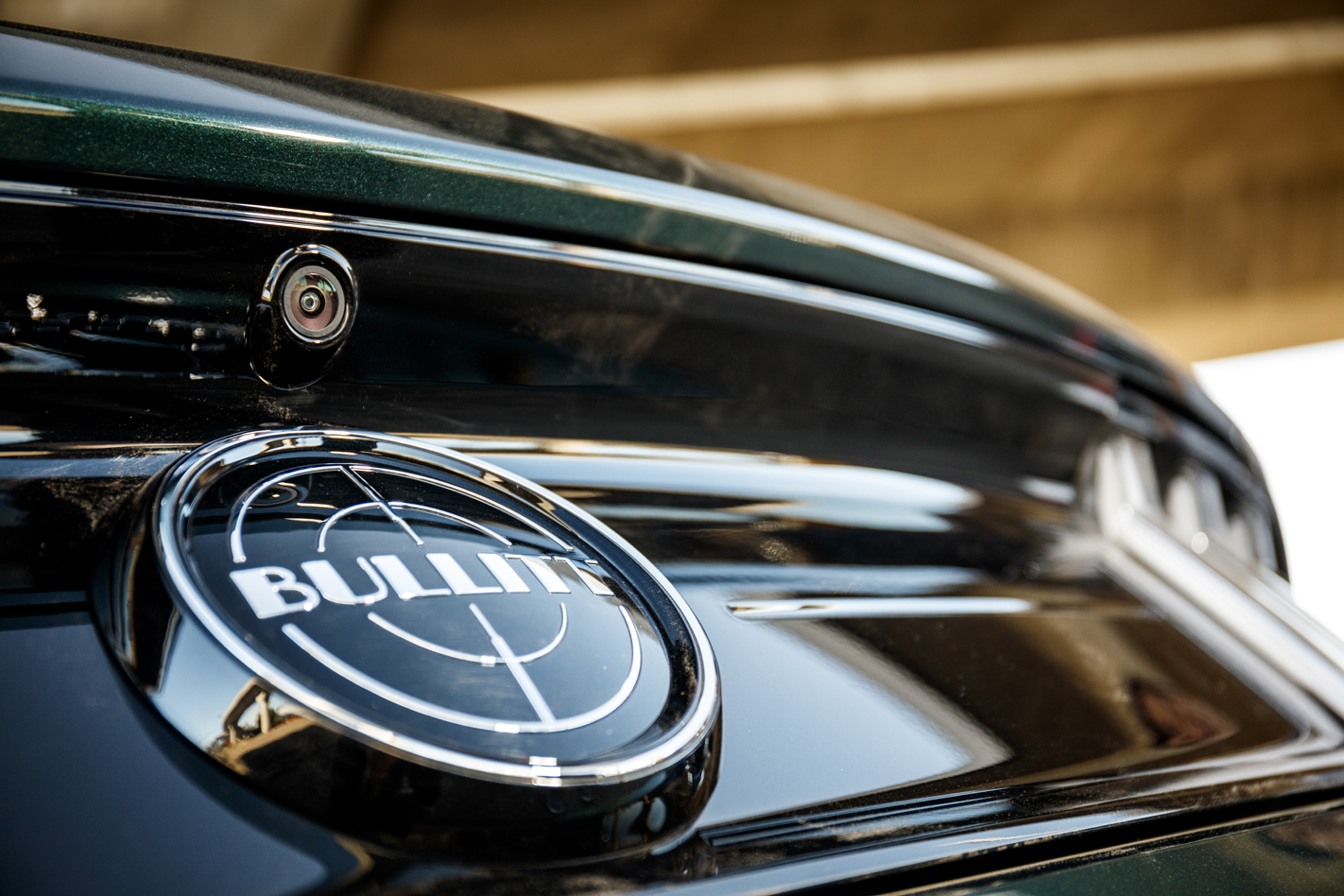
So that accounts for some of the Bullitt’s extra cost; the rest centres around mechanical goodness (see sidebar p77). It makes a rowdy racket, one distinct from the GT, as the Bullitt gains an intake roar and a maniacal overrun from the active exhaust. In its upper reaches, racing towards its 7500rpm cut-out, the timbre changes, introducing an addictive crescendo. Enright quips that it isn’t all for ‘look-at-me’ fanfare. “The Mustang is just the greatest thing to burble around in. The engine’s got a lovely, cross-plane ‘whomp-whomp’, and for some people, that’s all they want from a V8,” he says. Judging by punter reactions, Enright’s probably right.
MagneRide adaptive dampers and Michelin Pilot Sport 4 S tyres are standard, affording the Bullitt the duality of compliance and composure. Except, the latter comes with a level of unsettling pitch from the rear, while the steering remains a bit vague, and the over-servoed brake pedal continues to be a bugbear. Still, keep it within controlled limits and the Bullitt shines. It rewards with unassuming pace and a crisp, precise shift action from the six-speed manual that’s in contrast with the Mustang’s often unsophisticated image. The cue-ball gearknob is a brilliant combination of form and function.
Tall gearing (you can reach 134km/h in second gear) lulls you into thinking the ’Stang is slower than it actually is. Sometimes the plot can take a little too long to thicken. A shorter final drive and the gearing from the EcoBoost would help. It’s one of the only cars here that induces forced-induction thoughts, leading some to question whether it would improve the experience.
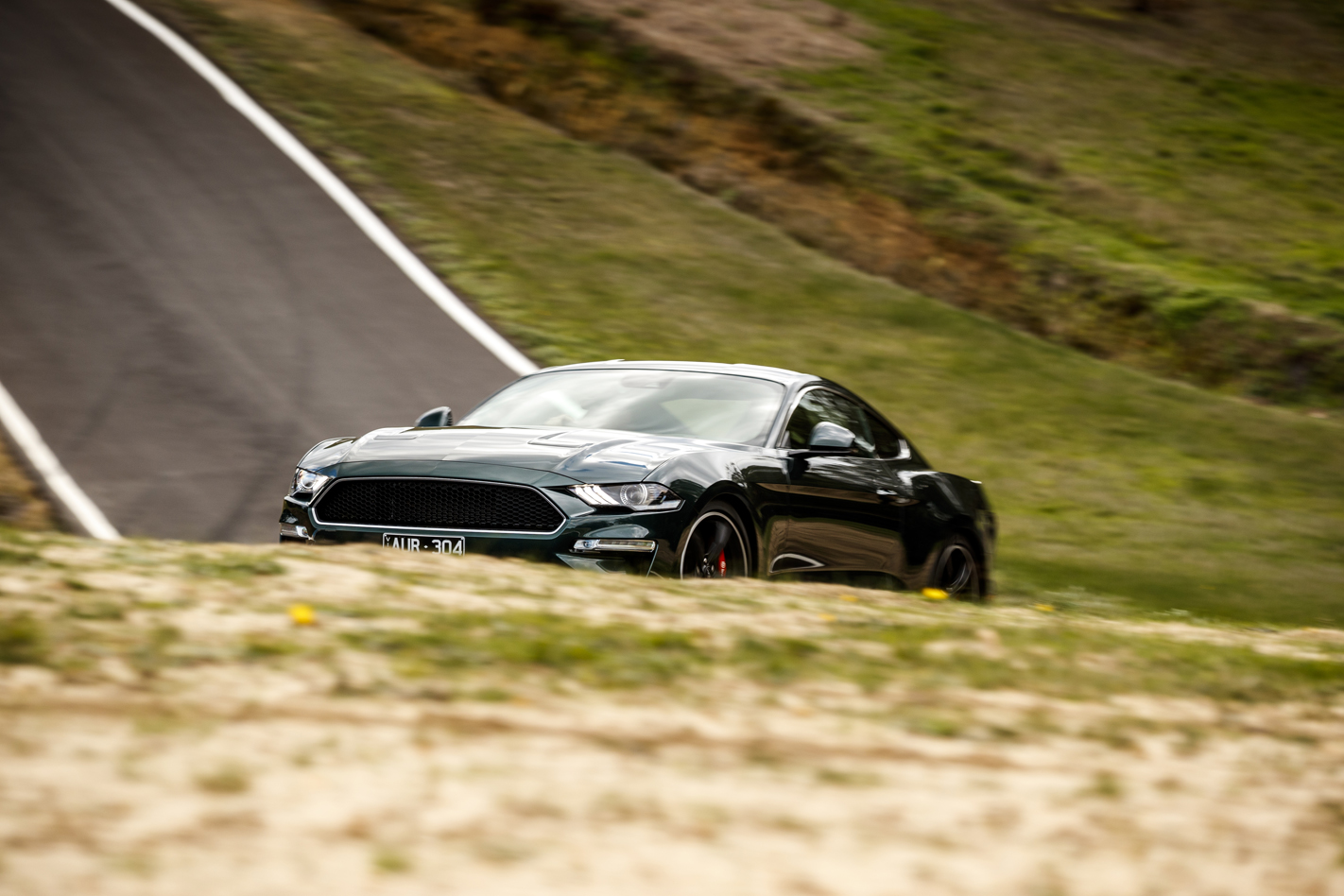
Overall, the Bullitt is best enjoyed at seven-tenths – and far away from a racetrack. The Mustang’s USP involves cruising along the shoreline with the windows down, basking in the sun with that enticing V8 rumble as the perfect travel companion. Come to think of it, the Lexus LC500 does a version of this, too. But much more as well.
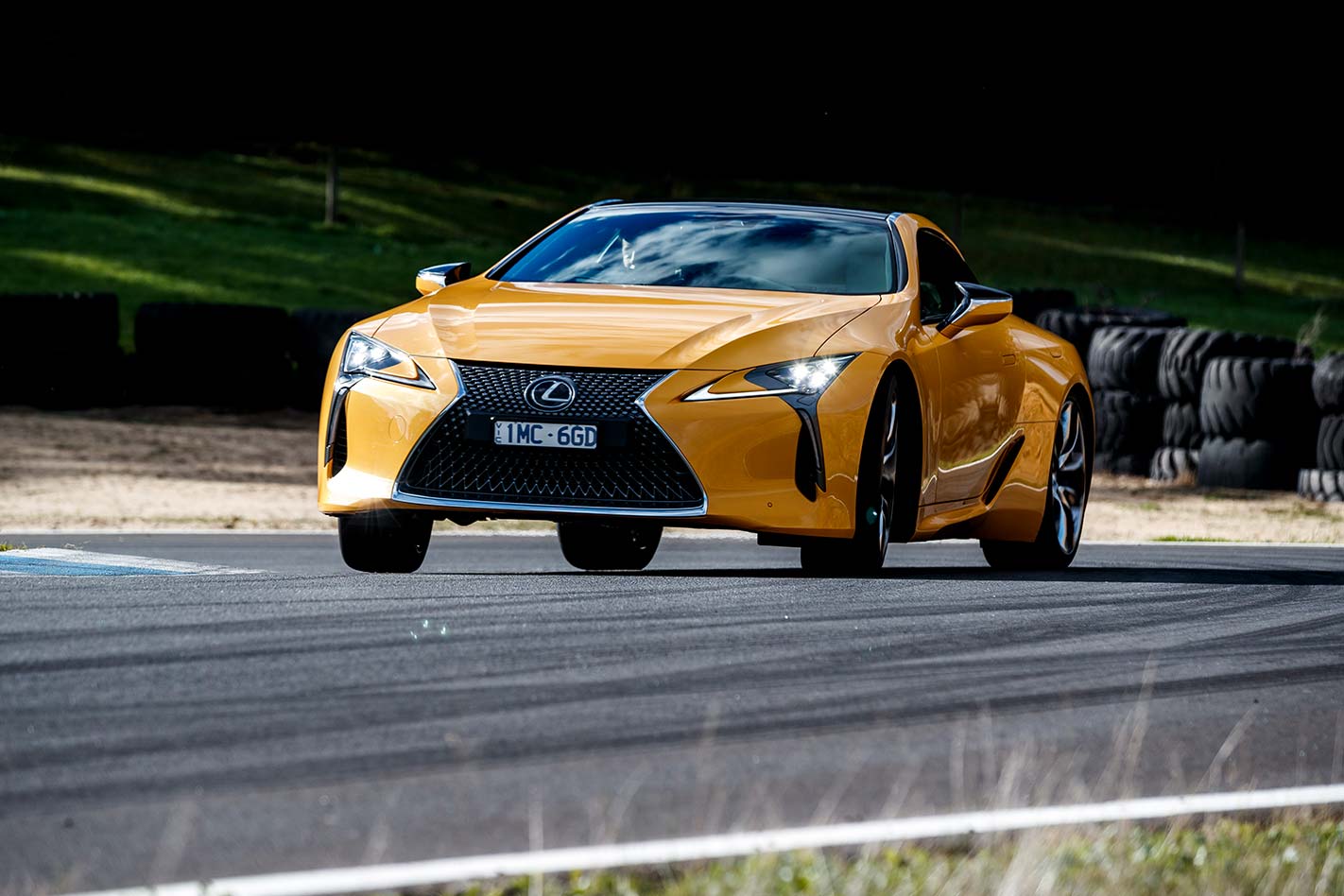
It’s a face of child-like joy and unbridled abandon you don’t normally associate with a Lexus driver, yet Enright’s grin is beaming. If it weren’t for eight pulsating cylinders screaming towards their 7300rpm cut-out, you’d be able to hear him chortling from outside the lavish cabin. He’s mid-drift at Haunted Hills and the amount of slide angle and accompanying tyre smoke from the 21-inch rear hoops juxtaposes this road-going concept car’s assumed persona.
The LC500 is supposed to be a GT cruiser, not a track-focused sports car. Okay, the latter isn’t exactly true either, but there’s no questioning its surprising on-track prowess. It feels like an event. The naturally aspirated, 4969cc, 90-degree bent-eight more than justifies its inclusion here – especially when it delivers 351kW (7100rpm) and 540Nm (4800rpm) while producing such an arousing sound.
However, even among this company, the LC500 is acoustically special. Enright, in a brief moment of maturity, sums it up best: “It sounds like it’s made of exotic materials, like the whole thing is made out of titanium.” That’s the appeal of the LC500 in one. With its Yamaha-tuned, high-flow cylinder heads, titanium inlet valves and dual-length intakes, the engine complements the theatre of the dramatic exterior design.
The LC matches purity and polish with a hint of animalism. Ears prick whenever it’s on song, especially when the slick 10-speed torque-converter auto blips hard on downshifts or bounces mercilessly off the hard cut. It’s a landmark transmission.
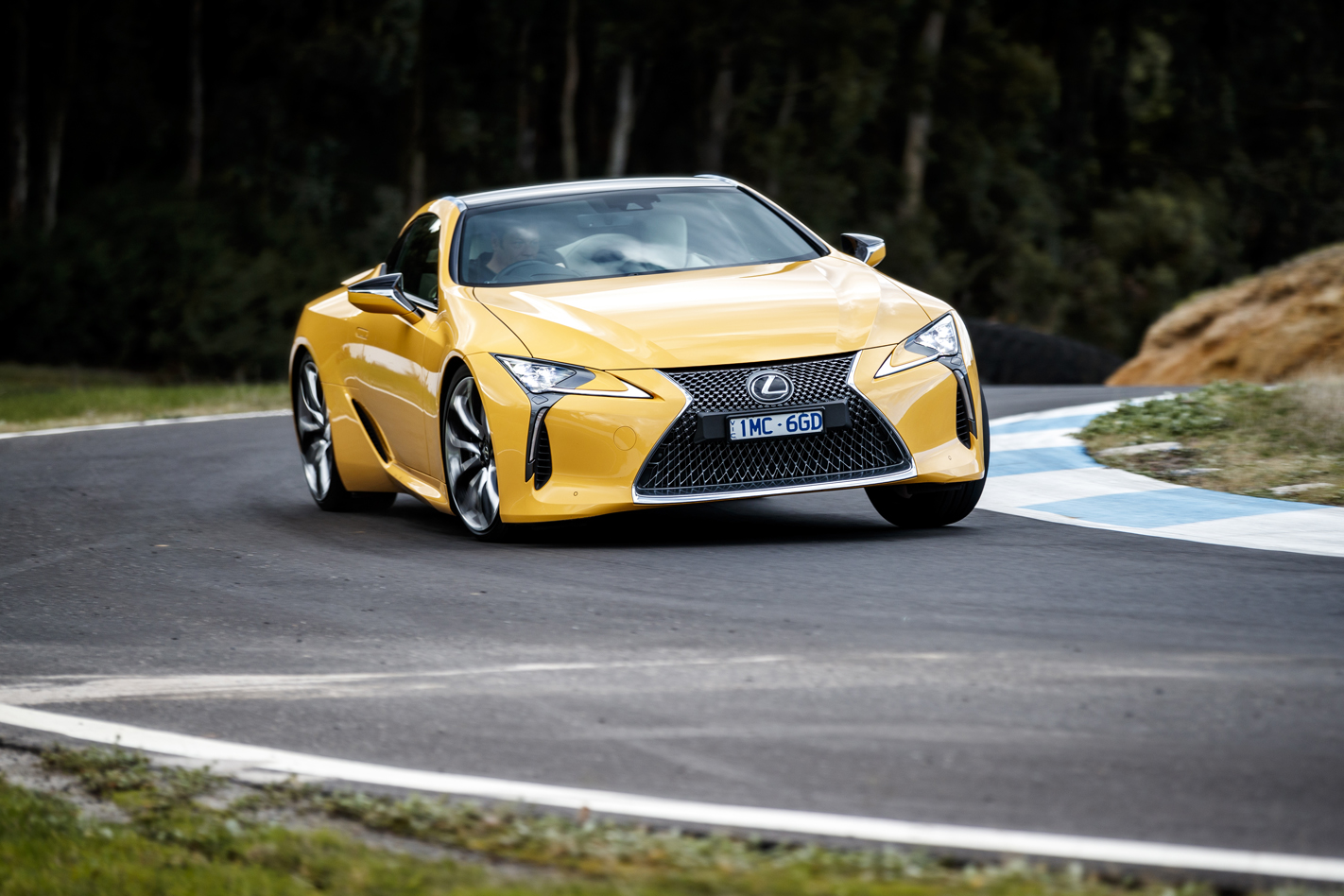
Substance is easy to find. A development on the RC and GS F power unit, the 2UR-GSE raises its compression ratio to 12.3:1, can operate on an Atkinson cycle for reduced consumption, and shifts the LC500 to 100km/h in 4.7 seconds. Yet the on-paper numbers don’t do justice to the LC500. Yes, it needs revs on board, but optional rear steering, while requiring an adjustment period, seemingly shrinks the 4770mm-long body. Hustle hard and the opulent coupe rewards.
Turn down the wick to Comfort mode and the LC500 shows a brilliant loping, touring ability – its ride quality belies the attractive, oversize chrome wheels, road noise is adequately quelled, and you can really sink back into the well-bolstered seats. Apart from the clunky infotainment interface, the interior is a feast for the senses in all the right ways. In terms of an ownership proposition, Inwood sums it up best: “If you bought one, you’d love it to bits.”
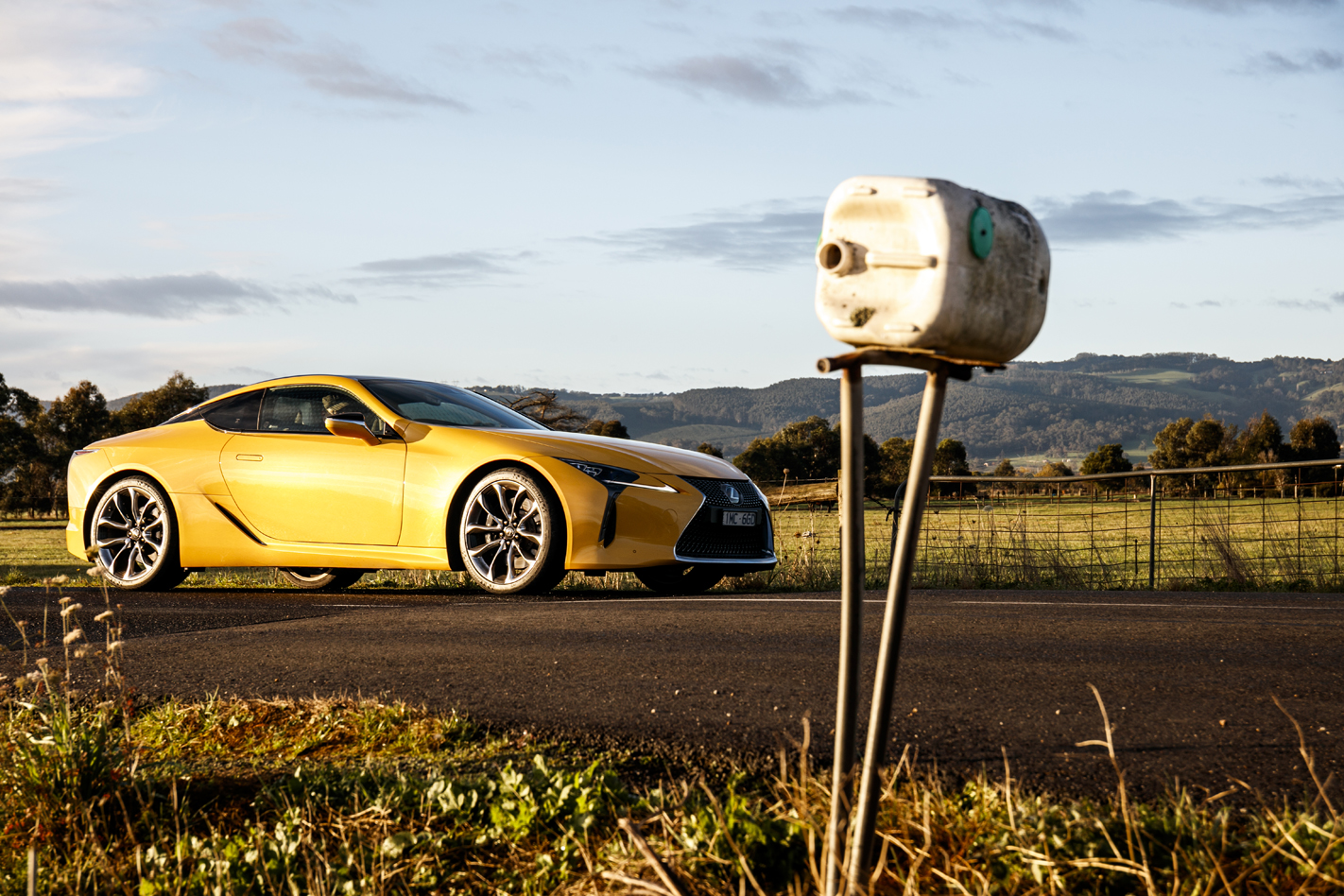
So the $205,200 LC500 isn’t style over substance. Lexus has created a different kind of GT coupe, one dripping in luxury and oozing a feel-good atmo nature, and where adding forced induction would surely detract from its unique brilliance. Crucially, you don’t have to search far below the surface to uncover its driver appeal – a trait shared with the Audi R8…
-Trent Giunco
Atmo Hero #6: Audi R8 V10
The dawn is a thousand peachy pastels, mist sitting on the valley paddocks, the road disappearing to a vanishing point marked by a queue of bluegums. The Audi R8 rumbles from a side road, straightens, pauses, and then morning certainly breaks. The 449kW/560Nm V10 shrieks into life, all discordant minor keys at the top end, then a minim for the next gear and CRACK, the exhaust barks a sharp report. A flock of roosting starlings lifts from the trees as the Audi pulls the next gear, lifting as one in a busy murmuration. Out of nowhere a peregrine falcon plucks one as a meal from the periphery. I’m left gaping in amazement. Did that just happen?
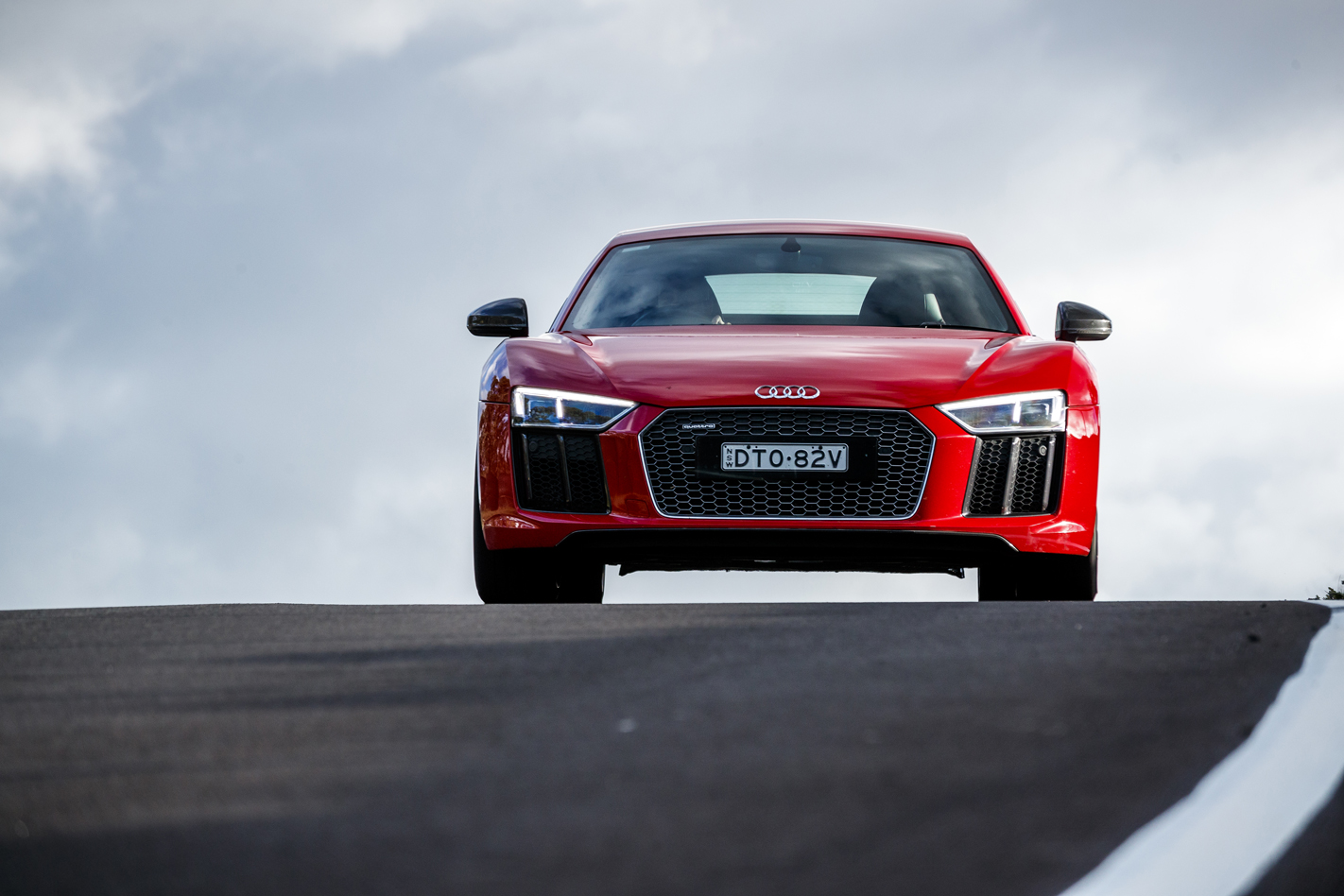
The R8 ($389K plus options) seems to major in these moments. Like the sight of Westerman standing flat on the gas as he jets up a steep hill before me, the Audi squatting hard and launching skywards as if from a trebuchet. It takes a little while to realise that the child in me had always wanted to see a red mid-engined supercar driven hard, disappearing in a freakily cartoonish burst of acceleration, and now I’m in a Ford Mustang, banging the steering wheel in appreciation for witnessing just that.
When Audi first supplemented the original Type 42 R8’s 4.2-litre V8 with the 5.2-litre V10 back at the tail end of 2008, there were many who felt the smaller engine was the sweeter, more preferable unit. It was a more benign, tuneful thing, but the V10 brought attitude, spikiness and a welcome dose of exotica. It had links to Lamborghini, rather than something from an RS4 wagon.
On track at Haunted Hills, the Audi is a revelation. Its all-wheel drive allows you to drift the car four-square into tight corners long before the apex with minimal steering correction, and then just modulate that throttle pedal on the way out. There’s real precision to it and nothing affected or overwrought in the way it goes about demolishing a lap.
Jump into the Porsche and it’s all ridiculously physical and, after the Audi, a bit earnest. But here’s the strange thing. Out on the road, where you’d expect the lighter steering and delicate pedal weights to make life a whole lot more pleasant, you start yearning for the heft and involvement of the GT3 RS. Because you’re not hanging it out on the limit, you crave an interaction that you don’t always get from the R8’s fingertip controls.
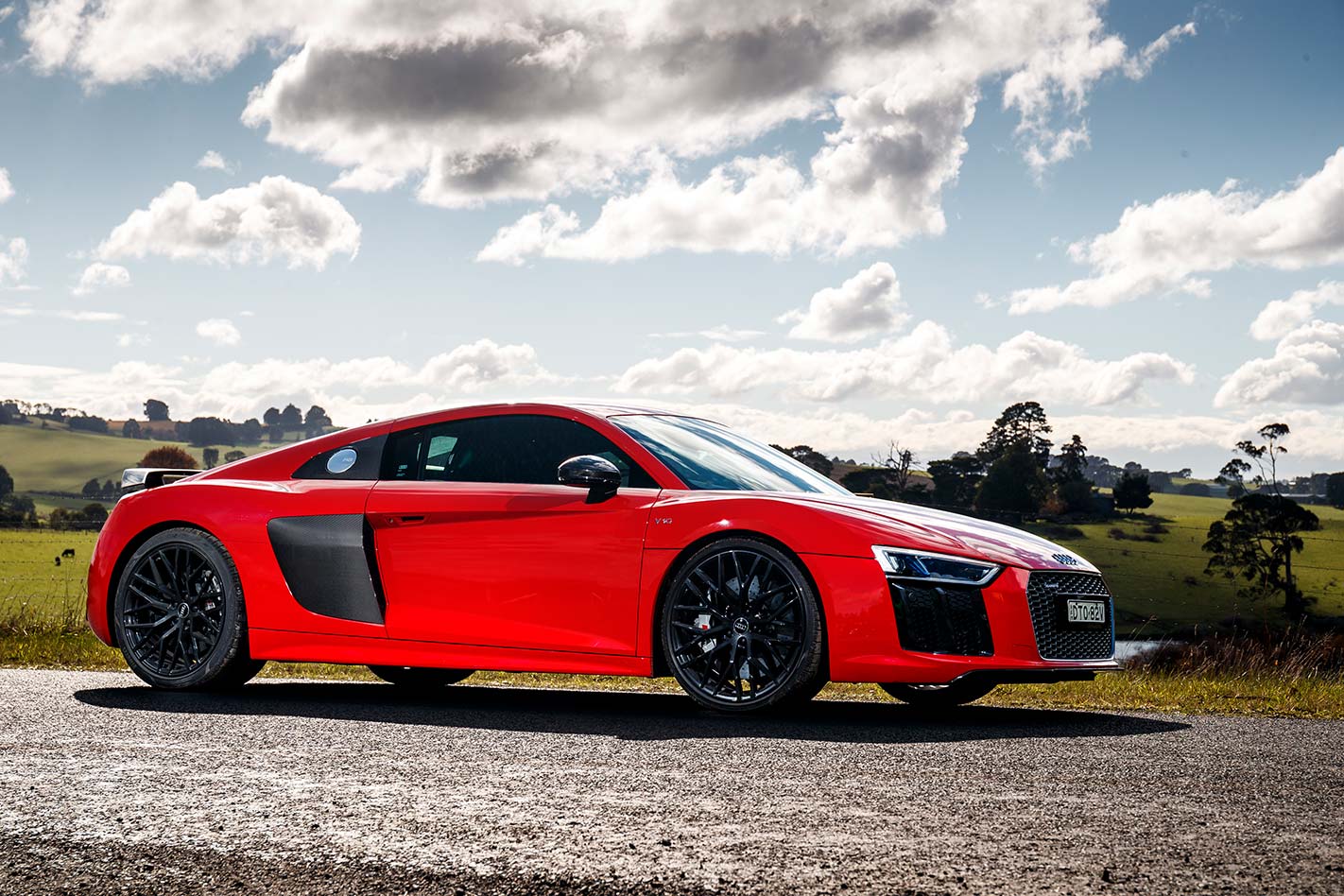
The engine is always willing to oblige. Audi claims to be desperately searching for a way to keep the V10 in its model range, and it’s easy to see why. There’s a kinetic savagery to a good V10, something removed from the conventional rectitude of a V8 or a V12. Wrap it in Audi’s elegant tailoring and it makes one heck of a package. More than one of the test team preferred the R8 V10 Plus to the unhinged 911. Where the first R8 enjoyed a nine-year lifespan, this version, introduced at Geneva in 2015, isn’t going to enjoy anything like such an innings. We’ll miss it when it’s gone.
The same could be said for any of these other five powerplants. The saving grace for them is that they appeal to enthusiasts and, as Andreas Preuninger from Porsche has said, “The last car ever built will be a sports car; I’m sure of that.” In other words, there will always be a core of buyers who want a car with an atmo engine, or a manual gearbox or rear-wheel drive, or any combination of the above. You only need to read Alex Inwood’s drive of the Cayman GT4 in this issue for confirmation of that.
Now more than ever, we’re beginning to appreciate that modern forced induction engines can deliver too much of a good thing, elevating cars to a performance level that’s no longer either appropriate or, in truth, particularly engaging for road driving. As the atmo engine becomes rarer, we increasingly value its subtlety, purity and personality. Yes, the pool of powerplants devoid of a snail is small, but its constituents are now greater than ever. Breathe easy.
-Andy Enright
The engines
Chysler 300 SRT – Apache attack
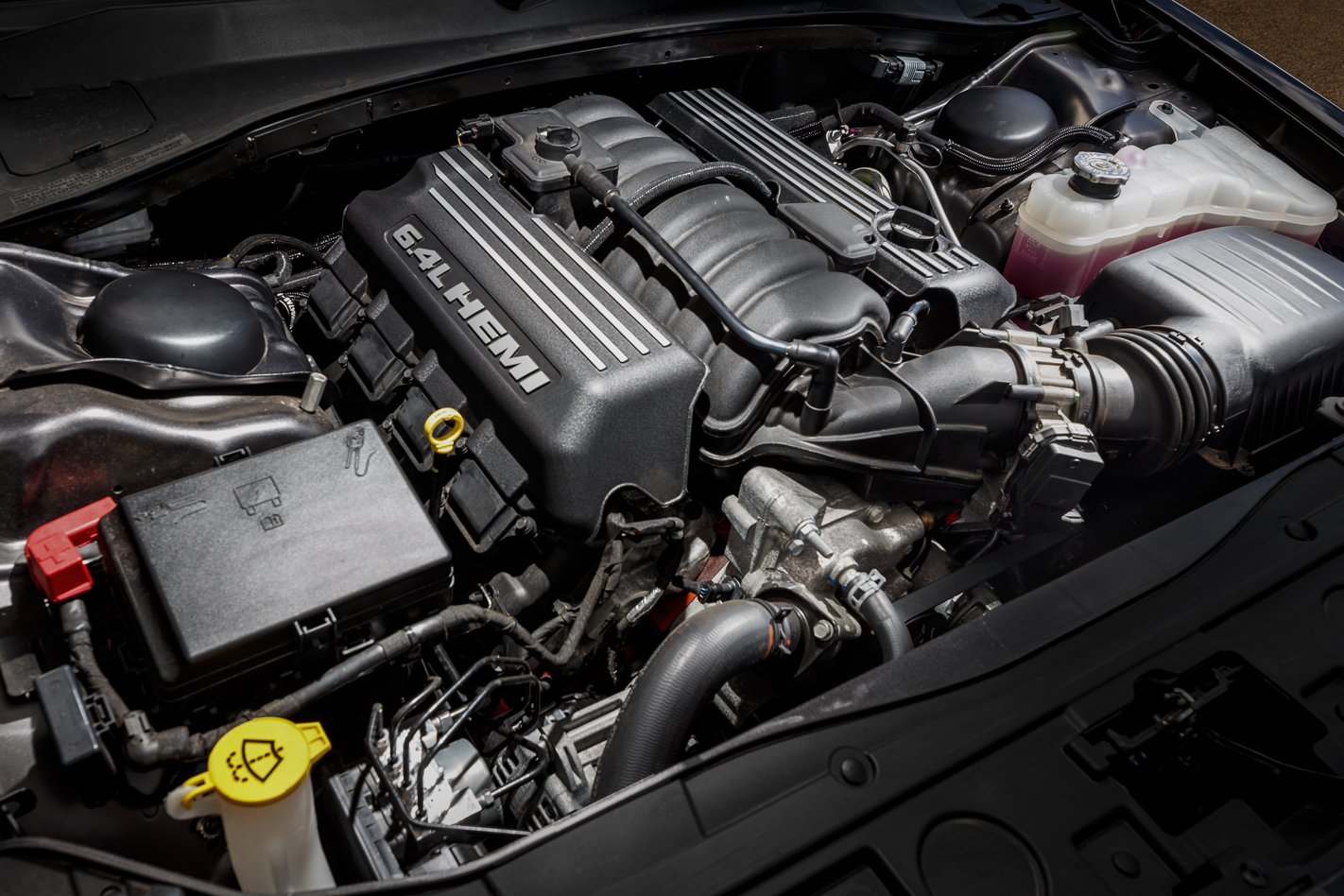
Most of us know that ‘Hemi’ relates to the shape of the Chrysler V8’s combustion chamber, but why is this a good thing? According to SRT, the hemispherical shape helps decrease heat loss in the combustion phase, so fuel burns more efficiently. It also creates more room for the valves, allowing greater flexibility for both valve size and optimised position. Otherwise the oversquare engine is fairly conventional in terms of construction, using a deep-skirt cast-iron block with cross-bolted main bearing caps.
Lexus LC500 – Sound of the samurai
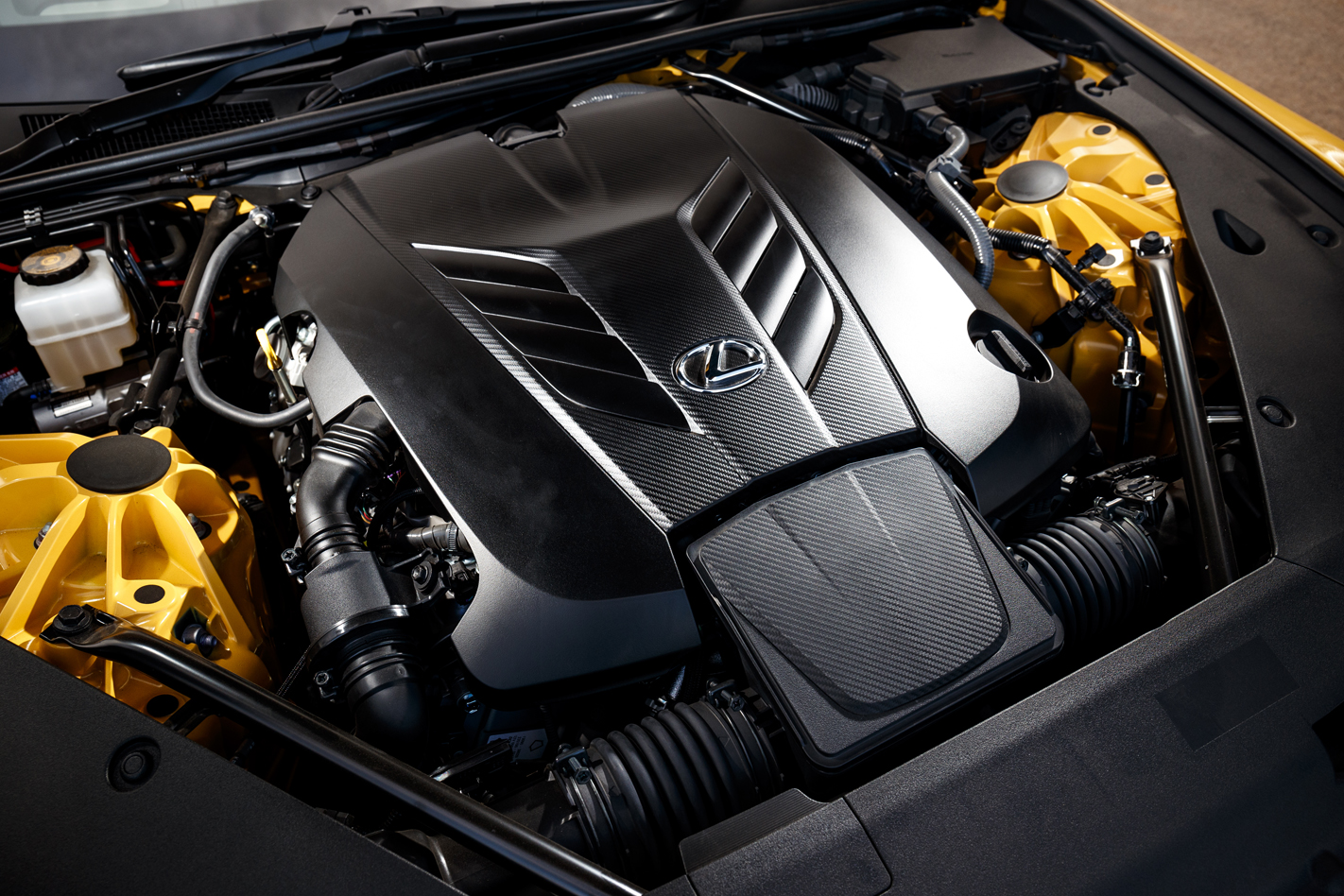
You may have spotted that the engine fitted here to the LC500 is the same 2UR-GSE unit in the RC F detailed in our Great V8s feature (Wheels, July). But it takes a more serious anorak to know that the LC’s version (URZ100) produces identical power to the RC F (351kW), but its 540Nm is 10Nm stronger, a result of software and exhaust changes. The exhaust is especially significant, because it transforms the V8’s character, giving the LC a level of cultured aural bite not evident in the RC F until you’re hammering it.
Mazda MX-5 – Tastier tuner
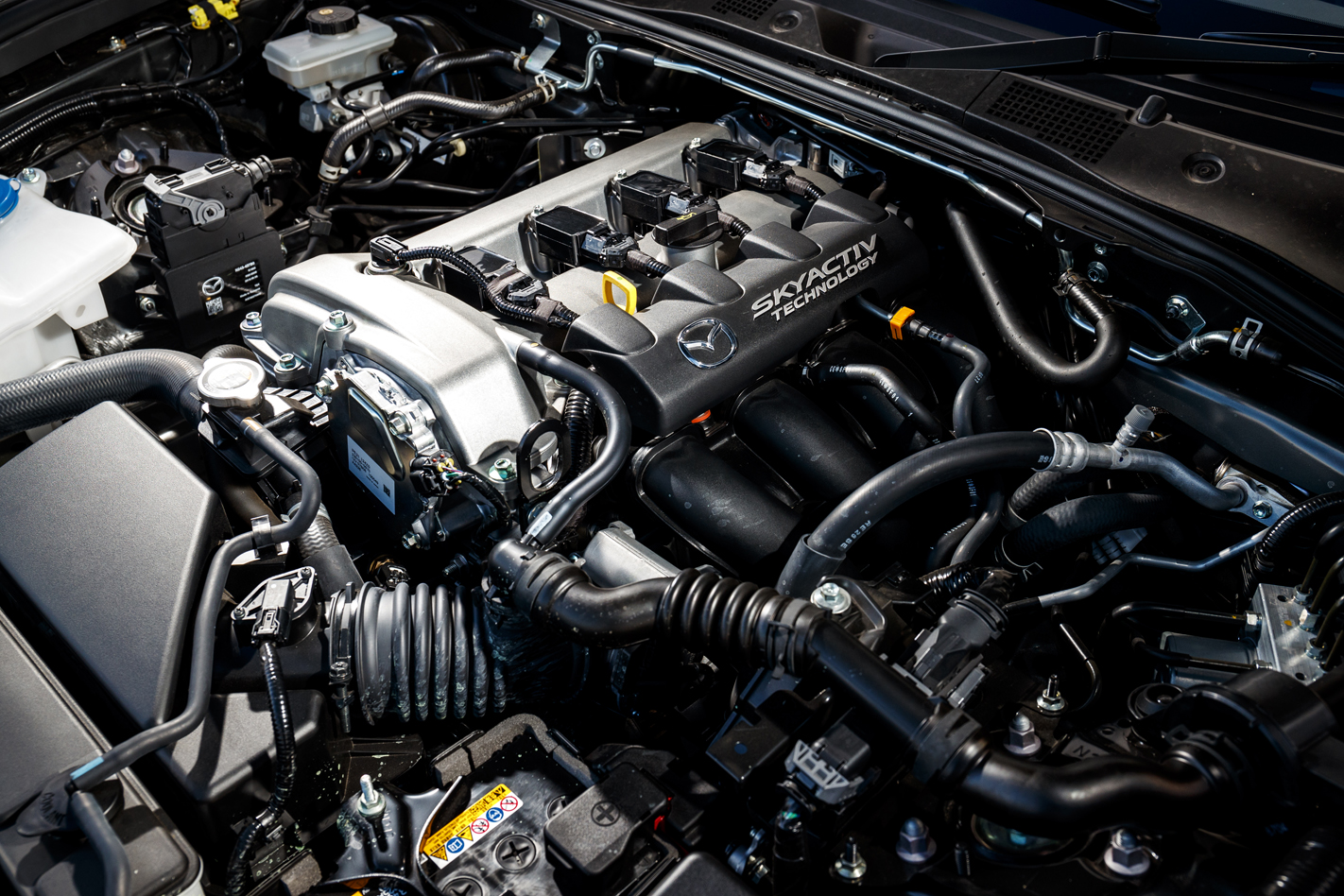
When we were awarding the ND MX-5 our 2016 COTY, we wondered whether the greater output of the 2.0-litre was worth sacrificing the sweeter, more rev-happy nature of the 1.5. Those arguments ended with the upgrades given to the 2.0-litre in Q3 of 2018. Changes targeted the trifecta – intake air/fuel delivery, combustion and exhaust – adding 17kW (for 135kW) and pushing the action higher. Peak power was at 6000rpm; it’s now at 7000, and the limiter doesn’t surface until 7700rpm.
Porsche 911 GT3 RS – Mader’s masterpiece
Here’s a tip: don’t bother taking the difference between the base price of the GT3 and GT3 RS ($90K) and working out the cost of the RS’s additional 15kW and 10Nm. You’d be missing the point. Fact is, the RS gains a titanium exhaust and a remapped ECU for its bump, indicating how good this engine is in GT3 spec. Prompting the question: where to from here? For the 992 GT3 RS, we hear the 4000cc flat-six will make circa-405kW at around 9000rpm. Yes please. The queue starts here.
Audi R8 V10 – High fives! Both of ‘em
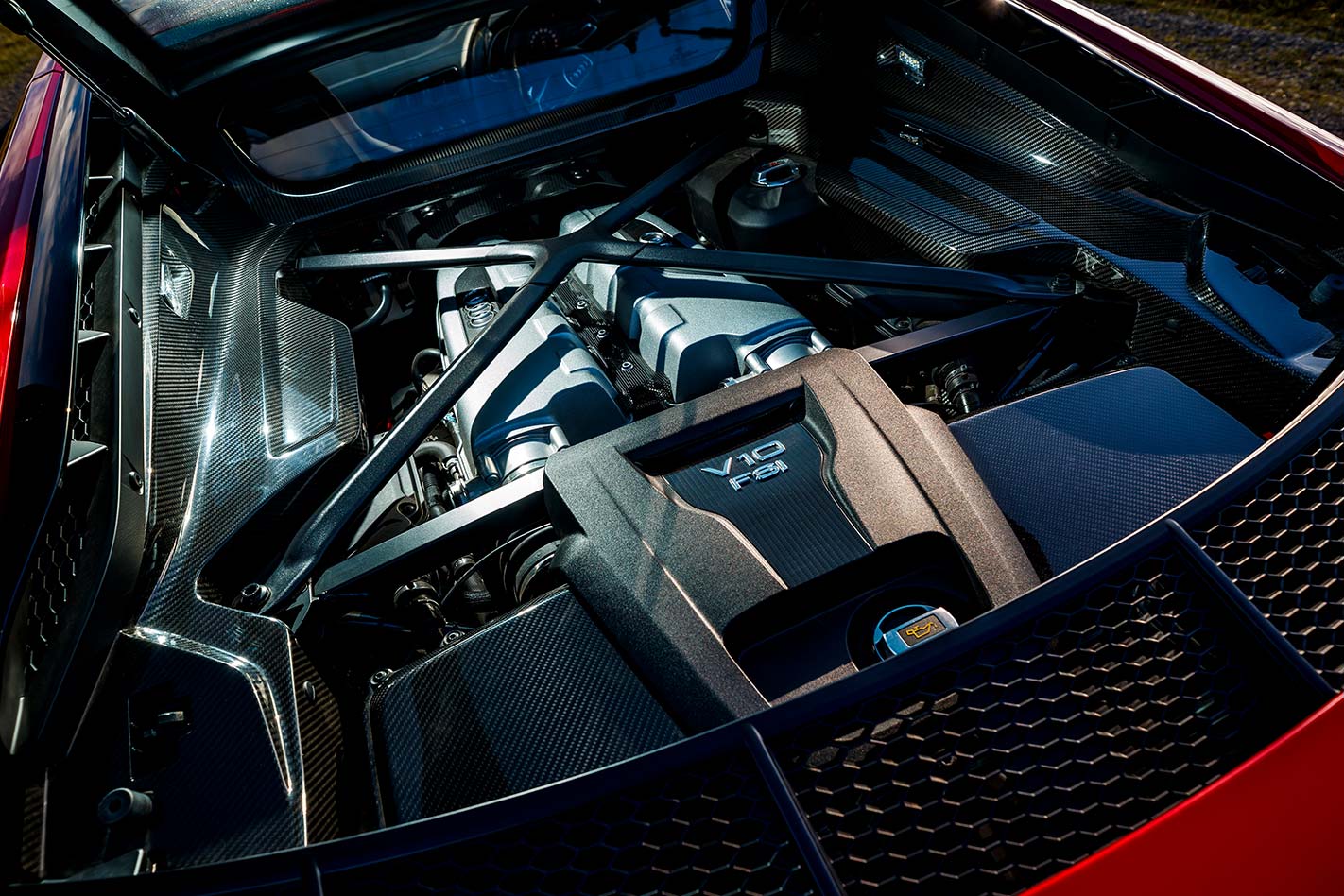
In one minute at redline, the R8’s V10 is swallowing 22,100 litres of air, with the dry-sump circulating more than 85 litres of oil. Although 72 degrees is the ideal angle for a V10 engine because it creates a regular firing sequence, the Audi V10 opts for a 90-degree angle for stiffness, using a common-pin shaft with unsplit journals. In other words, it’s basically two straight-fives working in sync and firing alternately at 90 and 54 degrees of crank angle. And Audi has history with ear-splitting straight-fives.
Ford Mustang Bullitt – King of McQueens?
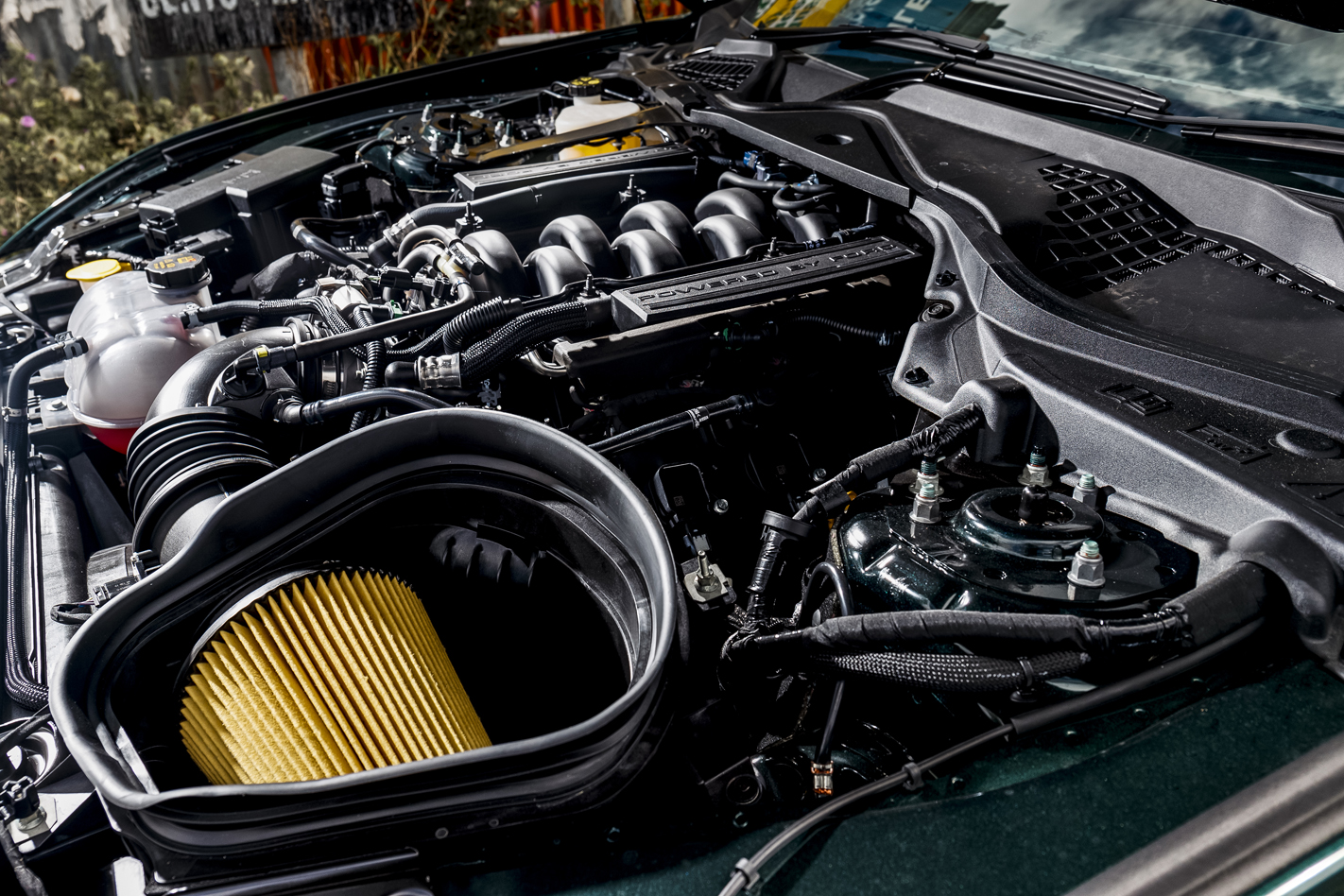
Given the revisions to the Mustang’s 5.0-litre V8 in Bullitt guise – intake manifold from the Shelby GT350 with an 87mm throttle body, cold-air intake with better air filter, and a recalibrated ECU – the increase of just 6kW (to 345kW at 6000rpm) with no extra torque seems marginal. It you really want your Pony car to kick in the stable door, you’d drop $17,995 (fitted) on the Roush supercharger kit from Tickford. It bumps outputs to 530kW/827Nm and doesn’t void the factory warranty. Only downside: your ’Stang is no longer an atmo hero.
It was 1999 and Ford was being bent over and rogered silly by Holden in the great sales race.
This feature was originally published in MOTOR’s April 2004 issue
The AU Falcon was struggling something fearful against the VT Commodore in the mums-and-dads category and HSV was cleaning up in the local performance department. And while the Tickford-modified XR6 and XR8 were holding their own (the only glimmer of hope out Broadmeadows way at that time), there was nothing in Blue Oval showrooms to tempt the better heeled out of their ClubSports and Senators.
Ford’s solution was to establish a next-rung-up echelon of performance luxos called the TE50 and the better-equipped TS50. There was even a long-wheelbase version based on the Fairlane called the TL50.
The big problem (and the thing that had stopped the project in its tracks to that point) was that the Windsor V8 was still just 5.0 litres in capacity, whereas HSV’s big-hitting LS1 was 5.7 litres and half a dozen generations newer.
Even with a balancing job, blueprint and hand assembly, the Windsor was never going to match the HSV stuff in a straight line – and regardless of how the rest of the package worked, that meant a lot to the type of buyer Ford was targeting.
At the launch, however, the Ford brass proudly proclaimed that the TE50 and TS50 were not going head to head with HSV products. They would, in fact, sell on the basis of their superior handling and sophistication. You could have heard a bloody pin drop. Take a look at the sales figures, and the dent the T-series failed to make in HSV’s volumes, and that old adage about not taking a knife to a gunfight becomes very poignant indeed.
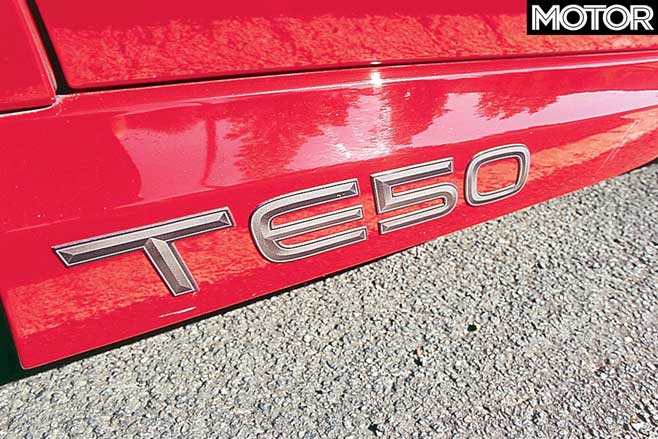
Second-hand, though, a TS50 isn’t bad buying and the TE50 is even better value. Combine the ‘couldn’t care’ attitude of buyers at the time with the public’s general revulsion at the looks of the AU Falcon and good old Mr Depreciation had a field day. Can you say “bargain blaster?”
The TE50 was the base model and got stuff like 17-inch alloys and an interior package based on the Fairmont Ghia (rather than the taxi pack). Standard kit ran to climate control, a six-stacker, both front airbags, a Momo wheel and alarm. The TS50 built on that with 18-inch wheels and tyres, standard automatic gearbox, Koni shocks, traction control, premium sound and a power-operated driver’s seat.
Ford was in a bit of a pickle over the styling, though. It couldn’t just use the quad-headlight XR front end for the TE50, but the ugly standard Fairmont face wasn’t going to cut it, either. Tickford’s solution was to design specific front and rear aprons, side skirts and grille and then colour-code the non-reflector bits of the headlights.
All up, it ain’t a bad-looking thing. Like any AU, in a dark colour and with a lower ride height, there are worse things to greet you in the driveway each morning. Like the neighbour, for instance.
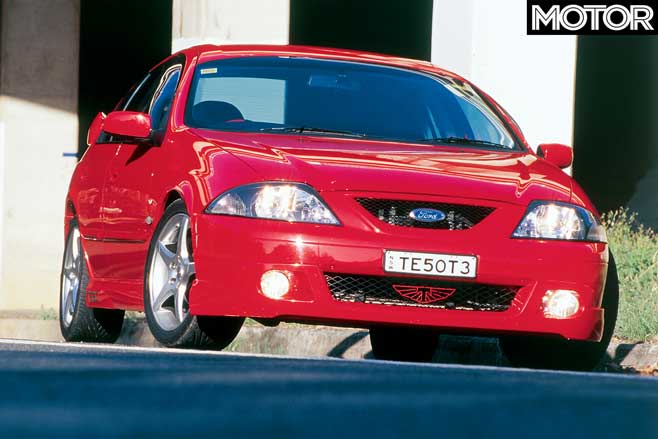
Okay, obviously the engines in both the TE50 and TS50 were developments of the 185kW Windsor in the XR8. But what that doesn’t tell you is the lengths to which Tickford went in the interests of extracting some extra poke.
At launch, the TE50 packed 200kW at 5000rpm and 420Nm of torque at 3750rpm, courtesy of a 9.0:1 compression ratio and better breathing. The asthmatic old Windsor was treated to a new camshaft, although the cylinder heads were still the old cast iron jobs. But it did get aluminium roller rockers and a bigger air intake, even if the exhaust system was more or less what you got with an XR8. The changes certainly didn’t hurt, though, and the extra power was achieved without moving the peak any further up the rev range compared with the XR8.
The real work, however, went into the TS50, which scored aluminium cylinder heads with bigger ports and valves as well as the roller rockers. The intake manifold was also port-matched to the heads in a modern salute to hot-rodding techniques of days past. A locally developed throttle body was used with a larger diameter and the angle of the throttle plate was also revised. Bigger, high-flow cats were combined with a low-restriction zorst system and fuel delivery pressure was bumped up.
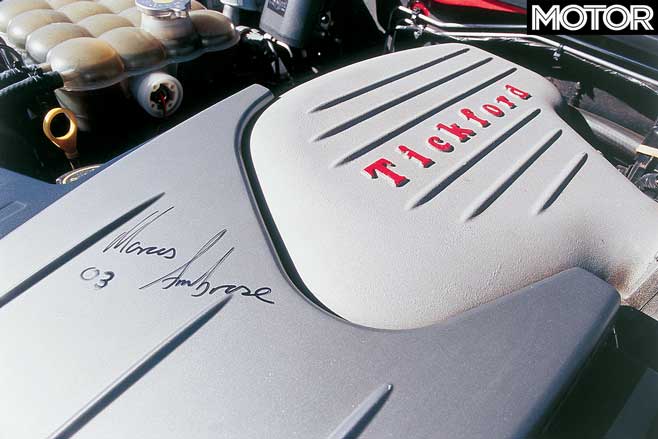
Power in this instance was 220kW at 5250rpm, with torque peaking at 435Nm at 4000rpm. Not bad, but still well short of a bog stock XR6 Turbo’s output and, more significantly at the time, well short of HSV’s 250kW output.
Although the 220kW Windsor was initially available only with a four-speed automatic transmission, it was paired up with a five-speed manual in 2000 when that engine became standard across the T-series range. The manual ’box, available only in the TE, was a version of the old T5 that still afflicts the XR6 Turbo. Surprisingly, though, it wasn’t as bad behind the Windsor and was a good option for anyone looking to wring the most out of the engine.
But, as it is today, the four-speeder was quite a handy thing to have hanging off the back of a 220kW Windsor; you just needed to use the T-bar rather than frig about with the tiny little shift buttons on the steering wheel. This might have been a first on an Australian car, but Ford needn’t have bothered. The shift buttons were illogical and non-intuitive and were actually hard to use, with the driver never really knowing whether the button had clicked home until the ’box responded. Or not, as was often the case.
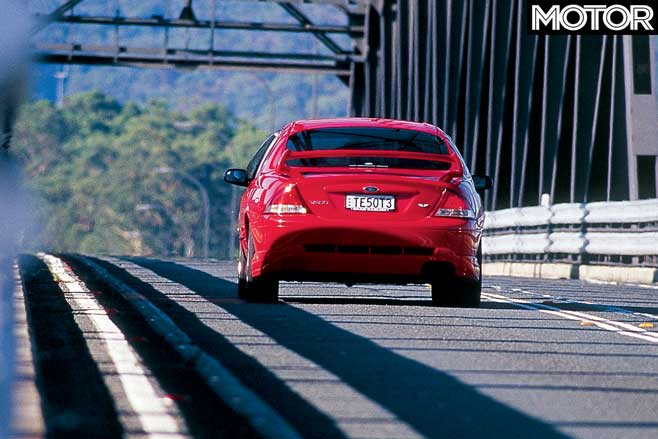
While Tickford might have missed its marketing target with the assumption that folks would buy on the basis of part-throttle response and better-than-LS1 bottom-end torque, those were exactly the characteristics that made the TE and TS pretty good things to drive.
The TE50, with its lighter weighbridge ticket (it didn’t have all the fruit of the TS) and manual gearbox, was actually the better performance tool of the pair, but the TS50 was a deceptively quick thing, too. Both versions got a big brake package with 329mm front rotors (still big by today’s standards) running curved grooves front and back. Twin-piston front calipers, lifted straight from the Mustang Cobra, and a revised master cylinder gave the cars the brakes every performance Falcon should probably have had.
The Windsor is a pretty well understood package, and there are legions of tuners out there who can turn your TE or TS50 into something much more purposeful now that it’s out of warranty. The catch will be finding a gearbox to live with it. Popular additions include big-bore exhausts (on 200kW versions), cold air intakes and cam and chip packages, although the latter would seem to defeat the purpose of buying a T-series in the first place.
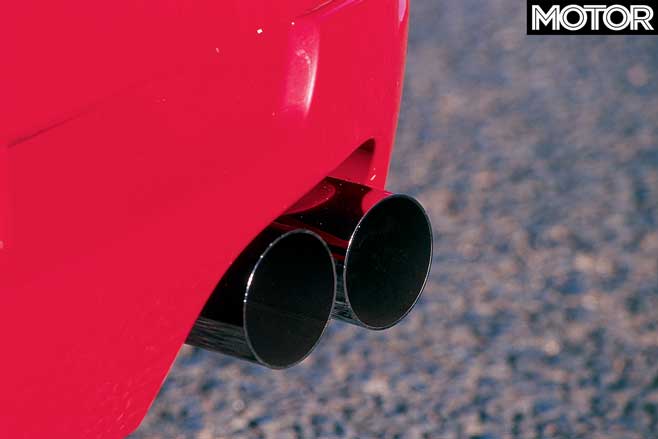
The engines themselves are pretty strong, but the fact that Ford Australia stockpiled a huge batch of them years before the Falcon became the BA is a bit of a worry. In some cases the stored engines managed to get moisture inside their cylinders, the result being some surface rust on the bores.
In the 220kW versions (which were hand-built, remember), any suspect bores will have been identified and honed back to what passes for Windsor perfection. There’s a chance, however, that some 200kW engines that didn’t have their heads lifted might have got through the net. Either way, you’d hope that any problems would have surfaced by now.
It’s tempting to think of the 220kW engine as the ultimate variation of the old Windsor mill. It wasn’t; that honour went to the 250kW 5.6-litre stroker that powered the last 500-odd T3 variants. But that engine suffered from horrendous fuel consumption. If you had your pick of the lot, it’d probably be the 220kW version. It was the Windsor’s finest hour.
FAST FACTS 2002 Ford Tickford TE50 T3
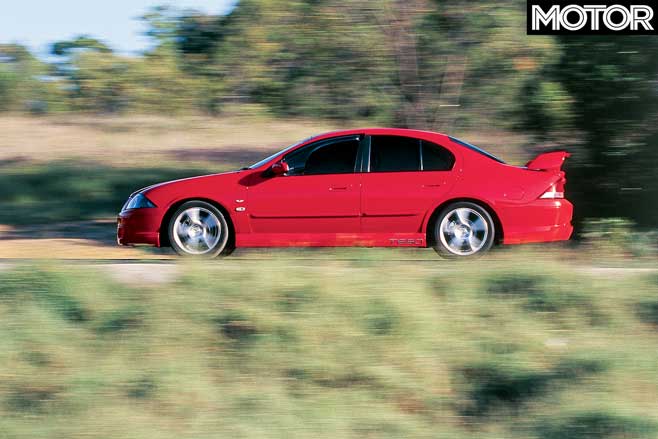
BODY: 4-door sedan DRIVE: rear-wheel ENGINE: 5.6-litre 16-valve pushrod V8 POWER: 250kW @ 5250rpm TORQUE: 500Nm @ 4250rpm COMPRESSION: 9.6:1 BORE/STROKE: 101.7mm x 86.4mm WEIGHT: 1715kg POWER-TO-WEIGHT: 146kW/tonne TRANSMISSION: five-speed manual SUSPENSION: double wishbones, coil springs, anti-roll bar (f); double wishbones, coil springs, anti-roll bar (r) L/W/h: 4956/1872/1452mm WHEELBASE: 2793mm TRACK: 1566mm (f); 1546mm (r) BRAKES: 355mm ventilated discs, Brembo four-piston calipers (f); 330mm drilled discs, Brembo four-piston calipers (r) WHEELS: 18 x 8.0-inch (f & r), alloy TYRES: Dunlop SP Sport 9000, 245/40 ZR18 (f & r) FUEL: 68 litres, PULP PRICE: $64,200 (in 2002)
What we said?
“The TE50 has introduced blue-bloods to a realm of power and performance not seen in a Falcon for three decades.” -Marton Pettendy, March 2001
“The steering, in particular, is delightful. Sharp and accurate, it gives a full-colour picture of what the front wheels are doing. Team it with the super-sticky rear end and you’ve got a very potent piece of gear which doesn’t rely entirely on its Dunlops for staying on the black stuff. Inherent balance, the Pommy magazines call it.” -David Morley, February 2002
She’s a mine
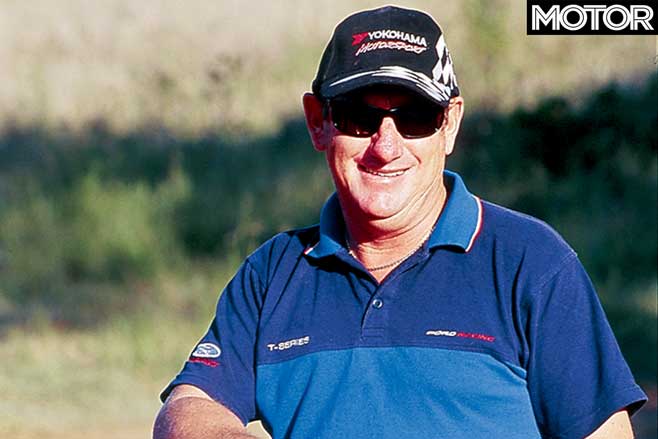
It was a Friday night in October 2001 when I first saw a TE50 T3. It was the opening of the Sydney Motor Show and I was standing at the Ford stand looking at a Blueprint TS50. I said to my son, “I’ve gotta get one of them.” And when I read all the road tests I was convinced!
The Venom Red TE50 turned out to be a snorting beast, with mountains of torque, smooth but heavy clutch, quite a nice ride and good brakes – but bloody awful seats. With the odd shape toughened up, this is the best AU around.
But there’s nothing like cubic inches. As Geoff Polites said, it’s a “very special engine in one hell of a car”. The T3 sent Tickford and the AU out with a bang!
– Steve Butler
In a world increasingly divided along Apple iPhone versus Android phone lines, the ability to easily connect a phone to a car is becoming a genuine point of difference between the two.
Google’s Android-based phone operating system has plenty of fans, but it’s fair to say that when it comes to Android Auto for your car, the odds have been stacked in favour of its Cupertino rival when it comes to connecting your phone to your car.
Now, though, a substantial upgrade to the Android operating system – called Android 10 – has brought an entirely new look to Android Auto.
How do I set up Android Auto?
The first step is to check your phone’s app updates – done by opening Google Play and checking for new updates – to ensure that you have the latest version of Android 10 firmware (the operating software) installed on your phone.
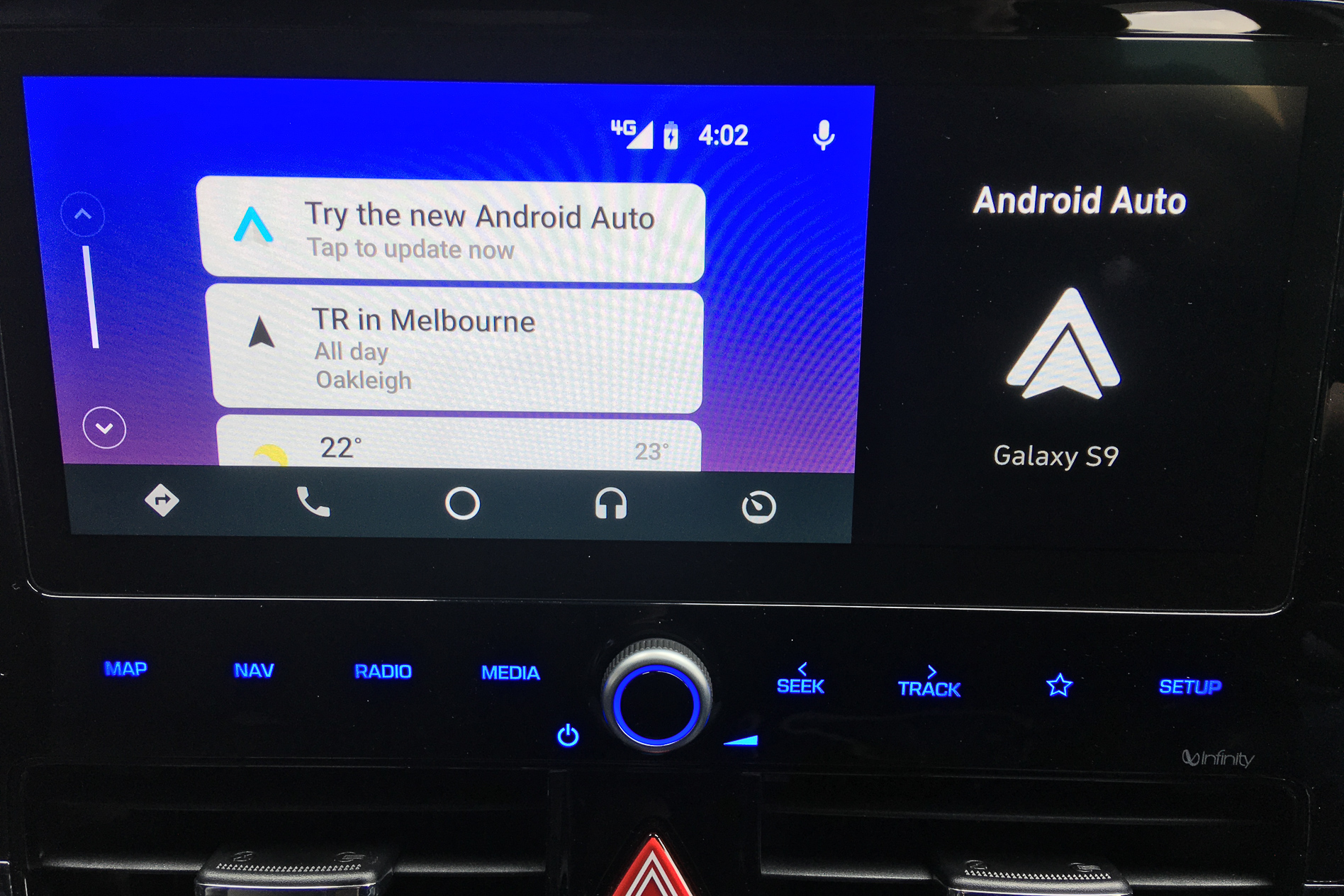
Starting with Android 10, Android Auto is now built into the phone as a separate technology that enables your phone to connect directly to your car display. This means you no longer have to install a separate app from the Google Play Store to use Android Auto with your car display.
Google has recently added the Android Auto app to the store for people who want to use it outside a compatible car.
It’s been a systematic roll-out across various devices and countries; we tested Android Auto on a Samsung Galaxy S9 and a Hyundai Ioniq. The app only took a few moments to update once the new firmware was updated.
Setting up Android Auto in your car is as easy as plugging your phone into its USB micro cable or USB-C cable and plugging the other end into your Android Auto-compatible head unit or multimedia system in your car.
Once you’ve done that, you can then open the Android Auto app. The Hyundai’s multimedia system asked us to unplug, then re-plug, the phone to access the new system before we could access the new interface, as well.
Want to use wireless Android Auto? The app allows many phones – including our test Galaxy – to connect wirelessly, but the catch is that you need to have a suitable Android Auto wireless head unit to connect with.
Unlike wireless Apple CarPlay, which has been installed in several brands of car including Audi and BMW, wireless Android Auto is only compatible with a handful of aftermarket head units at present.
How does the new Android Auto work?
Once everything is hooked up and working, you’re presented with an entirely different looking home screen for Android Auto – and one that looks a look like Apple CarPlay, thanks to its black background and gridded app icons.
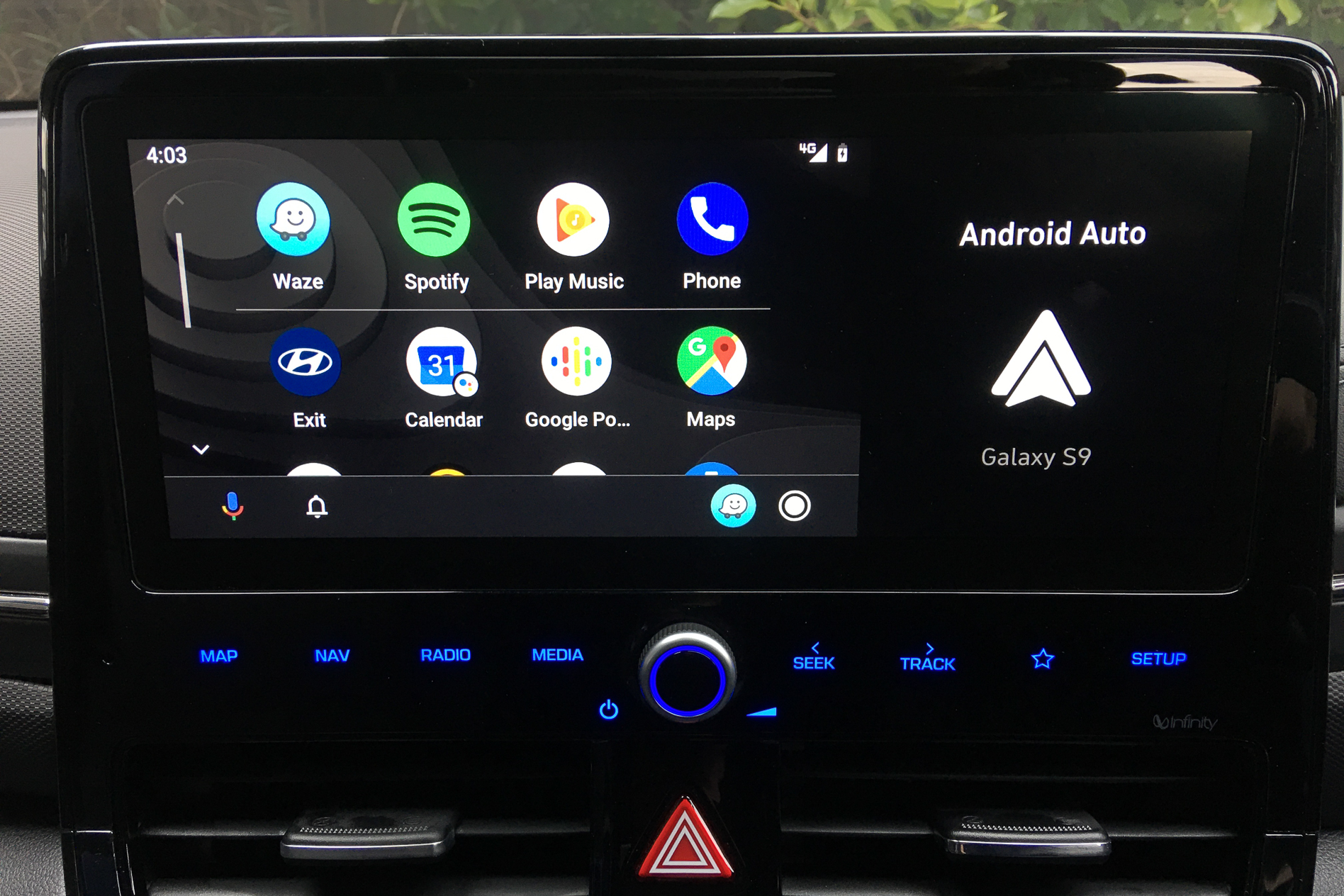
A menu bar along the bottom of the screen offers easy access to voice activation, the most recently used app and a reminder bell, as well as a small home button.
The main difference is that the screen scrolls vertically, rather than horizontally, but other than that, the two systems look very similar.
Depending on your car, you’ll be able to touch icons to open them, or use a jog wheel or buttons to access apps.
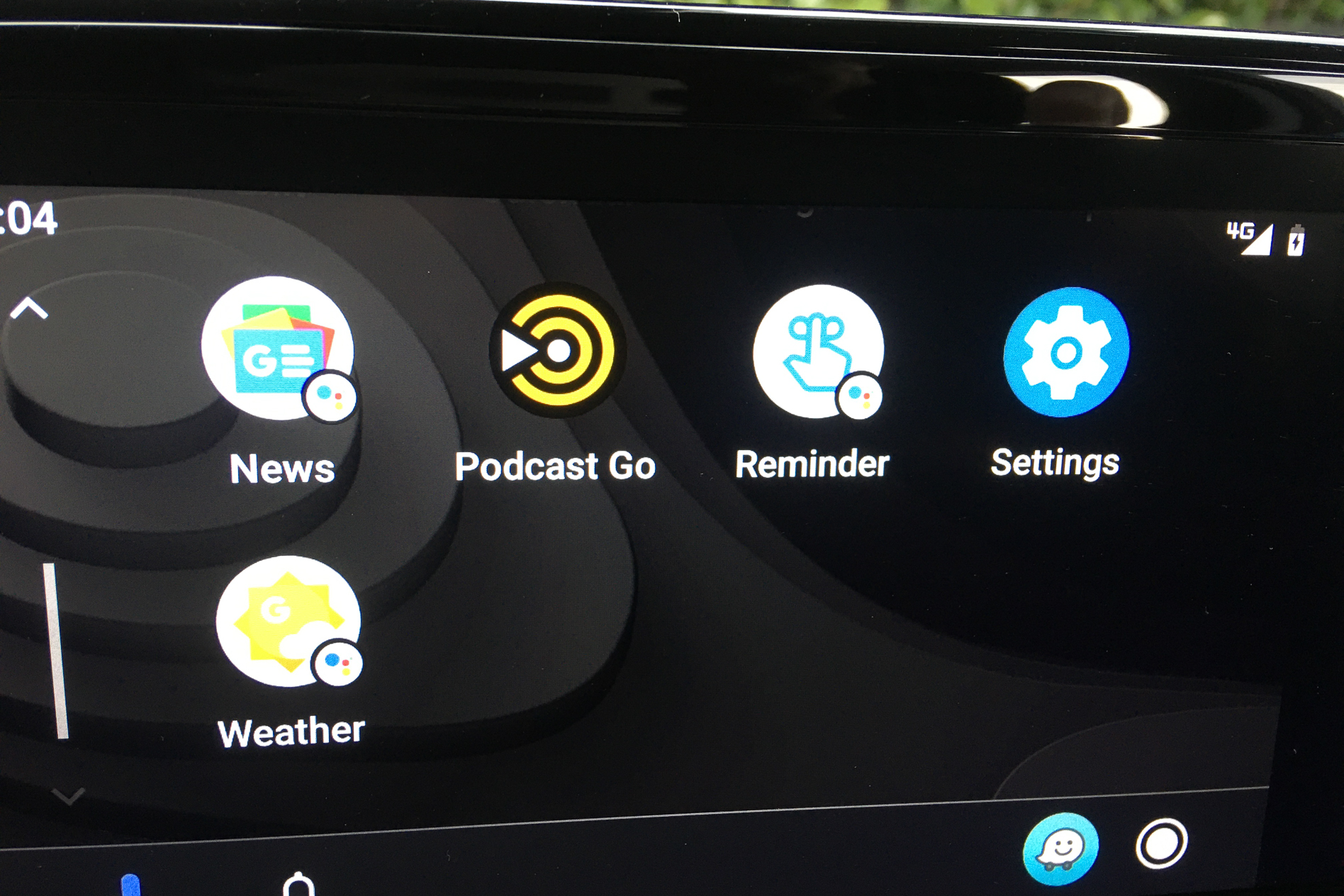
Those apps include the basics like phone functionality, weather, a calendar app, news and a podcast app. If you have apps like Spotify for Android Auto and Waze for Android installed on your phone, they will show up was well.
In use, the new Android Auto works best in conjunction with Google’s voice recognition system. For example, my request to find a good Mexican restaurant nearby was answered quickly by Google, which then handed the request off to the Waze map app. It’s then just a matter of selecting the address, and Waze will direct you there.
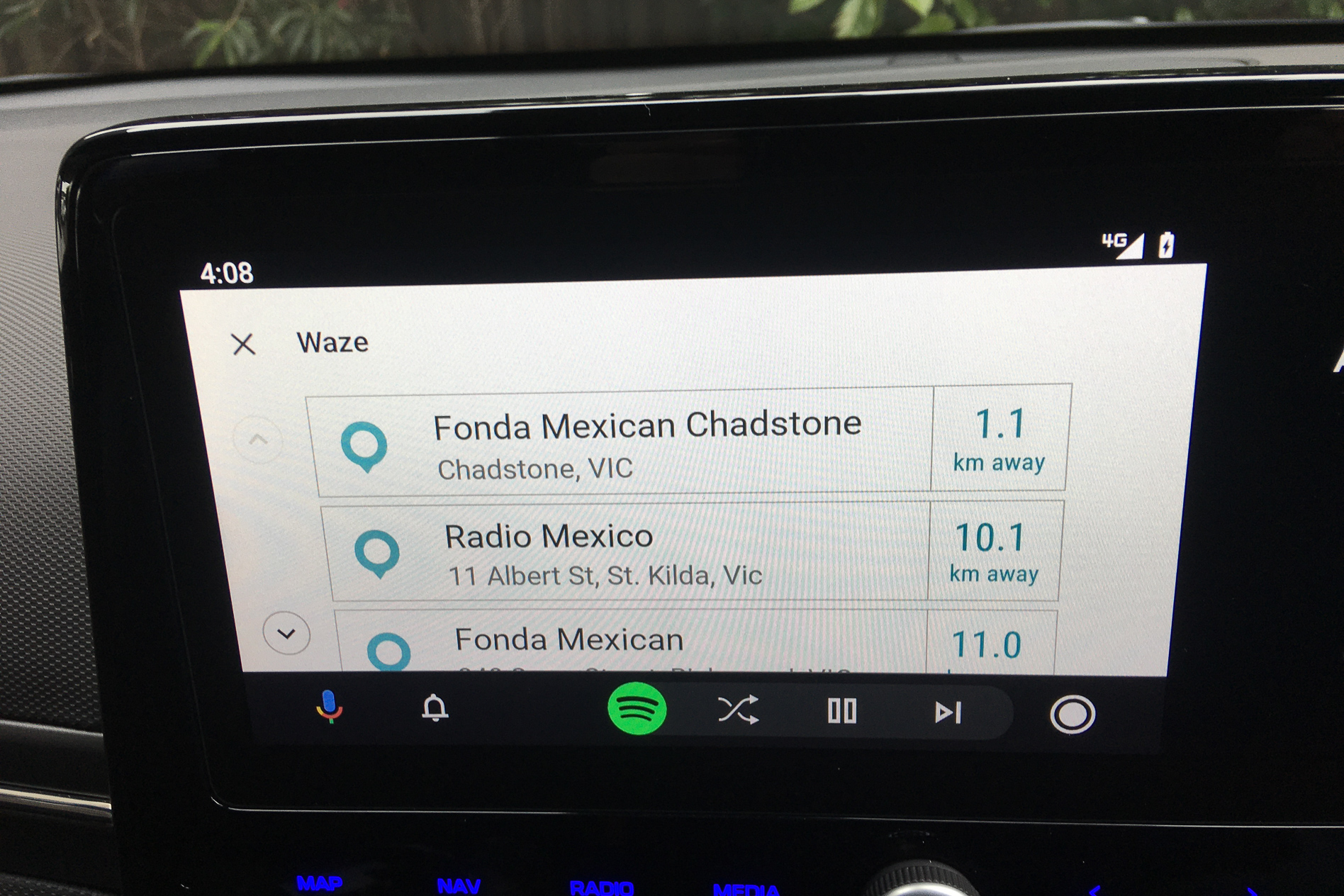
You can also ask Android Auto to call contacts, compose messages and read them back to you, add reminders to your calendar and more.
Like any voice-activated system, there’s a period of learning the best way to ask for something, and it’s worth manually adjusting the settings in Android Auto on your handset before plugging in to ensure that it starts automatically when you plug into the car, for example.
Is there anything difficult to use or annoying about Android Auto?
The once-dominant Apple iPhone is seeing its market share eroded by Android-powered devices, and both systems offer different experiences for different users.
Objectively speaking, I find Android Auto a bit more fiddly to use than Apple CarPlay, which to me offers a genuine plug-and-play experience that needs no prior knowledge or set-up to start using straight away.
Android Auto is now infinitely better thanks to its new, much simpler interface and cleaner design, but it’s still not as intuitive to use out of the box as its rival.
It outperforms Apple CarPlay when it comes to its voice interface, but there’s still a period of adjustment and learning required to get the best from Android Auto.
Are you an Android fan or an Apple acolyte? Which system do you prefer? Let us know below!
This is not your classic winner-takes-all comparison.
When you pit 225kW against 310kW, performance cannot be the sole decider, or this story would end right here. What we’re trying to find out instead is how the most potent compact hatchbacks available from BMW and Mercedes fare when you pull out all the stops.
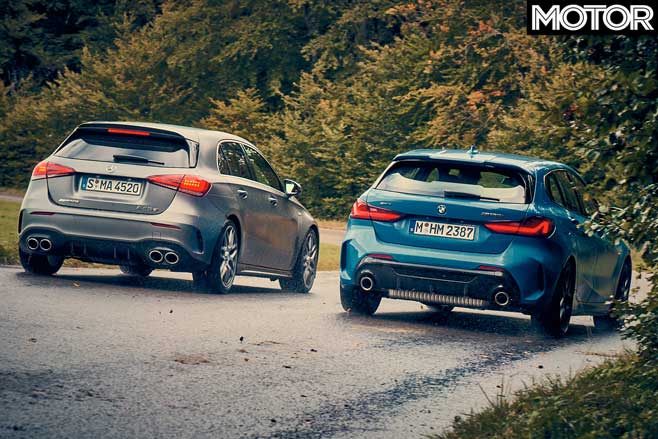
To do so, numbers took second priority to subjective impressions. The stopwatch was replaced by the body clock, the shameful filling station receipts were binned with an impish grin, and our driving licences were left soaking overnight in holy water. After a longish wait, it’s at last crunch time for the Mercedes-AMG A45 S on home turf, with a blue BMW M135i looming large in the rear-view mirror.
The Benz welcomes the front seat passengers with one-size-fits-all bucket seats. To set the tone for the day, we dial in Sport Plus and summon the gaudy Supersport display with its big fat gear indicator and speedometer circled by a rainbow rev counter that in turn is flanked by two busy bar graphs.
AMG has also included a Race Start function, but only if you lift your left foot off the brake within three seconds while keeping the right hoof planted, and easily drowning every rump-ta-ta band is the blaring Real Performance Sound processor.
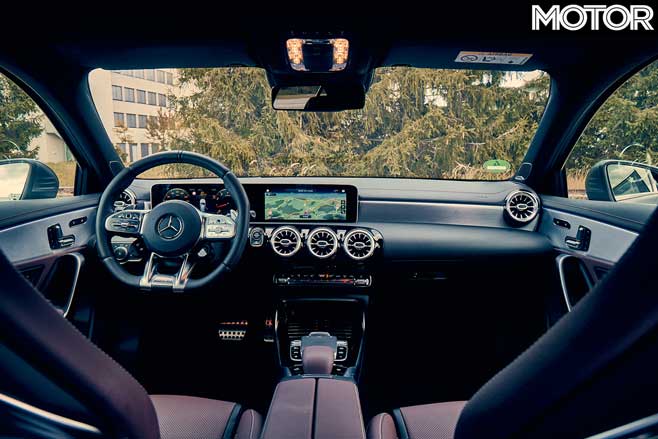
But all this ballyhoo is merely a prelude to the great dog-and-pony show known as Drift Mode, which can only be locked in with the transmission in manual, the drive program in Race and ESP switched off – and then you must pull both shift paddles simultaneously, then confirm powerslide mode by a quick flick of the Up paddle.
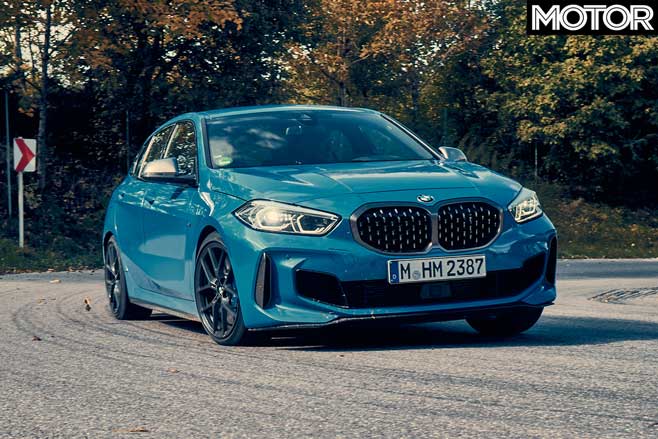
Sitting alongside the matte-grey Benz, waiting for the thumbs up and impatiently wow-wowing against the limiter, is the M135i, also with one twin-scroll turbo, four cylinders, eight gears and four driven wheels. It delivers 450Nm through its automatic transmission – versus 500Nm and dual-clutch in the Benz – though in launch control mode the BMW’s maximum torque is also available in first and second gears. Part of the upgraded xDrive system is a Torsen diff lock that keeps the front wheels in check.
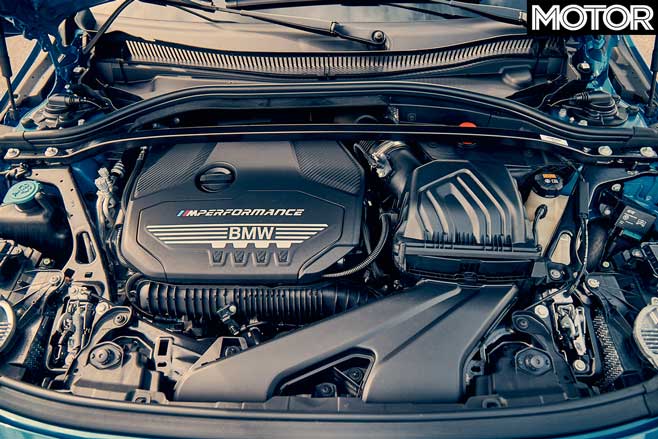
We would also like you to welcome an all-new and highly effective electronic feature dubbed ‘actuator contiguous wheel slip limitation’, or ARB. Borrowed from the i3 (yes, really), ARB controls wheelspin inside the black box, and bypassing the DSC module speeds up the felt response time tenfold, thereby nipping understeer in the bud.
Sounds unreal and feels unreal. Although the intervention of traction control can be reduced and eliminated in two steps, the xDrive system retains its pre-set 50:50 torque split at all times rather than ever allowing the rear wheels to pick up the lion’s share of the momentum.
The BMW is marginally quicker off the mark, but its first gear is shorter, and as soon as the AMG engine has picked up enough revs, the kick-in-the-butt DCT and fast-growing extra momentum urges the A45 S forward.
Just for the record, the 0-100km/h duel sees Swabia beat Bavaria 3.9 to 4.8sec. As we expected, that’s an impressive victory for the Benz, which throws in a bit of drama for good measure – like a shrill take-off chirp, an increasingly upbeat soundtrack that changes from angry to indignant around 4000rpm, an artificially induced lift-off blat-blat, and the reluctance to shift up into third just in case the fun is not yet over.
In contrast to the A45, the new M135i is anything but an evolution of its predecessor. While the coveted previous model was tail-happy, all over the place when pushed, constantly struggling for traction in the wet, the all-new model trades rowdiness for poise, sideways antics for precision, hooliganism for manners. In other words, it doesn’t really compare.
Sadly, even the currently most powerful BMW four-cylinder engine is two pots, 25kW, 50Nm and four-tenths short of the deceased M140i straight-six we loved to bits. But it is what it is, and if you really want to beat the AMG A45 S at its own go-faster game, the only option for BMW aficionados is the much rawer and even more involving rear-drive M2 Competition.
Both these contenders are easy to drive fast. Grip, traction and roadholding are on a similar level, way above the pack, and despite the gain in power and grunt, the limit is more accessible now.
Bespoilered, with LED slit eyes and bad-boy Panamericana grille, the A45 S is dressed to match its expressively aggressive mindset. The BMW comes with a bespoke M Sport body kit, lowered suspension and low-profile, 18-inch tyres (Oz-spec cars get 19s), but despite the extra street-cred it’s closer to the base 118i than the AMG-prepared A-Class is to the A160.
Fitted to the Benz is the world’s most powerful volume-production four-cylinder engine outside the sports car realm. Even the base unit rated at 285kW is a milestone effort, but the S version churns out an even more mind-boggling 310kW at 6750rpm. In combination with the machinegun-rapid gearbox and trick AWD system, this exceptional kraftwerk will swiftly propel the 1550kg crackerjack to a top speed of 272km/h.
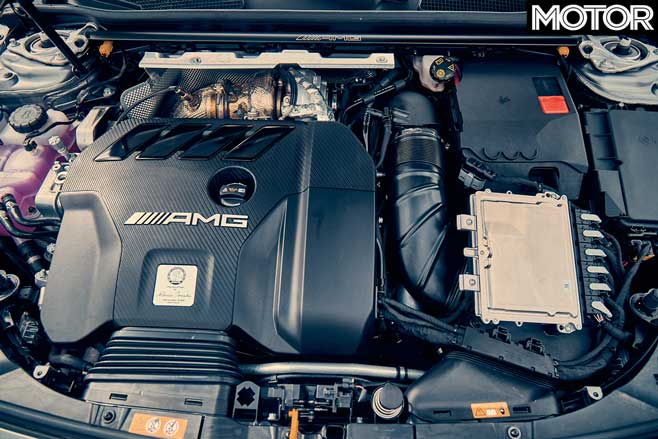
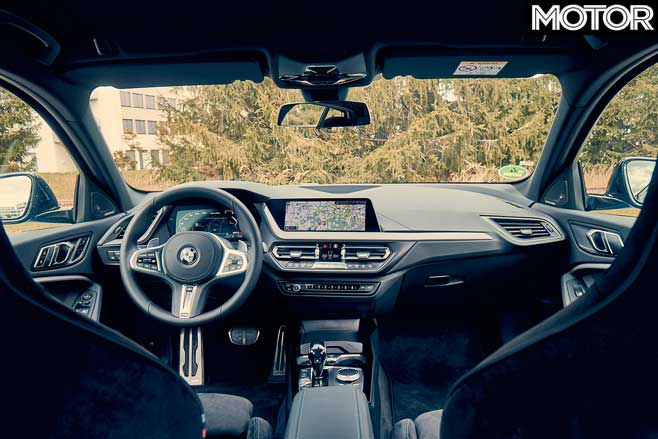
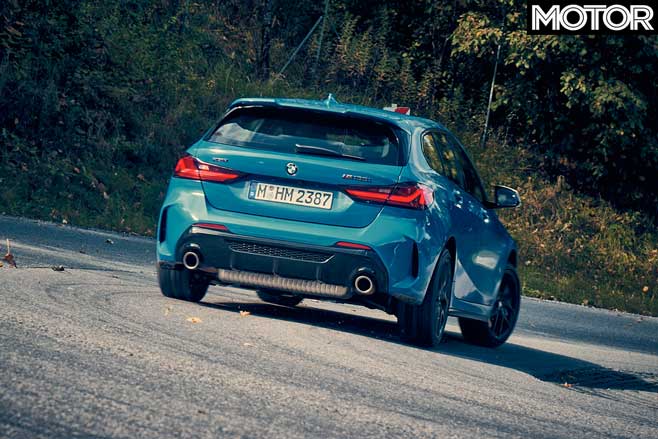
Smartness and refinement characterise the M135i. The most involving new 1 Series model is above all a subtle and discreet master of the winding road. No steering fight? You bet. Not a trace of understeer?
Take my word for it. What does the trick is the latest software, which coordinates the interplay between man and machine more effectively and more quickly. It invites you to straddle the limit, which happens to be more malleable and easily negotiable in the admirably adaptive M135i than in the more hardcore Mercedes.
To lift their M Sport effort to the next level in the handling, roadholding and performance stakes, the BMW engineers made sure the steering was quick yet superbly grounded, nicely progressive and well weighted. Other virtues include the electronically enhanced, near-neutral cornering balance, firm tyre grip and – within confines – needs-based torque distribution that keeps the palms of the driver informed without irritation.
Downsides? Even in Comfort, the ride is relatively unsettled. Sport doesn’t hit the bullseye either, because the now exaggerated vertical articulation is often at odds with the more brusque response to high-frequency irritations.
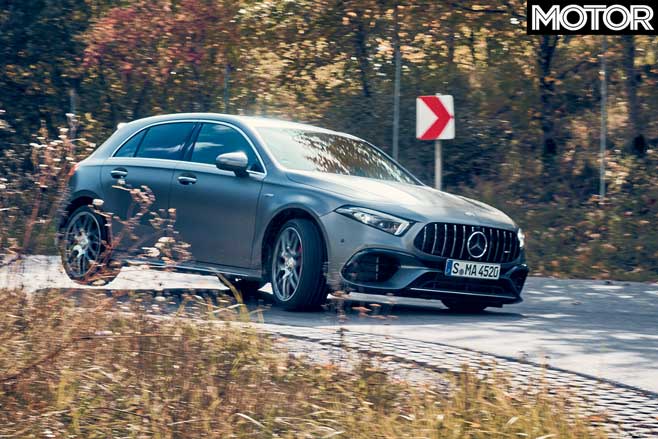
The Mercedes does better than that. Its suspension is unexpectedly compliant in Comfort, still cushier than the M135i in Sport, and better tied down in Sport Plus and Race. It also responds more impatiently to throttle orders, builds up revs more eagerly and hangs on to the power with unabashed vigour.
When invited to do so, the tail swings round in a creamy arc, and as long as the driver maintains the tighter-than-regular steering angle and the punchier-than-normal torque flow, the winged five-door hatch performs as closely to a pedigree drift machine, as it can, from entry to exit.
The secret behind this on-demand change of handling attitude is known as AMG Torque Control, with electronically controlled multi-disc clutches on each side of the rear differential, one for each driveshaft.
In combination with the fully variable electro-mechanical front-to-rear torque split, this fully variable rear side-to-side torque distribution ensures optimum traction in all weather and road conditions – except in Drift Mode, when the outer rear wheel is fed all the oomph it needs while the inner wheel takes time off.
The challenging ergonomics to tap these wide-ranging talents involves a selection of hard keys, a large touchpad and a multi-function steering wheel complete with several sub-menus and multiple redundancies. In a nutshell, the AMG A45 comes equipped with three scalable dynamic interfaces: Level One defines the 4Matic set-up. With the AMG Dynamics menu in Basic or Advanced, AWD works in Comfort mode. Upgrade to Plus or Master and Sport mode will automatically take over.
Level Two offers three different ESP activities: On, Sport handling mode and Off. Level Three lets you choose from six different driving programs labelled Ice, Comfort, Sport, Sport Plus, Race and Individual. The associated software controls all drivetrain-related functions such as throttle response, shift points and speed, sound processor, and exhaust note in Reduced, Moderate, Sport or Dynamic fashion.
Other flexible tools are the available adjustable dampers, active torque split, ESP calibration and steering action. Devoid only of air suspension and rear-wheel steering, the supersonic A-Class is about as close as a compact car can possibly get to total high-tech overkill.
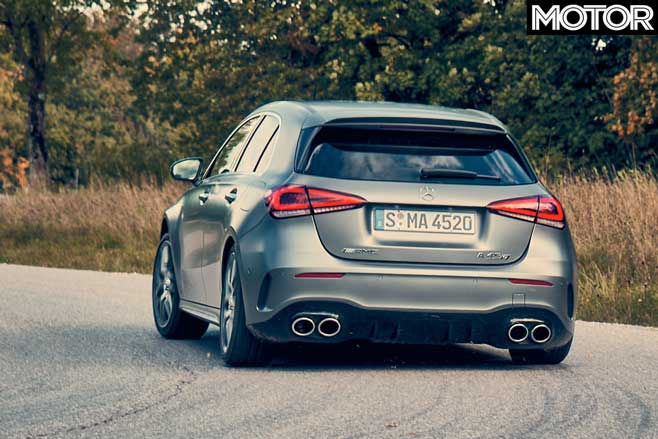
The M135i is a carver, not a scrubber. As soon as you turn the wheel and start reeling in the apex, it assumes a relatively flat stance. There is no dedicated drift mode, and the good old handbrake has of course long been replaced by an electric push-button device, but the combination of abrupt lift-off and simultaneous hard turn-in induces a mild four-wheel slide that won’t last, at least not in the dry.
Try harder still and chances are you’re overdriving the car, which looks silly and is certainly less rewarding than to let steering, throttle and chassis sort things out with cool competence and utmost efficiency.
Even when you deliberately overstep the mark, this BMW will sort itself out, tighten or relax the line, suggest additional input or substitute for it. It goes where you point it, fusing accelerator position and steering angle to the fastest physically possible vector graph.
Boring perfection? Not at all. Instead, this is a compelling fusion of entertaining handling and easily accessible performance, even on tricky backroads.
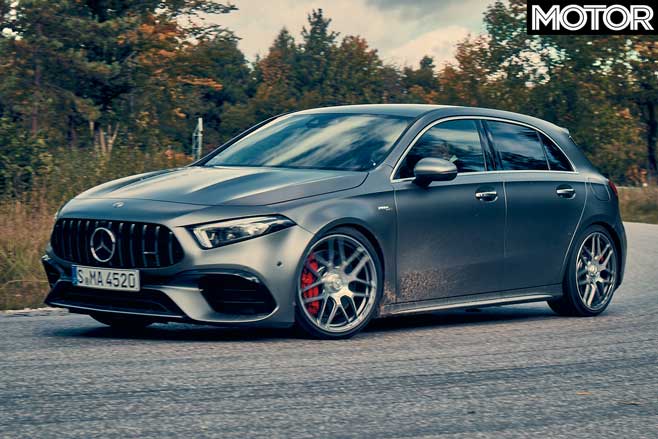
Out in the open, the preferred AMG attack mode is the DNA in Sport Plus, Dynamics in Master, adaptive dampers in Sport and transmission in Manual. In built-up areas, though, it’s back into Drive, which does a fine job holding the appropriate gear, shifting down just in time, keeping the noise below the foul eggs threshold and only making full use of all 7000rpm (the BMW is redlined at 6000rpm) when opportunity knocks. The Sport Handling program encourages the odd lift-off tail-wagging antics and a momentary trace of exit oversteer.
At speeds of up to 120km/h, the standard steel brakes have no problem reeling the A45 in reliably and in fade-free fashion. The same is true for the BMW, which evinces reassuring stopping power and easy modularity. Both electro-mechanical rack-and-pinion steering systems are of the variable-effort and variable-rate kind.
Just as BMW promised zero understeer or torque steer in the new M135i – and has impressively delivered – Mercedes claimed a totally neutral handling attitude and no steering fight with the AMG A45 S. With an extra 85kW and despite its wider footwear, though, the AMG will understeer slightly at the limit, except in drift mode of course.
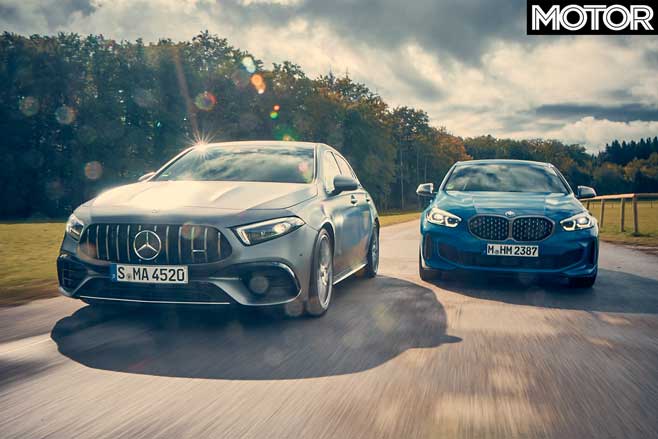
Stepping into the BMW, the controls feel initially less connected, the response less sharp, the overall character more GT-like than emphatically sporty. But it doesn’t take more than a dozen kays before this grand scheme of calibrations is again totally in line with a beefed-up 1 Series that is clearly more 135i than M.
In a way, the BMW has a different character than suggested by its badge. After all, the rear-drive M240i is more M than this top-of-the-line, all-wheel drive 1 Series and, despite the A45’s sparkling cocktail of abilities, the defunct M140i simply refuses to disappear from the back of my mind.
Would I spend my own money on the hottest or the second-hottest hatch on the market? Probably not, but then this type of transportation is out of tune with an older person tired of getting clobbered for playing hard with overly conspicuous toys. A more user-friendly AMG A45 S wagon or M340i xDrive wagon would seem as dynamically appealing as these cramped hatches.
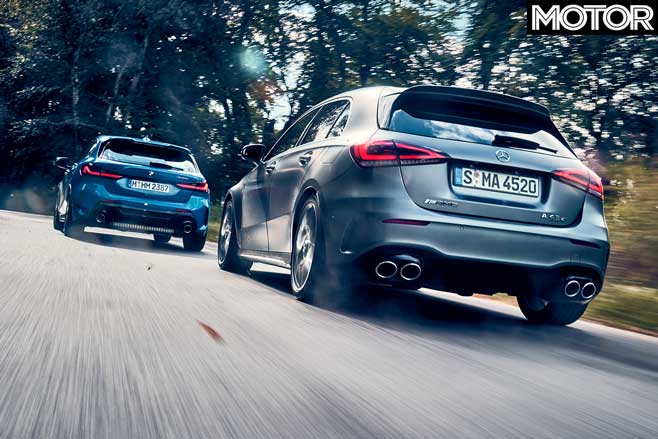
Generally speaking, I would struggle putting down this sort of money for any slick and quick metamorphosis of an entry-level motor car. The lower door panels of the Benz are for instance made of low-rent, rock-hard plastic, the BMW interior sports a disturbing mix of real and fake brightwork, rear seat leg and headroom is a bad joke in both combatants, and the bulk of those gadgets and the schoolmasterly ergonomics do absolutely nothing to stimulate the friendship.
A case of less is more? It depends. But a whiff of electrification would help appease the nerdy Greta Thunberg inside.
Fast Facts
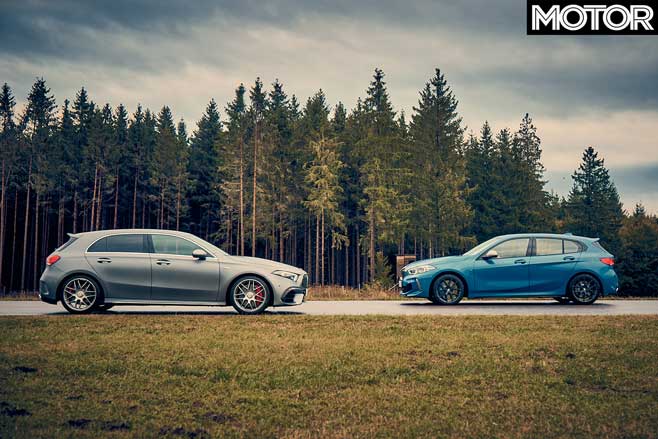
| u00a0 | Mercedes-AMG A45 S | BMW M135i xDrive |
| Body | 5-door, 5-seat hatchback | |
| Drive | all-wheel | |
| Engine | 1991cc inline-4, DOHC, 16v, turbo | 1998cc inline-4, DOHC, 16v, turbo |
| Bore x Stroke | 83.0 x 92.0mm | 94.6 x 82.0mm |
| Compression | 9.0:1 | 9.5:1 |
| Power | 310kW @ 6750rpm | 225kW @ 5000-6250rpm |
| Torque | 500Nm @ 5000-5250rpm | 450Nm @ 1750-4500rpm |
| Power/Weight | 200kW/tonne | 148kW/tonne |
| Transmission | 8-speed dual-clutch | 8-speed automatic |
| Weight (dry) | 1550kg | 1525kgu00a0 |
| Suspension (f) | struts, coil springs, adaptive dampers, anti-roll bar | struts, coil springs, dampers, anti-roll bar |
| Suspension (r) | multi-links, coil springs adaptive dampers, anti-roll bar | multi-links, coil springs, dampers, anti-roll bar |
| L/W/h | 4445/1850/1412mm | 4319/1799/1434mm |
| Wheelbase | 2729mm | 2670mm |
| Tracks | 1597/1558mm (f/r) | 1560/1563mm (f/r) |
| Steering | electrically assisted rack-and-pinion | |
| Brakes (f) | 360mm ventilated discs, 6-piston calipers | 360mm ventilated discs, 4-piston calipers |
| Brakes (r) | 30mm ventilated discs, single-piston calipers | |
| Wheels | 19.0 x 8.5-inch (f/r) | 18.0 x 8.0-inch (f/r) |
| Tyre Sizes | 245/35 ZR19 (f/r) | 225/40 R18 (f/r) |
| Tyres | Michelin Pilot Sport 4 S | Michelin Pilot Super Sport |
| Price | $90,000 (est) | $63,990 |
| Pros | Performance; handling; traction; ride | Balance; brakes; grip; electronics |
| Cons | Complication; interior plastics/space | Styling; interior trim/space; itu2019s no M140i |
| Rating | 4.5 out of 5 stars | 3.5 out of 5 stars |
It’s a strange thing, pressure. For some it’s like kryptonite but for others, well, they seem to relish it. They seek it out, they thrive on it, and somehow harness its potentially destructive energy to drive them forward, like some kind of psychological kung-fu master.
Frank-Steffen Walliser is clearly from the latter camp. Tall, rake thin and confident in a quiet, self-assured kind of way, Frank doesn’t seem like the kind of bloke to buckle under intense scrutiny. Which is handy, given the job he’s just stepped into. Frank is the new ‘Mister 911’, which, for sports car fans, is a job title more significant than any CEO or MD.
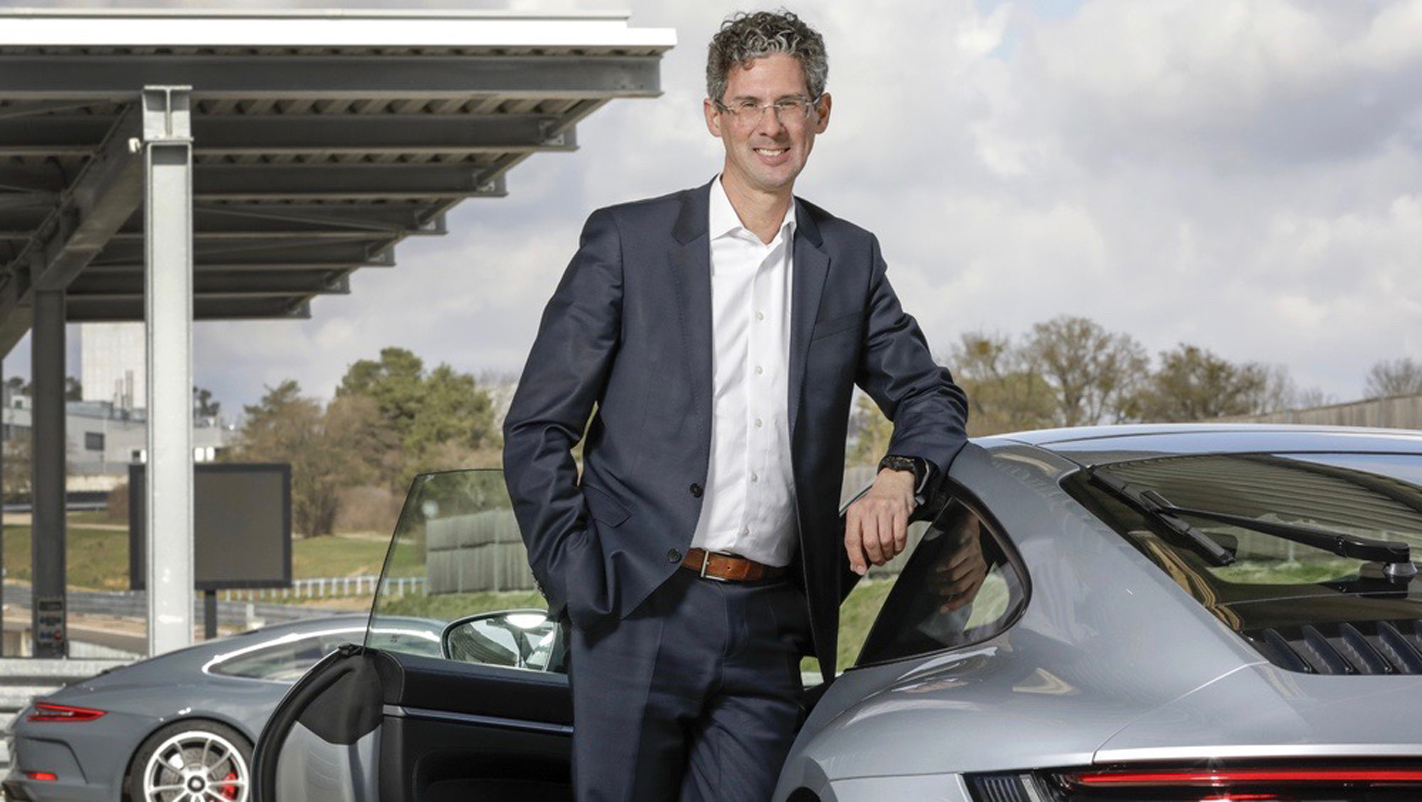
For almost two decades the role has been filled by another German, August Achleitner, but with August announcing his retirement at the end of 2018, one of the motoring world’s most coveted positions suddenly became available. Enter Frank-Steffen Walliser.
“In April I took over from August and I’m now stepping in his big footsteps of bringing the 911 into the future,” Frank tells me, perched on a stool in Porsche’s hospitality at the Goodwood Festival of Speed. “It’s not easy when you have a history of more than 55 years and everyone is looking so closely at this car because it still stands for the brand and everything that we are standing for. The 911 is the most important car we have.”
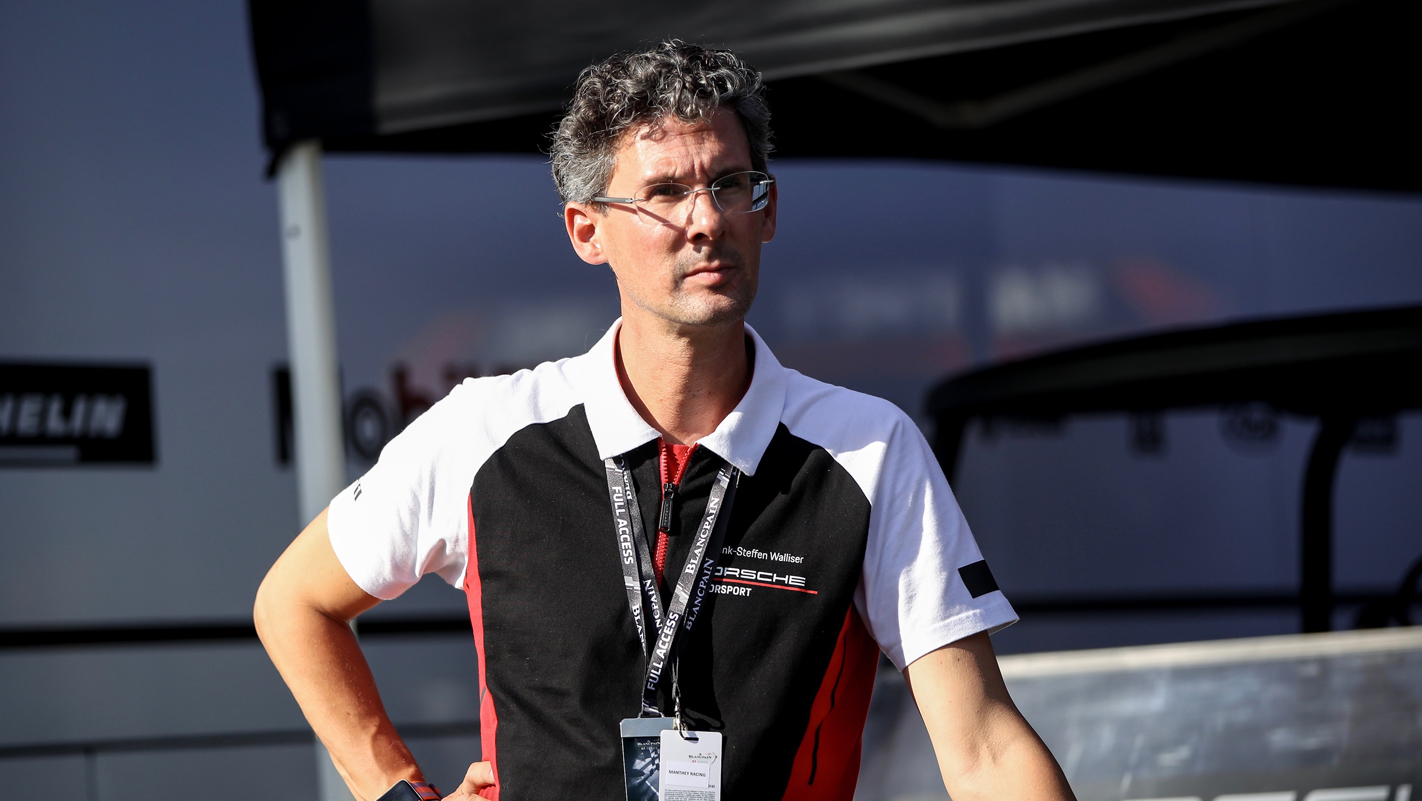
Encouraging words, you’ll agree, and Frank is speaking from experience. He’s spent his entire 24-year career at Porsche, quickly building a CV that’s seen him head up Porsche’s motorsport division, twice, and even earn the nickname ‘Mister 918’ for his role in strongarming the company’s hypercar project from slow-moving concept to Nürburgring lap record breaker. Spend five minutes with Frank and it’s clear that his love of cars, and of racing, runs deep. “I was always interested in cars,” he says. “According to my parents, my first word was ‘car’ not ‘mum’ or ‘dad’. That sounds crazy, I know, but that’s what they told me. But I was crazy about them. I knew all the brands and models and I studied mechanical engineering in Stuttgart and then asked for an internship at Porsche.”
That was in 1995, and just four years later, Frank scored his first big break. While working in Porsche’s competitive analysis department he was headhunted by the company’s board member for research and development to be his personal assistant. “It was an accelerator for my career,” Frank recalls. “Besides, I learned a lot of things looking over the shoulder of a board member – you’re looking at all the details of the company; all the details of R&D. You also get some facetime with the board and you’re more noted.”
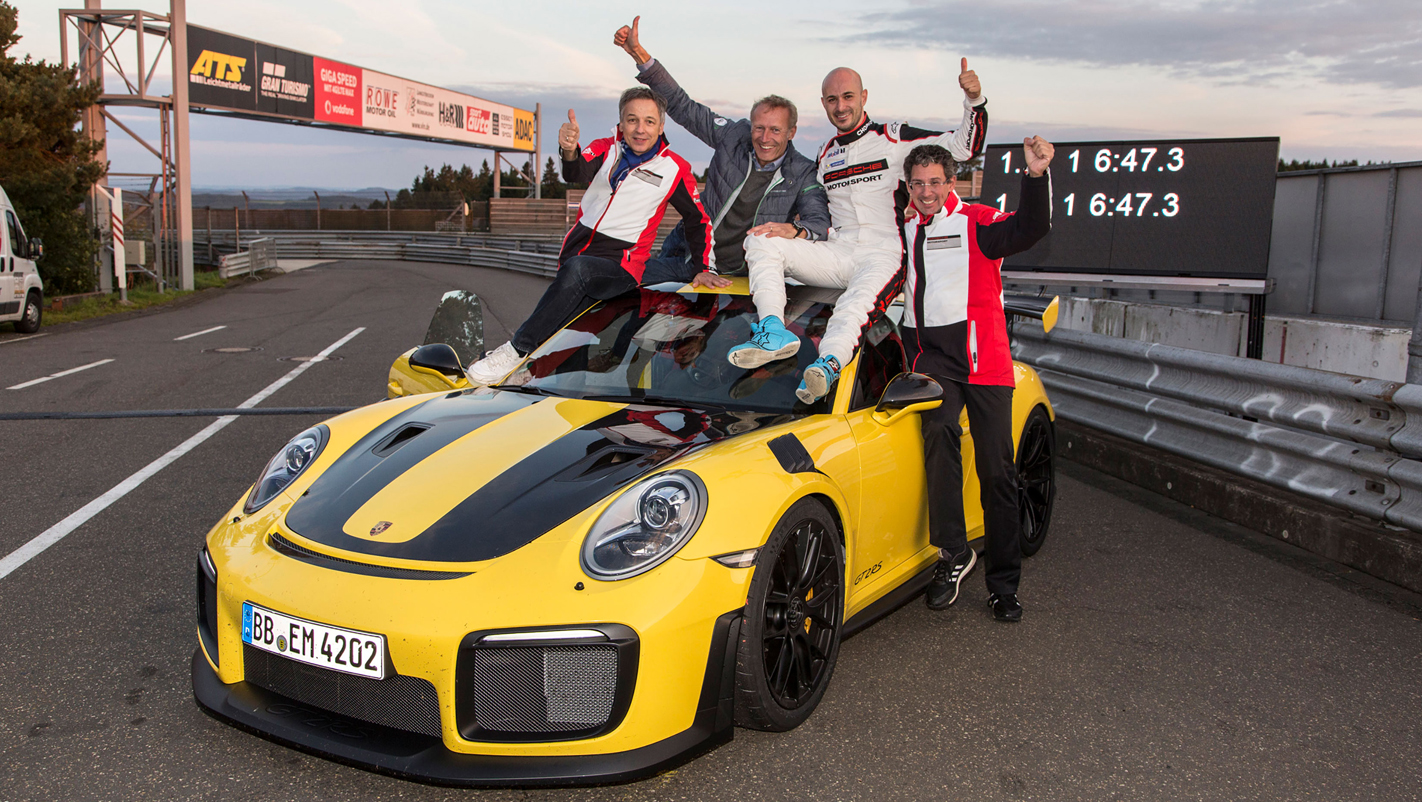
Frank’s first motorsport stint followed, where over five years he helped spearhead the successful RS Spyder LMP2 program, before he moved back into road cars and slotted into Porsche’s electronics department. This three-year foray quickly escalated his fortunes.
“In 2010 I was asked if I would take over the project management for the 918 Spyder program,” he says. “Actually, if I’m honest, I was not asked. I went to the board and asked if I could do that because I had the impression the project wasn’t moving as fast as it should.
“So I went to Wolfgang Dürheimer (then head of R&D) and said, ‘If you’re looking for a project manager that has some experience in motorsport, in high-performance cars, and in electronics, then you have one choice – me.’ He looked at me and said, ‘Well … okay, let’s do it.’ I was very assertive and straightforward but that car changed the game.”
It was at this point that Frank stopped moving from job title to job title, and simply started amassing them. Once again in charge of motorsport, he also took on the overarching responsibility for Porsche’s GT road car division, a post he’ll retain alongside his new gig.
So how does the man tasked with shaping the next generation of 911s, and their RS derivatives, respond when asked to define what a 911 is, and how that might change with the advent of electrified powertrains.
“It’s a good question we talk about every day in the office,” he says. “I would say, looking from outside, a 911 is definitely the design, the typical fly-line, the headlights, the wide back. And it’s a combustion engine. It’s a flat-six, that’s a must for a 911.
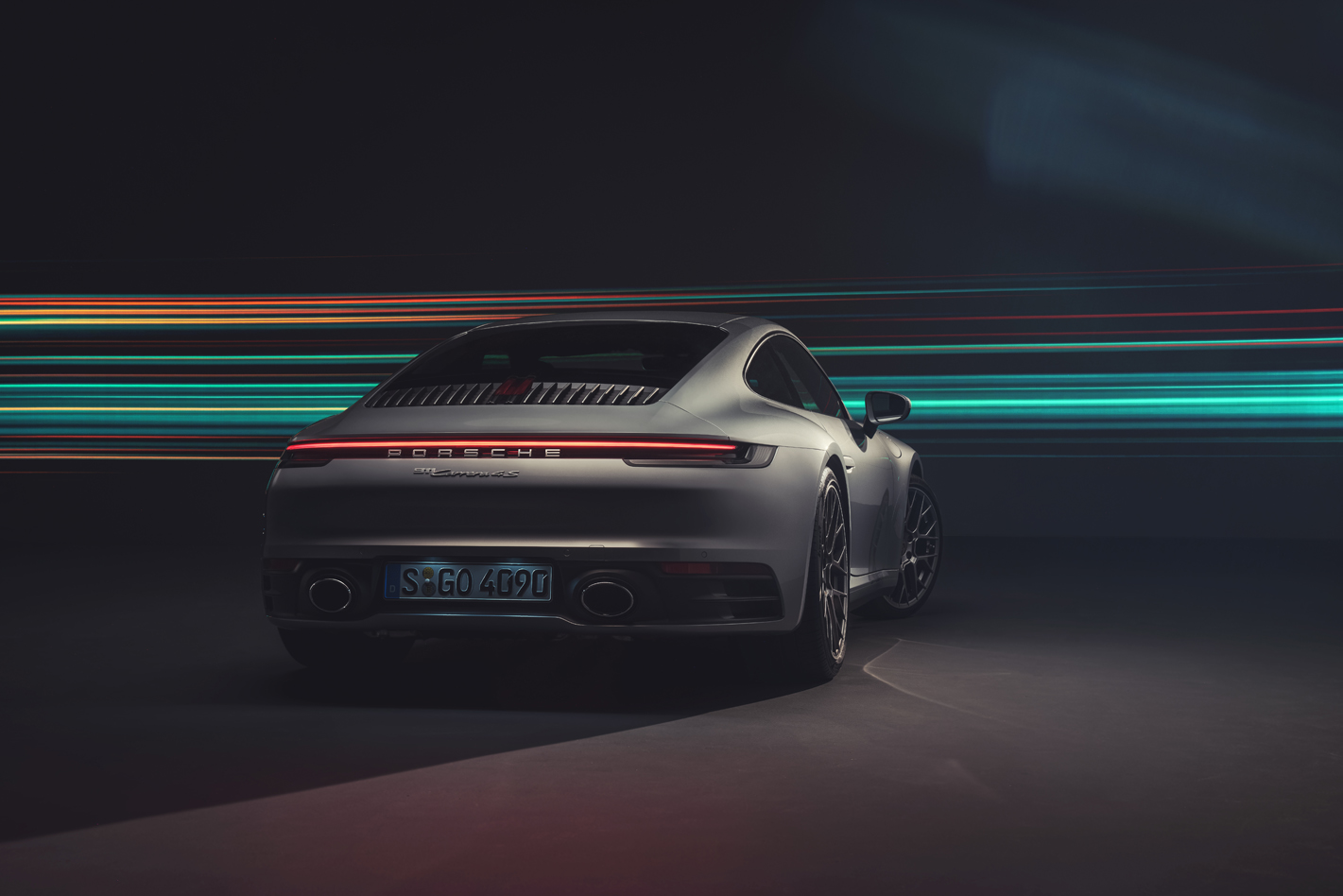
“I would say bringing good hybrid technology to a 911 is not a problem as long as the car gets better. I don’t need a hybrid because it’s a hybrid – it must be better, it must fit for the character, the weight, the throttle response to a 911. Then I’m fine, but I don’t see a fully electric 911. Really not. There’s still a huge market and a huge demand for combustion engine cars, and you cannot do everything with an electric car. For sure the world will be more different, we will see different propulsion technology, but maybe I’m joking, maybe I’m right – the 911 will be the last car that will be electrified.”
The more you speak to Frank, the harder it is to shake the feeling that the future of the 911 is in safe hands. He’s a proud 911 owner, and is acutely aware of the car’s history and significance. Though equally, he isn’t afraid of change, or of altering the 911’s sacrosanct recipe in the name of progress.
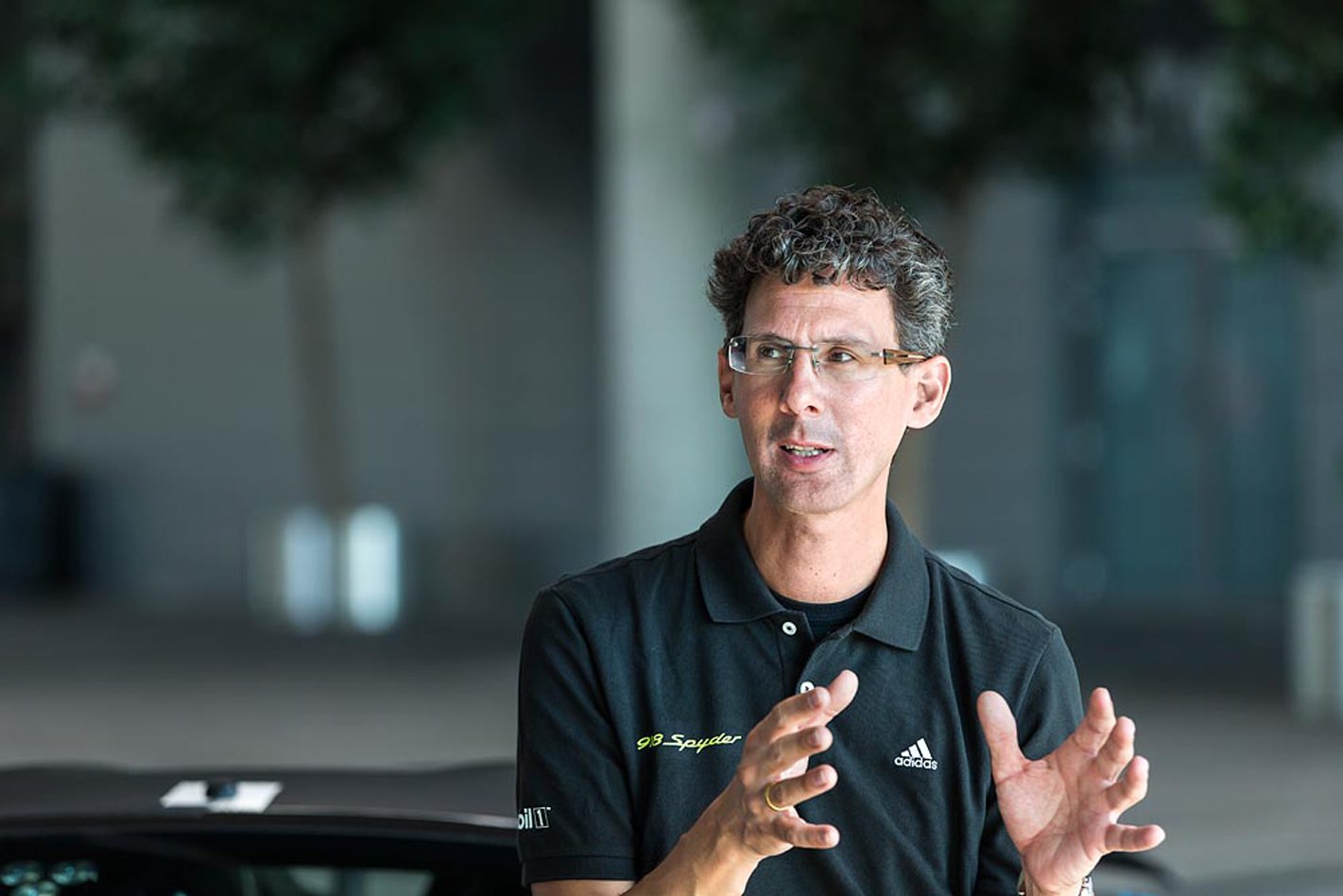
“We are very, very careful what we change on a 911,” he says. “Believe me, this is the car we discuss most if we change something. We’re in a period of transition and it’s very tricky to make the right decisions about which technology to use, when to use it … but I’m not nervous. If you’re nervous, that’s not helping you make the right decisions.”
What was that I said about relishing the pressure?
All pre-production Porsches are, as a rule, painted solid black, only casually camouflaged with black tape, and they have all-black interiors with optional soft-shell black disguise pads here and there.
This monochromatic stealth car would look perfectly inconspicuous if it wasn’t for the four eye-catching, snow-white Caution! Experimental vehicle! stickers, which in Germany are mandatory in this era of battery-powered cars and potential electric shocks.
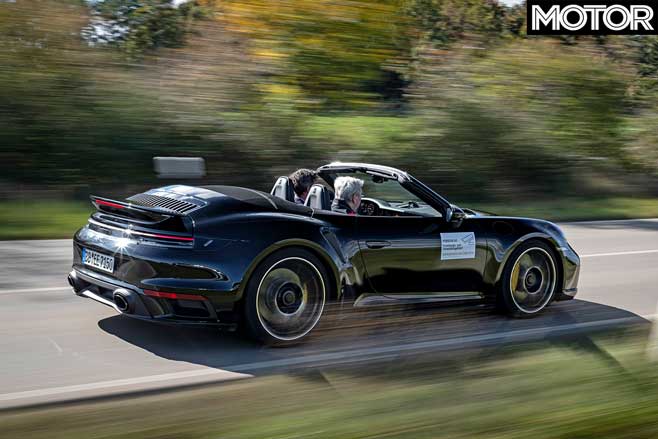
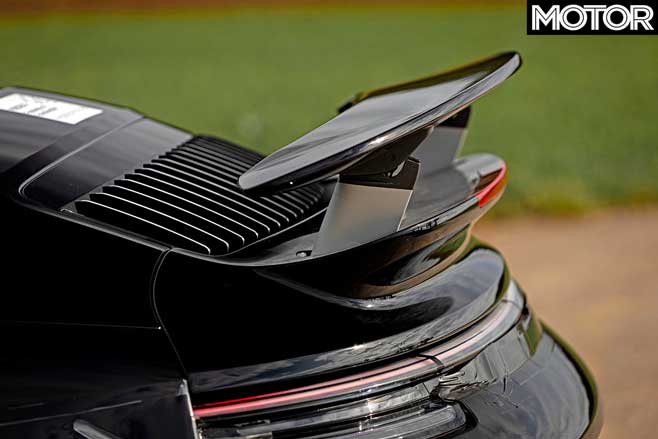
Although electrocution is not a risk when laying hands on the new top-of-the-line 992, the warning messages inadvertently distract spies from the changes made to the latest 911 Turbo S. Most significant are the redesigned rear apron-diffuser that accommodates the trademark four trapezoid endpipes; flush, multi-spoke lightweight wheels; bigger and slipperier side air intakes; slimmer and wider DRLs; restyled bumpers and a more elaborate ground-effect wingwork.
The 992 was developed under August Achleitner and his team, and contrary to popular expectations, the only battery installed in the new 911 Turbo drives the starter motor and supports the alternator – there is no mild hybrid, let alone a boost-effect 48V system.
“The benefits of partial electrification are marginal compared to the complex weight, packaging and cost issues,” Achleitner tells MOTOR. “Weight in particular is obviously critical for every sports car. Unfortunately you cannot de-content (remove features to reduce weight) a Turbo like a GT3 because the clientele would not tolerate it. Instead, the car gained a few extra kilos with additional convenience items and the new eight-speed PDK transmission. You would not believe the damage an extra set of gears does to the overall calorie count…”
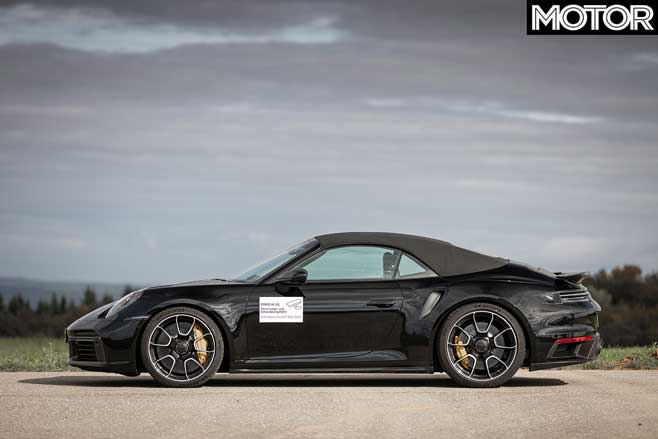
Unlike early Turbos, decried as ‘widow-makers’, more recent versions have been heavily bespoilered 911 iterations targeting the rich. The 996 and 997 Turbos in particular were known for straddling the boundary between sanitised faultlessness and budding boredom, were comprehensively kitted out with sound-deadening material and, starting with the 997 Turbo S, were no longer available with a manual gearbox.
“In this case, there wasn’t any real need for significant last-minute adjustments,” says new 911 product chief Frank-Steffen Walliser from the driver’s seat of our pre-release test car, “but I still feel we have steered the 992 Turbo fractionally more in a back-to-the-roots direction. To do so, even little things helped: stiffer joints, harder rubber bushings, tighter attachment points, modified spring and damper calibrations. What we definitely refrained from is turning a nicely balanced GT into a hard-edged street fighter.”
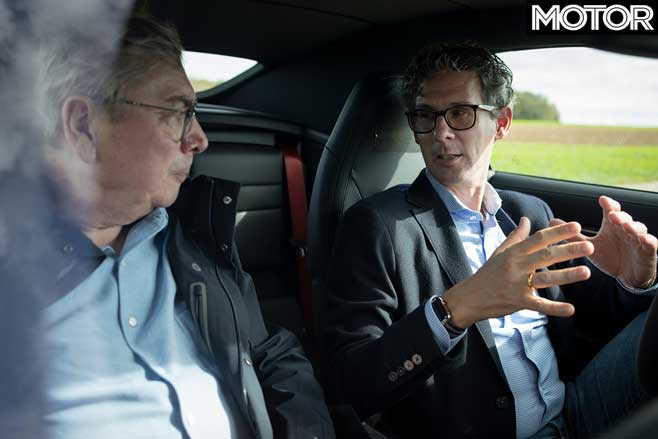
Walliser points out that we’re on the long road home, but I don’t grin because there’s a sudden transition from gentle breeze to gale-force storm. There is not enough time to ponder whether the driver is a certified lunatic or Mark Webber’s brother in arms, as the very first left-hander threatens to suck us in and spit out the remains.
But the very moment my lips begin to form the first line of Hail Mary, the front end grabs the last piece of tarmac before doom, the rear wheels follow a similar sabre-shaped arc, and we pull through, the fat rear end squatting down mid-corner like a sumo wrestler.
Little did I know at this point of the wild ride that foreplay is in Porschespeak merely a warm-up, that ESP can be switched off in two steps known as ‘please don’t’ and ‘oh-my-god’, that the prime mission of all-wheel drive and rear-wheel steering is to tighten the rope that separates experience from tragedy.
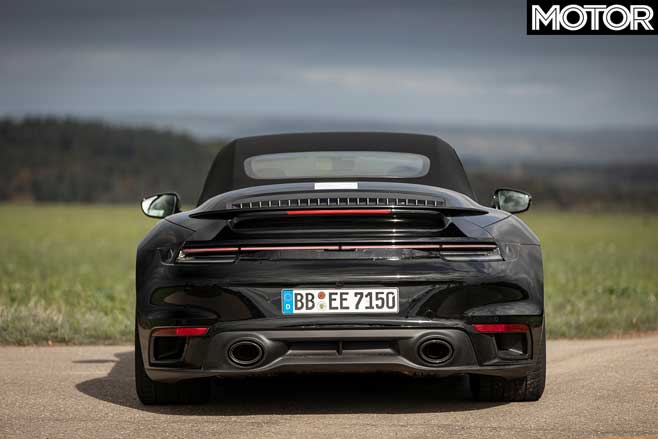
“Compliance is key, because compliance means control,” Walliser continues. “You want a sports car to respond in a sharp and positive manner, but the 911 Turbo is a little different since a super-quick or super-clever feedback could easily overshoot the target. The very last thing an engineer wants to do is unsettle or even scare the driver, who must always feel in charge, so a small margin for error here and there won’t hurt.”
No word about frightening the passenger, but that’s okay because all it takes for the co-pilot to catch the drift (!) is a little more time and trust. Trust in the cast-iron, sombrero-size brake discs, which measure 410mm up front and 390mm in the back.
Trust in the liquorice effect of the tyres, sized 255/35ZR20 and 315/30ZR21 respectively. Trust in the variable-rate, variable-effort steering that controls all four wheels, enhancing the manoeuvrability and solidifying the directional stability. And last but not least, trust in the black box and its army of sensors that must at all times be on the alert and cast the appropriate digital safety net.
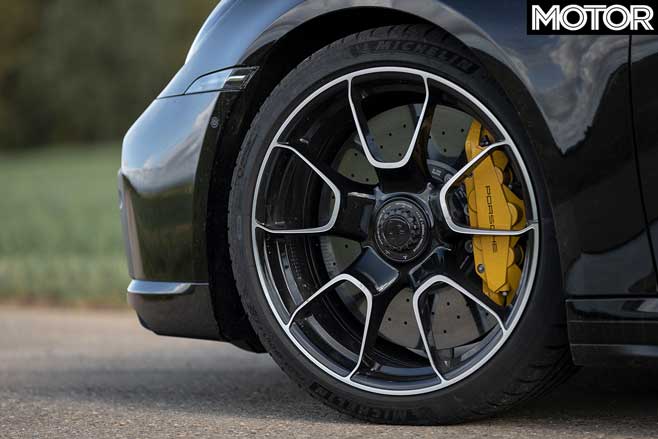
Body and brain can absorb plenty of input in 90 minutes, but beyond the subjective passengering impressions there are precious few hard facts available at this point, mainly because the homologation is not yet complete. We know that the new EA9A2 engine is a twin-turbo 3.8-litre flat-six, apparently rated at 485kW at 7000rpm and 800Nm at 2500-4000rpm. The non-S engine is allegedly good for 440kW.
Both versions are mated to the new close-ratio, eight-speed dual-clutch transmission. Top speed of 333km/h is reached in sixth gear; seventh is kind of an overdrive for long autobahn journeys, eighth is the long-legged darling of the environmentalist faction.
Like all Porsches, this one allows the driver to pre-set the preferred dance mode via a knob on the steering wheel. Unless you’re running on empty, it’s best to forget Normal, which shifts up so early that this monster finds itself pottering along at 80km/h and 1100rpm in sixth, attempting to save our planet while making your nerve strings snap. You owe yourself Sport or perhaps even Sport Plus, although the latter is stubbornly dedicated to high revs and low gears. Best to compile a personalised selection of noise, grunt, throttle response, shift action and ride comfort.
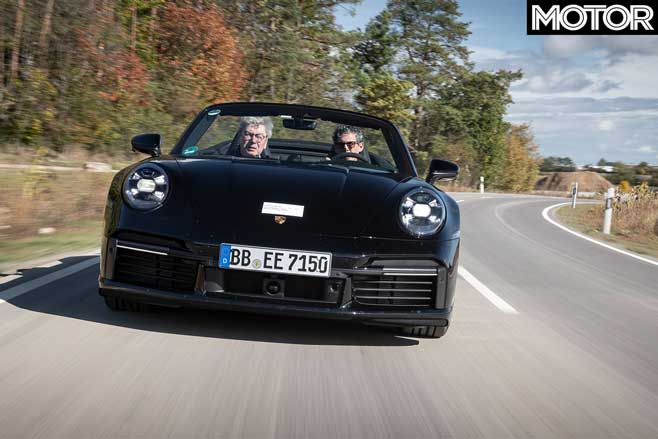
According to the Weissach grapevine, the hottest 992 can accelerate to 100km/h in 2.7sec, which is phenomenally quick for a vehicle that – unlike an EV – does require an extra blink of the eye to summon maximum torque. And it can beam itself to 200km/h in about 8.5sec. But the two-tenths acceleration advantage and 3km/h increase in maximum speed do not lift the high-end 992 tangibly above its predecessor. Instead, it’s the finer points that make the difference.
When Walliser had to leave, we went out again with a Porsche works driver for a second exploration round. On a busy Friday afternoon, one needs to know where to go to avoid traffic, and Jonas knew. For a start, he activated the sports exhaust, a new option for the Turbo that wilfully brushes the gentleman-driver character of the car against the grain.
The same goes for the spring and damper setting in Sport Plus and the weight of the steering, of which he says: “It trades some of the lightness and the relatively strong self-centring force for a more progressive and somewhat beefier action. Nuances only, for sure, but when you work with the 992 Turbo day in and day out, you quickly recognise the benefits, which include a more direct and transparent connection between the road and the palms of the driver, let alone the seat of the pants. Advantage number two is a better tied-down chassis, which still won’t tramline or is upset by vagaries of the road.”
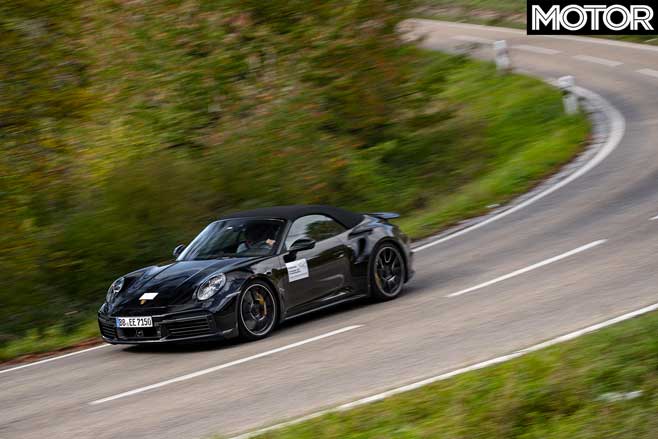
After a pause, he adds: “When encountering unilateral surface irregularities, the Turbo S does feel admittedly busier than a Carrera 4S, and the comfort zone between information and interference is narrower. But I for one would happily pay this price in exchange for the enhanced haptic clarity.”
Makes sense. Could I perhaps give it a go and…? Oh, I understand. Too bad.
When conquering the Black Forest, you drive through thousands upon thousands of trees, and rarely in a straight line. But with the ESP on snooze and with a man in charge who knows every second fir by first name, some bends leave fatter exclamation marks on the passenger’s hard-drive than others. Once again, it’s all about trust and ability.
Equipped with marginally beefier rear wings and an accordingly wider track, the 992 Turbo S is almost as aggressively tyred as the GT2. The tiny deficit in contact patch on roads like these is easily compensated by the broader calibration of the spring and damper settings.
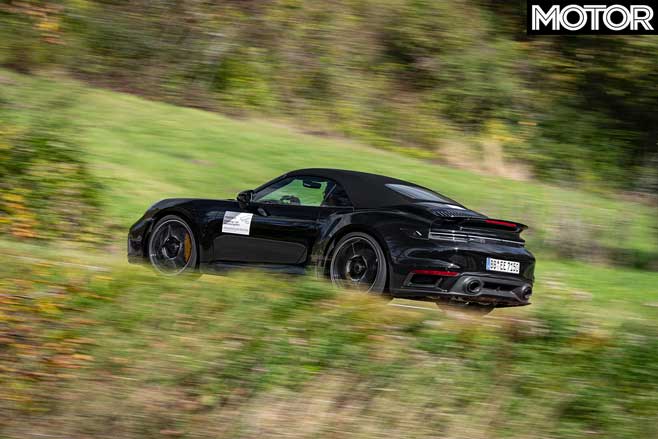
The rear-wheel steering is not quite as slam-dunk radical as in the GT2, and then there is the added benefit of all-wheel drive. It’s the never wavering turn-in grip that completes the ten-out-of-ten handling score. A quick flick at the wheel, a stab at the throttle, a moment’s wait followed by a dab of opposite lock and, voila, another creamy slide is safely in the can. I just sit there and watch in awe, gaping, wide-eyed, hoping for an encore.
The new Turbo gets a much more elaborate aero pack, still with a fixed rear wing but its surface area increased by about 20 per cent for even more downforce and straight-line sure-footedness. The nose sports bigger air intakes to cool brakes and radiators, and incorporates a venturi-effect, bumper-to-underfloor ramp-lip-exit device that keeps the front end true at high speed.
The new engine is fed a bigger dose of air straight into the intake manifold, and exhales through an intestine exhaust system that sounds more Harley than Porsche at idle. Despite the intrinsic choke effect of the mandatory particulate filter and the absence of an electric booster, the high-revving, low-end-torque six-cylinder obeys throttle orders with the hurried efficiency of an infallible footman.
We return the car in the nick of time, a shaken and stirred scribbler trailed by a provocatively relaxed driver. Still sorting thoughts and impressions, one thing is clear from the moment the passenger door drops shut: just as the GT3 with touring pack moved one step further away from the RS model, the new Turbo S is taking half a step back towards its original DNA, having grown a little too cushy since the raw 930 started the breed in 1974.
With the transmission in Manual and the drive mode selector in Sport, the focused mindset prepared to use high revs and explore the car’s lofty limits, the extra excitement this Turbo generates compared to its predecessor may not reveal itself immediately. The seconds gained when whipping this Porsche from A to B are of minor importance. What matters more is the how, not merely the how fast.
Of course, evolution and progress are gradual. But according to the physical seismograph and the mental processor linked to it, the ultimate 992 (at least for the time being) is now a little more involving, a little more responsive and a little more agile overall. A Turbo S with a twist, so to speak. This is a car conceived to satisfy repeat customers yet perfectly capable of attracting new buyers who honour a spicier blend of sportiness and convenience.
