
Fear not, fellow fans of Audi’s five-cylinder turbocharged petrol engine… the peppy, parpy little treasure is set to live on for the best part of the next decade.
The meaty little motor currently stars under the bonnet of the TT RS and the RS3 sedan and hatchback (the RS Q3, which recently ceased production ahead of an all-new generation, also used the same powertrain), triggering fears that Audi’s rush to electrification might mean the end of the road for a motor that stems back to the legendary Sport Quattro of the 1980s.
JULY 20, 2021: The new RS3 has finally been revealed. See our RS3 page here.
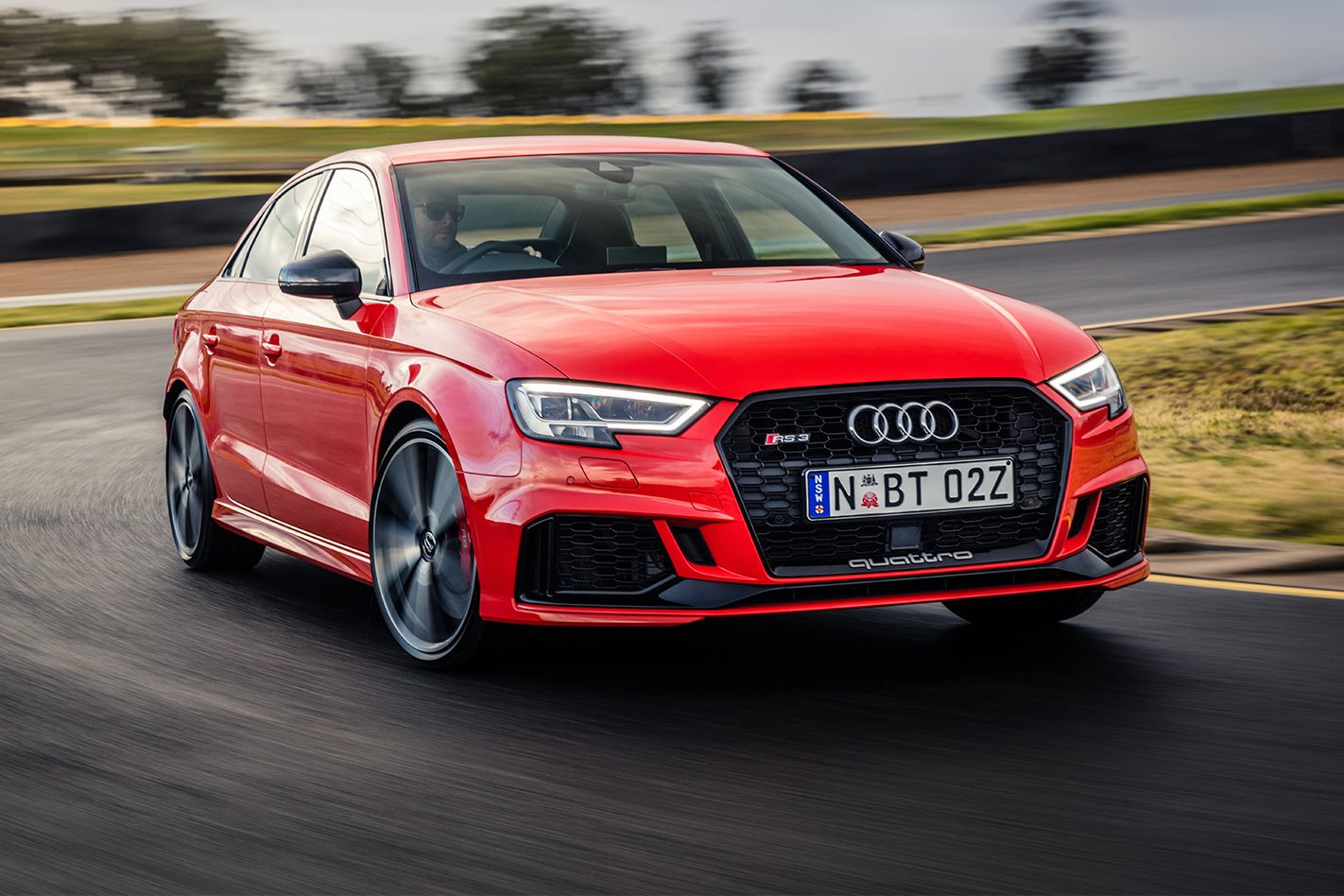
As well, tightening emissions standards around incoming Euro 7 regulations cast a shadow on the relatively under-utilised engine, which carries the internal code of DNWA.
However, our fears have been allayed by the head of Audi Sport, Oliver Hoffmann, who said that the engine is part of Audi Sport’s future plans.
“It is more difficult, but it’s not just a question of how difficult it is,” he told WhichCar. “For EU7 we have concepts for all our engines, but it’s just a matter of how much money I have to spend to reach the targets!
“For the five-cylinder we have a very, very, good concept to reach those standards.”
The engine – which recently gained 25kW and lost 26kg after a switch to an alloy-block architecture – is set to live on in the RS3, while recently announced plans to add new models to the RS line-up could well include a second generation of the RS Q3.
As well, other Volkswagen Group products, like the Golf R, have been spotted testing with the engine.
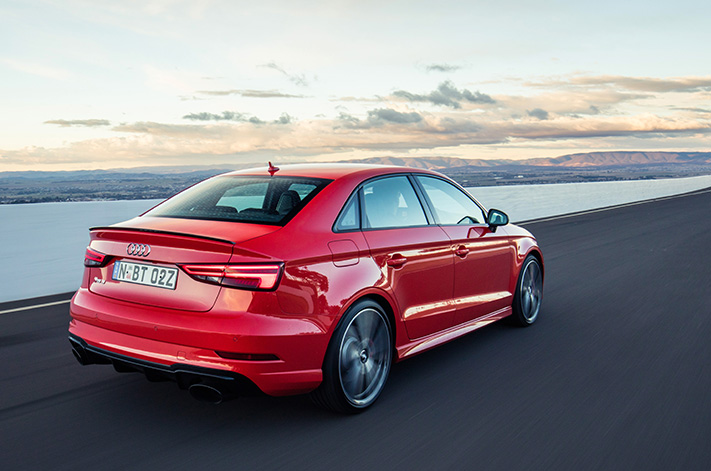
Annette Möllhoff, who works as a product planner at Audi Sport, agreed with her boss. “For us, the five cylinder is so strongly combined with the heritage of Audi,” she said.
“It’s our number one USP in those models, and every time we launch a new model with the five-cylinder, we get the feedback that ‘we are so happy you stick to that engine and don’t downgrade to the four-cylinder’.”
She acknowledged that the engine did need to earn its keep within the brand.
“It’s not a battle [to keep it], but of course there has to be a discussion and a business case, and everybody understands the value that it brings and that it’s necessary to keep it in the portfolio,” she said. “It’s so emotional, and highly valued in the history of the company.
“Emissions are tightening for the five-cylinder, as well. We are working towards that, we’re working right now on the horizon of four to five years ahead and we are right in the discussion with EU7, which is a big topic. But we are aware of it and we are preparing the five-cylinder.”

Sebastian Grossert, who is a technical project manager at Audi Sport, said that work is already underway to meet the regulations.
“It’s always not so easy to fulfil the new laws, but we have been working on it for a year now,” he said. “We are going for it and we’re hoping we can fulfil all the laws and offer it for future compact models.”
One strategy to allow the engine to meet regs is likely to be via hybridisation. Audi is currently rolling out both 12v and 48v mild hybrid systems across all of its cars including the updated Audi A4, which is offering claimed fuel savings of up to 0.7 litres per 100km, depending on the engine.
Additional technologies like belt-driven starter/generators and cylinder deactivation could also help get the engine to meet regulations.
However it gets there, though, we’re excited to see that one of the most unusual and entertaining engines on sale today will live on to see a new decade.
It’s rather sad, when you think about it, but there’s a few too many HSV GTSR W1s for sale on the used market. And just about all of them sit idle with scarce kilometres (quite often less than 1000km) and $200k-plus price tags. However, bring back the goal posts to around $85,000 and you can get behind the wheel of a GEN-F2 GTS and fulfil all your V8 cravings while ticking the nostalgia box. Conversely, that piggy bank could also score you American muscle in the form of the Chevrolet Camaro 2SS.
CHEVROLET CAMARO 2SS
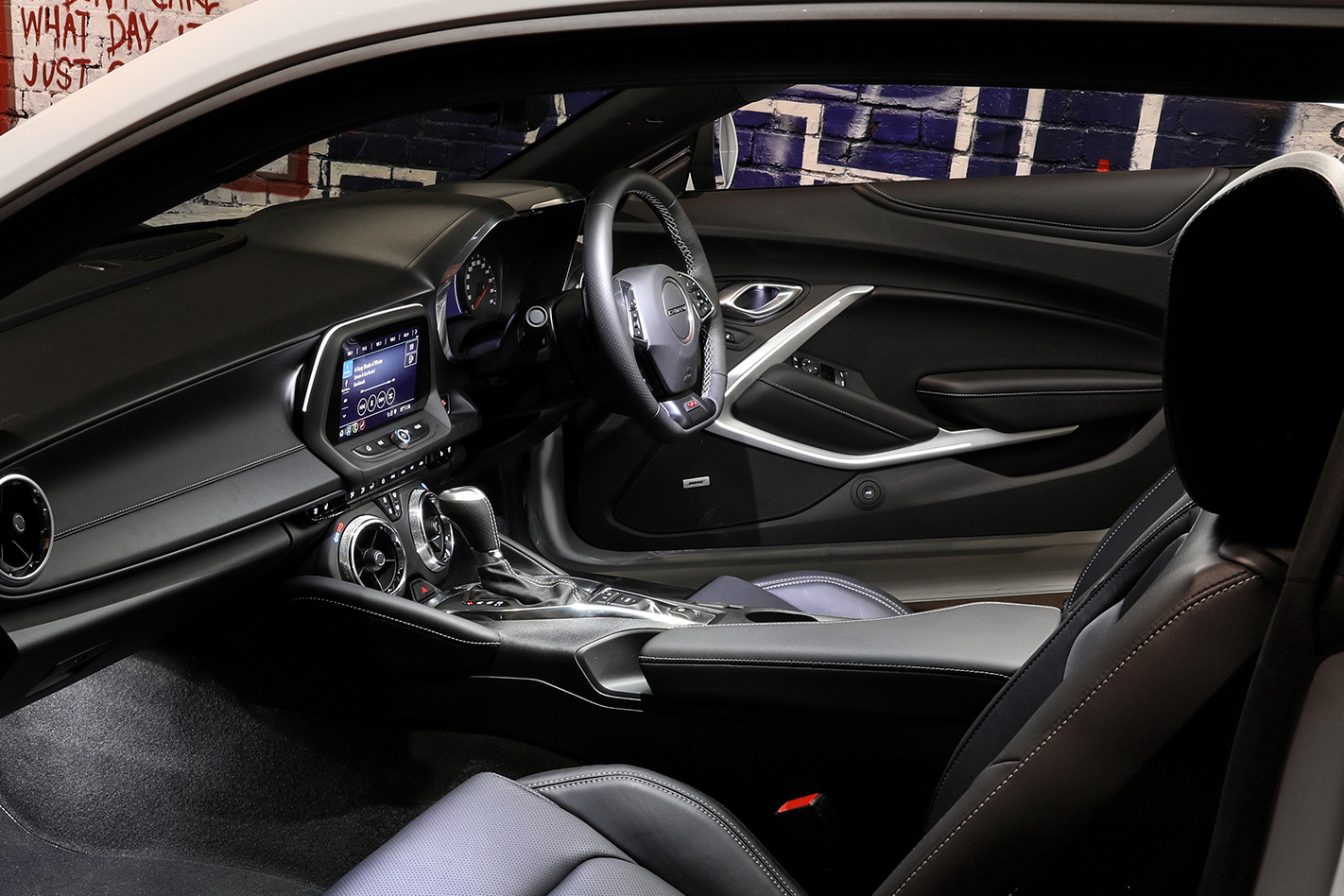
It’s iconic, distinctly American and it’s powered by a big V8 with a soundtrack to match. If you like tough coupes, then the HSV-converted Chevy Camaro 2SS ticks a lot of boxes. It’s hard to argue against when there’s 339kW and 617Nm under your right foot and an angry soundtrack.
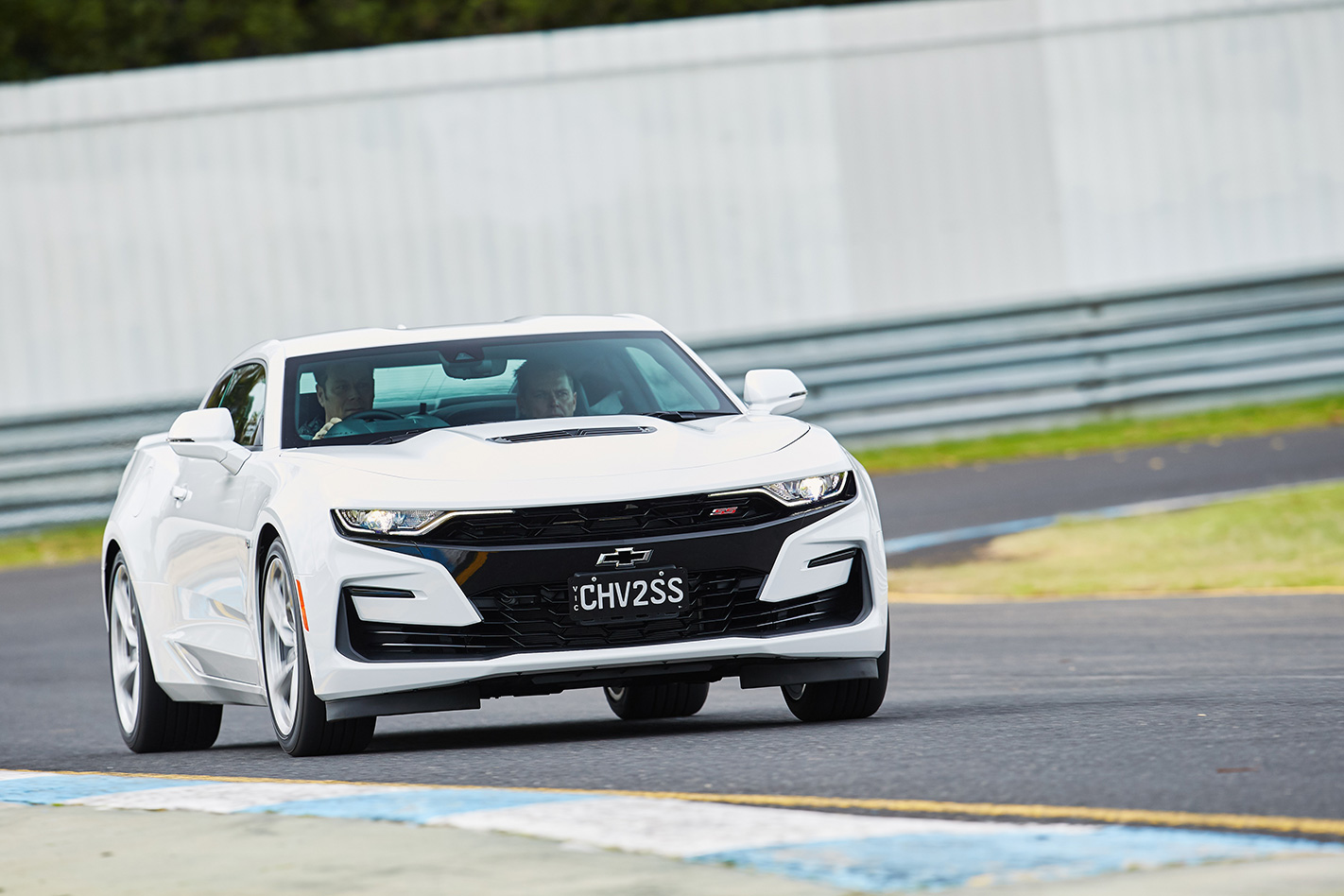
Sweetening the deal further is the asking price of $86,990 (for the six-speed manual), which is affordable given the performance on offer. Bang for your bucks is certainly high. Launch control and a line-locker function are standard, but we’d never use either…
Despite gaining the updated car for 2019, the 2SS continues with a busy ride quality, steering that never really weights up how you’d like and it has a tendency to single-peg out of corners. However, that’s just about all the dynamic flaws as the Camaro offers huge lateral grip. It feels like a more focused, rear-drive coupe than its direct rival, the Ford Mustang. Interestingly, the 10-speed auto shares most of its innards with its Blue Oval enemy.
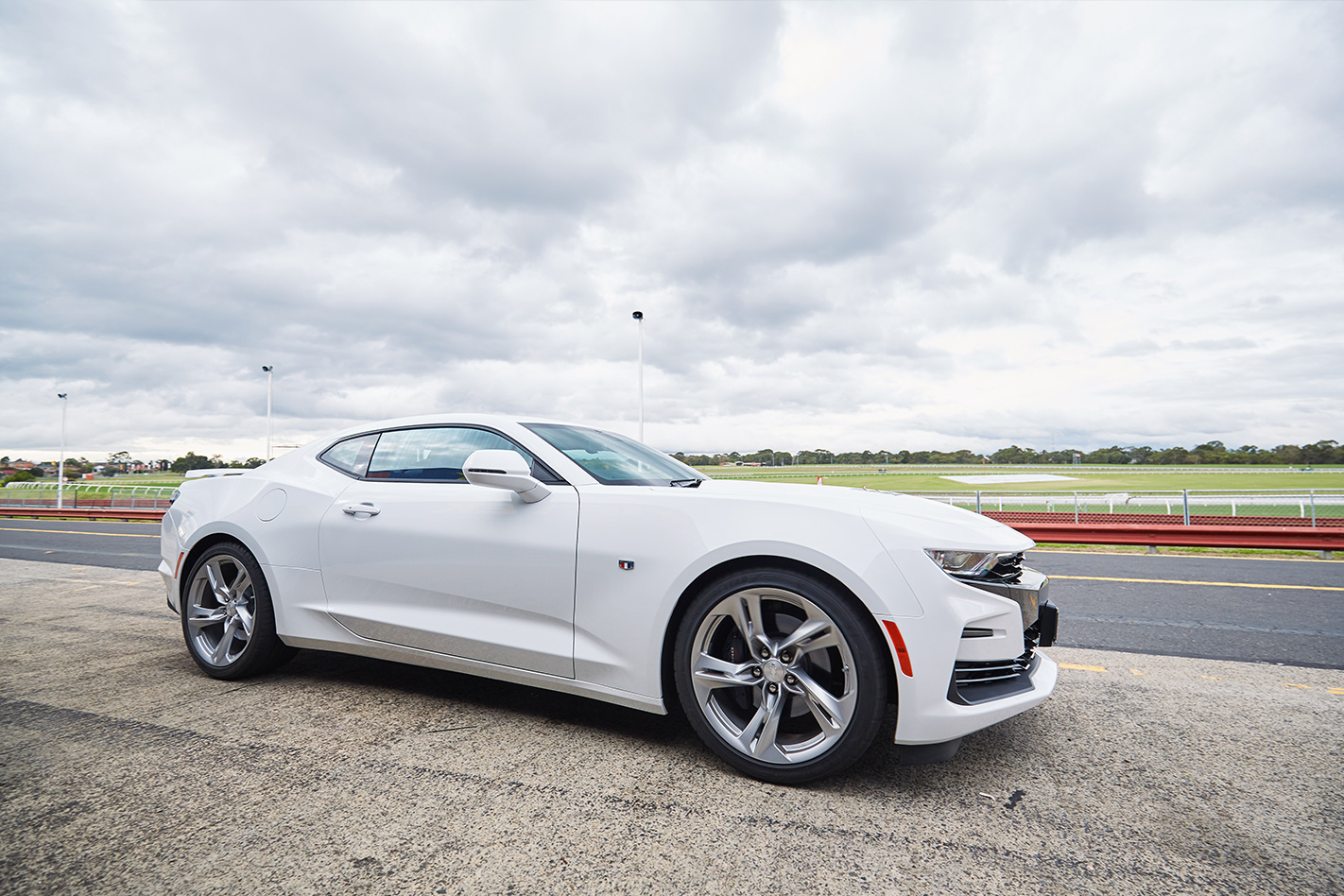
Pragmatic concerns are a bit pointless when buying a coupe, but there’s more than enough cabin space for two. And there’s enough luggage capacity to cater for a weekend getaway to boot. The conversion from left- to right-hand drive is largely successful, with only a few ergonomic fails as remnants of its previous US-born life. The shape of the steering wheel is odd, too.
While the claimed 0-100km/h time is a rather rapid 4.0sec, there is a higher rung. If you’re in need of more modern GM performance, there’s the Camaro ZL1 and its 477kW/881Nm of supercharged LT4 goodness. But you’ll also need $160k. Ouch.
HSV GEN-F2 GTS
For lovers of big, rear-drive Aussie four-doors with hulking V8s shoehorned under bulging bonnets, it’s hard not to be sentimental. Nostalgia is real. While the GEN-F2 GTS might not be the pinnacle of our engineering knowhow, it’s a high watermark. Only the likes of the GTSR and GTSR W1 outrank it. Until those final hurrahs, the GTS’s 430kW and 740Nm made it the most revered lion in the pride.
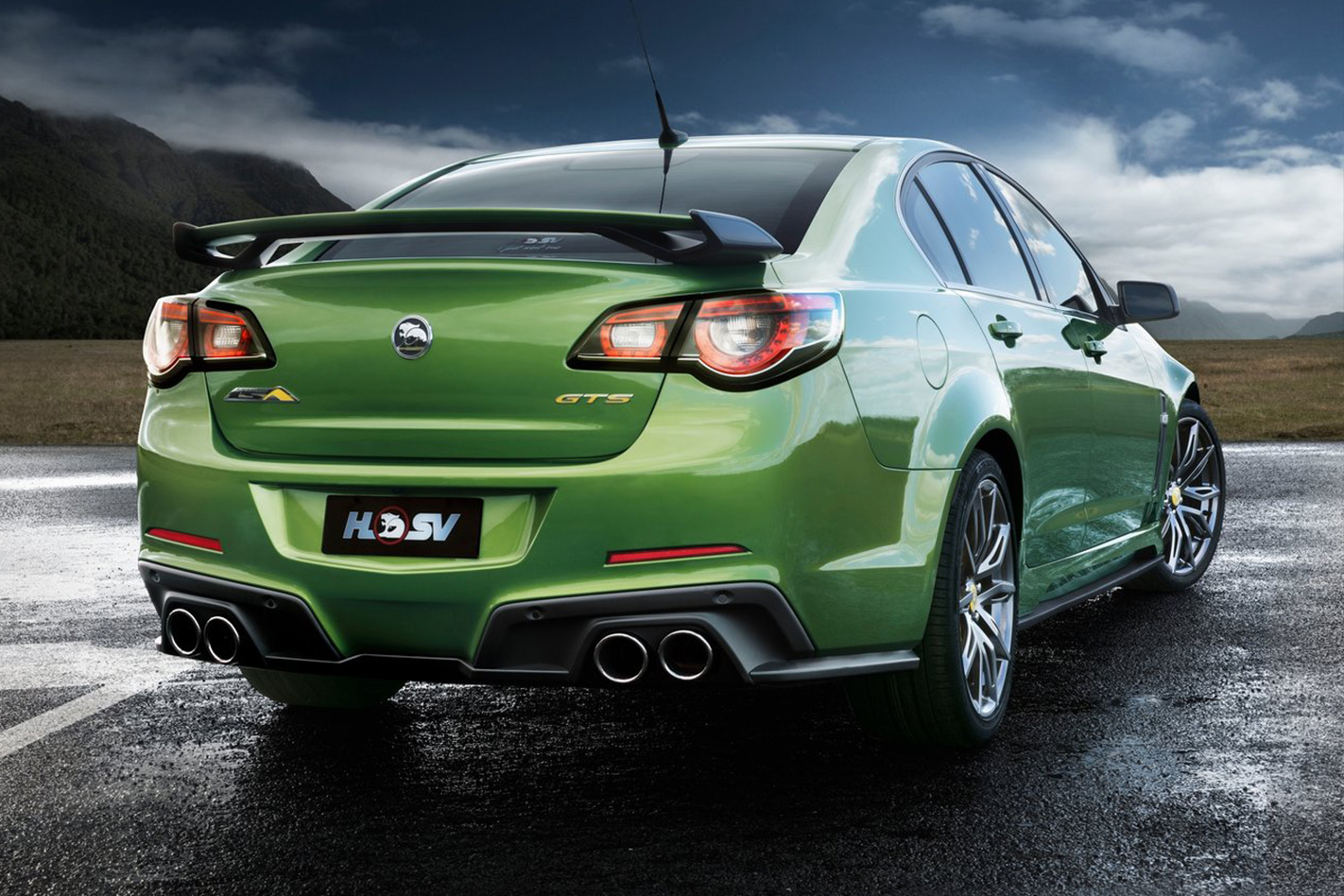
While riding the wave of supercharged torque is fun, the sound emanating from every fibre of the GTS’s being is obnoxiously intoxicating. The 6.2-litre LSA unit might not be tech-heavy, but no one can argue against its efficacy, especially in this application. There’s a beefed-up six-speed auto to choose from, but the six-speed manual is the pick. You can never really negate its physical size and heft, but the GTS is endowed with an impressive level of dynamics and the ride quality benefits massively from the magnetorheological dampers.
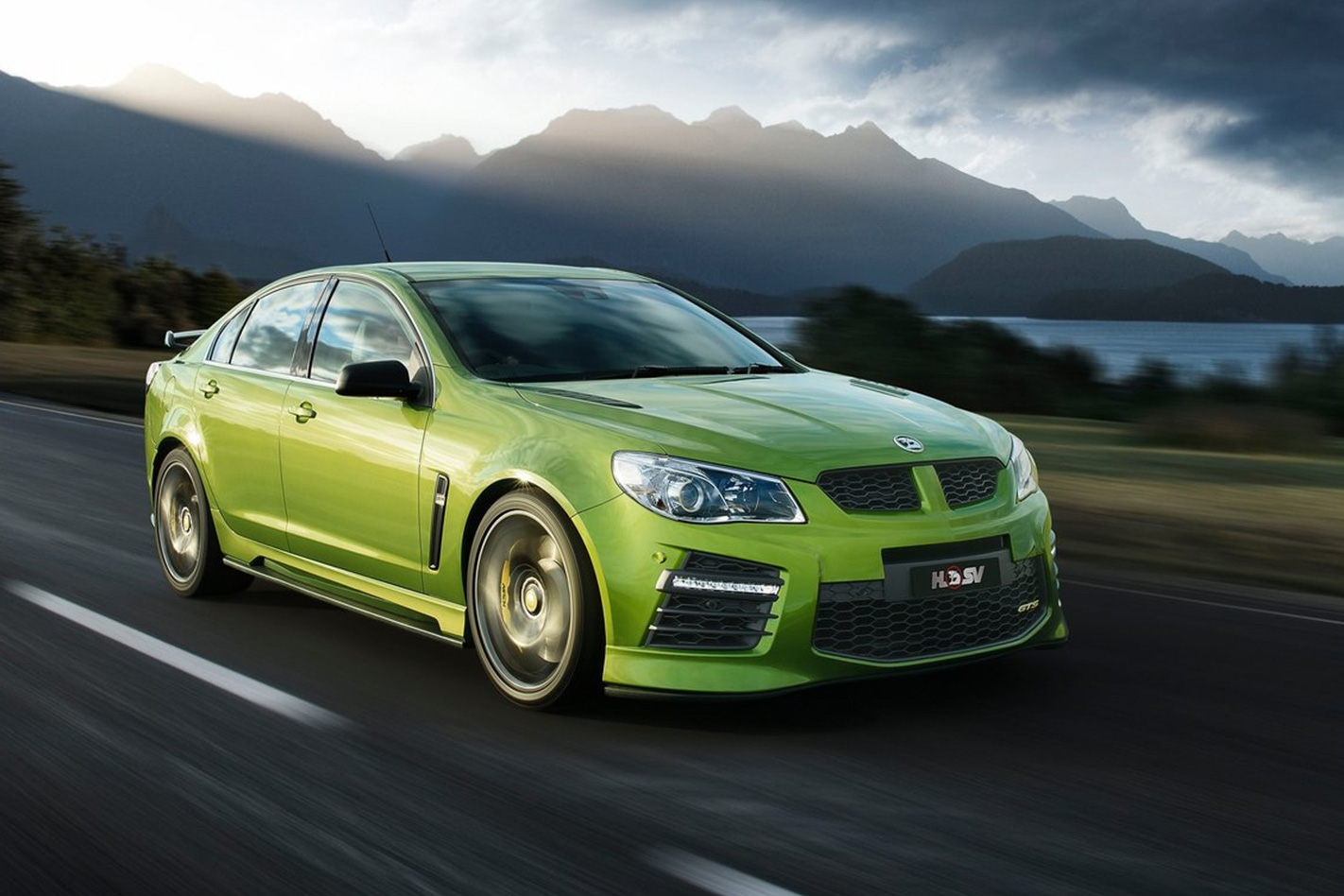
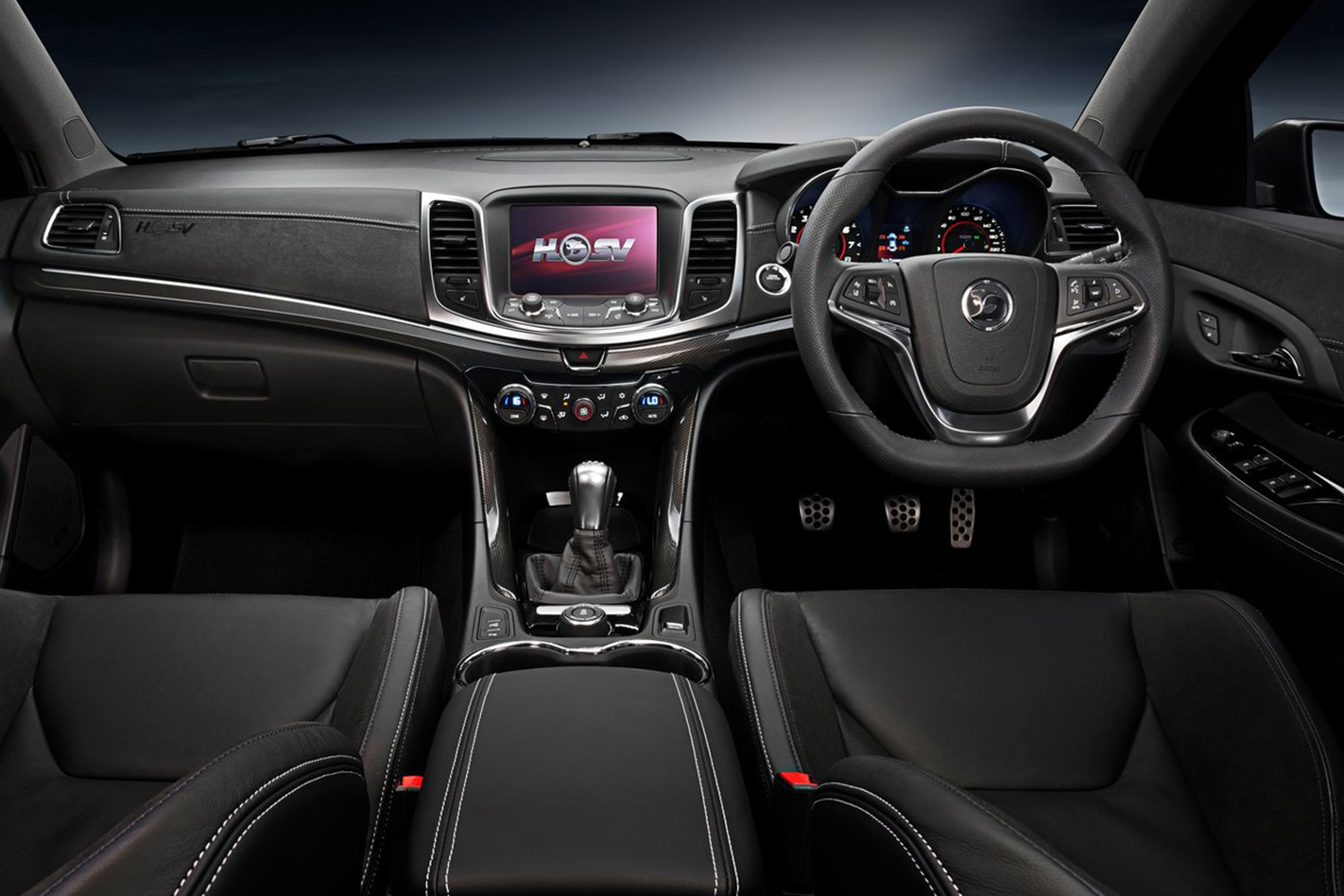
What’s more, turn down the wick and you can feasibly use the GTS as a family sedan. There’s ample room for five and the boot is positively cavernous compared to often cramped sports cars. Being the last of the line, the GTS’s cabin benefits from its VF II Commodore roots and gains plenty of equipment as well as body-hugging seats.
For around $85k you can pick up a GTS-430 with next-to-no kilometres on the clock. Considering the as-new sticker was $95,590 in 2016, the time might be now to grab one. The market for our Aussie classics can be fickle. You’ll probably be visiting a lot of servos and spending your weekends buying rear tyres, but for a car that cost a fraction of the outlay its German/Japanese rivals commanded in the day, how can you not love it?
Specs comparison
| Chevrolet Camaro 2SS | HSV GEN-F2 GTS |
Price (new) | $89,190 | $95,590 |
Engine | 6162cc V8, ohv, 16v | 6162cc V8, ohv, 16v, supercharger |
Output | 339kW/617Nm | 430kW/740Nm |
Transmission | 10-speed automatic | 6-speed manual |
0-100km/h | 4.0sec (claimed) | 15.7L/100km |
Efficiency (combined) | 11.5L/100km (claimed) | 6.4L/100km |
Drivetrain | RWD | RWD |
Doors | 2 | 4 |
Seats | 4 | 5 |
Wheel size | 20-inch | 20-inch |
| ||
Country of origin | USA | Australia |
Wheels staff picks

Trent Giunco
Staff Journalist
While some would say it’s un-Australian not to pick the big, bad HSV GTS, I’m choosing it because the GEN-F2 is quite an achievement. Admittedly the Camaro sounds almost as good and the two-door coupe offers a dynamic advantage, but the HSV is hilariously powerful and not altogether uncouth when the road gets twisty. Although that last bit does depend on how you choose to drive it. Ultimately, 430kW and 740Nm is going to need some managing. Yes, it’s heavy and cumbersome to some, but the final GTS is loveable, practical and worth holding on to.

Tom Fraser
Digital Content Manager
As happy as I am that HSV are importing the ballistic new Camaro, my $85k would go directly toward a GEN-F2 GTS. There’s just something about an Australian designed and built sedan that can shred its rear tyres to pieces that is undeniably cool. While it mightn’t be as technologically advanced as the new Camaro, I’d still be happy with the extra practicality of a four-door, and not to mention the extra supercharged power the GTS delivers over the Camaro. Now, if it were a Camaro ZL1 vs HSV GTS, that’d be a different story…

Andy Enright
Deputy Editor
Head says the Camaro 2SS, heart goes for the HSV GTS. While the VF-II morphed into a wholly loveable thing, there’s no getting away from the fact that it was huge. I mean, vast. It’s longer than a 2014 Mercedes S-Class and at nigh-on 1.9 tonnes, even with all that power, physics catches up with it in the end. The Camaro feels so much more nimble and modern. It’s almost 200kg lighter, is supposedly quicker to 100km/h (4.0s versus 4.4s) and, well, I really don’t need big rear seats that badly. Head wins. Camaro, please.
Reckon we’ve got it right? Or are we way off the money (literally)? Find your best and let us know in the comments what you’d buy.
For a while there, every new generation of a particular make or model could be relied upon to boast a bigger engine than the model before. This was down to a few things.
First, buyers expected their new car to be quicker than their old one. And increasing the engine’s capacity was a cheap, effective way of doing just that. But it was also about the only way because as recently as the 1980s, engine technology had pretty much stagnated.
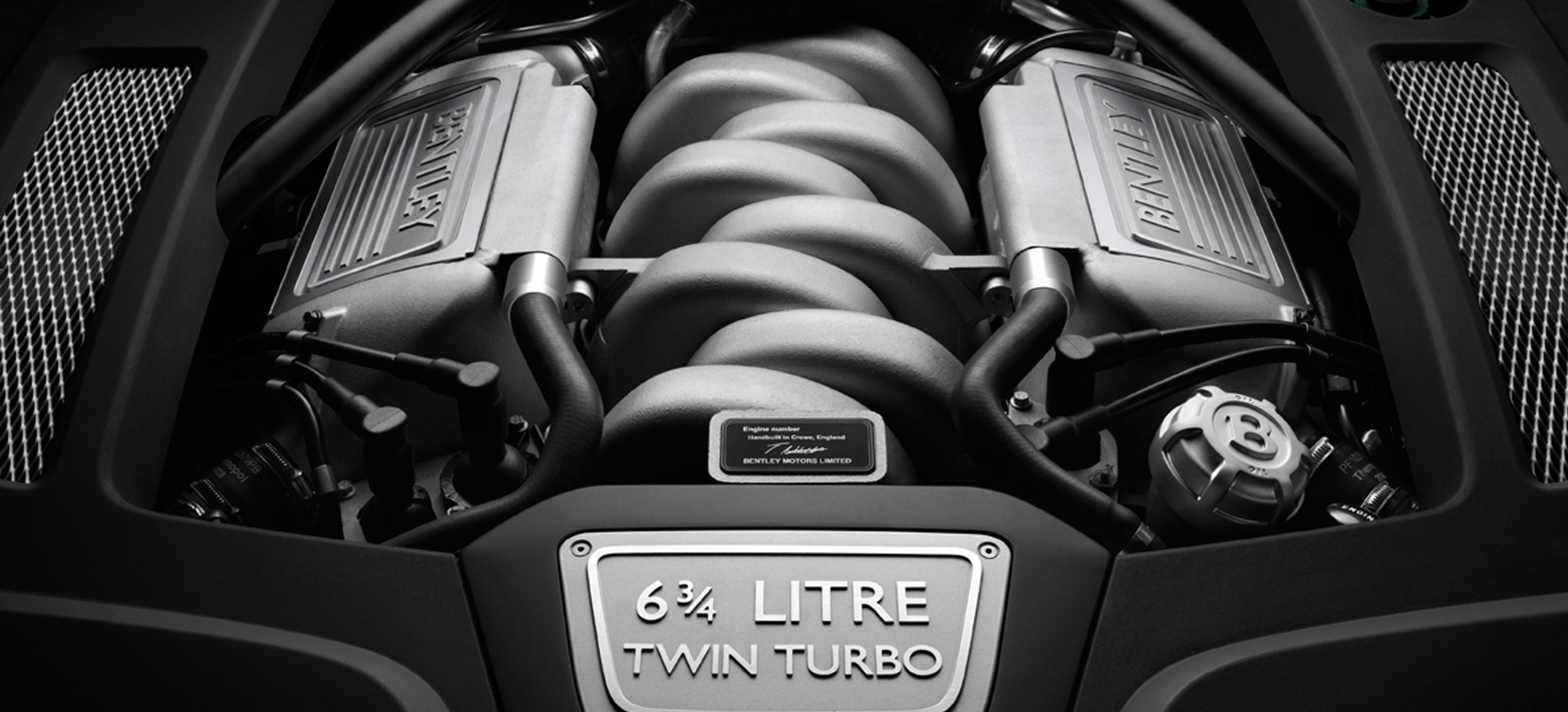
Secondly, the news of a bigger engine promised the anticipation of more performance even before you’d driven the thing; proof of the power of social conditioning: Bigger is better.
The turnaround came in the 80s when the turbocharger (thanks to electronic fuel-injection and engine management) suddenly became viable, and in a flash, you could have a small capacity engine making big capacity power.
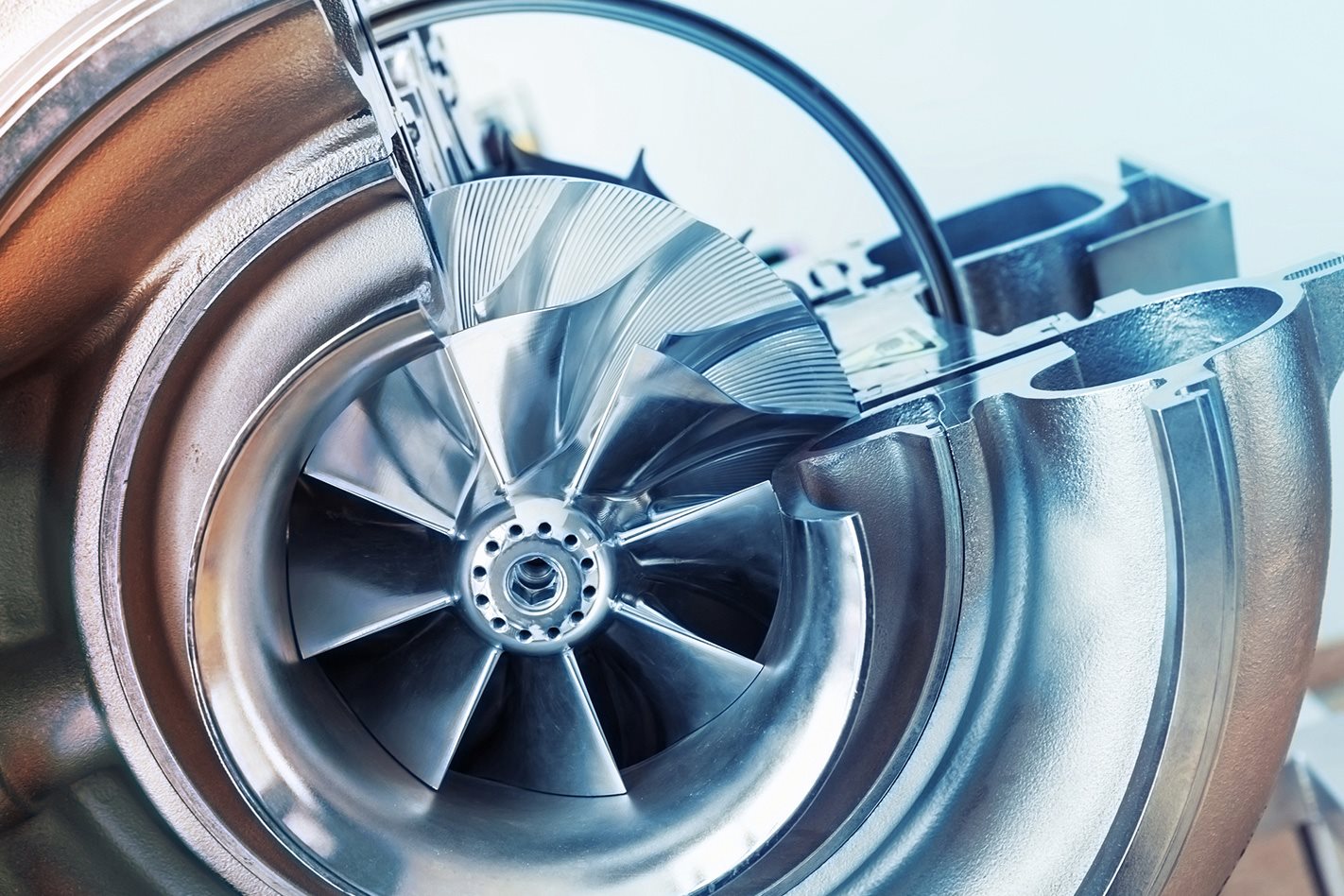
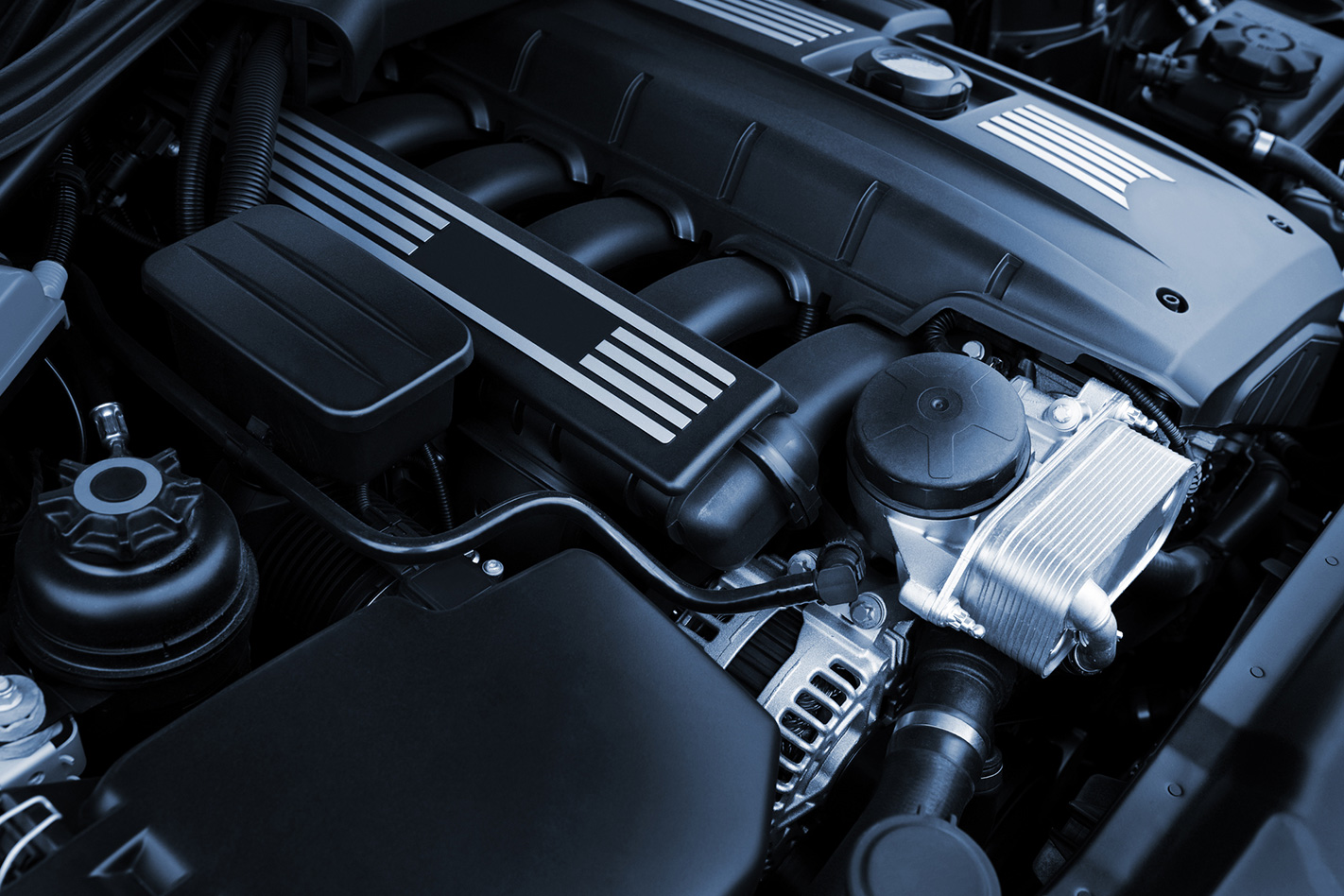
These days, the move to ever-increasing efficiency and ever smaller emissions targets means that the hip, groovy engines are now smaller capacity than ever before with turbochargers and other hot-shot high-tech making them perform like big engines.
It’s a natural sort of progression, too; how big was your first mobile phone, for example? Downsizing isn’t always about compromise.
It’s taken buyers a few years to get their heads around the idea of paying extra for a smaller engine, but it’s now the mind-set of the masses and the planet is the better for it.
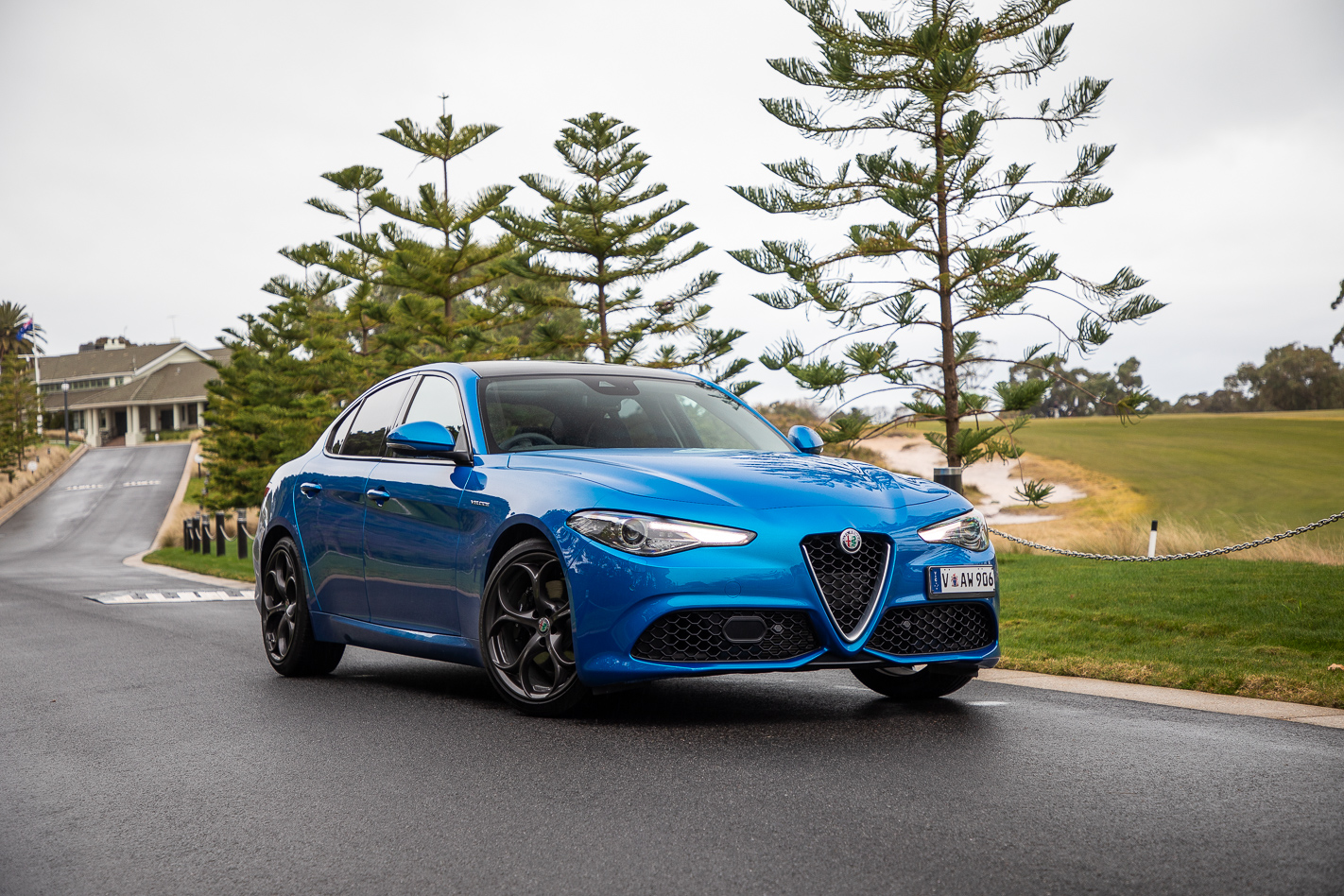
Alfa Romeo is currently part-way through its revitalisation program that’s meant to bring the brand back to the forefront of buyer’s minds – especially in the premium sedan segment in which the Giulia you see before you resides.
As the first model that started this new phase for the manufacturer, the Giulia is arguably the brand’s greatest asset, so how has does it fare in today’s money? Does it have the right stuff to prise buyers away from the dominant Mercedes-Benz C-Class and BMW 3 Series, not to mention the Lexus IS, Audi A4 and Jaguar XE?
What is it?
The Alfa Romeo Giulia is a four-door, five-seat sedan built on the manufacturer’s Giorgio platform, which was designed to kick-off Alfa’s mid-decade $8 billion investment to reinvigorate the brand.
Specifically, the Giulia Veloce specification sits underneath the headline-grabbing Giulia QV as its compatriot, but also as a competitor to the likes of the BMW 330i and Mercedes-Benz C300.
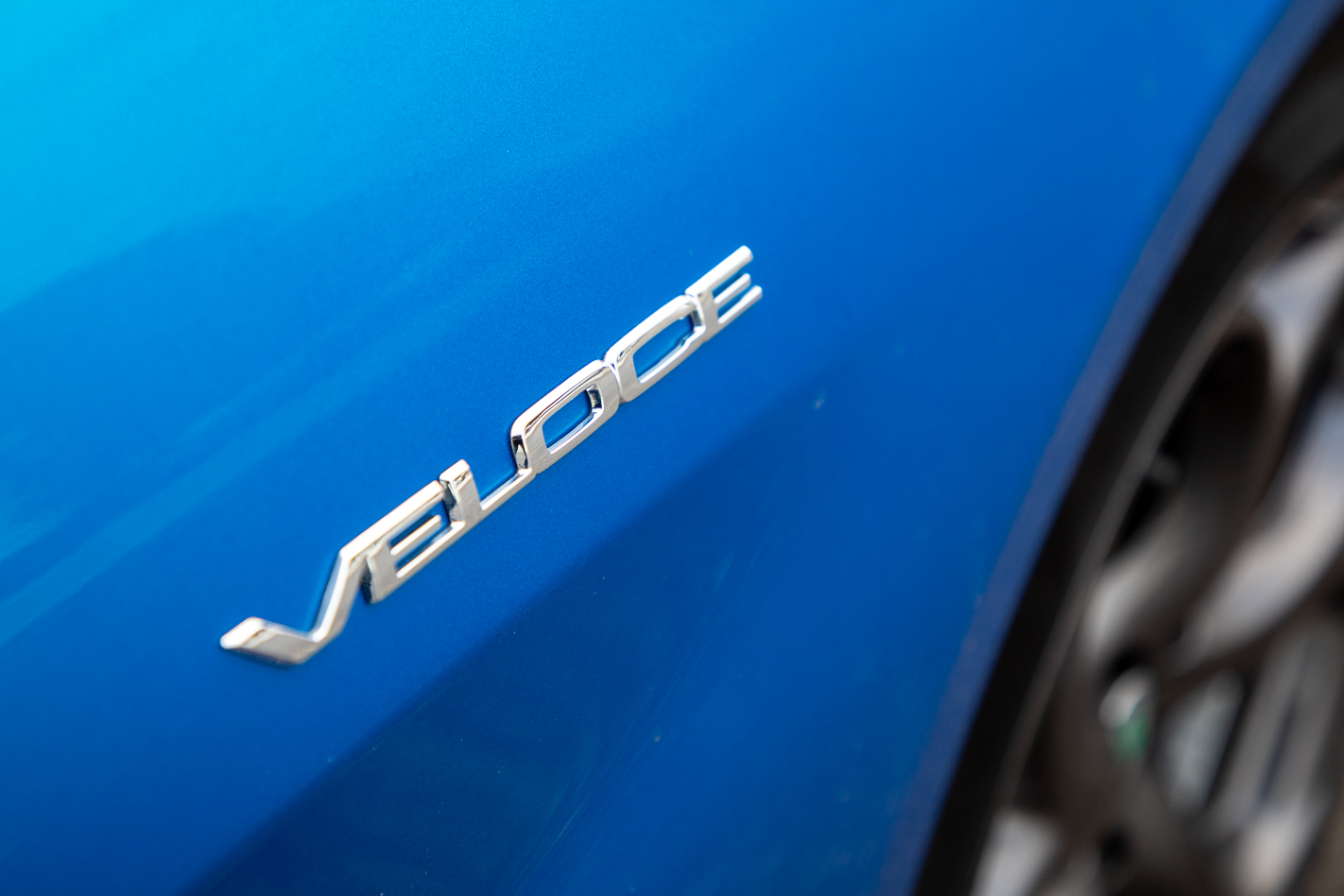
It’s sporty enough to be able to enjoy yourself on a challenging back road, while conversely being a bit of a sleeper in terms of design and stature.
How much is the Alfa Romeo Giulia Veloce?
$72,900 is the price you’ll have to pay for the Alfa Romeo Giulia Veloce. A minor shift in pricing from last year sees the 2019 model now $1000 more expensive than before, yet Alfa has added extra equipment as standard to compensate for the price bump.
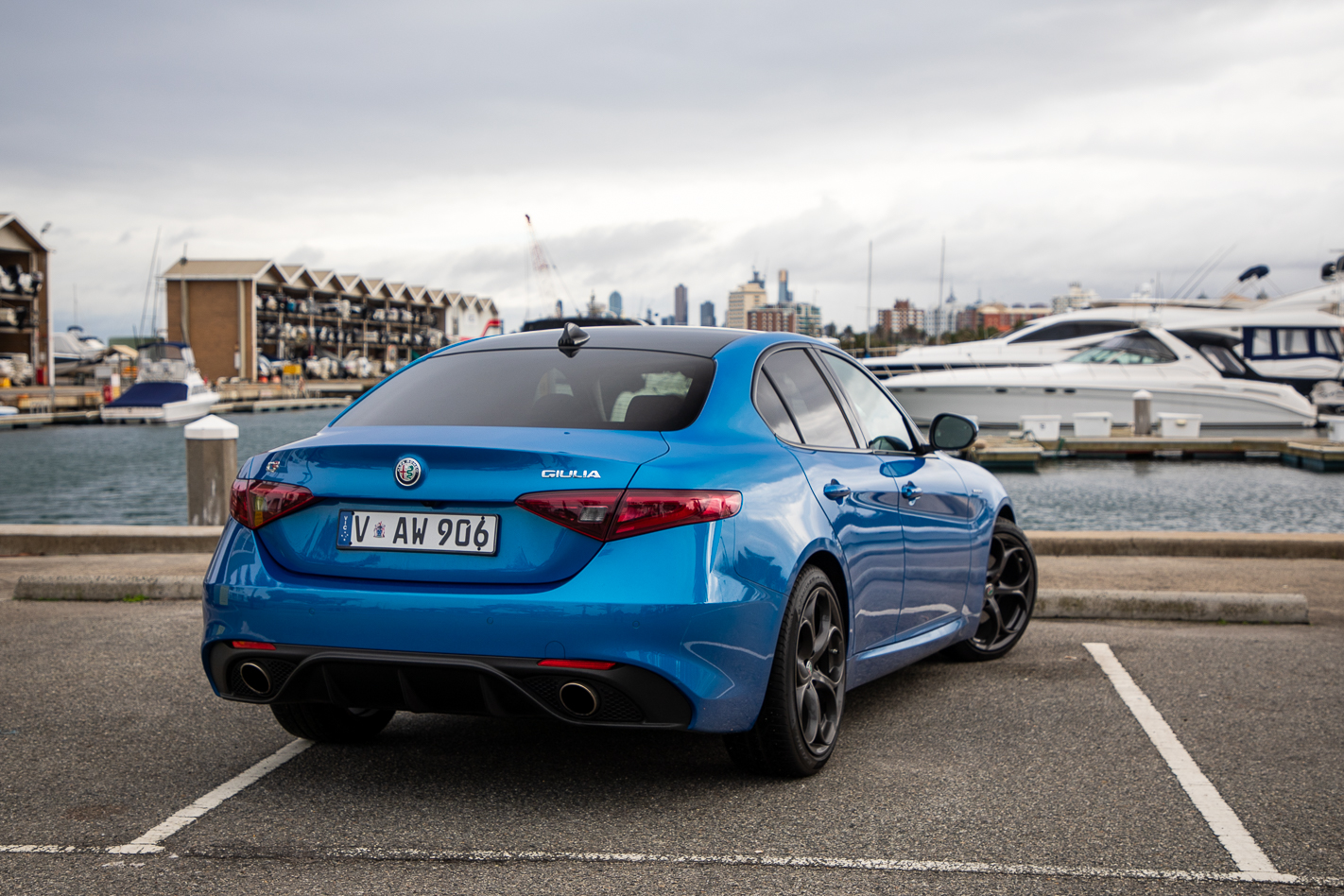
Besides that, it’s literally half the price of the top-dog Giulia QV – yet possesses about eight-tenths of the same visual appeal as its high-performance sibling. For many, that alone will signify good value.
Few options exist for the Giulia Veloce, other than a $750 alarm system, $1500 Harman/Kardon premium sound system, $2200 dual pane sunroof, $700 painted brake calipers and various other paint options between $1300 and $3500.
Who is it for?
The Alfa Romeo Giulia appeals to the design-conscious premium sedan market, with the brand still trading heavily on its traditions of style and performance. And so it should, having deeply rooted history in, and a reputation for making cars with soul is an aspect that is somewhat lacking in today’s premium sedan segment.
While the BMW 330i, Mercedes-Benz C300 and Audi A4 45TFSI are all fantastic cars in their own right, the Alfa Romeo Giulia does things a little differently – and that’s a good thing.
Is the Giulia Veloce easy to live with?
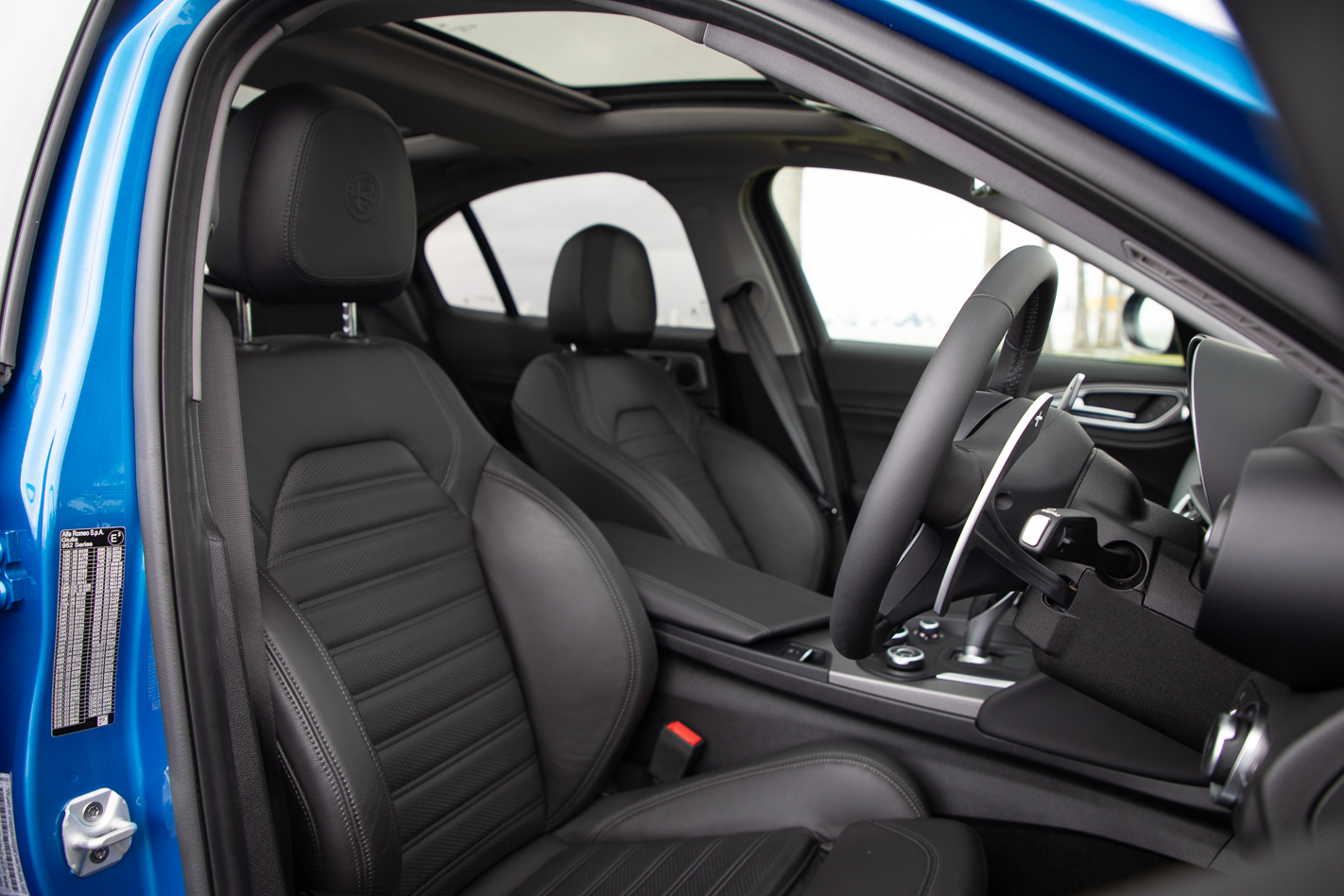
The Giulia is a practical sedan that caters for a maximum of five people, but is generally suited toward couples rather than families, and small-statured couples at that. While generally feeling comfortable in segment competitors, this 195cm tall tester had difficulty getting cosy in the driver’s seat and especially had trouble in the back.
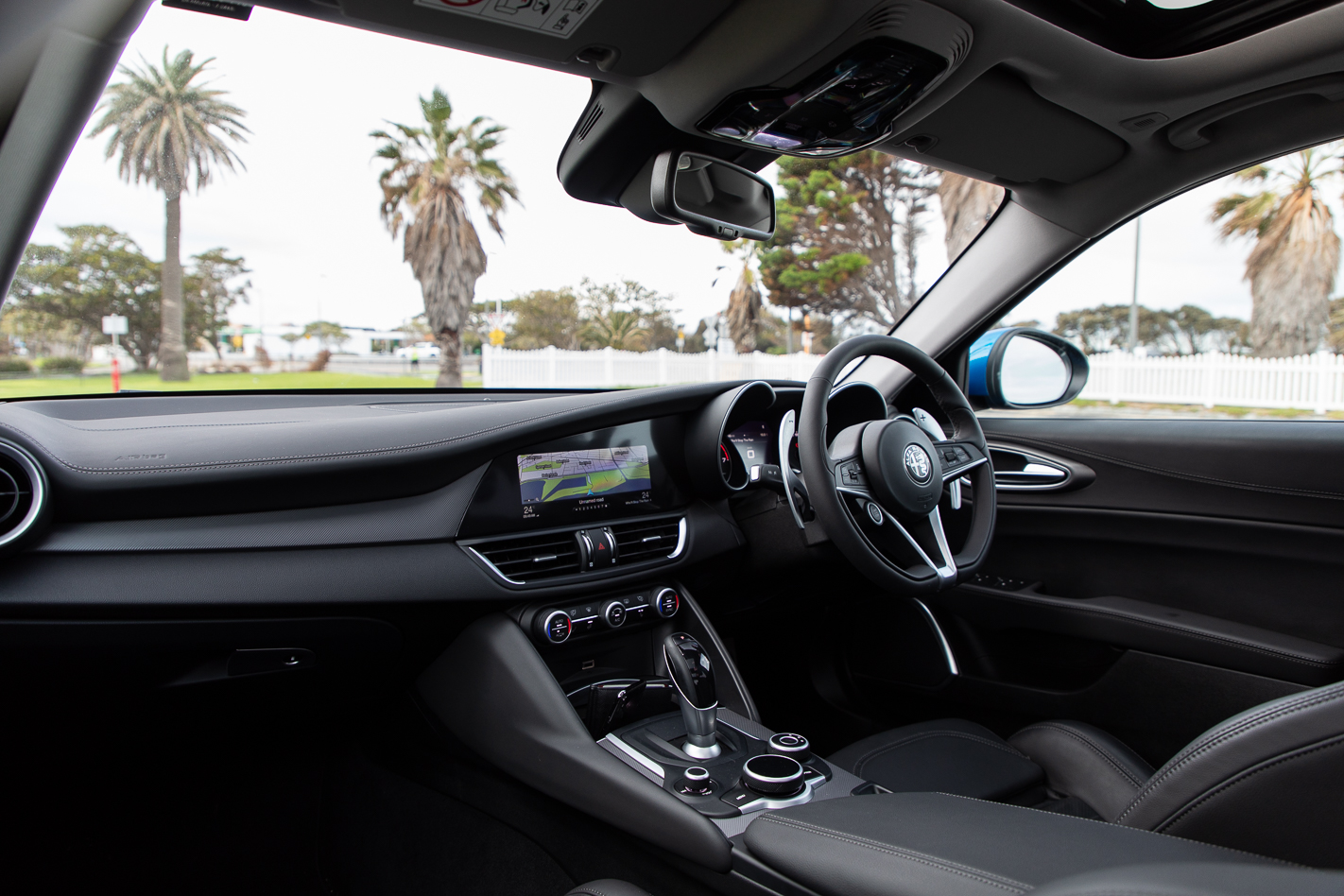
The best a manufacturer can do is to make a car that suits everyone, and while some excel in this department, it feels as though Alfa Romeo slightly missed the ergonomic mark with the Giulia. And while we’re on the few negatives, some of the interior fit and finish could be improved, like the harsh, reflective plastics below the belt line and some sharp plastic edges about the cabin – especially on the gear selector, a key touch-point.
Material quality is otherwise good though, with a lovely leather-wrapped steering wheel taking pride of place, flanked by a leather-topped dash and sturdy metal paddle shifters. The seats hug you nicely without being too pinchy, and the door closes with a solid thunk.
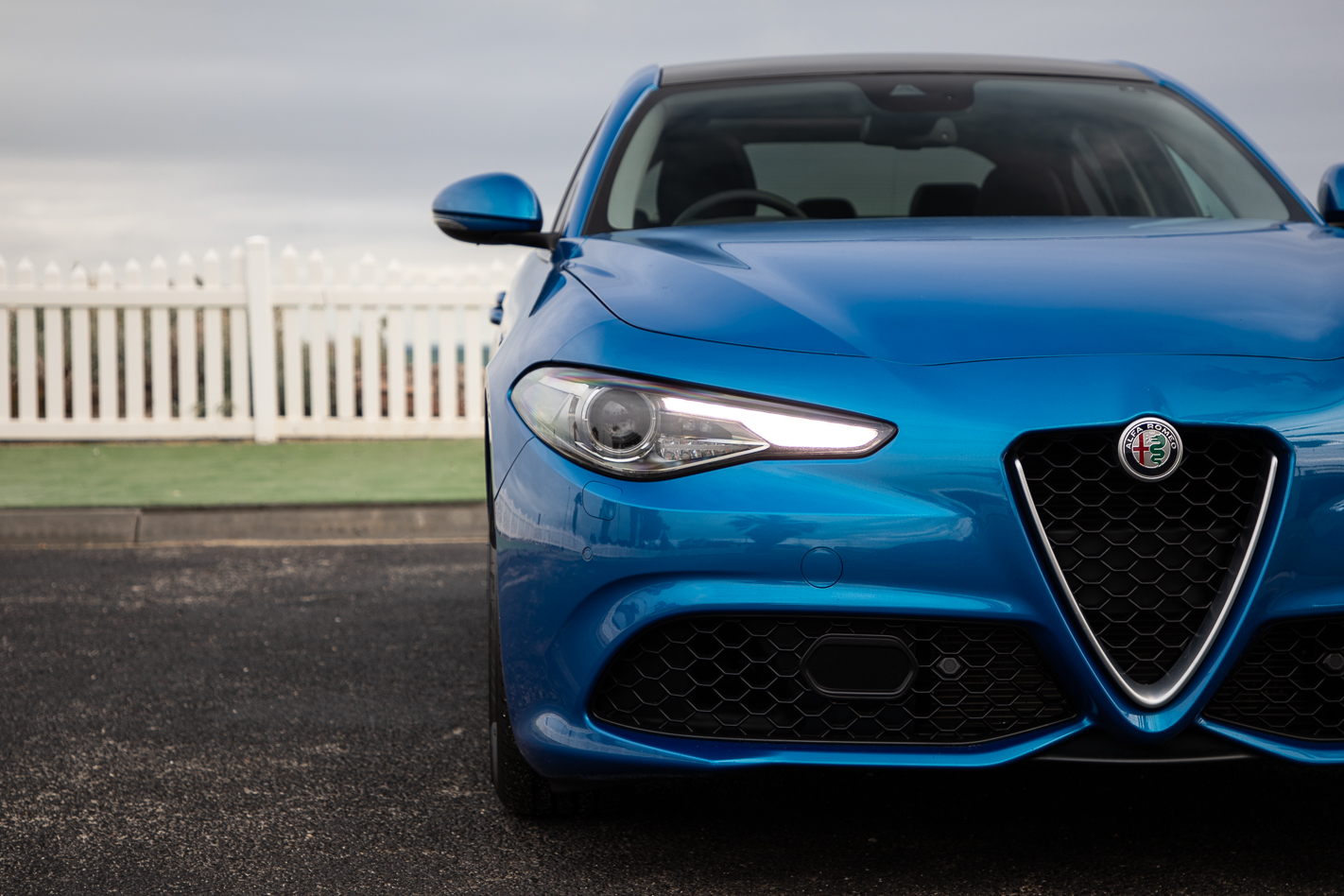
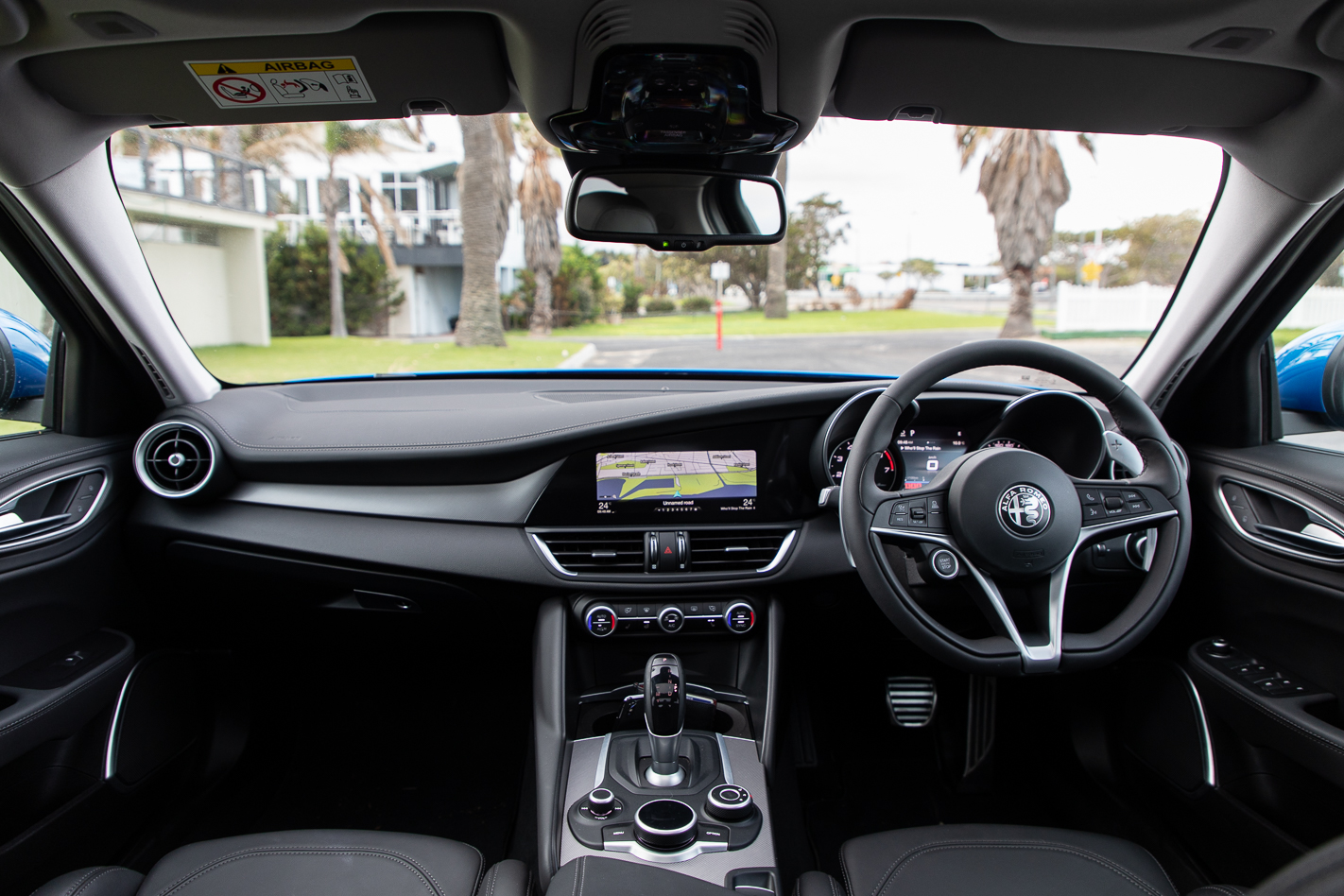
The Giulia uses an 8.8-inch infotainment screen that is simple to use, and blends in neatly with the black dash when off. While it won’t take long for you to get your bearings around the system, it could do with a couple of extra shortcut buttons so you could skip between maps and radio, for example, without having to transit between them via the home screen.
How well does the Alfa Romeo Giulia Veloce drive?
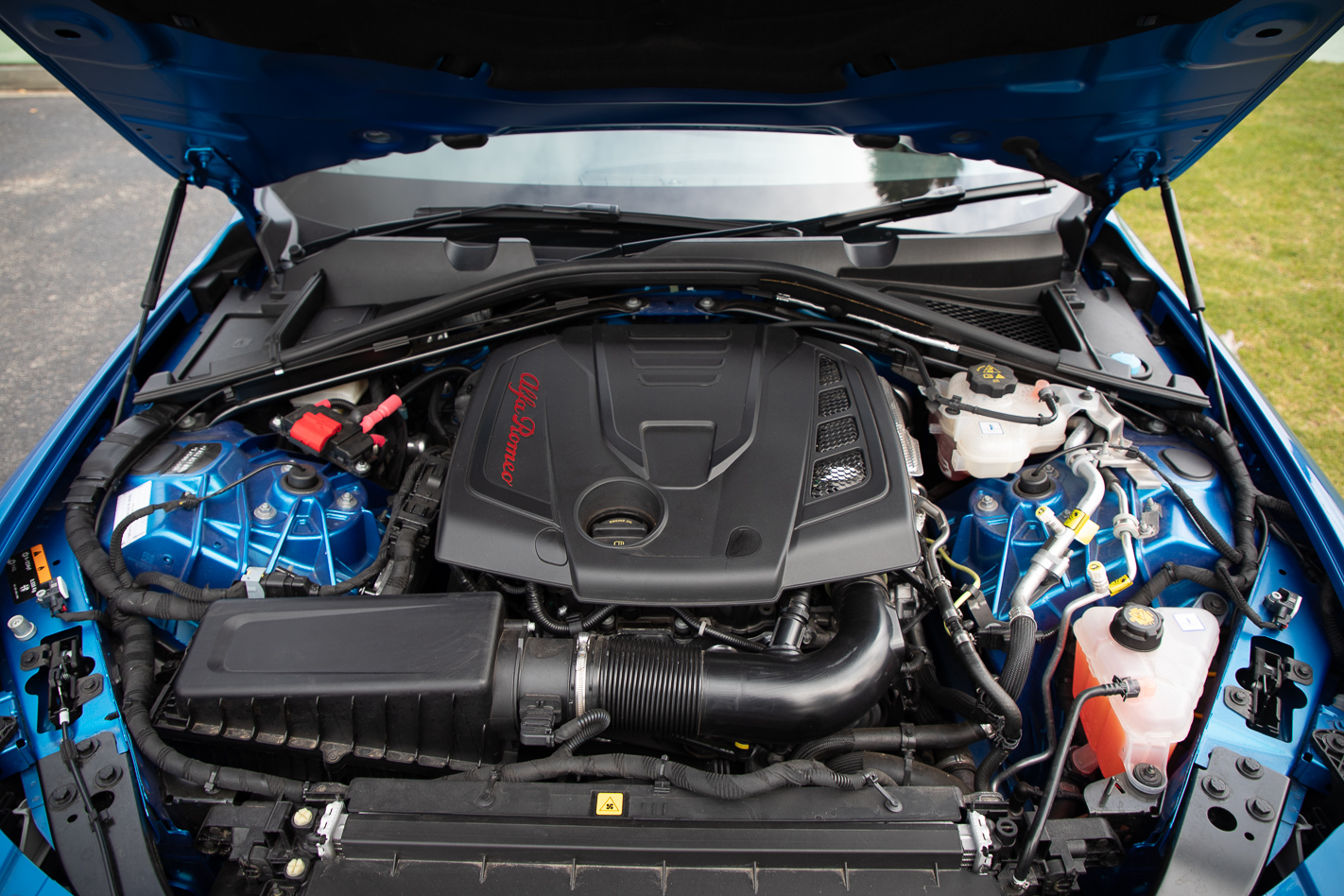
On the road is really where the Giulia package shines brightest. It features a 2.0-litre turbocharged four-cylinder engine that produces a healthy 206kW of power and 400Nm or torque, and it’s the torque figure that really stands out in everyday driving. The engine has enough low-rpm punch to easily deal with everyday driving, making it feel relaxed and civilised when you’re enduring the daily schlep.
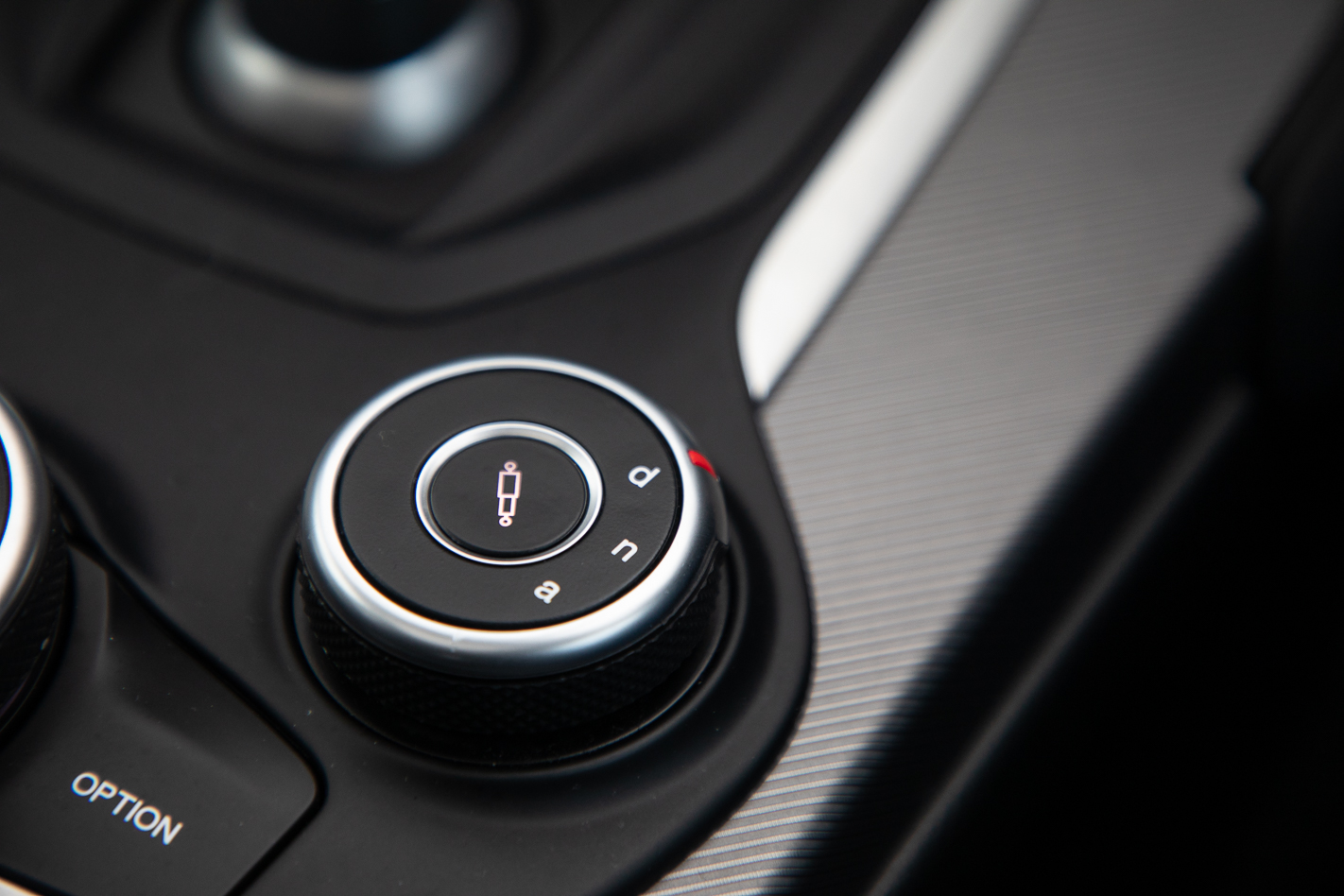
However, get away from city congestion and the ‘DNA’ (Dynamic/Natural/All-weather) driving mode switch can extract the most out of the car when you want a sportier, more engaging type of drive. In Dynamic, the suspension, steering and throttle/transmission calibration become sharper, meatier and more responsive, dramatically changing the character of Alfa’s sedan.
The Giulia utilises a ZF 8-speed transmission that works fairly well most of the time, but can jerk about a bit at slow speeds. Shifts become crisp and quick when up higher in the power band, however, and that complements the car’s athletic image well.
Speaking of athleticism, the Veloce’s steering is light and sharp, with well-poised body control when changing direction. The adaptive suspension of the Veloce also offers comfortable cruising in Natural mode, while firming things up nicely for a stiffer, more active ride control in Dynamic. Alfa helpfully also provides an extra button in the centre of the DNA dial to slacken off the dampers – handy when the curvy road you want to attack is also a bumpy one.
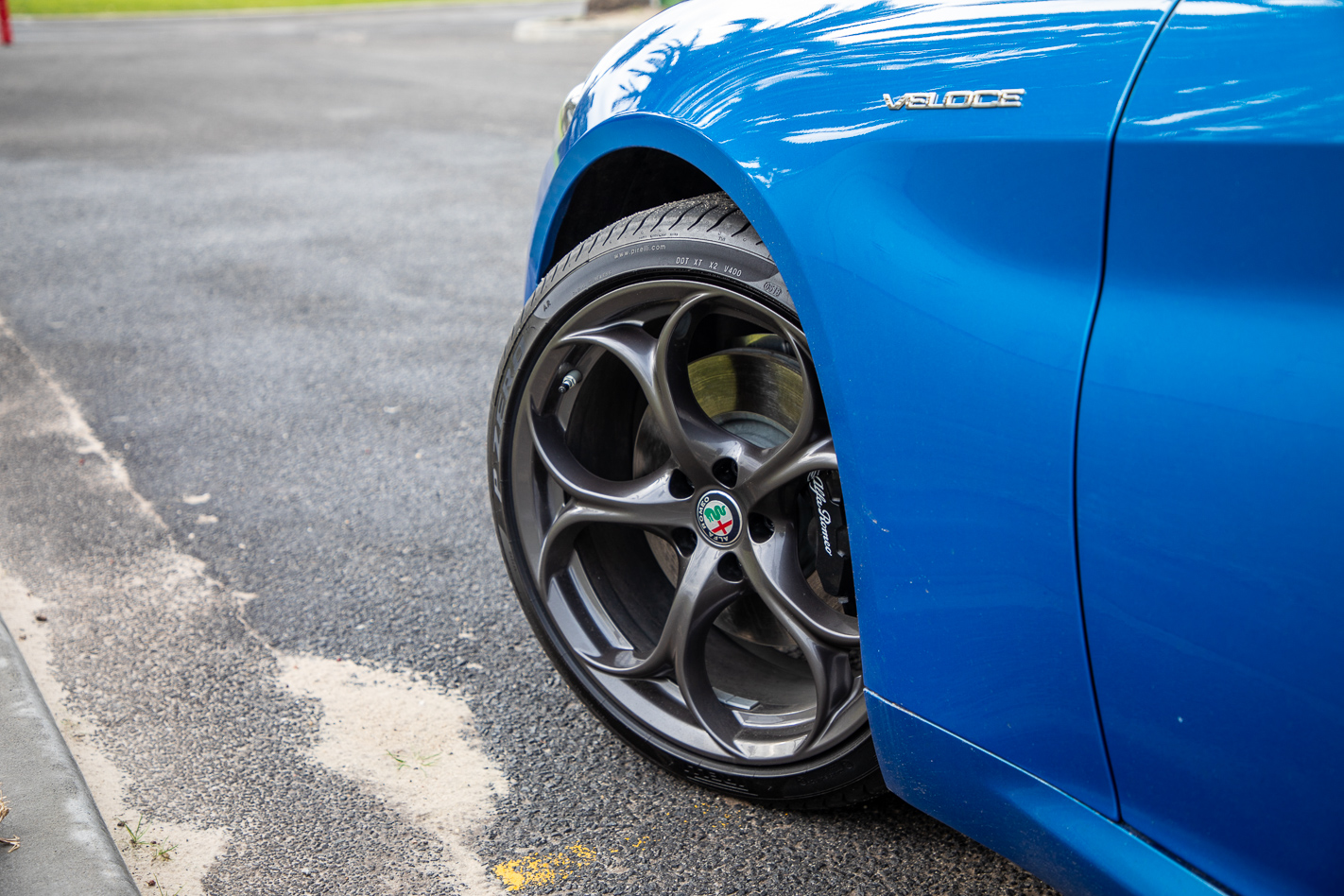
Overall, the Giulia is a hoot to drive around twisty roads and can even excite its driver about town.
The verdict
While the Giulia QV came and wowed the world on first introduction, the Giulia Veloce is the quiet achiever of the range, offering plenty of everyday performance, but for half the price.
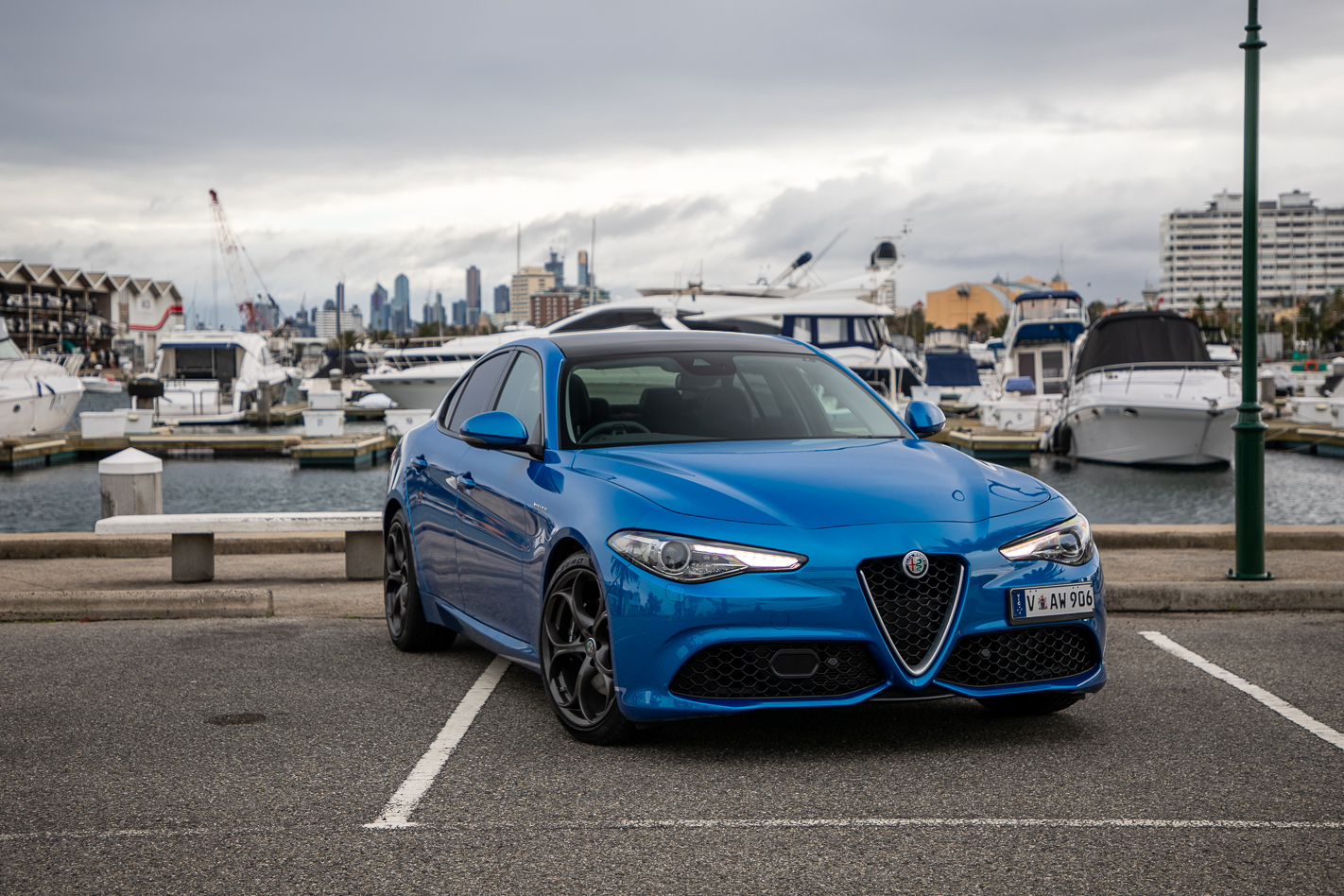
The Giulia Veloce operates in a segment that’s also occupied by some of the best car makers in the world with resources and experience far beyond Alfa Romeo. Yet, it still feels more than worthy of being cross-shopped against any of its German rivals – especially if you value driver engagement and handsome exterior design.
While it does have a few niggles to work out on the interior, the way it makes you feel is still pleasant, and driving the Giulia should put a smile on your face too.
Click on the image gallery at the top for more photos of the Alfa Romeo Giulia Veloce.
Ahhhh, marketing types… swan in, create an entire language/direction/concept, collect cheque and disappear, not worrying for a second about what kind of life your campaign/missive/communiqué will have.
BMW has long used the ‘sheer driving pleasure’ tagline, along with the tacit claim that if it isn’t rear-wheel-drive, then get off our lawn.
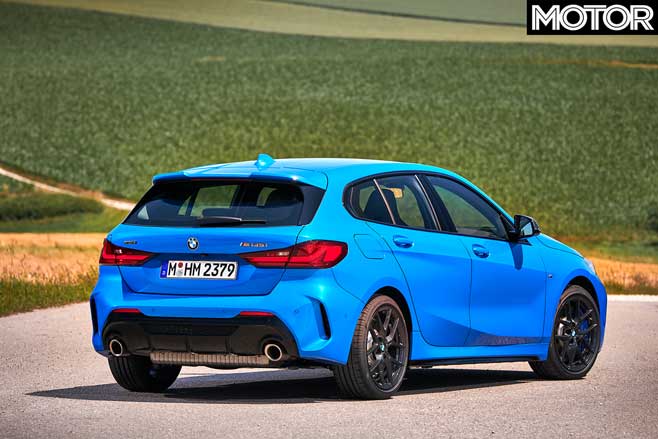
Well, um. That’s awkward.
Meet the third generation BMW 1 Series, shown here in its hottest M135i xDrive guise. It isn’t rear-wheel-drive. In fact, it’s barely all-wheel-drive if we’re honest. Yes, BMW has bowed to the gods of manufacturing economy and plonked the 1 Series atop the same UKL2 platform that underpins things like the Mini Countryman and the fraternal X1/X2 twins.
No pricing has been released yet, but figure it coming close to the $60,000 mark of its predecessor. For that kind of money, it’ll likely undercut the similarly powered but potentially better-equipped Mercedes-AMG A35 that’s due around the same time.
Then there’s the evergreen Volkswagen Golf R or Audi S3, both of which offer a little less mumbo than both the Bimmer and the Merc, which share exactly the same 225kW and 450Nm headline numbers.
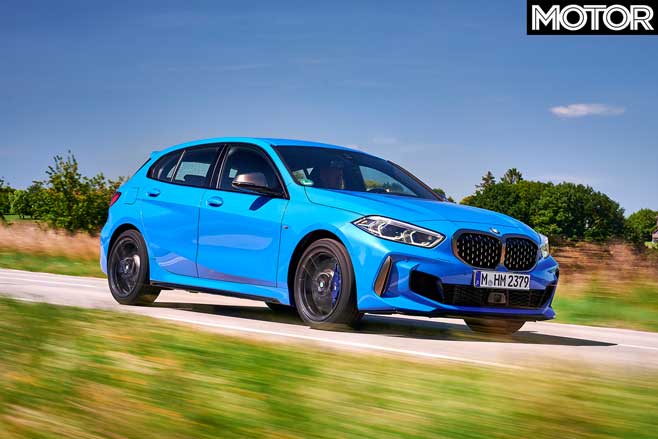
The new 1 Series body is five-door only, and has – unfortunately – morphed from distinctive to derivative in a single stroke. Up close, it’s possible to see finer body details that give those slab sides some depth and contrast, but really, this is a BMW that will fade into the background rather than step forward, whistling tunelessly.
The jury, too, is out on that snout, though the grille treatment on the M135i is darker and less overt than on the more conventional cars.
A 2.0-litre four-cylinder single-turbo petrol engine replaces the 3.0-litre six-potter of the outgoing M140i, sending its 225kW and 450Nm predominantly to the front wheels and nominally (up to 50 per cent on its best day) to the rear end.

BMW has added some trickery in the form of a new anti-slip device that’s been plucked from the i3s. It gives a whole new level of fine control to the slip-sniffing computers by deleting the chassis control unit altogether and shortening the paths that the signals from the tyres have to travel before the 0s and 1s cut in.
Likewise, a brake-controlled yaw control system helps to calm the farm, while a Torsen mechanical limited slipper does its slippy stuff as well.
Picking adaptive dampers adds comfort and sport driving modes (but no others), while you’ve got paddles to override the eight-speed conventional auto’s wishes.
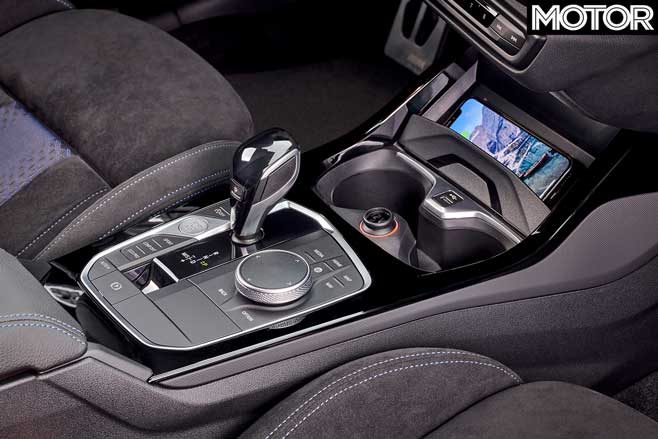
Suspension is strut front and multilink rear with loads of chassis bracing, with a specific spring/damper tune for each 1 Series variant. Adaptive dampers are an option and the M135i rides 10mm lower than the stockers on its Pirelli-shod 18s.
Big front brakes introduce a new tech for the Bavarians, too; gone are the nasty looking sliding caliper of yore, replaced instead by simply ginormous rotors and a slimmed-down four-piston one-piece caliper. The piston housings are steel for better heat management and allow the whole lot to slip under those multi-spoke forged alloys.
Slide into the M135i and it’s all clean, neat and modern, with just a hint of the brand’s DNA. The suede-adorned seats are – just – low enough in the bodyshell to connect with the car, while the chunky steering wheel sits in front of a digital dashboard that’s pretty busy at first glance.
The switch to a sideways engine nets a raft of rear seat room, even though the car itself is now 20mm shorter overall.
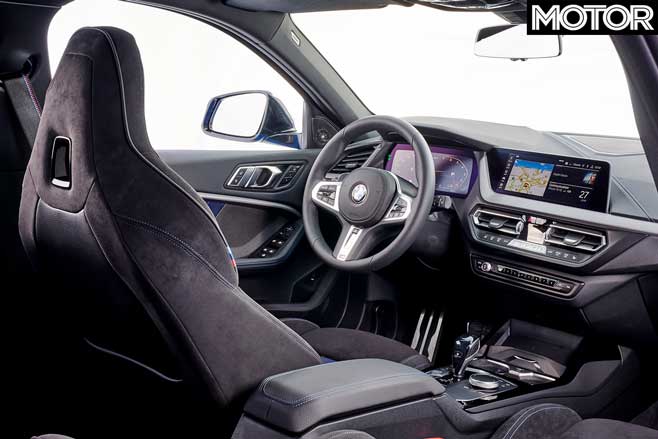
It’s also 34mm wider and on average 30kg lighter, so the 1 feels decently planted rolling out of the shed. An overly enthusiastic exhaust barble can’t really be heard from within the car, but the two-litre motor moves off sufficiently well.
It’s got a decent, if not love-handle quivering turn of pace when prodded, with a surprisingly planted and supple ride in both modes. The electric steering carries an artificial weight that doesn’t really translate to genuine feel and it’s a bit slow-witted, but it permeates a big-car feel, which I liked at 210km/h on the ’bhan.
Those adaptive dampers, though, are far happier at five- or six-tenths. Push the friendship even in sport mode and the car’s composure unravels pretty quickly, falling through its front travel when you’re loading up the outside tyre. I reckon it’d be ace on a choppier, slower surface, though, of which I found exactly none in Bavaria.
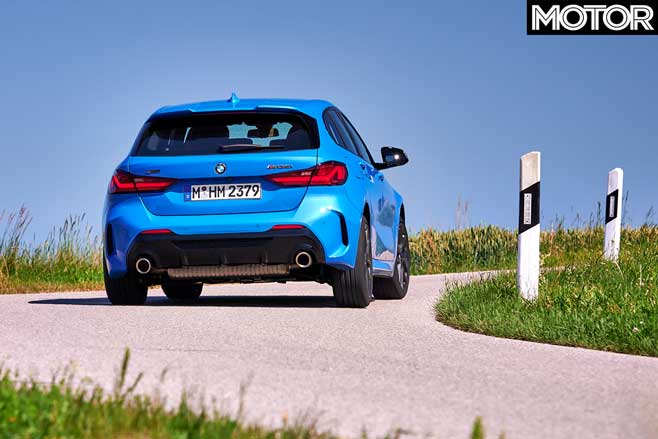
We’ll need time on home soil to get a better read on the M135i; Chermany’s glass-smooth roads don’t do much to expose a chassis’ flaws.
On first blush, though, the M135i should acquit itself pretty well, but its underdone exterior demeanour and potentially suspect chassis balance may ultimately play against it.
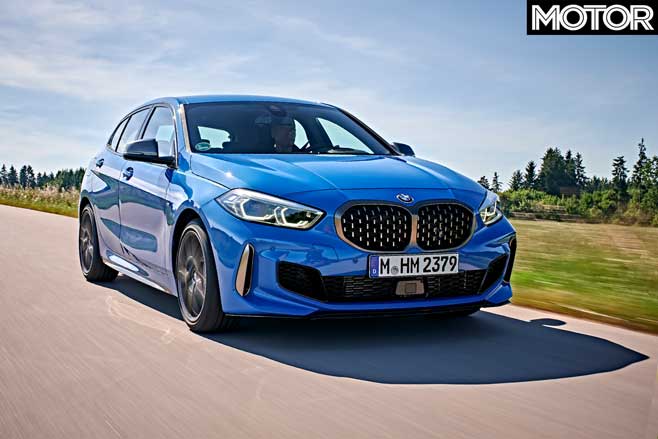
2019 BMW M135i xDRIVE SPECS Engine: 1998cc inline-4cyl, DOHC, 16v, turbo Power: 225kW @ 4500-6250rpm Torque: 400Nm @ 1750-5000rpm Weight: 1600kg 0-100km/h: 4.8sec (claimed) Price: $65,000-70,000 (est)
Rating: 3.5 out of 5 stars
Imagine, if you will, you’re given an incredibly delicious cake. It’s made with the finest ingredients by a master baker, but you’re not allowed to eat the icing. And everyone knows the icing is the best part.
This brings us to the 2019 Porsche 718 Cayman. Porsche has built a benchmark sports car but the inability to access the full gamut of its abilities leaves a bitter taste in the driver’s mouth. Allow me to explain.
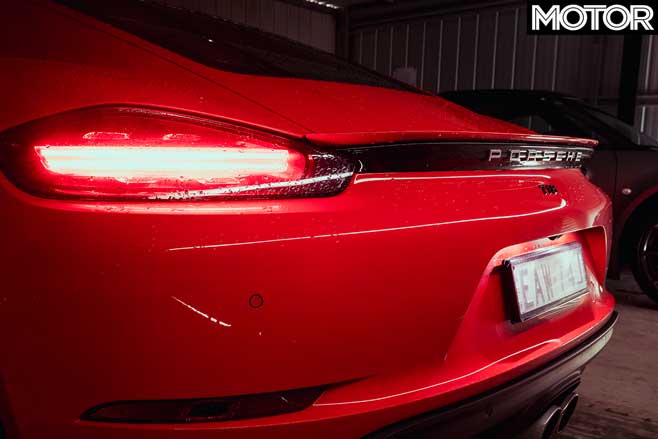
Drive the Cayman hard, which you’ll certainly want to do, and sadly the unnecessarily conservative ESP – dubbed Porsche Stability Management – continuously intervenes even when things are well in hand.
It’s a feature that’s crept into a number of modern Porsches, but whereas it’s arguably acceptable in a two-tonne sports-luxury limo like a Panamera, in a sports car whose primary role is to provide driving enjoyment it’s very disappointing. Very un-Porsche.
Let’s be clear, this is not a huge deal. Depending on your level of driving ability (and how you use it) you may never witness the tell-tale flashing orange light on the instrument display. Nevertheless, the numerous owner threads online suggest a certain number of customers are equally disappointed not being able to enjoy their sports car unshackled.
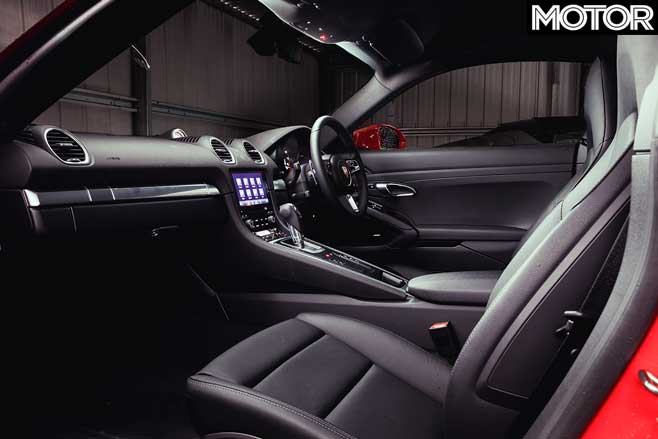
On the road PSM Sport provides enough latitude to dig deep into the Cayman’s reserves. Wearing 235/45 and 265/40 tyres front and back respectively, the base 718 has more grip than its 220kW/380Nm 2.0-litre turbocharged flat-four can naturally overcome, so any electronic intervention is limited to the exit of slippery corners.
Hit the track, though, as Porsche owners are wont to do, and the situation becomes more complex. Our circuit of choice is the tight, tricky Bryant Park hillclimb and the 718 is fabulous, displaying exquisite balance and delivering swathes of feedback to the driver.
Encouraged by its communication you switch PSM off, keen to discover what thrills are offered right at the very limit, only to find this section of the Cayman’s personality walled off by an electronic guardian.
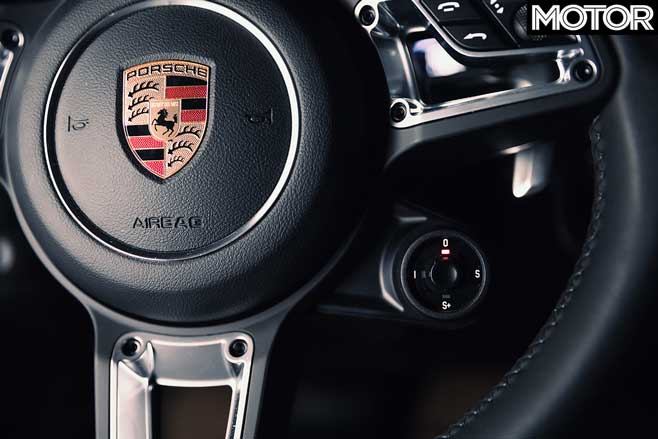
It’s a very strange situation. On a slippery surface you can drive through the ESP intervention, drifting the 718 at some impressive angles despite the incessantly flashing orange light expressing its disapproval at you doing so.
What’s even stranger is that pinpointing what’s triggering the intervention is virtually impossible. Trail the brakes on one corner and the rear will swing wide in an easily controllable arc, do the same thing on another and it’ll be stopped before it can move a metre.
Likewise under power – at times the wheels will spin freely, other times the traction control locks them down. It erodes confidence when you’re not sure what the car is going to do next. More often than not ESP will step in, but you can’t just assume it will.
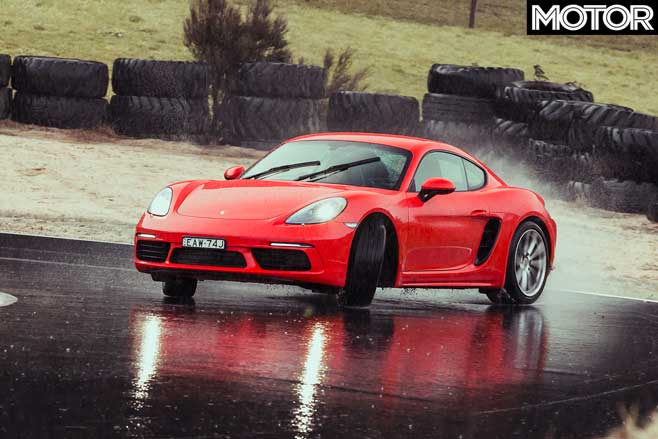
It’s a true shame as in almost every other respect the 718 Cayman is a five-star sports car. It rides with incredible deftness, is brilliantly practical with 425L of luggage space (150L front, 275L rear), refuses to wilt no matter how hard you drive it and is now incredibly quick to boot.
The 2.0-litre flat-four is the car’s weakest point, but only if you compare it aurally to the screaming flat-six which preceded it. There needs to be about 3000rpm on the tacho for anything to happen when accelerating from rest, but once rolling throttle response is excellent, it revs in a linear fashion to beyond 7000rpm and while the note isn’t especially tuneful, it’s not awful.
It’s also much quicker than Porsche claims, bolting to 100km/h in just 4.38sec (claim is 4.7sec) and crossing the quarter mile in 12.65sec at 177.86km/h. To put that in context, its naturally aspirated predecessor could only manage 5.80sec to 100km/h and a 13.93sec quarter mile at 163.38km/h. The 718 is one seriously fast car.
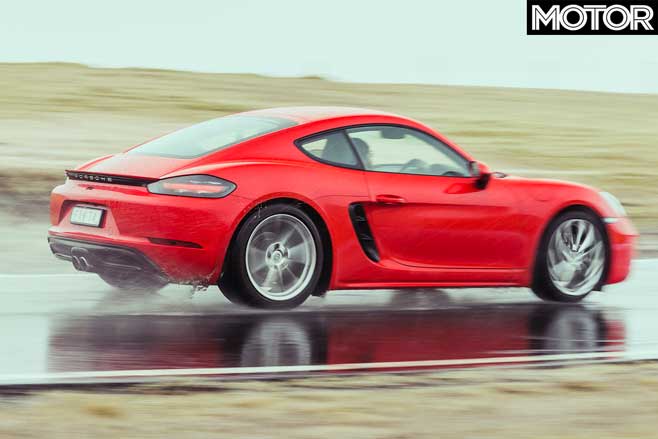
With an as-tested price of $137,840 it’s also quite an expensive one, our test car wearing $22,940 worth of options, though previous experience forgoing them does little to harm the overall experience.
What does harm the experience is that damned non-killable ESP. There is so much to commend the Cayman and even its biggest flaw will be a non-issue 99 per cent of the time, but the moment it should cement its brilliance – laps of a clear, dry racetrack – instead leads to frustration. The cake is delicious, but I want the icing, too.
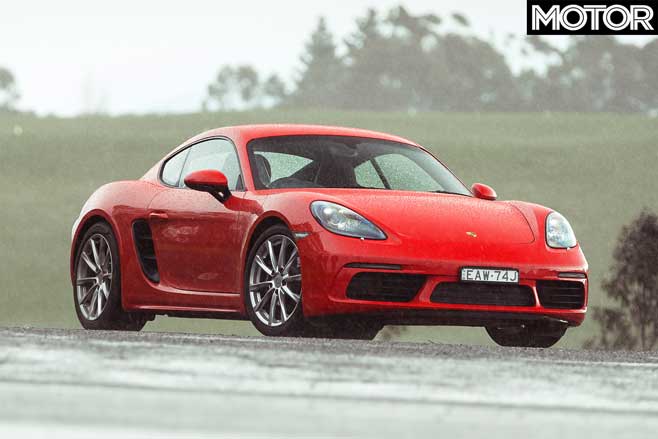
2019 PORSCHE 718 CAYMAN SPECS Engine: 1988cc flat-4cyl, DOHC, 16v, turbo Power: 220kW @ 6500rpm Torque: 380Nm @ 2150-4500rpm Weight: 1365kg 0-100km/h: 4.38sec (tested) Price: $114,900 ($137,840 as-tested)
Like: Incredible chassis; impressive performance; daily useability Dislike: Overzealous ESP; options can blow the price out; engine sounds ok, not great
Rating: 4.5 out of 5 stars
Sports cars have always been important to Japanese car-makers. A red-hot sporty in this year’s catalogue is going to create showroom traffic; it’s all down to that old chestnut ‘they came in to look at the red sports car and drove home in the white sedan’. And, it’s fair to say that over the years, the J-folk have cranked out some wild and wonderful contraptions in the name of sports cars.
This feature was originally published in MOTOR’s December 2001 issue
Mitsubishi has its Evo Lancers, Subaru the redoubtable Rex, Nissan the 200SX and Honda, the manic little Integra Type R. But when it comes to bigger-bodied sporties, well, our neighbours to the north don’t always seem to get it right first time.
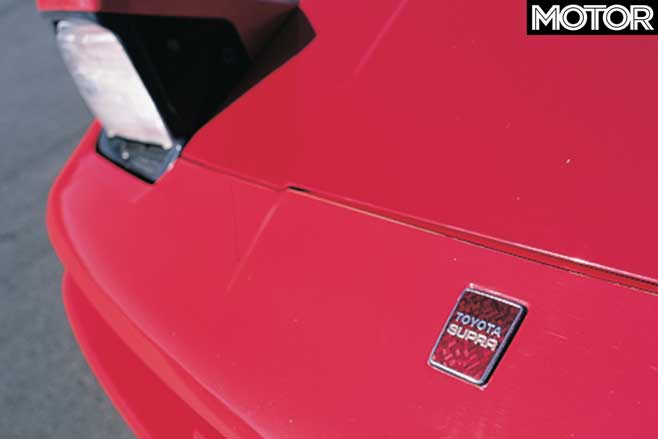
The flip side to that is the Mazda RX-7, which went from mild-mannered (but nice enough) to a stark-raving, twin-turbo monster in its final incarnation. Even Honda had a go and produced a great car, but the bits that made up the NS-X blew the price right out of Lake Reality. And then there’s Toyota.
Apart from later MR2s, Toyota hasn’t really made much of a name for itself in the sports car world. Oh, there have been glimpses of brilliance like the six-cylinder 2000GT, but they’re rarer than Ansett boarding passes these days.
Apart from the first front-driver, the Celica is an affront to sporty drivers everywhere, and these days the Big T has stooped to putting Sportivo badges on Echoes, ferchrissakes. Nope, if you had to name Toyota’s big effort in the name of a big sports car, you’re inevitably drawn to the name Supra. Oh dear.
Way back when
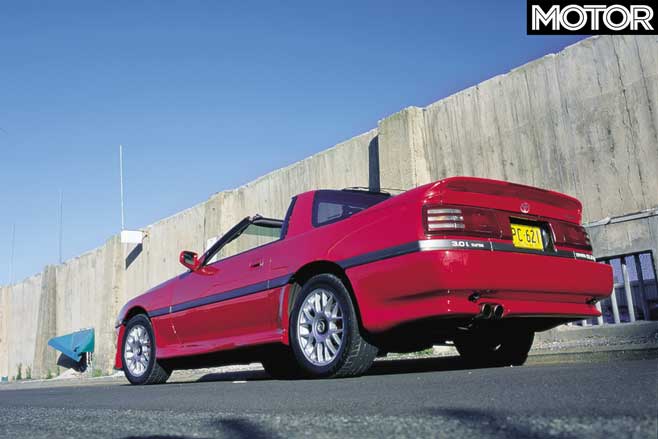
As far as we antipodeans are concerned, the Supra name was born back in 1983 when it lobbed here badged as a Celica Supra. The inference, of course, was that this was some kind of Super Celica and, if it was seen that way, it’s only because the Celica itself was such a damp squib anyway.
On the other hand, the Supra did create a bit of a stir because it offered a whole bunch of stuff most of us hadn’t really been exposed to before.
Electronic fuel-injection was a novelty of the highest order, although a five-speed manual gearbox behind a big (well, 2.8-litre) six-potter was already available in the small-engined versions of both the Commodore and Falcon. And, like the Supra, they had rear-drive, too.
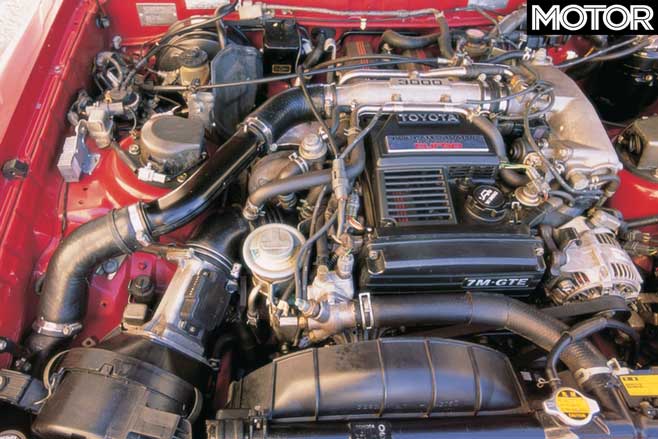
Of course, neither local car had an electronic dash and front and rear discs and fat-for-the-time 225 rubber, while independent suspension all-round hinted at a serious piece of hardware. And we hadn’t seen such a wild set of wheel-arch extensions since the SLR 5000 Toranas.
The in-line six was smooth until you really revved it, and although it felt pretty torquey, with just 103kW at a chugging 4800rpm, it was hardly a quick car. It did weigh a relatively trim 1275kg, but even that couldn’t hide the fact the suspension was just too soft for any serious hooning. It was, like the Nissan 280ZX of the same era, much more at home kerb crawling for lap dancers than it was being caned around a twisty piece of real estate.
Powered up porker
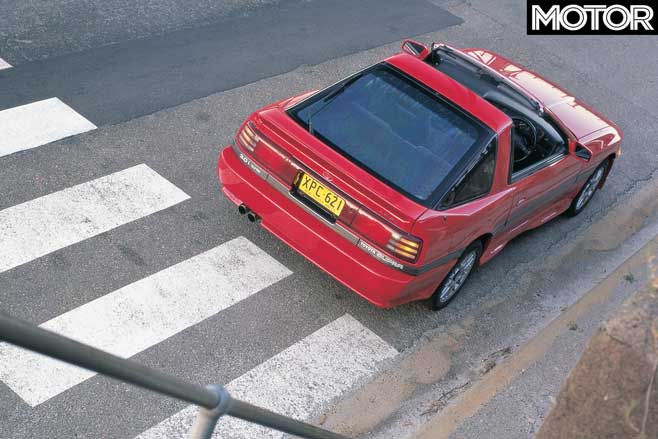
Just as the move to unleaded petrol for 1986 forced changes on most carmakers and importers, so too, did Toyota take the opportunity to bring us a new Supra.
The all-new car was no longer based on the J-Spec Celica and looked bigger in every direction (apart from useable interior space) but in reality, wasn’t. There was also a targa-topped version called the Sportsroof which did nothing for the torsional rigidity of the vehicle, but suited its cruisy feel.
Smoother (no more wheel-arch flares) and less bitsy, the new Supra retained the same overall proportions with a long bonnet, minimal rear overhang and a distinct wedge shape. Pop-up headlights remained and there was really no mistaking its intention.
Until you drove it, that is. It was at that fateful moment that you realised that for all the marketing bluster and E-Type aping proportions, the new Supra was, once again, a marshmallow warrior.
With a stretch to 3.0-litres, the in-line six ground out a claimed 140kW, largely absorbed by the new car’s porky 1510kg kerb mass (the auto weighed another 25kg).
Snail nail
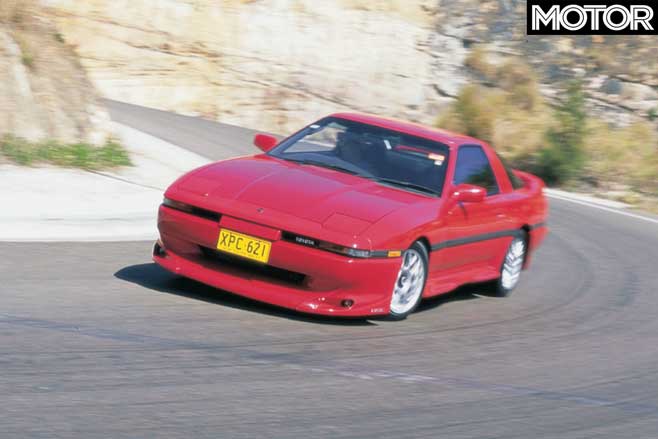
Roll the clocks forward to 1988, and the era of the turbo had arrived; witness the nasty Mazda MX-6 and the more amusing Daihatsu Charade GTti. With such a hefty body and electronic fuel-injection already fitted, a blown Supra could be seen coming from several suburbs away.
But Toyota still figured it needed two bob each way, so it continued with the unblown version and added the Turbo model as the flagship. The turbo engine stayed at 3.0-litres and used the same DOHC head, but power leapt to 173kW which, for 1988, was something else.
More impressively, torque was up a full 99Nm to 344, and it was produced nice and low in the rev range with a big fat surge of grunt that suited the four-speed auto better than the five-speed manual.
So it was relatively quick in a straight line, but nothing could alter the fact that here was a portly old boat that made changing directions more of a chore than it should have been. Throw in the over-assisted power steering and the too-soft springing, and you suddenly had something less than the sum of its parts.
Toyota’s concession to sportiness was to add electrically adjustable dampers which, at the flick of a dash-mounted switch, could be set anywhere from too-soft to way-too-soft. Why’d they bother? Who knows.
Live through this
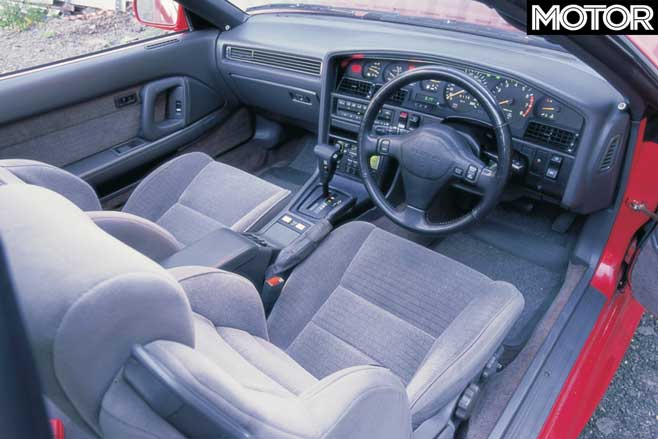
To be perfectly fair, the turbocharged Supra wasn’t without its vaguely likeable points. There was the grunt thing, but even then it was all mid-range with none of that screaming top-end that we’ve come to associate With proper sports cars.
The look of the thing these days is so ‘80s it’s not funny (well, maybe just a bit funny) and the dynamics belong to another age. But if you can live with that, and all you Want is an interstate tourer for two with enough urge to get around B-Doubles, then maybe this could be what you’re looking for.
If, on the other hand, you ’re thinking that the Supra is the Big T’s RX-7 equivalent or in any other way a pukka chap’s car, think again. Frankly, there’s better stuff out there for less money, and for the dough involved, a VN Commodore SS manual is quicker, vastly more tweakable, and it’ll leave you with at least $5000 change for ULP.
If you just have to have a two-door J-car, why not hunt yourself down a Series 4 RX-7 Turbo? It, aside from a thirst to equal Dennis Thatchers’, is at least a proper sports car, handles well and is even quicker again.
What dies?
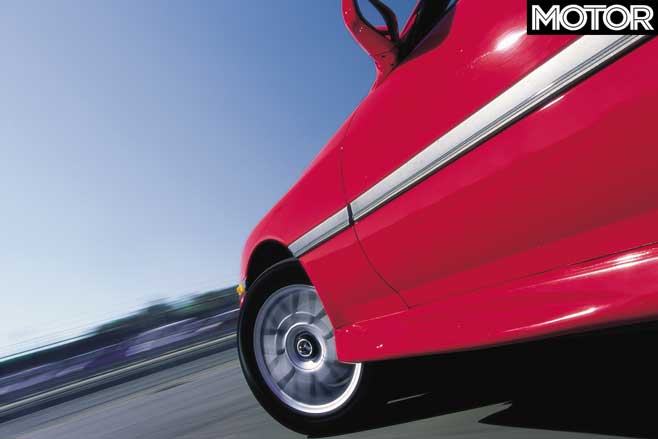
Here’s the good news if you decide to persist with all this. A Supra is a Toyota, right? Three words: Never; Breaks; Down. Okay, almost never, but it’s true that the engine and gearbox are missile-proof, even with the turbo gusting down the inlet manifold at regular intervals. Just make sure there’s some kind of service record involved, because even Toyotas eventually die if they haven’t been cared for.
Those tricky electronic dampers are a decent bet to pack it in, but since they’re crap anyway, they’ll be doing you a favour by carking it and forcing decent replacements dampers and springs upon you.
The interior trim seems to stand up pretty well to daily abuse, and the Supras we see still running around don’ t seem to have the dodgy panel {it that can afflict some of its contemporary, Nissan’s… err… cars.
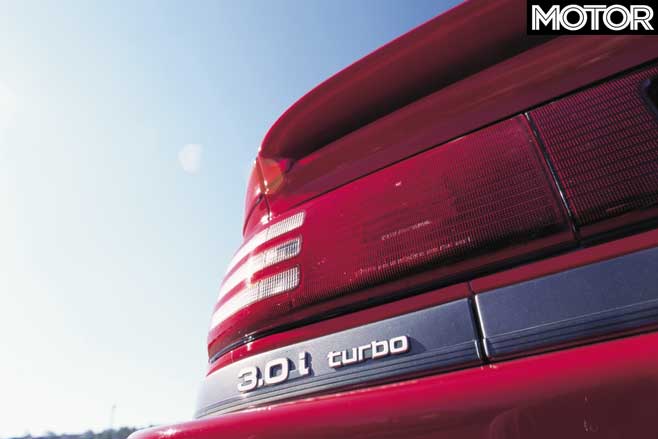
FAST FACTS 1986 Toyota Supra Turbo ENGINE: 3.0-litre inline-six, 24v, turbocharged BORE/STROKE: 83.0 x 91.0mm COMPRESSION: 8.4:1 POWER: 173kW @ 5600rpm TORQUE: 344Nm @ 4800rpm WEIGHT: 1590kg POWER-TO- WEIGHT: 109kW/tonne TRANSMISSION: 5-speed manual/ 4-speed automatic SUSPENSION: Independent, coil spring, anti-roll bar (f & r) L/W/h: 4620/1745/1300mm WHEELBASE: 2595mm TRACKS: 1485/1480mm (f/r) BRAKES: 302mm ventilated discs (f); 291mm solid discs (r) WHEELS: 16.0 x 7.0-inch (f); 16.0 x 7.0-inch (r) TYRES: Goodyear Eagle, 255/50VR16 (f & r) PRICE: $60,000 (1986 approx.)
What we said
“The engine is more flexible than previously and can be left in higher gears for longer periods if the driver is feeling lazy. The overall sensation is of continuous thrust.” -Ewen Kennedy November 1988
“The Supra has exceptionally good handling. Its well-weighted steering transmits excellent feel, but at the limit it tums macho. Initial understeer is quickly followed by tail-out oversteer. It has the turbo rush of a (Series IV) RX-7 but transfers its weight in cornering more sharply and has more body roll. The gear change and clutch are heavier, too.” -James Cleary, February 1990
She’s mine!
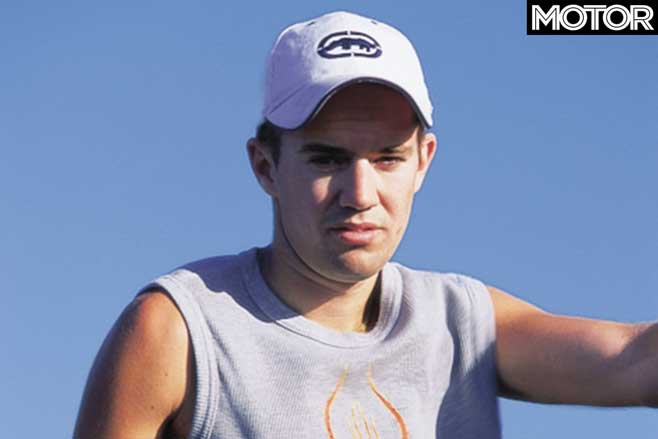
”I couldn’t see myself in any other car. I just love the shape, they’re so unusual It took me more than four months to track down this one, because I wanted a 3.0-litre turbo and a targa top. I wanted a manual, too, but it was impossible to get all three. I must have checked out 25 cars. ”This is my second Supra; I had a Japanese-spec late ‘80s model that I sold on to get this one. I just drop it off at Toyota for servicing with no worries at all This won’t be my last Supra, that’s for sure. So, when do I get paid for this?” -Ciaran Jordan
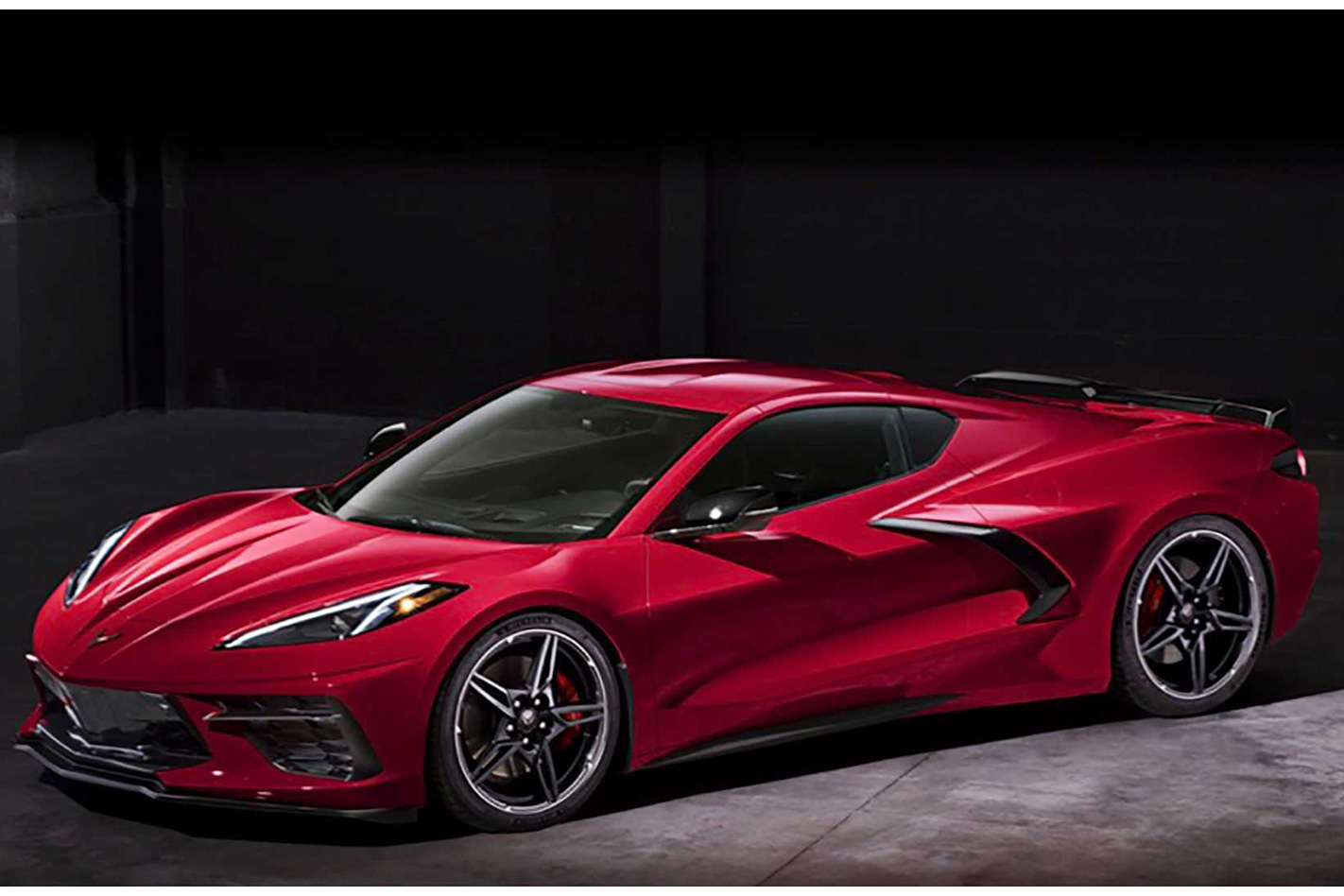
THE CHEVROLET CORVETTE C8 has been busy setting fire to the internet over the past few days, but it’s worth acknowledging the role Australia played in this vehicle’s development. Or, more to the point, a Holden VE ute.
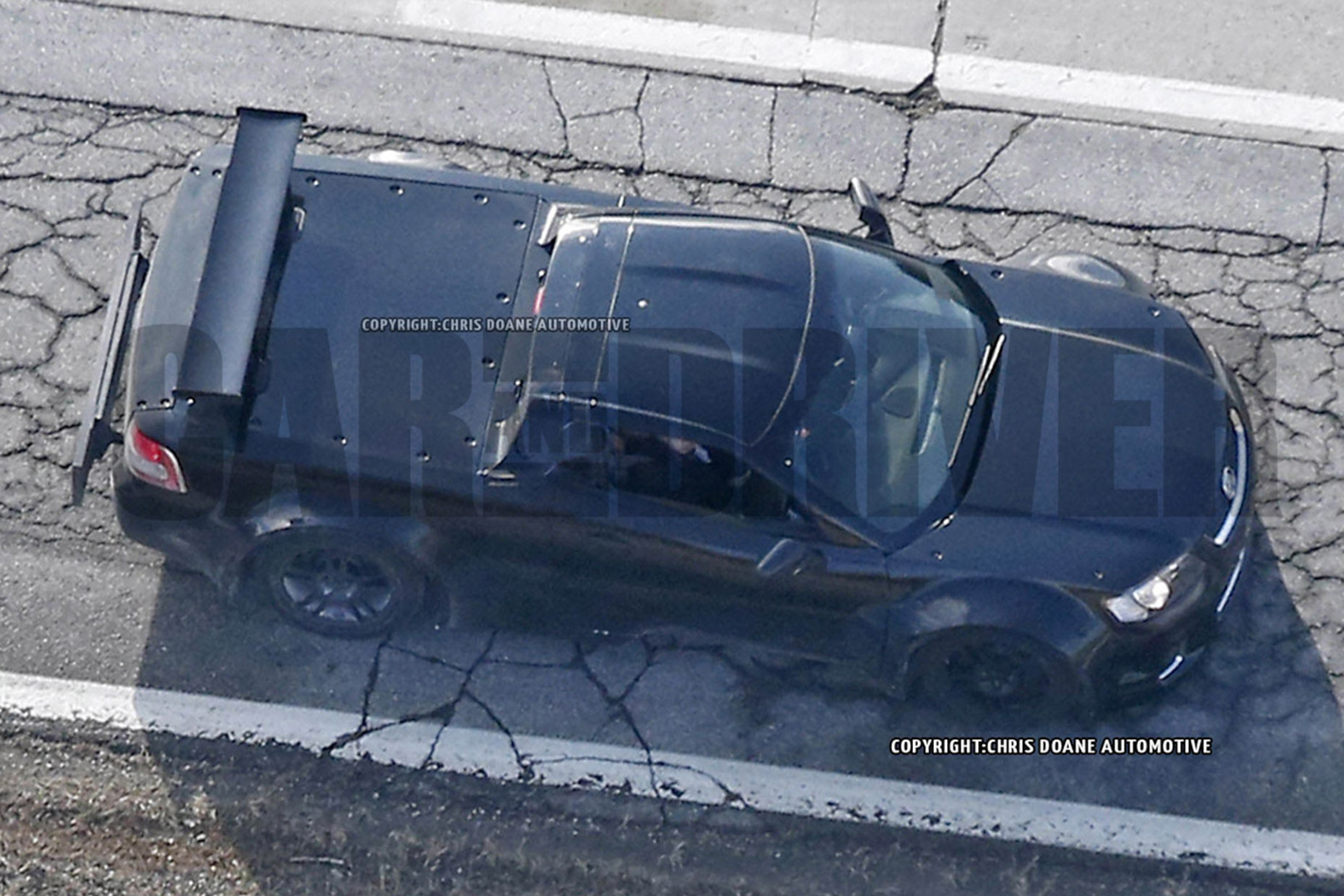
Back in January 2015, Car and Driver snapped a picture of a very unusual looking ute. In fact, the car was an amalgam of bits of a Commodore SS-V with the cabin module, roof and door mirrors of a Corvette C7, finished with the some strangely distended Holden ute rear architecture.
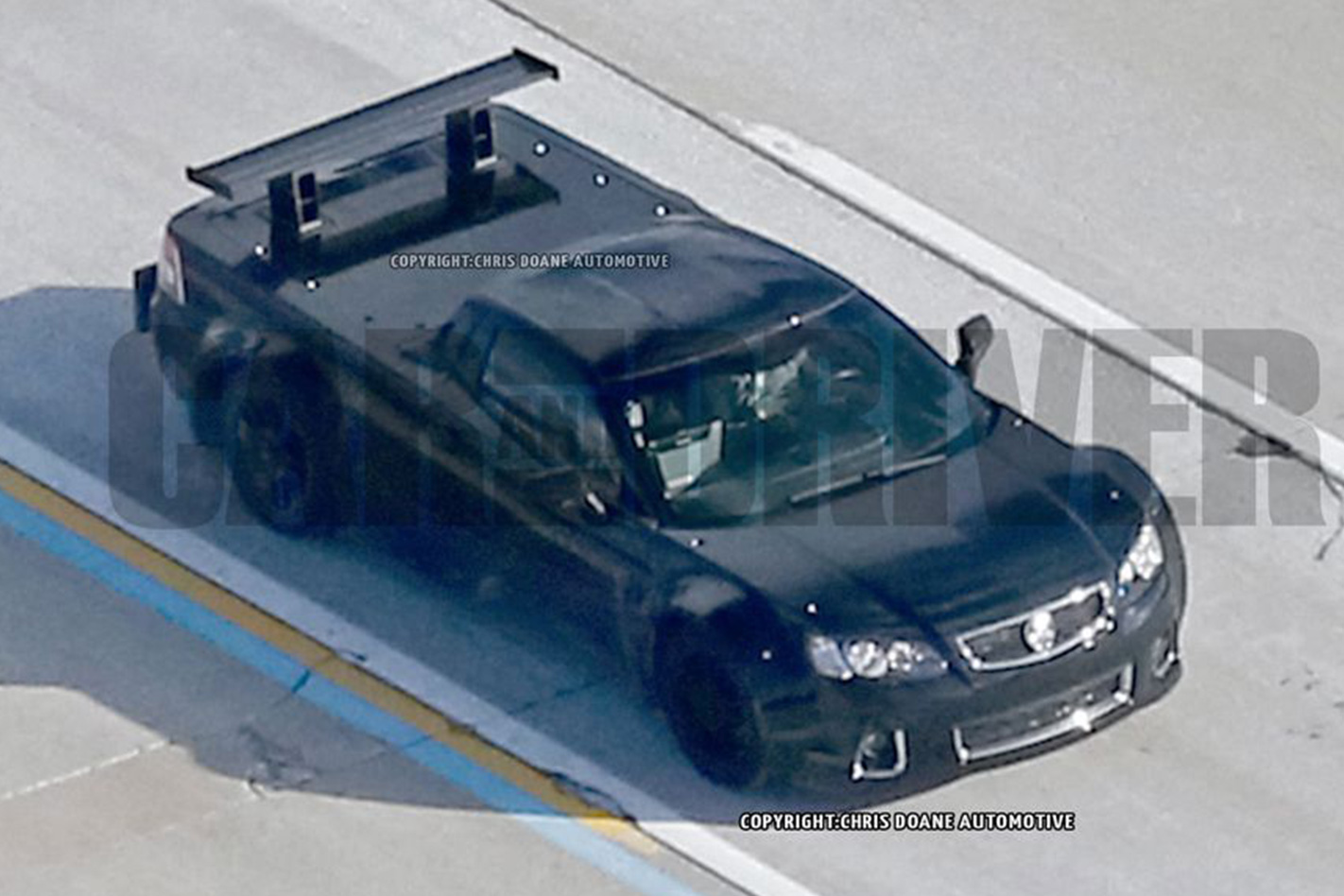
Upon closer inspection, it was apparent that it featured a fuel-filler located on the driver’s-side B-pillar and had cooling intakes located along the rocker panels. Car and Driver estimated the wheelbase to be 99 inches, or some eight inches longer than the C7 Vette, so it was obviously a vehicle of radically different basic proportioning.
The flared wheelarches housed a broader track, and it was clear that behind the passenger cell was a disguised engine under a flat deck. Car and Driver had rightly identified many aspects of what would become the Chevrolet Corvette C8, but it was way off in terms of planning horizons, their 2015 feature predicted a 2017 on-sale date.
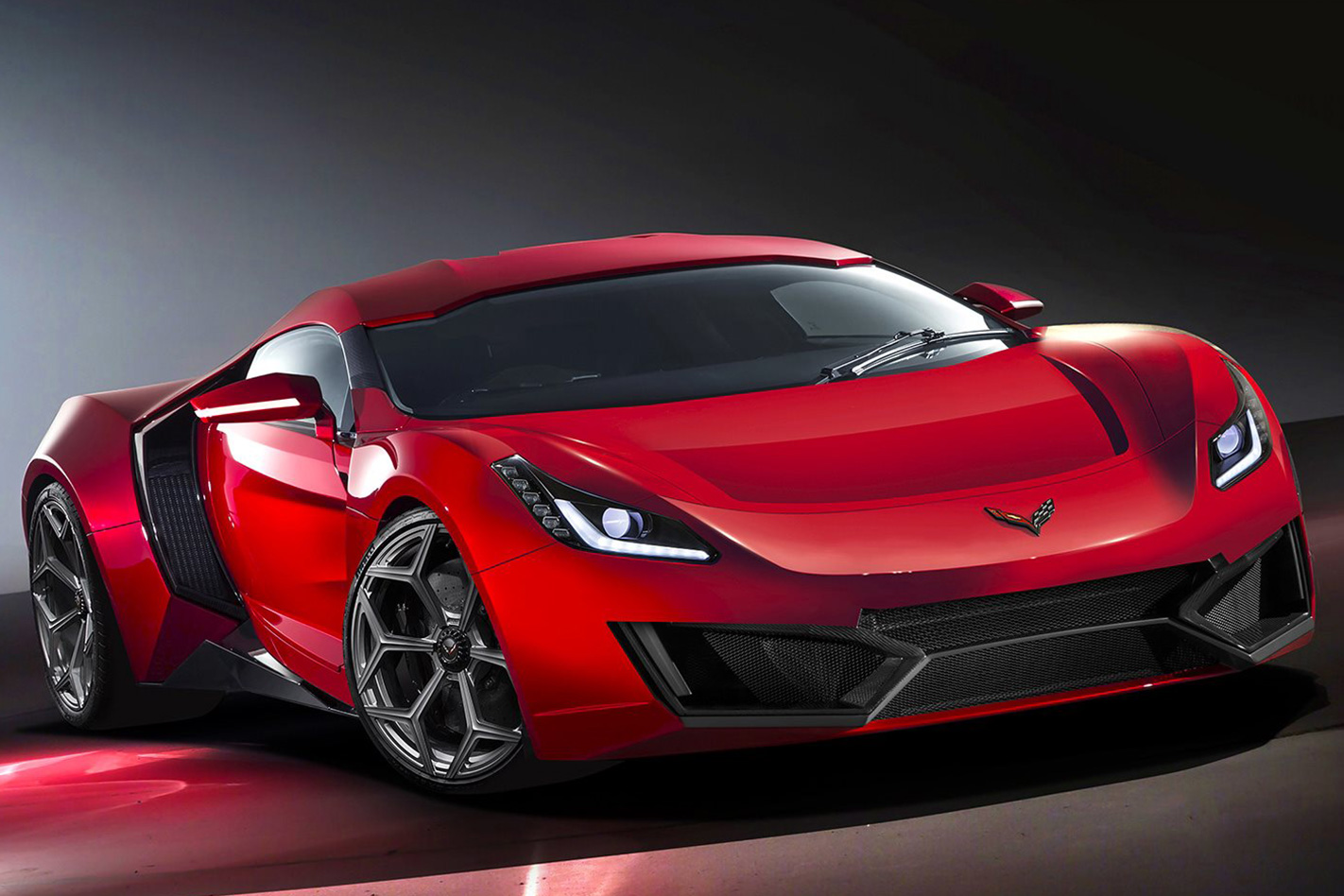
Fast forward to 2017 and our very own Toby Hagon penned a ‘what we know so far’ piece on the C8 that featured a computer-generated image of the design direction of the future supercar based on information we’d gleaned from GM insiders. Given what’s been unveiled this week, we don’t think we were too far off the mark with that one.
We’re still waiting to hear exactly when we can get our hands on the Corvette C8. But in the meantime, we’ll happily doff our caps to the people at Holden who contributed to its creation.
Internet-connected, “smart” streetlamps and intersections are being touted as the next big thing in the world of automotive technology, but while they would arguably be a major benefit to road safety and driver convenience, such systems could also create a blanket of speed cameras.
The concept of networked road infrastructure isn’t new, and in many cities the lights and built-in sensors of most intersections are already monitored remotely. The next step, however, is to add more sensors into the mix to keep tabs on the precise positions of cars and pedestrians, while beaming out that information to any cars in the immediate area.
It’s a noble idea. Say, for example, that there’s a pedestrian about to cross the road in front of you but is obscured by a truck in the next lane (below). Such a system could give you advance warning – or automatically slam on the anchors – before the situation becomes life-threatening. Accidentally running a red light could also become a thing of the past too, as your car would be alerted if it’s in danger of crossing a stoplight, while the extra data generated would be critical to making autonomous vehicles function both efficiently, and safely.
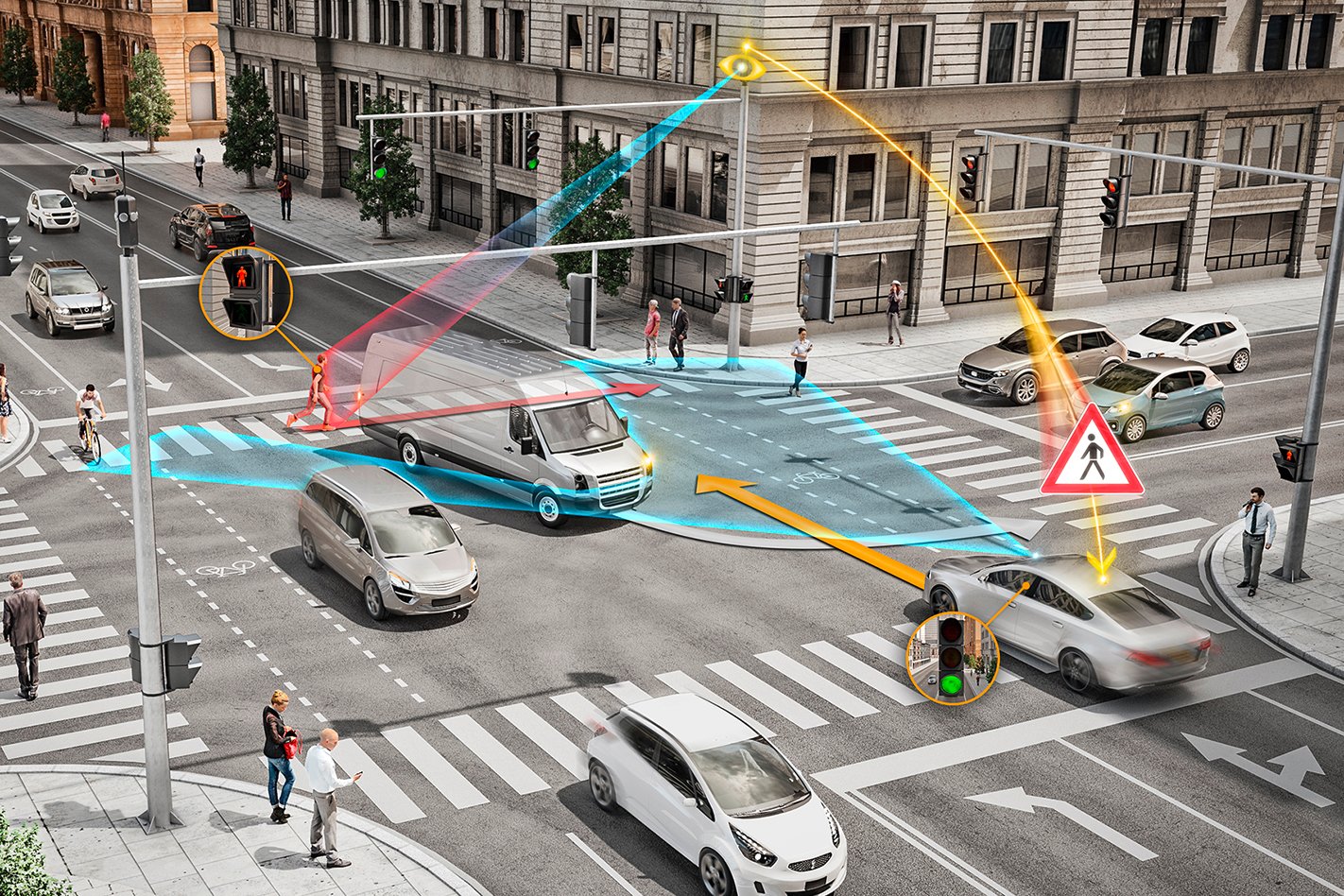
That safety-critical information would be sent directly to cars in the vicinity through the Direct Short Range Communications protocol, rather than via a cloud server over the internet. With ultra-low transmission times, DSRC is a better choice for that kind of vehicle-to-infrastructure information transfer.
The benefits don’t stop there. More intelligent vehicle monitoring would allow traffic light sequences to respond to changes in traffic flow, easing congestion and reducing the amount of time wasted by sitting still at intersections. With each junction connected via the internet, slow-moving traffic jams could be cleared far more efficiently by phasing traffic light cycles sympathetically.
That said, safety is the main driver behind the smart intersection idea. Continental, which showcased its latest vision for digitally-enhanced street infrastructure at the Continental TechShow earlier this month, says its aim is to use its sensor technology to reduce the number of crashes globally. With 40 percent of road crashes in the United States occurring at intersections, Continental says it makes sense to start its smart infrastructure efforts there.
Meanwhile, sensor modules strapped to ordinary lamp posts – Continental’s “Intelligent Street Lamp” concept, below – holds the potential to stretch the digitisation of the road network well beyond illuminated intersections. Besides informing nearby intersections of approaching traffic, the street lamp modules would also be able to monitor parking spaces and direct nearby cars to vacant spots. They could even survey air and noise quality, uploading that information to the cloud. If there’s a hazard on the road, such as a fallen tree or vehicle accident, they could alert approacing cars via the DSRC protocol.
However, even Continental admits that the sensor technology could be adapted to other purposes, such as extending the reach of speed enforcement well beyond main roads.
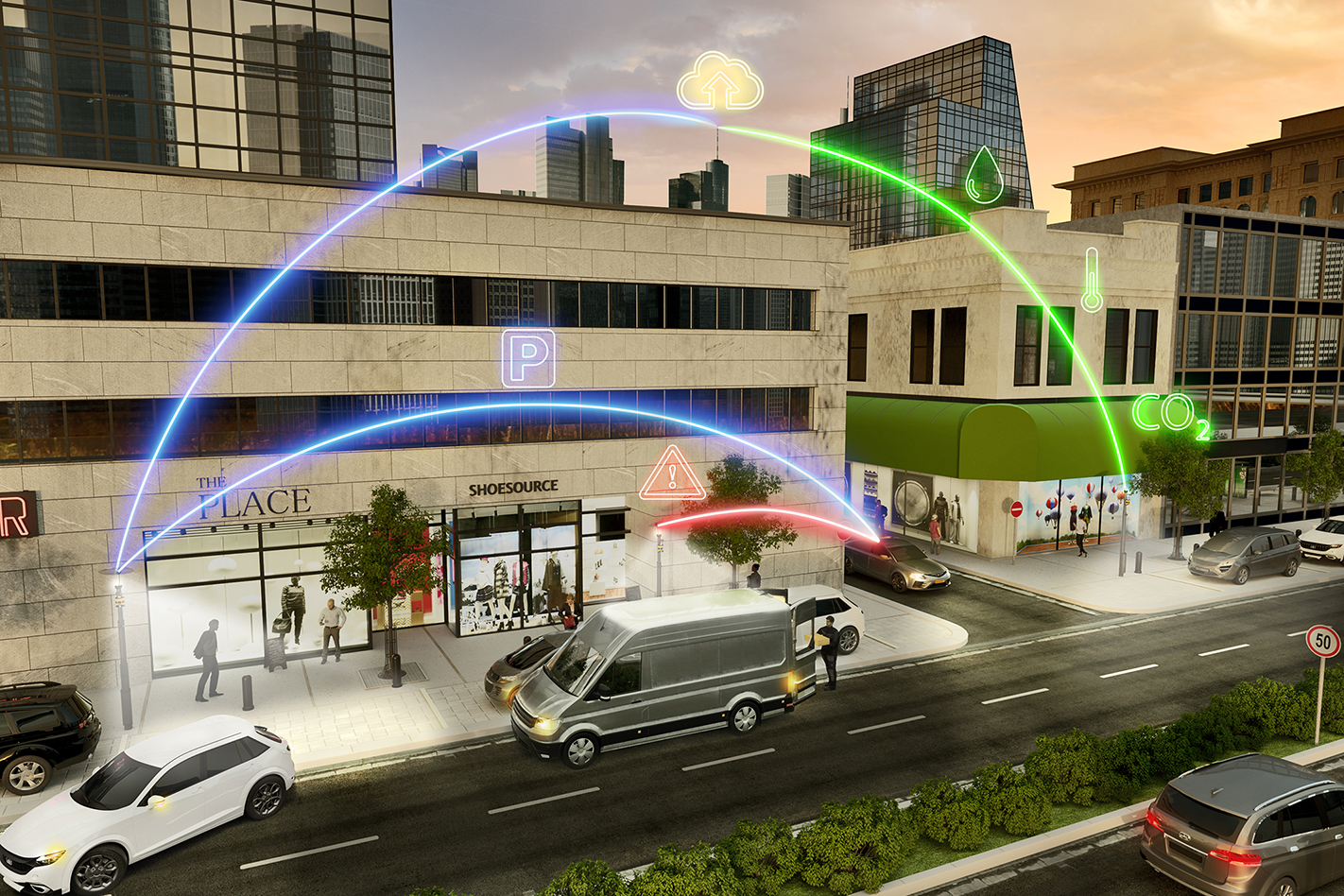
“Absolutely,” Continental business development manager Christian Gietl confirmed.
“It depends on the country. I cannot make that general statement, because it’s really specific, but every market has its requirement. If you look at how speeding, for example, is solved today by radar technology, this is the technology that we’re implementing here in our sensor, so what is possible today can be done in future done by a street lamp-mounted sensor.”
But that’s not to say that Continental’s system will automatically fine those creeping above the speed limit wherever it’s installed. In fact, data protection laws in Europe mean that kind of surveillance is be expressly forbidden.
“Of course, everything we’re doing here [in Europe] is GDPR (General Data Protection Regulation) compliant – it’s about taking good care of an individual’s personal information. We solve that by not transmitting any personal data at all, like a licence plate.”
There are, however, no such data protection laws in Australia. According to Continental, if the client city or state wants the ability to use its smart streetlights for speed enforcement, it has the technological means to do so. Cost, however, may be the only obstacle to putting that tech on every street.
“If you look at more advanced systems like combining camera and radar, which means detecting over-speeding through license plate recognition at the same time and automatically fining those people, that is a use case that today is probably only happening in the Chinese market right now – but we’ll see how the market develops.”
In many Chinese cities citizens can be detected by CCTV cameras and identified via facial recognition, with an AI system automatically fining those detected breaking the law by, for example, jaywalking – an extension of that government’s mass surveillance program and a precursor to its infamous “social credit” system.
“The concept we have here is a modular concept, where a city can really address their specific ‘pain points’ – which are very individual”.
“For example, the US is using gunshot recognition on street lamps, so microphones on streetlamps can hear a gunshot, and through triangulation you can know where the gun was fired. At the same time the waveform is analysed and you can know which kind of gun it was.”
While Australia doesn’t have the same issue with gun crime or the draconian AI-driven ‘social credit’ system of China, the prospect of putting a speed camera in every street may prove to be an attractive idea to police and councils eager to clamp down further on speeding motorists – while also eventually delivering the safety benefits touted by Continental as cars become increasingly connected.
IT’S TINY. In the metal, the Mercedes-Benz 190E 2.3-16 is like a 5/8 scale representation of its reputation. It takes up less space on our turntable than a modern compact hatch like a Honda Civic, and there’s something jewel-like and contemporary about its surfacing. Stylist Bruno Sacco was responsible for a generation of Mercedes design from 1975 to 1999 and this was the car he was most proud of.
It’s easy to see why.
The 190E 2.3-16 never officially came to Australia but its legacy is nevertheless apparent here. Without this 1984 Benz, there would have been no BMW E30 M3, a car which, despite its relatively aged styling, first appeared a year later. So this is the car to thank if you have an M3, or a Mercedes-AMG C63 or an Audi RS4, or a Lexus IS-F or even an Alfa Romeo Giulia QV. You get the point.
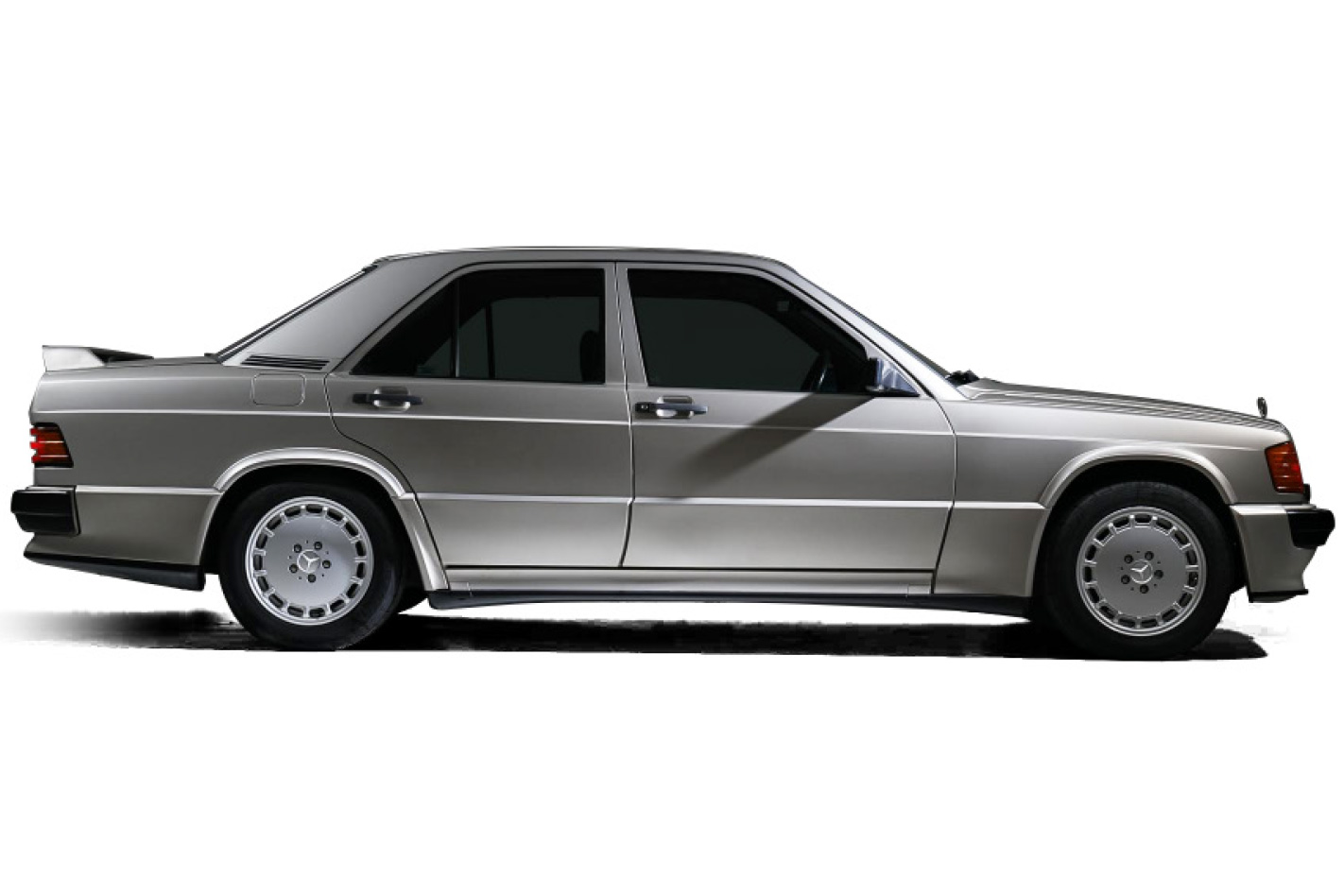
Mercedes originally started on development of the 190 (or W201 series in the language of Untertürkheim engineers) way back in 1974, with the first test mules running in 1978. The subproject that was to become the 2.3-16 was originally envisaged as a rally car to replace the C107 450 and 500SLC models, but then the Audi quattro happened. Mercedes instead turned its attentions to touring car racing and the fledgling Deutsche Tourenwagen Meisterschaft (DTM) series.
The fact that the 190E 2.3-16 was the first car in its particular class is evident from a somewhat unusual comparison published in Wheels back in December 1986. This saw Holden’s VK Calais Director take on the BMW M5, the Ford Sierra RS Cosworth and the new Mercedes. Never mind the fact that the BMW and Holden were at least a size bigger than the baby Benz or that the Ford was around half its price.
In case you were curious, all three of the European cars smoked the big Holden around Castle Combe circuit and the 190E 2.3-16 got the nod, Wheels doyen Peter Robinson surmising that the Mercedes “comes across as the consummate sporting sedan. It doesn’t have the sheer acceleration of the Ford or BMW, but it is so well balanced, so beautifully vigorous, that you could never tire of driving it.”
To publicise the launch of the 2.3-16 after its unveiling at the 1983 Frankfurt motorshow, Mercedes came up with the idea of a one-off ‘Race of Champions’ among Formula 1 champs, to be held at the new Nürburgring circuit. The call went out to the likes of Alain Prost, James Hunt, Alan Jones, John Watson, Jody Scheckter, Keke Rosberg, Jack Brabham, Carlos Reutemann and Emerson Fittipaldi. The latter had to pull out of the race due to Indy 500 commitments, and recommended a young Brazilian, just three races into his F1 career with the unfancied Toleman outfit. His name was Ayrton Senna da Silva.
Prost picked Senna up at Frankfurt airport and gave the 24-year-old rookie a pep talk en route, whereupon Senna promptly punted the Frenchman off on lap one and went on to win the race.
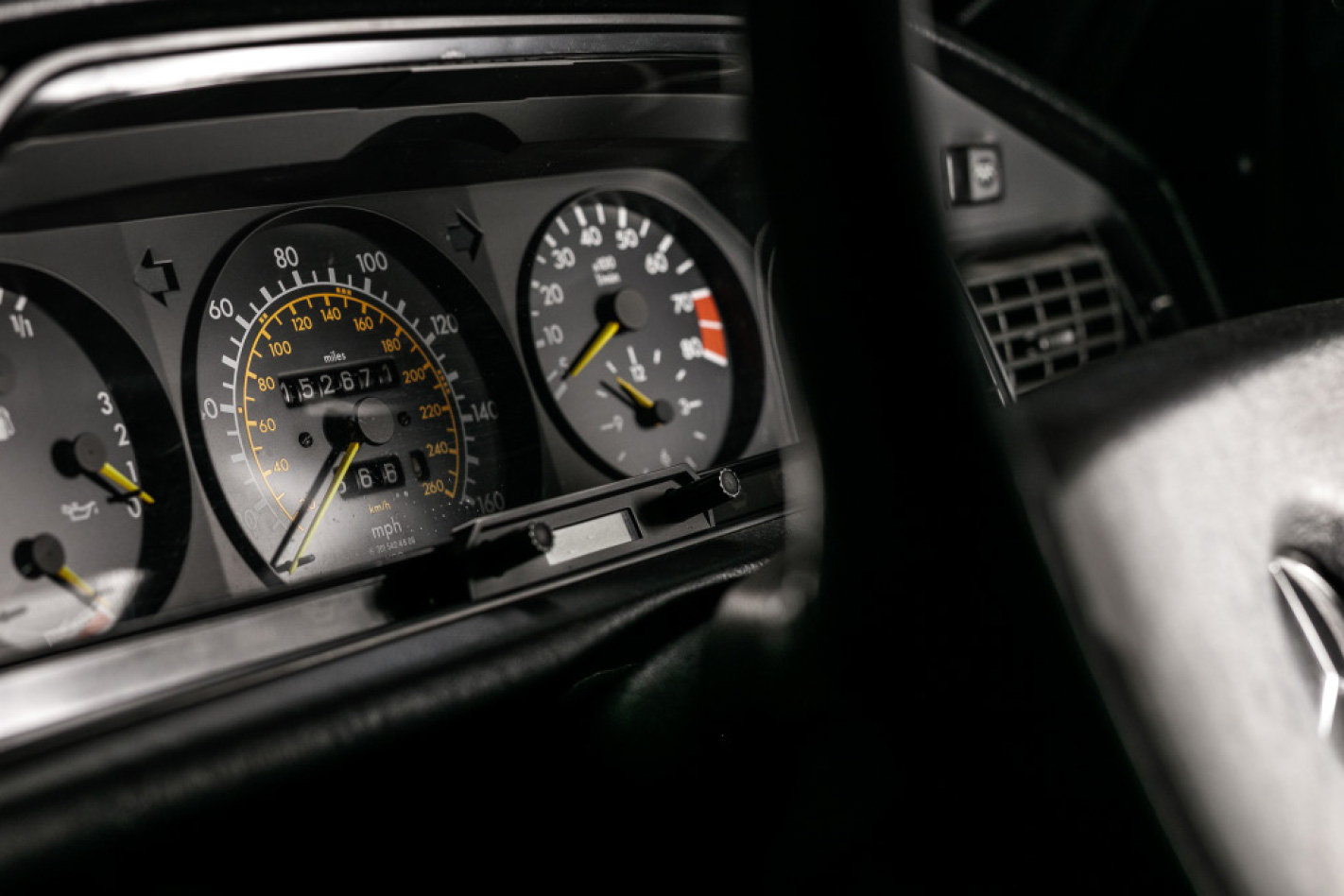
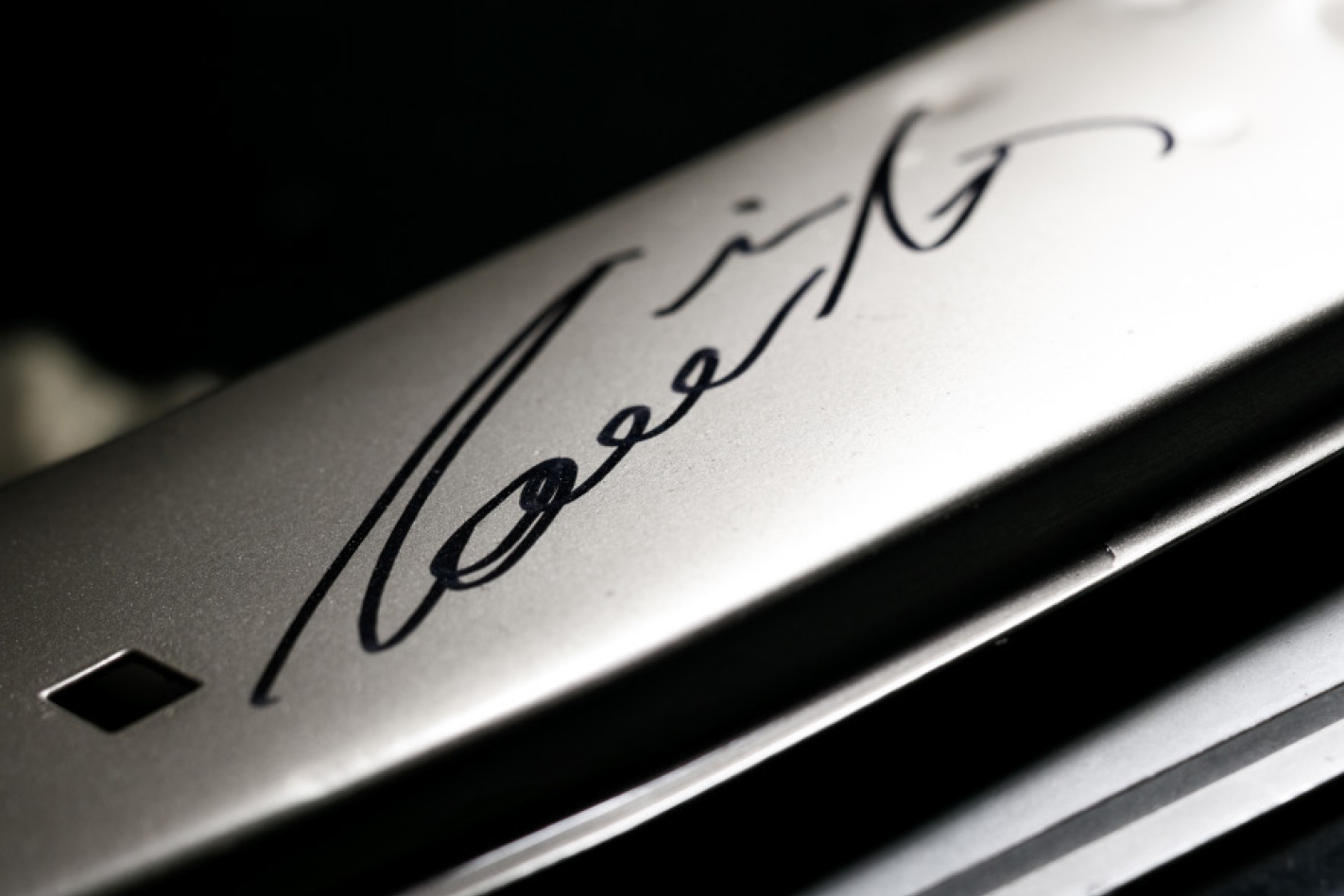
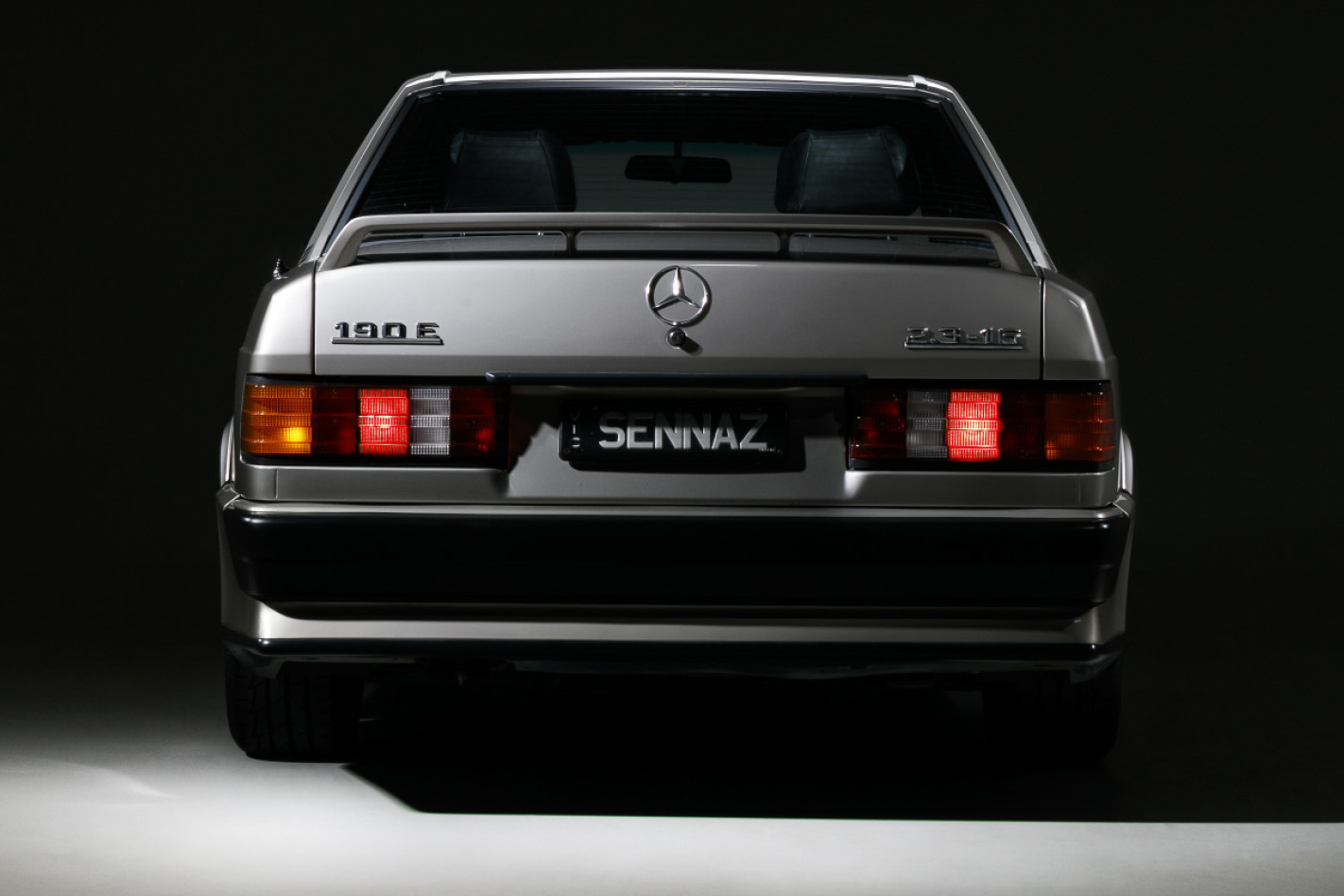
Senna was so taken with the 190E 2.3-16 that he bought one himself. It was the last car he’d ever pay his own money for, albeit at a 25 percent discount from Mercedes-Benz, and it’s his car that graces our studio. He bought it while sharing a house with Maurício Gugelmin in the UK and he sold it prior to relocating to Monaco in 1987. It now lives in Melbourne (see sidebar p36).
For homologation Mercedes only needed to sell 5000 units in a single year, and it sold more than 8000 in 1985 alone, offered in just two colours: Blue-Black (paint code DB199) and Smoke Silver (DB702).
Despite all this homologation effort, the 190E 2.3-16 never actually won the DTM championship. That would have to wait until 1992 when its successor arrived in its ultimate incarnation, the stroked 2.5-16 Evo II. Yet as a road car, it’s the frenetic smaller engine that feels more exotic. There was little in the way of expertise in Germany for four-valve-per-cylinder technology during the early 1980s. Borgward, whose 1.5-litre Formula 2 engines featured this layout, had gone to the wall two decades earlier, so the Germans looked across the Channel to Cosworth in the UK.
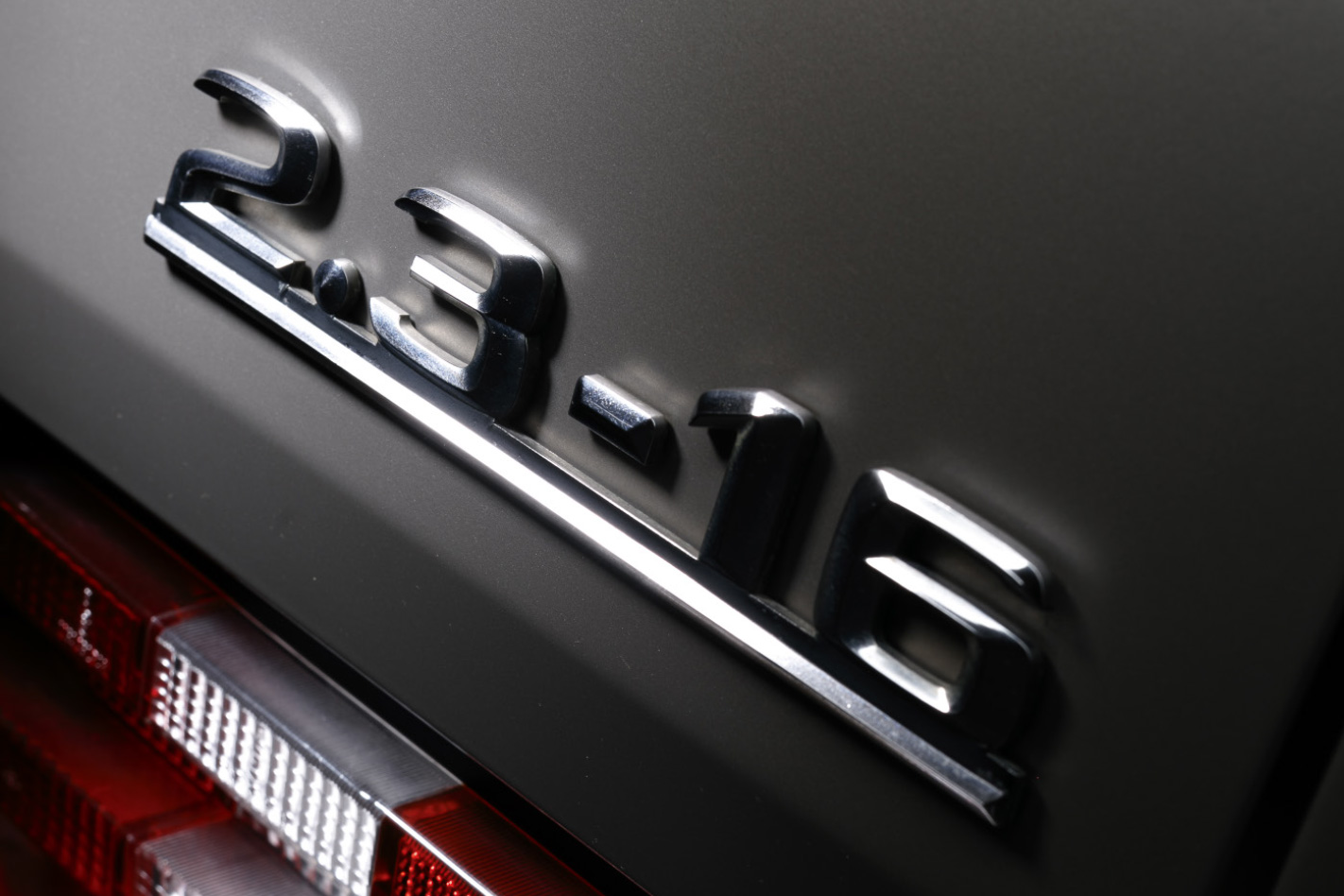
The 2.3-litre engine – as seen in the 190 and 230E – was fundamentally strong, and Cosworth cast the twin-cam, 16-hole head, and performed calibration work on the electronically controlled ignition and idling, the Bosch K-Jetronic fuel injection and air-bathed injection valves. The engine, codenamed WAA, featured Cosworth’s first one-piece head, with the camshaft carrier cast integral to the cylinder head itself. Mahle pistons and an intricate mandrel-bent exhaust manifold helped create what was then the highest-revving road car engine to carry the three-pointed star (7100rpm).
Mercedes continued to develop the ride and handling package. The fundamentals were already excellent, with a multi-link rear end, self-levelling suspension, an aerodynamically stable body and a Getrag 265 five-speed ‘box (much the same unit as found in the E30 M3) backed up with a 32-percent limited-slip differential. Despite its relatively short gearing, refinement was excellent, especially for a car that weighed just 1260kg, 70-litre homologation fuel tank notwithstanding. Anti-roll bars and bushes were beefed up, control arms reinforced, and springs, dampers, steering knuckles and wheel hubs all uprated. The recirculating ball steering system was also quickened to three turns lock-to-lock.
Ride quality was firmish for the time, but would be described as languid today. The suspension system coped with a full load of passengers extremely well, although the standard Pirelli 205/55 VR15 tyres were somewhat noisy and hardly the last word in lateral adhesion. Peak power arrived at 6200rpm and the fuel cut appeared at 7100rpm, but that gives little indication to the remarkable character of this engine. You’re probably used to a torque plateau. The 190E 2.3-16 has a power plateau that hardly deviates from the horizontal all the way from 5500rpm to the redline. That’s what makes it so easy to keep on the boil and why the 2.3-16 carries speed so fluidly on a cross-country route.
It’s not concussively quick off the line, Wheels’ test seeing it stop the clock to 100km/h at 8.2sec versus 6.6sec for the M5, 6.7sec for the Sierra RS Cosworth and 7.8sec for the lazy Calais. The factory claimed a 7.5sec figure. The engine’s top-end malleability and the well-telegraphed transitions from understeer through neutrality to mild oversteer nevertheless endow enormous confidence. It’s both lighter and less spiky than an early E30 M3 and – even to this unashamed M car enthusiast – probably makes a more satisfying road car.
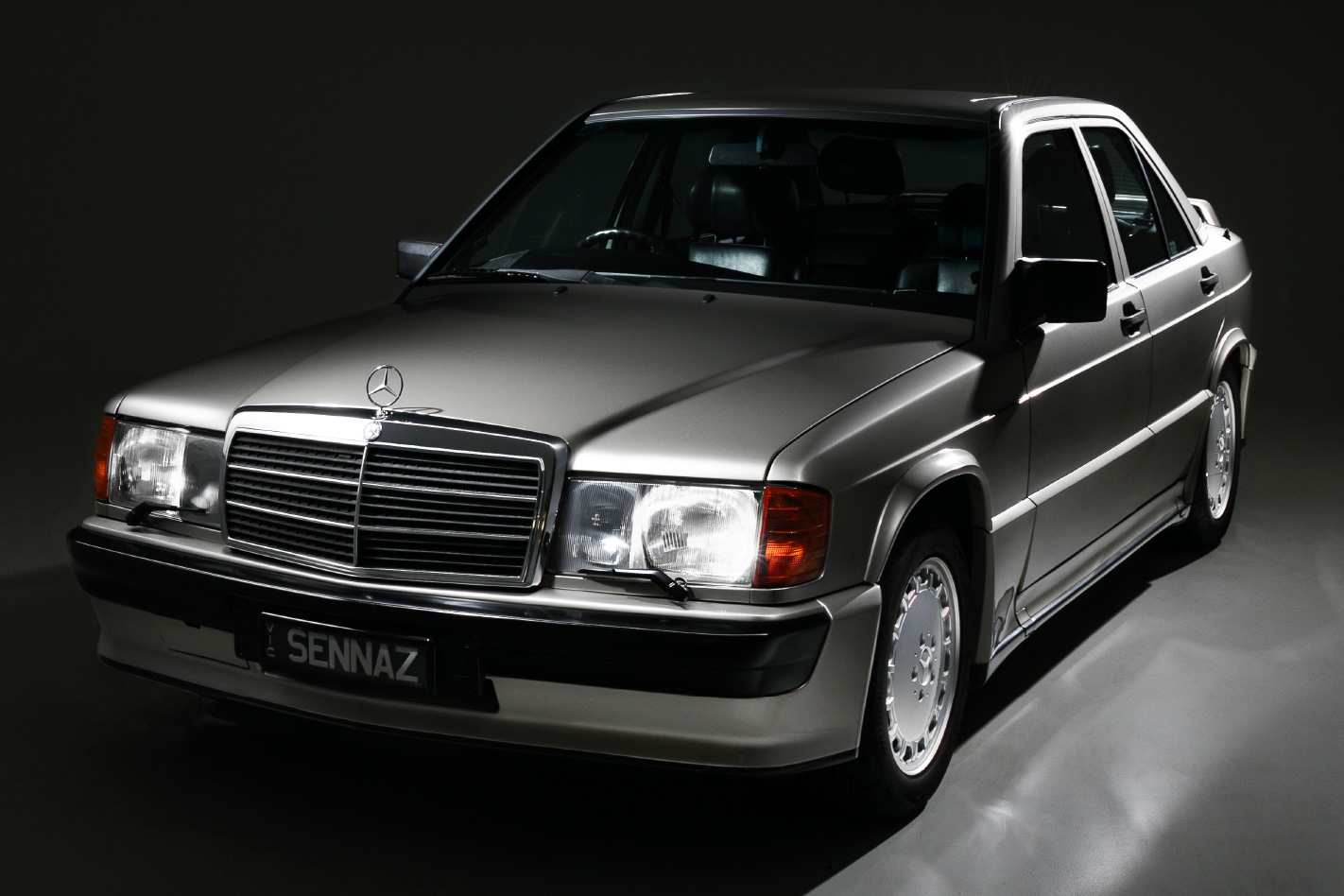
The cabin still feels beautifully overengineered and generally well packaged, although the Zebrano wood and massive non-adjustable steering wheel speak of a certain mid-’80s zeitgeist. The trim is hardwearing and the quality of the thing is impressive. Beneath the floor mats is thick carpet held by snaps to a false floor that’s drilled for lightness. Beneath that is a network of intricate conduits that house the hoses, wiring and, below that, the asphalt-coated steel floorpan. Ironically, it’s this outdated overcommitment to build integrity that makes the 190E feel so modern. Unlike most 1980s cars, the doors thunk shut and there are few squeaks and rattles.
Rust can be an issue under the rear seats, interior plastics can fade and crack with UV exposure, tired rubber seals and bushings can be costly to replace and repairing niggly electrics can be hellishly expensive. The chain-driven engine is a tough unit, although fuel pumps soon fail if the car is left dry. The wiper arm needs frequent regreasing, the air-con can be flaky, OE distributor rotor arms are fragile, and the simplex cam chain is a 70,000 mile (112,000km) replacement which will be costly. You’ll also need to check that the car isn’t a US market edition, as these featured a lower compression ratio and only 125kW as a result.
Values are only going one way, even though Mercedes built a lot of 190E 2.3-16s. Despite being overshadowed by the lairier E30 M3 back in the day, hindsight and a couple of decades’ worth of reflection allows us to appreciate the 2.3-16’s merits a little more clearly. This particular car is especially poignant. It’s 25 years since Ayrton Senna’s fatal crash at Imola, and while we may well go back and forth on the Brazilian’s place in F1’s canon, we’re not about to fault his choice in cars. Never meet your heroes, they say. Rubbish. They’re heroes for very good reasons.
