
Contenders
- Hyundai Santa Fe Hybrid
- Kia Sorento Hybrid
- Chery Tiggo 8
- Mazda CX-80
- Audi Q8
- BMW X5 xDrive50e
- Range Rover Sport
- Land Rover Defender
- Lexus RX350h, RX450h+ and RX500h
- Toyota Kluger
Winner – Hyundai Santa Fe Hybrid
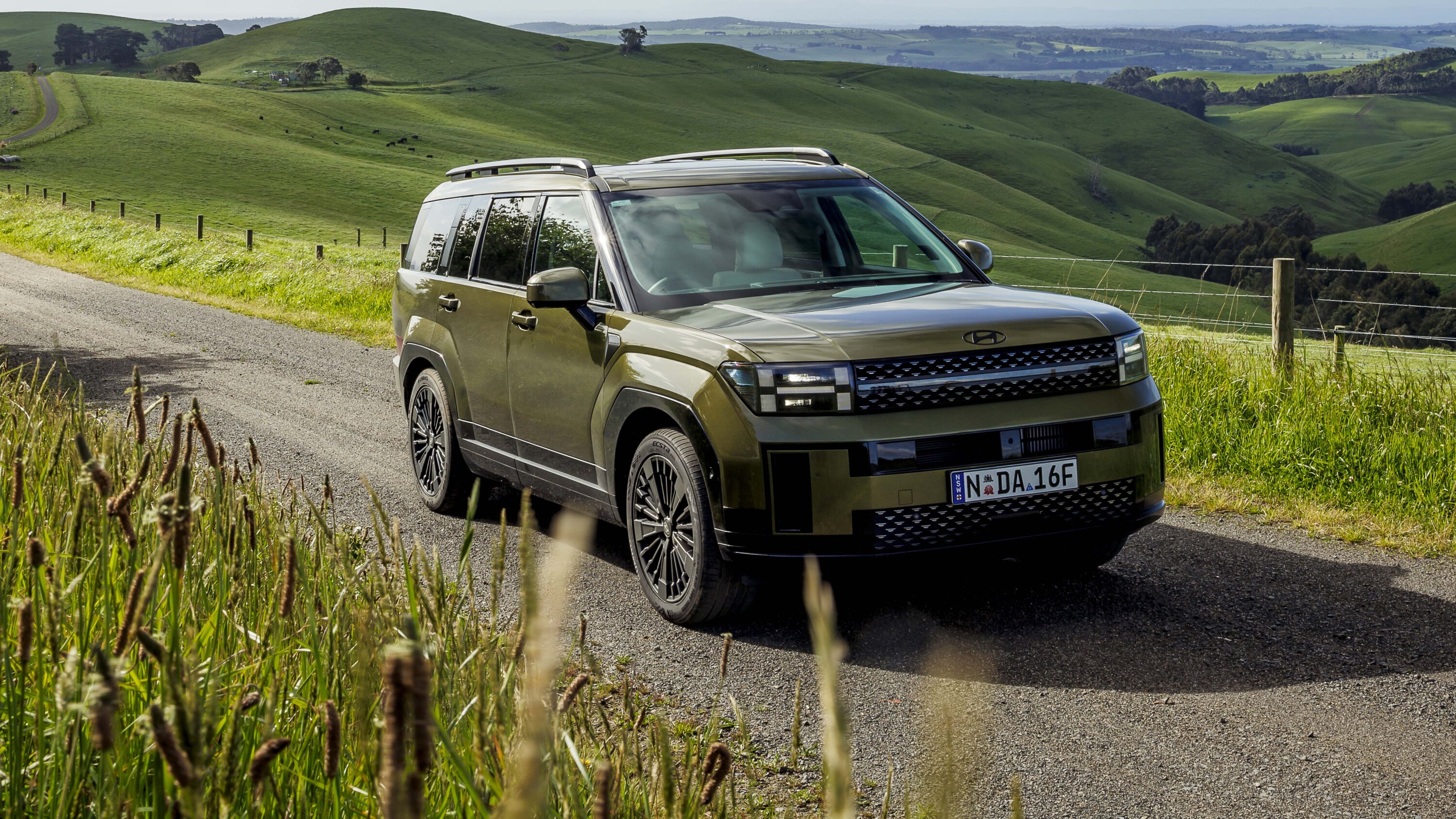
Price: from $57,000 plus on-road costs
Drivetrains/fuel economy/CO2 emissions: 1.6-litre four-cylinder turbo-hybrid, 6-speed auto, 173kW/367Nm, 5.6L/100km, 128g/km
Dimensions (length/width/height/wheelbase): 4830/1900/1770/2815mmBootspace: Unknown (third row up)/628L (third row folded)/1949L (third + second row folded
Warranty/roadside assistance/service intervals: Five-year/unlimited km, service-activated,
annual/every 10,000km
Five-year service cost: $2439
| Driving | |
| Interior | |
| Practicality | |
| Overall value | |
Things we like
- Distinctive styling
- Spacious and practical cabin
- Loaded with kit across the range
Not so much
- Calligraphy model’s pricing is getting up there
- Lazy response in eco mode
- Toyota hybrids are more efficient
If you’re searching for a bold and distinctive-looking family SUV, look no further than the Hyundai Santa Fe. While the previous four generations were some of Hyundai’s best products over the years, none of them were especially interesting to look at. Enter generation five and its funky, boxy shape, making it certainly one of the most instantly recognisable large SUVs on the market.
Inside, the Santa Fe offers a spacious and practical cabin that feels well thought out by its designers. Each row has more than enough space for adults, with the third row a noticeable improvement on the previous Santa Fe and more spacious than key rivals such as the Kia Sorento. The cabin also features thoughtful details such as the dual wireless smartphone charger in the centre console, ample storage throughout and easy-to-use technology.
There are two available drivetrains in Australia: a turbocharged petrol 2.5-litre four-cylinder unit making 213kW of power, or a 173kW 1.6-litre turbo-petrol hybrid. Both engines are available as front-drivers in the base model but are otherwise paired to all-wheel drive throughout the range, and every Santa Fe model is quite comfortable and relaxing to drive, with a well tuned ride quality and light steering. The boxy styling helps with visibility as well.
Hyundai’s five-year/unlimited km warranty covers the Santa Fe, and its service costs are reasonable at a maximum of $2439 for five years/75,000km, though its warranty looks short against some other manufacturers on the market. Counting against the Santa Fe is that it’s not cheap at the higher end of the model range, the drivetrain response in eco mode is sluggish, and the 2.5T’s lazy dual-clutch transmission can stumble a bit in low-speed driving.
But otherwise, the Hyundai Santa Fe proves to be a very worthy large SUV thanks to its insanely practical cabin, value for money, long list of equipment, comfortable driving experience and reasonable running costs. That it also looks unique and characterful is only a bonus for those wanting a more distinctive family chariot to keep ahead of the Joneses.
Kia Sorento Hybrid + PHEV
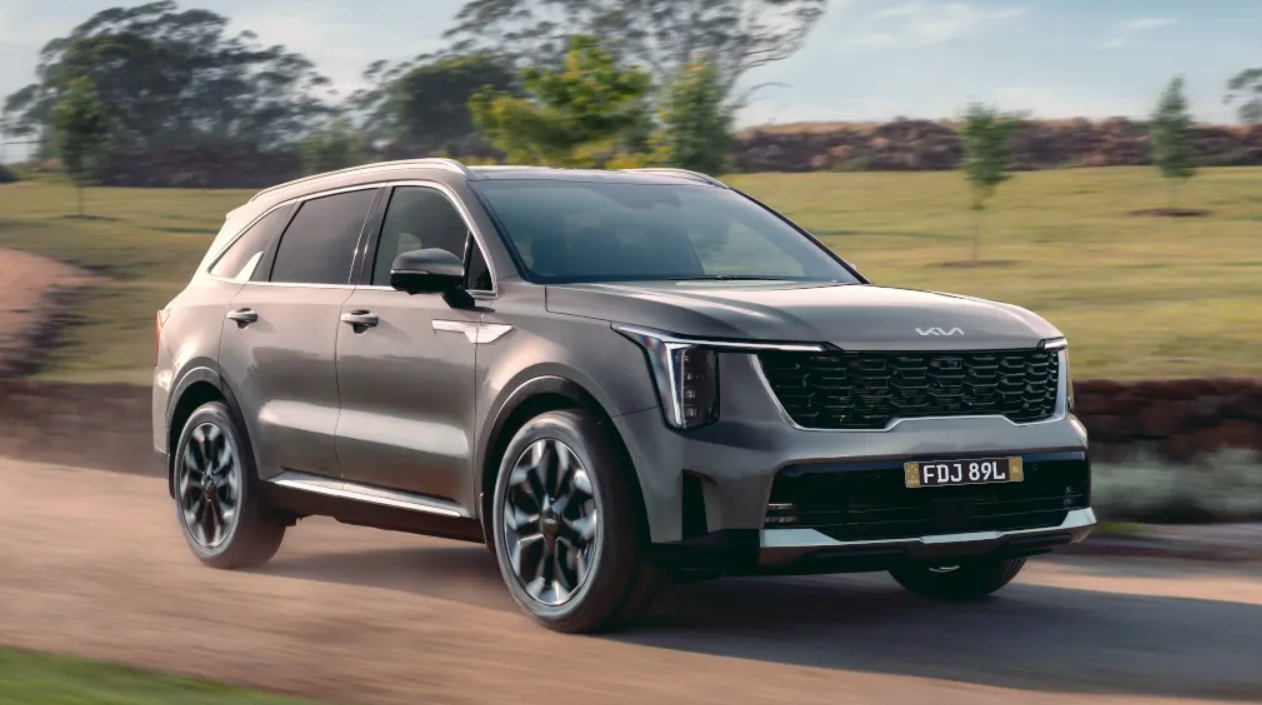
Price: From $70,330 plus on-road costs
Drivetrains/fuel economy/CO2 emissions: 1.6-litre turbo four-cylinder hybrid, 6-speed auto, 169kW/350Nm, 5.4L/100km, 122g/km; 1.6-litre turbo four-cylinder PHEV, 6-speed auto, 195kW/350Nm, 1.6L/100km, 36g/km
Dimensions (length/width/height/wheelbase): 4815/1900/1695/2815mm
Bootspace: 179L (third row up)/608L (third row folded)/1996L (third + second row folded)
Warranty/roadside assistance/service intervals: Seven-year/unlimited, up to eight years,
annual/every 15,000km
Five-year service cost: $3009 (hybrid), $3409 (PHEV)
| Driving | |
| Interior | |
| Practicality | |
| Overall value | |
Things we like
- Both hybrid and plug-in hybrid drivetrains on offer
- Lovely to drive thanks to local tuning
- Well equipped across the range
Not so much
- PHEV is expensive to buy and service
- Hybrids only at the top of the model range
- Third row of seating is not huge
Kia is absolutely killing it at the moment with an impressive line-up that is – deservedly – winning it big sales in Australia. While products such as the new Tasman ute and EV9 electric upper large SUV take all the headlines, the Sorento seven-seat SUV does a lot of heavy lifting in sales – so far this year, it’s Kia’s third-best selling vehicle with over 5000 sold to the end of June. So what’s so good about the Sorento?
Starting at $50,880 plus on-road costs for the entry-level Sorento S with a 3.5-litre petrol V6 and a front-wheel drive drivetrain, the Sorento range offers strong value for money. But we still think that top-spec models are solid value for money thanks to their very long lists of standard kit. While a GT-Line hybrid is around $80,000 drive away, it’s also absolutely loaded with features.
Four drivetrains are available with the Sorento: the aforementioned V6, a 2.2-litre turbo-diesel and two 1.6-litre hybrid options, one a regular hybrid and one a plug-in unit with up to 68km of electric driving range (WLTP). About 80 per cent of buyers in Australia choose the diesel, as it’s punchy, fuel efficient and unlike the V6, is mated to an all-wheel drive system. More would choose the hybrid if it were offered in lower grades, but alas, it’s limited to the top-spec GT-Line for now.
Thanks to Kia’s local ride and handling tuning, the Sorento drives very well for the segment. Its ride quality is tuned well with a taut but comfortable feeling, especially at higher speeds – plus, it handles well for a big seven-seater SUV. Even enthusiasts will be happy from behind the wheel.
The Sorento’s cabin is good quality, with its new infotainment screens – introduced with the mid-life facelift – impressively slick to use and well-featured. Storage space in the front cabin is excellent, with plenty of spots to hide trinkets, and it’s a similarly positive story moving rearward with ample space in the second row and enough space for kids in the third row.
It’s easy to see why the Kia Sorento has become one of the brand’s best selling cars in Australia. It’s covered by a long warranty, it’s great to drive, has a range of models and drivetrains, a lot of standard equipment and a practical interior. More hybrid availability would be great as the petrol V6 is thirsty and diesel fuel isn’t suited to everybody, and the PHEV is expensive. Nevertheless, the Sorento is a great product worthy of strong consideration in this segment.
Chery Tiggo 8 Super Hybrid
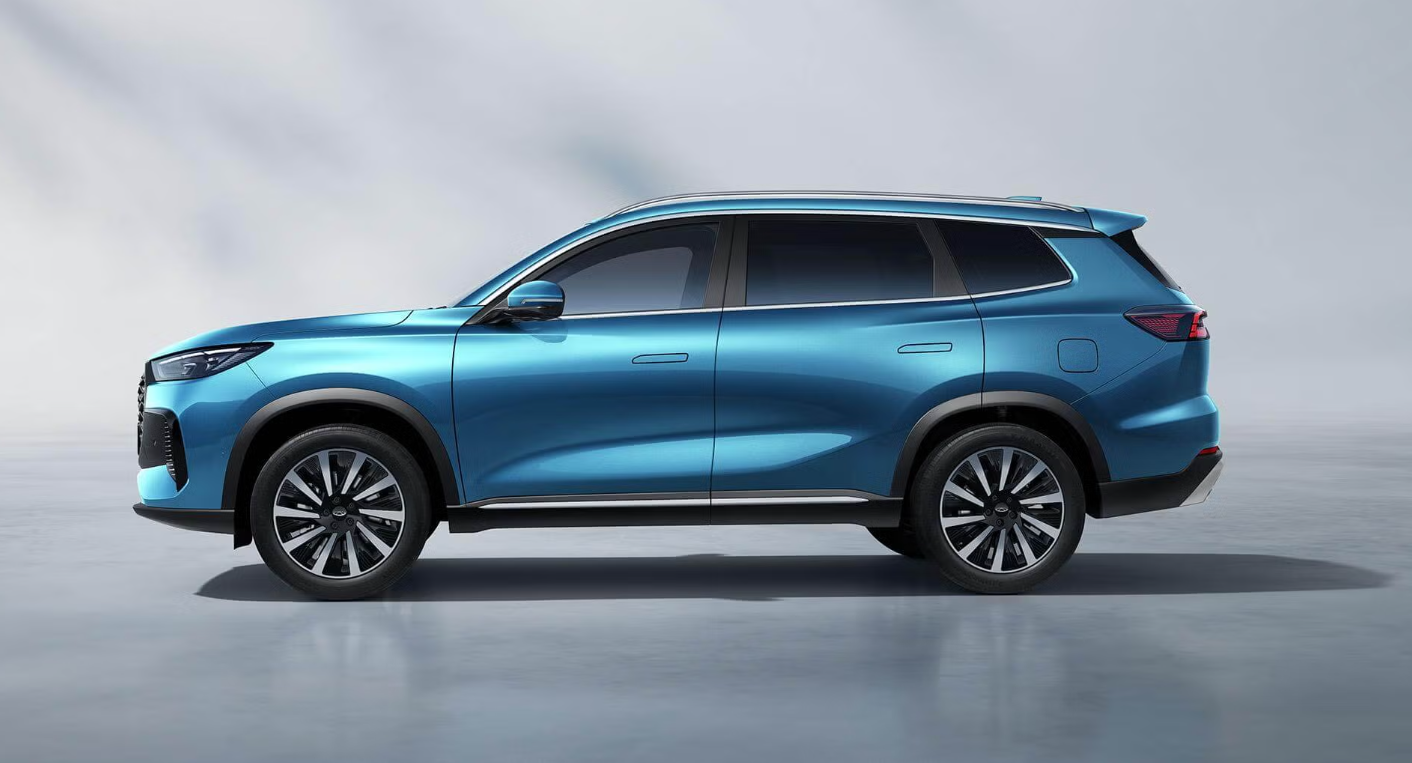
Price: From $45,990 drive away
Drivetrains/fuel economy/CO2 emissions: 1.5-litre turbo four-cylinder plug-in hybrid, 255kW/525Nm, CVT, 1.3L/100km, 30g/km
Dimensions (length/width/height/wheelbase): 4724/1865/1718/2694mm
Bootspace: 117L (third row up), 479L (third row folded), 739L (third + second row folded)
Warranty/roadside assistance/service intervals: Seven-year/unlimited km, 12 months (renewed
with each service up to seven years in total), annual/every 15,000km
Five-year service cost: $1495
| Driving | |
| Interior | |
| Practicality | |
| Overall value | |
Things we like
- Very sharply priced and well equipped
- Two drivetrain choices, both with good performance
- PHEV gives 95km of claimed EV range
Not so much
- Boot and third row aren’t huge
- Suspension and driver aids need finessing
If you’re looking for the ultimate bargain seven-seater large SUV in Australia, look no further than the Chery Tiggo 8 Pro Max. Priced from just $41,990 drive away (or, thanks to a manufacturer’s special, currently $38,990 drive away) the Tiggo 8 Pro Max is excellent value for money and even the entry-level Urban features equipment such as heated and ventilated front seats, a 360-degree camera and a full suite of active safety features.
But there’s more to the Tiggo 8 Pro Max than its low pricing, with a well finished cabin that is comfortable and well featured with tech. A dual 12.3-inch screen set up is easy to use and looks impressive – especially for the price – and the physical buttons located underneath the screen and on the centre console make it easier to use. The Tiggo 8 Pro Max’s cabin is also practical, with ample space in the first and second rows of seating, though the third row is small, as is the boot with all the seats in place. However, with them all folded, it’s quite large.
The Tiggo 8 offers one hybrid drivetrain in Australia: a 255kW 1.5-litre turbo plug-in hybrid, with both providing more than ample performance. The PHEV also offers an impressive 95km of electric driving range before the petrol engine even switches on, and a claimed overall range of more than 1200km.
On the road, the Tiggo 8 Pro Max is quite refined with low road noise levels, though its suspension and active safety features need some finessing. The ADAS systems are over sensitive and the suspension needs more refined damping to better deal with low speed bumps. The steering also lacks feel, but it is perfectly light for urban driving. The 360-degree camera that’s standard across the range is impressively high definition for the price as well.
There’s definitely more to the Chery Tiggo 8 Pro Max than just its excellent value equation thanks to its good quality interior finishes and tech, strong powertrains and refined driving experience. The new plug-in hybrid drivetrain also provides a healthy EV driving range, and over 1200km of total driving range too. It’s not perfect thanks to its small boot and third row, need for finessing of the driver assistance systems and suspension, and thirsty petrol engine. But if you’re after a bargain large SUV, just be assured that there’s much more to the Chery Tiggo 8 Pro Max than just its low pricing and healthy equipment levels.
Mazda CX-80 P50e plug-in hybrid
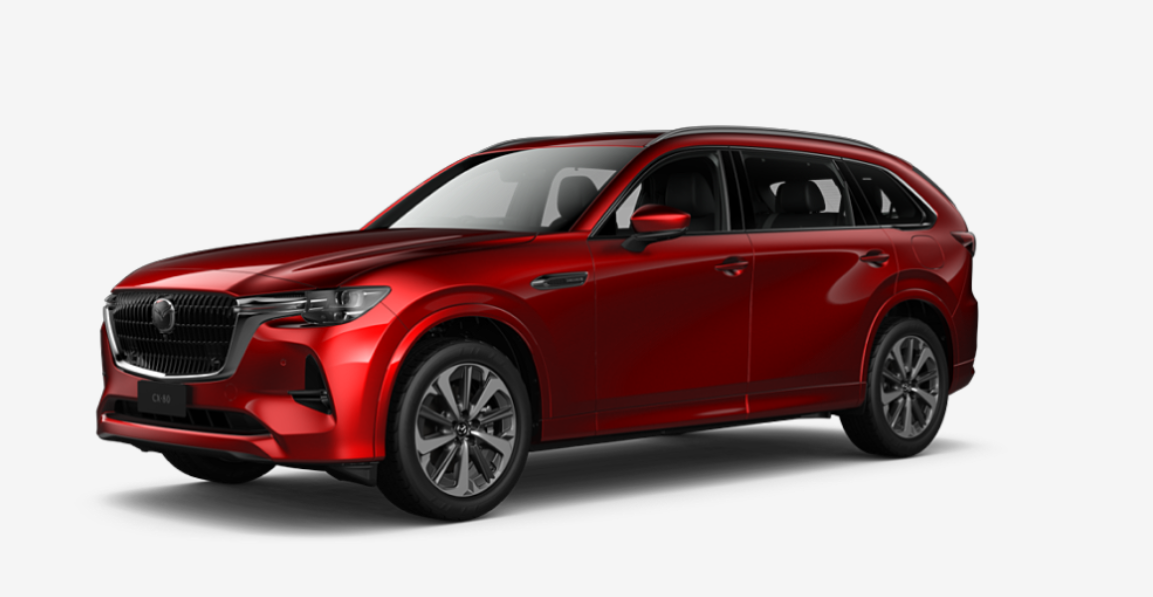
Price: From $76,245 plus on-road costs
Drivetrains/fuel economy/CO2 emissions: 2.5-litre four-cylinder PHEV, 8-speed auto, 245kW/500Nm, 2.7L/100km, 64g/km (P50e PHEV)
Dimensions (length/width/height/wheelbase): 4990/1890/1710/3120mm
Bootspace: 258L (third row up), 566L (third row folded), 1971L (third + second rows folded)
Warranty/roadside assistance/service intervals: Five-year/unlimited km, five years, annual/every
10,000km (diesel) – 15,000km (petrol)
Five-year service cost: $2686
| Driving | |
| Interior | |
| Practicality | |
| Overall value | |
Things we like
- Punchy plug-in hybrid powerplants
- Good value for money
- Excellent cabin quality
Not so much
- Powertrain and ride quality need further refinement
- Expensive service costs
- No spare wheel across the range
Mazda’s new quartet of large SUVs – the CX-60, CX-70, CX-80 and CX-90 – is a worthy group but we think that the CX-80 is the best so far. That’s largely thanks to its value equation – a punchy turbo-six seven-seater large SUV with Mazda build quality priced from under $60,000 has got to be a winner. But it also boasts improved ride quality and refinement over its siblings, which were developed earlier.
Inside the cabin is a carbon copy design of the other models. with good quality across the range and large displays that are easy to use. Comfort is quite good, even in the base model, with cloth upholstery and manually adjustable seats, while the ergonomics are great thanks to liberal use of physical buttons throughout the cabin. The base model Pure’s hard cabin plastics are disappointing, however, and buyers must step up to the Touring model to receive soft ones.
The CX-80’s long wheelbase has produced great results: the second row of seating is huge, and the third row can seats adults comfortably, further helped by amenities back there such as air vents, charging ports and cup holders. The boot is also large, even with the third row of seats in place – though there’s disappointingly no spare wheel in any CX-80 model.
Mazda is offering one plug-in hybrid powertrain for the CX-80, with two mild hybrid petrol and
diesel options also available. Just the petrol ‘G40e’ is offered in the base CX-80 Pure, but every
model above that offers all three drivetrains. The plug-in hybrid is fast and sounds appropriately
raspy and may be more cost effective to run versus other CX-80 drivetrains for you thanks to its
claimed 65km EV driving range, though it is a lot more expensive upfront to buy and it can’t be DC
fast charged, limiting charging appeal.
The driving experience is more positive than its siblings, though the ride quality is a bit too sharp and the gearbox could be more refined as well. Still, at highway speeds it’s very quiet in respect to road noise levels. Drawbacks? Mazda’s five-year warranty could be improved in length, plus it’s not cheap to service, but the Mazda CX-80 is a solid choice in the large SUV segment thanks to its sharp value for money, practical cabin that can seat seven adults comfortably, punchy drivetrains that can also be quite fuel efficient and keen handling for a seven-seat SUV.
Audi Q8 60 TFSI e
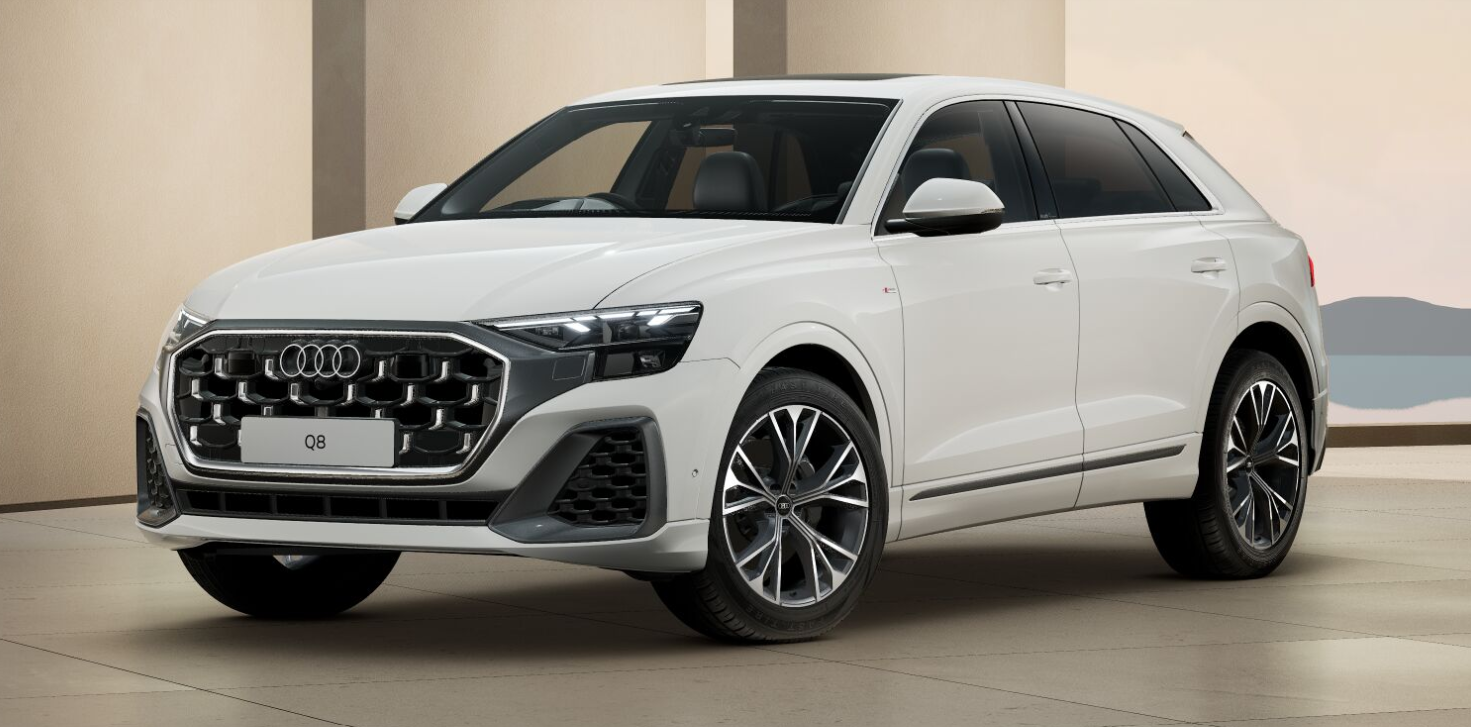
Price: From $154,284 plus on-road costs
Drivetrains/fuel economy/CO2 emissions: 3.0-litre V6 turbo-petrol plug-in hybrid, 360kW/700Nm, 1.8L/100km, 40g/km
Dimensions (length/width/height/wheelbase): 5006/1995/1691/3005mm
Bootspace: 605L (seats up), 1755L (seats down)
Warranty/roadside assistance/service intervals: Five-year/unlimited km, five years, annual/every
15,000km.
Five-year service cost: $3570
| Driving | |
| Interior | |
| Practicality | |
| Overall value | |
Things we like
- PHEV offers strong performance
- Handsome styling, lovely interior
- Spacious despite coupe-like styling
Not so much
- PHEV electric range could be longer
- Feels heavy from behind the wheel
- No seven-seat option available
If you’re searching for a large German SUV, Audi currently has two to offer you: the seven-seat Q7,
or its sexier more coupe-like five-seater Q8 sibling. But considering this is the hybrid section of the
awards, it’s only the Q8 that’s available in Australia with its 360kW V6 plug-in hybrid system – it
used to be available here in the Q7, but was shelved years ago.
Under the bonnet of the Audi Q8 60 is a turbocharged 3.0-litre V6 mated to an electric motor for
360kW/700Nm peak outputs. Thanks to a 17.9kWh battery, the Q8 60 TFSI e offers a claimed 47km of electric driving range (WLTP) and is rated at just 1.8L/100km with the battery full. On the road, the PHEV Q8 feels heavy, more so than its petrol and diesel siblings, thanks to its extra 245kg of weight over the petrol model. Its ride is firm as well, and could be more comfortable.
The cabin of the Q8 is lovely, however. Quality is excellent thanks to rich leather trimmings all over
the dashboard and doors, as well as tactile switchgear and high-resolution displays. The front seats are quite comfortable and feature a lot of adjustment, while visibility is good despite the high belt line.
Thanks the use of the Q7’s platform, the Q8 is spacious for four adults and five will be fine as well.
Three adults will be fit fine across the Q8’s wide rear bench, and both leg- and headroom is fine.
The boot of the Q8 measures a large 605 litres with the seats up and a massive 1755L with them
folded.
The Audi Q8 60 TFSI e presents a tempting hybrid large SUV thanks to its excellent performance, reasonable EV driving range, lovely cabin, ample practicality and handsome styling. Counting against it are a heavy driving feel thanks to the extra weight of the PHEV system, that it’s not cheap and that it’s not available with seven seats, which some buyers might expect for the price.
BMW X5 xDrive50e
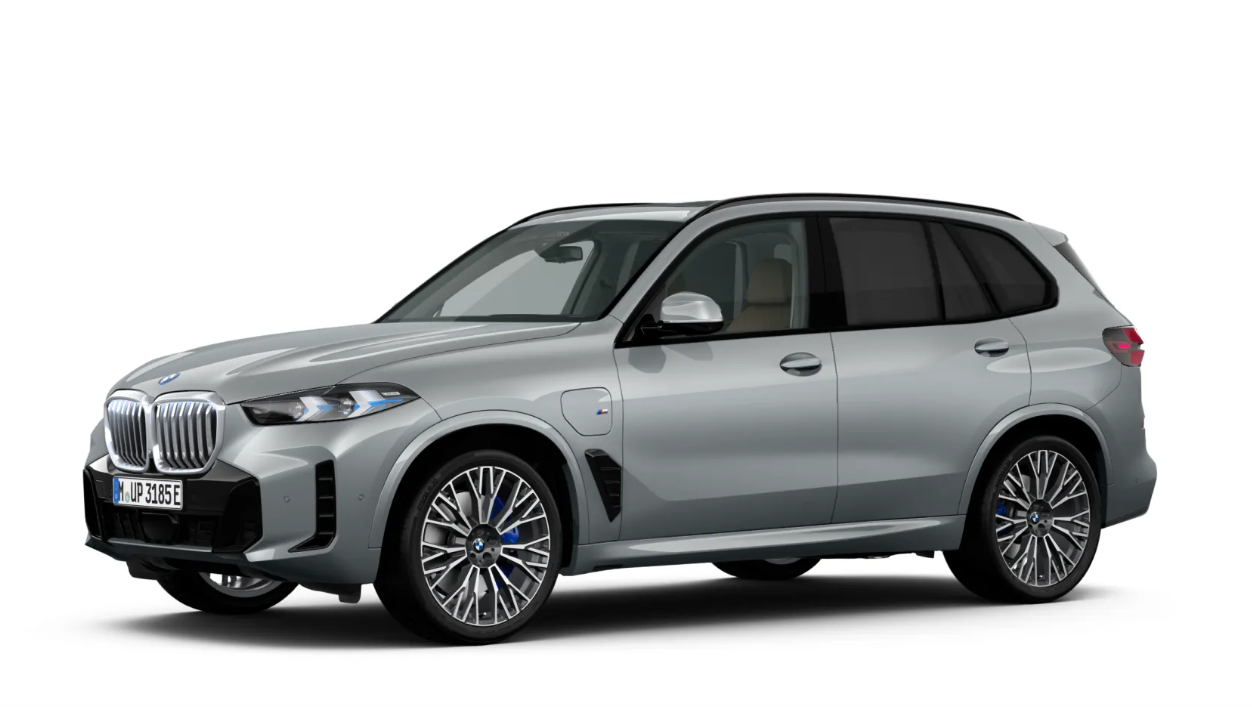
Price: From $153,600 plus on-road costs
Drivetrains/fuel economy/CO2 emissions: 3.0L six-cylinder turbo plug-in hybrid, 8-speed auto, 360kW/700Nm, 1.9L/100km, 41g/km
Dimensions (length/width/height/wheelbase): 4935/2004/1755/2975mm
Bootspace: 500L (seats up), 1720L (seats folded)
Warranty/roadside assistance/service intervals: 5-year/unlimited km, three-years, annual/every
15,000km
Five-year service cost: $3275
| Driving | |
| Interior | |
| Practicality | |
| Overall value | |
Things we like
- The regular SUV dynamic benchmark
- Wide range of powertrains
- Excellent refinement
Not so much
- Third row of seats an expensive option
- Much more expensive than it used to be
- Ordinary steering feel
If you want the definition of a sales success, the BMW X5 is a good place to start. Since its debut in 1999, the company has sold over three million of them, including 75,000 in Australia. In some places, X5s are very common, and that’s easy to see why: for many buyers, it was the default large premium SUV and until the Porsche Cayenne came along, it was the only SUV that real drivers would want to go near.
Nowadays, the smaller X3 is the most popular BMW product worldwide – and that’s no surprise given that it’s larger than the first X5 was – but there’s still plenty to like in its larger sibling. If you’re looking for a driver’s SUV, the X5 is one of the best; even the entry-level 30d just handles in a way that so many competitors cannot match. The BMW of SUVs, if you will.
The range of engines is great as well, with the entry-level petrol and diesel sixes refined and punchy, the plug-in hybrid can cover a long 94km on electric power (WLTP) and the V8 used in both the M60i and full fat M Competition is very fast. All use an eight-speed automatic transmission and BMW’s ‘xDrive’ all-wheel drive system.
The cabin of the X5 is excellent quality, with expensive-feeling materials used throughout. The central touchscreen dominates the cabin experience and while it could be easier to use, screen quality is excellent and it’s very well featured with the usual wireless smartphone mirroring, sat-nav with live traffic and live services such as weather and an app store.
If you’re searching for a large SUV that’ll leave you smiling with every drive, the BMW X5 is a great option. Its driving dynamics are excellent in the segment, and its performance – regardless of model chosen – is impressive. The cabin quality is superb and filled with useable tech, though it doesn’t have a third row of seating as standard. If you can afford it, the BMW X5 is still one of the best large SUVs, just as it was all those years ago.
Land Rover Range Rover Sport P460e
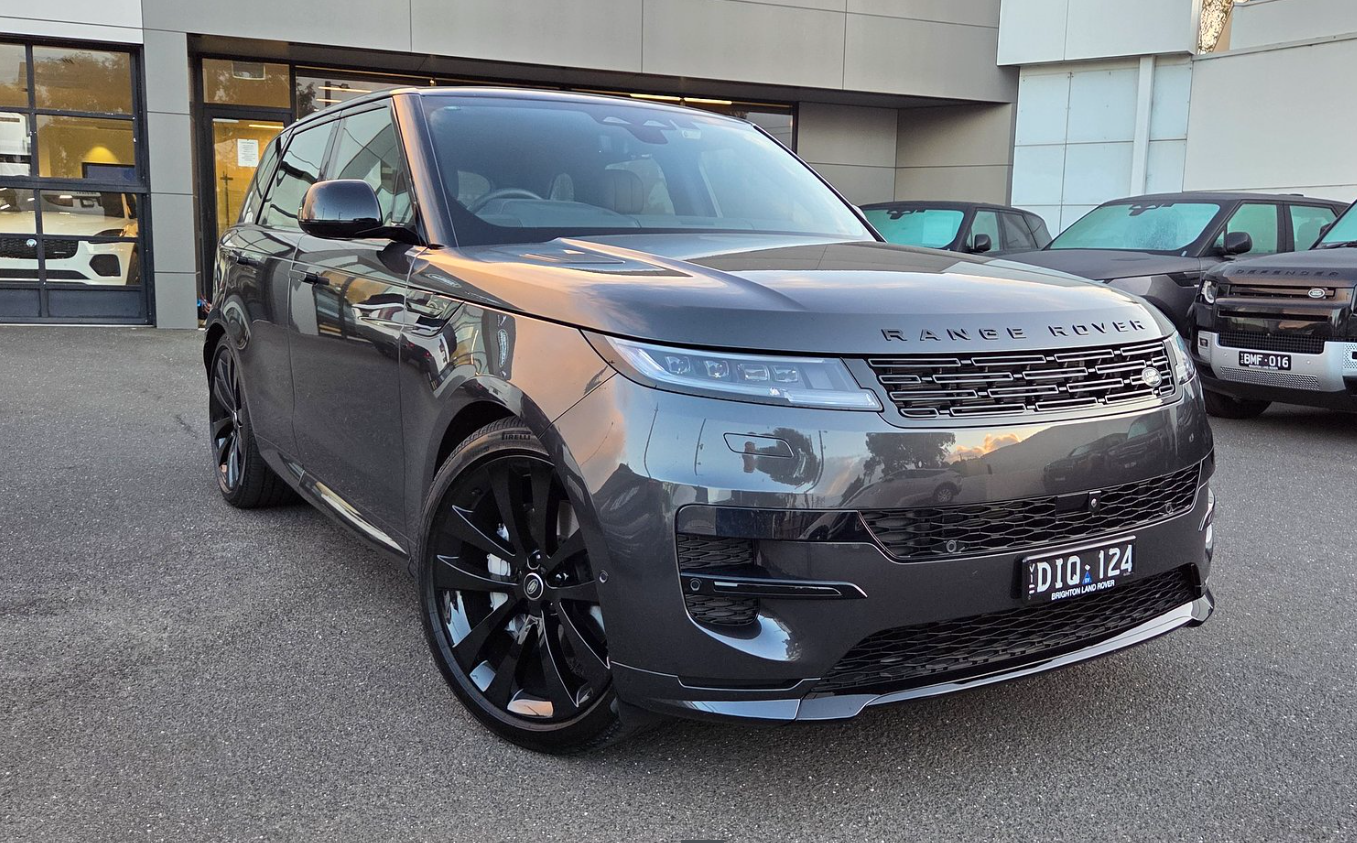
Price: From $181,018 plus on-road costs
Drivetrains/fuel economy/CO2 emissions:
3.0L turbo inline six PHEV, 8-speed auto, 338kW/660Nm, 1.6L/100km, 38g/km
Dimensions (length/width/height/wheelbase): 4970/2025/1814/2998mm
Bootspace: 835L (seats up), 1860L (seats folded)
Warranty/roadside assistance/service intervals: Five-year/unlimited km, five years, annual/every
30,000km
Five-year service cost: $3900
| Driving | |
| Interior | |
| Practicality | |
| Overall value | |
Things we like
- Luxury feel inside, amazingly comfortable
- PHEV’s solid EV range
- Very capable on and off-road
Not so much
- Seven seat option no longer available
- Not cheap and options push the price even higher
- 2.7-tonne weight can be felt when driving
With over two million sales to date, the Range Rover Sport has been a sales phenomenon for its
maker and the third generation is the most talented version yet. There’s a wide range of engine
choices, from the entry-level 3.0-litre turbo-diesel to the high-performance V8 in the SV models, but
the P360e plug-in hybrid is the only drivetrain that offers zero emissions driving capability.
Pairing a turbocharged 3.0-litre inline six petrol engine with a 160kW electric motor, the drivetrain
makes 338kW/660Nm outputs for a claimed 5.4-second 0-100km/h sprint. Yet thanks to its 38.2kWh battery, the Range Rover Sport P360e is capable of a claimed 126km of electric driving
range (WLTP), and it can be DC fast charged up to 50kW for a full charge in under an hour.
On the road, the Range Rover Sport P360e gives a good dual personality: it can waft along in
typical Range Rover fashion, but thanks to its adaptive air suspension, can hunker down to
become something much sportier for a backroad blast. Choose the optional Stormer Handling
Package and rear-wheel steering is added for even sportier handling. Yet, again as you’d expect
for a Range Rover, its off-road capability is awesome and it can go pretty much anywhere.
The interior of the Range Rover Sport, as you’d expect for a Range Rover, is sumptuous and
leather-lined. Its new 13.1-inch ‘Pivi Pro’ is fully featured, even with live services and inbuilt apps
such as Spotify, and its screen quality is very high resolution. The front seats are insanely
comfortable and 22-way electric adjustment, while rear seat and boot space is impressive at 835
litres with the rear seats up and 1860 litres with the rear seats folded. Those upgrading from the
previous Range Rover Sport will note that there’s unfortunately no longer a seven-seat option.
If you’re after a vehicle that can quite literally do it all with a luxurious and practical cabin, the
Range Rover Sport P360e is a great option – for a price. It provides 126km (WLTP) of electric
driving range, quick charging, strong performance, a luxurious driving experience that can turn
sporty or insanely off-road capable at the touch of a button and handsome styling. It’s not cheap,
nor is it a lightweight, but that’s no surprise given just how much it can do.
Land Rover Defender 110 P300e
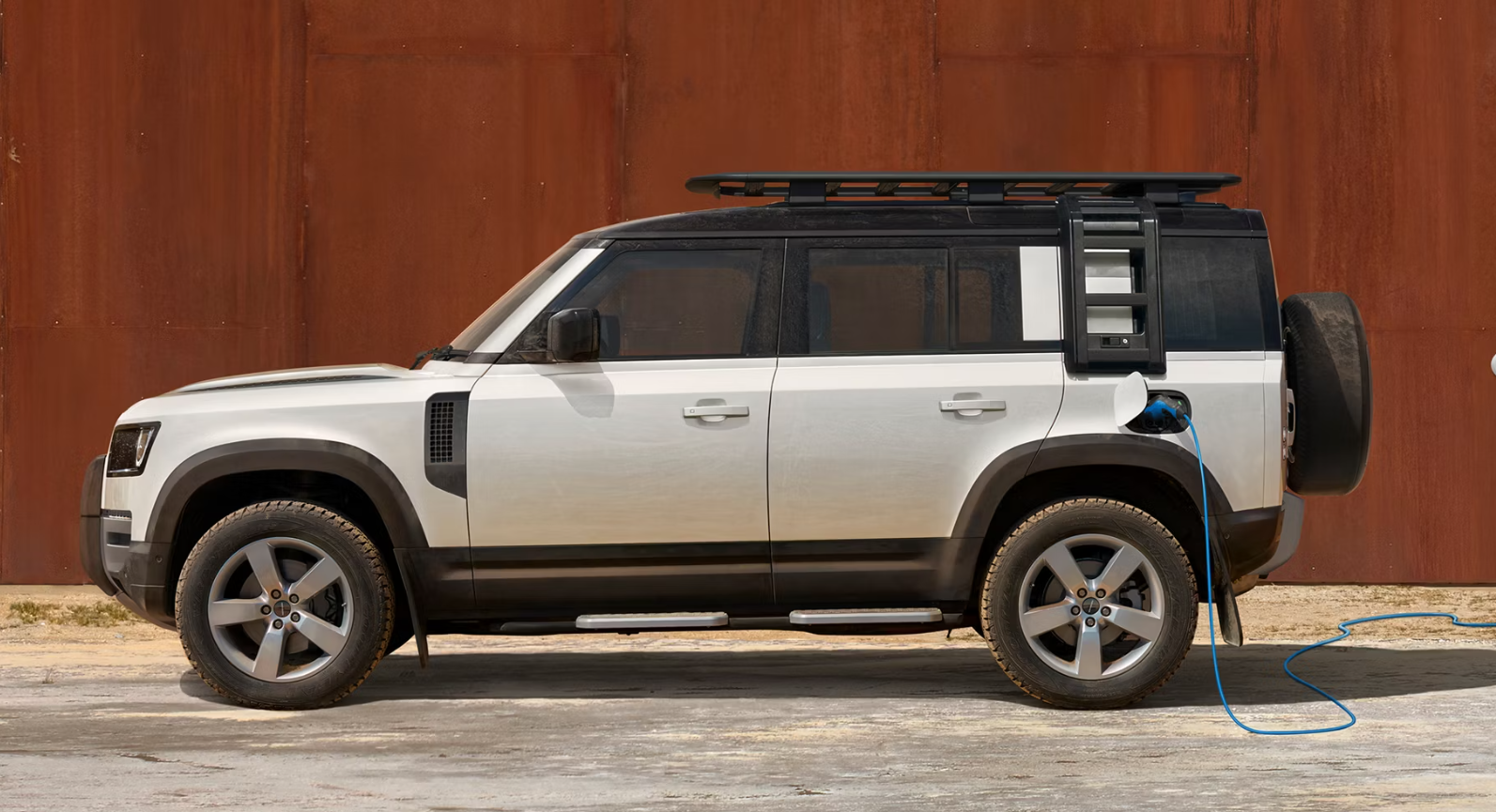
Price: From $131,100 plus on-road costs
Drivetrains/fuel economy/CO2 emissions: 2.0L turbo four-cylinder PHEV, 8-speed auto, 221kW/625Nm, 3.4L/100km, 78g/km
Dimensions (length/width/height/wheelbase): 5035/1996/1970/3022mm
Bootspace: 1075L (seats up), 2380L (seats folded)
Warranty/roadside assistance/service intervals: Five-year/unlimited km, five years, annual/every
20,400km
Five-year service cost: $3300
| Driving | |
| Interior | |
| Practicality | |
| Overall value | |
Things we like
- Fashionable handsome design
- Spacious and practical cabin
- PHEV has good electric driving range
Not so much
- PHEV can’t be had with optional third row of seats
- Gets expensive with options
- Tailgate opens sideways and not upwards
With almost 2500 sold this year alone in Australia to the end of July, the Land Rover Defender
range has given a big boost to the brand’s fortunes globally and it’s easy to see why as it’s very in
vogue. Just look at it: it’s funky, stylish and very fashion-forward. Yet, unlike a lot of cars aimed at the more fashionable among us, there’s significant depth to the Defender’s abilities. Which is no
doubt part of the reason as to why it’s so popular.
As you’d expect for a Land Rover product, the Defender’s off-road ability is one of the best on the
new car market with plenty of off-road features to help once the going gets tough, including
multiple driving modes and a low-range transfer case. Yet on the road, the Defender is pleasant to
drive and even in the least powerful models, the drivetrains are silky smooth– or quite rapid, in the
case of the V8 models like the wild P635 Octa.
The interior of the Defender is a bit more utilitarian than the flashy exterior might suggest, but it’s
very practical with a huge centre console area with plenty of storage options. The central
touchscreen features the brand’s latest ‘Pivi Pro’ software and is easy to use. Rear seat space is
impressive, though less so if the third row is optioned – if you’re likely to carry passengers back
there often, we’d suggest the longer Defender 130 or its Discovery sibling.
Land Rover covers the Defender range with a five-year/unlimited km warranty and a five-
year/102,000km service plan cost ranges from $3300 to $3900, depending on the drivetrain. It’s
easy to see why the Land Rover Defender is just so popular globally: in addition to being a
fashionable item that’s a ‘must have’, it’s got a broad range of talent from its refined driving
experience, practical cabin, excellent off-road ability and wide range of drivetrains. It’s not cheap to
buy in any form – let alone the higher-end models – but that’s clearly no issue as they’re quite
popular, and it’s easy to see why.
Lexus RX
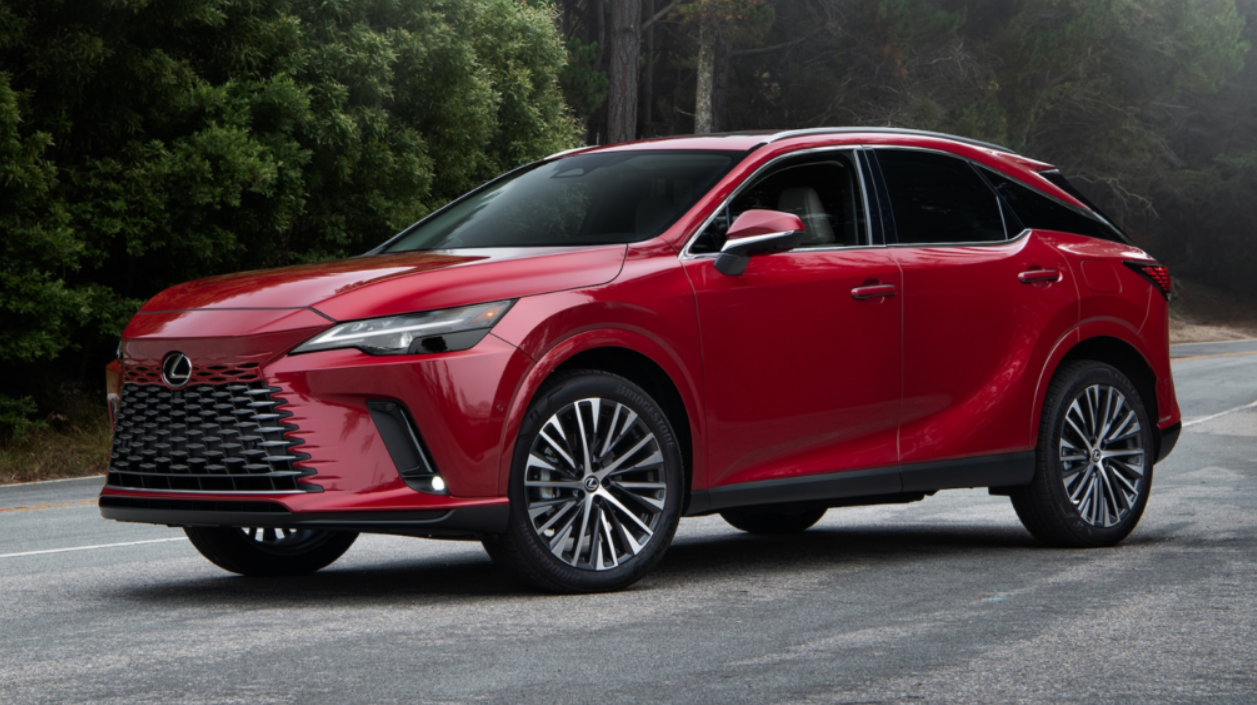
Price: From $93,285 plus on-road costs
Drivetrains/fuel economy/CO2 emissions: 2.5-litre four-cylinder hybrid, CVT, 184kW, 5.0L/100km, 114g/km (RX350h); 2.5-litre four-cylinder PHEV, CVT, 227kW, 1.3L/100km, 29g/km (RX450h+); 2.4-litre four-cylinder turbo hybrid, 273kW, 6.5L/100km, 148g/km (RX500h)
Dimensions (length/width/height/wheelbase): 4890/1920/1695/2850mm
Bootspace: 612L (seats up), 1678L (seats folded)
Warranty/roadside assistance/service intervals: Five-year/unlimited km, three years, annual/every
15,000km
Five-year service cost: $3475
| Driving | |
| Interior | |
| Practicality | |
| Overall value | |
Things we like
- Relaxing to drive, very comfortable
- Fabulous seats
- Excellent refinement
Not so much
- Interior design and quality could be better
- Vague steering feel
- Big model range can confuse
The Lexus RX, originally launched globally in 1998, is the brand’s most popular model ever with over 3.5 million produced. Signficantly, the first RX was less expensive to buy than the German competition, yet loaded with standard equipment – an MO that has made Lexus very popular globally.
The current shape RX is the fifth generation of the badge, and is the biggest model yet. Longer, wider and lower than the previous model, the RX offers four drivetrains, with hybrid (RX350h and RX500h), plug-in hybrid (RX450h+) and turbo-petrol (RX350) variants all on offer. Prices start at $93,285 plus on-road costs for the entry-level RX350h Luxury, rising to $130,950 +ORC for the top-spec RX500h F Sport Performance, which are all quite a lot less than the BMW X5 or Mercedes-Benz GLE.
Like parent company Toyota, hybrids are a big focus with Lexus and in the RX range, regular hybrid, turbocharged hybrid and new plug-in hybrid drivetrains are available. Most buyers will choose the 184kW RX350h, with its combined fuel consumption of just 5.0L/100km, but even the powerful 273kW RX500h uses just 6.5L/100km on the combined cycle.
On the road, the RX range is relaxing to drive, with excellent refinement and a comfortable ride, even with the 21-inch wheels on more expensive models. The RX’s cabin is also very refined, and makes for a strong first impression with lovely seats and excellent quality, though search further and you’ll find some cheaper plastics on the doors and lower centre console. Screen quality, however, is excellent and easy to use, and the two-row RX is spacious.
Good value for money, refined driving experience, spacious cabin and wide range of powerplants, including lots of in-vogue hybrid choice – it’s easy to see why it’s a popular model. Add in the service, reliability and resale value that the brand is known for, and the Lexus RX remains a solid large SUV choice.
Toyota Kluger
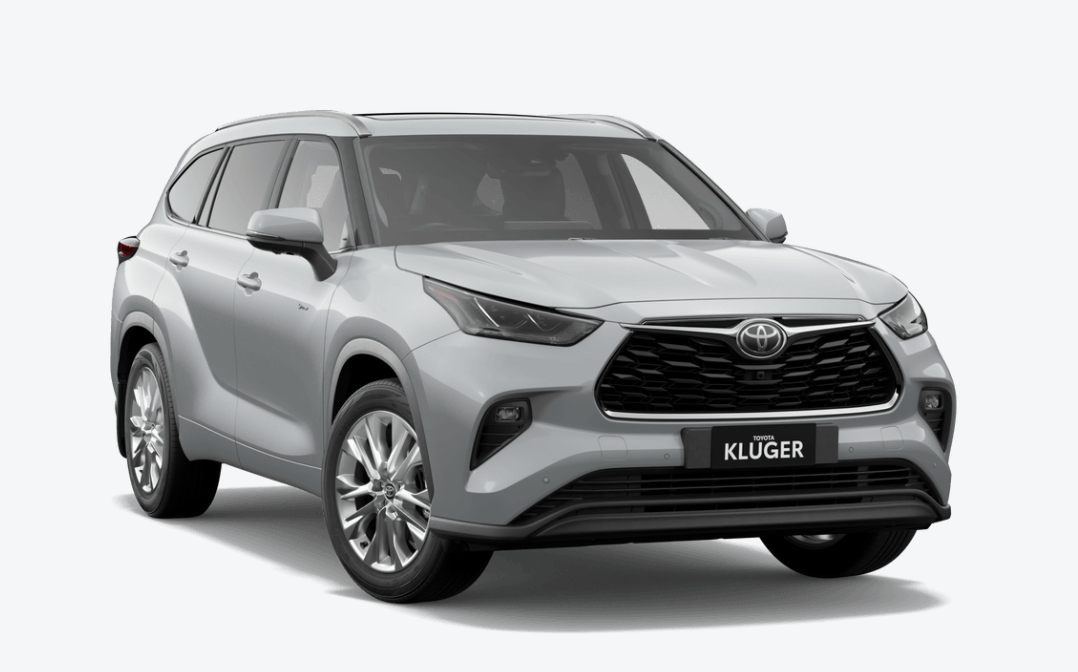
Price: From $62,410 plus on-road costs
Drivetrains/fuel economy/CO2 emissions: 2.5-litre four-cylinder hybrid, CVT auto, 184kW,
5.6L/100km, 128g/km
Dimensions (length/width/height/wheelbase): 4966/1930/1755/2850mm
Bootspace: 241L (third row up), 1150L (third row folded)
Warranty/roadside assistance/service intervals: Five-year/unlimited km, no roadside assistance,
annually/every 15,000km
Five-year service cost: $1400
| Driving | |
| Interior | |
| Practicality | |
| Overall value | |
Things we like
- Excellent hybrid drivetrain and efficiency
- Relaxing to drive
- Well equipped
Not so much
- Third row feels small thanks to tiny windows
- Expensive throughout the range
- Cabin quality could be better
The Toyota Kluger has been one of the best-selling seven-seat SUVs in Australia since it first
landed in Australia in 2003 and now in its fourth generation, that popularity has not slowed down.
Prices start at $62,410 plus on-road costs for the entry-level GX and rise to more than $90,000
once on-road costs are included. Three models are available: GX, GXL and Grande.
While it launched with a 3.5-litre petrol V6 and a 2.5-litre hybrid drivetrains, the V6 was replaced
with a torquier 2.4-litre turbo petrol, but nowadays the hybrid is the only available option. It provides
ample grunt with 184kW on offer, but also excellent fuel consumption at a claimed 5.6L/100km. All
new Kluger models in Australia are equipped with an all-wheel drive system.
On the road, the Kluger is extremely comfortable with a soft suspension set up that gives it an
excellent ride quality. It’s quite easy to drive, with quick steering and good visibility, and all the
controls are well weighted. The front cabin is quite practical with ample storage space, though
material quality is a bit lacklustre, especially in the top-spec Grande.
Third row seating could be better as well. Access is excellent thanks to the sliding middle seat, but
there are no child seat points in the rear and the small windows make it feel smaller than it is. The
second row is huge, however, and three adults will be more than comfortable. Amenities include a
third climate zone, air vents, map pockets and large door pockets.
Competition is tough, but the Toyota Kluger’s practicality, low running costs, ample performance
from its hybrid powertrain and comfortable driving experience continue to win it many fans in
Australia. The next generation of Kluger is likely not far off, and we’re hoping it has a more
spacious feel and higher quality materials inside, but the current model is still a great family car.
Nissan has revealed the mid-life facelift for its X-Trail mid-size SUV, with a range of minor styling tweaks, upgraded interior materials, a new infotainment system with Google inbuilt and – for the Japanese domestic market only – a sporty-looking new Nismo model.
The facelift for the X-Trail follows the North American market Rogue from almost two years ago, which focused on light styling changes, added tech and higher quality interior materials. The bumper and wheel designs have been revised for a fresher look, and in Japan at least, a new Rock Creek variant has been added as a more off-road friendly X-Trail.
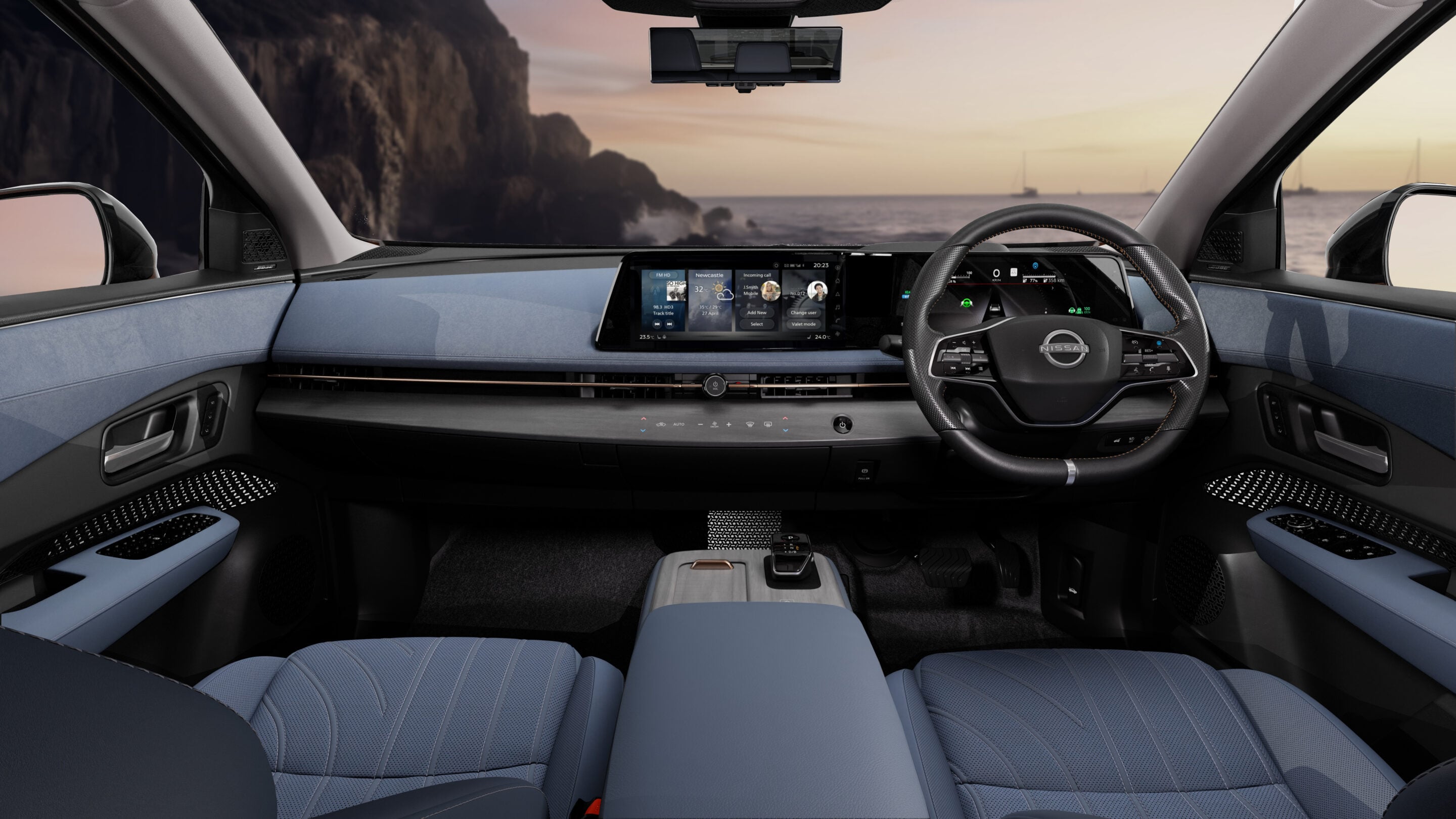
On the inside of the facelifted X-Trail are higher quality trims such as the tan Nappa leather upholstery, a new steering wheel and more tech features such as a 12.3-inch touchscreen using a new Google infotainment system with live services and Google Maps navigation. USB-A ports have been replaced with faster-charging USB-C units and the 360-degree camera now features a ‘see through’ mode to aid with parking.

Japan and US-spec X-Trails use a turbocharged three-cylinder engine, though Australian models are likely to continue with a naturally aspirated 2.5-litre four and 1.5-litre turbo-petrol hybrid options, both using a CVT automatic transmission.
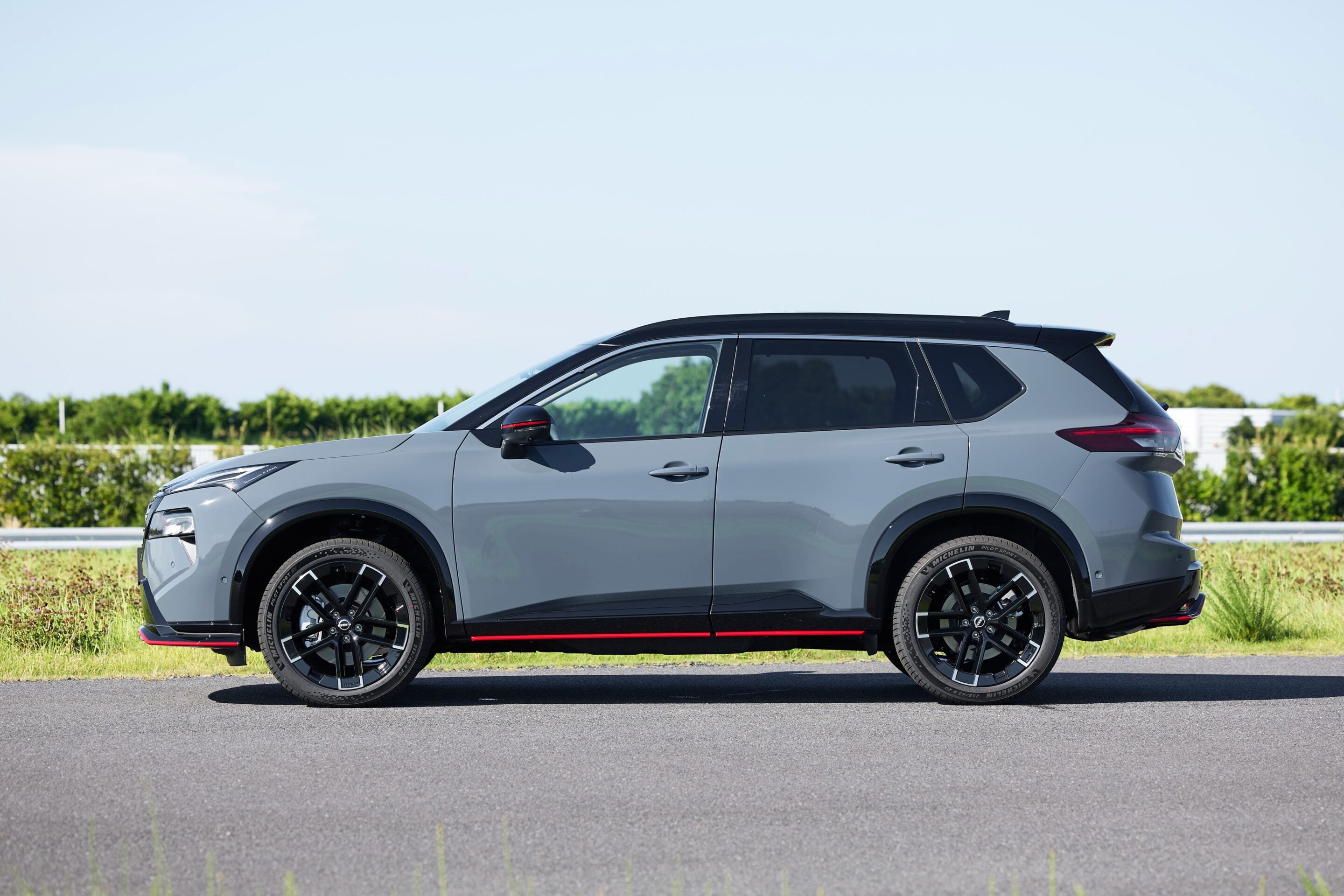
Based on the X-Trail e-Power hybrid, a new Nismo variant of the X-Trail range was also revealed and it features a range of handling and styling tweaks. On the outside, the dark chrome grille, redesigned bumpers and new 20-inch Enkei wheels give a sportier look, while suspension changes include the use of ‘Kayaba Swing Valve’ dampers.
The X-Trail’s ‘e-4orce’ all-wheel drive system has also been retuned for the Nismo with increased input from the rear axle motor for sportier handling, while drivers can choose the front-rear torque balance manually to suit their tastes.
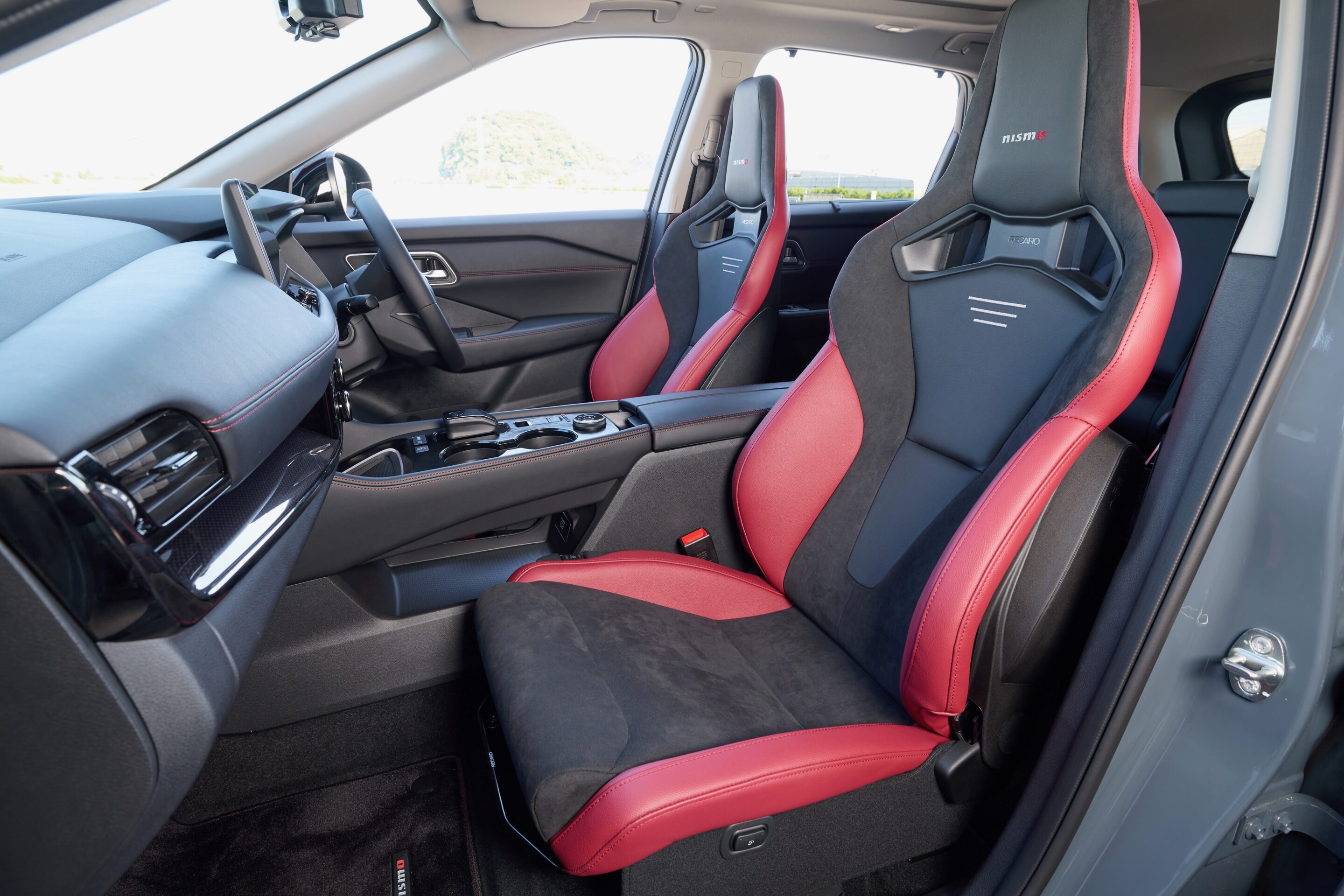
On the inside, the X-Trail Nismo uses a black and red colour scheme similar to the Z Nismo, with red stitching, trim pieces and even a red starter button. Optional Recaro sports seats will also be available for an extra sporty feel on the inside.
No performance increases have been mentioned by Nissan, so the X-Trail Nismo likely continues with the same 157kW turbocharged three-cylinder 1.5-litre engine and dual electric motor ‘e-Power’ hybrid set up as other hybrid X-Trail models.
Nissan Australia is yet to confirm local timing for the facelifted X-Trail, though it’s likely to arrive
sometime in 2026.
Contenders
Winner – Volvo EX90
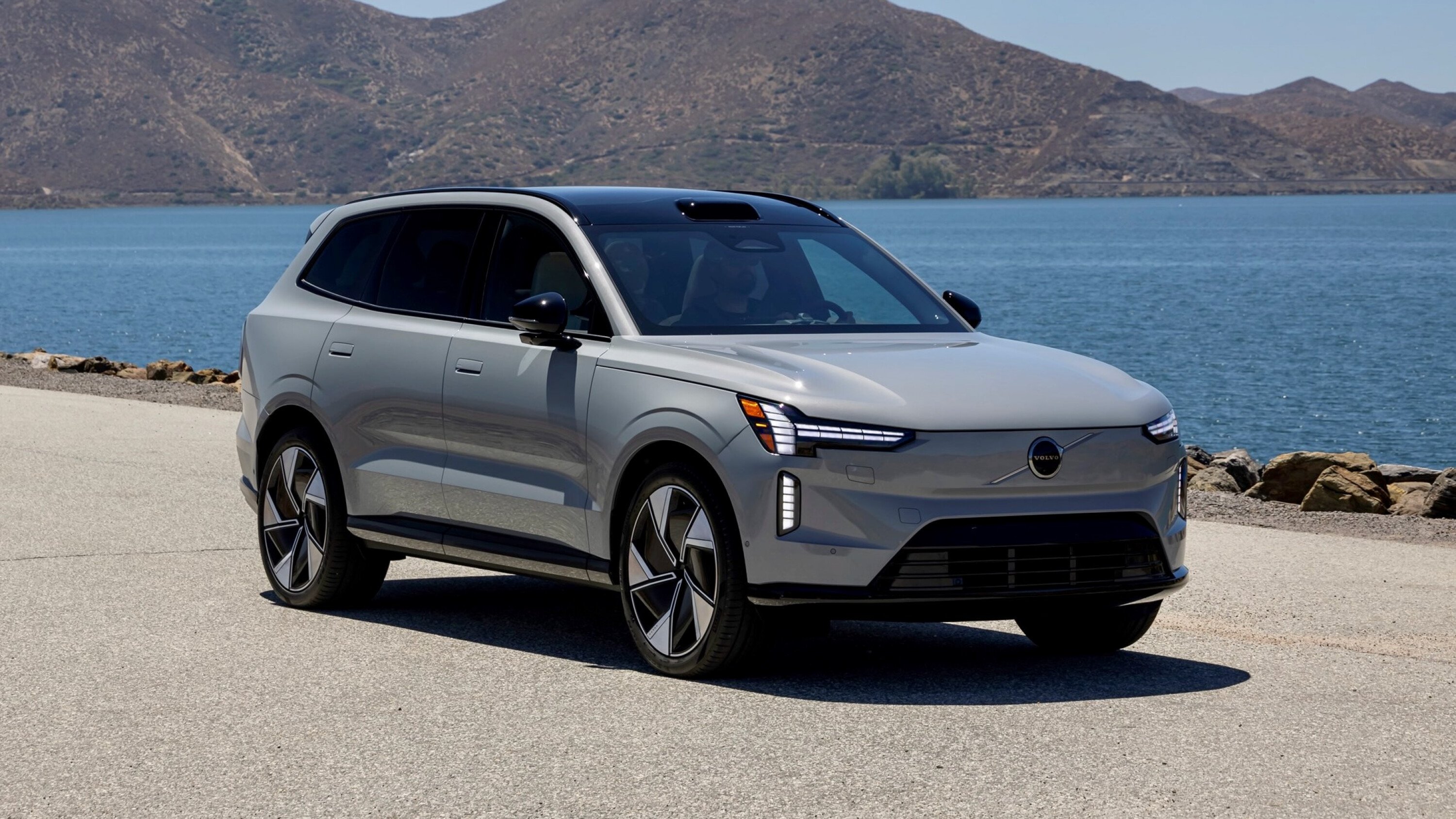
Price: From $124,990 plus on-road costs
Battery size/claimed range: 111kWh/570km (NEDC)
Drivetrain: Dual-motor electric, 300kW/770Nm (Twin) 380kW/910Nm (Performance)
Dimensions (length/width/height/wheelbase): 5037/1964/1747/2985mm
Bootspace: 324L (third row up), 697L (third row folded), 2135L (third + second row folded) + 46L front boot
Warranty/roadside assistance/service intervals: Five-year/unlimited km, five years (extendable up to eight years in total), annually/every 15,000km
Five-year service cost: included in the cost of the car
| Driving | |
| Interior | |
| Practicality | |
| Overall value | |
Things we like
- Interesting cabin and materials
- Very practical, as you’d expect for a Volvo
- Competitive performance and range
Not so much
- XC90 offers a cleverer interior
- Not cheap to buy
- Too much functionality controlled through the central screen
For a brand that was once only known for its boxy wagons, Volvo is doing big business from its SUV range nowadays. In fact, in Australia at least, it now only offers SUVs with its S60 and V60 Cross Country models now no longer available to order. The EX90 is the latest Volvo SUV offering in our market and it’s quite similar to the popular XC90 but for one crucial detail: it’s electric.
Available in two models with a single 111kWh battery for the moment, the EX90 provides the XC90’s excellent acceleration but with a silent drivetrain. A dual-motor set up is standard, with either 300kW/770Nm outputs in the entry-level Twin or an even stronger 380kW/910Nm in the upper-spec Performance. Range? That’s up to a claimed 570km (NEDC), or more than enough to quell any range anxiety. The EX90 is also capable of handling up to 250kW DC charging for a claimed 10-80 per cent charge time of 30 minutes.
With its standard adaptive dual-chamber air springs and adaptive damping – at least in Ultra Performance guise – the EX90 proves surprisingly adept at tackling whatever the road conditions throw at it, even when riding on 22-inch wheels. The dampers offer soft and firm settings, but even in firm mode, the EX90 is still quite comfortable. The EX90’s cabin quality is elevated, with tactile finishes, slick digital screens that control everything to do with the car, subtle light-coloured wood inlays and synthetic leather upholstery neatly combining classy tech with textural warmth.
As you’d expect for a Volvo product, the EX90 is extremely practical and capable of holding seven adults with more than enough space in each row, though not quite as much as an XC90. Behind the third row lies 342 litres of bootspace, which opens up to a massive 2135 litres with both the second and third rows folded.
Among fully electric options in this segment, we feel the Volvo EX90 is the most likeable and best realised, from its huge interior, lovely driving experience and keen performance to its above average charging capability and impressive interior finishes. There is perhaps too much functionality controlled through the touchscreen, and some of the interior finishes aren’t quite to the high standard of the XC90. But overall, Volvo’s first electric large SUV is well engineered and beautifully executed.
Kia EV9
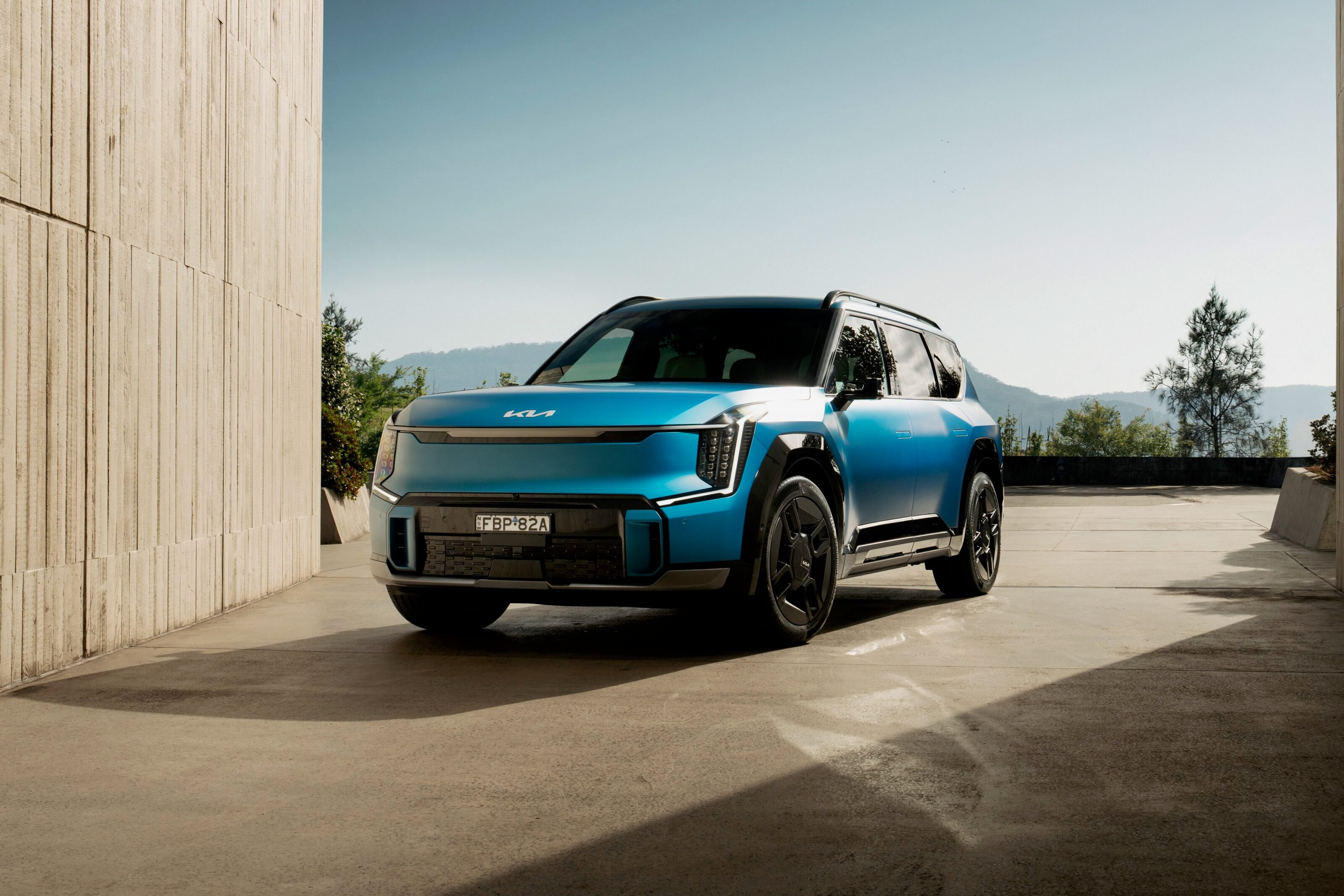
Price: From $97,000 plus on-road costs
Battery size/claimed range: 76.1kWh, 443km (Air); 99.8kWh, 512km (Earth)/505km (GT-Line)
Drivetrain: Single motor (Air), 160kW/350Nm; Dual motor (Earth and GT-Line), 283kW/700Nm
Dimensions (length/width/height/wheelbase): 5010-5015/1980/1755-1780/3100mm
Bootspace: 333L (third row up)/828L (third row folded)/2318L (third + second row folded)
Warranty/roadside assistance/service intervals: Seven-year/unlimited, up to eight years, annual/every 15,000k
Five-year service cost: $1351
| Driving | |
| Interior | |
| Practicality | |
| Overall value | |
Things we like
- Huge cabin carries seven with ease
- Excellent charging speed performance
- Loaded with equipment
Not so much
- No spare wheel
- Not cheap to buy
- Some interior trims could feel more special
Kia shocked us when it launched the EV9 upper large electric SUV in late 2023. Its futuristic styling, comfortable driving experience and hugely practical cabin give it massive appeal among large SUVs with seven seats, which is still a rarity for electric vehicles.
Thanks to the EV9’s size and clever packaging, even the third row of seating can comfortably carry adults with plenty of room and amenities such as air vents, charging ports and cup holders. The windows are large so that it doesn’t feel claustrophobic and it features both top tether and ISOFIX points for child seats. Moving forward, the second row is even larger with palatial legroom and enough width for three adults to sit comfortably. In the front, there’s plenty of storage space, comfortable seats and great visibility.
Even in entry-level Air trim, the EV9 achieves a solid driving range, with a claimed 443km (WLTP) achievable, though that increases to over 500km in higher-spec models thanks to a larger 99.8kWh battery. The e-GMP platform the EV9 uses offers some of the highest DC fast charging speeds on the market, with a 10-80 per cent charge achievable in a maximum of 24 minutes.
Thanks to Kia’s local tuning program, the driving experience of the EV9 is very comfortable, and it tackles bad roads with ease, despite the large wheels. It’s also very quiet, thanks to ample noise insulation, and is surprisingly fun from behind the wheel – especially in GT-Line form, with the high-performance GT yet to arrive in Australia.
All things considered, the Kia EV9’s quick charging, ample range and performance stats, huge and comfortable cabin, and satisfying driving experience make it a strong contender in this category.
BMW iX
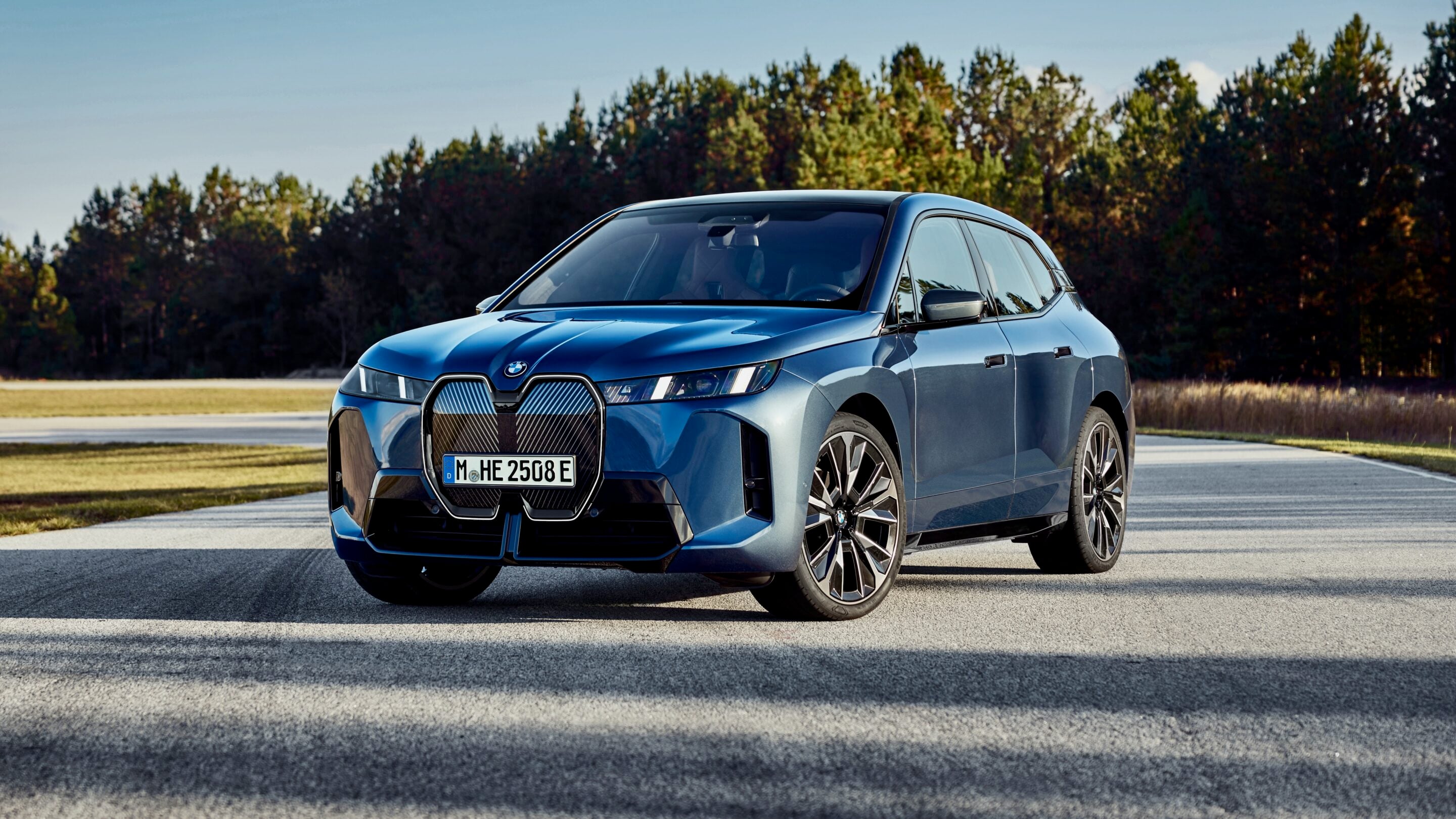
Price: From $142,900 plus on-road costs
Battery size/claimed range: 94.8kWh/602km (WLTP)
Drivetrain: Dual-motor AWD, 300kW/700Nm
Dimensions (length/width/height/wheelbase): 4965/1970/1695/3000mm
Bootspace: 500L (seats up), 1750L (seats folded)
Warranty/roadside assistance/service intervals: 5-year/unlimited km, three-years, annual/every 15,000km
Six-year service cost: $3475
| Driving | |
| Interior | |
| Practicality | |
| Overall value | |
Things we like
- Excellent comfort and refinement
- Loaded with tech that works well
- Stonking performance, awesome claimed range
Not so much
- Minimalist interior may look cheap to some
- Average charging speed
- Only one model available currently
It’s been on sale in Australia for almost four years now, but we’re still not used to the BMW iX’s styling. Online comments suggest its a divisive appearance but for those of us who look beyond a car’s styling, the iX fits the bill in other areas as a large SUV.
Recently updated with more range and power, the only iX model to be offered in Australia for now is the xDrive45, which is priced from $142,900 plus on-road costs. It features a 94.8kWh battery for a claimed WLTP range of 602km, which feeds a dual-motor all-wheel drive drivetrain making 300kW of power and 700Nm of torque. Peak charging speed is an average 150kW however, and a 10 to 80 per cent charge takes as little as 34 minutes, according to BMW.
On the road, the BMW iX impresses with a soothing and relaxing driving experience, and it can also handles well for a vehicle this size. With 300kW on tap, the iX xDrive45 offers performance that’s more potent than you’d expect for its entry level status, while its claimed 600km range is healthy as well.
The cabin of the iX is minimalist, with its lack of hard buttons and big open space on the dashboard, but the quality is excellent with high quality leather trims and switchgear used throughout. BMW’s latest iDrive system is fully featured and can take a while to get used to, but easy to use once you’ve learned its quirks. Rear seat space is impressive – especially given that there’s no third row of seating – while the 500-litre boot is reasonable, but could be larger.
The BMW iX is an impressive car, especially thanks to its mid-life facelift that gave it a lot more power and more driving range. Its interior may look cheap, but its materials are high quality, and it’s both comfortable and quite practical. On the road, it impresses with an excellent ride quality and strong performance, though its charging speeds could be improved to back up that long range.
Hyundai IONIQ 9
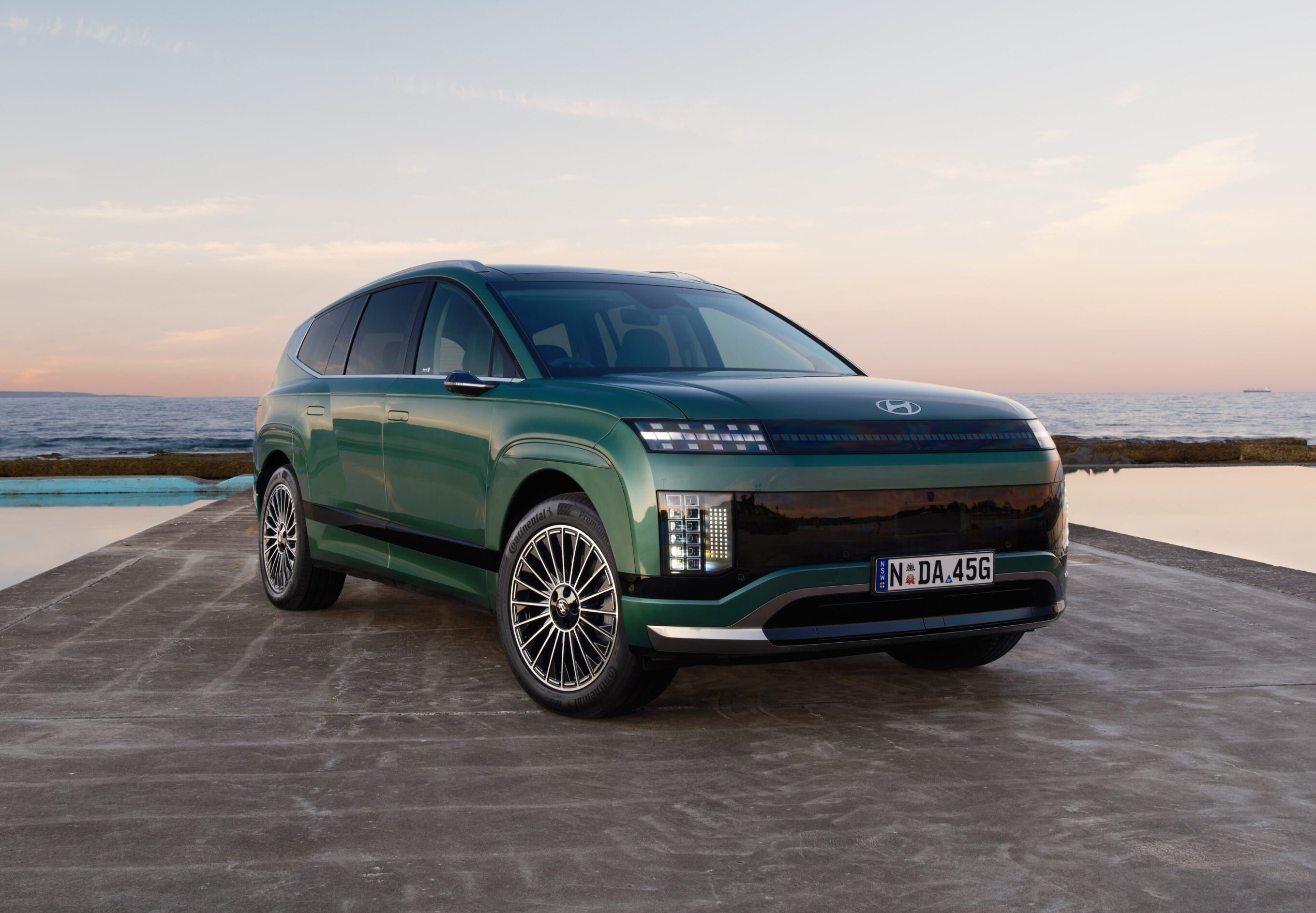
Price: $119,750 plus on-road costs
Battery size/claimed range: 110.6kWh/600km
Drivetrain: Dual motor, 314kW/700Nm
Dimensions (length/width/height/wheelbase): 5060/1980/1790/3130mm
Bootspace: 338L (third row up)/908L (third row folded)/2419L (third + second row folded)
Warranty/roadside assistance/service intervals: Five-year/unlimited km, service-activated, annual/every two years/30,000km
Four-year service cost: $1345
| Driving | |
| Interior | |
| Practicality | |
| Overall value | |
Things we like
- Refinement and comfort
- Excellent charging speed performance
- Loaded with equipment
Not so much
- Low speed ride needs refinement
- Only one model in the range and it’s expensive
- Optional camera mirrors hinder visibility
Hyundai’s efforts to become a mass producer of electric vehicles certainly hasn’t gone unnoticed in recent years, thanks to its small but talented range of IONIQ vehicles, plus the Inster light SUV. The latest in Hyundai showrooms is the IONIQ 9 large SUV, which uses the same platform as the Kia EV9 but shades it in size. Only offered in one high specification point in Australia so far, the IONIQ 9 is priced from $119,750 plus on-road costs and while that’s not cheap, it is fully loaded with standard features.
Inside the local IONIQ 9 is a huge 110.6kWh battery that gives a claimed 600km of range (WLTP). But thanks to Hyundai’s charging smarts, it’s capable of a 10 to 80 per cent charge in as little as 24 minutes using a 350kW DC fast charger, one of the quickest rates on the market. That battery powers a dual motor set-up making 314kW of power and 770Nm of torque, enabling the IONIQ 9 with strong performance. On the road, the IONIQ 9 is very quiet and comfortable, though its low speed ride quality is a bit unresolved and its EV9 cousin is more dynamic.
But a large expensive SUV is about the cabin, and on that front, the IONIQ 9 impresses with a spacious, feature-packed and a mostly-high quality interior that resembles other Hyundai models, most closely the Santa Fe. The 16-way electric front seats are extremely comfortable, and the dual 12.3-inch screens are easy to use and look suitably high-tech. The IONIQ 9 features active noise cancellation in a first for the brand, making its cabin very quiet at speed.
Where the IONIQ 9 excels most is its spaciousness, as you’d expect for such a large vehicle. Row two is airy and large, while row three is decent for adults as well. Each row features more than enough amenities such as air vents, cup holders and charging ports. Behind the third row lies a huge 338 litres of bootspace, which expands to a massive 908 litres with the third row folded.
The Hyundai IONIQ 9 succeeds as an SUV with strong performance, a big battery, very fast charging, a long range and a whisper-quiet driving experience. It’s not as luxurious inside as the Volvo EX90, but it is better equipped. Aside from the low speed ride and one-model-only range, the Hyundai IONIQ 9 is an accomplished large electric SUV.
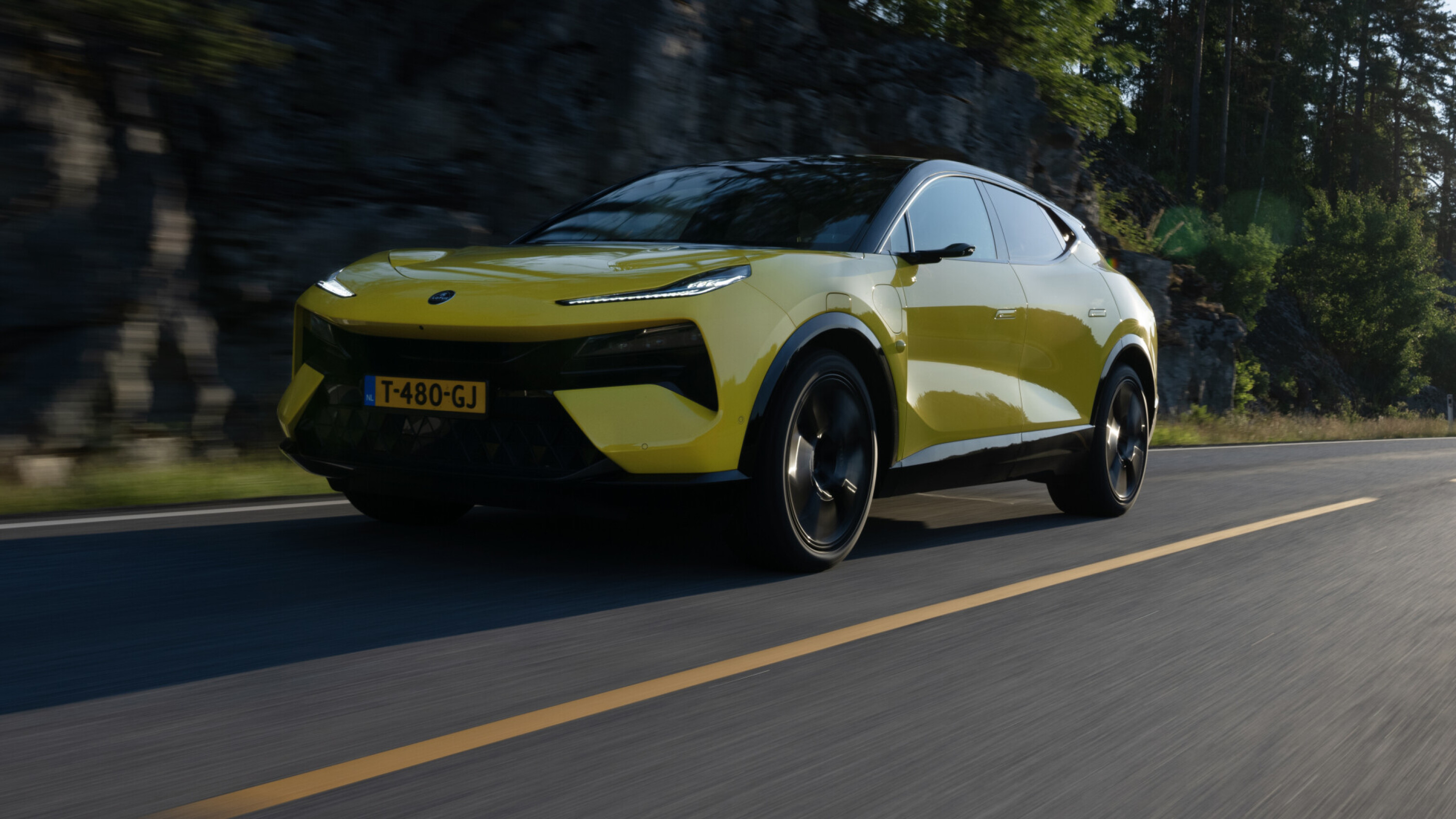
Lotus Eletre
Price: From $189,990 plus on-road costs
Battery size/claimed range: 112kWh/600km (WLTP), 535km (S), 450km (R)
Drivetrain: Dual-motor electric, 450kW/710Nm (Eletre and S), 675kW/985Nm (R)
Dimensions (length/width/height/wheelbase): 5103/2019/1630/3019mm
Bootspace: 688L (seats up), 1532L (seats folded)
Warranty/roadside assistance/service intervals: Five-year/150,000km, five years, every two years/30,000km
Five-year service cost: No capped price servicing
| Driving | |
| Interior | |
| Practicality | |
| Overall value | |
Things we like
- Excellent interior quality
- Even the base model is very quick
- Intuitive and easy to use infotainment systems
Not so much
- Not a traditional Lotus product
- It’s a heavy unit and feels it
- Maybe too fast in R form?
Sports car makers face ever-tightening emissions regulations and a cost-of-living crisis, causing them to expand their line-ups and offer more practical, greener options. Lotus is in that spot, responding with this vehicle: the all-electric Eletre large SUV.
The Eletre is quite the opposite to an Elise: a big SUV powered by electricity, but is still fun to drive thanks to its engaging handing and stonking performance. While all Eletre models feature a 112kWh battery for up to 600km of range in the entry level model, the performance differs from 450kW/710Nm in the base and S, and a frankly ridiculous 675kW/985Nm in the high-performance R. Even the entry level car hits 100km/h in just 4.5 seconds, with the R reducing that to a sub-three second claim.
Where the Eletre further moves away from Lotus models of the past is inside, with a properly luxurious and practical interior that is, again, the complete opposite of an Elise. Filled with lovely leathers, high quality switchgear and high-definition screens, the Eletre’s interior can comfortably compete with the best from the Germans.
The Eletre further steps away from its Lotus branding with a huge back seat and a large 688-litre boot, which is aided by a 46-litre front boot. It’s a genuinely really practical product. On that score, its 800V architecture gives it 350kW charging capability, which enables it to add 400km of range in just 20 minutes.
If you’re after an electric large SUV, the Lotus Eletre is not a conventional choice. But if you’ve got deep enough pockets, you’ll find a polished product that focuses on excellent quality and performance. Yep, it’s not a Lotus in the traditional sense, but it successfully moves the brand into a new space where luxury and performance are the most important factors.
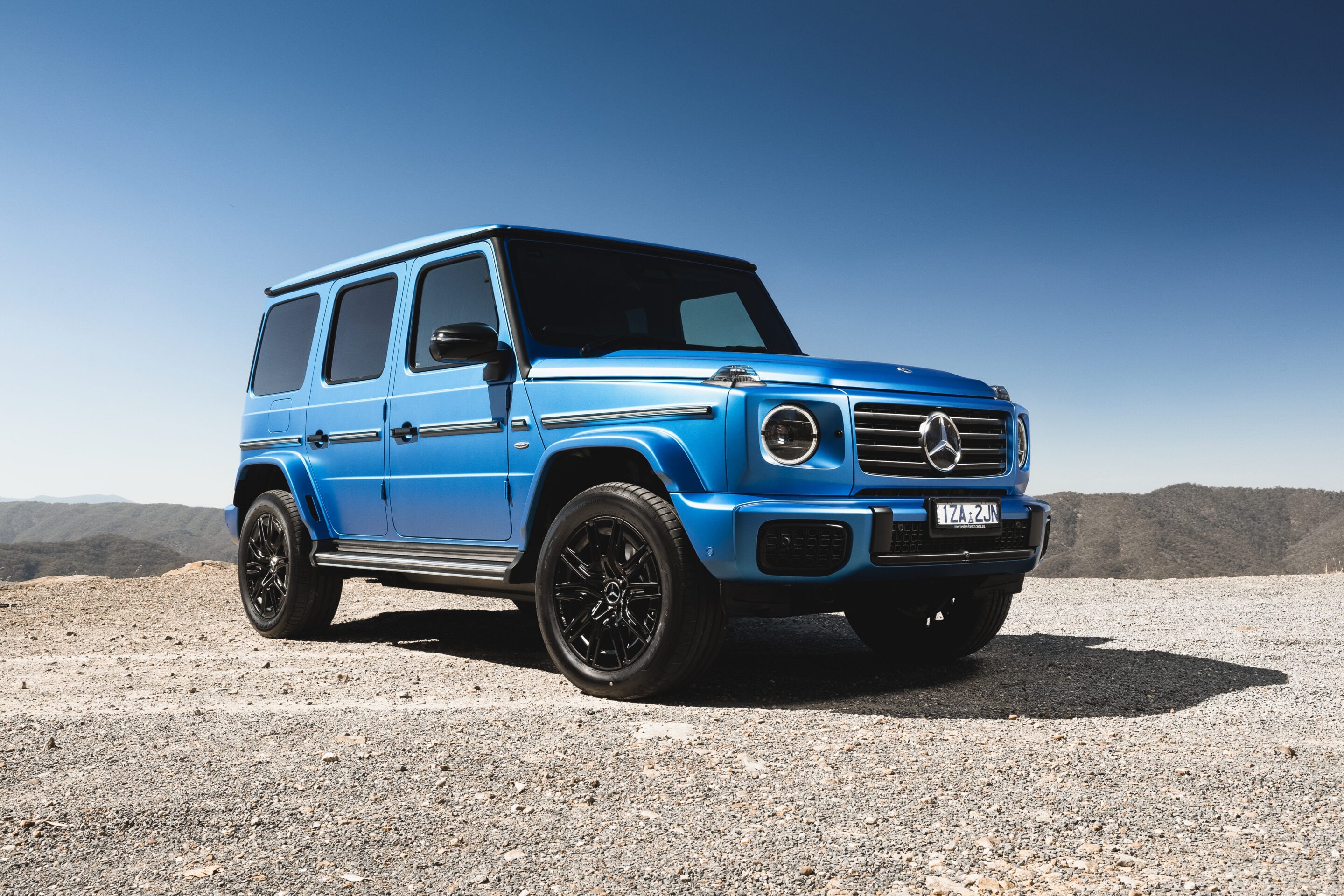
Mercedes-Benz G580 with EQ Technology
Price: From $249,900 plus on-road costs
Drivetrains/fuel economy/CO2 emissions: Quad motor, 432kW/1164Nm, 116kWh battery, 473km range (WLTP)
Dimensions (length/width/height/wheelbase): 4873/1984/1979/2890mm
Bootspace: 640L (seats up), 2010L (seats folded)
Warranty/roadside assistance/service intervals: Five-year/unlimited km, five years, annual/every 20,000km
Five-year service cost: $4670
| Driving | |
| Interior | |
| Practicality | |
| Overall value | |
Things we like
- Iconic G Wagen styling but with a silent twist
- Excellent performance on and off the road
- Impressive quad motor drivetrain
Not so much
- Not cheap to buy or service
- Not terribly efficient
- Slow AC charging
It was perhaps inevitable that the iconic Mercedes-Benz G Wagen would be electrified, and it finally arrived in Australia earlier this year. Dubbed ‘G 580 with EQ Technology’, the electric G-Wagen is currently offered with a single drivetrain: a quad-motor set-up making a huge 432kW of power and massive 1164Nm of torque. That’s enough grunt to see the G 580 hit 100km/h in just 4.7 seconds, despite its kerb weight of 3085kg, or just 0.4 seconds slower than the petrol AMG G 63.
But while the exterior appears business as usual, the G 580 is very different mechanically: there’s a massive 124kWh battery under the floor (116kWh is useable) for a claimed 473km of range (WLTP). You get independent suspension up front and a solid rear axle, plus four independently controlled electric motors and a low-range gearset for each one: yep, it really does have a 108kW/291Nm motor and gearset for each wheel.
It’s this quad-motor set up that gives the G 580 the superior off-road capability expected from the G Wagen, but new features such as the G-Turn (a showstopping trick which rotates the vehicle 720 degrees on the spot on unpaved surfaces) and G-Steer (this reduces the turning circle at up to 25km/h) add a whole new dimension and level of fun. Add in 250mm of ground clearance, an 850mm wading depth (150mm more than the AMG G 63) and the ability to handle a 45-degree angle, and the G 580 is certainly more off-road equipped than any other electric SUV.
Inside the G 580 is typical G Wagen: plenty of leather, a masculine aesthetic and a lot of tech thanks to dual 12.3-inch displays. As you’d expect for a Mercedes product, it’s very comfortable with super supportive seats and plentiful storage as well – its boot measures 640L with the seats up and a huge 2010L with them folded. The ‘G-Roar’ artificial sound gives a digital V8 burble, adding more to the G 580 experience if you want it.
The Mercedes-Benz G 580 with EQ Technology presents a bold new chapter in the history of the iconic G Wagen. Not only is it less expensive than the AMG G 63 but it’s also more powerful, far more torquey and is even more capable off-road. Add in the typical G Wagen practicality and the G 580 is an excellent large SUV… if you can afford it.
Nissan has announced a deal for the first buyers of the new Ariya electric mid-size SUV, which is due imminently in Australian Nissan showrooms.
Applicable to the entry-level Ariya Engage and mid-spec Advance and Advance+ models, a “limited number” of first buyers will receive an uprated three-phase onboard charger.
The top-spec Ariya Evolve already comes with the uprated onboard charger as standard.
In addition to that, certain Ariya buyers will also receive a free Autech 22kW AC home charger, valued at $1499 – not including installation.
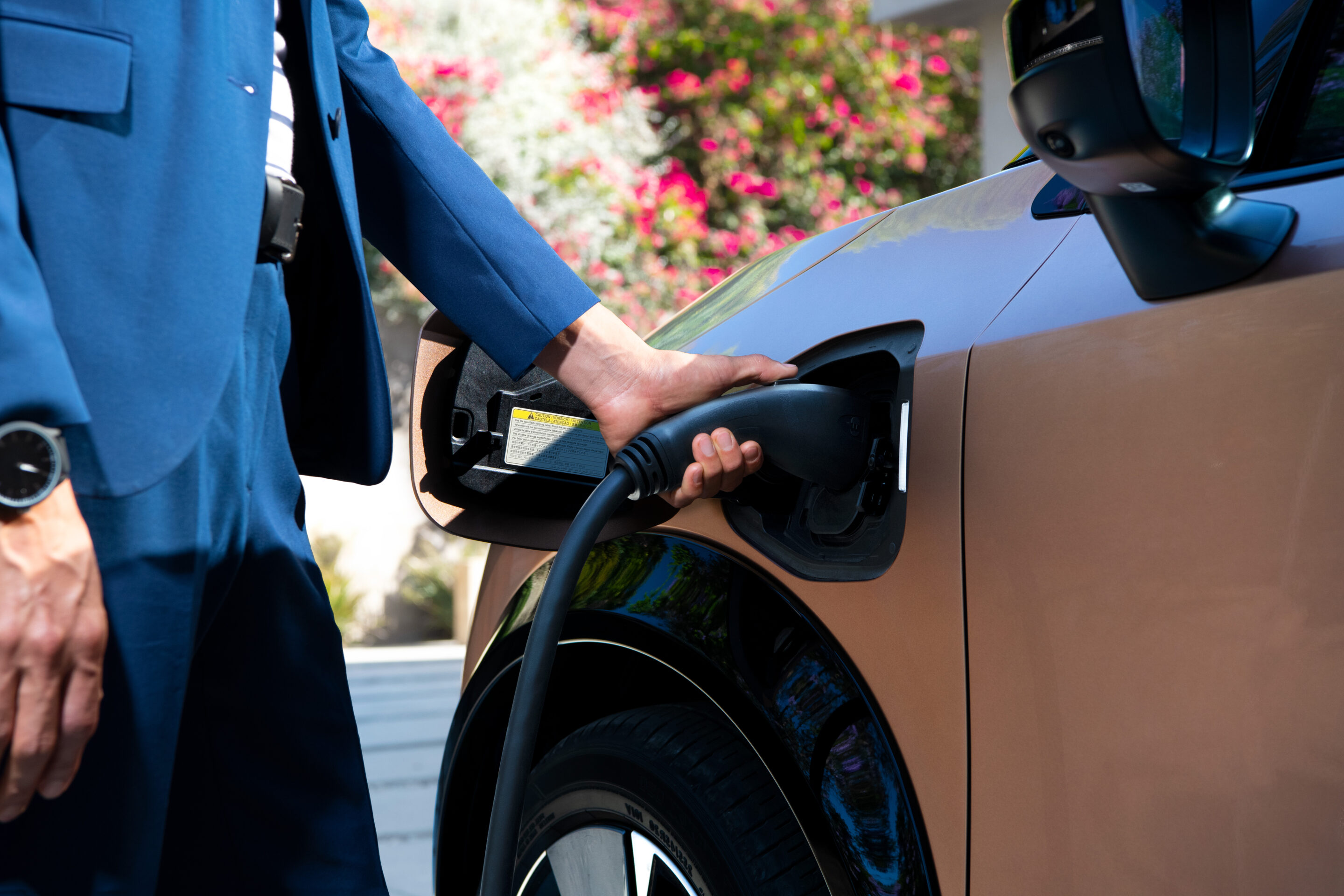
According to Nissan, combined with the three-phase charger, means that an Ariya can home charge in under four hours.
Priced from $55,840 plus on-road costs, the Nissan Ariya undercuts its closest rivals such as the Tesla Model Y, Hyundai Ioniq 6, Subaru Solterra and Toyota bZ4X.
The Ariya is covered by a 10-year/300,000km warranty, if serviced through Nissan’s dealer network, and an eight-year/160,000km battery warranty.
The Nissan Ariya electric mid-size SUV is due in local Nissan dealerships imminently.
Ford Australia has announced a new Ranger Black Edition, which is based on the XL Bi-Turbo 4×4 dual cab model and adds extra features, including black exterior detailing. Priced from $55,990 plus on-road costs, the Black Edition is available from $55,000 drive away for ABN holders for a minimum saving of around $7000 compared with a regular XL.
On top of the XL’s standard equipment list, the Black Edition adds carpet flooring with a driver’s carpet floor mat, a black sports bar, drop-in bed liner, Ford’s Cargo Management System, black 17-inch alloy wheels with all-terrain tyres, black side steps and a black mesh grille with grey inserts.
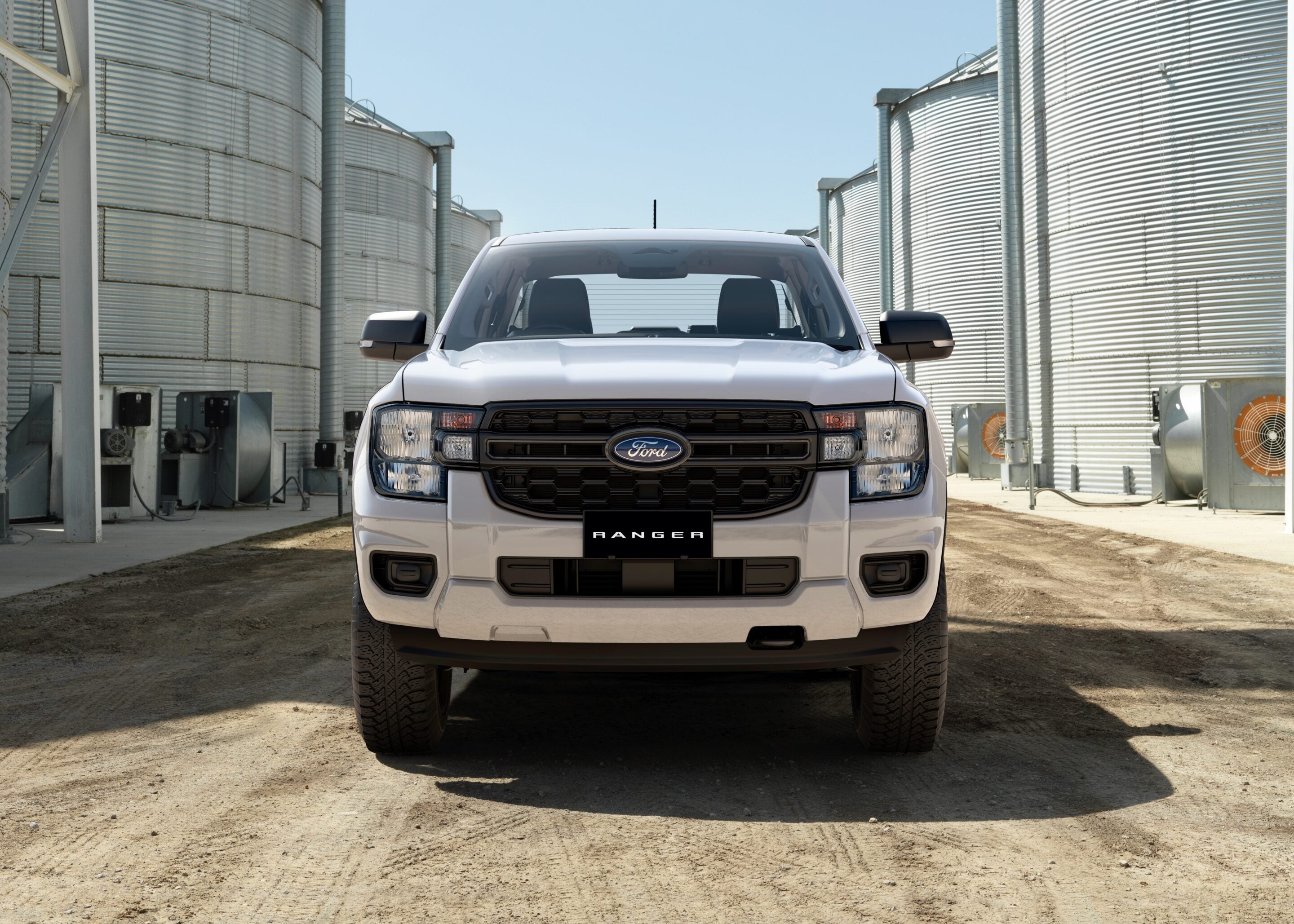
Standard XL features include automatic halogen headlights with halogen daytime running lights, heated and auto-folding mirrors, a 10.1-inch touchscreen with live services, wireless smartphone mirroring, an 8.0-inch digital driver’s display and safety features including nine airbags, autonomous emergency braking (AEB), adaptive cruise control, lane keep assist with lane departure warning, blind-spot warning, cross traffic alert, a reversing camera and rear parking sensors.
Optionally available for the Ranger Black Edition is a $1950 Tow Pack with an integrated trailer brake controller, tow bar and tow tongue assembly, as well as $750 premium paint.
The Black Edition uses the 154kW/500Nm 2.0-litre bi-turbo four-cylinder diesel engine used in the majority of the Ranger line-up, mated to a 10-speed automatic transmission and a part-time four-wheel drive system. Combined fuel consumption is rated at 7.2L/100km and CO2 emissions at 189g/km.
“The Ranger Black Edition is back by popular demand, offering a fantastic blend of style, capability, and value,” said Andrew Birkic, President and CEO, Ford Australia. ”We understand that our customers, whether for personal use or small business needs, are looking for a truck that not only performs but also stands out. The Ranger Black Edition delivers on all fronts, with its striking styling and practical features.”
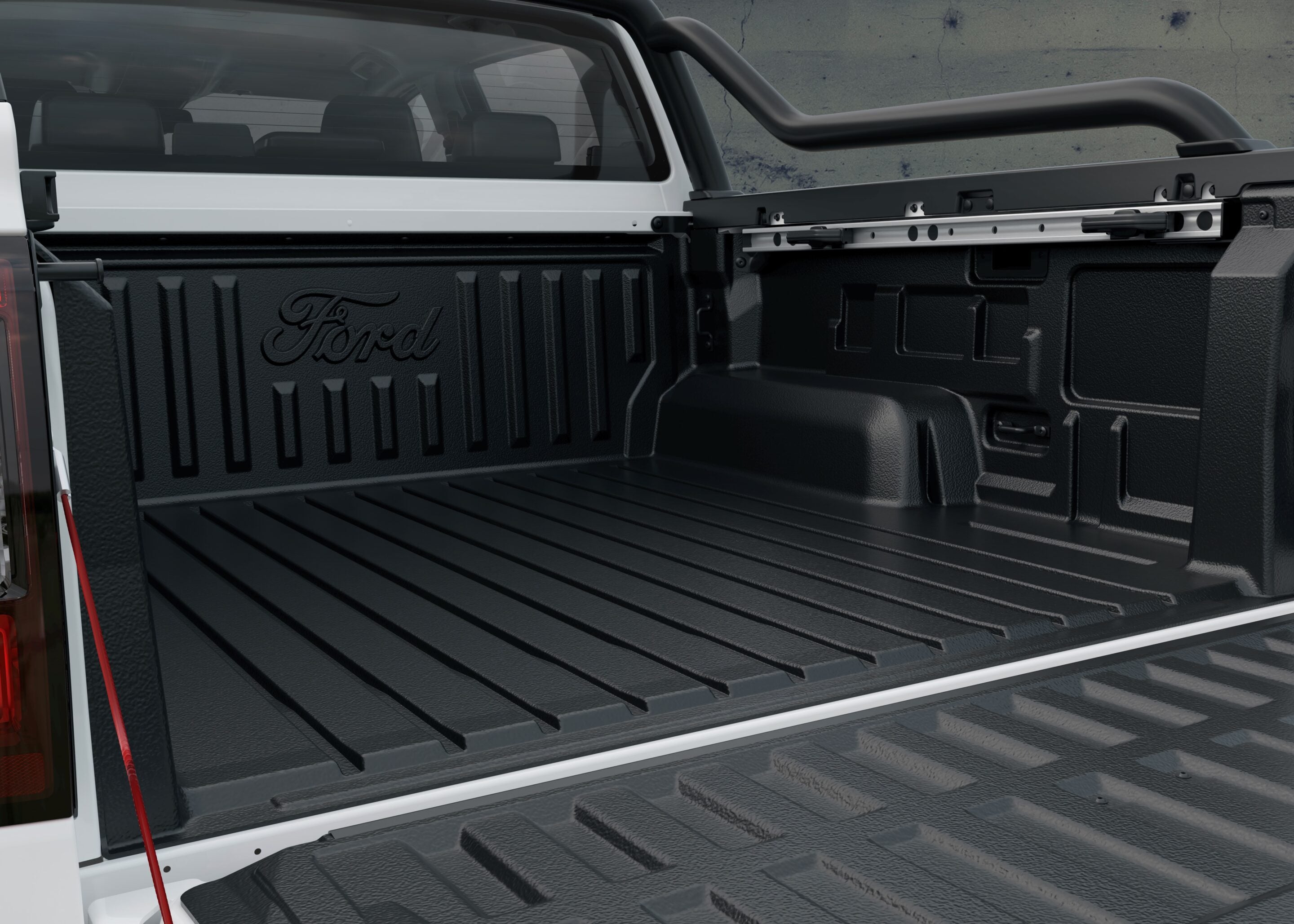
Ford Ranger Black Edition pricing
| Black Edition | $55,990 ($55,000 drive away, ABN holders; $57,000 drive away private buyers |
|---|
Ranger Black Edition features (on top of XL)
- Carpeted floor with carpet floor mat for the driver
- Black long-legged sports bar
- Drop-in bed liner
- Cargo Management System
- Black 17-inch alloy wheels with all-terrain tyres
- Black side steps
- Black mesh grille with grey inserts
The first MY26 Ford Ranger Black Editions are expected to arrive in local Ford dealerships in October 2025.
An iconic piece of Australian motoring and cultural history is heading to auction, with the late Steve Irwin’s 1982 Toyota LandCruiser HJ47 Troop Carrier listed by online platform Collecting Cars.
The hard-working four-wheel drive, affectionately known as a ‘Troopie,’ was once in service at Queensland’s Australia Zoo, where it supported the daily operations of the 700-acre wildlife facility. The zoo remains central to Irwin’s legacy, promoting conservation through education nearly two decades after his passing.
Unlike most LandCruisers of its era, this vehicle is powered by a 4.9-litre Cleveland Ford V8 engine, showing 415,426 kilometres on the odometer. It also features a number of unusual chassis and body details, such as the Troop Carrier body combined with ute-derived components including a rear crossmember and additional cab mount supports. An aluminium bull bar, thought to date back to its working days at Australia Zoo, remains fitted.
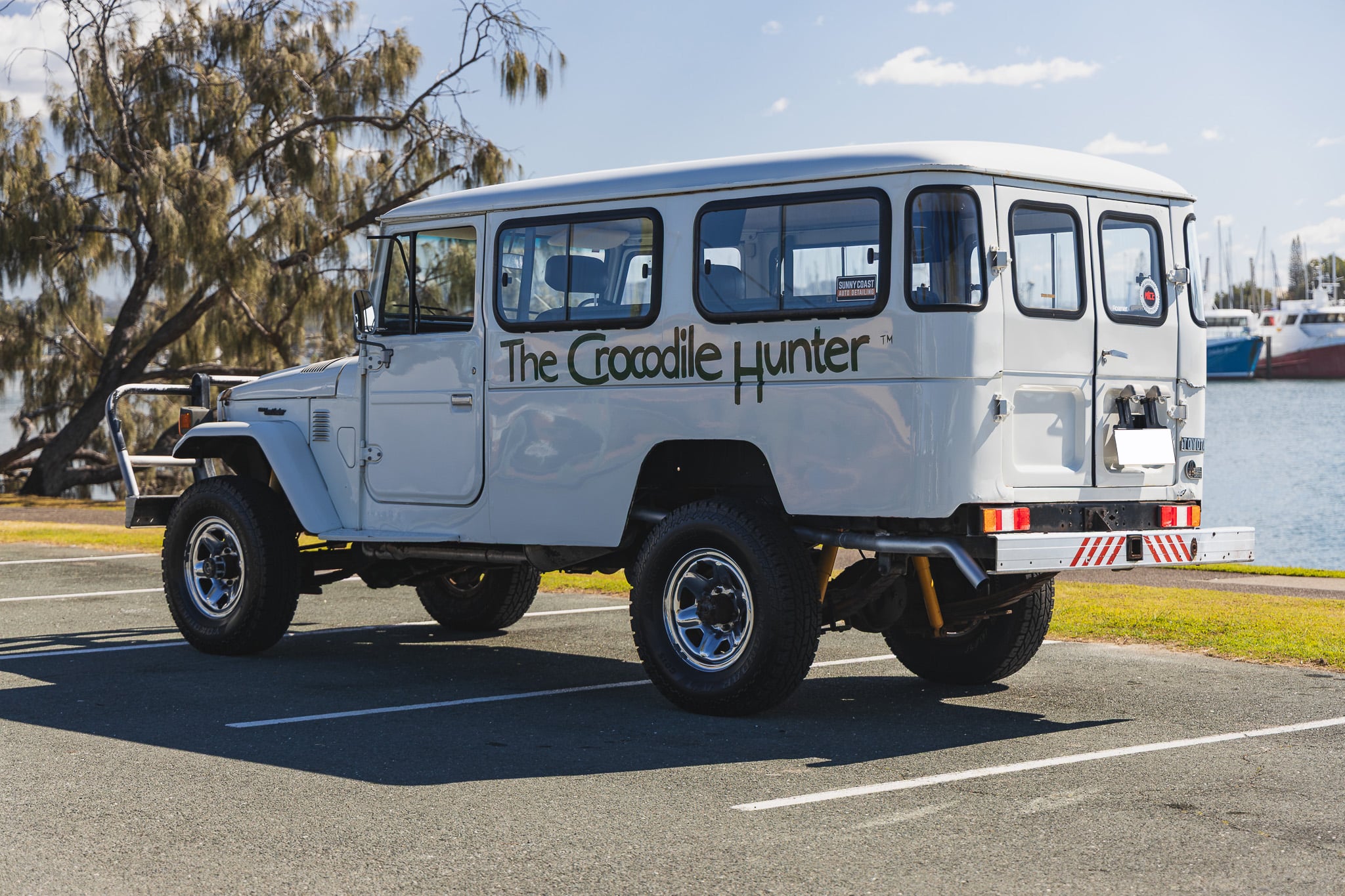
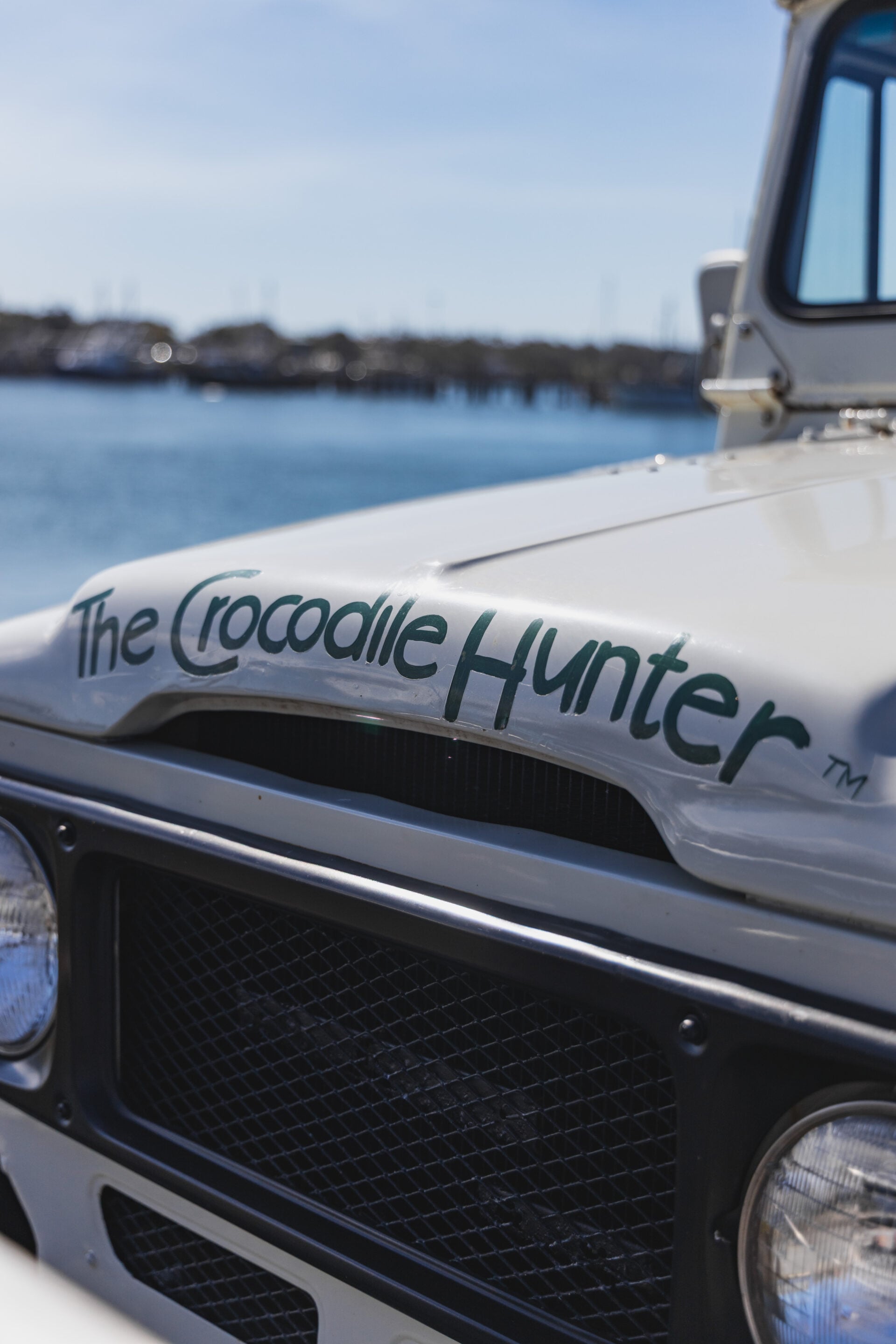
The exterior is finished in white and prominently displays green “The Crocodile Hunter™” lettering across the sides and bonnet. Adding to its provenance, the vehicle comes with a detailed history booklet and a signed letter from Steve Irwin’s son, Robert Irwin, confirming its authenticity.
“This special Toyota LandCruiser represents an important piece of Australian history and culture,” said Lee Hallett, Head of APAC at Collecting Cars.
The LandCruiser was acquired directly from Australia Zoo by its current owner in 2013. Since then, it has undergone extensive mechanical refurbishment, an overhaul of the electrical system and various other improvements to keep it in working order while retaining its original character.
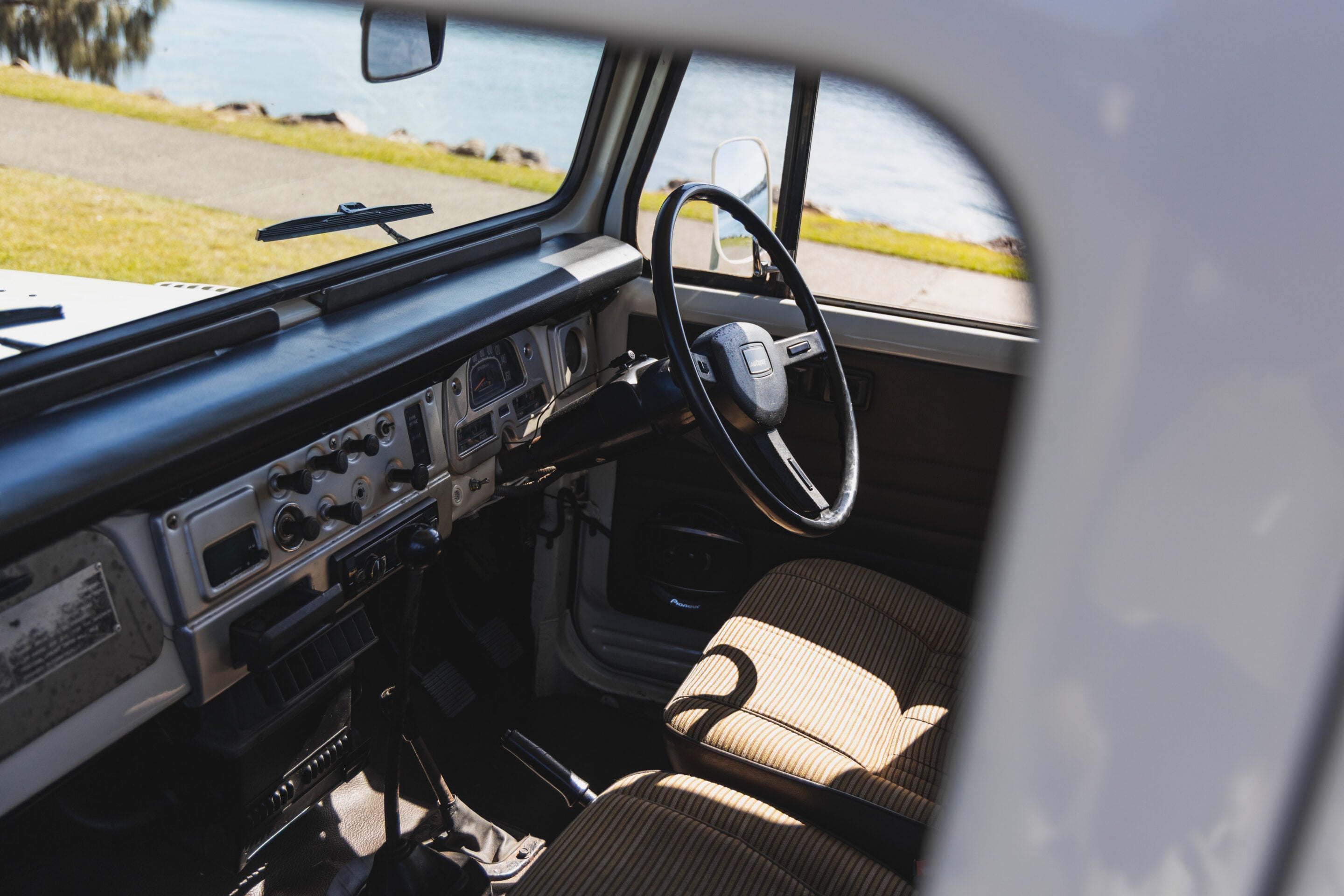
For collectors, the sale offers the rare chance to secure not only a classic Toyota LandCruiser but also a vehicle intertwined with one of Australia’s most recognisable cultural figures. Online bidding will be conducted through Collecting Cars, which has established itself as a global platform for classic, performance and collectible vehicles.
The auction adds another chapter to the enduring story of the LandCruiser in Australian life – a model prized for its toughness, now with a unique place in the nation’s conservation history.
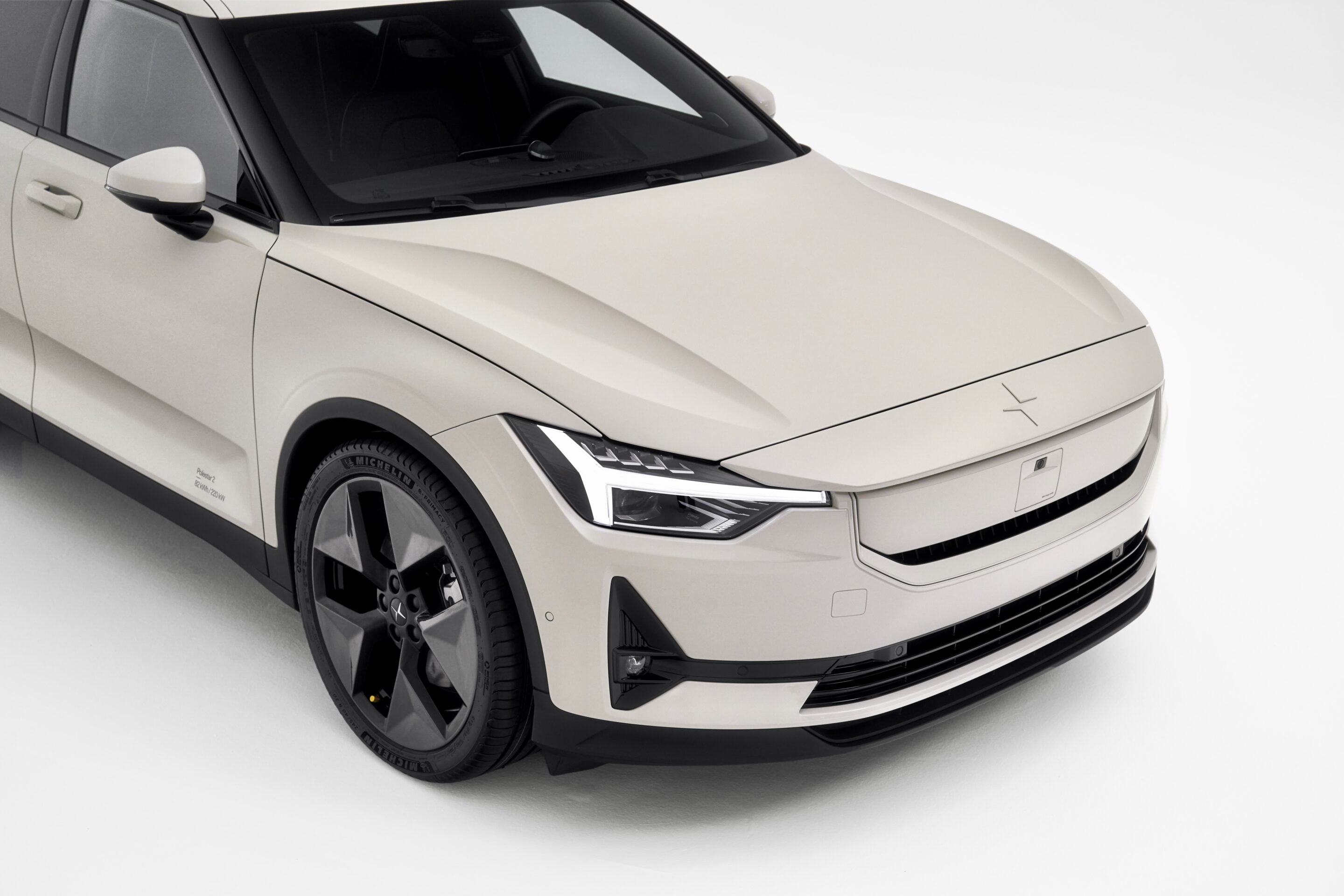
Polestar has revealed Australian specifications for the updated 2026 Polestar 2 range, which will be priced from an unchanged $62,400, plus on-road costs.
Key updates include a faster infotainment processor, a longer driving range and quicker charging for the entry-level Standard Range Single Motor, a new alloy wheel design and a new exterior colour.
For buyers of the entry-level Standard Range Single Motor Polestar 2, a new 70kWh battery from Chinese manufacturer CATL has improved the range from 546km to 554km (WLTP), and the former 135kW peak charging speed has been improved to 180kW for a 10 to 80 per cent charge in a claimed 26 minutes.
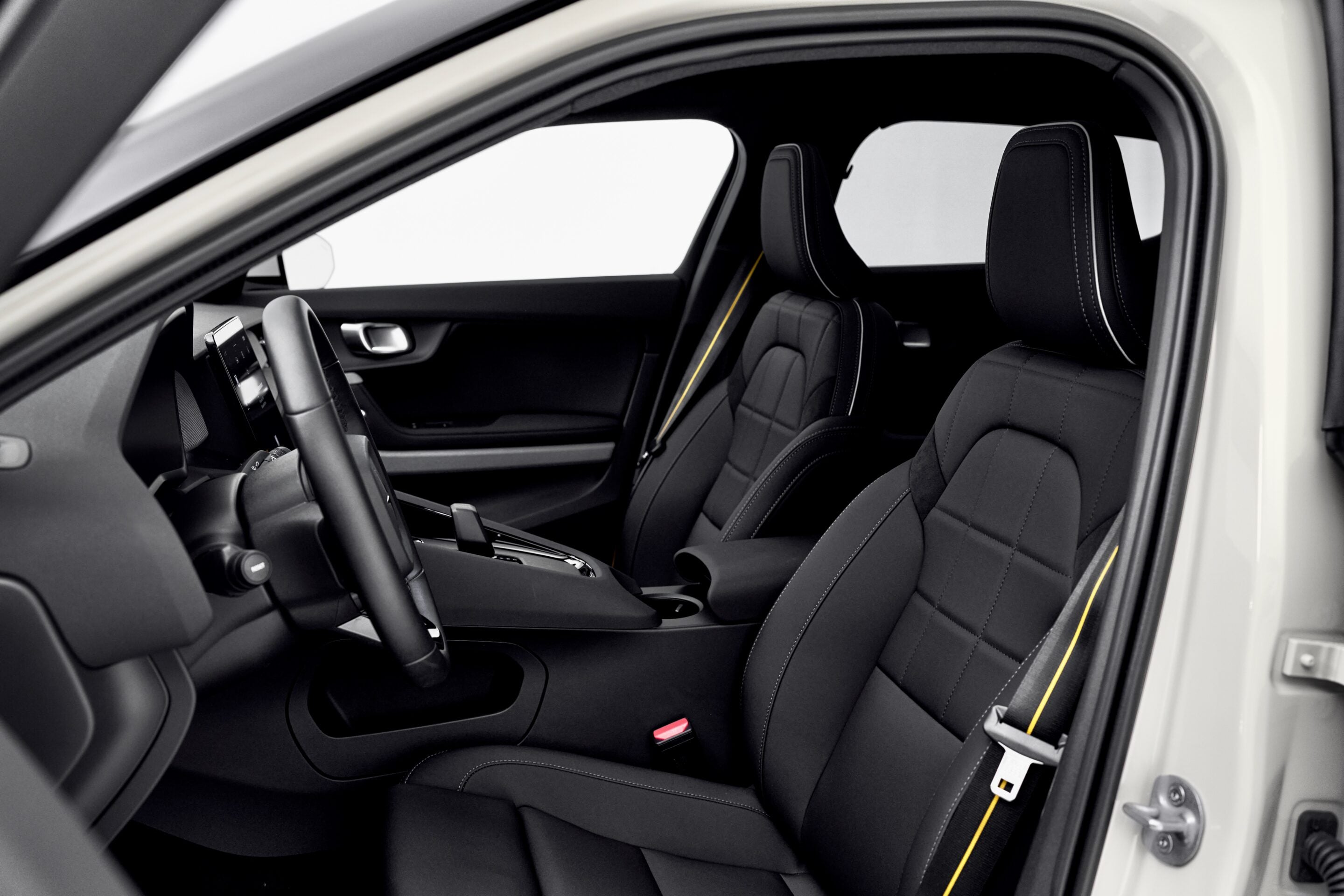
Inside the 2026 Polestar 2, a new Qualcomm Snapdragon processor chip has been added to the infotainment system, which allows for quicker download speeds, faster reaction times and smoother performance according to Polestar. The Polestar 2 can also now be optioned with a 14-speaker 1350 watt Bowers & Wilkins sound system with stainless steel mesh on door panels.
A new colour called ‘Dune’ is now optionally available, replacing the former ‘Jupiter’, while a new five-spoke design for the 20-inch wheels included in the optional Performance Pack has debuted as the lightest available for the 2 to date.
While the battery performance has improved for the entry-level car, performance figures continue as before with the Standard Range Single Motor using a 200kW/490Nm rear-mounted motor and the Long Range Single Motor adding 20kW to that. The Long Range Dual Motor makes 310kW/740Nm from its dual-motor set up, and the Long Range Dual Motor Performance makes 350kW for a claimed 4.2-second 0-100km/h time.
Claimed WLTP driving ranges start at 554km for the Standard Range Single Motor, jumping to 568km for the Long Range Dual Motor Performance, 596km for the Long Range Dual Motor and 659km for the Long Range Single Motor.
2026 Polestar 2 pricing (plus on-road costs):
| Standard Range Single Motor | $62,400 |
|---|---|
| Long Range Single Motor | $66,400 |
| Long Range Dual Motor | $71,400 |
| Long Range Dual Motor Performance | $85,080 |
2026 Polestar 2 options:
- Plus Pack with a fixed glass roof, electric front seats with driver memory, front cushion leg extension, backrest storage nets and a 600W Harman Kardon sound system: $4700 (now standard on Long Range Dual Motor Performance)
- Pro Pack with 20-inch wheels with gold valve caps and black seatbelts with gold stripe: $1900
- Climate Pack with a heat pump, heated rear seats, wiper nozzles and steering wheel: $1500
- Pixel LED headlights with adaptive high beam: $1600
- Bowers & Wilkins sound system (requires Plus Pack): $3500
- Rear window privacy glass: $500
- Bridge of Weir leather upholstery: $4400 – $4800, requires Plus Pack)
- Premium paint: $1500-$1800
The first 2026 Polestar 2 models are due to arrive in local showrooms in the coming weeks.
Contenders
- Kia EV9
- Volvo XC90
- Hyundai Palisade
- Mazda CX-90
- Toyota Landcruiser Prado
- Hyundai Santa Fe
- Chery Tiggo 8
- MG QS
- Kia Sorento
- Toyota Kluger
- Land Rover Discovery
- KGM Rexton
- GMC Yukon
- Nissan Patrol
- Audi Q7
Winner – Kia EV9
Price: From $97,000 plus on-road costs
Battery size/claimed range: 76.1kWh, 443km (Air); 99.8kWh, 512km (Earth)/505km (GT-Line)
Drivetrain: Single motor (Air), 160kW/350Nm; Dual motor (Earth and GT-Line), 283kW/700Nm
Dimensions (length/width/height/wheelbase): 5010-5015/1980/1755-1780/3100mm
Bootspace: 333L (third row up)/828L (third row folded)/2318L (third + second row folded)
Warranty/roadside assistance/service intervals: Seven-year/unlimited, up to eight years, annual/every 15,000km
Five-year service cost: $1351
| Driving | |
|---|---|
| Interior | |
| Practicality | |
| Overall value | |
Things we like
- Huge cabin carries seven with ease
- Excellent charging speed performance
- Loaded with equipment
Not so much
- No spare wheel
- Not cheap to buy
- Some interior trims could feel more special
Kia shocked us when it launched the EV9 upper large electric SUV in late 2023. Its futuristic styling, comfortable driving experience and hugely practical cabin mean that it has massive appeal as a large SUV, especially when it comes to carrying seven passengers, which is still a rarity for electric vehicles.
Thanks to the EV9’s huge size and clever packaging, even the third row of seating can comfortably carry adults with plenty of third row room and amenities such as air vents, charging ports and cup holders. The windows are large so that it doesn’t feel claustrophobic and it features both top tether and ISOFIX points for child seats. Moving forward, the second row is even larger with palatial legroom and enough width for three adults to sit comfortably. In the front, there’s plenty of storage space, comfortable seats and great visibility.
Even in entry-level Air trim, the EV9 offers a solid driving range, with a claimed 443km (WLTP) achievable, though that increases to over 500km in higher-spec models thanks to a larger 99.8kWh battery. The e-GMP platform the EV9 uses offers some of the highest charging speeds on the market, with a 10-80 per cent charge achievable in a maximum of 24 minutes.
Thanks to local tuning, the driving experience of the EV9 is very comfortable, and it tackles bad roads with ease, despite the large wheels. It’s also very quiet, thanks to ample noise insulation. The EV9 is a very impressive large SUV with quick charging, ample range and performance stats, a huge comfortable cabin and a pleasant driving experience.
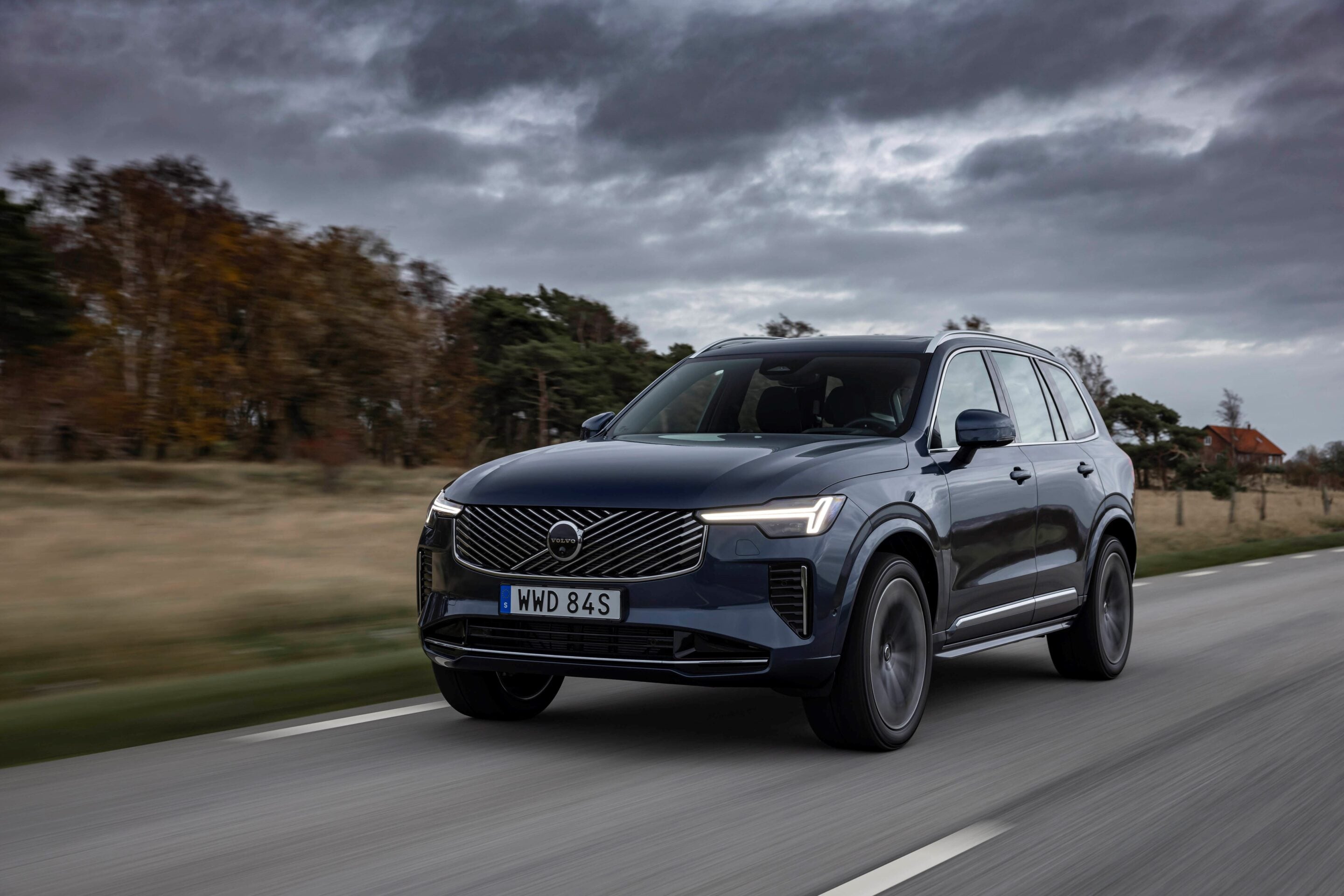
Volvo XC90
Price: From $104,990 plus on-road costs
Drivetrains/fuel economy/CO2 emissions: 2.0-litre four-cylinder turbo-petrol, 8-speed auto, 183kW/350Nm, 8.1L/100km, 185g/km; 2.0-litre four-cylinder turbo-petrol plug-in hybrid, 8-speed auto, 340kW/709Nm, 1.8L/100km, 40g/km
Dimensions (length/width/height/wheelbase): 4953/2008/1776/2984mm
Bootspace: 302L (third row up), 680L (third row folded), 1874L (third + second rows folded)
Warranty/roadside assistance/service intervals: Five-year/unlimited km, five years (extendable up to eight years in total), annually/every 15,000km
Five-year service cost: $3870
| Driving | |
|---|---|
| Interior | |
| Practicality | |
| Overall value | |
Things we like
- Excellent cabin quality and spaciousness
- Relaxing to drive
- Punchy drivetrains
Not so much
- Only two drivetrain options
- Not cheap to service
- New infotainment system hides features in menus
Launched way back in 2015, it’s easy to forget that the Volvo XC90 was the first modern-era Volvo in what was a product revolution for the brand. It launched on a new modular platform and was the trailblazer for the brand’s sales boom, with every Volvo released since then only building on its excellence.
The XC90 was – and still is in a lot of ways – the daddy of the large SUV segment and even though it’s now past 10 years old, is ageing gracefully. In fact, it just had an update with a new infotainment system and lightly revised styling to keep it fresh against newer rivals. But the XC90’s basics were so insanely well covered that it barely needed an update: its cabin still feels great, while all of its rows of seating are quite spacious and carrying seven adults is easy for it.
Just two engine options remain for the Australian XC90: the 183kW 2.0-litre turbo-petrol B5 or the 340kW T8 plug-in hybrid that adds a supercharger and electric motor to the B5’s drivetrain, for a claimed 77km travel on a single charge. Both use an eight-speed automatic transmission, and while the XC90 is not sporty, it is very comfortable, even on its large wheels.
Pricing for the XC90 range starts at $104,990 plus on-road costs for the B5 Bright, and $130,990 +ORC for the T8 PHEV, with both models quite well equipped, including a panoramic sunroof, new Google infotainment system with Google Maps navigation, Matrix LED headlights with adaptive high beam and a full suite of active safety features.
The Volvo XC90 remains a wonderful choice in the seven-seat large SUV segment. It’s practical, excellent quality, lovely to drive, well featured and just a delight to experience. There are now only two remaining drivetrains and it’s not cheap to service, but if you’re after a large luxurious SUV, we think the XC90 should be your first test drive.
Hyundai Palisade
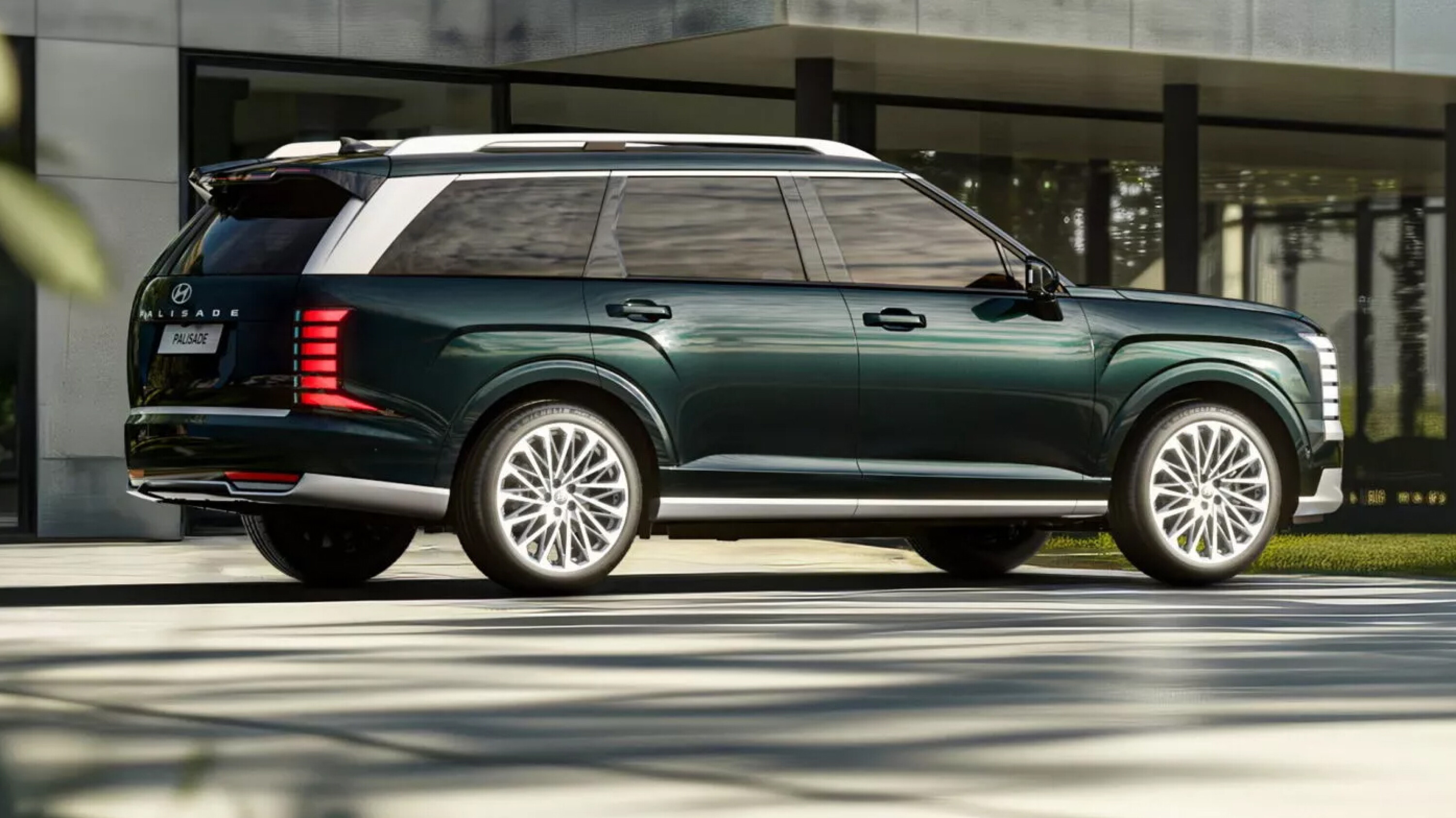
Price: From $75,900 plus on-road costs
Drivetrains/fuel economy/CO2 emissions: 3.8-litre petrol V6, 8-speed auto, 217kW/355Nm, 10.7L/100km, 251g/km; 2.2-litre four-cylinder turbo-diesel, 145kW/440Nm, 7.3L/100km, 193g/km
Dimensions (length/width/height/wheelbase): 4995/1975/1750/2900mm
Bootspace: 311L (third row up)/704L (third row folded)/1297L (third + second row folded, to belt line)
Warranty/roadside assistance/service intervals: Five-year/unlimited km, service-activated, annual/every 15,000km
Five-year service cost: $2414 (V6), $2622 (diesel)
| Driving | |
|---|---|
| Interior | |
| Practicality | |
| Overall value | |
Things we like
- Massive interior space
- Excellent drivetrain options
- Pleasant to drive
Not so much
- New model about to launch
- Thirsty petrol V6
- Interior tech not as up to date as other Hyundais
Though it’s about to be replaced by an all-new model, the Hyundai Palisade is a great choice for a $70,000+ large SUV thanks to its good value for money, huge interior space and pleasant driving experience. Pricing starts at under $70,000 for the entry-level Elite, but we strongly recommend the upper-spec Calligraphy because it’s even better equipped and feels more luxurious inside.
There are two drivetrain choices for the Palisade range: a 217kW 3.8-litre petrol V6 that’s front-wheel drive only or a 145kW 2.2-litre four-cylinder turbo-diesel that drives all four wheels. The former will drink quite a lot of fuel and easily overpowers the front wheels that do its gripping, so we think the far more efficient, refined and punchy diesel is the pick for Palisade buyers.
The Palisade’s driving experience is pleasant thanks to a well-tuned ride quality, accurate and well-weighted steering and even though it’s a large vehicle, it doesn’t feel quite so large thanks to excellent visibility.
Even though the Palisade uses a lot of old-tech Hyundai features such as the infotainment software and digital driver’s display but they still work quite well, though it would be nice to see wireless smartphone mirroring. Besides that, the Palisade’s cabin is noteworthy for being absolutely huge inside, with room for adults even in the third row, and with ample amenities on offer in each row as well. The third row in particular is one of the best on the market with ample space and even three top tether points and even an ISOFIX point for child seats.
The Hyundai Palisade is an excellent large SUV thanks to its range of talents: it’s very practical, well priced, very well equipped, drives well and is covered by a solid service and warranty program. Sure, newer Hyundai models feel more modern and the petrol V6 engine is thirsty and only drives the front wheels, but there’s still a lot to like about the Palisade.
Mazda CX-90
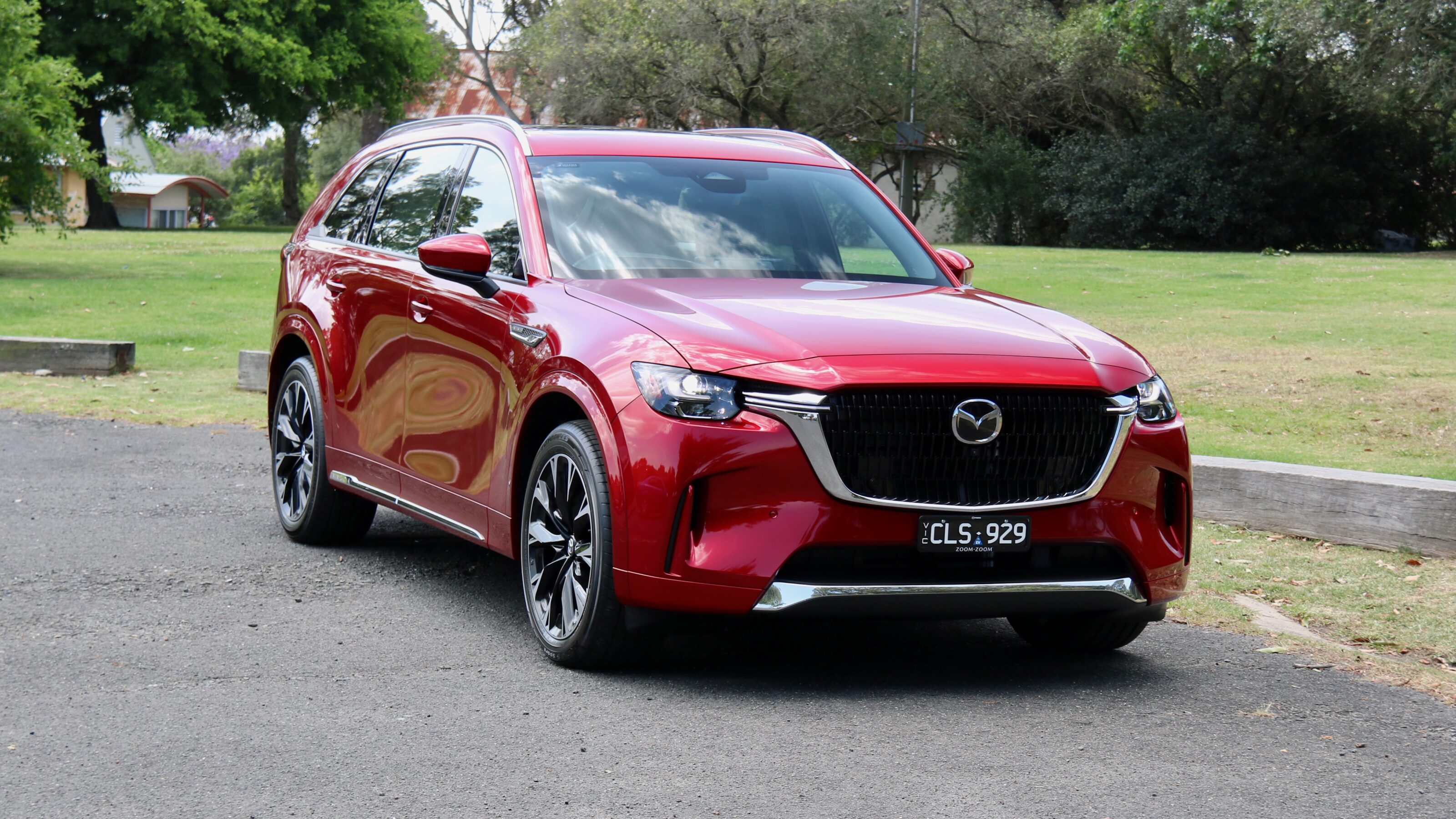
Price: From $69,795 plus on-road costs
Drivetrains/fuel economy/CO2 emissions: 3.3-litre inline six turbo-petrol, 8-speed auto, 254kW/500Nm, 8.2L/100km, 189g/km (G50e); 3.3-litre inline six turbo-diesel, 8-speed auto, 187kW/550Nm, 5.4L/100km, 143g/km (D50e)
Dimensions (length/width/height/wheelbase): 5120/1994/1745/3120mm
Bootspace: 257L (third row up), 608L (third row folded), 2025L (third + second row folded)
Warranty/roadside assistance/service intervals: Five-year/unlimited km, five years, annual/every 10,000km (diesel) – 15,000km (petrol)
Five-year service cost: $3367 (diesel) – $3544 (petrol)
| Driving | |
| Interior | |
| Practicality | |
| Overall value | |
Things we like
- Engaging handling
- Huge interior space
- Excellent quality
Not so much
- Jerky gearbox
- No PHEV option yet
- Too-firm ride
Replacing the popular and lovely CX-9, the Mazda CX-90 was launched as Mazda’s largest and most expensive product ever in 2024. Now priced from $69,795 plus on-road costs in base Touring form – it was almost $75,000 +ORC when it launched before Mazda cut prices – we think the best model in the range is the mid-spec GT, which is priced at $78,795 +ORC.
The mid-range CX-90 is well equipped and feels luxurious enough inside to not needing to move up to the top-spec Azami, with leather trim everywhere and large 12.3-inch displays covering in-car tech nicely. Front seat comfort is good without being excellent – more adjustment would be appreciated – while the second and third rows of seating are spacious for adults.
The third row of seating in the CX-90 is larger than the CX-9 it replaced, with ample room for two adults. Amenities include air vents, charging ports and cup holders, though no independent fan speed controlling. The windows out could be larger due to the CX-90’s sloping rear, but two child seats are catered for with top-tether points (not ISOFIX).
On the road, the CX-90 is a mixed bag. Negatives first: the gearbox and suspension tuning needs refinement for a more luxurious vibe, as they’re just too noticeable currently. But aside from that, there’s a lot of positives, such as the refined and punchy drivetrains and engaging handling. We love both the ‘G50e’ petrol and ‘D50e’ drivetrains, with the petrol capable of strong performance and the diesel excellent fuel economy in the real world.
Regardless of drivetrain chosen, the CX-90 is expensive to service, and there’s no plug-in hybrid drivetrain option yet (it exists in other markets but just not in Australia yet). But otherwise, there’s a lot to like about the Mazda CX-90, especially when it comes to driving dynamics, performance, cabin space and standard equipment. In our opinion, spend the extra for the mid-range GT as, importantly when you’re spending this much on a car, it looks and feels expensive.
Toyota LandCruiser Prado
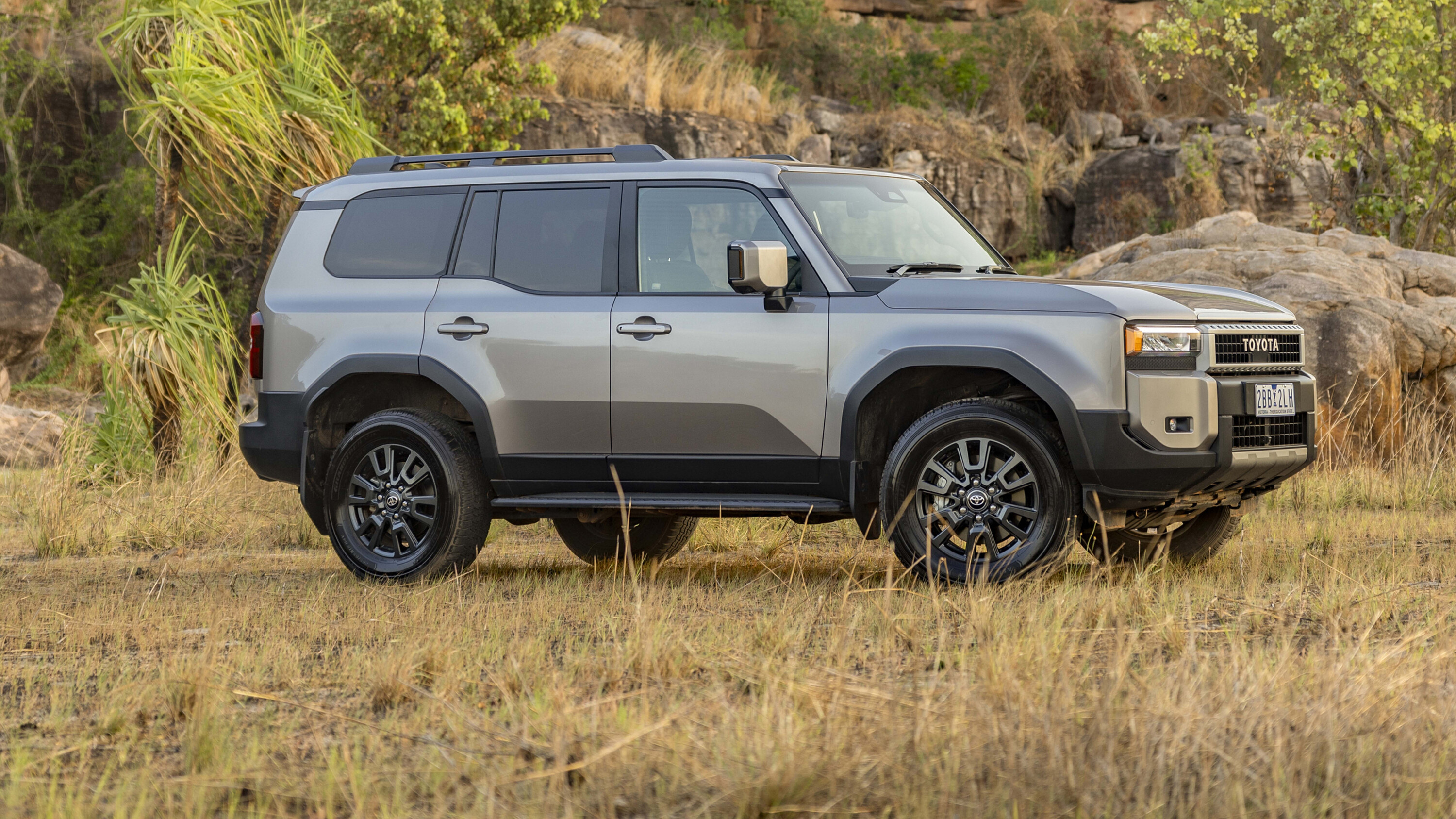
Price: From $72,500 plus on-road costs
Drivetrains/fuel economy/CO2 emissions: 2.8-litre four-cylinder turbo-diesel, 8-speed auto, 7.6L/100km, 200g/km
Dimensions (length/width/height/wheelbase): 4990/1980/1925/2850mm
Bootspace: 954L (seats up), 1895L (seats down) (seven-seater: 182/906/1829|L)
Warranty/roadside assistance/service intervals: Five-year/unlimited km, no roadside assistance, six-monthly/every 10,000km
Five-year service cost: $3900
| Driving | |
|---|---|
| Interior | |
| Practicality | |
| Overall value | |
Things we like
- Go-anywhere ability
- Refined and modern cabin
- Big improvement in driving experience over the previous model
Not so much
- Agricultural engine
- Expensive
- Seven-seat version’s boot is compromised
If you’re searching for the most popular large SUV, this would be it. With almost 16,000 sales under its belt to the end of June 2025, the Toyota LandCruiser Prado is one of the best selling vehicles in Australia. Even though it’s more expensive by up to $12,000 than the model it replaced, the new Prado is better equipped, better to drive, much better looking and still very practical and capable.
Pricing starts at $72,500 plus on-road costs for the entry-level GX and tops out at $99,990 for the top-spec Kakadu, which adds a whole host of luxury features over lesser Prado models. But even the entry-level Prado GX is well equipped, especially where safety features are concerned and the mid-spec GXL – which is expected to be the most popular Prado model by far – is equipped with features such as synthetic leather upholstery, electric driver’s seat adjustment and heated and ventilated front seats.
The whole Prado range uses the same 2.8-litre four-cylinder turbo-diesel engine and eight-speed automatic transmission with a 48V mild hybrid system – a turbo-petrol hybrid exists in some markets, but isn’t yet sold in Australia. That’s a shame because even though it saw noise reductions compared to the old model, the diesel is still loud and unrefined and we wish the more expensive LandCruiser 300 Series’ V6 diesel was used in the Prado.
While the engine is largely the same as before, Toyota has improved the driving experience of the new Prado significantly with a more refined feel from behind the wheel. The ride quality is far better damped than before, and it can now tow a 3500kg braked trailer, which is a 500kg improvement on the old Prado. There are also new off-road features so that it ventures even further off road than before, and it concedes little to the LC300.
The new Prado’s cabin is also far more upmarket than the previous version, with higher-quality materials and much newer infotainment and digital driver’s displays that make it feel more expensive inside. Seat comfort is excellent, and all rows of seating have ample room for passengers – though the packaging of the third row of seating and 48-volt mild-hybrid system could be improved. The third row does not feature any child seat points, but it does have air vents in the roof, cup holders and USB charging ports.
Overall, the new Toyota LandCruiser Prado is a big improvement on the previous model, and it’s easy to see why it’s so popular. It’s more refined in every way, better equipped, easier and more satisfying to drive and even more practical with even better off-road ability than before. The unrefined engine could be improved however, and no model is cheap, but there’s no doubt that Toyota will continue to sell every Prado it can make.
Hyundai Santa Fe
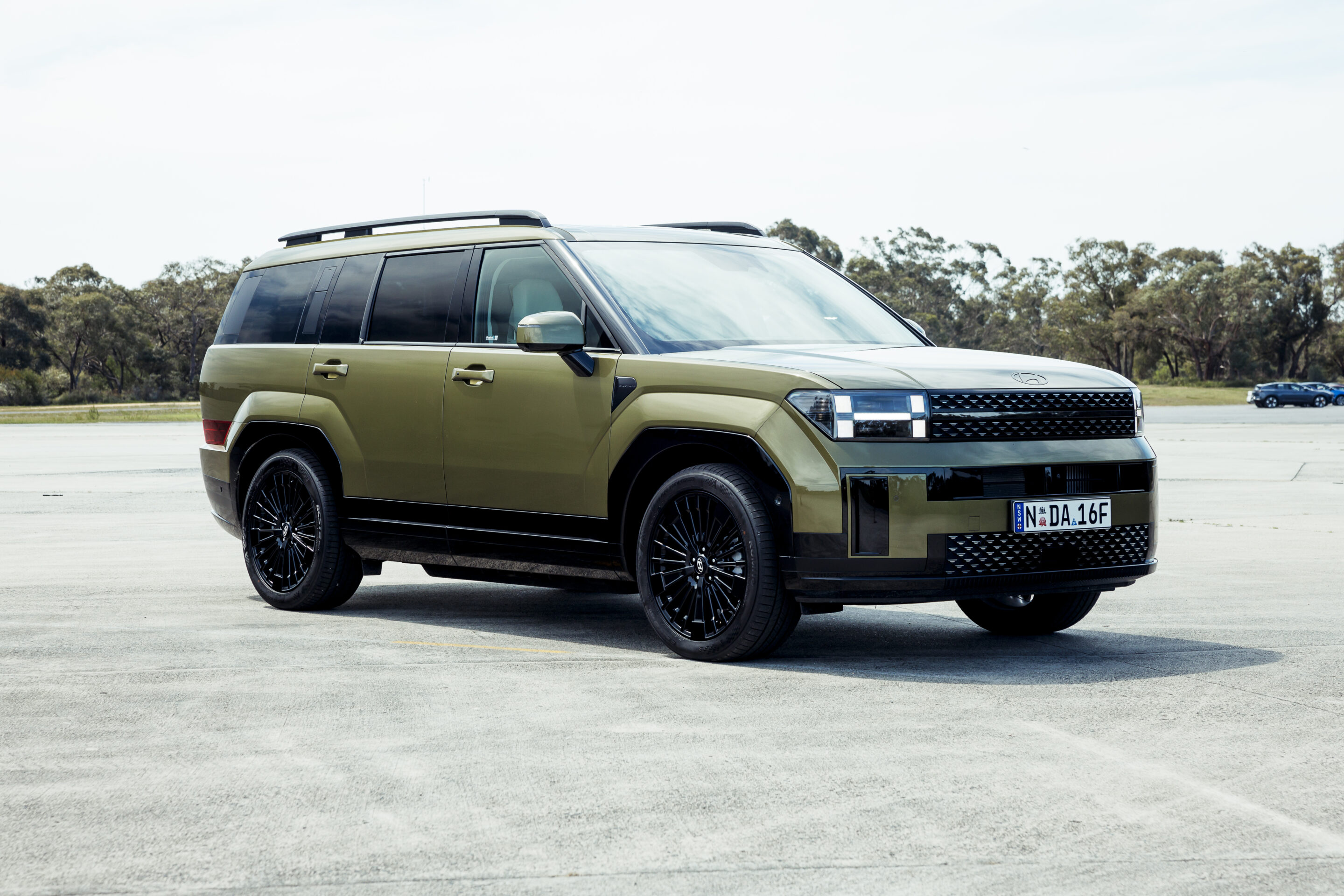
Price: from $53,000 plus on-road costs
Drivetrains/fuel economy/CO2 emissions:
2.5-litre four-cylinder turbo-four, 8-speed DCT, 213kW/420Nm, 9.1L/100km, 212g/km; 1.6-litre four-cylinder turbo-hybrid, 6-speed auto, 173kW/367Nm, 5.6L/100km, 128g/km
Dimensions (length/width/height/wheelbase): 4830/1900/1770/2815mm
Bootspace: Unknown (third row up)/628L (third row folded)/1949L (third + second row folded)
Warranty/roadside assistance/service intervals: Five-year/unlimited km, service-activated, annual/every 10,000km
Five-year service cost: $2425 (2.5T), $2439 (hybrid)
| Driving | |
|---|---|
| Interior | |
| Practicality | |
| Overall value | |
Things we like
- Distinctive styling
- Spacious and practical cabin
- Loaded with kit across the range
Not so much
- Calligraphy model’s pricing is getting up there
- Lazy response in eco mode
- 2.5T’s dozy transmission
If you’re searching for a bold and distinctive-looking family SUV, look no further than the Hyundai Santa Fe. While the previous four generations were some of Hyundai’s best products over the years, none of them could be called especially interesting to look at. Enter generation five and its boxy, funky shape, which is certainly one of the most instantly noticeable large SUVs on the market.
Inside the Santa Fe is a spacious and practical cabin that feels well thought through by its designers. Each row has more than enough space for adults, with the third row a noticeable improvement on the previous Santa Fe and more spacious than key rivals such as the Kia Sorento. It also features top tether points, air vents, cup holders and even a fan speed controller.
There are two available drivetrains in Australia: a turbocharged petrol 2.5-litre four-cylinder unit making 213kW of power, or a 173kW 1.6-litre turbo-petrol hybrid. Both engines are available as front-drivers in the base model but are otherwise paired to all-wheel drive throughout the range, and every Santa Fe model is quite comfortable and relaxing to drive, with a well tuned ride quality and light steering. The boxy styling helps with visibility as well.
Hyundai’s five-year/unlimited km warranty covers the Santa Fe, and its service costs are reasonable at a maximum of $2439 for five years/75,000km, though its warranty looks short against some other manufacturers on the market. Counting against the Santa Fe is that it’s not cheap at the higher end of the model range, the lazy drivetrain response in eco mode and the 2.5T’s lazy dual-clutch transmission that can stumble a bit in low-speed driving.
But otherwise, the Hyundai Santa Fe proves to be a very worthy large SUV thanks to its insanely practical cabin, value for money, long list of equipment, comfortable driving experience and reasonable running costs. That it also looks unique and characterful is only a bonus for those wanting a more distinctive family chariot to keep ahead of the Joneses.
Chery Tiggo 8 Pro Max
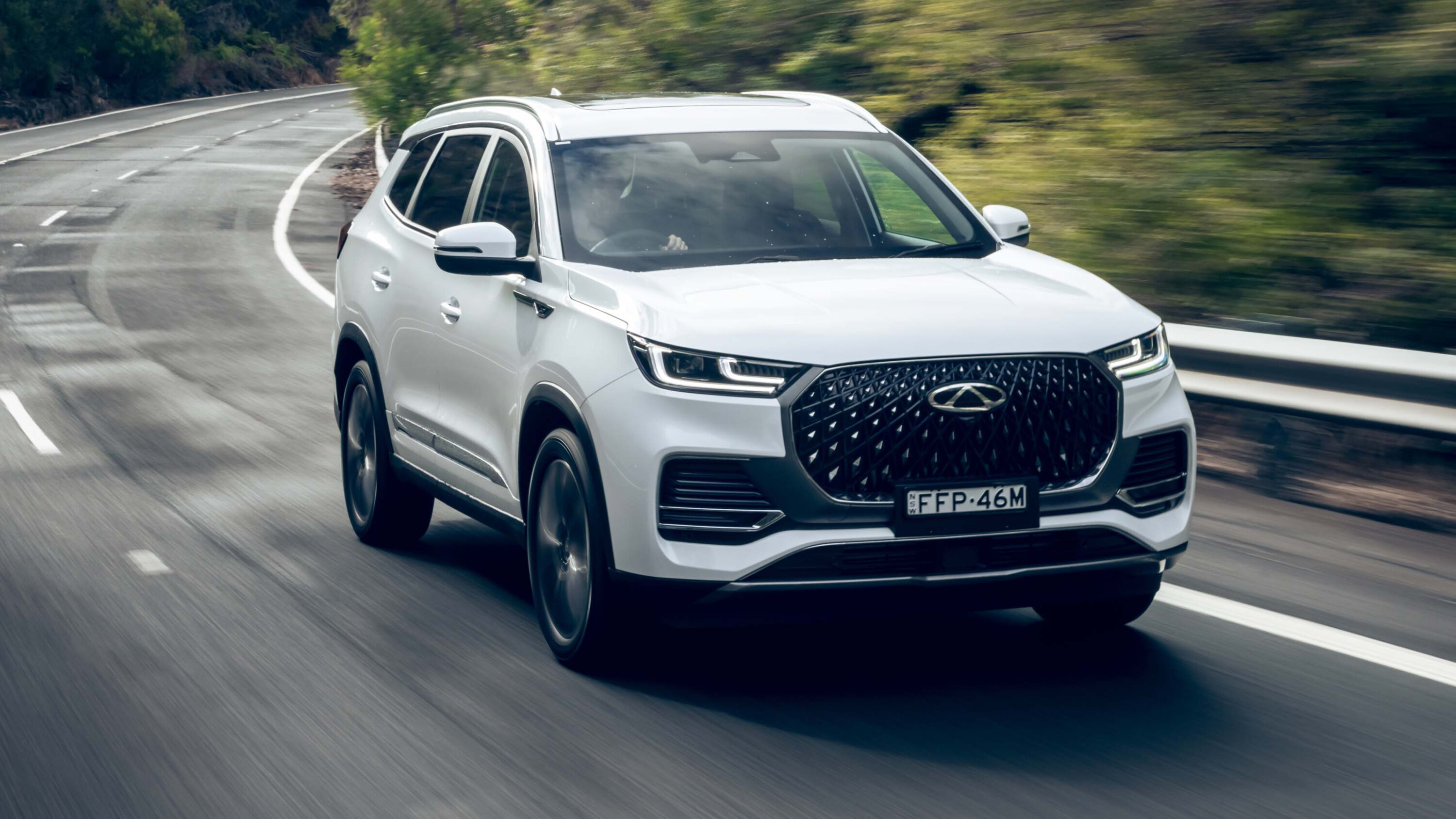
Price: From $41,990 drive away
Drivetrains/fuel economy/CO2 emissions: 2.0L turbo four-cylinder petrol, 7-speed DCT, 180kW/375Nm, 8.1L/100km, 191g/km; 1.5-litre turbo four-cylinder plug-in hybrid, 255kW/525Nm, CVT, 1.3L/100km, 30g/km
Dimensions (length/width/height/wheelbase): 4724/1865/1718/2694mm
Bootspace: 117L (third row up), 479L (third row folded), 739L (third + second row folded)
Warranty/roadside assistance/service intervals: Seven-year/unlimited km, 12 months (renewed with each service up to seven years in total), annual/every 15,000km
Five-year service cost: $1495
| Driving | |
|---|---|
| Interior | |
| Practicality | |
| Overall value | |
Things we like
- Very sharply priced and well equipped
- Two drivetrain choices, both with good performance
- PHEV gives 95km of claimed EV range
Not so much
- Boot and third row aren’t huge
- Suspension and driver aids need finessing
- Petrol engine is thirsty, dual-clutch auto dozy
If you’re looking for the ultimate bargain seven-seater large SUV in Australia, look no further than the Chery Tiggo 8 Pro Max. Priced from just $41,990 drive away – or, currently thanks to a manufacturer’s special, $38,990 drive away – the Tiggo 8 Pro Max is excellent value for money and even the entry-level Urban features equipment such as heated and ventilated front seats, a 360-degree camera and a full suite of active safety features.
But there’s more to the Tiggo 8 Pro Max than its low pricing, with a well finished cabin that is comfortable and well featured with tech. A dual 12.3-inch screen set up is easy to use and looks impressive – especially for the price – and the physical buttons located underneath the screen and on the centre console make it easier to use. The Tiggo 8 Pro Max’s cabin is also practical, with ample space in the first and second rows of seating, though the third row is small and while there are air vents and cup holders, no support for child seats.
The Tiggo 8 Pro Max offers two drivetrains in Australia: a 183kW 2.0-litre turbo-petrol or a 255kW 1.5-litre turbo plug-in hybrid, with both providing more than ample performance. The PHEV also offers an impressive 95km of electric driving range before the petrol engine even switches on, and a claimed overall range of more than 1200km. The 2.0-litre turbo-petrol engine sounds good and provides more than enough performance, though the dual-clutch transmission suffers from indecisive low-speed behaviour, much like many others of the breed.
On the road, the Tiggo 8 Pro Max is quite refined with low road noise levels, though its suspension and active safety features need some finessing. The ADAS systems are over sensitive and the suspension needs more refined damping to better deal with low speed bumps. The steering also lacks feel, but it is perfectly light for urban driving. The 360-degree camera that’s standard across the range is impressively high definition for the price as well.
There’s definitely more to the Chery Tiggo 8 Pro Max than just its excellent value equation thanks to its good quality interior finishes and tech, strong powertrains and refined driving experience. The new plug-in hybrid drivetrain also provides a healthy EV driving range, and over 1200km of total driving range too. It’s not perfect thanks to its small boot and third row, need for finessing of the driver assistance systems and suspension and thirsty petrol engine, but if you’re after a bargain large SUV, just know that there’s much more to the Chery Tiggo 8 Pro Max than just its low pricing and healthy equipment levels.
MG QS
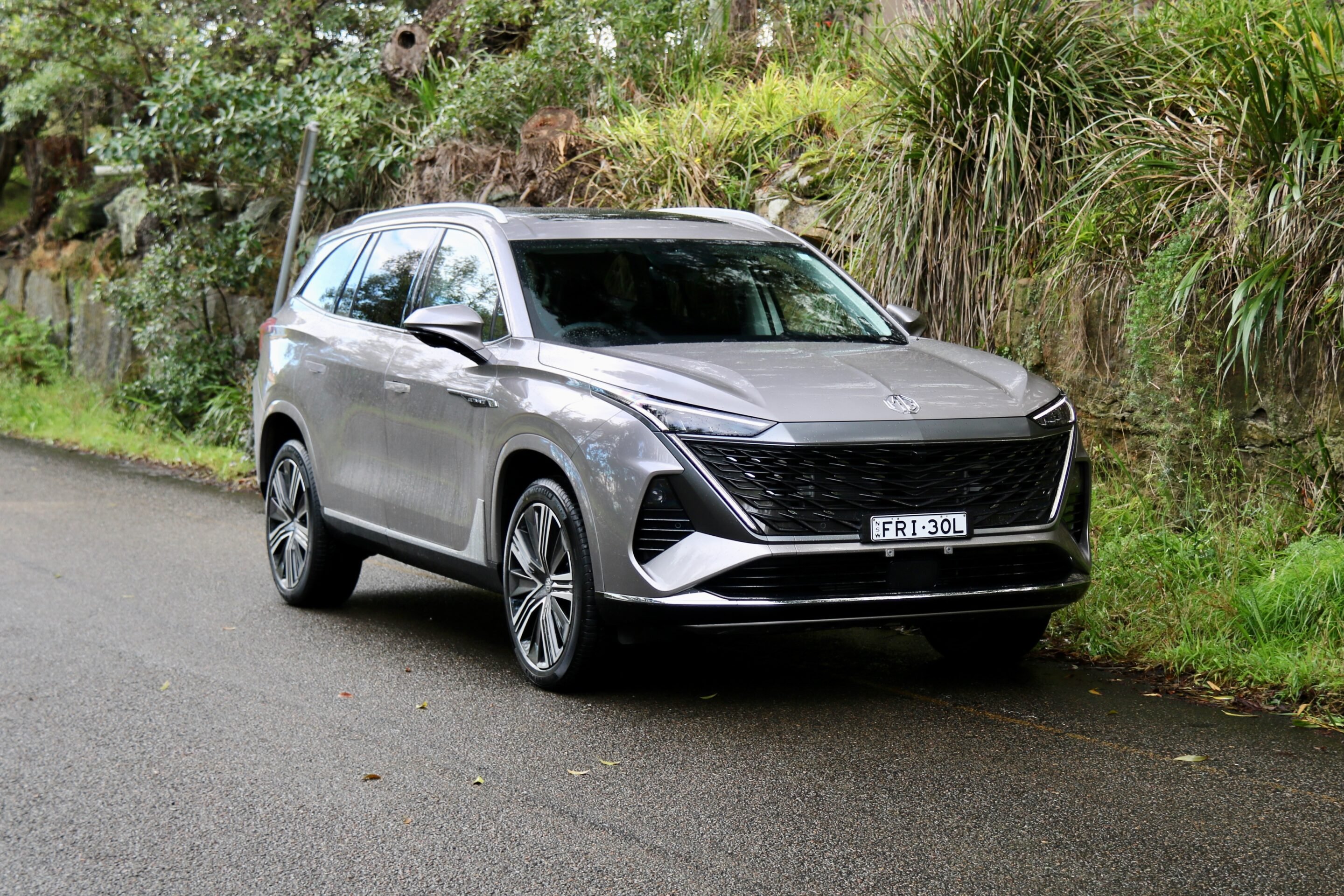
Price: From $46,990 drive away
Drivetrains/fuel economy/CO2 emissions: 2.0-litre four-cylinder turbo-petrol, 9-speed auto, 153kW/360Nm, 8.8L/100km, 198g/km
Dimensions (length/width/height/wheelbase): 4983/1967/1778/2915mm
Bootspace: 203 litres (third row up)/517L (third row folded)/1052L (third + second row folded)
Warranty/roadside assistance/service intervals: 7-year/unlimited km (extendable to 10 years/250,000km if serviced at MG), 7 years, annual/every 15,000km
Five-year service cost: $3442 (Excite), $3618 (Essence)
| Driving | |
|---|---|
| Interior | |
| Practicality | |
| Overall value | |
Things we like
- A lot of metal for the money
- High quality and spacious cabin
- Lovely ride quality
Not so much
- Very expensive to service
- Can be thirsty, no hybrid powertrain
- Dozy response from a standstill
MG is undertaking a huge product expansion in Australia, entering segments it’s not previously played in. The QS, the brand’s new large SUV, is the biggest product to ever wear the MG badge and its first seven seater too. But as you’d expect for an MG, its value equation is sharp and it’s priced from just $46,990 drive away for the entry-level Excite.
Measuring 4983mm long, the MG QS is one of the largest seven-seat SUVs, and it’s even 118mm longer than the Toyota Kluger. Its big sizing makes it one of the roomiest seven-seat SUVs on the market, with adult-carrying capacity for the third row. The second row is vast as well, while front seat occupants will find a modern space with high-quality materials.
For now, only one engine is available in the QS: a 153kW/360Nm 2.0-litre turbo-petrol, mated to a nine-speed automatic transmission. The base Excite is a front-driver, with the upper-spec Essence adding drive to the rear wheels as well. While it’s strong at speed, it feels sluggish off the line thanks to odd tuning, can also be thirsty, especially in urban driving – a hybrid drivetrain would solve both issues, though the QS is yet to offer one.
Otherwise, the driving experience of the QS is pleasant, with a well-controlled ride quality – despite the huge 20-inch wheels on the Excite and 21s on the Essence – and excellent refinement, with little in the way of road noise. Its active safety features are big improvements on earlier MG models, though accessing their settings in the touchscreen still takes too many presses.
MG covers the QS with a seven-year/unlimited km warranty that can be extended to 10 years/250,000km if serviced through an MG dealership, however, its service pricing is quite expensive at a minimum of $3442 for the Excite and $3618 for the Essence. That’s on average between $688 and $723 annually for the first five years, which compares unfavorably when the Chery Tiggo 8 Pro Max, also with a 2.0-litre turbo-petrol engine, asks just $1495 for its first five services or less than half that of the MG.
Overall however, MG has played the large SUV game well with the QS. It gives large SUV shoppers yet another option to consider, one that presents quite well with a spacious cabin with quality materials, a pleasant driving experience with little electronic nannying to annoy, and excellent value for money from its low asking price to its long list of equipment.
Kia Sorento
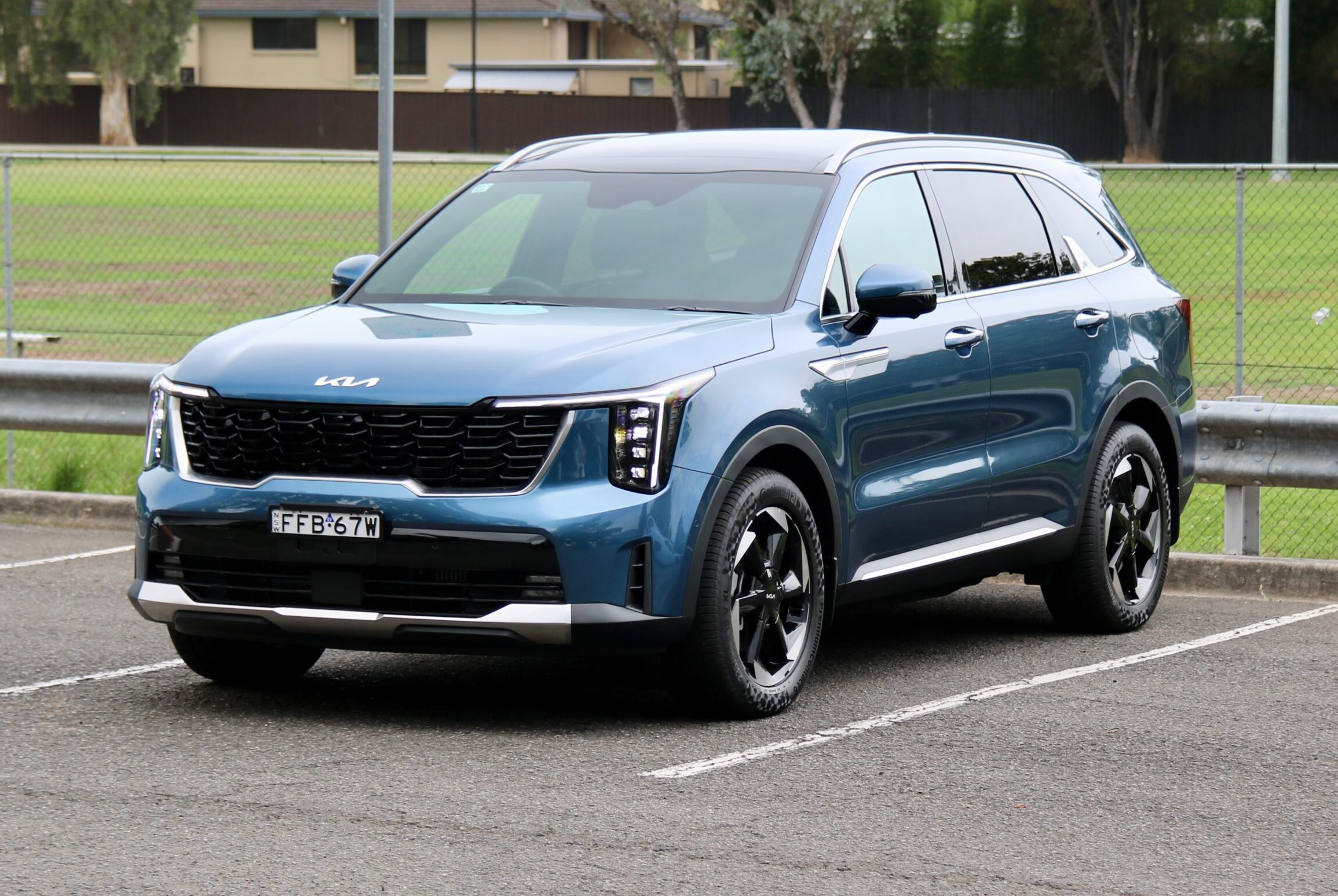
Price: From $50,880 plus on-road costs
Drivetrains/fuel economy/CO2 emissions: 3.5-litre petrol V6, 8-speed auto, 200kW/332Nm, 9.8L/100km, 222g/km; 2.2-litre four-cylinder turbo-diesel, 8-speed DCT, 148kW/440Nm, 6.0L/100km, 158g.km; 1.6-litre turbo four-cylinder hybrid, 6-speed auto, 169kW/350Nm, 5.4L/100km, 122g/km; 1.6-litre turbo four-cylinder PHEV, 6-speed auto, 195kW/350Nm, 1.6L/100km, 36g/km
Dimensions (length/width/height/wheelbase): 4815/1900/1695/2815mm
Bootspace: 179L (third row up)/608L (third row folded)/1996L (third + second row folded)
Warranty/roadside assistance/service intervals: Seven-year/unlimited, up to eight years, annual/every 15,000km
Five-year service cost: $2580 (V6), $2637 (diesel), $3009 (hybrid), $3409 (PHEV)
| Driving | |
|---|---|
| Interior | |
| Practicality | |
| Overall value | |
Things we like
- Wide range of drivetrains to suit a wide range of buyers
- Great value for money across the range
- Lovely to drive thanks to local tuning
Not so much
- V6 petrol is quite thirsty in the real world
- PHEV is expensive to buy and service
- Hybrids only at the top of the range
Kia is absolutely killing it at the moment with an impressive lineup that is – deservedly – winning it big sales in Australia. While products such as the new Tasman ute and EV9 electric upper large SUV take all the headlines, the Sorento seven-seat SUV does a lot of heavy lifting in sales – so far this year, it’s Kia’s third-best selling vehicle with over 5000 sold to the end of June. So what’s so good about the Sorento?
Starting at $50,880 plus on-road costs for the entry-level Sorento S with a 3.5-litre petrol V6 and a front-wheel drive drivetrain, the Sorento range offers strong value for money. But we still think that top-spec models are solid value for money thanks to their very long lists of standard kit. While a GT-Line hybrid is around $80,000 drive away, it’s also absolutely loaded with features.
Four drivetrains are available with the Sorento: the aforementioned V6, a 2.2-litre turbo-diesel and two 1.6-litre hybrid options, one a regular hybrid and one a plug-in unit with up to 68km of electric driving range (WLTP). 80 per cent of buyers in Australia choose the diesel, as it’s punchy, fuel efficient and unlike the V6, is mated to an all-wheel drive system. More would choose the hybrid if it were offered in lower grades, but alas, it’s limited to the top-spec GT-Line for now.
Thanks to Kia’s local ride and handling tuning, the Sorento drives very well for the segment. Its ride quality is tuned well with a taut but comfortable feeling, especially at higher speeds – plus, it handles well for a big seven-seater SUV as well that even enthusiasts will be happy from behind the wheel.
The Sorento’s cabin is good quality, with its new infotainment screens – introduced with the mid-life facelift – impressively slick to use and well-featured. Storage space in the front cabin is excellent, with plenty of spots to hide trinkets, and it’s a similarly positive story moving rearward with ample space in the second row and enough space for kids in the third row, including two top tether child seat points.
It’s easy to see why the Kia Sorento has become one of the brand’s best selling cars in Australia. It’s covered by a long warranty, it’s great to drive, has a range of models and drivetrains, a lot of standard equipment and a practical interior. More hybrid availability would be great as the petrol V6 is thirsty and diesel fuel isn’t suited to everybody, and the PHEV is expensive. But overall, the Sorento is a great product worthy of strong consideration in the large SUV segment.
Toyota Kluger
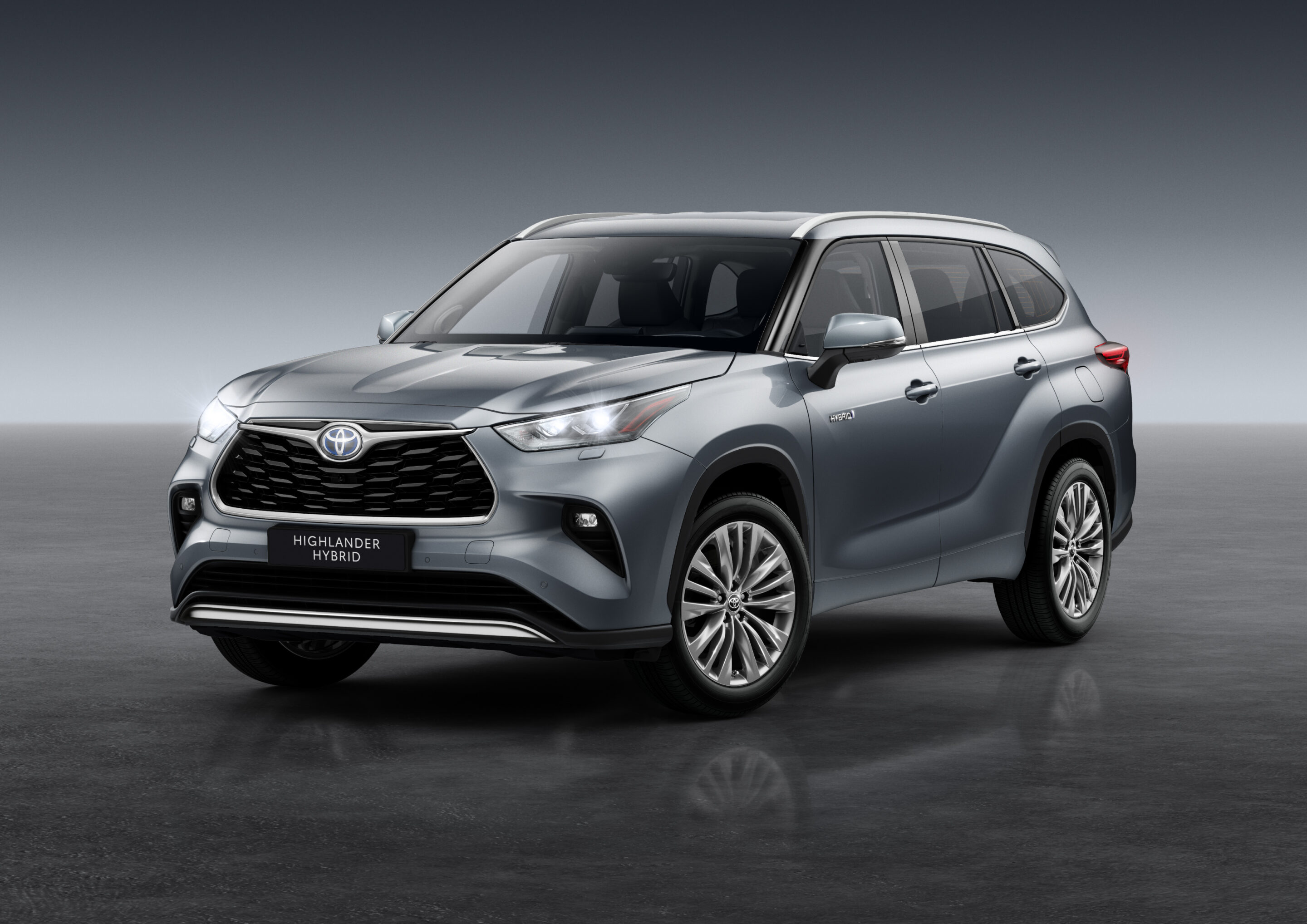
Price: From $62,410 plus on-road costs
Drivetrains/fuel economy/CO2 emissions: 2.5-litre four-cylinder hybrid, CVT auto, 184kW, 5.6L/100km, 128g/km
Dimensions (length/width/height/wheelbase): 4966/1930/1755/2850mm
Bootspace: 241L (third row up), 1150L (third row folded)
Warranty/roadside assistance/service intervals: Five-year/unlimited km, no roadside assistance, annually/every 15,000km
Five-year service cost: $1400
| Driving | |
|---|---|
| Interior | |
| Practicality | |
| Overall value | |
Things we like
- Excellent hybrid drivetrain and efficiency
- Relaxing to drive
- Well equipped
Not so much
- Third row feels small thanks to tiny windows
- Expensive throughout the range
- Cabin quality could be better
The Toyota Kluger has been one of the best-selling seven-seat SUVs in Australia since it first landed in Australia in 2003 and now in its fourth generation, that popularity has not slowed down. Prices start at $62,410 plus on-road costs for the entry-level GX and rise to more than $90,000 once on-road costs are included. Three models are available: GX, GXL and Grande.
While it launched with a 3.5-litre petrol V6 and a 2.5-litre hybrid drivetrains, the V6 was replaced with a torquier 2.4-litre turbo petrol, but nowadays the hybrid is the only available option. It provides ample grunt with 184kW on offer, but also excellent fuel consumption at a claimed 5.6L/100km. All new Kluger models in Australia are equipped with an all-wheel drive system.
On the road, the Kluger is extremely comfortable with a soft suspension set up that gives it an excellent ride quality. It’s quite easy to drive, with quick steering and good visibility, and all the controls are well weighted. The front cabin is quite practical with ample storage space, though material quality is a bit lacklustre, especially in the top-spec Grande.
Third row seating could be better as well. Access is excellent thanks to the sliding middle seat, but there are no child seat points in the rear and the small windows make it feel smaller than it is. The second row is huge, however, and three adults will be more than comfortable. Amenities include a third climate zone, air vents, map pockets and large door pockets.
Competition is tough, but the Toyota Kluger’s practicality, low running costs, ample performance from its hybrid powertrain and comfortable driving experience continue to win it many fans in Australia. The next generation of Kluger is likely not far off, and we’re hoping it has a more spacious feel and higher quality materials inside, but the current model is still a great family car.
Land Rover Discovery
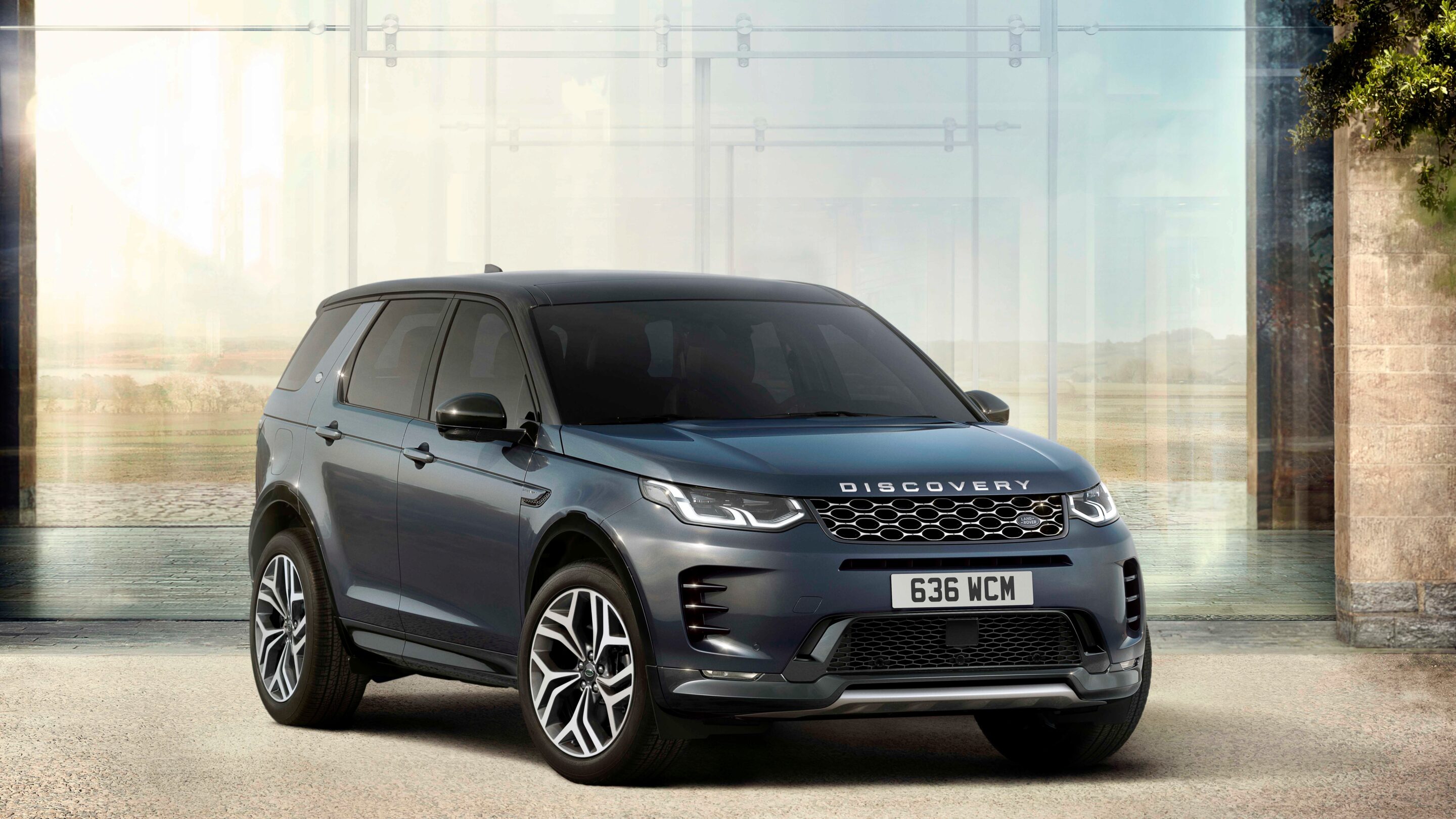
Price: From $117,219 plus on-road costs
Drivetrains/fuel economy/CO2 emissions: 3.0L inline six turbo-diesel, 8-speed auto, 258kW/700Nm, 7.5L/100km, 199g/km (D350)
Dimensions (length/width/height/wheelbase): 4956/2073/1888/2923mm
Bootspace: 258L (third row up), 1274L (third row folded), 2391L (third + second rows folded)
Warranty/roadside assistance/service intervals: Five-year/unlimited km, five years, annual/every 20,400km
Five-year service cost: $3500
| Driving | |
|---|---|
| Interior | |
| Practicality | |
| Overall value | |
Things we like
- Excellent cabin quality and spaciousness
- Relaxing to drive, standard air suspension
- Punchy diesel six
Not so much
- No petrol or hybrid options
- Feeling a bit long in the tooth
- Upper-spec models get expensive
These days, the Land Rover model range is all about the Defender and Range Rovers. But if you’re searching for a seven-seater Land Rover, the reality is that the best model is the Discovery. The Discovery Sport, Range Rover and Defender 110 and 130 are each available with seven seats, but the Discovery’s third row is better for adults as it’s a taller vehicle. Pricing for the Discovery range starts at $117,219 plus on-road costs, and four models are available: S, SE, Gemini and top-spec Tempest.
The third row of seating in the Discovery can easily hold two adults, with ample headroom, and impressively the third row also includes two top tether points and even two ISOFIX points as well. Depending on model, the third row of seats can also be had with heating. The second row is large as well, with two more ISOFIX and three more top tether points, plus ample amenities for passengers.
The front cabin of the Discovery is high quality with leather trim seemingly everywhere, while at the centre of the dashboard is Land Rover’s latest ‘Pivi Pro’ infotainment system with wireless smartphone mirroring, DAB+ digital radio, online services and sat-nav. A thumping Meridian sound system is standard across the range.
The only available drivetrain in the Discovery in Australia is a twin-turbocharged 3.0-litre diesel inline six making strong 258kW and 700Nm outputs. Despite the grunt and the Discovery’s huge size, it only consumes a claimed 7.5L/100km of diesel on the combined cycle. On the road, the Discovery is extremely comfortable thanks to its standard air suspension and if you’re looking for an off-roader, the Discovery is great at that as well.
Overall, while it’s not cheap to buy, the Land Rover Discovery is an excellent all-rounder as a seven-seat large SUV. Its interior is high quality, feature-packed and spacious for seven occupants, plus its V6 turbo-diesel offers ample performance and reasonable fuel economy.
KGM Rexton
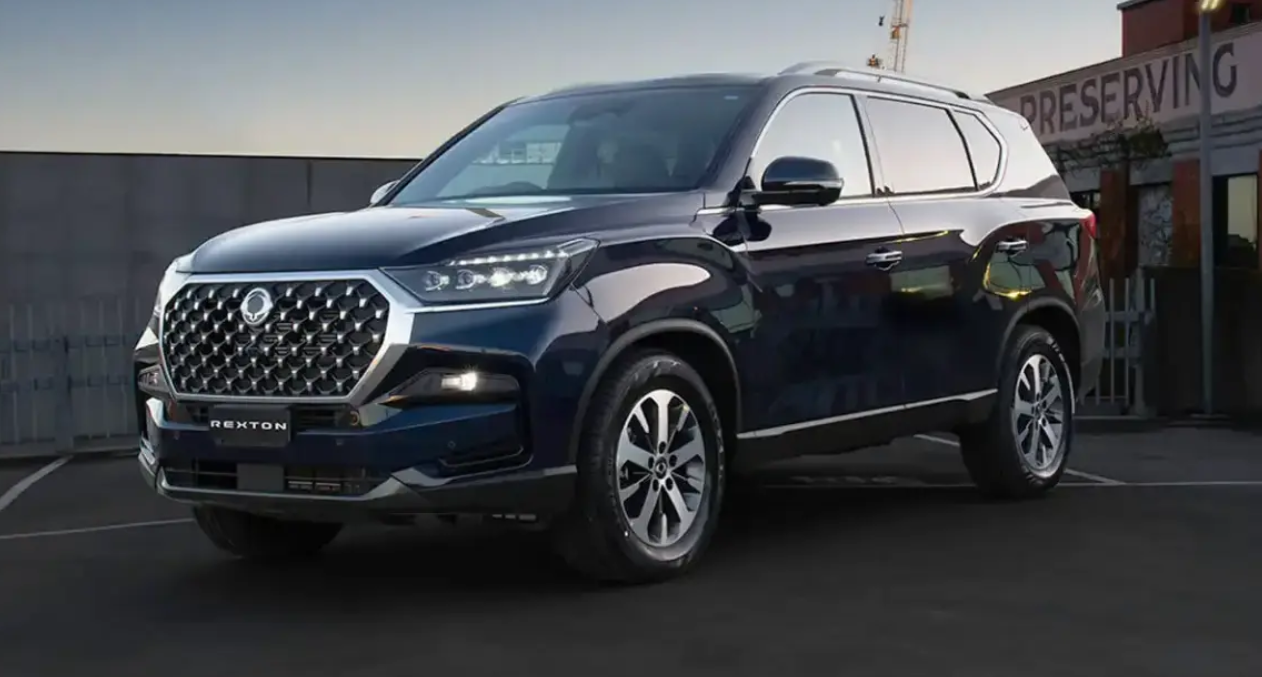
Price: From $52,000 drive away
Drivetrains/fuel economy/CO2 emissions: 2.2-litre four-cylinder turbo-diesel, 148kW/441Nm, 8-speed auto, 8.7L/100km, 223g/km
Dimensions (length/width/height/wheelbase): 4850/1960/1825/2865mm
Bootspace: 236L (third row up)/872L (third row folded)/1806L (third + second row folded)
Warranty/roadside assistance/service intervals: Seven-year/unlimited km, five years, annual/every 15,000km
Five-year service cost: $2298
| Driving | |
|---|---|
| Interior | |
| Practicality | |
| Overall value | |
Things we like
- Excellent value for money
- Good to drive, great off-road
- Refined powertrain
Not so much
- No hybrid option
- Missing some features such as sat-nav
- Third row not huge
The KGM – formerly SsangYong – Rexton is a charming and practical seven-seat large SUV which offers a lot for buyers. While its interior could be a bit more modern, it’s well finished with good quality materials and comfortable seating as well. Unlike a lot of large SUVs, the Rexton can easily venture off road thanks to its ladder-frame chassis that it shares with the capable Musso ute, while its excellent refinement makes it seem more car-like than you’d expect from a ute-based SUV from behind the wheel.
Inside the Rexton is a refined and good quality cabin, though it’s hardly the most modern in the segment. A new 12.3-inch touchscreen was fitted recently, which is quite easy to use, though doesn’t feature wireless smartphone mirroring or sat-nav in Australia.
The second row of seating is comfortable and offers a reasonable amount of space – two adults will be quite comfortable – while the third row is smaller and is really only for children and there are no child seat points. The boot behind the third row isn’t huge either, but there’s a lot of space with the third row folded, and even more with the second row folded as well.
The Rexton range uses a 148kW 2.2-litre turbo-diesel engine mated to a part-time four-wheel drive system and an eight-speed automatic transmission. It’s quite refined for the segment, with low engine noise and ample road noise insulation as well, and the transmission is quick to shift gears. The driving experience is comfortable, though not quite as comfortable as car-based competitors, but unlike those cars, the Rexton is actually a good off-roader.
If you’re after a large SUV with seven seats, the KGM Rexton is a good choice – especially if you’re planning to do some off-roading. While it’s not the most modern or up-to-date for technology, it drives well, its diesel engine is grunty and it offers good comfort and reasonable space for seven people.
GMC Yukon
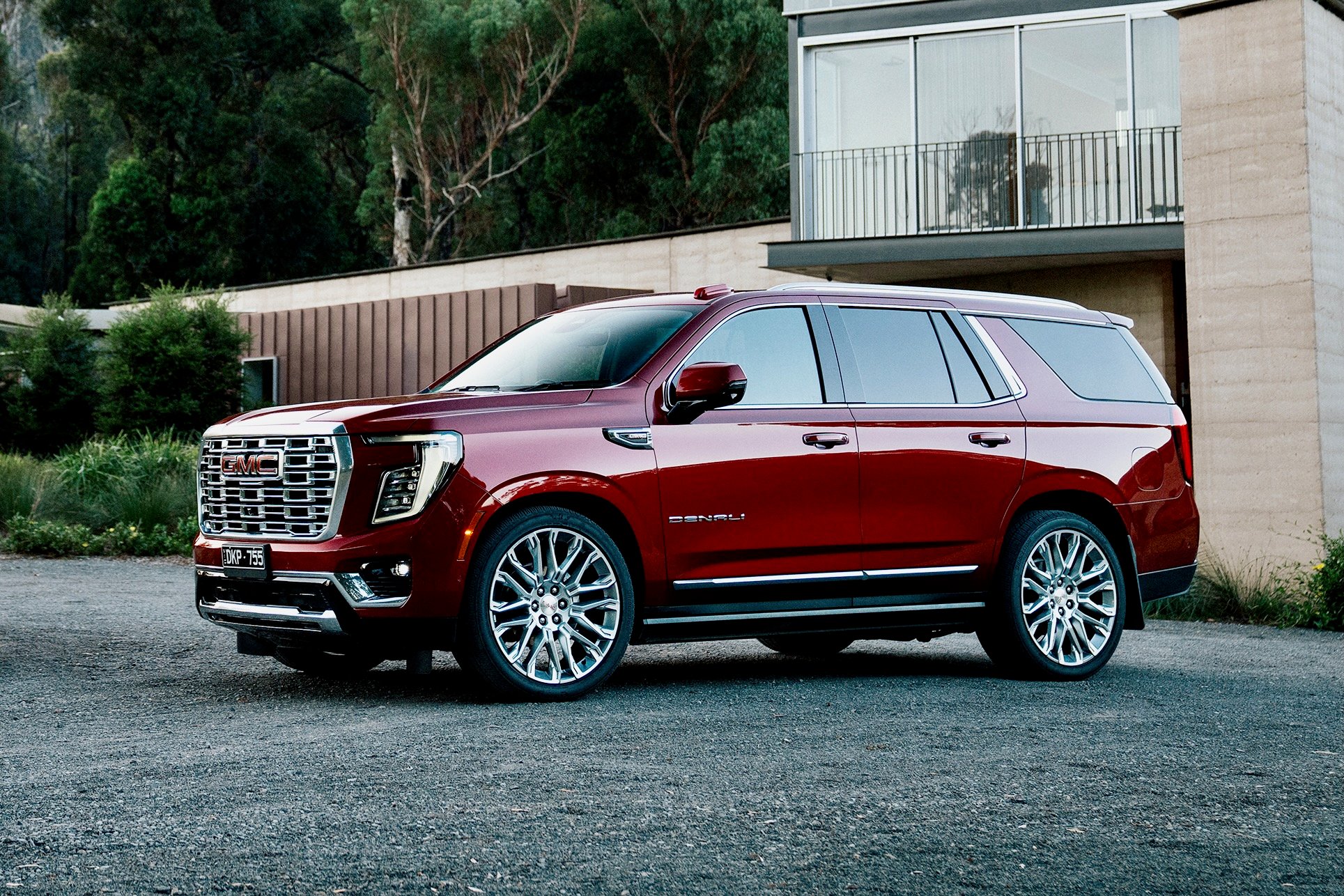
Price: From $174,990 plus on-road costs
Drivetrains/fuel economy/CO2 emissions: 6.2L petrol V8, 313kW/624Nm, 10-speed auto, 12.8L/100km and unknown CO2 emissions
Dimensions (length/width/height/wheelbase): 5360/2057/1943/3071mm
Bootspace: 3480L (third + second rows folded)
Warranty/roadside assistance/service intervals: Three-year/100,000km warranty, three years, annual/every 12,000km
Five-year service cost: No capped price servicing
| Driving | |
|---|---|
| Interior | |
| Practicality | |
| Overall value | |
Things we like
- Huge cabin carries eight adults with ease
- Punchy V8 engine, comfortable to drive
- Loaded with equipment
Not so much
- No diesel or hybrid drivetrain option
- No capped price servicing
- Missing features such as sat-nav
General Motors Special Vehicles (GMSV) launched the GMC Yukon in Australia earlier in 2025, providing a huge luxury V8 SUV for Australian buyers. Competing against cars such as the BMW X7 and Mercedes-Benz GLS, the Yukon is only offered in high-spec Denali form in Australia and is priced from $174,990 plus on-road costs.
While Australia doesn’t receive the Yukon in long-wheelbase form, the short-wheelbase model still offers a huge amount of rear space for passengers. Like only a few other large SUVs here, the Yukon actually seats eight people and all eight seating positions can easily carry a full-size adult. The second row of seating offers two ISOFIX points and three top tether points, with the third row offering two top tether points.
The front of the Yukon Denali is dominated by a huge 16.8-inch touchscreen with wireless smartphone mirroring, though no inbuilt sat-nav. The screen quality is good and it’s easy to use, while the 11.8-inch digital driver’s display is attractive as well.
Under the bonnet of the Yukon is a 6.2-litre petrol V8 engine, which is by far the largest in a large SUV in Australia. Making 313kW of power and 624Nm of torque, the Yukon’s V8 sounds wonderful and its 10-speed automatic transmission shifts smoothly. The Yukon’s 12.8L/100km combined fuel consumption is not small, however, and we wonder why the six-cylinder diesel engine in other markets isn’t sold in Australia. On the road it’s very comfortable thanks to its air suspension and adaptive dampers, but there’s no getting away from that it always feels large.
If you’re looking for a ‘large and in charge’ vehicle and have the coin to run it, the GMC Yukon Denali will fit the bill perfectly. It’s not cheap to buy, and it will be expensive to run thanks to its huge petrol V8 engine and lack of capped-price servicing. But it’s extremely comfortable to drive, well equipped, and very spacious.
Nissan Patrol
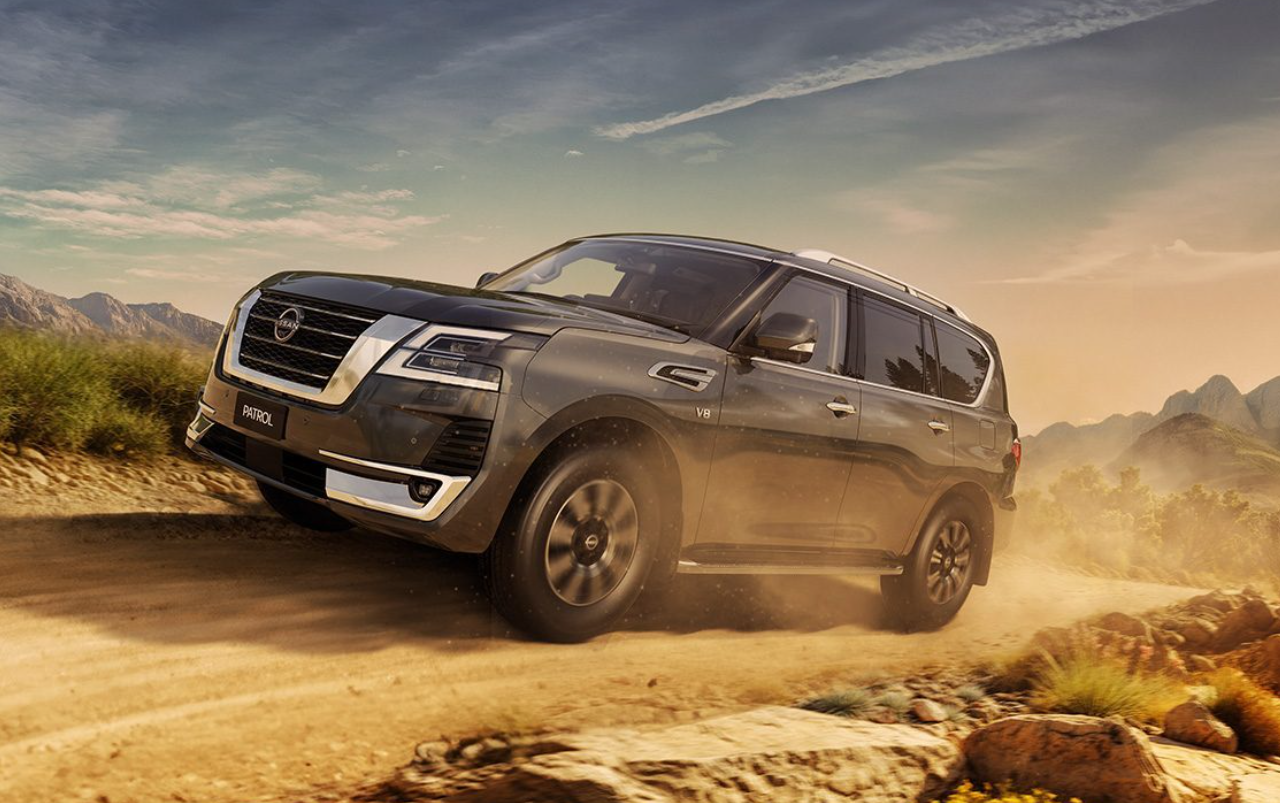
Price: From $95,600 plus on-road costs
Drivetrains/fuel economy/CO2 emissions: 5.6-litre petrol V8, 7-speed auto, 298kW/560Nm, 14.4L/100km, 334g/km
Dimensions (length/width/height/wheelbase): 5175/1995/1940/3075mm
Bootspace: 467L (third row up), 1413L (third row folded), 2623L (third + second row folded)
Warranty/roadside assistance/service intervals: Five-year/unlimited km (10-year/300,000km if serviced at Nissan), up to 10 years if serviced at Nissan, annual/every 10,000km
Five-year service cost: $2495
| Driving | |
|---|---|
| Interior | |
| Practicality | |
| Overall value | |
Things we like
- Excellent petrol V8 one of the last left
- Well equipped across the range
- Off-road special Warrior adds more attitude and capability
Not so much
- V8 is thirsty and expensive to run
- Complicated child seat situation
- Feeling dated in some areas
Although there’s an all-new model overseas that’s due in Australia sometime in 2026, the current-generation Nissan Patrol is still quite popular locally and that’s down to a number of factors: its great off-road capability, practical cabin, long equipment list, good value for money and its stonking petrol V8 engine and smooth seven-speed automatic transmission.
The Australian-spec Patrol received a big interior update earlier in 2025 with a new dashboard layout, a new 12.3-inch touchscreen with wireless smartphone mirroring and a new 7.0-inch digital driver’s display. The quality inside the Patrol is good, with leather trimmings everywhere.
The second and third row seating zones in the Patrol are spacious and comfortable, though child seating is not well catered for. There are two ISOFIX points in the second row outer seats, as well as two top-tether points but the points are located at the rear of the second and it’s quite a reach. There is only one top tether point in the third row as well, so the Patrol can only hold three child seats. Like the Yukon and Palisade, the Patrol can hold up to eight occupants.
The Patrol uses a powerful and refined 5.6-litre petrol V8 engine that’s mated to a seven-speed automatic transmission and a full-time four-wheel drive system. That gives it stonking performance, a lovely sound and great towing and off-road ability.
Nissan’s new 10-year/300,000km warranty (if serviced at Nissan past the five-year mark) is one of the best in the industry as well, while its $499 annual service cost for the first five years is reasonable as well. Overall, while the current generation Nissan Patrol isn’t the youngest car on the market, it’s still a great option for those wanting a large SUV that can tow and go off-road – it’s not the most modern inside, but is still comfortable and well equipped.
Audi Q7/SQ7
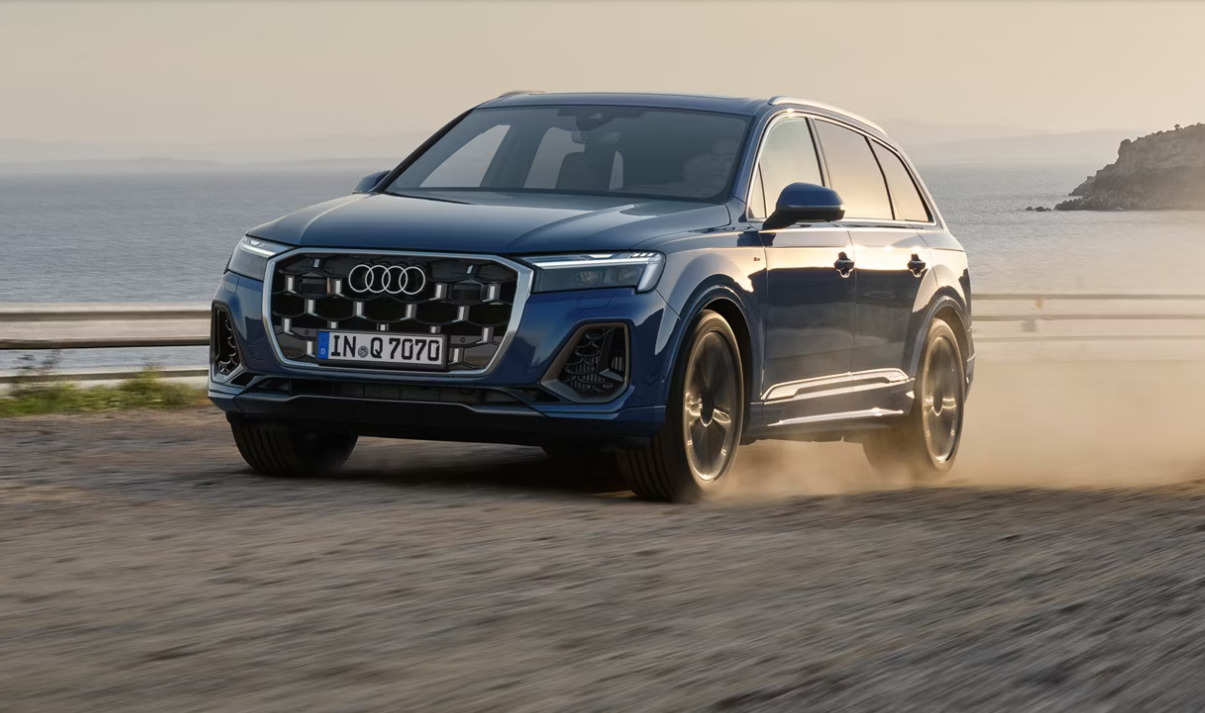
Price: From $108,815 plus on-road costs
Drivetrains/fuel economy/CO2 emissions: 2.0-litre four-cylinder turbo-petrol, 8-speed auto, 185kW/370Nm, 9.3L/100km, 210g /km (45 TFSI); 3.0-litre V6 turbo-petrol, 8-speed auto, 250kW/500Nm, 9.0L/100km, 205g/km (55 TFSI); 3.0-litre V6 turbo-diesel, 8-speed auto, 170kW/500Nm, 7.0L/100km, 184g/km (45 TDI); 3.0-litre V6 turbo-diesel, 8-speed auto, 210kW/600Nm, 7.1L/100km, 187g/km (50 TDI); 4.0-litre twin-turbo petrol V8, 8-speed auto, 373kW/770Nm, 11.8L/100km, 271g/km (SQ7)
Dimensions (length/width/height/wheelbase): 5066/2018/1707/3005mm
Bootspace: 295L (third row up), 740L (third row folded), 2050L (third + second rows folded)
Warranty/roadside assistance/service intervals: Five-year/unlimited km, five years, annual/every 15,000km
Five-year service cost: $3820 (Q7), $4600 (SQ7)
| Driving | |
|---|---|
| Interior | |
| Practicality | |
| Overall value | |
Things we like
- Excellent cabin quality and spaciousness
- Great to drive
- Punchy drivetrains
Not so much
- No plug-in hybrid any longer
- Not cheap to service
- Feeling its age in some areas
The Audi Q7, first revealed way back in 2005, was the company’s first SUV and has long been a great choice for a premium large seven-seat SUV. Even today in its second generation, still sells well and offers a wide range of models and powerplants for buyers to choose from. There are newer options around, but despite its age, the Q7 still looks and feels special.
As you’d expect from an Audi product, the cabin of the Q7 is excellent quality and bang up to date with tech. Its 10.1-inch touch and 12.3-inch digital driver’s displays are attractive, feature-packed and easy to use, while seat comfort is also excellent. Storage, however, could be better in the front seat but the whole Q7 range is well equipped.
The second and third rows of seating in the Q7 are all equipped with top tether points for child seats, so that five child seats can be fitted – plus, two ISOFIX points in the second row as well. Thanks to its size as well, even the third row of the Q7 is spacious – more so than if you optioned a BMW X5 or Mercedes-Benz GLE with their optional third rows.
Audi offers a range of powerplants for the Q7 range, from a modest 185kW 2.0-litre turbo-petrol to the stonking 373kW twin-turbo V8 in the SQ7, each engine is punchy and refined. We’d buy the 3.0-litre diesel V6, as most customers do, as it’s got more than ample performance, yet reasonable fuel efficiency at from 7.0L/100km combined. You can, however, no longer buy the former plug-in hybrid Q7 drivetrain – but it’s still offered in the Q7’s Q8 sibling.
On the road, the Q7 is great to drive thanks to its excellent refinement, great ride and handling balance from its adaptive air suspension and ample performance, regardless of which engine is chosen. It’s easy to see why the Audi Q7 has always been a popular product for the company as it just does everything quite well, including a spacious and excellent quality cabin, keen driving dynamics, excellent refinement and a great range of engines.
Contenders
- Volvo EX90
- Genesis GV80
- Mercedes-Benz G-Class
- BMW iX
- Land Rover Range Rover Sport
- Audi Q8
- BMW X7
- Lexus LX
- Porsche Cayenne
Winner – Volvo EX90
Price: From $124,990 plus on-road costs
Battery size/claimed range: 111kWh/570km (NEDC)
Drivetrain: Dual-motor electric, 300kW/770Nm (Twin) 380kW/910Nm (Performance)
Dimensions (length/width/height/wheelbase): 5037/1964/1747/2985mm
Bootspace: 324L (third row up), 697L (third row folded), 2135L (third + second row folded) + 46L
front boot
Warranty/roadside assistance/service intervals: Five-year/unlimited km, five years (extendable up
to eight years in total), annually/every 15,000km
Five-year service cost: included in the cost of the car
| Driving | |
| Interior | |
| Practicality | |
| Overall value | |
Things we like
- Interesting cabin and materials
- Very practical, as you’d expect for a Volvo
- Competitive performance and range
Not so much
- XC90 offers a cleverer and richer-feeling interior
- Not cheap to buy
- Too much functionality controlled through the central screen
For a brand that was once only known for its boxy wagons, Volvo is doing big business from its
SUV range nowadays. In fact, in Australia at least, it now only offers SUVs, its S60 and V60
Cross Country models now no longer available to order. The EX90 is the latest Volvo SUV offering
in Australia, one that’s quite similar to the popular XC90 but with a crucial detail: it’s electric.
Available in two models with a single 111kWh battery for the moment, the EX90 provides the
XC90’s excellent performance but with a silent drivetrain. A dual-motor set up is standard, with either
300kW/770Nm outputs in the entry-level Twin or an even stronger 380kW/910Nm in the upper-
spec Performance. Range? That’s up to a claimed 570km (NEDC), or more than enough to quell
any range anxiety, plus the EX90 is capable of handling up to 250kW DC charging for a claimed 10-
80 per cent charge time of 30 minutes.
With its standard adaptive dual-chamber air springs and adaptive damping – at least in Ultra
Performance guise – the EX90 proves surprisingly adept at tackling whatever the road conditions
throw at it, even when riding on 22-inch wheels. The dampers offer soft and firm settings, but even
in firm mode, the EX90 is still quite comfortable. The EX90’s cabin quality is elevated in quality,
with tactile finishes, slick digital screens that control everything to do with the car, subtle light-
coloured wood inlays and synthetic leather upholstery, neatly combined with classy tech and textural
warmth.
As you’d expect for a Volvo product, the EX90 is extremely practical and capable of holding seven
adults with more than enough space in each row, though not quite as much as an XC90. Still, that’s
a high standard to try and match because the XC90 is one of the best seven-seaters on the market
and behind the third row lies 342 litres of bootspace, which opens up to a massive 2135 litres with
both the second and third rows folded. We love the electric lowering and raising third row too, and
the integrated child seat in the middle rear seat.
All in all the EX90 is an impressive package, from its huge interior, lovely driving experience and keen
performance, to its above average charging capability and impressive interior finishes. There is way too much functionality controlled through the touchscreen and some of the interior finishes aren’t up to the high standard of the XC90 but overall, Volvo’s first electric large SUV is well engineered and well priced.
Genesis GV80/GV80 Coupe
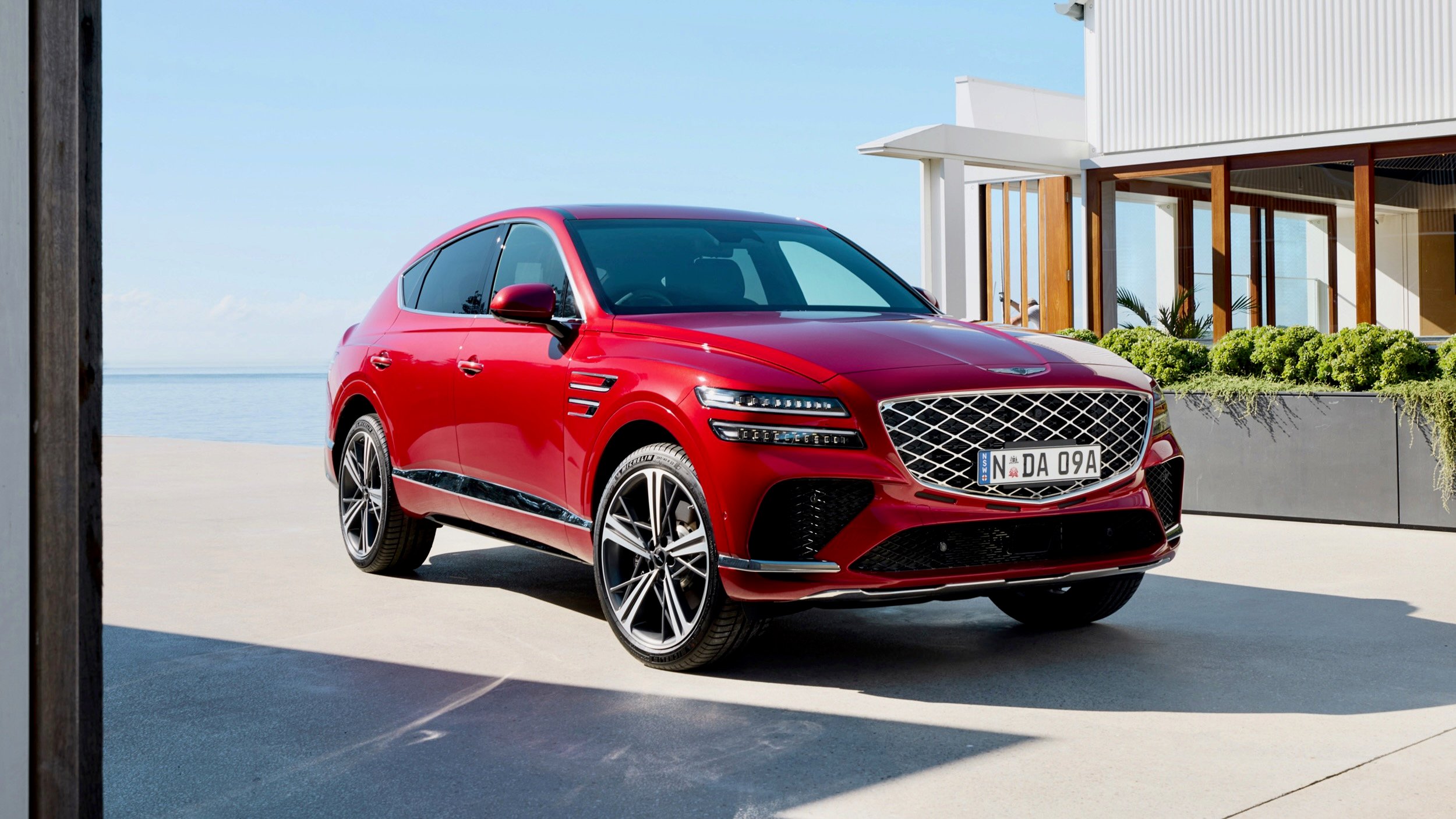
Price: From $129,114 plus on-road costs
Drivetrains/fuel economy/CO2 emissions: 3.5-litre twin-turbo petrol V6, 8-speed auto,
279kW/530Nm, 11.9L/100km, 272g/km
Dimensions (length/width/height/wheelbase): 4940/1975/1710-1715/2955mm
Bootspace: 735L (seats up), 2147L (seats folded), Coupe: 644-1033L
Warranty/roadside assistance/service intervals: Five-year/unlimited km, five years, annual/every
10,000km
Five-year service cost: Included in the price
| Driving | |
| Interior | |
| Practicality | |
| Overall value | |
Things we like
- Absolutely loaded with standard equipment
- Handsome and blingy exterior styling
- Superb interior quality, many trim colours available
Not so much
- Third row of seats is very small
- Very thirsty petrol engine, no hybrid option
- Diesel six no longer offered
Genesis is slowing growing in Australia, measured by product line-up, dealership locations and word-of-mouth reputation. Its GV70 mid-sizer SUV is its best-selling model, with the GV80 large SUV sitting in second place. The GV80 was recently given a mid-life update, adding appeal in this segment.
As we’ve seen with other Genesis products, the GV80’s cabin quality is fabulous – at higher-end
BMW and Mercedes-Benz levels of fabulous. In the GV80’s case, there are plenty of expensive-
feeling materials everywhere you look, from the sumptuous Nappa leather upholstery to the
damped switchgear, the GV80 looks and feels expensive inside. The facelifted model’s huge new
OLED 27-inch display with a touchscreen portion for the infotainment looks and feels impressive,
with its calmly minimalist layout, long list of features and general ease of use.
As it should, for a car starting at almost $130,000 plus on-road costs, right? There’s no question
that the GV80 is not cheap, but in this company, it is good value for money and offers a lot of
luxury feel throughout. Unlike its German competition, the GV80 offers only three optional extras:
matte paint, a six-seat layout (wagon only, not the coupe) and a rear-seat entertainment system.
Everything else is standard equipment.
For the mid-life update, only one engine choice remains for the GV80 range: a 279kW twin-
turbocharged 3.5-litre V6 petrol engine, mated to an eight-speed automatic transmission and all-
wheel drive. It’s a lovely unit with creamy power delivery and excellent refinement, but it’s quite
thirsty and there’s no hybrid drivetrain available yet. The former smaller 2.5-litre four-cylinder and
3.0-litre V6 turbo-diesel powerplants are no longer available.
The GV80 wafts comfortably down the road with barely any road noise, and a well-judged
suspension set up that was revised for the updated model with better body control than before. It’s
not as sporty as an X5, but it is more relaxing to drive. Add in Genesis’ free five-year servicing plan
and while the GV80 isn’t cheap, it is good value for money and as a large SUV, it’s an excellent
product that should make you think twice about an X5 or GLE.
Mercedes-Benz G-Class
Price: From $249,900 plus on-road costs
Drivetrains/fuel economy/CO2 emissions: 4.0L twin-turbo petrol V8, 9-speed auto, 430kW/850Nm, 15.3L/100km, 350g/km (AMG G 63); Dual motor AWD, 432kW/1164Nm, 116kWh battery, 473km range (WLTP) (G 580 with EQ Technology)
Dimensions (length/width/height/wheelbase): 4873/1984/1979/2890mm
Bootspace: 640L (seats up), 2010L (seats folded)
Warranty/roadside assistance/service intervals: Five-year/unlimited km, five years, annual/every
20,000km
Five-year service cost: $4670, $8260 (AMG G63)
| Driving | |
| Interior | |
| Practicality | |
| Overall value | |
Things we like
- Iconic G Wagen styling but with an available silent twist
- Excellent performance on and off the road
- Impressive drivetrains with stonking performance
Not so much
- Not cheap to buy or service
- Not very efficient with either petrol or electric power
- Slow AC charging for the EV variant
It was inevitable that the iconic Mercedes-Benz G Wagen would feature in the luxury section of the
Wheels Best Large SUVs as it’s been an icon of style, design and prestige for its almost-60 year production run. While it’s been brought further into the 21st century thanks to the addition of a new electric variant, the G Wagen’s traits are clear: go anywhere capability, massive performance and comfort, and a tech-filled luxurious cabin experience.
Two G Wagen models are available in Australia: the twin-turbo V8 AMG G 63 making 430kW of
power and the new electric G 580 with EQ Technology that uses a quad-motor set up making 432kW of power and massive 1164Nm of torque. For performance, the G 63 hits 100km/h in just 4 seconds, and the electric variant is not far behind at 4.7 seconds – not bad for something that weighs over three tonnes.
The two G Wagen variants are almost identical from the outside with their distinctive boxy shape.
But while the exterior appears business as usual, the G 580 is very different mechanically: there’s
a massive 124kWh battery under the floor (116kWh is useable) for a claimed 473km of range
(WLTP). You get independent suspension up front and a solid rear axle, and four independently
controlled electric motors and a low-range gearset for each one.
It’s this quad-motor set up that gives the G 580 the excellent off-road capability that you’d expect
from the G Wagen, but adds new features such as the G-Turn (this rotates the vehicle by 720
degrees on the spot on unpaved surfaces) and G-Steer (this reduces the turning circle at up to
25km/h). But both have excellent off-road ability, as you’d expect from a G Wagen.
Inside is typical of the class: plenty of leather, a masculine feeling and a lot of tech thanks to dual
12.3-inch displays. As you’d expect for a Mercedes product, it’s very comfortable with very
supportive seats and plentiful storage as well – its boot measures 640L with the seats up and a
huge 2010L with them folded. The ‘G-Roar’ artificial sound gives a digital V8 burble, adding more
to the G 580 experience if you want it, while the G 63 features it naturally from its wonderful V8.
Overall, the latest Mercedes-Benz G-Class presents a curious and appealing chapter in the story
of the iconic G Wagen. Not only is the G 63 typically powerful, torquey and capable off-road, but
the new electric G 580 adds even more torque and clever new off-road tricks for its own take on
the classic. The Mercedes-Benz G-Class is just as appealing and luxurious as ever, but
now with available electric power.
BMW iX
Price: From $142,900 plus on-road costs
Battery size/claimed range: 94.8kWh/602km (WLTP)
Drivetrain: Dual-motor AWD, 300kW/700Nm
Dimensions (length/width/height/wheelbase): 4965/1970/1695/3000mm
Bootspace: 500L (seats up), 1750L (seats folded)
Warranty/roadside assistance/service intervals: 5-year/unlimited km, three-years, annual/every
15,000km
Six-year service cost: $3475
| Driving | |
| Interior | |
| Practicality | |
| Overall value | |
Things we like
- Excellent comfort and refinement
- Loaded with tech that works well
- Stonking performance, awesome claimed range
Not so much
- Minimalist interior may look cheap to some
- Average charging speed
- Only one model available currently
It’s been on sale in Australia for almost four years now, but we’re still not used to the BMW iX’s look. Certainly divisive, the iX has been the subject of many unkind online comments but those of us who look beyond a car’s stying will be pleased, as the iX is an accomplished electric large SUV.
Recently updated with more range and power, the only iX model to be offered in Australia for now is the xDrive45, which is priced from $142,900 plus on-road costs. It features a 94.8kWh battery for a claimed WLTP range of 602km, which feeds a dual-motor all-wheel drive drivetrain making 300kW of power and 700Nm of torque. Peak charging speed is an average 150kW, however, and a 10 to 80 per cent charge takes as little as 34 minutes, according to BMW.
On the road, the BMW iX impresses with a soothing and relaxing driving experience, and it can also handle well for a vehicle this size. With 300kW on tap, the iX xDrive45 offers performance that’s more potent than you’d expect for its entry level status, while its claimed 600km range is healthy as well.
The cabin of the iX is the epitome of minimalist, with its lack of hard buttons and big open space on the dashboard, but the quality is excellent with high quality leather trims and switchgear used throughout. BMW’s latest iDrive system is fully featured and can take a while to get used to, but is easy to use once you’ve learned its quirks. Rear seat space is impressive – especially given that there’s no third row of seating – while the 500-litre boot is reasonable, but could be larger.
The BMW iX is an impressive car, especially thanks to its mid-life facelift that gave it a lot more power and more driving range. Its interior may look cheap, but its materials are rich in quality, and it’s both comfortable and quite practical. On the road, it impresses with an excellent ride quality and strong performance, though its charging speeds could be improved to back up that long range.
Land Rover Range Rover Sport
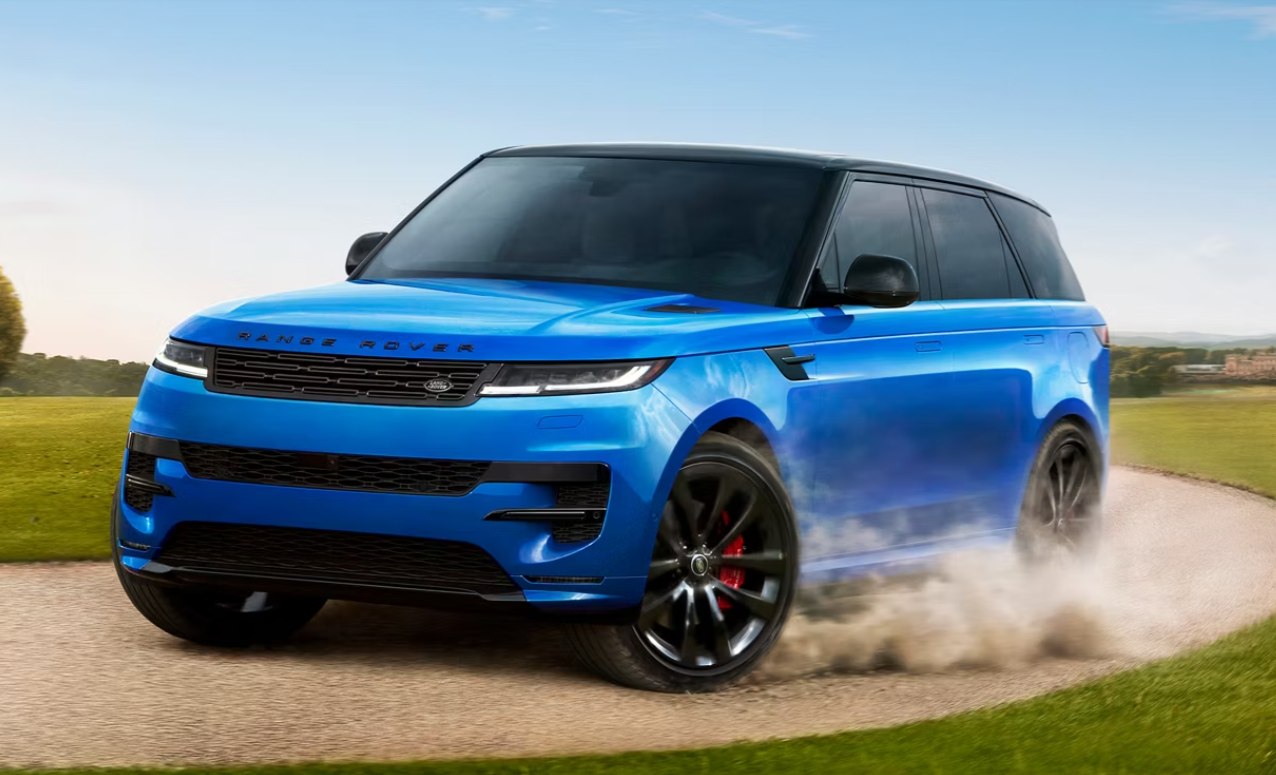
Price: From $140,807 plus on-road costs
Drivetrains/fuel economy/CO2 emissions: 3.0L inline six turbo-petrol, 8-speed auto, 265kW/500Nm, 9.6L/100km, 224g/km (P360); 3.0L inline six turbo-petrol, 8-speed auto, 294kW/550Nm, 9.6L/100km, 224g/km (P400); 3.0L inline six turbo-diesel, 8-speed auto, 183kW/600Nm, 7.3L/100km, 192g/km (D250); 3.0L inline six turbo-diesel, 8-speed auto, 221kW/650Nm, 7.3L/100km, 224g/km (D300); 3.0L inline six turbo-diesel, 8-speed auto, 258kW/700Nm, 9.6L/100km, 224g/km (D350); 3.0L turbo inline six PHEV, 8-speed auto, 338kW/660Nm, 1.6L/100km, 38g/km (P460e); 4.4L V8 turbo-petrol, 8-speed auto, 390kW/750Nm, 11.1L/100km, 258g/km (P530); 4.4L V8 turbo-petrol, 8-speed auto, 467kW/750Nm, 11.7L/100km, 258g/km (P635)
Dimensions (length/width/height/wheelbase): 4970/2025/1814/2998mm
Bootspace: 647L (seats up), 1860L (seats folded)
Warranty/roadside assistance/service intervals: Five-year/unlimited km, five years, annual/every
20,400km (diesel)/30,000km (petrol)
Five-year service cost: $3900 (petrol + PHEV), $4900 (V8 petrol), $3900 (diesel)
| Driving | |
| Interior | |
| Practicality | |
| Overall value | |
Things we like
- Luxury feel inside, amazingly comfortable
- PHEV’s solid EV range
- Very capable on and off-road
Not so much
- Seven seat option no longer available
- Not cheap and options push the price even higher
- 2.7-tonne weight can be felt when driving
With over two million sales to date, the Range Rover Sport has been a sales phenomenon for its maker and the third generation is the most talented version yet. There’s a wide range of engine choices, from the entry-level 3.0-litre turbo-diesel to the high-performance V8 in the SV models, but the P360e plug-in hybrid is the only drivetrain that offers zero emissions driving capability.
Pairing a turbocharged 3.0-litre inline six petrol engine with a 160kW electric motor, the drivetrain makes 338kW/660Nm outputs for a claimed 5.4-second 0-100km/h sprint. Yet thanks to its 38.2kWh battery, the Range Rover Sport P360e is capable of a claimed 126km of electric driving range (WLTP), and it can be DC fast charged up to 50kW for a full charge in under an hour.
On the road, the Range Rover Sport P360e displays a good dual personality: it can waft along in typical Range Rover fashion, but thanks to its adaptive air suspension, can hunker down to become something much sportier for a backroad blast. Choose the optional Stormer Handling Package and rear-wheel steering is added for even sportier handling. Yet, again as you’d expect for a Range Rover, its off-road capability is awesome and it can go pretty much anywhere.
The interior of the Range Rover Sport is sumptuous and leather-lined. Its new 13.1-inch ‘Pivi Pro’ is fully featured, even with live services and inbuilt apps such as Spotify, and its screen quality is very high resolution. The front seats are insanely comfortable and 22-way electric adjustment, while rear seat and boot space is impressive at 835 litres with the rear seats up, and 1860 litres with the rear seats folded. Those upgrading from the previous Range Rover Sport will note that there’s unfortunately no longer a seven-seat option.
If you’re after a vehicle that can quite literally do it all with a luxurious and practical cabin, the Range Rover Sport P360e is a great option – for a price. It provides 126km (WLTP) of electric driving range, quick charging, strong performance, a luxurious driving experience that can turn sporty or insanely off-road capable at the touch of a button and handsome styling. It’s not cheap, nor is it a lightweight, but that’s no surprise given just how much it can do.
Audi Q8
Price: From $143,415 plus on-road costs
Drivetrains/fuel economy/CO2 emissions: 3.0-litre V6 turbo-petrol, 8-speed auto, 250kW/500Nm, 9.2L/100km, 210g/km (55 TFSI); 3.0-litre V6 turbo-diesel, 8-speed auto, 210kW/600Nm, 7.1L/100km, 188g/km (50 TDI); 3.0-litre V6 turbo-petrol plug-in hybrid, 360kW/700Nm, 1.8L/100km, 40g/km (60 TFSI e); 4.0-litre twin-turbo petrol V8, 8-speed auto, 373kW/770Nm, 11.9L/100km, 272g/km (SQ8); 4.0-litre twin-turbo petrol V8, 8-speed auto, 471kW/850Nm, 12.2L/100km, 277g/km (RS Q8)
Dimensions (length/width/height/wheelbase): 5006/1995/1691/3005mm
Bootspace: 605L (seats up), 1755L (seats down)
Warranty/roadside assistance/service intervals: Five-year/unlimited km, five years, annual/every
15,000km.
Five-year service cost: $3570 (Q8), $4600 (SQ8), $4690 (RS Q8)
| Driving | |
| Interior | |
| Practicality | |
| Overall value | |
Things we like
- Great performance, no matter which engine is chosen
- Handsome styling, lovely interior
- Spacious despite coupe-like styling
Not so much
- PHEV’s electric range could be longer
- Feels heavy from behind the wheel
- No seven-seat option available
If you’re searching for a large German SUV, Audi currently has two to offer you: the seven-seat Q7, or its sexier more coupe-like five-seater Q8 sibling. The Q8 launched globally in 2018 as Audi’s take on the coupe SUV segment, but unlike competitors such as the BMW X6, it went for a more hatchback-like roofline and not the coupe roof we’d become used to, giving the Q8 superior practicality. Its styling also gave it a more sporting character than the Q7 that it shares so much with.
Under the bonnet of the Audi Q8 is a range of turbocharged engines: a 3.0-litre V6 in either petrol or diesel forms, a plug-in hybrid using the petrol V6 and an electric motor and a 4.0-litre V8 in both the performance SQ8 and high-performance RS Q8 variants. All Q8 models feel heavy from behind the wheel, but still give a luxurious driving experience. The performance of the SQ8 is excellent, while the RS Q8 is positively bonkers.
The cabin of the Q8 is lovely. Quality is excellent thanks to rich leather trimmings all over the dashboard and doors, as well as tactile switchgear and high-resolution displays. The front seats are quite comfortable and feature a lot of adjustment, while visibility is good despite the high belt line. The 12.3-inch touchscreen uses the brand’s MMI operating system, which isn’t the latest in the Audi line-up, but still looks good and is easy to use.
Thanks the use of the Q7’s platform, the Q8 is spacious for four adults and five will be fine as well. Three adults will be fit comfortably across the Q8’s wide rear bench, and both leg- and headroom is good despite the Q8’s lowered roofline compared with the Q7. The boot of the Q8 measures a large 605 litres with the seats up and a massive 1755L with them folded, and the rear seats fold almost flat for trips to furniture stores and the tip.
The Audi Q8 range presents a tempting luxury large SUV thanks to its excellent performance, lovely cabin, ample practicality and handsome styling. Counting against it are a heavy driving feel, it’s price and that it’s not available with seven seats, which some buyers might expect for the price. But style isn’t meant to be cheap and the Q8 is a rich-feeling luxury SUV.
BMW X7
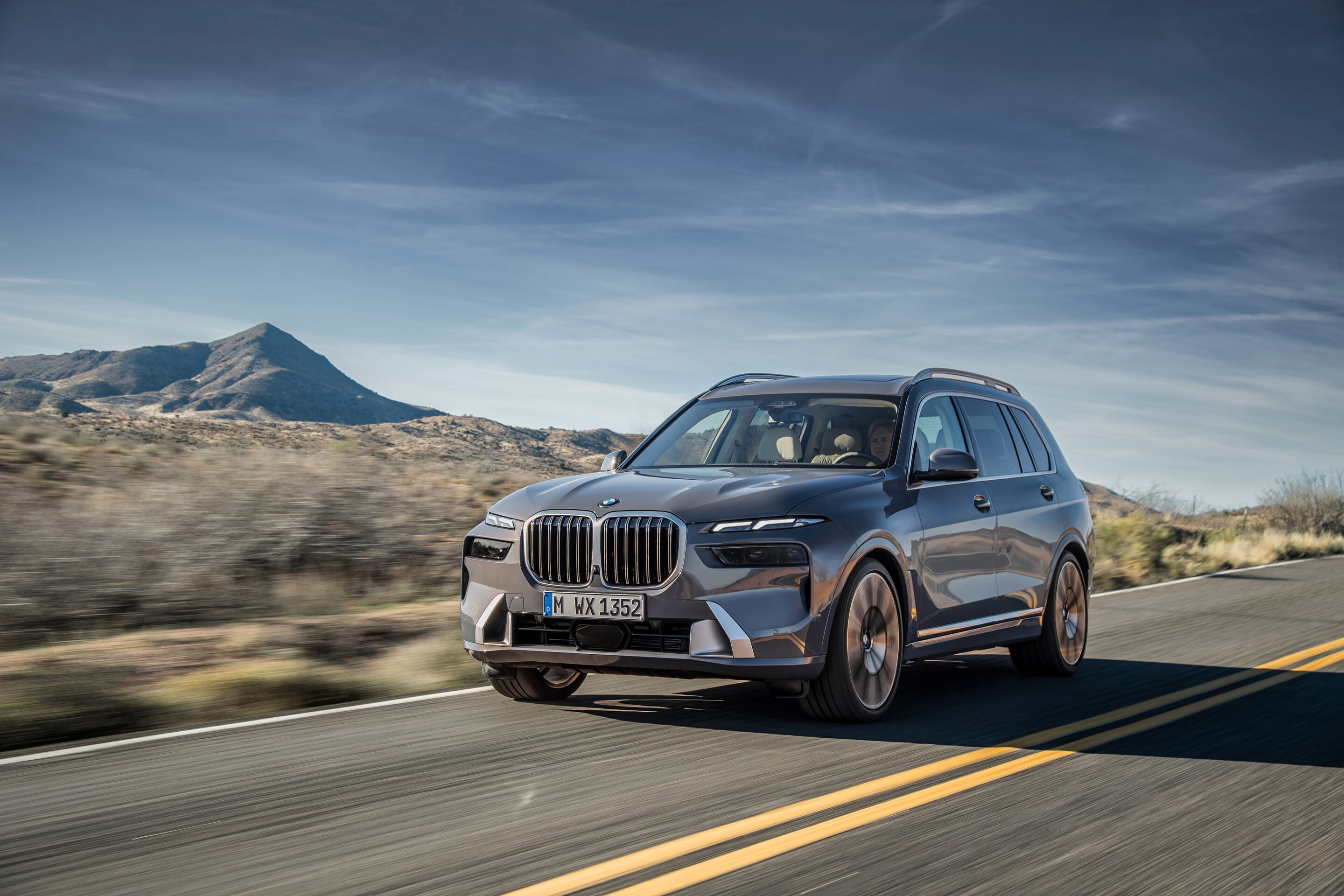
Price: From $172,500 plus on-road costs
Drivetrains/fuel economy/CO2 emissions: 3.0L six-cylinder turbo-petrol, 8-speed auto, 280kW/520Nm, 9.7L/100km, 221g/km (40i); 3.0L six-cylinder turbo-diesel, 8-speed auto, 259kW/720Nm, 8.0L/100km, 210g/km (40d); 4.4L twin-turbo petrol V8, 8-speed auto, 390kW/750Nm, 12.2L/100km, 277g/km (M60i)
Dimensions (length/width/height/wheelbase): 5181/2000/1835/3105mm
Bootspace: 300L (third row up), 2120L (third + second rows folded)
Warranty/roadside assistance/service intervals: 5-year/unlimited km, three-years, annual/every
15,000km
Five-year service cost: $4075
| Driving | |
| Interior | |
| Practicality | |
| Overall value | |
Things we like
- Huge interior space
- Excellent quality
- Grunty engines across the range
Not so much
- No proper hybrid drivetrain options
- Not cheap to buy, noticeably more expensive than pre-updated model
- Firm low-speed ride on standard 22-inch wheels
Several car companies have been busy over the past decade adding more and more SUVs to their
line-ups, with BMW now offering seven for buyers to choose from. The largest on offer is the X7, which debuted in 2018 as a plus-size X5 with seven full sized seats and even higher quality finishes inside to help justify its more expensive pricetag.
In the current X7 range, three drivetrains are available in Australia: the 280kW/520Nm 3.0-litre inline six turbo-petrol 40i, the 259kW/720Nm 3.0-litre inline six turbo-diesel 40d or the 390kW/750Nm 4.4-litre twin-turbo petrol V8 M60. Each offers strong grunt but reasonable fuel efficiency for its size. The X7 is generally quite good to drive with handling that’s way better than you’d expect for such a large vehicle, though its low speed ride is quite firm thanks to huge 22-inch wheels – and 23s are optional too.
Inside the X7 is a luxurious and well made cabin that’s full of the latest BMW in-car technology, such as its latest dual-screen infotainment and driver display layout. The quality is impressive, with plenty of soft touch leather surfaces surrounding occupants. In a lot of ways, the X7 is a match for the 7 Series limo, such is its use of lovely materials throughout its cabin.
Moving rearwards, the X7 offers a huge cabin that can easily accomodate seven adults. Row two offers impressive headroom and legroom, while the feeling of space is further enhanced by the optional captain’s chairs in the second row. In the third row, legroom isn’t as plentiful, but headroom is still impressive and the amenities on offer are impressive with air vents, charging ports and cup holders. Lowering and raising the seats is easy thanks to electric power, and once the third row is folded, 750 litres of space is on offer – that opens up to 2120L with the middle row folded too, which is easily large enough for a trip to Ikea.
The BMW X7 justifies its existence with its huge interior space, lovely cabin quality, long list of standard equipment, gutsy drivetrains and engaging handling. It could be more comfortable at lower speeds, and there’s no proper hybrid or plug-in hybrid option yet, but the X7 is a great halo SUV product for the BMW brand.
Lexus LX
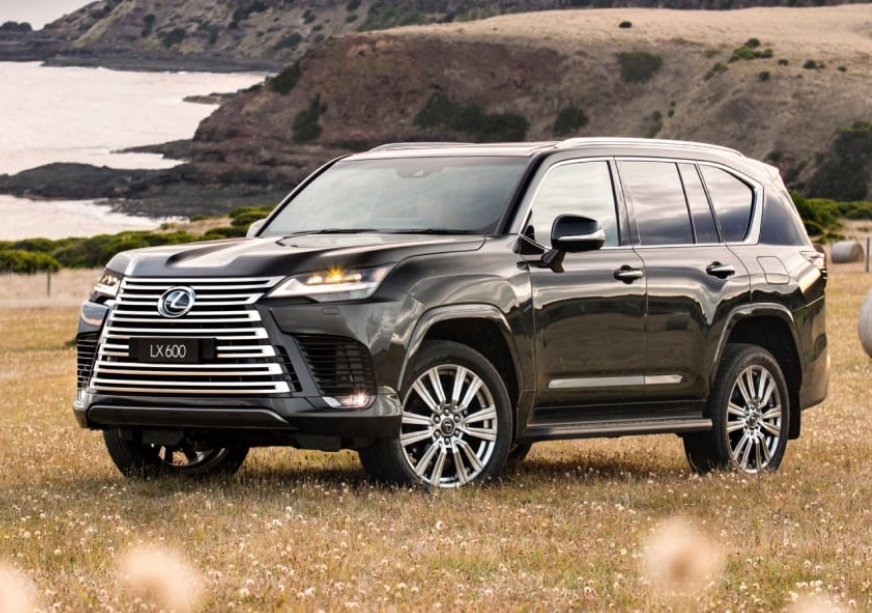
Price: From $155,976 plus on-road costs
Drivetrains/fuel economy/CO2 emissions: 3.3-litre V6 turbo-diesel, 10-speed auto, 227kW/700Nm, 8.9L/100km, 235g/km (500d); 3.4-litre V6 turbo-petrol, 10-speed auto, 305kW/650Nm, 12.1L/100km, 275g/km (600)
Dimensions (length/width/height/wheelbase): 5100/1990/1885/2850mm
Bootspace: 174L (third row up), 710L (third row folded), 1871L (third + second rows folded)
Warranty/roadside assistance/service intervals: Five-year/unlimited km, three years, every six
months/10,000km
Five-year service cost: $5950
| Driving | |
| Interior | |
| Practicality | |
| Overall value | |
Things we like
- Typically excellent Lexus refinement
- Fabulous cabin quality
- Extremely comfortable
Not so much
- Hybrid model not yet sold locally
- Thirsty petrol engine
- LandCruiser 300 Series twin is cheaper
The Toyota LandCruiser is arguably the most legendary off-roader the world has ever seen, especially when it comes to longevity. Luxury? Not so much, but that’s where Toyota’s luxury brand Lexus comes in with the LX, which is its version of the LandCruiser. Manufactured since 1995 but sold in Australia from 1998, the LX has successfully carved its own niche as a luxury go-anywhere off-road SUV.
There are two engine options for the Lexus LX in Australia, both turbocharged V6s: a 227kW/700Nm 3.3-litre diesel and a 305kW/650Nm 3.4-litre petrol, with both using a 10-spee automatic transmission with power being sent to all four wheels. A hybrid version of the petrol engine is offered in some markets overseas, but is yet to be confirmed for Australia. The LX is excellent off-road, and relaxing to drive on it thanks to its height-adjustable air suspension and plethora of off-road features designed to keep it going in tough terrain.
Inside the LX is a clear step up in materials compared to the LandCruiser, and it feels subtle, refined and luxurious. Infotainment is handled by a 12.3-inch touchscreen with Apple CarPlay and Android Auto, as well as sat-nav and live services – plus, there’s a smaller 7.0-inch touchscreen below for the HVAC controls. The 2400-watt 25-speaker Mark Levinson sound system is excellent as well, with a lot of both clarity and punch.
Depending on model chosen, both five- and seven-seat layouts are available – or, somewhat uniquely, a four-seat model called the Ultra Luxury with a limo-like rear seat layout. Regardless of layout, the LX is spacious in all rows of seating and extremely comfortable as well. It’s also practical: behind the second row of seats is a huge 710 litres of space, which expands to 1871 litres with the second row folded.
Like the LandCruiser, the LX is covered by a five-year/unlimited km warranty and also must be serviced every 10,000km or six months (whichever comes first). The short service schedule and thirsty petrol engine with no hybrid model yet available are the biggest downsides to the Lexus LX as it continues its reputation of a luxurious go-anywhere off-roader. Its quality is excellent, its drivetrains are punchy, it’s very comfortable and even though it’s not cheap, it’s very well equipped across the range. While it’s more expensive than its LandCruiser 300 Series twin, it’s more luxurious enough to warrant the extra spend.
Porsche Cayenne + Cayenne Coupe
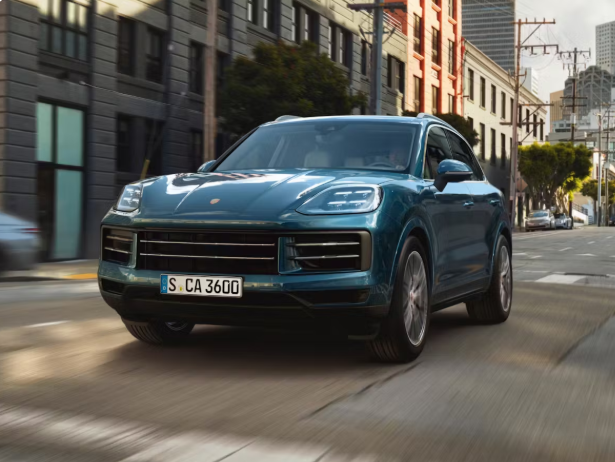
Price: From $144,900 plus on-road costs
Drivetrains/fuel economy/CO2 emissions: 3.0-litre V6 turbo-petrol, 8-speed auto, 260kW/500Nm, 10.4L/100km, 238g/km; 3.0-litre V6 turbo-petrol plug-in hybrid, 8-speed auto, 346kW/650Nm, 1.9L/100km, 44g/km; 4.0-litre V8 turbo-petrol, 8-speed auto, 349kW/600Nm, 12.3L/100km, 281g/km (S); 3.0-litre V6 turbo-petrol plug-in hybrid, 8-speed auto, 382kW/750Nm, 2.0L/100km, 43g/km (E-
Hybrid); 4.0-litre V8 turbo-petrol, 8-speed auto, 368kW/660Nm, 12.3L/100km, 280g/km (GTS); 4.0-litre V8 turbo-petrol plug-in hybrid, 8-speed auto, 544kW/950Nm, 2.5L/100km, 57g/km (Turbo
E-Hybrid); 4.0-litre V8 turbo-petrol, 8-speed auto, 485kW/850Nm, 12.5L/100km, 285g/km (Turbo GT)
Dimensions (length/width/height/wheelbase): 4930/1983/1698 (1678 for the coupe)/2895mm
Bootspace: 772L (seats up), 1708L (seats folded), coupe: 621L/1502L
Warranty/roadside assistance/service intervals: 3-year/unlimited km, three years, annual/every
15,000km
Five-year service cost: No capped price servicing
| Driving | |
| Interior | |
| Practicality | |
| Overall value | |
Things we like
- Strong performance across the range
- Handsome styling, lovely interior
- Wonderful to drive in any spec for a large SUV
Not so much
- Huge model range can be confusing
- Options make the price skyrocket
- Lacklustre service and warranty
With almost 1.5 million sold since its inception in 2002, the Porsche Cayenne is the best-selling model the company has ever produced. It shocked the world upon its reveal, but the reality is that if you’re after a large SUV that drives like a sports car, the Porsche Cayenne is the best choice – as it has been since it went on sale. The third generation currently in showrooms is arguably the best Cayenne yet, thanks to its wider range of drivetrains – including no less than three plug-in hybrid options – that all offer strong performance, while both traditional SUV and coupe bodystyles are also available.
Porsche offers a wide range of drivetrains with the Cayenne range, with 3.0-litre V6 and 4.0-litre V8 petrol engines the core units available. Buyers can then add extra power or plug-in hybrid power – or, in the case of the Turbo E-Hybrid, both – but all use an eight-speed automatic transmission and all-wheel drive system.
The pick of the range for us would be the Cayenne S, with its 349kW/600Nm outputs and drivetrain character that warrants the extra spend over the base Cayenne. Regardless of the model chosen however, Cayenne’s ride and handling balance is superb for a large SUV, even in the entry-level model, while the Turbo GT is one of the fastest and most dynamic SUVs around.
Inside the Cayenne boasts a revamped interior that debuted in 2024, with new screens, higher quality
materials and redesigned HVAC and gear selector controls that make the cabin easier to interact with. The screens are razor sharp and quick to use, while buyers can also choose an optional passenger side screen for entertainment that the driver can’t see from behind the wheel.
Quality inside the Cayenne is excellent, while both rows of seating are comfortable and practical, though the coupe bodystyle features less headroom. The boot of the Cayenne measures from 772 litres (coupe: 621L) with the seats up, which is quite large, and folding them down unlocks over 1700 litres of space (1500L in the coupe).
Porsche’s best-selling model continues to sell well thanks to its sporty dynamics, big range of engines, quality cabin with sharp tech and a lot more practicality than you’d expect from the brand. Sure, its entry pricing isn’t cheap, and nor are its options – you can easily add $50,000 to the price – and the service and warranty package is lacking too, but the Cayenne manages to easily uphold its reputation as the Porsche of SUVs.
GWM Australia has announced local pricing and specifications for the Ora electric hatchback, which is now built in a former General Motors factory in Thailand that used to build the Holden Colorado. All 2026 GWM Ora models now use a new 57.7kWh LFP battery, the former mid-spec Ultra has been re-added to the lineup and new equipment is now standard across the range.
Priced from an unchanged $35,990 drive away, the 2026 GWM Ora Lux and limited edition Ultra can now deliver a WLTP-rated range of 400km, which is 90km more than the previous Ora Standard Range, and only 20km less than the former Extended Range model.
The new 57.7kWh battery was developed in-house by GWM and replaced the former 48kWh Standard Range and larger 62kWh Extended Range batteries.
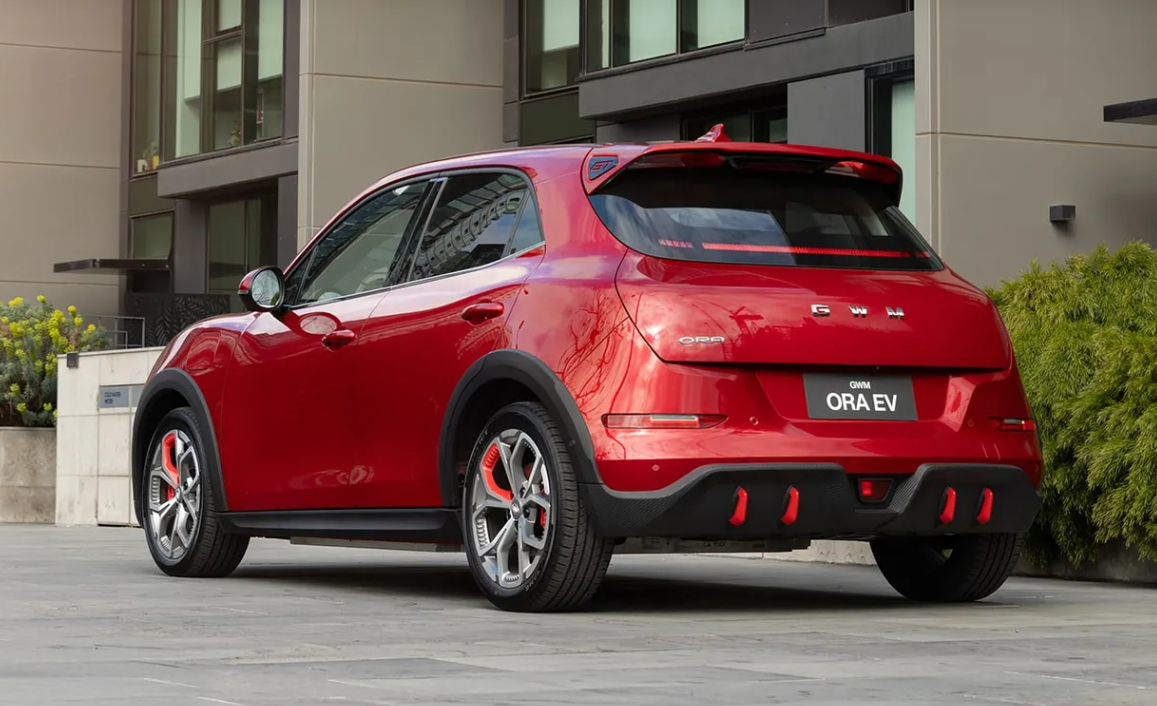
Range-wide changes include new live services capability with scheduled charging support, vehicle-to-load functionality (V2L) at up to 6kW, a heat pump air-conditioning system and a USB-C charging port.
All Ora models use a 125kW/250Nm front electric motor, which gives it a claimed 9.0-second 0-100km/h time. GWM is yet to announce charging specs, though the pre-updated model could charge at up to 80kW for a 10 to 80 per cent charge time of around 50 minutes.
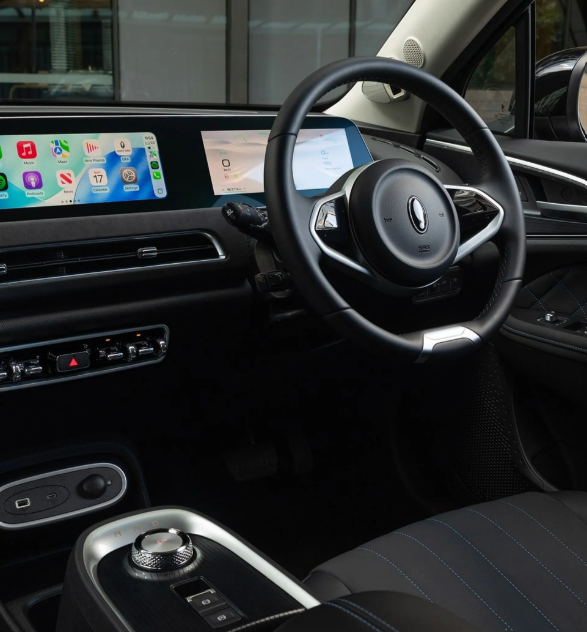
2026 GWM Ora pricing (drive away)
| Lux | $35,990 |
|---|---|
| Ultra limited edition | $37,990 |
| GT | $38,990 |
GWM Ora Lux standard features:
- 18-inch alloy wheels
- Automatic dusk-sensing LED lighting
- Rear privacy glass
- Keyless entry with push button start
- Single-zone automatic climate control
- Synthetic leather steering wheel
- Synthetic leather upholstery
- Six-way driver/four-way front passenger electric seat adjustment
- 10.25-inch digital driver’s display
- 10.25-inch touchscreen
- AM/FM radio
- Apple CarPlay and Android Auto
- GWM Connected Services
- 7x airbags
- Autonomous emergency braking (AEB) with pedestrian, cyclist and intersection detection
- Adaptive cruise control with stop and go functionality
- Traffic jam assist
- Lane keeping assistance with lane departure warning
- Blind-spot monitoring with rear cross-traffic alert
- Traffic sign recognition
- Driver attention monitoring
- Rear collision warning
- 360-degree camera
- Rear parking sensors
Ora Ultra model adds:
- Front parking sensors
- Hands-free electric tailgate
- Panoramic roof
- Memory for the driver’s seat
- Automatic parking
- Auto-folding mirrors
- Heated, ventilated and massaging front seats
- Heated steering wheel
Ora GT model adds over Ultra:
- Sportier exterior styling
- GT 18-inch wheels
- Red brake callipers
- Launch control
The updated Ora range is now in local GWM dealerships, with deliveries to commence soon.
