
You don’t tire watching the new 2019 Audi A8 come to life. Thumb the start button and its air vents swivel open, the door mirrors fold out and the finely crafted seat underneath you slides towards a gorgeous steering wheel.
The action injects some much-needed excitement into your first encounter with what is, objectively, a plain-looking limo. Now longer, higher and thinner than before, it’s more slab-sided than the old A8’s powerful lines and menacing stance.
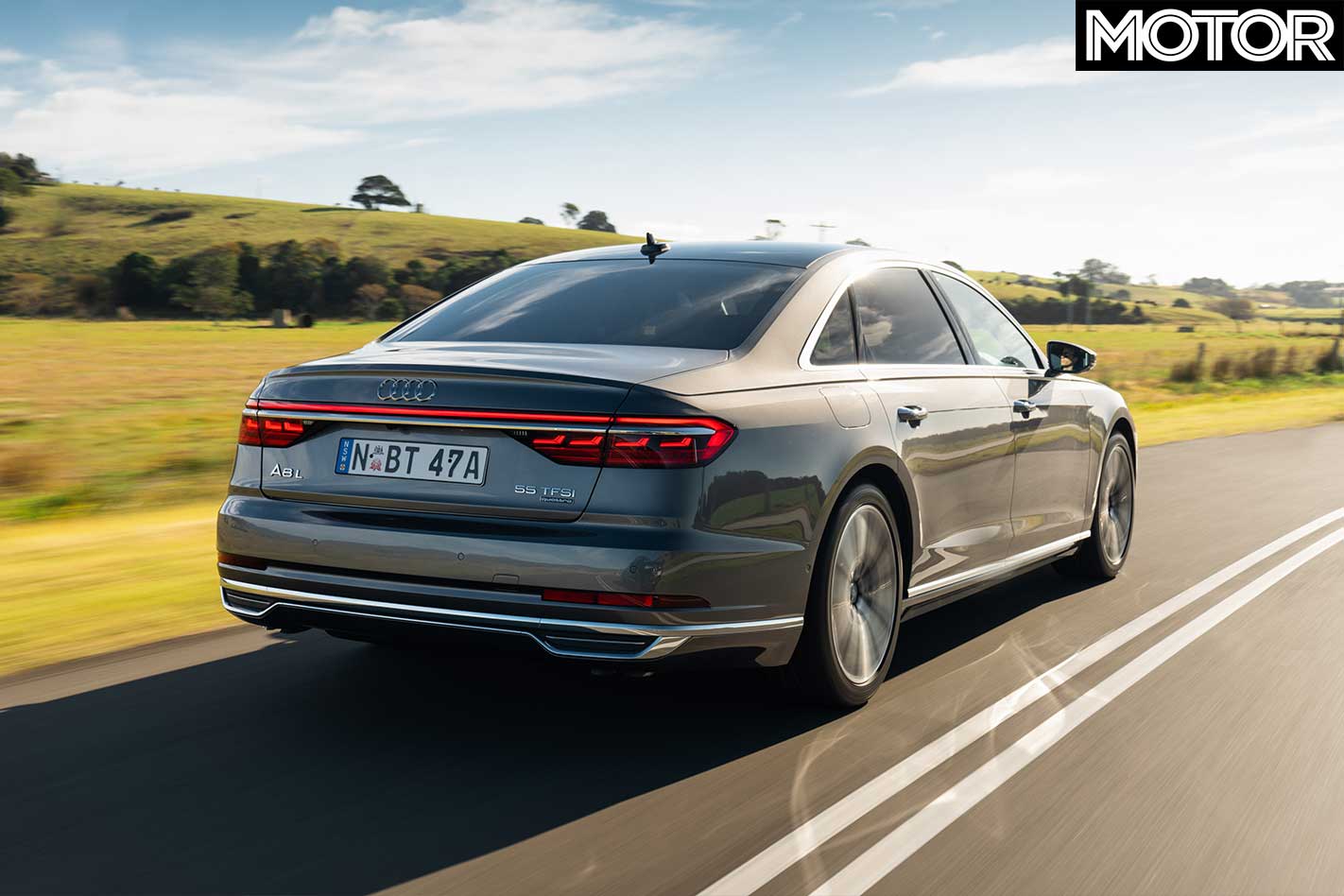
An S8, with a 4.0-litre twin-turbo V8, is on the way to fix that. Hopefully. But for now, the hottest ticket in its range is this 55 TFSI that packs a 3.0-litre turbo V6 mated with an eight-speed automatic. Its 250kW and 500Nm can waft it to 100km/h in 5.6 seconds.
It feels brisk, but burdened. Clearly, with 1900kg-plus, even the short-wheelbase version’s chassis, boasting aluminium, magnesium and carbon-fibre construction, has failed to shave meat off its bones. Granted, it’s packed with a 48-volt powered alternator system, 17 speakers and enough radars to detect spacecraft.
Surprisingly, Audi’s engineers set out to make it handle nothing like it looks. Thinner A-pillars and a nice, adjustable driving position set the mood, as does steering with positive off-centre feel and genuine feedback.
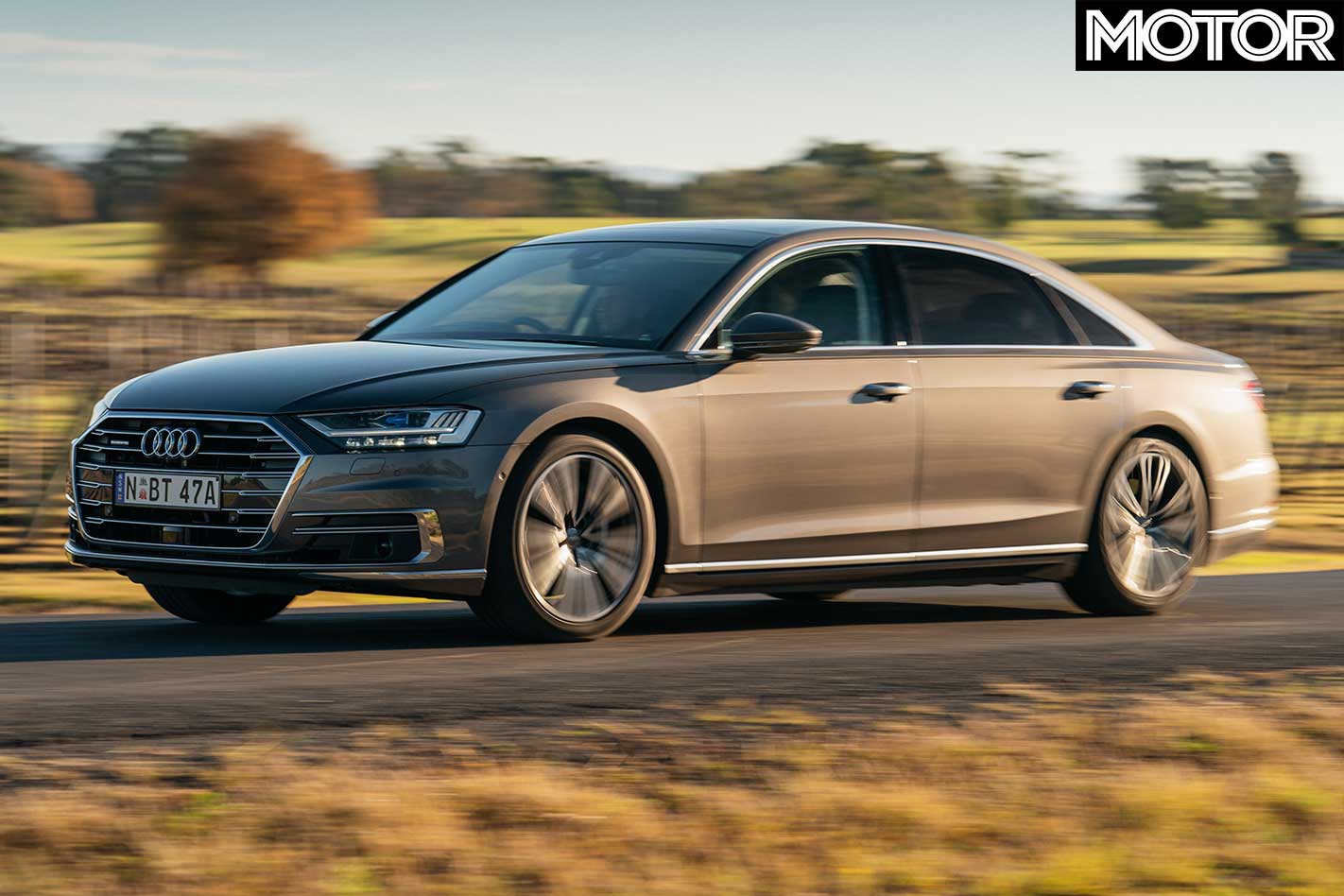
Charging through corners reveals surprising enthusiasm and cohesiveness, while optional rear-wheel steering helps drive its nose into apexes, and tighten its turning circle, at the cost of a little precision. Obviously, without an S badge on its boot, there’s a limit to its ability. While it feels comfortable at seven tenths, you’ll hear the Goodyears squealing for mercy once you crack the windows in its vault-like cabin.
And its ride? Beautiful. It hovers along on 20-inch wheels and smooths out potholes. It’s hard to think how a surface-detecting system to be introduced at a later date could improve things.
Inside, Audi sticks to its guns with a clean, minimalistic design. A slick dual-pane centre console is key to this, even if prodding its touchscreen controls proves tricky on the move. Everything else works with thoughtful functionality. It’s plenty classy, too.
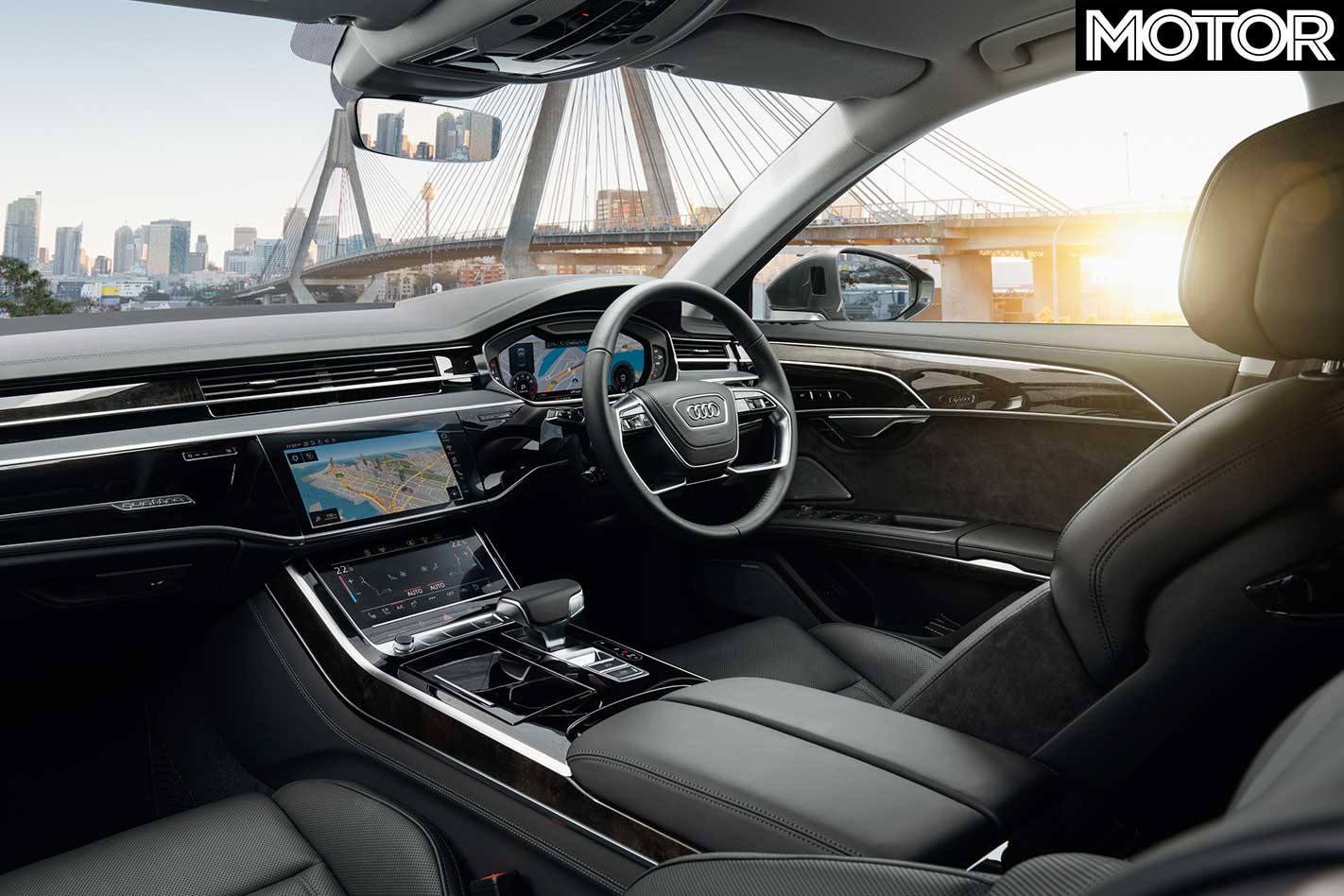
The Premium Plus package is a fair chunk, at $11K, but it’s almost worth it for the massage front seats and sweet-smelling air ioniser. They turn the bunker-solid cabin into a rejuvenating retreat from city commutes.
The only thing that might test your Zen is a throttle pedal that’s either extremely sensitive in Dynamic, or numb in Comfort. Otherwise, this limo is Audi’s best yet.
2019 AUDI A8 55 TFSI SPECS Engine: 2995cc V6, DOHC, 24v, turbo Power: 250kW @ 5000-6000rpm Torque: 500Nm @ 1370-4500rpm Weight: 1920kg 0-100km/h: 5.6sec (claimed) Price: $195,000
Like: Decent chassis; solid fit and finish; ergonomics, ride and handling Dislike: Dull looks; lack of V8 option; woeful throttle tuning; rear-steering feel
Rating: 4 out of 5 stars
There was a time, in the not-so-distant past, where small cars from the premium brands could justify their dizzying prices because of not just their badges, but clear superiority in terms of design sophistication, perceived quality, higher grade materials, and extra safety and convenience features.
But that was then. In 2019 we’re dealing with a very different paradigm; the arrival of the new, fourth-generation Mazda 3, and the steadily refined VW Golf, are two small cars that give away little to much higher priced offerings in terms of those all-important attributes that can be summarised (perhaps a little awkwardly) as ‘premiumness’.
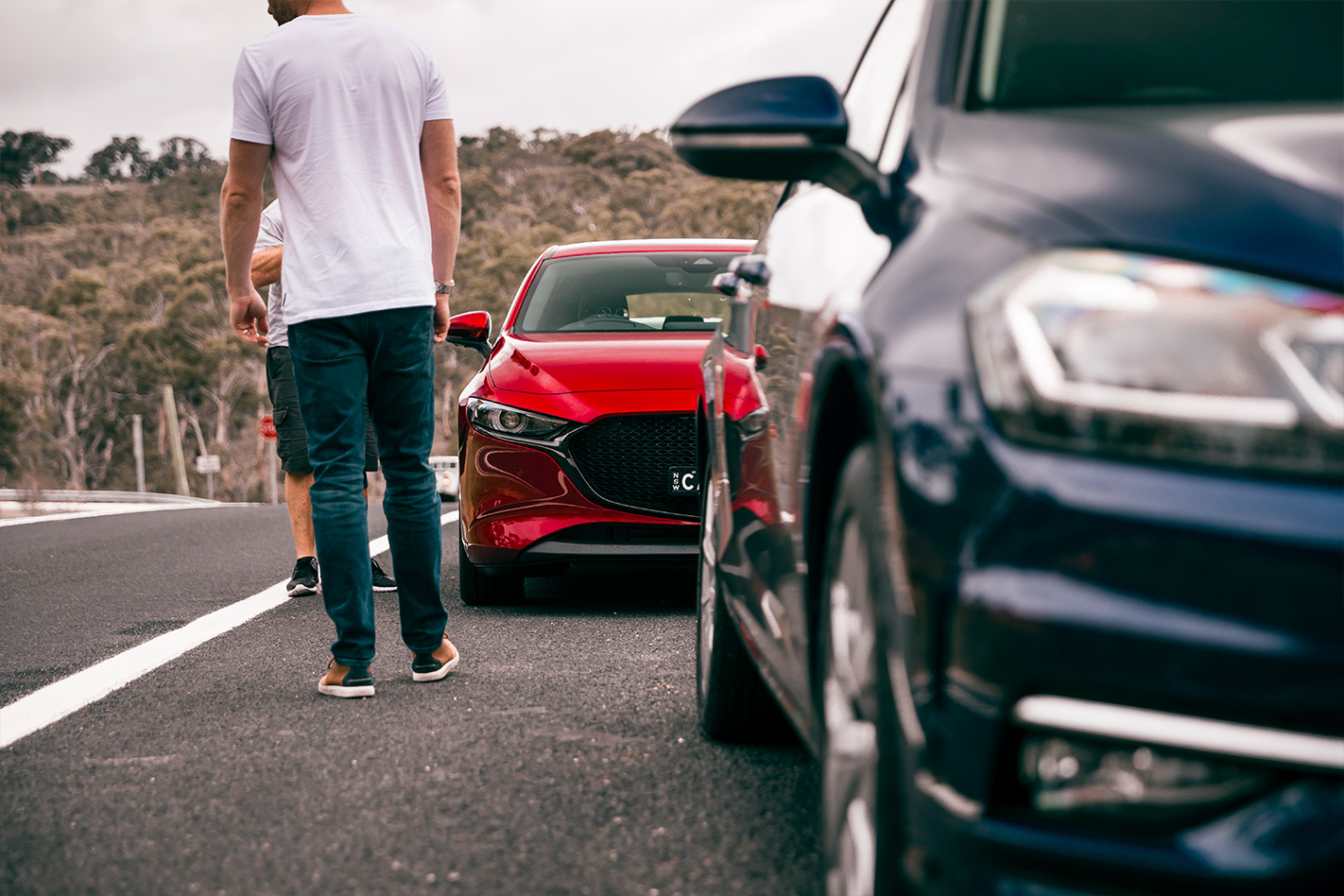
This pair bristle with quality surfaces, seductive instrumentation, long standard equipment lists, and painstaking attention to detail. Separating their individual attributes isn’t difficult, but declaring a clear winner? That will prove not so simple. But let’s give it go.
We’ll kick off with the Mazda 3, as it has been a regular podium seller since bursting on the scene in 2004, and the series from Japan is today deeply ensconced in our national streetscape. Toyota’s Corolla might pip it for sheer sales, but more private buyers choose the diminutive Mazda, and – as a show of pride in their purchases – in higher model grades too. Aussies have been won over with high quality, driveability, efficiency, affordability, and – vitally – after-sales care. Consistency has been the key to the Mazda’s success.
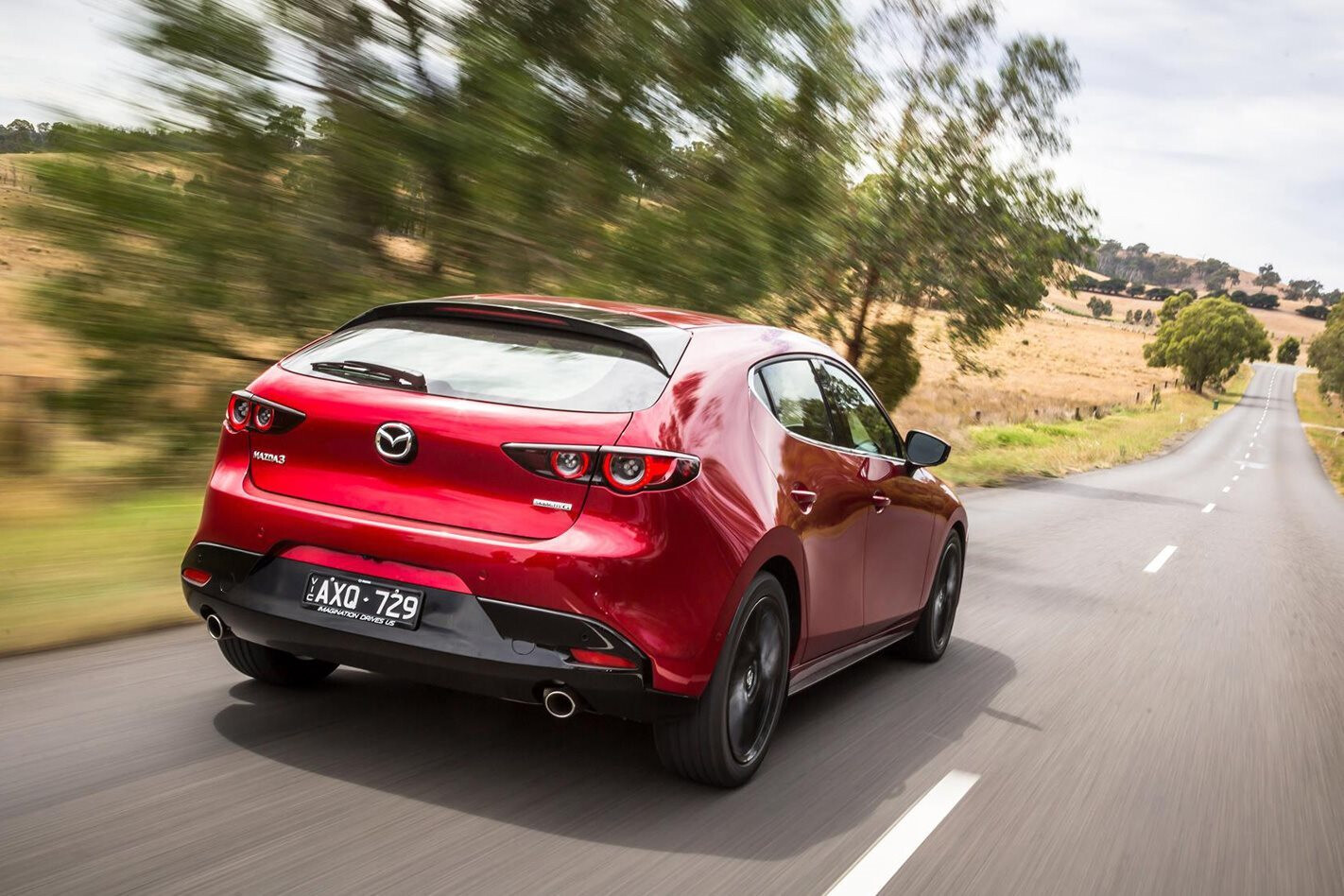
While not strictly all-new due to carryover powertrains and some other platform components, the striking fourth-gen 3 builds on such virtues with bolder yet cleaner styling inside and out, a stronger body, longer wheelbase, substantially more upmarket fittings, better comfort, greater safety, improved dynamics (despite ditching a multi-link rear suspension layout for more practical torsion-beam arrangement) and an obsessive drive to cull noise/vibration/harshness (NVH) pathways. The latter has long been a series bugbear.
Result? Mazda is so confident this BP-series redesign is the finest C-segment small car going, it has bravely pushed prices firmly into Volkswagen Golf territory.
Here we’ve plumped for the richest of the six 3 model grades available. The range-topping G25 Astina from $37,990 (plus on-roads) is powered by a normally aspirated engine – a newly overhauled, 139kW/252Nm, 2.5-litre four-cylinder unit, driving the front wheels via the same six-speed automatic. Along with the usual luxuries like leather, powered and heated front seats, paddle shifters, sunroof, sat-nav, rear camera, smartphone-mirroring multimedia, DAB radio, adaptive LED headlights and driver-assist safety tech like AEB, the latest Astina ushers in adaptive cruise control with stop and go, 360-degree surround-view vision, front cross-traffic alert and projector head up display. The only option on our example here is metallic paint, pushing the price to $38,485 (+ORC).
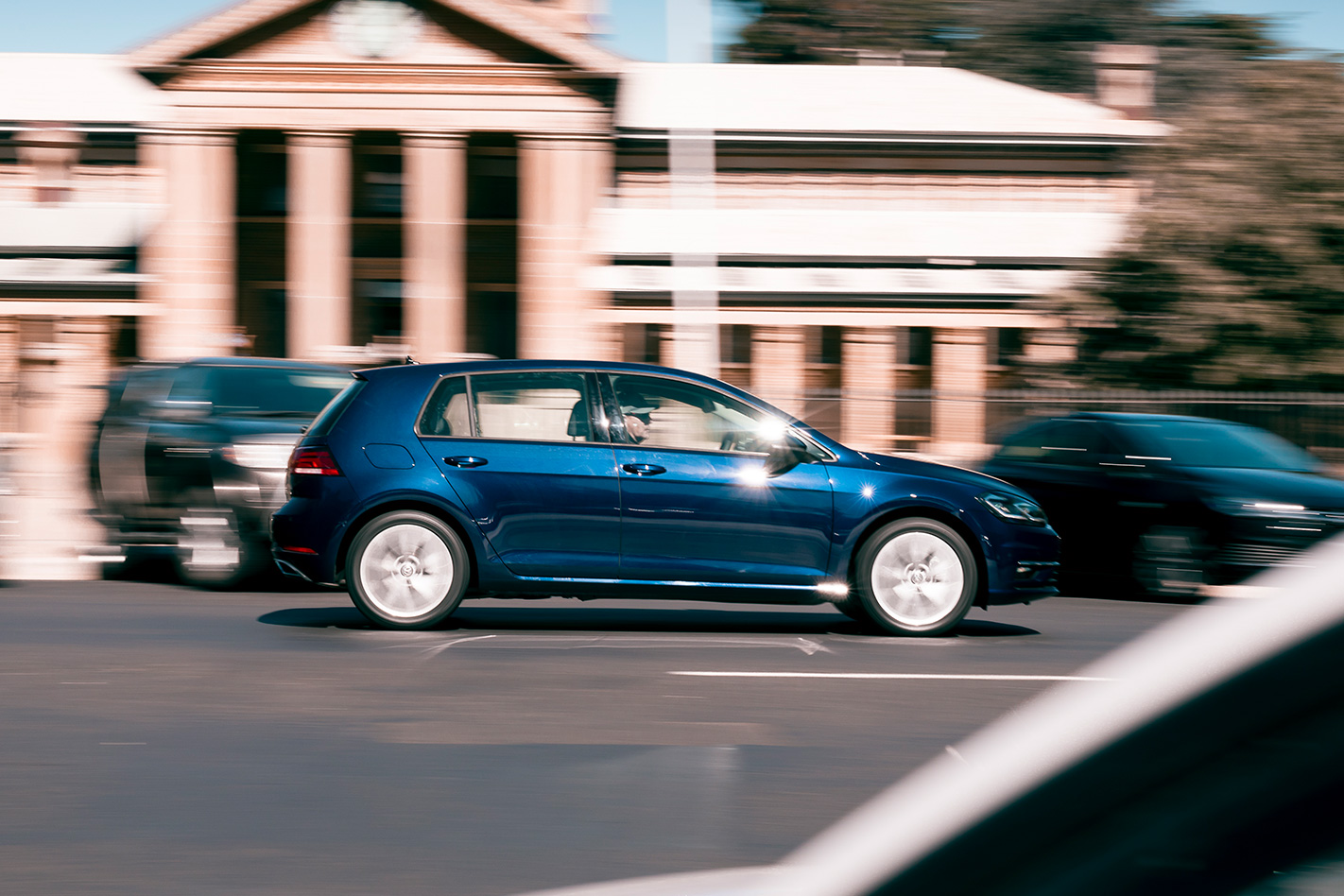
The Golf we chose to challenge the new 3 is the mid-range 110TSI Highline guise from $36,490. Released in 2013 – though a thorough ‘Mk 7.5’ facelift brought worthwhile updates in 2017 – the former Wheels COTY winner has famously seen off most challengers since. Packing a 110kW/250Nm 1.4-litre four-cylinder turbo engine with seven-speed dual-clutch transmission, our Volkswagen mostly mirrors the Mazda’s spec, though with a $2300 Sound/Vision pack (bringing fully digital and customisable instrumentation, upgraded sat-nav and better audio) and $500 metallic paint, buyers are looking at $39,290.
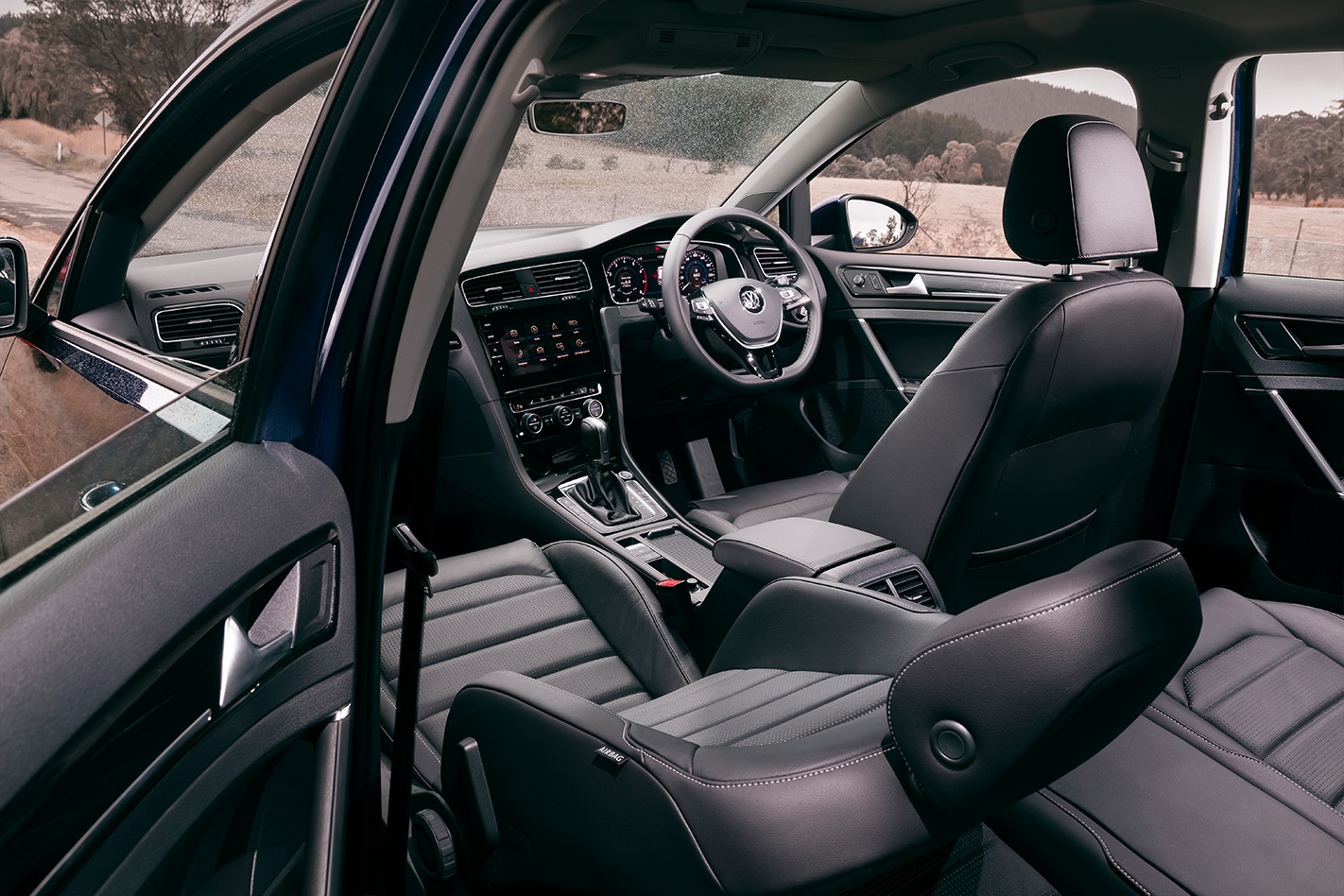
Additionally, the VW comes with the luxury of space. Entry and egress is easier than the Mazda, material quality remains unsurpassed, functionality is unimpeachable and the ambience draws you in. The facelift has kept the tech current and nothing here beats the Golf for all-round vision, seat comfort, room for five adults and overall utility. It is mind-blowing how ahead of the pack the Mk7 was in 2013. The sheer ubiquity of the VW’s dated cookie-cutter dash and some minor hidden switchgear are perhaps the sumptuous Highline’s only true shortcomings.
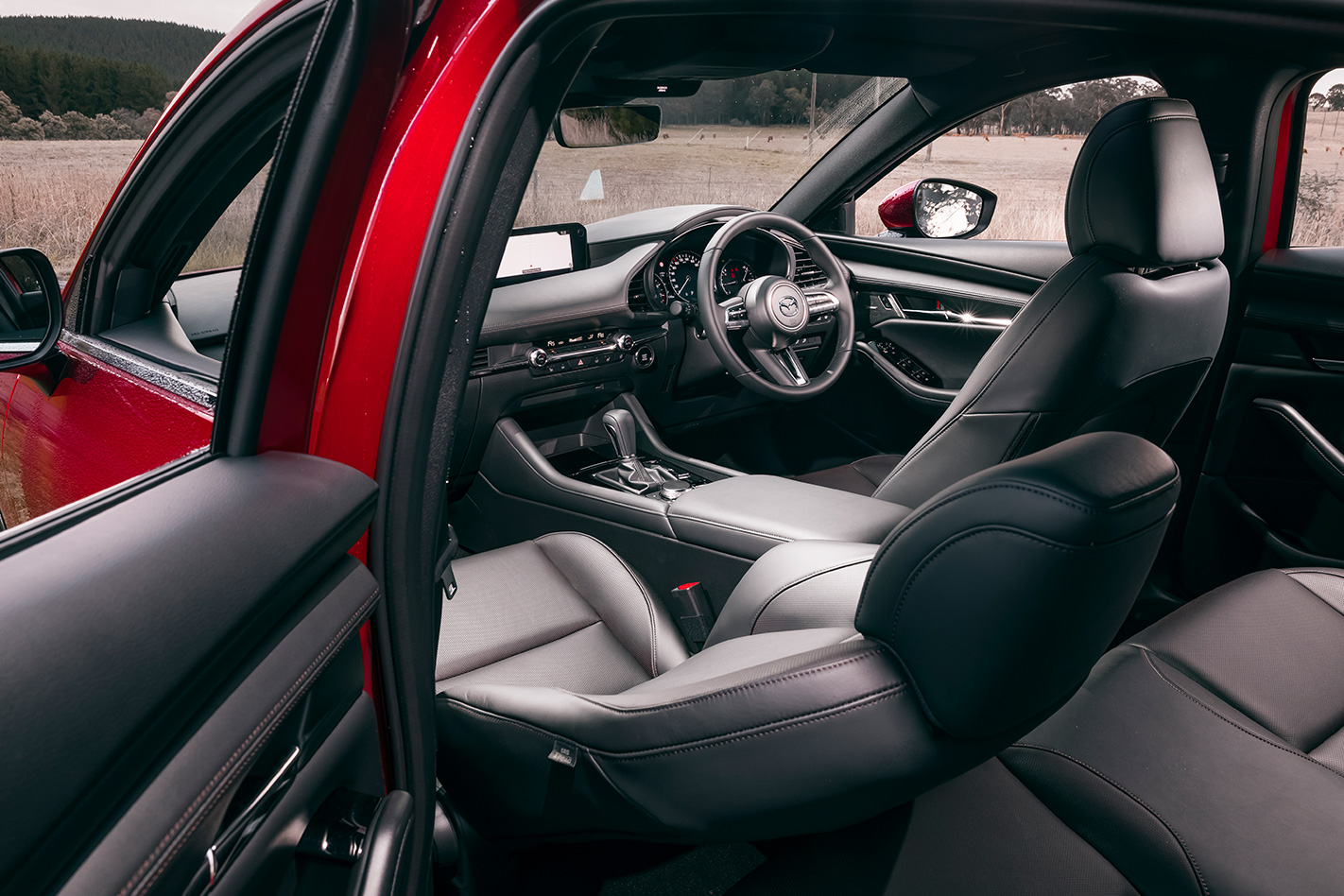
In some ways the latest 3’s cabin is more akin to the Golf’s more daring Audi A3 cousin, since it so obviously forfeits rear-seat access and headroom (both of which remain serviceable but noticeably inferior to the Golf) at the altar of style. Yet the Astina is very much its own, fiercely Japanese achievement too. Check out the Alfa Giulia influences in the flowing horizontal lines, lush surfaces, tactile switchgear and dramatically better-quality trim than before; they all help the cocooned, almost hushed Mazda achieve a sense of sporty opulence that eludes even most luxury-branded hatches. Attention to detail is also remarkable, as evidenced in the seductively thin-rimmed wheel, Cinemascope-esque instrument dials that could grace a Porsche and the flawless driving position. Jobs for this car’s successor would be limited to improving back-seat access, stretching rear legroom and fixing the dismal rear vision, but none are so bad as to be deal breakers. Otherwise, Hiroshima’s cohesive C-segment hatch leaps two generations forward.
In terms of performance, neither of our test examples achieved what we know them to be capable of, partly because both were very green in terms of ultra-low kilometres, and partly because our test strip was damp.
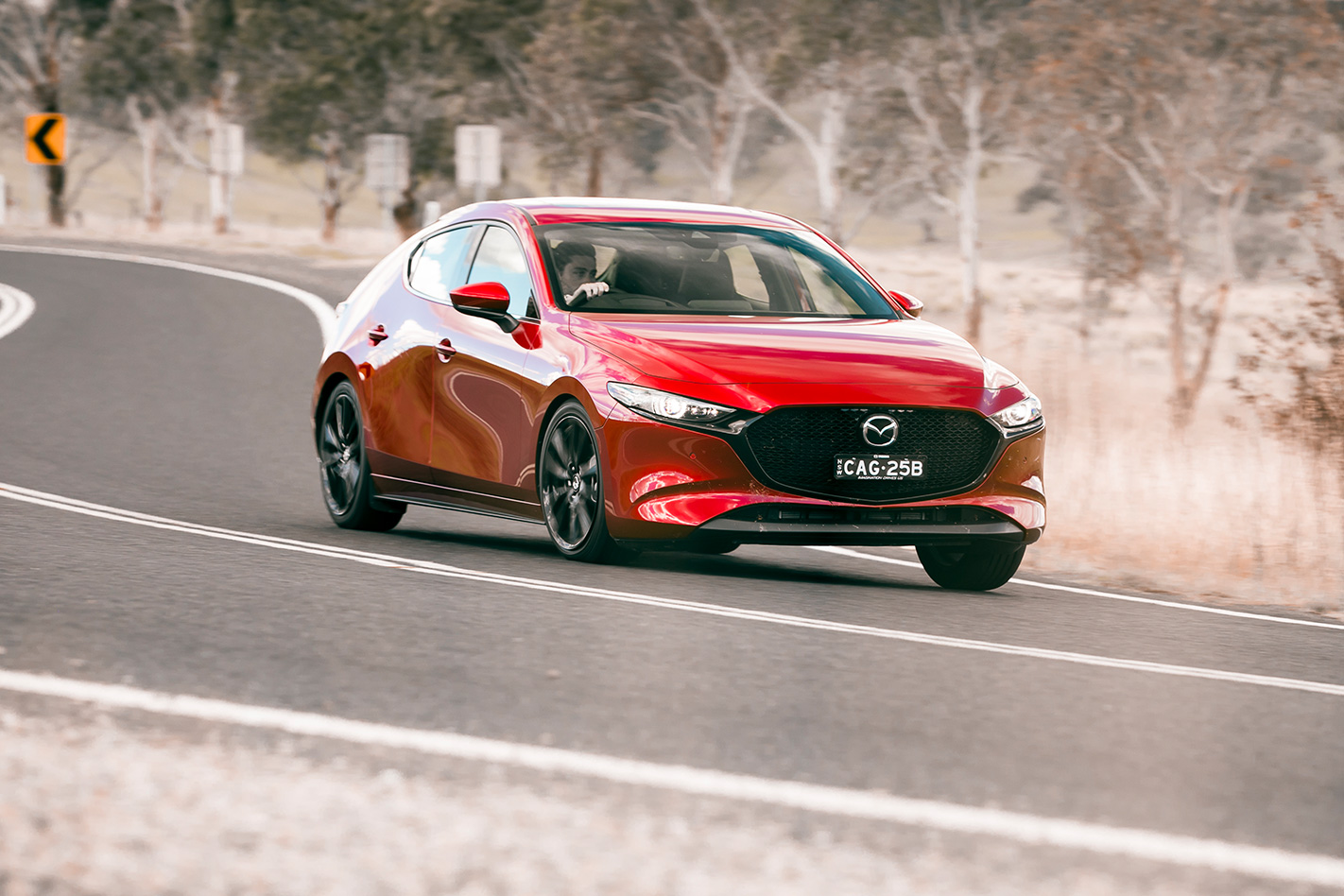
But the gap in the acceleration numbers is not substantial. The Golf hit 100km/h from a standing start in 8.3sec, the Mazda was just 0.3sec adrift at 8.6sec. Later, both grew exponentially faster as the kilometres piled on. However, the turbo-fed Golf always felt perkier as well as sweeter at lower speeds than our tight atmo 3, which required a concerted right foot and lots of revs for really rapid getaways. But in the 80-120km/h increment, there’s virtually nothing in it: 5.7sec for the Mazda; 5.6sec for the VW. It’s the Golf’s torque at lower revs that makes it feel the more responsive of the pair; only when fully wrung out does the gap between them close.
Likewise, there’s not a huge difference in fuel consumption. During our test period, the Mazda used 8.8L/100km, the VW a bit more frugal at 8.2L/100km.
But what about dynamic differences? After all, there are key hardware variations. The Astina uses a simpler torsion beam rear suspension and wears size 18-inch rubber; the Golf has independent rear suspension and runs on smaller 17-inch wheels and tyres. The 3’s steering is deliciously immersive and pitch-perfect in effort, ushering in newfound handling fluency and poise, remaining uncorrupted even at speed over tight, bumpy roads, and finally elevating the series up alongside greats such as the Focus ST-Line and Peugeot 308. The Mazda is also much, much quieter than the just-superseded model imparting a vault-like isolation from most road surfaces. That old, jiggly droning that defined (and defiled) previous 3s is history.
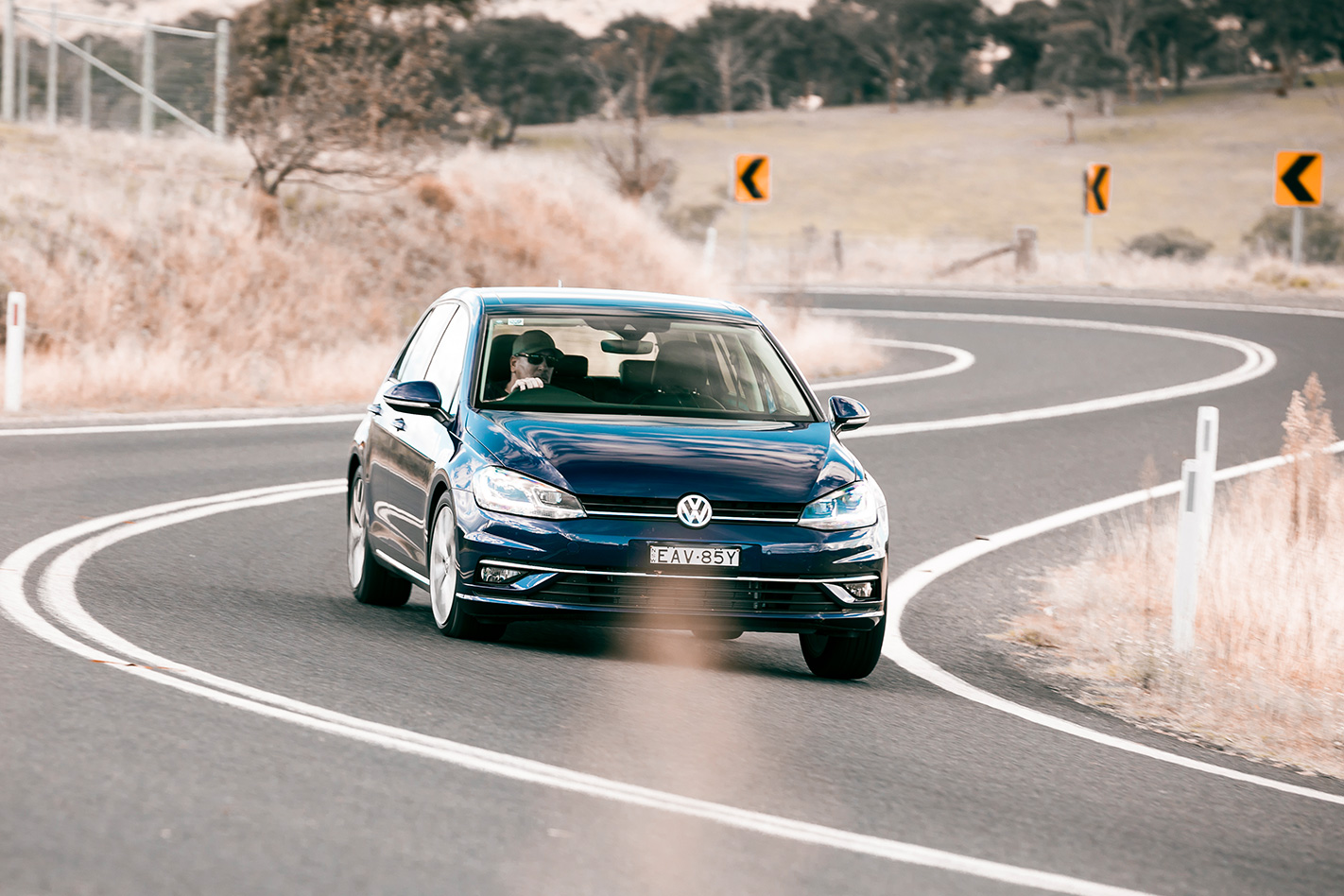
Riding on 17s, the Golf prevails with a softer ride, but the Highline’s body motion isn’t as contained as the Astina’s, and likewise the VW’s steering is both less instantly responsive and not quite as tactile. But only comparatively, for the ageing VW still steers sweetly, and is a supremely secure and relaxed high-speed grand tourer, carving through the apexes with entertaining precision, self-assurance and imperious dignity.
We’ve long said the seventh Golf iteration is one of the world’s best vehicles and all the car anybody would ever need, and little changes, highlighting the monumental achievements of this 2012 design. The 110TSI Highline may be marginally more expensive, but it brings Audi levels of tech, quality and desirability for much less. Yep, that’s why this VW is a bargain, despite the seemingly hefty sticker price.
And if you’ve regularly got passengers in the back – and you genuinely care about their comfort and visibility back there – that alone could be enough for the Golf to be the better car for you. Likewise, if you are a chronic over-packer and require every bit of available luggage space, that’s another area the Golf has a useful advantage over the new Mazda 3.
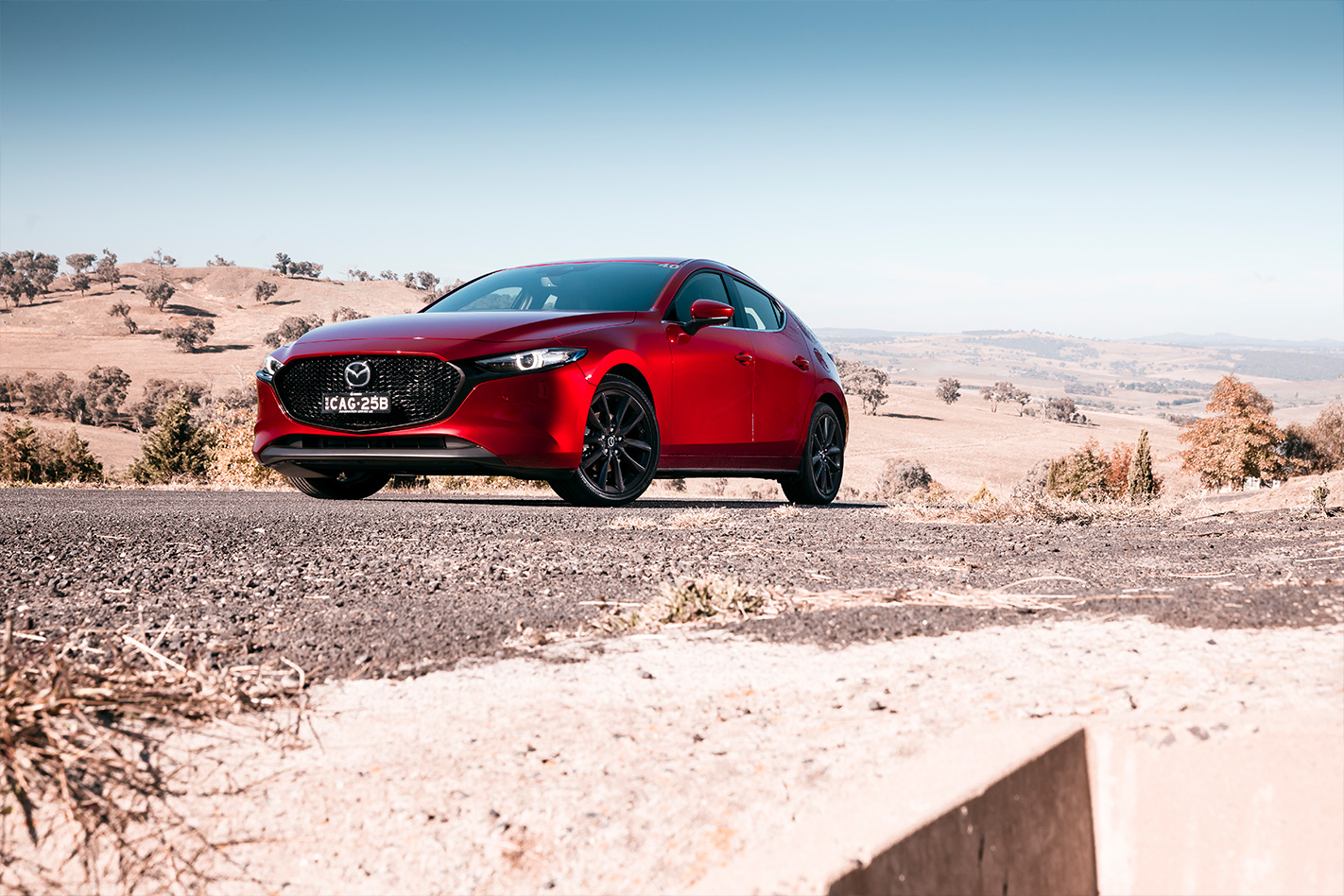
No doubt the Golf 7 served as a muse for Mazda when developing the latest 3, for the result is its own brilliant interpretation of what a 2020s hatch should be, rather than yet another carbon copy. The latest 3 possesses possibly Mazda’s best-ever small-car cabin – it’s certainly the quietest. That lovely steering wheel, fine seating, great ergonomics, gorgeous instrumentation, premium controls and fastidious quality all set the cocooning Astina apart. However, entry/egress out back is limited due to a lower roofline and smaller door apertures, vision out is limited in every direction and back-seat legroom also lags behind the Golf’s despite scalloped front seatbacks. Spare is a space saver, but boot volume is just 295L. And yes, you need to work the engine enthusiastically to get the best out of it.
Yet even with the packaging caveats, the new 3, in G25 Astina guise at least, is good enough to (only just) nudge aside the previous class benchmark to take the top step of the podium.
Specs
MAZDA 3 G25 ASTINA
Engine 2488cc in-line 4cyl, dohc, 16v Power 139kW @ 6000rpm Torque 252Nm @ 4000rpm Transmission 6-speed automatic L/W/H/W-B 4460/1795/1435/2725mm 0-100km/h 8.6sec (tested) Weight 1380kg Fuel consumption 8.8L/100km (test average) Price $37,990 (As tested $38,485) On sale: Now
VOLKSWAGEN GOLF 110TSI HIGHLINE DSG
Engine 1395cc in-line 4cyl, dohc, 16v turbo Power 110kW @ 5000-6000rpm Torque 250Nm @ 1500-3500rpm Transmission 7-speed dual-clutch L/W/H/W-B 4258/1799/1452/2620mm Weight 1312kg 0-100km/h 8.3sec Fuel consumption 8.2L/100km (test average) Price $36,490 (as tested $39,290) On sale: Now
April 12
Confession time… I’m a bit of a Game of Thrones fan, and I’m a little excited that it’s back on Monday. Hey, we’ve all got our guilty pleasures! It does highlight to me, though, just how quickly the media world continues to change… and how much it stays the same. Great content still rules the kingdom, no matter how you access it.
It’s been another huge week of content creation at WhichCar HQ, starting our week with a great travel piece around the Blue Mountains of NSW, which linked back into last week’s episode of WhichCar TV.
We also added to our rolling stories that we use to cover our long-term fleet of test cars, including the Hyundai Ioniq EV and the Volkswagen Tiguan Allspace SUV. Living with cars is still the best way of revealing their true characters, and are still proving to be popular draws for the site.
WhichCar TVis back on the box on 10 this weekend, too, at the new time of 3pm. It’s a cracker, too; Dan heads to Bahrain to track-test a Lamborghini, while more affordable but equally enticing hot hatches from Renault and Volkswagen are put to the sword. You can also catch up on all of our episodes on TenPlay.
Rounding out the fun is a look at one of the quirkiest – and most popular in terms of search – cars on the market today, the Suzuki Jimny. We used the chance to examine the state of the old-school 4×4 market, too – and it’s quite revealing.
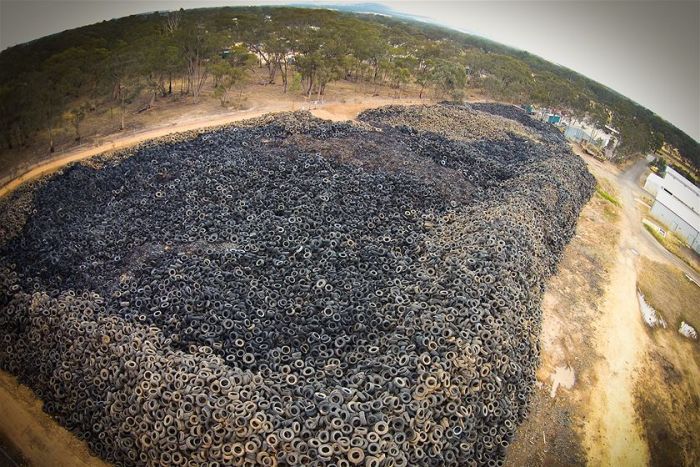
The big-traffic stories of the week included revelations that Toyota’s next-gen Hilux will be electrified, an examination of the political spin around the notion of electric cars, the results of the Gosford Motor Museum auction and a look at an amazing Australian project to convert old tyres into biodiesel. We also examined whether Australian car manufacturing could ever make a comeback.
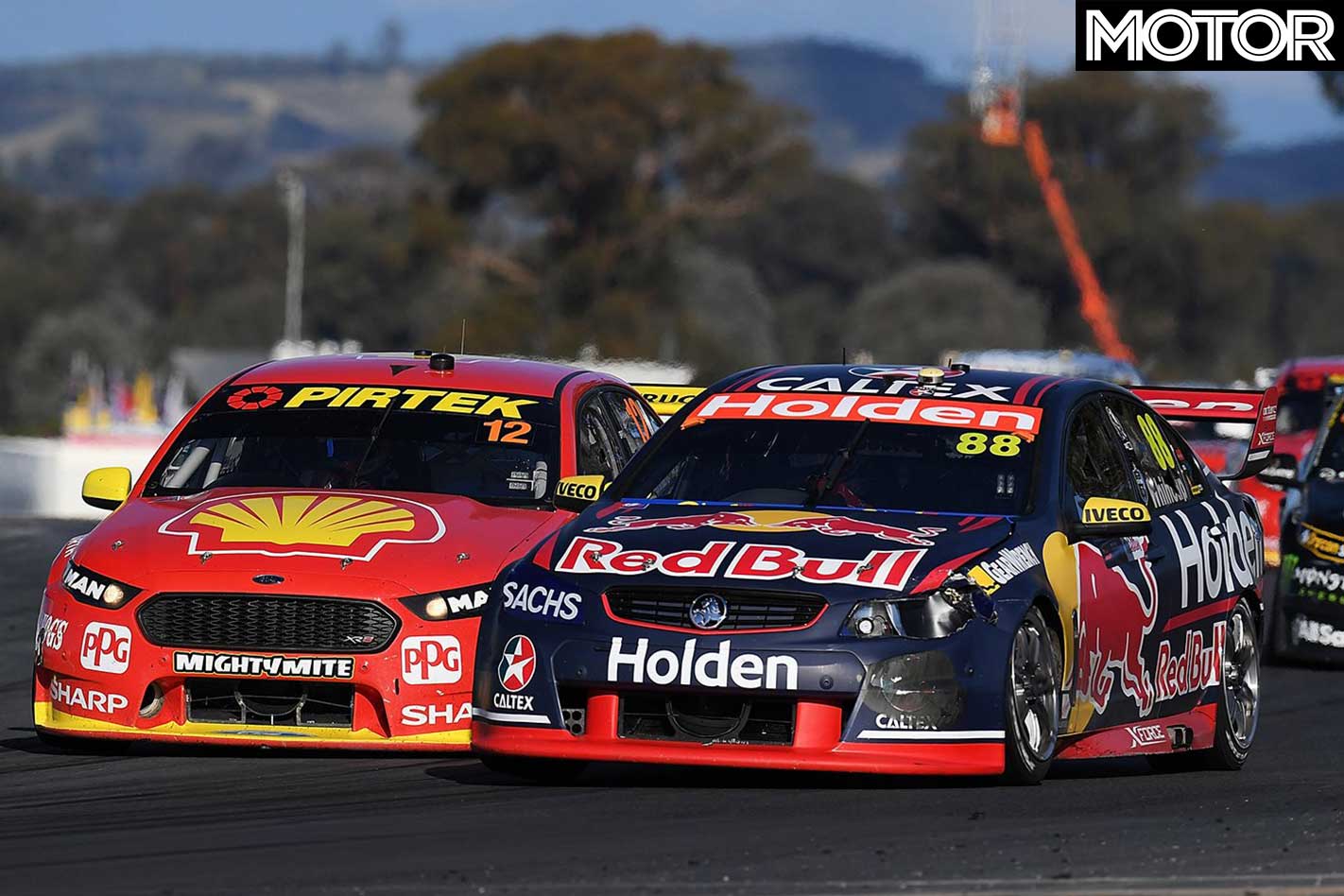
A surprise hit for WhichCar this week came in the form of a great pick-up from the Motor mag crew around the potential of a Chevrolet Camaro joining the Supercars ranks. While motorsport isn’t a core directive, it’s a great example of how a good story will always prevail.
Lots of interaction with the wider industry this week, too, particularly with the launch of Mazda’s new 3 hatchback. It’s an interesting time for the category of cars once derided as mere ‘econoboxes’, as car makers address lower fleet sales with more highly specced yet well-priced models.
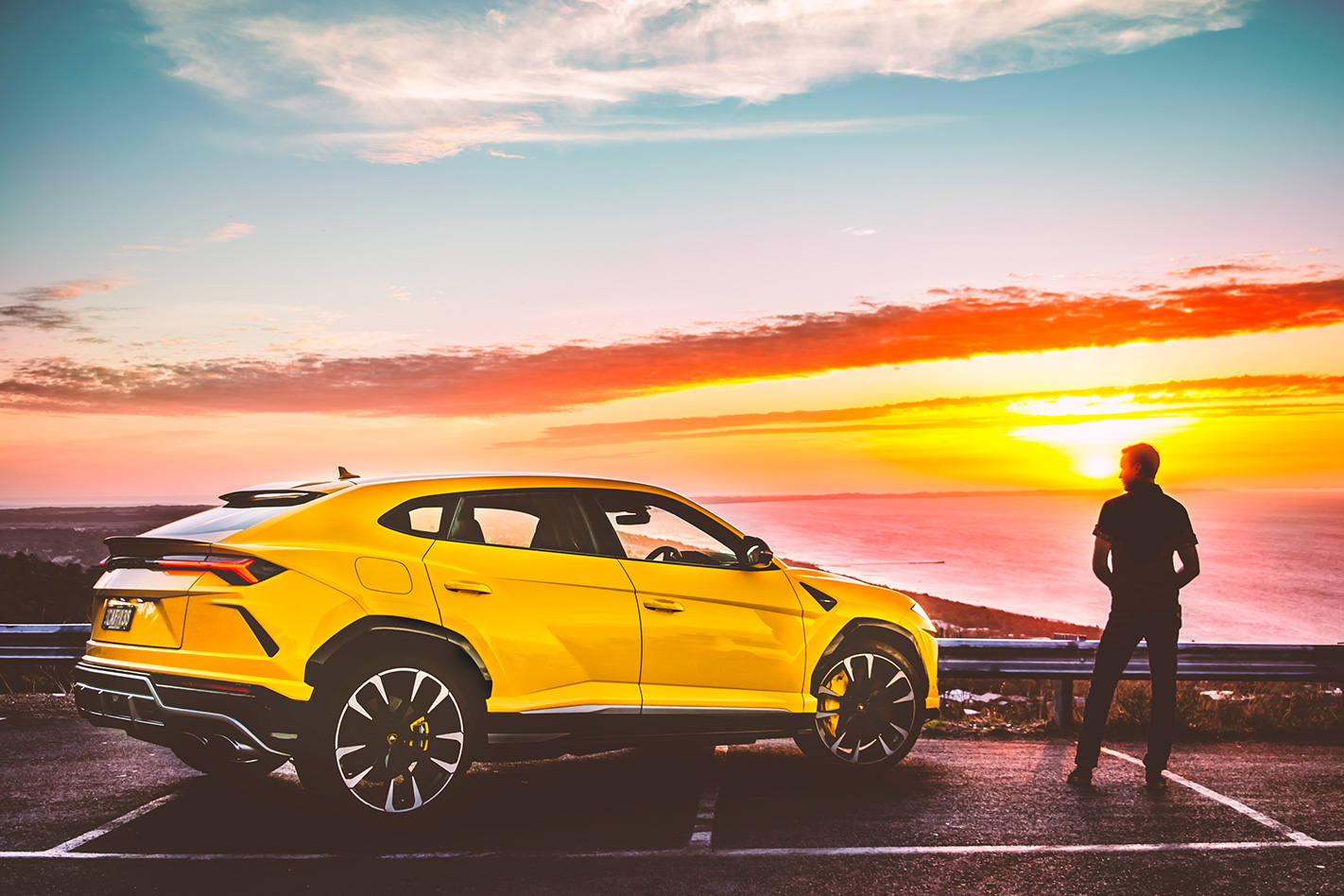
Lots of bums on car seats again this week, too, including a stint in the Mercedes-AMG E53, a look at the new base-spec VW Tiguan R-Line, a deep dive on the Lamborghini Urus and a peek at the Lexus UX, Hyundai Santa Fe Highlander and Mazda CX-9.
Our renewed focus on advice continued, as well, with the team answering reader questions about which hatch is best for a young first new-car buyer, which ute suits the needs of a country family, and which electric cars are arriving locally in 2019.
That’s it from WhichCar this week. Have a great weekend, and don’t forget to tune in to Channel 10 on Sunday at the special time of 3.00pm!
Beer cans. empty, and in their tens of thousands, the green of VB, the maroon of Carlton Draught, the blue of Toohey’s New, clinking together around your ankles as you shuffled your feet through them like fallen autumnal leaves.
This is one of my earliest memories of Mount Panorama, Bathurst. Knee-high to a grasshopper, or about six beer cans tall, I grasped my old man’s shorts as we wandered through the lawless-feeling, Mad Maxian wasteland that was the Top of the Mount at approximately 6pm on the Sunday after the race. Garbage blanketed the ground almost entirely.
This was the mid ’90s, and as columns of weary punters marched back to their parked cars, lugging eskies and camp chairs, plumes of thick, black, acrid smoke reached up into the sky, somewhere over in the campsite. Presumably another car was being sacrificially torched to appease the gods of red and blue – whichever had lost the race.
There were only two colours of flag zip-tied to the poles of the khaki awnings throughout the temporary canvas town back in those days. Either a blue oval, or the proud lion motif – maybe a cheeky old Nissan flag of some s**t-stirrer. But if you chose one flag and hoisted it above your campsite, you dared not fraternise with those of the opposite. The rivalry was real.
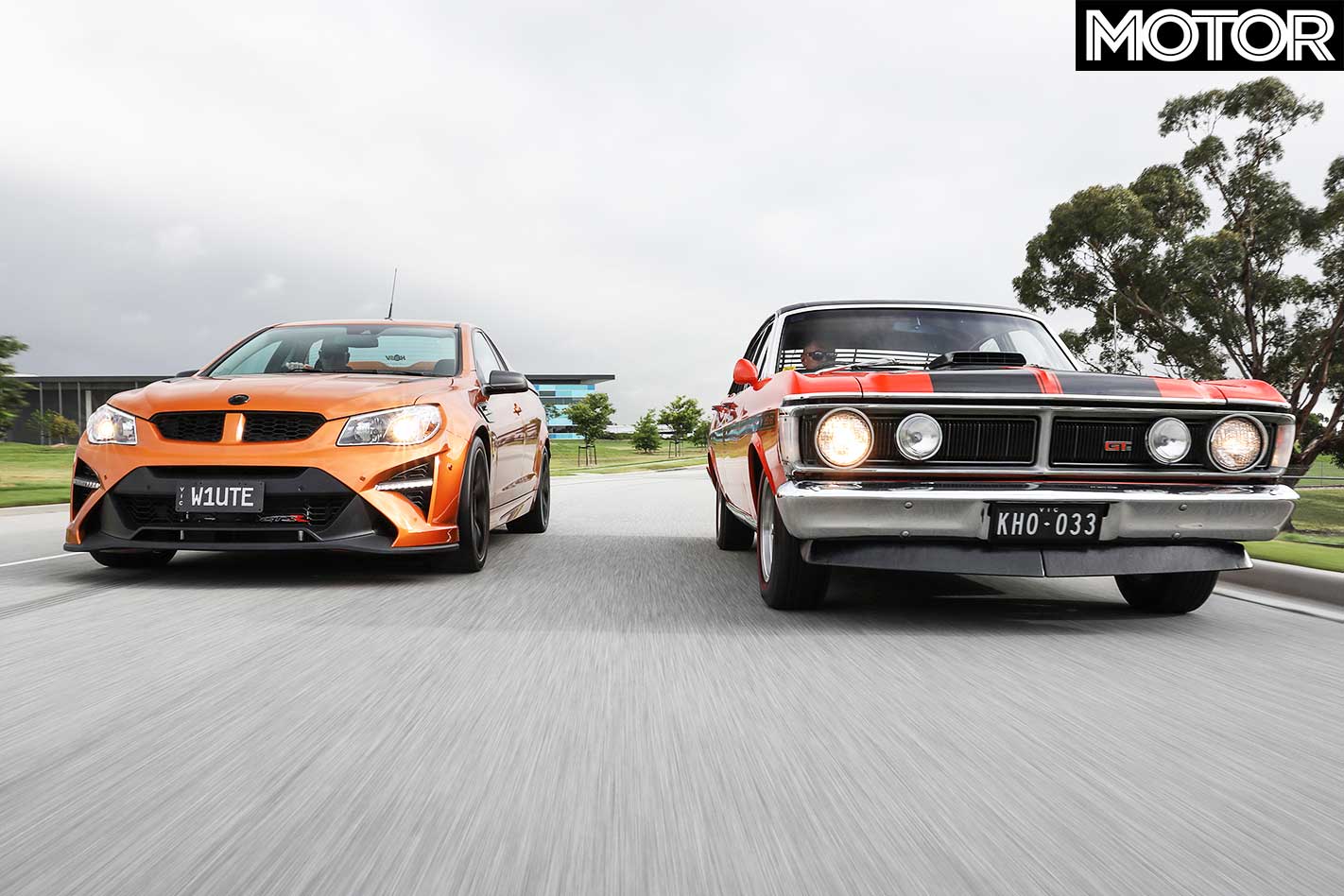
In the April 2019 issue of MOTOR, we’ve taken two of the rarest vehicles from these long-warring tribes – an HSV W1 Ute and Ford Falcon Phase III GT-HO – and ‘compared’ them for a very special feature. To me, this kind of stuff is starting to feel a bit like seeing Peter Brock’s Marlboro VC and Dick Johnson’s Tru-Blu XD together in the modern day, old enmities replaced with nostalgia. It’s got me thinking about where the red-versus-blue rivalry itself is heading.
In my dealings with you, MOTORists, and in gas-bagging with my equally car-mad mates, or my older relatives who knew and partook in the Bathurst tribalism, it seems the boundaries of the old hostilities are blurring into something entirely new.
Many of us, realising how lucky we were to have a homegrown road car rivalry at all, are now just becoming admirers of the wider Australian car industry and the legendary machines it produced – independent of brand. I know I am; I see a mint, original VE SS and I get as excited as seeing a tidy, unmolested BA GT. My online classifieds saved search includes Aussie models from both Ford and Holden. I was a bit Ford obsessed as a kid, and while I’ve always had a respect for the ‘other’ brand, I’ve never actively yearned for certain Commodores like I do now. It’s all a bit new and confusing, but I’m liking it.
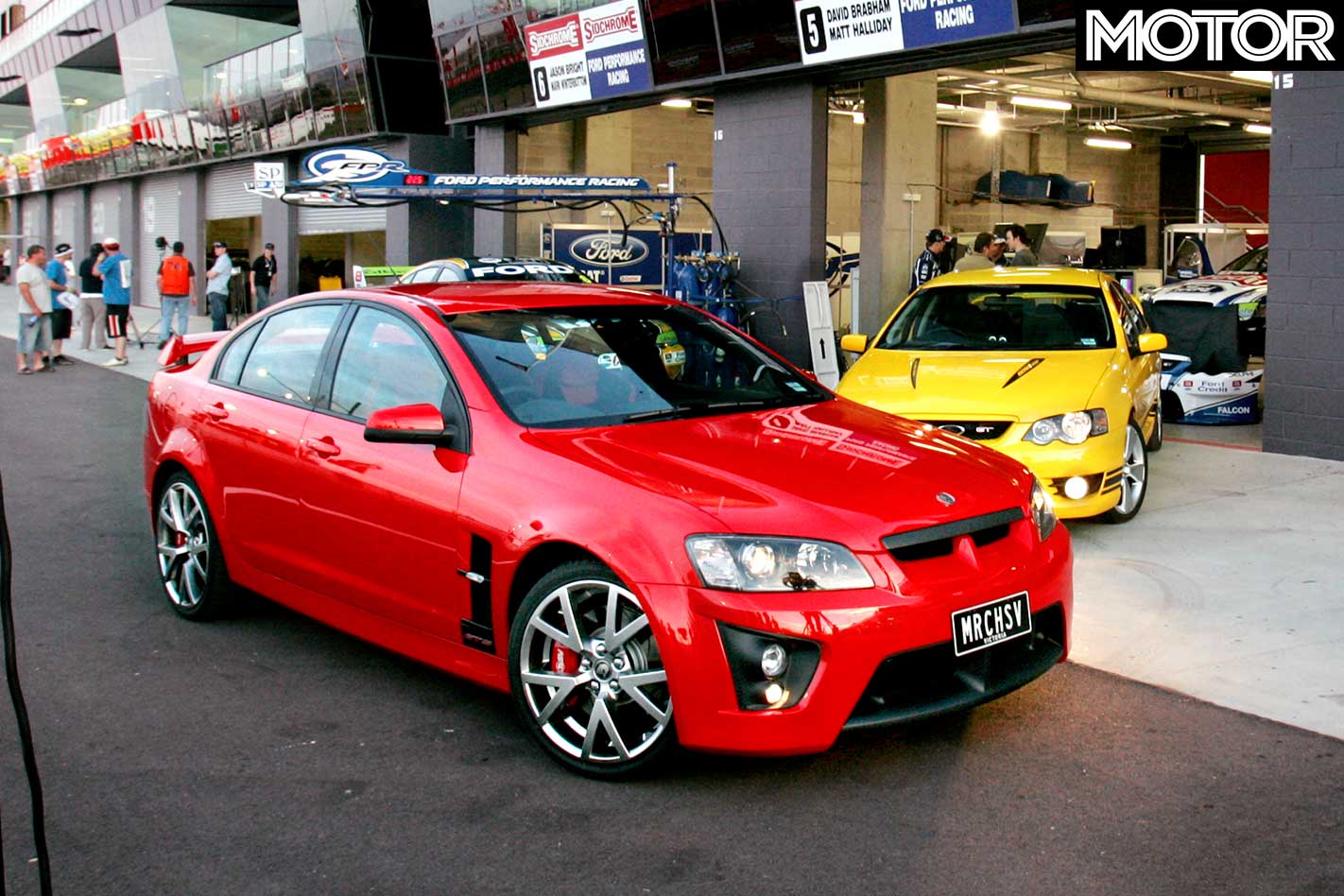
It’s this growing interest in, and celebration of, the Australian car industry broadly that will, in my opinion, also shortly do silly things to the values of the cars still around. Cars should not be thought of as investments, yet I bet an aircraft hangar full of mint post-1990 SSs, Clubsports, XR8s, XR6Ts, GTs and T-Series will, healthy economy permitting, outperform a share portfolio over the next decade. But we digress…
Of course, there’ll always be the stubborn boofheads, so it’s hard to know for sure if your average Ford fan will start to feel warm and fuzzy at the sight of some rare HSV; or if their Holden equivalent will develop a bit of a soft spot for a Barra. But my sense, and hope, is that it’s heading this way. And perhaps we’ll come to realise that, as we sit amongst each other’s squalor on the top of some hill in country NSW, VB and Toohey’s New might taste different but beer is beer. And beer is good.
Scott says Dan’s illness was from diving a Ford Mustang EcoBoost and liking it, but either way he is back to chat to the regular boys about all the hot topics from the week.
Kicking off the chat this week, we discuss Labor’s plan to boost electric vehicle sales to a half of all new cars by 2030 and it’s even more ambitious strategy to resurrect Australian car manufacturing. Flight of fancy, realistic goal or is there simply an election looming?
Then Scott and Dan gaze silently at Andy as he takes us through Mercedes’ top secret holy halls where the German car maker houses all of its most valuable, rare and desirable vehicles throughout the company’s storied history.
And rounding out the conversation, Dan reviews his time in the most significant vehicle in Lamborghini’s history – the Urus. Can an SUV ever truly carry the Raging Bull badge on its nose and is there anything that makes its first high-rider since the LM002 a worthy supercar?
If you’re on the run or in the car, find the WhichCar Weekly podcast on iTunes or Podbean and follow the WhichCar team on Facebook, Twitter and Instagram – @whichcarau.
Listened to the show? Help us out:
- Leave a note in the comment section below.
- Leave a review on Apple Podcasts/iTunes
- Subscribe to our podcast
Mini has announced that its first-ever electrified SUV, the Countryman Plug-In Hybrid, is now on sale in Australia wearing a retail price of $57,200.
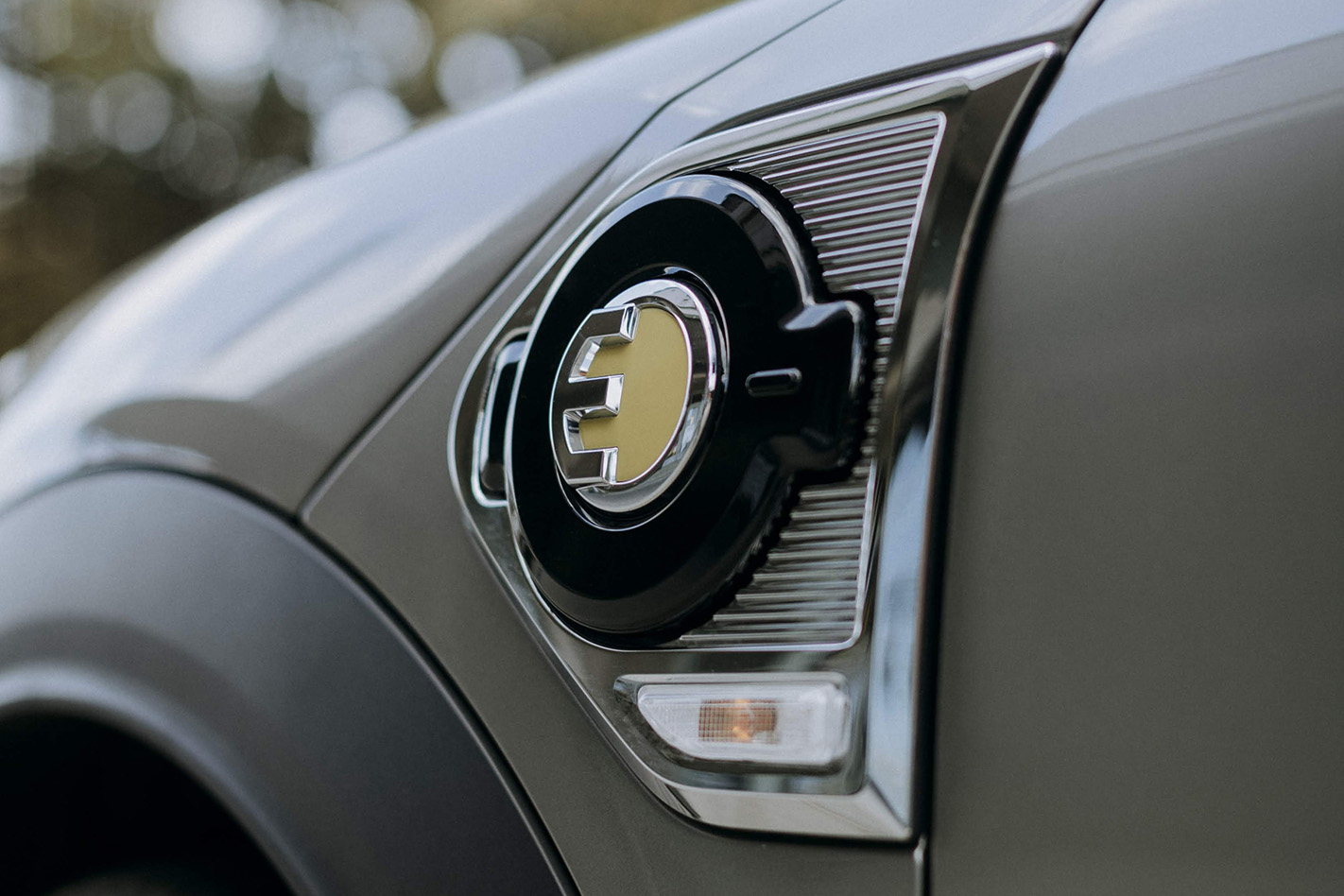
It’s the first zero-emissions model for the Mini brand to enter showrooms in this country, boasting a full-charge range of 40km from its 7.6kWh lithium-ion battery pack – enough for the average Australian to drive from home to work and back without having to run the car’s 1.5-litre turbo petrol three-cylinder engine.
With the combustion engine and electric motor working in concert, the Mini Countryman PHEV can travel for around 500km before refuelling, with an average fuel consumption of 2.1 L/100km.
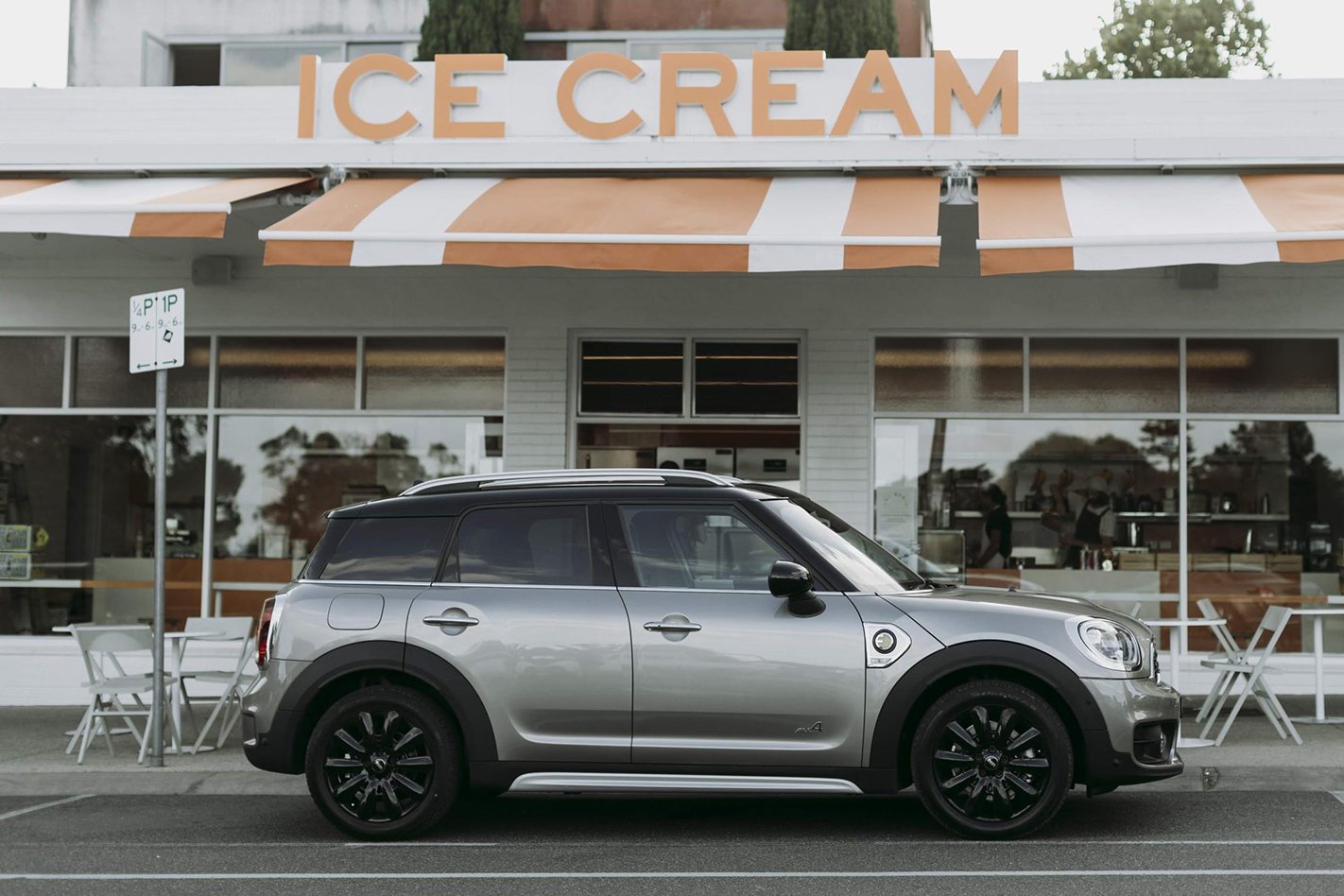
However, disciplined charging could see owners spend the bulk of their time driving under electric power alone – thereby dodging the petrol price cycle and performing the bulk of their commuting on cheap household energy.
The petrol engine is essentially the same as that used by the base model Countryman Cooper, making 100kW and 220Nm and sending power to the front wheels via a six-speed automatic. However, the rear-mounted electric motor not only adds an all-wheel drive capability, but also produces 65kW and 165Nm on its own.
ANALYSIS: what makes more financial sense, EV or combustion?
Combined, both powertrains deliver a total output of 165kW and 385Nm, sending the Countryman PHEV to 100km/h in a brisk 6.9 seconds – 2.7 seconds quicker than the entry-level Countryman, and about as fast as the Countryman Cooper S.
Meanwhile, charging time for the Countryman PHEV’s battery takes three hours and 15 minutes from an ordinary 10-amp household power point, or an hour less if charged by a dedicated wall box charger.
Features
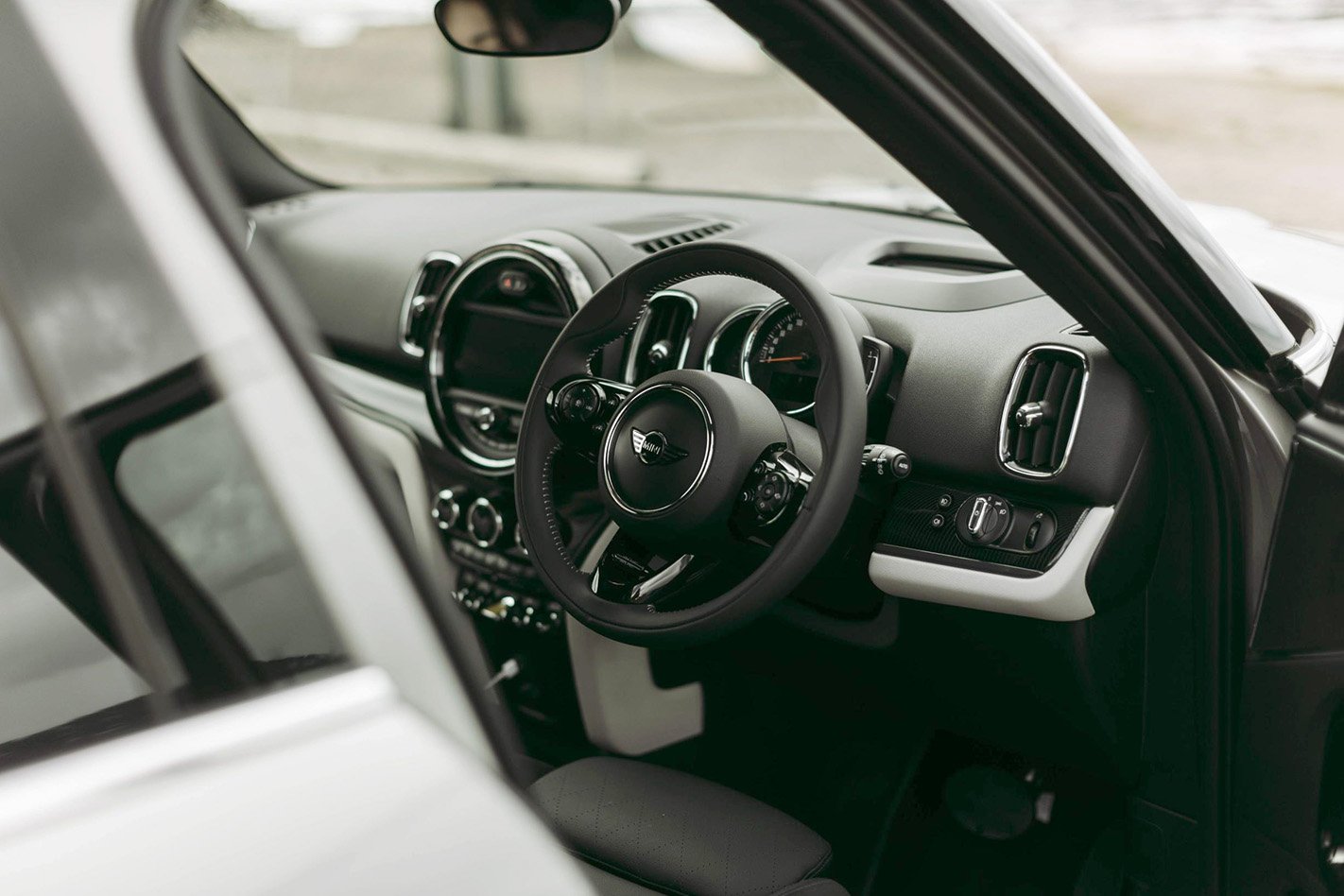
It might be the second-most expensive Countryman in the range, priced just $700 under the flagship Countryman JCW, but the Countryman PHEV nevertheless totes a good amount of equipment as standard. Dual zone climate control, an 8.8-inch colour touchscreen, satellite navigation, digital radio, active cruise control, AEB, front and rear parking sensors and a reversing camera are included.
There are some compromises though. Total seats-up boot capacity drops by 45 litres to 405 litres, presumably to accommodate the battery pack and rear-mounted electric motor. With the seats flipped down, there’s nevertheless a generous 1275L of cargo volume to exploit.
Pricing
The Countryman Plug-In Hybrid is available now, with retail pricing as follows:
- 2019 Mini Countryman Plug-In Hybrid – $57,200
This little SUV, or ‘Sports Activity Coupe’ if you’re BMW’s apparently acronym-blind marketing team, is the 2019 BMW X2 M35i xDrive, and it houses the most powerful four-cylinder engine ever found in a production BMW.
Based on the Mini Countryman, it’s the newest part of BMW’s fast SUV onslaught until the X3/X4 M shows up on local shores. It’s also priced just north of where the outgoing BMW M140i sat.
Does that mean BMW wants this to be its new hot hatch? We’re not convinced, but that’s not to say the M35i isn’t fun.
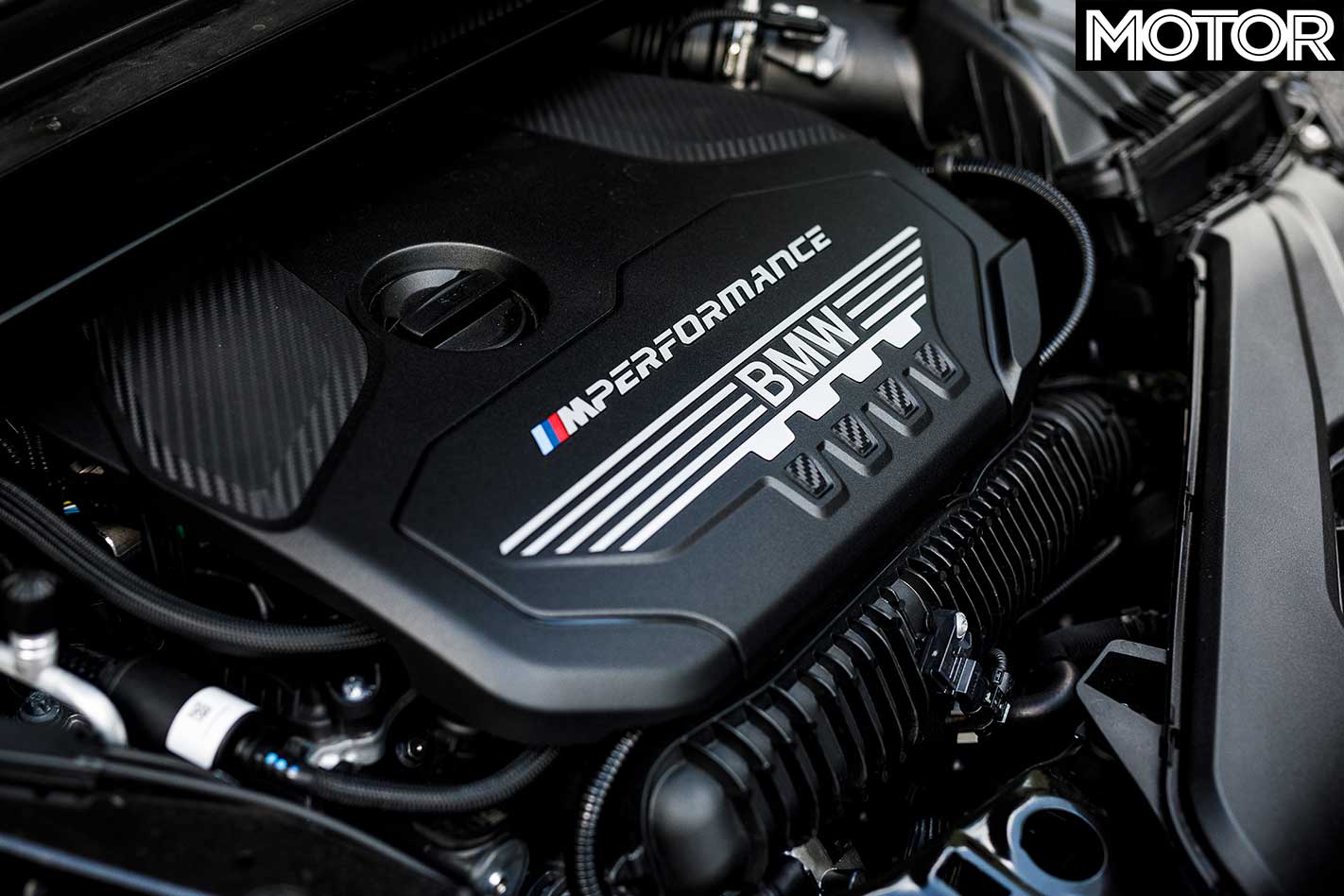
The highlight of the car is its 2.0-litre turbo unit, producing 225kW (112.6kW-per-litre!). Peak torque arrives at 1750rpm, so despite an occasionally rebellious ‘box it’s rather quick off the mark.
The 0-100km/h sprint takes just 4.9 seconds, but the feeling of speed could be a placebo induced by the rorty exhaust, producing almost AMG-like crackles and pops.
Through bends and twisty roads, especially if they’re rough (read: Australian), the M35i’s ‘big hot hatch’ vibe starts to fall apart. Its size starts to make itself known the more you lean on the brakes, as the extra ~165kg over an M140i is hard to miss.
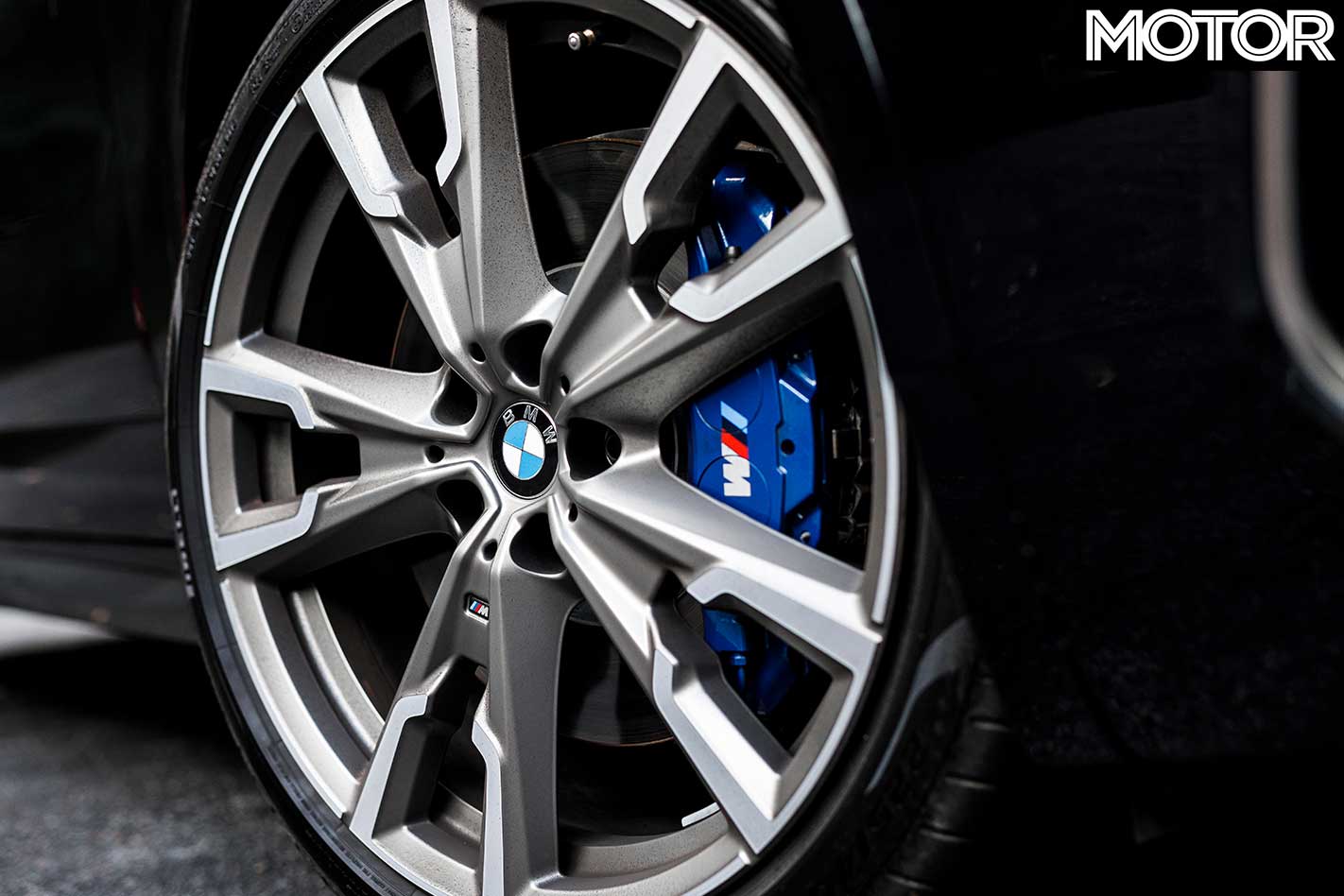
The xDrive AWD system makes firing out of turns easy, helped by an M Sport Differential, and given its size there’s not too much leaning and pitching through bends.
It’s not an incredibly playful chassis, and tends toward understeer, but feeling planted shouldn’t really be a complaint in an SUV. Especially if it’s wet.
Steering is typically BMW, a little weighty and numb but otherwise well-tuned.
As for the dampers, two modes provide a ‘sporting’ and a slightly less sporting setting. Don’t rule out long trips, but you’d want to be a little lenient.
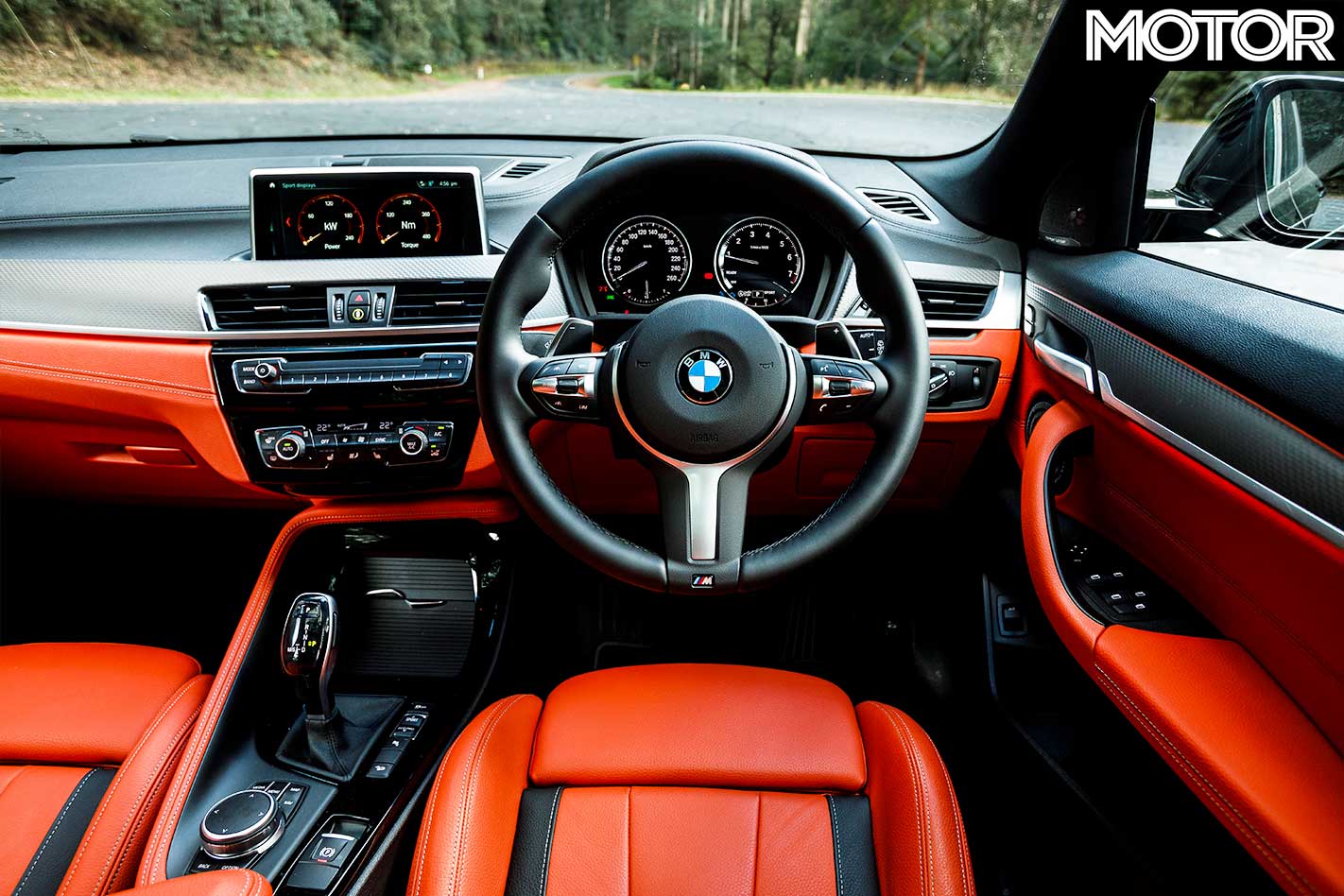
We’ll leave the styling for you to judge. Just know the bright red interior is an option.
Fortunately, the X2’s cabin is ergonomically sensible, as is BMW’s iDrive 6 infotainment system via the 8.8-inch touch screen. There’s also a wireless phone charger under the armrest.
Is the X2 M35i a hot hatch? It won’t stack up to be a replacement for the M140i, but it is fast, practical, and dare we say fun, and that’s usually enough for most.
2019 BMW X2 M35i xDRIVE SPECS Engine: 1998cc, inline-four DOHC, turbo Power: 225kW @ 5000-6250rpm Torque: 450Nm @ 1750-4500rpm Drive: all-wheel drive, 8-speed automatic 0-100km/h: 5sec (claimed) Weight: 1610kg Price: $68,900
Arriving at ‘The Wing’ at Silverstone on a cold and windy afternoon in early Spring is like turning your internal colour saturation control down to zero. The old World War II bomber base airfield is forbidding at the best of times, but today under scudding nimbus there’s one heck of a monochrome welcome. An arrowhead of Mercedes’ most iconic silver arrows race cars sits at the entrance to the function centre.
Mercedes is rolling out the red carpet to celebrate 125 years of motorsport, that anniversary defined by the 1894 Paris-Rouen race. Let’s pause for a little perspective here. Porsche is a newbie by comparison, its racing history commencing in 1951. Ferrari started competing in 1929, by which time Mercedes already had a 35 year competition pedigree. Of the 102 entrants in that race, Peugeot is the only other name that survives today.
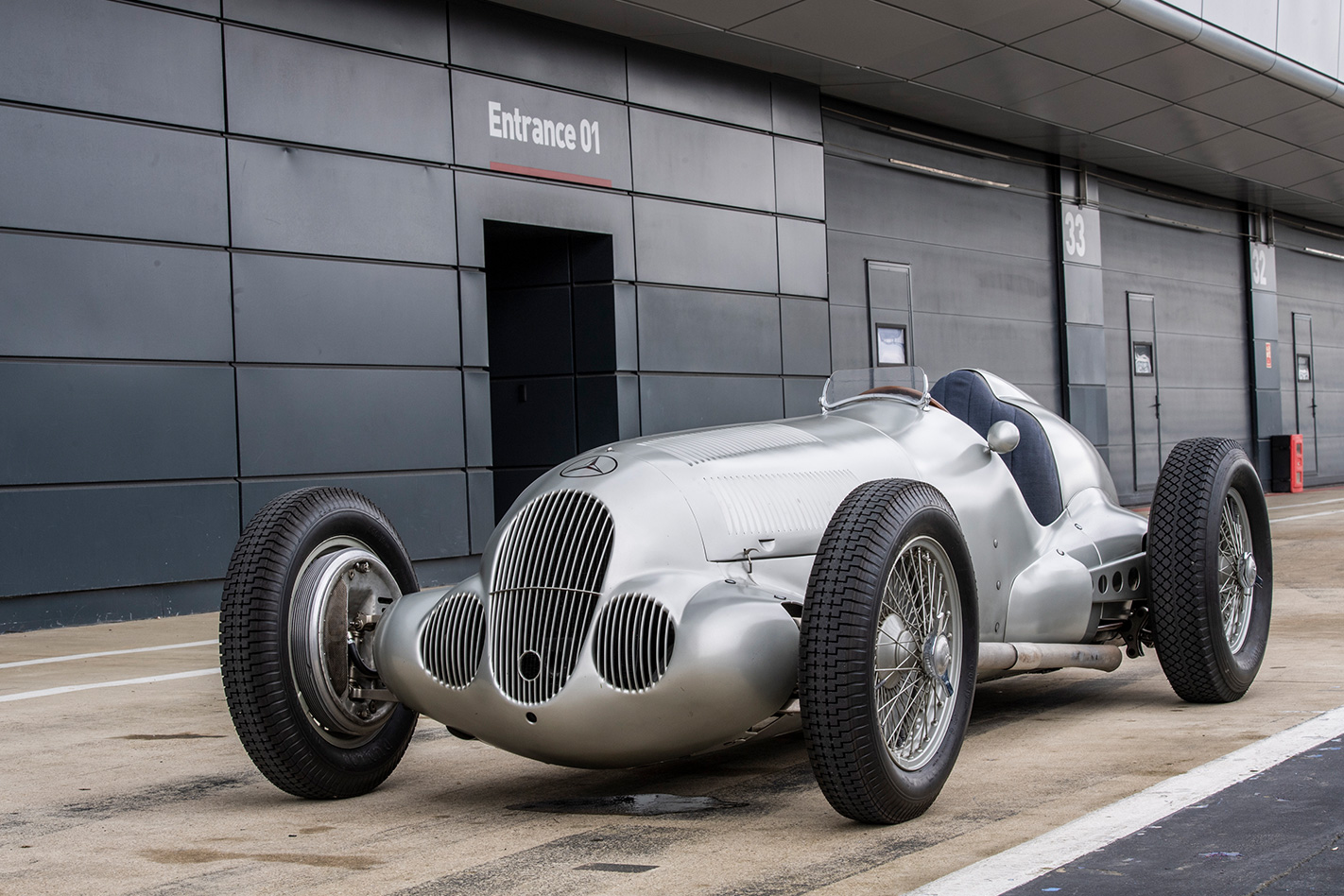
It’s these cars that grab your attention when you walk into The Wing. There’s an unbroken rank of Silver Arrows and it’s fascinating to see the development of the cars each year, from the matte-painted ex-Brawn car that is the 2010 MGP W01 (these snappy names that sound like inkjet printers are an F1 thing, unfortunately) to the current 2019 model. Nestled in among them is the 2012 car in which Michael Schumacher raced his last F1 season.

It’s fascinating to walk along the row, watching the front wings grow more convoluted, the side pods more complex, the front suspension more intricate and the flat floors ever wider. Comparing Mika Häkkinen’s V10 car from 1998 with the 2018 car of Lewis Hamilton is an almost Darwinian exercise in accelerated evolution.

On the other side of the room is an astonishing walk through time from the 1909 Blitzen Benz, fellow Wheels scribe John Carey poring over its antediluvian ignition system. This monster featured a 21.5-litre inline-four and only two of these behemoths now exist. When the car is fired up, the pulses of air being thrashed out of each five-litre cylinder set your diaphragm beating in time. I can only think it must have been the refinement benchmark for the TE Gemini diesel.

Parked next to the Blitzen is the W 125 Streamliner, which set a flying kilometre record on an autobahn in 1938 of 432.7km/h, a mark which went unbroken for almost 80 years until Koenigsegg squeaked past it in 2017 with an Agera RS with almost double the horsepower. Quite amazingly, this pre-war racer had a drag coefficient of 0.17, a good deal better than any modern production car. The current best effort stands at a Cd of 0.22 for Mercedes’ A-Class sedan.
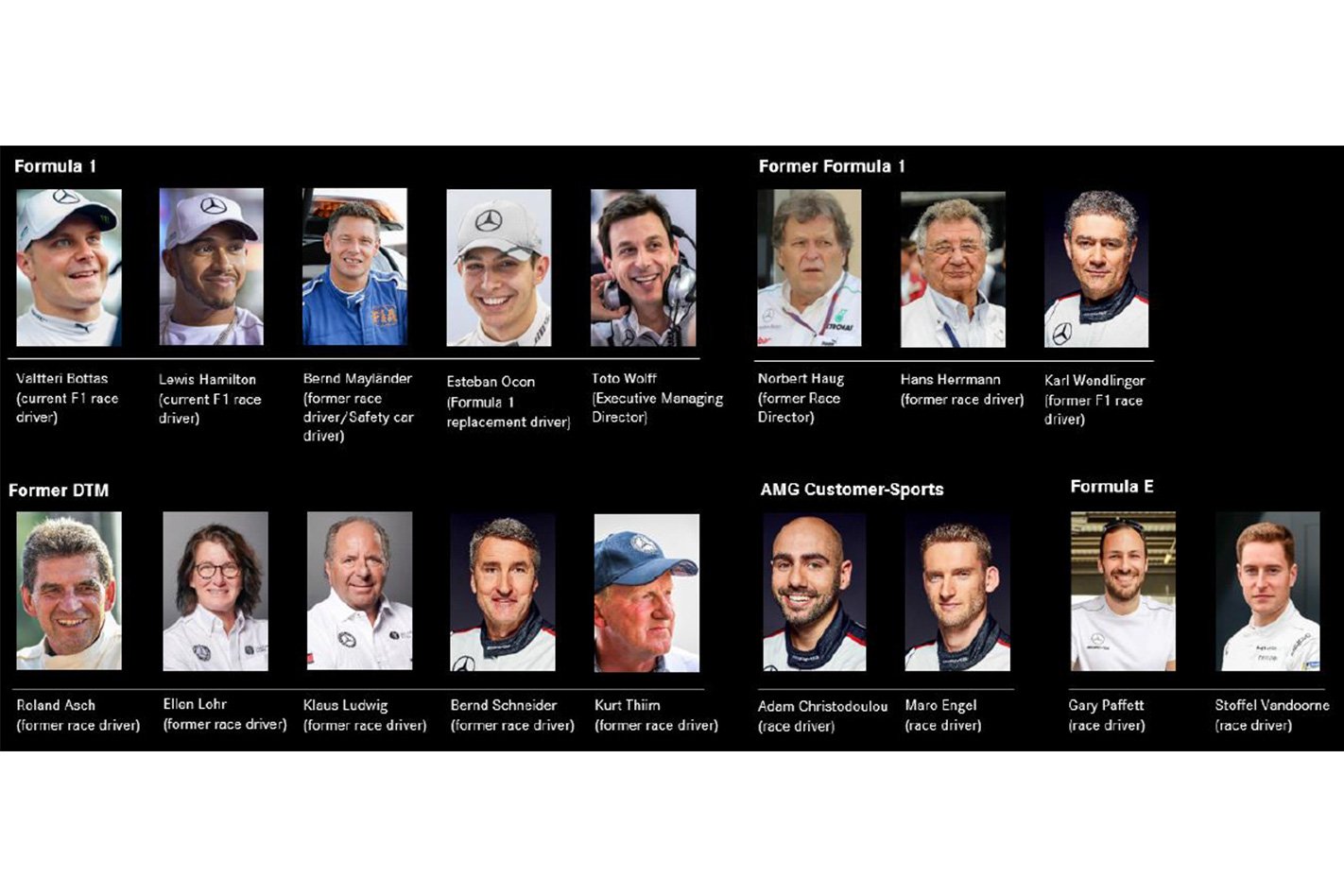
Glance across the room and there’s Lewis Hamilton peering into the cockpit of the Sauber C9 that won Le Mans in 1989. There’s a Bathurst-winning SLS and the Nurburgring 24hr-winning AMG GT, not to mention the CLK GTR, AMG’s first racer, the famous 6.8 SEL ‘Red Pig’, Bernd Schneider gazing wistfully at his DTM-winning CLK.
One of the most remarkable cars here is, curiously, drawing comparatively little attention. The Marlboro-liveried Penske-Mercedes PC 23 IndyCar that featured the radical Mercedes 500I engine is one of motorsport’s great case studies in innovation. ‘The Beast’ won the 1994 Indianapolis 500 by taking advantage of a loophole in the rules that allowed greater capacity and more boost pressure for low-tech two-valve-per-cylinder pushrod engines. In effect it was to allow teams without vast budgets to compete with cheap ‘stock blocks’. Ilmor Engineering didn’t see it quite that way and developed a 1000hp engine for Mercedes that was 200hp more powerful than any other in the field. Al Unser Jr’s winning car had lapped every competitor other than F1 world champion Jacques Villeneuve by the time the chequered flag appeared. Before the car had even returned to its team HQ in Bloomfield, Michigan, the rules had been changed.

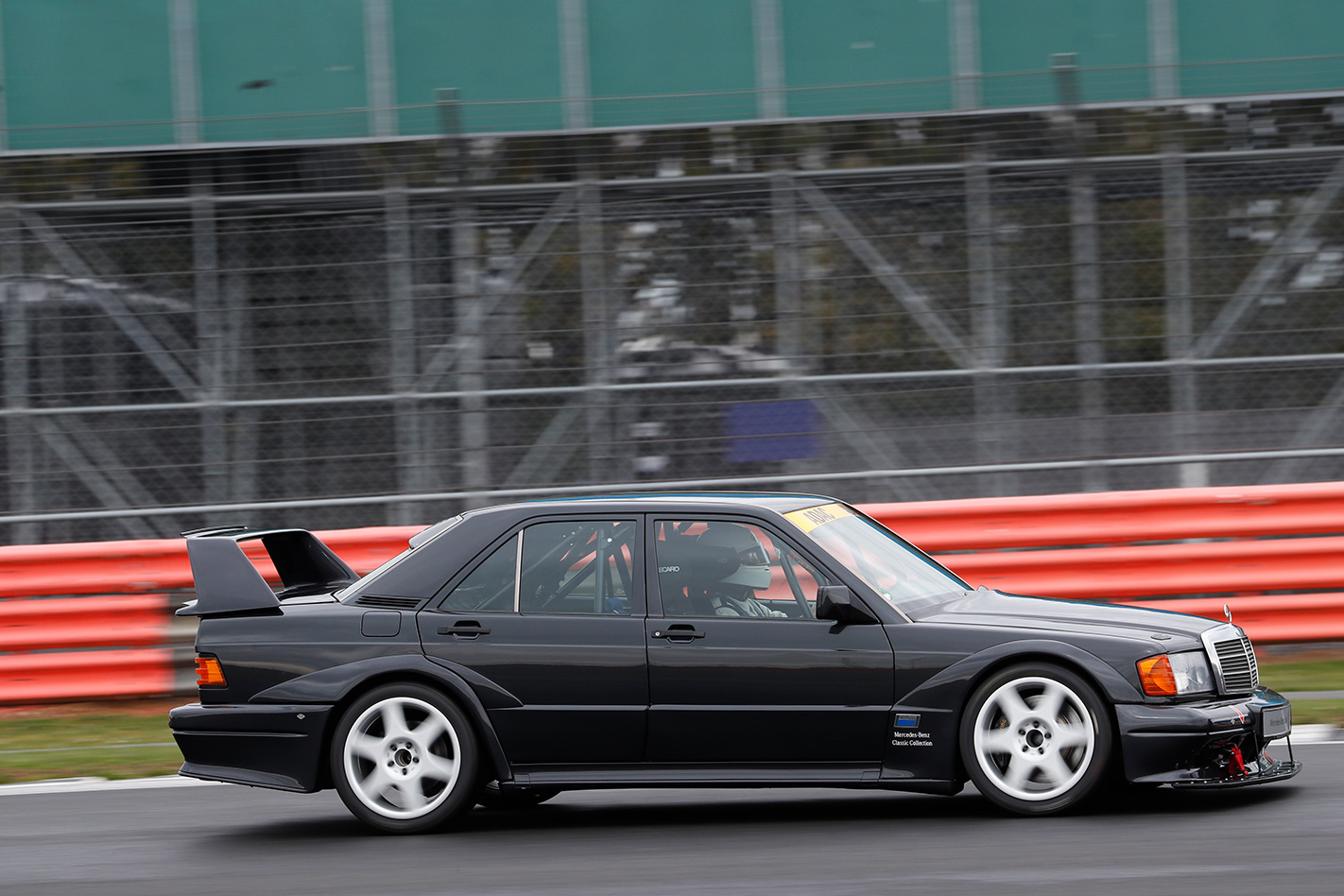
Hamilton isn’t just here for the beer either. He managed to get into an entirely unscheduled race with team boss Toto Wolff, an ex-racer and handy steerer himself, when the two of them had commandeered a pair of 190E 2.5-16 Evo IIs. I know for a fact that Toto had bagged the faster car, although I’m not sure who crossed the line first.
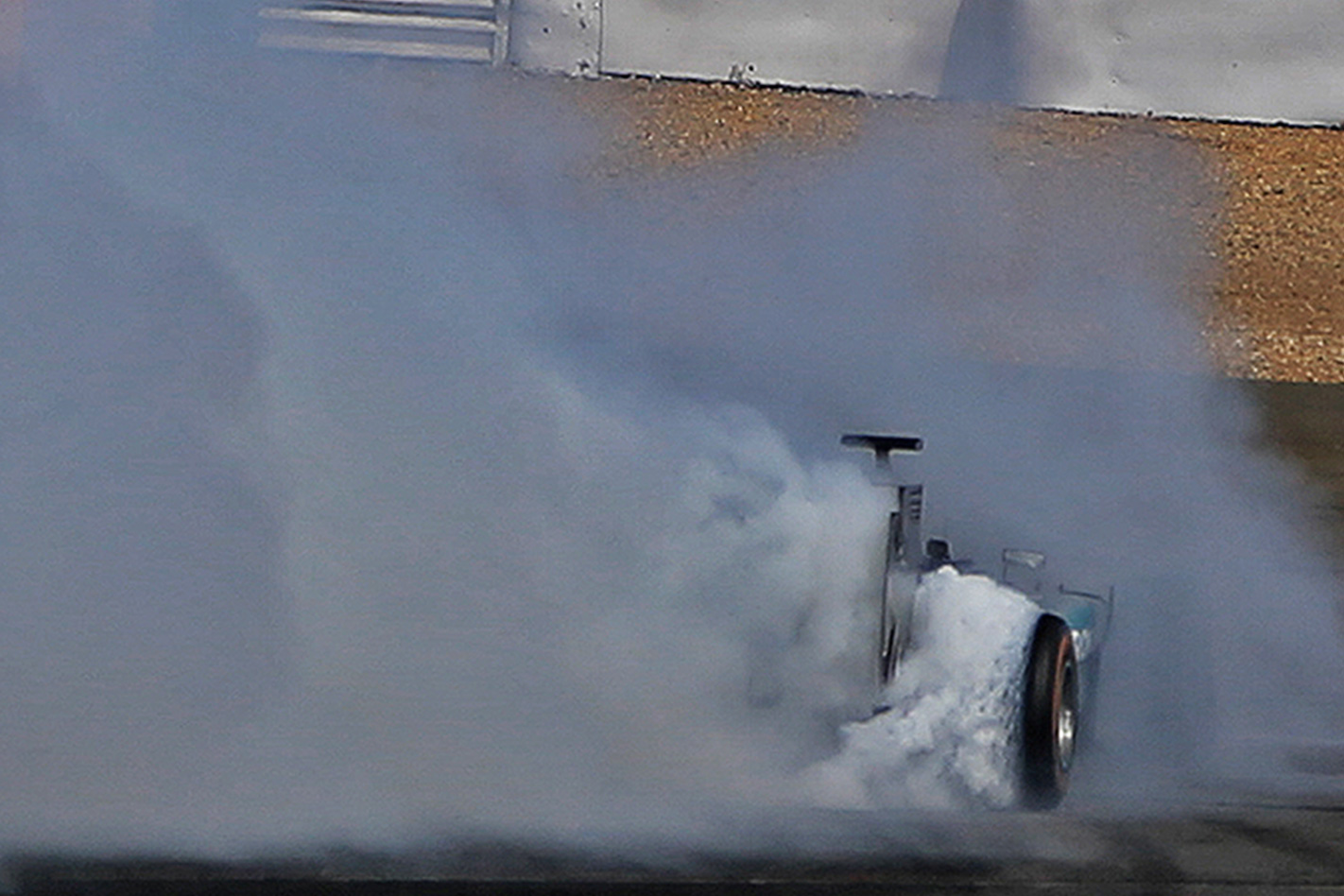
Valtteri Bottas is due to wing in today, the announcer in the building giving us the cue to head out onto the balcony to watch him come past on track and to contract hypothermia. He does a couple of fast laps and then decides that he hates his rear tyres and needs to kill them. A demented doughnutting session then commences, but let’s just say that the Finn wouldn’t be taking home any prizes at Summernats. His circle work needs finessing.
After the smoke clears, we head out in some old stuff on the Stowe circuit. Perma-grimacing Roland Asch pedals us round in a 1904 Mercedes-Simplex. Then I jump in with Bernd Schneider in the 1928 SSK. With its screaming supercharger and 165kW 7.0-litre inline six, it’s a riot. Schneider, who has zero mechanical sympathy, drives the car as if he’s on a quali lap, oversteering it into hairpins and using engine braking instead of the woeful anchors.

From there it goes into fantasy stuff, ex-V8 Supercars pilot Maro Engel driving a few laps in a 1955 300SL Gullwing. Engel’s a lovely bloke, but he’s very respectful of the Gullwing out on the Stowe circuit. I’d just seen Bottas drifting the thing, so I’m a bit crestfallen.

Recompense comes in a lap with Ellen Lohr. You probably haven’t heard of Ellen Lohr. I’m projecting somewhat here, because I hadn’t heard of Ellen Lohr. She did a great job compering the gala dinner the night before, but other than that I’m in the dark. It turns out that she’s the only woman to have ever won a DTM round, beating the likes of Bernd ’Mr DTM’ Schneider and ‘King’ Klaus Ludwig in the process. She looks like your mum. I’m projecting a bit here too, because she looks like my mum, but she’s acquainting herself behind the wheel of a 1980 500SL rally car and beckons me to jump in. This model never actually turned a wheel in anger as a works car. It was destined for the 1981 season, with Walter Röhrl leading the team, but Mercedes discontinued its rally activities prior to the season commencing. Shame.
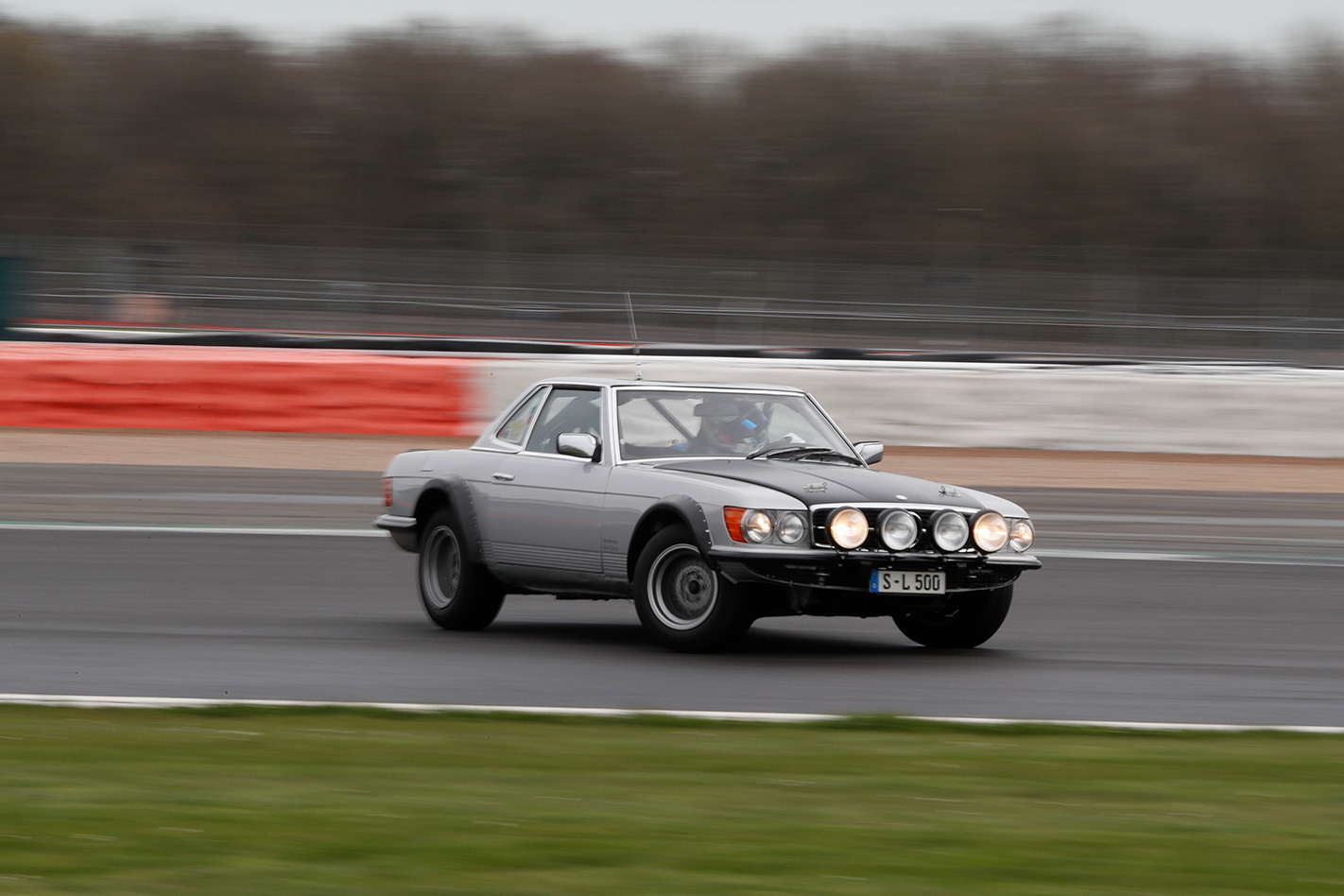
Lohr seems to want to punish the thing as a result. We’re sideways before the thing has even left the gates of the car park and delivers the most fun lap of the day. There’s something quite hilarious about seeing this bespectacled lady bang the car into second, give it a giant bung and then send 220kW to the balloon-like and rapidly vaporising Fulda Roteco tyres.

From there, it’s time to suit up and head out with some of the faster cars. At this point, it would be germane to point out that I’m a tallish chap, so most race suits tend not to fit all that well. Or, as in this instance, at all. Imagine trying to don a one-piece garment that’s, crucially, about 10cm too short in the distance between your shoulders and your scrotum and you get some idea of the discomfort involved. Still, some sort of herniated testicle seemed worth a ride in the AMG GT4 car out on the circuit. I put one foot into the passenger seat and then try to fold myself through the aperture in the roll cage. The enormous Stilo helmet clonks in, at which point the HANS device hooks onto the top bar and that was it. I was lodged firm. Only after a lot of hapless squeaking and wriggling do I extricate myself. Check Alex Inwood’s article in last month’s issue if you’re really keen to know what it’s like inside one of these things.

I have better luck in the AMG GT3 car with Engel, which is a good deal faster. It peaks at 237km/h on the back straight before Maro jumps on the picks. That’s significantly better than the 200km/h Esteban Gutiérrez manages in the fantastic 190E 2.5-16 Evo II that Lewis Hamilton had been driving the previous day, but both pale next to the 248km/h that Gary Paffett ekes out of the slinky 2018 C63 DTM car. With a 4.0-litre V8 good for 360kW, the C63 is – modern F1 projectiles included – the loudest thing lapping the track and, after seeing Paffett go a bit Burke and Wills on his initial out lap, I want to give the car the once over to see whether any pieces crucial to staying dirty side down have taken their leave.

All looks agreeably intact, so I strap in, forget for a moment about my abject discomfort and give the 2005 DTM champ the thumbs up. The vibration throughout the cabin when the V8 comes on the cam is incredible, blurring your vision slightly and making every nerve ending in your body feel as it’s been electrocuted. Paffett manhandles the car over every kerb he can find, leaping it back onto the line, jabbing great stabs of lock at the wheel and hitting 248km/h on the back straight. The C63 is a crowd pleaser, drawing a gallery of onlookers every time it fires up and yet Mercedes doesn’t see a future, for the time being at least, in DTM. This car is the last of the line.

Mercedes chose to bow out of this competition at the very top and looking at both the serried ranks of silver F1 cars and the current season results, you have to wonder how much left they have to prove in motorsport’s premier category. It’s an amazing show of power projection and it has me mentally calculating how old I’d be when the marque celebrates its 150th anniversary in motorsport. Too old, I reasoned, so it’s best to just try to soak in the event. I sit in the darkening pit boxes, trying to process what’s been an intense day. An old chap shuffles up and sits with me on the flight cases.
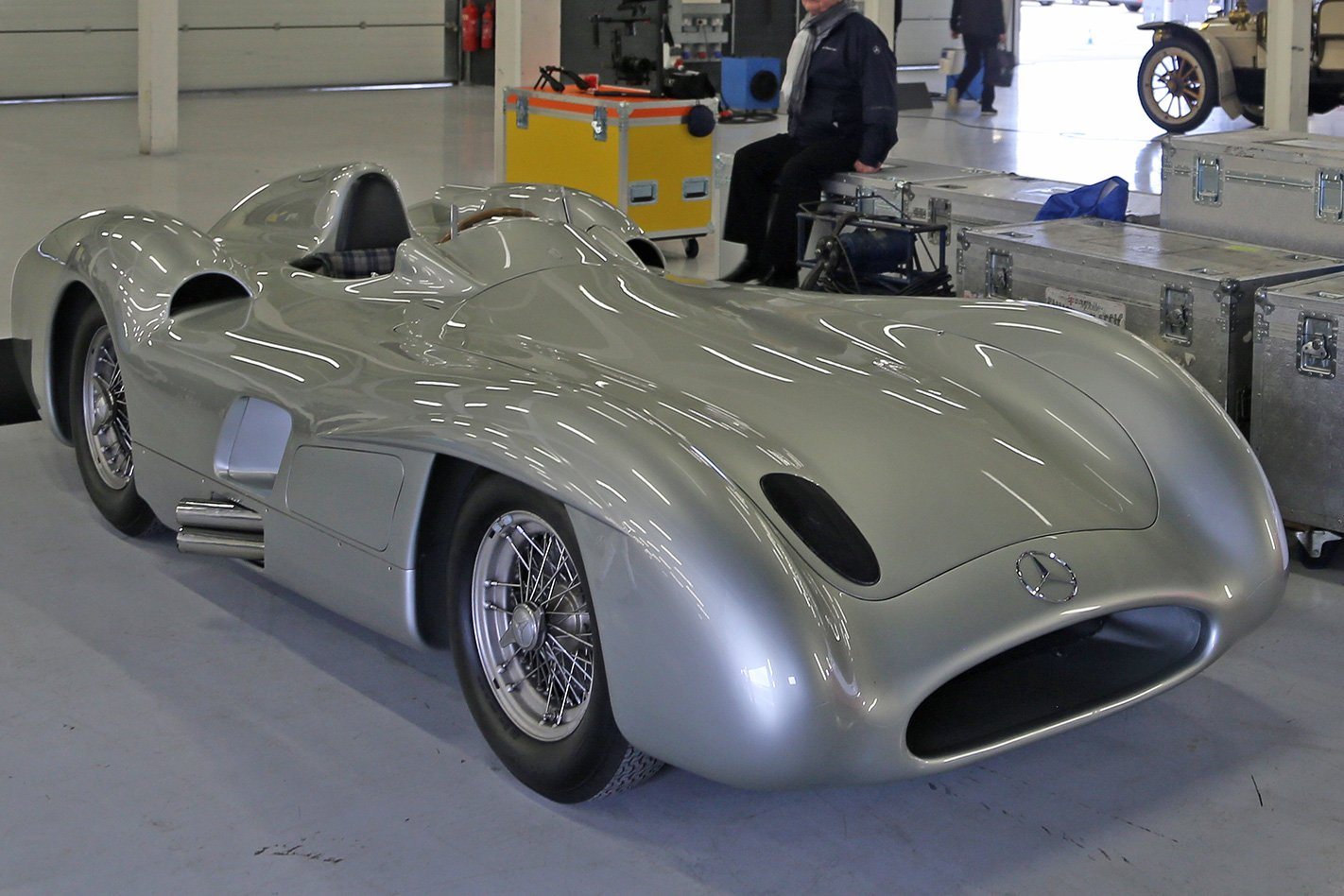
We share a moment, looking over the W196 R Formula One car from 1955. “Ist schön, ja?” I try in 12th-grade German. He smiles, figures I’m fluent and breaks into an uninterrupted five-minute burble. I slowly figure out that I’m talking to Hans Herrmann, the 91-year old who drove for Mercedes in the same era as Fangio and Moss, later winning the 1970 Le Mans alongside Dickie Attwood in a Porsche 917. He’s telling me about his drive in this car in the 1955 Argentine Grand Prix. Valtteri Bottas quietly joins us, grinning and letting the old boy talk. Eventually even Herrmann runs out of words and just gesticulates at the cars in the garage, raising his eyebrows. It seems I’m not the only one who’s slightly overwhelmed.
Chevrolet has finally confirmed that a successor to its Corvette will arrive later this year.
The big news is that the two-seater will have a mid-engine layout, confirming reports that the eighth-generation ‘Vette was losing its front-engine, rear-wheel-drive design. It will likely continue to drive the rear wheels, but a rumoured hybrid version that powers all four might be in the works.
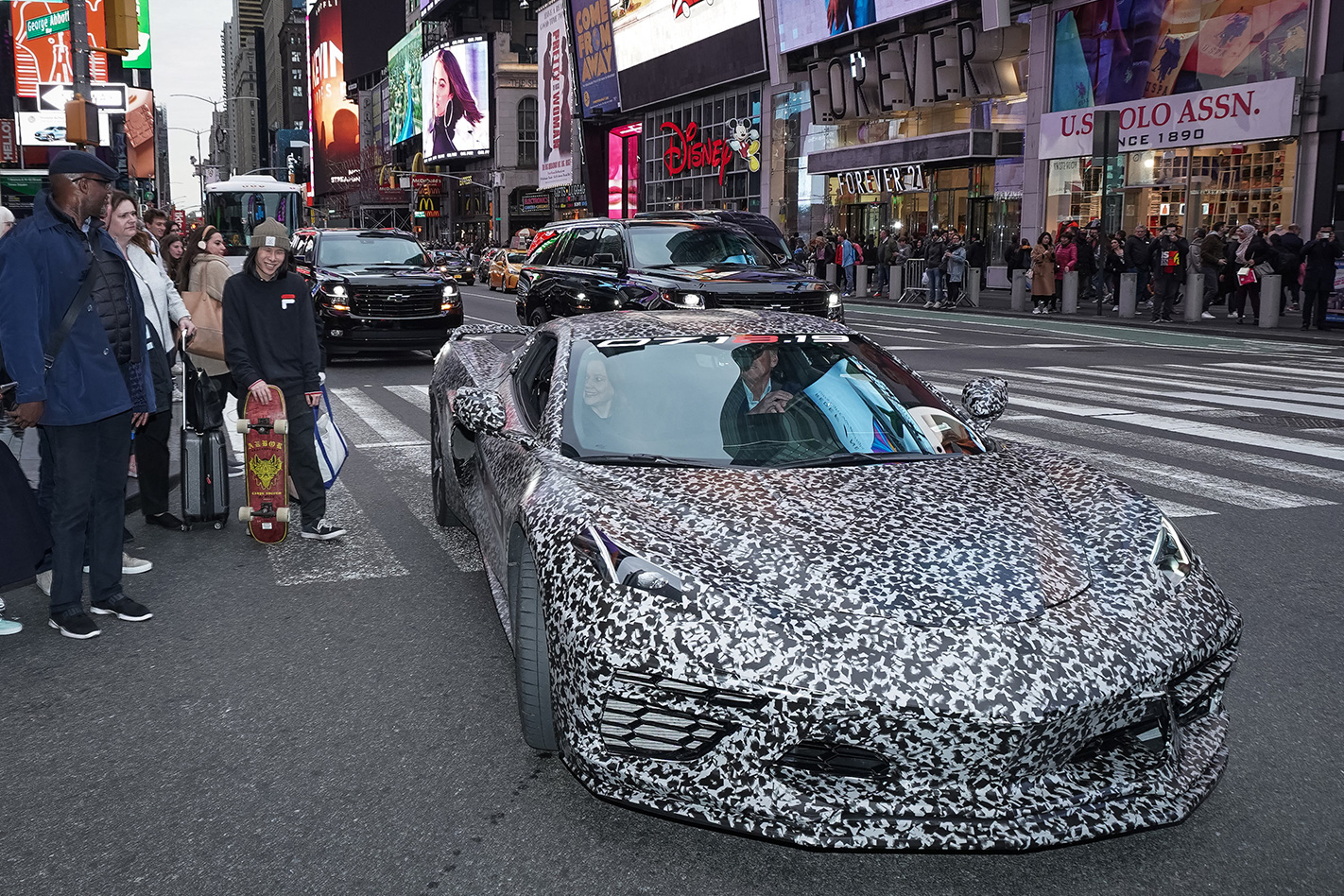
Keeping details to a minimum, the big US maker only confirmed that the new-generation Corvette will be mid-engined and revealed in the US on July 18. Accompanying the online release are images of a camouflaged coupe on the street in New York. It is the first time Chevrolet has confirmed the C8 Corvette’s existence and the first official images outside of spy shots.
US publication Car and Driver reports that it has further information not yet released, suggesting there will be an initial model launch later this year with the Corvette Stingray, powered by the same 6.2-litre naturally-aspirated V8 engine found in the C7-generation car, producing around 370kW but renamed ‘LT2’ on account of its new mid-engine location. The Stingray will then be joined by higher-performance variants, including a 5.5-litre flat-plane crankshaft V8 Z06, 5.5-litre twin-turbocharged ZR1 and flagship Zora model that will augment the potent bi-turbo mill with hybrid electrification and produce over 740kW of power. Unfortunately for stick-shift lovers, the range is said to be mated exclusively to a Tremec seven-speed dual-clutch transmission, bringing an end to the manual-equipped Corvette.
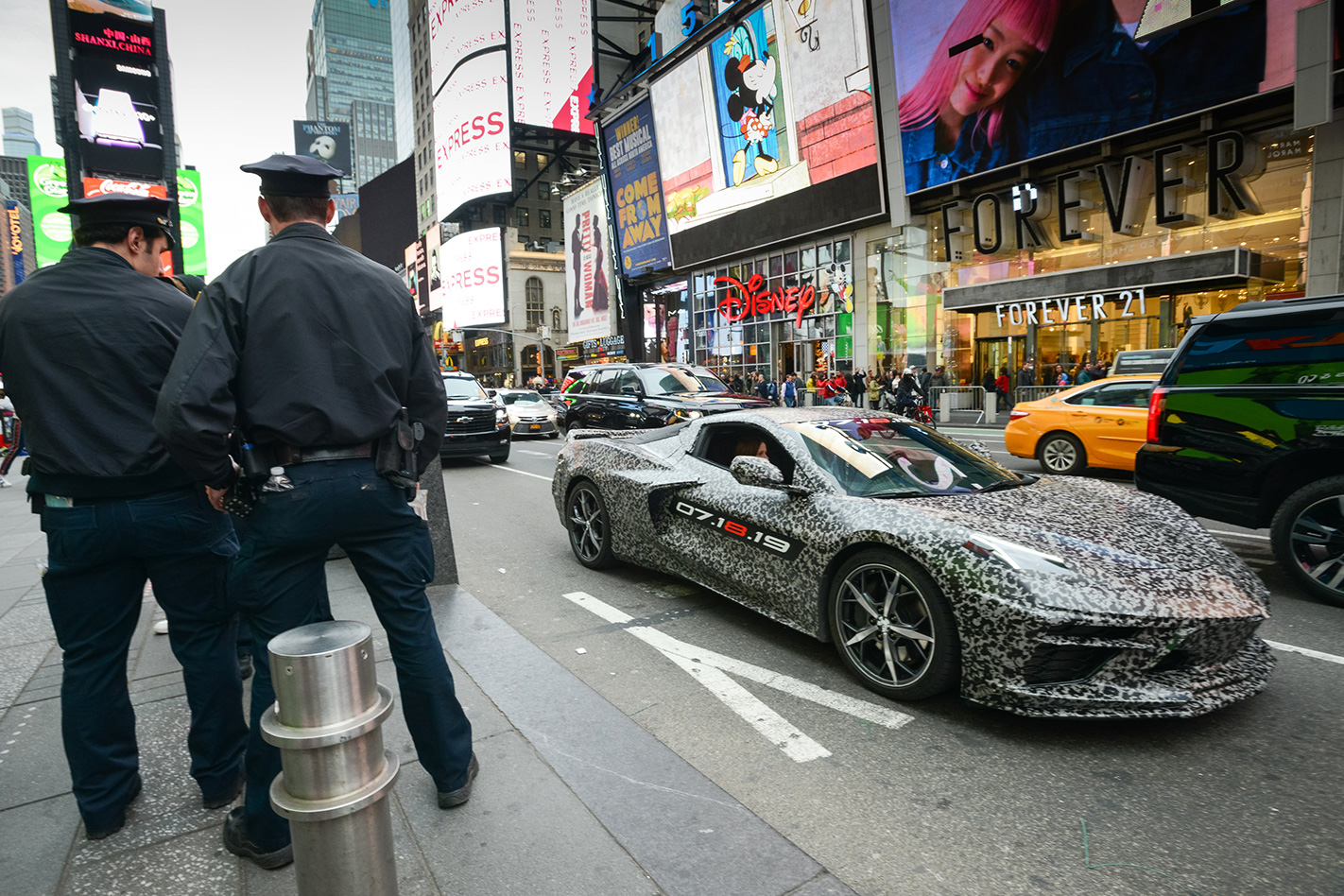
The next-gen model has been a topic of speculation for Australia too, with Wheels getting the scoop on the possibility that General Motors has been planning to introduce the halo car here for years.
“Don’t forget we still have the sports car, the much-talked-about sports car – or cars – coming to the market which will really fill that performance halo for us,” said Holden spokesperson Sean Poppitt during an interview with Wheels in 2017.
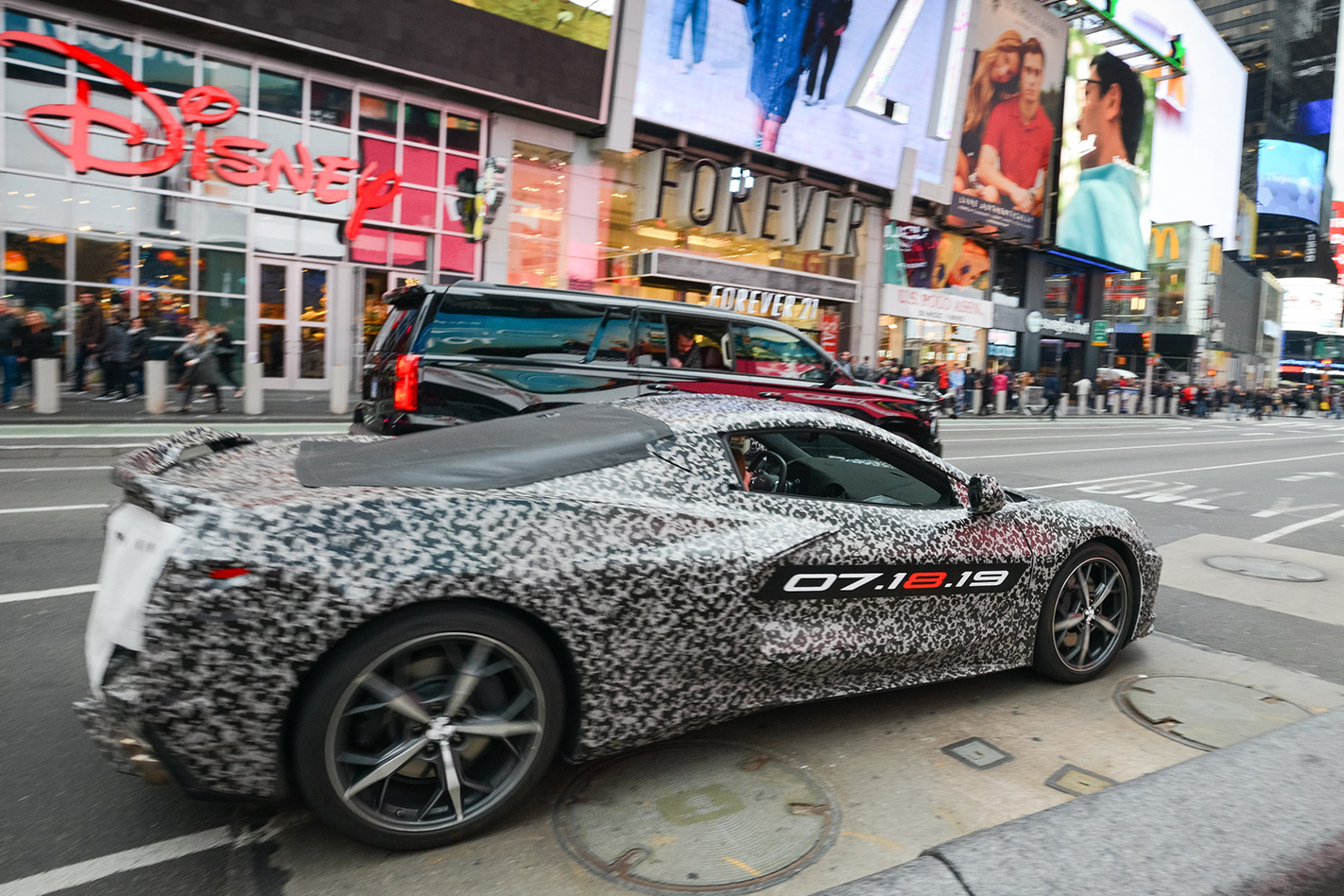
Half of that promise has been met, GM partnering with Australian vehicle specialist Walkinshaw to convert left-hand-drive Chevrolet Camaros to right-hand drive at its Clayton facility. But what we really want to know is if that second sports car will be the Corvette.
Audi has unveiled the S-version of their A6 sedan and Avant and A7 Sportback models and, in a step away from convention, the 2020 Audi S6 and Audi S7 will be made available with either a diesel or a petrol engine, depending on which region the model is destined for.
Diesel-loving European markets will be keeping the 257kW/700Nm 3-litre V6 turbo diesel for themselves while the rest of the world, Australia included, are expected to receive the 330kW/600Nm 2.9-litre V6 turbo petrol donk that is related to the RS4/RS5’s powerplant, which in itself is no bad thing.
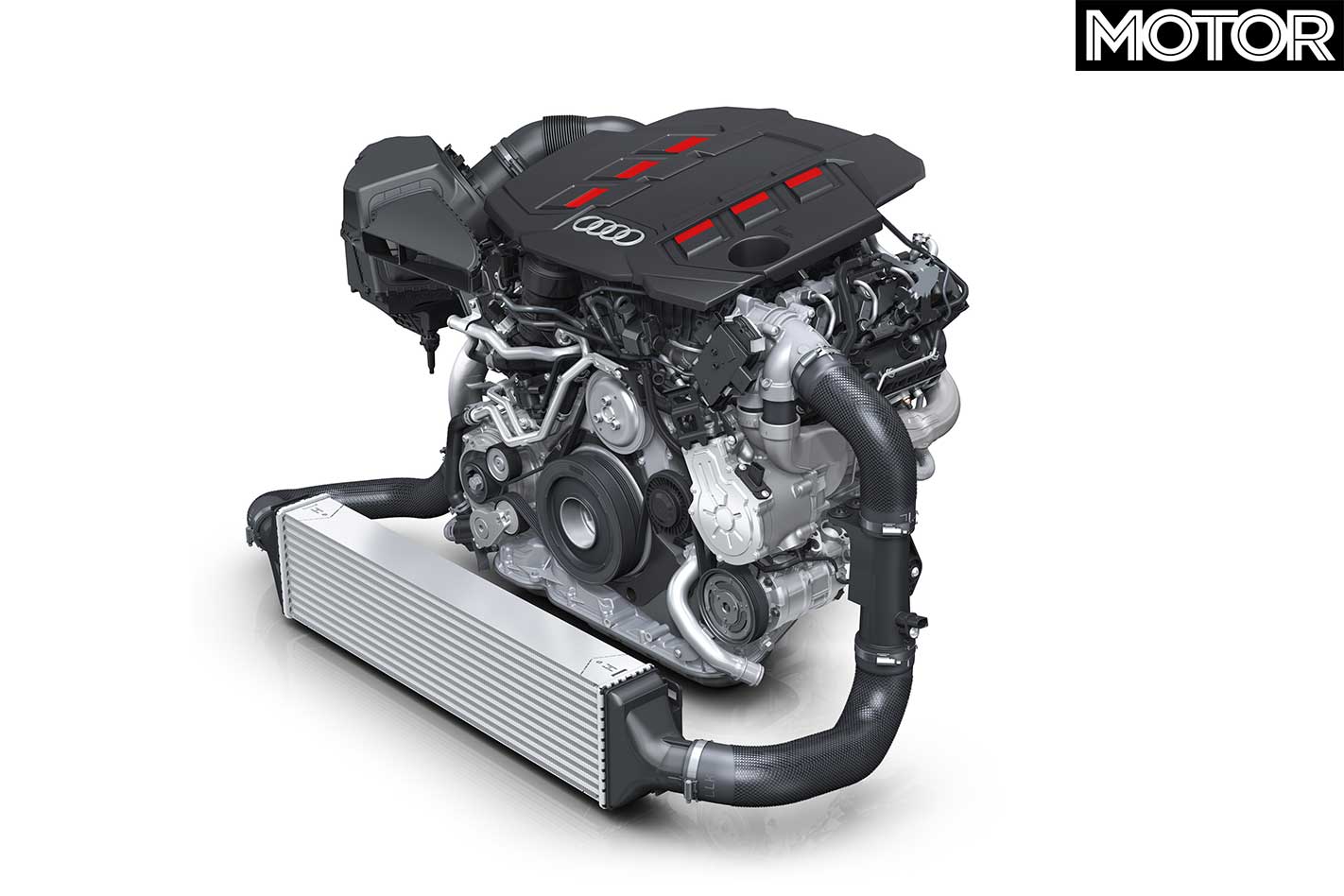
Engines aside, both powertrain combinations are assisted by a mild hybrid system and an electric compressor, which are supported by the A6/A7’s 48V electrical system. As expected for a performance-fettled Audi, power will be channelled through Audi’s quattro all-wheel drive system.
According to Audi, the mild hybrid system features a small 10Ah lithium-ion battery pack that allows for start/stop operation from speeds as low as 22km/h and coast for up to 40 seconds with the engine off for the diesel powerplant.
As of the time of publication, Audi has yet to confirm the specifics when it pertains to the mild hybrid system’s capabilities when paired with the petrol engine, but we don’t expect the figures to vary too greatly.
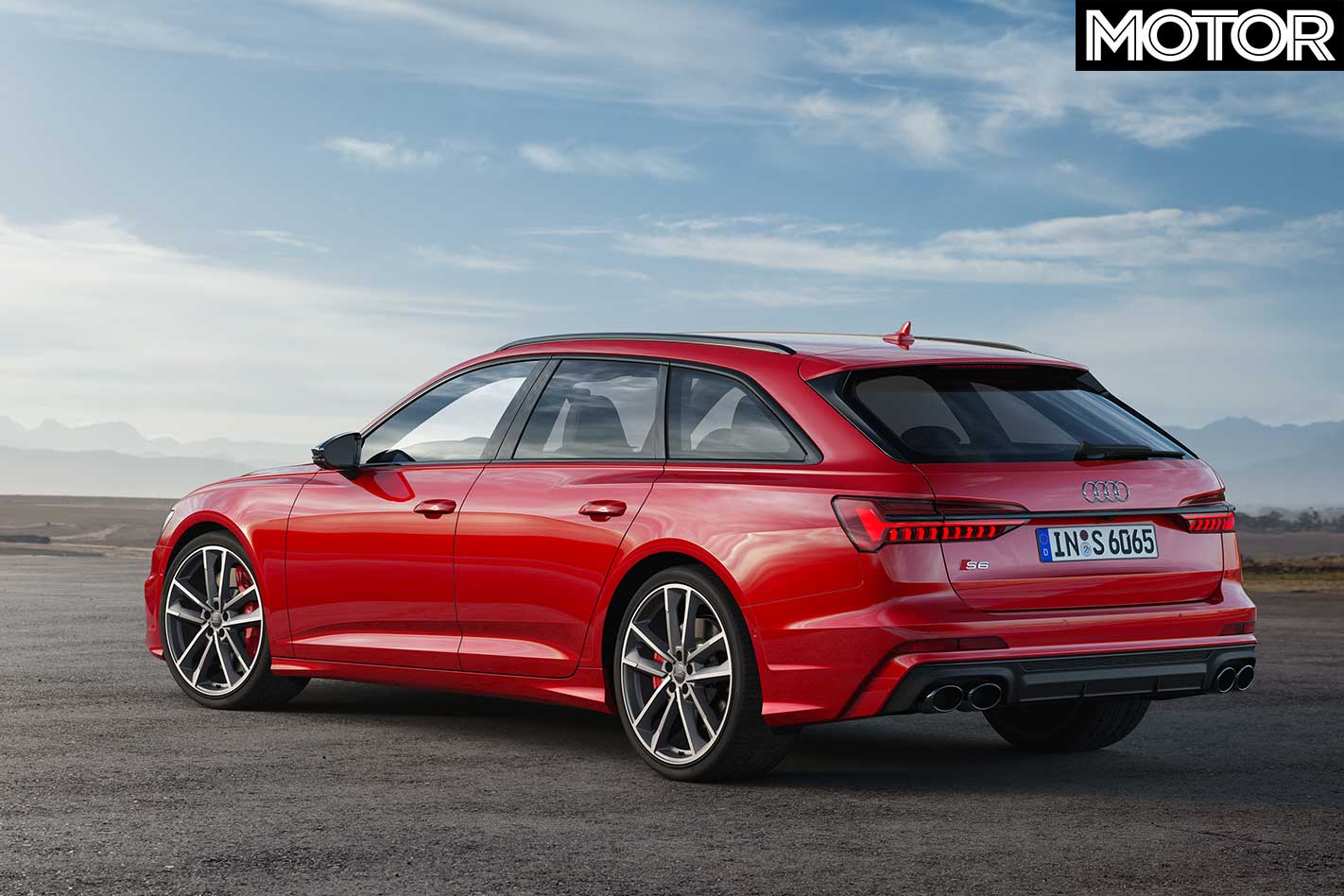
Likewise, Audi has only released performance figures for the diesel S6 and S7 with a quoted 0-100km/h time of 5sec for the S6 sedan, 5.1sec for the S6 Avant and S7 Sportback, and a limited top speed of 250km/h for all three. As of now Audi has yet to confirm the performance figures for its petrol-powered variants.
In keeping with its performance bent, the S6’s sports suspension drops the ride height of the sedan and Avant wagon by 20mm, while the S7’s suspension lowers it by 10mm, bringing both models to the same ride height. That being said, the S6 and S7 are said to be the first Audi S-models to feature an adaptive air suspension to retain a more comfort-oriented ride.

The S6 and S7 can be specified with an all-wheel steering feature to improve low speed manoeuvrability and high speed cornering stability, a sport differential for the rear axle, and 400mm/370mm front/rear carbon ceramic disc brakes to replace the standard 400mm/350mm front/rear steel items.
According to Audi Australia, the S6 and S7 are expected to make its local debut early next year, with pricing and specifications to be confirmed closer to its launch.
“We have chosen the petrol-powered TFSI S6 and S7 over the diesel TDI variants for the Australian market based on the priority of the market and the local demand for petrol engines,” said Shaun Cleary, Audi Australia’s corporate communications manager.
