
Mercedes-Benz has given its ultra-successful mid-sized SUV, the GLC, a big mid-life birthday. A new engine range is joined by new bodywork and additional interior technology, while Mercedes-Benz has also deleted the rear-wheel-drive variant.
On the outside, new narrower LED headlights are now standard across the range, with a high-performing version on the options list. The reshaped lights frame a revised grille and bonnet, while a new rear bar and redesigned LED taillights also feature.
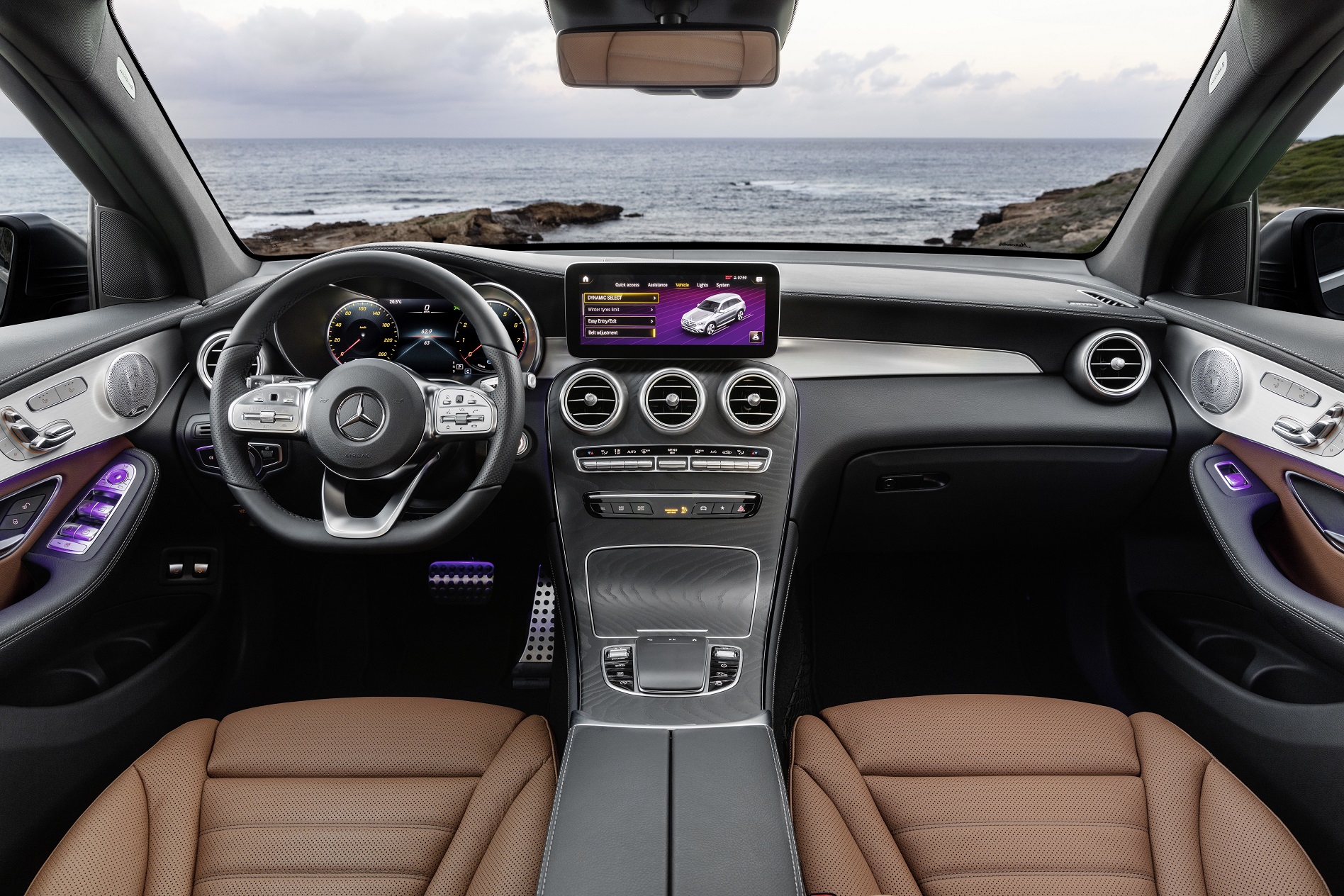
Inside, the addition of Mercedes-Benz’s twin-screen MBUX telematics system means that new steering wheel options are also on the table, while new materials have been used to lift and update the rest of the dash and centre console.
A multi-touch pad on the centre console allows for touch or handwriting access to the MBUX system, while Merc has also added its (slightly odd) Energising Coach system.
It uses colours, seat cushioning, venting, music and more to manage the occupant’s moods, while it can also be paired with a Garmin smartwatch to monitor the driver’s biometrics. Or they could just stop and have a coffee…
Technically speaking, Merc has flagged a brace of new four-cylinder engines in both petrol and diesel varieties.
The new 2.0-litre four-cylinder turbocharged petrol engine – codenamed M264 – adds a 48-volt hybrid mode that adds 10kW of extra power and a not-insignificant 150Nm of extra torque, along with a clever starter/generator combo that removes the need for a traditional starter.
The petrol engines come in either 145kW/280Nm (GLC 200) or 190kW/370Nm (GLC 300) specs.
There is a new 2.0-litre four-cylinder turbocharged diesel as well, which comes in three different specs. The 200d makes 120kW/360Nm, the 220d produces 143kW/400Nm and the 300d pushes out 180kW/500Nm.
A key change for the entry-level GLC 200 is the addition of Mercedes-Benz’s all-wheel-drive system, while the whole range benefits from Merc’s individually adjusting adaptive dampers, which work independently of each other to provide the best combination of ride and handling.
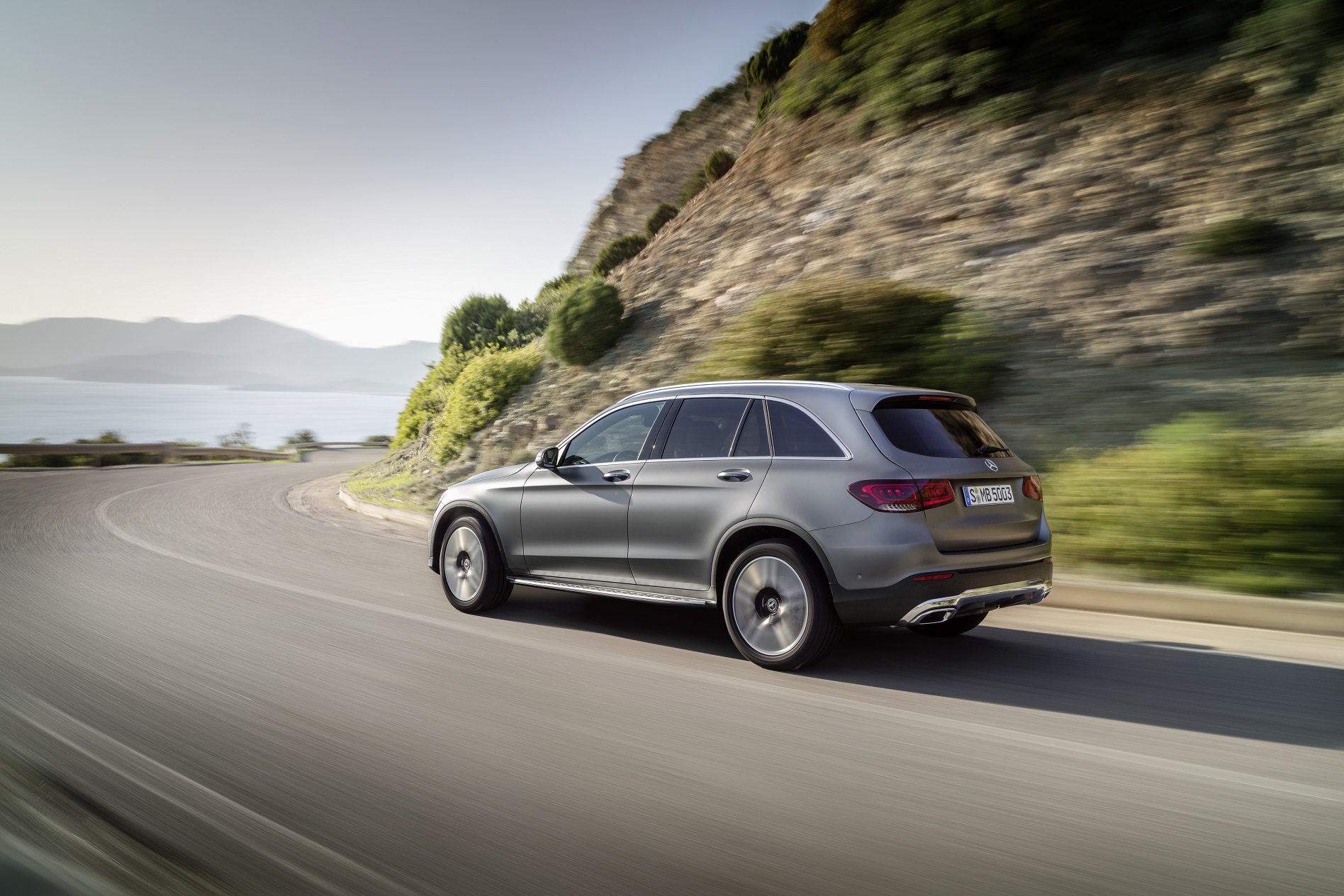
Of course, it wouldn’t be a Mercedes-Benz without a vast array of safety systems, and the GLC features a laundry list of driver aids like turn assist, rear-cross traffic assist, high-and low-speed AEB with pedestrian and cyclist detection and much more.
The GLC goes up against other luxury SUVs like the Audi Q5, BMW X3, Lexus NX, Porsche Macan and Volvo XC60. It’s expected to arrive in Australia before the end of 2019.
Welcome to the latest episode of the WhichCar Weekly podcast.
This week MOTOR Associate Editor Scott Newman is your host and he’s joined by Wheels Staff Journalist Cameron Kirby and MOTOR Editor Dylan Campbell to discuss the biggest news from the motoring week.
Our first topic is hot off the press, with the Chevrolet Camaro ZL1 being confirmed for Australia thanks to HSV sorting out the right-hand drive conversion. In another muscle car news, the Ford Falcon Holy Grail has broken cover and we’ve driven it – is it the modern-day GT-HO everyone wants it to be?
Last week Wheels got the scoop on the 2021 Ford Ranger with leaked pics appearing way ahead of Ford’s schedule. Cam runs us through how the pics came to be and how Ford inadvertently confirmed the car’s identity.
Finally, we take a quick look at the 2019 Supercars Championship which kicks off this weekend at the Superloop 500 in Adelaide. If you’re on the move you can check out the podcast on Podbean or iTunes, please rate and subscribe!
Also don’t forget to check out WhichCar TV on Ten or TenPlay and follow @whichcarau on Facebook, Twitter and Instagram.
Listened to the show? Help us out:
- Leave a note in the comment section below.
- Leave a review on Apple Podcasts/iTunes
- Subscribe to our podcast
The 2019 Chevrolet Camaro ZL1 is coming to Australia, with HSV set to take on the task of converting the “most powerful production Camaro” to right-hand drive for the Australian market.
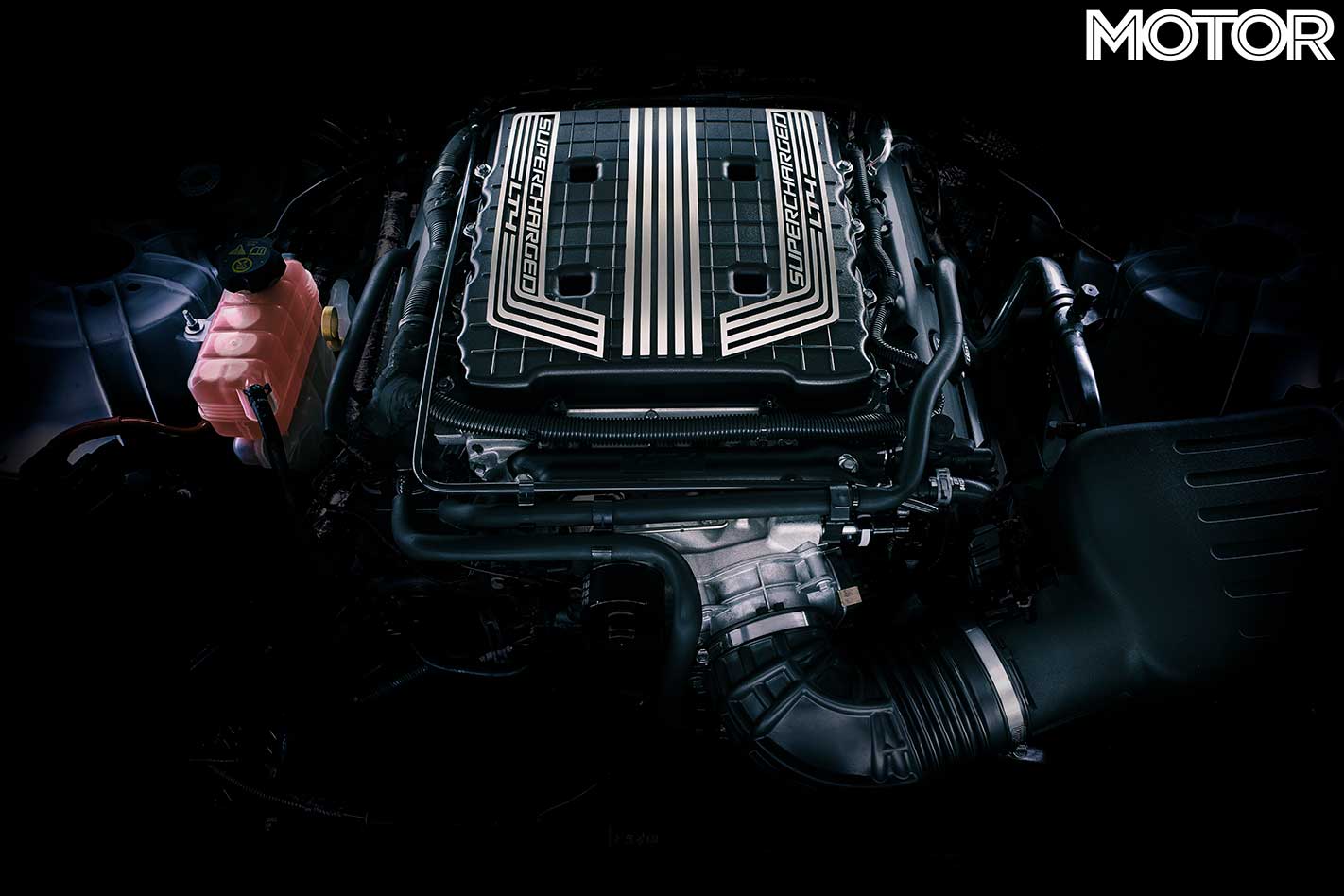
With its mighty supercharged 6.2-litre LT4 V8, the Chevrolet Camaro ZL1 is expected to produce power and torque outputs of around 480kW and 860Nm, though this is something HSV is yet to confirm as it’s “subject to local certification.”
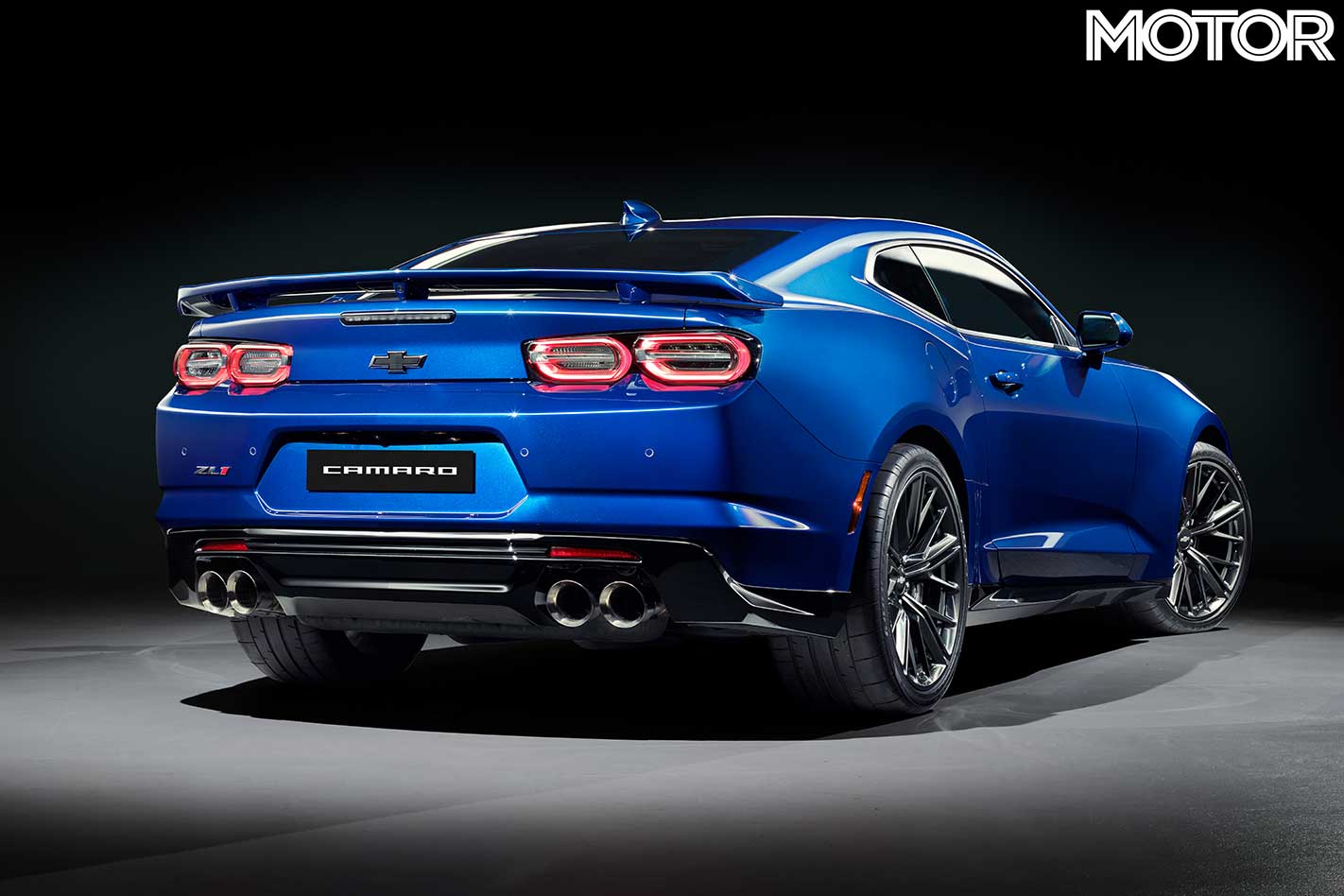
But, as with most imported and converted vehicles, there’s a price premium to accompany the exclusivity.
Australian Camaro ZL1 pricing starts at $159,990 for the 6-speed manual, while 10-speed automatic-equipped ZL1s will set buyers back an extra $2200 for a $162,190 total. Metallic paint is an $850 option.
Manual models will come with rev-matching and launch control, while automatic models will also feature a line-lock function – something Ford removed from the Mustang GT for its arrival in Australia.
More good news for ZL1 intenders is that it’s set to feature GM’s Magnetic Ride Control adaptive dampers, a welcome addition for those headed on long trips, and something the 2SS-spec Camaro still lacks.
An electronically controlled LSD and big Brembo brakes with 6-piston rotors at the front both add to the performance credentials of HSV’s new performance halo, while a bimodal performance exhaust adds a bit of bark to that bite.
Inside, black leather-appointed Recaros with red accents and microfibre make for more sporting pews, while a ‘sueded’ steering wheel and sport alloy pedals add more to that feel.
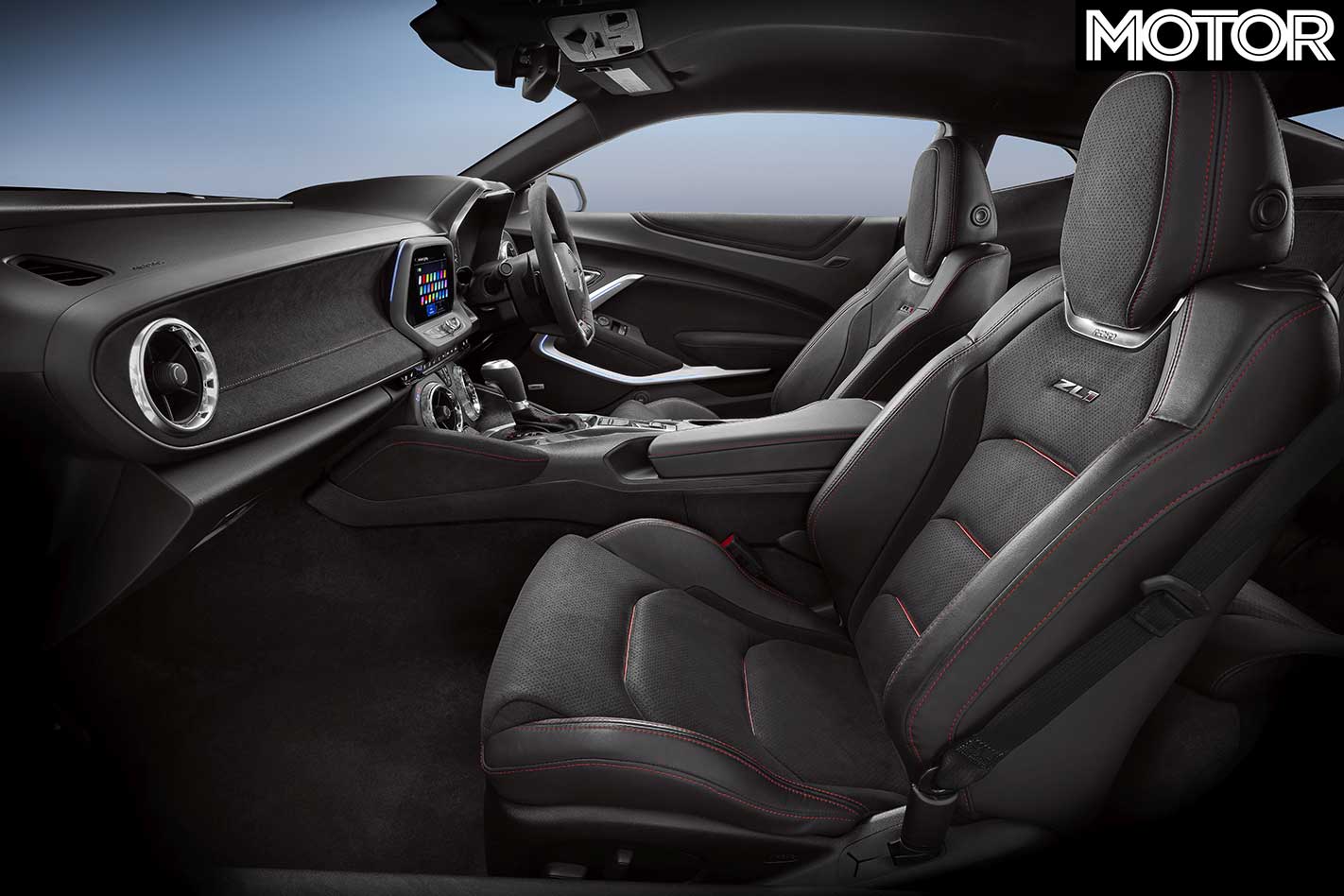
HSV expects that it will have a limited supply of ZL1s in 2019, totalling around 300 units to be sold locally. Production of the 10-speed automatic Camaro ZL1 kicks off in April, while manual models will begin production in May.
HSV has confirmed it will sell the updated MY19 Chevrolet Camaro 2SS in Australia later this year, with new styling and two new transmissions, one of which features a Mustang-shaming burnout mode.
The updates accompany the arrival of the wild-new Camaro ZL1 and mean that Aussies will finally be able to access MY19 Camaros via HSV. The legendary US pony car was updated Stateside last year, but HSV has until now been converting pre-facelift MY18 cars.
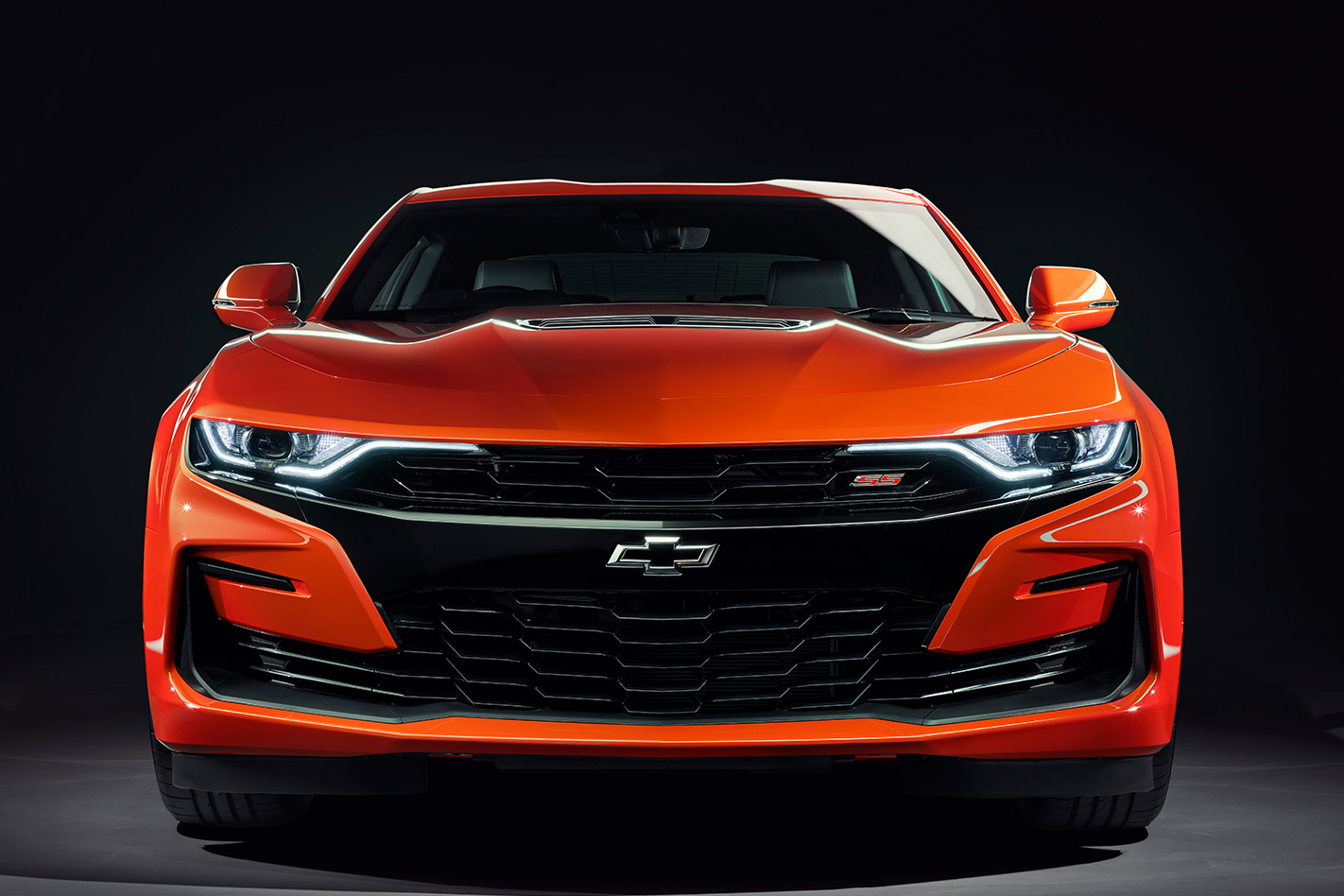
The updated Camaro 2SS cars benefit from a raft of styling changes, plus new manual and automatic gearboxes. Muscle car purists will finally be able to showcase their dexterity by taking home an HSV-fettled Camaro with three-pedals and a six-speed stick-shift for the first time.
The new manual transmission features rev-matching and launch control, while the automatic now has 10 ratios (up from eight in the MY18 car) and three different modes – launch control, line-lock, and lift-foot gear hold.
The latter holds lower gears in corners, even when you back off the throttle, while launch control modifies engine torque for better acceleration from a standing start. The system allows owners to specify the launch rpm and amount of allowed wheel spin through the infotainment unit.
HSV emphasises the new Camaro’s line-lock system is intended for use during closed-course track events only, as it allows drivers to lock the front wheels while spinning the rear tyres. Essentially, it’s the same, controversial burnout mode that Ford removed from its MY19 Mustangs.
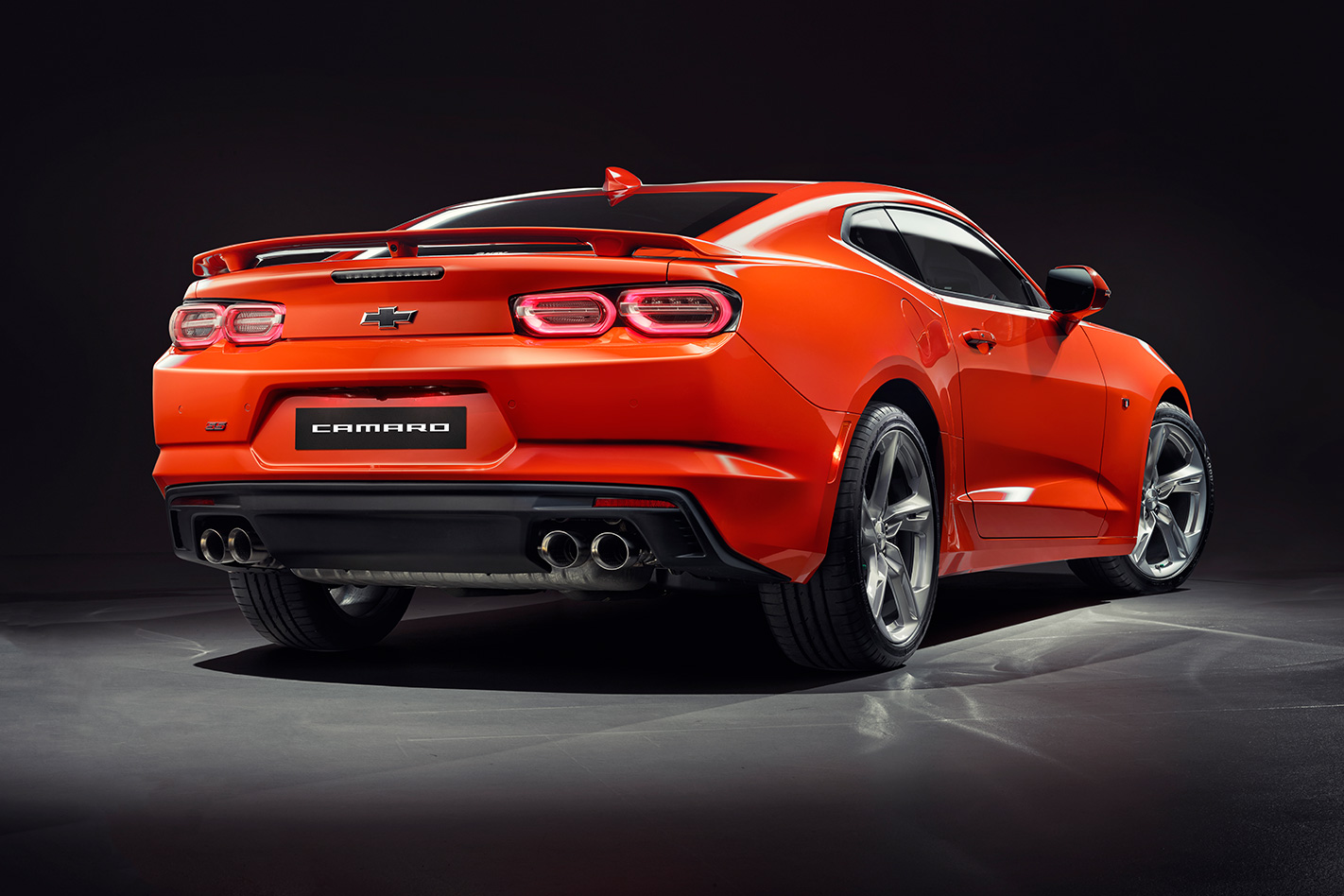
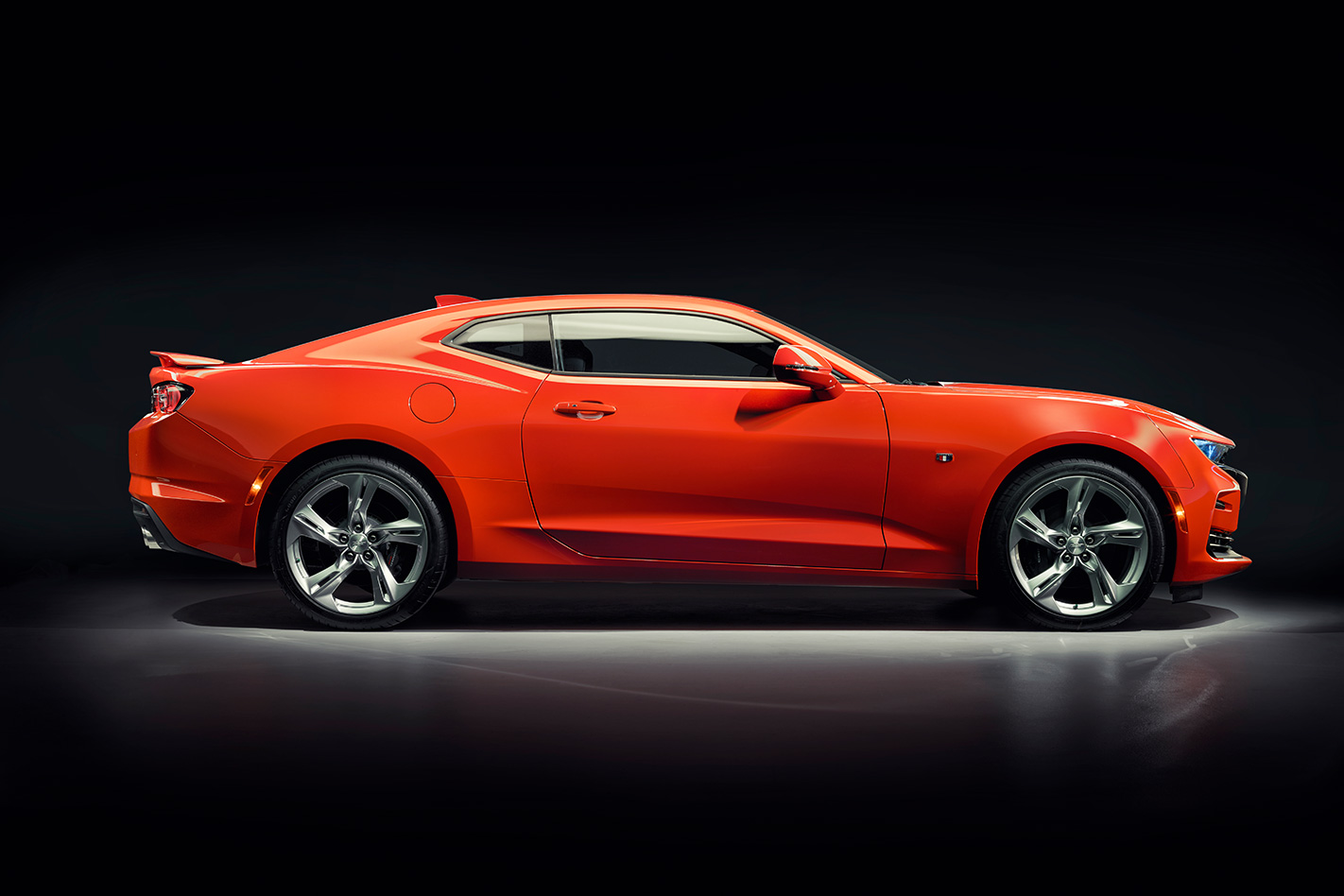
It won’t be hard to pick MY19 Camaros in traffic, with the facelifted model featuring new front fascia, grille, LED headlights, a functional extractor-style hood, and a “flow-tie” open bow-tie grill emblem to improve engine air flow. Rear styling has also been refreshed, with a new rear fascia and LED taillights.
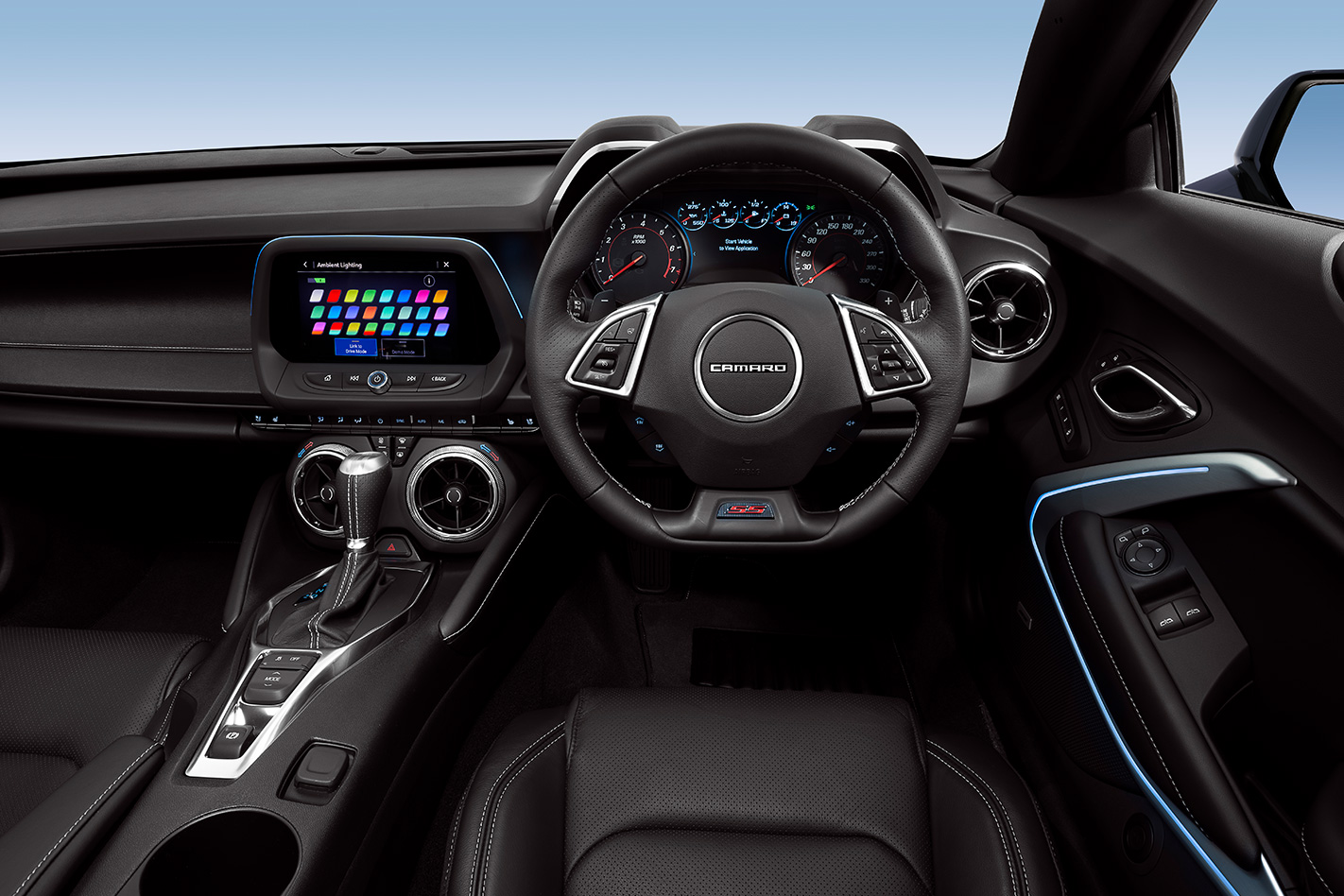
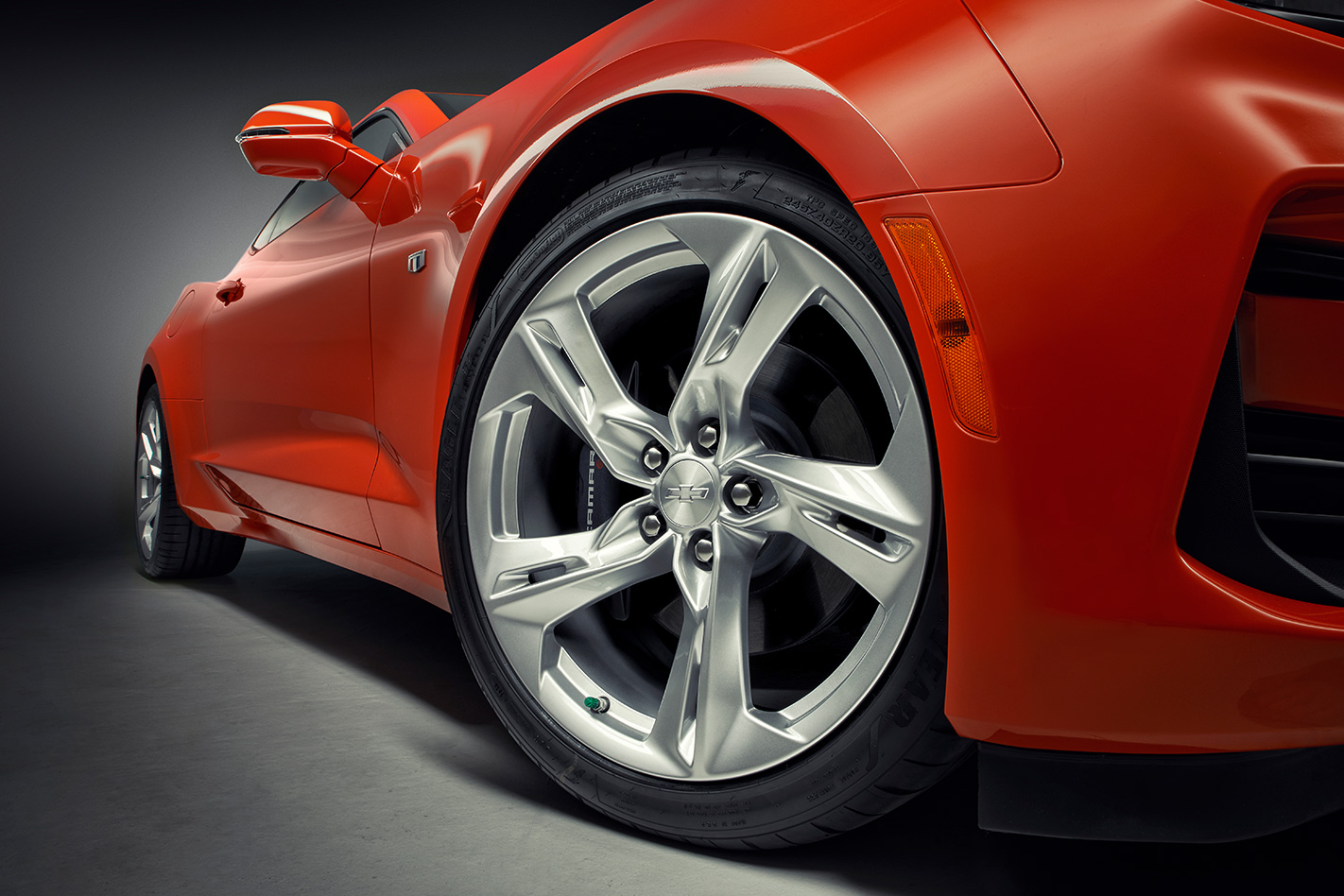
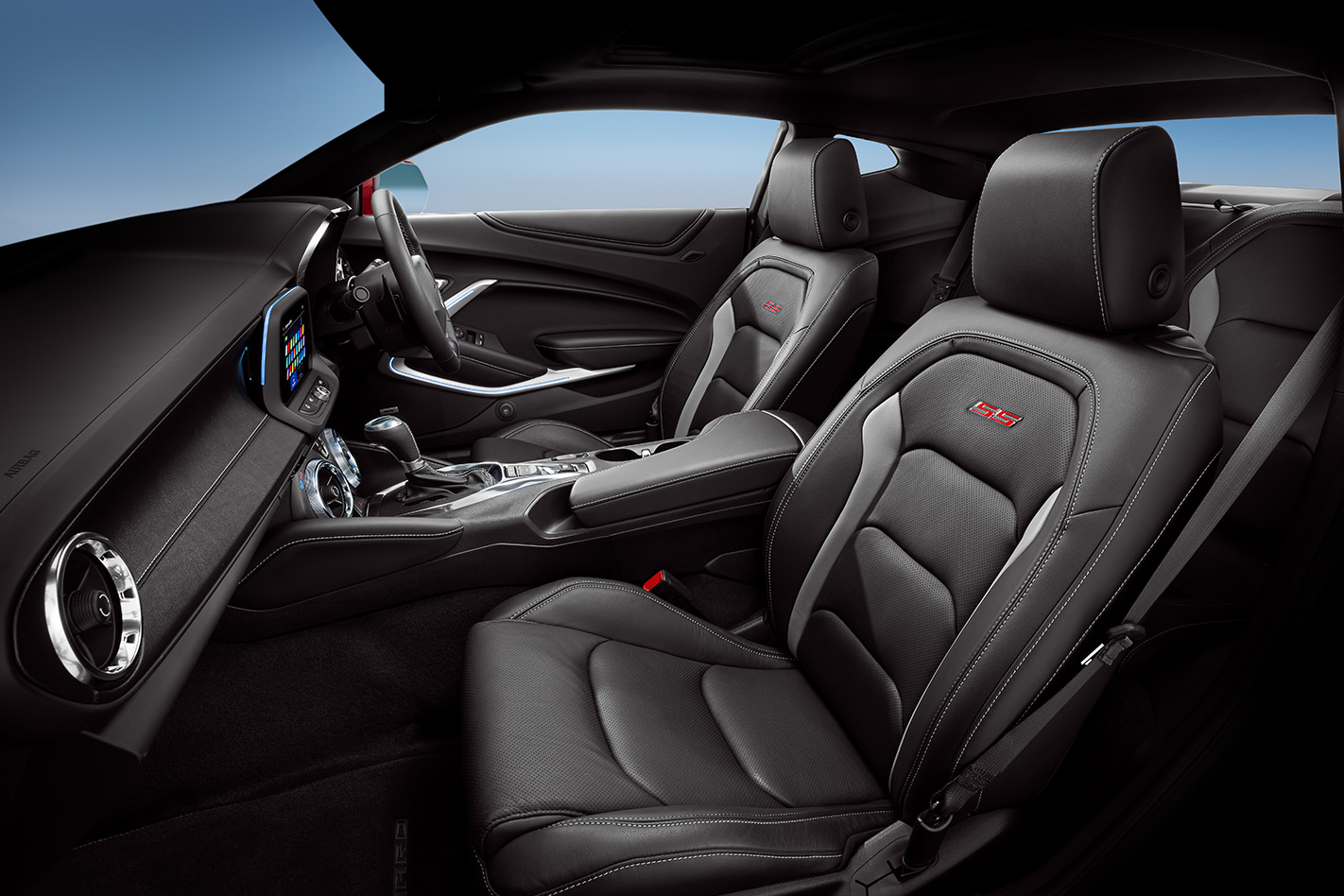
All cars will ride on five-spoke 20-inch alloy wheels, and have Chevrolet’s next-gen infotainment system as standard.
A rear camera mirror is fitted as standard, In an attempt to improve visibility out of the Camaro’s narrow glasshouse, while a forward collision alert safety system is now included.
Aside from those changes, the 2SS Camaro retains the earlier model’s 339kW and 617Nm 6.2-litre LT1 V8.
Pricing starts from $86,990 for the manual, and $89,190 for the auto, an increase of $3200 over the MY18 auto.
Production of the automatic MY19 2SS Camaro is due to begin in early March, with the manual following in June.
HSV has not quoted performance figures for MY19 models, but expect several tenths to be cut in the sprint to 100km/h for the automatic.
The MY18 Australian 2SS recorded a 4.9 second 0-100km/h when we tested it in November, against a 4.4 second claim for US-spec cars.
Something doesn’t feel right. Not at all. I check my boarding pass and itinerary for a ninth time. Performance Car of The Year, for me, is like Ron Burgundy’s monthly pancake breakfast; PCOTY is always on once a year, and it’s always in Victoria. My ticket clearly doesn’t say Business (nothing new there), though, but it clearly does say ADL. So I guess I’m still heading south…
I’m lucky to be going to ADL at all, though. A few weeks back, editor DC rang me to have “The Chat” that no editor wants to make and every freelancer sends to voicemail. Tightening budgets meant my entirely unreasonable rider, truly obscene appearance fee and best-selling book deal were a thing of the past, and my time as a PCOTY judge was over… just like that.
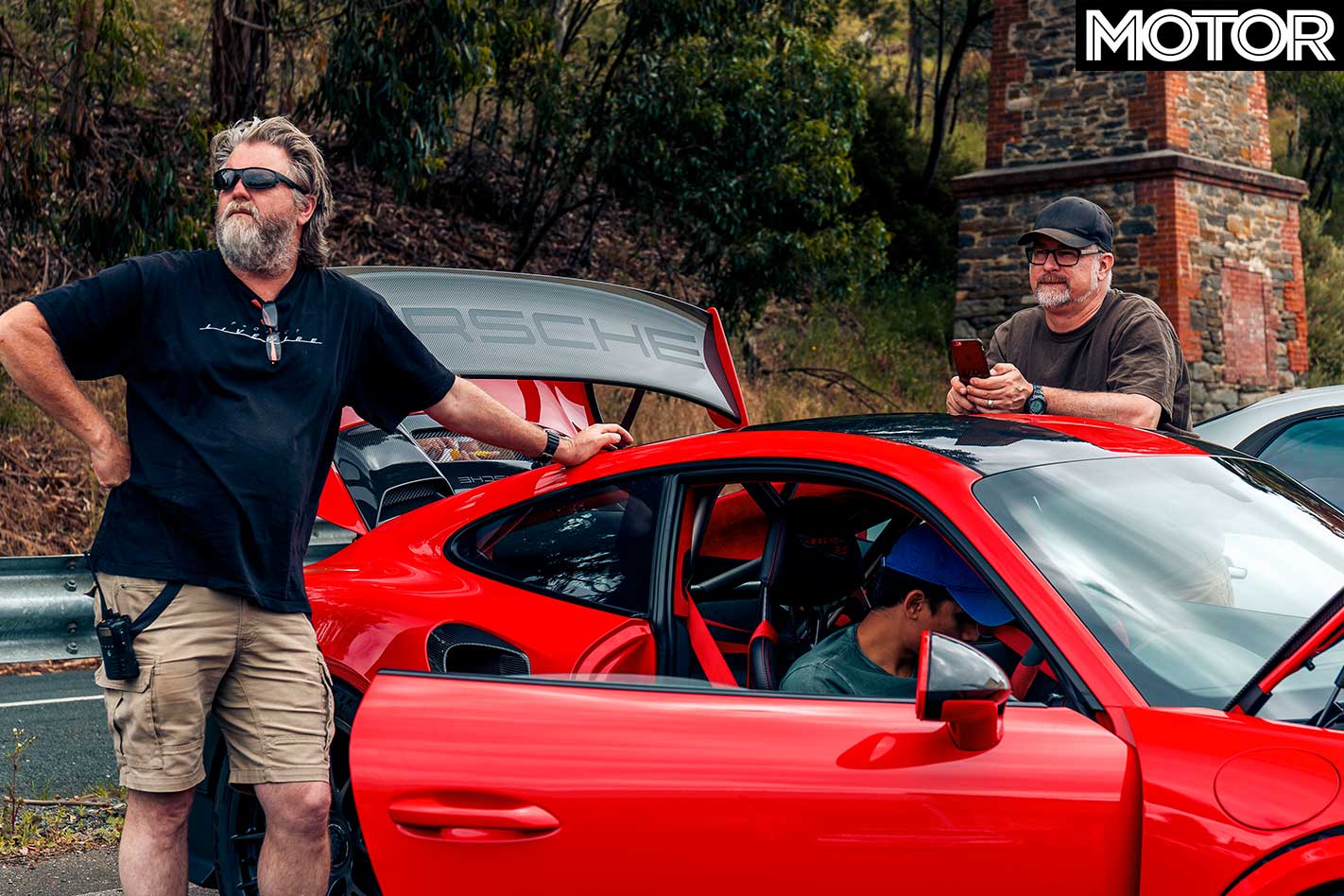
But, in a truly ironic twist, here I am, back on board the Bauer train as a full-time journo, and back in the PCOTY crew as a dogsbody. And that’s fine with me. My demise means that young Louis gets his shot at a hallowed judge’s seat, and he’s a very deserving candidate. Who may well have ‘a slight accident’ when I ‘push him bodily down a large flight of stairs’ over the course of the week.
MOTOR’s ADL-based ad bloke Nick picks me up in a Mustang. His own Mustang, too. “I rally a MkII Escort,” he casually drops into conversation as he buys me a coffee. We are already friends for life. Our destination on this hot, blowy ADL morning is Tailem Bend. And you all know what’s out there.
Day One
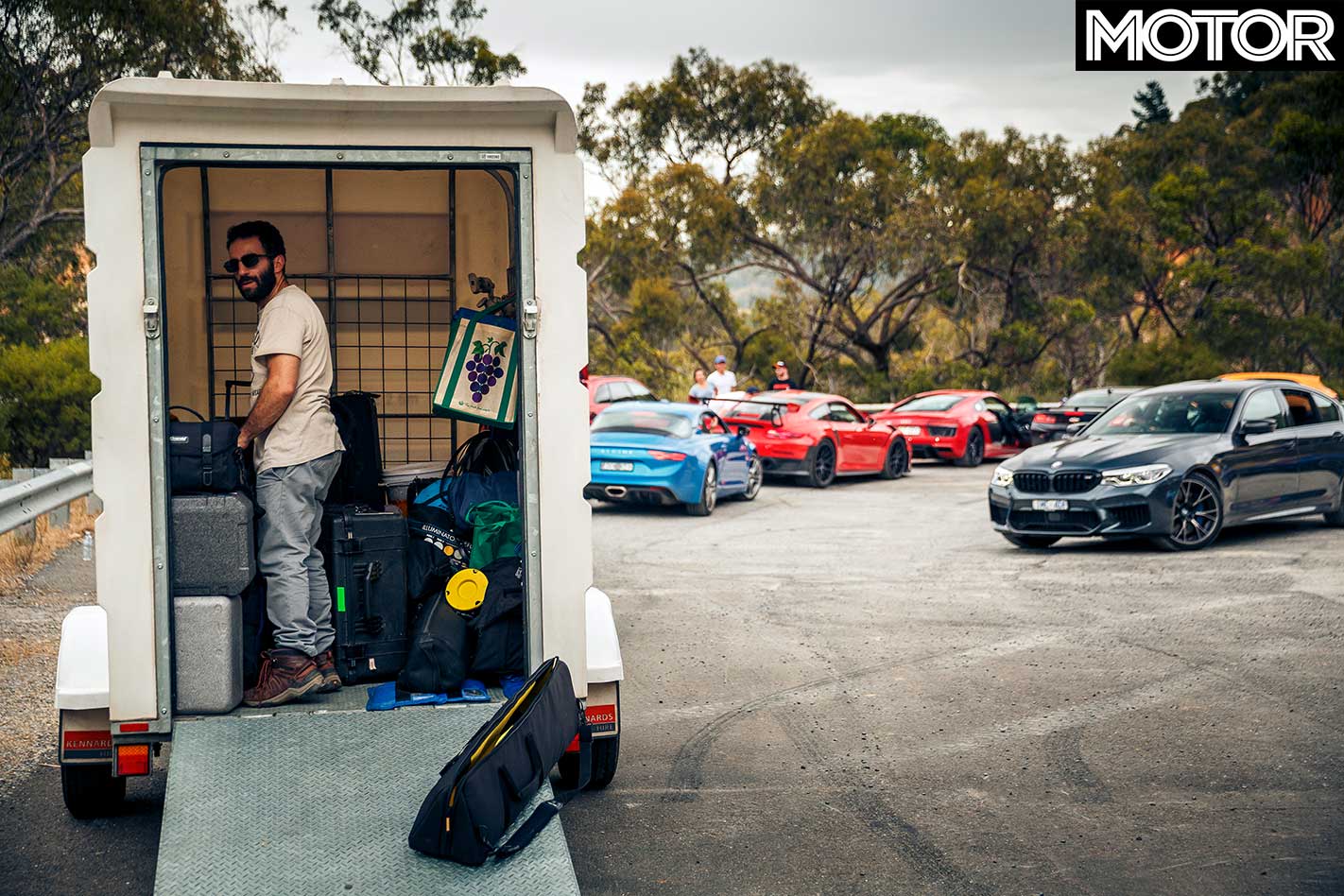
You’ll know by now that The Bend is a thing. For those who don’t, it’s a large racetrack complex that resides about an hour and a bit out of ADL, in a small town that used to host Mitsubishi Australia testing and very little else. Out of the sands of the nearby Big Desert, though, has sprung an oasis of motorsport that is genuinely impressive in its size, scale and scope.
This place is like what happens when a Las Vegas casino operator wants to build a racetrack, minus the slot machines in the foyer. The gleaming entry atrium, for example stands 20-metres tall, stuffed with some of the country’s – and in some cases the world’s – most important collectables. The first-ever factory-built right-hand drive 911? Right over there in the corner, madam, next to the Carrera GT.
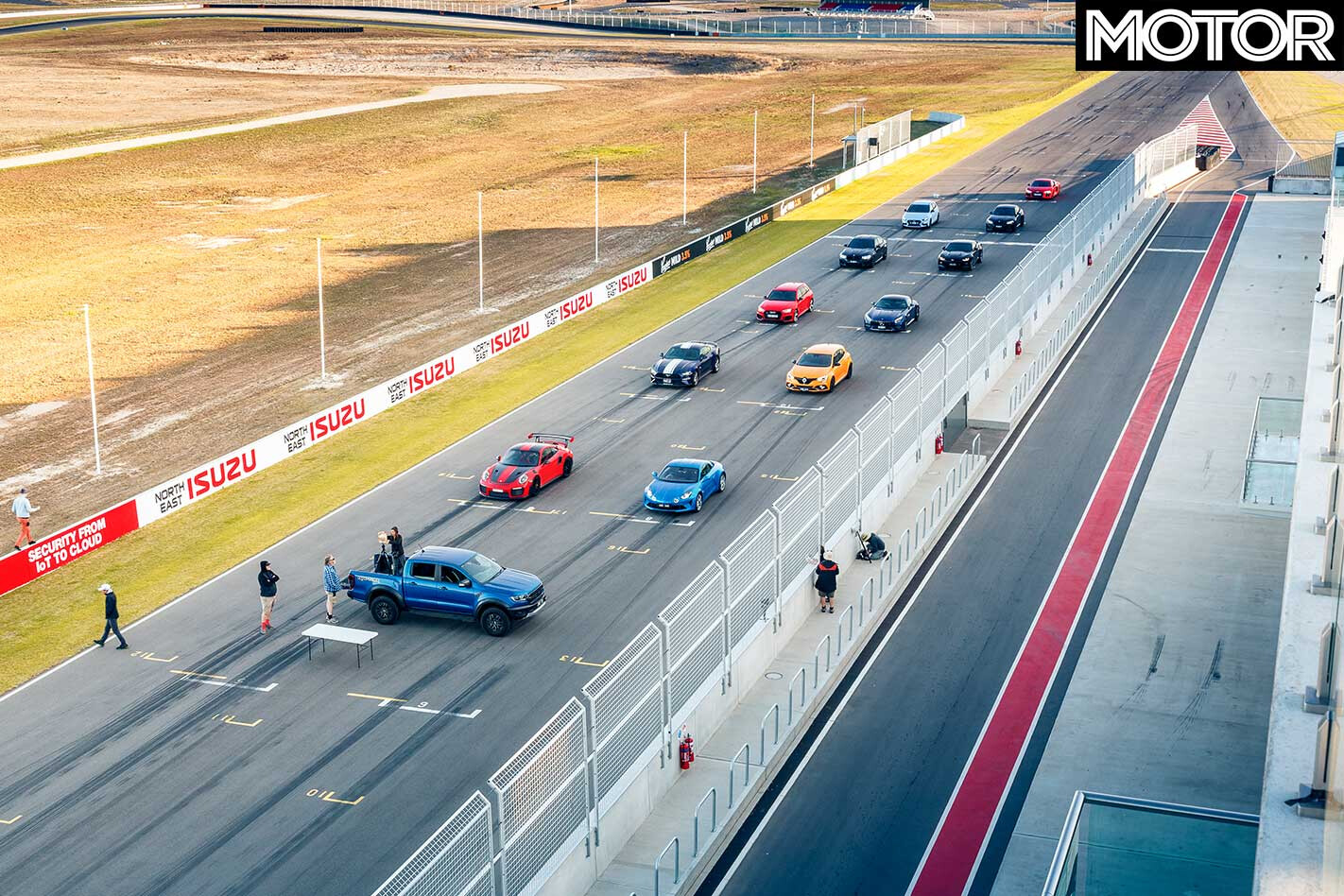
Associate Editor Scotty is already on site, and it turns out that it’s his birthday. “No rest for the wicked,” he quips, as I sit down for a… ah, I see where you’re going. Our 2019 troupe is starting to gather out the front, and it promises to be a banner year. The Audi R8 RWS catches my eye first, not least because it has large Audi Driving Experience stickers all down the sides. In my new role of Old Dogsbody, I have a sinking feeling of what’s about to happen next.
The temp has ratcheted up into the mid-30s by now, and these cars aren’t going to wash themselves. (Wouldn’t that be nice, though?) The Alpine A110, for example, has also fronted, looking like it’s been thrapped through the Victorian High Country for the weekend. Which it had been as part of its Australian launch the day prior, before being dispatched in an overnight satchel – it’s small enough – to ADL, filthy dirty and oozing its Gallic smugness.
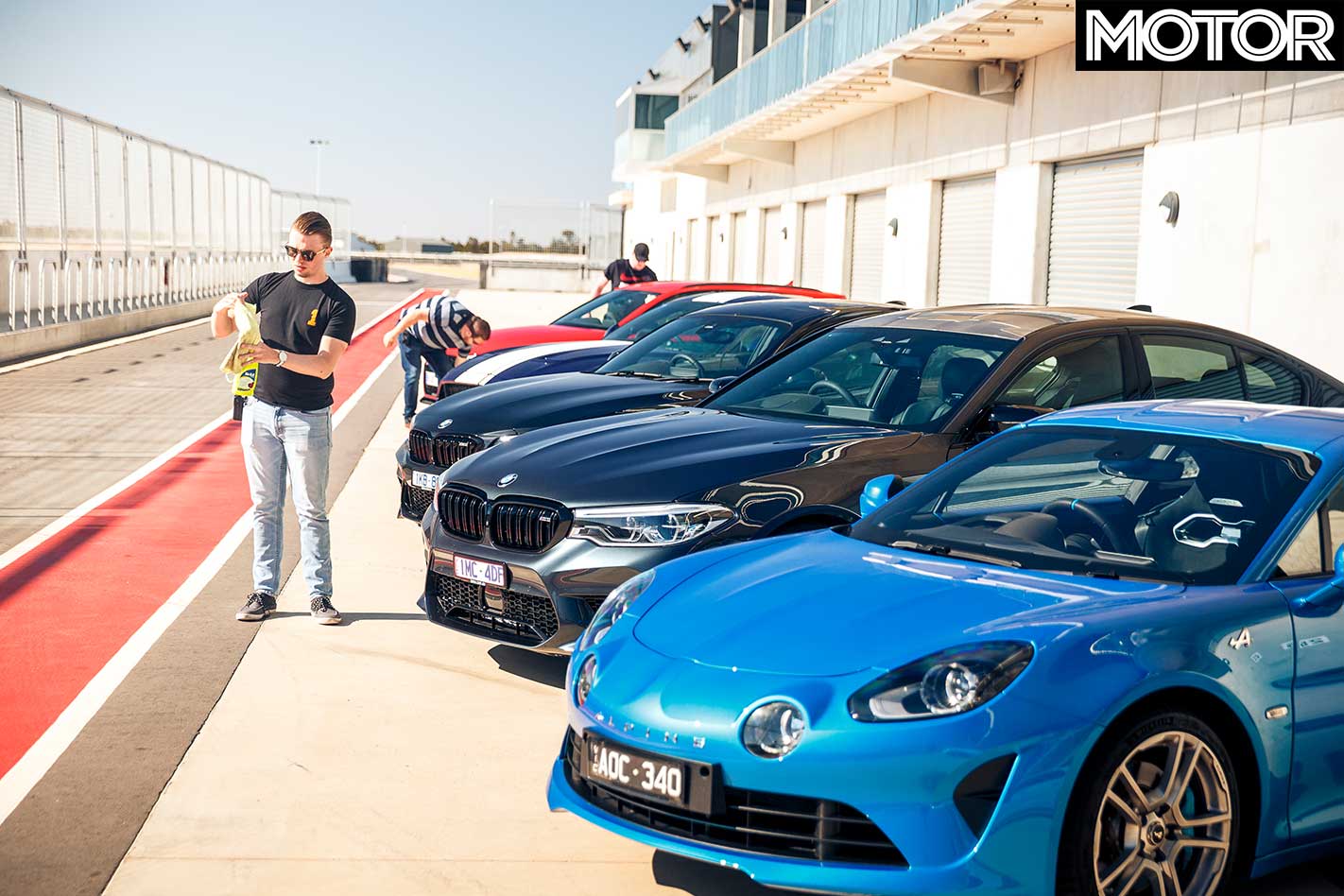
The fleet, not yet complete, is already a truly impressive set of things. Some PCOTY seasons are leaner than others, but this one is missing only a couple of names to put it in the running for Best Year Ever Oh My God. And they all need a damn wash.
Day Two
The irony in spending our first afternoon at a racetrack with a motel, only to leave it to drive to another motel that is quite a long way away, isn’t lost on me and the rest of the team, who stumble down for a late dinner and a celebration of Scotty’s aforementioned birthday.
Morley and I try and come up with a number of PCOTYs that we’ve done together before senility strikes and we forget what we were even talking about, while I quietly campaign behind the scenes to not have to share a room with him. It’s to no avail, and the aftermath of two gaseous giants trapped in a space the size of a cubbyhouse will no doubt render room 18 unusable for quite some time.
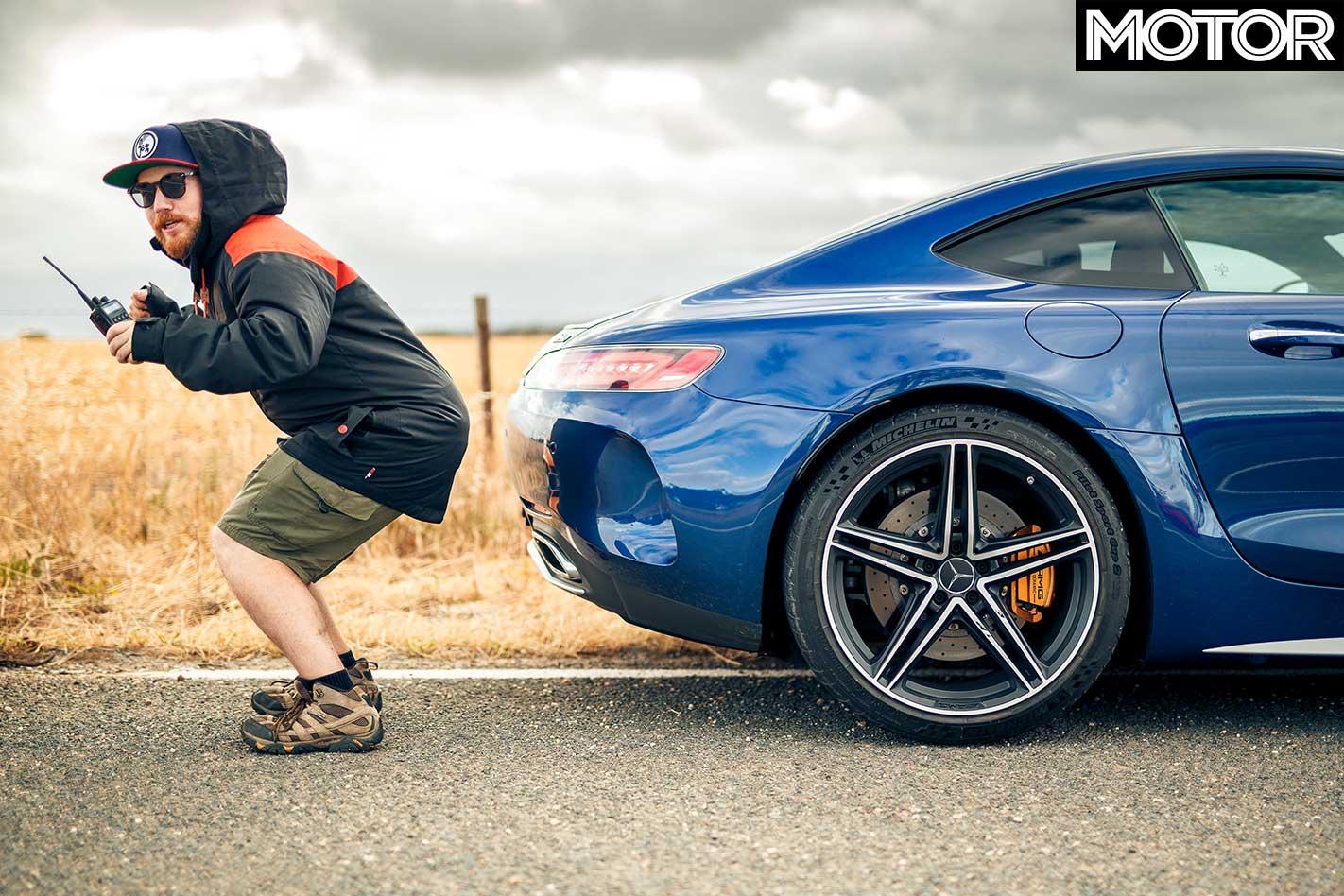
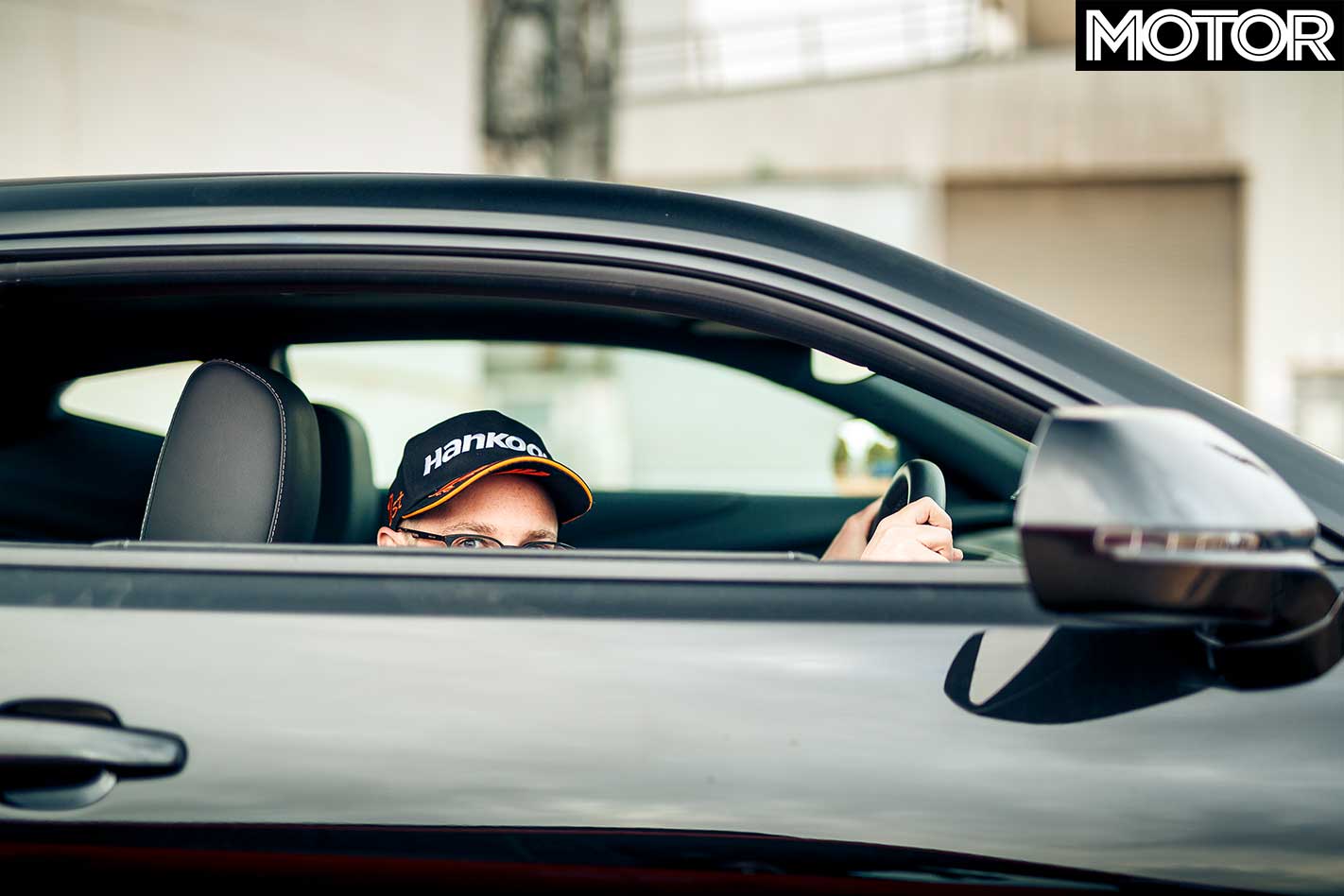
It’s a usual PCOTY depart; meet at 7.20 for a strict 7.30 roll-out, instructs Dylan, as Louis sharpens his new pencils and packs his lunch into his unscuffed school bag. At exactly 8.17, the rumbling, exhaust-popping horde slips its way out of town on its way to Cudlee Creek, where the judges will back-to-back the cars, the vid team will vid things and the rest of us will rack up an astonishingly large bill at the local cafe, where the gorgeous coffee is only surpassed by literally oven-fresh banana bread.
It’s curious to be back on this side of the fence, a place I haven’t sat since the very early 2000s; PCOTY is now a well-oiled machine, with MOTOR’s young crew pulling together an event that’s impressive in its scope and range, while the talents of the various members of the visual teams is truly impressive to watch as a waterboy.
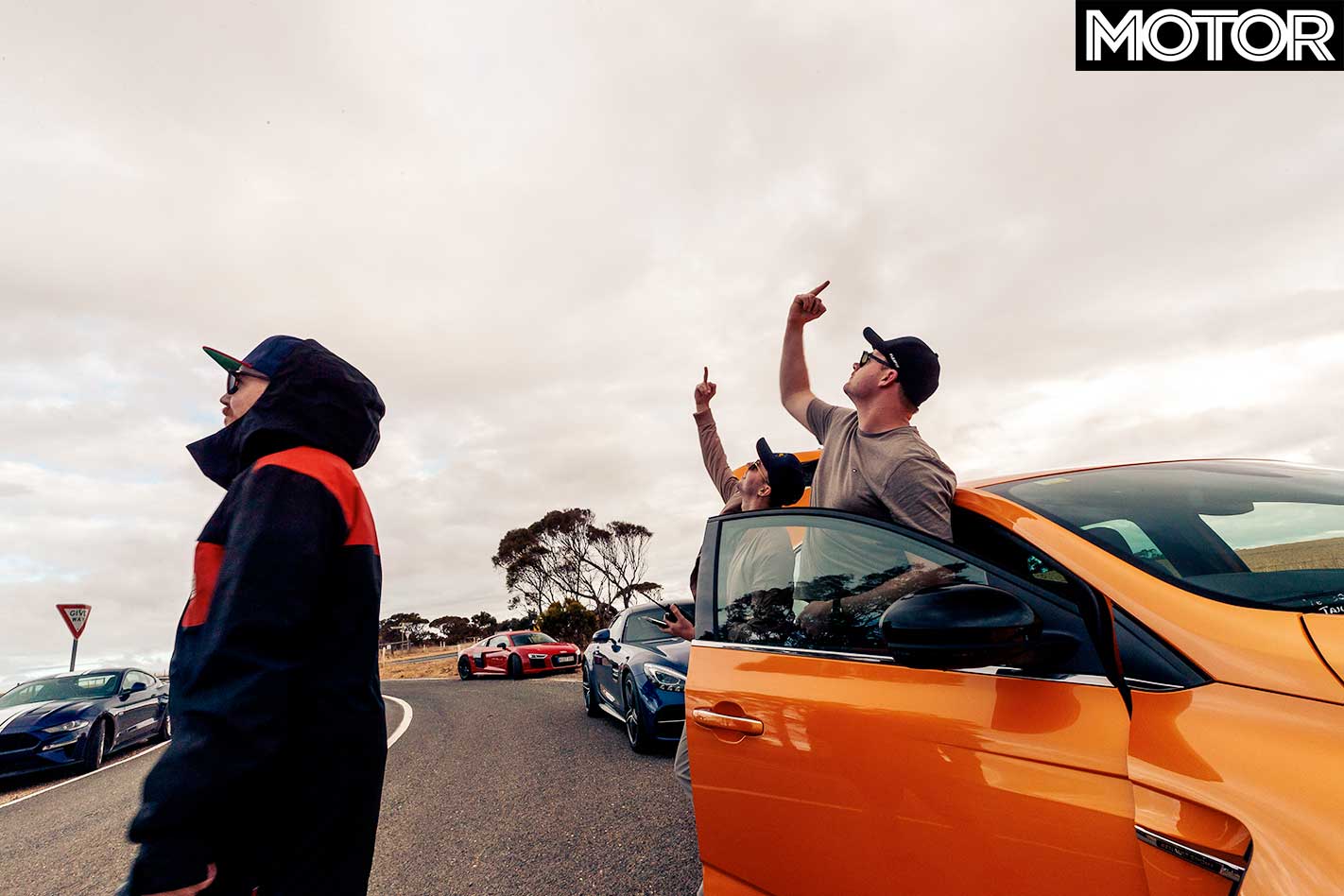
The howl of a hi-po six, a staccato burst of exhaust or the rumble of a turboed eight occasionally pierces the tranquillity as the fleet is put through its paces. Bits of intel from the judges starts to wash back through the cafe forecourt; talk of the 911 GT2 is preceded with a naughty four-letter word and wide eyes.
As the light draws in, I sidle over to the GT2, and over a lumpy, treacherous section of classic ADL hills terrain, I let slip the dogs of war. Others might say ‘went for a drive’, but one does not simply drive the GT2.
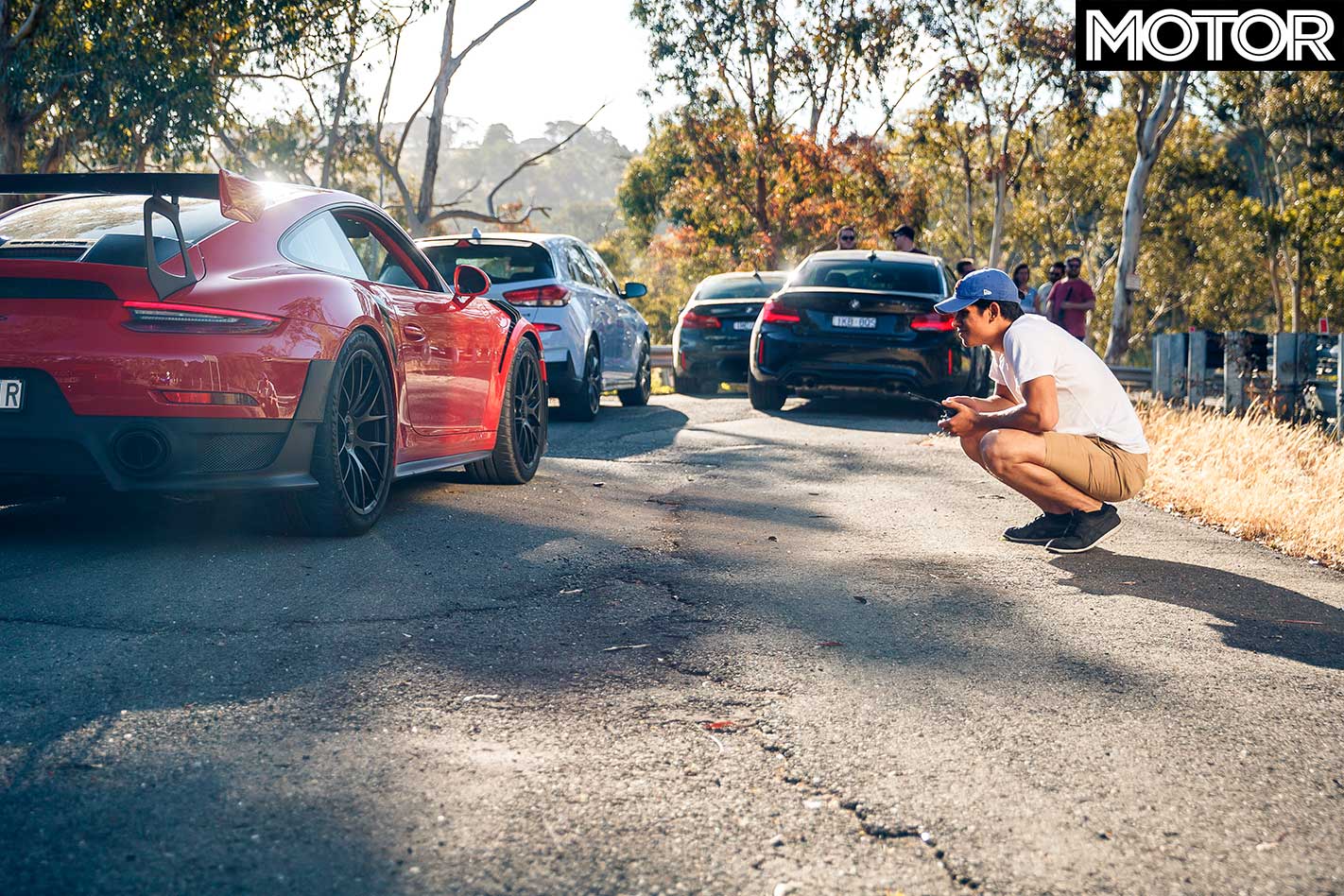
Its innate tactility, its astonishing agility and its shocking, exploitable, frightening, exhilarating pace takes me back to my first PCOTY in 2001, where I was thrown the keys to a 996 GT3. The journey between the two machines is, for me, a snapshot of the two ends of my PCOTY life, and I revel the 15 short-yet-long minutes I have aboard this obscenely expensive, but utterly amazing machine.
Day Three
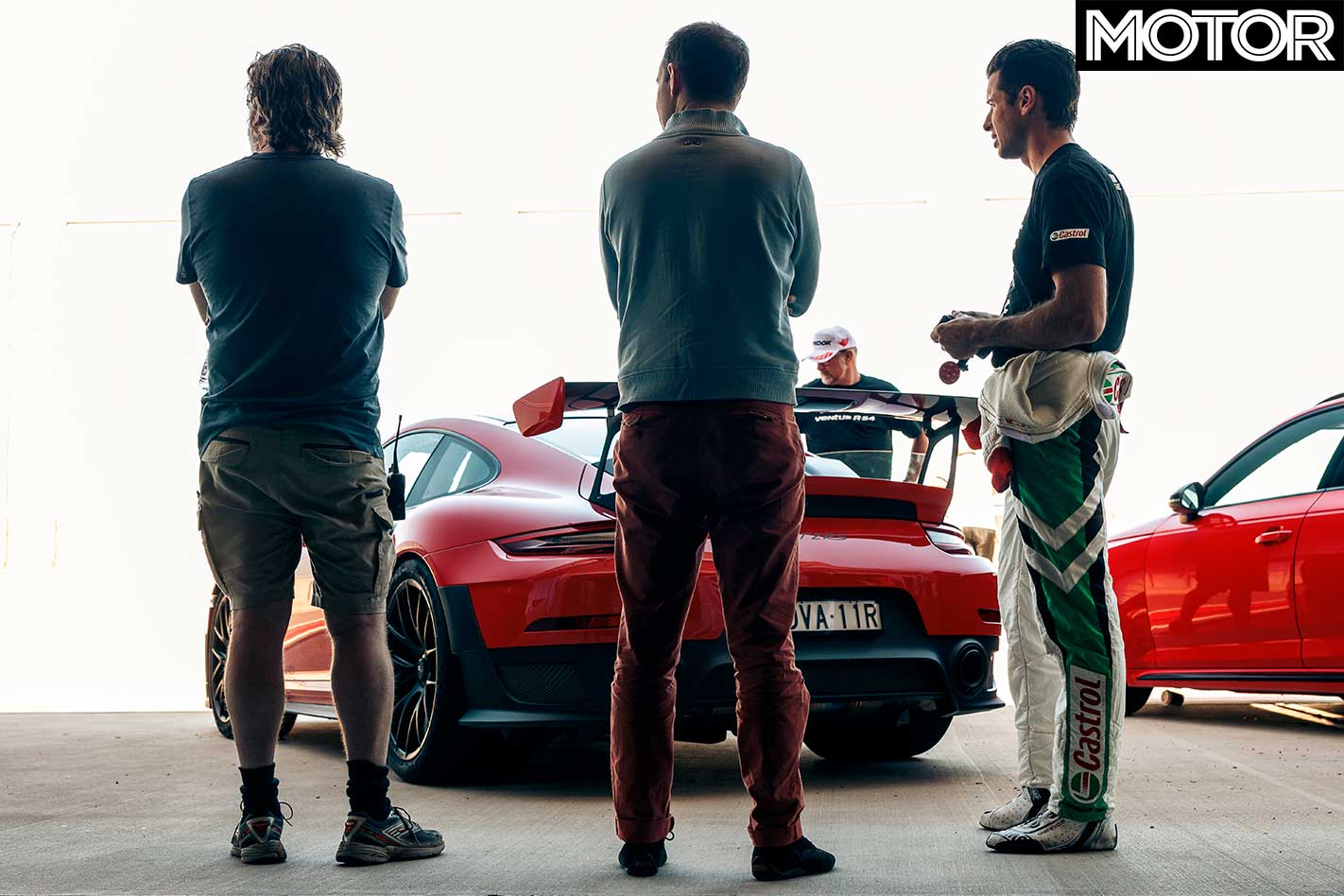
Wakened by Morley’s snoring, I watch the sun rise over The Bend’s front straight from our hotel window. It’s amazing to be able to write that… track day at PCOTY is a truly special day of the year, and I’m quite sad I won’t be playing. I do, however, like standing in pit lanes and yelling, which is what I do all day.
Guest judge Rick Kelly joins the crew, and instantly impresses all with his no-nonsense approach to the job of flogging seven bells out of the fleet and talking into a camera. His approach is methodical and measured, and his feedback is detailed and precise. His descriptions, too, are perfect; “what the %^& is this thing?” he exclaims of the A110, cutting through the hype around the wee Frenchy.
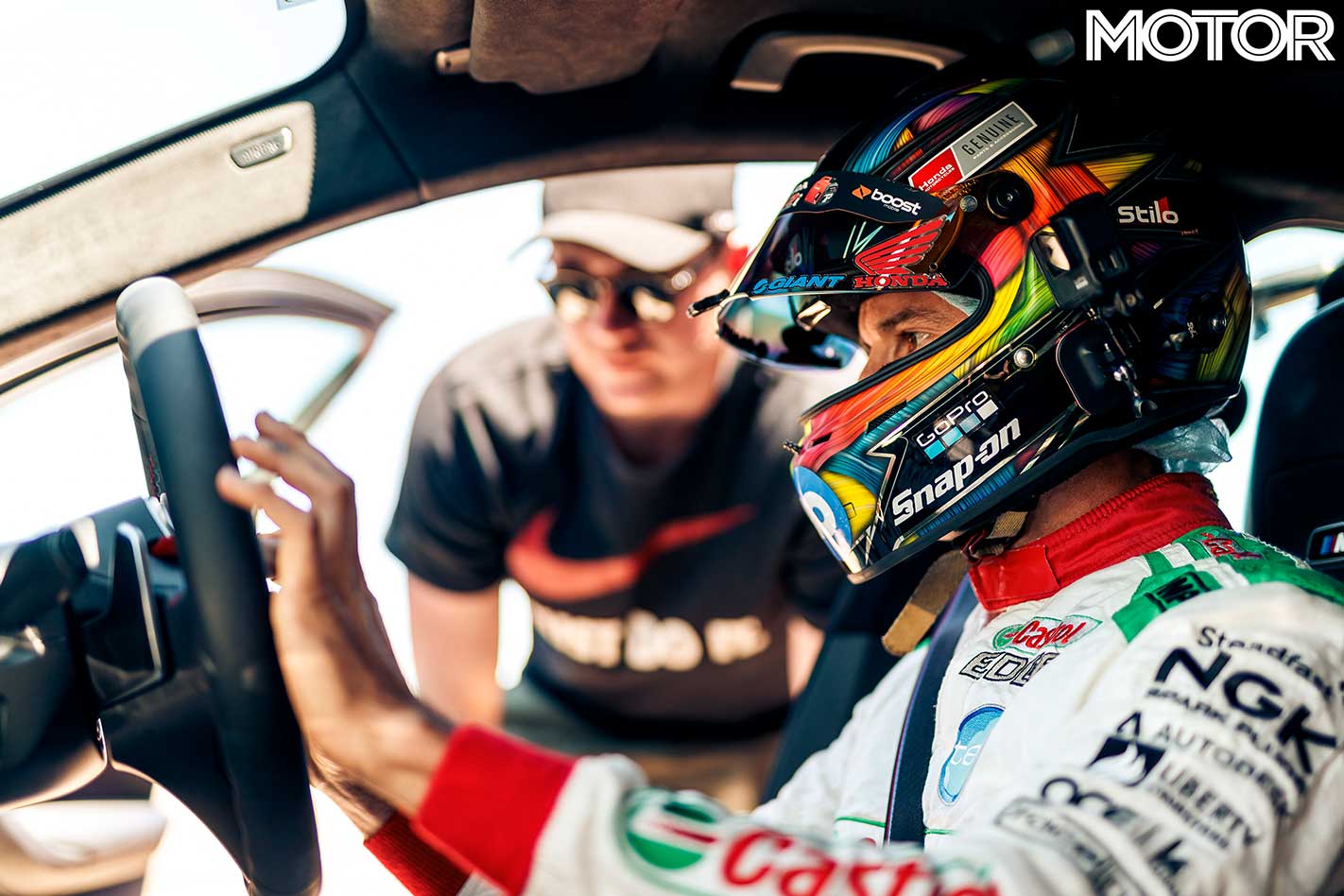
Scotty is revelling in his sideways antics, DC’s weird black helmet is present and correct, and Morley… well, Morley is around the joint. Louis, too, is having the time of his life, punting with accuracy and pace in equal measure. What a jerk (not that I’m jealous…).
I console myself with tyre pressures and cleaning and other stuff, and blag a lap in the Mustang before the festivities wind up. “Just do a short lap, Robbo,” comes the radio call. Not today, I think, as I wind ’er up for a second flyby down the straight as the two-way crackles in indignation. I’ve had my share of days like these, and if this is the last one… well, it’s been a genuine blast.
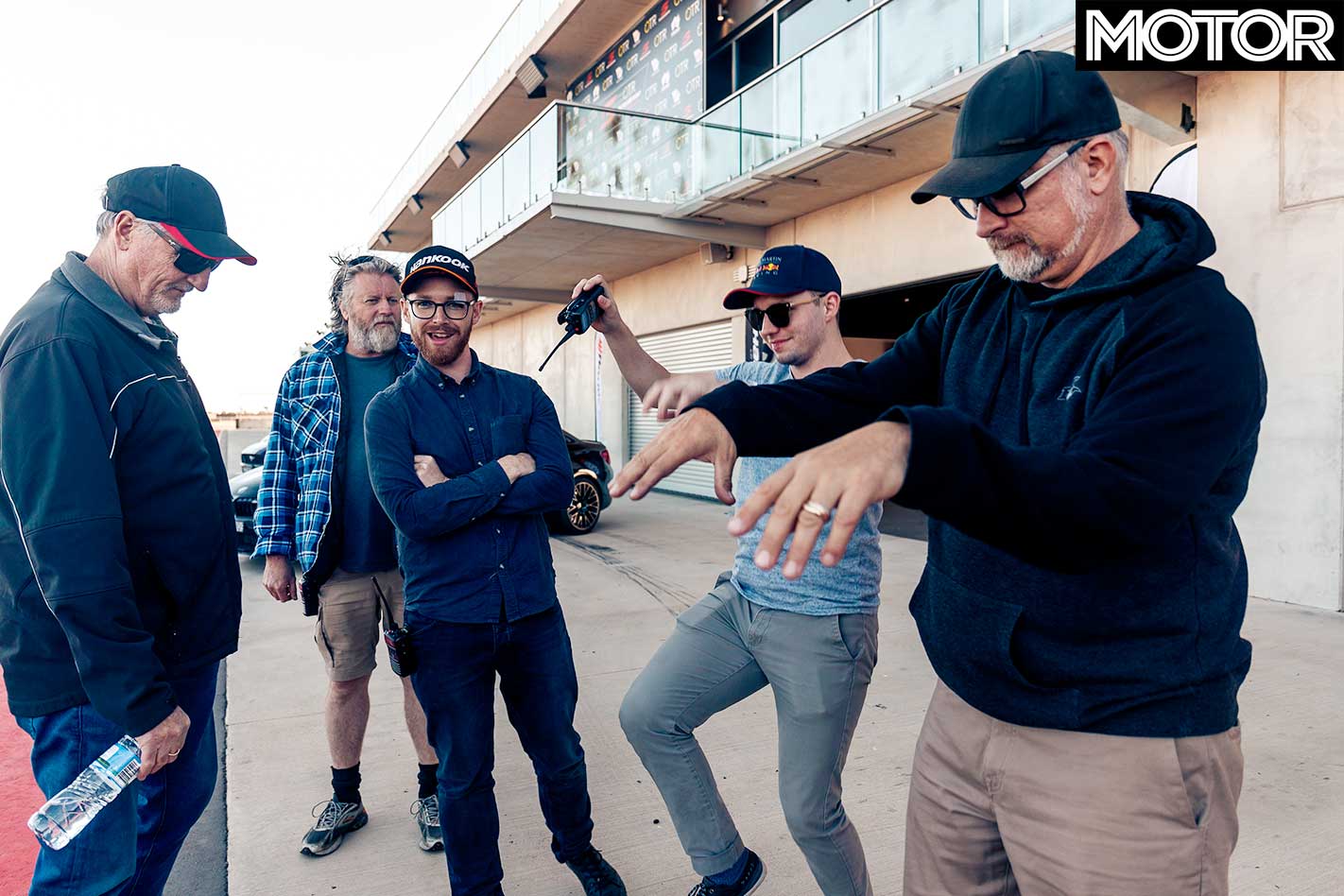
My boss and good friend Ged Bulmer – he who put me on my first PCOTY gig – is in town to host our Hankook and Castrol guests, and we share a quiet chat in pit lane as the field assembles for its big shoot. “It’s been fun, Robbo,” says Ged, who’ll resign a week later. “It has, mate,” I reply, and we stand quietly for a moment, before Ellen yells at us to get out of the shot.
Performance Car of the Year 2019
Meet the Ferrari F8 Tributo, the successor to the 488 GTB.
As revealed in MOTOR’s story earlier today, the F8 Tributo is the swansong for this generation of Ferrari sports car and may well be the final non-hybrid mid-engined model from Maranello.
It’s effectively an extensive facelift of the Ferrari 488 GTB, incorporating a lot of the technology introduced on the hardcore Ferrari 488 Pista, as well as the latest generation interior and infotainment systems.
The core of the F8 Tributo remains 488, but there have been extensive styling revisions at the front and rear. The nose incorporates the S-duct introduced by the 488 Pista which Ferrari claims increases downforce by 15 per cent. New LED headlights allow for additional brake cooling ducts and the whole car is claimed to be 10 per cent more aerodynamically efficient than the car it replaces.
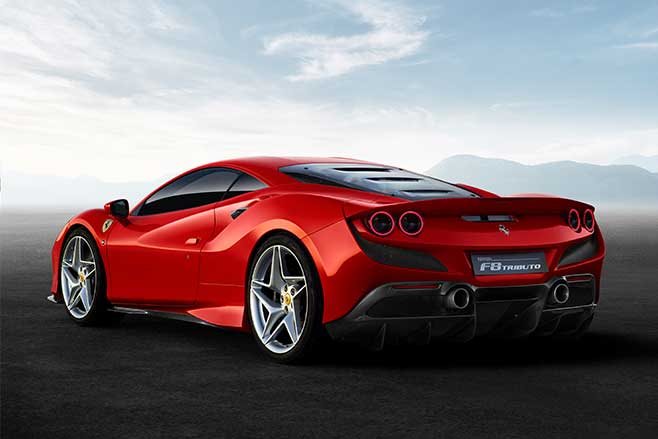
At the rear the switch to quad taillights has been made, while the Lexan rear screen shaves weight with its louvres both extracting hot air from the engine bay and also providing a subtle nod to arguably Ferrari’s greatest road car, the F40.
Weight is down by 40kg compared to the 488 GTB to 1330kg dry, but the F8 shares the Pista’s enhanced 3.9-litre twin-turbo V8, producing an incredible 530kW at 8000rpm and 770Nm at 3250rpm. This is a 38kW/10Nm increase over its predecessor and has resulted in even more mind-boggling performance figures.
The sprint to 100km/h is claimed to take just 2.9sec, a 0.1sec improvement, but 0.5sec has been shaved from the 0-200km/h time, now just 7.8sec, while top speed is 340km/h.
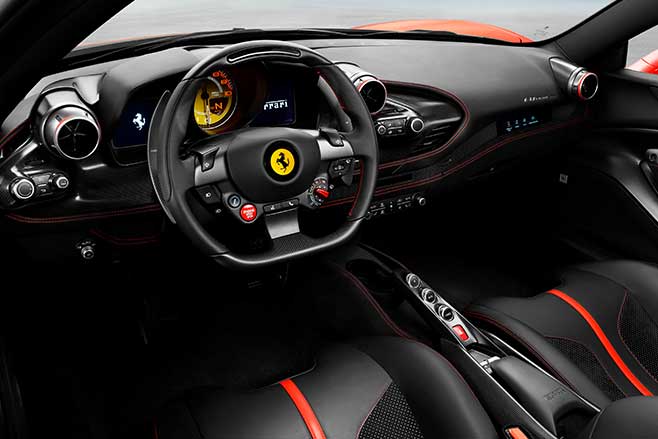
Dynamically, the F8 introduces version 6.1 of Ferrari’s Side Slip Control and Ferrari Dynamic Enhancer, activated when the steering wheel-mounted manettino is set to Race, is said to make accessing the prodigious performance easier for a wider variety of drivers.
The most obvious changes have taken place inside, with the dash, centre console and door panels all being redesigned. The 488’s ageing architecture has been updated with new round air vents, a smaller steering wheel with revised control placements, new generation infotainment and the addition of a 7.0-inch touchscreen passenger display.
Local pricing and specification has not yet been announced, but expect the first F8 Tributos to arrive in Australia towards the end of 2019 for around $500,000. As ever with Ferrari, get your name down quick to avoid a very long wait list.
Porsche’s Australian arm has been forced into an embarrassing about-face on its claims that its new Macan V6 petrol model is fitted with a petrol particulate filter.
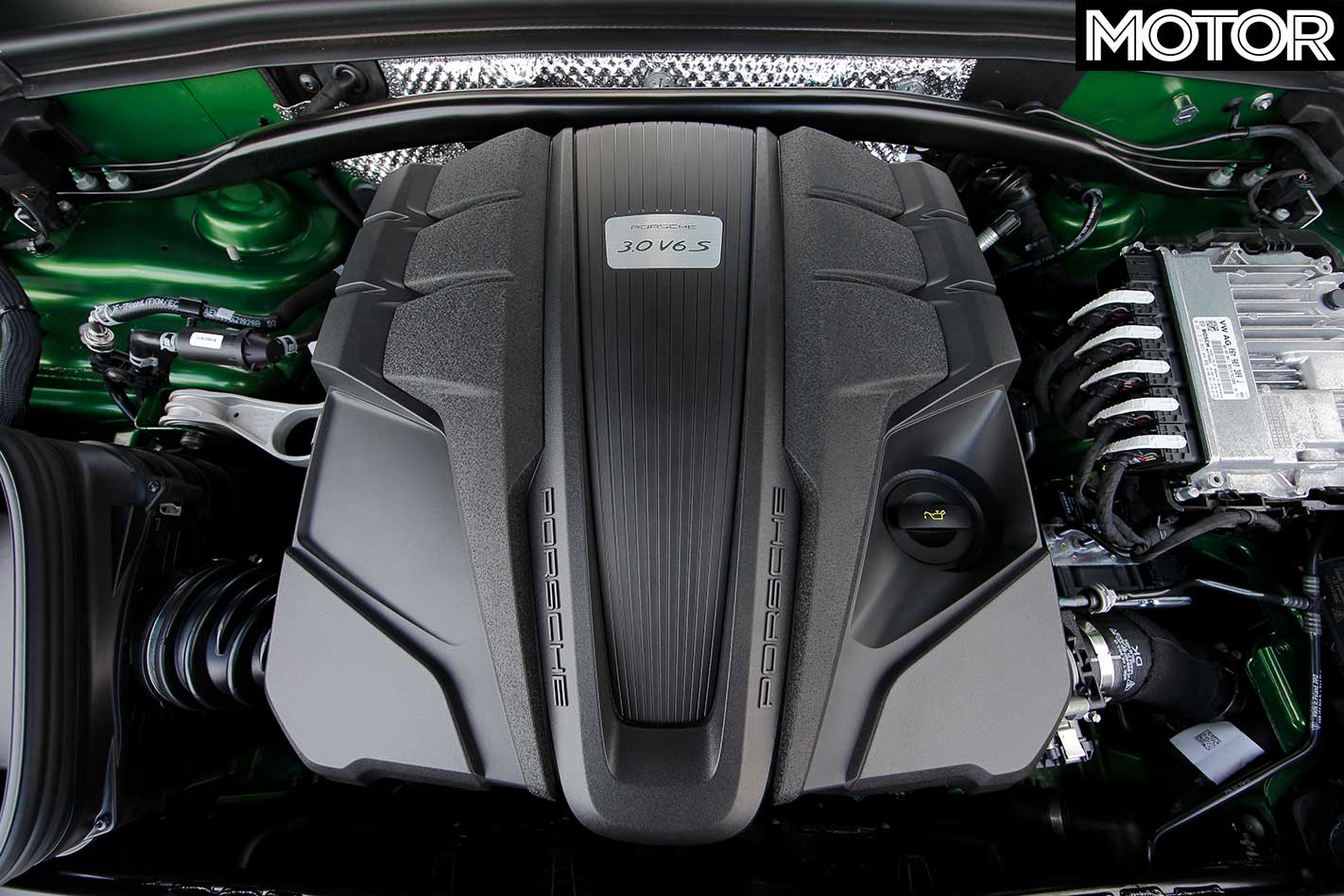
In what would have been a first for an Australia-delivered car, the updated 2020 Macan’s Audi-sourced 3.0-litre V6 petrol engine was, according to Porsche Australia, to be fitted with a petrol particulate filter (PPF).
Paul Watson, Porsche Australia’s technical representative, told journalists at the Macan launch this week that the Macan’s engine management system’s exhaust management functions ‘will handle our sulphur content.’
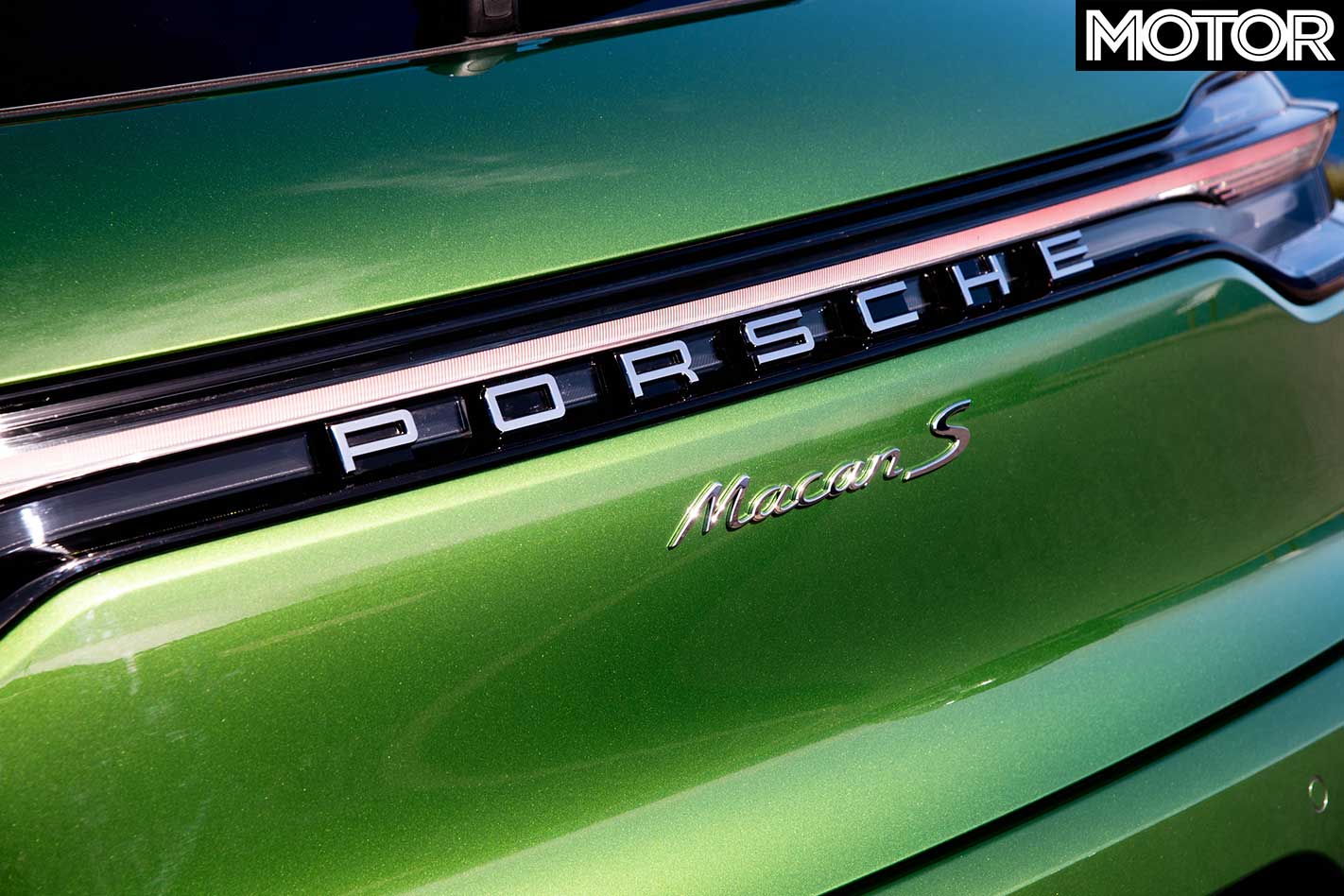
However, Australia’s poor quality petrol means that PPF devices aren’t able to be fitted to locally delivered cars.
Australia’s average sulphur content in unleaded petrol is (broadly speaking) 50 parts per million. The majority of the world, including New Zealand, uses fuel that is much cleaner; around 10 parts per million. Diesel is rated at 10ppm.
The low quality of our petrol is putting pressure on many car importers, with many high-tech turbocharged petrol engines unable to use the fuel at all, or forced to remove functionality like stop/start tech and cylinder deactivation.
Watson said that the engine software “can also artificially inflate the exhaust gas temperature on a petrol engine much easier than we can on a diesel engine, so we can manipulate engine management and get exhaust gas temperature up.”
“Part of the [reason] we don’t expect to have any problems with these is petrol exhaust gas temperature, as a round number, is about 200 degrees hotter than the diesel,” he said. “So burning away the soot particles, which is what the particulate filter is supposed to do, is much less of a problem on a petrol than it is on a diesel.”
“We made an error when saying that the Australian specification Macan S has a petrol particulate filter (PPF). We have not fitted one for the Australian market.”
“Part of our group discussion with our technical expert Paul Watson involved the petrol particulate filter,” he says, “and the ongoing work we have done regarding its suitability for Australian conditions (we’ve been looking at this for more than two years now).”
It’s not clear whether that affects the S’s quoted power figures of 260kW and 480Nm, as the base model Macan is docked 5kW with the fitment of the PPF.
It’s been a mixed launch for the sports car brand’s revised mid-sized SUV, with criticisms levelled at the lack of standard autonomous emergency braking as standard – a feature included on cars that cost a quarter of the price.
Contributing: Tim Robson
WE GET it. Using the cover of our new issue (on sale today) to claim that the all-new Mazda 3 is this year’s most important car is a bold move. Let us explain.
Few cars hold as much relevance to Aussie car buyers as the Mazda 3. It’s often Australia’s most popular passenger car on the monthly sales charts, and those sales have a far greater skew towards private buyers than rivals like the Toyota Corolla and Hyundai i30.
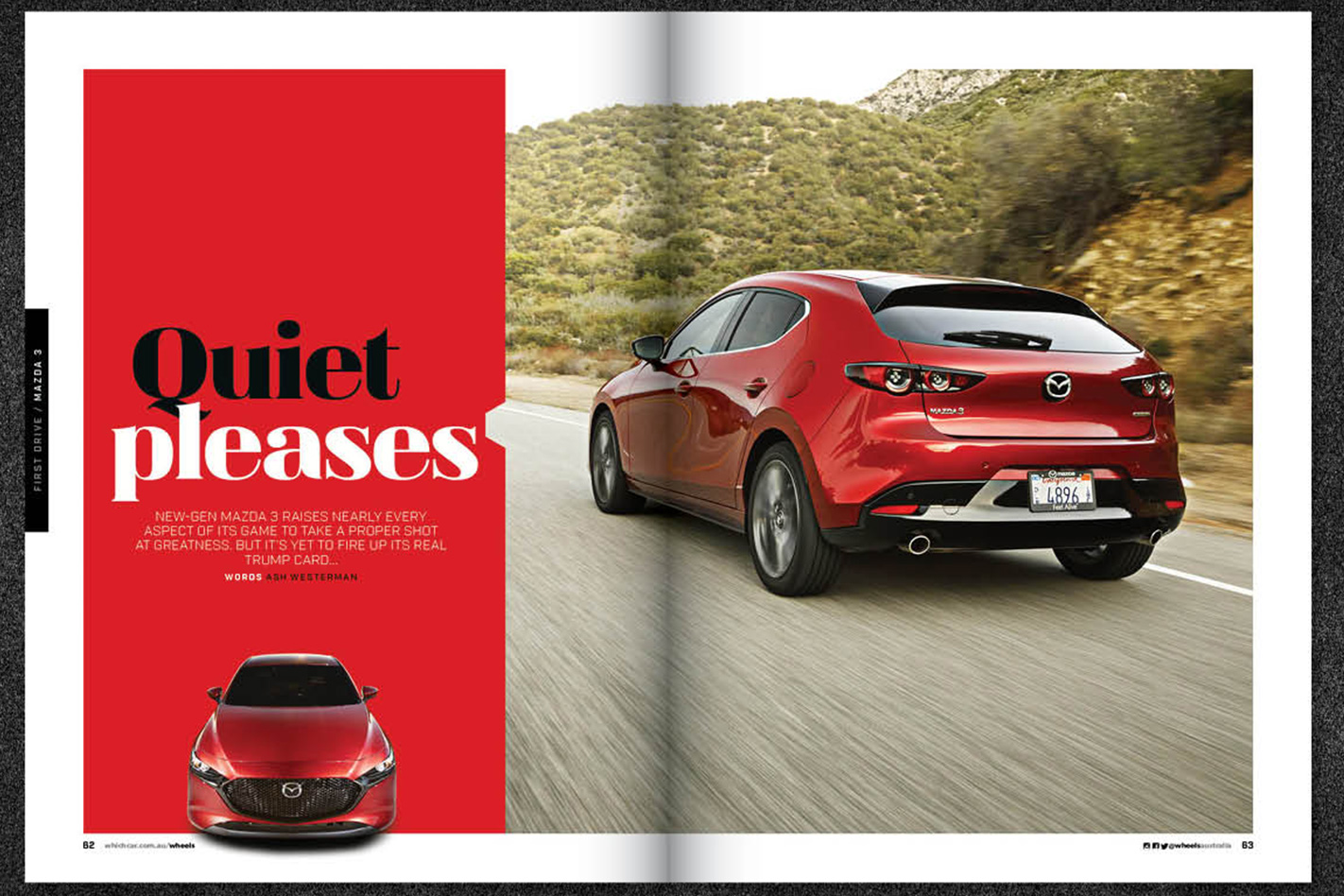
And it seems age is no barrier for the Mazda 3. The current-gen car is continuing to light up the sales charts, despite the all-new model’s imminent arrival.
So it ticks the relevance box, but it’s how the new Mazda 3 promises to advance the popular small-car category than sees it justify our claim. Core to that is the way it goes, stops and steers but there’s also its ground-breaking SkyActiv-X engine which arrives Down Under later this year.
As our cover line states: “It’s sexy, clever and affordable, and the best bit is yet to come.”
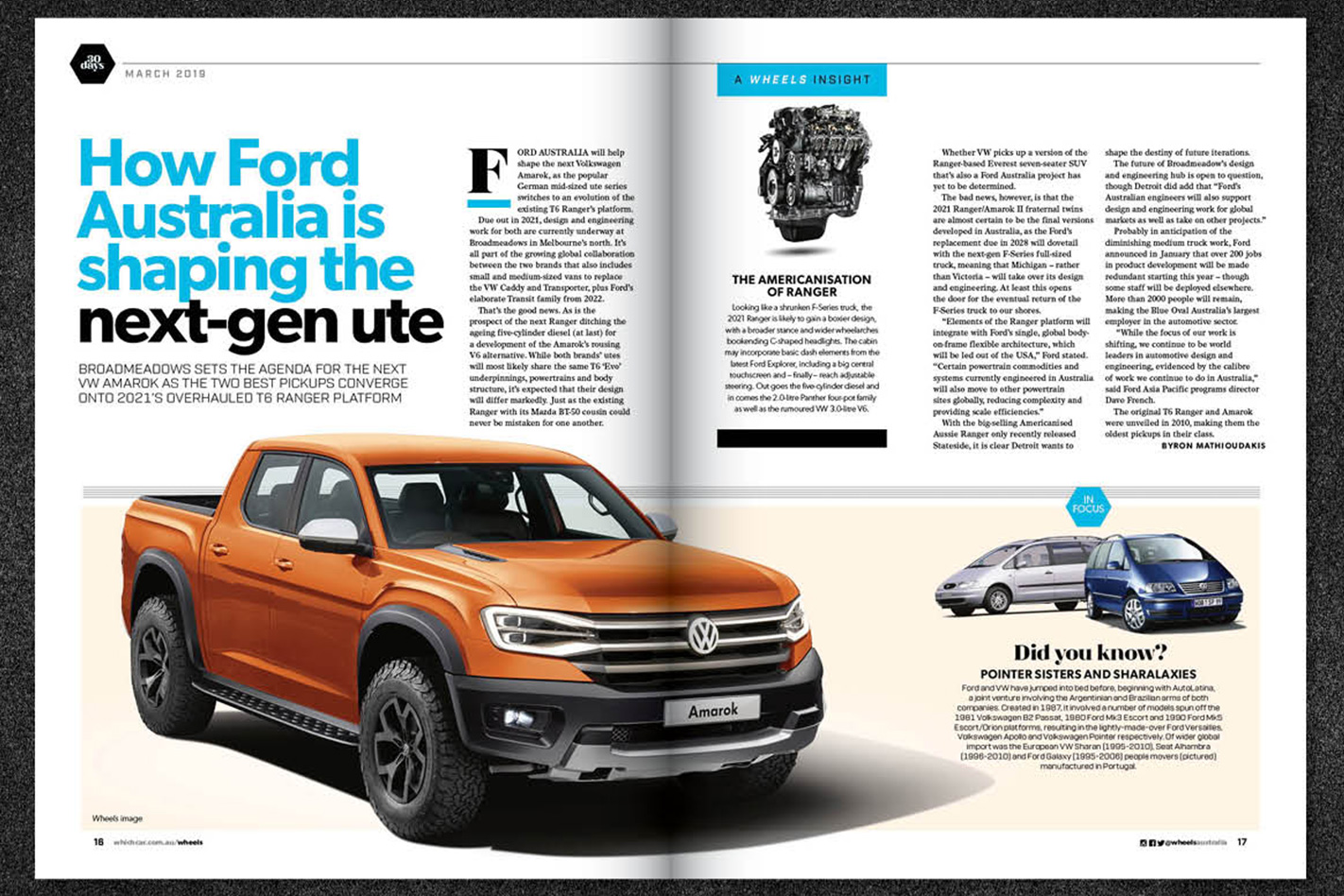
But it’s not all about the new Mazda 3 in our latest issue, which includes an investigation into how Ford Australia is shaping the future of the pick-up ute.
With the Blue Oval and VW linking arms for their next-gen dual cabs, the team of Australian engineers at Broadmeadows is being tasked with keeping both brands at the top of a highly competitive segment.
For motorsport tragics, we have the five Formula 1 storylines to keep an eye on this year, while Porsche has divulged some juicy secrets regarding the next-gen GT3 engine.
Speaking of Porsches, we sent Stephen Corby to Europe to drive the next-gen 911. All-new Porsche 911s don’t come around that often, and the 992 is one of the most significant sports cars to be released this year. No pressure, then.
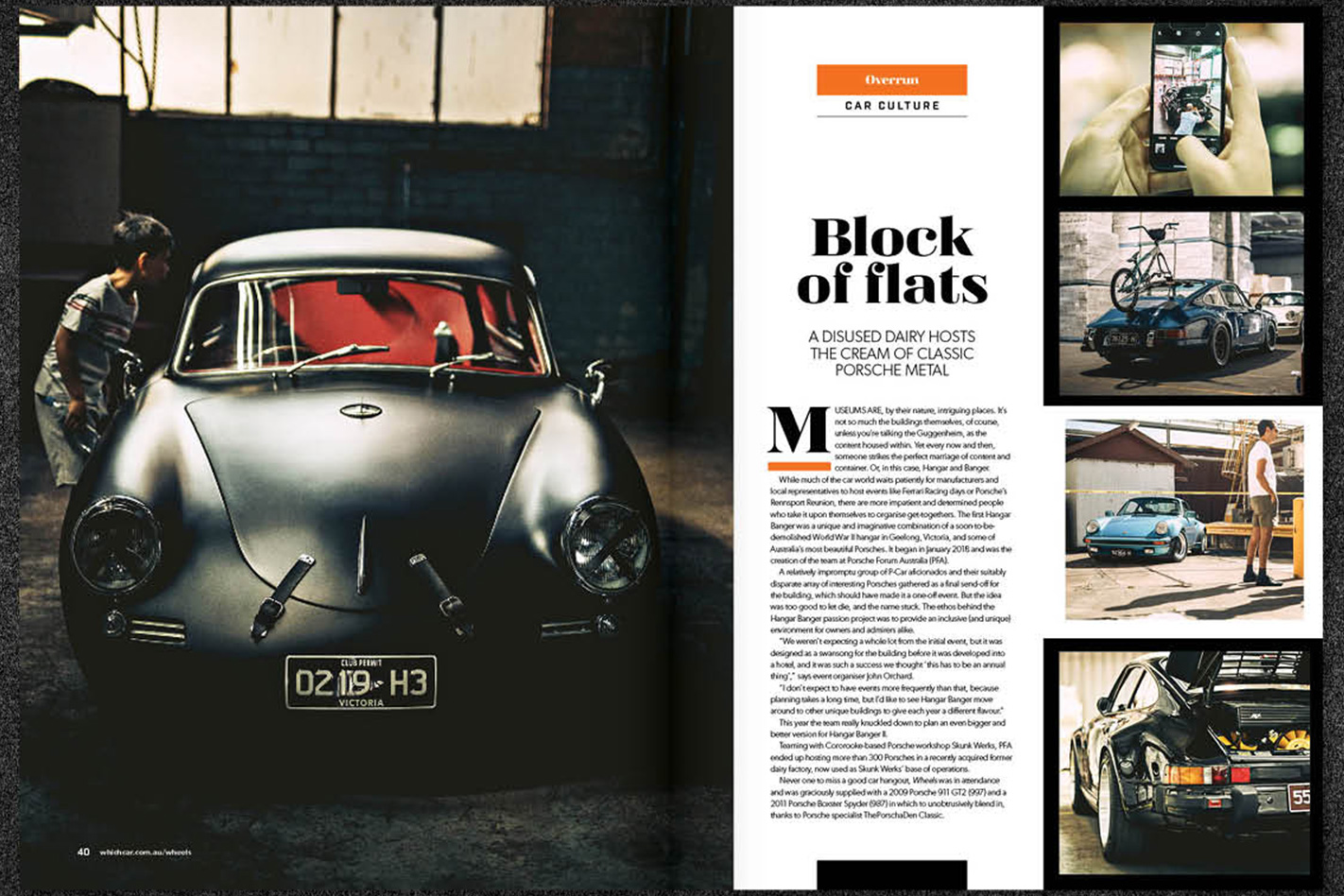
Fans of Stuttgart’s greatest hits will be flipping straight to the Overrun section of the magazine, which has four pages dedicated to Hanger Banger 2, the coolest Porsche event you’ve never heard of. Trust us, you’ll want to treat your eyes to this visual feast.
Also in Overrun, Andy Enright gets his nerd on with this month’s Modern Classic, the Nissan Skyline R32 GT-R. Even the most hardcore Godzilla fanatics will learn a thing or two!
Our experienced road testing team has been hard at work, with first drives of everything from the Suzuki Jimny to the updated Mercedes-AMG C63 S.
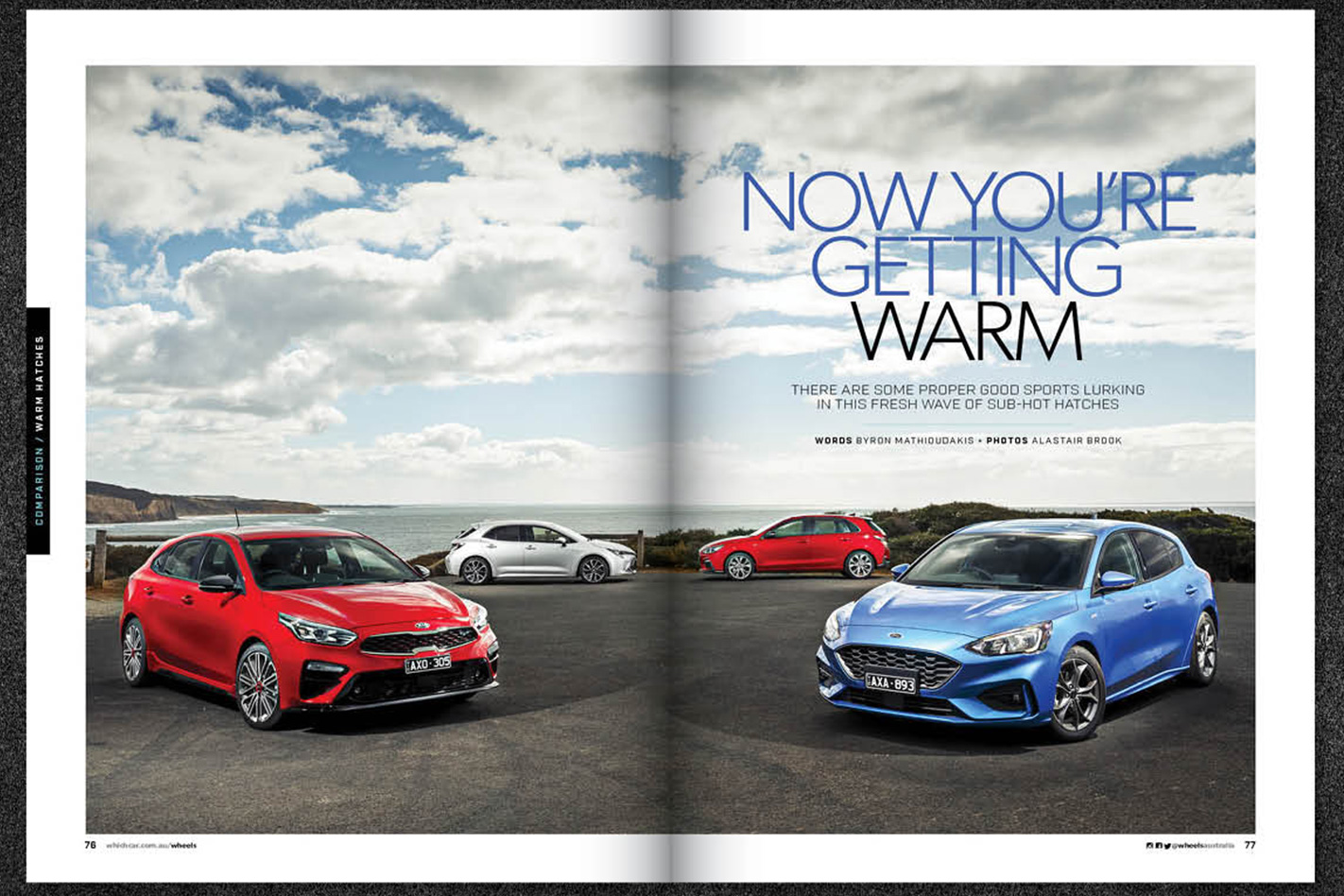
Hot hatches are all the rage at the moment, but what if you don’t want to immolate your wallet for one of these hi-po heroes? Enter the ‘warm’ hatch. We compare four of the best in the Ford Focus ST-Line, Hyundai i30 N-Line, Toyota Corolla ZR, and Kia Cerato GT to see if they can provide both thrills and practicality.
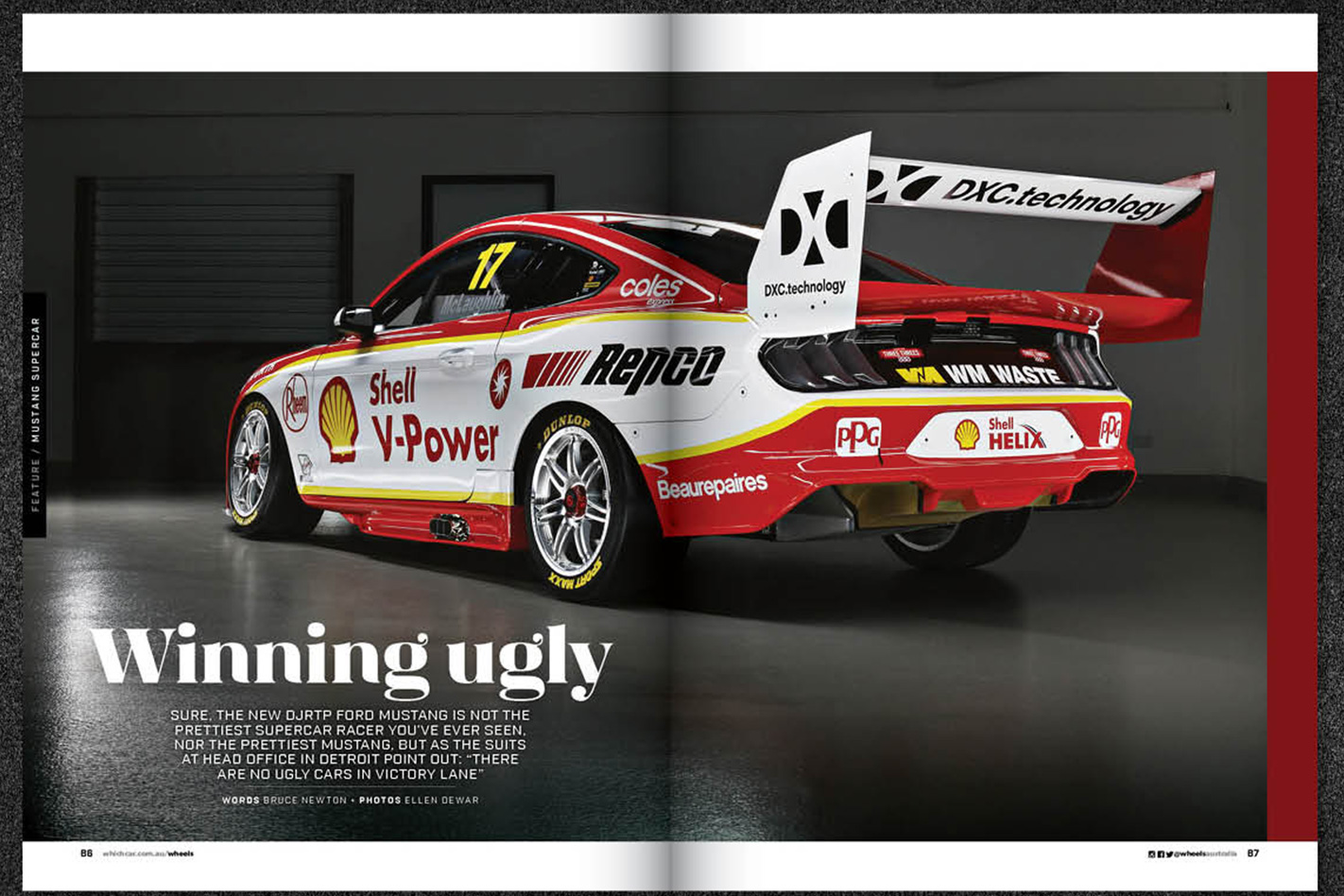
DJR Team Penske also opened their doors to Wheels and gave Bruce Newton an exclusive look into the development of its much-hyped Ford Mustang supercar, which will make its debut this weekend in Adelaide. We stripped off the panels while they weren’t watching to get up close with the first two-door to compete in modern Supercars history.
All that, plus much more, is in our latest issue, on sale now.
Ken Block has pulled the proverbial covers off his new Ford Escort RS Cosworth in a video announcing his new 2019 livery, and a YouTube series with the car titled the ’Cossie World Tour’.
After his original 1991 Ford Escort Cosworth Group A car succumbed to fire last year, Block announced the new car, Cossie V2, would be ‘a modern interpretation’ of a Cosworth competing in the WRC as if it were new.
With a 277kW (with 34mm restrictor) version of the 2.0-litre Ford Cosworth YB engine, Cossie V2 will have enough AWD grunt to match its aggro livery, designed by Block’s friend and artist Troy Lee.
Ash Thorp, the man behind Cossie V2’s wider shape, earns his bread and butter creating visual effects for films like the Total Recall reboot, or video games such as Call of Duty and Assassin’s Creed.
“I actually met Ash through a friend of mine,” Block says.
“I was a fan of his work and it turns out that he was a fan of mine, so we connected and started talking about how it’d be great to work on a project together.
“I had this idea of doing the ‘most crazy’ Ford Escort Cosworth to date as a vehicle to race in 2019 and explained to him how I wanted to incorporate current WRC aero into the build. Ash loved the concept and almost immediately had sent me some ideas and renders.”
Finding someone to do the livery was slightly easier, Block says, as he already knew someone who he had worked closely with in the past.
“I’ve been friends with Troy [Lee] for years,” Block says.
“He’s also done the majority of the helmets for me in my racing career, but this was the first time he and I have collaborated on the actual vehicle graphics, which is awesome.
“I’ve got strong roots to motocross in my past and to be able to bring some of that updated retro vibe through Troy to a car that is itself pretty retro yet updated was an opportunity I couldn’t pass up.
“I’m stoked with how the car, my race suit and my helmet all turned out.”
Block’s Cossie World Tour will take him (and co-driver Alex Gelsomino) to the Rally in the 100 Acre Wood in Salem for March, before heading onward to the Whangarei international rally, with a few more stops confirmed afterward – notably the Goodwood Festival of Speed.
With improved dynamics and an all-new engine, Porsche remasters its stonking Macan in order to depose recent usurpers
WHAT IS IT?
Still in its first generation, the Macan has been a smash success globally by combining mid-size SUV proportions and sports car sensibilities. This facelifted version tweaks the ingredients ever so slightly, and turns up the dynamic heat as it faces fresher-faced competition from the likes of BMW’s X3 M40i, Alfa Romeo’s Stelvio Ti and the Mercedes-AMG GLC 43.
WHY WE’RE TESTING IT
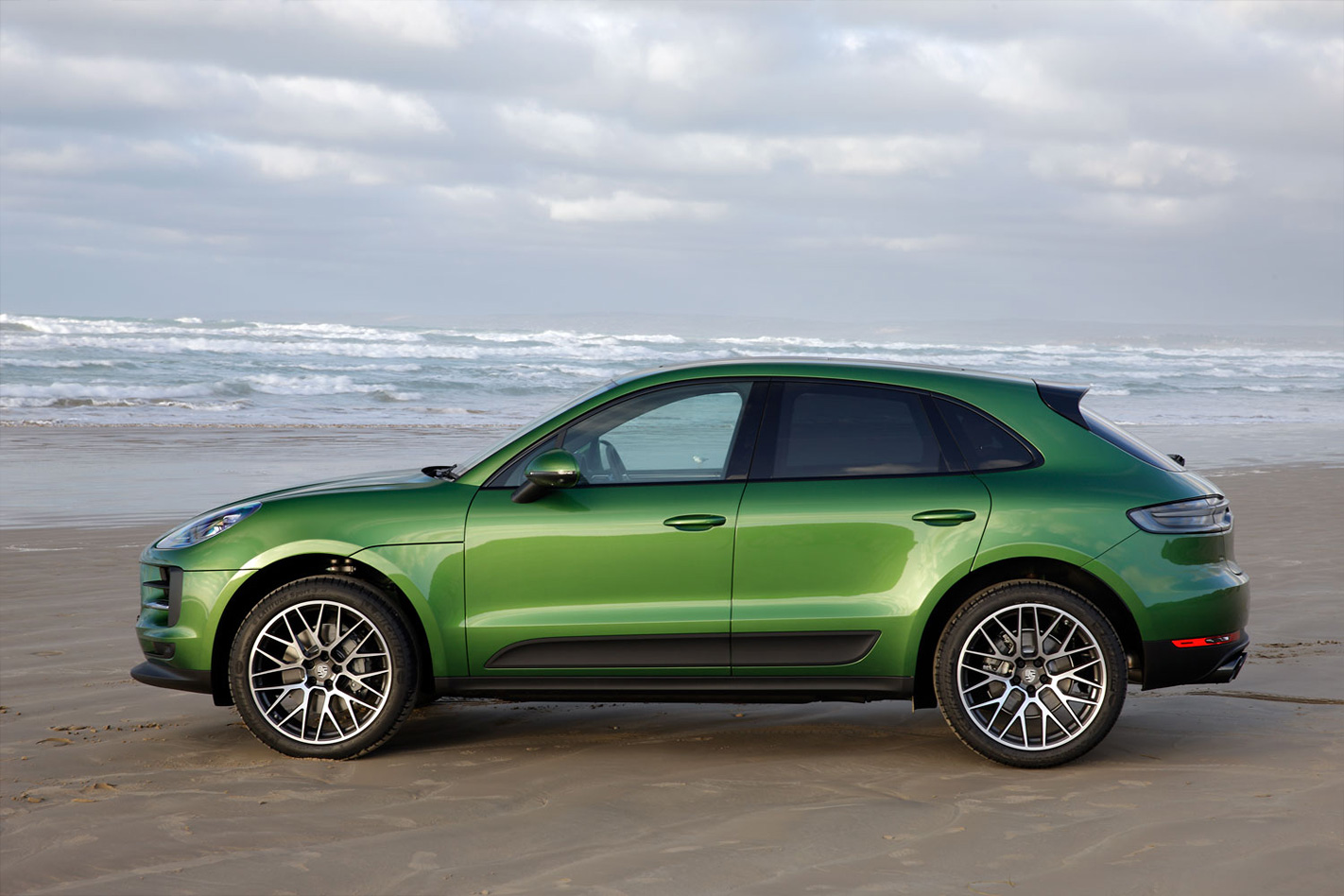
While visual changes are minimal for this facelift, and much of the mechanical essentials remain the same at their core, Porsche has been busy fastidiously tweaking and recalibrating the Macan S to improve both its sporting nature and everyday liveability. The most significant change is an all-new engine, borrowed from higher in the Porsche range.
MAIN RIVALS
Alfa Romeo Stelvio Ti, Audi SQ5, Jaguar F-Pace 35t S, Range Rover Velar P380, Volvo XC60 T8, BMW X3 M40i, Mercedes-AMG GLC43
THE WHEELS REVIEW
IF you were still staunchly holding onto the old stereotype that an SUV is incapable of delivering sportscar-like dynamics, Porsche’s facelifted Macan might just be the car to (finally) challenge that dogma.
Still in its first generation, Porsche did an impressive job straight out of the box with the Macan, building a suburban hero with a sporting double life. To put its success into some kind of perspective, how many other major manufacturers can you think of whose bestselling model didn’t even exist a mere five years ago? Through a number of restrained refinements, Stuttgart has further improved what was already the most impressive dynamic offering in the segment.
Other mid-size luxury SUVs may have had more power, or been quicker to 100km/h, or be more economical, or can carry more people in great comfort, but the Macan has long stood above the rest as the undeniable choice for those who place driving enjoyment at the top of their priority list.
Plenty have come to claim the Porsche’s crown since it was first introduced in 2014, with Jaguar’s F-Pace and the Range Rover Velar recent additions to a field which already included Volvo’s hybrid powerhouse, and COTY-winning, XC60 T8, as well as the Mercedes-AMG GLC 43 and 63 siblings, and all-new BMW X3 M40i. Alfa Romeo’s Stelvio has also joined that fold, offering keen drivers a moderately practical option. When measuring all-round liveability, Wheels gave the XC60 the nod in a five-car comparison last year, which included a Macan Turbo. But it was always the Porsche that impressed us the most dynamically.
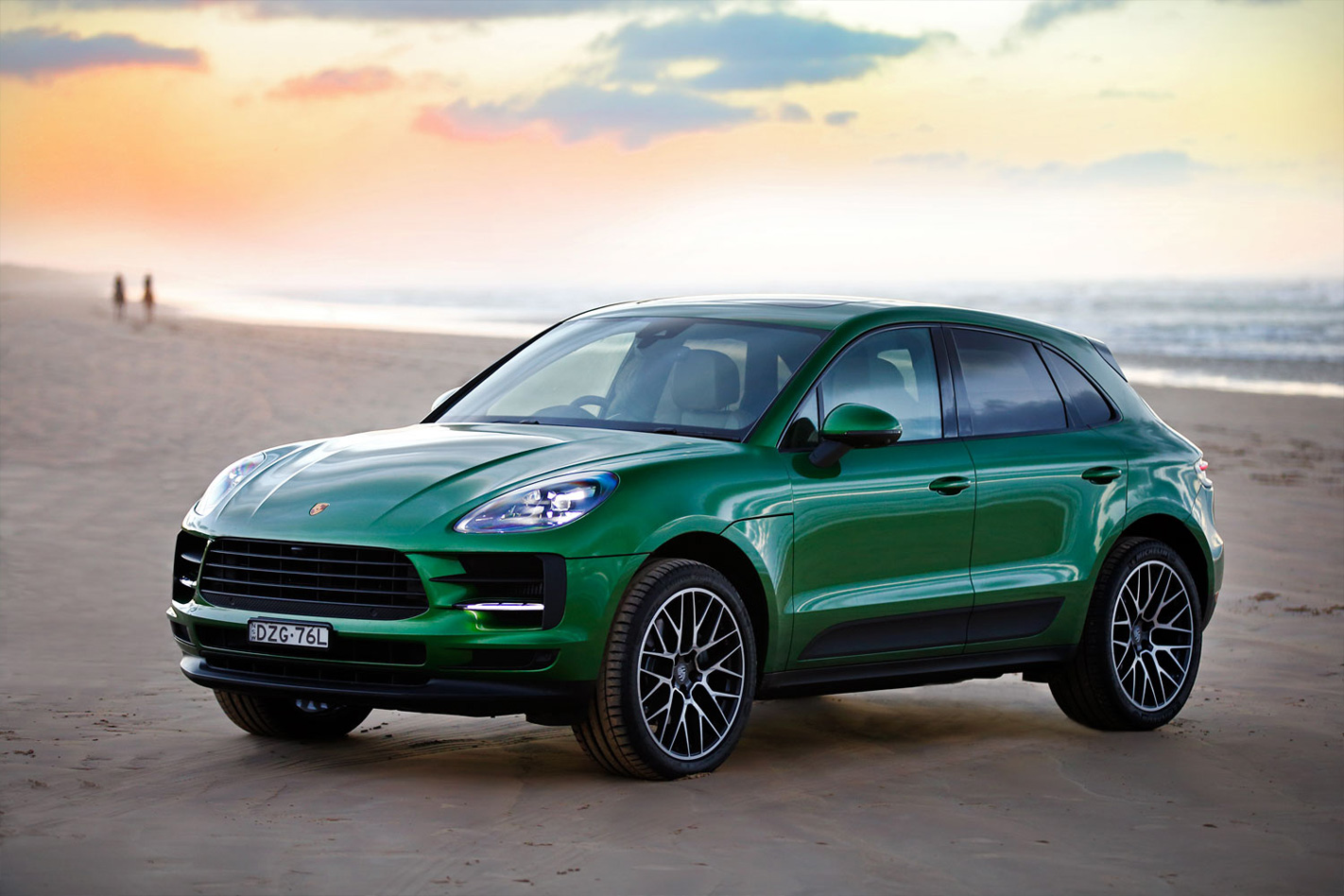
In an attempt to claw back some ground, Porsche has facelifted the Macan for the first time, with refined aerodynamics, suspension, brakes, PDK, centre clutch and a bigger 10.9-inch infotainment screen debuting alongside tweaked styling and that all-new engine.
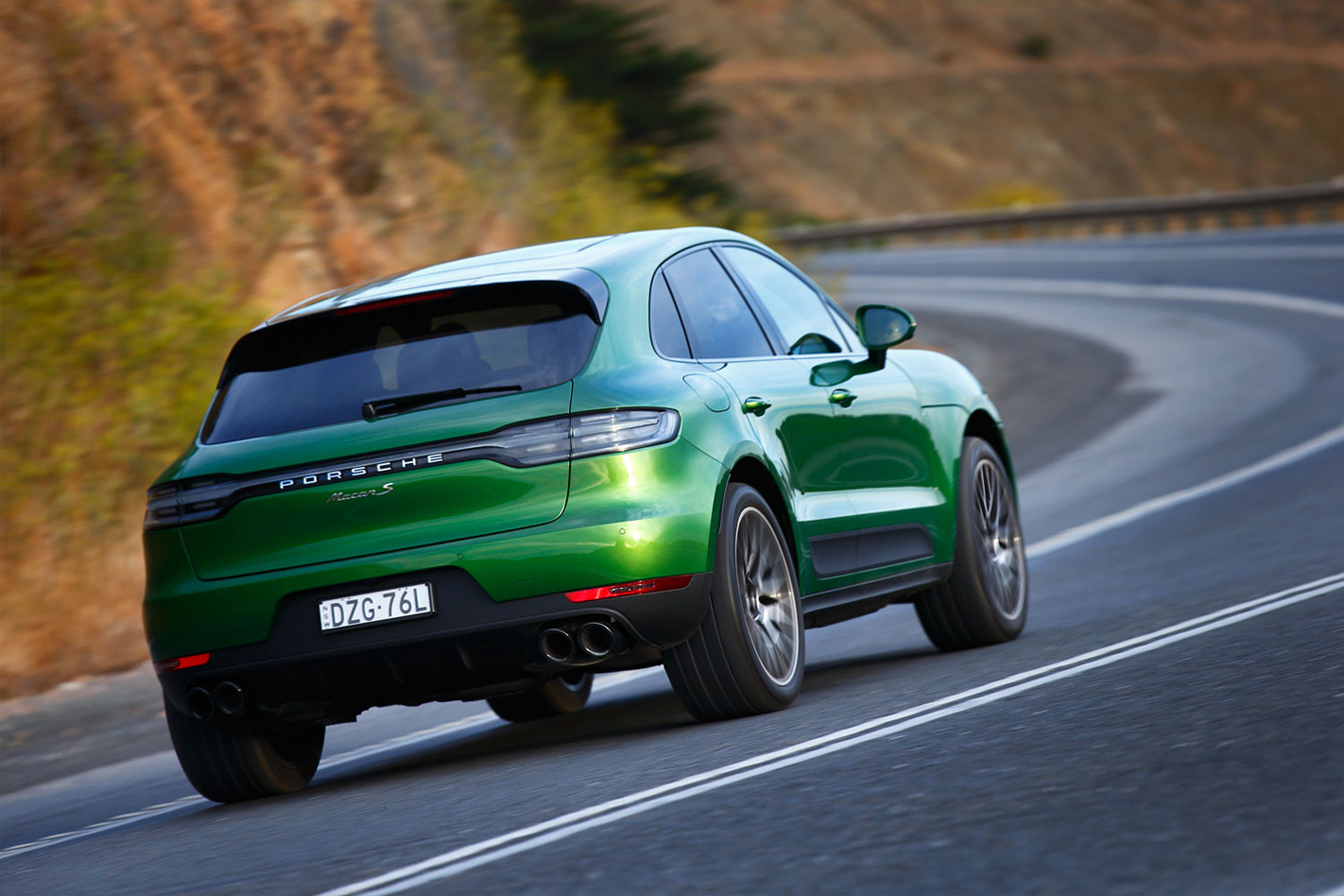
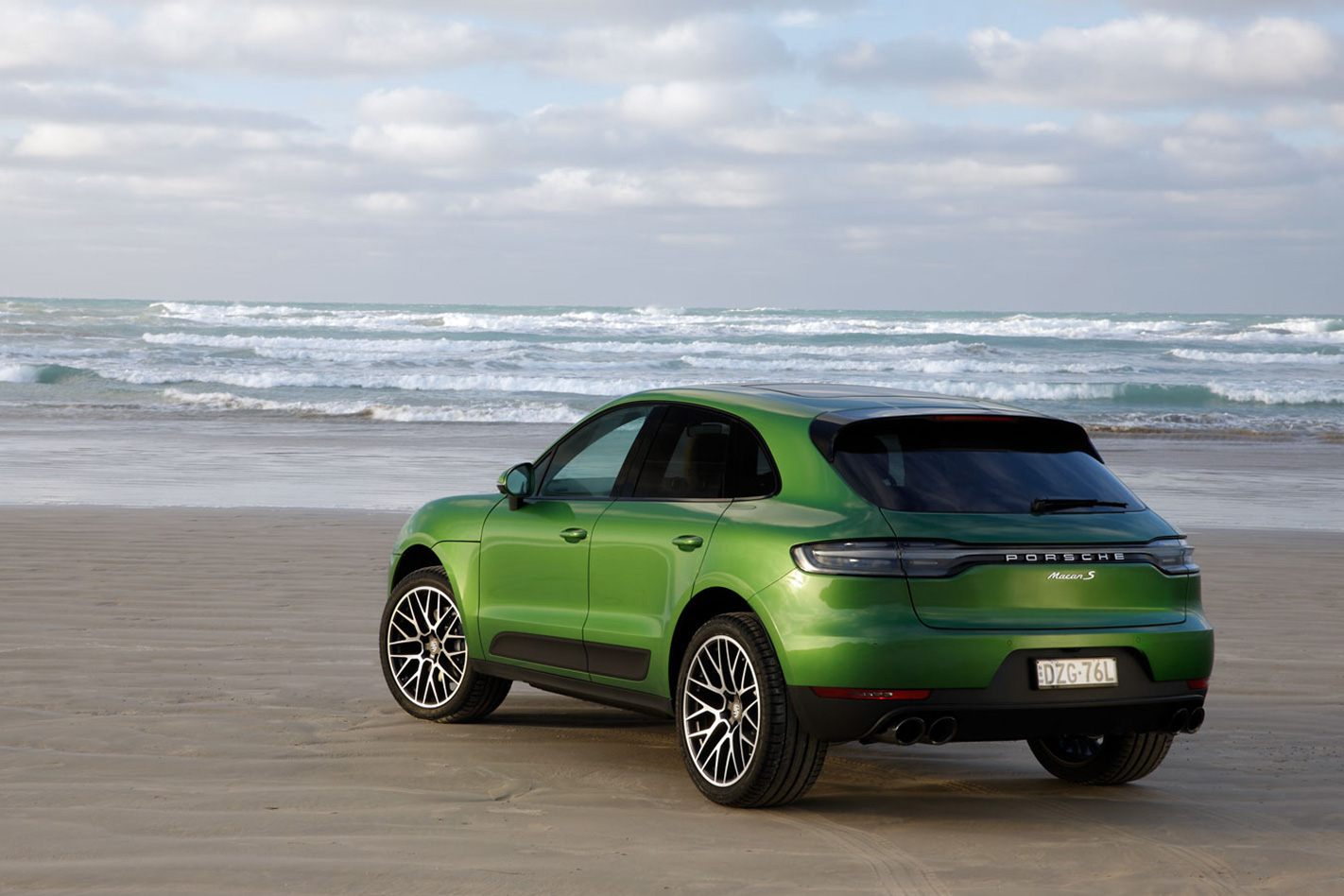
Spotting a facelifted Macan from the front will take a well-trained eye, with the lack of obvious fog lights and new LED headlights the tell-tale signs. From behind, it’s the brake lights which stretch across the entire width of the boot that give the game away.
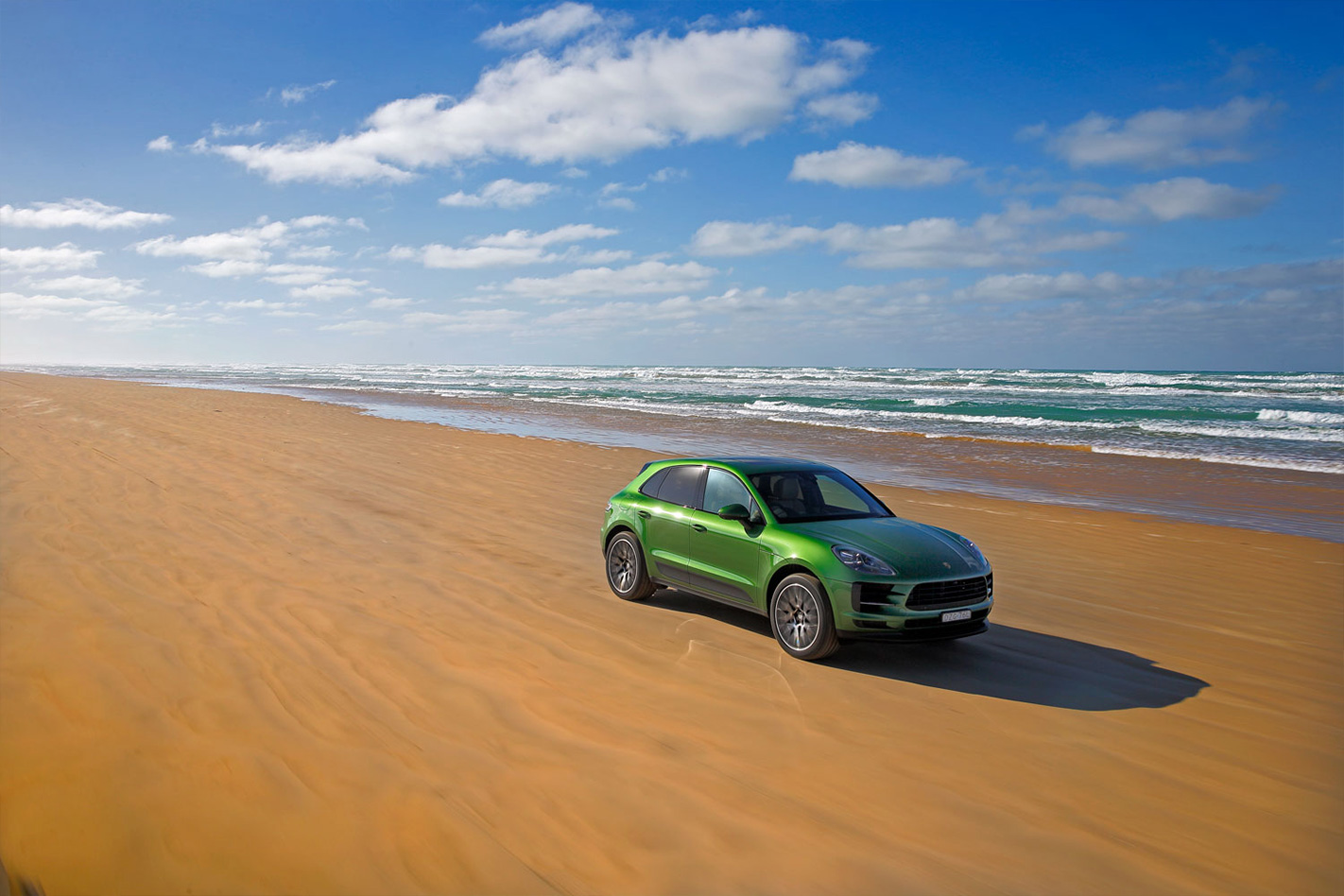
Just a single variant, the S, was available at launch, priced at $97,500, while the entry-level four-cylinder Macan is currently being hustled through customs, and will be in dealers shortly with an $81,400 asking price.
It’s expected when fully fleshed out, the 2019 Macan range will mimic what is currently available – minus the diesels – with hotter GTS and Turbo offerings capping the line-up.
The most significant change for the Macan S is the 3.0-litre single-turbo V6 engine, developed by Porsche, but is also fitted to VW-group sibling the Audi SQ5. Despite losing a turbocharger compared to the pre-facelift model, the Macan S gains 10kW and 20Nm of grunt for 260kW/480Nm claimed outputs. This is sent to all four wheels via a seven-speed PDK automatic transmission.
Propelling the car to 100km/h from a standstill in 5.3 seconds, the engine provides healthy doses of low end torque (with the peak figure arriving at 1600rpm), but peak power only arrives 1000rpm from redline. Despite this, the PDK is calibrated to keep the engine in a sweet spot, with stout acceleration on tap at the flex of the foot. However, the noise the new engine emits is dull, and rather synthetic (though Porsche assures us there is nothing plumbed through the speakers). An optional sports exhaust is available, but you won’t be rolling the windows down and turning the music off as you approach tunnels any time soon.
One of our prior gripes of the Macan is the seven-speed PDK transmission’s propensity to change ratios too early in its sportiest setting. While standard cars will still short shift around town, the optional ‘Sport+’ mode that comes as part of the Sport Chrono pack is calibrated nicely to hold gears for longer.
It’s on winding roads that the Macan is at its best. Despite its almost two-tonne kerb weight, the S revels in the bends, with sublime turn-in, and limited body roll. Pitch control is also excellent for a car of this stature at speed, with mid-corner bumps handled with poise. On the standard 20-inch wheels, the modest tyre sidewall and suspension do an impressive job of smothering sharp surface changes with composure. Three-stage adaptive dampers are standard on the Macan S, and while the softest ‘comfort’ mode provides the smoothest ride, both ‘Sport’, and ‘Sport+’ are perfectly useable in the real-world.
The same can’t be said for the ride on the optional 21-inch rims which undo all that goodwill the moment the road is anything less than billiard table smooth. That’s largely down to the far more focused Michelin Pilot Sport rubber, which features a stiffer sidewall than the Goodyear Eagle Sports fitted to the cars with 20-inch alloys. Imperfections in the road are communicated into the cabin more readily, with the ride becoming significantly busier. Despite being electronically assisted, the Macan’s steering doesn’t feel artificial, with a cleverly calibrated synthesis of feedback boosting confidence on turn-in.
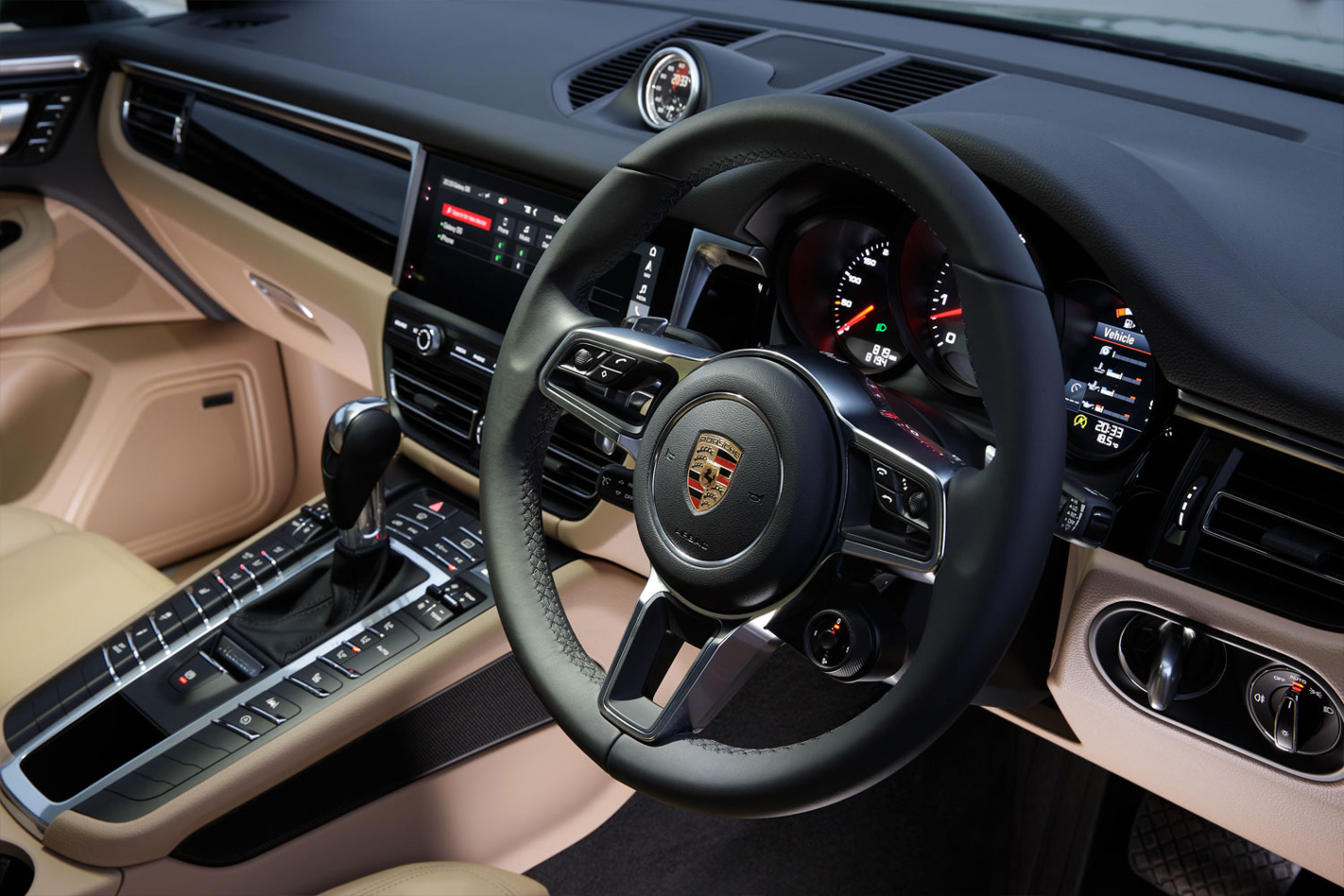
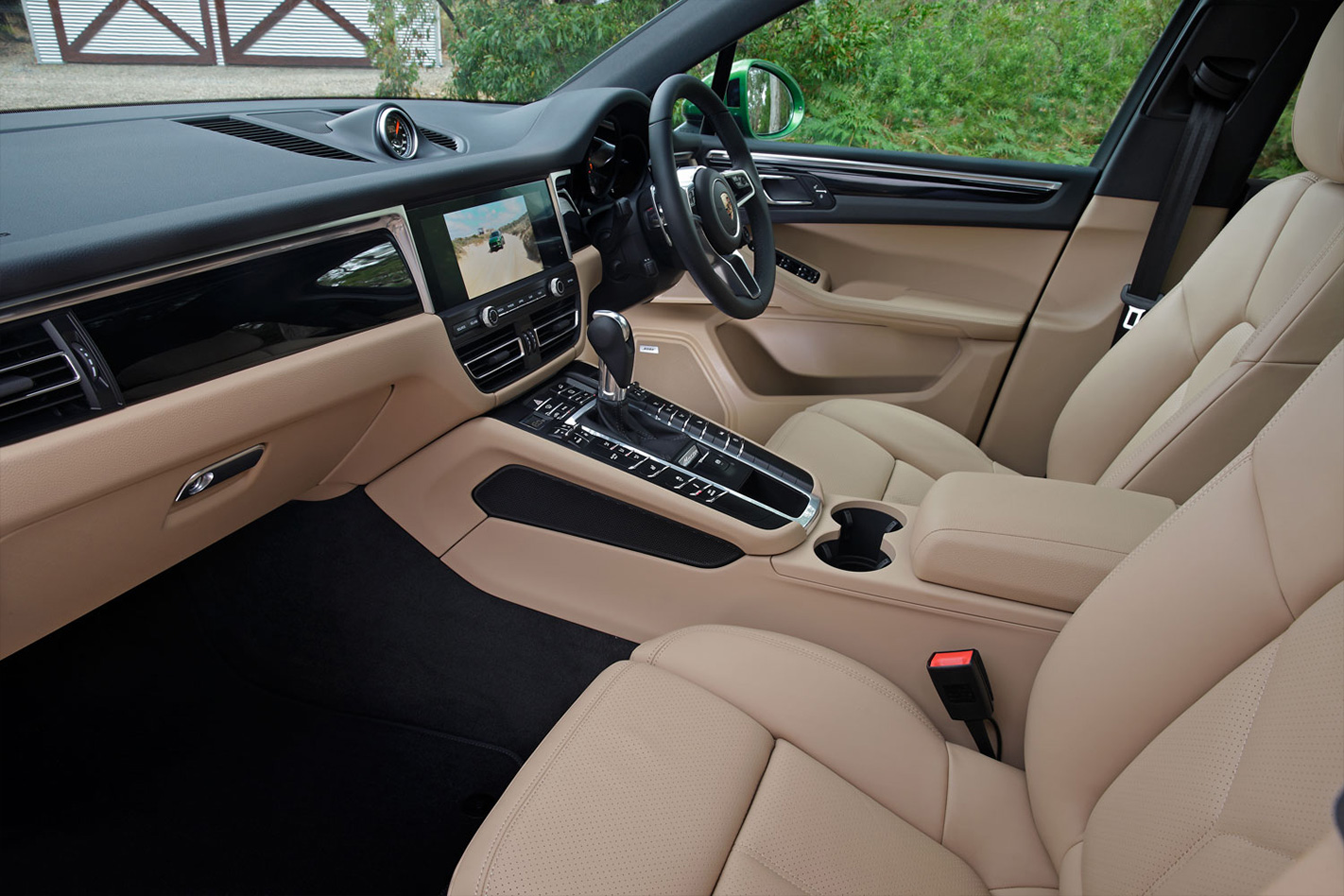
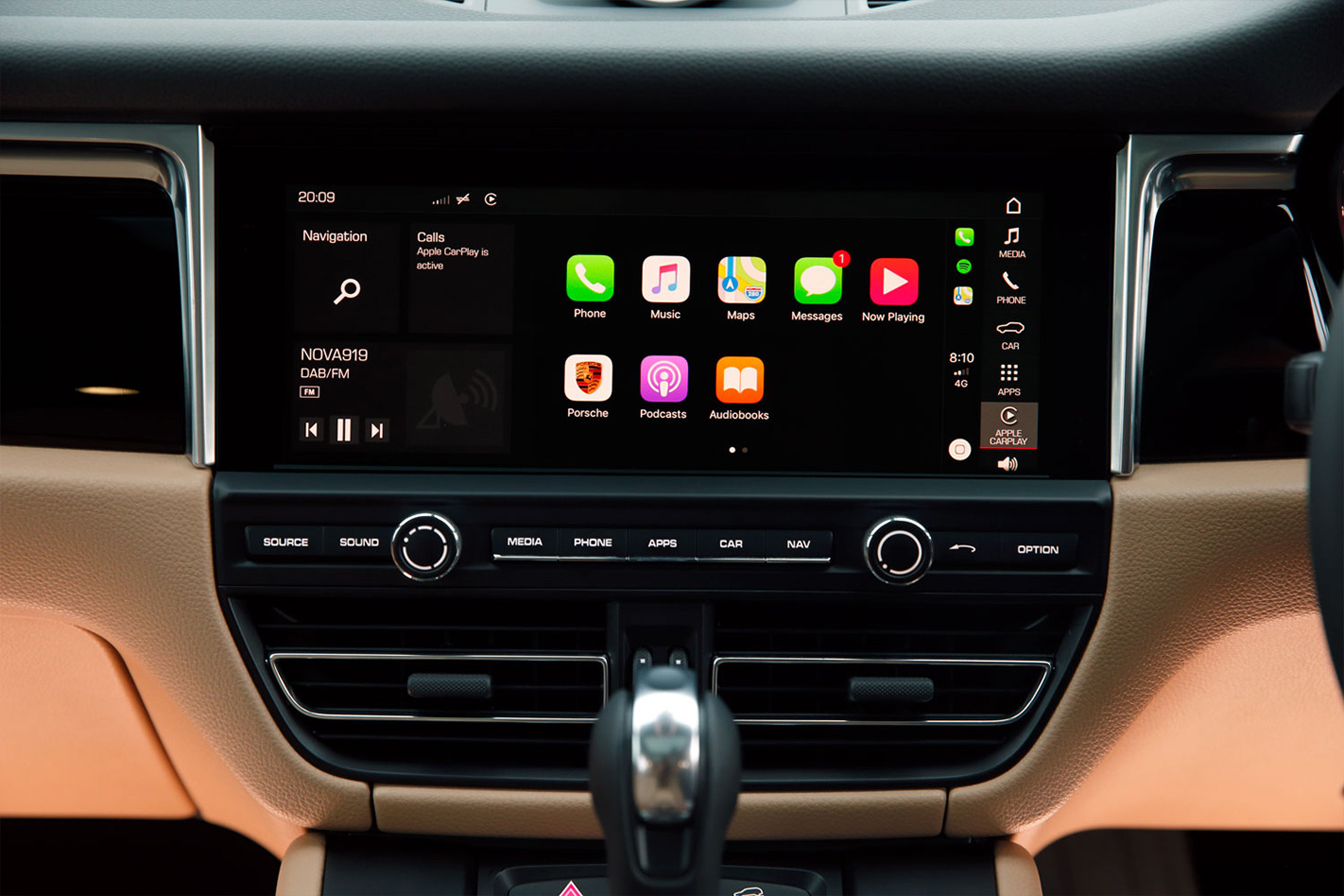
Wheels has previously panned the Macan’s interior as “cramped and dated”, and this remains largely unchanged. The addition of a 10.9-inch infotainment screen goes some way to improving the interior, however there are still too many buttons (27 on the centre console alone), and rear space is lacking for adult passengers.
As with the pre-facelift models, AEB remains an optional extra for the Macan, offered only alongside adaptive cruise control. Safety tech offered as standard on mainstream models shouldn’t come at an extra cost for a car priced at nearly six digits.
Where Porsche has improved inside the Macan is cabin refinement. Road and wind noise is notably reduced for the facelift, with a hushed experience offered on harsher road surfaces.
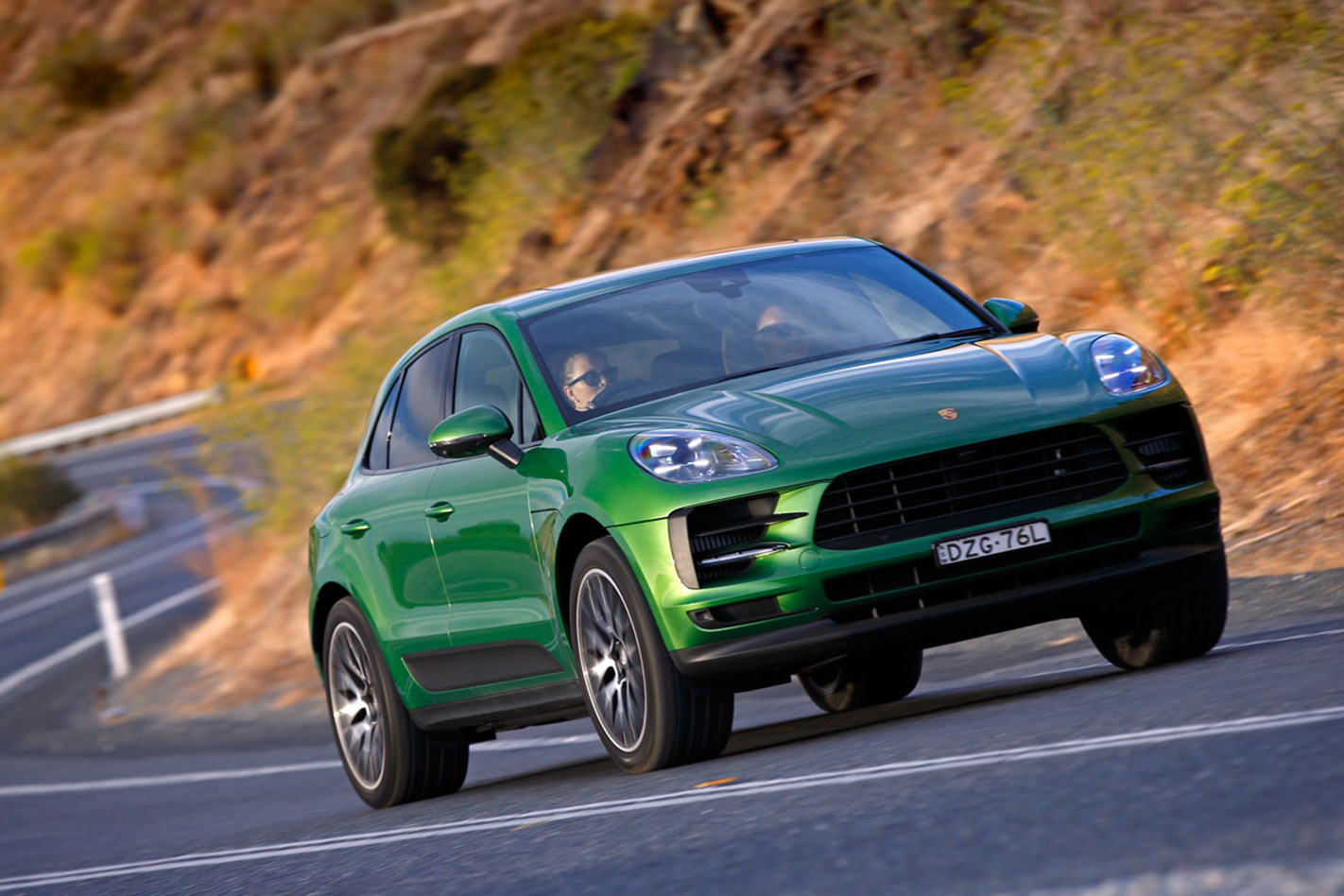
As a sign of its commitment to improving cabin noise, Porsche offers Macan buyers the option of adding special acoustic glass to further reduce invasive decibels.
So while it remains hamstrung by its ageing platform, the Macan S has pushed the dynamic benchmark just a little higher for the segment, taunting its rivals with sheer athleticism and composure.
THE WHEELS VERDICT
While other manufacturer’s have begun to catch up to Porsche, offering ever more impressive and dynamic SUVs, Stuttgart’s engineers have been quietly working away on tweaking the Macan, and have returned serve with a facelifted model with excels at its intended purpose – being the sportscar of the segment.
While perfectly happy to emulate its 911 and Cayman siblings carving a back road, the Macan is also civilised enough to perform daily duties in impressive comfort.
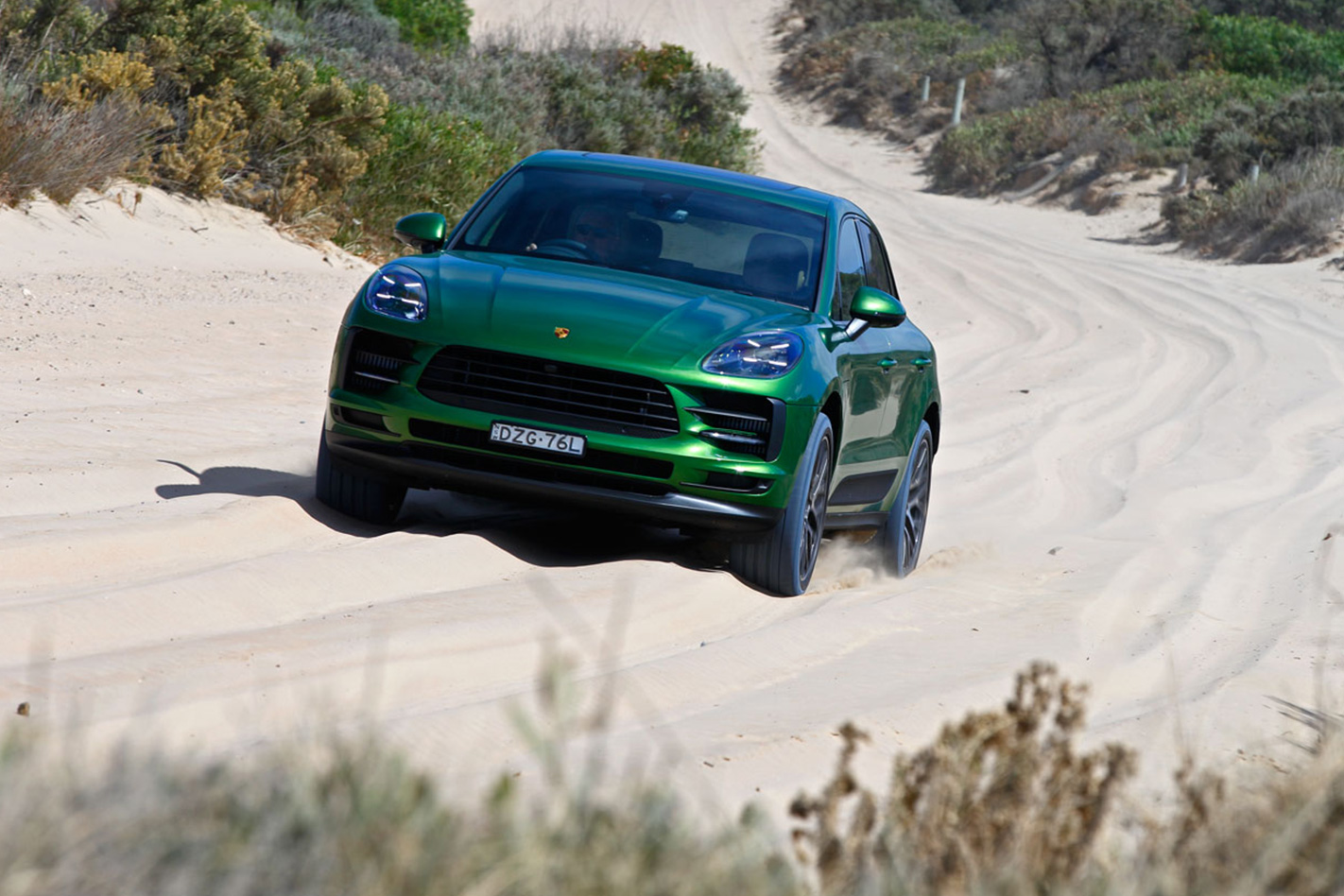
However, not even the most impressive driving experiences can hide the Macan’s age compared to competitors, that offer a better experience for passengers in terms of space and more modern interior design. It also lacks a truly delightful exhaust note, and AEB is only offered as an option. These changes will see the Macan through to its 2021 replacement, when an all-electric version is slated to appear. Until then, Porsche could well find itself fighting a rearguard action.
Plus: Steering, sports car dynamics, performance, NVH improvements Minus: Uninspiring exhaust note, cramped cabin, AEB not standard
SPECS
Model: Porsche Macan S Engine: 2995cc V6, dohc, 24v, 4 turbo Max power: 260kW @ 5400-6400rpm Max torque: 480Nm @ 1360-4800rpm Transmission: 7-speed dual-clutch Kerb weight: 1865kg 0-100km/h: 5.3sec (claimed) Economy: 12.2L/100km Price: $97,500 On sale: now
