
I’m not a great passenger. Even as a kid, before I could verbalise what people were doing wrong behind the wheel, I was picking up on bad driving ju-ju.
That said, the bloke who drove me the 700km from Melbourne to The Bend (Sean, one of the video dudes) did a good job and his experience with driving big, heavy things in underground mines shone through. But even so, 700 kliks in the wrong seat of a dual-cab ute had me well and truly ready to jump in the driver’s chair of something. Anything.
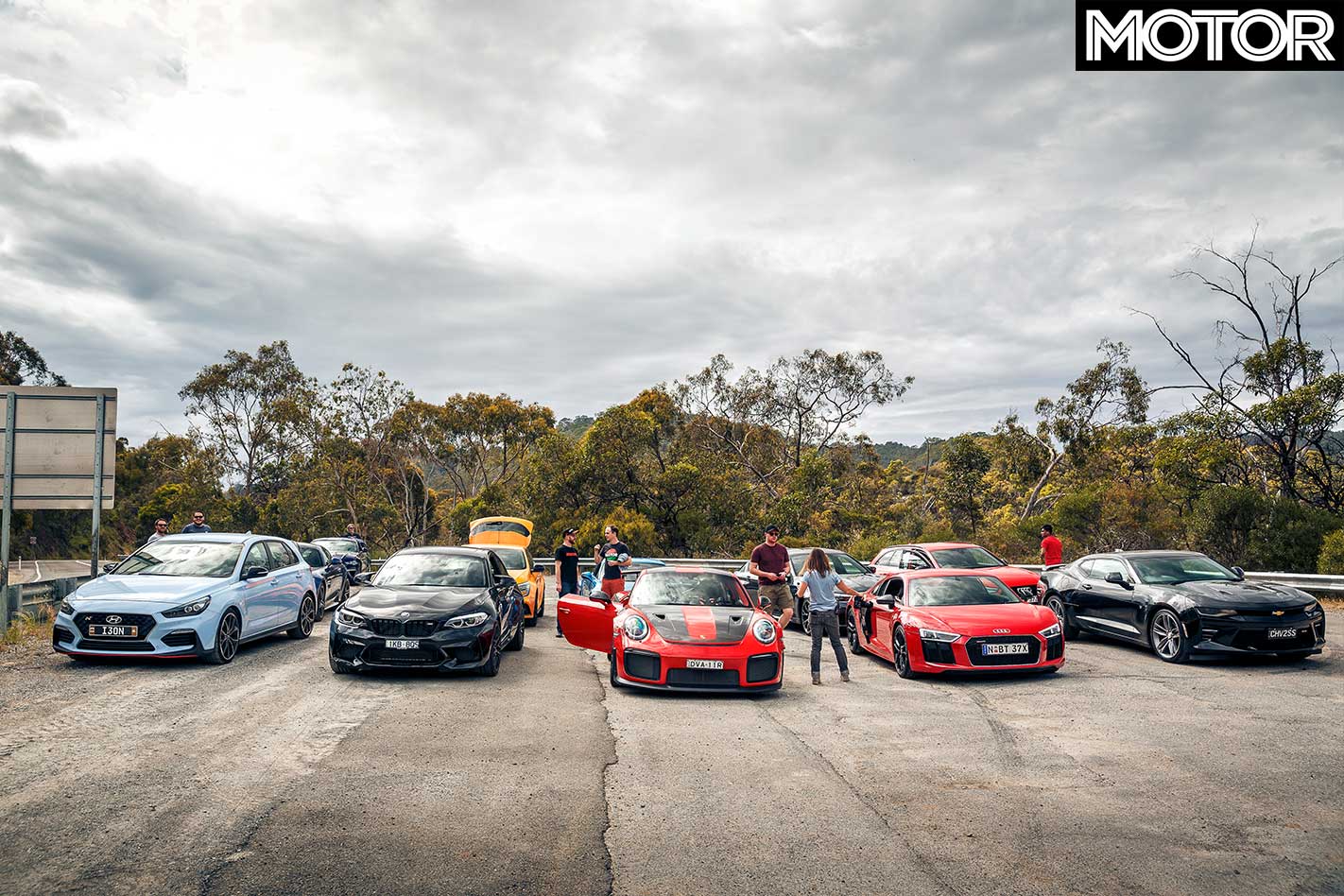
And here’s what’s extra special and nice about working for MOTOR in general and PCOTY in particular. By keeping my elbows out and being bigger than any of the Motor staffers, the first car I plonked my butt into was none other than three-quarters of a million bucks’ worth of 911 GT2 RS. Some days…
A little bit of me always dies when I see a car like this with but two pedals, however, at least the PDK trans means there’s one less thing for the driver to concentrate on. Which is lucky, because even on the road – even on the one-kilometre drive to the servo – there’s plenty with which to concern oneself.
Well, there would be if the damn thing wasn’t so noisy. Seriously, it sounds like you’ve been bundled into a 44-gallon drum and rolled down a bluestone alley. While 10 kids run along beside, hitting the sides with aluminium baseball bats.
I cannot recall another Porsche where I’ve been able to hear the PDK clattering away, but in this one I could. And the road noise from the tyres suggests to me that there’s precisely zero sound deadening under those voluptuous haunches.
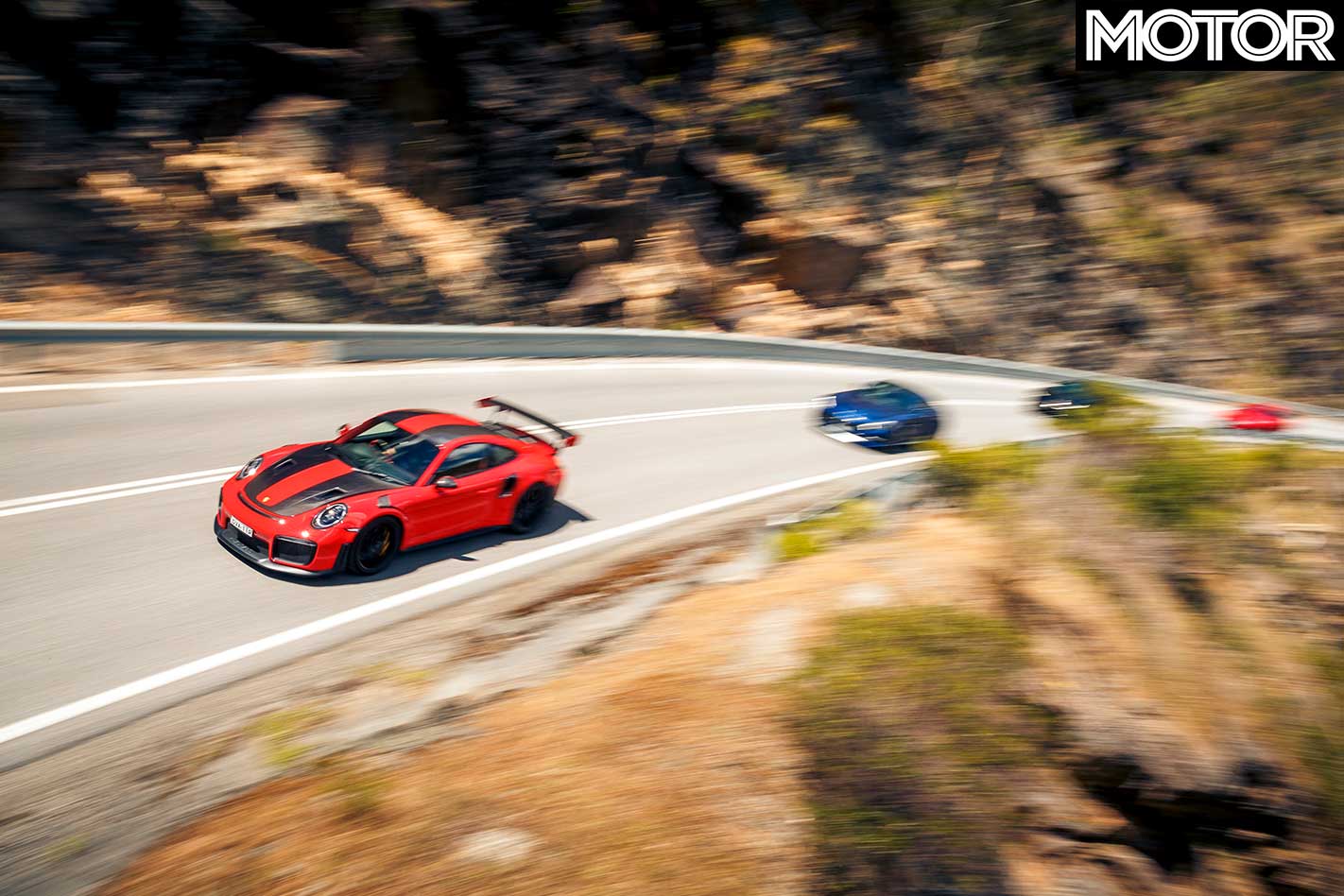
To be fair, most of the noise is coming from the rear of the car, but equally, when you can hear the rear pads snuggling up to the calipers when you touch the anchors, it’s fairly clear this ain’t no limo. I’m also sitting on the buckle of the harness and the Alcantara wheel and shift knob have already been darkened by somebody else’s grease. At some point, race overtakes road, and I reckon the GT2 RS has passed that point.
First thing next morning it was off on the road drive proper. So I did the only sensible thing and grabbed the keys to the Alpine. This was a car I’d been dying to get hold of since I heard about plans to build it, but even then, my high expectations were kind of matched. Okay, again, I’d personally be happier with three pedals and a stick-shift, but if you’ve gotta have a double-clutch, this is as sweet as any of them.
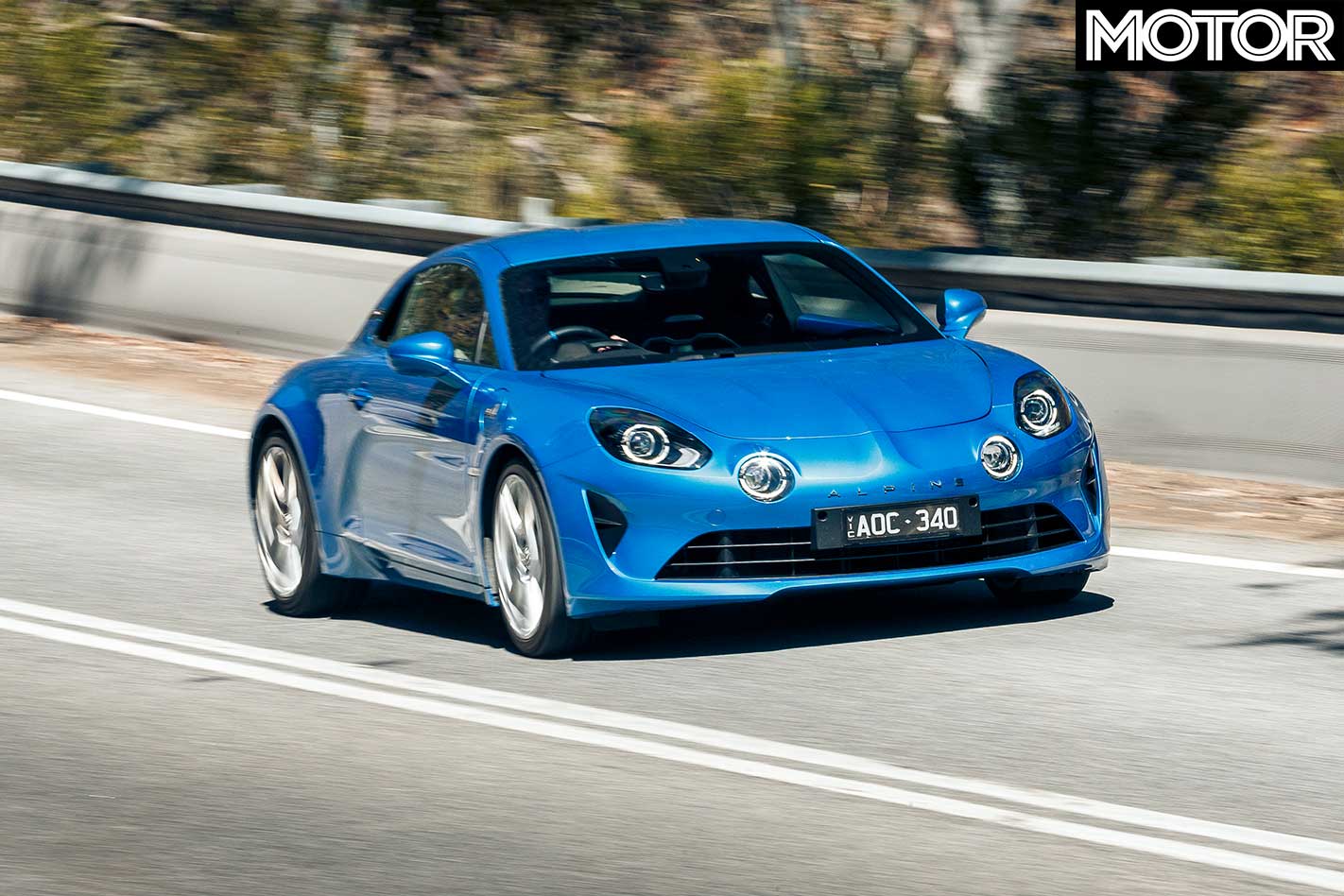
And everything else, I just loved. The look of it is great, the sound is right and the mid-engined layout gives it that little touch of special that separates mere cars from truly magnificent pieces of machinery.
And yes, I’ll put the Alpine in that category. On the road, the steering actually reminded me of the way an old, torsion-beam, air-cooled 911 kind of makes the wheel dance in your hands a bit.
Actually, the old 911 comparison holds for the overall handling, too, and while the Alpine’s front end feels just about right for the road, there’s always lift-off oversteer available. But there’s a suppleness, too, that the car’s appearance belies and with that jewel of an interior, this is a seriously good road car for two. Sounds proper, as well.
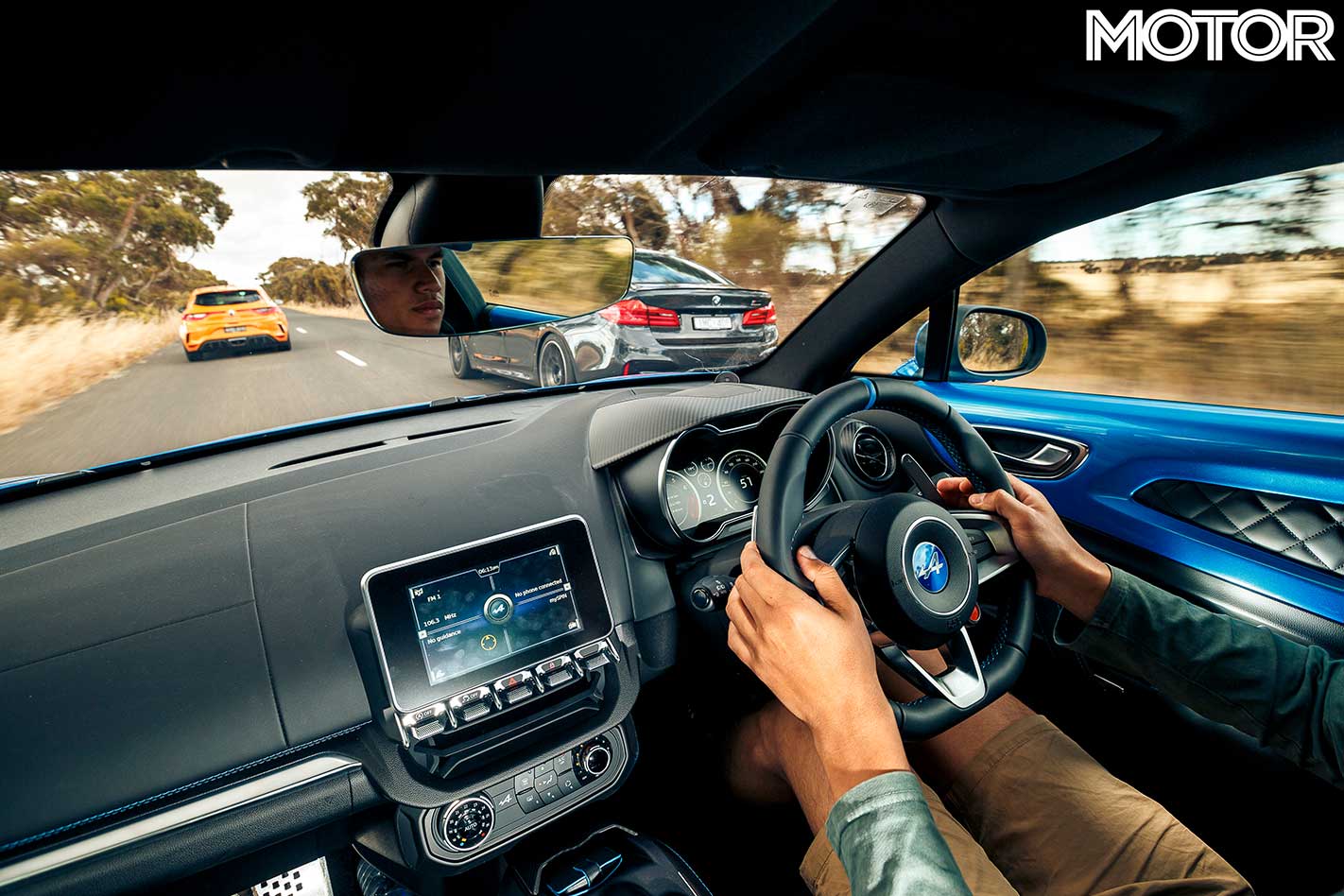
By now we’re getting into the Adelaide Hills, a region dotted with cute-as-a-button little towns all linked by entertaining, largely empty roads. And even when you do range up behind a local in an SUV, they’re just about as likely to move over and let you past as drivers in the rest of the country will sit on the centreline and speed up when you try to get by. That’s almost enough reason on its own to pack up and move to the SA hills.
By now I’m in the i30 N, reacquainting myself with a car that will go down in history as South Korea’s first proper performance car. Despite having done lots of kays in Ns over the past few months, I’m still amazed at how effortless it can be when you’re on a transit stage, yet can still instantly turn it on when you want to play. Yes, the switchable drive modes have a bit to do with that, but the inherent balance and sheer accessibility play a big part, too.
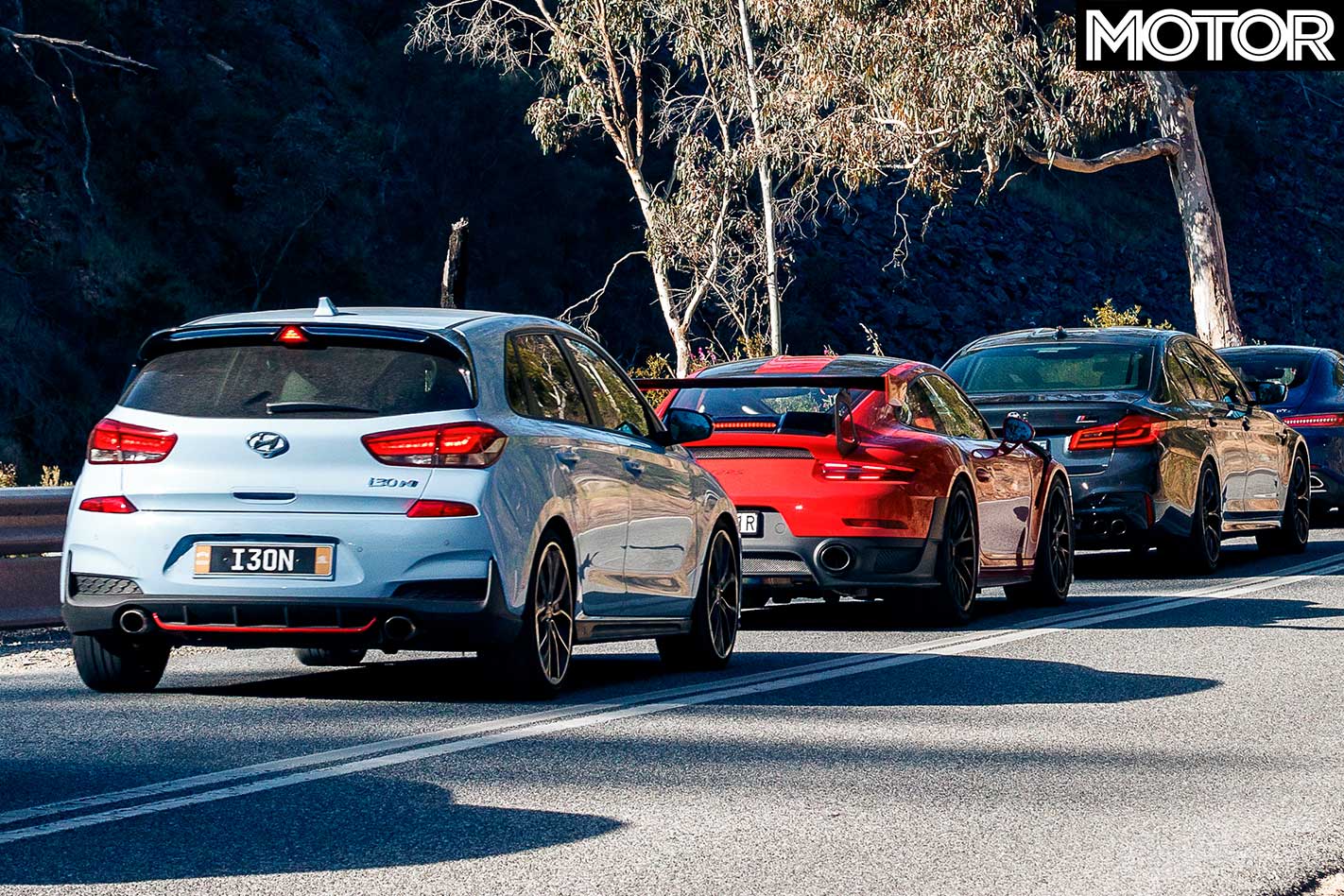
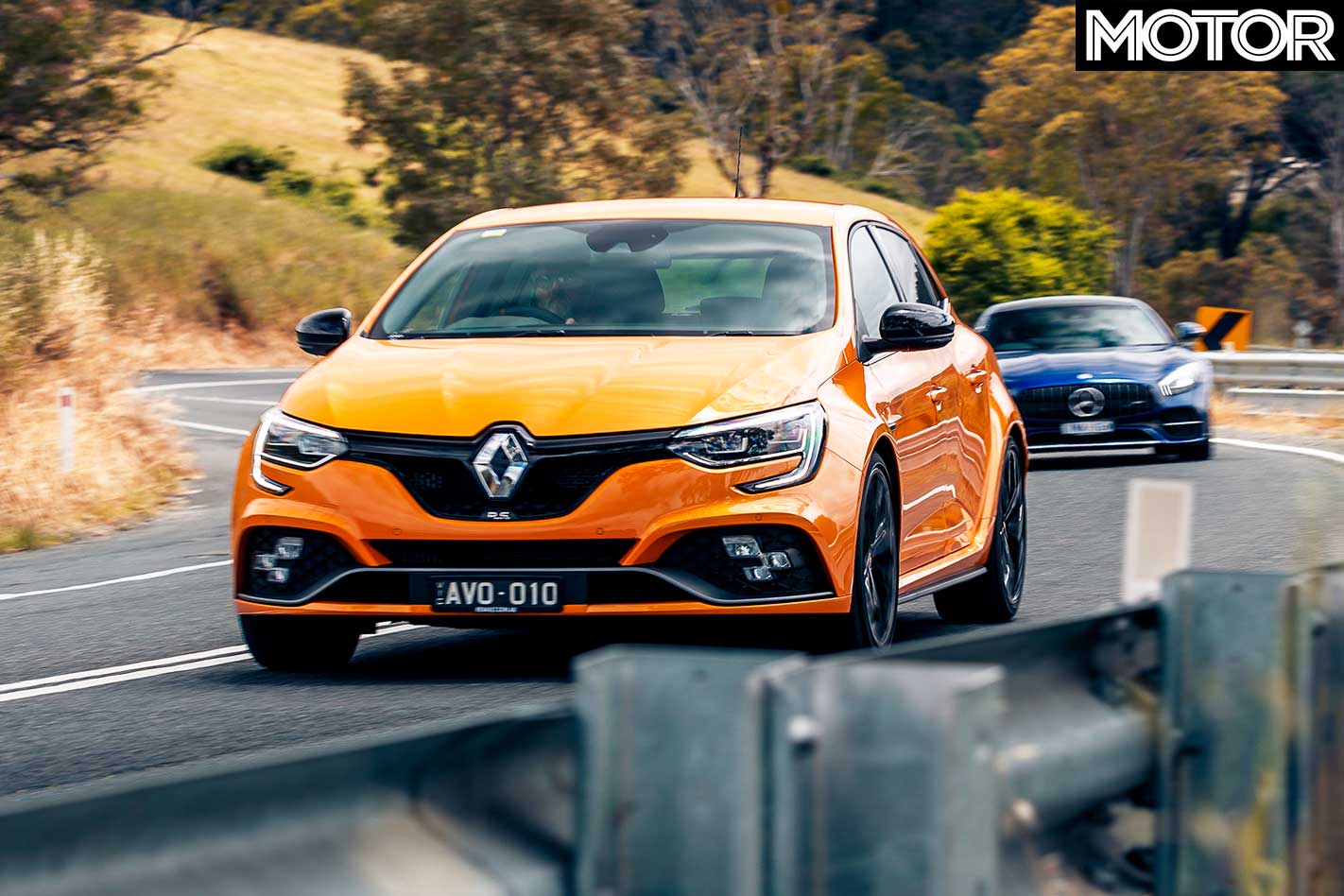
For back-to-back purposes, I then grabbed the Renault to see if it could match the Hyundai for versatility. The Megane is good, make no mistake, but I don’t think it quite nails the fast road-car brief quite as well as the i30. The ergonomics are still puzzling (the cruise main switch down near the cup holders, for instance) and it’s just not quite as easy to grab by the nads and start throwing it around.
The four-wheel-steering thing is actually very good, though, and allows you to back her into bends like a pro. There’s evidence of more top-end squirt, too. I’m beginning to think the Megane might make a bit of a mess of the Hyundai on the track.
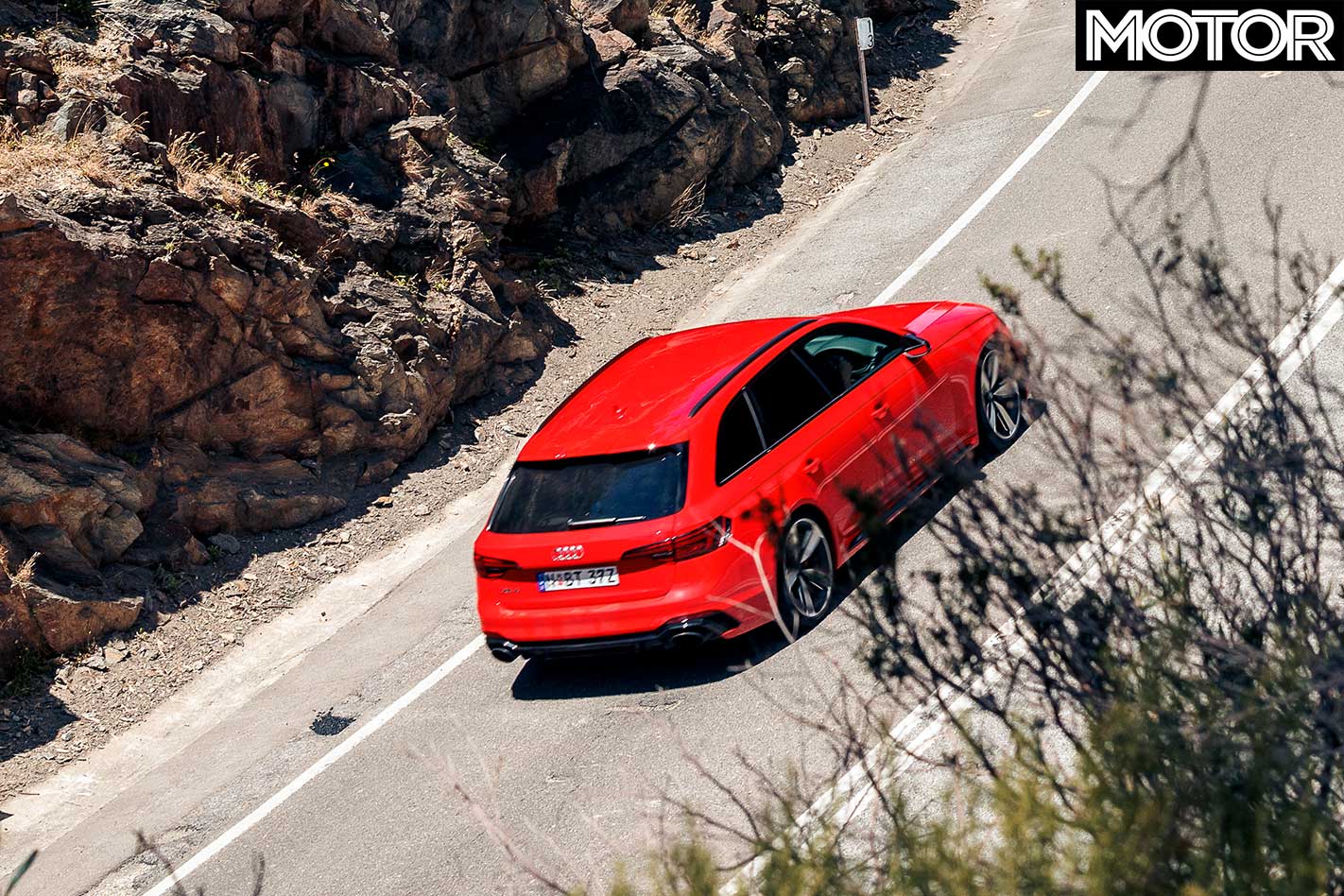
Towards the end of the day, I found myself in the Audi RS4. Now, it’s not that I’m not impressed by this car as a concept, but set among the other bling parked at the side of the road, the RS4, even in bright red, just kind of got lost a bit. But that stealth thing is such a lovely part of the Audi’s schtick that it’s hardly a criticism. And then you drive it.
Hoo-ey, this thing is polished. Look up a dictionary and ‘resolved’ is spelled ‘RS4’. It’s lovely to sit in with that El Fabbo virtual cockpit and the rest of the trim and equipment make it a soothing, comfy place to be. But even that pales when you get stuck in and the 331kW of the turbo V6 are revealed to be ready and waiting for your throttle-call.
The eight-speed automatic works as well as one of these ever did, and after the pummelling suspension of some of this batch of hotties, the RS4 is dead-set armchair perfect. This combination of balls and civility was all brought back home to right at the end of the day when a few of the cars, the RS4 included, started to get a bit dry in the tank department.
So a pack of us hustled them down the hill into the back of Adelaide for a top-up; a process that only further cemented my view of the Audi’s brilliance. Even if it looked like any other sales-rep’s Audi wagon in the car park of our overnight digs in the German-inspired town of Hahndorf.
Within all this, we’d locked onto a little road loop just off the main LA-canyon-esque road we’d been using and it was the wee side road that allowed us to soak up a bit more of each car. And while a few cars emerged pretty much as expected from the rest of the drive, a few really gave up their souls on this side track.
Not the least of those was the AMG GT C, which started to feel, to some of us, that its suspension wasn’t perhaps quite as sorted as we’d hoped. Certainly the bigger bumps didn’t fry its brain, but the smaller, pattery gear somehow made it feel less composed.
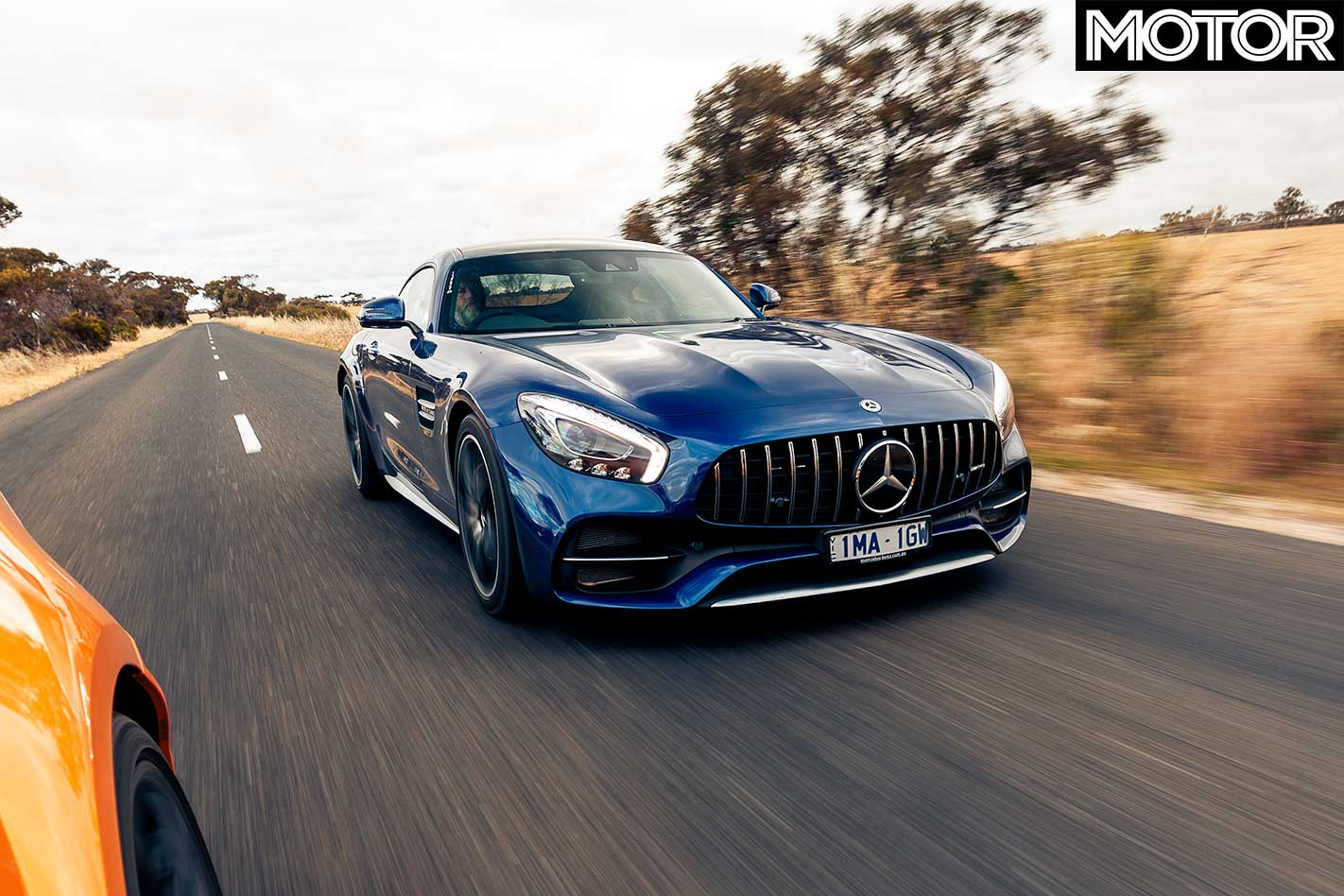
Okay, so a stiff ride is an AMG branding thing, I know, but it did mean you weren’t always as keen to hoik the GT C in hard, purely because you weren’t confident that it would soak it all up. Not that you were constantly thinking about a crash scenario, but with big days in the saddle, sometimes just saving your kidneys another smashing is incentive enough to back off the throttle. And this is where 16-hour PCOTY road days really sort things out.
BMW’s M5 Competition is another great example of this. Yes, it’s blisteringly fast both in a straight line and mid-corner, but in the BMW’s case it was the relatively distant dude-to-car connection that made you consider your entry-speed options.
Hell, it’ll go around a corner faster than I’ll ever need it to, but, like a millennial will tell you, it’s nice to be told that you’re doing well. In this case, the M5 Competition was giving up nothing of the sort.
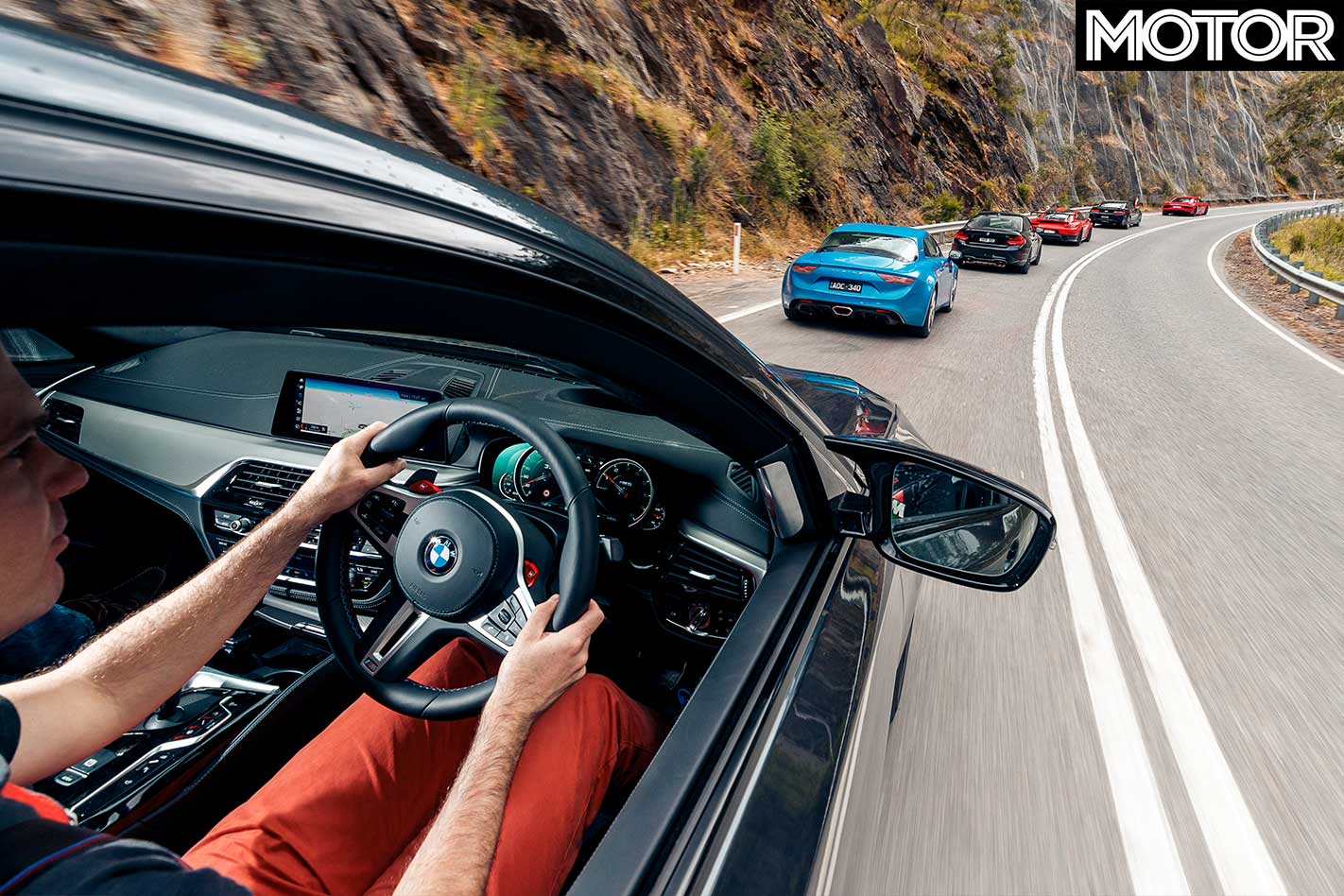
It wasn’t exactly road-loop two, cars nil, but what happened next put things into perspective. Because that’s when I climbed down into the Audi R8. Now, my experience of this type of platform and rear-drive was a Lamborghini Balboni at PCOTY a few years back which immediately reminded me why they make ’em all-paw. It was scary-sketchy, so I wasn’t expecting a whole lot from the R8 RWS.
Boy, was I wrong. Okay, I can see how losing the front drive axle might make a difference on the track, but on the road, it just made the thing ultra-playful; able to wag its tail if you wanted, but also mega-fast if you used your skill and judgment. And having the front tyres steer rather than steer and drive has done the steering feel no harm at all. In fact, that’s this car’s forte; the level of communication and accessibility it gives off.
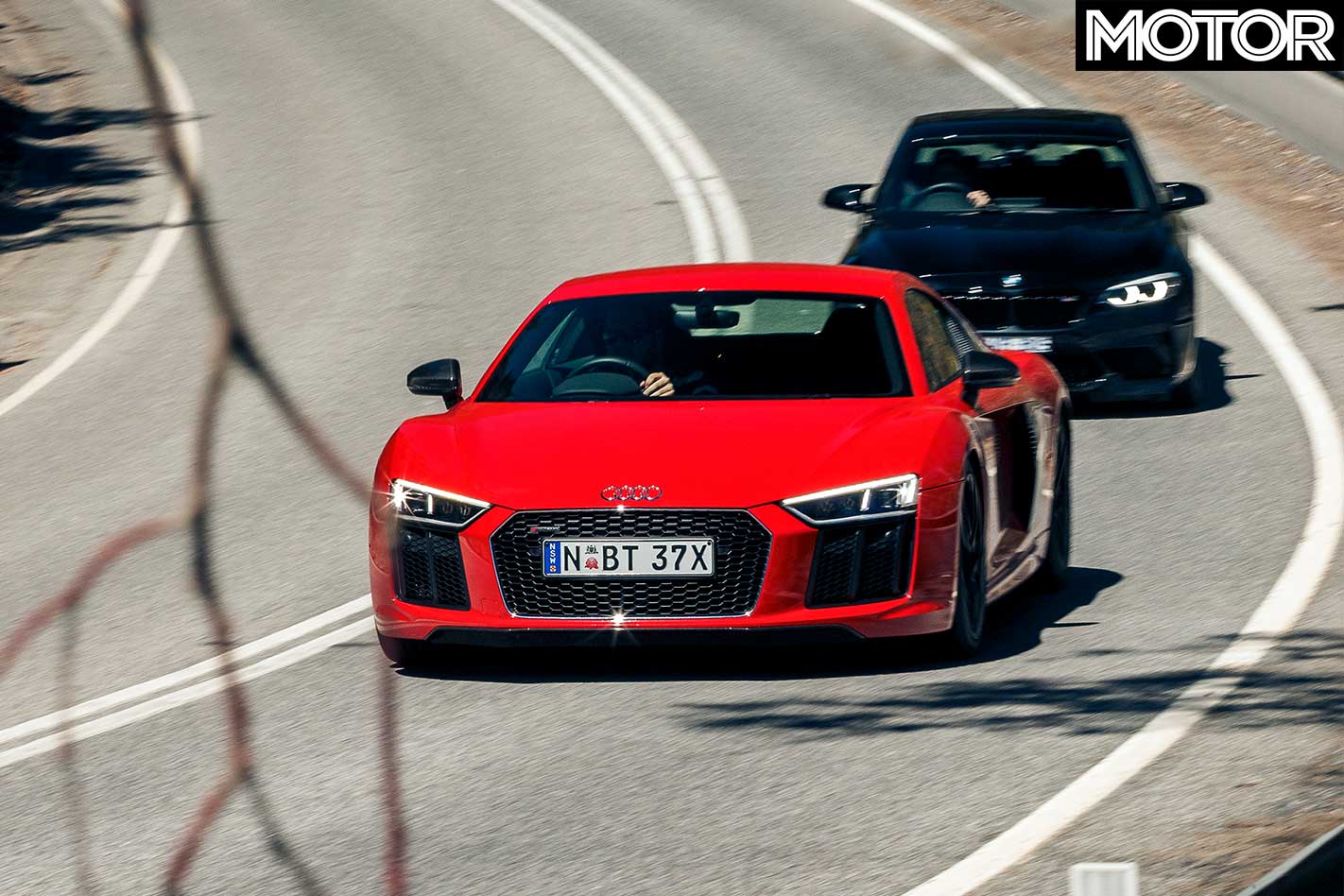
The other car that shone on our little side-route was the M2 Competition. The M2 has been my fave BMW since it was launched and the Competition is even better. But on the undulations and weird radii of this little road, the short-wheelbase M2 was surely in its element. How that will translate to the track is a guess at best, but on the road, it’s magic. Oh, and it’s stealthy enough that the unmarked VF full of coppers going the other way never looked twice.
My last two road drives were reserved for the Camaro and the Mustang. Makes sense, too, because a back-to-back of this pair was always calling. Again, the day was drawing to an end and I was brain-baked. So the Camaro was a nice, comfy, familiar thing that goes like a good ’un but didn’t require you to be cracking the whip. The ride didn’t wow me, however, and the auto seemed pretty aloof. The track tomorrow would tell us more about that stuff.
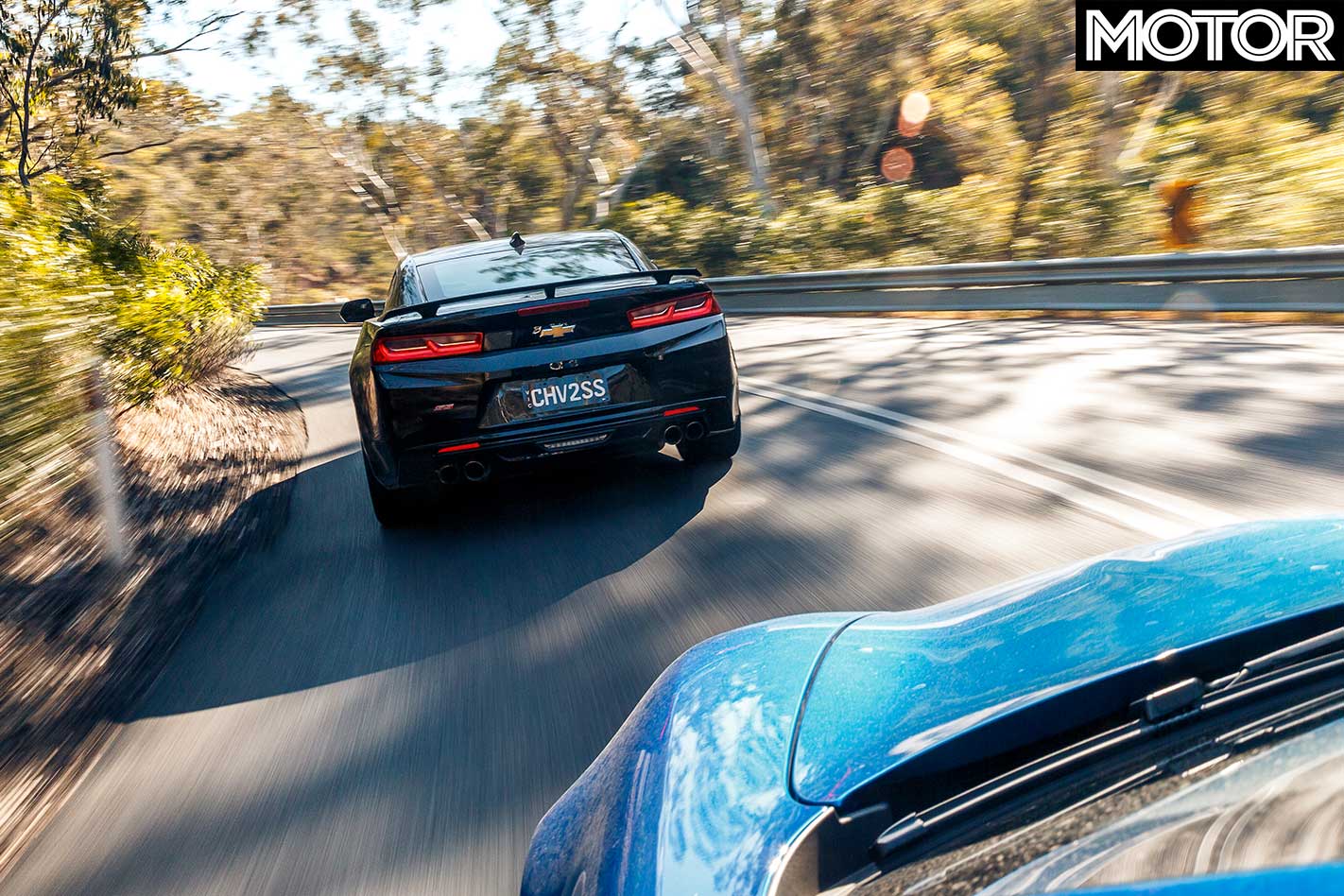
The final photos taken, the Motor crew headed for a local restaurant. Meanwhile, I’m too frazzled to bother, so I hit the road in the Mustang and headed for the old sub-station for beddy-byes. It clearly doesn’t have the stomp of the Chevy and while it is faster than the previous ’Stang, you only discover that when you rev it right out. At road speeds, using road revs, it feels no faster than the old car. I’m also starting to wonder about the 10-speed auto, too. Seems like this engine could make do with five gears and less leap-frogging between ratios, because as it is, there’s just too much going on.
There was also too much going on as I hit the final on-ramp and booted the Ford up onto the plane. Too much police presence, anyway, and just as I reached cruising velocity, there he was, a highway patrol car parked in the median strip, pointed my way. And no, he didn’t. We love you South Australia.
Hey, big drinker
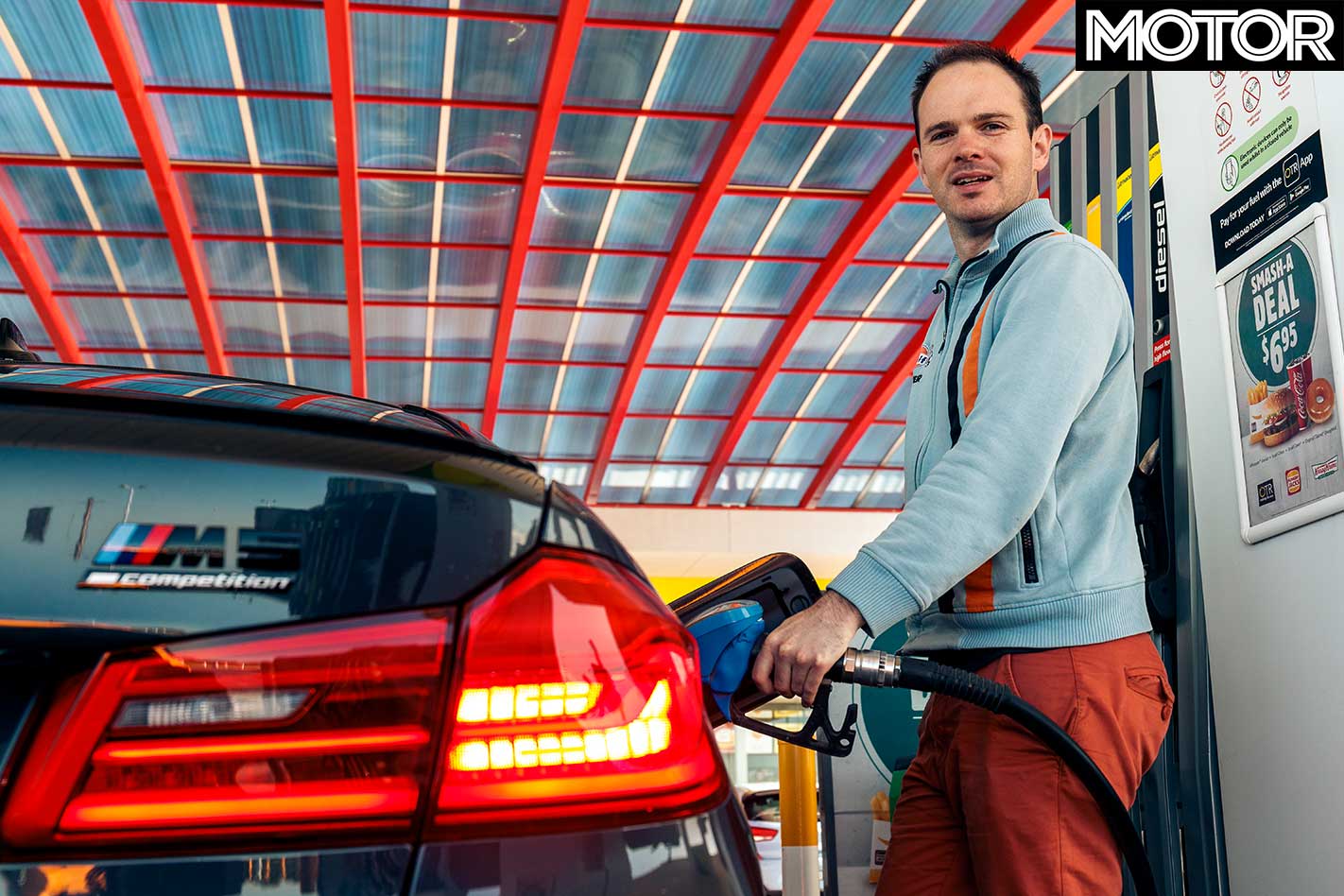
Which car got the closest to its consumption claims?
| Rank | Vehicle | Claimed* | Measured | Difference |
| 1 | Hyundai i30 N | 8.0L/100km | 11.4L/100km | +3.4L/100km |
| 2 | BMW M2 competition | 9.2L/100km | 16.3L/100km | +7.1L/100km |
| 3 | Alpine A110 | 6.2L/100km | 13.4L/100km | +7.2L/100km |
| 4 | Renault Megane RS280 | 7.2L/100km | 14.5L/100km | +7.3L/100km |
| 5 | Porsche 911 GT2 RS | 11.8L/100km | 20.2L/100km | +8.4L/100km |
| 6 | Audi RS4 Avant | 8.9L/100km | 18.5L/100km | +9.6L/100km |
| 7 | Chevrolet Camaro 2SS | 11.6L/100km | 21.3L/100km | +9.7L/100km |
| 8 | Ford Mustang GT | 13.0L/100km | 22.8L/100km | +18.6L/100km |
| 9 | Mercedes-AMG GT C | 11.4L/100km | 22.3L/100km | +12.1L/100km |
| 10 | BMW M5 Comptetition | 10.8L/100km | 22.2L/100km | +11.4L/100km |
| 11 | Audi R8 V10 RWS | 12.4L/100km | 25.7L/100km | +13.3L/100km |
| *Combined urban/freeway fuel consumption | ||||
Gorge Road, SA – 26km of bliss
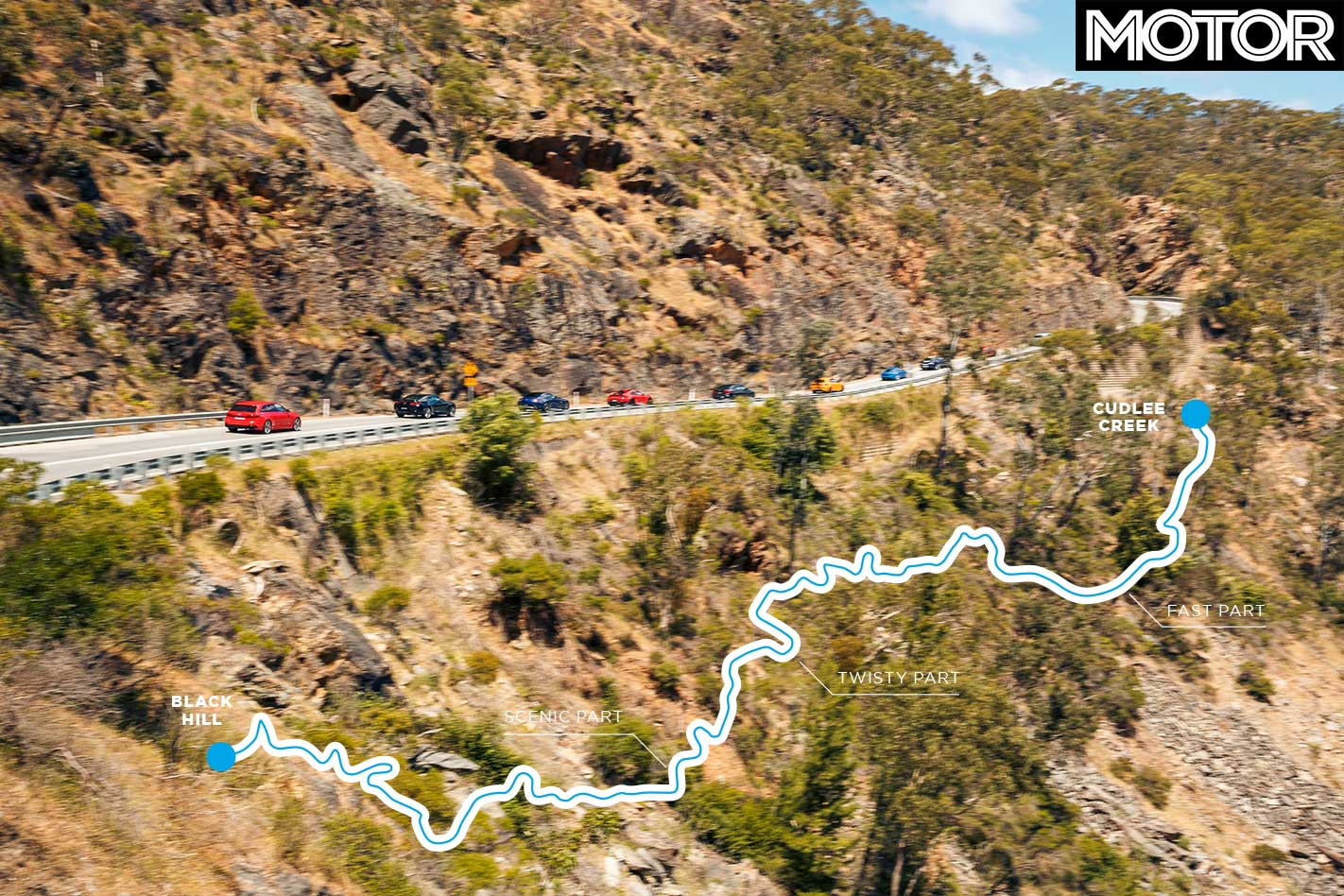
Hundreds of kilometres of tarmac are draped across the Adelaide Hills like ribbons of cooked spaghetti, but not every road is a winner. Gorge Road is certified gold, though, which is why it’s one of the key stages for the Classic Adelaide tarmac rally each year.
It’s almost perfect, with tight, bumpy canyon sections giving way to smooth, fast rollercoaster bits. Even better, there’s a great cafe at the Cudlee Creek end, while if you run short of fuel, it’s a quick run down the hill into town.
IT MAY seem opportunistic, but we couldn’t help but get excited about the influx of auto exotica due to be auctioned off in early April now that the Gosford Classic Car Museum has closed.
The $70 million auction will take place April 6-7 – a certified fire sale – with no reserves on over 150 cars hitting the auction block.
Going off listings from Lloyds Auctioneers and the Gosford museum website, there’s everything from a 2015 Ferrari LaFerrari to a 1983 American firetruck for sale.
Unfortunately a dispute with the Australian Tax Office is the reasoning behind the closure, with the ambiguous part-museum, part-car yard nature of the venture catching the eye of the powers that be.
While it is sad that the short-lived museum will shutter its doors, we’re taking solace in the fact that there are some absolute gems on offer. These are our favourites.
2015 HSV GTS Maloo
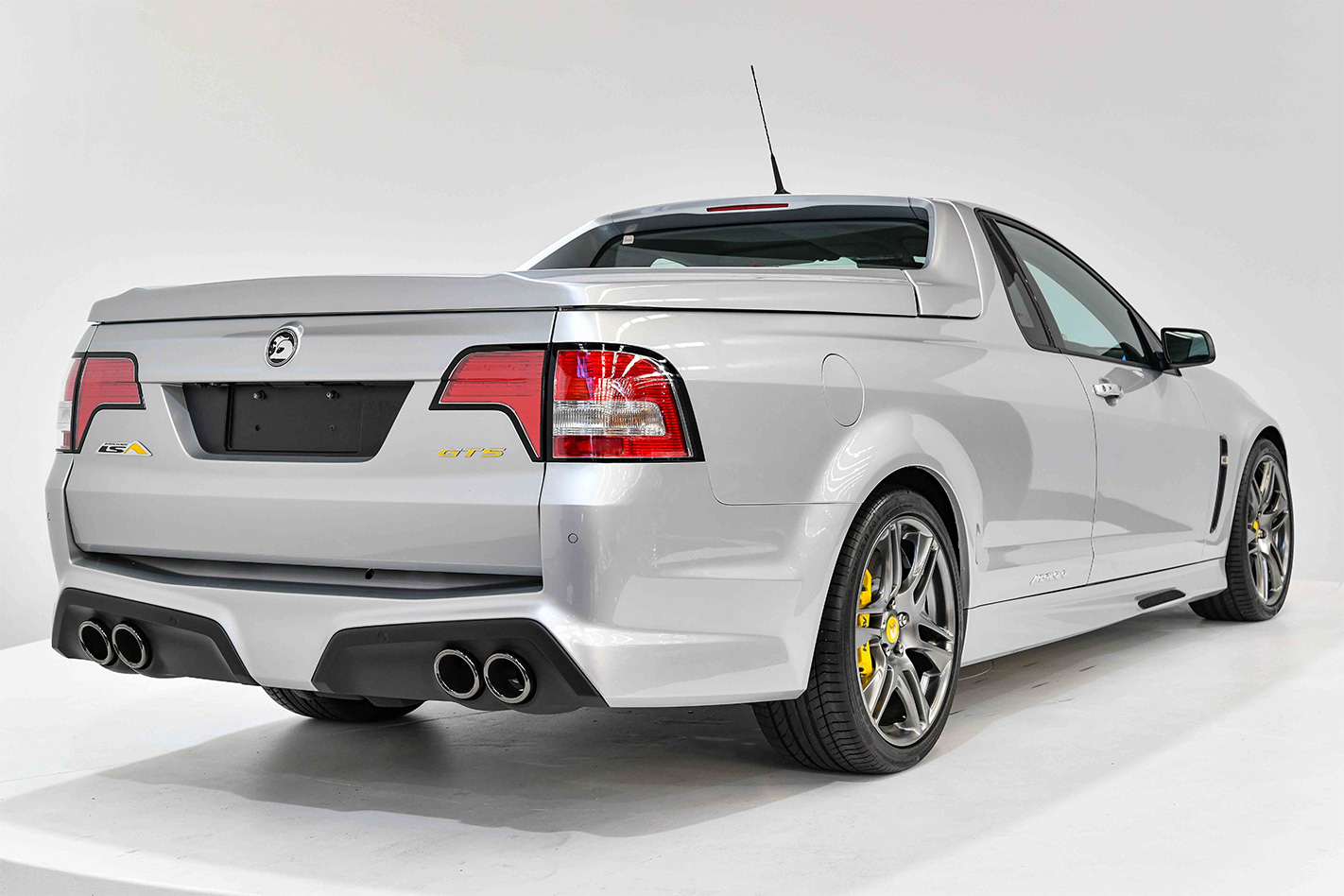
Sure, there are plenty of special Australian cars, but when HSV decided to drop the gargantuan 6.2-litre supercharged LSA into a ute, Aussies collectively started to froth at the mouth. One of 250 examples, this silver GTS Maloo has 110kms on the clock and like most of the newer stuff in the Gosford collection, presents as-new. While it may have been a bit ahead of its time (HSV decided to do a full-run of LSA Maloos years later), this was the ute that HSV wanted to be remembered for.
1997 Aussie Invader III LSR JET
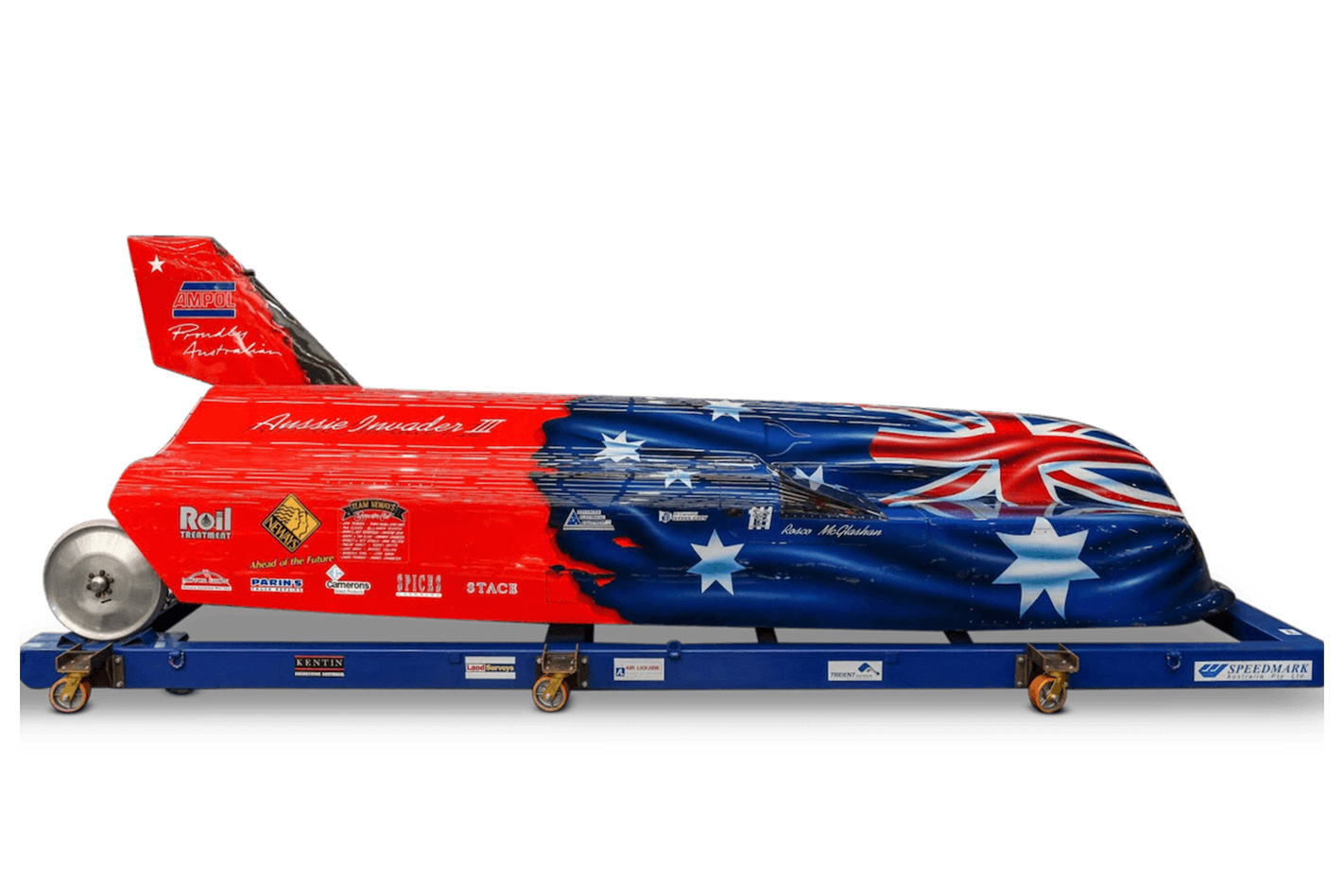
How’s this for left-field? Built and piloted by maniac Rosco McGlashan, the Aussie Invader III is officially Australia’s land speed record holder and unofficially, former world land speed record holder. Boasting 26,000kW and capable of 641mph, this remarkable piece of Australian motorsport history deserves its place in your collection. Get bidding.
2015 Ferrari LaFerrari
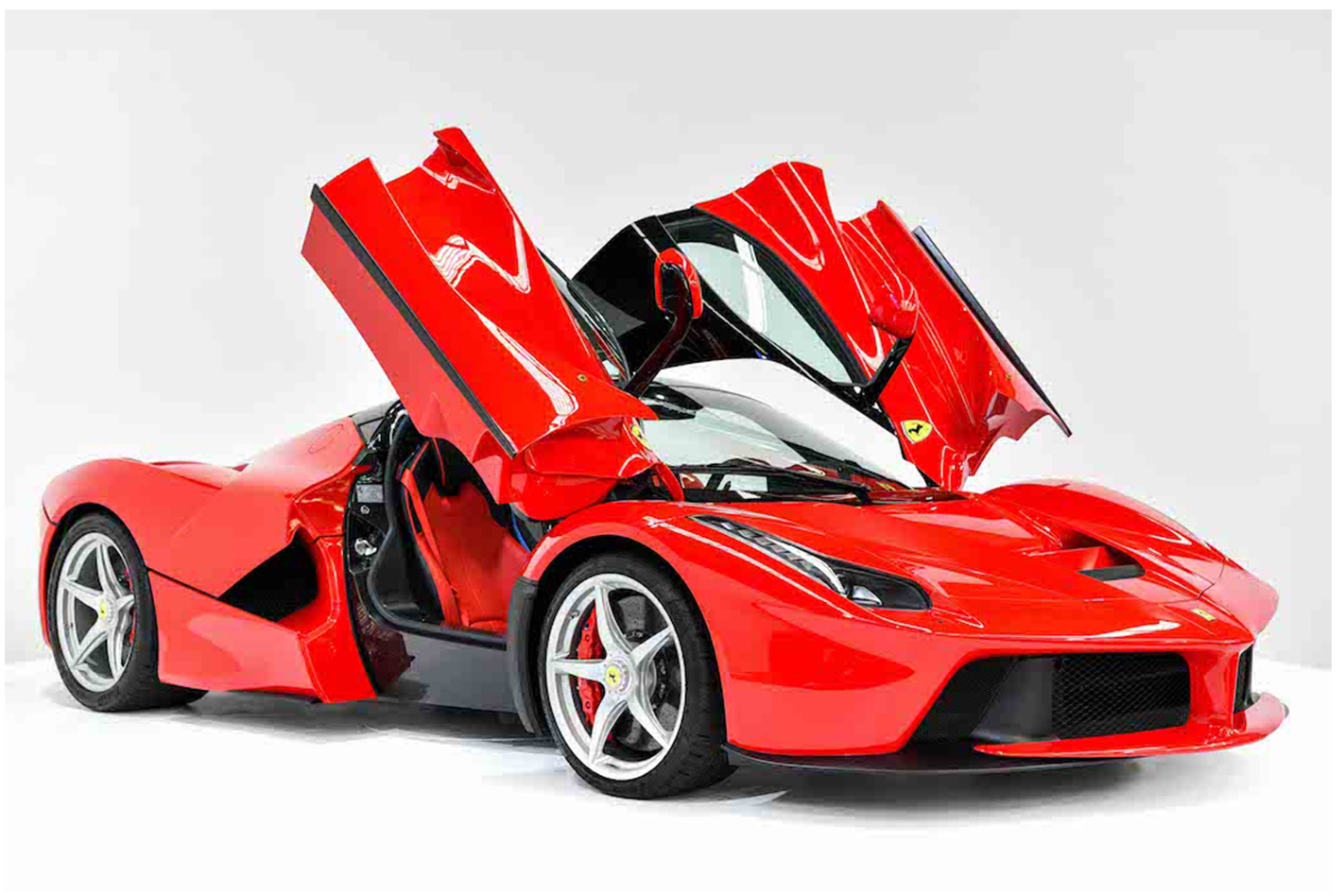
A mere 190km on the odometer, Gosford’s LaFerrari presents in immaculate, as-new condition in the Ferrari favourite, Rosso Corsa. Apparently all Australian taxes are paid (do your own research), and it’s eligible to be driven on Australian roads from 2019 onwards, due to recent law changes. While this one doesn’t seem to be part of the auction, interested parties are free to privately negotiate for what could potentially be one of Australia’s fastest road-going cars.
2006 Aston Martin DBRS9
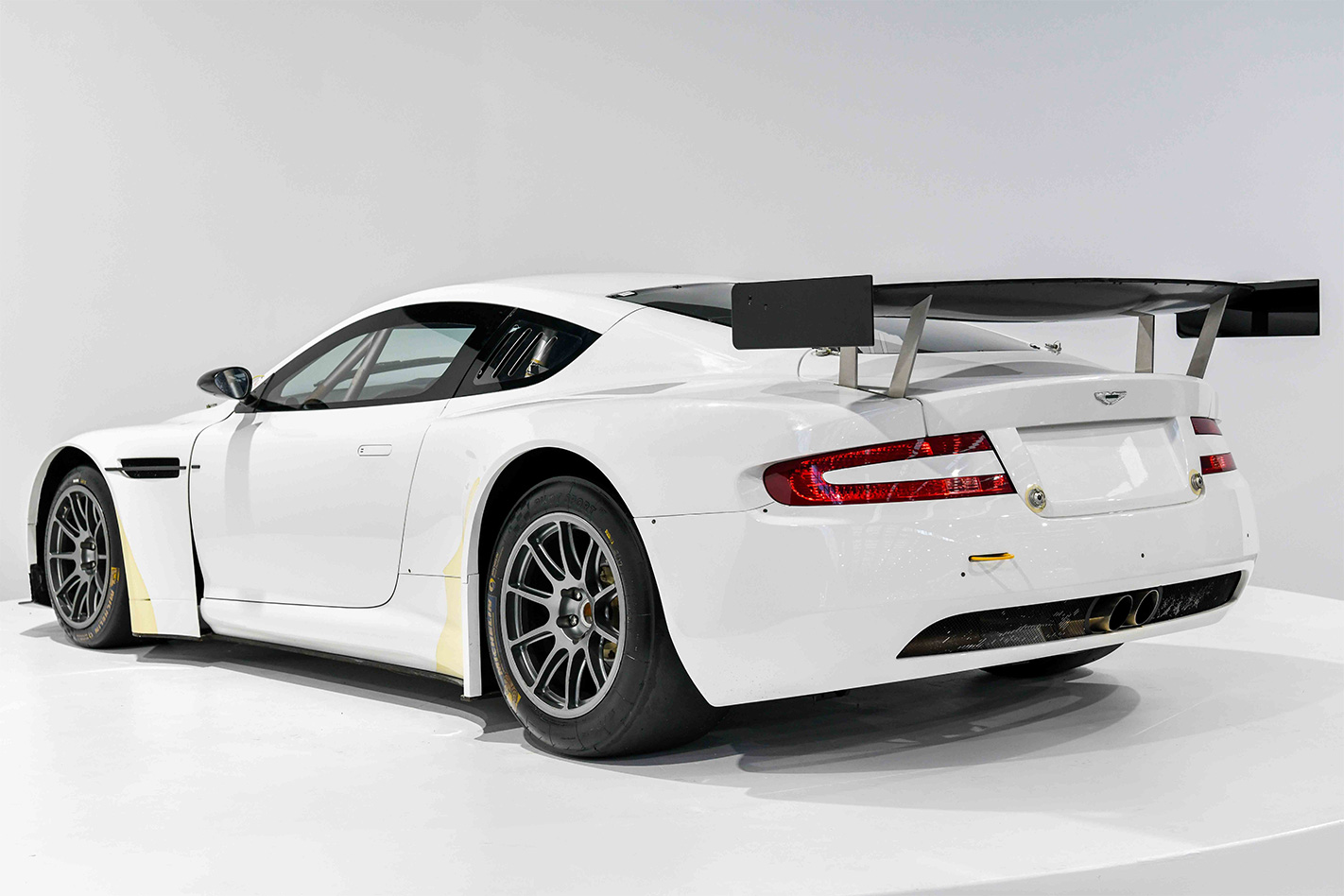
Never raced, pristine condition – it’s not often that can be said for any race car, let alone a Le Mans-spec Aston Martin DBRS9. Finding its way from Hong Kong to Australia, this GT3 racer features the racing version of the DB9’s ear-splitting 5.9-litre V12 and has travelled 245kms since its creation. Ready to be admired or raced, you don’t find examples like this very often.
1985 Lamborghini Countach 5000 QV
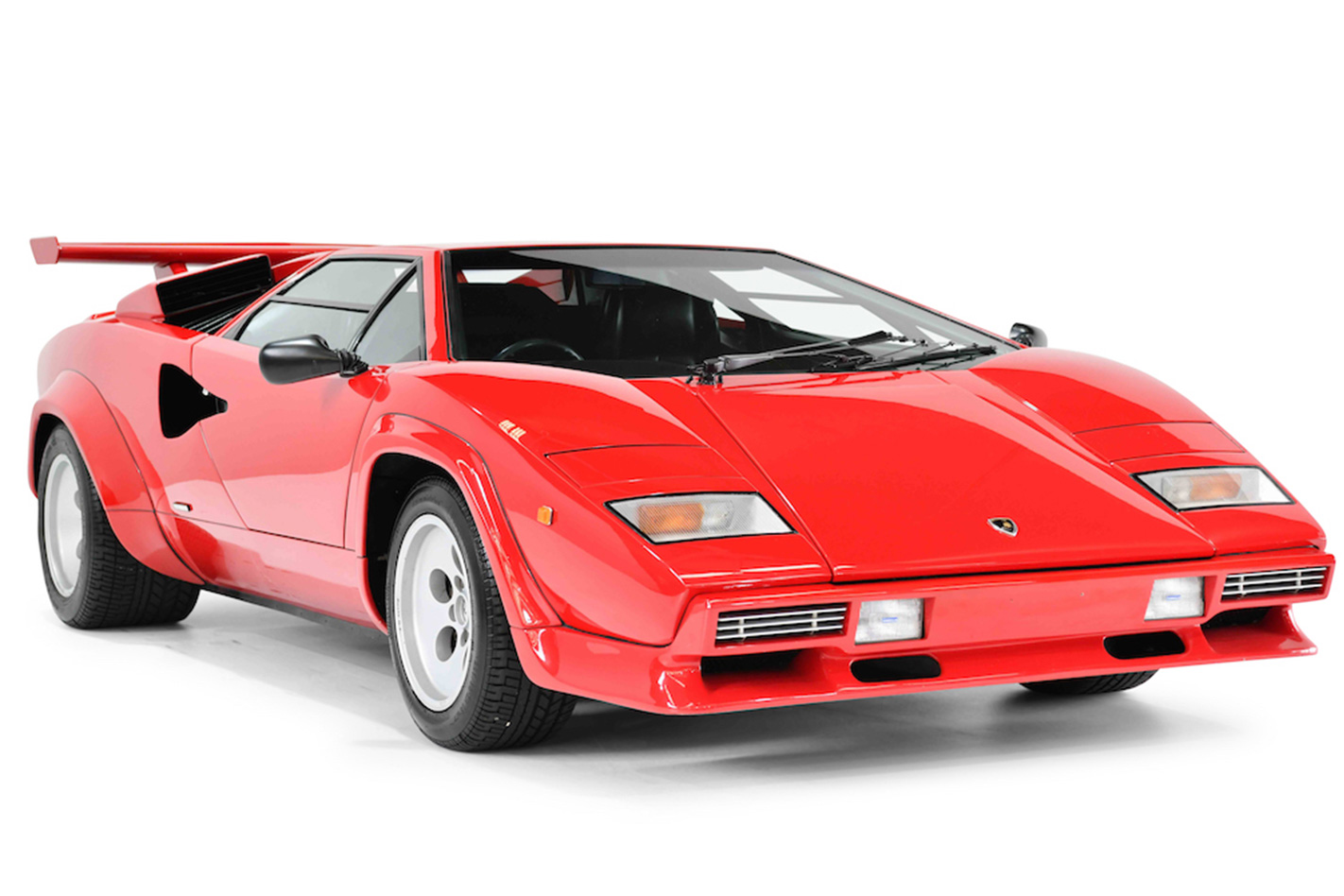
One of only 100 right-hand-drive examples of the Countach, this Australian delivered example sold new in Sydney in 1985. With 70,000kms on the odometer, this car retains its originality, sporting its original paintwork and leather upholstery. A poster car of the 80s, the Countach hasn’t quite hit the top of its stride in terms of value just yet, so we’d suggest picking one up before it’s too late.
Until recently, the Toyota Corolla has been a venerable sales juggernaut, providing Toyota Australia a license to print money.
However, now sales have begun to slow, with rivals like the Mazda 3 and Hyundai i30 eating into the Corolla’s sales dominance.
Worryingly for Toyota Australia, the introduction of a new generation Corolla seems unable to stop the slow-down, with a number of poor sales months since it was introduced late last year.
Orlando Rodriguez, Senior Product Public Relations Project Lead at Toyota Australia, says the company is waiting for more data before passing judgement on its small hatch’s success.
“From launch, our volumes coming into the country were staggered to grow,” he said.
“We’d want the results from the first two months of this year to get a proper feel, now that it has been in the market for a while.
“Anecdotally, we are happy with the volumes and how it is going. There is no concern from our side of things.”
The arrival of the 12th generation Corolla last year saw cheaper variants dumped, and incremental price increases throughout the line-up.
The base Ascent variant was scrapped, meaning the entry cost for Toyota’s most popular passenger car has risen from $20,190 to $22,870 for the manual Ascent Sport.
Other models within the range have also nominally increased in price, with the SX hatch rising from $26,000 to $26,870 when fitted with an automatic transmission, and the flagship ZR costing $350 extra with a $30,370 sticker price.
In January 2019 sales data, the Corolla was registered 2417 times across the country, dropping it below the Mazda 3, which enjoyed 3201 registrations.
However, the Mazda 3 is currently in run-out, ahead of a new model arriving in Australia in Q2. Mazda Australia expects its remaining hatch stock to sell out as the first batch of next-gen cars become available.
Both the Mazda 3 and Corolla were down 11.6 and 12.9 percent respectively in January compared to figures achieved in the first month of 2018.
Toyota’s worst sales result for the Corolla since 2011 occurred in December last year, with just 2311 registrations nationwide, down 12.5 percent compared to the same time last year.
Numbers have gradually been dwindling since the Corolla was introduced to the local market in August, when 3033 registrations were recorded.
Overall, Corolla sales shrunk by 5.4 percent in 2018 compared to the prior 12 months.
One of the contributing factors to the slowing sales is a reluctance by rental companies to place orders for the new Corolla.
“From the first few months of sales, there has definitely been a stronger shift toward private buyers,” Rodriguez explained.
“The rentals have taken a smaller percentage, but we think that’s likely because those companies traditionally take a bit before they commit to buying new vehicles. It’s hard to tell how that is going to end up going long-term.
“We’ve certainly noticed a stronger desire from private buyers to buy this model, and we are noticing a stronger skew toward the higher grades as well.
“Where we would have done more than 50 percent sold as entry grad previously that has dropped down to as low as 30-40 percent.”
Adding to the hurt was the fact Toyota Australia had its hands tied in the early stages of production by head office.
“In the first few months the sales figures were lower, but we were also struggling to get supply out of Japan because of global demand,” Rodriguez said.
“There were supply restrictions everywhere, but that has lifted. Though we are still restricted on the number of hybrids we can get into the country, meaning we can’t sell as many of those as we would like.”
Toyota Australia acknowledges another factor hurting Corolla sales is the continued shift to SUVs by the Australian car buying public. However, it is confident that overall sales for the company won’t be affected.
Toyota Corolla vs Hyundai i30 vs Mazda 3 vs Honda Civic
“We know things change in the market, and there are always going to be trends that move and shift,” Rodriguez added. “But the biggest strength of Toyota is the fact that if people are changing from one type of vehicle, then we will have a vehicle in another segment that will more than likely fill that need.
“What we are noticing, in general terms, is that while fewer people might be buying something like a Camry, they might be looking at something like a Kluger or RAV4. People are still moving within the Toyota family.”
Toyota Corolla sales figures:
- January 2019: 2417
- December 2018: 2311
- November 2018: 2659
- October 2018: 2663 –
- September 2018: 2917
- August 2018: 3033
Peugeot’s light hatch is undergoing a metamorphic transition to take on the future with an all-electric e-208 version and the latest driver-assist technology.
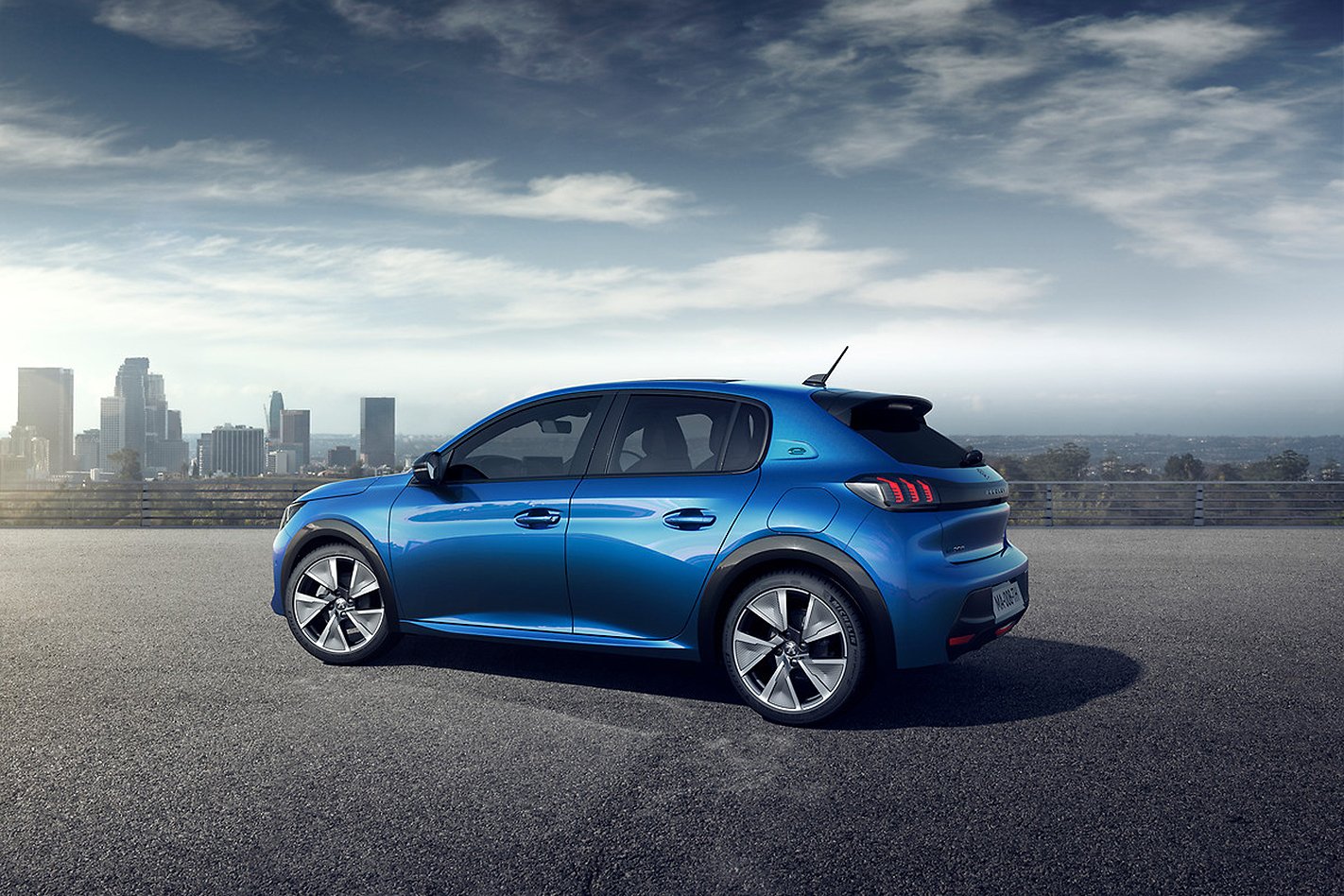
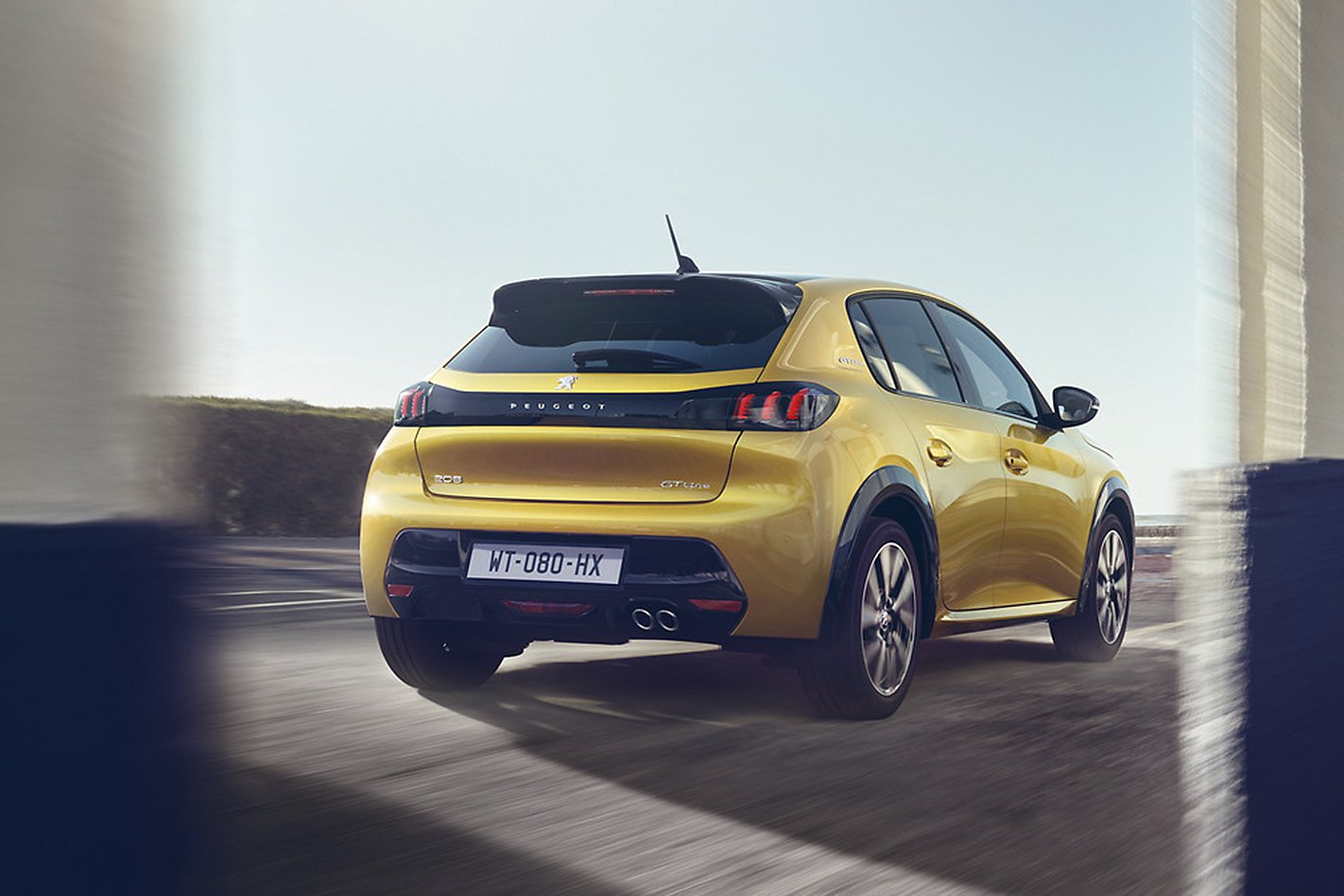
The 2020 Peugeot 208 also features a bolder exterior design that includes the brand’s distinctive ‘3-claw’ headlight signature and shard-like daytime running lights, similar to the new 508 large sedan/wagon, and 3008 and 5008 SUVs.
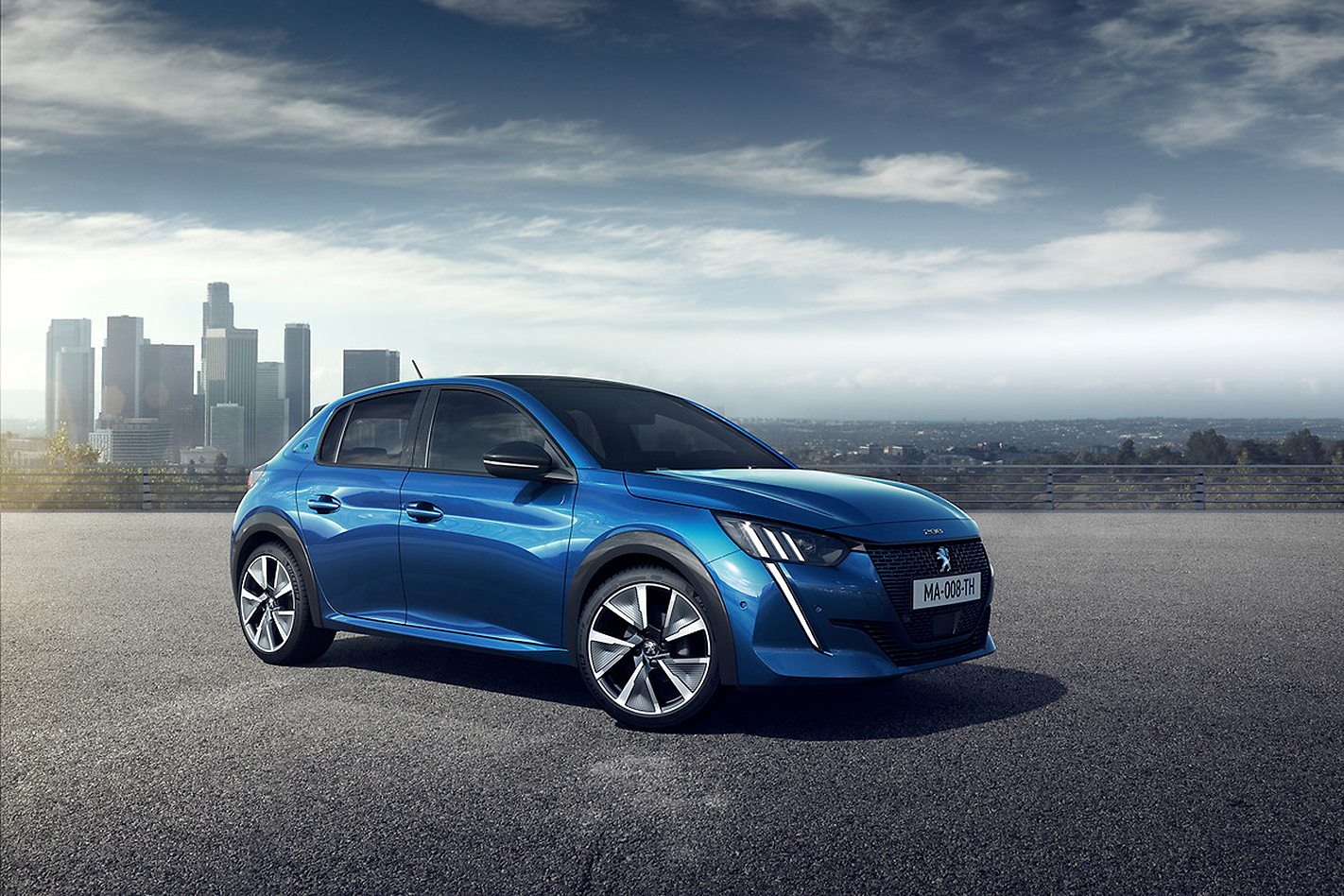
2020 Peugeot e-208
The family resemblance carries on down the back, with a black band running across the boot lid flanked by ‘3-claw’ LED tail-lights.
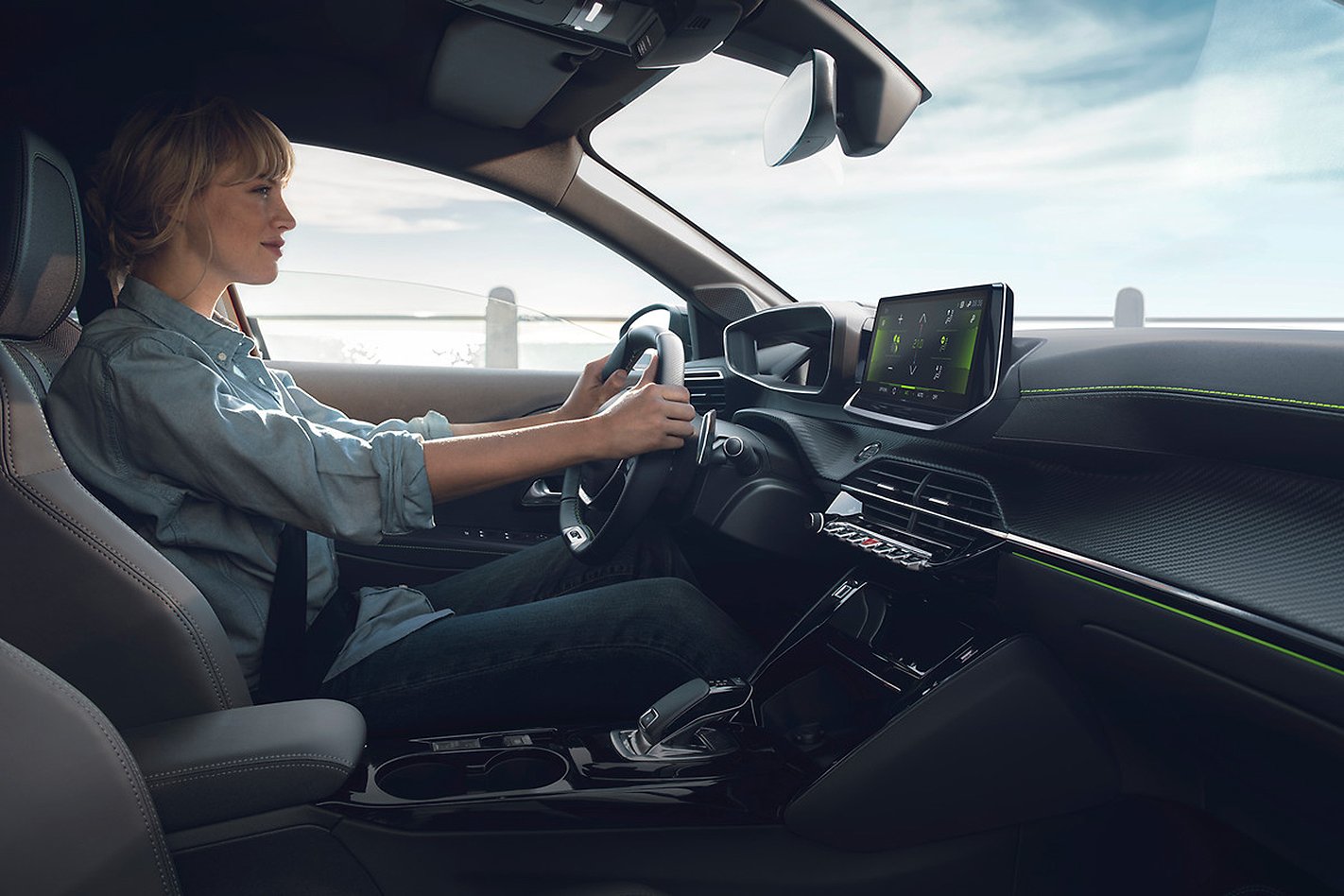
Inside, the all-new 208 gains its bigger siblings’ elegant trim features and Peugeot i-Cockpit system that provides a range of displays and information in the digital instrument panel.
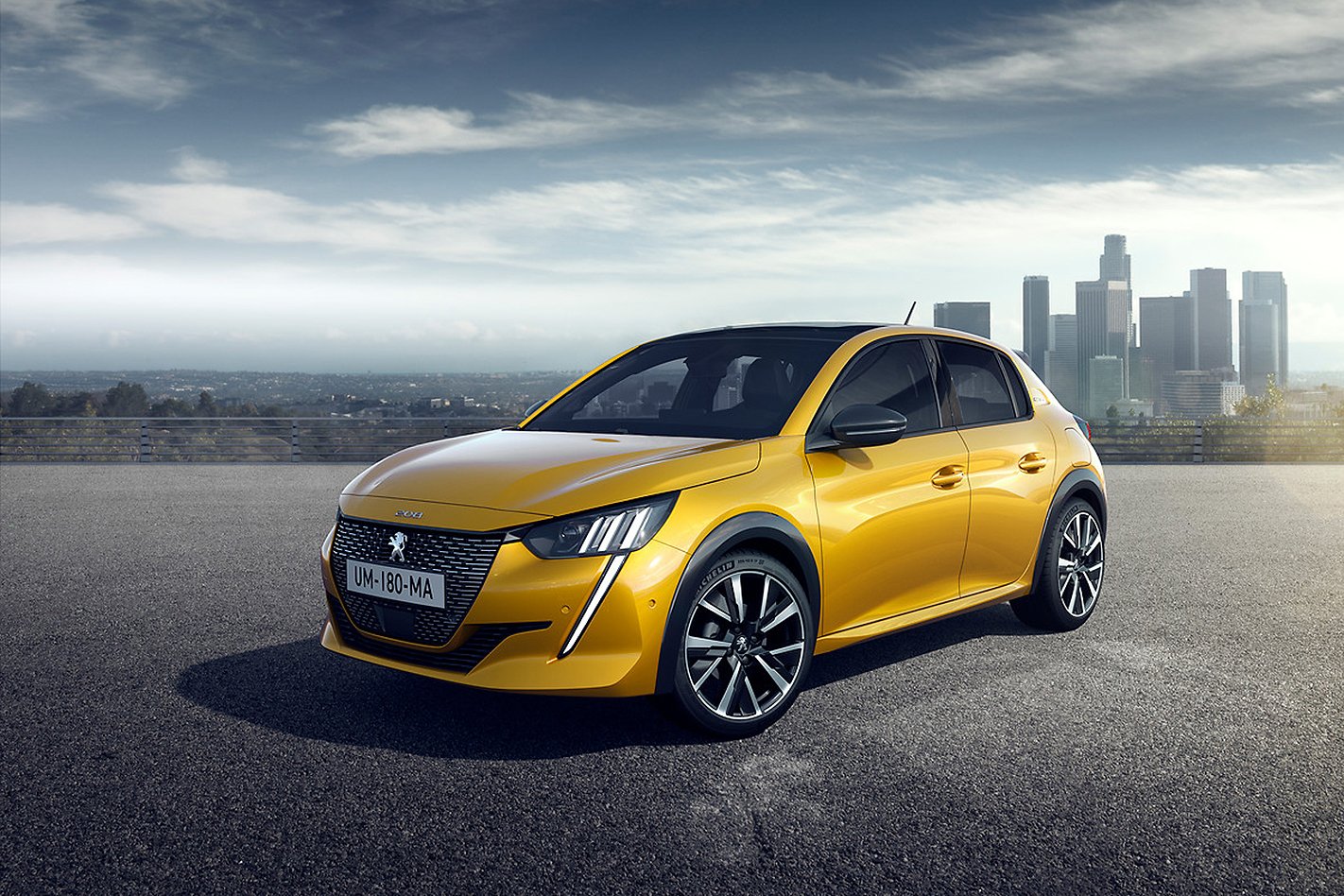
2020 Peugeot 208 GT-Line
Infotainment, which includes Apple CarPlay/Android Auto connectivity, and TomTom Traffic sat-nav, is displayed on a central touchscreen that’s either 5.0-, 7.0- or 10-inches depending on spec-levels, ranging from the entry-level Like, to the Active, Allure GT Line and GT hot hatch.
The new 208 also ups its advanced driver assistance technology, including adaptive cruise control with traffic jam Stop&Go, lane-keeping assist, parking assist, driver attention monitor, auto high-beam, speed sign recognition, and blind spot monitoring.
At this stage, it’s unclear which of these features will be standard across the range, though expect all versions to feature high-speed autonomous emergency braking with pedestrian and cyclist recognition.
Powertrains
According to Peugeot, the e-208 has a maximum range of 340km, which puts it on a par with the Nissan Leaf E-Plus, while almost tripling that of the Renault Zoe.
It’s powered by 50Kwh large capacity battery sending juice to 100kW motor that has a 260Nm of instant torque on tap.
Home charging time ranges from 16 hours via a conventional domestic socket, to eight hours using a single-phase 7.4kW wall box, A three-phase setup will charge in around five hours. However, if you have access to a 100+kW DC charger, Peugeot claim an 80 per cent charge in 30 minutes.
Meanwhile, the Volkswagen Polo rival, the conventional Peugeot 208, will be available with a choice of three 1.2-litre, three-cylinder turbocharged petrol engines, producing 75kW, 100kW or 130kW, and a 100kW 1.5-litre four-cylinder turbodiesel.
As well as hosting more efficient powertrains, Peugeot’s new Common Modular Platform (CMP) is designed to reduce emissions by being 30kg than current models‘ F1 underpinnings, while also having a more aerodynamic underside.
Peugeot is yet to release fuel economy figures, with full specifications for each version to be revealed the official unveiling at the next month’s Geneva Motor Show.
The Peugeot 208 and e-208 will go on sale in Europe during the third quarter of this year, with European customers able to reserve and eventually order and make a down payment online.
A Peugeot Australia spokesman told WhichCar.com.au it is still too soon to confirm if both the e-208 and 208 will be coming to Australia, adding that any local launch won’t be till well into 2020.
Left collarbone’s very sore. Bruised even. Hurts like buggery when it’s touched, which is often. By me, mostly. Bored; touch the collarbone. Stuck in traffic; collarbone. You get it.
This feature was originally published in MOTOR’s November 2002 issue
It’s sore because that’s where the Green Eyed Monster’s three-inch-wide steel seat belt tensioner buckle, set for Craig Lowndes, sat on a less-fit torso. It hurts because under Winton Raceway’s braking areas, through its needle’s eye flip-flop, through the violence of the cleavage, the tensioner bashed it like it was Mundine’s head in an Ottke fight. I touch it because it helps me remember everything about driving a V8 Supercar. It hurts four days later.
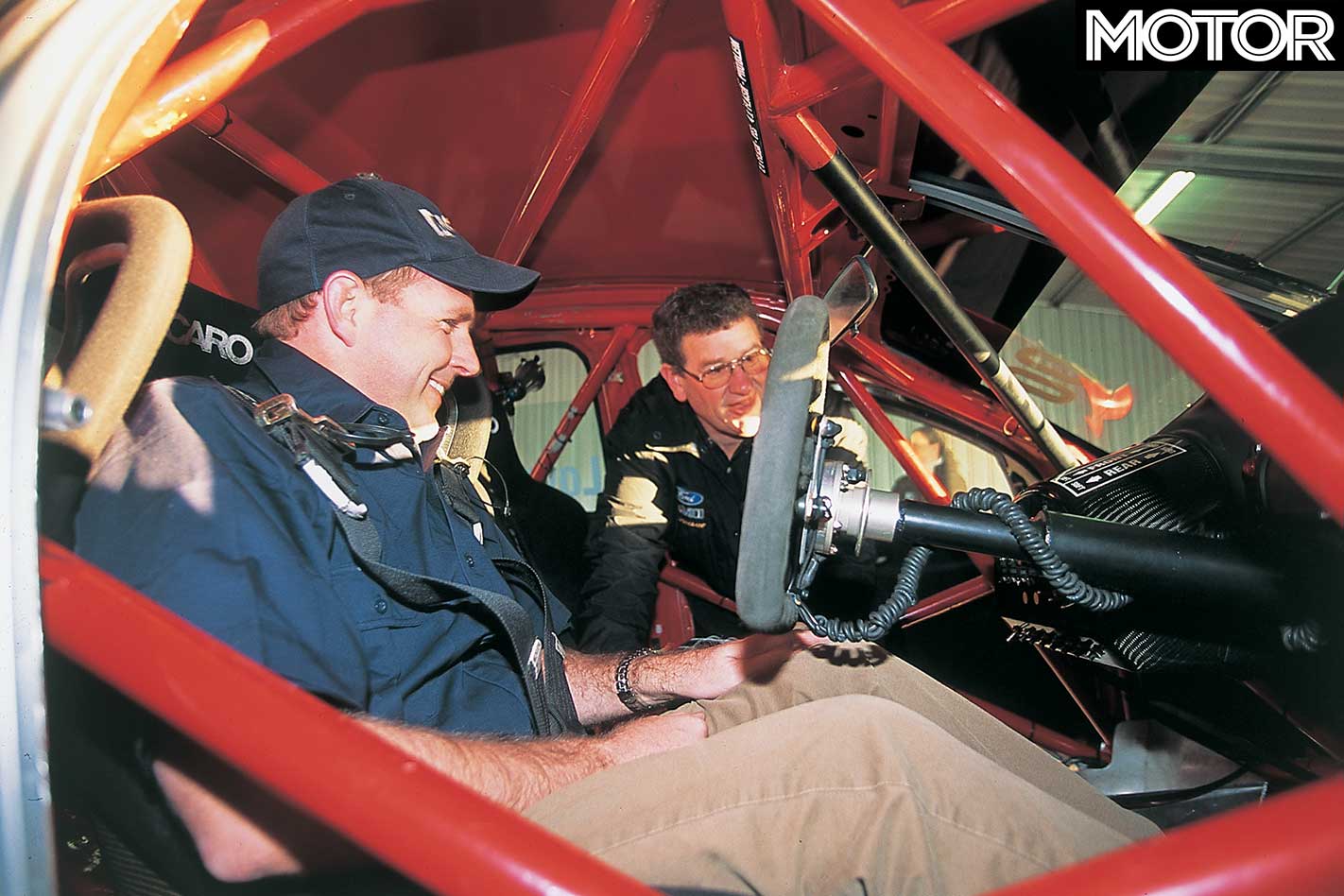
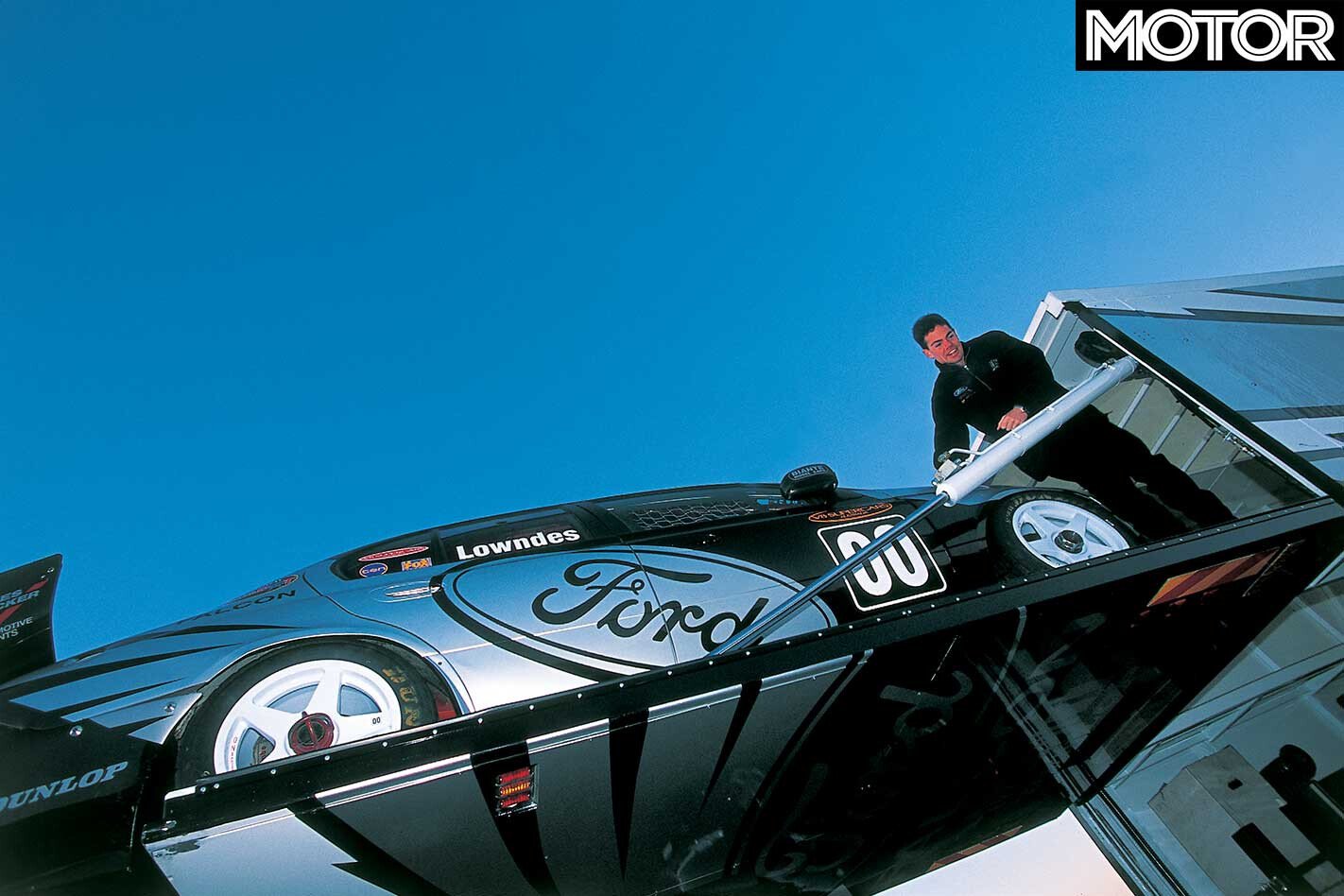
Floated the idea to Ford. The fleet of these things they’re interested in is scattered from Brisbane to Melbourne. And, bizarrely, completely skips Sydney. We got the Monster because it’s the meanest-looking Ford, its driver is a triple champ and nobody, bar nobody, bests him on uncut natural ability.
Fast forward to Double Zero team manager Allan Heaphy struggling to hide his doubts in the minus three of a piccaninny dawn. Lowndes, with that innocent-abroad, wide-eyed-wonder-at-the-hand-life’s-dealt-him way of his, bounces in like the day’s fifth red cordial is already doing its job. It’s a skeleton crew, so he pitches in, equal share of the doings, bare handed on sub-freezing metal.
And then the sun’s up. It’s three degrees. Craig goes out without mercy, then back in. He’s happy it’s all running smoothly, so they bundle me in beside him. He’s a genius, this bloke. Who he is oozes out in the way he drives. Beguilingly smooth, simple and it all seems like fun. Even at this hour. Like he’s just a 20 year old out revelling in his own car control again.
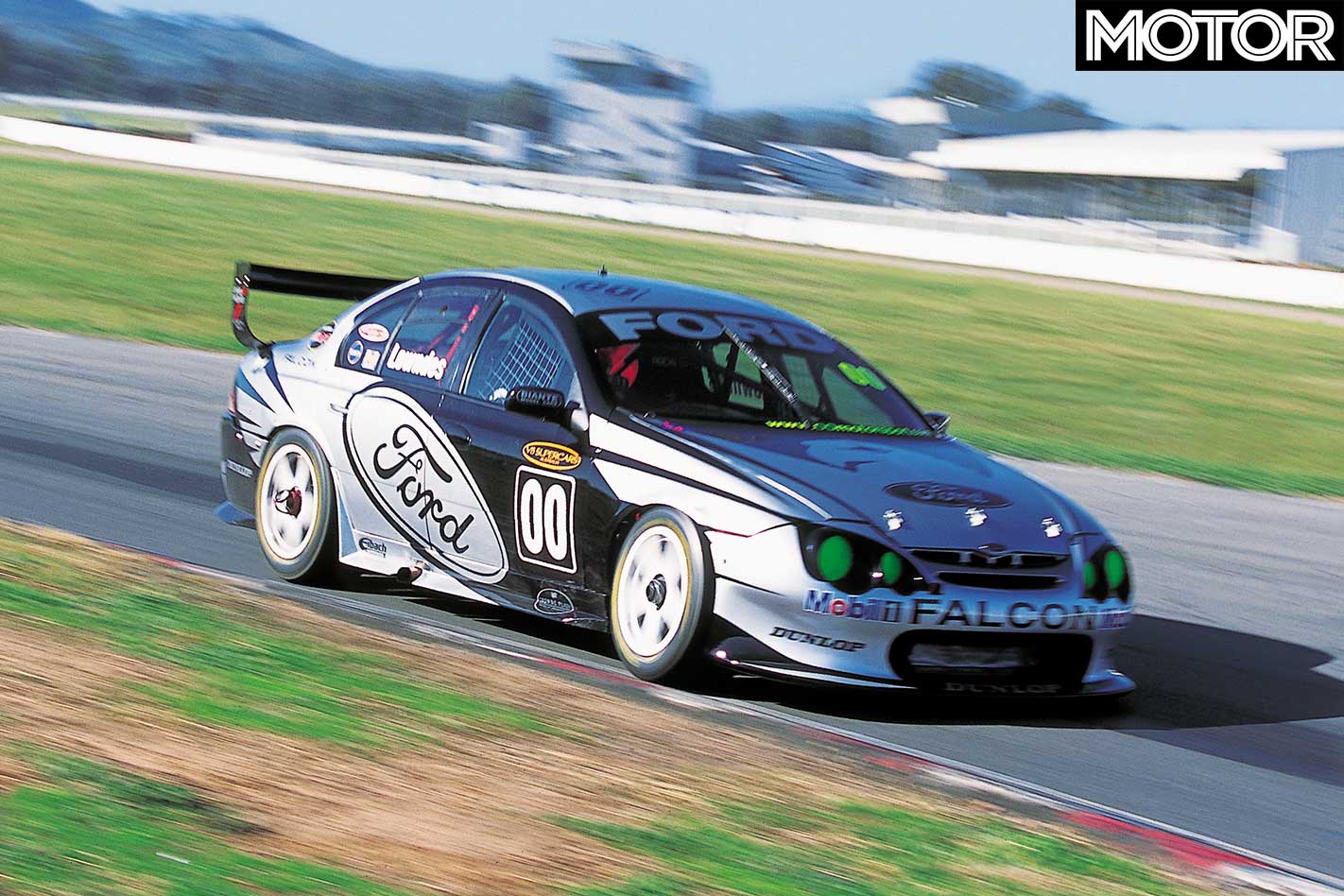
This isn’t, of course, Craig’s race car. It’s the spare. It’s got the ride day engine in it, with torquier, less powerful mapping and cams than the hard-core race engines. The Dunlops have seen better days; four of them, in fact. One at Barbagello and three other test sessions at this very track.
It’s set up to push the nose at the limit. There are a couple of reasons: firstly the AU has an inherent understeer problem and, secondly, if you were sticking an unknown quantity into a race car, you’d want it set up safe, too. But it’s plenty quick enough.
Shy of not spearing off and not looking too slow, the aim of the day is to get a feel for it and to see if V8 Supercars are at all similar to roadies, with whom they share but roof, bonnet and boot panels.
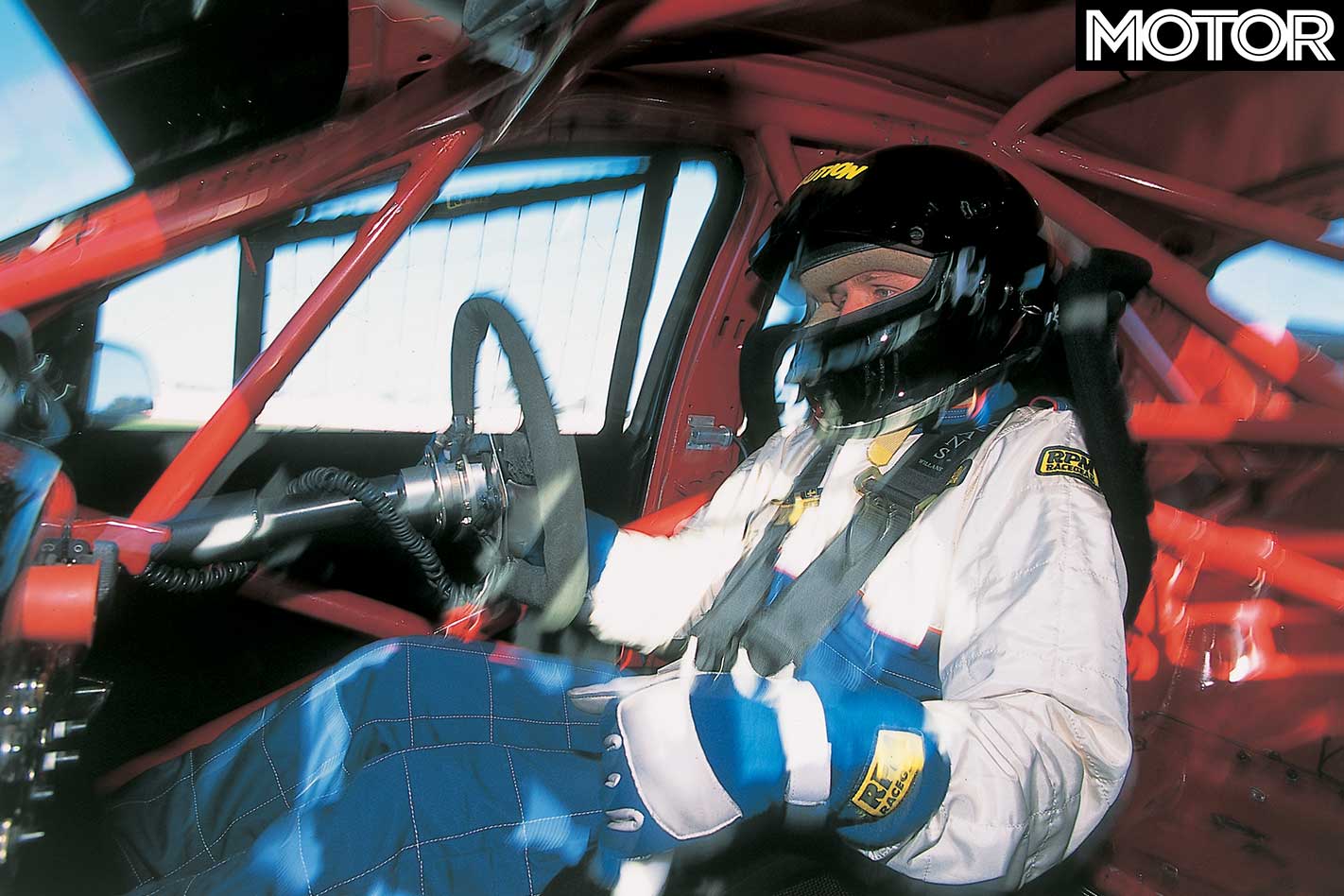
The first surprise is the driving position. The seat’s lower, compared to its cowl height, than you’d find in almost any road car you can think of. The wheel’s a flat-bottomed, suede number and about a foot across. And getting going’s fairly simple, really. Flip up the ignition’s protective cover, move the toggle south, then press the start button.
The fuel pumps whir, the starter heaves, but there’s no explosion. Instead, the fire lights one pot at a time and the whole thing gradually becomes angry.
First is the easiest cog to find. It’s where it is in almost everything, but the throw’s something else. The heavily assisted clutch is almost Corolla-like in its heft, but the gearbox has nothing to ease the pain. Craig calls it a crash box because, he says, that’s how you have to use them. The throw is so tiny you check three or four times to make sure it’s in first, even when the ‘CHUNK!’ sound guarantees you it is.
There’s a lot to remember. It’s like driving on ice when the tyres are cold, says Heaphy. Don’t bother with the clutch on the straight gate upshifts (1-2, 3-4), but use it on the diagonals (2-3, 4-5) says Craig.
There’s more, but the driving on ice thing fair pushes the rest into irrelevance, so the first stint’s familiarisation only. There’s that bit, doohickie by the seat, don’t touch that thing, fergawdsakes.
Not using the clutch is easy for Craig to say, but years in fast road cars condition you that gearboxes aren’t fusable drivetrain links for powerful engines and should thus be treated with a degree of empathy. And the Holinger feels bloody awful. The throw on the 1-2 shift would be no further than an inch. Clutch, silence, clunk, back on half throttle.
Noise, even at this doddery pace, is all-pervading. And sweetly muscular. It’s the same for five laps, bursts of unadulterated violence punctuated by the complete silence and deep concentration of every gearchange, then more violence.
The steering’s amazingly light. Again, it’s Corolla light. Dunno what they sook about, these blokes.
Then it’s time for a think. Even quick men from other formulae have struggled to get to grips with these things, so imagine how overwhelmed a nonce feels. Your head needs regular recalibration. Gun brakes, for example, don’t mean you can brake later than you would in, say, a Porsche or an STi. You brake earlier, because you’re carrying more speed.
More stuff comes without thought on the second run. Except the gearbox. It’s still a bastard, but at least the sense of it is becoming apparent.
It’s actually (with this high-wire, big-net set-up, anyway) not a nasty car. Push harder and illogical things begin to look logical. Earplugs, for example. It’s ferociously loud and the noise is pure, wonderful aggression. It’s in your face and threatening and leaves you in no doubt of its potency.
A V8 Supercar might struggle from the lights (the tyres are, in fast car terms, tiny) but from 20 km/h there’s not a road car in Australia that’ll run with it.
They’re blindingly quick. Example: finally get full throttle in second out of the last turn and the gear disappears before you’ve fully straightened the wheel. Third lasts as long as this sentence. Fourth doesn’t do much better and you grab fifth before the start/finish line. It’s so thumping that, on the new section, it’s pulling fifth and getting real interesting vis-à-vis run-off area. And Winton’s too short for sixth.
The big issue on Winton’s narrow confines isn’t its power, but how to use it out of the maze of second-gear corners. The diff is almost a locker but not quite, which gives great drive out of fast corners.
Push it harder in the tight stuff, though, and it’s a riddle only the best truly solve. You know you have to squeeze gradually on the throttle or those narrow-gutted Dunlops will bag up. And that hurries their ineffectiveness, so the more you do it, the easier it is next time. And yet, there are plenty of times when you feel like you don’t get enough out of the rubber.
You feel like you’ve been feeding it beautifully and you suddenly compute there’s plenty more on offer. So you just nail the pedal and, sure enough, the grip was there all the time. Then, a few laps later at the same corner, even your original throttle openings will be too much and the tail snaps hard.
For all the talk of their bastardry, the feedback is superb. It boasts breathtaking sensory literacy from all but one area; its brakes are mute. They’re not real bright, but they can stop heavy things – they just don’t tell you anything about it.
The pedal’s incredibly stiff; perfect for sharp heel-toeing, but little else. Give it the berries in a conventional, car-like way and bugger all will happen. Nothing. It won’t even look like slowing up.
You have to punch it bloody hard before it gives the traditional hallmarks of retardation. It takes, needless to say, some getting used to. If you drive them for a while, Lowndes reckons, you can feel a trace of something down there, but the irregular visitor has no chance.
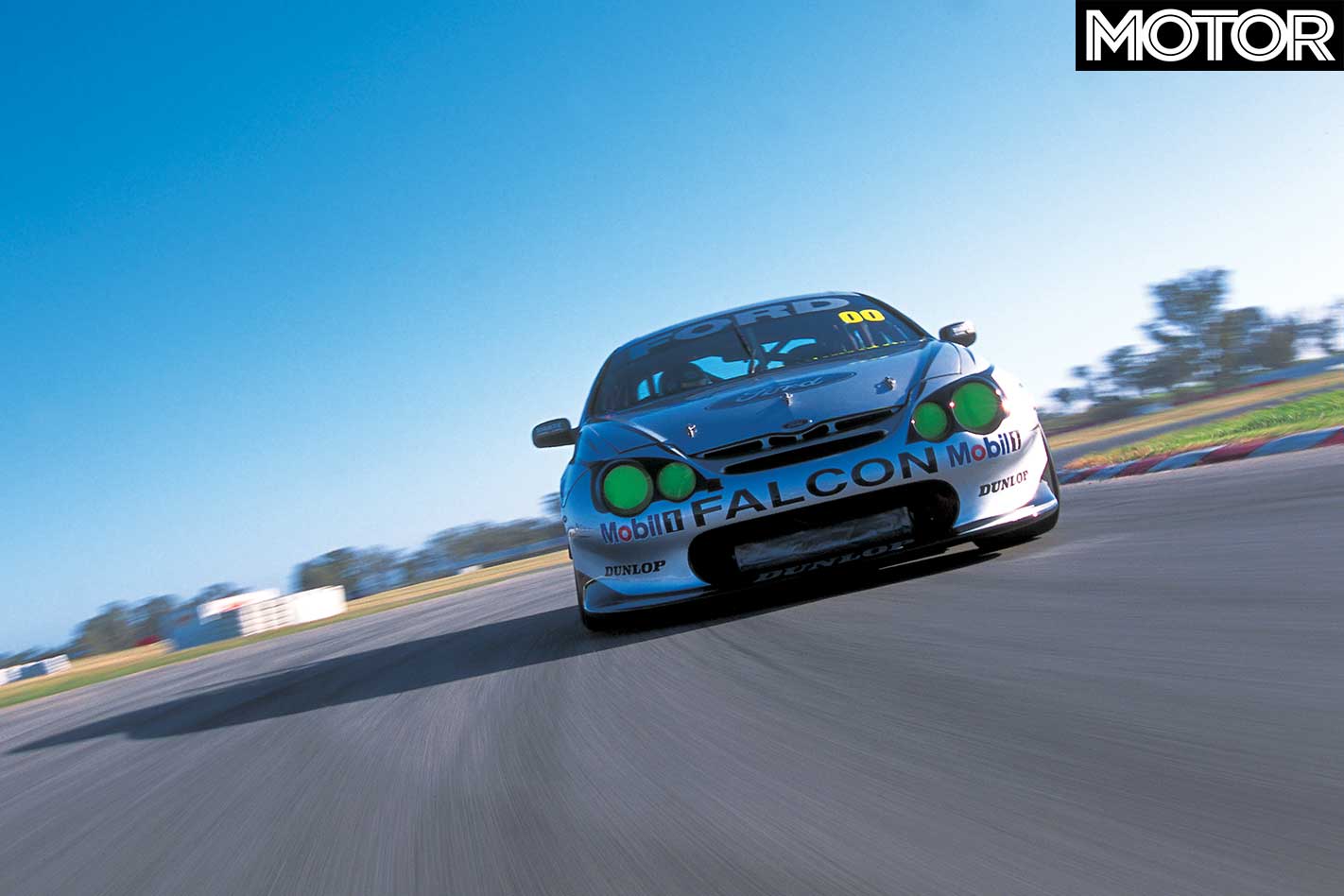
It’s easy, then, to push too hard and buzz a tyre and the first indicator you’ll have is the smell inside the cabin. Seriously. Yet they’re incredibly strong with never a hint of fade. The muscle required is, apparently, the trade off. Big master cylinder, consistent pedal, no feel or smaller cylinder, consistently dropping pedal, some feel.
When you move further into the depths of the car’s ability, you realize the steering’s not so light after all. It is, in fact, heavy. As you near the grip limits, it gets heavier. Go past them into understeer and – in direct contrast to almost every road car – it gets heavier still, all while maintaining its erudite yabbering.
Tip it into the fourth gear sweeper at 5400rpm and you can tell you’re off the pace over the first half because it’s still manageably light. In the second half, it’s almost as though you’re in a conventional car with a manual rack.
Yet the feedback just keeps coming. The steering is very lucid about the goings on of the two children under its control. There is, simply, no road car alive that can match it for front end communication. Everything from tiny undulations, minute changes in tyre pressure and you can even feel painted white lines and taped marks beneath the unladen wheels.
The chassis itself isn’t beautifully balanced with this set-up, but it’s incredibly stable in the fast stuff. The diff helps, even if it means you need some torque running through it before the thing’ll tip-in. Try to cruise around in angel gear after missing a downshift and it simply won’t turn. It’ll just push straight ahead. It seems to need torque to turn, which is why gear selection under braking is such an art in these things.
That means, in Lowndes Lore, skipping third on the way to second. Err, no thanks. With a gear throw this tiny, it’s just too easy to wrong-slot. And break the engine. Each and every laborious step is fine with us. The throw’s not overly heavy, which is a surprise. It just demands phenomenal accuracy of both hand and throttle-foot up and down the ’box.
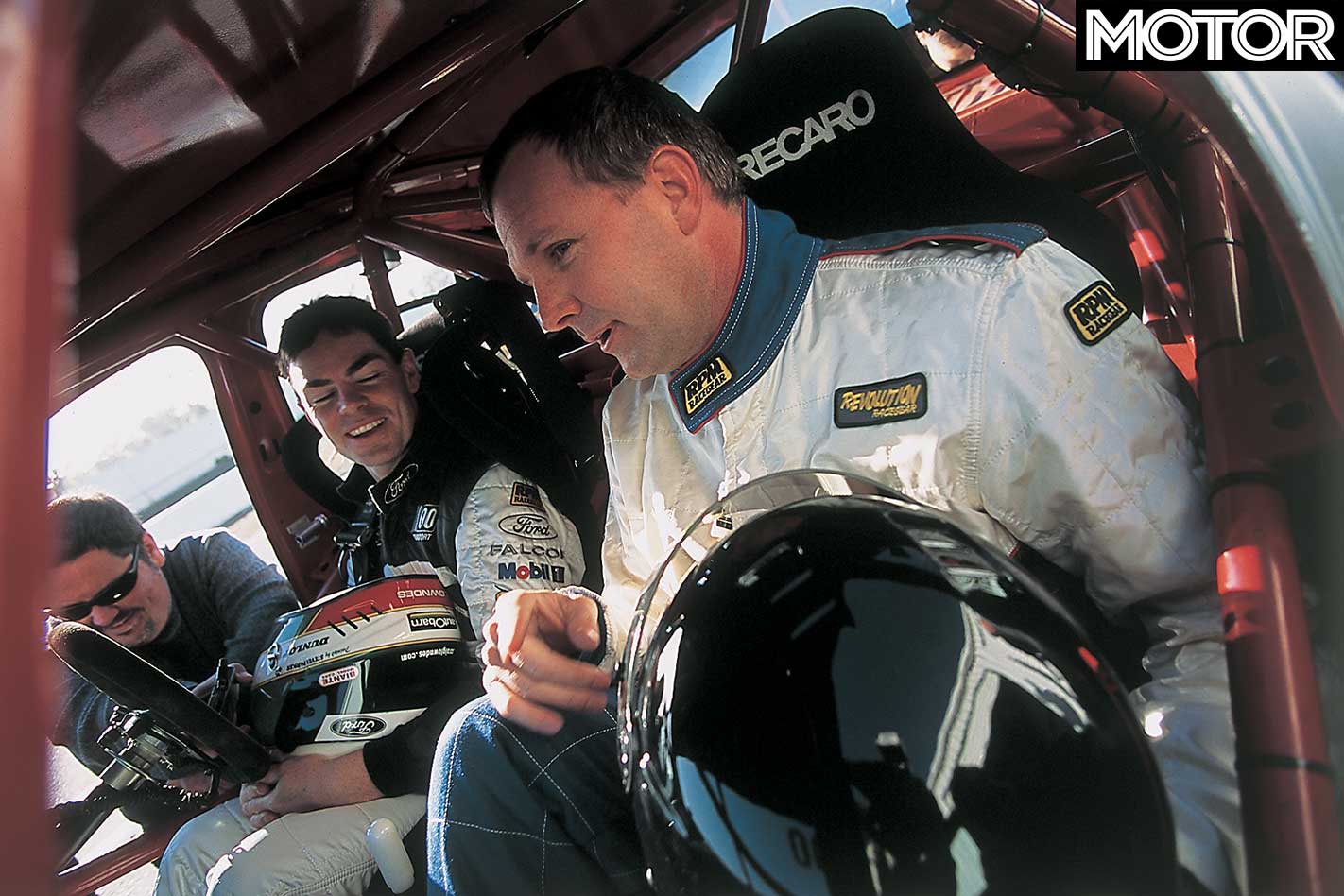
And then the first time you crack home a clutchless shift, you feel like the king of the driving world.
And it’s faster that way. It probably takes about half a tenth to snick it in versus two or three tenths with the clutch, using more arm speed (but less force) than you’d use in an XR8 or a ClubSport.
To do it you have to a) be confident and, b) remember it in the first place. Instinct says to go for the clutch. Provided you pull the lever fast enough, though, it’ll go through, even under full torque load.
The sensory overload never ends, because driving the Monster smells and even tastes different to roadies. If you push until you find the pace where it all suddenly becomes hard work, and you’ll be forced to gasp at air scalded by fumes from sizzling fluids, toasted pads and baking metal. And it’s just beautiful.
In the end, they’re actually not that difficult to drive (at this pace, anyway). Undertyred by law, lots of power, and they roll a bit (no, not like that, Cam!).
There are similarities to road cars, but not many. You have to give it some front spring back before it’ll turn in, for example. But hook it up and it all makes sense and it flows. It tries to intimidate you one minute, surprises you with its friendliness the next.
Oh yeah, my left collarbone hurts and it always makes me smile. Wouldn’t have it any other way.
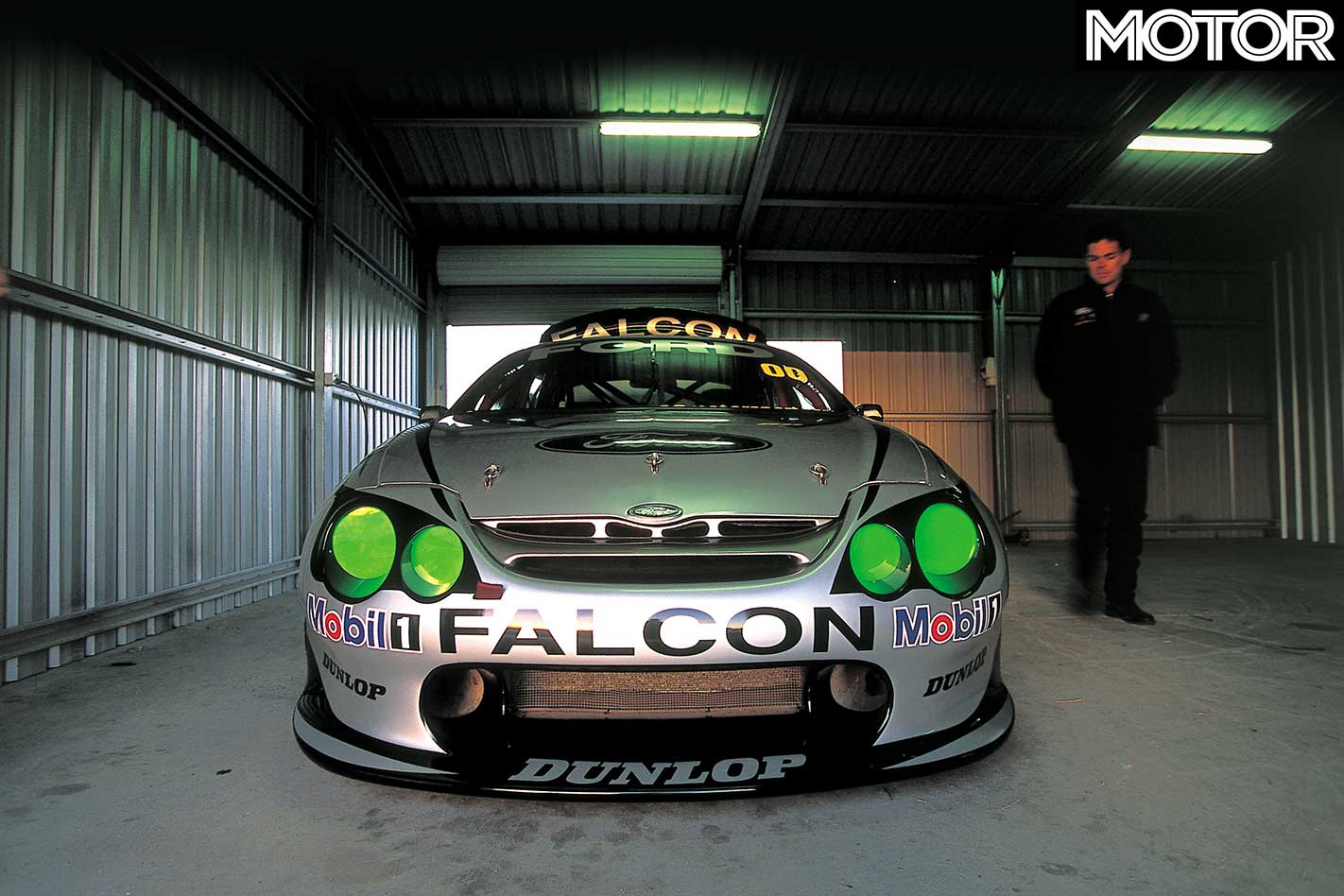
FAST FACTS 2002 00 Motorsport Ford Falcon V8 Supercar
BODY: 4-door sedan DRIVE: rear-wheel ENGINE: 5.0-litre 16-valve pushrod V8 COMPRESSION: 10:1 POWER: 460kW @ 7450rpm TORQUE: 610Nm @ 6200rpm WEIGHT: 1350kg POWER-TO-WEIGHT: 341kW/tonne TRANSMISSION: Six-speed Holinger manual SUSPENSION (f): Double wishbone, Eibach springs over Ohlins shocks, adjustable anti-roll bar SUSPENSION (r): Live axle, Watts linkage, Eibach springs over Ohlins shocks, adjustable anti-roll bar L/W/h: 4907/1870/1350mm WHEELBASE: 2788mm TRACK: 1632 mm (f), 1610 mm (r) BRAKES (f): 377 mm slotted, ventilated AP discs, six-piston AP calipers BRAKES (r): 330 mm slotted, ventilated AP discs, four-piston Brembo calipers WHEELS: 17 x 12-inch (f & r), O.Z. alloy TYRES: Dunlop SP Sport 280/680 R17 (f & r) PRICE: $350,000 (est.)
From the pit lane
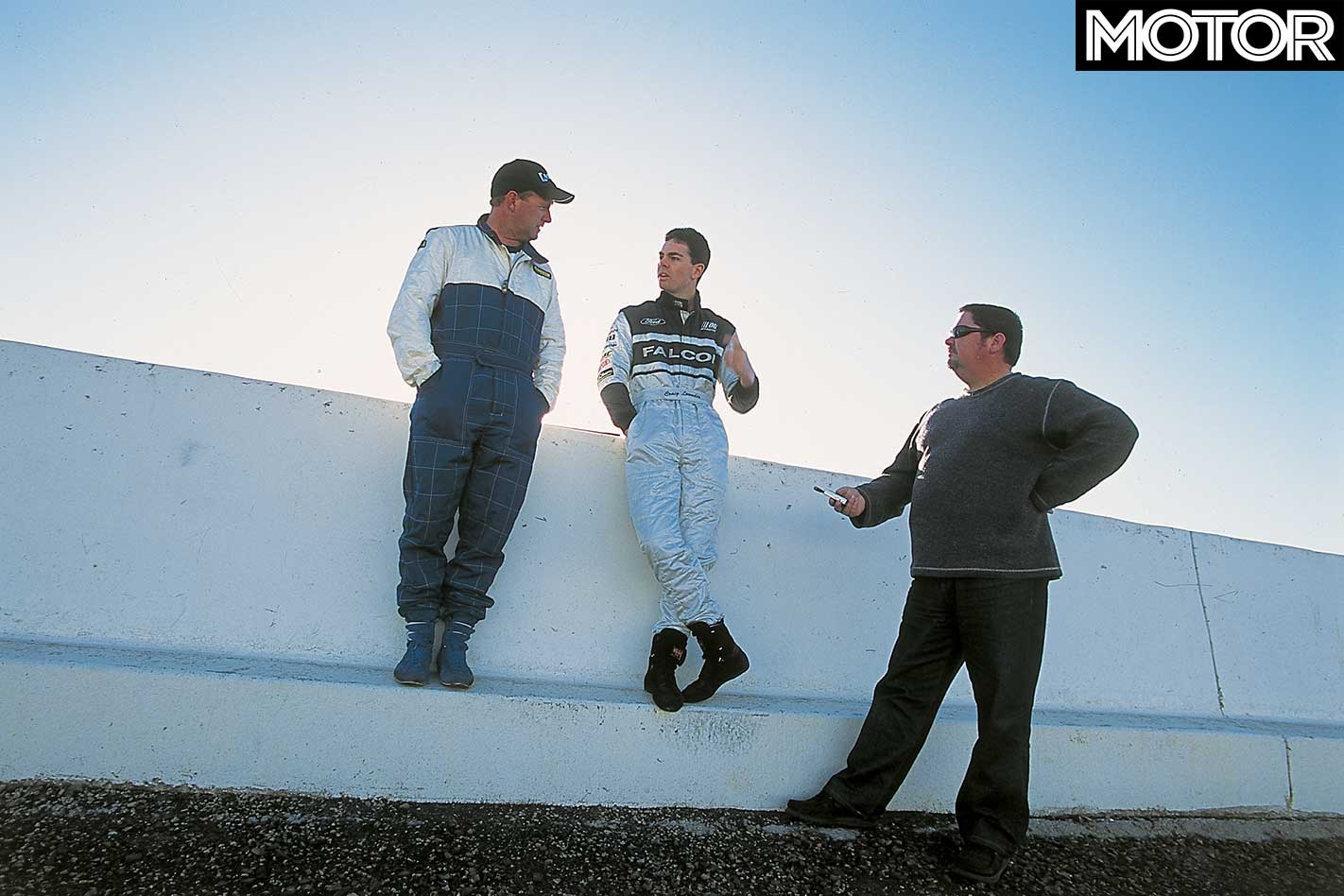
If you think Taylor got any special treatment you’re wrong. No, V8 Supercar testing rules are very strict and the presence of 00 stickers on the car meant it had to run Lowndes’ used Dunlops; “not the best set of tyres in the rack,” according to Heaphy.
Nervous Taylor? He says he isn’t but the last minute slash behind the pits contradicts that. Lowndes does a few laps to warm up everything. It’s to make sure Taylor isn’t going to get any nasty surprises and he logs a best time of 1:27.3sec. Going hard? “There’s not a lot left in it.”

With a head full of instructions MOTOR’s fearless editor hits the ignition switch, raises the revs, eases the clutch out and idles out of pitlane. Not stalling is a good sign.
“He’s got third, he’s going alright,” Lowndes says, grinning. “There’s a lot of shit on the track, if he’s half a car off line he’ll be in trouble.”
He starts to use more revs and brake harder and his shifts become quicker and more positive. Heaphy mans the stopwatch.
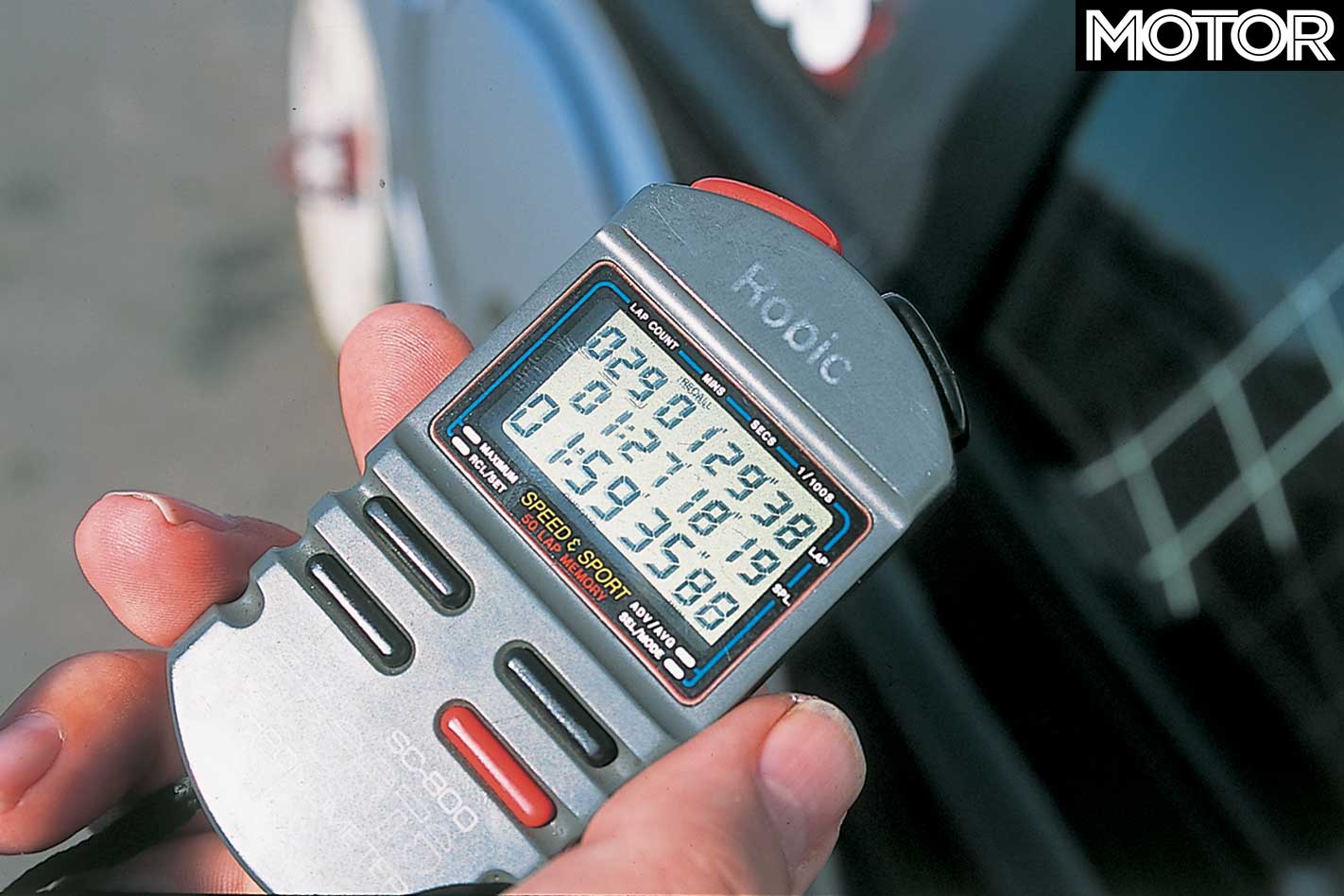
“He did a (one minute) 38sec first lap, a 35 and that was a 33, he’s starting to get it honking,” he says. Lowndes and Heaphy start a running commentary. “Whoops, he got a bit sideways there.” “He’s holding the throttle through the sweeper.”
“I’ve gotta say, I’m sort of impressed,” says Heaphy, who hadn’t heard of Taylor before today.
Second time out, Taylor is a lot more confident, bores out of pitlane and proceeds to go quicker with each lap until he calls it quits.
“You’re an ace,” Heaphy says, “You did a 1:29.3. I wouldn’t complain about that time, that’s pretty good.” – Steve Nally
What is it?
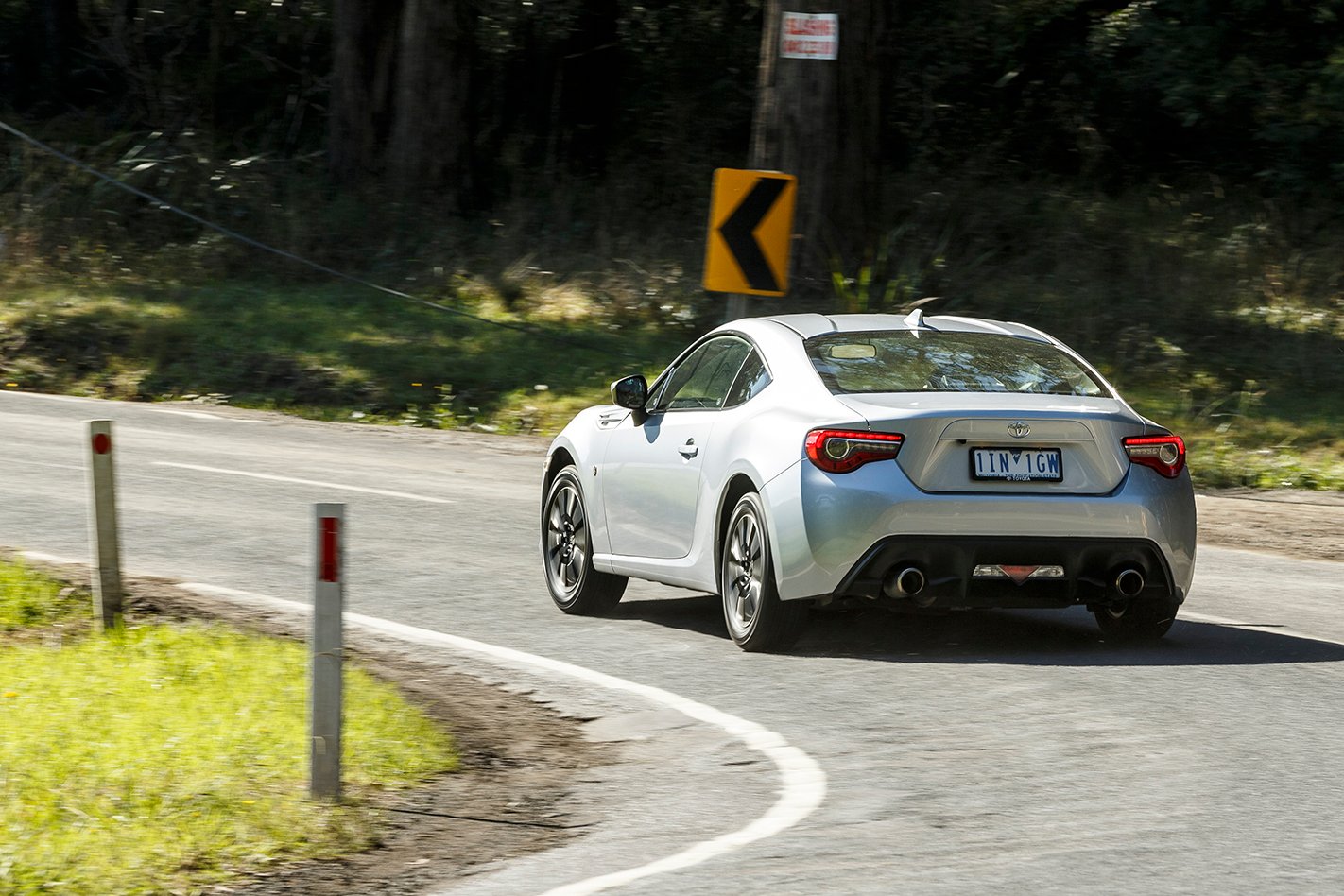
The Toyota 86 was designed as a modern-day version of the classic Toyota AE86 from the 1980s and, seven years since its launch, it’s still a hit with car enthusiasts seeking an affordable rear-wheel drive sports coupe.
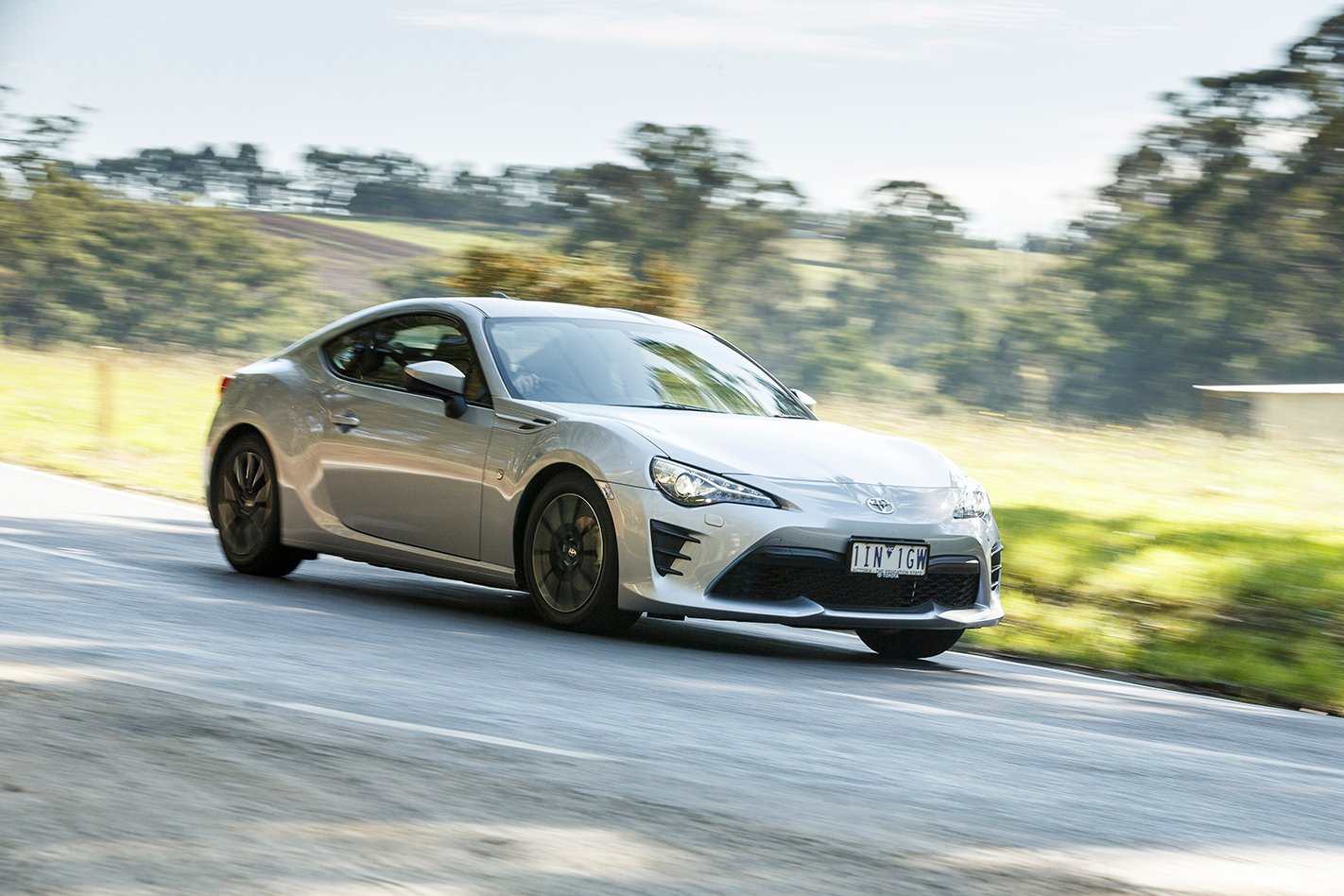
Toyota developed the 86 with Subaru, which sells the very similar BRZ, and such was the initial success of that partnership that both cars have only a received couple of relatively minor updates to styling and performance since 2012.
The latest for the 86 came in December 2016, which brought a mid-life restyle, retuned suspension, a minor power-boost and a shorter shift manual gearbox.
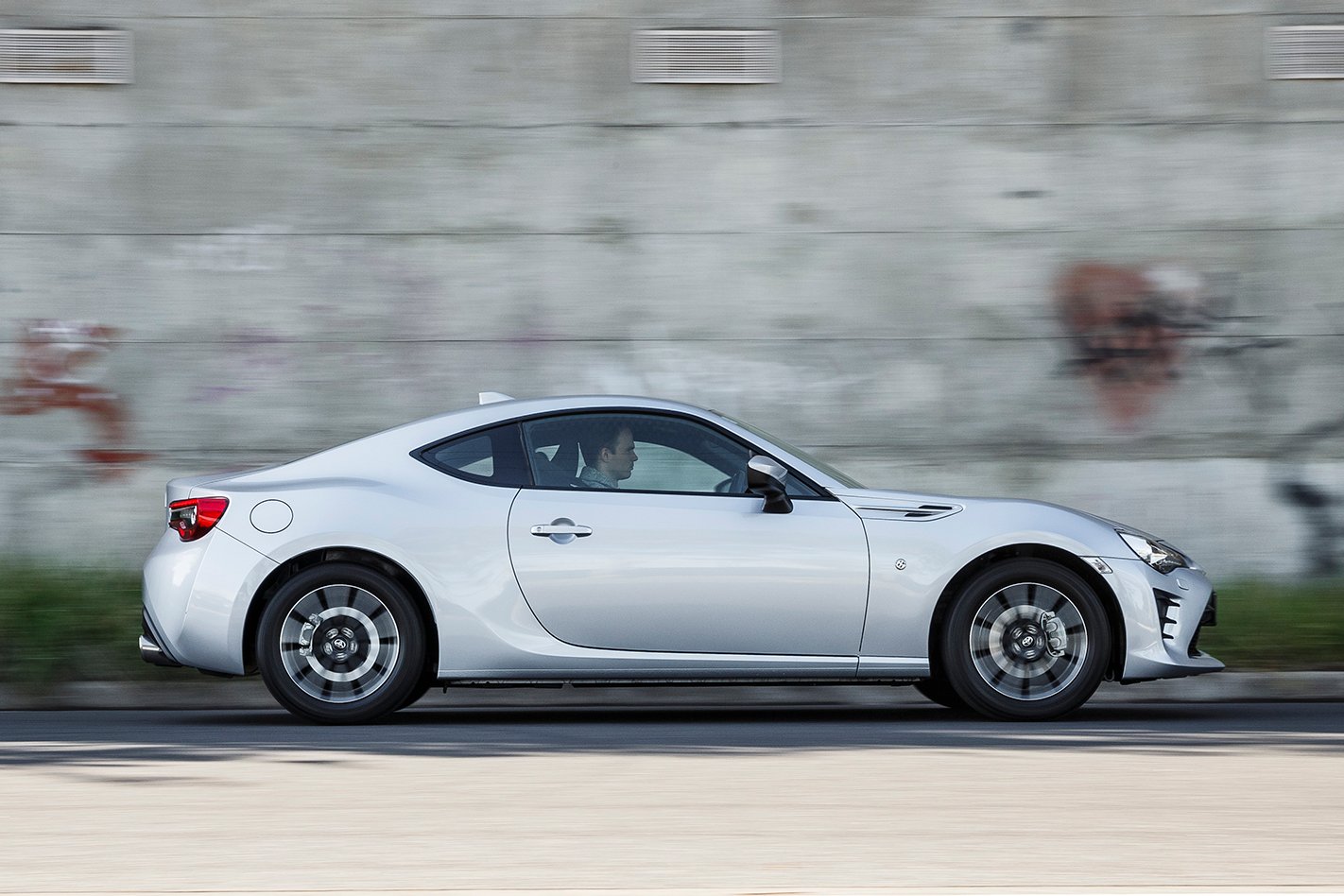
It’s been a while since we’ve driven an 86 so we wanted to see if it still holds up in 2019 under the shadow of the new Toyota Supra and Mazda’s evergreen MX-5.
How much does the Toyota 86 GT manual cost?
Priced at $31,440, the six-speed manual GT is the cheapest variant in the 86 range.
It’s arguably the best from a purist point of view, when compared with the six-speed automatic variant, and the GTS (from $36,640) versions that come with a factory approved performance package, featuring improved Brembo brakes, Sachs dampers, rear spoiler and bigger 17-inch alloy wheels.
Is the Toyota 86 GT manual easy to live with?
The Toyota 86 makes no pretences about being a practical or particularly comfortable car, but there are some things to consider such as the back seats, which are token at best, with virtually no legroom and very tight access.
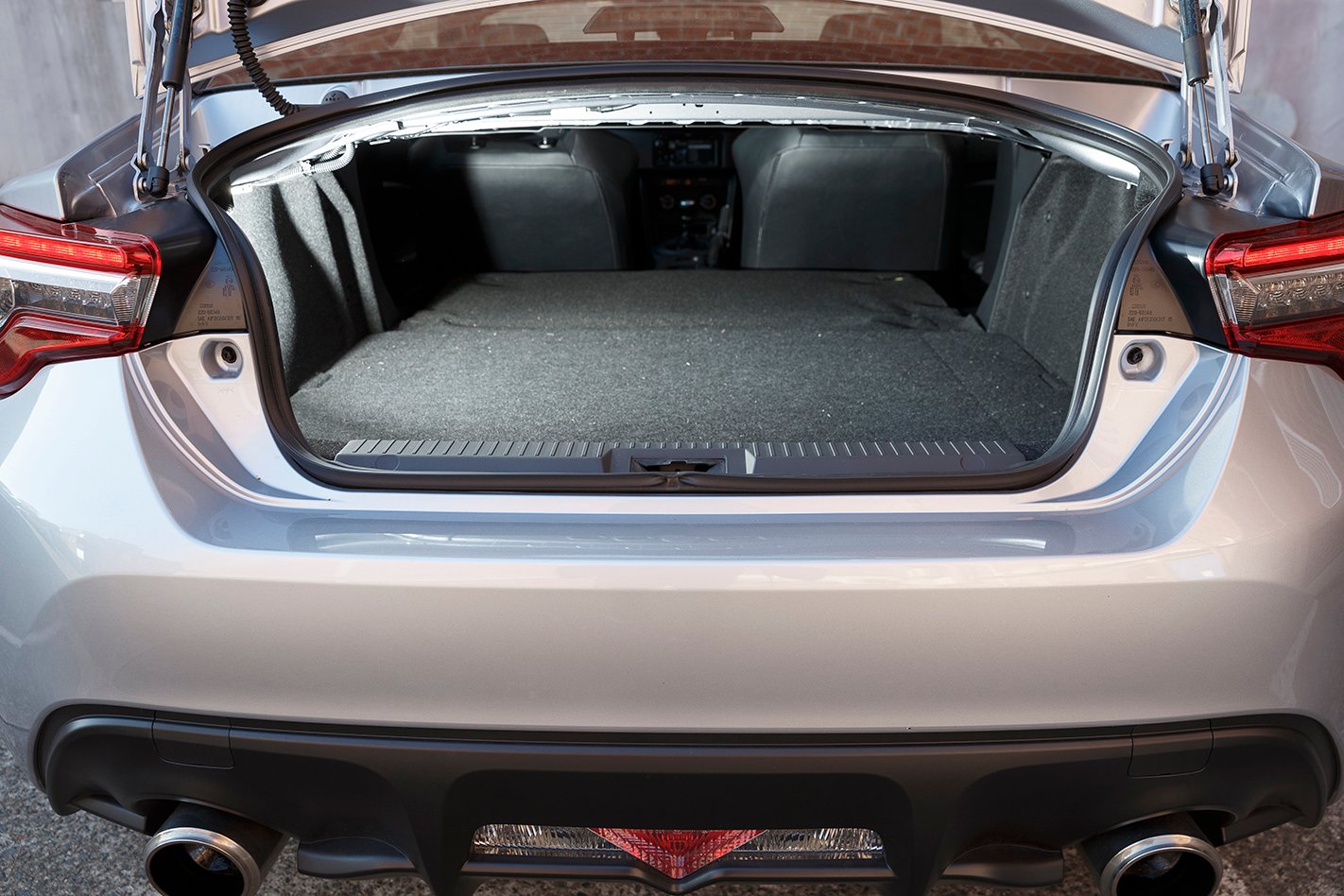
The shallow boot space is a tight, but functional 223-litres that’s about the same as a hatchback. The rear seat back folds forward in one piece to extend the length of the load space for anything that isn’t tall or bulky. Underneath the boot floor, the 86 has a full-sized spare wheel.
As a sports car it’s very easy to live with, if you’re not tall. The sports front seats are firm but comfortable and feel like they’ve been moulded specifically for your back. You do have to sink down to get into them, and entry and egress can be even more difficult by not being able to fully open the long door in tight parking spots. Taller people will also find that the rear-view mirror is positioned low, which limits its functionality.
The 86’s diminutive size does help with parking though. Restricted rear vision is assisted by a reversing camera displayed in the 6.1-inch colour touchscreen – something you don’t get in the Mazda MX-5. Parking is also aided by the user-friendly short-shifting manual gearbox that doesn’t make low-speed manoeuvring a chore as is the case with some larger sports cars.
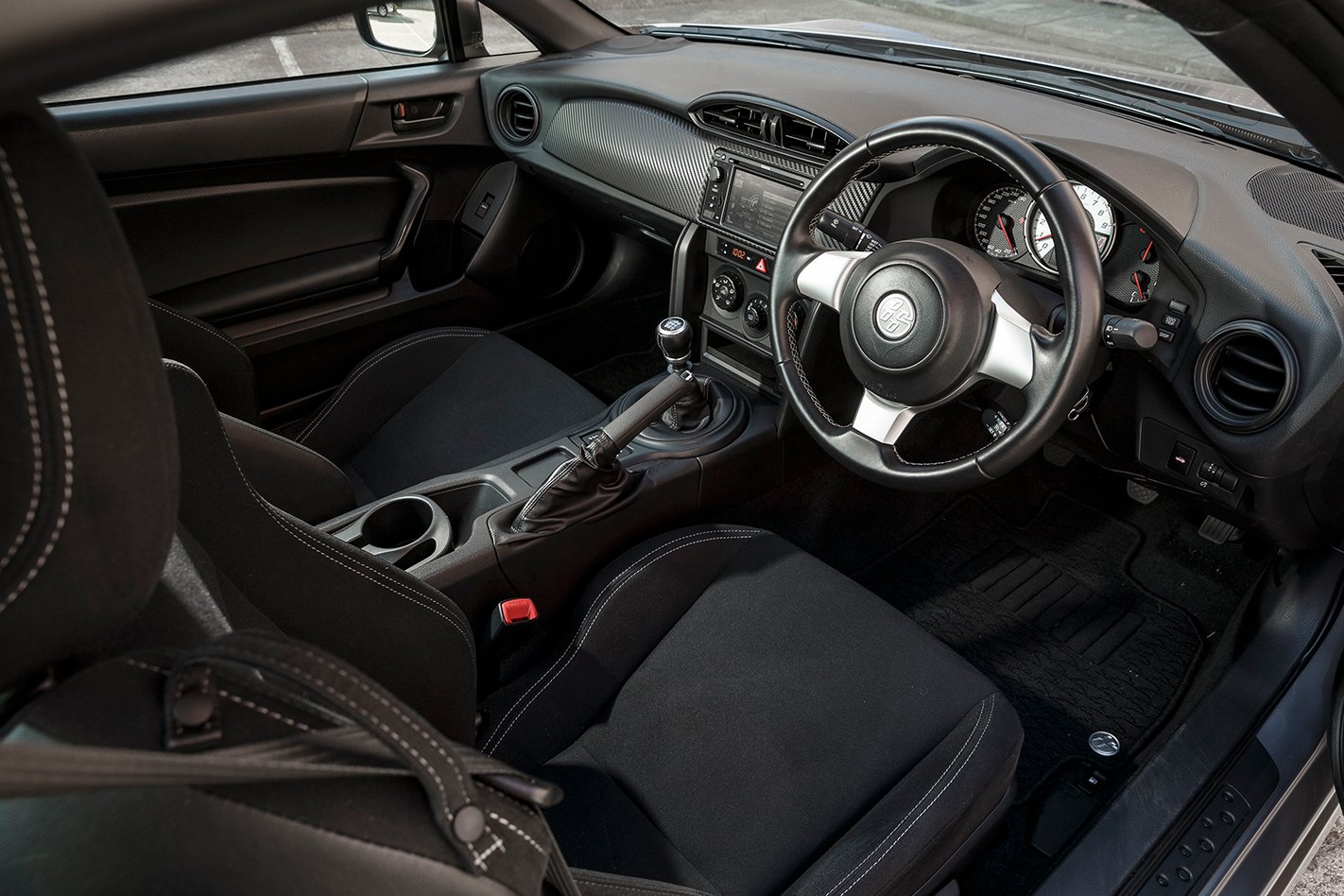
The dashboard design is elegant but simple with a clear gauge display and switches intuitively placed for easy reach. There are no audio buttons on the steering wheel, though the volume and touch-screen audio controls are close to hand. The cruise control settings are on a stalk behind the steering wheel.
With the manual gearbox the 86’s 2.0-litre engine has an official fuel consumption rating of 8.4-litres of RON 98 premium unleaded per 100kms, though driving it enthusiastically will usually push that to 10.0 litres/100km.
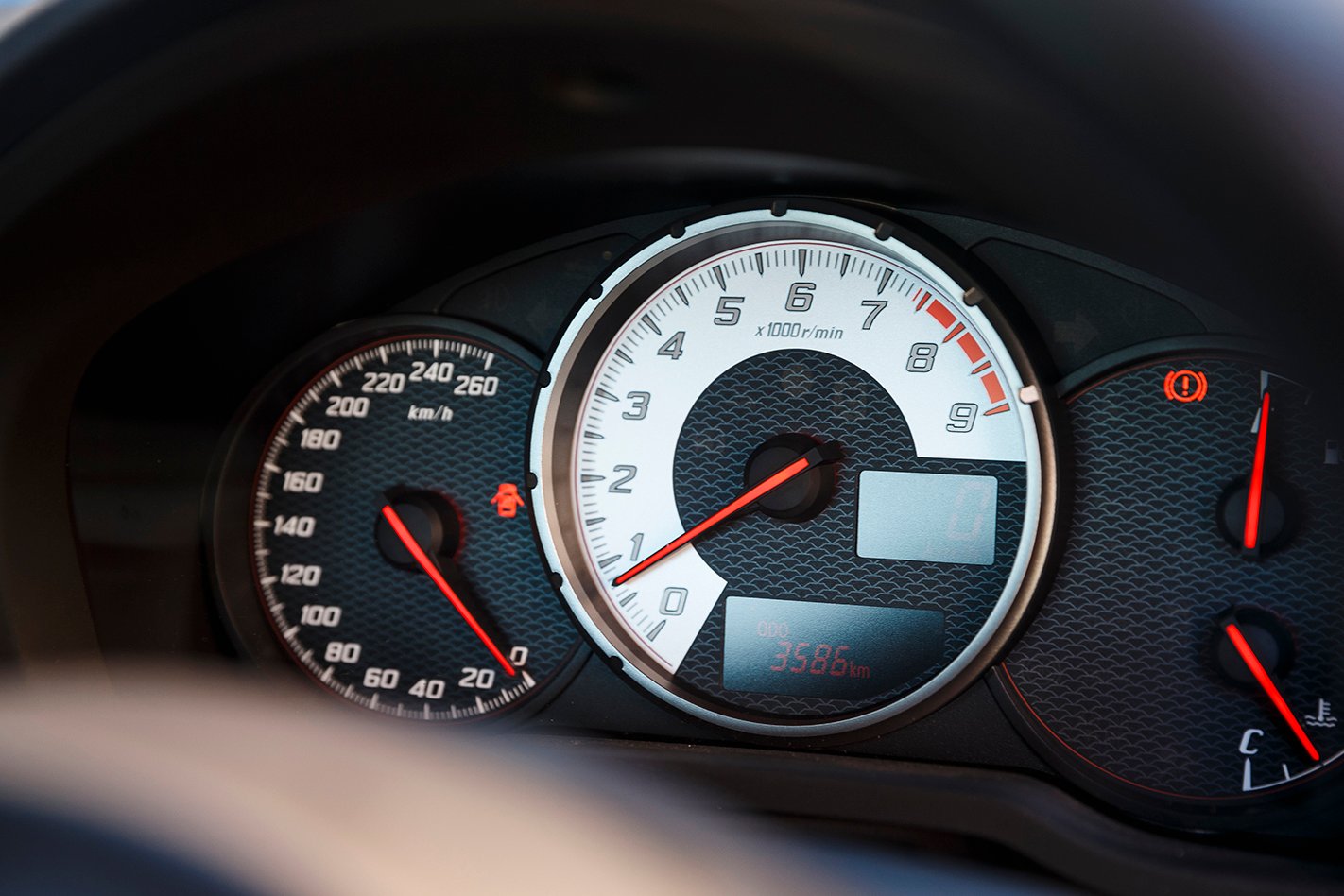
The Toyota 86 has a five-star ANCAP safety rating that was awarded in 2013 before its lack of autonomous emergency braking was taken into account.
Like all Toyotas, it is now covered by a five-year, unlimited kilometre warranty.
Does the Toyota 86 GT manual drive well?
This is why it exists! It’s not the most powerful sports car on the market but that doesn’t matter because the 86 is all about feeling connected to the road through the low seating position, slick gear shifts, revvy engine and precise steering.
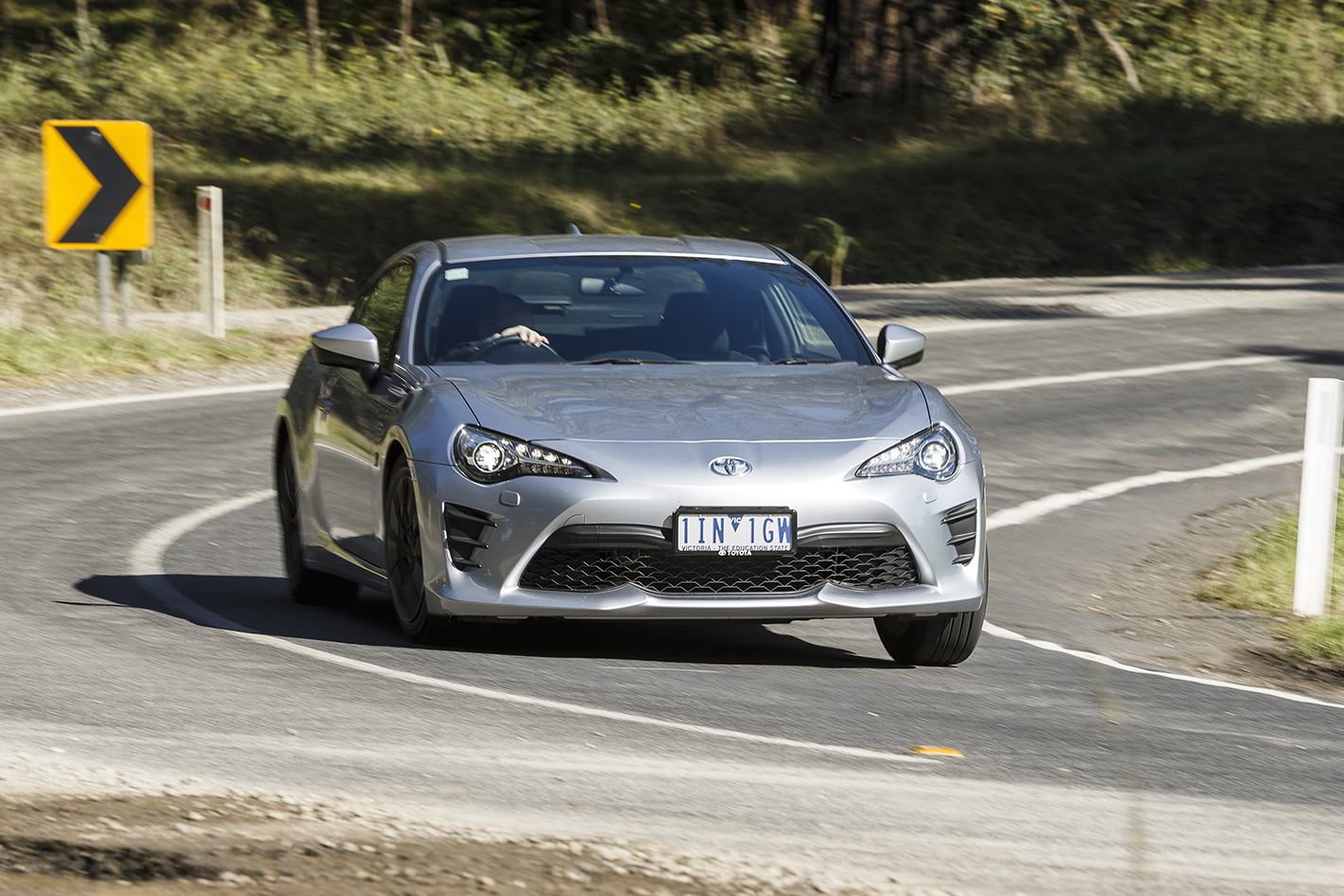
Being down low provides an enhanced sensation of speed, meaning even just zipping through a roundabout can be plenty of fun.
The steering is so direct it’s almost telepathic, and the low centre of gravity, tight chassis and suspension with anti-roll bars combine to superbly handle corners. The ride is firm even on the smallish 16-inch rubber, and you feel every bump, but the back-hugging seats help absorb excessive jarring.
Throttle response is instant as are brake pedal inputs, which makes the 86 a very forgiving sports car should you find yourself entering a bend a little too hot.
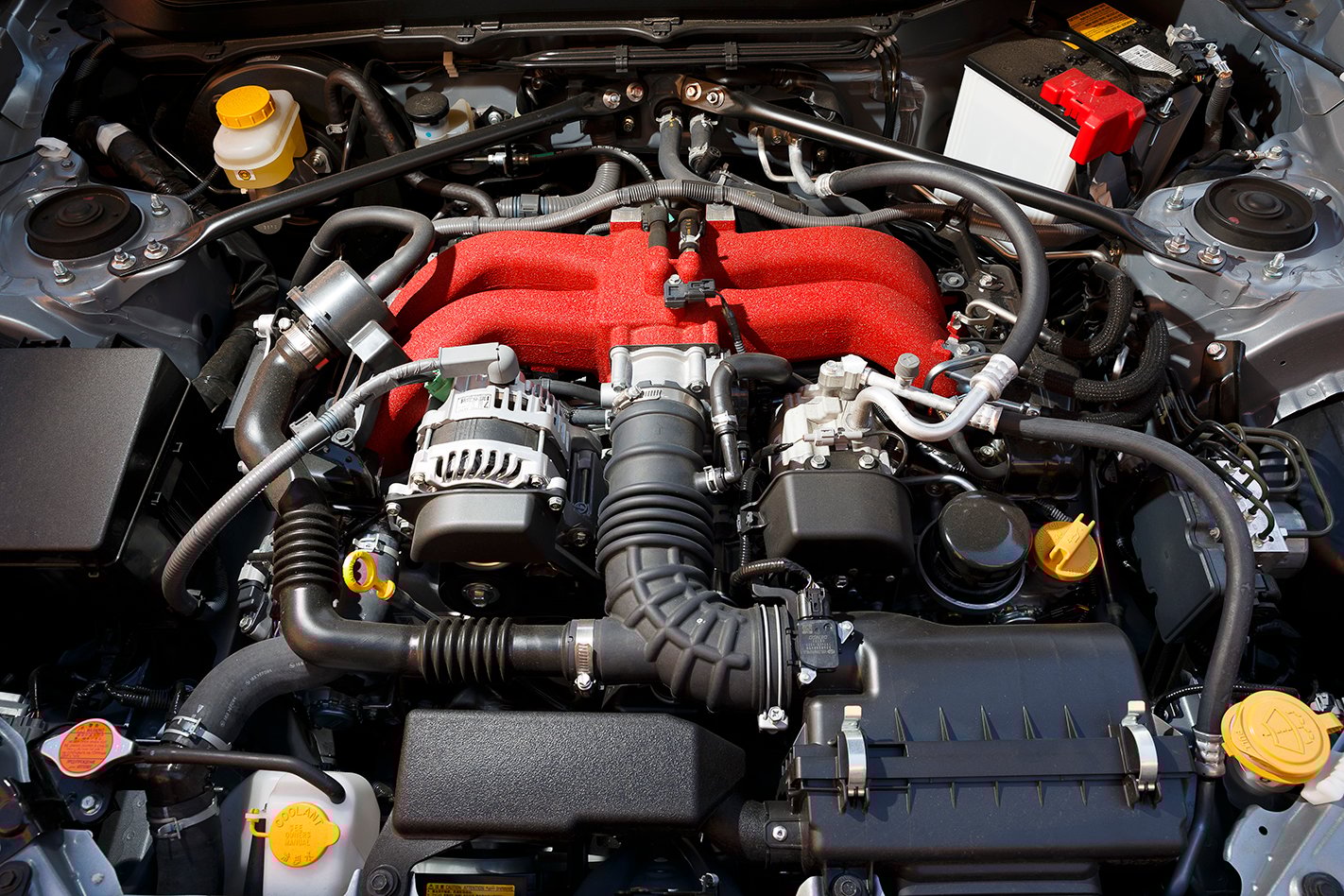
The 2.0-litre engine produces 152kW of power, which is quite a lot for its dainty 1234kg kerb weight, but you need to get the revs up to about 5500rpm to bring out peak responsiveness. It’s not as sharp in the middle-rev range, but that allows you to dial things down on your daily drive.
Verdict
Few cars offer such a pure driving experience for the cash. It’s relatively tame to control and doesn’t produce a surplus of power, which makes the base Toyota 86 an excellent entry-level sports car, while still bringing a smile to the face of seasoned drivers.
Now in its seventh year, the interior trim and infotainment system are showing their age, but for less than $35,000, this is still one of the great new-sports car bargains.
Volkswagen has revealed that it’s offering its Golf R hot hatch with a not-insignificant chunk of change off the bottom line – at least until the end of next month.
The catch? The deal only applies to 2018-plated examples.
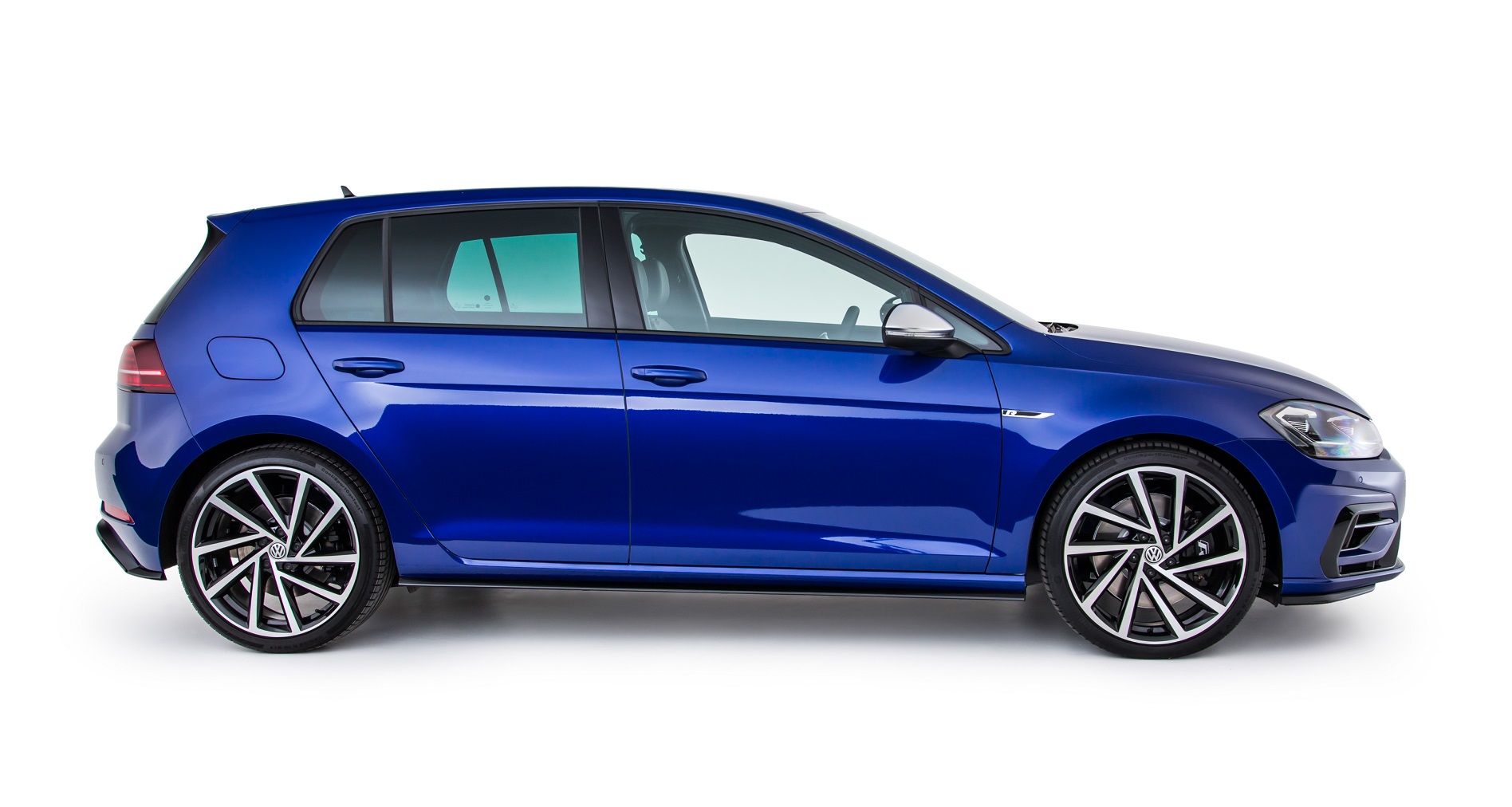
The VW Golf R five-seat, five-door hatchback will score – in standard form, at least – a $3000 ‘factory bonus’ (discount to you and I) until the end of March, partly as a result of last year’s shipping snafus catching up with the company, and partly because of a run on more highly specced 2019 variants.
Stinkbug infestations aboard some car-carrying vessels saw at least one ship laden with VW products turned away from Australian shores late last year, affecting a couple of model lines.
VW says it currently has a couple of hundred of the MY18-dated hatches and wagons to clear around the country. The deal doesn’t, sadly, include the 213kW Akrapovic exhaust-equipped R Special Edition from this year, which is selling like titanium-coated hotcakes, according to the company.
The pricing adjustment means that you should be able to grab an R hatch for right around the $60,000 mark, and the wagon will be a little more. This will net you a 2.0-litre turbocharged four-cylinder petrol engine, an all-wheel-drivetrain, an eight-speed dual-clutch gearbox, digital dash, lots of driver aids and 19-inch rims.
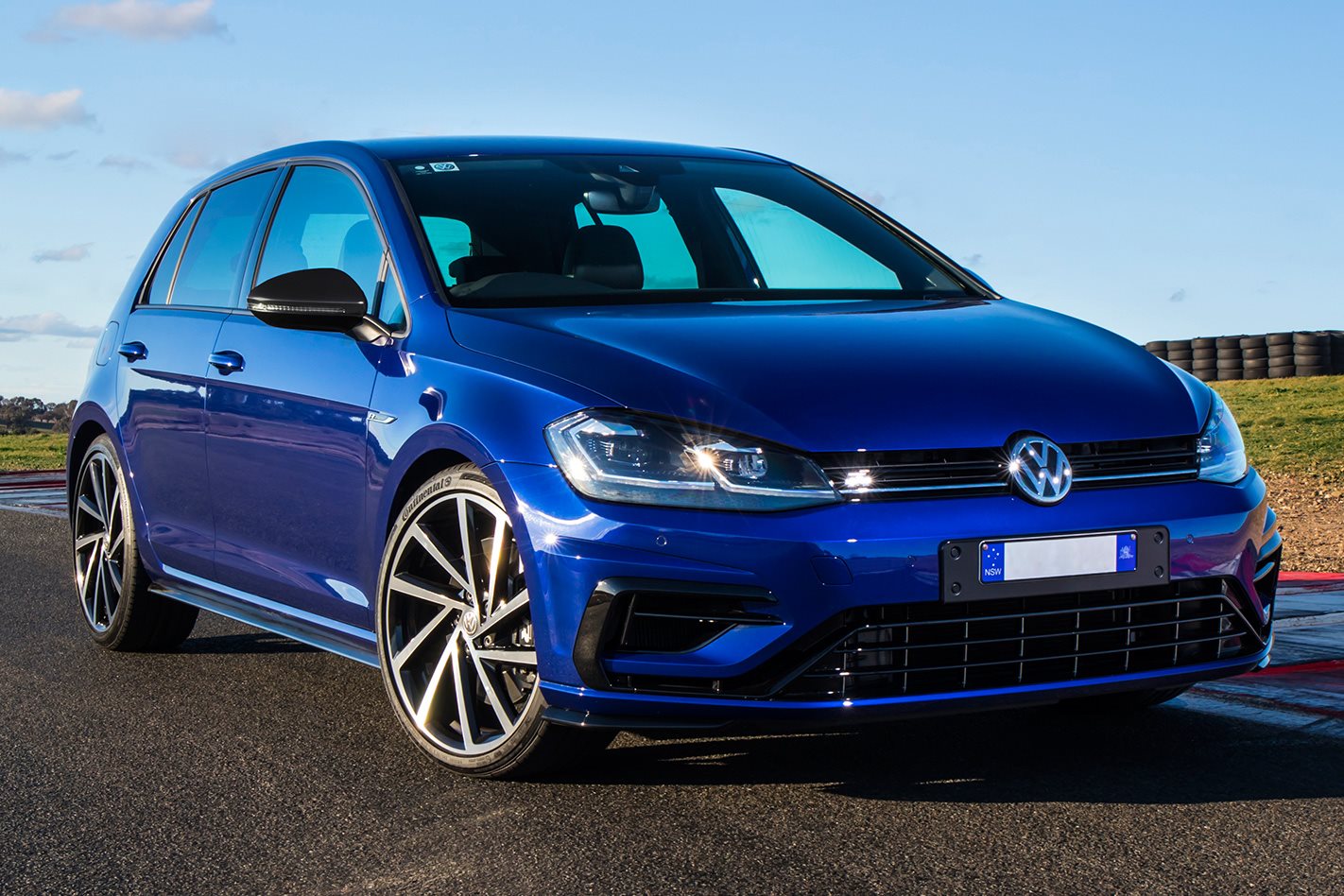
The Golf R does battle in a red-hot segment of awesome hot hatches that include the Hyundai i30 N, Honda Civic Type R and the Renault Megane RS 280.
The special pricing follows on from a similar deal for the Golf GTI.
VW will be leaning on the MK 7.5 Golf R for a little while yet. The Mk 8 Golf arrives next year, with the GTI expected not long after. The R, however, will be the last of the trio to debut, arriving no earlier than the end of 2020.
If 2017 was the year of the SUV, 2018 just might be the year of the EV – or at least the dawn of the true rise of the EV. This week, London-based Automotive data agency, JATO Dynamics, revealed its findings for global car sales in 2018 and when it comes to electric vehicles, the market soared by a whopping 74 per cent.
Of course, you could argue that there have never been more EV models available around the world than there are right now, and thanks to government initiatives, Chinese demand for EVs rose significantly as it became the biggest market for BEV car sales. But also, a huge chunk of this market came down to Tesla.
In 2018, the Tesla Model 3 became the world’s best-selling EV, with 138,000 units sold beating rival electric-powered cars like the former top-selling plug-in in the world, the Chinese BAIC EC (92,000); Nissan Leaf (85,000), small Chinese city car Zoyte E200 (51,000) and the Tesla Model S (48,000). JATO put this down to two influences: a boom in North American sales and the European diesel crisis and the legacy of dieselgate having Europeans consider cleaner modes of transport. Those numbers are expected to increase by another 100,000 as just this week, Tesla has rolled out the Model 3 to China, the biggest single EV market in the world.
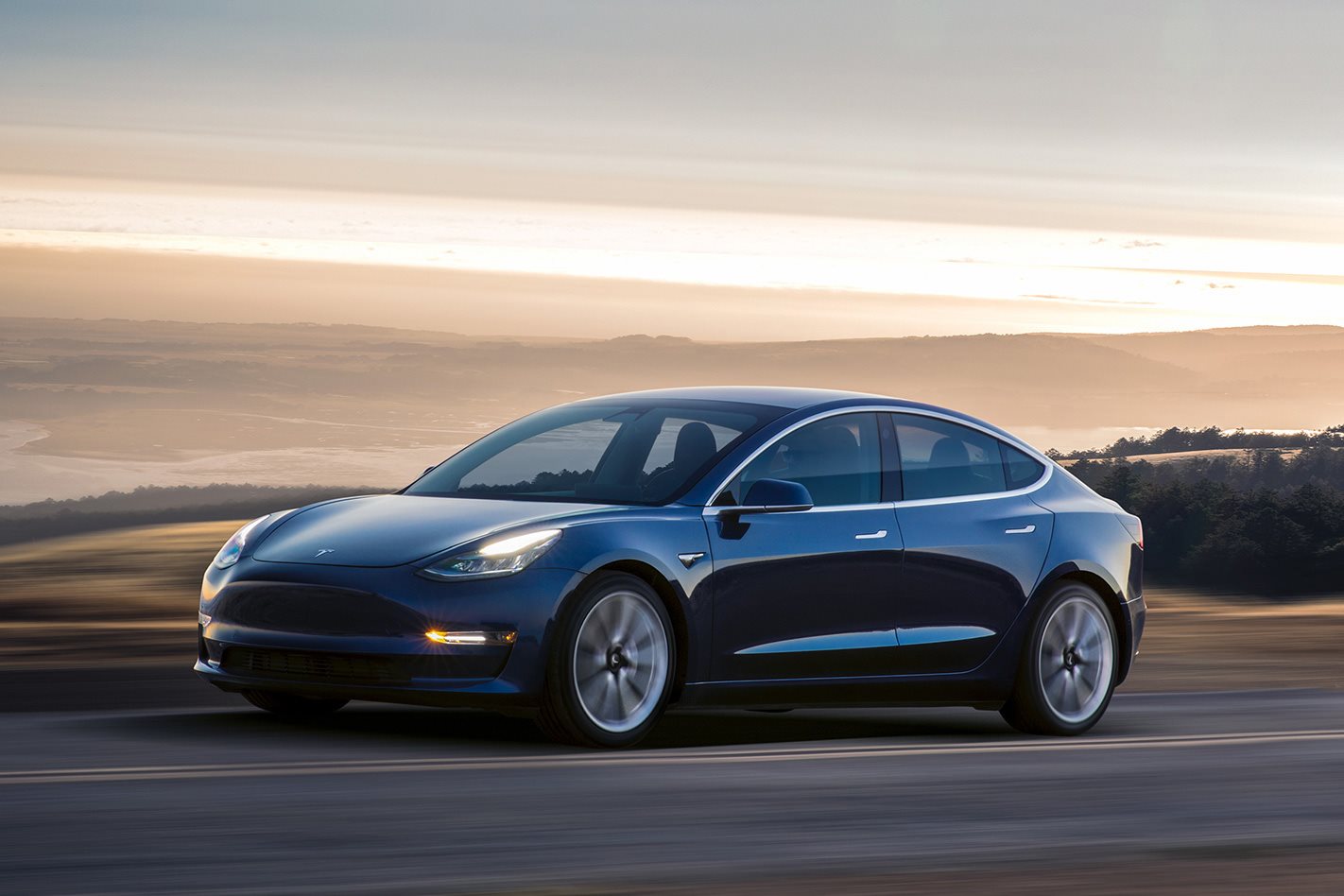
However, the dream may be fading for Elon Musk’s first attempt at a mass-market EV sports sedan, as the Model 3 has been marred with recent reports of reliability and quality control issues. At the centre of this is the US-based non-profit consumer organisation Consumer Reports, which, despite citing a high customer satisfaction rating, has withdrawn it from its recommended car list.
“While Teslas perform well in Consumer Reports’ road tests and have excellent owner satisfaction, their reliability has not been consistent, according to our members, which has resulted in changes to their recommended status,” says Jake Fisher, senior director of auto testing at Consumer Reports. “In most cases, reliability issues will undermine satisfaction. But when a vehicle has an enthusiastic following, like with Tesla, owners may overlook some issues. We’ve seen this with other vehicles such as the Jeep Wrangler and Chevrolet Corvette.”Some of the areas cited as problematic? Loose body trim, glass defects and in-car electronics. “The latest survey data also shows complaints about paint and trim issues,” CR wrote. “In addition, some members reported that the Model 3’s sole display screen acted strangely.”
Tesla responded by pointing out the company has made “significant improvements” to correct the issues. “The vast majority of these issues have already been corrected through design and manufacturing improvements, and we are already seeing a significant improvement in our field data,” said a Tesla spokesperson. “We take feedback from our customers very seriously and quickly implement improvements any time we hear about issues.”
Despite being brightened by new owners singing the Model 3’s praise, this isn’t the first time the Model 3 has received negative press, nor is it the first time Tesla has earned criticism for its bodywork and finishes. But with the Model 3 being such an important car for the company to get right, we hope that these creases get ironed out ahead of its Australian arrival….whenever that might be.
- German auto giants aiming to reach 60 million potential customers
- Merger includes partnerships in ‘last mile’ mobility
- BMW calls it “global game changer”
Almost a year ago, the Germans agreed to merge their mobility services into a single holding company, with a 50/50 split. And now, with a plan to both invest €1.1 billion ($1.74 billion), the details of the partnership have been made public.
With a focus on all-electric, autonomous, on-demand mobility; the services will be filed under five categories of joint ventures: Reach Now, Charge Now, Park Now, Free Now and Share Now.
Instead of just renaming everything and simplifying the companies, there are layers of layers of services, which, when combined, amass to 60 million customers globally. So let’s break each service down to see how multi-faceted and future-focused this merger gets.
Reach Now The newest service is Reach Now, a highly personalised network of city transportation and planning. This one is comprised of a former American car hire and ride-share app called ReachNow, and a transport and navigation app call moovel, which allows you to create an itinerary, book, pay and plan movements around a city.
Think of Reach Now as a one-stop shop for perusing every transport option in a city. That could mean users are able to use this service to hire a bike, buy a bus ticket, share a car, plan a trip and view all in a real-time and cashless system.
Charge Now Charge Now is a network of over 100,000 public charging points in 25 countries, and one of the fastest-growing networks of its kind in the world. While the website notes that Charge Now has a collaborative partner in Australia, the link directs users to a BMW landing page.
Park Now Park Now is a digital parking service made up of apps like ParkNow, RingGo, ParkMobile and Park-Line. These apps will offer users the power to locate, reserve, pay for and manage garages around the world.
BMW and Daimler say they’re banking that this pillar will help reduce traffic in urban areas. “The search for parking currently accounting for about 30 per cent of the traffic on urban roads,” they said. “Park Now is helping towns and cities to reduce traffic volumes, thereby helping to make city centres cleaner, healthier and more liveable.”
Share Now Share Now fuses both Daimler and BMW’s car share services, Car2Go and DriveNow. Before the merge, Daimler’s Car2Go was the largest car-sharing service in the world, which has 14,000 Smart and Mercedes-Benz vehicles on its fleet – the merger has bumped that up to 20,000 cars in 31 cities.
Free Now Free Now is made up of ride services like mytaxi, Kapten (formally known as Chauffeur-Privé), Clever Taxi and Beat – most of which operate only in Europe; as well as Hive, a new e-scooter company that appears to only be available in Lisbon for the moment.
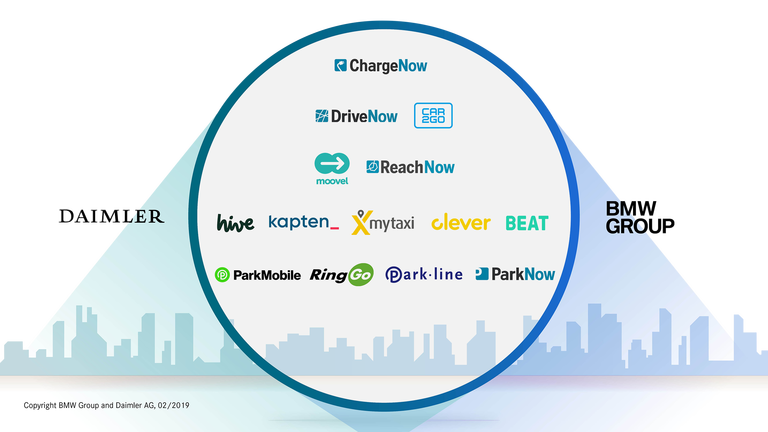
This merger is a huge, neon sign of the times and a good indication of where Daimler and BMW’s heads are at.
“We are creating a leading global game changer,” said Harald Krüger, Management Board Chairman of BMW AG. “The 60 million customers we already have today will benefit from a seamlessly integrated, sustainable ecosystem of car-sharing, ride-hailing, parking, charging and multimodal transport services…. these five services will merge ever more closely to form a single mobility service portfolio with an all-electric, self-driving fleet of vehicles that charge and park autonomously and interconnect with the other modes of transport.”
Dieter Zetsche, Chairman of the Board of Management of Daimler AG and Head of Mercedes-Benz Cars, echoed this sentiment.“By creating an intelligent network of joint ventures, we will be able to shape current and future urban mobility and draw maximum benefit from the opportunities opened up by digitalisation, shared services and the increasing mobility needs of our customers,” he said.
“Further cooperations with other providers, including stakes in startups and established players, are also a possible option.”
The global mobility ecosystem is an increasingly lucrative one. If current industry predictions are correct, this urban and future-focused shift in technology and transport will soon be generating revenues in the trillions – so it makes sense for Daimler and BMW to want to corner the growing market, not to mention, prepare for a more electrified future.
“Ultimately, we want to offer our customers as many options as possible for getting from A to B. In short, this is about driving, riding or being driven,” said Zetsche.Aside from sending a very clear message to Silicon Valley competitors like Uber, the merger demonstrates that these two giants are serious about a future beyond simply manufacturing cars. A billion-dollar chip on the table serious, to be exact.
The Queensland government will begin issuing number plates with emojis on them, a move that will no doubt thrill phone-addicted millennials and that one aunt you have who seemingly spends every waking moment on Facebook.
Available to order from March 1, the emoji-emblazoned plates will cost $475 for a new plate, or $165 as a redesign of an existing personalised number plate. Only combinations of two numbers and three letters can be used, with the emoji always positioned on the far right of the plate – no using it as a cheeky substitute for an ‘O’.

In case you were wondering, the emoji symbol doesn’t form part of the car’s registration number either. A shame for those who like to listen to police frequencies for fun.
Queensland’s emoji plates are bound to divide opinions on whether the monetisation of smartphone culture by state-level bureaucracy is either business genius or the highest form of cringe, but the Sunshine State certainly doesn’t have a monopoly on such things.

After all, Vicroads beat Queensland to the punch when it rolled out its “I Love” plates several years ago, which place the letter ‘I’ and a red heart symbol ahead of a two to five-letter word.
Depending on who you ask, the heart emoji plates are either saccharine or cute – but drive around Melbourne’s suburbs and you’re bound to see more than a few.
They might not have the highest pricetags for a number plate – that bar is already eye-wateringly high – but they are an easy way for road authorities to generate a little more dosh.
Oh and before you ask, there are only five emojis available to Queenslanders – the classic smiling emoji, a sunglasses-wearing variant, a heart-eyes emoji, a suggestive winking face and the crowd favourite, ‘crying while laughing’.
Regrettably, ‘smiling pile of excrement’ and ‘eggplant’ are not presently offered.
https://www.instagram.com/p/BuIIPiMnZe3/?utm_source=ig_embed&utm_medium=loading
